
CVA on an ipad Mini Part 2: The Beast
|
|
|
- Annis Blair
- 9 years ago
- Views:
Transcription
1 CVA on an ipad Mini Part 2: The Beast Aarhus Kwant Factory PhD Course January 2014 Jesper Andreasen Danske Markets, Copenhagen

2 The Beast... was initially developed for the pricing of arbitrary hybrid and exotic payoffs. Covering all asset classes [rates, fx, equities, commodities, inflation] and including a lot of facilities for skew/smiles etc.... with scripting language interface for arbitrary payoffs, of course. The Beast is a true product of the cold war of exotics that took place in the mid 00s, now converted to CVA duties. At Danske: 2

3 - Multi-factor (4F) Cheyette model (MFC) for rates with stochastic and local volatility. - Fully flexed non-parametric stochastic and local volatility model for fx and equities. - Deterministic default probabilities. As such, probably cutting the edge in 2010, but I could possibly do it a tad better today. 3

4 SuperFly Model Structure The Danske quant C++ library is called SuperFly. The SuperFly models are structured in to three categories: 1. Linear models produce forwards and discount. For example: - LRS: Linear Rate Surface model can produce Libor forwards and discount them. - LE: Linear Equity model stores dividend information and a LRS model to be able to produce equity forwards. 2. Molecule models can price European options. For example: 4

5 - MR SABR: Molecule Rate SABR, stores an LRS model and SABR parameters to price caps and swaptions. - MP SV: Molecule Price SV, stores an LX or LE model to produce forwards and Heston parameters to price European FX or equity options. 3. Dynamic models that can simulate or roll backward rates or prices. For example: - DR MFC MC: Dynamic Rate MFC MC simulates a DR MFC that is calibrated to swaption prices produced by an MR. - DP SLV MC: Dynamic Price Stochastic Local Volatility MC simulates a vector of DP SLV models each of which are calibrated to an MP SV for an FX or equity underlying. 5
6 SuperFly models are stacked on top of each other, typically: Dynamic model Molecule model Linear model An example: 6

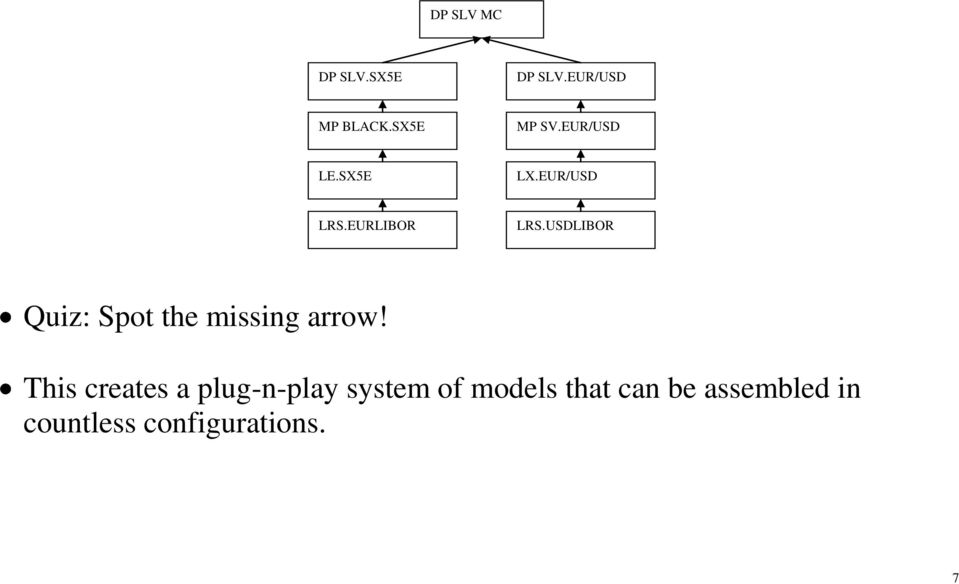
7 DP SLV MC DP SLV.SX5E DP SLV.EUR/USD MP BLACK.SX5E MP SV.EUR/USD LE.SX5E LX.EUR/USD LRS.EURLIBOR LRS.USDLIBOR Quiz: Spot the missing arrow! This creates a plug-n-play system of models that can be assembled in countless configurations. 7
8 Structure can be quite complex. In fact, we have created a small scripting language called Lingo to manage assembly and disassembly of models. An example of a Beast on the board. The point is that the flexibility of the plug-n-play system enables us to re-use the components used elsewhere in the bank. The LRS.EURLIBOR and 30 other currencies are automatically produced and stored on the database every few seconds, based on quotes continuously submitted by the swap desks. The LRS.EURLIBOR is being re-used by everyone in Danske Bank that need to use Libors and discount in EUR. 8

9 This seems natural but it is far from the case among many of our competitors where the EURLIBOR curve may be simultaneously constructed by many different desks with many different code libraries. Without this consistent re-cycling of all models and extensive automatisation, it would be a day-trip to get a 20+ ccy Beasts off the ground. As is, for a given portfolio with a certain set of underlying indexes we construct the Beast on-the-fly based on the relevant models pulled from the database. All pricing can be based on parameters that are only seconds old. 9

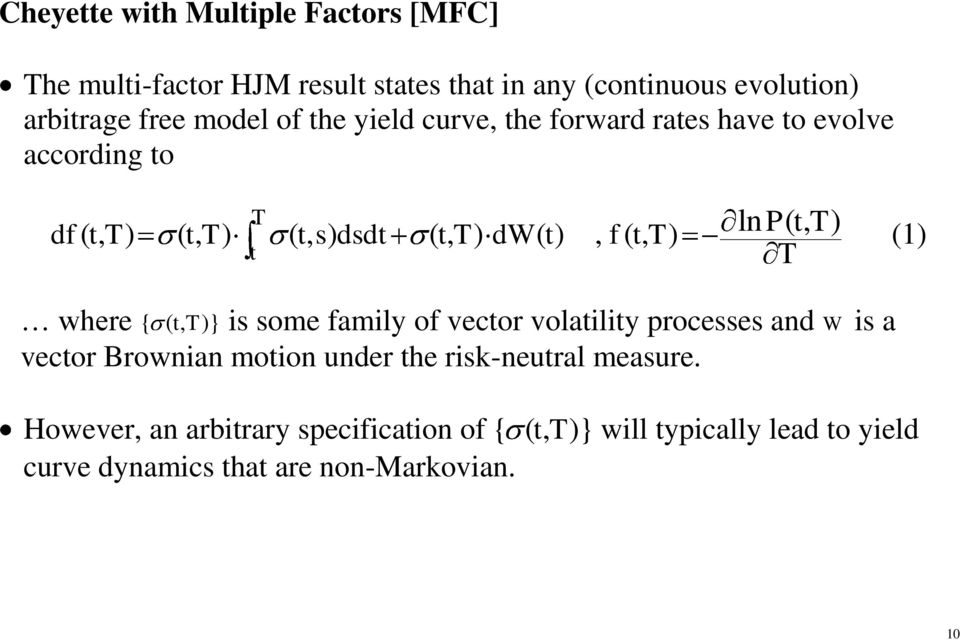
10 Cheyette with Multiple Factors [MFC] The multi-factor HJM result states that in any (continuous evolution) arbitrage free model of the yield curve, the forward rates have to evolve according to T df ( t, T) ( t, T) ( t, s) dsdt ( t, T) dw( t), f ( t, T) t ln P( t, T) T (1) where { ( tt, )} is some family of vector volatility processes and W is a vector Brownian motion under the risk-neutral measure. However, an arbitrary specification of { (, )} tt will typically lead to yield curve dynamics that are non-markovian. 10
11 So during simulations one needs to use the whole yield curve as a state variable. Cheyette and others (early 90s) show that if the forward rate volatilities have the following separable form i ( T t ) ( t, T ) e ( t ) g ( T )' h ( t ) (2) i i for some constants 1,, n and vector processes 1,, n, then a finite dimensional Markov representation emerges: 11

12 G ( ) x ( t) 1 G ( ) y ( t) G ( ) 2 P( t, t ) P(0, t ) e i ij, G ( ) 1 e P(0, t) i dx ( t) ( x ( t) y ( t)) dt ( t) dw ( t) i i i ij ij j j j dy ( t) ( ( t) ( t) ( ) y ( t)) dt ij ik jk i j ij k i i i ij j i i (3) The state variables have the interpretation: - ( x i ) are n state variables that shock the yield curve. - ( ) ij y are ( 1)/2 nn state variables that have to be dragged along to keep the model arbitrage free. 12

13 The Cheyette volatility specification corresponds to spanning the forward rate volatility structure with the exponential basis: kappa = 0.00 kappa = 0.02 kappa = 0.05 kappa = 0.15 kappa = 0.25 kappa = The trouble with the Cheyette volatility specification is that it is quite abstract: the model is specified in terms of dynamics of abstract state variables ( x i ) with no simple link to rates. 13

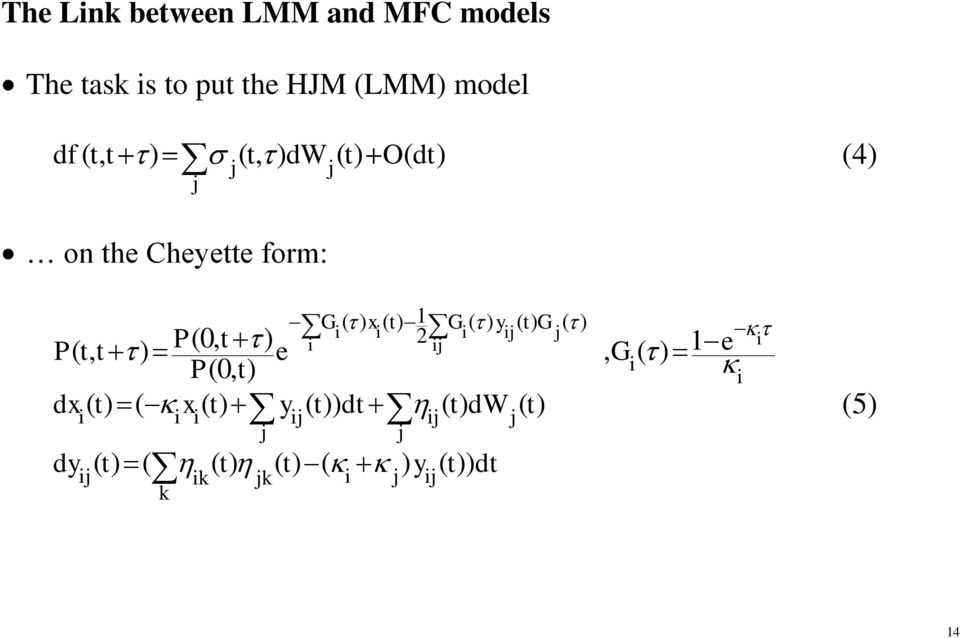
14 The Link between LMM and MFC models The task is to put the HJM (LMM) model df ( t, t ) ( t, ) dw ( t ) O ( dt ) (4) on the Cheyette form: j j j G ( ) x ( t) 1 G ( ) y ( t) G ( ) 2 P( t, t ) P(0, t ) e i ij, G ( ) 1 e P(0, t) i dx ( t) ( x ( t) y ( t)) dt ( t) dw ( t) i i i ij ij j j j dy ( t) ( ( t) ( t) ( ) y ( t)) dt ij ik jk i j ij k i i i ij j i i (5) 14
15 As df ( t, t ) e i ( t) dw ( t) O( dt ) (6) i j... it turns out that this can be achieved with ij j () t n n 1 g ( ) g ( ) ( t, ) ( t, ) g ( ) g ( ) ( t, ) ( t, ) 1 n n n 1 n n n (7) g() e i i for a selected set of tenors 1,, n and mean-reversions 1,, n. 15

16 So we can specify the Cheyette volatility structure to equate to the LMM volatility structure for n selected forward rates. Idea introduced in Andreasen (2005). 16
17 Here, one can think of the forward rates and the mean reversions as a basis, for example - Mean reversions (,,, ) (0,0.1,0.3,1.0) Forward rates (,,, ) (6 m,2 y,10 y,30 y ) Now set the LMM model to be Piterbarg (2003) s most sophisticated (tenor dependent shift and stochastic volatility): j ( t, ) z [ f (1 ) f ] ( ) dz( t) (1 z( t)) dt ( t) z( t) dz( t), dz dw 0 ( t, ) ( t, ) f f ( t, t ) f f (0, t ) 0 0 j j (8) 17

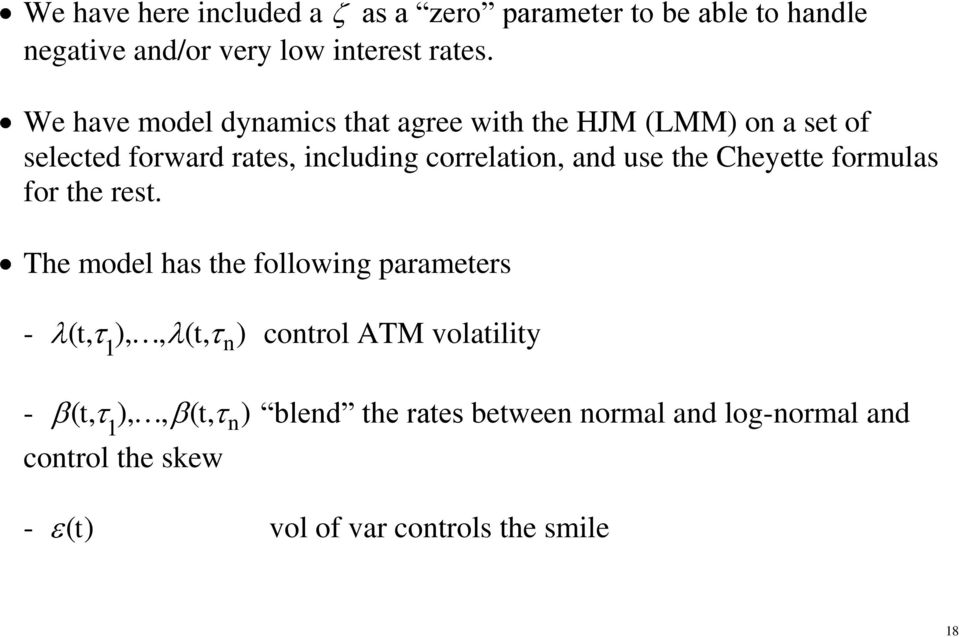
18 We have here included a as a zero parameter to be able to handle negative and/or very low interest rates. We have model dynamics that agree with the HJM (LMM) on a set of selected forward rates, including correlation, and use the Cheyette formulas for the rest. The model has the following parameters - ( t, ),, ( t, ) control ATM volatility 1 n - ( t, ),, ( t, ) blend the rates between normal and log-normal and 1 control the skew n - () t vol of var controls the smile 18
19 - [ ( ) ( )'] i j correlation structure of forward rates So the model is specified in terms of forward rate volatility, blending, vol of var, and correlation structure exactly like LMM models. 19

20 MFC Advantages The MFC is a lot faster than comparable a LMM model... but also more flexible: Discrete time simulation schemes can be designed in such a way that all discount factors are martingales: P( t, T) Es[ P( u, T) ], (, ) t t u s T P t s P( u, s) (9) Hence, the discretised model is by nature always consistent with absence of arbitrage. 20
![way that all discount factors are martingales: P( t, T) Es[ P( u, T) ], (, ) t t u s T](/docs-images/41/22609534/images/page_20.jpg "P t s P( u, s) (9) Hence, the discretised model is by nature always consistent with")
21 Further, it is straightforward to incorporate basis between different tenor Libors in to the modelling. Again, without trouble with breaking the arbitrage condition. Also, in the context of hybrid (x-ccy) models, discrete time fully arbitrage consistent quanto adjustments are possible to implement. These points are quite important when modelling long dated portfolios. 21
22 MFC Calibration Technique The approach is the following: A. Approximate the dynamics of the swap rate in the MFC model by a time-dependent SV (shifted Heston) model. Read Andreasen (2006). B. Approximate the time-dependent SV model with a constant parameter one. Read Piterbarg (2007). In the MFC we have that under the annuity measure (note zero drift): ds( t) St () ij( t) dw j( t) S ( t)' ( t) dw( t) x i i j x 1 n nn n 1 (10) 22
23 Using expansions around at-the-money we approximate the swap rate process (10) as a shifted Heston process with time dependent parameters ds( t) z( t) ( t)[ ( t) S( t) (1 ( t)) S(0) ] dw dz( t) (1 z( t)) dt z( t) ( t) dz The time-dependent SV parameters can now be turned into constant parameters using the Piterbarg parameter averaging method: () t () t () t Piterbarg(2007) (11) Once we have the constant parameters, the SV model option prices can be obtained by numerical inversion of the Fourier transform. 23
24 MFC calibration very quick: <1.0 second to calibrate model out to 30y maturity, ie approximately 100 caplet/swaptions. 24
25 Stochastic Cross Currency Basis Let P be the discount factors used for computing the forward rates, and let f P be the discount factors used for discounting. d In the MFC we set 25
26 P ( t, T) f s( T t) G( t, T)' x( t) 1G( t, T)' y( t) G( t, T) 2 P (0, T) P ( t, T) d e e d P (0, t) G ( t, T) s 1 f d s G( t, T)' x( t) 1G( t, T)' y( t) G( t, T) G (, ) ( ) 1 (, ) ( ) 2 s t T xs t G 2 s t T ys t dxs ( sxs ys) dt sdws, dws dw 0 dy ( 2 y 2) dt s P (0, T) f e P (0, t) e s s s (12) Using EUR s 0 and CCY s 0 for CCY EUR creates a stochastic cross currency basis for everything against EUR. 26
27 Doing the reverse, ie EUR s 0 and CCY s 0 for CCY EUR, creates value, beyond the intrinsic, for the option of switching collateral between several CCYs. Note here, that correlation between the discount basis of the different currencies have to be specified for this to make sense. 27
28 Stochastic Local Volatility for the FX Rates For the FX we use the model ds dt z ( t, S) dw S dz (1 z) dt z dz, z(0) 1, dw dz 0 (13)...where is set to be the (stochastic discount) interest rate differential for the currency pair considered. Outside CVA land this type model is frequently used for pricing exotic equity and fx options. Normally, in this type of model, calibration and pricing is implemented with different numerical methods that are not necessarily mutually consistent. 28
29 Our implementation, however, is based on the discretely consistent forward/backward finite difference approach in Andreasen and Huge (2011b). 29
30 Finite Difference The backward PDE associated with the model is discretised by a fully implicit LOD finite difference scheme (1 tdx) v( t ) v( t ) h 1/2 h 1 (1 tdy) v( t ) v( t ) h h 1/2 D 1 () 2 x y x 2 xx D y 1 y 2 (1 ) 2 2 y y yy (14) There exists a dual forward (Fokker-Planck) FD scheme for the state prices that is fully discretely consistent with the backward scheme (14) and this scheme is used for calibration of the model. 30
31 Further, as [1 td ] 1[1 td ] 1 0 the scheme can (almost) directly be used for simulation. y x This approach ensures perfect discrete consistency between calibration and simulation. 31
32 Volatility Interpolation The trouble with (stochastic) local volatility models is generally stability. If input option prices are not perfectly consistent with absence of arbitrage, ie c 0, c 0 t kk... for all ( tk, ) then local volatility functions will have spikes. To avoid this problem we use the finite difference based volatility interpolation algorithm of AH (2011a): 1 [1 t ( t, k) 2 ] c( t, k) c( t, k), c(0, k) ( s k ) 2 h kk h 1 h 32
33 In an initial step the volatility interpolation scheme is calibrated to a set of discrete input option prices using the slightly un-conventional time stepping scheme The long time steps go from calibration maturity to calibration maturity. The short time steps are used to fill option prices at in-between maturities. The procedure is very fast (<0.01s), but more importantly also very robust. The total calibration time for our stochastic local volatility model is around 0.1s. 33
34 Beast Default Configuration We have the ability run the Beast with very sophisticated modelling both on the rate and the FX side. But we actually typically run it with a somewhat simpler default specification. Per default we use a 4F MFC models with - Mean reversions - The skew rates (, 1, 2, 3 ) (0,0.1,0.3,1.0) 4 (,,, ) (0.5,2,10,30) Correlation { corr[ df ( t, t ), df ( t, t )]} 44 - Flat skew at i No stoch vol 0 i j 34
35 - Calibrated to n 6 m, n 2 y, n 10 y, n 30y ATM swaptions. The FXs are modelled without local and stochastic volatility. We only use single numbers for correlation between the different factors. There are multiple reasons for this: - Market data availability and reliability. - Stability: It has to function under really hard front line battle conditions. - Sometimes more model sophistication adds more confusion than insight. In the following I will go into a bit more detail about this. 35
36 Stochastic Volatility and Term Correlation Suppose dsi zi idwi dz (1 z ) dt z dz, z (0) 1 i i i i i i i We have corr[ s ( t), s ( t)] i j t E[( z 1/2 0 i( u) z j( u)) ] i ij jdu t t E z 2 1/2 2 1/2 0 i u i du E z 0 j u jdu [ [ ( )] ] [ [ ( )] ] 1 t [( ( ) ( )) 1/2 ij E z ] 0 i u z j u t du 36
37 ...which will be decreasing in maturity unless z i z j. This effect is quite significant, particularly for the maturities considered here. So for stochastic volatility to be meaningful in the multi asset case, it more or less has to be the same stochastic volatility process that drives all market factors. Hence, if we use stochastic volatility in the Beast then we need to set 1,, SV ij i j i j... for the exercise to be meaningful. 37
38 This means that the curvature of all rate smiles have to be more or less the same. 38
39 Beast Correlation To chain the full beast together we need to specify all correlations and there are many of them. For the roughly 50 currencies Danske trades we need to maintain a correlation matrix of approx 300x300, i.e. approx 45,000 correlations to keep track of. We need some way of handling this. In essence, we need to simplify the specification. Let ( aij, bij, cij, dij, e ij) be the inputs in the big Beast correlation matrix 39
40 df : ( aij) ds: ( bij) ( cij) dxs: 0 ( d ) ( e ) ij ij Between forward rates of different tenors ( kl, ) of different currencies ( ij, ) we use the correlation: a corr[ df ( ), df ( )] [ corr[ df ( ), df ( )] corr[ df ( ), df ( )]] i j 2 ij k l i k i l j k j l For correlation between FX and forward rates: ds corr[ i, df j( )] b k ij k S i 40
41 For correlation between FXs: ds ds corr[ i, j ] S S i j c ij For correlation between discount spreads and rates corr [ df ( ), dx s] 0 i, j, k i k j For correlation between discount spreads and FX ds corr[ i, dxs j] d S i ij 41
42 For correlation between discount spreads corr[ dxs, dxs] e i j ij Again: correlations matter. Setting them to zero is also a choice that has consequences. 42
43 Quanto Adjustments For anything but the most simple models, quanto adjustments can be perplexingly difficult to get right. Particularly for long maturities and stochastic interest rates. In skool we learn that all we need to do is to change the drift of the Brownian motion by the FX volatility dw ' dw dt S However, in practice, and practice is discrete, this only really works if the model is step wise Gaussian. 43
44 ... and our finite difference simulation scheme is not. This can potentially manifest itself in two places: - Trouble with simulation of 1/ S as we have seen for very skewed FX pairs such as EUR/CHF and EUR/DKK. - Trouble with simulation of the interest rate processes. The academic solution to the problem would be to increase the number of time steps to the ridiculous. To avoid any problems of this nature we have, for now at least, decided to switch off finite difference simulation in our default configuration. 44
45 FX Volatility Triangles If we simulate EUR/USD and EUR/SEK we are effectively also simulating the USD/SEK FX. The trouble with this is that we only have a single correlation input to control the USD/SEK volatility (including the smile) once we have fixed the EUR/USD and EUR/SEK smiles. So the FX correlations are important and should be set in such a way that we broadly hit the cross FX rate vols. Ideally, we would like to have a local correlation model to be able to hit the cross smile, in this case the USD/SEK. 45
46 This is in itself not exactly trivial, though we are quite sure it can be done. We have developed a positive 2D ADI FD scheme with correlation that could be used for this. 46
47 FX Volatility and Interest Rate Volatility We only have FX volatility quotes up to about 1-3 years of expiry. But we routinely have to price xva exposures up and above 30y. At the moment the model is set up to calibrate out to the longest FX option and implicitly extrapolate using the local volatilities for the FX plus the interest rate volatility plus the correlations to obtain effective FX volatilities. We note that the FX/interest rate correlations matter for the pricing of long dated FX options. Generally, FX volatilities will increase with the maturity because of the interest rate effect. 47
48 FX volatilities can easily double over a 10y to 30y horizon. This is consistent with what we observe empirically. 48
49 Model Summary In its default configuration the Beast is a multi factor Black-Scholes model with 4F LV Cheyette rates. On top stochastic discount basis can be added. We can switch on local and stochastic volatility on the FX and stochastic volatility on the rates. But it comes with the warning that we have had trouble with it particularly for very skewed (pegged) FX [EUR/CHF and EUR/DKK]. More work is needed here. Besides that I am not sure it really is worth the effort as we re not fully on top of cross FX skews and long dated FX options. 49
50 Asset classes where we do not have a dynamic model for, such as inflation and credit, are handled on their forward curves. The Beast is assembled and calibrated on-the-fly and only simulates the data that is needed. In terms of capability, flexibility and speed, it is, in my usual humble opinion, at least as good as anything our competitors have. Further, it is the industrial kwant at work in the sense that the Beast is constructed by reuse of existing machinery. Primarily, - DR MFC MC - DP SLV MC (DP SLV, DP LVI) - MP CORR 50
51 ... resting plug-and-play on the standard SuperFly models - Molecules MR (SABR), MP (SV, BLACK) - Linear models (LM, LRS, LX, LI, LB, LMO, LE...) 51
Quant History. Quant Factory Symposium Aarhus January 2014. Jesper Andreasen Danske Markets, Copenhagen [email protected]
 Quant History Quant Factory Symposium Aarhus January 2014 Jesper Andreasen Danske Markets, Copenhagen [email protected] Outline Background: my CV and my job. The good old days: the 90s. The industrial
CVA on an ipad Mini Part 3: XVA Algorithms
 CVA on an ipad Mini Part 3: XVA Algorithms Aarhus Kwant Factory PhD Course January 2014 Jesper Andreasen Danske Markets, Copenhagen [email protected] XVA Calculations The task is to compute T
Markovian projection for volatility calibration
 cutting edge. calibration Markovian projection for volatility calibration Vladimir Piterbarg looks at the Markovian projection method, a way of obtaining closed-form approximations of European-style option
Hedging Illiquid FX Options: An Empirical Analysis of Alternative Hedging Strategies
 Hedging Illiquid FX Options: An Empirical Analysis of Alternative Hedging Strategies Drazen Pesjak Supervised by A.A. Tsvetkov 1, D. Posthuma 2 and S.A. Borovkova 3 MSc. Thesis Finance HONOURS TRACK Quantitative
On the Valuation of Power-Reverse Duals and Equity-Rates Hybrids
 On the Valuation of Power-Reverse Duals and Equity-Rates Hybrids Oliver Caps [email protected] RMT Model Validation Rates Dresdner Bank Examples of Hybrid Products Pricing of Hybrid Products using a
Model Independent Greeks
 Model Independent Greeks Mathematical Finance Winter School Lunteren January 2014 Jesper Andreasen Danske Markets, Copenhagen [email protected] Outline Motivation: Wots me Δelδa? The short maturity
Some Practical Issues in FX and Equity Derivatives
 Some Practical Issues in FX and Equity Derivatives Phenomenology of the Volatility Surface The volatility matrix is the map of the implied volatilities quoted by the market for options of different strikes
Cash-settled swaptions How wrong are we?
 Cash-settled swaptions How wrong are we? Marc Henrard Quantitative Research - OpenGamma 7th Fixed Income Conference, Berlin, 7 October 2011 ... Based on: Cash-settled swaptions: How wrong are we? Available
Master of Mathematical Finance: Course Descriptions
 Master of Mathematical Finance: Course Descriptions CS 522 Data Mining Computer Science This course provides continued exploration of data mining algorithms. More sophisticated algorithms such as support
On Black-Scholes Equation, Black- Scholes Formula and Binary Option Price
 On Black-Scholes Equation, Black- Scholes Formula and Binary Option Price Abstract: Chi Gao 12/15/2013 I. Black-Scholes Equation is derived using two methods: (1) risk-neutral measure; (2) - hedge. II.
Stephane Crepey. Financial Modeling. A Backward Stochastic Differential Equations Perspective. 4y Springer
 Stephane Crepey Financial Modeling A Backward Stochastic Differential Equations Perspective 4y Springer Part I An Introductory Course in Stochastic Processes 1 Some Classes of Discrete-Time Stochastic
How the Greeks would have hedged correlation risk of foreign exchange options
 How the Greeks would have hedged correlation risk of foreign exchange options Uwe Wystup Commerzbank Treasury and Financial Products Neue Mainzer Strasse 32 36 60261 Frankfurt am Main GERMANY [email protected]
Vanna-Volga Method for Foreign Exchange Implied Volatility Smile. Copyright Changwei Xiong 2011. January 2011. last update: Nov 27, 2013
 Vanna-Volga Method for Foreign Exchange Implied Volatility Smile Copyright Changwei Xiong 011 January 011 last update: Nov 7, 01 TABLE OF CONTENTS TABLE OF CONTENTS...1 1. Trading Strategies of Vanilla
DIGITAL FOREX OPTIONS
 DIGITAL FOREX OPTIONS OPENGAMMA QUANTITATIVE RESEARCH Abstract. Some pricing methods for forex digital options are described. The price in the Garhman-Kohlhagen model is first described, more for completeness
IL GOES OCAL A TWO-FACTOR LOCAL VOLATILITY MODEL FOR OIL AND OTHER COMMODITIES 15 // MAY // 2014
 IL GOES OCAL A TWO-FACTOR LOCAL VOLATILITY MODEL FOR OIL AND OTHER COMMODITIES 15 MAY 2014 2 Marie-Lan Nguyen / Wikimedia Commons Introduction 3 Most commodities trade as futures/forwards Cash+carry arbitrage
How To Understand The Latest Features Of F3 Excel Edition 4.3.3
 F3 Excel Edition Release Notes F3 Excel Edition Release Notes Software Version: 4.3 Release Date: July 2014 Document Revision Number: A Disclaimer FINCAD makes no warranty either express or implied, including,
Derivatives: Principles and Practice
 Derivatives: Principles and Practice Rangarajan K. Sundaram Stern School of Business New York University New York, NY 10012 Sanjiv R. Das Leavey School of Business Santa Clara University Santa Clara, CA
Properties of the SABR model
 U.U.D.M. Project Report 2011:11 Properties of the SABR model Nan Zhang Examensarbete i matematik, 30 hp Handledare och examinator: Johan Tysk Juni 2011 Department of Mathematics Uppsala University ABSTRACT
Markov modeling of Gas Futures
 Markov modeling of Gas Futures p.1/31 Markov modeling of Gas Futures Leif Andersen Banc of America Securities February 2008 Agenda Markov modeling of Gas Futures p.2/31 This talk is based on a working
No-arbitrage conditions for cash-settled swaptions
 No-arbitrage conditions for cash-settled swaptions Fabio Mercurio Financial Engineering Banca IMI, Milan Abstract In this note, we derive no-arbitrage conditions that must be satisfied by the pricing function
Hedging Barriers. Liuren Wu. Zicklin School of Business, Baruch College (http://faculty.baruch.cuny.edu/lwu/)
 Hedging Barriers Liuren Wu Zicklin School of Business, Baruch College (http://faculty.baruch.cuny.edu/lwu/) Based on joint work with Peter Carr (Bloomberg) Modeling and Hedging Using FX Options, March
INTEREST RATES AND FX MODELS
 INTEREST RATES AND FX MODELS 8. Portfolio greeks Andrew Lesniewski Courant Institute of Mathematical Sciences New York University New York March 27, 2013 2 Interest Rates & FX Models Contents 1 Introduction
The Heston Model. Hui Gong, UCL http://www.homepages.ucl.ac.uk/ ucahgon/ May 6, 2014
 Hui Gong, UCL http://www.homepages.ucl.ac.uk/ ucahgon/ May 6, 2014 Generalized SV models Vanilla Call Option via Heston Itô s lemma for variance process Euler-Maruyama scheme Implement in Excel&VBA 1.
Pricing Barrier Options under Local Volatility
 Abstract Pricing Barrier Options under Local Volatility Artur Sepp Mail: [email protected], Web: www.hot.ee/seppar 16 November 2002 We study pricing under the local volatility. Our research is mainly
Caput Derivatives: October 30, 2003
 Caput Derivatives: October 30, 2003 Exam + Answers Total time: 2 hours and 30 minutes. Note 1: You are allowed to use books, course notes, and a calculator. Question 1. [20 points] Consider an investor
Pricing Options with Discrete Dividends by High Order Finite Differences and Grid Stretching
 Pricing Options with Discrete Dividends by High Order Finite Differences and Grid Stretching Kees Oosterlee Numerical analysis group, Delft University of Technology Joint work with Coen Leentvaar, Ariel
Using the SABR Model
 Definitions Ameriprise Workshop 2012 Overview Definitions The Black-76 model has been the standard model for European options on currency, interest rates, and stock indices with it s main drawback being
Moreover, under the risk neutral measure, it must be the case that (5) r t = µ t.
 LECTURE 7: BLACK SCHOLES THEORY 1. Introduction: The Black Scholes Model In 1973 Fisher Black and Myron Scholes ushered in the modern era of derivative securities with a seminal paper 1 on the pricing
Contents. Bibliografische Informationen http://d-nb.info/996662502. digitalisiert durch
 Part I Methodology 1 Introduction 3 1.1 Basic Concepts. 3 1.2 Preliminary Examples 4 1.2.1 Vanilla Interest-Rate Swap 4 1.2.2 Cancellable Swap.. 5 1.2.3 Managing Credit Risk Collateral, Credit Default
A spot price model feasible for electricity forward pricing Part II
 A spot price model feasible for electricity forward pricing Part II Fred Espen Benth Centre of Mathematics for Applications (CMA) University of Oslo, Norway Wolfgang Pauli Institute, Wien January 17-18
Monte Carlo Methods and Models in Finance and Insurance
 Chapman & Hall/CRC FINANCIAL MATHEMATICS SERIES Monte Carlo Methods and Models in Finance and Insurance Ralf Korn Elke Korn Gerald Kroisandt f r oc) CRC Press \ V^ J Taylor & Francis Croup ^^"^ Boca Raton
Mathematical Finance
 Mathematical Finance Option Pricing under the Risk-Neutral Measure Cory Barnes Department of Mathematics University of Washington June 11, 2013 Outline 1 Probability Background 2 Black Scholes for European
Implied Volatility Surface
 Implied Volatility Surface Liuren Wu Zicklin School of Business, Baruch College Options Markets (Hull chapter: 16) Liuren Wu Implied Volatility Surface Options Markets 1 / 18 Implied volatility Recall
Interest rate Derivatives
 Interest rate Derivatives There is a wide variety of interest rate options available. The most widely offered are interest rate caps and floors. Increasingly we also see swaptions offered. This note will
Quanto Adjustments in the Presence of Stochastic Volatility
 Quanto Adjustments in the Presence of tochastic Volatility Alexander Giese March 14, 01 Abstract This paper considers the pricing of quanto options in the presence of stochastic volatility. While it is
Caps and Floors. John Crosby
 Caps and Floors John Crosby Glasgow University My website is: http://www.john-crosby.co.uk If you spot any typos or errors, please email me. My email address is on my website Lecture given 19th February
OpenGamma Quantitative Research Adjoint Algorithmic Differentiation: Calibration and Implicit Function Theorem
 OpenGamma Quantitative Research Adjoint Algorithmic Differentiation: Calibration and Implicit Function Theorem Marc Henrard [email protected] OpenGamma Quantitative Research n. 1 November 2011 Abstract
Monte Carlo Methods in Finance
 Author: Yiyang Yang Advisor: Pr. Xiaolin Li, Pr. Zari Rachev Department of Applied Mathematics and Statistics State University of New York at Stony Brook October 2, 2012 Outline Introduction 1 Introduction
Pricing and calibration in local volatility models via fast quantization
 Pricing and calibration in local volatility models via fast quantization Parma, 29 th January 2015. Joint work with Giorgia Callegaro and Martino Grasselli Quantization: a brief history Birth: back to
Consistent pricing and hedging of an FX options book
 Consistent pricing and hedging of an FX options book L. Bisesti, A. Castagna and F. Mercurio 1 Introduction In the foreign exchange (FX) options market away-from-the-money options are quite actively traded,
Introduction to Arbitrage-Free Pricing: Fundamental Theorems
 Introduction to Arbitrage-Free Pricing: Fundamental Theorems Dmitry Kramkov Carnegie Mellon University Workshop on Interdisciplinary Mathematics, Penn State, May 8-10, 2015 1 / 24 Outline Financial market
FX Options and Smile Risk_. Antonio Castagna. )WILEY A John Wiley and Sons, Ltd., Publication
 FX Options and Smile Risk_ Antonio Castagna )WILEY A John Wiley and Sons, Ltd., Publication Preface Notation and Acronyms IX xiii 1 The FX Market 1.1 FX rates and spot contracts 1.2 Outright and FX swap
Exam MFE Spring 2007 FINAL ANSWER KEY 1 B 2 A 3 C 4 E 5 D 6 C 7 E 8 C 9 A 10 B 11 D 12 A 13 E 14 E 15 C 16 D 17 B 18 A 19 D
 Exam MFE Spring 2007 FINAL ANSWER KEY Question # Answer 1 B 2 A 3 C 4 E 5 D 6 C 7 E 8 C 9 A 10 B 11 D 12 A 13 E 14 E 15 C 16 D 17 B 18 A 19 D **BEGINNING OF EXAMINATION** ACTUARIAL MODELS FINANCIAL ECONOMICS
A Vega-Gamma Relationship for European-Style or Barrier Options in the Black-Scholes Model
 A Vega-Gamma Relationship for European-Style or Barrier Options in the Black-Scholes Model Fabio Mercurio Financial Models, Banca IMI Abstract In this document we derive some fundamental relationships
Simulating Stochastic Differential Equations
 Monte Carlo Simulation: IEOR E473 Fall 24 c 24 by Martin Haugh Simulating Stochastic Differential Equations 1 Brief Review of Stochastic Calculus and Itô s Lemma Let S t be the time t price of a particular
SWAPTION PRICING OPENGAMMA QUANTITATIVE RESEARCH
 SWAPTION PRICING OPENGAMMA QUANTITATIVE RESEARCH Abstract. Implementation details for the pricing of European swaptions in different frameworks are presented.. Introduction This note describes the pricing
INTEREST RATES AND FX MODELS
 INTEREST RATES AND FX MODELS 4. Convexity and CMS Andrew Lesniewski Courant Institute of Mathematical Sciences New York University New York February 20, 2013 2 Interest Rates & FX Models Contents 1 Introduction
On Market-Making and Delta-Hedging
 On Market-Making and Delta-Hedging 1 Market Makers 2 Market-Making and Bond-Pricing On Market-Making and Delta-Hedging 1 Market Makers 2 Market-Making and Bond-Pricing What to market makers do? Provide
The interest volatility surface
 The interest volatility surface David Kohlberg Kandidatuppsats i matematisk statistik Bachelor Thesis in Mathematical Statistics Kandidatuppsats 2011:7 Matematisk statistik Juni 2011 www.math.su.se Matematisk
Equity-Based Insurance Guarantees Conference November 1-2, 2010. New York, NY. Operational Risks
 Equity-Based Insurance Guarantees Conference November -, 00 New York, NY Operational Risks Peter Phillips Operational Risk Associated with Running a VA Hedging Program Annuity Solutions Group Aon Benfield
Swaps: complex structures
 Swaps: complex structures Complex swap structures refer to non-standard swaps whose coupons, notional, accrual and calendar used for coupon determination and payments are tailored made to serve client
Pricing of an Exotic Forward Contract
 Pricing of an Exotic Forward Contract Jirô Akahori, Yuji Hishida and Maho Nishida Dept. of Mathematical Sciences, Ritsumeikan University 1-1-1 Nojihigashi, Kusatsu, Shiga 525-8577, Japan E-mail: {akahori,
OPTIONS, FUTURES, & OTHER DERIVATI
 Fifth Edition OPTIONS, FUTURES, & OTHER DERIVATI John C. Hull Maple Financial Group Professor of Derivatives and Risk Manage, Director, Bonham Center for Finance Joseph L. Rotinan School of Management
Does Black-Scholes framework for Option Pricing use Constant Volatilities and Interest Rates? New Solution for a New Problem
 Does Black-Scholes framework for Option Pricing use Constant Volatilities and Interest Rates? New Solution for a New Problem Gagan Deep Singh Assistant Vice President Genpact Smart Decision Services Financial
Pricing Barrier Option Using Finite Difference Method and MonteCarlo Simulation
 Pricing Barrier Option Using Finite Difference Method and MonteCarlo Simulation Yoon W. Kwon CIMS 1, Math. Finance Suzanne A. Lewis CIMS, Math. Finance May 9, 000 1 Courant Institue of Mathematical Science,
Consistent Pricing of FX Options
 Consistent Pricing of FX Options Antonio Castagna Fabio Mercurio Banca IMI, Milan In the current markets, options with different strikes or maturities are usually priced with different implied volatilities.
Open issues in equity derivatives modelling
 Open issues in equity derivatives modelling Lorenzo Bergomi Equity Derivatives Quantitative Research ociété Générale [email protected] al Outline Equity derivatives at G A brief history of equity
Pricing of cross-currency interest rate derivatives on Graphics Processing Units
 Pricing of cross-currency interest rate derivatives on Graphics Processing Units Duy Minh Dang Department of Computer Science University of Toronto Toronto, Canada [email protected] Joint work with
A Guide to Modelling Counterparty Credit Risk
 A Guide to Modelling Counterparty Credit Risk What are the steps involved in calculating credit exposure? What are the differences between counterparty and contract-level exposure? How can margin agreements
Numerical Methods for Option Pricing
 Chapter 9 Numerical Methods for Option Pricing Equation (8.26) provides a way to evaluate option prices. For some simple options, such as the European call and put options, one can integrate (8.26) directly
Guaranteed Annuity Options
 Guaranteed Annuity Options Hansjörg Furrer Market-consistent Actuarial Valuation ETH Zürich, Frühjahrssemester 2008 Guaranteed Annuity Options Contents A. Guaranteed Annuity Options B. Valuation and Risk
The Implied Volatility Surfaces
 The Implied Volatility Surfaces August 13, 2007 1 Introduction The volatility surface, or matrix (we will use without any distinction the two terms), is the map of the implied volatilities quoted by the
Lecture 11: The Greeks and Risk Management
 Lecture 11: The Greeks and Risk Management This lecture studies market risk management from the perspective of an options trader. First, we show how to describe the risk characteristics of derivatives.
Invesco Great Wall Fund Management Co. Shenzhen: June 14, 2008
 : A Stern School of Business New York University Invesco Great Wall Fund Management Co. Shenzhen: June 14, 2008 Outline 1 2 3 4 5 6 se notes review the principles underlying option pricing and some of
Investing in Volatility
 Page 1 of 10 Investing in Volatility Published in Futures and Options World 1998 Special Supplement on the 25th Annivesary of the Publication of the Black-Scholes Model Emanuel Derman Michael Kamal Iraj
Hedging Variable Annuity Guarantees
 p. 1/4 Hedging Variable Annuity Guarantees Actuarial Society of Hong Kong Hong Kong, July 30 Phelim P Boyle Wilfrid Laurier University Thanks to Yan Liu and Adam Kolkiewicz for useful discussions. p. 2/4
1.2 Structured notes
 1.2 Structured notes Structured notes are financial products that appear to be fixed income instruments, but contain embedded options and do not necessarily reflect the risk of the issuing credit. Used
FX Barriers with Smile Dynamics
 FX Barriers with Smile Dynamics Glyn Baker, Reimer Beneder and Alex Zilber December 16, 2004 Abstract Our mandate in this work has been to isolate the features of smile consistent models that are most
A non-gaussian Ornstein-Uhlenbeck process for electricity spot price modeling and derivatives pricing
 A non-gaussian Ornstein-Uhlenbeck process for electricity spot price modeling and derivatives pricing Thilo Meyer-Brandis Center of Mathematics for Applications / University of Oslo Based on joint work
Black-Scholes Equation for Option Pricing
 Black-Scholes Equation for Option Pricing By Ivan Karmazin, Jiacong Li 1. Introduction In early 1970s, Black, Scholes and Merton achieved a major breakthrough in pricing of European stock options and there
Schonbucher Chapter 9: Firm Value and Share Priced-Based Models Updated 07-30-2007
 Schonbucher Chapter 9: Firm alue and Share Priced-Based Models Updated 07-30-2007 (References sited are listed in the book s bibliography, except Miller 1988) For Intensity and spread-based models of default
Interest Rate Models: Paradigm shifts in recent years
 Interest Rate Models: Paradigm shifts in recent years Damiano Brigo Q-SCI, Managing Director and Global Head DerivativeFitch, 101 Finsbury Pavement, London Columbia University Seminar, New York, November
Potential Future Exposure and Collateral Modelling of the Trading Book Using NVIDIA GPUs
 Potential Future Exposure and Collateral Modelling of the Trading Book Using NVIDIA GPUs 19 March 2015 GPU Technology Conference 2015 Grigorios Papamanousakis Quantitative Strategist, Investment Solutions
Barrier Options. Peter Carr
 Barrier Options Peter Carr Head of Quantitative Financial Research, Bloomberg LP, New York Director of the Masters Program in Math Finance, Courant Institute, NYU March 14th, 2008 What are Barrier Options?
Valuing Stock Options: The Black-Scholes-Merton Model. Chapter 13
 Valuing Stock Options: The Black-Scholes-Merton Model Chapter 13 Fundamentals of Futures and Options Markets, 8th Ed, Ch 13, Copyright John C. Hull 2013 1 The Black-Scholes-Merton Random Walk Assumption
CVA in Derivatives Trading
 CVA in Derivatives Trading Jakob Sidenius Model Development NORDEA Seminar at FRIC, CBS, 5 November 2013 1/33 Talk overview Counterparty risk and mitigation CVA and DVA: definition, meaning and computation
Lecture 4: The Black-Scholes model
 OPTIONS and FUTURES Lecture 4: The Black-Scholes model Philip H. Dybvig Washington University in Saint Louis Black-Scholes option pricing model Lognormal price process Call price Put price Using Black-Scholes
Lecture 1: Stochastic Volatility and Local Volatility
 Lecture 1: Stochastic Volatility and Local Volatility Jim Gatheral, Merrill Lynch Case Studies in Financial Modelling Course Notes, Courant Institute of Mathematical Sciences, Fall Term, 2002 Abstract
ELECTRICITY REAL OPTIONS VALUATION
 Vol. 37 (6) ACTA PHYSICA POLONICA B No 11 ELECTRICITY REAL OPTIONS VALUATION Ewa Broszkiewicz-Suwaj Hugo Steinhaus Center, Institute of Mathematics and Computer Science Wrocław University of Technology
From thesis to trading: a trend detection strategy
 Caio Natividade Vivek Anand Daniel Brehon Kaifeng Chen Gursahib Narula Florent Robert Yiyi Wang From thesis to trading: a trend detection strategy DB Quantitative Strategy FX & Commodities March 2011 Deutsche
EDF CEA Inria School Systemic Risk and Quantitative Risk Management
 C2 RISK DIVISION EDF CEA Inria School Systemic Risk and Quantitative Risk Management EDF CEA INRIA School Systemic Risk and Quantitative Risk Management Regulatory rules evolutions and internal models
American Monte Carlo for Bermudan CVA. Roland Lichters
 American Monte Carlo for Bermudan CVA Roland Lichters IKB QuantLib Workshop, 4 December 2014 Outline Background Problem Way Out Example and Results Appendix 2014 Quaternion Risk Management Ltd. 2 Outline
4. ANNEXURE 3 : PART 3 - FOREIGN EXCHANGE POSITION RISK
 Annexure 3 (PRR) - Part 3, Clause 18 - Foreign Exchange Position Risk Amount 4 ANNEXURE 3 : PART 3 - FOREIGN EXCHANGE POSITION RISK (a) CLAUSE 18 - FOREIGN EXCHANGE POSITION RISK AMOUNT (i) Rule PART 3
Credit volatility : Options and beyond
 Credit volatility : Options and beyond [email protected] joint work with F. Rhazal, L. Luciani, T. Bounhar Société Générale Corporate and Investment Banking 25 June 2008, Credit Risk Workshop EVRY
or enters into a Futures contract (either on the IPE or the NYMEX) with delivery date September and pay every day up to maturity the margin
 Cash-Futures arbitrage processes Cash futures arbitrage consisting in taking position between the cash and the futures markets to make an arbitrage. An arbitrage is a trade that gives in the future some
FORWARDS AND EUROPEAN OPTIONS ON CDO TRANCHES. John Hull and Alan White. First Draft: December, 2006 This Draft: March 2007
 FORWARDS AND EUROPEAN OPTIONS ON CDO TRANCHES John Hull and Alan White First Draft: December, 006 This Draft: March 007 Joseph L. Rotman School of Management University of Toronto 105 St George Street
Market Risk Analysis. Quantitative Methods in Finance. Volume I. The Wiley Finance Series
 Brochure More information from http://www.researchandmarkets.com/reports/2220051/ Market Risk Analysis. Quantitative Methods in Finance. Volume I. The Wiley Finance Series Description: Written by leading
Stocks paying discrete dividends: modelling and option pricing
 Stocks paying discrete dividends: modelling and option pricing Ralf Korn 1 and L. C. G. Rogers 2 Abstract In the Black-Scholes model, any dividends on stocks are paid continuously, but in reality dividends
CS 522 Computational Tools and Methods in Finance Robert Jarrow Lecture 1: Equity Options
 CS 5 Computational Tools and Methods in Finance Robert Jarrow Lecture 1: Equity Options 1. Definitions Equity. The common stock of a corporation. Traded on organized exchanges (NYSE, AMEX, NASDAQ). A common
Stock Price Dynamics, Dividends and Option Prices with Volatility Feedback
 Stock Price Dynamics, Dividends and Option Prices with Volatility Feedback Juho Kanniainen Tampere University of Technology New Thinking in Finance 12 Feb. 2014, London Based on J. Kanniainen and R. Piche,
International Master Economics and Finance
 International Master Economics and Finance Mario Bellia [email protected] Pricing Derivatives using Bloomberg Professional Service 03/2013 IRS Summary FRA Plain vanilla swap Amortizing swap Cap, Floor, Digital
QUANTIZED INTEREST RATE AT THE MONEY FOR AMERICAN OPTIONS
 QUANTIZED INTEREST RATE AT THE MONEY FOR AMERICAN OPTIONS L. M. Dieng ( Department of Physics, CUNY/BCC, New York, New York) Abstract: In this work, we expand the idea of Samuelson[3] and Shepp[,5,6] for
Pricing Dual Spread Options by the Lie-Trotter Operator Splitting Method
 Pricing Dual Spread Options by the Lie-Trotter Operator Splitting Method C.F. Lo Abstract In this paper, based upon the Lie- Trotter operator splitting method proposed by Lo 04, we present a simple closed-form
Bootstrapping the interest-rate term structure
 Bootstrapping the interest-rate term structure Marco Marchioro www.marchioro.org October 20 th, 2012 Bootstrapping the interest-rate term structure 1 Summary (1/2) Market quotes of deposit rates, IR futures,
Stochastic Skew in Currency Options
 Stochastic Skew in Currency Options PETER CARR Bloomberg LP and Courant Institute, NYU LIUREN WU Zicklin School of Business, Baruch College Citigroup Wednesday, September 22, 2004 Overview There is a huge
VALUATION IN DERIVATIVES MARKETS
 VALUATION IN DERIVATIVES MARKETS September 2005 Rawle Parris ABN AMRO Property Derivatives What is a Derivative? A contract that specifies the rights and obligations between two parties to receive or deliver
Margin Calculation Methodology and Derivatives and Repo Valuation Methodology
 Margin Calculation Methodology and Derivatives and Repo Valuation Methodology 1 Overview This document presents the valuation formulas for interest rate derivatives and repo transactions implemented in
Implied Volatility of Leveraged ETF Options
 IEOR Dept. Columbia University joint work with Ronnie Sircar (Princeton) Cornell Financial Engineering Seminar Feb. 6, 213 1 / 37 LETFs and Their Options Leveraged Exchange Traded Funds (LETFs) promise
LECTURE 9: A MODEL FOR FOREIGN EXCHANGE
 LECTURE 9: A MODEL FOR FOREIGN EXCHANGE 1. Foreign Exchange Contracts There was a time, not so long ago, when a U. S. dollar would buy you precisely.4 British pounds sterling 1, and a British pound sterling