
Tastes and Indifference Curves
|
|
|
- Moses Evans
- 9 years ago
- Views:
Transcription
1 Chapter 4 Tastes and Indifference Curves Individuals try to do the best they can given their circumstances. 1 This was our starting point when we introduced the topic of microeconomics in Chapter 1, and we have devoted the intervening chapters to the question of how to model individual circumstances what we called choice or budget sets. Choice sets do not tell us what individuals will do only all the possible actions they could take. Put differently, knowing what our choice sets are is a necessary first step to finding what choices are best but it is not sufficient. To determine what an individual will actually do when presented with a given choice set, we need to know more about the individual and about his or her tastes. This is tricky both because tastes differ enormously across people and because they are difficult to observe. I hate peanut butter but my wife loves it, and she hates fish which I cannot get enough of. Clearly we will make very different choices when faced with exactly the same choice set over fish and peanut butter, but it is difficult for an economist to look at us and know how much we like different goods without observing our behavior under different circumstances. 2 The good news is that there are some regularities in tastes that we can reasonably assume are shared across most people, and these regularities will lead us to be able to make predictions about behavior that will be independent of what exact tastes an individual has. Furthermore, economists have developed ways of observing choices that individuals make and then inferring from these choices what kinds of tastes they have. We will therefore be able to say a great deal about behavior and how behavior changes as different aspects of an economy change. First, however, we have to get comfortable with what it is that economists mean when we talk about tastes. 4A The Economic Model of Tastes In the previous two chapters, we described a choice set as a subset of all possible combinations of goods and services the subset that is affordable given an individual s particular circumstances. In our example of me going to Wal-Mart to buy shirts and pants, for instance, we used the information we had on the money I had available and the prices for shirts and pants to delineate the budget line in the larger space of all combinations of shirts and pants. While I was unable to afford bundles of 1 No prior chapter required as background for this chapter. 2 OK maybe I eat so much fish that I smell a lot like fish but we probably don t want to build a model about tastes by smelling people.
2 82 Chapter 4. Tastes and Indifference Curves shirts and pants outside the choice set, I may nevertheless dream about bundles outside that set or put differently, I may nevertheless have tastes for bundles outside the choice set. For instance, I get deeply annoyed at the crammed conditions on commercial airplanes and have long dreamed of getting myself a private plane modeled after Air Force 1. Unless Oprah invites me on her show and then tells everyone to buy this textbook, I doubt I will ever be in a position to really be able to afford such a plane and will thus be confined to commercial airlines for the rest of my life. Still, one can dream. Tastes are therefore defined not only over bundles of goods that fall in our choice sets but also over bundles that we may never be able to attain. 4A.1 Two Fundamental Rationality Assumptions about Tastes While individuals differ widely in how they would rank different bundles of goods, we will argue in this section that there are two basic properties of tastes that must be satisfied in order for us to be able to analyze rational choice behavior. There is some controversy within the broader social sciences regarding these basic properties, but they are nevertheless quite fundamental to much of what we will have to say in the rest of this book. 4A.1.1 Complete Tastes First, economists assume that individuals are able to compare any two bundles to one another and this represents our most fundamental assumption about tastes. Put precisely, we assume that economic agents whether they are workers, consumers or financial planners are able to look at any two choice bundles and tell us which they prefer or whether they are indifferent between them. When an economic agent can do this, we say that she has complete tastes (or preferences) complete in the sense that the agent is always able to make comparisons between bundles. A statement such as one recently uttered by my wife in a clothing store It is impossible for me to compare these two outfits because they are so different moves economists like me to despair because they directly violate this assumption of complete preferences. We suspect that such statements are rarely true human beings indeed do seem to have the ability to make comparisons when confronted with options. 4A.1.2 Transitive Tastes A second fundamental assumption economists make about tastes is that there is an internal consistency to tastes that makes choosing a best bundle possible. Consider, for instance, bundles A, B and C each containing different quantities of pants and shirts. If tastes are complete, I should be able to compare any two of these bundles and tell you which I prefer (or whether I am indifferent). But suppose that I tell you that I like A better than B, that I like B better than C and that I like C better than A. Although my tastes may be complete I could after all compare each set of two bundles and tell you which is better there is no best alternative. You could present me with a sequence of choices, first A and B, then B and C, then C and A, etc., and we could forever cycle between the three alternatives, never finding one that is best of all (or at least not worse than any other bundle.) To rule out this possibility and thus form the foundations of a model of choice, we assume the following: Whenever an individual likes A at least as much as B and B at least as much as C, it must be the case that she also likes A at least as much as C. 3 When this holds for 3 Similarly, when the individual likes A strictly more than B and B strictly more than C, it must be the case that the individual likes A strictly more than C.

3 4A. The Economic Model of Tastes 83 all consumption bundles, we say that a person s tastes are transitive. To be honest, it is not clear that people s tastes are indeed always transitive. A friend of mine told me of his experience at a car dealership where he ordered a new car to be custom made. The sales person started with a stripped down version of the car model he had selected and then offered various special features. For instance, he would offer a choice as to whether to put a CD player into the car for an additional $300, or air conditioning for an additional $1,000, etc. Each time, my friend found himself agreeing to the additional feature. At the end, however, he saw the price tag of the car with all the features and decided he liked the stripped down version better. This certainly seems like a violation of transitivity, although I suspect that my friend in the end had simply not thought carefully along the way whether the various features were really worth the decrease in his other consumption that they implied. After all, in the end he did make a decision. 4 Nevertheless, psychologists have sometimes been critical of the economist s transitivity assumption based on experiments in which people seemed to violate the assumption. Economists, however, continue to find the assumption useful in the sense that it permits us to make predictions about people s choice behavior, predictions that seem consistent with the data most of the time (even if there are instances, such as my friend s initial behavior in the car dealership, when the assumption might appear to be violated, at least briefly.) 4A.1.3 Rational Tastes When an economic agent s tastes satisfy both completeness and transitivity, we will say that the individual has rational tastes or preferences. The term rational here does not imply any grand philosophical value judgements. Individuals might have tastes that most of us would consider entirely self-destructive (and irrational, as the term is commonly used), but such individuals might still be able to compare any pair of alternatives and always choose the best one (or one where none of the other alternatives is worse). In that case, we could refer to such individuals as rational when we speak as economists although we may turn around and call them fools behind their backs when we step outside our role as economists. To the economist, rationality simply means the ability to make choices, and economic agents whose tastes violate the two rationality assumptions are incapable of making choices when faced with some types of choice sets. 4A.2 Three More Assumptions While much of what economists have modeled depends critically only on the validity of the two rationality assumptions discussed above, some additional assumptions about tastes can simplify our models while remaining true to most real world applications. One such additional assumption is that, for most goods, more is better than less (or, in some instances, more is no worse than less ). A second additional assumption is that averages are better than extremes (or, in some instances, averages are no worse than extremes ). Finally, we often assume that there are no sudden jumps in tastes that happiness changes gradually as the basket of goods we consume changes only slightly. Below we will explain in more detail what exactly we mean by each of these, and in Section 4A.3 it will become clear how these assumptions simplify our models of tastes in a way that makes our models workable. 4 All right, I ll confess: The friend at the car dealership was actually me and it took my wife, a non-economist, to point out the apparent evidence of an intransitivity in my tastes!
4 84 Chapter 4. Tastes and Indifference Curves 4A.2.1 More is Better, or at least not Worse (Monotonicity) In most economic applications, we are interested in situations where individuals make choices involving aspects of life that involve scarcity whether this involves current consumption, future consumption or leisure. If individuals did not in fact think more is better in such choices, scarcity would not be a problem. Everyone would simply be content with what he or she has, and there would be little need for economics as a discipline. The idea of a world in which individuals are just happy with what they have is appealing to many of us but it is not the world we actually occupy. For better or worse, we always seem to want more, and our choices are often aimed at getting more. The economist s recognition of this is not an endorsement of a philosophy of life focused on materialism or consumerism rather it is a simple starting point for better understanding human behavior in a world characterized by scarcity. If an individual has tastes for goods such that more is better (or at least that more is not worse ), we will sometimes call such tastes monotonic, or we will say that such tastes satisfy the monotonicity assumption. Consider the five bundles of pants and shirts depicted in Graph 4.1. The monotonicity assumption allows us to conclude that E must be better than C because E contains more pants and shirts than C. In cases where we compare two bundles that are the same in terms of one of the goods but differ in terms of the other, we will interpret more is better as meaning more is at least as good. For instance, bundle C contains just as many shirts as D but it also contains more pants. Thus, more is better implies that C is at least as good as D. But the more is better assumption does not make it clear how A and C relate to each other because neither contains clearly more A has more shirts than C but C has more pants than A. Similarly, the assumption does not clarify how the pairs A and B, C and B or B and D are ranked. Graph 4.1: Ranking Consumption Bundles Exercise 4A.1 Do we know from the monotonicity assumption how E relates to D, A and B? Do we know how A relates to D? It is worth noting at this point that monotonicity may hold even in cases where it seems at first glance that it does not hold if we conceptualize the model appropriately. For instance, we might think that we would prefer less work over more and thus cite labor as a good that violates the more is better assumption. But we could equivalently model our choices over how much labor to provide as a choice of how much leisure we choose not to consume (as we did when
5 4A. The Economic Model of Tastes 85 we constructed choice sets for workers in Chapter 3). By re-conceptualizing labor as the amount of leisure we do not consume, we have redefined the choice as one between leisure and consumption rather than between labor and consumption and leisure is certainly a good that we would like to have more of rather than less. Similarly, consider someone who does not like more consumption beyond some basic subsistence level. For such a person, more consumption may not be better than less. At the same time, such an individual might care about the wellbeing of others whose consumption has not reached subsistence levels. The economic scarcity problem faced by such a person then involves choices over what to do with money in excess of his own subsistence needs perhaps what charitable causes to support. Once the problem has been re-conceptualized in this way, more (charity) is once again better than less. Thus, in many cases we can re-conceptualize a choice involving goods we would prefer to have fewer of as a choice involving goods that satisfy the more is better assumption. Exercise 4A.2 What other goods are such that we would prefer to have fewer of them rather than many? How can we re-conceptualize choices over such goods so that it becomes reasonable to assume more is better? 4A.2.2 Averages are better than Extremes, or at least no Worse (Convexity) While it may be obvious that the very nature of economic problems arises from the reality that people believe more is better than less, it is less obvious what we mean by averages are better than extremes or why this should be an assumption that is at all reasonable. Consider, for instance, two baskets of goods: the first contains 9 apples and 1 orange while the second contains 9 oranges and 1 apple. If we mixed the two baskets together and then divided them into two identical average baskets, we would get baskets with 5 apples and 5 oranges. It certainly seems plausible that this average basket might be preferred to the more extreme baskets we started with, but one could imagine someone who really likes apples and only sort of likes oranges preferring the more extreme basket with 9 apples. Thankfully, the economist s assumption that averages are better than extremes when properly defined does not actually rule out this scenario. Rather, it gives expression to a general tendency by human beings to like variety in consumption choices. Let s begin by stating what we mean more precisely. We will say that your tastes satisfy the assumption that averages are better than extremes whenever it is the case that the average between two baskets that you are indifferent between is at least as good as the original two baskets. Thus, if you are indifferent between the 9 apples/1 orange basket and the 9 oranges/1 apple basket, then you would be willing to trade either of these extreme baskets for a basket with 5 apples and 5 oranges. If someone really likes apples and only sort of likes oranges, he would of course not be indifferent between the two extreme baskets. But if you are indifferent between the more extreme baskets, it is reasonable to assume that you would be willing to give up some of the good that you have a lot of for some of the good that you have only a little of and that you would therefore prefer the 5 apples/5 oranges basket or at least not mind taking such a basket instead of one of the extremes. This assumption of averages being better than extremes is often called the convexity assumption, and tastes that satisfy it are referred to as convex tastes. Consider again the five bundles graphed in Graph 4.1. There is nothing immediate the convexity assumption allows us to say in addition to what we could conclude from applying the monotonicity assumption in the previous section. However, suppose we find out that I am indifferent between bundles A and B. Then the convexity assumption lets us know that I would be at least as happy with an average between A and B. Bundle C is just that it contains 5 shirts and 6 pants, which

6 86 Chapter 4. Tastes and Indifference Curves is exactly half of bundles A and B added together. (Note that such an average bundle lies halfway between the more extreme bundles on the line segment connecting those bundles). Thus, convexity implies that C is at least as good as A and B. Exercise 4A.3 Combining the convexity and monotonicity assumptions, can you now conclude something about the relationship between the pairs E and A and E and B if you do not know how A and B are related? What if you know that I am indifferent between A and B? Exercise 4A.4 Knowing that I am indifferent between A and B, can you now conclude something about how B and D are ranked by me? In order to reach this conclusion, do you have to invoke the convexity assumption? In essence, the averages are better than extremes or convexity assumption gives expression to the general human tendency to seek diversity in consumption. No matter how much we like steak, few of us sit down to a meal of only steak or only salad, only potatoes, only coffee, only dessert, or only wine. We might in fact be able to create all sorts of single-item meals that we are indifferent between a certain quantity of steak, a certain quantity of salad, a certain quantity of potatoes, etc.; but most of us would prefer a meal with some of each of these an average of single-item meals. The meal here is of course just an analogy that we don t want to push too far certain sets of single-item meals (perhaps pancakes and caviar) would, after all, not average well into one meal. Over the course of a week, however, even single-item meals that we may not want to mix in one meal might create welcome variety. Similarly, I may be indifferent between a basket containing 10 blue shirts with matched pants and another containing 10 red shirts with matched pants. My wife would not let me leave the house with mismatched clothes so she would never let me mix one of the red shirts with one of the pants that matches only blue shirts. But, unless I like wearing the same outfit every day, I probably would prefer to have 5 of each the average of the more extreme baskets and then alternate which matched pair I wear on any given day. These analogies give a sense of what it is that we mean intuitively when we say that often, averages in life are indeed better than extremes. In more life-changing decisions, the same seems to be true. Suppose I am indifferent between, on the one hand, consuming $100,000 a year before retirement and living in poverty afterwards and, on the other hand living in poverty now and consuming $150,000 a year after retirement. It seems reasonable that most of us would prefer an average between these scenarios one that permits us a comfortable standard of living both before and after retirement. Or suppose that I am equally happy consuming a lot while working almost all the time and consuming very little while working very little. Most of us probably would prefer an average between these two bundles work without becoming a workaholic and consume less than we could if we did work all the time. 4A.2.3 No Sudden Jumps (or Continuity) Finally, we will usually assume that a consumer s happiness does not change dramatically if the basket she consumes changes only slightly. Perhaps you are currently enjoying a nice cup of coffee so that you can stay awake as you read this chapter. If you you like milk in your coffee, our no sudden jumps assumption implies that you will become neither dramatically better off nor dramatically worse off if I add one more drop of milk to the coffee. Starting out with coffee that is black, you may become gradually happier as I add milk and, at some point, gradually worse off as even more milk is added 5 but you will never switch from agony to ecstasy from just one more drop. Tastes 5 Note that in this example, your tastes violate the more is better assumption if it is indeed the case that you become worse off as I add milk at some stage. Of course this is true only when the situation is viewed very narrowly

7 4A. The Economic Model of Tastes 87 that satisfy this assumptions are often called continuous, and the no sudden jumps assumption is referred to as the continuity assumption. The continuity assumption is most appealing for goods that can easily be divided into smaller and smaller units (such as milk) and less appealing for goods that come in very discrete units (such as, perhaps, pants and shirts, or larger goods like cars). For purposes of our models, however, we will treat these other types of goods just as we treat milk we will assume that you can in fact consume fractions of pants and shirts and cars. We do this not because it is realistic but rather because it simplifies our models in ways that ultimately are not all that critical for any of the analysis we will do with our models. If, for instance, we conclude from our analysis that a 10% drop in the price of pants will result in an increase of your consumption of pants by 3.2, we can simply round this off and know that you will probably end up buying three more pants. Furthermore, in cases where the assumption of continuity becomes particularly problematic, there are often other ways of modeling the behavior such that the assumption once again is reasonable. For instance, we might think of cars or houses as very discrete units it is, after all, not easy to consume three quarters of a car or house. At the same time, we could model cars as bundled goods goods that provide you with varying degrees of speed, safety, comfort, etc. What you are really trying to buy is not a car but rather speed, safety and comfort on the road, and your tastes over these attributes are probably quite immune to sudden jumps. Similarly, in the case of housing, we can think of your choice as one involving square footage, the age of the house, the quality of the neighborhood, features of the floorplan, etc. and once again it is likely that your tastes over these attributes of housing are not subject to sudden jumps. (We explore this concept of modeling discrete goods as bundles of attributes further in the end-of-chapter exercises 4.9.) 6 4A.3 Graphing Tastes In Chapters 2 and 3 we found ways of graphically representing the constraints on people s choices or what we called the choice sets from which people can choose given their circumstances. Armed with the assumptions introduced above, we will now do the same for people s tastes before demonstrating in Chapter 6 how tastes and constraints combine to result in human behavior we can then observe. More precisely, we will find that it is impossible to graph fully the tastes of any individual, but we will develop ways of graphing the particular portions of individual tastes that are most relevant for the choices that confront individuals at different times. 4A.3.1 An Indifference Curve The basic building block of our graphs of tastes is what we will call an indifference curve. Suppose, for instance, that we are back to choosing between pants and shirts, and suppose that I currently have 8 shirts and 4 pants in my shopping basket. This is represented as point A in Graph 4.2a. The indifference curve containing point A is defined as the set of all other consumption bundles (i.e. the set of all other pairs of shirts and pants) that would make me exactly as happy as bundle A. While it is difficult to know exactly where such bundles lie, our assumptions about tastes allow us to derive the approximate location of this indifference curve. as one instant in time you would certainly continue to become better off if, instead of adding the additional milk to your coffee, I put it in the refrigerator for later use. 6 The most common example of tastes that violate the continuity assumption is known as lexicographic tastes. An example of such tastes is given in end-of-chapter exercise 4.8.

8 88 Chapter 4. Tastes and Indifference Curves Graph 4.2: Tastes & Indifference Curves We can begin by noting some places that could not possibly contain bundles that lie on the indifference curve which contains bundle A. Consider, for instance, the shaded magenta area to the northeast of A. All bundles in this area contain more pants and more shirts. If more is better, then bundles which contain more pants and shirts must be better than A and thus could not be indifferent to A. Similarly, consider bundles to the southwest of bundle A. All bundles represented by this shaded blue area contain fewer pants and shirts than bundle A and must therefore be worse. Thus, the monotonicity assumption allows us to rule out the shaded areas in Graph 4.2a as bundles that could lie on the indifference curve containing bundle A. Bundles that lie in non-shaded areas, on the other hand, are not ruled out by the monotonicity assumption. Those to the northwest of A, for instance, all have fewer pants but more shirts, while those to the southeast have more pants and fewer shirts than bundle A. You therefore know from the monotonicity assumption that my indifference curve containing bundle A must be downward sloping through bundle A, but you can glean nothing further without knowing more about me. Now suppose that I tell you I am indifferent between the bundles represented by points A (4 pants, 8 shirts) and B (2 shirts, 8 pants) in Graph 4.2b. This means that you of course immediately know that bundle B lies on the indifference curve that contains bundle A. You can also now draw some additional shaded areas (to the northeast and southwest of point B) that you know could not possibly include further indifferent bundles based on the more is better or monotonicity assumption. More importantly, however, you can now employ the averages are better than extremes or convexity assumption to come to some additional conclusions about the shape of the indifference curve that contains bundles A and B. The convexity assumption simply states that, whenever someone is indifferent between two bundles of goods and services, the average bundle (that is created by mixing the two original bundles and dividing them into two equal ones) is judged to be at least as good as the extreme bundles. In our case, the average bundle would be 5 shirts and 6 pants. Graphically, this average bundle is simply the midpoint of the line segment connecting points A and B, labeled C in Graph 4.2b. Now notice that any bundle to the southwest of C has fewer pants and fewer shirts and is thus worse than C. Suppose we start at C and move a little to the southwest by taking just a tiny bit of each good away (assuming for the moment that it is possible to take away bits of shirts and pants).
9 4A. The Economic Model of Tastes 89 Then, given our no sudden jumps or continuity assumption, the new bundle is just a little worse than C. Suppose we keep doing this, each time creating yet another bundle that s just a little worse and moving a little further southwest. If C is strictly better than A (and B), it should be the case that, as we inch our way southwest from C, we at some point hit a bundle F that is indifferent to A and B. Without knowing more about me, you can t tell exactly how far southwest of C the new indifferent point F will lie all we know is that it lies to the southwest. Exercise 4A.5 Illustrate the area in Graph 4.2b in which F must lie keeping in mind the monotonicity assumption. Exercise 4A.6 Suppose our tastes satisfy weak convexity in the sense that averages are just as good (rather than strictly better than) extremes. Where does F lie in relation to C in that case? We now have three bundles between which I am indifferent A, B and F. We could repeat what we just did for the average between A and F and the average between B and F. The intuition that should be emerging already, however, is that the indifference curve containing bundles A and B must not only be downward sloping (because more is better ) but must be continuous (because of no sudden jumps ) and bend toward the origin (because averages are better than extremes ). For someone with tastes like this, all bundles that lie above the indifference curve (in the shaded region) must be better than any of the bundles on the indifference curve because these contain more of everything relative to some bundle that lies on the indifference curve. Similarly, all bundles that lie below this indifference curve (in the non-shaded region) are worse because they contain less of everything compared to some bundle that lies on the indifference curve. 4A.3.2 Marginal Rates of Substitution We have just demonstrated how our five assumptions about tastes result in a particular shape of indifference curves. One way of describing this shape is to say that the slope of indifference curves is negative and becomes smaller in absolute value as one moves to the right in the graph. The slope of the indifference curve at any given point is, however, more than a mere description of what the indifference curve looks like it has real economic content and is called the marginal rate of substitution. Consider, for instance, the slope of 3 at point A in Graph 4.3. This slope tells us that we could go down by 3 shirts and over to the right by 1 pair of pants and end up roughly on the same indifference curve as the one that contains bundle A. 7 Put differently, when I am consuming bundle A, I would be willing to trade in three of my shirts to get one more pair of pants because that would leave me roughly as well off as I currently am. Thus, the slope of the indifference curve at point A gives us an indication of how much I value one more pair of pants in terms of shirts. This marginal rate of substitution is therefore my willingness to trade shirts for one more additional (or marginal) pair of pants given what I am currently consuming. Since the slope of the indifference curve typically changes as one moves along the indifference curve, the marginal rate of substitution or how much value we place on an additional good on the horizontal axis in terms of the good on the vertical axis also changes. Consider, for example, the shallower slope of 1/2 at point B (in Graph 4.3). This slope tells us that I would be willing to give up only half a shirt for one more pair of pants (or 1 shirt for two additional pants) when I am already consuming bundle B. This makes sense given our discussion about the averages are units. 7 We would in fact end up slightly below the indifference curve unless we measured shirts and pants in very small
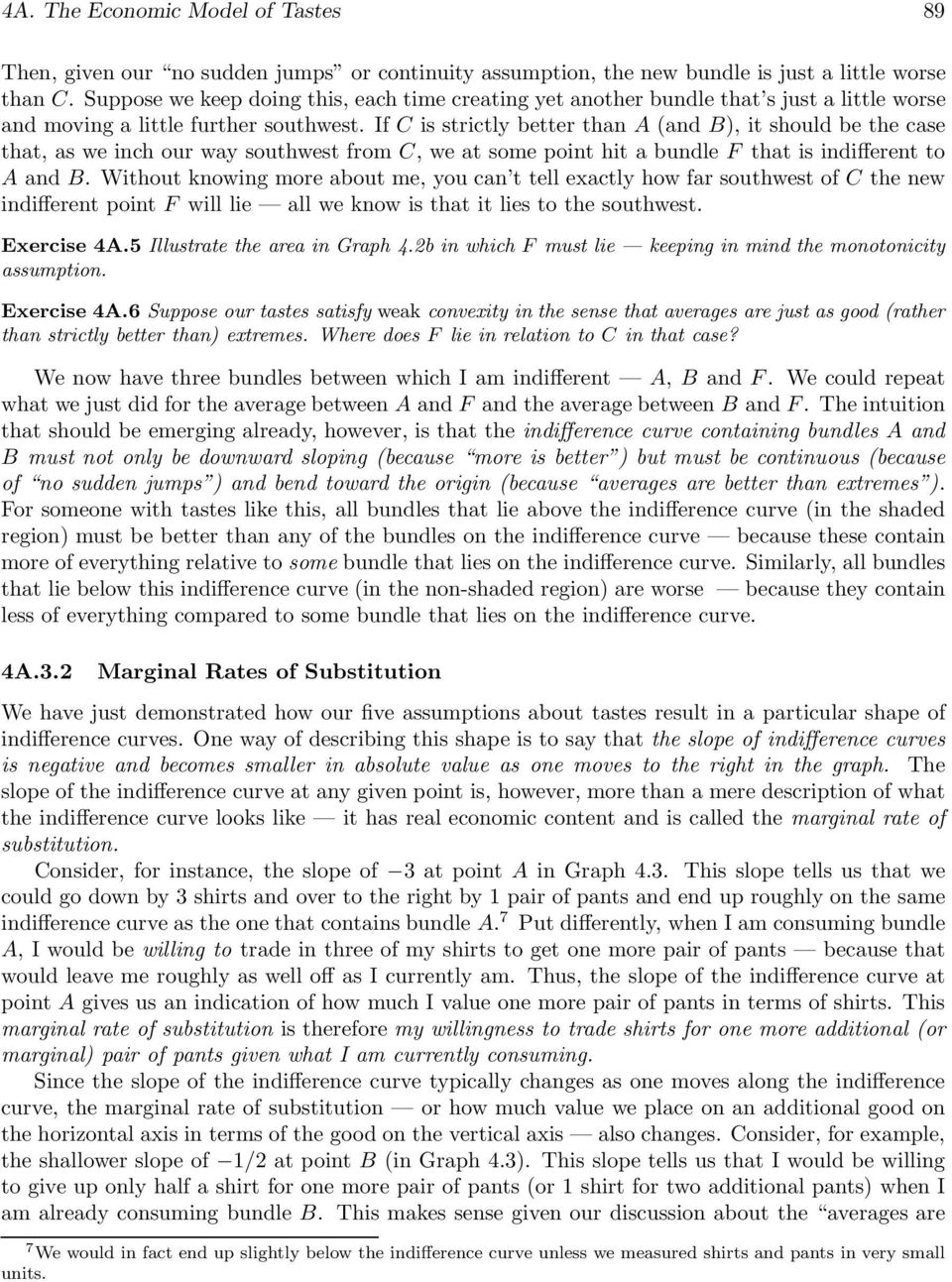
10 90 Chapter 4. Tastes and Indifference Curves Graph 4.3: Diminishing Marginal Rate of Substitution better than extremes assumption. At bundle A, I had relatively few pants and relatively many shirts and I thus placed a high value on additional pants because that would get me to a less extreme bundle (and keep me from having to wash pants all the time or else run around without pants). At bundle B, on the other hand, I have relatively many pants and few shirts, and thus I would not be willing to give up more shirts very easily given that this would get me to even more extreme bundles (causing me to have to wash shirts all the time or else run around shirtless). In fact, we concluded in the previous section that the shape of the indifference curve pictured in Graph 4.3 is due to the averages are better than extremes assumption. This shape implies that marginal rates of substitution begin as large numbers in absolute value and decline (in absolute value) as we move down an indifference curve. This is known as the concept of diminishing marginal rates of substitution and it arises only when averages are indeed better than extremes. Exercise 4A.7 Suppose extremes are better than averages. What would an indifference curve look like? Would it still imply diminishing marginal rates of substitution? Exercise 4A.8 Suppose averages are just as good as extremes? Would it still imply diminishing marginal rates of substitution? 4A.3.3 Maps of Indifference Curves In deriving our first indifference curve, we defined it with respect to one bundle. Put differently, we mapped out the indifference curve that contains one arbitrarily selected bundle bundle A in Graph 4.2b. But of course we could have begun with some other arbitrary bundle for instance bundle E in Graph 4.4a. Just as there is an indifference curve that runs through bundle A, there is an indifference curve that runs through bundle E. Notice that E lies to the northeast of the highlighted segment of the indifference curve that contains A in Graph 4.4a. This means that E contains more shirts and pants than any of the highlighted bundles, which means that it must be the case that E is better than those bundles (because of our more is better assumption). But this also means that E is better than all bundles on the indifference curve that contains bundle A.
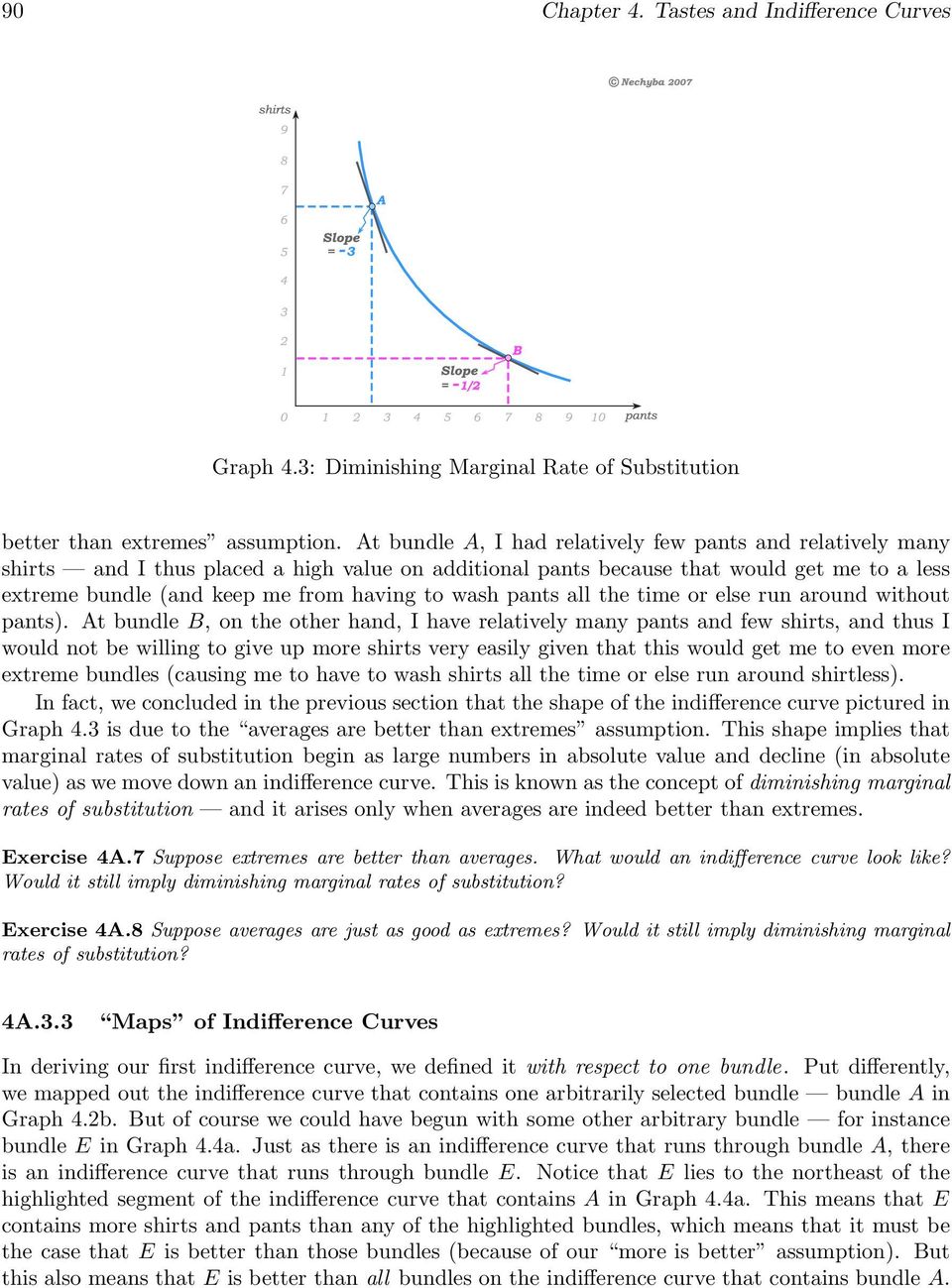
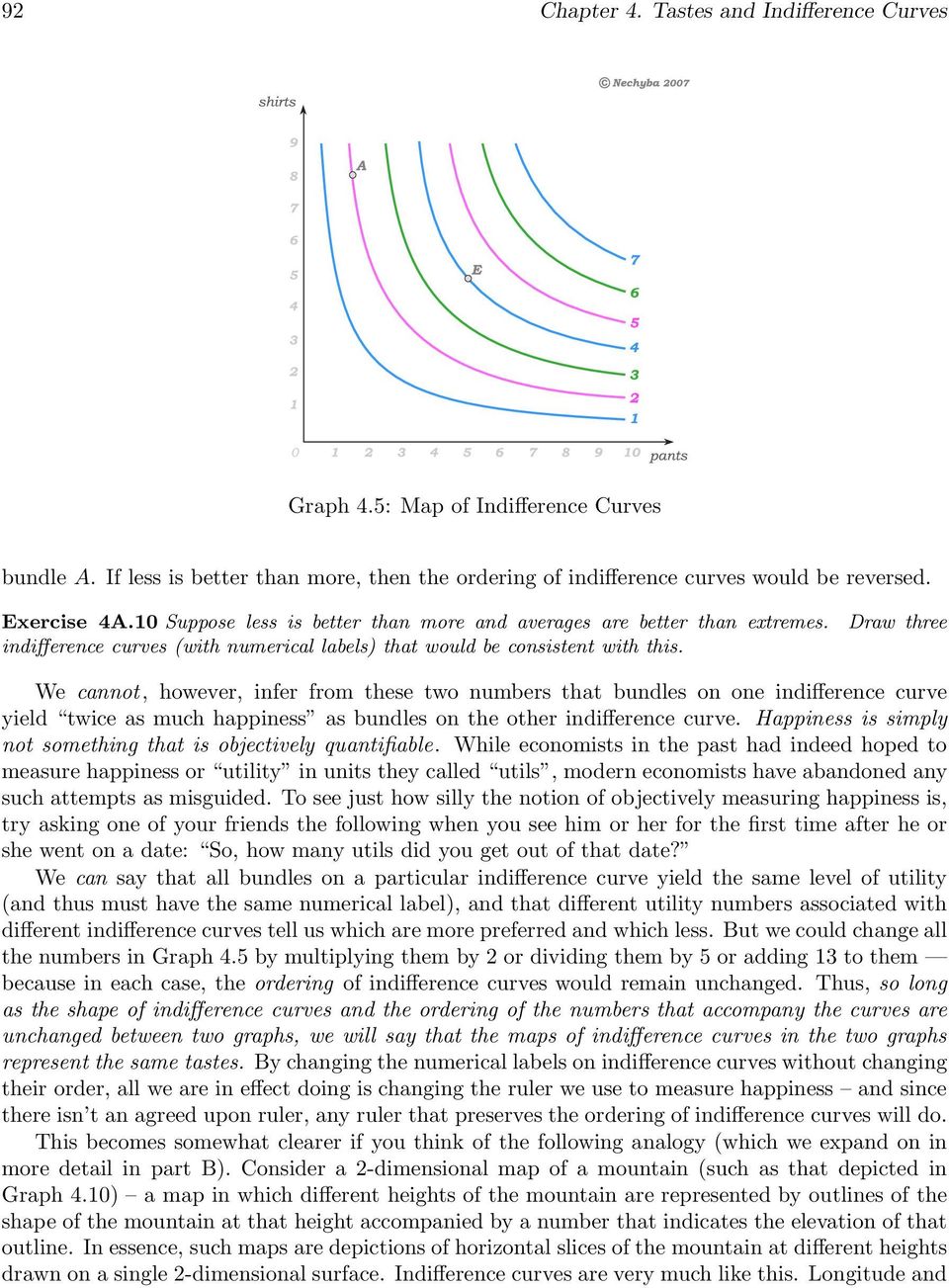
11 4A. The Economic Model of Tastes 91 Graph 4.4: Parallel & Converging Indifference Curves Exercise 4A.9 Show how you can prove the last sentence in the previous paragraph by appealing to the transitivity of tastes. An important logical consequence of this is that the indifference curve that goes through point A can never cross the indifference curve that goes through point E. If the two indifference curves did cross, they would share one point in common. This intersection point would be indifferent to A (because it lies on the indifference curve that contains A), and it would also be indifferent to E (since it lies on the indifference curve that contains E). Since E is preferred to A, transitivity implies that the intersection point cannot be indifferent to both E and A simultaneously. Thus, as long as tastes are rational (i.e. they satisfy completeness and transitivity), indifference curves cannot cross. They can be parallel like those in Graph 4.4a, or they can converge like those in Graph 4.4b, or they can relate to each other in any number of other ways, but they can never touch. Furthermore, if tastes are complete, then some indifference curve runs through every bundle. As we showed earlier, the monotonicity assumption implies that indifference curves will be downward sloping; the convexity and continuity assumptions imply that they will bend toward the origin; and the transitivity assumption implies that no two indifference curves can ever cross. Graph 4.5 then illustrates an example of a whole map of indifference curves that represent the tastes over pants and shirts for one individual whose tastes satisfy the rationality assumptions as well as the three additional assumptions outlined in Section 4A.2. This is, of course, only one possible configuration of an indifference map that satisfies all these assumptions. While the assumptions we have made about tastes result in particular general shapes for indifference curves, we will see in Chapter 5 that there exist many different types of indifference maps (and thus many different tastes) that can be modeled using these assumptions. Finally, in order to indicate that indifference curves to the northeast of Graph 4.5 represent bundles that yield greater happiness than indifference curves to the southwest of the graph, each indifference curve is accompanied by a number which indicates how bundles on that particular curve compare to bundles on other curves. For instance, when we compare bundle A to bundle E, we can read off the number 2 on the indifference curve containing point A and the number 4 on the indifference curve containing point E, and we can infer from this that bundle E is preferred to

12 92 Chapter 4. Tastes and Indifference Curves Graph 4.5: Map of Indifference Curves bundle A. If less is better than more, then the ordering of indifference curves would be reversed. Exercise 4A.10 Suppose less is better than more and averages are better than extremes. Draw three indifference curves (with numerical labels) that would be consistent with this. We cannot, however, infer from these two numbers that bundles on one indifference curve yield twice as much happiness as bundles on the other indifference curve. Happiness is simply not something that is objectively quantifiable. While economists in the past had indeed hoped to measure happiness or utility in units they called utils, modern economists have abandoned any such attempts as misguided. To see just how silly the notion of objectively measuring happiness is, try asking one of your friends the following when you see him or her for the first time after he or she went on a date: So, how many utils did you get out of that date? We can say that all bundles on a particular indifference curve yield the same level of utility (and thus must have the same numerical label), and that different utility numbers associated with different indifference curves tell us which are more preferred and which less. But we could change all the numbers in Graph 4.5 by multiplying them by 2 or dividing them by 5 or adding 13 to them because in each case, the ordering of indifference curves would remain unchanged. Thus, so long as the shape of indifference curves and the ordering of the numbers that accompany the curves are unchanged between two graphs, we will say that the maps of indifference curves in the two graphs represent the same tastes. By changing the numerical labels on indifference curves without changing their order, all we are in effect doing is changing the ruler we use to measure happiness and since there isn t an agreed upon ruler, any ruler that preserves the ordering of indifference curves will do. This becomes somewhat clearer if you think of the following analogy (which we expand on in more detail in part B). Consider a 2-dimensional map of a mountain (such as that depicted in Graph 4.10) a map in which different heights of the mountain are represented by outlines of the shape of the mountain at that height accompanied by a number that indicates the elevation of that outline. In essence, such maps are depictions of horizontal slices of the mountain at different heights drawn on a single 2-dimensional surface. Indifference curves are very much like this. Longitude and
13 4B. Tastes and Utility Functions 93 latitude are replaced by pants and shirts, and the height of the mountain is replaced by the level of happiness. While real-world mountains have peaks, our happiness mountains generally do not have peaks because of our more is better assumption. Indifference curves are then simply horizontal slices of our happiness mountain (such as the one depicted in Graph 4.8), with numbers indicating the height of happiness attained at that slice. And just as the outlines of the different elevations of a real world mountain don t change whether we measure the height of the elevation in feet or meters, the outlines of the slices of our happiness mountain i.e. the indifference curves do not change shapes if we use a different ruler to measure happiness. We will have much more to say in Chapter 5 about how to interpret different types of indifference maps what they imply about whether goods are relatively more complementary or substitutable, how to think of relationship of indifference curves to one another, etc. But first, we develop some of the underlying mathematics of the utility mountains through the concept of utility functions. 4B Tastes and Utility Functions We have shown in Section 4A how certain basic assumptions about our tastes can enable us to generate graphical ways of representing tastes with the tool of indifference curves. As was true for choice sets in Chapters 2 and 3, these graphical tools are mere representations of more general mathematical formulations of the same economic concepts. And the assumptions we introduced in Section 4A.1 and 4A.2 will translate directly into mathematical properties of functions that we can use to represent tastes. 4B.1 Two Fundamental Rationality Assumptions When we speak of bundles or baskets of two goods, we have already defined these as points with two components each representing the quantity of one of the goods in the basket. The point labeled A in Graph 4.1, for instance, can be expressed as (x A 1, xa 2 ) = (4, 8), representing a basket with 4 units of good 1 (pants) and 8 units of good 2 (shirts). In general, we can then express a basket that contains two goods as (x 1, x 2 ) R 2 +, (4.1) where is read as is an element of and R 2 + denotes the set of all points with two non-negative (real number) components. Almost all of our graphs of choice sets consist of some subset of points in R 2 +, as do our graphs of indifference curves in Section 4A. When a larger number of different types of goods is included in a basket shirts, pants and socks, for instance we can further generalize this by simply denoting a basket with n different goods by (x 1, x 2,...,x n ) R n +, (4.2) where R n + now represents the set of all points with n non-negative components. In the case of shirts, pants and socks, n = 3. 8 Tastes, or preferences, involve subjective comparisons of different baskets or different points as denoted in (4.1) and (4.2) above. We will use the following shorthand notation (x A 1, x A 2,...,x A n ) (x B 1, x B 2,..., x B n ) (4.3) 8 You may recall from your math classes that points with such multiple components are referred to as vectors.

14 94 Chapter 4. Tastes and Indifference Curves whenever we want to say that the basket (x A 1, xa 2,..., xa n ) is at least as good as the basket (x B 1, x B 2,..., x B n ). Similarly, we read (x A 1, xa 2,...,xA n ) (xb 1, xb 2,..., xb n ) (4.4) as basket (x A 1, xa 2,..., xa n) is strictly better than basket (x B 1, xb 2,..., xb n ), and we will read (x A 1, x A 2,...,x A n ) (x B 1, x B 2,..., x B n ) (4.5) as a person being indifferent between these two baskets. The objects, and are called binary relations because they relate two points to one another. 4B.1.1 Complete Tastes In Section 4A, we defined tastes as complete whenever a person with those tastes can unequivocally compare any two baskets indicating whether one basket is better than the other or whether she is indifferent between the two baskets. We can now write this definition formally as follows: A person has complete tastes over all baskets with n goods if and only if it is true that for all (x A 1, xa 2,..., xa n ) Rn + and for all (xb 1, xb 2,...,xB n ) Rn +, (x A 1, xa 2,...,xA n ) (xb 1, xb 2,..., xb n ) or (x B 1, xb 2,...,xB n ) (xa 1, xa 2,..., xa n ) or both. (4.6) All that we are saying is that a person can compare any two bundles in R n +. Note that logically it has to be the case that if both of the statements in (4.6) are true for a given set of two bundles, then (x A 1, x A 2,..., x A n) (x B 1, x B 2,...,x B n ). (4.7) Exercise 4B.1 True or False: If only one of the statements in (4.6) is true for a given set of bundles, then that statement s can be replaced by. 4B.1.2 Transitive Tastes While we certainly need tastes in our models to be complete in order for individuals within the models to be able to make choices, we argued in Section 4A that this is not enough: in order for an individual to be able to settle on a best choice, there needs to be a certain internal consistency to the tastes that guide the person s choices. We called this internal consistency transitivity and said that a person s tastes are transitive if, whenever the person likes a bundle A at least as much as a bundle B and she likes B at least as much as C, it must be the case that the person likes A at least as much as C. We can now define this more formally using the notation we just developed. In particular, we will say that a person s tastes are transitive if and only if it is true that whenever three bundles are evaluated by the person such that (x A 1, x A 2,..., x A n) (x B 1, x B 2,...,x B n ) and (x B 1, x B 2,..., x B n ) (x C 1, x C 2,..., x C n ) (4.8) we can conclude that (x A 1, x A 2,..., x A n) (x C 1, x C 2,..., x C n ). (4.9) Exercise 4B.2 Does transitivity also imply that 4.8 above implies 4.9 when is replaced by?

15 4B. Tastes and Utility Functions 95 4B.1.3 Rational Tastes The assumptions of completeness and transitivity of tastes are, as already noted in Section 4A, so fundamental to the economist s modeling of tastes that together they define what we mean by rational tastes. An individual s tastes over a particular set of bundles are then said to be rational if they are both complete and transitive. 4B.2 Three More Assumptions While the two rationality assumptions are quite fundamental for the construction of a model of tastes that can result in individuals choosing best alternatives given their circumstances, they do not by themselves tell us very much about what kinds of choices individuals are likely to make. For this reason, we introduced in Section 4A.2 three additional assumptions which we informally called more is better, averages are better than extremes, and no sudden jumps. In more formal language, these same assumptions were referred to as monotonicity, convexity and continuity. 4B.2.1 Monotonicity (or More is Better or at least not Worse ) We argued at length in Section 4A.2.1 that the fundamental scarcity that underlies economic decision making implies that more is indeed considered better by most individuals in most economic contexts. Given that bundles of goods and services by definition contain many different types of goods, we have to be clear about what we mean by more. In Graph 4.1, for instance, bundle E clearly has more of everything than bundle C, but it has more of some and less of other goods when compared to bundles A and B. By more we can mean either more of all goods or more of at least some goods and no less of any of the other goods. When a bundle contains more of all goods than a second bundle, we will generally assume that a consumer strictly prefers that bundle. When a bundle contains more of at least some goods and no less of any of the other goods than a second bundle, on the other hand, we will typically assume that a consumer thinks of this bundle as at least as good as the second bundle thus leaving open the possibility that the consumer might be indifferent between the two bundles. Formally we can then define more is better or what we will call monotonic tastes as follows: A consumer s tastes are monotonic if and only if (x A 1, x A 2,..., x A n) (x B 1, x B 2,..., x B n ) whenever x A i x B i for all i = 1, 2,..., n; and (x A 1, x A 2,..., x A n) (x B 1, x B 2,..., x B n ) whenever x A i > x B i for all i = 1, 2,..., n. (4.10) The first line of this definition allows for the possibility that some of the goods in the A and B bundles are the same while others are larger for the A bundle than for the B bundle, while the second line applies only to pairs of bundles where one contains more of every good than the other. In Graph 4.1, for instance, bundle A contains more shirts but the same number of pants as bundle D, and our definition of monotonic tastes therefore implies that A D or A is at least as good as D. Bundle E, on the other hand, contains more of all goods than bundle D, implying that E D or E is strictly better than D. 9 9 Monotonicity assumptions are sometimes divided into weak and strong monotonicity, where weak monotonicity requires that each element of a bundle A must be larger than each corresponding element of B in order for A to be strictly preferred to B, while a stronger form of monotonicity would require only some elements of A to be larger than the corresponding elements in B (with all remaining elements the same). Our definition corresponds to the weaker

16 96 Chapter 4. Tastes and Indifference Curves 4B.2.2 Convexity ( Averages are Better than (or at least as good as) Extremes ) Next we argued in Section 4A.2.2 that it is often reasonable for us to assume that averages are better than extremes whenever an individual is indifferent between extreme bundles. By an average bundle we simply meant the bundle that emerges if we mix two more extreme bundles (like bundles A and B in Graph 4.2) and divide them into two identical bundles. 10 We could translate this into a more formal statement by saying that (x A 1, xa 2,...,xA n ) (xb 1, xb 2,..., xb n ( ) ( ) ) implies 1 1 (x A 1, x A 2,..., x A 2 n) + (x B 1, x B 2,...,x B n ) (x A 1, x A 2,..., x A 2 n) and ( ) ( ) 1 1 (x A 1 2, xa 2,..., xa n ) + (x B 1 2, xb 2,...,xB n ) (xb 1, xb 2,..., xb n ). (4.11) Exercise 4B.3 True or False: Assuming tastes are transitive, the third line in expression (4.11) is logically implied by the first and second lines. More generally, if the literal average (as opposed to a weighted average with weights different from 0.5) of two more extreme bundles is better than the extremes, the same logic would suggest that any weighted average that emerges from mixing two extremes is preferable to the extremes so long as it is not even more extreme. For instance, suppose again that I am indifferent between bundle A and B in Graph 4.2 where bundle A contains 4 pants and 8 shirts while bundle B contains 8 pairs of pants and 2 shirts. But now, instead of strictly averaging the two bundles to yield a bundle with 6 pants and 5 shirts, suppose that we create one bundle that consists of 1/4 of bundle A and 3/4 of bundle B, and a second bundle that consists of 3/4 of A and 1/4 of B. An individual who likes averages better than extremes will then also prefer these two bundles to the more extreme original ones and these bundles would also lie on the line segment connecting A and B. Bundles that are created as a weighted average of extremes are called convex combinations of the extreme bundles. Put more precisely, any bundle that is created by weighting bundle A by α and bundle B by (1 α) is a convex combination of A and B so long as α lies between 0 and 1. Our averages are better than extremes or convexity assumption from Section 4A can then be restated in the following way: Tastes are convex if and only if convex combinations of indifferent bundles are at least as good as the bundles used to create the convex combination. Or, in terms of the notation we have developed, tastes over bundles of n goods are convex if and only if, for any α such that 0 α 1, (x A 1, x A 2,..., x A n) (x B 1, x B 2,..., x B n ) implies α(x A 1, x A 2,..., x A n) + (1 α)(x B 1, x B 2,...,x B n ) (x A 1, x A 2,...,x A n ). (4.12) of these definitions of monotonicity. Finally, although we will generally maintain our assumption of monotonicity throughout the text, many of the results that we derive actually hold for a much weaker assumption called local non-satiation. This assumption simply requires that there exists no bundle of goods for which there isn t another bundle close by that is strictly better. These concepts are clarified further in the end-of-chapter exercise As in the case of monotonicity, there exist several stronger and weaker versions of the convexity assumption. Strict convexity is usually defined as averages are strictly preferred to extremes while weak convexity is defined as averages are at least as good as extremens. Note that we will define our convexity notion in line with the latter although you will see in the coming chapters that most of the tastes we work with actually satisfy the stronger definition of convexity.

17 4B. Tastes and Utility Functions 97 4B.2.3 Continuity ( No Sudden Jumps ) Finally, we introduced the assumption that tastes generally do not have sudden jumps in Section 4A.2.3. We can now formalize this assumption by introducing a mathematical concept called a converging sequence of points. This concept is quite intuitive but it consists of several parts. First, a sequence of points in R n + is simply a list of points, each with n different non-negative components. This sequence is infinite if and only if the list has an infinite number of points in it. An infinite sequence of points then is said to converge to a single point in R n + if and only if the distance between the points in the sequence and that single point becomes smaller and smaller (beginning at some point in the sequence). Suppose for instance that we start in Graph 4.6 at a point B in R 2 +. Then suppose that point B is the first point in an infinite sequence that continues with B 1 lying halfway between point B and some other point A, with B 2 lying halfway between point B 1 and A, with B 3 lying halfway between B 2 and A and so forth. An example of the first 4 points of such a sequence is graphed in Graph 4.6. If we now imagine this sequence of points continuing forever, no point in the sequence will ever quite reach point A but it will get ever closer. In the language of calculus, the limit of the sequence is point A and the sequence itself converges to point A. Graph 4.6: Continuity - Converging Sequence of Points Now suppose we have two infinite sequences of points one denoted {B 1, B 2, B 3,...} and the other denoted {C 1, C 2, C 3,...}, with the first sequence converging to point A and the second sequence converging to point D. If it is the case that B i C i for all i s, then the continuity assumption requires that A D. Thus, if the B bundles are always preferred to the C bundles as we move along the two sequences and if this continues to hold as we get closer and closer to the bundles A and D to which the two sequences converge, we can t suddenly have a jump at the end of the sequences that reverses the preference relation and causes D to be preferred to A. 4B.3 Representing Tastes with Utility Functions In Section 4A.3, we demonstrated how the assumptions we have made about people s tastes allow us to graph different types of tastes using indifference curves. We will now see that these indifference

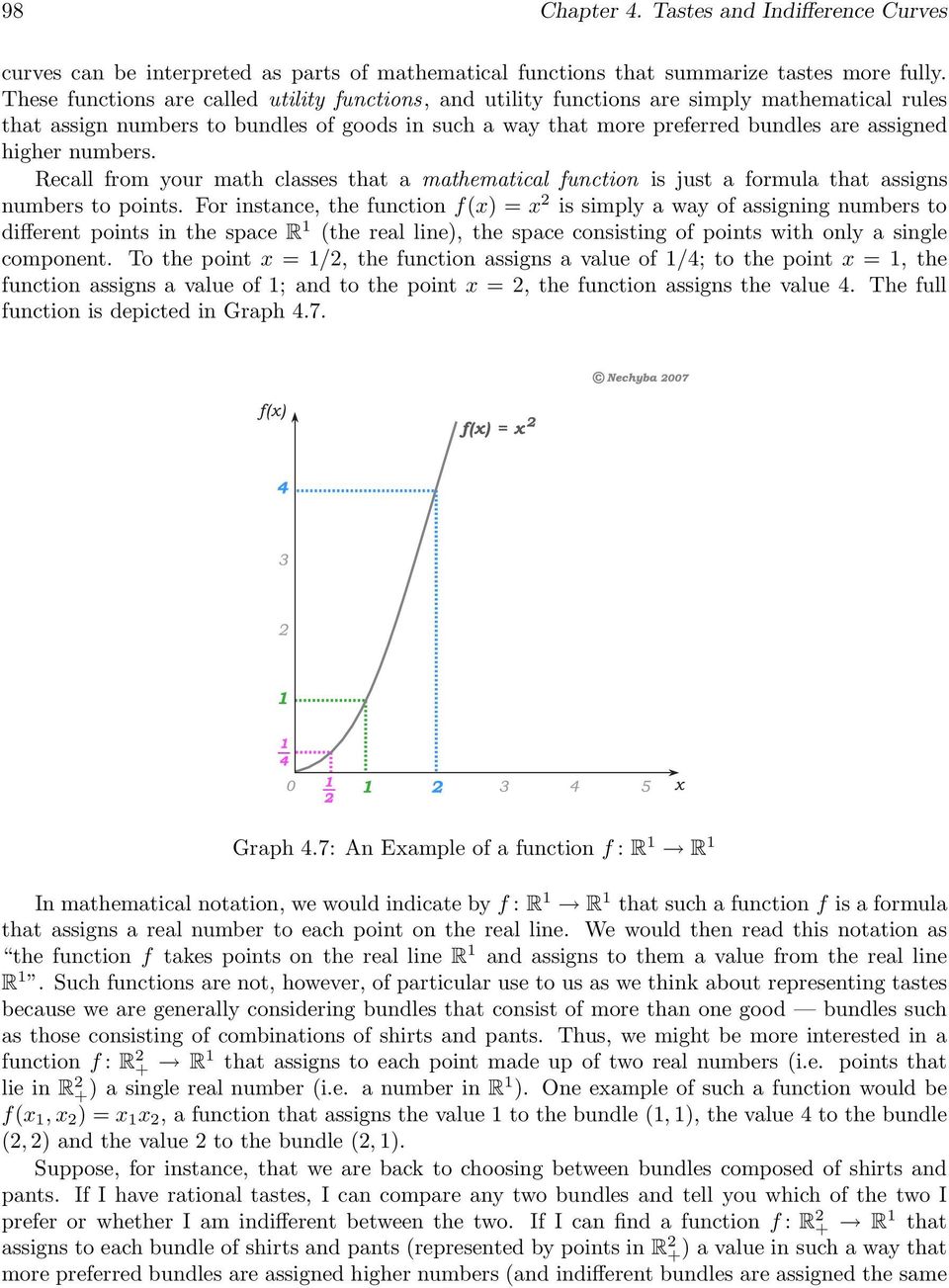
18 98 Chapter 4. Tastes and Indifference Curves curves can be interpreted as parts of mathematical functions that summarize tastes more fully. These functions are called utility functions, and utility functions are simply mathematical rules that assign numbers to bundles of goods in such a way that more preferred bundles are assigned higher numbers. Recall from your math classes that a mathematical function is just a formula that assigns numbers to points. For instance, the function f(x) = x 2 is simply a way of assigning numbers to different points in the space R 1 (the real line), the space consisting of points with only a single component. To the point x = 1/2, the function assigns a value of 1/4; to the point x = 1, the function assigns a value of 1; and to the point x = 2, the function assigns the value 4. The full function is depicted in Graph 4.7. Graph 4.7: An Example of a function f : R 1 R 1 In mathematical notation, we would indicate by f : R 1 R 1 that such a function f is a formula that assigns a real number to each point on the real line. We would then read this notation as the function f takes points on the real line R 1 and assigns to them a value from the real line R 1. Such functions are not, however, of particular use to us as we think about representing tastes because we are generally considering bundles that consist of more than one good bundles such as those consisting of combinations of shirts and pants. Thus, we might be more interested in a function f : R 2 + R1 that assigns to each point made up of two real numbers (i.e. points that lie in R 2 + ) a single real number (i.e. a number in R1 ). One example of such a function would be f(x 1, x 2 ) = x 1 x 2, a function that assigns the value 1 to the bundle (1, 1), the value 4 to the bundle (2, 2) and the value 2 to the bundle (2, 1). Suppose, for instance, that we are back to choosing between bundles composed of shirts and pants. If I have rational tastes, I can compare any two bundles and tell you which of the two I prefer or whether I am indifferent between the two. If I can find a function f : R 2 + R 1 that assigns to each bundle of shirts and pants (represented by points in R 2 + ) a value in such a way that more preferred bundles are assigned higher numbers (and indifferent bundles are assigned the same
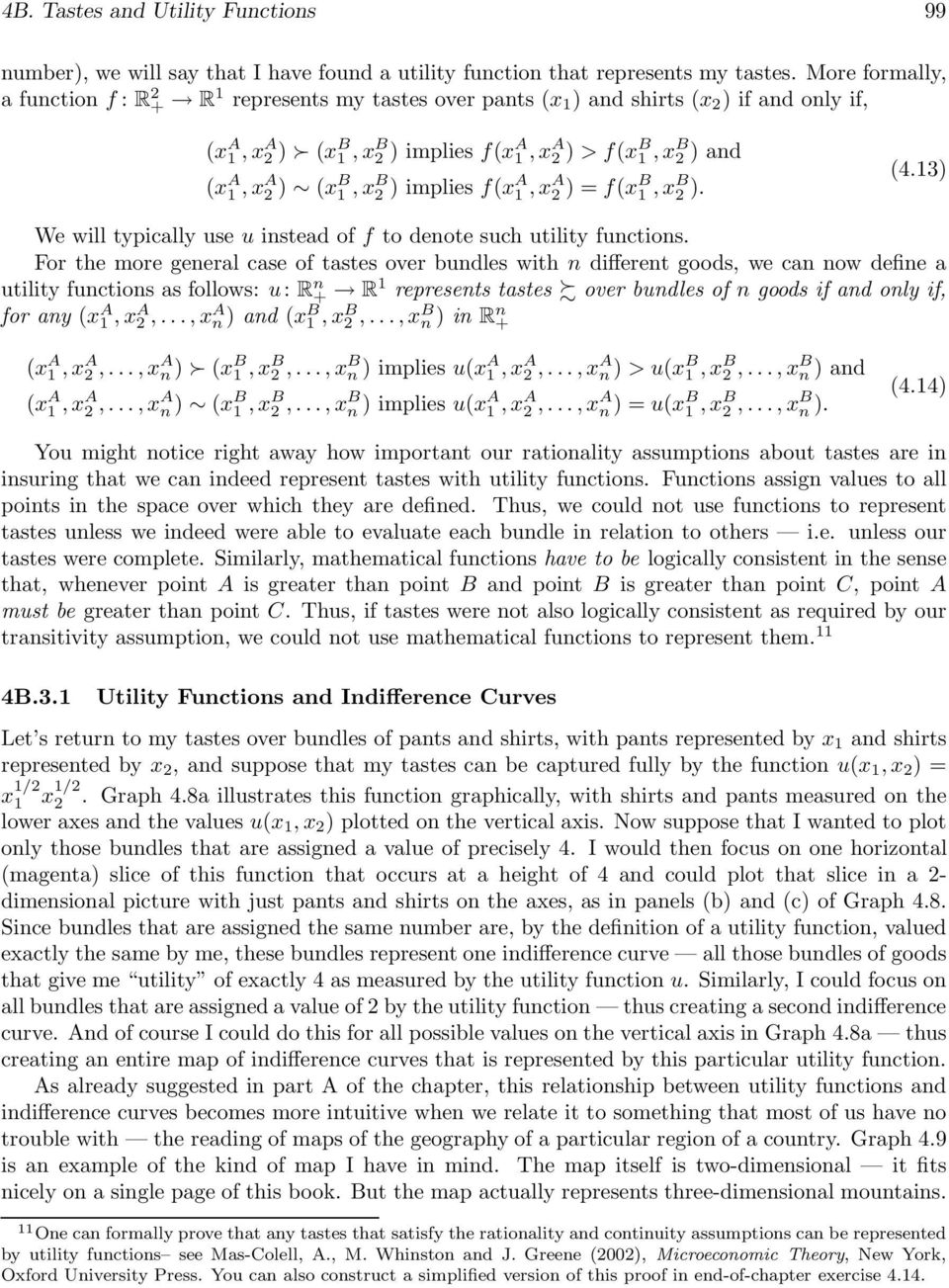
19 4B. Tastes and Utility Functions 99 number), we will say that I have found a utility function that represents my tastes. More formally, a function f : R 2 + R 1 represents my tastes over pants (x 1 ) and shirts (x 2 ) if and only if, (x A 1, x A 2 ) (x B 1, x B 2 ) implies f(x A 1, x A 2 ) > f(x B 1, x B 2 ) and (x A 1, xa 2 ) (xb 1, xb 2 ) implies f(xa 1, xa 2 ) = f(xb 1, xb 2 ). (4.13) We will typically use u instead of f to denote such utility functions. For the more general case of tastes over bundles with n different goods, we can now define a utility functions as follows: u: R n + R1 represents tastes over bundles of n goods if and only if, for any (x A 1, x A 2,..., x A n) and (x B 1, x B 2,...,x B n ) in R n + (x A 1, xa 2,..., xa n ) (xb 1, xb 2,...,xB n ) implies u(xa 1, xa 2,..., xa n ) > u(xb 1, xb 2,..., xb n ) and (x A 1, xa 2,..., xa n ) (xb 1, xb 2,...,xB n ) implies u(xa 1, xa 2,..., xa n ) = u(xb 1, xb 2,..., xb n ). (4.14) You might notice right away how important our rationality assumptions about tastes are in insuring that we can indeed represent tastes with utility functions. Functions assign values to all points in the space over which they are defined. Thus, we could not use functions to represent tastes unless we indeed were able to evaluate each bundle in relation to others i.e. unless our tastes were complete. Similarly, mathematical functions have to be logically consistent in the sense that, whenever point A is greater than point B and point B is greater than point C, point A must be greater than point C. Thus, if tastes were not also logically consistent as required by our transitivity assumption, we could not use mathematical functions to represent them. 11 4B.3.1 Utility Functions and Indifference Curves Let s return to my tastes over bundles of pants and shirts, with pants represented by x 1 and shirts represented by x 2, and suppose that my tastes can be captured fully by the function u(x 1, x 2 ) = x 1/2 1 x 1/2 2. Graph 4.8a illustrates this function graphically, with shirts and pants measured on the lower axes and the values u(x 1, x 2 ) plotted on the vertical axis. Now suppose that I wanted to plot only those bundles that are assigned a value of precisely 4. I would then focus on one horizontal (magenta) slice of this function that occurs at a height of 4 and could plot that slice in a 2- dimensional picture with just pants and shirts on the axes, as in panels (b) and (c) of Graph 4.8. Since bundles that are assigned the same number are, by the definition of a utility function, valued exactly the same by me, these bundles represent one indifference curve all those bundles of goods that give me utility of exactly 4 as measured by the utility function u. Similarly, I could focus on all bundles that are assigned a value of 2 by the utility function thus creating a second indifference curve. And of course I could do this for all possible values on the vertical axis in Graph 4.8a thus creating an entire map of indifference curves that is represented by this particular utility function. As already suggested in part A of the chapter, this relationship between utility functions and indifference curves becomes more intuitive when we relate it to something that most of us have no trouble with the reading of maps of the geography of a particular region of a country. Graph 4.9 is an example of the kind of map I have in mind. The map itself is two-dimensional it fits nicely on a single page of this book. But the map actually represents three-dimensional mountains. 11 One can formally prove that any tastes that satisfy the rationality and continuity assumptions can be represented by utility functions see Mas-Colell, A., M. Whinston and J. Greene (2002), Microeconomic Theory, New York, Oxford University Press. You can also construct a simplified version of this proof in end-of-chapter exercise 4.14.
20 100 Chapter 4. Tastes and Indifference Curves Graph 4.8: Indifference Curves & Utility Functions

21 4B. Tastes and Utility Functions 101 Graph 4.9: Mount Nechyba Graphed in 2 Dimensions It does so by indicating different elevations of the mountain with numbers next to circular lines that together tell us how far above sea level the points on those lines are. This is a clever way of illustrating a three-dimensional object in a two-dimensional picture. In Graph 4.10a and 4.10b we illustrate exactly how this is done, with Graph 4.10a plotting the three dimensional mountain s height on the vertical axis, and Graph 4.10b plotting two dimensional slices of this mountain and indicating the appropriate elevation next to it. Exercise 4B.4 If you were searching for the steepest possible straight route up the last 2,000 feet of Mount Nechyba (in Graph 4.9), from what direction would you approach the mountain? Indifference curves are exactly analogous to these levels of a three dimensional mountain plotted in two dimensions. Instead of representing the geographical terrain of an area, they illustrate the height of a utility mountain that rises as more goods enter a bundle. But unlike real mountains, the utility mountain generally has no peak because our more is better assumption implies that we can always climb higher by going to bundles of goods that have more of everything in them. Thus, the slices of our utility mountain are not closed circles like those of mountains with peaks but rather are open ended. Exercise 4B.5 In Political Science models, politicians are sometimes assumed to choose between bundles of spending on various issues say military and domestic spending. Since they have to impose taxes to fund this spending, more is not necessarily better than less, and thus most politicians have some ideal bundle of domestic and military spending. How would such tastes over domestic and military spending be similar to the geographic mountain analogy? 4B.3.2 Marginal Rates of Substitution In Section 4A.3.2, we defined the slope of the indifference curve as the marginal rate of substitution or how much one is willing to give up in terms of one good (the good on the vertical axis) to get one more unit of another (the good on the horizontal axis). This slope is a mathematical
22 102 Chapter 4. Tastes and Indifference Curves Graph 4.10: Going from 3 to 2 dimensions for Mount Nechyba concept and one that can be derived from a utility function that gives rise to particular kinds of indifference curves. One way to express the definition of a marginal rate of substitution in terms of the mathematical language we have been developing is to say that it is the change in x 2 divided by the change in x 1 such that utility remains unchanged, or x 2 x 1 such that u = 0. (4.15) Actually, what we mean by a marginal rate of substitution is somewhat more precise we are not looking for just any combination of changes in x 2 and x 1 (such that u=0). Rather, we are looking for small changes that define the slope around a particular point. Such small changes are denoted in calculus by using d instead of. Thus, we can re-write (4.15) as dx 2 dx 1 such that du = 0. (4.16) The following three steps now require some knowledge of multi-variable calculus. If you have only had single variable calculus, you will need to read this chapter s appendix on total and partial differentiation before proceeding.
23 4B. Tastes and Utility Functions 103 Changes in utility arise from the combined change in x 2 and x 1 consumption, and this is expressed as the total differential (du) du = u x 1 dx 1 + u x 2 dx 2. (4.17) Since we are interested in changes in consumption that result in no change in utility (thus leaving us on the same indifference curve), we can set expression (4.17) to zero and then solve out for dx 2 /dx 1 to get u x 1 dx 1 + u x 2 dx 2 = 0 (4.18) dx 2 = ( u/ x 1) dx 1 ( u/ x 2 ). (4.19) Since this expression for dx 2 /dx 1 was derived from the expression du = 0, it gives us the equation for small changes in x 2 divided by small changes in x 1 such that utility remains unchanged which is precisely our definition of a marginal rate substitution. Thus, if we know that a particular utility function u gives rise to an indifference map that accurately represents someone s tastes, we now know how to calculate the marginal rate of substitution for that person at any consumption bundle (x 1, x 2 ) with MRS(x 1, x 2 ) = ( u/ x 1) ( u/ x 2 ). (4.20) Suppose, for instance, your tastes for pants (x 1 ) and shirts (x 2 ) can be summarized by the utility function u(x 1, x 2 ) = x 1/2 1 x 1/2 2 (which is graphed in Graph 4.8a) and suppose that we would like to determine the marginal rate of substitution when you are consuming 4 pants and 3 shirts. We can begin by finding the general expression for your marginal rate of substitution given that you have tastes summarized by this utility function. To do this, we have to take the partial derivative of u with respect to each of the two goods, ( ) ( ) u 1 = (x 1/2 1 x 1/2 u 1 2 ) and = (x 1/2 1 x 1/2 2 ) (4.21) x 1 2 x 2 2 and plug the results into the formula for MRS in equation (4.20) to get: MRS = (1/2)(x 1/2 1 x 1/2 2 ) (1/2)(x 1/2 1 x 1/2 2 ) = x 2. (4.22) x 1 This simplified expression MRS = x 2 /x 1 then gives us the formula for the slope of all your indifference curves at every possible bundle in R 2 + assuming that these indifference curves can indeed be represented by the utility function u(x 1, x 2 ) = x 1/2 1 x 1/2 2. For instance, if you are currently consuming 4 pants (x 1 ) and 3 shirts (x 2 ), your marginal rate of substitution is equal to 3/4. If you are consuming 10 pants and 1 shirt, your marginal rate of substitution is 1/10, and if you are consuming 1 pair of pants and 10 shirts, it is 10. Exercise 4B.6 How does the expression for the marginal rate of substitution change if tastes could instead be summarized by the utility function u(x 1, x 2) = x 1/4 1 x 3/4 2
24 104 Chapter 4. Tastes and Indifference Curves 4B.3.3 Interpreting Values Assigned to Indifference Curves by Utility Functions At this point, you may have gotten a little suspicious. After all, we made a big deal in Section 4A.3.3 about the fact that happiness or utility cannot be measured objectively and yet we seem to be measuring utility here with utility functions. When discussing the numbers next to indifference curves in Graph 4.5, we indicated that the numbers themselves were not important it was the ordering of the numbers that mattered because we were simply using the numbers to indicate which indifference curves yield more happiness and which yield less. And we mentioned that we could just as easily have multiplied the numbers in Graph 4.5 by 2 or divided them by 5 or added 13 to them because in each case, the ordering of indifference curves would remain unchanged. We concluded that, so long as the shape of indifference curves and the ordering of the numbers that accompany the curves are unchanged between two graphs, the maps of indifference curves in the two graphs represent the same tastes. The same is true of utility functions. You can think of these functions as rulers that use some scale to measure utility. We can adjust the scale as long as two functions give rise to the same shapes of indifference curves and as long as the ordering of the numbers assigned to these indifference curves is the same, the two functions represent the same underlying tastes. All we are doing is using a different ruler. Again, it might be easy to see exactly what we mean here by returning to the mountain analogy. In Graph 4.10a, we used a ruler with feet from sea level to measure the height of a mountain and we then translated slices of this mountain into two dimensions, placing the appropriate height of that slice (measured in feet) next to each slice in Graph 4.10b. Suppose that we had instead used a ruler with meters from seal level in Graph 4.10a. The height of the mountain might now be scaled differently, but the slices of the mountain would continue to exhibit the same shapes in Graph 4.10b except that they would be accompanied by a different number indicating height since it would be expressed in meters instead of feet. Nothing fundamental changes when we change the units of measurement on our ruler. Consider the utility function u(x 1, x 2 ) = x 1/2 1 x 1/2 2 that we graphed in Graph 4.8a and that is replicated in Graph 4.11a. Now consider the same function squared, i.e. v(x 1, x 2 ) = (x 1/2 1 x 1/2 2 ) 2 = x 1 x 2 which is graphed in Graph 4.11c. The functions certainly look different, but it turns out that they give rise to exactly the same indifference curves in panels (b) and (d) just like the two differently measured versions of the same mountain give rise to the same two dimensional picture of its levels. To prove this mathematically, all we have to do is check whether the two utility functions give rise to the same expression for the marginal rate of substitution because if the slopes of the indifference curves are the same at all points, the shapes of the indifference curves must be the same. First, we find the partial derivatives of v with respect to each good (as we did for u in (4.21)): v x 1 = x 2 and v x 2 = x 1. (4.23) These expressions certainly differ from the analogous derivatives for u in equation (4.21). They represent the additional (or marginal) utility you would obtain from one more unit of consumption of each of the two goods and this additional utility differs depending on what ruler we use to measure utility. It therefore makes sense that the two different utility functions u and v have different partial derivatives with respect to each of the two goods. For this reason, we do not think that there is any real content in the concept of marginal utility. But when we then plug the results in equation (4.23) into our formula for a marginal rate of substitution in equation (4.20), we get that the marginal rate of substitution implied by the utility function v is again equal
25 4B. Tastes and Utility Functions 105 Graph 4.11: Re-Scaling Graph 4.8a to x 2 /x 1 just as it was when we calculated the marginal rate of substitution for the utility function u in equation (4.22). Exercise 4B.7 Can you verify that squaring the utility function in exercise 4B.6 also does not change the underlying indifference curves? You can see the intuition for what happened by comparing the partial derivatives in equation (4.21) and (4.23). While they are different, they are different only in ways that cancel out when we divide one partial derivative by the other as we calculate the marginal rate of substitution. Put differently, the units that measure marginal utility drop out of the equation when we divide two marginal utilities by one another. Thus, the concept of a marginal rate of substitution is independent of what scale we use to measure utility and is thus meaningful even though we do not think utility itself can be objectively quantified. Exercise 4B.8 Illustrate that the same conclusion we reached with respect to u and v representing the same indifference curves also holds when we take the square root of u i.e. when we consider the function w(x 1, x 2) = (x 1/2 1 x 1/2 2 ) 1/2 = x 1/4 1 x 1/4 2. The idea that a rescaling of a utility function cancels out when we calculate marginal rates of substitution can be seen to hold more generally. Consider a function f : R 1 R 1 that is applied to a utility function u(x 1, x 2 ) to create a new utility function v(x 1, x 2 ) = f(u(x 1, x 2 )). (In our
26 106 Chapter 4. Tastes and Indifference Curves previous example, for instance, we applied the function f(x) = x 2 to get v(x 1, x 2 ) = f(u(x 1, x 2 )) = f(x 1/2 1 x 1/2 2 ) = (x 1/2 1 x 1/2 2 ) 2 = x 1 x 2 ).) The partial derivatives of v with respect to the two goods are then v = f u v and = f u. (4.24) x 1 u x 1 x 2 u x 2 When we divide these two terms by one another as we calculate the marginal rate of substitution, the ( f/ u) terms cancel and we get ( v/ x 1) ( v/ x 2 ) = ( u/ x 1) ( u/ x 2 ). (4.25) Applying a transformation f to a utility function u therefore does not change the shapes of indifference curves since it does not change their marginal rates of substitutions it simply relabels indifference curves with different numbers. So long as the ordering of the numbers assigned to indifference curves remains the same, the transformed utility function then represents the same tastes. Such transformations are sometimes called order preserving or positive monotone functions. Multiplying a utility function by 5, for instance, simply results in a number five times as high associated with each indifference curve. Multiplying the same utility function by 5, on the other hand, results in the label of each indifference curve being 5 times what it was before and as a result, the ordering of the indifference curves is reversed, suggesting that indifference curves previously judged better than a particular bundle are now worse than that bundle. The former transformation (multiplying by 5) is therefore order preserving while the latter (multiplying by -5) is not even though both transformations preserve the shapes of the indifference curves. In end-ofchapter exercise 4.5, you will investigate some other possible transformations of utility functions, but it should be clear from our discussion that, once we have found one utility function that represents a particular set of tastes (or indifference curves), we can find a large number of other utility functions that also represent those tastes by subjecting the original utility function to a variety of different transformations. Exercise 4B.9 Consider the utility function u(x 1, x 2) = x 1/2 1 x 1/2 2. Take logs of this function and calculate the MRS of the new function. Is the log transformation one that can be applied to utility functions such that the new utility function represents the same underlying tastes? Exercise 4B.10 Consider the utility function u(x 1, x 2, x 3) = x 1/2 1 x 1/2 2 x 1/2 3. Take logs of this function and calculate the marginal rates of substitution of each pair of goods. Is the log transformation one that can be applied to utility functions of three goods such that the new utility function represents the same underlying tastes? Conclusion In this chapter, we have begun our investigation of how economists can model tastes sometimes also called preferences. By making some basic rationality assumptions that ensure an individual is able to make choices (completeness and transitivity), we are able to graph tastes by illustrating bundles of goods over which an individual is indifferent. By making some additional assumptions that make sense in many economic settings (continuity, convexity, monotonicity), these indifference curves were shown to take on particular shapes. Maps of indifference curves, accompanied by numbers indicating which bundles are preferred to others, then provide complete descriptions of
27 4B. Tastes and Utility Functions 107 tastes. These maps can be represented mathematically as levels of utility functions, much as rings on geographic maps are levels of a more general function that represents the height of mountains. Because we do not think that there are objective measures of utility, we also showed that there are many different utility functions that can represent the same indifference map. While the actual number assigned to each indifference curve by a utility function thus has little meaning, the slope of indifference curves, known as the marginal rate of substitution, does carry real economic meaning because it tells us how easily an individual is willing to trade one good for another (depending on how many of each she currently has). As in previous chapters, the mathematical analog to our graphical tools permits us to expand our analysis to more than two goods. In Chapter 6 we will begin our analysis of how tastes (as represented by indifference curves and utility functions) combine with our economic circumstances (as represented by budget constraints) to lead us to make optimal economic choices. Before taking this step, however, we will step back in Chapter 5 to investigate the different types of tastes that can be represented within the model we have introduced here. Appendix: Some Basics of Multi-Variable Calculus Some colleges and universities require a full 3-semester calculus sequence for economics majors. If you have taken such a sequence, you will already have covered all the required calculus concepts used in this book and many calculus concepts that are not necessary for what we are trying to do. Often, however, economics majors are required to take only a single semester of calculus. Typically, this means that you will have covered single variable differentiation but not differentiation involving functions of multiple variables. This appendix is intended to cover the basics of extending single variable differentiation to functions of multiple variables without going into the level of detail that you would encounter in a full calculus sequence. Single variable functions take the form y = f(x) such as the function graphed in Graph 4.7 which graphs y = f(x) = x 2. As you know from your first calculus course, the derivative (or slope) of this function is df/dx = 2x. Utility functions, however, are typically multi-variable functions because we are interested in the trade-offs consumers make among more than one type of good. For instance, we graphed in Graph 4.8a the function u(x 1, x 2 ) = x 1/2 1 x 1/2 2. The difference between a single variable function and a function of multiple variables is simply that the former assigns a number to points on the real line R 1 while the latter assigns numbers to points in a higher dimensional space. A single variable function is therefore denoted as a rule that assigns a real number to elements of the real line f : R 1 R 1. A multi-variable function y = f(x 1, x 2,..., x n ), on the other hand, is a formula that assigns a real number to points with n components and is therefore denoted f : R n R 1. Partial Derivatives Any multi-variable function becomes a single-variable function if we hold all but one variable fixed. Consider, for instance, the utility function u(x 1, x 2 ) = x 1/2 1 x 1/2 2 and suppose that we want to ask how utility (as measured by this function) changes when x 2 changes while x 1 = 4. In that case, we are holding the x 1 variable fixed at 4 and are operating on a slice of the three dimensional function depicted in Graph 4.12a. This slice is just a single-variable function v(x 2 ) = u(4, x 2 ) = 2x 1/2 2 (since the square root of 4 is 2) and is depicted in panel (a) of the graph and separately in panel (b).
28 108 Chapter 4. Tastes and Indifference Curves Graph 4.12: A Single Variable Slice of a Multi-Variable Function From your single variable calculus background, you already know how to take the derivative of the function v(x 2 ) in panel (b) of the graph. This derivative dv/dx = x 1/2 2 is then simply the slope of the slice of the two variable function u(x 1, x 2 ) depicted in panel (a). It is also called the partial derivative of u with respect to x 2 when x 1 = 4. More generally, we can take the partial derivative of u with respect to x 2 by simply treating the x 1 variable as a constant. This partial derivative is denoted u/ x 2 and is calculated exactly the same way you would calculate a derivative of a single variable function in which x 1 is just a constant; i.e. ( ) 1 u/ x 2 = x 1/2 1 x 1/2 2. (4.26) 2 This then gives us the derivative of a slice of the utility function u(x 1, x 2 ) that holds x 1 constant at some value. For instance, when x 1 = 4 (as we assumed before), the expression reduces to x 1/2 2 and represents the slope of the slice in Graph 4.12 at different values of x 2. Exercise 4B.11 What would be the expression of the slope of the slice of the utility function u(x 1, x 2) = x 1/2 1 x 1/2 2 when x 1 is fixed at 9? What is the slope of that slice when x 2 = 4? Such partial derivatives of a utility function give us the marginal utility of an additional unit of a consumption good when the quantity of all other consumption goods is held fixed. As we discuss extensively in the main part of the chapter, this concept in and of itself is not economically
29 4B. Tastes and Utility Functions 109 meaningful because it is expressed in units of happiness that we do not believe can be measured objectively. Nevertheless, as we see in Section 4B.3.3, the economically meaningful concept of a marginal rate of substitution is composed of two marginal utility values divided by one another (thus canceling out the units of happiness.) When we get to producer theory where units of output are economically meaningful concepts, these partial derivatives themselves will also become economically meaningful. Exercise 4B.12 Calculate u/ x 1 for u(x 1, x 2) = x 1/2 1 x 1/2 2. What does this reduce to when x 2 is fixed at 4? Where in Graph 4.12 does the slice along which this partial derivative represents the slope lie? Exercise 4B.13 Calculate u/ x 1 for the function u(x 1, x 2) = 10 log x log x 2. Exercise 4B.14 Calculate u/ x 1 for the function u(x 1, x 2) = (2x 1 +3x 2) 3. (Remember to use the Chain Rule.) Total Differential of Multi-Variable Functions While a partial derivative of a function like u(x 1, x 2 ) = x 1/2 1 x 1/2 2 tells us the rate at which utility will change if the quantity of one of the two goods in a consumption bundle is increased by a small amount (as the quantity of the other consumption good stays fixed), we might also be interested in how the utility changes when the quantity of both consumption goods changes by small amounts. The total differential of the function u then measures the change in utility resulting from small changes in both x 1 and x Letting dx 1 and dx 2 represent such small changes, the total differential du is expressed mathematically as which, for the utility function u(x 1, x 2 ) = x 1/2 1 x 1/2 2, is du = u x 1 dx 1 + u x 2 dx 2 (4.27) du = x1/2 2 2x 1/2 1 Exercise 4B.15 Verify that equation (4.28) is correct. dx 1 + x1/2 1 2x 1/2 2 dx 2. (4.28) Notice that if dx 1 = 0 i.e. if x 1 does not change and only x 2 changes equation (4.27) reduces to which is called the partial differential of u with respect to x 2. du = u x 2 dx 2 (4.29) Exercise 4B.16 Calculate the total differential du of u(x 1, x 2) = 10 log x log x There is a distinction between the total differential and the total derivative of a multivariable function. For now, we are concerned only with the total differential (which is used in the main part of this chapter).
30 110 Chapter 4. Tastes and Indifference Curves End of Chapter Exercises 4.1 I hate grits so much that the very idea of owning grits makes me sick. I do, on the other hand, enjoy a good breakfast of Coco Puffs Cereal. A: In each of the following, put boxes of grits on the horizontal axis and boxes of cereal on the vertical. Then graph three indifference curves and number them. (a) Assume that my tastes satisfy the convexity and continuity assumptions and otherwise satisfy the description above. (b) How would your answer change if my tastes were non-convex i.e. if averages were worse than extremes. (c) How would your answer to (a) change if I hated both Coco Puffs and grits but we again assumed my tastes satisfy the convexity assumption. (d) What if I hated both goods and my tastes were non-convex? B: Now suppose you like both grits and Coco Puffs, that your tastes satisfy our five basic assumptions and that they can be represented by the utility function u(x 1, x 2 ) = x 1 x 2. (a) Consider two bundles, A=(1,20) and B=(10,2). Which one do you prefer? (b) Use bundles A and B to illustrate that these tastes are in fact convex. (c) What is the MRS at bundle A? What is it at bundle B? (d) What is the simplest possible transformation of this function that would represent tastes consistent with those described in A(d)? (e) Now consider tastes that are instead defined by the function u(x 1, x 2 ) = x x2 2. What is the MRS of this function? (f) Do these tastes have diminishing marginal rates of substitution? Are they convex? (g) How could you most easily turn this utility function into one that represents tastes like those described in A(c)? 4.2 Consider my wife s tastes for grits and cereal. A: Unlike me, my wife likes both grits and cereal, but for her, averages (between equally preferred bundles) are worse than extremes. (a) On a graph with boxes of grits on the horizontal and boxes of cereal on the vertical, illustrate three indifference curves that would be consistent with my description of my wife s tastes. (b) Suppose we ignored labels on indifference curves and simply looked at shapes of the curves that make up our indifference map. Could my indifference map look the same as my wife s if I hate both cereal and grits? If so, would my tastes be convex? B: Consider the utility function u(x 1, x 2 ) = x x2 2. (a) Could this utility function represent the tastes you graphed in part A(a) above? (b) How could you transform this utility function to be consistent with my tastes as described in A(b)? 4.3 Consider my tastes for consumption and leisure. A: Begin by assuming that my tastes over consumption and leisure satisfy our 5 basic assumptions. (a) On a graph with leisure hours per week on the horizontal axis and consumption dollars per week on the vertical, give an example of three indifference curves (with associated utility numbers) from an indifference map that satisfies our assumptions. (b) Now redefine the good on the horizontal axis as labor hours rather than leisure hours. How would the same tastes look in this graph? (c) How would both of your graphs change if tastes over leisure and consumption were non-convex i.e. if averages were worse than extremes. B: Suppose your tastes over consumption and leisure could be described by the utility function u(l, c) = l 1/2 c 1/2. (a) Do these tastes satisfy our 5 basic assumptions? (b) Can you find a utility function that would describe the same tastes when the second good is defined as labor hours instead of leisure hours? (Hint: Suppose your weekly endowment of leisure time is 60 hours. How does that relate to the sign of the slopes of indifference curves you graphed in part A(b)?)
31 4B. Tastes and Utility Functions 111 (c) What is the marginal rate of substitution for the function you just derived? How does that relate to your graph from part A(b)? (d) Do the tastes represented by the utility function in part (b) satisfy our 5 basic assumptions? 4.4 Basket A contains 1 unit of x 1 and 5 units of x 2. Basket B contains 5 units of x 1 and 1 unit of x 2. Basket C contains 3 units of x 1 and 3 units of x 2. Assume throughout that tastes are monotonic. A: On Monday you are offered a choice between basket A and C, and you choose A. On Tuesday you are offered a choice between basket B and C, and you choose B. (a) Graph these baskets on a graph with x 1 on the horizontal and x 2 on the vertical axis. (b) If I know your tastes on any given day satisfy a strict convexity assumption by which I mean that averages are strictly better than extremes, can I conclude that your tastes have changed from Monday to Tuesday? (c) Suppose I only know that your tastes satisfy a weak convexity assumption by which I mean that averages are at least as good as extremes. Suppose also that I know your tastes have not changed from Monday to Tuesday. Can I conclude anything about the precise shape of one of your indifference curves? B: Continue to assume that tastes satisfy the monotonicity assumption. (a) State formally the assumption of strict convexity as defined in part A(b). (b) Suppose your tastes over x 1 and x 2 were strictly non-convex averages are strictly worse than extremes. State this assumption formally. Under this condition, would your answer to part A(b) change? (c) Consider the utility function u(x 1, x 2 ) = x 1 + x 2. Demonstrate that this captures tastes that give rise to your conclusion about the shape of one of the indifference curves in part A(c). 4.5 In this exercise, we explore the concept of marginal rates of substitution (and, in part B, its relation to utility functions) further. A: Suppose I own 3 bananas and 6 apples, and you own 5 bananas and 10 apples. (a) With bananas on the horizontal axis and apples on the vertical, the slope of my indifference curve at my current bundle is -2, and the slope of your indifference curve through your current bundle is -1. Assume that our tastes satisfy our usual five assumptions. Can you suggest a trade to me that would make both of us better off? (Feel free to assume we can trade fractions of apples and bananas). (b) After we engage in the trade you suggested, will our MRS s have gone up or down (in absolute value)? (c) If the values for our MRS s at our current consumption bundles were reversed, how would your answers to (a) and (b) change? (d) What would have to be true about our MRS s at our current bundles in order for you not to be able to come up with a mutually beneficial trade? (e) True or False: If we have different tastes, then we will always be able to trade with both of us benefitting. (f) True or False: If we have the same tastes, then we will never be able to trade with both of us benefitting. B: Consider the following five utility functions and assume that α and β are positive real numbers: 1. u A (x 1, x 2 ) = x α 1 x β 2 2. u B (x 1, x 2 ) = αx 1 + βx 2 3. u C (x 1, x 2 ) = αx 1 + β ln x 2 «α 4. u D (x 1, x 2 ) = ln x 1 + ln x 2 β (4.30) 5. u E (x 1, x 2 ) = α ln x 1 β lnx 2 (a) Calculate the formula for MRS for each of these utility functions. (b) Which utility functions represent tastes that have linear indifference curves? (c) Which of these utility functions represent the same underlying tastes? (d) Which of these utility functions represent tastes that do not satisfy the monotonicity assumption? (e) Which of these utility functions represent tastes that do not satisfy the convexity assumption?
32 112 Chapter 4. Tastes and Indifference Curves (f) Which of these utility functions represent tastes that are not rational (i.e. that do not satisfy the completeness and transitivity assumptions)? (g) Which of these utility functions represent tastes that are not continuous? (h) Consider the following statement: Benefits from trade emerge because we have different tastes. If individuals had the same tastes, they would not be able to benefit from trading with one another. Is this statement ever true, and if so, are there any tastes represented by the utility functions in this problem for which the statement is true? 4.6 Everyday Application: Rating Movies on a Numerical Scale: My wife and I often go to movies and afterwards assign a rating ranging from 0 to 10 to the movie we saw. A: Suppose we go to see a double feature, first Terminator 2 with the great actor Arnold Schwarzenegger and then the adaptation of Jane Austin s boring novel Emma. Afterwards, you hear me say that I rated Terminator 2 as an 8 and Emma as a 2, and you hear my wife comment that she rated Terminator 2 a 5 and Emma a 4. (a) Do my wife and I agree on which movie is better? (b) How would your answer change if my wife s ratings had been reversed? (c) Can you tell for sure whether I liked Terminator 2 more than my wife did? (d) Often, my wife and I then argue about our rankings. True or False: It makes little sense for us to argue if we both rank one movie higher than the other even if we assign very different numbers. B: Suppose that the only thing I really care about in evaluating movies is the fraction of action time (as opposed to thoughtful conversation) and let the fraction of screen time devoted to action be denoted x 1. Suppose that the only thing my wife cares about when evaluating movies is the fraction of time strong women appear on screen, and let that fraction be denoted x 2. Terminator 2 has x 1 = 0.8 and x 2 = 0.5 while Emma has x 1 = 0.2 and x 2 = 0.4. (a) Consider the functions u(x 1 ) = 10x 1 and v(x 2 ) = 10x 2 and suppose that I use the function u to determine my movie rating and my wife uses the function v. What ratings do we give to the two movies? (b) One day I decide that I will assign ratings differently, using the function u(x 1 ) = 5.25x 1/6 1. Will I rank any pair of movies differently using this function rather than my previous function u? What approximate values do I now assign to Terminator 2 and Emma? (c) My wife also decides to change her way of assigning ratings to movies. She will now use the function v(x 2 ) = 590x Will her rankings of any two movies change as a result? What approximate values does she now assign to the two movies? (d) Suppose my wife had instead chosen the function v(x 2 ) = 10(1 x 2 ). Will she now rank movies differently? 4.7 * Everyday Application: Did 9/11 Change Tastes?: In another textbook, the argument is made that consumer tastes over airline miles traveled and other goods changed as a result of the tragic events of September 11, A: Below we will see how you might think of that argument as true or false depending on how you model tastes. (a) To see the reasoning behind the argument that tastes changed, draw a graph with airline miles traveled on the horizontal axis and other goods (denominated in dollars) on the vertical. Draw one indifference curve from the map of indifference curves that represent a typical consumer s tastes (and that satisfy our usual assumptions.) (b) Pick a bundle on the indifference curve on your graph and denote it A. Given the perception of increased risk, what do you think happened to the typical consumer s MRS at this point after September 11, 2001? (c) For a consumer who perceives a greater risk of air travel after September 11, 2001, what is likely to be the relationship of the indifference curves from the old indifference map to the indifference curves from the new indifference map at every bundle? (d) Within the context of the model we have developed so far, does this imply that the typical consumer s tastes for air-travel have changed? (e) Now suppose that we thought more comprehensively about the tastes of our consumer. In particular, suppose we add a third good that consumers care about air safety. Imagine a 3-dimensional graph, with air miles traveled on the horizontal axis and other goods on the vertical (as before) and with air safety on the third axis coming out at you. Suppose air safety can be expressed as a value between 0 and 100, with 0 meaning certain death when one steps on an airplane and 100 meaning no risk
33 4B. Tastes and Utility Functions 113 at all. Suppose that before 9/11, consumers thought that air safety stood at 90. On the slice of your 3-dimensional graph that holds air safety constant at 90, illustrate the pre-9/11 indifference curve that passes through (x A 1, xa 2 ), the level of air miles traveled (xa 1 ) and other goods consumed (xa 2 ) before 9/11. (f) Suppose the events of 9/11 cause air safety to fall to 80. Illustrate your post-9/11 indifference curve through (x A 1, xa 2 ) on the slice that holds air safety constant at 80 but draw that slice on top of the one you just drew in (e). (g) Explain that, while you could argue that our tastes changed in our original model, in a bigger sense you could also argue that our tastes did not change after 9/11, only our circumstances did. B: Suppose an average traveler s tastes can be described by the utility function u(x 1, x 2, x 3 ) = x 1 x 3 +x 2, where x 1 is miles traveled by air, x 2 is other consumption and x 3 is an index of air safety that ranges from 0 to 100. (a) Calculate the MRS of other goods for airline miles i.e. the MRS that represents the slope of the indifference curves when x 1 is on the horizontal and x 2 is on the vertical axis. (b) What happens to the MRS when air safety (x 3 ) falls from 90 to 80? (c) Is this consistent with your conclusions from part A? In the context of this model, have tastes changed? (d) Suppose that u(x 1, x 2, x 3 ) = x 1 x 2 x 3 instead. Does the MRS of other consumption for air miles traveled still change as air safety changes? Is this likely to be a good model of tastes for analyzing what happened to consumer demand after 9/11? (e) What if u(x 1, x 2, x 3 ) = x 2 x 3 + x 2? 4.8 * Everyday Application: Tastes of a Cocaine Addict: Fred is addicted to cocaine. Suppose we want to model his tastes over cocaine and other goods. A: I propose to model his tastes in the following way: For any two bundles A and B of grams of cocaine and dollars of other consumption, I will assume that Fred always prefers bundle A if it contains more grams of cocaine than bundle B. If bundles A and B contain the same amount of cocaine, then I will assume he prefers A to B if and only if A contains more other consumption than B. (a) On a graph with grams of cocaine on the horizontal axis and other consumption (denominated in dollars) on the vertical, denote one arbitrary bundle as A. Then indicate all the bundles that are strictly preferred to A. (b) On a separate graph, indicate all bundles that are strictly less preferred than A. (c) Looking over your two graphs, is there any bundle that Fred would say gives him exactly as much happiness as A? Are there any two bundles (not necessarily involving bundle A) that Fred is indifferent between? (d) In order for this to be a useful model for studying Fred s behavior, how severe would Fred s addiction have to be? (e) Are these tastes rational? In other words, are they complete and transitive? (f) Do these tastes satisfy the monotonicity property? (g) Do they satisfy the convexity property? B: The tastes defined above are called lexicographic. Formally, we can define them as follows: For any A, B R 2 +, A B if either x A 1 > xb 1 or xa 1 = xb 1 and xa 2 > xb 2. (a) In this formal definition, which good is cocaine, x 1 or x 2? (b) On a graph with x 1 on the horizontal axis and x 2 on the vertical, pick an arbitrary bundle A = (x A 1, xa 2 ). Then pick a second bundle D = (x D 1, xd 2 ) such that xa 1 = xd 1 and xa 2 > xd 2. (c) On your graph, illustrate an infinite sequence of bundles (B 1, B 2, B 3...) that converges to A from the left. Then illustrate an infinite sequence of bundles (C 1, C 2, C 3...) that converges to D from the right. (d) True or False: Every bundle in the C-sequence is strictly preferred to every bundle in the B-sequence. (e) True or False: Bundle A is strictly preferred to bundle D. (f) Based on the answers you just gave to the previous two True/False questions, do lexicographic tastes satisfy the continuity property? (g) Can these tastes be represented by a utility function? 4.9 Business Application: Tastes for Cars and Product Characteristics: People buy all sorts of different cars depending on their income levels as well as their tastes. Industrial organization economists who study product characteristic choices (and advise firms like car manufacturers) often model consumer tastes as tastes over product characteristics (rather than as tastes over different types of products). We explore this concept below.
34 114 Chapter 4. Tastes and Indifference Curves A: Suppose people cared about two different aspects of cars: the size of the interior passenger cabin and the quality of handling of the car on the road. (a) Putting x 1 = cubic feet of interior space on the horizontal axis and x 2 = speed at which the car can handle a curved mountain road on the vertical, where would you generally locate the following types of cars assuming that they will fall on one line in your graph: a Chevrolet Minivan, a Porsche 944, and a Toyota Camry. (b) Suppose we considered three different individuals whose tastes satisfy our 5 basic assumptions, and suppose each person owns one of the three types of cars. Suppose further that each indifference curve from one person s indifference map crosses any indifference curve from another person s indifference map at most once. (When two indifference maps satisfy this condition, we often say that they satisfy the single crossing property.) Now suppose you know person A s MRS at the Toyota Camry is larger (in absolute value) than person B s, and person B s MRS at the Toyota Camry is larger (in absolute value) than person C s. Who owns which car? (c) Suppose we had not assumed the single crossing property in part (a). Would you have been able to answer the question Who owns which car assuming everything else remained the same? (d) Suppose you are currently person B and you just found out that your uncle has passed away and bequeathed to you his 3 children, aged 4, 6 and 8 (and nothing else). This results in a change in how you value space and maneuverability. Is your new MRS at the Toyota Camry now larger or smaller (in absolute value)? (e) What are some other features of cars that might matter to consumers but that you could not fit easily into a 2-dimensional graphical model? B: Let x 1 denote cubic feet of interior space and let x 2 denote speed as defined in part A. Suppose that the tastes of persons A, B and C can be represented by the utility functions u A (x 1, x 2 ) = x α 1 x 2, u B (x 1, x 2 ) = x β 1 x 2 and u C (x 1, x 2 ) = x γ 1 x 2 respectively. (a) Calculate the MRS for each person. (b) Assuming α, β and γ take on different values, is the single crossing property defined in part A(b) satisfied? (c) Given the description of the three persons in part A(b), what is the relationship between α, β and γ? (d) How could you turn your graphical model into a mathematical model that includes factors you raised in part A(e)? 4.10 * Business Application: Investor Tastes over Risk and Return: Suppose you are considering where to invest money for the future. A: Like most investors, you care about the expected return on your investment as well as the risk associated with the investment. But different investors are willing to make different kinds of tradeoffs relative to risk and return. (a) On a graph, put risk on the horizontal axis and expected return on the vertical. (For purposes of this exercise, don t worry about the precise units in which these are expressed.) Where in your graph would you locate safe investments like inflation indexed government bonds investments for which you can predict the rate of return with certainty? (b) Pick one of these safe investment bundles of risk and return and label it A. Then pick a riskier investment bundle B that an investor could plausibly find equally attractive (given that risk is bad in the eyes of investors while expected returns are good). (c) If your tastes are convex and you only have investments A and B to choose from, would you prefer diversifying your investment portfolio by putting half of your investment in A and half in B? (d) If your tastes are non-convex, would you find such diversification attractive? B: Suppose an investor has utility function u(x 1, x 2 ) = (R x 1 )x 2 where x 1 represents the risk associated with an investment, x 2 is the expected return and R is a constant. (a) What is the MRS of risk for return for this investor. (b) Suppose A is a risk free investment, with x A 1 = 0, and suppose that B is risky but our investor is indifferent between A and B. What must the return x A 2 on the risk-free investment be in terms of xb 1 and xb 2? (c) Do this investor s tastes satisfy convexity? Illustrate by considering whether this investor would be willing to switch from A or B in part (b) to putting half his investment in A and half in B.
35 4B. Tastes and Utility Functions 115 (d) Suppose R = 10 for our investor. Imagine he is offered the following 3 investment portfolios: (1) a no-risk portfolio of government bonds with expected return of 2 and 0 risk; (2) a high risk portfolio of volatile stocks with expected return of 10 and risk of 8; or a portfolio that consists half of government bonds and half of volatile stocks, with expected return of 6 and risk of 4. Which would he choose? (e) Suppose a second investor is offered the same three choices. This investor is identical to the first in every way, except that R in his utility function is equal to 20 instead of 10. Which portfolio will he choose? (f) True or False: The first investor s tastes are convex while the second one s are not. (g) What value of R would make the investor choose the no-risk portfolio? 4.11 * Policy Application: Ideology and Preferences of Politicians: Political scientists often assume that politicians have tastes that can be thought of in the following way: Suppose that the two issues a politician cares about are domestic spending and military spending. Put military spending on the horizontal axis and domestic spending on the vertical axis. Then each politician has some ideal point some combination of military and domestic spending that makes him/her happiest. A: Suppose that a politician cares only about how far the actual policy bundle is from his ideal point, not the direction in which it deviates from his ideal point. (a) On a graph, pick any arbitrary ideal point and illustrate what 3 indifference curves would look like for such a politician. Put numerical labels on these to indicate which represent more preferred policy bundles. (b) On a separate graph, illustrate how tastes would be different for a political conservative (who likes a lot of military spending but is not as keen on domestic spending), a liberal (who likes domestic spending but is not as interested in military spending) and a libertarian (who does not like government spending in any direction to get very large). (c) This way of graphing political preferences is a short-cut because it incorporates directly into tastes the fact that there are taxes that have to pay for government spending. Most politicians would love to spend increasingly more on everything, but they don t because of the increasing political cost of having to raise taxes to fund spending. Thus, there are really 3 goods we could be modeling: military spending, domestic spending and taxes, where a politician s tastes are monotone in the first two goods but not in the last. First, think of this as three goods over which tastes satisfy all our usual assumptions including monotonicity and convexity where we define the goods as spending on military, spending on domestic goods and the relative absence of taxes. What would indifference curves for a politician look like in a 3-dimensional graph? Since it is difficult to draw this, can you describe it in words and show what a 2-dimensional slice looks like if it holds one of the goods fixed? (d) Now suppose you model the same tastes, but this time you let the third good be defined as level of taxation rather than relative absence of taxes. Now monotonicity no longer holds in one dimension. Can you now graph what a slice of this 3-dimensional indifference surface would look like if it holds domestic spending fixed and has taxes on the horizontal and military spending on the vertical axis? What would a slice look like that holds taxes fixed and has domestic spending on the horizontal and military spending on the vertical axis? (e) Pick a point on the indifference curve you drew for the slice that holds taxes fixed. How does the MRS at that point differ for a conservative from that of a liberal? (f) Pick a point on the slice that holds domestic spending fixed. How would the MRS at that point differ for a libertarian compared to a conservative? B: Consider the following equation u(x 1, x 2 ) = P `(x 1 a) 2 + (x 2 b) 2. (a) Can you verify that this equation represents tastes such as those described in this problem (and graphed in part A(a))? (b) What would change in this equation as you model conservative, liberal and libertarian politicians? (c) Do these tastes satisfy the convexity property? (d) Can you think of a way to write a utility function that represents the tastes you were asked to envision in A(c) and A(d)? Let t represent the average tax rate with an upper bound of Policy Application: Subsistence Levels of Consumption: Suppose you are interested in modeling a policy issue involving poor households in an under-developed country.
36 116 Chapter 4. Tastes and Indifference Curves A: The households we are trying to model are primarily worried about survival, with a minimum quantity of certain goods (like food and water) necessary for survival. Suppose that one cannot live without at least 4 liters of water per week and at least 7,500 calories of food per week. These quantities of water and food are then subsistence levels of water and food. (a) Suppose you graph weekly liters of water on the horizontal axis and weekly intake of calories on the vertical. Indicate the bundle required for subsistence. (b) If life below the subsistence quantities is not sustainable, we might find it reasonable not to model tastes below the subsistence quantities. Illustrate a plausible map of indifference curves that takes this into account. (c) Subsistence levels are a biological reality for all of us, not just for the poor in developing countries. Why might we nevertheless not worry about explicitly modeling subsistence levels for policy analysis in richer countries? B: The following utility function is known as the Stone-Geary utility function: u(x 1, x 2 ) = (x 1 x 1 ) α (x 2 x 2 ) (1 α), where 0 < α < 1. (a) When interpreted as a model of tastes such as those described in part A, what are the subsistence levels of x 1 and x 2? (b) How does this utility function treat tastes below subsistence levels? (c) What is the MRS when consumption is above subsistence levels? (d) Suppose that instead of water and food for someone poor in the developing world, we modeled calories from food (x 1 ) and dollars spent on vacations (x 2 ) for someone in the developed world (taking for granted that he is consuming his desired quantity of water). How would you modify the Stone-Geary utility function assuming that you still want to recognize the absence of tastes for food levels below subsistence? 4.13 * In this exercise, we will explore some logical relationships between families of tastes that satisfy different assumptions. A: Suppose we define a strong and a weak version of convexity as follows: Tastes are said to be strongly convex if, whenever a person with those tastes is indifferent between A and B, she strictly prefers the average of A and B (to A and B). Tastes are said to be weakly convex if, whenever a person with those tastes is indifferent between A and B, the average of A and B is at least as good as A and B for that person. (a) Let the set of all tastes that satisfy strong convexity be denoted as SC and the set of all tastes that satisfy weak convexity as WC. Which set is contained in the other? (We would, for instance, say that WC is contained in SC if any taste that satisfies weak convexity also automatically satisfies strong convexity.) (b) Consider the set of tastes that are contained in one and only one of the two sets defined above. What must be true about some indifference curves on any indifference map from this newly defined set of tastes? (c) Suppose you are told the following about 3 people: Person 1 strictly prefers bundle A to bundle B whenever A contains more of each and every good than bundle B. If only some goods are represented in greater quantity in A than in B while the remaining goods are represented in equal quantity, then A is at least as good as B for this person. Such tastes are often said to be weakly monotonic. Person 2 likes bundle A strictly better than B whenever at least some goods are represented in greater quantity in A than in B while others may be represented in equal quantity. Such tastes are said to be strongly monotonic. Finally, person 3 s tastes are such that, for every bundle A, there always exists a bundle B very close to A that is strictly better than A. Such tastes are said to satisfy local nonsatiation. Call the set of tastes that satisfy strict monotonicity SM, the set of tastes that satisfy weak monotonicity WM, and the set of tastes that satisfy local non-satiation L. Give an example of tastes that fall in one and only one of these three sets? (d) What is true about tastes that are in one and only one of these three sets? (e) What is true of tastes that are in one and only one of the two sets SM and WM? B: Below we will consider the logical implications of convexity for utility functions. For the following definitions, 0 α 1. A function f : R 2 + R1 is defined to be quasiconcave if and only if the following is true: Whenever f(x A 1, xa 2 ) f(xb 1, xb 2 ), then f(xa 1, xa 2 ) f `αx A 1 + (1 α)xb 1, αxa 2 + (1 α)xb 2. The same type of function is defined to be concave if and only if αf(x A 1, xa 2 )+(1 α)f(xb 1, xb 2 ) f `αx A 1 + (1 α)xb 1, αxa 2 + (1 α)xb 2. (a) True or False: All concave functions are quasiconcave but not all quasiconcave functions are concave. (b) Demonstrate that, if u is a quasiconcave utility function, the tastes represented by u are convex. (c) Do your conclusions above imply that, if u is a concave utility function, the tastes represented by u are convex?
37 4B. Tastes and Utility Functions 117 (d) Demonstrate that, if tastes over two goods are convex, any utility functions that represents those tastes must be quasiconcave. (e) Do your conclusions above imply that, if tastes over two goods are convex, any utility function that represents those tastes must be concave? (f) Do the previous conclusions imply that utility functions which are not quasiconcave represent tastes that are not convex? 4.14 * In this exercise, you will prove that, as long as tastes satisfy rationality, continuity and monotonicity, there always exists a well-defined indifference map (and utility function) that can represent those tastes. 13 A: Consider a 2-good world, with goods x 1 and x 2 represented on the two axes in any graphs you draw. (a) Draw your two axes and pick some arbitrary bundle A = (x A 1, xa 2 ) that contains at least some of each good. (b) Draw the 45-degree line in your graph this is a ray that represents all bundles that have equal amounts of x 1 and x 2 in them. (c) Pick a second bundle B = (x B 1, xb 2 ) such that xb 1 = xb 2 and xb 1 > max{xa 1, xa 2 }. In other words, pick B such that it has equal amounts of x 1 and x 2 and such that it has more of x 1 and x 2 than A. (d) Is A more or less preferred than the bundle (0,0)? Is B more or less preferred than A? (e) Now imagine moving along the 45-degree line from (0,0) toward B. Can you use the continuity property of tastes we have assumed to conclude that there exists some bundle C between (0,0) and B such that the consumer is indifferent between A and C? (f) Does the same logic imply that there exists such an indifferent bundle along any ray from the origin and not just along the 45-degree line? (g) How does what you have just done demonstrate the existence of a well-defined indifference map? B: Next we show that the same logic implies that there exists a utility function that represents these tastes. (a) If you have not already done so, illustrate A(a)-(e). (b) Denote the distance from (0,0) to C on the 45-degree line as t A = t(x A 1, xa 2 ) and assign the value t A to the bundle A. (c) Imagine the same procedure for labeling each bundle in your graph i.e. for each bundle, determine what bundle on the 45-degree line is indifferent and label the bundle with the distance on the 45-degree line from (0,0) to the indifferent bundle. The result is a function u(x 1, x 2 ) that assigns to every bundle a number. Can you explain how this function meets our definition of a utility function? (d) Can you see how the same method of proof would work to prove the existence of a utility function when there are more than 2 goods (and when tastes satisfy rationality, continuity and monotonicity)? (e) Could we have picked a ray other than the 45-degree line to construct the utility values associated with each bundle? 13 It can actually be demonstrated that this is true as long as tastes satisfy rationality and continuity only but it is easier to demonstrate the intuition if we also assume monotonicity.
38 118 Chapter 4. Tastes and Indifference Curves
The fundamental question in economics is 2. Consumer Preferences
 A Theory of Consumer Behavior Preliminaries 1. Introduction The fundamental question in economics is 2. Consumer Preferences Given limited resources, how are goods and service allocated? 1 3. Indifference
Tastes and Indifference Curves
 C H A P T E R 4 Tastes and Indifference Curves This chapter begins a -chapter treatment of tastes or what we also call preferences. In the first of these chapters, we simply investigate the basic logic
Chapter 4 Online Appendix: The Mathematics of Utility Functions
 Chapter 4 Online Appendix: The Mathematics of Utility Functions We saw in the text that utility functions and indifference curves are different ways to represent a consumer s preferences. Calculus can
Chapter 3 Consumer Behavior
 Chapter 3 Consumer Behavior Read Pindyck and Rubinfeld (2013), Chapter 3 Microeconomics, 8 h Edition by R.S. Pindyck and D.L. Rubinfeld Adapted by Chairat Aemkulwat for Econ I: 2900111 1/29/2015 CHAPTER
Managerial Economics Prof. Trupti Mishra S.J.M. School of Management Indian Institute of Technology, Bombay. Lecture - 13 Consumer Behaviour (Contd )
 (Refer Slide Time: 00:28) Managerial Economics Prof. Trupti Mishra S.J.M. School of Management Indian Institute of Technology, Bombay Lecture - 13 Consumer Behaviour (Contd ) We will continue our discussion
CHAPTER 3 CONSUMER BEHAVIOR
 CHAPTER 3 CONSUMER BEHAVIOR EXERCISES 2. Draw the indifference curves for the following individuals preferences for two goods: hamburgers and beer. a. Al likes beer but hates hamburgers. He always prefers
1. Briefly explain what an indifference curve is and how it can be graphically derived.
 Chapter 2: Consumer Choice Short Answer Questions 1. Briefly explain what an indifference curve is and how it can be graphically derived. Answer: An indifference curve shows the set of consumption bundles
c 2008 Je rey A. Miron We have described the constraints that a consumer faces, i.e., discussed the budget constraint.
 Lecture 2b: Utility c 2008 Je rey A. Miron Outline: 1. Introduction 2. Utility: A De nition 3. Monotonic Transformations 4. Cardinal Utility 5. Constructing a Utility Function 6. Examples of Utility Functions
Elasticity. I. What is Elasticity?
 Elasticity I. What is Elasticity? The purpose of this section is to develop some general rules about elasticity, which may them be applied to the four different specific types of elasticity discussed in
chapter >> Making Decisions Section 2: Making How Much Decisions: The Role of Marginal Analysis
 chapter 7 >> Making Decisions Section : Making How Much Decisions: The Role of Marginal Analysis As the story of the two wars at the beginning of this chapter demonstrated, there are two types of decisions:
CHAPTER 4 Consumer Choice
 CHAPTER 4 Consumer Choice CHAPTER OUTLINE 4.1 Preferences Properties of Consumer Preferences Preference Maps 4.2 Utility Utility Function Ordinal Preference Utility and Indifference Curves Utility and
On Lexicographic (Dictionary) Preference
 MICROECONOMICS LECTURE SUPPLEMENTS Hajime Miyazaki File Name: lexico95.usc/lexico99.dok DEPARTMENT OF ECONOMICS OHIO STATE UNIVERSITY Fall 993/994/995 [email protected] On Lexicographic (Dictionary) Preference
6.4 Normal Distribution
 Contents 6.4 Normal Distribution....................... 381 6.4.1 Characteristics of the Normal Distribution....... 381 6.4.2 The Standardized Normal Distribution......... 385 6.4.3 Meaning of Areas under
Demand, Supply, and Market Equilibrium
 3 Demand, Supply, and Market Equilibrium The price of vanilla is bouncing. A kilogram (2.2 pounds) of vanilla beans sold for $50 in 2000, but by 2003 the price had risen to $500 per kilogram. The price
Linear Programming Notes VII Sensitivity Analysis
 Linear Programming Notes VII Sensitivity Analysis 1 Introduction When you use a mathematical model to describe reality you must make approximations. The world is more complicated than the kinds of optimization
Module 49 Consumer and Producer Surplus
 What you will learn in this Module: The meaning of consumer surplus and its relationship to the demand curve The meaning of producer surplus and its relationship to the supply curve Module 49 Consumer
ECN 221 Chapter 5 practice problems This is not due for a grade
 ECN 221 Chapter 5 practice problems This is not due for a grade 1. Assume the price of pizza is $2.00 and the price of Beer is $1.00 and that at your current levels of consumption, the Marginal Utility
Indifference Curves: An Example (pp. 65-79) 2005 Pearson Education, Inc.
 Indifference Curves: An Example (pp. 65-79) Market Basket A B D E G H Units of Food 20 10 40 30 10 10 Units of Clothing 30 50 20 40 20 40 Chapter 3 1 Indifference Curves: An Example (pp. 65-79) Graph the
DEMAND FORECASTING. Demand. Law of Demand. Definition of Law of Demand
 DEMAND FORECASTING http://www.tutorialspoint.com/managerial_economics/demand_forecasting.htm Copyright tutorialspoint.com Demand Demand is a widely used term, and in common is considered synonymous with
Preferences. M. Utku Ünver Micro Theory. Boston College. M. Utku Ünver Micro Theory (BC) Preferences 1 / 20
 Preferences M. Utku Ünver Micro Theory Boston College M. Utku Ünver Micro Theory (BC) Preferences 1 / 20 Preference Relations Given any two consumption bundles x = (x 1, x 2 ) and y = (y 1, y 2 ), the
AK 4 SLUTSKY COMPENSATION
 AK 4 SLUTSKY COMPENSATION ECON 210 A. JOSEPH GUSE (1) (a) First calculate the demand at the original price p b = 2 b(p b,m) = 1000 20 5p b b 0 = b(2) = 40 In general m c = m+(p 1 b p0 b )b 0. If the price
The Graphical Method: An Example
 The Graphical Method: An Example Consider the following linear program: Maximize 4x 1 +3x 2 Subject to: 2x 1 +3x 2 6 (1) 3x 1 +2x 2 3 (2) 2x 2 5 (3) 2x 1 +x 2 4 (4) x 1, x 2 0, where, for ease of reference,
Chapter 27: Taxation. 27.1: Introduction. 27.2: The Two Prices with a Tax. 27.2: The Pre-Tax Position
 Chapter 27: Taxation 27.1: Introduction We consider the effect of taxation on some good on the market for that good. We ask the questions: who pays the tax? what effect does it have on the equilibrium
1.7 Graphs of Functions
 64 Relations and Functions 1.7 Graphs of Functions In Section 1.4 we defined a function as a special type of relation; one in which each x-coordinate was matched with only one y-coordinate. We spent most
Common sense, and the model that we have used, suggest that an increase in p means a decrease in demand, but this is not the only possibility.
 Lecture 6: Income and Substitution E ects c 2009 Je rey A. Miron Outline 1. Introduction 2. The Substitution E ect 3. The Income E ect 4. The Sign of the Substitution E ect 5. The Total Change in Demand
Session 7 Bivariate Data and Analysis
 Session 7 Bivariate Data and Analysis Key Terms for This Session Previously Introduced mean standard deviation New in This Session association bivariate analysis contingency table co-variation least squares
ELASTICITY Microeconomics in Context (Goodwin, et al.), 3 rd Edition
 Chapter 4 ELASTICITY Microeconomics in Context (Goodwin, et al.), 3 rd Edition Chapter Overview This chapter continues dealing with the demand and supply curves we learned about in Chapter 3. You will
Lecture 2. Marginal Functions, Average Functions, Elasticity, the Marginal Principle, and Constrained Optimization
 Lecture 2. Marginal Functions, Average Functions, Elasticity, the Marginal Principle, and Constrained Optimization 2.1. Introduction Suppose that an economic relationship can be described by a real-valued
CHAPTER 5 WORKING WITH SUPPLY AND DEMAND Microeconomics in Context (Goodwin, et al.), 2 nd Edition
 CHAPTER 5 WORKING WITH SUPPLY AND DEMAND Microeconomics in Context (Goodwin, et al.), 2 nd Edition Chapter Overview This chapter continues dealing with the demand and supply curves we learned about in
LINEAR INEQUALITIES. Mathematics is the art of saying many things in many different ways. MAXWELL
 Chapter 6 LINEAR INEQUALITIES 6.1 Introduction Mathematics is the art of saying many things in many different ways. MAXWELL In earlier classes, we have studied equations in one variable and two variables
Microeconomics Topic 3: Understand how various factors shift supply or demand and understand the consequences for equilibrium price and quantity.
 Microeconomics Topic 3: Understand how various factors shift supply or demand and understand the consequences for equilibrium price and quantity. Reference: Gregory Mankiw s rinciples of Microeconomics,
Different Types of Tastes
 Chapter 5 Different Types of Tastes In Chapter 4 we demonstrated how tastes can be represented by maps of indifference curves and how 5 basic assumptions about tastes result in particular features of these
CONSUMER PREFERENCES THE THEORY OF THE CONSUMER
 CONSUMER PREFERENCES The underlying foundation of demand, therefore, is a model of how consumers behave. The individual consumer has a set of preferences and values whose determination are outside the
Answer Key for California State Standards: Algebra I
 Algebra I: Symbolic reasoning and calculations with symbols are central in algebra. Through the study of algebra, a student develops an understanding of the symbolic language of mathematics and the sciences.
Demand. Lecture 3. August 2015. Reading: Perlo Chapter 4 1 / 58
 Demand Lecture 3 Reading: Perlo Chapter 4 August 2015 1 / 58 Introduction We saw the demand curve in chapter 2. We learned about consumer decision making in chapter 3. Now we bridge the gap between the
Kant s deontological ethics
 Michael Lacewing Kant s deontological ethics DEONTOLOGY Deontologists believe that morality is a matter of duty. We have moral duties to do things which it is right to do and moral duties not to do things
The Central Idea CHAPTER 1 CHAPTER OVERVIEW CHAPTER REVIEW
 CHAPTER 1 The Central Idea CHAPTER OVERVIEW Economic interactions involve scarcity and choice. Time and income are limited, and people choose among alternatives every day. In this chapter, we study the
Lesson 26: Reflection & Mirror Diagrams
 Lesson 26: Reflection & Mirror Diagrams The Law of Reflection There is nothing really mysterious about reflection, but some people try to make it more difficult than it really is. All EMR will reflect
Definition and Properties of the Production Function: Lecture
 Definition and Properties of the Production Function: Lecture II August 25, 2011 Definition and : Lecture A Brief Brush with Duality Cobb-Douglas Cost Minimization Lagrangian for the Cobb-Douglas Solution
Writing Thesis Defense Papers
 Writing Thesis Defense Papers The point of these papers is for you to explain and defend a thesis of your own critically analyzing the reasoning offered in support of a claim made by one of the philosophers
Chapter 25: Exchange in Insurance Markets
 Chapter 25: Exchange in Insurance Markets 25.1: Introduction In this chapter we use the techniques that we have been developing in the previous 2 chapters to discuss the trade of risk. Insurance markets
Discrete Mathematics and Probability Theory Fall 2009 Satish Rao, David Tse Note 2
 CS 70 Discrete Mathematics and Probability Theory Fall 2009 Satish Rao, David Tse Note 2 Proofs Intuitively, the concept of proof should already be familiar We all like to assert things, and few of us
Figure 4-1 Price Quantity Quantity Per Pair Demanded Supplied $ 2 18 3 $ 4 14 4 $ 6 10 5 $ 8 6 6 $10 2 8
 Econ 101 Summer 2005 In-class Assignment 2 & HW3 MULTIPLE CHOICE 1. A government-imposed price ceiling set below the market's equilibrium price for a good will produce an excess supply of the good. a.
I. Introduction to Aggregate Demand/Aggregate Supply Model
 University of California-Davis Economics 1B-Intro to Macro Handout 8 TA: Jason Lee Email: [email protected] I. Introduction to Aggregate Demand/Aggregate Supply Model In this chapter we develop a model
CALCULATIONS & STATISTICS
 CALCULATIONS & STATISTICS CALCULATION OF SCORES Conversion of 1-5 scale to 0-100 scores When you look at your report, you will notice that the scores are reported on a 0-100 scale, even though respondents
Chapter 21: The Discounted Utility Model
 Chapter 21: The Discounted Utility Model 21.1: Introduction This is an important chapter in that it introduces, and explores the implications of, an empirically relevant utility function representing intertemporal
Decision Making under Uncertainty
 6.825 Techniques in Artificial Intelligence Decision Making under Uncertainty How to make one decision in the face of uncertainty Lecture 19 1 In the next two lectures, we ll look at the question of how
2Choice Sets and Budget Constraints
 S O L U T I O N S 2Choice Sets and Budget Constraints Solutions for Microeconomics: An Intuitive Approach with Calculus (International Ed.) Apart from end-of-chapter exercises provided in the student Study
Price Elasticity of Supply; Consumer Preferences
 1 Price Elasticity of Supply 1 14.01 Principles of Microeconomics, Fall 2007 Chia-Hui Chen September 12, 2007 Lecture 4 Price Elasticity of Supply; Consumer Preferences Outline 1. Chap 2: Elasticity -
UTILITY AND DEMAND. Chapter. Household Consumption Choices
 Chapter 7 UTILITY AND DEMAND Household Consumption Choices Topic: Consumption Possibilities 1) The level of utility a consumer can achieve is limited by A) prices only. B) income only. C) the consumer
EQUATIONS and INEQUALITIES
 EQUATIONS and INEQUALITIES Linear Equations and Slope 1. Slope a. Calculate the slope of a line given two points b. Calculate the slope of a line parallel to a given line. c. Calculate the slope of a line
Review of Fundamental Mathematics
 Review of Fundamental Mathematics As explained in the Preface and in Chapter 1 of your textbook, managerial economics applies microeconomic theory to business decision making. The decision-making tools
Subject: Math Grade Level: 5 Topic: The Metric System Time Allotment: 45 minutes Teaching Date: Day 1
 Subject: Math Grade Level: 5 Topic: The Metric System Time Allotment: 45 minutes Teaching Date: Day 1 I. (A) Goal(s): For student to gain conceptual understanding of the metric system and how to convert
MOST FREQUENTLY ASKED INTERVIEW QUESTIONS. 1. Why don t you tell me about yourself? 2. Why should I hire you?
 MOST FREQUENTLY ASKED INTERVIEW QUESTIONS 1. Why don t you tell me about yourself? The interviewer does not want to know your life history! He or she wants you to tell how your background relates to doing
DEMAND AND SUPPLY. Chapter. Markets and Prices. Demand. C) the price of a hot dog minus the price of a hamburger.
 Chapter 3 DEMAND AND SUPPLY Markets and Prices Topic: Price and Opportunity Cost 1) A relative price is A) the slope of the demand curve B) the difference between one price and another C) the slope of
chapter >> Consumer and Producer Surplus Section 3: Consumer Surplus, Producer Surplus, and the Gains from Trade
 chapter 6 >> Consumer and Producer Surplus Section 3: Consumer Surplus, Producer Surplus, and the Gains from Trade One of the nine core principles of economics we introduced in Chapter 1 is that markets
1 if 1 x 0 1 if 0 x 1
 Chapter 3 Continuity In this chapter we begin by defining the fundamental notion of continuity for real valued functions of a single real variable. When trying to decide whether a given function is or
Creating, Solving, and Graphing Systems of Linear Equations and Linear Inequalities
 Algebra 1, Quarter 2, Unit 2.1 Creating, Solving, and Graphing Systems of Linear Equations and Linear Inequalities Overview Number of instructional days: 15 (1 day = 45 60 minutes) Content to be learned
Math 4310 Handout - Quotient Vector Spaces
 Math 4310 Handout - Quotient Vector Spaces Dan Collins The textbook defines a subspace of a vector space in Chapter 4, but it avoids ever discussing the notion of a quotient space. This is understandable
Lecture Note 7: Revealed Preference and Consumer Welfare
 Lecture Note 7: Revealed Preference and Consumer Welfare David Autor, Massachusetts Institute of Technology 14.03/14.003 Microeconomic Theory and Public Policy, Fall 2010 1 1 Revealed Preference and Consumer
P1. All of the students will understand validity P2. You are one of the students -------------------- C. You will understand validity
 Validity Philosophy 130 O Rourke I. The Data A. Here are examples of arguments that are valid: P1. If I am in my office, my lights are on P2. I am in my office C. My lights are on P1. He is either in class
ECON 459 Game Theory. Lecture Notes Auctions. Luca Anderlini Spring 2015
 ECON 459 Game Theory Lecture Notes Auctions Luca Anderlini Spring 2015 These notes have been used before. If you can still spot any errors or have any suggestions for improvement, please let me know. 1
1 Uncertainty and Preferences
 In this chapter, we present the theory of consumer preferences on risky outcomes. The theory is then applied to study the demand for insurance. Consider the following story. John wants to mail a package
Sensitivity Analysis 3.1 AN EXAMPLE FOR ANALYSIS
 Sensitivity Analysis 3 We have already been introduced to sensitivity analysis in Chapter via the geometry of a simple example. We saw that the values of the decision variables and those of the slack and
Linear Programming. Solving LP Models Using MS Excel, 18
 SUPPLEMENT TO CHAPTER SIX Linear Programming SUPPLEMENT OUTLINE Introduction, 2 Linear Programming Models, 2 Model Formulation, 4 Graphical Linear Programming, 5 Outline of Graphical Procedure, 5 Plotting
Chapter 3. The Concept of Elasticity and Consumer and Producer Surplus. Chapter Objectives. Chapter Outline
 Chapter 3 The Concept of Elasticity and Consumer and roducer Surplus Chapter Objectives After reading this chapter you should be able to Understand that elasticity, the responsiveness of quantity to changes
Elements of a graph. Click on the links below to jump directly to the relevant section
 Click on the links below to jump directly to the relevant section Elements of a graph Linear equations and their graphs What is slope? Slope and y-intercept in the equation of a line Comparing lines on
CHAPTER 1: LIMITS, ALTERNATIVES, AND CHOICES
 CHAPTER 1: LIMITS, ALTERNATIVES, AND CHOICES Introduction At the heart of the study of economics is the simple but very real prospect that we cannot have it all. We have too few resources to meet all of
Arguments and Dialogues
 ONE Arguments and Dialogues The three goals of critical argumentation are to identify, analyze, and evaluate arguments. The term argument is used in a special sense, referring to the giving of reasons
I. Introduction to Taxation
 University of Pacific-Economics 53 Lecture Notes #17 I. Introduction to Taxation Government plays an important role in most modern economies. In the United States, the role of the government extends from
Problem Set #5-Key. Economics 305-Intermediate Microeconomic Theory
 Problem Set #5-Key Sonoma State University Economics 305-Intermediate Microeconomic Theory Dr Cuellar (1) Suppose that you are paying your for your own education and that your college tuition is $200 per
CHAPTER 7: CONSUMER BEHAVIOR
 CHAPTER 7: CONSUMER BEHAVIOR Introduction The consumer is central to a market economy, and understanding how consumers make their purchasing decisions is the key to understanding demand. Chapter 7 explains
4 THE MARKET FORCES OF SUPPLY AND DEMAND
 4 THE MARKET FORCES OF SUPPLY AND DEMAND IN THIS CHAPTER YOU WILL Learn what a competitive market is Examine what determines the demand for a good in a competitive market Chapter Overview Examine what
Chapter 6 Competitive Markets
 Chapter 6 Competitive Markets After reading Chapter 6, COMPETITIVE MARKETS, you should be able to: List and explain the characteristics of Perfect Competition and Monopolistic Competition Explain why a
Social Return on Investment
 Social Return on Investment Valuing what you do Guidance on understanding and completing the Social Return on Investment toolkit for your organisation 60838 SROI v2.indd 1 07/03/2013 16:50 60838 SROI v2.indd
Section 1.1 Linear Equations: Slope and Equations of Lines
 Section. Linear Equations: Slope and Equations of Lines Slope The measure of the steepness of a line is called the slope of the line. It is the amount of change in y, the rise, divided by the amount of
3. Mathematical Induction
 3. MATHEMATICAL INDUCTION 83 3. Mathematical Induction 3.1. First Principle of Mathematical Induction. Let P (n) be a predicate with domain of discourse (over) the natural numbers N = {0, 1,,...}. If (1)
Unraveling versus Unraveling: A Memo on Competitive Equilibriums and Trade in Insurance Markets
 Unraveling versus Unraveling: A Memo on Competitive Equilibriums and Trade in Insurance Markets Nathaniel Hendren January, 2014 Abstract Both Akerlof (1970) and Rothschild and Stiglitz (1976) show that
MULTIPLE CHOICE. Choose the one alternative that best completes the statement or answers the question.
 Chapter 11 Perfect Competition - Sample Questions MULTIPLE CHOICE. Choose the one alternative that best completes the statement or answers the question. 1) Perfect competition is an industry with A) a
Lectures, 2 ECONOMIES OF SCALE
 Lectures, 2 ECONOMIES OF SCALE I. Alternatives to Comparative Advantage Economies of Scale The fact that the largest share of world trade consists of the exchange of similar (manufactured) goods between
Notes on indifference curve analysis of the choice between leisure and labor, and the deadweight loss of taxation. Jon Bakija
 Notes on indifference curve analysis of the choice between leisure and labor, and the deadweight loss of taxation Jon Bakija This example shows how to use a budget constraint and indifference curve diagram
Lecture notes for Choice Under Uncertainty
 Lecture notes for Choice Under Uncertainty 1. Introduction In this lecture we examine the theory of decision-making under uncertainty and its application to the demand for insurance. The undergraduate
Consumers face constraints on their choices because they have limited incomes.
 Consumer Choice: the Demand Side of the Market Consumers face constraints on their choices because they have limited incomes. Wealthy and poor individuals have limited budgets relative to their desires.
Using Proportions to Solve Percent Problems I
 RP7-1 Using Proportions to Solve Percent Problems I Pages 46 48 Standards: 7.RP.A. Goals: Students will write equivalent statements for proportions by keeping track of the part and the whole, and by solving
Measurement with Ratios
 Grade 6 Mathematics, Quarter 2, Unit 2.1 Measurement with Ratios Overview Number of instructional days: 15 (1 day = 45 minutes) Content to be learned Use ratio reasoning to solve real-world and mathematical
CHAPTER 13 MARKETS FOR LABOR Microeconomics in Context (Goodwin, et al.), 2 nd Edition
 CHAPTER 13 MARKETS FOR LABOR Microeconomics in Context (Goodwin, et al.), 2 nd Edition Chapter Summary This chapter deals with supply and demand for labor. You will learn about why the supply curve for
Deriving Demand Functions - Examples 1
 Deriving Demand Functions - Examples 1 What follows are some examples of different preference relations and their respective demand functions. In all the following examples, assume we have two goods x
6.3 Conditional Probability and Independence
 222 CHAPTER 6. PROBABILITY 6.3 Conditional Probability and Independence Conditional Probability Two cubical dice each have a triangle painted on one side, a circle painted on two sides and a square painted
Quine on truth by convention
 Quine on truth by convention March 8, 2005 1 Linguistic explanations of necessity and the a priori.............. 1 2 Relative and absolute truth by definition.................... 2 3 Is logic true by convention?...........................
chapter >> Consumer and Producer Surplus Section 1: Consumer Surplus and the Demand Curve
 chapter 6 A consumer s willingness to pay for a good is the maximum price at which he or she would buy that good. >> Consumer and Producer Surplus Section 1: Consumer Surplus and the Demand Curve The market
In Defense of Kantian Moral Theory Nader Shoaibi University of California, Berkeley
 In Defense of Kantian Moral Theory University of California, Berkeley In this paper, I will argue that Kant provides us with a plausible account of morality. To show that, I will first offer a major criticism
ANSWERS TO END-OF-CHAPTER QUESTIONS
 ANSWERS TO END-OF-CHAPTER QUESTIONS 9-1 Explain what relationships are shown by (a) the consumption schedule, (b) the saving schedule, (c) the investment-demand curve, and (d) the investment schedule.
Describing Relationships between Two Variables
 Describing Relationships between Two Variables Up until now, we have dealt, for the most part, with just one variable at a time. This variable, when measured on many different subjects or objects, took
The Refutation of Relativism
 The Refutation of Relativism There are many different versions of relativism: ethical relativism conceptual relativism, and epistemic relativism are three. In this paper, I will be concerned with only
CHAPTER 2. Logic. 1. Logic Definitions. Notation: Variables are used to represent propositions. The most common variables used are p, q, and r.
 CHAPTER 2 Logic 1. Logic Definitions 1.1. Propositions. Definition 1.1.1. A proposition is a declarative sentence that is either true (denoted either T or 1) or false (denoted either F or 0). Notation:
1/9. Locke 1: Critique of Innate Ideas
 1/9 Locke 1: Critique of Innate Ideas This week we are going to begin looking at a new area by turning our attention to the work of John Locke, who is probably the most famous English philosopher of all
Lecture Notes Intermediate Microeconomics. Xu Hu [email protected] Department of Economics, Texas A&M University
 Lecture Notes Intermediate Microeconomics Xu Hu [email protected] Department of Economics, Texas A&M University November 12, 2010 2 Contents 1 Introduction 5 1.1 Prologue.......................................
Graph Theory Problems and Solutions
 raph Theory Problems and Solutions Tom Davis [email protected] http://www.geometer.org/mathcircles November, 005 Problems. Prove that the sum of the degrees of the vertices of any finite graph is
All the examples in this worksheet and all the answers to questions are available as answer sheets or videos.
 BIRKBECK MATHS SUPPORT www.mathsupport.wordpress.com Numbers 3 In this section we will look at - improper fractions and mixed fractions - multiplying and dividing fractions - what decimals mean and exponents