
Innovation through generations
|
|
|
- Martina Small
- 9 years ago
- Views:
Transcription
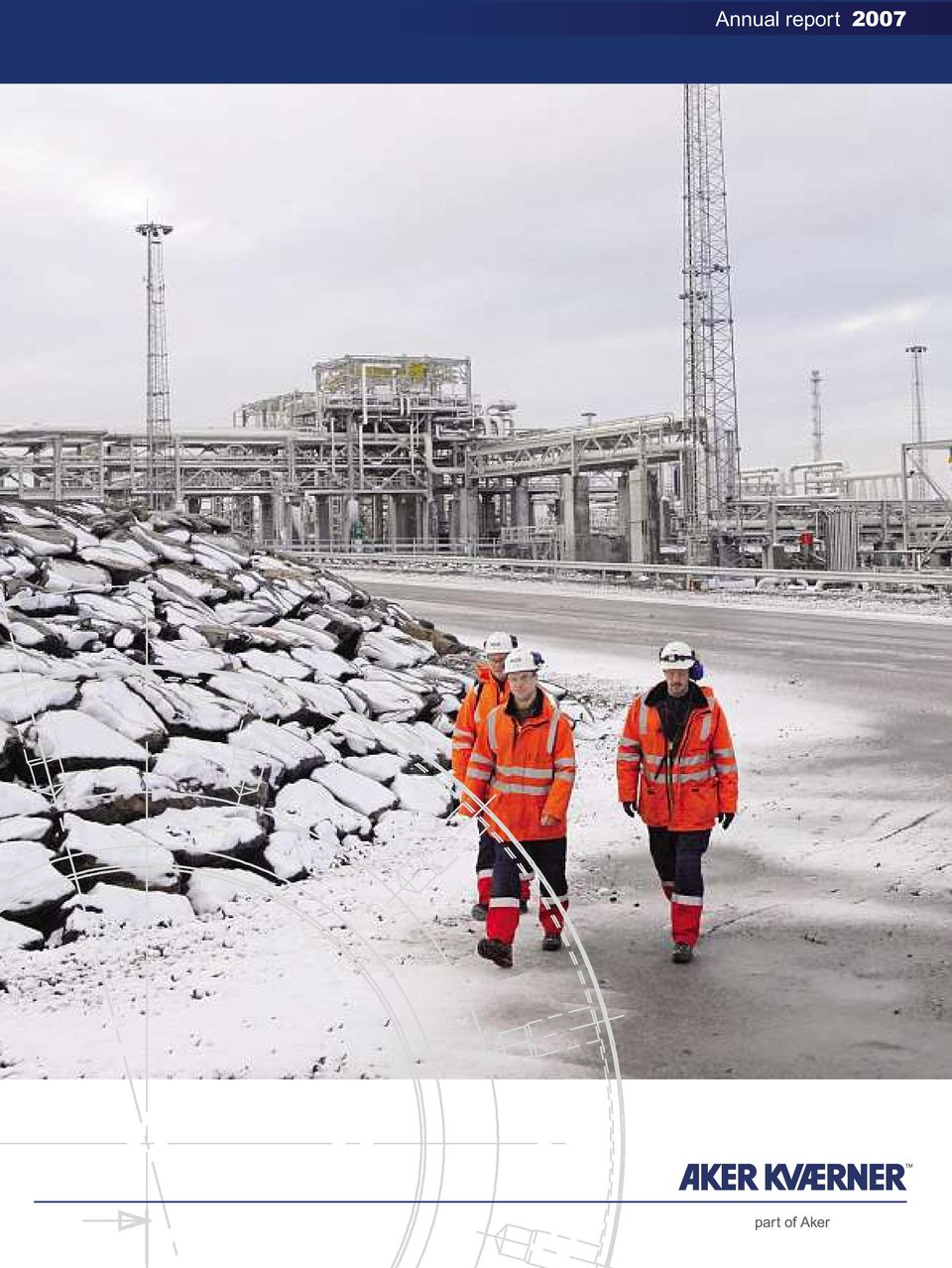
1 Annual report 2007
2 Innovation through generations Aker Kvaerner is an Aker company. Shared values and an innovative spirit are long-standing traditions that forge active industrial development. People create Aker companies. Ever since Aker was established in 1841, innovation and commitment drive us. Several Aker companies have roots that date back to the 1700 s to the industrial revolution in Great Britain and the Nordic countries. Aker has a long history of industrial innovation. In recent decades, Aker companies have strengthened their market position as preferred partners in global growth markets: energy resources, energy technologies, maritime technologies, seafood, and marine biotechnology. Aker is an active industrial holding company. Aker companies are developed and strengthened through organic growth, acquisitions, restructuring and focusing of businesses. People who are willing to take on challenges and have the ability to deliver innovative solutions constitute Aker s heritage. Aker s generations of dedication and know-how, combined with today s technologies and tools, yield tomorrow s products, services, and industrial solutions. Aker companies, with a total of employees on five continents, had 2007 operating revenues totaling NOK 62 billion. Aker Kværner ASA Aker Exploration Aker Floating Production Aker Drilling A leading supplier to the energy sector worldwide Innovative, technology-driven offshore exploration company Owns, operates, and charters FPSO vessels Operator of the world s two most advanced drilling rigs Aker Oilfield Services Aker DOF Supply Aker American Shipping Aker Philadelphia Shipyard Subsea well maintenance and intervention specialists Shipowner building a fleet of anchor handling vessels Premiere US shipowner for product and shuttle tankers The most modern and costeffective US shipyard Aker Seafoods Aker BioMarine Aker Clean Carbon Aker Seafood company that harvests, processes, and sells white fish Biotechnology company that develops high-value products from krill Pioneering CO 2 capture technology with patented solution Active industrial owner creates and develops companies

3 Aker Kvaerner: Historical facts Aker Kvaerner delivers engineering, construction, manufacturing, technology products, maintenance and other specialised services, often as total solutions for complete projects. Global scale Aker Kvaerner has annual revenues totalling approximately NOK 58 billion and employs almost individuals worldwide, with more than direct employees and approximately hired-in. We have offices in around 30 countries worldwide with global headquarters at Fornebu near Oslo, Norway. Markets and customers Aker Kvaerner delivers products, services and solutions to customers worldwide in the oil and gas, refining, chemicals, metals and other process industries, mining, nuclear and power generation. The majority of our customers are companies in the energy and process industries. Our deliveries enable our customers to build, efficiently operate and effectively maintain their facilities. Examples include complete offshore platforms for oil and gas projects and onshore petrochemical plants. Ownership Aker Kvaerner is part of Aker ( and was listed on the Oslo Stock Exchange in 2004 (ticker: AKVER). The largest share holder is Aker Holding AS with a percent stake in the company. Aker Holding is owned by Aker ASA (60 percent), the Norwegian Government (30 percent), SAAB AB (7.5 percent) and Investor AB (2.5 percent). The companies brought together to create Aker Kvaerner were established in the first half of the 19th Century, during the Industrial Revolution. Cutting-edge technology and engineering providers from the very beginning, they delivered products including steam engines for rail and marine use and a range of industrial ironworks. Over the next 100 years, the businesses grew significantly. In the mid-1900 s, both Aker and Kvaerner were international corporations with activities in ship building, water power, wood processing and other process operations, mechanical workshops and other industries. Through the 1970 s, 80 s and 90 s, they developed their capabilities and experience as suppliers of complete solutions to offshore and onshore oil and gas and processing projects. They each grew organically and through international acquisitions to be leaders in their markets. On 11 March 2002, the former Kvaerner group and the Aker Maritime group (comprising the oil and gas activities of the wider Aker group) were merged, and started to operate as one company under the name Kvaerner. On 29 March 2004, following a restructuring of both Aker and Kvaerner, today s Aker Kvaerner was established.

4 About us and our goals Highlights 2007 Contents About us and our goals 5 Key figures 6 Goals and strategies 8 Our values 10 Letter from the President & CEO Our business 12 Business Areas 14 Field Development 16 Maintenance, Modifications and Operations 18 Subsea 20 Products & Technologies 22 Process & Construction Our performance 26 Board of Directors report 38 Annual accounts 78 Annual accounts parent company 86 Auditor s report 88 Share and shareholder information 92 Analytical information Our organisation and governance 94 Corporate governance 96 Board of Directors 98 Executive Management Team 100 Address Financial Calendar February 4th quarter and preliminary annual results April Annual General Meeting April 1st quarter results July 2nd quarter results October 3rd quarter results November Capital Markets Day Best year ever Full year consolidated revenues of NOK million represented an increase of 15 percent compared to This increase was due mainly to good markets and high activity in all business areas. EBITDA of NOK million for the year showed an increase of 36 percent from NOK million in 2006, which gave a margin increase from 5.7 percent to 6.8 percent. Net profit for the year was NOK million, giving earnings per share of NOK New global operating model To further strengthen our offering and become more transparent to the market, we have optimised our operations by transforming our existing structure into five focused business areas with truly global scope. Bringing together specialised units serving the same market segments enhances knowledge sharing and enables more effective use of our total resources. The change supports the company s stated objective of further profitable growth. Improvement programmes To strengthen our competitiveness, we have initiated multiple improvement programmes including supply management enhancement, legal structure simplification, tax optimisation and overhead restructuring. These programmes share the common ambition of driving down our cost base, saving more than NOK 1 billion over the next two to three years. Strategic ownership of Aker Kvaerner In June Aker ASA, Wallenberg-related companies and the Norwegian Government entered into agreements providing long term strategic ownership for Aker Kvaerner. Under the agreements, Aker transferred its 40.1 percent ownership interest in Aker Kvaerner to the newly established company Aker Holding. Aker holds a controlling 60 percent stake in Aker Holding. The Norwegian Government owns 30 percent and the Swedish companies SAAB AB and Investor AB own 7.5 percent and 2.5 percent respectively. Ormen Lange and Snøhvit projects completed On 6 October, gas production commenced from the Ormen Lange gas field, 120 km into the North Sea. Aker Kvaerner was the main contractor for the large onshore processing facility which was developed with an innovative subsea-to-shore concept. The terminal was Norway s largest construction site, employing at one time over people from more than 50 nations. On 13 September, after five years of development, StatoilHydro commenced production of liquefied natural gas (LNG) at Hammerfest, as the world s most northerly gas liquefaction plant came on stream. The plant serves the Snøhvit field, which is the first offshore development in the Barents Sea. Aker Kvaerner was the main installation contractor for the plant. High-tech manufacturing centre opened Aker Kvaerner s integrated subsea oil and gas centre in Malaysia was officially opened in June. Located in Port Klang Free Zone, Pulau Indah, this purpose-built manufacturing centre, with a total investment value of USD 100 million, is the fi rst of its kind in the world. Aker Kvaerner acquires drilling technology company In August, Aker Kvaerner signed an agreement for the acquisition of 50 percent of the shares in the German company Wirth GmbH, with an option to buy the remaining shares over the next few years. Wirth is a quality supplier of drilling equipment and has been one of Aker Kvaerner s key suppliers for more than twenty years. Contract awards Aker Kvaerner was awarded several important contracts in Among these were the Skarv EPcma contract for BP with a contract value of NOK 2 billion; the Longview project for Genpower Holdings with a contract value of USD 654 million; process technology to Aker Floating Production with a contract value of NOK 430 million; a complete subsea production system to Reliance Industries worth approximately USD 250 million; and the Valhall redevelopment of steel structure for BP with a contract value of NOK 450 million. In addition drilling equipment contracts worth in total approximately NOK 6 billion and several frame agreements were awarded. The total order intake in 2007 was NOK 58.3 billion. 4 Aker Kvaerner annual report 2007

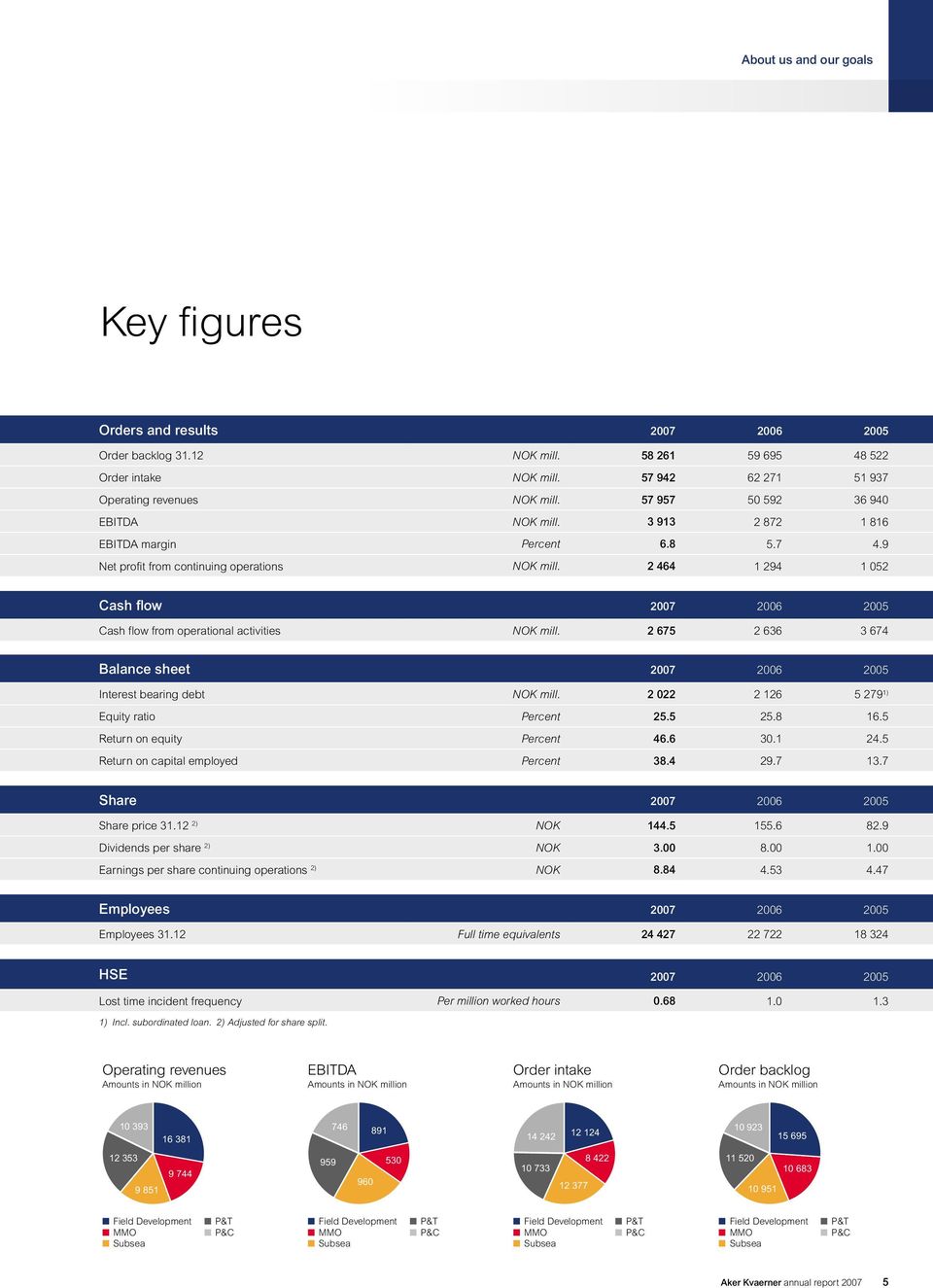
5 About us and our goals Key fi gures Orders and results Order backlog NOK mill Order intake NOK mill Operating revenues NOK mill EBITDA NOK mill EBITDA margin Percent Net profit from continuing operations NOK mill Cash flow Cash flow from operational activities NOK mill Balance sheet Interest bearing debt NOK mill ) Equity ratio Percent Return on equity Percent Return on capital employed Percent Share Share price ) NOK Dividends per share 2) NOK Earnings per share continuing operations 2) NOK Employees Employees Full time equivalents HSE Lost time incident frequency Per million worked hours ) Incl. subordinated loan. 2) Adjusted for share split. Operating revenues Amounts in NOK million EBITDA Amounts in NOK million Order intake Amounts in NOK million Order backlog Amounts in NOK million Field Development MMO Subsea P&T P&C Field Development MMO Subsea P&T P&C Field Development MMO Subsea P&T P&C Field Development MMO Subsea P&T P&C Aker Kvaerner annual report
6 About us and our goals Goals and strategies The preferred partner 6 Aker Kvaerner annual report 2007

7 About us and our goals Goals and strategies Goals and strategies To deliver on our strategy Aker Kvaerner will: Drive HSE improvement Continue to develop our Just Care culture through increased awareness, training, auditing and sharing of best practice, engaging with all stakeholders Strengthen technology leadership Continue to develop leading technologies within subsea, drilling equipment, well services, LNG, concrete and floating structures and downstream processing Acquire companies and enter into partnerships that fill technology gaps or supplement our product portfolio Apply Aker Kvaerner technologies and competence to develop environmentally sustainable solutions, e.g. within carbon capture and sequestration (CCS) and offshore wind energy Increase global presence Strengthen leading position in the North Sea and in Arctic regions Expand product offering in selected markets including Asia, West Africa, Brazil and Gulf of Mexico Expand value-added products and services offering Leverage our comprehensive offering across the entire value chain to enhance our competitive advantage Further capitalise on our partnering activities with other Aker companies to meet new market opportunities Generate new service concepts to expand our offering to new and existing customers Optimise use of resources Develop resources to secure flexible capacity and cost base Select, bid and execute the right projects Be the preferred employer in our chosen markets Deliver on improvement programmes Continue to roll out commodity-based supply management using best value sourcing Reduce cost base by focusing on working capital, taxation and overheads Convert risk to profit through full utilisation of Aker Kvaerner s Project Execution Model Aker Kvaerner annual report

8 About us and our goals Our values Unity and commitment Aker Kvaerner s business activities build on our six corporate values, which are shared by Aker companies worldwide. Our employees dedication and know-how allow us to deliver on our commitments to customers, employees, and the communities in which we work. The values that we share have a long history. They originated among Aker companies, and have steadily evolved over time, always reflecting the work of the generations at Aker. Although the companies that comprise Aker generally engage in distinctly different businesses, they share many common cultural features. Aker s six core values are the nucleus of comprehensive, long term efforts that ensure the companies vitality in tomorrow s conditions. How the various Aker companies achieve their growth and profitability is no less important than the achievements themselves. Aker Kvaerner s corporate values lend support and guidance in dayto-day priorities and decision-making. Acting in accordance with our corporate values promotes sound action and reinforces Aker Kvaerner s long term relations with its many and varied stakeholders. An effective corporate culture must remain dynamic and responsive. Thus, it is with a combination of humility and pragmatism that Aker Kvaerner works to strengthen and cultivate its shared values. Solid values are the foundation that enables Aker Kvaerner to achieve sustainable, long term industrial development. People who speak the same language cooperate more easily. At the annual Operating Managers Conference, we gather 200 executives from around the world to set the direction and align the organisation to drive execution on our strategy for continued profitable growth. Aker Kvaerner Our values in context We take personal responsibility for HSE because we care All incidents can be prevented. We strive continuously for zero accidents to personnel, material and non-material assets. We focus on employee health and on continuously improving the work environment. We conduct our operations through efficient use of materials and energy, with minimum waste and damage to the environment. We design products and services to have no undue environmental impact, to be safe and to be efficient in consuming energy and natural resources. We seek to ensure that our products can be recycled or disposed of safely. We deliver consistently and strive to beat our goals When doing a job, we understand both the risks and opportunities involved and know how to manage them. We take pride in delivering as we promise. Making money creates new opportunities and the resources for going forward, both for us and for our customers and partners. Commercial edge benefits us all. We reward performance what you achieve and alignment with our values how you behave. Building customer trust is key to our business After all, without customer trust and satisfaction, the rest doesn t matter. Good customer references build our reputation and the only way to achieve this is by consistent and predictable performance. Our customers will recognise us for our global execution excellence. We fi nd new ways, always linked to real customer needs and business priorities. 8 Aker Kvaerner annual report 2007

9 About us and our goals Our values Our values HSE mindset We take personal responsibility for HSE because we care Delivering results We deliver consistently and strive to beat our goals Customer drive Building customer trust is key to our business People and teams All our major achievements are team efforts Hands-on management We know our business and get things done Open and direct dialogue We encourage early and honest communication All our major achievements are team efforts In the end, it comes down to the talent and motivation of you and me. Delivering strong results is impossible without a highly capable workforce. We learn on the job, through challenging tasks, coaching and training. Development of people and teams in our company has one purpose to create a foundation for long term sustainable value creation through efficient project execution and sound business operation. We respect and encourage diversity and build strong, energised and effective teams and we have fun together, making us even better. Our goal is to be the preferred employer in our industry. We know our business and get things done Once decisions are made we combine all our efforts and focus all our energies on execution. We are accountable and solutionsoriented, focusing on the right details at the right time. We follow through and ensure accountability. We believe in empowering people close to the action to take responsibility. Hands-on does not mean hands-in. We stimulate entrepreneurship and challenge bureaucracy, complicated hierarchies and silo mentality. We are One Aker Kvaerner. We encourage early and honest communication We listen hard and talk straight no sugar coating, no filters. We value early, accurate and reliable communication after all, the first problem we encounter is usually the easiest one to cope with. We challenge each other. The best decisions are taken when different opinions and different cultures meet in open and direct dialogue. We expect the highest standards of ethical behaviour and integrity from all of us, everywhere. Aker Kvaerner annual report

10 About us and our goals Letter from the President & CEO 10 Aker Kvaerner annual report 2007

11 About us and our goals Letter from the President & CEO It has been another record setting year Strong fi nancial performance, successful delivery of key projects, major project wins and a safer working environment characterise An overall improvement in our Health, Safety and Environment (HSE) performance has made our company a safer place to work. This result is attributed to the ever increasing number of our people being trained in HSE regulations and practices as part of the continuing development of our Just Care culture. To date, Aker Kvaerner is a company with more than employees and NOK 58 billion in revenues. Our positive profit performance has enabled the Board of Directors to propose a NOK 3 per share ordinary dividend payment for We have a workforce made up of both permanent employees and hired-in personnel that totals people worldwide. We are proud to be a company that is repeatedly recognised as an attractive employer in international third party rankings. This is reflected in our ability to attract talent in a challenging employment market. In April, we restructured the company to streamline our operations into five business areas with global responsibilities. We also appointed country managers with responsibility for key regions. The new structure is designed to better align the global resources and expertise we offer to the market. As part of our continuous push for operational improvement, we initiated a detailed review of all of our core processes and for staff functions earlier this year. To date the results of this improvement process are very encouraging, and it will be continued in In June 2007, Aker ASA announced the transfer of its 40.1 percent ownership interest in Aker Kvaerner to the newly established company Aker Holding AS. Aker holds a controlling, 60 percent stake in Aker Holding. The Norwegian Government now owns 30 percent of Aker Holding, the Swedish technology company SAAB AB owns 7.5 percent, and the Swedish investment company Investor AB holds 2.5 percent. Aker and the Norwegian Government have a common understanding and a mutual commitment to hold their shares in Aker Holding for at least ten years. This agreement secures our company a strong platform for continuing our profitable growth strategy. In 2007 we delivered on some of the largest and most complex projects we have ever undertaken, most notably StatoilHydro s Snøhvit and Ormen Lange. We also continued to win significant contracts, securing a healthy order backlog going forward. We opened a new high-tech subsea manufacturing centre in Malaysia, and conducted a state-of-the-art upgrade of our subsea engineering and manufacturing facilities at Tranby in Norway. We also invested in a purpose-built aftermarket facility in Houston. During the year we won multiple technology awards, encouraging us to continue our investments in clearly identified technology niches where we differentiate ourselves from the competition. At the same time we will continue to look for acquisitions that strengthen our technology offering. There is an increasing concern about global warming and the need for measures to limit emissions of greenhouse gases. We recognise that, as a large international company and a supplier to producers of fossil fuels, our commitment to addressing these environmental dilemmas is more important than ever. During 2007, we invested in a new pilot facility based on our Just Catch technology, a world leading concept for CO 2 capture. We have also formed a joint venture with Praj under the name BioCnergy to become the leader in the European biofuels market. These are just two examples of our environmental initiatives. In September, we conducted our People Survey. This survey is designed to measure how well we live up to our values in our everyday operations. Over 90 percent of employees responded. The input from this survey will for the basis for improvements that will be implemented through On behalf of all Aker companies, a NOK 1 million donation was made to the Red Cross to assist in their disaster relief programmes around the world. At the same time, we were pleased to announce the signing of a strategic three year partnership agreement with the Norwegian Red Cross. The partnership encompasses fi nancial support, exchange of expertise and volunteerism, and is in effect on a global basis from January We have a world of opportunities. The challenge is to select the right ones and to deliver consistently, on budget, on schedule and with the right quality. Our markets continue to show positive growth in demand. We have a world of opportunities. The challenge is to select the right ones and to deliver consistently, on budget, on schedule and with the right quality. In January 2008, it was announced that I am to accept a new role in Aker ASA, and that the nomination committee would propose my candidacy as the new Chairman of the Board of Aker Kvaerner. I will go on to spend more than 50 percent of my time together with the new President & CEO Simen Lieungh and his team to further develop the company and to explore cross-business opportunities within the Aker family of companies. Best regards, Aker Kværner ASA Martinus Brandal President & CEO Aker Kvaerner annual report
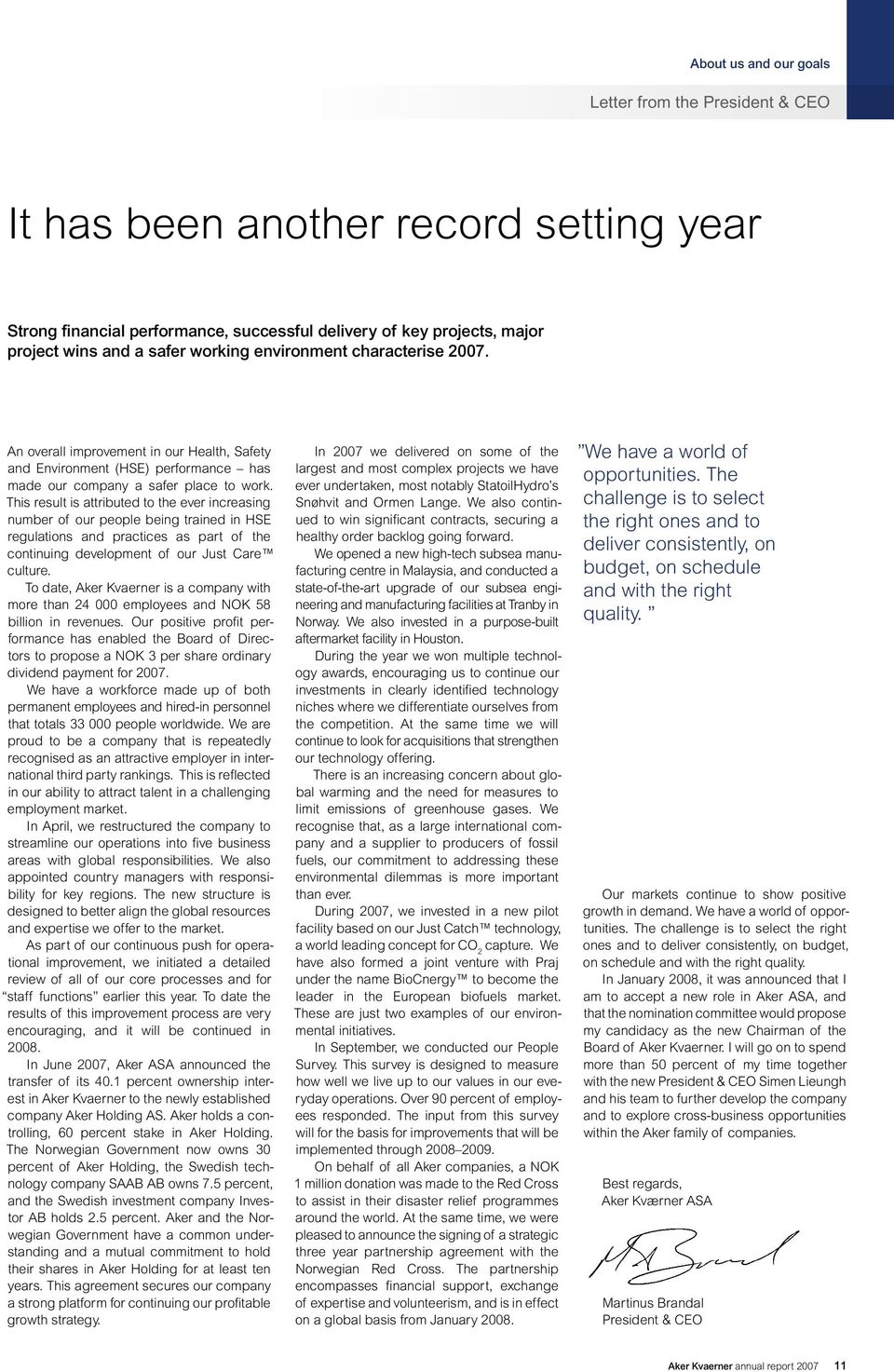
12 Our business Business Areas 12 Aker Kvaerner annual report 2007
13 Our business Business Areas Field Development A leading global provider of services from studies, through front-end engineering design to full turn-key engineering, procurement and construction (EPC) project execution for fixed and floating offshore platforms, LNG terminals, and onshore oil and gas facilities. Page Maintenance, Modifications and Operations A leading global provider of maintenance, modifications and operations (MMO) services to operators of offshore platforms and onshore oil and gas facilities from concept screening through engineering, procurement, construction and installation (EPCI) project execution and operational support to removal, decommissioning and recycling of discarded offshore installations. Page Subsea A leading global provider of subsea systems, solutions and services for the oil and gas industry. Covering all aspects of subsea field development for both new and existing fields from individual activities and products to complete subsea production systems, and maintained for the complete life-of-field. Page Products & Technologies A leading global provider of specialised products and services to the upstream oil and gas industry, based on proprietary technology and know-how. Key deliverables include advanced drilling equipment and systems, upstream processing technology, mooring systems, as well as loading and offloading technology. Other deliveries include well intervention technology and services, marine operations and subsea installations, and reservoir evaluation services. Page Process & Construction A leading global provider of management, design and construction services for major projects spanning refining, petrochemical processing and bio refinery, metals and mining, power generation, acid plants, and nuclear clean-up services. The full life cycle of services from initial concept through technology development, process technology application, design, procurement, construction, commissioning, operations, maintenance, modification and decommissioning. Page Aker Kvaerner annual report

14 Our business Field Development Technology and project execution expertise With the world s energy needs increasing sharply, oil companies are aiming to liberate new resources in deeper waters and in more demanding climates. Aker Kvaerner s Field Development (FD) business area is well positioned to tackle complex developments that make major demands on the interaction between technology and project execution. Highlights 2007 Successful delivery of giant projects Ormen Lange and Snøhvit to StatoilHydro Integration of topsides for the advanced Aker H-6e rig for Aker Drilling Completion of concrete structure for Adriatic LNG terminal; topside progressing on schedule Record high turnover The Skarv EPcma contract covers detail engineering and procurement work for the ton FPSO topsides as well as construction management assistance to BP. On peak, the project will engage over 400 people from Aker Kvaerner. We service oil and gas field developments in carefully selected business segments. Our service offering includes concept development, preliminary studies, front-end engineering, detailed engineering, project management, procurement and fabrication as well as assembly and hook-up of modules, topsides and complete platforms. Our core competence covers: floating drilling rigs and production platforms fixed installations in concrete or steel gas liquefaction plants and regasification terminals onshore receiving and processing terminals Deliveries include complete value chains for gas technology including carbon capture, and tailored solutions for Arctic conditions and ultra deepwaters. We are pursuing major projects in Norway, Russia, Kazakhstan, Gulf of Mexico and in the Asia-Pacific region, together with a number of studies and preliminary projects in these and other regions. Our main engineering and technology unit is located in Oslo, together with our headquarters, and we have three offshore yards at Verdal, Stord and Egersund in Norway. FD also has units in the US, Russia, Kazakhstan, Australia and Malaysia. Turnover in 2007 totalled NOK million and we engage approximately permanent and non-permanent employees. Our customers experience predictability, effective risk assessment and the assurance that their projects are executed to the agreed level of quality, on schedule and to budget. That applies whether the work is done in Arctic areas, in ultra deepwaters or in other tough environments. The complexity of our projects, and the fact that they are often executed in challenging locations, makes it even more important to deliver on our health, safety and environmental commitment. Our results reflect our success. Combined with our responsible approach, our project management competence, engineering expertise, advanced technology and world class fabrication has made us a preferred supplier of complex oil and gas projects worldwide. Strong in selected areas National and international oil companies are concentrating their exploration activities and new developments in ever deeper waters and areas with more extreme climates. This creates opportunities and highlights our competitive edge in demanding regions. Rising activity in climatically challenging areas and deepwater reflects expectations among the oil companies about long term trends in energy prices. We pursue projects in the North and Norwegian Seas, the Norwegian and Russian sectors of the Barents Sea, the Atlantic off Canada, the Caspian Sea, the Sakhalin region, Australia and the deepwater parts of the Gulf of Mexico. In Norway, we are number one in our segment. We are the contractor of choice for robust floating production platforms for deepwater worldwide and are solidly placed in concrete technology, with unique experience gained over many years in the North Sea. Today concrete structures have acquired a new relevance, not least in waters with harsh climates and for LNG terminals. We also have specialist expertise in offshore processing installations and land-based plants, both for traditional oil and gas operations and for LNG regasification. Supplies under pressure Our markets developed positively during 2007 and prospects are good, with a number of interesting opportunities on the horizon in our key markets. Constraints in global fabrication capacity and in the supply of qualified labour continue to impact the market. We are working effectively with these challenges and are selective about the exciting projects we take on. Exciting projects During the first quarter, we secured the contract to construct the production platform for the Valhall field south of Ekofisk. Our Verdal yard is responsible for this delivery. Worth NOK 450 million, the contract includes construction of the jacket, transport to the field and installation on the seabed. Peak staffing, planned for June 2008, will involve some 300 people. 14 Aker Kvaerner annual report 2007

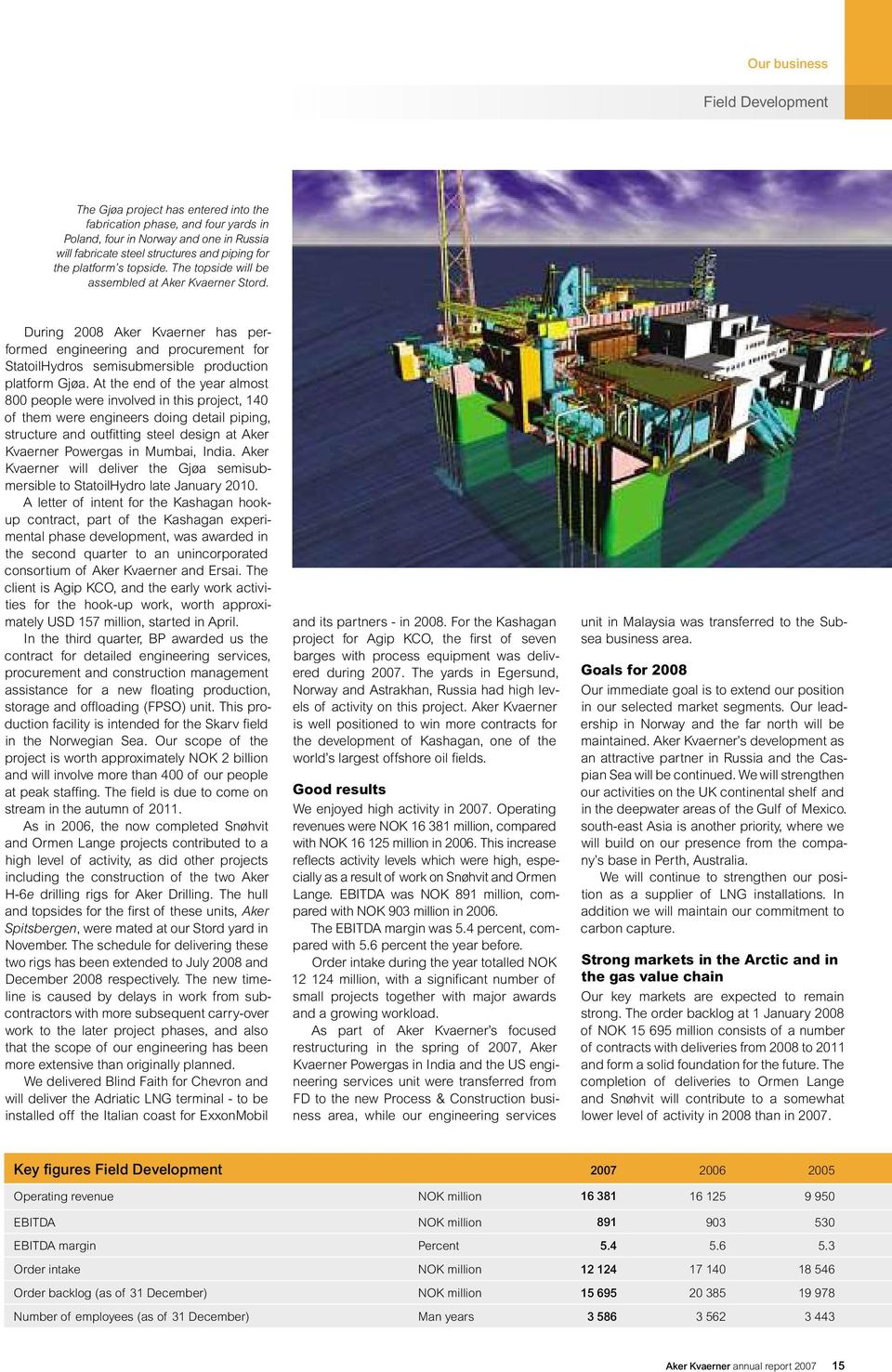
15 Our business Field Development The Gjøa project has entered into the fabrication phase, and four yards in Poland, four in Norway and one in Russia will fabricate steel structures and piping for the platform s topside. The topside will be assembled at Aker Kvaerner Stord. During 2008 Aker Kvaerner has performed engineering and procurement for StatoilHydros semisubmersible production platform Gjøa. At the end of the year almost 800 people were involved in this project, 140 of them were engineers doing detail piping, structure and outfitting steel design at Aker Kvaerner Powergas in Mumbai, India. Aker Kvaerner will deliver the Gjøa semisubmersible to StatoilHydro late January A letter of intent for the Kashagan hookup contract, part of the Kashagan experimental phase development, was awarded in the second quarter to an unincorporated consortium of Aker Kvaerner and Ersai. The client is Agip KCO, and the early work activities for the hook-up work, worth approximately USD 157 million, started in April. In the third quarter, BP awarded us the contract for detailed engineering services, procurement and construction management assistance for a new fl oating production, storage and offloading (FPSO) unit. This production facility is intended for the Skarv field in the Norwegian Sea. Our scope of the project is worth approximately NOK 2 billion and will involve more than 400 of our people at peak staffing. The fi eld is due to come on stream in the autumn of As in 2006, the now completed Snøhvit and Ormen Lange projects contributed to a high level of activity, as did other projects including the construction of the two Aker H-6e drilling rigs for Aker Drilling. The hull and topsides for the fi rst of these units, Aker Spitsbergen, were mated at our Stord yard in November. The schedule for delivering these two rigs has been extended to July 2008 and December 2008 respectively. The new timeline is caused by delays in work from subcontractors with more subsequent carry-over work to the later project phases, and also that the scope of our engineering has been more extensive than originally planned. We delivered Blind Faith for Chevron and will deliver the Adriatic LNG terminal - to be installed off the Italian coast for ExxonMobil and its partners - in For the Kashagan project for Agip KCO, the fi rst of seven barges with process equipment was delivered during The yards in Egersund, Norway and Astrakhan, Russia had high levels of activity on this project. Aker Kvaerner is well positioned to win more contracts for the development of Kashagan, one of the world s largest offshore oil fields. Good results We enjoyed high activity in Operating revenues were NOK million, compared with NOK million in This increase reflects activity levels which were high, especially as a result of work on Snøhvit and Ormen Lange. EBITDA was NOK 891 million, compared with NOK 903 million in The EBITDA margin was 5.4 percent, compared with 5.6 percent the year before. Order intake during the year totalled NOK million, with a significant number of small projects together with major awards and a growing workload. As part of Aker Kvaerner s focused restructuring in the spring of 2007, Aker Kvaerner Powergas in India and the US engineering services unit were transferred from FD to the new Process & Construction business area, while our engineering services unit in Malaysia was transferred to the Subsea business area. Goals for 2008 Our immediate goal is to extend our position in our selected market segments. Our leadership in Norway and the far north will be maintained. Aker Kvaerner s development as an attractive partner in Russia and the Caspian Sea will be continued. We will strengthen our activities on the UK continental shelf and in the deepwater areas of the Gulf of Mexico. south-east Asia is another priority, where we will build on our presence from the company s base in Perth, Australia. We will continue to strengthen our position as a supplier of LNG installations. In addition we will maintain our commitment to carbon capture. Strong markets in the Arctic and in the gas value chain Our key markets are expected to remain strong. The order backlog at 1 January 2008 of NOK million consists of a number of contracts with deliveries from 2008 to 2011 and form a solid foundation for the future. The completion of deliveries to Ormen Lange and Snøhvit will contribute to a somewhat lower level of activity in 2008 than in Key figures Field Development Operating revenue NOK million EBITDA NOK million EBITDA margin Percent Order intake NOK million Order backlog (as of 31 December) NOK million Number of employees (as of 31 December) Man years Aker Kvaerner annual report
16 Our business Maintenance, Modifications and Operations The thriving modifications market Aker Kvaerner s Maintenance, Modifications and Operations (MMO) business area is a market leader in the North Sea. We are the only major contractor that has a presence in both the Norwegian and UK markets. With more than 30 years experience, we hold a unique market position and are rapidly expanding internationally. Highlights 2007 Actively contributed to delivery of giant Ormen Lange onshore gas facility Statfjord Late Life ready for gas export First oil Buzzard, Dumbarton, Brenda Al Zaafarana operations contract in Egypt Delivered on Frigg field decommissioning milestones Ormen Lange onshore site, Norway. Installed and completed all electrical, instrumentation and telecommunications systems. Continuing through longterm contract for maintenance and modification work. Our operations support and maintenance business encompasses a wide range of services that supplement and support our customers effective operation of installations and infrastructure. Our core competencies are in: modifications project execution and tools operational expertise and technology shutdown planning and execution concept development and front-end engineering and design (FEED) studies maintenance planning and execution electrical, instrumentation and telecommunications contracting at offshore and land-based oil and gas facilities on-site operations and operational support services decommissioning, including subsequent re-use of parts, and material recycling We derive competitive advantage from being in close proximity to our customers, particularly with our operations in Norway at Stavanger, Bergen, Trondheim and Kristiansund; in the UK at Aberdeen and Stockton; in St John s, Canada and in Houston, USA. Our headquarters are in Stavanger, and we have a second major hub in Aberdeen. We have prefabrication workshops in Norway at Hinna, Mongstad, Ågotnes, and Kristiansund. We also have a facility at Stord for recycling offshore installations. In 2007, we delivered revenues of NOK million. We have approximately permanent and non-permanent employees. Increased value creation Carefully planned maintenance and improved efficiency are two of the most important measures for increasing productivity and the production lifetime of offshore oil and gas infrastructure and land-based processing plants. Longer installation lifetimes, reduced downtime and more efficient operations lead to greater value creation for customers. Our local market presence and ability to deploy the resources required for large scale projects are a winning combination. Our strategy is to offer expert, intensive and value creating services in our market. We have the knowledge, depth and breadth of experience to take on the largest of projects. We minimise downtime through well-planned facilities maintenance combined with unbeatable upgrading expertise. This significantly reduces risk from operational interruptions, either scheduled or unforeseen. We continuously develop services with new technology that contribute to improved working methods and solutions. Examples include investment in hydrocarbon training maintenance training for complex operations integrated operations sensor/wireless technology robotics (both subsea and topsides) and unmanned platforms In our operation and management of the AH001 production platform in the North Sea, we are responsible for all formal approvals as the appointed duty holder in the UK. This responsibility attests to the expertise of our operations people. We also provide operations services on other UK continental shelf platforms and, from our base in Egypt, for platforms in the Red Sea. There are clear synergies between MMO and Aker Kvaerner s Field Development (FD) business area. FD delivers offshore platforms which offer us significant potential for subsequent operations, maintenance and decommissioning contracts. Servicing the entire life cycle of facilities gives us a clear competitive advantage in our market. The growing MMO market We perform maintenance and modification services for oil and gas operators in the Norwegian and UK sectors of the North Sea. We also decommission, remove and dismantle offshore installations. The combined market for these services is worth approximately NOK 19 billion per year. We are working to develop our market share, which is around 45 percent in Norway, 20 percent in the UK, and growing in the international market. The overall market for our services grew significantly in 2007 thanks to rising energy prices. This was reflected in the postpone- 16 Aker Kvaerner annual report 2007
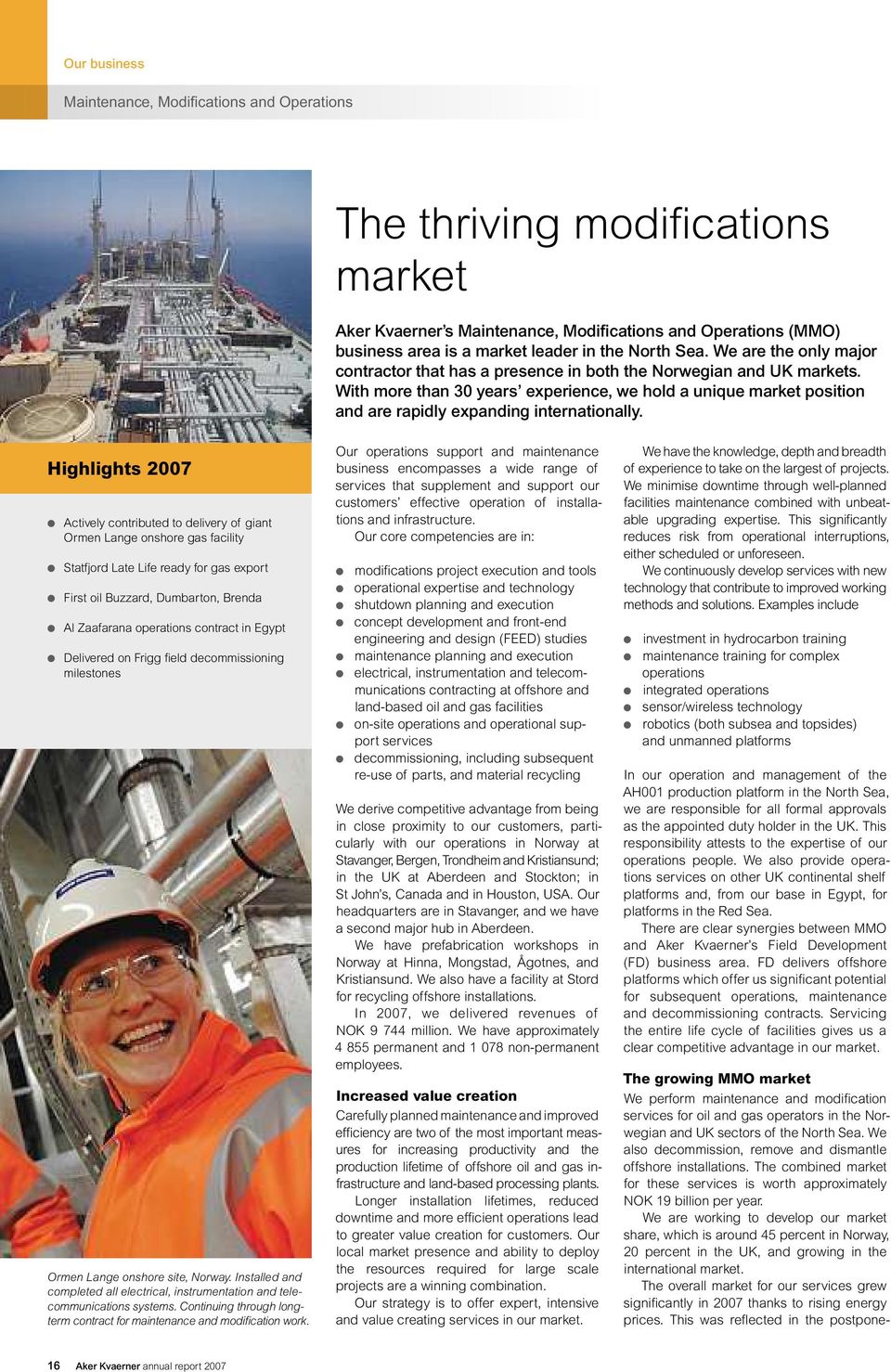
17 Our business Maintenance, Modifications and Operations Statfjord Late Life, Norway. Modified Statfjord A&B from oil producer to gas producer. Milestone ready for gas export to UK achieved this autumn. ment of decommissioning projects, offset by increases in the development of marginal fields, high investment in new field developments, an increasing focus on field life extension projects, and further modifications to aging infrastructure. At the same time, the rising average age of installations in the North Sea has led to greater demand for maintenance services. One example of where life extension postpones decommissioning is Statfjord Late Life, where the facility has changed from being an oil producer to be a gas producer. Continued high activity levels We developed our business very favourably during 2007, with growth in revenues and significantly increased margins. We focused on international expansion and establishment in selected areas, principally Canada, the Caspian Sea and the Gulf of Mexico. Significant contract awards and achievements included: Statfjord Late Life: ready for gas late 2007 Kashagan hook-up: letter of intent plus early work agreement Engineering studies and projects capability expanded across the North Sea and in Houston Al Zaafarana, Egypt: operation and maintenance contract in Gulf of Suez Completion of significant project milestones on Frigg decommissioning Husky White Rose: retained maintenance contract and gained engineering, field development and subsea support Helped achieve first oil from Buzzard, Dumbarton and Brenda Continued LTI-free performance on Hess AH001 and Nexen Scott/Buzzard assets Our order intake of NOK million was excellent. At year end 2007, we had an order backlog of NOK million. Operating revenues were NOK million, compared with NOK million in This increase reflects high oil prices, resulting in several projects for lifetime extension of installations, development of smallersized fields, and projects focusing on environmental improvements. EBITDA was NOK 530 million, compared with NOK 452 million in 2006, an increase of NOK 78 million. EBITDA margin was 5.4 percent, compared with 4.7 percent the year before. In this busy market, recruitment and retention is a competitive challenge. We succeeded in retaining employees and recruiting some 500 new permanent employees. In April 2007, Aker Kvaerner Geo was transferred from MMO to Aker Kvaerner s Products & Technologies business area goals and objectives Our goals for 2008 are to maintain our market share in the traditional MMO market in Norway, and to maintain and improve our UK market share. We will focus on growing in high margin and specialist technology niches. One such market niche is for engineering studies, where we will continue to develop, based on our successes in We will continue to deliver our strategy for international growth in selected regions e.g. Canada, the Caspian Sea and the Gulf of Mexico and will capitalise on synergies across Aker Kvaerner. We will be a preferred partner to our customers and a preferred employer to both existing and potential employees. Outlook for 2008 High energy prices and high industry activity levels are expected to continue, leading to further fi eld life extensions and marginal field developments. Tendering levels will remain high, particularly for late life modifications and similar life extension projects, and for the engineering studies that are often the precursors to this type of work. We are ideally positioned for both. The international market for our MMO services is expected to demonstrate sustained and significant growth. Our market share will remain strong. Key figures Maintenance, Modifications and Operations Operating revenue NOK million EBITDA NOK million EBITDA margin Percent Order intake NOK million Order backlog (as of 31 December) NOK million Number of employees (as of 31 December) Man years Aker Kvaerner annual report

18 Our business Subsea Deep impact Aker Kvaerner s subsea business area (Subsea) has grown to become a key player in the fast expanding global subsea market. The only supplier in the world that can manufacture and deliver a complete subsea production system including umbilicals, we are well positioned for further growth. Highlights 2007 Record high revenue, EBITDA and EBITDA margin Opened new high-tech manufacturing centre in Malaysia, the world s only one stop shop for production of complete subsea systems Established long term frame agreement with StatoilHydro for delivery of subsea production systems and related aftermarket services Technology breakthroughs with MultiBooster at BP s King field and entry into the subsea power cable market USD 300 million subsea system contract on the Indian continental shelf signed with Reliance Industries Aker Kvaerner: The world s no. 1 supplier of steel tube umbilicals. As a full lifecycle provider of subsea products and systems, from front-end studies to aftermarket support, we manufacture and deliver the following products and services both as complete engineering, procurement and construction (EPC) deliveries and standalone products: subsea production systems, including subsea trees subsea control systems template and manifold systems umbilicals: flexible flowlines for tie-in of subsea production systems subsea processing and boosting technology, including subsea gas compression, processing systems, multi-phase pumps, water and gas injection deepwater drilling riser systems tie-in systems surface wellheads aftermarket services We are a global business area with permanent and non-permanent employees based in 23 locations around the world. Awarded global ISO 9001:2000 quality certification, we work on projects worldwide, through one global organisation and a single business model, using common systems. Our headquarters are in Oslo, Norway. Manufacturing facilities are located in Moss and Tranby, Norway; Curitiba and Rio das Ostras, Brazil; Port Klang, Malaysia; Aberdeen, UK; Mobile, Alabama, US; and Batam, Indonesia. A global network of service bases secures quality aftermarket support. In 2007, we had operating revenues of NOK million, an increase of 42 percent compared to Complete subsea solutions Over several decades we have developed unbeatable know-how in subsea oil and gas developments. Our ability to manufacture and deliver complete subsea production systems, including umbilicals, is unrivalled in the marketplace. Our reputation as a complete system provider was further strengthened in 2007 with the opening of a new high-tech manufacturing centre in Port Klang, Malaysia. This centre, built in record time, is the world s only one stop shop for the production of complete subsea systems. Over the past 20 years, we have developed a strong market position in processing and boosting technologies which increase oil and gas recovery and life-of-field from wells with declining production rates. This position was highlighted this year with the successful start-up of two MultiBooster pumps at BP s King field in the Gulf of Mexico and the installation of a SeaBooster seawater injection system at StatoilHydro s Tyrihans field. A significant proportion of the world s remaining oil and gas reserves is in demanding reservoir conditions. Aker Kvaerner is addressing this by developing suitable technologies for these fi elds. For example, our unique technology for high-pressures/hightemperatures (HPHT) received another accolade in 2007 when StatoilHydro chose us as supplier of a subsea production system for the Morvin field. Growth in all subsea segments The global subsea market grew significantly in The key driver behind this growth is the high price of oil, itself driven by the dramatic increase in energy consumption, particularly in fast-developing countries such as India and China. Total investment in subsea hardware our core business increased by 60 percent compared to 2006, to NOK 30 billion. Market analysts predict that growth will continue over the coming years, at an annual rate of approximately 20 percent. Strong growth in new-builds of deepwater drilling units has also resulted in a high order intake for deepwater drilling risers, a product we began offering out of our new facility in Malaysia and shortly Brazil. The global umbilical market had a solid year. According to Quest Offshore, we were the world s leading manufacturer of steel tube umbilicals in 2007, with a market share of 40 percent in km. High activity levels 2007 was an excellent year for us, with our best ever revenues of NOK million, and a record high EBITDA of NOK 960 million. 18 Aker Kvaerner annual report 2007

19 Our business Subsea The high-tech manufacturing centre in Malaysia is the world s only one stop shop for production of complete subsea systems. Among key contracts awarded in 2007 were the USD 300 million subsea system contract signed with Reliance Industries MA-D6 project, and the year frame agreement with StatoilHydro for delivery of subsea production systems and related aftermarket services. The USD 90 million deal to deliver three subsea manifolds to Petrobras of Brazil, the umbilical frame agreement with Australia s Woodside Petroleum, a fi rst step into the Chinese drilling riser market through a contract with CNOOC, and entry into the subsea power cable market through a USD 65 million contract also with Petrobras, are other milestone awards. At year end 2007, our order backlog stood at a record high NOK million, an 25 percent increase over also saw significant investment in upgrading our manufacturing and service facilities around the world. Our new Houston-based centre for assembly, testing and aftermarket activity in the Gulf of Mexico was opened in April. A NOK 65 million upgrade of our facility in Tranby, Norway, made it one of the most efficient subsea tree and pump manufacturing sites in the world. Additionally, our USD 100 million high-tech manufacturing centre in Malaysia was officially opened in June. These investments will provide a sound basis for our future growth. Another important development was our establishment, together with Aker and DOF Subsea, of Aker Oilfield Services, a provider of subsea light well intervention services. The acquisition of Phoenix Polymers International Ltd, a manufacturer of buoyancy products for the oil and gas industry and supplier of floatation elements to our drilling risers, was also strategically important. This was a year for key deliveries, such as fi rst oil through the subsea system at the Kikeh field, the fi rst deepwater project in Malaysia, and the technology breakthrough of the MultiBooster at BP s King fi eld. Deliveries to Reliance Industries giant projects on the Indian continental shelf have been and still are a key focus area Goals One of our key objectives for 2008 and beyond is to continue the expansion of our strong global position, partly by leveraging the manufacturing centre in Malaysia to become the number one subsea supplier in the Asia-Pacific region. We will continue to develop technology in selected areas, particularly within increased oil recovery (IOR), where we already hold a pioneering position. Increasing service revenue is another key goal. This will be met by growth in the installed base and through planned investments into our existing aftermarket facilities in Ågotnes, Norway and Perth, Australia, as well as the opening of a new facility in Kakinada, India. Continuing to contribute to Aker Kvaerner s deliveries across the entire oil and gas value chain, as well as working with other companies in the wider Aker family, will remain a strategy for success, as will improving margins through increasingly cost-efficient supply chain management with best value sourcing. Continuous growth High oil prices and market activity levels are expected to continue. Market analysts suggest that all subsea markets will continue to grow in the coming years, with a strong increase in the Asia-Pacific and West Africa regions. Construction activity for deepwater drilling units is predicted to remain high. As a result, we will open a new production facility for deepwater drilling risers in Rio das Ostras, Brazil in An increasing number of subsea developments will move into deeper waters, with subsequently longer step-outs. This trend will continue to drive demand for subsea support infrastructure such as umbilicals. We are enjoying high tendering and bidding activity at the start of 2008, and the market outlook remains positive. We will not, however, lose focus on the safe, on-time delivery of our existing solid order backlog. Key figures Subsea Operating revenue NOK million EBITDA NOK million EBITDA margin Percent Order intake NOK million Order backlog (as of 31 December) NOK million Number of employees (as of 31 December) Man years Aker Kvaerner annual report

20 Our business Products & Technologies Growth through innovative technology Through its Products & Technologies (P&T) business area, Aker Kvaerner holds a leading position in the drilling equipment, FPSO topsides and sub-surface market, delivering systems, equipment and services. Highlights 2007 Strong growth in all business segments, record high EBITDA Strategic investment in Wirth GmbH, a German quality provider of key drilling equipment Breakthrough in the Chinese offshore market and successful entrance into the drillship market FPSO process modules delivered in record time to Aker Floating Production Successful introduction of BOA SUB C, a specialised construction vessel for ultra deepwater Winner of Offshore Technology Conference (OTC) Spotlight on New Technology award with PowerTrac Cone Crusher, a highly innovative and efficient method for scale removal in oil and gas wells Market leading position gained for environmentally safe crude loading technology for Arctic conditions Aker Kvaerner s PowerTrac Cone Crusher provides a new solution for cost-efficient, safe and environmentally sound removal of scale from wells. P&T growth is driven by three key markets: Deepwater drilling Drilling equipment and systems Mooring systems Floating production Mooring and offloading equipment Upstream process technologies Floater installation and subsea construction Increased oil recovery Well intervention Geological consulting and services Process technology upgrades Drilling equipment upgrade Subsea tieback installation We are a leading supplier of: Advanced drilling equipment and systems Upstream processing technology Mooring systems and loading and offloading technology Well intervention technology and services Marine and subsea installation Reservoir evaluation services Developed for the demanding North Sea environment, most of our products, technologies and services are now also exported to other oil producing regions. Today more than two thirds of our deliveries are outside the North Sea. We are a global business area with more than permanent and 800 non-permanent skilled employees worldwide. Our headquarters are in Norway while we have offices, service bases and production facilities in key oil producing regions around the world. Our increasing installed base provides significant service and after-sales potential going forward. State-of-the art expertise and competitive advantages A significant proportion of the world s remaining oil and gas reserves are located at great water depths, in Arctic regions, and in reservoirs with demanding conditions such as high temperatures and pressures. Advanced technologies and innovative solutions for increased oil recovery (IOR) are often decisive in exploiting identified reserves. We have state-of-the-art expertise, products and technologies to address these challenges, holding a leading position in several upstream technology segments including advanced drilling equipment systems, well stream separation and process systems, mooring and offloading systems. Our marine operations segment has secured full market and operational control of two highly specialised construction vessels. With their high-tech specifications and safety margins, these vessels are ideally suited for operations in harsh marine environments. Extensive experience in the towing and installation of offshore fixed and floating platforms has helped us develop a safe, costeffective and patented technique for the installation of subsea structures, known as the Pencil Buoy Method. Market conditions From a market perspective, 2007 was yet another positive year. All target segments developed favourably. Contracts for 4 floating drilling units (i.e. semisubmersibles and drillships) were awarded and nearly 40 FPSO s were under construction or on order at yearend As a result the market for drilling equipment and systems, mooring equipment, processing systems and offloading units enjoyed high activity. With an increasing number of drilling rigs and floating production units entering the market, contracting of marine operations and subsea installation services are expected to develop positively. With increasing oil prices, the life of several projects in their tail-end production phase has been extended. This has lead to growing interest in our increased oil recovery (IOR) solutions, which include well intervention services and technology. An excellent year 2007 was an excellent year with strong financial performance and growth opportunities for all business segments. Key developments in 2007 included: the award-winning PowerTrac Cone Crusher, 20 Aker Kvaerner annual report 2007

21 Our business Products & Technologies which removes scale from oil wells, preventing blockages; the compact electrostatic coalescer (CEC ) process technology, which reduces water content in oil to as little as 0.5 percent particularly important in more mature fields where the amount of water produced can be as high as 90 percent and safe crude loading technology for Arctic conditions, which transports oil from the FPSO to the shuttle tanker and allows for emergency releases with no oil spillage. We continue to take a major share of the strong new-build market for deepwater drilling rigs and drillships. Key contracts awarded in 2007 included: China National Offshore Oil Corporation (CNOOC), a breakthrough in the Chinese offshore market; and two drilling equipment contracts awarded by Daewoo Shipbuilding & Marine Engineering Co. Ltd (DSME), one for a single drillship and one for a semisubmersible. An important achievement within the drilling equipment segment was the acquisition of 50 percent of the shares in German company Wirth GmbH, with an option to buy the remaining shares over the next few years. Wirth s technology complements our portfolio and is an excellent fit with our drilling equipment segment. It will increase the added value and service potential within this segment. We have been successful in the well interventionmarket.majorcontractsonthenorwegian Continental Shelf (NCS) were entered into in 2007, highlighting the strong home market position. As the number of horizontal wells increases significantly, both in Norway and worldwide, the outlook for our well intervention technologies and services is favourable. In 2007, we successfully carried out our first wireline tractor operation in the Gulf of Mexico. The PowerTrac Cone Crusher was awarded the OTC Spotlight on New Technology award. This environmentally-friendly invention has enabled very cost-efficient scale removal in oil and gas well, delivering significant business benefit for our clients. In 2007, Aker Kvaerner s geological consulting business was transferred into the P&T business area. With this move, Aker Kvaerner has organised its sub-surface activities under one global business area. We see a clear potential for growth in this segment. Our marine operations segment has secured many important contracts in the North Sea and in the Gulf of Mexico. These include the installation of the Sevan Hummingbird FPSO on the UK continental shelf and floater installation contracts with both Statoil- Hydro and BP Norway. With the delivery of the ultra deepwater multipurpose vessel BOA SUB C, we have further strengthened our position in the offshore installation market and are well positioned to install numerous floaters under construction with this chartered superior vessel. It is currently operating in the Gulf of Mexico. We have significant experience in the Arctic and other harsh environments and are a market leader in advanced offshore loading equipment. We have taken a leading position in crude offloading technology. The systems for transferring oil from platform to shuttle tanker can function in extreme temperatures (down to - 50 C) and withstand an emergency release with no environmental impact. We delivered two such systems in 2007, one for the Prirazlomnya field and one to Lukoil s Varenday loading terminal. We have also won a contract for the delivery of mooring winches and fairleads for Statoil- Hydro s Gjøa semisubmersible platform. Our process systems segment delivered its first process module to Aker Floating Production in record time. This segment also completed its fi rst two offshore Sulphate Removal Units (SRUs) for Petrobras FPSO P50 in Brazil and won other important contracts for the design and supply of oil and gas treatment packages. We have established a strong position in topside upstream process modules for the FPSO market. Operating revenues were NOK million, up 63 percent from NOK million in The strongest growth came with the drilling equipment segment. EBITDA was NOK 959 million, compared with NOK 531 million in 2006, an increase of NOK 428 million. EBITDA margin was 7.8 percent, compared with 7.0 percent the year before. Order intake amounted to NOK million in Goals for 2008 We have three target markets for growth in the immediate future: deepwater drilling (drilling equipment and systems and mooring systems); floating production units (mooring and offloading equipment, upstream process technologies and floater installations); and IOR through well intervention, processing technology upgrades and subsea tieback installation. In IOR services, technology is an integrated part of the offering, which is provided under long term contracts. We will continue to improve and strengthen our position in each of these growth markets both organically and through acquisitions. With a growing installed base of equipment and technologies, our aim is to increase the service and after-sales share of our operating revenues during This will require further strengthening of our service organisation. We will also expand our technology portfolio to better meet the new challenges facing the upstream oil and gas industry. The way forward High energy prices and market activity levels are expected to continue. All of our market segments are expected to remain strong, especially within the drilling rig, floating production and IOR segments. Several awarded contracts, with deliveries in 2008 and later, form a solid foundation for further development. At year end 2007, our order backlog amounted to NOK million, with deliveries through Key figures Products & Technologies Operating revenue NOK million EBITDA NOK million EBITDA margin Percent Order intake NOK million Order backlog (as of 31 December) NOK million Number of employees (as of 31 December) Man years Aker Kvaerner annual report
22 Our business Process & Construction Capitalising on growth markets Aker Kvaerner s Process & Construction business area (P&C) is a leading provider in the management, design and construction of major projects across refining, petrochemical processing and biorefinery, metals and mining, LNG, power generation, acid plants, nuclear clean-up services and water treatment. Highlights 2007 Strong growth 37 percent increase in backlog Healthy revenue increase 41 percent EBITDA growth EBITDA margin from 4.4 percent in 2006 to 7.2 percent in 2007 Strong cash flow from operating activities USD 1.3 billion joint venture contract for US power station Launch of BioCnergy joint venture San Cristobal silver-zinc mining project for Apex Silver the largest EPCm project ever executed in Bolivia incorporating state-of-the-art technology. Our success is founded upon a portfolio of strong local, yet globally-enabled business units. We have four global focus areas delivering: Metals and mining Studies, project management, engineering, procurement and construction (EPC), engineering, procurement and construction management (EPCm), commissioning and start-up services to mining and mineral processing companies operating mainly in Australia and the Americas. Construction Construction and global construction management for all of the market segments we serve. Process and bio-refinery Front-end engineering design (FEED) / EPC/EPCm projects with selected petrochemical process technologies; the Middle East is a key market. FEED/EPC for biorefineries; primary focus is Europe and the US. LNG FEED/EPC/EPCM projects for global re-gasification markets. Technology and services Technology and services spanning nuclear clean-up; water treatment; bleaching, chlor-alkali and acid plants; plus engineering facility services, primarily in the UK and US. Specialised niche technology know-how across some 50 licensor technologies. Own technology arm offering expertise and know-how in the design, supply and operation of various proprietary process systems and plants. This is an integrated global enterprise with core operations focused on Europe, the Americas, Australia, China, India and the Middle East. We have a fi rst class engineering talent-base of around permanent and non-permanent employees, ensuring considerable workforce flexibility and positioning the business to manage the cyclical workload of our markets. Technology experience Local market presence and expertise in selected areas, backed up by extensive world-wide resources, have enabled us to develop a strong market position in several geographical areas and technology niches. In petrochemicals, we have established solid, long term relationships over many years with licensors of select niche technologies for the production of purified terephthalic acid (PTA), polypropylene (PP), polyethylene (PE), butanediol (BDO), acetic acid and others. As an example, we have played a major role in the engineering, procurement and construction of 26 of the more than 100 Univation UNIPOL PE reactor lines and a third of the Dow UNIPOL PP reactor lines, that are either in operation or under construction around the world. We have established BioCnergy, a joint venture with Indian group Praj Industries, a global leader in biofuels technology, to address biofuels opportunities in Europe in brief We delivered robust growth with an EBITDA increase of 41 percent and an order backlog at year end 2007 of NOK 10.9 billion, 37 percent over the previous year. All four of our global focus areas contributed to this growth. We delivered a total of NOK 10.4 billion in operating revenues in 2007, down from NOK 12.0 billion in The focus on improving profitability versus revenue growth over the last three years yielded an EBITDA margin of 7.2 percent in 2007, up from 3.1 percent and 4.4 percent in 2005 and 2006 respectively, and on a healthy NOK 1.2 billion in cash fl ow fromoperatingactivities. We nowdemonstrate a portfolio of strategically well positioned, profitable businesses in growth markets, ready to grow the top line. Our achievements also indicate that the refocusing of our business bringing together Aker Kvaerner s energy, process and related construction activities to achieve greater synergies and better resource utilisation is paying off. At the same time, this has enabled us to capitalise on a favourable investment environment in the metals sector and in the power generation market in North America. 22 Aker Kvaerner annual report 2007
23 Our business Process & Construction A strong, local operational presence has proven effective in further strengthening our position in the global market. This compelling model for generating major local business opportunities is successful in the Asia Pacific region, from our operations in China and India, in our European markets and in the Middle East. As an example, in Saudi Arabia, we are working in a joint venture with SINOPEC on a world-class polyolefins project for Saudi Basic Industries Corporation (SABIC) at Yanbu. Work on this huge development started in 2005 and it is expected to come on stream in India is a key engineering hub for all of Aker Kvaerner. Our operations deliver important input to many projects locally in India, in the Middle East and, increasingly, worldwide. Contract highlights in 2007 As part of a consortium, we secured pivotal contracts for the engineering, supply of equipment and construction for the Longview project, a supercritical pulverised coal-fired power generating facility in USA. Our scope of work is valued at approximately USD 654 million. A consortium comprising BP, Associated British Foods and DuPont awarded Bio- Cnergy a FEED study for a planned world-scale bioethanol plant in the UK saw the successful conclusion of our project for Zhejiang Hualian Sunshine Petro-Chemical Co. for a new PTA plant in China. We secured further PTA projects in Brazil and Portugal, cementing our position as the world s most experienced contractor in the execution of projects utilising INVISTA technology for the production of PTA. These plants represent approximately one fifth of the world s PTA production capacity. Our success in China was further highlighted by securing the basic engineer- ing design and supply of equipment for a new PP plant for PetroChina GuangXi Petrochemical Company. We were also awarded a contract by ShenHua Baotou Coal Chemicals for a new PP and PE facility at its coal chemical complex. Magnox Electric awarded us a nuclear decommissioning contract to design, build and install a plant for the retrieval and encapsulation of wet intermediate level wastes at the Hunterston A site in West Kilbride, Scotland. British Nuclear Group awarded two contracts to the ACKtiv Nuclear joint venture comprising Aker Kvaerner, Atkins and Carillion to support decommissioning at the First Generation Magnox Storage Pond, Sellafield in the UK. In the LNG market, where we are among the world leaders in terminal construction, the USD 680 million Gulf LNG EPC project, along the US gulf coast, is being managed from our Houston operations in joint venture with IHI. Looking ahead We will enjoy further success in PTA, PE and PP, with a continuing focus on China and the Middle East. China is expected to continue as the main driver for petrochemical process investment over the next several years, driven by its burgeoning economy. Aker Kvaerner has established a sourcing hub in China and plans to substantially grow its local operations over the next three to four years. Other active markets include Europe, where plant renewals are anticipated, and South America - notably Brazil - where interest in new projects is growing. In the US, the refining sector is starting to look to new plant after a long period of flat investment. Our contract successes in the UK Nuclear sector in 2007, coupled with the UK Nuclear Decommissioning Authority s continued investment in clean-up and decommissioning suggest a significant up-turn in investment. With the potential for a steady workflow to last for many decades, combined with our excellent track record, we are very well positioned in nuclear clean-up. Our emphasis in metals and mining will remain on Australia and the Americas, where the major ore deposits are located. Despite worldwide capacity challenges, we have a strong market position - in terms of volume we are currently number two overall, and number one in South America. Our objective is to achieve the same status in Australia, with Africa and Asia seen as the next key markets to target. The metals market is booming, thanks to China s high demand for commodity resources, especially base metals like copper and nickel. Investment in metals is expected to increase by percent per year. We are the number one contractor to the copper industry, with experience accumulated over more than 50 projects, and are in the process of developing new and improved technology for gold and diamond extraction. We are engaged in the construction of the largest gold mine currently being developed in Australia, and have developed new and improved nickel technology for BHP Billiton as part of the Ravensthorpe project. Our major construction operations in North America ensure we are well placed to build on our success in this important market. Our LNG regasification position is particularly strong, where we are ranked number one in terms of number of contracts and value. The markets for power operation and environmental solutions, as well as the non-ferrous metals generation market, are particularly active, with over ten power station projects in the Americas being sanctioned in 2008, and indications that many more will follow. Key figures Process & Construction Operating revenue NOK million EBITDA NOK million EBITDA margin Percent Order intake NOK million Order backlog (as of 31 December) NOK million Number of employees (as of 31 December) Man years Aker Kvaerner annual report
24 24 Aker Kvaerner annual report 2007
25 Contents 26 Board of Directors report Annual accounts Aker Kvaerner group 38 Consolidated income statement 39 Consolidated balance sheet 40 Consolidated statement of cash flow 41 Consolidated statement of changes to equity 42 Notes to the accounts Annual accounts Aker Kværner ASA 78 Income statement 79 Balance sheet 80 Statement of cash flow 81 Accounting principles 82 Notes to the accounts 86 Auditor s report 88 Share and shareholder information 92 Analytical information Aker Kvaerner annual report
26 Board of Directors report Continued progress Aker Kvaerner continued to make progress in Very positive developments in its principal markets, combined with good project execution, meant that performance was even better than in 2006, the previous record-setting year. Operating revenues came to NOK million, up by 14.6 percent from the year before. Profitability also improved, with operating profit before depreciation rising by 36 percent to NOK million. The EBITDA margin improved from 5.7 percent in 2006 to 6.8 percent. Profitability is expected to make continued steady progress, with operating revenues of NOK billion and an EBITDA margin of 8 percent in The target for 2010 is an EBITDA margin of 9 to 11 percent. An ordinary dividend of NOK 3 per share is proposed by the Board for the fi scal year 2007, in total NOK 822 million. All of Aker Kvaerner s five business areas made progress in 2007 and the order backlog reflects a persistently strong market. Completion of the Ormen Lange and Snøhvit projects had a positive impact on both operations and the accounts. Following their delivery, Aker Kvaerner expects revenues in 2008 to continue at the high 2007 level, and to increase them thereafter. Order intake in 2007 came to NOK million, and the order backlog at 1 January 2008 was NOK million. It is expected that the activity in Aker Kvaerner s principal markets will remain high over the next few years. Aker Kvaerner s strong focus on health, safety and the environment (HSE) continues to receive the highest priority, and a number of programmes and measures supporting its HSE focus are being implemented throughout the organisation. These measures will help to increase employee knowledge in the HSE area and to prevent unwanted incidents. The goal is zero harm to people, material assets and the environment. Sick leave in 2007 remained more or less unchanged from the year before, while the personnel injury frequencies declined. The Board deeply regrets that, despite the strong commitment to HSE, a tragic accident occurred on 6 January 2007 when one of our employees died during a lifting operation on the UK continental shelf. A change occurred in Aker Kvaerner s ownership during Aker ASA first reduced its holding from to 40.1 percent, and then sold this interest to the newly established company Aker Holding AS, owned by Aker, the Norwegian state, SAAB AB and Investor AB. Aker Kvaerner s market capitalisation at 31 December 2007 was NOK million, compared with NOK million a year earlier. The business Principal operations Aker Kvaerner is a leading global supplier of engineering services, fabrication, technology products, maintenance, specialised services and total solutions for the energy and process industries. Its main activities embrace deliveries to oil, gas, and petrochemical facilities, and the company is also a major supplier to projects for gas and coal-fired power stations, metal processing plants and other selected industries. To optimise the organisation of the company s business, a new global operations model was adopted in the fi rst quarter of Aker Kvaerner thereafter comprises five business areas which also form the five reporting segments: Field Development (FD) Maintenance, Modifications and Operations (MMO) Subsea Products & Technologies (P&T) Process & Construction (P&C) At 31 December 2007, The company had direct employees, including in Norway, plus contract or hired-in personnel. Aker Kvaerner s head office is in Norway, at Fornebu outside Oslo. Strategic target areas The company s vision is to be the preferred partner for projects, products and services in the energy sector. This vision applies to all its business areas. Aker Kvaerner is recognised as an attractive business partner and employer, and its employees hold state-of-the-art expertise in a number of areas. Aker Kvaerner occupies a strong position, which will be consolidated and further developed. That calls for significant commitment and substantial resources. Expectations from investors, customers and employees, and from the community and the market in general, will be met by delivering responsibly, profitably and consistently every single day. 11 target areas have been defined for 2008 to help the company realise its vision of being the preferred partner: Give HSE the highest priority Aker Kvaerner has a Just Care culture designed to strengthen the organisation s focus on HSE in every project and for every product it delivers. Commitment to HSE education will continue. Involvement among employees is at a record level, and HSE results have shown progress since However, further effort is needed to reach the goal of zero harm to people, material assets and the environment. Establish clear leadership in the Arctic Aker Kvaerner has solid experience working in the demanding Arctic environment. It will continue to develop new solutions for this region. Establish clear leadership in deepwater technology Technological breakthroughs gives a strong competitive edge in the deepwater segment. Developing new solutions will continue to be important in the future as well as an increased commitment to improving products, services and expertise across the business. Strengthen position as a turn-key supplier to the LNG and gas industry Aker Kvaerner will continue its efforts to expand its already extensive value chain through a stronger commitment to gas technology. By improving the utilisation of its specialist units, it can offer support throughout the life cycle. Strengthen commitment to south-east Asia Aker Kvaerner will expand its activities in south-east Asia, including China, India and 26 Aker Kvaerner annual report 2007
27 Board of Directors report All of Aker Kvaerner s five business areas made progress in 2007 and the order backlog combined with the tendering activity reflect a persistently strong market. Malaysia, where it can exploit its competitive advantages. Commit to acquiring strategic technology Aker Kvaerner is among the technology development leaders in its core areas, developing world-class solutions and winning a number of awards for its technological products and services. This work will continue, with an increased commitment to identifying and acquiring technology which enhances its portfolio and provides added value for customers. Maintain an increased focus on selecting and executing projects Prioritising the right projects is more important than simply winning new projects. Reliable and predictable project execution yields clear competitive advantages. The company will continue strengthening its execution of demanding projects by selecting the right projects and consistently implementing its project execution model (PEM). Develop pricing concepts for projects, services and maintenance contracts Aker Kvaerner has previously priced its tenders on the basis of labour and material costs plus a percentage for profit. This costplus calculation method fails to take into account the expertise actually contributed to a project - or the added value which this represents. Cost-plus thinking is being replaced by a pricing model which sells quality and expertise, and which focuses on the value added to the customer in a project. Combined with other value creation methods, this approach has been shown to provide far better project profitability than the cost-plus model. With this new pricing model Aker Kvaerner is paid for the added value delivered to the customer. Take care of talented employees Human resources are the key to successful project execution, growth, and new project and business opportunities. Aker Kvaerner has more than employees, and will continue its efforts to develop both individuals and teams with the aim of creating one of the world s most attractive workplaces. One of the company s goals is to reduce turnover in its workforce to an average of less than nine percent worldwide. Improvement programmes Aker Kvaerner has a strong foundation and a more flexible cost structure after the refinancing in 2006, but improvement opportunities remain. In order to strengthen competitiveness even further, a number of improvement programmes were launched during the second quarter of The goal is to reduce the cost base by NOK 1 billion over the next two to three years. Various measures have so far yielded savings in the order of NOK 280 million. These programmes embrace areas including procurement, simplification of the legal structure, optimisation of tax and working capital and improved earnings through good risk management. Stronger commitment to the Process & Construcion business area A detailed review of development opportunities for Process & Construction was carried out in It has been resolved to continue and strengthen the company s commitment to this business area. The Metals segment will be strengthened through organic growth and acquisitions. Geographically, priority will be given to the South American market. The centre of gravity for the Process business will be shifted gradually towards south-east Asia. This means in part that all significant new capacity in this area will be added in that region. Transfer of technology and know-how from Europe to the business area s activities in other parts of the world, and particularly to growth markets such as India and China, will also be facilitated to a greater extent. Moderate growth is expected for Construction in its existing North American market. Markets Aker Kvaerner s markets are continuing to develop well, and the outlook is good. International demand for energy is expected to continue growing for at least three to fi ve years. Developments in China and India will make a particular contribution to stimulating demand. Strong raw material prices will help to keep demand high for Aker Kvaerner s products and services, and contribute to investment both in existing installations and fields and in new and more demanding areas. Combined with new technology for improved recovery, high oil prices will boost demand for the maintenance and upgrading of existing installations. This will extend the installations economic life and their recovery factor. In technology, expertise and execution, Aker Kvaerner is well positioned to undertake these types of assignments. Development of new oil and gas fi elds also represents a strong market. A number of these projects are located in particularly demanding areas, in ultra deepwater and in harsh weather regions. Aker Kvaerner has strong competitive advantages in this market as a result of its experience in the North Sea and state-of-the-art expertise. The positive trend for international commerce in general, and particularly in China, provides a foundation for maintaining a high level of investment in other industries where Aker Kvaerner can offer its services, such as mining, metals and chemicals. Risk management Aker Kvaerner s decision-making system is organised in a matrix format which defines which decisions can be taken at which levels in the organisation. At corporate level, advisory committees have been established to provide quality assurance of major issues before a final decision is taken. These committees evaluate issues before a decision is made by corporate management or the main board: the corporate risk committee considers operational project risk the finance committee considers financial market risk the investment committee considers risk associated with acquisition and sale of businesses as well as other investment decisions. The various risks evaluated by the respective committees are outlined below. Operational project risk: Aker Kvaerner s commercial operations will normally involve risk. Responsibility for ongoing risk assessment rests with the various operational business areas. Typical examples of such risk are the ability to deliver existing contracts at the agreed time, quality, functionality and price. Delivering projects and equipment in accordance with the contract terms and the anticipated cost framework represents a substantial risk element, which will be the most significant factor affecting Aker Kvaerner s financial performance. Results also depend on costs, both Aker Kvaerner s own and those charged by suppliers, interest expenses, exchange rates and the customer s ability to pay. Aker Kvaerner works systematically with risk management in all its business areas, through extensive systems and procedures. The aim is to ensure a thorough assessment Aker Kvaerner annual report
28 Board of Directors report of both new and deliveries under execution. Risk management and awareness also represent key elements in educational activities and the corporate culture. The goal is not to avoid all risk, but to understand, manage and be paid for managing risk. Good risk assessment is a core competence which can deliver competitive advantages. A model for following up every phase of a delivery evaluating, tendering, decisionmaking and execution has been established by Aker Kvaerner. This project execution model (PEM) ensures that all the business areas share a uniform tool for project execution and follow-up, which in turn ensures a unified corporate culture and provides opportunities for cross-organisational deliveries. Aker Kvaerner has established decision-making and evaluation bodies at various levels to deal with project and equipment deliveries. At the pinnacle of this system sits the corporate risk committee, which assesses and recommends contracts to the appropriate decision-making authority (the President & CEO or the Board). The risk committee reviewed almost 30 projects during Given today s market conditions, keeping deliveries at a level which Aker Kvaerner has the capacity and expertise to execute is important, as is selecting and winning the right projects. A substantial order backlog also makes it more essential than ever to maintain good control of risk while executing contracts. Financial market risk: Aker Kvaerner has established guidelines and systems to manage its exposure in financial markets. These systems cover currency, interest rate, counterparty and liquidity risk. Substantial amounts have been committed as bank guarantees to customers in connection with the company s activities. Aker Kvaerner has a centralised treasury function, which assists the operational units and corporate functions. Frameworks for financial risk are set by a corporate finance committee. Currency risk: operational units cover their foreign currency positions via the corporate treasury department when contracts are awarded. In turn, the treasury department covers these positions directly against external banks. All operational units are required to cover their currency positions against their functional currency. All major contracts are hedged and documented in such a way that they qualify for hedge accounting. Qualified hedges account for about 80 percent of the total currency exposure. The remaining 20 percent is secured through net positions which do not qualify for hedge accounting under the relevant accounting standards. The corporate treasury department is also mandated to take a limited open position. Total currency turnover for the company against external banks in 2007 was almost NOK 87 billion. Interest rate risk: operational units do not cover their interest exposure unless deliveries entail significant advances or require substantial financing of working capital. The corporate goal is to have up to 50 percent of gross debt on fixed interest rates and terms of three to five years. At 31 December, more than half the outstanding debt had fi xed interest rates. Counterparty risk: specific assessments are made of all major contractual counterparties and efforts are made to cover risk through parent company guarantees, structuring of payment terms or bank guarantees. Where bank risk is concerned, specific maximum levels have been set for Aker Kvaerner s exposure to each financial institution. Liquidity risk: in addition to seeking to ensure that all deliveries in the operational units have a neutral or positive effect on cash flow, Aker Kvaerner s policy is to maintain satisfactory liquidity at corporate level to meet unforeseen developments. This goal is expressed as a total of undrawn bank credit facilities and liquid assets corresponding to eight to 10 percent of revenues. This target will vary over time, depending on the composition of revenues in various segments. Efforts will be made to ensure that debt has an average remaining term of three to fi ve years. At 31 December, the liquidity buffer amounted to NOK million or roughly percent of 2007 revenues. Average duration on the existing outstanding debt including the undrawn bank revolver is approximately 4.6 years. Aker Kvaerner is in compliance with the financial covenants in its loan agreements; see Note 25.6 to the consolidated accounts on non-current borrowings. Guarantee portfolio: a significant proportion of business area contracts are supported by bank or insurance guarantees. On demand guarantees account for a large share of these, particularly in Field Development, Subsea and Products & Technologies. These guarantees can fall due for payment at short notice. Aker Kvaerner has made no payments under such guarantees over the past decade, apart from one case in which an unfriendly claim was determined by the court. Careful assessments are made before providing on-demand guarantees, with insurance policies taken out if necessary to protect against unfriendly claims under the guarantees. Aker Kvaerner s guarantee portfolio at 31 December totalled some NOK 5.5 billion, down about 10 percent from the year before. Some NOK million in new guarantees were provided during Further details about uncertainties and contingent events are presented in Note 13 to the consolidated accounts on contingent events. Acquisition/sale of businesses and other investment decisions: proposals for major acquisitions or sales of businesses and for substantial investments in fixed assets (property, machinery and equipment) are submitted to the investment committee for a recommendation before final approval by the corporate management or the Board. The committee becomes involved at an early stage in such processes, and evaluations from the relevant specialist staff functions form an important part of the assessment process. Such work provides proactive quality assurance that all necessary considerations have been properly assessed in such processes, including the question of whether the investment satisfies the required return. The committee often provides guidance for further work on mergers and acquisitions and on capex investments by the business areas, and ensures that the investments made are followed up with requirements for ex-post calculations of the results achieved. The year 2007 Change in ownership structure Aker ASA reduced its holding in Aker Kvaerner from to 40.1 percent in January During June, Aker, SAAB AB, Investor AB and the Norwegian Government reached an agreement on the long term strategic ownership of Aker Kværner ASA. Under this deal, Aker transferred its 40.1 percent holding in Aker Kvaerner to the newly-created company Aker Holding AS. Following this transaction, Aker ASA is the majority shareholder in Aker Holding with 60 percent of the shares, while the Norwegian state owns 30 percent. The Swedish companies SAAB and Investor have holdings of 7.5 and 2.5 percent respectively. Aker ASA and the Norwegian Government have undertaken to retain their holdings in 28 Aker Kvaerner annual report 2007
29 Board of Directors report Prioritising the right projects is more important than simply winning new projects. Aker Kvaerner jointly for at least 10 years. They are agreed that Aker Kvaerner will continue to be developed as an international competitive main contractor for technology, products, systems and services, directed primarily at the process, metals and construction industries and the oil and gas sector. The owners of Aker Holding will maintain the close collaboration between Aker Kvaerner and other Aker companies. The principal shareholder in Aker, Kjell Inge Røkke, has confirmed that he will control Aker through his companies for as long as the ownership collaboration in Aker Holding continues. Delivery of the Ormen Lange and Snøhvit projects StatoilHydro commenced gas production at Ormen Lange on 6 October. This gas field lies 120 kilometres from Norway s west coast, in a demanding area of the Norwegian Sea with water depths from 800 to metres. Production is based on innovative subsea technology, with the unprocessed well stream carried in two multiphase flow pipelines to the processing plant in Aukra. Aker Kvaerner was the main contractor for this large processing facility at Nyhamna on the island of Gossa. Production of liquefied natural gas (LNG) was initiated by StatoilHydro on 13 September at its receiving and processing plant on Melkøya island outside Hammerfest. The gas comes from Snøhvit, the first offshore field to be developed in the Norwegian sector of the Barents Sea. This development has no surface installations, utilising only remotely operated subsea facilities and pipelines to the land-based plant. Aker Kvaerner was responsible for assembly of the latter. Aker Kvaerner has won acclaim for its work on these two major projects. This success rests in part on close and positive collaboration with the customers; on Aker Kvaerner s substantial experience with oil and gas projects; and on its technological assets and effective project execution. Ormen Lange and Snøhvit will be important reference projects for Aker Kvaerner in the international oil and gas industry. These projects document its leading positions in both innovation and execution of major projects in demanding locations. High-tech manufacturing centre in Malaysia After a rapid planning and construction period, the world s most advanced production facility for subsea technology was officially opened at Port Klang in Malaysia. Aker Kvaerner has invested NOK 500 million in this plant, which will increase its opportunities to serve the subsea market both in Malaysia and in the rest of the strategically important Asia-Pacific region. Technology produced at this facility can also be included in deliveries from Aker Kvaerner to projects in other regions. Investments The most substantial investments in new activities, acquisitions and capacity were made by Subsea and P&T. Capital spending in these business areas during 2007 totalled NOK 875 million (excluding acquisitions). Subsea investments included an expansion of the production plant at Rio das Ostras in Brazil and construction of a new Indian service base at Kakinada. Investments by P&T included the Aker Kvaerner Well Intervention Academy at Forus in Norway and a number of wireline tractors to meet demand in the well service segment. Aker Kvaerner acquired 50 percent of the shares in German drilling technology specialist Wirth Maschinen- und Bohrgeräte- Fabrik GmbH (Wirth) during August The purchase agreement gives Aker Kvaerner an option to buy all the remaining shares at a later date. Wirth has been an important sub-contractor for more than 20 years, and the acquisition will supplement the company s technology portfolio by allowing it to offer its own complete solutions for topside drilling equipment. With operating revenues of NOK million and an EBITDA of NOK 236 million in 2007, Wirth has some 500 employees and is highly regarded for its expertise and technology. The company s order backlog at 31 December was NOK million. Presentation of the accounts Aker Kvaerner prepares and presents its accounts in accordance with the International Financial Reporting Standards (IFRS). Income statement Consolidated 2007 operating revenues were NOK million, up by 14.6 percent from NOK million in This increase primarily reflects good market conditions and a generally high level of activity in all the business areas. EBITDA (earnings before interest, tax, depreciation and amortisation) amounted to NOK million, up 36.2 percent from NOK million in Profitability strengthened during the year, with an EBITDA margin of 6.8 percent as against 5.7 percent in The growth in EBITDA is primarily attributable to operational improvements, a high level of activity, and positive price and margin developments in the market. Depreciation, impairment charges and amortisation totalled NOK 431 million, compared with NOK 339 million in Operating profit (EBIT) was NOK million as against NOK million in Net financial expenses amounted to NOK 104 million, compared with NOK 887 million in 2006 including NOK 648 million in special items related to refinancing debt. Carried out in December 2006, this refinancing reduced annual interest expenses by roughly NOK 180 million. Aker Kvaerner hedges currency risk for all project exposures in accordance with wellestablished practice. Although this provides a full currency hedge, parts of the hedging (about 20 percent) fail to meet the requirements for hedge accounting specified in the IAS 39 international accounting standard. Fluctuations in the value of the associated hedging instruments are recognised as a financial item in the accounts. The accounting effect appears as an income of NOK 162 million in a separate line under financial items for The income in 2006 was NOK 241 million. The loss from associated companies was NOK 2 million, compared with NOK 18 million in Tax expense was NOK million as against NOK 575 million the year before. This corresponded to an effective tax rate of 30 percent, compared with 31 percent in Consolidated net profit for 2007 was NOK million, compared with NOK million the year before. The latter figure included NOK million from discontinued operations and NOK million from continued operations. The 2007 performance yielded earnings per share of NOK 8.84, up from NOK 4.53 for continued operations in Cash fl ow Consolidated cash flow from operating activities depends on a number of factors, including progress with and delivery of projects, changes in working capital and pre-payments from customers. Net cash flow from operations totalled NOK million, compared with NOK million in Net cash flow from investment activities in 2007 was negative at NOK million, primarily as a result of plant investments in Malaysia and Norway. The figure for 2006 Aker Kvaerner annual report
30 Board of Directors report was NOK 985 million, including NOK million in net cash fl ow from the disposal of operations. Net cash flow from fi nancing activities was negative at NOK million, including NOK million in dividend for the year and NOK 781 million on buying back the company s own shares. Balance sheet and liquidity Consolidated long term interest-bearing debt amounted to NOK 2 billion at 31 December, unchanged from the same date the year before. Long term debt comprised four bond loans in the Norwegian market and deferred acquisition cost to Trafalgar House Global (THG). The bond loans are for NOK 500 million maturing in 2009, NOK 650 million maturing in 2011, and NOK 150 million and NOK 300 million respectively which mature in These loans have floating interest rates with the exception of the one for NOK 150 million maturing in 2013, which has a fixed rate. Parts of the loans with floating rates have been converted to fixed rates through interest swap agreements. Fifty percent of the total bond loans accordingly have fixed rates. The average term to maturity for these loans is about four years. Deferred acquisition cost to THG totalled NOK 407 million at 31 December (corresponding to GBP 37.8 million) and matures in It is due to be repaid in equal annual instalments until maturity. A syndicated bank facility of NOK million (corresponding to EUR 750 million) has also been established, with a five-year remaining term to maturity. This facility incorporates two options for possible extension of the term by one plus one years. The first of these options was exercised in 2007, so that maturity is now in The bank facility had not been drawn at 31 December. As an alternative to drawing on the bank facility, use was made of the Norwegian certificate market during This market has good liquidity at times, and pricing is normally lower than the bank facility. Aker Kvaerner s current operational assets totalled NOK million at 31 December, compared with NOK million a year earlier. Consolidated non-current assets totalled NOK million at 31 December, compared with NOK million a year earlier. The largest item was goodwill, which amounted to NOK million as against NOK million. This goodwill relates primarily to the acquisition of Trafalgar House in 1996 and the merger with Aker Maritime in Net interest-bearing items amounted to NOK million at 31 December, compared with NOK million a year earlier. The reduction reflects the payment of dividend and repurchase of the company s own shares. The current liabilities of NOK million at 31 December consisted primarily of trade and other payables. The corresponding figure in 2006 was NOK million. Book equity including minority interests totalled NOK million at 31 December. Minority interests amounted to NOK 168 million. The company s equity ratio was 25.5 percent of the total balance sheet at 31 December. Financial adequacy and liquidity are good. The business areas Field Development (FD) continued its positive development in Operating revenues for the year totalled NOK million, up from NOK million in This increase reflected a number of major projects, including Ormen Lange and Snøhvit. Substantial activity with deliveries to the Kashagan project in the Caspian Sea also continued throughout the year, as did the assignments for Aker Drilling related to construction of the two Aker H-6e rigs, which will be the world s biggest and most advanced floating drilling units. Other large projects pursued in 2007 were the construction of the semisubmersible production platform for Gjøa on the Norwegian continental shelf, and delivery of the hull plus topside assembly for Chevron s Blind Faith platform in the Gulf of Mexico. EBITDA for 2007 was NOK 891 million, compared with NOK 903 million the year before, while the EBITDA margin declined from 5.6 percent in 2006 to 5.4 percent. The business area is particularly well positioned in relation to the commitment by oil companies to development and production in areas of deepwater and harsh weather. However, the effect of completing both Ormen Lange and Snøhvit in 2007 will be some short-term decline in operating revenues. These are expected to rise again during Growth is primarily expected to come in the Barents Sea, the Caspian Sea and south-east Asia. FD will also retain its leading position in the North Sea, where it holds a number of important contracts and was awarded the prestigious job of developing the Skarv field as recently as last autumn. The order backlog at 1 January 2008 was NOK million, compared with NOK million a year earlier. Maintenance, Modifications and Operations (MMO) also had a high level of activity during Operating revenues came to NOK million, compared with NOK million the year before. MMO maintained its solid position in the Norwegian market, with a market share of roughly 50 percent. Purposeful efforts yielded further profitability gains both in long term contracts covering maintenance work and in modification assignments for existing installations and plants. The Statfjord Late Life project was readied for gas export in 2007, an important milestone both for customer StatoilHydro and for Aker Kvaerner. Electrical, instrumentation and telecommunication installations were completed during the year for the Ormen Lange and Snøhvit projects. Important deliveries were also completed in connection with the removal of offshore installations from the abandoned Frigg field. Internationally, MMO secured a foothold in Canada through a long term contract for operation and maintenance services on Husky s White Rose production ship. In addition, the topside assembly contract commenced for the Kashagan development in the Caspian Sea, and MMO was awarded an operations contract for the Al Zaafarna production ship off Egypt. EBITDA for 2007 was NOK 530 million, compared with NOK 452 million the year before, while the EBITDA margin rose from 4.7 percent in 2006 to 5.4 percent. The market outlook is good, and the order backlog at 1 January was NOK million, compared with NOK million a year earlier. Subsea also made strong progress in Total operating revenues increased by no less than 42 percent from 2006 to NOK million. Construction of Aker Kvaerner s new Malaysian integrated production centre for subsea technology for the oil and gas industry was completed during the year. This represents an important strategic and market commitment. The centre is the world s most advanced production facility for complete subsea solutions, and provides a good foundation for serving important markets - not only in Malaysia but also in the rest of the Asia-Pacific region. It will also be able to contribute to subsea equipment deliveries in other parts of the world. A five-year frame agreement with options for a further two plus two years was concluded with StatoilHydro in September, concerning the delivery of subsea production systems and associated maintenance and service work to future projects. An important 30 Aker Kvaerner annual report 2007
31 Board of Directors report Substantial amounts have been committed as guarantees to customers in connection with the company s activities. breakthrough in the market for new subsea technology was also achieved in 2007 with the successful implementation of the Multi- Booster technology on BP s King field in the Gulf of Mexico. Another important assignment was the contract worth USD 250 million concluded with Reliance Industries for subsea systems to be used on the Indian subcontinent. EBITDA for 2007 was NOK 960 million, compared with NOK 479 million the year before, while the EBITDA margin rose from 6.9 percent in 2006 to 9.7 percent. This progress primarily reflects better margins in certain projects, improved project execution and procurement savings. With the margin expected to reach double figures over the next few years, the market outlook is very good. The order backlog at 1 January 2008 was NOK million, compared with NOK million a year earlier. Products & Technologies (P&T) achieved results in 2007 which were characterised by continued strong growth and rising market shares. Operating revenues for 2007 came to NOK million, up by no less than 63 percent from the year before. This sharp increase reflects a persistently high level of activity in the market for drilling equipment as well as new breakthroughs in other important markets. P&T secured an important entry into the Chinese offshore sector during 2007, and further strengthened its position in the market for drilling systems for use on drillships. Aker Kvaerner Pusnes and Aker Kvaerner Process Systems had a high level of activity and good progress. The business area has a strong position and a high level of activity in attractive niches such as well technology and services. Combined with expertise and experience from Arctic regions and other demanding areas where growth is expected to continue, this contributes to strong demand and a positive outlook. The acquisition of 50 percent of the shares in Wirth will also help to strengthen Aker Kvaerner s international position in the drilling equipment segment. EBITDA for 2007 was NOK 959 million, compared with NOK 531 million the year before, while the EBITDA margin rose from 7 percent in 2006 to 7.8 percent. The improvement primarily reflects attractive technology, improved project execution and strong demand for the business area s products. The order backlog at 1 January 2008 was NOK million, slightly lower than a year earlier. Process & Construction (P&C) made solid progress in 2007, with operating revenues of NOK million. All four of the business areas global core activities showed growth. This is an effect of the successful restructuring carried out to secure synergies and improve resource utilisation, plus a further focusing of attention on a few selected strategic market niches. Growth was particularly strong for deliveries to mining and metallurgical plants and to the building of oil- and gasfired power stations in North America. EBITDA for 2007 was NOK 746 million, compared with NOK 530 million the year before, while the EBITDA margin rose from 4.4 percent in 2006 to 7.2 percent. Progress here partly reflected a generally stronger focus on profitable projects, better cost control and improved quality in project execution. P&C has secured a solid foothold in several international growth markets, and has won important contracts in countries such as China and India. The outlook is good, and the order backlog at 1 January 2008 totalled NOK million, compared with NOK million a year earlier. Research and development Aker Kvaerner possesses large and highly competent engineering teams, which work closely with the company s partners and customers worldwide. These engineers are often located at the customer s premises, giving them fi rst-hand knowledge of the latter s technology challenges and requirements. Ideas and concepts which develop into new groundbreaking technology are initiated at this interface. Such interaction also ensures that research work is relevant and pursued on the basis of customer requirements. The Ormen Lange subsea compression station pilot provides an example of such collaboration between Aker Kvaerner, customer Statoil- Hydro and sub-contractors. The goal is to develop a subsea compression station as a fully acceptable alternative to an offshore platform. Testing of the pilot will take place at the Nyhamna land terminal in The technology will be transferable to other offshore field developments, and could dramatically reduce customer costs. Aker Kvaerner invested NOK 166 million in selected technology development projects during In addition, it received NOK 77 million in technology development funding from customers and government agencies. This commitment to technology will continue. In addition to Aker Kvaerner s own development projects, extensive technology work is pursued in cooperation with customers as part of project activities. Expenses for such development are largely charged to the relevant projects as they are incurred. Events after the balance sheet date At 15 February 2008, the company had announced new contracts worth some NOK 2 billion since 1 January. New President & CEO Simen Lieungh has been appointed President & CEO of Aker Kvaerner in succession to Martinus Brandal, who is moving to Aker ASA as Executive Vice President for Energy Technologies. Mr Brandal will also be nominated as the new Chairman of the Board of Aker Kvaerner. These changes will help to strengthen opportunities for Aker and Aker Kvaerner with business development and value creation in the energy sector. At the same time, Aker Kvaerner will be provided with management capacity and quality which will help it to exploit its many competitive advantages even further and to secure continued growth. Lieungh worked for Aker Kvaerner in various positions from 1988 to 2007, most recently as executive vice president for Field Development. He combines substantial industrial knowledge with outstanding leadership qualities. The Board is pleased that Lieungh has returned to the company, and looks forward to excellent collaboration with him, strengthening Aker Kvaerner even further. He will take over as chief executive in March. The Board extends its thanks to Mr Brandal for his significant commitment as President & CEO of Aker Kvaerner. Under his leadership, the company has continued its progress in both markets and financial results, and thereby further strengthened its position as a leading global player. Through his new position with Aker, he will continue to play a key role in Aker Kvaerner, where he will be nominated as the new Chairman of the Board. New name: Aker Solutions The Board of Aker Kvaerner has resolved to propose a change of name to the company s Annual General Meeting (AGM) on 3 April Aker Kvaerner ASA would thereby become Aker Solutions ASA. This proposal is a consequence of the clarifications in 2007 concerning the ownership structure of the company. The new name represents an end to the integration process, merging two historic competitors, and describes the development of complete industrial solutions for the company s customers. Aker Kvaerner annual report
32 Board of Directors report The new Aker Solutions name will help to underline this family association even further and highlight the many opportunities inherent in the affiliation to and with the other Aker companies. Aker Clean Carbon Aker Kvaerner has devoted several years to developing Just Catch, a technology for carbon capture in gas-fired power stations. For almost a year, these efforts have largely been pursued under contract from Aker Clean Carbon, an Aker subsidiary. This work has resulted in detailed plans for the construction of a first carbon capture facility. Aker Clean Carbon is responsible for these plans, and Aker Kvaerner has resolved to transfer its technology commitment in the area to this company. That will give Aker Kvaerner a 30 percent holding in Aker Clean Carbon, while Aker retains the remaining 70 percent. This ownership division has been determined on the basis of valuations and negotiations which have also aimed to secure exclusive rights for Aker Kvaerner to participate in the construction of future carbon capture facilities by Aker Clean Carbon. The plant on which Aker Clean Carbon will now commence work is due to be completed in 2009 and to have an annual capacity of tonnes of carbon dioxide. The estimated investment will be about NOK 725 million. Aker Clean Carbon intends to build its first facility in association with the gas-fired power station and the gas processing plant at Kårstø, north of Stavanger. Connecting to both these emission sources would ensure continuous operation for the facility even if the gas-fired station were to be shut down for periods. The technology can be applied to all industrial plants and power stations driven by fossil fuels such as oil, natural gas or coal. By combining their resources in Aker Clean Carbon, Aker and Aker Kvaerner will be strongly placed in a market with substantial potential. A purposeful and long term commitment to carbon capture will allow Aker Kvaerner to strengthen its earnings while helping to solve the climate challenges. Share and share capital The AGM of 29 March 2007 resolved to split the share, with one existing share converted to five new ones. This changed the number of issued shares from to The split was implemented on 30 March A cancellation of issued shares was also resolved by the AGM in order to reduce the share capital. Implemented on 3 September 2007, this transaction cut the number of shares from to The share capital was thereby reduced from NOK to NOK At 31 December, Aker Kvaerner had bought back of its own shares or 1.6 percent of the outstanding total. The buy-back programme for the company s own shares has continued under a mandate awarded to the Board by the AGM on 29 March This mandate authorises the company to buy back up to 10 percent of the outstanding shares. The Board has mandated the administration to buy back up to five percent. Repurchases above that percentage but within the AGM s mandate must be considered by the Board. The mandate runs until the 2008 AGM, which will be held on 3 April At 28 February 2008, shares had been acquired under the mandate. The Board will propose an extension of the mandate by 12 months from the date of the AGM s decision. New terms will then be set for the buy-back programme. The 2007 AGM also mandated the Board to raise the share capital by up to NOK Under this mandate, the Board can resolve to waive the pre-emptive right of existing shareholders to subscribe to new shares. The mandate can be used several times, and runs until the AGM on 3 April It has so far remained unused. Going concern Based on Aker Kvaerner s financial results and position, the Board affirms that the annual accounts for 2007 have been prepared on the assumption that the company is a going concern. Dividend policy Adopted by the Board in 2006, Aker Kvaerner s dividend policy specifies an intention to pay shareholders an annual dividend of percent of net profit. Dividend will be paid in cash or through share buy-backs. The Board will propose a total dividend of NOK 3 per share to the AGM for Shareholders will then have received 65 percent of net profit in the form of share buy-backs and dividend for the fiscal year. Parent company accounts and allocation of net profit Parent company Aker Kvaerner ASA had a net profit of NOK million for Pursuant to the company s dividend policy, the Board will propose to the AGM on 3 April that an ordinary dividend of NOK 3 per share be paid. This amounts to NOK 822 million or 33 percent of the net profit. The Board thereby proposes the following allocation of net profit: Dividend 1) Other equity Total allocated 1) Exclusive dividend on own shares. NOK 809 million NOK million NOK million Unrestricted equity after the proposed dividend payment amounts to NOK million. Health, safety and the environment Concern for health, safety and the environment (HSE) is one of Aker Kvaerner s core values. The fundamental vision and attitude is that all accidents can be prevented. On that basis, Aker Kvaerner works continuously to prevent incidents which could cause harm to personnel, to material or non-material assets. Driven by care The Just Care concept has been established as a symbol for Aker Kvaerner s HSE culture and work. A key element is that each person accepts personal responsibility for HSE based on care for people and the environment. Through Just Care, the HSE message reaches the individual employee more effectively. Managers as role models and a strong commitment to communication and training create attitudes which integrate HSE in everyday work. That contributes to good projects and better HSE results A common HSE culture Education occupies a central place in Aker Kvaerner s HSE programme. From 2005 to 2007, more than leaders have gone through a purpose-made HSE leadership programme. This programme equips managers with the competence required to become better role models and to drive HSE improvements. To reach out to all employees in an effi cient way, Aker Kvaerner has also developed a dedicated Just Care elearning programme. Through various modules, this covers the Just Care culture and HSE as a core value, as well as more specific topics on mastering stress and HSE risk assessments. More than elearning sessions have been delivered since the programme was introduced in the autumn of Three new modules focusing on environment, travel health and safety, and HSE in the office are 32 Aker Kvaerner annual report 2007
33 Board of Directors report Ormen Lange and Snøhvit will be important reference projects for Aker Kvaerner in the international oil and gas industry. being introduced to complete the programme. Aker Kvaerner conducts a people survey at regular intervals which allows all employees to provide feedback. This measures the corporate culture in important areas, including HSE. Results from the last three surveys, held in 2004, 2005 and 2007, show a clear positive trend in HSE culture, while the HSE statistics show that the injury frequencies and sick leave have been reduced over the same period. Systematic improvement A common HSE operating system for the whole company defines specific expectations to HSE management and leadership. Regular audits uncover possible gaps relative to the expectations, and the actions required to close such gaps are identified and initiated. This system also functions as a framework for cross-organisational sharing and learning Learning from accidents The Board deeply regrets that a tragic fatality was suffered in One of Aker Kvaerner s employees died on 6 January in a lifting accident on the UK continental shelf. This accident was also reported in the annual report for An extensive investigation was carried out and follow-up action has been taken. The total injury frequency per million working hours declined from 4.2 in 2006 to 3.7. The lost-time incident frequency per million working hours decreased from 1.1 in 2006 to 0.68 in These fi gures also include Aker Kvaerner s sub-contractors. All significant accidents and near misses are investigated and the lessons from them implemented, with the aim of preventing similar incidents in the future. On the basis of an analysis of incidents in recent years and exchange of experience in the industry, Aker Kvaerner has developed and adopted a new component in its HSE programme under the title Just Rules. Just Rules are a set of simple but specific safety regulations for particular work operations which experience suggests could pose a higher level of risk. These rules will be implemented throughout Aker Kvaerner during By making the most important preventative measures obligatory, clear and simple, Just Rules will be an important contribution to preventing serious incidents. Sick leave Sick leave amounted to 2.4 percent of total working hours in 2007, compared with 2.3 percent the year before. The trend is for sick leave in the company to remain stable at a low level after a clear decline in It should be noted that differences in local regulations complicate a direct comparison of sick leave between different countries. Environment The Board takes the view that Aker Kvaerner s activities pose only a limited direct burden on the external environment. No unintentional discharges or emissions to the environment were recorded in Total energy consumption by the business in 2007, based on recorded use of oil, gas and electricity, amounted to megawatt-hours. The amount of waste recorded in connection with the business totalled of tonnes, of which were recycled. Improvements in environmental reporting were instituted during 2007, and fi gures related to energy consumption, greenhouse gases and waste handling will be reported with greater accuracy from The mentioned HSE initiatives on leadership development, elearning and the operating system incorporate clear components which focus attention on the environment. These contribute to continuous improvements in environmental awareness and attitudes among managers and other employees. That inspires the organisation to achieve further gains in environmental performance in Aker Kvaerner s own activities, and to assist customers in making environmental improvements through the products developed by the company. Examples can be found in such areas as carbon capture, drilling rigs and biofuels. The company is due to complete two H-6e drilling rigs specially designed to operate in demanding Arctic conditions while satisfying the goal of discharging no harmful substances to the sea. In a strategic alliance with Praj Industries Ltd, Aker Kvaerner is committed to offering technology, design and construction of biofuel production facilities. People and organisation Developing human resources Aker Kvaerner depends on a highly positive reputation as an employer to attract the most competent employees. To strengthen its visibility and weight in the labour market the company initiated a global recruitment process, across business areas and national frontiers, in The aim is to ensure that the largest number of potential candidates is exposed to a professional recruitment process in a market and an industry where competition over qualified personnel is becoming ever tougher. This process involves a standardisation of the recruitment system and associated tools which ensure both a good overview of candidates and their appropriate allocation. Enhanced selection quality is also achieved. In addition to securing access to resources through recruitment, Aker Kvaerner will give priority to its commitment to continuing the development of expertise by individual employees and by the organisation as a whole. An international trainee programme was established under the Aker Kvaerner Lost Time Incident Frequency Per 1 million worked hours, including subcontractors Total Recordable Incident Frequency Per 1 million worked hours, including subcontractors Sick Leave Rate Percent of worked hours Aker Kvaerner annual report
34 Board of Directors report Academy in During the year, twenty trainees from Brazil, China, Malaysia and Russia rotated through various positions around the world and around the company. The selection of the trainees was preceded by international marketing campaigns to build the Aker Kvaerner brand in the selected regions. Trainees in 2008 will be recruited from India, Norway, Russia and Malaysia. Aker Kvaerner is strongly committed to leadership and expertise development as a competitive advantage. The Aker Kvaerner Academy offers programmes in important professional subject areas such as leadership, project execution, commercial management and HSE. Around employees completed an Academy programme during Most of these courses were provided through elearning. The portfolio of elearning programmes has been expanded with courses on executing a good recruitment process, introductory for new employees, information security and the Risk Dashboard. More than elearning courses have been completed through Aker Kvaerner s global elearning portal since its launch in The establishment of elearning supports both global and corporate initiatives. With more than direct employees worldwide, the company has a great need for unifying, cost-effective and accessible courses. In addition to the professional competence they provide in key areas such as the project execution and HSE programme, these courses make a strong contribution to building a common corporate culture through a uniform approach and consistent message. Corporate programmes offered across the company are supplemented by a number of training courses organised within Aker Kvaerner s individual units. The company carried out its global, valuesbased employee survey in A response rate of roughly 90 percent indicated major support and involvement among the workforce for expressing their views about their company and their workplace. The results were the best ever achieved by Aker Kvaerner in these polls. They were particularly good for Delivering Results, one of the company s core values. Findings for Customer Drive, People and Teams, Corporate Responsibility and HSE were also good. Aker Kvaerner will work during on priority improvement areas identified through the survey before a new poll is conducted in the autumn of Organisation Aker Kvaerner is a knowledge and expertise company. Its business rests on the expertise and skills of its workforce, combined with the ability to combine and exploit this expertise with experience. Aker Kvaerner s workforce totalled people at 31 December, including employed directly and on contract. Of its own personnel, 47.3 percent worked in Norway, 27.2 percent in the Americas, 12 percent in Asia, 12.9 percent in Europe outside Norway and 0.6 percent in Africa and the Middle East. Workforce turnover in 2007 averaged 10.4 percent, a decline of 0.3 percent from The Board notes that the stability of the company s employees and management personnel is good. In a challenging labour market with high capacity requirements, Aker Kvaerner succeeded in recruiting people in The company s overriding guidelines require that all employees are treated equally. Everyone has the right to enjoy a safe and secure workplace, without any form of bullying or harassment, as well as a satisfactory balance between work and leisure. The guidelines also provide a clear framework for systematic employee development. Equal opportunities Aker Kvaerner wants to be an attractive employer for people regardless of their ethnicity, gender, religion or age. With operations in more than 30 countries and on every continent, diversity is a desirable and positive part of the corporate culture and strengthens the company s ability to operate in varying conditions and frameworks. Aker Kvaerner s policy is to pay the same salary for the same work, and to reward good performance. Key factors in determining pay are the area of responsibility concerned, what a job involves, the employee s level of expertise and commitment, results actually achieved, and local pay levels. Average pay in the company is somewhat higher for men than for women. On average, male employees have greater pay seniority than women. Aker Kvaerner has two main categories of employees: skilled workers/operators (37 percent) and white collar personnel (63 percent). Women constitute 3 percent of the fi rst category and 24 percent of the second. The corporate management team had no female members at 31 December. Three of Aker Kvaerner s six shareholder-elected Directors are women, which corresponds to 50 percent. None of the employee-elected Directors are women. A performance culture Aker Kvaerner is concerned to encourage good performance, both by the organisation and by each of its employees. Systems have accordingly been developed for developing performance and results and for employee rewards. These include using a combination of methods to develop employees, manage performance and results, and provide rewards in relation to results achieved. The most important instruments for managing performance and results are: an annual performance and development contract between manager and employee, where personal development and results achieved are followed up throughout the year and evaluated at its end Total workforce Regional distribution Permanent employees Regional distribution Contract staff Regional distribution 0.6 % 13.5 % 11.9 % 21.9 % 52.2 % Norway America Asia-Pacific Africa & Middle East Europe ex. Norway 0.6 % 12.7 % 12.0 % 27.2 % 47.3 % Norway America Asia-Pacific Africa & Middle East Europe ex. Norway 0.6 % 15.4 % 11.5 % 8.4 % 64.6 % Norway America Asia-Pacific Africa & Middle East Europe ex. Norway 34 Aker Kvaerner annual report 2007
35 Board of Directors report Aker Kvaerner s history and values, as well as the inspiration of international norms are the basis of its corporate responsibility principles. a 360 degree assessment of each manager, which provides them with feedback from superiors, colleagues and subordinates on their management behaviour and ability to lead in accordance with Aker Kvaerner s values an annual review of the company s management resources to identify talented personnel and to ensure career development, optimum use of managers and management mobility in the organisation a regular employee survey which provides the basis for setting improvement targets for the organisation and managers. The most important instruments for rewarding managers and employees are: individual variable pay for managers based on results achieved, personal development and leadership in accordance with the Aker Kvaerner s values variable pay for employees is also implemented based on the unit s results or the project s execution and results. Rewards for senior executives are spread over several years to ensure that these personnel remain with Aker Kvaerner for the longterm. The company s practice of variable pay for executives is an attractive and competitive form of reward for managers who deliver results. Further details of the remuneration of senior executives are otherwise provided in Note 18 to the consolidated accounts on salaries, wages and social security costs. Corporate governance Aker Kvaerner is on the whole in compliance with the Norwegian Code of Practice for Corporate Governance. Good corporate governance plays a key role in Aker Kvaerner s confidence-building efforts. The company gives weight to building confidence among its shareholders, lenders, customers, and other stakeholders. Ensuring a professional independence between the company s Board of Directors and its executive management is essential in building and maintaining such confidence. Aker Kvaerner s annual report on corporate governance, based on the code of practice issued by the Norwegian Corporate Governance Board (NCGB) and dated 4 December 2007, can be found on page 94 of this annual report. Corporate responsibility As a strong global company, Aker Kvaerner has an impact economically, environmentally and in the lives of people globally. With this comes responsibility. The responsibility to set high standards, to be a business that is driven by its values, to be a good corporate citizen. Aker Kvaerner s history and values, as well as the inspiration of international norms such as the UN Global Compact and the Global Reporting Initiative are the basis of its corporate responsibility principles. The company is committed to continually improving its performance against them. As a global supplier to the energy industry, the company has singled out two areas of corporate responsibility on which to focus: managing the challenges associated with entry into new and emerging markets developing and supporting effective solutions in line with the demands of environmental protection and sustainable development In 2007, the company reviewed its corporate policies and updated the Corporate Responsibility (CR) principles contained within them. The company also published its CR report, Values Driven Business 2006/2007, which communicates the CR challenges the company faces, the results it has achieved and its ambitions going forward. The report is available from Aker Kvaerner s website. In order to map awareness, understanding and use of our values, Aker Kvaerner conducted its 2007 People survey. The overall results of the survey showed an improvement in both the understanding of, and compliance with, our values from As part of our continuous efforts to improve our CR performance, the company completed the production of a CR elearning programme. The programme is scheduled to roll out globally in the first quarter 2008 and will be mandatory for all employees. At year end, Aker Kvaerner signed a three year global partnership with the Norwegian Red Cross. The partnership represents a significant financial donation, as well as an exchange of skills, competence and information between the Red Cross and Aker Kvaerner. In addition, local employee volunteer programmes will be facilitated by Red Cross offices globally. For the last five years, Aker Kvaerner has been supporting Red Cross disaster relief activities with annual donations. This formal partnership marks a more focused and integrated approach toward the company s community support efforts. The partnership is a result of an employee survey where the Red Cross was chosen as the preferred partner organisation. In 2008, all business units within Aker Kvaerner globally will be encouraged to participate and support Red Cross initiatives. Customer relations Aker Kvaerner s customers are characterised by responsibility for large and demanding projects, where failure to meet agreed deadlines, budgets, quality standards and production efficiency can have major consequences. The company is recognised for its ability to deliver and for contributing solutions which create added value for its customers. Those customers, leading players on the world stage, have shown great confidence in Aker Kvaerner over many years by awarding important projects to the company. This confi dence represents a major asset, which it is important to preserve and continue developing. Customer Drive is one of Aker Kvaerner s core values. The company gives great weight to finding the best and most effective solutions for each customer. That is done by combining an understanding of the customer s specific challenges with Aker Kvaerner s expertise, experience, technology and products - and not least with the aid of its recognised and well-proven model for project execution, the PEM. Contact with customers is pursued at various levels - between senior executives, through the business area concerned, through project management and through close collaboration with relevant teams of experts. Both corporate management and managers at other levels have defined roles for ensuring the best possible follow-up with each customer. Contact at several levels ensures a good overview and understanding of the customer s requirements, both in the short term and over a longer perspective. In addition to direct customer contact, Aker Kvaerner utilises external market analyses and surveys of customer satisfaction as tools to ensure that it is meeting customer expectations and needs. The company serves industries where the number of customers in each niche is relatively small. Most of these represent broad and long term potential for collaboration. Aker Kvaerner wants to establish good, long term relations with its customers, based on performance and on competitive tendering. Mutual confidence, built up through business relationships extending over many years, often helps to create new opportunities. These could involve new contracts with Aker Kvaerner annual report
36 Board of Directors report even better reward models, for instance, or the development of innovative solutions and technology in close collaboration with the customer. Confidence is also valuable when considering projects in new regions. It will often be easier to manage risk, for instance, when the customer has an established relationship with Aker Kvaerner from earlier collaboration. Outlook The Board would like to point out that this report includes and is based on, inter alia, forward-looking information and statements that are subject to risks and uncertainties that could cause actual results to differ Demand for energy is expected to continue rising in the years to come, providing further growth opportunities for Aker Kvaerner. Since fossil fuels will remain the world s primary energy source in coming decades, much of this expansion must take place in the oil and gas sector. That means continued growth in the market for development, technology and services related to oil and gas fi elds. Aker Kvaerner is well positioned to take its share of the expected increase, particularly in south-east Asia - primarily in Malaysia, India and China - as well as in South America, in Africa and in Arctic regions. Increased need for energy is expected to encourage persistently high prices for oil and gas. Future projects will to a greater extent embrace fields where both the actual development and achieving a high recovery factor for the reserves will be more complex and demanding. That will in turn contribute to investment in solutions for enhancing the recovery factor in established fields, and will also lead to the development of discoveries in ultra deepwaters and harsh-weather areas. Aker Kvaerner has state-of-the-art expertise, advanced technology and practical experience which will be exploited as competitive advantages in securing such assignments. The outlook is also good in the market niches for process technology and landbased plants. Customers in the mining and metallurgical industries are expected to face a continuing need for major investment in upgrading existing facilities and developing new ones to meet international demand. The generally high level of activity in global industry will also sustain a high level of demand for energy and processed products derived from oil and gas. Aker Kvaerner utilises a number of leading patented technologies as the basis for the processing plants it delivers to customers in these segments. In addition to continuing the development of its existing organisation, Aker Kvaerner will increasingly assess opportunities for attractive acquisitions. Such acquisitions could typically be implemented where they provide the company with the possibility of complementing its value chain, or where they offer the chance of increasing market share or combining existing operations with new market niches in an effective model. The company is considering the acquisition of businesses which can further strengthen its expansion, and will concentrate its attention on small and medium-sized enterprises which can help to supplement existing expertise, products and/or technologies. At Aker Kvaerner s annual Capital Markets Day in December 2006, an objective of delivering an EBITDA margin of between 6.5 and 7 percent by the end of 2007 was announced. This objective was achieved, with an EBITDA margin of 6.8 percent, in the second quarter of Aker Kvaerner has clear ambitions of continuing to increase shareholder value. It accordingly has clear requirements that future growth must also be profitable, and meet the goal of increasing profits and margins faster than revenues. Operating revenues in 2008 are expected to rise to NOK billion. The Board regards the order backlog as comfortable, and expects to see operating revenues rise by eight to 10 percent annually in the period. Aker Kvaerner is expected to maintain its steady progress in profitability. An EBITDA margin of approximately eight percent has been forecast for 2008, and the goal is that this figure will reach nine to 11 percent by These performance targets build on Aker Kvaerner s solid order backlog and good market prospects in the energy and process industries. The Subsea and Products & Technologies business areas are expected to yield an EBITDA margin in double digits. The three other business areas Field Development, Maintenance, Modifications and Operations and Process & Construction are expected to show high single-digit margins. These performance targets exclude the effect of possible acquisitions. Earnings per share for Aker Kvaerner are expected to increase by an annual average of percent in The company gives great weight to safeguarding and continuing to develop its expertise. This is done in part through various programmes for expertise building and rewarding of employees, and through purposeful and broad-based recruitment of new personnel. Aker Kvaerner s goal is to reduce employee turnover to less than nine percent. Set to be pursued further with high intensity, the improvement programmes introduced in 2007 will help Aker Kvaerner to reduce its cost base by NOK 1 billion over the next two to three years when compared with The Board extends its thanks to the management and workforce for the good results delivered in 2007 and for the major commitment made to creating further progress at Aker Kvaerner. Fornebu, 4 March 2008 The Board of Directors of Aker Kværner ASA Leif-Arne Langøy Chairman Bjørn Flatgård Vice Chairman Heidi M. Petersen Karl Erik Kjelstad Ingebreth Forus Atle Teigland Vibeke Hammer Madsen Siri Fürst Åsmund Knutsen Arve Toft Simen Lieungh President & CEO 36 Aker Kvaerner annual report 2007
37 Contents: Accounts and notes Aker Kvaerner group 38 Consolidated income statement 39 Consolidated balance sheet 40 Consolidated statement of cash flow 41 Consolidated statement of changes to equity Notes to consolidated accounts 42 Note 1 General information 42 Note 2 Accounting principles 46 Note 3 Accounting estimates and judgements 47 Note 4 Acquisition of businesses 48 Note 5 Related parties 49 Note 6 Segment information 51 Note 7 Other operating expenses 51 Note 8 Net operating assets 51 Note 9 Current operating assets 52 Note 10 Current operating liabilities 52 Note 11 Contracts 53 Note 12 Provisions 53 Note 13 Contingent events 54 Note 14 Property, plant and equipment 55 Note 15 Operating leases 56 Note 16 Intangible assets 56 Note 17 Tax 58 Note 18 Salaries, wages and social security costs 61 Note 19 Number of employees 61 Note 20 Employee benefits pension 64 Note 21 Investments accounted for in accordance with the equity method 65 Note 22 Investment in joint ventures 65 Note 23 Financial risk management 69 Note 24 Financial income and expenses 70 Note 25 Financial instruments 70 Note 25.1 Cash and cash equivalents 71 Note 25.2 Investments in other companies 71 Note 25.3 Derivative financial instruments 72 Note 25.4 Non-current interest-bearing receivables 72 Note 25.5 Trade and other receivables 73 Note 25.6 Non-current borrowings 74 Note 26 Subsequent events 74 Note 27 Discontinued operations 75 Note 28 Group companies as at 31 December 2007 Aker Kværner ASA 78 Parent company income statement 79 Parent company balance sheet 80 Parent company statement of cash flow 81 Accounting principles Notes to parent company accounts 82 Note 1 Operating expenses 82 Note 2 Net financial items 82 Note 3 Tax 83 Note 4 Investment in subsidiaries and other companies 83 Note 5 Non interest-bearing items 84 Note 6 Shareholders equity 84 Note 7 Interest-bearing items 85 Note 8 Non-current borrowings 85 Note 9 Guarantees 85 Note 10 Financial instruments 85 Note 11 Contingent events and related parties Aker Kvaerner annual report
38 Aker Kvaerner group: Consolidated income statement Amounts in NOK million Note Revenue Materials, goods and services Salaries, wages and social security costs 18, 19, Other operating expenses Total operating expenses Operating profit before depreciation Depreciation 6, 14, Operating profit Financial income Financial expense Share of profit (+) / loss (-) of associates 6, Profit (+) / loss (-) on foreign currency forward contracts 1) Profit before tax Income tax expense Net profit from continuing operations Profit for the period from discontinued operations (net of tax) Profit for the period Attributable to Equity holders of the parent company Minority interests Net profit Average number of shares Basic and diluted earnings per share continuing operations (NOK) 2) Basic and diluted earnings per share from discontinued business (NOK) Basic and diluted earnings per share (NOK) 2) ) Profit / loss on foreign currency hedging instruments which do not qualify for hedge accounting. 2) Equity holders of the parent company s share of net profit (+) / loss (-) / average number of shares. There were no potentially dilutive securities outstanding. 38 Aker Kvaerner annual report 2007
39 Aker Kvaerner group: Consolidated balance sheet as at Amounts in NOK million Note ASSETS Non-current assets Property, plant and equipment Deferred tax assets Intangible assets Pension funds Interest-bearing non-current receivables Other non-current operating assets Investments in associates 6, Investments in other companies Total non-current assets Current assets Prepaid income tax Inventories Trade and other receivables 9, Derivative financial instruments Interest-bearing current receivables Deposit to repay second priority lien notes Cash and cash equivalents Total current assets Total assets LIABILITIES AND SHAREHOLDERS' EQUITY Equity Issued capital Own shares Other capital paid in Other equity Total equity attributable to the equity holders of the parent company Minority interest Total equity Liabilities Borrowings Employee benefits Deferred tax liabilities Other non-current operating liabilities Total non-current liabilities Second priority lien notes Interest-bearing current liabilities Income tax payable Provisions 10, Trade and other payables Derivative financial instruments Total current liabilities Total liabilities Total liabilities and shareholders' equity Fornebu, 4 March 2008 The Board of Directors of Aker Kværner ASA Leif-Arne Langøy Chairman Bjørn Flatgård Vice Chairman Heidi M. Petersen Karl Erik Kjelstad Ingebreth Forus Atle Teigland Vibeke Hammer Madsen Siri Fürst Åsmund Knutsen Arve Toft Simen Lieungh President & CEO Aker Kvaerner annual report
40 Aker Kvaerner group: Consolidated statement of cash flow Amounts in NOK million Note ) Cash flow from operating activities Profit for the period Tax cost Net interest cost Profit (-) / loss (+) on foreign currency forward contracts Depreciation 14, Profit (-) / loss (+) on disposals / non cash effects 2) Share of profit (-) / loss (+) of associates Interest paid Interest received Income taxes paid Changes in other net operating assets Net cash from operating activities Cash flow from investing activities Acquisition of businesses / net of cash acquired Disposal of businesses / net of cash disposed of 3) Acquisition of property, plant and equipment 6, Proceeds from sale of property, plant and equipment Changes in other assets Net cash from investing activities Cash flow from financing activities Proceeds from non-current debt Repayment of non-current debt Deposit to repay second priority lien notes Dividends paid to minority interests Buy-back of own shares 4) Dividends to shareholders 4) Net cash from financing activities Effect of exchange rate changes on cash and bank deposits Net increase (+) / decrease (-) in cash and bank deposits Cash and cash equivalents at the beginning of the period Cash and cash equivalents at the end of the period 5) Of which is restricted cash 6) ) The cash flow from operations of Pulping & Power is included above for ) Gain on disposal of Pulping & Power and Aker Kværner Power & Automation is included in non cash effects. 3) Pulping & Power and Aker Kværner Power & Automation were sold in ) See consolidated statement of changes to equity. 5) Additional undrawn committed non-current bank revolving credit facilities amounted to NOK 6.0 billion, and is together with cash and cash equivalents giving a total liquidity buffer of NOK 9.5 billion. 6) Restricted cash includes inter alia cash in joint ventures where the partners must agree before use. 40 Aker Kvaerner annual report 2007
41 Aker Kvaerner group: Consolidated statement of changes to equity Amounts in NOK million Number of shares Share capital Own shares Other capital paid in Retained earnings and other reserves Hedging reserve Translation reserve Total attributable to parent company equity holders Minority interests Total equity Equity as at 1 January Dividend Profit for the period Change in minority interests Dividend to minority interests Cash flow hedges Effective portion of changes in value Reclassified to income statement Deferred tax Currency translation differences Equity as at 31 December Increase caused by share split (1:5) Dividend Share buy-back Cancellation of shares Profit for the period Change in minority interests Dividend to minority interests Cash flow hedges Effective portion of changes in value Reclassified to income statement Deferred tax Currency translation differences Equity as at 31 December Share capital Aker Kværner ASA has one class of shares, ordinary shares, with equal rights for all shares. The holders of ordinary shares are entitled to receive dividend as declared from time to time and are entitled to one vote per share at General meetings. At the end of 2006 Aker Kværner ASA had ordinary shares at a par value of NOK 10 per share. On the Annual General Meeting in March 2007 the shareholders agreed to split one share at a par value of NOK 10 into five shares at par value of NOK 2. The new number of shares after the share split is At the Annual General Meeting the shareholders also agreed to reduce the share capital in Aker Kværner ASA by NOK to NOK through cancellation of treasury shares. Total outstanding shares are now All issued shares are fully paid. Share buy-back On the 2007 Annual General Meeting s it was given an authorisation for share buy backs to purchase up to 27.4 million shares, representing 10 percent of the share capital of Aker Kværner ASA. Aker Kværner ASA owned own shares at the end of 2007 which represented 1.6 percent of total outstanding shares. As at 4 March 2008 Aker Kværner ASA has purchased further own shares and holds own shares representing 1.8 percent of total outstanding shares. Hedging reserve The hedging reserve relates to hedge of future revenues and expenses against exchange rate fluctuations. The income statement effects of such instruments are recognised in accordance with progress of the underlying construction contract as part of revenues or expenses as appropriate. The hedging reserve represents the value of such hedging instruments that are not yet recognised in the income statement. Users of the financial statment should be aware of the underlying nature of a hedge; e.g that a positive value on a hedging instrument exists to cover a negative value on the hedged position, see note 24 Financial income and expense. Translation reserve Translation reserve includes exchange differences arising from the translation of the net investment in foreign operations, and foreign exchange gain / loss on loans defined as hedges / net investments, see note 24 Financial income and expense.. Minority interests Per 31 December 2007 NOK 70 million (NOK 51 million in 2006) of the minority interests relates to Aker Marine Contractors AS in which Aker Kvaerner owns 60 percent and NOK 75 million (NOK 71 million in 2006) to Aker Kvaerner Powergas Pvt Ltd where Aker Kvaerner owns 64 percent of the shares. The change in minority interests in 2007 is primarily due to the acquisition of the last 9.9 percent in Aker Insurance AS in August Dividends 1) Dividend per share in NOK paid 8,00 1,00 Ordinary dividend per share in NOK proposed by the Board of Directors 3,00 2,00 Extraordinary dividend per share in NOK proposed by the Board of Directors - 6,00 1) Dividend is adjusted on the basis of the share split. Aker Kvaerner annual report
42 Aker Kvaerner group: Notes to the accounts Note 1: General Information Aker Kværner ASA (the company) is a limited liability company incorporated and domiciled in Norway. The consolidated financial statements of Aker Kværner ASA incorporate the financial statements of the company and its subsidiaries (together referred to as the group ) and the group s interest in associates and jointly controlled entities and jointly controlled assets. The company is listed on the Oslo Stock Exchange. The financial statements are presented in million Norwegian kroner (NOK). Note 2: Accounting principles A summary of the principal accounting policies applied in the preparation of these consolidated financial statements are set out below. These policies have been consistently applied to all the years presented, unless otherwise stated. Statement of compliance The consolidated financial statements have been prepared in accordance with International Financial Reporting Standards (IFRS) approved by the European Union and its interpretations adopted by the International Accounting Standards Board (IASB). New standards effective in 2007 IFRS 7, Financial instruments: Disclosures and the complementary Amendment to IAS 1, Presentation of Financial Statements-Capital disclosures were adopted in IFRS 7 introduces new disclosures relating to financial instruments. This standard does not have any impact on the classification and valuation of the group s financial instruments. IFRIC 11 Group and Treasury Share Transactions are implemented with no material effect. The following IFRS/IAS standards have been approved but effective from 2009, with earlier application permitted. These standards are not implemented with effect for the financial statements for IAS 23 Borrowing costs IFRS 8 Operating segments IAS 1 Presentation of financial statements IAS 32 Financial instruments Presentation Except for the standard on borrowing costs, it is assumed that the new standards will have only insignificant effect on reported results or balance sheet items. The main effects will relate to presentation formats for financial statements and for the note disclosures. The standard on borrowing costs requires that interest be included as part of the cost of qualifying assets which includes property plant and equipment and construction contracts. Today, borrowing costs are expensed as incurred. Although the company does not believe the new standard will have a significant impact on its financial statements in the aggregate, there could be some effects within segment reporting. Basis of preparation The consolidated financial statements have been prepared under the historical cost convention, as modified by the revaluation of available-for-sale financial assets and financial assets and financial liabilities (including derivative instruments) at fair value through profit and loss. Non-current assets and disposal groups held for sale are stated at the lower of carrying amount or fair value less costs to sell. The preparation of financial statements in conformity with IFRS requires management to make judgements, estimates and assumptions that affect the application of policies and reported amounts of assets and liabilities, income and expenses. The estimates and associated assumptions are based on historical experience and various other factors that are believed to be reasonable under the circumstances, the results of which form the basis of making the judgements about carrying values of assets and liabilities that are not readily apparent from other sources. The areas involving a higher degree of judgement or complexity, or areas where assumptions and estimates are significant to the consolidated financial statements are disclosed in note 3 Accounting estimates and judgements. Actual results may differ from these estimates. The estimates and underlying assumptions are reviewed on an ongoing basis. Revisions to accounting estimates are recognised in the period in which the estimate is revised if the revision affects only that period or in the period of the revision and future periods if the revision affects both current and future periods. Consolidation Subsidiaries Subsidiaries are entities controlled by the company. Control exists when the company has the power, directly or indirectly, to govern the financial and operating policies of an entity so as to obtain benefits from its activities. In assessing control, potential voting rights that presently are exercisable or convertible are taken into account. The financial statements of subsidiaries are included in the consolidated financial statements from the date that control commences until the date that control ceases. Intragroup balances and any unrealised gains and losses or income and expenses arising from intragroup transactions, are eliminated in preparing the consolidated financial statements. Unrealised gains arising from transactions with associates and jointly controlled entities are eliminated to the extent of the group s interest in the entity. Unrealised losses are eliminated in the same way as unrealised gains, but only to the extent that there is no evidence of impairment. In preparing their individual financial statements, the accounting policies of some subsidiaries, associates and Joint Ventures do not conform to the accounting policies of the group. Where appropriate, adjustments are made in order to present the consolidated financial statements on a consistent basis. Associates Associates are those entities in which the group has significant influence, but not control, over the financial and operating policies. Generally this is applicable to a shareholding of between 20 percent and 50 percent of the voting rights. The consolidated financial statements include the group s share of the total recognised gains and losses of associates on an equity accounted basis, from the date that significant influence commences until the date that significant influence ceases. When the group s share of losses exceeds its interest in an associate, the group s carrying amount is reduced to nil and recognition of further losses is discontinued except to the extent that the group has incurred legal or constructive obligations or made payments on behalf of an associate. Joint ventures Joint ventures are those entities over whose activities the group has joint control, established by contractual agreement. The consolidated financial statements include the group s proportionate share of the entities assets, liabilities, revenue and expenses with items of a similar nature on a line by line basis, from the date that joint control commences until the date that joint control ceases. Non-current assets held for sale and discontinued operations A discontinued operation is a component of the group s business that represents a separate major line of business or geographical area of operations or is a subsidiary acquired exclusively with a view to resale. Classification as a discontinued operation occurs upon disposal or when the operation meets the criteria to be classified as held for sale, if earlier. A disposal group that is to be abandoned may also qualify. 42 Aker Kvaerner annual report 2007
43 Upon classification of a business as a discontinued operation, the historical income statements are restated and the applicable individual income statement balances are reclassified into one separate line under Net profit/loss in the income statement for all reporting periods. In the balance sheet no reclassifications are made for years prior to the year a business is first classified as a discontinued operation. Segment reporting A segment is a distinguishable component of the group that is engaged either in providing products or services (business segment), or in providing products or services within a particular economic environment (geographical segment), which is subject to risks and rewards that are different from those of other segments. The operating segments are also consistent with the group s organisation into business segments. Revenue recognition Construction contracts Engineering and construction contract revenues are recognised using the percentage of completion method, based primarily on contract cost incurred to date compared to estimated total contract costs. When the final outcome of a contract cannot be reliably estimated, contract revenue is recognised only to the extent of costs incurred that are expected to be recoverable. Losses on contracts are fully recognised when identified. Contract revenues include variation orders and incentive bonuses when it is probable that they will result in revenue and the amount can be measured reliably. Disputed amounts are recognised when their realisation is reasonably certain and can be measured reliably. Contract costs include costs that relate directly to the specific contract and costs that are attributable to contract activity in general and can be allocated to the contract. Costs that cannot be attributed to contract activity are expensed. Bidding costs are capitalised when it is probable that the company will be the preferred bidder. All other bidding costs are expensed as incurred. Goods sold and services rendered Revenue from the sale of goods is recognised in the income statement when the significant risks and rewards of ownership have been transferred to the buyer. Revenue from services rendered is recognised in the income statement in proportion to the stage of completion of the transaction at the balance sheet date. The stage of completion is normally assessed as the proportion that cost incurred for work performed to date bear to the estimated contract costs. No revenue is recognised if there are significant uncertainties regarding recovery of the consideration due, associated costs or the possible return of goods also continuing management involvement with the goods. Government grants Government grants are recognised in the balance sheet initially as deferred income when there is reasonable assurance that they will be received and that the group will comply with applicable conditions. Grants that compensate the group for expenses incurred are recognised as revenue in the income statement on a systematic basis in the same periods in which the expenses are incurred. Grants that compensate the group for the cost of an asset are deducted from acquisition cost. Expenses Operating lease payments Payments made under operating leases are recognised in the income statement on a straightline basis over the term of the lease when there are variations in the contractual lease payments due under the contract terms. Lease incentives received are recognised in the income statement as an integral part of the total lease expense. Finance lease payments Minimum lease payments are apportioned between the finance charge and the reduction of the outstanding liability. The finance charge is allocated to each period during the lease term so as to produce a constant periodic rate of interest on the remaining balance of the liability. Financial income and expense Financial income and expense comprise interest payable on borrowings calculated using the effective interest rate method, interest receivable on funds invested, dividend income, foreign exchange gains and losses, and gains and losses on hedging instruments that are recognised in the income statement (see Hedging activities). Interest income is recognised in the income statement as it accrues, using the effective interest method. The interest expense component of finance lease payments is recognised in the income statement using the effective interest rate method. Gains or losses arising from changes in the fair value of the fi nancial assets at fair value through profit or loss category are presented in the income statement within net financial items, in the period in which they arise. Dividend income from financial assets at fair value through profit or loss is recognised in the income statement as part of net financial items when the group s right to receive payments is established. Changes in the fair value of monetary securities denominated in a foreign currency and classified as available for sale are analysed between translation differences resulting from changes in amortised cost of the security and other changes in the carrying amount of the security. The translation differences on monetary securities are recognised in profit and loss; translation differences in non-monetary securities are recognised in equity. Changes in the fair value of monetary and non-monetary securities classified as available for sale are recognised in equity. When securities classified as available for sale are sold or impaired, the accumulated fair value adjustments recognised in equity are included in the income statement as gains and losses from investment securities. Interest on available-for-sale securities calculated using the effective interest method is recognised in the income statement as part of net financial items when the group s right to receive payments is established. Trade and other receivables Trade and other receivables are carried at the original invoice amount, less an allowance made for doubtful receivables. Provision is made when there is objective evidence that the group will be unable to recover balances in full. Balances are written off when the probability of recovery is assessed as being remote. Construction work in progress Construction work in progress represents the value of construction work performed less payments by customers. The value of construction work performed is measured at revenue recognised to date. Payments by customers are deducted from the value of the same contract or, to the extent they exceed this value, disclosed as advances from customers (see revenue recognition). Inventories Inventories are stated at the lower of cost or net realisable value. Net realisable value is the estimated selling price in the ordinary course of business, less the estimated costs of completion and selling expenses. The cost of inventories is based on the fi rst-in fi rst-out principle and includes expenditures incurred in acquiring the inventories and bringing them to their existing location and condition. In the case of manufactured inventories and work in progress, cost includes an appropriate share of overheads based on normal operating capacity. Property, plant and equipment Owned assets Property, plant and equipment are stated at cost less accumulated depreciation (see below) and impairment losses (see Impairment). The cost of self-constructed assets includes the cost of materials, direct labour, and, where relevant, of the estimated costs of dismantling and removing the items and restoring the site on which they are located, and an appropriate proportion of production overheads. Where components of property, plant and equipment have different useful lives, they are accounted for as separate components. Leased assets Leases where the group assumes substantially all the risks and rewards of ownership are classifi ed as finance leases. Assets acquired by way of fi nance leases are stated at an amount equal to the lower of its fair value or the present value of the minimum lease payments at inception of the lease, less accumulated depreciation (see below) and impairment losses (see Impairment). Subsequent costs The group capitalises cost of replacing part or component of property, plant and equipment when that cost is incurred if it is probable that the future economic benefits embodied with the item will flow to the group and the cost of the item can be measured reliably. All other costs are expensed as incurred. Depreciation Depreciation is normally recognised on a straightline basis over the estimated useful lives of property, plant and equipment. The production unit method is used for depreciation when appropriate. Intangible assets Goodwill All business combinations are accounted for using the acquisition method. Goodwill represents the excess of the cost of an acquisition over the fair value of the group s share of the net identifiable assets of acquired businesses or interest in associates or joint ventures that are businesses at the date of acquisition. Goodwill on acquisitions of subsidiaries is included in intangible assets. Goodwill on acquisitions of associates and joint ventures is included in the investment balance and is tested for impairment as part of the overall balance. Goodwill is carried at cost less accumulated impairment losses (see Impairment). Gains and losses on the disposal of an entity or an interest in an entity include the Aker Kvaerner annual report
44 carrying amount of goodwill relating to the ownership interest sold. Negative goodwill arising on an acquisition is recognised directly in the income statement. Goodwill is assumed to have indefinite useful life because there is no foreseeable limit to the period over which the asset is expected to generate net cash inflows for the entity. The acquisition of a company is based upon its strategic fit and anticipated profitability of that company over a long time period. Goodwill is allocated to cash-generating units for the purpose of impairment testing. The allocation is made to those cash generating units or groups of cash-generating units that are expected to benefit from the business combination in which goodwill arose. Research and development Research and development work in Aker Kvaerner is normally related to customer contracts and are included as contract costs. Expenditures on research activities, undertaken with the prospect of obtaining new scientific or technical knowledge and understanding, is recognised in the income statement as an expense as incurred. Expenditures on development activities, whereby research findings are applied to a plan or design for the production of new or substantially improved products and processes, is capitalised if the product or process is technically and commercially feasible as well as being a separable asset. Capitalised costs include the cost of materials, external contractors and direct labour. Other development expenditures are recognised in the income statement as an expense as incurred. Capitalised development expenditures are stated at cost less accumulated amortisation (see below) and impairment losses (see Impairment). Other intangible assets Other intangible assets that are acquired by the group are stated at cost less accumulated amortisation (see below) and impairment losses (see Impairment). Subsequent expenditures Subsequent expenditures on capitalised intangible assets are capitalised only when they increase the future economic benefits embodied in the specific asset to which they relate. All other expenditures are expensed as incurred. Amortisation Amortisation is charged to the income statement on a straight-line basis over the estimated useful lives of intangible assets unless such lives are indefinite. Intangible assets are amortised from the date they are available for use. Impairment The carrying amounts of the group s assets, other than inventories (see Inventories) and deferred tax assets (see Income tax), are annually reviewed to determine whether there is any indication of impairment. If any such indication exists, the asset s recoverable amount is estimated (see Calculation of recoverable amount). For goodwill, assets that have an indefinite useful life and intangible assets that are not yet available for use, the recoverable amount is estimated annually. An impairment loss is recognised whenever the carrying amount of an asset or its cash-generating unit exceeds its recoverable amount. Impairment losses are recognised in the income statement. Impairment losses recognised in respect of cash-generating units are allocated first to reduce the carrying amount of any goodwill allocated to cash-generating units (group of units) and then, to reduce the carrying amount of the other assets in the unit (group of units) on a pro rata basis. Goodwill and indefinite-lived intangible assets were tested for impairment at year end. When a decline in the fair value of an availablefor-sale financial asset has been recognised directly in equity and there is objective evidence that the asset is impaired, the cumulative loss that had been recognised directly in equity is recognised in profit or loss even though the financial asset has not been derecognised. The amount of the cumulative loss that is recognised in profit or loss is the difference between the acquisition cost and current fair value, less any impairment loss on that financial asset previously recognised in profit or loss. Calculation of recoverable amount The recoverable amount of the group s investments in held-to-maturity securities and receivables carried at amortised cost is calculated as the present value of estimated future cash flows, discounted at the original effective interest rate (i.e., the effective interest rate computed at initial recognition of these financial assets). Receivables with a short duration are not discounted. The recoverable amount of other assets is the greater of their net selling price and value in use. In assessing value in use, the estimated future cash flows are discounted to their present value using a pre-tax discount rate that reflects current market assessments of the time value of money and the risks specific to the asset. For an asset that does not generate largely independent cash inflows, the recoverable amount is determined for the cashgenerating unit to which the asset belongs. Reversals of impairment An impairment loss in respect of a held-to-maturity security or receivable carried at amortised cost is reversed if the subsequent increase in recoverable amount can be related objectively to an event occurring after the impairment loss was recognised. An impairment loss in respect of an investment in an equity instrument classified as available for sale is not reversed through profit or loss. If the fair value of a debt instrument classified as availablefor-sale increases and the increase can be objectively related to an event occurring after the impairment loss was recognised in profit or loss, the impairment loss shall be reversed, with the amount of the reversal recognised in profit or loss. An impairment loss in respect of goodwill is not reversed. In respect of other assets, an impairment loss is reversed if there has been a change in the estimates used to determine the recoverable amount. An impairment loss is reversed only to the extent that the asset s carrying amount does not exceed the carrying amount that would have been determined, net of depreciation or amortisation, if no impairment loss had been recognised. Provisions A provision is recognised in the balance sheet when the group has a present obligation as a result of a past event that is probable that the group will be required to settle. If the effect is material, provisions are determined by discounting the expected future cash flows at a market based pre-tax rate that reflects current market assessments of the time value of money and, where appropriate, the risks specific to the liability. Warranties A provision for warranties is recognised when the underlying products or services are sold. The provision is based on historical warranty data and a weighting of all possible outcomes against their associated probabilities. Restructuring A provision for restructuring is recognised when the group has approved a detailed and formal restructuring plan, and the restructuring has either commenced or has been announced publicly. Future operating costs are not provided for. Site restoration In accordance with the group s applicable legal requirements, a provision for site restoration in respect of contaminated land is recognised when the land is contaminated. Onerous contracts A provision for onerous contracts is recognised when the expected benefits to be derived by the group from a contract are lower than the unavoidable cost of meeting the obligations under the contract. Employee benefits Defined contribution plans Obligations for contributions to defined contribution pension plans are recognised as an expense in the income statement as incurred. Defined benefit plans The group s net obligation in respect of defined benefit pension plans is calculated separately for each plan by estimating the amount of future benefit that employees have earned in return for their service in the current and prior periods; that benefit is discounted to determine its present value, and the fair value of any plan assets is deducted. The discount rate is the yield at the balance sheet date on government bonds / high quality corporate bonds with maturities consistent with the terms of the obligations. The calculation is performed by a qualified actuary using the projected unit credit method. When the benefits of a plan to employees are increased, the portion of the increased benefit relating to past service by employees is recognised as an expense in the income statement on a straight-line basis over the average period until the benefits become vested. To the extent that the benefits vest immediately, an expense is recognised immediately in the income statement. To the extent that any subsequent cumulative unrecognised actuarial gain or loss exceeds 10 percent of the greater of the present value of the defined benefit obligation and the fair value of plan assets, that portion is recognised in the income statement over the expected average remaining working lives of the employees participating in the plan. Otherwise, the actuarial gain or loss is not recognised. When the actual calculation results in a benefit to the group, the recognised asset is limited to the net total of any unrecognised actuarial losses and past service costs and the present value of any future refunds from the plan or reductions in future contributions to the plan. Long term service benefits The group s net obligation in respect of long term service benefits, other than pension plans, is the amount of future benefit that employees have earned in return for their service in the current and prior periods. The obligation is calculated using the projected unit credit method and is 44 Aker Kvaerner annual report 2007
45 discounted to its present value and the fair value of any related assets is deducted. The discount rate is the yield at the balance sheet date on government bonds/high quality corporate bonds with maturities consistent with the terms of the obligations. Share-based payment transactions As described in note 18 Salaries, wages and social security costs, the group has a variable pay scheme for senior managers where the final payments depend on percentage increase for the Aker Kvaerner share price in the three year period. The fair value of the estimated amount payable to the employee is recognised linearly as an expense over the three year agreement period with a corresponding increase in liabilities. The fair value is initially measured at grant date. Measurement of fair value takes into account the terms and conditions upon which the instruments were granted and is based on an expected bonus to be earned. For cash-settled share-based payments, a liability equal to the portion of the goods or services received is recognised at the current fair value determined at each balance sheet date. Cash and cash equivalents Cash and cash equivalents include cash in hand, deposits held at call with banks and other shortterm highly liquid investments with original maturity of three months or less. Restricted cash is mainly cash tied up in projects through joint ventures with external parties. The amounts fluctuate with the projects life cycle and are usually released when the project is delivered or close to delivery. Derivative financial instruments The group uses derivative financial instruments to hedge its exposure to foreign exchange and interest rate risks arising from operational, financing and investment activities. Derivatives that do not qualify for hedge accounting are accounted for as trading instruments. Derivatives are initially recognised at fair value on the date a derivative contract is entered into and are subsequently remeasured at their fair value. The gain or loss on remeasurement to fair value is recognised immediately in profit and loss. Where derivatives qualify for hedge accounting, recognition of any resultant gain or loss depends on the nature of the item being hedged (see Hedging activities). The fair value of interest rate swaps is the estimated amount that the group would receive or pay to terminate or eliminate the swap at the balance sheet date, taking into account current interest rates and the current creditworthiness of the swap counterparties. The fair value of forward exchange contracts is their quoted market price at the balance sheet date, being the present value of the quoted forward price. The fair values of various derivative instruments used for hedging purposes are disclosed in note 23.3 Derivative financial instruments. Movements on the hedging reserve in shareholders equity are shown in Statement of changes to equity (other reserves). The full fair value of a hedging derivative is classified as a non-current asset or liability when the remaining hedged item is classified as non-current asset or liability. With the exception of items related to trade receivables and work in progress, this is when the remaining maturity is more than 12 months; it is classified as a current asset or liability when the remaining maturity of the hedged item is less than 12 months or when it is related to trade receivables and work in progress. Trading derivatives are classified as current asset or liability. Interest-bearing borrowings Interest-bearing borrowings are recognised initially at fair value less attribute transaction costs. Subsequent to initial recognition, interest-bearing borrowings are stated at amortised cost with any difference between cost and redemption value being recognised in the income statement over the period of the borrowings on an effective interest basis. Income tax Income tax on the profit or loss for the year comprises current and deferred tax. Income tax is recognised in the income statement except to the extent that it relates to items recognised directly in equity, in which case it is recognised in equity. Current tax is the expected tax payable on the taxable income for the year, using tax rates enacted or substantially enacted at the balance sheet date, and any adjustment to tax payable in respect of previous years. Deferred tax is provided using the balance sheet liability method, providing for temporary differences between the carrying amounts of assets and liabilities for financial reporting purposes and the amounts used for taxation purposes. The following temporary differences are not provided for: goodwill not deductible for tax purposes, the initial recognition of assets or liabilities that affect neither accounting nor taxable profit, or differences relating to investments in subsidiaries to the extent that they will not reverse in the foreseeable future. The amount of deferred tax provided is based on the expected manner of realisation or settlement of the carrying amount of assets and liabilities, using tax rates enacted or substantively enacted at the balance sheet date. A deferred tax asset is recognised only to the extent that it is probable that future taxable profits will be available against which the asset can be utilised. Deferred tax assets are reduced to the extent that it is no longer probable that the related tax benefit will be realised. Additional income taxes that arise from the distribution of dividends are recognised at the same time as the liability to pay the related dividend. Share capital Ordinary shares Ordinary shares are classified as equity. Incremental costs directly attributable to the issue of new share or options are shown in equity as a deduction, net of tax, from the proceeds. Repurchase of share capital When share capital recognised as equity is repurchased, the amount of the consideration paid, including directly attributable costs, is recognised as a change in equity. Repurchase of share capital is recognised as a reduction in equity and is classified as treasury shares. Financial instruments Financial instruments in Aker Kvaerner group consist of cash and cash equivalents, investments in other companies, derivative financial instruments, non-current interest-bearing receivables, Trade and other receivables and non-current borrowings. The group classifies its financial assets in the following categories: at fair value through profit or loss, loans and receivables, and available for sale. The classification depends on the purpose for which the financial assets were acquired. Management determines the classification of its financial assets at initial recognition. Financial assets at fair value through profit or loss Financial assets at fair value through profit and loss are fi nancial assets held for trading. A financial asset is classified in this category if acquired principally for the purpose of selling in the short term. Derivatives are classified as held for trading unless they are designated as hedges. Assets in this category are classified as current assets as derivative financial instruments. Loans and receivables Loans and receivables are non-derivative financial assets with fixed or determinable payments that are not quoted in an active market. They are included in current assets as trade and other receivables and interest-bearing receivables, except for maturities greater than 12 months after the balance sheet date. These are included in non-current assets as loans and receivables and interest-bearing receivables in the balance sheet. Available-for-sale financial assets Available-for-sale financial assets are non-derivatives that are either designated in this category or not classified in any other categories. They are included in non-current assets as investments in other companies, unless management intends to dispose of the investment within 12 months of the balance sheet date. They will then be included in current assets as other investments. Regular purchases and sales of financial assets are recognised on the trade-date the date on which the group commits to purchase or sell the asset. Investments are initially recognised at fair value plus transaction costs for all financial assets not carried at fair value through profit and loss. Financial assets carried at fair value through profit and loss are initially recognised at fair value, and transaction costs are expensed in the income statement. Available-for-sale financial assets and financial assets at fair value through profit and loss are subsequently carried at fair value. Loans and receivables are carried at amortised cost using the effective interest method. Financial assets are derecognised when the rights to receive cash flows from the investments have expired or have been transferred and the group has transferred substantially all risks and rewards of ownership. The fair values of quoted investments are based on current bid prices. If the market for a financial asset is not active (and for unlisted securities), the group establishes fair value by using valuation techniques. These include the use of recent arm s length transactions, reference to other instruments that are substantially the same, discounted cash flow analysis and option pricing models, making maximum use of market inputs and relying as little as possible on entity-specific inputs. Impairment of financial instruments is described under the impairment section above. Foreign currency Functional and presentation currency The consolidated financial statements are presented in Norwegian kroner (NOK), which is Aker Kværner ASA s functional currency and the presentation currency for the group. Foreign currency transactions and balances Transactions in foreign currencies are translated at the foreign exchange rate ruling at the date of the transaction. Monetary assets and liabilities denominated in foreign currencies at the balance sheet date are translated to Norwegian kroner at the foreign exchange rate at that date. Foreign exchange differences arising on translation are recognised in the income statement. Non- Aker Kvaerner annual report
46 monetary assets and liabilities that are measured in terms of historical cost in a foreign currency are translated using the exchange rate at the date of the transaction. Non-monetary assets and liabilities denominated in foreign currencies that are stated at fair value are translated to Norwegian kroner at foreign exchange rates at the dates the fair value was determined. Net investment in foreign operations Items included in the financial statements of each of the group s entities are measured using the currency of the primary economic environment in which the entity operates. The results and financial position of all the group entities (none of which has the currency of a hyperinflationary economy) that have a functional currency different from the group s presentation currency are translated into the presentation currency as follows: assets and liabilities, including goodwill and fair value adjustments, for each balance sheet presented are translated at the closing rate at the date of that balance sheet; income and expenses for each income statement are translated at average exchange rates for the year, calculated on the basis of 12 monthly rates. Exchange differences arising from the translation of the net investment in foreign operations, and of related hedges, are included as a component of equity (Translation reserve). These translation differences are reclassified to the income statement upon disposal of the related operations. In respect of all foreign operations, any currency revaluation differences that have arisen since 1 April 2004, the date of transition to IFRS, are presented as a separate component of equity. Hedging activities The group designates certain derivatives as either: a) hedges of the fair value of recognised liabilities (fair value hedge); b) hedges of a particular risk associated with a recognised liability or a highly probable forecasted transaction (cash flow hedge); or c) hedges of a net investment in a foreign operation (net investment hedge). Fair value hedges Changes in the fair value of derivatives that are designated and qualify as fair value hedges are recorded in the income statement, together with any changes in the fair value of the hedged asset or liability that are attributable to the hedged risk. The group only applies fair value hedge accounting for hedging fixed interest rate risk on borrowings. The gain or loss relating to the effective portion of interest rate swaps hedging fixed rate borrowings is recognised in the income statement within net financial items. The gain or loss relating to the ineffective portion of the hedging relationship is recognised in the income statement within net financial items. Changes in the fair value of the fixed rate borrowings that are hedged against interest rate risk are recognised in the income statement within net financial items. If the hedge no longer meets the criteria for hedge accounting, the adjustment to the carrying amount of a hedge item is amortised to profit and loss over the period to maturity using the effective interest method. Cash flow hedges The effective portion of changes in the fair value of derivatives that are designated and qualify as cash flow hedges are recognised in equity. The gain or loss relating to the ineffective portion of derivative hedging instruments is recognised immediately in the income statement within net financial items. Amounts accumulated in equity are reclassifi ed to the income statement in the periods when the hedged item is recognised in profit or loss. However, when the forecast transaction that is hedged results in the recognition of a non-financial asset or a non-financial liability, the gains and losses previously deferred in equity are transferred from equity and included in the initial measurement of the cost of the asset or liability. Hedge accounting is discontinued when the group revokes the hedging relationship, the hedging instrument expires or is sold, terminated, or exercised, or no longer qualifies for hedge accounting. Any cumulative gain or loss deferred in equity at that time remains in equity and is recognised when the forecast transaction is ultimately recognised in the income statement. When a forecast transaction is no longer expected to occur, the cumulative gain or loss that was deferred in equity is recognised immediately in income statement. Net investment hedge Hedges of net investments in foreign operations are accounted for similarly to cash flow hedges. Any gain or loss on the hedging instrument relating to the effective portion of the hedge is recognised in equity. The ineffective portion is recognised immediately in the income statement within net financial items. Gains and losses accumulated in equity are included in the income statement when the foreign operation is partially disposed of or sold. Note 3: Accounting estimates and judgements Estimates and judgements are continually reviewed and are based on historical experiences and other expectations of future events. The group makes estimates and assumptions concerning future events. The resulting accounting estimates will, by definition, seldom accurately equal the related actual results, but are based on the best estimate at the time. The estimates and assumptions that have a significant risk of causing material adjustments to the carrying amounts of assets and liabilities within the next financial year are discussed below. Revenue recognition As described in the accounting principles the percentage-of-completion method is used to account for construction contracts. Use of this method requires estimates of the final outcome (revenue and costs) of the contract as well as measurement of progress achieved to date as a proportion of the total work to be performed. The main uncertainty of contract revenue is related to recoverable amounts from variation orders, claims and incentive payments which are recognised to the extent that it is probable that they will result in revenue, and they are capable of being reliably measured. In many projects there are frequent changes of scope of work resulting in a number of variation orders. Normally the contracts with customers include procedures for presentation of and agreement of variation orders. At any point in time, there will be such variation orders and claims not being finally decided upon. Even though management has extensive experience in assessing the outcome of such negotiations there will always be uncertainties. Cost to complete depends on productivity factors as well as the cost level for the input factors. In an environment with high capacity utilisation in the industry there is an increasing uncertainty in the cost estimates. Experience, systematic use of the project execution model and focus on core competencies reduces this risk. Progress measurement based on costs has an inherent risk related to the cost estimate as described above. In situations where cost is not seen to properly reflect actual progress, alternative measures such as hours or plan progress are used to achieve more precise revenue recognition. The estimation uncertainty during the early stages of a contract is mitigated by a policy of normally not recognising revenue in excess of costs on a large project before the contract reaches 20 percent completion. Warranties At the end of each contract, a provision is set up to cover any warranty expenditures. The warranty period is normally two years. The provision is often set at one percent of the contract value, but can also be a higher or lower amount following a specific evaluation of the actual circumstances for each contract. Both the general one percent provision and the evaluation of project specific circumstances are based on experience from earlier projects. Factors that could impact the estimated claim information include the group s quality initiatives and project execution model. Reference is made to note 12 Provisions, for further information about provisions. Property, plant and equipment and intangible assets At every balance sheet date, it is considered whether there are indications of impairment of the book values of long term assets. If such indications exist, a valuation is performed to assess whether or not and if applicable by which amount the asset should be written down for impairment. 46 Aker Kvaerner annual report 2007
47 Such valuations will often have to be based on estimates of future results for a number of cash flow generating units. References are made to note 14 Property, plant and equipment and note 16 Intangible assets. Goodwill In accordance with the accounting policy stated, the group tests annually whether goodwill has suffered any impairment. The recoverable amounts of cashgenerating units have been determined based on value-in-use calculations. These calculations require the use of estimates and are consistent with the market valuation of the group. Further details about goodwill and impairment reviews are included in note 16 Intangible assets. Income taxes The group is subject to income taxes in numerous jurisdictions. Significant judgement is required to determine the worldwide provision for income taxes. There are many transactions and calculations for which the ultimate tax determination is uncertain during the ordinary course of business. Provisions for anticipated tax audit issues are based on estimates of eventual additional taxes. Tax assets arise following tax losses that can be brought forward to reduce the income tax on future year s taxable profits. The recognition of such a tax asset, consequently, depends on there being sufficient evidence of the future taxable profit which is necessary to use the brought forward loss. Such judgements are reasonably easy in countries with significant group activities, but may be more difficult in other tax jurisdictions. Where the final tax outcome of these matters is different from the amounts that were initially recorded, such differences will impact the income tax and deferred tax provisions in the period in which such determination is made. Reference is made to note 17 Tax for further information about income taxes. Pension benefits The present value of the pension obligations depends on a number of factors that are determined on an actuarial basis using a number of assumptions. The assumptions used in determining the net cost (income) for pensions include financial factors such as the discount rate, expected salary growth, inflation and return on assets as well as demographical factors about mortality, employee turnover, disability and early retirement. Assumptions about all these factors are set based on the situation at the time when the assessment is made. However, it is reasonably certain that such factors will change over the very long time periods for which pension calculations are made. Any changes in these assumptions will impact the calculated pension obligations. The effect on the accounts of such changes are however, spread over relatively long time periods by the use of the corridor approach, where changes are amortised over many years. Further information about the pension obligations and the assumptions used are included in note 20 Employee benefits. Note 4: Acquisition of businesses Wirth Maschinen- und Bohrgeräte-Fabrik GmbH Aker Kvaerner acquired 50 percent of the shares in the company in September Wirth is a German provider of drilling machines and pumps. Aker Kvaerner MH AS has cooperated with Wirth for about 20 years. There is a shareholders agreement with the other shareholders of Wirth with put / call option arrangements for the remaining 50 percent ownership to be transferred to Aker Kvaerner at a price based on future earnings. The options are exercisable during The agreements also results in the owners exercising joint control of Wirth in the period until the options become excercisable. The current analysis and allocation of fair value is provisional and will be updated when the analysis is complete. Phoenix Polymers International Ltd In June 2007, Aker Kvaerner Subsea Ltd acquired 50 percent and obtained control over Phoenix International Ltd in Aberdeen. The company is an important sub-supplier of buoyancy elements to Aker Kvaerner Subseas drilling and riser projects. Aker Insurance AS In August 2007, Aker Kvaerner acquired 9.9 percent of the shares and now owns 100 percent of the company. The total acquistion cost was NOK 217 million. Consolidated net profit from acquired businesses in the period from acquisition to year end is NOK 31 million. Values at time of acquisition Amounts in NOK million Pre acquisition carrying amounts Adjustment to IFRS Fair value adjustments Recognised values on acquisition Of which Joint Venture Plant and equipment Patents / trademarks Interest-bearing current receivables Non-current investments Current operating assets Cash and cash equivalents Minority interests Deferred tax liabilities Other non-current liabilities Current operating liabilities Net assets and liabilities Goodwill on acquisition 1) Deferred payment Cash Cash paid Cash and overdraft facilities Net cash outflow 1) The goodwill arising from the acquisitions is attributable to the anticipated profitability of the operations and to the anticipated synergies. Later acquisitions For acquisitions in 2008, see note 26 Subsequent events Aker Kvaerner annual report
48 Note 5: Related parties The group has several related party relationships between parents and subsidiaries (see note 28 Group companies as at 31 December 2007), associates (see note 21 Investments accounted for in accordance with the equity method), joint ventures (see note 22 Investments in Joint Ventures) and with its directors and executive officers (see note 18 Salaries, wages and social security costs). The largest shareholder Aker Holding AS is controlled by Aker ASA which is controlled by Kjell Inge Røkke through TRG Holding AS. All entities which Kjell Inge Røkke controls or has significant influence over are considered related parties to the Aker Kvaerner group. In accordance with recommended accounting practice, information regarding significant related party transactions, benefits and agreements should be disclosed where such information may assist users of the financial statements in their understanding of the activities of the group. All transactions have been based on arm s length terms. The transactions below are considered to be significant related party transactions not disclosed in the notes listed above. Aker Drilling ASA In 2005, Aker Drilling ASA and Aker Kvaerner entered into a contract for the turn-key delivery of two sixth-generation deepwater drilling semisubmersibles. The contract value including mooring systems was originally approximately NOK 7.8 billion. The two drilling rigs are scheduled for delivery in July and December Aker Floating Production ASA A contract with Aker Floating Production ASA to deliver a complete subsea production system for a Reliance Industries Ltd in India was signed in Aker Kvaerner will also deliver the marine installation of the floating production storage and offloading (FPSO) vessel to be leased out by Aker Floating Production. There is a seperate contract with Aker Floating Production ASA to deliver process technology to the FPSO. The total value of Aker Kvaerner s contracts is approximately USD 250 million and NOK 610 million. Aker Oilfield Services Aker Kvaerner has invested NOK 72.3 million in Aker Oilfield Services and owns 19.1 percent of the shares, see note 26 Subsequent events. Aker Kvaerner has signed a letter of intent with Aker Oilfield Services and is set to expand its subsea service offering by providing equipment and personnel to the world s first deepwater Subsea Equipment Support Vessel (SESV). The contract, to commence latest 2010, is worth approximately USD 60 million over an initial five year period. Aker Clean Carbon AS Aker Kvaerner has agreed to transfer its Just Catch technology for CO 2 capture to the company Aker Clean Carbon AS, which will develop CO 2 capture projects. The transaction to take place i 2008 will give Aker Kvaerner 30 percent of the shares in Aker Clean Carbon AS, while Aker ASA will own 70 percent. The ownership ratio has been determined following valuations and negotiations that have also recognised the value of Aker Kvaerner s exclusive rights to participate in building future carbon capture facilities in co-operation with Aker Clean Carbon. Intellectual Property Holding AS Aker Kværner ASA has an agreement with Intellectual Property Holdings AS (IPH) that holds all rights, titles and interests in and to registered trademarks and domain names containing Aker and Kværner. IPH will act as a joint branding tool where the companies in the Aker group join forces in selected initiatives. The annual royalty cost for Aker Kvaerner is approximately NOK 10 million. Aker Insurance AS After Aker ASA had received an accumulated dividend of NOK 80 million, Aker Kvaerner acquired in 2007 the 9.9 percent of the shares controlled by Aker ASA for NOK 10 million. After the transaction, Aker Kvaerner owns 100 percent of the shares in Aker Insurance AS. Shared Resources Aker Kvaerner Business Partner and Aker Kvaerner s corporate functions are offering services to other Aker companies on arm s length terms. 48 Aker Kvaerner annual report 2007
49 Note 6: Segment information A segment is a distinguishable component of the group that is engaged either in providing products or services (business segment), or in providing products or services within a particular economic environment (geographical segment), which is subject to risks and rewards that are different from those of other segments. See page of the annual report for a description of the business segments. The transactions between the segments have been based on arm s length terms. Operating revenue in geographical segments are based on the geographical location of customers whereas segment assets and capital expenditure are based on geographical location of the companies. At the end of first quarter 2007 Aker Kvaerner reorganised its segments and prior year figures are restated Business segments Amounts in NOK million Field Development Maintenance, Modifications and Operations Subsea Products & Technologies Process & Construction Unallocated Total External revenue Construction contracts Services revenue Products Other Total revenue from external customers Inter-segment revenue Operating revenue Operating profit / loss before depreciation Depreciation Operating profit (+) / loss (-) Share of earnings in associated companies Capital expenditures Net current operating assets excl. tax Net non-current operating assets excl. tax Net operating assets excl. tax Tax Investment in associates Investments in other companies 133 Net interest-bearing items Total equity incl. minority interests Order intake (unaudited) Order backlog (unaudited) Own employees (unaudited) Intangible assets Total operating assets excl. tax Total operating liabilities excl. tax Total net operating assets excl. tax Aker Kvaerner annual report
50 2006 Business segments Amounts in NOK million Field Development Maintenance, Modifications and Operations Subsea Products & Technologies Process & Construction Unallocated Total External revenue Construction contracts Services revenue Products Other Total revenue from external customers Inter-segment revenue Operating revenue Operating profit / loss before depreciation Depreciation Operating profit (+) / loss (-) Share of earnings in associated companies Capital expenditures Net current operating assets excl. tax Net non-current operating assets excl. tax Net operating assets excl. tax Tax 348 Investment in associates Investments in other companies 16 Net interest-bearing items Total equity incl. minority interests Order intake (unaudited) Order backlog (unaudited) Own employees (unaudited) Intangible assets Total operating assets excl. tax Total operating liabilities excl. tax Total net operating assets excl. tax Business segments Amounts in NOK million Field Development Maintenance, Modifications and Operations Subsea Products & Technologies Process & Construction Unallocated Total External revenue Construction contracts Services revenue Products Other Total revenue from external customers Inter-segment revenue Operating revenue Operating profit / loss before depreciation Depreciation Operating profit (+) / loss (-) Share of earnings in associated companies Order intake (unaudited) Order backlog (unaudited) Aker Kvaerner annual report 2007
51 Geographical segments Operating revenues by customer location Total operating assets by company location Capital expenditure by company location Amounts in NOK million Norway Europe North America Asia Other Total Note 7: Other operating expenses Other operating expenses amounts to NOK 5.4 billion in 2007 (NOK 6.0 billion in 2006 and NOK 4.1 billion in 2005). The expenses includes agency costs, audit fees, operating lease costs, research and development costs and other expenses regarding premises, electricity, maintenance, travelling, IT-equipment and insurance fees. Fees to KPMG Fees for statutory audit of the whole Aker Kvaerner group amounted to NOK 26 million (NOK 25 million in 2006 and NOK 22 million in 2005), fees for other assurance services amounted to NOK 2 million (NOK 5 million in 2006 and NOK 2 million in 2005), fees for tax advisory service amounted to NOK 4 million (NOK 4 million in 2006 and NOK 3 million in 2005) and fees for other advisory services amounted to NOK 2 million (NOK 2 million in 2006 and NOK 2.5 million in 2005). Note 8: Net operating assets Amounts in NOK million Note Inventories Trade and other receivables 9, Provisions Trade and other payables Derivative financial instruments (net assets and liabilities) Net current operating assets excl. tax Pension funds Other non-current operating assets 9 6 Intangible assets 6, Property, plant and equipment Employee benefits Other non-current operating liabilities 1) Net non-current operating assets excl. tax Net operating assets excl. tax Income tax payable Prepaid income tax Deferred tax assets Deferred tax liabilities Net operating assets incl. tax ) Non-current insurance liabilities for 2007 are NOK 315 million (NOK 293 million in 2006). Note 9: Current operating assets Amounts in NOK million Note Trade debtors 1), 2) Other receivables 1) Work in progress to be invoiced Advances to suppliers Trade and other receivables Derivative financial instruments Inventories 3) Current operating assets ) Trade debtors include NOK 89 million falling due after one year and other receivables includes NOK 19 million falling due after one year (for 2006 the numbers were NOK 100 million and NOK 42 million respectively). Book value of trade and other receivables are approximately equal to fair value. 2) Receivables from related parties at the end of 2007 are NOK 425 million (NOK 0 million in 2006). 3) Write-downs of inventories are NOK 9 million in 2007 (NOK 13 million in 2006). Aker Kvaerner annual report
52 Note 10: Current operating liabilities Amounts in NOK million Note Trade creditors 1) Advances from customers 2) Accrued operating and financial costs Other current liabilities 1) Trade and other payables Provisions Derivative financial instruments Current operating liabilities excl. tax ) Trade creditors include NOK 11 million falling due after one year and NOK 13 million of other current liabilities falling due after one year (for 2006 the numbers were NOK 16 million and NOK 24 million respectively). Book value of trade creditors and other current liabilities are approximately equal to fair value. 2) Remaining prepayment from Aker Drilling was at the end of 2006 NOK 720 million. Note 11: Contracts Amounts in NOK million Note Value all contracts Costs from ongoing contracts Results from ongoing contracts Order backlog Value of work performed Invoiced Work in progress to be invoiced Trade debtors Recoverable on contracts Receivables where payment is withheld by customers based on non-fulfilled contract obligations 13 3 Advances from customers Order intake (unaudited) Amounts in NOK million Field Development Maintenance, Modifications and Operations Subsea Products & Technologies Process & Construction Unallocated Total Order backlog (unaudited) Amounts in NOK million Field Development Maintenance, Modifications and Operations Subsea Products & Technologies Process & Construction Unallocated Total The group enters into delivery commitments prior to commencement of production. Of the current backlog of NOK 58.3 billion, NOK 5.4 billion (NOK 3.2 billion in 2006) relate to certain major contracts which are not expected to yield any profit. Expected losses on such contracts have been charged to profit and loss and based on best estimates. The overall quality of the order backlog has improved during 2007, which is reflected in results from ongoing contracts. 52 Aker Kvaerner annual report 2007
53 Largest projects in progress at year end 2007 (unaudited) Project Business segment Customer Estimated delivery Adriatic LNG Terminal (ALT) FD Terminale GNL Adriatico s.r.l 2008 Sempra FD Cameron 2008 Kashagan epf1 FD/MMO Agip 2008 Aker Drilling FD/MMO/P&T Aker Drilling AS 2008 Yansab P&C Yansab 2008 Reliance Subsea Reliance Ltd 2008 Frigg Cessation MMO/FD Total 2009 Dalia Subsea (Phase 2) Subsea Total E&P Angola 2009 Gjøa FD/MMO StatoilHydro 2010 Longview Power Project P&C Hitachi 2011 During 2007, the following large contracts are delivered or have marginal revenue recognition for 2008: Blind Faith, Dalia EPC, Hitachi, Ormen Lange MIC, Hammerfest LNG (Snøhvit) and West-E Drill. Note 12: Provisions Amounts in NOK million Warranties Other Provisions Balance as at 1 January Reclassified Charged to operations Utilised Reversed Sale / acquisition Translation effects Balance as at 31 December See note 3 Accounting estimates and judgements and note 13 Contingent events. Warranties The provision for warranties relates mainly to the possibility that Aker Kvaerner, based on contractual agreements, needs to perform guarantee work related to products and services delivered to customers. The provision is based on estimates of liabilities arising from existing contracts and the cost of work that needs to be done. The warranty period is normally two years and any cash effects will arise in this period. Other Other includes primarely a provision for onerous leases. Note 13: Contingent events Project risks and uncertainties The group s operations are to a large extent subject to long term contracts, some of which are fixed-price, turn-key contracts that are awarded on a competitive bidding basis. Failure to meet schedule or performance guarantees or increases in contract costs may result in non-recoverable costs, which could exceed revenues realised from the applicable project. Where a project is identified as loss making, provisions for future losses are made (see note 12 Provisions). The accounting treatment is based on the best estimate at the time. Inevitably, such circumstances and information may be subject to changes in subsequent periods and thus the eventual outcome may be better or worse than estimated. The Frigg Cessation project is a pioneer project for decommissioning of larger fields in the North Sea. The project is challenging related to execution and there are environmental and safety issues which creates uncertainty with regards to the final outcome. Legal proceedings With its extensive worldwide operations, companies included in the group are in the course of their activities involved in legal disputes. Provisions have been made to cover the expected outcome of the disputes to the extent negative outcomes are likely and reliable estimates can be made. However, the final outcome of these cases will always be subject to uncertainties and resulting liabilities may exceed recorded provisions. Blind Faith Aker Kvaerner has successfully completed the semisubmersible hull for Chevron s Blind Faith platform. The semisubmersible left the Aker Kvaerner Verdal yard in Norway 24 June 2007 and has been transported to a Gulf of Mexico integration yard to be outfitted with the topsides. Aker Kvaerner is in discussions with the client regarding an estimated Schedule Recovery Contractor Work Estimate (SRCWE) of USD 71 million. Although there can be no assurance regarding the outcome, the expectation is that this will not have a material impact on Aker Kvaerner s financial position or results. Holborn In 2000, Aker Kvaerner Netherlands BV and Holborn Europa Raffinerie GmbH (Holborn) entered into contracts for delivery of a steam reformer and a unit for removal of sulphur and conversion of aromatics in refinery streams. This is in order to produce ultra low sulphur and low aromatics diesel in accordance with the EU Fuel Directives. Aker Kvaerner annual report
54 Aker Kvaerner Netherlands BV has launched legal proceedings against Holborn claiming payment of outstanding invoices in the amount of EUR 9.2 million in addition to reimbursement of amounts drawn on bank guarantees in the amount of EUR 7.0 million. Holborn has rejected the claim and raised counter claims of approximately EUR 34.2 million based on alleged defects, delays and acts of gross negligence and / or wilful misconduct in the execution of the project. Aker Kvaerner Netherlands BV has rejected the counter claims from Holborn. The courts have encouraged the parties to try to reach a commercial settlement honouring EUR 10 million of Holborn s claims. However, no settlement has been reached. A partial ruling from District Court of Hamburg rejecting Holborn s counterclaim was received in September Holborn has appealed and a ruling on the appeal is expected to take 6 12 months. Although there can be no assurance regarding the outcome, the expectation is that this will not have a material negative impact on Aker Kvaerner s financial position or results. Note 14: Property, plant and equipment Amounts in NOK million Buildings and sites Machinery, equipment and software Construction in progress Total Historical cost Balance as at 1 January Additions Additions regarding acquisition Disposals Disposals regarding sale of business Translation differences Historical cost as at 31 December Balance as at 1 January Additions Additions regarding acquisition 1) Disposals Disposals regarding sale of business Translation differences Historical cost as at 31 December Accumulated depreciation Balance as at 1 January Depreciation in the year 2) Depreciation regarding acquisition Impairment loss Disposals Disposals regarding sale of business Translation differences Accumulated depreciation as at 31 December Balance as at 1 January Depreciation in the year Depreciation regarding acquisition Impairment loss Disposals Disposals regarding sale of business Translation differences Accumulated depreciation as at 31 December Book value as at 1 January December December Of which capitalised leases 31 December December ) Regarding acquisition of 50 percent in Wirth Maschinen- und Bohrgeräte-Fabrik GmbH which is proportionally consolidated in the accounts. 2) Including depreciation in Pulping & Power business area with NOK 51 million in Aker Kvaerner annual report 2007
55 Assets are written down on a straight-line basis over their expected economic lives, as follows Machinery and equipment Buildings Sites 3-15 years 8-30 years No depreciation The estimated residual value is reviewed annually. See note 25.6 Non-current borrowings for information about bank borrowings which are secured by property, plant and equipment. Note 15: Operating leases Total non-cancellable operating lease commitments are payable as follows Amounts in NOK million Contracts due within one year Contracts running for one to five years Contracts running for more than five years Total Lease and sublease payments recognised in the income statement in 2007 Amounts in NOK million Buildings Construction equipment Other plant and machinery Other Total Minimum lease payments Contingent rents Sublease payments Total Lease and sublease payments recognised in the income statement in 2006 Amounts in NOK million Buildings Construction equipment Other plant and machinery Other Total Minimum lease payments Contingent rents Sublease payments Total The major part of the operating lease costs and commitments relates to rent of office facilities. Aker Kvaerner has a twelve year leasing agreement with Norwegian Property of Aker Kvaerner Headquarters. In 2007 Aker Kvaerner Industrial Constructions had extensive costs relating to lease of construction equipment in several mining projects for the client Phelps Dodge. Other plant and machinery costs include leasing primarely of IT-equipment, inventory and lease of the ship Boa Sub C. IT-equipement is a three year agreement with Hewlett Packard International Bank PLC. From January 2008, inventory and IT equipment are leased from SG Finans. There is no intention to purchase the equipment and it cannot be sublet. None of the leases include significant contingent rent. Aker Kvaerner annual report
56 Note 16: Intangible assets Amounts in NOK million Note Goodwill Patents Total intangible assets Book value as at 1 January Additions Disposals Impairment Amortisation Translation differences Book value as at 31 December Book value as at 1 January Additions Disposals Impairment Amortisation Translation differences Book value as at 31 December The increase in goodwill is mainly caused by the acquisitions of Phoenix Polymers International Ltd and Wirth Maschinen- und Bohrgeräte-Fabrik GmbH with respectively NOK 34 million and NOK 78 million. The acquisitions of Wirth caused an increase in patents of NOK 50 million. Research and Development costs Most of the costs for research and development in Aker Kvaerner are related to projects and are booked as contract costs. Research and development costs of NOK 166 million have been expensed during the year as the criteria for capitalisation is not met. In addition, research and development costs paid by customers totalled NOK 77 million in Cash generating unit Goodwill originates from a number of acquisitions, the acquisitions of Trafalgar House in 1996 and Aker Maritime in 2002 being the largest. Subsequent to the main acquisitions, the group has been reorganised a number of times, including mergers and de-mergers of individual businesses. As a result of this, it is no longer possible to identify and allocate goodwill to individual businesses from past acquisitions. Consequently, we have identified the business areas as the lowest identifiable cash generating units for goodwill allocation. Determination of recoverable amounts / Fair value Recoverable amounts are based on value in use calculations. The calculations use cash flow projections based on the future cash flow, budgets for the periods and an annual growth of 2.5 percent for subsequent periods. A discount rate (WACC) of 13.3 percent before tax has been used for discounted cash flows. For all business areas the recoverable amounts are higher than the carrying amounts and consequently the analysis indicates that no write-down for impairment is necessary. As a sensitivity analysis, recoverable amount has also been calculated using discount rates up to 40 percent, without any effect for the conclusions. Note 17: Tax Income tax expense Amounts in NOK million Current tax expense Current year Adjustments for prior years Total current tax expense Deferred tax expense Origination and reversal of temporary differences Benefit of tax losses / timing differences recognised Total deferred tax expense Total tax expense in income statement Tax expense discontinued operations Tax expense incl. tax related to discontinued operations Aker Kvaerner annual report 2007
57 Effective tax rate The table below reconciles the reported income tax expense to the expected income tax expense according to the corporate income tax rate of 28 percent in Norway. Amounts in NOK million Profit before tax Expected income taxes (28 percent) of profit before tax Tax effect of prior year adjustments Tax effect of items booked against equity Tax effect of permanent differences Tax effect of tax losses / other timing differences not included in the period incurred Tax effect of change in tax rates Tax effect of differences in tax rates from 28 percent Other Income tax expense Effective tax rate 30 % 31 % - 42 % Tax effect of differences Comments to selected lines in the table above Tax rates outside Norway different from 28 percent. The major part of the difference relates to the US where the tax rate is 41 percent. Permanent differences In 2007 the differences mainly relates to tax exemption in Malaysia and certain differences in UK. In 2006 the main difference was the gain on disposal of Aker Kværner Power & Automation Systems as. The change in effective tax rate from 2005 to 2006 is mainly caused by the recognition of a deferred tax asset in 2005 regarding losses (NOK million) that existed but did not qualify for recognition in Deferred tax assets and liabilities Deferred tax assets Amounts in NOK million Property, plant and equipment Pensions Tax loss cfwd Other Total Deferred tax assets as at 1 January Recognised in profit and loss Recognised in equity Disposal / acquisition of companies Translation differences Deferred tax assets as at 31 December Recognised in profit and loss Recognised in equity Disposal / acquisition of companies Translation differences Deferred tax assets as at 31 December Deferred tax liabilities Amounts in NOK million Property, plant and equipment Projects Other 1) Total Deferred tax liabilities as at 1 January Recognised in profit and loss Recognised in equity Disposal / acquisition of companies Translation differences Deferred tax liabilities as at 31 December Recognised in profit and loss Recognised in equity Disposal / acquisition of companies Translation differences Deferred tax liabilities as at 31 December ) Includes the tax effect of tax losses carried forward of NOK million used to offset positive timing differences. Aker Kvaerner annual report
58 Tax losses carried forward Tax losses carried forward expire as follows Amounts in NOK million Norway Europe other North America South America Asia Pacific Other Total and later Indefinite Total tax losses carried forward Tax losses not recognised as deferred tax asset Tax losses recognised as deferred tax asset Comments regarding recognition Deferred tax losses are recognised in the balance sheet to the extent that forecasts and realistic expectations about results show that Aker Kvaerner will be able to use the tax losses before they expire. Geographical split 2007 Amounts in NOK million Current tax expense Deferred tax expense Total tax charge Net deferred tax liability Net payable tax liability Norway Europe North America South America Asia Other countries Total Tax asset Tax liability Amounts in NOK million Current tax expense Deferred tax expense Total tax charge Net deferred tax liability Net payable tax liability Norway Europe North America South America Asia Other countries Total Tax asset Tax liability Note 18: Salaries, wages and social security costs Amounts in NOK million Note Salaries and wages including holiday allowance Social security tax / National insurance contribution Pension costs Other employee costs Salaries, wages and social security costs Loans to employees are shown in note 25.4 Non-current interest-bearing receivables. No guarantees are granted to any employees. 58 Aker Kvaerner annual report 2007
59 Directors and nomination committee s annual fees The board fees for 2007 were NOK , including NOK transferred to the labour union covering occupational activities in the group. In addition, fees to the reward committee were NOK and to the audit committee NOK , the fees for 2006 were the same. The chairman of the Board of Directors and the Board of Directors did not receive any other payments for The members of the Board of Directors have no agreements which entitles them to any extraordinary remuneration. Fees paid to the nomination committee in 2007 and 2006 were NOK per year, per member. Board of Directors 1) Amounts in NOK in 2007 Reward committee Audit committee Board fees Leif-Arne Langøy 2) Bjørn Flatgård Helge Midttun 4) Heidi Marie Petersen 4) Vibeke Hammer Madsen Karl Erik Kjelstad 2) Siri Fürst Atle Teigland 3) Åsmund Knutsen 3) Bernt Harald Kilnes 3), 4) Arve Toft 3), 4) Øyvind Hopland 3), 5) Ingebreth Forus 3), 5) Amounts in NOK in 2006 Reward committee Audit committee Board fees Leif-Arne Langøy 2) Bjørn Flatgård Helge Midttun Vibeke Hammer Madsen Martinus Brandal 2), 6) Karl Erik Kjelstad 2), 6) Siri Fürst Atle Teigland 3) Åsmund Knutsen 3) Eldar Myhre 3), 7) Øyvind Hopland 3), 7) Bernt Harald Kilnes 3) ) Members of Board of Directors, the reward committee and the audit committee are elected for two years at the General Meeting. 2) According to policy in the Aker group, Board of Directors employed in Aker companies will not be paid Board fees but have their Board fees directly paid to their employing company. Leif-Arne Langøy and Karl Erik Kjelstad therefore had their Board fees for 2007 paid to Aker ASA, while for 2006, Leif-Arne Langøy and Martinus Brandal had their Board fees paid to Aker ASA and Karl Erik Kjelstad had his Board fees paid to Aker Yards ASA. 3) According to agreement and initiative from the employees, NOK is transferred to the labour union covering occupational activities in the group, for each Board members elected from the employees. 4) As at 29 March 2007, Director of the Board Helge Midttun was replaced by Heidi Marie Petersen and Director of the Board Bernt Harald Kilnes was replaced by Arve Toft. 5) Director of the Board Øyvind Hopland resigned as at May He was replaced by alternate director Ingebreth Forus. 6) As at 15 March 2006, Director of the Board Martinus Brandal was replaced by Karl Erik Kjelstad as Mr. Brandal entered into the position as President & Chief Executive Officer (CEO) as at 1 July ) Director of the Board Eldar Myhre resigned as at 11 May He was replaced by his alternate director Øyvind Hopland. Nomination committee The Aker Kværner ASA nomination committee comprises the following individuals as at 31 December 2007: Kjell Inge Røkke (Chairman), Kjeld Rimberg and Gerhard Heiberg. The reward committee The reward committee has three independent members chosen by and from the Directors. As at 31 December 2007 the members of the reward committee are Leif-Arne Langøy, Bjørn Flatgård and Vibeke Hammer Madsen. The reward committee shall ensure that the company s reward policy serves the interest of the shareholders and that the company has an internally consistent and externally competitive remuneration of executives. Guidelines for remuneration to the President and CEO and the members of the Executive Management Team The main purpose of the executive reward programme is to encourage a strong and sustainable performance-based culture, which supports growth in shareholder value. The total remuneration to executives consists of a market based salary, a few standard employee benefits and a variable pay programme. The President and CEO and the Executive Management Team participate in the standard pension and insurance schemes applicable to all employees. The company practice standard employment contracts and standard terms and conditions regarding notice period and severance pay for President and CEO and the members of the Executive Management Team. The company does not offer share option programmes to any managers or employees. The objective of the variable pay programme is to contribute to the company achieving good financial results and management according to the company s values and business ethics. Aker Kvaerner annual report
60 The variable pay programme is based on the achievement of financial and personal performance targets, leadership performance in accordance with the company s values and the development of the company s share price. The programme represents a potential for an additional variable pay up to the value of 100 percent of base salary, up from 60 percent last year. Earnings are paid over three years. The first half of the variable pay is paid the following year. The remaining amount is paid two years later with the addition of a retention element provided the executive is still employed by the company. The annual payments are restricted to one annual base salary and the restriction will be fully effective from The actual reward of leaders for 2007 was according to the guidelines of the company. The variable pay in 2007 represents amounts earned in 2006 and Remuneration to members of the Executive Management Team Members of the Executive Management Team as at 31 December 2007 are: Martinus Brandal, Bjørn Erik Næss, Pål Helsing, Mads Andersen, Torleif Gram, Raymond Carlsen and Jarle Tautra. Pål Helsing replaced Simen Lieungh as at 1 October Gary Mandel left the Executive Management Team as at 30 April Total taxable remuneration of the Executive Management Team for 2007 was NOK (NOK in 2006). In addition Aker Kvaerner also had NOK in 2007 (NOK in 2006) in pension cost for the Executive Management Team. The following remunerations have been paid: Ex. Management Team Amounts in NOK in 2007 Base salary 1) Total variable pay 2) Other benefits 3) Total taxable remuneration Pension benefit earned / cost to company Martinus Brandal January - December Bjørn Erik Næss January - December Simen Lieungh January - September Pål Helsing October - December Mads Andersen January - December Torleif Gram January - December ) Raymond Carlsen January - December ) Gary Mandel January - April ) Jarle Tautra January - December Sum ), 6) Amounts in NOK in 2006 Martinus Brandal July - December Inge K. Hansen January - June ) Bjørn Erik Næss January - December Simen Lieungh January - December ) Mads Andersen January - December Torleif Gram January - December ) Raymond Carlsen January - December ) Gary Mandel January - December ) Jarle Tautra January - December Sum ) Includes holiday allowance. 2) The variable pay in 2007 are amounts earned in 2006 and ) Other benefits include insurance agreements, which is membership in the standard employee scheme and an additional executive group life and disability insurance with a cover of maximum NOK ) Includes management pension rights where contributions stopped in The schemes were wound up following the merger between Kvaerner and Aker Maritime. 5) Gary Mandel has a defined contribution plan only. 6) Simen Lieungh was included in the pension benefit program until ) Includes special management pension scheme for the previous President & CEO Inge K. Hansen. There are no loans granted to members of the Executive Management team. Period of notice, severance pay and pension benefits for each member of the current Executive Management Team Name/Title President & CEO Martinus Brandal Executive Vice President & CFO Bjørn Erik Næss Executive Vice President Pål Helsing Executive Vice President Mads Andersen Executive Vice President Torleif Gram Executive Vice President Raymond Carlsen Executive Vice President Jarle Tautra Agreed period of notice Severance pay Pension benefits 6 months 12 months Standard employee defined benefit plan as described in note months 6 months Standard employee defined benefit plan as described in note months 6 months Standard employee defined benefit plan as described in note months 6 months Standard employee defined benefit plan as described in note months 6 months Standard employee defined benefit plan as described in note 20. In addition vested company pension rights (see description above). 6 months 6 months Standard employee defined benefit plan as described in note 20. In addition vested company pension rights (see description above). 6 months 6 months Standard employee defined benefit plan as described in note Aker Kvaerner annual report 2007
61 Share based payments Including the members of the Executive Management Team, a total of 47 managers are entitled to variable pay according to the programme described above. The development of the company s share price is an element of the variable pay programme. Amounts in NOK Paid in the year Expensed in the year Accrued at the end of the year Directors and Executive Management Team s Shareholding The following number of shares were owned by the Directors and the members of the Executive Management Team (and their related parties) as at 31 December Shares Leif-Arne Langøy, Chairman Bjørn Flatgård, Vice Chairman Åsmund Knutsen, Director Karl Erik Kjelstad, Director Martinus Brandal, President & CEO Bjørn Erik Næss, Executive Vice President & CFO Torleif Gram, Executive Vice President Mads Andersen, Executive Vice President Raymond Carlsen, Executive Vice President Note 19: Number of employees (unaudited) Field Development Maintenance, Modifications and Operations Subsea Products & Technologies Process & Construction Other Total Aker Kvaerner employees Agencies Total Employees in Norway Employees in other countries Note 20: Employee benefits pension cost and liabilities The group companies in Norway, Canada and Germany have retirement benefit plans that give the employees a right to future benefits (defined benefit plans). Normally, retirement benefits are based on the number of years of service and the expected salary upon retirement. Retirement plans are either organised by independent pension funds, through insurance companies, in collective co-operations or directly by the company. Contributions to the pension funds are made in accordance with local laws and accounting rules based on standard actuarial assumptions in the applicable country. The Norwegian group companies are obliged by law to have a pension plan for their employees. The companies have, through Aker Pension Fund, a pension plan according to the law. About Aker Kvaerner employees are covered by the Aker Pension Fund which also covers employees from some Aker companies. Aker Kvaerner participates together with the Norwegian state and other employers in a multi-employer plan called AFP. The participating employers pay a contribution to the plan independent of the company s use of it. The employers also pay 25 percent of the pension paid to own pensioneers. The Norwegian state pays a contribution of 40 percent of paid pensions. The figures regarding defined benefit below include Aker Kværner s cost and liability related to the AFP-plan. Outside Norway, Canada and Germany most companies have defined contribution plans where the employer only contributes an agreed amount that is separately administered. See note 26 Subsequent events. Aker Kvaerner annual report
62 Net periodic pension cost / return (-) Amounts in NOK million Defined benefit plans Service cost Interest on projected benefit obligation Expected return on plan assets Net amortisations and deferrals Administration cost Social security tax Pension cost defined benefit plans Pension cost defined contribution plans Total pension cost Status of pension plans reconciled with the balance sheet Amounts in NOK million Funded Unfunded Total Funded Unfunded Total Defined benefit plans Accumulated benefit obligation (ABO) Effect of projected future compensation levels Projected benefit obligation (PBO) Social security tax on plan assets in excess of / less than PBO Plan assets at fair value Plan assets in excess of (+) / less (-) that PBO Unrecognised net gain (-) / loss (+) Net prepaid pension (+) / accrued pension liability (-) Pension prepayment Accrued pension liability Economic assumptions (Norwegian plans) Discount rate 5.00 % 5.00 % 5.00 % 4.50 % 4.50 % 4.50 % Asset return 6.00 % 6.00 % 6.00 % 5.50 % 5.50 % 5.50 % Salary progression 4.25 % 4.25 % 4.25 % 4.25 % 4.25 % 4.25 % Pension indexation 2.50 % 2.50 % 2.50 % 2.50 % 2.50 % 2.50 % Economic assumptions (Norwegian plans) The discount rate is based on the Norwegian 10-year government bond rate. The asset return is expected to be higher than the discount rate because the assets are invested in instruments with a higher risk than government bonds. Experience has shown that the rate of return on pension assets has been about 1 percent higher than the discount rate over long time. Generally, a 1 percent increase in the discount rate will lead to around a 20 percent decrease in service cost / projected benefit obligation. For the Canadian plans, a discount rate of 5.25 percent (5 percent in 2006), an expected rate of return on assets of 7.25 percent (same as in 2006) and an expected salary increase of 3.5 percent (4 percent in 2006) are used. 62 Aker Kvaerner annual report 2007
63 Movement in net prepaid pension (+) / accrued pension liability (-) Amounts in NOK million Projected benefit obligation as at 1 January Service cost 1) Interest on projected benefit obligation Benefits paid Members moved Acquisition / disposal Change in unrecognised gain (-) / loss (+) Translation difference 7-7 Projected benefit obligation as at 31 December Plan assets at fair value as at 1 January Expected return on plan assets Contribution from scheme members Benefits paid Members moved Change in unrecognised gain (-) / loss (+) Administration costs Translation difference 2-3 Plan assets at fair value as at 31 December ) The pension cost in Pulping and Power is included in this reconciliation for 2006 as the disposal took place in the end of that year. Analyses of the plan assets and the expected return on plan assets at the balance sheet date Major categories of plan assets in percent of total plan assets Norge Norge Equity instruments 6,9 % 9,2 % Debt instruments 66,2 % 48,9 % Money market 22,3 % 39,6 % Other assets 4,6 % 2,3 % Plan assets 100,0 % 100,0 % The estimated contributions expected to be paid to the plans during 2008 are NOK 185 million in Norway and NOK 16 million in Canada. Annual return on plan assets is NOK 182 million in 2007 (NOK 133 million in 2006 ). Overview over net pension obligation and change in unrecognised gains and losses Amounts in NOK million Projected benefit obligation Plan assets at fair value Net pension obligation Change in unrecognised gain (-) / loss (+) projected benefit obligation Change in unrecognised gain (-) / loss (+) plans assets Aker Kvaerner annual report
64 Note 21: Investments accounted for in accordance with the equity method Associated companies 2007 Amounts in NOK million Book value as at Additions / Disposals / Payments Profit after tax / Impairment Currency and other adjustments Book value as at RR Offshore Oy Siva Verdal Eiendom JSC Astrakhan Korabel Power Maintenance and Constructors, LLC Aker Bravo Beijing Bomco - MH Offshore Other companies Total Associated companies 2006 Amounts in NOK million Book value as at Additions / Disposals Payments Profit after tax / Impairment Currency and other adjustments Book value as at Aker Kvaerner Powergas Pvt Ltd 1) RR Offshore Oy Siva Verdal Eiendom JSC Astrakhan Korabel Power Maintenance and Constructors, LLC Aker Arctic Technology AB Aker Bravo Beijing Bomco - MH Offshore Other companies Total ) Subsidiary from March The group s interest in its principal associates were as follows 2) 2007 Amounts in NOK million Business office Percentage of voting rights Percentage held Assets Liabilities Equity Revenues Net profit / loss RR Offshore Oy 4) Ulvila, Finland 40,0 % 26,0 % Siva Verdal Eiendom Trondheim, Norway 46,0 % 46,0 % JSC Astrakhan Korabel 3), 4) Astrakhan, Russia 56,0 % 56,0 % Power Maintenance and Constructors, LLC Hammond, USA 49,0 % 49,0 % Aker Bravo Oslo, Norway 45,0 % 45,0 % Beijing Bomco - MH Offshore Beijing, China 50,0 % 50,0 % Amounts in NOK million Business office Percentage of voting rights Percentage held Assets Liabilities Equity Revenues Net profit / loss RR Offshore Oy Ulvila, Finland 40,0 % 26,0 % Siva Verdal Eiendom Trondheim, Norway 46,0 % 46,0 % JSC Astrakhan Korabel 3) Astrakhan, Russia 56,0 % 56,0 % Power Maintenance and Constructors, LLC Hammond, USA 49,0 % 49,0 % Aker Arctic Technology AB Helsinki, Finland 12,5 % 12,5 % Aker Bravo Oslo, Norway 45,0 % 45,0 % Beijing Bomco - MH Offshore Beijing, China 50,0 % 50,0 % ) Balance sheet and profit and loss items listed above are 100 percent of total. 3) Despite the fact that Aker Kvaerner owns 56 percent of JSC Astrakhan Korabel the group does not have controlling interest. 4) In February 2008, Aker Kvaerner entered into an agreement which gives full ownership of RR Offshore OY and as part of the agreement, Aker Kvaerner sells its shares in the Astrakhan Korabel yard to ST Holding. See note 26 Subsequent events for more details. 64 Aker Kvaerner annual report 2007
65 Note 22: Investment in joint ventures The group has interests in several joint venture activities, whose principal activities are construction contracts. The group s share of assets, liabilities, income and expenses of the joint ventures operating agreements and entities are included in the consolidated financial statements. The material agreements and entities are listed below. Joint venture operating agreements Percentage share Aker Kvaerner Clough Murray & Robertsen Joint Venture 61 % 61 % Aker Maritime Kiewit Contractors 49 % 49 % AKTIV Joint Venture 40 % 40 % ALT GBS JV 1) - 51 % Angel 50 % 50 % Anglian Water 3 Joint Venture 50 % 50 % Anglian Water 4 Joint Venture 50 % 50 % Cameron LNG (Sempra) 50 % 50 % Hull Water 50 % 50 % IHI Ingleside 50 % 50 % JV Yansab 50 % 50 % O&G Solutions Joint Venture 50 % 53 % Snøhvit 65 % 65 % Halton Hills Power Partners Joint Venture 50 % 50 % Siemens / Aker Kvaerner Songer - Longview Consortium 50 % - AK / IHI Gulf 50 % - 1) ALT GBS joint venture agreement was terminated in September Joint venture operating entities Percentage share 1) Business Office AKCS Offshore Partner New Foundland, Canada 40 % 40 % Aker Reinertsen AS Trondheim, Norway 50 % 50 % Aker Kvaerner & Soapro Egenharia Ltda Luanda, Angola 50 % 50 % Wirth Maschinen- und Bohrgeräte-Fabrik GmbH Erkelenz, Germany 50 % - 1) The share of legal ownerships equals the share of voting shares for all joint ventures. The table below presents the assets, liabilities, income and expenses included in the annual accounts relating to joint venture operating entities. Amounts in NOK million ) 2006 Current assets Non-current assets Current liabilities Non-current liabilities Net assets / liabilities Income Expenses Total ) The increase in assets, liabilities, income and expenses are mainly caused by the acquisition of 50 percent in Wirth. Note 23: Financial risk management Financial risks The group s activities expose it to a variety of financial risks: market risk (including currency risk, interest rate risk and price risk), credit risk, liquidity risk and capital risk. The market risks will affect the group s income or the value of financial instruments held. The objective of market risk management is to manage and control market risk exposures, within acceptable parameters. The group s overall risk management programme focuses on the unpredictability of financial markets and seeks to minimise potential adverse effects on the group s financial performance. The Aker Kvaerner group uses financial instruments to hedge certain risk exposures and seeks to apply hedge accounting in order to reduce the volatility in the income statement. Risk management is the responsibility of project managers in cooperation with the central treasury department (Group Treasury) identifying, evaluating and hedging financial risks under policies approved by the Board of Directors. The Board provides written principles for overall risk management, as well as written policies covering specific areas. There have been no changes in these policies during the year. Aker Kvaerner annual report
66 Currency risk The group operates internationally and is exposed to currency risk on commercial transactions, recognised assets and liabilities and net investments in foreign operations which are denominated in a currency other than the respective functional currencies of group entities. The currency risk exposure related to future commercial transactions, recognised assets and liabilities are primarily the USD, EUR and GBP. In addition there are several others. The currencies in which these transactions primarily are denominated are NOK, EUR, USD and GBP. The Aker Kvaerner policy requires group companies to hedge their entire currency risk exposure with Group Treasury using forward contracts and currency options. Group Treasury manage the internal exposures in accordance with the Group Treasury s risk management policy and hedge 100 percent of anticipated cash flow from sales and purchases that are in a different currency than the relevant entity s functional currency. This is done for the project s lifetime using forward contracts or currency options. Variations to forecasted cash flows are hedged as they occur. See note 25.3 Derivative financial instruments for further details. For segment reporting purposes, each subsidiary designates contracts with Group Treasury as fair value hedges or cash flow hedges, as appropriate. External foreign exchange contracts are designated at group level as hedges of currency risk on specific assets, liabilities or future transactions on gross basis, and hedge accounting is applied to more than 80 percent of these hedges. The Aker Kvaerner segment reporting, therefore handles all foreign currency hedges as qualifying hedges. The correction where disqualifying hedges no longer are reflected in accordance to hedge accounting, is performed at group level and is included in the unallocated part of the segment reporting. The principal amounts and interests of the group s non-current borrowings are denominated in currencies that match the cash flows generated by the group companies holding the loans, primarily NOK, but also GBP. This provides an economic hedge without entering into any derivatives. The group has several investments in foreign operations, whose net assets are exposed to foreign currency translation risk. Currency exposure arising from the net assets of the group s foreign operations is not hedged, except for USD 200 million of net investments in US entities being hedged by foreign exchange forwards. See note 23.3 Derivative financial instruments for further details. The group s exposure to the main foreign currency risk was as follows based on notional amounts as per 31 December Amounts in million USD EUR GBP USD EUR GBP Bank Intercompany loans External funding Trade receivables Trade payables Balance sheet exposure Estimated forecast sales Estimated forecast purchases Cash flow exposure Forward exchange contracts Net exposure Trade receivables, trade payables and estimated forecast sales and purchases in the table above are calculated based on the groups hedge transactions. These are considered to be the best estimate of the currency exposure given that all currency exposure is hedged, in accordance with the group s policy. Currency exposure in intercompany loans occurs when the loan is in another currency than the functional currency of one or both of the parties of the loan agreement. Normally only one of the parties has a currency exposure related to an internal loan. The group also has minor exposure to other currencies such as AUD, SGD, SEK, DKK and JPY. The following significant exchange rates applied during the year. Average rate Reporting date mid-spot rate NOK USD 5,853 6,428 5,403 6,255 EUR 8,016 8,058 7,966 8,238 GBP 11,700 11,814 10,792 12,268 A foreign currency sensitivity analysis indicates that a changes in the foreign currency rates results in minor effects on equity and profit and loss. A 10 percent strengthening of the NOK against the following currencies at 31 December would have increased (decreased) equity and profit or loss by the amounts shown below. The selected rate of 10 percent reflects the recent years changes in currency rates. The sensitivity analysis is calculated based on the hedged transactions as in the currency exposure table above. It includes only project related items and assumes that all other variables, in particular interest rates, remain constant. Calculations are based on amounts and foreign currency exchange rates as at 31 December, and the outstanding amounts are representative for the whole year due to a low degree of seasonality. The analysis is performed on the same basis for Effect in NOK million Profit or loss Equity 1) Profit or loss Equity 1) USD EUR GBP ) The effects to equity that follows directly from the effects to profit or loss are not included. 66 Aker Kvaerner annual report 2007
67 A 10 percent weakening of the NOK against the above currencies at 31 December would have had the equal but opposite effect on the above amounts, on the basis that all other variables remain constant. Although hedge accounting is not applied to all foreign exchange contracts, these contracts are still economic-wise hedged. This means that the effect on profit or loss under financial items in the table above, will have an opposite effect on future operating income or expense as progress on projects increase. The most important risk, related to currency, is the risk of reduced competitiveness abroad in the case of a strengthened NOK. This risk is related to future commercial contracts and is not included in the sensitivity analysis above. Interest rate risk The group s interest rate risk arises from non-current borrowings. Borrowings issued at variable rates expose the group to cash flow interest rate risk. Borrowings issued at fixed rates expose the group to fair value interest rate risk, however as these borrowings are measured at amortised cost, interest rate variations does not affect profit or loss. Group policy is to maintain approximately percent of its borrowings in fixed rate instruments using interest rate swaps to achieve this when necessary. As the group has no significant interest-bearing operating assets, operating income and operating cash flows are substantially independent of changes in market interest rates. At year end 50 percent of the NOK 1.6 billion bond debt interest rate was fixed between two to six years through interest swaps. In addition to the bonds the deferred acquisition payments of TH Resources of GBP 38 million (see note 25.6 Non-current borrowings) has a fixed interest rate. The group does not account for any fixed rate financial assets or liabilities at fair value through profit and loss, and the group does not designate derivatives (interest rate swaps) as hedging instruments under a fair value hedge accounting model. Therefore a change in interest rates at the reporting date would not affect profit or loss with respect to the fixed rate instruments. An increase of 100 basis points in interest rates at the reporting date would have increased (decreased) equity and profit or loss by the amounts shown below. This analysis assumes that all other variables, in particular foreign currency rates, remain constant. The analysis is performed on the same basis for Amounts in NOK million Profit or loss Equity 1) Profit or loss Equity 1) Cash and cash equivalents FRA (forward rate agreement) Interest rate swap Non-current interest-bearing receivables Current interest-bearing receivables Deposit to repay second priority lien note Borrowings Second priority lien note Interest-bearing current liabilities Cash flow sensitivity (net) ) The effects to equity that follows directly from the effects to profit or loss are not included. A decrease of 100 basis points in interest rates at the reporting date would have had the equal but opposite effect on the above amounts, on the basis that all other variables remain constant. Price risk The group is exposed to fluctuations in market prices both in the investment portfolio and in the operating businesses related to individual contracts. The investment portfolio is limited and does not include shareholdings in listed companies. The businesses may be exposed to changes in market price for raw material, equipment and development in wages. This is partly managed in the bid phase by locking in committed prices to clients without adequate protection on such costs and partly managed in the execution phase after award. The group makes individual assessment of such risks and protects itself either through escalation clauses with clients, locking in subcontractor or equipment providers or by adding risk contingencies to the price calculations. The group does not enter into commodity derivative contracts. Credit risk Credit risk is the risk of financial losses to the group if customer or counterparty to financial investments / instruments fails to meet its contractual obligations, and arises principally from investment securities and group receivables. The investment portfolio is primarily related to deposits with banks. There is a separate procedure for the acceptance of final counterparties both for derivatives and deposits, and counterparties have to be investment graded. Credit risk on financial counterparties is viewed as insignificant. Assessment of credit risk related to clients and subcontractors are made when necessary on an individual basis. Such assessments are based on credit ratings, income statement and balance sheet reviews and using credit assessment tools available (e.g. Dun & Bradstreet). Sales to customers are settled in cash. The group does not require collateral in respect of trade and other receivables. Based on estimates of incurred losses in respect of trade and other receivables, the group establishes an allowance for impairment. Main components of this allowance are a specific loss component relating to individually significant exposures, and a collective loss component in respect of losses incurred but not yet identified. Provisions for impairment of receivables are low (NOK 83 million in 2007, NOK 41 million in 2006), which is higher than the historical losses (NOK 4 million in 2007, NOK 13 million in 2006). Revenues are mainly related to large and long term projects closely followed up in terms of payments up front and in accordance with agreed milestones. Normally, lack of payments are due to disagreements of project deliveries and are solved by change of deliveries (see note 13 Contingent events). The clients are mainly large and highly reputable oil companies with a low credit risk, which reduces the credit risk significantly. Based on the above the Group s credit risk is considered to be insignificant. At the balance sheet date, there were no significant concentrations of credit risk. The maximum exposure to credit risk at the reporting date equals the fair value of each category of financial instruments (see note 25 Financial instruments). The group does not hold collateral as security. Aker Kvaerner annual report
68 Aker Kværner ASA gives parent company guarantees to group companies. For further information, see note 9 Guarantees in the Aker Kværner ASA account. Liquidity risk Liquidity risk is the risk that the group will not be able to meet its financial obligations as they fall due. The group s approach to managing liquidity is to ensure, as far as possible, that it will always have sufficient liquidity to meet its liabilities when due. This is under both normal and stressed conditions, without incurring unacceptable losses or risking damage to the group s reputation. Prudent liquidity risk management includes maintaining sufficient cash, the availability of funding from an adequate amount of committed credit facilities and the ability to close out market positions. Due to the dynamic nature of the underlying businesses, Group Treasury maintains flexibility in funding by maintaining availability under committed credit lines (note 25.6 Non-current borrowings). Management monitors rolling weekly and monthly forecasts of the group s liquidity reserve on the basis of expected cash flow. For information regarding capital expenditures and net operating assets, see note 6 Segment information. Financial liabilities and the period in which they are mature Amounts in NOK million Total 6 mths and less 6-12 mths 1-2 years 2-5 years More than 5 years Total 6 mths and less 6-12 mths 1-2 years 2-5 years More than 5 years Unsecured bond issues 1) Fixed rate bond NOK 150 mill Floating rate bonds NOK 500 mill NOK 650 mill NOK 300 mill Deferred acquisition costs TH Global GBP 38 mill. 2) Other non-current liabilities USD Derivative financial instruments Assets 3) Liabilities 3) Trade and other payables Interest-bearing current liab Sum ) Nominal currency value including interests. 2) The difference of payments in 2006 and 2007 is due to changes in the foreign exchange rate (GBP / NOK). 3) The numbers represent grossing effects caused by time adjustments (ie. by using forward-forwards to adjust maturities). See note 25.3 Derivative financial instruments for maturity analysis of foreign currency contracts included in cash flow hedge accounting. Capital risk The group s objectives when managing capital are to safeguard the group s ability to continue as a going concern in order to provide returns for shareholders and benefits for other stakeholders and to maintain an optimal capital structure to reduce the cost of capital. In order to maintain or adjust the capital structure, the group may adjust the amounts of dividends paid to shareholders, return capital to shareholders, issue new shares or sell assets to reduce debt. From time to time, the group purchases its own shares in the market; the timing of these purchases depends on market prices. During the first quarter 2007 Aker Kvaerner announced a buy-back of own shares and in connection with the Annual General Meeting it was decided to cancel parts of the own new shares. In addition, there were several share buy-backs in 2007 and as per year end the group holds 1.6 percent of outstanding shares. Please see Statement of changes to equity for more details. The group monitors capital on the basis of a gross debt / EBITDA ratio. The target for the ratio is to be kept below 2. This ratio is calculated as gross debt, including all interest bearing liabilities as shown in note 25 Financial instruments, divided by EBITDA (earnings before interest, tax, depreciation and amortisation). The second priority lien note in 2006 is excluded. The ratio as at 31 December 2007 and 2006 were as follows Amounts in NOK million Gross debt EBITDA Gross debt / EBITDA 0,5 0,7 68 Aker Kvaerner annual report 2007
69 Note 24: Financial income and expenses Recognised in profit and loss Amounts in NOK million Ineffective portion of changes in fair value of cash flow hedges Net change in fair value of financial assets at fair value through profit or loss 1) Profit (+) / loss (-) on foreign currency forward contracts Interest income on bank deposits Net foreign exchange gain / loss Other finance income Finance income Interest expense on financial liabilities measured at amortised cost Refinancing cost 2) Finance expense Net finance expense recognised in profit or loss 3) ) All hedging instruments did not qualify for hedge accounting in accordance with IAS 39 in 2005 and January The hedging instruments for the minor contracts did not qualify for the rest of 2006 and for The fair value changes on foreign exchange forward contracts, not hedge accounted, have been recorded in the income statement as financial items. Hedge accounting is explained in note 25.3 Derivative financial instruments. 2) Refinancing costs consists of capitalised refinance costs from the refinancing in 2004, unwinding of discount, interest on second priority lien notes due 15 June 2007 and interest on deposit for neutralisation of loan 15 June ) Net finance expense recognised in profit and loss includes income and expense from financial instruments only (see not 25 Financial instruments). Share of profit or loss from associates is therefore not included. The above financial income and expense include the following in respect of assets (liabilities) not at fair value through profit or loss Total interest income on financial assets Total interest expense on financial liabilities Recognised directly in equity Amounts in NOK million Hedging reserve as at 1 January Fair value of cash flow hedges transferred to profit and loss Effective portion of changes in fair value of cash flow hedge Deferred tax Hedging reserve movements Hedging reserve as at 31 December Translation reserve as at 1 January Effective portion of change in fair value of net investment hedge Foreign currency translation differences for foreign operations Translation reserve movements Translation reserve as at 31 December An impairment loss of NOK 4 million (NOK 13 million in 2006) in respect of trade receivables was recognised in cost of sales. See note 25 Financial instruments for information of the financial income and expenses generating items. Aker Kvaerner annual report
70 Note 25: Financial instruments Amounts in NOK million Note Assets Liabilities Assets Liabilities Cash and cash equivalents Investments in other companies Non-current available-for-sale financial assets Derivative financial instruments Current financial assets and liabilities through profit or loss Non-current interest-bearing receivables Non-current loans and receivables Trade and other receivables Current interest-bearing receivables Deposit to repay second priority lien notes Borrowings Second priority lien notes Trade and other payables Interest-bearing current liabilities Total loans and receivables and financial liabilities at amortised cost Less non-current portion loans and receivables and financial liabilities at amortised cost Current portion loans and receivables and financial liabilities at amortised cost Basis for determining fair values and fair values versus carrying amounts Cash and cash equivalents The carrying amount is a reasonable approximation of fair values for cash and cash equivalents. Non-current available-for-sale financial assets Available-for-sale financial assets are measured at fair value. Fair values are estimated using market-based pricing techniques. Current financial assets and liabilities through profit or loss Financial assets and liabilities through profit or loss is measured at fair value. The fair value of financial instruments traded in active markets (such as currency forward contracts and options, interest swaps and FRA s) is based on quoted market prices (current bid price) at the balance sheet date. Loans and receivables and financial liabilities at amortised cost Due to the short term nature, the carrying amount is a reasonable approximation of fair values for the financial instrument current receivables and liabilities, with the exception of non-current borrowings, which is detailed in the table below. Amounts in NOK million Carrying amount Fair value Carrying amount Fair value Bonds 1) Other borrowings 2) Total Borrowings ) Fair value is quoted prices on the Oslo Stock Exchange. The difference between the carrying amount and the fair value of the bonds is due to amortisation of issue costs and accrued interests. 2) Include deferred acquisition costs of TH Resources of NOK 407 million, which is the calculated NPV of yearly payments to TH Global for agency business, using a discount rate of 6 percent. The remaining debt of NOK 20 million are related to several minor loans where the carrying amount is used as fair value due as the difference between carrying amount and fair value is immaterial. In all material financial instruments measured at fair value, the measurment is performed by using valuation techniques based on assumptions supported by observative market prices or rates. Note 25.1: Cash and cash equivalents Group cash pool systems The group policy for the purpose of optimising availability and flexibility of cash within the group is to operate a centrally managed cash-pooling arrangement. Such arrangements are either organised with a bank as a service provider, or as a part of the operation of the internal treasury function. An important condition for the participants (business units) in such cash pooling arrangements is that the group as an owner of such pools is financially viable and is able to prove its capability to service its obligations concerning repayment of any net deposits made by business units. 70 Aker Kvaerner annual report 2007
71 Note 25.2: Investments in other companies Amounts in NOK million Investments in other companies as at 1 January Additions 1) Disposals Investments in other companies as at 31 December ) Additions are mainly related to Aker Kværner ASA purchase 19.1 percent of Aker Oilfield Services in Available-for-sale financial assets are shares in unlisted companies and are mainly dominated in NOK (NOK 83 million in 2007 and NOK 11 million in 2006). Note 25.3: Derivative financial instruments Amounts in NOK million Assets Liabilities Assets Liabilities Forward foreign exchange contracts cash flow hedges Forward foreign exchange contracts not hedge accounted Forward foreign exchange contracts hedge of net investments in US entities Interest rate swaps - cash flow hedges Interest rate swaps - not hedge accounted Total Trading derivatives are classified as current assets or liabilities. The full fair value of a hedging derivative is classified as a non-current asset or liability if the remaining maturity of the hedged item is more than 12 months, and as a current asset or liability if the maturity of the hedged item is less than 12 months. If the hedged item is related to projects, such as work in progress or trade receivables, the hedging derivative is always classified as current asset or liability. The ineffective portion recognised in the profit and loss that arises from cash flow hedges amounts to a gain of NOK 7 million (gain of NOK 2 million in 2006). No ineffectiveness arose from net investment in foreign entity hedges in 2007 or In 2007 there were no fair value hedges and the ineffectiveness from fair value hedges was NOK 0 million in Foreign currency forward contracts Group Treasury hedge future transactions in foreign currencies. Due to the large number of transactions, Treasury may bundle the contracts (both for amounts and currency) before hedging the net portion externally. This procedure means that it is not possible to achieve hedge accounting (due mainly to the mix of currency bundles). Approximately 80 percent of the exposure to foreign exchange variations in future cash flows is related to a few large projects. These projects have been hedged as one-to-one contracts from February 2006 in order to meet the requirements for hedge accounting. All other hedges are not designated as IAS 39 hedges and will have a small but volatile effect on profit or loss. The notional principal amounts of the net qualifying forward foreign exchange cash flow hedges at 31 December 2007 were NOK 516 million (NOK 289 million in 2006). The hedged highly probable forecast transactions denominated in foreign currency are expected to occur at various dates during the next 1 7 years, depending on progress in the projects. Gains and losses on forward foreign exchange contracts recognised in the hedging reserve in equity as of 31 December 2007 are recognised in the income statement in the period or periods during which the hedged transactions affect the income statement. This is generally within 12 months from the balance sheet date unless the gain or loss is over the lifetime of the asset. The following table indicates the periods in which the cash flows associated with derivatives that are cash flow hedges are expected to occur and when the cash flows related to project revenues are expected to impact profit and loss. Given the hedging policy this table also constitutes a maturity analysis for derivative financial assets and liabilities Amounts in NOK million Expected cash flows 6 mths or less 6-12 mths 1-2 years 2-5 years More than 5 years Expected cash flows 6 mths or less 6-12 mths 1-2 years 2-5 years More than 5 years Interest rate swaps 1) Receivables Payables Foreign currency forward contracts 2) Receivables Payables Total ) Half of the group s interest exposure related to the Norwegian bonds is swapped to fixed interest rate. The cash flows in the table are based on fixed rate of 4.5 percent and market floating rate. 2) The figures include the hedges that qualify for hedge accounting, which comprises approximately 400 transactions and 80 percent of the group s exposure. The amounts are NOK nominal values of foreign currency cash flows at NOK closing exchange rates 31 December The group has economic hedges on the remaining exposures which are not hedge accounted. These economic hedges constitute about transactions. Aker Kvaerner annual report
72 The following table shows the unsettled cash flow hedges impact on profit and loss and equity as at 31 December Amounts in NOK million Fair value of all hedging instruments as at Recognised in profit and loss Deferred in equity (the hedging reserve) Fair value of all hedging instruments as at Recognised in profit and loss Deferred in equity (the hedging reserve) Interest rate swaps 1) Forward exchange contracts 2) Total ) The value of the interest swaps is attributable to changes in the interest swap curve for Norwegian kroner during the period from inception of the hedge on 1 December 2006 to year end Based on an assumption of unchanged interest swap curves after 1 January 2008, this value will come to Income statement during the next seven years. 2) The purpose of the hedging instrument is to secure a situation where the hedged item and the hedging instrument together represent a predetermined value independent of fluctuations of exchange rates. Revenue and expense on the underlying construction contracts are recognised in the income statement in accordance with progress. Consequently, NOK 308 million of the value of the forward contracts have already affected income statement indirectly as revenues and expenses are recognised based on updated forecasts and progress. The NOK 208 million that are currently recorded directly in the hedging reserve, will be reclassified to income statement over approximately the next three years. A USD forward contract is used to hedge USD 200 million of the net investment in the group s US entities. The hedge replaces a hedge of USD 85 million which was entered into 1 December 2006 and replaced in June The foreign exchange gain of NOK 120 million (NOK 4 million in 2006) on translation of the forward contract to NOK at the balance sheet date is recognised in translation reserves, in shareholder s equity, offsetting the same amount of currency losses / gains on translation of the net assets of the group s US entities. Interest rate swaps As per 31 December 2007, Aker Kvaerner has one bond of NOK 150 million with fi xed interest rates at 6 percent and three bonds with a total of NOK million with floating interest rates. Parts of the cash flow interest rate risks represented by these floating interest rates (mainly NIBOR and LIBOR) are hedged to fixed interest rates using interest rate swaps. The share of floating / fixed interest rates is 50 / 50. Hedge accounting is applied using the cash flow hedge accounting model which means that gains and losses on interest rate swap contracts as at 31 December 2007 are recognised in the hedging reserve in equity and will be continuously released to the income statement until the repayment of the bank borrowings (note 25.6 Non-current borrowings). The fair value amounts of the outstanding interest rate swap contracts at 31 December 2007 were NOK 17 million (NOK 8 million in 2006). Note 25.4: Non-current interest-bearing receivables Amounts in NOK million Restricted deposits - 42 Loans to employees 1) Other 4 - Non-current interest-bearing receivables ) Average interest rate for loans to employees is 4.42 percent in 2007, and was 2.92 percent in The group has not recognised any impairment losses related to its non-current interest-bearing receivables. Note 25.5: Trade and other receivables Amounts in NOK million Trade receivables 1) Less provision for impairment of receivables Trade receivables net Advances to suppliers Receivables from related parties 3 9 Work in progress Other receivables 1) Trade and other receivables Derivative financial instruments Total trade and other current receivables ) Trade receivables and other receivables include NOK 89 million and NOK 19 million respectively, falling due after one year (NOK 100 million and NOK 42 million in 2006). 72 Aker Kvaerner annual report 2007
73 Note 25.6: Non-current borrowings 31 December 2007: Amounts in NOK million Nominal currency value Book value Interest rate Fixed int. margin Interest coupon Maturity date Interest terms Norwegian bonds ISIN NO NOK 500 million % 0.70 % 6.51 % Floating, 3 months ISIN NO NOK 650 million % 1.05 % 6.86 % Floating, 3 months ISIN NO NOK 300 million % 1.35 % 7.16 % Floating, 3 months ISIN NO NOK 150 million % 6.00 % Fixed, 7 years Total bonds 1 ) Bank debt Revolving credit facility EUR 750 million - 0,50 % LIBOR + Margin 2) Deferred acquisition cost TH Global 3) GBP 38 million % Other loans 20 Total non-current borrowings December 2006: Amounts in NOK million Nominal currency value Book value Interest rate Fixed int. margin Interest coupon Maturity date Interest terms Norwegian bonds ISIN NO NOK 500 million % 0.70 % 4.37 % Floating, 3 months ISIN NO NOK 650 million % 1.05 % 4.72 % Floating, 3 months ISIN NO NOK 300 million % 1.35 % 5.02 % Floating, 3 months ISIN NO NOK 150 million % 6.00 % Fixed, 7 years Total bonds 1) Bank debt Revolving credit facility EUR 750 million % LIBOR + Margin 2) Deferred acquisition cost TH Global 3) GBP 54 million 534 6,00 % Other loans 33 Total non-current borrowings ) The book value is calculated by reducing the nominal value of NOK million by total issue costs related to the new financing of NOK 38 million (NOK 47 million in 2006). It also comprises accrued interest and issue costs related to the bonds. 2) The margin applicable to the facility is decided by a price grid based on the gearing ratio. Commitment fee is 40 percent of the margin. 3) The acquisition of TH Resources. The book value is net present value of yearly payments, discounted by 6 percent per year. Norwegian bonds Aker Kvaerner has issued four bonds with maturities of three, five and seven years (two loans), starting 1 December The bonds are denominated in Norwegian kroner and are issued in the Norwegian bond market. Three of the bonds are issued based on a floating interest rate plus a predefined margin. One of the bonds, NOK 150 million with seven years maturity, has a fixed interest rate of 6 percent. The bonds are issued with Norsk Tillitsmann as trustee and the loan agreements are based on Norsk Tillitsmann standard loan agreement for such bonds. The bonds are unsecured on a negative pledge basis and include no dividend restrictions. The bonds are listed on the Oslo Stock Exchange. Bank debt The bank debt is a multicurrency revolving credit facility of EUR 750 million with initial maturity in October The facility includes two one-year extension options meaning that the maturity may be extended to October The facility is provided by a bank syndicate consisting of Nordic and international high quality banks. The facility was undrawn at year end The terms and conditions include restrictions which are customary for this kind of facility, including inter alia negative pledge provisions and restrictions on acquisitions, disposals and mergers. Furthermore, there are certain changes of control provisions included. The facility includes no dividend restrictions and is unsecured. The financial covenants are based on two sets of key financial ratios; a gearing ratio based on gross debt / EBITDA and an interest coverage ratio based on EBITDA / net finance costs. The financial covenants are tested on a quarterly basis. The margin applicable to the facility is based on a price grid determined by the gearing ratio. The facility is unsecured. Aker Kvaerner annual report
74 Refinancing 1 December 2006 On 1 December 2006, Aker Kvaerner concluded a refinancing of all credit facilities. The refinancing included repayment of all subordinated credit facilities established in 2002 with final maturity in 2011, cancellation of credit facilities and neutralisation of second priority lien notes 2004 / All costs related to the old debt were recognised in the income statement as at 31 December 2006 and the fi nal settlement of the second priority lien notes took place 15 June 2007 in accordance with the assumptions in December Repayments of non-current borrowings Bonds 1) Deferred cost TH Global 2) Other Total Total repayments ) All figures are stated at nominal value. 2) The payment amounts include interest. Mortgages and guarantee liabilities The group has NOK 1 million in mortgage liabilities, which is secured by pledges on property, plant and equipment with book values of NOK 1 million. The group has no guarantee liabilities as at 31 December 2007, except for guarantees related to contracts. Note 26: Subsequent events Acquisition of own shares During January 2008, Aker Kvaerner has acquired in total own shares for a total consideration of NOK 70 million. Dividend The Board of Directors will propose an ordinary dividend of NOK 3 per share which amounts to NOK 822 million RR Offshore OY / JSC Astrakhan Korabel In February 2008 Aker Kvaerner has entered into an agreement which gives full ownership of the Finnish engineering and project management company RR Offshore OY and ends the co-operation between Aker Kvaerner and its former Russian partner ST Holdings. As part of the agreement, Aker Kvaerner sells its shares in the Astrakhan Korabel yard to ST Holding. The parties have agreed to not disclose any transaction values. First Interactive AS In February 2008, Aker Kvaerner has acquired a majority shareholding in the Norwegian company First Interactive. The agreement includes an option to buy the remaining shares. First Interactive is a software company specialising in 3D visualisation and simulation for the oil & gas sector. First Interactive and Aker Kvaerner MH are jointly developing applications for 3D visualisation and simulation of offshore drilling operations. The technology and competence can also be applied to other parts of Aker Kvaerner s business such as marine installation, subsea and well services. First Interactive s headquarter is in Stavanger, Norway, with a subsidiary in St. Petersburg, Russia. In 2007, First Interactive realised revenues in excess of NOK 25 million. New Pension plan for employees in Norway During the summer of 2008 Aker Kvaerner in Norway will start the process of transitioning its current Defined Benefit pension plans for employees below 58 years of age over to a Defined Contribution plan. Employees in the existing plan will keep their vested rights (accrued benefit) in the form of a paid-up policy. The new Defined Contribution plan is designed so that existing employees in the current pension scheme will not lose out on the change over to the new plan. Aker Oilfield Services In February 2008 Aker Kvaerner has increased the ownership in Aker Oilfield Services from 19 percent to 32 percent by investing NOK 167 million in new equity in the company. Note 27: Discontinued operations Aker Kvaerner s Pulping & Power businesses were sold in the fourth quarter of Aker Kvaerner annual report 2007
75 Note 28: Group companies as at 31 December 2007 Company Location Ownership (percent) 1) Aker Kværner ASA Fornebu, Norway 100 Aker Kvaerner Business Partner Ltd London, UK 100 Aker Kværner E&C Group AS Fornebu, Norway 100 Aker Kvaerner Australia Pty Ltd Melbourne, Australia Newfoundland Ltd British Columbia, Canada 100 Aker Oil & Gas Technology Canada British Columbia, Canada 100 Aker Kvaerner Chemetics Offshore Services Inc British Columbia, Canada 100 Aker Kvaerner E&C US Inc Houston, USA 100 Aker Kvaerner E&C Inc Houston, USA 100 Aker Kvaerner Industrial Constructions Inc Houston, USA 100 Aker Kvaerner Metals Inc Houston, USA 100 Aker Kvaerner Pharmaceuticals LLC Houston, USA 100 Aker Kvaerner Caribe LLP San Juan, Puerto Rico 98 Aker Kvaerner US LLP Houston, USA 100 Aker Kvaerner E&C Worldwide Corporation Houston, USA 100 Aker Kvaerner Chile S.A. Santiago, Chile 100 Aker Kvaerner Business Partner Inc Houston, USA 100 Aker Kvaerner Songer Inc Houston, USA 100 Aker Kvaerner Power Inc Charlotte, USA 100 DSI Constructors Houston, USA 100 Aker Kvaerner Willfab Inc Williamsport, USA 100 Kvaerner Peru SA San Isidro, Peru 100 Aker Kvaerner E&C (Thailand) Ltd Bankok, Thailand 100 Aker Kvaerner E&C Europe Ltd London, UK 100 Aker Kvaerner Engineering Services Ltd Stockton on Tees, UK 100 Aker Kvaerner Europe BV Zoetermeer, Netherlands 100 Aker Kvaerner Belgium NV / SA Antwerp, Belgium 100 Aker Kvaerner Germany GmbH Lagenfeld, Germany 100 Aker Kvaerner Netherlands BV Zoetermeer, Netherlands 100 Aker Kvaerner Projects Ltd London, UK 100 Aker Kvaerner Gulf Ltd Al Khobar, Saudi Arabia 100 Kvaerner Construction (Stevanage) Ltd London, UK 100 Kvaerner (Ireland) Ltd Dublin, Ireland 100 MC Engenharia Ltda São Paulo, Brazil 100 Kvaerner Pulping SL Barcelona, Spain 100 Kvaerner Water AB Ørnskjøldsvik, Sweden 100 Aker Kværner O&G Group AS Fornebu, Norway 100 Aker Kværner AS Fornebu, Norway 100 Aker Kværner Business Partner AS Fornebu, Norway 100 Aker Kværner Carbon AS Lysaker, Norway 100 Aker Kværner Contracting AS Lysaker, Norway 100 Aker Kværner Contracting International (Spain) AS Fornebu, 'Norway 100 Aker Kværner Geo AS Stavanger, Norway 100 Aker Kvaerner Well Services Ltd Aberdeen, UK 100 Aker Kværner Elektro AS Stord, Norway 100 Aker Kværner Offshore Partner AS Stavanger, Norway 100 Aker Inspection and Consulting AS Verdal, Norway 100 Aker Kværner Advantage AS Bergen, Norway 100 Aker Kvaerner Oilfield Services Canada Inc St. Johns Newfoundland, Canada 100 Aker Kvaerner Oil & Gas Brazil Ltda Curitiba, Brazil 100 Aker Kvaerner Songer Canada Ltd Ontario, Canada 100 Aker Kvaerner Oil & Gas US LLC Houston, USA 100 Aker Kvaerner Inc Houston, USA 100 Aker Kvaerner Enercon Inc Houston, USA 100 Aker Kvaerner Michigan Inc Houston, USA 100 Aker Kvaerner Plant Services Group Inc Houston, USA 100 Aker Kvaerner Subsea Inc Houston, USA 100 Kvaerner Process Services Inc Houston, USA 100 Aker Kvaerner Process Systems US Inc Houston, USA 100 Aker Kværner Subsea AS Fornebu, Norway 100 Kvaerner Oilfield Products Group Ltd London, UK 100 PT Aker Kvaerner Subsea Indonesia Jakarta, Indonesia 100 Aker Kvaerner Subsea Ltd Maidenhead, UK 100 Aker Kværner Operations AS Stavanger, Norway 100 Aker Kvaerner Operations Ltd London, UK 100 Aker Kvaerner Advantage Ltd London, UK 100 Aker Kvaerner annual report
76 Company Location Ownership (percent) 1) Aker Kvaerner Advantage BV Gravenhage, Netherlands 100 Aker Kvaerner Advantage Pty Ltd Melbourne, Australia 100 Aker Kværner Process Systems AS Fornebu, Norway 100 Aker Kvaerner Process Systems Asia Pacific Sdn Bhd Shah Akam, Malaysia 100 Aker Kvaerner Process Systems Australia Pty Ltd Welshpool, Australia 100 Aker Kvaerner Process Systems SA Vincennes Cedex, France 100 Aker Kværner Cool Sorption AS Glostrup, Denmark 100 Aker Kvaerner Process Systems Ltd Aberdeen, UK 100 Aker Kværner Engineering & Technology AS Fornebu, Norway 100 KB edesign AS Oslo, Norway 100 Norwegian Contractors AS Fornebu, Norway 100 Aker Marine Contractors AS Fornebu, Norway 60 Aker Marine Contractors Pty Ltd Perth, Australia 60 Aker Marine Contractors US Inc Houston, USA 60 Aker Maritime US Inc Houston, USA 100 Aker Offshore International Ltd London, UK 100 Aker Kvaerner Offshore Partner Ltd London, UK 100 Aker Kværner Stord AS Stord, Norway 100 Stord Montasje AS Stord, Norway 100 Stord Verft AS Stord, Norway 100 Aker Valves AS Stord, Norway 100 Aker Kværner Verdal AS Verdal, Norway 100 Aker Kværner Cold Bending AS Verdal, Norway 100 Aker FDV AS Verdal, Norway 100 Aker Kværner Industributikk AS Verdal, Norway 100 Aker Kværner Sakyndig Virksomhet AS Verdal, Norway 100 Aker Kværner Jacket Technology AS Verdal, Norway 100 Kogas AS Fornebu, Norway 100 Aker Kværner Egersund AS Egersund, Norway 100 Kværner Eureka AS Tranby, Norway 100 Kvaerner Holdings Switzerland AG Zug, Switzerland 100 Kvaerner E&C Singapore Pte Ltd Singapore, Singapore 100 Aker Kvaerner Subsea (Services) Pte Ltd Singapore, Singapore 100 Aker Kvaerner Oil & Gas Australia Pty Ltd Melbourne, Australia 100 Aker Kvaerner Angola Ltd Maidenhead, UK 100 Aker Kvaerner Nigeria Ltd Lagos State, Nigeria 100 Kvaerner Process Overseas Holding Ltd London, UK 100 Aker Kvaerner E&C (Shanghai) Co Ltd Shanghai, China 100 Aker Kvaerner Engineering S.E.A. Snd Bhd Kuala Lumpur, Malaysia 90 Aker Kvaerner (Mauritius) Ltd Port Louis, Mauritius 100 Aker Kvaerner (Thailand) Ltd Bankok, Thailand 100 PT Aker Kvaerner Indonesia Snd Bhd Jakarta, Indonesia 100 Aker Kværner MH AS Kristiansand S, Norway 100 Drilltech AS Kristiansand S, Norway 100 Aker Kvaerner MH UK Ltd Aberdeen, UK 100 Maritime Promeco AS Kristiansand S, Norway 100 Aker Kvaerner MH India Pvt Mumbai, India 51 Aker Kvaerner MH Inc Katy, USA 100 RIG Specialities Inc Houston, USA 100 Aker Kvaerner MH Singapore Pte Ltd Singapore, Singapore 100 Woodfield Systems Co Ltd Kent, UK 100 Aker Kværner Pusnes AS Arendal, Norway 100 Aker Kværner Porsgrunn AS Porsgrunn, Norway 100 Pusnes Korea Co Ltd Pusan, South Korea 80 Aker Kværner Well Service AS Stavanger, Norway 100 Aker Kvaerner Advantage Inc Houston, USA 100 Aker Insurance AS Fornebu, Norway 100 Aker Kværner E&C Europe AS Fornebu, Norway 100 Aker Kvaerner Engineering Services BV Maastrichts, Netherlands 100 Aker Kvaerner OGPE Projects (Shanghai) Co Ltd Shanghai, China 100 Aker Kvaerner Strategic Operations Inc Washington, USA 100 Aker Kværner E&C Americas AS Fornebu, Norway 100 Step Offshore AS Hvalstad, Norway 51 Aker Kvaerner Kazakhstan Ltd London, UK 100 Aker Kværner Contracting Italy AS Fornebu, Norway 100 Aker Kvaerner Canada Inc British Columbia, Canada 100 Kvaerner Davy GOT Moscow, Russia 51 Aker Kvaerner E&C Holdings (Thailand) Ltd Bankok, Thailand 100 Aker Kvaerner Powergas Pvt Ltd Mumbai, India Aker Kvaerner annual report 2007
77 Company Location Ownership (percent) 1) Aker Kvaerner Powergas Systems Pvt Ltd Mumbai, India 64 Aker Kvaerner Well Services Inc Houston, USA 100 Aker Kvaerner Process Systems Snd Bhd Kuala Lumpur, Malaysia 100 Aker Kvaerner Malaysia Snd Bhd Kuala Lumpur, Malaysia 100 Aker Kvaerner Contracting Ltd Aberdeen, UK 100 Aker Kvaerner Operations APS Glostrup, Denmark 100 Aker Kvaerner Asia Pacific Snd Bhd Kuala Lumpur, Malaysia 100 Kværner Engineering AS Fornebu, Norway 100 Aker Kvaerner US Inc Houston, USA 100 Aker Kvaerner US Holdings Inc Houston, USA 100 Aker Kvaerner Development Inc Houston, USA 100 Aker Kværner Process Systems International AS Fornebu, Norway 100 Aker Kvaerner Cool Sorption Siam Ltd Rayong, Thailand 100 Aker Kvaerner SA de CV Lomas de Chaputtepec, Mexico 100 Aker Kværner Academy AS Fornebu, Norway 100 Phoenix Polymers International Ltd Aberdeen, UK 50 1) The share of legal ownership equals the share of voting shares. Aker Kvaerner annual report
78 Aker Kværner ASA: Income statement Amounts in NOK million Note Operating revenues Operating expenses Operating loss Income from investments in subsidiaries Net financial items Profit before tax Tax Net profit Net profit for the year is distributed as follows Proposed dividends Other equity Total distributed Aker Kvaerner annual report 2007
79 Aker Kværner ASA: Balance sheet as at 31 December Amounts in NOK million Note ASSETS Deferred tax asset Investments in group companies Investments in other companies Interest-bearing non-current receivables Total non-current assets Interest-bearing current receivables from group companies Interest-bearing current receivables other 7-45 Non interest-bearing receivables from group companies Other current receivables Cash and cash equivalents Total current assets Total assets LIABILITIES AND SHAREHOLDERS' EQUITY Issued capital Own shares Share premium reserve Other equity Total equity Interest-bearing debt 7, Total non-current borrowings Interest-bearing current debt to group companies Provision for dividend Non interest-bearing debt to group companies Other current liabilities Total current liabilities Total liabilities and shareholders' equity Fornebu, 4 March 2008 The Board of Directors of Aker Kværner ASA Leif-Arne Langøy Chairman Bjørn Flatgård Vice Chairman Heidi M. Petersen Karl Erik Kjelstad Ingebreth Forus Atle Teigland Vibeke Hammer Madsen Siri Fürst Åsmund Knutsen Arve Toft Simen Lieungh President & CEO Aker Kvaerner annual report
80 Aker Kværner ASA: Statement of cash flow Amounts in NOK million Profit (+) / loss (-) before tax Unrealised exchange gain (-) / loss (+) Accrued interest long term debt 2 6 Depreciation and amortisation (+) 28 - Changes in other net operating assets Net cash flows operating activities Acquisition of businesses Disposal of businesses 31 - Net cash flow from investing activities Proceeds from non-current debt Repayment of non-current debt Changes in net borrowings from group companies Purshase of shares Dividends paid Net cash from financing activities Net decrease(-) / increase (+) in cash and bank deposits Cash and cash equivalent at 1 January Cash and cash equivalent at the end of the period Aker Kvaerner annual report 2007
81 Aker Kværner ASA: Accounting principles Aker Kværner ASA is a company domiciled in Norway. The accounts are presented in conformity with Norwegian legislations and Norwegian generally accepted accounting principles. Investment in subsidiaries / other companies Investments in subsidiaries / other companies are accounted for using the cost method in the parent company accounts. The investments are valued at cost less impairment losses. Write down to fair value are according to good accounting practice recognised when the impairment is considered not to be temporary and reversed if the basis for the write down is no longer present. Dividends and other payouts are recognised as income the same year as it is appropriated in the subsidiary. If the dividend exceeds accumulated profits in the subsidiary after the day of acquisition, the payment is treated as a reduction of the carrying value of the investment. Classification and valuation of balance-sheet items Current assets and current liabilities include items due within one year or items that are part of the operating cycle. The rest is classified as fixed assets / non-current debt. Current assets are valued at the lowest of cost and fair value. Current debt is valued at nominal value at the time of recognition. Fixed assets are valued at cost less accumulated depreciation, but are written down to fair value if impairment is not expected to be temporary. Non-current debts are initially valued at transaction value less attributable transaction costs. Subsequent to initial recognition, interest-bearing non-current debt is stated at amortised cost with any difference between cost and redemption value being recognised in the income statement over the period of the borrowing on an effective interest basis. Trade receivables and other receivables are recognised at nominal value less provision for expected losses. Provision for expected losses is considered on an individual basis. Other receivables are valued at nominal value less provisions for expected loss. Provisions for losses are based on individual judgement of each receivable. Cash and cash equivalents is the parent company s cash as well as net deposits from subsidiaries in the group cash pooling systems owned by the parent company. Correspondingly the parent company s current debt to group companies will include the same net deposits in the group s cash pooling system. Foreign currency and interest swaps Cash, receivables and foreign currency debt are valued at the exchange rate at the end of the fiscal year. Subsidiaries have entered into agreements with the parent company to hedge their foreign exchange exposure. In the parent company this risk is hedged in the external financial markets. All agreements are booked at fair value with any gains or losses booked against the income statement. In order to reduce the financial market exposure, interest swap agreements are entered. The value of these are recognised directly against equity and released to income statement in proportion to the relevant interest expense. Tax Tax expense in the profit & loss account comprises current tax and changes in deferred tax. Deferred tax is calculated as 28 percent of temporary differences between accounting and tax values as well as any tax losses carry forward at the year end. A net deferred tax asset is recognised only to the extent it is probable that future taxable profits will be available against which the asset can be utilised. Aker Kvaerner annual report
82 Aker Kværner ASA: Notes to the accounts Note 1: Operating expenses There are no employees in Aker Kværner ASA. Group management and corporate staff are employed by other Aker Kværner companies and costs for their services as well as other parent company costs are charged to Aker Kværner ASA. Directors and senior managements remuneration and shareholding are described in note 18 Salaries, wages and social security costs to the consolidated accounts. Fees to KPMG in 2007 for statutory audit of the parent company amounted to NOK 4 million. Fees for statutory audit of the whole Aker Kvaerner group amounted to 26 million, fees for other assurance services amounted to NOK 2 million, fees for tax advisory service amounted to NOK 4 million and fees for other advisory services amounted to NOK 2 million. Note 2: Net financial items Amounts in NOK million Interest income Interest expense Net interest Expenses of refinancing Net foreign exchange gain Net other financial items Net financial items Note 3: Tax Amounts in NOK million Basis for taxable income Net profit (+) / loss (-) before tax Group contribution without taxes impact Changes in non-current assets Change in timing differences Transferred to (utilisation of) tax loss carried forward Taxable income Positive / (negative) timing differences Current assets Tax loss carry forward Total negative timing differences Deferred tax asset (28 percent of negative timing differences) Deferred tax expense Orgination and reversal of temporary differences Benefit of tax losses recognised Total income tax expense in income statement The tax loss carry forward is assumed to be fully deductible against future taxable income in the Norwegian group companies. 82 Aker Kvaerner annual report 2007
83 Note 4: Investments in subsidiaries and other companies Investments in subsidiaries Amounts in NOK million Registered office Share capital Number of shares held Book value Owner- / votingshare Aker Kværner E&C Group AS Norway % Aker Kværner O&G Group AS Norway % Aker Kvaerner Business Partner Ltd U.K % Total investments in group companies Investments in subsidiaries are held at the lower of cost and estimated fair value. Investments in group companies are changed by NOK 263 million and hereof NOK 321 million represent capital increase in Aker Kværner O&G Group AS, partly offset by NOK 23 million write down of the shares in Aker Kvaerner Business Partner Ltd and NOK 35 million for sale of shares in Aker Kværner Shared Services AS. Investments in other companies Amounts in NOK million Registered office Share capital Number of shares held Book value Owner- / votingshare Aker Innovation AS Norway ,17 % Aker Oilfield Services Ltd Cyprus ,10 % Total investments in other companies 72 Note 5: Non interest-bearing items Amounts in NOK million Non interest bearing receivables from group companies 1) Other receivables 2) Current assets Non interest bearing liabilities to group companies 1) Other current liabilities 2) Current liabilities excl. tax and dividend Net current assets excl. tax and dividend Dividend Deferred tax assets Net assets incl. tax and dividend ) Hereof NOK million in group contributions from subsidiaries, NOK 626 million in unrealised gains on group companies foreign exchange hedging with the parent company and NOK 32 million in other receivables from group companies. 2) Unrealised gains and losses in relation to foreign exchange hedging of the company s borrowing and lending portefolio. 3) Hereof NOK million are unrealised losses on group companies foreign exchange hedging with a parent company and NOK 20 million in other liabilities to group companies. All current assets and liablities are due within one year. Aker Kvaerner annual report
84 Note 6: Shareholders equity Amounts in NOK million Number of shares Share capital Own shares Share premium Other equity Total Equity as at 1 January Net profit Proposed dividend Cash flow hedge 1) 8 8 Equity as at 31 December Dividend from shares held by Aker Kværner ASA Change in 2006 dividend Increase caused by share split (1:5) Cancellation of shares Share buy-back 2) Net profit Proposed dividend 3) Cash flow hedge 1) 5 5 Equity as at 31 December ) The value of interest swap agreements changing interest from floating to fixed interest is recognised directly in equity and will be released to income together with the corresponding interest expense. 2) A further shares were bought in January After the acquisition, Aker Kværner ASA holds in total shares. 3) Proposed dividend is excl. dividend on own shares as at 31 December The share capital of Aker Kværner ASA is divided into shares with a nominal value of NOK 2. The shares can be freely traded. An overview of the company s largest shareholders is to be found in page 88 Share and shareholder information. Own shares have been aquired for the purpose of being used in prospective share programs for employees, as settlement in future corporate aquisitions or for other purposes as decided by the Board of Directors. Note 7: Interest-bearing items Amounts in NOK million Cash and cash equivalents Interest-bearing current receivables from group companies Other interest-bearing current receivables - 45 Other interest-bearing non-current receivables 1) 8 8 Interest-bearing current borrowings from group companies Interest-bearing non-current borrowings Net interest-bearing assets (+) / liabilities (-) Interest income Interest expense Net interest ) Loan to Aker Bravo AS due for repayment December 2016 with interest rate 4.5 percent. For information on the group cash pooling system see note 25.1 Cash and cash equivalents to the consolidated accounts. 84 Aker Kvaerner annual report 2007
85 Note 8: Non-current borrowings Amounts in NOK million Non-current borrowings at 1 January Discounting effect Foreign exchange effects Non-current borrowings as per time of refinancing 1 December Discounting effect Repayments Premium refinancing - 42 Foreign exchange effects - 5 Nominal value 1) Refinancing costs to be amortised Accrued interest 8 6 Non-current borrowings at 31 December ) The company s loans are described in note 25.6 Non-current borrowings to the consolidated accounts. Repayments of non-current loans 1) Total repayments ) All figures are stated at nominal value. For information regarding interest rates, covenants and pledges, see the note 25.6 Non-current borrowings to the consolidated accounts. Note 9: Guarantees Amounts in NOK million Parent company guarantees to group companies 1) Counter guarantees for bank / surety bonds 2) Total guarantee liabilities ) Parent Company Guarantees to support subsidiaries in contractual obligations towards clients. Aker Kværner ASA has also issued counter indemnities in relation to office rental on behalf of subsidiaries. 2) Bank guarantees and surety bonds are issued on behalf of Aker Kvaerner subsidiaries, and counter indemnified by Aker Kværner ASA. Note 10: Financial Instruments Derivative financial instruments are used to hedge cash flow exposure due to fluctuations in foreign exchange rates and interest rates. Investments in subsidiaries are normally not hedged and will be subject to currency fluctuations. Management has a credit policy in place and the exposure to credit risk is monitored on an ongoing basis. For more information please see note 23 Financial risk management to the consolidated accounts. Note 11: Contingent events and related parties Contingent events and transactions with related parties are described in note 13 Contingent events and note 5 Related parties to the consolidated accounts. Aker Kvaerner annual report
86 Auditor s report 86 Aker Kvaerner annual report 2007
87 Aker Kvaerner annual report
88 Share and shareholder information Open and direct dialogue Aker Kvaerner is committed to maintaining an open and direct dialogue with its investors, analysts and the fi nancial community in general. The timely release of information relevant to the equity market, is important in ensuring that the share price reflects Aker Kvaerner s underlying value. Aker Kvaerner s objective is to secure that the company s shareholders will, over time, receive competitive returns on their investments through a combination of dividends, share buy-back and share price. Dividend policy The Board of Directors considers that the long-term average dividend payments to shareholders should amount to 30 to 50 percent of the net profit, through cash dividend and/or share buy-back. Considerations that affect such payments include alternative use of assets and strengthening of the company s financial structure. The Board of Directors will propose to Aker Kvaerner s Annual General Meeting that a total dividend of NOK 3 per share should be paid for The following table shows Aker Kvaerner s dividend payments: Year Ordinary dividend 2005 NOK NOK proposed NOK 3 Shares and share capital Aker Kværner ASA has ordinary shares. Each share has a par value of NOK 2 (see page 41, the Consolidated accounts). As of 31 December 2007, the company had shareholders, of whom percent were non-norwegian shareholders. The Annual General Meeting in March 2007 adopted a share split where each existing Aker Kværner ASA share, with a par value of NOK 10, was split into fi ve (5) new shares, each with a par value of NOK 2. The company s share capital was also reduced by NOK , from NOK to NOK , by cancelling of the company s treasury shares, each with a par value of NOK 2. Accordingly, the number of company shares was reduced from to The reduction corresponds to the cancellation of the company s treasury shares. Aker Kvaerner has a single share class. Each share is entitled to one vote. As of 31 December 2007 the company held or 1.6 percent of its own shares. No share issues were carried out during Stock exchange listing Aker Kvaerner was listed on the Oslo Stock Exchange on 2 April The company s shares are listed on the Oslo Stock Exchange s main list (OSEBX) with the ticker code AKVER. Aker Kvaerner shares are registered in the Norwegian Registry of Securities; the shares have the securities registration number ISIN NO NO DnB NOR Bank ASA is the company s registrar. Largest shareholder Aker Kvaerner s largest shareholder is Aker Holding AS, which holds percent of the company s shares (as of 31 December 2007). In June 2007, Aker ASA, the Wallenbergrelated companies SAAB AB and Investor AB, and the Norwegian Government entered into agreements that provide long term strategic ownership for Aker Kvaerner. Under the agreements, Aker transferred its 40.1 percent ownership interest in Aker Kvaerner to the company Aker Holding AS. Aker ASA holds a controlling 60 percent stake in Aker Holding. The Norwegian Government owns 30 percent of Aker Holding, the Swedish companies 2007 share buy-back overview As of 31 December 2007 SAAB AB and Investor AB own 7.5 percent and 2.5 percent respectively. The parties have agreed that Aker Kvaerner will continue to be developed as an internationally competitive, major supplier of technology, products, systems, and services, with operations primarily directed at the energy, oil and gas sectors. Aker Holding s owners will continue the established, close industrial cooperation between Aker Kvaerner and other Aker companies. Current Board authorisations At Aker Kvaerner s Annual General Meeting on 29 March 2007, the Board of Directors was granted the authorisation to: Increase the company s share capital by up to NOK The authority granted may be used for purposes that include mergers and contributions in kind and may be used in take-over situations. Shareholders preferential rights may be set aside. Acquire company (treasury) shares up to a total par value of NOK (10 percent). The authorisation also allows for agreement liens in company shares. The lowest per share price to be paid under this authorisation is NOK 1; the highest is NOK 300. Date No. of shares Share price NOK million 30 March ) April May May August August August August November December Total accumulated NOK investment Own shares of total 1.6 % 88 Aker Kvaerner annual report ) Accumulated buy-back of own shares in Q1 2007, and adjusted for cancellation of shares (NOK ) and NOK 8 dividend per share.
89 Share and shareholder information All authorisations are valid until the company s 2008 Annual General Meeting, or 30 June 2008, whichever occurs sooner. Acquisition of own shares The share buy-back programme was continued using the existing Board authorisation from the 2007 Annual General Meeting to buy company (treasury) shares. The Board has authorised the administration to repurchase treasury shares up to 5 percent. The programme will last until the Annual General Meeting 3 April As of 28 February 2008, (1.81 percent) shares had been acquired pursuant to the Board s authorisation. The Board of Directors of Aker Kvaerner will also propose an extension of the current authorisation, both for the share capital increase of up to NOK million and share buy-back of up to 10 percent of outstanding shares, by a period of 12 months from the date of the authorisation granted by the Annual General Meeting. New terms and conditions for the share buy-back programme will be determined at that point. Investor relations Aker Kvaerner seeks to maintain an open and direct dialogue with shareholders, financial analysts, and the financial community in general. In addition to meetings with analysts and investors, the company schedules regular presentations at major financial centres in Europe and the United States. Visitors to Aker Kvaerner s website can subscribe to deliveries of Aker Kvaerner s press releases. All Aker Kvaerner press releases and investor relations (IR) publications, including archived material, are available at the company s website, Indexed share price development in NOK Aker Kvaerner Philadelphia Oil Service Index (OSX) Oslo Stock Exchange (OSEBX) share data Highest closing share price NOK Lowest closing share price NOK Average closing share price NOK Closing price as of 31 December NOK Own (treasury) shares as of 31 December Shares issued and outstanding as of 31 December Market capitalisation as of 31 December Average daily turnover Number of shares Number of shares NOK million Number of shares Turnover ratio Percent Earnings per share continuing operations NOK Change in share capital Geographic distribution of ownership As of 15 February 2008 Nationality Number of shares Ownership in % Non-Norwegian Norwegian Total Date Change in share capital Share capital in NOK Number of shares Par value in NOK 1 January December January December Change in 2007 ( ) 31 December Aker Kvaerner annual report
90 Share and shareholder information This online resource includes the company s quarterly and annual reports, prospectuses, corporate presentations, articles of association, financial calendar, and the company s Investor Relations and Corporate Governance policies, along with other information. Aker Kvaerner s annual capital markets day, open to all stakeholders, is where key executives provide detailed, up-to-date information about the company s business activities and market conditions. Shareholders can contact the company by at: [email protected]. The Oslo Stock Exchange displays special symbols alongside company listings to indicate satisfactory distribution of information (i) and information in English (E). Both the i and E symbols have been awarded to Aker Kvaerner. Details on these designations are available at Electronic interim and annual reports Aker Kvaerner encourages its shareholders to receive the company s annual reports via the electronic delivery service of the Norwegian Registry of Securities (VPS). Subscribers to this service receive annual reports in PDF format by . VPS services (VPS-Investortjenester) aredesignedprimarilyfornorwegian shareholders. VPS distribution takes place at the same time as distribution of the printed version of Aker Kvaerner s annual report to shareholders who have requested it. Quarterly reports, which are generally only distributed electronically, are available from the company s website and other sources. Shareholders who are unable to receive the electronic version of quarterly reports may subscribe to the printed version by contacting Aker Kvaerner s investor relations staff. Nomination committee Aker Kvaerner has a nomination committee, as set forth in the company s articles of association. Pursuant to the articles of association, the nomination committee comprises no fewer than three members. The composition of the nomination committee must reflect the interests of shareholders, and must ensure the nomination committee members independence. Analysts The following security brokers provide analytic coverage of Aker Kvaerner: Company Name Phone ABG Anders Kirkhorn Rosenlund ABN AMRO Thomas Deitz Carnegie Rachid Bendriss Citigroup Fiona Maclean Crédit Agricole Cheuvreux Geoffroy Stern Danske Bank Endre Storløkken Deutsche Bank Christyan F. Malek DnB NOR Lars-Daniel Westby Fearnley Fonds Kjell Erik Eilertsen Fondsfinans Christian Must Glitnir Securities Terje Mauer Goldman Sachs Henry Tarr Handelsbanken Anne S. Ulriksen HSBC David Phillips JP Morgan Tao Ly Kaupthing Christopher Moe Merrill Lynch Alejandro Demichelis Orion Securities Aleksandr Solovjov Pareto Rune Juliussen SEB Enskilda Pål Dahl Standard & Poor s Jan-Sigurd Sørensen UBS Alex Brooks The nomination committee has the following members: Kjell Inge Røkke (Chairman), Gerhard Heiberg, Kjeld Rimberg, Annual General Meeting Annual General Meetings are normally held in late March or early April. Written notification is sent to all shareholders individually or to the shareholder s nominee. All relevant information about the Annual General Meeting is also available on the company s website. To vote at the shareholders meeting, shareholders (or their duly authorised representative) must either be physically present, or must vote by proxy, under provisions set out on the company s website share data The company s total market capitalisation as of 31 December 2007 was NOK million. During 2007, a total of Aker Kvaerner shares were traded, corresponding to 3.3 times the company s freely tradable stock. Of the Company s shares, percent were freely tradable in 2007; the remaining percent was owned by Aker Holding. The shares traded on all of the 250 possible trading days. The average daily trading volume was shares. 90 Aker Kvaerner annual report 2007
91 Share and shareholder information 20 largest shareholders As of 15 February 2008 Name Nominee No. of shares held Ownership in % Aker Holding AS JPMorgan Chase Bank x JPMorgan Chase Bank Fidelity Lending State Street Bank x Fidelity Funds-Europe Mellon Bank As x Clearstream Banking x Aker Kværner ASA The Northern Trust x Mellon Bank As x JPMorgan Chase Bank x JPMorgan Chase Bank x Morgan Stanley & Co JPMorgan Chase Bank Bank of New York x UBS AG x SIS Segaintersettle x Bank of New York Citibank x The Northern Trust x Total, 20 largest shareholders Other shareholders Total Ownership structure by number of shares held As of 15 February 2008 Shares held No. of shareholders % share capital More than Total Aker Kvaerner annual report
92 Analytical information Analytical information Aker Kvaerner Amounts in NOK million Order backlog Order intake Revenue EBITDA EBITDA-margin 6.8 % 5.7 % 4.9 % Profit before tax Rate of taxation 30.4 % 30.8 % % Net profit from continuing operations Interest cover Basic earnings per share continuing operations Cash flow from operating activities Cash flow from investing activities Cash flow from financing activities Cash flow per share Total capital Borrowings Equity ratio % % % Liquidity ratio 116,04 % % % Gearing ratio % % % Return on total capital % 9.98 % 5.04 % Return on equity % % % Return on capital employed % % % Revenue Amounts in NOK million 1Q06 2Q06 3Q06 4Q Q07 2Q07 3Q07 4Q Field Development MMO Subsea P&T P&C Other Total group Revenue Amounts in NOK million EBITDA margin Return on capital employed Earnings per share 1) NOK % 40 % % 5 % 4 % 3 % 2 % 1 % 30 % 20 % 10 % % % Aker Kvaerner annual report ) Continuing operations.
93 Analytical information EBITDA Amounts in NOK million 1Q06 2Q06 3Q06 4Q Q07 2Q07 3Q07 4Q Field Development MMO Subsea P&T P&C Other Total group EBIT Amounts in NOK million 1Q06 2Q06 3Q06 4Q Q07 2Q07 3Q07 4Q Field Development MMO Subsea P&T P&C Other Total group Order intake Amounts in NOK million 1Q06 2Q06 3Q06 4Q Q07 2Q07 3Q07 4Q Field Development MMO Subsea P&T P&C Other Total group Order backlog Amounts in NOK million 1Q06 2Q06 3Q06 4Q Q07 2Q07 3Q07 4Q Field Development MMO Subsea P&T P&C Other Total group Order backlog Amounts in NOK million Order intake Amounts in NOK million Field Development MMO Subsea P&T P&C Field Development MMO Subsea P&T P&C Aker Kvaerner annual report
94 Our organisation and governance Corporate governance Safeguarding the interests of our stakeholders Aker Kvaerner s ambition is to ensure the greatest possible value creation over time, based on good corporate governance. The following presents Aker Kvaerner s practices regarding each of the recommendations contained in the most recent version of the Norwegian Code of Practice for Corporate Governance. Purpose Aker Kvaerner s corporate governance principles are intended to ensure an appropriate division of roles and responsibilities among the company s owners, its Board of Directors, and its executive management. An appropriate division of roles is intended to ensure that goals and strategies are established, that adopted strategies are implemented, and that performance is subject to measurement and follow-up. Our corporate governance principles also help ensure that Aker Kvaerner s activities are subject to satisfactory control. An appropriate division of roles and satisfactory control contribute to the greatest possible value creation over time, to the benefit of owners and other stakeholders. The corporate governance policy has been prepared by the Board of Directors of Aker Kværner ASA. The principles are based on the Norwegian Code of Practice for Corporate Governance, dated 4 December The following presents Aker Kvaerner s practices regarding each of the recommendations contained in the Code of Practice. Our values The Board has approved and adopted Aker Kvaerner s corporate values, which are presented on page 8 of this annual report. Our ethical guidelines and other policy documents have been prepared in accordance with these values. Our business Aker Kvaerner s business purpose clause reads as follows: The company s purpose is owning and operating industrial businesses and other, related activities, capital management and other Group functions, and participation in or acquisition of other businesses. The business purpose clause ensures that shareholders have control of the scope of the business activities and their risk profile, without limiting the Board or management s ability to carry out strategic and financially viable decisions within the defined purpose. Aker Kvaerner s fi nancial goals and main strategies are presented on page 7 of this report and in the Board of Directors report. Equity and dividends Aker Kvaerner s equity as of 31 December 2007 amounted to NOK million, which corresponds to an equity ratio of 25.5 percent. Aker Kvaerner regards the current equity structure as appropriate and adapted to its objectives, strategy, and risk profile. Aker Kvaerner s dividend policy is discussed in the section Share and shareholder information, see page 88 of this annual report. Dividend policy is among the factors considered in preparing the Board s proposal for allocation of profit for Current Board authorisations to increase share capital and acquire own (treasury) shares are also presented in the section Share and shareholder information in this annual report. Equal treatment of shareholders Aker Kvaerner has a single class of shares; all shares carry the same rights in the company. Equal treatment of all shareholders is crucial. If existing shareholders pre-emptive rights are waived upon an increase in share capital, the Board must justify the waiver. Transactions in own shares must be executed on the Oslo Stock Exchange or by other means at the listed price. Transactions with related parties With regard to material transactions between the company and a shareholder or member of the Board or executive management, or parties closely related to the aforementioned, the Board shall ensure that such transactions are entered into on an arm s length basis. If needed, external, independent evaluations of such transactions are sought. Aker Kvaerner has prepared guidelines designed to ensure that members of the Board of Directors and executive management notify the Board of any direct or indirect stake they may have in agreements entered into by the Aker Kvaerner. Aker ASA owns 60 percent of the shares in Aker Holding AS; as of 31 December 2007, Aker Holding owns percent of Aker Kværner ASA stock. The Norwegian parliamentary bill St.prp. no. 88 ( ) provides more details on the establishment of Aker Holding AS and the agreement between Aker ASA and the other Aker Holding AS shareholders. Based on its shared industrial history and ownership ties, Aker Kvaerner aims to maintain its close cooperation with the Aker companies and certain other companies associated with Aker ASA. For example, there may be mutual business opportunities in joint projects between Aker Kvaerner and other Aker companies that serve the oil and gas industry. Aker Kværner ASA is not viewed as a related party with regard to Aker ASA or companies in which Aker ASA has ownership interests, under the Norwegian Public Limited Liability Companies Act. Nevertheless, the Board and management of Aker Kvaerner are aware that Aker Kvaerner must conduct relations with Aker companies on an arm s length basis. Further, transactions of a certain size between Aker Kværner ASA and Aker companies are subject to the procedures set forth in section 3-8 of the Norwegian Public Limited Liability Companies Act. For further information, see Note 5 to the consolidated accounts Related parties. Freely negotiable shares Aker Kvaerner shares are freely negotiable. No restrictions on transferability are found in the company s articles of association. Annual General Meetings Aker Kvaerner encourages shareholders to participate in its Annual General Meetings. Our goal is to publish notices of shareholders meetings and comprehensive supporting information including the recommendations of the nomination committee on the company s website no later than 21 days before the Annual General Meeting. These documents are distributed to shareholders with known addresses no later than two weeks before the Annual General Meeting. The deadline for shareholders to give notice of their intention to attend the meeting is set as close to the date of the meeting as possible, but not earlier than five days before the Annual General Meeting. Shareholders who are unable to attend the meeting in person may vote by proxy. Pursuant to Aker Kvaerner s articles of association, the 94 Aker Kvaerner annual report 2007
95 Our organisation and governance Corporate governance Board Chairman, or other person appointed by the Board Chairman, chairs Annual General Meetings. To the extent possible, Board members, the nomination committee leader, and the auditor attend Annual General Meetings. Minutes of Annual General Meetings are published as soon as practically possible via the Oslo Stock Exchange messaging service (ticker: AKVER) and on the company s website under the heading Investor Relations. Nomination committee The company has a nomination committee, as set forth in the company s articles of association. Pursuant to the articles of association, the nomination committee comprises no fewer than three members. The composition of the nomination committee must reflect the interests of shareholders, as well as maintain the committee members independence from Aker Kvaerner s Board and executive management. Nomination committee members and chair are elected by the company s Annual General Meeting, which also determines remuneration payable to committee members. Pursuant to the articles of association, the nomination committee recommends candidates for the Board of Directors. The nomination committee also makes recommendations as to remuneration of Board members. The composition of the nomination committee is presented under the section Shares and shareholder information in this annual report. Board composition and independence Pursuant to the company s articles of association, the Board comprises between six and ten members, one-third of whom are to be elected by and among Aker Kvaerner employees. Further, up to three shareholderelected deputy board members may be elected. The Board chairman and deputy chairman are elected by the Board under an agreement with employee representatives; the agreement provides that the company is not to have a corporate assembly. Board members are elected for a period of two years. The current composition of the Board is presented on page 96 of the annual report; the Board members expertise, capabilities, and independence are also presented. Board members shareholdings are presented in Note 18 to the consolidated accounts Salaries, wages, and social security costs. The shareholder-elected Board members have a broad range of expertise, capabilities, and experience from finance, industry, and non-governmental organisations. The work of the Board of Directors The Board has adopted board instructions that regulate areas of responsibility, tasks, and division of roles of the Board, Board Chairman, and President & CEO. The Board instructions also feature rules as to Board schedules, rules for notice and chairing of Board meetings, decision-making rules, the general manager s duty and right to disclose information to the Board, professional secrecy, impartiality, and other matters. Pursuant to the Board instructions, the Board evaluates its own performance and expertise once a year. The Board has appointed a compensation committee. Risk management and internal control Aker Kvaerner has established a comprehensive set of internal procedures and systems to ensure unified and reliable fi nancial reporting. Each of Aker Kvaerner s business units must annually evaluate its internal control systems and procedures with regard to financial reporting. Aker Kvaerner also regularly conducts internal audits of individual units adherence to systems and procedures. The Board receives monthly reports on the company s financial performance and status reports on Aker Kvaerner s most important individual projects. Page 27 of the annual report presents a more detailed description of the management of operational and financial risks associated with Aker Kvaerner s business activities. Remuneration to the Board of Directors Aker Kvaerner s Annual General Meeting determines the Board s remuneration based on the recommendations of the nomination committee. Additional information on remuneration paid to Board members for 2007 is presented in Note 16 to the consolidated accounts: Salaries, wages, and social security costs. Remuneration of executive management Aker Kvaerner s guidelines for remuneration of executive management are presented in Note 18 to the consolidated accounts Salaries, wages, and social security costs. The guidelines are given to Aker Kvaerner s Annual General Meeting each year as part of its processing of the annual accounts. Note 18 also provides details as to remuneration paid in 2007 to individual members of Aker Kvaerner s executive management. Information and communication The company has prepared an Investor Relations (IR) policy, which is available at Aker Kvaerner s website. Aker Kvaerner s reporting of fi nancial and other information is to be based on openness and on equal treatment of market participants. The purpose of Aker Kvaerner s systematic IR work is to ensure the company s access to capital at competitive terms and to ensure shareholders correct pricing of shares. These goals are to be accomplished through correct and timely distribution of information that can affect the company s share price; the company is also to comply with current rules and market practices, including the requirement of equal treatment. All stock-exchange notices and press releases are made available on the company s website stockexchange notifications are also available from All information that is distributed to shareholders is simultaneously published on Aker Kvaerner s website. The company s financial calendar is found on page 4 of this annual report. Takeovers In light of Aker Kvaerner s ownership structure, the Board has thus far not deemed it appropriate to prepare separate guidelines for takeover situations. Auditor The auditor participates in the Board meeting that deals with the annual accounts. Remuneration for auditors, presented in Note 7 to the consolidated accounts Other operating expenses, is separately stated for auditing and non-auditing services. The Board will evaluate whether guidelines should be established for executive management s use of auditors for services other than auditing. Aker Kvaerner annual report
96 Our organisation and governance Presentation of the Board of Directors Leif-Arne Langøy Chairman of the Board Leif-Arne Langøy (born 1956) has been President and CEO of Aker ASA, formerly Aker RGI, since 2003, and Chairman of the Board since He has previously served as President & CEO of Aker Yards and, for 13 years, as Managing Director of Aker Brattvaag. He is Chairman of the Board of Aker ASA, Aker Holding, Aker Seafoods, Aker Drilling, Aker Floating Production, Aker BioMarine and Aker Exploration, deputy chairman of TRG Holding and a Board member of Aker Philadelphia Shipyard. Langøy holds an MBA from the Norwegian School of Economics and Business Administration. As of 31 December 2007, Langøy holds shares in the company, and has no stock options. Langøy is a Norwegian citizen. He has been elected for the period Heidi M. Petersen Director Heidi M. Petersen (born 1958) is an independent businesswoman. She holds an MSc from the University of Trondheim (now NTNU). In the period from 2000 to July 2007, she was managing director of Future Engineering AS and of Rambøll Oil & Gas AS. Petersen was employed in Kvaerner Oil & Gas from 1988, becoming head of Kvaerner Oil & Gas Sandefjord in Petersen has varied board experience of industrial, oil and gas-based operations as well as of energy supply and financial enterprises. She currently chairs the board of Sandefjord Airport and is a member of the boards of Norsk Hydro ASA, Ocean Heavy Lift and Awilco Offshore. As of 31 December 2007, Petersen holds no shares in the company, and has no stock options. Petersen is a Norwegian citizen. She has been elected for the period Karl Erik Kjelstad Director Karl Erik Kjelstad (born 1966) is Senior Partner & President, Maritime Technologies of Aker ASA. He has been with the Aker group since Kjelstad was President & CEO of Aker Yards ASA from January 2003 June Prior to joining Aker, he held the position as senior consultant at PA Consulting Group. From 1992 to 1996 he held various management positions in the TTS Group. Kjelstad is Chairman of Aker Philadelphia Shipyard ASA, Aker Oilfield Services Ltd, and Aker DOF Supply AS. Kjelstad holds a Master of Science (M.Sc) degree in Marine Engineering from the Norwegian University of Science and Technology (NTNU). As of 31 December 2007, Kjelstad holds shares in the company, and has no stock options. Kjelstad is a Norwegian citizen. He has been elected for the period Ingebreth Forus Director Ingebreth Forus (born 1950) was elected by the employees of Aker Kvaerner as a deputy board member in He took over from Øyvind Hopland as a full board member in May Forus was employed by Kvaerner between 1975 and 1980, and joined Aker Kvaerner Well Service as a wireline supervisor in 1995, becoming a union representative on a full-time basis in He is a member of the board of Industri Energi (former NOPEF). Forus holds a degree in civil engineering from Stavanger Technical School and a cand.mag. degree from the University of Bergen. As of 31 December 2007, Forus holds no shares in the company, and has no stock options. Forus is a Norwegian citizen. He has been elected for the period Atle Teigland Director Atle Teigland (born 1957) was elected by the employees of Aker Kvaerner to the Board of Directors in October He has served on the board of Aker RGI for several years. Teigland is a Group Union Representative for Aker Kvaerner on a fulltime basis and has been employed by Aker Kvaerner Elektro since Teigland is a certified electrician. As of 31 December 2007, Teigland holds no shares in the company, and has no stock options. Teigland is a Norwegian citizen. He has been elected for the period Aker Kvaerner annual report 2007
97 Our organisation and governance Presentation of the Board of Directors Vibeke Hammer Madsen Director Vibeke Hammer Madsen (born 1955) has been CEO of The Federation of Norwegian Commercial and Service Enterprises since Prior to this, she was Partner in PA Consulting Group. From 1993 to 1999 Madsen was Vice President and held various positions in Statoil. She is a graduate of the Norwegian School of Radiography. As of 31 December 2007, Madsen holds no shares in the company, and has no stock options. Madsen is a Norwegian citizen. She has been elected for the period Siri Fürst Director Siri Fürst (born 1958) has been Partner and Business Consultant in Considium Consulting Group since January From 1984 to 1999 she held various management positions in Hafslund, Hafslund Nycomed and Nycomed Pharma. From 1999 to 2003 she was Managing Director of DiaGenic ASA. Fürst is a graduate of the Norwegian School of Economics and Business Administration. As of 31 December 2007, Fürst holds no shares in the company, and has no stock options. Fürst is a Norwegian citizen. She has been elected for the period Åsmund Knutsen Director Åsmund Knutsen (born 1959) was elected by the employees of Aker Kvaerner to the Board of Directors in October He has held various positions in Aker Kvaerner Engineering & Technology since 1991 and is now a Group Union Representative for white-collar employees on a full-time basis. Knutsen holds an MSc in Hydrodynamics. As of 31 December 2007, Knutsen holds shares in the company, and has no stock options. Knutsen is a Norwegian citizen. He has been elected for the period Arve Toft Director Arve Toft (born 1966) was elected by the employees of Aker Kvaerner to the Board of Directors in March Toft is a Group Union Representative for Aker Kvaerner on a fulltime basis and has been employed by Aker Kvaerner since Toft is a certified mechanic and scaffolder. He has been a full-time local union representative at Aker Kværner Stord AS for 5 years. Toft holds no shares in the company, and has no stock options. Toft is a Norwegian citizen. He has been elected for the period Bjørn Flatgård Deputy Chairman Flatgård (born 1949) runs his own business, the principal activities of which are participation on boards of directors and investing. Flatgård was President and CEO of Elopak AS from He previously served as President and CEO for Nycomed Pharma and Executive Vice President for Hafslund Nycomed and Nycomed AS. Flatgård holds multiple board positions in major Norwegian companies. Flatgård holds a Master of Science in Chemical Engineering from the Norwegian University of Science and Technology and a degree from the Norwegian School of Management. As of 31 December 2007, Flatgård holds shares in the company, and has no stock options. Flatgård is a Norwegian citizen. He has been elected for the period Aker Kvaerner annual report
98 Our organisation and governance Presentation of the Executive Management Team Martinus Brandal 1) President & CEO Martinus Brandal (born 1960) has been President & CEO of Aker Kværner ASA since July Prior to this, Brandal was Executive Vice President (EVP) in charge of operations, strategy and business development at Aker ASA. He joined the Aker group in July From 1985 to 2004, Brandal held various management positions in the ABB Group at its headquarters in Zurich, including Group Senior Vice President and Head of Business Area Process Automation. He has also held board positions in several of the Aker companies, including Aker Kvaerner, Aker Yards and Aker Seafoods. Brandal has a BSc in Electrical Engineering from Oslo University College. As of 15 February 2007, Brandal holds shares in the company, and has no stock options. Brandal is a Norwegian citizen. Bjørn Erik Næss 2) EVP & Chief Financial Officer Bjørn Erik Næss (born 1954) has been EVP & Chief Financial Officer (CFO) of Aker Kværner ASA since October Prior to this, he was EVP and CFO of Carlsberg Breweries A/S from From 1995 to 2000, Næss was CFO of the Orkla group. Næss is a graduate of the Norwegian School of Economics and Business Administration. As of 31 December 2007, he holds shares in the company, and has no stock options. Næss is a Norwegian citizen. Pål Helsing EVP Field Development Pål Helsing (born 1960) has been an EVP with Aker Kvaerner since Prior to this appointment, he was Senior Vice President for Subsea Systems. He joined Aker Kvaerner in 1993 and has extensive industry experience from several high level management positions within the company in Norway and internationally. Before starting with Aker Kvaerner, Helsing worked with FMC Kongsberg as Engineering Manager. He is a graduate of Glasgow University and the Norwegian School of Management. As of 31 December 2007, he holds no shares in the company, and has no stock options Helsing is a Norwegian citizen. Torleif Gram EVP MMO Torleif Gram (born 1949) has been an EVP with Aker Kvaerner since Prior to this appointment, he was Managing Director of Aker Offshore Partner AS from 1994 and of Aker Contracting AS from Gram joined Aker Kvaerner in 1976 and has extensive experience from both Aker Engineering AS and Aker Stord AS where he held various positions. He is a graduate of the Norwegian University of Science and Technology (NTNU). As of 31 December 2007, he holds shares in the company, and has no stock options. Gram is a Norwegian citizen. Raymond Carlsen EVP Subsea Raymond Carlsen (born 1955) has been an EVP with Aker Kvaerner since 2003, heading the Subsea business since He has 26 years of broad international management experience. Carlsen has been with Aker Kvaerner since 1989, with senior management assignments in south-east Asia, Europe, and the United States. Carlsen is a graduate of the Florida Institute of Technology. As of 31 December 2007, he holds shares in the company, and has no stock options. Carlsen is a Norwegian citizen. 98 Aker Kvaerner annual report 2007
99 Our organisation and governance Presentation of the Executive Management Team Mads Andersen EVP Products &Technologies Mads Andersen (born 1965) joined Aker Kvaerner in 2000 and has been an EVP since He has 19 years of experience in the upstream oil and gas industry. Andersen has held a range of technical and managerial positions in oilfield service and oil companies including Schlumberger and Saga Petroleum (now StatoilHydro). Andersen is a graduate of Glasgow University and the Norwegian School of Management. As of 31 December 2007, he holds shares in the company, and has no stock options. Andersen is a Norwegian citizen. Jarle Tautra EVP Process & Construction Jarle Tautra (born 1953) has been an EVP with Aker Kvaerner since He has 26 years of experience in offshore-related activities. From 1997 to 2002 Tautra served as President of Aker Oil & Gas and as EVP of EPC Norway in Aker Maritime ASA. Prior to this, he held various positions in Norsk Hydro ASA. Tautra is a graduate of the Norwegian University of Science and Technology. As of 31 December 2007, he holds no shares in the company, and has no stock options. Tautra is a Norwegian citizen. 1) Martinus Brandal will be nominated as new Chairman of the Board of Aker Kværner ASA, and has been appointed Senior Partner & President for the Energy Technologies sector in Aker ASA. Simen Lieungh has been appointed President & CEO of Aker Kvaerner from 1 March ) Bjørn Erik Næss will leave Aker Kvaerner in March 2008 to take the position as CFO in the leading Norwegian financial institution, DnBNOR. Leif Borge has been appointed CFO of Aker Kvaerner. Aker Kvaerner annual report
100 Our organisation and governance Address Aker Kværner ASA Snarøyveien Fornebu Postal address: P. O. Box 169 NO-1325 Lysaker Telephone: Telefax: COPYRIGHT AND LEGAL NOTICE Copyright in all published material including photographs, drawings and images in this magazine remains vested in Aker Kvaerner and third party contributors to this magazine as appropriate. Accordingly, neither the whole nor any part of this magazine can be reproduced in any form without express prior permission. Articles and opinions appearing in this magazine do not necessarily represent the views of Aker Kvaerner. While all steps have been taken to ensure the accuracy of the published contents. Aker Kvaerner does not accept any responsibility for any errors or resulting loss or damage whatsoever caused and readers have the responsibility to thoroughly check these aspects for themselves. Enquiries about reproduction of content from this magazine should be directed to the editor. 100 Aker Kvaerner annual report 2007
101 Aker Kvaerner annual report
102
103 Consept & design: Haugvar Communications & Design Consulting: MonsenHejna as Photos: Aker Kvaerner Aker Kvaerner Gulf Limited Eivind Røhne, beyond the ice Jo Michael Studio Kjetil Alsvik Moment Studio / Eva Helene Storm Hanssen Nils Vik Renato Langfeldt Steven Shea Sør Stangebye, KF21 Translation: Flom-Jacobsen & Fish (page 94-95) Rolf E. Gooderham (page 26-35) Production: Signatur AS Print: RKGrafisk AS
104
Topsides, Floaters & Onshore Facilities
 Topsides, Floaters & Onshore Facilities KVAERNER PARTNER Kvaerner is a specialised engineering, procurement and construction (EPC) company. As a preferred partner for oil and gas operators, Kvaerner is
Contents. About us. Our business. Our performance. Our organisation and governance
 Annual report 2009 Contents About us 3 Who we are and what we do 4 Highlights 2009 5 Key figures 2009 7 Goals and strategies 8 Vision and values 10 CEO letter Our business 12 Business areas 14 Energy Development
The Technology Challenge. Agenda - The Technology Challenge
 The Technology Challenge British and Norwegian Oil and Gas Industry Collaboration Conference R. Rasmus Sunde Executive Vice President London, October 26, 2005 Agenda - The Technology Challenge Overall
Third quarter results 2012
 Q3 Third quarter results 2012 Fornebu, Øyvind Eriksen and Leif Borge 2012 Aker Solutions Slide 1 Agenda Q3 2012 Introduction Øyvind Eriksen Executive chairman Financials Leif Borge President & CFO Q&A
Birth of a Norwegian. giant
 EICT package for Det norske s Ivar Aasen project Birth of a Norwegian giant In 2008, Det norske discovered hydrocarbons in the Ivar Aasen field some 180 kilometers off the Norwegian coast. When the plan
Worldwide Technip in Norway
 Worldwide Technip in Norway The leading subsea EPCI and Facilities Contractor for the Norwegian Continental Shelf Technip at a glance Technip is a world leader in project management, engineering and construction
BOARD OF DIRECTORS REPORT 2005
 BOARD OF DIRECTORS REPORT 2005 Awilco Offshore is involved in offshore drilling and accommodation services worldwide. The headquarters of Awilco Offshore is in Oslo. During 2005, Awilco Offshore increased
Aker Solutions Splits Into Two Companies
 Fornebu, April 30, 2014 Øyvind Eriksen, Executive Chairman 2014 Aker Solutions Boosting Value Through Two New Companies New Aker Solutions Swifter realization of synergies, operational excellence and organic
Competitive Edge through System Engineering
 Competitive Edge through System Engineering KBD Forum 6-7 March 2013 Tore Halvorsen FMC Technologies 0 Floating Production Partial Subsea Processing Subsea Systems today: the enabler for deepwater developments
Support across the value chain. Expertise for Offshore Renewables Projects. rpsgroup.com/downstream
 Downstream Consultancy Support across the value chain Expertise for Offshore Renewables Projects rpsgroup.com/downstream 2 Downstream Consultancy RPS Energy a global energy consultancy n RPS Energy is
Contents. 3 Key figures. 4 Letter to shareholders. 5 Board of Directors report. 18 Annual accounts. 76 Share and shareholder information
 Annual report 2010 2 Aker Solutions annual report 2010 Contents Contents 3 Key figures 4 Letter to shareholders 5 Board of Directors report 5 Summary 5 Business overview 6 Report for 2010 10 Company, people
Pareto Securities Oil & Offshore Conference
 Pareto Securities Oil & Offshore Conference Oslo, September 2, 2015 2015 Aker Solutions Slide 1 September 2, 2015 Pareto Securities Oil & Offshore Conference 2015 Good morning. It is a pleasure to be here
Third quarter results 2014
 Third quarter results 2014 Highlights Third quarter 2014 High operational activity H6 rig upgrade completed ahead of time Cooperation with KBR for Sverdrup Study awarded for Subsea on a Stick Order backlog
Risk management and sensitivities
 8% Russia DISTRIBUTION OF OPERATING REVENUES 58% North Sea 34% Gulf of Mexico Risk management and sensitivities Prosafe operates on several continents and in various 11% unsecured debt segments of the
Northern Norway Subsea Value Chain
 Reliable subsea production solutions Northern Norway Subsea Value Chain November Conference 2012 Technology & Business Development in the North Arne Bengt Riple Vice President, Aker Solutions SLS Who we
World Leader of Subsea Systems
 Subsea Systems World Leader of Subsea Systems FMC Technologies is a leading global provider of subsea production and processing systems to the offshore industry. We partner with our customers to develop
A reliable gas supplier FACTS
 A reliable gas supplier FACTS At Kollsnes on the Norwegian west coast gas comes ashore for further processing before it is transported in pipelines in Europe. Leading player A leading gas producer Statoil
Preferred partner. Investor Day 2015. London, March 17, 2015 Luis Araujo, CEO Svein Stoknes, CFO
 Investor Day 2015 London, March 17, 2015 Luis Araujo, CEO Svein Stoknes, CFO 2015 Aker Solutions Slide 1 March 17, 2015 Investor Day 2015 Forward-Looking Statements and Copyright This Presentation includes
HitecVision Private Equity AS
 HITEC VISION HitecVision Private Equity AS First six months 2006 HitecVision Private Equity AS 1 st half year 2006 HitecVision has had a good six months. Some highlights are: Operating revenues of NOK
The Kvaerner management system. An introduction to how we manage our business
 The Kvaerner management system An introduction to how we manage our business Introduction The purpose of this book is to describe how Kvaerner manages its business. All documents described in this book
direct sales effectiveness through sector focus
 Strategic Report Our strategy in action In this section we demonstrate how we are implementing and making progress against each of our six strategic themes. 1 Increase direct sales effectiveness through
TECHNIP AT A GLANCE 2014
 TECHNIP AT A GLANCE 2014 Unique range of activities A world leader in project management, engineering and construction for the energy industry S U B S E A OFFSHORE Subsea infrastructures, from deep to
ANNUAL REPORT 2007. Page 1
 ANNUAL REPORT 2007 BP Norge AS carries out exploration and production of oil and gas from the Norwegian Continental Shelf. The company's head office is in Stavanger. Profit The petroleum revenues for 2007
www.ntos.no Hydraulic Solutions keep your operations running specialist services
 www.ntos.no Hydraulic Solutions keep your operations running specialist services rental products MAINTAINS A HIGH LEVEL OF PERFORMANCE NTOS designs and installs hydraulic solutions for the international
The Performance of Australian Industrial Projects
 The Performance of Australian Industrial Projects Prepared for the Business Council of Australia by Rob Young, Independent Project Analysis, Inc May 2012 Executive Summary Independent Project Analysis,
Oil and Gas Steve Oliver
 English for Global Industries Oil and Gas Steve Oliver Contents Sections 1 Oil and Gas 2 Working on a Rig 3 Drilling Operations 4 Geological and Geophysical Operations 5 Producing and Delivering Units
We strive continuously for zero harm to people, the environment, material and non-material assets
 Concrete solutions KVAERNER PARTNER Kvaerner is a specialised engineering, procurement and construction (EPC) company. As a preferred partner for oil and gas operators, industrial partners and other engineering
Odfjell Drilling Ltd.
 Odfjell Drilling Ltd. Report for the 3 rd quarter of 2015 This interim report is unaudited and has been prepared in accordance with IAS 34 Interim Financial Reporting. Key figures for the Group All figures
2014 Annual General Meeting. 23 October 2014
 2014 Annual General Meeting 23 October 2014 Disclaimer This presentation has been prepared by SKILLED Group Limited (ASX:SKE). The information contained in this presentation is of a general nature only,
Statoil (U.K.) Limited 2008 Offshore Environmental Statement
 Statoil (U.K.) Limited 2008 Offshore Environmental Statement 23 March 2009 Statoil (U.K.) Limited Statoil House 11a Regent Street London SW1Y 4ST (until 19 June 2009) Statoil (U.K.) Limited 1 Kingdom Street
Technip Offshore Finland
 Technip Facilities Technip Offshore Finland Construction yard Technip Profile Listed on Euronext Paris Revenues: 7.9 billion euros in 2007 23,000 people worldwide One of the five world leaders in engineering,
Total Subsea Solutions
 Total Subsea Solutions Total Subsea Solutions Developing new energy reserves, managing, and improving producing fields means an unprecedented number of technical challenges. In partnership with our customers,
UNLOCKING MAJOR COST SAVINGS ON OIL & GAS PROJECTS
 UNLOCKING MAJOR COST SAVINGS ON OIL & GAS S $ RESPONDING TO A LOW-PRICE OIL ENVIRONMENT THE BENEFITS OF EARLY INVOLVEMENT: In our experience early involvement on a project is key when it comes to securing
Presentation of Grupo ACS. September 2009
 Presentation of Grupo ACS September 2009 Strategic vision A global leader in infrastructure development In the fields of civil and industrial engineering activities With sustainable and profitable growing
Bergen Group -positioned for growth
 Bergen Group -positioned for growth CFO Ståle Rene SR-Markets oljeseminar, Stavanger 5. juni 2012 QUALITY THROUGH SERVICE AND INNOVATION Bergen Group is an innovative supplier of products, services & solutions
Rex W. Tillerson Chairman and CEO, Exxon Mobil Corporation Offshore Northern Seas 2006 Stavanger, Norway August 22, 2006
 Rex W. Tillerson Chairman and CEO, Exxon Mobil Corporation Offshore Northern Seas 2006 Stavanger, Norway August 22, 2006 Bridging the Energy Gap through Interdependence and Innovation [Acknowledgements]
NorSeaGroup2011web 26-01-11 12:05 Side 1. The leading provider of supply bases and integrated logistic solutions to the offshore industry
 2011web 26-01-11 12:05 Side 1 The leading provider of supply bases and integrated logistic solutions to the offshore industry 1 1 2011web 26-01-11 12:05 Side 2 10 supply bases - 1 contract With 10 strategically
Issue. September 2012
 September 2012 Issue In a future world of 8.5 billion people in 2035, the Energy Information Administration s (EIA) projected 50% increase in energy consumption will require true all of the above energy
Subsea Market Review. Subsea 2011 February 9 10, 2011. 2011 Quest Offshore Resources, Inc. 1
 Subsea Market Review Subsea 211 February 9 1, 211 211 Quest Offshore Resources, Inc. 1 Presentation Summary Quest Offshore Recent activity and trends Forecast activity Contractor s perspective 211 Quest
With offices in the UK, Canada and France, MDT has developed a reputation for structuring and arranging financial solutions for clients worldwide.
 MDT is a financial services and investment firm specialising in arranging equity, debt, lease and structured finance for a broad range of clients involved in capital intensive projects and industries.
ARCTIC OIL & GAS CHALLENGES AND OPPORTUNITIES UNIS, LONGYEARBYEN, APRIL 12TH, 2016
 ARCTIC OIL & GAS CHALLENGES AND OPPORTUNITIES UNIS, LONGYEARBYEN, APRIL 12TH, 2016 BENGT LIE HANSEN, BLH ENERGY CONSULTING, CHAIRMAN ATT FORMER SENIOR VICE PRESIDENT HYDRO AND PRESIDENT STATOIL RUSSIA,
Electrical Safety in Oil & Gas Industries Challenges & Solutions for Industrializing Countries
 IEC SYSTEM FOR CERTIFICATION TO STANDARDS RELATING TO EQUIPMENT FOR USE IN EXPLOSIVE ATMOSPHERES Electrical Safety in Oil & Gas Industries Challenges & Solutions for Industrializing Countries Patrick Leroux
Total Subsea Services
 Total Subsea Services Customer Support FMC Customer Support provides service and strategic life of field planning and solutions designed to deliver immediate and long-term satisfaction to operators worldwide.
Oil & Gas Capital Expenditure Outlook 2013. GDGE0020TR / Published January 2013
 Oil & Gas Capital Expenditure Outlook 2013 GDGE0020TR / Published January 2013 Global Oil and Gas Capital Expenditure is Expected to Increase to US$XX Billion in 2013 The global oil and gas capital expenditure
eni eni eni eni eni eni s activities exploration & production engineering and construction eni saipem eni saipem gas & power chemicals eni versalis
 our promise With 10 years of experience delivering gas to the UK market, the presence of eni continues to offer a fresh and innovative perspective to downstream sales. Drawing on the experience and resources
STRATEGY UPDATE 2 MARCH 2016
 STRATEGY UPDATE 2 MARCH 2016 Portfolio Focus on Attractive Growth and Margin Opportunities André Lacroix, CEO Intertek Group plc, is today announcing a strategic update outlining the Group s plan to deliver
PRELIMINARY RESULTS SBM OFFSHORE 2007 - NEW CEO IN 2008
 Press release - SBM Offshore N.V. 29 January Highlights PRELIMINARY RESULTS SBM OFFSHORE 2007 - NEW CEO IN Unaudited net profit for 2007 of US$ 267 million; Net operational profit up by 28% compared with
Business Policy of CEZ Group and ČEZ, a. s.
 Business Policy of CEZ Group and ČEZ, a. s. Contents: Introduction 1. CEZ Group mission and vision 2. Scope of business of CEZ Group 3. Business concept Guiding principles Trade Generation Electricity
Facilities Pori construction yard
 Facilities Pori construction yard Technip Offshore Finland, a key asset in the Atlantic basin Technip at a glance Technip is a world leader in project management, engineering and construction for the oil
The Norwegian Experience
 The Norwegian Experience Jerusalem, January 23 rd 2012 www.agr.com 1 About the presenters Eivind Reiten Chairman AGR CEO Hydro from 2001 to 2009 Minister of Oil & Energy from 1989 to 1990 Minister of Fishery
The Competitive Edge. The Foundation For Competing
 Passion - Creativity - Innovation - Initiative - Intellect - Dedication - Compliance - The Competitive Edge The Foundation For Competing Statoil s Subsea Technology Strategy, with selected technology challenges
SBM OFFSHORE Q1 2010 TRADING UPDATE SOLID PERFORMANCE WITH IMPROVING MARKET
 Press release - SBM Offshore N.V. 12 May SBM OFFSHORE Q1 TRADING UPDATE SOLID PERFORMANCE WITH IMPROVING MARKET Highlights Turnover for the first quarter of US$ 722 million, 6% above prior year; Total
Parker Maritime AS. 11. AICON 3D Forum - March 12th 2009. Metrology subsea using AICON's photogrammetry - The timesaver.
 Parker Maritime AS 11. AICON 3D Forum - March 12th 2009 Metrology subsea using AICON's photogrammetry - The timesaver Frank Prytz March 1, 2009 Parker Maritime AS Agenda - Who we are - What we do - Where
MODEC, Inc. Mid-term Business Plan 2017. May 2015
 MODEC, Inc. Mid-term Business Plan 2017 May 2015 Table of Contents 1. Review of previous Mid-term Business Plan (2012-2014) 2. Environment analysis for the next three years 3. Countermeasures and strategies
CORPORATE RESPONSIBILITY
 34 CAIRN ENERGY PLC ANNUAL REPORT 2009 1. Collecting water in Rajasthan During 2009, Cairn concentrated on eight key areas of business practice identified as having high significance through our business
Press Release. FY 2012/13 Alstom achieves a solid commercial and operational performance and free cash flow turns positive
 Press Release 7 May 2013 FY 2012/13 Alstom achieves a solid commercial and operational performance and free cash flow turns positive Between 1 April 2012 and 31 March 2013, Alstom booked 23.8 billion of
2 Badger Explorer ASA - 2Q 2007
 Quarterly Report 2Q 2007 2 Badger Explorer ASA - 2Q 2007 SUMMARY The development, construction and testing of Badger Explorer progresses with test results as expected. During 2Q 2007 the full scale onshore
Integrated Risk Management Solutions
 Integrated Risk Management Solutions Our services 2 RPS Integrated Risk Management Solutions provides specialist HSE & Risk Management consultancy services to the energy industry and other major hazard
Management Report Corporate Profile Annual Report 2014 Continental AG 42
 Management Report Corporate Profile Annual Report 2014 Continental AG 42 Corporate Strategy A balanced product portfolio, technological and market leadership in the market segments relevant to us, as well
Asset Management Conformity Assessment Fitness for Service QHSE. Oil & Gas Services and Tools. For the benefit of business and people
 Asset Management Conformity Assessment Fitness for Service QHSE Oil & Gas Services and Tools For the benefit of business and people Services along the whole life of Facilities Bureau Veritas services can
2015 Russian Nanotechnology Investment Enabling Technology Leadership Award
 2015 Russian Nanotechnology Investment Enabling Technology Leadership Award 2015 Contents Background and Company Performance... 3 Technology Leverage and Customer Impact of OJSC RUSNANO... 3-5 Conclusion...
Technip Offshore Finland
 Facilities Technip Offshore Finland Construction yard Technip Profile A world leader in engineering, project management and technologies, serving the oil & gas industry for more than 50 years A regular
GLOBAL SPECIALTY LINES GLOBAL EXPERTISE, DELIVERED LOCALLY.
 GLOBAL SPECIALTY LINES GLOBAL EXPERTISE, DELIVERED LOCALLY. 02 Global expertise, delivered locally. introducing rsa RSA is one of the world s leading multinational quoted insurance groups. The services
Tidal Energy. Wind Energy. Transmission & Distribution Network. Offshore Substation. Onshore Substation. Tidal Stream Energy.
 Offshore Renewables Tidal Energy Transmission & Distribution Network Offshore Substation Wind Energy Onshore Substation Tidal Stream Energy Consumer Atkins in Offshore Renewables The offshore wind journey
positioned for innovation Viking SeaTech Survey
 positioned for innovation Viking SeaTech Survey Viking SeaTech Viking SeaTech Survey Positioned for innovation Viking SeaTech provides offshore energy assets with a holistic service from conception to
How to achieve and maintain market leadership position in subsea from Norway
 How to achieve and maintain market leadership position in subsea from Norway Subsea Valley Conference Telenor Arena, 2. April 2014 Arild Selvig 2 nd April 2014 FMC Technologies NCS A lot of Firsts in subsea
Press release. SBM Offshore Q1 Trading Update 16 May 2012. Highlights First Quarter 2012. Post Period Highlights
 Press release SBM Offshore Q1 Trading Update 16 May 2012 Highlights First Quarter 2012 Turnover of US$ 763 million, 12% above Q1 prior year Total order portfolio of US$ 16.7 billion US$ 0.5 billion order
INTEGRATED RISK MANAGEMENT SOLUTIONS
 INTEGRATED RISK MANAGEMENT SOLUTIONS OUR SERVICES RPS Integrated Risk Management Solutions provides specialist HSE & Risk Management consultancy services to the energy industry and other major hazard industries.
Maersk Drilling Annual Result 2014
 Maersk Drilling Annual Result 2014 26 February 2015 page 2 Legal notice This presentation contains certain forward looking statements (all statements that are not entirely based on historical facts, among
Front page. Annual report
 Front page Annual report Aker Solutions ASA Snarøyveien 36 364 Fornebu Postal address: P.O. Box 69 NO35 Lysaker Telephone: +47 67 5 30 00 Telefax: +47 67 5 30 0 Email: [email protected] Web: www.akersolutions.com
THE FUTURE OF THE OCEAN ECONOMY: AN OECD/IFP FORESIGHT PROJECT
 THE FUTURE OF THE OCEAN ECONOMY: EXPLORING THE PROSPECTS FOR EMERGING OCEAN INDUSTRIES TO 2030 AN OECD/IFP FORESIGHT PROJECT BARRIE STEVENS OECD/DSTI Verftskonferansen 2013 Alesund, Norway, 5 th November
Technip Presentation. Knut Bø, Nyttårsoil Seminar, Orkanger 14. januar 2009
 Technip Presentation Knut Bø, Nyttårsoil Seminar, Orkanger 14. januar 2009 Contents I. II. III. IV Technip at a glance Market Position & Trends Financial Performance Strategy Going Forward V. 2 I. Technip
Welcome to ERGO Insurance Group
 Welcome to ERGO Insurance Group If people are looking for protection or provision, we almost certainly have a suitable solution in our wide-ranging portfolio. Above all, however, we are on hand to answer
Coil-Wound Heat Exchangers
 Coil-Wound Heat Exchangers 2 Contents. 3 Introduction 4 Characteristics Thermal and hydraulic design 5 Mechanical design Fabrication and special features Applications 6 Benefits Selected references 7 Coil-wound
Industrial Research and Development Cooperation between Norwegian and Foreign Companies
 Industrial Research and Development Cooperation between Norwegian and Foreign Companies Guidelines for Foreign Companies acting as demanding customers Given its mandate from the Norwegian Parliament, Innovation
OFFSHORE OIL & GAS SECTOR STRATEGY 2014 TO 2017
 STRATEGIC CONTEXT OFFSHORE OIL & GAS SECTOR STRATEGY 2014 TO 2017 1 This strategy sets out how HSE s Energy Division will regulate health and safety of the offshore oil and gas industry operating on the
Global Strategic Management Mini Cases Series
 CEMEX Global Expansion From a relatively modest Mexican family-owned conglomerate, CEMEX was since 1996, the 3 rd largest cement company in the world measured by cement production capacity. Having completed
Engineering and technologies Floating LNG
 Engineering and technologies Floating LNG Major contracts confirm Technip's leadership Technip at a glance Technip is a world leader in project management, engineering and construction for the oil and