
Wisconsin Model Academic Standards and Next Generation Science Standards Content Analysis
|
|
|
- Priscilla York
- 9 years ago
- Views:
Transcription
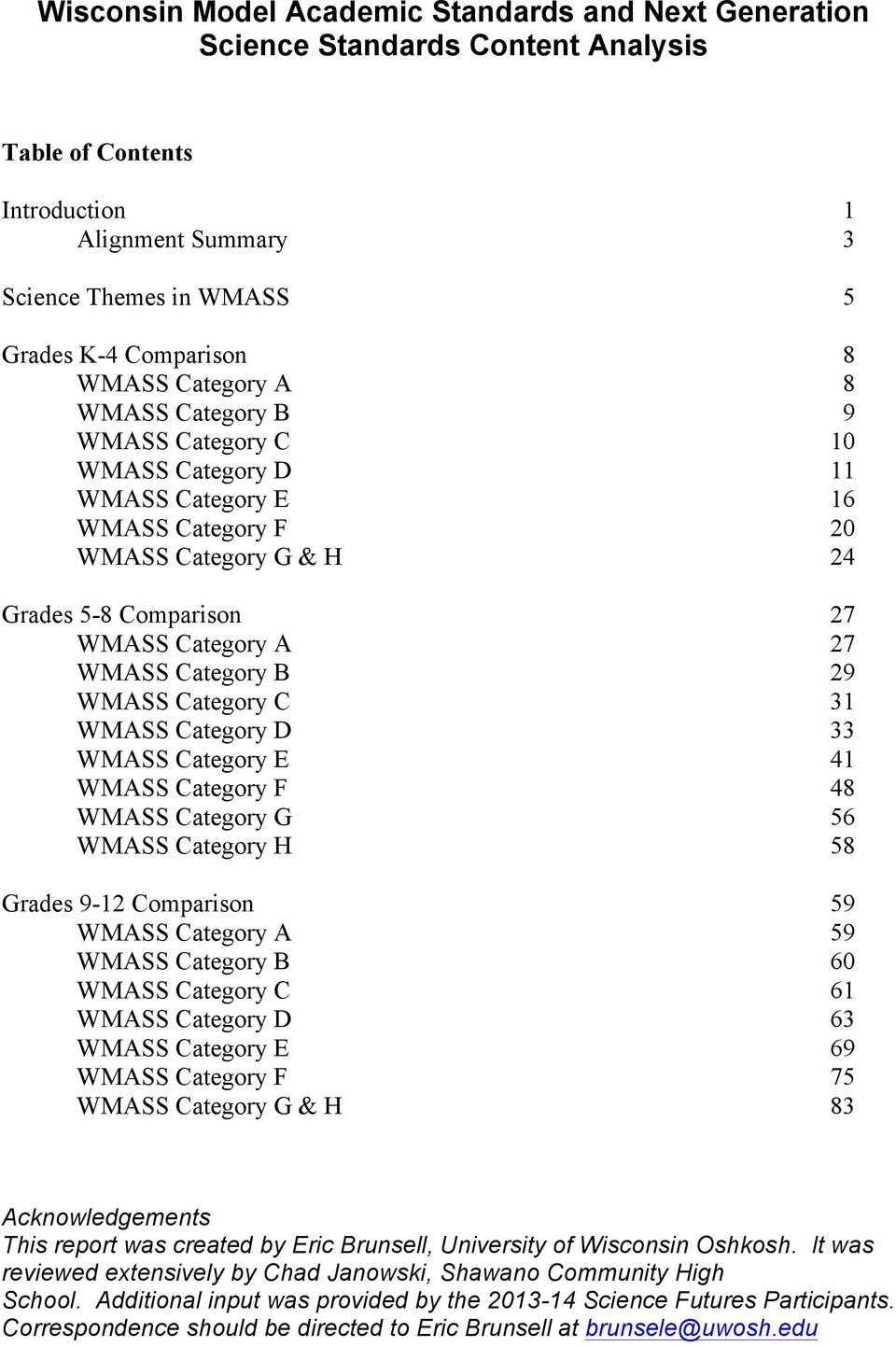
1 Wisconsin Model Academic Standards and Next Generation Science Standards Content Analysis Table of Contents Introduction 1 Alignment Summary 3 Science Themes in WMASS 5 Grades K-4 Comparison 8 WMASS Category A 8 WMASS Category B 9 WMASS Category C 10 WMASS Category D 11 WMASS Category E 16 WMASS Category F 20 WMASS Category G & H 24 Grades 5-8 Comparison 27 WMASS Category A 27 WMASS Category B 29 WMASS Category C 31 WMASS Category D 33 WMASS Category E 41 WMASS Category F 48 WMASS Category G 56 WMASS Category H 58 Grades 9-12 Comparison 59 WMASS Category A 59 WMASS Category B 60 WMASS Category C 61 WMASS Category D 63 WMASS Category E 69 WMASS Category F 75 WMASS Category G & H 83 Acknowledgements This report was created by Eric Brunsell, University of Wisconsin Oshkosh. It was reviewed extensively by Chad Janowski, Shawano Community High School. Additional input was provided by the Science Futures Participants. Correspondence should be directed to Eric Brunsell at [email protected]
2 Introduction The Next Generation Science Standards were released in April, 2013 by Achieve, Inc. These standards are a culmination of a comprehensive and transparent development process led by Achieve, Inc., The National Research Council, The National Science Teachers Association, and the American Association for the Advancement of Science. The standards are organized by grade level in elementary (K-5) and by grade band in middle school and high school. For more information, visit: This report provides a content analysis and comparison of the Wisconsin Model Academic Standards for Science and the Next Generation Science Standards. The intent of this report is to assist school districts in Wisconsin in their decision process related to using NGSS for K-12 science curriculum reform. This document is not intended as a checklist. Instead, it is a resources that can be used to develop a K-12 Scope and Sequence, courses and instruction aligned to NGSS with some confidence that this work is consistent with the Wisconsin Model Academic Standards for Science. NGSS Terminology The Next Generation Science Standards are based on the Framework for K-12 Science Education ( published by the National Research Council. The Framework identified three dimensions (Disciplinary Core Ideas, Science and Engineering Practices, and Crosscutting Concepts) that should form the cornerstone of a world-class K-12 science education. This report makes extensive use of the following NGSS terminology. Disciplinary Core Ideas (DCI): The Framework defines the content that is central to science. This content is described by using a small number of Disciplinary Core Ideas that grow in complexity from kindergarten through high school. In addition to traditional science content, NGSS includes disciplinary core ideas related to engineering. [NGSS Appendix E Summarizes the DCIs] 1

3 Science and Engineering Practices (SEP): The Framework defines eight Science and Engineering Practices. These practices describe the skills and associated knowledge that scientists and engineering. These practices provide definition to science inquiry and engineering design activities. In addition, many of the practices are well aligned to the Common Core State Standards English Language Arts Literacy Standards for Science and Technical Fields. Instruction should provide students with opportunities to engage in the practices throughout the school year. [NGSS Appendix F Summarizes the Practices] Crosscutting Concepts (CCC): The Framework and NGSS define seven Crosscutting Concepts. These concepts (e.g. patterns, energy, systems, etc.) provide connections across all science disciplines. Scientists often use these crosscutting concepts as a lens to view and understand science phenomena. Instruction should help students make explicit connections between the crosscutting concepts and the content that they are learning. [NGSS Appendix G Summarizes the Crosscutting Concepts] Nature of Science (NOS): Nature of Science refers to the assumptions and norms that define science as a body of knowledge and as a process. Nature of Science statements are embedded in the Science and Engineering Practices and Crosscutting Concepts. [NGSS Appendix H Summarizes the Crosscutting Concepts] Performance Expectations (PE): The NGSS are written as performance expectations. These performance expectations are not descriptions of activities, but are statements of what students should know and be able to do at the end of instruction. Therefore, the NGSS Performance Expectations provide guidance as to how to assess students. NGSS Performance Expectations integrate disciplinary core ideas, science and engineering practices, and crosscutting concepts. 2

4 Alignment Summary This section of the report provides a brief summary of the Wisconsin Model Academic Standards for Science and Next Generation Science Standards comparison. The remainder of this report provides a detailed comparison. WMASS Category K Science Themes NGSS Meets or Exceeds NGSS Meets or Exceeds NGSS Meets or Exceeds A. Science Connections NGSS Meets or Exceeds NGSS Meets or Exceeds NGSS does not include A12.1 and A12.5 Meets 5 of 7 standards. B. Nature of Science NGSS Meets or Exceeds NGSS Meets or Exceeds NGSS Meets or Exceeds C. Science Inquiry NGSS Meets or Exceeds NGSS Meets or Exceeds NGSS Meets or Exceeds D. Physical Science NGSS Meets or Exceeds NGSS Meets or Exceeds NGSS Meets or Exceeds E. Earth and Space NGSS Meets or Exceeds for 6 of 8 standards. WMASS E.4.1, E.4.2 are not explicitly met by NGSS. However, these two standards can be met by using earth materials as examples during instruction on properties of materials (NGSS Physical Science) NGSS Meets or Exceeds NGSS Meets or Exceeds F. Life and Environmental NGSS Meets or Exceeds NGSS Meets or Exceeds NGSS Meets or Exceeds G. Science Applications See Below See Below See Below H. Science in Personal and Social Perspectives See Below NGSS Meets or Exceeds See Below 3
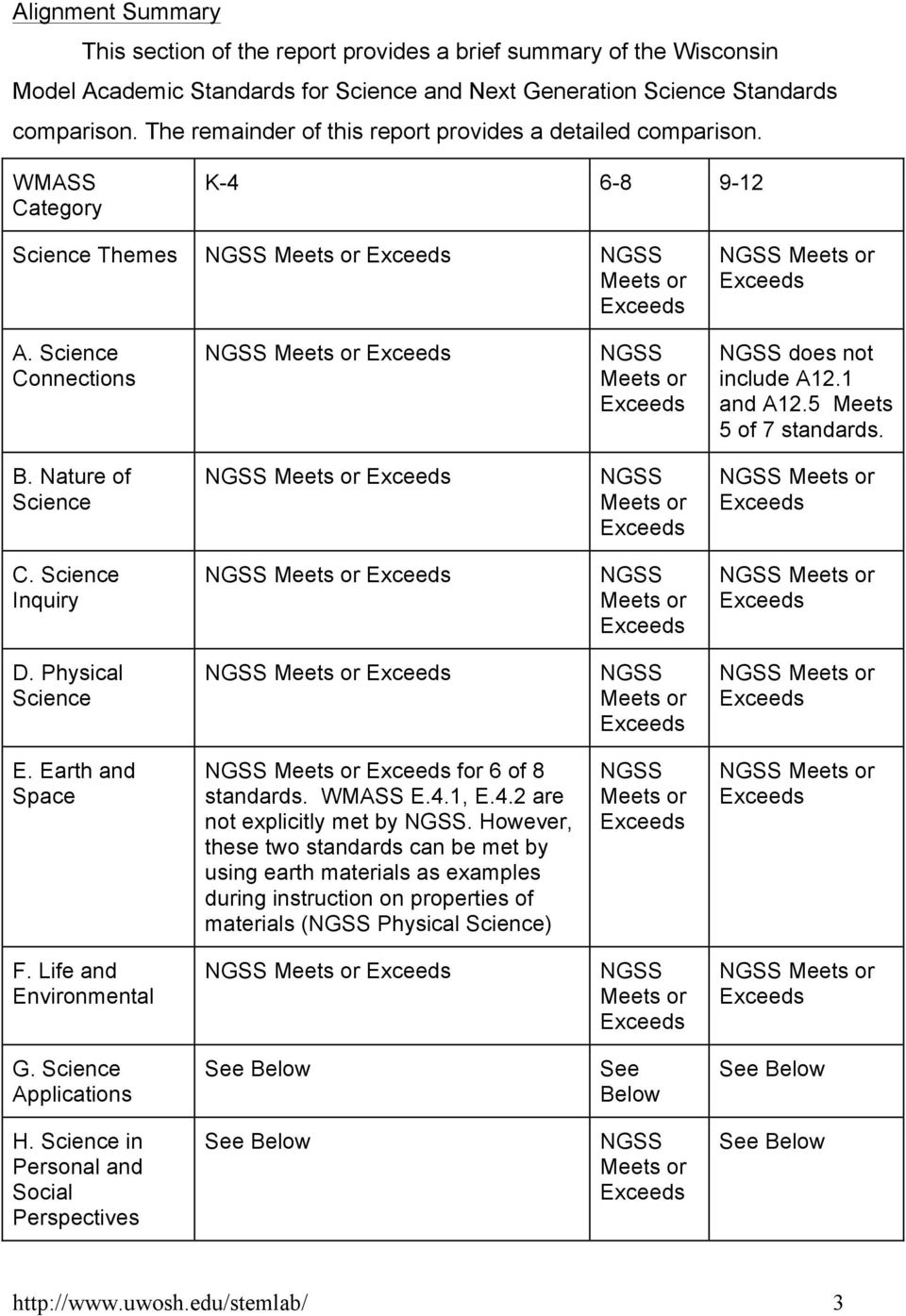
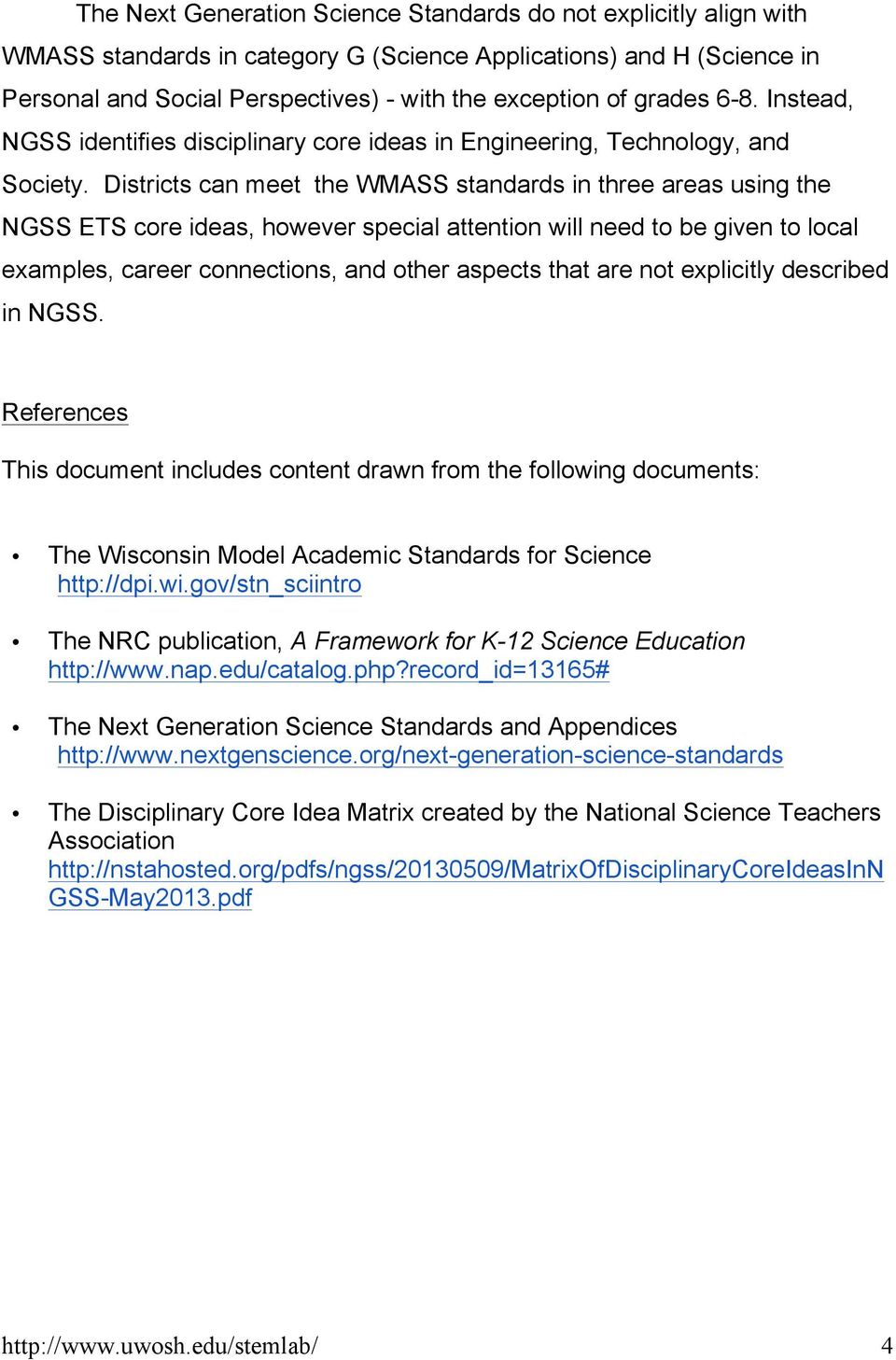
5 The Next Generation Science Standards do not explicitly align with WMASS standards in category G (Science Applications) and H (Science in Personal and Social Perspectives) - with the exception of grades 6-8. Instead, NGSS identifies disciplinary core ideas in Engineering, Technology, and Society. Districts can meet the WMASS standards in three areas using the NGSS ETS core ideas, however special attention will need to be given to local examples, career connections, and other aspects that are not explicitly described in NGSS. References This document includes content drawn from the following documents: The Wisconsin Model Academic Standards for Science The NRC publication, A Framework for K-12 Science Education The Next Generation Science Standards and Appendices The Disciplinary Core Idea Matrix created by the National Science Teachers Association GSS-May2013.pdf 4
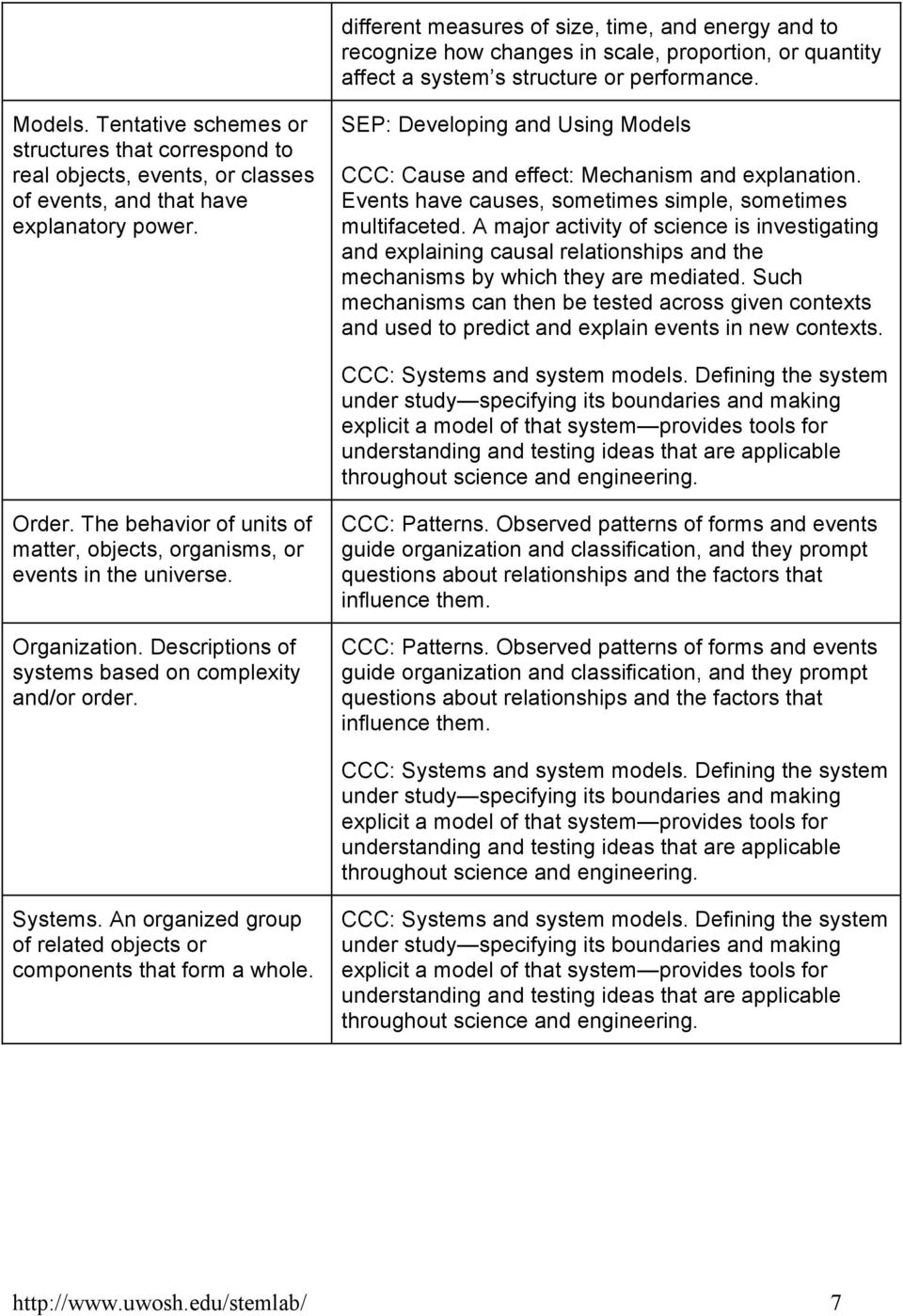
6 Science Themes The Wisconsin Model Academic Standards (WMASS) includes a series of themes that connect or unify the disciplines of science. WMASS describes the themes as follows: Each of the following terms refers to a theme that connects and unifies the many disciplines of science. The themes are found particularly in Standard A and are mentioned consistently throughout the science standards. They are identified with an asterisk (*) each time they appear ( These themes are also evident in the Next Generation Science Standards (NGSS) in two different constructs. Crosscutting Concepts (CCC) identify concepts that connect all science disciplines. They often act as a lens through which scientists and engineers can view phenomena. Some of the themes are encoded in NGSS as Science and Engineering Practices (SEP). NGSS integrates the Practices and Crosscutting Concepts with Disciplinary Core Ideas in each NGSS Performance Expectation. WMASS THEMES Change. A variance in the rate, scale, and pattern, including trends and cycles. NGSS CROSSCUTTING CONCEPTS OR SCIENCE AND ENGINEERING PRACTICES CCC: Patterns. Observed patterns of forms and events guide organization and classification, and they prompt questions about relationships and the factors that influence them. CCC: Cause and effect: Mechanism and explanation. Events have causes, sometimes simple, sometimes multifaceted. A major activity of science is investigating and explaining causal relationships and the mechanisms by which they are mediated. Such mechanisms can then be tested across given contexts and used to predict and explain events in new contexts. CCC: Stability and change. For natural and built systems alike, conditions of stability and determinants of rates of change or evolution of a system are critical 5

7 elements of study. Constancy. The stability of a property, such as the speed of light. Equilibrium. The physical state in which forces and changes occur in opposite and offsetting directions. CCC: Stability and change. For natural and built systems alike, conditions of stability and determinants of rates of change or evolution of a system are critical elements of study. CCC: Cause and effect: Mechanism and explanation. Events have causes, sometimes simple, sometimes multifaceted. A major activity of science is investigating and explaining causal relationships and the mechanisms by which they are mediated. Such mechanisms can then be tested across given contexts and used to predict and explain events in new contexts. CCC: Energy and matter: Flows, cycles, and conservation. Tracking fluxes of energy and matter into, out of, and within systems helps one understand the systems possibilities and limitations. Evidence. Data and documentation that support inferences or conclusions. SEP: Constructing Explanations and Designing Solutions SEP: Engaging in Argument from Evidence Evolution. A series of changes, some gradual and some sporadic, that accounts for the present form and function* of objects. Explanation. The skill of communication in which an interpretation of information is given and stated to others. Form and Function. Complementary aspects of objects, organisms, and systems in the natural world. Measurement. The quantification of changes in systems, including mathematics. CCC: Stability and change. For natural and built systems alike, conditions of stability and determinants of rates of change or evolution of a system are critical elements of study. SEP: Constructing Explanations and Designing Solutions SEP: Engaging in Argument from Evidence CCC: Structure and function. The way in which an object or living thing is shaped and its substructure determine many of its properties and functions. SEP: Planning and Conducting Investigations SEP: Using Mathematics and Computational Thinking CCC: Scale, proportion, and quantity. In considering phenomena, it is critical to recognize what is relevant at 6

8 different measures of size, time, and energy and to recognize how changes in scale, proportion, or quantity affect a system s structure or performance. Models. Tentative schemes or structures that correspond to real objects, events, or classes of events, and that have explanatory power. SEP: Developing and Using Models CCC: Cause and effect: Mechanism and explanation. Events have causes, sometimes simple, sometimes multifaceted. A major activity of science is investigating and explaining causal relationships and the mechanisms by which they are mediated. Such mechanisms can then be tested across given contexts and used to predict and explain events in new contexts. CCC: Systems and system models. Defining the system under study specifying its boundaries and making explicit a model of that system provides tools for understanding and testing ideas that are applicable throughout science and engineering. Order. The behavior of units of matter, objects, organisms, or events in the universe. Organization. Descriptions of systems based on complexity and/or order. CCC: Patterns. Observed patterns of forms and events guide organization and classification, and they prompt questions about relationships and the factors that influence them. CCC: Patterns. Observed patterns of forms and events guide organization and classification, and they prompt questions about relationships and the factors that influence them. CCC: Systems and system models. Defining the system under study specifying its boundaries and making explicit a model of that system provides tools for understanding and testing ideas that are applicable throughout science and engineering. Systems. An organized group of related objects or components that form a whole. CCC: Systems and system models. Defining the system under study specifying its boundaries and making explicit a model of that system provides tools for understanding and testing ideas that are applicable throughout science and engineering. 7
9 K-4 Comparison GRADE K-4 SCIENCE CONNECTIONS (A), NATURE OF SCIENCE (B), SCIENCE INQUIRY (C) NOTE: SEP refers to the Science and Engineering Practices in NGSS, CCC refers to the Crosscutting Concepts in NGSS, NOS refers to the Nature of Science concepts embedded in NGSS, and ETS refers to the grade-band Engineering, Technology, and Science standards in NGSS. These practices and concepts are expected to be developed throughout the school year at each grade level and are integrated with disciplinary core ideas in the NGSS Performance Expectations. Each of these categories includes specific grade-band endpoints to assist in defining and assessing the practice, crosscutting concept, or other concept. SCIENCE CONNECTIONS (A) A.4.1 When conducting science investigations, ask and answer questions that will help decide the general areas of science being addressed SEP: Asking Questions and Defining Problems A.4.2 When faced with a science-related problem, decide what evidence, models, or explanations previously studied can be used to better understand what is happening now SEP: Developing and Using Models SEP: Constructing Explanations and Designing Solutions SEP: Engaging in Argument from Evidence A.4.3 When investigating a science-related problem, decide what data can be collected to determine the most useful explanations SEP: Planning and Carrying Out Investigations SEP: Analyzing and Interpreting Data SEP: Constructing Explanations and Designing Solutions SEP: Engaging in Argument from Evidence A.4.4 When studying science-related NOTE: SEE THE DISCUSSION OF 8

10 problems, decide which of the science themes are important A.4.5 When studying a science-related problem, decide what changes over time are occurring or have occurred SCIENCE THEMES AT THE BEGINNING OF THIS DOCUMENT CCC: Patterns. Observed patterns of forms and events guide organization and classification, and they prompt questions about relationships and the factors that influence them. CCC: Stability and change. For natural and built systems alike, conditions of stability and determinants of rates of change or evolution of a system are critical elements of study. NATURE OF SCIENCE (B) B.4.1 Use encyclopedias, source books, texts, computers, teachers, parents, other adults, journals, popular press, and various other sources, to help answer sciencerelated questions and plan investigations SEP: Asking Questions and Defining Problems SEP: Planning and Carrying Out Investigations SEP: Obtaining, Evaluating, and Communicating Information B.4.2 Acquire information about people who have contributed to the development of major ideas in the sciences and learn about the cultures in which these people lived and worked SEP: Obtaining, Evaluating, and Communicating Information NOS: Science is a Way of Knowing NOS: Science is a Human Endeavor B.4.3 Show* how the major developments of scientific knowledge in the earth and space, life and environmental, and physical sciences have changed over time SEP: Engaging in Argument from Evidence NOS: Scientific Knowledge is Based on Empirical Evidence NOS: Scientific Knowledge is Open to Revision in Light of New Evidence NOS: Scientific Models, Laws, Mechanisms, and Theories Explain Natural Phenomena NOS: Science is a Way of Knowing 9

11 NOS: Science is a Human Endeavor SCIENCE INQUIRY (C) C.4.1 Use the vocabulary of the unifying themes to ask questions about objects, organisms, and events being studied C.4.2 Use the science content being learned to ask questions, plan investigations, make observations, make predictions, and offer explanations SEP: Asking Questions and Defining Problems SEP: Asking Questions and Defining Problems SEP: Planning and Carrying Out Investigations SEP: Analyzing and Interpreting Data SEP: Using Mathematics and Computational Thinking SEP: Constructing Explanations and Designing Solutions NOS: Scientific Investigations Use a Variety of Methods C.4.3 Select multiple sources of information to help answer questions selected for classroom investigations C.4.4 Use simple science equipment safely and effectively, including rulers, balances, graduated cylinders, hand lenses, thermometers, and computers, to collect data relevant to questions and investigations SEP: Engaging in Argument from Evidence SEP: Obtaining, Evaluating, and Communicating Information SEP: Planning and Carrying Out Investigations NOS: Scientific Investigations Use a Variety of Methods C.4.5 Use data they have collected to develop explanations and answer questions generated by investigations SEP: Developing and Using Models SEP: Analyzing and Interpreting Data SEP: Using Mathematics and Computational Thinking SEP: Constructing Explanations and Designing Solutions 10

12 SEP: Engaging in Argument from Evidence C.4.6 Communicate the results of their investigations in ways their audiences will understand by using charts, graphs, drawings, written descriptions, and various other means, to display their answers SEP: Constructing Explanations and Designing Solutions SEP: Engaging in Argument from Evidence SEP: Obtaining, Evaluating, and Communicating Information C.4.7 Support their conclusions with logical arguments SEP: Constructing Explanations and Designing Solutions SEP: Engaging in Argument from Evidence C.4.8 Ask additional questions that might help focus or further an investigation SEP: Asking Questions and Defining Problems GRADE K-4: PHYSICAL SCIENCE (D) Note: Performance expectations in NGSS are described in grade-levels in K-5. This crosswalk includes the disciplinary core ideas for grades K-4. PROPERTIES OF EARTH MATERIALS D.4.1 Understand that objects are made of more than one substance, by observing, describing and measuring the properties of earth materials, including properties of size, weight, shape, color, temperature, and the ability to react with other substances Different kinds of matter exist and many of them can be either solid or liquid, depending on temperature. Matter can be described and classified by its observable properties. (2- PS1-1) Different properties are suited to different purposes. (2-PS1-2),(2-PS1-3) A great variety of objects can be built up from a small set of pieces. (2-PS1-3) D.4.2 Group and/or classify objects and substances based on the properties of earth materials Different kinds of matter exist and many of them can be either solid or liquid, depending on temperature. Matter can be described and classified by its observable properties. (2- PS1-1) 11

13 Different properties are suited to different purposes. (2-PS1-2),(2-PS1-3) D.4.3. Understand that substances can exist in different states-solid, liquid, gas Different kinds of matter exist and many of them can be either solid or liquid, depending on temperature. Matter can be described and classified by its observable properties. (2- PS1-1) D.4.4 Observe and describe changes in form, temperature, color, speed, and direction of objects and construct explanations for the changes Heating or cooling a substance may cause changes that can be observed. Sometimes these changes are reversible, and sometimes they are not. (2-PS1-4) Pushing or pulling on an object can change the speed or direction of its motion and can start or stop it. (K-PS2-1),(K-PS2-2) When objects touch or collide, they push on one another and can change motion. (K- PS2-1) The patters of an object s motion in various situations can be observed and measured; when that past motion exhibits a regular pattern, future motion can be predicted from it. (3-PS2-2) D.4.5 Construct simple models of what is happening to materials and substances undergoing change, using simple instruments or tools to aid observations and collect data Heating or cooling a substance may cause changes that can be observed. Sometimes these changes are reversible, and sometimes they are not. (2-PS1-4) The patters of an object s motion in various situations can be observed and measured; when that past motion exhibits a regular pattern, future motion can be predicted from it. (3-PS2-2) POSITION AND MOTION OF OBJECTS D.4.6 Observe and describe physical events in objects at rest or in motion Pushing or pulling on an object can change the speed or direction of its motion and can start or stop it. (K-PS2-1),(K-PS2-2) Pushes and pulls can have different strengths and directions. (KPS2-1),(K-PS2-2) 12

14 The patterns of an object s motion in various situations can be observed and measured; when that past motion exhibits a regular pattern, future motion can be predicted from it. (Boundary: Technical terms, such as magnitude, velocity, momentum, and vector quantity, are not introduced at this level, but the concept that some quantities need both size and direction to be described is developed.) (3-PS2-2) D.4.7 Observe and describe physical events involving objects and develop record-keeping systems to follow these events by measuring and describing changes in their properties, including: position relative to another object, motion over time, and position due to forces Pushing or pulling on an object can change the speed or direction of its motion and can start or stop it. (K-PS2-1),(K-PS2-2) When objects touch or collide, they push on one another and can change motion. (K- PS2-1) Pushes and pulls can have different strengths and directions. (KPS2-1),(K-PS2-2) A bigger push or pull makes things go faster. (secondary to K-PS2-1) Pushes and pulls can have different strengths and directions. (KPS2-1),(K-PS2-2) The patterns of an object s motion in various situations can be observed and measured; when that past motion exhibits a regular pattern, future motion can be predicted from it. (Boundary: Technical terms, such as magnitude, velocity, momentum, and vector quantity, are not introduced at this level, but the concept that some quantities need both size and direction to be described is developed.) (3-PS2-2) Each force acts on one particular object and has both strength and a direction. An object at rest typically has multiple forces acting on it, but they add to give zero net force on the object. Forces that do not sum to zero can cause changes in the object s speed or direction of motion. (Boundary: Qualitative and conceptual, but not quantitative addition 13

15 of forces are used at this level.) (3-PS2-1) Objects in contact exert forces on each other. (3-PS2-1) Electric, and magnetic forces between a pair of objects do not require that the objects be in contact. The sizes of the forces in each situation depend on the properties of the objects and their distances apart and, for forces between two magnets, on their orientation relative to each other. (3-PS2-3),(3-PS2-4) LIGHT, HEAT, ELECTRICITY, AND MAGNETISM D.4.8 Ask questions and make observations to discover the differences between substances that can be touched (matter) and substances that cannot be touched (forms of energy, light, heat, electricity, sound, and magnetism) Sound can make matter vibrate, and vibrating matter can make sound. (1-PS4-1) Objects can be seen only when light is available to illuminate them. Some objects give off their own light. (1-PS4-2) Some materials allow light to pass through them, others allow only some light through and others block all the light and create a dark shadow on any surface beyond them, where the light cannot reach. Mirrors can be used to redirect a light beam. (Boundary: The idea that light travels from place to place is developed through experiences with light sources, mirrors, and shadows, but no attempt is made to discuss the speed of light.) (1-PS4-3) People also use a variety of devices to communicate (send and receive information) over long distances. (1-PS4-4) People also use a variety of devices to communicate (send and receive information) over long distances. (1-PS4-4) Electric, and magnetic forces between a pair of objects do not require that the objects be in contact. The sizes of the forces in each situation depend on the properties of the 14

16 objects and their distances apart and, for forces between two magnets, on their orientation relative to each other. (3-PS2-3),(3-PS2-4) The faster a given object is moving, the more energy it possesses. (4-PS3-1) Energy can be moved from place to place by moving objects or through sound, light, or electric currents. (4-PS3-2),(4-PS3-3) Energy is present whenever there are moving objects, sound, light, or heat. When objects collide, energy can be transferred from one object to another, thereby changing their motion. In such collisions, some energy is typically also transferred to the surrounding air; as a result, the air gets heated and sound is produced. (4-PS3-2),(4- PS3-3) Light also transfers energy from place to place. (4-PS3-2) Energy can also be transferred from place to place by electric currents, which can then be used locally to produce motion, sound, heat, or light. The currents may have been produced to begin with by transforming the energy of motion into electrical energy. (4- PS3-2),(4-PS3-4) When objects collide, the contact forces transfer energy so as to change the objects motions. (4-PS3-3) The expression produce energy typically refers to the conversion of stored energy into a desired form for practical use. (4-PS3-4) Waves, which are regular patterns of motion, can be made in water by disturbing the surface. When waves move across the surface of deep water, the water goes up and down in place; it does not move in the direction of the wave except when the water meets the beach. (Note: This grade band 15

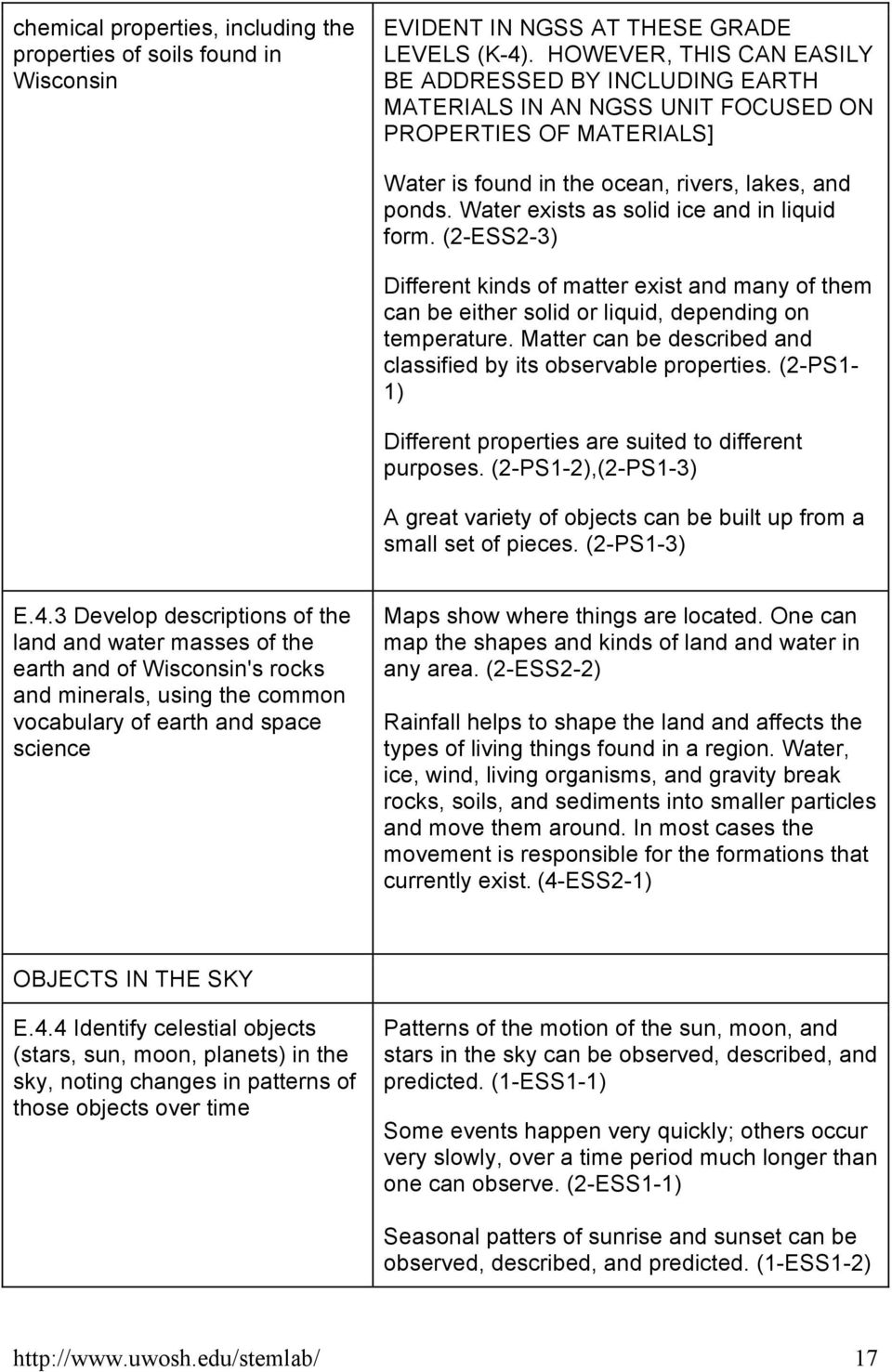
17 endpoint was moved from K 2.) (4-PS4-1) Waves of the same type can differ in amplitude (height of the wave) and wavelength (spacing between wave peaks). (4-PS4-1) An object can be seen when light reflected from its surface enters the eyes. (4-PS4-2) Digitized information transmitted over long distances without significant degradation. High-tech devices, such as computers or cell phones, can receive and decode information convert it from digitized form to voice and vice versa. (4-PS4-3) GRADE K-4: Earth / Space Science Note: Performance expectations in NGSS are described in grade-levels in K-5. This crosswalk includes the disciplinary core ideas for grades K-4. PROPERTIES OF EARTH MATERIALS E.4.1 Investigate that earth materials are composed of rocks and soils and correctly use the vocabulary for rocks, minerals, and soils during these investigations [NOTE: WITH THE EXCEPTION OF WATER, EARTH MATERIALS IS NOT STRONGLY EVIDENT IN NGSS AT THESE GRADE LEVELS (K-4). HOWEVER, THIS CAN EASILY BE ADDRESSED BY INCLUDING EARTH MATERIALS IN AN NGSS UNIT FOCUSED ON PROPERTIES OF MATERIALS] Different kinds of matter exist and many of them can be either solid or liquid, depending on temperature. Matter can be described and classified by its observable properties. (2-PS1-1) Different properties are suited to different purposes. (2-PS1-2),(2-PS1-3) A great variety of objects can be built up from a small set of pieces. (2-PS1-3) E.4.2 Show that earth materials have different physical and [NOTE: WITH THE EXCEPTION OF WATER, EARTH MATERIALS IS NOT STRONGLY 16

18 chemical properties, including the properties of soils found in Wisconsin EVIDENT IN NGSS AT THESE GRADE LEVELS (K-4). HOWEVER, THIS CAN EASILY BE ADDRESSED BY INCLUDING EARTH MATERIALS IN AN NGSS UNIT FOCUSED ON PROPERTIES OF MATERIALS] Water is found in the ocean, rivers, lakes, and ponds. Water exists as solid ice and in liquid form. (2-ESS2-3) Different kinds of matter exist and many of them can be either solid or liquid, depending on temperature. Matter can be described and classified by its observable properties. (2-PS1-1) Different properties are suited to different purposes. (2-PS1-2),(2-PS1-3) A great variety of objects can be built up from a small set of pieces. (2-PS1-3) E.4.3 Develop descriptions of the land and water masses of the earth and of Wisconsin's rocks and minerals, using the common vocabulary of earth and space science Maps show where things are located. One can map the shapes and kinds of land and water in any area. (2-ESS2-2) Rainfall helps to shape the land and affects the types of living things found in a region. Water, ice, wind, living organisms, and gravity break rocks, soils, and sediments into smaller particles and move them around. In most cases the movement is responsible for the formations that currently exist. (4-ESS2-1) OBJECTS IN THE SKY E.4.4 Identify celestial objects (stars, sun, moon, planets) in the sky, noting changes in patterns of those objects over time Patterns of the motion of the sun, moon, and stars in the sky can be observed, described, and predicted. (1-ESS1-1) Some events happen very quickly; others occur very slowly, over a time period much longer than one can observe. (2-ESS1-1) Seasonal patters of sunrise and sunset can be observed, described, and predicted. (1-ESS1-2) 17
19 CHANGES IN THE EARTH AND SKY E.4.5 Describe the weather commonly found in Wisconsin in terms of clouds, temperature, humidity, and forms of precipitation, and the changes that occur over time, including seasonal changes Sunlight warms Earth s surface. (K-PS3-1),(K- PS3-2) Weather is the combination of sunlight, wind, snow or rain, and temperature in a particular region at a particular time. People measure these conditions to describe and record the weather and to notice patterns over time. (K- ESS2-1) Scientists record patterns of the weather across different times and areas so that they can make predictions about what kind of weather might happen next. (3-ESS2-1) Climate describes a range of an area's typical weather conditions and the extent to which those conditions vary over years. (3-ESS2-2) A variety of natural hazards result from natural processes. Humans cannot eliminate natural hazards but can take steps to reduce their impacts. (3-ESS3-1) (Note: This Disciplinary Core Idea is also addressed by 4-ESS3-2.) Some events happen very quickly; others occur very slowly, over a time period much longer than one can observe. (2-ESS1-1) [In terms of changes on Earth s surface] Wind and water can change the shape of the land. (2-ESS2-1) Rainfall helps to shape the land and affects the types of living things found in a region. Water, ice, wind, living organisms, and gravity break rocks, soils, and sediments into smaller particles and move them around. (4-ESS2-1) E.4.6 Using the science themes, find patterns and cycles in the earth's daily, yearly, and longterm changes Patterns of the motion of the sun, moon, and stars in the sky can be observed, described, and predicted. (1-ESS1-1) Seasonal patterns of sunrise and sunset can be 18

20 observed, described, and predicted. (1-ESS1-2) Climate describes a range of an area's typical weather conditions and the extent to which those conditions vary over years. (3-ESS2-2) E.4.7 Using the science themes, describe resources used in the home, community, and nation as a whole Living things need water, air, and resources from the land, and they live in places that have the things they need. Humans use natural resources for everything they do. (K-ESS3-1) Things that people do to live comfortably can affect the world around them. But they can make choices that reduce their impacts on the land, water, air, and other living things. (K- ESS3-3) (secondary to K-ESS2-2) Energy and fuels that humans use are derived from natural sources, and their use affects the environment in multiple ways. Some resources are renewable over time, and others are not. (4- ESS3-1) E.4.8 Illustrate human resources use in mining, forestry, farming, and manufacturing in Wisconsin and elsewhere in the world Living things need water, air, and resources from the land, and they live in places that have the things they need. Humans use natural resources for everything they do. (K-ESS3-1) Things that people do to live comfortably can affect the world around them. But they can make choices that reduce their impacts on the land, water, air, and other living things. (K- ESS3-3) (secondary to K-ESS2-2) Energy and fuels that humans use are derived from natural sources, and their use affects the environment in multiple ways. Some resources are renewable over time, and others are not. (4- ESS3-1) Not Evident Local, regional, and global patterns of rock formations reveal changes over time due to earth forces, such as earthquakes. The presence and location of certain fossil types indicate the order in which rock layers were formed. (4-ESS1-1) Some events happen very quickly; others 19

21 occur very slowly, over a time period much longer than one can observe. (2-ESS1-1) [In terms of changes on Earth s surface] The locations of mountain ranges, deep ocean trenches, ocean floor structures, earthquakes, and volcanoes occur in patterns. Most earthquakes and volcanoes occur in bands that are often along the boundaries between continents and oceans. Major mountain chains form inside continents or near their edges. Maps can help locate the different land and water features areas of Earth. (4-ESS2-2) Grades K-4: LIFE SCIENCE Note: Performance expectations in NGSS are described in grade-levels in K-5. This crosswalk includes the disciplinary core ideas for grades K-4. THE CHARACTERISTICS OF ORGANISMS F.4.1 Discover* how each organism meets its basic needs for water, nutrients, protection, and energy* in order to survive Living things need water, air, and resources from the land, and they live in places that have the things they need. Humans use natural resources for everything they do. (K-ESS3-1) All organisms have external parts. Different animals use their body parts in different ways to see, hear, grasp objects, protect themselves, move from place to place, and seek, find, and take in food, water and air. Plants also have different parts (roots, stems, leaves, flowers, fruits) that help them survive and grow. (1-LS1-1) Adult plants and animals can have young. In many kinds of animals, parents and the offspring themselves engage in behaviors that help the offspring to survive. (1-LS1-2) All animals need food in order to live and grow. They obtain their food from plants or from other animals. Plants need water and light to live and grow. (K-LS1-1) Plants depend on water and light to grow. (2-LS
22 1) Being part of a group helps animals obtain food, defend themselves, and cope with changes. Groups may serve different functions and vary dramatically in size (Note: Moved from K 2). (3- LS2-1) Plants and animals have both internal and external structures that serve various functions in growth, survival, behavior, and reproduction. (4-LS1-1) Sometimes the differences in characteristics between individuals of the same species provide advantages in surviving, finding mates, and reproducing. (3-LS4-2) For any particular environment, some kinds of organisms survive well, some survive less well, and some cannot survive at all. (3-LS4-3) F.4.2 Investigate* how organisms, especially plants, respond to both internal cues (the need for water) and external cues (changes in the environment) Animals have body parts that capture and convey different kinds of information needed for growth and survival. Animals respond to these inputs with behaviors that help them survive. Plants also respond to some external inputs. (1-LS1-1) Plants and animals have both internal and external structures that serve various functions in growth, survival, behavior and reproductions (4-LS1-1) Being part of a group helps animals obtain food, defend themselves, and cope with changes. Groups may serve different functions and vary dramatically in size (Note: Moved from K 2). (3- LS2-1) Different sense receptors are specialized for particular kinds of information, which may be then processed by the animal s brain. Animals are able to use their perceptions and memories to guide their actions. (4-LS1-2) LIFE CYCLES OF ORGANISMS F.4.3 Illustrate* the different ways that organisms grow through life stages and survive to produce new members of their type Adult plants and animals can have young. In many kinds of animals, parents and the offspring themselves engage in behaviors that help the offspring to survive. (1-LS1-2) 21
23 Plants depend on animals for pollination or to move their seeds around. (2-LS2-2) Young animals are very much, but not exactly, like, their parents. Plants also are very much, but not exactly, like their parents. (1-LS3-1) Individuals of the same kind of plant or animal are recognizable as similar but can also vary in many ways. (1-LS3-1) Reproduction is essential to the continued existence of every kind of organism. Plants and animals have unique and diverse life cycles. (3- LS1-1) Many characteristics of organisms are inherited from their parents. (3-LS3-1) Other characteristics result from individuals interactions with the environment, which can range from diet to learning. Many characteristics involve both inheritance and environment. (3-LS3-2) ORGANISMS AND THEIR ENVIRONMENT F.4.4 Using the science themes*, develop explanations* for the connections among living and nonliving things in various environments There are many different kinds of living things in any area, and they exist in different places on land and in water. (2-LS4-1) All animals need food in order to live and grow. They obtain their food from plants or from other animals. Plants need water and light to live and grow. (K-LS1-1) Plants depend on water and light to grow. (2-LS2-1) Plants depend on animals for pollination or to move their seeds around (2-LS2-2) Being part of a group helps animals obtain food, defend themselves, and cope with changes. Groups may serve different functions and vary dramatically in size (Note: Moved from K-2). (3- LS2-1) 22
24 Plants and animals can change their environment. (K-ESS2-2) Living things need water, air, and resources from the land, and they live in places that have the things they need. Humans use natural resources for everything they do. (K-ESS3-1) Other characteristics result from individuals interactions with the environment, which can range from diet to learning. Many characteristics involve both inheritance and environment. (3-LS3-2) Different organisms vary in how they look and function because they have different inherited information. (3-LS3-1) The environment also affects the traits that an organism develops. (3-LS3-2) When the environment changes in ways that affect a place s physical characteristics, temperature, or availability of resources, some organisms survive and reproduce, others move to new locations, yet others move into the transformed environment, and some die. (secondary to 3-LS4-4) Populations live in a variety of habitats, and change in those habitats affects the organisms living there. (3-LS4-4) For any particular environment, some kinds of organisms survive well, some survive less well, and some cannot survive at all. (3-LS4-3) Living things affect the physical characteristics of their regions. (4-ESS2-1) NOT EVIDENT Some kinds of plants and animals that once lived on Earth are no longer found anywhere. (Note: moved from K-2) (3-LS4-1) Fossils provide evidence about the types of organisms that lived long ago and also about the nature of their environments. (3-LS4-1) 23
25 GRADE K-4 SCIENCE APPLICATIONS (G), SCIENCE IN PERSONAL AND SOCIAL PERSPECTIVES (H) These two standards categories in the Wisconsin Model Academic Standards for Science are highly localized to science, technology, and engineering at the state or local level. These connections are not explicitly addressed in the Next Generation Science Standards. However, NGSS does include three Disciplinary Core Ideas in Engineering, Technology and Society. These core ideas are embedded throughout the performance expectations in NGSS. Additionally, grade-band endpoints are defined in NGSS to provide guidance for assessment. More information can be found in NGSS Appendix I and J. NGSS Core Idea: Engineering Design Engineering Design in NGSS is defined as follows for early elementary students: ETS1.A: Defining and Delimiting Engineering Problems o A situation that people want to change or create can be approached as a problem to be solved through engineering. (K-2-ETS1-1) o Asking questions, making observations, and gathering information are helpful in thinking about problems. (K-2-ETS1-1) o Before beginning to design a solution, it is important to clearly understand the problem. (K-2-ETS1-1) ETS1.B: Developing Possible Solutions o Designs can be conveyed through sketches, drawings, or physical models. These representations are useful in communicating ideas for a problem s solutions to other people. (K-2-ETS1-2) ETS1.C: Optimizing the Design Solution o Because there is always more than one possible solution to a problem, it is useful to compare and test designs. (K-2-ETS1-3) 24
26 NGSS Core Idea: The Interdependence of Science, Engineering, and Technology The fields of science and engineering are mutually supportive, and scientists and engineers often work together in teams, especially in fields at the borders of science and engineering. Advances in science offer new capabilities, new materials, or new understanding of processes that can be applied through engineering to produce advances in technology. Advances in technology, in turn, provide scientists with new capabilities to probe the natural world at larger or smaller scales; to record, manage, and analyze data; and to model ever more complex systems with greater precision. In addition, engineers efforts to develop or improve technologies often raise new questions for scientists investigations. (NRC, 2012, p. 203) NGSS Core Idea: The Influence of Science, Engineering and Technology on Society and the Natural World Together, advances in science, engineering, and technology can have and indeed have had profound effects on human society, in such areas as agriculture, transportation, health care, and communication, and on the natural environment. Each system can change significantly when new technologies are introduced, with both desired effects and unexpected outcomes. (NRC, 2012, p. 210). While using NGSS to plan instruction, WMASS categories G and H can be met by identifying and emphasizing STEM industry connections in Wisconsin and/or in the school community. Special attention should be given to: Science Applications (WMASS G) G.4.1 Identify* the technology used by someone employed in a job or position in Wisconsin and explain* how the technology helps G.4.2 Discover* what changes in technology have occurred in a career chosen by a parent, grandparent, or an adult friend over a long period of time 25
27 G.4.3 Determine what science discoveries have led to changes in technologies that are being used in the workplace by someone employed locally G.4.4 Identify* the combinations of simple machines in a device used in the home, the workplace, or elsewhere in the community, to make or repair things, or to move goods or people G.4.5 Ask questions to find answers about how devices and machines were invented and produced Science in Personal and Social Perspectives (WMASS H) H.4.1 Describe* how science and technology have helped, and in some cases hindered, progress in providing better food, more rapid information, quicker and safer transportation, and more effective health care H.4.2 Using the science themes*, identify* local and state issues that are helped by science and technology and explain* how science and technology can also cause a problem H.4.3 Show* how science has contributed to meeting personal needs, including hygiene, nutrition, exercise, safety, and health care H.4.4 Develop* a list of issues that citizens must make decisions about and describe* a strategy for becoming informed about the science behind these issues 26
28 Grades 5-8 Alignment GRADE 5-8 SCIENCE CONNECTIONS (A), NATURE OF SCIENCE (B), SCIENCE INQUIRY (C) NOTE: SEP refers to the Science and Engineering Practices in NGSS, CCC refers to the Crosscutting Concepts in NGSS, NOS refers to the Nature of Science concepts embedded in NGSS, and ETS refers to the grade-band Engineering, Technology, and Science standards in NGSS. These practices and concepts are expected to be developed throughout the school year at each grade level and are integrated with disciplinary core ideas in the NGSS Performance Expectations. Each of these categories includes specific grade-band endpoints to assist in defining and assessing the practice, crosscutting concept, or other concept. SCIENCE CONNECTIONS (A) A.8.1 Develop their understanding of the science themes by using the themes to frame questions about science-related issues and problems SEP: Asking questions (for science) and defining problems (for engineering) SEP: Obtaining, evaluating, and communicating information A.8.2 Describe limitations of science systems and give reasons why specific science themes are included in or excluded from those systems SEP: Asking questions (for science) and defining problems (for engineering) SEP: Obtaining, evaluating, and communicating information SEP: Engaging in Argument from Evidence NOS: Scientific Investigations Use a Variety of Methods A.8.3 Defend explanations and models by collecting and organizing evidence that supports them and critique explanations and models by collecting and organizing evidence that conflicts with them SEP: Developing and using models SEP: Planning and carrying out investigations SEP: Constructing explanations (for science) and designing solutions (for 27
29 engineering) SEP: Engaging in argument from evidence A.8.4 Collect evidence to show that models developed as explanations for events were (and are) based on the evidence available to scientists at the time SEP: Developing and using models SEP: Analyzing and interpreting data SEP: Using mathematics and computational thinking SEP: Constructing explanations (for science) and designing solutions (for engineering) SEP: Engaging in argument from evidence NOS: Scientific Investigations Use a Variety of Methods A.8.5 Show how models and explanations, based on systems, were changed as new evidence accumulated (the effects of constancy, evolution, change, and measurement should all be part of these explanations) SEP: Developing and using models SEP: Engaging in argument from evidence NOS: Scientific Knowledge is Open to Revision in Light of New Evidence A.8.6 Use models and explanations to predict actions and events in the natural world SEP: Developing and using models SEP: Constructing explanations (for science) and designing solutions (for engineering) NOS: Scientific Models, Laws, Mechanisms, and Theories Explain Natural Phenomena A.8.7 Design real or thought investigations to test the usefulness and limitations of a model SEP: Planning and carrying out investigations SEP: Developing and Using Models 28
30 A.8.8. Use the themes of evolution, equilibrium, and energy to predict future events or changes in the natural world CCC: Stability and change. For natural and built systems alike, conditions of stability and determinants of rates of change or evolution of a system are critical elements of study CCC: Energy and matter: Flows, cycles, and conservation. Tracking fluxes of energy and matter into, out of, and within systems helps one understand the systems possibilities and limitations. NATURE OF SCIENCE (B) B.8.1 Describe how scientific knowledge and concepts have changed over time in the earth and space, life and environmental, and physical sciences NOS: Scientific Knowledge is Based on Empirical Evidence NOS: Scientific Knowledge is Open to Revision in Light of New Evidence NOS: Scientific Models, Laws, Mechanisms, and Theories Explain Natural Phenomena NOS: Science is a Way of Knowing NOS: Science is a Human Endeavor B.8.2 Identify and describe major changes that have occurred over in conceptual models and explanations in the earth and space, life and environmental, and physical sciences and identify the people, cultures, and conditions that led to these developments NOS: Scientific Knowledge is Based on Empirical Evidence NOS: Scientific Knowledge is Open to Revision in Light of New Evidence NOS: Scientific Models, Laws, Mechanisms, and Theories Explain Natural Phenomena NOS: Science is a Way of Knowing NOS: Science is a Human Endeavor B.8.3 Explain how the general rules of science apply to the development and use of evidence in science investigations, model-making, and SEP: Engaging in argument from evidence NOS: Scientific Investigations Use a 29
31 applications Variety of Methods NOS: Scientific Knowledge is Based on Empirical Evidence NOS: Scientific Knowledge is Open to Revision in Light of New Evidence NOS: Scientific Models, Laws, Mechanisms, and Theories Explain Natural Phenomena NOS: Science is a Way of Knowing NOS: Science is a Human Endeavor B.8.4 Describe types of reasoning and evidence used outside of science to draw conclusions about the natural world SEP: Engaging in argument from evidence NOS: Science is a Way of Knowing NOS: Science is a Human Endeavor B.8.5 Explain ways in which science knowledge is shared, checked, and extended, and show how these processes change over time SEP: Engaging in argument from evidence SEP: Obtaining, evaluating, and communicating information NOS: Science is a Way of Knowing NOS: Scientific Knowledge is Open to Revision in Light of New Evidence NOS: Science is a Human Endeavor B.8.6 Explain the ways in which scientific knowledge is useful and also limited when applied to social issues SEP: Obtaining, evaluating, and communicating information NOS: Science Addresses Questions About the Natural and Materials World 30
32 SCIENCE INQUIRY (C) C.8.1 Identify* questions they can investigate* using resources and equipment they have available SEP: Asking questions (for science) and defining problems (for engineering) C.8.2 Identify* data and locate sources of information including their own records to answer the questions being investigated SEP: Planning and carrying out investigations SEP: Obtaining, evaluating, and communicating information C.8.3 Design and safely conduct investigations* that provide reliable quantitative or qualitative data, as appropriate, to answer their questions C.8.4 Use inferences* to help decide possible results of their investigations, use observations to check their inferences SEP: Planning and carrying out investigations SEP: Analyzing and interpreting data SEP: Using mathematics and computational thinking SEP: Constructing explanations (for science) and designing solutions (for engineering) SEP: Engaging in argument from evidence C.8.5 Use accepted scientific knowledge, models*, and theories* to explain* their results and to raise further questions about their investigations* SEP: Developing and using models SEP: Asking Questions (for science) and Defining Problems (for engineering) SEP: Constructing explanations (for science) and designing solutions (for engineering) SEP: Engaging in argument from evidence SEP: Obtaining, evaluating, and communicating information 31
33 C.8.6 State what they have learned from investigations*, relating their inferences* to scientific knowledge and to data they have collected SEP: Developing and using models SEP: Constructing explanations (for science) and designing solutions (for engineering) SEP: Engaging in argument from evidence SEP: Obtaining, evaluating, and communicating information C.8.7 Explain* their data and conclusions in ways that allow an audience to understand the questions they selected for investigation* and the answers they have developed SEP: Developing and using models SEP: Constructing explanations (for science) and designing solutions (for engineering) SEP: Engaging in argument from evidence SEP: Obtaining, evaluating, and communicating information C.8.8 Use computer software and other technologies to organize, process, and present their data SEP: Analyzing and interpreting data SEP: Using mathematics and computational thinking SEP: Obtaining, evaluating, and communicating information C.8.9 Evaluate*, explain*, and defend the validity of questions, hypotheses, and conclusions to their investigations* SEP: Asking questions (for science) and defining problems (for engineering) SEP: Constructing explanations (for science) and designing solutions (for engineering) SEP: Engaging in argument from evidence C.8.10 Discuss the importance of their results and implications of their work with peers, teachers, and SEP: Engaging in argument from evidence 32
34 other adults SEP: Obtaining, evaluating, and communicating information C.8.11 Raise further questions which still need to be answered SEP: Asking questions (for science) and defining problems (for engineering) GRADE 5-8: PHYSICAL SCIENCE (D) Note: In NGSS, grades K-5 performance expectations are described by grade level, while performance expectations in grades 6-8 are described in the middle school grade band. This crosswalk includes the disciplinary core ideas for both grade 5 and the middle school grade band. PROPERTIES AND CHANGES OF PROPERTIES IN MATTER D.8.1 Observe, describe, and measure physical and chemical properties of elements and other substances to identify and group them according to properties such as density, melting points, boiling points, conductivity, magnetic attraction, solubility, and reactions to common physical and chemical tests Measurements of a variety of properties can be used to identify materials. (Boundary: At this grade level, mass and weight are not distinguished, and no attempt is made to define the unseen particles or explain the atomic-scale mechanism of evaporation and condensation.) (5-PS1-3) When two or more different substances are mixed, a new substance with different properties may be formed. (5-PS1-4) Substances are made from different types of atoms, which combine with one another in various ways. Atoms form molecules that range in size from two to thousands of atoms. (MS-PS1-1) Each pure substance has characteristic physical and chemical properties (for any bulk quantity under given conditions) that can be used to identify it. (MS-PS1-2), (MS-PS1-3) D.8.2 Use the major ideas of atomic theory and molecular theory to describe physical and chemical interactions among Matter of any type can be subdivided into particles that are too small to see, but even then the matter still exists and can be 33
35 substances, including solids, liquids, and gases detected by other means. A model shows that gases are made from matter particles that are too small to see and are moving freely around in space can explain many observations, including the inflation and shape of a balloon; the effects of air on larger particles or objects. (5-PS1-1) The amount (weight) of matter is conserved when it changes form, even in transitions in which it seems to vanish. (5-PS1-2) Substances are made from different types of atoms, which combine with one another in various ways. Atoms form molecules that range in size from two to thousands of atoms. (MS-PS1-1) Gases and liquids are made of molecules or inert atoms that are moving about relative to each other. (MS-PS1-4) In a liquid, the molecules are constantly in contact with others; in a gas, they are widely spaced except when they happen to collide. In a solid, atoms are closely spaced and may vibrate in position but do not change relative locations. (MS-PS1-4) Solids may be formed from molecules, or they may be extended structures with repeating subunits (e.g., crystals). (MS-PS1-1) The changes of state that occur with variations in temperature or pressure can be described and predicted using these models of matter. (MS-PS1-4) D.8.3 Understand how chemical interactions and behaviors lead to new substances with different properties The amount (weight) of matter is conserved when it changes form, even in transitions in which it seems to vanish. (5-PS1-2) No matter what reaction or change in properties occurs, the total weight of the substances does not change. (Boundary: Mass and weight are not distinguished at this grade level.) (5-PS1-2) 34
36 When two or more different substances are mixed, a new substance with different properties may be formed. (5-PS1-4) Substances react chemically in characteristic ways. In a chemical process, the atoms that make up the original substances are regrouped into different molecules, and these new substances have different properties from those of the reactants. (MS-PS1-2),(MS- PS1-3),(MS-PS1-5) The total number of each type of atom is conserved, and thus the mass does not change. (MS-PS1-5) D.8.4 While conducting investigations, use the science themes to develop explanations of physical and chemical interactions and energy exchanges The amount (weight) of matter is conserved when it changes form, even in transitions in which it seems to vanish. (5-PS1-2) No matter what reaction or change in properties occurs, the total weight of the substances does not change. (Boundary: Mass and weight are not distinguished at this grade level.) (5-PS1-2) When two or more different substances are mixed, a new substance with different properties may be formed. (5-PS1-4) Substances react chemically in characteristic ways. In a chemical process, the atoms that make up the original substances are regrouped into different molecules, and these new substances have different properties from those of the reactants. (MS-PS1-2),(MS- PS1-3),(MS-PS1-5) The total number of each type of atom is conserved, and thus the mass does not change. (MS-PS1-5) MOTIONS AND FORCES D.8.5 While conducting investigations, explain the motion of objects by describing the forces acting on them For any pair of interacting objects, the force exerted by the first object on the second object is equal in strength to the force that 35
37 the second object exerts on the first, but in the opposite direction (Newton s third law). (MS-PS2-1) The motion of an object is determined by the sum of the forces acting on it; if the total force on the object is not zero, its motion will change. The greater the mass of the object, the greater the force needed to achieve the same change in motion. For any given object, a larger force causes a larger change in motion. (MS-PS2-2) All positions of objects and the directions of forces and motions must be described in an arbitrarily chosen reference frame and arbitrarily chosen units of size. In order to share information with other people, these choices must also be shared. (MSPS2-2) Electric and magnetic (electromagnetic) forces can be attractive or repulsive, and their sizes depend on the magnitudes of the charges, currents, or magnetic strengths involved and on the distances between the interacting objects. (MS-PS2-3) Gravitational forces are always attractive. There is a gravitational force between any two masses, but it is very small except when one or both of the objects have large mass e.g., Earth and the sun. (MS-PS2-4) Forces that act at a distance (electric and magnetic) can be explained by fields that extend through space and can be mapped by their effect on a test object (a ball, a charged object, or a magnet, respectively). (MS-PS2-5) D.8.6 While conducting investigations, explain the motion of objects using concepts of speed, velocity, acceleration, friction, momentum, and changes over time, among others, and apply these concepts and explanations to real-life situations outside the classroom The motion of an object is determined by the sum of the forces acting on it; if the total force on the object is not zero, its motion will change. The greater the mass of the object, the greater the force needed to achieve the same change in motion. For any given object, a larger force causes a larger change in 36
38 motion. (MS-PS2-2) For any pair of interacting objects, the force exerted by the first object on the second object is equal it strength to the force that the second object exerts on the first, but in the opposite direction. (Newton s third law). (MS- PS2-1) All positions of objects and the directions of forces and motions must be described in an arbitrarily chosen reference frame and arbitrarily chosen units of size. In order to share information with other people, these choices must also be shared. (MS-PS2-2) D.8.7 While conducting investigations of common physical and chemical interactions occurring in the laboratory and the outside world, use commonly accepted definitions of energy and the idea of energy conservation Some chemical reactions release energy, others store energy. (MS-PS1-6) Motion energy is properly called kinetic energy; it is proportional to the mass of the moving object and grows with the square of its speed. (MS-PS3-1) A system of objects may also contain stored (potential) energy, depending on their relative positions. (MS-PS3-2) When the motion energy of an object changes, there is inevitably some other change in energy at the same time. (MS- PS3-5) When two objects interact, each one exerts a force on the other that can cause energy to be transferred to or from the object. (MS- PS3-2) TRANSFER OF ENERGY D.8.8 Describe and investigate the properties of light, heat, gravity, radio waves, magnetic fields, electrical fields, and sound waves as they interact with material objects in common situations The gravitational force of Earth acting on an object near Earth s surface pulls that object toward the planet s center. (5-PS2-1) A system of objects may also contain stored (potential) energy, depending on their relative positions. (MS-PS3-2) 37
39 Some chemical reactions release energy, others store energy. (MS-PS1-6) Forces that act at a distance (electric and magnetic) can be explained by fields that extend through space and can be mapped by their effect on a test object (a ball, a charged object, or a magnet, respectively). (MS-PS2-5) Gravitational forces are always attractive. There is a gravitational force between any two masses, but it is very small except when one or both of the objects have large mass e.g., Earth and the sun. (MS-PS2-4) Temperature is a measure of the average kinetic energy of particles of matter. The relationship between the temperature and the total energy of a system depends on the types, states, and amounts of matter present. (MS-PS3-3),(MS-PS3-4) The term heat as used in everyday language refers both to thermal motion (the motion of atoms or molecules within a substance) and radiation (particularly infrared and light). In science, heat is used only for this second meaning; it refers to energy transferred when two objects or systems are at different temperatures. (secondary to MS- PS1-4) Temperature is not a measure of energy; the relationship between the temperature and the total energy of a system depends on the types, states, and amounts of matter present. (secondary to MS-PS1-4) A simple wave has a repeating pattern with a specific wavelength, frequency, and amplitude. (MS-PS4-1) A sound wave needs a medium through which it is transmitted. (MS-PS4-2) When light shines on an object, it is reflected, absorbed, or transmitted through the object, 38
40 depending on the object s material and the frequency (color) of the light. (MS-PS4-2) The path that light travels can be traced as straight lines, except at surfaces between different transparent materials (e.g., air and water, air and glass) where the light path bends. (MS-PS4-2) A wave model of light is useful for explaining brightness, color, and the frequencydependent bending of light at a surface between media. (MS-PS4-2) However, because light can travel through space, it cannot be a matter wave, like sound or water waves. (MS-PS4-2) Digitized signals (sent as wave pulses) are a more reliable way to encode and transmit information. (MS-PS4-3) D.8.9 Explain the behaviors of various forms of energy by using the models of energy transmission, both in the laboratory and in real-life situations in the outside world Some chemical reactions release energy, others store energy. (MS-PS1-6) When the motion energy of an object changes, there is inevitably some other change in energy at the same time. (MS- PS3-5) The amount of energy transfer needed to change the temperature of a matter sample by a given amount depends on the nature of the matter, the size of the sample, and the environment. (MS-PS3-4) Energy is spontaneously transferred out of hotter regions or objects and into colder ones. (MS-PS3-3) When two objects interact, each one exerts a force on the other that can cause energy to be transferred to or from the object. (MS- PS3-2) When two objects interact, each one exerts a force on the other that can cause energy to be transferred to or from the object. (MS- 39
41 PS3-2) Temperature is a measure of the average kinetic energy of particles of matter. The relationship between the temperature and the total energy of a system depends on the types, states, and amounts of matter present. (MS-PS3-3),(MS-PS3-4) The term heat as used in everyday language refers both to thermal motion (the motion of atoms or molecules within a substance) and radiation (particularly infrared and light). In science, heat is used only for this second meaning; it refers to energy transferred when two objects or systems are at different temperatures. (secondary to MS- PS1-4) D.8.10 Explain how models of the atomic structure of matter have changed over time, including historical models and modern atomic theory NOTE: THIS STANDARDS IS NOT EXPLICITY ADDRESSED IN NGSS AT THIS GRADE LEVEL (5-8). HOWEVER, IT IS STRONGLY CONNECTED TO THE FOLLOWING NGSS NATURE OF SCIENCE CONCEPTS: NOS: Scientific Knowledge is Based on Empirical Evidence NOS: Scientific Knowledge is Open to Revision in Light of New Evidence NOS: Scientific Models, Laws, Mechanisms, and Theories Explain Natural Phenomena NOS: Science is a Way of Knowing NOS: Science is a Human Endeavor 40
42 GRADE 5-8: EARTH AND SPACE SCIENCE (E) Note: In NGSS, grades K-5 performance expectations are described by grade level, while performance expectations in grades 6-8 are described in the middle school grade band. This crosswalk includes the disciplinary core ideas for both grade 5 and the middle school grade band. STRUCTURE OF EARTH SYSTEM E.8.1 Using the science themes, explain and predict changes in major features of land, water, and atmospheric systems Earth s major systems are the geosphere (solid and molten rock, soil, and sediments), the hydrosphere (water and ice), the atmosphere (air), and the biosphere (living things, including humans). These systems interact in multiple ways to affect Earth s surface materials and processes. The ocean supports a variety of ecosystems and organisms, shapes landforms, and influences climate. Winds and clouds in the atmosphere interact with the landforms to determine patterns of weather. (5-ESS2-1) Nearly all of Earth s available water is in the ocean. Most fresh water is in glaciers or underground; only a tiny fraction is in streams, lakes, wetlands, and the atmosphere. (5- ESS2-2) Maps of ancient land and water patterns, based on investigations of rocks and fossils, make clear how Earth s plates have moved great distances, collided, and spread apart. (MS-ESS2-3) Tectonic processes continually generate new ocean sea floor at ridges and destroy old sea floor at trenches. (HS.ESS1.C GBE) (secondary to MS-ESS2-3) All Earth processes are the result of energy flowing and matter cycling within and among the planet s systems. This energy is derived from the sun and Earth s hot interior. The energy that flows and matter that cycles produce chemical and physical changes in Earth s materials and living organisms. (MS- ESS2-1) 41
43 The planet s systems interact over scales that range from microscopic to global in size, and they operate over fractions of a second to billions of years. These interactions have shaped Earth s history and will determine its future. (MS-ESS2-2) Mapping the history of natural hazards in a region, combined with an understanding of related geologic forces can help forecast the locations and likelihoods of future events. (MS-ESS3-2) E.8.2 Describe underlying structures of the earth that cause changes in the earth's surface Earth s major systems are the geosphere (solid and molten rock, soil, and sediments), the hydrosphere (water and ice), the atmosphere (air), and the biosphere (living things, including humans). These systems interact in multiple ways to affect Earth s surface materials and processes. The ocean supports a variety of ecosystems and organisms, shapes landforms, and influences climate. Winds and clouds in the atmosphere interact with the landforms to determine patterns of weather. (5-ESS2-1) Nearly all of Earth s available water is in the ocean. Most fresh water is in glaciers or underground; only a tiny fraction is in streams, lakes, wetlands, and the atmosphere. (5- ESS2-2) Maps of ancient land and water patterns, based on investigations of rocks and fossils, make clear how Earth s plates have moved great distances, collided, and spread apart. (MS-ESS2-3) Tectonic processes continually generate new ocean sea floor at ridges and destroy old sea floor at trenches. (HS.ESS1.C GBE) (secondary to MS-ESS2-3) All Earth processes are the result of energy flowing and matter cycling within and among the planet s systems. This energy is derived from the sun and Earth s hot interior. The energy that flows and matter that cycles 42
44 produce chemical and physical changes in Earth s materials and living organisms. (MS- ESS2-1) The planet s systems interact over scales that range from microscopic to global in size, and they operate over fractions of a second to billions of years. These interactions have shaped Earth s history and will determine its future. (MS-ESS2-2) Water continually cycles among land, ocean, and atmosphere via transpiration, evaporation, condensation and crystallization, and precipitation, as well as downhill flows on land. (MS-ESS2-4) Water s movements both on the land and underground cause weathering and erosion, which change the land s surface features and create underground formations. (MS-ESS2-2) The complex patterns of the changes and the movement of water in the atmosphere, determined by winds, landforms, and ocean temperatures and currents, are major determinants of local weather patterns. (MSESS2-5) Global movements of water and its changes in form are propelled by sunlight and gravity. (MS-ESS2-4) Variations in density due to variations in temperature and salinity drive a global pattern of interconnected ocean currents. (MS-ESS2-6) Weather and climate are influenced by interactions involving sunlight, the ocean, the atmosphere, ice, landforms, and living things. These interactions vary with latitude, altitude, and local and regional geography, all of which can affect oceanic and atmospheric flow patterns. (MS-ESS2-6) Because these patterns are so complex, weather can only be predicted 43
45 probabilistically. (MS-ESS2-5) The ocean exerts a major influence on weather and climate by absorbing energy from the sun, releasing it over time, and globally redistributing it through ocean currents. (MS- ESS2-6) E.8.3 Using the science themes during the process of investigation, describe climate, weather, ocean currents, soil movements and changes in the forces acting on the earth Earth s major systems are the geosphere (solid and molten rock, soil, and sediments), the hydrosphere (water and ice), the atmosphere (air), and the biosphere (living things, including humans). These systems interact in multiple ways to affect Earth s surface materials and processes. The ocean supports a variety of ecosystems and organisms, shapes landforms, and influences climate. Winds and clouds in the atmosphere interact with the landforms to determine patterns of weather. (5-ESS2-1) Nearly all of Earth s available water is in the ocean. Most fresh water is in glaciers or underground; only a tiny fraction is in streams, lakes, wetlands, and the atmosphere. (5- ESS2-2) Water continually cycles among land, ocean, and atmosphere via transpiration, evaporation, condensation and crystallization, and precipitation, as well as downhill flows on land. (MS-ESS2-4) Water s movements both on the land and underground cause weathering and erosion, which change the land s surface features and create underground formations. (MS-ESS2-2) The complex patterns of the changes and the movement of water in the atmosphere, determined by winds, landforms, and ocean temperatures and currents, are major determinants of local weather patterns. (MSESS2-5) Global movements of water and its changes in form are propelled by sunlight and gravity. 44
46 (MS-ESS2-4) Variations in density due to variations in temperature and salinity drive a global pattern of interconnected ocean currents. (MS-ESS2-6) Weather and climate are influenced by interactions involving sunlight, the ocean, the atmosphere, ice, landforms, and living things. These interactions vary with latitude, altitude, and local and regional geography, all of which can affect oceanic and atmospheric flow patterns. (MS-ESS2-6) Because these patterns are so complex, weather can only be predicted probabilistically. (MS-ESS2-5) The ocean exerts a major influence on weather and climate by absorbing energy from the sun, releasing it over time, and globally redistributing it through ocean currents. (MS- ESS2-6) E.8.4 Using the science themes, analyze the influence living organisms have had on the earth's systems, including their impact on the composition of the atmosphere and the weathering of rocks Earth s major systems are the geosphere (solid and molten rock, soil, and sediments), the hydrosphere (water and ice), the atmosphere (air), and the biosphere (living things, including humans). These systems interact in multiple ways to affect Earth s surface materials and processes. The ocean supports a variety of ecosystems and organisms, shapes landforms, and influences climate. Winds and clouds in the atmosphere interact with the landforms to determine patterns of weather. (5-ESS2-1) Human activities in agriculture, industry, and everyday life have had major effects on the land, vegetation, streams, ocean, air, and even outer space. But individuals and communities are doing things to help protect Earth s resources and environments. (5- ESS3-1) 45
47 EARTH'S HISTORY E.8.5 Analyze the geologic and life history of the earth, including change over time, using various forms of scientific evidence The geologic time scale interpreted from rock strata provides a way to organize Earth s history. Analyses of rock strata and the fossil record provide only relative dates, not an absolute scale. (MS-ESS1-4) Maps of ancient land and water patterns, based on investigations of rocks and fossils, make clear how Earth s plates have moved great distances, collided, and spread apart. (MS-ESS2-3) Tectonic processes continually generate new ocean sea floor at ridges and destroy old sea floor at trenches. (HS.ESS1.C GBE) (secondary to MS-ESS2-3) The planet s systems interact over scales that range from microscopic to global in size, and they operate over fractions of a second to billions of years. These interactions have shaped Earth s history and will determine its future. (MS-ESS2-2) E.8.6 Describe through investigations the use of the earth's resources by humans in both past and current cultures, particularly how changes in the resources used for the past 100 years are the basis for efforts to conserve and recycle renewable and non-renewable resources Human activities in agriculture, industry, and everyday life have had major effects on the land, vegetation, streams, ocean, air, and even outer space. But individuals and communities are doing things to help protect Earth s resources and environments. (5- ESS3-1) Humans depend on Earth s land, ocean, atmosphere, and biosphere for many different resources. Minerals, fresh water, and biosphere resources are limited, and many are not renewable or replaceable over human lifetimes. These resources are distributed unevenly around the planet as a result of past geologic processes. (MS-ESS3-1) Human activities, such as the release of greenhouse gases from burning fossil fuels, are major factors in the current rise in Earth s mean surface temperature (global warming). 46
48 Reducing the level of climate change and reducing human vulnerability to whatever climate changes do occur depend on the understanding of climate science, engineering capabilities, and other kinds of knowledge, such as understanding of human behavior and on applying that knowledge wisely in decisions and activities. (MS-ESS3-5) EARTH IN THE SOLAR SYSTEM E.8.7 Describe the general structure of the solar system, galaxies, and the universe, explaining the nature of the evidence used to develop current models of the universe The sun is a star that appears larger and brighter than other stars because it is closer. Stars range greatly in their distance from Earth. (5-ESS1-1) Earth and its solar system are part of the Milky Way galaxy, which is one of many galaxies in the universe. (MS-ESS1-2) The solar system consists of the sun and a collection of objects, including planets, their moons, and asteroids that are held in orbit around the sun by its gravitational pull on them. (MS-ESS1-2),(MSESS1-3) The solar system appears to have formed from a disk of dust and gas, drawn together by gravity. (MS-ESS1-2) E.8.8 Using past and current models of the structure of the solar system, explain the daily, monthly, yearly, and long-term cycles of the earth, citing evidence gained from personal observation as well as evidence used by scientists The orbits of Earth around the sun and of the moon around Earth, together with the rotation of Earth about an axis between its North and South poles, cause observable patterns. These include day and night; daily changes in the length and direction of shadows; and different positions of the sun, moon, and stars at different times of the day, month, and year. (5-ESS1-2) Patterns of the apparent motion of the sun, the moon, and stars in the sky can be observed, described, predicted, and explained with models. (MS-ESS1-1) This model of the solar system can explain eclipses of the sun and the moon. Earth s spin axis is fixed in direction over the short-term 47
49 but tilted relative to its orbit around the sun. The seasons are a result of that tilt and are caused by the differential intensity of sunlight on different areas of Earth across the year. (MS-ESS1-1) GRADE 5-8: LIFE AND ENVIRONMENTAL SCIENCE (F) Note: In NGSS, grades K-5 performance expectations are described by grade level, while performance expectations in grades 6-8 are described in the middle school grade band. This crosswalk includes the disciplinary core ideas for both grade 5 and the middle school grade band. STRUCTURE AND FUNCTION IN LIVING THINGS F.8.1 Understand the structure and function of cells, organs, tissues, organ systems, and whole organisms All living things are made up of cells, which is the smallest unit that can be said to be alive. An organism may consist of one single cell (unicellular) or many different numbers and types of cells (multicellular). (MS-LS1-1) Within cells, special structures are responsible for particular functions, and the cell membrane forms the boundary that controls what enters and leaves the cell. (MS-LS1-2) F.8.2 Show how organisms have adapted structures to match their functions, providing means of encouraging individual and group survival within specific environments Adaptation by natural selection acting over generations is one important process by which species change over time in response to changes in environmental conditions. Traits that support successful survival and reproduction in the new environment become more common; those that do not become less common. Thus, the distribution of traits in a population changes. (MS-LS4-6) F.8.3 Differentiate between singlecelled and multiple-celled organisms (humans) through investigation, comparing the cell functions of specialized cells for each type of All living things are made up of cells, which is the smallest unit that can be said to be alive. An organism may consist of one single cell (unicellular) or many different numbers and types of cells (multicellular). (MS-LS1-1) 48
50 organism In multicellular organisms, the body is a system of multiple interacting subsystems. These subsystems are groups of cells that work together to form tissues and organs that are specialized for particular body functions. (MS- LS1-3) REPRODUCTION AND HEREDITY F.8.4 Investigate and explain that heredity is comprised of the characteristic traits found in genes within the cell of an organism Genes are located in the chromosomes of cells, with each chromosome pair containing two variants of each of many distinct genes. Each distinct gene chiefly controls the production of specific proteins, which in turn affects the traits of the individual. Changes (mutations) to genes can result in changes to proteins, which can affect the structures and functions of the organism and thereby change traits. (MS-LS3-1) Variations of inherited traits between parent and offspring arise from genetic differences that result from the subset of chromosomes (and therefore genes) inherited. (MS-LS3-2) In sexually reproducing organisms, each parent contributes half of the genes acquired (at random) by the offspring. Individuals have two of each chromosome and hence two alleles of each gene, one acquired from each parent. These versions may be identical or may differ from each other. (MS-LS3-2) In addition to variations that arise from sexual reproduction, genetic information can be altered because of mutations. Though rare, mutations may result in changes to the structure and function of proteins. Some changes are beneficial, others harmful, and some neutral to the organism. (MS-LS3-1) F.8.5 Show how different structures both reproduce and pass on characteristics of their group Organisms reproduce, either sexually or asexually, and transfer their genetic information to their offspring. (secondary to MSLS3-2) Animals engage in characteristic behaviors that increase the odds of reproduction. (MS-LS1-4) 49
51 Plants reproduce in a variety of ways, sometimes depending on animal behavior and specialized features for reproduction. (MS-LS1-4) The collection of fossils and their placement in chronological order (e.g., through the location of the sedimentary layers in which they are found or through radioactive dating) is known as the fossil record. It documents the existence, diversity, extinction, and change of many life forms throughout the history of life on Earth. (MS-LS4-1) Anatomical similarities and differences between various organisms living today and between them and organisms in the fossil record, enable the reconstruction of evolutionary history and the inference of lines of evolutionary descent. (MS- LS4-2) Comparison of the embryological development of different species also reveals similarities that show relationships not evident in the fully-formed anatomy. (MS-LS4-3) Natural selection leads to the predominance of certain traits in a population, and the suppression of others. (MS-LS4-4) In artificial selection, humans have the capacity to influence certain characteristics of organisms by selective breeding. One can choose desired parental traits determined by genes, which are then passed on to offspring. (MS-LS4-5) Adaptation by natural selection acting over generations is one important process by which species change over time in response to changes in environmental conditions. Traits that support successful survival and reproduction in the new environment become more common; those that do not become less common. Thus, the distribution of traits in a population changes. (MS-LS4-6) REGULATION AND BEHAVIOR 50
52 F.8.6 Understand that an organism is regulated both internally and externally Food provides animals with the materials they need for body repair and growth and the energy they need to maintain body warmth and for motion. (secondary to 5-PS3-1) Within cells, special structures are responsible for particular functions, and the cell membrane forms the boundary that controls what enters and leaves the cell (MS-LS1-2) Genetic factors as well as local conditions affect the growth of the adult plant. (MS-LS1-5) Within individual organisms, food moves through a series of chemical reactions in which it is broken down and rearranged to form new molecules, to support growth, or to release energy. (MS-LS1-7) Each sense receptor responds to different inputs (electromagnetic, mechanical, chemical), transmitting them as signals that travel along nerve cells to the brain. The signals are then processed in the brain, resulting in immediate behaviors or memories. (MS-LS1-8) In any ecosystem, organisms and populations with similar requirements for food, water, oxygen, or other resources may compete with each other for limited resources, access to which consequently constrains their growth and reproductions (MS-LS2-1) Growth of organisms and population increased are limited by access to resources (MS-LS2-1) If regulation (in WMASS) can be extended to populations, then the following NGSS Disciplinary Core Ideas can be added: Similarly, predatory interactions may reduce the number of organisms or eliminate whole populations of organisms. Mutually beneficial interactions, in contrast, may become so interdependent that each organism requires the other for survival. Although the species involved in these competitive, predatory, and mutually beneficial interactions may vary across 51
53 ecosystems, the patters of interactions of organisms with their environments, both living and nonliving, are shared (MS-LS2-2) F.8.7 Understand that an organism's behavior evolves through adaptation to its environment Animals engage in characteristic behaviors that increase the odds of reproduction. (MS-LS1-4) The collection of fossils and their placement in chronological order (e.g., through the location of the sedimentary layers in which they are found or through radioactive dating) is known as the fossil record. It documents the existence, diversity, extinction, and change of many life forms throughout the history of life on Earth. (MS-LS4-1) Anatomical similarities and differences between various organisms living today and between them and organisms in the fossil record, enable the reconstruction of evolutionary history and the inference of lines of evolutionary descent. (MS- LS4-2) Comparison of the embryological development of different species also reveals similarities that show relationships not evident in the fully-formed anatomy. (MS-LS4-3) Natural selection leads to the predominance of certain traits in a population, and the suppression of others. (MS-LS4-4) In artificial selection, humans have the capacity to influence certain characteristics of organisms by selective breeding. One can choose desired parental traits determined by genes, which are then passed on to offspring. (MS-LS4-5) Adaptation by natural selection acting over generations is one important process by which species change over time in response to changes in environmental conditions. Traits that support successful survival and reproduction in the new environment become more common; those that do not become less common. Thus, the distribution of traits in a population changes. (MS-LS4-6) 52
54 POPULATIONS AND ECOSYSTEMS F.8.8 Show through investigations how organisms both depend on and contribute to the balance or imbalance of populations and/or ecosystems, which in turn contribute to the total system of life on the planet Plants acquire their material for growth chiefly from air and water. (5-LS1-1) The energy released [from] food was once energy from the sun that was captured by plants in the chemical process that forms plant matter (from air and water). (5-PS3-1) The food of almost any kind of animal can be traced back to plants. Organisms are related in food webs in which some animals eat plants for food and other animals eat the animals that eat plants. Some organisms, such as fungi and bacteria, break down dead organisms (both plants or plants parts and animals) and therefore operate as decomposers. Decomposition eventually restores (recycles) some materials back to the soil. Organisms can survive only in environments in which their particular needs are met. A healthy ecosystem is one in which multiple species of different types are each able to meet their needs in a relatively stable web of life. Newly introduced species can damage the balance of an ecosystem. (5-LS2-1) Matter cycles between the air and soil and among plants, animals, and microbes as these organisms live and die. Organisms obtain gases, and water, from the environment, and release waste matter (gas, liquid, or solid) back into the environment. (5-LS2-1) Plants, algae (including phytoplankton), and many microorganisms use the energy from light to make sugars (food) from carbon dioxide from the atmosphere and water through the process of photosynthesis, which also releases oxygen. These sugars can be used immediately or stored for growth or later use. (MS-LS1-6) Organisms, and populations of organisms, are dependent on their environmental interactions both with other living things and with nonliving factors. (MS-LS2-1) In any ecosystem, organisms and populations 53
55 with similar requirements for food, water, oxygen, or other resources may compete with each other for limited resources, access to which consequently constrains their growth and reproduction. (MS-LS2-1) Growth of organisms and population increases are limited by access to resources. (MS-LS2-1) Similarly, predatory interactions may reduce the number of organisms or eliminate whole populations of organisms. Mutually beneficial interactions, in contrast, may become so interdependent that each organism requires the other for survival. Although the species involved in these competitive, predatory, and mutually beneficial interactions vary across ecosystems, the patterns of interactions of organisms with their environments, both living and nonliving, are shared. (MS-LS2-2) Food webs are models that demonstrate how matter and energy is transferred between producers, consumers, and decomposers as the three groups interact within an ecosystem. Transfers of matter into and out of the physical environment occur at every level. Decomposers recycle nutrients from dead plant or animal matter back to the soil in terrestrial environments or to the water in aquatic environments. The atoms that make up the organisms in an ecosystem are cycled repeatedly between the living and nonliving parts of the ecosystem. (MS- LS2-3) Ecosystems are dynamic in nature; their characteristics can vary over time. Disruptions to any physical or biological component of an ecosystem can lead to shifts in all its populations. (MS-LS2-4) Biodiversity describes the variety of species found in Earth s terrestrial and oceanic ecosystems. The completeness or integrity of an ecosystem s biodiversity is often used as a measure of its health. (MS-LS2-5) 54
56 DIVERSITY AND ADAPTATIONS OF ORGANISMS F.8.9 Explain how some of the changes on the earth are contributing to changes in the balance of life and affecting the survival or population growth of certain species F.8.10 Project how current trends in human resource use and population growth will influence the natural environment, and show how current policies affect those trends. Changes in biodiversity can influence humans resources, such as food, energy, and medicines, as well as ecosystem services that humans rely on for example, water purification and recycling. (secondary to MS-LS2-5) Human activities in agriculture, industry, and everyday life have had major effects on the land, vegetation, streams, ocean, air, and even outer space. But individuals and communities are doing things to help protect Earth s resources and environments. (5-ESS3-1) Changes in biodiversity can influence humans resources, such as food, energy, and medicines, as well as ecosystem services that humans rely on for example, water purification and recycling. (secondary to MS-LS2-5) Human activities, such as the release of greenhouse gases from burning fossil fuels, are major factors in the current rise in Earth s mean surface temperature (global warming). Reducing the level of climate change and reducing human vulnerability to whatever climate changes do occur depend on the understanding of climate science, engineering capabilities, and other kinds of knowledge, such as understanding of human behavior and on applying that knowledge wisely in decisions and activities. (MS-ESS3-5) Typically as human populations and per-capita consumption of natural resources increase, so do the negative impacts on Earth unless the activities and technologies involved are engineered otherwise. (MS-ESS3-3) (MS-ESS3-4) 55
57 GRADE 5-8 SCIENCE APPLICATIONS (G) The Next Generation Science Standards do not contain statements that can be directly aligned to WMASS Category G (Science Applications). However, these concepts are implicit in the three Disciplinary Core Ideas in Engineering, Technology and Society. These core ideas are embedded throughout the performance expectations in NGSS. Additionally, grade-band endpoints are defined in NGSS to provide guidance for assessment. More information can be found in NGSS Appendix I and J. NGSS Core Idea: Engineering Design Engineering Design in NGSS is defined as follows for middle school students: ETS1.A: Defining and Delimiting Engineering Problems ETS1.B: Developing Possible Solutions ETS1.C: Optimizing the Design Solution NGSS Core Idea: The Interdependence of Science, Engineering, and Technology The fields of science and engineering are mutually supportive, and scientists and engineers often work together in teams, especially in fields at the borders of science and engineering. Advances in science offer new capabilities, new materials, or new understanding of processes that can be applied through engineering to produce advances in technology. Advances in technology, in turn, provide scientists with new capabilities to probe the natural world at larger or smaller scales; to record, manage, and analyze data; and to model ever more complex systems with greater precision. In addition, engineers efforts to develop or improve technologies often raise new questions for scientists investigations. (NRC, 2012, p. 203) NGSS Core Idea: The Influence of Science, Engineering and Technology on Society and the Natural World Together, advances in science, engineering, and technology can have and indeed have had profound effects on human society, in such areas as agriculture, transportation, health care, and 56
58 communication, and on the natural environment. Each system can change significantly when new technologies are introduced, with both desired effects and unexpected outcomes. (NRC, 2012, p. 210). While using NGSS to plan instruction, WMASS category G can be met by identifying and emphasizing STEM industry connections in Wisconsin and/or in the school community. Special attention should be given to: Science Applications (WMASS G) G.8.1 Identify* and investigate* the skills people need for a career in science or technology and identify the academic courses that a person pursuing such a career would need G.8.2 Explain* how current scientific and technological discoveries have an influence on the work people do and how some of these discoveries also lead to new careers G.8.3 Illustrate* the impact that science and technology have had, both good and bad, on careers, systems, society, environment, and quality of life G.8.4 Propose a design (or re-design) of an applied science model or a machine that will have an impact in the community or elsewhere in the world and show* how the design (or re-design) might work, including potential sideeffects G.8.5 Investigate* a specific local problem to which there has been a scientific or technological solution, including proposals for alternative courses of action, the choices that were made, reasons for the choices, any new problems created, and subsequent community satisfaction G.8.6 Use current texts, encyclopedias, source books, computers, experts, the popular press, or other relevant sources to identify* examples of how scientific discoveries have resulted in new technology G.8.7 Show* evidence* of how science and technology are interdependent, using some examples drawn from personally conducted investigations* 57
59 SCIENCE IN PERSONAL AND SOCIAL PERSPECTIVES (H) The WMASS contain three standards in this category. In NGSS, these standards are met through the engineering design process (ETS1). the Science and Engineering Practices (SEP), and the Nature of Science (NOS) statements. H.8.1 Evaluate the scientific evidence used in various media (for example, television, radio, Internet, popular press, and scientific journals) to address a social issue, using criteria of accuracy, logic, bias, relevance of data, and credibility of sources SEP: Engaging in Argument from Evidence SEP: Obtaining, Evaluating and Communicating Information NOS: Scientific Knowledge is Based on Empirical Evidence NOS: Scientific Knowledge is Open to Revision in Light of New Evidence H.8.2 Present a scientific solution to a problem involving the earth and space, life and environmental, or physical sciences and participate in a consensus-building discussion to arrive at a group decision SEP: Obtaining, Evaluating, and Communicating Information ETS1.A: Defining and Delimiting Engineering Problems ETS1.B: Developing Possible Solutions ETS1.C: Optimizing the Design Solution H.8.3 Understand the consequences of decisions affecting personal health and safety SEP: Engaging in Argument from Evidence 58
60 Grades 9-12 Comparison GRADE 9-12 SCIENCE CONNECTIONS (A), NATURE OF SCIENCE (B), SCIENCE INQUIRY (C) NOTE: SEP refers to the Science and Engineering Practices in NGSS, CCC refers to the Crosscutting Concepts in NGSS, NOS refers to the Nature of Science concepts embedded in NGSS, and ETS refers to the grade-band Engineering, Technology, and Science standards in NGSS. These practices and concepts are expected to be developed throughout the school year at each grade level and are integrated with disciplinary core ideas in the NGSS Performance Expectations. Each of these categories includes specific grade-band endpoints to assist in defining and assessing the practice, crosscutting concept, or other concept. SCIENCE CONNECTIONS (A) A.12.1 Apply the underlying themes of science to develop defensible visions of the future A.12.2 Show how conflicting assumptions about science themes lead to different opinions and decisions about evolution, health, population, longevity, education, and use of resources, and show how these opinions and decisions have diverse effects on an individual, a community, and a country, both now and in the future A.12.3 Give examples that show how partial systems, models, and explanations are used to give quick and reasonable solutions that are accurate enough for basic needs A.12.4 Construct arguments that show how conflicting models and explanations of events can start with similar evidence A.12.5 Show how the ideas and themes of science can be used to make real-life decisions about careers, work places, life- NOT EVIDENT SEP: Engaging in argument from evidence SEP: Developing and using models SEP: Developing and using models SEP: Engaging in argument from evidence NOT EVIDENT 59
61 styles, and use of resources A.12.6 Identify and, using evidence learned or discovered, replace inaccurate personal models and explanations of science-related events SEP: Developing and using models SEP: Constructing explanations (for science) and designing solutions (for engineering) SEP: Engaging in argument from evidence NOS: Scientific Knowledge is Open to Revision in Light of New Evidence. A.12.7 Re-examine the evidence and reasoning that led to conclusions drawn from investigations, using the science themes SEP: Analyzing and interpreting data SEP: Using mathematics and computational thinking SEP: Constructing explanations (for science) and designing solutions (for engineering) SEP: Engaging in argument from evidence NOS: Scientific Knowledge is Open to Revision in Light of New Evidence NATURE OF SCIENCE (B) B.12.1 Show how cultures and individuals have contributed to the development of major ideas in the earth and space, life and environmental, and physical sciences NOS: Science is a Way of Knowing NOS: Science is a Human Endeavor B.12.2 Identify the cultural conditions that are usually present during great periods of discovery, scientific development, and invention NOS: Science is a Way of Knowing NOS: Science is a Human Endeavor B.12.3 Relate the major themes of science to human progress in understanding science and the world NOS: Scientific Knowledge is Based on Empirical Evidence NOS: Scientific Knowledge is Open to Revision in Light of New Evidence 60
62 NOS: Scientific Models, Laws, Mechanisms, and Theories Explain Natural Phenomena B.12.4 Show how basic research and applied research contribute to new discoveries, inventions, and applications NOS: Scientific Knowledge is Based on Empirical Evidence NOS: Scientific Knowledge is Open to Revision in Light of New Evidence NOS: Scientific Models, Laws, Mechanisms, and Theories Explain Natural Phenomena B.12.5 Explain how science is based on assumptions about the natural world and themes that describe the natural world NOS: Scientific Knowledge is Based on Empirical Evidence NOS: Scientific Knowledge is Open to Revision in Light of New Evidence NOS: Scientific Models, Laws, Mechanisms, and Theories Explain Natural Phenomena NOS: Science Addresses Questions About the Natural and Material World SCIENCE INQUIRY (C) C.12.1 When studying science content, ask questions suggested by current social issues, scientific literature, and observations* of phenomena, build hypotheses that might answer some of these questions, design possible investigations*, and describe results that might emerge from such investigations SEP: Asking questions (for science) and defining problems (for engineering) SEP: Planning and carrying out investigations SEP: Analyzing and interpreting data SEP: Using mathematics and computational thinking SEP: Constructing explanations (for science) and designing solutions (for engineering) C.12.2 Identify* issues from an area of science study, write questions that could be investigated*, review previous research on these questions, and design and conduct SEP: Asking questions (for science) and defining problems (for engineering) SEP: Planning and carrying out 61
63 responsible and safe investigations to help answer the questions C.12.3 Evaluate* the data collected during an investigation*, critique the datacollection procedures and results, and suggest ways to make any needed improvements investigations SEP: Planning and carrying out investigations SEP: Analyzing and interpreting data SEP: Using mathematics and computational thinking C.12.4 During investigations*, choose the best data-collection procedures and materials available, use them competently, and calculate the degree of precision of the resulting data C.12.5 Use the explanations* and models* found in the earth and space, life and environmental, and physical sciences to develop likely explanations* for the results of their investigations* SEP: Planning and carrying out investigations SEP: Analyzing and interpreting data SEP: Using mathematics and computational thinking SEP: Developing and using models SEP: Constructing explanations (for science) and designing solutions (for engineering) SEP: Engaging in argument from evidence C.12.6 Present the results of investigations* to groups concerned with the issues, explaining* the meaning and implications of the results, and answering questions in terms the audience can understand SEP: Constructing explanations (for science) and designing solutions (for engineering) SEP: Engaging in argument from evidence SEP: Obtaining, Evaluating and Communicating Information. C.12.7 Evaluate* articles and reports in the popular press, in scientific journals, on television, and on the Internet, using criteria related to accuracy, degree of error, sampling, treatment of data, and other standards of experimental design SEP: Analyzing and interpreting data SEP: Using mathematics and computational thinking SEP: Engaging in argument from evidence SEP: Obtaining, Evaluating and Communicating Information 62
64 GRADE 9-12: PHYSICAL SCIENCE (D) This crosswalk includes the disciplinary core ideas for the high school grade band. STRUCTURE OF ATOMS AND MATTER D.12.1 Describe* atomic structure and the properties of atoms, molecules, and matter during physical and chemical interactions* Each atom has a charged substructure consisting of a nucleus, which is made of protons and neutrons, surrounded by electrons. (HS-PS1-1) The periodic table orders elements horizontally by the number of protons in the atom s nucleus and places those with similar chemical properties in columns. The repeating patterns of this table reflect patterns of outer electron states. (HS-PS1-1),(HS- PS1-2) D12.2 Explain* the forces that hold the atom together and illustrate* how nuclear interactions* change the atom The structure and interactions of matter at the bulk scale are determined by electrical forces within and between atoms. (HS- PS1-3),(secondary to HS-PS2-6) D.12.3 Explain* exchanges of energy* in chemical interactions* and exchange of mass and energy in atomic/nuclear reactions Stable forms of matter are those in which the electric and magnetic field energy is minimized. A stable molecule has less energy than the same set of atoms separated; one must provide at least this energy in order to take the molecule apart. (HS- PS1-4) Nuclear processes, including fusion, fission, and radioactive decays of unstable nuclei, involve release or absorption of energy. The total number of neutrons plus protons does not change in any nuclear process. (HSPS1-8) Spontaneous radioactive decays follow a characteristic exponential decay law. Nuclear lifetimes allow radiometric dating to be used to determine the ages of rocks and other materials. (secondary to HS-ESS1-5),(secondary to HS- ESS1-6) The process of photosynthesis converts light energy to stored chemical energy by converting carbon dioxide plus water into sugars plus 63
65 released oxygen. (HS-LS1-5) CHEMICAL REACTIONS D.12.4 Explain* how substances, both simple and complex, interact* with one another to produce new substances Chemical processes, their rates, and whether or not energy is stored or released can be understood in terms of the collisions of molecules and the rearrangements of atoms into new molecules, with consequent changes in the sum of all bond energies in the set of molecules that are matched by changes in kinetic energy. (HS-PS1-4),(HS-PS1-5) In many situations, a dynamic and conditiondependent balance between a reaction and the reverse reaction determines the numbers of all types of molecules present. (HS-PS1-6) The fact that atoms are conserved, together with knowledge of the chemical properties of the elements involved, can be used to describe and predict chemical reactions. (HS-PS1-2),(HS-PS1-7) A matter and energy flow through different organizational levels of living systems, chemical elements are recombined in different ways to form different products (HS-LS1-6) (HS-LS1-7) D.12.5 Identify* patterns in chemical and physical properties and use them to predict* likely chemical and physical changes and interactions D.12.6 Through investigations*, identify* the types of chemical interactions*, including endothermic, exothermic, oxidation, photosynthesis, and acid/base reactions The periodic table orders elements horizontally by the number of protons in the atom s nucleus and places those with similar chemical properties in columns. The repeating patterns of this table reflect patterns of outer electron states. (HS-PS1-1),(HS- PS1-2) Chemical processes, their rates, and whether or not energy is stored or released can be understood in terms of the collisions of molecules and the rearrangements of atoms into new molecules, with consequent changes in the sum of all bond energies in the set of molecules that are matched by changes in kinetic energy. (HS-PS1-4),(HS-PS1-5) In many situations, a dynamic and conditiondependent balance between a reaction and the reverse reaction determines the numbers of all 64
66 types of molecules present. (HS-PS1-6) The fact that atoms are conserved, together with knowledge of the chemical properties of the elements involved, can be used to describe and predict chemical reactions. (HS-PS1-2),(HS-PS1-7) The process of photosynthesis converts light energy to stored chemical energy by converting carbon dioxide plus water into sugars plus released oxygen (HS-LS1-5) MOTIONS AND FORCES D.12.7 Qualitatively and quantitatively analyze* changes in the motion of objects and the forces that act on them and represent analytical data both algebraically and graphically Newton s second law accurately predicts changes in the motion of macroscopic objects. (HS-PS2-1) Momentum is defined for a particular frame of reference; it is the mass times the velocity of the object. In any system, total momentum is always conserved. (HS-PS2-2) If a system interacts with objects outside itself, the total momentum of the system can change; however, any such change is balanced by changes in the momentum of objects outside the system. (HS-PS2-2),(HS-PS2-3) D.12.8 Understand* the forces of gravitation, the electromagnetic force, intermolecular force, and explain* their impact on the universal system Newton s law of universal gravitation and Coulomb s law provide the mathematical models to describe and predict the effects of gravitational and electrostatic forces between distant objects. (HS-PS2-4) Forces at a distance are explained by fields (gravitational, electric, and magnetic) permeating space that can transfer energy through space. Magnets or electric currents cause magnetic fields; electric charges or changing magnetic fields cause electric fields. (HS-PS2-4),(HS-PS2-5) Attraction and repulsion between electric charges at the atomic scale explain the structure, properties, and transformations of matter, as well as the contact forces between material objects. (HS-PS2-6),(secondary to HS-PS1-1),(secondary 65
67 to HS-PS1-3) Kepler s laws describe common features of the motions of orbiting objects, including their elliptical paths around the sun. Orbits may change due to the gravitational effects from, or collisions with, other objects in the solar system. (HS-ESS1-4) D.12.9 Describe* models* of light, heat, and sound and through investigations* describe* similarities and differences in the way these energy* forms behave At the macroscopic scale, energy manifests itself in multiple ways, such as in motion, sound, light, and thermal energy. (HS-PS3-2) (HS-PS3-3) The wavelength and frequency of a wave are related to one another by the speed of travel of the wave, which depends on the type of wave and the medium through which it is passing. (HS-PS4-1) Waves can add or cancel one another as they cross, depending on their relative phase (i.e., relative position of peaks and troughs of the waves), but they emerge unaffected by each other. (Boundary: The discussion at this grade level is qualitative only; it can be based on the fact that two different sounds can pass a location in different directions without getting mixed up.) (HS- PS4-3) Electromagnetic radiation (e.g., radio, microwaves, light) can be modeled as a wave of changing electric and magnetic fields or as particles called photons. The wave model is useful for explaining many features of electromagnetic radiation, and the particle model explains other features. (HS- PS4-3) When light or longer wavelength electromagnetic radiation is absorbed in matter, it is generally converted into thermal energy (heat). Shorter wavelength electromagnetic radiation (ultraviolet, X-rays, gamma rays) can ionize atoms and cause damage to living cells.(hs-ps4-4) Photovoltaic materials emit electrons when they absorb light of a high- enough frequency. (HS- PS4-5) Atoms of each element emit and absorb characteristic frequencies of light. These characteristics allow identification of the presence 66
68 of an element, even in microscopic quantities. (secondary to HS-ESS1-2) Multiple technologies based on the understanding of waves and their interactions with matter are part of everyday experiences in the modern world (e.g., medical imaging, communications, scanners) and in scientific research. They are essential tools for producing, transmitting, and capturing signals and for storing and interpreting the information contained in them. (HS-PS4-5) Information can be digitized (e.g., a picture stored as the values of an array of pixels); in this form, it can be stored reliably in computer memory and sent over long distances as a series of wave pulses. (HS-PS4-2),(HS-PS4-5) Solar cells are human-made devices that likewise capture the sun s energy and produce electrical energy. (secondary to HS-PS4-5) CONSERVATION OF ENERGY AND THE INCREASE IN DISORDER D Using the science themes*, illustrate* the law of conservation of energy* during chemical and nuclear reactions Conservation of energy means that the total change of energy in any system is always equal to the total energy transferred into or out of the system. (HS-PS3-1) Energy cannot be created or destroyed, but it can be transported from one place to another and transferred between systems. (HS-PS3-1),(HS- PS3-4) Although energy cannot be destroyed, it can be converted to less useful forms for example, to thermal energy in the surrounding environment. (HS-PS3-3),(HS-PS3-4) INTERACTIONS OF MATTER AND ENERGY D Using the science themes*, explain* common occurrences in the physical world electrical energy may mean energy stored in a battery or energy transmitted by electric currents. (secondary to HS-PS2-5) 67
69 D Using the science themes* and knowledge of chemical, physical, atomic, and nuclear interactions*, explain* changes in materials, living things, earth's features, and stars Energy is a quantitative property of a system that depends on the motion and interactions of matter and radiation within that system. That there is a single quantity called energy is due to the fact that a system s total energy is conserved, even as, within the system, energy is continually transferred from one object to another and between its various possible forms. (HS-PS3-1),(HS-PS3-2) At the macroscopic scale, energy manifests itself in multiple ways, such as in motion, sound, light, and thermal energy. (HS-PS3-2) (HS-PS3-3) These relationships are better understood at the microscopic scale, at which all of the different manifestations of energy can be modeled as either motions of particles or energy stored in fields (which mediate interactions between particles). This last concept includes radiation, a phenomenon in which energy stored in fields moves across space. (HS- PS3-2) Mathematical expressions, which quantify how the stored energy in a system depends on its configuration (e.g. relative positions of charged particles, compression of a spring) and how kinetic energy depends on mass and speed, allow the concept of conservation of energy to be used to predict and describe system behavior. (HS-PS3-1) The availability of energy limits what can occur in any system. (HS-PS3-1) Uncontrolled systems always evolve toward more stable states that is, toward more uniform energy distribution (e.g., water flows downhill, objects hotter than their surrounding environment cool down). (HS-PS3-4) When two objects interacting through a field change relative position, the energy stored in the field is changed. (HS-PS3-5) Nuclear Fusion processes in the center of the sun release the energy that ultimately reaches Earth as radiation. (secondary to HS-ESS1-1) The process of photosynthesis convers light energy to stored chemical energy by converting 68
70 carbon dioxide plus water into sugars plus released oxygen. (HS-LS1-5) As matter and energy flow through different organizational levels of living systems, chemical elements are recombined in different ways to form different products. (HS-LS1-6) (HS-LS1-7) As a result of these chemical reactions, energy is transferred from one system of interacting molecules to another and release energy to the surrounding environment and to maintain body temperature. Cellular respiration is a chemical process whereby the bonds of food molecules and and oxygen molecules are broken and new compounds are formed that can transport energy to muscles. (HS-LS1-7) GRADE 9-12: EARTH AND SPACE SCIENCE (E) This crosswalk includes the disciplinary core ideas for the high school grade band. ENERGY IN THE EARTH SYSTEM E Using the science themes*, distinguish between internal energies* (decay of radioactive isotopes, gravity) and external energies (sun) in the earth's systems and show* how these sources of energy have an impact on those systems Nuclear Fusion processes in the center of the sun release the energy that ultimately reaches Earth as radiation. (secondary to HS-ESS1-1) The star called the sun is changing and will burn out over a lifespan of approximately 10 billion years. (HS-ESS1-1) The radioactive decay of unstable isotopes continually generates new energy within Earth s crust and mantle, providing the primary source of the heat that drives mantle convection. Plate tectonics can be viewed as the surface expression of mantle convection. (HS-ESS2-3) The geological record shows that changes to global and regional climate can be caused by interaction among changes in the suns energy output or Earth s orbit, tectonic events, ocean circulation, volcanic 69
71 activity, glaciers, vegetation, and human activities. These changes can occur on a variety of time scales from sudden (e.g., volcanic ash clouds) to intermediate (ice ages) to very long-term tectonic cycles (HS-ESS2-4) GEOCHEMICAL CYCLES E.12.2 Analyze* the geochemical and physical cycles of the earth and use them to describe* movements of matter Cyclical changes in the shape of Earth s orbit around the sun, together with changes in the tilt of the planet s axis of rotation, both occurring over hundreds of thousands of years, have altered the intensity and distribution of sunlight falling on the earth. These phenomena cause a cycle of ice ages and other gradual climate changes. (secondary to HS-ESS2-4) Earth s systems, being dynamic and interacting, cause feedback effects that can increase or decrease the original changes. (HS-ESS2-1),(HS-ESS2-2) Plate tectonics is the unifying theory that explains the past and current movements of the rocks at Earth s surface and provides a framework for understanding its geologic history. (ESS2.B Grade 8 GBE) (HS-ESS2-1) (secondary to HS-ESS1-5) The abundance of liquid water on Earth s surface and its unique combination of physical and chemical properties are central to the planet s dynamics. These properties include water s exceptional capacity to absorb, store, and release large amounts of energy, transmit sunlight, expand upon freezing, dissolve and transport materials, and lower the viscosities and melting points of rocks. (HS- ESS2-5) The foundation for Earth s global climate systems is the electromagnetic radiation from the sun, as well as its reflection, absorption, storage, and redistribution among the atmosphere, ocean, and land 70
72 systems, and this energy s re-radiation into space. (HS-ESS2-4) Gradual atmospheric changes were due to plants and other organisms that captured carbon dioxide and released oxygen. (HS- ESS2-6),(HS-ESS2-7) As matter and energy flow through different organizational levels of living systems, chemical elements are recombined in different ways to form different products. (HS-LS1-6) (HS-LS1-7) Photosynthesis and cellular respiration are important components of the carbon cycle, in which carbon is exchanged among the biosphere, atmosphere, oceans, and geosphere through chemical, physical, geological, and biological processes. (HS- LS2-5) THE ORIGIN AND EVOLUTION OF THE EARTH SYSTEM E.12.3 Using the science themes*, describe* theories of the origins and evolution* of the universe and solar system, including the earth system* as a part of the solar system, and relate* these theories and their implications to geologic time on earth UNIVERSE / SEE ALSO E.12.5 The study of stars light spectra and brightness is used to identify compositional elements of stars, their movements, and their distances from Earth. (HS-ESS1-2),(HS-ESS1-3) The Big Bang theory is supported by observations of distant galaxies receding from our own, of the measured composition of stars and non-stellar gases, and of the maps of spectra of the primordial radiation (cosmic microwave background) that still fills the universe. (HS-ESS1-2) Other than the hydrogen and helium formed at the time of the Big Bang, nuclear fusion within stars produces all atomic nuclei lighter than and including iron, and the process releases electromagnetic energy. Heavier elements are produced 71
73 when certain massive stars achieve a supernova stage and explode. (HS-ESS1-2),(HS-ESS1-3) EARTH SYSTEM Geologists use seismic waves and their reflection at interfaces between layers to probe structures deep in the planet. (secondary to HS-ESS2-3) Continental rocks, which can be older than 4 billion years, are generally much older than the rocks of the ocean floor, which are less than 200 million years old. (HS-ESS1-5) Although active geologic processes, such as plate tectonics and erosion, have destroyed or altered most of the very early rock record on Earth, other objects in the solar system, such as lunar rocks, asteroids, and meteorites, have changed little over billions of years. Studying these objects can provide information about Earth s formation and early history. (HS- ESS1-6) Evidence from deep probes and seismic waves, reconstructions of historical changes in Earth s surface and its magnetic field, and an understanding of physical and chemical processes lead to a model of Earth with a hot but solid inner core, a liquid outer core, a solid mantle and crust. Motions of the mantle and its plates occur primarily through thermal convection, which involves the cycling of matter due to the outward flow of energy from Earth s interior and gravitational movement of denser materials toward the interior. (HS- ESS2-3) The geological record shows that changes to global and regional climate can be caused by interactions among changes in the sun s energy output or Earth s orbit, tectonic events, ocean circulation, volcanic activity, glaciers, vegetation, and human activities. These changes can occur on a 72
74 variety of time scales from sudden (e.g., volcanic ash clouds) to intermediate (ice ages) to very long-term tectonic cycles. (HS-ESS2-4) Gradual atmospheric changes were due to plants and other organisms that captured carbon dioxide and released oxygen. (HS- ESS2-6),(HS-ESS2-7) NOT EVIDENT IN EARTH AND SPACE SCIENCE. HOWEVER, IT IS RELATED TO D.12.8 E.12.4 Analyze* the benefits, costs, and limitations of past, present, and projected use of resources and technology and explain* the consequences to the environment Kepler s laws describe common features of the motions of orbiting objects, including their elliptical paths around the sun. Orbits may change due to the gravitational effects from, or collisions with, other objects in the solar system. (HS-ESS1-4) Changes in the atmosphere due to human activity have increased carbon dioxide concentrations and thus affect climate. (HS-ESS2-6),(HS-ESS2-4) Current models predict that, although future regional climate changes will be complex and varied, average global temperatures will continue to rise. The outcomes predicted by global climate models strongly depend on the amounts of human-generated greenhouse gases added to the atmosphere each year and by the ways in which these gases are absorbed by the ocean and biosphere. (secondary to HS-ESS3-6) The many dynamic and delicate feedbacks between the biosphere and other Earth systems cause a continual co-evolution of Earth s surface and the life that exists on it. (HS-ESS2-7) Resource availability has guided the development of human society. (HS-ESS3-1) All forms of energy production and other resource extraction have associated economic, social, environmental, and geopolitical costs and risks as well as 73
75 benefits. New technologies and social regulations can change the balance of these factors. (HS-ESS3-2) The sustainability of human societies and the biodiversity that supports them requires responsible management of natural resources. (HS-ESS3-3) Scientists and engineers can make major contributions by developing technologies that produce less pollution and waste and that preclude ecosystem degradation. (HS- ESS3-4) Though the magnitudes of human impacts are greater than they have ever been, so too are human abilities to model, predict, and manage current and future impacts. (HS-ESS3-5) Through computer simulations and other studies, important discoveries are still being made about how the ocean, the atmosphere, and the biosphere interact and are modified in response to human activities. (HS-ESS3-6) Humans depend on the living world for the resources and other benefits provided by biodiversity. But human activity is also having adverse impacts on biodiversity through overpopulation, overexploitation, habitat destruction, pollution, introduction of invasive species, and climate change. Thus sustaining biodiversity so that ecosystem functioning and productivity are maintained is essential to supporting and enhancing life on Earth. Sustaining biodiversity also aids humanity by preserving landscapes of recreational or inspirational value. (secondary to HS-LS2-7) (H-LS4-6) THE ORIGIN AND EVOLUTION OF THE UNIVERSE E.12.5 Using the science themes*, The Big Bang theory is supported by 74
76 understand* that the origin of the universe is not completely understood, but that there are current ideas in science that attempt to explain its origin observations of distant galaxies receding from our own, of the measured composition of stars and non-stellar gases, and of the maps of spectra of the primordial radiation (cosmic microwave background) that still fills the universe. (HS-ESS1-2) GRADE 9-12: LIFE AND ENVIRONMENTAL SCIENCE (F) This crosswalk includes the disciplinary core ideas for the high school grade band. THE CELL F.12.1 Evaluate the normal structures and the general and special functions of cells in single-celled and multiple-celled organisms Systems of specialized cells within organisms help them perform the essential functions of life. (HS-LS1-1) Multicellular organisms have a hierarchical structural organization, in which any one system is made up of numerous parts and is itself a component of the next level. (HS-LS1-2) F.12.2 Understand how cells differentiate and how cells are regulated Feedback mechanisms maintain a living system s internal conditions within certain limits and mediate behaviors, allowing it to remain alive and functional even as external conditions change within some range. Feedback mechanisms can encourage (through positive feedback) or discourage (negative feedback) what is going on inside the living system. (HS-LS1-3) In multicellular organisms individual cells grow and then divide via a process called mitosis, thereby allowing the organism to grow. The organism begins as a single cell (fertilized egg) that divides successively to produce many cells, with each parent cell passing identical genetic material (two variants of each chromosome pair) to both daughter cells. Cellular division and differentiation produce and maintain a complex organism, composed of systems of 75
77 tissues and organs that work together to meet the needs of the whole organism. (HS-LS1-4) THE MOLECULAR BASIS OF HEREDITY F.12.3 Explain current scientific ideas and information about the molecular and genetic basis of heredity All cells contain genetic information in the form of DNA molecules. Genes are regions in the DNA that contain the instructions that code for the formation of proteins, which carry out most of the work of cells. (HS-LS1-1) (secondary to HS-LS3-1) Each chromosome consists of a single very long DNA molecule, and each gene on the chromosome is a particular segment of that DNA. The instructions for forming species characteristics are carried in DNA. All cells in an organism have the same genetic content, but the genes used (expressed) by the cell may be regulated in different ways. Not all DNA codes for a protein; some segments of DNA are involved in regulatory or structural functions, and some have no as-yet known function. (HS-LS3-1) F.12.4 State the relationships between functions of the cell and functions of the organism as related to genetics and heredity All cells contain genetic information in the form of DNA molecules. Genes are regions in the DNA that contain the instructions that code for the formation of proteins, which carry out most of the work of cells. (HS-LS1-1) (secondary to HS-LS3-1) Each chromosome consists of a single very long DNA molecule, and each gene on the chromosome is a particular segment of that DNA. The instructions for forming species characteristics are carried in DNA. All cells in an organism have the same genetic content, but the genes used (expressed) by the cell may be regulated in different ways. Not all DNA codes for a protein; some segments of DNA are involved in regulatory or structural functions, and some have no as-yet known function. (HS-LS3-1) In sexual reproduction, chromosomes can 76
78 sometimes swap sections during the process of meiosis (cell division), thereby creating new genetic combinations and thus more genetic variation. Although DNA replication is tightly regulated and remarkably accurate, errors do occur and result in mutations, which are also a source of genetic variation. Environmental factors can also cause mutations in genes, and viable mutations are inherited. (HS-LS3-2) BIOLOGICAL EVOLUTION F.12.5 Understand the theory of evolution, natural selection, and biological classification F Using concepts of evolution and heredity, account for changes in species and the diversity of species, include the influence of these changes on science, e.g. breeding of plants or animals Genetic information provides evidence of evolution. DNA sequences vary among species, but there are many overlaps; in fact, the ongoing branching that produces multiple lines of descent can be inferred by comparing the DNA sequences of different organisms. Such information is also derivable from the similarities and differences in amino acid sequences and from anatomical and embryological evidence. (HS-LS4-1) Natural selection occurs only if there is both (1) variation in the genetic information between organisms in a population and (2) variation in the expression of that genetic information that is, trait variation that leads to differences in performance among individuals. (HS-LS4-2),(HS-LS4-3) The traits that positively affect survival are more likely to be reproduced, and thus are more common in the population. (HS-LS4-3) Environmental factors also affect expression of traits, and hence affect the probability of occurrences of traits in a population. Thus the variation and distribution of traits observed depends on both genetic and environmental factors. (HS-LS3-2),(HS-LS3-3) Evolution is a consequence of the interaction of four factors: (1) the potential for a species to increase in number, (2) the genetic variation of individuals in a species due to mutation and sexual reproduction, (3) 77
79 competition for an environment s limited supply of the resources that individuals need in order to survive and reproduce, and (4) the ensuing proliferation of those organisms that are better able to survive and reproduce in that environment. (HS-LS4-2) Natural selection leads to adaptation, that is, to a population dominated by organisms that are anatomically, behaviorally, and physiologically well suited to survive and reproduce in a specific environment. That is, the differential survival and reproduction of organisms in a population that have an advantageous heritable trait leads to an increase in the proportion of individuals in future generations that have the trait and to a decrease in the proportion of individuals that do not. (HS-LS4-3),(HS-LS4-4) Adaptation also means that the distribution of traits in a population can change when conditions change. (HS-LS4-3) Changes in the physical environment, whether naturally occurring or human induced, have thus contributed to the expansion of some species, the emergence of new distinct species as populations diverge under different conditions, and the decline and sometimes the extinction of some species. (HS-LS4-5),(HS-LS4-6) Species become extinct because they can no longer survive and reproduce in their altered environment. If members cannot adjust to change that is too fast or drastic, the opportunity for the species evolution is lost. (HS-LS4-5) THE INTERDEPENDENCE OF ORGANISMS F.12.7 Investigate how organisms both cooperate and compete in ecosystems Ecosystems have carrying capacities, which are limits to the numbers of organisms and populations they can support. These limits result from such factors as the availability of living and nonliving resources and from such 78
80 challenges such as predation, competition, and disease. Organisms would have the capacity to produce populations of great size were it not for the fact that environments and resources are finite. This fundamental tension affects the abundance (number of individuals) of species in any given ecosystem. (HS-LS2-1),(HS-LS2-2) Group behavior has evolved because membership can increase the chances of survival for individuals and their genetic relatives. (HSLS2-8) F.12.8 Using the science themes, infer changes in ecosystems prompted by the introduction of new species, environmental conditions, chemicals, and air, water, or earth pollution A complex set of interactions within an ecosystem can keep its numbers and types of relatively constant over long periods of time under stable conditions. If a models biological or physical disturbance to an ecosystem occurs, it may return to its more or less original status (i.e., the ecosystem is resilient), as opposed to a very different ecosystem. Extreme fluctuations in conditions or the size of any population, however, can challenge the functioning of ecosystems in terms of resources and habitat availability. (HS-LS2-2) (HS-LS2-6) Moreover, anthropogenic changes (induced by human activity) in the environment including habitat destruction, pollution, introduction of invasive species, overexploitation, and climate change can disrupt an ecosystem and threaten the survival of some species (HS-LS2-7) Biodiversity is increased by the formation of new species (speciation) and decreased by the loss of species (extinction). (secondary to HS-LS2-7) Humans depend on the living world for the resources and other benefits provided by biodiversity. But human activity is also having adverse impacts on biodiversity through overpopulation, overexploitation, habitat destruction, pollution, introduction of invasive species, and climate change. Thus sustaining 79
81 biodiversity so that ecosystem functioning and productivity are maintained is essential to supporting and enhancing life on Earth. Sustaining biodiversity also aids humanity by preserving landscapes of recreational or inspirational value. (secondary to HS-LS2-7) (H-LS4-6) MATTER, ENERGY AND ORGANIZATION IN LIVING SYSTEMS F.12.9 Using the science themes, investigate energy systems (related to food chains) to show how energy is stored in food (plants and animals) and how energy is released by digestion and metabolism The main way that solar energy is captured and stored on Earth is through the complex chemical process known as photosynthesis. (secondary to HS-LS2-5) The process of photosynthesis converts light energy to stored chemical energy by converting carbon dioxide plus water into sugars plus released oxygen. (HS-LS1-5) The sugar molecules thus formed contain carbon, hydrogen, and oxygen: their hydrocarbon backbones are used to make amino acids and other carbon-based molecules that can be assembled into larger molecules (such as proteins or DNA), used for example to form new cells. (HS-LS1-6) As a result of these chemical reactions, energy is transferred from one system of interacting molecules to another and release energy to the surrounding environment and to maintain body temperature. Cellular respiration is a chemical process whereby the bonds of food molecules and oxygen molecules are broken and new compounds are formed that can transport energy to muscles. (HS-LS1-7) F Understand the impact of energy on organisms in living systems The process of photosynthesis converts light energy to stored chemical energy by converting carbon dioxide plus water into sugars plus released oxygen. (HS-LS1-5) The sugar molecules thus formed contain carbon, hydrogen, and oxygen: their hydrocarbon backbones are used to make 80
82 amino acids and other carbon-based molecules that can be assembled into larger molecules (such as proteins or DNA), used for example to form new cells. (HS-LS1-6) As matter and energy flow through different organizational levels of living systems, chemical elements are recombined in different ways to form different products. (HS- LS1-6),(HS-LS1-7) As a result of these chemical reactions, energy is transferred from one system of interacting molecules to another and release energy to the surrounding environment and to maintain body temperature. Cellular respiration is a chemical process whereby the bonds of food molecules and oxygen molecules are broken and new compounds are formed that can transport energy to muscles. (HS-LS1-7) Photosynthesis and cellular respiration (including anaerobic processes) provide most of the energy for life processes. (HS-LS2-3) Plants or algae form the lowest level of the food web. At each link upward in a food web, only a small fraction of the matter consumed at the lower level is transferred upward, to produce growth and release energy in cellular respiration at the higher level. Given this inefficiency, there are generally fewer organisms at higher levels of a food web. Some matter reacts to release energy for life functions, some matter is stored in newly made structures, and much is discarded. The chemical elements that make up the molecules of organisms pass through food webs and into and out of the atmosphere and soil, and they are combined and recombined in different ways. At each link in an ecosystem, matter and energy are conserved. (HS-LS2-4) Photosynthesis and cellular respiration are important components of the carbon cycle, in which carbon is exchanged among the biosphere, atmosphere, oceans, and 81
83 geosphere through chemical, physical, geological, and biological processes. (HS- LS2-5) F Investigate how the complexity and organization of organisms accommodates the need for obtaining, transforming, transporting, releasing, and eliminating the matter and energy* used to sustain an organism Multicellular organisms have a hierarchical structural organization, in which any one system is made up of numerous parts and is itself a component of the next level. (HS-LS1-2) As matter and energy flow through different organizational levels of living systems, chemical elements are recombined in different ways to form different products. (HS- LS1-6),(HS-LS1-7) As a result of these chemical reactions, energy is transferred from one system of interacting molecules to another and release energy to the surrounding environment and to maintain body temperature. Cellular respiration is a chemical process whereby the bonds of food molecules and oxygen molecules are broken and new compounds are formed that can transport energy to muscles. (HS-LS1-7) THE BEHAVIOR OF ORGANISMS F Trace how the sensory and nervous systems of various organisms react to the internal and external environment and transmit survival or learning stimuli to cause changes in behavior or responses Feedback mechanisms maintain a living system s internal conditions within certain limits and mediate behaviors, allowing it to remain alive and functional even as external conditions change within some range. Feedback mechanisms can encourage (through positive feedback) or discourage (negative feedback) what is going on inside the living system. (HS-LS1-3) 82
84 High SCHOOL SCIENCE APPLICATIONS (G), SCIENCE IN PERSONAL AND SOCIAL PERSPECTIVES (H) These two standards categories in the Wisconsin Model Academic Standards for Science are highly localized to science, technology, and engineering at the state or local level. These connections are not explicitly addressed in the Next Generation Science Standards. However, NGSS does include three Disciplinary Core Ideas in Engineering, Technology and Society. These core ideas are embedded throughout the performance expectations in NGSS. Additionally, grade-band endpoints are defined in NGSS to provide guidance for assessment. More information can be found in NGSS Appendix I and J. NGSS Core Idea: Engineering Design Engineering Design in NGSS is defined as follows for high school students: ETS1.A: Defining and Delimiting Engineering Problems ETS1.B: Developing Possible Solutions ETS1.C: Optimizing the Design Solution NGSS Core Idea: The Interdependence of Science, Engineering, and Technology The fields of science and engineering are mutually supportive, and scientists and engineers often work together in teams, especially in fields at the borders of science and engineering. Advances in science offer new capabilities, new materials, or new understanding of processes that can be applied through engineering to produce advances in technology. Advances in technology, in turn, provide scientists with new capabilities to probe the natural world at larger or smaller scales; to record, manage, and analyze data; and to model ever more complex systems with greater precision. In addition, engineers efforts to develop or improve technologies often raise new questions for scientists investigations. (NRC, 2012, p. 203) 83
85 NGSS Core Idea: The Influence of Science, Engineering and Technology on Society and the Natural World Together, advances in science, engineering, and technology can have and indeed have had profound effects on human society, in such areas as agriculture, transportation, health care, and communication, and on the natural environment. Each system can change significantly when new technologies are introduced, with both desired effects and unexpected outcomes. (NRC, 2012, p. 210). While using NGSS to plan instruction, WMASS categories G and H can be met by identifying and emphasizing STEM industry connections in Wisconsin and/or in the school community. Special attention should be given to: Science Applications (WMASS G) G.12.1 Identify personal interests in science and technology, implications that these interests might have for future education, and decisions to be considered G.12.2 Design, build, evaluate, and revise models and explanations related to the earth and space, life and environmental, and physical sciences G.12.3 Analyze the costs, benefits, or problems resulting from a scientific or technological innovation, including implications for the individual and the community G.12.4 Show how a major scientific or technological change has had an impact on work, leisure, or the home G.12.5 Choose a specific problem in our society, identify alternative scientific or technological solutions to that problem and argue it merits Science in Personal and Social Perspectives (WMASS H) H.12.1 Using the science themes and knowledge of the earth and space, life and environmental, and physical sciences, analyze the costs, risks, benefits, and consequences of a proposal concerning resource management in the community and determine the potential impact of the proposal on life in the community and the region 84
86 H.12.2 Evaluate proposed policy recommendations (local, state, and/or national) in science and technology for validity, evidence, reasoning, and implications, both short and long-term H.12.3 Show how policy decisions in science depend on social values, ethics, beliefs, and time-frames as well as considerations of science and technology H.12.4 Advocate a solution or combination of solutions to a problem in science or technology H.12.5 Investigate how current plans or proposals concerning resource management, scientific knowledge, or technological development will have an impact on the environment, ecology, and quality of life in a community or region H.12.6 Evaluate data and sources of information when using scientific information to make decisions H.12.7 When making decisions, construct a plan that includes the use of current scientific knowledge and scientific reasoning 85
Kindergarten. June 2013 2013 Achieve, Inc. All rights reserved. 1 of 7
 Kindergarten The performance expectations in kindergarten help students formulate answers to questions such as: What happens if you push or pull an object harder? Where do animals live and why do they
First Grade. June 2013 2013 Achieve, Inc. All rights reserved. 1 of 5
 First Grade The performance expectations in first grade help students formulate answers to questions such as: What happens when materials vibrate? What happens when there is no light? What are some ways
CPO Science and the NGSS
 CPO Science and the NGSS It is no coincidence that the performance expectations in the Next Generation Science Standards (NGSS) are all action-based. The NGSS champion the idea that science content cannot
Smart Science Lessons and Middle School Next Generation Science Standards
 Smart Science Lessons and Middle School Next Generation Science Standards You have chosen the right place to find great science learning and, beyond learning, how to think. The NGSS emphasize thinking
APPENDIX E Progressions Within the Next Generation Science Standards
 APPENDIX E Progressions Within the Next Generation Science Standards Following the vision of A Framework for K-12 Science Education, the NGSS are intended to increase coherence in K-12 science education.
GRADE 6 SCIENCE. Demonstrate a respect for all forms of life and a growing appreciation for the beauty and diversity of God s world.
 GRADE 6 SCIENCE STRAND A Value and Attitudes Catholic Schools exist so that curriculum may be taught in the light of Gospel teachings. Teachers must reinforce Gospel truths and values so that students
Utah State Office of Education Elementary STEM Endorsement Course Framework Nature of Science and Engineering
 Course Description: Utah State Office of Education Elementary STEM Endorsement Course Framework Nature of Science and Engineering In this course participants will experience introductory explorations of
Grade Level Expectations for the Sunshine State Standards
 for the Sunshine State Standards FLORIDA DEPARTMENT OF EDUCATION http://www.myfloridaeducation.com/ The seventh grade student: The Nature of Matter uses a variety of measurements to describe the physical
Third Grade Science Curriculum
 Third Grade Science Curriculum Approved July 12, 2004 The Georgia Performance Standards are designed to provide students with the knowledge and skills for proficiency in science at the third grade level.
Second Grade Science Curriculum
 Second Grade Science Curriculum Approved July 12, 2004 The Georgia Performance Standards are designed to provide students with the knowledge and skills for proficiency in science at the second grade level.
Chapter 112. Texas Essential Knowledge and Skills for Science. Subchapter A. Elementary
 Chapter 112. Texas Essential Knowledge and Skills for Science Subchapter A. Elementary Statutory Authority: The provisions of this Subchapter A issued under the Texas Education Code, 7.102(c)(4) and 28.002,
4THE UNIVERSITY OF THE STATE OF NEW YORK
 4THE UNIVERSITY OF THE STATE OF NEW YORK GRADE 4 ELEMENTARY-LEVEL SCIENCE TEST WRITTEN TEST JUNE 6, 2011 Student Name School Name Print your name and the name of your school on the lines above. The test
Seventh Grade Science Content Standards and Objectives
 Seventh Grade Science Content Standards and Objectives Standard 2: Nature of Science Students will demonstrate an understanding of the history of science and the evolvement of scientific knowledge. SC.S.7.1
April 2013 NGSS Release Page 1 of 6
 APPENDIX J Science, Technology, Society and the Environment The goal that all students should learn about the relationships among science, technology, and society (known by the acronym STS) came to prominence
Essential Standards: Grade 4 Science Unpacked Content
 This document is designed to help North Carolina educators teach the Essential Standards (Standard Course of Study). NCDPI staff are continually updating and improving these tools to better serve teachers.
Unit: Plants & Animals (Grade 2)
 Unit: Plants & Animals (Grade 2) Content Area: Science Course(s): Science Time Period: 8 weeks Length: Weeks Status: Published Unit Overview Students will determine the life cycles of plants and animals
MS. Structure, Function, and Information Processing
 MIDDLE SCHOOL LIFE SCIENCE Alignment with National Science Standards Use the chart below to find Science A-Z units that best support the Next Generation Science Standards* for Middle School Life Science,
Michigan Science Grade Level Content Expectations Grades K-6
 A Correlation of Chapter Books to the Michigan Science Grade Level Content Expectations Grades K-6 G/S-137 Introduction This document demonstrates how the Chapter Books meet objectives of the. Correlation
Scope and Sequence Interactive Science grades 6-8
 Science and Technology Chapter 1. What Is Science? 1. Science and the Natural World 2.Thinking Like a Scientist 3. Scientific Inquiry Scope and Sequence Interactive Science grades 6-8 Chapter 2. Science,
Massachusetts Science and Technology/Engineering Standards
 DRAFT REVISED Massachusetts Science and Technology/Engineering Standards Pre-K to Grade 8 by grade and Introductory High School Courses Based on the Next Generation Science Standards December, 2013 This
Georgia Performance Standards for Science Grade 6. This Performance Standards document includes four major components. They are
 Sixth Grade Science Curriculum One Stop Shop For Educators The Georgia Performance Standards are designed to provide students with the knowledge and skills for proficiency in science at the sixth grade
Illinois School for the Deaf Course Curriculum. Craft and Structure RL.6.4. RL.6.5. RL.6.6. Integration of Knowledge and Ideas RL.6.7. RL.6.8. RL.6.9.
 Illinois School for the Deaf Course Curriculum Course Title: Science Grades 6-8 Cycle: Year 3 (Physical Science) Course Agenda: Topic Length of Unit Characteristics of Matter 3 weeks MS-PS1-1., MS-PS1-3.,
Next Generation Science Standards
 The Next Generation Science Standards and the Life Sciences The important features of life science standards for elementary, middle, and high school levels Rodger W. Bybee Publication of the Next Generation
Cherokee County School District Student Performance Standards Unit Guides - Science: Fifth Grade
 Characteristics of Science 1 Cherokee County School District Habits of Mind S5CS1. Students will be aware of the importance of curiosity, honesty, openness, and skepticism in science and will exhibit these
Third Grade Science Vocabulary Investigation Design & Safety
 recycle dispose reuse goggles data conclusion predict describe observe record identify investigate evidence analyze mass matter float sink attract force magnet magnetic magnetism pole pull push repel Third
M O N T E R E Y B A Y A Q U A R I U M
 Topics Biodiversity, Measurement Grades K-2 Sites Schoolyard, Classroom Duration 15-30 minutes each month throughout the school year Materials Quadrats (see Teacher Preparation, page 2) Thermometer Tape
MS. Structure and Properties of Matter
 MIDDLE SCHOOL PHYSICAL SCIENCE Alignment with National Science Standards Use the chart below to find Science A-Z units that best support the Next Generation Science Standards* for Middle School Physical
Georgia Performance Standards Framework for Shaky Ground 6 th Grade
 The following instructional plan is part of a GaDOE collection of Unit Frameworks, Performance Tasks, examples of Student Work, and Teacher Commentary. Many more GaDOE approved instructional plans are
Elementary Courses. Grade 5 Language Arts
 Elementary Courses Grade 5 Language Arts Grade 5 Language Arts emphasizes instruction in the areas of reading comprehension, decoding, spelling, vocabulary strategies, grammar, and writing. The program
Bozeman Public Schools Science Curriculum 6 th Grade
 Bozeman Public Schools Science Curriculum 6 th Grade Essential Question(s): What is science and why is it important? What does learning, practicing, understanding and applying science mean to you and the
Differences Between 1997 Illinois Learning Standards and 2014 Illinois Learning Standards (NGSS)
 Differences Between 1997 Illinois Learning Standards and 2014 Illinois Learning Standards (NGSS) 1997 Illinois Learning Standards in Science 2014 Illinois Learning Standards (NGSS) Grouped by grade spans:
This Performance Standards include four major components. They are
 Eighth Grade Science Curriculum Approved July 12, 2004 The Georgia Performance Standards are designed to provide students with the knowledge and skills for proficiency in science at the eighth grade level.
Prentice Hall Interactive Science Series 2011 Correlated to: Arizona Science Standards, Strands 1-6 (Grade 7)
 Strand 1: Inquiry Process Inquiry Process establishes the basis for students learning in science. Students use scientific processes: questioning, planning and conducting investigations, using appropriate
Climate Change: A Local Focus on a Global Issue Newfoundland and Labrador Curriculum Links 2010-2011
 Climate Change: A Local Focus on a Global Issue Newfoundland and Labrador Curriculum Links 2010-2011 HEALTH Kindergarten: Grade 1: Grade 2: Know that litter can spoil the environment. Grade 3: Grade 4:
Combined Curriculum Document Science - Fourth Grade
 Big Idea: Structure and Transformation of Matter (Physical Science) Grade: Fourth A basic understanding of matter is essential to the conceptual development of other big ideas in science. In the elementary
Academic Standards for Science and Technology and Engineering Education
 Academic Standards for Science and Technology and Engineering Education June 1, 2009 FINAL Elementary Standards (Grades 3, 5, 6, 8) Pennsylvania Department of Education These standards are offered as a
Unit Template for NGSS Units of Study (Jean Ward 2015)
 Unit Template for NGSS Units of Study (Jean Ward 2015) Title of Unit Earth s Systems Grade Level 5 Curriculum Area Earth Science Time Frame 3-4 Weeks Developed by Patricia L. Preseault Desired Results
A CONTENT STANDARD IS NOT MET UNLESS APPLICABLE CHARACTERISTICS OF SCIENCE ARE ALSO ADDRESSED AT THE SAME TIME.
 Environmental Science Curriculum The Georgia Performance Standards are designed to provide students with the knowledge and skills for proficiency in science. The Project 2061 s Benchmarks for Science Literacy
Standards for Engineering, Technology, and the Applications of Science
 Standards for Engineering, Technology, and the Applications of Science One of the most important messages of the Next Generation Science Standards for teachers, parents, and students is that science is
Bay Area Scientists in Schools Presentation Plan
 Bay Area Scientists in Schools Presentation Plan Lesson Name Presenter(s) Grade Level Sound and Music EE Outreach @ Berkeley K 5 with CA standards connection at 2 nd and NGSS 1 st and 4 th Standards Connection(s):
Standards A complete list of the standards covered by this lesson is included in the Appendix at the end of the lesson.
 Lesson 3: Albedo Time: approximately 40-50 minutes, plus 30 minutes for students to paint pop bottles Materials: Text: Albedo (from web site 1 per group) Small thermometers, at least 0ºC to 100ºC range
Answer Keys to Unit Tests
 Reading Geography Series Answer Keys to Unit Tests Unit 1 The Five Themes of Geography Unit 2 Patterns in Physical Geography Unit 3 Natural Resources 7 Portage & Main Press Unit Test for The Five Themes
DATES TAUGHT DATE ASSESSED. ASSESSMENT TYPE (classroom, STAR, objective, subjective, project, etc.) Ongoing Ongoing Ongoing Discussion Classroom Tests
 York Public Schools, 2 nd Grade STRAND Inquiry and Nature of STANDARD OBJECTIVES (What it looks like in the classroom) The learner will SC2.1.1.a Ask questions that relate to a science topic SC2.1.1.b
MIDLAND ISD ADVANCED PLACEMENT CURRICULUM STANDARDS AP ENVIRONMENTAL SCIENCE
 Science Practices Standard SP.1: Scientific Questions and Predictions Asking scientific questions that can be tested empirically and structuring these questions in the form of testable predictions SP.1.1
COMPETENCY GOAL 1: The learner will develop abilities necessary to do and understand scientific inquiry.
 North Carolina Standard Course of Study and Grade Level Competencies, Physics I Revised 2004 139 Physics PHYSICS - Grades 9-12 Strands: The strands are: Nature of Science, Science as Inquiry, Science and
Medford School District 549C Science Standards
 A Correlation of to the Medford School District 549C Science Standards Grades K-5 P/S-3 Introduction This document demonstrates how Scott Foresman Science meets the Medford School District 549C Science
Complete tests for CO 2 and H 2 Link observations of acid reactions to species
 Acids and Bases 1. Name common acids and bases found at home and at school 2. Use formulae for common acids and bases 3. Give examples of the uses of acids and bases 4. State that all solutions are acidic,
Indiana's Academic Standards 2010 ICP Indiana's Academic Standards 2016 ICP. map) that describe the relationship acceleration, velocity and distance.
 .1.1 Measure the motion of objects to understand.1.1 Develop graphical, the relationships among distance, velocity and mathematical, and pictorial acceleration. Develop deeper understanding through representations
TITLE 126 LEGISLATIVE RULE BOARD OF EDUCATION
 TITLE 126 LEGISLATIVE RULE BOARD OF EDUCATION SERIES 44C 21 st CENTURY SCIENCE K-8 CONTENT STANDARDS AND OBJECTIVES FOR WEST VIRGINIA SCHOOLS (2520.3) 126-44C-1. General. 1.1. Scope. -- West Virginia Board
The Design Process All EiE units apply All EiE units reinforce the design process as outlined in the Indiana science standards. experiment. (K.1.
 How Engineering is Elementary units link to the Indiana State Science Standards EiE teaches engineering content and links to science content, but does not teach science content. This resource should be
CHAPTER 2 Energy and Earth
 CHAPTER 2 Energy and Earth This chapter is concerned with the nature of energy and how it interacts with Earth. At this stage we are looking at energy in an abstract form though relate it to how it affect
How To Understand The Science Of Inquiry
 7th Grade Science Curriculum Overview Philosophy and Common Beliefs Science Curriculum Philosophy Statement Northbrook/Glenview District 30 utilizes a rigorous science curriculum built on essential questions,
Interpretation of Data (IOD) Score Range
 These Standards describe what students who score in specific score ranges on the Science Test of ACT Explore, ACT Plan, and the ACT college readiness assessment are likely to know and be able to do. 13
Kindergarten to Grade 4 Manitoba Foundations for Scientific Literacy
 Kindergarten to Grade 4 Manitoba Foundations for Scientific Literacy The Five Foundations Manitoba Foundations for Scientific Literacy To develop scientifically literate students, science learning experiences
The Earth System. The geosphere is the solid Earth that includes the continental and oceanic crust as well as the various layers of Earth s interior.
 The Earth System The atmosphere is the gaseous envelope that surrounds Earth. It consists of a mixture of gases composed primarily of nitrogen, oxygen, carbon dioxide, and water vapor. The atmosphere and
KINDERGARTEN WATER 1 WEEK LESSON PLANS AND ACTIVITIES
 KINDERGARTEN WATER 1 WEEK LESSON PLANS AND ACTIVITIES WATER CYCLE OVERVIEW OF KINDERGARTEN WEEK 1. PRE: Defining the states of matter. LAB: Discovering the properties of water. POST: Analyzing the water
How do abiotic factors and physical processes impact life in the ocean?
 This website would like to remind you: Your browser (Apple Safari 7) is out of date. Update your browser for more security, comfort and the best experience on this site. Activitydevelop Ocean Abiotic Factors
A CONTENT STANDARD IS NOT MET UNLESS APPLICABLE CHARACTERISTICS OF SCIENCE ARE ALSO ADDRESSED AT THE SAME TIME.
 Earth Systems Curriculum The Georgia Performance Standards are designed to provide students with the knowledge and skills for proficiency in science. The Project 2061 s Benchmarks for Science Literacy
Georgia Performance Standards Framework for Natural Disasters 6 th Grade
 The following instructional plan is part of a GaDOE collection of Unit Frameworks, Performance Tasks, examples of Student Work, and Teacher Commentary. Many more GaDOE approved instructional plans are
(K-5) A scientist keeps a notebook to record his/her process (experiences, observations, and thinking).
 FIFTH GRADE Science Curriculum Framework 1 Investigations will be integrated with social studies and mathematics where appropriate. 2 Investigations will be integrated with language arts non-fiction reading,
Middle School Phenomenon Model Course 1 - Bundle 2 Thermal Energy
 Middle School Phenomenon Model Course 1 - Bundle 2 Thermal Energy This is the second bundle of the Middle School Phenomenon Model Course 1. Each bundle has connections to the other bundles in the course,
Approved July 12, 2004
 Fifth Grade Science Curriculum The Georgia Performance Standards are designed to provide students with the knowledge and skills for proficiency in science at the fifth grade level. The Project 2061 s Benchmarks
Earth Science & Environmental Science SOL
 Earth Science & Environmental Science SOL THE SOL FOR GRADE 6 The Virginia Science SOL for Grades K 6 are organized according to a set of strands, with the SOL in each strand developed progressively through
ELEMENTARY-LEVEL SCIENCE TEST
 4THE UNIVERSITY OF THE STATE OF NEW YORK SPRING 2008 GRADE 4 ELEMENTARY-LEVEL SCIENCE TEST WRITTEN TEST Student Name School Name Print your name and the name of your school on the lines above. The test
The Water Cycle Now You See It, Now You Don t
 The Water Cycle Now You See It, Now You Don t Unit: Salinity Patterns & the Water Cycle l Grade Level: Elementary l Time Required: Introduction - 30 min. - Activity as groups 45min Wrap Up 20 min l Content
The Pennsylvania System of School Assessment
 The Pennsylvania System of School Assessment 2005 2006 Science Item and Scoring Sampler Grade 8 Pennsylvania Department of Education Bureau of Assessment and Accountability 2005 2006 TABLE OF CONTENTS
Grade 4 Standard 1 Unit Test Water Cycle. Multiple Choice. 1. Where is most water found on Earth? A. in glaciers B. in lakes C. in rivers D.
 Grade 4 Standard 1 Unit Test Water Cycle Multiple Choice 1. Where is most water found on Earth? A. in glaciers B. in lakes C. in rivers D. in oceans 2. What source of energy evaporates the most water from
NGSS Evidence Statements Executive Summary of the Front Matter
 NGSS Evidence Statements Executive Summary of the Front Matter Overview The NGSS identify assessable performance expectations (PEs), or what students should know and be able to do at the end of instruction.
Science Standard 3 Energy and Its Effects Grade Level Expectations
 Science Standard 3 Energy and Its Effects Grade Level Expectations Science Standard 3 Energy and Its Effects The flow of energy drives processes of change in all biological, chemical, physical, and geological
Science Standard Articulated by Grade Level Strand 5: Physical Science
 Concept 1: Properties of Objects and Materials Classify objects and materials by their observable properties. Kindergarten Grade 1 Grade 2 Grade 3 Grade 4 PO 1. Identify the following observable properties
Topic Arrangements of the Next Generation Science Standards
 Topic Arrangements of the Next Generation Science Standards At the beginning of the NGSS development process, in order to eliminate potential redundancy, seek an appropriate grain size, and seek natural
Free Fall: Observing and Analyzing the Free Fall Motion of a Bouncing Ping-Pong Ball and Calculating the Free Fall Acceleration (Teacher s Guide)
 Free Fall: Observing and Analyzing the Free Fall Motion of a Bouncing Ping-Pong Ball and Calculating the Free Fall Acceleration (Teacher s Guide) 2012 WARD S Science v.11/12 OVERVIEW Students will measure
1 Branches of Earth Science
 CHAPTER 1 1 Branches of Earth Science SECTION The World of Earth Science BEFORE YOU READ After you read this section, you should be able to answer these questions: What are the four major branches of Earth
6 th Grade Science Assessment: Weather & Water Select the best answer on the answer sheet. Please do not make any marks on this test.
 Select the be answer on the answer sheet. Please do not make any marks on this te. 1. Weather is be defined as the A. changes that occur in cloud formations from day to day. B. amount of rain or snow that
Appendix A: Science Practices for AP Physics 1 and 2
 Appendix A: Science Practices for AP Physics 1 and 2 Science Practice 1: The student can use representations and models to communicate scientific phenomena and solve scientific problems. The real world
Key. Name: OBJECTIVES
 Name: Key OBJECTIVES Correctly define: observation, inference, classification, percent deviation, density, rate of change, cyclic change, dynamic equilibrium, interface, mass, volume GRAPHICAL RELATIONSHIPS
The Earth, Sun, and Moon
 reflect The Sun and Moon are Earth s constant companions. We bask in the Sun s heat and light. It provides Earth s energy, and life could not exist without it. We rely on the Moon to light dark nights.
The Next Generation Science Standards (NGSS) Correlation to. EarthComm, Second Edition. Project-Based Space and Earth System Science
 The Next Generation Science Standards (NGSS) Achieve, Inc. on behalf of the twenty-six states and partners that collaborated on the NGSS Copyright 2013 Achieve, Inc. All rights reserved. Correlation to,
Processes Within an Ecosystem
 Grade 7 Science, Quarter 1, Unit 1.1 Processes Within an Ecosystem Overview Number of instructional days: 23 (1 day = 50 minutes) Content to be learned Identify which biotic and abiotic factors affect
ES Chapter 10 Review. Name: Class: Date: Multiple Choice Identify the choice that best completes the statement or answers the question.
 Name: Class: Date: ES Chapter 10 Review Multiple Choice Identify the choice that best completes the statement or answers the question. 1. Scientists used the pattern of alternating normal and reversed
H.S. Solar Energy: Solar Powered Cars
 D R I G r e e n P o w e r P r o g r a m G r e e n B o x H.S. Solar Energy: Solar Powered Cars Created by: Learning Cycle 5E Lesson Based upon and modified from Roger Bybee* (1990) *Bybee, R & Landes, N.
Energy and Energy Transformations Test Review
 Energy and Energy Transformations Test Review Completion: 1. Mass 13. Kinetic 2. Four 14. thermal 3. Kinetic 15. Thermal energy (heat) 4. Electromagnetic/Radiant 16. Thermal energy (heat) 5. Thermal 17.
XVI. Science and Technology/Engineering, Grade 5
 XVI. Science and Technology/Engineering, Grade 5 Grade 5 Science and Technology/Engineering Test The spring 2012 grade 5 Science and Technology/Engineering test was based on learning standards in the four
SECOND GRADE PLATE TECTONICS 1 WEEK LESSON PLANS AND ACTIVITIES
 SECOND GRADE PLATE TECTONICS 1 WEEK LESSON PLANS AND ACTIVITIES PLATE TECTONIC CYCLE OVERVIEW OF SECOND GRADE VOLCANOES WEEK 1. PRE: Investigating the parts of a volcano. LAB: Comparing the parts of a
G u i d e l i n e s f o r K12 Global C l i m a t e Change Education
 G u i d e l i n e s f o r K12 Global C l i m a t e Change Education Adapted by: by the National Wildlife Federation from the Environmental Education Guidelines for Excellence of the North American Association
SECOND GRADE 1 WEEK LESSON PLANS AND ACTIVITIES
 SECOND GRADE 1 WEEK LESSON PLANS AND ACTIVITIES WATER CYCLE OVERVIEW OF SECOND GRADE WATER WEEK 1. PRE: Exploring the properties of water. LAB: Experimenting with different soap mixtures. POST: Analyzing
Plants, like all other living organisms have basic needs: a source of nutrition (food),
 LEARNING FROM LEAVES: A LOOK AT LEAF SIZE Grades 3 6 I. Introduction Plants, like all other living organisms have basic needs: a source of nutrition (food), water, space in which to live, air, and optimal
1 Characteristics of Living Things
 CHAPTER 2 1 Characteristics of Living Things SECTION It s Alive!! Or Is It? BEFORE YOU READ After you read this section, you should be able to answer these questions: What are all living things made of?
A CONTENT STANDARD IS NOT MET UNLESS APPLICABLE CHARACTERISTICS OF SCIENCE ARE ALSO ADDRESSED AT THE SAME TIME.
 Biology Curriculum The Georgia Performance Standards are designed to provide students with the knowledge and skills for proficiency in science. The Project 2061 s Benchmarks for Science Literacy is used
Plants, like all living organisms have basic needs: a source of nutrition (food), water,
 WHAT PLANTS NEED IN ORDER TO SURVIVE AND GROW: LIGHT Grades 3 6 I. Introduction Plants, like all living organisms have basic needs: a source of nutrition (food), water, space in which to live, air, and
WEATHERING, EROSION, AND DEPOSITION PRACTICE TEST. Which graph best shows the relative stream velocities across the stream from A to B?
 NAME DATE WEATHERING, EROSION, AND DEPOSITION PRACTICE TEST 1. The diagram below shows a meandering stream. Measurements of stream velocity were taken along straight line AB. Which graph best shows the
[SECOND GRADE YEAR PLAN
 Time Allocation Start Date (2012 13) HM Unit Theme 1: Silly Stories Theme 3: Around Town Theme 2: Nature Walk Theme 5: Family Time Theme 4: Amazing Animals Theme 6: Talent Show SEAL Unit (Key Concepts)
Teaching Technology and Engineering STEM Showcase
 Teaching Technology and Engineering STEM Showcase Best Practice: Using Origami As A STEM Tool Best Practice Description: Track and model the Frog s Life Cycle including its methods of movement at different
Interactive Science Grade 5 2012
 A Correlation of Interactive Science Grade 5 2012 To the New Jersey Science Standards Grade 5 Introduction This document demonstrates the close alignment between Interactive Science, 2012, and the for
Science, Technology, Engineering & Mathematics Career Cluster
 Science, Technology, Engineering & Mathematics Career Cluster 1. Apply engineering skills in a project that requires project management, process control and quality assurance. ST 1.1: Apply the skills