
James Madison High School
|
|
|
- Alisha Jefferson
- 10 years ago
- Views:
Transcription
1 James Madison High School 2015 High School Catalog 6625 The Corners Parkway Norcross, GA Phone: Fax:

2 James Madison High School 2015 Catalog, Second Edition Copyright 2015 James Madison High School. All rights reserved. No part of this catalog and/or materials may be reproduced in any form or by any means without written permission. Purpose: The Catalog is the official document for all academic policies, practices, and program requirements. The general academic policies and policies govern the academic standards and accreditation requirements to maintain matriculated status and to qualify for a diploma. James Madison High School has adopted a grandfather clause policy such that students may complete their academic programs under the program requirements that existed at the time of their enrollment to the extent that curriculum offerings make that possible. If program changes are made that effect student programs of study, every effort will be made to transition students into a new program of study that meets new graduation requirements. Students proceeding under revised academic policies must comply with all requirements under the changed program. Reservation of Rights: James Madison High reserves the right to make changes to the provisions of this catalog and its rules and procedures at any time, with or without notice, subject to licensing requirements. This catalog is not a contract but merely a general outline of the programs being operated presently by the school. Certain policies may be grandfathered in at the time of enrollment and other revised policies may supersede prior policies. HSC4.2_

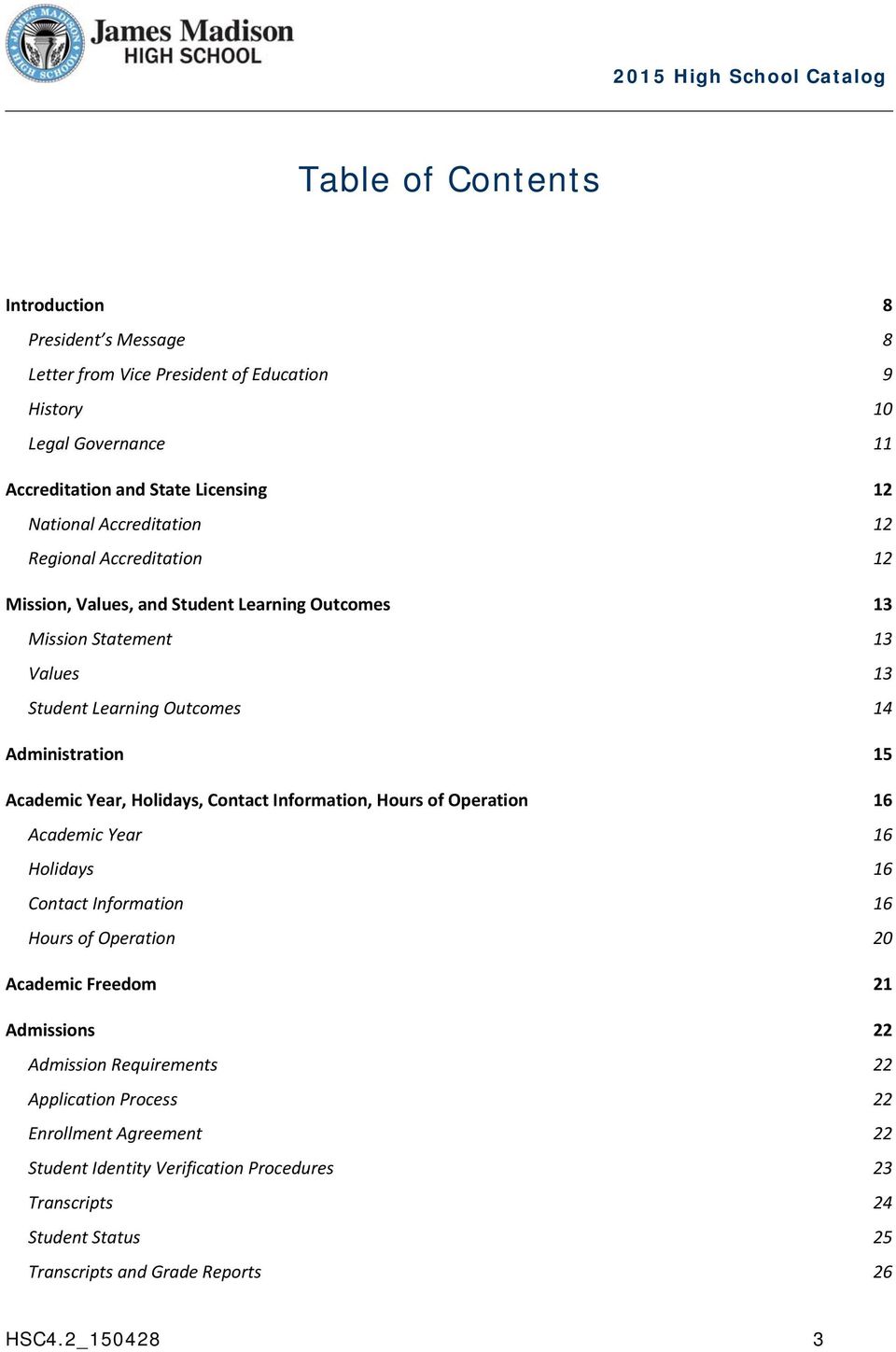
3 Table of Contents Introduction 8 President s Message 8 Letter from Vice President of Education 9 History 10 Legal Governance 11 Accreditation and State Licensing 12 National Accreditation 12 Regional Accreditation 12 Mission, Values, and Student Learning Outcomes 13 Mission Statement 13 Values 13 Student Learning Outcomes 14 Administration 15 Academic Year, Holidays, Contact Information, Hours of Operation 16 Academic Year 16 Holidays 16 Contact Information 16 Hours of Operation 20 Academic Freedom 21 Admissions 22 Admission Requirements 22 Application Process 22 Enrollment Agreement 22 Student Identity Verification Procedures 23 Transcripts 24 Student Status 25 Transcripts and Grade Reports 26 HSC4.2_
4 Transfer Credits 27 Transfer Credit for Traditional Students 27 Transfer Credit for Homeschooled Students or Students from Non accredited Schools 28 After Evaluation 29 Program of Study 29 Dispute of Evaluation 29 International Student Transcript Guidelines 30 Requesting International Transcripts 30 Acceptable International Records 30 International Evaluation Guidelines 30 Apostillation 32 Getting Started 33 Student Portal 33 Learning Management System (LMS) 33 Courses 33 Grammarly for English Course Assignments 34 Study Tips 35 Students Use of Rubrics When Grading 35 Top 5 Characteristics of an Effective Study Space 37 Study Goals and Objectives 38 Study Keys 38 Academic Information 40 Instructional Model 40 Communication with Students 40 Course Format and Account Access 41 Student Community 43 Live Orientation 43 Classes and Assignments 44 How to Calculate GPA 44 Progressing Through the Course 45 Exams 45 HSC4.2_

5 Stanford 10 Testing 45 End of Course Survey 45 Diploma Completion Time 46 Academic Policies 47 Academic Honesty Policy 47 Revocation of Diploma Policy 49 Grading Policy 50 Exam/Assignment Retake Policy 51 Dismissal for Grades 51 Attendance, Participation, and Engagement Policy 52 Student Authenticity and Proctored Exams and Assignments 54 Conduct and Communications Policy 54 Change Diploma Program 54 Compulsory Attendance Laws 55 Dual Enrollment 55 High School 55 College 55 Student Affairs 56 Registrar 56 Academic Advising 56 Academic Dismissal 56 Administrative Cancellation 57 Transferring Credit to a Different Institution 58 Scholarships and Awards 59 Gary Keisling ACCESS Scholarship 59 DEAC Student of the Year Award 59 Learning Resource Center and Library Services 60 Technology Requirements 61 HSC4.2_

6 Tuition, Fees and Payment Options 62 Tuition 62 Fees 62 Payment Options 63 Refund Policy 66 Rights and Responsibilities 67 Student Responsibilities 67 Anti Bullying 67 Maintenance and Confidentiality of Student Records Policy 68 FERPA Policy Student Right to Privacy Policy 69 Grade Challenge Policy and Procedures 70 Student Complaint Policy 71 Student Grievance Policy 72 Non Discrimination Policy 72 Students with Disabilities Act 73 Graduation 74 High School Guidance Center 76 College and Career Services 76 College Services 76 SAT and ACT Registration 77 JMHS Personalized Career Services 77 Teachers and Academic Advisors 78 Teachers 78 Academic Advisors 86 High School Diploma Programs 88 Study Tracks 88 Program Objectives 88 General Track: 23 Credits 88 College Preparatory Track*: 23 Credits 88 Open Electives 90 Single Courses 90 HSC4.2_

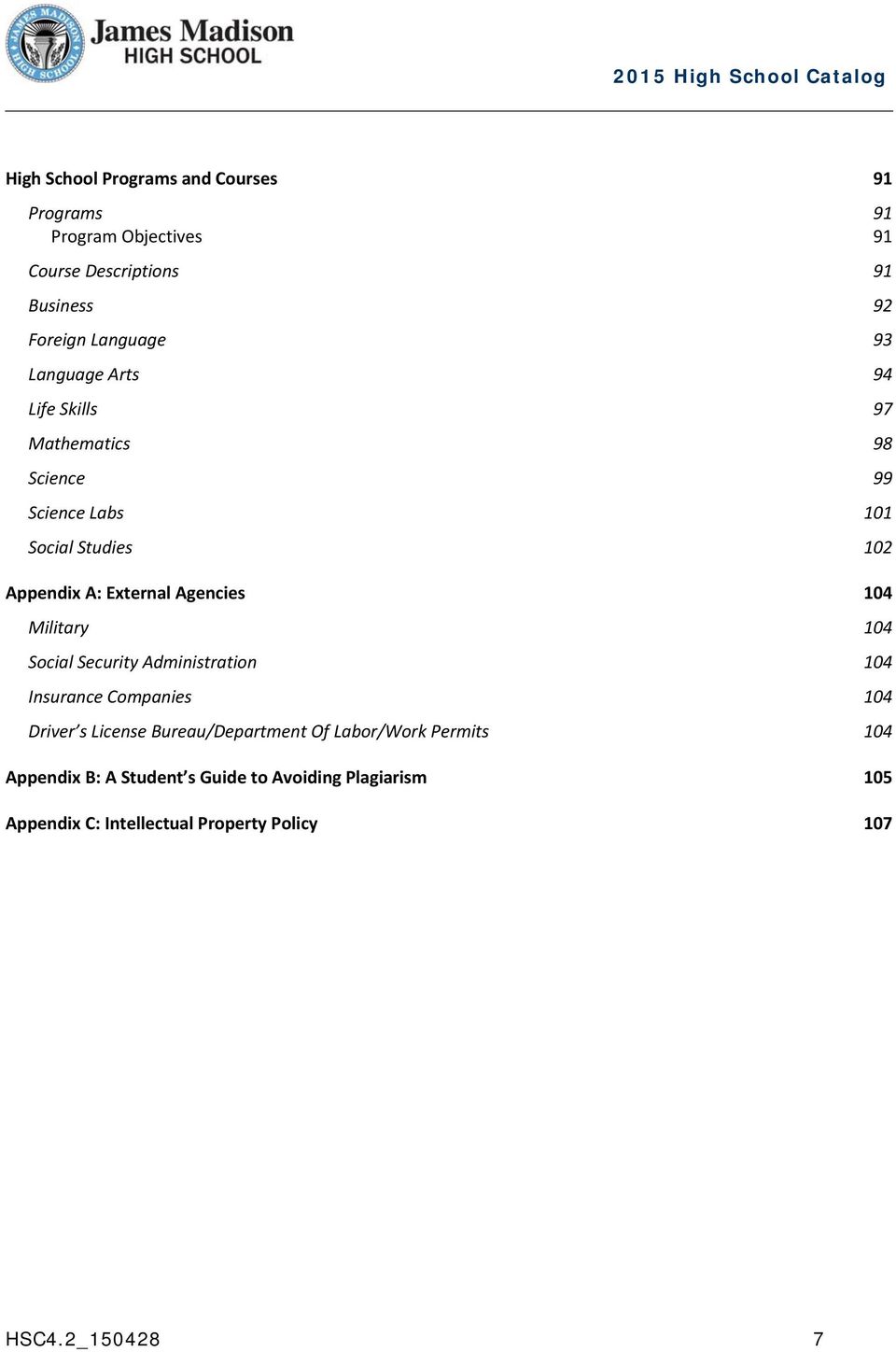
7 High School Programs and Courses 91 Programs 91 Program Objectives 91 Course Descriptions 91 Business 92 Foreign Language 93 Language Arts 94 Life Skills 97 Mathematics 98 Science 99 Science Labs 101 Social Studies 102 Appendix A: External Agencies 104 Military 104 Social Security Administration 104 Insurance Companies 104 Driver s License Bureau/Department Of Labor/Work Permits 104 Appendix B: A Student s Guide to Avoiding Plagiarism 105 Appendix C: Intellectual Property Policy 107 HSC4.2_
8 Introduction President s Message Greetings, Welcome to Ashworth College. Since 1987, we have been setting new standards of excellence in education and providing education on your terms. Today we are a respected, worldwide leader in self-guided distance learning. We bring the finest, most comprehensive instruction, in the most flexible way possible. Ashworth also offers a broader array of study options than other online schools by providing more careerfocused instruction and support, greater accessibility to teachers and academic advisors, more opportunities to connect with other students, more affordable tuition, and easier payment plans. Overall, you can look forward to a first-class educational experience that meets your highest expectations. For more than 25 years, Ashworth has been educating busy people like you. In fact, hundreds of thousands of students have entrusted us to help them achieve a better life. Let Ashworth College help you study smarter, advance faster, and reach your goals. Here's to your new life! Cordially, Rob Klapper President/Chief Executive Officer Ashworth College and James Madison High School HSC4.2_

9 Letter from Vice President of Education Dear James Madison High School Student: Congratulations on selecting James Madison High School. As you begin your high school program, I encourage you to plan time for your studies. It takes discipline to complete a diploma program at a distance. Many people have proven that this can be done very effectively. I hope you will take advantage of the flexibility of learning at the time and place of your choosing. Your courses have been carefully prepared, using the finest textbooks available. The teachers and staff at James Madison High School are exceptional in their subject areas, and in developing and supporting distance learning programs. Please read this James Madison High School Catalog carefully. It provides helpful study guidance and information on our policies and programs. As a reminder we must receive an official copy of your 8 th grade transcript. We will also need your official high school transcripts if you plan to transfer any credits. Please act as soon as possible so that you can continue to study uninterrupted. See our admissions and academic policies for more details. Stay focused and set a specific time to study on a regular basis and soon I will be writing to you as a graduate of James Madison High School. Warm regards, Lisa Rutsky, M.Ed. Vice President of Education Ashworth College/James Madison High School HSC4.2_

10 History The parent company of James Madison High School, Professional Career Development Institute (PCDI), was founded in Since its inception, Professional Career Development Institute (PCDI) has developed a large selection of distance-learning programs. PCDI started as a career school that offered one career course. Early programs focused on vocational and avocational education pathways for students, with the career school growing to offer over 60 career diploma programs today. James Madison High School (JMHS) was established in 1996 to aid students who need a flexible approach to a high school education. JMHS provides the curriculum needed for students to complete one to four years of high school course work leading to a high school diploma. The JMHS program enrolls students from all over the world. In 2000, PCDI established Ashworth College to offer associate degree programs to students who need a flexible approach to a college education. Ashworth College started offering master s degree programs in 2004 and bachelor s degree programs in The PCDI Canada division was started in This division offers the Ashworth Career Diploma program as well as the James Madison High School general diploma program. In 2007, all schools under PCDI merged under the Ashworth College umbrella. Today, we offer 2 high school programs, over 10 career certificates, over 60 career diplomas, 15 undergraduate certificates, 29 associate degrees, 8 bachelor s degrees, 6 graduate certificates, and 10 master s degrees. All Ashworth course and program offerings are accredited by the Distance Education Accrediting Commission (DEAC); DEAC is listed by the U.S. Department of Education as a nationally recognized accrediting agency. James Madison High School is a regionally accredited online high school with accreditation from the AdvancED Southern Association of Colleges and Schools Council on Accreditation and School Improvement (SACS CASI). Students have the opportunity to begin their high school education at Ashworth and continue on to pursue their career and college aspirations with Ashworth College via flexible, affordable, and accredited distance-education programs. HSC4.2_

11 Legal Governance Professional Career Development Institute, LLC ( PCDI, LLC ) owns the Ashworth schools. PCDI Canada is a division of PCDI, LLC. Distance Education Company (DEC) is a wholly owned subsidiary of PCDI, LLC. In 2009, PCDI, LLC was acquired by Sterling Partners. PCDI, LLC operates three schools: Ashworth College, Ashworth Career, and James Madison High School. PCDI Canada offers Ashworth s career and high school programs in Canada. DEC operates the New York Institute of Photography, the New York Institute of Art and Design (formerly Sheffield School), and the New York Institute of Career Development. The Board of Directors is comprised of the following members. Steve Isaac, Board Chairman Jeff Keith, Operating Partner, Sterling Partners Rob Klapper, President/Chief Executive Officer, Ashworth College/JMHS Kim Vender Moffat, Principal, Sterling Partners Tom O Keefe, Member Jason Rosenberg, Principal, Sterling Partners Randy Whitchurch, Member The Academic Advisory Board is comprised of the following members. Milton Miller AAB Chair, Ashworth College Rob Klapper President/CEO, Ashworth College/JMHS Lisa Rutsky Vice President of Education, Ashworth College/JMHS John Riser Sr. Director of Education Operations, Ashworth/JMHS Deepa Chadha Director of Product Development, Ashworth College/JMHS Michael Hillyard Independent consultant specializing in accreditation and higher education strategy Karl Freedman, M.S. Course Development Services, Manager; Project Management, Cengage Learning HSC4.2_

12 Accreditation and State Licensing National Accreditation James Madison High School is nationally accredited by the Distance Education Accrediting Commission. The Distance Education Accrediting Commission is listed by the U.S. Department of Education as a nationally recognized accrediting agency. Distance Education Accrediting Commission th Street, NW Washington, DC (Fax) Regional Accreditation James Madison High School is also regionally accredited by AdvancED Southern Association of Colleges and Schools Council on Accreditation and School Improvement (SACS CASI). The Southern Association of Colleges and Schools Council on Accreditation and School Improvement (SACS CASI) is dedicated to advancing excellence in education worldwide through accreditation, research, and professional services. SACS CASI accredits over 13,000 schools and school systems throughout the United States and overseas and is an accreditation division of AdvancED. AdvancED 9115 Westside Parkway Alpharetta, GA ED NOW ( ) HSC4.2_

13 Mission, Values, and Student Learning Outcomes Mission Statement Empower students to achieve their aspirations through flexible, convenient, affordable, and highly relevant educational programs. Empower: enable students to take control of their lives Students: individuals who have taken the proactive step to study and formally engage in learning Aspirations: strong desire, longing, or aim Flexible: adaptable curriculum that allows students to study anywhere and at their own pace Convenient: easily accessible and easy to use Affordable: quality courses at a relatively low price that provide great value Highly relevant: pertinent content and subject matter that aligns well with real-world skills and knowledge needed in the workplace Educational Programs: courses that enable students to learn in their areas of interest Values Access - We believe that anyone who wants to learn should have access to affordable, quality education anytime, anyplace. Accountability - We set measurable goals and are accountable to students and to each other for our actions, performance, and results. Integrity - We operate with the utmost integrity, and treat both our fellow colleagues and our students with dignity and respect. Passion - We believe we can make a difference in people s lives and want to help each student, teacher, and staff member in our diverse community realize his or her individual potential. Teamwork - We are committed to collaboration and communication among students, teacher, and staff, as both are essential to achieving great outcomes for students and our company. Excellence - We strive to uphold high standards in our academic programs, student experience, and support services, and are continually seeking ways to improve each of these areas. HSC4.2_

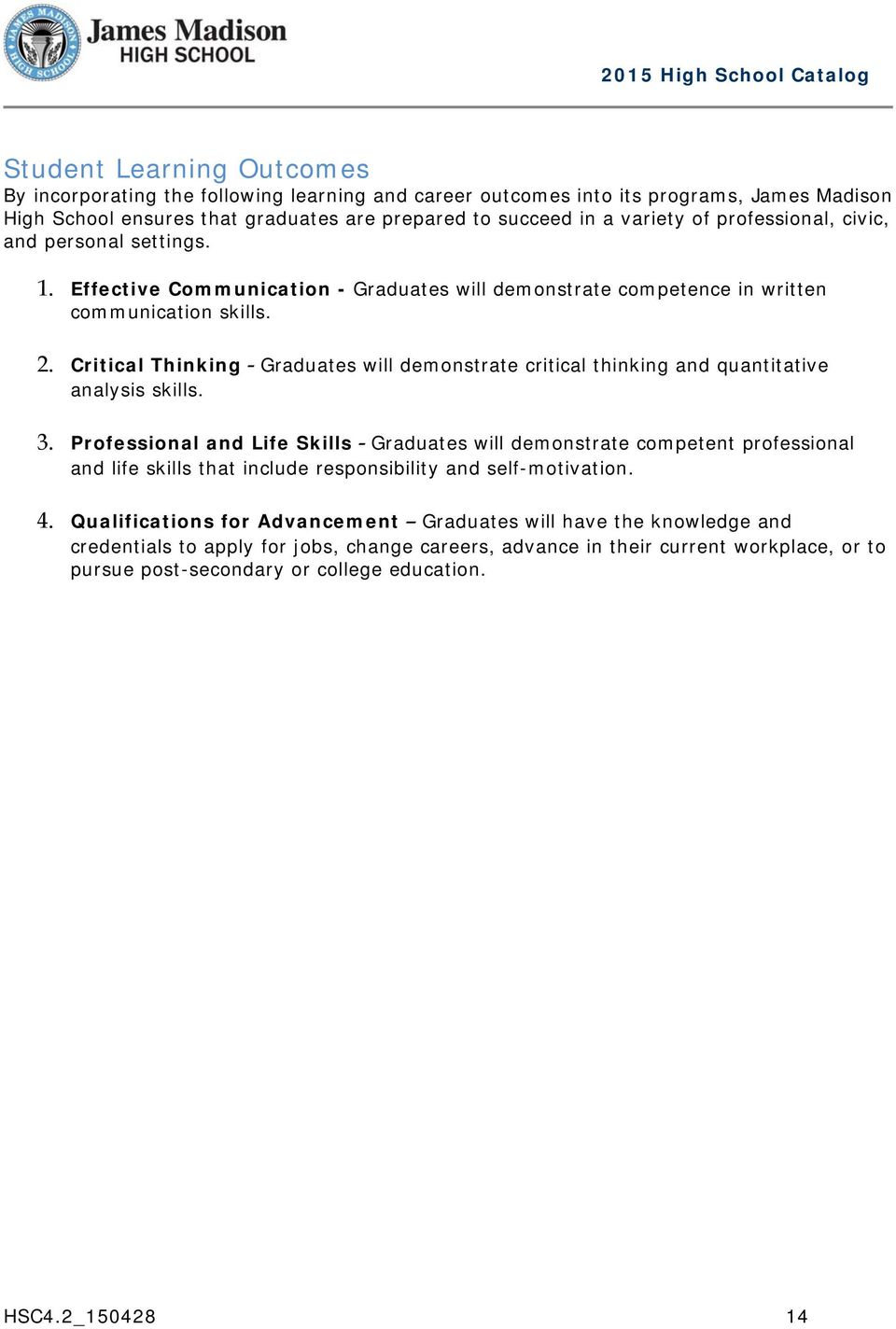
14 Student Learning Outcomes By incorporating the following learning and career outcomes into its programs, James Madison High School ensures that graduates are prepared to succeed in a variety of professional, civic, and personal settings. 1. Effective Communication - Graduates will demonstrate competence in written communication skills. 2. Critical Thinking - Graduates will demonstrate critical thinking and quantitative analysis skills. 3. Professional and Life Skills - Graduates will demonstrate competent professional and life skills that include responsibility and self-motivation. 4. Qualifications for Advancement Graduates will have the knowledge and credentials to apply for jobs, change careers, advance in their current workplace, or to pursue post-secondary or college education. HSC4.2_
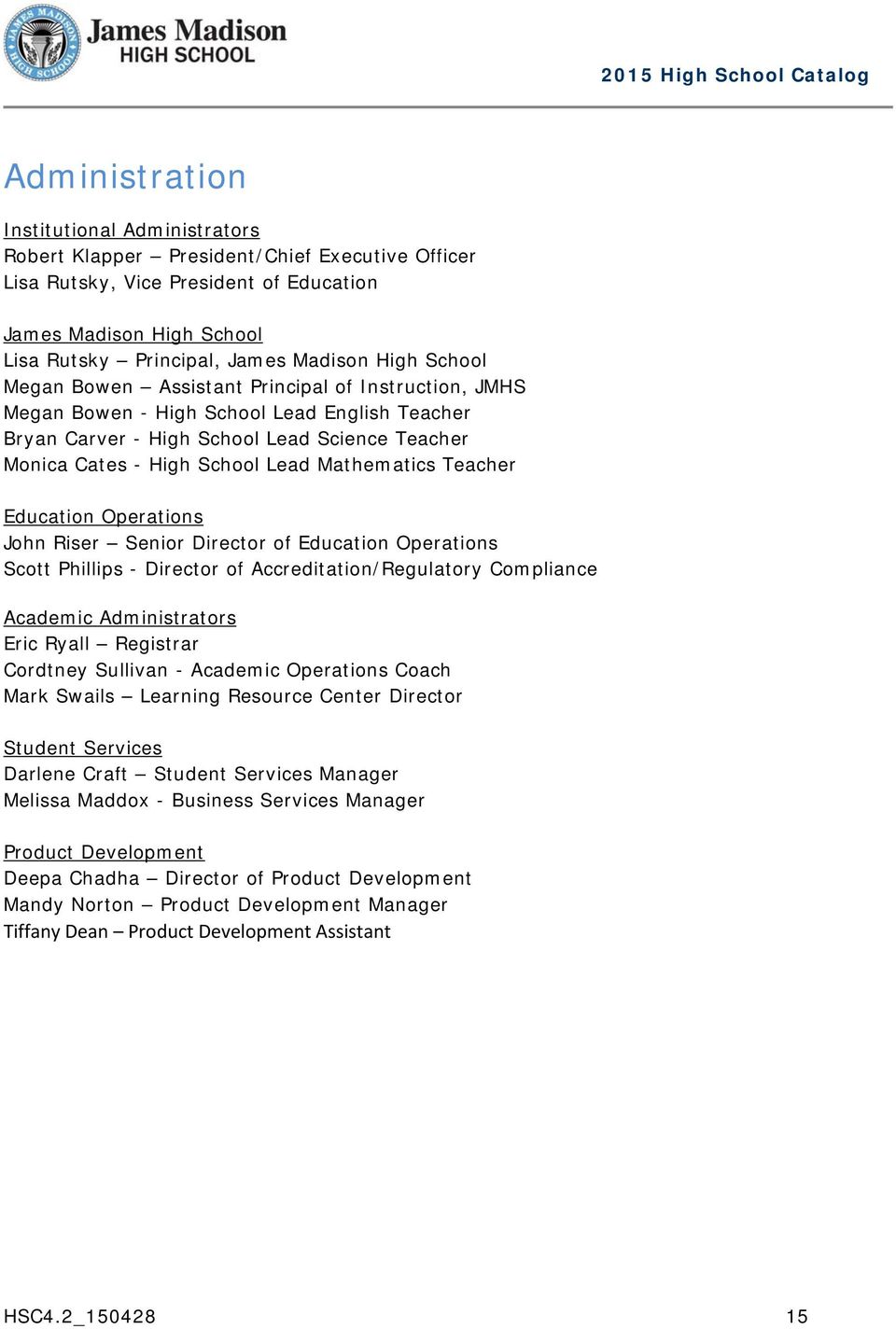
15 Administration Institutional Administrators Robert Klapper President/Chief Executive Officer Lisa Rutsky, Vice President of Education James Madison High School Lisa Rutsky Principal, James Madison High School Megan Bowen Assistant Principal of Instruction, JMHS Megan Bowen - High School Lead English Teacher Bryan Carver - High School Lead Science Teacher Monica Cates - High School Lead Mathematics Teacher Education Operations John Riser Senior Director of Education Operations Scott Phillips - Director of Accreditation/Regulatory Compliance Academic Administrators Eric Ryall Registrar Cordtney Sullivan - Academic Operations Coach Mark Swails Learning Resource Center Director Student Services Darlene Craft Student Services Manager Melissa Maddox - Business Services Manager Product Development Deepa Chadha Director of Product Development Mandy Norton Product Development Manager Tiffany Dean Product Development Assistant HSC4.2_
16 Academic Year, Holidays, Contact Information, Hours of Operation Academic Year Students may enroll in James Madison High School s programs at any time of the year. There are no set class start dates, and students do not need to wait until the beginning of a new session or new semester. All courses offered are flexible and self-paced, with students setting their own schedules within certain maximum allowable time frames per semester and/or program. Holidays James Madison High School is closed on the following holidays: New Year s Day Memorial Day Independence Day Labor Day Thanksgiving Day Day after Thanksgiving Christmas Eve Christmas Day Contact Information The following information may be used to contact James Madison High School. Students should provide their name and student number on all communications with staff. Mailing Address: James Madison High School 6625 The Corners Parkway, Suite 500 Norcross, GA JMHS Web Site: Student Community: Student Portal: Student Services Visit the Community via the Student Portal [email protected] Registrar s Office: [email protected] Fax (for forms, etc.): Fax (for transcripts): PCDI Canada North Service Road W Oakville Ontario Canada L6M 2G2 Phone: Web Site: [email protected] HSC4.2_
17 Course Assistance: Tutor Assistance: Course Teacher: Academic Advisors or Check course syllabus for name and of teacher. Students can contact teacher at any time and should expect to receive a reply within 24 to 48 hours. Post a question while in course. Click on the Ask Your Teacher link and post a question to teacher on the Ask Your Teacher Discussion Forum. Students should receive a reply to post within 24 to 48 hours. JMHS Classmates: Visit the Student Community to find discussion forums related to various courses and careers. HSC4.2_
18 HSC4.2_

19 Phone Guide Department Phone Number Academic Advisors Admissions (Nonstudents) Main Military Services Student Services Fax Destination Guide Fax Number Department Types of Faxes Business Services Education Services Military Corporate Partnerships Lessons Mandatory Graded Assignments Semester Exams Registrar All Transcripts Transcript Waivers Homeschool Portfolios Registrar Student Services Student Services Miscellaneous Documents Career, Degree and High School Verifications Book Waivers Financial Information In-School Deferments Miscellaneous Forms Multiple-Choice Exams (Offline Students) Proctor Nomination Forms Shipment Waivers Student Account Changes HSC4.2_

20 Hours of Operation Academic Advisement 8:30 a.m. 8:30 p.m. (Monday Friday) Eastern Standard Time Student Services 8:30 a.m. 9:00 p.m. (Monday Friday) Eastern Standard Time 8:30 a.m. 5:00 p.m. (Saturday) Eastern Standard Time HSC4.2_

21 Academic Freedom James Madison High School (JMHS) adheres to the following principles of academic freedom. JMHS holds the pursuit of education in highest regard and strives to provide an environment that promotes the pursuit of truth and mutual respect to support the generation of new knowledge and reasoned argument based on scholarly justification. Students and teachers are expected to adhere to academic honesty, the highest ethical standards, and professional conduct in all processes and practices. It is reasonable that the teaching and learning environments will be open to diverse opinions and voices and that the same course content can be presented in multiple ways in order to achieve the same outcome goals. Teaching and learning styles may differ and it is not unexpected that differences in styles, opinions, and approaches may occur. Academic freedom and student conduct policies are appropriately balanced to produce a harmonious learning environment. Toward these ends and in respect for diversity, the following guidelines should be followed. 1. JMHS recognizes that each teacher and instructional team member will express his or her opinions and philosophies freely without censorship. 2. Concurrently, it is important that teacher and instructional team members realize their responsibility to the high school to make their students understand that their expression does not represent the opinions of JMHS. 3. The thorough discussion of topics from diverse perspectives within the teacher and instructional team members subject areas is encouraged. However, the discussion of controversial subject matter outside of each teacher and instructional team member s area of expertise is strongly discouraged within courses. 4. Noting that debate is at the heart of academic freedom, teacher and instructional team members have a particular obligation to promote conditions of free inquiry and to further public understanding of academic freedom. 5. JMHS expects its teachers and instructional team members to maintain high standards of professional conduct in all communications with students at all times. HSC4.2_
22 Admissions Admission Requirements Students must be at least 14 years of age and have graduated from the 8 th grade. To be eligible for the College Preparatory program track, a student s incoming GPA must be a minimum of 2.00 on a 4.00 point scale, or a C overall grade. If the transcript arrives after starting into a program and the student is not eligible based on the overall GPA, then the student will be switched to the general program track. Application Process Students may follow the steps below to enroll in James Madison High School (JMHS) programs. 1. Complete an application online or by phone. a. Apply online The online application process is simplified to reduce processing time. The online application can be accessed from our Web site, Applicants can indicate the program level, program type, and discipline area on the online application form. b. Apply by phone any day of the year (except holidays) by speaking with an enrollment advisor at Within 24 hours of receiving the completed enrollment application, JMHS will provide instructions for online access to the first course and if student elected textbooks, instead of standard ebooks, the associated textbooks/course materials will ship to the student s address. 3. Students who are eligible for military benefits should contact a military advisor at Enrollment Agreement The Enrollment Agreement (the Agreement ) is a legally binding contract when signed by the student and accepted by James Madison High School (JMHS) at its offices in Georgia and is governed by Georgia law. The student signature on the Agreement indicates that the student has read and understood the terms of this Agreement, has read and understood any literature received from JMHS, and believes that he/she has the ability to benefit from the course selected. An electronic signature is a binding signature. Prospective students are encouraged to read through the catalog and materials prior to enrolling. HSC4.2_
23 Student Identity Verification Procedures Student numbers are issued to specific people for the purpose of conducting James Madison High School business. Any abuse of these numbers (including obtaining for malicious use or attempting to obtain for malicious use, and false identification or attempted false identification) shall be cause for permanent dismissal from JMHS. Student Portal Access Students are required to create a password to access the Student Portal. The Student Portal is where a student can view his or her Academic and Personal records and should only be accessed by the student. Students should protect their password from others and not share it with anyone else (i.e., Academic Honesty Policy). School employees do not know student passwords and can only reset them upon their request. If a student s password is reset, the student will be instructed to create a new one before being allowed to access his or her account. ebooks JMHS uses Vital Source to deliver all ebooks in its courses. Students will be required to create a separate password for their ebook account the first time they access their ebook account. School employees do not know student passwords and cannot reset them. Students who forget their password or need it reset will need to contact Vital Source directly. JMHS will use the listed on the student s account to send academic and school updates. These communications can be personal in nature and for this reason it is recommended that students use an that is not shared with others. Student Verification If JMHS suspects that a student s account has been compromised, access to the student account may be blocked until student s identity has been verified. This process is done only to protect the student s interest. Students are responsible for all comments, exams, and assignments posted on their account. If a student believes that his or her account was compromised by someone else, he or she must change the password immediately and notify the school. Affidavits and Academic Honesty Statements Selected assignments require students to complete and sign an affidavit or submit a personalized academic honesty statement prior to submission. This verifies student authenticity of work. HSC4.2_
24 Transcripts James Madison High School will make every effort to ensure that all students have conducted a thorough search for their transcript(s). Students will not be evaluated and will not continue to receive course work until documentation of previous schooling has been submitted. Official Transcript Request Procedures 1. In order to complete enrollment with JMHS, all applicants must completely fill out and send the appropriate Transcript Request Form to their previous high school if applicable. The high school may charge a fee for sending official transcripts to JMHS. Students should send any fees along with the Transcript Request Form directly to their previous high school and not to James Madison High School. The Transcript Request Form is located in the Student Portal. 2. Middle School: If a student has taken Pre-Algebra, Algebra, or a foreign language while attending middle school, please contact the former middle school and have the student s transcript faxed or ed using the Transcript Request Form and following the procedures. 3. Students should include their maiden name on the Transcript Request Form, if the student name has changed. Students who have legally changed their name, through marriage or otherwise, should be sure to include on the Transcript Request Form all names previously used. 4. If the student s previous school(s) advises that a transcript is unavailable and therefore, the student absolutely cannot send an official transcript to JMHS, the student must send any school records to JMHS. These records may include report cards, withdrawal slips, GED scores, or career certificates. Additionally, the student s previous school must write a letter (on school letterhead) explaining why the student cannot send an official transcript. Students who are over 18 years old must visit the JMHS student portal to review the option to waive the requirement for a transcript. 5. If a student s previous school no longer exists, the student must contact the new school and ask where student records were transferred. If the new school is not able to help, the student must contact the local Board of Education. The student needs to provide the Board with his or her name as it was when student was in school, date of birth, the name of the school student previously attended, and the dates student attended. 6. Students who did not attend high school should contact their middle school for a copy of school records. Students who attended only a few days of 9 th grade should request that the school send any high school information, along with a copy of students middle school records. It is important for JMHS to have all school records. 7. Students who owe fees to previous schools need to settle their accounts so the schools can send official transcripts to JMHS. If JMHS receives notice that s student owes fees, a letter will be sent to advise the student. JMHS respects the right of schools to collect any fees owed. HSC4.2_
25 8. Any new student under 18 who has exhausted all attempts to receive a transcript that shows student has completed the 8 th grade must take the 9th grade entrance exam. Student will be charged $75.00 for this exam. Contact the Registrar s office for more information. Return of Student Transcript If students need a transcript for their own records, they can request one from their previous school. JMHS is unable to provide a copy of the transcript from the previous school. If students need to send JMHS any unofficial records, they should keep the originals and only send copies. JMHS cannot return documents to students. Transcript Evaluation Criteria Transcripts will be evaluated when: JMHS receives student s official transcript(s) or homeschool portfolio Student s first JMHS course is 75 percent complete Student s account is current Student Status There are three status states for students depending on their progression through the enrollment and graduation processes. Applicant status is someone who has submitted an enrollment agreement and is financially current with JMHS. Applicants may be denied admission after review of their admissions documentation and first course progress. Enrolled but not Active status is someone who, in addition to being admitted to a program, has completed two courses and the transcript evaluation. Active Student status is someone who, in addition to being enrolled, is regularly submitting assessments in academic courses. JMHS students work at their own pace. JMHS provides students with many mechanisms to help students stay on track for timely completion of program and graduation requirements. A high school advocate will be assigned to every high school student. An Advocate is specially trained and assigned to assist students throughout their program of study. In addition, the instructional team of teachers and academic advisors are on hand to provide one-on-one academic support to help students master the learning objectives and complete courses and their program of study. In the Student Portal there is a Progress Tracker which displays students percent progression through their program. There is also a progress report that shows a high level overview of grades and pace. Each course has Curriculum Maps and Pacing Guides to help students manage their expectations on course workload and time to complete a lesson and course. If students need an official status letter, JMHS is able to issue a Status Letter and Transcript upon request. In order for JMHS to issue these documents, students must have completed a transcript evaluation, completed one course, and be current in their tuition payments. HSC4.2_
26 Transcripts and Grade Reports Students who need a transcript of completed courses from James Madison High School should contact Student Services. Students should specify whether they need an official or unofficial transcript. An official transcript is one sent by JMHS directly to an institution or employer. An official transcript will be sent only if the student account is paid in full. The first copy of an official transcript is free; there is a $10.00 fee for any additional official transcripts requested. An unofficial transcript is one sent by JMHS directly to the student. An unofficial transcript will be sent only if the student account with JMHS is current and there are no past due amounts owed. Unofficial transcripts can be printed from the Student Portal; Unofficial will be printed across the transcript. Students who request that an unofficial transcript be mailed to them will be charged $10.00 per transcript. Students can view their program of study, progress report and grades in the Student Portal. HSC4.2_
27 Transfer Credits Students may transfer up to 75% of the total program credits, 25% of the courses must be completed at JMHS or 6 credits must be completed subject to the provisions described below Transfer Credit for Traditional Students For students to be eligible for transfer credit, the Registrar at James Madison High School (JMHS) must receive all official transcripts from schools within 90 days of the student s enrollment with JMHS. An official transcript is one that comes directly from student s former school(s) to the Registrar s office at JMHS in a sealed school envelope. Students should ask the school to stamp the transcript before sending as proof that it is official. The official transcript(s) should be sent to JMHS. A student s program at JMHS is based on the number of transferable courses completed at student s previous school, not on student s grade level. A student must have received a passing grade in a course in order to transfer credit. The previous school must have awarded the credit and this must be clearly shown on the transcript. To be eligible for the College Preparatory program track, a student s incoming GPA must be a minimum of 2.00 on a 4.00 point scale, or a C overall grade. If the transcript arrives after starting into a program and the student is not eligible based on the overall GPA, then the student will be switched to the general program track. Students may receive transfer credit for courses that directly or closely correspond to those that JMHS requires for graduation. More advanced math and science courses may substitute for those required by JMHS. JMHS does not have a statute of limitations on credits eligible for transfer; however, it does reserve the right to invalidate some courses for transfer in which the content is outmoded. Courses taken more than 10 years ago may not transfer unless a course description or syllabus is provided to verify that the material covered in the subject is still current. Content equivalency is required of any course the student wishes to transfer. All credits must be from an accredited institution or evaluated by the American Council on Education (ACE), and the student must have received a passing grade. A maximum of two (2) elective credits will be awarded for religious studies, despite how many credits were earned in this area at another school. No credits will be awarded for GED certificates and programs. No credits will be awarded for on-the-job training, including specialized training, certificates received, etc. No credits will be awarded for classes taken at a college or university, unless they were taken for high school credit. If students fail an exit or graduation exam at their previous school, they will be required to take an appropriate course in that subject area at JMHS. HSC4.2_
28 Transfer Credit for Homeschooled Students or Students from Non-accredited Schools Students who were educated at home, or in an environment other than a public/private school, or from a non-accredited school may or may not have a traditional transcript. James Madison High School (JMHS) will admit such students who submit a complete portfolio of their work and/or proper documentation. Students must include the Homeschool Form with their portfolio. A nonrefundable fee of $50 is charged for the evaluation of portfolios for all such students. All requirements on transfer credit for traditional students also apply to such students. A complete homeschool portfolio should include the following: A photocopy of the front cover of the textbook or software used for instruction. Please provide one for each course A photocopy of the table of contents, which should document the curriculum of each course Three representative samples of work per course. Include a sample of work from the beginning, middle, and end of each course(s). This is a crucial element in the evaluation process. No credit will be given without work samples. Examples of appropriate work samples include written essays, research projects, laboratory reports, math problems showing work to solve, and exams. Please do not submit multiple-choice answers. The credentials of the instructor (parent/guardian/teacher) Examples of tests or other assessment tools Any standardized test results, such as the SAT or IOWA Basic Skills Test An original writing sample, which should be 3 to 5 pages in length Payment of a nonrefundable $50 for evaluation of the portfolio If a homeschooled student or student from an environment other than a public/private school, or from a non-accredited school is not able to provide ample information in their homeschool portfolio, they must take a 9 th grade entrance exam. The student will be charged $75 for this entrance exam. All materials and the $50 payment should be sent to the attention of the JMHS Registrar. Students should not send originals since JMHS will not be able to return portfolios. Students should verify that the student name and student number are clearly listed on the portfolio. In addition to the portfolio, it is suggested students also send the following documents: 1. Homeschool registration and/or attendance forms. These are usually filed with student s local school board or state education agency. 2. Documentation from a certified tutor or teacher, including the credentials and/or certificate of the teacher or tutor 3. Current testing or evaluation results. For additional questions pertaining to admission and evaluation requirements, students should contact the Registrar at: [email protected]. HSC4.2_
29 After Evaluation After students transcripts are evaluated, students will receive some of the items described below. Subject Review Form The Subject Review Form for the General and College Preparatory Correspondence Programs shows the diploma program the student is enrolled in and the transfer credits received from previous school(s). JMHS selects courses for students; however, students have the option to change several elective courses. To change courses, students must visit the student portal and make new selections using the scheduling tool. Students who plan to change their courses should choose wisely based on their abilities and future plans. Once a course is shipped, there is a $50 processing fee to drop a course, plus any associated replacement fees. Information regarding JMHS courses is available in this document and at Program of Study Students can view their program of study by logging into their student portal at Dispute of Evaluation If students feel there is an error in the transcript evaluation process, they need to contact the school within 30 days of the evaluation. JMHS will not be able to handle evaluation disputes after 30 days. HSC4.2_
30 International Student Transcript Guidelines James Madison High School (JMHS) encourages all international students to acquire an e- mail address, as this will be the most efficient method of correspondence. For students who currently live abroad, we recommend that multiple courses be shipped to them at one time in order to avoid delays and issues with shipping. This would be the most effective way to maintain an adequate course load at all times. See the section on Course Shipment for additional information. Requesting International Transcripts James Madison High School expects students to make every attempt to obtain transcripts or records from either the country where currently reside or the country in which their previous high school is located. Ministries of Education within a country, similar to the United States Boards of Education, should have student records. Even during times of social or political turmoil, students have had success retrieving records. Student who are not able to obtain an international transcript are advised to call the Registrar s office. Acceptable International Records Attested Documents These are the equivalent of official transcripts in the United States. When transcripts are attested, they have been officially notarized by an education official. These are the preferred documents so as to avoid potential damage or loss of the original. Official Documents or Original Documents These are usually a student s only copy, and, at times, the ONLY copy in existence. These usually arrive on special, delicate paper. James Madison High School is unable to send documents back to students. If student s document is the only copy in existence or it is difficult to obtain another copy, the student must keep the original and send us a copy. International Evaluation Guidelines The evaluation process for international transcripts is somewhat different from the evaluation process for transcripts from schools within the United States. Different countries often have different educational systems and require different courses for graduation than those required in the United States. For instance, English courses taken internationally are comparable to English as a Second Language courses taken in the United States. Even if a student has completed four English courses at another high school, at least two English courses will still be required at JMHS. Also, students educated internationally who have not completed American History, American Literature, and American Government will be required to do so with JMHS. The evaluation process for international transcripts has been established to ensure that a student has earned all necessary credits for a United States High School Diploma. HSC4.2_
31 General and Career Programs Students who have earned a high school diploma outside the United States will still be required to complete a minimum of 15 credits at JMHS. Students will be awarded four credits for required courses (English, math, science, and world history) and four elective credits. The courses for which JMHS chooses to give credit are subject to change depending on the information provided from the student s previous high school. Most international transcripts do not list all credits completed. Evaluations are usually based solely on grade equivalency. Students who have earned a vocational or technical training diploma or certificate, however, will not be given any credit and will be required to complete the four year program unless documentation is sent of the specific courses completed. Even if a list of specific courses completed is provided from the vocational or technical school, there is no assurance that a student will be awarded eight credits. Students who have earned an 11 th- grade United States equivalency at an international secondary school will be required to complete 18 credits, or the 3 year program, with JMHS. Students will be awarded 4 elective credits. Students who have earned a 10 th- grade equivalency or less at an international secondary high school will receive no credit and will be required to complete all 23 courses, or the four year program, with JMHS. College Preparatory Program Students enrolled in the College Preparatory Program and who have earned a diploma or certificate of secondary education will be required to complete 16 credits with JMHS. Students will be awarded four credits for required course work (three foreign language and a fourth that will be determined when the transcript, diploma, or attested document is received) and three elective credits. The courses for which JMHS chooses to give credit are subject to change depending on the information provided from the students previous high school. Students who have earned a vocational or technical training diploma or certificate, however, will not be given any credit and will be required to complete the four year program unless documentation is sent of the specific courses completed. Even if a list of specific courses completed is provided from the vocational or technical school, there is no assurance that a student will be awarded six credits. Students who have earned an 11 th- grade United States equivalency or less at an international secondary school will receive no credit and will be required to complete all 23 courses, or the four year program, with JMHS. The evaluation guidelines for international students are meant to provide a basic understanding of the evaluation process for students who previously attended an international high school. Based on the information a student is able to provide, these guidelines may be adjusted so that JMHS can be confident that a student will gain the academic skills necessary for the awarding of a United States High School Diploma. HSC4.2_
32 Apostillation Apostillation consists of a notarized document, which is attached to a student s diploma, and serves the purpose of legalizing and authenticating a diploma. This document states that the attached diploma document has been fully earned, approved, and granted. The Apostille will be signed and sealed by the Secretary of State or embassy for the attachment of the Apostille. A student who has earned a high school diploma with JMHS and wishes to return to his or her native country either to work or to pursue a postsecondary education may need to have his or her diploma Apostilled. Students may contact the Registrar s Office for more information regarding Apostillation. A fee of $50 is charged for this service. HSC4.2_
33 Getting Started Student Portal The student portal can be accessed at The student portal has several useful tools to help manage student account information. To access the first course of the program, students should click on the Courses link which is at the very top of the Student Portal. Learning Management System (LMS) The LMS is where all the courses of the program will be delivered. Students will complete all reading assignments, exams and projects at this site. In addition, students will be able to chat with their instructor during scheduled office hours. No additional log in information is required to access the LMS since students enter the LMS via the Student Portal. Courses All courses are delivered in two parts. Each part will have between 6-10 exams and represents a half credit. All students are required to complete Introduction to High School and Health, regardless of transfer credit earned from their previous school. ebooks are delivered through the LMS using Vital Source. When students start their third course they will be asked to create a password the first time they access the ebook. After that students will not be required to enter a password again, unless they want to access their textbook outside of the LMS. HSC4.2_
34 Grammarly for English Course Assignments Students in English courses will be required to sign up for a Grammarly account using their personal address. Instructions for how to set up a Grammarly account are given within the assignment directions of the courses where Grammarly is required. A special code will be given to you in the directions. This code belongs to James Madison High School; any sharing of this code will result in violation steps as per the Academic Honesty Policy. Once the assignment is analyzed and checked for plagiarism, Grammarly will provide the student with a summary of any grammar and spelling errors and any plagiarism found. Students are given the opportunity to review the suggestions provided by Grammarly and revise their paper to make appropriate spelling, grammar and plagiarism changes before submitting their assignment for grading. The score documented on Grammarly is NOT the assignment grade; the student s teacher will return a grade to the student. HSC4.2_
35 Study Tips Students Use of Rubrics When Grading Multiple-choice examinations are used throughout James Madison s program to measure students mastery of the program objectives. In most programs students will also need to complete assignments that require evaluation and feedback from the school s instructional staff. Assignments are often graded using a rubric like the one shown below. This rubric provides guidance for students; it helps to clarify essential elements of the assignment that will be evaluated to determine a grade. The rubric is also an important tool for the instructional team to insure that each student is evaluated consistently and that each student meets the primary objectives of the assignment. Assignments that have very specific right or wrong answers may employ an answer key instead of a grading rubric. A grading rubric is a scoring tool used to help guide both the student and the teacher. It helps to define the quality of a student s work from the category of excellent to poor and serves as a detailed and specific roadmap for students, which leads to improved student outcomes. Lastly, a grading rubric helps increase grading efficiency and consistency among teachers. If a rubric is used as a tool in your assignment, the rubric will be included with the assignment instructions. Written assignments in English courses require students to submit an academic honesty statement, use the APA format when writing their paper and submit their paper through Grammarly before submitting it to JMHS. Points are given when these steps are followed. An example of a rubric is on the following page. HSC4.2_
36 CATEGORY Focus on Topic (Content) Sources (Content) Conclusion (Organization) Grammar & Spelling (Conventions) There is one clear, wellfocused topic. Main ideas stand out and are supported by detailed information. The essay incorporates the information that was outlined in the worksheet. All sources are cited correctly using APA format, Grammarly report and academic integrity statement are submitted. The conclusion is strong and leaves the reader with a feeling that they understand what the writer is "getting at." Writer makes no errors in grammar or spelling that distract the reader from the content. Main idea is clear but the supporting information is general. The essay uses the majority of the information outlined on the worksheet. All sources are cited but not in correct format, Grammarly report and academic integrity statement are submitted. The conclusion is recognizable and ties up almost all the loose ends. Writer makes 1-2 errors in grammar or spelling that distract the reader from the content. Main idea is somewhat clear but there is a need for more supporting information. Very little of the information from the worksheet in incorporated into the essay. Sources are not cited, but Grammarly report and academic integrity statement are submitted. The conclusion is recognizable, but does not tie up several loose ends. The main idea is not clear. There is a seemingly random collection of information. None of the information from the worksheet is evident in the essay. Sources are not cited, Grammarly report and academic integrity statement are not submitted. There is no clear conclusion, the paper just ends. Writer makes 3-4 errors in Writer makes more than 4 grammar or spelling that distract errors in grammar or spelling the reader from the content. that distract the reader from the content. Support for Topic (Content) Relevant, telling, quality details give the reader important information that goes beyond the obvious or predictable. Supporting details and Supporting details and information are relevant, but information are relevant, but one key issue or portion of the several key issues or portions of storyline is unsupported. the storyline are unsupported. Supporting details and information are typically unclear or not related to the topic. HSC4.2_
37 Top 5 Characteristics of an Effective Study Space Just as there are certain study techniques that work better for your learning styles, there are also study environments that are more in sync with your learning style. Of course, there are general guidelines that apply to every style and that are certainly worth mentioning. No matter how hard you try, you can never learn while watching TV or talking on the phone. You may struggle through and grasp some level of learning, but you will be functioning at a level far below your potential. 1. Make It Comfortable Your chair should be well padded and supportive (i.e., a high back office chair and a smooth top desk or an oversized library chair in your room). You do not want the kind of comfort you feel when you are lounging on the sofa or stretched out on your bed, but you do need to be free of discomfort. Also, make sure the temperature is balanced-- not too hot or too cold-- and that the air is fresh. 2. A Well-Lit Preferably Natural Light Natural light, such as light from a window, is better than artificial light, but if you must use artificial light, remember that incandescent light, or soft white light, is better than fluorescent. 3. A Well-Stocked Area Don t waste time gathering all the study materials and other items you ll need. Instead, when you create your study area, make sure you stock it with items you will need, such as pens, pencils, paper, highlighters, books, calculators, staplers, and rulers. 4. An Enhanced Environment It s very important that your study place be somewhere you enjoy going. The most effective way to battle the problems of distraction, poor concentration, and low self-esteem is to improve your learning environment. Suggestions: plants, pictures, and colorful desk accessories. 5. An Area Full of Positive Messages Create a positive emotional and mental environment. Surround yourself with things that carry positive messages. By themselves, they won t do much, but they will be positive encouragements when your mind wanders and you become frustrated. Motivational posters, quotes, and reminders of your goals will serve as positive reinforcement of the value of what you are doing and how vast your potential is. HSC4.2_
38 Study Goals and Objectives It is imperative that you define your study goals and objectives. The best study goals are always: Realistic for the Time Allotted (Example: What is easily accomplished in an hour? A half hour?) Concrete and Specific (Example: Read pages 5 20 of the short story in the literature book, NOT Read some pages in the literature book.) Significant and Rewardable (Example: One chapter of reading in history deserves a 15 minute TV break, snack break, or phone break). Relevant to Your Priorities (Finish reviewing chapter 3 in algebra, because there is a test tomorrow is more important than doing an assignment in English that is not due until the end of the week). Study Keys BELIEVE IN YOURSELF your brain is a complex piece of work and has genius capacity. It takes time and effort, But if you believe in yourself, you will reach your true and full potential. DISCIPLINE YOURSELF Self-control and discipline are the cornerstones to success. Self-discipline is what makes you keep going when the going gets tough, and this is how study techniques become second nature. When your self-discipline gives you the strength to maintain your study skills, this is when your true abilities will soar. BE PERSISTENT Keep on keeping on! Persistence is more important than intelligence, luck, and talent. DIVIDE AND CONQUER Analyze the task, divide it into smaller, separate tasks, and put the tasks in priority. Start with the first small step, complete it, and then cross it off the list. BECOME AN INFORMATION FILTER You need to learn to distinguish between what is important to remember and what is not. This takes practice to filter out the unnecessary information and even more practice to be confident that you have focused on the correct material. PRACTICE OUTPUT AS WELL AS INPUT Think of your brain as a computer. The information you study is data INPUT. Your brain processes this information and turns it into useful information or OUTPUT. It is up to you to devise several patterns of output so information can easily be recalled. HSC4.2_
39 DO NOT FEAR MISTAKES Don t be afraid to try something new just because you re afraid you may get it wrong the first time. Remember: take an action and if you make a mistake, review the results and identify the mistakes, decide how to do it better the next time, and then do it again-- only better. USE ALL OF YOUR DIFFERENT INTELLIGENCES TO CREATE STUDY TOOLS As you develop your own toolbox of study skills, make use of as many of your different intelligences as possible. Combine as many as you can as often as you can and create a study skills toolbox that empowers you in every way. ALWAYS BE ACTIVE All study, reading, and listening skills come down to one thing: You need to USE it. DO something with it. Think about it and evaluate it, and then WRITE IT DOWN. PREPARE PREPARE PREPARE Quality preparation makes the difference between mediocre performance and excellent grades. Prepare your study environment, your attitude, and your focus, and you ll be amazed at the difference. HSC4.2_
40 Academic Information Instructional Model James Madison High School (JMHS) aims to provide students with engaging, comprehensive, and high-quality curriculum in a flexible and convenient online learning environment. The school strives to meet the educational goals of its students while giving them the opportunity to set the pace of their learning on a schedule that is compatible with their lifestyles and personal/professional commitments. Students are also provided with sample pacing guides to assist with planning study time and to help them stay on track with their goals. JMHS s enrollment model is an open-enrollment track wherein students can enroll in programs and courses at any time without having to wait for a semester or class start date. The schools learning model is self-paced within certain maximum time limits per program. The JMHS instructional model is comprised of an instructional team approach. The instructional team includes highly qualified academic advisors, certified teachers, subject matter experts, course authors, and support staff. JMHS s team is available to work with students as needs arise. The team approach allows JMHS to customize support to individual student needs. James Madison High School provides students with different avenues of support. JMHS has full time lead teachers in math, English and science. The school also has adjunct teachers who interact with students through announcements, threaded discussion questions, Ask Your Teacher forums, and weekly live tutorial sessions in all subject areas. Assistant teachers grade assignments, provide outreach to inactive and/or struggling students, supply students with study tips and resources, and offer one-on-one tutoring via . JMHS academic advisors are available for tutoring and general academic support via and phone. JMHS also works with educational service providers to provide additional academic support, e.g. identified at-risk students receive targeted one-on-one tutoring. Students can also receive support via the Community or the Learning Resource Center. A High School Advocate will be assigned to every high school student. An Advocate is specially trained and assigned to assist students throughout their program of study. Communication with Students Students are required to set up and maintain their profile information within the James Madison High School Student Portal ( ). It is the responsibility of the student to ensure that the information within the student profile is accurate and current. All correspondence from JMHS will be sent to the address listed on the student profile. Also, where applicable, materials will be shipped to the address on the student profile. JMHS is not responsible for shipments or correspondence sent to the incorrect shipping address or address. HSC4.2_
41 Course Format and Account Access Course Format The high school program includes the following sections as part of the course format. Each course may have a different set of materials and assessments; see the syllabus for details for that course. Course Materials Ask Your Teacher Student Lounge Orientation Syllabus JMHS Catalog Textbook (ebook or printed hardcopy) Textbook Tips Lessons Vocabulary Reading Assignments Check Your Learning Interactive Activities Exams and Assignments Each lesson has at least one assessment that may include an exam, essay, midterm or final. Selected exams have affidavits which must be signed by students prior to completion Written assignments in English courses, section 4 or higher, require students to submit an academic honesty statement, use the APA format when writing their paper, and to submit their assignments through Grammarly before submitting their assignments to JMHS. Grammarly is a proof-reading and plagiarism detection tool. Both the Grammarly report and the assignment must be submitted before a grade is received. HSC4.2_
42 Account Access James Madison High School students access their student account information, online courses, program schedule, transcripts and grades in the Student Portal. All online courses reside in the Sakai Learning Management System. JMHS s online courses are designed to be engaging, user-friendly, and easy to navigate. Students can perform the following tasks online via the Student Portal and learning management system. 1. Set up student accounts; view and edit account information 2. View account balances and make tuition payments 3. View shipment status for current and completed courses 4. Access online courses and course materials for current and completed courses 5. Submit assignments, multiple-choice exams 6. View assignment and exam grades 7. Program progress tracker to manage pacing through program 8. Access the James Madison High School online library 9. Be a part of James Madison High School online Student Community 10. View Program/Transcript upon evaluation Course Access All courses include an ebook and online material needed to complete the course. Some students have opted to receive a printed textbook as well. The policy below applies to all students regardless of whether they receive ebooks or printed textbooks. James Madison High School provides access to one course at a time to a student. When approximately two-thirds of the exams/projects have been returned and passed, the next course will be made available online, if payments are current. Student s transcript will need to be evaluated before he or she can receive materials for the third course in the program. Students may access more than one online course at a time as outlined below. 1. To have access to one year s number of courses (General=4; College Preparatory= 5): a. Tuition for one year must be paid in full. b. Waiver letter must be signed that states student may not receive any refunds after the courses are opened. 2. To have all courses opened at once: a. Tuition must be paid in full. b. Subject review form must be reviewed by the student and returned to the school if courses are being changed. c. Waiver letter must be signed that states student may not receive any refunds after the courses are made available. d. Contact the school for assistance. 3. Payment for laboratory courses must be received before student can have access. This is a nonrefundable fee that may be paid by charge card, check-by-phone, paper check, or by adding it to the next month s invoice. HSC4.2_
43 Shipment Errors for Students Receiving Printed Textbooks If students receive an incorrect or incomplete shipment, they need to call Student Services for assistance. Students have 60 days to notify JMHS of any shipment issues, after which time they will be responsible for any replacement fees. Replacement Fees Students will be charged a replacement fee each time they request replacement of study materials. The replacement item will ship once payment is cleared and the student account is current. Processing Fees A $50 processing fee is charged when a course is opened for students and they decide to drop the course. Students cannot drop required courses, only electives. The processing fee plus any associated replacement fees are required for all dropped courses. Student accounts must be current before a course can be dropped. Contact the school for assistance. Fees may be added to the next month s invoice and the course will be dropped immediately. For students who pay by a separate check or charge, the course will be dropped from their program when the check or charge is posted to the student account. Student Community The Ashworth College and James Madison High School Student Community (Community) is a fully interactive, student-driven, and staff-supported virtual campus that provides students a complete social learning experience from the day they enroll to graduation and beyond. The Community is comprised of different discussion forums that correspond to the various areas of study offered at Ashworth and JMHS. What makes the Community special is that members have the unique opportunity to connect with other students, academic advisors, and faculty on their own terms, get real-time support from anywhere at any time, attend weekly live streaming video events, receive personalized advice from career experts all while making new friends, sharing opinions and experiences. Ashworth College and James Madison High School Community also actively supports students on the Ashworth Facebook and Twitter networks. The Community integrates excellent interactive and academic elements to create a fully supported social learning experience for our students. Visit the Community by clicking on the Community banner in the Student Portal. Live Orientation James Madison High School hosts "live" streaming video chats once each week in which Student Advisors orient new students on everything they need to know in order to successfully get started with their course/program. Student Advisors guide new students through activating their student account, accessing their course materials, requesting transcripts, submitting exams, and learning how to best take advantage of all the resources that are available to them. The format is highly personalized and fully interactive. Ashworth advisors speak to new students via streaming video, and students are able to ask questions via online chat, all of which are answered in "real time" by the advisors. Ashworth s Orientation chats are hosted within our Student Community, but are also simultaneously streamed to multiple sites such as Facebook and Twitter to reach as many new students as possible. Students who are unable to attend one of our live Orientation chats can watch the archived sessions at any time. HSC4.2_
44 Classes and Assignments Each course is composed of lessons. Each lesson typically contains lecture notes, assignments, and/or multiple-choice exams. Multiple-choice exams are auto-graded immediately upon submission and students can view their grades immediately. Written assignments are graded within 7-10 calendar days from student s submission, and students can view their grades along with grader feedback and comments. Students can track their shipments, access their online courses, submit assignments, take exams, and view grades via the JMHS Student Portal. Students generally take one (1) course at a time, in a specified sequence within the high school program. Except in cases where transfer credits are being applied, course orders within a program should be followed to ensure proper learning progression and sequencing through cumulative learning. How to Calculate GPA Each letter grade is worth a certain number of grade points. A = 4 points B = 3 points C = 2 points D = 1 point F = 0 points Example: A student s grades in the first five courses are: A, B, A, C, and A. The GPA would be calculated as follows. Step 1: Step 2: Add the grade points for all courses. A = 4 grade points B = 3 grade points A = 4 grade points C = 2 grade points A = 4 grade points 17 total grade points Divide the total number of grade points by the number of courses = 3.40 GPA is HSC4.2_
45 Progressing Through the Course Before students get started, they should review the JMHS Catalog. When a student is ready to begin, it is recommended that he or she set aside a regular time each week to study. The goal should be to maintain steady progress toward graduation. The recommended pace is to complete one lesson per week; however, students should set a pace that is achievable for them and stick to it. Students are urged not to rush through their courses! JMHS teachers are available to help students with their coursework, so students should be sure to note the office hours posted in the announcement section of their courses. In addition, the school has a robust Student Community where students can seek help from their peers and JMHS staff. Students can also call the Academic Advisors when additional help is needed. Exams There are Achievement Exams at the end of each lesson in a course. Some course shipments have only a few units and some have many more. The Achievement Exams may be multiple-choice questions, handwritten exams with various types of questions, or specific projects. Important: Multiple exams should not all be submitted at once. Always wait on the feedback and exam results before submitting another exam. Learn from the feedback and results for the next exam so that there is continual improvement. The student can start studying their next lesson but it is important to know the results of the previous exam before submitting the next exam. Please note that handwritten exams are also hand-graded. This means that the results will not be returned as quickly as with a multiple choice exam. Students should allow ample time for the projects and handwritten exams to be processed. Under normal circumstances graded exams are returned to students within 7-10 calendar days of the student s submission. Stanford 10 Testing The Stanford 10 test is offered to JMHS students twice per year, typically in the spring and fall. This test is made available only to students who are 18 years old and younger and is free of charge. Active students will be notified via of dates and instructions for taking this test. Taking the Stanford 10 test allows students to compare their achievements with those of other test-takers across the country. Some homeschoolers are required to take standardized testing. Students should check with their state to learn more about the specific requirements for homeschooling. End-of-Course Survey Students are to complete End-of-Course Surveys for each course that they have completed. The End-of-Course Survey includes questions on student engagement, student readiness, teacher and academic advisors support, technology, curriculum, resources and other support. Student feedback through the End-of-Course Survey is an opportunity for students to have a voice in their program of study and is an essential part of our process of continual improvement. HSC4.2_
46 Diploma Completion Time The James Madison High School diploma program can be completed in as few as 18 months. Transfer of credits may shorten completion time to as little as six (6) months. Actual completion time varies by student. Students will be allowed a maximum of six (6) years to complete their program. Students may request up to two (2) 6-month extensions at $75.00 each. The program is self-paced and encourages students to set their own schedule for completing their coursework. However, it is important that students set goals to average completing one lesson every one to two weeks. Students are encouraged to set a pace that is comfortable to them, based on their needs, abilities and overall schedule. The school monitors and reaches out to students who have slowed down or stopped activity on their courses in an attempt to provide help and encourage them to return to their studies. The student portal has a progress tracker so students can monitor their progression through their program on a regular basis. Please see the Attendance, Participation, and Engagement Policy. HSC4.2_
47 Academic Policies Academic Honesty Policy Academic integrity is the hallmark of excellence and the foundation of education which requires honesty in all course work. Students are expected at all times to submit their own work for all assignments, to present their own work and ideas in all discussions, and to properly cite original authors and others when referring to sources used. Students must succeed in their classes and programs without violating the Academic Honesty Policy. To preserve the integrity of James Madison High School programs and maintain the high quality of education, the instructional team, and administration must address any charge of a violation of the academic honesty policy. At each penalty level the case is reviewed by the Academic Review Board. The due process procedures include a formal request for inquiry and research to prove or disprove the charge. A proven violation carries academic penalties. Students who violate the Academic Honesty Policy will receive a warning on a first offense, will be placed on probation for a second offense, and will be dismissed from the institution on a third offense. Students may appeal the dismissal but may not appeal the warning or the probation. If an egregious violation occurs students may be immediately dismissed from their program. The Academic Review Board reserves the right to issue any penalty subject to the severity of the violation. James Madison High School has the right, at its discretion, to review any exams or assignments that have already been graded and to change the grade if plagiarism is found. A James Madison High School graduate who is later found after graduation to have plagiarized, including allowing a student to copy his/her paper, may have his/her diploma revoked as per the Revocation of Diploma Policy. The result of the investigation may lead to the following disciplinary action that can include but is not limited to: Warning Documented counseling by staff Attend training workshop, write a paper on academic integrity Revision and resubmission of work with possible grade penalty Submission of alternate assignment Probation Documented counseling by staff Attend training workshop, write a paper on academic integrity Revision and resubmission of work with possible grade penalty Submission of alternate assignment Fail the assignment Dismissed from course, suspended from the institution Academic Dismissal Academic Dismissal from James Madison High School HSC4.2_
48 Academic Honesty Violations The following violation types deserve close attention because they summarize various violations of academic honesty. This list below is not exhaustive but captures the predominant violations which occur. Students must strive to honor the regulations to preserve the integrity of their grades and degrees. Plagiarism and Cheating Plagiarism and cheating are acts of stealing and are types of fraud. Plagiarism is an act of taking someone else s words or ideas and using them or representing them as one s own work. This includes not properly citing the source of the words or ideas. When students use direct quotations, they must use quotation marks and cite the relevant sources. When students paraphrase material, quotation marks are not used, but the sources still must be cited. Students must also cite sources for any use of language, ideas, theories, data, figures, graphs, programs, electronic information, or illustrations. Cheating is an act of breaking rules of honest and original work. Cheating includes purchasing essays, copying another person s assignment, posting assignments online asking for solutions, or paying someone to do one s work. It also includes sharing one s own work, with another person or organization by allowing them to copy all or part of one s paper. Students are not permitted to share one s student user name and/or password with others or an organization. Students are not permitted to receive, knowingly give, or attempt to give any unauthorized assistance in the preparation of any work required to be submitted for credit as part of a course. Unauthorized Access to Official James Madison High School Materials Students may not take, attempt to take, or in any unauthorized manner gain access to, alter, or destroy any materials pertaining to the administration of the educational process (including exams, grade records, answer keys, etc.). Unauthorized access includes sharing one s student user name and/or password with another person or organization who is not authorized or enrolled as a student and is grounds for dismissal from the program. Misrepresentation, Falsification of James Madison High School Records or Academic Work Students will not knowingly provide false information when completing James Madison High School forms or applications (including admissions forms, enrollment agreements, use of false or counterfeit transcripts, etc.) or in any work submitted for credit as part of a course. Malicious/Intentional Misuse of Computer Facilities and/or Services Students are strictly prohibited from the malicious or intentional misuse of computer facilities and/or services. Violations of state and federal laws (including copyright violations, unauthorized access of systems, alteration/damage/destruction or attempted alteration/damage/destruction, use for profit, etc.) or James Madison High School s rules regarding computer usage (including account violations, damage or destruction of the system and/or its performance, unauthorized copying of electronic information, use of threatening or obscene language, etc.) will result in immediate disciplinary action including and up to academic dismissal. HSC4.2_
49 Student Identification Numbers Student numbers are issued to specific people for the purpose of conducting James Madison High School business. Any abuse of these numbers shall be cause for permanent dismissal from the James Madison High School. Abuse includes but is not limited to: obtaining student numbers, student user names and/or passwords for malicious use or attempting to obtain for malicious use, false identification or attempted false identification, sharing student user name and/or password with any other person or organization. Academic Honesty Appeal Process Students have the opportunity to appeal Academic Dismissal decisions through the Academic Honesty Appeal process. Requests for appeal must be sent to the Registrar within 10 days of receiving the academic dismissal. An appeal form will be sent to the student when they are advised of dismissal. Your account must be current prior to any appeal review. Submitting an appeal does not guarantee re-instatement. If the decision on the appeal is to deny reinstatement, then that decision is final and no further appeal is allowed. If it is decided that student will be reinstated, then student will remain on Academic Probation until the necessary improvements are made in student s academic performance. Failing to meet the James Madison High School standard may result in a second academic dismissal from the program. After a second dismissal as a result of academic performance, a student will forfeit his or her right to an appeal and will remain dismissed permanently. Revocation of Diploma Policy If, after a diploma has been awarded, a diploma recipient is found responsible or involved in a violation of the Student Conduct Code involving academic dishonesty or fraud committed while a student, then James Madison High School may impose, as a sanction, a revocation of the diploma, subject to the following procedures: 1. The Registrar will submit a recommendation of revocation of the diploma to the Academic Review Board. 2. A Notice of Intent to Revoke Diploma shall be sent to the student. This notice shall include the details of the alleged violation and the basis for the revocation. 3. The student may submit a written appeal in response to the Intent to Revoke Diploma to the Vice President of Education within twenty business days from the date of the Notice of Intent to Revoke Diploma. The imposition of the Revocation of Diploma will be deferred during such statement is received and time has passed. If the student does not submit a statement within twenty business days, the sanction of revocation of the diploma is final. 4. The Vice President of Education will respond with a decision and send final documentation to the student. If the decision is to accept the appeal, the student s transcript will show no information of the revocation. If the decision is to not accept the appeal, the student s diploma will be revoked and all student records permanently noted. HSC4.2_
50 Grading Policy Grading System Each course is graded by taking the grade-weighted average of the grades received for the exams and/or assignments within the course. The following point totals correspond to the following grades: POINTS GRADE A B C D Below 65 F All exams can be resubmitted once if student is not satisfied with his/her score. Failed exams/assignments do not have to be retaken if final course average is above 65. Caution: James Madison High School will record student s most recent attempt as student s final score for the exam/assignment even if it is lower than student s first attempt. Grading Criteria A = Excellent The student has demonstrated a thorough understanding of the content and skills presented in the course and consistently initiates thoughtful questions and can see many sides of an issue. The student writes logically and clearly. He or she also integrates ideas throughout the course and, as appropriate, from previously completed courses in a program. B = Good The B student is an excellent writer and maintains consistent performance and understanding of course content that goes beyond the minimum requirements. C = Satisfactory The C student demonstrates a minimal comprehension of the skills and subject matter included in the course and accomplishes only the minimum requirements, while displaying little or no initiative. D = Below average The student s performance is barely acceptable. Assignments are late or missing and there is not even a minimal understanding or mastery of course content skills. F = Failing Quality and quantity of work is unacceptable. HSC4.2_
51 Exam/Assignment Retake Policy All exams can be resubmitted once if student is not satisfied with his/her score. Failed exams/assignments do not have to be retaken if final course average is above 65. Please be aware that retaking an exam does not guarantee a higher score. Students who wish to retake an exam are strongly encouraged to work with their teachers and academic advisors, and to take advantage of the Learning Resource Center s High School Center for resources and academic tutorials. Students can access the Learning Resource Center via the Learning Resources tab in the Student Portal. Caution: James Madison High School will record student s most recent attempt as student s final score for the exam/assignment even if it is lower than student s first attempt. Dismissal for Grades James Madison High School strives to provide all of our students with all of the skills expected of a high school graduate. With this in mind, JMHS has adopted academic standards that we expect all of our students to maintain. Failure to meet these academic standards may result in academic termination for grades. Students who fail four or more lessons in the Introductory Course will automatically be subject to academic termination for grades. Students in the General and Career Programs are expected to earn a C or higher in each course. Students in the College Preparatory program are expected to earn a B or higher in each course. If a student falls below these standards, a JMHS Student Advisor will review the student s performance and place the student on academic probation, require a switch to General (for College Prep students) or consider academic termination for grades. If a student is terminated for grades, he/she has the opportunity to appeal for reenrollment. If student chooses to appeal, he/she needs to contact JMHS and a letter will be sent defining the guidelines of a proper appeal. If student is terminated for grades a second time, no appeal for re-enrollment will be allowed. If student is terminated due to exceptionally poor academic performance, student may be entitled to a refund or student may owe the school additional tuition. This is based on the number of lessons student has completed and the tuition already paid. Any amount owed by student or due to student will be determined by the Tuition Protection Agreement printed on the back of the JMHS Enrollment Agreement. The Enrollment Agreement is a contract that students sign with the school, and it follows the guidelines of the Distance Education Accrediting Commission. Any credits earned will be awarded only when all applicable fees are paid in full. Only the school, at its discretion, can initiate the academic termination procedure. HSC4.2_
52 Attendance, Participation, and Engagement Policy James Madison High School programs are self- paced meaning that students are able to study at their own pace and direction within our academic policy limits and expectations. It is the school s goal that JMHS students show continuous progress in their courses so that the goal of obtaining a high school diploma can be reached in a timely manner, so the student can move forward to attend the college of his/her choice, find employment, or move forward in his/her career. JMHS provides students with the necessary support to benefit from a high-quality educational experience. Students enroll in a complete program but may have transferred in credit. In general, for the student who has enrolled in a full 23 credit program the expectation is that the student will complete the program within 4 years averaging about 6 credits per year, or about 12 half credit courses per year. Students can obtain their JMHS diploma in as few as 18 months with maximum transfer credit; however, they are allowed a maximum of six years to complete their program. JMHS regularly monitors student attendance and participation based on several engagement touch points and provides feedback to students and parents in timely ways to support student success. Within each course, student attendance and participation is determined by timely completion of exams and or assignments within each lesson. Timely completion can be determined based on the number of active courses and their total of lessons and assignments to be completed within one semester. When students fail to complete lesson tasks in a timely manner, they will be contacted to determine the cause for nonparticipation in the course, e.g. by a high school teacher, an academic advisor, and/or automated messages triggered by low participation. Students who are struggling or who are at risk of failure are identified early and provided the necessary support to allow them to move forward to completion of their courses, e.g. tutoring support. JMHS teachers and Academic Advisors are actively involved with parents/guardians and students in evaluating, enriching, and communicating the progress of each student, e.g. Student Advocate communications. James Madison High School provides access to one course at a time to a student. When approximately two-thirds of the exams/projects have been returned and passed, the next course will be made available online, if payments are current. The student s transcript will need to be evaluated before he or she can receive materials for the third course in the program. If a student chooses to move faster through the program, there are guidelines that must be met. James Madison High School provides students with many mechanisms to stay on track for timely completion of program and graduation requirements. In the Student Portal there is a Progress Tracker which displays students percent progression through their program. There is also a progress report in the student portal, which shows a real-time high level overview of student grades and pace. Each course has Curriculum Maps and Pacing Guides to help students manage their expectations on course workload and time to complete a lesson and HSC4.2_
53 course. In addition, the instructional team of teachers and academic advisors are on hand to provide one-on-one academic support to help students master the learning objectives and complete courses and their program of study. Lastly, a High School Advocate will be assigned to every high school student. An Advocate is specially trained and assigned to assist students throughout their program of study. Following are the steps taken by JMHS to help guide the student forward from the student s date of enrollment to receipt of a high school diploma: 1. Live orientation available in the Community to help students get started 2. Onboarding and reminder s from JMHS 3. Welcome s with instructional team names/contact information are sent to the student as student enrolls in each new course 4. Advocate s sent every quarter to point student to progress reports on grades and pace located in the portal 5. Reports are provided that advise JMHS teachers of students who are inactive for 10, 20 and 30 days. A personalized is sent from JMHS Assistant Teachers providing those students with encouragement and contact information for reaching out for assistance 6. Teachers return s within 24 hours after the initial contact 7. Student assignments are graded within five (5) calendar days from student s submission 8. Continuous constructive and substantive feedback is given to all students at the time of grading. Reference to additional assistance via the academic advisors is given to students who are at-risk or failing 9. Teachers are available real time via scheduled Live Chats and the Ask Your Teacher forum 10. Quarterly JMHS Newsletter sent to students and parents provides encouragement, success stories from student peers and useful information to help a student succeed HSC4.2_
54 Student Authenticity and Proctored Exams and Assignments James Madison High School has a multi-tiered security system to help ensure student authenticity for all exams and assignments. Selected exams require a signed affidavit and/or academic honesty statement to be submitted prior to exam submission and before a grade can be received. JMHS reserves the right to implement proctored exams at any time with reasonable notification. Conduct and Communications Policy The James Madison High School Conduct and Communications Policy refers to the respectful conduct of JMHS staff, teachers and students in any school communications including student s course assignments and test responses. Respectful conduct also includes following all academic honesty policies that include, but are not limited to, protection of student IDs, user names, and/or passwords, protection of course exams and assignments, responses to exams and assignments, and not sharing these with other persons, organizations or websites. Violations of the JMHS Conduct and Communications Policy will lead to disciplinary action up to and including dismissal from James Madison High School. JMHS provides students with different communication channels for communicating with its staff and teachers and responding to assignments and tests. Communication channels include , phone, mail, fax, chat rooms, and the Student Community. Other communications channels include the Student Portal or Sakai which are used for submitting course assignments, test responses and communications to teachers. It is school policy that JMHS staff, teachers and students maintain respectful, professional, and polite conduct in all communications at all times. All staff, teachers and students are expected to treat one another with respect. Negative emotions, rude language, and/or profanity have no place in any type of communication channels including phone, written, electronic, etc. Any staff, teacher or student using irate, sarcastic, rude, harassing or offensive language in any types of communication channels to any staff, teacher or student of the high school will be subject to disciplinary action up to and including dismissal from James Madison High School. In order to allow continual communications with JMHS students, it is required that students update JMHS with any changes to the student s account information. Student account information can be accessed through the Student Portal or students can contact Student Services with any changes to student s name, address, or phone number. NOTE: JMHS official communications are sent by or mail. Most official forms require electronic communication by , unless forms or directions state otherwise. Students are held responsible for official JMHS communications sent to students. Students should check their accounts regularly and respond, where needed, to any communications sent from JMHS. Change Diploma Program Students choose their diploma program when enrolling. There will be a switch fee of $50, plus any associated course replacement fees, for students who decide to change programs after their transcripts have been evaluated. HSC4.2_
55 Compulsory Attendance Laws Students under the age of 18 are responsible for complying with the compulsory laws of their State. Every State has its own rules and regulations concerning attendance and James Madison High School is not responsible for insuring that students are obeying them. Parents should consult with their local Board of Education to determine what steps they should follow to meet the requirements of the law. Since JMHS students work at their own pace, JMHS does not maintain typical attendance records of its students as in public schools. However, the high school is able to issue a Status Letter and Transcript upon request. In order for JMHS to issue these documents, students must have completed a transcript evaluation, completed one course, and be current in their tuition payments. Dual Enrollment High School It is the policy of James Madison High School not to allow students to be enrolled in another high school while still enrolled in the JMHS diploma program. A student who is still enrolled in a public or private high school must first withdraw from that school if he or she plans to continue studying with JMHS. If a student wishes to enroll in a local high school, the JMHS diploma account must be cancelled and all obligations must be fulfilled before JMHS will release a transcript. If a student decides to cancel his or her enrollment in the JMHS diploma program to continue studying in another high school program, student should call to cancel. JMHS students are allowed to attend their local high school for drivers education, music, or art. However, JMHS will not be able to grant credit for these courses. If a student would like to show a college that these courses have been taken, he or she should mail separate documentation of the courses, as well as a JMHS transcript, to the college s Admissions Department. College There are some circumstances when students may need to take a course that James Madison High School does not offer. Depending on the situation, JMHS may grant a student permission to take courses at a college or university while still enrolled with JMHS. Usually students take advantage of this opportunity when they need an advanced-level course, such as Advanced Physics or Calculus, to gain admittance to a particular postsecondary educational institution. Students who feel they may need to enroll at a local college while still maintaining their status with JMHS should contact the JMHS Registrar. These students will need to obtain the dual enrollment documents from the college registrar in order to qualify. HSC4.2_
56 Student Affairs Registrar The Office of the Registrar is responsible for the administration of academic services and management of student records. The Registrar s office performs the following functions. Compilation and maintenance of student educational records Processing of student admissions, withdrawals, and dismissals Evaluation of transcripts and determination of transfer credits Formulation of diploma plans based on transfer credits awarded Verification of student enrollment in courses and programs Provision of official and unofficial transcripts per student requests Enforcement of all academic policies Assessment and conferral of degrees and certificates Academic Advising James Madison High School encourages students to take advantage of the knowledgeable academic guidance available through our academic advisement team. The academic advisors are a group of knowledgeable staff members who are available Monday through Friday to help students when they have questions about their studies. The academic advisors can be reached by , mail, or phone. All student questions and inquiries will be responded to in a timely manner. Students who are under age 18 will be assigned a student advocate who is specially trained to assist students throughout their program of study. Academic Dismissal Academic dismissal refers to the disenrollment of a student from a course or program of study by James Madison High School. Reasons for academic dismissal include, but are not limited to, the following. Failure to provide official transcripts within 90 days of enrollment Students under age 18 who fail to provide proof they passed the 8 th grade and/or were promoted to the 9 th grade Failing Introduction to High School courses JM011 and JM022 Poor or unacceptable performance and grades in courses GPA falling below acceptable thresholds Acts of plagiarism and academic dishonesty Posting homework, and/or answers to homework online or requesting answers to assignments Sharing student user name and/or password with other persons or organizations Unprofessional communications with James Madison High School instructional team members, staff and other students HSC4.2_
57 Students in the General Program are expected to maintain a C average GPA. Students in the College Preparatory program are expected to maintain a B average GPA. If a student falls below these standards, the student s performance is reviewed and this may require a switch to General (for College Preparatory students) or consider academic termination for grades. Students who are dismissed due to exceptionally poor academic performance may be entitled to a refund or may owe the school additional tuition based on the number of lessons students have completed and the tuition amount already paid. Any amount owed or due will be determined by the Tuition Protection Agreement printed on the back of the James Madison High School Enrollment Agreement. Students who have been academically dismissed from JMHS are not eligible for reinstatement or readmission unless an appeal is submitted to the Registrar and accepted by the Ashworth Academic Review Committee. Administrative Cancellation Administrative cancellation refers to the cancellation of a student enrollment from a course and program of study per the student s request. Students whose accounts have been canceled (but have not been academically cancelled) are eligible for reinstatement or readmission. A $25 readmission fee will apply. Students who are administratively cancelled from the identified course(s) will receive the grade of AC on their academic record. The AC grade has no effect on the student s academic GPA. The student will be notified of the Administrative Course Cancellation to his or her primary from the Office of the Registrar. Students who choose to cancel their enrollment may be entitled to a refund or may owe the school additional tuition. This is based on the number of lessons students have completed, the tuition students have paid, and how long students have been enrolled. Any amount students owe or are due will be determined by the Tuition Protection Agreement printed on the school s Enrollment Agreement. HSC4.2_
58 Transferring Credit to a Different Institution A student may wish to transfer coursework from James Madison High School to another institution. The following is to be considered carefully. Students may not transfer credit to another high school while still enrolled with JMHS. Each institution determines its own policy for accepting transfer credits. Normally, to qualify for credit in another institution, the coursework that student wishes to be considered for transfer credit must be reasonably similar to coursework that the receiving institution offers. To transfer credits from James Madison High School, the student must request that an official transcript of completed coursework be sent to the new institution. An official transcript is one sent from the records officer at the sending institution directly to the designated records officer at the receiving institution. JMHS will not release an official copy of a student s transcript unless the account is paid in full. The account must be current to receive an unofficial copy of a transcript. The other institution may respond to a student s request for transfer credit by: Accepting the credit claimed (although some institutions may not give full value). Accepting the credit claimed when the student passes a test covering the subject matter. Requesting additional information to verify. Not accepting the credit claimed. Students should be sure to keep learning guides, textbooks, other study materials and printed copies of online study materials in case these materials are needed for transfer credits verification by the receiving institution. James Madison High School does not maintain a list of colleges and universities that accept JMHS credits. HSC4.2_
59 Scholarships and Awards Students enrolled in degree and certificate programs have opportunities to earn the following academic scholarships and awards. Student candidates are nominated by instructional team members, academic advisors, and student services team members, and then elected by the James Madison High School academic staff. Gary Keisling ACCESS Scholarship The Gary Keisling ACCESS Scholarship Program was instituted in 2012 in recognition of Ashworth s former president and chief executive officer s dedication and contributions to both Ashworth College and James Madison High School and the field of distance education. ACCESS is an acronym for Ashworth College Continuing Education for Student Success, which reflects Gary Keisling s personal and professional mission to offer underserved populations, who historically have had limited access to educational opportunities, an accredited diploma or degree that is both accessible and affordable. The Gary Keisling ACCESS Scholarship Program will offer up to 22 scholarships each year to new high school, undergraduate associates and bachelor s degree and career students who are interested in pursuing their education online in one of Ashworth's 115-plus high school, career, and degree programs. To be considered for an ACCESS Scholarship, all applicants must submit an application and an original 250- to 500-word essay. High school and degree applications may also require past transcripts reflecting a 3.00 GPA or equivalent. This scholarship will be available to students each fall. An announcement will be made when new applications are being accepted. DEAC Student of the Year Award The DEAC Student of the Year honor is awarded by the Distance Education Accrediting Commission (DEAC) on an annual basis to students who have exhibited outstanding academic performance, overcome barriers and obstacles to learning, and have demonstrated exemplary behavior and attitude in their dealings with staff, instructional team members and peers. HSC4.2_
60 Learning Resource Center and Library Services Students can access both the Learning Resource Center and the library via the Learning Resources tab in the Student Portal. The Learning Resource Center (LRC) provides a variety of resources to James Madison High School students to encourage the achievement and success of every student. These resources are found in the High School Center. The LRC s High School Center provides tips, tutorials and answers for those students conducting research and writing papers. The LRC also provides resources to supplement those in the online library so that students may have access to a wider range of materials relevant to their coursework. Students may also participate in discussion forums in the LRC community where they can ask questions regarding finding resources for specific assignments or subjects. The James Madison High School Learning Resource Center has three main areas: The High School Guidance Center features resources pertaining to non-academic guidance topics such as preparing for life after high school, tests such as the SAT, ACT, and more. The High School Library features resources which support academic efforts by providing resources to help students conduct research as they complete assignments or additional practice to help them better understand the topics they need more help with. The Writing Lab provides step by step instructions on how to write a paper using APA Citation guidelines. This section also discusses plagiarism and how to avoid plagiarism when writing a paper. It also provides guidelines for using proper grammar and punctuation. Access to the Student online library is free and provided upon enrollment. HSC4.2_
61 Technology Requirements The computer equipment utilized to access our online program must meet the minimum requirements below. Please note that the minimum computer and software requirements may evolve during a student's course of studies, in particular as third-party vendors discontinue support for older versions of a product. Students must have Internet access and an active address. Minimum Hardware and Operating System Software Intel Pentium or Celeron, or AMD Sempron 1.6 GHz or faster 2 GB RAM or more Windows 8, Windows 7 or Vista Sound card, microphone, and speakers Internet Explorer 9.0 or higher or Firefox 18 or higher MS Office 2003 or higher (MS Word, MS Excel and MS PowerPoint) Adobe Flash Player 11.5 or higher Adobe Reader 11.0 or higher (free version available for download at Internet Connection and A reliable broadband Internet connection, either cable or DSL of at least 1000 Kbps for adequate audio-video quality An address that will accept all s, including attachments, from the domain name ashworthcollege.edu. Note: Students are presumed to receive the messages sent to designated addresses. It is the responsibility of the student to ensure that messages from Ashworth College and James Madison High School are not blocked and that the mailbox is not too full to receive messages. Technological Competency Ability to use to correspond Ability to access, create, and save documents in MS Word, MS Excel, and MS PowerPoint Ability to browse the Web HSC4.2_
62 Tuition, Fees and Payment Options NOTE: Tuition and fees are subject to change without notice. Students should confirm current tuition and fees on the JMHS Web site. Tuition Tuition information and details are listed by program on the JMHS website at Fees Fee Purpose of Fee Fee Trigger Amount Admission Fee Students Fee for processing admission into the school. $75.00 Enrolling into the HS Program 9th Grade Entrance Exam Shipping to addresses outside Canada and the U.S. Official Transcript Request Fee Unofficial Transcript Request Fee Portfolio Assessment Fee Program Change Fee This charge is for new students who are not able to obtain an 8th grade transcript for entering high school Students are charged for shipping course materials outside Canada and the U.S. The first copy of an official transcript is free. There is a fee for additional official transcripts. Unofficial transcripts are available free on Student Portal. Fee if Student Services is asked to mail Unofficial transcript. Students are charged a fee to evaluate portfolios that are submitted. A student may switch between general and college preparatory at any time by paying a program transfer fee. $75.00 This is a post enrollment fee $ one-time fee $10.00 per official transcript after first free one. Students who request to have unofficial transcripts mailed will be charged $10.00 per transcript. Enrolling into a degree program or certificate Student requests a copy of their transcript Students request that an unofficial transcript be mailed to them. $50.00 A charge is added when the portfolio has been evaluated $50.00 per program change Student requesting a switch in programs HSC4.2_
63 Fee Purpose of Fee Fee Amount Trigger Dishonored check, draft, or money order Additional/Replacement Diploma Fee For any check, draft, or money order that is returned for insufficient funds, student will be charged a $20.00 fee. Fee for each additional/replacement diploma requested. $20.00 per dishonored check, draft, or money order A dishonored check, draft, or money order $25.00 Student requests an additional/replacement diploma Registration Fee Registration fee The lesser of (a) 20% Tuition or (b) $200. This is a one time fee. Six Month Extension Fee Readmission Fee Students who do not complete their program of study within the prescribed time limit must request a six month extension. Students whose accounts have been canceled (but have not been academically dismissed) are eligible for reinstatement or readmission and will be charged a fee to do so. Enrolling into a degree program or certificate and cancelling before completing 5% of the program $75.00 Student requests 6 month extension $25.00 Student requests to be readmitted Payment Options Monthly Payment Plan Option Students can make a small down payment and break the remaining tuition into low, interest-free monthly payments. Each month JMHS sends a statement to the student that reflects the current balance. Students are allowed to adjust the payment amount and due date. JMHS provides students maximum flexibility by allowing them to enroll in just one semester at a time. There are no hidden fees and all ebooks are included in the tuition amount. For students making monthly payments, the first monthly payment is due one month after JMHS accepts the student Enrollment Agreement; subsequent payments are due every month thereafter. Students will be invoiced each month until their tuition is paid in full. Students who signed up for Auto Bill Pay will have their credit card or bank account debited every month until their tuition is paid in full. Students are responsible for updating account information should the card expire or be closed, in order to avoid late or returned-payment penalties. Students who are paying by check will have the check sent to their bank for payment electronically through the automated clearinghouse. If there are insufficient funds HSC4.2_
64 in the student account, JMHS may resubmit the check for payment and a collection fee may be imposed. The first amounts we receive from the student in monthly payments will be credited toward the Nonrefundable Fees, Administrative Fees, and/or Registration Fees. A LATE FEE of $10.00 will be charged for each monthly payment that is not paid within 10 days of its due date. For any check, draft or money order that is returned for insufficient funds (NSF), student will be charged a $20.00 fee and JMHS will resubmit for payment. For students using the Auto Payment option, they are responsible for keeping the account information updated to avoid any late or returned payment penalties. For any default that is not cleared within 15 days of JMHS notifying student of non-payment, James Madison High School reserves the right to call the entire program obligation due and payable immediately, plus any collection or attorney s fees, and the student will not be entitled to any refunds. Payments should be made in US dollars only. Students in Canada and foreign countries will be responsible for payment of any applicable custom duties. Students must remain current with their monthly payments in order to continue to receive their course materials. Students cannot obtain transcripts or status letters if their accounts are past due. Tuition Reimbursement Some employers pay for education tuition for their employees. Students should check with their employers to see if they qualify for tuition reimbursement under the Employee Education Assistance Act, IRS Code, Section 127. Payment Methods In addition to checks and money orders, JMHS also accepts Visa, MasterCard, American Express, and Discover. Students can choose to pay by mail, phone, or online. By Mail: When the monthly statement arrives, students should include a check, money order, or credit card information, and mail the payment in the enclosed postage-paid envelope by the due date indicated on the statement. By Phone: Credit card, debit card, and electronic check payments are accepted over the phone. Students should contact a Student Services representative at during normal business hours. Online: Students can make online payments through the JMHS Student Portal at any time by credit card, debit card, or electronic check. Students should log into the online Student Portal and follow the simple, step-by-step instructions. Auto Bill Pay Students can use a credit card to sign up for Auto Bill Pay and receive a savings on their tuition amount. E-Statements Students can sign up for estatements via the Student Portal. HSC4.2_
65 International Students Tuition payment must be made in U.S. funds only. Students in Canada and other foreign countries will be responsible for payment of any applicable transfer fees and customs duties. Re-Enrollment Fees Students who voluntarily drop out of their diploma programs for any reason and seek readmission into these programs should complete the Program Readmission Form and submit it to the Registrar s office to be reinstated in their original program. A $25 fee is charged for readmission. Readmission is granted at the discretion of the Registrar. All pastdue balances must be paid prior to readmission. Students who have been academically dismissed from their program will not be granted readmission. HSC4.2_
66 Refund Policy General Cancellation/Refund Policy Students may cancel their program at any time. Cancellation requests may be submitted in any manner, but a written request is recommended. If Student Withdraws Amount Student Owes Within 5 calendar days of the day the student enrolls/signs $0 Full Refund this Agreement After 5 calendar days: If the student has not submitted any lessons Nonrefundable Fees + Registration Fees If the student is a resident of the U.S. state of Georgia, Nonrefundable Fees + and has submitted at least one lesson, up to and Registration Fees + 5% of including 5% of the lessons Adjusted Tuition If the student is a resident of the U.S. state of Georgia, and has submitted more than 5% of the lessons, up to and including 10% of the lessons, or, for non-georgia residents, has submitted at least one lesson, up to and including 10% of the lessons If the student has submitted more than 10% of the lessons, up to and including 25% of the lessons If the student has submitted more than 25% of the lessons, up to and including 50% of the lessons If the student has submitted more than 50% of the lessons Nonrefundable Fees + Registration Fees + 10% of Adjusted Tuition Nonrefundable Fees + Registration Fees + 25% of Adjusted Tuition Nonrefundable Fees + Registration Fees + 50% of Adjusted Tuition Nonrefundable Fees + Registration Fees + 100% of Adjusted Tuition Refunds The refund due to the student will be the Amount Paid to Date less the Amount Owed by Student as of the date the student cancellation is accepted and processed. If the Amount Owed by Student is greater than Amount Paid To Date as of the date of cancellation, the student owes JMHS the difference and such amount is payable within 30 days. Upon cancellation, a student whose tuition is paid in full is entitled to receive all materials, including kits and equipment. Refunds that are issued to students are returned by the same method payment was received. Most credit card payments are returned in 2-3 days. Checks are returned within 30 days. All students who qualify for a refund under the terms of the enrollment agreement may initiate the cancellation by mail, phone, or . We process the request the same day. If a student has received all of course material, JMHS does not issue a refund. Students can request all of their materials at any time once they have paid the tuition balance in full. HSC4.2_
67 Rights and Responsibilities Student Responsibilities It is the responsibility of James Madison High School to provide all students an opportunity to learn in an online environment that is functional and easy to use; students also hold a responsibility to JMHS and their studies. All students are expected to: Respect their peers and instructional team members. Maintain good academic standing while at JMHS. Understand and follow all JMHS policies and understand the consequences for violations. Protect student user name and/or password by not sharing with any other person or organization, this is grounds for dismissal. Follow all course instructions to ensure successful completion of courses. Complete all assignments and assessments. Grow academically and intellectually. Anti-Bullying James Madison High School has adopted the statewide anti-bullying policy developed by the Georgia Department of Education. Students can access policy and additional resources from the Learning Resource Center via the Learning Resources tab in the Student Portal. ter/high_school_guidance/anti-bullying_resources The Georgia Bullying Law O.C.G.A (a) As used in this Code section, the term "bullying" means an act which occurs on school property, on school vehicles, at designated school bus stops, or at school related functions or activities, or by use of data or software that is accessed through a computer, computer system, computer network, or other electronic technology of a local school system, that is: (1) Any willful attempt or threat to inflict injury on another person, when accompanied by an apparent present ability to do so; (2) Any intentional display of force such as would give the victim reason to fear or expect immediate bodily harm; or (3) Any intentional written, verbal, or physical act, which a reasonable person would perceive as being intended to threaten, harass, or intimidate, that: (A) Causes another person substantial physical harm within the meaning of Code Section or visible bodily harm as such term is defined in Code Section ; (B) Has the effect of substantially interfering with a student's education; (C) Is so severe, persistent, or pervasive that it creates an intimidating or threatening educational environment; or (D) Has the effect of substantially disrupting the orderly operation of the school. HSC4.2_
68 Maintenance and Confidentiality of Student Records Policy It is the policy of James Madison High School not to release educational or financial information to anyone other than the student if the student is age 18 or older. For students under the age of 18, the educational and financial information can be released to the student and/or the student s parent or guardian. In order for James Madison High School to release information to anyone other than the student (parent/guardian if student is under 18), JMHS must have written consent from the student (parent/guardian if under age 18) to do so. The student (or parent/guardian if student is under age 18) must complete the Student Information Release Form. James Madison High School s policy regarding confidentiality is in keeping with the Family Educational Rights and Privacy Act (FERPA), which affords student certain rights with respect to their education records. This includes the following. 1. The right to inspect and review the student's education records within 45 days of the day JMHS receives a request for access. 2. The right to request the amendment of the student's education records that the student believes are inaccurate 3. The right to consent to disclosures of personally identifiable information contained in the student's education records, except to the extent that FERPA authorizes disclosure without consent. One exception which permits disclosure without consent is disclosure to school officials with legitimate educational interests. School officials are individuals or entities working for or on the behalf of the educational institution. A school official has a legitimate educational interest if the official needs to review an education record in order to fulfill his or her professional responsibility. As allowed within FERPA guidelines, Ashworth College/JMHS may disclose education records without consent to officials of another school, upon request, in which a student seeks or intends to enroll. 4. The right to file a complaint with the US Department of Education concerning alleged failure by JMHS to comply with the requirements of FERPA At its discretion, JMHS may provide Directory Information in accordance with the provisions of the Family Education Rights and Privacy Act. Directory Information is defined as that information which would not generally be considered harmful or an invasion of privacy if disclosed. Students may withhold Directory Information by notifying the Registrar in writing; please note that such withholding requests are binding for all information to all parties other than for those exceptions allowed under the Act. HSC4.2_
69 FERPA Policy Student Right to Privacy Policy Buckley Amendment The Buckley Amendment, or the Family Educational Rights and Privacy Act of 1974 (FERPA), is a law regarding the protection of a student s education records. A postsecondary school is required to provide certain privacy protections for those education records that it does maintain. Education records include both directory and non-directory information. This law applies to institutions that receive federal funds through programs that are administered by the United States Department of Education. James Madison High School (JMHS) has adopted this policy as the industry standard in records maintenance and operations. Access to Information An eligible student under FERPA is a student who has reached 18 years of age or attends a postsecondary institution. In order to disclose education information about an eligible student attending JMHS, JMHS requires written consent to share personally identifiable information beyond the directory information. However, there are a number of exceptions to FERPA's prohibition against nonconsensual disclosure of personally identifiable information from education records. For a student who is 17 years or younger, all rights regarding education records are given to the student s parent or guardian. Internally, each JMHS employee s access to a student s education information is based on a legitimate educational interest and need to know. Education Record An education record is any record that is maintained by JMHS in its educational process. Transcripts or a grade report would be examples of this. Directory Information FERPA does allow institutions to declare certain items to be defined as Directory Information. Directory Information can be given out without the prior consent of the eligible student or parent. Ashworth s Directory Information is divided into two levels. The first level is general directory information. The second level is restricted to the use of our strategic partners in order to better serve our students. Level 1 General Directory Information Name Dates of Attendance Major Degree Awarded, if any Distinction (Honors, Dean s List, etc.) Phone Number Address Level 2 Restricted Directory Information Student ID Social Security Number Students may request that their Directory Information be made private. HSC4.2_
70 Information that has not been declared Directory Information will require a release from the student before it can be shared. Examples of Confidential Information Examples of confidential information are below, although this is not an exhaustive list. Grades GPA Social Security Number Grade Challenge Policy and Procedures James Madison High School teachers are experts within their fields of study and have the final authority for assigning grades, with the exception of grades that are found to be a result of arbitrary or capricious grading. If a student believes and is able to support with clear and credible evidence that capricious or unprofessional grading has taken place, a grade challenge may be initiated on an assignment or on a final course grade. The grade challenge policy provides guidance on grades within an active course and governs course final grades. Grade challenges may be made to the teacher on an individualassignment basis or submitted to the Academic Operations Coach on a final course grade. Challenges to Individual Assignments While a Course is Active Individual lesson assessment grades are to be handled between the student and teacher while a course is in session. The student must initiate contact with the teacher within one (1) week for individual lesson assignments (multiple-choice exams, essays, etc.). The student must discuss the grade concerns with the teacher or lead teacher. It is advisable to correspond through a verifiable means such as . These matters are to be resolved between the student and teacher. Challenges to a Final Course Grade after the Course Has Been Completed The following policy and procedures apply to all final course-grade challenges. The Grade Challenge Form is to be used only to challenge a course final grade. 1. If a student believes he or she received a final course grade based on capricious or unprofessional grading, the student must discuss the dispute with the teacher who issued the grade within seven (7) days of the final grade being posted. The correspondence must be tracked through a verifiable means such as If a satisfactory solution cannot be found, the student may obtain a Grade Challenge Form from the Student Portal. The form is to be completed and submitted for review to the Academic Operations Coach at [email protected] or faxed to A Grade Challenge Form must be initiated within 30 days of the final course grade posting date. 4. After reviewing the Grade Challenge Form and supporting documentation for completeness, the form will be forwarded to the Vice President of Education or designated representative. If supporting documentation or recommendation is missing, the form will be returned to the student for completion. HSC4.2_
71 5. The Vice President of Education may consult with the teacher in an attempt to resolve the dispute. The original teacher who graded the assignment or a different teacher may be notified of the challenge and asked for his or her perspective. 6. Grade challenges may not be appealed beyond the Vice President of Education. All documents submitted for grade challenge are entered in the permanent record of student and teacher. It is the student s responsibility to provide the necessary information to support the challenge. The student s Grade Challenge Form must include all required information as well as clearly written justification for the grade challenge to be considered. The burden of proof rests with the student to provide any additional supporting documentation. Examples of necessary information include: medical verification if the exception is due to illness or copies of any documentation to substantiate the request being made. Student Complaint Policy Student complaints should be brought to the attention of the high school in an informal fashion. Informal resolution includes but is not exclusive of communication with academic advisors, student services advisors, teachers, or with a department or institution representative in question. Many issues can be resolved informally, once the high school is aware of the concern. It is important to keep documents and records that provide evidence of any issue. If after exhausting informal means to a resolution, the student can submit a Student Complaint Form to the appropriate person as per the instructions on the form. This form is available through the Student Portal. To file a complaint with James Madison High School, submit the Student Complaint Form, preferably via , within 30 days of occurrence of the issue or event. Please send the Student Complaint Form and supporting documents to the appropriate addresses below. Administrative issues, financial issues, technical issues, student service issues, or Community issues. Send form to: [email protected]. Instructional issues, instructor/academic advisor performance, program content, program effectiveness, or library services. Send form to: [email protected]. Other policy, harassment on the basis of sex, race, color, religion, national origin, age, disability or sexual orientation. Send form to: [email protected]. Grades and grading issues, please see the Grade Challenge Policy. Upon submission of a complaint form and any supporting documents, the student will be notified of any outcome of an official review and determination within 30 days after James Madison High School receives the complaint. All documents will become a permanent part of a student s record. If the student believes that the proposed resolution was unsatisfactory, students may follow the Student Grievance Policy. See the Student Grievance Policy for further information. HSC4.2_
72 Student Grievance Policy A grievance may arise out of a decision reached or action taken in the course by a member of the teacher, staff, or administration of JMHS. A basic grievance is that the high school has violated a published policy. It does not include grade appeals. The purpose of the Student Grievance Policy is to provide a process for an impartial review and to ensure that the rights of students are properly recognized and protected. The first step to resolve a grievance is to ensure that all informal channels of resolution and the Student Complaint policy have been exhausted first. If the student believes that the resolution received was unsatisfactory, the student may contact the agencies below. Please note that these agencies require that a complainant work with the institution first to exhaust all avenues for resolution. Distance Education Accrediting Commission (DEAC) Distance Education Accrediting Commission th Street, NW Washington, DC (Fax) Better Business Bureau: BBB BBB online contact at AdvancED-SACS: Arizona State University 7665 S. Research Drive Tempe, AZ ED NOW ( ) Non-Discrimination Policy James Madison High School is committed to providing an environment that is free from discrimination on the basis of race, color, national origin, sex, sexual orientation, or disability in its educational programs, activities, and /or employment practices. If any student, faculty, staff or applicant has a question or concern regarding compliance with this policy, that person may direct the question or concern to the Vice President of Education. HSC4.2_
73 Students with Disabilities Act James Madison High School complies with Section 504 of the Rehabilitation Act of 1973 and the Americans with Disabilities Act (ADA) of 1990 and subsequent amendments. It is the policy of James Madison High School not to exclude or deny access of a qualified individual with a disability an equal opportunity to participate in, and have access to, educational program benefits and services. The ADA does not require modifications or adjustments that would fundamentally alter the nature of the education or the learning outcomes of a course or degree program being sought, lower the academic standards, or compromise the integrity of the school, department, or program. The ADA does not require an institution to bear undue hardship which includes any action that is unduly costly, extensive, or disruptive. James Madison High School grants reasonable accommodations to qualified students with disabilities. Reasonable accommodations are granted with documented proof of the claimed disability as long as the accommodation does not compromise essential requirements of a course or a program of study, and/or does not impose a financial administrative burden beyond what is deemed reasonable and customary. To qualify for support, students must complete and submit the James Madison High School Verification of Disability Form, available in the Student Portal. HSC4.2_
74 Graduation Graduation Requirements To earn a high school diploma from James Madison High School, students must meet the following requirements: Complete at least six credits with JMHS, 25% of coursework. Complete 23 credits. Pass all courses. Meet all financial obligations with JMHS by paying balance in full. Be enrolled in the JMHS program for more than 6 months. Graduation Items Upon graduation, students will receive the following: Diploma (usually in 2-3 weeks) Unofficial transcript (usually in 2-3 weeks) Additional copies of diplomas are available for a $25 fee Shipment times will vary for international students Graduation Distinctions James Madison High School awards diplomas with honors to candidates who meet specified standards of academic excellence. Graduation with Distinction is awarded to eligible James Madison High School students. The honor is awarded upon graduation. Graduates will be recommended for graduation with honors on the basis of their overall grade point average for all high school level work attempted at James Madison High School. Respective standards are as follows. High School Designations HONORS DESIGNATION REQUIRED OVERALL GPA Valedictory Honors Salutatory Honors Honors HSC4.2_
75 Graduation Ceremony Starting in 2007, James Madison High School began a tradition of celebrating and honoring the achievements of our graduates in a yearly graduation ceremony in Atlanta, Georgia. Every year, hundreds of students make the journey to receive their high school and career diplomas, undergraduate and graduate certificates, and associate, bachelor s and master s degrees. Information on graduation is posted on the JMHS Web site early in the year for the summer celebration. Please note that the graduation date changes each year. Students eligible to graduate must meet the graduation requirements for their specific programs. In order to walk across the stage and receive their degree, diploma, or certificate, students must register with JMHS, reserve a cap and gown through JMHS, and participate in the graduation rehearsal. HSC4.2_
76 High School Guidance Center The High School Guidance Center houses non-academic resources for students of James Madison High School. It includes resources for college and career preparation, anti-bullying, health, wellness, and safety, learning and study skills, and test preparation for the ACT and the SAT. College and Career Services Students can access both the College and Career Services in the High School Guidance Center in the Learning Resource Center. The LRC can be accessed via the Learning Resources tab in the Student Portal. College Services Many James Madison High School graduates use their high school education and diploma to help them enroll into a college or university. While hundreds of postsecondary institutions have accepted JMHS graduates, it is beneficial to learn more about a particular college s admission process before applying. JMHS is a distance education high school. Alternative forms of education are growing around the country. However, not all college registrars and admissions specialists may be aware of distance education programs or institutions. It is important to contact school(s) of choice now to determine the future school s policy regarding distance education credits from JMHS. This is especially important because of the variations in the admittance policies at postsecondary institutions. James Madison High School is regionally accredited by AdvancED Southern Association of Colleges and Schools Council on Accreditation and School Improvement (SACS CASI), and nationally accredited by the Distance Education Accrediting Commission (DEAC). JMHS currently offers a diploma tracks that is intended for students who plan to attend college. It is recommended that students call the specific college or university they are interested in attending now to discuss admissions requirements. Students then need to call JMHS and discuss the requirements so that their program of study can be properly completed. Please refer to the courses offered in the desired diploma track before making any decisions. A profile of JMHS and a letter describing the school s accreditation is listed on the Web site at It may be helpful to download these to have available when speaking with the admissions representative at student s future school of choice. HSC4.2_
77 As stated in the Enrollment Agreement, JMHS cannot guarantee admission into every school. While a diploma from JMHS is widely accepted, there are some institutions where it may not be honored. Many of these institutions will simply require students to pass a GED (General Educational Development Test) or other form of examination to be considered for admittance. For these situations, it is recommended students contact the admissions representative at the school or the State Board of Education to discuss eligibility guidelines and registration procedures. Colleges and universities have individual admissions policies and a large part of the admissions process is based on the individual student. SAT and ACT Registration JMHS offers registration packages for the SAT and ACT examinations, a variety of college pamphlets and brochures, as well as scholarship search tips. Contact the school to request a package. Students will be asked for James Madison High School s College Board code number for form completion. It is JMHS Personalized Career Services James Madison High School provides students with the tools needed to help students succeed; this includes helping students search for their dream job. Students receive exclusive access to personalized JMHS Career Services. A JMHS Career Services Advisor provides students with the below services. Provide resources and templates for writing resumes and cover letters Critique student resumes and cover letters with helpful feedback Initiate requests for recommendation letters for students seeking internships or externships Strengthen interview skills through mock interviews and strategy development Suggest JMHS programs of study to enhance students skill set Refer students to relevant career tools located in the JMHS Learning Resource Center (LRC) Convey labor market information pertinent to students residence Respond to career questions posted by students Career Services Visit Career Services in the Student Portal. Click on Learning / Learning Resources / Learning Resource Center / Career Services (on left tab). The following information can be found. Resume writing guidance and templates Job search strategies Labor market information Career evaluations Job interview videos Job interview guide and checklist HSC4.2_
78 Teachers and Academic Advisors James Madison High School uses an instructional team approach. The instructional team is comprised of teachers and academic advisors. Teachers Marta Anderton MA, Education, Whittier College BS, Science, Middle Tennessee State University State of Georgia Educator Certificate, English (6-12) Marta has taught English for over 11 years at the middle, high school, and college levels in both traditional and online environments. She has earned her English teaching credential in three states and two countries, resulting in many diverse educational adventures. She loves discovering and implementing innovative practices that help students achieve. Christina Baker MA, California State University State of California Educator Certificate, English (6 12) Christina Baker has been an educator, tutor and a writer for over ten years. She has experience teaching grades K-12 with an emphasis in the language arts for 7-12: reading, writing, English fundamentals, literature, and rhetoric. Victoria Barbour BS, Mathematical Science, Clemson University State of Georgia Educator Certificate, Mathematics (6-12) Victoria has more than six years of experience in the teaching field. Her diverse academic roles and innovative teaching experiences have been both online and in the classroom. She has experience teaching high school and middle school mathematics in Georgia. Carey Benton M.Ed., Instructional Technology, American Intercontinental University BS, Mathematics, Morehouse College State of Georgia Educator Certificate, Mathematics (6-12) Mr. Carey Benton has more than 20 years of experience teaching mathematics. His diverse academic roles and innovative teaching experiences have included both online and the traditional classroom. He has experience teaching high school mathematics and middle school mathematics in Georgia. HSC4.2_
79 Sherri Billings MAT, Mathematics, Kennesaw State University BS, Mathematics, Kennesaw State University BS, Computer Science, Kennesaw State University State of Georgia Educator Certificate, Mathematics (6-12); State of New Hampshire Educator Certificate, Mathematics (6-12) Sherri currently holds certificates to teach secondary mathematics in two states. For the past eight years Sherri has taught secondary mathematics courses in various academic settings, including private school classrooms and online, through the university level. She has also applied her knowledge of database software and systems to market research projects for large corporate clients. Nadia Blake ME, McGill University MBA, York University (Canada) BE, McGill University State of Florida Educator s Certificate, Math (6-12) Nadia s professional background includes over 20 years of experience in engineering and business industry along with several years of experience in the field of education as both a high school teacher and college adjunct faculty. Megan Bowen, Assistant Principal/Lead English Teacher, JMHS BS, Secondary English Education BA, English Literature, Miami University, Oxford, OH State of Georgia Educator Certificate, English 6 12 Megan Bowen is the Assistant Principal of Instruction and Lead English Teacher for James Madison High School. She earned a dual Bachelor's Degree in English Literature and Secondary English Education with Reading endorsement from Miami University in Oxford, Ohio. She taught in both public and private school classrooms and alternative education programs before joining JMHS in She believes in the value of diverse educational programs and experiences to assist each student in successfully completing high school and achieving his/her academic goals. Rhonda Brookshire Ed.S, Mathematics Education, University of Georgia MS.Ed, Mathematics Education, Georgia State University BSEd., Mathematics Education, University of Georgia State of Georgia - Secondary Mathematics Education (7 12) Rhonda has more than 15 years of classroom experience teaching math in both traditional and online settings. She has been awarded STAR teacher for two years and received Atlanta Toyota's Most Inspiring Teacher award in Rhonda believes that all students are capable of learning but not all students learn in a traditional school setting. HSC4.2_
80 Lillian Byrd Ed.S, Curriculum and Instruction. Lincoln Memorial University M.Ed., English Education, Georgia State University BA, English, Emory University State of Georgia Educator Certificate, English (6-12) Lillian has received Gifted and Reading endorsements through the Atlanta Public Schools in Atlanta, Georgia. Lillian's 10 years of professional and academic experience span elementary, middle and high school level instruction in English, reading and math in both traditional and online environments. She has instituted strategies to help online students feel comfortable with demonstrating knowledge and seeking assistance as they need it. Bryan Carver, Lead Science Teacher, JMHS BS, Education, Secondary Science, University of Georgia State of Georgia Educator Certificate, Science (6-12) Bryan is one of the original teachers for James Madison High School. He has over 15 years of teaching experience in both traditional and online schools with subjects including biology, chemistry, computers, health, marine science, earth science and physical science. He has been nominated twice as a Who's Who Among Teachers. Monica Cates, Lead Mathematics Teacher, JMHS. M.Ed. Georgia State University MS, Teacher Leadership, Walden University BS, Mathematics, Southern Polytechnic State University State of Georgia Educator Certificate T-5, Mathematics (6 12) Monica is currently working toward a doctorate in Teaching and Learning at Georgia State University. She has 10 years of mathematics instruction. She has taught Mathematics III: Advanced Algebra/Statistics, Mathematics I: Algebra/Geometry/Data Analysis, Algebra I, Geometry, Mathematics Navigator, Mathematics I Support, Mathematics III Support, Coordinate Algebra and Mathematics IV: Pre-Calculus- Trigonometry/Statistics. Charles (Chuck) Cook BS, Business Administration, Barry University State of Georgia Educator Certificate Spanish (6-12); ESOL (K-12) Charles has more than thirty years of experience as a professional educator in the U.S. and abroad. Fluent in Spanish, he has taught in public and private schools as an ESL/bilingual transition teacher for grades K through 12, and also taught at the university and postgraduate levels. HSC4.2_
81 Chuck Corvin M.Ed., Education, Tusculum College BS, Math, Lee University State of Georgia Educator Certificate, Math (6-12) Chuck has more than fifteen years of experience in the teaching field. He was also a youth pastor for eight years. His diverse academic roles and innovative teaching/mentoring experiences have been both online and in the traditional classroom. He has a broad range of experience teaching high school mathematics in Tennessee and Georgia. Roger Dunnick Ed.D, Leadership,Liberty University M.Ed., Administration and Supervision, Liberty University BA, Social Sciences, Emory and Henry College State of Virginia Educator Certificate, History and Social Science Roger has over twenty years of combined professional experience as an educator in secondary Social Studies and as a high school administrator. His experience as a Social Studies teacher includes both traditional and online delivery methods. Roger particularly enjoys engaging students and finding unique ways to assist each individual student that he teaches. Salvatore Giordano BA, International Affairs, George Washington University State of Maryland Educator Certificate, Social Studies (7-12) Salvatore received his Advanced Professional Secondary Education Teaching Certificate with Social Studies endorsement through the Maryland State Department of Education and the Vermont Agency of Education. His 17 years of professional and academic experience have been on the high school level in Social Studies in both traditional and online environments. Salvatore has instituted strategies to help online students feel comfortable with demonstrating knowledge and seeking assistance as they need it, has implemented and created synchronous and asynchronous essential skills sessions, and has continued to make himself a resource to his students. Nicole Hall BS, Biology, Liberty University State of Virginia Educator Certificate, Biology Nicole has had two years of professional and academic experience at the middle school level but she also student taught at the high school level. She works hard to instill a love for learning amongst all her students while also working to incorporate inquiry and critical thinking based learning skills. Sylvia Holagh BS, James Moores University State of Georgia Educator Certificate, English and German P 12 For the past sixteen years, Sylvia has taught in the Atlanta, GA area, both in high school and online programs. She was named Teacher of the Month in April, HSC4.2_
82 J. Renae Jackson Ph.D., Educational Leadership, Capella University M.Ed., School Counseling, University of West Alabama M.S., Organizational Management, Capella University BA, English, Georgia State University State of Georgia Educator Certificate, English (6-12); Gifted Endorsement (P-12); School Counseling (P-12) In her 11 years as a professional educator, Renae has served as a school counselor, curriculum chair and language arts instructor. Additionally, she has worked with special needs students along with honors, gifted, AP and IB level students. She has also counseled at-risk youth and their families at a behavioral health agency. John Johnson M.Div, Southern Baptist Theological Seminary State of Georgia Educator Certificate, Mathematics 6 12 John Johnson has over 25 years of secondary teaching experience in mathematics and is a member of National Council of Teachers of Mathematics. Tami Johnson D.H.Ed. Health and Medical Education and Management, A.T. Still University Ed.S, Instructional Leadership/Neurobiology of Learning, Nova Southeastern University M.Ed., Behavioral Science/Special Education, Florida Gulf Coast University B.S., Community Health/Exercise Physiology, University of North Florida State of Georgia Educator Certificate, Health K-12, Biology (6-12), Broad Field Science (6-12), Gifted and Talented (K-12) Tami has worked in K-12 education since 1998 teaching science and medical electives at the high school level and with vocational bridge program students. She began working at the college level in 2009 when she earned her Doctorate missed. Tami missed working with high school level students and was excited to join the JMHS team. She has worked with all levels of students from profoundly autistic to advanced placement students and has a passion for finding strategies to help today s diverse students master their learning objectives. Cynthia Jones M.Ed., Information Science B.E.S, Educational Studies, University of Missouri-Columbia State of Missouri Teacher Certificate, English (9-12) Cynthia has received secondary English and Library Media Specialist endorsements through the Missouri Department of Elementary and Secondary Education. Cynthia's 12 years of professional and academic experience span elementary, high school, and college level instruction in writing, reading, information science, and educational technology. Cynthia has instructed in both traditional and online environments. HSC4.2_
83 Amber Lausch M.Ed. Accomplished Teaching, Georgia Southern University BA, English, Minor in Political Science, Georgia Southern University. State of Georgia Educator Certificate, English (6-12) Amber has eight years of experience in secondary classrooms as a lead teacher in the area of English/ Language Arts. She has worked in high-achieving, nationally-honored AYP schools, where she taught students of diverse academic, cultural, and socioeconomic backgrounds. Amber is a Teacher-Consultant for the National Writing Project. Through this certification, she has designed and conducted various faculty and student workshops for training in using internet writing and technology to further instructional practice. Devin Lee BA, English and Psychology, Texas Tech University State of Texas Educator Certificate, English (6-12) Devin has 15 years of experience in middle and high school level instruction in English in both traditional and online environments. She has worked with students of widely varying abilities and talents. Devin is finishing her master's degree in Educational Psychology with a Gifted endorsement through Ball State University in Indiana. Valerie MacDonald BA, Spanish, University of South Carolina Valerie has over 11 years of experience in the teaching field. Valerie worked for four years with a non-profit organization teaching English to Hispanic children. Marla McGhee MA, Cross-Disciplinary Studies, Nova Southeastern University BS, English Education, University of South Florida State of Georgia Educator Certificate, English (6-12) Marla has over 20 years of varied teaching experience, including both public and private school settings, as well as having taught in a dropout prevention program, a therapeutic boarding school, and a boarding school for professional athletes. Kevin McReynolds Ed.S., Science Education, University of Georgia M.Ed., General Science, Georgia State University BS, Biology, Western Kentucky University State of Georgia Educator Certificate, General Science; College Board AP Physics and Chemistry Kevin earned a specialists degree in science education, focusing on the relationship between students' home environments and science achievement. He has 30+ years of professional and academic experience focused on chemistry, physics and astronomy education through the college level. Kevin participates in a National Science Foundation-funded initiative that sponsors secondary science teachers and university professors to meet monthly to discuss science teaching and student achievement. HSC4.2_
84 Emily Mulvihill MA, English and Psychology, Western New Mexico University (expected 2016) BA, Psychology and Education, Bryn Mawr College State of Georgia Educator Certificate, English 7-12 State of Texas Educator Certificate (pending), English 7-12 Emily has taught in public school classrooms, as well as online environments. She believes educational programs should be accessible to all students regardless of location and background, and she enjoys helping her students learn, grow and achieve their academic goals. Karen O'Connor Ed.S., Curriculum and Leadership, Piedmont College MBA, Finance, JM Robinson School of Business, Georgia State University BS, Mathematics, Winona State University State of Georgia Educator Certificate, Mathematics (6-12) Karen has 28 years of professional and academic experience encompasses the teaching of math, business, finance and education at the high school level; Gifted and Talented Certification; and teaching high school math courses online. She also currently teaches honors math at a private school. Andy Pasarilla MA, Social Studies Education, Piedmont College BS, Social Studies Education, Slippery Rock University State of Georgia Educator Certificate, Social Studies (7-12) Andy has distinguished himself in the classroom, receiving nominations for Teacher of the Year three times and is listed in Who s Who among American High School Teachers. Andy has taught geography, economics, and American government. Woodsen Plummer Ed.S., Leadership in Educational Administration, Capella University MS, Leadership in Educational Administration, Capella University BS, English Education, Southern University and A & M College State of Georgia Educator Certificate, English (6-12) Woodsen Plummer is in his ninth year in education, having served as a high school English teacher, an Instructional Coach and an Academic Data Coach. His specialties lie in professional development, curriculum design, and educational consultation. He also has an EdS in Educational Leadership. Leslie Retchko Ed.S., Curriculum and Instruction, Walden University MA, Teaching, Armstrong Atlantic University BS, Industiral Management, Georgia Tech State of Georgia Educator Certificate, Mathematics (4-12) Leslie s core belief is that every student has the ability to excel academically. She has over 20 years of experience in teaching math and is one of the original teachers of James Madison High School. HSC4.2_
85 Angela Ruff BSE, Bilingual/Bicultural Education, Western Illinois University MS, Information Technology, American InterContinental University State of Georgia Educator Certificate, Spanish (P-12), ESOL Endorsement Angela has taught Spanish for over 20 years at all levels. She has spent time in Mexico, Costa Rica, and Peru, studying the language, and has a passion for teaching. Suzan Thompson BA, English and Psychology, Herbert Lehman College, Bronx, NY MS, Secondary Education, English Fordham University, New York, NY State of New York Educator Certificate, English (7-12) Suzan has been a licensed English teacher since September, She has primarily taught in the New York City public high schools and is currently an educator within the Fulton County Department of Education in Georgia. Her passion for helping students to achieve academic success can be seen through the strategies she employs in order to engage students in the learning process. She strives to meet the academic needs of students in both traditional and online learning environments. Nikiya Webb BS, Biology Education, Georgia Southern University State of Georgia Educator Certificate, Biology (6-12) Nikiya has been a high school biology teacher, mentor and professional learning development coordinator. She was also awarded Teacher of the Year and enjoys volunteering as a science lab instructor, enriching elementary students in science and laboratory concepts. Emily White MA, English, Miami University, Oxford, OH BA, English Literature, Bob Jones University Emily has taught journalism and English in high school and college-level classes for 5 years and was a Graduate Assistant for two years. She has a love for literature and is a passionate and imaginative communicator. HSC4.2_
86 Academic Advisors Gloria Ananing MS, Pre-Clinical Sciences, Mercer University School of Medicine BS, Mathematics, Mercer University Gloria is currently studying for the MCAT in hopes to attend medical school in the near future. She aims to positively impact the community s health by becoming a general surgeon. Keiva Benjamin BA, Psychology, Francis Marion University Keiva, a recent graduate, has volunteered this past year at public schools and recreational centers. She assisted students academically, promoting student learning. This encouraged her to further her career in Education with assisting career students to achieve their goals within their respective field of study. Ron Conner BBA, Management, Prairie View A&M University Ron has a background comprising of over 15 years in corporate training. His background gives him the winning edge in providing excellent academic advisement. He is currently assisting students in English and Accounting. Kenya Cross MS, Education, Media, Design and Technology, Full Sail University BA, English, University of Massachusetts Kenya recently began working at Ashworth College after a sixteen year history of traditionally teaching elementary, middle, high school and postgraduates in Massachusetts and Georgia public and private schools, respectively. She is currently pursuing her dreams of a film director while eagerly helping Ashworth and JMHS students. Dwayne Hood MS, Counseling, University of Memphis Dwayne has worked in college academic advising for the past 20 years. He has taught US History, Psychology and college orientation courses at two year and four year institutions. He has also worked in personal and career counseling, recruiting, assessment testing and public relations. LaToya Leary BS, Mathematics/Chemistry, St. Thomas University LaToya has worked in some facet of education for over ten years. She has tutored students from the primary level to the collegiate level in every core subject and has assisted students in obtaining their desired scores on the SAT/ACT in preparation for College. She is currently supporting students in courses related to science and mathematics. HSC4.2_
87 Tonia Orr MBA, University of Phoenix BA, English/Anthropology, University of Pittsburgh Tonia has over 17 years of nursing experience as a practical nurse. She has worked in the community as a health educator, CPR instructor, and is certified by the state of Georgia to teach nursing assistants and home health aides. Lynette Smith BS, Business Management, Phoenix University Lynette has over 10 years of professional experience in various industries including the military, legal services and education. She has worked as an academic advisor and training assistant for Ashworth for the last two years. Rebecca Wells BA, Psychology, Spelman College Rebecca began working in early childhood education before she became an academic advisor at Ashworth College. She has tutored elementary and high school students in science, math and English. Rebecca plans to enter a master s degree program in school psychology. Marian M. Williams BS, Elementary Education with a minor in English, Francis Marion University MEd, Elementary Education with a minor in English/Library Science, University of South Carolina Marian began her teaching career in the classroom with students in grades 1 through 4. In 2000, Marian joined Ashworth College as a medical career course tutor. She later served as a tutor for JMHS students and associate degree students in the areas of English and Early Childhood Education. She later transferred to Students Services Department as a team lead. Marian is now the team lead in the Academic Advising Department. HSC4.2_
88 High School Diploma Programs Study Tracks When enrolling at James Madison High School, students can select the General Diploma Program or the College Preparatory Diploma Program. All programs are informed by the state of Georgia requirements and the Common Core Standards. Program Objectives 1. Leads to a high school diploma 2. Prepares students with foundational skills for their career 3. Gives students the flexibility to combine school with full or part-time employment 4. Provides the opportunity for students of all ages to start or restart their High School program 5. Provides education in life skills beyond the basic High School Curriculum 6. Prepares students to enter into Ashworth College General Track: 23 Credits The General Track is for students who want to earn a high school diploma and intend to continue their education at a community college or technical school. Many community colleges will accept students with a general diploma. However, JMHS suggests that students contact the college of their choice to ask about the admission requirements. It is important for students to understand what classes are needed for future college enrollment at the time that they enroll in JMHS rather than when it is time to graduate. The general diploma program can be completed in as few as 18 months. Transfer of credits may shorten completion time to as little as six (6) months. Actual completion time varies by student. Students will be allowed a maximum of six (6) years from the date of enrollment to complete their program. Students may request up to two (2) 6-month extensions at $75.00 each. College Preparatory Track*: 23 Credits The College Preparatory Track is for students who plan to continue their education at a postsecondary institution. It offers more challenges, demands more of the high school student, and has written assignments, research projects, and more problem-solving assignments. The college preparatory diploma program can be completed in as few as 18 months. Transfer of credits may shorten completion time to as little as six (6) months. Actual completion time varies by student. Students will be allowed a maximum of six (6) years from the date of enrollment to complete their program. Students may request up to two (2) 6-month extensions at $75.00 each. To be eligible for the College Preparatory program track, a student s incoming GPA must be a minimum of 2.00 on a 4.00 point scale, or a C overall grade. If the transcript arrives after starting into a program and the student is not eligible based on the overall GPA, then the student will be switched to the general program track. *College Preparatory Track is not offered by PCDI Canada. HSC4.2_
89 General Track College Preparatory Track 1 23 Credits 2 23 Credits 2 Introduction To High School 3 Introduction To High School 3 Health Health American History Algebra I English I English I: College Prep Vocabulary Studies Biology: College Prep Open Elective Open Elective Pre-Algebra Spanish I Physical Science American History: College Prep English II Geometry Algebra I English II: College Prep Personal Finance Chemistry Open Elective Spanish II American Government and Economics Open Elective Biology Algebra II English III American Government and Economics: College Prep Geometry English III: College Prep Open Elective Open Elective World History Physics Earth Science World History: College Prep English IV Pre-Calculus Algebra II English IV: College Prep Open Elective Spanish III Open Elective Earth Science World Geography World Geography 1 College Preparatory Track is not offered by PCDI Canada. 2 Courses are delivered in 2 parts, each.5 credits. 3 Indicates a Non-Credit Course HSC4.2_
90 Open Electives Below are courses students may choose as elective options. Electives for General Track Accounting Chemistry Fitness Math General Nutrition Physics Pre-Calculus Principles of Public Speaking Reading and Literature Spanish I Spanish II Spanish III Electives for CP Track Accounting Fitness Nutrition Personal Finance Principles of Public Speaking Reading and Literature Vocabulary Studies Students who plan to attend college after graduation should consult with the admissions department of the college he or she plans to attend to determine what courses they should take as electives. JMHS has selected language courses based on what is typically expected from High School Graduates. Some college programs may require additional science and math courses. Single Courses JMHS offers single courses. These are usually chosen for summer school, credit recovery from a failed course, academic acceleration, schools that do not offer the course, and other reasons. A student does not have to be in the JMHS diploma program to take a single course. Students taking only single courses may be enrolled in another high school. There is no minimum age requirement to take a single course. JMHS single courses can be completed in as few as 30 days per course taken. Students will be allowed a maximum of six (6) months per course taken to complete their course(s). Actual completion time varies by student. Students may request up to two, one month extensions at $75.00 each. No assurance is made of eligibility for college admission or job placement. Acceptance for transfer of academic credits is determined by the receiving institution. HSC4.2_
91 High School Programs and Courses Programs James Madison High School offers two program tracks, the General Diploma Program or the College Preparatory Diploma Program. All programs are aligned to the state of Georgia requirements of 23 credits and English and math courses are informed by the Common Core Standards. The General Track is for students who want to earn a high school diploma and intend to continue their education at a community college or technical school. The College Preparatory Track is for students who plan to continue their education at a postsecondary institution. It offers more challenges, demands more of the high school student, and has written assignments, research projects, and more problem-solving assignments. Program Objectives 1. Leads to a high school diploma 2. Prepares students with foundational skills for their career 3. Gives students the flexibility to combine school with full or part-time employment 4. Provides the opportunity for students of all ages to start or restart their High School program 5. Provides education in life skills beyond the basic High School Curriculum 6. Prepares students to enter into Ashworth College Course Descriptions The following is a list of all James Madison High School courses along with information on whether they are required or may be chosen as an elective in the two diploma programs. JMHS will choose all courses for students and establish a program of study after student transcripts have been evaluated. Students will have the option to change one or several courses or leave schedule as it is. Items students will need to provide are also listed, if applicable. Students should not choose a course if they do not have or have access to the items needed. Science laboratory courses are offered for an extra fee. Students must have had or be taking the corresponding science course to be eligible to take the laboratory class. If students are going to a postsecondary institute after high school graduation, please ask if a laboratory course is required. Most colleges do require laboratory science courses. These classes are extra electives and do not count in the number of electives listed for each diploma program. Please contact JMHS for more information. HSC4.2_
92 Business Accounting Using examples from the business world to illustrate concepts, Accounting I will provide an introduction to accounting before focusing on the basic accounting cycle, and accounting for payroll systems. Credits: 1 Unit Course ID: CE021, CE022 Course Area: Business Course Type: College Prep/General Personal Finance Personal Finance explores one of the most important aspects of life planning. This course covers a variety of topics including Income Tax Planning, Consumer Credit, Insurance, Investments and Retirement planning. Credits: 1 Unit Course ID: CE011, CE012 Course Area: Business Course Type: College Prep/General HSC4.2_
93 Foreign Language Spanish I Achieve proficiency in basic Spanish spelling, vocabulary, grammar, and punctuation with the goal of engaging in simple conversations, expressing oneself in common situations, writing in Spanish and understanding Spanish dialogue. General Program elective; three language courses required for College Prep Program. (Two credits out of the three credits must be of the same language in order to receive transfer credit.) Credits: 1 Unit Course ID: LA021, LA022 Course Area: Foreign Language Course Type: College Prep/General Spanish II Intermediate study of fundamental Spanish, with emphasis on grammatical structures and conversation. Prerequisite: Spanish I. General Program elective; three language courses required for College Prep Program. (Two credits out of the three credits must be of the same language in order to receive transfer credit.) Credits: 1 Unit Course ID: LA031, LA032 Course Area: Foreign Language Course Type: College Prep/General Spanish III Advanced study of fundamental Spanish, with emphasis on grammatical structures and conversation. Prerequisite: Two years of Spanish. General Program elective; three language courses required for College Prep Program. (Two credits out of the three credits must be of the same language in order to receive transfer credit.) Credits: 1 Unit Course ID: LA041, LA042 Course Area: Foreign Language Course Type: College Prep/General HSC4.2_
94 Language Arts English I An examination of classical and contemporary non-fiction, poetry, short stories, drama, and novels, focusing on the integration of the three fundamental disciplines of language arts: literature, grammar, and composition. Skills are developed through a series of writing assignments. Credits: 1 Unit Course ID: EN011 and EN012 Course Area: English Course Type: General English II An examination of the genres, writing techniques, themes, and styles associated with fine literature. Emphasis is on vocabulary and writing skill development. Students read a novel and use it in a project. Credits: 1 Unit Course ID: EN021, EN022 Course Area: English Course Type: General English III Emphasizes the analysis of American literature, including short stories, novels, non-fiction, poetry, and drama and a review of grammar, usage, and composition. Credits: 1 Unit Course ID: EN031, EN032 Course Area: English Course Type: General English IV This is the final course in the series and includes readings and study of additional selections of classical and contemporary literature. Includes review lessons in grammar and composition. Credits: 1 Unit Course ID: EN041, EN042 Course Area: English Course Type: General HSC4.2_
95 English I: College Prep The techniques involved in the creation of various genres and styles of literature. Includes readings from myths, fables, novels, drama, and biography, with attention to the use of grammatical structures, vocabulary, and theme development. Includes essay assignments. Students read a novel and use it in a project. Credits: 1 Unit Course ID: EN051, EN052 Course Area: English Course Type: College Prep English II: College Prep An examination of the genres, writing techniques, themes, and styles associated with fine literature. Emphasis is on vocabulary and writing skill development. Includes essay assignments. Students read a novel and use it in a project. Credits: 1 Unit Course ID: EN061, EN062 Course Area: English Course Type: College Prep English III: College Prep The literary genres, themes, and styles of American Literature. Grammar, vocabulary, and writing skills are developed through exercises and are assessed through required essay exams. Students read a novel and use it in a project. Credits: 1 Unit Course ID: EN071, EN072 Course Area: English Course Type: College Prep English IV: College Prep A chronologically organized study of the genres, themes, and styles of British Literature. Literary techniques, grammar, vocabulary, and writing skills are developed through exercises and are assessed through required essay exams. Students read a novel and use it in a project. Credits: 1 Unit Course ID: EN081, EN082 Course Area: English Course Type: College Prep HSC4.2_
96 Principles of Public Speaking Develop skills in the practice of public speaking including how to prepare speeches, develop communication skills in listening and speech criticism. Learn effective delivery techniques to present a variety of speeches. Credits: 1 Unit Course ID: JM041, JM042 Course Area: English Course Type: College Prep/General Reading and Literature A study of short stories, novels, non-fiction, poetry, and drama from American and European literature. Credits: 1 Unit Course ID: JM021, JM022 Course Area: English Course Type: College Prep/General Vocabulary Studies Study the Greek and Latin bases, prefixes, and suffixes that serve as the foundation for so much of our language. Etymological, or root, meanings of words are analyzed and compared to current meanings and usages. Credits: 1 Unit Course ID: JM031, JM032 Course Area: English Course Type: College Prep/General HSC4.2_
97 Life Skills Fitness This course teaches the importance of exercise and wellness. Topics include Cardiovascular Fitness, Flexibility, Body Mechanics, Diet and Weight Management. Credits: 1 Unit Course ID: CE051, CE052 Course Area: Life Skills Course Type: College Prep/General Introduction To High School This course is an introduction to the policies of James Madison High School and the skills necessary to be a successful distance learner. This high school course is only offered as part of the College Prep Diploma program and the General Diploma program. It is a required course but student does not receive credit for the course. Credits: 1 Unit Course ID: JM011, JM012 Course Area: Life Skills Course Type: College Prep/General Nutrition This Course will introduce student to healthy eating and explore what is in the food students eat. The topics that will be covered include Nutritional Guidelines, Vitamins, Minerals, Food Safety, and eating for peak performance. Credits: 1 Unit Course ID: CE061, CE062 Course Area: Life Skills Course Type: College Prep/General HSC4.2_
98 Mathematics Algebra I The fundamentals of algebraic and geometric problem solving are explored. standards are taught and reinforced as the student learns how to apply the concepts in real life situations. Credits: 1 Unit Course ID: MA031, MA032 Course Area: Mathematics Course Type: College Prep/General Algebra II Intermediate algebra and geometry, with introductory trigonometry and algebraic concepts. Common Core standards are taught and reinforced as the student learns how to apply the concepts in real life situations. Prerequisites: Algebra I and Geometry. Credits: 1 Unit Course ID: MA051, MA052 Course Area: Mathematics Course Type: College Prep/General General Mathematics Fundamental mathematical concepts encompassing whole numbers, fractions, decimals, percents and measurement, as well as solving and using equations. Mathematical problemsolving is integrated with real-world situations to make the exploration of math a relevant experience. Sets the stage for the study of Algebra, Geometry, and beyond. Credits: 1 Unit Course ID: MA011, MA012 Course Area: Mathematics Course Type: General Geometry An advanced course covering geometric figures, master proofs, theorems, and other geometric concepts. Prerequisite: Algebra I. Credits: 1 Unit Course ID: MA041, MA042 Course Area: Mathematics Course Type: College Prep/General HSC4.2_
99 Pre-Algebra Making the transition from concrete arithmetic to the abstract concepts of Algebra I and Geometry. Credits: 1 Unit Course ID: MA021, MA022 Course Area: Mathematics Course Type: General Pre-Calculus A foundation for success in calculus, beginning with a review of algebra, geometry, the basics of trigonometry, and upper level algebraic concepts. Prerequisites: Algebra I, Geometry, and Algebra II. Credits: 1 Unit Course ID: MA061, MA062 Course Area: Mathematics Course Type: College Prep Science Biology In-depth coverage of biology topics related to the characteristics, behaviors, growth and development, and classifications of living things. Students think critically about the earth s natural environment and appreciate the diversity and interactions of life forms, including humans. Scientific methods related to theories and hypotheses, experimentation, and data gathering techniques are taught with a view toward real-world applications. Lab course is separate. Credits: 1 Unit Course ID: SC041, SC042- General, SC051, SC052- College Prep Course Area: Science Course Type: College Prep/General Chemistry Understanding chemical principles through experimental observations and data, and how these principles can be used to explain phenomena in daily life. Lab course is separate. Prerequisite: Algebra I and Geometry. Credits: 1 Unit Course ID: SC081, SC082 Course Area: Science Course Type: College Prep HSC4.2_
100 Earth Science A fascinating exploration of earth science principles and how they relate to everyday life experiences and observations, introducing fundamental concepts of geology, oceanography, meteorology, and astronomy. Credits: 1 Unit Course ID: SC031, SC032 Course Area: Science Course Type: General Health This course focuses on issues in social, mental, physical, and nutritional health, providing a foundation on which to make decisions that promote well-being. Credits: 1 Unit Course ID: JM051, JM052 Course Area: Science Course Type: College Prep/General Physical Science This course focuses on a conceptual approach to understanding physical science concepts and how they relate to everyday life and the world around us. Lab course is separate. Credits: 1 Unit Course ID: SC021, SC022 Course Area: Science Course Type: College Prep/General Physics Theoretical and practical physics, challenging the student to understand the realistic balance between theory and practical applications of key concepts. Lab course is separate. Prerequisite: Algebra I and Geometry. Credits: 1 Unit Course ID: SC091, SC092 Course Area: Science Course Type: College Prep HSC4.2_
101 Science Labs Biology Lab Kit Development of the scientific literacy and inquiry associated with biology. The scientific method is demonstrated through various activities including analysis, dissections, and microscope probes. Some equipment is provided, with students providing common materials found at home. Extra credit elective for either program; additional fee required. Credits: 1 Unit Course ID: SC21 Course Area: Science Course Type: College Prep/General Chemistry Lab Kit A reinforcement of the principles of chemistry through laboratory experiments, emphasizing the formation of conclusions by observation data collection, analysis, and interpretation...and manipulating apparatus. Some equipment is provided, with students providing common materials found at home. Extra credit elective for either program; additional fee required. Credits: 1 Unit Course ID: SC22 Course Area: Science Course Type: College Prep/General Physical Science Lab Kit Hands-on exercises and safe experiments that demonstrate the fundamental chemistry and physics principles learned in Physical Science. Some equipment is provided, with students providing common materials found at home. Extra credit elective for either Program; additional fee required Credits: 1 Unit Course ID: SC20 Course Area: Science Course Type: College Prep/General Physics Lab Kit Key principles of physics demonstrated through a variety of exercises and safe experiments. Some equipment is provided, with students providing common materials found at home. Extra credit elective for either Program; additional fee required Credits: 1 Unit Course ID: SC23 Course Area: Science Course Type: College Prep/General HSC4.2_
102 Social Studies American Government and Economics An in-depth examination of the political system in the United States, and how American citizens practice free enterprise to produce, exchange, and consumer goods and services in a democracy. This course is divided into two parts: 1) American Government and 2) Economics. Credits: 1 Unit Course ID: SS011, SS012- General, SS021, SS022- College Prep Course Area: Social Studies Course Type: College Prep/General American History A thematic approach to the history of America, with themes drawn from the social science disciplines, provides an understanding of how past events affect us today. Credits: 1 Unit Course ID: SS031, SS032- General, SS041, SS042- College Prep Course Area: Social Studies Course Type: College Prep/General World Geography This course provides an exploration of the earth s physical features and the humans, animals, and plants that inhabit the planet. Examine the origins and interactions of people, places, and things and discover why and how physical and human features occur and how their interactions have shaped countries and culture. Emphasis is placed on understanding and interpreting geographic and environmental data to make practical solutions for a better future. Credits: 1 Unit Course ID: SS071, SS072 Course Area: Social Studies Course Type: College Prep/General World History An in-depth study of our global community s past, emphasizing the people and events that changed past societies and how these changes affect our modern society. Credits: 1 Unit Course ID: SS051, SS052- General, SS061, SS062 College Prep Course Area: Social Studies Course Type: College Prep/General HSC4.2_
103 Appendixes HSC4.2_
104 Appendix A: External Agencies Military Each branch of the military has its own stipulations regarding the acceptance of a distance education diploma. It is suggested students contact their recruiter and have the recruiter call the JMHS Registrar for more information about James Madison High School. Students should refer to page 2 when describing our accreditation to a recruiter. Social Security Administration The Social Security Administration requires a student to be enrolled in a program that requires at least 20 hours attendance per week. Since JMHS students work at their own pace, JMHS cannot verify that students work 20 or more hours per week. It is suggested students contact their local Social Security office and explain the JMHS program. Sometimes there may be exceptions for students who classify as homeschooled or independent study students. Insurance Companies Some insurance companies require forms to be completed by a student s school. Please send the form to JMHS student services with student number on the form. JMHS is unable to classify students as full- or part-time due to the fact that JMHS is a self-paced program. Driver s License Bureau/Department Of Labor/Work Permits Most states require minor students to provide proof that they are attending school and/or receiving instruction on a regular basis. Since JMHS students complete all work at home, JMHS is unable to verify that students are adhering to the compulsory attendance laws of the state. Therefore, James Madison High School is unable to complete the form from the Driver s License Bureau or the Department of Labor. It is important for students to contact their local school district or Board of Education to find out what steps are needed to ensure that students are acting within the limits of the law, thus enabling students to become eligible to receive a driver s license or work permit. HSC4.2_
105 Appendix B: A Student s Guide to Avoiding Plagiarism Plagiarism is a violation of the Academic Honesty Policy. Whether it is intentional or not, plagiarism is cheating; it is both illegal and a breach of academic conduct. This guide briefly addresses definitions and examples of plagiarism and provides instructions on how to avoid plagiarism in your assignments. As a student you will often need to present the ideas and opinions of professionals in your own words. Your instructional team members expect you to use the work of others in your responses; there is no way to avoid this. However, to avoid plagiarism, simply cite the work of others correctly in APA format, every time. You should refer often to the APA Guidelines as well as to a printed or online APA style manual. The following suggestions can be helpful in preparing your responses. Avoiding Plagiarism 1. As you take notes, mark the material that is directly copied or paraphrased in a significant way, perhaps by using a different colored font or by changing the background color of the information (highlighting the information). When you finalize your paper, you can easily check to be sure that you have cited this information. 2. When you are paraphrasing information, read the information and then write it down from memory. This will help you to avoid using the sentence structure and words of others. Remember that a paraphrase must still be cited. 3. When quoting directly, copy the person s name that you are quoting into your notes next to the quote as you take notes and put quotation marks around the exact words that you copied. Use very few quotes in your papers, quoting only when the exact phrasing of the information is as important as the information itself. 4. Always put quotation marks around any direct statement from someone else's work (or indent and single-space extended quotations). Always give a footnote, endnote or other form of citation for this quotation. 5. Cite any paraphrase or another writer's ideas of statements. 6. Cite any thoughts you obtained from a specific source in your reading. 7. Cite any material, ideas, thoughts, etc., you received from your reading that can't be described as general knowledge. 8. Cite any summary (even if your own words) of a discussion from one of your sources. 9. Cite any charts, graphs, tables, etc., made by others or any you made using other's information. 10. Cite any computer algorithm you incorporate into a computer program if you did not write or create the algorithm yourself. (Excerpt from the Logger, 1995, p.12. 9) 11. Consult your instructor if you have any questions regarding issues of plagiarism and academic honesty. HSC4.2_
106 Information Which Must Be Cited Another person s idea, opinion, or theory regardless of the medium (magazine, book, newspaper, journal, song, , lecture, TV program, movie, Web page, letter, advertisement, interview) Any facts, statistics, graphs, drawings any pieces of information that are not common knowledge Quotations of another person s actual spoken or written words Paraphrase of another person s spoken or written words Information That Does NOT Have To Be Cited Generally accepted facts One s own experimental results One s own experiences, observations, insights, thoughts, or conclusions about a subject Common knowledge, including folklore, common sense observations, and shared information within your field of study or cultural group APA Format There are two ways to incorporate the work of others into your work: quoting and paraphrasing. Use the APA Formatting resources at the bottom of the page for additional help. Quote called a direct quote is the use of others exact words and must be enclosed in quotation marks. These citations should be presented exactly as they are written and must be attributed to the originator. Note the author names and date in parentheses in the following example. Scripts are defined as formats for integrating visuals from a computerprojections, slides, film or videotape into a presentation by one or more persons (Newsom & Carrell, 2001, p. 374). Paraphrase or indirect quotes is material from others work, but it is presented in your own words. It too must be cited as in the following example. In general, there are two types of presentations: informational and persuasive (Newsom & Carrell, 2001). Useful Resources JMHS Learning Resource Center: Located in the Student Portal Instructional Support Services (ISS): Writing Tutorial Services. (2004). Plagiarism: What it is and how to recognize and avoid it. Retrieved June 9, 2011, from Purdue University: Online Writing Lab. (2004). Avoiding Plagiarism. Retrieved June 9, 2011, from Purdue University: Online Writing Lab. (2004). APA Formatting. Retrieved June 9, 2011, from HSC4.2_
107 Appendix C: Intellectual Property Policy This policy provides guidance regarding the use and creation of intellectual property at James Madison High School. While the definition of intellectual property, very broadly, means the legal rights which result from intellectual activity in the industrial, scientific, literary and artistic fields, this policy is focused on products related to course and program development and instructional practices in the online learning environment. It is the responsibility of all faculty, staff, students and anyone using the facilities or resources of JMHS to read, understand and follow this policy. Definitions Copyright: The exclusive right of an author to reproduce and create derivative works from original works of authorship that are fixed in a tangible medium which are not in the Public Domain and thus, protected under United States Copyright Law Title 17 of the U.S. Code. Covered Individuals: All individuals employed or under contract by the high school, enrolled at the school, attending courses at the school, and/or using the facilities or resources of the high school are subject to this policy. Intellectual Property: Includes, but is not limited to, any works of authorship, computer software, invention, discovery, creation, know-how, trade secret, technology, scientific or technological development, research data, regardless of whether subject to legal protection such as copyright. Public Domain: The status of work that are not protected by copyright. Work Made for Hire: Work prepared by an employee within the scope of employment, or work under contract that specifies the product to be a work for hire. Compliance with Copyright and Intellectual Property Law Anyone who believes that any faculty, staff, or student of JMHS has infringed on their rights as a copyright owner should contact the Vice President of Education with the following information: Complete name, mailing address, address, phone and fax numbers; Information about the copyrighted material (URL, book title, etc.); The URL of the high school site which has the infringing material; and any other information supporting the claim. JMHS will apply measures to protect against unauthorized access (e.g. limiting transmission to students enrolled in a particular course) and requires that only lawfully acquired copies of copyrighted works are used. HSC4.2_
James Madison High School
 James Madison High School 2016 High School Catalog 6625 The Corners Parkway Norcross, GA 30092 Phone: 1-800-957-5412 Fax: 770-417-3030 [email protected] www.jmhs.com James Madison High School 2016 Catalog,
Ashworth College. 2015 Career Catalog
 Ashworth College 2015 Career Catalog 6625 The Corners Parkway Norcross, GA 30092 Phone: 1-800-957-5412 Fax: 770-417-3030 [email protected] www.ashworthcollege.edu CC-4.2_150428 1 Ashworth College
Ashworth College. 2015 College Catalog
 Ashworth College 2015 College Catalog 6625 The Corners Parkway Norcross, GA 30092 Phone: 1-800-957-5412 Fax: 770-417-3030 [email protected] www.ashworthcollege.edu DC4.2_150428 1 Ashworth College
Executive Summary. James Madison High School. Lisa Prince Rutsky, Principal 6625 The Corners Parkway, Suite 500 Norcross, GA 30092
 Lisa Prince Rutsky, Principal 6625 The Corners Parkway, Suite 500 Norcross, GA 30092 Document Generated On April 29, 2014 TABLE OF CONTENTS Introduction 1 Description of the School 2 School's Purpose 5
Ashworth College. 2016 College Catalog
 Ashworth College 2016 College Catalog 6625 The Corners Parkway Norcross, GA 30092 Phone: 1-800-957-5412 Fax: 770-417-3030 [email protected] www.ashworthcollege.edu DC5.3_160624 1 Ashworth College
A SACS Accredited Distance Education School
 Thank you for requesting information on The Ogburn School, where you can earn a high school diploma through convenient home study. When you enroll with us your tuition includes: enrollment in a private
Student Handbook. Educating Minds. Changing Lives.
 G ra d u a t e D e g r e e P r o g ra m Student Handbook Educating Minds. Changing Lives. Accredited by the Accrediting Commission of the Distance Education and Training Council Ashworth College 2012 Student
Undergraduate Degree Program. Student Handbook
 Undergraduate Degree Program Student Handbook E d u c a t i n g M i n d s. C h a n g i n g L i v e s. Accredited by the Accrediting Commission of the Distance Education and Training Council IMPORTANT NOTICE:
Laralee Davenport. Students who do not meet one or more of the above requirements may be admitted as non-degree seeking.
 Dixie State University 1 Admissions Assistant Director: Office: Laralee Davenport Phone: (435) 652-7777 FAX: (435) 879-4060 Email: Website: Hours: Level 1, Holland Centennial Commons [email protected]
Admissions. Campus Visits and Admission Application
 Admissions Campus Visits and Admission Application Several opportunities are available for prospective students to gain a personal view of life on the Hannibal-LaGrange University campus. Tours, entertainment,
Lesson 1: Introduction to James Madison High School
 Lesson 1: Introduction to James Madison High School Welcome! Welcome to James Madison High School! And congratulations on taking this first important step to achieving your dream. You re probably quite
SOCIAL SECURITY NUMBER. SIGNATURE OF APPROPRIATE JOB CORPS or SCHOOL OFFICIAL
 NLRO APPLICATION ** All fields are Required (always include transcripts and include tabe scores) FORM 1 Student Information To Be Completed By Student PLEASE CIRCLE: RETURNING STUDENT OR NEW STUDENT SOCIAL
Introduction to Ashworth High School
 Introduction to Ashworth High School E d u c a t i n g M i n d s. C h a n g i n g L i v e s. Copyright 2009 by ASHWORTH HIGH SCHOOL Professional Career Development Institute, LLC. 430 Technology Parkway
ADMISSION POLICY. Documents required to start the admission process are:
 ADMISSION POLICY The UAA welcomes applications from students who choose to combine intellectual integrity with spiritual goals in their efforts to obtain a profession. The Admission Committee reviews applications
Application Procedures: Rhodes Scholarship IMPORTANT DATES AND DEADLINES - Application Year 2015-16
 Application Procedures: Rhodes Scholarship IMPORTANT DATES AND DEADLINES - Application Year 2015-16 Step Description Date Due Complete 1 Schedule Initial Consultation and/or Attend Info Session Spring
American School. 2200 East 170th Street, Lansing, Illinois 60438 (708) 418-2800 www.americanschool.org ONLINE HIGH SCHOOL DIPLOMA APPLICATION
 PLEASE PRINT Student Male Female LAST NAME FIRST NAME INITIAL Student s Address Apt. # Phone Number Student s Email Birthdate (AREA CODE) NUMBER MONTH / DATE/ YEAR This email must be unique. We cannot
Diné College Dual Credit Program 2014-2015
 Diné College Dual Credit Program 2014-2015 Financial A G u i d e f o r S t u d e n t s a n d Pa r e n t s GET GET AN AN EARLY EARLY START START ON COLLEGE ON COLLEGE WHILE STILL WHILE IN HIGH STILL IN
POLICY FOR APPLICANTS FOR UNDERGRADUATE ADMISSION: Degree and Non-Degree 11/16/2015. Policy Statement
 OFFICIAL POLICY 12.1.6 POLICY FOR APPLICANTS FOR UNDERGRADUATE ADMISSION: Degree and Non-Degree 11/16/2015 Policy Statement Undergraduate Admissions Policy Statement: In support of the statement of institutional
5. Student Rights and Responsibilities
 5. Student Rights and Responsibilities The Office of the Registrar strives to be transparent, objective, impartial and fair in its regulation, governance and registration practices. The Registrar endeavors
Regulation of Florida A&M University
 Regulation of Florida A&M University 2.015 Admissions. (1) General Policies. (a) Florida A&M University (FAMU) uses the common application form for undergraduate admission to any one of the state universities.
APPLICATION DE PAUL UNIVERSITY. College of Communication
 Graduate Programs Journalism Graduate Programs Media and Cinema Studies Graduate Programs Organizational and Multicultural Communication Graduate Programs Public Relations and Advertising Graduate Programs
OPM-UMUC Alliance Online Open House. for Federal Government Employees
 OPM-UMUC Alliance Online Open House for Federal Government Employees Fall 2014 Corporate Learning Solutions 2 Shelby Sours Senior Account Manager Danielle Haynes Account Manager 1-855-CLS-5300 or [email protected]
DUAL ENROLLMENT STUDENT GUIDE
 DUAL ENROLLMENT STUDENT GUIDE Contents KCAD General Information... 3 About... 3 Mission... 3 As a college within Ferris State University, Kendall College of Art and Design (KCAD) prepares students for
Admissions and Placement Chapter 3
 Admissions and Placement Chapter 3 Arkansas State University Mid-South 2015-2016 Catalog Page 26 Open Admissions Policy ASU Mid-South admits students without regard to race, color, religion, gender, national
DEGREE REQUIREMENTS & ACADEMIC GUIDELINES
 Sam Houston State University 1 DEGREE REQUIREMENTS & ACADEMIC GUIDELINES Graduate Degree Requirements (p. 1) Academic Expectations and Guidelines (p. 3) Graduate programs are typically regarded as either
ADMISSION REQUIREMENTS AND PROCEDURES
 ADMISSION REQUIREMENTS AND PROCEDURES Changes to some admission requirements have occurred, edits are indicated below in red. Santa Fe University of Art and Design is an academically challenging institution
Traditional courses are taught primarily face to face.
 REACH Distance Learning Program Center Handbook Introduction Distance learning is an educational delivery method where students work on their own and communicate with faculty and other students through
Academic Information. Academic Credit. Credit Earned at Carl Sandburg College. Credit for Courses Completed at Other Colleges and Universities
 Carl Sandburg College 1 Academic Information Academic Credit Credit Earned at Carl Sandburg College The unit of credit measure is the semester hour which approximates the effort expended in 50 minutes
2015-2016 Articulation Manual
 2015-2016 Articulation Manual Ringling College of Art and Design For more information please visit: www.ringling.edu Mission Ringling College of Art and Design recognizes that artists and designers play
TINA: But we re getting ahead of ourselves. Let s start at the beginning This is Ivy Tech.
 SFX: Commercial Soundtrack STU: There s nothing like it. Walking across that stage knowing you ve graduated and you re ready for the next step. Whether it s a job or continuing on with your education Ivy
DUAL ENROLLMENT ARTICULATION AGREEMENT BETWEEN. NORTH FLORIDA COMMUNITY COLLEGE and HOME EDUCATION STUDENTS
 DUAL ENROLLMENT ARTICULATION AGREEMENT BETWEEN NORTH FLORIDA COMMUNITY COLLEGE and HOME EDUCATION STUDENTS Pursuant to s.1007.271 (13), F.S., the dual enrollment program is available for an eligible home
NAIA GUIDE FOR THE INTERNATIONAL STUDENT-ATHLETE
 OPPORTUNITIES TO EXCEL IN COLLEGE SPORTS National Association of Intercollegiate Athletics 1200 Grand Blvd., Kansas City, MO 64106 816.595.8000 NAIA.org PlayNAIA.org page 1 States or its territories, you
Medical Laboratory Assistant Admissions Requirements
 Medical Laboratory Assistant Admissions Requirements 2014-2015 1 2 HEALTH PROGRAMS ADMISSIONS REQUIREMENTS Below are the general admissions requirements for all health programs followed by the program
Admissions 13 ADMISSIONS
 Admissions 13 South Piedmont Community College subscribes to the open door policy established by the North Carolina Community College System. The College will admit all applicants who: Are 18 years old
Inquiries concerning admission should be mailed or phoned to:
 Coleman University Undergraduate Admission Requirements Coleman University s accelerated undergraduate programs provide students with the qualifications necessary to begin and advance in a career in information
FLEXIBLE. ACCREDITED. ONLINE. WELCOME TO KEYSTONE.
 FLEXIBLE. ACCREDITED. ONLINE. WELCOME TO KEYSTONE. Flexible learning starts at Keystone. The Keystone School offers flexible education programs for high school and middle school students that help each
Child Development Associate (CDA) Credential and Process
 Facts about the 1 Child Development Associate (CDA) Credential and Process What Is a CDA? CDA stands for Child Development Associate. This is a person who has successfully completed the CDA assessment
Department of Computer Science Academic Policies
 Department of Computer Science Academic Policies Version 4 August 2008 This manual describes the academic policies for the Master of Science Degree in Computer Science, Master of Science Degree in Computer
High School Student Orientation 2013-2014
 High School Student Orientation 2013-2014 Updated 06/24/2013 Dual Enrollment, or the Postsecondary Options Act, gives high school students the opportunity to enroll in college courses while attending high
Veterans Information Bulletin for University of San Diego Professional and Continuing Education Programs
 Veterans Information Bulletin for University of San Diego Professional and Continuing Education Programs Thank you for your interest in VA Educational Benefits at University of San Diego Professional and
NORTH CENTRAL NOW! Student Handbook. December 2014
 NORTH CENTRAL NOW! Student Handbook December 2014 Table of Contents North Central Michigan College Mission... 1 Vision for North Central Now!... 1 North Central Now! Pathways... 1 North Central Now! Definitions...
Eastern Wyoming College
 Eastern Wyoming College 2014-2016 Elementary Education Program Information For more information about the Eastern Wyoming College / VCSU Elementary Education Program, contact the School of Education and
Student Handbook 2015-2016
 Graduate Certification in Mathematics 7-12 Student Handbook 2015-2016 An overview of CALL and the four gates SOUTHERN CONNECTICUT STATE UNIVERSITY Revised by Dr. Martin Hartog Certification Coordinator
GRADUATE APPLICATION INSTRUCTIONS
 201/201 GRADUATE APPLICATION INSTRUCTIONS All applicants must submit all of the required materials listed below to complete their applications for review. Do not send materials/credentials to departments.
Outline Overview. Course Description
 Outline Overview Course Description Leadership is key to the future of individuals, organizations, communities, and nations. Many organizations in the public, private, and not-for-profit sectors are moving
Herkimer College. College Now Parent & Student Handbook. Table of Contents
 Herkimer College College Now Parent & Student Handbook Table of Contents About the College Introduction Welcome Mission and Core Values Page 2 What is College Now? Overview The National Alliance of Concurrent
Department of Computer Science Academic Policies
 Department of Computer Science Academic Policies January 2012 This manual describes the academic policies for the Master of Science Degree in Computer Science, Master of Science Degree in Computer Information
Admission Guide For International Students. Dream Together Master Program Global Sport Management Graduate Program (Fall 2015)
 Admission Guide For International Students Dream Together Master Program Global Sport Management Graduate Program (Fall 2015) SEOUL NATIONAL UNIVERSITY 1 of 9 Welcome to SNU International Admissions for
METU Undergraduate Education Regulation (Northern Cyprus Campus)*
 METU Undergraduate Education Regulation (Northern Cyprus Campus)* Part I Aim, Scope, Basis and Definitions of Terms Aim ARTICLE 1 (1) The aim of this Regulation is to lay out the rules for student admissions
ADMISSIONS Mr. Walter Peacock Director of Admissions and Enrollment Management 1413 North Patterson Street
 ADMISSIONS Mr. Walter Peacock Director of Admissions and Enrollment Management 1413 North Patterson Street The admission policy of Valdosta State University is designed to admit those students whose academic
Preparing students from around the world for a better and prospreous future
 Preparing students from around the world for a better and prospreous future President s Message I welcome you to Hill University. Here we strive to embark the very best in education using state of art
Online Student Orientation
 Online Student Orientation A Virtual Walk to Class Online Student Orientation Script Slide Slide Title Script 1 Online Student Orientation Welcome to Aurora University! This virtual walk to class is designed
Graduate Studies Policies Manual. Overview Outlines the framework that governs students pathway to graduation from a Master s degree program.
 Graduate Studies Policies Manual Policy Number 02-Mar-2014 Responsible Office: DVC Research & Grad. Studies Page of this Policy 1 of 1 2. Overview Outlines the framework that governs students pathway to
Serving Delaware and Chester Counties
 1 Serving Delaware and Chester Counties Dual Enrollment Manual Delaware County Community College Office of Dual Enrollment and High School Initiatives Marple Campus, Room 3545 901 S. Media Line Road Media,
Admission Appeals Residency Requirements Change of Initial Admission Semester Admission Status Check Admission Checklist Admission Forms Download
 1 of 5 4/13/2007 6:10 PM Home Freshmen Transfer International Graduate Apply Now Meet Counselor Request Info Schedule Visit AskShasta Status Check APPLICATION PROCESS QUICK LINKS: How to Apply Admission
Georgia State University New Teacher Institute (NTI) for Trade and Industrial (T&I) and Healthcare Science (HSTE)
 Georgia State University New Teacher Institute (NTI) for Trade and Industrial (T&I) and Healthcare Science (HSTE) Purpose: The purpose of this packet of information is to help you get enrolled in GSU s
RN to Bachelor of Science in Nursing DISTANCE LEARNING PROGRAM
 RN to Bachelor of Science in Nursing DISTANCE LEARNING PROGRAM Application Packet Contents Admission Requirements Application Guidelines RN to BSN Curriculum Employment Verification Reference Form FAQs
ONLINE FACULTY HANDBOOK
 ONLINE FACULTY HANDBOOK Online Faculty Support Guide The Online Faculty Handbook was created to inform faculty on college procedures for developing, managing, and requesting online courses whether they
Volunteer Handbook Delaware College Application Month 2015
 Volunteer Handbook Delaware College Application Month 2015 The power of the volunteer comes from students seeing that members of the broader community view education as an important goal. Dear College
JONES COUNTY JUNIOR COLLEGE ASSOCIATE DEGREE NURSING PROGRAM 900 S. Court Street - Ellisville, Ms 39437
 JONES COUNTY JUNIOR COLLEGE ASSOCIATE DEGREE NURSING PROGRAM 900 S. Court Street - Ellisville, Ms 39437 APPLICATION FOR LPN TO RN ADVANCED PLACEMENT OPTION FALL 2016 DEADLINE March 1, 2016 PLEASE READ
Department of Education School of Education & Human Services Master of Education Policy Manual
 Department of Education School of Education & Human Services Master of Education Policy Manual Prepared by: Elizabeth C. Monahan, Director MED Programs Dr. Stacey Brown Hobbs, PDS Liaison AY 2015-2016
Exempt (Home) School Frequently Asked Questions (FAQs) (2015/16 School Year)
 Exempt (Home) School Frequently Asked Questions (FAQs) (2015/16 School Year) INCLUDES: A. Laws and Rules B. Compulsory School Attendance Age C. Getting Started D. Forms E. Birth Certificate F. Miscellaneous
12. Business Standards Checklist
 DETC Accreditation Handbook 2014 E.12. Business Standards Checklist 12. Business Standards Checklist The following Business Standards Checklist gives you a quick way of checking your institution s compliance
Graduate Studies Program. Student Handbook
 Graduate Studies Program Student Handbook Effective January 2016 This publication may not be duplicated in any way without the express written consent of the publisher. The information contained herein
GRADUATE PROGRAM IN THEOLOGY MASTER OF ARTS IN CATHOLIC THEOLOGY
 GRADUATE PROGRAM IN THEOLOGY MASTER OF ARTS IN CATHOLIC THEOLOGY The Theology Program at Our Lady of Holy Cross College offers a Master of Arts in Catholic Theology (MACT). This degree is designed to be
OAS CHINA 2015 SCHOLARSHIP OPPORTUNITIES. OAS Partnerships Program for Education and Training (PAEC)
 OAS CHINA 2015 SCHOLARSHIP OPPORTUNITIES OAS Partnerships Program for Education and Training (PAEC) The purpose of the Scholarship and Training Programs of the Organization of American States (OAS) is
KSU Admissions Guide for Home Educated Applicants. www.kennesaw.edu
 KSU Admissions Guide for Home Educated Applicants www.kennesaw.edu M E M O R AN D U M TO: Home Educated Applicants FROM: Derrick Manley, Assistant Director of Guest Services REGARDS: Admissions Requirements
Doctor of Education. (Ed.D.) Program. at Northern Michigan University. Admission requirements. Registration procedure OFF-CAMPUS PROGRAMS
 Doctor of Education (Ed.D.) Program OFF-CAMPUS PROGRAMS at Northern Michigan University The Doctor of Education degree from Central Michigan University will be offered beginning Fall Term 2010 at Northern
Medical Assisting Program 2015 Application Packet
 Medical Assisting Program 2015 Application Packet The goal of the medical assisting program is to prepare competent, entry-level medical assistants in the cognitive (knowledge), psychomotor (skills), and
APPLICATION DE PAUL UNIVERSITY. School of Public Service
 Graduate Programs International Public Service Graduate Programs Leadership and Policy Studies Graduate Programs Nonprofit Management Graduate Programs Public Service Management Graduate Programs Public
CREDIT FOR PRIOR LEARNING STUDENT HANDBOOK 2014-15
 CREDIT FOR PRIOR LEARNING STUDENT HANDBOOK 2014-15 Pfeiffer currently accepts credit for learning demonstrated by the following: American Council on Education (ACE) Guides for Military Training Published
Southern University. http://www.em.tsu.edu. Transfer Students. Admission Evaluation Transfer Credits
 Texas Southern University http://www.em.tsu.edu Transfer Students Admission Evaluation Transfer Credits HOW CAN ONE CHECK TO LEARN WHAT CREDITS HAVE BEEN ALLOWED? 1. Go to www.em.tsu.edu and click on My
Admissions ADMISSION REQUIREMENTS
 Admissions Admission to Northwest University is granted to applicants meeting the University admissions requirements without regard to sex, race, color, age, national or ethnic origin, or physical disability.
ADMISSION SPRING AND FALL 2016
 ADMISSION SPRING AND FALL 2016 Master of Studies in Law (MSL) in Taxation This document describes the application policies and procedures for the Master of Studies in Law (MSL) in Taxation program. Applying
P r o g r a m B r o c h u r e
 Child Care Provider P r o g r a m B r o c h u r e Get the training you need to earn your Child Care Provider certificate and you will be ready to find a more challenging and rewarding career today! Millions
Millers College of Nursing 2151 Consulate Drive Suite, 10 & 11 Orlando, FL 32837
 Congratulations on your decision to pursue your degree in nursing. The Millers College of Nursing offers a career pathway to the Bachelor of Science in Nursing. The pathway provides learning activities
Dual Enrollment Student Handbook
 Dual Enrollment Student Handbook WHERE OUTSTANDING LIVES GET STARTED Table of Contents 1 Welcome from the President 2 The Learning Environment 3 Purpose of Dual Enrollment 3 Benefits of Dual Enrollment
DISTANCE EDUCATION. Dual Credit Responsibilities. Table of Contents. Handbook. Introduction... 2. Welcome to EPCC Dual Credit Program!...
 I thin k Handbook DISTANCE EDUCATION Dual Credit Responsibilities Table of Contents Introduction... 2 Welcome to EPCC Dual Credit Program!... 3 Section 1: High School Instructional Facilitator Responsibilities...
MASTER S PROGRAM EDUCATION STUDENT HANDBOOK IN MATHEMATICS AN OVERVIEW OF THE PROGRAM AND THE SOUTHERN CONNECTICUT STATE UNIVERSITY
 MASTER S PROGRAM IN MATHEMATICS EDUCATION STUDENT HANDBOOK AN OVERVIEW OF THE PROGRAM AND THE CAPSTONE REQUIREMENTS SOUTHERN CONNECTICUT STATE UNIVERSITY Prepared by Dr. Alain D Amour Graduate Coordinator
Practical Nursing Process & Application Documentation
 Medical Professional Institute 380 Pleasant Street Malden, MA 02148 (781) 397-6822 Practical Nursing Process & Application Documentation Thank you for your interest in pursuing an education through Medical
Concurrent Enrollment Student Handbook
 Concurrent Enrollment Student Handbook 1 Benefits............ 2 What to expect....... 4 Transcripts........... 7 University Essentials.... 9 www.mnsu.edu/concurrent Minnesota State University, Mankato
Tuition and Fees 2014-2015. Academic and Registration Info
 Tuition and Fees 2014-2015 Academic and Registration Info North Idaho College 31 2014-2015 REGISTRATION Registration is the official process of enrolling in classes. NIC is on a 16-week Fall/Spring Semester,
UNDERGRADUATE PROGRAM UNDERGRADUATE PROGRAM. Undergraduate Admission Traditional Programs
 UNDERGRADUATE PROGRAM Undergraduate Admission Traditional Programs 800.422.4101 Institutional Codes 574.807.7600 ACT 1178 574.807.7650 (fax) SAT 1079 [email protected] TOEFL 1079 Bethel College
Alabama Department of Postsecondary Education. Representing The Alabama Community College System
 Alabama Department of Postsecondary Education Representing The Alabama Community College System Central Alabama Community College MTH 100 Intermediate Algebra Prerequisite: MTH 092 or MTH 098 or appropriate
Medical Assisting Admissions Requirements
 Medical Assisting Admissions Requirements 2014-2015 2 HEALTH PROGRAMS ADMISSIONS REQUIREMENTS Below are the general admissions requirements for all health programs followed by the program specific requirements.
Graduate Studies in. Civic Leadership. Linda Peek Schacht Executive Director, Nelson and Sue Andrews Institute for Civic Leadership
 Graduate Studies in Civic Leadership Linda Peek Schacht Executive Director, Nelson and Sue Andrews Institute for Civic Leadership Graduate Studies in Civic Leadership Master of Arts Linda Peek Schacht,
DETC Business Standards
 DETC Accreditation Handbook 2014 A.2. DETC Business Standards DETC Business Standards Business Standards are a part of the Accrediting Commission s overall standards for accredited institutions. The policies,
Mission of the Gannon Master of Education in Curriculum and Instruction Program
 Mission of Gannon University: Gannon is a Catholic, Diocesan university dedicated to excellence in teaching, scholarship and service. Our faculty and staff prepare students to be global citizens through
WELCOME TO SINCLAIR COMMUNITY COLLEGE!
 STUDENT ORIENTATION WELCOME TO SINCLAIR COMMUNITY COLLEGE! ORIENTATION CONTENTS General Sinclair Information College Credit Plus Overview Course Selection, Restrictions & Registration Process Selective
Dr. Don Geddes Director, Graduate Studies in Information Security. Graduate Studies in. Information Security
 Dr. Don Geddes Director, Graduate Studies in Information Security Graduate Studies in Information Security Graduate Studies in Information Security Master of Science Dr. Don Geddes, Program Director The
LL.M. Admissions (Non-U.S. law school graduates)
 GRADUATE PROGRAMS OFFICE International Students Division LL.M. Admissions (Non-U.S. law school graduates) Frequently Asked Questions (FAQ) 1. INTRODUCTION TO THE LAW SCHOOL 1.1. I did not receive the information
LEARNING WITH CHAMPLAIN COLLEGE ONLINE
 LEARNING WITH CHAMPLAIN COLLEGE ONLINE Is Champlain College accredited? Yes. Champlain College is regionally accredited by the New England Association of Schools & Colleges (NEASC). For more information,
Undergraduate Admissions Policy
 Undergraduate Admissions Policy STATEMENT OF POLICY: Winston-Salem State University (WSSU) is committed to equality of educational opportunity. Admission to the university is based on merit and there is