
Undergraduate Degree Program. Student Handbook
|
|
|
- Christina Atkinson
- 10 years ago
- Views:
Transcription
1 Undergraduate Degree Program Student Handbook E d u c a t i n g M i n d s. C h a n g i n g L i v e s.

2 Accredited by the Accrediting Commission of the Distance Education and Training Council IMPORTANT NOTICE: Policies and procedures described herein are subject to change without notice. Revised July 1, 2009 for academic years through 2010 Copyright Ashworth College Copyright 2009 Professional Career Development Institute, LLC
3 Dear Student: Congratulations on selecting Ashworth College. As you begin the first semester of your undergraduate program, I encourage you to plan time for your studies. It takes discipline to complete a degree or certificate program at a distance. Many people have proven that this can be done very effectively. I hope you are the type of person who will take advantage of the flexibility of learning at the time and place of your choosing. We must receive an official copy of your high school transcript. Failure to supply us with proof of your high school diploma or equivalent will lead to cancellation from this program and forfeiture of tuition payments. We will also need your official college transcript if you plan to transfer any credits. Please act as soon as possible! You have only 90 days to provide us with your official transcript(s). Please read this Student Handbook carefully. It will provide you with complete details about your degree or certificate program at Ashworth College. Your courses have been carefully prepared, using the finest textbooks available. The faculty and staff at Ashworth College are exceptional in their fields and in developing and supporting distance learning programs. Stay focused and set a specific time to study on a regular basis and soon I will be writing to you as a graduate of our degree or certificate program. Cordially, F. Milton Miller, Ed.D. Vice President of Education Dean of Degree Programs Ashworth College SHE1

4 TABLE OF CONTENTS GENERAL INFORMATION 1 WHY AN EDUCATION IS WORTH THE EFFORT 1 MISSION STATEMENT 2 HISTORY AND ACCREDITATION STATUS 2 SCHOOL OFFICIALS, FACILITY, AND CALENDAR 3 FORMS INCLUDED IN THIS STUDENT HANDBOOK 4 ACADEMIC POLICY INFORMATION 5 ADMISSION 5 HOMESCHOOLED STUDENTS 5 COURSE LOADS 6 COMPLETION TIME 7 MINIMUM COURSE COMPLETION REQUIREMENTS 8 TRANSFER CREDIT 8 OTHER IMPORTANT TRANSFER INFORMATION 10 TRANSFERRING ASHWORTH COLLEGE ASSOCIATE DEGREE CREDIT 10 LIFE/WORK EXPERIENCE CREDIT 12 PROCTORED SEMESTER EXAMS 14 YOUR FIRST COURSE 15 COURSE EXAMS AND ASSIGNMENTS 16 CORE COURSES 17 GRADING SYSTEM 18 ACADEMIC STANDING 18 HOW TO CALCULATE YOUR GPA 20 GRADUATION REQUIREMENTS 33 STUDENT STATUS AND RECORDS 34 TRANSFERRING CREDIT TO ANOTHER INSTITUTION 35 CHANGING MAJORS 35 STANDARDS OF PROGRESS 36 ACADEMIC HONESTY 36 Plagiarism and Cheating 36 Unauthorized Access to Official College Materials 37 Misrepresentation, Falsification of College Records or Academic Work 37 Malicious/Intentional Misuse of Computer Facilities and/or Services 37 Student Identification Numbers 37 COMPLAINT PROCEDURES 37 IMPORTANT THINGS YOU MUST DO IMMEDIATELY 38 IMPORTANT THINGS YOU MUST KNOW 39 CONTACTING ASHWORTH COLLEGE 40 INTERNET 40 FAX OR REGULAR MAIL 40 TELEPHONE 40 STUDY SKILLS AND HOW TO SUCCEED IN DISTANCE LEARNING 41 BEWARE OF DREAMBUSTERS 41 THEY RE REALLY JUST PAPER TIGERS 42 YOU CAN BE AN A STUDENT 43 LEARNING TO READ AT A COLLEGE LEVEL 44 ORGANIZATIONAL SKILLS 47 POWER TIPS FOR SUCCESSFUL STUDY 49 FINANCIAL CONCERNS 51 SUMMARY 51 COURSE DESCRIPTIONS 51 FORMS 80

5 STUDENT HANDBOOK Ashworth College GENERAL INFORMATION WHY AN EDUCATION IS WORTH THE EFFORT What made you decide to earn an associate/bachelor s degree at this moment in your life? Perhaps you entered the workforce shortly after you graduated from high school, and you discovered that most jobs available to you don t pay very much. Maybe you set higher goals for yourself and want to reach the next level in your education or diversify your skill sets by completing a certificate program. Good for you! In this information- and technology-dominated society, higher education is a ticket to getting ahead, at least for most people. You ve seen the light. You ve set your mind on gaining the knowledge you ll need to succeed. Congratulations! You ve taken the first step on the road to achieving your personal and professional goals. The next step is to make sure that you continue to move steadily toward your goal an associate or bachelor s degree. Certainly you ve heard and maybe even said yourself What s a degree, anyway? It s just a piece of paper. Although that s true, a diploma is also an important symbol. It represents the tremendous effort you put into your achievement. It s a source of self-esteem and confidence that graduates use to survive in a highly competitive world. Just a piece of paper? Hardly! A diploma is a symbol of the tremendous effort you put into your studies and the confidence you earned to prepare for survival in a highly competitive world. Therefore, let ASHWORTH COLLEGE help you reach this extremely important goal of earning an associate or bachelor s degree. To support your learning, we have created this handbook. It answers many of the questions that will arise about your ASHWORTH COLLEGE program. Get to know it well, and after you have read it completely, let us know if you have any questions! PAGE 1
6 MISSION STATEMENT ASHWORTH COLLEGE provides the opportunity to earn a college degree to those who seek the flexibility of distance education. We are a nationally accredited, equal opportunity institution, providing students throughout the United States and all over the world with the chance to learn in the comfort and convenience of home. We accommodate each student s work and family schedules, allowing the freedom to develop self-discipline, initiative, and practical study skills. We continually review our degree programs to ensure that our courses are current and comprehensive and that our course materials are relevant. Our goal is to meet or exceed the standards of well-known accrediting agencies. HISTORY AND ACCREDITATION STATUS Since its founding in 1987, Professional Career Development Institute (PCDI) has developed a large selection of distance-learning programs. All of PCDI s course offerings are accredited by the Accrediting Commission of the Distance Education and Training Council (DETC); the Accrediting Commission of DETC is listed by the U.S. Department of Education as a nationally recognized accrediting agency. With its more than 50 nationally accredited and state approved certificate programs, PCDI has worked to diversify its educational interests, which include a high school program that is regionally accredited by the Southern Association of Colleges and Schools (SACS). In 2000, PCDI established ASHWORTH COLLEGE to aid those who need a flexible approach to a college education. In 2007, all schools under PCDI merged under the ASHWORTH umbrella. ASHWORTH COLLEGE currently offers associate, bachelor s and master s degree programs along with certificate programs at the undergraduate and graduate level. PAGE 2

7 SCHOOL OFFICIALS, FACILITY, AND CALENDAR Administrators of ASHWORTH COLLEGE include: Dr. F. Milton Miller John Riser Deepa Chadha Mandy Norton Nicole Burris Eric Ryall Vice President of Education Dean of Degree Programs Director of Career Programs & High School Director of Degree Programs Program Manager Associate, Bachelor s & Master s Program Manager - Career & High School Registrar ASHWORTH COLLEGE occupies a 55,000 square foot facility that houses all departments of the COLLEGE, located at 430 Technology Parkway in Norcross, Georgia. ASHWORTH COLLEGE operates on a year-round basis rather than a term basis. Students may enroll any business day of the year. Although students are allowed up to 12 months to complete each semester, they may take the individual courses comprising a degree program at their own pace as long as they are within the semester time limits. PAGE 3

8 FORMS INCLUDED IN THIS STUDENT HANDBOOK TRANSCRIPT REQUEST FORM HIGH SCHOOL/GED Send this form to your high school or GED program administrator. They will then send your transcript or GED certificate to ASHWORTH COLLEGE. TRANSCRIPT REQUEST FORM COLLEGE TRANSFER CREDIT Send this form to your college(s). They will then send your official transcript(s) to ASHWORTH COLLEGE so you can receive transfer credits. ACADEMIC PROCESSING FORM TRANSFER CREDIT Use this form to advise the Registrar which college credits you expect to transfer. The Registrar will rearrange your class schedule until your official transcript has been received and evaluated. ACADEMIC PROCESSING FORM LIFE/WORK EXPERIENCE CREDIT Use this form to advise the Registrar what courses you expect to receive credit for, based on your life/work experience. The Registrar will rearrange your class schedule until your testing is completed. PROCTOR NOMINATION FORM After you have completed the fourth course in your first semester, use this form to list 2 qualified candidates to proctor your semester exams. If you plan to take life/work experience exams, send us this form immediately. HOMESCHOOL FORM If you were homeschooled, use this form to provide the necessary information concerning your coursework. You will also be required to submit a complete portfolio of your homeschool program. UNDERGRADUATE CERTIFICATE COURSE SELECTION FORM If you are enrolled in an undergraduate certificate program, use this form to choose your certificate program elective courses. (Additional forms can be downloaded at PAGE 4
9 ACADEMIC POLICY INFORMATION ADMISSION A high school diploma or GED certificate is required for admission to ASHWORTH COLLEGE. The high school or GED provider must be accredited by an organization recognized by the U.S. Department of Education and listed on its Web site. Students have 90 days from the date of enrollment to submit high school or GED transcripts to ASHWORTH COLLEGE. Please proceed as follows: 1. Completely fill out and send the Transcript Request Form High School/GED to your high school or the state office that granted your GED certificate. The high school or GED office may charge a fee for sending your transcript to ASHWORTH COLLEGE. Please send any fees along with the Transcript Request Form directly to your high school and not to ASHWORTH COLLEGE. 2. Please include your maiden name on the Transcript Request form, if your name has changed since you graduated. 3. We must receive your transcript within 90 days, or your enrollment will be canceled and you will be liable for the terms outlined in the Tuition Protection Agreement. If your transcript is not in English, it must be translated into English by World Educational Services (W.E.S.). You can reach W.E.S. at or W.E.S. will charge you a fee for this service. 4. Contact information for obtaining your GED transcript is available at HOMESCHOOLED STUDENTS If you were educated at home or in an environment other than a public/private school, you may or may not have a traditional transcript. ASHWORTH COLLEGE will admit homeschooled students who submit a complete portfolio of their work and/or proper documentation. You must include the Homeschool Form (located in the back of this handbook) with your portfolio. PAGE 5
10 A complete homeschool portfolio should include the following: 1. A photocopy of the front cover of the textbook or software used for instruction. Please provide one for each course. 2. A photocopy of the table of contents which will document the curriculum of each course. 3. Three representative samples of work per course. Please include a sample of work from the beginning, middle, and end of each course. Examples of appropriate work samples include projects, written essays, and math problems showing work to solve. 4. The credentials of the instructor (parent/guardian/teacher). 5. Examples of tests or other assessment tools. 6. Any standardized test results, such as the SAT or IOWA Basic Skills Test. 7. An original writing sample, which should be 3 to 5 pages in length. Note: If A Beka supplied the textbooks, they will supply a transcript free of charge. Do not send originals to ASHWORTH COLLEGE; we will not return portfolios. COURSE LOADS To earn an ASHWORTH COLLEGE associate degree, a student must complete 60 credit hours (20 courses of 3 credit hours each) with a minimum GPA of 2.0 and earn at least a C in each of the CORE courses. Each student s program is divided into 4 semesters, and each semester has 5 courses. Each course in a semester is worth 3 credits; there are a total of 20 courses in each program. To earn an ASHWORTH COLLEGE bachelor s degree, a student must complete 120 credit hours (40 courses of 3 credit hours each) with a minimum GPA of 2.0 and earn at least a C in each of the CORE courses. Each student s program is divided into 8 semesters, and each semester has 5 courses. Each course in a semester is worth 3 credits; there are a total of 40 courses in each program. To earn an ASHWORTH COLLEGE undergraduate certificate, a student must complete 15 credit hours (5 courses of 3 credit hours each) with a minimum GPA of 2.0 and earn at least a C in each of the CORE courses. This is a one semester program of 5 courses; each course in a semester is worth 3 credits. PAGE 6

11 Students take one (1) course at a time, in a specific order already determined by ASHWORTH COLLEGE. Unless you are applying for transfer or life/work experience credits, the order of your courses will not be rearranged. You must graduate from your current ASHWORTH COLLEGE degree or certificate program and pay the tuition for your current program in full before you will be allowed to enroll in a second ASHWORTH COLLEGE degree or certificate program at the same level. No dual enrollments will be allowed. If you have completed all of the course work in your associate degree program and wish to enroll in a bachelor s degree program, but you still have an outstanding tuition balance on your associate program, you may transfer your existing balance to the new bachelor s program. COMPLETION TIME ASHWORTH COLLEGE offers 2-year associate degree and 4-year bachelor s degree programs in addition to one-semester undergraduate certificate programs. You can complete an associate degree program in about 2 years if you set a steady work pace of about 1 lesson per week, but you will be allowed up to a maximum of 4 years from the date of enrollment to finish. Students may file for extensions at the end of the 4-year period, stating the reason for requesting the extension; an extra charge will apply for every 3 months of extension time granted. You can complete a bachelor s program in about 4 years if you set a steady work pace of about 1.5 lessons per week, but you will be allowed up to a maximum of 8 years from the date of enrollment to finish. Students may file for extensions at the end of the 8-year period, stating the reason for requesting the extension; an extra charge will apply for every 3 months of extension time granted. You can complete an undergraduate certificate program in about 6 months if you set a steady work pace of about 1 lesson per week, but you will be allowed up to a maximum of 1 year from the date of enrollment to finish. The maximum allowed time to complete each semester (in any undergraduate program) is 12 months, and the minimum completion time for each semester is 45 days, regardless of transfer credit or life/work experience credit, or the actual time a student takes to complete regular lesson exams and other required assignments and projects. Students who wish to complete a semester in less than 45 days may do so by requesting approval from the Dean. PAGE 7

12 MINIMUM COURSE COMPLETION REQUIREMENTS An associate degree program is made up of 20 courses (60 credit hours). Students are allowed transfer credit for up to 15 courses (45 credit hours), minus each course for which life/work experience credit is awarded. Life/work experience credit is limited to a maximum of 5 courses (15 credit hours). Minimum ASHWORTH COLLEGE course completion requirements for an associate degree are 5 courses out of 20, or 15 credit hours out of 60 (1 semester). A bachelor s degree program is made up of 40 courses (120 credit hours). Students are allowed transfer credit for up to 30 courses (90 credit hours), minus each course for which life/work experience credit is awarded. Life/work experience credit is limited to a maximum of 10 courses (30 credit hours). Minimum ASHWORTH COLLEGE course completion requirements for a bachelor s degree are 10 courses out of 40, or 30 credit hours out of 120 (2 semesters). Transfer credits are not accepted into the undergraduate certificate programs. Minimum ASHWORTH COLLEGE course completion requirements for an undergraduate certificate program are 5 courses or 15 credit hours (1 semester). Students can substitute elective courses in place of required courses if they can provide documentation showing they have completed the required courses. For additional details regarding the selection of elective courses for the undergraduate certificate programs, please see the Undergraduate Certificate Course Selection Form provided in Appendix C of this handbook. TRANSFER CREDIT ASHWORTH COLLEGE accepts transfer credit toward completion of its degree programs. Students may receive credit for up to 75% of their degree program as a combination of transfer credits from other institutions and life/work experience. In the associate degree program, students may receive credit for 15 courses out of 20 (45 credit hours out of 60) as a combination of transfer credits and life/work experience. Life/work experience credit is limited to 5 courses (15 credits). In the bachelor s degree program, students may receive credit for 30 courses out of 40 (90 credit hours out of 120) as a combination of transfer credits and life/work experience. Life/work experience credit is limited to 10 courses (30 credits) 5 courses (15 credits) for general education courses and 5 courses (15 credits) for concentration/major area courses. PAGE 8
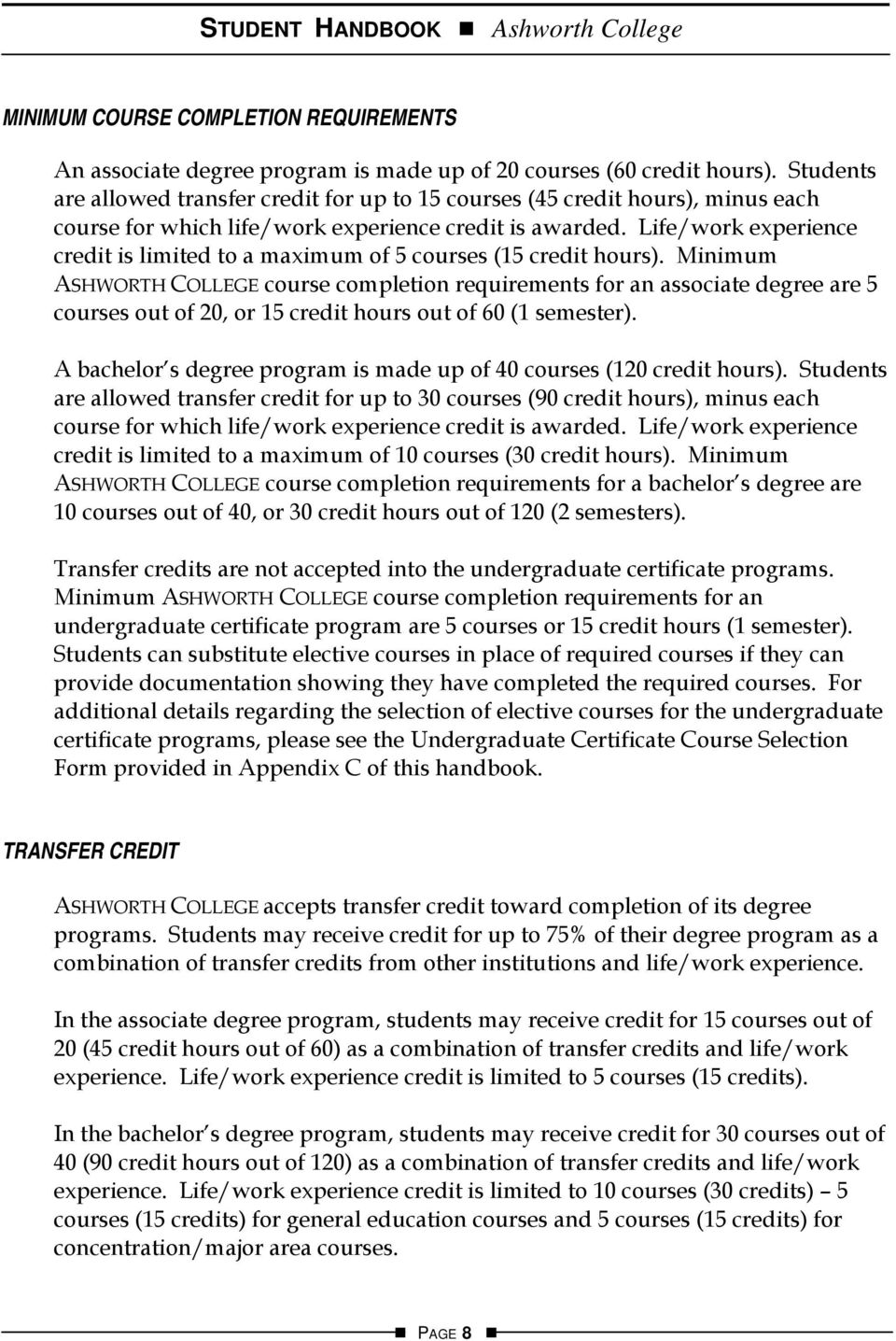
13 International degrees must be evaluated by a credential evaluation service, such as World Education Services (W.E.S.), that will determine the U.S. equivalency and send the transcripts directly to Ashworth College. W.E.S. provides a course-bycourse evaluation including U.S. requirements and GPA, in English. You can reach W.E.S. at or The credits you wish to transfer must meet specific guidelines: The credits must come from an accredited college or university, or they must be evaluated by ACE. The credits must not be more than 10 years old. You must have received a grade of C or better in the equivalent course. You must send an official transcript. Before you are awarded transfer credit, the Registrar at ASHWORTH COLLEGE must receive the completed Academic Processing Form (located in the back of this handbook and on our web site) and all official transcripts from other colleges within 90 days of your enrollment with ASHWORTH COLLEGE. An official college transcript is one that comes directly from your former college(s) to the Registrar s office at ASHWORTH COLLEGE. If your transcript has not been received within 90 days, you will not be granted transfer credits. The ASHWORTH COLLEGE Registrar will evaluate transfer credit eligibility and determine a degree plan to ensure that the student takes the minimum amount of courses needed to graduate. Please complete the following steps to apply for transfer credit: 1. Fill out the Academic Processing Form for Transfer Credit and send or fax it ( ) to the Registrar s office at ASHWORTH COLLEGE. The Registrar will rearrange your class schedule until your official transcript has been received and evaluated. This will prevent you from taking any transferred courses again. If you fail to notify us of your plans to apply for transfer credit, and you are enrolled in courses that are later accepted for transfer credit, you will be charged a $50 fee for each course you were erroneously enrolled in. 2. After you receive your student number, send the College Transcript Request Form (located in the back of this handbook and on our web site) to the college(s) you have attended. Please include your maiden name on the form if your last name has changed since you attended college. Do not send this form to ASHWORTH COLLEGE; we are not responsible for obtaining your transcript. PAGE 9
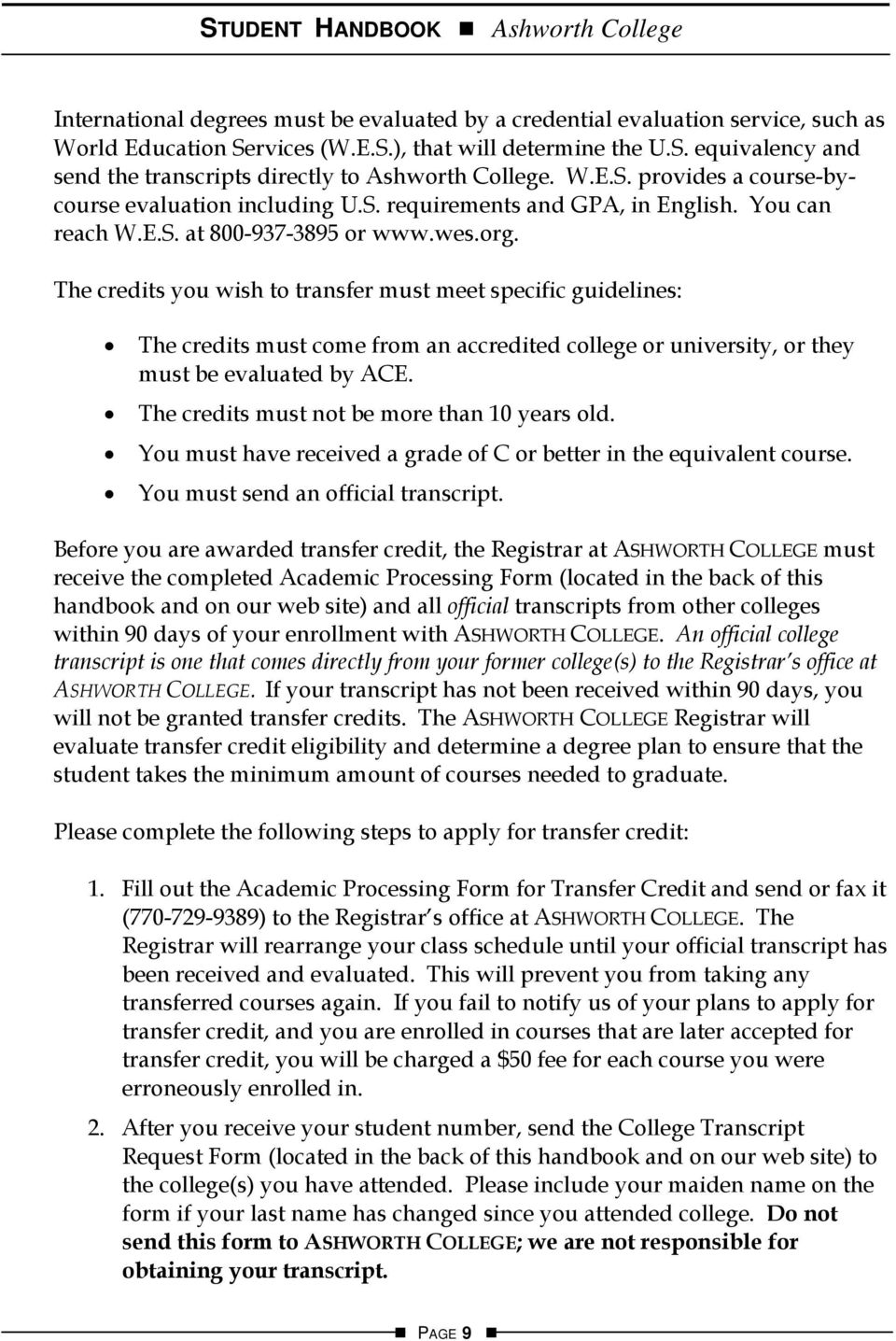
14 3. Credits you wish to transfer must be reasonably similar to course offerings at ASHWORTH COLLEGE. You may be required to send a copy of the course syllabus, the college catalog, or other information to help in the evaluation process. Do not send these items unless the Registrar requests them. You will be notified in writing of any transfer credit that is accepted by ASHWORTH COLLEGE. 4. Associate program students applying for VA Benefits must submit records on all prior educational training. Transfer credits must meet the guidelines stated in this Student Handbook. OTHER IMPORTANT TRANSFER INFORMATION Unless evaluated by ACE, military, police, and corrections training programs taken at colleges will not transfer. These training programs are not equal to an entire course offered at ASHWORTH COLLEGE. Unless evaluated by ACE, no credits will be awarded for on-the-job training, including specialized training, certificates received, etc. However, you may be able to take a life/work experience exam to receive credit. Accounting principles is offered as a three course series at ASHWORTH COLLEGE. If you took Principles of Accounting I and II at another college, you can apply for transfer credit for these two courses, but you will be required to take Introduction to Accounting. We cannot grant 9 hours of transfer credit for 6 hours of course work completed at another school. Some subjects are offered as two separate courses at ASHWORTH COLLEGE. You will not receive transfer credit for two-part courses unless the same subject was offered in two parts at the school where you took it. See the course listing pages for detailed information. TRANSFERRING ASHWORTH COLLEGE ASSOCIATE DEGREE CREDIT We accept all transfer credit from ASHWORTH COLLEGE s associate degree program to ASHWORTH COLLEGE s bachelor s degree program. ASHWORTH COLLEGE s associate degree graduates will not need to take any additional courses beyond 60 credit hours to complete ASHWORTH COLLEGE s bachelor s degree program. You must enroll in the bachelor s program using your associate program Student Number in order to ensure that you obtain credit for applicable courses from your associate program(s). (Please do not enroll under a separate student number.) PAGE 10
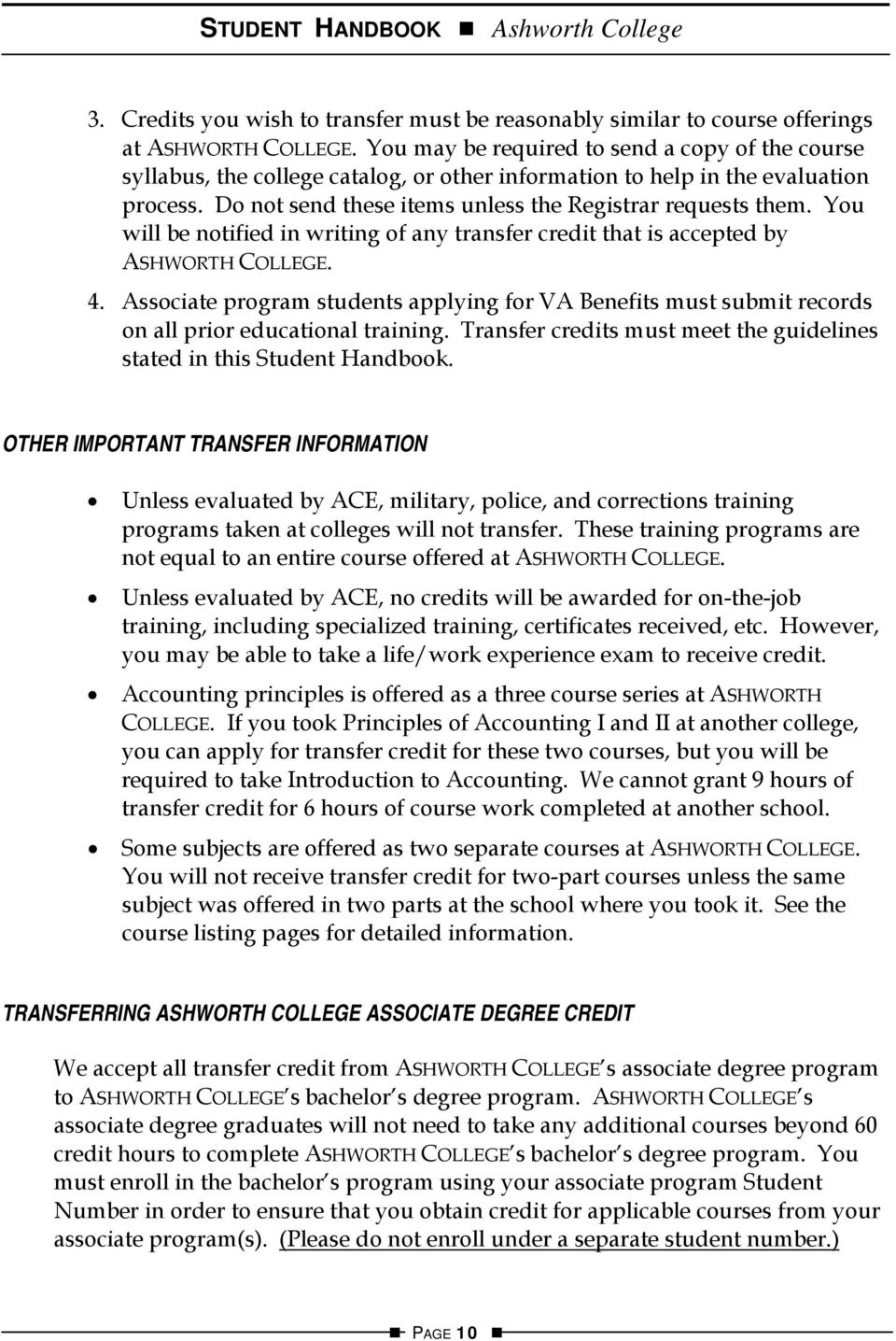
15 Certain PCDI diploma (certificate level) programs are similar enough to ASHWORTH COLLEGE courses to qualify for transfer credit. Please be sure to provide your PCDI Student Number when you enroll in the associate or bachelor s program in order to be given credit for PCDI courses. If your PCDI course is listed in the table below, you can receive transfer credit for the ASHWORTH COLLEGE course(s) listed next to it. For example, if you completed the PCDI accounting program (course code AAC), you can receive transfer credit for the ASHWORTH COLLEGE courses Introduction to Accounting (A01), Principles of Accounting I (A02), and Principles of Accounting II (A03). PCDI PROGRAM ASHWORTH COLLEGE COURSE(S) AAC Accounting Program A01, A02, A03 Introduction to Accounting Principles of Accounting I Principles of Accounting II ADA,ADB Marketing Specialist G04 Integrated Marketing Communications AZB Child Daycare E01 Careers in Early Childhood Education CPB Visual Basic Programming for Windows K07, K08 Visual Basic I Visual Basic II CTA Computer Network Technician K06 Local Area Networks FPA Financial Planning Specialist C07 Personal Finance HRA Health Records Specialist H06 Health Records Management IMA Internet Marketing Specialist G05 Internet Marketing JJC/JJD PC Technician A+ Certification K04, K05 KMA/KMB KMC/KKB LLA/LLB/ LLC PC Selection and Maintenance I PC Selection and Maintenance II Computer Training C10 Introduction to Computers Paralegal Program: Foundation Course P01, P02 MCB/MSCS Medical Billing Specialist H03, H07 Introduction to Paralegalism I Introduction to Paralegalism II Medical Terminology Medical Coding I RGA Retailing Specialist G03 Principles of Retailing SPLEC Wills, Trusts, and Estates P10 Wills, Trusts, and Estates Administration Advanced Course SPLLC Civil Litigation Advanced Course P04 Civil Litigation SPLRC Real Estate Law Advanced Course P06 Real Estate Law TP Tax Preparation C14 Income Tax Fundamentals WEA/WEB Web Site Design K09 Web Site Design WHA Security Specialist T01 Introduction to Security Management WWB Medical and Dental Office Assisting H01, H02 Medical Office Management I Medical Office Management II YYB/YYC Medical Transcription H03 Medical Terminology PAGE 11
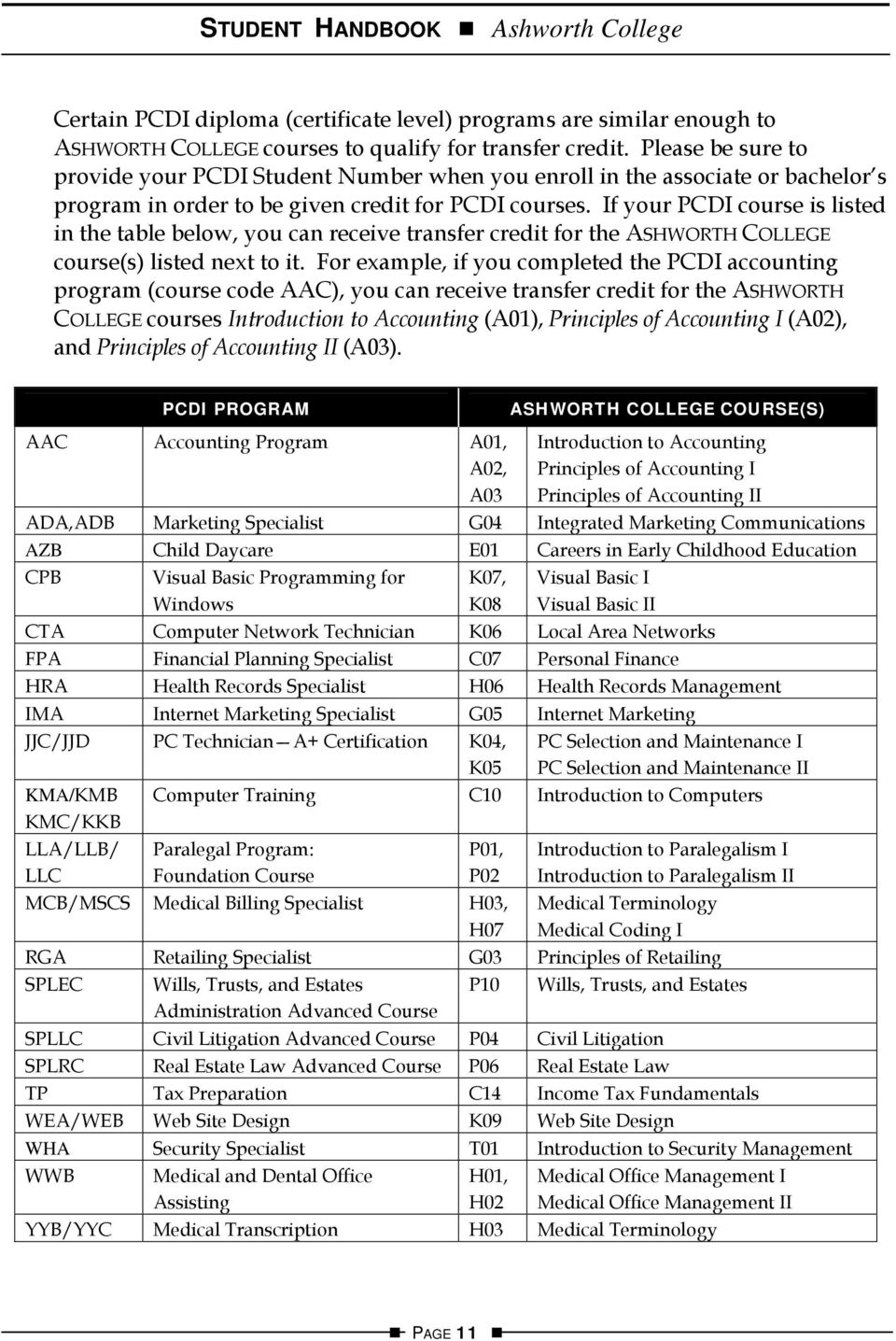
16 LIFE/WORK EXPERIENCE CREDIT You may receive credit for your life/work experience that is relevant to a particular course or courses in your program by taking a proctored exam of multiple-choice questions to demonstrate knowledge of the subject matter. To be awarded credit, you must provide either CLEP (College Level Examination Program) certification or pass a proctored examination. Please note that proof of employment history is not required. In the associate degree program, life/work experience credits are limited to a maximum of 5 courses (15 credit hours). In the bachelor s degree program, life/work experience credits are limited to a maximum of 10 courses (30 credit hours): 5 courses (15 credits) for general education courses and 5 courses (15 credits) for concentration/major area courses. If you pass a proctored life/work experience exam on your first attempt, you will receive credit for that course. If you do not receive a passing grade of 70 percent or higher, you will have to take the course as scheduled in your program. If you do not pass the exam(s) for the course(s) you select, you may not test in additional subjects. Example: If you have worked as an accountant for several years and are enrolled in the ASHWORTH COLLEGE accounting program, you may not need to take the course Accounting Spreadsheet Fundamentals (A05) and you will be allowed to test out of that course. Some subjects are offered as two or more separate courses at ASHWORTH COLLEGE. You may not test out of any subject that is offered as a series of courses unless you attempt and pass a life/work experience exam for each course in the series. Example: You may not attempt to take the life/work experience exam for Anatomy and Physiology I (H04) unless you take the life/work experience exam for Anatomy and Physiology II (H05). You must pass both exams with a grade of 70 percent or higher on your first attempt to receive credit. Important: Life/work experience credit will not be awarded for the following courses: Introduction to Business (C01), Achieving Academic Excellence (EN110), Business Communications I and II (C02 & C05), Introduction to Psychology (C04), Business Ethics (C06), Personal Finance (C07), American Government (C08), Introduction to Computers (C10), Macroeconomics (C11), Microeconomics (C13), College Mathematics (C17), Strategic Management (BU470), e-business Strategy (BU480), PAGE 12

17 Business Ethics (BU490, Victimology (CJ390), Ethics in the Justice System (CJ400), and Leadership in Law Enforcement (CJ410). To request credit for life/work experience, follow these steps: 1. Depending on your program, list up to 10 courses (excluding those specified on the previous page) using the Academic Processing Form - Life/Work Experience Credit (located at the back of this handbook and on our web site) and send or fax it ( ) to the Registrar s office at ASHWORTH COLLEGE. The Registrar can rearrange your schedule until your testing is completed. If you fail to notify us of your plans to apply for life/work experience credit, and you are sent courses that are later accepted for credit, you will be charged a $50 fee for each set of course materials sent in error. 2. Complete and submit a Proctor Nomination Form (located at the back of this handbook and on our web site). Find two people who have agreed to proctor your exam(s). The Registrar will choose one person to proctor your exam(s). For more information about your proctor and this process, see the section titled Proctored Semester Exams on the following page. 3. Once your proctor is selected, your exam(s) will be sent to the proctor. Each life/work experience exam has 50 multiple-choice questions. You have three hours to complete each exam. ASHWORTH COLLEGE does not provide any reference materials. However, you may bring any reference materials of your own when you take the exam(s). 4. You have 90 days from your date of enrollment to get the proper materials to ASHWORTH COLLEGE for life/work experience credit. You have 120 days from your date of enrollment to complete the tests and return them for grading. 5. A $20 administrative fee will be charged for each life/work experience exam. Please do not send copies of transcripts or job-training certificates for life/work experience credits. Please follow the steps listed above. PAGE 13
18 PROCTORED SEMESTER EXAMS In the associate degree program, there are four (4) proctored semester exams, one at the end of each semester. In the bachelor s degree program, there are eight (8) proctored semester exams, one at the end of each semester. In the undergraduate certificate program, there is one (1) proctored exam at the end of the program. Each proctored semester exam covers the five courses that you studied during the semester. Each exam has a total of 50 multiple-choice questions, with 10 multiplechoice questions for each course. You will have three hours to complete the entire exam. You may use your textbooks, notes, calculators, and other resources while taking the exam. It is very important that you keep your textbooks and other study materials for reference during the exams. You must have a minimum Grade Point Average (GPA) of 2.0 to be eligible to take a semester exam. Your score on semester exams does not affect your letter grade for the course. Semester exams are graded on a Pass/Fail basis. The minimum passing score is 70 percent. Semester exam scores are not factored into your average percentile score for each course. If you do not pass all sections of the exam, you may retake the failed section(s) once more. For each subject failed on the first attempt, you will be allowed 36 minutes to retake that subject on the second attempt. New questions will be given for the retake exam, which must be taken within 90 days. Students who fail a semester exam on the second attempt will be placed under academic review. Certain factors will be considered in determining whether the student will be permitted to remain in the program or be permanently dismissed. These factors include, but are not limited to, the student s grade point average for the semester, the number of semesters completed, and the scores earned on the first and second attempts. Important note: After you have completed the fourth course of your first semester, you must nominate a proctor for the semester exams by using the Proctor Nomination Form in the back of this handbook. Find two qualified people, living in your general area, who are willing to monitor the exams, and send the completed forms to ASHWORTH COLLEGE. The Registrar s office will select one person from your choices to proctor all of your semester exams. You will need to nominate a proctor only one time (during the first semester), unless that proctor is later unavailable to monitor your exams. Students may choose to submit the name of only one proctor candidate if that person is a high school or college administrator, faculty member, guidance counselor, librarian, or member of the PAGE 14

19 clergy. A student in the military may use a test-control officer. In general, acceptable proctor candidates must be responsible individuals with whom no conflict of interest exists. For instance, a fellow student, a relative of any kind (by blood or marriage), a roommate, or an immediate supervisor is not a suitable proctor candidate under any circumstances. You are solely responsible for locating suitable proctor candidates. Proctors should be willing to provide this service free of charge; otherwise, it will be your responsibility to pay any proctor fees. Additional details regarding the selection of a proctor are provided in Appendix C of this handbook. After the Registrar has selected a suitable proctor candidate from your nominations, the Registrar will send your exam to your proctor. The student and the chosen proctor must decide on a time and place to take the exam. The student will take the exam online in the presence of the proctor after the proctor accesses the exam using the code provided. If the student is not taking the proctored exam online (the exam is either mailed or ed to the proctor), the proctor must sign a statement that the exam was taken under the appropriate conditions, place the completed examination package along with a signed Certification of Compliance in a sealed envelope, sign the sealed flap, and return the envelope immediately to ASHWORTH COLLEGE to be graded. The proctor must make copies of the scan sheets to keep until receipt of your exam at ASHWORTH COLLEGE has been confirmed. You will be notified promptly of your results. If you receive a score of less than 70 percent on any of the five sections, you will be allowed ONE (1) opportunity to retake the failed subject(s). A $20 proctored exam fee will be billed to you when you take your proctored exam at the end of each of your semesters. No fee is charged for taking exams that are in your lessons. This fee is charged for proctored exams only. YOUR FIRST COURSE Every ASHWORTH COLLEGE student, regardless of his or her major, must successfully complete C01 Introduction to Business as the first mandatory course in all associate degree programs, and EN110 Achieving Academic Excellence as the first mandatory course in all bachelor s degree programs. No transfer or life/work experience credits will be allowed for these courses. All students must take the first mandatory course in their degree program because it is used as our academic PAGE 15
20 qualifying course. If you fail any lessons in the first mandatory course, you will be placed under academic review, and the shipping of your next course could be delayed up to 30 days. After you complete all lessons in the first mandatory course in your program, if your average grade on the first attempt of all lessons is less than 60 percent, you will be permanently dismissed from the program. Retake scores are not considered. It is very important that you take your first course seriously. COURSE EXAMS AND ASSIGNMENTS In the associate degree and undergraduate certificate programs, Achievement Exams are required for each lesson in a course. Some courses only have four lessons and some have as many as twelve lessons. These exams are found in the Learning Guides for each course or in the online version of the course materials. Each exam has 20 questions. Some associate courses also have mandatory handgraded assignments. All students are encouraged to take their achievement exams online by accessing our Web site at You must have a valid address to take your exams online. Once an exam has been graded, you will receive your grade via . For your reference, print the screen showing your answers before you submit the exam. Correspondence students have the option of mailing their exam/assignment answer sheets to ASHWORTH COLLEGE as you complete each lesson. (Please note that the posting of grades takes longer for exams/assignments that are mailed than for those that are taken/submitted online). Keep a record of how you answered each question by marking your answers in the Learning Guide, and then transfer your answers to the answer sheet. This is important and can be helpful if your exams/assignments are mistakenly lost or destroyed before they reach ASHWORTH COLLEGE. In the bachelor s program, a combination of online exams and assignments are required for each course. These exams and assignments can be found in the online course materials. If you do not receive a passing grade on an achievement exam (associate or certificate program) or online exam (bachelor s program), you must retake the exam. Similarly, you must redo an assignment if you do not obtain a passing grade on the first attempt. Regardless of your passing grade on the retake exam or assignments, you will automatically receive the minimum passing score of 60 percent. PAGE 16
21 Submit only one achievement exam at a time! Do not submit multiple exams together! To earn your best scores, you need to know what you don t understand before you submit the next lesson. CORE COURSES CORE courses are major area courses specific to a particular degree or certificate program. CORE courses for all programs are identified in the course listing pages in this handbook. Remember, if your final average score on more than one (1) CORE course is less than 70 percent, you must change majors* or you will be dismissed from the COLLEGE. In many cases, students fail CORE courses simply because they make the mistake of taking all exams at once! Since the maximum retake score on achievement exams is 60 percent, a failed exam on a CORE course could result in a final average of less than 70 percent. Use extreme care when taking CORE course exams! * You must switch to a major where the failed course is not a CORE course. Please note that all courses within an undergraduate certificate program are considered core courses. Failed exams and assignments can delay your next shipment. We will not ship your next course until you take and pass all exams and assignments in the prior course. Check your exam and assignment results as they are provided to you. If you disagree with the results, you are allowed 30 days to notify the COLLEGE. Exam results not challenged within 30 days cannot be challenged later. PAGE 17
22 GRADING SYSTEM Your percentile score for each course is determined by averaging the exam and assignment scores for all lessons in the course. PERCENTAGE LETTER GRADE GRADE POINTS STANDARD A 4.0 Excellent B 3.0 Good C 2.0 Average D 1.0 Poor or Failing* *A letter grade of D is considered failing for a CORE course. You are permitted to fail one CORE course in a program. If you fail more than one CORE course, you must change majors* or you will be dismissed from the program. * You must switch to a major where the failed course is not a CORE course. Important: If you change majors because you did not receive a passing grade on a CORE course, you will have to take the semester exam for that course if it is a non-core course in your new program and you received a final grade of at least 60 percent. If you did not receive a final grade of at least 60 percent, you will have to retake the failed exam(s) until you earn a passing score, before taking the semester exam. ACADEMIC STANDING There are four categories of academic standing: academic good standing, academic review, academic probation, and academic dismissal. To remain in academic good standing, you must: maintain a minimum grade point average (GPA) of 2.0. earn a grade of at least C in all CORE courses in a degree program. If you fail any lessons in a CORE course, you will be subject to academic review until the course is completed with a grade of at least 70 percent. If your final average in more than one (1) CORE course is less than 70 percent, you will be permanently dismissed from the COLLEGE. PAGE 18
23 earn a grade of at least 60 percent in a non-core course, or you will be subject to academic review until you complete the course with a grade of at least 60 percent. A student is placed under academic review when it is questionable whether the student will be successful in the program. Academic review can delay your next shipment for up to 30 days. You will be placed under academic review if you: fail any lessons in the first course of the degree program (C01 Introduction to Business OR EN110 Achieving Academic Excellence); fail any exam(s) or assignment(s); fail the second attempt of any section(s) of a semester exam; disregard ASHWORTH S plagiarism and academic honesty policies. You will be placed under academic probation if: you fail one (1) CORE course; your GPA falls below 2.0*; violate ASHWORTH S plagiarism and academic honesty policies. *Your GPA must be brought back up to at least 2.0 before you can take a semester exam. Academic dismissal will result if you: fail the first course in the degree program (C01 Introduction to Business OR EN110 Achieving Academic Excellence); fail more than one (1) CORE course with a final average of less than 70 percent, unless you transfer to another degree or certificate program* within 60 days; fail the second attempt on a semester exam and it is determined that your overall academic performance is unacceptable; are found guilty of academic dishonesty. * You must switch to a major where the failed course is not a CORE course. Students who are academically dismissed will not be allowed to enroll in any other degree or certificate programs at ASHWORTH COLLEGE in the future. A student who is dismissed for academic reasons will be required to pay the full contract tuition PAGE 19
24 amount incurred. A student may appeal dismissal for academic or any other reasons by submitting a notification in writing to F. Milton Miller, Dean of Degree Programs, within 30 days of being notified by ASHWORTH COLLEGE of the dismissal. Decisions rendered are final and the student will be notified within 30 days of receipt of the appeal. HOW TO CALCULATE YOUR GPA Each letter grade is worth a certain number of grade points: A = 4 points B = 3 points C = 2 points D = 1 point F = 0 points Example: In the first semester, your grades in the first five courses are: A, B, A, C, and A. To calculate your GPA, proceed as follows. STEP 1: Add the grade points for all courses taken during the semester. A = 4 grade points B = 3 grade points A = 4 grade points C = 2 grade points A = 4 grade points 17 total grade points STEP 2: Divide the total number of grade points by the number of courses = 3.4 Your GPA is 3.4. PAGE 20
25 ASSOCIATE DEGREE PROGRAM CURRICULA ACCOUNTING BUSINESS MANAGEMENT COMPUTER INFORMATION MANAGEMENT FIRST SEMESTER FIRST SEMESTER FIRST SEMESTER C01 Introduction to Business C01 Introduction to Business C01 Introduction to Business C02 Business Communications I C02 Business Communications I C02 Business Communications I C17 College Mathematics C17 College Mathematics C17 College Mathematics A01 Introduction to Accounting C15 Principles of Management K01 Windows Operating Systems C04 Introduction to Psychology C04 Introduction to Psychology K02 Office XP I SECOND SEMESTER SECOND SEMESTER SECOND SEMESTER C05 Business Communications II M01 Human Resource Management K03 Office XP II C06 Business Ethics C05 Business Communications II C04 Introduction to Psychology A02 Principles of Accounting I C06 Business Ethics K04 PC Selection & Maintenance I C07 Personal Finance A01 Introduction to Accounting K05 PC Selection & Maintenance II C08 American Government C08 American Government K06 Local Area Networks THIRD SEMESTER THIRD SEMESTER THIRD SEMESTER C09 Principles of Finance M02 Total Quality Management K07 Visual Basic I C10 Introduction to Computers C10 Introduction to Computers K08 Visual Basic II A03 Principles of Accounting II C16 Principles of Marketing K09 Web Site Design C11 Macroeconomics C07 Personal Finance C08 American Government C12 Business Law A02 Principles of Accounting I C15 Principles of Management FOURTH SEMESTER FOURTH SEMESTER FOURTH SEMESTER C13 Microeconomics M03 Organizational Behavior K10 Programming in JavaScript A04 Intermediate Accounting I C13 Microeconomics C05 Business Communications II A05 Spreadsheet Fundamentals C09 Principles of Finance K11 Database Processing A06 Intermediate Accounting II C12 Business Law A01 Introduction to Accounting C14 Income Tax Fundamentals A03 Principles of Accounting II K12 Systems Analysis & Design CORE courses are printed in Bold Letters. You must earn a final average score of at least 70 percent in CORE courses or you will not be allowed to continue your program. PAGE 21
26 ASSOCIATE DEGREE PROGRAM CURRICULA CONSTRUCTION MANAGEMENT CRIMINAL JUSTICE EARLY CHILDHOOD EDUCATION FIRST SEMESTER FIRST SEMESTER FIRST SEMESTER C01 Introduction to Business C01 Introduction to Business C01 Introduction to Business C10 Introduction to Computers J01 Introduction to Criminal Justice C02 Business Communications I C02 Business Communications I C08 American Government E01 Careers in Early Childhood Education B01 Introduction to Construction J02 Criminal Law C04 Introduction to Psychology C17 College Mathematics C02 Business Communications I E02 Child Development SECOND SEMESTER SECOND SEMESTER SECOND SEMESTER B02 Construction Materials and Methods J03 Criminal Procedure C05 Business Communications II C05 Business Communications II C07 Personal Finance E03 Curriculum Development B03 Drawings and Specifications J04 Policing E04 Guidance and Discipline C04 Introduction to Psychology C12 Business Law C08 American Government B04 Safety Planning and Administration C05 Business Communications II E05 Children's Literature THIRD SEMESTER THIRD SEMESTER THIRD SEMESTER C12 Business Law C04 Introduction to Psychology C17 College Mathematics C15 Principles of Management J05 Corrections E06 Creative Expression and Play C08 American Government J06 Ethics in Criminal Justice E07 Art and Creative Development B05 Construction Surveying Fundamentals C17 College Mathematics E08 Health, Safety, and Nutrition M03 Organizational Behavior J07 Private Security E09 Home, School, and Community FOURTH SEMESTER FOURTH SEMESTER FOURTH SEMESTER B06 Cost Estimating C10 Introduction to Computers C10 Introduction to Computers A01 Introduction to Accounting J08 Domestic Violence E10 Exceptional Children B07 Project Scheduling J09 Juvenile Justice E11 Movement and Music C06 Business Ethics J10 Criminal Investigation E13 Early Childhood Literacy B08 Construction Management J11 Report Writing E12 Cultural Diversity CORE courses are printed in Bold Letters. You must earn a final average score of at least 70 percent in CORE courses or you will not be allowed to continue your program. PAGE 22
27 ASSOCIATE DEGREE PROGRAM CURRICULA FINANCE HEALTH CARE MANAGEMENT FIRST SEMESTER FIRST SEMESTER FIRST SEMESTER C01 Introduction to Business C01 Introduction to Business C01 Introduction to Business C02 Business Communications I C02 Business Communications I C02 Business Communications I C04 Introduction to Psychology H01 Medical Office Management I C15 Principles of Management C17 College Mathematics C04 Introduction to Psychology M01 Human Resource Management C07 Personal Finance H02 Medical Office Management II C04 Introduction to Psychology SECOND SEMESTER SECOND SEMESTER SECOND SEMESTER C11 Macroeconomics C15 Principles of Management C05 Business Communications II C13 Microeconomics C17 College Mathematics C06 Business Ethics F01 Money and Banking H03 Medical Terminology C08 American Government C10 Introduction to Computers H04 Anatomy & Physiology I M03 Organizational Behavior C05 Business Communications II H05 Anatomy & Physiology II C17 College Mathematics THIRD SEMESTER THIRD SEMESTER THIRD SEMESTER C09 Principles of Finance C12 Business Law R01 Employment Law C08 American Government H06 Health Records Management K02 Office XP I Financial Institutions and Markets C05 Business Communications II K03 Office XP II HUMAN RESOURCE MANAGEMENT F02 A01 Introduction to Accounting H07 Medical Coding I R02 Training and Development C12 Business Law H08 Medical Coding II C12 Business Law FOURTH SEMESTER FOURTH SEMESTER FOURTH SEMESTER A02 Principles of Accounting I C08 American Government C07 Personal Finance C15 Principles of Management K02 Office XP I R03 Compensation and Benefits A03 Principles of Accounting II K03 Office XP II R04 Human Relations F03 Financial Statement Analysis A01 Introduction to Accounting R05 Labor Relations F04 Investments M01 Human Resource Management A01 Introduction to Accounting CORE courses are printed in Bold Letters. You must earn a final average score of at least 70 percent in CORE courses or you will not be allowed to continue your program. PAGE 23
28 ASSOCIATE DEGREE PROGRAM CURRICULA MARKETING PARALEGAL STUDIES PSYCHOLOGY FIRST SEMESTER FIRST SEMESTER FIRST SEMESTER C01 Introduction to Business C01 Introduction to Business C01 Introduction to Business C16 Principles of Marketing C02 Business Communications I C02 Business Communications I C02 Business Communications I C12 Business Law R04 Human Relations C17 College Mathematics P01 Introduction to Paralegalism I S01 Introduction to Psychology I C04 Introduction to Psychology P02 Introduction to Paralegalism II S02 Introduction to Psychology II SECOND SEMESTER SECOND SEMESTER SECOND SEMESTER C05 Business Communications II C07 Personal Finance C07 Personal Finance G01 Consumer Buying Behavior C05 Business Communications II S03 Human Growth and Development I C15 Principles of Management C08 American Government S04 Human Growth and Development II G02 Principles of Professional Selling P03 Tort Law C05 Business Communications II C12 Business Law P04 Civil Litigation C08 American Government THIRD SEMESTER THIRD SEMESTER THIRD SEMESTER G03 Principles of Retailing C04 Introduction to Psychology C17 College Mathematics C11 Macroeconomics P05 Criminal Law and Procedure S05 Social Problems C13 Microeconomics P06 Real Estate Law S06 Social Psychology G04 Integrated Marketing Communications C17 College Mathematics S07 Abnormal Psychology A01 Introduction to Accounting P07 Law Office Management M03 Organizational Behavior FOURTH SEMESTER FOURTH SEMESTER FOURTH SEMESTER M03 Organizational Behavior C10 Introduction to Computers C10 Introduction to Computers C08 American Government P08 Family Law S08 Psychology of Personality G05 Internet Marketing P09 Legal Research & Writing C06 Business Ethics C06 Business Ethics P10 Wills, Trusts, and Estates C16 Principles of Marketing G06 International Marketing C14 Income Tax Fundamentals M01 Human Resource Management CORE courses are printed in Bold Letters. You must earn a final average score of at least 70 percent in CORE courses or you will not be allowed to continue your program. PAGE 24
29 ASSOCIATE DEGREE PROGRAM CURRICULA RETAIL MANAGEMENT FIRST SEMESTER FIRST SEMESTER C01 Introduction to Business C01 Introduction to Business C02 Business Communications I T01 Introduction to Security Management L01 Introduction to Retailing C02 Business Communications I C10 Introduction to Computers J01 Introduction to Criminal Justice C08 American Government C04 Introduction to Psychology SECOND SEMESTER SECOND SEMESTER C15 Principles of Management J04 Policing C05 Business Communications II C05 Business Communications II G03 Principles of Retailing J07 Private Security C17 College Mathematics T02 Introduction to Terrorism L02 Retail Supply Chain Management C15 Principles of Management THIRD SEMESTER THIRD SEMESTER L03 Retail Buying T03 Incident Command Systems A01 Introduction to Accounting J02 Criminal Law L04 Retail Employee Management J03 Criminal Procedure C13 Microeconomics T04 Aviation Security C04 Introduction to Psychology J10 Criminal Investigation FOURTH SEMESTER SECURITY MANAGEMENT FOURTH SEMESTER L05 Retail Quality Management C08 American Government C09 Principles of Finance T05 Criminal Behavior G01 Consumer Buying Behavior C17 College Mathematics L06 Retail Loss Prevention T06 Cyber Security C16 Principles of Marketing T07 Homeland Security and Public Safety CORE courses are printed in Bold Letters. You must earn a final average score of at least 70 percent in CORE courses or you will not be allowed to continue your program. PAGE 25
30 BACHELOR S DEGREE PROGRAM CURRICULA BUSINESS ADMINISTRATION MANAGEMENT MARKETING FIRST SEMESTER FIRST SEMESTER FIRST SEMESTER EN110 Achieving Academic Excellence EN110 Achieving Academic Excellence EN110 Achieving Academic Excellence EN120 Beginning English Writing EN120 Beginning English Writing EN120 Beginning English Writing C10V Introduction to Computers C10V Introduction to Computers C10V Introduction to Computers HS150 World Civilizations I HS150 World Civilizations I HS150 World Civilizations I Gen Ed. Elective 1 Gen Ed. Elective 1 Gen Ed. Elective 1 SECOND SEMESTER SECOND SEMESTER SECOND SEMESTER EN130 English Composition EN130 English Composition EN130 English Composition C17V College Mathematics C17V College Mathematics C17V College Mathematics C04V Introduction to Psychology C04V Introduction to Psychology C04V Introduction to Psychology MA140 Business Analysis MA140 Business Analysis MA140 Business Analysis Gen Ed. Elective 2 Gen Ed. Elective 2 Gen Ed. Elective 2 THIRD SEMESTER THIRD SEMESTER THIRD SEMESTER SO115 Essentials of Sociology SO115 Essentials of Sociology SO115 Essentials of Sociology C02V Business Communications I C02V Business Communications I C02V Business Communications I MA240 College Algebra MA240 College Algebra MA240 College Algebra HS250 World Civilizations II HS250 World Civilizations II HS250 World Civilizations II Gen Ed. Elective 3 Gen Ed. Elective 3 Gen Ed. Elective 3 FOURTH SEMESTER FOURTH SEMESTER FOURTH SEMESTER MA260 Statistical Analysis I MA260 Statistical Analysis I MA260 Statistical Analysis I C12V Business Law C12V Business Law C12V Business Law SO245 Social Impact of Technology SO245 Social Impact of Technology SO245 Social Impact of Technology Gen Ed. Elective 4 Gen Ed. Elective 4 Gen Ed. Elective 4 Gen Ed. Elective 5 Gen Ed. Elective 5 Gen Ed. Elective 5 FIFTH SEMESTER FIFTH SEMESTER FIFTH SEMESTER A01V Introduction to Accounting A01V Introduction to Accounting A01V Introduction to Accounting C11V Macroeconomics C11V Macroeconomics C11V Macroeconomics C13V Microeconomics C13V Microeconomics C13V Microeconomics BU310 Fundamentals of Management BU310 Fundamentals of Management BU310 Fundamentals of Management BU320 Marketing Principles BU320 Marketing Principles BU320 Marketing Principles SIXTH SEMESTER SIXTH SEMESTER SIXTH SEMESTER BU350 Organizational Behavior BU350 Organizational Behavior BM350 Marketing Management BU330 Accounting for Managers BU340 Managerial Finance I BM380 Marketing Research BM350 Marketing Management BM350 Marketing Management BM410 Sales Mgmt & Practices BU340 Managerial Finance I BZ380 Management Info Systems BU460 Electronic Commerce BU470 Strategic Management BU470 Strategic Management BU470 Strategic Management CORE courses are printed in Bold Letters. You must earn a final average score of at least 70 percent in CORE courses or you will not be allowed to continue your program. PAGE 26
31 BACHELOR S DEGREE PROGRAM CURRICULA BUSINESS ADMIN. (CONT.) MANAGEMENT (CONT.) MARKETING (CONT.) SEVENTH SEMESTER SEVENTH SEMESTER SEVENTH SEMESTER BZ480 International Management BZ480 International Management BZ480 International Management BU460 Electronic Commerce BZ400 Strategic IT BM440 Internet Marketing BU480 e-business Strategy BU480 e-business Strategy BU480 e-business Strategy Business Elective 1 Business Elective 1 Business Elective 1 Business Elective 2 Business Elective 2 Business Elective 2 EIGHTH SEMESTER EIGHTH SEMESTER EIGHTH SEMESTER BU450 Leadership Skills BU450 Leadership Skills BU450 Leadership Skills Business Elective 3 Business Elective 3 Business Elective 3 Business Elective 4 Business Elective 4 Business Elective 4 Business Elective 5 Business Elective 5 Business Elective 5 BU490 Business Ethics BU490 Business Ethics BU490 Business Ethics GEN ED ELECTIVES (15 CREDITS) GEN ED ELECTIVES (15 CREDITS) GEN ED ELECTIVES (15 CREDITS) AN310 Cultural Anthropology AN310 Cultural Anthropology AN310 Cultural Anthropology AR300 Art History AR300 Art History AR300 Art History EN360 Technical Communication EN360 Technical Communication EN360 Technical Communication GE350 World Geography GE350 World Geography GE350 World Geography MA270 Statistical Analysis II MA270 Statistical Analysis II MA270 Statistical Analysis II PY360 Ethics in Technology PY360 Ethics in Technology PY360 Ethics in Technology SC140 Elements of Chemistry SC140 Elements of Chemistry SC140 Elements of Chemistry SC160 Basic Biology SC160 Basic Biology SC160 Basic Biology SC260 Introduction to Ecology SC260 Introduction to Ecology SC260 Introduction to Ecology MAJOR ELECTIVES (15 CREDITS) MAJOR ELECTIVES (15 CREDITS) MAJOR ELECTIVES (15 CREDITS) BM380 Marketing Research BM380 Marketing Research BU330 Accounting for Managers BM410 Sales Mgmt & Practices BM410 Sales Mgmt & Practices BU340 Managerial Finance I BM440 Internet Marketing BM440 Internet Marketing BU350 Organizational Behavior BU360 Social Impact of Business BU330 Accounting for Managers BU360 Social Impact of Business BU440 Managerial Finance II BU360 Social Impact of Business BU440 Managerial Finance II BZ380 Management Info Systems BU440 Managerial Finance II BZ380 Management Info Systems BZ400 Strategic IT BU460 Electronic Commerce BZ400 Strategic IT BZ420 HR Management BZ420 HR Management BZ420 HR Management BZ440 Quality Control BZ440 Quality Control BZ440 Quality Control BZ450 Being an Entrepreneur BZ450 Being an Entrepreneur BZ450 Being an Entrepreneur BZ460 Project Management BZ460 Project Management BZ460 Project Management CORE courses are printed in Bold Letters. You must earn a final average score of at least 70 percent in CORE courses or you will not be allowed to continue your program. PAGE 27
32 BACHELOR S DEGREE PROGRAM CURRICULA E-BUSINESS FIRST SEMESTER FIRST SEMESTER EN110 Achieving Academic Excellence EN110 Achieving Academic Excellence EN120 Beginning English Writing EN120 Beginning English Writing C10V Introduction to Computers C10V Introduction to Computers HS150 World Civilizations I HS150 World Civilizations I Gen Ed. Elective 1 Gen Ed. Elective 1 SECOND SEMESTER SECOND SEMESTER EN130 English Composition EN130 English Composition C17V College Mathematics C17V College Mathematics C04V Introduction to Psychology C04V Introduction to Psychology MA140 Business Analysis SO115 Essentials of Sociology Gen Ed. Elective 2 Gen Ed. Elective 2 THIRD SEMESTER THIRD SEMESTER SO115 Essentials of Sociology J11V Report Writing C02V Business Communications I C11V Macroeconomics MA240 College Algebra C13V Microeconomics HS250 World Civilizations II HS250 World Civilizations II Gen Ed. Elective 3 Gen Ed. Elective 3 FOURTH SEMESTER FOURTH SEMESTER MA260 Statistical Analysis I MA260 Statistical Analysis I C12V Business Law C12V Business Law SO245 Social Impact of Technology SO245 Social Impact of Technology Gen Ed. Elective 4 Gen Ed. Elective 4 Gen Ed. Elective 5 Gen Ed. Elective 5 FIFTH SEMESTER FIFTH SEMESTER A01V Introduction to Accounting CJ310 Introduction to Criminal Justice C11V Macroeconomics CJ340 Criminology C13V Microeconomics CJ320 American Constitutional Law BU310 Fundamentals of Management CJ330 Criminal Law and Procedure BU320 Marketing Principles CJ350 Judicial Process SIXTH SEMESTER SIXTH SEMESTER BZ380 Management Info Systems CJ360 Criminal Investigation BU460 Electronic Commerce CJ400 Ethics in the Justice System BM350 Marketing Management CJ410 Leadership in Law Enforcement BM440 Internet Marketing CJ430 Police and Community Relations BU470 Strategic Management CJ420 Juveniles in the Justice System CORE courses are printed in Bold Letters. You must earn a final average score of at least 70 percent in CORE courses or you will not be allowed to continue your program. PAGE 28 CRIMINAL JUSTICE
33 BACHELOR S DEGREE PROGRAM CURRICULA E-BUSINESS (CONT.) CRIMINAL JUSTICE (CONT.) SEVENTH SEMESTER SEVENTH SEMESTER BZ480 International Management CJ440 White Collar Crime BZ400 Strategic IT CJ390 Victimology BU480 e-business Strategy CJ450 Private Security Business Elective 1 CJ Elective 1 Business Elective 2 CJ Elective 2 EIGHTH SEMESTER EIGHTH SEMESTER BU450 Leadership Skills CJ370 Correctional Practice and Policy Business Elective 3 CJ380 Probation and Parole Business Elective 4 CJ Elective 3 Business Elective 5 CJ Elective 4 BU490 Business Ethics CJ Elective 5 GEN ED ELECTIVES (15 CREDITS) GEN ED ELECTIVES (15 CREDITS) AN310 Cultural Anthropology AN310 Cultural Anthropology AR300 Art History AR300 Art History EN360 Technical Communication EN360 Technical Communication GE350 World Geography GE350 World Geography MA270 Statistical Analysis II MA270 Statistical Analysis II PY360 Ethics in Technology PY360 Ethics in Technology SC140 Elements of Chemistry SC140 Elements of Chemistry SC160 Basic Biology SC160 Basic Biology SC260 Introduction to Ecology SC260 Introduction to Ecology MAJOR ELECTIVES (15 CREDITS) MAJOR ELECTIVES (15 CREDITS) BM380 Marketing Research BU310 Fundamentals of Management BM410 Sales Mgmt & Practices BU350 Organizational Behavior BU330 Accounting for Managers BU490 Business Ethics BU340 Managerial Finance I J08V Domestic Violence BU350 Organizational Behavior P08V Family Law BU360 Social Impact of Business P09V Legal Research and Writing BU440 Managerial Finance II R04V Human Relations BZ420 HR Management S05V Social Problems BZ440 Quality Control S06V Social Psychology BZ450 Being an Entrepreneur S08V Psychology of Personality BZ460 Project Management CORE courses are printed in Bold Letters. You must earn a final average score of at least 70 percent in CORE courses or you will not be allowed to continue your program. PAGE 29
34 UNDERGRADUATE CERTIFICATE PROGRAM CURRICULA ACCOUNTING BUSINESS MANAGEMENT COMPUTER INFO MGT A01 Introduction to Accounting C01 Introduction to Business K01 Windows Operating System A02 Principles of Accounting I Elective Course 1 Elective Course 1 A03 Principles of Accounting II Elective Course 2 Elective Course 2 Elective Course 1 Elective Course 3 Elective Course 3 Elective Course 2 Elective Course 4 Elective Course 4 ELECTIVE COURSES (6 CREDITS) ELECTIVE COURSES (12 CREDITS) ELECTIVE COURSES (12 CREDITS) A04 Intermediate Accounting I A01 Introduction to Accounting K02 Office XP I A06 Intermediate Accounting II C06 Business Ethics K03 Office XP II A05 Actg Spreadsheet Fundamentals C09 Principles of Finance K04 PC Selection & Maintenance I C09 Principles of Finance C13 Microeconomics K05 PC Selection & Maintenance II C15 Principles of Management K06 Local Area Networks C16 Principles of Marketing K09 Web Site Design M03 Organizational Behavior K10 Programming in JavaScript K11 Database Processing K12 System Analysis & Design CONSTRUCTION MGT CRIMINAL JUSTICE EARLY CHILDHOOD EDU B01 Introduction to Construction J01 Intro to Criminal Justice E01 Careers in Early Childhood Ed. B08 Construction Management Elective Course 1 Elective Course 1 Elective Course 1 Elective Course 2 Elective Course 2 Elective Course 2 Elective Course 3 Elective Course 3 Elective Course 3 Elective Course 4 Elective Course 4 ELECTIVE COURSES (9 CREDITS) ELECTIVE COURSES (12 CREDITS) ELECTIVE COURSES (12 CREDITS) B02 Construction Matls & Methods J02 Criminal Law E02 Child Development B03 Drawings & Specifications J03 Criminal Procedure E03 Curriculum Development B04 Safety Planning & Administration J04 Policing E04 Guidance & Discipline B05 Construction Surveying Funds. J05 Corrections E05 Children's Literature B06 Cost Estimating J06 Ethics in Criminal Justice E06 Creative Expression & Play B07 Project Scheduling J07 Private Security E07 Art & Creative Development J08 Domestic Violence E08 Health, Safety & Nutrition J09 Juvenile Justice E09 Home, School & Community J10 Criminal Investigation E10 Exceptional Children J11 Report Writing E11 Movement & Music E12 Cultural Diversity Required courses are printed in Bold Letters. E13 Early Childhood Literacy PAGE 30
35 UNDERGRADUATE CERTIFICATE PROGRAM CURRICULA FINANCE HEALTHCARE MANAGEMENT HUMAN RESOURCE MGT C09 Principles of Finance H03 Medical Terminology M01 Human Resource Management Elective Course 1 Elective Course 1 Elective Course 1 Elective Course 2 Elective Course 2 Elective Course 2 Elective Course 3 Elective Course 3 Elective Course 3 Elective Course 4 Elective Course 4 Elective Course 4 ELECTIVE COURSES (12 CREDITS) ELECTIVE COURSES (12 CREDITS) ELECTIVE COURSES (12 CREDITS) C07 Personal Finance H01 Medical Office Management I M03 Organizational Behavior A01 Introduction to Accounting H02 Medical Office Management II R01 Employment Law F01 Money & Banking H04 Anatomy & Physiology I R02 Training & Development F02 Financial Institutions & Markets H05 Anatomy & Physiology II R03 Compensation & Benefits F03 Financial Statement Analysis H07 Medical Coding I R04 Human Relations F04 Investments H08 Medical Coding II R05 Labor Relations H06 Health Records Management MARKETING PARALEGAL STUDIES PSYCHOLOGY C16 Principles of Marketing P01 Introduction to Paralegalism I S01 Introduction to Psychology I Elective Course 1 P02 Introduction to Paralegalism II S02 Introduction to Psychology II Elective Course 2 Elective Course 1 Elective Course 1 Elective Course 3 Elective Course 2 Elective Course 2 Elective Course 4 Elective Course 3 Elective Course 3 ELECTIVE COURSES (12 CREDITS) ELECTIVE COURSES (9 CREDITS) ELECTIVE COURSES (9 CREDITS) G01 Consumer Buying Behavior P03 Tort Law S03 Human Growth & Development I G02 Principles of Professional Selling P04 Civil Litigation S04 Human Growth & Development II G03 Principles of Retailing P05 Criminal Law & Procedure S05 Social Problems G04 Integrated Mktg Communications P06 Real Estate Law S06 Social Psychology G05 Internet Marketing P07 Law Office Management S07 Abnormal Psychology G06 International Marketing P08 Family Law S08 Psychology of Personality P09 Legal Research & Writing P10 Wills, Trusts & Estates Required courses are printed in Bold Letters. PAGE 31
36 UNDERGRADUATE CERTIFICATE PROGRAM CURRICULA RETAIL MANAGEMENT SECURITY MANAGEMENT L01 Introduction to Retailing T01 Introduction to Security Mgt G03 Principles of Retailing Elective Course 1 Elective Course 1 Elective Course 2 Elective Course 2 Elective Course 3 Elective Course 3 Elective Course 4 ELECTIVE COURSES (9 CREDITS) ELECTIVE COURSES (12 CREDITS) L02 Retail Supply Chain Management T02 Introduction to Terrorism L03 Retail Buying T03 Incident Command Systems L04 Retail Employee Management T04 Aviation Security L05 Retail Quality Management T05 Criminal Behavior L06 Retail Loss Prevention T06 Cyber Security G01 Consumer Behavior T07 Homeland Sec. & Public Safety J07 Private Security Required courses are printed in Bold Letters. PAGE 32
37 GRADUATION REQUIREMENTS To earn an associate degree from ASHWORTH COLLEGE, you must meet the following requirements: You must complete 60 credit hours applicable to your degree program. You must complete at least 5 courses, or 15 credit hours, with ASHWORTH COLLEGE. You must earn a grade point average of 2.0 or higher. You must pass all subjects covered on the semester exams, which are taken at the end of each semester, in no more than two attempts, and you must receive a score of at least 70 percent on each section of the exam. You must complete all requirements within four (4) years of enrollment. You must meet all of your financial obligations with ASHWORTH COLLEGE by paying your balance in full. To earn a bachelor s degree from ASHWORTH COLLEGE, you must meet the following requirements: You must complete 120 credit hours applicable to your degree program. You must complete at least 10 courses, or 30 credit hours, with ASHWORTH COLLEGE. You must earn a grade point average of 2.0 or higher. You must pass all subjects covered on the semester exams, which are taken at the end of each semester, in no more than two attempts, and you must receive a score of at least 70 percent on each section of the exam. You must complete all requirements within eight (8) years of enrollment. You must meet all of your financial obligations with ASHWORTH COLLEGE by paying your balance in full. To earn an undergraduate certificate from ASHWORTH COLLEGE, you must meet the following requirements: You must complete 15 credit hours applicable to certificate program. You must complete all 5 courses, or 15 credit hours, with ASHWORTH COLLEGE. PAGE 33
38 You must earn a grade point average of 2.0 or higher. You must pass all subjects covered on the semester exam, which is taken at the end of the one semester program, in no more than two attempts, and you must receive a score of at least 70 percent on each section of the exam. You must complete all requirements within six (6) months of enrollment. You must meet all of your financial obligations with ASHWORTH COLLEGE by paying your balance in full. Important reminder: Your enrollment with ASHWORTH COLLEGE is for ONE (1) semester at a time. The tuition stated on your enrollment agreement is for your first semester only. To continue at ASHWORTH COLLEGE after your first semester, you must complete an enrollment agreement which covers the tuition for your second semester. The enrollment agreement will be automatically sent to you before you begin your second semester. You must follow the same process for your third and fourth semesters. You may also re-enroll online on our Web site at ASHWORTH COLLEGE does not offer placement services to help students find employment, and the COLLEGE does not maintain a list of other colleges and universities that accept credits from ASHWORTH COLLEGE. STUDENT STATUS AND RECORDS If you need ASHWORTH COLLEGE to verify your status as a full-time student, contact us and request a status letter. You must have completed at least six lessons with passing scores in the past eight weeks to qualify for full-time student status. If you need ASHWORTH COLLEGE to verify your progress through your degree program, contact us and request a grade report. If you need a transcript of your completed courses from ASHWORTH COLLEGE, contact us and request a transcript. The first copy of your transcript is free, but there will be a $5 fee for all other transcripts requested. Please specify whether you need an official or unofficial transcript. An official transcript is one sent by ASHWORTH COLLEGE directly to an institution or employer. An unofficial transcript is one sent by ASHWORTH COLLEGE directly to the student. An official transcript will be sent only if your account is paid in full; an unofficial transcript will be sent only if your account with ASHWORTH COLLEGE is current. PAGE 34
39 TRANSFERRING CREDIT TO ANOTHER INSTITUTION If you wish to use your coursework from ASHWORTH COLLEGE for transfer credit to another institution, please review the following points carefully: Each college determines its own policy for accepting transfer credits. Normally, to qualify for credit in another college, the coursework you wish to be considered for transfer credit must be reasonably similar to coursework that the other college offers. To transfer credits from ASHWORTH COLLEGE, you must request that an official transcript of completed coursework be sent to the new institution. Remember, an official transcript is one sent from the records officer at one college directly to the designated records officer at another. ASHWORTH COLLEGE will not release an official copy of your transcript unless your account is paid in full. Your account must be current to receive an unofficial copy of your transcript. The other college may respond to your request for transfer credit by: 1) Accepting the credit claimed (although some colleges may not give full value). 2) Accepting the credit claimed when you pass a test covering the subject matter. 3) Not accepting the credit claimed. Be sure to keep your learning guides, textbooks, other study materials and printed copies of online study materials in case they are needed for transfer credits. ASHWORTH COLLEGE does not maintain a list of other colleges and universities that accept ASHWORTH COLLEGE credits. CHANGING MAJORS A student may switch from one ASHWORTH COLLEGE associate program into another at any time by paying a transfer fee of $50. Each associate program has different CORE course requirements. You will have to pay for any additional courses necessary to complete the 60 credit hours required for graduation in the new program. Semester exams are taken only for courses that are required in the new major. Contact Education Services for more information. PAGE 35
40 A student may switch from one ASHWORTH COLLEGE bachelor s program into another at any time by paying a transfer fee of $50. Each bachelor s program has different CORE course requirements. You will have to pay for any additional courses necessary to complete the 120 credit hours required for graduation in the new program. Semester exams are taken only for courses that are required in the new program. Contact Education Services for more information. STANDARDS OF PROGRESS Students will receive exam results for every lesson submitted and an overall report for each course completed. A percentile score is provided for each lesson exam in addition to an average percentile score and letter grade upon completion of each course. Semester exams are graded on a pass/fail basis and are not factored into percentile or letter grades. ACADEMIC HONESTY To maintain the high quality of education at ASHWORTH COLLEGE, the Faculty and Administration must address any instances of academic dishonesty to keep the integrity of the COLLEGE s programs from being compromised. While students accused of academic dishonesty will have access to due process procedures, any student found guilty of academic dishonesty will be permanently dismissed from ASHWORTH COLLEGE. The following issues deserve close attention because they summarize various acts of academic dishonesty. Students must strive to honor the following regulations to preserve the integrity of their grades and degrees. Plagiarism and Cheating Students are not permitted to receive, attempt to receive, knowingly give, or attempt to give any unauthorized assistance in the preparation of any work required to be submitted for credit as part of a course. When students use direct quotations, they must use quotation marks and cite the relevant source(s). When students paraphrase material, quotation marks are not used, but the sources still must be cited. Students must also cite sources for any use of language, ideas, theories, data, figures, graphs, programs, electronic information, or illustrations. PAGE 36
41 Unauthorized Access to Official College Materials Students may not take, attempt to take, or in any unauthorized manner gain access to, alter, or destroy any materials pertaining to the administration of the educational process (including exams, grade records, etc.). Misrepresentation, Falsification of College Records or Academic Work Students will not knowingly provide false information in completing COLLEGE forms or applications (including admissions forms, enrollment agreements, use of false or counterfeit transcripts, etc.) or in any work submitted for credit as part of a course. Malicious/Intentional Misuse of Computer Facilities and/or Services Students are strictly prohibited from the malicious or intentional misuse of computer facilities and/or services. Violations of state and federal laws (including copyright violations, unauthorized access of systems, alteration/damage/ destruction or attempted alteration/damage/destruction, use for profit, etc.) or the COLLEGE s rules regarding computer usage (including account violations, damage or destruction of the system and/or its performance, unauthorized copying of electronic information, use of threatening or obscene language, etc.) will result in immediate prosecution. Student Identification Numbers Student numbers are issued to specific people for the purposes of conducting COLLEGE business. Any abuse of these numbers (including obtaining for malicious use or attempting to obtain for malicious use, false identification or attempted false identification, etc.), shall be cause for permanent dismissal from the COLLEGE. COMPLAINT PROCEDURES To file a complaint with ASHWORTH COLLEGE, submit the issue in writing, preferably typed, within 45 days of its occurrence. Direct a complaint about payments or shipments to the Director of Education Services. Direct all academic complaints to the Dean of Degree Programs. A proposed resolution will be offered within 45 days after receiving a complaint. If you are not satisfied with the proposed resolution, you may contact the Nonpublic Postsecondary Education Commission (NPEC) at 2082 East Exchange Place, Suite 220, Tucker, GA PAGE 37
42 IMPORTANT THINGS YOU MUST DO IMMEDIATELY All forms you will need are provided in the back of this Student Handbook. You can download forms from our Web site ( Send a Transcript Request Form to the high school or GED program from which you graduated. Do this immediately upon enrollment! Do not send the Transcript Request Form to ASHWORTH COLLEGE; send it to your high school or state GED records office. If you plan to receive transfer credit for courses completed at other colleges, send a Transcript Request Form to your former college(s). Send or fax an Academic Processing Form to ASHWORTH COLLEGE so we will know in advance which courses you plan to transfer. We are not responsible for obtaining your transcript(s), so please do not send Transcript Request Forms to ASHWORTH COLLEGE. If you want to apply for life/work experience credit, fill out an Academic Processing Form and a Proctor Nomination Form and send or fax both forms to ASHWORTH COLLEGE. If you were homeschooled, fill out the Homeschool Form and send it with your portfolio to the ASHWORTH COLLEGE Registrar. If you are enrolled in an undergraduate certificate program, fill out the Undergraduate Certificate Course Selection Form and send it via , fax or mail to the ASHWORTH COLLEGE Registrar. PAGE 38
43 IMPORTANT THINGS YOU MUST KNOW You must complete C01 Introduction to Business as the first course in the associate degree program, and EN110 Achieving Academic Excellence as the first course in the bachelor s degree program, irrespective of your choice of major. No transfer or life/work experience credit will be accepted for either course. If you earn a final average score of less than 60 percent on your first attempt of the lessons in either course, you will be academically dismissed. Retake scores are not considered. Your enrollment in ASHWORTH COLLEGE will be canceled if we do not receive your high school/ged transcript within 90 days of your enrollment. Unless you are seeking life/work experience credits, do not submit a proctor nomination form until you have completed the fourth course in your first semester. You must remain current with your monthly payments or you will not receive additional courses. You also cannot obtain your transcript or a status letter if your account is past due. You need to provide your entire student number on everything you send to the school, including payments, s, faxes, exams, and questions. You are subject to academic review for receiving an exam score of less than 70 percent in a CORE course or 60 percent in a non-core course, until the course is completed. Academic review can delay your next course for up to 30 days. If you do not complete the course with the minimum required score, you will be subject to academic probation or academic dismissal. Your courses will be delayed if your payments are not current, if you do not complete all the lessons in a course, if you are under academic review, or if you do not have passing grades. If you are in a new semester, your next course will be delayed until your proctored exam for the previous semester has been received, graded, and passed. You must re-enroll at the beginning of each semester by signing a new enrollment agreement. The tuition shown on the enrollment agreement is for ONE (1) semester only. PAGE 39
44 CONTACTING ASHWORTH COLLEGE INTERNET To take lesson exams, obtain your grades, request assistance with your studies, check your account balance, verify shipments and payments, enroll in the next semester, find answers to frequently asked questions, download forms, and much more, visit our student Web site: To contact us via the Internet, log into your student account at the Web site listed above, click on the Helpline link, and fill out the electronic form. Your message will then be routed to the appropriate recipient. Remember to provide your student number with all communications. FAX OR REGULAR MAIL Each Learning Guide contains forms to be used when writing to the COLLEGE. For questions regarding tuition payments, shipments of course materials, change of address, or other related matters, use the form labeled Questions About Payments and/or Shipments. If you have questions about the subject matter of your course or if you are experiencing difficulty with your studies and need assistance, use the form labeled Questions or Comments About Your Lessons. Remember to provide your student number with all communications. Our fax number is TELEPHONE For assistance by telephone, call We are open from 9 AM to 10 PM Monday through Thursday, 9 AM to 8 PM on Friday, and 9 AM to 5 PM on Saturday. After business hours, please use our student Web site or fax your questions or concerns to PAGE 40
45 STUDY SKILLS AND HOW TO SUCCEED IN DISTANCE LEARNING BEWARE OF DREAMBUSTERS You ve set your sights on a wonderful goal. Unfortunately, a lot of time will pass between this first step and the day your diploma arrives in the mail. Right now you are like a novelist with a great idea for a bestseller. She can visualize the first scene and knows exactly how she will end the story (with the reader in tears after finishing her genuine five-hankie novel). She even sees herself on Oprah, talking about her book and the six-figure advance she received from the publisher and about the soon-to-open movie starring Meryl Streep in the heroine s role. Suddenly, the would-be author realizes there are 300 blank pages to fill between the first paragraph and The End. Panic sets in. Is Oprah just a fantasy, or can the writer really fill her book with publishable, page-turning prose? It will take months of discipline and painstaking effort to complete that book. You are now standing on page one of the book of your new life. Many courses and hours of study lie between you and your degree. Perhaps you ve already begun to doubt your ability to succeed. Doubt is the first dreambuster standing in your path. Your first task is to slay doubt. Several times a day say to yourself, I can do this. I can do this. I will complete this program and get my degree! That will do attitude is your secret weapon. It makes you an unbeatable winner. A positive, determined attitude is the essential first ingredient of success. Confidence will help you face all the obstacles you ll meet along the way. Let s list some of those possible roadblocks. I don t think I can read college-level textbooks. Most of what I learn I forget. I have a hard time getting organized. How can I study? There are too many distractions around me. Just making a living takes all the time I have, and there s never enough money left over to do what I want to do. PAGE 41
46 THEY RE REALLY JUST PAPER TIGERS At first sight, the list above looks like a mighty list of enemies. Do these make you feel like waving a white flag and just giving up? What if we could show you that those enemies you think are so powerful are only paper tigers and that you have more than enough power to meet them head on and conquer each one? Would you listen? Are you ready to give yourself a chance? Four of the obstacles to success on the above list fall into the category of study skills: Learning to read (You can read college-level textbooks.) Memorization techniques (You can learn how to remember more of what you learn.) Organizational skills (You can get organized.) Creating a positive study atmosphere (You can learn how to deal with the distractions around you.) The other obstacle is a personal management skill that needs attention and perhaps improvement: Taking a new attitude toward money. (You can learn how to handle your money more effectively.) PAGE 42
47 YOU CAN BE AN A STUDENT Many of our students were successful in school, but for one reason or another did not go to college or complete their degrees. If that describes you, you can still benefit from the study skill and work habit tips contained in this section. What you ll read here may simply reinforce what you already know and inspire you to excel. You may also discover some new techniques that will make your study experience easier and the results even more successful. If your past school experience didn t set the academic world on fire, don t worry about it. It doesn t matter what grades you got on your last report card, whether it was last year or ten years ago. You aren t the same person today that you were back then. You re more motivated. You have a clearer vision of who you are and what you want to do with your life. We can help you learn the study skills you may not have used when you were in school. Please don t believe the myth that the smart kids got A s and B s and those who got C s, D s, and F s were dummies and losers. History is full of late bloomers who made outstanding contributions to the betterment of the world. As you read current magazines and newspapers and watch celebrity interviews on TV, keep an eye out for role models who got their lives jump-started after their school-age years had ended. Let these people inspire you to achieve your goals. The main reason students fail to succeed in school isn t a lack of brains. Generally, it s a lack of motivation and good study habits. If you weren t a successful student before, you probably didn t know how to study. But these are skills you can learn, because you are now motivated to improve your life. Motivation that s what you have today that you might not have had before. You aren t the same student anymore. This time around you are on fire with a desire to learn. You know what it s like out there in the real world, and you now realize that if you want to get ahead, you ll have to do whatever it takes to earn your college degree. Unfortunately, all the good intentions in the world won t result in success if you lack basic study skills. That s what the rest of this section is all about. And this may be the most important stuff you ll ever learn. So, pay close attention. We re going to share some secrets with you that can speed you down the road to successful accomplishment of your academic and life goals. PAGE 43
48 LEARNING TO READ AT A COLLEGE LEVEL Let s establish one point. You can read college textbooks! End of discussion. You may not know it yet, or you may not have enough confidence to believe it. A successful basketball coach told his team, If you think you can t, you re probably right. Attitude is everything. By changing only your attitude, you can start on the road to success at the college level. That same coach went on to say, If you think you can, you re probably right. You can turn this around and say, If I think I can t succeed as a college student, then I probably won t succeed. If I think I can, then I give myself a good chance to reach my goals. And you haven t done one thing yet except change your attitude. Give yourself the gift of a positive outlook, and we ll show you how to become a successful reader. Is a textbook a concrete block or a gold mine? If it s made of concrete and you try to jam it into your brain, you ll become a blockhead. If, on the other hand, you see every textbook as a gold mine, your books will fill your mind with the treasures of knowledge and wisdom you need to succeed in your courses and improve your life. In his book, Becoming a Master Student, Dave Ellis teaches a system he calls Muscle Reading. He divides a study session into three separate parts, each containing three steps. Suppose your assignment is to read a chapter about the causes of World War I. Ellis would advise you to divide your study period into these nine activities: BEFORE YOU READ When you open your textbook to study a chapter, don t just start reading it from word one to the end. Before reading: 1. Preview. Take about 5 minutes to flip through the pages. You can get the big picture of the chapter by reading all the bold-printed section and paragraph headlines. 2. Outline. Use these bold headings to write a point-by-point outline of the chapter in your notebook. PAGE 44
49 3. Question. Turn the section headings into questions. For example, you would convert the title, The Immediate Cause of World War I, into the question, What triggered the war? Continue to do that with each title in your outline. WHILE YOU READ Now it s time to read the chapter text itself. The three steps in this stage are: 1. Read with an open dictionary nearby. Read with attention, which means to read only as long as you can keep your mind focused on what you are reading. It does no good to read for 30 minutes if you can only focus for 15 minutes. Give yourself short breaks and go back to the reading. As you read, you may come across words that are unfamiliar, such as, nationalism. Take a moment to look that word up in your dictionary. The American Heritage Talking Dictionary (on CD-ROM) defines nationalism as, The belief that nations will benefit from acting independently. That belief played a prominent role in motivating countries to go to war in Since improving your vocabulary is essential to success in your college studies, time spent looking up unfamiliar words is a wise investment. DAVE ELLIS S 9-STEP MUSCLE READING TECHNIQUE BEFORE YOU READ Preview Outline Ask questions WHILE YOU READ Read (with a dictionary) Underline/Highlight Answer questions AFTER YOU READ Recite Review Review again From Becoming a Master Student (Ninth Edition Concise), Houghton Mifflin 2. Underline or Highlight. The textbooks you receive from us are yours to keep. It s okay to write in them as you need to. In fact, you ll find that you MUST mark them up in order to study effectively. Doing so makes the information in the textbook a part of you. As you read, underline or highlight key sentences and ideas. The reason for doing this is to make it easier for you to find answers when you go back to review what you ve PAGE 45
50 read. Don t say, Oh, I ll remember this. I don t need to mark it. You ll just make it harder for yourself to study for an exam later. 3. Answer questions. You already have the list of questions you wrote after making your outline. While reading, watch for the answers to those questions. For example, the answer to the question What triggered the war? would be The assassination of Archduke Francis Ferdinand of Austria by Bosnian nationalist Gavrilo Princip on June 28, AFTER YOU READ Ellis s Muscle Reading technique has already shown you how to improve your reading and learning ability, but there is more you can do once you ve finished reading the chapter. 1. Recite. Tell yourself out loud what you ve just learned. 2. Review. Within 24 hours of reading the text, go over the chapter again to impress it into your memory. 3. Review Again. Do it again? Yes. A survey performed at the University of Texas found that we remember only about 10 percent of what we read! That s not very much. Another study by scholar Walter Pauk determined that the average student will forget almost half of a textbook chapter by the next day. A month later, less than 20 percent remains in memory. The purpose of reviewing is to keep your brain s pathways from filtering out what you ve just learned and discarding the information as not important enough to store in long-term memory. To be an above-average student, you have to find a way to beat the odds. Taking the Muscle Reading technique seriously and making it your habitual way to study will make you an excellent reader and a successful student. Practicing the reading techniques outlined above will greatly improve your ability to remember what you learn. PAGE 46
51 ORGANIZATIONAL SKILLS Being a distance learner has advantages but also presents some difficult challenges. One of the main advantages is that you can work at your own pace, not according to a daily class schedule for a set quarter or semester. This means you can organize your time and your life to accommodate other obligations, such as family, job, volunteer work, and personal health and relaxation. It may seem strange that the advantage of working at your own pace is also the greatest challenge of distance learning. Not having a class schedule and school calendar to structure your time, you must learn to plan your life yourself. This is the battlefield on which, too often, your motivation will war against all the other forces pulling you in different directions. This is where the future you dream about meets two formidable opponents your history as a student and your current life circumstances. Let s consider ways in which you can organize your time so that there s no winner and loser: every part of your life should get the recognition and attention that it deserves. If you re like most people, you have a job where someone else tells you when to arrive, what to do while you re on the job, and when you can go home. If you are a parent, a major portion of your time each day is determined by your children s schedule. To succeed in getting your college degree as a distance learner, you must be creative and dedicated in organizing the part of your life that is your own. Planning is the key to putting all the pieces of your life together so that your education doesn t get left in the dust of life s daily demands. If you re serious about your education, you ll do what it takes to create a winning schedule for yourself. Planning will set you free. It gives you power to take charge of your life. The following tips will help you make the most of your available time. Be Realistic About Your Daily Study Goals It s useless to make a resolution to study four hours a day, if you know that s impossible. Unrealistic study goals set you up for discouragement and failure. How much time can you realistically devote each day to your college courses? If it s two hours or only one, make that your goal and stick to it! Be Flexible There might be days, weekends perhaps, when you can study longer. Unforeseen emergencies may sometimes cut into your pledged study time. If that happens, get back on schedule as soon as you can. PAGE 47
52 Make The Most of Spare Moments Get a briefcase or book bag and get used to carrying your textbook and a notebook with you everywhere you go. Also, carry a highlighter with you so that you can mark key items of information as you work through your Reading Assignments. Get used to studying in short bursts, whenever your day provides a few extra moments, as in the following examples: 1. Waiting for a bus or subway train and during your commute 2. Waiting in a doctor s or dentist s office 3. During breaks at work It s amazing how these minutes add up and move you forward from lesson to lesson in a course. Know Your Energy Peaks And Valleys Most people are aware of their energy cycles. Some are morning people. Others are night owls. Life doesn t always accommodate our preferences. Many night people work day shifts. Sometimes, you have to push yourself to be an efficient worker at the time of day when your employer needs your services. Your Free Time Is A Different Matter If you re a morning person, you would do better to get up an hour earlier than to burn the midnight oil. And vice versa. Your time is too precious to waste on an inefficient schedule. Whenever possible, study when you are physically and mentally at your sharpest. Avoid Marathon Study Sessions It s much better to study two hours a day for five days than to study 10 hours on one day. Your body and mind just aren t geared to paying attention for hours at a time. After a few hours, you ll be wasting your effort. In the next section, we ll discuss some additional study tips that will make you a better, more successful student. PAGE 48
53 POWER TIPS FOR SUCCESSFUL STUDY Where to Study Find a favorite place to study. Some places are more suitable than others. For example, a quiet corner of your bedroom is likely to be better than the family room floor when you or others are watching television. Your bed might seem like a comfortable, quiet place to study, but too much comfort can work against you. Some people fall asleep because the brain gets a good night message as soon as they hit the mattress. Learning demands energy, so you need a place that doesn t sap all your get up and go. If you have to, hang a Do Not Disturb sign on the doorknob of your study room. Public libraries are good, but library time may be only an occasional luxury for a distance learner like yourself. Enlisting Others Cooperation Unless you live alone, you share time and space with one or more persons. Without shirking your responsibilities to roommates or family members, ask them to respect your study time. You might even want to draw up a contract and post it on the refrigerator door as a reminder that certain times and places in the residence are reserved for your study time. Telephone Troubles Most Americans find themselves afflicted by a common compulsion: Thou Shalt Answer the Phone Every Time It Rings. However, you need to make your study time so sacred that you ll let the answering machine take your phone calls until you are finished. If you don t have an answering machine, it s OK to turn the ringer off so you won t hear it. If you re one of those people who must answer every call on the first ring, a planned two-hour study session can easily slip to 90 minutes or less. Rarely are those interrupting calls a matter of life and death. Today, we have more than the house phone to contend with as a distraction. Turn off your pager and cell phone too, unless you are on-call from your job. Ignoring the telephone may be hard to do at first. Why, it s practically un-american! But, you ll be glad you learned this discipline, and even happier to know that you can actually survive for an hour or two without your telephone, pager, and cell phone. Learn To Say No This may be the hardest bit of advice to follow. You are undoubtedly a conscientious person. When asked to help someone or volunteer to assist with a worthy cause, you feel you ought to say yes. Unfortunately, you can t add another hour or two to the 24 allotted to each day. To succeed in getting your college degree, you must set limits. Faithfulness to your goal of devoting a set amount of PAGE 49
54 time each day for study demands that you say no to some worthy requests. It s perfectly all right to say, I d really like to help out but I m up to my ears in course work for my degree. If you still need me when I ve graduated, I ll be happy to consider it. Saying no to excessive demands upon your time and energy is saying yes to a less stressed and better educated you. Study and Parenting One of the greatest challenges many distance learners face though it s not insurmountable is studying when small children are in your direct care. First of all, give yourself permission to divide your attention. You can t ignore the kids or pretend they aren t there. Both safety and love are at issue. Let s look at some suggestions for making this situation work for both your children and you. 1. Give children quality time. Your children have the first right to your time. Make sure you do not withhold your love by ignoring them in favor of your studies. Parents who delayed their college education must understand that getting a degree cannot be their highest priority. That s not to say that you must totally sacrifice your education to child rearing, it s just that your children come first. 2. Television. We do not recommend using your TV set as a surrogate baby sitter. However, with some planning you can use TV as an educational tool during the time you are studying and supervising the kids activities. A number of public and cable channels provide interesting, educational programming for younger children. Give the little ones an assignment to watch a program and question them afterwards on what they ve learned. Tell them they re going to school like you are. 3. Play groups and co-op baby-sitting. Many parents find time for themselves by joining with other parents in setting up playgroups and taking turns babysitting several children at a time. Now, let s turn our attention to an area of concern for all students everywhere: the financial aspects of getting a college education. PAGE 50
55 FINANCIAL CONCERNS Among the many sacrifices you must make to achieve your educational goal, the cost of an education is at or near the top of the list. That s why you need to be very clear about what you want to achieve and why you are making this commitment. Education is the best investment you can make in life. You re a sure winner absolutely guaranteed when you succeed in earning a college degree. You improve your mind and your understanding of the world around you. Plus, studies have shown that higher education translates into higher income. Every dollar you spend on your education is like putting it in the bank. It s invested directly in YOU! Every other major expense (like a car or a house) eventually wears out or breaks down. Every time you make a payment on your courses, consider it as an investment in yourself, one that s sure to bring great rewards! SUMMARY A budget lets you know how much money will be left over from your income for entertainment and other non-essential expenditures. In this section on Study Skills, you have learned that higher education has a dual value. First, it makes you a more knowledgeable person, with a better grasp of the world you live in. Second, it has a direct effect on your earning power. Opportunities that are open to the well-educated are closed to those lacking the appropriate education and/or motivation. In this section of the handbook, you ve also learned techniques for improving your reading level and memory capacity. By now, you should also have a good understanding of how to organize your time and priorities. With the right attitude, motivation, and study habits, you ll have an excellent chance to succeed in every course you take in this degree program. Congratulations! You ve made a wise decision to invest your time and financial resources in yourself. You ll never regret it. We wish you the very best and the full achievement of your goals. PAGE 51
56
57 Appendix A Associate & Undergraduate Certificate Program & Course Descriptions PAGE 52
58 ASSOCIATE S PROGRAM DESCRIPTIONS The Associate of Science in Accounting program is designed for students seeking to acquire a concentration of accounting knowledge. Students will acquire insights into maintaining financial records of business transactions, and how to prepare and analyze financial reports pertaining to assets, liabilities, profit and loss, and tax liability. The Associate of Science in Business Management program is designed for students seeking to acquire a high level of knowledge from a broad base of business concepts. Students will acquire insights into how to plan, organize and direct the activities of a team, a department, a branch office or an organization. The in-depth curriculum covers the principles and procedures of entrepreneurship, marketing planning and implementation, finance, money management, human resources, and organizational behavior. The Associate of Science in Computer Information Management program is designed for students seeking to acquire a concentration of computer information management knowledge. Students will acquire insights into topics including Windows operation, maintaining and repairing PCs, planning Web sites, programming, local area networks, databases and other technologies. This program also gives a useful insight into fundamental business principles, business communications, and management methods. The Associate of Science in Construction Management program is designed for students seeking to acquire a concentration of construction management knowledge. Students will acquire insights into the complex components of commercial and residential construction projects including the principles and procedures of cost estimating, surveying, selecting construction materials, interpreting blueprints, and scheduling and implementing site safety. This program also covers budgeting, business communications, fundamental management techniques, organizational management, and leadership skills. The Associate of Science in Criminal Justice program is designed for students seeking to acquire a concentration of criminal justice knowledge. Students will acquire insights into the fundamental principles of criminal law, policing, investigation, the penal system, juvenile justice, and domestic violence. This program also covers criminal procedure, the Constitution, private security, ethics in criminal justice, special issues in incarceration, parole and probation, and report writing. The Associate of Science in Early Childhood Education program is designed for students seeking to acquire a concentration of early childhood education knowledge. Students will acquire insights into the principles and procedures of supervising youngsters from newborn through age eight. This program explains how they grow and develop, explore cultural differences, and learn activities and games to enrich their knowledge of specific subjects. The curriculum also covers essential business skills that are useful in educational administration and operations. The Associate of Science in Finance program is designed for students seeking to acquire a concentration of finance knowledge. Students will acquire insights into the fundamental principles and procedures of accounting, economics and financial statement analysis. This program also covers money markets, financial institutions, investing, managing household finances, and evaluating global economic trends. The Associate of Science in Health Care Management program is designed for students seeking to acquire a concentration of health care management knowledge. Students will acquire insight into medical office management, medical records and insurance claims, medical coding, human anatomy and physiology, patient relations, medical assisting, and using Microsoft Office. This program also teaches essential business and communication skills applicable to the managerial role. PAGE 53
59 The Associate of Science in Human Resource Management program is designed for students seeking to acquire a concentration of human resource management knowledge. Students will acquire insight into business concepts including recruitment, training, career development, human relations, labor relations, compensation, benefits, employment law, organizational behavior, psychology, communications, ethics, basic accounting, and business correspondence. The Associate of Science in Marketing program is designed for students seeking to acquire a concentration of marketing knowledge. Students will acquire insight into advertising, sales promotion, retail merchandising, business management, corporate communications, Internet marketing, and public relations. This course also studies psychology, consumer behavior and personal selling, and how to take a product from conception through production to distribution. The Associate of Science in Paralegal Studies program is designed for students seeking to acquire a concentration of paralegal knowledge. Students will acquire insight into Constitutional law, paralegal duties and the legal system, how to get ready for court, conduct legal research, interview clients and witnesses, draft legal documents and contracts, and manage daily activities. Students can also study key specialty areas in family law, litigation, real estate, corporate law, tort law and estates, and wills and trusts. The Associate of Science in Psychology program is designed for students seeking to acquire a concentration of psychology knowledge. Students will acquire insight into personality disorders, social problems, developmental and cognitive disorders, abnormal behaviors, treatment techniques, psychometrics testing, age- and sex-specific disorders, and substance abuse. The Associate of Science in Retail Management program is designed to provide students with the knowledge and skills to effectively apply traditional business concepts to a retail environment. The program covers basic business courses such as Principles of Management, Introduction to Accounting, Microeconomics, Principles of Marketing, etc., that provide students with knowledge of fundamental business concepts. In addition, courses specific to the retail environment, such as Retail Buying, Retail Employee Management, Retail Quality Management, etc., focus on preparing students for careers within the retail industry. The Associate of Science in Security Management program is designed for students seeking to acquire a concentration of security management knowledge. Students will acquire insight into criminal law, the legal process, investigations, and criminal behavior. Students can also study career-focused courses in loss prevention, private security, workplace violence, disaster preparedness, emergency procedures, interior and exterior building security measures, forms of terrorism, and homeland security. The Undergraduate Certificate programs are comprised of the core courses in each of the above disciplines. They are designed to provide students with the opportunity to earn college credits without enrolling in a degree program. All Undergraduate Certificate program credits are fully transferrable to the respective Associate degree program. PAGE 54
60 COURSE LISTING & DESCRIPTIONS (LISTED ALPHABETICALLY BY COURSE CODE) A01 Introduction to Accounting The fundamentals of double-entry bookkeeping and the debit/credit method of recording transactions. The bookkeeping cycle, from recording transactions to preparing financial statements, is included. Emphasis is placed on service concerns operating as sole proprietorships. A02 Principles of Accounting I Basic principles of financial accounting are studied as a foundation for more advanced study and vocational skill. Areas of emphasis include cash, payroll, and accounting for merchandizing businesses. A03 Principles of Accounting II A continuation of the study of basic financial accounting principles as a foundation for more advanced study and vocational skill. Areas of emphasis include acquisition, depreciation, and disposal of long term assets; receivables and payables; inventory; partnerships; corporations; long-term liabilities; the statement of cash flows; financial statement analysis; and manufacturing accounting. A04 Intermediate Accounting I A study of intermediate accounting principles and practices used in financial reporting. Includes a review of financial statements, financial statement analysis, receivables, inventories, and long-lived assets and depreciation. A05 Accounting Spreadsheet Fundamentals The use of spreadsheet software (Microsoft Excel) for recording business transactions, analyzing financial data, and preparing financial reports. A06 Intermediate Accounting II A continuation of Intermediate Accounting I with special emphasis on liabilities, leases, income tax reporting, pensions, intercorporate equity investments, the statement of cash flows, international financial reporting, and inflation. B01 Introduction to Construction Processes, players, and practices in the construction industry. The history of construction; owners, the design team, and the contracting team; the sequence of a project; and communications and documentation in construction. B02 Construction Materials and Methods Introduction to the materials and methods used in constructing commercial buildings. Covers foundations, using wood in construction, exterior and interior finishes, brick masonry, stone and concrete masonry, masonry load bearing wall construction, steel frame construction, sitecast and precast concrete framing systems, roofing, glass, windows and doors, cladding systems, interior walls and partitions, ceilings, and floors. PAGE 55
61 B03 Drawings and Specifications An introduction to reading construction blueprints. Lines of construction, scales, types of surveys, off-site and site improvements, foundations and below-grade construction, the structure above grade, plumbing, mechanical, electrical, commercial blueprints, construction offices, manufacturing facilities, and warehouses. B04 Safety Planning and Administration Introduction to the role of safety in the construction industry. Covers the cost of accidents, causes of accidents, ethics and safety, workers compensation, OSHA compliance, detailed coverage of subparts A through Z of OSHA s Construction Standard, safety and health programs and policies, job safety and hazard analysis, accident reporting and record keeping, emergency response plans, total safety management, workplace violence, bloodborne pathogens, workplace stress, environmental safety, ISO 14000, and promoting safety. B05 Construction Surveying Fundamentals Introduction to the use of surveys in commercial, residential, and road construction. Includes the fundamentals of surveying, distance measurement, leveling, angles and theodolites, total stations, traverse surveys and computations, geomatics, global positioning systems, control surveys, highway curves, highway construction surveys, municipal street surveys, pipeline and tunnel surveys, culvert and bridge surveys, building construction surveys, and quantity and final surveys. B06 Cost Estimating Introduction to the process of estimating the full cost of construction projects. Covers contracts, bonds, insurance, specifications, overhead and contingencies, labor, equipment, excavation, concrete, masonry, metals, wood, thermal and moisture protection, doors and windows, finishes, electrical, plumbing, heating, ventilating, air conditioning, and profit. B07 Project Scheduling Introduction to planning and scheduling a construction project. Gantt charts, basic networks, the critical path method, precedence networks, resource allocation and leveling, schedule updating and project control, schedule compression, reports and presentations, and construction delay claims. B08 Construction Management A capstone course in managing a construction project that provides in-depth coverage of project delivery systems, responsibility and authority, resident project representative s office responsibilities, records and reports, electronic project administration, specifications and drawings, construction law and labor relations, construction safety, meetings and negotiations, risk allocation and liability sharing, preconstruction operations, planning for construction, scheduling, construction operations, value engineering, measurement and payment, materials and workmanship, change orders and extra work, claims and disputes, and project closeout. C01 Introduction to Business A broad overview of the business world for both business and non-business majors. An introduction to the business environment, business ownership, management, marketing, technology and information, and finance. PAGE 56
62 C02 Business Communications I Basic principles of communication that are particularly applicable in business and industry, providing a foundation for more effective communication skills. Focuses on the proper use of English grammar in business settings. C04 Introduction to Psychology Surveys the field of psychology, including the development of behavior, physiological mechanisms of behavior, perception, motivation and emotion, consciousness, learning, memory, personality, and mental health. C05 Business Communications II The basics of written communication in business. Explores differences in approach and format for various business documents. Also covers techniques for planning, researching, organizing, and writing reports. C06 Business Ethics Explores current ethical issues in the business world, including social and professional responsibilities, organizational relationships, employee rights and obligations, workplace discrimination, organizational culture, and ethics in a global economy. C07 Personal Finance A consumer-oriented overview of the practical application of economic concepts. Emphasizes decision making about budgeting, savings, consumer strategies, insurance, investing, retirement planning, and estate planning. C08 American Government Overview of the structure and operations of the federal government, including constitutional principles, rights and liberties, the political process, and the relationships among the three branches of the federal government. C09 Principles of Finance A focused look at the management of capital in a business firm. Emphasis is placed on policies and actions relating to asset structure, risk, income, and cash flows. Operating and financial analysis are also explored. C10 Introduction to Computers Designed to assure a basic level of computer applications literacy. Includes word processing, spreadsheet, database, , and the Internet. Also covers various types of computer hardware and networking methods. (This course has been designed so that access to a computer is helpful, but not required.) C11 Macroeconomics Introduction to macroeconomic analysis and policy. Examination of the foundation and nature of economic principles as they apply to national output, money and banking, and monetary and fiscal policy. Course also focuses on employment, inflation, and economic growth. PAGE 57
63 C12 Business Law Basic principles of business law as applied to contracts, personal property, sales, negotiable instruments, agency and employment, business organization, insurance and bankruptcy, and real property. C13 Microeconomics Introduction to microeconomics, with emphasis on the functioning of individual markets and their effectiveness for resource allocation. Includes price and production theory, competition, labor, the distribution of income, and the theory of household behavior. C14 Income Tax Fundamentals An introduction to the principles of federal taxation with emphasis on gross income, deductions, exemptions, accounting records, business deductions, partnership and corporate taxation, tax planning, and the preparation and filing of tax returns. C15 Principles of Management An introduction to the principles and practices of management, with emphasis on the management functions of planning, organizing, staffing, directing, and controlling. Topics covered also include effective leadership and motivational techniques, communication, social responsibility and ethics, managing change and conflict, and control. C16 Principles of Marketing A study of the facilitation of exchange relationships in a dynamic environment through the creation, distribution, promotion, and pricing of goods, services, and ideas. The concepts of market segmentation, marketing strategies, and marketing information systems will be stressed, in addition to the process of planning, organizing, implementing, and controlling marketing activities. C17 College Mathematics A comprehensive review of mathematical skills and concepts commonly used in academic and vocational applications. Covers whole numbers, fractions, decimal notation, ratios and proportions, percents, statistics and measurement, geometry, real numbers, and algebra. E01 Careers in Early Childhood Education Introduces the student to the field of early childhood education by describing at a fundamental level how children learn, how teachers work with children and their parents, what is taught, and where the teaching takes place. E02 Child Development Examines childhood development by observing physical and psychosocial factors that lead to cognitive, language, and literacy development according to a child s age. E03 Curriculum Development How to develop and implement appropriate curriculum for young children. Topics include the use of play, cooking, and physical activity; and techniques for fostering creativity and emotional, social, and verbal competence within the curriculum. PAGE 58
64 E04 Guidance and Discipline Guidance and discipline concepts applicable to children s behavior in preschool and primary school classrooms. By applying the concepts taught in this course, the student will be able to help children become responsible and productive. E05 Children s Literature Literature is a core component of an early childhood curriculum. This course will teach students how to evaluate appropriate resources and how to use these resources in a classroom to meet specific educational objectives. E06 Creative Expression and Play Play is a core component of an early childhood curriculum. This course will reinforce the importance of play and teach students how to integrate play into the art, music, movement, and drama curricula. This course will also analyze the connection between play and creativity, and will demonstrate techniques for fostering creativity. E07 Art and Creative Development This course teaches the student why art activities are important to young children and how to provide those art activities in the classroom. E08 Health, Safety, and Nutrition The student will learn how the topics of health, safety, and nutrition are interrelated, how to assess children s health, how to plan for safety and attend to children s injuries, and how to foster nutritious eating habits. E09 Home, School, and Community Introduction to the partnerships with parents and others that teachers must create in order to achieve the best results for children in their classroom. Among the topics covered are home visits with parents and children, meetings with parents, and parental visits to the child s classroom. E10 Exceptional Children Introduction to the special needs of children with developmental disabilities, and how to implement programs that include these children in an early childhood classroom. E11 Movement and Music A broad-based course in physical education for children, which emphasizes the development of fundamental motor skills through child-centered activities that often involve the use of music. E12 Cultural Diversity A sociological overview of the ways in which cultural diversity influences children s behavior, communication, and learning styles, plus suggestions for teachers in working with children from diverse backgrounds. PAGE 59
65 E13 Early Childhood Literacy An introduction to teaching young children how to read and write during the preschool years. This course covers the progression of communication, language, literacy, and listening, and the uses of children s literature to facilitate the development of literacy in early childhood. F01 Money and Banking A study of monetary economics with an international slant. Complete coverage of the financial system, behavior of interest rates, financial institution management, the banking industry and its regulation, central banking and the conduct of monetary policy, international finance, and monetary theory. F02 Financial Institutions and Markets A detailed look at the various types of organizations that make up the financial industry and the markets within which these organizations operate. Complete coverage of Federal Reserve monetary policy, bonds and interest rate risk, money markets, mortgage markets, equity markets, derivatives markets, international markets, commercial banking, international banking, thrift institutions, finance companies, insurance companies, pension funds, investment banking, venture capital, investment companies, and hedge funds. F03 Financial Statement Analysis The art of analyzing financial statements and the accompanying notes to identify the current financial health of a business enterprise in addition to identifying trends indicating an improved or weakened financial condition. The four financial statements required by generally accepted accounting principles are thoroughly analyzed and the techniques of detecting financial statement fraud are introduced. F04 Investments In-depth coverage of investment alternatives, securities markets, risk/return tradeoffs, portfolio theory and selection, asset pricing models, common stock valuation and analysis, economy/market analysis, sector/industry analysis, technical analysis, bond yields and prices, options, futures, portfolio management, and evaluation of investment performance. G01 Consumer Buying Behavior Complete coverage of the role of consumers in the marketplace, including perception, learning and memory, income and social class, subcultures, cultural influences on consumer behavior, and global consumer culture. G02 Principles of Professional Selling Personal selling; developing customer relationship strategies, product strategies, and customer strategies; sales presentations, closing the sale, and servicing the sale. G03 Principles of Retailing Management of a retail business, with extensive coverage of the types of retailers, marketing and financial strategies, retail locations, human resource management, supply chain management, merchandise management, and store management. PAGE 60
66 G04 Integrated Marketing Communications A course covering all methods of promotion. Includes corporate image and brand management, advertising management, advertising design, media selection, promotions, public relations, and an introduction to Internet marketing. G05 Internet Marketing A focused look at using the Internet as a marketing tool. Includes business to business strategies, business to consumer strategies, direct response, databases in Internet marketing, the Internet consumer, customer relationship development and management, developing and maintaining effective Web sites, customer service and support, and social and regulatory issues, including consumer data privacy and intellectual property. G06 International Marketing Complete coverage of the global marketing environment, including social and cultural considerations, political and regulatory issues, global market segmentation and targeting, imports and exports, pricing decisions, global marketing communications, and global product distribution methods. H01 Medical Office Management I An overview of medical office topics, including typical happenings in a medical office; an introduction to medical terminology, insurance, and coding; and safety issues, communications issues, and records management. H02 Medical Office Management II A continuation of Medical Office Management I, this course provides a first look at anatomy, building a patient s record, patient examinations, laboratory procedures, medications, and responding to medical emergencies. H03 Medical Terminology This course will familiarize students with the medical terminology they will encounter in their studies and their career. Lessons are organized based on the systems of the human body. H04 Anatomy and Physiology I This course builds on previously acquired knowledge about the human body to provide students with a clear understanding of how each system works and how the systems work together. As a foundation, the student is introduced to the chemistry of the human body, an analysis of the structure and function of cells, tissues, and membranes, and a description of how disease affects systems of the body. The integumentary, skeletal, muscular, and nervous systems are explored in detail. H05 Anatomy and Physiology II A continuation of Anatomy and Physiology I, this course explores in detail the senses, blood, and heart, along with the endocrine, circulatory, lymphatic, respiratory, digestive, urinary, and reproductive systems. Topics such as immunity, nutrition, metabolism, development, and inheritance of medical characteristics are also covered. PAGE 61
67 H06 Health Records Management This course introduces most of the records used in a medical office. Students will see examples of these records, study their contents, and learn how these records are used, shared, and stored by the medical office. Students will also learn about the relationships among these records and medical care, legal, and insurance or billing concerns. H07 Medical Coding I An introduction to the claim forms and billing concepts that depend upon the proper coding of each diagnosis and medical procedure. Topics will include descriptions of the most common insurance plans and health care programs, such as Blue Cross and Blue Shield, Medicare, Medicaid, Tricare/Champus, and Workers Compensation. H08 Medical Coding II A continuation of Medical Coding I, this course provides a focus on coding from source documents. Students will broaden their knowledge of specific coding issues and improve their coding skills. ICD, CPT, and specialty coding topics are covered in this course, along with instruction on how to avoid or prevail in the audit and appeals process. J01 Introduction to Criminal Justice An introduction to the criminal justice process, including an overview of crime in America, criminal law, policing, the courts, corrections, and juvenile justice. J02 Criminal Law A careful examination of the behavior that is the subject of criminal law, presented through straightforward examples and clear explanations. Covers criminal liability, criminal defenses and jurisdiction, crimes against persons and property, sex crimes, and other criminal conduct. J03 Criminal Procedure Overview of the procedures used to lawfully investigate, apprehend, and prosecute individuals suspected of and accused of violating criminal laws. J04 Policing An introduction to the responsibilities of police officers, providing examples and applications of theory, including topics such as patrol techniques, use of discretion, and describing how police departments are organized and managed, and how they are responding to modern challenges. J05 Corrections A broad-based, foundational approach to understanding the many elements of America s correctional system from the perspective of both the corrections worker and the criminal offender, paying particular attention to issues including alternative sanctions, incarceration of women and juveniles, and the effects of incarceration upon release. PAGE 62
68 J06 Ethics in Criminal Justice Bridges the gap between the ideals of justice and the ethical behavior that criminal justice professionals should exhibit in the furtherance of justice. This course presents information that criminal justice professionals need to resolve many of the ethical dilemmas they may face, and to understand the dilemmas faced by others within the justice system. J07 Private Security An introduction to the situations encountered and the security techniques commonly used by private security officers. Topics covered include loss prevention, physical security, access control, and technology. J08 Domestic Violence A careful examination of crimes committed by a family member against another family member, offering practical applications of theory and dispelling myths about victims and offenders. J09 Juvenile Justice This course examines the facts behind juvenile delinquency, the processes in the justice system affecting juvenile offenders, the roles of probation, institutionalization, and parole. Also includes coverage of gangs and delinquency prevention. J10 Criminal Investigation A thorough examination of the investigation process and of situations in which police officers apply specific investigative and information-gathering techniques to meet the evidentiary requirements of specific crimes. J11 Report Writing A hands-on course that examines various reports used by police officers and develops the writing skills needed for note taking, police reports, and warrants. K01 Windows Operating Systems A full exploration of how Microsoft Windows affects the PC desktop and works with files, disks, data, and applications. Also includes coverage of accessories and applications. K02 Office XP I Includes an interactive CD-ROM to simulate various Microsoft Office applications. Students will learn about similarities among Office applications and will focus on Word and Excel, the word processing and spreadsheet programs included in Microsoft Office. K03 Office XP II Includes an interactive CD-ROM to simulate various Microsoft Office applications. Students will focus on Access, PowerPoint, and Outlook, which respectively are the database, presentation, and /scheduling programs included in Microsoft Office. PAGE 63
69 K04 PC Selection and Maintenance I The first of two courses designed to train students in the personal computer maintenance skills tested by the A+ certification exam. In this course, students will study the characteristics of motherboards, memory, drives, and other components, and learn basic troubleshooting techniques. K05 PC Selection and Maintenance II A continuation of PC Selection and Maintenance I, this course provides instruction for installing, maintaining, and servicing IBM-compatible personal computers. In this course, students will study the characteristics of input and output devices, power supplies, and printers, and learn how to support Windows users who are operating stand-alone or networked computers. K06 Local Area Networks Basic concepts of networking, options for cabling and wireless networking, communications and protocols, architectures, and operations. Also provides instruction for designing a network, offering administration and support, and solving network problems. K07 Visual Basic I The first of two courses to familiarize students with Microsoft's Visual Basic, an ideal first language for students to learn because of its similarities to other programming languages. Students learn to work with controls, write code, plan an application, build the user interface, and debug programs. K08 Visual Basic II A continuation of Visual Basic I, providing instruction for using local and form-level variables in an application, creating a dialog box and manipulating strings, creating a flowchart to help plan the code for an application, adding option buttons and check boxes to a form, working with If Then Else statements, using both sequential access and random access files, and creating and using a control array with Visual Data Manager. K09 Web Site Design An introduction to the effective use of Web page design principles, the basics of HTML coding, and how to create and maintain basic Web pages. K10 Programming in JavaScript Introduction to the process of adding interactivity to Web pages. Projects give students hands-on opportunities to practice what they are learning. K11 Database Processing Introduction to the design and development of databases, using data modeling tools, normalization, structured query language (SQL), database application design, and Internet technology. K12 Systems Analysis and Design An examination of the computer systems development environment, from planning and selecting the systems through implementation and operation. Students also learn how to organize and access information strategically, work as part of an information technology team, and use the Internet to foster the effectiveness of systems. PAGE 64
70 L01 Introduction to Retailing An introduction to retailing concepts and processes. The student will explore the basics of retailing, such as setting up a retail business, primary target markets, products, location, etc. In addition, the student will survey personnel and risk management, and examine the basics of writing a business plan and operating a retail business in the global marketplace. L02 Retail Supply Chain Management Introduces the student to the basics of supply chain management. The student will explore the distribution channel including the types of channels and the relationships among channel members. The student will also examine the supply chain operations of planning, sourcing materials, making products, deliveries, and returns. The use of technology to operate the supply chain will be discussed, and supply chain metrics (ways to measure performance) will be presented. Finally, the student will learn how to define opportunities and develop systems related to the supply chain. L03 Retail Buying Explores important concepts of retail buying, beginning with a discussion of customer needs, support staff requirements, and the education and training buyers need. The course also explores the roles of buying groups, merchandise assortments, planning and controls, and how technology and Internet commerce relate to retailing. In addition, the student will learn how to choose vendors, both local and international, how to translate plans into purchases, how to negotiate the buy, and how to price and sell merchandise once it has been bought. L04 Retail Employee Management Examines the various aspects of hiring, managing, motivating, and retaining retail employees. The course describes hiring techniques and discusses federal employment laws. The student will also explore concepts such as the effective management of employees; employee benefits, retention, and motivation; and customer service and relationship building. L05 Retail Quality Management Surveys the management of quality in all aspects of the retail environment. The course begins with a historical overview of quality and presents basic definitions of quality. It then explores quality as an aspect of leadership, effective management, and employee training and loyalty. The course also discusses the relationship between quality and customers, and examines the connection between quality and the retail item, from the design of products and services to the management of processes and suppliers. L06 Retail Loss Prevention Explores the basics of loss prevention in the retail environment, including security issues related to products, personnel and money. The course examines loss prevention technology and techniques, such as hazard controls, theft detection and prevention, surveillance systems, computerized inventory management systems, access controls, etc. M01 Human Resource Management The principles and human relations problems involved in the administration of personnel are thoroughly explored. Topics include job analysis and specification; recruitment, selection and training; job evaluation; supervision of employees; salary and wage administration; and labor relations. The students will gain familiarity with modern methods of selection, testing, training, and solving various personnel problems. PAGE 65
71 M02 Total Quality Management A study of quality management processes from teams to organization-wide systems and the behavioral and analytical tools that support fully integrated quality management. Emphasis is given to the commitment of management and the organization as a whole to the cultural changes necessary to implement quality improvements throughout the organization to ensure long-term competitiveness. M03 Organizational Behavior A study of the theory, research, and practice related to human behavior in organizational settings. Attention is focused on the theories and realities of leadership, power, motivation, work satisfaction, group dynamics, decision making, and organizational change. The course also aims to broaden perceptions of the causes and effects of interpersonal and group behavior, its dynamics and influences, and organizational behavior relating to organizational climates, conflict, and structural design. P01 Introduction to Paralegalism I Introduces students to the paralegal field, the legal system, and legal analysis. Explores the scope of paralegal activities, the relationship of paralegals to lawyers, and an overview of litigation. P02 Introduction to Paralegalism II A continuation of Introduction to Paralegalism I, this course provides skills in legal analysis, interviewing, investigation, advocacy, and ethics, and provides an overview of legal research and writing. P03 Torts Introduces basic areas of law dealing with civil wrongs, with coverage of intentional torts, negligence, malpractice, defamation, joint and vicarious liability, auto insurance, and workers compensation. P04 Civil Litigation Assisting the law office with matters concerning jurisdiction, venue, preparing basic pleadings, discovery documents, pre-trial and post-judgment motions, managing the case file, attending to service of process, and assisting in the courtroom. P05 Criminal Law and Procedures Examines the fundamentals of substantive criminal law and procedures unique to criminal cases, including an examination of the practical aspects of prosecution and defense, the constitutional rights of the accused, plea bargaining, and the unique aspects of a criminal trial. P06 Real Estate Law Covers real property and common types of real estate transactions and conveyances. Also covers preparation of legal instruments including deeds, contracts, leases, deeds of trust, and mortgages. P07 Law Office Management Introduction to legal forms of business ownership, expenses, timekeeping, fee structures, billing, administrative reports, and miscellaneous administrative procedures. PAGE 66
72 P08 Family Law Emphasizes substantive law and overview of common procedures related to domestic relations law, including the formation and dissolution of marriage, marital property, child custody and support, and related matters. P09 Legal Research and Writing Intensive introduction to legal research tools and techniques, including retrieval of case and statutory authority, use of encyclopedias, legal periodicals, treatises and other secondary authority, proper case citation form, and the drafting of internal and external documents, letters, memoranda, and other written materials. P10 Wills, Trusts, and Estates An examination of the jurisdiction of probate courts, probate administration, the forms of wills and trusts, applicable legal and equitable principles, intestacy, and tax returns related to the estate. R01 Employment Law This course surveys the key issues in employment law, describing the relationship between employers and employees, describing the scope of laws protecting employees from unlawful discrimination on the job, and introducing other employment matters such as workers compensation and union agreements. R02 Training and Development Students will learn why training and development are important to the success of an enterprise and how training and development are successfully carried out in an enterprise. Topics covered include needs assessment, learning theories, transfer of training, training evaluation, and the use of technology in training. R03 Compensation and Benefits This course examines how compensation practices may be an advantage or disadvantage for enterprises in competitive environments, the criteria used to evaluate employees compensation and benefits, and the challenges faced by human resource professionals in designing compensation and benefits practices in the future. R04 Human Relations An examination of the four major issues in human relations: understanding and managing one s self, dealing effectively with others, fostering career success, and managing one s personal life. These issues are presented within the premise that career and personal success are interrelated. R05 Labor Relations An introduction to the history and contemporary process of organized labor. Topics include establishing a bargaining unit, negotiating an agreement, wage and salary issues, and the arbitration process. S01 Introduction to Psychology I An introduction to the study of psychology, including psychological research, biology and behavior, and the relationships between the environment and behavior. Also covers neurons, hormones, and the brain, body rhythms and mental states, sensation and perception, learning and conditioning, and behavior in social and cultural contexts. PAGE 67
73 S02 Introduction to Psychology II A continuation of Introduction to Psychology I, this course explores thinking and feeling, the developing person, and health and disorders. Also covers emotion, motivation, theories of personality, development over the life span, and approaches to treatment and therapy. S03 Human Growth and Development I An in-depth look at physical, cognitive and psychosocial development from birth through middle childhood. S04 Human Growth and Development II A continuation of Human Growth and Development I, this course covers physical, cognitive and psychosocial development from adolescence through late adulthood and death. S05 Social Problems Overview of social problems with emphasis on sexual variance, alcohol and drugs, crime and delinquency, violence, poverty, family problems, physical and mental illness, war, population, aging, urban problems, and environmental destruction. S06 Social Psychology Introduction to the behavior of individuals as members of the larger society, with emphasis on beliefs, judgments, attitudes, conformity, persuasion, group influence, prejudice, aggression, intimacy, altruism, conflict, peacemaking, and practical applications. S07 Abnormal Psychology Introduction to abnormal behavior with particular emphasis on classification, treatment, and assessment of various disorders, including anxiety disorders, sexual disorders, mood disorders, schizophrenia, personality disorders, substance related disorders, eating disorders, and impulse control disorders. S08 Psychology of Personality Factors shaping personality, including the biological (genes and evolution), the intrapsychic (factors within the mind that influence behavior, thoughts, and feelings), the dispositional (aspects of personality that are stable over time and relatively consistent in a variety of situations), the cognitive and experiential (perceptions, thoughts, feelings, desires, beliefs, and other conscious experiences), the social and cultural (social institutions, social roles and expectations, and relationships with other people), and adjustments to events in day-to-day life. T01 Introduction to Security Management A broad overview of the field of security management, including homeland security, loss prevention, risk analysis, physical security of property and personnel, fire protection, insurance, theft, workplace violence, drugs, and computer security. T02 Introduction to Terrorism Weapons of mass destruction, emergency management, incident response procedures, chemical, biological, and nuclear incidents, mass casualty decontamination, and crime scene operations. PAGE 68
74 T03 Incident Command Systems Management of response operations for mass casualty and high impact incidents, including EMS (Emergency Medical Services) operations, functions, and logistics; communications management, community threat assessment, and significant coverage of EMS response in the real world. T04 Aviation Security The history of hijacking, using aircraft as missiles, the roots of terrorism, international counterterrorism efforts, airport screening equipment, cargo security, and foreign airport security. T05 Criminal Behavior A foundational course in criminology, the study of the criminal mind. Includes coverage of crime patterns, crime causation (biological, psychological, and sociological), crimes against persons and property, white collar crime, drug trafficking, and high tech crime. T06 Cyber Security A look at the law enforcement approach to computer crime, including computer forensics, legal and constitutional considerations in prosecuting computer crime, and techniques for seizing evidence and analyzing data relating to computer crime. T07 Homeland Security and Public Safety A capstone course in security management providing a broad overview of the coordination of private security with local police, fire, and EMS personnel, in addition to coordination with federal government agencies, particularly the Office of Homeland Security. Also provides a detailed look at emergency response to incidents involving weapons of mass destruction. PAGE 69
75 Appendix B Bachelor s Program & Course Descriptions PAGE 70
76 BACHELOR S PROGRAM DESCRIPTIONS The Bachelor of Science in Business Administration program is designed for students seeking to acquire a high level of knowledge from a broad base of business concepts to create solutions to contemporary business problems. Students will acquire the skills needed to integrate management, marketing, accounting, and finance concepts to develop strategies to improve short-, medium,- and longterm organizational performance. The Bachelor of Science in Management program is designed for students seeking to acquire a concentration of management knowledge within a broad base of business concepts. Students will acquire insights into management theories and the cutting-edge management techniques needed by managers. In addition to developing management competencies, students will gain the skills needed to integrate marketing, accounting, and financial programs to produce effective business strategies. The Bachelor of Science in Marketing program is designed for students seeking to acquire a concentration of marketing knowledge within a broad base of business concepts. Students will acquire insights into the marketing process and the cutting-edge marketing techniques needed by marketing managers. In addition to developing marketing skills, students will gain the knowledge needed to integrate marketing strategies and programs with other important business functions focused on achieving the organization's business objectives. The Bachelor of Science in ebusiness program is designed for students seeking to acquire a concentration of ebusiness knowledge within a broad base of business concepts. Students will acquire insights into the Internet economy and how related technologies have altered the way companies do business. In addition to exploring new business models, students will learn how to galvanize traditional organizations to embrace and appreciate the capabilities of new technologies. The Bachelor of Science in Criminal Justice program is designed for students who want to gain knowledge of the multidisciplinary components that comprise American criminal justice. This program provides a broad base of traditional liberal arts and science courses, as well as courses that examine the functional components of criminal justice such as American law and procedure, criminal investigation and practice, and correctional settings. The program is geared toward students interested in such areas as law, law enforcement, corrections, and security - whether the student is already in the field or preparing for a career in a criminal-justice related area. PAGE 71
77 COURSE LISTING & DESCRIPTIONS (LISTED ALPHABETICALLY BY COURSE CODE) A01V Introduction to Accounting Introduces students to the basic accounting scenarios for a professional service business; using the combination journal; accounting methods for cash; payroll accounting methods; accounting methods for sales, cash receipts, purchases, and cash payments in a merchandising business; the voucher system; year-end accounting. Prerequisite for BU330 AN310 Cultural Anthropology An introduction to the foundations of cultural anthropology and how they apply to interactions between culture, technology, and social organizations. AR300 Art History Entry-level survey of art history that begins with primitive cave paintings from Lascoux, France and progresses to 20th century art from around the world. Covers a variety of artistic movements ranging from Classic Greek, Baroque, and Rococo to the Impressionists. BM350 Marketing Management Builds on student's understanding of basic marketing principles with a case study approach that focuses on solving marketing problems with the latest tools and techniques. BM380 Marketing Research Describes the latest marketing research processes, techniques, and methodologies that produce marketing insights, with an emphasis on the role the Internet plays in marketing research. BM410 Sales Management & Practices Explores the decisions companies face in developing and managing a sales force, with an emphasis on recruiting, selecting, training, supervising, motivating, and evaluating sales personnel. BM440 Internet Marketing Presents a framework to help students and practitioners understand how to think about and implement effective Internet marketing programs. The course concludes with students generating an Internet marketing plan for a selected organization or product. BU310 Fundamentals of Management Offers a skill-based approach to planning and decision-making, organization theory, leadership, and motivation to provide a concrete understanding of how these processes relate to business activity. Prerequisite: C13V BU320 Marketing Principles Introduction to marketing concepts and the role of marketing in sound business decisions, including the components of basic marketing strategy, market globalization, and marketing in the service industry. PAGE 72
78 BU330 Accounting for Managers Examines the principles and procedures for developing accounting information for managerial decisionmaking, including product costing, cost-volume-profit analysis, and pricing and expenditure procedures. Prerequisite: A01V BU340 Managerial Finance I Examines financial theory and its applications in controlling all aspects of a firm s financial environment, including financial planning, investment management, valuation, and capital budgeting techniques. Prerequisite: C11V, MA260, BU310 BU350 Organizational Behavior Focuses on the people in the organization and how they work and behave in the work environment. It examines the behavior of individuals, the dynamics of teamwork, the processes of small groups, decisionmaking, problem solving, and conflict management. BU360 Social Impact of Business Examines broad social, ethical, and technological trends that affect business operations, exploring some of the broad effects and implications of business-society interactions. BU440 Managerial Finance II Explores the concepts, techniques, and tools used for financial decision making at strategic, tactical, and operational levels of a firm including capital structure planning, financing decisions, working capital management, and financial management for multinational corporations. Prerequisite: BU340 BU450 Leadership Skills Provides a basic foundation of skills needed to equip students for future leadership activities. Students explore the history, philosophy, theories, and concepts of leadership and its relationship to the management of organizational change. BU460 Electronic Commerce Introduces the managerial applications of Internet technology for a successful Web-based organization. Examines the application of management principles to electronic business models, including business-toconsumer, business-to-business, and intra-business commercial ventures. BU470 Strategic Management Provides students with a framework to master strategic management problems and issues in rapidly changing business environments. Topics include the strategic management process; the nature of competitive advantage; functional, business, and corporate level strategies; strategy in the global environment; and strategy design and implementation. BU480 ebusiness Strategy Students are introduced to the fundamentals of ebusiness and the strategic role information technology plays in gaining and maintaining competitive advantage. Topics include the foundations of ebusiness, as well as the hardware, software, networking, ethics, and security of conducting business online. PAGE 73
79 BU490 Business Ethics Examines ethics and values in business, beginning with an introduction to ethics in business. The perspective then broadens to include corporate ethics and the role of moral leadership in business, and concludes with an examination of ethical dilemmas created by an expanding global economy. BZ380 Management Information Systems An in-depth look at how businesses use information technologies and systems to attain corporate goals: operational excellence, developing new products and services, improved decision making, and achieving competitive advantage. BZ400 Strategic Information Technology Students explore the major current issues and challenges facing the design, implementation and use of information technology systems in organizations BZ420 Human Resources Management Students learn how to manage employee performance through human resource planning and development. BZ440 Quality Control Introduces the statistical basis of quality control and the application of tools to the design, implementation, and analysis of a quality management system. Topics include continuous improvement, quality measurement, and applications of quality tools to internal and external processes. BZ450 Being an Entrepreneur Students will assess, explore, critique, and celebrate the phenomenon of entrepreneurship. The course will focus on the creation of new ventures, the ways that they come into being, and factors associated with their success. BZ460 Project Management Provides a detailed understanding and application of the knowledge, skills, tools and techniques used in project management practices. Teaches the student how to effectively identify, evaluate and allocate factors of time, cost, resources and scope in order to achieve optimal results. BZ480 International Management Presents the impact of international business on countries, corporations, and individuals. In-depth attention is paid to the role of culture, policies, and politics. C02V Business Communications I Focuses on the written and oral communication skills necessary for success in contemporary business organizations: using technology; persuasion; sales letters; routine correspondence; memos that make an impact; press releases; newsletters; meeting communications; employment communications. Prerequisite: EN130 PAGE 74
80 C04V Introduction to Psychology The study of psychology; psychological research; evolution, genes, and behavior; neurons, hormones, and the brain; body rhythms and mental states; sensation and perception; learning and conditioning; the environment and behavior. C10V Introduction to Computers Introduces fundamental concepts and terminology related to computer hardware, software, networks, graphics and design, and the Internet. C11V Macroeconomics Introduction to macroeconomic analysis and policy in business and government; an examination of the foundation of macroeconomic principles as they apply to consumption, production, inflation, unemployment, banking, monetary and fiscal policy, income and international trade. Prerequisite: C13V C12V Business Law Examination of the legal system and the legal environment of business today; contracts and agreements; torts; personal property defined; sales; negotiable instruments; agency and employment; creating, modifying, and dissolving a business organization; risk-bearing devices; real property issues; summary cases in business law. C13V Microeconomics Introduction to microeconomics, with emphasis on the functioning of individual markets and their effectiveness for resource allocation; price; production; competition theory; supply and demand; labor and wages; mergers and antitrust actions; income distribution; international trade. Prerequisite for C11V, BU310 C17V College Mathematics Review of basic math including manipulation of whole numbers, fractions, ratios, and percentages in problem solving; basic statistics; rational numbers; problem solving using basic algebra; and principles of geometry. CJ310 Introduction to Criminal Justice An examination of the American criminal justice system as an interdisciplinary social science involving aspects of criminology, sociology, law, and political science. CJ320 American Constitutional Law An examination of the historical development and constitutional principles of American government including inquiries into federalism, national and state powers, separation of powers, checks and balances, due process, and equal protection of the laws. The primary focus will be on case law of the Supreme Court from the Marshall court to the present. PAGE 75
81 CJ330 Criminal Law and Procedure A comprehensive survey of source, distinctions, and limitations relating to criminal law; the development of criminal law in the United States; the principles of criminal liability; the various crimes and their elements; and the criteria considered in determining capacity and defenses. Also explored are the elements of due process, rule of law, and the role of the Constitution in protecting rights. CJ340 Criminology An inspection of classic theories and current developments in theory, research, and policy with regard to such issues as mass and serial murder, hate and occult crimes, drugs and crime, career criminality, terrorism, and new forms of organized and white-collar crime. CJ350 Judicial Process A study of the dynamics of courthouse justice including an overview of the legal basis for criminal courts, the legal actors judges, prosecutors, and defense attorneys and their working relationships, the stages through which criminal cases pass, and what happens after conviction. CJ360 Criminal Investigation An examination of the fundamental principles and procedures employed in the investigation of a crime. Emphasis is placed on the investigation of specific crimes, the identification of sources of information, and the procedures necessary for the proper handling of evidence. Students develop a working knowledge of the steps of investigation beginning with the initial security of the crime scene and concluding with the presentation of evidence and proper testimony in court. CJ370 Correctional Practice and Policy A comprehensive study of the context, practices, and special interests of corrections. Topics include the early history and current trends of correctional thought and practice, jails and other short-term facilities, intermediate sanctions, the prison experience, women in prison, institutional management, educational/treatment programs, prisoners rights, and race/ethnicity challenges. CJ380 Probation and Parole An examination of the theory and practice of probation and parole, including presentence investigation, supervision of probationers, parole administration and services, treatment theory, parole officers, juvenile services, and new concepts (such as community-based corrections, the justice model, and determinate sentencing) that have impacted traditional probation and parole theory. CJ390 Victimology A comprehensive examination of the historical importance of victim restitution and contemporary developments within this field of study. Students will explore the role of victimology in today s criminal justice system, investigate the consequences of victimization, and examine the various remedies now available for victims. CJ400 Ethics in the Justice System An examination of a wide range of ethical issues in policing, the practice of law, sentencing, corrections, criminal justice research, and crime control policy. PAGE 76
82 CJ410 Leadership in Law Enforcement An examination of contemporary concepts and practices for first line supervisors in law enforcement. Character, motivation, teamwork, and conflict resolution are emphasized in this practical, ethics-based approach to leadership in a complex organization. CJ420 Juveniles in the Justice System A study of youthful crime: its volume, causes, and trends. The prediction, prevention, treatment and control of juvenile delinquency by social control agencies is examined relative to social policies needed to reduce its incidence. The organization and procedures of the juvenile justice system are also explored. CJ430 Police and Community Relations A study of the relationship between police and the community with recommendations for ways of working together to reduce crime. Emphasis is placed on policing in a culturally diverse society. CJ440 White Collar Crime The study of white-collar crime has challenged commonly accepted explanations of crime and has introduced new complexities at all levels of the criminal justice system, including widespread victimization, difficulties in crime discovery, ambiguous legal definitions, corporate and individual deterrence, and disparity in sanctioning. In this course, students will review the debate regarding the definition of white collar crime, examine the costs of white-collar and corporate crime to society, consider competing theories to explain white collar criminality, and explore the use of criminal sanctions to deter the misconduct of corporations. CJ450 Private Security An examination of private security from a historical and philosophical perspective. Topics include the evolution of private security; basic security goals and responsibilities; investigation; loss prevention through risk management; security systems in the industrial, retail, commercial, and institutional settings; and current challenges facing the security profession. EN110 Achieving Academic Excellence Sharpen skills that will help you achieve maximum learning as you complete your degree program. EN120 Beginning English Writing Concentrate on improving the basic English skills necessary to write fluently. Designed to help college students develop skills in the use of standard written English and/or in the writing of well developed, coherent paragraphs. EN130 English Composition Learn critical thinking skills and writing techniques for organizing, composing and proofreading reports, summaries, short essays, and research papers. Prerequisite for C02V PAGE 77
83 EN360 Technical Communication Examines the process of technical communication with an emphasis on preparing professional communications such as correspondence, proposals, reports, instructions, and manuals. Topics include audience and workplace analysis, the research and writing processes, ensuring usability, and visual forms. GE350 World Geography Introduction to the human and physical attributes that give uniqueness and diversity to world regional patterns on the Earth s surface; provides a better background for understanding contemporary world events. HS150 World Civilizations I Broad survey of world history from the ancient civilizations of Mesopotamia to the mid-sixteenth century, examining political, economic, and social structures as well as outstanding cultural expressions of each civilization in art, architecture, literature, and religion. HS250 World Civilizations II Survey of world history from the late-sixteenth century through the present with an emphasis on political, intellectual, and social history. J08V Domestic Violence A careful examination of crimes committed by a family member against another family member, offering practical applications of theory and dispelling myths about victims and offenders. J11V Report Writing A hands-on course that examines various reports used by police officers and develops the writing skills needed for note taking, police reports, and warrants. MA140 Business Analysis Applies algebraic concepts to business problems to develop and improve technical, quantitative, and critical thinking skills in analyzing business issues. Prerequisite for MA260 MA240 College Algebra Begins with basic concepts such as sets and numbers but quickly moves into intermediate algebra topics, emphasizing concepts most often used in computer science. MA260 Statistical Analysis I Introduces the foundations of statistical analysis, including distributions, measures of location and dispersion, probability, the normal probability distribution, sampling and testing methods, and decision analysis. Prerequisite: MA140 Prerequisite for MA270 PAGE 78
84 MA270 Statistical Analysis II Covers advanced topics in the statistical analysis of business operations and describes the application of statistical procedures for the purposes of forecasting, quality control, and decision-making. Prerequisite: MA260 P08V Family Law Emphasizes substantive law and overview of common procedures related to domestic relations law, including the formation and dissolution of marriage, marital property, child custody and support, and related matters. P09V Legal Research and Writing Intensive introduction to legal research tools and techniques, including retrieval of case and statutory authority, use of encyclopedias, legal periodicals, treatises and other secondary authority, proper case citation form, and the drafting of internal and external documents, letters, memoranda, and other written materials. PY360 Ethics in Technology Explores the diverse moral issues surrounding the use of computers and information technology today, with an emphasis on how one might determine the difference between ethical and unethical behavior in a number of scenarios. R04V Human Relations An examination of the four major issues in human relations: understanding and managing one s self, dealing effectively with others, fostering career success, and managing one s personal life. These issues are presented within the premise that career and personal success are interrelated. S05V Social Problems Overview of social problems with emphasis on sexual variance, alcohol and drugs, crime and delinquency, violence, poverty, family problems, physical and mental illness, war, population, aging, urban problems, and environmental destruction. S06V Social Psychology Introduction to the behavior of individuals as members of the larger society, with emphasis on beliefs, judgments, attitudes, conformity, persuasion, group influence, prejudice, aggression, intimacy, altruism, conflict, peacemaking, and practical applications. S08V Psychology of Personality Factors shaping personality, including the biological (genes and evolution), the intrapsychic (factors within the mind that influence behavior, thoughts, and feelings), the dispositional (aspects of personality that are stable over time and relatively consistent in a variety of situations), the cognitive and experiential (perceptions, thoughts, feelings, desires, beliefs, and other conscious experiences), the social and cultural (social institutions, social roles and expectations, and relationships with other people), and adjustments to events in day-to-day life. PAGE 79
85 SC140 Elements of Chemistry Designed for non-chemistry majors who have little or no chemistry background. Presents the basic tenets of chemistry relating to the environment, energy, and health, and provides an understanding of the chemical processes involved in the functioning body and environment. SC160 Basic Biology Introduction to the essential principles of biology and the structure of biological systems. SC260 Introduction to Ecology Explores the fundamental principles of ecosystem processes, community and ecosystem development, and species adaptation and diversity. SO115 Essentials of Sociology Provides an overview of the terminology, theories, and questions used by sociologists to study how groups, cultures, institutions, norms, and values all work to shape society and an individual s perception of the world. SO245 Social Impact of Technology Examination of the broad implications of technological innovation on social organizations in terms of personal, political, economic, and environmental issues. PAGE 80
86
87 Appendix C Forms PAGE 81
88
89 TRANSCRIPT REQUEST FORM High School/GED TO THE STUDENT ASHWORTH COLLEGE TRANSCRIPT PROCESSING P.O. Box , Norcross, GA Fill out this form as soon as you can. Send the completed form to the high school where you graduated. If you are required to pay a fee for this service, please send it with this form to avoid a delay. DO NOT SEND YOUR COMPLETED FORM TO US! Student s Name: Ashworth College Student Number: Social Security #: Circle One: Male / Female Birth Date: Phone: Maiden Name (or former name, if applicable): Name of GED Program or Name of High School Address City State Zip Enrolled from to (Graduation Date) School Phone: Student Signature Date TO THE HIGH SCHOOL/GED REGISTRAR 1. Please send a copy of the student s transcript showing courses taken, grades received, credits earned (or test scores if GED was awarded), and when the student earned a diploma. No other information is necessary. If a fee is due for this service, please contact the student. 2. EXTREMELY IMPORTANT: Please write the Ashworth College student number (listed above) on the transcript, or send a copy of this form with the transcript. Ashworth College Transcript Processing P.O. Box Norcross, GA fax TRF HS.4
90
91 TRANSCRIPT REQUEST FORM College Transfer Credit TO THE STUDENT ASHWORTH COLLEGE TRANSCRIPT PROCESSING P.O. Box , Norcross, GA Fill out this form as soon as you can. Make additional copies if needed. 2. Contact the college(s) you attended and ask what fee(s), if any, must be paid with this request. 3. Send this completed form to the college(s) where you earned credit or graduated. DO NOT SEND YOUR COMPLETED FORM TO US! Student s Name: Ashworth College Student Number: Social Security #: Circle One: Male / Female Birth Date: Phone: Maiden Name (or former name, if applicable): Name of College You Previously Attended Address City State Zip Enrolled from to College Phone: Student Signature Date TO THE COLLEGE REGISTRAR 1. Please send a copy of the student s transcript showing courses taken, grades received, credits earned, and when the student earned a diploma, if any. No other information is necessary. 2. EXTREMELY IMPORTANT: Please write the Ashworth College student number (listed above) on the transcript, or send a copy of this form with the transcript. Ashworth College Transcript Processing P.O. Box Norcross, GA fax TRF CTC.4
92
93 ACADEMIC PROCESSING FORM Transfer Credit ASHWORTH COLLEGE REGISTRAR P.O. Box , Norcross, GA Student Name (please print) Daytime Phone Number Student Number Major Street Address City State Zip DIRECTIONS FOR COMPLETING THIS FORM: 1. To receive transfer credit, the Registrar at ASHWORTH COLLEGE must receive all completed Academic Processing Forms and all official transcripts within 90 days of enrollment processing. 2. Make sure that your transfer credit is no more than 10 years old. 3. List on the lines below the courses you plan to transfer and from what institutions. A maximum of 30 courses can be transferred, including a maximum of 10 courses for which life/work experience credit is awarded (if applicable). 4. Be sure to complete and mail a Transcript Request Form to each college from which you intend to transfer credit. Please do not send your completed Transcript Request Form to ASHWORTH COLLEGE! Institution Course(s) Institution Course(s) Institution Course(s) APF TC.3
94
95 ACADEMIC PROCESSING FORM Life/Work Experience Credit ASHWORTH COLLEGE REGISTRAR P.O. Box , Norcross, GA Student Name (please print) Daytime Phone Number Student Number Major Street Address City State Zip DIRECTIONS FOR COMPLETING THIS FORM: 1. To receive life/work experience credit, the Registrar at ASHWORTH COLLEGE must receive all completed Academic Processing Forms and verify all life/work experience credit through CLEP credit or proctored examinations within 90 days of enrollment processing. 2. All life/work experience must be verified by CLEP credit or ASHWORTH proctored exams. Therefore, you should include only those experiences that you know well enough to pass a comprehensive exam. A fee of $20 per exam will be billed to your account. 3. Indicate on the lines below which ASHWORTH courses you believe your specific life/work experiences cover adequately. 4. Use the Proctor Nomination Form to nominate the proctors who have agreed to supervise as you take the exam(s). Life/Work Experience ASHWORTH Course Life/Work Experience ASHWORTH Course Life/Work Experience ASHWORTH Course APF L/WC.4
96
97 STUDENT INSTRUCTIONS FOR NOMINATING A PROCTOR 1. After you complete the fourth course in your first semester, use the following two forms to nominate proctor candidates for your semester exams. You need to nominate a proctor only once for semester exam purposes. The same proctor can be used for all semester exams. If you plan to take a life/work experience exam, you must complete the proctor nomination process immediately. 2. Neither of the two proctor candidates can be a fellow student, related to you by blood or marriage, a roommate, fiancé, an immediate supervisor, or other acquaintance with whom a conflict of interest exists. The Registrar s office will evaluate the nominated individuals and choose one to serve as your proctor. 3. You are permitted to nominate only one proctor candidate if that person is a high school or college administrator, faculty member, guidance counselor, librarian, member of the clergy, or a military test control officer. 4. Complete the top section of each Proctor Nomination Form before giving the form to your proctor nominees. You must provide your name, student number, and indicate whether you are selecting a proctor for your upcoming semester exam or a life/work experience exam. Your proctor nominees will fill out the remainder of the forms and send them to Ashworth College. 5. If your proctor has not received the semester exam by the tenth business day following your completion of the last course of the semester, please contact us. Certain conditions must be met before we can send the semester exam to your proctor. For example, your tuition payments must be current, and we must have determined a final grade for your last course in the semester. If you have changed majors, we may need to verify that the proper courses have been selected for the exam. You must have a minimum grade point average of 2.0 and you must have been enrolled for at least 45 days per semester. Failure to meet these and other conditions may prevent or delay receipt of proctored exams. If you have already enrolled in your next semester, you will receive only the first course of the new semester. All subsequent course shipments will be delayed until you have taken and passed the semester exam. 6. Ask your proctor nominees to submit these forms no later than 30 days before you plan to take your semester or life/work experience exam. Do not send the $25 exam administration fee at this time. It will be automatically billed to your account.
98
99 PROCTOR NOMINATION FORM ASHWORTH COLLEGE REGISTRAR P.O. Box , Norcross, GA Student Name (Please Print) Student Number I am using this form to select a proctor for my: upcoming semester exam (check all that apply) life/work experience exam Dear Proctor Candidate, IMPORTANT INFORMATION FOR PROCTOR CANDIDATES You have been nominated by the student named above to serve as a proctor for an exam that he/she will be taking in the near future. The purpose of this form is to explain the proctoring process and to verify that you will assist the student with this requirement. If you are selected as the student s proctor, you will receive an exam packet that will include the exam questions and answer sheets, a certification of compliance with policies and procedures, and a selfaddressed return envelope. The exam is a timed (3 hour), open-book, open-note test, covering five courses that the student has completed during the semester. You will need to contact the student to confirm the date, time, and location of the exam. Before you allow the student to begin the exam, you will need to make sure that 3 hours are available. Within 48 hours of the completion of the exam, we request that you mail the certification of compliance (signed by you and the student), the exam questions, and the answer sheets to Ashworth College. We further request that you make copies of the exam answer sheets (but not the exam questions) to keep until we confirm receipt of the exam packet. The student should plan to reimburse you for postage. Please note that you may not serve as the proctor for this exam if any conflict of interest exists. For example, if you are a fellow student, related to the candidate by blood or marriage, an immediate supervisor, a roommate, fiancé, or other acquaintance with whom a conflict of interest exists, you are not permitted to serve as a proctor. Please complete the information requested at the bottom of this form, sign and date the form, and mail it to Ashworth College at the address above. Completion of this form indicates that you are willing to proctor the above- named student s semester exams for Ashworth College. If you have questions about this process or your suitability to serve as a proctor, please call , extension 5350, or send an to [email protected]. We thank you in advance for providing this service. Sincerely, Office of the Registrar Proctor Candidate (Please Print) Name Title/Occupation Address City State Zip Phone (day) Phone (night) address: Signature Date PNF.6
100
101 HOMESCHOOL FORM ASHWORTH COLLEGE REGISTRAR P.O. Box , Norcross, GA Student Name Student Number Telephone Number where you may be reached during the day Date Name of teacher Relationship Teacher s credentials Teacher s signature You must provide the following information for all courses taken in your homeschool program. Each course must be listed separately. You must attach the course outline and/or textbook s table of contents for each course. Course Name Grade Level Year Taken Final Grade Textbook Title Publisher/Copyright Date Portfolio or Exam E xample : General Math B R efresher Steck-Vaugh/1995 Exam Please make a copy of this form if you need more space to describe your educational experience.
102
103 UNDERGRADUATE CERTIFICATE COURSE SELECTION FORM ASHWORTH COLLEGE - REGISTRAR P.O. Box , Norcross, GA Student Name (please print) Daytime Phone Number Student Number Major Street Address City State Zip DIRECTIONS FOR COMPLETING THIS FORM: You may choose your Certificate program electives from the list of courses within your area of specialization below. The R refers to required courses within each certificate program. Please place an X in the box adjacent to the electives you wish to select. (Please note that each certificate program consists of 5 courses). Accounting (Choose 2) A01 Introduction to Accounting R A02 Principles of Accounting I R A03 Principles of Accounting II R A04 Intermediate Accounting I A05 Accounting Spreadsheet Fundamentals A06 Intermediate Accounting II C09 Principles of Finance Business Management (Choose 4) C01 Introduction to Business R A01 Introduction to Accounting C06 Business Ethics C09 Principles of Finance C13 Microeconomics C15 Principles of Management C16 Principles of Marketing M03 Organizational Behavior Computer Information Management (Choose 4) K01 Windows Operating System R K02 Office XP I K03 Office XP II K04 PC Selection & Maintenance I K05 PC Selection & Maintenance II K06 Local Area Networks K09 Web Site Design K10 Programming in JavaScript K11 Database Processing K12 System Analysis & Design Construction Management (Choose 3) B01 Introduction to Construction R B08 Construction Management R B02 Construction Materials & Methods B03 Drawings & Specifications B04 Safety Planning & Administration B05 Construction Surveying Fundamentals B06 Cost Estimating B07 Project Scheduling Criminal Justice (Choose 4) J01 Introduction to Criminal Justice R J02 Criminal Law J03 Criminal Procedure J04 Policing J05 Corrections J06 Ethics in Criminal Justice J07 Private Security J08 Domestic Violence J09 Juvenile Justice J10 Criminal Investigation J11 Report Writing
104 Early Childhood Education (Choose 4) E01 Careers in Early Childhood Education R E02 Child Development E03 Curriculum Development E04 Guidance & Discipline E05 Children's Literature E06 Creative Expression & Play E07 Art & Creative Development E08 Health, Safety & Nutrition E09 Home, School & Community E10 Exceptional Children E11 Movement & Music E12 Cultural Diversity E13 Early Childhood Literacy Finance (Choose 4) C09 Principles of Finance R C07 Personal Finance A01 Introduction to Accounting F01 Money & Banking F02 Financial Institutions & Markets F03 Financial Statement Analysis F04 Investments Healthcare Management (Choose 4) H03 Medical Terminology R H01 Medical Office Management I H02 Medical Office Management II H04 Anatomy & Physiology I H05 Anatomy & Physiology II H06 Health Records Management H07 Medical Coding I H08 Medical Coding II Human Resource Management (Choose 4) M01 Human Resource Management R M03 Organizational Behavior R01 Employment Law R02 Training & Development R03 Compensation & Benefits R04 Human Relations R05 Labor Relations Marketing (Choose 4) C16 Principles of Marketing R G01 Consumer Buying Behavior G02 Principles of Professional Selling G03 Principles of Retailing G04 Integrated Marketing Communications G05 Internet Marketing G06 International Marketing Paralegal Studies (Choose 3) P01 Introduction to Paralegalism I R P02 Introduction to Paralegalism II R P03 Tort Law P04 Civil Litigation P05 Criminal Law & Procedure P06 Real Estate Law P07 Law Office Management P08 Family Law P09 Legal Research & Writing P10 Wills, Trusts & Estates Psychology (Choose 3) S01 Introduction to Psychology I R S02 Introduction to Psychology II R S03 Human Growth & Development I S04 Human Growth & Development II S05 Social Problems S06 Social Psychology S07 Abnormal Psychology S08 Psychology of Personality Retail Management (Choose 4) L01 Introduction to Retailing R G03 Principles of Retailing R L02 Retail Supply Chain Management L03 Retail Buying L04 Retail Employee Management L05 Retail Quality Management L06 Retail Loss Prevention G01 Consumer Behavior Security Management (Choose 4) T01 Introduction to Security Management R T02 Introduction to Terrorism T03 Incident Command Systems T04 Aviation Security T05 Criminal Behavior T06 Cyber Security T07 Homeland Security & Public Safety J07 Private Security Student Signature: Date
Student Handbook. Educating Minds. Changing Lives.
 G ra d u a t e D e g r e e P r o g ra m Student Handbook Educating Minds. Changing Lives. Accredited by the Accrediting Commission of the Distance Education and Training Council Ashworth College 2012 Student
RN to Bachelor of Science in Nursing DISTANCE LEARNING PROGRAM
 RN to Bachelor of Science in Nursing DISTANCE LEARNING PROGRAM Application Packet Contents Admission Requirements Application Guidelines RN to BSN Curriculum Employment Verification Reference Form FAQs
College of Professional Studies
 College of Professional Studies Course Catalog 2007 2008 www.indianatech.edu/cps Course Catalog 2007 2008 Programs and policies described here pertain to the College of Professional Studies. For a more
How To Become An Educational Specialist
 1 COLLEGE OF EDUCATION IDAHO STATE UNIVERSITY Education Specialist in Education Administration Policies & Procedures Handbook Revised & Approved: February 2015 2 Table of Contents PAGE Introduction 3 About
Ashworth College. 2015 College Catalog
 Ashworth College 2015 College Catalog 6625 The Corners Parkway Norcross, GA 30092 Phone: 1-800-957-5412 Fax: 770-417-3030 [email protected] www.ashworthcollege.edu DC4.2_150428 1 Ashworth College
NAVARRO COLLEGE. Dear Student:
 NAVARRO COLLEGE Dear Student: We at Navarro College are excited about your interest in the dual credit program. This program offers some great opportunities to you and some significant financial savings.
South University Transfer Credit Policy
 Revision Effective Date 7/16/15 South University Transfer Credit Policy --------------------------------------------------------------------------------------------------------------------- The Policy:
Master of Business Administration
 College of Business & Public Affairs 213D Bert Combs Building Phone: 606-783-2183 Fax: 606-783-5025 [email protected] www.moreheadstate.edu/mba MSU is an affirmative action, equal opportunity,
Graduate Studies Program. Student Handbook
 Graduate Studies Program Student Handbook Effective January 2016 This publication may not be duplicated in any way without the express written consent of the publisher. The information contained herein
Department of Computer Science Academic Policies
 Department of Computer Science Academic Policies January 2012 This manual describes the academic policies for the Master of Science Degree in Computer Science, Master of Science Degree in Computer Information
INSTRUCTIONAL AFFAIRS
 62 63 COURSE LOAD The minimum course load for full-time students is 15 semester hours, and the maximum course load is 19 semester hours. Students wishing to enroll in more than 19 semester hours must receive
Online Undergraduate Courses
 Spring 2014 Undergraduate Schedule Online Undergraduate Courses ACC 1010 Accounting Principles EOL51 EOL71 MA 1000 (C or better) ACC 1010 Accounting Principles EOL61 MA 1000 (C or better) ACC 2140 Managerial
Online Undergraduate Courses
 SPRING 2015 Undergraduate Schedule Online Undergraduate Courses ACC 1010 Accounting Principles EOL51 EOL71 MA 1000 (C or better) ACC 1010 Accounting Principles EOL61 MA 1000 (C or better) ACC 2140 Managerial
Master of Business Administration
 Master of Business Administration At Morehead State University, you will find much more than you might imagine. We are much more than college classes... much more engaged... much more personal. We deliver
Distance Learning Programs
 BACHELOR OF BUSINESS ADMINISTRATION Program Information Packet 2013-2014 Table of Contents Page 2: Highlights of the Bachelor of Business Administration Page 4: Bachelor Degree Requirements Page 5: Features
Medical Assisting Admissions Requirements
 Medical Assisting Admissions Requirements 2014-2015 2 HEALTH PROGRAMS ADMISSIONS REQUIREMENTS Below are the general admissions requirements for all health programs followed by the program specific requirements.
Medical Assisting Program 2015 Application Packet
 Medical Assisting Program 2015 Application Packet The goal of the medical assisting program is to prepare competent, entry-level medical assistants in the cognitive (knowledge), psychomotor (skills), and
Department of Computer Science Academic Policies
 Department of Computer Science Academic Policies Version 4 August 2008 This manual describes the academic policies for the Master of Science Degree in Computer Science, Master of Science Degree in Computer
Mercy School of Nursing Application Materials
 Mercy School of Nursing Application Materials Thank you for your interest in Mercy School of Nursing. Founded in 1906, the diploma program at Mercy continues to provide students with a quality nursing
I Don t Know a Thing about Going to College! Your Army Education Guide on College
 I Don t Know a Thing about Going to College! Your Army Education Guide on College THINGS TO KNOW AND ASK ABOUT Keep it simple You may want to complete a Bachelors degree in something, but you are here
California State University Dominguez Hills. College of Business Administration & Public Policy 2014-2015. Program website: http://mpa.csudh.
 California State University Dominguez Hills College of Business Administration & Public Policy 2014-2015 Program website: http://mpa.csudh.edu Master of Public Administration Student Handbook Program policies
The table below summarizes the degree options, majors, and minors offered by the College of Business.
 College of Business Kim LaFevor, D.B.A. Dean General Information The Athens State University College of Business is nationally accredited by the Accreditation Council of Business Schools and Programs (ACBSP),
Self-Paced Online (Correspondence) Courses Policies and Procedures 2015-2016
 Self-Paced Online (Correspondence) Courses Policies and Procedures 2015-2016 The Nature of Self-Paced Online (Correspondence) Coursework Self-Paced Online (Correspondence) Courses are taught by instructors
Course Equivalency Guide between Ashford University and MacCormac College
 Course Equivalency Guide between Ashford University and MacCormac College For the Catalog Year 2012-2013 Course Equivalency Guide between Ashford University and MacCormac College. Introduction This Articulation
2014/2015. Parent-Student Handbook. Sixth Edition. UNIVERSITY SYSTEM OF GEORGIA Online Joint/Dual Enrollment Program. Affiliate Institutions
 Sixth Edition UNIVERSITY SYSTEM OF GEORGIA Online Joint/Dual Enrollment Program Affiliate Institutions 2014/2015 Parent-Student Handbook 1 Abraham Baldwin Agricultural College Albany State University Clayton
SOCIAL SECURITY NUMBER. SIGNATURE OF APPROPRIATE JOB CORPS or SCHOOL OFFICIAL
 NLRO APPLICATION ** All fields are Required (always include transcripts and include tabe scores) FORM 1 Student Information To Be Completed By Student PLEASE CIRCLE: RETURNING STUDENT OR NEW STUDENT SOCIAL
Please remember these are minimum requirements and do not guarantee acceptance into the program.
 Dear Prospective Dental Hygiene Student: Thank you for your interest in the Dental Hygiene Program at Carbondale. The Dental Hygiene Program is nationally recognized for both quality of faculty and graduates.
Know our Admissions Requirements
 Know our Admissions Requirements Admissions Information The following application information is effective beginning with candidates applying for the class matriculating in the fall of 2010 (Application
ADMISSION REQUIREMENTS AND PROCEDURES
 ADMISSION REQUIREMENTS AND PROCEDURES Changes to some admission requirements have occurred, edits are indicated below in red. Santa Fe University of Art and Design is an academically challenging institution
NORTH CENTRAL STATE COLLEGE POLICY AND PROCEDURES MANUAL
 NORTH CENTRAL STATE COLLEGE POLICY AND PROCEDURES MANUAL PRIOR LEARNING ASSESSMENT (PLA) CREDIT Effective: April 1, 2014 Policy No. 3357:13-13-33 Page 1 of 1 POLICY North Central State College supports
Approved Electives. Approved Humanities Transfer Electives. Educational Information. Minimum Requirements for Associate Degrees in the VCCS
 Educational Information General Education Minimum Requirements for Associate Degrees in the VCCS AA AS AA&S AAA/AAS Communication (a) 6 6 6 3 Humanities / Fine Arts 6 6 6 3 Foreign Language 6 0 0 0 (Intermediate
Finally Finish College!
 Finally Finish College! Flexible and affordable programs for bachelor s degree completion Advancing the Nation s Workforce One Graduate at a Time! We know life is busy. Life is demanding. And life can
Admission to Keystone College
 Admission to Keystone College Keystone College accepts applicants on a rolling admissions basis; however, priority is given to applications received by May 1 for fall semester applications and December
University of Toledo Catalog 2013 2014 COLLEGE OF ADULT AND LIFELONG LEARNING Rocket Hall 1300/Dean s Office Rocket Hall 1060, Main Campus
 COLLEGE OF ADULT AND LIFELONG LEARNING Rocket Hall 1300/Dean s Office Rocket Hall 1060, Main Campus Administration Dennis Lettman, Dean 419.530.3072 [email protected] Beth Gerasimiak, Senior Director
A SACS Accredited Distance Education School
 Thank you for requesting information on The Ogburn School, where you can earn a high school diploma through convenient home study. When you enroll with us your tuition includes: enrollment in a private
Medical Assisting and Office Management Program (to be renamed Medical Assisting Program)
 Community College of Philadelphia Proposal for a Revision to the Medical Assisting and Office Management Program (to be renamed Medical Assisting Program) Writer: Deborah D. Rossi Facilitator: Pete Watkins
High School GPA: 3.0 on a 4.0 scale SAT: 1000 or Above ACT: 21 or Above
 APPLICATION PROCEDURES The Occupational Therapy Admissions Committee selects students for admission after they have met the general Tuskegee University requirements for admission to the Graduate Program.
Introduction to Ashworth High School
 Introduction to Ashworth High School E d u c a t i n g M i n d s. C h a n g i n g L i v e s. Copyright 2009 by ASHWORTH HIGH SCHOOL Professional Career Development Institute, LLC. 430 Technology Parkway
2015-2016 Articulation Manual
 2015-2016 Articulation Manual Ringling College of Art and Design For more information please visit: www.ringling.edu Mission Ringling College of Art and Design recognizes that artists and designers play
Frequently Asked Questions: Masters and Certification Programs in Early Childhood Special Education (ECSE) Preschool Special Education Endorsement
 Frequently Asked Questions: Masters and Certification Programs in Early Childhood Special Education (ECSE) Preschool Special Education Endorsement Department of Educational Psychology, Special Education,
Graduate Programs Supplementary Information Package
 Graduate Programs Supplementary Information Package Canada Tel: 902.457.5502 Email: [email protected] www.msvu.ca/beamountstudent Supplementary Information Package Instructions Review the following information
College of Business. Role and Mission. Idaho Falls Programs. EITC/Idaho State University Program. Undergraduate Curriculum Learning Goals.
 2015-16 Idaho State University Undergraduate Catalog 1 College of Business Faculty Dean Thomas Ottaway, Ph.D. Associate Dean for Information Assurance Corey Schou, Ph.D. Associate Dean Joanne Tokle, Ph.D.
Introduction to Criminal Justice Central College
 Introduction to Criminal Justice Central College Tuesday 5:30PM - 8:30PM CRIJ 1301-1 Introduction to Criminal Justice CRN 70091 - Fall 2015 Central Campus EDC RM 244 Tuesday 5:30-8:30 PM 3 hour lecture
Instructional Technology Master of Education Program Handbook 2014-2015
 Instructional Technology Master of Education Program Handbook 2014-2015 College of Education Graduate Education and Research Texas Tech University Box 41071 Lubbock, TX 79409-1071 (806) 742-1997 Fax (806)
PARALEGAL STUDIES PROGRAM
 PARALEGAL STUDIES PROGRAM TO MOVE WITHIN THIS COMPREHENSIVE DOCUMENT, PLEASE USE THE FOLLOWING LINKS: Special Approval > Application Requirements > Download Application > Completion Times > Deadlines and
course catalog www.indianatech.edu/cps
 course catalog 2010 2011 www.indianatech.edu/cps Programs and policies described here pertain to the College of Professional Studies. For a more complete description of the university s offerings, please
Welcome to U.S. Career Institute
 Welcome to U.S. Career Institute On behalf of U.S. Career Institute (USCI), I would like to welcome you to our student body! You ve taken the first step toward a rewarding future that will open doors and
The table below summarizes the degree options, majors, and minors offered by the College of Business.
 College of Business Kim LaFevor, D.B.A. Dean General Information Athens State University s College of Business is nationally accredited by the Accreditation Council for Business Schools and Programs (ACBSP),
Bridging the gap... Pathways to Postsecondary 2.0 Summit, October 2014
 Bridging the gap... Pathways to Postsecondary 2.0 Summit, October 2014 About Online College in the High School Cooperation stretches possibilities! OCHS is a Distance Minnesota program, offering transfer
Strategic Human Resource Management
 University of Denver 1 Office: University College Student Support Center Mail Code: 2211 S. Josephine St., Denver, CO 80208 Phone: 303-871-2291, 800-347-2042 Email: [email protected] Web Site: http://www.universitycollege.du.edu
Medical Laboratory Assistant Admissions Requirements
 Medical Laboratory Assistant Admissions Requirements 2014-2015 1 2 HEALTH PROGRAMS ADMISSIONS REQUIREMENTS Below are the general admissions requirements for all health programs followed by the program
The Office of Admissions Sheeler Lawson, Director
 The Office of Admissions Sheeler Lawson, Director Programs of Study The UNCSA college division is accredited by the Commission on Colleges of the Southern Association of Colleges and Schools to award the
DUAL ENROLLMENT STUDENT GUIDE
 DUAL ENROLLMENT STUDENT GUIDE Contents KCAD General Information... 3 About... 3 Mission... 3 As a college within Ferris State University, Kendall College of Art and Design (KCAD) prepares students for
4. College of Business
 The University of Texas at San Antonio 1 4. College of Business Mission Statement The College of Business is dedicated to creating and sharing knowledge that enhances the translation of theory to practice.
How To Study At The Collat School Of Business Online
 Online BACHELOR S DEGREES Dear Prospective Student, What if you could earn your bachelor s degree completely online from a highly respected and AACSBaccredited business school? Now you can. The Collat
Graduate Academic Policies and Procedures
 Graduate Academic Policies and Procedures Graduate Programs Sarah Lawrence offers 11 distinctive master s degree programs in the arts, humanities, and sciences: The Art of Teaching (Master of Science in
Master of Education in Educational Psychology With Elementary Licensure through the Urban Institute for Teacher Education 2015-2016
 University of Utah, College of Education Master of Education in Educational Psychology With Elementary Licensure through the Urban Institute for Teacher Education 2015-2016 Program Information is subject
CLARENDON COLLEGE DIVISION OF LIBERAL ARTS FEDERAL GOVERNMENT 2305 ONLINE COURSE SYLLABUS 3 CREDIT HOURS
 CLARENDON COLLEGE DIVISION OF LIBERAL ARTS FEDERAL GOVERNMENT 2305 ONLINE COURSE SYLLABUS 3 CREDIT HOURS FALL 2012 Your instructor for this course is Kim Jeffrey e-mail address: [email protected]
The UNIVERSITY. of VERMONT
 The UNIVERSITY of VERMONT Licensure Master of Arts in Teaching in Curriculum and Instruction Secondary Education Teacher Preparation Program College of Education and Social Services Department of Education
The UNIVERSITY. of VERMONT
 The UNIVERSITY of VERMONT Licensure Master of Arts in Teaching in Curriculum and Instruction Secondary Education Teacher Preparation Program Grades 7-12 College of Education and Social Services Department
DEGREE REQUIREMENTS & ACADEMIC GUIDELINES
 Sam Houston State University 1 DEGREE REQUIREMENTS & ACADEMIC GUIDELINES Graduate Degree Requirements (p. 1) Academic Expectations and Guidelines (p. 3) Graduate programs are typically regarded as either
PhD in Public Health Application Instructions
 PhD in Public Health Application Instructions General Information Thank you for your interest in the PhD in Public Health offered by the New York University Global Institute of Public Health. We are pleased
Tuition and Fees 2014-2015. Academic and Registration Info
 Tuition and Fees 2014-2015 Academic and Registration Info North Idaho College 31 2014-2015 REGISTRATION Registration is the official process of enrolling in classes. NIC is on a 16-week Fall/Spring Semester,
Admissions. Campus Visits and Admission Application
 Admissions Campus Visits and Admission Application Several opportunities are available for prospective students to gain a personal view of life on the Hannibal-LaGrange University campus. Tours, entertainment,
A Future Worth Investigating
 A Future Worth Investigating Online Programs in Criminal Justice Criminal Justice programs that fit your lifestyle and interests. Criminal justice is one of today s fastest growing fields, and Excelsior
HANDBOOK FOR GRADUATE NURSING STUDENTS Supplement to the Ferris State University Code of Student Community Standards
 FERRIS STATE UNIVERSITY COLLEGE OF HEALTH PROFESSIONS SCHOOL OF NURSING HANDBOOK FOR GRADUATE NURSING STUDENTS Supplement to the Ferris State University Code of Student Community Standards JULY 2012 TABLE
Concordia COLLEGE Department of Nursing
 Concordia COLLEGE Department of Nursing Dear Accelerated Nursing Program Applicant, Thank you for your interest in the accelerated nursing major at. As Chair of the Department of Nursing, I want to congratulate
Texas Education Agency Dual Credit Frequently Asked Questions
 Texas Education Agency Dual Credit Frequently Asked Questions General Information About Dual Credit 1. What is dual credit? Dual credit is a process through which a student may earn high school credit
COURSE CATALOG 2013-2014
 COURSE CATALOG 2013-2014 Programs and policies described here pertain to the College of Professional Studies. For a more complete description of the university s offerings and policies, please consult
College Credit for Prior Learning
 - 1 - Lakeshore Technical College College Credit for Prior Learning Student Information Revision Date: February 12, 2015 - 2 - Topic TABLE OF CONTENTS Introduction General Guidelines Advanced Standing
UNITED STATES SPORTS ACADEMY DOCTOR OF EDUCATION (Ed.D.) IN SPORTS MANAGEMENT APPROVED by KY.S.A.T.S.
 UNITED STATES SPORTS ACADEMY DOCTOR OF EDUCATION (Ed.D.) IN SPORTS MANAGEMENT APPROVED by KY.S.A.T.S. Entrance Requirements 1. Bachelor and Master Degree 2. An official score report of Miller Analogies
Admission Guide Associate of Science in Nursing
 Admission Guide Associate of Science in Nursing FALL 2013 INFORMATION IN THIS DOCUMENT IS SUBJECT TO CHANGE. Fall 2013 Fletcher ASN Admission Guide 2 Associate of Science in Nursing Program Admission Information
Blinn College Dual Credit Student Handbook
 Blinn College Dual Credit Student Handbook 2015-2016 1 Blinn College Dual Credit Program Table of Contents Table of Contents Welcome... 3 Introduction...3 Student Records... 4 FERPA 4 Annual Notification
Thomas College Criminal Justice Programs
 Thomas College Criminal Justice Programs Fall 2015 INTRODUCTION The purpose of this student handbook is to provide criminal justice majors with an overview of the various program opportunities in the Thomas
How To Get A Dual Credit At North Central Texas College
 Dual Credit Partnership Memorandum of Understanding Academic Years 2015-16 & 2016-17 This Memorandum of Understanding (MOU) establishes the requirements under which high school students from «ISD» may
CREDIT FOR PRIOR LEARNING STUDENT HANDBOOK 2014-15
 CREDIT FOR PRIOR LEARNING STUDENT HANDBOOK 2014-15 Pfeiffer currently accepts credit for learning demonstrated by the following: American Council on Education (ACE) Guides for Military Training Published
POLICY FOR APPLICANTS FOR UNDERGRADUATE ADMISSION: Degree and Non-Degree 11/16/2015. Policy Statement
 OFFICIAL POLICY 12.1.6 POLICY FOR APPLICANTS FOR UNDERGRADUATE ADMISSION: Degree and Non-Degree 11/16/2015 Policy Statement Undergraduate Admissions Policy Statement: In support of the statement of institutional
Counseling Services Division Student Success Program
 Counseling Services Division Student Success Program Student Success Program Overview Welcome to the West Los Angeles College, Counseling Services Division, Student Success Workshop. In this workshop,
SORRELL COLLEGE OF BUSINESS
 61 The Sorrell College of Business supports the Troy University mission by preparing our diverse student body to become ethical professionals equipped to compete in the global business environment. To
Regulation of Florida A&M University
 Regulation of Florida A&M University 2.015 Admissions. (1) General Policies. (a) Florida A&M University (FAMU) uses the common application form for undergraduate admission to any one of the state universities.
Master of Arts in Psychology
 Master of Arts in Psychology Introduction This handbook describes the major milestones, program regulations and requirements that students will encounter as they complete the Master s program in Psychology
Bachelor of Science in. Criminal Justice
 Bachelor of Science in Criminal Justice About Shorter University Who we are Founded in 1873 and located in Rome, Georgia, Shorter University is a private, liberal arts university with a legacy of academic
course catalog www.indianatech.edu/cps
 course catalog 2012 2013 www.indianatech.edu/cps Programs and policies described here pertain to the College of Professional Studies. For a more complete description of the university s offerings, please
FLEXIBLE. ACCREDITED. ONLINE. WELCOME TO KEYSTONE.
 FLEXIBLE. ACCREDITED. ONLINE. WELCOME TO KEYSTONE. Flexible learning starts at Keystone. The Keystone School offers flexible education programs for high school and middle school students that help each