
CHAPTER 7 MAKING CAPITAL INVESTMENT DECISIONS
|
|
|
- Justin Copeland
- 10 years ago
- Views:
Transcription
1 CHAPTER 7 MAKING CAPITAL INVESTMENT DECISIONS Answers to Concepts Review and Critical Thinking Questions 1. In this context, an opportunity cost refers to the value of an asset or other input that will be used in a project. The relevant cost is what the asset or input is actually worth today, not, for example, what it cost to acquire. 2. a. Yes, the reduction in the sales of the company s other products, referred to as erosion, should be treated as an incremental cash flow. These lost sales are included because they are a cost (a revenue reduction) that the firm must bear if it chooses to produce the new product. b. Yes, expenditures on plant and equipment should be treated as incremental cash flows. These are costs of the new product line. However, if these expenditures have already occurred (and cannot be recaptured through a sale of the plant and equipment), they are sunk costs and are not included as incremental cash flows. c. No, the research and development costs should not be treated as incremental cash flows. The costs of research and development undertaken on the product during the past three years are sunk costs and should not be included in the evaluation of the project. Decisions made and costs incurred in the past cannot be changed. They should not affect the decision to accept or reject the project. d. Yes, the annual depreciation expense must be taken into account when calculating the cash flows related to a given project. While depreciation is not a cash expense that directly affects cash flow, it decreases a firm s net income and hence, lowers its tax bill for the year. Because of this depreciation tax shield, the firm has more cash on hand at the end of the year than it would have had without expensing depreciation. e. No, dividend payments should not be treated as incremental cash flows. A firm s decision to pay or not pay dividends is independent of the decision to accept or reject any given investment project. For this reason, dividends are not an incremental cash flow to a given project. Dividend policy is discussed in more detail in later chapters. f. Yes, the resale value of plant and equipment at the end of a project s life should be treated as an incremental cash flow. The price at which the firm sells the equipment is a cash inflow, and any difference between the book value of the equipment and its sale price will create accounting gains or losses that result in either a tax credit or liability. g. Yes, salary and medical costs for production employees hired for a project should be treated as incremental cash flows. The salaries of all personnel connected to the project must be included as costs of that project.

2 CHAPTER 7 B Item I is a relevant cost because the opportunity to sell the land is lost if the new golf club is produced. Item II is also relevant because the firm must take into account the erosion of sales of existing products when a new product is introduced. If the firm produces the new club, the earnings from the existing clubs will decrease, effectively creating a cost that must be included in the decision. Item III is not relevant because the costs of research and development are sunk costs. Decisions made in the past cannot be changed. They are not relevant to the production of the new club. 4. For tax purposes, a firm would choose MACRS because it provides for larger depreciation deductions earlier. These larger deductions reduce taxes, but have no other cash consequences. Notice that the choice between MACRS and straight-line is purely a time value issue; the total depreciation is the same; only the timing differs. 5. It s probably only a mild over-simplification. Current liabilities will all be paid, presumably. The cash portion of current assets will be retrieved. Some receivables won t be collected, and some inventory will not be sold, of course. Counterbalancing these losses is the fact that inventory sold above cost (and not replaced at the end of the project s life) acts to increase working capital. These effects tend to offset one another. 6. Management s discretion to set the firm s capital structure is applicable at the firm level. Since any one particular project could be financed entirely with equity, another project could be financed with debt, and the firm s overall capital structure would remain unchanged. Financing costs are not relevant in the analysis of a project s incremental cash flows according to the stand-alone principle. 7. The EAC approach is appropriate when comparing mutually exclusive projects with different lives that will be replaced when they wear out. This type of analysis is necessary so that the projects have a common life span over which they can be compared. For example, if one project has a three-year life and the other has a five-year life, then a 15-year horizon is the minimum necessary to place the two projects on an equal footing, implying that one project will be repeated five times and the other will be repeated three times. Note the shortest common life may be quite long when there are more than two alternatives and/or the individual project lives are relatively long. Assuming this type of analysis is valid implies that the project cash flows remain the same over the common life, thus ignoring the possible effects of, among other things: (1) inflation, (2) changing economic conditions, (3) the increasing unreliability of cash flow estimates that occur far into the future, and (4) the possible effects of future technology improvement that could alter the project cash flows. 8. Depreciation is a non-cash expense, but it is tax-deductible on the income statement. Thus depreciation causes taxes paid, an actual cash outflow, to be reduced by an amount equal to the depreciation tax shield, tcd. A reduction in taxes that would otherwise be paid is the same thing as a cash inflow, so the effects of the depreciation tax shield must be added in to get the total incremental aftertax cash flows. 9. There are two particularly important considerations. The first is erosion. Will the essentialized book simply displace copies of the existing book that would have otherwise been sold? This is of special concern given the lower price. The second consideration is competition. Will other publishers step in and produce such a product? If so, then any erosion is much less relevant. A particular concern to book publishers (and producers of a variety of other product types) is that the publisher only makes money from the sale of new books. Thus, it is important to examine whether the new book would displace sales of used books (good from the publisher s perspective) or new books (not good). The concern arises any time there is an active market for used product.

3 B-164 SOLUTIONS 10. Definitely. The damage to Porsche s reputation is a factor the company needed to consider. If the reputation was damaged, the company would have lost sales of its existing car lines. 11. One company may be able to produce at lower incremental cost or market better. Also, of course, one of the two may have made a mistake! 12. Porsche would recognize that the outsized profits would dwindle as more products come to market and competition becomes more intense. Solutions to Questions and Problems NOTE: All end-of-chapter problems were solved using a spreadsheet. Many problems require multiple steps. Due to space and readability constraints, when these intermediate steps are included in this solutions manual, rounding may appear to have occurred. However, the final answer for each problem is found without rounding during any step in the problem. Basic 1. Using the tax shield approach to calculating OCF, we get: OCF = (Sales Costs)(1 t C ) + t C Depreciation OCF = [($5 2,000) ($2 2,000)](1 0.34) ($10,000/5) OCF = $4,640 So, the NPV of the project is: NPV = $10,000 + $4,640(PVIFA 17%,5 ) NPV = $4, We will use the bottom-up approach to calculate the operating cash flow for each year. We also must be sure to include the net working capital cash flows each year. So, the total cash flow each year will be: Year 1 Year 2 Year 3 Year 4 Sales $7,000 $7,000 $7,000 $7,000 Costs 2,000 2,000 2,000 2,000 Depreciation 2,500 2,500 2,500 2,500 EBT $2,500 $2,500 $2,500 $2,500 Tax Net income $1,650 $1,650 $1,650 $1,650 OCF 0 $4,150 $4,150 $4,150 $4,150 Capital spending $10, NWC Incremental cash flow $10,200 $3,900 $3,850 $3,950 $5,100

4 CHAPTER 7 B- 165 The NPV for the project is: NPV = $10,200 + $3,900 / $3,850 / $3,950 / $5,100 / NPV = $2, Using the tax shield approach to calculating OCF, we get: OCF = (Sales Costs)(1 t C ) + t C Depreciation OCF = ($2,400, ,000)(1 0.35) ($2,700,000/3) OCF = $1,251,000 So, the NPV of the project is: NPV = $2,700,000 + $1,251,000(PVIFA 15%,3 ) NPV = $156, The cash outflow at the beginning of the project will increase because of the spending on NWC. At the end of the project, the company will recover the NWC, so it will be a cash inflow. The sale of the equipment will result in a cash inflow, but we also must account for the taxes which will be paid on this sale. So, the cash flows for each year of the project will be: Year Cash Flow 0 $3,000,000 = $2.7M 300K 1 1,251, ,251, ,687,500 = $1,251, , ,000 + (0 210,000)(.35) And the NPV of the project is: NPV = $3,000,000 + $1,251,000(PVIFA 15%,2 ) + ($1,687,500 / ) NPV = $143, First we will calculate the annual depreciation for the equipment necessary for the project. The depreciation amount each year will be: Year 1 depreciation = $2.7M(0.3330) = $899,100 Year 2 depreciation = $2.7M(0.4440) = $1,198,800 Year 3 depreciation = $2.7M(0.1480) = $399,600 So, the book value of the equipment at the end of three years, which will be the initial investment minus the accumulated depreciation, is: Book value in 3 years = $2.7M ($899, ,198, ,600) Book value in 3 years = $202,500 The asset is sold at a gain to book value, so this gain is taxable. Aftertax salvage value = $202,500 + ($210, ,500)(0.35) Aftertax salvage value = $207,375

5 B-166 SOLUTIONS To calculate the OCF, we will use the tax shield approach, so the cash flow each year is: OCF = (Sales Costs)(1 t C ) + t C Depreciation Year Cash Flow 0 $3,000,000 = $2.7M 300K 1 1,250, = ($1,440,000)(.65) ($899,100) 2 1,355, = ($1,440,000)(.65) ($1,198,800) 3 1,583, = ($1,440,000)(.65) ($399,600) + $207, ,000 Remember to include the NWC cost in Year 0, and the recovery of the NWC at the end of the project. The NPV of the project with these assumptions is: NPV = $3.0M + ($1,250,685/1.15) + ($1,355,580/ ) + ($1,583,235/ ) NPV = $153, First, we will calculate the annual depreciation of the new equipment. It will be: Annual depreciation charge = $925,000/5 Annual depreciation charge = $185,000 The aftertax salvage value of the equipment is: Aftertax salvage value = $90,000(1 0.35) Aftertax salvage value = $58,500 Using the tax shield approach, the OCF is: OCF = $360,000(1 0.35) ($185,000) OCF = $298,750 Now we can find the project IRR. There is an unusual feature that is a part of this project. Accepting this project means that we will reduce NWC. This reduction in NWC is a cash inflow at Year 0. This reduction in NWC implies that when the project ends, we will have to increase NWC. So, at the end of the project, we will have a cash outflow to restore the NWC to its level before the project. We also must include the aftertax salvage value at the end of the project. The IRR of the project is: NPV = 0 = $925, ,000 + $298,750(PVIFA IRR%,5 ) + [($58, ,000) / (1+IRR) 5 ] IRR = 23.85% 7. First, we will calculate the annual depreciation of the new equipment. It will be: Annual depreciation = $390,000/5 Annual depreciation = $78,000 Now, we calculate the aftertax salvage value. The aftertax salvage value is the market price minus (or plus) the taxes on the sale of the equipment, so: Aftertax salvage value = MV + (BV MV)t c

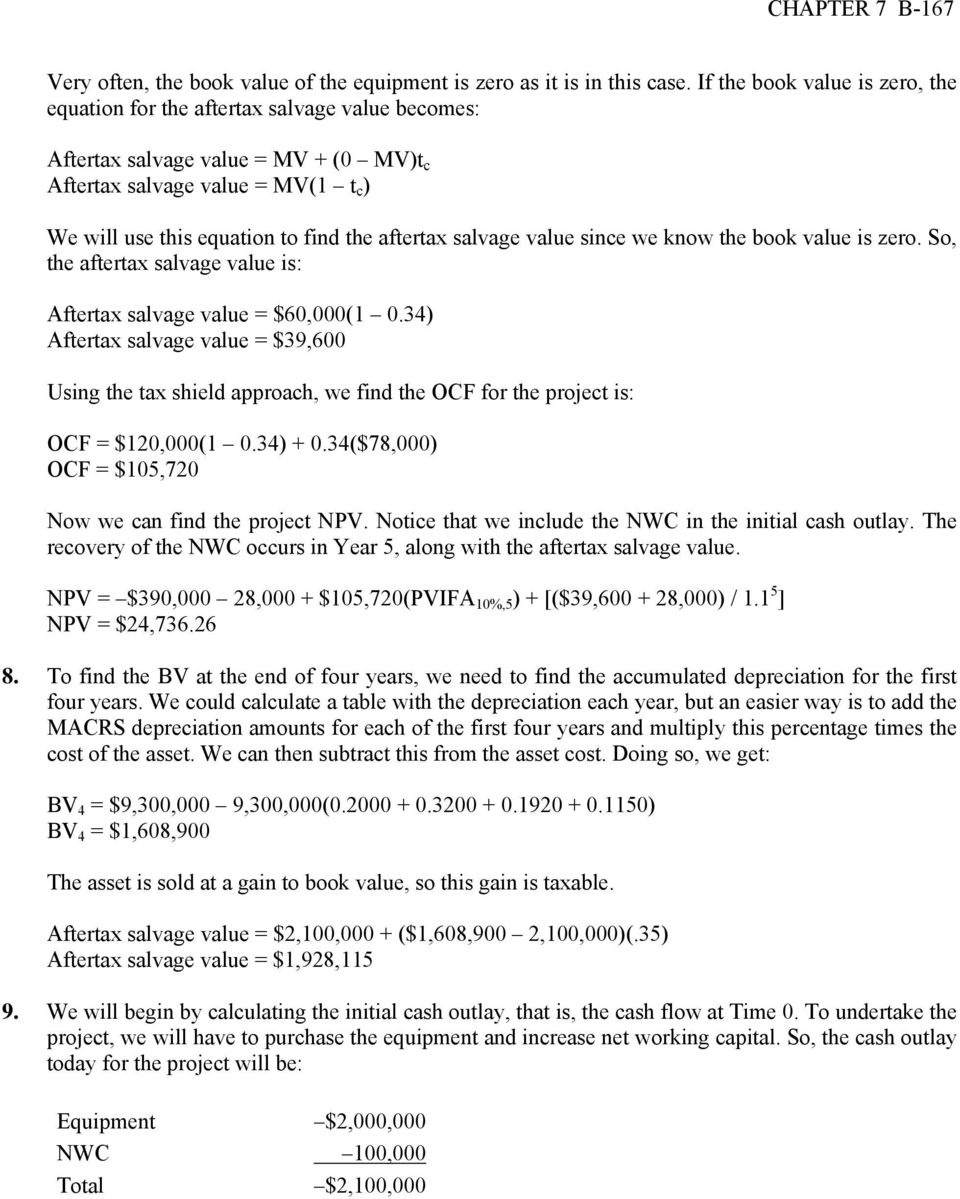
6 CHAPTER 7 B- 167 Very often, the book value of the equipment is zero as it is in this case. If the book value is zero, the equation for the aftertax salvage value becomes: Aftertax salvage value = MV + (0 MV)t c Aftertax salvage value = MV(1 t c ) We will use this equation to find the aftertax salvage value since we know the book value is zero. So, the aftertax salvage value is: Aftertax salvage value = $60,000(1 0.34) Aftertax salvage value = $39,600 Using the tax shield approach, we find the OCF for the project is: OCF = $120,000(1 0.34) ($78,000) OCF = $105,720 Now we can find the project NPV. Notice that we include the NWC in the initial cash outlay. The recovery of the NWC occurs in Year 5, along with the aftertax salvage value. NPV = $390,000 28,000 + $105,720(PVIFA 10%,5 ) + [($39, ,000) / ] NPV = $24, To find the BV at the end of four years, we need to find the accumulated depreciation for the first four years. We could calculate a table with the depreciation each year, but an easier way is to add the MACRS depreciation amounts for each of the first four years and multiply this percentage times the cost of the asset. We can then subtract this from the asset cost. Doing so, we get: BV 4 = $9,300,000 9,300,000( ) BV 4 = $1,608,900 The asset is sold at a gain to book value, so this gain is taxable. Aftertax salvage value = $2,100,000 + ($1,608,900 2,100,000)(.35) Aftertax salvage value = $1,928, We will begin by calculating the initial cash outlay, that is, the cash flow at Time 0. To undertake the project, we will have to purchase the equipment and increase net working capital. So, the cash outlay today for the project will be: Equipment $2,000,000 NWC 100,000 Total $2,100,000
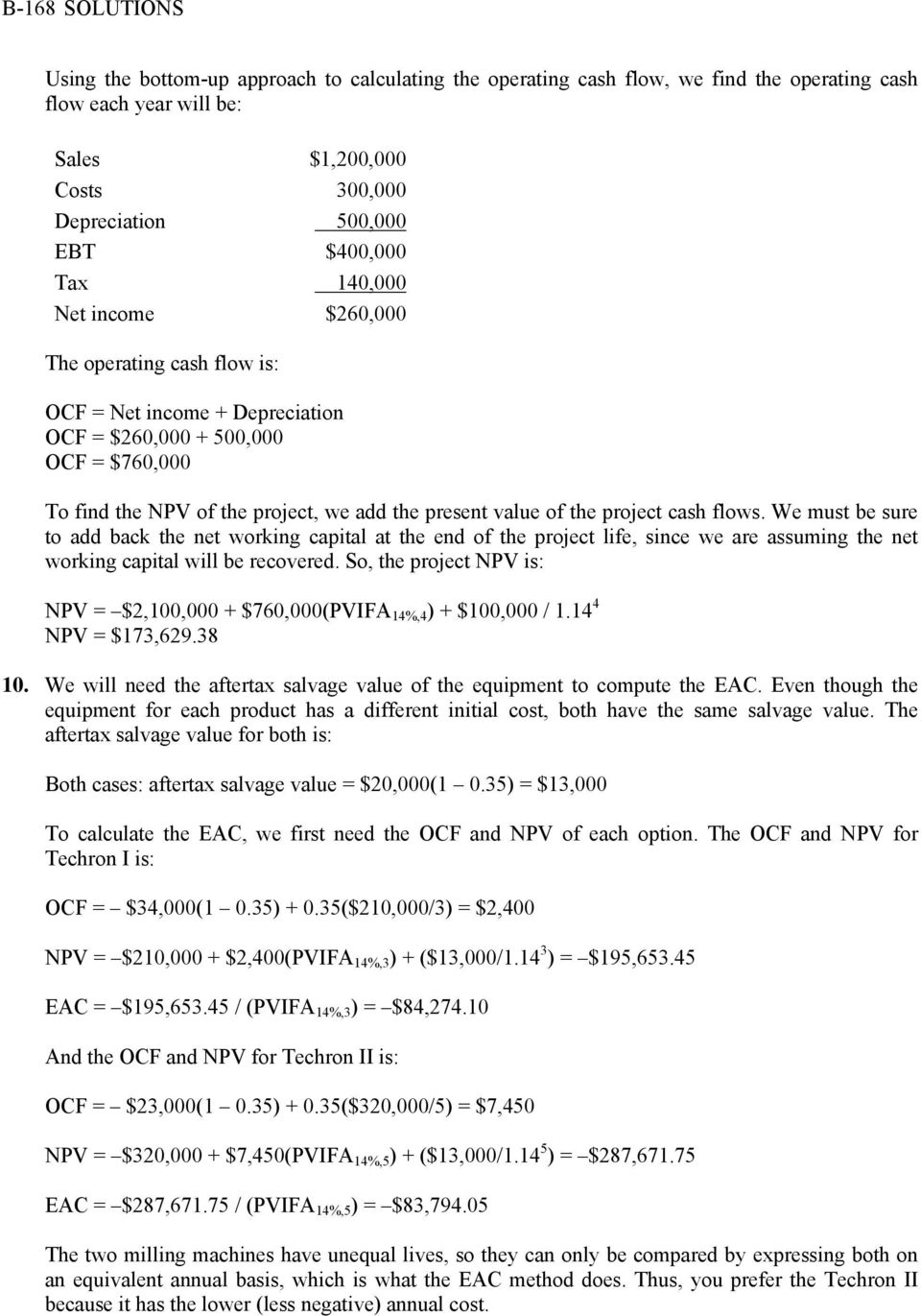
7 B-168 SOLUTIONS Using the bottom-up approach to calculating the operating cash flow, we find the operating cash flow each year will be: Sales $1,200,000 Costs 300,000 Depreciation 500,000 EBT $400,000 Tax 140,000 Net income $260,000 The operating cash flow is: OCF = Net income + Depreciation OCF = $260, ,000 OCF = $760,000 To find the NPV of the project, we add the present value of the project cash flows. We must be sure to add back the net working capital at the end of the project life, since we are assuming the net working capital will be recovered. So, the project NPV is: NPV = $2,100,000 + $760,000(PVIFA 14%,4 ) + $100,000 / NPV = $173, We will need the aftertax salvage value of the equipment to compute the EAC. Even though the equipment for each product has a different initial cost, both have the same salvage value. The aftertax salvage value for both is: Both cases: aftertax salvage value = $20,000(1 0.35) = $13,000 To calculate the EAC, we first need the OCF and NPV of each option. The OCF and NPV for Techron I is: OCF = $34,000(1 0.35) ($210,000/3) = $2,400 NPV = $210,000 + $2,400(PVIFA 14%,3 ) + ($13,000/ ) = $195, EAC = $195, / (PVIFA 14%,3 ) = $84, And the OCF and NPV for Techron II is: OCF = $23,000(1 0.35) ($320,000/5) = $7,450 NPV = $320,000 + $7,450(PVIFA 14%,5 ) + ($13,000/ ) = $287, EAC = $287, / (PVIFA 14%,5 ) = $83, The two milling machines have unequal lives, so they can only be compared by expressing both on an equivalent annual basis, which is what the EAC method does. Thus, you prefer the Techron II because it has the lower (less negative) annual cost.
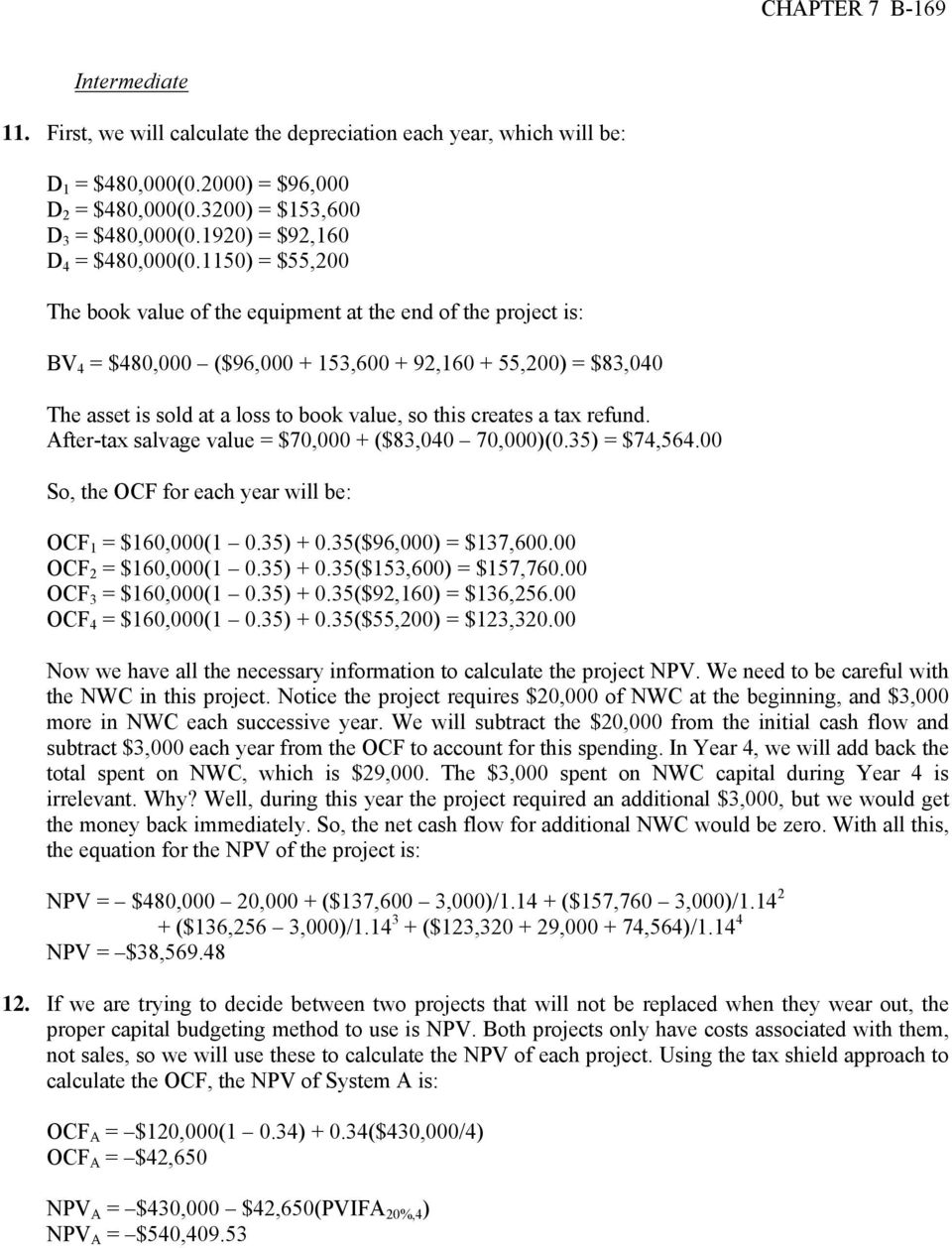
8 CHAPTER 7 B- 169 Intermediate 11. First, we will calculate the depreciation each year, which will be: D 1 = $480,000(0.2000) = $96,000 D 2 = $480,000(0.3200) = $153,600 D 3 = $480,000(0.1920) = $92,160 D 4 = $480,000(0.1150) = $55,200 The book value of the equipment at the end of the project is: BV 4 = $480,000 ($96, , , ,200) = $83,040 The asset is sold at a loss to book value, so this creates a tax refund. After-tax salvage value = $70,000 + ($83,040 70,000)(0.35) = $74, So, the OCF for each year will be: OCF 1 = $160,000(1 0.35) ($96,000) = $137, OCF 2 = $160,000(1 0.35) ($153,600) = $157, OCF 3 = $160,000(1 0.35) ($92,160) = $136, OCF 4 = $160,000(1 0.35) ($55,200) = $123, Now we have all the necessary information to calculate the project NPV. We need to be careful with the NWC in this project. Notice the project requires $20,000 of NWC at the beginning, and $3,000 more in NWC each successive year. We will subtract the $20,000 from the initial cash flow and subtract $3,000 each year from the OCF to account for this spending. In Year 4, we will add back the total spent on NWC, which is $29,000. The $3,000 spent on NWC capital during Year 4 is irrelevant. Why? Well, during this year the project required an additional $3,000, but we would get the money back immediately. So, the net cash flow for additional NWC would be zero. With all this, the equation for the NPV of the project is: NPV = $480,000 20,000 + ($137,600 3,000)/ ($157,760 3,000)/ ($136,256 3,000)/ ($123, , ,564)/ NPV = $38, If we are trying to decide between two projects that will not be replaced when they wear out, the proper capital budgeting method to use is NPV. Both projects only have costs associated with them, not sales, so we will use these to calculate the NPV of each project. Using the tax shield approach to calculate the OCF, the NPV of System A is: OCF A = $120,000(1 0.34) ($430,000/4) OCF A = $42,650 NPV A = $430,000 $42,650(PVIFA 20%,4 ) NPV A = $540,409.53
9 B-170 SOLUTIONS And the NPV of System B is: OCF B = $80,000(1 0.34) ($540,000/6) OCF B = $22,200 NPV B = $540,000 $22,200(PVIFA 20%,6 ) NPV B = $613, If the system will not be replaced when it wears out, then System A should be chosen, because it has the less negative NPV. 13. If the equipment will be replaced at the end of its useful life, the correct capital budgeting technique is EAC. Using the NPVs we calculated in the previous problem, the EAC for each system is: EAC A = $540, / (PVIFA 20%,4 ) EAC A = $208, EAC B = $613, / (PVIFA 20%,6 ) EAC B = $184, If the conveyor belt system will be continually replaced, we should choose System B since it has the less negative EAC. 14. Since we need to calculate the EAC for each machine, sales are irrelevant. EAC only uses the costs of operating the equipment, not the sales. Using the bottom up approach, or net income plus depreciation, method to calculate OCF, we get: Machine A Machine B Variable costs $3,150,000 $2,700,000 Fixed costs 150, ,000 Depreciation 350, ,000 EBT $3,650,000 $3,300,000 Tax 1,277,500 1,155,000 Net income $2,372,500 $2,145,000 + Depreciation 350, ,000 OCF $2,022,500 $1,645,000 The NPV and EAC for Machine A is: NPV A = $2,100,000 $2,022,500(PVIFA 10%,6 ) NPV A = $10,908, EAC A = $10,908, / (PVIFA 10%,6 ) EAC A = $2,504,675.50

10 CHAPTER 7 B- 171 And the NPV and EAC for Machine B is: NPV B = $4,500,000 1,645,000(PVIFA 10%,9 ) NPV B = $13,973, EAC B = $13,973, / (PVIFA 10%,9 ) EAC B = $2,426, You should choose Machine B since it has a less negative EAC. 15. When we are dealing with nominal cash flows, we must be careful to discount cash flows at the nominal interest rate, and we must discount real cash flows using the real interest rate. Project A s cash flows are in real terms, so we need to find the real interest rate. Using the Fisher equation, the real interest rate is: 1 + R = (1 + r)(1 + h) 1.15 = (1 + r)(1 +.04) r =.1058 or 10.58% So, the NPV of Project A s real cash flows, discounting at the real interest rate, is: NPV = $40,000 + $20,000 / $15,000 / $15,000 / NPV = $1, Project B s cash flow are in nominal terms, so the NPV discount at the nominal interest rate is: NPV = $50,000 + $10,000 / $20,000 / $40,000 / NPV = $ We should accept Project A if the projects are mutually exclusive since it has the highest NPV. 16. To determine the value of a firm, we can simply find the present value of the firm s future cash flows. No depreciation is given, so we can assume depreciation is zero. Using the tax shield approach, we can find the present value of the aftertax revenues, and the present value of the aftertax costs. The required return, growth rates, price, and costs are all given in real terms. Subtracting the costs from the revenues will give us the value of the firm s cash flows. We must calculate the present value of each separately since each is growing at a different rate. First, we will find the present value of the revenues. The revenues in year 1 will be the number of bottles sold, times the price per bottle, or: Aftertax revenue in year 1 in real terms = (2,000,000 $1.25)(1 0.34) Aftertax revenue in year 1 in real terms = $1,650,000 Revenues will grow at six percent per year in real terms forever. Apply the growing perpetuity formula, we find the present value of the revenues is: PV of revenues = C 1 / (R g) PV of revenues = $1,650,000 / ( ) PV of revenues = $41,250,000

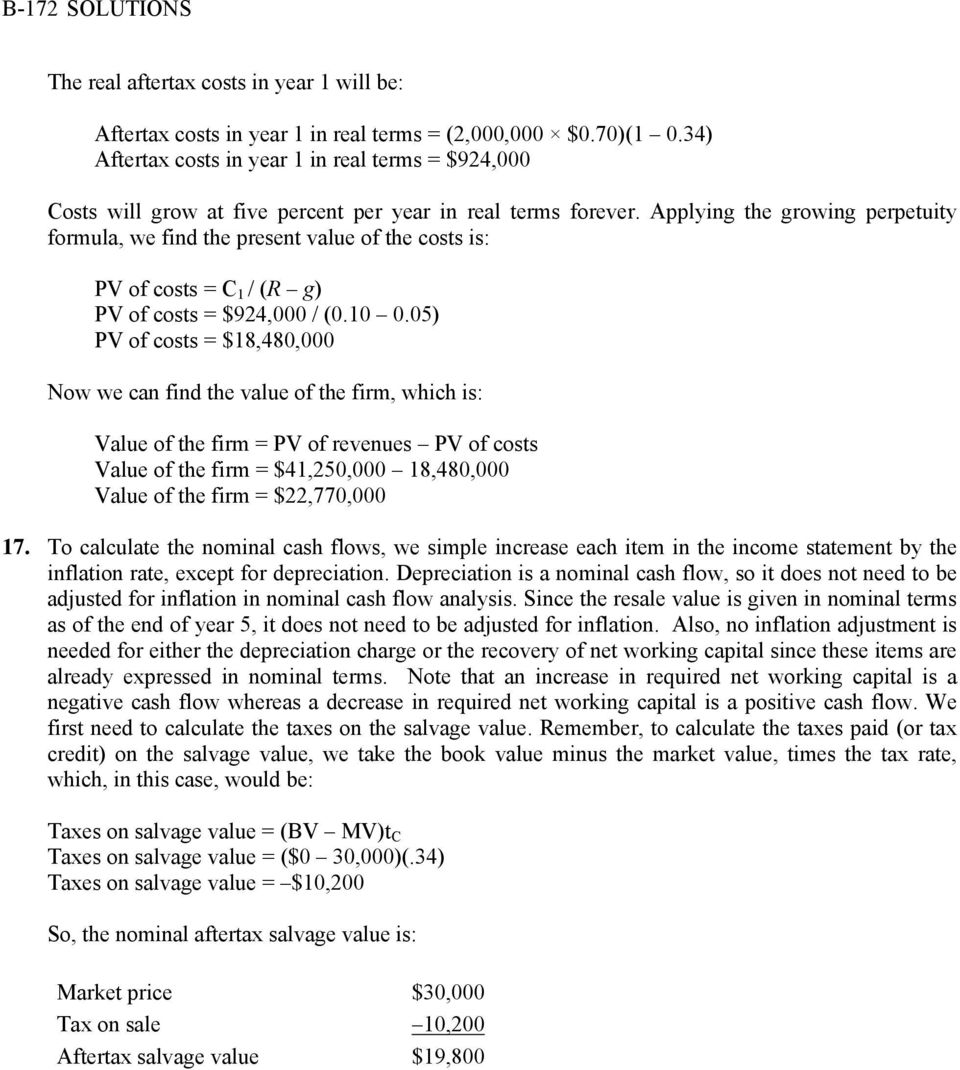
11 B-172 SOLUTIONS The real aftertax costs in year 1 will be: Aftertax costs in year 1 in real terms = (2,000,000 $0.70)(1 0.34) Aftertax costs in year 1 in real terms = $924,000 Costs will grow at five percent per year in real terms forever. Applying the growing perpetuity formula, we find the present value of the costs is: PV of costs = C 1 / (R g) PV of costs = $924,000 / ( ) PV of costs = $18,480,000 Now we can find the value of the firm, which is: Value of the firm = PV of revenues PV of costs Value of the firm = $41,250,000 18,480,000 Value of the firm = $22,770, To calculate the nominal cash flows, we simple increase each item in the income statement by the inflation rate, except for depreciation. Depreciation is a nominal cash flow, so it does not need to be adjusted for inflation in nominal cash flow analysis. Since the resale value is given in nominal terms as of the end of year 5, it does not need to be adjusted for inflation. Also, no inflation adjustment is needed for either the depreciation charge or the recovery of net working capital since these items are already expressed in nominal terms. Note that an increase in required net working capital is a negative cash flow whereas a decrease in required net working capital is a positive cash flow. We first need to calculate the taxes on the salvage value. Remember, to calculate the taxes paid (or tax credit) on the salvage value, we take the book value minus the market value, times the tax rate, which, in this case, would be: Taxes on salvage value = (BV MV)t C Taxes on salvage value = ($0 30,000)(.34) Taxes on salvage value = $10,200 So, the nominal aftertax salvage value is: Market price $30,000 Tax on sale 10,200 Aftertax salvage value $19,800
12 CHAPTER 7 B- 173 Now we can find the nominal cash flows each year using the income statement. Doing so, we find: Year 0 Year 1 Year 2 Year 3 Year 4 Year 5 Sales $200,000 $206,000 $212,180 $218,545 $225,102 Expenses 50,000 51,500 53,045 54,636 56,275 Depreciation 50,000 50,000 50,000 50,000 50,000 EBT $100,000 $104,500 $109,135 $113,909 $118,826 Tax 34,000 35,530 37,106 38,729 40,401 Net income $66,000 $68,970 $72,029 $75,180 $78,425 OCF $116,000 $118,970 $122,029 $125,180 $128,425 Capital spending $250,000 $19,800 NWC 10,000 10,000 Total cash flow $260,000 $116,000 $118,970 $122,029 $125,180 $158, The present value of the company is the present value of the future cash flows generated by the company. Here we have real cash flows, a real interest rate, and a real growth rate. The cash flows are a growing perpetuity, with a negative growth rate. Using the growing perpetuity equation, the present value of the cash flows are: PV = C 1 / (R g) PV = $120,000 / [.11 (.06)] PV = $705, To find the EAC, we first need to calculate the NPV of the incremental cash flows. We will begin with the aftertax salvage value, which is: Taxes on salvage value = (BV MV)t C Taxes on salvage value = ($0 10,000)(.34) Taxes on salvage value = $3,400 Market price $10,000 Tax on sale 3,400 Aftertax salvage value $6,600 Now we can find the operating cash flows. Using the tax shield approach, the operating cash flow each year will be: OCF = $5,000(1 0.34) ($45,000/3) OCF = $1,800 So, the NPV of the cost of the decision to buy is: NPV = $45,000 + $1,800(PVIFA 12%,3 ) + ($6,600/ ) NPV = $35,987.95

13 B-174 SOLUTIONS In order to calculate the equivalent annual cost, set the NPV of the equipment equal to an annuity with the same economic life. Since the project has an economic life of three years and is discounted at 12 percent, set the NPV equal to a three-year annuity, discounted at 12 percent. EAC = $35, / (PVIFA 12%,3 ) EAC = $14, We will find the EAC of the EVF first. There are no taxes since the university is tax-exempt, so the maintenance costs are the operating cash flows. The NPV of the decision to buy one EVF is: NPV = $8,000 $2,000(PVIFA 14%,4 ) NPV = $13, In order to calculate the equivalent annual cost, set the NPV of the equipment equal to an annuity with the same economic life. Since the project has an economic life of four years and is discounted at 14 percent, set the NPV equal to a three-year annuity, discounted at 14 percent. So, the EAC per unit is: EAC = $13, / (PVIFA 14%,4 ) EAC = $4, Since the university must buy 10 of the word processors, the total EAC of the decision to buy the EVF word processor is: Total EAC = 10( $4,745.64) Total EAC = $47, Note, we could have found the total EAC for this decision by multiplying the initial cost by the number of word processors needed, and multiplying the annual maintenance cost of each by the same number. We would have arrived at the same EAC. We can find the EAC of the AEH word processors using the same method, but we need to include the salvage value as well. There are no taxes on the salvage value since the university is tax-exempt, so the NPV of buying one AEH will be: NPV = $5,000 $2,500(PVIFA 14%,3 ) + ($500/ ) NPV = $10, So, the EAC per machine is: EAC = $10, / (PVIFA 14%,3 ) EAC = $4,508.29
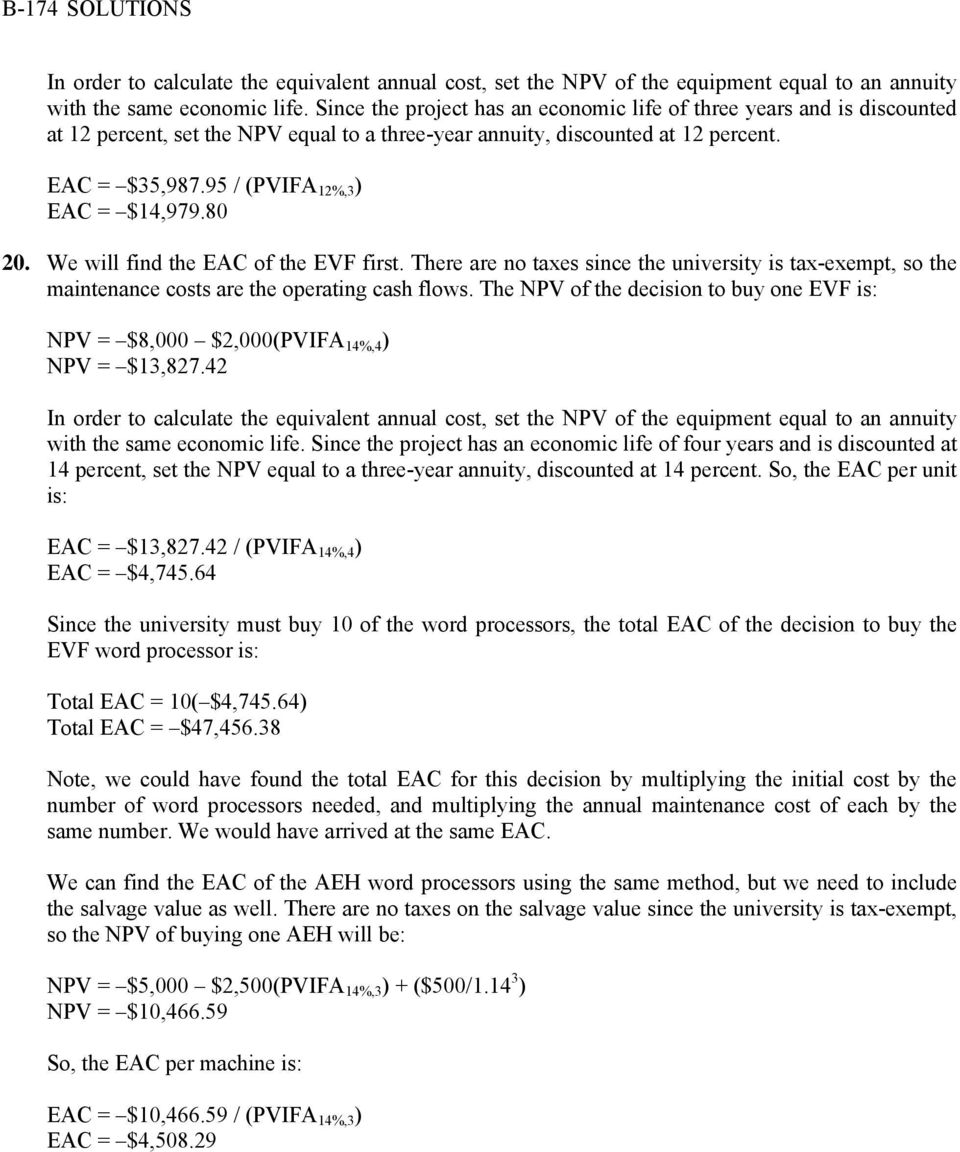
14 CHAPTER 7 B- 175 Since the university must buy 11 of the word processors, the total EAC of the decision to buy the AEH word processor is: Total EAC = 11( $4,508.29) Total EAC = $49, The university should buy the EVF word processors since the EAC is less negative. Notice that the EAC of the AEH is lower on a per machine basis, but because the university needs more of these word processors, the total EAC is higher. 21. We will calculate the aftertax salvage value first. The aftertax salvage value of the equipment will be: Taxes on salvage value = (BV MV)t C Taxes on salvage value = ($0 100,000)(.34) Taxes on salvage value = $34,000 Market price $100,000 Tax on sale 34,000 Aftertax salvage value $66,000 Next, we will calculate the initial cash outlay, that is, the cash flow at Time 0. To undertake the project, we will have to purchase the equipment. The new project will decrease the net working capital, so this is a cash inflow at the beginning of the project. So, the cash outlay today for the project will be: Equipment $500,000 NWC 100,000 Total $400,000 Now we can calculate the operating cash flow each year for the project. Using the bottom up approach, the operating cash flow will be: Saved salaries $120,000 Depreciation 100,000 EBT $20,000 Taxes 6,800 Net income $13,200 And the OCF will be: OCF = $13, ,000 OCF = $113,200 Now we can find the NPV of the project. In Year 5, we must replace the saved NWC, so: NPV = $400,000 + $113,200(PVIFA 12%,5 ) $34,000 / NPV = $11,231.85

15 B-176 SOLUTIONS 22. Replacement decision analysis is the same as the analysis of two competing projects, in this case, keep the current equipment, or purchase the new equipment. We will consider the purchase of the new machine first. Purchase new machine: The initial cash outlay for the new machine is the cost of the new machine, plus the increased net working capital. So, the initial cash outlay will be: Purchase new machine $32,000,000 Net working capital 500,000 Total $32,500,000 Next, we can calculate the operating cash flow created if the company purchases the new machine. The saved operating expense is an incremental cash flow. Additionally, the reduced operating expense is a cash inflow, so it should be treated as such in the income statement. The pro forma income statement, and adding depreciation to net income, the operating cash flow created by purchasing the new machine each year will be: Operating expense $5,000,000 Depreciation 8,000,000 EBT $3,000,000 Taxes 1,170,000 Net income $1,830,000 OCF $6,170,000 So, the NPV of purchasing the new machine, including the recovery of the net working capital, is: NPV = $32,500,000 + $6,170,000(PVIFA 10%,4 ) + $500,000 / NPV = $12,600, And the IRR is: 0 = $32,500,000 + $6,170,000(PVIFA IRR,4 ) + $500,000 / (1 + IRR) 4 Using a spreadsheet or financial calculator, we find the IRR is: IRR = 9.38% Now we can calculate the decision to keep the old machine:

16 CHAPTER 7 B- 177 Keep old machine: The initial cash outlay for the old machine is the market value of the old machine, including any potential tax consequence. The decision to keep the old machine has an opportunity cost, namely, the company could sell the old machine. Also, if the company sells the old machine at its current value, it will incur taxes. Both of these cash flows need to be included in the analysis. So, the initial cash flow of keeping the old machine will be: Keep machine $9,000,000 Taxes 390,000 Total $8,610,000 Next, we can calculate the operating cash flow created if the company keeps the old machine. There are no incremental cash flows from keeping the old machine, but we need to account for the cash flow effects of depreciation. The income statement, adding depreciation to net income to calculate the operating cash flow will be: Depreciation $2,000,000 EBT $2,000,000 Taxes 780,000 Net income $1,220,000 OCF $780,000 So, the NPV of the decision to keep the old machine will be: NPV = $8,610,000 + $780,000(PVIFA 10%,4 ) NPV = $6,137, And the IRR is: 0 = $8,610,000 + $780,000(PVIFA IRR,4 ) Since the project never pays pay back, there is no IRR. The company should not purchase the new machine since it has a lower NPV.

17 B-178 SOLUTIONS There is another way to analyze a replacement decision that is often used. It is an incremental cash flow analysis of the change in cash flows from the existing machine to the new machine, assuming the new machine is purchased. In this type of analysis, the initial cash outlay would be the cost of the new machine, the increased inventory, and the cash inflow (including any applicable taxes) of selling the old machine. In this case, the initial cash flow under this method would be: Purchase new machine $32,000,000 Net working capital 500,000 Sell old machine 9,000,000 Taxes on old machine 390,000 Total $23,890,000 The cash flows from purchasing the new machine would be the saved operating expenses. We would also need to include the change in depreciation. The old machine has a depreciation of $2 million per year, and the new machine has a depreciation of $8 million per year, so the increased depreciation will be $6 million per year. The pro forma income statement and operating cash flow under this approach will be: Operating expense savings $5,000,000 Depreciation 6,000,000 EBT $1,000,000 Taxes 390,000 Net income $610,000 OCF $5,390,000 The NPV under this method is: NPV = $23,890,000 + $5,390,000(PVIFA 10%,4 ) + $500,000 / NPV = $6,462, And the IRR is: 0 = $23,890,000 + $5,390,000(PVIFA IRR,4 ) + $500,000 / (1 + IRR) 4 Using a spreadsheet or financial calculator, we find the IRR is: IRR = 3.07% So, this analysis still tells us the company should not purchase the new machine. This is really the same type of analysis we originally did. Consider this: Subtract the NPV of the decision to keep the old machine from the NPV of the decision to purchase the new machine. You will get: Differential NPV = $12,600, ( 6,137,504.95) = $6,462, This is the exact same NPV we calculated when using the second analysis method.

18 CHAPTER 7 B- 179 b. The purchase of a new machine can have a positive NPV because of the depreciation tax shield. Without the depreciation tax shield, the new machine would have a negative NPV since the saved expenses from the machine do not exceed the cost of the machine when we consider the time value of money. 23. We can find the NPV of a project using nominal cash flows or real cash flows. Either method will result in the same NPV. For this problem, we will calculate the NPV using both nominal and real cash flows. The initial investment in either case is $120,000 since it will be spent today. We will begin with the nominal cash flows. The revenues and production costs increase at different rates, so we must be careful to increase each at the appropriate growth rate. The nominal cash flows for each year will be: Year 0 Year 1 Year 2 Year 3 Revenues $50, $52, $55, Costs 20, , , Depreciation 17, , , EBT $12, $13, $15, Taxes 4, , , Net income $8, $9, $9, OCF $25, $26, $27, Capital spending $120,000 Total cash flow $120,000 $25, $26, $27, Year 4 Year 5 Year 6 Year 7 Revenues $57, $60, $63, $67, Costs 24, , , , Depreciation 17, , , , EBT $16, $17, $18, $19, Taxes 5, , , , Net income $10, $11, $12, $13, OCF $27, $28, $29, $30, Capital spending Total cash flow $27, $28, $29, $30, Now that we have the nominal cash flows, we can find the NPV. We must use the nominal required return with nominal cash flows. Using the Fisher equation to find the nominal required return, we get: (1 + R) = (1 + r)(1 + h) (1 + R) = (1 +.14)(1 +.05) R =.1970 or 19.70%
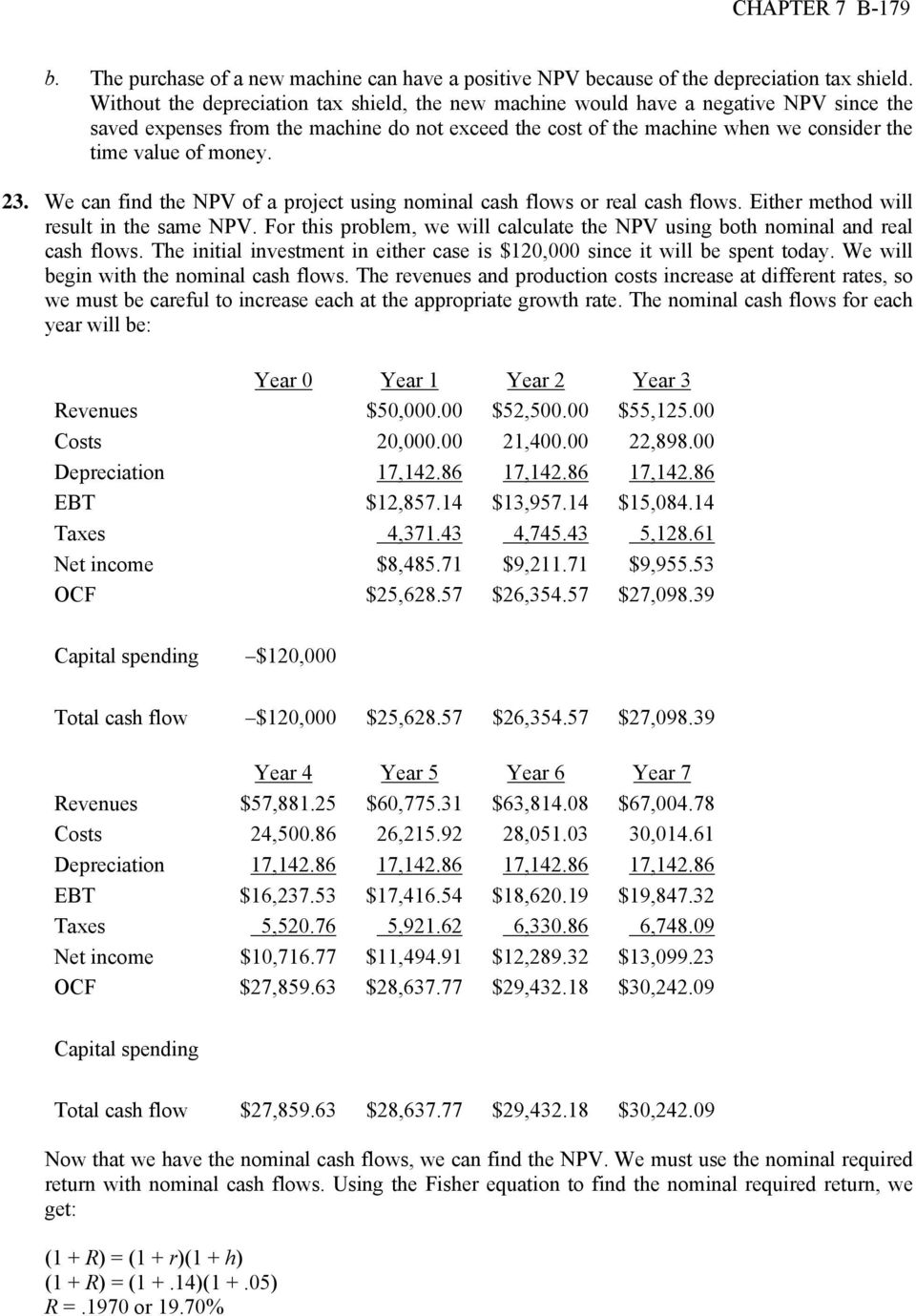
19 B-180 SOLUTIONS So, the NPV of the project using nominal cash flows is: NPV = $120,000 + $25, / $26, / $27, / $27, / $28, / $29, / $30, / NPV = $20, We can also find the NPV using real cash flows and the real required return. This will allow us to find the operating cash flow using the tax shield approach. Both the revenues and expenses are growing annuities, but growing at different rates. This means we must find the present value of each separately. We also need to account for the effect of taxes, so we will multiply by one minus the tax rate. So, the present value of the aftertax revenues using the growing annuity equation is: PV of aftertax revenues = C {[1/(r g)] [1/(r g)] [(1 + g)/(1 + r)] t }(1 t C ) PV of aftertax revenues = $50,000{[1/(.14.05)] [1/(.14.05)] [(1 +.05)/(1 +.14)] 7 }(1.34) PV of aftertax revenues = $134, And the present value of the aftertax costs will be: PV of aftertax costs = C {[1/(r g)] [1/(r g)] [(1 + g)/(1 + r)] t }(1 t C ) PV of aftertax costs = $20,000{[1/(.14.07)] [1/(.14.07)] [(1 +.07)/(1 +.14)] 7 }(1.34) PV of aftertax costs = $56, Now we need to find the present value of the depreciation tax shield. The depreciation amount in the first year is a real value, so we can find the present value of the depreciation tax shield as an ordinary annuity using the real required return. So, the present value of the depreciation tax shield will be: PV of depreciation tax shield = ($120,000/7)(.34)(PVIFA 19.70%,7 ) PV of depreciation tax shield = $21, Using the present value of the real cash flows to find the NPV, we get: NPV = Initial cost + PV of revenues PV of costs + PV of depreciation tax shield NPV = $120,000 + $134, , , NPV = $20, Notice, the NPV using nominal cash flows or real cash flows is identical, which is what we would expect. 24. Here we have a project in which the quantity sold each year increases. First, we need to calculate the quantity sold each year by increasing the current year s quantity by the growth rate. So, the quantity sold each year will be: Year 1 quantity = 5,000 Year 2 quantity = 5,000(1 +.15) = 5,750 Year 3 quantity = 5,750(1 +.15) = 6,613 Year 4 quantity = 6,613(1 +.15) = 7,604 Year 5 quantity = 7,604(1 +.15) = 8,745

20 CHAPTER 7 B- 181 Now we can calculate the sales revenue and variable costs each year. The pro forma income statements and operating cash flow each year will be: Year 0 Year 1 Year 2 Year 3 Year 4 Year 5 Revenues $225, $258, $297, $342, $393, Fixed costs 75, , , , , Variable costs 100, , , , , Depreciation 12, , , , , EBT $38, $56, $78, $103, $131, Taxes 12, , , , , Net income $25, $37, $51, $68, $86, OCF $37, $49, $63, $80, $98, Capital spending $60,000 NWC 28,000 $28,000 Total cash flow $88,000 $37, $49, $63, $80, $126, So, the NPV of the project is: NPV = $88,000 + $37,080 / $49,455 / $63, / $80, / $126, / NPV = $80, We could also have calculated the cash flows using the tax shield approach, with growing annuities and ordinary annuities. The sales and variable costs increase at the same rate as sales, so both are growing annuities. The fixed costs and depreciation are both ordinary annuities. Using the growing annuity equation, the present value of the revenues is: PV of revenues = C {[1/(r g)] [1/(r g)] [(1 + g)/(1 + r)] t }(1 t C ) PV of revenues = $225,000{[1/(.25.15)] [1/(.25.15)] [(1 +.15)/(1 +.25)] 5 } PV of revenues = $767, And the present value of the variable costs will be: PV of variable costs = C {[1/(r g)] [1/(r g)] [(1 + g)/(1 + r)] t }(1 t C ) PV of variable costs = $100,000{[1/(.25.15)] [1/(.25.15)] [(1 +.15)/(1 +.25)] 5 } PV of variable costs = $340, The fixed costs and depreciation are both ordinary annuities. The present value of each is: PV of fixed costs = C({1 [1/(1 + r)] t } / r ) PV of fixed costs = $75,000(PVIFA 25%,5 ) PV of fixed costs = $201,696.00
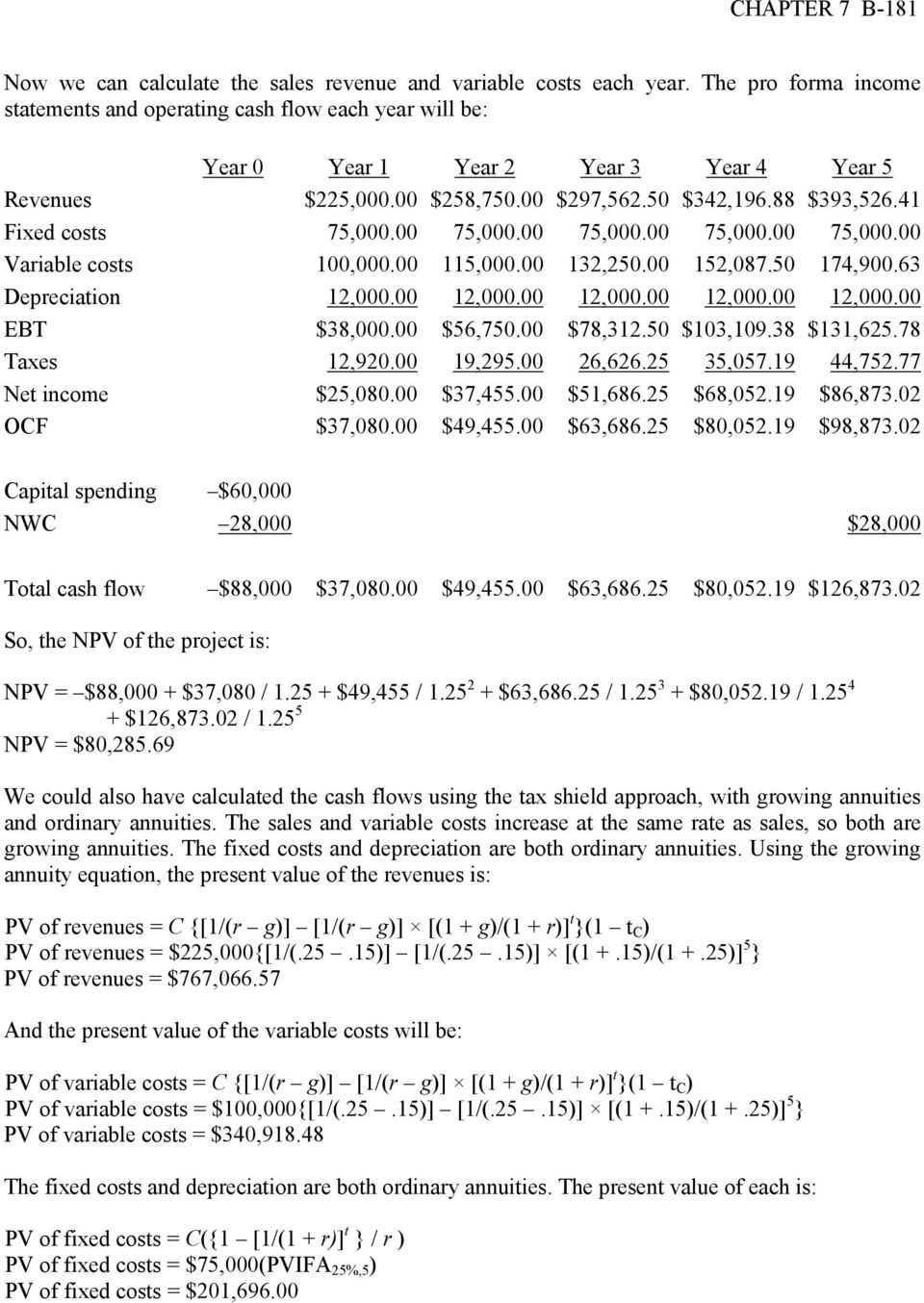
21 B-182 SOLUTIONS PV of depreciation = C({1 [1/(1 + r)] t } / r ) PV of depreciation = $12,000(PVIFA 25%,5 ) PV of depreciation = $32, Now, we can use the depreciation tax shield approach to find the NPV of the project, which is: NPV = $88,000 + ($767, , ,696.00)(1.34) + ($32,271.36)(.34) + $28,000 / NPV = $80, We will begin by calculating the aftertax salvage value of the equipment at the end of the project s life. The aftertax salvage value is the market value of the equipment minus any taxes paid (or refunded), so the aftertax salvage value in four years will be: Taxes on salvage value = (BV MV)t C Taxes on salvage value = ($0 400,000)(.34) Taxes on salvage value = $152,000 Market price $400,000 Tax on sale 152,000 Aftertax salvage value $248,000 Now we need to calculate the operating cash flow each year. Note, we assume that the net working capital cash flow occurs immediately. Using the bottom up approach to calculating operating cash flow, we find: Year 0 Year 1 Year 2 Year 3 Year 4 Revenues $2,030,000 $2,660,000 $1,890,000 $1,330,000 Fixed costs 350, , , ,000 Variable costs 304, , , ,500 Depreciation 1,265,400 1,687, , ,200 EBT $110,100 $223,800 $694,100 $499,300 Taxes 41,838 85, , ,734 Net income $68,262 $138,756 $430,342 $309,566 OCF $1,333,662 $1,825,956 $992,742 $590,766 Capital spending $3,800,000 $248,000 Land 800, ,000 NWC $120, ,000 Total cash flow $4,720,000 $1,333,662 $1,825,956 $992,742 $1,758,766
22 CHAPTER 7 B- 183 Notice the calculation of the cash flow at time 0. The capital spending on equipment and investment in net working capital are cash outflows. The aftertax selling price of the land is also a cash outflow. Even though no cash is actually spent on the land because the company already owns it, the aftertax cash flow from selling the land is an opportunity cost, so we need to include it in the analysis. With all the project cash flows, we can calculate the NPV, which is: NPV = $4,720,000 + $1,333,662 / $1,825,956 / $992,742 / $1,758,766 / NPV = $343, The company should reject the new product line. 26. Replacement decision analysis is the same as the analysis of two competing projects, in this case, keep the current equipment, or purchase the new equipment. We will consider the purchase of the new machine first. Purchase new machine: The initial cash outlay for the new machine is the cost of the new machine. We can calculate the operating cash flow created if the company purchases the new machine. The maintenance cost is an incremental cash flow, so using the pro forma income statement, and adding depreciation to net income, the operating cash flow created by purchasing the new machine each year will be: Maintenance cost $500,000 Depreciation 600,000 EBT $1,100,000 Taxes 374,000 Net income $726,000 OCF $126,000 Notice the taxes are negative, implying a tax credit. The new machine also has a salvage value at the end of five years, so we need to include this in the cash flows analysis. The aftertax salvage value will be: Sell machine $500,000 Taxes 170,000 Total $330,000 The NPV of purchasing the new machine is: NPV = $3,000,000 $126,000(PVIFA 12%,5 ) + $330,000 / NPV = $3,266, Notice the NPV is negative. This does not necessarily mean we should not purchase the new machine. In this analysis, we are only dealing with costs, so we would expect a negative NPV. The revenue is not included in the analysis since it is not incremental to the machine. Similar to an EAC analysis, we will use the machine with the least negative NPV. Now we can calculate the decision to keep the old machine:
23 B-184 SOLUTIONS Keep old machine: The initial cash outlay for the new machine is the market value of the old machine, including any potential tax. The decision to keep the old machine has an opportunity cost, namely, the company could sell the old machine. Also, if the company sells the old machine at its current value, it will incur taxes. Both of these cash flows need to be included in the analysis. So, the initial cash flow of keeping the old machine will be: Keep machine $2,000,000 Taxes 340,000 Total $2,340,000 Next, we can calculate the operating cash flow created if the company keeps the old machine. We need to account for the cost of maintenance, as well as the cash flow effects of depreciation. The incomes statement, adding depreciation to net income to calculate the operating cash flow will be: Maintenance cost $400,000 Depreciation 200,000 EBT $600,000 Taxes 204,000 Net income $396,000 OCF $196,000 The old machine also has a salvage value at the end of five years, so we need to include this in the cash flows analysis. The aftertax salvage value will be: Sell machine $200,000 Taxes 68,000 Total $132,000 So, the NPV of the decision to keep the old machine will be: NPV = $2,340,000 $196,000(PVIFA 12%,5 ) + $132,000 / NPV = $2,971, The company should not purchase the new machine since it has a lower NPV. There is another way to analyze a replacement decision that is often used. It is an incremental cash flow analysis of the change in cash flows from the existing machine to the new machine, assuming the new machine is purchased. In this type of analysis, the initial cash outlay would be the cost of the new machine, and the cash inflow (including any applicable taxes) of selling the old machine. In this case, the initial cash flow under this method would be: Purchase new machine $3,000,000 Sell old machine 2,000,000 Taxes on old machine 340,000 Total $1,340,000
24 CHAPTER 7 B- 185 The cash flows from purchasing the new machine would be the difference in the operating expenses. We would also need to include the change in depreciation. The old machine has a depreciation of $200,000 per year, and the new machine has a depreciation of $600,000 per year, so the increased depreciation will be $400,000 per year. The pro forma income statement and operating cash flow under this approach will be: Maintenance cost $100,000 Depreciation 400,000 EBT $500,000 Taxes 170,000 Net income $330,000 OCF $70,000 The salvage value of the differential cash flow approach is more complicated. The company will sell the new machine, and incur taxes on the sale in five years. However, we must also include the lost sale of the old machine. Since we assumed we sold the old machine in the initial cash outlay, we lose the ability to sell the machine in five years. This is an opportunity loss that must be accounted for. So, the salvage value is: Sell machine $500,000 Taxes 170,000 Lost sale of old 200,000 Taxes on lost sale of old 68,000 Total $198,000 The NPV under this method is: NPV = $1,340,000 + $70,000(PVIFA 12%,5 ) + $198,000 / NPV = $975, So, this analysis still tells us the company should not purchase the new machine. This is really the same type of analysis we originally did. Consider this: Subtract the NPV of the decision to keep the old machine from the NPV of the decision to purchase the new machine. You will get: Differential NPV = $3,266, ( 2,971,635.79) = $975, This is the exact same NPV we calculated when using the second analysis method. 27. Here we have a situation where a company is going to buy one of two assets, so we need to calculate the EAC of each asset. To calculate the EAC, we can calculate the EAC of the combined costs of each computer, or calculate the EAC of an individual computer, then multiply by the number of computers the company is purchasing. In this instance, we will calculate the EAC of each individual computer. For the SAL 5000, we will begin by calculating the aftertax salvage value, then the operating cash flows. So:
25 B-186 SOLUTIONS SAL 5000: Taxes on salvage value = (BV MV)t C Taxes on salvage value = ($0 500)(.34) Taxes on salvage value = $170 Market price $500 Tax on sale 170 Aftertax salvage value $330 The incremental costs will include the maintenance costs, depreciation, and taxes. Notice the taxes are negative, signifying a lower tax bill. So, the incremental cash flows will be: Maintenance cost $ Depreciation EBT $ Tax Net income $ OCF $ So, the NPV of the decision to buy one unit is: NPV = $3,750 $170.63(PVIFA 11%,8 ) + $330 / NPV = $4, And the EAC on a per unit basis is: $4, = EAC(PVIFA 11%,8 ) EAC = $ Since the company must buy 10 units, the total EAC of the decision is: Total EAC = 10( $871.50) Total EAC = $8, And the EAC for the DET 1000: Taxes on salvage value = (BV MV)t C Taxes on salvage value = ($0 500)(.34) Taxes on salvage value = $204 Market price $600 Tax on sale 204 Aftertax salvage value $396
26 CHAPTER 7 B- 187 The incremental costs will include the maintenance costs, depreciation, and taxes. Notice the taxes are negative, signifying a lower tax bill. So, the incremental cash flows will be: Maintenance cost $ Depreciation EBT $1, Tax Net income $1, OCF $ So, the NPV of the decision to buy one unit is: NPV = $5,250 $164.50(PVIFA 11%,6 ) + $396 / NPV = $5, And the EAC on a per unit basis is: $5, = EAC(PVIFA 11%,6 ) EAC = $1, Since the company must buy 7 units, the total EAC of the decision is: Total EAC = 7( $1,355.43) Total EAC = $9, The company should choose the SAL 5000 since the total EAC is greater. 28. Here we are comparing two mutually exclusive assets, with inflation. Since each will be replaced when it wears out, we need to calculate the EAC for each. We have real cash flows. Similar to other capital budgeting projects, when calculating the EAC, we can use real cash flows with the real interest rate, or nominal cash flows and the nominal interest rate. Using the Fisher equation to find the real required return, we get: (1 + R) = (1 + r)(1 + h) (1 +.14) = (1 + r)(1 +.05) r =.0857 or 8.57% This is the interest rate we need to use with real cash flows. We are given the real aftertax cash flows for each asset, so the NPV for the XX40 is: NPV = $700 $100(PVIFA 8.57%,3 ) NPV = $ So, the EAC for the XX40 is: $ = EAC(PVIFA 8.57%,3 ) EAC = $374.43
27 B-188 SOLUTIONS And the EAC for the RH45 is: NPV = $900 $110(PVIFA 8.57%,5 ) NPV = $1, $1, = EAC(PVIFA 8.57%,5 ) EAC = $ The company should choose the RH45 because it has the greater EAC. 29. The project has a sales price that increases at five percent per year, and a variable cost per unit that increases at 10 percent per year. First, we need to find the sales price and variable cost for each year. The table below shows the price per unit and the variable cost per unit each year. Year 1 Year 2 Year 3 Year 4 Year 5 Sales price $40.00 $42.00 $44.10 $46.31 $48.62 Cost per unit $20.00 $22.00 $24.20 $26.62 $29.28 Using the sales price and variable cost, we can now construct the pro forma income statement for each year. We can use this income statement to calculate the cash flow each year. We must also make sure to include the net working capital outlay at the beginning of the project, and the recovery of the net working capital at the end of the project. The pro forma income statement and cash flows for each year will be: Year 0 Year 1 Year 2 Year 3 Year 4 Year 5 Revenues $400, $420, $441, $463, $486, Fixed costs 50, , , , , Variable costs 200, , , , , Depreciation 80, , , , , EBT $70, $70, $69, $66, $63, Taxes 23, , , , , Net income $46, $46, $45, $44, $41, OCF $126, $126, $125, $124, $121, Capital spending $400,000 NWC 25,000 25,000 Total cash flow $425,000 $126, $126, $125, $124, $146, With these cash flows, the NPV of the project is: NPV = $425,000 + $126,200 / $126,200 / $125,540 / $124,121 / $146, / NPV = $6,677.31
28 CHAPTER 7 B- 189 We could also answer this problem using the depreciation tax shield approach. The revenues and variable costs are growing annuities, growing at different rates. The fixed costs and depreciation are ordinary annuities. Using the growing annuity equation, the present value of the revenues is: PV of revenues = C {[1/(r g)] [1/(r g)] [(1 + g)/(1 + r)] t }(1 t C ) PV of revenues = $400,000{[1/(.15.05)] [1/(.15.05)] [(1 +.05)/(1 +.15)] 5 } PV of revenues = $1,461, And the present value of the variable costs will be: PV of variable costs = C {[1/(r g)] [1/(r g)] [(1 + g)/(1 + r)] t }(1 t C ) PV of variable costs = $200,000{[1/(.15.10)] [1/(.15.10)] [(1 +.10)/(1 +.15)] 5 } PV of variable costs = $797, The fixed costs and depreciation are both ordinary annuities. The present value of each is: PV of fixed costs = C({1 [1/(1 + r)] t } / r ) PV of fixed costs = $50,000({1 [1/(1 +.15)] 5 } /.15) PV of fixed costs = $167, PV of depreciation = C({1 [1/(1 + r)] t } / r ) PV of depreciation = $80,000({1 [1/(1 +.15)] 5 } /.15) PV of depreciation = $268, Now, we can use the depreciation tax shield approach to find the NPV of the project, which is: NPV = $425,000 + ($1,461, , ,607.75)(1.34) + ($268,172.41)(.34) + $25,000 / NPV = $6, Challenge 30. This is an in-depth capital budgeting problem. Probably the easiest OCF calculation for this problem is the bottom up approach, so we will construct an income statement for each year. Beginning with the initial cash flow at time zero, the project will require an investment in equipment. The project will also require an investment in NWC. The NWC investment will be 15 percent of the next year s sales. In this case, it will be Year 1 sales. Realizing we need Year 1 sales to calculate the required NWC capital at time 0, we find that Year 1 sales will be $27,625,000. So, the cash flow required for the project today will be: Capital spending $21,000,000 Change in NWC 1,500,000 Total cash flow $22,500,000
29 B-190 SOLUTIONS Now we can begin the remaining calculations. Sales figures are given for each year, along with the price per unit. The variable costs per unit are used to calculate total variable costs, and fixed costs are given at $900,000 per year. To calculate depreciation each year, we use the initial equipment cost of $21 million, times the appropriate MACRS depreciation each year. The remainder of each income statement is calculated below. Notice at the bottom of the income statement we added back depreciation to get the OCF for each year. The section labeled Net cash flows will be discussed below: Year Ending book value $17,997,000 $12,852,000 $9,177,000 $6,552,000 $4,683,000 Sales $27,625,000 $31,850,000 $34,450,000 $37,050,000 $30,225,000 Variable costs 20,400,000 23,520,000 25,440,000 27,360,000 22,320,000 Fixed costs 900, , , , ,000 Depreciation 3,003,000 5,145,000 3,675,000 2,625,000 1,869,000 EBIT 3,322,000 2,285,000 4,435,000 6,165,000 5,136,000 Taxes 1,162, ,750 1,552,250 2,157,750 1,797,600 Net income 2,159,300 1,485,250 2,882,750 4,007,250 3,338,400 Depreciation 3,003,000 5,145,000 3,675,000 2,625,000 1,869,000 Operating cash flow $5,162,300 $6,630,250 $6,557,750 $6,632,250 $5,207,400 Net cash flows Operating cash flow $5,162,300 $6,630,250 $6,557,750 $6,632,250 $5,207,400 Change in NWC (633,750) (390,000) (390,000) 1,023,750 1,890,000 Capital spending ,369,050 Total cash flow $4,528,550 $6,240,250 $6,167,750 $7,656,000 $11,466,450 After we calculate the OCF for each year, we need to account for any other cash flows. The other cash flows in this case are NWC cash flows and capital spending, which is the aftertax salvage of the equipment. The required NWC capital is 15 percent of the sales in the next year. We will work through the NWC cash flow for Year 1. The total NWC in Year 1 will be 15 percent of sales increase from Year 1 to Year 2, or: Increase in NWC for Year 1 =.15($31,850,000 27,625,000) Increase in NWC for Year 1 = $633,750 Notice that the NWC cash flow is negative. Since the sales are increasing, we will have to spend more money to increase NWC. In Year 4, the NWC cash flow is positive since sales are declining. And, in Year 5, the NWC cash flow is the recovery of all NWC the company still has in the project. To calculate the aftertax salvage value, we first need the book value of the equipment. The book value at the end of the five years will be the purchase price, minus the total depreciation. So, the ending book value is: Ending book value = $21,000,000 ($3,003, ,145, ,675, ,625, ,869,000) Ending book value = $4,683,000
30 CHAPTER 7 B- 191 The market value of the used equipment is 20 percent of the purchase price, or $4.2 million, so the aftertax salvage value will be: Aftertax salvage value = $4,200,000 + ($4,683,000 4,200,000)(.35) Aftertax salvage value = $4,369,050 The aftertax salvage value is included in the total cash flows are capital spending. Now we have all of the cash flows for the project. The NPV of the project is: NPV = $22,500,000 + $4,528,550/ $6,240,250/ $6,167,750/ $7,655,000/ $11,466,450/ NPV = $1,465, And the IRR is: NPV = 0 = $22,500,000 + $4,528,550/(1 + IRR) + $6,240,250/(1 + IRR) 2 + $6,167,750/(1 + IRR) 3 + $7,655,000/(1 + IRR) 4 + $11,466,450/(1 + IRR) 5 IRR = 15.47% We should reject the project. 31. To find the initial pretax cost savings necessary to buy the new machine, we should use the tax shield approach to find the OCF. We begin by calculating the depreciation each year using the MACRS depreciation schedule. The depreciation each year is: D 1 = $480,000(0.3330) = $159,840 D 2 = $480,000(0.4440) = $213,120 D 3 = $480,000(0.1480) = $71,040 D 4 = $480,000(0.0740) = $35,520 Using the tax shield approach, the OCF each year is: OCF 1 = (S C)(1 0.35) ($159,840) OCF 2 = (S C)(1 0.35) ($213,120) OCF 3 = (S C)(1 0.35) ($71,040) OCF 4 = (S C)(1 0.35) ($35,520) OCF 5 = (S C)(1 0.35) Now we need the aftertax salvage value of the equipment. The aftertax salvage value is: After-tax salvage value = $45,000(1 0.35) = $29,250 To find the necessary cost reduction, we must realize that we can split the cash flows each year. The OCF in any given year is the cost reduction (S C) times one minus the tax rate, which is an annuity for the project life, and the depreciation tax shield. To calculate the necessary cost reduction, we would require a zero NPV. The equation for the NPV of the project is: NPV = 0 = $480,000 40,000 + (S C)(0.65)(PVIFA 12%,5 ) ($159,840/ $213,120/ $71,040/ $35,520/ ) + ($40, ,250)/1.12 5
31 B-192 SOLUTIONS Solving this equation for the sales minus costs, we get: (S C)(0.65)(PVIFA 12%,5 ) = $345, (S C) = $147, To find the bid price, we need to calculate all other cash flows for the project, and then solve for the bid price. The aftertax salvage value of the equipment is: Aftertax salvage value = $50,000(1 0.35) = $32,500 Now we can solve for the necessary OCF that will give the project a zero NPV. The equation for the NPV of the project is: NPV = 0 = $780,000 75,000 + OCF(PVIFA 16%,5 ) + [($75, ,500) / ] Solving for the OCF, we find the OCF that makes the project NPV equal to zero is: OCF = $803, / PVIFA 16%,5 = $245, The easiest way to calculate the bid price is the tax shield approach, so: OCF = $245, = [(P v)q FC ](1 tc) + tcd $245, = [(P $8.50)(150,000) $240,000 ](1 0.35) ($780,000/5) P = $ a. This problem is basically the same as the previous problem, except that we are given a sales price. The cash flow at Time 0 for all three parts of this question will be: Capital spending $780,000 Change in NWC 75,000 Total cash flow $855,000 We will use the initial cash flow and the salvage value we already found in that problem. Using the bottom up approach to calculating the OCF, we get: Assume price per unit = $13 and units/year = 150,000 Year Sales $1,950,000 $1,950,000 $1,950,000 $1,950,000 $1,950,000 Variable costs 1,275,000 1,275,000 1,275,000 1,275,000 1,275,000 Fixed costs 240, , , , ,000 Depreciation 156, , , , ,000 EBIT 279, , , , ,000 Taxes (35%) 97,650 97,650 97,650 97,650 97,650 Net Income 181, , , , ,350 Depreciation 156, , , , ,000 Operating CF $337,350 $337,350 $337,350 $337,350 $337,350
32 CHAPTER 7 B- 193 Year Operating CF $337,350 $337,350 $337,350 $337,350 $337,350 Change in NWC ,000 Capital spending ,500 Total CF $337,350 $337,350 $337,350 $337,350 $444,850 With these cash flows, the NPV of the project is: NPV = $780,000 75,000 + $337,350(PVIFA 16%,5 ) + [($75, ,500) / ] NPV = $300, If the actual price is above the bid price that results in a zero NPV, the project will have a positive NPV. As for the cartons sold, if the number of cartons sold increases, the NPV will increase, and if the costs increase, the NPV will decrease. b. To find the minimum number of cartons sold to still breakeven, we need to use the tax shield approach to calculating OCF, and solve the problem similar to finding a bid price. Using the initial cash flow and salvage value we already calculated, the equation for a zero NPV of the project is: NPV = 0 = $780,000 75,000 + OCF(PVIFA 16%,5 ) + [($75, ,500) / ] So, the necessary OCF for a zero NPV is: OCF = $803, / PVIFA 16%,5 = $245, Now we can use the tax shield approach to solve for the minimum quantity as follows: OCF = $245, = [(P v)q FC ](1 tc) + tcd $245, = [($ )Q 240,000 ](1 0.35) ($780,000/5) Q = 118,596 As a check, we can calculate the NPV of the project with this quantity. The calculations are: Year Sales $1,541,749 $1,541,749 $1,541,749 $1,541,749 $1,541,749 Variable costs 1,008,067 1,008,067 1,008,067 1,008,067 1,008,067 Fixed costs 240, , , , ,000 Depreciation 156, , , , ,000 EBIT 137, , , , ,682 Taxes (35%) 48,189 48,189 48,189 48,189 48,189 Net Income 89,493 89,493 89,493 89,493 89,493 Depreciation 156, , , , ,000 Operating CF $245,494 $245,494 $245,494 $245,494 $245,494
33 B-194 SOLUTIONS Year Operating CF $245,494 $245,494 $245,494 $245,494 $245,494 Change in NWC ,000 Capital spending ,500 Total CF $245,494 $245,494 $245,494 $245,494 $352,994 NPV = $780,000 75,000 + $245,494(PVIFA 16%,5 ) + [($75, ,500) / ] $0 Note that the NPV is not exactly equal to zero because we had to round the number of cartons sold; you cannot sell one-half of a carton. c. To find the highest level of fixed costs and still breakeven, we need to use the tax shield approach to calculating OCF, and solve the problem similar to finding a bid price. Using the initial cash flow and salvage value we already calculated, the equation for a zero NPV of the project is: NPV = 0 = $780,000 75,000 + OCF(PVIFA 16%,5 ) + [($75, ,500) / ] OCF = $803, / PVIFA 16%,5 = $245, Notice this is the same OCF we calculated in part b. Now we can use the tax shield approach to solve for the maximum level of fixed costs as follows: OCF = $245, = [(P v)q FC ](1 t C ) + t C D $245, = [($13.00 $8.50)(150,000) FC](1 0.35) ($780,000/5) FC = $381, As a check, we can calculate the NPV of the project with this quantity. The calculations are: Year Sales $1,950,000 $1,950,000 $1,950,000 $1,950,000 $1,950,000 Variable costs 1,275,000 1,275,000 1,275,000 1,275,000 1,275,000 Fixed costs 381, , , , ,318 Depreciation 156, , , , ,000 EBIT 137, , , , ,682 Taxes (35%) 48,189 48,189 48,189 48,189 48,189 Net Income 89,494 89,494 89,494 89,494 89,494 Depreciation 156, , , , ,000 Operating CF $245,494 $245,494 $245,494 $245,494 $245,494 Year Operating CF $245,494 $245,494 $245,494 $245,494 $245,494 Change in NWC ,000 Capital spending ,500 Total CF $245,494 $245,494 $245,494 $245,494 $352,994 NPV = $780,000 75,000 + $245,494(PVIFA 16%,5 ) + [($75, ,500) / ] $0
34 CHAPTER 7 B We need to find the bid price for a project, but the project has extra cash flows. Since we don t already produce the keyboard, the sales of the keyboard outside the contract are relevant cash flows. Since we know the extra sales number and price, we can calculate the cash flows generated by these sales. The cash flow generated from the sale of the keyboard outside the contract is: Year 1 Year 2 Year 3 Year 4 Sales $825,000 $1,650,000 $2,200,000 $1,375,000 Variable costs 495, ,000 1,320, ,000 EBT $330,000 $660,000 $880,000 $550,000 Tax 132, , , ,000 Net income (and OCF) $198,000 $396,000 $528,000 $330,000 So, the addition to NPV of these market sales is: NPV of market sales = $198,000/ $396,000/ $528,000/ $330,000/ NPV of market sales = $1,053, You may have noticed that we did not include the initial cash outlay, depreciation, or fixed costs in the calculation of cash flows from the market sales. The reason is that it is irrelevant whether or not we include these here. Remember that we are not only trying to determine the bid price, but we are also determining whether or not the project is feasible. In other words, we are trying to calculate the NPV of the project, not just the NPV of the bid price. We will include these cash flows in the bid price calculation. The reason we stated earlier that whether we included these costs in this initial calculation was irrelevant is that you will come up with the same bid price if you include these costs in this calculation, or if you include them in the bid price calculation. Next, we need to calculate the aftertax salvage value, which is: Aftertax salvage value = $200,000(1.40) = $120,000 Instead of solving for a zero NPV as is usual in setting a bid price, the company president requires an NPV of $100,000, so we will solve for a NPV of that amount. The NPV equation for this project is (remember to include the NWC cash flow at the beginning of the project, and the NWC recovery at the end): NPV = $100,000 = $2,400,000 75, ,053, OCF (PVIFA 13%,4 ) + [($120, ,000) / ] Solving for the OCF, we get: OCF = $1,401, / PVIFA 13%,4 = $471, Now we can solve for the bid price as follows: OCF = $471, = [(P v)q FC ](1 t C ) + t C D $471, = [(P $165)(10,000) $500,000](1 0.40) ($2,400,000/4) P = $253.54
35 B-196 SOLUTIONS 35. Since the two computers have unequal lives, the correct method to analyze the decision is the EAC. We will begin with the EAC of the new computer. Using the depreciation tax shield approach, the OCF for the new computer system is: OCF = ($125,000)(1.38) + ($780,000 / 5)(.38) = $136,780 Notice that the costs are positive, which represents a cash inflow. The costs are positive in this case since the new computer will generate a cost savings. The only initial cash flow for the new computer is cost of $780,000. We next need to calculate the aftertax salvage value, which is: Aftertax salvage value = $140,000(1.38) = $86,800 Now we can calculate the NPV of the new computer as: NPV = $780,000 + $136,780(PVIFA 14%,5 ) + $86,800 / NPV = $265, And the EAC of the new computer is: EAC = $265, / (PVIFA 14%,5 ) = $77, Analyzing the old computer, the only OCF is the depreciation tax shield, so: OCF = $130,000(.38) = $49,400 The initial cost of the old computer is a little trickier. You might assume that since we already own the old computer there is no initial cost, but we can sell the old computer, so there is an opportunity cost. We need to account for this opportunity cost. To do so, we will calculate the aftertax salvage value of the old computer today. We need the book value of the old computer to do so. The book value is not given directly, but we are told that the old computer has depreciation of $130,000 per year for the next three years, so we can assume the book value is the total amount of depreciation over the remaining life of the system, or $390,000. So, the aftertax salvage value of the old computer is: Aftertax salvage value = $230,000 + ($390, ,000)(.38) = $290,800 This is the initial cost of the old computer system today because we are forgoing the opportunity to sell it today. We next need to calculate the aftertax salvage value of the computer system in two years since we are buying it today. The aftertax salvage value in two years is: Aftertax salvage value = $90,000 + ($130,000 90,000)(.38) = $105,200 Now we can calculate the NPV of the old computer as: NPV = $290,800 + $49,400(PVIFA 14%,2 ) + 105,200 / NPV = $128,506.99
36 CHAPTER 7 B- 197 And the EAC of the old computer is: EAC = $128, / (PVIFA 14%,2 ) = $78, If we are going to replace the system in two years no matter what our decision today, we should instead replace it today since the EAC is lower. b. If we are only concerned with whether or not to replace the machine now, and are not worrying about what will happen in two years, the correct analysis is NPV. To calculate the NPV of the decision on the computer system now, we need the difference in the total cash flows of the old computer system and the new computer system. From our previous calculations, we can say the cash flows for each computer system are: t New computer Old computer Difference 0 $780,000 $290,800 $489, ,780 49,400 87, , ,600 17, , , , , , ,580 Since we are only concerned with marginal cash flows, the cash flows of the decision to replace the old computer system with the new computer system are the differential cash flows. The NPV of the decision to replace, ignoring what will happen in two years is: NPV = $489,200 + $87,380/1.14 $17,820/ $136,780/ $136,780/ $223,580/ NPV = $136, If we are not concerned with what will happen in two years, we should not replace the old computer system. 36. To answer this question, we need to compute the NPV of all three alternatives, specifically, continue to rent the building, Project A, or Project B. We would choose the project with the highest NPV. If all three of the projects have a positive NPV, the project that is more favorable is the one with the highest NPV There are several important cash flows we should not consider in the incremental cash flow analysis. The remaining fraction of the value of the building and depreciation are not incremental and should not be included in the analysis of the two alternatives. The $225,000 purchase price of the building is a sunk cost and should be ignored. In effect, what we are doing is finding the NPV of the future cash flows of each option, so the only cash flow today would be the building modifications needed for Project A and Project B. If we did include these costs, the effect would be to lower the NPV of all three options by the same amount, thereby leading to the same conclusion. The cash flows from renting the building after year 15 are also irrelevant. No matter what the company chooses today, it will rent the building after year 15, so these cash flows are not incremental to any project.
37 B-198 SOLUTIONS We will begin by calculating the NPV of the decision of continuing to rent the building first. Continue to rent: Rent $12,000 Taxes 4,080 Net income $7,920 Since there is no incremental depreciation, the operating cash flow is simply the net income. So, the NPV of the decision to continue to rent is: NPV = $7,920(PVIFA 12%,15 ) NPV = $53, Product A: Next, we will calculate the NPV of the decision to modify the building to produce Product A. The income statement for this modification is the same for the first 14 years, and in year 15, the company will have an additional expense to convert the building back to its original form. This will be an expense in year 15, so the income statement for that year will be slightly different. The cash flow at time zero will be the cost of the equipment, and the cost of the initial building modifications, both of which are depreciable on a straight-line basis. So, the pro forma cash flows for Product A are: Initial cash outlay: Building modifications $36,000 Equipment 144,000 Total cash flow $180,000 Years 1-14 Year 15 Revenue $105,000 $105,000 Expenditures 60,000 60,000 Depreciation 12,000 12,000 Restoration cost 0 3,750 EBT $33,000 $29,250 Tax 11,220 9,945 NI $21,780 $19,305 OCF $33,780 $31,305 The OCF each year is net income plus depreciation. So, the NPV for modifying the building to manufacture Product A is: NPV = $180,000 + $33,780(PVIFA 12%,14 ) + $31,305 / NPV = $49,618.83
38 CHAPTER 7 B- 199 Product B: Now we will calculate the NPV of the decision to modify the building to produce Product B. The income statement for this modification is the same for the first 14 years, and in year 15, the company will have an additional expense to convert the building back to its original form. This will be an expense in year 15, so the income statement for that year will be slightly different. The cash flow at time zero will be the cost of the equipment, and the cost of the initial building modifications, both of which are depreciable on a straight-line basis. So, the pro forma cash flows for Product A are: Initial cash outlay: Building modifications $54,000 Equipment 162,000 Total cash flow $216,000 Years 1-14 Year 15 Revenue $127,500 $127,500 Expenditures 75,000 75,000 Depreciation 14,400 14,400 Restoration cost 0 28,125 EBT $38,100 $9,975 Tax 12,954 3,392 NI $25,146 $6,584 OCF $39,546 $20,984 The OCF each year is net income plus depreciation. So, the NPV for modifying the building to manufacture Product B is: NPV = $216,000 + $39,546(PVIFA 12%,14 ) + $20,984 / NPV = $49, We could have also done the analysis as the incremental cash flows between Product A and continuing to rent the building, and the incremental cash flows between Product B and continuing to rent the building. The results of this type of analysis would be: NPV of differential cash flows between Product A and continuing to rent: NPV = NPV Product A NPV Rent NPV = $49, , NPV = $4, NPV of differential cash flows between Product B and continuing to rent: NPV = NPV Product B NPV Rent NPV = $49, , NPV = $3, Both of these incremental analyses have a negative NPV, so the company should continue to rent, which is the same as our original result.
39 B-200 SOLUTIONS 37. The discount rate is expressed in real terms, and the cash flows are expressed in nominal terms. We can answer this question by converting all of the cash flows to real dollars. We can then use the real interest rate. The real value of each cash flow is the present value of the year 1 nominal cash flows, discounted back to the present at the inflation rate. So, the real value of the revenue and costs will be: Revenue in real terms = $150,000 / 1.06 = $141, Labor costs in real terms = $80,000 / 1.06 = $75, Other costs in real terms = $40,000 / 1.06 = $37, Lease payment in real terms = $20,000 / 1.06 = $18, Revenues, labor costs, and other costs are all growing perpetuities. Each has a different growth rate, so we must calculate the present value of each separately. Other costs are a growing perpetuity with a negative growth rate. Using the real required return, the present value of each of these is: PV Revenue = $141, / ( ) = $2,830, PV Labor costs = $75, / ( ) = $1,078, PV Other costs = $37, / [0.10 ( 0.01)] = $343, The lease payments are constant in nominal terms, so they are declining in real terms by the inflation rate. Therefore, the lease payments form a growing perpetuity with a negative growth rate. The real present value of the lease payments is: PV Lease payments = $18, / [0.10 ( 0.06)] = $117, Now we can use the tax shield approach to calculate the net present value. Since there is no investment in equipment, there is no depreciation; therefore, no depreciation tax shield, so we will ignore this in our calculation. This means the cash flows each year are equal to net income. There is also no initial cash outlay, so the NPV is the present value of the future aftertax cash flows. The NPV of the project is: NPV = PV Revenue PV Labor costs PV Other costs PV Lease payments NPV = ($2,830, ,078, , ,924.53)(1.34) NPV = $852, Alternatively, we could have solved this problem by expressing everything in nominal terms. This approach yields the same answer as given above. However, in this case, the computation would have been much more difficult. The reason is that we are dealing with growing perpetuities. In other problems, when calculating the NPV of nominal cash flows, we could simply calculate the nominal cash flow each year since the cash flows were finite. Because of the perpetual nature of the cash flows in this problem, we cannot calculate the nominal cash flows each year until the end of the project. When faced with two alternative approaches, where both are equally correct, always choose the simplest one.
40 CHAPTER 7 B We are given the real revenue and costs, and the real growth rates, so the simplest way to solve this problem is to calculate the NPV with real values. While we could calculate the NPV using nominal values, we would need to find the nominal growth rates, and convert all values to nominal terms. The real labor costs will increase at a real rate of two percent per year, and the real energy costs will increase at a real rate of three percent per year, so the real costs each year will be: Year 1 Year 2 Year 3 Year 4 Real labor cost each year $15.30 $15.61 $15.92 $16.24 Real energy cost each year $5.15 $5.30 $5.46 $5.63 Remember that the depreciation tax shield also affects a firm s aftertax cash flows. The present value of the depreciation tax shield must be added to the present value of a firm s revenues and expenses to find the present value of the cash flows related to the project. The depreciation the firm will recognize each year is: Annual depreciation = Investment / Economic Life Annual depreciation = $32,000,000 / 4 Annual depreciation = $8,000,000 Depreciation is a nominal cash flow, so to find the real value of depreciation each year, we discount the real depreciation amount by the inflation rate. Doing so, we find the real depreciation each year is: Year 1 real depreciation = $8,000,000 / 1.05 = $7,619, Year 2 real depreciation = $8,000,000 / = $7,256, Year 3 real depreciation = $8,000,000 / = $6,910, Year 4 real depreciation = $8,000,000 / = $6,581, Now we can calculate the pro forma income statement each year in real terms. We can then add back depreciation to net income to find the operating cash flow each year. Doing so, we find the cash flow of the project each year is: Year 0 Year 1 Year 2 Year 3 Year 4 Revenues $40,000, $80,000, $80,000, $60,000, Labor cost 30,600, ,212, ,836, ,472, Energy cost 1,030, ,060, ,092, ,125, Depreciation 7,619, ,256, ,910, ,581, EBT $750, $40,470, $40,160, $19,819, Taxes 255, ,760, ,654, ,738, Net income $495, $26,710, $26,505, $13,081, OCF $8,114, $33,967, $33,416, $19,662, Capital spending $32,000,000 Total cash flow $32,000,000 $8,114, $33,967, $33,416, $19,662,758.15
41 B-202 SOLUTIONS We can use the total cash flows each year to calculate the NPV, which is: NPV = $32,000,000 + $8,114, / $33,967, / $33,416, / $19,662, / NPV = $45,614, Here we have the sales price and production costs in real terms. The simplest method to calculate the project cash flows is to use the real cash flows. In doing so, we must be sure to adjust the depreciation, which is in nominal terms. We could analyze the cash flows using nominal values, which would require calculating the nominal discount rate, nominal price, and nominal production costs. This method would be more complicated, so we will use the real numbers. We will first calculate the NPV of the headache only pill. Headache only: We can find the real revenue and production costs by multiplying each by the units sold. We must be sure to discount the depreciation, which is in nominal terms. We can then find the pro forma net income, and add back depreciation to find the operating cash flow. Discounting the depreciation each year by the inflation rate, we find the following cash flows each year: Year 1 Year 2 Year 3 Sales $20,000,000 $20,000,000 $20,000,000 Production costs 7,500,000 7,500,000 7,500,000 Depreciation 3,238,095 3,083,900 2,937,048 EBT $9,261,905 $9,416,100 $9,562,952 Tax 3,149,048 3,201,474 3,251,404 Net income $6,112,857 $6,214,626 $6,311,548 OCF $9,350,952 $9,298,526 $9,248,596 And the NPV of the headache only pill is: NPV = $10,200,000 + $9,350,952 / $9,298,526 / $9,248,596 / NPV = $11,767, Headache and arthritis: For the headache and arthritis pill project, the equipment has a salvage value. We will find the aftertax salvage value of the equipment first, which will be: Market value $1,000,000 Taxes 340,000 Total $660,000
42 CHAPTER 7 B- 203 Remember, to calculate the taxes on the equipment salvage value, we take the book value minus the market value, times the tax rate. Using the same method as the headache only pill, the cash flows each year for the headache and arthritis pill will be: Year 1 Year 2 Year 3 Sales $40,000,000 $40,000,000 $40,000,000 Production costs 17,000,000 17,000,000 17,000,000 Depreciation 3,809,524 3,628,118 3,455,350 EBT $19,190,476 $19,371,882 $19,544,650 Tax 6,524,762 6,586,440 6,645,181 Net income $12,665,714 $12,785,442 $12,899,469 OCF $16,475,238 $16,413,560 $16,354,819 So, the NPV of the headache and arthritis pill is: NPV = $12,000,000 + $16,475,238 / $16,413,560 / ($16,354, ,000) / NPV = $27,226, The company should manufacture the headache and arthritis remedy since the project has a higher NPV. 40. This is an in-depth capital budgeting problem. Since the project requires an initial investment in inventory as a percentage of sales, we will calculate the sales figures for each year first. The incremental sales will include the sales of the new table, but we also need to include the lost sales of the existing model. This is an erosion cost of the new table. The lost sales of the existing table are constant for every year, but the sales of the new table change every year. So, the total incremental sales figure for the five years of the project will be: Year 1 Year 2 Year 3 Year 4 Year 5 New $7,280,000 $7,420,000 $7,700,000 $8,120,000 $7,392,000 Lost sales 900, , , , ,000 Total $6,380,000 $6,520,000 $6,800,000 $7,220,000 $6,492,000 Now we will calculate the initial cash outlay that will occur today. The company has the necessary production capacity to manufacture the new table without adding equipment today. So, the equipment will not be purchased today, but rather in two years. The reason is that the existing capacity is not being used. If the existing capacity were being used, the new equipment would be required, so it would be a cash flow today. The old equipment would have an opportunity cost if it could be sold. As there is no discussion that the existing equipment could be sold, we must assume it cannot be sold. The only initial cash flow is the cost of the inventory. The company will have to spend money for inventory in the new table, but will be able to reduce inventory of the existing table. So, the initial cash flow today is: New table $728,000 Old table 90,000 Total $638,000
43 B-204 SOLUTIONS In year 2, the company will have a cash outflow to pay for the cost of the new equipment. Since the equipment will be purchased in two years rather than now, the equipment will have a higher salvage value. The book value of the equipment in five years will be the initial cost, minus the accumulated depreciation, or: Book value = $10,500,000 1,500,500 2,572,500 1,838,445 Book value = $4,587,555 The taxes on the salvage value will be: Taxes on salvage = ($4,591,650 6,100,000)(.40) Taxes on salvage = $603,340 So, the aftertax salvage value of the equipment in five years will be: Sell equipment $6,100,000 Taxes 603,340 Salvage value $5,496,660 Next, we need to calculate the variable costs each year. The variable costs of the lost sales are included as a variable cost savings, so the variable costs will be: Year 1 Year 2 Year 3 Year 4 Year 5 New $3,276,000 $3,339,000 $3,465,000 $3,654,000 $3,326,400 Lost sales 360, , , , ,000 Variable costs $2,916,000 $2,979,000 $3,105,000 $3,294,000 $2,966,400 Now we can prepare the rest of the pro forma income statements for each year. The project will have no incremental depreciation for the first two years as the equipment is not purchased for two years. Adding back depreciation to net income to calculate the operating cash flow, we get: Year 1 Year 2 Year 3 Year 4 Year 5 Sales $6,380,000 $6,520,000 $6,800,000 $7,220,000 $6,492,000 VC 2,916,000 2,979,000 3,105,000 3,294,000 2,966,400 Fixed costs 1,700,000 1,700,000 1,700,000 1,700,000 1,700,000 Dep ,501,500 2,572,500 1,838,445 EBT $1,764,000 $1,841,000 $493,500 $346,500 $12,845 Tax 705, , , ,600 5,138 NI $1,058,400 $1,104,600 $296,100 $207,900 $7,707 Dep ,501,500 2,572,500 1,838,445 OCF $1,058,400 $1,104,600 $1,797,600 $2,364,600 $1,830,738
44 CHAPTER 7 B- 205 Next, we need to account for the changes in inventory each year. The inventory is a percentage of sales. The way we will calculate the change in inventory is the beginning of period inventory minus the end of period inventory. The sign of this calculation will tell us whether the inventory change is a cash inflow, or a cash outflow. The inventory each year, and the inventory change, will be: Year 1 Year 2 Year 3 Year 4 Year 5 Beginning $728,000 $742,000 $770,000 $812,000 $739,200 Ending 742, , , ,200 0 Change $14,000 $28,000 $42,000 $72,800 $739,200 Notice that we recover the remaining inventory at the end of the project. The total cash flows for the project will be the sum of the operating cash flow, the capital spending, and the inventory cash flows, so: Year 1 Year 2 Year 3 Year 4 Year 5 OCF $1,058,400 $1,104,600 $1,797,600 $2,364,600 $1,830,738 Equipment 0 10,500, ,496,660 Inventory 14,000 28,000 42,000 72, ,200 Total $1,044,400 $9,423,400 $1,755,600 $2,437,400 $8,064,960 The NPV of the project, including the inventory cash flow at the beginning of the project, will be: NPV = $638,000 + $1,044,400 / 1.14 $9,423,400 / $1,755,600 / $2,437,400 / $8,064,960 / NPV = $156, The company should not go ahead with the new table. b. You can perform an IRR analysis, and would expect to find three IRRs since the cash flows change signs three times. c. The profitability index is intended as a bang for the buck measure; that is, it shows how much shareholder wealth is created for every dollar of initial investment. In this case, the largest investment is not at the beginning of the project, but later in its life. However, since the future negative cash flow is discounted, the profitability index will still measure the amount of shareholder wealth created for every dollar spent today.
CHAPTER 9 NET PRESENT VALUE AND OTHER INVESTMENT CRITERIA
 CHAPTER 9 NET PRESENT VALUE AND OTHER INVESTMENT CRITERIA Basic 1. To calculate the payback period, we need to find the time that the project has recovered its initial investment. After two years, the
CHAPTER 9 NET PRESENT VALUE AND OTHER INVESTMENT CRITERIA
 CHAPTER 9 NET PRESENT VALUE AND OTHER INVESTMENT CRITERIA 1. To calculate the payback period, we need to find the time that the project has recovered its initial investment. After three years, the project
CHAPTER 7: NPV AND CAPITAL BUDGETING
 CHAPTER 7: NPV AND CAPITAL BUDGETING I. Introduction Assigned problems are 3, 7, 34, 36, and 41. Read Appendix A. The key to analyzing a new project is to think incrementally. We calculate the incremental
Chapter 7: Net Present Value and Capital Budgeting
 Chapter 7: Net Present Value and Capital Budgeting 7.1 a. Yes, the reduction in the sales of the company s other products, referred to as erosion, should be treated as an incremental cash flow. These lost
CHAPTER 14 COST OF CAPITAL
 CHAPTER 14 COST OF CAPITAL Answers to Concepts Review and Critical Thinking Questions 1. It is the minimum rate of return the firm must earn overall on its existing assets. If it earns more than this,
Net Present Value and Capital Budgeting. What to Discount
 Net Present Value and Capital Budgeting (Text reference: Chapter 7) Topics what to discount the CCA system total project cash flow vs. tax shield approach detailed CCA calculations and examples project
CHAPTER 12 RISK, COST OF CAPITAL, AND CAPITAL BUDGETING
 CHAPTER 12 RISK, COST OF CAPITAL, AND CAPITAL BUDGETING Answers to Concepts Review and Critical Thinking Questions 1. No. The cost of capital depends on the risk of the project, not the source of the money.
Chapter 9 Cash Flow and Capital Budgeting
 Chapter 9 Cash Flow and Capital Budgeting MULTIPLE CHOICE 1. Gamma Electronics is considering the purchase of testing equipment that will cost $500,000. The equipment has a 5-year lifetime with no salvage
Chapter 09 - Using Discounted Cash-Flow Analysis to Make Investment Decisions
 Solutions to Chapter 9 Using Discounted Cash-Flow Analysis to Make Investment Decisions 1. Net income = ($74 $42 $10) [0.35 ($74 $42 $10)] = $22 $7.7 = $14.3 million Revenues cash expenses taxes paid =
Cash Flow, Taxes, and Project Evaluation. Remember Income versus Cashflow
 Cash Flow, Taxes, and Project Evaluation Of the four steps in calculating NPV, the most difficult is the first: Forecasting cash flows. We now focus on this problem, with special attention to What is cash
Capital Budgeting Further Considerations
 Capital Budgeting Further Considerations For 9.220, Term 1, 2002/03 02_Lecture10.ppt Lecture Outline Introduction The input for evaluating projects relevant cash flows Inflation: real vs. nominal analysis
Chapter 8: Using DCF Analysis to Make Investment Decisions
 FIN 301 Class Notes Chapter 8: Using DCF Analysis to Make Investment Decisions Capital Budgeting: is the process of planning for capital expenditures (long term investment). Planning process involves 1-
Oklahoma State University Spears School of Business. Capital Investments
 Oklahoma State University Spears School of Business Capital Investments Slide 2 Incremental Cash Flows Cash flows matter not accounting earnings. Sunk costs do not matter. Incremental cash flows matter.
Chapter Review and Self-Test Problems
 340 PART FOUR Capital Budgeting costs and cash revenues and costs. We also went over the calculation of depreciation expense under current tax law. 4. Some special cases encountered in using discounted
Chapter 11 Cash Flow Estimation and Risk Analysis ANSWERS TO SELECTED END-OF-CHAPTER QUESTIONS
 Chapter 11 Cash Flow Estimation and Risk Analysis ANSWERS TO SELECTED END-OF-CHAPTER QUESTIONS 11-1 a. Cash flow, which is the relevant financial variable, represents the actual flow of cash. Accounting
Which projects should the corporation undertake
 Which projects should the corporation undertake Investment criteria 1. Investment into a new project generates a flow of cash and, therefore, a standard DPV rule should be the first choice under consideration.
$1,300 + 1,500 + 1,900 = $4,700. in cash flows. The project still needs to create another: $5,500 4,700 = $800
 1. To calculate the payback period, we need to find the time that the project has recovered its initial investment. After three years, the project has created: $1,300 + 1,500 + 1,900 = $4,700 in cash flows.
Finance 445 Practice Exam Chapters 1, 2, 5, and part of Chapter 6. Part One. Multiple Choice Questions.
 Finance 445 Practice Exam Chapters 1, 2, 5, and part of Chapter 6 Part One. Multiple Choice Questions. 1. Similar to the example given in class, assume that a corporation has $500 of cash revenue and $300
Chapter 010 Making Capital Investment Decisions
 Multiple Choice Questions 1. The changes in a firm's future cash flows that are a direct consequence of accepting a project are called cash flows. A. incremental b. stand-alone c. after-tax d. net present
Chapter 10: Making Capital Investment Decisions
 Chapter 10: Making Capital Investment Decisions Faculty of Business Administration Lakehead University Spring 2003 May 21, 2003 Outline 10.1 Project Cash Flows: A First Look 10.2 Incremental Cash Flows
CHAPTER 4 DISCOUNTED CASH FLOW VALUATION
 CHAPTER 4 DISCOUNTED CASH FLOW VALUATION Solutions to Questions and Problems NOTE: All-end-of chapter problems were solved using a spreadsheet. Many problems require multiple steps. Due to space and readability
Chapter 13 Capital Budgeting: Estimating Cash Flow and Analyzing Risk ANSWERS TO END-OF-CHAPTER QUESTIONS
 Chapter 13 Capital Budgeting: Estimating Cash Flow and Analyzing Risk ANSWERS TO END-OF-CHAPTER QUESTIONS 13-3 Since the cost of capital includes a premium for expected inflation, failure to adjust cash
DUKE UNIVERSITY Fuqua School of Business. FINANCE 351 - CORPORATE FINANCE Problem Set #1 Prof. Simon Gervais Fall 2011 Term 2.
 DUKE UNIVERSITY Fuqua School of Business FINANCE 351 - CORPORATE FINANCE Problem Set #1 Prof. Simon Gervais Fall 2011 Term 2 Questions 1. Two years ago, you put $20,000 dollars in a savings account earning
CHAPTER 6 NET PRESENT VALUE AND OTHER INVESTMENT CRITERIA
 CHAPTER 6 NET PRESENT VALUE AND OTHER INVESTMENT CRITERIA Answers to Concepts Review and Critical Thinking Questions 1. Assuming conventional cash flows, a payback period less than the project s life means
CHAPTER 2 ACCOUNTING STATEMENTS, TAXES, AND CASH FLOW
 CHAPTER 2 ACCOUNTING STATEMENTS, TAXES, AND CASH FLOW Answers to Concepts Review and Critical Thinking Questions 1. True. Every asset can be converted to cash at some price. However, when we are referring
Capital Budgeting Cash Flows
 Learning Objectives 1-1 Capital Budgeting Cash Flows 1 Corporate Financial Management 3e Emery Finnerty Stowe 1-2 Calculate incremental after-tax cash flows for a capital budgeting project. Explain the
(Relevant to AAT Examination Paper 4 Business Economics and Financial Mathematics)
 Capital Budgeting: Net Present Value vs Internal Rate of Return (Relevant to AAT Examination Paper 4 Business Economics and Financial Mathematics) Y O Lam Capital budgeting assists decision makers in a
Capital Budgeting continued: Overview:(1) Estimating cash flows (2) CB examples (3) Dealing with uncertainty of cash flows
 Capital Budgeting continued: Overview:(1) Estimating cash flows (2) CB examples (3) Dealing with uncertainty of cash flows Chapter 7: 1,5,7,8,27,32 Chapter 8: 1,3,5,8,13 (clarification for problem 13b:
Chapter 9 Making Capital Investment Decisions Introduction
 Chapter 9 Making Capital Investment Decisions Introduction The cash flows that should be included in a capital budgeting analysis are those that will only occur if the project is accepted These cash flows
Capital budgeting & cash flow analysis
 Capital budgeting & cash flow analysis A reading prepared by Pamela Peterson Drake O U T L I N E 1. Introduction 2. Cash flows from investments 3. Investment cash flows 4. Operating cash flows 5. Putting
CHAPTER 8 INTEREST RATES AND BOND VALUATION
 CHAPTER 8 INTEREST RATES AND BOND VALUATION Answers to Concept Questions 1. No. As interest rates fluctuate, the value of a Treasury security will fluctuate. Long-term Treasury securities have substantial
( ) ( )( ) ( ) 2 ( ) 3. n n = 100 000 1+ 0.10 = 100 000 1.331 = 133100
 Mariusz Próchniak Chair of Economics II Warsaw School of Economics CAPITAL BUDGETING Managerial Economics 1 2 1 Future value (FV) r annual interest rate B the amount of money held today Interest is compounded
CHAPTER 8 INTEREST RATES AND BOND VALUATION
 CHAPTER 8 INTEREST RATES AND BOND VALUATION Solutions to Questions and Problems 1. The price of a pure discount (zero coupon) bond is the present value of the par value. Remember, even though there are
Chapter 6. 1. Your firm is considering two investment projects with the following patterns of expected future net aftertax cash flows:
 Chapter 6 1. Your firm is considering two investment projects with the following patterns of expected future net aftertax cash flows: Year Project A Project B 1 $1 million $5 million 2 2 million 4 million
How To Calculate Discounted Cash Flow
 Chapter 1 The Overall Process Capital Expenditures Whenever we make an expenditure that generates a cash flow benefit for more than one year, this is a capital expenditure. Examples include the purchase
Fundamentals of Capital Budgeting
 8 Fundamentals of Capital Budgeting LEARNING OBJECTIVES Identify the types of cash flows needed in the capital budgeting process Forecast incremental earnings in a pro forma earnings statement for a project
Chapter 9. Year Revenue COGS Depreciation S&A Taxable Income After-tax Operating Income 1 $20.60 $12.36 $1.00 $2.06 $5.18 $3.11
 Chapter 9 9-1 We assume that revenues and selling & administrative expenses will increase at the rate of inflation. Year Revenue COGS Depreciation S&A Taxable Income After-tax Operating Income 1 $20.60
Part 7. Capital Budgeting
 Part 7. Capital Budgeting What is Capital Budgeting? Nancy Garcia and Digital Solutions Digital Solutions, a software development house, is considering a number of new projects, including a joint venture
Chapter 7 Fundamentals of Capital Budgeting
 Chapter 7 Fundamentals of Capital Budgeting 7-1. Pisa Pizza, a seller of frozen pizza, is considering introducing a healthier version of its pizza that will be low in cholesterol and contain no trans fats.
Capital Investment Analysis and Project Assessment
 PURDUE EXTENSION EC-731 Capital Investment Analysis and Project Assessment Michael Boehlje and Cole Ehmke Department of Agricultural Economics Capital investment decisions that involve the purchase of
Capital Budgeting Formula
 apital Budgeting Formula Not in the book. Wei s summary If salvage value S is less than U n : If salvage value S is greater than U n : Note: IF t : incremental cash flows (could be negative) )(NW): change
Week- 1: Solutions to HW Problems
 Week- 1: Solutions to HW Problems 10-1 a. Payback A (cash flows in thousands): Annual Period Cash Flows Cumulative 0 ($5,000) ($5,000) 1 5,000 (0,000) 10,000 (10,000) 3 15,000 5,000 4 0,000 5,000 Payback
CHAPTER 4 DISCOUNTED CASH FLOW VALUATION
 CHAPTER 4 DISCOUNTED CASH FLOW VALUATION Answers to Concepts Review and Critical Thinking Questions 1. Assuming positive cash flows and interest rates, the future value increases and the present value
14. Calculating Total Cash Flows.
 14. Calculating Total Cash Flows. Greene Co. shows the following information on its 2008 income statement: Sales = $138,000 Costs = $71,500 Other expenses = $4,100 Depreciation expense = $10,100 Interest
Answers to Warm-Up Exercises
 Answers to Warm-Up Exercises E11-1. Categorizing a firm s expenditures Answer: In this case, the tuition reimbursement should be categorized as a capital expenditure since the outlay of funds is expected
Course 3: Capital Budgeting Analysis
 Excellence in Financial Management Course 3: Capital Budgeting Analysis Prepared by: Matt H. Evans, CPA, CMA, CFM This course provides a concise overview of capital budgeting analysis. This course is recommended
Chapter 14 Notes Page 1
 Chapter 14 Notes Page 1 Capital Budgeting This chapter examines various tools used to evaluate potential projects or investments. Accountants advocate the use of the Simple Rate of Return, which is based
CAPITAL BUDGETING. Definition. Time Value of Money [TVM] TVM is the reward for postponement of consumption of money.
![CAPITAL BUDGETING. Definition. Time Value of Money [TVM] TVM is the reward for postponement of consumption of money.](/thumbs/24/2775650.jpg "CAPITAL BUDGETING. Definition. Time Value of Money [TVM] TVM is the reward for postponement of consumption of money.") 11 CAPITAL BUDGETING 1LO 1: Time Value of Money Definition Time Value of Money [TVM] TVM is the reward for postponement of consumption of money. Principle Rs.100 received today is greater than Rs. 100
11 CAPITAL BUDGETING 1LO 1: Time Value of Money Definition Time Value of Money [TVM] TVM is the reward for postponement of consumption of money. Principle Rs.100 received today is greater than Rs. 100
CHAPTER 5 HOW TO VALUE STOCKS AND BONDS
 CHAPTER 5 HOW TO VALUE STOCKS AND BONDS Answers to Concepts Review and Critical Thinking Questions 1. Bond issuers look at outstanding bonds of similar maturity and risk. The yields on such bonds are used
CHAPTER 2 INTRODUCTION TO CORPORATE FINANCE
 CHAPTER 2 INTRODUCTION TO CORPORATE FINANCE Solutions to Questions and Problems NOTE: All end of chapter problems were solved using a spreadsheet. Many problems require multiple steps. Due to space and
CHAPTER 2 FINANCIAL STATEMENTS AND CASH FLOW
 CHAPTER 2 FINANCIAL STATEMENTS AND CASH FLOW Solutions to Questions and Problems NOTE: All end-of-chapter problems were solved using a spreadsheet. Many problems require multiple steps. Due to space and
How To Calculate A Profit From A Machine Shop
 CHAPTER 21 CAPITAL BUDGETING AND COST ANALYSIS 21-20 Capital budgeting with uneven cash flows, no income taxes. 1. Present value of savings in cash operating costs: $10,000 0.862 $ 8,620 8,000 0.743 5,944
CHAPTER 6 DISCOUNTED CASH FLOW VALUATION
 CHAPTER 6 DISCOUNTED CASH FLOW VALUATION Answers to Concepts Review and Critical Thinking Questions 1. The four pieces are the present value (PV), the periodic cash flow (C), the discount rate (r), and
CHAPTER 9 NET PRESENT VALUE AND OTHER INVESTMENT CRITERIA
 CHAPTER 9 NET PRESENT VALUE AND OTHER INVESTMENT CRITERIA Answers to Concepts Review and Critical Thinking Questions 1. A payback period less than the project s life means that the NPV is positive for
Investment Appraisal
 Investment Appraisal Article relevant to F1 Business Mathematics and Quantitative Methods Author: Pat McGillion, current Examiner. Questions 1 and 6 often relate to Investment Appraisal, which is underpinned
11.3 BREAK-EVEN ANALYSIS. Fixed and Variable Costs
 385 356 PART FOUR Capital Budgeting a large number of NPV estimates that we summarize by calculating the average value and some measure of how spread out the different possibilities are. For example, it
Management Accounting Financial Strategy
 PAPER P9 Management Accounting Financial Strategy The Examiner provides a short study guide, for all candidates revising for this paper, to some first principles of finance and financial management Based
Chapter 8: Fundamentals of Capital Budgeting
 Chapter 8: Fundamentals of Capital Budgeting-1 Chapter 8: Fundamentals of Capital Budgeting Big Picture: To value a project, we must first estimate its cash flows. Note: most managers estimate a project
Session #5 Capital Budgeting - II Damodaran - Chapter 9: 6,12,16,18 Chapter 10: 2,10,16(a&b) Chapter 11: 6,12,14
 Session #5 Capital Budgeting - II Damodaran - Chapter 9: 6,12,16,18 Chapter 10: 2,10,16(a&b) Chapter 11: 6,12,14 I. Additional Issues in Capital Budgeting. A. Capital rationing: Use profitability index
Chapter 20 Lease Financing ANSWERS TO END-OF-CHAPTER QUESTIONS
 Chapter 20 Lease Financing ANSWERS TO END-OF-CHAPTER QUESTIONS 20-1 a. The lessee is the party leasing the property. The party receiving the payments from the lease (that is, the owner of the property)
Chapter 11 Cash Flow Estimation and Risk Analysis
 Chapter 11 Cash Flow Estimation and Risk Analysis ANSWERS TO END-OF-CHAPTER QUESTIONS 11-1 a. Cash flow, which is the relevant financial variable, represents the actual flow of cash. Accounting income,
CHAPTER 5. Interest Rates. Chapter Synopsis
 CHAPTER 5 Interest Rates Chapter Synopsis 5.1 Interest Rate Quotes and Adjustments Interest rates can compound more than once per year, such as monthly or semiannually. An annual percentage rate (APR)
Capital Budgeting. Financial Modeling Templates
 Financial Modeling Templates http://spreadsheetml.com/finance/capitalbudgeting.shtml Copyright (c) 2009-2014, ConnectCode All Rights Reserved. ConnectCode accepts no responsibility for any adverse affect
10.SHORT-TERM DECISIONS & CAPITAL INVESTMENT APPRAISAL
 INDUSTRIAL UNIVERSITY OF HO CHI MINH CITY AUDITING ACCOUNTING FACULTY 10.SHORT-TERM DECISIONS & CAPITAL INVESTMENT APPRAISAL 4 Topic List INDUSTRIAL UNIVERSITY OF HO CHI MINH CITY AUDITING ACCOUNTING FACULTY
Understanding Financial Management: A Practical Guide Guideline Answers to the Concept Check Questions
 Understanding Financial Management: A Practical Guide Guideline Answers to the Concept Check Questions Chapter 8 Capital Budgeting Concept Check 8.1 1. What is the difference between independent and mutually
EXAM 1 REVIEW QUESTIONS
 EXAM 1 REVIEW QUESTIONS 1) Free cash flow. Consider the following financial statements for United Technologies Corp. What is UT's free cash flow (total cash flow from assets) for 2001? UNITED TECHNOLOGIES:
Chris Leung, Ph.D., CFA, FRM
 FNE 215 Financial Planning Chris Leung, Ph.D., CFA, FRM Email: [email protected] Chapter 2 Planning with Personal Financial Statements Chapter Objectives Explain how to create your personal cash flow
CHAPTER 6. Investment Decision Rules. Chapter Synopsis
 CHAPTER 6 Investment Decision Rules Chapter Synopsis 6.1 and Stand-Alone Projects The net present value () of a project is the difference between the present value of its benefits and the present value
MBA Teaching Note 08-02 Net Present Value Analysis of the Purchase of a Hybrid Automobile 1
 MBA Teaching Note 08-02 Net Present Value Analysis of the Purchase of a Hybrid Automobile 1 In this day and age of high energy prices and a desire to be more environmentally friendly, the automobile industry
Measuring Investment Returns
 Measuring Investment Returns Aswath Damodaran Stern School of Business Aswath Damodaran 156 First Principles Invest in projects that yield a return greater than the minimum acceptable hurdle rate. The
The Time Value of Money
 The Time Value of Money Future Value - Amount to which an investment will grow after earning interest. Compound Interest - Interest earned on interest. Simple Interest - Interest earned only on the original
Strategy and Analysis in Using NPV. How Positive NPV Arises
 Strategy and Analysis in Using NPV (Text reference: Chapter 8) Topics how positive NPV arises decision trees sensitivity analysis scenario analysis break-even analysis investment options AFM 271 - Strategy
Module 2: Preparing for Capital Venture Financing Financial Forecasting Methods TABLE OF CONTENTS
 Module 2: Preparing for Capital Venture Financing Financial Forecasting Methods Module 2: Preparing for Capital Venture Financing Financial Forecasting Methods 1.0 FINANCIAL FORECASTING METHODS 1.01 Introduction
1.1 Introduction. Chapter 1: Feasibility Studies: An Overview
 Chapter 1: Introduction 1.1 Introduction Every long term decision the firm makes is a capital budgeting decision whenever it changes the company s cash flows. Consider launching a new product. This involves
ADVANCED INVESTMENT APPRAISAL
 RELEVANT TO ACCA QUALIFICATION PAPER F9 Studying Paper F9? Performance objectives 15 and 16 are relevant to this exam Investment appraisal is one of the eight core topics within Paper F9, Financial Management
Understanding A Firm s Financial Statements
 CHAPTER OUTLINE Spotlight: J&S Construction Company (http://www.jsconstruction.com) 1 The Lemonade Kids Financial statement (accounting statements) reports of a firm s financial performance and resources,
Multiple Choice Questions (45%)
 Multiple Choice Questions (45%) Choose the Correct Answer 1. The following information was taken from XYZ Company s accounting records for the year ended December 31, 2014: Increase in raw materials inventory
CHAPTER 5 INTRODUCTION TO VALUATION: THE TIME VALUE OF MONEY
 CHAPTER 5 INTRODUCTION TO VALUATION: THE TIME VALUE OF MONEY 1. The simple interest per year is: $5,000.08 = $400 So after 10 years you will have: $400 10 = $4,000 in interest. The total balance will be
What is the net present value of the project (to the nearest thousand dollars)?
 corporate finance, final exam practice questions, NPV *Question 1.1: Net Present Value A firm invests $200,000 in machinery that yields net after-tax cash flows of $90,000 at the end of each of the next
Chapter 18. Web Extension: Percentage Cost Analysis, Leasing Feedback, and Leveraged Leases
 Chapter 18 Web Extension: Percentage Cost Analysis, Leasing Feedback, and Leveraged Leases Percentage Cost Analysis Anderson s lease-versus-purchase decision from Chapter 18 could also be analyzed using
How To Compare The Pros And Cons Of A Combine To A Lease Or Buy
 Leasing vs. Buying Farm Machinery Department of Agricultural Economics MF-2953 www.agmanager.info Machinery and equipment expense typically represents a major cost in agricultural production. Purchasing
CHAPTER 2 FINANCIAL STATEMENTS, TAXES AND CASH FLOW
 CHAPTER 2 FINANCIAL STATEMENTS, TAXES AND CASH FLOW Answers to Concepts Review and Critical Thinking Questions 1. Liquidity measures how quickly and easily an asset can be converted to cash without significant
COMPONENTS OF THE STATEMENT OF CASH FLOWS
 ILLUSTRATION 24-1 OPERATING, INVESTING, AND FINANCING ACTIVITIES COMPONENTS OF THE STATEMENT OF CASH FLOWS CASH FLOWS FROM OPERATING ACTIVITIES + Sales and Service Revenue Received Cost of Sales Paid Selling
Using the FRR to rate Project Business Success
 Using the FRR to rate Project Business Success The purpose of this note is to explain the calculation of the financial rate of return (FRR), with a view, firstly to clarify the FRR concept and its determination,
Payback Period and NPV: Their Different Cash Flows
 Payback Period and NPV: Their Different Cash Flows Kavous Ardalan 1 Abstract One of the major topics which is taught in the field of Finance is the rules of capital budgeting, including the Payback Period
Solutions to Chapter 8. Net Present Value and Other Investment Criteria
 Solutions to Chapter 8 Net Present Value and Other Investment Criteria. NPV A = $00 + [$80 annuity factor (%, periods)] = $00 $80 $8. 0 0. 0. (.) NPV B = $00 + [$00 annuity factor (%, periods)] = $00 $00
CHAPTER 5 INTRODUCTION TO VALUATION: THE TIME VALUE OF MONEY
 CHAPTER 5 INTRODUCTION TO VALUATION: THE TIME VALUE OF MONEY Answers to Concepts Review and Critical Thinking Questions 1. The four parts are the present value (PV), the future value (FV), the discount
Project Cost Management
 Project Cost Management Guide to Mathematical Questions PMI, PMP, CAPM, PMBOK, PM Network and the PMI Registered Education Provider logo are registered marks of the Project Management Institute, Inc. Present
Introduction to Discounted Cash Flow and Project Appraisal. Charles Ward
 Introduction to Discounted Cash Flow and Project Appraisal Charles Ward Company investment decisions How firms makes investment decisions about real projects (not necessarily property) How to decide which
] (3.3) ] (1 + r)t (3.4)
![] (3.3) ] (1 + r)t (3.4)](/thumbs/39/18539117.jpg "] (3.3) ] (1 + r)t (3.4)") Present value = future value after t periods (3.1) (1 + r) t PV of perpetuity = C = cash payment (3.2) r interest rate Present value of t-year annuity = C [ 1 1 ] (3.3) r r(1 + r) t Future value of annuity
Present value = future value after t periods (3.1) (1 + r) t PV of perpetuity = C = cash payment (3.2) r interest rate Present value of t-year annuity = C [ 1 1 ] (3.3) r r(1 + r) t Future value of annuity
Planning for Capital Investments
 12-1 Planning for Capital Investments Managerial Accounting Fifth Edition Weygandt Kimmel Kieso 12-2 study objectives 1. Discuss capital budgeting evaluation, and explain inputs used in capital budgeting.
MODULE 2. Capital Budgeting
 MODULE 2 Capital Budgeting Capital Budgeting is a project selection exercise performed by the business enterprise. Capital budgeting uses the concept of present value to select the projects. Capital budgeting
CHAPTER 3 LONG-TERM FINANCIAL PLANNING AND GROWTH
 CHAPTER 3 LONG-TERM FINANCIAL PLANNING AND GROWTH Answers to Concepts Review and Critical Thinking Questions 1. Time trend analysis gives a picture of changes in the company s financial situation over
EXAM 2 OVERVIEW. Binay Adhikari
 EXAM 2 OVERVIEW Binay Adhikari FEDERAL RESERVE & MARKET ACTIVITY (BS38) Definition 4.1 Discount Rate The discount rate is the periodic percentage return subtracted from the future cash flow for computing
Chapter 5 Capital Budgeting
 Chapter 5 Capital Budgeting Road Map Part A Introduction to finance. Part B Valuation of assets, given discount rates. Fixed-Income securities. Common stocks. Real assets (capital budgeting). Part C Determination
1 (a) Calculation of net present value (NPV) Year 1 2 3 4 5 6 $000 $000 $000 $000 $000 $000 Sales revenue 1,600 1,600 1,600 1,600 1,600
 Answers Fundamentals Level Skills Module, Paper F9 Financial Management December 2011 Answers 1 (a) Calculation of net present value (NPV) Year 1 2 3 4 5 6 $000 $000 $000 $000 $000 $000 Sales revenue 1,600
EVALUATING CAPITAL INVESTMENTS IN AGRIBUSINESS
 EVALUATING CAPITAL INVESTMENTS IN AGRIBUSINESS Technological advancements impact the agribusiness industry in a very irregular fashion. Given the difficulties associated with predicting the arrival and/or
5. Time value of money
 1 Simple interest 2 5. Time value of money With simple interest, the amount earned each period is always the same: i = rp o We will review some tools for discounting cash flows. where i = interest earned
EMBA in Management & Finance. Corporate Finance. Eric Jondeau
 EMBA in Management & Finance Corporate Finance EMBA in Management & Finance Lecture 5: Capital Budgeting For the Levered Firm Prospectus Recall that there are three questions in corporate finance. The