
IOTA - a Code to Study Ion Transport and Radiation Damage in Composite Materials
|
|
|
- Brandon McKinney
- 10 years ago
- Views:
Transcription
1 Forshungszentrum Karlsruhe in der Helmholtz-Gemeinshaft Wissenshaftlihe Berihte FZKA 6984 IOTA - a Code to Study Ion Transport and Radiation Damage in Composite Materials C. H. M. Broeders, A. Yu. Konobeyev, K. Voukelatou Institut für Reaktorsiherheit August 2004

2 Forshungszentrum Karlsruhe in der Helmholtz-Gemeinshaft Wissenshaftlihe Berihte FZKA 6984 IOTA - a ode to study ion transport and radiation damage in omposite materials C.H.M. Broeders, A. Yu. Konobeyev, K. Voukelatou Institut für Reaktorsiherheit Forshungszentrum Karlsruhe GmbH, Karlsruhe 2004

3 Als Manuskript gedrukt Für diesen Beriht behalten wir uns alle Rehte vor Forshungszentrum Karlsruhe GmbH Postfah 3640, Karlsruhe Mitglied der Hermann von Helmholtz-Gemeinshaft Deutsher Forshungszentren (HGF) ISSN urn:nbn:de:

4 IOTA - ein Programm für Untersuhungen von Ionentransport und Strahlenshäden in Verbundwerkstoffen Zusammenfassung Der Code IOTA wurde mit dem Ziel entwikelt, primäre Shäden durh Bestrahlung mit Ionen in Verbundwerkstoffen untersuhen zu können. Der Code kann für die Berehnung der Gesamtzahl der primären Shäden in den Materialien, für Displaement-Wirkungsquershnitte und für die räumlihen Verteilungen der Strahlenshäden benützt werden. Die Berehnungen für den Transfer der kinetishen Energie des bewegenden Teilhens zum Atom im Gitter, basieren auf der Anwendung von tabellierten Daten oder auf analytishen Formeln für die differentiellen Wirkungsquershnitte. Die Simulation wurde mit der binary ollision approximation (BCA) und mit dem Monte Carlo Verfahren realisiert. Unter Verwendung von Rehnungsergebnissen nah der Methode der Molekular Dynamik (MD) kann der IOTA Code auh für hohenergetishe Rehnungen in gekoppelten BCA-MD Rehnungen angewandt werden. i

5 Abstrat The ode IOTA has been elaborated to study primary radiation defets in omposite materials irradiated by ions. The ode may be used for the alulation of the total number of primary defets reated in materials, for the displaement ross-setion and for the spatial defet distribution. The alulations are based on the use of tabulated data or of analytial expressions for the differential ross-setion for the transfer of the kineti energy from the moving ion to a lattie atom. The simulation is based on the binary ollision approximation and the Monte Carlo method. Using the results obtained with the help of the method of moleular dynamis (MD), the IOTA ode may also be applied for high energy alulations in joint BCA-MD alulations. ii
6 Content 1. Speifi features of the ode Brief desription of the method of alulations Monte Carlo simulation Integration Simple evaluation Combined BCA-MD alulation Flowhart of the ode Computer ompatibility Exeution of the IOTA ode Preparation of the main input file for the IOTA ode Examples of the INPUT file Preparation of the data for the stopping power Desription of the output file of the IOTA ode Example of the alulation Referenes Desription of the diskette with the IOTA ode distributed with this report. Windows version using GNU FORTRAN Compiler The text of the IOTA ode iii

7 Speifi features of the ode The ode IOTA (IOn TrAnsport) has been reated for the investigation of the primary radiation defets in omposite materials irradiated by ions. The ode alulates the total number of primary defets reated in materials, the displaement ross-setion and the spatial defet distribution. The alulations are performed with the help of the different approahes desribed below. The simulation of the ion movement in the media is based on the binary ollision approximation (BCA) and the Monte Carlo method. The IOTA ode an be applied for high energy alulations using the results obtained with the help of the method of moleular dynamis (joint BCA-MD alulations). History. The reation of the IOTA ode was initiated in January, 2003 and the first version of the ode was approved in April, The urrent version is realized in Deember, The servie ode SL_LNS4A used for the input data preparation was written in Now it was heked and rewritten. 1. Speifi features of the ode The IOTA ode an be applied for omposite materials having up to 21 different omponents. The ode is based on the use of any justified and approved differential ross-setion dσ(e,t)/dt [1-3] for the transfer of the kineti energy T from the moving ion to the lattie atom. The IOTA ode does not repeat any parts and algorithms of the popular odes based on the BCA approah [4-7]. The advantages of the IOTA ode are i) the possibility to simulate the damage proess based on the different ap proahes with the help of the Monte Carlo method, and by the numerial inte gration of the orresponding distributions in a single omputer run; ii) the algorithm allows easily inorporation of the results obtained by the MD method and to perform ombined BCA-MD alulations; iii) the faster running time omparing with the other BCA odes. 1

8 Brief desription of the method of alulations 2. Brief desription of the method of alulations For the inident ion with kineti energy E the radiation damage dose rate is defined by the partile flux and the atomi displaement ross-setion σ d (E). This rosssetion is alulated as follows dσ(e,t) σd (E) = ν(t) dt, (1) dt where dσ(e,t)/dt is the differential ross-setions for the transfer of a kineti energy T from the inident ion to a primary knoked-on atom (PKA), ν(t) is the asade funtion equal to the total number of displaed atoms produed by the PKA of kineti energy T. The IOTA ode alulates the value of the asade funtion ν(t), the spae distribution of the defets reated and the displaement ross-setion σ d (E). A single omputer run for the inident energy E gives the ν(t) values for the whole energy range below this energy Monte Carlo simulation The simulation of the ion transport an be desribed by the following sheme. 1. Firstly the mean free path L of the primary ion is alulated with the help of the expression 1 L =, (2) σ (E) int N 0 where E is the kineti energy of the projetile, N 0 is the number density of atoms in a material. The ross-setion σ int (E) in Eq.(2) orresponds to the interation of the primary ion with the lattie atom and the transfer to it of the portion of the kineti energy exeeding the threshold displaement energy E d. It is alulated as follows σ int (E) = N i= 1 w i σ (i) int (E) = N i= 1 w i T (i ) max E (i) d dσ (E,T), (3) i where w i is the atomi fration of the i-th omponent of the target material, E d (i) is the effetive threshold displaement energy for i-th omponent, T max (i) is the maximal energy transferred from the ion to the PKA defined by the kinematis. 2
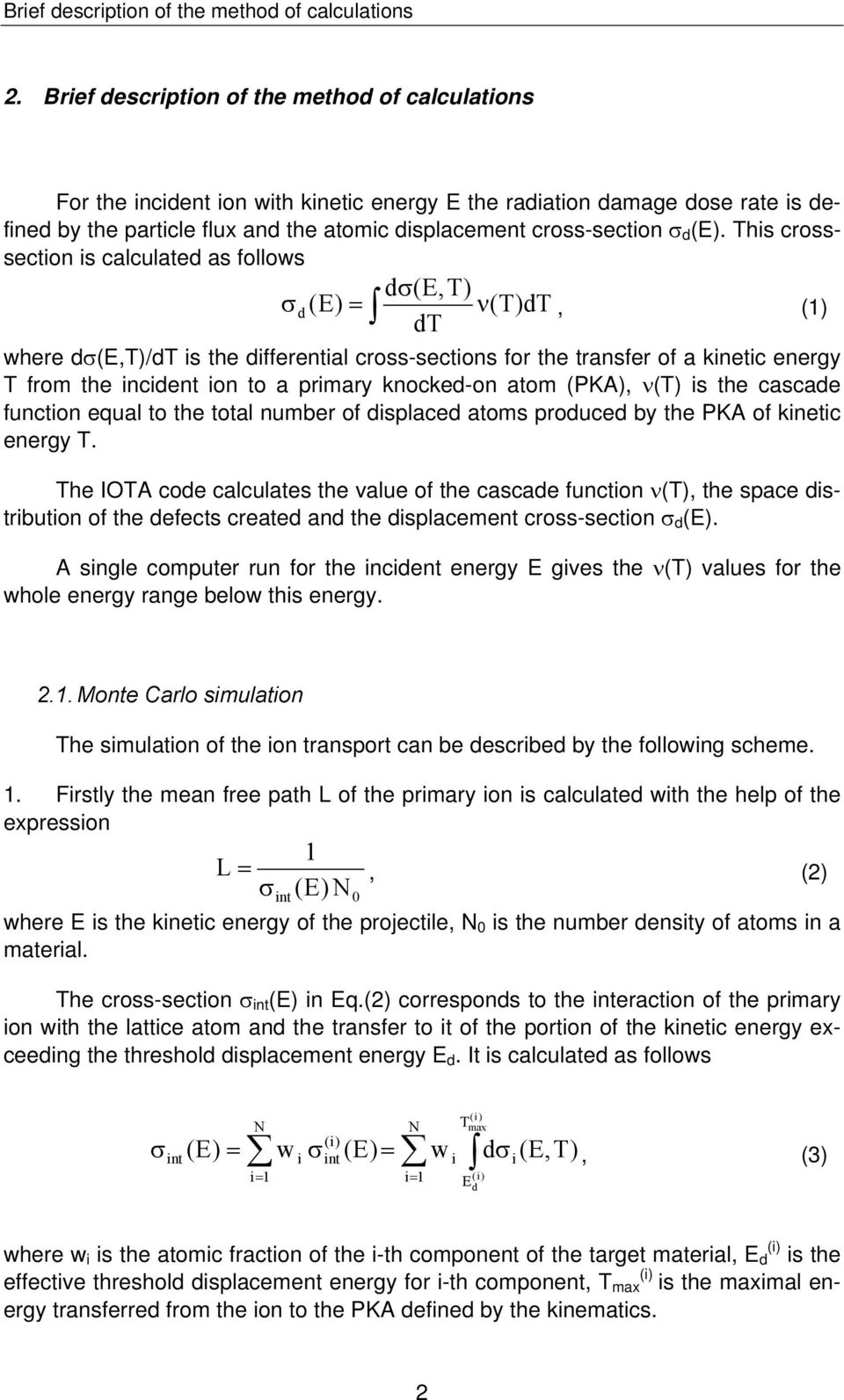
9 Brief desription of the method of alulations In the present version of the IOTA ode the differential ross-setion for the transfer of the kineti energy T from the primary ion to the lattie atom dσ(e,t) is alulated as follows d dt 2t 2 1/ 2 σ i (E,T) = πa f (t ) 3/ 2, (4) where the funtion f(t 1/2 ) and the sreening length a are alulated based on the different approahes depending on the user hoie by input. i) The f(t 1/2 ) funtion and sreening length are defined aording to Ref.[2] (the IOTA ode parameter IDSDT on Card 2 with valid values 0, from Table 1) f (t 1/ 2 a = a ) = λt 1/ 2 m 1 m q 1/ q [ 1+ (2λ t ) ] 1/ 3 3 1/ ( 2 / 3 2 / Z + ) 2 0(9π /128) 1 Z2 2,, where the orresponding available sets of the λ, m and q parameters are listed in Table 1. Table 1 Sets of the λ, m and q parameters for the f(t 1/2 ) funtion alulation and the IOTA ode parameter IDSDT from Ref.[2] λ M q Referene IDSDT /3 2/3 [2] 0 or [13] [13] [13] [13] [14] 15 ii) The f(t 1/2 ) funtion and a are alulated aording to Ref.[3] (IDSDT =1 on Card 2) 3

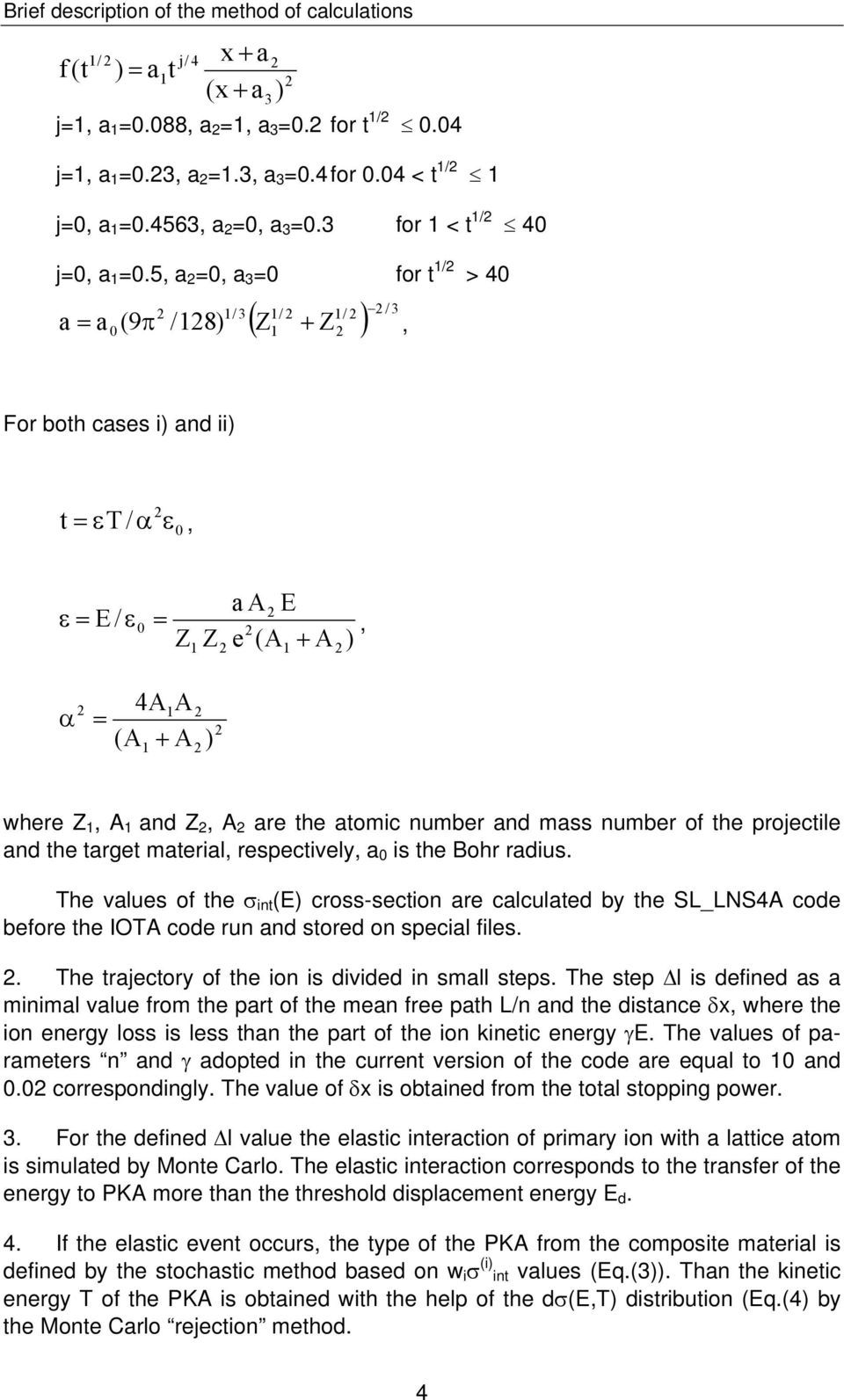
10 Brief desription of the method of alulations f (t 1/ 2 ) = a t j/ 4 1 x + a (x + a 2 2 3) j=1, a 1 =0.088, a 2 =1, a 3 =0.2 for t 1/ j=1, a 1 =0.23, a 2 =1.3, a 3 =0.4 for 0.04 < t 1/2 1 j=0, a 1 =0.4563, a 2 =0, a 3 =0.3 for 1 < t 1/2 40 j=0, a 1 =0.5, a 2 =0, a 3 =0 for t 1/2 > 40 a = a 3 ( ) 1/ 2 1/ 2 2 / Z +, 2 1/ 3 0(9π /128) 1 Z2 For both ases i) and ii) 2 t = εt / α ε 0, a A 2 E ε = E / ε0 = 2, Z Z e (A + A ) α 2 4A1A = (A + A ) 2 where Z 1, A 1 and Z 2, A 2 are the atomi number and mass number of the projetile and the target material, respetively, a 0 is the Bohr radius. The values of the σ int (E) ross-setion are alulated by the SL_LNS4A ode before the IOTA ode run and stored on speial files. 2. The trajetory of the ion is divided in small steps. The step l is defined as a minimal value from the part of the mean free path L/n and the distane δx, where the ion energy loss is less than the part of the ion kineti energy γe. The values of parameters n and γ adopted in the urrent version of the ode are equal to 10 and 0.02 orrespondingly. The value of δx is obtained from the total stopping power. 3. For the defined l value the elasti interation of primary ion with a lattie atom is simulated by Monte Carlo. The elasti interation orresponds to the transfer of the energy to PKA more than the threshold displaement energy E d. 4. If the elasti event ours, the type of the PKA from the omposite material is defined by the stohasti method based on w i σ (i) int values (Eq.(3)). Than the kineti energy T of the PKA is obtained with the help of the dσ(e,t) distribution (Eq.(4) by the Monte Carlo rejetion method. 4
11 Brief desription of the method of alulations 5. The primary ion passes the distane l and losses the energy transferred to the PKA and for the eletroni exitation. The last energy is defined from the eletroni stopping power (de/dx) el. The PKA harateristis are stored for the further treatment. The new mean free path is defined for the primary ion and the proedure desribed above is repeated. 6. If the elasti ollision with the energy transfer exeeding E d does not our, the primary ion moves on the distane l. Its energy is dereased orresponding to the experimental eletroni stopping power (de/dx) el and the part of the nulear stopping 0 Ed power ( de / dx) n, whih orresponds to the energy transfer from the ion to the lattie atom from 0 to Ed value. The data ( de / dx) n are prepared by the SL_LNS4A 0 Ed ode before the IOTA ode run. 7. The primary ion is traing while its kineti energy is less than the minimal effetive threshold displaement energy E d (i) from all N-omponents of the omposite material. 8. The stored PKA s are treated as primary ions produing new knok-on atoms and proedure desribed above repeats. 9. The proess desribed above is repeated until the energy of all PKA s reated is less than the minimal E d energy and the omputer bank of PKA s is empty Integration Along with the Monte Carlo simulation the IOTA ode alulates the number of the primary defets ν(e) by the numerial integration of the ratio of the losses for damage prodution to the total stopping power. The total number of Frenkel pairs produed by the ion with the energy E 0 in the material is alulated using the following expression [1] (de / dx) dam ν(e ) = T ~ (E0 ) = 0 2E 2E (de / dx) + (de / dx) de d d E 0 0 el n, (5) where E 0 is the primary ion energy, T ~ is the energy going to the prodution of displaed atoms. The value (de/dx) dam in Eq.(5) is the speifi energy loss for the damage prodution, (de/dx) el is the eletroni stopping power and (de/dx) n is the speifi energy loss for the elasti sattering (nulear loss). The speifi energy loss for the damage prodution is alulated as follows 5

12 Brief desription of the method of alulations de dx dam = N 0 T max E d dσ(e,t) T ~ (T)dT, (6) dt where N 0 is the number density of atoms in a material, T ~ (T) is the energy for defets prodution, dσ(e,t) is alulated by Eq.(4). The energy for the damage prodution T ~ (T) is alulated aording to the NRT-approah [4,8] T T ~ NRT (T) = 1+ k g( ε) (kev), (7) g(ε)= ε 1/ ε 3/4 + ε, 32 m k = 3 π M e 2 1/ 2 (A A 1 3/ A (Z ) 3/ / Z Z 2 / / 3 2 Z ) 1/ 2 2 3/ 4, 2 [ A T /(A A )][ a /(Z Z e )] ε =, where m e is the mass of an eletron, M 2 is the mass of the atom of target material and the other values are defined above, e is the eletron harge. Note, that the value of k in Eq.(7) is defined aording to Robinson [4] and for the ase of Z 1 =Z 2, A 1 =A 2 it oinides with the NRT-value [8] equal to 1/6 1/ 2 k = Z ( Z / A ) Simple evaluation For the omparison with other alulations, the value of the asade funtion ν(e) is evaluated with the help of the NRT-formula [8] 0.8 ν ( E) T ~ NRT = NRT (E), (8) 2E d where T ~ NRT (E) is alulated by Eq.(7) Combined BCA-MD alulation The simulation desribed in Set.2.1 is performed up to a ritial ion energy T rit, below this energy the results of MD alulations are used to obtain the total number 6
![40244 ε 3/4 + ε, 32 m k = 3 π M e 2 1/ 2 (A A 1 3/ 2 1 + A (Z ) 3/ 2 2 2 / 3 1 + Z Z 2 / 3 1 2 / 3 2 Z ) 1/ 2 2 3/ 4, 2 [ A T /(A A )][ a /(Z Z e )] ε =, 2 1 + 2 1 where m e is the mass of an](/docs-images/44/2040295/images/page_12.jpg "eletron, M 2 is the mass of the atom of target material and the other values are defined above, e is the eletron harge. Note, that the value of k in Eq.")
13 Brief desription of the method of alulations of defets. This energy is applied as for the primary ion, as for PKA s produed in the ollision asade with the energy above T rit. The typial value of T rit is between 5 kev and 100 kev depending on the MD simulation. The results of the MD alulations are introdued in the ode in the form of the defet prodution effiieny. The effiieny is equal to the ratio of the total number of survived point defets (Frenkel pairs) to the number of defets alulated by the NRT model (Eq.(8)). The general expression for the defet prodution effiieny is as follows α2 η( E MD ) = α1 E MD + α3 E MD, (9) where the energy E MD is supposed equal to the T ~ NRT energy in Eq.(7), α i are fitting oeffiients. To perform the alulation the user should supply the values of the α i parameters in Eq.(9) or use the default values whih are available in the ode for a limited number of elements (Fe, Cu, W). 7

14 Brief desription of the method of alulations 2.5. Flowhart of the ode The flowhart of the ode is shown in Fig.1 Interation rosssetions prepared by SL_LNS4A ode User input data Stopping power data (Chapter 7) Preparation data for alulations Basi Monte Carlo alulations (Chapter 2.1) Integration (Chapter 2.2) Evaluation and printing results Fig.1 8

15 Computer ompatibility 3. Computer ompatibility The IOTA ode and the servie ode SL_LNS4A are written in FORTRAN. The IOTA ode uses a random number generator, whih an be different for different FORTRAN ompilers. The urrent version of the IOTA ode uses the GNU FORTRAN [9] built-in random number generator RAND. To substitute it by the other one it is neessary to hek the FUNCTION RANDOM in the IOTA ode. 4. Exeution of the IOTA ode The exeution of the IOTA ode inludes several steps. 1. The preparation of the main input file. The name is INPUT. The proedure is desribed below in Set The stopping power alulation by the SRIM ode [7] if the option SRIM is hosen in the input file (Set.5). The details are disussed in Set.7. If the SPAR option is seleted in INPUT, the stopping power is alulated by the IOTA ode and point 2. is omitted. 3. Run SL_LNS4A ode. The input file is the same as for the IOTA ode (the file INPUT). After the SL_LNS4A ode exeution the files with the information needed for the IOTA ode run are reated. After the file reation it is not neessary to exeute this ode again for the other IOTA ode runs with the same INPUT and other set of the primary ion energies, whih do not exeed the TLIM value (Set.5). 4. Run the IOTA ode. Analysis of the results. 5. Preparation of the main input file for the IOTA ode The main input file is alled INPUT. It is loated in the same diretory with the exeutable modules of the IOTA ode and the SL_LNS4A ode. The file INPUT 9

16 Preparation of the main input file for the IOTA ode All data are introdued in the file in the free format form inluding the names of the external files. Eah line beginning from the symbol, or! defines the omment ard. The length of the external file names should not exeed 12 haraters. The struture of the INPUT file is desribed below. (Card 1) The title of the task desribed in 80 haraters inluding blank spaes. (Card 2) Parameters IGRAPH, MAXPLAY, TLIM, IDSDT. Parameter IGRAPH is the damage profile printing option. The value IGRAPH = 0 suppresses the printing of the damage profiles (spae damage distribution). IGRAPH = 1 means the printing. The parameter MAXPLAY defines the maximal number of attempts to get the kineti energy T of PKA from the dσ(e,t)/dt distribution in the FUNCTION TPKA. The play of T value is performing by the Monte Carlo rejetion method. If after MAXPLAY attempts the definition of T failed, the kineti energy of PKA is taken aording to the ratio T max T max dσ(e,t') Tmean = T'dT' dσ(e,t' ) dt' E d E d, (10) the T mean values are alulated by the SL_LNS4A ode before the IOTA ode run. The possible values of MAXPLAY are i) atual number of attempts ii) MAXPLAY=1. In this ase the kineti energy T of PKA is substituted by T mean from Eq.(10). It greatly redues the time of the alulation at the high ion energies, but should be referred to a approximate alulations iii) MAXPLAY=0. It means the use of the default value of MAXPLAY equal to 250,000 iv) MAXPLAY < 0 means the unlimited number of attempts. It inredibly inreases the running time of the ode at the high energies of the primary ions. The value of TLIM defines the maximal energy (MeV) to be treated by the SL_LNS4A ode. It should exeed the maximal energy of the primary ion introdued in the IOTA ode input file (see below). The default value (TLIM=0) is equal to 5 GeV. 10

17 Preparation of the main input file for the IOTA ode Parameter IDSDT defines the method of the f(t 1/2 ) funtion alulation (Eq.(4)). The values IDSDT=0, orrespond to the f(t 1/2 ) funtion from Ref.[2] (see Table 1 for IDSDT definition). The value IDSDT=1 means the alulation of f(t 1/2 ) with the help of the approah from Ref.[3]. (Speial ards 1 and 2 ) These ards are used only for the ombined BCA-MD alulations. [Card 1 ] To initiate the alulations the ard should ontain the words BCA and MD in any ombination printed in the same line (See Example 3) [Card 2 ] CMD(1), CMD(2), CMD(3), ELOW, EHIGH, ECRIT The CMD(i) values orrespond to the oeffiients α i in Eq.(9) for the effiieny of the defet prodution obtained from the MD alulations. ELOW and EHIGH are the lowest and the highest E MD (or T ~ NRT ) energy in kev, where the effiieny supposed to be a onstant, η(emd < ELOW) = η(elow), η(e MD > EHIGH) = η(ehigh). The energy ECRIT (kev) is equal to the value of the E MD energy in Eq.(9) where the MD results for the defet prodution are used instead of the BCA alulations (Set.2.4). Usually, ECRIT is equal to EHIGH. The ritial energy T rit mentioned in Set.2.4 is alulated by the ode basing on the ECRIT value for the inident ion and the ions of the target material. The default values are taken if CMD(i),i=1,3; ELOW; EHIGH and ECRIT are set to zero. They are available for Fe, Cu and W in the urrent ode version (Card 3) The atomi number (Z) and the atomi weight (A) (amu) of the projetile. If A=0 the atomi weight is taken for the natural mixture of isotopes for this element (Z) from internal ode tables. (Card 4) The density of the target omposite material (RO), the number of the omponents of the ompound (NK) and the stopping power option (SO). The RO value is introdued in g/m 3. If RO=0, the density is taken from the internal ode table for this material. The NK value is equal to the number of unique atoms of the target. For example, the NK value is equal to 2 for Li 2 O, and equal to 3 for Al 2 (SO 4 ) 3. It is for the ase if only the single isotope of eah element is onsidered in the alulation. For the mixture of the isotopes the NK value should inlude their amount. If the lithium from the Li 2 O ompound is onsidered as a mixture of 6 Li and 7 Li isotopes, the NK value is equal to 3. The stopping power option (SO) is a harater variable desribing the method of the stopping power alulation. It an be equal as follows 11
![[3]. (Speial ards 1 and 2 ) These ards are used only for the ombined BCA-MD alulations.](/docs-images/44/2040295/images/page_17.jpg "[Card 1 ] To initiate the alulations the ard should ontain the words BCA and MD in any ombination printed in the same line (See Example 3) [Card 2 ] CMD(1), CMD(2), CMD(3), ELOW, EHIGH, ECRIT The")
18 Preparation of the main input file for the IOTA ode i) SRIM (or Ziegler ). The data for the stopping power are taken from the speial files prepared by the SRIM ode [7]. (See Card 6,9 and Set.7). This option is reommended. ii) SPAR (or Armstrong ). The stopping power is alulated in the IOTA ode by the SPAR routine [15,16]. It should be noted that for the heavy ions and high energies the auray of this method is less than of the SRIM ode. (Card 5, 6 or more if neessary) Names of files with the ross-setions and other information to be prepared by the SL_LNS4A ode. Eah name orresponds to the interation of the primary ion with the ertain material omponent. For example, for an α-partile projetile and Li 2 O target the names are introdued for α+o and α+li interations 1. The sequene of the file names should be the same as for the desription of the omponents of the omposite material (Card 7 and others). The names are separated by at least one blank spae. Any number of ards an be used for the total list of the file names. (Card 6 2 ) Name of file with stopping power data orresponding to the primary ion interation with the ompound (e.g. with Li 2 O). The format of the file orresponds to the SRIM ode output [7] (see Set. 7). If the SPAR option is seleted for the stopping power alulation (Card 4) the Card 6 should be omitted. (Card 7) The atomi number (Z), the atomi weight (A) (amu), the atomi onentration (W) and the effetive threshold displaement energy (ED) for the first omponent of the omposite material (target). If the zero value is introdued instead of A value (A=0), the atomi weight is taken for the natural mixture of isotopes with the atomi number Z from the internal ode table. The atomi onentration (W) is introdued in the normalized or the unnormalized form. For example, in the desription of the oxygen from Li 2 O ompound both values or 1 are orret. The displaement energy (ED) is introdued in ev. The default value (ED=0) is equal to 40 ev. (Card 8, 9 or more if neessary) Names of files with the data to be prepared by the SL_LNS4A ode for the interation of the ion desribed in Card 7 with eah omponent of the omposite material. For example, if the Card 7 desribes the oxygen from 1 it is supposed that Li 2 O onsists of single Li and single O isotope. 2 the number depends on the amount of ards used to desribe the names of files prepared by the SL_LNS4A ode (see Card number 5,6 or more) 12

19 Examples of the INPUT file Li 2 O, the urrent ard should inlude the file names for the O+O and O+Li interations. Note, the sequene of suh file names should oinide with the sequene of the different material omponents desription (given in the ards similar to the Card 7). (Card 9) Name of file with the stopping power data from the SRIM ode orresponding to the interation of the ion desribing in the Card 7 with the ompound. For example, if the Card 7 desribes the oxygen from Li 2 O ompound, the name of file given here is for the stopping power data for the O+Li 2 O interation. This ard is omitted for the SPAR option hosen for the stopping power alulation in Card 4. (Next ards similar to Cards 7-9). The same for other omponents of the ompound. For example, if the oxygen from Li 2 O is desribed in Cards 7-9 these ards are used for the lithium desription. (Card after the material desription). Names of the output files. Two file names are introdued for the usual alulations and three file names for the joint BCA-MD alulations. The first output file ontains the detail information about the alulation performed. The seond file repeats partly the data from the main output for the speial use, e.g. for the graphis representation. The third file ontains the results of the ombined BCA-MD simulation. (Next ards). The energy of primary ion (E) and the number of Monte Carlo events to perform the alulation at this energy (NHIST). The energy is introdued on the separate ards following one after another in MeV along with the unique NHIST number. The negative value shown in the list is onsidered as the last energy in the simulation. For example, to perform the alulation for inident energy equal to 10 kev with 999 Monte Carlo events and the primary energy equal to 1 GeV with 100 Monte Carlo events, one should introdue two suessive ards and Examples of the INPUT file A) Use the SRIM option for the stopping power alulation 13

20 Examples of the INPUT file The example of the INPUT file for the interation of 28 Si with the silion arbide is given below (Example 1) Example 1 The INPUT file for Si+SiC interations with the stopping power from SRIM ode IOTA ode input name of the task Test alulations Si+Silion Carbide Z, A of the projetile ion density (g/m3), number of omponents and stopping option SRIM name of files with the ross-setions from SL_LNS4A ode Si_Si.dat Si_C.dat de/dx for projetile + omposite media Si_SiC.Zie desription of the omponents for ompound Z, A, atomi fration, Ed (ev) ross-setions Si_Si.dat Si_C.dat de/dx Si_SiC.Zie C_Si.dat C_C.dat C_SiC.Zie names of output files messages mess2.dat energy of projetile and number of Monte Carlo events

21 Examples of the INPUT file B) Use the SPAR option for the stopping power alulation The example of the INPUT file is given here (Example 2). Example 2 The INPUT file for Si+SiC with the stopping power from the SPAR alulations IOTA ode input name of the task Test alulations Si+Silion Carbide Z, A of the projetile ion density (g/m3), number of omponents and stopping option SPAR name of files with the ross-setions from SL_LNS4A ode Si_Si.dat Si_C.dat desription of the omponents for ompound Z, A, atomi fration, Ed (ev) ross-setions Si_Si.dat Si_C.dat C_Si.dat C_C.dat names of output files messages mess2.dat energy of projetile and number of Monte Carlo events
22 Examples of the INPUT file C) Combined BCA-MD alulations The example of the INPUT file for the irradiation of natural tungsten by 167 Tm ions is given below (Example 3). The stopping power is obtained by the SRIM ode. The default parameters are used for the effiieny alulations at low energies. Example 3 The INPUT file for joint BCA-MD alulation for Tm+W interation IOTA ode input name of the task Test alulations Tm+W BCA + MD Z, A of the projetile ion density (g/m3), number of omponents and stopping option 0 1 Ziegler name of files with the ross-setions from SL_LNS4A ode tm_w.dat de/dx for projetile + media tm_w.zie Z, A, atomi fration, Ed (ev) ross-setions w_w.dat < de/dx > w_w.zie names of output files messages mess2.dat bamd.out energy of projetile and number of Monte Carlo events End 16
23 Preparation of the data for the stopping power 7. Preparation of the data for the stopping power This setion disusses the preparation of the stopping power data with the help of the SRIM ode. It orresponds to the reommended input option SRIM or Ziegler (see Set.5, Card 4) for the stopping power alulation. If the SPAR option is hosen in Card 4 of the INPUT file this setion should be omitted. The urrent version of the IOTA ode works with the output format of the SRIM ode [7]. The ode is distributed by the author [7] freely. To use the SRIM ode one should download it from Ref.[7] and install it on PC. If the SRIM ode is installed, the instrution to prepare the data for the stopping power suitable for the IOTA ode alulation is the following. 1. Selet Stopping/Range Tables in the main SRIM menu (general panel). 2. Selet the appropriate projetile and the target material. In the ase of the ompound one should introdue the orret density of the ompound. It is the same as in the Card 4 of the INPUT file of the IOTA ode (see Set.5). 3. Set the energy range of the projetile from 1 ev to 5.2 GeV (the maximal energy allowable in the IOTA ode). 4. Selet the units for the stopping power equal to MeV/(mg/m 2 )) (default in the main SRIM menu). 5. Perform the operation Calulate table and give the same name for the output file as shown in the file INPUT for the IOTA ode (Set.5). Store the output file in the same diretory where there are the exeutable modules of the SL_LNS4A ode and the IOTA ode. 6. Repeat this proedure for all atoms of the ompound, onsidered as a projetile. The example of the output of the SRIM ode for the ase of Si+SiC interation is given below (Example 4). Note. If the alulations are performed for the same material and the various projetiles with the equal atomi number and the different atomi weights it is not neessary to prepare the SRIM stopping power data for eah isotope. 17
24 Preparation of the data for the stopping power If the data are prepared for the ion with Z and A and the atual projetile in the task is Z and A, the eletroni stopping power is orretly realulated for a new energy grid (A /A)E. The nulear stopping power is renormalized aording to the following formula (de / dx) (de / dx) Z,A' n Z,A n A' = A t' / t / 1+ t' + ln( 1+ t + ln( t' + t + 1+ t') 1+ t ), t' 8 / 9 4 E A T = / 3 2 / 3 1/ 2 ZZT (A' A T )(Z ZT ), / 9 4 E A T t = / 3 2 / 3 1/ 2 ZZT (A A T )(Z ZT ), + + where E is the energy of projetile (MeV), Z T and A T are the atomi number and the atomi weight of the target material. The formula shown above is obtained from the analytial integration of T dσ(e,t)/dt, where dσ(e,t) is alulated by Eq.(4) and the f(t 1/2 ) funtion is defined by the λ, m and q parameters from the first line of Table 1. New data for the stopping power are written in the output file RENORM.STO. 18
25 Preparation of the data for the stopping power Example 4 The SRIM ode output for the S+SiC interation ================================================================== Calulation using SRIM-2003 SRIM version ---> SRIM Cal. date ---> Marh 24, 2003 ================================================================== Disk File Name = SRIM Outputs\Si_SiC.Zie Ion = Silion [14], Mass = amu Target Density = E+00 g/m3 = E+22 atoms/m3 ======= Target Composition ======== Atom Atom Atomi Mass Name Numb Perent Perent Si C ==================================== Bragg Corretion = 0.00% Stopping Units = MeV / (mg/m2) See bottom of Table for other Stopping units Ion de/dx de/dx Projeted Longitudinal Lateral Energy Ele. Nulear Range Straggling Straggling ev 6.406E E-02 1 A 1 A A 1.2 ev 6.406E E-02 1 A 1 A A 1.3 ev 6.667E E-02 1 A 1 A A 1.4 ev 6.919E E-02 1 A 1 A A 1.5 ev 7.162E E-02 1 A 1 A A 1.6 ev 7.397E E-02 1 A 1 A A 1.7 ev 7.624E E-02 1 A 1 A A 1.8 ev 7.845E E-02 1 A 1 A A 2 ev 8.270E E-02 1 A 1 A 1 A 2.25 ev 8.771E E-02 1 A 1 A 1 A ev 9.246E E-02 1 A 1 A 1 A ev 9.697E E-02 1 A 1 A 1 A ev 1.013E E-02 2 A 1 A 1 A ev 1.054E E-02 2 A 1 A 1 A ev 1.094E E-02 2 A 1 A 1 A LINES SKIPPED 1.80 GeV 1.658E E mm um um 2.00 GeV 1.529E E mm um um 2.25 GeV 1.398E E mm um um 2.50 GeV 1.291E E mm um um 2.75 GeV 1.203E E mm um um 3.00 GeV 1.128E E mm um um 3.25 GeV 1.065E E mm um um 3.50 GeV 1.009E E mm um um 3.75 GeV 9.611E E mm um um 4.00 GeV 9.186E E mm um um 4.50 GeV 8.471E E mm um um 5.00 GeV 7.893E E mm um um 5.20 GeV 7.702E E mm um um 4.50 GeV 8.471E F mm um um 5.00 GeV 7.893F E mm um um 5.20 GeV 7.702E E mm um um Multiply Stopping by for Stopping Units E+01 ev / Angstrom 19
26 Desription of the output file of the IOTA ode 8. Desription of the output file of the IOTA ode The following information is printed in the main output listing of the IOTA ode. See Example 5. a. The name of the exerise introdued in the first non-omment ard of the IN- PUT file (Set.5). b. The harateristis of the primary ion and the target material (Primary partile (Z,A) Material at % Ed (ev)).. The density of the material and the number of atoms in m 3 (n0). d. The effetive Z and A numbers for the ompound (Z(eff) and A(eff)) alulated as the sum of Z and A for all omponents of the omposite material weighted with their atomi frations. The values Z(eff) and A(eff) are used for the rude estimation of the number of defets reated in material with the help of the NRT-formula. e. The energy of the projetile in MeV (Primary energy). f. The number of Monte Carlo simulations for the inident ion energy (Number of events). g. The number of primary defets alulated with the help of the NRT-formula (Eq.(8),(7)) (Simple NRT-formula predition). For the omposite materials the effetive values Z(eff) and A(eff) (see Set. d ) are used instead of Z 2 and A 2 in Eq.(7). h. The number of primary defets alulated for all suessive elasti interations of the primary ion with the lattie atoms simulated by Monte Carlo (Number of vaanies (Lindhard, free path)). For the single interation of the ion with kineti energy E with the lattie atom the number of defets is estimated by the following expression ν = 0.8 dσ(e,t') T ~ (T')dT' 2E dt' d T max T max E d E d dσ(e,t'), (11) where the energy for damage prodution T ~ (T) is alulated aording to Eq.(7). The T ~ (T) value is defined using the effetive Z(eff) and A(eff) numbers for the ompound. The statistial error (%) (in the Example 5 it is equal to 1.02%), the ratio to the number of defets alulated by the NRT-formula (0.667) and the referene number (2) are printed on this line. 20
27 Desription of the output file of the IOTA ode i. Number of defets alulated by the integration of Eq.(5) (Number of vaanies (Lindhard, integration)). The referene number is equal to (3). j. Number of defets (Frenkel pairs) alulated by the diret ounting of all PKA s reated (Number of Frenkel pairs (diret ounting)). It is a main harateristi obtained. Method of the alulation is desribed in Set.2.1. The statistial error (%), the ratio to the number of defets obtained by the NRT-formula and the referene number (4) are also printed. k. The value desribed above in Set. j multiplied on the oeffiient equal to 0.8 (Modified ounting). l. The number of defets alulated with the help of the NRT formula (Eq.(8),(7)) for eah omponent of the ompound and weighted with their atomi frations (NRTformula for pure material omponents weighted). Suh estimation repeats widely used and rather inorret ounting of the number of defets for ompounds. Here the total number of defets is equal to ν(e) = N i= 1 (i) (i) w i ν NRT (Z1, A1, Z 2, A 2 ) where the sum is for all omponents of the omposite material, w i is the atomi fration, ν NRT (i) (i) (Z1,A1,Z2,A 2 ) is alulated aording to Eq.(8),(7) with the atomi and (i) (i) mass numbers Z 2, A 2 orresponding to the separate isolated i-th omponent of the ompound. m. The approximate number of defets alulated (Number of vaanies from Tmean al and Number of vaanies from Tplay al). The values are of seondary importane. n. The displaement ross-setion (σ d ) for the inident ion energy alulated by the SL_LNS4A ode in barns (Displaement ross-setion (Lindhard, weighted)). The value of σ d is alulated as follows σ d N (i) (E) = w i σd (E) = i= 1 N i= 1 w i dσ(e,t, Z1,A dt 1, Z (i) 2,A (i) 2 ) ν 21 NRT (T, Z (i) 2,A (i) 2 (12), (13), Z(eff ), A(eff ))dt where dσ(e,t) is alulated by Eq.(4), the asade funtion ν is defined by Eq.(8),(7) (i) (i) with Z 1 and A 1 in Eq.(7) substituted by Z 2 and A 2 and with Z2, A 2 in Eq.(7) substituted by Z(eff) and A(eff). σ d (i) (E) The separate non-weighted values are printed below in barns for eah omponent of the omposite material (Components:). o. The displaement ross-setion (σ d ) obtained from the diret ounting of the displaed atoms by the Monte Carlo method (Set.2.1) in barns (Displaement ross-setion (diret ounting)).
28 Desription of the output file of the IOTA ode The value of σ d orresponds to the initial energy of the primary ion. It is alulated with the help of the following expression σ d (E) = N ϕ N 0 dam V where N dam is the number of PKA s reated in the volume V, ϕ is the flux of the primary ions, N 0 is the number of atoms per m 3. The value of V is taken small enough to minimize the energy attenuation of the primary ion. The statistial error (%) and the referene number (7) are also printed for this σ d value. p. The displaement ross-setion (σ d ) desribed in Set. o multiplied on the oeffiient equal to 0.8 (modified ount). q. The average kineti energy of PKA s obtained with the help of different approahes (Tmean =, Tplay= ) r. The range of the primary ion from the SRIM ode tables (Path (Ziegler,evl)=) and the same value multiplied on the oeffiient equal to ( A 2 /A 1 ) (total=). The last value has the physial meaning only at the low primary ion energies, where the energy loss is defined by the elasti ollisions. s. The alulated range of the primary ion (Path (total,al )). This is the approximate estimation of the range. t. The relative number (%) of alls of the FUNCTION TPKA, when the definition of the kineti energy T failed after MAXPLAY attempts (T play was ut (TPKA rout)). The MAXPLAY value is also printed. u. The spatial distribution of dpa alulated basing on the approah desribed in Set. h (Profile of damage from Lindhard ds/dx (free path )). The data are normalized on the primary ion fluene equal to 1/m 2. The units are m for X-axis and dpa for the Y-axis. Note, that in the urrent version of the ode X refers to the distane along the ion trajetory rather than for the distane ounting from the plane normal to the primary momentum of the ion (z-axis). v. The spae distribution of dpa alulated by the diret ounting of PKA s reated (Profile of damage from diret ounting). See other notes for Set. u. w. The number of defets ν(t) at the different primary energies of the ion alulated below the initial ion energy E (Number of vaanies at different primary energies from urrent alulation). 22
29 Desription of the output file of the IOTA ode The first olumn is the energy of the primary ion in MeV. The seond olumn is the asade funtion alulated by the approah desribed in Set. h. The third olumn is for the number of defets obtained with the help of the integration proedure desribed in Se.2.2. The last olumn shows the number of defets alulated from the ounting of all PKA s reated. The olumns have the referene numbers (2),(3),(4) orresponding to the type of the alulation desribed mentioned above in the IOTA listing. The data shown in the table for eah energy E (i) orrespond to the average values for the range from 0.5(E (i) + E (i-1) ) to 0.5(E (i+1) + E (i) ). The values of the asade funtion shown in the table have the maximal error at the small ion energies. To get the orret numbers of defets for suh energies it is neessary to run the IOTA ode for the same energies onsidered as the primary ones. 23
30 Desription of the output file of the IOTA ode Example 5 Main output of the IOTA ode I O T A C O D E Test alulations Si+Silion Carbide Primary partile (Z,A) Material at % Ed (ev) Density = g/m3 n0= E+22 1/m3 Z(eff) = A(eff)= Note. Nulear nonelasti interations are not onsidered here Primary energy MeV Number of events 100 error % /NRT Simple NRT-formula predition = (1) Number of vaanies (Lindhard, free path ) = ( 1.02) (2) Number of vaanies (Lindhard, integration) = (3) Number of Frenkel pairs (diret ounting) = ( 1.96) (4) Modified ounting = ( 1.96) NRT-formula for pure material omponents weighted = (5) Number of vaanies from Tmean al = Number of vaanies from Tplay al = Displaement ross-setion (Lindhard, weighted) (b) = E+07 (6) Components: E E+06 Displaement ross-setion (diret ounting) (b) = E+07 ( 13.35) (7) (modified ount ) (b) = E+07 ( 13.35) Tmean = E-01 MeV Tplay= Path (Ziegler,evl)= 3.140E-04 m, total= 3.888E-04 m Path (total,al ) = 3.205E-04 m Histories interrupted (subr model)= 0 T play was ut (TPKA rout) = % Maxplay= Profile of damage from Lindhard ds/dx (free path ) X=(m) Y=(dpa), result is normalized on primary ion fluene 1/m2 X Y...!...!...!...! E E+00 I! I E E-17! I E E-17! I F E-17! I E F-17 I! I E E-17 I! I E F-17 I! I E E-17 I! I E E-17 I! I F E-17 I ! I E E-17 I! I E E-17 I! I E E-17 I! I E E-17 I! I F E-16 I! I E E-16 I! I E E-16 I! I E F-16 I! E E-18 I! I E E+00 I ! I E E+00 I...!...I Sum(Y)= E-15 dpa (unnormalized)= Profile of damage from diret ounting X=(m) Y=(dpa), result is normalized on primary ion fluene 1/m2 24
31 Desription of the output file of the IOTA ode X Y...!...!...!...! E E-20 I! I E E-17 I! I E E-17 I! I F E-17 I! I E E-17 I! I E F-17 I! I E E-17 I! I E E-17 I! I E E-17 I! I F F-17 I ! I E E-17 I! I E F-17 I! I E E-16 I! I E E-16 I! I F F-16 I! I E E-16 I! I E E-16 I! I E F-16 I! I E E-18 I! I E E+00 I ! I E E+00 I...!...I Sum(Y)= E-15 dpa (unnormalized)= Number of vaanies at different primary energies from urrent alulation [explanation (2),(3),(4) see above] Energy ds/dx(free path) ds/dx(integr) Diret ounting (MeV) (2) (3) (4) E E LINES SKIPPED end 25
32 Example of the alulation 9. Example of the alulation Fig.2 and Table 2 show the examples of the alulations performed with the help of the IOTA ode. For the omparison the result of the alulation obtained by the MARLOWE ode in Ref.[10] and by the TRIM-2003 ode are also shown Si + Li 4 SiO 4 Number of defets MARLOWE ode [10] IOTA ode, Integration, Eq.(5) IOTA ode, Monte Carlo PKA energy (MeV) Fig.2 Number of defets alulated with the help of the IOTA ode and the MARLOWE ode [10] for Li 4 SiO 4 irradiated with the 28 Si. Effetive threshold energy is the same as for Table 2 data. 26
33 Example of the alulation Table 2 Number of defets alulated with the help of the different odes and by the NRT formula. Effetive threshold energy is equal to 17 ev for Be, 33 ev for Li, 19 ev for O and 112 ev for Si (taken for the purpose of omparison only). Code 9 Be in 9 Be 4 He in 9 Be 28 Si in Li 4 SiO 4 E Be =6 MeV E He =13 MeV E Si =2.3 MeV IOTA (Integration,Eq.(5)) IOTA (Monte Carlo) MARLOWE [10] TRIM NRT formula
34 Referenes 10. Referenes 1. J.Lindhard, M.Sharff, H.E.Shiott, Range Conepts and Heavy Ion Ranges, K. Dan. Vidensk. Selsk. Mat. Fys. Medd., 33, N14 (1963) 2. K.B.Winterbon, P.Sigmund, J.B.K.Sanders, Spatial Distribution of Energy De posited by Atomi Partiles in Elasti Collisions, K. Dan. Vidensk. Selsk. Mat. Fys.Medd., 37, N14 (1970) 3. A.F.Burenkov, F.F.Komarov, M.A.Kumahov, M.M.Temkin, Speial Distribution of Energy Deposited in Atomi Collision Casades in Matter, Energoatomizdat, Mosow, M.T.Robinson, Basi Physis of Radiation Damage Prodution, J. Nul. Mat. 216 (1994) L.R.Greenwood, Neutron Interations and Atomi Reoil Spetra, J. Nul. Mat. 216 (1994) J.P.Biersak, L.G.Haggmark, A Monte Carlo Computer Program for the Transport of Energeti Ions in Amorphous Targets, Nul. Instr. Meth. 174 (1980) J.F.Ziegler, Partile Interations with Matter, 8. M.J.Norgett, M.T.Robinson, I.M.Torrens, A Proposed Method of Calulating Displaement Dose Rates, Nulear Engineering and Design, 33 (1975) GNU Fortran G77 for Windows 95/98/Me/NT4/2000/XP, D.Leihte, Displaement Damage Parameters for Fusion Breeder Blanket Materials Based on BCA Computer Simulations J. Nul. Mat (2002) A.Yu.Konobeyev, Yu.A.Korovin, V.N.Sosnin, Neutron Displaement Cross- Setions for Strutural Materials below 800 MeV, J. Nul. Mat. 186 (1992) Yu.A.Korovin, A.Yu.Stankovsky, A.Yu.Konobeyev, P.E.Pereslavtsev BISERM-2. Nulear Data Library for Evaluation of Radiation Effets in Materials Indued by Neutrons of Intermediate Energies, IAEA-NDS-203 (Marh 1997). 13. W.Ekstein, Computer Simulation of Ion-Solid Interations, Springer-Verlag, 1991, p U.Littmark, J.F.Ziegler, Handbook of Range Distributions, Pergamon Press,
35 Referenes 15. T.W.Armstrong, K.C.Chandler, Nul. Instr. Meth. 113 (1973) H.G.Hughes, H.W.Egdorf, F.C.Gallmeier, J.S.Hendriks et al: MCNPX TM User s manual, Version 2.4.0, September 2002, LA-CP
36 Desription of the diskette with the IOTA ode distributed with this report. Windows version using GNU FORTRAN Compiler 11. Desription of the diskette with the IOTA ode distributed with this report. Windows version using GNU FORTRAN Compiler The diskette ontains the following information Diretory DESCRIPTION FORTRAN Content this report the soure of the IOTA and the SL_LNS4A odes EXE exeutable modules of the IOTA ode and the SL_LNS4A ode (Windows) EXAMPLE example of the input data referene with instrution about GNU FORTRAN installa- GNU_FORTRAN_G77 tion To perform the test alulation 1) reate the working diretory on PC hard disk (e.g. C:\). Call it, e.g. IOTACODE 2) opy all exeutable files from the diskette\exe diretory to the C:\IOTACODE 3) opy the file INPUT and all files with.dat and.zie extensions from diskette\example to C:\IOTACODE 4) run iota.exe and ompare the output files with the files loated in diskette\example diretory To hek SL_LNS4A ode exeution run SL_LNS4A.exe and ompare the files reated with the orresponding files from diskette\example To hek data for the stopping power install the SRIM/TRIM ode from prepare the neessary data and ompare them with the data with.zie extension from the diskette\example diretory. To install GNU FORTRAN Compiler go in diretory A:\GNU_FORTRAN_G77 and open file gnu.html by the Internet browser. Follow the instrution and install A minimal set of G77. 30
37 The text of the IOTA ode 12. The text of the IOTA ode IOTA ode Maximal number of the material omponent is 21. To inrease this value hange parameter(max= to N desirable value in all routines and max1= to N+1 Maximal energy = 5 GeV GNU random number generator is used now. To use other generator hange funtion RANDOM Last hanges 09/01/2004 PROGRAM IOTA parameter (maxe=50001) Common/EIN/EIN(MAXE),NH(MAXE),KEIN COMMON/RECSTORE/TKIN(50003),ZZ(50003),NKO(50003),INDIC(50003), # NREC Common/MERCURY/CMD(5),Erit,MD ====================================================================== read input data file CALL READ_INPUT prepare basi data for alulations CALL PRECALCULATION read ross-setions and de/dx CALL READ_DATA make interpolation between data points CALL INCREASE_DATA_ARRAY alulate de/dx by SPAR routine CALL DEDX_SPAR ======================================================================== Cyle for energies Do IE=1,KEIN T0=EIN(IE) NHIST=NH(IE) If(T0.gt.5000.) then Print,' T0 exeeds the allowable maximum. Change the ode' Call Error(' ',5000) Endif 31
38 The text of the IOTA ode Call INITIALIZE_AND_ZEROIZE(T0) Cyle for events Do 7 IH=1,Nhist Print 1000,IH,T Format(' history =',I10,' E=',g12.5) Call DISPERS(1) Primary ion movement IDE orresponds to the energy of the primary partile whih attenuates in material Z=0.0 IK=1 IDE=-1 Call MODEL(IK,T0,Z,IDE) if(nrec.le.0) goto 6 Seondary reoils movement 2 Call STORE_OUT(MK,T1,Z,IDE) if(nre.lt.0.and.md.eq.0) then print,'strange error' stop if(nrec.le.0) goto 6 IK=MK+1 Call MODEL(IK,T1,Z,IDE) goto 2 6 Call DISPERS(2) 7 Continue Integration of nu(t)ds/dt along the trajetory Call LindInt(T0) Print,' Finished!' Call Print(T0,Nhist)! Do IE=1,KEIN Call end_of_alulation Stop End Subroutine ARRAYINT(KEY, E,CS,N,T,INTS0,RES) REAL4 To get RES value for arrays E(N),CS(N) at point T depending from INTS int sheme KEY defines how to treat situation when T is not overed by E array --- KEY = 0 : stop when T < E(1) or T > E(N) = 1 : assign RES=0.0 if T < E(1) and RES=CS(N) if T > E(N) INT has the usual meaning as in ENDF/B format 32
39 The text of the IOTA ode Attention (!) Input arrays E(N) and CS(N) should be in inreased order Dimension E(N), CS(N) if(key.lt.0.or.key.gt.1) then Print,' E R R O R ' Print,'Subroutine ARRAYINT: KEY=',KEY,' is not aeptable!' print,' press any key...' pause stop INTS=INTS0 If(T.lt.E(1)) goto 8000 If(T.gt.E(N)) goto 9000 Do i=1,n i1=i If( T.le.E(i) ) goto 1000 goto if(i1.eq.1) then! means that T=E(1) RES=CS(1) Return Endif X1=E(i1-1) X2=E(i1) Y1=CS(i1-1) Y2=CS(i1) WL=T CALL INTERMEDIATE(X1,X2,Y1,Y2,WL,INTS,RESINT) RES=RESINT Return T < E(1) if(key.eq.0) then Write(6,)' E R R O R ' Write(6,8001) T,E(1),key 8001 Format(1x,'Subroutine ARRAYINT:'/1x, # ' Requested energy T=',e12.5,' is less than minimal array ' #,'E(1) value=',e12.5 # //1x,' CHANGE THE DATA or KEY number!!'/1x, # ' now KEY is equal to', i5) print,' press any key...' pause stop RES=0.0 Print 8002,T,RES 8002 Format(1x,'ARRAYINT(N): for T =',e12.5,' result ', # 'is set to',e12.5,' (min)') Return T > E(N) if(key.eq.0) then Write(6,)' E R R O R ' Write(6,9001) T,E(N),key 9001 Format(1x,'Subroutine ARRAYINT:'/1x, # ' Requested energy T=',e12.5,' is more than MAXIMAL array ' #,'E(N) value=',e12.5 # //1x,' CHANGE THE DATA or KEY number!!'/1x, # ' now KEY is equal to', i5) print,' 33 press any key...'
40 The text of the IOTA ode pause stop RES=CS(N) Print 9002,T,RES 9002 Format(1x,'ARRAYINT(X): for T =',e12.5,' result ', # 'is set to',e12.5,' (MAX)') Return 9500 Write(6,9501) 9501 Format(1x,'Subroutine ARRAYINT: Strange E R R O R') print,' pause stop End 34 press any key...' Funtion CF(IK,MK,TREC) parameter (max=21,max1=22) COMMON/NRT1/ANRT(MAXC1),BNRT(MAXC1),GNRT(MAXC1) Common/Z2A2/ZT(MAXC),AT(MAXC),FR(MAXC),ED(MAXC),NK EDkeV=ED(MK)1000. NRT TT=TREC1000. If(TT.lt.EDkeV) then CF=0.0 Return Endif If(TT.lt.2.EDkeV) TT=2.EDkeV CF=(0.8/(2.EDkeV))TT/ # (1.+ANRT(IK)TT+BNRT(IK)(TT0.75)+GNRT(IK)(TT )) RETURN END FUNCTION CF1(ED,ATRN,BTRN,GTRN,TREC) As CF, but for speial purpose TT=TREC1000. CF1=(0.8/(2.ED1000.))TT/ # (1.+ATRNTT+BTRN(TT0.75)+GTRN(TT )) RETURN END Speial funtion to inorporate MD result Funtion CF2(IK,MK,TREC) parameter (max=21,max1=22) COMMON/NRT1/ANRT(MAXC1),BNRT(MAXC1),GNRT(MAXC1) Common/Z2A2/ZT(MAXC),AT(MAXC),FR(MAXC),ED(MAXC),NK Common/MERCURY/CMD(5),Erit,MD EDkeV=ED(MK)1000. mod NRT TT=TREC1000.! MeV --> kev If(TT.lt.EDkeV) then CF2=0.0 Return Endif
41 The text of the IOTA ode If(TT.lt.2.EDkeV) TT=2.EDkeV emd= TT/ # (1.+ANRT(IK)TT+BNRT(IK)(TT0.75)+GNRT(IK)(TT )) usual formula CF2=(0.8/(2.EDkeV))eMD Elow =CMD(4) Ehigh=CMD(5) if(emd.lt.elow) emd=elow if(emd.gt.ehigh) emd=ehigh effiieny=cmd(1)( emdcmd(2) ) + CMD(3)eMD modified NRT CF2=effiienyCF2 RETURN END Subroutine COS_DEFINE(IK,MK,T0,TPVA,COST) parameter (max=21,max1=22) Common/Basi/Z1,A1,Z2,A2,AW,RO,RN0 Common/Z2A2/ZT(MAXC),AT(MAXC),FR(MAXC),ED(MAXC),NK Common/PKA/ALPHA2(MAXC1,MAXC),E0(MAXC1,MAXC) T(M2)=[ 2M1M2/(M1+M2)2 ] ( 1-COS( TETA(CM) )) T TG(TETA(LC))=SIN(TETA(CM))/( M1/M2 + COS(TETA(CM)) ) T=T0 TM2=TPVA os(teta) in CM COSTCM=1.-TM2/(T0.5ALPHA2(IK,MK)) if(costcm.gt.1.) COSTCM = if(costcm.lt.-1.) COSTCM= SINTCM=Sqrt(1.-COSTCM2) A11=A1 If(IK.ne.1) A11=AT(IK-1) TETA=ATAN( SINTCM/( (A11/AT(MK))+COSTCM ) ) COST=COS(TETA) write(445,)'cos(tcm),cost=',costcm,cost RETURN END Subroutine CRITICAL_ENERGY parameter (max=21,max1=22) searh root Tdam(E)-Erit=0, it is supposed, that d^2tdam/de^2 < 0 Common/Z2A2/ZT(MAXC),AT(MAXC),FR(MAXC),ED(MAXC),NK COMMON/NRT1/ANRT(MAXC1),BNRT(MAXC1),GNRT(MAXC1) Common/MERCURY/CMD(5),Erit,MD Common/SATURN/TritLAB(MAXC1) Trit orrespods to Abs( Tdam(E)-Erit ) < Err1 35
42 The text of the IOTA ode Err1=1.E-4 NK1=NK+1 If(Erit.le.0.0) Call Error('Eri',0) Do IK=1,NK1 X0=Erit If(Tdam(IK,X0)-Erit)1,8000, h=0.1 2 XU=X0(1.+h) RK=(Tdam(IK,XU)-Tdam(IK,X0))/(XU-X0) X1=X0-(Tdam(IK,X0)-Erit)/RK Trit > 0.1 GeV? If(X1.ge.1.e+5) then Trit=X1 Print 91000,Trit goto 9000 If(abs(Tdam(IK,X1)-Erit).lt.err1) then Trit=X1 goto 9000 If(Tdam(IK,X1)-Erit)1000, 8500, h=0.1 X0=X1 goto h=h/2. goto Trit=X0 goto Trit=X1 goto ontinue kev --> MeV TritLAB(ik)=Trit ontinue Return Print,'Trit searh failed! Tdam(Xinitial) must be < Erit' Print,' press any key...' pause stop Format(70('')/' Energy Trit =',g12.5,' kev', # ' is not realisti',t69,''/70('')) End Subroutine DATATAB A, W (amu), Ro (g/m3), <I> (ev) for elements Data from SRIM ode <I> is mean ionization potential (ev) heked by data in figures presented in exept data noted below subroutine alled from PRECALCULATION Common/DATATAB1/WTAB1(101),ROTAB1(101),RITAB1(101),IATAB1(101) Dimension IATAB(92), WTAB(92), ROTAB(92), RITAB(92) 36
43 The text of the IOTA ode H He Li Be B C N O F Ne Na Mg Al Si P S Cl Ar K Ca S Ti V Data IATAB( 1), WTAB( 1), ROTAB( 1), RITAB( 1) & / 1, , , 19.60/ Data IATAB( 2), WTAB( 2), ROTAB( 2), RITAB( 2) & / 4, , , 39.00/ Data IATAB( 3), WTAB( 3), ROTAB( 3), RITAB( 3) & / 7, , , 42.20/ Data IATAB( 4), WTAB( 4), ROTAB( 4), RITAB( 4) & / 9, , , 63.70/ Data IATAB( 5), WTAB( 5), ROTAB( 5), RITAB( 5) & / 11, , , 76.00/ Data IATAB( 6), WTAB( 6), ROTAB( 6), RITAB( 6) & / 12, , , 79.10/ Data IATAB( 7), WTAB( 7), ROTAB( 7), RITAB( 7) & / 14, , , 84.20/ Data IATAB( 8), WTAB( 8), ROTAB( 8), RITAB( 8) & / 16, , , 96.00/ Data IATAB( 9), WTAB( 9), ROTAB( 9), RITAB( 9) & / 19, , , / Data IATAB(10), WTAB(10), ROTAB(10), RITAB(10) & / 20, , , / Data IATAB(11), WTAB(11), ROTAB(11), RITAB(11) & / 23, , , / Data IATAB(12), WTAB(12), ROTAB(12), RITAB(12) & / 24, , , / Data IATAB(13), WTAB(13), ROTAB(13), RITAB(13) & / 27, , , / Data IATAB(14), WTAB(14), ROTAB(14), RITAB(14) & / 28, , , / Data IATAB(15), WTAB(15), ROTAB(15), RITAB(15) & / 31, , , / Data IATAB(16), WTAB(16), ROTAB(16), RITAB(16) & / 32, , , / Data IATAB(17), WTAB(17), ROTAB(17), RITAB(17) & / 35, , , / Data IATAB(18), WTAB(18), ROTAB(18), RITAB(18) & / 40, , , / Data IATAB(19), WTAB(19), ROTAB(19), RITAB(19) & / 39, , , / Data IATAB(20), WTAB(20), ROTAB(20), RITAB(20) & / 40, , , / Data IATAB(21), WTAB(21), ROTAB(21), RITAB(21) & / 45, , , / Data IATAB(22), WTAB(22), ROTAB(22), RITAB(22) & / 48, , , / Data IATAB(23), WTAB(23), ROTAB(23), RITAB(23) 37
44 The text of the IOTA ode Cr Mn Fe Co Ni Cu Zn Ga Ge As Se Br Kr Rb Sr Y Zr Nb Mo T Ru Rh Pd & / 51, , , / Data IATAB(24), WTAB(24), ROTAB(24), RITAB(24) & / 52, , , / Data IATAB(25), WTAB(25), ROTAB(25), RITAB(25) & / 55, , , / Data IATAB(26), WTAB(26), ROTAB(26), RITAB(26) & / 56, , , / Data IATAB(27), WTAB(27), ROTAB(27), RITAB(27) & / 59, , , / Data IATAB(28), WTAB(28), ROTAB(28), RITAB(28) & / 58, , , / Data IATAB(29), WTAB(29), ROTAB(29), RITAB(29) & / 63, , , / Data IATAB(30), WTAB(30), ROTAB(30), RITAB(30) & / 64, , , / Data IATAB(31), WTAB(31), ROTAB(31), RITAB(31) & / 69, , , / Data IATAB(32), WTAB(32), ROTAB(32), RITAB(32) & / 74, , , / Data IATAB(33), WTAB(33), ROTAB(33), RITAB(33) & / 75, , , / Data IATAB(34), WTAB(34), ROTAB(34), RITAB(34) & / 80, , , / Data IATAB(35), WTAB(35), ROTAB(35), RITAB(35) & / 79, , , / Data IATAB(36), WTAB(36), ROTAB(36), RITAB(36) & / 84, , , / Data IATAB(37), WTAB(37), ROTAB(37), RITAB(37) & / 85, , , / Data IATAB(38), WTAB(38), ROTAB(38), RITAB(38) & / 88, , , / Data IATAB(39), WTAB(39), ROTAB(39), RITAB(39) & / 89, , , / Data IATAB(40), WTAB(40), ROTAB(40), RITAB(40) & / 90, , , / Data IATAB(41), WTAB(41), ROTAB(41), RITAB(41) & / 93, , , / Data IATAB(42), WTAB(42), ROTAB(42), RITAB(42) & / 98, , , / Data IATAB(43), WTAB(43), ROTAB(43), RITAB(43) & / 97, , , / Data IATAB(44), WTAB(44), ROTAB(44), RITAB(44) & / 102, , , / Data IATAB(45), WTAB(45), ROTAB(45), RITAB(45) & / 103, , , / Data IATAB(46), WTAB(46), ROTAB(46), RITAB(46) 38
45 The text of the IOTA ode Ag Cd In Sn Sb Te I Xe Cs Ba La Ce Pr Nd Pm Sm Eu Gd Tb Dy Ho Er Tm & / 106, , , / Data IATAB(47), WTAB(47), ROTAB(47), RITAB(47) & / 107, , , / Data IATAB(48), WTAB(48), ROTAB(48), RITAB(48) & / 114, , , / Data IATAB(49), WTAB(49), ROTAB(49), RITAB(49) & / 115, , , / Data IATAB(50), WTAB(50), ROTAB(50), RITAB(50) & / 120, , , / Data IATAB(51), WTAB(51), ROTAB(51), RITAB(51) & / 121, , , / Data IATAB(52), WTAB(52), ROTAB(52), RITAB(52) & / 130, , , / Data IATAB(53), WTAB(53), ROTAB(53), RITAB(53) & / 127, , , / Data IATAB(54), WTAB(54), ROTAB(54), RITAB(54) & / 132, , , / Data IATAB(55), WTAB(55), ROTAB(55), RITAB(55) & / 133, , , / Data IATAB(56), WTAB(56), ROTAB(56), RITAB(56) & / 138, , , / Data IATAB(57), WTAB(57), ROTAB(57), RITAB(57) & / 139, , , / Data IATAB(58), WTAB(58), ROTAB(58), RITAB(58) & / 140, , , / Data IATAB(59), WTAB(59), ROTAB(59), RITAB(59) & / 141, , , / Data IATAB(60), WTAB(60), ROTAB(60), RITAB(60) & / 142, , , / Data IATAB(61), WTAB(61), ROTAB(61), RITAB(61) & / 148, , , / Data IATAB(62), WTAB(62), ROTAB(62), RITAB(62) & / 152, , , / Data IATAB(63), WTAB(63), ROTAB(63), RITAB(63) & / 153, , , / Data IATAB(64), WTAB(64), ROTAB(64), RITAB(64) & / 158, , , / Data IATAB(65), WTAB(65), ROTAB(65), RITAB(65) & / 159, , , / Data IATAB(66), WTAB(66), ROTAB(66), RITAB(66) & / 164, , , / Data IATAB(67), WTAB(67), ROTAB(67), RITAB(67) & / 165, , , / Data IATAB(68), WTAB(68), ROTAB(68), RITAB(68) & / 166, , , / Data IATAB(69), WTAB(69), ROTAB(69), RITAB(69) 39
46 The text of the IOTA ode Yb Lu Hf Ta W Re Os Ir Pt Au Hg Tl Pb Bi & / 169, , , / Data IATAB(70), WTAB(70), ROTAB(70), RITAB(70) & / 174, , , / Data IATAB(71), WTAB(71), ROTAB(71), RITAB(71) & / 175, , , / Data IATAB(72), WTAB(72), ROTAB(72), RITAB(72) & / 180, , , / Data IATAB(73), WTAB(73), ROTAB(73), RITAB(73) & / 181, , , / Data IATAB(74), WTAB(74), ROTAB(74), RITAB(74) & / 184, , , / Data IATAB(75), WTAB(75), ROTAB(75), RITAB(75) & / 187, , , / Data IATAB(76), WTAB(76), ROTAB(76), RITAB(76) & / 192, , , / Data IATAB(77), WTAB(77), ROTAB(77), RITAB(77) & / 193, , , / Data IATAB(78), WTAB(78), ROTAB(78), RITAB(78) & / 195, , , / Data IATAB(79), WTAB(79), ROTAB(79), RITAB(79) & / 197, , , / Data IATAB(80), WTAB(80), ROTAB(80), RITAB(80) & / 202, , , / Data IATAB(81), WTAB(81), ROTAB(81), RITAB(81) & / 205, , , / Data IATAB(82), WTAB(82), ROTAB(82), RITAB(82) & / 208, , , / Data IATAB(83), WTAB(83), ROTAB(83), RITAB(83) & / 209, , , / Po (no fig for <I>) Data IATAB(84), WTAB(84), ROTAB(84), RITAB(84) & / 209, , , / At <I> is not well defined from SRIM data (see original files) Data IATAB(85), WTAB(85), ROTAB(85), RITAB(85) & / 210, , , / Rn <I> is not well defined from SRIM data (see original files) Data IATAB(86), WTAB(86), ROTAB(86), RITAB(86) & / 222, , , / Fr (no fig for <I>) Data IATAB(87), WTAB(87), ROTAB(87), RITAB(87) & / 223, , , / Ra (no fig for <I>) Data IATAB(88), WTAB(88), ROTAB(88), RITAB(88) & / 226, , , / A (no fig for <I>) Data IATAB(89), WTAB(89), ROTAB(89), RITAB(89) & / 227, , , / Th (no fig for <I>) Data IATAB(90), WTAB(90), ROTAB(90), RITAB(90) & / 232, , , / Pa (no fig for <I>) Data IATAB(91), WTAB(91), ROTAB(91), RITAB(91) & / 231, , , / U 40
47 The text of the IOTA ode Data IATAB(92), WTAB(92), ROTAB(92), RITAB(92) & / 238, , , / Do i=1,92 IATAB1(i)=IATAB(i) WTAB1(i) =WTAB(i) ROTAB1(i)=ROTAB(i) RITAB1(i)=RITAB(i) enddo Do i=93,101 IATAB1(i)=0 WTAB1(i) =0.0 ROTAB1(i)=0.0 RITAB1(i)=0.0 enddo Return End Subroutine dedxnuc_recalc(z1,z2,a1,a2,e,sn) Z1,A1: projetile, Z2,A2: target Real8 Z,EL,RL,rksi,eps,t,sNd E (MeV) Z=(Z d0+Z d0)1.5d0 EL= d-05Z1Z2(Z d0)( (A1/A2)+1.d0 ) (no oeff, n0) RL=(Z d0) ( (A1+A2)2 )/(A1A2) rksi=1.309d0 eps=e/el t=((2.d0rksi) d0)(eps d0) snd=(el/rl)(1.d0/eps) # ( -dsqrt(t)/dsqrt(1.+t) +dlog(dsqrt(t)+dsqrt(1.d0+t)) ) sn=real(snd) Return End Subroutine DEDX_SPAR Calulation of de/dx by SPAR (Armstrong, Chandler) routine This subroutine should be exeuted after subr INCREASE_DATA_ARRAY, where NMAX is alulated units for stopping power [MeV/m], range [m] parameter (max=21,max1=22) Charater OUTSPAR12, C55 Common/Basi/Z1,A1,Z2,A2,AW,RO,RN0 Common/Z2A2/ZT(MAXC),AT(MAXC),FR(MAXC),ED(MAXC),NK Common/SKY1/dEdx(MAXC1,10002),dEdxN1(MAXC1,10002), # Rp1(MAXC1,10002) Common/STARS1/ dsdx1(maxc1,maxc,10002), # dedxnu1(maxc1,maxc,10002), 41
48 The text of the IOTA ode # dedxnu0ed1(maxc1,maxc,10002), dedxnuedtm1(maxc1,maxc,10002), # CST1(MAXC1,MAXC,10002), NMAX Common/ISTOP/ISTOP Common/VENUS/RI(MAXC) Dimension TmpE(10002),dxdE(10002) if(istop.ne.1) return Condensed matter supposed If(RO.le.0.01) goto Mean <I> for ompound (only for printing) RIL=0.d0 Do i=1,nk RIL= RIL+FR(i)ZT(i)alog( RI(i) ) RIL= (RIL/Z2) jj=2! ondensed element if(nk.ne.1) then hek if all omponents are isotopes of the same element IZT0=ifix( ZT(1)+0.001) do i=1,nk IZT=ifix( ZT(i)+0.001) if(izt.ne.izt0) then jj=4! ondensed ompound goto 1 IZT0=IZT enddo 1 ontinue NK1=NK+1 Do IK=1,NK IK - id of the moving ion, IK=1: primary partile Projetile if(ik.eq.1) then ZPR=Z1 APR=A1 else ZPR=ZT(IK-1) APR=AT(IK-1) IZA=1000ifix(ZPR+0.001)+ifix(APR+0.001) Write(C5,'(i5)')IZA outspar=c5//'.sto' open(21,file=outspar) Write(21,90001)ZPR,APR,IK,Z2,A2,JJ,RO,RN0,RIL1.e+6 Write(21,90002) Write(21,90003) Do I=1, J=(lg(E)+6) means that energy an hanges from 10-6 MeV If array dimension will be inreased hange also 1000 below and in other subroutines (i.e. MODEL) RLG=Float(I-1)/
49 The text of the IOTA ode E=10.RLG! Energy (MeV)! NMAX is already defined in subr INCREASE_DATA_ARRAY and hek < 5 GeV is done If(I.gt.NMAX) goto 7000! Attention. NMAX is the same for all material omponents, it is supposed that SL_NLS ode whih is exeuted before IOTA ode was stopped at the same energy for all omponents Call SPAR0(ZPR, APR, E, dedxtots, dedxns, JJ) total stopping power dedx(ik,i) =dedxtots nulear stopping dedxn1(ik,i)=dedxns alulate total path from 1/ de/dx integration (lin-lin) TmpE(i)=E dxde(i)=0.0 if(dedxtots.ne.0.0) dxde(i)=1./dedxtots if(i.eq.1) then Rp1(IK,i) =0.0 else Rp1(IK,i)=Rp1(IK,i-1)+(TmpE(i)-TmpE(i-1)) # (dxde(i)+dxde(i-1))/2.! Do I1=1, ontinue write results units for printing MeV/mg/m2, m pr=1./(1000.ro) pr=1. Do i=1,nmax Write(21,90004) TmpE(i), pr(dedx(ik,i)-dedxn1(ik,i)), # prdedxn1(ik,i), Rp1(IK,i) lose(21)! Do IK=1,NK iiii=1 if(iiii.eq.1) stop Return Format(' Stopping power from SPAR (MCNPX)'/ # ' projetile ',f6.1,f8.2,' IK =',i3, # /' medium ',f6.1,f8.2,' ondensed JJ =',i2, # /' density =',f8.3,' g/m3 n0 =',1pe12.5,' m-3' # /' mean ioniz pot = ',0pf8.2,' ev') Format(/' units E [MeV], de/dx [MeV/mg/m2], R [m] ') Format(/' E de/dx(eletr) de/dx(nul)', # ' R (total) '/ 61('-')) Format(1pe12.5,2e14.5,e17.5) Print Format(/' Gaseous target is not allowed! ' # /20x,'Change subr DEDXSPAR!!') print,' pause stop press any key...' End 43
50 The text of the IOTA ode Subroutine DEDX_ZIEGLER_READ(IK, IR, RO0, Ex, dedx, Rp, NdE, # dedxn) Ex, dedx - energy and total stopping power (Ziegler/SRIM) dedxn - nulear stopping power (Ziegler/SRIM) parameter (max=21) Charater C1212,C3333,C77,CID33,CID22, C1717 Charater C66, C8080 Common/Z2A2/ZT(MAXC),AT(MAXC),FR(MAXC),ED(MAXC),NK Common/Basi/Z1,A1,Z2,A2,AW,ROOO,RN0 Dimension Rp(1501), Ex(1501), dedx(1501) Dimension dedxn(1501) Dimension ExTMP(1501),dEdxETMP(1501), dedxe(1501) Dimension ExTMP2(1501),dEdxETMP2(1501) If(IK.eq.1) then Zini=Z1 Aini=A1 else Zini=ZT(IK-1) Aini=AT(IK-1) IZT=Ifix(Zini+0.001) IAT=Ifix(Aini+0.001) find "Ion =" Do i=1, read(ir,'(a6)',end=90001)c6 If(C6.eq.' Ion =') then bakspae ir read(ir,'(a80)')c80 Get Z,A from SRIM output Call ZieION(C80,Zzie,Azie) goto 11! If(C6.eq.' Ion =') find "Target density" 11 Do i=1, read(ir,'(a17)',end=90005)c17 If(C17.eq.' Target Density =') then! 1) bakspae ir read(ir,'(t18,e12.0)')ro if(ro.ne.ro0) then! 2) print 1,IZT,IAT,RO0,RO 1 format(1x,' W A R N I N G!'/1x, # 'for ',i3,i4,' RO(input)=',g12.5,' BUT Ziegler(RO)=', # g12.5/1x,'the last one will be used to reover dedx') print,' press any key to ontinue' pause! 2) goto 2! 1) find line "Stopping units" 2 do i=1, read(ir,'(a17)',end=90006)c17 If(C17.eq.' Stopping Units =') then bakspae ir 44
51 The text of the IOTA ode read(ir,'(a33)',end=90006)c33 if(c33.ne.' Stopping Units = MeV / (mg/m2)') then Print,' Units of stopping power must be MeV/mg/m2!' print,' press any key...' pause stop goto 3 enddo skip 4 lines 3 do i=1,4 read(ir,,end=90007) enddo read(ir,'(a12)')c12 if(c12.ne.' ') Call error('----',12) Begin reading transformation of SRIM data i=1 Ex(1)=0.0 dedx(1)=0.0 Rp(1)=0.0 dedxn(1)=0.0 Do iii=1, ! --- y l e begins---- read(ir,'(a7)')c7 if(c7.eq.' ') goto 2000 bakspae IR read(ir,'(e7.0,1x, a3, e12.0, e11.0, e8.0,1x, a2)') # EN, CID3, dedx_el, dedx_nu, RRR, CID2 if(cid3.ne.'ev '.and.cid3.ne.'kev'.and.cid3.ne.'mev'. # and.cid3.ne.'gev') all ERROR(' ev?',11111) energy ---> MeV ENERGY_MULT=1.0 if(cid3.eq.'ev ') ENERGY_MULT=1.E-06 if(cid3.eq.'kev') ENERGY_MULT=1.E-03 if(cid3.eq.'gev') ENERGY_MULT=1.E+03 if(cid2.ne.'a '.and.cid2.ne.'um'.and.cid2.ne.'mm' #.and.cid2.ne.'m'.and.cid2.ne.'m ') all ERROR(' um?',11111) all units ---> m RANGE_MULT=1. if(cid2.eq.'a ') RANGE_MULT=1.E-08! 1 A=10-10 m if(cid2.eq.'um') RANGE_MULT=1.E-04! 1 um=miron= 10-6 m if(cid2.eq.'mm') RANGE_MULT=0.1! 1 mm=0.001 m if(cid2.eq.'m ') RANGE_MULT=100.! 1 m =100 m 1) MeV/(mg/m2) ----> MeV/(g/m2) dedx_sum= 1000.( dedx_el+dedx_nu) dedx_nu2= 1000.dEdx_nu 2) MeV/(g/m2) ----> MeV/m dedx_sum= dedx_sumro dedx_nu2= dedx_nu2ro Energy=EN ENERGY_MULT Range= RRR RANGE_MULT fill arrays i=i+1 if(i.gt.1501) Call Error('DEDX',1501) 45
52 The text of the IOTA ode Ex(i)=Energy dedx(i)=dedx_sum dedxn(i)= dedx_nu2 Rp(i)=Range! --- y l e finished---- all error('_zie',11111) end of reading 2000 NdE=i Realulate stopping if Z=Z', but A.ne.A' IZzie=Ifix(Zzie+0.001) If(IZzie.ne.IZT) then Print 3000,Zini,Aini,Zzie,Azie 3000 Format(' SRIM data failure!!!'/1x,' Current inident ion is ', # f5.1,f8.2/20x,'but'/' SRIM data are prepared for ',f5.1,f8.2) print,' pause stop 46 press any key...' no realulation if A-A' < 1 If( abs(azie-aini).lt.1.0) Return If(NK.ne.1) then Print Format(70('')/'',25x,'W A R N I N G!',t70,''/'', # 4x,' for ompounds stopping power will not be realulated', # t70,''/70('')//1x, # 'press any key to ontinue alulations...') pause Return Realulation i) eletroni stopping Do i=1,nde ExTMP(i)=Ex(i)Aini/Azie dedxetmp(i)=dedx(i)-dedxn(i) if(aini-azie) 4000,4000,5000 A' < A ==> lak of high energy data, get them by interp two last points 4000 Do i=1,nde m=i if(extmp(nde).le.ex(i)) goto 4010 all Error('4010',NdE) 4010 X1=ExTMP(NdE-1) X2=ExTMP(NdE) Y1=dEdxETMP(NdE-1) Y2=dEdxETMP(NdE) INTS=2 j=nde Do i=m,nde j=j+1 if(j.gt.1501) Call Error('j :1',1501) ExTMP(j)=Ex(i) WL=ExTMP(j) Call INTERMEDIATE(X1,X2,Y1,Y2,WL,INTS,RESINT) dedxetmp(j)=resint NdETMP=j goto 7000
53 The text of the IOTA ode A' > A ==> lak of low energy data, get them by interp two first points 5000 Do i=2,nde m=i-1 if(extmp(2).le.ex(i)) goto 5010! "2" is first non-zero value all Error('5010',NdE) 5010 X1=ExTMP(2) X2=ExTMP(3) Y1=dEdxETMP(2) Y2=dEdxETMP(3) INTS=2 j=1 ExTMP2(j)=0.0 dedxetmp2(j)=0.0 Do i=2,m j=j+1 ExTMP2(j)=Ex(i) WL=ExTMP2(j) Call INTERMEDIATE(X1,X2,Y1,Y2,WL,INTS,RESINT) dedxetmp2(j)=resint Do i=2,nde j=j+1 if(j.gt.1501) Call Error('j :2',1501) ExTMP2(j)=ExTMP(i) dedxetmp2(j)=dedxetmp(i) NdETMP=j Do i=1,ndetmp ExTMP(i)=ExTMP2(i) dedxetmp(i)=dedxetmp2(i) reover old energy grid 7000 Do i=1,nde E=Ex(i) Call ARRAYINT(0,ExTMP,dEdxETMP, NdETMP, E, 2, RES) dedxe(i)=res ii) nulear stopping Do i=2,nde E=Ex(i) Call dedxnu_real(zzie,z2,azie,a2,e,snzie) Call dedxnu_real(zini,z2,aini,a2,e,snini) If(sNzie.eq.0.0) Call error('snzi',0) dedxn(i)=dedxn(i)snini/snzie total stopping open(22,file='renorm.sto')! test printing Write(22,7500)Zini,Aini,Zzie,Azie,Z2,A Format(' Inident ion ', f5.1,f8.2/ # ' SRIM data for ',f5.1,f8.2/25x,' Target ',f5.1,f8.2// #' Energy [MeV], Stopping power [MeV/m]'// #' E de/dx(ele) de/dx(nul) '/44('-')) Do i=1,nde dedx(i)=dedxn(i)+dedxe(i) Write(22,'(1pe11.4,e14.3,e16.3)')Ex(i),dEdxE(i),dEdxN(i) 47
54 The text of the IOTA ode Return Print,' End of SRIM output file ' Print,' Phrase "Ion =" is not found' print,' press any key...' pause stop Print,' End of SRIM output file ' Print,' Phrase "Target density" is not found' print,' press any key...' pause stop Print,' End of SRIM output file ' Print,' Phrase "Stopping units" is not found' print,' press any key...' pause stop Print,' End of SRIM output file ' Print,' UNEXPECTED!' print,' press any key...' pause stop End Subroutine DISPERS(KEY) Common/SUNDI/DIVel1(405),DIFRENKEL(405),DIVel5 Common/SUN/Vel1L(405),Tmean1,Vel2Tm(405),Vel3Pl(405), # R1,R1p,Tplay1,Vel4(405),Nel(405) Common/MEMORY/NFRENKEL(405) Common/SUN2/ZV5,Vel5,NN(405) Common/DIMEMO/DV1(405),DFREN(405),DV5 If(Key.eq.2) goto 2 store data before the history Do i=1,405 DV1(i)=Vel1L(i) DFREN(i)=float(NFRENKEL(i)) DV5=Vel5 Return sum 2 ontinue SUMV1=0.0 SUMF=0.0 Do i=1,405 SUMV1=SUMV1+Vel1L(i)-DV1(i)! = result for the urrent history SUMF= SUMF +float(nfrenkel(i))-dfren(i) DIVel1(i) =DIVel1(i) +SUMV12 DIFRENKEL(i) =DIFRENKEL(i)+SUMF2 DIVel5=DIVel5+ (Vel5-DV5)2 Return End Subroutine END_OF_CALCULATION Write(33,1) 1 Format(33(1h),'end',35(1h)) Return end 48
55 The text of the IOTA ode Subroutine Error(phrase,I) Charater phrase4 write(6,1)phrase,i 1 Format(1x,'??? ',a4/1x, 'ERROR!!! number=',i7) print,' pause stop end press <Enter>...' FUNCTION F(X) Sattering f(x)= f(t^1/2) funtion Common/PARAM01/IDSDT Common/JUPITER/ALP1,ALP2,BET1,BET2,BET3,BET4 If(IDSDT.eq.0) then F=ALP1(XBET1)( ( 1.+( ALP2(XBET2) )BET3)BET4 ) Return else Burenkov et al funtion F=FBUR(X) Return End FUNCTION FBUR(X) Burenkov et al funtion If(X.le.0.04) then RJ=1. A1=0.088 A2=1. A3=0.2 goto 1 If(0.04.lt.X.and. X.le.1.0) then RJ=1. A1=0.23 A2=1.3 A3=0.4 goto 1 If(1.0.lt.X.and. X.le.40.) then RJ=0.0 A1= A2=0.0 A3=0.3 goto 1 If(X.gt.40.) then RJ=0.0 A1=0.5 A2=0.0 A3=0.0 1 FBUR=A1(X(RJ/2.))(X+A2)/( (X+A3)2 ) 49
56 The text of the IOTA ode Return End Funtion FINDP(S80,C10) Find phrase C10XX (here XX=1) in line S8080 N = position of the last symbol of C10 in S80 N = 0 if the phrase not found Charater S8080, C101 NS=80 NC=1 N=0 Do 2000 I=1,NS i1=i i2=i+nc-1 if(i2.gt.ns) goto 2000 if(s80(i1:i2).eq.c10) goto ontinue findp=float(n) return 3000 ontinue N=i2 findp=float(n) return end Subroutine FT12CHOICE(idsdt) Main formula f(x)=lambda x(1-2m) [1+ {2Lambdax(2(1-m)}q ](-1/q) Parameters are taken mainly from W.Ekstein, "Computer Simulation of Ion-Solid Interations" Springer, Berlin, 1991, p.59, Table 4.8 alp1 = L, bet1 = (1-2m), alp2 = 2L bet2 = 2(1-m), bet3= q, bet4 = -1/q Common/JUPITER/ALP1,ALP2,BET1,BET2,BET3,BET4 Common/AUX1/rlambda,rm,q if(idsdt.eq.1) return if(idsdt.eq.0) goto 10 goto(888,888,888,888,888,888,888,888,888,10, # 11,12,13,14,15), idsdt goto 888 Original Winterbon et al parameters 10 rlambda=1.309 rm=1./3. q=2./3. goto 777 Thomas-Fermi-Sommerfeld 11 rlambda=1.7 rm=0.311 q=0.588 goto 777 Bohr 12 rlambda=2.37 rm=0.103 q=0.570! --> Burenkov et al funtion 50
57 The text of the IOTA ode goto 777 Lenz-Jensen 13 rlambda=2.92 rm=0.191 q=0.512 goto 777 Moliere 14 rlambda=3.07 rm=0.216 q=0.530 goto 777 U.Littmark, J.F.Ziegler, "Handbook of Range Distributions" Kr-C potential 15 rlambda=3.35 rm= q= alp1=rlambda bet1=1.-2.rm alp2=2.rlambda bet2=2.(1.-rm) bet3=q bet4=-1./q! idsdt=0 Return 888 Print 999,idsdt 999 Format(' ERROR: Parameters of f(t^1/2) are not known!'/ # ' idsdt=',i5,' is not orret.') Print,' press any key...' pause stop End Subroutine GET_FILE_NAMES(IU,NK,NF) To get NK-number file names (max 12 haratres) from input lines written in arbitrary order. Any number of lines an be used to write NK file names Example (NK=7) (no "" in real input): e x a m p l e ab.dat de.dat qweert.dat q.dat w.w iuiu.inp Any line beginning from is the omment and will be omitted. Reading stops when all NK names will be obtained. Input line lenght is max 80 haraters. IU - number of input devie NK - number of names of the files to be read NF(NK) - name of files Charater C8080, NF12, NFTMP12 Dimension NF(NK) 400 Read(IU,'(a80)') C80 if(c80(1:1).eq.'') goto 400 MK=0 1 Do J=1,80 i=j 51
58 The text of the IOTA ode If(C80(j:j).ne.' ') goto 2 only blank line left If(MK.gt.NK) goto If(MK.eq.NK) return MK < NK 500 Read(IU,'(a80)') C80 if(c80(1:1).eq.'') goto 500 goto 1 2 MK=MK+1 If(MK.gt.NK) goto NFTMP=' ' L=0 Do M=i,80 If(C80(m:m).eq.' ') goto 3 L=L+1 If(L.gt.12) goto NFTMP(L:L)=C80(M:M) C80(M:M)=' ' 3 NF(MK)=NFTMP If(MK.eq.NK) Return goto Print,' Subr.GET_FILE_NAMES' Print,' Number of files MK exeeds NK(input)!' print,' press any key...' pause stop Print,' Subr.GET_FILE_NAMES' Print,' One of the file name exeeds 12 haraters!' Print,' CHANGE INPUT ' print,' press any key...' pause stop END Subroutine GRAPH(Y,F,N3,IALOG) IALOG.ne.0 : Log sale for Y COMMON/MAIIPR/IPR1 DIMENSION Y(N3),F(N3),F1(11250) INTEGER A1(40),B1,C1,D1,D2,D3,D4,D5,D6 DATA B1,C1,D1,D2,D5,D6/1H,1H,1H!,1H-,1HI,1H./ IF(N3.GT.11250)then Print,' BAD operation in the ode GRAPH' STOP N1=1 W=F(1) DO 1 L=1,N3 IF(ABS(W).GT.ABS(F(L)))GOTO 1 W=F(L) 1 CONTINUE IF(W.NE.0.)GOTO 70 WRITE(IPR1,41) 41 FORMAT(1X,' GRAPH: maximal value identially equal to zero') RETURN 70 IF(IALOG.NE.0)GOTO 199 WRITE(IPR1,60) 60 FORMAT(/3X,' X Y ',4X,4('...!')) T=40./ABS(W) DO 300 I=1,N3 300 F1(I)=F(I) GOTO 7 52
59 The text of the IOTA ode 199 WMIN=1.E+10 DO 200 I=1,N3 IF(F(I).NE.0..AND.F(I).LT.WMIN)WMIN=F(I) 200 CONTINUE IMAX= IF(W.LE.10.IMAX)GOTO 220 IMAX=IMAX+1 GOTO IMIN=IMAX 230 IF(WMIN.GE.10.IMIN)GOTO 240 IMIN=IMIN-1 GOTO R10=10.IMIN IF(IMIN.EQ.IMAX)GOTO 250 WW1=FLOAT(IMIN) WW=FLOAT(IMAX-IMIN) R20=10.IMAX WRITE(IPR1,62)R10,R20 62 FORMAT(1X,5X,'semilogarithmi net '/3X,23X,E8.2,32X,E8.2) GOTO WW1=ALOG10(WMIN) WW=ALOG10(WMAX)-ALOG10(WMIN) 260 DO 270 I=1,N3 FF=F(I) IF(FF.EQ.0.)FF=R F1(I)=ALOG10(FF)-WW1 WRITE(IPR1,60) T=40./WW 7 CONTINUE DO 3 I=1,N3 X=F1(I) N=INT(XT) IF(I.EQ.N3)GOTO 105 IF(I.EQ.N110)GOTO 107 D4=C1 GOTO D4=D6 GOTO D4=D2 N1=N N2=1 DO 4 J1=1,40 IF(J1.EQ.20)GOTO 110 IF(J1.EQ.1.OR.J1.EQ.40)GOTO 24 D3=D4 GOTO D3=D5 25 CONTINUE GOTO D3=D1 N2=N CONTINUE IF(J1.EQ.N)GOTO 101 A1(J1)=D3 GOTO A1(J1)=B1 102 CONTINUE 4 CONTINUE WRITE(IPR1,61)Y(I),F(I),A1 61 FORMAT(1PE12.5,1X,E12.5,5X,40A1) 3 CONTINUE RETURN END Subroutine INCREASE_DATA_ARRAY parameter (max=21,max1=22) 53
60 The text of the IOTA ode Common/Basi/Z1,A1,Z2,A2,AW,RO,RN0 Common/Z2A2/ZT(MAXC),AT(MAXC),FR(MAXC),ED(MAXC),NK Common/dEdxMain01/Ex01(MAXC1,1501), dedx01(maxc1,1501), # Rp01(MAXC1,1501), dedxn01(maxc1,1501),nde01(maxc1) Common/Lindhard01/Energy01(MAXC1,MAXC,1701), # dsdx01(maxc1,maxc,1701), dedx_nu01(maxc1,maxc,1701), # dedx_nu_0ed01(maxc1,maxc,1701), # dedx_nu_ed_tmax01(maxc1,maxc,1701), # CST01(MAXC1,MAXC,1701), NSL01(MAXC1,MAXC) orresponds to /dedxmain01/ Common/SKY1/dEdx(MAXC1,10002),dEdxN1(MAXC1,10002), # Rp1(MAXC1,10002) orresponds to /Lindhard01/ Common/STARS1/ dsdx1(maxc1,maxc,10002), # dedxnu1(maxc1,maxc,10002), # dedxnu0ed1(maxc1,maxc,10002), dedxnuedtm1(maxc1,maxc,10002), # CST1(MAXC1,MAXC,10002), NMAX Common/istop/istop Dimension TMP1(1701),TMP2(1701),TMP3(1701),TMP4(1701), # TMP5(1701),TMP6(1701) =1 test printing, 0 no itestxs=0 If(itestxs.ne.0) open(21,file='test.xs') If(itestxs.ne.0) Write(21,1000) 1000 Format(' I E dsdx dedx_nu', # ' dedx_nu dedx_nu CST'/ # ' (tot) [0-Ed]', # ' [Ed-Tmax] (barn)'/77('-')) NK1=NK+1 General arrays preparation if(istop.ne.-1) goto 3001 Ziegler data ============ Do 2000 IK=1,NK IK - id of the moving ion NdE01tmp=NdE01(IK) Do II=1, NdE01tmp TMP1(II)=Ex01(IK,II) TMP2(II)=dEdx01(IK,II) TMP3(II)=dEdxN01(IK,II) TMP4(II)=Rp01(IK,II) Emaxtmp=Amin1(5000.,TMP1( NdE01tmp) ) Do I=1, J=(lg(E)+6) means that energy an hanges from 10-6 MeV If array dimension will be inreased hange also 1000 below and in other subroutines (i.e. MODEL, DEDX_SPAR) RLG=Float(I-1)/ E=10.RLG E > 5000 MeV is not onsidered If(E.gt.Emaxtmp) goto
61 The text of the IOTA ode! Attention. NMAX is the same for all material omponents, it is supposed that SL_LNS ode whih is exeuted before IOTA ode was stopped at the same energy for all omponents NMAX=I If(NMAX.gt.10002) Call Error('NMAX',10002) Call ARRAYINT(0,TMP1,TMP2, NdE01tmp,E,2, RES1) Call ARRAYINT(0,TMP1,TMP3, NdE01tmp,E,2, RES2) Call ARRAYINT(0,TMP1,TMP4, NdE01tmp,E,2, RES3) dedx(ik,nmax) =RES1 dedxn1(ik,nmax)=res2 Rp1(IK,NMAX) =RES3! Do I1=1, Continue! Do IK=1,NK1 Cross-setions obtained by Lindhard approah ============================================ 3001 ontinue Do 3 IK=1,NK IK - id of the moving ion MK - id of the material omponent Do 2 MK=1,NK If(itestxs.ne.0) Write(21,11) IK,MK 11 Format('Interation (ion id) ',i2,' +',i3) NSL01tmp=NSL01(IK,MK) Do II=1, NSL01tmp TMP1(II)=Energy01(IK,MK,II) TMP2(II)=dSdX01(IK,MK,II) TMP3(II)=dEdX_Nu01(IK,MK,II) TMP4(II)=dEdX_Nu_0Ed01(IK,MK,II) TMP5(II)=dEdX_Nu_Ed_Tmax01(IK,MK,II) TMP6(II)=CST01(IK,MK,II) Emaxtmp=Amin1(5000.,TMP1( NSL01tmp) ) Do I=1, J=(lg(E)+6) means that energy an hanges from 10-6 MeV If array dimension will be inreased hange also 1000 below and in other subroutines ( MODEL, DEDX_SPAR,...) RLG=Float(I-1)/ E=10.RLG E > 5000 MeV is not onsidered If(E.gt.Emaxtmp) goto 2 NMAX=I If(NMAX.gt.10002) Call Error('NMAX',10002) Call ARRAYINT(0,TMP1,TMP2, NSL01tmp,E,2, RES1) Call ARRAYINT(0,TMP1,TMP3, NSL01tmp,E,2, RES2) Call ARRAYINT(0,TMP1,TMP4, NSL01tmp,E,2, RES3) Call ARRAYINT(0,TMP1,TMP5, NSL01tmp,E,2, RES4) Call ARRAYINT(0,TMP1,TMP6, NSL01tmp,E,2, RES5) If(itestxs.ne.0) Write(21,1)I,E,RES1,RES2,RES3,RES4,RES5 1 Format(i5,g12.5,5g12.5) dsdx1(ik,mk,nmax) =RES1 dedxnu1(ik,mk,nmax) =RES2 dedxnu0ed1(ik,mk,nmax) =RES3 dedxnuedtm1(ik,mk,nmax) =RES4 barn ---> m2 55
62 The text of the IOTA ode CST1(IK,MK,NMAX) EndDo 2 Continue 3 Continue =RES51.e-24 If(itestxs.ne.0) lose(21) Return End Subroutine INDICATOR(IK,T,IDE) Common/EKIN1/EKIN(405),HEK,MEK! MEK an be less than 405 If(IK.ne.1) goto 2000 Do I=1,405 IDE=I If(T.le.EKIN(i)) Return Print,'SUBR. INDICATOR T SEEMS STRANGE =',T Call ERROR('IDE ',00000) to hek IDE for non primary partile 2000 If(IDE.gt.0.and.IDE.le.405) Return IDE <= 0 or > 405 Print,'SUBR. INDICATOR: E R R O R! IDE =',IDE Call ERROR('IDE ',00000) End Subroutine Initialize_and_Zeroize(T00) parameter (max1=22) Common/Basi/Z1,A1,Z2,A2,AW,RO,RN0 Common/SKY1/dEdx(MAXC1,10002),dEdxN1(MAXC1,10002), # Rp1(MAXC1,10002) Common/urand1/iyg Common/SUN/Vel1L(405),Tmean1,Vel2Tm(405),Vel3Pl(405), # R1,R1p,Tplay1,Vel4(405),Nel(405) Common/Interr/Interr1 Common/MOON/XX(105),DD(105),DDF(105),TK(105),HST COMMON/RECSTORE/TKIN(50003),ZZ(50003),NKO(50003),INDIC(50003), # NREC COMMON/MEMORY/NFRENKEL(405) Common/CUT1/rmaxpl,itot,iut Common/EKIN1/EKIN(405),HEK,MEK! MEK an be less than 405 Common/SUN2/ZV5,Vel5,NN(405) Common/SUNDI/DIVel1(405),DIFRENKEL(405),DIVel5 iyg=1 T0=T00 Ziegler Range JE=Ifix((alog10(T0)+6.)1000.)+1 If(JE.le.0.or.JE.gt.10002) Call Error(' JE ',11111) Ziegler Range for projetile RZ=Rp1(1,JE) RFULL=( A2/A1)RZ! For effetive A2 HST=RFULL/20. XXX=-HST 56
63 The text of the IOTA ode Do i=1,105 XXX=XXX+HST XX(i)=XXX DD(i)=0.0 DDF(i)=0.0 TK(i)=0.0 enddo MEK=200! should be less than 405 HEK=T0/FLOAT(MEK) EEE=-HEK+0.5HEK Do i=1,405 EEE=EEE+HEK EKIN(i)=EEE enddo indent for Z where the primary energy lost = 5 % ZV5= 0.05T0/dEdx(1,JE) Vel5=0.0 DIVel5=0.0 Zeroize Do i=1,405 Nel(i) =0 NN(i) =0 Vel1L(i) =0. DIVel1(i)=0. Vel2Tm(i)=0. Vel3Pl(i)=0. Vel4(i) =0. Tmean1=0. R1=0. R1p=0. Tplay1=0.0 Interr1=0 Iut=0 Itot=0 Do i=1,50003 Tkin(i)=0.0 ZZ(i)=0.0 NKO(i)=0 enddo NREC=0 Do i=1,405 NFRENKEL(i)=0 DIFRENKEL(i)=0.0 Return End Subroutine INTERMEDIATE(X1,X2,Y1,Y2,WL,INTS,RESINT) If(INTS.eq.1) goto 1 If(INTS.eq.2) goto 2 If(INTS.eq.3) goto 3 If(INTS.eq.4) goto 4 57
64 The text of the IOTA ode If(INTS.eq.5) goto 5 Print, # 'This interpolation sheme ',INTS,' is not supported' Print,' pause Stop 58 press any key...' Histogr 1 RESINT = Y1 Return Lin-lin 2 Call REGR1(X1,X2,Y1,Y2,AAA,BBB) RESINT = AAA WL + BBB Return Lin(lg)-lin 3 ax1=alog10(x1) ax2=alog10(x2) ay1=y1 ay2=y2 awl=alog10(wl) Call REGR1(aX1,aX2,aY1,aY2,AAA,BBB) RESINT = AAA awl + BBB Return Lin-lin(lg) 4 ax1=x1 ax2=x2 ay1=alog10(y1) ay2=alog10(y2) awl=wl Call REGR1(aX1,aX2,aY1,aY2,AAA,BBB) RESINT = 10.( AAA awl + BBB ) Return Lin(lg)-lin(lg) 5 ax1=alog10(x1) ax2=alog10(x2) ay1=alog10(y1) ay2=alog10(y2) awl=alog10(wl) Call REGR1(aX1,aX2,aY1,aY2,AAA,BBB) RESINT = 10.( AAA awl + BBB ) Return End C C C Subroutine REGR1(x1,x2,y1,y2,a,b) Rr=x2-x1 A=(y2-y1)/rr B=(y1x2-x1y2)/rr Return End Subroutine LINDINT(T00) parameter (max=21,max1=22) Common/SKY1/dEdx(MAXC1,10002),dEdxN1(MAXC1,10002), # Rp1(MAXC1,10002) Common/STARS1/ dsdx1(maxc1,maxc,10002), # dedxnu1(maxc1,maxc,10002), dedxnu0ed1(maxc1,maxc,10002), # dedxnuedtm1(maxc1,maxc,10002), CST1(MAXC1,MAXC,10002), NMAX Common/Edmin/Edmin! It is not minimal displaement energy Common/BASIC/Z1,A1,Z2,A2,AW,RO,RN0 Common/Z2A2/ZT(MAXC),AT(MAXC),FR(MAXC),ED(MAXC),NK Common/SUN/Vel1L(405),Tmean1,Vel2Tm(405),Vel3Pl(405), # R1,R1p,Tplay1,Vel4(405),Nel(405)
65 The text of the IOTA ode T=T00 X=0.0 IK=1! primary partile Ziegler Range JE=Ifix((alog10(T)+6.)1000.)+1 If(JE.le.0.or.JE.gt.10002) Call Error(' JE ',11111) Ziegler Range for projetile RZ=Rp1(1,JE) RFULL=( A2/A1)RZ! For effetive A2 DO 1000 ILIL=1, Get "energy indiator number" for urrent T IDE orresponds only to the energy of primary partile (IK=1) Call INDICATOR(IK,T,IDE) general array index JE=Ifix((alog10(T)+6.)1000.)+1 If(JE.le.0.or.JE.gt.10002) Call Error(' JE ',11111) Define STEP for x(step) and dt (DT) (energy step is 0.01 from urrent energy of partiles) STOPPING=dEdx(IK,JE) DT=0.01T STEP=DT/STOPPING dsdx=0.0 Do MK=1,NK dsdx=dsdx+dsdx1(ik,mk,je)fr(mk) Vel4(IDE)=Vel4(IDE)+dSdxSTEP Write(551,)'T,STEP,VEL4,DT=',T,STEP,VEL4,DT T=T-DT stop option If(T.lt.EDmin) goto 2000 X=X+STEP if(x.gt.rfull) goto Continue all error('str ',1000) 2000 Continue Return End Subroutine MDPARAM(IZ0,NOTE) Charater NOTE50 Common/MERCURY/CMD(5),Erit,MD Here are default parameters for effiieny obtained from MD alulations General formula for effiieny : eff=c(1)emdc(2) + C(3)eMD introdue a) C(1)-C(3) b) C(4): emd(kev) the lowest energy where effi=onst ) C(5): emd(kev) the highest energy where effi=onst d) Erit (kev): emd < Erit: MD; emd > Erit: BCA 59
66 The text of the IOTA ode Note. emd is not the inident ion energy, it is equal approximately to the damage energy in the NRT formula Identifiation only for Z If(IZ0.eq.26) goto 26 If(IZ0.eq.29) goto 29 If(IZ0.eq.74) goto 74 goto Iron NOTE='from Stoller ' CMD(1) = CMD(2) = CMD(3) = 3.227e-03 CMD(4) = 0.0 CMD(5) = 40.0 Erit = 40.0 return Copper NOTE='from Caturla et al ' CMD(1) = CMD(2) = CMD(3) = 2.28E-03 CMD(4) = CMD(5) = Erit = return Tungsten NOTE='from Caturla et al ' CMD(1) = CMD(2) = CMD(3) = 5.06E-03 CMD(4) = 1.0 CMD(5) = Erit = return Print 1,IZ0 Write(33,1)IZ0 1 Format(/' Default parameters for alulation of effiieny', # ' of defet prodution '/' aording to MD', # ' are ABSENT for Z=',i3,'!!!'/20x,'Chek Subr. MDPARAM!'/) Print,'Chiao!' Print,' pause stop end press any key...' Subroutine MODEL(IK,T00,Z00,IDE) IK = 1 primary ion, 2,3,... =material omponent Example: dedx(1,10002) is the full stopping power for the INITIAL partile + omposite material dedx(2,10002) is the full stopping power for the FIRST omponent 60
67 The text of the IOTA ode of the material with the omposite material et. dsdx1(1,1,10002) is the stopping power "onsidering defet prodution" for the interation of the INITIAL partile with the energy transfer to FIRST material omponent (this PKA is moving in the media with the effetive Z,A (see separate ode SL_LNSXX, XX=ver)) dsdx1(1,2,10002) is for the INITIAL partile and energy transfer to the SECOND material omponent dsdx1(2,1,10002) is for the FIRST material omponent and energy transfer to the same FIRST material omponent dsdx1(2,2,10002) is for the FIRST material omponent and energy transfer to the SECOND material omponent et. NK is the number of material omponents (max 7) parameter (max=21,max1=22) Common/BASIC/Z1,A1,Z2,A2,AW,RO,RN0 Common/Z2A2/ZT(MAXC),AT(MAXC),FR(MAXC),ED(MAXC),NK Common/Edmin/Edmin! Edmin is not minimal displaement energy Common/STARS1/ dsdx1(maxc1,maxc,10002), # dedxnu1(maxc1,maxc,10002), dedxnu0ed1(maxc1,maxc,10002), # dedxnuedtm1(maxc1,maxc,10002), CST1(MAXC1,MAXC,10002), NMAX Common/SKY1/dEdx(MAXC1,10002),dEdxN1(MAXC1,10002), # Rp1(MAXC1,10002) Common/Interr/Interr1 Common/SUN/Vel1L(405),Tmean1,Vel2Tm(405),Vel3Pl(405), # R1,R1p,Tplay1,Vel4(405),Nel(405) Common/MOON/XX(105),DD(105),DDF(105),TK(105),HST Common/MEMORY/NFRENKEL(405) Common/SUN2/ZV5,Vel5,NN(405) Common/SATURN/TritLAB(MAXC1) Dimension CSS(MAXC) T=T00 X=0.0! along the trajetory Z=0.0! along the z-axis ZD=Z00 Trit=TritLAB(ik) general array index JE=Ifix((alog10(T)+6.)1000.)+1 If(JE.le.0.or.JE.gt.10002) Call Error(' JE ',11111) TplH1=0.0! Tplay for single history 1 Continue! General loop Get "energy indiator number" for urrent T IDE orresponds only to the energy of primary partile and is not hanged for any other generations Call INDICATOR(IK,T,IDE) If(IK.eq.1) NN(ide)=NN(ide)+1 Estimation "elasti proton path" general array index JE=Ifix((alog10(T)+6.)1000.)+1 If(JE.le.0.or.JE.gt.10002) Call Error(' JE ',11111) define total ross-setion CSS(1)=FR(1)CST1(IK,1,JE) If(NK.eq.1) goto 2 DO MK=2,NK CSS(MK)=CSS(MK-1)+FR(MK)CST1(IK,MK,JE) 2 CSelT=CSS(NK) If(CSelT.le.0.0) goto
68 The text of the IOTA ode dlel=1./(cseltrn0)! xset in m2 STEP definition : Alternative ounting DT0=dEdx(IK,JE)STEP! DT1 = only eletroni omponent DT1=( dedx(ik,je)-dedxn1(ik,je) )! DT2 = nul stopp power for Tk < Ed dedxnu0ed=0.0 Do MK=1,NK dedxnu0ed=dedxnu0ed+dedxnu0ed1(ik,mk,je)fr(mk) DT2=dEdXNu0Ed DT3=DT1+DT2 Free path/10. ST1=dLel/10. ST2=1.e+20 Change of T = 0.05 due to el.loss and nul.loss < Ed If(DT3.gt.0.0) ST2=0.05T/DT3 STEP=AMIN1(ST1,ST2) Play if ELASTIC interation ours (for the transferring of the energy > Ed) PREL=STEP/dLel PR0=RANDOM(0) IEL=0 COST=1.0 if(pr0.le.prel) then "Elasti" interation ours! IEL=1 Define (play) the type of the omponent of the omposite material PR00=RANDOM(0) If(NK.eq.1) then LK=1 goto 3 DO MK=1,NK LK=MK If(PR00.le. CSS(MK)/CSelt) goto 3 ENDDO print,' It is not orr play:',css 3 Continue Tmean=dEdXNuEdTm1(IK,LK,JE)/(CSelTRN0) If(IK.eq.1 ) then Nel(IDE)=Nel(IDE)+1 DISPLL=dSdx1(IK,LK,JE)/(CSelTRN0) Vel1L(IDE)=Vel1L(IDE)+DISPLL Tmean1=Tmean+Tmean1 Vel2Tm(IDE)=Vel2Tm(IDE)+CF(LK+1,LK,Tmean)! LK play T of PKA basing on ds/dt above Ed TPVA= TPKA(IK,LK,T,Tmean) if(ik.eq.1) then define os of the sattering CALL COS_DEFINE(IK,LK,T,TPVA,COST) Tplay1=Tplay1+TPVA Vel3Pl(IDE)=Vel3Pl(IDE)+CF(LK+1,LK,TPVA)! LK If(T.le.Trit) goto 7000! MD 62
69 The text of the IOTA ode T=T-TPVA TplH1=TplH1+TPVA! Tplay for single history If(TPVA.gt.Trit) then CALL STORE_IN(LK,TPVA,ZD,IDE) number of Frenkel pairs NFRENKEL(IDE)=NFRENKEL(IDE)+1 else! do not remember this partile MD Frut=0.0 If(TPVA.gt.0.0) FRut=CF2(LK+1,LK,TPVA) +0.5 NFRENKEL(IDE)=NFRENKEL(IDE)+Ifix(FRut) If(T.le.Trit) goto 7000! MD If(ZD.le.ZV5) Vel5=Vel5+1. Do IR=1,105 If(ZD.le.XX(IR)) then DDF(IR)=DDF(IR)+ 1.! Diret summing goto 499 enddo 499 If(IK.ne.1) goto 510 Do IR=1,105 If(Z.le.XX(IR)) then DD(IR)=DD(IR)+ DISPLL! Lindhard omponent is summing goto 500 enddo! if(pr0.le.prel) 500 ontinue End ---elasti Do IR=1,105 If(Z.le.XX(IR)) then TK(IR)=TK(IR)+ TSTEP goto 510 enddo 510 ontinue If(T.le.Trit) goto 7000! MD T=T-DT3STEP If(T.le.Trit) goto 7000! MD usual end of history If(T.lt.EDmin) goto 2000 X=X+STEP DZ=STEP If(IEL.ne.0) DZ=STEPCOST Z=Z+DZ ZD=ZD+DZ Goto If(IK.eq.1) then R1=R1+X R1p=R1p+Z Return 63
70 The text of the IOTA ode Interrupt history taking MD results for the rest energy 7000 ontinue no alloy LK=1 Frut=0.0 If(T.gt.0.0) FRut=CF2(IK,LK,T) +0.5 NFRENKEL(IDE)= NFRENKEL(IDE)+Ifix(FRut) goto 2000 End Subroutine NRT_COEFF(Z1,Z2,A1,A2,ANRT,BNRT,GNRT) PI= A0= E-08! Bohr radius, m EL=4.8E-10! eletron harge C Classial NRT, Nul.Eng.Des., 1975 : C RK0=0.1337(Z1(1./6.))SQRT(Z1/A1) C Robinson RK0=0.0793(Z )SQRT(Z2)((A1+A2)1.5)/ ( # (A11.5)SQRT(A2)((Z Z )0.75) ) C AA=A0( (9.PiPi/128.) )/ # SQRT(Z Z ) E0=Z1Z2(EL2)(A1+A2)/(AAA2) E0=E0/1.6E-06! erg ---> MeV E0=1000.E0! ---> kev EE=1./E0 C ANRT=RK0EE BNRT= RK0(EE0.75) GNRT=3.4008RK0(EE ) RETURN END Subroutine PRECALCULATION parameter (max=21,max1=22,maxe=50001) Charater INPNAM_XS12, INPNAM_DEDX12, OUTNAM12 Charater CTASK_NAME80, C5050 Common/Basi/Z1,A1,Z2,A2,AW,RO,RN0 Common/Z2A2/ZT(MAXC),AT(MAXC),FR(MAXC),ED(MAXC),NK Common/PKA/ALPHA2(MAXC1,MAXC),E0(MAXC1,MAXC) COMMON/NRT1/ANRT(MAXC1),BNRT(MAXC1),GNRT(MAXC1) Common/Edmin/Edmin Common/PARAM01/IDSDT Common/FILENAMES/INPNAM_XS(MAXC1,MAXC),INPNAM_DEDX(MAXC1), # OUTNAM Common/MERCURY/CMD(5),Erit,MD Common/DATATAB1/WTAB(101),ROTAB(101),RITAB(101),IATAB(101) Common/ISTOP/ISTOP Common/VENUS/RI(MAXC) Common/EARTH/IDEFMD,CTASK_NAME,C50 Common/AUX1/rlambdaft12,rmft12,qft12 Common/SATURN/TritLAB(MAXC1) Common/EIN/EIN(MAXE),NH(MAXE),KEIN Dimension TmpEn(MAXE) AVO=6.022E+23! Avogadro IZ1=ifix(Z ) Get masses, density and <I> Call DATATAB Get projetile A, if absent If(A1.le.0.0) then 64
71 The text of the IOTA ode A1=WTAB(IZ1) If(A1.le.0.0) Call Error(' A1 ',000) IA1=ifix(A ) Get A for material omponents, if absent do i=1,nk If(AT(i).le.0.0) then IZT=ifix(ZT(i)+0.001) AT(i)=WTAB(IZT) If(AT(i).le.0.0) Call Error(' AT ',i) enddo Density if(ro.le.0.0) then IZT=ifix(ZT(NK)+0.001)! hek for NK=1 in sub read_inp RO=ROTAB(IZT) If(RO.le.0.0) Call Error(' RO ',NK) Mean ionization potential for SPAR alulation, if hosen if(istop.eq.1) then do i=1,nk IZT=ifix(ZT(i)+0.001) RI(i)=RITAB(IZT)1.E-6! ev --> MeV (SPAR) If(RI(i).le.0.0) Call Error(' RI ',i) enddo Normalize frations on unity sum=0.0 do i=1,nk sum=sum+fr(i) enddo Do i=1,nk FR(I)=FR(I)/SUM Get effetive Z and A Z2=0.0 A2=0.0 Do i=1,nk Z2=Z2+FR(I)ZT(I) A2=A2+FR(I)AT(I) AW=A2 Atoms (moleules) RN0=AVORO/AW! at/m3 DA=(1./RN0) ! ave dist betw at (not used) Min ED for the omposite material! Edmin is not minimal displaement energy Edmin=1.E+10 do i=1,nk If(ED(i).lt.Edmin) Edmin=ED(i) enddo omit input energies < Edmin ke=0 Do i=1,kein If(EIN(i).ge.Edmin) then ke=ke+1 TmpEn(ke)=EIN(i) Do i=1,ke 65
72 The text of the IOTA ode EIN(i)=TmpEn(i) KEIN=KE NK1=NK+1 NRT oeffiients for effetive material Z,A Do IK=1,NK1 If(IK.eq.1) then Z111=Z1 A111=A1 If(IK.ne.1) then Z111=ZT(IK-1) A111=AT(IK-1) Call NRT_COEFF(Z111,Z2,A111,A2,ATRN,BTRN,GTRN) ANRT(IK)=ATRN BNRT(IK)=BTRN GNRT(IK)=GTRN For joint BCA-MD alulations define "ritial" energy for eah ion If(MD.eq.1) Call CRITICAL_ENERGY Data for Lindhard F(x) funtion PI= EL=4.8E-10! eletron harge A0= E-08! m IK =1, = projetile, other material omponent MK =1, 2... = material omponent DO IK=1,NK1 If(IK.eq.1) then Z111=Z1 A111=A1 If(IK.ne.1) then Z111=ZT(IK-1) A111=AT(IK-1) DO MK=1,NK Z222=ZT(MK) A222=AT(MK) LNS: AA=A0( (9.PiPi/128.) ) # /SQRT(Z Z ) Firsov If(IDSDT.ne.0) # AA=A0( (9.PiPi/128.) ) # /( ( SQRT(Z111)+SQRT(Z222) ) ) E0(IK,MK)=Z111Z222(EL2)(A111+A222)/(AAA222) E0(IK,MK)=E0(IK,MK)/1.6E-06! erg ---> MeV ALPHA2(IK,MK)=4.A111A222/((A111+A222)2) PIA2=Pi(AA2) ENDDO ENDDO open main output file and write basi information open(33,file=outnam) 66
73 The text of the IOTA ode Write(33,)' I O T A C O D E' Write(33,'(a80)')CTASK_NAME Write(33,)' ' Write(33,1000)IZ1,A Format(1x,'Primary partile (Z,A)',i3,f8.2) Write(33,1001) 1001 Format(' Material at % Ed (ev)') Do IK=1,NK IZ=Ifix(ZT(IK) ) FR0=FR(IK)100. Write(33,1002)IZ,AT(ik),FR0,ED(IK)1.e Format(i3,f8.2,f9.2,f9.1) If(IDSDT.eq.0) Write(33,1003)rlambdaft12,rmft12,qft Format(' F(t1/2) funtion: LNS L=',f6.3, # ' m=',f6.3,' q=',f6.3) If(IDSDT.ne.0) Write(33,1004) 1004 Format(' F(t1/2) funtion: Burenkov et al') If(MD.eq.1) then Write(33,701) 701 Format(/t27,'Joint BCA-MD simulation') If(IDEFMD.eq.1) Write(33,7011)C Format(' default parameters ',a50) if(ifix(zt(1)+0.001).eq.iz1.and.ifix(at(1)+0.001).eq.ia1) then Write(33,702)TritLAB(1) Format(' MD below Trit =',f6.2,' kev') else if(tritlab(1)1000..lt.1.e+3) then Write(33,7021)TritLAB(1)1000.,TritLAB(2)1000. else Write(33,7022)TritLAB(1)1000.,TritLAB(2) Format(' MD below Trit =',f6.2,' kev (projetile); =',f6.2, # ' kev (ion of target)') 7022 Format(' MD below Trit =',g12.5,' kev (projetile); =',f6.2, # ' kev (ion of target)') If(TritLAB(1).ge.100.) Write(33,7023)TritLAB(1) 7023 Format(70('')/' Energy Trit =',g12.5,' kev', # ' is not realisti',t70,''/70('')) Write(33,703)(CMD(i),i=1,3) 703 Format(' effiieny(md)=',f7.4,'( emd(',f8.4,') ) +', # 1pe10.3,'eMD') Write(33,704)CMD(4),CMD(5) 704 Format(' onstant effieny below',f7.3,' kev and above', # f7.2,' kev'/) If(istop.eq.-1) Write(33,)' Stopping power: Ziegler, SRIM' If(istop.eq. 1) Write(33,)' Stopping power: Armstrong, SPAR' Write(33,1005)RO,RN Format(' Density =',f8.4,' g/m3 n0=',1pe12.5,' 1/m3') Write(33,1006)Z2,A Format(' Z(eff) =',f6.2,' A(eff)=',f7.2) Write(33,1007) 1007 Format(' Note. Nulear nonelasti interations ', # 'are not onsidered here') Return End Subroutine PRINT(T0,Nhist) 67
74 The text of the IOTA ode parameter (max=21,max1=22) Charater INPNAM_XS12, INPNAM_DEDX12, OUTNAM12 Common/FILENAMES/INPNAM_XS(MAXC1,MAXC),INPNAM_DEDX(MAXC1), # OUTNAM Common/BASIC/Z1,A1,Z2,A2,AW,RO,RN0 Common/Z2A2/ZT(MAXC),AT(MAXC),FR(MAXC),ED(MAXC),NK Common/SKY1/dEdx(MAXC1,10002),dEdxN1(MAXC1,10002), # Rp1(MAXC1,10002) Common/SUN/Vel1L(405),Tmean1,Vel2Tm(405),Vel3Pl(405), # R1,R1p,Tplay1,Vel4(405),Nel(405) Common/STARS1/ dsdx1(maxc1,maxc,10002), # dedxnu1(maxc1,maxc,10002), dedxnu0ed1(maxc1,maxc,10002), # dedxnuedtm1(maxc1,maxc,10002), CST1(MAXC1,MAXC,10002), NMAX Common/Interr/Interr1 Common/MOON/XX(105),DD(105),DDF(105),TK(105),HST COMMON/MAIIPR/IPR1 COMMON/MEMORY/NFRENKEL(405) Common/CUT1/rmaxpl,itot,iut Common/OPTIONS1/igraph,maxplay Common/EKIN1/EKIN(405),HEK,MEK! MEK an be less than 405 Common/SUN2/ZV5,Vel5,NN(405) Common/SUNDI/DIVel1(405),DIFRENKEL(405),DIVel5 Common/MERCURY/CMD(5),Erit,MD Common/ISTOP/ISTOP Dimension EKIN2(405) Output file is opened in Subr. Read_input JE=Ifix((alog10(T0)+6.)1000.)+1 If(JE.le.0.or.JE.gt.10002) Call Error(' JE ',11111) SRIM or SPAR range for projetile RZ=Rp1(1,JE) if(istop.eq.-1) RFULL=( A2/A1)RZ! for effetive A2 if(istop.eq. 1) RFULL=RZ RNel=0.0 Do i=1,405 RNel=RNel+Float(Nel(i))/Float(Nhist) Do i=1,405 Vel1L(i) =Vel1L(i) /Float(Nhist) Vel2Tm(i)=Vel2Tm(i)/Float(Nhist) Vel3Pl(i)=Vel3Pl(i)/Float(Nhist) Vel5=Vel5/Float(Nhist) Sum Vel1LS =0.0 Vel2TmS=0.0 Vel3PlS=0.0 Vel4S =0.0 Do i=1,405 Vel1LS =Vel1LS +Vel1L(i) Vel2TmS=Vel2TmS+Vel2Tm(i) Vel3PlS=Vel3PlS+Vel3Pl(i) Vel4S =Vel4S +Vel4(i) delta = Root[ M(ksi2) -M2 ] /M DIS1= DIVel1(405)/Float(Nhist) -Vel1LS2 DIS1= DIS1/Float(Nhist) DEL11=SQRT( DIS1 ) ERR1=100. If(Vel1LS.ne.0.0) ERR1=100.DEL11/Vel1LS 68
75 The text of the IOTA ode Tmean1=Tmean1/Float(Nhist) Tplay1=Tplay1/Float(Nhist) R1=R1/Float(Nhist) R1p=R1p/Float(Nhist) If(MD.eq.1) then Write(33,701) 701 Format(35(1H),'BCA+MD',37(1H)) else Write(33,1) 1 Format(78(1H)) Write(33,2)T0, Nhist 2 Format(1x,'Primary energy ',1pg12.5,' MeV'/1x, # ' Number of events ',i7)!1x,60('-')) CFNRT=0.0 Do MK=1,NK CFNRT=CFNRT+CF(1,MK,T0)FR(MK) Write(33,)' ', # ' error % /NRT ' Write(33,30)CFNRT,CFNRT/CFNRT 30 Format(1x, # 'Simple NRT-formula predition =',g12.5 #,t69,f6.3,' (1)') If(MD.eq.0) Write(33,3)Vel1LS,ERR1, Vel1LS/CFNRT 3 Format(1x, #'Number of vaanies (Lindhard, free path ) =',f8.2, # ' (',f6.2,')' #,t69,f6.3,' (2)') Write(33,31)Vel4S,Vel4S/CFNRT 31 Format(1x, #'Number of vaanies (Lindhard, integration) =',f8.2 #,t69,f6.3,' (3)') FRENK1=0.0 Do i=1,405 FRENK1=FRENK1+float(NFRENKEL(i))/float(Nhist) delta DISF= DIFRENKEL(405)/Float(Nhist) - FRENK12 DISF= DISF/Float(Nhist) DELF=SQRT( DISF ) ERRF=100. If(FRENK1.ne.0.0) ERRF=100.DELF/FRENK1 Write(33,32) 32 Format(76('-')) Write(33,9)FRENK1,ERRF,FRENK1/CFNRT 9 Format(1x, # 'Number of Frenkel pairs (diret ounting) =',f8.2 #,' (',f6.2,')' #,t69,f6.3,' (4)') unit=555 If(MD.ne.0) Write(55,555) # T0, FRENK1/CFNRT, (ERRF/100.)FRENK1/CFNRT, FRENK1, # (ERRF/100.)FRENK1, CFNRT 555 Format(1pg12.5, 0pf8.3, f8.3, f14.2, f9.2, f14.2) Write(33,32) "Modified" ounting = diret ount 0.8 ( "as in NRT" ) 69
76 The text of the IOTA ode If(MD.eq.0) Write(33,10)0.8FRENK1, ERRF, 0.8FRENK1/CFNRT 10 Format(1x, # 'Modified ounting =',f8.2 #,' (',f6.2,')' #,t69,f6.3/) CFTRN=0.0 NRT formula for pure material weighted with given frations If(NK.eq.1) goto 1000 CFTRN=0.0 Do MK=1,NK Z222=ZT(MK) A222=AT(MK) ED2=ED(MK) Call NRT_COEFF(Z1,Z222,A1,A222,ATRN,BTRN,GTRN) CFTRN=CFTRN+FR(MK)CF1(ED2,ATRN,BTRN,GTRN,T0) Write(33,11)CFTRN 11 Format(1x, # 'NRT-formula for pure material omponents weighted =',f8.2 #,T69,' ',' (5)') 1000 ontinue If(MD.eq.0) Write(33,4)Vel2TmS,Vel2TmS/CFNRT 4 Format(1x, # 'Number of vaanies from Tmean al =',f8.2 #,t69,f6.3) If(MD.eq.0) Write(33,5)Vel3PLS,Vel3PLS/CFNRT 5 Format(1x, # 'Number of vaanies from Tplay al =',f8.2 #,t69,f6.3) Get displaement ross-setions Lindhard, ode SL_LNS : CSDL=0.0 Do MK=1,NK CSDL=CSDL+FR(MK)dSdx1(1,MK,JE)/RN0 CSDL=CSDL1.e+24 CSDDIR=1.e+24Vel5/(RN0ZV5) delta DISCS= DIVEL5/Float(Nhist) - Vel52 DISCS= DISCS/Float(Nhist) DELCS=SQRT( DISCS ) ERRCS=100. If(CSDDIR.ne.0.0.and.Vel5.ne.0.0) ERRCS=100.DELCS/Vel5 If(NK.eq.1) Write(33,51)CSDL 51 Format(/ # ' Displaement ross-setion (Lindhard, integr) (b) =', # 1pg12.5, # T69,' ',' (6)') If(NK.ne.1) then Write(33,52)CSDL 52 Format(/ # ' Displaement ross-setion (Lindhard, weighted) (b) =', # 1pg12.5, # T69,' ',' (6)') Write(33,53) (dsdx1(1,mk,je)/(1.e-24rn0),mk=1,nk) 53 Format(' Components: ',1pg12.5,4g12.5) If(MD.eq.0) Write(33,54)CSDDIR,ERRCS 54 Format( 70
77 The text of the IOTA ode # ' Displaement ross-setion (diret ounting) (b) =', # 1pg12.5, ' (', 0pf6.2, ') (7)' ) If(MD.eq.0) Write(33,55)0.8CSDDIR,ERRCS 55 Format( # ' (modified ount ) (b) =', # 1pg12.5, ' (', 0pf6.2, ') '/) unit=44 If(MD.eq.0) then Write(44,111)T0,CFNRT,Vel1LS,Vel4S,FRENK1,CFTRN,CSDL,CSDDIR 111 Format(1pg12.5, 0pf10.2, 4f10.2,1pg12.5,g12.5) else Write(44,111)T0,CFNRT, 0.0,Vel4S,FRENK1,CFTRN,CSDL, 0.0 If(MD.eq.0) Write(33,6)Tmean1,Tplay1 6 Format(1x,'Tmean =',1pe12.5,' MeV Tplay=',g12.5) If(MD.eq.0) then if(istop.eq.-1) Write(33,7)RZ,RFULL,R1 7 Format( #' Path (Ziegler,evl)=',1pe10.3,' m, total=',e10.3,' m'/ #' Path (total,al ) =',e10.3,' m') if(istop.eq.1) Write(33,8)RFULL,R1 8 Format(' Total path (SPAR)=',1pe10.3,' m', #' path (total,al)=',e10.3,' m') else if(istop.eq.-1) Write(33,17)RZ 17 Format(' Path (Ziegler,evl)=',1pe10.3,' m') if(istop.eq.1) Write(33,18)RFULL 18 Format(' Total path (SPAR)=',1pe10.3,' m') Write(33,81)Interr1 81 Format(1x,' Histories interrupted (subr model)=', i12) tp=0.0 if(itot.ne.0) tp=100.float(iut)/float(itot) If(maxplay.gt.1) then Write(33,82)tp,maxplay 82 Format(1x,' T play was ut (TPKA rout) =',f16.3, # ' % Maxplay=',i9) If(maxplay.lt.0) then Write(33,821)tp 821 Format(1x,' T play was ut (TPKA rout) =',f16.3, # ' % no limitation on Maxplay') If(tp.gt.5.0.and.maxplay.gt.1) write(33,83)tp 83 Format(26(''),' W A R N I N G ',30('')/'', # f15.3,' is too muh, inrease Maxplay in input', # ' file '/26(''),' W A R N I N G ',30('')) GRAPHs preparation Sum=0.0 Sumf=0.0 Sumt=0.0 do i=1,105 DD(i)=DD(i)/float(Nhist) DDF(i)=DDF(i)/float(Nhist) realulation to the fluens 1/m2 DD(i)=DD(i)/(HSTRN0) DDF(i)=DDF(i)/(HSTRN0) 71
78 The text of the IOTA ode TK(i)=TK(i)/(HSTfloat(Nhist)) sum=sum+dd(i) sumf=sumf+ddf(i) sumt=sumt+tk(i) enddo hek the maximal i-number, where DD.ne. 0 do i=1,105 j=105-i+1 if(dd(j).ne.0.0) goto 100 enddo j= if(j.le.105-2) j=j+2 jddmax=j For BCA-MD no damage profile If(MD.eq.1.and.igraph.ne.0) then Write(33,101) 101 Format(/' (no damage profiles for joint BCA-MD alulations)') igraph=0 If(igraph.eq.0) goto 2000 IPR1=33 DD(1)=0.0 Write(33,12) 12 Format(/ # ' Profile of damage from Lindhard ds/dx (free path )') Write(33,13) 13 Format( # ' X=(m) Y=(dpa), result is normalized on primary ', # 'ion fluene 1/m2') Call GRAPH(XX,DD,jddmax,0) Write(33,14)Sum,Sum(HSTRN0) 14 Format( # ' Sum(Y)=',1pe13.5,' dpa',' (unnormalized)= ',g12.5/) Write(33,15) 15 Format(/ # ' Profile of damage from diret ounting ') Write(33,13) Call GRAPH(XX,DDF,jddmax,0) Write(33,14)Sumf,Sumf(HSTRN0) 2000 ontinue Get asade funtion for different primary energies energy orresponds to the middle of interval Do i=2,405 EKIN2(i)=0.5( EKIN(i)+ EKIN(i-1) ) EKIN2(1)=EKIN(1)/2.! (see subr.initialize_) MEK1=MEK+1 If(MD.eq.0) then Write(33,16) 16 Format(' Number of vaanies at different', #' primary energies from urrent alulation'/ #' ', #' [explanation (2),(3),(4) see above]'/75('-')/ #' Energy ds/dx(free path) ', 72
79 The text of the IOTA ode #' ds/dx(integr) Diret ounting'/ #' (MeV) (2) ', # ' (3) (4)') Vel1LS2 =0.0 Vel4S2 =0.0 FRENK2 =0.0 Do i=1,mek1 Vel1LS2 =Vel1LS2 +Vel1L(i) Vel4S2 =Vel4S2 +Vel4(i) FRENK2 =FRENK2 +float(nfrenkel(i))/float(nhist) Write(33,19) EKIN2(i),Vel1LS2, Vel4S2,FRENK2 19 Format(1pg12.4,4x, 0pg12.5, 2(6x,g12.5))! If(MD.eq.0) Write(33,)' ' Write(33,)' ' Return End Funtion RANDOM(NO ARGUMENT) random number generator GNU Fortran pseudo random generator: RANDOM=RAND(0) WATCOM Fortram pseudo random number generator generator is initialized in Subroutine Initialize_and_Zeroize See Common/urand1/iyg; iyg=1 Common/urand1/iyg RANDOM=URAND(iyg) Return End Subroutine READ_DATA parameter (max=21,max1=22) Charater INPNAM_XS12, INPNAM_DEDX12, OUTNAM12 Common/FILENAMES/INPNAM_XS(MAXC1,MAXC),INPNAM_DEDX(MAXC1), # OUTNAM Common/Basi/Z1,A1,Z2,A2,AW,RO,RN0 Common/Z2A2/ZT(MAXC),AT(MAXC),FR(MAXC),ED(MAXC),NK Common/dEdxMain01/Ex01(MAXC1,1501), dedx01(maxc1,1501), # Rp01(MAXC1,1501), dedxn01(maxc1,1501),nde01(maxc1) Common/Lindhard01/Energy01(MAXC1,MAXC,1701), # dsdx01(maxc1,maxc,1701), # dedx_nu01(maxc1,maxc,1701), dedx_nu_0ed01(maxc1,maxc,1701), # dedx_nu_ed_tmax01(maxc1,maxc,1701), # CST01(MAXC1,MAXC,1701), NSL01(MAXC1,MAXC) Common/istop/istop Dimension Ex01tmp(1501), dedx01tmp(1501),rp01tmp(1501), # dedxn01tmp(1501)! NdE01tmp 73
80 The text of the IOTA ode NK1=NK+1 if(istop.ne.-1) goto 2 istop=-1 Reading de/dx from SRIM/Ziegler OUTPUT Do IK=1,NK1 74 IR=21 open(ir,file=inpnam_dedx(ik)) read(ir,,end=90003) bakspae ir Call dedx_ziegler_read(ik, IR, RO, Ex01tmp, dedx01tmp, Rp01tmp, # NdE01tmp, dedxn01tmp) Now units for range and stopping power are Rp(m), Ex(MeV), dedx(mev/m) NdE01(IK)=NdE01tmp fill arrays do J=1,NdE01tmp Ex01(IK,J) =Ex01tmp(J) dedx01(ik,j) =dedx01tmp(j) Rp01(IK,J) =Rp01tmp(J) dedxn01(ik,j)=dedxn01tmp(j) enddo lose(ir)! Do IK=1,NK1 2 ontinue Reading data prepared by SL_LNSxx ode Do IK=1,NK1 if(ik.eq.1) then IZP=ifix(Z ) IAP=ifix(A ) else IZP=ifix(ZT(IK-1)+0.001) IAP=ifix(AT(IK-1)+0.001) IK - id of the moving ion MK - id of the material omponent Do MK=1,NK IZC=ifix(ZT(MK)+0.001) IAC=ifix(AT(MK)+0.001) open(ir,file=inpnam_xs(ik,mk)) Read(IR,,end=90001)Z10,A10,Z20,A20 IZ10=ifix(Z ) IA10=ifix(A ) IZ20=ifix(Z ) IA20=ifix(A ) If(IZ10.ne.IZP.or. IA10.ne.IAP.or. # IZ20.ne.IZC.or. IA20.ne.IAC) goto do iii=1,maxc read(ir,) enddo NSL01tmp=1 Energy01(IK,MK,NSL01tmp)=0.0 dsdx01(ik,mk,nsl01tmp) =0.0 dedx_nu01(ik,mk,nsl01tmp)=0.0 dedx_nu_0ed01(ik,mk,nsl01tmp)=0.0 dedx_nu_ed_tmax01(ik,mk,nsl01tmp)=0.0 CST01(IK,MK,NSL01tmp)=0.0 IR=21
81 The text of the IOTA ode Do iii=1, T0, DSDX, DEDX_nu_total, DEDX_nu_0_Ed, DEDX_nu_Ed_Tmax, CS_Ed_Tmax Read(IR,,end=4000) XXX1, XXX2, XXX3, XXX4, XXX5, XXX6 NSL01tmp=NSL01tmp+1 If(NSL01tmp.gt.1701) Call Error('Dime',1701) Energy01(IK,MK,NSL01tmp)=XXX1 dsdx01(ik,mk,nsl01tmp) =XXX2 dedx_nu01(ik,mk,nsl01tmp)=xxx3 dedx_nu_0ed01(ik,mk,nsl01tmp)=xxx4 dedx_nu_ed_tmax01(ik,mk,nsl01tmp)=xxx5 CST01(IK,MK,NSL01tmp)=XXX6! Do iii=1, Call Error('????',IR) 4000 ontinue NSL01(IK,MK)=NSL01tmp lose(ir)! Do MK=1,NK! Do IK=1,NK1 hek if data are prepared by SL_LNS ode up to the same energy Do IK=1,NK1 Do MK=1,NK If(NSL01(IK,MK).ne.NSL01(1,1)) goto enddo enddo Return Print,' File with the ross-setions from SL_LNS ', # ' ode is ABSENT' print,' for ',IZP,IAP,' +',IZC,IAC,' interations!' print,' press any key...' pause stop Print 90012,INPNAM_XS(IK,MK),IZP,IAP,IZC,IAC,Z10,A10,Z20,A Format(1x,' Input file with the ross-setions ',a12/1x, # ' for ',i3,i5,' +',i3,i5,' interations '/1x, # ' ontains the information '/1x, # ' for ',2f6.1,' +',2f6.1,' interations - E R R O R') print,' press any key...' pause stop Print 90013,INPNAM_DEDX(IK) Format(//30x,'E R R O R' # //' There are NO input file from SRIM (Ziegler)', # ' ode '//1x,' NAME = ',a12//) print,' press any key...' pause stop Print Format(//30x,'E R R O R' # //' Data prepared by SL_LNS ode for different omponents ', # ' do not oinide!'//1x,' Delete orresponding files and ', # ' run SL_LNS again.'//) print,' pause stop End 75 press any key...' Subroutine READ_INPUT
82 The text of the IOTA ode write general information in output file parameter (max=21,max1=22,maxe=50001) Charater CTASK_NAME80 Charater INPNAM_XS12, INPNAM_DEDX12, OUTNAM12, OUTNAM212 Charater OUTNAM312 Charater NF(MAXC)12, C5050, C8080 Common/FILENAMES/INPNAM_XS(MAXC1,MAXC),INPNAM_DEDX(MAXC1), # OUTNAM Common/Basi/Z1,A1,Z2,A2,AW,RO,RN0 Common/Z2A2/ZT(MAXC),AT(MAXC),FR(MAXC),ED(MAXC),NK Common/EIN/EIN(MAXE),NH(MAXE),KEIN Common/OPTIONS1/igraph,maxplay Common/CUT1/rmaxpl,itot,iut Common/PARAM01/IDSDT Common/MERCURY/CMD(5),Erit,MD Common/ISTOP/ISTOP Common/EARTH/IDEFMD,CTASK_NAME,C50 Common/SATURN/TritLAB(MAXC1) Print,' Wait a bit...' open(1,file='input') find line with problem name all star(1) read(1,'(a80)')ctask_name find line with graph printing option and maxplay all star(1) ds/dt IDSDT=0, 10(=0), LNS expression; =1 Burenkov et al Tlim maximal energy for SL_LNS ode read(1,)igraph,maxplay,tlim,idsdt if(maxplay.eq.0) maxplay=250000! default option If(Tlim.gt.5200.)then Print,' E R R O R in INPUT file ' Print,'Maximal energy should be below 5.2 GeV!' Print,' press any key...' pause stop If(Tlim.le.0.0) Tlim=5000. Define f(t^1/2) funtion parametrs Call FT12CHOICE(IDSDT) If(IDSDT.ne.0.and.IDSDT.ne.1) then Print,' E R R O R in INPUT file ' Print,' IDSDT parameter is inorret' Print,' press any key...' pause stop rmaxpl=float(maxplay) if(maxplay.lt.0) rmaxpl=1.e+9 try to find line with BCA-MD instrution all star(1) read(1,'(a80)')c80 "BCA-MD" is identified by "B" or "M" letter if(findp(c80,'b').ne.0..or. findp(c80,'m').ne.0..or. 76
83 The text of the IOTA ode # findp(c80,'b').ne.0..or. findp(c80,'m').ne.0. ) then MD=1 find information needed for BCA-MD joint alulations all star(1) general formula for effiieny : eff=c(1)emdc(2) + C(3)eMD if T(keV) < CMD(4) eff=onst (see funtion CF2) and if T(keV) > CMD(5) eff=onst read(1,,err=9919) (CMD(i),i=1,5),Erit IDEFMD=0 if(cmd(1).eq.0.0.and.cmd(2).eq.0.0.and.cmd(3).eq.0.0.and. # CMD(4).eq.0.0.and.CMD(5).eq.0.0.and.Erit.eq.0.0) IDEFMD=1 if(idefmd.eq.0) then! no default MD parameters if(cmd(4).lt.1..or. Erit.lt.1.0) Call Error(' kev',1) if(cmd(4).gt or. Erit.gt.1000.) Call Error(' kev',1000) if(cmd(1).eq.0.0.and.cmd(2).eq.0.0.and.cmd(3).eq.0.0.and. # CMD(4).ne.0.0.or.CMD(5).ne.0.0.or.Erit.ne.0.0) # Call Error('MDde',0) else MD=0 Do itritlab=1,max1 TritLAB(itritlab)=-1.E+6 bakspae 1 find line with Z1, A1 of projetile all star(1) read(1,,err=9929)z1,a1 find line with RO (density of the material), number of material omponents and option to alulate de/dx all star(1) read(1,)ro, NK bakspae 1 istop=0 read(1,'(a80)')c80 Ziegler = SRIM (identified by "Z", "I") if(findp(c80,'z').ne.0.0.or.findp(c80,'z').ne.0.0 #.or.findp(c80,'i').ne.0.0.or.findp(c80,'i').ne.0.0) istop=-1 Armstrong=SPAR (identified by "A") if(findp(c80,'a').ne.0.0.or.findp(c80,'a').ne.0.0) istop=+1 If(istop.eq.0) then Print,' ' Print,' Model to obtain de/dx is not identified!!' print,' press any key...' pause stop If(NK.gt.MAXC) then Print,'Number of omponents > ',MAXC,'!' print,' press any key...' pause stop If(RO.le.0..and. NK.ne.1) then Print,' ' Print, 77
84 The text of the IOTA ode # ' NO default density for ompounds!!!' print,' press any key...' pause stop If(MD.ne.0.and. NK.ne.1) then Print, # 'Joint BCA-MD alulations are not tested for ompounds yet!' Print, # ' (!!!) See omments no alloy in Subr MODEL and READ_INP' print,' pause stop press any key...' find file names with the speifi ross-setions from SL_LNSxx ode (run before) for eah omponent of the media and de/dx from SRIM for projetile + media all star(1) Call GET_FILE_NAMES(1,NK,NF) Do MK=1,NK INPNAM_XS(1,MK)=NF(MK) if(istop.eq.-1) then all star(1) Call GET_FILE_NAMES(1,1,NF) INPNAM_DEDX(1)=NF(1) find lines with the desription of material omponets Do IK=1,NK all star(1) read(1,,err=90000)zz,aa, FR0, ED0 If(ED0.le.0.0) ED0=40.0! default = 40 ev IZ=ifix(ZZ+0.001) default parameters for MD effiieny no alloy If(MD.eq.1.and. IDEFMD.eq.1) Call MDPARAM(IZ,C50) ZT(IK)=ZZ AT(IK)=AA FR(IK)=FR0 ED(IK)=ED0 1.e-06! ev --> MeV all star(1) Call GET_FILE_NAMES(1,NK,NF) Do MK=1,NK INPNAM_XS(IK+1,MK)=NF(MK) if(istop.eq.-1) then all star(1) Call GET_FILE_NAMES(1,1,NF) INPNAM_DEDX(IK+1)=NF(1)! Do IK=1,NK find line with output file name all star(1) if(md.eq.0) then Call GET_FILE_NAMES(1,2,NF) OUTNAM=NF(1) OUTNAM2=NF(2) else 78
85 The text of the IOTA ode for BCA-MD get 3 file names Call GET_FILE_NAMES(1,3,NF) OUTNAM=NF(1) OUTNAM2=NF(2) OUTNAM3=NF(3) find lines with energies Do ir=1, all star(1) read(1,,err=2,end=2)ee,nhh If(ir.gt.MAXE) then print,' T O O M U C H I N P U T E N E R G I E S!' print,' Change parameter MAXE in the ode!' print,' press any key...' pause stop EIN(ir)=ABS(EE) If(TLIM.le.EIN(ir)) then Print,' E R R O R in INPUT file ' Print,'Input energy ',EIN(ir),' > TLIM! ' Print,' press any key...' pause stop NH(ir)=NHH KEIN=ir if(ee.lt.0.0) goto 2 2 Close(1) open part of output files (units 44,55) (main output file is open in subr prealulation) open(44,file=outnam2) If(MD.eq.0) Write(44,2000)OUTNAM 2000 Format(' See explanation of (1), (2),...', # ' in main output file: "',a12,' "'/) If(MD.ne.0) Write(44,2001)OUTNAM 2001 Format(' See explanation of (1), (3),...', # ' in main output file: "',a12,' "'/) Write(44,2002) 2002 Format( # ' E(MeV) (1) (2)', # ' (3) (4) (5) (6) (7)'/86('-')) If(MD.eq.0) Return open(55,file=outnam3) Write(55,2003) 2003 Format( # 'Eff[iieny]= N(diret ounting)/n(nrt)'// # ' T0 Eff +/- deff ', # ' N(diret) +/- dn(fr) N(NRT)'/65('-')) Return 9919 Call Error(' MD ',9919) 9929 Call Error('Z,A ',9929) print Format(/' E R R O R in input file INPUT!!!' # /' Possible reason: de/dx model hosen is inonsistent ', # /' with the file names introdued in INPUT' # /' Note: SPAR option - names should be omitted' # /' SRIM option - names should be given') print,' press any key...' pause 79
86 The text of the IOTA ode stop End Subroutine SPAR0(ZPR, APR, E, dedxtots, dedxns,jj) parameter (max=21,max1=22) real 8 spar, e_proj, proj_m, z_proj, avz, at_den, bari_ln, # fme_(max), a_(max), del_pr, sparn Common/Basi/Z1,A1,Z2,A2,AW,RO,RN0 Common/Z2A2/ZT(MAXC),AT(MAXC),FR(MAXC),ED(MAXC),NK Common/VENUS/RI(MAXC) Dimension iza_(max) e_proj= E proj_m= APR931.5d0! mass in MeV z_proj= ZPR avz=0.d0 bari_ln=0.d0 Do i=1,nk avz=avz+fr(i)zt(i) bari_ln= bari_ln+fr(i)zt(i)alog( RI(i) ) fme_(i)= FR(i) a_(i) = AT(i) IZT=ifix(ZT(i)+0.001) IAT=ifix(AT(i)+0.001) iza_(i)=1000izt+iat enddo bari_ln=bari_ln/avz at_den=rn0/1.d+24! 1/b-m nel1=nk stopping=spar(e_proj,proj_m,z_proj,avz,at_den,bari_ln,fme_,a_, # iza_,nel1,jj,del_pr,sparn) dedxtots=real(stopping) dedxns=real(sparn) Return end funtion spar(e_proj,proj_m,z_proj,avz,at_den,bari_ln,fme_,a_, # iza_,nel1,jj,del_pr,sparn)! REAL dedx CODING! dedx for heavy ion, protons,pions,muons! units: MeV/m!! e_proj = projetile kineti energy (MeV)! proj_m = projetile mass (MeV)! z_proj = projetile harge number! avz = <Z> for the medium! = SUM fme_(i)z(i)! at_den = atomi density (1/barn-m)! bari_ln = <ln I> with I in MeV! = SUM fme_(i)z(i)ln I(i) / <Z>! fme_(i) = array of atom fraions i=1,...,nel1! a_(i) = array of mass numbers i=1,...,nel1! (more properly, atomi weights)! iza_(i) = array of 1000Z + A numbers i=1,...,nel1 80
87 The text of the IOTA ode! nel1 = number of isotopes in medium! jj:! jj=1 gaseous element! jj=2 ondensed element! jj=3 gaseous mixture! jj=4 ondensed mixture added! sparn = nulear stopping power!! impliit double preision (a-h,o-z) parameter (huge_float = 1.0d+37, tiny_float = 1.0d-37) parameter (dp0=0.d0, dp1=1.d0, dp2=2.d0, dp3=3.d0, dp4=4.d0, & dp5=5.d0, dp6=6.d0, dp10=10.d0, dp12=12.d0, dp24=24.d0, & dp30=30.d0, dp41=41.d0, dp120=120.d0, dp130=130.d0, & dp200=200.d0, dp650=650.d0, dp720=720.d0, & dp1p30=1.d30) parameter (dpth=dp1/dp3, dph=0.5d0, dp2th=dp2/dp3, & dppi= d0) parameter (dp1m2=1.d-02, dp1m4=1.d-04, dp1m5=1.d-05, & dp1m6=1.d-06, dp1m10=1.d-10, dp1m20=1.d-20) parameter (dp4m3=4.d-03, dp2m2=2.d-02, dp9m1=0.9d0, dp11m1=1.1d0, & dp7095m6=7.095d-03, & dp6906m2=69.06d0) save parameter (prot_mass= d0) parameter (prot_m=prot_mass) dimension fme_(nel1), a_(nel1) dimension iza_(nel1) data elow /1.31d0/, ehigh /5.24d0/ e_prot=e_projprot_m/proj_m del_pr=dp0 stpn1=0.d0 stpn2=0.d0 if (e_prot.gt.elow) stp1=z_proj2dedx1(e_prot,proj_m,avz,at_den &,bari_ln,fme_(1),iza_(1),nel1,jj,del_pr) if (e_prot.lt.ehigh) stp2=dedx0(e_proj,proj_m,z_proj,avz,at_den &,fme_(1),a_(1),iza_(1),nel1, stpn2) fx=(e_prot-elow)/(ehigh-elow) fx=min(dp1,max(dp0,fx)) spar=fxstp1+(dp1-fx)stp2 sparn=fxstpn1+(dp1-fx)stpn2 return end funtion dedx0(e_proj,proj_m,z_proj,avz,at_den,fme_,a_,iza_,nel1, & stpn2)!! dedx for heavy ion, protons,pions,muons!! units: MeV/m!! low energy models from SPAR.! equivalent proton energy < 8 MeV.!! e_proj = projetile kineti energy (MeV)! proj_m = projetile mass (MeV)! z_proj = projetile harge number! avz = <Z> for the medium! = SUM fme_(i)z(i)! at_den = atomi density (1/barn-m)! fme_ = array of atom fraions i=1,...,nel1! a_(i) = array of mass numbers i=1,...,nel1 81
88 The text of the IOTA ode! (more properly, atomi weights)! iza_(i) = array of 1000Z + A numbers i=1,...,nel1! nel1 = number of isotopes in medium! impliit double preision (a-h,o-z) parameter (huge_float = 1.0d+37, tiny_float = 1.0d-37) parameter (dp0=0.d0, dp1=1.d0, dp2=2.d0, dp3=3.d0, dp4=4.d0, & dp5=5.d0, dp6=6.d0, dp10=10.d0, dp12=12.d0, dp24=24.d0, & dp30=30.d0, dp41=41.d0, dp120=120.d0, dp130=130.d0, & dp200=200.d0, dp650=650.d0, dp720=720.d0, & dp1p30=1.d30) parameter (dpth=dp1/dp3, dph=0.5d0, dp2th=dp2/dp3, & dppi= d0) parameter (dp1m2=1.d-02, dp1m4=1.d-04, dp1m5=1.d-05, & dp1m6=1.d-06, dp1m10=1.d-10, dp1m20=1.d-20) parameter (dp4m3=4.d-03, dp2m2=2.d-02, dp9m1=0.9d0, dp11m1=1.1d0, & dp7095m6=7.095d-03, & dp6906m2=69.06d0) save parameter (emass= d0) parameter (av_num= d0) parameter (el_rad= d0) parameter (stp_on=dp4dppiel_rad2emass) parameter (prot_mass= d0) parameter (prot_m=prot_mass) parameter (om30=1.0d-30) dimension a_(nel1), fme_(nel1) dimension iza_(nel1) se=dp0 snu=dp0 if (e_proj.eq.dp0) go to 20 rel_m=proj_m/prot_m if (e_proj.gt.8.d0rel_m) stop ' energy too large in DEDX0 ' fa1=z_projdpth but1=.07d0fa12 but2=.0046d0fa1 gammasq=(e_proj/proj_m+dp1)2 betasq=(gammasq-dp1)/gammasq beta=sqrt(betasq) beta0=beta fa0=dp1 if (beta0.lt.but2) then!-----! BETA0 < BCUT2 beta=but2 betasq=beta2 gammasq=dp1/(dp1-betasq) ei=(sqrt(gammasq)-dp1)proj_m fa0=sqrt(e_proj/ei) a7=stp_onavzat_denf_linhard(betasq,avz)/betasq zsq=z_projz_proj se=zsqfa0a7 if (beta0.ge.but1) go to 20!-----! Compute eletroni stopping power temp=(dp1-exp(-125.d0beta/fa12))2 se=setemp!-----! Compute nulear stopping power do 10 j=1,nel1 z = iza_(j)/1000 q1=sqrt(fa12+zdp2th) q2=a_(j)+rel_m q3=z_projz fj=3.255d+04a_(j)/(q2q3q1) gj=1.96d-4a_(j)q2q1/(q3rel_m) ej=fje_proj if (ej.gt.1.d+03) go to 10 82
89 The text of the IOTA ode if (ej.gt.dp4) then dedp=0.5455d0log(ej)/(ej(dp d0ej( d0))) else dedp= d0sqrt(ej)exp(-2.542d0ej0.277d0) sj=(a_(j)at_denfme_(j)/av_num)dedp/gj snu=snu+sj 10 ontinue! ontinue dedx0=max(se+snu,om30) stpn2=snu return end the unhanged routines of SPAR are not shown Subroutine star(k) harater 11 1 read(1,'(a1)',end=1000)1 if(1.eq.''.or.1.eq.''.or.1.eq.'c'.or.1.eq.'!') goto 1 bakspae 1 return 1000 if(k.eq.0) return Print,' U N E X P E C T E D E N D O F I N P U T ' print,' pause stop end press any key...' Subroutine STORE_IN(MK,T,Z,IDE) COMMON/RECSTORE/TKIN(50003),ZZ(50003),NKO(50003),INDIC(50003), # NREC NREC=NREC+1 If(NREC.gt.50003) Then Print,'Dimension of TKIN,ZZ.. is not suffiient!' Print,'Chek COMMON/RECSTORE/ in the ode all error('tkin',50003) TKIN(NREC)=T ZZ(NREC)=Z NKO(NREC) =MK INDIC(NREC)=IDE RETURN END Subroutine STORE_OUT(MK,T,Z,IDE) COMMON/RECSTORE/TKIN(50003),ZZ(50003),NKO(50003),INDIC(50003), # NREC NREC=NREC-1 If(NREC.le.0) Return T =TKIN(NREC+1) Z =ZZ(NREC+1) 83!'
90 The text of the IOTA ode MK=NKO(NREC+1) IDE=INDIC(NREC+1) RETURN END Funtion TDAM(IK,TkeV) parameter (max1=22) COMMON/NRT1/ANRT(MAXC1),BNRT(MAXC1),GNRT(MAXC1) TT=TkeV Tdam= TT/ # (1.+ANRT(IK)TT+BNRT(IK)(TT0.75)+GNRT(IK)(TT )) RETURN END Funtion TPKA(IK,MK,T0,Tmean) parameter (max=21,max1=22) Common/Z2A2/ZT(MAXC),AT(MAXC),FR(MAXC),ED(MAXC),NK Common/PKA/ALPHA2(MAXC1,MAXC),E0(MAXC1,MAXC) Common/CUT1/rmaxpl,itot,iut itot=itot+1 Emin=ED(MK) Tmax=ALPHA2(IK,MK)T0 If(Tmax.le.Emin) then TPKA=Emin return EPS= T0/E0(IK,MK) COEFF=ALPHA2(IK,MK)E0(IK,MK)/EPS Xmin= SQRT( Emin/COEFF ) x(t) X= SQRT( T0/COEFF ) dx= (1/2) (1/oeff)0.5 / T0.5 RM=F(Xmin)/(Emin1.5)! 3/2: 1 from x2 and 0.5 from dx rn= TT=Emin+RANDOM(0)(Tmax-Emin) XX= SQRT( TT/COEFF ) rn=rn+1. if(rn.gt.rmaxpl) then iut=iut+1 TPKA=Tmean! 123 Format(1x,60('-')/1x,' IK,MK,T0,Tmean,Tmax=',2i4,3g12.5) return 1900 ontinue If( RMRANDOM(0)-F(XX)/(TT1.5) )2000,2000, TPKA=TT If(TT.gt.T0)then Print,' T0=',T0,' Tplay=',TT,' ALPHA2=',ALPHA2 Return End 84
91 The text of the IOTA ode Ex: Subroutine ZIEION(C80,Z,A) Charater C8080 C80=' Ion = Tungsten [74], Mass = amu' open(29,status='srath') Do i=1,80 i1=i If(C80(i:i).eq.'[') goto 1000 enddo Print,' Subr. ZIEION Symbol "[" not found!' print,' pause stop 1000 Do i=i1,80 i2=i If(C80(i:i).eq.']') goto 1001 enddo press any key...' Print,' Subr. ZIEION Symbol "]" not found!' print,' press any key...' pause stop 1001 if((i2-i1).eq.2) then k=i1+1 write(29,'(a1)')c80(k:k) if((i2-i1).eq.3) then k1=i1+1 k2=i1+2 write(29,'(a2)')c80(k1:k2) if((i2-i1).ne.2.and.(i2-i1).ne.3) then Print,' Subr. ZIEION Error: i2-i1=',i2-i1 print,' pause stop Do i=i2,80 j1=i If(C80(i:i).eq.'=') goto 2000 enddo Print,' Subr. ZIEION print,' pause stop 2000 Do i=j1,80 j2=i If(C80(i:i).eq.'a') goto 2001 enddo Print,' Subr. ZIEION print,' pause stop 2001 k1=j1+1 k2=j2-1 write(29,'(a12)')c80(k1:k2) rewind 29 read(29,)z read(29,)a lose(29) Return end press any key...' Seond symbol "=" not found!' press any key...' "amu" not found!' press any key...' 85
92 86
B I N G O B I N G O. Hf Cd Na Nb Lr. I Fl Fr Mo Si. Ho Bi Ce Eu Ac. Md Co P Pa Tc. Uut Rh K N. Sb At Md H. Bh Cm H Bi Es. Mo Uus Lu P F.
 Hf Cd Na Nb Lr Ho Bi Ce u Ac I Fl Fr Mo i Md Co P Pa Tc Uut Rh K N Dy Cl N Am b At Md H Y Bh Cm H Bi s Mo Uus Lu P F Cu Ar Ag Mg K Thomas Jefferson National Accelerator Facility - Office of cience ducation
Chem 115 POGIL Worksheet - Week 4 Moles & Stoichiometry
 Chem 115 POGIL Worksheet - Week 4 Moles & Stoichiometry Why? Chemists are concerned with mass relationships in chemical reactions, usually run on a macroscopic scale (grams, kilograms, etc.). To deal with
Chem 115 POGIL Worksheet - Week 4 Moles & Stoichiometry Answers
 Key Questions & Exercises Chem 115 POGIL Worksheet - Week 4 Moles & Stoichiometry Answers 1. The atomic weight of carbon is 12.0107 u, so a mole of carbon has a mass of 12.0107 g. Why doesn t a mole of
All answers must use the correct number of significant figures, and must show units!
 CHEM 10113, Quiz 2 September 7, 2011 Name (please print) All answers must use the correct number of significant figures, and must show units! IA Periodic Table of the Elements VIIIA (1) (18) 1 2 1 H IIA
CLASS TEST GRADE 11. PHYSICAL SCIENCES: CHEMISTRY Test 6: Chemical change
 CLASS TEST GRADE PHYSICAL SCIENCES: CHEMISTRY Test 6: Chemical change MARKS: 45 TIME: hour INSTRUCTIONS AND INFORMATION. Answer ALL the questions. 2. You may use non-programmable calculators. 3. You may
From Quantum to Matter 2006
 From Quantum to Matter 006 Why such a course? Ronald Griessen Vrije Universiteit, Amsterdam AMOLF, May 4, 004 vrije Universiteit amsterdam Why study quantum mechanics? From Quantum to Matter: The main
ELECTRON CONFIGURATION (SHORT FORM) # of electrons in the subshell. valence electrons Valence electrons have the largest value for "n"!
 179 ELECTRON CONFIGURATION (SHORT FORM) - We can represent the electron configuration without drawing a diagram or writing down pages of quantum numbers every time. We write the "electron configuration".
Chapter 5 Single Phase Systems
 Chapter 5 Single Phase Systems Chemial engineering alulations rely heavily on the availability of physial properties of materials. There are three ommon methods used to find these properties. These inlude
1.3 Complex Numbers; Quadratic Equations in the Complex Number System*
 04 CHAPTER Equations and Inequalities Explaining Conepts: Disussion and Writing 7. Whih of the following pairs of equations are equivalent? Explain. x 2 9; x 3 (b) x 29; x 3 () x - 2x - 22 x - 2 2 ; x
Electronegativity and Polarity
 and Polarity N Goalby Chemrevise.org Definition: is the relative tendency of an atom in a molecule to attract electrons in a covalent bond to itself. is measured on the Pauling scale (ranges from 0 to
Capacity at Unsignalized Two-Stage Priority Intersections
 Capaity at Unsignalized Two-Stage Priority Intersetions by Werner Brilon and Ning Wu Abstrat The subjet of this paper is the apaity of minor-street traffi movements aross major divided four-lane roadways
User s Guide VISFIT: a computer tool for the measurement of intrinsic viscosities
 File:UserVisfit_2.do User s Guide VISFIT: a omputer tool for the measurement of intrinsi visosities Version 2.a, September 2003 From: Multiple Linear Least-Squares Fits with a Common Interept: Determination
It takes four quantum numbers to describe an electron. Additionally, every electron has a unique set of quantum numbers.
 So, quantum mechanics does not define the path that the electron follows; rather, quantum mechanics works by determining the energy of the electron. Once the energy of an electron is known, the probability
EXPERIMENT 4 The Periodic Table - Atoms and Elements
 EXPERIMENT 4 The Periodic Table - Atoms and Elements INTRODUCTION Primary substances, called elements, build all the materials around you. There are more than 109 different elements known today. The elements
Relativistic Kinematics -a project in Analytical mechanics Karlstad University
 Relativisti Kinematis -a projet in Analytial mehanis Karlstad University Carl Stigner 1th January 6 Abstrat The following text is a desription of some of the ontent in hapter 7 in the textbook Classial
Nuclear ZPE Tapping. Horace Heffner May 2007
 ENERGY FROM UNCERTAINTY The uncertainty of momentum for a particle constrained by distance Δx is given, according to Heisenberg, by: Δmv = h/(2 π Δx) but since KE = (1/2) m v 2 = (1/(2 m) ) (Δmv) 2 ΔKE
A Holistic Method for Selecting Web Services in Design of Composite Applications
 A Holisti Method for Seleting Web Servies in Design of Composite Appliations Mārtiņš Bonders, Jānis Grabis Institute of Information Tehnology, Riga Tehnial University, 1 Kalu Street, Riga, LV 1658, Latvia,
ORTEC DET-SW-UPG. Latest Software Features. Ease of Use. Source Location with the Detective V3 Software
 ORTEC DET-SW-UPG Latest Software Features Three Search Modes: Gamma/Neutron total count rate. SNM search mode. Sliding average "monitor" mode. (NEW) User choice of identification schemes: Classify mode
Programming Basics - FORTRAN 77 http://www.physics.nau.edu/~bowman/phy520/f77tutor/tutorial_77.html
 CWCS Workshop May 2005 Programming Basis - FORTRAN 77 http://www.physis.nau.edu/~bowman/phy520/f77tutor/tutorial_77.html Program Organization A FORTRAN program is just a sequene of lines of plain text.
100% ionic compounds do not exist but predominantly ionic compounds are formed when metals combine with non-metals.
 2.21 Ionic Bonding 100% ionic compounds do not exist but predominantly ionic compounds are formed when metals combine with non-metals. Forming ions Metal atoms lose electrons to form +ve ions. Non-metal
PERIODIC TABLE OF GROUPS OF ELEMENTS Elements can be classified using two different schemes.
 1 PERIODIC TABLE OF GROUPS OF ELEMENTS Elements can be classified using two different schemes. Metal Nonmetal Scheme (based on physical properties) Metals - most elements are metals - elements on left
Electrician'sMathand BasicElectricalFormulas
 Eletriian'sMathand BasiEletrialFormulas MikeHoltEnterprises,In. 1.888.NEC.CODE www.mikeholt.om Introdution Introdution This PDF is a free resoure from Mike Holt Enterprises, In. It s Unit 1 from the Eletrial
Channel Assignment Strategies for Cellular Phone Systems
 Channel Assignment Strategies for Cellular Phone Systems Wei Liu Yiping Han Hang Yu Zhejiang University Hangzhou, P. R. China Contat: [email protected] 000 Mathematial Contest in Modeling (MCM) Meritorious
INCOME TAX WITHHOLDING GUIDE FOR EMPLOYERS
 Virginia Department of Taxation INCOME TAX WITHHOLDING GUIDE FOR EMPLOYERS www.tax.virginia.gov 2614086 Rev. 07/14 * Table of Contents Introdution... 1 Important... 1 Where to Get Assistane... 1 Online
Sebastián Bravo López
 Transfinite Turing mahines Sebastián Bravo López 1 Introdution With the rise of omputers with high omputational power the idea of developing more powerful models of omputation has appeared. Suppose that
Ionizing Radiation, Czech Republic, CMI (Czech Metrology Institute)
 Ionizing Radiation, Czech Republic, (Czech Metrology Institute) Calibration or Measurement RADIOACTIVITY 1.0E+00 1.0E+02 Bq cm -2 C-14 1.0E+01 1.0E+02 Bq cm -2 Co-60 1.0E+01 1.0E+02 Bq cm -2 Sr-90 1.0E+01
Computational Analysis of Two Arrangements of a Central Ground-Source Heat Pump System for Residential Buildings
 Computational Analysis of Two Arrangements of a Central Ground-Soure Heat Pump System for Residential Buildings Abstrat Ehab Foda, Ala Hasan, Kai Sirén Helsinki University of Tehnology, HVAC Tehnology,
Hierarchical Clustering and Sampling Techniques for Network Monitoring
 S. Sindhuja Hierarhial Clustering and Sampling Tehniques for etwork Monitoring S. Sindhuja ME ABSTRACT: etwork monitoring appliations are used to monitor network traffi flows. Clustering tehniques are
Find a pair of elements in the periodic table with atomic numbers less than 20 that are an exception to the original periodic law.
 Example Exercise 6.1 Periodic Law Find the two elements in the fifth row of the periodic table that violate the original periodic law proposed by Mendeleev. Mendeleev proposed that elements be arranged
In order to be able to design beams, we need both moments and shears. 1. Moment a) From direct design method or equivalent frame method
 BEAM DESIGN In order to be able to design beams, we need both moments and shears. 1. Moment a) From diret design method or equivalent frame method b) From loads applied diretly to beams inluding beam weight
47374_04_p25-32.qxd 2/9/07 7:50 AM Page 25. 4 Atoms and Elements
 47374_04_p25-32.qxd 2/9/07 7:50 AM Page 25 4 Atoms and Elements 4.1 a. Cu b. Si c. K d. N e. Fe f. Ba g. Pb h. Sr 4.2 a. O b. Li c. S d. Al e. H f. Ne g. Sn h. Au 4.3 a. carbon b. chlorine c. iodine d.
B) atomic number C) both the solid and the liquid phase D) Au C) Sn, Si, C A) metal C) O, S, Se C) In D) tin D) methane D) bismuth B) Group 2 metal
 1. The elements on the Periodic Table are arranged in order of increasing A) atomic mass B) atomic number C) molar mass D) oxidation number 2. Which list of elements consists of a metal, a metalloid, and
Relativity in the Global Positioning System
 Relativity in the Global Positioning System Neil Ashby Department of Physis,UCB 390 University of Colorado, Boulder, CO 80309-00390 NIST Affiliate Email: [email protected] July 0, 006 AAPT workshop
Standard Operation Procedure. Elemental Analysis of Solution samples with Inductively Coupled Plasma Mass Spectrometry
 Standard Operation Procedure Elemental Analysis of Solution samples with Inductively Coupled Plasma Mass Spectrometry Soil & Plant Analysis Laboratory University of Wisconsin Madison http://uwlab.soils.wisc.edu
SHAFTS: TORSION LOADING AND DEFORMATION
 ECURE hird Edition SHAFS: ORSION OADING AND DEFORMAION A. J. Clark Shool of Engineering Department of Civil and Environmental Engineering 6 Chapter 3.1-3.5 by Dr. Ibrahim A. Assakkaf SPRING 2003 ENES 220
INCOME TAX WITHHOLDING GUIDE FOR EMPLOYERS
 Virginia Department of Taxation INCOME TAX WITHHOLDING GUIDE FOR EMPLOYERS www.tax.virginia.gov 2614086 Rev. 01/16 Table of Contents Introdution... 1 Important... 1 Where to Get Assistane... 1 Online File
CHAPTER J DESIGN OF CONNECTIONS
 J-1 CHAPTER J DESIGN OF CONNECTIONS INTRODUCTION Chapter J of the addresses the design and heking of onnetions. The hapter s primary fous is the design of welded and bolted onnetions. Design requirements
1.- L a m e j o r o p c ió n e s c l o na r e l d i s co ( s e e x p li c a r á d es p u é s ).
 PROCEDIMIENTO DE RECUPERACION Y COPIAS DE SEGURIDAD DEL CORTAFUEGOS LINUX P ar a p od e r re c u p e ra r nu e s t r o c o rt a f u e go s an t e un d es a s t r e ( r ot u r a d e l di s c o o d e l a
Masters Thesis- Criticality Alarm System Design Guide with Accompanying Alarm System Development for the Radioisotope Production L
 PNNL-18348 Prepared for the U.S. Department of Energy under Contrat DE-AC05-76RL01830 Masters Thesis- Critiality Alarm System Design Guide with Aompanying Alarm System Development for the Radioisotope
Improved SOM-Based High-Dimensional Data Visualization Algorithm
 Computer and Information Siene; Vol. 5, No. 4; 2012 ISSN 1913-8989 E-ISSN 1913-8997 Published by Canadian Center of Siene and Eduation Improved SOM-Based High-Dimensional Data Visualization Algorithm Wang
A Keyword Filters Method for Spam via Maximum Independent Sets
 Vol. 7, No. 3, May, 213 A Keyword Filters Method for Spam via Maximum Independent Sets HaiLong Wang 1, FanJun Meng 1, HaiPeng Jia 2, JinHong Cheng 3 and Jiong Xie 3 1 Inner Mongolia Normal University 2
Open and Extensible Business Process Simulator
 UNIVERSITY OF TARTU FACULTY OF MATHEMATICS AND COMPUTER SCIENCE Institute of Computer Siene Karl Blum Open and Extensible Business Proess Simulator Master Thesis (30 EAP) Supervisors: Luiano Garía-Bañuelos,
Revista Brasileira de Ensino de Fsica, vol. 21, no. 4, Dezembro, 1999 469. Surface Charges and Electric Field in a Two-Wire
 Revista Brasileira de Ensino de Fsia, vol., no. 4, Dezembro, 999 469 Surfae Charges and Eletri Field in a Two-Wire Resistive Transmission Line A. K. T.Assis and A. J. Mania Instituto de Fsia Gleb Wataghin'
10.1 The Lorentz force law
 Sott Hughes 10 Marh 2005 Massahusetts Institute of Tehnology Department of Physis 8.022 Spring 2004 Leture 10: Magneti fore; Magneti fields; Ampere s law 10.1 The Lorentz fore law Until now, we have been
An integrated optimization model of a Closed- Loop Supply Chain under uncertainty
 ISSN 1816-6075 (Print), 1818-0523 (Online) Journal of System and Management Sienes Vol. 2 (2012) No. 3, pp. 9-17 An integrated optimization model of a Closed- Loop Supply Chain under unertainty Xiaoxia
Classical Electromagnetic Doppler Effect Redefined. Copyright 2014 Joseph A. Rybczyk
 Classial Eletromagneti Doppler Effet Redefined Copyright 04 Joseph A. Rybzyk Abstrat The lassial Doppler Effet formula for eletromagneti waves is redefined to agree with the fundamental sientifi priniples
THE EFFECT OF WATER VAPOR ON COUNTERFLOW DIFFUSION FLAMES
 THE EFFECT OF WATER VAPOR ON COUNTERFLOW DIFFUSION FLAMES by Jaeil Suh and Arvind Atreya Combustion and Heat Tkansfer Laboratory Department of Mehanial Engineering and Applied Mehanis The University of
Chapter 1: Introduction
 Chapter 1: Introdution 1.1 Pratial olumn base details in steel strutures 1.1.1 Pratial olumn base details Every struture must transfer vertial and lateral loads to the supports. In some ases, beams or
Chemistry CP Unit 2 Atomic Structure and Electron Configuration. Learning Targets (Your exam at the end of Unit 2 will assess the following:)
 Chemistry CP Unit 2 Atomic Structure and Electron Learning Targets (Your exam at the end of Unit 2 will assess the following:) 2. Atomic Structure and Electron 2-1. Give the one main contribution to the
3. What would you predict for the intensity and binding energy for the 3p orbital for that of sulfur?
 PSI AP Chemistry Periodic Trends MC Review Name Periodic Law and the Quantum Model Use the PES spectrum of Phosphorus below to answer questions 1-3. 1. Which peak corresponds to the 1s orbital? (A) 1.06
Chapter 8 Atomic Electronic Configurations and Periodicity
 Chapter 8 Electron Configurations Page 1 Chapter 8 Atomic Electronic Configurations and Periodicity 8-1. Substances that are weakly attracted to a magnetic field but lose their magnetism when removed from
Performance Rating of Unitary Air-Conditioning & Air-Source Heat Pump Equipment
 ANSI/AHRI Standard 210/240 with Addenda 1 and 2 (formerly ARI Standard 210/240) 2008 Standard for Performane Rating of Unitary Air-Conditioning & Air-Soure Heat Pump Equipment Approved by ANSI in Deember
arxiv:astro-ph/0304006v2 10 Jun 2003 Theory Group, MS 50A-5101 Lawrence Berkeley National Laboratory One Cyclotron Road Berkeley, CA 94720 USA
 LBNL-52402 Marh 2003 On the Speed of Gravity and the v/ Corretions to the Shapiro Time Delay Stuart Samuel 1 arxiv:astro-ph/0304006v2 10 Jun 2003 Theory Group, MS 50A-5101 Lawrene Berkeley National Laboratory
) ( )( ) ( ) ( )( ) ( ) ( ) (1)
 OPEN CHANNEL FLOW Open hannel flow is haraterized by a surfae in ontat with a gas phase, allowing the fluid to take on shapes and undergo behavior that is impossible in a pipe or other filled onduit. Examples
A Context-Aware Preference Database System
 J. PERVASIVE COMPUT. & COMM. (), MARCH 005. TROUBADOR PUBLISHING LTD) A Context-Aware Preferene Database System Kostas Stefanidis Department of Computer Siene, University of Ioannina,, [email protected] Evaggelia
How To Fator
 CHAPTER hapter 4 > Make the Connetion 4 INTRODUCTION Developing seret odes is big business beause of the widespread use of omputers and the Internet. Corporations all over the world sell enryption systems
REDUCTION FACTOR OF FEEDING LINES THAT HAVE A CABLE AND AN OVERHEAD SECTION
 C I E 17 th International Conferene on Eletriity istriution Barelona, 1-15 May 003 EUCTION FACTO OF FEEING LINES THAT HAVE A CABLE AN AN OVEHEA SECTION Ljuivoje opovi J.. Elektrodistriuija - Belgrade -
Effects of Inter-Coaching Spacing on Aerodynamic Noise Generation Inside High-speed Trains
 Effets of Inter-Coahing Spaing on Aerodynami Noise Generation Inside High-speed Trains 1 J. Ryu, 1 J. Park*, 2 C. Choi, 1 S. Song Hanyang University, Seoul, South Korea 1 ; Korea Railroad Researh Institute,
THE PERFORMANCE OF TRANSIT TIME FLOWMETERS IN HEATED GAS MIXTURES
 Proeedings of FEDSM 98 998 ASME Fluids Engineering Division Summer Meeting June 2-25, 998 Washington DC FEDSM98-529 THE PERFORMANCE OF TRANSIT TIME FLOWMETERS IN HEATED GAS MIXTURES John D. Wright Proess
MODERN ATOMIC THEORY AND THE PERIODIC TABLE
 CHAPTER 10 MODERN ATOMIC THEORY AND THE PERIODIC TABLE SOLUTIONS TO REVIEW QUESTIONS 1. Wavelength is defined as the distance between consecutive peaks in a wave. It is generally symbolized by the Greek
The Lewis structure is a model that gives a description of where the atoms, charges, bonds, and lone pairs of electrons, may be found.
 CEM110 Week 12 Notes (Chemical Bonding) Page 1 of 8 To help understand molecules (or radicals or ions), VSEPR shapes, and properties (such as polarity and bond length), we will draw the Lewis (or electron
UNIVERSITY AND WORK-STUDY EMPLOYERS WEB SITE USER S GUIDE
 UNIVERSITY AND WORK-STUDY EMPLOYERS WEB SITE USER S GUIDE September 8, 2009 Table of Contents 1 Home 2 University 3 Your 4 Add 5 Managing 6 How 7 Viewing 8 Closing 9 Reposting Page 1 and Work-Study Employers
EMS Air Ambulance License Application Packet
 EMS Air Ambulane Liense Appliation Paket Contents: 1. 530-077... Contents List and Mailing Information...1 Page 2. 530-078... Appliation Instrutions Cheklist...3 Pages 3. 530-076... EMS Air Ambulane Liense
REVIEW QUESTIONS Chapter 8
 Chemistry 101 ANSWER KEY REVIEW QUESTIONS Chapter 8 Use only a periodic table to answer the following questions. 1. Write complete electron configuration for each of the following elements: a) Aluminum
Conversion of short optical pulses to terahertz radiation in a nonlinear medium: Experiment and theory
 PHYSICAL REVIEW B 76, 35114 007 Conversion of short optial pulses to terahertz radiation in a nonlinear medium: Experiment and theory N. N. Zinov ev* Department of Physis, University of Durham, Durham
Role of Hydrogen Bonding on Protein Secondary Structure Introduction
 Role of Hydrogen Bonding on Protein Secondary Structure Introduction The function and chemical properties of proteins are determined by its three-dimensional structure. The final architecture of the protein
Qualitätsmanagement-Handbuch
 U r Kalibrier- und Messmöglichkeiten Qualitätsmanagement-Handbuch Relative erweiterte Messunsicherheit, die sich aus der Standardmessunsicherheit durch Multiplikation mit dem Erweiterungsfaktor k = 2 ergibt.
HEAT CONDUCTION. q A q T
 HEAT CONDUCTION When a temperature gradient eist in a material, heat flows from the high temperature region to the low temperature region. The heat transfer mehanism is referred to as ondution and the
8. Relax and do well.
 CHEM 1314 3:30 pm Section Exam II ohn II. Gelder October 16, 2002 Name TA's Name Lab Section INSTRUCTIONS: 1. This examination consists of a total of 8 different pages. The last three pages include a periodic
A Three-Hybrid Treatment Method of the Compressor's Characteristic Line in Performance Prediction of Power Systems
 A Three-Hybrid Treatment Method of the Compressor's Charateristi Line in Performane Predition of Power Systems A Three-Hybrid Treatment Method of the Compressor's Charateristi Line in Performane Predition
10 UNSTEADY FLOW IN OPEN CHANNELS
 0 UNTEY FLOW IN OEN CHNNEL 0. Introdution Unsteady flow in open hannels differs from that in losed onduits in that the eistene of a free surfae allows the flow ross-setion to freely hange, a fator whih
A novel active mass damper for vibration control of bridges
 IABMAS 08, International Conferene on Bridge Maintenane, Safety and Management, 3-7 July 008, Seoul, Korea A novel ative mass damper for vibration ontrol of bridges U. Starossek & J. Sheller Strutural
Name period AP chemistry Unit 2 worksheet Practice problems
 Name period AP chemistry Unit 2 worksheet Practice problems 1. What are the SI units for a. Wavelength of light b. frequency of light c. speed of light Meter hertz (s -1 ) m s -1 (m/s) 2. T/F (correct
SUBSTRUCTURE EXAMPLE. Full Height Abutment on Spread Footing
 SUBSTRUCTURE EXAMPLE Full Height Abutment on Spread Footing This example illustrates the design of a full height abutment on spread footings for a single span ast-in-plae post-tensioned onrete box girder
Annual Return/Report of Employee Benefit Plan
 Form 5500 Department of the Treasury Internal Revenue Servie Department of Labor Employee Benefits Seurity Administration Pension Benefit Guaranty Corporation Annual Return/Report of Employee Benefit Plan
 Chapter 6 A N ovel Solution Of Linear Congruenes Proeedings NCUR IX. (1995), Vol. II, pp. 708{712 Jerey F. Gold Department of Mathematis, Department of Physis University of Utah Salt Lake City, Utah 84112
FOOD FOR THOUGHT Topical Insights from our Subject Matter Experts
 FOOD FOR THOUGHT Topial Insights from our Sujet Matter Experts DEGREE OF DIFFERENCE TESTING: AN ALTERNATIVE TO TRADITIONAL APPROACHES The NFL White Paper Series Volume 14, June 2014 Overview Differene
Parametric model of IP-networks in the form of colored Petri net
 Parametri model of IP-networks in the form of olored Petri net Shmeleva T.R. Abstrat A parametri model of IP-networks in the form of olored Petri net was developed; it onsists of a fixed number of Petri
VOLUME 13, ARTICLE 5, PAGES 117-142 PUBLISHED 05 OCTOBER 2005 DOI: 10.4054/DemRes.2005.13.
 Demographi Researh a free, expedited, online journal of peer-reviewed researh and ommentary in the population sienes published by the Max Plank Institute for Demographi Researh Konrad-Zuse Str. 1, D-157
Recovering Articulated Motion with a Hierarchical Factorization Method
 Reovering Artiulated Motion with a Hierarhial Fatorization Method Hanning Zhou and Thomas S Huang University of Illinois at Urbana-Champaign, 405 North Mathews Avenue, Urbana, IL 680, USA {hzhou, huang}@ifpuiuedu
Session #3: Homework Solutions
 Session #3: Homework s Problem #1 From a standard radio dial, determine the maximum and minimum wavelengths ( max and min ) for broadasts on the (a) AM band (b) FM band =, min = ; max = max min AM FM 3
Retirement Option Election Form with Partial Lump Sum Payment
 Offie of the New York State Comptroller New York State and Loal Retirement System Employees Retirement System Polie and Fire Retirement System 110 State Street, Albany, New York 12244-0001 Retirement Option
An Efficient Network Traffic Classification Based on Unknown and Anomaly Flow Detection Mechanism
 An Effiient Network Traffi Classifiation Based on Unknown and Anomaly Flow Detetion Mehanism G.Suganya.M.s.,B.Ed 1 1 Mphil.Sholar, Department of Computer Siene, KG College of Arts and Siene,Coimbatore.
Weighting Methods in Survey Sampling
 Setion on Survey Researh Methods JSM 01 Weighting Methods in Survey Sampling Chiao-hih Chang Ferry Butar Butar Abstrat It is said that a well-designed survey an best prevent nonresponse. However, no matter
Earthquake Loss for Reinforced Concrete Building Structures Before and After Fire damage
 Earthquake Loss for Reinfored Conrete Building Strutures Before and After Fire damage Pai-Mei LIU, Yi-Hsuan Tu and Maw-Shyong SHEU 3 ABSTRACT The purpose of this paper is to propose a rational analytial
Granular Problem Solving and Software Engineering
 Granular Problem Solving and Software Engineering Haibin Zhu, Senior Member, IEEE Department of Computer Siene and Mathematis, Nipissing University, 100 College Drive, North Bay, Ontario, P1B 8L7, Canada
Analyses on copper samples from Micans
 PDF rendering: DokumentID 1473479, Version 1., Status Godkänt, Sekretessklass Öppen Analyses on copper samples from Micans P. Berastegui, M. Hahlin, M. Ottosson, M. Korvela, Y. Andersson, R. Berger and
FIRE DETECTION USING AUTONOMOUS AERIAL VEHICLES WITH INFRARED AND VISUAL CAMERAS. J. Ramiro Martínez-de Dios, Luis Merino and Aníbal Ollero
 FE DETECTION USING AUTONOMOUS AERIAL VEHICLES WITH INFRARED AND VISUAL CAMERAS. J. Ramiro Martínez-de Dios, Luis Merino and Aníbal Ollero Robotis, Computer Vision and Intelligent Control Group. University
Deadline-based Escalation in Process-Aware Information Systems
 Deadline-based Esalation in Proess-Aware Information Systems Wil M.P. van der Aalst 1,2, Mihael Rosemann 2, Marlon Dumas 2 1 Department of Tehnology Management Eindhoven University of Tehnology, The Netherlands
Impedance Method for Leak Detection in Zigzag Pipelines
 10.478/v10048-010-0036-0 MEASUREMENT SCIENCE REVIEW, Volume 10, No. 6, 010 Impedane Method for Leak Detetion in igzag Pipelines A. Lay-Ekuakille 1, P. Vergallo 1, A. Trotta 1 Dipartimento d Ingegneria
Table of Contents. Appendix II Application Checklist. Export Finance Program Working Capital Financing...7
 Export Finane Program Guidelines Table of Contents Setion I General...........................................................1 A. Introdution............................................................1
Intelligent Measurement Processes in 3D Optical Metrology: Producing More Accurate Point Clouds
 Intelligent Measurement Proesses in 3D Optial Metrology: Produing More Aurate Point Clouds Charles Mony, Ph.D. 1 President Creaform in. [email protected] Daniel Brown, Eng. 1 Produt Manager Creaform in.
THERMAL TO MECHANICAL ENERGY CONVERSION: ENGINES AND REQUIREMENTS Vol. I - Thermodynamic Cycles of Reciprocating and Rotary Engines - R.S.
 THERMAL TO MECHANICAL ENERGY CONVERSION: ENGINES AND REQUIREMENTS Vol. I - Thermodynami Cyles of Reiproating and Rotary Engines - R.S.Kavtaradze THERMODYNAMIC CYCLES OF RECIPROCATING AND ROTARY ENGINES
OpenScape 4000 CSTA V7 Connectivity Adapter - CSTA III, Part 2, Version 4.1. Developer s Guide A31003-G9310-I200-1-76D1
 OpenSape 4000 CSTA V7 Connetivity Adapter - CSTA III, Part 2, Version 4.1 Developer s Guide A31003-G9310-I200-1-76 Our Quality and Environmental Management Systems are implemented aording to the requirements
RISK-BASED IN SITU BIOREMEDIATION DESIGN JENNINGS BRYAN SMALLEY. A.B., Washington University, 1992 THESIS. Urbana, Illinois
 RISK-BASED IN SITU BIOREMEDIATION DESIGN BY JENNINGS BRYAN SMALLEY A.B., Washington University, 1992 THESIS Submitted in partial fulfillment of the requirements for the degree of Master of Siene in Environmental
5.2 The Master Theorem
 170 CHAPTER 5. RECURSION AND RECURRENCES 5.2 The Master Theorem Master Theorem In the last setion, we saw three different kinds of behavior for reurrenes of the form at (n/2) + n These behaviors depended
F220 Series. Installation Instructions. Photoelectric Smoke/Heat Detectors
 F0 Series EN Installation Instrutions Photoeletri Smoke/Heat Detetors F0 Series Installation Instrutions.0 General Information EN.0 General Information. F0-B6 Series Bases Use with the F0 Series Heat and
3 Game Theory: Basic Concepts
 3 Game Theory: Basi Conepts Eah disipline of the soial sienes rules omfortably ithin its on hosen domain: : : so long as it stays largely oblivious of the others. Edard O. Wilson (1998):191 3.1 and and