
Essentials of Stochastic Processes
|
|
|
- Eugenia Harrington
- 9 years ago
- Views:
Transcription
1 i Essentials of Stochastic Processes Rick Durrett Sep 10 Jun 10 May at expiry Almost Final Version of the 2nd Edition, December, 2011 Copyright 2011, All rights reserved.

2 ii Preface Between the first undergraduate course in probability and the first graduate course that uses measure theory, there are a number of courses that teach Stochastic Processes to students with many different interests and with varying degrees of mathematical sophistication. To allow readers (and instructors) to choose their own level of detail, many of the proofs begin with a nonrigorous answer to the question Why is this true? followed by a Proof that fills in the missing details. As it is possible to drive a car without knowing about the working of the internal combustion engine, it is also possible to apply the theory of Markov chains without knowing the details of the proofs. It is my personal philosophy that probability theory was developed to solve problems, so most of our effort will be spent on analyzing examples. Readers who want to master the subject will have to do more than a few of the twenty dozen carefully chosen exercises. This book began as notes I typed in the spring of 1997 as I was teaching ORIE 361 at Cornell for the second time. In Spring 2009, the mathematics department there introduced its own version of this course, MATH 474. This started me on the task of preparing the second edition. The plan was to have this finished in Spring 2010 after the second time I taught the course, but when May rolled around completing the book lost out to getting ready to move to Durham after 25 years in Ithaca. In the Fall of 2011, I taught Duke s version of the course, Math 216, to 20 undergrads and 12 graduate students and over the Christmas break the second edition was completed. The second edition differs substantially from the first, though curiously the length and the number of problems has remained roughly constant. Throughout the book there are many new examples and problems, with solutions that use the TI-83 to eliminate the tedious details of solving linear equations by hand. My students tell me I should just use MATLAB and maybe I will for the next edition. The Markov chains chapter has been reorganized. The chapter on Poisson processes has moved up from third to second, and is now followed by a treatment of the closely related topic of renewal theory. Continuous time Markov chains remain fourth, with a new section on exit distributions and hitting times, and reduced coverage of queueing networks. Martingales, a difficult subject for students at this level, now comes fifth, in order to set the stage for their use in a new sixth chapter on mathematical finance. The treatment of finance expands the two sections of the previous treatment to include American options and the the capital asset pricing model. Brownian motion makes a cameo appearance in the discussion of the Black-Scholes theorem, but in contrast to the previous edition, is not discussed in detail. As usual the second edition has profited from people who have told me about typos over the last dozen years. If you find new ones, [email protected]. Rick Durrett

3 Contents 1 Markov Chains Definitions and Examples Multistep Transition Probabilities Classification of States Stationary Distributions Limit Behavior Special Examples Doubly stochastic chains Detailed balance condition Reversibility The Metropolis-Hastings algorithm Proofs of the Main Theorems* Exit Distributions Exit Times Infinite State Spaces* Chapter Summary Exercises Poisson Processes Exponential Distribution Defining the Poisson Process Compound Poisson Processes Transformations Thinning Superposition Conditioning Chapter Summary Exercises Renewal Processes Laws of Large Numbers Applications to Queueing Theory GI/G/1 queue Cost equations M/G/1 queue Age and Residual Life* Discrete case General case Chapter Summary iii

4 iv CONTENTS 3.5 Exercises Continuous Time Markov Chains Definitions and Examples Computing the Transition Probability Limiting Behavior Exit Distributions and Hitting Times Markovian Queues Queueing Networks* Chapter Summary Exercises Martingales Conditional Expectation Examples, Basic Properties Gambling Strategies, Stopping Times Applications Convergence Exercises Mathematical Finance Two Simple Examples Binomial Model Concrete Examples Capital Asset Pricing Model American Options Black-Scholes formula Calls and Puts Exercises A Review of Probability 207 A.1 Probabilities, Independence A.2 Random Variables, Distributions A.3 Expected Value, Moments

5 Chapter 1 Markov Chains 1.1 Definitions and Examples The importance of Markov chains comes from two facts: (i) there are a large number of physical, biological, economic, and social phenomena that can be modeled in this way, and (ii) there is a well-developed theory that allows us to do computations. We begin with a famous example, then describe the property that is the defining feature of Markov chains Example 1.1. Gambler s ruin. Consider a gambling game in which on any turn you win $1 with probability p = 0.4 or lose $1 with probability 1 p = 0.6. Suppose further that you adopt the rule that you quit playing if your fortune reaches $N. Of course, if your fortune reaches $0 the casino makes you stop. Let X n be the amount of money you have after n plays. Your fortune, X n has the Markov property. In words, this means that given the current state, X n, any other information about the past is irrelevant for predicting the next state X n+1. To check this for the gambler s ruin chain, we note that if you are still playing at time n, i.e., your fortune X n = i with 0 < i < N, then for any possible history of your wealth i n 1, i n 2,... i 1, i 0 P (X n+1 = i + 1 X n = i, X n 1 = i n 1,... X 0 = i 0 ) = 0.4 since to increase your wealth by one unit you have to win your next bet. Here we have used P (B A) for the conditional probability of the event B given that A occurs. Recall that this is defined by P (B A) = P (B A) P (A) If you need help with this notion, see section A.1 of the appendix. Turning now to the formal definition, we say that X n is a discrete time Markov chain with transition matrix p(i, j) if for any j, i, i n 1,... i 0 P (X n+1 = j X n = i, X n 1 = i n 1,..., X 0 = i 0 ) = p(i, j) (1.1) Here and in what follows, boldface indicates a word or phrase that is being defined or explained. Equation (1.1) explains what we mean when we say that given the current state X n, any other information about the past is irrelevant for predicting 1

6 2 CHAPTER 1. MARKOV CHAINS X n+1. In formulating (1.1) we have restricted our attention to the temporally homogeneous case in which the transition probability p(i, j) = P (X n+1 = j X n = i) does not depend on the time n. Intuitively, the transition probability gives the rules of the game. It is the basic information needed to describe a Markov chain. In the case of the gambler s ruin chain, the transition probability has When N = 5 the matrix is p(i, i + 1) = 0.4, p(i, i 1) = 0.6, if 0 < i < N p(0, 0) = 1 p(n, N) = or the chain by be represented pictorially as Example 1.2. Ehrenfest chain. This chain originated in physics as a model for two cubical volumes of air connected by a small hole. In the mathematical version, we have two urns, i.e., two of the exalted trash cans of probability theory, in which there are a total of N balls. We pick one of the N balls at random and move it to the other urn. Let X n be the number of balls in the left urn after the nth draw. It should be clear that X n has the Markov property; i.e., if we want to guess the state at time n + 1, then the current number of balls in the left urn X n, is the only relevant information from the observed sequence of states X n, X n 1,... X 1, X 0. To check this we note that P (X n+1 = i + 1 X n = i, X n 1 = i n 1,... X 0 = i 0 ) = (N i)/n since to increase the number we have to pick one of the N i balls in the other urn. The number can also decrease by 1 with probability i/n. In symbols, we have computed that the transition probability is given by p(i, i + 1) = (N i)/n, p(i, i 1) = i/n for 0 i N with p(i, j) = 0 otherwise. When N = 4, for example, the matrix is /4 0 3/ /4 0 2/ /4 0 1/

7 1.1. DEFINITIONS AND EXAMPLES 3 In the first two examples we began with a verbal description and then wrote down the transition probabilities. However, one more commonly describes a Markov chain by writing down a transition probability p(i, j) with (i) p(i, j) 0, since they are probabilities. (ii) j p(i, j) = 1, since when X n = i, X n+1 will be in some state j. The equation in (ii) is read sum p(i, j) over all possible values of j. In words the last two conditions say: the entries of the matrix are nonnegative and each ROW of the matrix sums to 1. Any matrix with properties (i) and (ii) gives rise to a Markov chain, X n. To construct the chain we can think of playing a board game. When we are in state i, we roll a die (or generate a random number on a computer) to pick the next state, going to j with probability p(i, j). Example 1.3. Weather chain. Let X n be the weather on day n in Ithaca, NY, which we assume is either: 1 = rainy, or 2 = sunny. Even though the weather is not exactly a Markov chain, we can propose a Markov chain model for the weather by writing down a transition probability The table says, for example, the probability a rainy day (state 1) is followed by a sunny day (state 2) is p(1, 2) = 0.4. A typical question of interest is: Q. What is the long-run fraction of days that are sunny? Example 1.4. Social mobility. Let X n be a family s social class in the nth generation, which we assume is either 1 = lower, 2 = middle, or 3 = upper. In our simple version of sociology, changes of status are a Markov chain with the following transition probability Q. Do the fractions of people in the three classes approach a limit? Example 1.5. Brand preference. Suppose there are three types of laundry detergent, 1, 2, and 3, and let X n be the brand chosen on the nth purchase. Customers who try these brands are satisfied and choose the same thing again with probabilities 0.8, 0.6, and 0.4 respectively. When they change they pick one of the other two brands at random. The transition probability is Q. Do the market shares of the three product stabilize?

8 4 CHAPTER 1. MARKOV CHAINS Example 1.6. Inventory chain. We will consider the consequences of using an s, S inventory control policy. That is, when the stock on hand at the end of the day falls to s or below, we order enough to bring it back up to S. For simplicity, we suppose happens at the beginning of the next day. Let X n be the amount of stock on hand at the end of day n and D n+1 be the demand on day n + 1. Introducing notation for the positive part of a real number, x + = max{x, 0} = then we can write the chain in general as X n+1 = { x if x > 0 0 if x 0 { (X n D n+1 ) + if X n > s (S D n+1 ) + if X n s In words, if X n > s we order nothing and begin the day with X n units. If the demand D n+1 X n we end the day with X n+1 = X n D n+1. If the demand D n+1 > X n we end the day with X n+1 = 0. If X n s then we begin the day with S units, and the reasoning is the same as in the previous case. Suppose now that an electronics store sells a video game system and uses an inventory policy with s = 1, S = 5. That is, if at the end of the day, the number of units they have on hand is 1 or 0, they order enough new units so their total on hand at the beginning of the next day is 5. If we assume that for k = P (D n+1 = k) then we have the following transition matrix: To explain the entries, we note that when X n 3 then X n D n+1 0. When X n+1 = 2 this is almost true but p(2, 0) = P (D n+1 = 2 or 3). When X n = 1 or 0 we start the day with 5 units so the end result is the same as when X n = 5. In this context we might be interested in: Q. Suppose we make $12 profit on each unit sold but it costs $2 a day to store items. What is the long-run profit per day of this inventory policy? How do we choose s and S to maximize profit? Example 1.7. Repair chain. A machine has three critical parts that are subject to failure, but can function as long as two of these parts are working. When two are broken, they are replaced and the machine is back to working order the next day. To formulate a Markov chain model we declare its state space to be the parts that are broken {0, 1, 2, 3, 12, 13, 23}. If we assume that
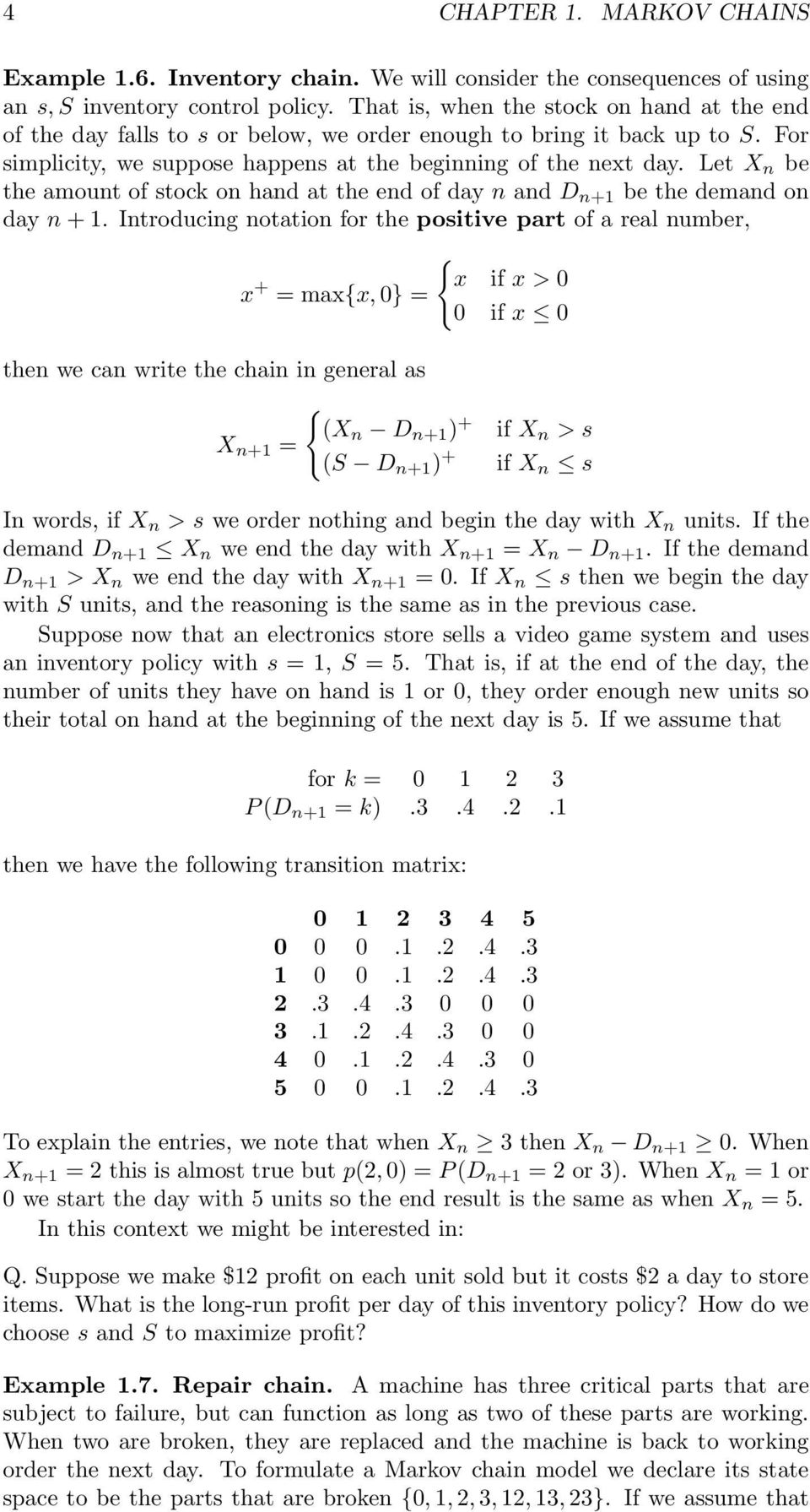
9 1.1. DEFINITIONS AND EXAMPLES 5 parts 1, 2, and 3 fail with probabilities.01,.02, and.04, but no two parts fail on the same day, then we arrive at the following transition matrix: If we own a machine like this, then it is natural to ask about the long-run cost per day to operate it. For example, we might ask: Q. If we are going to operate the machine for 1800 days (about 5 years), then how many parts of types 1, 2, and 3 will we use? Example 1.8. Branching processes. These processes arose from Francis Galton s statistical investigation of the extinction of family names. Consider a population in which each individual in the nth generation independently gives birth, producing k children (who are members of generation n + 1) with probability p k. In Galton s application only male children count since only they carry on the family name. To define the Markov chain, note that the number of individuals in generation n, X n, can be any nonnegative integer, so the state space is {0, 1, 2,...}. If we let Y 1, Y 2,... be independent random variables with P (Y m = k) = p k, then we can write the transition probability as p(i, j) = P (Y Y i = j) for i > 0 and j 0 When there are no living members of the population, no new ones can be born, so p(0, 0) = 1. Galton s question, originally posed in the Educational Times of 1873, is Q. What is the probability that the line of a man becomes extinct?, i.e., the branching process becomes absorbed at 0? Reverend Henry William Watson replied with a solution. Together, they then wrote an 1874 paper entitled On the probability of extinction of families. For this reason, these chains are often called Galton-Watson processes. Example 1.9. Wright Fisher model. Thinking of a population of N/2 diploid individuals who have two copies of each of their chromosomes, or of N haploid individuals who have one copy, we consider a fixed population of N genes that can be one of two types: A or a. In the simplest version of this model the population at time n + 1 is obtained by drawing with replacement from the population at time n. In this case, if we let X n be the number of A alleles at time n, then X n is a Markov chain with transition probability p(i, j) = ( ) ( ) j ( N i 1 i ) N j j N N since the right-hand side is the binomial distribution for N independent trials with success probability i/n.

10 6 CHAPTER 1. MARKOV CHAINS In this model the states x = 0 and N that correspond to fixation of the population in the all a or all A states are absorbing states, that is, p(x, x) = 1. So it is natural to ask: Q1. Starting from i of the A alleles and N i of the a alleles, what is the probability that the population fixates in the all A state? To make this simple model more realistic we can introduce the possibility of mutations: an A that is drawn ends up being an a in the next generation with probability u, while an a that is drawn ends up being an A in the next generation with probability v. In this case the probability an A is produced by a given draw is ρ i = i N i (1 u) + N N v but the transition probability still has the binomial form ( ) N p(i, j) = (ρ i ) j (1 ρ i ) N j j If u and v are both positive, then 0 and N are no longer absorbing states, so we ask: Q2. Does the genetic composition settle down to an equilibrium distribution as time t? As the next example shows it is easy to extend the notion of a Markov chain to cover situations in which the future evolution is independent of the past when we know the last two states. Example Two-stage Markov chains. In a Markov chain the distribution of X n+1 only depends on X n. This can easily be generalized to case in which the distribution of X n+1 only depends on (X n, X n 1 ). For a concrete example consider a basketball player who makes a shot with the following probabilities: 1/2 if he has missed the last two times 2/3 if he has hit one of his last two shots 3/4 if he has hit both of his last two shots To formulate a Markov chain to model his shooting, we let the states of the process be the outcomes of his last two shots: {HH, HM, MH, MM} where M is short for miss and H for hit. The transition probability is HH HM MH MM HH 3/4 1/4 0 0 HM 0 0 2/3 1/3 MH 2/3 1/3 0 0 MM 0 0 1/2 1/2 To explain suppose the state is HM, i.e., X n 1 = H and X n = M. In this case the next outcome will be H with probability 2/3. When this occurs the next state will be (X n, X n+1 ) = (M, H) with probability 2/3. If he misses an event of probability 1/3, (X n, X n+1 ) = (M, M). The Hot Hand is a phenomenon known to most people who play or watch basketball. After making a couple of shots, players are thought to get into a groove so that subsequent successes are more likely. Purvis Short of the Golden State Warriors describes this more poetically as

11 1.2. MULTISTEP TRANSITION PROBABILITIES 7 You re in a world all your own. It s hard to describe. But the basket seems to be so wide. No matter what you do, you know the ball is going to go in. Unfortunately for basketball players, data collected by Gliovich, Vallone and Taversky (1985) shows that this is a misconception. The next table gives data for the conditional probability of hitting a shot after missing the last three, missing the last two,... hitting the last three, for nine players of the Philadelphia 76ers: Darryl Dawkins (403), Maurice Cheeks (339), Steve Mix (351), Bobby Jones (433), Clint Richardson (248), Julius Erving (884), Andrew Toney (451), Caldwell Jones (272), and Lionel Hollins (419). The numbers in parentheses are the number of shots for each player. P (H 3M) P (H 2M) P (H 1M) P (H 1H) P (H 2H) P (H 3H) In fact, the data supports the opposite assertion: after missing a player will hit more frequently. 1.2 Multistep Transition Probabilities The transition probability p(i, j) = P (X n+1 = j X n = i) gives the probability of going from i to j in one step. Our goal in this section is to compute the probability of going from i to j in m > 1 steps: p m (i, j) = P (X n+m = j X n = i) As the notation may already suggest, p m will turn out to the be the mth power of the transition matrix, see Theorem 1.1. To warm up, we recall the transition probability of the social mobility chain: and consider the following concrete question: Q1. Your parents were middle class (state 2). What is the probability that you are in the upper class (state 3) but your children are lower class (state 1)? Solution. Intuitively, the Markov property implies that starting from state 2 the probability of jumping to 3 and then to 1 is given by p(2, 3)p(3, 1)

12 8 CHAPTER 1. MARKOV CHAINS To get this conclusion from the definitions, we note that using the definition of conditional probability, P (X 2 = 1, X 1 = 3 X 0 = 2) = P (X 2 = 1, X 1 = 3, X 0 = 2) P (X 0 = 2) = P (X 2 = 1, X 1 = 3, X 0 = 2) P (X 1 = 3, X 0 = 2) P (X 1 = 3, X 0 = 2) P (X 0 = 2) = P (X 2 = 1 X 1 = 3, X 0 = 2) P (X 1 = 3 X 0 = 2) By the Markov property (1.1) the last expression is P (X 2 = 1 X 1 = 3) P (X 1 = 3 X 0 = 2) = p(2, 3)p(3, 1) Moving on to the real question: Q2. What is the probability your children are lower class (1) given your parents were middle class (2)? Solution. To do this we simply have to consider the three possible states for your class and use the solution of the previous problem. P (X 2 = 1 X 0 = 2) = 3 P (X 2 = 1, X 1 = k X 0 = 2) = k=1 3 p(2, k)p(k, 1) k=1 = (.3)(.7) + (.5)(.3) + (.2)(.2) = =.21 There is nothing special here about the states 2 and 1 here. By the same reasoning, 3 P (X 2 = j X 0 = i) = p(i, k) p(k, j) The right-hand side of the last equation gives the (i, j)th entry of the matrix p is multiplied by itself. To explain this, we note that to compute p 2 (2, 1) we multiplied the entries of the second row by those in the first column: k= = If we wanted p 2 (1, 3) we would multiply the first row by the third column: = When all of the computations are done we have = All of this becomes much easier if we use a scientific calculator like the T1-83. Using 2nd-MATRIX we can access a screen with NAMES, MATH, EDIT

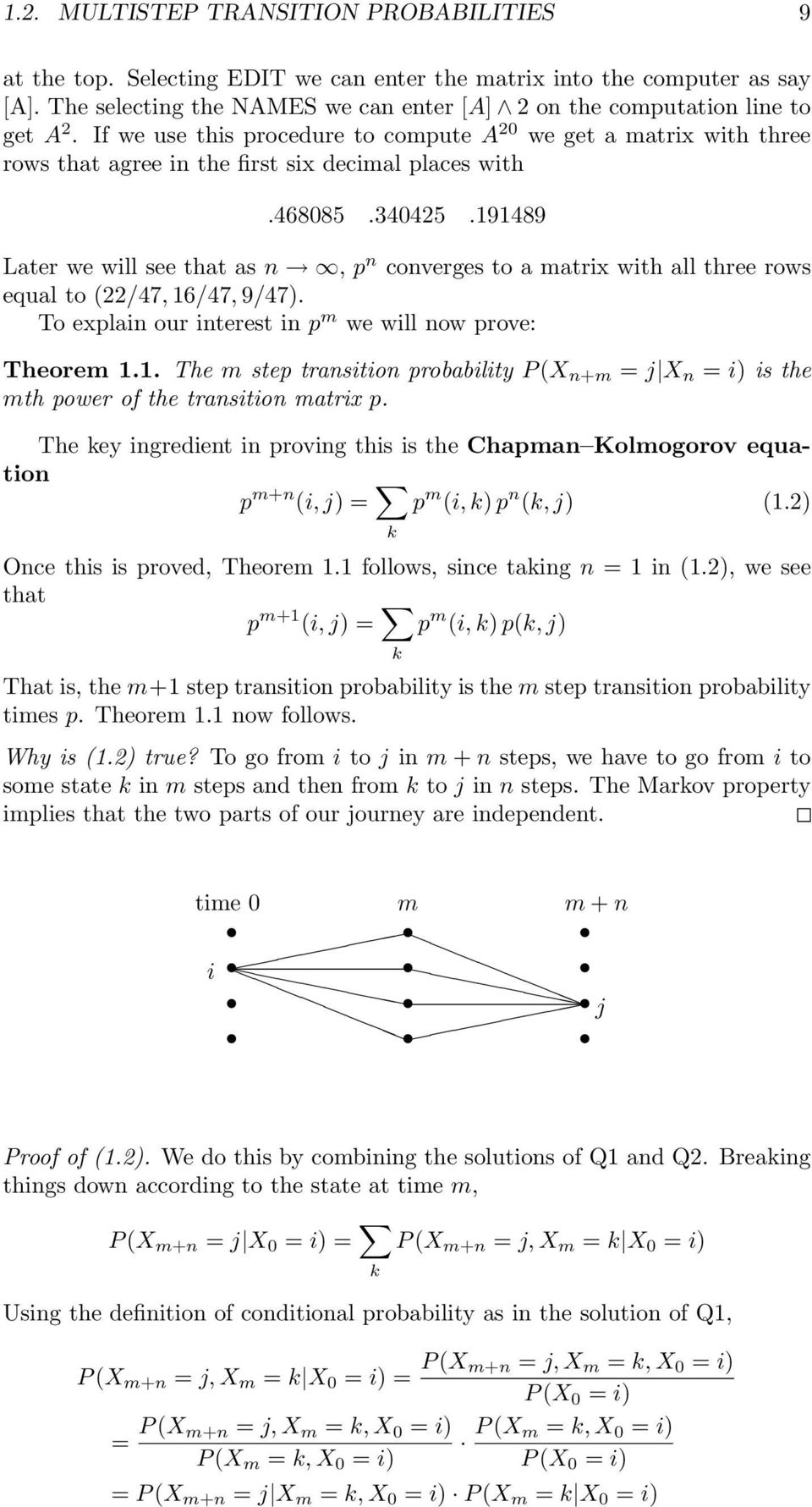
13 1.2. MULTISTEP TRANSITION PROBABILITIES 9 at the top. Selecting EDIT we can enter the matrix into the computer as say [A]. The selecting the NAMES we can enter [A] 2 on the computation line to get A 2. If we use this procedure to compute A 20 we get a matrix with three rows that agree in the first six decimal places with Later we will see that as n, p n converges to a matrix with all three rows equal to (22/47, 16/47, 9/47). To explain our interest in p m we will now prove: Theorem 1.1. The m step transition probability P (X n+m = j X n = i) is the mth power of the transition matrix p. The key ingredient in proving this is the Chapman Kolmogorov equation p m+n (i, j) = p m (i, k) p n (k, j) (1.2) k Once this is proved, Theorem 1.1 follows, since taking n = 1 in (1.2), we see that p m+1 (i, j) = p m (i, k) p(k, j) k That is, the m+1 step transition probability is the m step transition probability times p. Theorem 1.1 now follows. Why is (1.2) true? To go from i to j in m + n steps, we have to go from i to some state k in m steps and then from k to j in n steps. The Markov property implies that the two parts of our journey are independent. time 0 m m + n i j Proof of (1.2). We do this by combining the solutions of Q1 and Q2. Breaking things down according to the state at time m, P (X m+n = j X 0 = i) = k P (X m+n = j, X m = k X 0 = i) Using the definition of conditional probability as in the solution of Q1, P (X m+n = j, X m = k X 0 = i) = P (X m+n = j, X m = k, X 0 = i) P (X 0 = i) = P (X m+n = j, X m = k, X 0 = i) P (X m = k, X 0 = i) P (X m = k, X 0 = i) P (X 0 = i) = P (X m+n = j X m = k, X 0 = i) P (X m = k X 0 = i)
14 10 CHAPTER 1. MARKOV CHAINS By the Markov property (1.1) the last expression is = P (X m+n = j X m = k) P (X m = k X 0 = i) = p m (i, k)p n (k, j) and we have proved (1.2). Having established (1.2), we now return to computations. Example Gambler s ruin. Suppose for simplicity that N = 4 in Example 1.1, so that the transition probability is To compute p 2 one row at a time we note: p 2 (0, 0) = 1 and p 2 (4, 4) = 1, since these are absorbing states. p 2 (1, 3) = (.4) 2 = 0.16, since the chain has to go up twice. p 2 (1, 1) = (.4)(.6) = The chain must go from 1 to 2 to 1. p 2 (1, 0) = 0.6. To be at 0 at time 2, the first jump must be to 0. Leaving the cases i = 2, 3 to the reader, we have p 2 = Using a calculator one can easily compute p 20 = and 4 are absorbing states. Here we see that the probability of avoiding absorption for 20 steps is from state 3, from state 2, and from state 1. Later we will see that / /65 lim n pn = 45/ /65 27/ /

15 1.3. CLASSIFICATION OF STATES Classification of States We begin with some important notation. We are often interested in the behavior of the chain for a fixed initial state, so we will introduce the shorthand P x (A) = P (A X 0 = x) Later we will have to consider expected values for this probability and we will denote them by E x. Let T y = min{n 1 : X n = y} be the time of the first return to y (i.e., being there at time 0 doesn t count), and let ρ yy = P y (T y < ) be the probability X n returns to y when it starts at y. Note that if we didn t exclude n = 0 this probability would always be 1. Intuitively, the Markov property implies that the probability X n will return to y at least twice is ρ 2 yy, since after the first return, the chain is at y, and the probability of a second return following the first is again ρ yy. To show that the reasoning in the last paragraph is valid, we have to introduce a definition and state a theorem. We say that T is a stopping time if the occurrence (or nonoccurrence) of the event we stop at time n, {T = n}, can be determined by looking at the values of the process up to that time: X 0,..., X n. To see that T y is a stopping time note that {T y = n} = {X 1 y,..., X n 1 y, X n = y} and that the right-hand side can be determined from X 0,..., X n. Since stopping at time n depends only on the values X 0,..., X n, and in a Markov chain the distribution of the future only depends on the past through the current state, it should not be hard to believe that the Markov property holds at stopping times. This fact can be stated formally as: Theorem 1.2. Strong Markov property. Suppose T is a stopping time. Given that T = n and X T = y, any other information about X 0,... X T is irrelevant for predicting the future, and X T +k, k 0 behaves like the Markov chain with initial state y. Why is this true? To keep things as simple as possible we will show only that P (X T +1 = z X T = y, T = n) = p(y, z) Let V n be the set of vectors (x 0,..., x n ) so that if X 0 = x 0,..., X n = x n, then T = n and X T = y. Breaking things down according to the values of X 0,..., X n gives P (X T +1 = z, X T = y, T = n) = P (X n+1 = z, X n = x n,..., X 0 = x 0 ) x V n = P (X n+1 = z X n = x n,..., X 0 = x 0 )P (X n = x n,..., X 0 = x 0 ) x V n where in the second step we have used the multiplication rule P (A B) = P (B A)P (A)

16 12 CHAPTER 1. MARKOV CHAINS For any (x 0,..., x n ) V n we have T = n and X T = y so x n = y. Using the Markov property, (1.1), and recalling the definition of V n shows the above P (X T +1 = z, T = n, X T = y) = p(y, z) x V n P (X n = x n,..., X 0 = x 0 ) = p(y, z)p (T = n, X T = y) Dividing both sides by P (T = n, X T = y) gives the desired result. Let T 1 y = T y and for k 2 let T k y = min{n > T k 1 y : X n = y} (1.3) be the time of the kth return to y. The strong Markov property implies that the conditional probability we will return one more time given that we have returned k 1 times is ρ yy. This and induction implies that At this point, there are two possibilities: P y (T k y < ) = ρ k yy (1.4) (i) ρ yy < 1: The probability of returning k times is ρ k yy 0 as k. Thus, eventually the Markov chain does not find its way back to y. In this case the state y is called transient, since after some point it is never visited by the Markov chain. (ii) ρ yy = 1: The probability of returning k times ρ k yy = 1, so the chain returns to y infinitely many times. In this case, the state y is called recurrent, it continually recurs in the Markov chain. To understand these notions, we turn to our examples, beginning with Example Gambler s ruin. Consider, for concreteness, the case N = We will show that eventually the chain gets stuck in either the bankrupt (0) or happy winner (4) state. In the terms of our recent definitions, we will show that states 0 < y < 4 are transient, while the states 0 and 4 are recurrent. It is easy to check that 0 and 4 are recurrent. Since p(0, 0) = 1, the chain comes back on the next step with probability one, i.e., P 0 (T 0 = 1) = 1 and hence ρ 00 = 1. A similar argument shows that 4 is recurrent. In general if y is an absorbing state, i.e., if p(y, y) = 1, then y is a very strongly recurrent state the chain always stays there. To check the transience of the interior states, 1, 2, 3, we note that starting from 1, if the chain goes to 0, it will never return to 1, so the probability of never returning to 1, P 1 (T 1 = ) p(1, 0) = 0.6 > 0

17 1.3. CLASSIFICATION OF STATES 13 Similarly, starting from 2, the chain can go to 1 and then to 0, so P 2 (T 2 = ) p(2, 1)p(1, 0) = 0.36 > 0 Finally, for starting from 3, we note that the chain can go immediately to 4 and never return with probability 0.4, so P 3 (T 3 = ) p(3, 4) = 0.4 > 0 In some cases it is easy to identify recurrent states. Example Social mobility. Recall that the transition probability is To begin we note that no matter where X n is, there is a probability of at least 0.1 of hitting 3 on the next step so P 3 (T 3 > n) (0.9) n 0 as n i.e., we will return to 3 with probability 1. The last argument applies even more strongly to states 1 and 2, since the probability of jumping to them on the next step is always at least 0.2. Thus all three states are recurrent. The last argument generalizes to the give the following useful fact. Lemma 1.3. Suppose P x (T y k) α > 0 for all x in the state space S. Then P x (T y > nk) (1 α) n Generalizing from our experience with the last two examples, we will introduce some general results that will help us identify transient and recurrent states. Definition 1.1. We say that x communicates with y and write x y if there is a positive probability of reaching y starting from x, that is, the probability ρ xy = P x (T y < ) > 0 Note that the last probability includes not only the possibility of jumping from x to y in one step but also going from x to y after visiting several other states in between. The following property is simple but useful. Here and in what follows, lemmas are a means to prove the more important conclusions called theorems. The two are numbered in the same sequence to make results easier to find. Lemma 1.4. If x y and y z, then x z. Proof. Since x y there is an m so that p m (x, y) > 0. Similarly there is an n so that p n (y, z) > 0. Since p m+n (x, z) p m (x, y)p n (y, z) it follows that x z. Theorem 1.5. If ρ xy > 0, but ρ yx < 1, then x is transient.

18 14 CHAPTER 1. MARKOV CHAINS Proof. Let K = min{k : p k (x, y) > 0} be the smallest number of steps we can take to get from x to y. Since p K (x, y) > 0 there must be a sequence y 1,... y K 1 so that p(x, y 1 )p(y 1, y 2 ) p(y K 1, y) > 0 Since K is minimal all the y i y (or there would be a shorter path), and we have P x (T x = ) p(x, y 1 )p(y 1, y 2 ) p(y K 1, y)(1 ρ yx ) > 0 so x is transient. We will see later that Theorem 1.5 allows us to to identify all the transient states when the state space is finite. An immediate consequence of Theorem 1.5 is Lemma 1.6. If x is recurrent and ρ xy > 0 then ρ yx = 1. Proof. If ρ yx < 1 then Lemma 1.5 would imply x is transient. To be able to analyze any finite state Markov chain we need some theory. To motivate the developments consider Example A Seven-state chain. Consider the transition probability: To identify the states that are recurrent and those that are transient, we begin by drawing a graph that will contain an arc from i to j if p(i, j) > 0 and i j. We do not worry about drawing the self-loops corresponding to states with p(i, i) > 0 since such transitions cannot help the chain get somewhere new. In the case under consideration the graph is The state 2 communicates with 1, which does not communicate with it, so Theorem 1.5 implies that 2 is transient. Likewise 3 communicates with 4, which doesn t communicate with it, so 3 is transient. To conclude that all the remaining states are recurrent we will introduce two definitions and a fact.

19 1.3. CLASSIFICATION OF STATES 15 A set A is closed if it is impossible to get out, i.e., if i A and j A then p(i, j) = 0. In Example 1.14, {1, 5} and {4, 6, 7} are closed sets. Their union, {1, 4, 5, 6, 7} is also closed. One can add 3 to get another closed set {1, 3, 4, 5, 6, 7}. Finally, the whole state space {1, 2, 3, 4, 5, 6, 7} is always a closed set. Among the closed sets in the last example, some are obviously too big. To rule them out, we need a definition. A set B is called irreducible if whenever i, j B, i communicates with j. The irreducible closed sets in the Example 1.14 are {1, 5} and {4, 6, 7}. The next result explains our interest in irreducible closed sets. Theorem 1.7. If C is a finite closed and irreducible set, then all states in C are recurrent. Before entering into an explanation of this result, we note that Theorem 1.7 tells us that 1, 5, 4, 6, and 7 are recurrent, completing our study of the Example 1.14 with the results we had claimed earlier. In fact, the combination of Theorem 1.5 and 1.7 is sufficient to classify the states in any finite state Markov chain. An algorithm will be explained in the proof of the following result. Theorem 1.8. If the state space S is finite, then S can be written as a disjoint union T R 1 R k, where T is a set of transient states and the R i, 1 i k, are closed irreducible sets of recurrent states. Proof. Let T be the set of x for which there is a y so that x y but y x. The states in T are transient by Theorem 1.5. Our next step is to show that all the remaining states, S T, are recurrent. Pick an x S T and let C x = {y : x y}. Since x T it has the property if x y, then y x. To check that C x is closed note that if y C x and y z, then Lemma 1.4 implies x z so z C x. To check irreducibility, note that if y, z C x, then by our first observation y x and we have x z by definition, so Lemma 1.4 implies y z. C x is closed and irreducible so all states in C x are recurrent. Let R 1 = C x. If S T R 1 =, we are done. If not, pick a site w S T R 1 and repeat the procedure. * * * * * * * The rest of this section is devoted to the proof of Theorem 1.7. To do this, it is enough to prove the following two results. Lemma 1.9. If x is recurrent and x y, then y is recurrent. Lemma In a finite closed set there has to be at least one recurrent state. To prove these results we need to introduce a little more theory. Recall the time of the kth visit to y defined by T k y = min{n > T k 1 y : X n = y} and ρ xy = P x (T y < ) the probability we ever visit y at some time n 1 when we start from x. Using the strong Markov property as in the proof of (1.4) gives P x (T k y < ) = ρ xy ρ k 1 yy. (1.5) Let N(y) be the number of visits to y at times n 1. compute EN(y). Using (1.5) we can
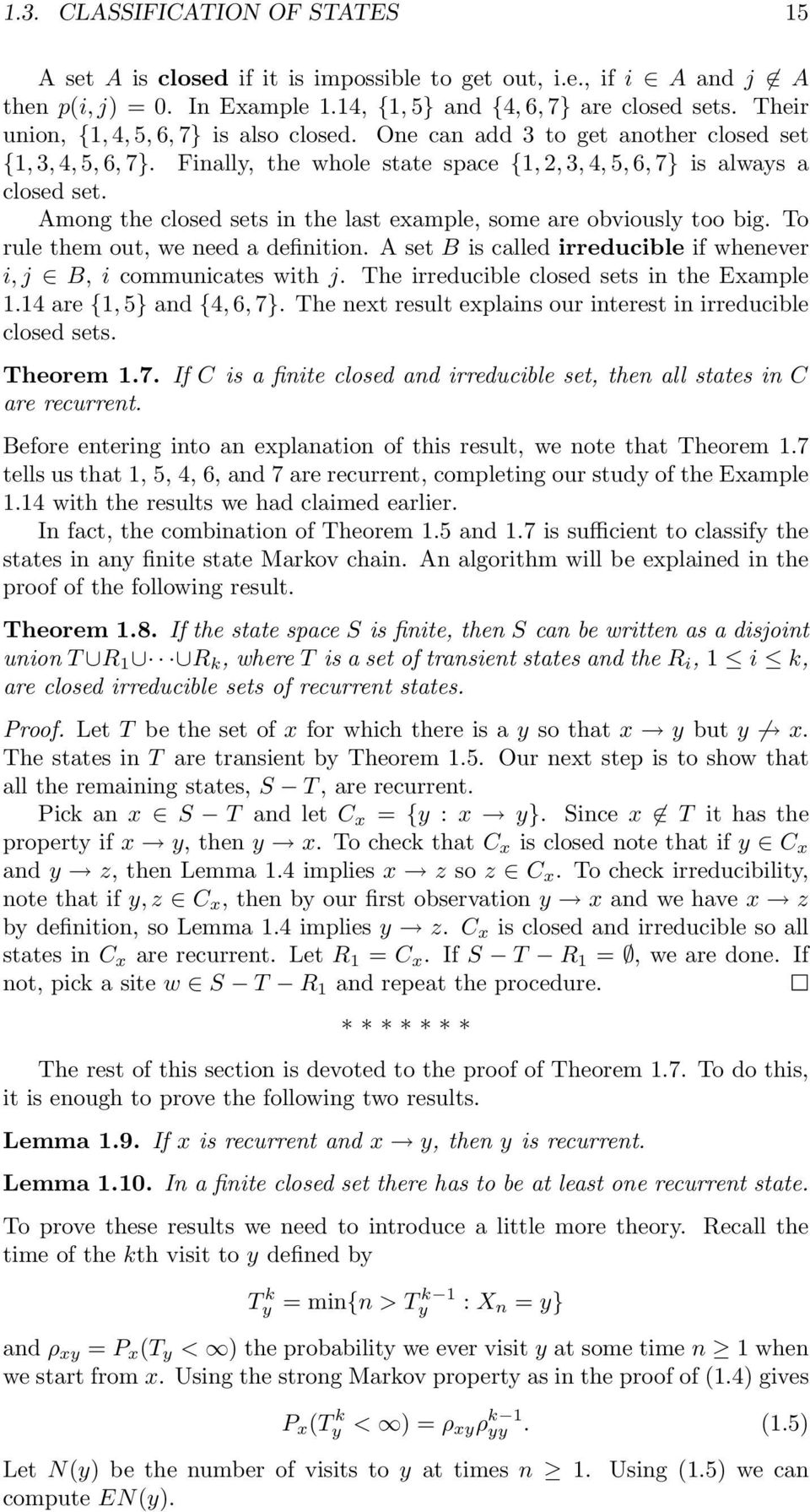
20 16 CHAPTER 1. MARKOV CHAINS Lemma E x N(y) = ρ xy /(1 ρ yy ) Proof. Accept for the moment the fact that for any nonnegative integer valued random variable X, the expected value of X can be computed by EX = P (X k) (1.6) k=1 We will prove this after we complete the proof of Lemma Now the probability of returning at least k times, {N(y) k}, is the same as the event that the kth return occurs, i.e., {T k y < }, so using (1.5) we have E x N(y) = P (N(y) k) = ρ xy k=1 since n=0 θn = 1/(1 θ) whenever θ < 1. k=1 ρ k 1 yy = ρ xy 1 ρ yy Proof of (1.6). Let 1 {X k} denote the random variable that is 1 if X k and 0 otherwise. It is easy to see that X = 1 {X k}. k=1 Taking expected values and noticing E1 {X k} = P (X k) gives EX = P (X k) k=1 Our next step is to compute the expected number of returns to y in a different way. Lemma E x N(y) = n=1 pn (x, y). Proof. Let 1 {Xn=y} denote the random variable that is 1 if X n = y, 0 otherwise. Clearly N(y) = 1 {Xn=y}. Taking expected values now gives E x N(y) = n=1 P x (X n = y) n=1 With the two lemmas established we can now state our next main result. Theorem y is recurrent if and only if p n (y, y) = E y N(y) = n=1 Proof. The first equality is Lemma From Lemma 1.11 we see that E y N(y) = if and only if ρ yy = 1, which is the definition of recurrence.
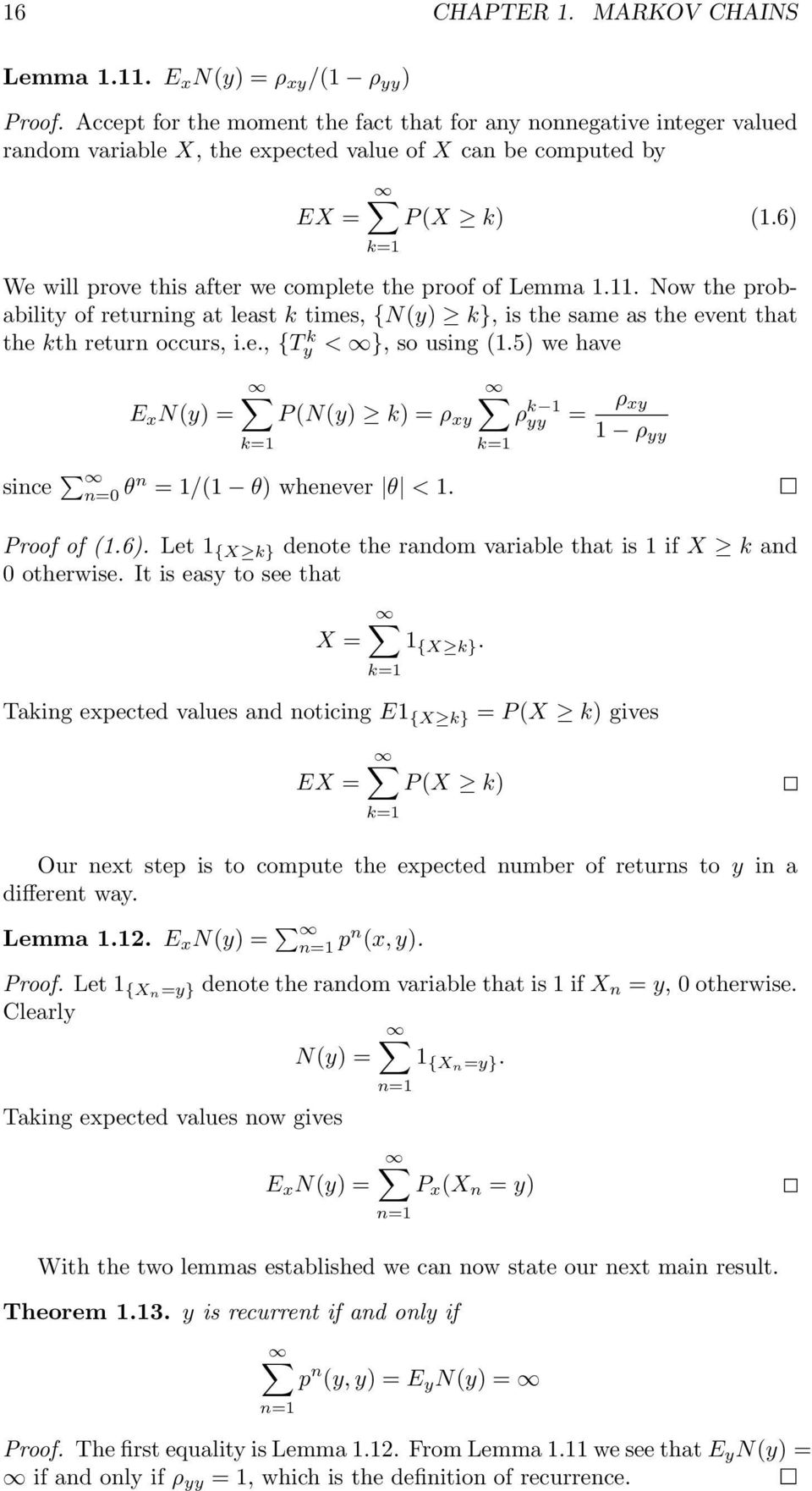
21 1.4. STATIONARY DISTRIBUTIONS 17. With this established we can easily complete the proofs of our two lemmas Proof of Lemma 1.9. Suppose x is recurrent and ρ xy > 0. By Lemma 1.6 we must have ρ yx > 0. Pick j and l so that p j (y, x) > 0 and p l (x, y) > 0. p j+k+l (y, y) is probability of going from y to y in j + k + l steps while the product p j (y, x)p k (x, x)p l (x, y) is the probability of doing this and being at x at times j and j + k. Thus we must have ( ) p j+k+l (y, y) p j (y, x) p k (x, x) p l (x, y) k=0 If x is recurrent then k pk (x, x) =, so m pm (y, y) = and Theorem 1.13 implies that y is recurrent. Proof of Lemma If all the states in C are transient then Lemma 1.11 implies that E x N(y) < for all x and y in C. Since C is finite, using Lemma 1.12 > E x N(y) = p n (x, y) y C y C n=1 = p n (x, y) = 1 = n=1 y C where in the next to last equality we have used that C is closed. This contradiction proves the desired result. k=0 1.4 Stationary Distributions In the next section we will see that if we impose an additional assumption called aperiodicity an irreducible finite state Markov chain converges to a stationary distribution p n (x, y) π(y) To prepare for that this section introduces stationary distributions and shows how to compute them. Our first step is to consider What happens in a Markov chain when the initial state is random? Breaking things down according to the value of the initial state and using the definition of conditional probability n=1 P (X n = j) = i = i P (X 0 = i, X n = j) P (X 0 = i)p (X n = j X 0 = i) If we introduce q(i) = P (X 0 = i), then the last equation can be written as P (X n = j) = i q(i)p n (i, j) (1.7) In words, we multiply the transition matrix on the left by the vector q of initial probabilities. If there are k states, then p n (x, y) is a k k matrix. So to make the matrix multiplication work out right, we should take q as a 1 k matrix or a row vector.
22 18 CHAPTER 1. MARKOV CHAINS Example Consider the weather chain (Example 1.3) and suppose that the initial distribution is q(1) = 0.3 and q(2) = 0.7. In this case ( ) ( ) = ( ).2.8 since.3(.6) +.7(.2) =.32.3(.4) +.7(.8) =.68 Example Consider the social mobility chain (Example 1.4) and suppose that the initial distribution: q(1) =.5, q(2) =.2, and q(3) =.3. Multiplying the vector q by the transition probability gives the vector of probabilities at time 1. ( ) = ( ) To check the arithmetic note that the three entries on the right-hand side are.5(.7) +.2(.3) +.3(.2) = =.47.5(.2) +.2(.5) +.3(.4) = =.32.5(.1) +.2(.2) +.3(.4) = =.21 If qp = q then q is called a stationary distribution. If the distribution at time 0 is the same as the distribution at time 1, then by the Markov property it will be the distribution at all times n 1. Stationary distributions have a special importance in the theory of Markov chains, so we will use a special letter π to denote solutions of the equation πp = π. To have a mental picture of what happens to the distribution of probability when one step of the Markov chain is taken, it is useful to think that we have q(i) pounds of sand at state i, with the total amount of sand i q(i) being one pound. When a step is taken in the Markov chain, a fraction p(i, j) of the sand at i is moved to j. The distribution of sand when this has been done is qp = i q(i)p(i, j) If the distribution of sand is not changed by this procedure q is a stationary distribution. Example Weather chain. To compute the stationary distribution we want to solve ( ) ( ).6.4 π1 π 2 = ( ) π π 2 Multiplying gives two equations:.6π 1 +.2π 2 = π 1.4π 1 +.8π 2 = π 2 Both equations reduce to.4π 1 =.2π 2. Since we want π 1 + π 2 = 1, we must have.4π 1 =.2.2π 1, and hence π 1 = = 1 3 π 2 = = 2 3
23 1.4. STATIONARY DISTRIBUTIONS 19 To check this we note that ( ) ( ).6.4 1/3 2/3.2.8 = ( ) 3 General two state transition probability a a 2 b 1 b We have written the chain in this way so the stationary distribution has a simple formula π 1 = b π 2 = a (1.8) a + b a + b As a first check on this formula we note that in the weather chain a = 0.4 and b = 0.2 which gives (1/3, 2/3) as we found before. We can prove this works in general by drawing a picture: b 1 a + b a b 2 a a + b In words, the amount of sand that flows from 1 to 2 is the same as the amount that flows from 2 to 1 so the amount of sand at each site stays constant. To check algebraically that πp = π: b (1 a) + a a + b b a + b a + b ba + ab b = = b a + b a + b a + b a ba + a ab (1 b) = = a a + b a + b a + b (1.9) Formula (1.8) gives the stationary distribution for any two state chain, so we progress now to the three state case and consider the Example Social Mobility (continuation of 1.4) The equation πp = π says ( ) π1 π 2 π = ( ) π 1 π 2 π which translates into three equations.7π 1 +.3π 2 +.2π 3 = π 1.2π 1 +.5π 2 +.4π 3 = π 2.1π 1 +.2π 2 +.4π 3 = π 3
24 20 CHAPTER 1. MARKOV CHAINS Note that the columns of the matrix give the numbers in the rows of the equations. The third equation is redundant since if we add up the three equations we get π 1 + π 2 + π 3 = π 1 + π 2 + π 3 If we replace the third equation by π 1 + π 2 + π 3 = 1 and subtract π 1 from each side of the first equation and π 2 from each side of the second equation we get.3π 1 +.3π 2 +.2π 3 = 0.2π 1.5π 2 +.4π 3 = 0 π 1 + π 2 + π 3 = 1 (1.10) At this point we can solve the equations by hand or using a calculator. By hand. We note that the third equation implies π 3 = 1 π 1 π 2 and substituting this in the first two gives.2 =.5π 1.1π 2.4 =.2π 1 +.9π 2 Multiplying the first equation by.9 and adding.1 times the second gives 2.2 = ( )π 1 or π 1 = 22/47 Multiplying the first equation by.2 and adding.5 times the second gives 0.16 = ( )π 2 or π 2 = 16/47 Since the three probabilities add up to 1, π 3 = 9/47. Using the TI83 calculator is easier. To begin we write (1.10) in matrix form as ( ) π1 π 2 π = ( ) If we let A be the 3 3 matrix in the middle this can be written as πa = (0, 0, 1). Multiplying on each side by A 1 we see that π = (0, 0, 1)A 1 which is the third row of A 1. To compute A 1, we enter A into our calculator (using the MATRX menu and its EDIT submenu), use the MATRIX menu to put [A] on the computation line, press x 1, and then ENTER. Reading the third row we find that the stationary distribution is ( , , ) Converting the answer to fractions using the first entry in the MATH menu gives (22/47, 16/47, 9/47) Example Brand Preference (continuation of 1.5)
25 1.4. STATIONARY DISTRIBUTIONS 21 Using the first two equations and the fact that the sum of the π s is 1.8π 1 +.2π 2 +.3π 3 = π 1.1π 1 +.6π 2 +.3π 3 = π 2 π 1 + π 2 + π 3 = 1 Subtracting π 1 from both sides of the first equation and π 2 from both sides of the second, this translates into πa = (0, 0, 1) with A = Note that here and in the previous example the first two columns of A consist of the first two columns of the transition probability with 1 subtracted from the diagonal entries, and the final column is all 1 s. Computing the inverse and reading the last row gives ( , , ) Converting the answer to fractions using the first entry in the MATH menu gives (6/11, 3/11, 2/11) To check this we note that ( ) /11 3/11 2/ ( ) = Example Basketball (continuation of 1.10). To find the stationary matrix in this case we can follow the same procedure. A consists of the first three columns of the transition matrix with 1 subtracted from the diagonal, and a final column of all 1 s. 1/4 1/ /3 1 2/3 1/ /2 1 The answer is given by the fourth row of A 1 : (0.5, , , 0.125) = (1/2, 3/16, 3/16, 1/8) Thus the long run fraction of time the player hits a shot is π(hh) + π(mh) = = 11/36. At this point we have a procedure for computing stationary distribution but it is natural to ask: Is the matrix always invertible? Is the π we compute always 0? We will prove this in Section 1.7 uing probaiblistic methods. Here we will give an elementary proof based on linear algebra.
26 22 CHAPTER 1. MARKOV CHAINS Theorem Suppose that the k k transition matrix p is irreducible. Then there is a unique solution to πp = π with x π x = 1 and we have π x > 0 for all x. Proof. Let I be the identity matrix. Since the rows of p I add to 0, the rank of the matrix is k 1 and there is a vector v so that vp = v. Let q = (I + p)/2 be the lazy chain that stays put with probability 1/2 and otherwise takes a step according to p. Since vp = p we have vq = v. Let r = q k 1 and note that vr = v. Since p irreducible, for any x y there is a path from x to y. Since the shortest such path will not visit any state more than once, we can always get from x to y in k 1 steps, and it follows that r(x, y) > 0. The next step is to prove that all the v x have the same sign. Suppose not. In this case since r(x, y) > 0 we have v y = v x r(x, y) < v x r(x, y) x x To check the second inequality note that there are terms of both signs in the sum so some cancellation will occur. Summing over y and using y r(x, y) = 1 we have v y < v x x a contradiction. Suppose now that all of the v x 0. Using y v y = x v x r(x, y) we conclude that v y > 0 for all y. This proves the existence of a positive solution. To prove uniqueness, note that if p I has rank k 2 then by linear algebra there are two perpendicular solutions, v and w, but the last argument implies that we can choose the sign so that v x, w x > 0 for all x. In this case the vectors cannot possibly be perpendicular, which is a contradiction. 1.5 Limit Behavior If y is a transient state, then by Lemma 1.11, n=1 pn (x, y) < for any initial state x and hence p n (x, y) 0 This means that we can restrict our attention to recurrent states and in view of the decomposition theorem, Theorem 1.8, to chains that consist of a single irreducible class of recurrent states. Our first example shows one problem that can prevent the convergence of p n (x, y). Example Ehrenfest chain (continuation of 1.2). For concreteness, suppose there are three balls. In this case the transition probability is / /3 0 2/ /3 0 1/ /3 0
27 1.5. LIMIT BEHAVIOR 23 In the second power of p the zero pattern is shifted: /3 0 2/ /9 0 2/9 2 2/9 0 7/ /3 0 1/3 To see that the zeros will persist, note that if we have an odd number of balls in the left urn, then no matter whether we add or subtract one the result will be an even number. Likewise, if the number is even, then it will be odd on the next one step. This alternation between even and odd means that it is impossible to be back where we started after an odd number of steps. In symbols, if n is odd then p n (x, x) = 0 for all x. To see that the problem in the last example can occur for multiples of any number N consider: Example Renewal chain. We will explain the name in Section 3.3. For the moment we will use it to illustrate pathologies. Let f k be a distribution on the positive integers and let p(0, k 1) = f k. For states i > 0 we let p(i, i 1) = 1. In words the chain jumps from 0 to k 1 with probability f k and then walks back to 0 one step at a time. If X 0 = 0 and the jump is to k 1 then it returns to 0 at time k. If say f 5 = f 15 = 1/2 then p n (0, 0) = 0 unless n is a multiple of 5. The period of a state is the largest number that will divide all the n 1 for which p n (x, x) > 0. That is, it is the greatest common divisor of I x = {n 1 : p n (x, x) > 0}. To check that this definition works correctly, we note that in Example 1.21, {n 1 : p n (x, x) > 0} = {2, 4,...}, so the greatest common divisor is 2. Similarly, in Example 1.22, {n 1 : p n (x, x) > 0} = {5, 10,...}, so the greatest common divisor is 5. As the next example shows, things aren t always so simple. Example 4.4. Triangle and square. Consider the transition matrix: In words, from 0 we are equally likely to go to 1 or 1. From 1 we go with probability one to 2 and then back to 0, from 1 we go to 2 then to 3 and back to 0. The name refers to the fact that is a triangle and is a square.
28 24 CHAPTER 1. MARKOV CHAINS -1 1/2 0 1/ Clearly, p 3 (0, 0) > 0 and p 4 (0, 0) > 0 so 3, 4 I 0. following is useful: To compute I 0 the Lemma I x is closed under addition. That is, if i, j I x, then i + j I x. Proof. If i, j I x then p i (x, x) > 0 and p j (x, x) > 0 so and hence i + j I x. Using this we see that p i+j (x, x) p i (x, x)p j (x, x) > 0 I 0 = {3, 4, 6, 7, 8, 9, 10, 11,...} Note that in this example once we have three consecutive numbers (e.g., 6,7,8) in I 0 then 6+3, 7+3, 8+3 I 0 and hence I 0 will contain all the integers n 6. For another unusual example consider the renewal chain (Example 1.22) with f 5 = f 12 = 1/2. 5, 12 I 0 so using Lemma 1.15 I 0 ={5, 10, 12, 15, 17, 20, 22, 24, 25, 27, 29, 30, 32, 34, 35, 36, 37, 39, 40, 41, 42, 43,...} To check this note that 5 gives rise to 10=5+5 and 17=5+12, 10 to 15 and 22, 12 to 17 and 24, etc. Once we have five consecutive numbers in I 0, here 39 43, we have all the rest. The last two examples motivate the following. Lemma If x has period 1, i.e., the greatest common divisor I x is 1, then there is a number n 0 so that if n n 0, then n I x. In words, I x contains all of the integers after some value n 0. Proof. We begin by observing that it enough to show that I x will contain two consecutive integers: k and k + 1. For then it will contain 2k, 2k + 1, 2k + 2, and 3k, 3k + 1, 3k + 2, 3k + 3, or in general jk, jk + 1,... jk + j. For j k 1 these blocks overlap and no integers are left out. In the last example 24, 25 I 0 implies 48, 49, 50 I 0 which implies 72, 73, 74, 75 I 0 and 96, 97, 98, 99, 100 I 0, so we know the result holds for n 0 = 96. In fact it actually holds for n 0 = 34 but it is not important to get a precise bound. To show that there are two consecutive integers, we cheat and use a fact from number theory: if the greatest common divisor of a set I x is 1 then there are integers i 1,... i m I x and (positive or negative) integer coefficients c i so that c 1 i c m i m = 1. Let a i = c + i and b i = ( c i ) +. In words the a i are the positive coefficients and the b i are 1 times the negative coefficients. Rearranging the last equation gives a 1 i a m i m = (b 1 i b m i m ) + 1 and using Lemma 1.15 we have found our two consecutive integers in I x.
29 1.5. LIMIT BEHAVIOR 25 While periodicity is a theoretical possibility, it rarely manifests itself in applications, except occasionally as an odd-even parity problem, e.g., the Ehrenfest chain. In most cases we will find (or design) our chain to be aperiodic, i.e., all states have period 1. To be able to verify this property for examples, we need to discuss some theory. Lemma If p(x, x) > 0, then x has period 1. Proof. If p(x, x) > 0, then 1 I x, so the greatest common divisor is 1. This is enough to show that all states in the weather chain (Example 1.3), social mobility (Example 1.4), and brand preference chain (Example 1.5) are aperiodic. For states with zeros on the diagonal the next result is useful. Lemma If ρ xy > 0 and ρ yx > 0 then x and y have the same period. Why is this true? The short answer is that if the two states have different periods, then by going from x to y, from y to y in the various possible ways, and then from y to x, we will get a contradiction. Proof. Suppose that the period of x is c, while the period of y is d < c. Let k be such that p k (x, y) > 0 and let m be such that p m (y, x) > 0. Since p k+m (x, x) p k (x, y)p m (y, x) > 0 we have k + m I x. Since x has period c, k + m must be a multiple of c. Now let l be any integer with p l (y, y) > 0. Since p k+l+m (x, x) p k (x, y)p l (y, y)p m (y, x) > 0 k + l + m I x, and k + l + m must be a multiple of c. Since k + m is itself a multiple of c, this means that l is a multiple of c. Since l I y was arbitrary, we have shown that c is a divisor of every element of I y, but d < c is the greatest common divisor, so we have a contradiction. Lemma 1.18 easily settles the question for the inventory chain (Example 1.6) Since p(x, x) > 0 for x = 2, 3, 4, 5, Lemma 1.17 implies that these states are aperiodic. Since this chain is irreducible it follows from Lemma 1.18 that 0 and 1 are aperiodic. Consider now the basketball chain (Example 1.10): HH HM MH MM HH 3/4 1/4 0 0 HM 0 0 2/3 1/3 MH 2/3 1/3 0 0 MM 0 0 1/2 1/2
30 26 CHAPTER 1. MARKOV CHAINS Lemma 1.17 implies that HH and MM are aperiodic. Since this chain is irreducible it follows from Lemma 1.18 that HM and MH are aperiodic. * * * * * * * We now come to the main results of the chapter. We first list the assumptions. All of these results hold when S is finite or infinite. I : p is irreducible A : aperiodic, all states have period 1 R : all states are recurrent S : there is a stationary distribution π Theorem Convergence theorem. Suppose I, A, S. Then as n, p n (x, y) π(y). To state the next result we need a definition. We day that µ(x) 0 is a stationary measure if x µ(x)p(x, y) = µ(y). If S is finite we can normalize µ to be a stationary distribution. Theorem Suppose I and R. Then there is a stationary measure with µ(x) > 0 for all x. The next result describes the limiting fraction of time we spend in each state. Theorem Asymptotic frequency. Suppose I and R. If N n (y) be the number of visits to y up to time n, then N n (y) n 1 E y T y We will see later that we may have E y T y = in which case the limit is 0. As a corollary we get the following. Theorem If I and S hold, then π(y) = 1/E y T y and hence the stationary distribution is unique. In the next two examples we will be interested in the long run cost associated with a Markov chain. For this, we will need the following extension of Theorem (Take f(x) = 1 if x = y and 0 otherwise to recover the previous result.) Theorem Suppose I, S, and x f(x) π(x) < then 1 n n m=1 f(x m ) x f(x)π(x) Note that Theorems 1.21 and 1.23 do not require aperiodicity. To illustrate the use of Theorem 1.23, we consider
31 1.5. LIMIT BEHAVIOR 27 Example Repair chain (continuation of 1.7). A machine has three critical parts that are subject to failure, but can function as long as two of these parts are working. When two are broken, they are replaced and the machine is back to working order the next day. Declaring the state space to be the parts that are broken {0, 1, 2, 3, 12, 13, 23}, we arrived at the following transition matrix: and we asked: If we are going to operate the machine for 1800 days (about 5 years) then how many parts of types 1, 2, and 3 will we use? To find the stationary distribution we look at the last row of where after converting the results to fractions we have: π(0) = 3000/8910 π(1) = 500/8910 π(2) = 1200/8910 π(3) = 4000/8910 π(12) = 22/8910 π(13) = 60/8910 π(23) = 128/8910 We use up one part of type 1 on each visit to 12 or to 13, so on the average we use 82/8910 of a part per day. Over 1800 days we will use an average of /8910 = parts of type 1. Similarly type 2 and type 3 parts are used at the long run rates of 150/8910 and 188/8910 per day, so over 1800 days we will use an average of parts of type 2 and parts of type 3. Example Inventory chain (continuation of 1.6). We have an electronics store that sells a videogame system, with the ptential for sales of 0, 1, 2, or 3 of these units each day with probabilities.3,.4,.2, and.1. Each night at the close of business new units can be ordered which will be available when the store opens in the morning. Suppose that sales produce a profit of $12 but it costs $2 a day to keep unsold units in the store overnight. Since it is impossible to sell 4 units in a day, and it costs us to have unsold inventory we should never have more than 3 units on hand. Suppose we use a 2,3 inventory policy. That is, we order if there are 2 units and we order enough stock so that we have 3 units at the beginning of the next day. In this case we always start the day with 3 units, so the transition 1
32 28 CHAPTER 1. MARKOV CHAINS probability has constant rows In this case it is clear that the stationary distribution is π(0) =.1, π(1) =.2, π(2) =.4, and π(3) =.3. If we end the day with k units then we sold 3 k and have to keep k over night. Thus our long run sales under this scheme are.1(36) +.2(24) +.4(12) = = 13.2 dollars per day while the inventory holding costs are 2(.2) + 4(.4) + 6(.3) = = 3.8 for a net profit of 9.4 dollars per day. is Suppose we use a 1,3 inventory policy. In this case the transition probability Solving for the stationary distribution we get π(0) = 19/110 π(1) = 30/110 π(2) = 40/110 π(3) = 21/110 To compute the profit we make from sales note that if we always had enough stock then by the calculation in the first case, we would make 13.2 dollars per day. However, when X n = 2 and the demand is 3, an event with probability (4/11) 0.1 = , we lose exactly one of our sales. From this it follows that in the long run we make a profit of 13.2 (.036)12 = dollars per day Our inventory holding cost under the new system is = = so now our profits are = Suppose we use a 0,3 inventory policy. In this case the transition probability is From the equations for the stationary distribution we get π(0) = 343/1070 π(1) = 300/1070 π(2) = 280/1070 π(3) = 147/1070
33 1.6. SPECIAL EXAMPLES 29 To compute our profit we note, as in the previous calculation if we always had enough stock then we would make 13.2 dollars per day. Considering the various lost sales scenarios shows that in the long run we make sales of ( ) ( ) = dollars per day Our inventory holding cost until the new scheme is = so the long run profit is = 9.11 dollars per day. At this point we have computed so the 1,3 inventory policy is optimal. 1.6 Special Examples policy 0,3 1,3 2,3 profit per day $9.11 $9.62 $ Doubly stochastic chains = = 2.43 Definition 1.2. A transition matrix p is said to be doubly stochastic if its COLUMNS sum to 1, or in symbols x p(x, y) = 1. The adjective doubly refers to the fact that by its definition a transition probability matrix has ROWS that sum to 1, i.e., y p(x, y) = 1. The stationary distribution is easy to guess in this case: Theorem If p is a doubly stochastic transition probability for a Markov chain with N states, then the uniform distribution, π(x) = 1/N for all x, is a stationary distribution. Proof. To check this claim we note that if π(x) = 1/N then π(x)p(x, y) = 1 p(x, y) = 1 N N = π(y) x Looking at the second equality we see that conversely, if π(x) = 1/N then p is doubly stochastic. x Example Symmetric reflecting random walk on the line. The state space is {0, 1, 2..., L}. The chain goes to the right or left at each step with probability 1/2, subject to the rules that if it tries to go to the left from 0 or to the right from L it stays put. For example, when L = 4 the transition probability is It is clear in the example L = 4 that each column adds up to 1. With a little thought one sees that this is true for any L, so the stationary distribution is uniform, π(i) = 1/(L + 1).
34 30 CHAPTER 1. MARKOV CHAINS Example Tiny Board Game. Consider a circular board game with only six spaces {0, 1, 2, 3, 4, 5}. On each turn we roll a die with 1 on three sides, 2 on two sides, and 3 on one side to decide how far to move. Here we consider 5 to be adjacent to 0, so if we are there and we roll a 2 then the result is mod 6 = 1, where i + k mod 6 is the remainder when i + k is divided by 6. In this case the transition probability is /3 1/3 1/ /2 1/3 1/ /2 1/3 1/6 3 1/ /2 1/3 4 1/3 1/ /2 5 1/2 1/3 1/ It is clear that the columns add to one, so the stationary distribution is uniform. To check the hypothesis of the convergence theorem, we note that after 3 turns we will have moved between 3 and 9 spaces so p 3 (i, j) > 0 for all i and j. Example Mathematician s Monopoly. The game Monopoly is played on a game board that has 40 spaces arranged around the outside of a square. The squares have names like Reading Railroad and Park Place but we will number the squares 0 (Go), 1 (Baltic Avenue), (Boardwalk). In Monopoly you roll two dice and move forward a number of spaces equal to the sum. For the moment, we will ignore things like Go to Jail, Chance, and other squares that make the game more interesting and formulate the dynamics as following. Let r k be the probability that the sum of two dice is k (r 2 = 1/36, r 3 = 2/36,... r 7 = 6/36,..., r 12 = 1/36) and let p(i, j) = r k if j = i + k mod 40 where i + k mod 40 is the remainder when i + k is divided by 40. To explain suppose that we are sitting on Park Place i = 37 and roll k = = 43 but when we divide by 40 the remainder is 3, so p(37, 3) = r 6 = 5/36. This example is larger but has the same structure as the previous example. Each row has the same entries but shift one unit to the right each time with the number that goes off the right edge emerging in the 0 column. This structure implies that each entry in the row appears once in each column and hence the sum of the entries in the column is 1, and the stationary distribution is uniform. To check the hypothesis of the convergence theorem note that in four rolls you can move forward by 8 to 48 squares, so p 4 (i, j) > 0 for all i and j. Example Real Monopoly has two complications: Square 30 is Go to Jail, which sends you to square 10. You can buy your way out of jail but in the results we report below, we assume that you are cheap. If you roll a double then you get out for free. If you don t get doubles in three tries you have to pay. There are three Chance squares at 7, 12, and 36 (diamonds on the graph), and three Community Chest squares at 2, 17, 33 (squares on the graph), where you draw a card, which can send you to another square.
35 1.6. SPECIAL EXAMPLES Figure 1.1: Stationary distribution for monopoly. The graph gives the long run frequencies of being in different squares on the Monopoly board at the end of your turn, as computed by simulation. We have removed the 9.46% chance of being In Jail to make the probabilities easier to see. The value reported for square 10 is the 2.14% probability of Just Visiting Jail, i.e., being brought there by the roll of the dice. Square 30, Go to Jail, has probability 0 for the obvious reasons. The other three lowest values occur for Chance squares. Due to the transition from 30 to 10, frequencies for squares near 20 are increased relative to the average of 2.5% while those after 30 or before 10 are decreased. Squares 0 (Go) and 5 (Reading Railroad) are exceptions to this trend since there are Chance cards that instruct you to go there Detailed balance condition π is said to satisfy the detailed balance condition if π(x)p(x, y) = π(y)p(y, x) (1.11) To see that this is a stronger condition than πp = π, we sum over x on each side to get π(x)p(x, y) = π(y) p(y, x) = π(y) x x As in our earlier discussion of stationary distributions, we think of π(x) as giving the amount of sand at x, and one transition of the chain as sending a fraction p(x, y) of the sand at x to y. In this case the detailed balance condition says that the amount of sand going from x to y in one step is exactly balanced by the amount going back from y to x. In contrast the condition πp = π says that after all the transfers are made, the amount of sand that ends up at each site is the same as the amount that starts there. Many chains do not have stationary distributions that satisfy the detailed balance condition.
36 32 CHAPTER 1. MARKOV CHAINS Example Consider There is no stationary distribution with detailed balance since π(1)p(1, 3) = 0 but p(1, 3) > 0 so we would have to have π(3) = 0 and using π(3)p(3, i) = π(i)p(i, 3) we conclude all the π(i) = 0. This chain is doubly stochastic so (1/3, 1/3, 1/3) is a stationary distribution. Example Birth and death chains are defined by the property that the state space is some sequence of integers l, l + 1,... r 1, r and it is impossible to jump by more than one: p(x, y) = 0 when x y > 1 Suppose that the transition probability has p(x, x + 1) = p x p(x, x 1) = q x p(x, x) = 1 p x q x for x < r for x > l for l x r while the other p(x, y) = 0. If x < r detailed balance between x and x + 1 implies π(x)p x = π(x + 1)q x+1, so π(x + 1) = p x q x+1 π(x) (1.12) Using this with x = l gives π(l + 1) = π(l)p l /q l+1. Taking x = l + 1 π(l + 2) = p l+1 π(l + 1) = p l+1 p l π(l) q l+2 q l+2 q l+1 Extrapolating from the first two results we see that in general π(l + i) = π(l) pl+i 1 p l+i 2 p l+1 p l q l+i q l+i 1 q l+2 q l+1 To keep the indexing straight note that: (i) there are i terms in the numerator and in the denominator, (ii) the indices decrease by 1 each time, (iii) the answer will not depend on q l (which is 0) or p l+i. For a concrete example to illustrate the use of this formula consider Example Ehrenfest chain. For concreteness, suppose there are three balls. In this case the transition probability is / /3 0 2/ /3 0 1/ /3 0 Setting π(0) = c and using (1.12) we have π(1) = 3c, π(2) = π(1) = 3c π(3) = π(2)/3 = c.
37 1.6. SPECIAL EXAMPLES 33 The sum of the π s is 8c, so we pick c = 1/8 to get π(0) = 1/8, π(1) = 3/8, π(2) = 3/8, π(3) = 1/8 Knowing the answer, one can look at the last equation and see that π represents the distribution of the number of Heads when we flip three coins, then guess and verify that in general that the binomial distribution with p = 1/2 is the stationary distribution: π(x) = 2 n ( n x ) Here m! = 1 2 (m 1) m, with 0! = 1, and ( ) n n! = x x!(n x)! is the binomial coefficient which gives the number of ways of choosing x objects out of a set of n. To check that our guess satisfies the detailed balance condition, we note that π(x)p(x, x + 1) = 2 n n! x!(n x)! n x n = 2 n n! (x + 1)!(n x 1)! x + 1 = π(x + 1)p(x + 1, x) n However the following proof in words is simpler. Create X 0 by flipping coins, with heads = in the left urn. The transition from X 0 to X 1 is done by picking a coin at random and then flipping it over. It should be clear that all 2 n outcomes of the coin tosses at time 1 are equally likely, so X 1 has the binomial distribution. Example Three machines, one repairman. Suppose that an office has three machines that each break with probability.1 each day, but when there is at least one broken, then with probability 0.5 the repairman can fix one of them for use the next day. If we ignore the possibility of two machines breaking on the same day, then the number of working machines can be modeled as a birth and death chain with the following transition matrix: Rows 0 and 3 are easy to see. To explain row 1, we note that the state will only decrease by 1 if one machine breaks and the repairman fails to repair the one he is working on, an event of probability (.1)(.5), while the state can only increase by 1 if he succeeds and there is no new failure, an event of probability.5(.9). Similar reasoning shows p(2, 1) = (.2)(.5) and p(2, 3) =.5(.8). To find the stationary distribution we use the recursive formula (1.12) to
38 34 CHAPTER 1. MARKOV CHAINS conclude that if π(0) = c then π(1) = π(0) p0 0.5 = c q = 10c π(2) = π(1) p1 q 2 = 10c = 45c π(3) = π(2) p2 q 3 = 45c = 60c The sum of the π s is 116c, so if we let c = 1/116 then we get π(3) = , π(2) =, π(1) = , π(0) = There are many other Markov chains that are not birth and death chains but have stationary distributions that satisfy the detailed balance condition. A large number of possibilities are provided by Example Random walks on graphs. A graph is described by giving two things: (i) a set of vertices V (which we suppose is a finite set) and (ii) an adjacency matrix A(u, v), which is 1 if there is an edge connecting u and v and 0 otherwise. By convention we set A(v, v) = 0 for all v V The degree of a vertex u is equal to the number of neighbors it has. In symbols, d(u) = v A(u, v) since each neighbor of u contributes 1 to the sum. To help explain the concept, we have indicated the degrees on our example. We write the degree this way to make it clear that ( ) p(u, v) = A(u, v) d(u) defines a transition probability. In words, if X n = u, we jump to a randomly chosen neighbor of u at time n + 1. It is immediate from ( ) that if c is a positive constant then π(u) = cd(u) satisfies the detailed balance condition: π(u)p(u, v) = ca(u, v) = ca(v, u) = π(v)p(u, v) Thus, if we take c = 1/ u d(u), we have a stationary probability distribution. In the example c = 1/40.
39 1.6. SPECIAL EXAMPLES 35 For a concrete example, consider Example Random walk of a knight on a chess board. A chess board is an 8 by 8 grid of squares. A knight moves by walking two steps in one direction and then one step in a perpendicular direction. By patiently examining all of the possibilities, one sees that the degrees of the vertices are given by the following table. Lines have been drawn to make the symmetries more apparent The sum of the degrees is = 336, so the stationary probabilities are the degrees divided by 336. This problem is boring for a rook which has 14 possible moves from any square and hence a uniform stationary distribution. In exercises at the end of the chapter, we will consider the other three interesting examples: king, bishop, and queen Reversibility Let p(i, j) be a transition probability with stationary distribution π(i). Let X n be a realization of the Markov chain starting from the stationary distribution, i.e., P (X 0 = i) = π(i). The next result says that if we watch the process X m, 0 m n, backwards, then it is a Markov chain.
40 36 CHAPTER 1. MARKOV CHAINS Theorem Fix n and let Y m = X n m for 0 m n. Then Y m is a Markov chain with transition probability ˆp(i, j) = P (Y m+1 = j Y m = i) = π(j)p(j, i) π(i) (1.13) Proof. We need to calculate the conditional probability. P (Y m+1 = i m+1 Y m = i m, Y m 1 = i m 1... Y 0 = i 0 ) = P (X n (m+1) = i m+1, X n m = i m, X n m+1 = i m 1... X n = i 0 ) P (X n m = i m, X n m+1 = i m 1... X n = i 0 ) Using the Markov property, we see the numerator is equal to π(i m+1 )p(i m+1, i m )P (X n m+1 = i m 1,... X n = i 0 X n m = i m ) Similarly the denominator can be written as π(i m )P (X n m+1 = i m 1,... X n = i 0 X n m = i m ) Dividing the last two formulas and noticing that the conditional probabilities cancel we have P (Y m+1 = i m+1 Y m = i m,... Y 0 = i 0 ) = π(i m+1)p(i m+1, i m ) π(i m ) This shows Y m is a Markov chain with the indicated transition probability. The formula for the transition probability in (1.13), which is called the dual transition probability, may look a little strange, but it is easy to see that it works; i.e., the ˆp(i, j) 0, and have ˆp(i, j) = j j π(j)p(j, i)π(i) = π(i) π(i) = 1 since πp = π. When π satisfies the detailed balance conditions: π(i)p(i, j) = π(j)p(j, i) the transition probability for the reversed chain, ˆp(i, j) = π(j)p(j, i) π(i) = p(i, j) is the same as the original chain. In words, if we make a movie of the Markov chain X m, 0 m n starting from an initial distribution that satisfies the detailed balance condition and watch it backwards (i.e., consider Y m = X n m for 0 m n), then we see a random process with the same distribution. m. To help explain the concept, The Metropolis-Hastings algorithm Our next topic is a method for generating samples from a distribution π(x). It is named for two of the authors of the fundamental papers on the topic. One
41 1.6. SPECIAL EXAMPLES 37 written by Nicholas Metropolis and two married couples with last names Rosenbluth and Teller (1953) and the other by W.K. Hastings (1970). This a very useful tool for computing posterior distributons in Bayesian statistics (Tierney (1994)), reconstructing images (Geman and Geman (1984)), and investigating complicated models in statistical physics (Hammersley and Handscomb (1964)). It would take us too far afield to describe these applications, so we will content ourselves to describe the simple idea that is the key to the method. We begin with a Markov chain q(x, y) that is the proposed jump distribution. A move is accepted with probability { } π(y)q(y, x) r(x, y) = min π(x)q(x, y), 1 so the transition probability p(x, y) = q(x, y)r(x, y) To check that π satisfies the detailed balance condition we can suppose that π(y)q(y, x) > π(x)q(x, y). In this case π(x)p(x, y) = π(x)q(x, y) 1 π(x)q(x, y) π(y)p(y, x) = π(y)q(y, x) = π(x)q(x, y) π(y)q(y, x) To generate one sample from π(x) we run the chain for a long time so that it reaches equilibrium. To obtain many samples, we output the state at widely separated times. Of course there is an art of knowing how long is long enough to wait between outputting the state to have independent realizations. If we are interested in the expected value of a particular function then (if the chain is irreducible and the state space is finite) Theorem 1.23 guarantees that 1 n n m=1 f(x m ) x f(x)π(x) The Metropolis-Hastings algorithm is often used when space is continuous, but that requires a more sophisticated Markov chain theory, so we will use discrete examples to illustrate the method. Example Geometric distribution. Suppose π(x) = θ x (1 θ) for x = 0, 1, 2,.... To generate the jumps we will use a symmetric random walk q(x, x+ 1) = q(x, x 1) = 1/2. Since q is symmetric r(x, y) = min{1, π(y)/π(x)}. In this case if x > 0, π(x 1) > π(x) and π(x + 1)/π(x) = θ so p(x, x 1) = 1/2 p(x, x + 1) = θ/2 p(x, x) = (1 θ)/2. When x = 0, π( 1) = 0 so p(0, 1) = 0 p(0, 1) = θ/2 p(0, 0) = 1 (θ/2). To check reversibility we note that if x 0 then π(x)p(x, x + 1) = θ x (1 θ) θ = π(x + 1)p(x + 1, x) 2 Here, as in most applications of the Metropolis-Hastings algorithm the choice of q is important. If θ is close to 1 then we would want to choose q(x, x + i) = 1/2L + 1 for L i L where L = O(1/(1 θ)) to make the chain move around the state space faster while not having too many steps rejected.
42 38 CHAPTER 1. MARKOV CHAINS Example Binomial distribution. Suppose π(x) is Binomial(N, θ). In this case we can let q(x, y) = 1/(N + 1) for all 0 x, y N. Since q is symmetric r(x, y) = min{1, π(y)/π(x)}. This is closely related to the method of rejection sampling, in which one generates independent random variables U i uniform on {0, 1,..., N} and keep U i with probability π(u i )/π where π = max 0 x n π(x). Example Two dimensional Ising model. The Metropolis-Hastings algorithm has its roots in statistical physics. A typical problem is the Ising model of ferromagnetism. Space is represented by a two dimensional grid Λ = { L,... L} 2. If we made the lattice three dimensional, we could think of the atoms in an iron bar. In reality each atom has a spin which can point in some direction, but we simplify by supposing that each spin can be up +1 or down 1. The state of the systems is a function ξ : Λ { 1, 1} i.e., a point in the product space { 1, 1} Λ. We say that points x and y in Λ are neighbors if y is one of the four points x + (1, 0), x + ( 1, 0), x + (0, 1), x + (0, 1). See the picture: y y x y + y Given an interaction parameter β, which is inversely proportional to the temperature, the equilibrium state is ( π(x) = 1 Z(β) exp β ) ξ x ξ y x,y x where the sum is over all x, y Λ with y a neighbor of x, and Z(β) is a constant that makes the probabilities sum to one. At the boundaries of the square spins have only three neighbors. There are several options for dealing with this: (i) we consider the spins outside to be 0, or (ii) we could specify a fixed boundary condition such as all spins +. The sum is largest in case (i) when all of the spins agree or in case (ii) when all spins are +. These configuration minimizes the energy H = x,y x η xη y but there many more configurations one with a random mixture of + s and s. It turns out that as β increases the system undergoes a phase transition from a random state with an almost equal number of + s and s to one in which more than 1/2 of the spins point in the same direction. Z(β) is difficult to compute so it is fortunate that only the ratio of the probabilities appears in the Metropolis-Hastings recipe. For the proposed jump distribution we let q(ξ, ξ x ) = 1/(2L + 1) 2 if the two configurations ξ and ξ x differ only at x. In this case the transition probability is { π(ξ p(ξ, ξ x ) = q(ξ, ξ x x } ) ) min π(ξ), 1 Note that the ratio π(ξ x )/π(ξ) is easy to compute because Z(β) cancels out, as do all the terms in the sum that do not involve x and its neighbors. Since
43 1.7. PROOFS OF THE MAIN THEOREMS* 39 ξ x (x) = ξ(x). ( π(ξ x ) π(ξ) = exp 2β ) ξ x ξ y y x If x agrees with k of its four neighbors the ratio is exp( 2(4 2k)). In words p(x, y) can be described by saying that we accept the proposed move with probability 1 if it lowers the energy and with probability π(y)/π(x) if not. Example Simulated annealing. The Metropolis-Hastings algorithm can also be used to minimize complicated functions. Consider for example the traveling salesman problem, which is to find the shortest (or least expensive) route that allows one to visit all of the cities on a list. In this case the state space will be lists of cities, x and π(x) = exp( βl(x)) where l(x) is the length of the tour. The proposal kernel q is chosen to modify the list in some way. For example, we might move a city to a another place on the list or reverse the order of a sequence of cities. When β is large the stationary distribution will concentrate on optimal and near optimal tours. As in the Ising model, β is thought of as inverse temperature. The name derives from the fact that to force the chain to better solution we increase β (i.e., reduce the temperature) as we run the simulation. One must do this slowly or the process will get stuck in local minima. For more of simulated annealing see Kirkpatrick et al. (1983) 1.7 Proofs of the Main Theorems* To prepare for the proof of the convergence theorem, Theorem 1.19, we need the following: Lemma If there is a stationary distribution, then all states y that have π(y) > 0 are recurrent. Proof. Lemma 1.12 tells us that E x N(y) = n=1 pn (x, y), so π(x)e x N(y) = x x π(x) p n (x, y) n=1 Interchanging the order of summation and then using πp n = π, the above = π(x)p n (x, y) = π(y) = n=1 x n=1 since π(y) > 0. Using Lemma 1.11 now gives E x N(y) = ρ xy /(1 ρ yy ), so = x ρ xy 1 π(x) 1 ρ yy 1 ρ yy the second inequality following from the facts that ρ xy 1 and π is a probability measure. This shows that ρ yy = 1, i.e., y is recurrent. With Lemma 1.26 in hand we are ready to tackle the proof of: Theorem Convergence theorem. Suppose p is irreducible, aperiodic, and has stationary distribution π. Then as n, p n (x, y) π(y).
44 40 CHAPTER 1. MARKOV CHAINS Proof. Let S be the state space for p. Define a transition probability p on S S by p((x 1, y 1 ), (x 2, y 2 )) = p(x 1, x 2 )p(y 1, y 2 ) In words, each coordinate moves independently. Step 1. We will first show that if p is aperiodic and irreducible then p is irreducible. Since p is irreducible, there are K, L, so that p K (x 1, x 2 ) > 0 and p L (y 1, y 2 ) > 0. Since x 2 and y 2 have period 1, it follows from Lemma 1.16 that if M is large, then p L+M (x 2, x 2 ) > 0 and p K+M (y 2, y 2 ) > 0, so p K+L+M ((x 1, y 1 ), (x 2, y 2 )) > 0 Step 2. Since the two coordinates are independent π(a, b) = π(a)π(b) defines a stationary distribution for p, and Lemma 1.26 implies that all states are recurrent for p. Let (X n, Y n ) denote the chain on S S, and let T be the first time that the two coordinates are equal, i.e., T = min{n 0 : X n = Y n }. Let V (x,x) = min{n 0 : X n = Y n = x} be the time of the first visit to (x, x). Since p is irreducible and recurrent, V (x,x) < with probability one. Since T V (x,x) for any x we must have P (T < ) = 1. (1.14) Step 3. By considering the time and place of the first intersection and then using the Markov property we have P (X n = y, T n) = = = n P (T = m, X m = x, X n = y) m=1 x n P (T = m, X m = x)p (X n = y X m = x) m=1 x n P (T = m, Y m = x)p (Y n = y Y m = x) m=1 x = P (Y n = y, T n) Step 4. To finish up we observe that since the distributions of X n and Y n agree on {T n} P (X n = y) P (Y n = y) P (X n = y, T > n) + P (Y n = y, T > n) and summing over y gives P (X n = y) P (Y n = y) 2P (T > n) y If we let X 0 = x and let Y 0 have the stationary distribution π, then Y n has distribution π, and Using (1.14) it follows that p n (x, y) π(y) 2P (T > n) 0 proving the convergence theorem. y
45 1.7. PROOFS OF THE MAIN THEOREMS* 41 Our next topic is the existence of stationary measures Theorem Suppose p is irreducible and recurrent. Let x S and let T x = inf{n 1 : X n = x}. µ x (y) = P x (X n = y, T x > n) n=0 defines a stationary measure with 0 < µ x (y) < for all y. Why is this true? This is called the cycle trick. µ x (y) is the expected number of visits to y in {0,..., T x 1}. Multiplying by p moves us forward one unit in time so µ x p(y) is the expected number of visits to y in {1,..., T x }. Since X(T x ) = X 0 = x it follows that µ x = µ x p. y x 0 T x Figure 1.2: Picture of the cycle trick. Proof. To formalize this intuition, let p n (x, y) = P x (X n = y, T x > n) and interchange sums to get µ x (y)p(y, z) = p n (x, y)p(y, z) y n=0 Case 1. Consider the generic case first: z x. p n (x, y)p(y, z) = P x (X n = y, T x > n, X n+1 = z) y y y = P x (T x > n + 1, X n+1 = z) = p n+1 (x, z) Here the second equality holds since the chain must be somewhere at time n, and the third is just the definition of p n+1. Summing from n = 0 to, we have p n (x, y)p(y, z) = p n+1 (x, z) = µ x (z) n=0 since p 0 (x, z) = 0. y Case 2. Now suppose that z = x. Reasoning as above we have p n (x, y)p(y, x) = P x (X n = y, T x > n, X n+1 = x) = P x (T x = n + 1) y y n=0
46 42 CHAPTER 1. MARKOV CHAINS Summing from n = 0 to we have p n (x, y)p(y, x) = P x (T x = n + 1) = 1 = µ x (x) n=0 y n=0 since P x (T x = 0) = 0. To check µ x (y) <, we note that µ x (x) = 1 and 1 = µ x (x) = z µ x (z)p n (z, x) µ x (y)p n (y, x) so if we pick n with p n (y, x) > 0 then we conclude µ x (y) <. To prove that µ x (y) > 0 we note that this is trivial for y = x the point used to define the measure. For y x, we borrow an idea from Theorem 1.5. Let K = min{k : p k (x, y) > 0}. Since p K (x, y) > 0 there must be a sequence y 1,... y K 1 so that p(x, y 1 )p(y 1, y 2 ) p(y K 1, y) > 0 Since K is minimal all the y i y, so P x (X K µ x (y) > 0. = y, T x > K) > 0 and hence Our next step is to prove Theorem Suppose p is irreducible and recurrent. Let N n (y) be the number of visits to y at times n. As n N n (y) n 1 E y T y Why is this true? Suppose first that we start at y. The times between returns, t 1, t 2,... are independent and identically distributed so the strong law of large numbers for nonnegative random variables implies that the time of the kth return to y, R(k) = min{n 1 : N n (y) = k}, has R(k) k E y T y (1.15) If we do not start at y then t 1 < and t 2, t 3,... are independent and identically distributed and we again have (1.15). Writing a k b k when a k /b k 1 we have R(k) ke y T y. Taking k = n/e y T y we see that there are about n/e y T y returns by time n. Proof. We have already shown (1.15). To turn this into the desired result, we note that from the definition of R(k) it follows that R(N n (y)) n < R(N n (y)+ 1). Dividing everything by N n (y) and then multiplying and dividing on the end by N n (y) + 1, we have R(N n (y)) N n (y) n N n (y) < R(N n(y) + 1) Nn(y) + 1 N n (y) + 1 N n (y) Letting n, we have n/n n (y) trapped between two things that converge to E y T y, so n N n (y) E yt y and we have proved the desired result.
47 1.7. PROOFS OF THE MAIN THEOREMS* 43 Theorem If p is an irreducible and has stationary distribution π, then π(y) = 1/E y T y Proof. Suppose X 0 has distribution π. From Theorem 1.21 it follows that N n (y) n 1 E y T y Taking expected value and using the fact that N n (y) n, it can be shown that this implies E π N n (y) 1 n E y T y but since π is a stationary distribution E π N n (y) = nπ(y). Theorem Suppose p is irreducible, has stationary distribution π, and f(x) π(x) < then x 1 n n m=1 f(x m ) x f(x)π(x) The key idea here is that by breaking the path at the return times to x we get a seqeunce of random variables to which we can apply the law of large numbers. Sketch of proof. Suppose that the chain starts at x. Let T 0 = 0 and T k = min{n > T k 1 : X n = x} be the time of the kth return to x. By the strong Markov property, the random variables Y k = T k m=t k 1 +1 f(x m ) are independent and identically distributed. By the cycle trick in the proof of Theorem 1.20 EY k = µ x (y)f(y) x Using the law of large numbers for i.i.d. variables 1 L T L m=1 f(x m ) = 1 L Y k L k=1 x µ x (y)f(y) Taking L = N n (x) = max{k : T k n} and ignoring the contribution from the last incomplete cycle (N n (x), n] 1 n n m=1 f(x m ) N n(x) n N 1 n(x) N n (x) k=1 Using Theorem 1.21 and the law of large numbers the above Y k 1 µ x (y)f(y) = π(y)f(y) E x T x y y
48 44 CHAPTER 1. MARKOV CHAINS 1.8 Exit Distributions To motivate developments, we begin with an example. Example Two year college. At a local two year college, 60% of freshmen become sophomores, 25% remain freshmen, and 15% drop out. 70% of sophomores graduate and transfer to a four year college, 20% remain sophomores and 10% drop out. What fraction of new students eventually graduate? We use a Markov chain with state space 1 = freshman, 2 = sophomore, G = graduate, D = dropout. The transition probability is 1 2 G D G D Let h(x) be the probability that a student currently in state x eventually graduates. By considering what happens on one step h(1) = 0.25h(1) + 0.6h(2) h(2) = 0.2h(2) To solve we note that the second equation implies h(2) = 7/8 and then the first that h(1) = = 0.7 Example Tennis. In tennis the winner of a game is the first player to win four points, unless the score is 4 3, in which case the game must continue until one player is ahead by two points and wins the game. Suppose that the server win the point with probability 0.6 and successive points are independent. What is the probability the server will win the game if the score is tied 3-3? if she is ahead by one point? Behind by one point? We formulate the game as a Markov chain in which the state is the difference of the scores. The state space is 2, 1, 0, 1, 2 with 2 (win for server) and 2 (win for opponent). The transition probability is If we let h(x) be the probability of the server winning when the score is x then h(x) = y p(x, y)h(y) with h(2) = 1 and h( 2) = 0. This gives us three equations in three unknowns h(1) =.6 +.4h(0) h(0) =.6h(1) +.4h( 1) h( 1) =.6h(0)
49 1.8. EXIT DISTRIBUTIONS 45 Using the first and third equations in the second we have h(0) =.6(.6 +.4h(0)) +.4(.6h(0)) = h(0) so we have h(0) = 0.36/0.52 = The last computation uses special properties of this example. To introduce a general approach, we rearrange the equations to get h(1).4h(0) + 0h( 1) =.6.6h(1) + h(0).4h( 1) = 0 0h(1).6h(0) + h( 1) = 0 which can be written in matrix form as h(1) h(0) = h( 1) 0 Let C = {1, 0, 1} be the nonabsorbing states and let r(x, y) the restriction of p to x, y C (i.e., the 3 3 matrix inside the black lines in the transition probability). In this notation then the matrix above is I r. Solving gives h(1) h(0) = (I r) 1 0 =.6923 h( 1) General solution. Suppose that the server wins each point with probability w. If the game is tied then after two points, the server will have won with probability w 2, lost with probability (1 w) 2, and returned to a tied game with probability 2w(1 w), so h(0) = w 2 + 2w(1 w)h(0). Since 1 2w(1 w) = w 2 + (1 w) 2, solving gives h(0) = w 2 w 2 + (1 w) 2 Figure 1.3 graphs this function. Having worked two examples, it is time to show that we have computed the right answer. In some cases we will want to guess and verify the answer. In those situations it is nice to know that the solution is unique. The next result proves this. Theorem Consider a Markov chain with finite state space S. Let a and b be two points in S, and let C = S {a, b}. Suppose h(a) = 1, h(b) = 0, and that for x C we have h(x) = p(x, y)h(y) (1.16) y If P x (V a V b < ) > 0 for all x C, then h(x) = P x (V a < V b ). Proof. Let T = V a V b. It follows from Lemma 1.3 that P x (T < ) = 1 for all x C. (1.16) implies that h(x) = E x h(x 1 ) when x a, b. The Markov property implies h(x) = E x h(x T n ). We have to stop at time T because the equation is not assumed to be valid for x = a, b. Since S is finite, P x (T < ) = 1 for all x C, h(a) = 1, and h(b) = 0, it is not hard to prove that E x h(x T n ) P x (V a < V b ) which gives the desired result.
50 46 CHAPTER 1. MARKOV CHAINS Figure 1.3: Probability the server winning a tied game as a function of the probability of winning a point. Example Matching pennies. Bob, who has 15 pennies, and Charlie, who has 10 pennies, decide to play a game. They each flip a coin. If the two coins match, Bob gets the two pennies (for a profit of 1). If the two coins are different, then Charlie gets the two pennies. They quit when someone has all of the pennies. What is the probability Bob will win the game? The answer will turn out to be 15/25, Bob s fraction of the total supply of pennies. To explain this, let X n be the number of pennies Bob has after n plays. X n is a fair game, i.e., x = E x X 1, or in words the expected number of pennies Bob has is constant in time. Let V y = min{n 0 : X n = y} be the time of the first visit to y. Taking a leap of faith the expected number he has at the end of the game should be the same as at the beginning so and solving gives x = NP x (V N < V 0 ) + 0P x (V 0 < V n ) P x (V N < V 0 ) = x/n for 0 x N (1.17) To prove this note that by considering what happens on the first step Multiplying by 2 and rearranging h(x) = 1 2 h(x + 1) + 1 h(x 1) 2 h(x + 1) h(x) = h(x) h(x 1) or in words, h has constant slope. Since h(0) = 0 and h(n) = 1 the slope must be 1/N and we must have h(x) = x/n. The reasoning in the last example can be used to study Example 1.9.
51 1.8. EXIT DISTRIBUTIONS 47 Example Wright Fisher model with no mutation. The state space is S = {0, 1,... N} and the transition probability is p(x, y) = N ( x ) ( ) y N y N x y N N The right-hand side is the binomial(n, x/n) distribution, i.e., the number of successes in N trials when success has probability x/n, so the mean number of successes is x. From this it follows that if we define h(x) = x/n, then h(x) = y p(x, y)h(y) Taking a = N and b = 0, we have h(a) = 1 and h(b) = 0. Since P x (V a V b < ) > 0 for all 0 < x < N, it follows from Lemma 1.27 that P x (V N < V 0 ) = x/n (1.18) i.e., the probability of fixation to all A s is equal to the fraction of the genes that are A. Our next topic is non-fair games. Example Gambler s ruin. Consider a gambling game in which on any turn you win $1 with probability p 1/2 or lose $1 with probability 1 p. Suppose further that you will quit playing if your fortune reaches $N. Of course, if your fortune reaches $0, then the casino makes you stop. Let h(x) = P x (V N < V 0 ) be the happy event that our gambler reaches the goal of $N before going bankrupt when starting with $x. Thanks to our definition of V x as the minimum of n 0 with X n = x we have h(0) = 0, and h(n) = 1. To calculate h(x) for 0 < x < N, we set q = 1 p to simplify the formulas, and consider what happens on the first step to arrive at h(x) = ph(x + 1) + qh(x 1) (1.19) To solve this we rearrange to get p(h(x + 1) h(x)) = q(h(x) h(x 1)) and conclude h(x + 1) h(x) = q (h(x) h(x 1)) (1.20) p If we set c = h(1) h(0) then (1.20) implies that for x 1 ( ) x 1 q h(x) h(x 1) = c p Summing from x = 1 to N, we have 1 = h(n) h(0) = N N ( ) x 1 q h(x) h(x 1) = c p x=1 Now for θ 1 the partial sum of the geometric series is x=1 N 1 j=0 θ j = 1 θn 1 θ (1.21)
52 48 CHAPTER 1. MARKOV CHAINS To check this note that (1 θ)(1 + θ + θ N 1 ) = (1 + θ + θ N 1 ) (θ + θ 2 + θ N ) = 1 θ N Using (1.21) we see that c = (1 θ)/(1 θ N ) with θ = q/p. Summing and using the fact that h(0) = 0, we have x 1 h(x) = h(x) h(0) = c θ i = c 1 θx 1 θ = 1 θx 1 θ N Recalling the definition of h(x) and rearranging the fraction we have i=0 P x (V N < V 0 ) = θx 1 θ N 1 where θ = 1 p p (1.22) To see what (1.22) says in a concrete example, we consider: Example Roulette. If we bet $1 on red on a roulette wheel with 18 red, 18 black, and 2 green (0 and 00) holes, we win $1 with probability 18/38 = and lose $1 with probability 20/38. Suppose we bring $50 to the casino with the hope of reaching $100 before going bankrupt. What is the probability we will succeed? Here θ = q/p = 20/18, so (1.22) implies Using (20/18) 50 = 194, we have P 50 (V 100 < V 0 ) = ( 20 18) 50 1 ( 20 18) P 50 (V 100 < V 0 ) = (194) 2 1 = = Now let s turn things around and look at the game from the viewpoint of the casino, i.e., p = 20/38. Suppose that the casino starts with the rather modest capital of x = 100. (1.22) implies that the probability they will reach N before going bankrupt is (9/10) (9/10) N 1 If we let N, (9/10) N 0 so the answer converges to 1 (9/10) 100 = If we increase the capital to $200 then the failure probability is squared, since to become bankrupt we must first lose $100 and then lose our second $100. In this case the failure probability is incredibly small: ( ) 2 = From the last analysis we see that if p > 1/2, q/p < 1 and letting N in (1.22) gives P x (V 0 = ) = 1 ( ) x q and P x (V 0 < ) = p ( ) x q. (1.23) p To see that the form of the last answer makes sense, note that to get from x to 0 we must go x x 1 x , so P x (V 0 < ) = P 1 (V 0 < ) x.
53 1.9. EXIT TIMES Exit Times To motivate developments we begin with an example. Example Two year college. In Example 1.39 we introduced a Markov chain with state space 1 = freshman, 2 = sophomore, G = graduate, D = dropout, and transition probability 1 2 G D G D On the average how many years does a student take to graduate or drop out? Let g(x) be the expected time for a student starting in state x. g(g) = g(d) = 0. By considering what happens on one step g(1) = g(1) + 0.6g(2) g(2) = g(2) where the 1+ is due to the fact that after the jump has been made one year has elapsed. To solve for g, we note that the second equation implies g(2) = 1/0.8 = 1.25 and then the first that g(1) = (1.25) 0.75 = = Example Tennis. In Example 1.40 we formulated the last portion of the game as a Markov chain in which the state is the difference of the scores. The state space was S = {2, 1, 0, 1, 2} with 2 (win for server) and 2 (win for opponent). The transition probability was Let g(x) be the expected time to complete the game when the current state is x. By considering what happens on one step g(x) = 1 + y p(x, y)g(y) Since g(2) = g( 2) = 0, if we let r(x, y) be the restriction of the transition probability to 1, 0, 1 we have g(x) y r(x, y)g(y) = 1 Writing 1 for a 3 1 matrix (i.e., column vector) with all 1 s we can write this as (I r)g = 1
54 50 CHAPTER 1. MARKOV CHAINS so g = (I r) 1 1. There is another way to see this. If N(y) is the number of visits to y at times n 0, then from (1.12) E x N(y) = r n (x, y) To see that this is (I r) 1 (x, y) note that (I r)(i + r + r 2 + r 3 + ) n=0 = (I + r + r 2 + r 3 + ) (r + r 2 + r 3 + r 4 ) = I If T is the duration of the game then T = y N(y) so To solve the problem now we note that E x T = (I r) 1 1 (1.24) /13 10/13 4/13 I r = (I r) 1 = 15/13 25/13 10/ /13 15/13 19/13 so E 0 T = ( )/13 = 50/13 = points. Here the three terms in the sum are the expected number of visits to 1, 0, and 1. Having worked two examples, it is time to show that we have computed the right answer. In some cases we will want to guess and verify the answer. In those situations it is nice to know that the solution is unique. The next result proves this. Theorem Consider a Markov chain with finite state space S. Let A S and V A = inf{n 0 : X n A}. We suppose C = S A is finite, and that P x (V A < ) > 0 for any x C. Suppose g(a) = 0 for all a A, and that for x C we have g(x) = 1 + p(x, y)g(y) (1.25) y Then g(x) = E x (V A ). Proof. It follows from Lemma 1.3 that E x V A < for all x C. (1.25) implies that g(x) = 1 + E x g(x 1 ) when x A. The Markov property implies g(x) = E x (T n) + E x g(x T n n). We have to stop at time T because the equation is not valid for x A. It follows from the definition of the expected value that E x (T n) E x T. Since S is finite, P x (T < ) = 1 for all x C, g(a) = 0 for a A, it is not hard to see that E x g(x T n ) 0. Example Waiting time for TT. Let T T T be the (random) number of times we need to flip a coin before we have gotten Tails on two consecutive tosses. To compute the expected value of T T T we will introduce a Markov chain with states 0, 1, 2 = the number of Tails we have in a row.
55 1.9. EXIT TIMES 51 Since getting a Tails increases the number of Tails we have in a row by 1, but getting a Heads sets the number of Tails we have in a row to 0, the transition matrix is /2 1/ /2 0 1/ Since we are not interested in what happens after we reach 2 we have made 2 an absorbing state. If we let V 2 = min{n 0 : X n = 2} and g(x) = E x V 2 then one step reasoning gives g(0) = 1 +.5g(0) +.5g(1) g(1) = 1 +.5g(0) Plugging the second equation into the first gives g(0) = g(0), so.25g(0) = 1.5 or g(0) = 6. To do this with the previous approach we note ( ) ( ) 1/2 1/2 I r = (I r) = 1/ so E 0 V 2 = 6. Example Waiting time for HT. Let T HT be the (random) number of times we need to flip a coin before we have gotten a Heads followed by a Tails. Consider X n is Markov chain with transition probability: HH HT TH TT HH 1/2 1/2 0 0 HT 0 0 1/2 1/2 TH 1/2 1/2 0 0 TT 0 0 1/2 1/2 If we eliminate the row and the column for HT then 1/ I r = 1/2 1 0 (I r) 1 1 = 2 0 1/2 1/2 4 To compute the expected waiting time for our original problem, we note that after the first two tosses we have each of the four possibilities with probability 1/4 so ET HT = ( ) = 4 4 Why is ET T T = 6 while ET HT = 4? To explain we begin by noting that E y T y = 1/π(y) and the stationary distribution assigns probability 1/4 to each state. One can verify this and check that convergence to equilibrium is rapid by noting that all the entries of p 2 are equal to 1/4. Our identity implies that E HT T HT = 1 π(ht ) = 4 To get from this to what we wanted to calculate, note that if we start with a H at time 1 and a T at time 0, then we have nothing that will help us in the
56 52 CHAPTER 1. MARKOV CHAINS future, so the expected waiting time for a HT when we start with nothing is the same. When we consider T T, our identity again gives E T T T T T = 1 π(t T ) = 4 However, this time if we start with a T at time 1 and a T at time 0, then a T at time 1 will give us a T T and a return to T T at time 1; while if we get a H at time 1, then we have wasted 1 turn and we have nothing that can help us later, so 4 = E T T T T T = (1 + ET T T ) Solving gives ET T T = 6, so it takes longer to observe T T. The reason for this, which can be seen in the last equation, is that once we have one T T, we will get another one with probability 1/2, while occurrences of HT cannot overlap. In the Exercise 1.59 we will consider waiting times for three coin patterns. The most interesting of these is ET HT H = ET T HT. Example Duration of fair games. Consider the gambler s ruin chain in which p(i, i + 1) = p(i, i 1) = 1/2. Let τ = min{n : X n (0, N)}. We claim that E x τ = x(n x) (1.26) To see what formula (1.26) says, consider matching pennies. There N = 25 and x = 15, so the game will take = 150 flips on the average. If there are twice as many coins, N = 50 and x = 30, then the game takes = 600 flips on the average, or four times as long. There are two ways to prove this. Verify the guess. Let g(x) = x(n x). Clearly, g(0) = g(n) = 0. If 0 < x < N then by considering what happens on the first step we have g(x) = g(x + 1) + 1 g(x 1) 2 If g(x) = x(n x) then the right-hand side is = (x + 1)(N x 1) + 1 (x 1)(N x + 1) 2 = [x(n x) x + N x 1] + 1 [x(n x) + x (N x + 1)] 2 = 1 + x(n x) 1 = x(n x) Derive the answer. (1.25) implies that Rearranging gives g(x) = 1 + (1/2)g(x + 1) + (1/2)g(x 1) g(x + 1) g(x) = 2 + g(x) g(x 1) Setting g(1) g(0) = c we have g(2) g(1) = c 2, g(3) g(2) = c 4 and in general that g(k) g(k 1) = c 2(k 1)
57 1.10. INFINITE STATE SPACES* 53 Using g(0) = 0 and summing we have 0 = g(n) = N c 2(k 1) = cn 2 k=1 since, as one can easily check by induction, m gives c = (N 1). Summing again, we see that g(x) = j=1 N(N 1) 2 j = m(m + 1)/2. Solving x (N 1) 2(k 1) = x(n 1) x(x + 1) = x(n x) k=1 Example Duration of nonfair games. Consider the gambler s ruin chain in which p(i, i + 1)p and p(i, i 1) = q, where p q. Let τ = min{n : X n (0, N)}. We claim that E x τ = x q p N q p 1 (q/p)x 1 (q/p) N (1.27) This time the derivation is somewhat tedious, so we will just verify the guess. We want to show that g(x) = 1 + pg(x + 1) + qg(x 1). Plugging the formula into the right-hand side: =1 + p x + 1 q p + q x 1 q p =1 + x q p + p q q p which = g(x) since p + q = 1. N [p 1 (q/p)x+1 q p 1 (q/p) N + q 1 ] (q/p)x 1 1 (q/p) [ N p + q (q/p) x ] (q + p) N q p 1 (q/p) N To see what this says note that if p < q then q/p > 1 so N x 0 and g(x) = 1 (q/p) N q p (1.28) To see this is reasonable note that our expected value on one play is p q, so we lose an average of q p per play, and it should take an average of x/(q p) to lose x dollars. When p > q, (q/p) N 0, so doing some algebra g(x) N x p q [1 (q/p)x ] + x p q (q/p)x Using (1.23) we see that the probability of not hitting 0 is 1 (q/p) x. In this case, since our expected winnings per play is p q, it should take about (N x)/(p q) plays to get to N. The second term represents the contribution to the expected value from paths that end at 0, but it is hard to explain why the term has exactly this form Infinite State Spaces* In this section we consider chains with an infinite state space. The major new complication is that recurrence is not enough to guarantee the existence of a stationary distribution.
58 54 CHAPTER 1. MARKOV CHAINS Example Reflecting random walk. Imagine a particle that moves on {0, 1, 2,...} according to the following rules. It takes a step to the right with probability p. It attempts to take a step to the left with probability 1 p, but if it is at 0 and tries to jump to the left, it stays at 0, since there is no 1 to jump to. In symbols, p(i, i + 1) = p when i 0 p(i, i 1) = 1 p when i 1 p(0, 0) = 1 p This is a birth and death chain, so we can solve for the stationary distribution using the detailed balance equations: pπ(i) = (1 p)π(i + 1) when i 0 Rewriting this as π(i + 1) = π(i) p/(1 p) and setting π(0) = c, we have There are now three cases to consider: ( ) i p π(i) = c (1.29) 1 p p < 1/2: p/(1 p) < 1. π(i) decreases exponentially fast, so i π(i) <, and we can pick c to make π a stationary distribution. To find the value of c to make π a probability distribution we recall θ i = 1/(1 θ) when θ < 1. i=0 Taking θ = p/(1 p) and hence 1 θ = (1 2p)/(1 p), we see that the sum of the π(i) defined in ( ) is c(1 p)/(1 2p), so π(i) = 1 2p ( ) i p 1 p = (1 θ)θ i (1.30) 1 p To confirm that we have succeeded in making the π(i) add up to 1, note that if we are flipping a coin with a probability θ of Heads, then the probability of getting i Heads before we get our first Tails is given by π(i). The reflecting random walk is clearly irreducible. To check that it is aperiodic note that p(0, 0) > 0 implies 0 has period 1, and then Lemma 1.18 implies that all states have period 1. Using the convergence theorem, Theorem 1.19, now we see that I. When p < 1/2, P (X n = j) π(j), the stationary distribution in (1.30). Using Theorem 1.22 now, E 0 T 0 = 1 π(0) = 1 1 θ = 1 p 1 2p (1.31) It should not be surprising that the system stabilizes when p < 1/2. In this case movements to the left have a higher probability than to the right, so there is a drift back toward 0. On the other hand if steps to the right are more
59 1.10. INFINITE STATE SPACES* 55 frequent than those to the left, then the chain will drift to the right and wander off to. II. When p > 1/2 all states are transient. (1.23) implies that if x > 0, P x (T 0 < ) = ((1 p)/p) x. To figure out what happens in the borderline case p = 1/2, we use results from Sections 1.8 and 1.9. Recall we have defined V y = min{n 0 : X n = y} and (1.17) tells us that if x > 0 P x (V N < V 0 ) = x/n If we keep x fixed and let N, then P x (V N < V 0 ) 0 and hence P x (V 0 < ) = 1 In words, for any starting point x, the random walk will return to 0 with probability 1. To compute the mean return time, we note that if τ N = min{n : X n (0, N)}, then we have τ N V 0 and by (1.26) we have E 1 τ N = N 1. Letting N and combining the last two facts shows E 1 V 0 =. Reintroducing our old hitting time T 0 = min{n > 0 : X n = 0} and noting that on our first step we go to 0 or to 1 with probability 1/2 shows that E 0 T 0 = (1/2) 1 + (1/2)E 1 V 0 = Summarizing the last two paragraphs, we have III. When p = 1/2, P 0 (T 0 < ) = 1 but E 0 T 0 =. Thus when p = 1/2, 0 is recurrent in the sense we will certainly return, but it is not recurrent in the following sense: x is said to be positive recurrent if E x T x <. If a state is recurrent but not positive recurrent, i.e., P x (T x < ) = 1 but E x T x =, then we say that x is null recurrent. In our new terminology, our results for reflecting random walk say If p < 1/2, 0 is positive recurrent If p = 1/2, 0 is null recurrent If p > 1/2, 0 is transient In reflecting random walk, null recurrence thus represents the borderline between recurrence and transience. This is what we think in general when we hear the term. To see the reason we might be interested in positive recurrence recall that by Theorem 1.22 π(x) = 1 E x T x If E x T x =, then this gives π(x) = 0. This observation motivates: Theorem For an irreducible chain the following are equivalent: (i) Some state is positive recurrent. (ii) There is a stationary distribution π. (iii) All states are positive recurrent.
60 56 CHAPTER 1. MARKOV CHAINS Proof. The stationary measure constructed in Theorem 1.20 has total mass µ(y) = P x (X n = y, T x > n) y = n=0 y P x (T x > n) = E x T x n=0 so (i) implies (ii). Noting that irreducibility implies π(y) > 0 for all y and then using π(y) = 1/E y T y shows that (ii) implies (iii). It is trivial that (iii) implies (i). Our next example may at first seem to be quite different. In a branching process 0 is an absorbing state, so by Theorem 1.5 all the other states are transient. However, as the story unfolds we will see that branching processes have the same trichotomy as random walks do. Example Branching Processes. Consider a population in which each individual in the nth generation gives birth to an independent and identically distributed number of children. The number of individuals at time n, X n is a Markov chain with transition probability given in Example 1.8. As announced there, we are interested in the question: Q. What is the probability the species avoids extinction? Here extinction means becoming absorbed state at 0. As we will now explain, whether this is possible or not can be determined by looking at the average number of offspring of one individual: µ = kp k k=0 If there are m individuals at time n 1, then the mean number at time n is mµ. More formally the conditional expectation given X n 1 E(X n X n 1 ) = µx n 1 Taking expected values of both sides gives EX n = µex n 1. Iterating gives EX n = µ n EX 0 (1.32) If µ < 1, then EX n 0 exponentially fast. Using the inequality EX n P (X n 1) it follows that P (X n 1) 0 and we have I. If µ < 1 then extinction occurs with probability 1. To treat the cases µ 1 we will use a one-step calculation. Let ρ be the probability that this process dies out (i.e., reaches the absorbing state 0) starting from X 0 = 1. If there are k children in the first generation, then in order for extinction to occur, the family line of each child must die out, an event of probability ρ k, so we can reason that ρ = p k ρ k (1.33) k=0
61 1.10. INFINITE STATE SPACES* Figure 1.4: Generating function for Binomial(3,1/2). If we let φ(θ) = k=0 p kθ k be the generating function of the distribution p k, then the last equation can be written simply as ρ = φ(ρ). The equation in (1.33) has a trivial root at ρ = 1 since φ(ρ) = k=0 p kρ k = 1. The next result identifies the root that we want: Lemma The extinction probability ρ is the smallest solution of the equation φ(x) = x with 0 x 1. Proof. Extending the reasoning for (1.33) we see that in order for the process to hit 0 by time n, all of the processes started by first-generation individuals must hit 0 by time n 1, so P (X n = 0) = p k P (X n 1 = 0) k k=0 From this we see that if ρ n = P (X n = 0) for n 0, then ρ n = φ(ρ n 1 ) for n 1. Since 0 is an absorbing state, ρ 0 ρ 1 ρ 2... and the sequence converges to a limit ρ. Letting n in ρ n = φ(ρ n 1 ) implies that ρ = φ(ρ ), i.e., ρ is a solution of φ(x) = x. To complete the proof now let ρ be the smallest solution. Clearly ρ 0 = 0 ρ. Using the fact that φ is increasing, it follows that ρ 1 = φ(ρ 0 ) φ(ρ) = ρ. Repeating the argument we have ρ 2 ρ, ρ 3 ρ and so on. Taking limits we have ρ ρ. However, ρ is the smallest solution, so we must have ρ = ρ. To see what this says, let us consider a concrete example. Example Binary branching. Suppose p 2 = a, p 0 = 1 a, and the other p k = 0. In this case φ(θ) = aθ a, so φ(x) = x means 0 = ax 2 x + 1 a = (x 1)(ax (1 a))
62 58 CHAPTER 1. MARKOV CHAINS The roots are 1 and (1 a)/a. If a 1/2, then the smallest root is 1, while if a > 1/2 the smallest root is (1 a)/a. Noting that a 1/2 corresponds to mean µ 1 in binary branching motivates the following guess: II. If µ > 1, then there is positive probability of avoiding extinction. Proof. In view of Lemma 1.30, we only have to show there is a root < 1. We begin by discarding a trivial case. If p 0 = 0, then φ(0) = 0, 0 is the smallest root, and there is no probability of dying out. If p 0 > 0, then φ(0) = p 0 > 0. Differentiating the definition of φ, we have φ (x) = p k kx k 1 so φ (1) = kp k = µ k=1 If µ > 1 then the slope of φ at x = 1 is larger than 1, so if ɛ is small, then φ(1 ɛ) < 1 ɛ. Combining this with φ(0) > 0 we see there must be a solution of φ(x) = x between 0 and 1 ɛ. See the figure in the proof of (7.6). Turning to the borderline case: III. If µ = 1 and we exclude the trivial case p 1 = 1, then extinction occurs with probability 1. Proof. By Lemma 1.30 we only have to show that there is no root < 1. To do this we note that if p 1 < 1, then for y < 1 k=1 k=1 φ (y) = p k kx k 1 < p k k = 1 so if x < 1 then φ(x) = φ(1) 1 x φ (y) dy > 1 (1 x) = x. Thus φ(x) > x for all x < 1. Note that in binary branching with a = 1/2, φ(x) = (1 + x 2 )/2, so if we try to solve φ(x) = x we get k=1 0 = 1 2x + x 2 = (1 x) 2 i.e., a double root at x = 1. In general when µ = 1, the graph of φ is tangent to the diagonal (x, x) at x = 1. This slows down the convergence of ρ n to 1 so that it no longer occurs exponentially fast. In more advanced treatments, it is shown that if the offspring distribution has mean 1 and variance σ 2 > 0, then P 1 (X n > 0) 2 nσ 2 This is not easy even for the case of binary branching, so we refer to reader to Section 1.9 of Athreya and Ney (1972) for a proof. We mention the result here because it allows us to see that the expected time for the process to die out n P 1(T 0 > n) =. If we modify the branching process, so that p(0, 1) = 1 then in the modified process If µ < 1, 0 is positive recurrent
63 1.11. CHAPTER SUMMARY 59 If µ = 1, 0 is null recurrent If µ > 1, 0 is transient Our final example gives an application of branching processes to queueing theory. Example M/G/1 queue. We will not be able to explain the name of this example until we consider Poisson processes in Chapter 2. However, imagine a queue of people waiting to use an automated teller machine. Let X n denote the number of people in line at the moment of the departure of the nth customer. To model this as a Markov chain we let a k be the probability that k customers arrive during one service time and write down the transition probability with p(i, j) = 0 otherwise. p(0, k) = a k and p(i, i 1 + k) = a k for k 0 To explain this, note that if there is a queue, it is reduced by 1 by the departure of a customer, but k new customers will come with probability k. On the other hand if there is no queue, we must first wait for a customer to come and the queue that remains at her departure is the number of customers that arrived during her service time. The pattern becomes clear if we write out a few rows and columns of the matrix: a 0 a 1 a 2 a 3 a 4 a 5 1 a 0 a 1 a 2 a 3 a 4 a a 0 a 1 a 2 a 3 a a 0 a 1 a 2 a a 0 a 1 a 2 If we regard the customers that arrive during a person s service time to be her children, then this queueing process gives rise to a branching process. From the results above for branching processes we see that if we denote the mean number of children by µ = k ka k, then If µ < 1, 0 is positive recurrent If µ = 1, 0 is null recurrent If µ > 1, 0 is transient To bring out the parallels between the three examples, note that when µ > 1 or p > 1/2 the process drifts away from 0 and is transient. When µ < 1 or p < 1/2 the process drifts toward 0 and is positive recurrent. When µ = 1 or p = 1/2, there is no drift. The process eventually hits 0 but not in finite expected time, so 0 is null recurrent Chapter Summary A Markov chain with transition probability p is defined by the property that given the present state the rest of the past is irrelevant for predicting the future: P (X n+1 = y X n = x, X n 1 = x n 1,..., X 0 = x 0 ) = p(x, y)
64 60 CHAPTER 1. MARKOV CHAINS The m step transition probability is the mth power of the matrix p. Recurrence and transience p m (i, j) = P (X n+m = y X n = x) The first thing we need to determine about a Markov chain is which states are recurrent and which are transient. To do this we let T y = min{n 1 : X n = y} and let ρ xy = P x (T y < ) When x y this is the probability X n ever visits y starting at x. When x = y this is the probability X n returns to y when it starts at y. We restrict to times n 1 in the definition of T y so that we can say: y is recurrent if ρ yy = 1 and transient if ρ yy < 1. Transient states in a finite state space can all be identified using Theorem 1.5. If ρ xy > 0, but ρ yx < 1, then x is transient. Once the transient states are removed we can use Theorem 1.7. If C is a finite closed and irreducible set, then all states in C are recurrent. Here A is closed if x A and y A implies p(x, y) = 0, and B is irreducible if x, y B implies ρ xy > 0. The keys to the proof of Theorem 1.7 are: (i) If x is recurrent and ρ xy > 0 then y is recurrent, and (ii) In a finite closed set there has to be at least one recurrent state. To prove these results, it was useful to know that if N(y) is the number of visits to y at times n 1 then p n (x, y) = E x N(y) = ρ xy 1 ρ yy n=1 so y is recurrent if and only if E y N(y) =. Theorems 1.5 and 1.7 allow us to decompose the state space and simplify the study of Markov chains. Theorem 1.8. If the state space S is finite, then S can be written as a disjoint union T R 1 R k, where T is a set of transient states and the R i, 1 i k, are closed irreducible sets of recurrent states. Stationary distributions A stationary measure is a nonnegative solution of µp = µ A stationary distribution is a nonnegative solution of πp = π normalized so that the entries sum to 1. The first question is: do these things exist? Theorem Suppose p is irreducible and recurrent. Let x S and let T x = inf{n 1 : X n = x}. µ x (y) = P x (X n = y, T x > n) n=0 defines a stationary measure with 0 < µ x (y) < for all y.
65 1.11. CHAPTER SUMMARY 61 If the state space S is finite and irreducible there is a unique stationary distribution. More generally if E x T x <, i.e., x is positive recurrent then µ x (y)/e x T x is a stationary distribution. Since µ x (x) = 1 we see that π(x) = 1 E x T x If there are k states then the stationary distribution π can be computed by the following procedure. Form a matrix A by taking the first k 1 columns of p I and adding a final column of 1 s. The equations πp = π and π 1 + π k = 1 are equivalent to πa = ( ) so we have π = ( ) A 1 or π is the bottom row of A 1. In two situations, the stationary distribution is easy to compute. (i) If the chain is doubly stochastic, i.e., x p(x, y) = 1, and has k states, then the stationary distribution is uniform π(x) = 1/k. (ii) π is a stationary distribution if the detailed balance condition holds π(x)p(x, y) = π(y)p(y, x) Birth and death chains, defined by the condition that p(x, y) = 0 if x y > 1 always have stationary distributions with this property. If the state space is l, l + 1,... r then π can be found by setting π(l) = c, solving for π(x) for l < x r, and then choosing c to make the probabilities sum to 1. Convergence theorems Transient states y have p n (x, y) 0, so to investigate the convergence of p n (x, y) it is enough, by the decomposition theorem, to suppose the chain is irreducible and all states are recurrent. The period of a state is the greatest common divisor of I x = {n 1 : p n (x, x) > 0}. If the period is 1, x is said to be aperiodic. A simple sufficient condition to be aperiodic is that p(x, x) > 0. To compute the period it is useful to note that if ρ xy > 0 and ρ yx > 0 then x and y have the same period. In particular all of the states in an irreducible set have the same period. The three main results about the asymptotic behavior of Markov chains are: Theorem Suppose p is irreducible, aperiodic, and has a stationary distribution π. Then as n, p n (x, y) π(y). Theorem Suppose p is irreducible and recurrent. If N n (y) be the number of visits to y up to time n, then N n (y) n 1 E y T y Theorem Suppose p is irreducible, has stationary distribution π, and f(x) π(x) < then x 1 n n m=1 f(x m ) x f(x)π(x)
66 62 CHAPTER 1. MARKOV CHAINS Chains with absorbing states In this case there are two interesting questions. Where does the chain get absorbed? How long does it take? Let V y = min{n 0 : X n = y} be the time of the first visit to y, i.e., now being there at time 0 counts. Theorem Consider a Markov chain with finite state space S. Let a and b be two points in S, and let C = S {a, b}. Suppose h(a) = 1, h(b) = 0, and that for x C we have h(x) = y p(x, y)h(y) If ρ xa + ρ xb > 0 for all x C, then h(x) = P x (V a < V b ). Let r(x, y) be the part of the matrix p(x, y) with x, y C. Since h(a) = 1 and h(b) = 0, the equation for h can be written for x C as h(x) = r(x, a) + y r(x, y)h(y) so if we let v be the column vector with entries r(x, a) then the last equation says (I r)h = v and h = (I r) 1 v. Theorem Consider a Markov chain with finite state space S. Let A S and V A = inf{n 0 : X n A}. Suppose g(a) = 0 for all a A, and that for x C = S A we have g(x) = 1 + y p(x, y)g(y) If P x (V A < ) > 0 for all x C, then g(x) = E x (V A ). Since g(x) = 0 for x A the equation for g can be written for x C as g(x) = 1 + y r(x, y)g(y) so if we let 1 be a column vector consisting of all 1 s then the last equation says (I r)g = 1 and g = (I r) 1 1. Since (I r) 1 = I + r + r , for x, y A, (I r) 1 (x, y) is the expected number of visits to y starting from x Exercises Understanding the definitions 1.1. A fair coin is tossed repeatedly with results Y 0, Y 1, Y 2,... that are 0 or 1 with probability 1/2 each. For n 1 let X n = Y n + Y n 1 be the number of 1 s in the (n 1)th and nth tosses. Is X n a Markov chain?
67 1.12. EXERCISES Five white balls and five black balls are distributed in two urns in such a way that each urn contains five balls. At each step we draw one ball from each urn and exchange them. Let X n be the number of white balls in the left urn at time n. Compute the transition probability for X n We repeated roll two four sided dice with numbers 1, 2, 3, and 4 on them. Let Y k be the sum on the kth roll, S n = Y Y n be the total of the first n rolls, and X n = S n (mod 6). Find the transition probability for X n The 1990 census showed that 36% of the households in the District of Columbia were homeowners while the remainder were renters. During the next decade 6% of the homeowners became renters and 12% of the renters became homeowners. What percentage were homeowners in 2000? in 2010? 1.5. Consider a gambler s ruin chain with N = 4. That is, if 1 i 3, p(i, i + 1) = 0.4, and p(i, i 1) = 0.6, but the endpoints are absorbing states: p(0, 0) = 1 and p(4, 4) = 1 Compute p 3 (1, 4) and p 3 (1, 0) A taxicab driver moves between the airport A and two hotels B and C according to the following rules. If he is at the airport, he will be at one of the two hotels next with equal probability. If at a hotel then he returns to the airport with probability 3/4 and goes to the other hotel with probability 1/4. (a) Find the transition matrix for the chain. (b) Suppose the driver begins at the airport at time 0. Find the probability for each of his three possible locations at time 2 and the probability he is at hotel B at time Suppose that the probability it rains today is 0.3 if neither of the last two days was rainy, but 0.6 if at least one of the last two days was rainy. Let the weather on day n, W n, be R for rain, or S for sun. W n is not a Markov chain, but the weather for the last two days X n = (W n 1, W n ) is a Markov chain with four states {RR, RS, SR, SS}. (a) Compute its transition probability. (b) Compute the two-step transition probability. (c) What is the probability it will rain on Wednesday given that it did not rain on Sunday or Monday Consider the following transition matrices. Identify the transient and recurrent states, and the irreducible closed sets in the Markov chains. Give reasons for your answers. (a) (c) (b) (d)
68 64 CHAPTER 1. MARKOV CHAINS 1.9. Find the stationary distributions for the Markov chains with transition matrices: (a) (b) (c) Find the stationary distributions for the Markov chains on {1, 2, 3, 4} with transition matrices: (a) (b) (c) (c) The matrix is doubly stochastic so π(i) = 1/4, i = 1, 2, 3, Find the stationary distributions for the chains in exercises (a) 1.2, (b) 1.3, and (c) (a) Find the stationary distribution for the transition probability /3 0 1/3 2 1/3 0 2/ /6 0 5/6 4 2/5 0 3/5 0 and show that it does not satisfy the detailed balance condition (1.11). (b) Consider a 0 1 a 2 1 b 0 b c 0 c 4 d 0 1 d 0 and show that there is a stationary distribution satisfying (1.11) if 0 < abcd = (1 a)(1 b)(1 c)(1 d) Consider the Markov chain with transition matrix: (a) Compute p 2. (b) Find the stationary distributions of p and all of the stationary distributions of p 2. (c) Find the limit of p 2n (x, x) as n Do the following Markov chains converge to equilibrium? (a) (b) /3 0 2/3 0
69 1.12. EXERCISES Find lim n p n (i, j) for p = (c) /3 0 1/ /8 1/4 5/ /6 0 5/ /3 0 1/3 0 1/3 You are supposed to do this and the next problem by solving equations. However you can check your answers by using your calculator to find FRAC(p 100 ) If we rearrange the matrix for the seven state chain in Example 1.14 we get Find lim n p n (i, j) Two state Markov chains Market research suggests that in a five year period 8% of people with cable television will get rid of it, and 26% of those without it will sign up for it. Compare the predictions of the Markov chain model with the following data on the fraction of people with cable TV: 56.4% in 1990, 63.4% in 1995, and 68.0% in What is the long run fraction of people with cable TV? A sociology professor postulates that in each decade 8% of women in the work force leave it and 20% of the women not in it begin to work. Compare the predictions of his model with the following data on the percentage of women working: 43.3% in 1970, 51.5% in 1980, 57.5% in 1990, and 59.8% in In the long run what fraction of women will be working? A rapid transit system has just started operating. In the first month of operation, it was found that 25% of commuters are using the system while 75% are travelling by automobile. Suppose that each month 10% of transit users go back to using their cars, while 30% of automobile users switch to the transit system. (a) Compute the three step transition probaiblity p 3. (b) What will be the fractions using rapid transit in the fourth month? (c) In the long run?
70 66 CHAPTER 1. MARKOV CHAINS A regional health study indicates that from one year to the next, 75% percent of smokers will continue to smoke while 25% will quit. 8% of those who stopped smoking will resume smoking while 92% will not. If 70% of the population were smokers in 1995, what fraction will be smokers in 1998? in 2005? in the long run? Three of every four trucks on the road are followed by a car, while only one of every five cars is followed by a truck. What fraction of vehicles on the road are trucks? In a test paper the questions are arranged so that 3/4 s of the time a True answer is followed by a True, while 2/3 s of the time a False answer is followed by a False. You are confronted with a 100 question test paper. Approximately what fraction of the answers will be True In unprofitable times corporations sometimes suspend dividend payments. Suppose that after a dividend has been paid the next one will be paid with probability 0.9, while after a dividend is suspended the next one will be suspended with probability 0.6. In the long run what is the fraction of dividends that will be paid? Census results reveal that in the United States 80% of the daughters of working women work and that 30% of the daughters of nonworking women work. (a) Write the transition probability for this model. (b) In the long run what fraction of women will be working? When a basketball player makes a shot then he tries a harder shot the next time and hits (H) with probability 0.4, misses (M) with probability 0.6. When he misses he is more conservative the next time and hits (H) with probability 0.7, misses (M) with probability 0.3. (a) Write the transition probability for the two state Markov chain with state space {H, M}. (b) Find the long-run fraction of time he hits a shot Folk wisdom holds that in Ithaca in the summer it rains 1/3 of the time, but a rainy day is followed by a second one with probability 1/2. Suppose that Ithaca weather is a Markov chain. What is its transition probability? Chains with three or more states (a) Suppose brands A and B have consumer loyalties of.7 and.8, meaning that a customer who buys A one week will with probability.7 buy it again the next week, or try the other brand with.3. What is the limiting market share for each of these products? (b) Suppose now there is a third brand with loyalty.9, and that a consumer who changes brands picks one of the other two at random. What is the new limiting market share for these three products? A midwestern university has three types of health plans: a health maintenance organization (HM O), a preferred provider organization (P P O), and a traditional fee for service plan (F F S). Experience dictates that people change plans according to the following transition matrix HMO PPO FFS HMO PPO FFS.1.3.6
71 1.12. EXERCISES 67 In 2000, the percentages for the three plans were HMO:30%, P P O:25%, and F F S:45%. (a) What will be the percentages for the three plans in 2001? (b) What is the long run fraction choosing each of the three plans? Bob eats lunch at the campus food court every week day. He either eats Chinese food, Quesadila, or Salad. His transition matrix is C Q S C Q S He had Chinese food on Monday. (a) What are the probabilities for his three meal choices on Friday (four days later). (b) What are the long run frequencies for his three choices? The liberal town of Ithaca has a free bikes for the people program. You can pick up bikes at the library (L), the coffee shop (C) or the cooperative grocery store (G). The director of the program has determined that bikes move around accroding to the following Markov chain L C G L C G On Sunday there are an equal number of bikes at each place. (a) What fraction of the bikes are at the three locations on Tuesday? (b) on the next Sunday? (c) In the long run what fraction are at the three locations? A plant species has red, pink, or white flowers according to the genotypes RR, RW, and WW, respectively. If each of these genotypes is crossed with a pink (RW ) plant then the offspring fractions are RR RW WW RR RW WW What is the long run fraction of plants of the three types? The weather in a certain town is classified as rainy, cloudy, or sunny and changes according to the following transition probability is R C S R 1/2 1/4 1/4 C 1/4 1/2 1/4 S 1/2 1/2 0 In the long run what proportion of days in this town are rainy? cloudy? sunny? A sociologist studying living patterns in a certain region determines that the pattern of movement between urban (U), suburban (S), and rural areas (R) is given by the following transition matrix. U S R U S R
72 68 CHAPTER 1. MARKOV CHAINS In the long run what fraction of the population will live in the three areas? In a large metropolitan area, commuters either drive alone (A), carpool (C), or take public transportation (T). A study showed that transportation changes according to the following matrix: A C T A C S In the long run what fraction of commuters will use the three types of transportation? (a) Three telephone companies A, B, and C compete for customers. Each year customers switch between companies according the followinng transition probability A B C A B C What is the limiting market share for each of these companies? A professor has two light bulbs in his garage. When both are burned out, they are replaced, and the next day starts with two working light bulbs. Suppose that when both are working, one of the two will go out with probability.02 (each has probability.01 and we ignore the possibility of losing two on the same day). However, when only one is there, it will burn out with probability.05. (i) What is the long-run fraction of time that there is exactly one bulb working? (ii) What is the expected time between light bulb replacements? An individual has three umbrellas, some at her office, and some at home. If she is leaving home in the morning (or leaving work at night) and it is raining, she will take an umbrella, if one is there. Otherwise, she gets wet. Assume that independent of the past, it rains on each trip with probability 0.2. To formulate a Markov chain, let X n be the number of umbrellas at her current location. (a) Find the transition probability for this Markov chain. (b) Calculate the limiting fraction of time she gets wet Let X n be the number of days since David last shaved, calculated at 7:30AM when he is trying to decide if he wants to shave today. Suppose that X n is a Markov chain with transition matrix /2 1/ /3 0 1/ / / In words, if he last shaved k days ago, he will not shave with probability 1/(k+1). However, when he has not shaved for 4 days his mother orders him to shave, and he does so with probability 1. (a) What is the long-run fraction of time David shaves? (b) Does the stationary distribution for this chain satisfy the detailed balance condition?
73 1.12. EXERCISES In a particular county voters declare themselves as members of the Republican, Democrat, or Green party. No voters change directly from the Republican to Green party or vice versa. Other transitions occur according to the following matrix: R D G R D G In the long run what fraction of voters will belong to the three parties? An auto insurance company classifies its customers in three categories: poor, satisfactory and excellent. No one moves from poor to excellent or from excellent to poor in one year. P S E P S E What is the limiting fraction of drivers in each of these categories? Reflecting random walk on the line. Consider the points 1, 2, 3, 4 to be marked on a straight line. Let X n be a Markov chain that moves to the right with probability 2/3 and to the left with probability 1/3, but subject this time to the rule that if X n tries to go to the left from 1 or to the right from 4 it stays put. Find (a) the transition probability for the chain, and (b) the limiting amount of time the chain spends at each site At the end of a month, a large retail store classifies each of its customer s accounts according to current (0), days overdue (1), days overdue (2), more than 90 days (3). Their experience indicates that the accounts move from state to state according to a Markov chain with transition probability matrix: In the long run what fraction of the accounts are in each category? At the beginning of each day, a piece of equipment is inspected to determine its working condition, which is classified as state 1 = new, 2, 3, or 4 = broken. We assume the state is a Markov chain with the following transition matrix: (a) Suppose that a broken machine requires three days to fix. To incorporate this into the Markov chain we add states 5 and 6 and suppose that p(4, 5) = 1, p(5, 6) = 1, and p(6, 1) = 1. Find the fraction of time that the machine is working. (b) Suppose now that we have the option of performing preventative
74 70 CHAPTER 1. MARKOV CHAINS maintenance when the machine is in state 3, and that this maintenance takes one day and returns the machine to state 1. This changes the transition probability to Find the fraction of time the machine is working under this new policy Landscape dynamics. To make a crude model of a forest we might introduce states 0 = grass, 1 = bushes, 2 = small trees, 3 = large trees, and write down a transition matrix like the following: /2 1/ /24 7/8 1/ /36 0 8/9 1/12 3 1/ /8 The idea behind this matrix is that if left undisturbed a grassy area will see bushes grow, then small trees, which of course grow into large trees. However, disturbances such as tree falls or fires can reset the system to state 0. Find the limiting fraction of land in each of the states. More Theoretical Exercises Consider a general chain with state space S = {1, 2} and write the transition probability as a a 2 b 1 b Use the Markov property to show that P (X n+1 = 1) and then conclude P (X n = 1) = b = (1 a b) a + b { P (X n = 1) b } a + b b { + (1 a b)n P (X 0 = 1) b } a + b a + b This shows that if 0 < a + b < 2, then P (X n = 1) converges exponentially fast to its limiting value b/(a + b) Bernoulli Laplace model of diffusion. Consider two urns each of which contains m balls; b of these 2m balls are black, and the remaining 2m b are white. We say that the system is in state i if the first urn contains i black balls and m i white balls while the second contains b i black balls and m b + i white balls. Each trial consists of choosing a ball at random from each urn and exchanging the two. Let X n be the state of the system after n exchanges have been made. X n is a Markov chain. (a) Compute its transition probability. (b) Verify that the stationary distribution is given by ( )( )/ ( ) b 2m b 2m π(i) = i m i m
75 1.12. EXERCISES 71 (c) Can you give a simple intuitive explanation why the formula in (b) gives the right answer? Library chain. On each request the ith of n possible books is the one chosen with probability p i. To make it quicker to find the book the next time, the librarian moves the book to the left end of the shelf. Define the state at any time to be the sequence of books we see as we examine the shelf from left to right. Since all the books are distinct this list is a permutation of the set {1, 2,... n}, i.e., each number is listed exactly once. Show that p i2 p i3 p in π(i 1,..., i n ) = p i1 1 p i1 1 p i1 p i2 1 p i1 p in 1 is a stationary distribution Random walk on a clock. Consider the numbers 1, 2, written around a ring as they usually are on a clock. Consider a Markov chain that at any point jumps with equal probability to the two adjacent numbers. (a) What is the expected number of steps that X n will take to return to its starting position? (b) What is the probability X n will visit all the other states before returning to its starting position? The next three examples continue Example Again we represent our chessboard as {(i, j) : 1 i, j 8}. How do you think that the pieces bishop, knight, king, queen, and rook rank in their answers to (b)? King s random walk. A king can move one squares horizontally, vertically, or diagonally. Let X n be the sequence of squares that results if we pick one of king s legal moves at random. Find (a) the stationary distribution and (b) the expected number of moves to return to corner (1,1) when we start there Bishop s random walk. A bishop can move any number of squares diagonally. Let X n be the sequence of squares that results if we pick one of bishop s legal moves at random. Find (a) the stationary distribution and (b) the expected number of moves to return to corner (1,1) when we start there Queen s random walk. A queen can move any number of squares horizontally, vertically, or diagonally. Let X n be the sequence of squares that results if we pick one of queen s legal moves at random. Find (a) the stationary distribution and (b) the expected number of moves to return to corner (1,1) when we start there Wright Fisher model. Consider the chain described in Example 1.7. ( ) N p(x, y) = (ρ x ) y (1 ρ x ) N y y where ρ x = (1 u)x/n + v(n x)/n. (a) Show that if u, v > 0, then lim n p n (x, y) = π(y), where π is the unique stationary distribution. There is no known formula for π(y), but you can (b) compute the mean ν = y yπ(y) = lim n E x X n Ehrenfest chain. Consider the Ehrenfest chain, Example 1.2, with transition probability p(i, i + 1) = (N i)/n, and p(i, i 1) = i/n for 0 i N.
76 72 CHAPTER 1. MARKOV CHAINS Let µ n = E x X n. (a) Show that µ n+1 = 1 + (1 2/N)µ n. (b) Use this and induction to conclude that µ n = N 2 + ( 1 2 N ) n (x N/2) From this we see that the mean µ n converges exponentially rapidly to the equilibrium value of N/2 with the error at time n being (1 2/N) n (x N/2) Prove that if p ij > 0 for all i and j then a necessary and sufficient condition for the existence of a reversible stationary distribution is p ij p jk p ki = p ik p kj p ji for all i, j, k Hint: fix i and take π j = cp ij /p ji. Exit distributions and times The Markov chain associated with a manufacturing process may be described as follows: A part to be manufactured will begin the process by entering step 1. After step 1, 20% of the parts must be reworked, i.e., returned to step 1, 10% of the parts are thrown away, and 70% proceed to step 2. After step 2, 5% of the parts must be returned to the step 1, 10% to step 2, 5% are scrapped, and 80% emerge to be sold for a profit. (a) Formulate a four-state Markov chain with states 1, 2, 3, and 4 where 3 = a part that was scrapped and 4 = a part that was sold for a profit. (b) Compute the probability a part is scrapped in the production process A bank classifies loans as paid in full (F), in good standing (G), in arrears (A), or as a bad debt (B). Loans move between the categories according to the following transition probability: F G A B F G A B What fraction of loans in good standing are eventually paid in full? What is the answr for those in arrears? A warehouse has a capacity to hold four items. If the warehouse is neither full nor empty, the number of items in the warehouse changes whenever a new item is produced or an item is sold. Suppose that (no matter when we look) the probability that the next event is a new item is produced is 2/3 and that the new event is a sale is 1/3. If there is currently one item in the warehouse, what is the probability that the warehouse will become full before it becomes empty Six children (Dick, Helen, Joni, Mark, Sam, and Tony) play catch. If Dick has the ball he is equally likely to throw it to Helen, Mark, Sam, and Tony. If Helen has the ball she is equally likely to throw it to Dick, Joni, Sam, and Tony. If Sam has the ball he is equally likely to throw it to Dick, Helen, Mark, and Tony. If either Joni or Tony gets the ball, they keep throwing it to
77 1.12. EXERCISES 73 each other. If Mark gets the ball he runs away with it. (a) Find the transition probability and classify the states of the chain. (b) Suppose Dick has the ball at the beginning of the game. What is the probability Mark will end up with it? Use the second solution in Example 1.48 to compute the expected waiting times for the patterns HHH, HHT, HT T, and HT H. Which pattern has the longest waiting time? Which ones achieve the minimum value of 8? Sucker bet. Consider the following gambling game. Player 1 picks a three coin pattern (for example HT H) and player 2 picks another (say T HH). A coin is flipped repeatedly and outcomes are recorded until one of the two patterns appears. Somewhat surprisingly player 2 has a considerable advantage in this game. No matter what player 1 picks, player 2 can win with probability 2/3. Suppose without loss of generality that player 1 picks a pattern that begins with H: case Player 1 Player 2 Prob. 2 wins 1 HHH THH 7/8 2 HHT THH 3/4 3 HTH HHT 2/3 4 HTT HHT 2/3 Verify the results in the table. You can do this by solving six equations in six unknowns but this is not the easiest way At the New York State Fair in Syracuse, Larry encounters a carnival game where for one dollar he may buy a single coupon allowing him to play a guessing game. On each play, Larry has an even chance of winning or losing a coupon. When he runs out of coupons he loses the game. However, if he can collect three coupons, he wins a surprise. (a) What is the probability Larry will win the surprise? (b) What is the expected number of plays he needs to win or lose the game The Megasoft company gives each of its employees the title of programmer (P) or project manager (M). In any given year 70% of programmers remain in that position 20% are promoted to project manager and 10% are fired (state X). 95% of project managers remain in that position while 5% are fired. How long on the average does a programmer work before they are fired? At a nationwide travel agency, newly hired employees are classified as beginners (B). Every six months the performance of each agent is reviewed. Past records indicate that transitions through the ranks to intermediate (I) and qualified (Q) are according to the following Markov chain, where F indicates workers that were fired: B I Q F B I Q F (a) What fraction are eventually promoted? (b) What is the expected time until a beginner is fired or becomes qualified?
78 74 CHAPTER 1. MARKOV CHAINS At a manufacturing plant, employees are classified as trainee (R), technician (T) or supervisor (S). Writing Q for an employee who quits we model their progress through the ranks as a Markov chain with transition probability R T S Q R T S Q (a) What fraction of recruits eventually make supervisor? expected time until a trainee auits or becomes supervisor? (b) What is the Customers shift between variable rate loans (V), thirty year fixed-rate loans (30), fifteen year fixed-rate loans (15), or enter the states paid in full (P), or foreclosed according to the following transition matrix: V P f V P F (a) For each of the three loan types find (a) the expected time until paid or foreclosed. (b) the probability the loan is paid Brother sister mating. In this genetics scheme two individuals (one male and one female) are retained from each generation and are mated to give the next. If the individuals involved are diploid and we are interested in a trait with two alleles, A and a, then each individual has three possible states AA, Aa, aa or more succinctly 2, 1, 0. If we keep track of the sexes of the two individuals the chain has nine states, but if we ignore the sex there are just six: 22, 21, 20, 11, 10, and 00. (a) Assuming that reproduction corresponds to picking one letter at random from each parent, compute the transition probability. (b) 22 and 00 are absorbing states for the chain. Show that the probability of absorption in 22 is equal to the fraction of A s in the state. (c) Let T = min{n 0 : X n = 22 or 00} be the absorption time. Find E x T for all states x Roll a fair die repeatedly and let Y 1, Y 2,... be the resulting numbers. Let X n = {Y 1, Y 2,..., Y n } be the number of values we have seen in the first n rolls for n 1 and set X 0 = 0. X n is a Markov chain. (a) Find its transition probability. (b) Let T = min{n : X n = 6} be the number of trials we need to see all 6 numbers at least once. Find ET Coupon collector s problem. We are interested now in the time it takes to collect a set of N baseball cards. Let T k be the number of cards we have to buy before we have k that are distinct. Clearly, T 1 = 1. A little more thought reveals that if each time we get a card chosen at random from all N possibilities, then for k 1, T k+1 T k has a geometric distribution with success probability (N k)/n. Use this to show that the mean time to collect a set of N baseball cards is N log N, while the variance is N 2 k=1 1/k2.
79 1.12. EXERCISES Algorthmic efficiency. The simplex method minimizes linear functions by moving between extreme points of a polyhedral region so that each transition decreases the objective function. Suppose there are n extreme points and they are numbered in increasing order of their values. Consider the Markov chain in which p(1, 1) = 1 and p(i, j) = 1/i 1 for j < i. In words, when we leave j we are equally likely to go to any of the extreme points with better value. (a) Use (1.25) to show that for i > 1 E i T 1 = 1 + 1/ /(i 1) (b) Let I j = 1 if the chain visits j on the way from n to 1. Show that for j < n P (I j = 1 I j+1,... I n ) = 1/j to get another proof of the result and conclude that I 1,... I n 1 are independent. Infinite State Space General birth and death chains. The state space is {0, 1, 2,...} and the transition probability has p(x, x + 1) = p x p(x, x 1) = q x for x > 0 p(x, x) = r x for x 0 while the other p(x, y) = 0. Let V y = min{n 0 : X n = y} be the time of the first visit to y and let h N (x) = P x (V N < V 0 ). By considering what happens on the first step, we can write h N (x) = p x h N (x + 1) + r x h N (x) + q x h N (x 1) Set h N (1) = c N and solve this equation to conclude that 0 is recurrent if and only if y 1 y=1 x=1 q x/p x = where by convention 0 x=1 = To see what the conditions in the last problem say we will now consider some concrete examples. Let p x = 1/2, q x = e cx α /2, r x = 1/2 q x for x 1 and p 0 = 1. For large x, q x (1 cx α )/2, but the exponential formulation keeps the probabilities nonnegative and makes the problem easier to solve. Show that the chain is recurrent if α > 1 or if α = 1 and c 1 but is transient otherwise Consider the Markov chain with state space {0, 1, 2,...} and transition probability p(m, m + 1) = 1 ( 1 1 ) for m 0 2 m + 2 p(m, m 1) = 1 ( ) for m 1 2 m + 2 and p(0, 0) = 1 p(0, 1) = 3/4. Find the stationary distribution π Consider the Markov chain with state space {1, 2,...} and transition probability p(m, m + 1) = m/(2m + 2) for m 1 p(m, m 1) = 1/2 for m 2 p(m, m) = 1/(2m + 2) for m 2 and p(1, 1) = 1 p(1, 2) = 3/4. Show that there is no stationary distribution.
80 76 CHAPTER 1. MARKOV CHAINS Consider the aging chain on {0, 1, 2,...} in which for any n 0 the individual gets one day older from n to n + 1 with probability p n but dies and returns to age 0 with probability 1 p n. Find conditions that guarantee that (a) 0 is recurrent, (b) positive recurrent. (c) Find the stationary distribution The opposite of the aging chain is the renewal chain with state space {0, 1, 2,...} in which p(i, i 1) = 1 when i > 0. The only nontrivial part of the transition probability is p(0, i) = p i. Show that this chain is always recurrent but is positive recurrent if and only if n np n < Consider a branching process as defined in Example 7.2, in which each family has exactly three children, but invert Galton and Watson s original motivation and ignore male children. In this model a mother will have an average of 1.5 daughters. Compute the probability that a given woman s descendents will die out Consider a branching process as defined in Example 7.2, in which each family has a number of children that follows a shifted geometric distribution: p k = p(1 p) k for k 0, which counts the number of failures before the first success when success has probability p. Compute the probability that starting from one individual the chain will be absorbed at 0.
81 Chapter 2 Poisson Processes 2.1 Exponential Distribution To prepare for our discussion of the Poisson process, we need to recall the definition and some of the basic properties of the exponential distribution. A random variable T is said to have an exponential distribution with rate λ, or T = exponential(λ), if P (T t) = 1 e λt for all t 0 (2.1) Here we have described the distribution by giving the distribution function F (t) = P (T t). We can also write the definition in terms of the density function f T (t) which is the derivative of the distribution function. f T (t) = { λe λt for t 0 0 for t < 0 Integrating by parts with f(t) = t and g (t) = λe λt, ET = t f T (t) dt = 0 t λe λt dt (2.2) = te λt + e λt dt = 1/λ (2.3) 0 Integrating by parts with f(t) = t 2 and g (t) = λe λt, we see that ET 2 = t 2 f T (t) dt = by the formula for ET. So the variance 0 0 t 2 λe λt dt = t 2 e λt + 2te λt dt = 2/λ 2 (2.4) 0 0 var (T ) = ET 2 (ET ) 2 = 1/λ 2 (2.5) While calculus is required to know the exact values of the mean and variance, it is easy to see how they depend on λ. Let T = exponential(λ), i.e., have an 77
82 78 CHAPTER 2. POISSON PROCESSES exponential distribution with rate λ, and let S = exponential(1). To see that S/λ has the same distribution as T, we use (2.1) to conclude P (S/λ t) = P (S λt) = 1 e λt = P (T t) Recalling that if c is any number then E(cX) = cex and var (cx) = c 2 var (X), we see that ET = ES/λ var (T ) = var (S)/λ 2 Lack of memory property. It is traditional to formulate this property in terms of waiting for an unreliable bus driver. In words, if we ve been waiting for t units of time then the probability we must wait s more units of time is the same as if we haven t waited at all. In symbols P (T > t + s T > t) = P (T > s) (2.6) To prove this we recall that if B A, then P (B A) = P (B)/P (A), so P (T > t + s T > t) = P (T > t + s) P (T > t) = e λ(t+s) e λt = e λs = P (T > s) where in the third step we have used the fact e a+b = e a e b. Exponential races. Let S = exponential(λ) and T = exponential(µ) be independent. In order for the minimum of S and T to be larger than t, each of S and T must be larger than t. Using this and independence we have P (min(s, T ) > t) = P (S > t, T > t) = P (S > t)p (T > t) = e λt e µt = e (λ+µ)t (2.7) That is, min(s, T ) has an exponential distribution with rate λ + µ. The last calculation extends easily to a sequence of independent random variables T 1,..., T n where T i = exponential(λ i ). P (min(t 1,..., T n ) > t) = P (T 1 > t,... T n > t) n n = P (T i > t) = e λit = e (λ1+ +λn)t (2.8) i=1 That is, the minimum, min(t 1,..., T n ), of several independent exponentials has an exponential distribution with rate equal to the sum of the rates λ 1 + λ n. In the last paragraph we have computed the duration of a race between exponentially distributed random variables. We will now consider: Who finishes first? Going back to the case of two random variables, we break things down according to the value of S and then using independence with our formulas (2.1) and (2.2) for the distribution and density functions, to conclude i=1 P (S < T ) = = 0 0 = λ λ + µ f S (s)p (T > s) ds λe λs e µs ds 0 (λ + µ)e (λ+µ)s ds = λ λ + µ (2.9)
83 2.1. EXPONENTIAL DISTRIBUTION 79 where on the last line we have used the fact that (λ + µ)e (λ+µ)s is a density function and hence must integrate to 1. From the calculation for two random variables, you should be able to guess that if T 1,..., T n are independent exponentials, then P (T i = min(t 1,..., T n )) = λ i λ λ n (2.10) That is, the probability of i finishing first is proportional to its rate. Proof. Let S = T i and U be the minimum of T j, j i. (2.8) implies that U is exponential with parameter µ = (λ λ n ) λ i so using the result for two random variables P (T i = min(t 1,..., T n )) = P (S < U) = proves the desired result. λ i λ i + µ = λ i λ λ n Let I be the (random) index of the T i that is smallest. In symbols, λ i P (I = i) = λ λ n You might think that the T i s with larger rates might be more likely to win early. However, I and V = min{t 1,... T n } are independent. (2.11) Proof. Let f i,v (t) be the density function for V on the set I = i. In order for i to be first at time t, T i = t and the other T j > t so f i,v (t) = λ i e λit j i e λjt λ i = (λ λ n )e (λ1+ +λn)t λ λ n = P (I = i) f V (t) since V has an exponential(λ λ n ) distribution. Our final fact in this section concerns sums of exponentials. Theorem 2.1. Let τ 1, τ 2,... be independent exponential(λ). The sum T n = τ τ n has a gamma(n, λ) distribution. That is, the density function of T n is given by and 0 otherwise. f Tn (t) = λe λt (λt)n 1 (n 1)! for t 0 (2.12)
84 80 CHAPTER 2. POISSON PROCESSES Proof. The proof is by induction on n. When n = 1, T 1 has an exponential(λ) distribution. Recalling that the 0th power of any positive number is 1, and by convention we set 0!=1, the formula reduces to f T1 (t) = λe λt and we have shown that our formula is correct for n = 1. To do the induction step, suppose that the formula is true for n. The sum T n+1 = T n + τ n+1, so breaking things down according to the value of T n, and using the independence of T n and t n+1, we have f Tn+1 (t) = t 0 f Tn (s)f tn+1 (t s) ds Plugging the formula from (2.12) in for the first term and the exponential density in for the second and using the fact that e a e b = e a+b with a = λs and b = λ(t s) gives t t λs (λs)n 1 λe 0 (n 1)! λe λ(t s) ds = e λt λ n s n 1 0 (n 1)! ds = λe λt λn t n n! which completes the proof. 2.2 Defining the Poisson Process In this section we will give two definitions of the Poisson process with rate λ. The first, which will be our official definition, is nice because it allows us to construct the process easily. Definition. Let τ 1, τ 2,... be independent exponential(λ) random variables. Let T n = τ τ n for n 1, T 0 = 0, and define N(s) = max{n : T n s}. We think of the τ n as times between arrivals of customers at a bank, so T n = τ τ n is the arrival time of the nth customer, and N(s) is the number of arrivals by time s. To check the last interpretation, consider the following example: τ 1 τ 2 τ 3 τ τ T 1 T 2 T 3 T 4 s T 5 Figure 2.1: Poisson process definitions. and note that N(s) = 4 when T 4 s < T 5, that is, the 4th customer has arrived by time s but the 5th has not. Recall that X has a Poisson distribution with mean λ, or X = Poisson(λ), for short, if λ λn P (X = n) = e for n = 0, 1, 2,... n!
85 2.2. DEFINING THE POISSON PROCESS 81 To explain why N(s) is called the Poisson process rather than the exponential process, we will compute the distribution of N(s). Lemma 2.2. N(s) has a Poisson distribution with mean λs. Proof. Now N(s) = n if and only if T n s < T n+1 ; i.e., the nth customer arrives before time s but the (n + 1)th after s. Breaking things down according to the value of T n = t and noting that for T n+1 > s, we must have τ n+1 > s t, and τ n+1 is independent of T n, it follows that P (N(s) = n) = s Plugging in (2.12) now, the last expression is = s 0 0 f Tn (t)p (t n+1 > s t) dt λt (λt)n 1 λe (n 1)! e λ(s t) dt = λn (n 1)! e λs which proves the desired result. s 0 t n 1 λs (λs)n dt = e n! Since this is our first mention of the Poisson distribution, we pause to derive some of its properties. Theorem 2.3. For any k 1 and hence var (X) = λ EX(X 1) (X k + 1) = λ k (2.13) Proof. X(X 1) (X k + 1) = 0 if X k 1 so EX(X 1) (X k + 1) = e j=k = λ k j=k λ λj j(j 1) (j k + 1) j! e λ λj k (j k)! = λk since the sum gives the total mass of the Poisson distribution. Using var (X) = E(X(X 1)) + EX (EX) 2 we conclude var (X) = λ 2 + λ (λ) 2 = λ Theorem 2.4. If X i are independent Poissson(λ i ) then X X k = Poisson(λ λ n ). Proof. It suffices to prove the result for k = 2, for then the general result follows by induction. P (X 1 + X 2 = n) = = n P (X 1 = m)p (X 2 = n m) m=0 n m=0 e λ1 (λ 1) m m! e λ2 (λ 2) n m (n m)!
86 82 CHAPTER 2. POISSON PROCESSES Knowing the answer we want, we can rewrite the last expression as e (λ1+λ2) (λ 1 + λ 2 ) n n! n m=0 ( ) ( n λ1 ) m ( λ2 ) n m m λ 1 + λ 2 λ 1 + λ 2 The sum is 1, since it is the sum of all the probabilities for a binomial(n, p) distribution with p = λ 1 /(λ 1 + λ 2 ). The term outside the sum is the desired Poisson probability, so have proved the desired result. The property of the Poisson process in Lemma 2.2 is the first part of our second definition. To start to develop the second part we prove a Markov property: Lemma 2.5. N(t+s) N(s), t 0 is a rate λ Poisson process and independent of N(r), 0 r s. Why is this true? Suppose for concreteness (and so that we can use Figure 2.2 at the beginning of this section again) that by time s there have been four arrivals T 1, T 2, T 3, T 4 that occurred at times t 1, t 2, t 3, t 4. We know that the waiting time for the fifth arrival must have τ 5 > s t 4, but by the lack of memory property of the exponential distribution (2.6) P (τ 5 > s t 4 + t τ 5 > s t 4 ) = P (τ 5 > t) = e λt This shows that the distribution of the first arrival after s is exponential(λ) and independent of T 1, T 2, T 3, T 4. It is clear that τ 6, τ 7,... are independent of T 1, T 2, T 3, T 4, and τ 5. This shows that the interarrival times after s are independent exponential(λ), and hence that N(t + s) N(s), t 0 is a Poisson process. From Lemma 2.5 we get easily the following: Lemma 2.6. N(t) has independent increments: if t 0 < t 1 <... < t n, then N(t 1 ) N(t 0 ), N(t 2 ) N(t 1 ),... N(t n ) N(t n 1 ) are independent Why is this true? Lemma 2.5 implies that N(t n ) N(t n 1 ) is independent of N(r), r t n 1 and hence of N(t n 1 ) N(t n 2 ),... N(t 1 ) N(t 0 ). The desired result now follows by induction. We are now ready for our second definition. It is in terms of the process {N(s) : s 0} that counts the number of arrivals in [0, s]. Theorem 2.7. If {N(s), s 0} is a Poisson process, then (i) N(0) = 0, (ii) N(t + s) N(s) = Poisson(λt), and (iii) N(t) has independent increments. Conversely, if (i), (ii), and (iii) hold, then {N(s), s 0} is a Poisson process. Why is this true? Clearly, (i) holds. Lemmas 2.2 and 2.6 prove (ii) and (iii). To start to prove the converse, let T n be the time of the nth arrival. The first arrival occurs after time t if and only if there were no arrivals in [0, t]. So using the formula for the Poisson distribution P (τ 1 > t) = P (N(t) = 0) = e λt
87 2.2. DEFINING THE POISSON PROCESS 83 This shows that τ 1 = T 1 is exponential(λ). For τ 2 = T 2 T 1 we note that P (τ 2 > t τ 1 = s) = P ( no arrival in (s, s + t] τ 1 = s) = P (N(t + s) N(s) = 0 N(r) = 0 for r < s, N(s) = 1) = P (N(t + s) N(s) = 0) = e λt by the independent increments property in (iii), so τ 2 is exponential(λ) and independent of τ 1. Repeating this argument we see that τ 1, τ 2,... are independent exponential(λ). Up to this point we have been concerned with the mechanics of defining the Poisson process, so the reader may be wondering: Why is the Poisson process important for applications? Our answer is based on the Poisson approximation to the binomial. Suppose that each of the n students on Duke campus flips coins with probability λ/n of heads to decide if they will go to the Great Hall (food court) between 12:17 and 12:18. The probability that exactly k students will go during the one-minute time interval is given by the binomial(n, λ/n) distribution n(n 1) (n k + 1) k! ( ) k ( λ 1 λ n k (2.14) n n) Theorem 2.8. If n is large the binomial(n, λ/n) distribution is approximately Poisson(λ). Proof. Exchanging the numerators of the first two fractions and breaking the last term into two, (2.14) becomes λ k k! ( n(n 1) (n k + 1) n k 1 λ ) n ( 1 λ k (2.15) n n) Considering the four terms separately, we have (i) λ k /k! does not depend on n. (ii) There are k terms on the top and k terms on the bottom, so we can write this fraction as n n n 1 n n k + 1 n For any j we have (n j)/n 1 as n, so the second term converges to 1 as n. (iii) Skipping to the last term in (2.15), λ/n 0, so 1 λ/n 1. The power k is fixed so ( 1 λ n) k 1 k = 1 (iv) We broke off the last piece to make it easier to invoke one of the famous facts of calculus: (1 λ/n) n e λ as n. If you haven t seen this before, recall that log(1 x) = x + x 2 /2 +...
88 84 CHAPTER 2. POISSON PROCESSES so we have n log(1 λ/n) = λ + λ 2 /n +... λ as n. Combining (i) (iv), we see that (2.15) converges to λ k k! 1 e λ 1 which is the Poisson distribution with mean λ. By extending the last argument we can also see why the number of individuals that arrive in two disjoint time intervals should be independent. Using the multinomial instead of the binomial, we see that the probability j people will go between 12:17 and 12:18 and k people will go between 12:31 and 12:33 is n! j!k!(n j k)! ( λ n ) j ( ) k ( 2λ 1 3λ ) n (j+k) n n Rearranging gives (λ) j j! (2λ)k k! ( n(n 1) (n j k + 1) n j+k 1 3λ ) n (j+k) n Reasoning as before shows that when n is large, this is approximately (λ) j j! (2λ)k k! 1 e 3λ Writing e λ = e λ/3 e 2λ/3 and rearranging we can write the last expression as λ λj (2λ)k e e 2λ j! k! This shows that the number of arrivals in the two time intervals we chose are independent Poissons with means λ and 2λ. The last proof can be easily generalized to show that if we divide the hour between 12:00 and 1:00 into any number of intervals, then the arrivals are independent Poissons with the right means. However, the argument gets very messy to write down. More realistic models. Two of the weaknesses of the derivation above are: (i) All students are assumed to have exactly the same probability of going to the Great Hall. (ii) The probability of going in a given time interval is a constant multiple of the length of the interval, so the arrival rate of customers is constant during the hour. In reality there is a large influx of people between 11:30 and 11:45 soon after the end of 10:10-11:25 classes. (i) is a very strong assumption but can be weakened by using a more general Poisson approximation result like the following: Theorem 2.9. Let X n,m, 1 m n be independent random variables with P (X m = 1) = p m and P (X m = 0) = 1 p m. Let S n = X X n, λ n = ES n = p p n,
89 2.2. DEFINING THE POISSON PROCESS 85 and Z n = Poisson(λ n ). Then for any set A P (S n A) P (Z n A) Why is this true? If X and Y are integer valued random variables then for any set A P (X A) P (Y A) 1 P (X = n) P (Y = n) 2 The right-hand side is called the total variation distance between the two distributions and is denoted X Y. If P (X = 1) = p, P (X = 0) = 1 p, and Y = Poisson(p) then P (X = n) P (Y = n) = (1 p) e p + p pe p + 1 (1 + p)e p n Since 1 e p 1 p the right-hand side is n n m=1 e p 1 + p + p pe p + 1 e p pe p = 2p(1 e p 2p 2 Let Y m = Poisson(p m ) be independent. At this point we have shown X i Y i p 2 i. With a little work one can show p 2 m (X X n ) (Y Y n ) n (X 1,, X n ) (Y 1,, Y n ) X m Y m and the desired result follows. Theorem 2.9 is useful because it gives a bound on the difference between the distribution of S n and the Poisson distribution with mean λ n = ES n. To bound the bound it is useful to note that ( n n ) p 2 m max p k p m k m=1 m=1 so the approximation is good if max k p k is small. This is similar to the usual heuristic for the normal distribution: the sum is due to small contributions from a large number of variables. However, here small means that it is nonzero with small probability. When a contribution is made it is equal to 1. The last results handles problem (i). To address the problem of varying arrival rates mentioned in (ii), we generalize the definition. Nonhomogeneous Poisson processes. We say that {N(s), s 0} is a Poisson process with rate λ(r) if (i) N(0) = 0, (ii) N(t) has independent increments, and (iii) N(t) N(s) is Poisson with mean t λ(r) dr. s The first definition does not work well in this setting since the interarrival times τ 1, τ 2,... are no longer exponentially distributed or independent. To demonstrate the first claim, we note that m=1 P (τ 1 > t) = P (N(t) = 0) = e R t λ(s) ds 0
90 86 CHAPTER 2. POISSON PROCESSES since N(t) is Poisson with mean µ(t) = t λ(s) ds. Differentiating gives the 0 density function P (τ 1 = t) = d dt P (t 1 > t) = λ(t)e R t 0 λ(s) ds = λ(t)e µ(t) Generalizing the last computation shows that the joint distribution f T1,T 2 (u, v) = λ(u)e µ(u) λ(v)e (µ(v) µ(u)) Changing variables, s = u, t = v u, the joint density f τ1,τ 2 (s, t) = λ(s)e µ(s) λ(s + t)e (µ(s+t) µ(s)) so τ 1 and τ 2 are not independent when λ(s) is not constant. 2.3 Compound Poisson Processes In this section we will embellish our Poisson process by associating an independent and identically distributed (i.i.d.) random variable Y i with each arrival. By independent we mean that the Y i are independent of each other and of the Poisson process of arrivals. To explain why we have chosen these assumptions, we begin with two examples for motivation. Example 2.1. Consider the McDonald s restaurant on Route 13 in the southern part of Ithaca. By arguments in the last section, it is not unreasonable to assume that between 12:00 and 1:00 cars arrive according to a Poisson process with rate λ. Let Y i be the number of people in the ith vehicle. There might be some correlation between the number of people in the car and the arrival time, e.g., more families come to eat there at night, but for a first approximation it seems reasonable to assume that the Y i are i.i.d. and independent of the Poisson process of arrival times. Example 2.2. Messages arrive at a central computer to be transmitted across the Internet. If we imagine a large number of users working at terminals connected to a central computer, then the arrival times of messages can be modeled by a Poisson process. If we let Y i be the size of the ith message, then again it is reasonable to assume Y 1, Y 2,... are i.i.d. and independent of the Poisson process of arrival times. Having introduced the Y i s, it is natural to consider the sum of the Y i s we have seen up to time t: S(t) = Y Y N(t) where we set S(t) = 0 if N(t) = 0. In Example 2.1, S(t) gives the number of customers that have arrived up to time t. In Example 2.2, S(t) represents the total number of bytes in all of the messages up to time t. In each case it is interesting to know the mean and variance of S(t). Theorem Let Y 1, Y 2,... be independent and identically distributed, let N be an independent nonnegative integer valued random variable, and let S = Y Y N with S = 0 when N = 0. (i) If E Y i, EN <, then ES = EN EY i. (ii) If EY 2 i, EN 2 <, then var (S) = EN var (Y i ) + var (N)(EY i ) 2. (iii) If N is Poisson(λ), then var (S) = λey 2 i.
91 2.3. COMPOUND POISSON PROCESSES 87 Why is this reasonable? The first of these is natural since if N = n is nonrandom ES = ney i. (i) then results by setting n = EN. The formula in (ii) is more complicated but it clearly has two of the necessary properties: If N = n is nonrandom, var (S) = n var (Y i ). If Y i = c is nonrandom var (S) = c 2 var (N). Combining these two observations, we see that EN var (Y i ) is the contribution to the variance from the variability of the Y i, while var (N)(EY i ) 2 is the contribution from the variability of N. Proof. When N = n, S = X X n has ES = ney i. Breaking things down according to the value of N, ES = E(S N = n) P (N = n) = n=0 ney i P (N = n) = EN EY i n=0 For the second formula we note that when N = n, S = X X n has var (S) = n var (Y i ) and hence, E(S 2 N = n) = n var (Y i ) + (ney i ) 2 Computing as before we get ES 2 = E(S 2 N = n) P (N = n) = n=0 {n var (Y i ) + n 2 (EY i ) 2 } P (N = n) n=0 = (EN) var (Y i ) + EN 2 (EY i ) 2 To compute the variance now, we observe that var (S) = ES 2 (ES) 2 = (EN) var (Y i ) + EN 2 (EY i ) 2 (EN EY i ) 2 = (EN) var (Y i ) + var (N) (EY i ) 2 where in the last step we have used var (N) = EN 2 (EN) 2 to combine the second and third terms. For part (iii), we note that in the special case of the Poisson, we have EN = λ and var (N) = λ, so the result follows from var (Y i ) + (EY i ) 2 = EY 2 i. For a concrete example of the use of Theorem 2.10 consider Example 2.3. Suppose that the number of customers at a liquor store in a day has a Poisson distribution with mean 81 and that each customer spends an average of $8 with a standard deviation of $6. It follows from (i) in Theorem 2.10 that the mean revenue for the day is 81 $8 = $648. Using (iii), we see that the variance of the total revenue is 81 {($6) 2 + ($8) 2} = 8100 Taking square roots we see that the standard deviation of the revenue is $90 compared with a mean of $648.
92 88 CHAPTER 2. POISSON PROCESSES 2.4 Transformations Thinning In the previous section, we added up the Y i s associated with the arrivals in our Poisson process to see how many customers, etc., we had accumulated by time t. In this section we will use the Y i to split one Poisson process into several. Let N j (t) be the number of i N(t) with Y i = j. In Example 2.1, where Y i is the number of people in the ith car, N j (t) will be the number of cars that have arrived by time t with exactly j people. The somewhat remarkable fact is: Theorem N j (t) are independent Poisson processes with rate λp (Y i = j). Why is this remarkable? There are two surprises here: the resulting processes are Poisson and they are independent. To drive the point home consider a Poisson process with rate 10 per hour, and then flip coins to determine whether the arriving customers are male or female. One might think that seeing 40 men arrive in one hour would be indicative of a large volume of business and hence a larger than normal number of women, but Theorem 2.11 tells us that the number of men and the number of women that arrive per hour are independent. Proof. To begin we suppose that P (Y i = 1) = p and P (Y i = 2) = 1 p, so there are only two Poisson processes to consider: N 1 (t) and N 2 (t). We will check the second definition given in Theorem 2.7. It should be clear that the independent increments property of the Poisson process implies that the pairs of increments (N 1 (t i ) N 1 (t i 1 ), N 2 (t i ) N 2 (t i 1 )), 1 i n are independent of each other. Since N 1 (0) = N 2 (0) = 0 by definition, it only remains to check that the components X i = N i (t + s) N i (s) are independent and have the right Poisson distributions. To do this, we note that if X 1 = j and X 2 = k, then there must have been j + k arrivals between s and s + t, j of which were assigned 1 s and k of which were assigned 2 s, so λt (λt)j+k (j + k)! P (X 1 = j, X 2 = k) = e p j (1 p) k (j + k)! j!k! λpt (λpt)j = e j! λ(1 p)t (λ(1 p)t)k e k! (2.16) so X 1 = Poisson(λpt) and X 2 = Poisson(λ(1 p)t). For the general case, we use the multinomial to conclude that if p j = P (Y i = j) for 1 j m then P (X 1 = k 1,... X m = k m ) (λt)k1+ km λt = e (k 1 + k m )! which proves the desired result. (k 1 + k m )! p k1 1 k 1! k m! pkm m = m j=1 e λpjt (λp j) kj k j! The thinning results generalizes easily to the nonhomogeneous case: Theorem Suppose that in a Poisson process with rate λ, we keep a point that lands at s with probability p(s). Then the result is a nonhomogeneous Poisson process with rate λp(s).
93 2.4. TRANSFORMATIONS 89 For an application of this consider Example 2.4. M/G/ queue. In modeling telephone traffic, we can, as a first approximation, suppose that the number of phone lines is infinite, i.e., everyone who tries to make a call finds a free line. This certainly is not always true but analyzing a model in which we pretend this is true can help us to discover how many phone lines we need to be able to provide service 99.99% of the time. The argument for arrivals at the Great Hall implies that the beginnings of calls follow a Poisson process. As for the calls themselves, while many people on the telephone show a lack of memory, there is no reason to suppose that the duration of a call has an exponential distribution. So we use a general distribution function G with G(0) = 0 and mean µ. Suppose that the system starts empty at time 0. The probability a call started at s has ended by time t is G(t s), so using Theorem 2.12 the number of calls still in progress at time t is Poisson with mean t s=0 λ(1 G(t s)) ds = λ t r=0 (1 G(r)) dr Letting t and using (A.22) we see that in the long run the number of calls in the system will be Poisson with mean λ r=0 (1 G(r)) dr = λµ That is, the mean number in the system is the rate at which calls enter times their average duration. In the argument above we supposed that the system starts empty. Since the number of initial calls still in the system at time t decreases to 0 as t, the limiting result is true for any initial number of calls X Superposition Taking one Poisson process and splitting it into two or more by using an i.i.d. sequence Y i is called thinning. Going in the other direction and adding up a lot of independent processes is called superposition. Since a Poisson process can be split into independent Poisson processes, it should not be too surprising that when the independent Poisson processes are put together, the sum is Poisson with a rate equal to the sum of the rates. Theorem Suppose N 1 (t),... N k (t) are independent Poisson processes with rates λ 1,..., λ k, then N 1 (t) + + N k (t) is a Poisson process with rate λ λ k. Proof. Again we consider only the case k = 2 and check the second definition given in Theorem 2.7. It is clear that the sum has independent increments and N 1 (0) + N 2 (0) = 0. The fact that the increments have the right Poisson distribution follows from Theorem 2.4. We will see in the next chapter that the ideas of compounding and thinning are very useful in computer simulations of continuous time Markov chains. For the moment we will illustrate their use in computing the outcome of races between Poisson processes.
94 90 CHAPTER 2. POISSON PROCESSES Example 2.5. A Poisson race. Given a Poisson process of red arrivals with rate λ and an independent Poisson process of green arrivals with rate µ, what is the probability that we will get 6 red arrivals before a total of 4 green ones? Solution. The first step is to note that the event in question is equivalent to having at least 6 red arrivals in the first 9. If this happens, then we have at most 3 green arrivals before the 6th red one. On the other hand if there are 5 or fewer red arrivals in the first 9, then we have had at least 4 red arrivals and at most 5 green. Viewing the red and green Poisson processes as being constructed by starting with one rate λ + µ Poisson process and flipping coins with probability p = λ/(λ + µ) to decide the color, we see that the probability of interest is 9 k=6 ( ) 9 p k (1 p) 9 k k If we suppose for simplicity that λ = µ so p = 1/2, this expression becomes k= Conditioning ( ) (9 8)/2 + (9 8 7)/3! = = 140 k = Let T 1, T 2, T 3,... be the arrival times of a Poisson process with rate λ, let U 1, U 2,... U n be independent and uniformly distributed on [0, t], and let V 1 <... V n be the U i rearranged into increasing order. This section is devoted to the proof of the following remarkable fact. Theorem If we condition on N(t) = n, then the vector (T 1, T 2,... T n ) has the same distribution as (V 1, V 2,... V n ) and hence the set of arrival times {T 1, T 2,..., T n } has the same distribution as {U 1, U 2,..., U n }. Why is this true? We begin by finding the joint density function of (T 1, T 2, T 3 ) given that there were 3 arrivals before time t. The probability is 0 unless 0 < v 1 < v 2 < v 3 < t. To compute the answer in this case, we note that P (N(t) = 4) = e λt (λt) 3 /3!, and in order to have T 1 = t 1, T 2 = t 2, T 3 = t 3, N(t) = 4 we must have τ 1 = t 1, τ 2 = t 2 t 1, τ 3 = t 3 t 2, and τ > t t 3, so the desired conditional distribution is: = λe λt1 λe λ(t2 t1) λe λ(t3 t2) e λ(t t3) e λt (λt) 3 /3! = λ 3 e λt e λt (λt) 3 /3! = 3! t 3 Note that the answer does not depend on the values of v 1, v 2, v 3 (as long as 0 < v 1 < v 2 < v 3 < t), so the resulting conditional distribution is uniform over {(v 1, v 2, v 3 ) : 0 < v 1 < v 2 < v 3 < t} This set has volume t 3 /3! since {(v 1, v 2, v 3 ) : 0 < v 1, v 2, v 3 < t} has volume t 3 and v 1 < v 2 < v 3 is one of 3! possible orderings. Generalizing from the concrete example it is easy to see that the joint density function of (T 1, T 2,... T n ) given that there were n arrivals before time t is n!/t n
95 2.5. CHAPTER SUMMARY 91 for all times 0 < t 1 <... < t n < t, which is the joint distribution of (V 1,..., V n ). The second fact follows easily from this, since there are n! sets {T 1, T 2,... T n } or {U 1, U 2,... U n } for each ordered vector (T 1, T 2,... T n ) or (V 1, V 2,..., V n ). Theorem 2.14 implies that if we condition on having n arrivals at time t, then the locations of the arrivals are the same as the location of n points thrown uniformly on [0, t]. From the last observation we immediately get: Theorem If s < t and 0 m n, then ( ) n (s ) m ( P (N(s) = m N(t) = n) = 1 s ) n m m t t That is, the conditional distribution of N(s) given N(t) = n is binomial(n, s/t). Proof. The number of arrivals by time s is the same as the number of U i < s. The events {U i < s} these events are independent and have probability s/t, so the number of U i < s will be binomial(n, s/t). 2.5 Chapter Summary A random variable T is said to have an exponential distribution with rate λ, or T = exponential(λ), if P (T t) = 1 e λt for all t 0. The mean is 1/λ, variance 1/λ 2. The density function is f T (t) = λe λt. The sum of n independent exponentials has the gamma(n, λ) density λt (λt)n 1 λe (n 1)! Lack of memory property. if we ve been waiting for t units of time then the probability we must wait s more units of time is the same as if we haven t waited at all. P (T > t + s T > t) = P (T > s) Exponential races. Let T 1,..., T n are independent, T i = exponential(λ i ), and S = min(t 1,..., T n ). Then S = exponential(λ λ n ) P (T i = min(t 1,..., T n )) = λ λ n max{s, T } = S + T min{s, T } so taking expected value if S = exponential(µ) and T = exponential(λ) then E max{s, T } = 1 µ + 1 λ 1 µ + λ λ i = 1 µ + λ + λ λ + µ 1 µ + µ λ + µ 1 λ Poisson(µ) distribution. P (X = n) = e µ µ n /n!. The mean and variance of X are µ. Poisson process. Let t 1, t 2,... be independent exponential(λ) random variables. Let T n = t t n be the time of the nth arrival. Let N(t) = max{n : T n t} be the number of arrivals by time t, which is Poisson(λt). N(t) has
96 92 CHAPTER 2. POISSON PROCESSES independent increments: if t 0 < t 1 <... < t n, then N(t 1 ) N(t 0 ), N(t 2 ) N(t 1 ),... N(t n ) N(t n 1 ) are independent. Thinning. Suppose we embellish our Poisson process by associating to each arrival an independent and identically distributed (i.i.d.) positive integer random variable Y i. If we let p k = P (Y i = k) and let N k (t) be the number of i N(t) with Y i = k then N 1 (t), N 2 (t),... are independent Poisson processes and N k (t) has rate λp k. Random sums. Let Y 1, Y 2,... be i.i.d., let N be an independent nonnegative integer valued random variable, and let S = Y Y N with S = 0 when N = 0. (i) If E Y i, EN <, then ES = EN EY i. (ii) If EY 2 i, EN 2 <, then var (S) = EN var (Y i ) + var (N)(EY i ) 2. (iii) If N is Poisson(λ) var (S) = λe(y 2 i ) Superposition. If N 1 (t) and N 2 (t) are independent Poison processes with rates λ 1 and λ 2 then N 1 (t) + N 2 (t) is Poisson rate λ 1 + λ 2. Conditioning. Let T 1, T 2, T 3,... be the arrival times of a Poisson process with rate λ, and let U 1, U 2,... U n be independent and uniformly distributed on [0, t]. If we condition on N(t) = n, then the set {T 1, T 2,... T n } has the same distribution as {U 1, U 2,..., U n }. 2.6 Exercises Exponential distribution 2.1. Suppose that the time to repair a machine is exponentially distributed random variable with mean 2. (a) What is the probability the repair takes more than 2 hours. (b) What is the probability that the repair takes more than 5 hours given that it takes more than 3 hours The lifetime of a radio is exponentially distributed with mean 5 years. If Ted buys a 7 year-old radio, what is the probability it will be working 3 years later? 2.3. A doctor has appointments at 9 and 9:30. The amount of time each appointment lasts is exponential with mean 30. What is the expected amount of time after 9:30 until the second patient has completed his appointment? 2.4. Copy machine 1 is in use now. Machine 2 will be turned on at time t. Suppose that the machines fail at rate λ i. What is the probability that machine 2 is the first to fail? 2.5. Three people are fishing and each catches fish at rate 2 per hour. How long do we have to wait until everyone has caught at least one fish? 2.6. Alice and Betty enter a beauty parlor simultaneously, Alice to get a manicure and Betty to get a haircut. Suppose the time for a manicure (haircut) is exponentially distributed with mean 20 (30) minutes. (a) What is the probability Alice gets done first? (b) What is the expected amount of time until Alice and Betty are both done?
97 2.6. EXERCISES Let S and T be exponentially distributed with rates λ and µ. Let U = min{s, T } and V = max{s, T }. Find (a) EU. (b) E(V U), (c) EV. (d) Use the identity V = S + T U to get a different looking formula for EV and verify the two are equal Let S and T be exponentially distributed with rates λ and µ. Let U = min{s, T }, V = max{s, T }, and W = V U. Find the variances of U, V, and W In a hardware store you must first go to server 1 to get your goods and then go to a server 2 to pay for them. Suppose that the times for the two activities are exponentially distributed with means 6 minutes and 3 minutes. (a) Compute the average amount of time it take Bob to get his goods and pay if when he comes in there is one customer named Al with server 1 and no one at server 2. (b) Find the answer when times for the two activities are exponentially distributed with rates λ and µ Consider a bank with two tellers. Three people, Alice, Betty, and Carol enter the bank at almost the same time and in that order. Alice and Betty go directly into service while Carol waits for the first available teller. Suppose that the service times for each customer are exponentially distributed with mean 4 minutes. (a) What is the expected total amount of time for Carol to complete her businesses? (b) What is the expected total time until the last of the three customers leaves? (c) What is the probability Carol is the last one to leave? Consider the set-up of the previous problem but now suppose that the two tellers have exponential service times with rates λ µ. Again, answer questions (a), (b), and (c) A flashlight needs two batteries to be operational. You start with four batteries numbered 1 to 4. Whenever a battery fails it is replaced by the lowestnumbered working battery. Suppose that battery life is exponential with mean 100 hours. Let T be the time at which there is one working battery left and N be the number of the one battery that is still good. (a) Find ET. (b) Find the distribution of N. (c) Solve (a) and (b) for a general number of batteries A machine has two critically important parts and is subject to three different types of shocks. Shocks of type i occur at times of a Poisson process with rate λ i. Shocks of types 1 break part 1, those of type 2 break part 2, while those of type 3 break both parts. Let U and V be the failure times of the two parts. (a) Find P (U > s, V > t). (b) Find the distribution of U and the distribution of V. (c) Are U and V independent? A submarine has three navigational devices but can remain at sea if at least two are working. Suppose that the failure times are exponential with means 1 year, 1.5 years, and 3 years. What is the average length of time the boat can remain at sea Excited by the recent warm weather Jill and Kelly are doing spring cleaning at their apartment. Jill takes an exponentially distributed amount of time with mean 30 minutes to clean the kitchen. Kelly takes an exponentially distributed amount of time with mean 40 minutes to clean the bath room. The first one to complete their task will go outside and start raking leaves, a task that takes an exponentially distributed amount of time with a mean of one hour.
98 94 CHAPTER 2. POISSON PROCESSES When the second person is done inside, they will help the other and raking will be done at rate 2. (Of course the other person may already be done raking in which case the chores are done.) What is the expected time until the chores are all done? Ron, Sue, and Ted arrive at the beginning of a professor s office hours. The amount of time they will stay is exponentially distributed with means of 1, 1/2, and 1/3 hour. (a) What is the expected time until only one student remains? (b) For each student find the probability they are the last student left. (c) What is the expected time until all three students are gone? Let T i, i = 1, 2, 3 be independent exponentials with rate λ i. (a) Show that for any numbers t 1, t 2, t 3 max{t 1, t 2, t 3 } = t 1 + t 2 + t 3 min{t 1, t 2 } min{t 1, t 3 } min{t 2, t 3 } + min{t 1, t 2, t 3 } (b) Use (a) to find E max{t 1, T 2, T 3 }. solution of part (c) of Exercise (c) Use the formula to give a simple Poisson approximation to binomial Compare the Poisson approximation with the exact binomial probabilities of 1 success when n = 20, p = Compare the Poisson approximation with the exact binomial probabilities of no success when (a) n = 10, p = 0.1, (b) n = 50, p = The probability of a three of a kind in poker is approximately 1/50. Use the Poisson approximation to estimate the probability you will get at least one three of a kind if you play 20 hands of poker Suppose 1% of a certain brand of Christmas lights is defective. Use the Poisson approximation to compute the probability that in a box of 25 there will be at most one defective bulb. Poisson processes: Basic properties Suppose N(t) is a Poisson process with rate 3. Let T n denote the time of the nth arrival. Find (a) E(T 12 ), (b) E(T 12 N(2) = 5), (c) E(N(5) N(2) = 5) Customers arrive at a shipping office at times of a Poisson process with rate 3 per hour. (a) The office was supposed to open at 8AM but the clerk Oscar overslept and came in at 10AM. What is the probability that no customers came in the two-hour period? (b) What is the distribution of the amount of time Oscar has to wait until his first customer arrives? Suppose that the number of calls per hour to an answering service follows a Poisson process with rate 4. (a) What is the probability that fewer (i.e., <) than 2 calls came in the first hour? (b) Suppose that 6 calls arrive in the first hour, what is the probability there will be < 2 in the second hour. (c) Suppose that the operator gets to take a break after she has answered 10 calls. How long are her average work periods?
99 2.6. EXERCISES Traffic on Rosedale Road in Princeton, NJ, follows a Poisson process with rate 6 cars per minute. A deer runs out of the woods and tries to cross the road. If there is a car passing in the next 5 seconds then there will be a collision. (a) Find the probability of a collision. (b) What is the chance of a collision if the deer only needs 2 seconds to cross the road Calls to the Dryden fire department arrive according to a Poisson process with rate 0.5 per hour. Suppose that the time required to respond to a call, return to the station, and get ready to respond to the next call is uniformly distributed between 1/2 and 1 hour. If a new call comes before the Dryden fire department is ready to respond, the Ithaca fire department is asked to respond. Suppose that the Dryden fire department is ready to respond now. Find the probability distribution for the number of calls they will handle before they have to ask for help from the Ithaca fire department A math professor waits at the bus stop at the Mittag-Leffler Institute in the suburbs of Stockholm, Sweden. Since he has forgotten to find out about the bus schedule, his waiting time until the next bus is uniform on (0,1). Cars drive by the bus stop at rate 6 per hour. Each will take him into town with probability 1/3. What is the probability he will end up riding the bus? The number of hours between successive trains is T which is uniformly distributed between 1 and 2. Passengers arrive at the station according to a Poisson process with rate 24 per hour. Let X denote the number of people who get on a train. Find (a) EX, (b) var (X) Consider a Poisson process with rate λ and let L be the time of the last arrival in the interval [0, t], with L = 0 if there was no arrival. (a) Compute E(t L) (b) What happens when we let t in the answer to (a)? Customers arrive according to a Poisson process of rate λ per hour. Joe does not want to stay until the store closes at T = 10PM, so he decides to close up when the first customer after time T s arrives. He wants to leave early but he does not want to lose any business so he is happy if he leaves before T and no one arrives after. (a) What is the probability he achieves his goal? (b) What is the optimal value of s and the corresponding success probability? Customers arrive at a sporting goods store at rate 10 per hour. 60% of the customers are men and 40% are women. Women spend an amount of time shopping that is uniformly distributed on [0, 30] minutes, while men spend an exponentially distributed amount of time with mean 30 minutes. Let M and N be the number of men and women in the store. What is the distribution of (M, N) in equilibrium Let T be exponentially distributed with rate λ. (a) Use the definition of conditional expectation to compute E(T T < c). (b) Determine E(T T < c) from the identity ET = P (T < c)e(t T < c) + P (T > c)e(t T > c) When did the chicken cross the road? Suppose that traffic on a road follows a Poisson process with rate λ cars per minute. A chicken needs a gap of length at least c minutes in the traffic to cross the road. To compute the time the chicken will have to wait to cross the road, let t 1, t 2, t 3,... be the interarrival
100 96 CHAPTER 2. POISSON PROCESSES times for the cars and let J = min{j : t j > c}. If T n = t t n, then the chicken will start to cross the road at time T J 1 and complete his journey at time T J 1 + c. Use the previous exercise to show E(T J 1 + c) = (e λc 1)/λ. Random sums Edwin catches trout at times of a Poisson process with rate 3 per hour. Suppose that the trout weigh an average of 4 pounds with a standard deviation of 2 pounds. Find the mean and standard deviation of the total weight of fish he catches in two hours An insurance company pays out claims at times of a Poisson process with rate 4 per week. Writing K as shorthand for thousands of dollars, suppose that the mean payment is 10K and the standard deviation is 6K. Find the mean and standard deviation of the total payments for 4 weeks Customers arrive at an automated teller machine at the times of a Poisson process with rate of 10 per hour. Suppose that the amount of money withdrawn on each transaction has a mean of $30 and a standard deviation of $20. Find the mean and standard deviation of the total withdrawals in 8 hours As a community service members of the Mu Alpha Theta fraternity are going to pick up cans from along a roadway. A Poisson mean 60 members show up for work. 2/3 of the workers are enthusiastic and will pick up a mean of 10 cans with a standard deviation of 5. 1/3 of the workers are lazy and will only pick up an average of 3 cans with a standard deviation of 2. Find the mean and standard deviation of the the number of cans collected Let S t be the price of stock at time t and suppose that at times of a Poisson process with rate λ the price is multiplied by a random variable X i > 0 with mean µ and variance σ 2. That is, N(t) S t = S 0 where the product is 1 if N(t) = 0. Find ES(t) and var S(t) Messages arrive to be transmitted across the internet at times of a Poisson process with rate λ. Let Y i be the size of the ith message, measured in bytes, and let g(z) = Ez Yi be the generating function of Y i. Let N(t) be the number of arrivals at time t and S = Y Y N(t) be the total size of the messages up to time t. (a) Find the generating function f(z) = E(z S ). (b) Differentiate and set z = 1 to find ES. (c) Differentiate again and set z = 1 to find E{S(S 1)}. (d) Compute var (S) Let {N(t), t 0} be a Poisson process with rate λ. Let T 0 be an independent with mean µ and variance σ 2. Find cov (T, N T ) Let t 1, t 2,... be independent exponential(λ) random variables and let N be an independent random variable with P (N = n) = (1 p) n 1. What is the distribution of the random sum T = t t N? i=1 X i Thinning and conditioning
101 2.6. EXERCISES Traffic on Snyder Hill Road in Ithaca, NY, follows a Poisson process with rate 2/3 s of a vehicle per minute. 10% of the vehicles are trucks, the other 90% are cars. (a) What is the probability at least one truck passes in a hour? (b) Given that 10 trucks have passed by in an hour, what is the expected number of vehicles that have passed by. (c) Given that 50 vehicles have passed by in a hour, what is the probability there were exactly 5 trucks and 45 cars Rock concert tickets are sold at a ticket counter. Females and males arrive at times of independent Poisson processes with rates 30 and 20 customers per hour. (a) What is the probability the first three customers are female? (b) If exactly 2 customers arrived in the first five minutes, what is the probability both arrived in the first three minutes. (c) Suppose that customers regardless of sex buy 1 ticket with probability 1/2, two tickets with probability 2/5, and three tickets with probability 1/10. Let N i be the number of customers that buy i tickets in the first hour. Find the joint distribution of (N 1, N 2, N 3 ) Ellen catches fish at times of a Poisson process with rate 2 per hour. 40% of the fish are salmon, while 60% of the fish are trout. What is the probability she will catch exactly 1 salmon and 2 trout if she fishes for 2.5 hours? Signals are transmitted according to a Poisson process with rate λ. Each signal is successfully transmitted with probability p and lost with probability 1 p. The fates of different signals are independent. For t 0 let N 1 (t) be the number of signals successfully transmitted and let N 2 (t) be the number that are lost up to time t. (a) Find the distribution of (N 1 (t), N 2 (t)). (b) What is the distribution of L = the number of signals lost before the first one is successfully transmitted? A policewoman on the evening shift writes a Poisson mean 6 number of tickets per hour. 2/3 s of these are for speeding and cost $100. 1/3 s of these are for DWI and cost $400. (a) Find the mean and standard deviation for the total revenue from the tickets she writes in an hour. (b) What is the probability that between 2AM and 3AM she writes 5 tickets for speeding and 1 for DWI. (c) Let A be the event that she writes no tickets between 1AM and 1:30, and N be the number of tickets she writes between 1AM and 2AM. Which is larger P (A) or P (A N = 5)? Don t just answer yes or no, compute both probabilities Trucks and cars on highway US 421 are Poisson processes with rate 40 and 100 per hour respectively. 1/8 of the trucks and 1/10 of the cars get off on exit 257 to go to the Bojangle s in Yadkinville. (a) Find the probability that exactly 6 trucks arrive at Bojangle s between noon and 1PM. (b) Given that there were 6 truck arrivals at Bojangle s between noon and 1PM, what is the probability that exactly two arrived between 12:20 and 12:40? (c) Suppose that all trucks have 1 passenger while 30% of the cars have 1 passenger, 50% have 2, and 20% have 4. Find the mean and standard deviation of the number of customers are that arrive at Bojangles in one hour When a power surge occurs on an electrical line, it can damage a computer without a surge protector. There are three types of surges: small surges occur at rate 8 per day and damage a computer with probability 0.001; medium surges occur at rate 1 per day and will damage a computer with probability 0.01; large surges occur at rate 1 per month and damage a computer with probability 0.1. Assume that months are 30 days. (a) what is the
102 98 CHAPTER 2. POISSON PROCESSES expected number of power surges per month? (b) What is the expected number of computer damaging power surges per month? (c) What is the probability a computer will not be damaged in one month? (d) What is the probability that the first computer damaging surge is a small one? Wayne Gretsky scored a Poisson mean 6 number of points per game. 60% of these were goals and 40% were assists (each is worth one point). Suppose he is paid a bonus of 3K for a goal and 1K for an assist. (a) Find the mean and standard deviation for the total revenue he earns per game. (b) What is the probability that he has 4 goals and 2 assists in one game? (c) Conditional on the fact that he had 6 points in a game, what is the probability he had 4 in the first half? A copy editor reads a 200-page manuscript, finding 108 typos. Suppose that the author s typos follow a Poisson process with some unknown rate λ per page, while from long experience we know that the copyeditor finds 90% of the mistakes that are there. (a) Compute the expected number of typos found as a function of the arrival rate λ. (b) Use the answer to (a) to find an estimate of λ and of the number of undiscovered typos Two copy editors read a 300-page manuscript. The first found 100 typos, the second found 120, and their lists contain 80 errors in common. Suppose that the author s typos follow a Poisson process with some unknown rate λ per page, while the two copy editors catch errors with unknown probabilities of success p 1 and p 2. Let X 0 be the number of typos that neither found. Let X 1 and X 2 be the number of typos found only by 1 or only by 2, and let X 3 be the number of typos found by both. (a) Find the joint distribution of (X 0, X 1, X 2, X 3 ). (b) Use the answer to (a) to find an estimates of p 1, p 2 and then of the number of undiscovered typos A light bulb has a lifetime that is exponential with a mean of 200 days. When it burns out a janitor replaces it immediately. In addition there is a handyman who comes at times of a Poisson process at rate.01 and replaces the bulb as preventive maintenance. (a) How often is the bulb replaced? (b) In the long run what fraction of the replacements are due to failure? Starting at some fixed time, which we will call 0 for convenience, satellites are launched at times of a Poisson process with rate λ. After an independent amount of time having distribution function F and mean µ, the satellite stops working. Let X(t) be the number of working satellites at time t. (a) Find the distribution of X(t). (b) Let t in (a) to show that the limiting distribution is Poisson(λµ) Calls originate from Dryden according to a rate 12 Poisson process. 3/4 are local and 1/4 are long distance. Local calls last an average of 10 minutes, while long distance calls last an average of 5 minutes. Let M be the number of local calls and N the number of long distance calls in equilibrium. Find the distribution of (M, N). what is the number of people on the line Ignoring the fact that the bar exam is only given twice a year, let us suppose that new lawyers arrive in Los Angeles according to a Poisson process with mean 300 per year. Suppose that each lawyer independently practices for an amount of time T with a distribution function F (t) = P (T t) that has F (0) = 0 and mean 25 years. Show that in the long run the number of lawyers in Los Angeles is Poisson with mean 7500.
103 2.6. EXERCISES Policy holders of an insurance company have accidents at times of a Poisson process with rate λ. The distribution of the time R until a claim is reported is random with P (R r) = G(r) and ER = ν. (a) Find the distribution of the number of unreported claims. (b) Suppose each claim has mean µ and variance σ 2. Find the mean and variance of S the total size of the unreported claims Suppose N(t) is a Poisson process with rate 2. Compute the conditional probabilities (a) P (N(3) = 4 N(1) = 1), (b) P (N(1) = 1 N(3) = 4) For a Poisson process N(t) with arrival rate 2 compute: (a) P (N(2) = 5), (b) P (N(5) = 8 N(2) = 3, (c) P (N(2) = 3 N(5) = 8) Customers arrive at a bank according to a Poisson process with rate 10 per hour. Given that two customers arrived in the first 5 minutes, what is the probability that (a) both arrived in the first 2 minutes. (b) at least one arrived in the first 2 minutes Suppose that the number of calls per hour to an answering service follows a Poisson process with rate 4. Suppose that 3/4 s of the calls are made by men, 1/4 by women, and the sex of the caller is independent of the time of the call. (a) What is the probability that in one hour exactly 2 men and 3 women will call the answering service? (b) What is the probability 3 men will make phone calls before 3 women do? Hockey teams 1 and 2 score goals at times of Poisson processes with rates 1 and 2. Suppose that N 1 (0) = 3 and N 2 (0) = 1. (a) What is the probability that N 1 (t) will reach 5 before N 2 (t) does? (b) Answer part (a) for Poisson processes with rates λ 1 and λ Consider two independent Poisson processes N 1 (t) and N 2 (t) with rates λ 1 and λ 2. What is the probability that the two-dimensional process (N 1 (t), N 2 (t)) ever visits the point (i, j)?
104 100 CHAPTER 2. POISSON PROCESSES
105 Chapter 3 Renewal Processes 3.1 Laws of Large Numbers In the Poisson process the times between successive arrivals are independent and exponentially distributed. The lack of memory property of the exponential distribution is crucial for many of the special properties of the Poisson process derived in this chapter. However, in many situations the assumption of exponential interarrival times is not justified. In this section we will consider a generalization of Poisson processes called renewal processes in which the times t 1, t 2,... between events are independent and have distribution F. In order to have a simple metaphor with which to discuss renewal processes, we will think of a single light bulb maintained by a very diligent janitor, who replaces the light bulb immediately after it burns out. Let t i be the lifetime of the ith light bulb. We assume that the light bulbs are bought from one manufacturer, so we suppose P (t i t) = F (t) where F is a distribution function with F (0) = P (t i 0) = 0. If we start with a new bulb (numbered 1) at time 0 and each light bulb is replaced when it burns out, then T n = t t n gives the time that the nth bulb burns out, and N(t) = max{n : T n t} is the number of light bulbs that have been replaced by time t. The picture is the same as the one for the Poisson process, see Figure 2.1. If renewal theory were only about changing light bulbs, it would not be a very useful subject. The reason for our interest in this system is that it captures the essence of a number of different situations. On example that we have already seen is Example 3.1. Markov chains. Let X n be a Markov chain and suppose that X 0 = x. Let T n be the nth time that the process returns to x. The strong Markov property implies that t n = T n T n 1 are independent, so T n is a renewal process. Example 3.2. Machine repair. Instead of a light bulb, think of a machine that works for an amount of time s i before it fails, requiring an amount of time u i to be repaired. Let t i = s i + u i be the length of the ith cycle of breakdown 101
106 102 CHAPTER 3. RENEWAL PROCESSES and repair. If we assume that the repair leaves the machine in a like new condition, then the t i are independent and identically distributed (i.i.d.) and a renewal process results. Example 3.3. Counter processes. The following situation arises, for example, in medical imaging applications. Particles arrive at a counter at times of a Poisson process with rate λ. Each arriving particle that finds the counter free gets registered and locks the counter for an amount of time τ. Particles arriving during the locked period have no effect. If we assume the counter starts in the unlocked state, then the times T n at which it becomes unlocked for the nth time form a renewal process. This is a special case of the previous example: u i = τ, s i = exponential with rate λ. In addition there will be several applications to queueing theory. The first important result about renewal processes is the following law of large numbers: Theorem 3.1. Let µ = Et i be mean interarrival time. If P (t i > 0) > 0 then with probability one, N(t)/t 1/µ as t In words, this says that if our light bulb lasts µ years on the average then in t years we will use up about t/µ light bulbs. Since the interarrival times in a Poisson process are exponential with mean 1/λ Theorem 3.1 implies that if N(t) is the number of arrivals up to time t in a Poisson process, then Proof of Theorem 3.1. We use the N(t)/t λ as t (3.1) Theorem 3.2. Strong law of large numbers. Let x 1, x 2, x 3,... be i.i.d. with Ex i = µ, and let S n = x x n. Then with probability one, S n /n µ as n Taking x i = t i, we have S n = T n, so Theorem 3.2 implies that with probability one, T n /n µ as n. Now by definition, Dividing by N(t), we have T N(t) t < T N(t)+1 T N(t) N(t) t N(t) T N(t)+1 N(t) + 1 N(t) + 1 N(t) By the strong law of large numbers, the left- and right-hand sides converge to µ. From this it follows that t/n(t) µ and hence N(t)/t 1/µ. Our next topic is a simple extension of the notion of a renewal process that greatly extends the class of possible applications. We suppose that at the time of the ith renewal we earn a reward r i. The reward r i may depend on the ith interarrival time t i, but we will assume that the pairs (r i, t i ), i = 1, 2,... are independent and have the same distribution. Let R(t) = N(t) r i i=1
107 3.1. LAWS OF LARGE NUMBERS 103 be the total amount of rewards earned by time t. The main result about renewal reward processes is the following strong law of large numbers. Theorem 3.3. With probability one, R(t) t Er i Et i (3.2) Proof. Multiplying and dividing by N(t), we have R(t) = 1 N(t) r i N(t) 1 Er i t N(t) t Et i i=1 where in the last step we have used Theorem 3.1 and applied the strong law of large numbers to the sequence r i. Here and in what follows we are ignoring rewards earned in the interval [T N(t), t]. These do not effect the limit but proving this is not trivial. Intuitively, (3.2) can be written as reward/time = expected reward/cycle expected time/cycle an equation that can be proved by pretending the words on the right-hand side are numbers and then canceling the expected and 1/cycle that appear in numerator and denominator. The last calculation is not given to convince you that Theorem 3.3 is correct but to help you remember the result. A second approach to this is that if we earn a reward of ρ dollar every τ units of time then in the long run we earn ρ/τ dollars per unit time. To get from this to the answer given in 3.3, note that the answer there only depends on the means Er i and Et i, so the general answer must be ρ/τ = Er i /Et i This device can be applied to remember many of the results in this chapter: when the answer only depends on the mean the limit must be the same as in the case when the times are not random. To illustrate the use of Theorem 3.3 we consider Example 3.4. Long run car costs. Suppose that the lifetime of a car is a random variable with density function h. Our methodical Mr. Brown buys a new car as soon as the old one breaks down or reaches T years. Suppose that a new car costs A dollars and that an additional cost of B dollars to repair the vehicle is incurred if it breaks down before time T. What is the long-run cost per unit time of Mr. Brown s policy? Solution. The duration of the ith cycle, t i, has Et i = T 0 th(t) dt + T T h(t) dt since the length of the cycle will be t i if the car s life is t i < T, but T if the car s life t i T. The reward (or cost) of the ith cycle has Er i = A + B T 0 h(t) dt
108 104 CHAPTER 3. RENEWAL PROCESSES since Mr. Brown always has to pay A dollars for a new car but only owes the additional B dollars if the car breaks down before time T. Using Theorem 3.3 we see that the long run cost per unit time is Er i Et i = T 0 A + B T h(t) dt 0 th(t) dt + T h(t) dt T Concrete example. Suppose that the lifetime of Mr. Brown s car is uniformlu distributed on [0, 10]. This is probably not a reasonable assumption, since when cars get older they have a greater tendency to break. However, having confessed to this weakness, we will proceed with this assumption since it makes calculations easier. Suppose that the cost of a new car is A = 10 (thousand dollars), while the breakdown cost is B = 3 (thousand dollars). If Mr. Brown replaces his car after T years then the expected values of interest are Er i = T = T 10 T ( t Et i = 10 dt + T 1 T 10 0 ) = T T T 2 10 = T 0.05T 2 Combining the expressions for the Er i and Et i we see that the long-run cost per unit time is Er i T = Et i T 0.05T 2 To maximize we take the derivative d Er i = 0.3(T 0.05T 2 ) ( T )(1 0.1T ) dt Et i (T 0.1T 2 ) 2 = 0.3T 0.015T T + T T 2 (T 0.1T 2 ) 2 The numerator is 0.015T 2 + T 10 which is 0 when T = 1 ± 1 + 4(0.015)(10) 2(0.015) We want the + root which is T = = 1 ± Using the idea of renewal reward processes, we can easily treat the following extension of renewal processes. Example 2.5. Alternating renewal processes. Let s 1, s 2,... be independent with a distribution F that has mean µ F, and let u 1, u 2,... be independent with distribution G that has mean µ G. For a concrete example consider the machine in Example 1.1 that works for an amount of time s i before needing a repair that takes u i units of time. However, to talk about things in general we will say that the alternating renewal process spends an amount of time s i in state 1, an amount of time u i in state 2, and then repeats the cycle again. Theorem 3.4. In an alternating renewal process, the limiting fraction of time in state 1 is µ F µ F + µ G
109 3.1. LAWS OF LARGE NUMBERS 105 To see that this is reasonable and to help remember the formula, consider the nonrandom case. If the machine always works for exactly µ F days and then needs repair for exactly µ G days, then the limiting fraction of time spent working is µ F /(µ F + µ G ). Proof. In order to compute the limiting fraction of time the machine is working we let t i = s i + u i be the duration of the ith cycle, and let the reward r i = s i, the amount of time the machine was working during the ith cycle. In this case, Theorem 3.3 implies that R(t) t which gives the desired result. Er i Et i = µ F µ F + µ G For a concrete example of alternating renewal processes, consider Example 3.5. Poisson janitor. A light bulb burns for an amount of time having distribution F with mean µ F then burns out. A janitor comes at times of a rate λ Poisson process to check the bulb and will replace the bulb if it is burnt out. (a) At what rate are bulbs replaced? (b) What is the limiting fraction of time that the light bulb works? (c) What is the limiting fraction of visits on which the bulb is working? Solution. Suppose that a new bulb is put in at time 0. It will last for an amount of time s 1. Using the lack of memory property of the exponential distribution, it follows that the amount of time until the next inspection, u 1, will have an exponential distribution with rate λ. The bulb is then replaced and the cycle starts again, so we have an alternating renewal process. To answer (a), we note that the expected length of a cycle Et i = µ F +1/λ, so if N(t) is the number of bulbs replaced by time t, then it follows from Theorem 3.1 that N(t) t 1 µ F + 1/λ In words, bulbs are replaced on the average every µ F + 1/λ units of time. To answer (b), we let r i = s i, so Theorem 3.4 implies that in the long run, the fraction of time the bulb has been working up to time t is Er i µ F = Et i µ F + 1/λ To answer (c), we note that if V (t) is the number of visits the janitor has made by time t, then by the law of large numbers for the Poisson process we have V (t) λ t Combining this with the result of (a), we see that the fraction of visits on which bulbs are replaced N(t) V (t) 1/(µ F + 1/λ) 1/λ = λ µ F + 1/λ This answer is reasonable since it is also the limiting fraction of time the bulb is off.
110 106 CHAPTER 3. RENEWAL PROCESSES 3.2 Applications to Queueing Theory In this section we will use the ideas of renewal theory to prove results for queueing systems with general service times. In the first part of this section we will consider general arrival times. In the second we will specialize to Poisson arrivals GI/G/1 queue Here the GI stands for general input. That is, we suppose that the times t i between successive arrivals are independent and have a distribution F with mean 1/λ. We make this somewhat unusual choice of notation for mean so that if N(t) is the number of arrivals by time t, then Theorem 3.1 implies that the long-run arrival rate is N(t) lim = 1 = λ t t Et i The second G stands for general service times. That is, we assume that the ith customer requires an amount of service s i, where the s i are independent and have a distribution G with mean 1/µ. Again, the notation for the mean is chosen so that the service rate is µ. The final 1 indicates there is one server. Our first result states that the queue is stable if the arrival rate is smaller than the long-run service rate. Theorem 3.5. Suppose λ < µ. If the queue starts with some finite number k 1 customers who need service, then it will empty out with probability one. Furthermore, the limiting fraction of time the server is busy is λ/µ. Proof. Let T n = t t n be the time of the nth arrival. The strong law of large numbers, Theorem 3.2 implies that T n n 1 λ Let Z 0 be the sum of the service times of the customers in the system at time 0 and let s i be the service time of the ith customer to arrive after time 0. The strong law of large numbers implies Z 0 + S n n 1 µ The amount of time the server has been busy up to time T n is Z 0 +S n. Using the two results Z 0 + S n T n λ µ The actual time spent working in [0, T n ] is Z 0 +S n Z n where Z n is the amount of work in the system at time T n, i.e., the amount of time needed to empty the system if there were no more arrivals. To argue that equality holds we need to show that Z n /n 0. Intuitively, the condition λ < µ implies the queue reaches equilibrium, so EZ n stays bounded, and hence Z n /n 0. The details of completing this proof are too complicated to give here. However, in Example 3.6 we will give a simple proof of this.
111 3.2. APPLICATIONS TO QUEUEING THEORY Cost equations In this subsection we will prove some general results about the GI/G/1 queue that come from very simple arguments. Let X s be the number of customers in the system at time s. Let L be the long-run average number of customers in the system: 1 t L = lim X s ds t t 0 Let W be the long-run average amount of time a customer spends in the system: 1 n W = lim W m n n where W m is the amount of time the mth arriving customer spends in the system. Finally, let λ a be the long-run average rate at which arriving customers join the system, that is, λ a = lim N a (t)/t t where N a (t) is the number of customers who arrive before time t and enter the system. Ignoring the problem of proving the existence of these limits, we can assert that these quantities are related by m=1 Theorem 3.6. Little s formula. L = λ a W. Why is this true? Suppose each customer pays $1 for each minute of time she is in the system. When l customers are in the system, we are earning $l per minute, so in the long run we earn an average of $L per minute. On the other hand, if we imagine that customers pay for their entire waiting time when they arrive then we earn at rate λ a W per minute, i.e., the rate at which customers enter the system multiplied by the average amount they pay. Example 3.6. Waiting time in the queue. Consider the GI/G/1 queue and suppose that we are only interested in the customer s average waiting time in the queue, W Q. If we know the average waiting time W in the system, this can be computed by simply subtracting out the amount of time the customer spends in service W Q = W Es i (3.3) For instance, in the previous example, subtracting off the hours that his haircut takes we see that the customer s average time waiting in the queue W Q = hours or minutes. Let L Q be the average queue length in equilibrium; i.e., we do not count the customer in service if there is one. If suppose that customers pay $1 per minute in the queue and repeat the derivation of Little s formula, then L Q = λ a W Q (3.4) The length of the queue is 1 less than the number in the system, except when the number in the system is 0, so if π(0) is the probability of no customers, then L Q = L 1 + π(0) Combining the last three equations with our first cost equation: π(0) = L Q (L 1) = 1 + λ a (W Q W ) = 1 λ a Es i (3.5) Recalling that Es i = 1/µ, we have a simple proof that the inequality in Theorem 3.5 is sharp.
112 108 CHAPTER 3. RENEWAL PROCESSES M/G/1 queue Here the M stands for Markovian input and indicates we are considering the special case of the GI/G/1 queue in which the inputs are a rate λ Poisson process. The rest of the set-up is as before: there is a one server and the ith customer requires an amount of service s i, where the s i are independent and have a distribution G with mean 1/µ. When the input process is Poisson, the system has special properties that allow us to go further. We learned in Theorem 3.5 that if λ < µ then a GI/G/1 queue will repeatedly return to the empty state. Thus the server experiences alternating busy periods with duration B n and idle periods with duration I n. In the case of Markovian inputs, the lack of memory property implies that I n has an exponential distribution with rate λ. Combining this observation with our result for alternating renewal processes we see that the limiting fraction of time the server is idle is 1/λ 1/λ + EB n = π(0) by (3.5). Rearranging, we have EB n = 1 λ ( 1 ) π(0) 1 (3.6) Note that this is λ not λ a. For the fourth and final formula we will have to suppose that all arriving customers enter the system so that we have the following special property of Poisson arrivals is: PASTA. These initials stand for Poisson arrivals see time averages. To be precise, if π(n) is the limiting fraction of time that there are n individuals in the queue and a n is the limiting fraction of arriving customers that see a queue of size n, then Theorem 3.7. a n = π(n). Why is this true? If we condition on there being arrival at time t, then the times of the previous arrivals are a Poisson process with rate λ. Thus knowing that there is an arrival at time t does not affect the distribution of what happened before time t. Example 3.7. Workload in the M/G/1 queue. We define the workload in the system at time t, Z t, to be the sum of the remaining service times of all customers in the system, and define the long run average workload to be 1 Z = lim t t t 0 Z s ds As in the proof of Little s formula we will derive our result by computing the rate at which revenue is earned in two ways. This time we suppose that each customer in the queue or in service pays at a rate of $y when his remaining service time is y; i.e., we do not count the remaining waiting time in the queue. If we let Y be the average total payment made by an arriving customer, then our cost equation reasoning implies that the average workload Z satisfies Z = λy
113 3.3. AGE AND RESIDUAL LIFE* 109 Since a customer with service time s i pays s i during the q i units of time spent waiting in the queue and at rate s i x after x units of time in service ( si ) Y = E(s i q i ) + E s i x dx Now a customer s waiting time in the queue can be determined by looking at the arrival process and at the service times of previous customers, so it is independent of her service time, i.e., E(s i q i ) = Es i W Q and we have Y = (Es i )W Q + E(s 2 i /2) PASTA implies that arriving customers see the long run average behavior so the workload they see Z = W Q, so we have Solving for W Q now gives W Q = λ(es i )W Q + λe(s 2 i /2) W Q = λe(s2 i /2) 1 λes i (3.7) the so-called Pollaczek-Khintchine formula. Using formula (3.3), and Theorem 3.6, we can now compute W = W Q + Es i 0 L = λw Example 3.8. We see a number of applications of the equations from this section to Markovian queues in Chapter 4. Customers arrive at the CIT help desk at rate 1/6 per minute, i.e., the mean time between arrivals is 6 minutes. Suppose that each service takes a time with mean 5 and standard deviation 59. (a) In the long run what is the fraction of time, π(0), that the server is idle? λ = 1/6, Es i = 5 = 1/µ, so by (3.5) π(0) = 1 (1/6)/(1/5) = 1/6. (b) What is the average waiting W time for a customer (including their service time)? Es 2 i = = 84, so (3.7) implies and W = W Q + Es i = 47. W Q = λes2 i /2 (1/6) 84/2 = = 42 1 λes i 1/6 (c) What is the average queue length (counting the customer in service)? By Little s formula, L = λw = 47/ Age and Residual Life* Let t 1, t 2,... be i.i.d. interarrival times, let T n = t t n be the time of the nth renewal, and let N(t) = max{n : T n t} be the number of renewals by time t. Let A(t) = t T N(t) and Z(t) = T N(t)+1 t A(t) gives the age of the item in use at time t, while Z(t) gives its residual lifetime. To explain the interest in Z(t) note that the interrarival times after T N(t)+1 will be independent of Z(t) and i.i.d. with distribution F, so if we can show that Z(t) converges in distribution, then the renewal process after time t will converge to an equilibrium.
114 110 CHAPTER 3. RENEWAL PROCESSES A(t) Z(t) 0 T 1 T 2 T N(t) t T N(t)+1 Figure 3.1: Age and residual life Discrete case The situation in which all the interarrival times are positive integers is very simple but also important because visits of a Markov chain to a fixed state, Example 3.1, are a special case. Let { 1 if m {T 0, T 1, T 2,...} V m = 0 otherwise V m = 1 if a renewal occurs at time m, i.e., if T n visits m. Let A n = min{n m : m n, V m = 1} be the age and let Z n = min{m n : m n, V m = 1} be the residual life. An example should help clarify the definitions: n V n A n Z n As we can see from the concrete example, values taken in an excursion away from 0 are j, j 1,... 1 in the residual life chain and 1, 2,... j in the age chain so we will have 1 lim n n n m=1 1 P (A m = i) = lim n n n P (Z m = i) From this we see that it is enough to study one of the two chains. We choose with Z n since it is somewhat simpler. It is clear that if Z n = i > 0 then Z n+1 = i 1. When Z n = 0, a renewal has just occurred. If the time to the next renewal is k then Z n+1 = k 1. To check this note that Z 4 = 0 and the time to the next renewal is 3 (it occurs at time 7) so Z 5 = 2. Thus Z n is a Markov chain with state space S = {0, 1, 2,...} and transition probability m=1 p(0, j) = f j+1 for j 0 p(i, i 1) = 1 for i 1 p(i, j) = 0 otherwise In this chain 0 is always recurrent. If there are infinitely many values of k with f k > 0 then it is irreducible. If not and K is the largest value of k with f k > 0 then {0, 1,... K 1} is a closed irreducible set. To define a stationary measure we will use the cycle trick, Theorem 1.20, with x = 0. Starting from 0 the chain will visit a site i at most omce before it
115 3.3. AGE AND RESIDUAL LIFE* 111 returns to 0, and this will happen if and only if the first jump is to a state i, i.e., t 1 > i. Thus the stationary measure is Using (A.20) we see that µ(i) = P (t 1 > i) µ(i) = Et 1 i=0 so the chain is positive recurrent if and only if Et 1 <. In this case π(i) = P (t 1 > i)/et 1 (3.8) I 0 J 0 = {k : f k > 0} so if the greatest common divisor of J 0 is 1 then 0 is aperiodic. To argue the converse note that I 0 consists of all finite sums of elements in J 0 so g.c.d. I 0 = g.c.d. J 0. Using the Markov chain convergence theorem now gives: Theorem 3.8. Suppose Et 1 < and the greatest common divisor of {k : f k > 0} is 1 then lim P (Z n = i) = P (t 1 > i) n Et 1 In particular P (Z n = 0) 1/Et 1. Example 3.9. Visits to Go. In Monopoly one rolls two dice and then moves that number of squares. As in Example 1.27 we will ignore Go to Jail, Chance, and other squares that make the chain complicated. The average number of spaces moved in one roll is Et 1 = 7 so in the long run we land exactly on Go in 1/7 of the trips around the board. Using Theorem 3.8 we can calculate the limiting distribution of the amount we overshoot Go General case With the discrete case taken care of, we will proceed to the general case, which will be studied using renewal reward processes. Theorem 3.9. As t 1 t t 0 1 {As>x,Z s>y} ds 1 Et x+y P (t i > z) dz Proof. Let I x,y (s) = 1 if A s > x and Z s > y. It is easy to see that Ti T i 1 I c (s) ds = (t i (x + y)) + To check this we consider two cases. Ignoring the contribution from the last incomplete cycle [T N(t), t], we have t 0 N(t) I x,y (s) ds (t i (x + y)) + i=1 The right-hand side is a renewal reward process with so it follows from Theorem 3.3 that the limit is E(t 1 (x+y)) + /Et 1. Applying (A.22) to X = (t 1 (x+y)) + now gives the desired result
116 112 CHAPTER 3. RENEWAL PROCESSES Setting x = 0 and then y = 0 we see that the limiting distribution for the age and residual life have the density function given by g(z) = P (t i > z) Et i (3.9) which looks the same as the result in discrete time. Multiplying by z, integrating from 0 to and using (A.21) the limit has expected value Et 2 i /2Et i (3.10) Differentiating twice we see that if t i has density function f T then the limiting joint density of (A t, Z t ) is f T (a + z)/et 1 (3.11) Example Exponential. In this case the limiting density given in (3.11) is λe λ(x+y) 1/λ = λe λa λe λz So in the limit the age and residual life are independent exponential. Example Uniform on (0,b). Plugging into (3.11) gives for a, z > 0, a + z < b: 1/b b/2 = 2 b 2 The margin densities given in (3.9) are (b x)/b b/2 = 2 ( b 1 x ) b In words, the limiting density is a linear function that starts at 2/b at 0 and hits 0 at c = b. Inspection paradox. Let L(t) = A(t) + Z(t) be the lifetime of the item in use at time t. Using (3.10), we see that the average lifetime of the items in use up to time t: E(t 2 1) > Et i Et 1 since var (t i ) = Et 2 i (Et i) 2 > 0. This is a paradox because the average of the lifetimes of the first n items: and hence t t n n t t N(t) N(t) Et i Et i There is a simple explanation for this paradox : taking the average age of the item in use up to time s is biased since items that last for time u are counted u times. That is, 1 t t 0 A(s) + Z(s) ds N(t) t N(t) 1 t i t i 1 Et 2 1 N(t) Et 1 i=1
117 3.4. CHAPTER SUMMARY Chapter Summary This chapter shows the power of the law of large numbers to give simple derivations of useful results. The work horse of the chapter is the result for renewal reward processes. If the times between renewals and the rewards earned in these periods (t i, r i ) are an i.i.d. sequence then the limiting rate at which rewards are earned is Er i /Et i. Taking r i = 1 this reduces to the law of large numbers (Theorem 3.1) for the renewal process N(t)/t 1/Et i If the t i = s i + u i with the (s i, u i ) are i.i.d. representing the times in states 1 and 2 then taking r i = s i we get see that the limiting fraction of time in state 1 is Es i /(Es i + Eu i ) our result (Theorem 3.4) for alternating renewal processes. Other applications of renewal reward processes gave us results for the limiting behavior of the age and residual life in Section 3.3. A second theme here was the simple minded scheme of computing costs two different ways to prove quantities were equal. For the GI/G/1 queue, this allowed us to show that if the average interarrival time Et i = 1/λ, the average service time Es i = 1/µ, the average waiting time in the queue is L, the long run rate at which customers enter the system is λ a, the average waiting time in the system is W, and the fraction of time the queue is empty is π(0) then we have L = λ a W π(0) = 1 λ a µ In the M/G/1 case, the expected duration of busy periods and the average waiting time in the queue satisfy: π(0) = 1/λ 1/λ + EB W Q = E(s2 i /2) 1 λ/µ The first formula is a simple consequence of our result for alternating renewal. The more sophisticated second formula uses Poisson Arrivals See Time Averages along with cost equation reasoning. 3.5 Exercises 3.1. The weather in a certain locale consists of alternating wet and dry spells. Suppose that the number of days in each rainy spell is a Poisson distribution with mean 2, and that a dry spell follows a geometric distribution with mean 7. Assume that the successive durations of rainy and dry spells are independent. What is the long-run fraction of time that it rains? 3.2. Monica works on a temporary basis. The mean length of each job she gets is 11 months. If the amount of time she spends between jobs is exponential with mean 3 months, then in the long run what fraction of the time does she spend working?
118 114 CHAPTER 3. RENEWAL PROCESSES 3.3. Thousands of people are going to a Grateful dead concert in Pauley Pavillion at UCLA. They park their 10 foot cars on several of the long streets near the arena. There are no lines to tell the drivers where to park, so they park at random locations, and end up leaving spacings between the cars that are independent and uniform on (0, 10). In the long run, what fraction of the street is covered with cars? 3.4. The times between the arrivals of customers at a taxi stand are independent and have a distribution F with mean µ F. Assume an unlimited supply of cabs, such as might occur at an airport. Suppose that each customer pays a random fare with distribution G and mean µ G. Let W (t) be the total fares paid up to time t. Find lim t E W (t)/t In front of terminal C at the Chicago airport is an area where hotel shuttle vans park. Customers arrive at times of a Poisson process with rate 10 per hour looking for transportation to the Hilton hotel nearby. When 7 people are in the van it leaves for the 36-minute round trip to the hotel. Customers who arrive while the van is gone go to some other hotel instead. (a) What fraction of the customers actually go to the Hilton? (b) What is the average amount of time that a person who actually goes to the Hilton ends up waiting in the van? 3.6. Three children take turns shooting a ball at a basket. They each shoot until they misses and then it is next child s turn. Suppose that child i makes a basket with probability p i and that successive trials are independent. (a) Determine the proportion of time in the long run that each child shoots. (b) Find the answer when p 1 = 2/3, p 2 = 3/4, p 3 = 4/ A policeman cruises (on average) approximately 10 minutes before stopping a car for speeding. 90% of the cars stopped are given speeding tickets with an $80 fine. It takes the policeman an average of 5 minutes to write such a ticket. The other 10% of the stops are for more serious offenses, leading to an average fine of $300. These more serious charges take an average of 30 minutes to process. In the long run, at what rate (in dollars per minute) does he assign fines Counter processes. As in Example 1.5, we suppose that arrivals at a counter come at times of a Poisson process with rate λ. An arriving particle that finds the counter free gets registered and then locks the counter for an amount of time τ. Particles that arrive while the counter is locked have no effect. (a) Find the limiting probability the counter is locked at time t. (b) Compute the limiting fraction of particles that get registered A cocaine dealer is standing on a street corner. Customers arrive at times of a Poisson process with rate λ. The customer and the dealer then disappear from the street for an amount of time with distribution G while the transaction is completed. Customers that arrive during this time go away never to return. (a) At what rate does the dealer make sales? (b) What fraction of customers are lost? One of the difficulties about probability is realizing when two different looking problems are the same, in this case dealing cocaine and fighting fires. In Problem 2.26, calls to a fire station arrive according to a Poisson process with rate 0.5 per hour, and the time required to respond to a call, return to the station, and get ready to respond to the next call is uniformly distributed
119 3.5. EXERCISES 115 between 1/2 and 1 hour. If a new call comes before the Dryden fire department is ready to respond, the Ithaca fire department is asked to respond. What fraction of calls must be handled by the Ithaca fire department A young doctor is working at night in an emergency room. Emergencies come in at times of a Poisson process with rate 0.5 per hour. The doctor can only get to sleep when it has been 36 minutes (.6 hours) since the last emergency. For example, if there is an emergency at 1:00 and a second one at 1:17 then she will not be able to get to sleep until at least 1:53, and it will be even later if there is another emergency before that time. (a) Compute the long-run fraction of time she spends sleeping, by formulating a renewal reward process in which the reward in the ith interval is the amount of time she gets to sleep in that interval. (b) The doctor alternates between sleeping for an amount of time s i and being awake for an amount of time u i. Use the result from (a) to compute Eu i. (c) Solve problem (b) by noting that the doctor trying to sleep is the same as chicken crossing the road in Exercise A worker has a number of machines to repair. Each time a repair is completed a new one is begun. Each repair independently takes an exponential amount of time with rate µ to complete. However, independent of this, mistakes occur according to a Poisson process with rate λ. Whenever a mistake occurs, the item is ruined and work is started on a new item. In the long run how often are jobs completed? In the Duke versus Miami football game, possessions alternate between Duke who has the ball for an average of 2 minutes and Miami who has the ball for an average of 6 minutes. (a) In the long run what fraction of time does Duke have the ball? (b) Suppose that on each possession Duke scores a touchdown with probability 1/4 while Miami scores with probability one. On the average how many touchdowns will they score per hour? Random Investment. An investor has $100,000. If the current interest rate is i% (compounded continuously so that the grow per year is exp(i/100)), he invests his money in a i year CD, takes the profits and then reinvests the $100,000. Suppose that the kth investment leads to an interest rate X k which is uniform on {1, 2, 3, 4, 5}. In the long run how much money does he make per year Consider the set-up of Example 3.4 but now suppose that the car s lifetime h(t) = λe λt. Show that for any A and B the optimal time T =. Can you give a simple verbal explanantion? A machine tool wears over time and may fail. The failure time measured in months has density f T (t) = 2t/900 for 0 t 30 and 0 otherwise. If the tool fails it must be replaced immediately at a cost of $1200. If it is replaced prior to failure the cost is only $300. Consider a replacement policy in which the tool is replaces after c months or when it fails. What is the value of c that minimizes cost per unit time People arrive at a college admissions office at rate 1 per minute. When k people have arrive a tour starts. Student tour guides are paid $20 for each tour they conduct. The college estimates that it loses 10 cents in good will for each minute a person waits. What is the optimal tour group size?
120 116 CHAPTER 3. RENEWAL PROCESSES A scientist has a machine for measuring ozone in the atmosphere that is located in the mountains just north of Los Angeles. At times of a Poisson process with rate 1, storms or animals disturb the equipment so that it can no longer collect data. The scientist comes every L units of time to check the equipment. If the equipment has been disturbed then she can usually fix it quickly so we will assume the the repairs take 0 time. (a) What is the limiting fraction of time the machine is working? (b) Suppose that the data that is being collected is worth a dollars per unit time, while each inspection costs c < a. Find the best value of the inspection time L. Age and Residual Life Consider the discrete renewal process with f j = P (t 1 = j) and F i = P (t 1 > i). (a) Show that the age chain has transition probability q(j, j + 1) = F j+1 F j q(j, 0) = 1 F j+1 F j = f j+1 F j for j 0 (b) Show that if Et 1 <, the stationary distribution π(i) = P (t 1 > i)/et 1. (c) Let p(i, j) be the transition probability for the renewal chain. Verify that It should be clear by comparing the numerical examples above that there is a close relationship between q is the dual chain of p, i.e., the chain p run backwards. That is, π(j)p(j, i) q(i, j) = π(i) Show that chain in Exercise 1.38 with transition probability is /2 1/ /3 0 1/ / / is a special case of the age chain. Use this observation and the previous exercise to compute the stationary distribution The city of Ithaca, New York, allows for two-hour parking in all downtown spaces. Methodical parking officials patrol the downtown area, passing the same point every two hours. When an official encounters a car, he marks it with chalk. If the car is still there two hours later, a ticket is written. Suppose that you park your car for a random amount of time that is uniformly distributed on (0, 4) hours. What is the probability you will get a ticket? Each time the frozen yogurt machine at the mall breaks down, it is replaced by a new one of the same type. (a) What is the limiting age distribution for the machine in use if the lifetime of a machine has a gamma(2,λ) distribution, i.e., the sum of two exponentials with mean 1/λ. (b) Find the answer to (a) by thinking about a rate one Poisson process in which arrivals are alternately colored red and blue While visiting Haifa, Sid Resnick discovered that people who wish to travel from the port area up the mountain frequently take a shared taxi known as a sherut. The capacity of each car is 5 people. Potential customers arrive
121 3.5. EXERCISES 117 according to a Poisson process with rate λ. As soon as 5 people are in the car, it departs for The Carmel, and another taxi moves up to accept passengerso on. A local resident (who has no need of a ride) wanders onto the scene. What is the distribution of the time he has to wait to see a cab depart? Suppose that the limiting age distribution in (3.9) is the same as the original distribution. Conclude that F (x) = 1 e λx for some λ > 0.
122 118 CHAPTER 3. RENEWAL PROCESSES
123 Chapter 4 Continuous Time Markov Chains 4.1 Definitions and Examples In Chapter 1 we considered Markov chains X n with a discrete time index n = 0, 1, 2,... In this chapter we will extend the notion to a continuous time parameter t 0, a setting that is more convenient for some applications. In discrete time we formulated the Markov property as: for any possible values of j, i, i n 1,... i 0 P (X n+1 = j X n = i, X n 1 = i n 1,..., X 0 = i 0 ) = P (X n+1 = j X n = i) In continuous time, it is technically difficult to define the conditional probability given all of the X r for r s, so we instead say that X t, t 0 is a Markov chain if for any 0 s 0 < s 1 < s n < s and possible states i 0,..., i n, i, j we have P (X t+s = j X s = i, X sn = i n,..., X s0 = i 0 ) = P (X t = j X 0 = i) In words, given the present state, the rest of the past is irrelevant for predicting the future. Note that built into the definition is the fact that the probability of going from i at time s to j at time s + t only depends on t the difference in the times. Our first step is to construct a large collection of examples. In Example 4.6 we will see that this is almost the general case. Example 4.1. Let N(t), t 0 be a Poisson process with rate λ and let Y n be a discrete time Markov chain with transition probability u(i, j). Then X t = Y N(t) is a continuous-time Markov chain. In words, X t takes one jump according to u(i, j) at each arrival of N(t). Why is this true? Intuitively, this follows from the lack of memory property of the exponential distribution. If X s = i, then independent of what has happened in the past, the time to the next jump will be exponentially distributed with rate λ and will go to state j with probability u(i, j). Discrete time Markov chains were described by giving their transition probabilities p(i, j) = the probability of jumping from i to j in one step. In continuous 119
124 120 CHAPTER 4. CONTINUOUS TIME MARKOV CHAINS time there is no first time t > 0, so we introduce for each t > 0 a transition probability p t (i, j) = P (X t = j X 0 = i) To compute this for Example 4.1, we note that N(t) has a Poisson number of jumps with mean λt, so p t (i, j) = λt (λt)n e u n (i, j) n! n=0 where u n (i, j) is the nth power of the transition probability u(i, j). In continuous time, as in discrete time, the transition probability satisfies Theorem 4.1. Chapman Kolmogorov equation. p s (i, k)p t (k, j) = p s+t (i, j) k Why is this true? In order for the chain to go from i to j in time s + t, it must be in some state k at time s, and the Markov property implies that the two parts of the journey are independent. Proof. Breaking things down according to the state at time s, we have P (X s+t = j X 0 = i) = k P (X s+t = j, X s = k X 0 = i) Using the definition of conditional probability and the Markov property, the above is = k P (X s+t = j X s = k, X 0 = i)p (X s = k X 0 = i) = k p t (k, j)p s (i, k) (4.1) shows that if we know the transition probability for t < t 0 for any t 0 > 0, we know it for all t. This observation and a large leap of faith (which we will justify later) suggests that the transition probabilities p t can be determined from their derivatives at 0: q(i, j) = lim h 0 p h (i, j) h for j i (4.1) If this limit exists (and it will in all the cases we consider) we will call q(i, j) the jump rate from i to j. To explain this name we will compute the: Jump rates for Example 4.1. The probability of at least two jumps by time h is 1 minus the probability of 0 or 1 jumps 1 ( e λh + λhe λh) ) = 1 (1 + λh) (1 λh + (λh) ! = (λh) 2 /2! +... = o(h) That is, when we divide it by h it tends to 0 as h 0. Thus, if j i, p h (i, j) h λe λh u(i, j) λu(i, j)
125 4.1. DEFINITIONS AND EXAMPLES 121 as h 0. Comparing the last equation with the definition of the jump rate in (4.1) we see that q(i, j) = λu(i, j). In words we leave i at rate λ and go to j with probability u(i, j). Example 4.1 is atypical. There we started with the Markov chain and then computed its rates. In most cases, it is much simpler to describe the system by writing down its transition rates q(i, j) for i j, which describe the rates at which jumps are made from i to j. The simplest possible example is: Example 4.2. Poisson process. Let X(t) be the number of arrivals up to time t in a Poisson process with rate λ. Since arrivals occur at rate λ in the Poisson process the number of arrivals, X(t), increases from n to n + 1 at rate λ, or in symbols q(n, n + 1) = λ for all n 0 This simplest example is a building block for other examples: Example 4.3. M/M/s queue. Imagine a bank with s tellers that serve customers who queue in a single line if all of the servers are busy. We imagine that customers arrive at times of a Poisson process with rate λ, and that each service time is an independent exponential with rate µ. As in Example 4.2, q(n, n + 1) = λ. To model the departures we let { nµ 0 n s q(n, n 1) = sµ n s To explain this, we note that when there are n s individuals in the system then they are all being served and departures occur at rate nµ. When n > s, all s servers are busy and departures occur at sµ. Example 4.4. Branching proceess. In this system each individual dies at rate µ and gives birth to a new individual at rate λ so we have q(n, n + 1) = λn q(n, n 1) = µn A very special case called the Yule process occurs when µ = 0. Having seen several examples, it is natural to ask: Given the rates, how do you construct the chain? Let λ i = j i q(i, j) be the rate at which X t leaves i. If λ i =, then the process will want to leave i immediately, so we will always suppose that each state i has λ i <. If λ i = 0, then X t will never leave i. So suppose λ i > 0 and let r(i, j) = q(i, j)/λ i Here r, short for routing matrix, is the probability the chain goes to j when it leaves i. Informal construction. If X t is in a state i with λ i = 0 then X t stays there forever and the construction is done. If λ i > 0, X t stays at i for an exponentially distributed amount of time with rate λ i, then goes to state j with probability r(i, j).
126 122 CHAPTER 4. CONTINUOUS TIME MARKOV CHAINS Formal construction. Suppose, for simplicity, that λ i > 0 for all i. Let Y n be a Markov chain with transition probability r(i, j). The discrete-time chain Y n, gives the road map that the continuous-time process will follow. To determine how long the process should stay in each state let τ 0, τ 1, τ 2,... be independent exponentials with rate 1. At time 0 the process is in state Y 0 and should stay there for an amount of time that is exponential with rate λ(y 0 ), so we let the time the process stays in state Y 0 be t 1 = τ 0 /λ(y 0 ). At time T 1 = t 1 the process jumps to Y 1, where it should stay for an exponential amount of time with rate λ(y 1 ), so we let the time the process stays in state Y 1 be t 2 = τ 1 /λ(y 1 ). At time T 2 = t 1 + t 2 the process jumps to Y 2, where it should stay for an exponential amount of time with rate λ(y 2 ), so we let the time the process stays in state Y 2 be t 3 = τ 2 /λ(y 2 ). Continuing in the obvious way, we can let the amount of time the process stays in Y n be t n+1 = τ n /λ(y n ), so that the process jumps to Y n+1 at time T n+1 = t t n+1 In symbols, if we let T 0 = 0, then for n 0 we have X(t) = Y n for T n t < T n+1 (4.2) Computer simulation. The construction described above gives a recipe for simulating a Markov chain. Generate independent standard exponentials τ i, say, by looking at τ i = ln U i where U i are uniform on (0, 1). Using another sequence of random numbers, generate the transitions of Y n, then define t i, T n, and X t as above. The good news about the formal construction above is that if T n as n, then we have succeeded in defining the process for all time and we are done. This will be the case in almost all the examples we consider. The bad news is that lim n T n < can happen. In most models, it is senseless to have the process make an infinite amount of jumps in a finite amount of time so we introduce a cemetery state to the state space and complete the definition by letting T = lim n T n and setting X(t) = for all t T To show that explosions can occur we consider. Example 4.5. Pure birth processes with power law rates. Suppose q(i, i + 1) = λi p and all the other q(i, j) = 0. In this case the jump to n + 1 is made at time T n = t t n, where t n is exponential with rate n p. Et n = 1/n p, so if p > 1 n ET n = λ 1/m p m=1 This implies ET = m=1 1/mp <, so T < with probability one. When p = 1 which is the case for the Yule process n ET n = (1/β) 1/m (log n)/β m=1
127 4.2. COMPUTING THE TRANSITION PROBABILITY 123 as n. This is, by itself, not enough to establish that T n, but it is not hard to fill in the missing details. Proof. var (T n ) = n m=1 1/m2 β 2 C = m=1 1/m2 β 2. Chebyshev s inequality implies P (T n ET n /2) 4C/(ET n ) 2 0 as n. Since n T n is increasing, it follows that T n. Our final example justifies the remark we made before Example 4.1. Example 4.6. Uniformization. Suppose that Λ = sup i λ i < and let u(i, j) = q(i, j)/λ u(i, i) = 1 λ i /Λ for j i In words, each site attempts jumps at rate Λ but stays put with probability 1 λ i /Λ so that the rate of leaving state i is λ i. If we let Y n be a Markov chain with transition probability u(i, j) and N(t) be a Poisson process with rate Λ then X t = Y N(t) has the desired transition rates. This construction is useful because Y n is simpler to simulate that X(t) and has the same stationary distribution. 4.2 Computing the Transition Probability In the last section we saw that given jump rates q(i, j) we can construct a Markov chain that has these jump rates. This chain, of course, has a transition probability p t (i, j) = P (X t = j X 0 = i) Our next question is: How do you compute the transition probability p t from the jump rates q? Our road to the answer starts by using the Chapman Kolmogorov equations, Theorem 4.1, and then taking the k = i term out of the sum. ( ) p t+h (i, j) p t (i, j) = p h (i, k)p t (k, j) p t (i, j) k = p h (i, k)p t (k, j) + [p h (i, i) 1] p t (i, j) (4.3) k i Our goal is to divide each side by h and let h 0 to compute By the definition of the jump rates p t(i, j) = lim h 0 p t+h (i, j) p t (i, j) h q(i, j) = lim h 0 p h (i, j) h for i j Ignoring the detail of interchanging the limit and the sum, which we will do throughout this chapter, we have 1 lim p h (i, k)p t (k, j) = q(i, k)p t (k, j) (4.4) h 0 h k i k i
128 124 CHAPTER 4. CONTINUOUS TIME MARKOV CHAINS For the other term we note that 1 p h (i, i) = k i p h(i, k), so and we have p h (i, i) 1 p h (i, k) lim = lim = q(i, k) = λ i h 0 h h 0 h k i k i p h (i, i) 1 lim p t (i, j) = λ i p t (i, j) (4.5) h 0 h Combining (4.4) and (4.5) with (4.3) and the definition of the derivative we have p t(i, j) = k i q(i, k)p t (k, j) λ i p t (i, j) (4.6) To neaten up the last expression we introduce a new matrix { q(i, j) if j i Q(i, j) = λ i if j = i For future computations note that the off-diagonal elements q(i, j) with i j are nonnegative, while the diagonal entry is a negative number chosen to make the row sum equal to 0. Using matrix notation we can write (4.6) simply as p t = Qp t (4.7) This is Kolmogorov s backward equation. If Q were a number instead of a matrix, the last equation would be easy to solve. We would set p t = e Qt and check by differentiating that the equation held. Inspired by this observation, we define the matrix e Qt (Qt) n = n! n=0 and check by differentiating that = n=0 Q n tn n! (4.8) d dt eqt = Q n tn 1 (n 1)! = n=1 n=1 Q Qn 1 t n 1 (n 1)! = Qe Qt Kolmogorov s forward equation. This time we split [0, t + h] into [0, t] and [t, t + h] rather than into [0, h] and [h, t + h]. ( ) p t+h (i, j) p t (i, j) = p t (i, k)p h (k, j) p t (i, j) k = p t (i, k)p h (k, j) + [p h (j, j) 1] p t (i, j) k j Computing as before we arrive at p t(i, j) = k j p t (i, k)q(k, j) p t (i, j)λ j (4.9)
129 4.2. COMPUTING THE TRANSITION PROBABILITY 125 Introducing matrix notation again, we can write p t = p t Q (4.10) Comparing (4.10) with (4.7) we see that p t Q = Qp t and that the two forms of Kolmogorov s differential equations correspond to writing the rate matrix on the left or the right. While we are on the subject of the choices, we should remember that in general for matrices AB BA, so it is somewhat remarkable that p t Q = Qp t. The key to the fact that these matrices commute is that p t = e Qt is made up of powers of Q: Q e Qt = n=0 Q (Qt)n n! (Qt) n = Q = e Qt Q n! n=0 To illustrate the use of Kolmogorov s equations we will now consider some examples. The simplest possible is Example 4.7. Poisson process. Let X(t) be the number of arrivals up to time t in a Poisson process with rate λ. In order to go from i arrivals at time s to j arrivals at time t + s we must have j i and have exactly j i arrivals in t units of time, so λt (λt)j i p t (i, j) = e (4.11) (j i)! To check the differential equation, we have to first figure out what it is. Using the more explicit form of the backwards equation, (4.6), and plugging in our rates, we have p t(i, j) = λp t (i + 1, j) λp t (i, j) To check this we have to differentiate the formula in (4.11). When j > i we have that the derivative of (4.11) is λt (λt)j i (λt)j i 1 λe + e λt (j i)! (j i 1)! λ = λp t(i, j) + λp t (i + 1, j) When j = i, p t (i, i) = e λt, so the derivative is since p t (i + 1, i) = 0. λe λt = λp t (i, i) = λp t (i, i) + λp t (i + 1, i) The second simplest example is: Example 4.8. Two-state chains. For concreteness, we can suppose that the state space is {1, 2}. In this case, there are only two flip rates q(1, 2) = λ and q(2, 1) = µ, so when we fill in the diagonal with minus the sum of the flip rates on that row we get ( ) λ λ Q = µ µ Writing out the backward equation in matrix form, (4.7), now we have ( ) ( ) ( ) p t (1, 1) p t(1, 2) λ λ pt (1, 1) p p t(2, 1) p = t (1, 2) t(2, 2) µ µ p t (2, 1) p t (2, 2)
130 126 CHAPTER 4. CONTINUOUS TIME MARKOV CHAINS Since p t (i, 2) = 1 p t (i, 1) it is sufficeient to compute p t (i, 1). Doing the first column of matrix multiplication on the right, we have p t(1, 1) = λp t (1, 1) + λp t (2, 1) = λ(p t (1, 1) p t (2, 1)) p t(2, 1) = µp t (1, 1) µp t (2, 1) = µ(p t (1, 1) p t (2, 1)) (4.12) Taking the difference of the two equations gives [p t (1, 1) p t (2, 1)] = (λ + µ)[p t (1, 1) p t (2, 1)] Since p 0 (1, 1) = 1 and p 0 (2, 1) = 0 we have Using this in (4.12) and integrating p t (1, 1) p t (2, 1) = e (λ+µ)t p t (1, 1) = p 0 (1, 1) + λ t µ + λ e (µ+λ)s p t (2, 1) = p 0 (2, 1) + λ µ + λ e (µ+λ)s 0 t 0 = µ λ + µ + λ µ + λ e (µ+λ)t = µ µ + λ µ µ + λ e (µ+λ)t As a check on the constants note that p 0 (1, 1) = 1 and p 0 (2, 1) = 0. To prepare for the developments in the next section note that the probability of being in state 1 converges exponentially fast to the equilibrium value µ/(µ + λ). There are not many examples in which one can write down solutions of the Kolmogorov s differential equation. A remarkable exception is: Example 4.9. Yule process. In this model each particle splits into two at rate β, so q(i, i + 1) = βi. To find the transition probability of the Yule process we will guess and verify that p t (1, j) = e βt (1 e βt ) j 1 for j 1 (4.13) i.e., a geometric distribution with success probability e βt and hence mean e βt. To explain the mean we note that d dt EX(t) = βex(t) implies E 1X(t) = e βt. To check (4.13), we will use the forward equation (4.9) to conclude that if j 1 then p t(1, j) = βjp t (1, j) + β(j 1)p t (1, j 1) (4.14) where p t (1, 0) = 0. The use of the forward equation here is dictated by the fact that we are only writing down formulas for p t (i, j) when i = 1. To check the proposed formula for j = 1 we note that Things are not so simple for j > 1: p t(1, 1) = βe βt = βp t (1, 1) p t(1, j) = βe βt (1 e βt ) j 1 + e βt (j 1)(1 e βt ) j 2 (βe βt )
131 4.3. LIMITING BEHAVIOR 127 Recopying the first term on the right and using βe βt = (1 e βt )β + β in the second, we can rewrite the right-hand side of the above as βe βt (1 e βt ) j 1 e βt (j 1)(1 e βt ) j 1 β + e βt (1 e βt ) j 2 (j 1)β Adding the first two terms then comparing with (4.14) shows that the above is = βjp t (1, j) + β(j 1)p t (1, j 1) Having worked to find p t (1, j), it is fortunately easy to find p t (i, j). The chain starting with i individuals is the sum of i copies of the chain starting from 1 individual. Using this one can easily compute that p t (i, j) = ( j 1 i 1 ) (e βt ) i (1 e βt ) j i (4.15) In words, the sum of i geometrics has a negative binomial distribution. Proof. To begin we note that if N 1,... N i have the distribution given in (4.13) and n n i = j, then P (N 1 = n 1,..., N i = n i ) = i e βt (1 e βt ) nk 1 = (e βt ) i (1 e βt ) j i k=1 To count the number of possible (n 1,..., n i ) with n k 1 and sum j, we think of putting j balls in a row. To divide the j balls into i groups of size n 1,..., n i, we will insert cards in the slots between the balls and let n k be the number of balls in the kth group. Having made this transformation it is clear that the number of (n 1,..., n i ) is the number of ways of picking i 1 of the j 1 slot to put the cards or ( j 1 i 1). Multiplying this times the probability for each (n1,..., n i ) gives the result. 4.3 Limiting Behavior Having worked hard to develop the convergence theory for discrete time chains, the results for the continuous time case follow easily. In fact the study of the limiting behavior of continuous time Markov chains is simpler than the theory for discrete time chains, since the randomness of the exponential holding times implies that we don t have to worry about aperiodicity. We begin by generalizing some of the previous definitions The Markov chain X t is irreducible, if for any two states i and j it is possible to get from i to j in a finite number of jumps. To be precise, there is a sequence of states k 0 = i, k 1,... k n = j so that q(k m 1, k m ) > 0 for 1 m n. Lemma 4.2. If X t is irreducible and t > 0 then p t (i, j) > 0. Proof. Since p s (i, j) exp( λ j s) > 0 and p t+s (i, j) p t (i, j)p s (j, j) it suffices to show that this holds for small t. Since lim p h(k m 1, k m )/h = q(k m 1, k m ) > 0 h 0 it follows that if h is small enough we have p h (k m 1, k m ) > 0 for 1 m n and hence p nh (i, j) > 0.
132 128 CHAPTER 4. CONTINUOUS TIME MARKOV CHAINS In discrete time a stationary distribution is a solution of πp = π. Since there is no first t > 0, in continuous time we need the stronger notion: π is said to be a stationary distribution if πp t = π for all t > 0. The last condition is difficult to check since it involves all of the p t, and as we have seen in the previous section, the p t are not easy to compute. The next result solves these problems by giving a test for stationarity in terms of the basic data used to describe the chain, the matrix of transition rates { q(i, j) j i Q(i, j) = λ i j = i where λ i = j i q(i, j) is the total rate of transitions out of i. Lemma 4.3. π is a stationary distribution if and only if πq = 0. Why is this true? Filling in the definition of Q and rearranging, the condition πq = 0 becomes π(k)q(k, j) = π(j)λ j k j If we think of π(k) as the amount of sand at k, the right-hand side represents the rate at which sand leaves j, while the left gives the rate at which sand arrives at j. Thus, π will be a stationary distribution if for each j the flow of sand in to j is equal to the flow out of j. More details. If πp t = π then 0 = d dt πp t = π(i)p t(i, j) = π(i) p t (i, k)q(k, j) i i k = π(i)p t (i, k)q(k, j) = π(k)q(k, j) k i k Conversely if πq = 0 ( ) d π(i)p t (i, j) = dt i i = k π(i)p t(i, j) = π(i) Q(i, k)p t (k, j) i k π(i)q(i, k)p t (k, j) = 0 i Since the derivative is 0, πp t is constant and must always be equal to π its value at 0. Lemma 4.2 implies that for any h > 0, p h is irreducible and aperiodic, so by Theorem 1.19 lim n p nh(i, j) = π(j). From this we get Theorem 4.4. If a continuous-time Markov chain X t is irreducible and has a stationary distribution π, then lim p t(i, j) = π(j) t We will now consider some examples.
133 4.3. LIMITING BEHAVIOR 129 Example L.A. weather chain. There are three states: 1 = sunny, 2 = smoggy, 3 = rainy. The weather stays sunny for an exponentially distributed number of days with mean 3, then becomes smoggy. It stays smoggy for an exponentially distributed number of days with mean 4, then rain comes. The rain lasts for an exponentially distributed number of days with mean 1, then sunshine returns. Remembering that for an exponential the rate is 1 over the mean, the verbal description translates into the following Q-matrix /3 1/ /4 1/ The relation πq = 0 leads to three equations: 1 3 π 1 +π 3 = π π 2 = π 2 π 3 = 0 Adding the three equations gives 0=0 so we delete the third equation and add π 1 + π 2 + π 3 = 1 to get an equation that can be written in matrix form as ( π1 π 2 π 3 ) A = ( ) 1/3 1/3 1 where A = 0 1/ This is similar to our recipe in discrete time. To find the stationary distribution of a k state chain, form A by taking the first k 1 columns of Q, add a column of 1 s and then ( π1 π 2 π 3 ) = ( ) A 1 i.e., the last row of A 1. In this case we have π(1) = 3/8, π(2) = 4/8, π(3) = 1/8 To check our answer, note that the weather cycles between sunny, smoggy, and rainy spending independent exponentially distributed amounts of time with means 3, 4, and 1, so the limiting fraction of time spent in each state is just the mean time spent in that state over the mean cycle time, 8. Example Duke basketball. To simulate a basketball game we use a four state Markov chain with four states and transition rate matrix 0 = Duke on offense 2 = UNC on offense 1 = Duke scores 3 = UNC scores
134 130 CHAPTER 4. CONTINUOUS TIME MARKOV CHAINS where the rates are per minute. To explain the rates: The Duke offense keeps the ball for an exponential amount of time with mean 1/3 minute, ending with a score with probability 2/3, and turning the ball over to UNC with probability 1/3. After a score UNC needs an average of 1/5 minute to take the ball down the court and then they are on offense. The UNC offense keeps the ball for an exponential amount of time with mean 2/5 minute, ending with a score with probability 0.6, and turning the ball over to Duke with probability 0.4. After a score Duke needs an average of 1/6 minute to take the ball down the court and then they are on offense. To find the stationary distribution we want to solve ( ) π0 π 1 π 2 π = ( ) The answer can be found by reading the fourth row of the inverse of the matrix: Thus in the long run the chain spends a fraction 4/29 in state 1, and 6/29 in state 3. To translate this into a more useful statistic, we note that the average time in state 1 is 1/5 and the average time in state 3 is 1/6, so the number of baskets per minute for the two teams are /29 1/5 = = /29 1/6 = = Multiplying by 2 points per basket and 40 minutes per game yields and points per game respectively. Detailed balance condition. formulate this condition as: Generalizing from discrete time we can π(k)q(k, j) = π(j)q(j, k) for all j k (4.16) The reason for interest in this concept is Theorem 4.5. If (4.16) holds, then π is a stationary distribution. Why is this true? The detailed balance condition implies that the flows of sand between each pair of sites are balanced, which then implies that the net amount of sand flowing into each vertex is 0, i.e., πq = 0. Proof. Summing 4.16 over all k j and recalling the definition of λ j gives q(j, k) = π(j)λ j Rearranging we have k j π(k)q(k, j) = π(j) k j (πq) j = k j π(k)q(k, j) π(j)λ j = 0
135 4.3. LIMITING BEHAVIOR 131 As in discrete time, (4.16) is much easier to check but does not always hold. In Example 4.10 π(2)q(2, 1) = 0 < π(1)q(1, 2) As in discrete time, detailed balance holds for Example Birth and death chains. Suppose that S = {0, 1,..., N} with N and q(n, n + 1) = λ n for n < N q(n, n 1) = µ n for n > 0 Here λ n represents the birth rate when there are n individuals in the system, and µ n denotes the death rate in that case. If we suppose that all the λ n and µ n listed above are positive then the birth and death chain is irreducible, and we can divide to write the detailed balance condition as π(n) = λ n 1 µ n π(n 1) (4.17) Using this again we have π(n 1) = (λ n 2 /µ n 1 )π(n 2) and it follows that Repeating the last reasoning leads to π(n) = λ n 1 µ n λn 2 µ n 1 π(n 2) π(n) = λ n 1 λ n 2 λ 0 µ n µ n 1 µ 1 π(0) (4.18) To check this formula and help remember it, note that (i) there are n terms in the numerator and in the denominator, and (ii) if the state space was {0, 1,..., n}, then µ 0 = 0 and λ n = 0, so these terms cannot appear in the formula. To illustrate the use of (4.18) we will consider several concrete examples. Example Two state chains. Suppose that the state space is {1, 2}, q(1, 2) = λ, and q(2, 1) = µ, where both rates are positive. The equations πq = 0 can be written as ( π1 ) ( ) λ λ π 2 = ( 0 µ µ 0 ) The first equation says λπ 1 + µπ 2 = 0. Taking into account that we must have π 1 + π 2 = 1, it follows that π 1 = µ λ + µ and π 2 = λ λ + µ Example Barbershop. A barber can cut hair at rate 3, where the units are people per hour, i.e., each haircut requires an exponentially distributed amount of time with mean 20 minutes. Suppose customers arrive at times of a rate 2 Poisson process, but will leave if both chairs in the waiting room are full. (a) Find the equilibrium distribution. (b) What fraction of customers enter service? (c) What is the average amount of time in the system for a customer who enters service?
136 132 CHAPTER 4. CONTINUOUS TIME MARKOV CHAINS Solution. We define our state to be the number of customers in the system, so S = {0, 1, 2, 3}. From the problem description it is clear that The detailed balance conditions say q(i, i 1) = 3 for i = 1, 2, 3 q(i, i + 1) = 2 for i = 0, 1, 2 2π(0) = 3π(1), 2π(1) = 3π(2), 2π(2) = 3π(3) Setting π(0) = c and solving, we have π(1) = 2c 3, π(2) = 2 4c π(1) = 3 9, π(3) = 2 8c π(2) = 3 27 The sum of the π s is ( )c/27 = 65c/27, so c = 27/65 and π(0) = 27/65, π(1) = 18/65, π(2) = 12/65, π(3) = 8/65 From this we see that 8/65 s of the time someone is waiting, so that fraction of the arrivals are lost and hence 57/65 s or 87.7% of the customers enter service. Example Machine repair model. A factory has three machines in use and one repairman. Suppose each machine works for an exponential amount of time with mean 60 days between breakdowns, but each breakdown requires an exponential repair time with mean 4 days. What is the long-run fraction of time all three machines are working? Solution. Let X t be the number of working machines. Since there is one repairman we have q(i, i+1) = 1/4 for i = 0, 1, 2. On the other hand, the failure rate is proportional to the number of machines working, so q(i, i 1) = i/60 for i = 1, 2, 3. Setting π(0) = c and plugging into the recursion (4.17) gives π(1) = λ 0 µ 1 π(0) = 1/4 1/60 c = 15c π(2) = λ 1 π(1) = 1/4 225c 15c = µ 2 2/60 2 π(3) = λ 2 π(2) = 1/4 µ 3 3/60 225c = 1125c 2 2 Adding up the π s gives ( )c/2 = 1382c/2 so c = 2/1480 and we have π(3) = π(2) = π(1) = π(0) = Thus in the long run all three machines are working 1125/1382 = of the time. Example M/M/ queue. In this case q(n, n+1) = λ and q(n, n 1) = nµ so π(n) = π(0) (λ/µ)n n! If we take π(0) = e λ/µ then this becomes the Poisson distriibution with mean λ/µ.
137 4.4. EXIT DISTRIBUTIONS AND HITTING TIMES 133 Example M/M/s queue with balking. A bank has s tellers that serve customers who need an exponential amount of service with rate µ nd queue in a single line if all of the servers are busy. Customers arrive at times of a Poisson process with rate λ but only join the queue with probability a n if there are n customers in line. Thus, the birth rate λ n = λa n for n 0, while the death rate is { nµ 0 n s µ n = sµ n s for n 1. It is reasonable to assume that if the line is long the probability the customer will join the queue is small. The next result shows that this is always enough to prevent the queue length from growing out of control. Theorem 4.6. If a n 0 as n, then there is a stationary distribution. Proof. It follows from (4.17) that if n s, then π(n + 1) = λ n λ π(n) = a n µ n+1 sµ π(n) If N is large enough and n N, then a n λ/(sµ) 1/2 and it follows that π(n + 1) 1 2 π(n)... ( 1 2) n N π(n) This implies that n π(n) <, so we can pick π(0) to make the sum = 1. Concrete example. Suppose s = 1 and a n = 1/(n + 1). In this case λ n 1 λ 0 = λn µ n µ 1 µ n n = (λ/µ)n n! To find the stationary distribution we want to take π(0) = c so that (λ/µ) n c n! n=0 = 1 Recalling the formula for the Poisson distribution with mean λ/µ, we see that c = e λ/µ and the stationary distribution is Poisson. 4.4 Exit Distributions and Hitting Times In this section we generalize results from Sections 1.8 and 1.9 to continuous time. We will approach this first using the embedded jump chain with transition probability q(i, j) r(i, j) = where λ i = j i q(i, j) λ i Let V k = min{t 0 : X t = k} be the time of the first visit to x and let T k = min{t 0 : X t = k and X s k for some s < t } be the time of the first return. The second definition is made complicated by the fact that is X 0 = k then the chain stays at k for an an amount of time that is exponential with rate λ k.
138 134 CHAPTER 4. CONTINUOUS TIME MARKOV CHAINS Example M/M/1 queue has jump rates q(i, i + 1) = λ for i 0 and q(i, i 1) = µ for n 1. The embedded chain has r(0, 1) = 1 and for i 1 r(i, i + 1) = λ λ + µ r(i, i 1) = µ λ + µ From this we see that the embedded chain is a random walk, so the probabilities P i (V N < V 0 ) are the same as those computed in (1.17) and (1.22). Using this with results in Section 1.10 we see that the chain is positive recurrent E 0 T 0 < if λ < µ null recurrent E 0 T 0 = if λ = µ transient P 0 (T 0 < ) < 1 if λ > µ Example Branching process has jump rates q(i, i + 1) = λi and q(i, i 1) = µi. 0 is an absorbing state but for i 1 the i s cancel and we have r(i, i + 1) = λ λ + µ r(i, i 1) = µ λ + µ Thus absorption at 0 is certain if λ µ but if λ > µ then by (1.23) the probability of avoiding extinction is P 1 (T 0 = ) = 1 µ λ For another derivation let ρ = P 1 (T 0 < ). By considering what happens when the chain leaves 0 we have ρ = µ λ + µ 1 + λ λ + µ ρ2 since starting from state 2 extinction occurs if and only if each individual s family line dies out. Rearranging gives The root we want is µ/λ < 1. 0 = λρ 2 (λ + µ)ρ + µ = (λρ λ)(ρ µ/λ) As the last two examples show, if we work with the embedded chain then we can use the approach of Section 1.8 to compute exit distributions. We can also work directly with the Q-matrix. Let V A = min{t : X t A} and h(i) = P i (X(T A ) = a). Then h(a) = 1, h(b) = 0 for b A {a}, and for i A h(i) = j i q(i, j) λ i Multiplying each side by λ i = Q(i, i) we have Q(i, i)h(i) = j i Q(i, j)h(j) which simplifies to Q(i, j)h(j) = 0 for i A. (4.19) j Turning now to hitting times, we work the first two examples using the embedded chain:
139 4.4. EXIT DISTRIBUTIONS AND HITTING TIMES 135 Example M/M/1 queue. This is particularly simple because the the time in each state i > 0 is expoenential with rate λ+µ so the new result follows from the one in discrete time given in (1.28) E 1 T 0 = 1 λ + µ λ + µ µ λ = 1 µ λ (4.20) Example Barbershop chain. transition rates are (continuation of Example 4.14) The q(i, i 1) = 3 for i = 1, 2, 3 q(i, i + 1) = 2 for i = 0, 1, 2 so the embedded chain is /5 0 2/ /5 0 2/ Let g(i) = E i V 0. g(0) = 0. Taking into account the rates at which jumps occur we have g(1) = /5 g (2) g(2) = /5 g(1) + 5 g (3) g(3) = g(2) Inserting the last equation in the second one: g(2) = g(1) g(2) or (3/5)g(2) = (1/3) + (3/5)g(1). Multiplying by 2/3 s and inserting this in the first equation we have g(1) = g(1) so (3/5)g(1) = 19/45 and g(1) = 19/27. To develop the analogue of (4.19) for exit times we note that if g(i) = E i V A then g(i) = 0 for i A, and for i A g(i) = 1 λ i + j i Multiplying each side by λ i = Q(i, i) we have q(i, j) g(j) λ i Q(i, i)g(i) = 1 + j i Q(i, j)g(j) which simplifies to Q(i, j)g(j) = 1 for i A. j
140 136 CHAPTER 4. CONTINUOUS TIME MARKOV CHAINS Writing 1 for a vector of 1 s the solution, and writing R for the part of Q with i, j, A c : g = R 1 1 (4.21) In the barbershop example, the matrix R is which has /3 2/9 4/27 R 1 = 1/3 5/9 10/27 1/3 5/9 19/27 Adding the entries on the first row we find g(1) = 1/3 + 2/9 + 4/27 = 19/27 in agreement with the previous calculation. Example Return to office hours. With the machinery just developed we can give a simple solution to one of the exercises in Chapter 2. Ron, Sue, and Ted arrive at the beginning of a professor s office hours. The amount of time they will stay is exponentially distributed with means of 1, 1/2, and 1/3 hour, i.e., rates 1, 2, and 3. What is the expected time until all three students are gone? If we describe the state of the Markov chain by the rates of the students that are left, with to denote an empty office, then the Q-matrix is Letting R be the previous matrix with the last column deleted, the first row of R 1 is 1/6 1/6 1/12 1/30 7/12 2/15 1/20 The sum is 63/60, or 1 hour and 3 minutes. The first term is the 1/6 hour until the first student leaves. The next three are which are the probability we visit the state times the amount of time we spend there. Similarly the last three are where again these are the probability we visit the state times the amount of time we spend there.
141 4.5. MARKOVIAN QUEUES Markovian Queues In this section we will take a systematic look at the basic models of queueing theory that have Poisson arrivals and exponential service times. The arguments in Section 3.2 explain why we can be happy assuming that the arrival process is Poisson. The assumption of exponential services times is hard to justify, but here, it is a necessary evil. The lack of memory property of the exponential is needed for the queue length to be a continuous time Markov chain. We begin with the simplest examples. Single server queues Example M/M/1 queue. In this system customers arrive to a single server facility at the times of a Poisson process with rate λ, and each requires an independent amount of service that has an exponential distribution with rate µ. From the description it should be clear that the transition rates are q(n, n + 1) = λ if n 0 q(n, n 1) = µ if n 1 so we have a birth and death chain with birth rates λ n = λ and death rates µ n = µ. Plugging into our formula for the stationary distribution, (4.18), we have π(n) = λ n 1 λ 0 µ n µ 1 π(0) = ( ) n λ π(0) (4.22) µ To find the value of π(0), we recall that when θ < 1, n=0 θn = 1/(1 θ). From this we see that if λ < µ, then ( ) n λ π(n) = π(0) = π(0) µ 1 (λ/µ) n=0 n=0 So to have the sum 1, we pick π(0) = 1 (λ/µ), and the resulting stationary distribution is the shifted geometric distribution π(n) = ( 1 λ ) ( ) n λ for n 0 (4.23) µ µ It is comforting to note that this agrees with the idle time formula, (3.5), which says π(0) = 1 λ/µ. Having determined the stationary distribution we can now compute various quantities of interest concerning the queue. We might be interested, for example, in the distribution of the time T Q spent waiting in the queue when the system is in equilibrium. To do this we begin by noting that the only way to wait 0 is for the number of people waiting in the queue Q to be 0 so P (T Q = 0) = P (Q = 0) = 1 λ µ When there is at least one person in the system, the arriving customer will spend a positive amount of time in the queue. Writing f(x) for the density function of T Q on (0, ), we note that if there are n people in the system when
142 138 CHAPTER 4. CONTINUOUS TIME MARKOV CHAINS the customer arrives, then the amount of time he needs to enter service has a gamma(n, µ) density, so using (2.12) in Chapter 2 ( f(x) = 1 λ ) ( ) n λ e µx µn x n 1 µ µ (n 1)! n=1 Changing variables m = n 1 and rearranging, the above becomes ( = 1 λ ) e µx λ m x m λ = λ (µ λ)e (µ λ)x µ m! µ m=0 Recalling that P (T Q > 0) = λ/µ, we can see that the last result says that the conditional distribution of T Q given that T Q > 0 is exponential with rate µ λ. From this we see that W Q = ET Q = λ µ 1 µ λ To compare with the Pollaczek-Khintchine formula, (3.7), we note that the service times s i have Es 2 i /2 = 1/µ2 to conclude: W Q = λe(s2 i /2) = λ/µ2 1 λes i 1 λ/µ = λ µ 1 µ λ With the waiting time in the queue calculated, we can see that the average waiting time in the system is W = W Q + Es i = λ µ 1 µ λ + 1 µ µ λ µ λ = 1 µ λ To get this result using Little s formula L = λw we note that the queue length in equilibrium has a shifted geometric distribution so L = 1 1 λ/µ 1 = µ µ λ µ λ µ λ = λ µ λ By our fourth queueing equation, (3.6), the server s busy periods have mean EB = 1 ( ) 1 λ π(0) 1 = 1 ( ) µ λ µ λ 1 = 1 µ λ which agrees with (4.20). Example M/M/1 queue with a finite waiting room. In this system customers arrive at the times of a Poisson process with rate λ. Customers enter service if there are < N individuals in the system, but when there are N customers in the system, the new arrival leaves never to return. Once in the system, each customer requires an independent amount of service that has an exponential distribution with rate µ. Lemma 4.7. Let X t be a Markov chain with a stationary distribution π that satisfies the detailed balance condition. Let Y t be the chain constrained to stay in a subset A of the state space. That is, jumps which take the chain out of A are not allowed, but allowed jumps occur at the original rates. In symbols, q(x, y) = q(x, y) if x, y A and 0 otherwise. Let C = y A π(y). Then ν(x) = π(x)/c is a stationary distribution for Y t.
143 4.5. MARKOVIAN QUEUES 139 Proof. If x, y A then detailed balance for X t implies π(x)q(x, y) = π(y)q(y, x). From this it follows that ν(x) q(x, y) = ν(y) q(y, x) so ν satisfies the detailed balance condition for Y t. It follows from Lemma 4.7 that ( ) n λ π(n) = /C for 1 n N µ To compute the normalizing constant, we recall that if θ 1, then N n=0 θ n = 1 θn+1 1 θ (4.24) Suppose now that λ µ. Using (4.24), we see that C = 1 (λ/µ)n+1 1 λ/µ so the stationary distribution is given by π(n) = 1 λ/µ 1 (λ/µ) N+1 ( λ µ ) n for 0 n N (4.25) The new formula is similar to the old one in (4.23) and when λ < µ reduces to it as N. Of course, when the waiting room is finite, the state space is finite and we always have a stationary distribution, even when λ > µ. The analysis above has been restricted to λ µ. However, it is easy to see that when λ = µ the stationary distribution is π(n) = 1/(N + 1) for 0 n N. To check formula (4.25), we note that the barbershop chain, Example 4.14, has this form with N = 3, λ = 2, and µ = 3, so plugging into (4.25) and multiplying numerator and denominator by 3 4 = 81, we have π(0) = 1 2/ = 1 (2/3) = 27/65 π(1) = 2 π(0) = 18/65 3 π(2) = 2 π(1) = 12/65 3 π(3) = 2 π(2) = 8/65 3 From the equation for the equilibrium we have that the average queue length L = = Customers will only enter the system if there are < 3 people, so and using the idle time formula (3.5) λ a = 2(1 π(3)) = 114/65 π(0) = 1 λ a 3 = =
144 140 CHAPTER 4. CONTINUOUS TIME MARKOV CHAINS Using Little s formula, Theorem 3.6, we see that the average waiting time for someone who enters the system is To check this we note that W = W = L = 66/65 λ a 114/65 = 66 = hours π(3) [ π(0) π(1) π(2) 1 = = = = From the last computation we see that W Q = W 1/3 = 14/57. We do not compare this result with the Pollaczek-Khintchine formula (3.7), since a key ingredient in the derivation is false: arriving customers who enter the system do not see the time average queue length. By our fourth queueing equation, (3.6), the server s busy periods have mean EB = 1 ( ) 1 λ π(0) 1 = 1 ( ) = which agrees with the computation in Example Multiple servers Our next example is queue with s servers with an unlimited waiting room, a system described more fully in Example 4.3. Example M/M/s queue. Imagine a bank with s 1 tellers that serve customers who queue in a single line if all servers are busy. We imagine that customers arrive at the times of a Poisson process with rate λ, and each requires an independent amount of service that has an exponential distribution with rate µ. As explained in Example 1.3, the flip rates are q(n, n + 1) = λ and { µn if n s q(n, n 1) = µs if n s The conditions that result from using the detailed balance condition are λπ(j 1) = µjπ(j) for j s, λπ(j 1) = µjπ(j) for j s. ] From this we conclude that ( ) k c λ k s k! µ π(k) = ( ) k c λ s!s k s k s µ (4.26) where c is a constant that makes the sum equal to 1. From the last formula we see that if λ < sµ then j=0 π(j) < and it is possible to pick c to make the sum equal to 1. From this it follows that
145 4.5. MARKOVIAN QUEUES 141 If λ < sµ, then the M/M/s queue has as stationary distribution. The condition λ < sµ for the existence of a stationary distribution is natural since it says that the service rate of the fully loaded system is larger than the arrival rate, so the queue will not grow out of control. Conversely, If λ > sµ, the M/M/s queue is transient. Why is this true? An M/M/s queue with s rate µ servers is less efficient than an M/M/1 queue with 1 rate sµ server, since the single server queue always has departures at rate sµ, while the s server queue sometimes has departures at rate nµ with n < s. An M/M/1 queue is transient if its arrival rate is larger than its service rate. Formulas for the stationary distribution π(n) for the M/M/s queue are unpleasant to write down for a general number of servers s, but it is not hard to use (4.26) to find the stationary distribution in a concrete cases: If s = 3, λ = 2 and µ = 1, then π(k) = c 2 22 k=2 so k=0 π(k) = 9c and we have j=0 π(0) = 1 9, π(1) = 2 9, π(k) = 2 9 (2/3) j = 6c ( ) k 2 2 for k 2 3 Our next result is a remarkable property of the M/M/s queue. Theorem 4.8. If λ < µs, then the output process of the M/M/s queue in equilibrium is a rate λ Poisson process. Your first reaction to this should be that it is crazy. Customers depart at rate 0, µ, 2µ,..., sµ, depending on the number of servers that are busy and it is usually the case that none of these numbers = λ. To further emphasize the surprising nature of Theorem 4.8, suppose for concreteness that there is one server, λ = 1, and µ = 10. If, in this situation, we have just seen 30 departures in the last 2 hours, then it seems reasonable to guess that the server is busy and the next departure will be exponential(10). However, if the output process is Poisson, then the number of departures in disjoint intervals are independent. Proof for s = 1. Our first step in making the result in Theorem 4.8 seem reasonable is to check by hand that if there is one server and the queue is in equilibrium, then the time of the first departure, D, has an exponential distribution with rate λ. There are two cases to consider. Case 1. If there are n 1 customers in the queue, then the time to the next departure has an exponential distribution with rate µ, i.e., f D (t) = µe µt Case 2. If there are n = 0 customers in the queue, then we have to wait an exponential(λ) amount of time until the first arrival, and then an independent exponential(µ) for that customer to depart. If we let T 1 and T 2 be the waiting
146 142 CHAPTER 4. CONTINUOUS TIME MARKOV CHAINS times for the arrival and for the departure, then breaking things down according to the value of T 1 = s, the density of D = T 1 + T 2 in this case is f D (t) = t 0 = λµe µt λ µ t λe λs µe µ(t s) ds = λµe µt e (λ µ)s ds ( 1 e (λ µ)t) = λµ λ µ 0 ( e µt e λt) The probability of 0 customers in equilibrium is 1 (λ/µ) by (4.23). This implies the probability of 1 customer is λ/µ, so combining the two cases: f D (t) = µ λ µ λµ ( e µt e λt) + λ λ µ µ µe µt At this point cancellations occur to produce the answer we claimed: λ ( e µt e λt) + λe µt = λe λt We leave it to the adventurous reader to try to repeat the last calculation for the M/M/s queue with s > 1 where there is not a neat formula for the stationary distribution. Proof of Theorem 4.8. By repeating the proof of (1.13) one can show Lemma 4.9. Fix T and let Y s = X T s for 0 s T. Then Y s is a Markov chain with transition probability Proof. If s + t T then ˆp t (i, j) = π(j)p t(j, i) π(i) P (Y s+t = j Y s = i) = P (Y s+t = j, Y s = i) P (Y s = i) which is the desired result. = P (X T (s+t) = j, X T s = i) P (X T s = i) = P (X T (s+t) = j)p (X T s = i X T (s+t) = j) π(i) = π(j)p t(j, i) π(i) If π satisfies the detailed balance condition π(i)q(i, j) = π(j)q(j, i), then the reversed chain has transition probability ˆp t (i, j) = p t (i, j). As we learned in Example 4.25, when λ < µs the M/M/s queue is a birth and death chain with a stationary distribution π that satisfies the detailed balance condition. Lemma 4.9 implies that if we take the movie of the Markov chain in equilibrium then we see something that has the same distribution as the M/M/s queue. Reversing time turns arrivals into departures, so the departures must be a Poisson process with rate λ. It should be clear from the proof just given that we also have: Theorem Consider a queue in which arrivals occur according to a Poisson process with rate λ and customers are served at rate µ n when there are n in the system. Then as along as there is a stationary distribution the output process will be a rate λ Poisson process.
147 4.6. QUEUEING NETWORKS* 143 A second refinement that will be useful in the next section is Theorem Let N(t) be the number of departures between time 0 and time t for the M/M/1 queue X(t) started from its equilibrium distribution. Then {N(s) : 0 s t} and X(t) are independent. Why is this true? At first it may sound deranged to claim that the output process up to time t is independent of the queue length. However, if we reverse time, then the departures before time t turn into arrivals after t, and these are obviously independent of the queue length at time t, X(t). 4.6 Queueing Networks* In many situations we are confronted with more than one queue. For example, when you go to the Department of Motor Vehicles to renew your driver s license you must (i) take a test on the driving laws, (ii) have your test graded, (iii) pay your fees, and (iv) get your picture taken. A simple model of this type of situation with only two steps is: Example Two-station tandem queue. In this system customers at times of a Poisson process with rate λ arrive at service facility 1 where they each require an independent exponential amount of service with rate µ 1. When they complete service at the first site, they join a second queue to wait for an exponential amount of service with rate µ 2. λ µ 1 µ 2 Our main problem is to find conditions that guarantee that the queue stabilizes, i.e., has a stationary distribution. This is simple in the tandem queue. The first queue is not affected by the second, so if λ < µ 1, then (4.23) tells us that the equilibrium probability of the number of customers in the first queue, Xt 1, is given by the shifted geometric distribution ( ) m ) λ P (Xt 1 = m) = (1 λµ1 µ 1 In the previous section we learned that the output process of an M/M/1 queue in equilibrium is a rate λ Poisson process. This means that if the first queue is in equilibrium, then the number of customers in the queue, Xt 2, is itself an M/M/1 queue with arrivals at rate λ (the output rate for 1) and service rate µ 2. Using the results in (4.23) again, the number of individuals in the second queue has stationary distribution ( ) n ) λ P (Xt 2 = n) = (1 λµ2 µ 2 To specify the stationary distribution of the system, we need to know the joint distribution of X 1 t and X 2 t. The answer is somewhat remarkable: in
148 144 CHAPTER 4. CONTINUOUS TIME MARKOV CHAINS equilibrium the two queue lengths are independent. ( ) m ) ( ) n ) λ P (Xt 1 = m, Xt 2 = n) = (1 λµ1 λ (1 λµ2 µ 1 µ 2 (4.27) Why is this true? Theorem 4.11 implies that the queue length and the departure process are independent. Since there is more than a little hand-waving going on in the proof of Theorem 4.11 and its application here, it is comforting to note that one can simply verify from the definitions that Lemma If π(m, n) = cλ m+n /(µ m 1 µ n 2 ), where c = (1 λ/µ 1 )(1 λ/µ 2 ) is a constant chosen to make the probabilities sum to 1, then π is a stationary distribution. Proof. The first step in checking πq = 0 is to compute the rate matrix Q. To do this it is useful to draw a picture which assumes m, n > 0 (m 1, n + 1) (m, n + 1) (a) µ 1 (m 1, n) λ (m, n) λ (m + 1, n) µ 2 µ 2 (c) µ 1 (m, n 1) (m + 1, n 1) (b) The rate arrows plus the ordinary lines on the picture, make three triangles. We will now check that the flows out of and into (m, n) in each triangle balance. In symbols we note that (a) (b) (c) µ 1 π(m, n) = cλm+n µ m 1 1 µ n 2 = λπ(m 1, n) µ 2 π(m, n) = cλm+n = µ µ m 1 π(m + 1, n 1) 1 µn 1 2 λπ(m, n) = cλm+n+1 µ m 1 µn 2 = µ 2 π(m, n + 1) This shows that πq = 0 when m, n > 0. There are three other cases to consider: (i) m = 0, n > 0, (ii) m > 0, n = 0, and (iii) m = 0, n = 0. In these cases some of the rates are missing: (i) those in (a), (ii) those in (b), and (iii) those in (a) and (b). However, since the rates in each group balance we have πq = 0.
149 4.6. QUEUEING NETWORKS* 145 Example General two-station queue. Suppose that at station i: arrivals from outside the system occur at rate λ i, service occurs at rate µ i, and departures go to the other queue with probability p i and leave the system with probability 1 p i. λ 1 λ 2 p 1 µ 1 µ 2 p 2 1 p 1 1 p 2 Our question is: When is the system stable? That is, when is there a stationary distribution? To get started on this question suppose that both servers are busy. In this case work arrives at station 1 at rate λ 1 + p 2 µ 2, and work arrives at station 2 at rate λ 2 + p 1 µ 1. It should be intuitively clear that: (i) if λ 1 + p 2 µ 2 < µ 1 and λ 2 + p 1 µ 1 < µ 2, then each server can handle their maximum arrival rate and the system will have a stationary distribution. (ii) if λ 1 + p 2 µ 2 > µ 1 and λ 2 + p 1 µ 1 > µ 2, then there is positive probability that both servers will stay busy for all time and the queue lengths will tend to infinity. Not covered by (i) or (ii) is the situation in which server 1 can handle her worst case scenario but server 2 cannot cope with his: λ 1 + p 2 µ 2 < µ 1 and λ 2 + p 1 µ 1 > µ 2 In some situations in this case, queue 1 will be empty often enough to reduce the arrivals at station 2 so that server 2 can cope with his workload. As we will see, a concrete example of this phenomenon occurs when λ 1 = 1, µ 1 = 4, p 1 = 1/2 λ 2 = 2, µ 2 = 3.5, p 2 = 1/4 To check that for these rates server 1 can handle the maximum arrival rate but server 2 cannot, we note that λ 1 + p 2 µ 2 = = < 4 = µ 1 λ 2 + p 1 µ 1 = = 4 > 3.5 = µ 2 To derive general conditions that will allow us to determine when a twostation network is stable, let r i be the long-run average rate that customers arrive at station i. If there is a stationary distribution, then r i must also be the long run average rate at which customers leave station i or the queue would grow linearly in time. If we want the flow in and out of each of the stations to balance, then we need r 1 = λ 1 + p 2 r 2 and r 2 = λ 2 + p 1 r 1 (4.28)
150 146 CHAPTER 4. CONTINUOUS TIME MARKOV CHAINS Plugging in the values for this example and solving gives r 1 = r 2 and r 2 = r 1 = ( ) 2 4 r 2 So (7/8)r 2 = 5/2 or r 2 = 20/7, and r 1 = /28 = 11/7. Since r 1 = 11/7 < 4 = µ 1 and r 2 = 20/7 < 3.5 = µ 2 this analysis suggests that there will be a stationary distribution. To prove that there is one, we return to the general situation and suppose that the r i we find from solving (4.28) satisfy r i < µ i. Thinking of two independent M/M/1 queues with arrival rates r i, we let α i = r i /µ i and guess: Theorem If π(m, n) = cα1 m α2 n where c = (1 α 1 )(1 α 2 ) then π is a stationary distribution. Proof. The first step in checking πq = 0 is to compute the rate matrix Q. To do this it is useful to draw a picture. Here, we have assumed that m and n are both positive. To make the picture slightly less cluttered, we have only labeled half of the arrows and have used q i = 1 p i. (m 1, n + 1) (m, n + 1) µ 2 q 2 (c) (a) µ 2 p 2 µ 1 q 1 (m 1, n) (m, n) (m + 1, n) λ 1 µ 1 p 1 λ 2 (m, n 1) (m + 1, n 1) (b) The rate arrows plus the dotted lines in the picture make three triangles. We will now check that the flows out of and into (m, n) in each triangle balance. In symbols we need to show that (a) µ 1 π(m, n) = µ 2 p 2 π(m 1, n + 1) + λ 1 π(m 1, n) (b) µ 2 π(m, n) = µ 1 p 1 π(m + 1, n 1) + λ 2 π(m, n 1) (c) (λ 1 + λ 2 )π(m, n) = µ 2 (1 p 2 )π(m, n + 1) + µ 1 (1 p 1 )π(m + 1, n) Filling in π(m, n) = cα m 1 α n 2 and canceling out c, we have µ 1 α1 m α2 n = µ 2 p 2 α1 m 1 α2 n+1 + λ 1 α1 m 1 α2 n µ 2 α1 m α2 n = µ 1 p 1 α1 m+1 α2 n 1 + λ 2 α1 m α2 n 1 (λ 1 + λ 2 )α1 m α2 n = µ 2 (1 p 2 )α1 m α2 n+1 + µ 1 (1 p 1 )α1 m+1 α2 n
151 4.6. QUEUEING NETWORKS* 147 Canceling out the highest powers of α 1 and α 2 common to all terms in each equation gives µ 1 α 1 = µ 2 p 2 α 2 + λ 1 µ 2 α 2 = µ 1 p 1 α 1 + λ 2 (λ 1 + λ 2 ) = µ 2 (1 p 2 )α 2 + µ 1 (1 p 1 )α 1 Filling in µ i α i = r i, the three equations become r 1 = p 2 r 2 + λ 1 r 2 = p 1 r 1 + λ 2 (λ 1 + λ 2 ) = r 2 (1 p 2 ) + r 1 (1 p 1 ) The first two equations hold by (4.28). The third is the sum of the first two, so it holds as well. This shows that πq = 0 when m, n > 0. As in the proof for the tandem queue, there are three other cases to consider: (i) m = 0, n > 0, (ii) m > 0, n = 0, and (iii) m = 0, n = 0. In these cases some of the rates are missing. However, since the rates in each group balance we have πq = 0. Example Network of M/M/1 queues. Assume now that there are stations 1 i K. Arrivals from outside the system occur to station i at rate λ i and service occurs there at rate µ i. Departures go to station j with probability p(i, j) and leave the system with probability q(i) = 1 j p(i, j) (4.29) To have a chance of stability we must suppose (A) For each i it is possible for a customer entering at i to leave the system. That is, for each i there is a sequence of states i = j 0, j 1,... j n with p(j m 1, j m ) > 0 for 1 m n and q(j n ) > 0. Generalizing (4.28), we investigate stability by solving the system of equations for the r j that represent the arrival rate at station j. As remarked earlier, the departure rate from station j must equal the arrival rate, or a linearly growing queue would develop. Thinking about the arrival rate at j in two different ways, it follows that K r j = λ j + r i p(i, j) (4.30) This equation can be rewritten in matrix form as r = λ + rp and solved as i=1 r = λ(i p) 1 (4.31) By reasoning in Section 1.9, where unfortunately r is what we are calling p here: K r = λp n = λ i p n (i, j) n=0 n=0 i=1 The answer is reasonable: p n (i, j) is the probability a customer entering at i is at j after he has completed n services. The sum then adds the rates for all the ways of arriving at j.
152 148 CHAPTER 4. CONTINUOUS TIME MARKOV CHAINS Having found the arrival rates at each station, we can again be brave and guess that if r j < µ j, then the stationary distribution is given by π(n 1,..., n K ) = K j=1 ( rj µ j ) nj ( 1 r ) j µ j (4.32) This is true, but the proof is more complicated than for the two station examples, so we omit it. Example At a government agency entering customers always go to server 1. After completing service there, 30% leave the system while 70% go to server 2. At server 2, 50% go to server 3, 20% of the customers have to return to server 1, and 30% leave the system. From server 3, 20% go back to server 2 but the other 80% can go. That is, the routing matrix is p = Suppose that arrivals from outside only occur at server 1 and at rate λ 1 = 3.8 per hour. Find the stationary distribution if the service rates are µ 1 = 9, µ 2 = 7, and µ 3 = 7. The first step is to solve the equations r j = λ j + 3 r i p(i, j) i=1 By (4.30) the solution is r = λ(i p) 1, where 45/38 35/38 35/76 (I p) 1 = 5/19 25/19 25/38 1/19 5/19 43/38 so multiplying the first row by λ 1, we have r 1 = 9/2, r 2 = 7/2, and r 3 = 7/4. Since each r i < µ i the stationary distribution is: π(n 1, n 2, n 3 ) = 3 16 (1/2)n1 (1/2) n2 (1/4) n3 It is easy to see that Little s formula also applies to queueing networks. In this case the average number of people in the system is L = 3 i=1 1 1 (r i /µ i ) 1 = = 7 3 so the average waiting time for a customer entering the system is W = L λ = 7/3 19/5 = =
153 4.7. CHAPTER SUMMARY Chapter Summary In principle continuous time Markov chains are defined by giving their transition probabilities p t (i, j), which satisfy the Chapman-Kolmogorov equation. p s (i, k)p t (k, j) = p s+t (i, j) k In practice, the basic data to describe the chain are the rates q(i, j) at which jumps occur from i to j i. If we let λ i = j i q(i, j) be the total rate of jumps out of i and let { q(i, j) i j Q(i, j) = λ i i = j then the transition probability satisfies the Kolmogorov differential equations: p t(i, j) = k Q(i, k)p t (k, j) = k p t (i, k)q(k, j) These equations can only be solved explicitly in a small number of examples, but they are essential for developing the theory. Embedded Markov chain. The discrete time chain with transition probability q(i, j) r(i, j) = λ i goes through the same sequence of states as X t but stays in each one for on unit of time. Let V A = min{t : X t A} be the time of the first visit to A. Then h(i) = P i (X(V A ) = a) satisfies h(a) = 1, h(b) = 0 for b A {a} and h(i) = j r(i, j)h(j) for i A. The expected hitting time g(i) = E i V A satsifies g(a) = 0 for a A and g(i) = 1 λ i + j r(i, j)g(j) for i A. One can also work directly with the transition rates. In the first case the equation with the same boundary conditions (h(a) = 1, h(b) = 0 for b A {a} and for i A) is Q(i, j)h(j) = 0 for i A i In the second case, if if we let R be the part of the Q-matrix where i, j A then g = R 1 1 where 1 is a column vector of all 1 s. Stationary distributions. A stationary distribution has i π(i) = 1 and satisfies πp t = π for all t > 0, which is equivalent to πq = 0. To solve these equations mechanically, we replace the last column of Q by all 1 s to define a matrix A and then π will be the last row of A 1.
154 150 CHAPTER 4. CONTINUOUS TIME MARKOV CHAINS If X t is irreducible and has stationary distribution π then p t (i, j) π(j) as t Detailed balance condition. A sufficient condition to be stationary is that π(i)q(i, j) = π(j)q(j, i) There may not be a stationary distribution with this property, but there is one if we have a birth and death chain: i.e., the state space is {0, 1,... r}, where r may be, and we have q(i, j) = 0 when i j > 1. In this case we have π(n) = λ n 1 λ 0 µ n µ 1 π(0) Queues provide a number of interesting examples of birth and death chains. 4.8 Exercises 4.1. A salesman flies around between Atlanta, Boston, and Chicago as follows. A B C A B C (a) Find the limiting fraction of time she spends in each city. (b) What is her average number of trips each year from Boston to Atlanta? 4.2. A small computer store has room to display up to 3 computers for sale. Customers come at times of a Poisson process with rate 2 per week to buy a computer and will buy one if at least 1 is available. When the store has only 1 computer left it places an order for 2 more computers. The order takes an exponentially distributed amount of time with mean 1 week to arrive. Of course, while the store is waiting for delivery, sales may reduce the inventory to 1 and then to 0. (a) Write down the matrix of transition rates Q ij and solve πq = 0 to find the stationary distribution. (b) At what rate does the store make sales? 4.3. Consider two machines that are maintained by a single repairman. Machine i functions for an exponentially distributed amount of time with rate λ i before it fails. The repair times for each unit are exponential with rate µ i. They are repaired in the order in which they fail. (a) Formulate a Markov chain model for this situation with state space {0, 1, 2, 12, 21}. (b) Suppose that λ 1 = 1, µ 1 = 2, λ 2 = 3, µ 2 = 4. Find the stationary distribution Consider the set-up of the previous problem but now suppose machine 1 is much more important than 2, so the repairman will always service 1 if it is broken. (a) Formulate a Markov chain model for the this system with state space {0, 1, 2, 12} where the numbers indicate the machines that are broken at the time. (b) Suppose that λ 1 = 1, µ 1 = 2, λ 2 = 3, µ 2 = 4. Find the stationary distribution.
155 4.8. EXERCISES Two people are working in a small office selling shares in a mutual fund. Each is either on the phone or not. Suppose that salesman i is on the phone for an exponential amount of time with rate µ i and then off the phone for an exponential amount of time with rate λ i. (a) Formulate a Markov chain model for this system with state space {0, 1, 2, 12} where the state indicates who is on the phone. (b) Find the stationary distribution (a) Consider the special case of the previous problem in which λ 1 = λ 2 = 1, and µ 1 = µ 2 = 3, and find the stationary probabilities. (b) Suppose they upgrade their telephone system so that a call to one line that is busy is forwarded to the other phone and lost if that phone is busy. Find the new stationary probabilities Two people who prepare tax forms are working in a store at a local mall. Each has a chair next to his desk where customers can sit and be served. In addition there is one chair where customers can sit and wait. Customers arrive at rate λ but will go away if there is already someone sitting in the chair waiting. Suppose that server i requires an exponential amount of time with rate µ i and that when both servers are free an arriving customer is equally likely to choose either one. (a) Formulate a Markov chain model for this system with state space {0, 1, 2, 12, 3} where the first four states indicate the servers that are busy while the last indicates that there is a total of three customers in the system: one at each server and one waiting. (b) Consider the special case in which λ = 2, µ 1 = 3 and µ 2 = 3. Find the stationary distribution Two queues in series. Consider a two station queueing network in which arrivals only occur at the first server and do so at rate 2. If a customer finds server 1 free he enters the system; otherwise he goes away. When a customer is done at the first server he moves on to the second server if it is free and leaves the system if it is not. Suppose that server 1 serves at rate 4 while server 2 serves at rate 2. Formulate a Markov chain model for this system with state space {0, 1, 2, 12} where the state indicates the servers who are busy. In the long run (a) what proportion of customers enter the system? (b) What proportion of the customers visit server 2? Detailed balance 4.9. A hemoglobin molecule can carry one oxygen or one carbon monoxide molecule. Suppose that the two types of gases arrive at rates 1 and 2 and attach for an exponential amount of time with rates 3 and 4, respectively. Formulate a Markov chain model with state space {+, 0, } where + denotes an attached oxygen molecule, an attached carbon monoxide molecule, and 0 a free hemoglobin molecule and find the long-run fraction of time the hemoglobin molecule is in each of its three states A machine is subject to failures of types i = 1, 2, 3 at rates λ i and a failure of type i takes an exponential amount of time with rate µ i to repair. Formulate a Markov chain model with state space {0, 1, 2, 3} and find its stationary distribution Solve the previous problem in the concrete case λ 1 = 1/24, λ 2 = 1/30, λ 3 = 1/84, µ 1 = 1/3, µ 2 = 1/5, and µ 3 = 1/7.
156 152 CHAPTER 4. CONTINUOUS TIME MARKOV CHAINS Three frogs are playing near a pond. When they are in the sun they get too hot and jump in the lake at rate 1. When they are in the lake they get too cold and jump onto the land at rate 2. Let X t be the number of frogs in the sun at time t. (a) Find the stationary distribution for X t. (b) Check the answer to (a) by noting that the three frogs are independent two-state Markov chains There are 15 lily pads and 6 frogs. Each frog at rate 1 gets the urge to jump and when it does, it moves to one of the 9 vacant pads chosen at random. Find the stationary distribution for the set of occupied lily pads A computer lab has three laser printers, two that are hooked to the network and one that is used as a spare. A working printer will function for an exponential amount of time with mean 20 days. Upon failure it is immediately sent to the repair facility and replaced by another machine if there is one in working order. At the repair facility machines are worked on by a single repairman who needs an exponentially distributed amount of time with mean 2 days to fix one printer. In the long run how often are there two working printers? A computer lab has three laser printers that are hooked to the network. A working printer will function for an exponential amount of time with mean 20 days. Upon failure it is immediately sent to the repair facility. There machines are worked on by two repairman who can each repair one printer in an exponential amount of time with mean 2 days. However, it is not possible for two people to work on one printer at once. (a) Formulate a Markov chain model for the number of working printers and find the stationary distribution. (b) How often are both repairmen busy? (c) What is the average number of machines in use? A computer lab has 3 laser printers and 5 toner cartridges. Each machine requires one toner cartridges which lasts for an exponentially distributed amount of time with mean 6 days. When a toner cartridge is empty it is sent to a repairman who takes an exponential amount of time with mean 1 day to refill it. (a) Compute the stationary distribution. (b) How often are all three printers working? Customers arrive at a full-service one-pump gas station at rate of 20 cars per hour. However, customers will go to another station if there are at least two cars in the station, i.e., one being served and one waiting. Suppose that the service time for customers is exponential with mean 6 minutes. (a) Formulate a Markov chain model for the number of cars at the gas station and find its stationary distribution. (b) On the average how many customers are served per hour? Solve the previous problem for a two-pump self-serve station under the assumption that customers will go to another station if there are at least four cars in the station, i.e., two being served and two waiting Consider a barbershop with two barbers and two waiting chairs. Customers arrive at a rate of 5 per hour. Customers arriving to a fully occupied shop leave without being served. Find the stationary distribution for the number of customers in the shop, assuming that the service rate for each barber is 2 customers per hour Consider a barbershop with one barber who can cut hair at rate 4 and three waiting chairs. Customers arrive at a rate of 5 per hour. (a) Argue that
157 4.8. EXERCISES 153 this new set-up will result in fewer lost customers than the previous scheme. (b) Compute the increase in the number of customers served per hour There are two tennis courts. Pairs of players arrive at rate 3 per hour and play for an exponentially distributed amount of time with mean 1 hour. If there are already two pairs of players waiting new arrivals will leave. Find the stationary distribution for the number of courts occupied A taxi company has three cabs. Calls come in to the dispatcher at times of a Poisson process with rate 2 per hour. Suppose that each requires an exponential amount of time with mean 20 minutes, and that callers will hang up if they hear there are no cabs available. (a) What is the probability all three cabs are busy when a call comes in? (b) In the long run, on the average how many customers are served per hour? Detailed balance for three state chains. Consider a chain with state space {1, 2, 3} in which q(i, j) > 0 if i j and suppose that there is a stationary distribution that satisfies the detailed balance condition. (a) Let π(1) = c. Use the detailed balance condition between 1 and 2 to find π(2) and between 2 and 3 to find π(3). (b) What conditions on the rates must be satisfied for there to be detailed balance between 1 and 3? Kolmogorov cycle condition. Consider an irreducible Markov chain with state space S. We say that the cycle condition is satisfied if given a cycle of states x 0, x 1,..., x n = x 0 with q(x i 1, x i ) > 0 for 1 i n, we have n q(x i 1, x i ) = i=1 n q(x i, x i 1 ) (a) Show that if q has a stationary distribution that satisfies the detailed balance condition, then the cycle condition holds. (b) To prove the converse, suppose that the cycle condition holds. Let a S and set π(a) = c. For b a in S let x 0 = a, x 1... x k = b be a path from a to b with q(x i 1, x i ) > 0 for 1 i k let π(b) = k j=1 i=1 q(x i 1, x i ) q(x i, x i 1 ) Show that π(b) is well defined, i.e., is independent of the path chosen. Then conclude that π satisfies the detailed balance condition. Hitting times and exit distributions Consider the salesman from Problem 4.1. She just left Atlanta. (a) What is the expected time until she returns to Atlanta? (b) Find the answer to (a) by computing the stationary distribution Consider the two queues in series in Problem 4.8. (a) Use the methods of Section 4.4 to compute the expected duration of a busy period. (b) calculate this from the stationary distribution We now take a different approach to analyzing the Duke Basketball chain, Example 4.11.
158 154 CHAPTER 4. CONTINUOUS TIME MARKOV CHAINS (a) Find g(i) = E i (V 1 ) for i = 0, 2, 3. (b) Use the solution to (a) to show that the number of Duke scores (visits to state 1) by time t has N 1 (t)/t as computed previously. (c) Compute h(i) = P i (V 3 < V 1 ) for i = 0, 2. (d) Use this to compute the distribution of X = the number of time UNC scores between successive Duke baskets. (e) Use the solution of (d) to conclude that the number of UNC scores (visits to state 3) by time t has N 3 (t)/t as computed previously Brad s relationship with his girl friend Angelina changes between Amorous, Bickering, Confusion, and Depression according to the following transition rates when t is the time in months. A B C D A B C D (a) Find the long run fraction of time he spends in these four states? (b) Does the chain satisfy the detailed balance condition? (c) They are amorous now. What is the expected amount of time until depression sets in? A small company maintains a fleet of four cars to be driven by its workers on business trips. Requests to use cars are a Poisson process with rate 1.5 per day. A car is used for an exponentially distributed time with mean 2 days. Forgetting about weekends, we arrive at the following Markov chain for the number of cars in service (a) Find the stationary distribution. (b) At what rate do unfulfilled requests come in? How would this change if there were only three cars? (c) Let g(i) = E i T 4. Write and solve equations to find the g(i). (d) Use the stationary distribution to compute E 3 T A submarine has three navigational devices but can remain at sea if at least two are working. Suppose that the failure times are exponential with means 1 year, 1.5 years, and 3 years. Formulate a Markov chain with states 0 = all parts working, 1,2,3 = one part failed, and 4 = two failures. Compute E 0 T 4 to determine the average length of time the boat can remain at sea Excited by the recent warm weather Jill and Kelly are doing spring cleaning at their apartment. Jill takes an exponentially distributed amount of
159 4.8. EXERCISES 155 time with mean 30 minutes to clean the kitchen. Kelly takes an exponentially distributed amount of time with mean 40 minutes to clean the bath room. The first one to complete their task will go outside and start raking leaves, a task that takes an exponentially distributed amount of time with a mean of one hour. When the second person is done inside, they will help the other and raking will be done at rate 2. (Of course the other person may already be done raking in which case the chores are done.) What is the expected time until the chores are all done? Markovian queues Consider a taxi station at an airport where taxis and (groups of) customers arrive at times of Poisson processes with rates 2 and 3 per minute. Suppose that a taxi will wait no matter how many other taxis are present. However, if an arriving person does not find a taxi waiting he leaves to find alternative transportation. (a) Find the proportion of arriving customers that get taxis. (b) Find the average number of taxis waiting Queue with impatient customers. Customers arrive at a single server at rate λ and require an exponential amount of service with rate µ. Customers waiting in line are impatient and if they are not in service they will leave at rate δ independent of their position in the queue. (a) Show that for any δ > 0 the system has a stationary distribution. (b) Find the stationary distribution in the very special case in which δ = µ Customers arrive at the Shortstop convenience store at a rate of 20 per hour. When two or fewer customers are present in the checkout line, a single clerk works and the service time is 3 minutes. However, when there are three or more customers are present, an assistant comes over to bag up the groceries and reduces the service time to 2 minutes. Assuming the service times are exponentially distributed, find the stationary distribution Customers arrive at a carnival ride at rate λ. The ride takes an exponential amount of time with rate µ, but when it is in use, the ride is subject to breakdowns at rate α. When a breakdown occurs all of the people leave since they know that the time to fix a breakdown is exponentially distributed with rate β. (i) Formulate a Markov chain model with state space { 1, 0, 1, 2,...} where 1 is broken and the states 0, 1, 2,... indicate the number of people waiting or in service. (ii) Show that the chain has a stationary distribution of the form π( 1) = a, π(n) = bθ n for n Customers arrive at a two-server station according to a Poisson process with rate λ. Upon arriving they join a single queue to wait for the next available server. Suppose that the service times of the two servers are exponential with rates µ a and µ b and that a customer who arrives to find the system empty will go to each of the servers with probability 1/2. Formulate a Markov chain model for this system with state space {0, a, b, 2, 3,...} where the states give the number of customers in the system, with a or b indicating there is one customer at a or b respectively. Show that this system is time reversible. Set π(2) = c and solve to find the limiting probabilities in terms of c At present the Economics department and the Sociology department each have one typist who can type 25 letters a day. Economics requires an average
160 156 CHAPTER 4. CONTINUOUS TIME MARKOV CHAINS of 20 letters per day, while Sociology requires only average of 15. Assuming Poisson arrival and exponentially distributed typing times find (a) the average queue length and average waiting time in each departments (b) the average overall waiting time if they merge their resources to form a typing pool Consider an M/M/s queue with no waiting room. In words, requests for a phone line occur at a rate λ. If one of the s lines is free, the customer takes it and talks for an exponential amount of time with rate µ. If no lines are free, the customer goes away never to come back. Find the stationary distribution. You do not have to evaluate the normalizing constant. Queueing networks Consider a production system consisting of a machine center followed by an inspection station. Arrivals from outside the system occur only at the machine center and follow a Poisson process with rate λ. The machine center and inspection station are each single-server operations with rates µ 1 and µ 2. Suppose that each item independently passes inspection with probability p. When an object fails inspection it is sent to the machine center for reworking. Find the conditions on the parameters that are necessary for the system to have a stationary distribution Consider a three station queueing network in which arrivals to servers i = 1, 2, 3 occur at rates 3, 2, 1, while service at stations i = 1, 2, 3 occurs at rates 4, 5, 6. Suppose that the probability of going to j when exiting i, p(i, j) is given by p(1, 2) = 1/3, p(1, 3) = 1/3, p(2, 3) = 2/3, and p(i, j) = 0 otherwise. Find the stationary distribution Feed-forward queues. Consider a k station queueing network in which arrivals to server i occur at rate λ i and service at station i occurs at rate µ i. We say that the queueing network is feed-forward if the probability of going from i to j < i has p(i, j) = 0. Consider a general three station feed-forward queue. What conditions on the rates must be satisfied for a stationary distribution to exist? Queues in series. Consider a k station queueing network in which arrivals to server i occur at rate λ i and service at station i occurs at rate µ i. In this problem we examine the special case of the feed-forward system in which p(i, i + 1) = p i for 1 i < k. In words the customer goes to the next station or leaves the system. What conditions on the rates must be satisfied for a stationary distribution to exist? At registration at a very small college, students arrive at the English table at rate 10 and at the Math table at rate 5. A student who completes service at the English table goes to the Math table with probability 1/4 and to the cashier with probability 3/4. A student who completes service at the Math table goes to the English table with probability 2/5 and to the cashier with probability 3/5. Students who reach the cashier leave the system after they pay. Suppose that the service times for the English table, Math table, and cashier are 25, 30, and 20, respectively. Find the stationary distribution At a local grocery store there are queues for service at the fish counter (1), meat counter (2), and café (3). For i = 1, 2, 3 customers arrive from outside
161 4.8. EXERCISES 157 the system to station i at rate i, and receive service at rate 4 + i. A customer leaving station i goes to j with probabilities p(i, j) given the following matrix /4 1/2 2 1/5 0 1/5 3 1/3 1/3 0 In equilibrium what is the probability no one is in the system, i.e., π(0, 0, 0) Three vendors have vegetable stands in a row. Customers arrive at the stands 1, 2, and 3 at rates 10, 8, and 6. A customer visiting stand 1 buys something and leaves with probability 1/2 or visits stand 2 with probability 1/2. A customer visiting stand 3 buys something and leaves with probability 7/10 or visits stand 2 with probability 3/10. A customer visiting stand 2 buys something and leaves with probability 4/10 or visits stands 1 or 3 with probability 3/10 each. Suppose that the service rates at the three stands are large enough so that a stationary distribution exists. At what rate do the three stands make sales. To check your answer note that since each entering customers buys exactly once the three rates must add up to = Four children are playing two video games. The first game, which takes an average of 4 minutes to play, is not very exciting, so when a child completes a turn on it they always stand in line to play the other one. The second one, which takes an average of 8 minutes, is more interesting so when they are done they will get back in line to play it with probability 1/2 or go to the other machine with probability 1/2. Assuming that the turns take an exponentially distributed amount of time, find the stationary distribution of the number of children playing or in line at each of the two machines.
162 158 CHAPTER 4. CONTINUOUS TIME MARKOV CHAINS
163 Chapter 5 Martingales In this chapter we will introduce a class of process that can be thought of as the fortune of a gambler betting on a fair game. These results will be important when we consider applications to finance in the next chapter. In addition, they will allow us to give more transparent proofs of some facts from Chapter 1 concerning exit distributions and exit times for Markov chains. 5.1 Conditional Expectation Our study of martingales will rely heavily on the notion of conditional expectation and involve some formulas that may not be familiar, so we will review them here. We begin with several definitions. Given an event A we define its indicator function { 1 x A 1 A = 0 x A c In words, 1 A is 1 on A (and 0 otherwise). Given a random variable Y, we define the integral of Y over A to be E(Y ; A) = E(Y 1 A ) Note that multiplying Y by 1 A sets the product = 0 on A c and leaves the values on A unchanged. Finally, we define the conditional expectation of Y given A to be E(Y A) = E(Y ; A)/P (A) This is the expected value for the conditional probability defined by P ( A) = P ( A)/P (A) Example 5.1. A simple but important special case arises when the random variable Y and the set A are independent, i.e., for any set B we have P (Y B, A) = P (Y B)P (A) Noticing that this implies that P (Y B, A c ) = P (Y B)P (A c ) and comparing with the definition of independence of random variables in (A.13), we see that this holds if and only Y and 1 A are independent, so Theorem A.1 implies E(Y ; A) = E(Y 1 A ) = EY E1 A 159
164 160 CHAPTER 5. MARTINGALES and we have E(Y A) = EY (5.1) It is easy to see from the definition that the integral over A is linear: E(Y + Z; A) = E(Y ; A) + E(Z; A) (5.2) so dividing by P (A), conditional expectation also has this property E(Y + Z A) = E(Y A) + E(Z A) (5.3) Here and in later formulas and theorems, we always assume that all of the indicated expected values exist. In addition, as in ordinary integration one can take constants outside of the integral. Lemma 5.1. If X is a constant c on A, then E(XY A) = ce(y A). Proof. Since X = c on A, XY 1 A = cy 1 A. Taking expected values and pulling the constant out front, E(XY 1 A ) = E(cY 1 A ) = ce(y 1 A ). Dividing by P (A) now gives the result. Being an expected value E( A) it has all of the usual properties, in particular: Lemma 5.2. Jensen s inequality. If φ is convex then E(φ(X) A) φ(e(x A)) Our next two properties concern the behavior of E(Y ; A) and E(Y A) as a function of the set A. Lemma 5.3. If B is the disjoint union of A 1,..., A k, then E(Y ; B) = k E(Y ; A j ) j=1 Proof. Our assumption implies Y 1 B = k j=1 Y 1 A j, so taking expected values, we have k k k E(Y ; B) = E(Y 1 B ) = E Y 1 Aj = E(Y 1 Aj ) = E(Y ; A j ) j=1 j=1 Lemma 5.4. If B is the disjoint union of A 1,..., A k, then E(Y B) = k j=1 E(Y A j ) P (A j) P (B) In particular when B = Ω we have EY = k j=1 E(Y A j) P (A j ). j=1
165 5.2. EXAMPLES, BASIC PROPERTIES 161 Proof. Using the definition of conditional expectation, Lemma 5.3, then doing some arithmetic and using the definition again, we have E(Y B) = E(Y ; B)/P (B) = = k j=1 E(Y ; A j ) P (A j ) which proves the desired result. k E(Y ; A j )/P (B) j=1 P (A j) P (B) = k j=1 E(Y A j ) P (A j) P (B) In the discussion in this section we have concentrated on the properties of conditional expectation given a single set A. To connect with more advanced treatments, we note that given a partition A = {A 1,... A n } of the sample space, (i.e., disjoint sets whose union in Ω) then the conditional expectation given the partition is a random variable: E(X A) = E(X A i ) on A i In this setting, Lemma 5.4 says E[E(X A)] = EX i.e., the random variable E(X A) has the same expected value as X. Lemma 5.1 says that if X is constant on each part of the partition then E(XY A) = XE(Y A) 5.2 Examples, Basic Properties We begin by giving the definition of a martingale. Thinking of M n as the amount of money at time n for a gambler betting on a fair game, and X n as the outcomes of the gambling game we say that M 0, M 1,... is a martingale with respect to X 0, X 1,... if for any n 0 we have E M n < and for any possible values x n,..., x 0 E(M n+1 M n X n = x n, X n 1 = x n 1,... X 0 = x 0, M 0 = m 0 ) = 0 (5.4) The first condition, E M n <, is needed to guarantee that the conditional expectation makes sense. The second, defining property, says that conditional on the past up to time n, the average profit from the bet on the nth game is 0. It will take several examples to explain why this is a useful definition. In many of our examples X n will be a Markov chain and M n = f(x n, n). The conditioning event is formulated in terms of X n because in passing from the random variables X n that are driving the process the martingale to M n, there may be a loss of information. E.g., in Example 5.4 M n = Xn 2 n. To explain the reason for our interest in martingales, we will now give a number of examples. In what follows we will often be forced to write the conditioning event, so we introduce the short hand A v = {X n = x n, X n 1 = x n 1,..., X 0 = x 0, M 0 = m 0 } (5.5) where v is short for the vector (x n,..., x 0, m 0 )
166 162 CHAPTER 5. MARTINGALES Example 5.2. Random walks. Let X 1, X 2,... be i.i.d. with EX i = µ. Let S n = S 0 + X X n be a random walk. M n = S n nµ is a martingale with respect to X n. Proof. To check this, note that M n+1 M n = X n+1 µ is independent of X n,..., X 0, M 0, so the conditional mean of the difference is just the mean: E(M n+1 M n A v ) = EX n+1 µ = 0 In most cases, casino games are not fair but biased against the player. We say that M n is a supermartingale with respect to X n if a gambler s expected winnings on one play are negative: E(M n+1 M n A v ) 0 To help remember the direction of the inequality, note that there is nothing super about a supermartingale. The definition traces its roots to the notion of superharmonic functions whose values at a point exceed the average value on balls centered around the point. If we reverse the sign and suppose E(M n+1 M n A v ) 0 then M n is called a submartingale with respect to X n. A simple modification of the proof for Example 5.2 shows that if µ 0, then S n defines a supermartingale, while if µ 0, then S n is a submartingale. The next result will lead to a number of examples. Theorem 5.5. Let X n be a Markov chain with transition probability p and let f(x, n) be a function of the state x and the time n so that f(x, n) = y p(x, y)f(y, n + 1) Then M n = f(x n, n) is a martingale with respect to X n. In particular if h(x) = y p(x, y)h(y) then h(x n) is a martingale. Proof. By the Markov property and our assumption on f E(f(X n+1, n + 1) A v ) = y p(x n, y)f(y, n + 1) = f(x n, n) which proves the desired result. The next two examples begin to explain our interest in Theorem 5.5. Example 5.3. Gambler s ruin. Let X 1, X 2,... be independent with P (X i = 1) = p and P (X i = 1) = 1 p where p (0, 1) and p 1/2. Let S n = S 0 + X X n. M n = a martingale with respect to X n. ( ) Sn 1 p p is
167 5.2. EXAMPLES, BASIC PROPERTIES 163 Proof. Using Theorem 5.5 with h(x) = ((1 p)/p) x, we need only check that h(x) = y p(x, y)h(y). To do this we note that ( ) x+1 ( ) x 1 1 p 1 p p(x, y)h(y) = p + (1 p) p p y ( ) x ( ) x ( ) x 1 p 1 p 1 p = (1 p) + p = p p p which proves the desired result. Example 5.4. Symmetric simple random walk. Let Y 1, Y 2,... be independent with P (Y i = 1) = P (Y i = 1) = 1/2 and let X n = X 0 + Y Y n. Then M n = X 2 n n is a martingale with respect to X n. By Theorem 5.5 with f(x, n) = x 2 n it is enough to show that 1 2 (x + 1) (x 1)2 1 = x 2 To do this we work out the squares to conclude the left-hand side is 1 2 [x2 + 2x x 2 2x + 1] 1 = x 2 Example 5.5. Products of independent random variables. To build a discrete time model of the stock market we let X 1, X 2,... be independent 0 with EX i = 1. Then M n = M 0 X 1 X n is a martingale with respect to X n. To prove this we note that E(M n+1 M n A v ) = M n E(X n+1 1 A v ) = 0 The reason for a multiplicative model is that changes in stock prices are thought to be proportional to its value. Also, in contrast to an additive model, we are guaranteed that prices will stay positive. The last example generalizes easily to give: Example 5.6. Exponential martingale. Let Y 1, Y 2,... be independent and identically distributed with φ(θ) = E exp(θy 1 ) <. Let S n = S 0 +Y 1 + +Y n. Then M n = exp(θs n )/φ(θ) n is a martingale with respect to Y n. In particular, if φ(θ) = 1 then φ(θs n ) is a martingale. Proof. If we let X i = exp(θy i )/φ(θ) then M n = M 0 X 1 X n with EX i = 1 and this reduces to the previous example. Having introduced a number of examples, we will now derive some basic properties. Lemma 5.6. If M n is a martingale and φ is a convex function then φ(m n ) is a submartingale. If M n is a submartingale and φ is a nondecreasing convex function then φ(m n ) is a submartingale. Proof. Using Lemma 5.2 and the definition of a martingale, we have E(φ(M n+1 ) A v ) φ(e(m n+1 A v )) = φ(m n ) In the proof of the second statement, the submartingale property of M n and the fact that φ is nondecreasing imply that the = for martingales is now.
168 164 CHAPTER 5. MARTINGALES Since x 2 is convex this implies that if M n is a martingale then M 2 n is a submartingale. The next result gives another proof of this, and provides a useful formula that is the analogue of E(Y 2 ) (EY ) 2 = var (Y ) for martingales. Lemma 5.7. If M n is a martingale then E(M 2 n+1 A v ) M 2 n = E((M n+1 M n ) 2 A v ) Proof. Expanding out the square on the right-hand side, then using (5.3) and Lemma 5.3 gives since E(M n+1 A v ) = M n. E(M 2 n+1 2M n+1 M n + M 2 n A v ) = E(M 2 n+1 A v ) 2M n E(M n+1 A v ) + M 2 n = E(M 2 n+1 A v ) M 2 n Using ideas from the last proof we get Lemma 5.8. Othogonality of martingale increments. If M n is a martingale and 0 i j k < n then and E[(M n M k )(M j M i )] = 0. E[(M n M k )M j ] = 0 Proof. The second result follows by subtracting the result for j = i from the one for j. Let A v = {X k = x k,..., X 0 = x 0, M 0 = m}. Using Lemma 5.4 then Lemma 5.1 and the martingale property proves the desired formula. E[(M n M k )M j ] = E[(M n M k )M j A v ] x = M j E[(M n M k ) A v ] = 0 The last result has the following useful corollary E(M n M 0 ) 2 = x n E(M k M k 1 ) 2 (5.6) k=1 Proof. Expanding out the square of the sum ( n ) 2 E M k M k 1 = k=1 + 2 n E(M k M k 1 ) 2 k=1 1 j<k n and the second sum vanishes by Lemma 5.8. E[(M k M k 1 )(M j M j 1 )]
169 5.3. GAMBLING STRATEGIES, STOPPING TIMES Gambling Strategies, Stopping Times The first result should be intuitive if we think of supermartingale as betting on an unfavorable game: the expected value of our fortune will decline over time. Theorem 5.9. If M m is a supermartingale and m n then EM m EM n. Proof. It is enough to show that the expected value decreases with each time step, i.e., EM k EM k+1. To do this, we will again use the notation from (5.5) A v = {X n = x n, X n 1 = x n 1,..., X 0 = x 0, M 0 = m} and note that linearity in the conditioning set (Lemma 5.3) and the definition of conditional expectation imply E(M k+1 M k ) = v = v E(M k+1 M k ; A v ) P (A v )E(M k+1 M k A v ) 0 since supermartingales have E(M k+1 M k A v ) 0. The result in Theorem 5.9 generalizes immediately to our other two types of processes. Multiplying by 1 we see: Theorem If M m is a submartingale and 0 m < n, then EM m EM n. Since a process is a martingale if and only if it is both a supermartingale and submartingale, we can conclude that: Theorem If M m is a martingale and 0 m < n then EM m = EM n. The most famous result of martingale theory (see Theorem 5.12) is that you can t beat an unfavorable game. (5.7) To lead up to this result, we will analyze a famous gambling system and show why it doesn t work. Example 5.7. Doubling strategy. Suppose you are playing a game in which you will win or lose $1 on each play. If you win you bet $1 on the next play but if you lose then you bet twice the previous amount. The idea behind the system can be seen by looking at what happens if we lose four times in a row and then win: outcome L L L L W bet net profit In this example our net profit when we win is $1. Since k = 2 k+1 1, this is true if we lose k times in a row before we win. Thus every time we win our net profit is up by $1 from the previous time we won. This system will succeed in making us rich as long as the probability of winning is positive, so where s the catch? Suppose for simplicity we play 6 times. Let L be the time of the last win L (with L = 0 if there were six losses) and N be the total number of wins in the first six plays. The number of the 64 outcomes that lead to the possible values of (L, N) are
170 166 CHAPTER 5. MARTINGALES L N = If we lost six times in a row then our total losses are 63. If the last loss was at 1, 2, 3, 4, 5, or 6 then our losses after that win are 31, 15, 7, 3, 1 and 0. Taking into account that N wins means a total winning of $N up to and including the last win we see that the distribution for positive values is (omitting the denominator which is always 64): so our net winnings are 0 with probability 52/64 = The negative values, though less frequent, are larger Adding everything up we see that our expected winnings = 145/64 145/64 = 0. To formulate and prove (5.7) we will introduce a family of betting strategies that generalize the doubling strategy. The amount of money we bet on the nth game, H n, clearly, cannot depend on the outcome of that game, nor is it sensible to allow it to depend on the outcomes of games that will be played later. We say that H n is an admissible gambling strategy or predictable process if for each n the value of H n can be determined from X n 1, X n 2,..., X 0, M 0. To motivate the next definition, think of H m as the amount of stock we hold between time m 1 and m. Then our wealth at time n is W n = W 0 + n H m (M m M m 1 ) (5.8) m=1 since the change in our wealth from time m 1 to m is the amount we hold times the change in the price of the stock: H m (M m M m 1 ). To formulate the doubling strategy in this setting, let X m = 1 if the mth coin flip is heads and 1 if the mth flip is tails, and let M n = X X n as the net profit of a gambler who bets 1 unit every time. Theorem Suppose that M n is a supermartingale with respect to X n, H n is predictable, and 0 H n c n where c n is a constant that may depend on n. Then n W n = W 0 + H m (M m M m 1 ) is a supermartingale m=1 We need the condition H n 0 to prevent the bettor from becoming the house by betting a negative amount of money. The upper bound H n c n is a technical condition that is needed to have expected values make sense. In the gambling context this assumption is harmless: even if the bettor wins every time there is an upper bound to the amount of money he can have at time n.
171 5.3. GAMBLING STRATEGIES, STOPPING TIMES 167 Proof. The change in our wealth from time n to time n + 1 is As in the proof of Theorem 5.9 let W n+1 W n = H n+1 (Y n+1 Y n ) A v = {X n = x n, X n 1 = x n 1,..., X 0 = x 0, M 0 = m 0 }. H n+1 is constant on the event A v, so Lemma 5.1 implies E(H n+1 (M n+1 M n ) A v ) = H n+1 E(M n+1 M n A v ) 0 verifying that W n is a supermartingale. Arguing as in the discussion after Theorem 5.9 the same result holds for submartingales and for martingales with only the assumption that H n c n. Though Theorem 5.12 may be depressing for gamblers, a simple special case gives us an important computational tool. To introduce this tool, we need one more notion. We say that T is a stopping time with respect to X n if the occurrence (or nonoccurrence) of the event {T = n} can be determined from the information known at time n, X n, X n 1... X 0, M 0. Example 5.8. Constant betting up to a stopping time. One possible gambling strategy is to bet $1 each time until you stop playing at time T. In symbols, we let H m = 1 if T m and 0 otherwise. To check that this is an admissible gambling strategy we note that the set on which H m is 0 is {T m} c = {T m 1} = m 1 k=1 {T = k} By the definition of a stopping time, the event {T = k} can be determined from the values of M 0, X 0,..., X k. Since the union is over k m 1, H m can be determined from the values of M 0, X 0, X 1,..., X m 1. Having introduced the gambling strategy Bet $1 on each play up to time T our next step is to compute the payoff we receive when W 0 = M 0. Letting T n denote the minimum of T and n, i.e., it is T if T < n and n if T n, we can give the answer as: W n = M 0 + n H m (M m M m 1 ) = M T n (5.9) m=1 To check the last equality, consider two cases: (i) if T n then H m = 1 for all m n, so W n = M 0 + (M n M 0 ) = M n (ii) if T n then H m = 0 for m > T, so the sum in (5.9) stops at T. In this case, W n = M 0 + (M T M 0 ) = M T Combining (5.9) with Theorem 5.12 and using Theorem 5.9 we have Theorem If M n is a supermartingale with respect to X n and T is a stopping time then the stopped process M T n is a supermartingale with respect to X n. In particular, EM T n M 0 As in the discussion after Theorem 5.9, the analogous results are true for submartingales (EM T n M 0 ) and for martingales (EM T n = M 0 ).
172 168 CHAPTER 5. MARTINGALES 5.4 Applications In this section we will apply the results from the previous section to rederive some of the results from Chapter 1 about hitting probabilities and exit times for random walks. To motivate the developments we begin with a simple example. Let X 1, X 2,... X n be independent with P (X i = 1) = P (X i = 1) = 1/2, let S n = S 0 + X X n, and let τ = min{n : S n (a, b)}. To quickly derive the exist distribution it is tempting to argue that since S n is a martingale and τ is a stopping time and then solve to conclude x = E x S τ = ap x (S τ = a) + b(1 P (S τ = a)) P x (S τ = a) = b x b a (5.10) This formula is correct, but as the next example shows, we have to be careful. Example 5.9. Bad Martingale. Suppose x = 1, let V a = min{n : S n = 0} and T = V 0. We know that P 1 (T < ) but The trouble is that E 1 S T = 0 1 P 1 (V N < V 0 ) = 1/N so the random walk can visit some very large values before returning to 0. The fix for this problem is the same in all the examples we consider. We have a martingale M n and a stopping time T. We use Theorems 5.13 and 5.11 to conclude EM 0 = EM T n then we let n and argue that EM T n EM T. Example Gambler s ruin. Let X 1, X 2,... X n be independent with P (X i = 1) = p and P (X i = 1) = q = 1 p Suppose 1/2 < p < 1 and let h(x) = (q/p) x. Example 5.3 implies that M n = h(s n ) is a martingale. Let τ = min{n : S n (a, b)}. It is easy to see that τ is a stopping time. Lemma 1.3 implies that P (τ < ) = 1. Again if we argue casually then (q/p) x = E x (q/x) S(τ) = (q/p) a P (S τ = a) + (q/p) b [1 P (S τ = a)] (5.11) Solving gives P x (S τ = a) = (q/p)b (q/p) x (q/p) b (q/p) a (5.12) generalizing (1.22). To provide a proof for (5.11), we use Theorems 5.13 and 5.11, to conclude that (q/p) x = E x M τ n = (q/p) a P (τ n, S τ = a) + (q/p) b P (τ n, S τ = b) + E((q/p) Sn ; τ > n)
173 5.4. APPLICATIONS 169 Since P (τ < ) = 1 we have P (τ n, S τ = c) P (S τ = c) for c = a, b. To handle the third term, we note that since p > 1/2, (q/p) x (q/p) a for a < x < b and hence E((q/p) Sn ; τ > n) (q/p) a P x (τ > n) Letting n we have established (5.11). We can save ourselves some work by abstracting the last argument. Theorem Suppose M n is a martingale and T a stopping time with P (T < ) = 1 and M T n K for some constant K. Then EM T = EM 0. Proof. Theorem 5.13 implies EM 0 = EM T n = E(M T ; T n) + E(M n ; T > n). The second term KP (T > n) and E(M T ; T n) E(M T ) KP (T > n) Since P (T > n) 0 as n the desired result follows. Example Duration of fair games. Let S n = S 0 + X X n where X 1, X 2,... are independent with P (X i = 1) = P (X i = 1) = 1/2. Let τ = min{n : S n (a, b)} where a < 0 < b. Our goal here is to prove a close relative of (1.26): E 0 τ = ab Example 5.4 implies that S 2 n n is a martingale. Let τ = min{n : S n (a, b)}. From the previous example we have that τ is a stopping time with P (τ < ) = 1. Again if we argue casually 0 = E 0 (S 2 τ τ) so using (5.10) E 0 (τ) = E 0 (S 2 τ ) = a 2 P 0 (S τ = a) + b 2 P 0 (S τ = b) = a 2 b b a + a b2 b a = aba b b a = ab To give a rigorous proof now, we use Theorems 5.13 and 5.11 to conclude 0 = E 0 (S 2 τ n τ n) = a 2 P (S τ = a, τ n) + b 2 P (S τ = b, T n) + E(S 2 n; τ > n) E 0 (τ n) P (τ < ) = 1 and on {τ > n} we have S 2 τ n max{a 2, b 2 } so the third term tends to 0. To handle the fourth term we note that by (1.6) E 0 (τ n) = n P (τ m) m=0 Putting it all together, we have and we have proved the result. P (τ m) = E 0 τ. (5.13) m=0 0 = a 2 P 0 (S τ = a) + b 2 P 0 (S τ = b) E 0 τ Consider now a random walk S n = S 0 + X X n where X 1, X 2,... are i.i.d. with mean µ. From Example 5.2, M n = S n nµ is a martingale with respect to X n.
174 170 CHAPTER 5. MARTINGALES Theorem Wald s equation. If T is a stopping time with ET <, then E(S T S 0 ) = µet Recalling Example 5.9, which has µ = 0 and S 0 = 1, but S T = 1 shows that for symmetric simple random walk E 1 V 0 =. Why is this true? Theorems 5.13 and 5.11 give ES 0 = E(S T n ) µe(t n) As n, E 0 (T n) E 0 T by (5.13). To pass to the limit in the other term, we note that ( T ) E S T S T n E X m ; T > n m=n Using the assumptions ET < and E X < one can prove that the righthand side tends to 0 and complete the proof. However the details are somewhat complicated and are not enlightening so they are omitted. Our next two examples are applications of the exponential martingale in Example 5.6: Example Left-continuous random walk. Suppose that X 1, X 2,... are independent integer-valued random variables with EX i > 0, P (X i 1) = 1, and P (X i = 1) > 0. These walks are called left-continuous since they cannot jump over any integers when they are decreasing, which is going to the left as the number line is usually drawn. Let φ(θ) = exp(θx i ) and define α < 0 by the requirement that φ(α) = 1. To see that such an α exists, note that (i) φ(0) = 1 and φ (θ) = d dθ Eeθxi = E(x i e θxi ) so φ (0) = Ex i > 0 and it follows that φ(θ) < 1 for small negative θ. (ii) If θ < 0, then φ(θ) e θ P (x i = 1) as θ. Our choice of α makes exp(αs n ) a martingale. Having found the martingale it is easy now to conclude: Theorem Consider a left continuous random walk with positive mean. Let a < x and V a = min{n : S n = a}. Proof. Again if one argues casually P x (V a < ) = e α(x a) e αx = E x (exp(αv a )) = e αa P x (V a < ) but we have to prove that there is no contribution from {V a = }. To do this note that Theorems 5.13 and 5.11 give e αx = E 0 exp(αs Va n) = e αa P 0 (V a n) + E 0 (exp(αs n ); V a > n) exp(αs n ) e αa on V a > n but since P (V a = ) > 0 this is not enough to make the last term vanish. The strong law of large numbers implies that on V a =, S n /n µ > 0, so the second term 0 as n and it follows that e αx = e αa P 0 (V a < ).
175 5.4. APPLICATIONS 171 When the random walk is not left continuous we cannot get exact results on hitting probabilities but we can still get a bound. Example Cramér s estimate of ruin. Let S n be the total assets of an insurance company at the end of year n. During year n, premiums totaling c dollars are received, while claims totaling Y n dollars are paid, so S n = S n 1 + c Y n Let X n = c Y n and suppose that X 1, X 2,... are independent random variables that are normal with mean µ > 0 and variance σ 2. That is the density function of X i is (2πσ 2 ) 1/2 exp( (x µ) 2 /2σ 2 ) Let B for bankrupt be the event that the wealth of the insurance company is negative at some time n. We will show P (B) exp( 2µS 0 /σ 2 ) (5.14) In words, in order to be successful with high probability, µs 0 /σ 2 must be large, but the failure probability decreases exponentially fast as this quantity increases. Proof. We begin by computing φ(θ) = E exp(θx i ). To do this we need a little algebra (x µ)2 2σ 2 + θ(x µ) + θµ = (x µ σ2 θ) 2 2σ 2 + σ2 θ 2 + θµ 2 and a little calculus φ(θ) = e θx (2πσ 2 ) 1/2 exp( (x µ) 2 /2σ 2 ) dx = exp(σ 2 θ 2 /2 + θµ) (2πσ 2 ) 1/2 exp ( (x µ σ2 θ) 2 ) 2σ 2 dx Since the integrand is the density of a normal with mean µ + σ 2 θ and variance σ 2 it follows that φ(θ) = exp(σ 2 θ 2 /2 + θµ) (5.15) If we pick θ = 2µ/σ 2, then σ 2 θ 2 /2 + θµ = 2µ 2 /σ 2 2µ 2 /σ 2 = 0 So Example 5.6 implies exp( 2µS n /σ 2 ) is a martingale. Let T = min{n : S n 0}. Theorems 5.13 and 5.11 gives exp( 2µS 0 /σ 2 ) = E exp( 2µS T n ) P (T n) since exp( 2µS T /σ 2 ) 1 and the contribution to the expected value from {T > n} is 0. Letting n now and noticing P (T n) P (B) gives the desired result.
176 172 CHAPTER 5. MARTINGALES 5.5 Convergence This section is devoted to the proof of the following remarkable result and some of its applications. Theorem If X n 0 is a supermartingale then X = lim n X n exists and EX EX 0. The bad martingale in Example 5.9 shows that we can have X 0 = 1 and X = 0. The key to the proof of this is the following maximal inequality. Lemma Let X n 0 be a supermartingale and λ > 0. ( ) P max X n > λ EX 0 /λ n 0 Proof. Let T = min{n 0 : X n > λ}. Theorem 5.13 implies that EX 0 E(X T n ) λp (T n) i.e., P (T n) EX 0 /λ. Since this holds for all n the desired result follows. Proof of Theorem Let a < b, let S 0 = 0 and define stopping times for k 1 by R k = min{n S k 1 : X n a} S k = min{n R k : X n b} Using the reasoning that led to Lemma 5.18 P (S k < R k < ) a/b Iterating we see that P (S k < ) (a/b) k. Since this tends to 0 as k X n crosses from below a to above b only finitely many times. To conclude from this that lim n X n exists, let Y = lim inf X n and Z = lim sup X n. n n If P (Y < Z) > 0 then there are numbers a < b so that P (Y < a < b < Z) > 0 but in this case X n crosses from below a to above b infinitely many times with positive probability, a contradiction. To prove EX EX 0 note that for any time n and positive real number M EX 0 = EX n E(X n M) E(X M) where the last conclusion follows from the reasoning in the proof of Theorem The last conclusion implies EX 0 E(X M) EX as M. Example Polya s urn. Consider an urn that contains red and green balls. At time 0 there are k balls with at least one ball of each color. At time n we draw out a ball chosen at random. We return it to the urn and add one more of the color chosen. Let X n be the fraction of red balls at time n. To check that X n is a martingale note that at time n there are n + k balls, so if R n = (n + k)x n is the number of red balls then P (R n+1 = R n + 1) = X n P (R n+1 = R n ) = 1 X n
177 5.5. CONVERGENCE 173 Letting A v = {X n = x n,... X 0 = x 0 } we have E(X n+1 A v ) = R n + 1 n + k + 1 R n n + k + R n n + k = n + k + 1 R n n + k + R n n + k ( 1 R n n + k ) n + k n + k + 1 = X n Since X n 0, Theorem 5.17 implies that X n X. Suppose that initially there is one ball of each color. To find the distribution of X we note that There are 2 balls at time 0,... n + 1 at time n 1 so the probability the probability that red balls are drawn on the first j draws and then green balls are drawn on the next n j is 1 j 1 (n j) j!(n j)! = 2 j + 1 j + 2 n + 1 (n + 1)! A little thought shows that each outcome with j red and n j balls drawn has the same probability. (The denominator is the same, while the numerator is rearranged.) Since there are ( n j) ways to choose the j draws on which we get red, P ( X n = j ) n + 2 = 1 n + 1 for 1 j n + 1 and it follows that the distribution of the limit X is uniform. Example Branching Processes. In this system introduced in Example 1.8, Z n is the number of individuals in generation n and each gives rise to an independent and identically distributed number of individuals with mean 0 < µ < in generation n + 1. If p(x, y) is the transition probability of the Markov chain p(x, y)f(y, n + 1) = 1 µ n+1 p(x, y)y = µx = h(x, n) µ n+1 y so using Theorem 5.5 we see that W n = Z n /µ n is a martingale. Using this we can rederive some of the facts proved in Example 1.52, and prove at least one new one. Subcritical. If µ < 1 then P (Z n > 0) µ n EZ 0 0 as n Proof. Since Z n /µ n is a martingale, EZ n = µ n EZ 0. Using this with P (Z n 1) EZ n gives the desired result. Critical. Let p k be the probability an individual has k children. If µ = 1 and p 1 < 1 then P (Z n > 0) 0. Proof. When µ = 1, Z n is martingale and hence by Theorem 5.17 converges to a limit. Since Z n is integer valued, if Z n (ω) j then we must have Z n (ω) = j for n N(ω) but this has probability 0 if p 1 < 1. Supercritical. If µ > 1 then Z n /µ n W as n. If we can show that P (W > 0) > 0 then we can conclude that the population grows exponentially. The first step is to show that if µ > 1 then P (Z n > 0 for all n) > 0. To approach this problem, we will consider a version of y
178 174 CHAPTER 5. MARTINGALES the branching process in which at each time only one individual is chosen to reproduce. In this case as long as the population size S n > 0, S n+1 = S n 1+Y n+1 where P (Y n+1 = k) = p k. Since Y n+1 0 this is a left-continuous random walk with steps X m = 1 + Y m run until T 0 = min : S n = 0}. EX n = µ 1 so if µ > 1, it follows from Theorem 5.16 that P 1 (T 0 < ) = e α where α < 0 is the solution of E exp(αx i ) = 1. Letting ρ = e α this means 1 = k p k ρ k 1 or p k ρ k = ρ which is the result we found in Lemma 1.30: the extinction probability is the fixed point of the generating function in [0, 1). P (Z n > 0 for all n) > 0 is necessary for P (W > 0) > 0 but it is not sufficient. Kesten and Stigum (1966) have shown: P (W > 0) > 0 if and only if k p k (k log k) <. That result has a sophisticated proof, but it is not hard to show that Theorem If k kp k > 1 and k k2 p k < then P (W = 0) = ρ. Proof. We begin with the easy part: if P (W = 0) < 1 the P (W = 0) = ρ. If we have Z n /µ n 0 then this must be true for the branching processes started by the Z 1 individuals in generation 1. Breaking things down according to the value of Z 1 and letting θ = P (W = 0) we have k 1 θ = k p k θ k so θ < 1 must be a fixed point of the generating function. To show that k kp k > 1 and k k2 p k < are sufficient for P (W > 0) > 0, we will let W n = Z n /µ n, and compute EWn. 2 Noting that Z n is the sum of Z n 1 independent random variables with the same distribution so E(Z n Z n 1 ) = µz n 1, E((Z n Z n 1 ) 2 Z n 1 ) = σ 2 Z n 1. It follows from Lemma 5.7 that E(Zn Z 2 n 1 ) = σ 2 Z n 1 + (µz n 1 ) 2 Taking expected values in the last equation and dividing both sides by µ 2n we conclude that EW 2 n = EW 2 n 1 + σ 2 /µ n+1 Iterating that we have EW 2 1 = 1+σ 2 /µ 2, EW 2 2 = 1+σ 2 /µ 2 +σ 2 /µ 3, and hence n+1 EWn 2 = 1 + σ 2 µ k. k=2 Thus if µ > 1, EW 2 N C W = 1 + σ 2 µ k k=2
179 5.6. EXERCISES 175 To complete the proof now, we note that if V 0 then E(V ; V > M) 1 M E(V 2 ; V > M) 1 M EV 2 (5.16) The argument for the last inequality in Theorem 5.17 shows that Thus using (5.16) EW 2 lim n EW 2 n C W EW n EW E W n W E W n M W M + 2C W /M As n the first term tends to 0. If M is large the second one is < ɛ. This shows that lim sup EW n EW ɛ n Since ɛ is arbitrary we have 1 = EW n EW. 5.6 Exercises Throughout the exercises we will use our standard notion for hitting times. T a = min{n 1 : X n = a} and V a = min{n 0 : X n = a} Brother sister mating. Consider the six state chain defined in Exercise Show that the total number of A s is a martingale and use this to compute the probability of getting absorbed into the 2,2 (i.e., all A s state) starting from each initial state Let X n be the Wright Fisher model with no mutation defined in Example 1.9. (a) Show that X n is a martingale and use Theorem 5.14 to conclude that P x (V N < V 0 ) = x/n. (b) Show that Y n = X n (N X n )/(1 1/N) n is a martingale. (c) Use this to conclude that (N 1) x(n x)(1 1/N)n P x (0 < X n < N) N Lognormal stock prices. Consider the special case of Example 5.5 in which X i = e ηi where η i = normal(µ, σ 2 ). For what values of µ and σ is M n = M 0 X 1 X n a martingale? 5.4. Suppose that in Polya s urn there is one ball of each color at time 0. Let X n be the fraction of red balls at time n. Use Theorem 5.13 to conclude that P (X n 0.9 for some n) 5/ Suppose that in Polya s urn there are r red balls and g green balls at time 0. show that X = lim n X n has a beta distribution (g + r 1)! (g 1)!(r 1)! xg 1 (1 x) r An unfair fair game. Define random variables recursively by Y 0 = 1 and for n 1, Y n is chosen uniformly on (0, Y n 1 ). If we let U 1, U 2,... be uniform on (0, 1), then we can write this sequence as Y n = U n U n 1 U 0. (a) Use Example 5.5 to conclude that M n = 2 n Y n is a martingale. (b) Use the fact that log Y n = log U log U n to show that (1/n) log X n 1. (c) Use (b) to conclude M n 0, i.e., in this fair game our fortune always converges to 0 as time tends to.
180 176 CHAPTER 5. MARTINGALES 5.7. General birth and death chains. The state space is {0, 1, 2,...} and the transition probability has p(x, x + 1) = p x p(x, x 1) = q x for x > 0 p(x, x) = 1 p x q x for x 0 while the other p(x, y) = 0. Let V y = min{n 0 : X n = y} be the time of the first visit to y and let h N (x) = P x (V N < V 0 ). Let φ(z) = z y 1 y=1 x=1 q x/p x. Show that φ(x) φ(a) P x (V b < V a ) = φ(b) φ(a) From this it follows that 0 is recurrent if and only if φ(b) as b, giving another solution of Exercise 9.46 from Chapter Let S n = X X n where the X i are independent with EX i = 0 and var (X i ) = σ 2. (a) Show that S 2 n nσ 2 is a martingale. (b) Let τ = min{n : S n > a}. Use Theorem 5.13 to show that Eτ a 2 /σ 2. For simple random walk σ 2 = 1 and we have equality Wald s second equation. Let S n = X 1 + +X n where the X i are independent with EX i = 0 and var (X i ) = σ 2. Use the martingale from the previous problem to show that if T is a stopping time with ET < then ES 2 T = σ2 ET Mean time to gambler s ruin. Let S n = S 0 + X X n where X 1, X 2,... are independent with P (X i = 1) = p < 1/2 and P (X i = 1) = 1 p. Let V 0 = min{n 0 : S n = 0}. Use Wald s equation to conclude that if x > 0 then E x V 0 = x/(1 2p) Variance of the time of gambler s ruin. Let ξ 1, ξ 2,... be independent with P (ξ i = 1) = p and P (ξ i = 1) = q = 1 p where p < 1/2. Let S n = S 0 + ξ ξ n. In Example 4.3 we showed that if V 0 = min{n 0 : S n = 0} then E x V 0 = x/(1 2p). The aim of this problem is to compute the variance of V 0. (a) Show that (S n (p q)n) 2 n(1 (p q) 2 ) is a martingale. (b) Use this to conclude that when S 0 = x the variance of V 0 is x 1 (p q)2 (p q) 3 (c) Why must the answer in (b) be of the form cx? Generating function of the time of gambler s ruin. Continue with the set-up of the previous problem. (a) Use the exponential martingale and our stopping theorem to conclude that if θ 0, then e θx = E x (φ(θ) V0 ). (b) Let 0 < s < 1. Solve the equation φ(θ) = 1/s, then use (a) to conclude ( 1 ) x 1 4pqs E x (s V0 ) = 2 2ps (c) Why must the answer in (b) be of the form f(s) x? Consider a favorable game in which the payoffs are 1, 1, or 2 with probability 1/3 each. Use the results of Example 5.12 to compute the probability we ever go broke (i.e, our winnings W n reach $0) when we start with $i.
181 5.6. EXERCISES A branching process can be turned into a random walk if we only allow one individual to die and be replaced by its offspring on each step. If the offspring distributions is p k and the generating function is φthen the random walk increments have P (X i = k 1) = p k. Let S k = 1 + X X n and T 0 = min{n : S n = 0}. Suppose µ = k kp k > 1. Use Example 5.12 to show that P (T 0 < ) = ρ, the solution < 1 of φ(ρ) = ρ Let Z n be a branching process with offspring distribution p k with p 0 > 0 and µ = k kp k > 1. Let φ(θ) = k=0 p kθ k. (a) Show that E(θ Zn+1 Z n ) = φ(θ) Zn. (b) Let ρ be the solution < 1 of φ(ρ) = ρ and conclude that P k (T 0 < ) = ρ k Hitting probabilities. Consider a Markov chain with finite state space S. Let a and b be two points in S, let τ = V a V b, and let C = S {a, b}. Suppose h(a) = 1, h(b) = 0, and for x C we have h(x) = y p(x, y)h(y) (a) Show that h(x n ) is a martingale. (b) Conclude that if P x (τ < ) > 0 for all x C, then h(x) = P x (V a < V b ) giving a proof of Theorem Expectations of hitting times. Consider a Markov chain state space S. Let A S and suppose that C = S A is a finite set. Let V A = min{n 0 : X n A} be the time of the first visit to A. Suppose that g(x) = 0 for x A, while for x C we have g(x) = 1 + y p(x, y)g(y) (a) Show that g(x VA n) + (V A n) is a martingale. (b) Conclude that if P x (V A < ) > 0 for all x C then g(x) = E x V A, giving a proof of Theorem Lyapunov functions. Let X n be an irreducible Markov chain with state space {0, 1, 2,...} and let φ 0 be a function with lim x φ(x) =, and E x φ(x 1 ) φ(x) when x K. Then X n is recurrent. This abstract result is often useful for proving recurrence in many chains that come up in applications and in many cases it is enough to consider φ(x) = x GI/G/1 queue. Let ξ 1, ξ 2,... be independent with distribution F and Let η 1, η 2,... be independent with distribution G. Define a Markov chain by X n+1 = (X n + ξ n η n+1 ) + where y + = max{y, 0}. Here X n is the workload in the queue at the time of arrival of the nth customer, not counting the service time of the nth customer, η n. The amount of work in front of the (n + 1)th customer is that in front of the nth customer plus his service time, minus the time between the arrival of customers n and n + 1. If this is negative the server has caught up and the waiting time is 0. Suppose Eξ < Eη i and let ɛ = (Eη i Eξ i )/2. (a) Show that there is a K so that E x (X 1 x) ɛ for x K. (c) Let U k = min{n : X n K}. (b) Use the fact that X Uk n + ɛ(u k n) is a supermartingale to conclude that E x U k x/ɛ.
182 178 CHAPTER 5. MARTINGALES
183 Chapter 6 Mathematical Finance 6.1 Two Simple Examples To warm up for the developments in the next section we will look at two simple concrete examples under the unrealistic assumption that the interest rate is 0. One period case. In our first scenario the stock is at 90 at time 0 and may be 80 or 120 at time Suppose now that you are offered a European call option with strike price 100 and expiry 1. This means that after you see what happened to the stock, you have an option to buy the stock (but not an obligation to do so) for 100 at time 1. If the stock price is 80, you will not exercise the option to purchase the stock and your profit will be 0. If the stock price is 120 you will choose to buy the stock at 100 and then immediately sell it at 120 to get a profit of 20. Combining the two cases we can write the payoff in general as (X 1 100) +, where z + = max{z, 0} denotes the positive part of z. Our problem is to figure out the right price for this option. At first glance this may seem impossible since we have not assigned probabilities to the various events. However, it is a miracle of pricing by the absence of arbitrage that in this case we do not have to assign probabilities to the events to compute the price. To explain this we start by noting that X 1 will be 120 ( up ) or 80 ( down ) for a profit of 30 or a loss of 10, respectively. If we pay c for the option, then when X 1 is up we make a profit of 20 c, but when it is down we make c. The last two sentences are summarized in the following table stock option up c down 10 c 179
184 180 CHAPTER 6. MATHEMATICAL FINANCE Suppose we buy x units of the stock and y units of the option, where negative numbers indicate that we sold instead of bought. One possible strategy is to choose x and y so that the outcome is the same if the stock goes up or down: 30x + (20 c)y = 10x + ( c)y Solving, we have 40x + 20y = 0 or y = 2x. Plugging this choice of y into the last equation shows that our profit will be ( c)x. If c > 5, then we can make a large profit with no risk by buying large amounts of the stock and selling twice as many options. Of course, if c < 5, we can make a large profit by doing the reverse. Thus, in this case the only sensible price for the option is 5. A scheme that makes money without any possibility of a loss is called an arbitrage opportunity. It is reasonable to think that these will not exist in financial markets (or at least be short-lived) since if and when they exist people take advantage of them and the opportunity goes away. Using our new terminology we can say that the only price for the option which is consistent with absence of arbitrage is c = 5, so that must be the price of the option. To find prices in general, it is useful to look at things in a different way. Let a i,j be the profit for the ith security when the jth outcome occurs. Theorem 6.1. Exactly one of the following holds: (i) There is an investment allocation x i so that m i=1 x ia i,j 0 for each j and m i=1 x ia i,k > 0 for some k. (ii) There is a probability vector p j > 0 so that n j=1 a i,jp j = 0 for all i. Here an x satisfying (i) is an arbitrage opportunity. We never lose any money but for at least one outcome we gain a positive amount. Turning to (ii), the vector p j is called a martingale measure since if the probability of the jth outcome is p j, then the expected change in the price of the ith stock is equal to 0. Combining the two interpretations we can restate Theorem 6.2 as: Theorem 6.2. There is no arbitrage if and only if there is a strictly positive probability vector so that all the stock prices are martingale. Proof. One direction is easy. If (i) is true, then for any strictly positive probability vector m n i=1 j=1 x ia i,j p j > 0, so (ii) is false. Suppose now that (i) is false. The linear combinations m i=1 x ia i,j when viewed as vectors indexed by j form a linear subspace of n-dimensional Euclidean space. Call it L. If (i) is false, this subspace intersects the positive orthant O = {y : y j 0 for all j} only at the origin. By linear algebra we know that L can be extended to an n 1 dimensional subspace H that only intersects O at the origin. (Repeatedly find a line not in the subspace that only intersects O at the origin and add it to the subspace.) p O H
185 6.1. TWO SIMPLE EXAMPLES 181 Since H has dimension n 1, it can be written as H = {y : n j=1 y jp j = 0} where p is a vector with at least one positive component. Since for each fixed i the vector a i,j is in L H, (ii) holds. To see that all the p j > 0 we leave it to the reader to check that if not, there would be a non-zero vector in O that would be in H. To apply Theorem 6.2 to our simplified example, we begin by noting that in this case a i,j is given by j = 1 j = 2 stock i = option i = 2 20 c c By Theorem 6.2 if there is no arbitrage, then there must be an assignment of probabilities p j so that 30p 1 10p 2 = 0 (20 c)p 1 + ( c)p 2 = 0 From the first equation we conclude that p 1 = 1/4 and p 2 = 3/4. Rewriting the second we have c = 20p 1 = 20 (1/4) = 5 To prepare for the general case note that the equation 30p 1 10p 2 = 0 says that under p j the stock price is a martingale (i.e., the average value of the change in price is 0), while c = 20p 1 + 0p 2 says that the price of the option is then the expected value under the martingale probabilities. Two-period binary tree. Suppose that a stock price starts at 100 at time 0. At time 1 (one day or one month or one year later) it will either be worth 120 or 90. If the stock is worth 120 at time 1, then it might be worth 140 or 115 at time 2. If the price is 90 at time 1, then the possibilities at time 2 are 120 and 80. The last three sentences can be simply summarized by the following tree Using the idea that the value of an option is its expected value under the probability that makes the stock price a martingale, we can quickly complete the computations in our example. When X 1 = 120 the two possible scenarios lead to a change of +20 or 5, so the probabilities of these two events should be 1/5 and 4/5. When X 1 = 90 the two possible scenarios lead to a change of +30 or 10, so the probabilities of these two events should be 1/4 and 3/4. When X 0 = 0 the possible price changes on the first step are +20 and 10, so their probabilities are 1/3 and 2/3. Making a table of the possibilities, we have
186 182 CHAPTER 6. MATHEMATICAL FINANCE so the value of the option is X 1 X 2 probability (X 2 100) (1/3) (1/5) (1/3) (4/5) (2/3) (1/4) (2/3) (3/4) = = The last derivation may seem a little devious, so we will now give a second derivation of the price of the option based on absence of arbitrage. In the scenario described above, our investor has four possible actions: A 0. Put $1 in the bank and end up with $1 in all possible scenarios. A 1. Buy one share of stock at time 0 and sell it at time 1. A 2. Buy one share at time 1 if the stock is at 120, and sell it at time 2. A 3. Buy one share at time 1 if the stock is at 90, and sell it at time 2. These actions produce the following payoffs in the indicated outcomes X 1 X 2 A 0 A 1 A 2 A 3 option Noting that the payoffs from the four actions are themselves vectors in fourdimensional space, it is natural to think that by using a linear combination of these actions we can reproduce the option exactly. To find the coefficients z i for the actions A i we write four equations in four unknowns, z z z 2 = 40 z z 1 5z 2 = 15 z 0 10z z 3 = 20 z 0 10z 1 10z 3 = 0 Subtracting the second equation from the first and the fourth from the third gives 25z 2 = 25 and 40z 3 = 20 so z 2 = 1 and z 3 = 1/2. Plugging in these values, we have two equations in two unknowns: z z 1 = 20 z 0 10z 1 = 5 Taking differences, we conclude 30z 1 = 15, so z 1 = 1/2 and z 0 = 10. The reader may have already noticed that z 0 = 10 is the option price. This is no accident. What we have shown is that with $10 cash we can buy and sell shares of stock to produce the outcome of the option in all cases. In the terminology of Wall Street, z 1 = 1/2, z 2 = 1, z 3 = 1/2 is a hedging strategy that allows us to replicate the option. Once we can do this it follows that the fair price must be $10. To do this note that if we could sell it for $12 then we can take $10 of the cash to replicate the option and have a sure profit of $2.
187 6.2. BINOMIAL MODEL Binomial Model In this section we consider the Binomial model in which at each time the stock price the stock is multiplied by u (for up ). or multiplied by d (for down ). As in the previous section we begin with the One period case There are two possible outcomes for the stock called heads (H) and tails (T ). S 0 S 1 (H) = S 0 u S 1 (T ) = S 0 d We assume that there is an interest rate r, which means that $1 at time 0 is the same as $(1 + r) at time 1. For the model to be sensible, we need 0 < d < 1 + r < u. (6.1) Consider now an option that pays off V 1 (H) or V 1 (T ) at time 1. This could be a call option (S 1 K) +, a put (K S 1 ) +, or something more exotic, so we will consider the general case. To find the no arbitrage price of this option we suppose we have V 0 in cash and 0 shares of the stock at time 0, and want to pick these to match the option price exactly: ( ) 1 V r S 1(H) S 0 ( ) 1 V r S 1(T ) S 0 = r V 1(H) (6.2) = r V 1(T ) (6.3) Notice that here we have to discount money at time 1 (i.e., divide it by 1 + r) to make it comparable to dollars at time 0. To find the values of V 0 and 0 we define the risk neutral probability p so that r (p S 0 u + (1 p )S 0 d) = S 0 (6.4) Solving we have p = 1 + r d u d 1 p = u (1 + r) u d The conditions in (6.1) imply 0 < p < 1. Taking p (6.2) + (1 p )(6.3) and using (6.4) we have (6.5) V 0 = r (p V 1 (H) + (1 p )V 1 (T )) (6.6) i.e., the value is the discounted expected value under the risk neutral probabilities. Taking the difference (6.2) (6.3) we have ( ) r (S 1(H) S 1 (T )) = r (V 1(H) V 1 (T ))
188 184 CHAPTER 6. MATHEMATICAL FINANCE which implies that 0 = V 1(H) V 1 (T ) S 1 (H) S 1 (T ) To explain the notion of hedging we consider a concrete example. (6.7) Example 6.1. A stock is selling at $60 today. A month from now it will either be at $80 or $50, i.e., u = 4/3 and d = 5/6. We assume an interest rate of r = 1/18 so the risk neutral probability is 19/18 5/6 4/3 5/6 = 4 9 Consider now a call option (S 1 65) +. By 6.6) the value is V 0 = = 9 19 = Being a savy businessman you offer to sell this for $6.50. You are delighted when a customer purchases 10,000 calls for $65,000, but then become worried about the fact that if the stock goes up you will lose $85,000. By (6.7) the hedge ratio 0 = = 1/2 so you borrow $300,000 - $65,000 = $235,000 and buy 5,000 shares of stock. Case 1. The stock goes up to $80. Your stock is worth $400,000. You have to pay $150,000 for the calls and (19/18)$235,000 = $248,055 to redeem the loan so you make $1,945 (in time 1 dollars). Case 2. The stock drops to $50. Your stock is worth $250,000. You owe nothing for the calls but have to pay $248,055 to redeem the loan so again you make $1,945. The equality of the profits in the two cases may look like a miracle but it is not. By buying the correct amount of stock you replicated the option. This means you made a sure profit of the $1,842 difference (in time 0 dollars) between the selling price and fair price of the option, which translates into $1,945 time 1 dollars. N period model To solve the problem in general we work backwards from the end, repeatedly applying the solution of the one period problems. Let a be a string of H s and T s of length n 1 which represents the outcome of the first n 1 events. The value of the option at time n after the events in a have occurred, V n (a), and the amount of stock we need to hold in this situation, n (a), in order to replicate the option payoff satisfy: ( ) 1 V n (a) + n (a) 1 + r S n+1(ah) S n (a) ( ) 1 V n (a) + n (a) 1 + r S n+1(at ) S n (a) = r V n+1(ah) (6.8) = r V n+1(at ) (6.9)
189 6.2. BINOMIAL MODEL 185 Define the risk neutral probability p n(a) so that S n (a) = r [p n(a)s n+1 (ah) + (1 p n(a))s n+1 (at )] (6.10) A little algebra shows that p n(a) = (1 + r)s n(a) S n+1 (at ) S n+1 (ah) S n+1 (at ) (6.11) In the binomial model one has p n(a) = (1 + r d)/(u d). However, stock prices are not supposed to follow the binomial model, but are subject only to the no arbitrage restriction that 0 < p n(a) < 1. Notice that these probabilities depend on the time n and the history a. Taking p n(a)(6.8) + (1 p n(a))(6.9) and using (6.10) we have V n (a) = r [p n(a)v n+1 (ah) + (1 p n(a))v n+1 (at )] (6.12) i.e., the value is the discounted expected value under the risk neutral probabilities. Taking the difference (6.8) (6.9) we have ( ) 1 n (a) 1 + r (S n+1(ah) S n+1 (at )) = r (V n+1(ah) V n+1 (at )) which implies that n (a) = V n+1(ah) V n+1 (at ) S n+1 (ah) S n+1 (at ) (6.13) In words, n (a) is the ratio of the change in price of the option to the change in price of the stock. Thus for a call or put n (a) 1. The option prices we have defined were motivated by the idea that by trading in the stock we could replicate the option exactly and hence they are the only price consistent with the absence of arbitrage. We will now go through the algebra needed to demonstrate this for the general n period model. Suppose we start with W 0 dollars and hold n (a) shares of stock between time n and n + 1 when the otucome of the first n events is a. If we invest the money not in the stock in the money market account which pays interest r per period our wealth satisfies the recursion: W n+1 = n S n+1 + (1 + r)(w n n S n ) (6.14) Theorem 6.3. If W 0 = V 0 and we use the investment strategy in (6.13) then we have W n = V n. In words, we have a trading strategy that replicates the option payoffs. Proof. We proceed by induction. By assumption the result is true when n = 0. Let a be a string of H and T of length n. (6.14) implies W n+1 (ah) = n (a)s n+1 (ah) + (1 + r)(w n (a) n (a)s n (a)) = (1 + r)w n (a) + n (a)[s n+1 (1 + r)s n (a)] By induction the first term = (1 + r)v n (a). Letting q n(a) = 1 p n(a), (6.10) implies (1 + r)s n (a) = p n(a)s n+1 (ah) + q n(a)s n+1 (at )
190 186 CHAPTER 6. MATHEMATICAL FINANCE Subtracting this equation from S n+1 (ah) = S n+1 (ah) we have S n+1 (ah) (1 + r)s n (a) = q n(a)[s n+1 (ah) S n+1 (at )] Using (6.13) now, we have n (a)[s n+1 (1 + r)s n (a)] = q n(a)[v n (ah) V n+1 (at )] Combining our results then using (6.12) W n+1 (ah) = (1 + r)v n (a) + q n(a)[v n (ah) V n+1 (at )] = p n(a)v n (ah) + q nv n (at ) + q n(a)[v n (ah) V n+1 (at )] = V n+1 (ah) The proof that W n+1 (at ) = V n+1 (at ) is almost identical. Our next goal is to prove that the value of the option is its expected value under the risk neutral probability discounted by the interest rate (Theorem 6.5). The first step is: Theorem 6.4. In the binomial model, under the risk neutral probability measure M n = S n /(1 + r) n is a martingale with respect to S n. Proof. Let p and 1 p be defined by (6.5). Given a string a of heads and tails of length n P (a) = (p ) H(a) (1 p ) T (a) where H(a) and T (a) are the number of heads and tails in a. To check the martingale property we need to show that ( ) E Sn+1 (1 + r) n+1 S S n n = s n,... S 0 = s 0 = (1 + r) n where E indicates expected value with respect to P. Letting X n+1 = S n+1 /S n which is independent of S n and is u with probability p and d with probability 1 p we have ( ) E Sn+1 (1 + r) n+1 S n = s n,... S 0 = s 0 = S n (1 + r) n E ) 1 + r S n = s n,... S 0 = s 0 = ( Xn+1 since E X n+1 = 1 + r by (6.10). S n (1 + r) n Notation. To make it easier to write computations like the last one we will let E n (Y ) = E(Y S n = s n,... S 0 = s 0 ) (6.15) or in words, the conditional expectation of Y given the information at time n. A second important martingale result is Theorem 6.5. Assume that the holdings n (a) can be determined from the outcomes of the first n stock movements and let W n be the wealth process defined by (6.14). Under P, W n /(1 + r) n is a martingale, and hence the value has V 0 = E (V n /(1 + r) n ).
191 6.3. CONCRETE EXAMPLES 187 Proof. The second conclusion follows from the first and Theorem 6.3. A little arithmetic with (6.14) shows that W n+1 (1 + r) n+1 = W ( n (1 + r) n + Sn+1 n (1 + r) n+1 S ) n (1 + r) n Since n (a) is an admissible gambling strategy and S n /(1+r) n is a martingale, the desired result follows from Theorem Concrete Examples Turning to examples, we will often use the following binomial model because it leads to easy arithmetic u = 2, d = 1/2, r = 1/4 (6.16) The risk neutral probabilities p = 1 + r d u d = 5/4 1/2 2 1/2 = 1 2 and by (6.12) the option prices follow the recursion: V n (a) =.4[V n+1 (ah) + V n+1 (at )] (6.17) Example 6.2. Callback options. In this option you can buy the stock at time 3 at its current price and then sell it at the highest price seen in the past for a profit of V 3 = max 0 m 3 S m S 3 Our goal is to compute the value V n (a) and the replicating strategy n (a) for this option in the binomial model given in (6.16) with S 0 = 4. Here the numbers above the nodes are the stock price, while those below are the values of V n (a) and n (a). Starting at the right edge, S 3 (HT T ) = 2 but the maximum in the past is 8 = S 1 (H) so V 3 (HT T ) = 8 2 = 6.
192 188 CHAPTER 6. MATHEMATICAL FINANCE On the tree, stock prices are above the nodes and option prices below. explain the computation of the option price note that by (6.17). To V 2 (HH) = 0.4(V 3 (HHH) + V 3 (HHT )) = 0.4(0 + 8) = 3.2 V 2 (HT ) = 0.4(V 3 (HT H) + V 3 (HT T )) = 0.4(0 + 6) = 2.4 V 1 (H) = 0.4(V 2 (HH) + V 2 (HT )) = 0.4( ) = 2.24 If one only wants the option price then Theorem 6.5 which says that V 0 = E (V N /(1 + r) N ) is much quicker: V 0 = (4/5) 3 1 [ ] = Example 6.3. Put option. We will use the binomial model in (6.16) but now suppose S 0 = 8 and consider the put option with value V 3 = (10 S 3 ) +. The value of this option depends only on the price so we can reduce the tree considered above to:
193 6.3. CONCRETE EXAMPLES / On the tree itself stock prices are above the nodes and option prices below. To explain the computation of the option price note that by (6.17). V 2 (2) = 0.4[V 3 (4) + V 3 (1)] = 0.4 [8 + 9] = 6.8 V 2 (8) = 0.4[V 3 (16) + V 3 (2)] = 0.4 [0 + 6] = 2.4 V 2 (32) = 0 V 1 (4) = 0.4[V 2 (8) + V 2 (2)] = 0.4 [ ] = 3.36 V 1 (16) = 0.4[V 2 (32) + V 2 (8)] = 0.4 [ ] = 0.96 V 0 (8) = 0.4[V 1 (16) + V 1 (40] = 0.4 [ ] = Again if one only wants the option price then Theorem 6.5 is much quicker: [ V 0 = (4/5) ] = However if we want to compute the replicating strategy n (a) = V n+1(ah) V n+1 (at ) S n+1 (ah) S n+1 (at ) one needs all of the information generated by the recursion. 2 (HH) = 0 2 (HT ) = (0 6)/(16 4) = (T T ) = (6 9)/(4 1) = 1 1 (H) = (0 2.4)/(32 8) = (T ) = (2.4 6)/(8 2) = (T ) = ( )/(16 4) Notice that V n (ah) V n (at ) and the change in the price of the option is always smaller than the change in the price of the stock so 1 n (a) 0.
194 190 CHAPTER 6. MATHEMATICAL FINANCE Example 6.4. Put-call parity. Consider the binomial model with S 0 = 32, u = 3/2, d = 2/3 and r = 1/6. By (6.5) the risk neutral probability p = 1 + r d u d so by (6.12) the value satisfies = 7/6 2/3 3/2 2/3 = 3/6 5/6 = 0.6 V n (a) = 1 7 (3.6V n+1(ah) + 2.4V n+1 (at )) We will now compute the values for the call and put with strike 49 and expiry 2. In the diagrams below the numbers above the line are the value of the stock and the ones below are the value of the option, and the replicating strategy. 81 call put We have written the values as fractions to make it clear that the value at time 0 of these two options are exactly the same. Once you realize this it is easy to prove. Theorem 6.6. The values V P and V C of the put and call options with the same strike K and expiration N are related by V P V C = K (1 + r) N S 0 In particular if K = (1 + r) N S 0 then V P = V C. Proof. The key observation is that S N + (K S N ) + (S N K) + = K Consider the two cases S N K and S N K. Dividing by (1 + r) N, taking E expected value and using the fact that S n /(1 + r) n is a martingale S 0 + E (K S N) + (1 + r) N E (K S N) + (1 + r) N = K (1 + r) N Since the second term on the left is V P follows. and the third is V C the desired result
195 6.4. CAPITAL ASSET PRICING MODEL 191 It is important to note that the last result can be used to compute the value of any put from the corresponding call. Returning to the previous example and looking at the time 1 node where the price is 54, the formula above says = = 12 = Example 6.5. Knockout options. In these options when the price falls below a certain level the option is worthless no matter what the value of the stock is at the end. To illustrate consider the binomial model from Example 6.4: u = 3/2, d = 2/3, and r = 1/6. This time we suppose S 0 24 and consider a call (S 3 28) + with a knockout barrier at 20, that is if the stock price drops below 20 the option becomes worthless. As we have computed the risk neutral probability is p = 0.6 and the value recursion is V n (a) = 6 7 [.6V n(ah) +.4V n (at )], with the extra boundary condition that if the price is 20 the value is To check the answer note that the knockout feature eliminates one of the paths to 36 so V 0 = (6/7) 3 [(.6) (.6) 2 (.4) 8] = From this we see that the knockout barrier reduced the value of the option by (6/7) 3 (0.6) 2 (0.4) 8 = Capital Asset Pricing Model In this section, we will explore an approach to option pricing which is more in keeping with traditional economic thinking. Our hidden agenda here is to show how ideas from Section 6.2 can be used to simplify a complicated looking problem. Each investor is assumed to have a utility function that nondecreasing and concave. If 0 λ 1 and x < y then U(λx + (1 λ)y) λu(x) + (1 λ)u(y) (6.18)
196 192 CHAPTER 6. MATHEMATICAL FINANCE Geometrically, the line segment from (x, U(x)) to (y, U(y)) lies below the graph of the function. In economic terms investors are risk averse. They prefer a sure pay-off of λx + (1 λ)y to a lottery ticket that pays x with probability λ and pays y with probability 1 λ. Lemma 6.7. If U is smooth then U is concave if U 0. Proof. U 0 implies that the U is decreasing, so if x > y 1 λ(x y) λx+(1 λ)y y U (z) dz 1 x y x y U (z) dz In words, the average slope over [y, λx+(1 λ)y], and intervalof length λ(x y) is larger than that over [y, x]. Doing the integrals and a little algebra gives U(λx + (1 λy)) U(y) λ(u(x) U(y)) which after a little more algebra is (6.18). Some concrete examples of utility functions are: U p (x) = x p /p with 0 < p < 1 for x 0 and U(x) = for x < 0. U 0 (x) = ln x for x > 0 and U(x) = for x 0. U p (x) = x p /p with p < 0 for x 0 and U(x) = for x 0. Dividing by p is useful here because in all three cases U p(x) = x p 1 and U p (x) = (p 1)x p 2 0 for x 0. The second half of the definition is forced on us. In the second and third cases U p (x) as x 0, while in the first U p(x) + as x 0. An optimal investment problem. Given a utility function U and an initial wealth, find an admissible trading strategy n to maximize EU(W N ), where the wealth W n satisfies the recursion (6.14) W n+1 = n S n+1 + (1 + r)(w n n S n ) Example 6.6. Consider now the concrete example of maximizing U(x) = ln x for a two-period binomial model with S 0 = 4, u = 2, d = 1/2, and r = 1/4 where the probability of up and down are 2/3 and 1/3 respectively. Note that we are optimizing under the real world or physical measure rather than the risk
197 6.4. CAPITAL ASSET PRICING MODEL 193 neutral probabilities p = q = 1/2 which are a fiction used to compute option prices. Our wealth at time 1 satisfies W 1 (H) = (W ) = 5 4 W W 1 (T ) = (W ) = 5 4 W Writing δ 1 = 1 (H), δ 2 = 1 (T ), and δ 0 = 0 our wealth at time 2 is W 2 (HH) = 16δ (W 1(H) 8δ 1 ) = 6δ δ W 0 W 2 (HT ) = 4δ (W 1(H) 8δ 1 ) = 6δ δ W 0 W 2 (T H) = 4δ (W 1(H) 2δ 2 ) = 3 2 δ δ W 0 W 2 (T T ) = δ (W 1(H) 2δ 2 ) = 3 2 δ δ W 0 Let y 0, y 1, y 2, and y 3 be our wealth at time 2 under outcomes HH, HT, T H, and T T. To see the correspondence think of binary digits H = 0 and T = 1. With this notation we want to maximize V = E ln W 2 = 4 9 ln y ln y ln y ln y 3 Differentiating and using the formulas for the y i we have V = 15 ( 4 δ y y ) y y 3 ( V 4 = 6 δ ) y y 1 V = 3 ( 2 δ ) y The second and third equations imply that 2y 1 = y 0 and 2y 3 = y 2. The first equation implies 4 y y 1 = 2 y y 3 or 4/y 1 = 2/y 3, i.e., 2y 3 = y 1. Thus if y 3 = c, y 1 = y 2 = 2c, and y 3 = 4c. Adding the equations for the W 2 we have y 3 9c = y 0 + y 1 + y 2 + y 3 = 25 4 W 0 and it follows that y 3 = W 0 y 2 = y 1 = W 0 y 0 = W 0 (6.19) Once we have the y i s we have y 0 y 1 = 12δ 1 y 2 y 3 = 3δ 2 y 0 + y 1 y 2 y 3 = 15δ 0
198 194 CHAPTER 6. MATHEMATICAL FINANCE Turing to the two=period case for a general binomial model, the previous calculation suggests that what we really want to solve for are the terminal values y i. We cannot achieve any y i. Theorem 6.5 implies that our discounted wealth W n /(1 + r) n is a martingale under P, so letting p m be the risk neutral probabilities of outcomes m = 0, 1, 2, 3, we must have 1 (1 + r) 2 3 p my m = W 0 m=0 Conversely, given a vector that satisfies the last condition, the option with these payoffs has value W 0 and there is a trading strategy that allows us to replicate the option. Letting p m be the physical probabilities of outcomes m = 0, 1, 2, 3, our problem m is to Maximize 3 m=0 p m ln y m subject to (1 + r) 2 3 m=0 p my m = W 0. Consider the unconstrained optimization problem of maximizing ( 3 3 ) λ L = p m U(y m ) (1 + r) 2 p my m W 0 (1 + r) 2 m=0 Differentiating we have Setting these equal to 0 we have m=0 L = p m λp m y m y m (1 + r) 2 y m = p m(1 + r) 2 λp m The final detail is to pick λ to satisfy the constraint, i.e., (1 + r) 2 λ 3 p m = W 0 m=0 or since the p m sum to 1, λ = 1/W 0 and y m = W 0 (1 + r) 2 p m p m Since 1 + r = 5/4, p 3 = 4/9, p 2 = p 1 = 2/9, p 0 = 1/9, and all the p m = 1/4 this agrees with (6.19). However from the new solution we can easily see the nature of the solution in general. 6.5 American Options European option contracts specify an expiration date, and if the option is to be exercised at all, this must occur at the expiration date. An option whose owner can choose to exercise it at any time is called an American option. We will mostly be concerned with call and put options where the value at exercise is a function of the stock price, but it is no more difficult to consider path dependent options, so we derive the basic formulas in that generality. Given a sequence a of heads and tails of length n let g n (a) be the value if we exercise at time n. Our first goal is to compute the value function V n (a)
199 6.5. AMERICAN OPTIONS 195 for the N-period problem. To simplify some statements, we will suppose with essentially no loss of generality that g N (a) 0, so V N (a) = g N (a). To work backwards in time note that at time n we can exercise the option or let the game proceed for one more step. Since we will stop or continue depending on which choice gives the better payoff: V n (a) = max { g n (a), r [p n(a)v n+1 (ah) + q n(a)v n+1 (at )] } (6.20) where p n(a) and q n(a) = 1 p n(a) are the risk-neutral probabilities which make the underlying stock a martingale. 8, , 2.784* 16, , 0.96* 4, 6 6*, , 0 0, 0* 8, 2.4 2, 2.4* 2, 8 8*, 6 64, 0 16, 0 4, 6 1, 9 Example 6.7. For a concrete example, suppose as we did in Example 6.3 that the stock price follows the binomial model with S 0 = 8, u = 2, d = 1/2, r = 1/4 and consider a put option with strike 10, that is g n = (10 s n ) +. The risk neutral probability p = 0.5 and the recursion is V n 1 (a) = 0.4[V n (ah) + V n (at )] On the drawing above, the two numbers above each line are the price of the stock and the value of the option. Below the line are the value of the option if exercised, and the value computed by the recursion if we continue for one more period. A star indicates the large of the two, which is the value of the option at that time. To explain the solution, note that working backwards from the end. V 2 (2) = max{8, 0.4(6 + 9) = 6} = 8 V 2 (8) = max{2, 0.4(0 + 6) = 2.4} = 2.4 V 2 (32) = max{0, 0} = 0 V 1 (4) = max{6, 0.4( ) = 4.16} = 6 V 1 (16) = max{0, 0.4( ) = 0.96} = 0.96 V 0 (8) = max{2, 0.4( ) = 2.784} = 2.784
200 196 CHAPTER 6. MATHEMATICAL FINANCE This computes the value and the optimal strategy: stop or continue at each node depending on which value is larger. Notice that this is larger than the value we computed for the European version. It certainly cannot be strictly less since one possibility in the American option is to continue each time and this turns it into a European option. For some of the theoretical results it is useful to notice that ( ) V 0 = max E gτ τ (1 + r) τ (6.21) where the maximum is taken over all stopping times τ with 0 τ N. In Example 6.7 τ(t ) = 1 and τ(h) = 3, i.e., if the stock goes down on the first step we stop. Otherwise we continue until the end. V 0 = Proof. The key to prove the stronger statement ( ) 3 4 = V n (a) = max τ n E n(g τ /(1 + r) τ n ) where E n is the conditional expectation given the events that have occurred up to time n. Let W n (a) denote the right-hand side. If we condition on the first n outcomes being a then P (τ = n) is 1 or 0. In the first case we get g n (a). In the second case W n (a) = [p n(a)w n+1 (ah) + q n(a)w n+1 (at )]/(1 + r), so W n and V n satisfy the same recursion. Example 6.8. Continue now the set-up of the previous example but consider the call option (S n 10) +. The computations are the same but the result is boring: the optimal strategy is to always continue, so there is no difference between the American and the European option. 8, , 4.608* 16, , 10.56* 4, , 0.96* 32, 24 22, 24* 8, 2.4 0, 2.4* 2, 0 0, 0* 64, 54 16, 6 4, 0 1, 0
201 6.5. AMERICAN OPTIONS 197 To spare the reader the chore of doing the arithmetic we give the recursion: V 2 (2) = max{0, 0} = 0 V 2 (8) = max{0, 0.4(0 + 6) = 2.4} = 2.4 V 2 (32) = max{22, 0.4( = 24} = 24 V 1 (4) = max{0, 0.4( ) = 0.96} = 0.96 V 1 (16) = max{6, 0.4( ) = 10.56} = V 0 (8) = max{0, 0.4( ) = 4.608} = Our next goal is to prove that it is always optimal to continue in the case of the American call option. To explain the reason for this we formulate an abstract result. We say that g is convex if whenever 0λ 1 and s 1, s 2 are real numbers g(λs 1 + (1 λ)s 2 ) λg(s 1 ) + (1 λ)g(s 2 ) (6.22) Geometrically the line segment from (s 1, g 1 (s)) to (s 2, g 2 (s)) always lies above the graph of the function g. This is true for the call g(x) = (x K) + and the put g(x) = (K x) +. However only the call satisfies all of the conditions in the following result. Theorem 6.8. If g is a nonnegative convex function with g(0) = 0 then for the American option with payoff g(s n ) it is optimal to wait until the end to exercise. Proof. Since S n /(1 + r) n is a martingale under P ( g(s n ) = g En Under the risk neutral probability S n (a) = p n(a) S n+1(ah) 1 + r Using (6.22) with λ = p n(a) it follows that ( g En ( )) Sn r ( )) ( Sn+1 En g 1 + r + (1 p n(a)) S n+1(ah) 1 + r ( )) Sn r Using (6.22) with s 2 = 0 and g(0) = 0 we have g(λs 1 ) λg(s 1 ), so we have E n ( g ( )) Sn r 1 + r E ng(s n+1 ) Combining three of the last four equations we have g(s n ) r E ng(s n+1 ) This shows that if we were to stop at time n for some outcome a, it would be better to continue. Using (6.21) now the desired result follows.
202 198 CHAPTER 6. MATHEMATICAL FINANCE 6.6 Black-Scholes formula Many options take place over a time period of one or more months, so it is natural consider S t to be the stock price after t years. We could use a binomial model in which prices change at the end of each day but it would also be natural to update prices several times during the day. Let h be the amount of time measured in years between updates of the stock price. This h will be very small e.g., 1/365 for daily updates so it is natural to let h 0. Knowing what will happen when we take the limit we will let S nh = S (n 1)h exp(µh + σ hx n ) where P (X n = 1) = P (X n = 1) = 1/2. This is binomial model with u = exp(µh + σ h) d = exp(µh σ h) (6.23) Iterating we see that ( S nh = S 0 exp µnh + σ ) n h X m m=1 (6.24) If we let t = nh the first term is just µt. Writing h = t/n the second term becomes σ 1 n t X m n m=1 To take the limit as n, we use the Theorem 6.9. Central Limit Theorem. Let X 1, X 2,... be i.i.d. with EX i = 0 and var (X i ) = 1 Then for all x we have ( ) 1 n P X m x P (χ x) (6.25) n m=1 where χ has a standard normal distribution. That is, P (χ x) = x The conclusion in (6.25) is often written as 1 n n m=1 1 2π e y2 /2 dy X m χ where is read converges in distribution to. Recalling that if we multiply a standard normal χ by a constant c then the result has a normal distribution with mean 0 and variance σ 2, we see that t 1 n n m=1 X m tχ and the limit is a normal with mean 0 and variance t. This motivates the following definition:
203 6.6. BLACK-SCHOLES FORMULA 199 Definition. B(t) is a standard Brownian motion if B(0) = 0 and it satisfies the following conditions: (a) Independent increments. Whenever 0 = t 0 < t 1 <... < t k B(t 1 ) B(t 0 ),..., B(t k ) B(t k 1 ) are independent. (b) Stationary increments. The distribution of B t B s is normal (0, t s). (c) t B t is continuous. To explain (a) note that if n i = t i /h then the sums n i 1<m n i X m i = 1,... k are independent. For (b) we note that that the distribution of the sum only depends on the number of terms and use the previous calculation. Condition (c) is a natural assumption for the physical system which motivated this definition: the erratic movement of a pollen grain in water as seen under a microscope by Brown in Using the new definition, our stock price model can be written as S t = S 0 exp(µt + σb t ) (6.26) where B t is a standard Brownian motion Here µ is the exponential growth rate of the stock, and σ is its volatility. If we also assume that the per period interest rate in the approximating model is rh, and recall that ( ) t/h 1 = 1 + rh then the discounted stock price is 1 (1 + rh) 1 t/h e rt = e rt e rt S t = S 0 exp((µ r)t + σb t ) By the formula for the moment generating function for the normal with mean 0 and variance σ 2 t, see (5.15), E exp( (σ 2 /2)t + σb t ) = 1 Since B t has independent increments, if we let µ = r σ 2 /2 (6.27) then reasoning as for the exponential martingale, Example 5.6, the discounted stock price, e rt S t is a martingale. Extrapolating wildly from discrete time, we can guess that the option price is its expected value after changing the probabilities to make the stock price a martingale. Theorem Write E for expected values when µ = r σ 2 /2 in (6.26). The value of a European option g(s T ) is given by E e rt g(s T ).
204 200 CHAPTER 6. MATHEMATICAL FINANCE Proof. We prove this by taking limits of the discrete approximation. The risk neutral probabilities, p h, are given by p h = 1 + rh d. (6.28) u d Using the formulas for u and d in (6.23 and recalling that e x = 1+x+x 2 /2+, so from (6.28) we have u = 1 + µh + σ h (µh + σ h) = 1 + σ h + (σ 2 /2 + µ)h +... (6.29) d = 1 + µh σ h + (σ 2 /2 + µ)h +... p h σ h + (r µ σ 2 /2)h 2σ h If X h 1, X h 2,... are i.i.d. with = r µ σ2 /2 h 2σ P (X h 1 = 1) = p h P (X h 1 = 1) = 1 p h then the mean and variance are EXi h = 2p h = (r µ σ2 /2) h σ var (Xi h ) = 1 (EXi h ) 2 1 To apply the central limit theorem we note that σ h t/h m=1 t/h Xm h = σ h (Xm h EXm) h + σ h m=1 σb t + (r µ + σ 2 /2)t so under the risk neutral measure, P, S t = S 0 exp((r σ 2 /2)t + σb t ) t/h m=1 EX h m The value of the option g(s T ) in the discrete approximation is given by the expected value under its risk neutral measure. Ignoring the detail of proving that the limit of expected values is the expected value of the limit, we have proved the desired result. The Black-Scholes partial differential equation We continue to suppose that the option payoff at time T is g(s T ). Let V (t, s) be the value of the option at time t < T when the stock price is s. Reasoning with the discrete time approximation and ignoring the fact that the value in this case depends on h, V (t h, s) = rh [p V (t, su) + (1 p )V (t, sd)]
205 6.7. CALLS AND PUTS 201 Doing some algebra we have V (t, s) (1 + rh)v (t s, h) = p [V (t, s) V (t, su)] Dividing by h we have + (1 p )[V (t, s) V (t, sd)] V (t, s) V (t h, s) rv (t h, s) (6.30) [ h ] [ ] V (t, s) V (t, su) V (t, s) V (t, sd) = p + (1 p ) h h Letting h 0 the left-hand side of (6.30) converges to Expanding V (t, s) in a power series in s V (t, s) rv (t, s) (6.31) t V (t, s ) V (t, s) V x (t, s)(s s) + 2 V x 2 (t, s) 2 s)(s 2 Using the last equations with s = su and s = sd, the right-hand side of (6.30) is From (6.28) V x (t, s)s[(1 u)p + (1 d)(1 p )]/h 1 2 V 2 x 2 (t, s)s2 [p (1 u) 2 + (1 p )(1 d) 2 ]/h (1 u)p + (1 d)(1 p ) h (1 u) 2 p + (1 d) 2 (1 p ) h ( ) σ µ = r σ 2 so taking the limit, the right-hand side of (6.30) is V x (t, s)s[ rh] V 2 x 2 (t, s)s2 σ 2 h Combining the last equation with (6.31) and (6.30) we have that the value function satisfies V t rv (t, s) + rs V x (t, s) σ2 s 2 2 V (t, s) = 0 (6.32) x2 for 0 t < T with boundary condition V (T, s) = g(s). 6.7 Calls and Puts We will now apply the theory developed in the previous section to the concrete examples of calls and puts. At first glance the formula in the first result may look complicated, but given that the value is defined by soolving a PDE, it is remarkable that such a simple formula exists.
206 202 CHAPTER 6. MATHEMATICAL FINANCE Theorem The price of the European call option (S t K) + is given by where the constants S 0 Φ(d 1 ) e rt KΦ(d 2 ) d 1 = ln(s 0/K) + (r + σ 2 /2)t σ t d 2 = d 1 σ t. Proof. Using the fact that log(s t /S 0 ) has a normal(µt, σ 2 t) distribution with µ = r σ 2 /2, we see that E (e rt (S t K) + ) = e rt log(k/s 0) (S 0 e y 1 /2σ K) 2t 2πσ2 t e (y µt)2 dy Splitting the integral into two and then changing variables y = µt + wσ t, dy = σ t dw the integral is equal to = e rt S 0 e µt 1 e wσ t e w2 /2 dw e rt K 1 e w2 /2 dw (6.33) 2π 2π α where α = (log(k/s 0 ) µt)/σ t. The handle the first term, we note that 1 2π α e wσ t e w2 /2 dw = e tσ2 /2 α α 1 2π e (w σ t) 2 /2 dw = e tσ2 /2 P (normal(σ t, 1) > α) The last probability can be written in terms of the distribution function Φ of a normal(0,1) χ, i.e., Φ(t) = P (χ t), by noting P (normal(σ t, 1) > α) = P (χ > α σ t) = P (χ σ t α) = Φ(σ t α) where in the middle equality we have used the fact that χ and χ have the same distribution. Using the last two computations in (6.33) converts it to e rt S 0 e µt e σ2 t/2 Φ(σ t α) e rt KΦ( α) Now e rt e µt e σ2t/2 = 1 since µ = r σ 2 /2. As for the argument of the first normal d 1 = σ t α = log(s 0/K) + (r σ 2 /2)t σ + σ t t which agrees with the formula given in the theorem. The second one is much easier to see: d 2 = d 1 σ t. Example 6.9. A Google call options. On the morning of December 5, 2011 Google stock was selling for $620 a share and a March 12 call option with strike K = 635 was selling for $ To compare this with the prediction of the Black-Scholes formula we assume an interest rate of r = 0.01 per year and assume a volatility σ = 0.3. The 100 days until expiration of the option are t = years. With the help of a little spreadsheet we find that the formula predcits a price of $32.93.
207 6.8. EXERCISES 203 Example Put-call parity allows us to compute the value of the putoption, V P from the value of the call option V C by the formula: V P V C = e rt K S 0 In the example for March 12 Google options, exp( rt) = so we might as well ignore that factor. As the next table shows the formula works well in practice 6.8 Exercises strike V P V C S 0 + V P V C A stock is now at $110. In a year its price will either be $121 or $99. (a) Assuming that the interest rate is r = 0.04 find the price of a call (S 1 113)+. (b) How much stock 0 do we need to buy to replicate the option. (c) Verify that having V 0 in cash and 0 in stock replicates the option exactly A stock is now at $60. In a year its price will either be $75 or $45. (a) Assuming that the interest rate is r = 0.05 find the price of a put (60 S 1 )+. (b) How much stock 0 do we need to sell to replicate the option. (c) Verify that having V 0 in cash and 0 in stock replicates the option exactly It was crucial for our no arbitrage computations that there were only two possible values of the stock. Suppose that a stock is now at 100, but in one month my be at 130, 110 or 80 in outcomes that we call 1, 2 and 3. (a) Find all the (nonnegative) probabilities p 1, p 2 and p 3 = 1 p 1 p 2 that make the stock proce a martingale. (b) Find the maximum and minimum values, v 1 and v 0, of the expected value of the the call option (S 1 105) + among the martingale probabilities. (c) Show that we can start with v 1 in cash, buy x 1 shares of stock and we have v 1 + x 1 (S 1 S 0 ) (S 1 105) + in all three outcomes with equality for 1 and 3. (d) If we start with v 0 in cash, buy x 0 shares of stock and we have v 0 + x 0 (S 1 S 0 ) (S 1 105) + in all three outcomes with equality for 2 and 3. (e) Use (c) and (d) to argue that the only prices for the option consistent with absence of arbitrage are those in [v 0, v 1 ] The Cornell hockey team is playing a game against Harvard that it will either win, lose, or draw. A gambler offers you the following three payoffs, each for a $1 bet win lose draw Bet Bet Bet (a) Assume you are able to buy any amounts (even negative) of these bets. Is there an arbitrage opportunity? (b) What if only the first two bets are available? 6.5. Suppose Microsoft stock sells for 100 while Netscape sells for 50. Three possible outcomes of a court case will have the following impact on the two stocks.
208 204 CHAPTER 6. MATHEMATICAL FINANCE Microsoft Netscape 1 (win) (draw) (lose) What should we be willing to pay for an option to buy Netscape for 50 after the court case is over? Answer this question two ways: (i) find a probability distribution so that the two stocks are martingales, (ii) show that by using cash and buying Microsoft and Netscape stock one can replicate the option Consider the two-period binomial model with u = 2, d = 1/2 and interest rate r = 1/4. and suppose S 0 = 100. What is the value of the European call option with strike price 80, i.e., the option with payoff (S 2 80) +. Find the stock holdings 0, 1 (H) and 1 (T ) need to replicate the option exactly Consider the two-period binomial model with u = 3/2, d = 2/3, interest rate r = 1/6. and suppose S 0 = 45. What is the value of the European call option with strike price 50, i.e., the option with payoff (50 S 2 ) +. Find the stock holdings 0, 1 (H) and 1 (T ) need to replicate the option exactly The payoff of the Asian option is based on the average price: A n = (S S n )/(n + 1). Suppose that the stock follows the binomial model with S 0 = 4, u = 2, d = 1/2, and r = 1/4. (a) Compute the value function V n (a) and the replicating portfolio n (a) for the three period call option with strike 4. (b) Check your answer for V 0 by using V 0 = E (V 3 /(1 + r) 3 ) In the putback option at time 3 you can buy the stock for the lowest price seen in the past and the sell it at its current price for a profit of V 3 = S 3 min 0 m 3 S m Suppose that the stock follows the binomial model with S 0 = 4, u = 2, d = 1/2, and r = 1/4. (a) Compute the value function V n (a) and the replicating portfolio n (a) for the three period call option with strike 4. (b) Check your answer for V 0 by using V 0 = E (V 3 /(1 + r) 3 ) Consider the three-period binomial model with u = 3, d = 1/2 and r = 1/3 and S 0 = 16. The European prime factor option pays off $1 for each factor in the prime factorization of the stock price at time 3 (when the option expires). For example, if the stock price is 24 = then the payoff is 4 = 3+1. Find the no arbitrage price of this option Suppose S 0 = 27, u = 4/3, d = 2/3 and interest rate r = 1/9. The European cash-or-nothing option pays $1 if S 3 > 27 and 0 otherwise. Find the value of the option V n and for the hedge n Assume the binomial model with S 0 = 54, u = 3/2, d = 2/3, and r = 1/6. and consider a put (50 S 3 ) + with a knockout barrier at 70. Find the value of the option Consider now a four period binomial model with S 0 = 32, u = 2, d = 1/2, and r = 1/4, and suppose we have a put (50 S 4 ) + with a knockout barrier at 100. Show that the knockout option as the same value as an option that pays off (50 S 4 ) + when S 4 = 2, 8, or 32, 0 when S 4 = 128, and 18 when S 4 = 512. (b) Compute the value of the option in (a).
209 6.8. EXERCISES Consider the binomial model with S 0 = 64, u = 2, d = 1/2, and r = 1/4. (a) Find the value V n (a) of the call option (S 3 125) + and the hedging strategy n (a). (b) Check your answer to (a) by computing V 0 = E (V 3 /(1 + r) 3 ). (c) Find the value at time 0 of the put option Consider the binomial model with S 0 = 27, u = 4/3, d = 2/3, and r = 1/9. (a) Find the risk neutral probability p. (b) Find value V n (a) of the put option (30 S 3 ) + and the hedging strategy n (a). (c) Check your answer to (b) by computing V 0 = E (V 3 /(1 + r) 3 ) Consider the binomial model of Problem 6.15 S 0 = 27, u = 4/3, d = 2/3, and r = 1/9 but now (a) find value and the optimal exercise strategy for the American put option (30 S 3 ) +, and (b) find the value of the American call option (S 3 30) Continuing with the model of previous problem S 0 = 27, u = 4/3, d = 2/3, and r = 1/9, we are now interested in finding value V S of the American straddle S Comparing with the values V P and V C of the call and the put computed in the previous problem we see that V S V P + V C. Explain why this should be true Consider the three-period binomial model with S 0 = 16, u = 3, d = 1/2 and r = 1/3 An American limited liability call option pays min{(s n 10) +, 60} if exercised at time 0 n 3. In words it is a call option but your profit is limited to $60. Find the value and the optimal exercise strategy In the American version of the callback option, you can buy the stock at time n at its current price and then sell it at the highest price seen in the past for a profit of V n = max 0 m n S m S n. Compute the value of the three period version of this option when the stock follows the binomial model with S 0 = 8, u = 2, d = 1/2, and r = 1/ The payoff of the Asian option is based on the average price: A n = (S 0 + +S n )/(n+1). Suppose that the stock follows the binomial model with S 0 = 4, u = 2, d = 1/2, and r = 1/4. Find the value of the American version of the three period Asian option, (S n 4) +, i.e., when you can exercise the option at any time Show that for any a and b, V (s, t) = as + be rt satisfies the Black-Scholes differential equation. What investment does this correspond to? Find a formula for the value (at time 0) of cash-or-nothing option that pays off $1 if S t > K and 0 otherwise. What is the value when the strike is the initial value, the option is for 1/4 year, the volatility is σ = 0.3, and for simplicity we suppose that the interest rate is On May 22, 1998 Intel was selling at Use the Black-Scholes formula to compute the value of a Janaury 2000 call (t = years) with strike 100, assuming the interest rate was r = 0.05 and the volatility σ = On December 20, 2011, stock in Kraft Foods was selling at (a) Use the Black-Scholes formula to compute the value of a March 12 call (t = years) with strike 33, assuming an interest rate of r = 0.01 and the volatility σ = The volatility here has been chosen to make the price consistent with the bid-ask spread of (3.9,4.0). (b) Is the price of 0.4 for a put with strike 33 consistent with put-call parity.
210 206 CHAPTER 6. MATHEMATICAL FINANCE On December 20, 2011, stock in Exxon Mobil was selling at (a) Use the Black-Scholes formula to compute the value of an April 12 call (t = years) with strike 70, assuming an interest rate of r = 0.01 and the volatility σ = The volatility here has been chosen to make the price consistent with the bid-ask spread of (12.6,12.7). (b) Is the price of 1.43 for a put with strike 70 consistent with put-call parity.
211 Appendix A Review of Probability Here we will review some of the basic facts usually taught in a first course in probability, concentrating on the ones that are important in the book. A.1 Probabilities, Independence The term experiment is used to refer to any process whose outcome is not known in advance. Two simple experiments are flip a coin, and roll a die. The sample space associated with an experiment is the set of all possible outcomes. The sample space is usually denoted by Ω, the capital Greek letter Omega. Example A.1. Flip three coins. The flip of one coin has two possible outcomes, called Heads and Tails, and denoted by H and T. Flipping three coins leads to 2 3 = 8 outcomes: HHT HT T HHH HT H T HT T T T T HH T T H Example A.2. Roll two dice. The roll of one die has six possible outcomes: 1, 2, 3, 4, 5, 6. Rolling two dice leads to 6 2 = 36 outcomes {(m, n) : 1 m, n 6}. The goal of probability theory is to compute the probability of various events of interest. Intuitively, an event is a statement about the outcome of an experiment. Formally, an event is a subset of the sample space. An example for flipping three coins is two coins show Heads, or A = {HHT, HT H, T HH} An example for rolling two dice is the sum is 9, or B = {(6, 3), (5, 4), (4, 5), (3, 6)} Events are just sets, so we can perform the usual operations of set theory on them. For example, if Ω = {1, 2, 3, 4, 5, 6}, A = {1, 2, 3}, and B = {2, 3, 4, 5}, then the union A B = {1, 2, 3, 4, 5}, the intersection A B = {2, 3}, and the complement of A, A c = {4, 5, 6}. To introduce our next definition, we need one more notion: two events are disjoint if their intersection is the empty set,. A and B are not disjoint, but if C = {5, 6}, then A and C are disjoint. 207
212 208 APPENDIX A. REVIEW OF PROBABILITY A probability is a way of assigning numbers to events that satisfies: (i) For any event A, 0 P (A) 1. (ii) If Ω is the sample space, then P (Ω) = 1. (iii) For a finite or infinite sequence of disjoint events P ( i A i ) = i P (A i). In words, the probability of a union of disjoint events is the sum of the probabilities of the sets. We leave the index set unspecified since it might be finite, P ( k i=1a i ) = k P (A i ) or it might be infinite, P ( i=1 A i) = i=1 P (A i). In Examples A.1 and A.2, all outcomes have the same probability, so i=1 P (A) = A / Ω where B is short for the number of points in B. For a very general example of a probability, let Ω = {1, 2,..., n}; let p i 0 with i p i = 1; and define P (A) = i A p i. Two basic properties that follow immediately from the definition of a probability are P (A) = 1 P (A c ) P (B C) = P (B) + P (C) P (B C) (A.1) (A.2) To illustrate their use consider the following: Example A.3. Roll two dice and suppose for simplicity that they are red and green. Let A = at least one 4 appears, B = a 4 appears on the red die, and C = a 4 appears on the green die, so A = B C. Solution 1. A c = neither die shows a 4, which contains 5 5 = 25 outcomes so (A.1) implies P (A) = 1 25/36 = 11/36. Solution 2. P (B) = P (C) = 1/6 while P (B C) = P ({4, 4}) = 1/36, so (A.2) implies P (A) = 1/6 + 1/6 1/36 = 11/36. Conditional probability Suppose we are told that the event A with P (A) > 0 occurs. Then the sample space is reduced from Ω to A and the probability that B will occur given that A has occurred is P (B A) = P (B A)/P (A) (A.3) To explain this formula, note that (i) only the part of B that lies in A can possibly occur, and (ii) since the sample space is now A, we have to divide by P (A) to make P (A A) = 1. Multiplying on each side of (A.3) by P (A) gives us the multiplication rule: P (A B) = P (A)P (B A) (A.4) Intuitively, we think of things occurring in two stages. First we see if A occurs, then we see what the probability B occurs given that A did. In many cases these two stages are visible in the problem.
213 A.1. PROBABILITIES, INDEPENDENCE 209 Example A.4. Suppose we draw two balls without replacement from an urn with 6 blue balls and 4 red balls. What is the probability we will get two blue balls? Let A = blue on the first draw, and B = blue on the second draw. Clearly, P (A) = 6/10. After A occurs, the urn has 5 blue balls and 4 red balls, so P (B A) = 5/9 and it follows from (A.4) that P (A B) = P (A)P (B A) = To see that this is the right answer notice that if we draw two balls without replacement and keep track of the order of the draws, then there are 10 9 outcomes, while 6 5 of these result in two blue balls being drawn. The multiplication rule is useful in solving a variety of problems. To illustrate its use we consider: Example A.5. Suppose we roll a four-sided die then flip that number of coins. What is the probability we will get exactly one Heads? Let B = we get exactly one Heads, and A i = an i appears on the first roll. Clearly, P (A i ) = 1/4 for 1 i 4. A little thought gives P (B A 1 ) = 1/2, P (B A 2 ) = 2/4, P (B A 3 ) = 3/8, P (B A 4 ) = 4/16 so breaking things down according to which A i occurs, P (B) = = P (B A i ) = i=1 4 P (A i )P (B A i ) i=1 ( ) 16 = One can also ask the reverse question: if B occurs, what is the most likely cause? By the definition of conditional probability and the multiplication rule, P (A i B) = P (A i B) 4 j=1 P (A j B) = P (A i )P (B A i ) 4 j=1 P (A j)p (B A j ) (A.5) This little monster is called Bayes formula, but it will not see much action here. Last but far from least, two events A and B are said to be independent if P (B A) = P (B). In words, knowing that A occurs does not change the probability that B occurs. Using the multiplication rule this definition can be written in a more symmetric way as P (A B) = P (A) P (B) (A.6) Example A.6. Roll two dice and let A = the first die is 4. Let B 1 = the second die is 2. This satisfies our intuitive notion of independence since the outcome of the first dice roll has nothing to do with that of the second. To check independence from (A.6), we note that P (B 1 ) = 1/6 while the intersection A B 1 = {(4, 2)} has probability 1/36. P (A B 1 ) = = P (A)P (B 1)
214 210 APPENDIX A. REVIEW OF PROBABILITY Let B 2 = the sum of the two dice is 3. The events A and B 2 are disjoint, so they cannot be independent: P (A B 2 ) = 0 < P (A)P (B 2 ) Let B 3 = the sum of the two dice is 9. This time the occurrence of A enhances the probability of B 3, i.e., P (B 3 A) = 1/6 > 4/36 = P (B 3 ), so the two events are not independent. To check that this claim using (A.6), we note that (A.4) implies P (A B 3 ) = P (A)P (B 3 A) > P (A)P (B 3 ) Let B 4 = the sum of the two dice is 7. Somewhat surprisingly, A and B 4 are independent. To check this from (A.6), we note that P (B 4 ) = 6/36 and A B 4 = {(4, 3)} has probability 1/36, so P (A B 3 ) = 1 36 = = P (A)P (B 3) There are two ways of extending the definition of independence to more than two events. A 1,..., A n are said to be pairwise independent if for each i j, P (A i A j ) = P (A i )P (A j ), that is, each pair is independent. A 1,..., A n are said to be independent if for any 1 i 1 < i 2 <... < i k n we have P (A i1... A ik ) = P (A i1 ) P (A ik ) If we flip n coins and let A i = the ith coin shows Heads, then the A i are independent since P (A i ) = 1/2 and for any choice of indices 1 i 1 < i 2 <... < i k n we have P (A i1... A ik ) = 1/2 k. Our next example shows that events can be pairwise independent but not independent. Example A.7. Flip three coins. Let A = the first and second coins are the same, B = the second and third coins are the same, and C = the third and first coins are the same. Clearly P (A) = P (B) = P (C) = 1/2. The intersection of any two of these events is A B = B C = C A = {HHH, T T T } an event of probability 1/4. From this it follows that P (A B) = 1 4 = = P (A)P (B) 2 i.e., A and B are independent. Similarly, B and C are independent and C and A are independent; so A, B, and C are pairwise independent. The three events A, B, and C are not independent, however, since A B C = {HHH, T T T } and hence P (A B C) = 1 ( ) = P (A)P (B)P (C) 2 The last example is somewhat unusual. However, the moral of the story is that to show several events are independent, you have to check more than just that each pair is independent.
215 A.2. RANDOM VARIABLES, DISTRIBUTIONS 211 A.2 Random Variables, Distributions Formally, a random variable is a real-valued function defined on the sample space. However, in most cases the sample space is usually not visible, so we describe the random variables by giving their distributions. In the discrete case where the random variable can take on a finite or countably infinite set of values this is usually done using the probability function. That is, we give P (X = x) for each value of x for which P (X = x) > 0. Example A.8. Binomial distribution. If we perform an experiment n times and on each trial there is a probability p of success, then the number of successes S n has ( ) n P (S n = k) = p k (1 p) n k for k = 0,..., n k In words, S n has a binomial distribution with parameters n and p, a phrase we will abbreviate as S n = binomial(n, p). Example A.9. Geometric distribution. If we repeat an experiment with probability p of success until a success occurs, then the number of trials required, N, has P (N = n) = (1 p) n 1 p for n = 1, 2,... In words, N has a geometric distribution with parameter p, a phrase we will abbreviate as N = geometric(p). Example A.10. Poisson distribution. X is said to have a Poisson distribution with parameter λ > 0, or X = Poisson(λ) if λ λk P (X = k) = e k! To see that this is a probability function we recall e x = k=0 for k = 0, 1, 2,... so the proposed probabilities are nonnegative and sum to 1. x k k! (A.7) In many situations random variables can take any value on the real line or in a certain subset of the real line. For concrete examples, consider the height or weight of a person chosen at random or the time it takes a person to drive from Los Angeles to San Francisco. A random variable X is said to have a continuous distribution with density function f if for all a b we have P (a X b) = b a f(x) dx (A.8) Geometrically, P (a X b) is the area under the curve f between a and b. In order for P (a X b) to be nonnegative for all a and b and for P ( < X < ) = 1 we must have f(x) 0 and f(x) dx = 1 (A.9) Any function f that satisfies (A.9) is said to be a density function. We will now define three of the most important density functions.
216 212 APPENDIX A. REVIEW OF PROBABILITY Example A.11. Uniform distribution on (a,b). { 1/(b a) a < x < b f(x) = 0 otherwise The idea here is that we are picking a value at random from (a, b). That is, values outside the interval are impossible, and all those inside have the same probability density. Note that the last property implies f(x) = c for a < x < b. In this case the integral is c(b a), so we must pick c = 1/(b a). Example A.12. Exponential distribution. { λe λx x 0 f(x) = 0 otherwise Here λ > 0 is a parameter. To check that this is a density function, we note that 0 λe λx dx = e λx 0 = 0 ( 1) = 1 In a first course in probability, the next example is the star of the show. However, it will have only a minor role here. Example A.13. Normal distribution. f(x) = (2π) 1/2 e x2 /2 Since there is no closed form expression for the antiderivative of f, it takes some ingenuity to check that this is a probability density. Those details are not important here, so we will ignore them. Any random variable (discrete, continuous, or in between) has a distribution function defined by F (x) = P (X x). If X has a density function f(x) then F (x) = P ( < X x) = x f(y) dy That is, F is an antiderivative of f. One of the reasons for computing the distribution function is explained by the next formula. If a < b, then {X b} = {X a} {a < X b} with the two sets on the right-hand side disjoint so or, rearranging, P (X b) = P (X a) + P (a < X b) P (a < X b) = P (X b) P (X a) = F (b) F (a) (A.10) The last formula is valid for any random variable. When X has density function f, it says that b a f(x) dx = F (b) F (a) i.e., the integral can be evaluated by taking the difference of the antiderivative at the two endpoints. To see what distribution functions look like, and to explain the use of (A.10), we return to our examples.
217 A.2. RANDOM VARIABLES, DISTRIBUTIONS 213 Example A.14. Uniform distribution. f(x) = 1/(b a) for a < x < b. 0 x a F (x) = (x a)/(b a) a x b 1 x b To check this, note that P (a < X < b) = 1 so P (X x) = 1 when x b and P (X x) = 0 when x a. For a x b we compute P (X x) = x f(y) dy = x a 1 b a dy = x a b a In the most important special case a = 0, b = 1 we have F (x) = x for 0 x 1. Example A.15. Exponential distribution. f(x) = λe λx for x 0. { 0 x 0 F (x) = 1 e λx x 0 The first line of the answer is easy to see. Since P (X > 0) = 1, we have P (X x) = 0 for x 0. For x 0 we compute P (X x) = x 0 λe λy dy = e λy x 0 = 1 e λx In many situations we need to know the relationship between several random variables X 1,..., X n. If the X i are discrete random variables then this is easy, we simply give the probability function that specifies the value of P (X 1 = x 1,..., X n = x n ) whenever this is positive. When the individual random variables have continuous distributions this is described by giving the joint density function which has the interpretation that P ((X 1,..., X n ) A) = f(x 1,..., x n ) dx 1... dx n A By analogy with (A.9) we must require that f(x 1,..., x n ) 0 and f(x 1,..., x n ) dx 1... dx n = 1 Having introduced the joint distribution of n random variables, we will for simplicity restrict our attention for the rest of the section to n = 2. The first question we will confront is: Given the joint distribution of (X, Y ), how do we recover the distributions of X and Y? In the discrete case this is easy. The marginal distributions of X and Y are given by P (X = x) = y P (X = x, Y = y) P (Y = y) = x P (X = x, Y = y) (A.11)
218 214 APPENDIX A. REVIEW OF PROBABILITY To explain the first formula in words, if X = x, then Y will take on some value y, so to find P (X = x) we sum the probabilities of the disjoint events {X = x, Y = y} over all the values of y. Formula (A.11) generalizes in a straightforward way to continuous distributions: we replace the sum by an integral and the probability functions by density functions. If X and Y have joint density f X,Y (x, y) then the marginal densities of X and Y are given by f X (x) = f X,Y (x, y) dy f Y (y) = f X,Y (x, y) dx (A.12) The verbal explanation of the first formula is similar to that of the discrete case: if X = x, then Y will take on some value y, so to find f X (x) we integrate the joint density f X,Y (x, y) over all possible values of y. Two random variables are said to be independent if for any two sets A and B we have P (X A, Y B) = P (X A)P (Y B) (A.13) In the discrete case, (A.13) is equivalent to P (X = x, Y = y) = P (X = x)p (Y = y) (A.14) for all x and y. The condition for independence is exactly the same in the continuous case: the joint distribution is the product of the marginal densities. f X,Y (x, y) = f X (x)f Y (y) (A.15) The notions of independence extend in a straightforward way to n random variables: the joint probability or probability density is the product of the marginals. Two important consequences of independence are Theorem A.1. If X 1,... X n are independent, then E(X 1 X n ) = EX 1 EX n Theorem A.2. If X 1,... X n are independent and n 1 <... < n k n, then are independent. h 1 (X 1,... X n1 ), h 2 (X n1+1,... X n2 ),... h k (X nk 1 +1,... X nk ) In words, the second result says that functions of disjoint sets of independent random variables are independent. Our last topic in this section is the distribution of X + Y when X and Y are independent. In the discrete case this is easy: P (X + Y = z) = x P (X = x)p (Y = z x) (A.16) To see the first equality, note that if the sum is z then X must take on some value x and Y must be z x. The first equality is valid for any random variables. The second holds since we have supposed X and Y are independent.
219 A.3. EXPECTED VALUE, MOMENTS 215 Example A.16. If X = binomial(n, p) and Y = binomial(m, p) are independent, then X + Y = binomial(n + m, p). Proof by direct computation. P (X + Y = i) = i j=0 ( ) ( ) n m p j (1 p) n j p i j (1 p) m i+j j i j i ( ) ( ) n m = p i (1 p) n+m i j i j j=0 ( ) n + m = p i (1 p) n+m i i The last equality follows from the fact that if we pick i individuals from a group of n boys and m girls, which can be done in ( ) n+m i ways, then we must have j boys and i j girls for some j with 0 j i. Much easier proof. Consider a sequence of n + m independent trials. Let X be the number of successes in the first n trials and Y be the number of successes in the last m. By (2.13), X and Y independent. Clearly their sum is binomial(n, p). Formula (A.16) generalizes in the usual way to continuous distributions: regard the probabilities as density functions and replace the sum by an integral. f X+Y (z) = f X (x)f Y (z x) dx (A.17) Example A.17. Let U and V be independent and uniform on (0, 1). Compute the density function for U + V. Solution. If U + V = x with 0 x 1, then we must have U x so that V 0. Recalling that we must also have U 0 f U+V (x) = x du = x when 0 x 1 If U + V = x with 1 x 2, then we must have U x 1 so that V 1. Recalling that we must also have U 1, f U+V (x) = 1 x du = 2 x when 1 x 2 Combining the two formulas we see that the density function for the sum is triangular. It starts at 0 at 0, increases linearly with rate 1 until it reaches the value of 1 at x = 1, then it decreases linearly back to 0 at x = 2. A.3 Expected Value, Moments If X has a discrete distribution, then the expected value of h(x) is Eh(X) = x h(x)p (X = x) (A.18)
220 216 APPENDIX A. REVIEW OF PROBABILITY When h(x) = x this reduces to EX, the expected value, or mean of X, a quantity that is often denoted by µ or sometimes µ X to emphasize the random variable being considered. When h(x) = x k, Eh(X) = EX k is the kth moment. When h(x) = (x EX) 2, Eh(X) = E(X EX) 2 = EX 2 (EX) 2 is called the variance of X. It is often denoted by var (X) or σx 2. The variance is a measure of how spread out the distribution is. However, if X has the units of feet then the variance has units of feet 2, so the standard deviation σ(x) = var (X), which has again the units of feet, gives a better idea of the typical deviation from the mean than the variance does. Example A.18. Roll one die. P (X = x) = 1/6 for x = 1, 2, 3, 4, 5, 6 so EX = ( ) 1 6 = 21 6 = 3.5 In this case the expected value is just the average of the six possible values. EX 2 = ( ) 1 6 = 91 6 so the variance is 91/6 49/4 = 70/24. Taking the square root we see that the standard deviation is The three possible deviations, in the sense of X EX, are 0.5, 1.5, and 2.5 with probability 1/3 each, so 1.71 is indeed a reasonable approximation for the typical deviation from the mean. Example A.19. Geometric distribution. geometric series (1 θ) 1 = n=0 θ n Starting with the sum of the and then differentiating twice and discarding terms that are 0, gives (1 θ) 2 = nθ n 1 and 2(1 θ) 3 = n(n 1)θ n 2 n=1 Using these with θ = 1 p, we see that EN = n(1 p) n 1 p = p/p 2 = 1 p and hence EN(N 1) = n=1 n=2 n(n 1)(1 p) n 1 p = 2p 3 (1 p)p = n=2 var (N) = EN(N 1) + EN (EN) 2 = 2(1 p) p 2 + p p 2 1 (1 p) = p2 p 2 2(1 p) p 2 The definition of expected value generalizes in the usual way to continuous random variables. We replace the probability function by the density function and the sum by an integral Eh(X) = h(x)f X (x) dx (A.19)
221 A.3. EXPECTED VALUE, MOMENTS 217 Example A.20. Uniform distribution on (a,b). Suppose X has density function f X (x) = 1/(b a) for a < x < b and 0 otherwise. In this case EX = b a x b a dx = b2 a 2 (b + a) = 2(b a) 2 since b 2 a 2 = (b a)(b + a). Notice that (b + a)/2 is the midpoint of the interval and hence the natural choice for the average value of X. A little more calculus gives EX 2 = b a x 2 b a dx = b3 a 3 3(b a) = b2 + ba + a 2 3 since b 3 a 3 = (b a)(b 2 + ba + a 2 ). Squaring our formula for EX gives (EX) 2 = (b 2 + 2ab + a 2 )/4, so var (X) = (b 2 2ab + a 2 )/12 = (b a) 2 /12 To help explain the answers we have found in the last two example we use Theorem A.3. If c is a real number, then (a) E(X + c) = EX + c (b) var (X + c) = var (X) (c) E(cX) = cex (d) var (cx) = c 2 var (X) Uniform distribution on (a,b). If X is uniform on [(a b)/2, (b a)/2] then EX = 0 by symmetry. If c = (a + b)/2, then Y = X + c is uniform on [a, b], so it follows from (a) and (b) of Theorem A.3 that EY = EX + c = (a + b)/2 var (Y ) = var (X) From the second formula we see that the variance of the uniform distribution will only depend on the length of the interval. To see that it will be a multiple of (b a) 2 note that Z = X/(b a) is uniform on [ 1/2, 1/2] and then use part (d) of Theorem A.3 to conclude var (X) = (b a) 2 var (Z). Of course one needs calculus to conclude that var (Z) = 1/12. Generating functions will be used at several points in the text. If p k = P (X = k) is the distribution of X then the generating function is φ(x) = k=0 p kx k. φ(1) = k=0 p k = 1. Differentiating (and not worrying about the detail of interchanging the sum and the integral) we have φ (x) = kp k x k 1 k=1 φ (1) = EX or in general after m derivatives φ (m) (x) = k(k 1) (k m + 1)p k x k 1 k=m φ (m) (1) = E[X(X 1) (X m + 1)]
222 218 APPENDIX A. REVIEW OF PROBABILITY Example A.21. Poisson distribution. P (X = k) = e λk λ k /k!. The generating function is φ(x) = k=0 Differentiating m times we have e λk λk x k k! = exp( λ + λx) φ (m) (x) = λ m exp( λ(1 x)) and E[X(X 1) (X m + 1)] = λ m. From this we see that EX = λ and reasoning as we did for the geometric var (X) = EX(X 1) + EX (EN) 2 = λ 2 + λ λ 2 = λ The next two results give important properties of expected value and variance. Theorem A.4. If X 1,..., X n are any random variables, then E(X X n ) = EX EX n Theorem A.5. If X 1,..., X n are independent, then var (X X n ) = var (X 1 ) + + var (X n ) Theorem A.6. If X 1,..., X n are independent and have a distribution with generating function φ(x) then the generating function of the sum is E(x Sn ) = φ(x) n To illustrate the use of these properties we consider the Example A.22. Binomial distribution. If we perform an experiment n times and on each trial there is a probability p of success, then the number of successes S n has ( ) n P (S n = k) = p k (1 p) n k for k = 0,..., n k To compute the mean and variance we begin with the case n = 1, which is called the Bernoulli distribution Writing X instead of S 1 to simplify notation, we have P (X = 1) = p and P (X = 0) = 1 p, so EX = p 1 + (1 p) 0 = p EX 2 = p (1 p) 0 2 = p var (X) = EX 2 (EX) 2 = p p 2 = p(1 p) To compute the mean and variance of S n, we observe that if X 1,..., X n are independent and have the same distribution as X, then X X n has the same distribution as S n. Intuitively, this holds since X i = 1 means one success on the ith trial so the sum counts the total number of success. Using Theorems A.4 and A.5, we have ES n = nex = np var (S n ) = n var (X) = np(1 p)
223 A.3. EXPECTED VALUE, MOMENTS 219 As for the generating function. When n = 1 it is (1 p + px) so by Theorem A.6 it is (1 p + px) n in general. If we set p = λ/n and let n then ( 1 λ n (1 x) ) n exp( λ(1 x)) the generating function of the Poisson. In some cases an alternate approach to computing the expected value of X is useful. In the discrete case the formula is Theorem A.7. If X 0 is integer valued then EX = P (X k) k=1 (A.20) Proof. Let 1 {X k} denote the random variable that is 1 if X k and 0 otherwise. It is easy to see that X = 1 {X k}. k=1 Taking expected values and noticing E1 {X k} = P (X k) gives which proves the desired result. EX = P (X k) k=1 The analogous result which holds in general is: Theorem A.8. Let X 0. Let H be a differentiable nondecreasing function with H(0) = 0. Then EH(X) = 0 H (t)p (X > t) dt Proof. We assume H is nondecreasing only to make sure that the integral exists. (It may be.) Introducing the indicator 1 {X>t} that is 1 if X > t and 0 otherwise, we have 0 H (t)1 {X>t} = X and taking expected value gives the desired result. Taking H(x) = x p with p > 0 we have 0 H (t) dt = H(X) EX p = 0 pt p 1 P (X > t) dt (A.21)
224 220 APPENDIX A. REVIEW OF PROBABILITY When p = 1 this becomes EX = 0 P (X > t) dt (A.22) the analogue to (A.21) in the discrete case is EX p = When p = 2 this becomes (k p (k 1) p )P (X k) (A.23) k=1 EX 2 = (2k 1)P (X k) (A.24) k=1 To state our final useful fact, recall that φ is convex if for all x, y and λ (0, 1) φ(λx + (1 λ)y) λφ(x) + (1 λ)φ(y) For a smooth function this is equivalent to φ is nondecreasing or φ 0. Theorem A.9. If φ is convex then Eφ(X) φ(ex). Proof. There is a linear function l(y) = φ(ex)+c(y EX) so that l(y) φ(y) for all y. If one accepts this fact the proof is easy. Redplacing y by X and taking expected value we have Eφ(X) El(X) = φ(ex) since E(X EX) = 0. To prove the fact we note that for any z, as h 0 φ(z + h) φ(z) h c + φ(z) φ(z h) h c Taking z = EX and c [c, c + ] gives the deisred linear function.
225 References Allen, Linda J.S. (2003) An Introduction to Stochastic Processes with Applications to Biology. Pearson Prentice Hall, Upper Saddle River, NJ Athreya, K.B. and Ney, P.E. (1972) Branching Processes. Springer-Verlag, New York Bailey, N.T.J. (1964) The Elements of Stochastic Processes: With Applications to the Natural Sciences. John Wiley and Sons. Barbour, A.D., Holst, L., and Janson, S. (1992) Poisson Approximation. Oxford U. Press Bhattacharya, R.N. and Waymire, C. Stochastic Processes with Applications. John Wiley and Sons, New York Chung, K.L. (1967) Markov Chains with Stationary Transition Probabilities. Second edition, Springer-Verlag, New York Cox, D.R. and Miller, H.D. (1965) The Theory of Stochastic Processes. Methuen & Co, Ltd., London Feller, W. (1968) An Introduction to Probability Theory and its Applications. Third edition, John Wiley and Sons, New York Geman, S. and Geman, D. (1984) Stochastic relaxation, Gibbs distributions and the Bayesian restoration ofimages. IEEE Transactions on Pattern Analysis and Machine Intelligence. 6, Gliovich, T., Vallone, R., and Tversky, A. (1985) The Hot Hand in Basketball: On the Misperception of Random Sequences. Cognitive Psychology. 17, Goodman, V., and Stampfli, J. The Mathematics of Finance: Modeling and Hedging. American Math Society. Providence, RI Hammersley, J.M., and D.C. Handscomb, D.C. (1984) Monte Carlo Methods. Chapman and Hall, London Hastings, W.K. (1970) Monte Carlo sampling methods using Markov chains and their applications. Biometrika 57, Hoel, P.G., Port, S.C. and Stone, C.J. (1972) Introduction to Stochastic Processes. Houghton-Mifflin, Boston, MA Hull, J.C. (1997) Options, Futures, and Other Derivatives. Prentice Hall, Upper Saddle River, NJ 221
226 222 APPENDIX A. REVIEW OF PROBABILITY Jagers, P. (1975) Branching Processes with Biological Applications. John Wiley and Sons, New York Karlin, S. and Taylor, H.M. (1975) A First Course in Stochastic Processes. Academic Press, New York Kelly, F. (1979) Reversibility and Stochastic Networks. John Wiley and Sons, New York Kesten, H., and Stigum, B. (1966) A limit theorem for multi-dimensional Galton- Watson processes. Ann. Math. Statist. 37, Kingman, J.F.C. (1993) Poisson Processes. Oxford U. Press Kirkpatrick, S., Gelatt, Jr., C.D., and Vecchi, M.PP. (1983) Optimizing by simulated annealing. Science. 220, Lange, K. (2003) Applied Probability. Springer-Verlag, New York Lawler, G.F. (2006) Introduction to Stochastic Processes. Second edition. Chapman and Hall/CRC, Boca Raton, FL Metropolis, N., Rosenbluth, A., Rosenbluth, M., Teller, A. and Teller, E. (1953) Equation of state computation by fast computing machines. J. Chemical Physics. 21, Neveu, J. (1975) Discrete Parameter Martingales. North Holland, Amsterdam Resnick, S.I. (1992) Adventures in Stochastic Processes. Birkhauser, Boston Ross, S.M. (2007) Introduction to Probability Models. Ninth edition. Academic Press, New York Shreve, S.E. (2004) Stochastic Calculus for Finance, I. Springer, New York Takacs, L. (1962) Introduction to the Theory of Queues. Oxford U Press Tierney, L. (1994) Markov chains for exploring posterior distributions. Annals of Statistics. 22,, Whittle, P. (1992) Probability via Expectation. Third Edition. Springer, New York
Markov Chains. Chapter 4. 4.1 Definitions and Examples
 Chapter 4 Markov Chains 4.1 Definitions and Examples The importance of Markov chains comes from two facts: (i) there are a large number of physical, biological, economic, and social phenomena that can
Continued Fractions and the Euclidean Algorithm
 Continued Fractions and the Euclidean Algorithm Lecture notes prepared for MATH 326, Spring 997 Department of Mathematics and Statistics University at Albany William F Hammond Table of Contents Introduction
26 Integers: Multiplication, Division, and Order
 26 Integers: Multiplication, Division, and Order Integer multiplication and division are extensions of whole number multiplication and division. In multiplying and dividing integers, the one new issue
Discrete Mathematics and Probability Theory Fall 2009 Satish Rao, David Tse Note 2
 CS 70 Discrete Mathematics and Probability Theory Fall 2009 Satish Rao, David Tse Note 2 Proofs Intuitively, the concept of proof should already be familiar We all like to assert things, and few of us
1. (First passage/hitting times/gambler s ruin problem:) Suppose that X has a discrete state space and let i be a fixed state. Let
 Copyright c 2009 by Karl Sigman 1 Stopping Times 1.1 Stopping Times: Definition Given a stochastic process X = {X n : n 0}, a random time τ is a discrete random variable on the same probability space as
MATH10212 Linear Algebra. Systems of Linear Equations. Definition. An n-dimensional vector is a row or a column of n numbers (or letters): a 1.
 MATH10212 Linear Algebra Textbook: D. Poole, Linear Algebra: A Modern Introduction. Thompson, 2006. ISBN 0-534-40596-7. Systems of Linear Equations Definition. An n-dimensional vector is a row or a column
Math Review. for the Quantitative Reasoning Measure of the GRE revised General Test
 Math Review for the Quantitative Reasoning Measure of the GRE revised General Test www.ets.org Overview This Math Review will familiarize you with the mathematical skills and concepts that are important
9.2 Summation Notation
 9. Summation Notation 66 9. Summation Notation In the previous section, we introduced sequences and now we shall present notation and theorems concerning the sum of terms of a sequence. We begin with a
Chapter 11 Number Theory
 Chapter 11 Number Theory Number theory is one of the oldest branches of mathematics. For many years people who studied number theory delighted in its pure nature because there were few practical applications
Lectures on Stochastic Processes. William G. Faris
 Lectures on Stochastic Processes William G. Faris November 8, 2001 2 Contents 1 Random walk 7 1.1 Symmetric simple random walk................... 7 1.2 Simple random walk......................... 9 1.3
MATH 10034 Fundamental Mathematics IV
 MATH 0034 Fundamental Mathematics IV http://www.math.kent.edu/ebooks/0034/funmath4.pdf Department of Mathematical Sciences Kent State University January 2, 2009 ii Contents To the Instructor v Polynomials.
A Second Course in Mathematics Concepts for Elementary Teachers: Theory, Problems, and Solutions
 A Second Course in Mathematics Concepts for Elementary Teachers: Theory, Problems, and Solutions Marcel B. Finan Arkansas Tech University c All Rights Reserved First Draft February 8, 2006 1 Contents 25
Chapter 4 Lecture Notes
 Chapter 4 Lecture Notes Random Variables October 27, 2015 1 Section 4.1 Random Variables A random variable is typically a real-valued function defined on the sample space of some experiment. For instance,
5.1 Radical Notation and Rational Exponents
 Section 5.1 Radical Notation and Rational Exponents 1 5.1 Radical Notation and Rational Exponents We now review how exponents can be used to describe not only powers (such as 5 2 and 2 3 ), but also roots
1 Gambler s Ruin Problem
 Coyright c 2009 by Karl Sigman 1 Gambler s Ruin Problem Let N 2 be an integer and let 1 i N 1. Consider a gambler who starts with an initial fortune of $i and then on each successive gamble either wins
Wald s Identity. by Jeffery Hein. Dartmouth College, Math 100
 Wald s Identity by Jeffery Hein Dartmouth College, Math 100 1. Introduction Given random variables X 1, X 2, X 3,... with common finite mean and a stopping rule τ which may depend upon the given sequence,
Chapter 3. Distribution Problems. 3.1 The idea of a distribution. 3.1.1 The twenty-fold way
 Chapter 3 Distribution Problems 3.1 The idea of a distribution Many of the problems we solved in Chapter 1 may be thought of as problems of distributing objects (such as pieces of fruit or ping-pong balls)
Lies My Calculator and Computer Told Me
 Lies My Calculator and Computer Told Me 2 LIES MY CALCULATOR AND COMPUTER TOLD ME Lies My Calculator and Computer Told Me See Section.4 for a discussion of graphing calculators and computers with graphing
Session 7 Fractions and Decimals
 Key Terms in This Session Session 7 Fractions and Decimals Previously Introduced prime number rational numbers New in This Session period repeating decimal terminating decimal Introduction In this session,
1/3 1/3 1/3 0.4 0.4 0.4 0.4 0.4 0.4 0.4 0 1 2 3 4 5 6 7 8 0.6 0.6 0.6 0.6 0.6 0.6 0.6
 HOMEWORK 4: SOLUTIONS. 2. A Markov chain with state space {, 2, 3} has transition probability matrix /3 /3 /3 P = 0 /2 /2 0 0 Show that state 3 is absorbing and, starting from state, find the expected
QUEUING THEORY. 1. Introduction
 QUEUING THEORY RYAN BERRY Abstract. This paper defines the building blocks of and derives basic queuing systems. It begins with a review of some probability theory and then defines processes used to analyze
The Prime Numbers. Definition. A prime number is a positive integer with exactly two positive divisors.
 The Prime Numbers Before starting our study of primes, we record the following important lemma. Recall that integers a, b are said to be relatively prime if gcd(a, b) = 1. Lemma (Euclid s Lemma). If gcd(a,
Random access protocols for channel access. Markov chains and their stability. Laurent Massoulié.
 Random access protocols for channel access Markov chains and their stability [email protected] Aloha: the first random access protocol for channel access [Abramson, Hawaii 70] Goal: allow machines
SYSTEMS OF EQUATIONS AND MATRICES WITH THE TI-89. by Joseph Collison
 SYSTEMS OF EQUATIONS AND MATRICES WITH THE TI-89 by Joseph Collison Copyright 2000 by Joseph Collison All rights reserved Reproduction or translation of any part of this work beyond that permitted by Sections
3 Some Integer Functions
 3 Some Integer Functions A Pair of Fundamental Integer Functions The integer function that is the heart of this section is the modulo function. However, before getting to it, let us look at some very simple
6.3 Conditional Probability and Independence
 222 CHAPTER 6. PROBABILITY 6.3 Conditional Probability and Independence Conditional Probability Two cubical dice each have a triangle painted on one side, a circle painted on two sides and a square painted
arxiv:1112.0829v1 [math.pr] 5 Dec 2011
![arxiv:1112.0829v1 [math.pr] 5 Dec 2011](/thumbs/39/18839218.jpg "arxiv:1112.0829v1 [math.pr] 5 Dec 2011") How Not to Win a Million Dollars: A Counterexample to a Conjecture of L. Breiman Thomas P. Hayes arxiv:1112.0829v1 [math.pr] 5 Dec 2011 Abstract Consider a gambling game in which we are allowed to repeatedly
How Not to Win a Million Dollars: A Counterexample to a Conjecture of L. Breiman Thomas P. Hayes arxiv:1112.0829v1 [math.pr] 5 Dec 2011 Abstract Consider a gambling game in which we are allowed to repeatedly
ALGEBRA. sequence, term, nth term, consecutive, rule, relationship, generate, predict, continue increase, decrease finite, infinite
 ALGEBRA Pupils should be taught to: Generate and describe sequences As outcomes, Year 7 pupils should, for example: Use, read and write, spelling correctly: sequence, term, nth term, consecutive, rule,
8 Divisibility and prime numbers
 8 Divisibility and prime numbers 8.1 Divisibility In this short section we extend the concept of a multiple from the natural numbers to the integers. We also summarize several other terms that express
CONTINUED FRACTIONS AND PELL S EQUATION. Contents 1. Continued Fractions 1 2. Solution to Pell s Equation 9 References 12
 CONTINUED FRACTIONS AND PELL S EQUATION SEUNG HYUN YANG Abstract. In this REU paper, I will use some important characteristics of continued fractions to give the complete set of solutions to Pell s equation.
Introduction. Appendix D Mathematical Induction D1
 Appendix D Mathematical Induction D D Mathematical Induction Use mathematical induction to prove a formula. Find a sum of powers of integers. Find a formula for a finite sum. Use finite differences to
Tom wants to find two real numbers, a and b, that have a sum of 10 and have a product of 10. He makes this table.
 Sum and Product This problem gives you the chance to: use arithmetic and algebra to represent and analyze a mathematical situation solve a quadratic equation by trial and improvement Tom wants to find
CHAPTER 3. Methods of Proofs. 1. Logical Arguments and Formal Proofs
 CHAPTER 3 Methods of Proofs 1. Logical Arguments and Formal Proofs 1.1. Basic Terminology. An axiom is a statement that is given to be true. A rule of inference is a logical rule that is used to deduce
0.8 Rational Expressions and Equations
 96 Prerequisites 0.8 Rational Expressions and Equations We now turn our attention to rational expressions - that is, algebraic fractions - and equations which contain them. The reader is encouraged to
Binomial lattice model for stock prices
 Copyright c 2007 by Karl Sigman Binomial lattice model for stock prices Here we model the price of a stock in discrete time by a Markov chain of the recursive form S n+ S n Y n+, n 0, where the {Y i }
WHERE DOES THE 10% CONDITION COME FROM?
 1 WHERE DOES THE 10% CONDITION COME FROM? The text has mentioned The 10% Condition (at least) twice so far: p. 407 Bernoulli trials must be independent. If that assumption is violated, it is still okay
Stanford Math Circle: Sunday, May 9, 2010 Square-Triangular Numbers, Pell s Equation, and Continued Fractions
 Stanford Math Circle: Sunday, May 9, 00 Square-Triangular Numbers, Pell s Equation, and Continued Fractions Recall that triangular numbers are numbers of the form T m = numbers that can be arranged in
Just the Factors, Ma am
 1 Introduction Just the Factors, Ma am The purpose of this note is to find and study a method for determining and counting all the positive integer divisors of a positive integer Let N be a given positive
How to Gamble If You Must
 How to Gamble If You Must Kyle Siegrist Department of Mathematical Sciences University of Alabama in Huntsville Abstract In red and black, a player bets, at even stakes, on a sequence of independent games
IEOR 6711: Stochastic Models, I Fall 2012, Professor Whitt, Final Exam SOLUTIONS
 IEOR 6711: Stochastic Models, I Fall 2012, Professor Whitt, Final Exam SOLUTIONS There are four questions, each with several parts. 1. Customers Coming to an Automatic Teller Machine (ATM) (30 points)
3. Mathematical Induction
 3. MATHEMATICAL INDUCTION 83 3. Mathematical Induction 3.1. First Principle of Mathematical Induction. Let P (n) be a predicate with domain of discourse (over) the natural numbers N = {0, 1,,...}. If (1)
Student Outcomes. Lesson Notes. Classwork. Discussion (10 minutes)
 NYS COMMON CORE MATHEMATICS CURRICULUM Lesson 5 8 Student Outcomes Students know the definition of a number raised to a negative exponent. Students simplify and write equivalent expressions that contain
8 Primes and Modular Arithmetic
 8 Primes and Modular Arithmetic 8.1 Primes and Factors Over two millennia ago already, people all over the world were considering the properties of numbers. One of the simplest concepts is prime numbers.
Answer Key for California State Standards: Algebra I
 Algebra I: Symbolic reasoning and calculations with symbols are central in algebra. Through the study of algebra, a student develops an understanding of the symbolic language of mathematics and the sciences.
a 11 x 1 + a 12 x 2 + + a 1n x n = b 1 a 21 x 1 + a 22 x 2 + + a 2n x n = b 2.
 Chapter 1 LINEAR EQUATIONS 1.1 Introduction to linear equations A linear equation in n unknowns x 1, x,, x n is an equation of the form a 1 x 1 + a x + + a n x n = b, where a 1, a,..., a n, b are given
Session 6 Number Theory
 Key Terms in This Session Session 6 Number Theory Previously Introduced counting numbers factor factor tree prime number New in This Session composite number greatest common factor least common multiple
Chapter 3. Cartesian Products and Relations. 3.1 Cartesian Products
 Chapter 3 Cartesian Products and Relations The material in this chapter is the first real encounter with abstraction. Relations are very general thing they are a special type of subset. After introducing
Financial Mathematics and Simulation MATH 6740 1 Spring 2011 Homework 2
 Financial Mathematics and Simulation MATH 6740 1 Spring 2011 Homework 2 Due Date: Friday, March 11 at 5:00 PM This homework has 170 points plus 20 bonus points available but, as always, homeworks are graded
k, then n = p2α 1 1 pα k
 Powers of Integers An integer n is a perfect square if n = m for some integer m. Taking into account the prime factorization, if m = p α 1 1 pα k k, then n = pα 1 1 p α k k. That is, n is a perfect square
MATRIX ALGEBRA AND SYSTEMS OF EQUATIONS
 MATRIX ALGEBRA AND SYSTEMS OF EQUATIONS Systems of Equations and Matrices Representation of a linear system The general system of m equations in n unknowns can be written a x + a 2 x 2 + + a n x n b a
The Taxman Game. Robert K. Moniot September 5, 2003
 The Taxman Game Robert K. Moniot September 5, 2003 1 Introduction Want to know how to beat the taxman? Legally, that is? Read on, and we will explore this cute little mathematical game. The taxman game
So let us begin our quest to find the holy grail of real analysis.
 1 Section 5.2 The Complete Ordered Field: Purpose of Section We present an axiomatic description of the real numbers as a complete ordered field. The axioms which describe the arithmetic of the real numbers
Math 4310 Handout - Quotient Vector Spaces
 Math 4310 Handout - Quotient Vector Spaces Dan Collins The textbook defines a subspace of a vector space in Chapter 4, but it avoids ever discussing the notion of a quotient space. This is understandable
E3: PROBABILITY AND STATISTICS lecture notes
 E3: PROBABILITY AND STATISTICS lecture notes 2 Contents 1 PROBABILITY THEORY 7 1.1 Experiments and random events............................ 7 1.2 Certain event. Impossible event............................
Practice Problems for Homework #8. Markov Chains. Read Sections 7.1-7.3. Solve the practice problems below.
 Practice Problems for Homework #8. Markov Chains. Read Sections 7.1-7.3 Solve the practice problems below. Open Homework Assignment #8 and solve the problems. 1. (10 marks) A computer system can operate
COLLEGE ALGEBRA. Paul Dawkins
 COLLEGE ALGEBRA Paul Dawkins Table of Contents Preface... iii Outline... iv Preliminaries... Introduction... Integer Exponents... Rational Exponents... 9 Real Exponents...5 Radicals...6 Polynomials...5
Mathematical Induction. Mary Barnes Sue Gordon
 Mathematics Learning Centre Mathematical Induction Mary Barnes Sue Gordon c 1987 University of Sydney Contents 1 Mathematical Induction 1 1.1 Why do we need proof by induction?.... 1 1. What is proof by
We can express this in decimal notation (in contrast to the underline notation we have been using) as follows: 9081 + 900b + 90c = 9001 + 100c + 10b
 In this session, we ll learn how to solve problems related to place value. This is one of the fundamental concepts in arithmetic, something every elementary and middle school mathematics teacher should
Statistics 100A Homework 4 Solutions
 Chapter 4 Statistics 00A Homework 4 Solutions Ryan Rosario 39. A ball is drawn from an urn containing 3 white and 3 black balls. After the ball is drawn, it is then replaced and another ball is drawn.
Undergraduate Notes in Mathematics. Arkansas Tech University Department of Mathematics
 Undergraduate Notes in Mathematics Arkansas Tech University Department of Mathematics An Introductory Single Variable Real Analysis: A Learning Approach through Problem Solving Marcel B. Finan c All Rights
6.2 Permutations continued
 6.2 Permutations continued Theorem A permutation on a finite set A is either a cycle or can be expressed as a product (composition of disjoint cycles. Proof is by (strong induction on the number, r, of
Handout #1: Mathematical Reasoning
 Math 101 Rumbos Spring 2010 1 Handout #1: Mathematical Reasoning 1 Propositional Logic A proposition is a mathematical statement that it is either true or false; that is, a statement whose certainty or
Math 202-0 Quizzes Winter 2009
 Quiz : Basic Probability Ten Scrabble tiles are placed in a bag Four of the tiles have the letter printed on them, and there are two tiles each with the letters B, C and D on them (a) Suppose one tile
WRITING PROOFS. Christopher Heil Georgia Institute of Technology
 WRITING PROOFS Christopher Heil Georgia Institute of Technology A theorem is just a statement of fact A proof of the theorem is a logical explanation of why the theorem is true Many theorems have this
Exponents and Radicals
 Exponents and Radicals (a + b) 10 Exponents are a very important part of algebra. An exponent is just a convenient way of writing repeated multiplications of the same number. Radicals involve the use of
LINEAR INEQUALITIES. Mathematics is the art of saying many things in many different ways. MAXWELL
 Chapter 6 LINEAR INEQUALITIES 6.1 Introduction Mathematics is the art of saying many things in many different ways. MAXWELL In earlier classes, we have studied equations in one variable and two variables
Feb 7 Homework Solutions Math 151, Winter 2012. Chapter 4 Problems (pages 172-179)
 Feb 7 Homework Solutions Math 151, Winter 2012 Chapter Problems (pages 172-179) Problem 3 Three dice are rolled. By assuming that each of the 6 3 216 possible outcomes is equally likely, find the probabilities
Question: What is the probability that a five-card poker hand contains a flush, that is, five cards of the same suit?
 ECS20 Discrete Mathematics Quarter: Spring 2007 Instructor: John Steinberger Assistant: Sophie Engle (prepared by Sophie Engle) Homework 8 Hints Due Wednesday June 6 th 2007 Section 6.1 #16 What is the
Linear Programming Notes VII Sensitivity Analysis
 Linear Programming Notes VII Sensitivity Analysis 1 Introduction When you use a mathematical model to describe reality you must make approximations. The world is more complicated than the kinds of optimization
I. GROUPS: BASIC DEFINITIONS AND EXAMPLES
 I GROUPS: BASIC DEFINITIONS AND EXAMPLES Definition 1: An operation on a set G is a function : G G G Definition 2: A group is a set G which is equipped with an operation and a special element e G, called
Homework until Test #2
 MATH31: Number Theory Homework until Test # Philipp BRAUN Section 3.1 page 43, 1. It has been conjectured that there are infinitely many primes of the form n. Exhibit five such primes. Solution. Five such
Solutions for Practice problems on proofs
 Solutions for Practice problems on proofs Definition: (even) An integer n Z is even if and only if n = 2m for some number m Z. Definition: (odd) An integer n Z is odd if and only if n = 2m + 1 for some
SECTION 10-2 Mathematical Induction
 73 0 Sequences and Series 6. Approximate e 0. using the first five terms of the series. Compare this approximation with your calculator evaluation of e 0.. 6. Approximate e 0.5 using the first five terms
PYTHAGOREAN TRIPLES KEITH CONRAD
 PYTHAGOREAN TRIPLES KEITH CONRAD 1. Introduction A Pythagorean triple is a triple of positive integers (a, b, c) where a + b = c. Examples include (3, 4, 5), (5, 1, 13), and (8, 15, 17). Below is an ancient
MARTINGALES AND GAMBLING Louis H. Y. Chen Department of Mathematics National University of Singapore
 MARTINGALES AND GAMBLING Louis H. Y. Chen Department of Mathematics National University of Singapore 1. Introduction The word martingale refers to a strap fastened belween the girth and the noseband of
I remember that when I
 8. Airthmetic and Geometric Sequences 45 8. ARITHMETIC AND GEOMETRIC SEQUENCES Whenever you tell me that mathematics is just a human invention like the game of chess I would like to believe you. But I
Maths Workshop for Parents 2. Fractions and Algebra
 Maths Workshop for Parents 2 Fractions and Algebra What is a fraction? A fraction is a part of a whole. There are two numbers to every fraction: 2 7 Numerator Denominator 2 7 This is a proper (or common)
Notes on Factoring. MA 206 Kurt Bryan
 The General Approach Notes on Factoring MA 26 Kurt Bryan Suppose I hand you n, a 2 digit integer and tell you that n is composite, with smallest prime factor around 5 digits. Finding a nontrivial factor
Master s Theory Exam Spring 2006
 Spring 2006 This exam contains 7 questions. You should attempt them all. Each question is divided into parts to help lead you through the material. You should attempt to complete as much of each problem
People have thought about, and defined, probability in different ways. important to note the consequences of the definition:
 PROBABILITY AND LIKELIHOOD, A BRIEF INTRODUCTION IN SUPPORT OF A COURSE ON MOLECULAR EVOLUTION (BIOL 3046) Probability The subject of PROBABILITY is a branch of mathematics dedicated to building models
Answer: The relationship cannot be determined.
 Question 1 Test 2, Second QR Section (version 3) In City X, the range of the daily low temperatures during... QA: The range of the daily low temperatures in City X... QB: 30 Fahrenheit Arithmetic: Ranges
LECTURE 4. Last time: Lecture outline
 LECTURE 4 Last time: Types of convergence Weak Law of Large Numbers Strong Law of Large Numbers Asymptotic Equipartition Property Lecture outline Stochastic processes Markov chains Entropy rate Random
Some Polynomial Theorems. John Kennedy Mathematics Department Santa Monica College 1900 Pico Blvd. Santa Monica, CA 90405 [email protected].
 Some Polynomial Theorems by John Kennedy Mathematics Department Santa Monica College 1900 Pico Blvd. Santa Monica, CA 90405 [email protected] This paper contains a collection of 31 theorems, lemmas,
Matrix Algebra. Some Basic Matrix Laws. Before reading the text or the following notes glance at the following list of basic matrix algebra laws.
 Matrix Algebra A. Doerr Before reading the text or the following notes glance at the following list of basic matrix algebra laws. Some Basic Matrix Laws Assume the orders of the matrices are such that
CHAPTER 5. Number Theory. 1. Integers and Division. Discussion
 CHAPTER 5 Number Theory 1. Integers and Division 1.1. Divisibility. Definition 1.1.1. Given two integers a and b we say a divides b if there is an integer c such that b = ac. If a divides b, we write a
Linear Algebra Notes for Marsden and Tromba Vector Calculus
 Linear Algebra Notes for Marsden and Tromba Vector Calculus n-dimensional Euclidean Space and Matrices Definition of n space As was learned in Math b, a point in Euclidean three space can be thought of
MATH 60 NOTEBOOK CERTIFICATIONS
 MATH 60 NOTEBOOK CERTIFICATIONS Chapter #1: Integers and Real Numbers 1.1a 1.1b 1.2 1.3 1.4 1.8 Chapter #2: Algebraic Expressions, Linear Equations, and Applications 2.1a 2.1b 2.1c 2.2 2.3a 2.3b 2.4 2.5
MTH 092 College Algebra Essex County College Division of Mathematics Sample Review Questions 1 Created January 17, 2006
 MTH 092 College Algebra Essex County College Division of Mathematics Sample Review Questions Created January 7, 2006 Math 092, Elementary Algebra, covers the mathematical content listed below. In order
MATRIX ALGEBRA AND SYSTEMS OF EQUATIONS. + + x 2. x n. a 11 a 12 a 1n b 1 a 21 a 22 a 2n b 2 a 31 a 32 a 3n b 3. a m1 a m2 a mn b m
 MATRIX ALGEBRA AND SYSTEMS OF EQUATIONS 1. SYSTEMS OF EQUATIONS AND MATRICES 1.1. Representation of a linear system. The general system of m equations in n unknowns can be written a 11 x 1 + a 12 x 2 +
Year 9 set 1 Mathematics notes, to accompany the 9H book.
 Part 1: Year 9 set 1 Mathematics notes, to accompany the 9H book. equations 1. (p.1), 1.6 (p. 44), 4.6 (p.196) sequences 3. (p.115) Pupils use the Elmwood Press Essential Maths book by David Raymer (9H
Ch5: Discrete Probability Distributions Section 5-1: Probability Distribution
 Recall: Ch5: Discrete Probability Distributions Section 5-1: Probability Distribution A variable is a characteristic or attribute that can assume different values. o Various letters of the alphabet (e.g.
PUTNAM TRAINING POLYNOMIALS. Exercises 1. Find a polynomial with integral coefficients whose zeros include 2 + 5.
 PUTNAM TRAINING POLYNOMIALS (Last updated: November 17, 2015) Remark. This is a list of exercises on polynomials. Miguel A. Lerma Exercises 1. Find a polynomial with integral coefficients whose zeros include
Copy in your notebook: Add an example of each term with the symbols used in algebra 2 if there are any.
 Algebra 2 - Chapter Prerequisites Vocabulary Copy in your notebook: Add an example of each term with the symbols used in algebra 2 if there are any. P1 p. 1 1. counting(natural) numbers - {1,2,3,4,...}
Markov Chains. Chapter 4. 4.1 Stochastic Processes
 Chapter 4 Markov Chains 4 Stochastic Processes Often, we need to estimate probabilities using a collection of random variables For example, an actuary may be interested in estimating the probability that
Introduction to Matrix Algebra
 Psychology 7291: Multivariate Statistics (Carey) 8/27/98 Matrix Algebra - 1 Introduction to Matrix Algebra Definitions: A matrix is a collection of numbers ordered by rows and columns. It is customary
Lecture 13: Martingales
 Lecture 13: Martingales 1. Definition of a Martingale 1.1 Filtrations 1.2 Definition of a martingale and its basic properties 1.3 Sums of independent random variables and related models 1.4 Products of
ON FIBONACCI NUMBERS WITH FEW PRIME DIVISORS
 ON FIBONACCI NUMBERS WITH FEW PRIME DIVISORS YANN BUGEAUD, FLORIAN LUCA, MAURICE MIGNOTTE, SAMIR SIKSEK Abstract If n is a positive integer, write F n for the nth Fibonacci number, and ω(n) for the number
MATH 4330/5330, Fourier Analysis Section 11, The Discrete Fourier Transform
 MATH 433/533, Fourier Analysis Section 11, The Discrete Fourier Transform Now, instead of considering functions defined on a continuous domain, like the interval [, 1) or the whole real line R, we wish
Probability Generating Functions
 page 39 Chapter 3 Probability Generating Functions 3 Preamble: Generating Functions Generating functions are widely used in mathematics, and play an important role in probability theory Consider a sequence
The last three chapters introduced three major proof techniques: direct,
 CHAPTER 7 Proving Non-Conditional Statements The last three chapters introduced three major proof techniques: direct, contrapositive and contradiction. These three techniques are used to prove statements