
FURTHER EDUCATION. Prospectus 2016/17
|
|
|
- Marvin Robertson
- 10 years ago
- Views:
Transcription
1 WRITTLE COLLEGE Further Education PROSPECTUS 2016/17 FURTHER EDUCATION Prospectus 2016/17

2 Contents Welcome...4 Information Events...6 Hello from the Students Union...7 Student life...8 Something to shout about...10 Success rates...12 How to use this guide...13 Qualifications explained...14 English and Maths...16 Raising the participation age and study programmes...17 Courses...18 Sources of information...80 Information for schools and colleges...81 Learner Services...82 Information and Library Services...84 Careers guidance...85 Accommodation...86 The cost of your course...87 How to find us...88 Transport...89 How to apply...90 Application form...90 Index...91 Disclaimer
3 Courses Apprenticeships Equine Agriculture, Countryside and Environment Sport Animal Studies including Dog Grooming and Veterinary Nursing Floristry Photography Access to Higher Education (HE) Diploma Horticulture: Gardening and Landscaping Short Course Training Art and Design Need help to decide? Contact Admissions on or #MyWrittleHelper 3

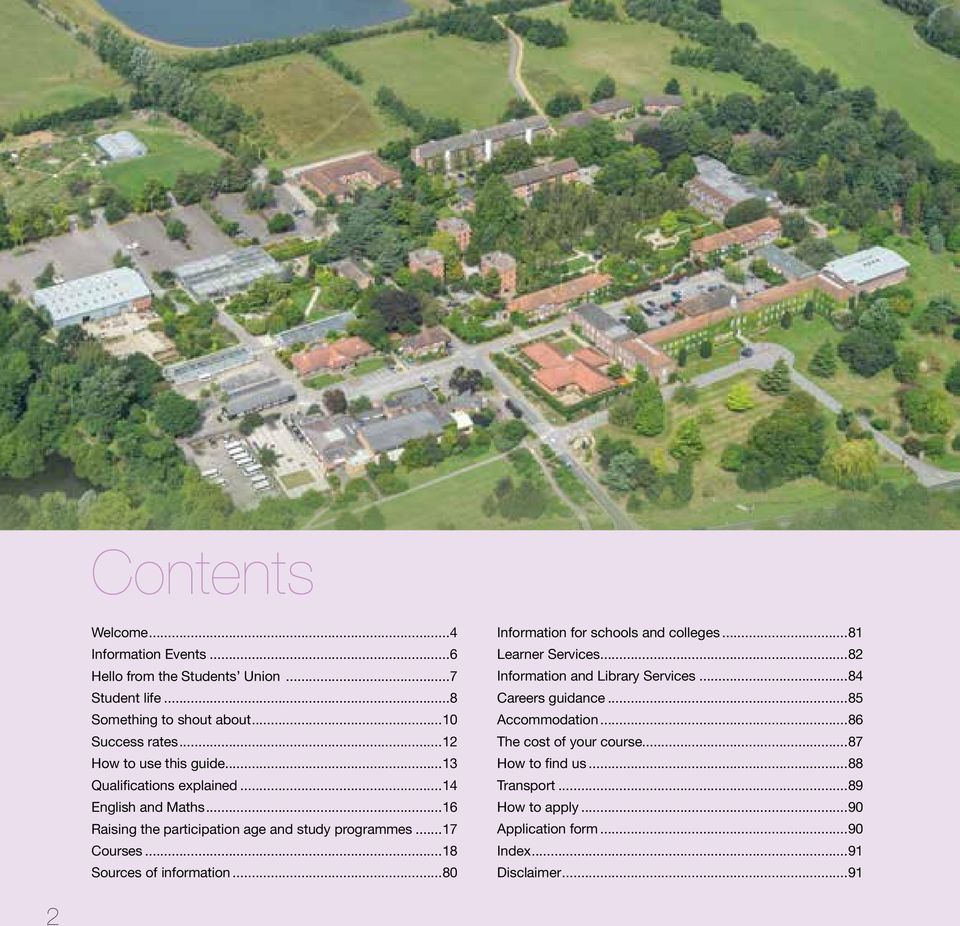
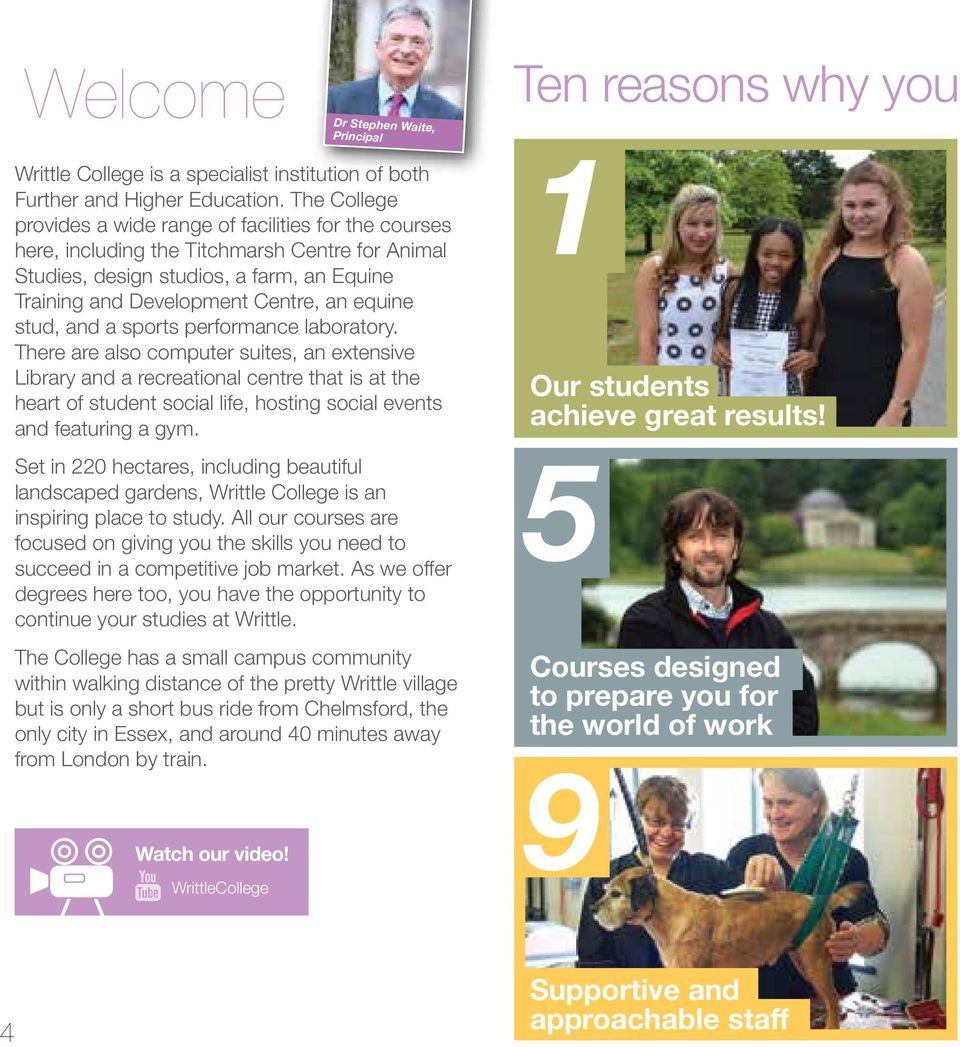
4 Welcome Dr Stephen Waite, Principal Ten reasons why you Writtle College is a specialist institution of both Further and Higher Education. The College provides a wide range of facilities for the courses here, including the Titchmarsh Centre for Animal Studies, design studios, a farm, an Equine Training and Development Centre, an equine stud, and a sports performance laboratory. There are also computer suites, an extensive Library and a recreational centre that is at the heart of student social life, hosting social events and featuring a gym. Set in 220 hectares, including beautiful landscaped gardens, Writtle College is an inspiring place to study. All our courses are focused on giving you the skills you need to succeed in a competitive job market. As we offer degrees here too, you have the opportunity to continue your studies at Writtle. The College has a small campus community within walking distance of the pretty Writtle village but is only a short bus ride from Chelmsford, the only city in Essex, and around 40 minutes away from London by train. Watch our video! WrittleCollege 1 Our students achieve great results! 5 Courses designed to prepare you for the world of work 9 4 Supportive and approachable staff
5 should choose to study at Writtle College: Inspiring portfolio of vocational courses Ideal blend of theory and practical learning The opportunity to improve your English and Maths Opportunities to progress to university-level courses 10 Beautiful campus Friendly environment for learning and socialising Great range of sport and social activities available Enjoy finding out more about the College in this prospectus and we hope to welcome you here soon! 5

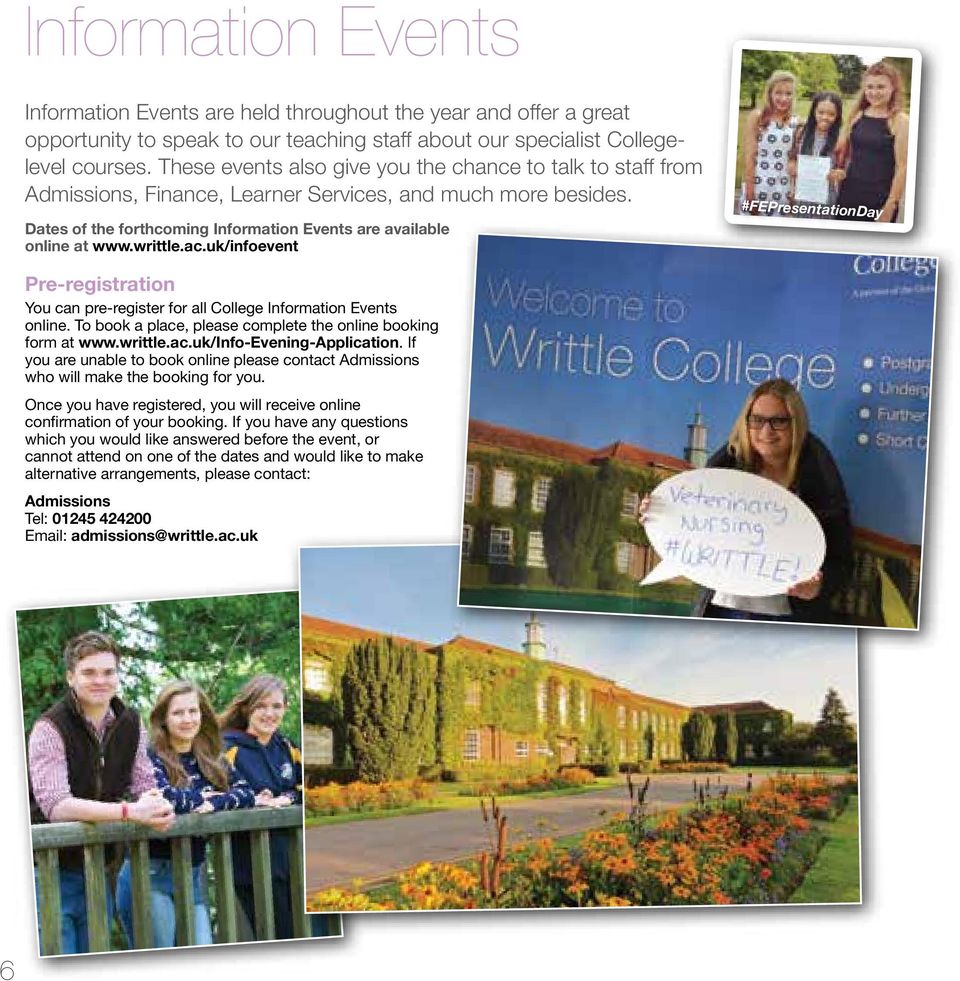
6 Information Events Information Events are held throughout the year and offer a great opportunity to speak to our teaching staff about our specialist Collegelevel courses. These events also give you the chance to talk to staff from Admissions, Finance, Learner Services, and much more besides. Dates of the forthcoming Information Events are available online at #FEPresentationDay Pre-registration You can pre-register for all College Information Events online. To book a place, please complete the online booking form at If you are unable to book online please contact Admissions who will make the booking for you. Once you have registered, you will receive online confirmation of your booking. If you have any questions which you would like answered before the event, or cannot attend on one of the dates and would like to make alternative arrangements, please contact: Admissions Tel: [email protected] 6
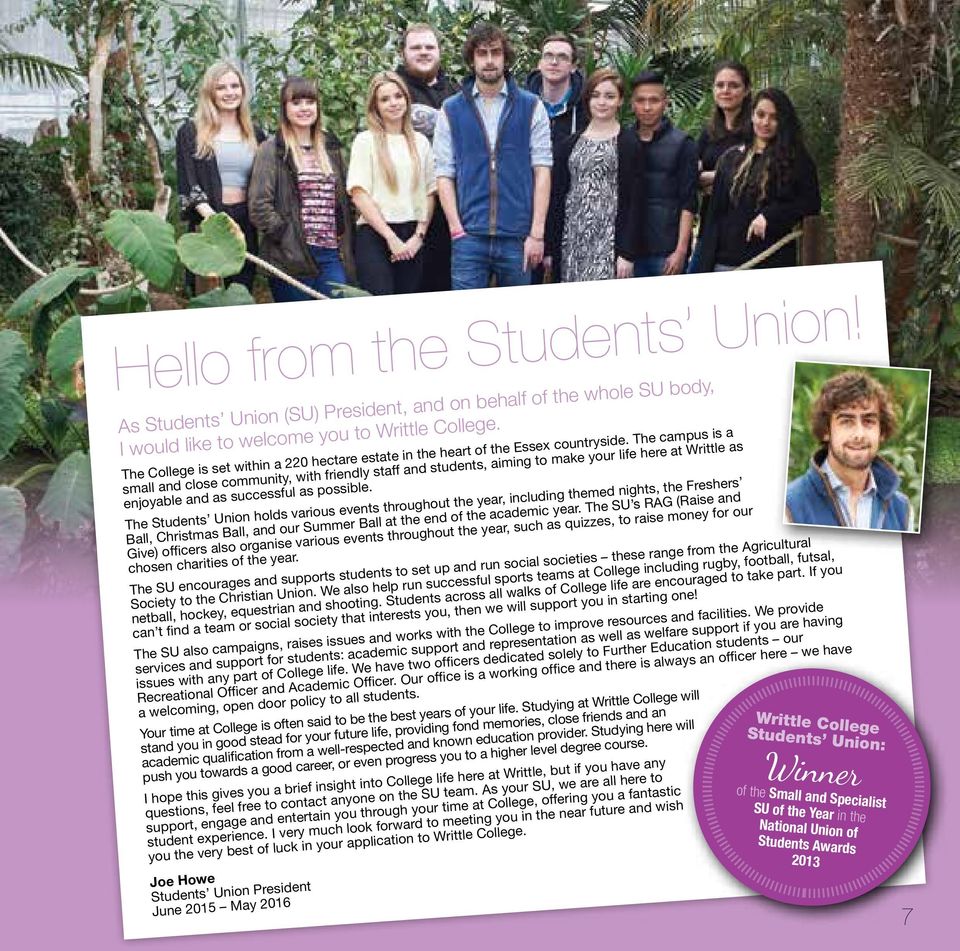
7 Hello from the Students Union! As Students Union (SU) President, and on behalf of the whole SU body, I would like to welcome you to Writtle College. The College is set within a 220 hectare estate in the heart of the Essex countryside. The campus is a small and close community, with friendly staff and students, aiming to make your life here at Writtle as enjoyable and as successful as possible. The Students Union holds various events throughout the year, including themed nights, the Freshers Ball, Christmas Ball, and our Summer Ball at the end of the academic year. The SU s RAG (Raise and Give) officers also organise various events throughout the year, such as quizzes, to raise money for our chosen charities of the year. The SU encourages and supports students to set up and run social societies these range from the Agricultural Society to the Christian Union. We also help run successful sports teams at College including rugby, football, futsal, netball, hockey, equestrian and shooting. Students across all walks of College life are encouraged to take part. If you can t find a team or social society that interests you, then we will support you in starting one! The SU also campaigns, raises issues and works with the College to improve resources and facilities. We provide services and support for students: academic support and representation as well as welfare support if you are having issues with any part of College life. We have two officers dedicated solely to Further Education students our Recreational Officer and Academic Officer. Our office is a working office and there is always an officer here we have a welcoming, open door policy to all students. Your time at College is often said to be the best years of your life. Studying at Writtle College will stand you in good stead for your future life, providing fond memories, close friends and an academic qualification from a well-respected and known education provider. Studying here will push you towards a good career, or even progress you to a higher level degree course. I hope this gives you a brief insight into College life here at Writtle, but if you have any questions, feel free to contact anyone on the SU team. As your SU, we are all here to support, engage and entertain you through your time at College, offering you a fantastic student experience. I very much look forward to meeting you in the near future and wish you the very best of luck in your application to Writtle College. Joe Howe Students Union President June 2015 May 2016 Writtle College Students Union: Winner of the Small and Specialist SU of the Year in the National Union of Students Awards
8 #WrittleSelfie Student life On campus Social life Weekly social events at the Baa Three formal Balls a year, which usually feature fairground rides and live music RAG (Raise and Give) events including Moulshams 11 a social night in Chelmsford a quiz and themed nights The Students Union is sponsored by Chelmsford nightclub Evoke and regularly organises nights out Sport Gym, Functional Fitness Room, squash court, sports hall for indoor football, badminton, volleyball, basketball, netball, trampolining and fitness classes as well as outdoor sports surfaces Sports teams regularly fulfilling fixtures in rugby, football, hockey, netball, equine, Futsal, athletics and volleyball Societies Including the LGBT (Lesbian, Gay, Bisexual, and Transgender), Animal, Equine and Agricultural societies as well as the Christian Union #FEArtExhibition Multi-faith room Multi-faith room, available for quiet contemplation by students of any faith or none Food Hot and cold meals, snacks and drinks are served at the restaurant on campus, the Garden Room, which has an outside seating area overlooking the beautiful gardens Thyme Out offers hot and cold food, cakes and a full Costa drinks menu. This is our late night catering venue so it is sometimes open longer to support events The Watering Hole at the Equine Training and Development Centre offers snacks The Lordship Tea Room and Shop, owned by the world-famous jam makers Wilkin & Sons Ltd, is on the Lordships Science campus Children s day nursery Subsidised childcare facilities on campus at the Kiddi Caru Day Nursery, catering for children aged 0 to five years. The nursery has achieved an outstanding Ofsted grade. Kiddi Caru Day Nursery Tel: [email protected] #WrittleSelfie Hockey match tomorrow! 8

9 #WrittleSelfie #WrittleSelfie Remember to book tickets for the Summer Ball! #WrittleSelfie Nearby #WrittleSelfie Writtle is only a few minutes walk away and boasts a pretty village green, restaurants and traditional-style pubs, gift shops and a supermarket Hylands Park on the outskirts of Writtle is nationally famous for hosting the V Festival, which has brought the likes of Beyoncé and Kings of Leon to the area Chelmsford the only city in Essex is ten minutes drive or bus ride away, with a busy shopping centre, cinema, restaurants, bars, clubs, ice skating rink, swimming pool, parks, gardens and a 15th Century cathedral Essex offers a range of outdoor activities including cycling, horse riding, fishing and sailing, an extensive coastline taking in seaside attractions and popular marinas, wildlife habitats and surviving ancient forests London is only 40 minutes away by train from Chelmsford #WrittleSelfie Writtle College Students Union: Winner of the Small and Specialist SU of the Year in the National Union of Students Awards

10 Something to shout about! Horticulture students are Young Gardeners of the Year 2015! Writtle College won Best in Show in the Young Gardeners of the Year competition at the Ideal Home Show! Celebrity horticulturist Alan Titchmarsh, one of the judges, said he was proud to be Writtle College patron while competition organiser and TV gardener David Domoney described the garden as beautiful and said the accolade was well-deserved. The College s team of nine students eight of whom were studying FE courses had to design and build a show-stopping sustainable garden in a 5.5m x 4m plot in the heart of London Olympia. FE Lecturers in Horticulture Ben Wincott and Simon Watkins, who have created numerous RHS Chelsea Flower Show gardens, provided guidance. Simon said: I am absolutely over the moon for the students! They have put in so much effort. All the hard work has paid off! This is so good for their CVs. Ben added: The quality of this year s garden is exceptional - it is really great to hear the feedback from the judges. This has got to be one of the highlights of my career and to see the team on stage celebrating was a personal high! One of the students Francesca Le Maistre Banham added: I am speechless! When I started the course at Writtle College I could only hope that we would be sitting here at the Ideal Home Show with a gold medal and Best in Show with these grins on our faces! It s the highlight of my College experience so far! 10

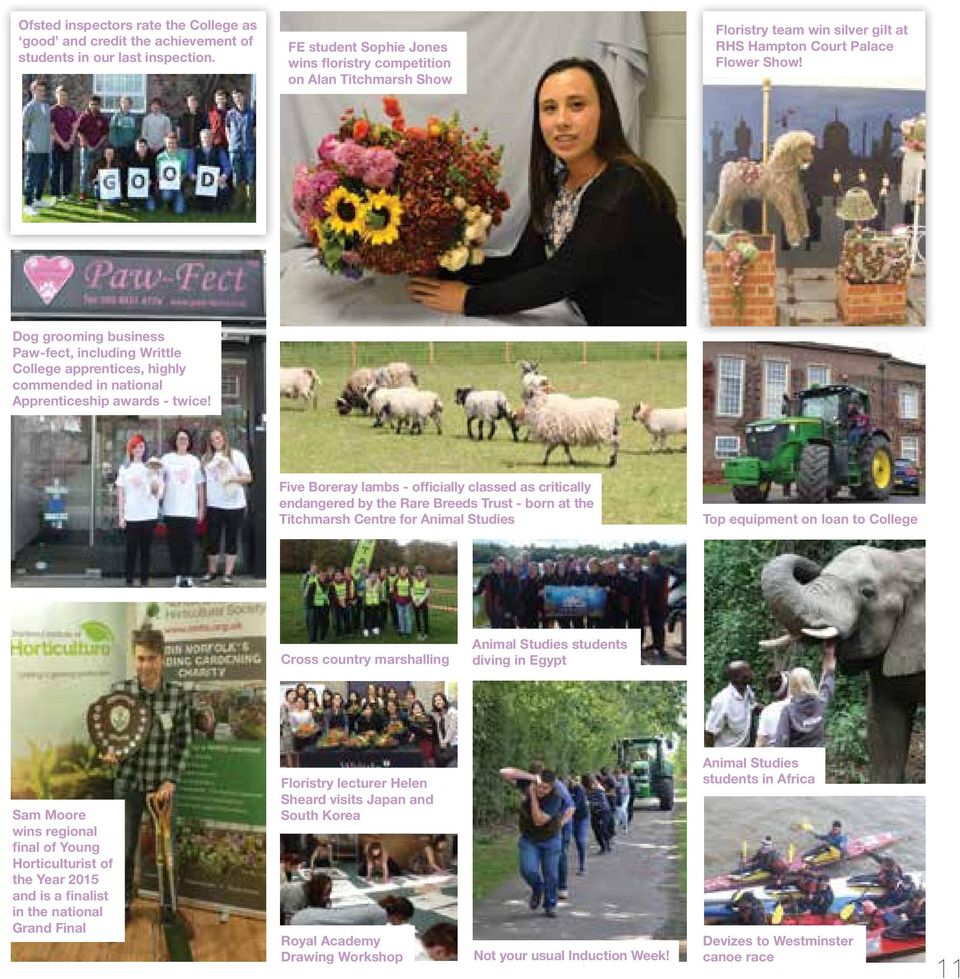
11 Ofsted inspectors rate the College as good and credit the achievement of students in our last inspection. FE student Sophie Jones wins floristry competition on Alan Titchmarsh Show Floristry team win silver gilt at RHS Hampton Court Palace Flower Show! Dog grooming business Paw-fect, including Writtle College apprentices, highly commended in national Apprenticeship awards - twice! Five Boreray lambs - officially classed as critically endangered by the Rare Breeds Trust - born at the Titchmarsh Centre for Animal Studies Top equipment on loan to College Cross country marshalling Animal Studies students diving in Egypt Sam Moore wins regional final of Young Horticulturist of the Year 2015 and is a finalist in the national Grand Final Floristry lecturer Helen Sheard visits Japan and South Korea Royal Academy Drawing Workshop Not your usual Induction Week! Animal Studies students in Africa Devizes to Westminster canoe race 11
12 Success rates Don t just take our word for it! According to Landex, which represents land-based Colleges, Writtle College has an: 86.6% success rate for all ages of students at all levels, compared to a Landex average of 82.6% - placing us at 6th out of 33 institutions. 85.2% success rate for 16 to 18-year-olds, compared to a Landex average of 80.1% - again ranking us at 6th. 89% success rate at 3, against an average of 84.9% - putting us in 4th place! 82.4% success rate at 2, against an average of 78.2%. 83.6% success rate at 1, against an average of 77.7%. Source: Landex s analysis of publicly available Skills Funding Agency national success rates tables showing three year trend data for , , Presentation Day The annual awards ceremony marks the success of students completing full-time Further Education courses at the College. The ceremony also features a number of additional awards for individual students who have been recognised for showing particular talent, dedication or skill. Our apprentices and successful learners work in a wide variety of organisations. Here are some of their employers: n Lee Valley Park Farms n Essex County Council n Thorndon Country Park n Marsh Farm Country Park n Hockley Woods n Marks Hall n RHS Garden Hyde Hall n Masons Tree Surgery Ltd n Wilderness Foundation n Hylands Park n Laura Renwick international showjumper n West Ham United Football Club n Stock Brook Manor Golf Club n Arsenal Football Club n Essex County Cricket Club n Colchester United Football Club n Leyton Orient Football Club n Felsted School n RHS Garden Wisley n Wylie Veterinary Centre, Upminster n Companion Care n Vets4Pets n Your Vets n PDSA of our FE 3 students progress to further education or employment* * Writtle Destination Survey Find out more about careers on the course pages and our Careers Advisory Service on page

13 How to use this guide 1 Choose the subject areas you re interested in #WrittleSelfie 2 Attend an information event. Book online at 3 Complete and submit an application form (a form can be found at the back of this prospectus or on our website) 4 Attend an assessment or interview 5 If you have any learning support needs, discuss them with a member of the Learner Services team We will assess your suitability for the course and level before deciding whether to offer you a place Receive your conditional or unconditional offer and accept your offer of a place Meet the conditions of the offer Alan Titchmarsh MBE - College Patron Writtle College has equipped generations of students with the expertise and skills needed to make a major contribution to the sustainable development of both rural and urban environments Enrol on your course Start at Writtle College! In my capacity as Patron, I have a long-standing association with Writtle and take great delight in seeing how students grow and flourish during their time at the College. 13

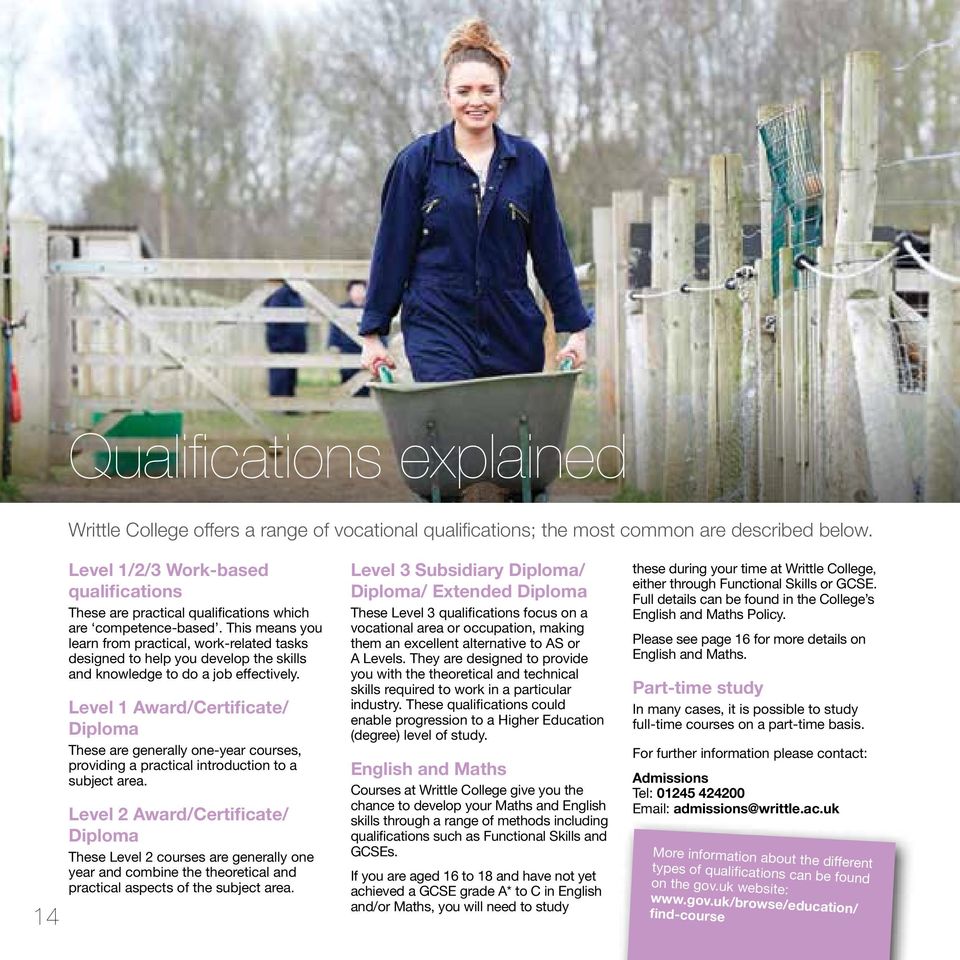
14 Qualifications explained Writtle College offers a range of vocational qualifications; the most common are described below. 14 1/2/3 Work-based qualifications These are practical qualifications which are competence-based. This means you learn from practical, work-related tasks designed to help you develop the skills and knowledge to do a job effectively. 1 Award/Certificate/ Diploma These are generally one-year courses, providing a practical introduction to a subject area. 2 Award/Certificate/ Diploma These 2 courses are generally one year and combine the theoretical and practical aspects of the subject area. 3 Subsidiary Diploma/ Diploma/ Extended Diploma These 3 qualifications focus on a vocational area or occupation, making them an excellent alternative to AS or A s. They are designed to provide you with the theoretical and technical skills required to work in a particular industry. These qualifications could enable progression to a Higher Education (degree) level of study. English and Maths Courses at Writtle College give you the chance to develop your Maths and English skills through a range of methods including qualifications such as Functional Skills and GCSEs. If you are aged 16 to 18 and have not yet achieved a GCSE grade A* to C in English and/or Maths, you will need to study these during your time at Writtle College, either through Functional Skills or GCSE. Full details can be found in the College s English and Maths Policy. Please see page 16 for more details on English and Maths. Part-time study In many cases, it is possible to study full-time courses on a part-time basis. For further information please contact: Admissions Tel: [email protected] More information about the different types of qualifications can be found on the gov.uk website: find-course
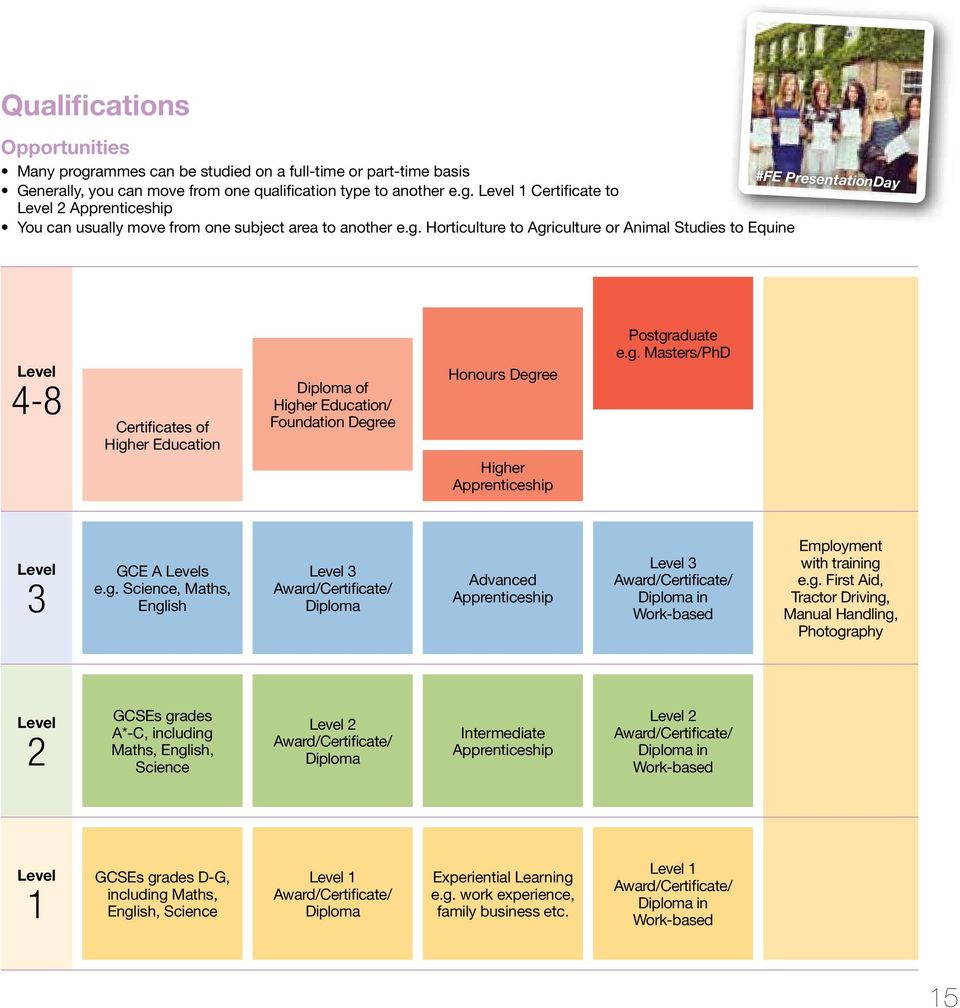
15 Qualifications Opportunities Many programmes can be studied on a full-time or part-time basis Generally, you can move from one qualification type to another e.g. 1 Certificate to 2 Apprenticeship You can usually move from one subject area to another e.g. Horticulture to Agriculture or Animal Studies to Equine #FE PresentationDay 4-8 Certificates of Higher Education Diploma of Higher Education/ Foundation Degree Honours Degree Higher Apprenticeship Postgraduate e.g. Masters/PhD 3 GCE A s e.g. Science, Maths, English 3 Award/Certificate/ Diploma Advanced Apprenticeship 3 Award/Certificate/ Diploma in Work-based Employment with training e.g. First Aid, Tractor Driving, Manual Handling, Photography 2 GCSEs grades A*-C, including Maths, English, Science 2 Award/Certificate/ Diploma Intermediate Apprenticeship 2 Award/Certificate/ Diploma in Work-based 1 GCSEs grades D-G, including Maths, English, Science 1 Award/Certificate/ Diploma Experiential Learning e.g. work experience, family business etc. 1 Award/Certificate/ Diploma in Work-based 15
16 English and Maths Good English and Maths skills will be a huge help to you when looking for jobs. Employers are always looking for these attributes and often use English and Maths qualifications to pick people for interview when selecting new staff. With a good level of English and Maths, you are more likely to find employment, earn more and progress in education and at work. Remember, you are not alone if you do not gain GCSEs at A* - C in English and Maths. Around four out of 10 teenagers face the same situation and often a fresh start at College helps. If you are 16 to 19-years-old and in this position, you will re-take your English and Maths qualifications through Functional Skills or GCSEs with us, alongside your new College course. If you are over 19 years of age, you will be encouraged to do the same. If you already have a grade C or above in GCSE English and Maths, you will continue to develop your skills during your classroom sessions and assessments. 16 Asa Peach 3 Sport Being able to re-take my GCSEs at Writtle College meant that I was able to go on to Higher Education, which improves the job opportunities open to me. Kara Hensher-Wombwell 2 Animal Care Being able to re-take my 2 English and Maths at Writtle means that I am able to go on to study Veterinary Nursing, which has always been my dream. Paul Downer Managing Director, Oak View Landscapes Good English and Maths grades are fundamental to young people s employment prospects as these are skills that are extremely important to businesses. Therefore, ensuring that all young people leave education with good GCSEs in English and Maths is a high priority for employers. Julia Smith College Governor College is a second chance to gain decent GCSE grades in Maths and English. You will earn, on average, 5,000 per year more with a C grade Maths than without it - learn it then earn it.

17 Raising the participation age and study programmes From summer 2015, 16-yearolds in education are required to participate in education or training until their 18th birthday. You will need to be in one of the following: Full-time education (school, college or independent provider) for at least 540 hours per year in a study programme An Apprenticeship Full-time work involving at least 280 hours of education A Traineeship Home education What are study programmes? Study programmes are for all 16 to 19-year-old learners who are studying fulltime. Study programmes must: Apply to all 16 to 19-year-olds. Consist of an academic programme or a substantial vocational qualification recognised by employers. This means they must help you secure skilled work or a university place. Allow (where appropriate) you to take part in work experience. Enable you, if you, at 16, do not have GCSEs grade C in English and Maths, to continue to study these subjects. Enable you, if you are not able to study a substantial qualification, to take a programme of work experience and to continue to develop your numeracy and literacy skills. Study programmes will give you: High quality, valuable vocational qualifications related to the job you want to do. The skills so you can progress to a higher level of study or to skilled employment. The opportunity to progress towards Maths and English GCSE. Functional Skills. Experience of the workplace. If you are aged 16 to 19 and studying fulltime at Writtle College, you will undertake a study programme. We will discuss the full details with you during the recruitment process. 17

18 Apprenticeships Apprenticeships Like the idea of earning while you learn? If the answer is yes, an Apprenticeship could be for you! 18 Skills, experience and qualifications can all make you stand out to potential employers as you progress your career, so why not consider the best of both worlds with an Apprenticeship? The scheme provides a mix of on and off-the-job training, at the same time as gaining a nationally-recognised qualification. Apprenticeships are open to all those aged over 16; whether you are just leaving school, are already in work or you want to start a new career. What is an Apprenticeship? Apprenticeships are an excellent way of gaining qualifications and workplace experience. As an employee you can earn as you learn, gaining practical skills from the workplace, with support and training from Writtle College. The Apprenticeship Framework is designed to allow you to develop the skills you need in your chosen industry. It combines knowledge and vocational skills, with transferable skills such as English, Maths and Employment Rights & Responsibilities importantly each area is accredited by a nationally-recognised qualification. You will: Work in your chosen industry for a minimum of 30 hours per week. Get paid a minimum of the Apprenticeship Wage ( 3.30 per hour from October 2015). Study in a flexible way depending on the subject, students can attend College on a part-time basis or study predominantly in the workplace. Complete Functional Skills in English and Maths. Complete work-related tasks and assessments. Receive mentoring visits in your workplace from your Writtle College Training Officer, who will provide support, assess and review your progress. Develop your personal, learning and thinking skills. Apprenticeships at Writtle College We can offer you the opportunity to complete an Apprenticeship in any of the following areas: Agriculture: Livestock, Arable & Mixed Farming Animal: Care and Welfare, Dog Grooming Environmental Conservation: Park Ranger, Estate Worker, Conservation Officer Equine Studies Floristry Horticulture: Landscaping, Greenkeeping, Groundsmanship, Parks, Gardens and Green Spaces Veterinary Nursing and Nursing Assistant in a veterinary environment Writtle College offers two levels of Apprenticeship Intermediate Apprenticeships at 2 (equivalent to 5 x grade A* to C GCSE passes) Advanced Apprenticeships at 3 (equivalent to 2 x A level passes) On average, our Intermediate Apprenticeships take around months and the 3 Advanced Apprenticeships around months to complete. However, the timescale of an Apprenticeship is flexible and will depend on the Apprentice s prior experience.

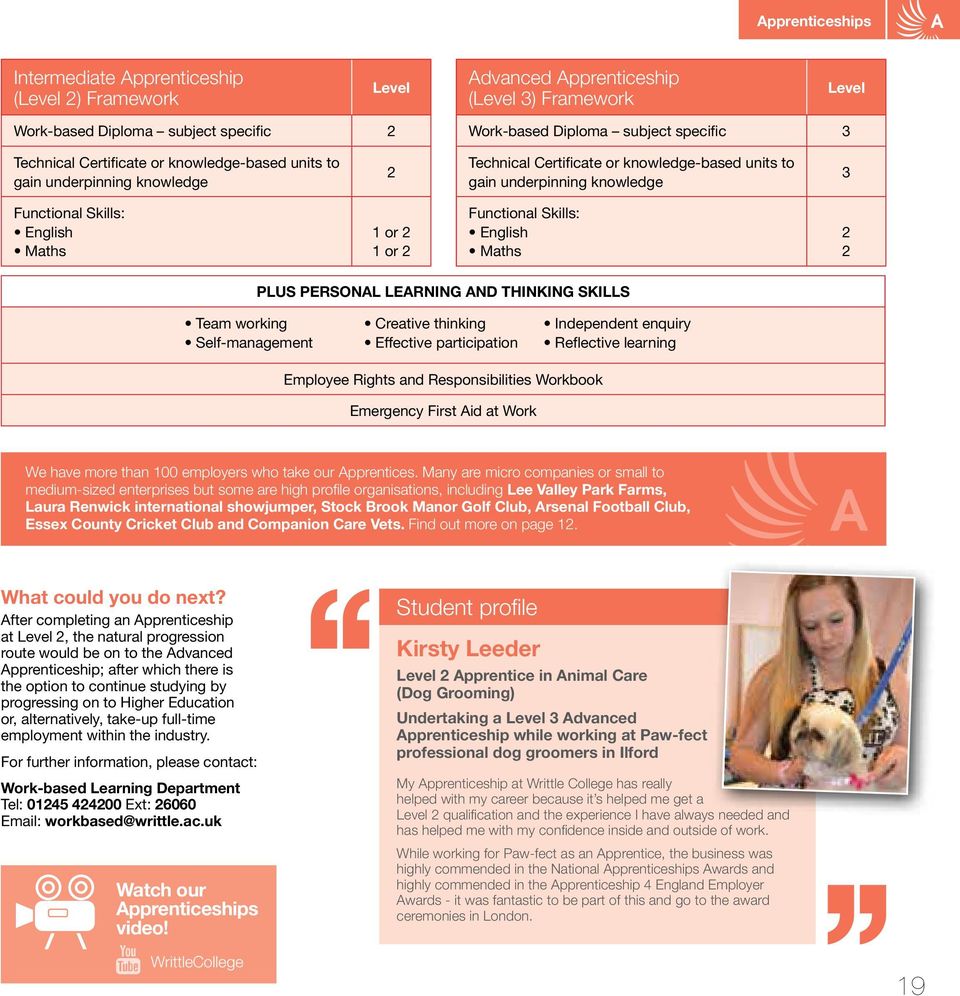
19 Apprenticeships Intermediate Apprenticeship ( 2) Framework Advanced Apprenticeship ( 3) Framework Work-based Diploma subject specific 2 Work-based Diploma subject specific 3 Technical Certificate or knowledge-based units to gain underpinning knowledge 2 Technical Certificate or knowledge-based units to gain underpinning knowledge 3 Functional Skills: English Maths 1 or 2 1 or 2 Functional Skills: English Maths 2 2 PLUS personal learning and thinking skills Team working Self-management Creative thinking Effective participation Independent enquiry Reflective learning Employee Rights and Responsibilities Workbook Emergency First Aid at Work We have more than 100 employers who take our Apprentices. Many are micro companies or small to medium-sized enterprises but some are high profile organisations, including Lee Valley Park Farms, Laura Renwick international showjumper, Stock Brook Manor Golf Club, Arsenal Football Club, Essex County Cricket Club and Companion Care Vets. Find out more on page 12. What could you do next? After completing an Apprenticeship at 2, the natural progression route would be on to the Advanced Apprenticeship; after which there is the option to continue studying by progressing on to Higher Education or, alternatively, take-up full-time employment within the industry. For further information, please contact: Work-based Learning Department Tel: Ext: [email protected] Student profile Kirsty Leeder 2 Apprentice in Animal Care (Dog Grooming) Undertaking a 3 Advanced Apprenticeship while working at Paw-fect professional dog groomers in Ilford My Apprenticeship at Writtle College has really helped with my career because it s helped me get a 2 qualification and the experience I have always needed and has helped me with my confidence inside and outside of work. Watch our Apprenticeships video! While working for Paw-fect as an Apprentice, the business was highly commended in the National Apprenticeships Awards and highly commended in the Apprenticeship 4 England Employer Awards - it was fantastic to be part of this and go to the award ceremonies in London. WrittleCollege 19
20 20

21 Agriculture, Countryside and Environment We have more than 250 farm animals on-site that you could work with on your course! It s a fact! Agriculture Agriculture provides a wide range of exciting job opportunities because it is such a diverse industry. The focus on farming is mainly on food production. The main farm types are dairy, beef, pigs, sheep, poultry, vegetables, cereals, root crops and other cash crops. The industry is also involved in non-food production for industrial development such as flax, hemp and biofuels. The Agriculture courses will give you the opportunity to pursue an interest in livestock, crop production or mechanisation. You can focus on general farm management as a career choice, but there are usually opportunities for unit managers and hands-on workers such as tractor drivers, dairymen, shepherds and sprayer operators. Other related careers include sales and marketing, agricultural consultants, agricultural researchers, journalists and teachers/lecturers. Around 135 hectares of the College estate are devoted to farming and production. The presence of these commercial enterprises makes a vital contribution to the teaching of production or mechanisation. Countryside and Environment The UK countryside is full of fascinating wildlife and on the Countryside Management courses you will learn how to plan and undertake surveys of rivers, coastal shingle, woodland and farmland. You will undertake practical management to enhance habitats for target species and learn about the laws that protect them. These practical tasks will be backed up through classroom theory. Many wildlife sites use livestock and machinery to manage them and, depending on your course selection, you will learn how to handle cattle or how to drive a tractor. Many rural sites are important for game management and the 2 Diploma in Game and Wildlife provides an introduction to this countryside activity. The estate offers hedgerows, grassland, rivers, woodland and farmland habitats for you to explore; these host such species as kingfishers, sparrowhawks, badgers, bullfinches, smooth newts, emperor dragonflies and water shrews. Additional qualifications During the course you will continue to develop your Maths and English skills through a range of methods such as Functional Skills and GCSEs. Additional qualifications specifically related to a subject area might also be included within a course. Alternatively, you may consider additional training from our range of short courses, please see page 79 for further details. 21
22 Agriculture, Countryside and Environment Agriculture 2 Diploma in Agriculture About the course This course is designed specifically for the more practical minded, as there is an emphasis on learning by doing. You will gain an understanding of the basis of agricultural practices and be qualified in general farm duties. Course length One year full-time 2 You will need Four GCSEs at grades A* D with at least one grade C in English, Maths or Science, or a relevant 1 qualification. A keen interest in agriculture is crucial. You must also be able to demonstrate suitable levels of numeracy and literacy. Areas of study Estate maintenance, introduction to crop establishment, farm animal production, land-based machinery operation and land-based workshop practice. The programme offers many varied day trips to farms and industry-related businesses while speakers from the industry are invited throughout the year. English and Maths skills will be developed throughout your course, which will help to improve your employability. Work placement In addition to the course units above, you will also undertake an industry experience unit. This will entail spending at least two days a week at a work placement with an agricultural organisation. Assessment for this will be by a portfolio of evidence showing your achievements in the work placement. Methods of assessment Each unit studied comprises four learning outcomes with pass, merit and distinction for each outcome. These are assessed using a wide variety of methods including practical observation, orals, multiple choice questions, written assessments, open book exams and formal written assessments. Additional learning goals 2 Tractor Driving College certificate, leading on to an NPTC Certificate of Competence in Tractor Driving and Related Operations for more advanced/skilled learners. First Aid at Work After completion of your course You can progress to a higher level qualification, such as the Subsidiary Diploma in Agriculture or an Apprenticeship programme. Students who wish to progress onto a higher course at Writtle College will need to achieve a minimum of a Merit average on the 2 Diploma course and complete Maths and/or English qualifications. You will also be suitable for employment as a farm assistant, a tractor driver and other similar positions. For more information on the 1 Diploma in Land-based Studies, please turn to page 66. Watch our FE Agriculture video! WrittleCollege 22
23 Agriculture, Countryside and Environment 3 Subsidiary Diploma in Agriculture (leading to an Extended Diploma) About the course This advanced level course will provide you with a broad base of agricultural knowledge, science, husbandry and practical skills. Course length Subsidiary Diploma one year Extended Diploma two years 3 You will need Five GCSEs at grades C or above to include English, Maths and Science. However, alternative qualifications or experience will be considered on application. A keen interest in agriculture is crucial and you will need relevant practical experience. Areas of study Year 1 (Subsidiary Diploma): Principles of plant and soil science, estate skills, agricultural crop production, root crop & field vegetable production, farm livestock husbandry, land-based workshop practice, land-based machinery operations, business planning and improvement in the land-based sector. Year 2 (Extended Diploma): Investigative project in the land-based sector, business management in the land-based sector, principles of landbased machinery, agricultural livestock production, agricultural spreaders & sprayers, agricultural combinable crop production, farm power units machinery & operation, grassland management, forage crop production. The programme offers many varied day trips to farms and industry-related businesses while speakers from the industry are invited throughout the year. English and Maths skills will be developed throughout your course, which will help to improve your employability. Work placement In addition to the modules above, you will also undertake an industry experience module. You will begin your placement in July and complete it by mid-november. The College has links with a network of employers, providing placement opportunities within all sectors of the agriculture industry. Methods of assessment Each unit studied comprises four learning outcomes with pass, merit and distinction for each outcome. These are assessed using a wide variety of methods including practical observation, orals, multiple choice questions, written assessments, open book exams and formal written assessments. This could be you! Hannah Kelsey 3 Agriculture Working for R W Crawford Agricultural Machinery Ltd R W Crawford is a large AGCO dealer which has depots in Kent and Essex and offers all four franchises - Challenger, Massey Ferguson, Fendt and Valtra. Additional learning goals 2 Tractor Driving College certificate, leading on to an NPTC Certificate of Competence in Tractor Driving and Related Operations for more advanced/skilled learners. Forklift Truck Operations College certificate, leading on to an NPTC Certificate of Competence in Forklift Truck Operations for more advanced/ skilled learners. Pesticide Application (PA) 1 and PA 2 (in second year). First Aid at Work. After completion of your course You can progress to a higher level qualification such as a Foundation or Honours degree. There are a number of employment opportunities such as a trainee assistant farm manager, agricultural contracting, or a general farm worker. I oversee the sales administration for the Essex Depot and head up and drive the marketing and social media for the whole company. The College kick-started and progressed my career. My course enabled me to broaden my knowledge of the agricultural industry and set a great foundation for networking within the industry - many of my College friends are customers! 23
24 Agriculture, Countryside and Environment Countryside 2 Diploma in Game and Wildlife About the course This course has been designed for those who have an interest in game management. It will provide you with an introduction to the game management industry in the UK. Class-based lectures will give the necessary background knowledge but the emphasis of this course will be on developing your practical skills. Course length One year full-time or two years part-time 2 You will need Four GCSEs at grades A* D, with at least one grade C in English, Maths or Science. In addition, you must have a keen interest in the countryside and its wildlife. Areas of study Game management, environmental and land-based business, estate maintenance, deer management, ecology of trees, tractor driving. English and Maths skills will be developed throughout your course, which will help to improve your employability. Work placement You will develop your practical skills through volunteering within the game management sector with an employer of your choice. You are required to complete 150 hours. This valuable work experience will be assessed by means of a portfolio of evidence, which you will produce whilst on your placement. Methods of assessment Each unit includes pass, merit and distinction criteria. Assessment is through a range of methods including practical observation, oral questioning, presentations and formal written assessments. After completion of your course Upon successful completion of your Diploma, you may wish to progress to a higher level qualification, such as the 3 Extended Diploma in Countryside Management. For this, you will need to achieve a minimum of a Merit on the 2 course and complete Maths and/or English qualifications. Alternatively, you may prefer to look for employment as an assistant gamekeeper, a countryside ranger or work at a country estate. 24
25 Agriculture, Countryside and Environment 2 Diploma in Countryside and Environment About the course This course has been designed for those thinking about a career in the countryside sector. It will provide you with an overview of countryside management practices. Class-based lectures will give you the necessary background knowledge but the emphasis of this course will be on developing your practical skills. Course length One year full-time or two years part-time 2 You will need Four GCSEs at grades A* D, with at least one grade C in English, Maths or Science. In addition, you must have a keen interest in the countryside and its wildlife. Areas of study Surveying techniques, ecology of trees, land-based machinery, tractor driving, environmental and land-based business, estate maintenance. English and Maths skills will be developed throughout your course, which will help to improve your employability. Work placement You will develop your practical skills through volunteering with a countryside or environmental organisation of your choice. You are required to complete 150 hours. This valuable work experience will be assessed by means of a portfolio of evidence which you will produce whilst on your placement. Methods of assessment Each of the six units include pass, merit and distinction criteria. Assessment is through a range of methods including practical observation, oral questioning, presentations, open book tests and formal written assessments. After completion of your course Upon successful completion of your Diploma, you may wish to progress to a higher level qualification, such as the 3 Extended Diploma in Countryside Management. For this, you will need to achieve a minimum of a Merit on the 2 course and complete Maths and/or English qualifications. Alternatively, you may prefer to look for employment as an assistant countryside ranger or work within estate management. For more information on the 1 Diploma in Land-based Studies, please turn to page
26 Agriculture, Countryside and Environment 3 Subsidiary Diploma in Countryside Management (leading to an Extended Diploma) About the course This course is designed to prepare you for employment or further study in areas such as conservation, estate maintenance, country park management, leisure and tourism, forestry or agriculture. Course length Subsidiary Diploma one year Extended Diploma two years 3 You will need Five GCSEs at grades A* C to include English and Maths, or a 2 qualification in Environmental Conservation. Alternative qualifications or experience will be considered on an individual basis. Areas of study In the first year, you will study an investigative project (core unit) and a minimum of five other units. Subjects studied over the two years will include land use, interpretation, heathland management, woodland management, wildlife populations, estate skills, landbased machinery, coastal management, freshwater and wetland management, grassland management, ecology of game, greenwood crafts, tourism, identification of organisms and livestock management. English and Maths skills will be developed throughout your course, which will help to improve your employability. Work placement This is undertaken on one day a week for the whole two-year programme. The College has contacts with a wide variety of work placement providers, including Country Parks, the National Trust, Essex Wildlife Trust, private estates and RSPB nature reserves. Assistance will be provided, if required, to help you locate a suitable work placement for the industry experience unit. Methods of assessment Each unit studied comprises learning outcomes with pass, merit and distinction for each outcome. These are assessed using a wide variety of methods including practical observation, oral questioning, multiple choice questions, written assessments, open book exams and formal written assessments. The first year units must be passed before students are allowed to progress to the second year. After completion of your course You will be suitable for employment within the countryside sector, although you may also need to undertake some specialist short courses in brushcutters or chainsaw use. Alternatively, you can progress to a higher level qualification such as a Foundation or Honours degree. This could be you! Michael Chable 3 Extended Diploma in Countryside Management Now studying BSc Conservation and Forest Ecosystems at Bangor University, North Wales 26 Writtle College is well-equipped to teach a wide variety of relevant skills after years of doing so. It has an array of resources and is neatly set in an environment full of opportunities to learn. The lecturers taught the course in a practical, interesting way that I could easily engage with. My time there was full of people genuinely concerned about equipping me for the future by developing all sorts of skills within me practical, academic, and personal. This meant I gained a qualification and experience that are considerably more respected than those offered by the other colleges I looked at.
27 Agriculture, Countryside and Environment Watch our FE Countryside video! WrittleCollege 27
28 Watch our FE Animal Studies video! 28 WrittleCollege
29 Animal Studies including Dog Grooming and Veterinary Nursing We have more than 250 livestock, 55 horses and over 500 small/ companion animals on-site you could work with on your course! It s a fact! Caring for animals requires a high level of dedication and strong practical skills. With the right training and experience, you can expect to find employment with a variety of animal-orientated organisations including kennels and catteries, animal charities, veterinary practices, grooming parlours, zoos and retail outlets. You could also progress onto Higher Education programmes here at Writtle College and at other universities. As a student, you will benefit from a dedicated facility, the Titchmarsh Centre for Animal Studies, where you will find a huge variety of animals ranging from commonly-kept pets such as rabbits and guinea pigs to an aquatic and extensive reptile collection. In the outside paddock and barn area, you will find animals such as goats, rare sheep, ponies and birds. The unit also has a dog grooming parlour and dog training arena. Additional qualifications Throughout the course you will continue to develop your Maths and English skills through a range of methods such as Functional Skills and GCSEs. Additional qualifications specifically related to a subject area might also be included within a course. Alternatively, you may consider additional training from our range of short courses, please see page 79 for further details. 29
30 Animal Studies Animal Studies 1 Diploma in Land-based Studies (Animal Care) About the course This 1 course introduces you to the basic requirements for a range of commonly kept species. Course length One year full-time 1 You will need... Two GCSEs at grades A* E, to include either Maths or English. You will also need to give a satisfactory interview and meet a minimum of Entry 3 in a basic skills test for literacy and numeracy. We also require a satisfactory reference and a minimum of five days work experience in an animal-related placement before the course. Areas of study Safe and effective working practices in land-based industries, developing performance in land-based industries, assisting with maintaining the health and wellbeing of animals, assisting with feeding and watering animals, assisting with the preparation and maintenance of animal accommodation, assisting with the handling and restraint of animals, assisting with the exercise of animals. Work placement In addition to the taught units, you will also spend time weekly at a work placement with an animal care organisation. Assessment for this will be by a portfolio of evidence showing your achievements in the work placement, enhanced by some taught College sessions. English and Maths skills will be developed throughout your course, which will help to improve your employability. Methods of assessment Modules are assessed using a wide variety of methods including practical observation, oral questioning, multiple choice questions and formal written assessments. After completion of your course You can progress to the 2 Diploma in Animal Care or a 2 Apprenticeship. If you wish to progress onto a higher course at Writtle College you will need to achieve a distinction for the portfolio module of the course, successfully complete a bridging assignment, achieve a Functional Skills qualification and have a suitable team recommendation. Previous students have found employment in a variety of animal industries including zoos, kennels and veterinary practices. 30
31 Animal Studies 2 Diploma in Animal Care About the course This 2 course is ideal if you have little experience of working with animals. It combines theoretical subjects with practical activities and projects. You will develop practical animal handling skills and gain an understanding of the basic care of a wide range of animal species. Course length One year full-time 2 You will need Four GCSEs at grades A* D, to include a minimum of grade C in either Maths or English, and a suitable reference. However, alternative qualifications or experience will be considered on application. We also require a satisfactory reference and a minimum of five days work experience in an animalrelated placement before the course. Areas of study Maintaining animal accommodation, planning and monitoring animal feeding, maintaining animal health and welfare, introduction to animal behaviour and handling, understanding the principles of animal biology, conservation and improvement of British habitats, undertaking work experience in the landbased industries. English and Maths skills will be developed throughout your course, which will help to improve your employability. Work placement One day a week is spent at a work placement. This is assessed as part of the work experience unit and you must complete a set number of hours to achieve this unit. Methods of assessment The course is assessed in a variety of ways including written assignments, tests, presentations as well as practical assessments involving the animals at the Titchmarsh Centre for Animal Studies. After completion of your course You can progress to a higher level qualification such as the 3 90 Credit Diploma in Animal Management. This is dependent on successful completion of the course to the required grades, including English and Maths skills. Alternatively, you may undertake an Apprenticeship, or find employment in zoos, pet shops or kennels. 31
32 Animal Studies 3 90 Credit Diploma in Animal Management About the course This advanced level course combines both theoretical and practical aspects of animal care. You will develop animal handling skills and gain an understanding of how to maintain the health and welfare of a wide range of animal species. It is the equivalent of the first year of the Extended Diploma (see page 33). Course length One year full-time 3 You will need Five GCSEs at grade C or above, to include Science, Maths and English, and a suitable reference. Alternative qualifications or experience will be considered on application. We also require a minimum of five days work experience in an animal-related placement before the course. Areas of study Understanding and promoting animal health, managing animal accommodation, planning and monitoring animal feeding, understanding animal welfare and breed development, understanding the principles and carrying out the practice of exotic animal health & husbandry, aquatics husbandry & management, wildlife populations, ecology & conservation. You will continue to develop your English and Maths skills during the programme. Work placement During the course you will undertake animal unit duties at the College s wellstocked animal facility, where you will become familiar with caring for the wide variety of animals that are housed here. Methods of assessment The course is assessed in a variety of ways including written assignments, tests, presentations as well as practical assessments involving the animals at the Titchmarsh Centre for Animal Studies. Please note that the majority of assessments are written. After completion of your course You can progress to the Extended Diploma in Animal Management. Employment in a supervisory capacity in kennels, zoos and wildlife parks is possible. 32
33 Animal Studies 3 Extended Diploma in Animal Management About the course This advanced level course combines both theoretical and practical aspects of animal care. You will develop animal handling skills and gain an understanding of how to maintain the health and welfare of a wide range of animal species. Course length Two years full-time 3 You will need Five GCSEs at grades C or above, to include Science, Maths and English, and a suitable reference. Alternative qualifications or experience will be considered on application. We also require a minimum of five days work experience in an animal-related placement before the course. Areas of study Animal health, principles of animal biology, animal handling and safe working, work experience in the land-based industries, animal nursing, animal behaviour and communication, kennel and cattery management, wildlife management and rehabilitation. You will continue to develop your English and Maths skills during the programme. Work placement During the second year, one day a week is spent at a work placement. This is assessed as part of the industrial experience unit and you must complete a set number of hours to achieve this unit. Methods of assessment The course is assessed in a variety of ways including written assignments, tests, presentations as well as practical assessments involving the animals at the Titchmarsh Centre for Animal Studies. Please note that the majority of assessments are written. After completion of your course You can progress to a Higher Education course such as a Foundation or Honours degree. Employment in a supervisory capacity in kennels, zoos and wildlife parks is possible. This could be you! Stephanie Collingbourne National Diploma in Animal Management, Writtle College BSc (Hons) Animal Management with Farm Livestock Production, Writtle College Studying for a PhD in Agriculture at Writtle College Writtle College offered the opportunity for practical, hands-on experience with different species, whilst incorporating the relevant theory work. I really enjoyed working on the farm, especially with the pigs, during my Diploma, where I gained practical experience with livestock. So far, I ve had a fantastic time at Writtle College, which can be seen as I ve progressed from National Diploma to degree to PhD. The courses which I have completed, the practical livestock skills I have gained, the knowledgeable lecturing staff, the small, friendly community and the beautiful surroundings of Writtle, make it an extremely enjoyable learning experience. 33
34 Animal Studies Veterinary Nursing 2 Diploma for Veterinary Care Assistants 34 About the course This course is suitable for you if you are already employed or have access to work experience in a veterinary practice; wish to train as a veterinary nurse but do not yet have the required qualifications; or if you work in a veterinary practice but do not wish to undertake veterinary nurse training. This course can be studied as part of an Apprenticeship, see page 18 for further details. Course length One year part-time 2 You will need Four GCSEs at grades A* D, to include a minimum of grade C in either Maths or English, and a suitable reference. Alternative qualifications or experience will be considered on application. You will need to demonstrate a commitment to study. Areas of study Introduction to common animal species, animal handling, restraint and movement, animal health, hygiene and disease control, introduction to animal emergencies and First Aid, introduction to veterinary anaesthesia and radiography, administration of veterinary medication, basic dispensing and pharmacy, introduction to bereavement and animal euthanasia. You can study Functional Skills if you wish to progress onto the Veterinary Nursing course, but lack either the required English or Maths grades. Further details will be discussed at interview. Work placement 600 hours of work experience within a suitable veterinary practice must be logged as part of the course. Many of the assessments are carried out at this placement. Methods of assessment The course is assessed in a variety of ways including written assignments, tests, presentations as well as practical assessments involving the animals at the Titchmarsh Centre for Animal Studies. Please note the majority of assessments are written. After completion of your course You can progress to the Diploma in Veterinary Nursing, subject to successful completion of the course to the required grades. To do so, you must have GCSE English and Maths at grade C or equivalent, which it may be possible to achieve alongside the Veterinary Care Assistants qualification. This could be you! Emma Ruggles 3 Extended Diploma in Animal Management and 3 Diploma in Veterinary Nursing Student Veterinary Nurse The College and the Veterinary Nursing course have helped me learn so much about working with animals in the veterinary field. Before starting this course I definitely underappreciated the vital work of Veterinary Nurses and the level of training they have to complete to gain the knowledge and skills required in this sector, which is constantly changing and improving to ensure high standards of care. All of the knowledge and skills I have gained will allow me to work as a qualified/registered Veterinary Nurse and enable me to specialise as a critical care nurse in the future.
35 Animal Studies 3 Diploma in Veterinary Nursing About the course Successful completion of this course leads to professional registration with the Royal College of Veterinary Surgeons (RCVS) as a Veterinary Nurse. Course length Two to three years part-time 3 You will need A minimum of five GCSEs grade C or above, to include English, Science and Maths. Alternatively, you can gain entry through successful completion of the 2 Certificate for Veterinary Care Assistants and certain alternative qualifications may be accepted. For further information, please contact the Veterinary Nursing department on All successful students will be required to have an employed clinical placement in an approved veterinary Training Practice (TP). Areas of study The course follows the City and Guilds Veterinary Nursing syllabus. Areas of study include understanding the operational requirements of a veterinary practice, comparative functional anatomy, applied animal welfare, health and husbandry, understanding the essentials of veterinary nursing care for hospitalised animals and supporting the supply of veterinary medicines. You will also study diagnostic imaging and laboratory diagnostics, supporting veterinary operating theatre practice, principles of supporting veterinary anaesthesia, principles of small animal veterinary nursing, emergency and critical care and preparing for professional registration. This list is not exhaustive. Methods of assessment You must pass written and practical assessments set by the City and Guilds during the course. Additionally, the College sets written assignments and examinations which you must complete successfully. You will complete a Nursing Progress Log during your clinical placement, which will be used as part of the assessment process. After completion of your course Once all elements of the course are complete, you will be able to register with the RCVS as a Veterinary Nurse. You can also progress to a higher level qualification such as the Diploma in Advanced Veterinary Nursing (Surgical or Medical). 35
36 Animal Studies Canine Care and Dog Grooming 2 Canine Care, Training and Management About the course This is a College-certified course and is suitable for you if you have a basic knowledge of dogs and training, and want to broaden your knowledge in all aspects of the canine world. It is ideal if you wish to make a career with dogs. Course length 29 weeks (Thursday 6.30pm to 9.30pm) 2 You will need Some experience of handling and training dogs and access to a dog for practical training sessions. Areas of study The canine/human interface, breeding, learning stages, training methods, nutrition, behaviour, health, genetics and the dog s role in our society. This course has theory and practical elements, allowing you to gain hands-on experience. Methods of assessment Written and practical assessments. There are four large assignments to be completed during the course, which will be marked along with the practical sessions. After completion of your course You can progress onto the 3 Canine Behaviour and Training (please contact the College for more information). The course will support the Kennel Club Accreditation Scheme for Instructors in Dog Training and Canine Behaviour. 2 Certificate for Dog Grooming Assistants About the course This course is for people who have little or no experience in dog grooming and is designed to train you to be competent in basic grooming tasks. You may have the chance to develop your Maths and English skills through a range of methods such as Functional Skills and GCSEs. Course length One day a week for 18 weeks or an evening 5pm to 9pm for 27 weeks. 2 You will need Work experience in a grooming parlour, so you have experience of handling and controlling dogs. To give a satisfactory interview and meet a minimum of 1 in a basic skills test for literacy and numeracy. Areas of study The practical lessons take place in the College s commercially-run dog grooming parlour and topics include correct bathing for coat type, use of different drying methods, basic trimming and hand stripping of different breeds of dogs. Theory of grooming covers points of the dog, handling and restraint of dogs, parasites, Kennel Club breed groups, coat types, health and safety, normal and abnormal health in dogs and customer care. This list is not exhaustive. Methods of assessment Practical assessments, written assessments and a multiple choice theory exam. After completion of your course You can progress to the 3 Certificate in Introductory Dog Grooming or you can gain employment in a grooming parlour. 36
37 Animal Studies 3 Certificate in Introductory Dog Grooming About the course This course is for people who have been working within the dog grooming industry for at least six months or completed the 2 Certificate for Dog Grooming Assistants and have some work experience. The course is designed to train you in all aspects of dog grooming, from dealing with owners requests to breed standards. You may have the chance to develop your Maths and English skills through a range of methods such as Functional Skills and GCSEs. Course length One day a week for 25 weeks or 5pm to 9pm over 32 weeks 3 You will need Six months experience working within the grooming industry, a 2 Certificate for Dog Grooming Assistants and a satisfactory reference. All candidates will need a practical placement of a minimum of six hours per week in a grooming parlour. Areas of study Practical topics are taught in our commercial grooming parlour and include clipping, scissor styling and hand stripping to breed standards. Theory topics include correct use of equipment and tools, handling and control of dogs, First Aid for dogs, parasites, infectious diseases and Kennel Club breeds. This list is not exhaustive. Methods of assessment A theory examination together with practical assessments and a written assignment. After completion of your course You may start your own business, work within the industry or progress onto the Diploma (please contact the College for more information). 37
38 Animal Studies Work-based learning in Animal Care 1 Certificate in Work-based Animal Care/ 1 Certificate in Land-based Studies (Agriculture) About the course This is an introduction to both small and farm animal care. Entry onto this course will be organised via schools for 14 to 16-year-olds. Course length One day a week over two years 1 You will need A work placement within the animal care industry for a minimum of one day per week. This is to be arranged by your home school. The placement will need to be suitable for your chosen core studies. Areas of study Basic anatomy and physiology, animal handling, animal health, animal husbandry, breeding, animal First Aid and preparation for industry. This list is not exhaustive. Methods of assessment You will be required to compile a portfolio of evidence to demonstrate competence in a range of tasks. This will consist of observational evidence by the tutor and some verbal and written evidence from you. After completion of your course You could progress to a higher level qualification such as a 2 Diploma in Animal Care or the 2 Diploma in Work-based Animal Care. For more details, please contact: Development Officer Tel: @writtle.ac.uk 38
39 Animal Studies 2 Diploma in Work-based Animal Care About the course This course is ideal if you are new to the industry and would like to gain a recognised qualification related to your work. You can choose to study as an Apprentice, or as a stand-alone student, and you can select from a range of units relevant to your work role. You may have the chance to develop your Maths and English skills through a range of methods such as Functional Skills and GCSEs. Course length Stand alone: One year Apprentices: 12 to 18 months 2 You will need You must be self-motivated and enthusiastic about caring for animals. Some form of work experience/ employment is also required: If you are a stand-alone student, you will be required to work within the industry for a minimum of 16 hours per week, which can be either paid or voluntary, and you will need to attend the College two days a week. If you are an Apprentice, you will need to be employed in the industry working a contracted minimum of 30 hours a week and will need to attend College one day a week. All students will undergo a basic literacy and numeracy test at interview and the results of this will be used, in addition to other information, to assess suitability for this programme. Areas of study Animal health, nutrition, anatomy and physiology, animal handling, animal husbandry, breeding, First Aid and customer care. This list is not exhaustive. Methods of assessment You will be required to compile a portfolio of evidence to demonstrate competence in a range of tasks. After completion of your course You can progress to a higher level qualification such as the 3 Diploma in Work-based Animal Care (for more details please contact the Animal Studies team on ), or the 3 90 Credit Diploma in Animal Management. 39
40 Watch our FE Equine video! WrittleCollege We have 55 horses on-site that you could work with on your course! It s a fact! 40
41 Equine Equine is a leisure pastime, professional sporting activity and a thriving industry that offers employment opportunities on all levels. Many people in the industry tend to focus on practical jobs such as being a stud groom, riding instructor, equine physiotherapist or yard manager. There are plenty of opportunities in research, such as working in nutrition, pharmaceuticals, veterinary support or equine welfare. You can also progress onto Higher Education programmes. The College s Equine Training and Development Centre provides stabling for around 40 horses and incorporates a range of stable designs. There are two indoor arenas, an outdoor arena, horse walker, jump paddock, and a cross country course. At the Centre, you can develop practical skills, from grooming, tacking up and clipping through to lunging and long-reining. In addition to the Centre, there is Lordships Stud, which is an extensive working stud unit housing a variety of broodmares, foals, stallions and youngstock. It operates as a commercial stud and is an excellent educational facility. Specialist resources at the stud include modern veterinary examination and artificial insemination collection areas, a laboratory, outdoor menage and indoor school. The stud also has FOALCAM an online facility where you can view foaling via web-linked CCTV. In line with British Horse Society (BHS) training centre standards and due to the nature of the horses at the College, we ask that students weigh no more than 13 stone. Non-riding options are available, where appropriate. Additional qualifications Throughout the course you will continue to develop your Maths and English skills through a range of methods such as Functional Skills and GCSEs. British Horse Racing Education and Standards Trust (BHEST) 2 and 3 qualifications may be studied. Alternatively, you may consider additional training from our range of short courses, please see page 79 for further details. This could be you! Fay Shulton 3 Extended Diploma in Horse Management Stable/racing Assistant with leading trainer Nigel Twiston-Davies I greatly enjoyed my time at Writtle College. I made some great friends and the lecturers were very friendly, helpful and encouraging. I especially liked that most of the time was spent carrying out practical work, with a lot of hands-on experience with a wide variety of horses. If it wasn t for Writtle College I would never have landed a place in this career, as Writtle introduced me to the British Racing School which then led me to the best job ever. I work for Nigel Twiston- Davies where I get the chance to look after top quality racehorses and attend all the big racing festivals. I am very lucky to be looking after some legends in the racing world which include Pigeon Island (Cheltenham Festival winner) and Blaklion (Cheltenham winner and future star). 41
42 Equine 2 Diploma in Horse Care About the course This course will enable you to develop your practical skills in riding or stud work, reinforced by the study of equine theory. This course is more practical and less academic than some of the other courses. Course length One year full-time 2 You will need Four GCSEs at grades A* D to include a minimum of grade C in either English, Maths or Science (BTEC Science is acceptable) plus a suitable reference. Some experience of horses is necessary. You will need riding ability close to British Horse Society (BHS) Stage 1 standard. Please note the College does not expect you to have passed any BHS exams prior to coming here; this is just a guide to the level required for entry. Full details of this can be found at Due to the nature of the horses at the College, you should weigh no more than 13 stone; non-riding options are available. placement to monitor your progress. This is in addition to yard duties at the Equine Training and Development Centre and Lordships Stud, which ensure your training is standardised, meeting College and awarding body criteria. Methods of assessment You will be assessed in a variety of ways practical assessments, worksheets, questions, projects, poster, written assignments, presentations and exams. As a guide, you should plan to undertake an additional four hours of study, outside of College study, per week in order to complete your assessment work. After completion of your course You can progress to the 3 Subsidiary Diploma in Horse Management or undertake the 2 Diploma in Workbased Horse Care, depending on grades achieved and functional skills taken. You will also be well-placed to find a job in the industry, which requires hands-on practical skills. 42 Areas of study Horse grooming, trimming and plaiting, horse tack and clothing, feeding and watering horses, introduction to lunging, horse handling, work-related experience, riding horses. This list is not exhaustive. English and Maths skills will be developed throughout your course, which will help to improve your employability. Work placement A minimum of 150 hours must be completed at a work placement within the horse industry. Our Industrial Liaison Officer will help you find a suitable placement and will visit you at your
43 Equine 3 Subsidiary Diploma in Horse Management 3 90 Credit Diploma in Horse Management About the courses These courses are designed for students who need to bridge the gap between Further and Higher Education or who want to gain a practical 3 qualification. Course length One year full-time 3 You will need Five GCSEs at grades C or above, to include English, Science and Maths, or AS qualification. Entry requirements for mature students will be considered on an individual basis. A BTEC Science qualification would also be suitable. You will also need a riding ability that is close to British Horse Society (BHS) Stage 2 standard and some experience of working with horses. Please note the College does not expect you to have passed any BHS exams prior to coming here; this is just a guide to the level required for entry. Full details of this can be found at Due to the nature of the horses at the College, you should weigh no more than 13 stone; non-riding options are available. Areas of study For 3 Subsidiary Diploma: Animal biology, competition horse grooming, business, animal health, riding and exercising horses. For 3 90 Credit Diploma: Anatomy and physiology, rehabilitation and therapy, fitness and training, equestrian teaching. This list is not exhaustive. English and Maths skills will be developed throughout your course, which will help to improve your employability. Work placement A minimum of 300 hours must be completed at a work placement within the horse industry. Our Industrial Liaison Officer will help you find a suitable placement and will visit you at your placement to monitor your progress. This is in addition to yard duties at the Equine Training and Development Centre and Lordships Stud, which ensure your training is standardised, meeting College and awarding body criteria. Methods of assessment You will be assessed in a variety of ways practical sessions, posters, presentations, reports and examinations. As a guide, you should plan to undertake an additional six hours of private study per week in order to complete your assessment work. After completion of your course You can progress onto the Extended Diploma second year or a higher level qualification such as a Foundation or Honours degree in equine, animal science/ management or agriculture, or undertake an Advanced Apprenticeship programme. You will have also developed the necessary knowledge and skills to equip you for yard supervision, work as a competition groom, a stud hand or an administrator within a feed or equine insurance company. 43
44 Equine 3 Extended Diploma in Horse Management About the course This broad-ranging course will enable you to develop your skills in riding, stud and practical work as well as your teaching skills and knowledge. This course is a good progression route to degree programmes. Course length Two years full-time 3 You will need Five GCSEs at grades C or above which must include English, Maths, Science (must be GCSE, not BTEC) and two other academic subjects. You will also need a riding ability that is close to British Horse Society (BHS) Stage 2 standard and some experience of working with horses. Please note the College does not expect you to have passed any BHS exams prior to coming here; this is just a guide to the level required for entry. Full details of this can be found at Due to the nature of the horses at the College, you should weigh no more than 13 stone; non-riding options are available. Areas of study This course is made up of core units in fitting tack, horse presentation, animal biology, yard and stable management, horse nutrition, animal health, investigative project, youngstock, work experience, fitness and training, rehabilitation and therapy. There are optional units in youngstock training, equestrian teaching, riding on the flat and riding over fences. This list is not exhaustive. English and Maths skills will be developed throughout your course, which will help to improve your employability. Work placement A minimum of 300 hours must be completed at a work placement within the horse industry. Our Industrial Liaison Officer will help you find a suitable placement and will visit you at your placement to monitor your progress. This is in addition to yard duties at the Equine Training and Development Centre and Lordships Stud, which ensure your training will be standardised, meeting College and awarding body criteria. Methods of assessment Assessment will take place through a variety of practical assessments, posters, presentations, logbooks, reports and examinations. As a guide, you should plan to undertake an additional eight hours of private study per week in order to complete your assessment work. After completion of your course You can progress to a higher level qualification such as a Foundation or Honours degree in equine, animal science/management or agriculture, or undertake an Advanced Apprenticeship programme. You will have also developed the necessary knowledge and skills to equip you for yard supervision, work as a competition groom, a stud hand or an administrator within a feed or equine insurance company. 44
45 Equine This could be you! Claire Crisp 3 Extended National Diploma in Horse Management Working as an Equine Radiographer at referral practice in Newmarket while completing Equine Veterinary Nurse training The main factor in choosing to study at Writtle College was the very practical teaching style. I knew I wanted an equine-related occupation and Writtle seemed to have the best course for me, good facilities and really friendly staff. I loved the variety of the horses and that each one had something different to work on but also gave you an opportunity to improve your own riding style. I loved my time at Writtle; I made some amazing friends and have some great memories! Writtle was the next step towards me getting my desired job and qualification. 45
46 Equine Work-based learning All of the following courses are based in the workplace. The College will assist you in finding a suitable workplace, and will monitor and support you throughout your programme. 1 Diploma in Work-based Horse Care 46 About the course This course is for students with little experience of working with horses to date and with no previous equine qualifications. Some experience with horses is preferred. Entry onto this course will be organised via schools for 14 to 16-year-olds. You may also develop your Maths and English skills through a range of methods such as Functional Skills and GCSEs. Course length 12 months depending on previous experience and a minimum of three days per week hands-on experience in a workplace. 1 You will need An approved workplace in which to gain the necessary hands-on experience. Areas of study Units on basic horse care, including assisting with the handling of horses and general yard duties. There is an optional riding unit which can be completed, depending on previous experience. Work placement You will receive regular training at an approved workplace or in College where you will be monitored regularly through visits from a Writtle College training officer. Methods of assessment Assessment is on a continuing basis in the workplace by the work-based assessors. After completion of your course You could progress to a higher level qualification such as the 2 Diploma in Work-based Horse Care, as an Apprentice or on to a full-time 2 equine course at the College.
47 Equine 47
48 Equine 48 2 Diploma in Work-based Horse Care About the course This course is studied as an Apprenticeship or occasionally as a stand-alone qualification. You may also develop your Maths and English skills through a range of methods such as Functional Skills and GCSEs, together with personal learning and thinking, employment rights and responsibilities, plus a technical certificate. Course length Up to 18 months depending on previous experience 2 You will need To be working in the industry and ideally hold Pony Club qualifications, British Horse Society (BHS) Stage 1 or a 1 Horse Care qualification. You will need to have some experience of working with horses already. Areas of study You can study Horse Care on its own or can combine it with a Stud or riding option. Examples of units include general yard duties, loading and unloading, riding, lunging or long-reining horses and health care. There are optional units for those assisting with disabled riders. Work placement While in an approved placement or in College, you will receive regular visits from trained College staff, who will monitor your progress. An Apprentice is an employee of a business within the equine industry and will be paid at least the Apprenticeship minimum wage during their first year. Learners who are aged 19 and above will be paid the national minimum wage in the second year of their course. Methods of assessment You will receive continuous assessment in the workplace by a qualified assessor, who will monitor your progress and carry out planned assessments. After completion of your course You could progress to a higher level qualification such as a 3 Diploma in Work-based Horse Care and Management or the 3 Subsidiary Diploma or Extended Diploma in Horse Management. Direct entry to BHS Stage 2 or 3 is possible with this qualification. You will also be ready to apply for a position such as a qualified groom or yard assistant.
49 Equine 3 Diploma in Work-based Horse Care and Management About the course This course will give you the knowledge and skills required to work effectively as an assistant supervisor at an equine establishment. It can be studied as an Advanced Apprenticeship or occasionally as a stand-alone qualification. You may have the chance to develop your Maths and English skills through a range of methods such as Functional Skills and GCSEs. You will be able to study personal learning and thinking, employment rights and responsibilities, plus a technical certificate. Course length 24 to 30 months depending on previous experience 3 You will need... To be working in the industry and hold a minimum of a 2 Horse Care qualification. Areas of study In depth study of the monitoring and routine care of horses, competition fitness programmes, schooling, general exercising and also non-riding options such as Care of the Performance Horse. Work placement You will need to be employed in the equine industry in an approved workplace or at College. You will receive regular visits from trained College staff, who will monitor your progress. An Apprentice is an employee of a business within the equine industry and will be paid at least the Apprenticeship minimum wage during their first year. Learners who are aged 19 and above will be paid the national minimum wage in the second year of their course. Methods of assessment You will receive continuous assessment in the workplace by a qualified assessor who will monitor your progress and carry out planned assessments. After completion of your course You can progress to BHS Stages 3 or 4, or to Higher Education. You will also have the skills required to work as an assistant yard manager or assistant stud manager. 49
50 This could be you! Chay Beaumont 3 Extended Diploma in Outdoor Adventure Studying for a BSc (Hons) Sports and Exercise Performance at Writtle College My decision to attend Writtle College was mostly based on the quality of the teaching staff on my course, who still remain some of the best lecturers I ve ever had the pleasure of learning from. From times spent sailing and canoeing to rock climbing and mountain biking, some of the most fun I ve ever had was with the people I met on the course, doing activities that I would never have thought to get up and do on my own. 50
51 Sport Careers in sport are hugely diverse and cover many sectors including professional sport, coaching, sport teaching, management and outdoor pursuits. Students also have the opportunity to progress onto Higher Education programmes at Writtle College. Students use the College s large estate as a focus for sport activities there are tennis courts, football, rugby and hockey pitches and a cricket square. The Recreation Centre houses a fitness suite featuring cardiovascular and resistance machinery, with a free weights area, as well as a large sports hall and two squash courts. The College has video analysis equipment and software, a range of fitness and performance-testing equipment, health-screening tools, heart rate monitors and gas analysis equipment. The facilities for the outdoor adventure course are being developed on-site to include mountain bike tracks, assault courses and a cycle pump track. Sport students also benefit from the location of the College the surrounding area offers a wealth of leisure enterprises to visit. Additional qualifications Throughout the course you will continue to develop your Maths and English skills through a range of methods such as Functional Skills and GCSEs. Additional qualifications specifically related to a subject area might also be included within a course. Alternatively, you may consider additional training from our range of short courses, please see page 79 for further details. Watch our FE Sport video! WrittleCollege 51
52 Sport 2 Diploma in Sport About the course This practical course is designed to develop the basic skills that will prepare you for work in the industry or allow you to move towards a more advanced qualification. Course length One year full-time 2 You will need Two GCSEs A* D, including English and preferably PE, Science or Maths. Alternative qualifications or experience will be considered on application. Areas of study Sports physiology, coaching, practical sports, leading sports activities, nutrition for sports performance and injuries in sport. The course also includes an award in fitness and physical activity (Fitness Instructing) as an additional learning goal. English and Maths skills will be developed throughout your course, which will help to improve your employability. Methods of assessment Various forms of written and practical assessment. After completion of your course You can progress to a higher level qualification such as the 3 Extended Diploma in Sports Science with Coaching or the 3 Extended Diploma in Outdoor Adventure or an Apprenticeship. You will be well-suited to finding employment in areas such as sports development, coaching and training, sport administration and organisation. 52
53 Sport 3 Extended Diploma in Sports Science with Coaching About the course This advanced level course will provide you with an academic understanding of the role played by sport and professional athletes in today s society. The course will also include higher levels of an award in fitness and physical activity (Fitness Instructing). Course length Two years full-time 3 You will need Five GCSEs at grades A* C, to include English, Science, and Maths. It is also preferable if you have GCSE PE. Alternative qualifications or experience will be considered on application. Areas of study Physiology, sports massage, psychology, principles of coaching and nutrition, training and fitness, sports injuries and analysis of sports performers. English and Maths skills will be developed throughout your course, which will help to improve your employability. Work placement This is an integral part of the course and will reflect your personal interests. Taking place in the second year of the course, it will allow you to make the most of your skills and knowledge. Methods of assessment Various forms of written and practical assessment. After completion of your course You can progress to a higher level qualification such as a degree in Sports and Exercise Performance or undertake an Apprenticeship. Other related degrees include sports therapy, nutrition and psychology. You will be well-placed to find employment in the health and fitness side of the sports industry, for example, as a coach/assistant coach, trainer or equipment specialist. You may also be able to find work in sports administration and development or sports management. 53
54 Sport 3 Extended Diploma in Outdoor Adventure About the course This advanced level course will provide you with an academic understanding and the practical skills required for the delivery and leadership of outdoor adventure activities. The course will prepare you for working with athletes and individuals in the outdoor and fitness industry. The course includes higher levels of an award in fitness and physical activity (Fitness Instructing). Course length Two years full-time 3 You will need Five GCSEs at grades A* C to include English, Science, and Maths. It is also preferable that you have GCSE PE; however, alternative qualifications or experience will be considered on application. Areas of study Practical sports study, physiology, leading land and water-based adventure activities, outdoor adventure equipment and outdoor expeditions. English and Maths skills will be developed throughout your course, which will help to improve your employability. Work placement This is an integral part of the course and will reflect your own personal interests. Methods of assessment Various forms of written and practical assessment. After completion of your course You can progress to a higher level qualification such as a degree in Sports and Exercise Performance, related outdoor adventure/ management degree, or undertake an Apprenticeship. You may also be able to find employment in outdoor adventure facilities or the health and fitness side of the sports industry, for example, as an activities leader, outdoor sports organiser, corporate adventure activities leader, coach/assistant coach or trainer. 54
55 Sport 2 Diploma in Work-based Sport About the course This course runs alongside the student s work placement, where practical assessments will be made to contribute to assessment criteria. Course length One year full-time 2 You will need To be working in the industry and to attend College one day per week. Areas of study The specific units will vary according to the placement. Methods of assessment The qualification and assessment will take place in the student s workplace. After completion of your course You can progress onto more advanced qualifications such as Advanced Apprenticeships. 55
56 This could be you! Jan Metcalfe Studied Floristry at Writtle College from 1995 FE Lecturer in Floristry I started my own floristry business and came to Writtle College to gain the knowledge, skills and qualifications to help with my business. Coming to study at Writtle College has helped me achieve all my goals - and more - now I have become a fulltime floristry lecturer. I have attended and been involved in many events, including exhibits for the RHS Chelsea Flower Show and the RHS Hampton Court Palace Flower Show where we won gold and Best Floristry College Exhibit in 2012 and silver in 2013, as well as being involved in the making of the bouquets for the 2012 Olympics. 56
57 Floristry Florists are skilled designers whose work enhances all of the emotional times in people s lives weddings, new babies, funerals, anniversaries, parties and birthdays. Florists know the way plants grow which means they can take care of flowers for use in arrangements, bouquets and wreaths. Most floristry students aspire to run their own businesses after training and working in the industry. Jobs are available in florists shops locally, in London and other major cities in the UK and abroad. Top hotels employ their own florists and events stylists to decorate a wide variety of venues and parties. Related careers can include interior landscaping and styling for banks and offices, working for flower wholesalers, or, after further experience, teaching. Some florists specialise in freelancing for a range of floristry businesses, wedding work or corporate events. You can also progress onto Higher Education Floristry programmes at Writtle College. The Floristry Department at Writtle College has exclusive use of four workshops located in its own purposebuilt unit and boasts a group of highlyqualified staff with extensive experience in both teaching and the floristry industry. Technicians provide full support to the unit and are able to supply students with materials as required. Additional qualifications Throughout the course you will continue to develop your Maths and English skills through a range of methods such as Functional Skills and GCSEs. Additional qualifications specifically related to a subject area might also be included within a course. Alternatively, you may consider additional training from our range of short courses, please see page 79 for further details. Watch our FE Floristry WrittleCollege 57
58 Floristry 1 Diploma in Land-based Studies Floristry About the course This course is suitable for beginners and school leavers with minimal GCSE qualifications. The course includes visits to the London Flower Market (New Covent Garden), wholesalers and trade shows. Course length One year full-time 1 You will need... GCSE grades A* G for English and Maths. A keen interest in floristry is essential and you need to be able to demonstrate suitable levels of numeracy and literacy. Areas of study Safe and effective working practices, developing performance, industrial experience, basic floristry tasks, identifying flowers, foliage and plants, planted designs, basic floral designs. English and Maths skills will be developed throughout your course, which will help to improve your employability. Methods of assessment Practical assessments during teaching time, portfolio of work, assignments and a final written examination. After completion of your course You could progress to the 2 Diploma in Floristry. 58
59 Floristry 2 Diploma in Floristry About the course This course is an ideal starting point if you are interested in a career in floristry. You will develop a high standard of practical floristry skills to enable you to construct a wide range of commercial designs with confidence. Course length One year full-time or two years part-time 2 You will need... Four GCSEs at grades A* D with at least one grade C in English, Maths or Science. However, alternative qualifications or experience will be considered on application. Areas of study Introduction to art and design, hand-tied and presentation designs, simple wedding designs, funeral and sympathy designs, introduction to planted designs, floral decorating, flower and plant processes and care, display and working in the floristry industry, function decorating and floral arrangements. A comprehensive visits programme is part of the full-time course, including the London Flower Market (New Covent Garden), wholesalers and trade shows, at subsidised cost. There is usually an optional visit to Holland at low cost. If you are a part-time student, you will be encouraged to take part in visits to complement your learning. English and Maths skills will be developed throughout your course, which will help to improve your employability. Work placement You will undertake an industrial experience unit called Introduction to Working in the Floristry Industry. You will receive College help to find a suitable placement. Methods of assessment Practical assessments during teaching time, portfolios of work, written tests and multiple choice testing. After completion of your course You can progress to a higher level qualification such as the 3 Diploma in Floristry, which is available on a full or parttime basis, or undertake an Apprenticeship. You will also be in a position to find employment as a florist or junior florist. 59
60 Floristry 3 Diploma in Floristry About the course This course provides you with the opportunity to build on previous experience and develop a more individual style of work. It will encourage you to study advanced design, as well as modern and international design trends. Course length One year full-time or two years part-time 3 You will need... Either the 2 Diploma in Floristry at merit or above, or equivalent experience, and five GCSEs at grade C or above to include English, Maths and Science. However, alternative qualifications or experience will be considered on application. Areas of study Creative design process for florists; diverse flower and plant care; planning, assembling & evaluating diverse tied floristry designs, floral designs for weddings and formal occasions, floral arrangements & sympathy tributes; working in the floristry industry; negotiating and agreeing terms and conditions for the sale of floristry products and services; decorating functions and events using floral display. A comprehensive visits programme is part of the full-time and part-time courses, including the London Flower Market (New Covent Garden) and wholesalers, at subsidised cost. There is usually an optional visit to Holland at low cost. If you are a part-time student, you will be encouraged to take part in visits to complement your learning. English and Maths skills will be developed throughout your course, which will help to improve your employability. Work placement We can help you find a work experience placement, which is a requirement of this course. Methods of assessment Practical assessments during teaching time, portfolios of work and assignments. After completion of your course You can progress to a higher level qualification such as a Foundation Degree in Professional Floristry or an Advanced Apprenticeship. Previous students have gained employment with prestigious businesses including Jane Packer Flowers and top hotels in London e.g. Claridges and the Dorchester. 60
61 Floristry Foundation/Intermediate/Advanced College Certificates in Floristry About the courses These full-cost courses are College certificated for attendance, with no written paperwork or practical assessments. Course length Each individual unit is run at three levels in 10-week blocks You will need... Foundation College Certificates are suitable for students with little or no floristry experience. Intermediate College Certificates are suitable for students who have achieved a Foundation College Certificate, or a 2 Diploma, or who are working at an equivalent level. They build upon the skills acquired so you can improve your repertoire of designs. Advanced College Certificates are suitable for students who have achieved an Intermediate College Certificate, or a 3 Diploma, or who are working at an equivalent level. Areas of study The course units are: Unit 1 Hand-tieds and arrangements Unit 2 Funeral and sympathy designs Unit 3 Wedding designs and accessories Each unit is run as a 10-week block at Foundation, Intermediate and Advanced level. Course structure and delivery The courses are taught using a range of methods, including practical demonstrations, lectures, opportunities for visits and student-centred study. After completion of your course You can complete further developmental courses or undertake more formal qualifications such as the 2 or 3 Diploma in Floristry. This could be you! Miyeong Jeon 3 Diploma in Floristry Florist in South Korea Writtle College is famous for its Floristry courses and it has a good curriculum. I was able to practise a variety of British styles of flower design and gain work experience in Neill Strain Floral Couture, a famous florist in Belgravia, London. 61
62 Photography 1 Award in Photography 62 About the course This course introduces you to working with digital SLRs (single lens reflex) or CSCs (compact system camera) and editing in Photoshop. The course is designed for learners who have never or rarely picked up a digital SLR and finishes with them producing a portfolio of photographs to a chosen theme. Course length 60 hours 1 You will need... A strong aptitude for photography and a willingness to learn new techniques. Areas of study Using the camera and accessories to create images, understanding and applying image production skills, production and evaluation of a range of photographic images. The course has a strong practical element. In unit one, you are expected to engage in taking experimental photographs and writing up details to demonstrate camera controls. In unit two, you will practise Photoshop skills and write up the results. Finally, you will produce a portfolio to a chosen theme. Methods of assessment There are two units with a practical and written assessment at the end of each unit. Learners will be required to pass the assessment before moving on to the next unit. After completion of your course If you successfully complete 1 you will be invited to apply for 2 in Photography. Many learners use their journals and portfolios as photographic evidence for university placements. During your studies, you will be taught the basics to enable you to become a photographic assistant or help with Photoshop tasks. Laura Cutts, 1 Photography
63 Photography 2 Certificate in Photography About the course This course is a natural follow on from the NCFE 1 Award in Photography. At this level, you will specialise in certain areas and produce a portfolio of work to your own themes. Course length 100 hours 2 You will need... An Award in NCFE 1 Photography or an interview demonstrating knowledge of the fundamentals of photography. Areas of study Exploring photographic equipment, techniques, materials and resources, developing and adapting photographic ideas creatively, producing and evaluating photographic images. Methods of assessment There are three core units with a practical and written assessment at the end of each unit. You will be required to pass the assessment before moving on to the next unit. You will continue by choosing your preferred optional unit. After completion of your course You may become a photographer s assistant or be employed working with Photoshop or doing specific photographic jobs. Some students who successfully complete 2 could progress to Higher Education. Laura Cutts, 1 Photography 63
64 Watch our FE Horticulture video! WrittleCollege Writtle College won Best in Show in the Young Gardeners of the Year competition at the Ideal Home Show 2015! 64
65 Horticulture: Gardening and Landscaping The horticulture industry is diverse and offers a wide range of creative and stimulating jobs. Whilst the industry has traditionally been divided into two sectors, amenity and commercial, Writtle College has concentrated on amenity horticulture, which is the dominant sector in this region. Amenity horticulture focuses on how land is used and managed for public benefit ranging from historic/botanical gardens and landscape management to country parks and recreation. Writtle College has a wealth of indoor and outdoor resources which are used extensively in the teaching of horticulture and landscaping, including landscaped gardens, large tropical and temperate glasshouses, poly-tunnels dedicated for student use and a large amenity building, which enables practical construction tasks to be held indoors. As a successful student, you can progress into employment with skills taught by industry-trained staff, enabling you to have enriched employability and wider life skills development. There is also the opportunity to progress to Intermediate and Advanced Apprenticeships or Higher Education programmes at Writtle College. The Horticulture Department uses a wide variety of teaching resources to deliver an enriched learning experience, which includes extensive use of interactive whiteboards to deliver a diverse range of lessons, including audience participation. Digital visualisers are used to display crystal-clear images in scalable and recordable formats for viewing repeatedly. A number of digital cameras are used throughout to record your progression, video diaries and interactive CVs. All learning resources can be accessed online 24/7 via the College s Virtual Learning Environment. Additional qualifications Our horticulture courses are endorsed by the Chartered Institute of Horticulture and are constantly updated to keep pace with this fastchanging and dynamic industry. Throughout the course you will continue to develop your Maths and English skills through a range of methods such as Functional Skills and GCSEs. Additional qualifications specifically related to a subject area might also be included within a course. Alternatively, you may consider additional training from our range of short courses, please see page 79 for further details. 65
66 Horticulture 1 Diploma in Land-based Studies 66 About the course This course introduces you to the basic practical skills necessary to work in the horticulture, agriculture and countryside industries. It will provide you with opportunities to develop a range of skills and techniques as well as the personal skills and attributes essential for successful performance in working life. By achieving a nationally-recognised 1 vocationally-related qualification, you will be able to progress to employment in the land-based sector and related vocational qualifications at 2. Course length One year full-time 1 National Diploma in Horticulture Now works as a Horticulturist at County Garden Management This could be you! Jordan Scott You will need... One GCSE grade A* G in English or Maths. To undertake an initial assessment, where a result of Entry 3 must be achieved. A keen interest in horticulture, agriculture and/or the environment. Areas of study Safe working practices; plant knowledge; basic horticultural science and planning of horticultural activities; establishing and maintaining plants (including turf) and propagation; care of farm animals; basic preparation/use of tractors. You will have the chance to develop personal skills and attributes essential for successful performance in working life such as working in a team, selfmanagement and interview skills. Writtle College has one of the best reputations in Great Britain for teaching Horticulture and it certainly lived up to its name. Studying at Writtle College opened up a career for me in the horticultural industry. Being able to obtain a Diploma in Horticulture, especially from Writtle College, meant that I could progress my knowledge and skills further. As part of my course, I worked at The National Botanic Garden of Wales, which was a rewarding experience. I enjoyed the practicals and all of the lecturers were eager to boost your knowledge if you wanted extra curricula learning. English and Maths skills will be developed throughout your course, which will help to improve your employability. Work placement In addition to the above units, you will undertake two core weeks of a work placement. You will also work in the College gardens and on the farm. Ths may include working in glasshouses, landscaping, maintaining the estate and fine turf, or working in the College farm s livestock areas and/or on the College conservation areas. Your activities onsite will be recorded in a portfolio and assessed throughout the year. We strongly recommended that you spend the remaining two days of the week on work experience with an employer in the land-based sector. Methods of assessment Each unit has specified assessment criteria which must be passed. Many of the assessments will be practical but other assessment methods, such as written reports, multiple choice questions, workbooks, presentations and posters, may be used. After completion of your course You could progress to a higher level qualification, such as the 2 Diploma in Horticulture, 2 Diploma in Agriculture or 2 Diploma in Countryside and Environment. If you wish to progress onto a higher level course here, you will need to achieve a pass on the 1 Diploma and have completed a Maths and/or English qualification. You may be able to progress into employment, for example, as an assistant gardener, farm hand or supporting rangers. With employment experience, you could then study on one of the 2 Apprenticeship programmes we offer at Writtle College.
67 Horticulture 2 Diploma in Horticulture About the course This very practical course introduces students to working with plants, estate machinery and landscaping. The course provides a good foundation for the horticultural industry or further study. You will discover the variety of different career paths that exist and you will gain a true understanding of the importance of horticulture. Previous students have gained employment at golf courses, nurseries, parks, botanic gardens and landscaping companies. Course length One year full-time or two years part-time 2 You will need Four GCSEs grades A* D with at least one grade C in English, Maths or Science, or a relevant 1 qualification. A keen interest in horticulture. To be able to demonstrate suitable levels of numeracy and literacy. Areas of study A broad range of topics including plant and soil science; establishing and maintaining plants outdoors; estate machinery and tractor driving; and landscape construction. English and Maths skills will be developed throughout your course, which will help to improve your employability. Methods of assessment Each unit studied comprises a series of learning outcomes with pass, merit and distinction for each outcome. These are assessed using a wide variety of methods including practical observation, orals, multiple choice questions, written assessments, open book exams and formal written assessments. Work placement In addition to the above units, you will also undertake an industry experience unit. You will carry out a rich variety of practical duties across the College campus, gaining valuable employability skills, leading to a professional work placement in Semester 2. Assessment for this will be through a portfolio of evidence showing your achievements in the work placement, enhanced by taught sessions. After completion of your course You can progress to a higher level qualification, such as our 3 Subsidiary Diploma or the full-time Extended Diploma in Horticulture or an Apprenticeship. If you wish to progress onto a higher course at Writtle College you will need to achieve a minimum of a merit average on the 2 Diploma course and complete Maths and/ or English qualifications. You may also be suitable for employment as an assistant gardener or could move into landscaping and groundsmanship. 67
68 Horticulture 3 Subsidiary Diploma in Horticulture (leading to an Extended Diploma) 68 About the course This course is made up of 60 credits at 3 and will provide you with the opportunity to gain an advanced level horticultural qualification. This programme is ideal for those looking for a career change to the horticultural industry, or access to Higher Education. Course length Subsidiary Diploma one year Extended Diploma two years 3 You will need Five GCSEs at grades A* C to include English, Maths and Science. However, alternative qualifications or experience will be considered on application. Areas of study Year 1 (Subsidiary Diploma): Plant and soil science; identification/ selection and use of ornamental plants; estate skills including landscape construction; land-based machinery operations; amenity turf establishment and maintenance; principles and practices of landscape and garden design; site surveying, levelling and setting out; and completion of an investigative project. Year 2 (Extended Diploma): Decorative horticulture exterior and interior display establishment; maintenance and construction of landscape features; tree and shrub identification, establishment and maintenance. Plant production tree, soft fruit and vegetable (field grown, for use in walled gardens and allotments); hardy nursery stock (trees, shrubs and perennials). You will also study business accounting and management, garden history and Vectorworks. Subject to funding, more advanced and skilled learners will have an opportunity to achieve a 2 NPTC Certificate of Competence in the Safe Use of Pesticides or appropriate machinery qualification. English and Maths skills will be developed throughout your course, which will help to improve your employability. Work placement You will begin your placement in July and complete by late October. The College has links with a network of employers, providing placement opportunities within all sectors of the horticultural industry. Methods of assessment Each unit studied comprises learning outcomes with pass, merit and distinction for each outcome. These are assessed using a wide variety of methods including practical observation, orals, multiple This could be you! Stephen Austin National Diploma in Horticulture Product Manager, Hillier Nurseries Ltd choice questions, written assessments, open book exams and formal written assessments. The first year units must be passed before you are allowed to progress to the second. After completion of your course You can top-up to the Extended Diploma, or progress to a higher level qualification such as the Foundation or Honours degree in Horticulture, or an Apprenticeship. You could also work as a skilled horticulturist for an organisation or be self-employed. My role involves sourcing new plant varieties to add to our range and ensuring all of the two million plants we grow annually are of a high standard. My role is varied and allows me to travel I am even part of the prestigious RHS Chelsea Flower Show staging team for Hillier Nurseries. When I left school I was a complete novice and all I knew was that I loved gardening. I had not even considered a career in the production horticulture sector but through the wide range of subjects taught on the course, the structure of the course and the tutor s support, I was able to pursue a fulfilling career in the wholesale production horticulture sector and continue to learn to this day.
69 Horticulture RHS 2 Certificate in the Principles of Plant Growth, Development and Propagation About the course This intensive introductory course will give you a solid foundation in all aspects of horticultural science, principles and technical skills to the standard of the RHS qualification. Course length Six months part-time (September to February) 2 You will need Four GCSEs grades A* D, with at least one grade C in English, Maths or Science. However, alternative qualifications or experience will be considered on application. Areas of study Plant classification, structure and function; plant nutrition and root environment; plant health; propagation. After completion of your course You could go on to study the RHS 2 Certificate in the Principles of Horticulture or progress to the RHS 3 Certificate in the Principles of Plant Growth, Health and Applied Propagation. RHS 2 Certificate in the Principles of Garden Planning, Establishment and Maintenance About the course This intensive introductory course will give you a solid foundation in all aspects of garden maintenance, principles of design and the production of edibles to the standard of the RHS qualification. Course length Six months part-time (February to the end of June) 2 You will need Four GCSEs grades A* D with at least one grade C in English, Maths or Science. However, alternative qualifications or experience will be considered on application. Areas of study Garden features; plant selection and planning; choice, establishment and maintenance of garden plants and lawns; production of outdoor vegetables and fruit; protected environments and their use in plant cultivation. After completion of your course You could go on to complete the RHS 2 Certificate in the Principles of Horticulture or progress to the RHS 3 Certificate in the Principles of Garden Planning, Construction and Planting. 69
70 Horticulture RHS 2 Certificate in the Principles of Horticulture About the course This intensive introductory course will provide you with a solid foundation in all aspects of horticultural science, principles and technical skills to the standard of the RHS qualification. Course length One year part-time day course (September to the end of June) 2 You will need Four GCSEs grades A* D with at least one grade C in English, Maths or Science. However, alternative qualifications or experience will be considered on application. Areas of study Plant classification, structure and function; plant nutrition and root environment; plant health; propagation; garden features; plant selection and planning; choice, establishment and maintenance of garden plants and lawns; production of outdoor vegetables and fruit; protected environments and their use in plant cultivation. After completion of your course You can progress to the RHS 3 Certificate in the Principles of Plant Growth, Health and Applied Propagation or the RHS 3 Certificate in the Principles of Garden Planning, Construction and Planting. RHS 2 Certificate in Practical Horticulture About the course This course will provide you with a focus on developing essential horticultural skills, and is ideal for those keen to learn new, or hone existing, knowledge and understanding. Course length One year part-time day course (September to the end of June) 2 You will need There are no pre-requisites for entry to the qualification. Areas of study Soil testing; sowing seeds and vegetative propagation techniques; practical skills in ground preparation for seeding and planting; practical skills in establishing seeds and plants in soil; care and pruning of plants; identification of a range of common garden plants, weeds, pests, diseases and disorders, and beneficial organisms; and sustainable garden practice. Methods of assessment Seven units will be assessed in total by practical means and the completion of a logbook. Each unit is assessed during College classes using RHS criteria. After completion of your course You can go onto study the RHS 3 Certificate in Practical Horticulture or you could go into employment in the horticultural industry. 70
71 Horticulture RHS 3 Certificate in Practical Horticulture About the course This qualification not only offers opportunities for employment, but enables you to begin to specialise in your areas of interest. Course length One year part-time day course (September to the end of June) 3 You will need There are no pre-requisites for entry to the qualification but we recommend you have the skills covered at 2. Areas of study Collecting and testing soil samples and specifying adjustments for horticulture; collecting, preparing and propagating from seed; establishing and maintaining a range of plant types and forms; identification of plants, weeds, pests, diseases and disorders; planning, collecting, preparing and establishing propagation material; management of green spaces, landscaped areas and ornamental gardens. Methods of assessment Each unit is assessed during College classes using RHS criteria. After completion of your course You could go into employment in the horticultural industry. We also have a range of 2 and 3 RHS theory-based qualifications. RHS 3 Certificate in the Principles of Garden Planning, Construction and Planting About the course This course is ideal for students with the RHS 2 Certificate in Horticulture, or those with significant prior knowledge of horticulture. Course length One year part-time day course 3 You will need RHS 2 qualifications (please contact the team to discuss options). Areas of study Understanding the selection and use of landscaping elements in the garden; the setting out and construction of landscaping elements in the garden; garden survey techniques and design principles; a range of specialist elements in the establishment of garden and urban plantings. Methods of assessment Each of the four areas are assessed by a written examination. After completion of your course You can complete the RHS 3 Certificate in the Principles of Plant Growth, Health and Applied Propagation or a higher level qualification such as the Master of Horticulture (RHS) or you could be employed in the horticultural industry. 71
72 Watch our FE Art and Design video! 72 WrittleCollege
73 Art and Design The recent increase in media attention focusing on the Arts has brought the design and styling of our living and working environment into the spotlight. This has led to a wide range of career opportunities for those with appropriate art and design skills and qualifications. If you study art and design at Writtle College you will learn how to combine creativity, visual awareness and technical ability to develop your own skills in a way that reflects the traditional and contemporary arts environment today. Writtle College has several multidisciplinary design studios that provide outstanding resources for all students taking art and design-based studies. The studios are supported with specialist equipment and the latest in design and graphic software, a 3D workshop as well as the more traditional lecture and seminar rooms. Additional qualifications Throughout the course you will continue to develop your Maths and English skills through a range of methods such as Functional Skills and GCSEs. Additional qualifications specifically related to a subject area might also be included within a course. Photography is an additional learning goal and qualification. Alternatively, you may consider additional training from our range of short courses, please see page 79 for further details. 73
74 Art and Design 3 Extended Diploma in Art and Design About the course This wide-ranging advanced level course is for those looking for a more practical alternative to three A s.you will develop an understanding of a range of art and design subjects. The second year will allow specialisation and development of a portfolio and university entry level UCAS points. Course length Two years full-time 3 You will need Four GCSEs at grades A* C to include English, Maths and an art or design subject. However, alternative qualifications or experience will be considered on application. An interest in art and/or design should be evidenced in a portfolio at interview. Areas of study Drawing and visual studies, fine art painting, sculpture, graphic design, illustration, computers in art and design, printing, mixed media, textiles, portfolio, personal and professional development, photography and art historical practice. English and Maths skills will be developed throughout your course, which will help to improve your employability. Methods of assessment Continuous assessment in the form of practical and written assignments. The second year will include a final major project which will include participation in an exhibition. After completion of your course You can progress to a higher level qualification such as a degree in a variety of art and design disciplines or seek employment in the creative industries. This could be you! Alex Harrington 3 Extended Diploma in Art and Design and 2 Certificate in Photography Intends to study BA (Hons) Graphic Communication and Illustration at University of Loughborough I have really enjoyed the relaxed atmosphere of the course, the studio work and the visits, particularly the London Art Fair and the Jean Paul Gaultier exhibition. You have a personal connection with the lecturers; they work with you more closely than at school and they know you as a person and your art style. The course gave me the freedom to be who I want to be as well the opportunity to develop my work. There is a really nice community of students here, giving you the opportunity to talk to like-minded students, some of whom are international students. The College has given me the skills I need and made me aspirational - I am looking forward to going to Loughborough University next year. 74
75 Art and Design This could be you! Lucy Wright Foundation Diploma in Art & Design Studying for a BA (Hons) Contemporary Art & Design at Writtle College Writtle College gave me freedom in my art; it taught me to let loose and just explore the things that interest me most. The lecturers pushed me to be creative and try new things, the stranger the better! I particularly enjoyed the Final Major Project. It gave me something to aim for and was my first time exhibiting my work in a professional setting it fills you with terror but also excitement! With the lecturers by my side whenever I needed them, it was an enjoyable and rewarding experience, both personally and professionally. 3 Foundation Diploma in Art and Design About the course This course will prepare you to study at university level and will build on your previous experience. Skills already acquired are linked with ideas and challenges, which will extend your critical independence and enable you to demonstrate a full understanding of the application of art and design relevant to progression opportunities and career choice. Course length One year full-time 3 You will need One A and a minimum of six GCSEs at grades A* C, or equivalent qualifications such as AVCE, BTEC, GNVQ or an Access Certificate. If you do not have the relevant qualifications you will be considered on the merits of appropriate industrial experience. Examples of work are required at interview. Areas of study Recording and responding, information and research, media experimentation, information and interpretation, combined experimental studies, media development, preparation and progression, integrated theory and practice and personal confirmatory study. You will also be given the opportunity to familiarise yourself with various art and design disciplines including graphics, fine art (drawing, painting and sculpture), 3D design, interior design, fashion, textiles and photography. English and Maths skills will be developed throughout your course, which will help to improve your employability. Methods of assessment Practical and written assignments which will contribute to a portfolio of work, including a final project which will be exhibited at the end of the year. After completion of your course You can progress to a higher level qualification such as a degree in a variety of art and design disciplines, or seek employment in a range of art or design subjects. 75
76 Art and Design s 1 & 2 Creative Techniques Interior Design About the course This course will enable you to gain a sound grounding in domestic Interior Design. The 1 award runs concurrently with the 2 Certificate. The course has been designed to enable you to gain the basic skills required to develop an understanding of colour, texture, pattern and print on walls, flooring and furniture, sketchbook work and how to present mood boards and sample boards. Course length One day a week for 31 weeks, 9.30am to 4pm s 1 and 2 You will need A keen interest in Interior Design. No previous knowledge required. Areas of study Drawing board skills will be taught, to industry standard, to enable you to produce three room design schemes over the year. These schemes are a kitchen with living room, a home-based office, and a bedroom with en-suite shower room. You will gain an understanding of the positioning of furniture, lighting and services, as well as a basic knowledge of contextual influences relating to each room scheme. In addition to the design schemes, you will produce a colour theory project as well as a pattern and print one. There are five assessed modules throughout the course. Methods of assessment Assessment is continuous throughout the course. Some study outside of College will be required in order to complete the designs approximately eight hours. After completion of your course You can progress to the 3 Art and Design - Interiors course, or the 3 Foundation Diploma in Art and Design. 76
77 Art and Design 3 Art and Design Interiors About the course This course will enable you to further your knowledge in domestic Interior Design. It has been designed to enable you to gain the skills required to develop a thorough understanding of colour, line, shape, texture and pattern, sketchbook work and how to produce technical drawings, including perspective and isometric drawings. A computer package, Sketchup, will be taught to produce visuals, and the creation of presentation boards, mood boards and sample boards will be covered. Course length One day a week for 34 weeks, 9.30am to 4pm 3 You will need 2 Interior Design or similar. Areas of study Modules cover visual recording, contextual influences, and large scale working. Drawing board skills will be taught to industry standard, together with a range of presentation techniques to enable you to produce a portfolio of two room design schemes over the year. These schemes are an entire one bedroom apartment, in a retro style of your choice, and an outdoor room within a garden of a boutique hotel anywhere in the world an enclosed, relaxation space separate from the main building. Basic garden design will be covered within this scheme, and it will be visualised using Sketchup. You will gain knowledge of contextual influences relating to each room scheme. In addition, for the first module, you will produce a body of work showing innovative design concepts and explorations, and focusing on visual recording to produce outcomes. The design elements focused on within this module are a chair and a lampshade. Methods of assessment Assessment is continuous throughout the course. There are three assessed modules. Some study outside of College will be required in order to complete the designs at least eight hours a week. After completion of your course You can progress to a Foundation degree or degree in Interior Architecture and Design. You may also be able to work as a self-employed designer or for a practising design company 77
78 Access to Higher Education (HE) Diploma The Access to Higher Education Diploma is a qualification which prepares people without traditional qualifications for study at university. If you would like to study at university but left school without the qualifications you need, then an Access to HE Diploma programme may be for you. The Access to HE Diploma is widely recognised by UK universities and many actively encourage applications from Access to HE students. Access to HE Diploma programmes are studied full-time over a year, although part-time options may be possible. You need to be over 18 to study an Access to HE programme but there are no upper age limits. More general details about the Access to HE Diploma can be found at The Writtle College Access to HE Diplomas are validated by CAVA, the Cambridge Access Validating Agency; more detail about CAVA can be found on the above website. The following Access to HE Diploma programmes are offered at Writtle College: Access to HE Diploma (Land-based Studies) Access to HE Diploma (Sport Studies) Access to HE Diploma (Landscape Design) You will study core units in numeracy and IT, HE study skills and business along with specialist units in the vocational area of interest. Land-based Studies Diploma Programmes can be themed with specialist units which are studied alongside core science. Sports Studies Diploma Specialist units giving an introduction to sports skills, exercise physiology & training and sociology for sport can be studied alongside core science. Landscape Design Diploma Specialist units covering an introduction to land-based skills and landscape design are studied alongside a final major project. For more information, please contact Admissions on or [email protected]. 78
79 Short Course Training We offer practical short courses, at discounted rates for current students, which can be undertaken alongside your main studies. Based at the College, we manage the delivery of training support for employers and individuals throughout the Eastern Counties. Many of our courses require no previous experience or qualification. If you would like to try something different or want to develop a new skill while studying here, our courses cover a wide range of subjects. We are sure you will find something to either satisfy a personal interest or enhance your career prospects. Our specialist instructors are able to offer training in the following subject areas: Animal Care Arboriculture Art & Craft, Floristry and Photography Computer Aided Design (CAD) Equine First Aid and Health & Safety Horticulture, Gardening and Landscaping Machinery Use and Maintenance Some short courses are seasonal while others run throughout the year. For up-to-date information on dates and prices please refer to our website. To make a booking, please call our booking lines: Tel: or Alternatively, you can book online at: 79
80 Sources of information The Department for Education is responsible for education and children s services. Government information on post-16 education. The Skills and Funding Agency funds skills training for Further Education in England. The UK s Sector Skills Council for land-based and environmental industries. The Sector Skills Council for sport and active leisure. The Sector Skills Council for the UK s creative and cultural industries. The National Lifelong Learning Network for Veterinary and Allied Professionals. Find out more about progression in animal-related subjects. The Education Funding Agency provides funding for education for learners between the ages of three and 19, or the ages of three and 25 for those with learning difficulties and disabilities. Ofsted (the Office for Standards in Education, Children s Services and Skills) is responsible for inspecting and regulating services which provide education and skills for learners of all ages. Information on universities and colleges in the UK offering Higher Education courses. nationalcareersservice.direct.gov.uk Careers advice and support. Information on train times to and from Chelmsford Station. All you need to know about Apprenticeships. #WrittleSelfie #WrittleSelfie 80
81 Information for schools and colleges Our work with schools and colleges is designed to inform students about the range of Further and Higher Education courses available at Writtle College, while also advising them of the different progression routes they can follow to careers in specialist industries. We work closely with schools and colleges across the region to offer events, taster days and practical activities, all of which are designed to engage students in a range of subject areas including: Agriculture and Countryside Animal Art and Design Conservation and Environment Equine Floristry Horticulture: Gardening and Landscaping Sport Veterinary Nursing We welcome the opportunity to speak directly to students, parents, guardians and staff about Writtle College, providing information and advice about the Further and Higher Education opportunities here. We can host our range of events either at Writtle College or within the students school or college. We can also give bespoke presentations, take part in careers conventions and attend industry days. If you would like more information about this initiative, or would like your school or college to participate, please contact: Schools & Colleges Liaison Officer Tel: [email protected] Web: Writtle Experience Day Writtle Experience Day 81
82 Learner Services 82 Supporting your learning Learner Services has a full range of services available for you to get the most out of your time at Writtle College. This includes financial advice and support, welfare and counselling services and learning support. The College welcomes applications from students who have a disability, learning difficulty, mental health or medical condition and actively encourages early disclosure of support needs and requirements to ensure we can support you effectively from the start of your course. Additional learning support Learning support could be provided outside of your timetabled course sessions, on a weekly basis or sometimes in class with a Learning Support Assistant according to your individual need(s). For deaf or hearing impaired students, we can provide Sign Supported English, British Sign Language, note-taking or a combination of all three. Communication support is available in lectures, off-site visits, tutorials, one-to-one sessions, open days and interviews. We have a portable hearing loop and static hearing loop system in the Northumberland Lecture Theatres and the Main Hall. If you are struggling with your course, you do not need to have a diagnosed disability or specific learning difficulty to benefit from the support available. We run a drop-in support session every Wednesday afternoon in the Study Area in Learner Services. Free school meal entitlement Free school meal entitlement has been extended to post-16 students. If you are aged between 16 and 18 on 31 August, or aged between 19 and 25 and subject to a Learning Difficulty Assessment/Education Health Care Plan, and are from a low income household you may be entitled to free meals whilst at College. Application forms are available on the College website ( Hardship-Assistance) and from Learner Services. Counselling and welfare Pastoral care at Writtle College is of the utmost importance. You will be assigned a course or personal tutor who is available for regular tutorials to ensure things are going well and to address any worries you may have. Learner Services can provide help and advice on any personal, emotional or practical problems and you can also access a confidential counselling service. The College has good links with the local GP surgery and other supportive charities and organisations.
83 Student profiles Charlotte Winter 2 Certificate for Dog Grooming Assistants Nicholas Greenslade 1 Diploma in Land-based Studies (Animal Care) At the beginning of the course I was nervous about handling dogs. I couldn t hold the dog on my own while I brushed and trimmed it. When the teacher told me something, I could not remember it and had to ask her again. The Learning Support Assistant encouraged me to ask for help, repeated what I needed to do and helped me hold the dog while I brushed its coat. Now I am much more confident handling dogs and quicker at bathing and drying them. Learner Services staff helped me, initially, to find my way around the College and they regularly help me to access all of the buildings and facilities in my electric buggy. A member of staff is always in my classes helping me to take notes in lectures and copy diagrams if I can t complete them in time myself. While at the Titchmarsh Centre, the staff help me to carry anything heavy and secure animals while I groom them. Next year I hope to progress onto the 2 Diploma in Animal Care as I ve really enjoyed my first year here. Examinations and assessments If you might be eligible for access arrangements during your exams you should discuss this with Learner Services at interview or the start of your course. Learner Services can assist with arranging an assessment. Arrangements vary depending on the requirements of the individual, but could include additional time, use of a computer, a reader, writer or separate room. Access arrangements should compensate for the restriction imposed by the disability without affecting the validity of the examination. It is your responsibility to provide up-to-date assessment or medical reports as evidence. Accessibility The majority of College buildings have accessible routes for those with mobility difficulties. In halls of residence there are rooms which have been specifically adapted to suit students with mobility difficulties or hearing impairments. There are designated car parking bays across all campus sites. Bursary and learner support funds Bursary and learner support funds are available to provide financial support (for course-related costs, travel, meals, childcare and accommodation) to help young people continue in education when they might otherwise have struggled for financial reasons. The most vulnerable and disadvantaged learners are prioritised for funding to help remove barriers to education or training. Confidentiality of information Any information relating to an individual student s disability, specific learning difficulty or medical condition will be regarded as confidential. However, the College policy is to allow for necessary disclosure to those who need to know for teaching, assessment and accessibility arrangements and for health and safety purposes. If you are concerned about confidentiality you are welcome to discuss this with the Head of Learner Services. A copy of the College s Equality Policy and Single Equality Scheme Action Plan can be viewed online at: Course information contained in this prospectus is available to view at This information is also available in enlarged print. For further information, please contact: Learner Services Tel: Ext [email protected] 83
84 Information and Library Services 84 Library Services The College Library provides one of the leading specialist book and information collections in the country and is open seven days a week for most of the academic year. You can use a variety of study facilities and can access international databases and journals via the internet on Library computers. Books and reference material are easily accessible and can be reserved using the online computer catalogue. Qualified and experienced staff are available to help you with any information requests. Information Services There are 15 computer suites throughout the College, each equipped with computers running a wide range of upto-date software. We provide high quality colour printing, copying and scanning facilities, with internet access via the College or wireless networks. The Support Desk can give you advice and support on IT-related matters, such as helping you to connect your own computer to the wireless network across the College. All students automatically receive their own network account for file storage, , internet access and the College student intranet, including access to the Electronic Support Desk system. The College uses technology in teaching and most students will benefit from high quality and innovative material through regular use of the College Virtual Learning Environment (VLE). Media Resources In order to support your learning, a number of items are available on loan free of charge including: digital cameras, digital video cameras and digital dictaphones. We can help with video editing if you are working with video as part of your studies, providing equipment and giving guidance on the software. Teaching Resources At Writtle College, we encourage learning in context because we believe there is no better preparation for a career than handson experience. To find out more about our dedicated teaching resources, please read the introductions to each subject section between pages 18 and 79.
85 Careers guidance Your course tutors will support you during your studies through a tutorial programme which includes career-related learning. The Careers department can support you in a number of ways. You can gain advice in group tutorials and oneto-one, with appointments booked through your tutor or directly by you. We can help you with a variety of issues from choosing a career, applying to Higher Education, and job search skills. This impartial advice is very much centred around ensuring you make the right decisions for your future. There are plenty of useful websites too, many of which can be accessed through the College website at Alan Power National Diploma in Amenity Horticulture Head Gardener and Estate Manager for the National Trust at Stourhead Regularly featured on BBC Radio 4 for his affecting descriptions of Stourhead Writtle gave me a gateway into horticulture and in turn set me up for my life ahead. My time there was fun, exciting, hard work, inspiring and varied. of our FE 3 students progress to further education or employment* * Writtle Destination Survey 85
86 Accommodation Living on campus is a great way to settle into College life and make friends. Accommodation staff will do their best to ensure you are placed in the most suitable accommodation for you. Hamilton Halls On-site accommodation is available for FE students aged 18 and over only. There are around 380 bed spaces, half of which are in en-suite rooms. Common rooms/ snack kitchens are located in each hall and provide a focal point for student leisure time. The residence contract runs for a full academic year (September to June - 42 weeks) and includes Christmas and Easter. All students in residence have a meal allowance equivalent to up to 10 meals per week* included within the Halls fee (term time only). The College provides free Internet access in all rooms in halls of residence. All students 18 and over on a full-time course can apply for halls. If the halls are oversubscribed, the Accommodation Policy will be used to assess the priority of students. An accommodation request form will be sent with the course offer. As well as accommodation on campus, the Accommodation Office can provide information on lodgings, flats and shared houses throughout the area. Details of the halls, fees and copies of the Accommodation and Residents Guides can be found on the College website: For further information, please contact: Accommodation Office Tel: [email protected] *Assumes use of meal deals Hamilton Halls Harvey Halls Harvey Halls 86 Maddison Halls Maddison Halls
87 The cost of your course Fees If you are attending a fundable full-time course and are under 19 years of age on 31 August in the year the course commences, then no tuition fees are payable, but you will be expected to pay an enrichment contribution and any other special requirements. Students should refer to the fees booklet available at: Some courses may require a contribution towards the cost of equipment, study tours and visits. For further information, please contact the relevant department. All students aged 19 or over on 31 August 2015 in the year commencing the course are required to pay course fees; however, some learners may be entitled to 100% reduction on tuition fees. The reduction does not apply to the registration and certification fees, nor does the reduction extend to full cost courses. Full details on eligibility for fee reduction can be found on the Skills Funding Agency website: Students aged over 24 at the start of their course and studying 3 qualifications may qualify for a 24+ Advanced Learning Loan to help pay the fees charged. For further information, visit: Admissions Tel: [email protected] 87
88 How to find us Location Writtle College is 50 km/30 miles northeast of central London. We are situated 3 km/2 miles west of Chelmsford, the only city in Essex, in an attractive 220-hectare estate in the historic village of Writtle. By rail Chelmsford station is approximately 15 minutes drive from Writtle College. The journey from London Liverpool Street station to Chelmsford takes around 40 minutes, with trains running on a regular basis. By air London Stansted and London Southend airports are both around a 35-minute drive from Writtle. Heathrow and Gatwick airports are easily accessible via the M25. By car The College is about 15 minutes drive from the M25, with ample parking on site for students and visitors. The College is clearly signposted from the A414 Writtle bypass. If approaching from the east, take the A1060 Sawbridgeworth Road from Chelmsford, as far as Lordship Road, and follow the signposts to the College. The postcode for sat navs is: CM1 3RR By bus A regular bus service runs between Chelmsford and Writtle Village Green. By coach A regular coach service is available to Chelmsford bus station from London and all major London airports (Stansted, Heathrow, Gatwick and Southend). 88
89 Transport Writtle College is situated two miles (3km) from the city centre of Chelmsford and just a few minutes walk from the main bus route through Writtle village. There are several transport options for students attending Writtle College. The most popular are: 1. Council Post-16 Transport Schemes Essex County Council (ECC) Students will need to apply direct to Essex County Council. Post-16 transport is available for students between the ages of 16 and 19. The application process differs depending on whether a student has been in receipt of a statement of Special Educational Needs (SEN) up to and including the age of 16. All students are required to apply for post- 16 transport by completing the relevant application form. Essex County Council Tel: Each council has its own transport policy, and the above information relates only to students living within the ECC area. We therefore suggest that you contact the council, specific to where you live, to discuss schemes operating in your area. Southend on Sea Borough Council (SBC) For students over the age of 16 and up to 19, transport awards are discretionary. Students apply direct to SBC. SBC may purchase seats on the Writtle College Minibus Service where available, but this is entirely at SBC s discretion. Southend on Sea Borough Council Tel: Thurrock Council (TC) All TC post 16 transport is now chargeable; therefore parents will need to apply to the council directly for information. However, they will need to decide whether to pay TC charges or make their own arrangements - either to purchase a seat on the Writtle College Minibus Service themselves or for the student to travel by public transport. Thurrock Council Tel: (Awards & Benefits) London Borough of Havering/ Hertfordshire County Council Currently students travelling from these areas receive no assistance with travel costs. Students should apply direct to Writtle College for a seat on the College minibus, or make their own way into Chelmsford and connect with the Writtle College Shuttle Service. 2. Writtle College Subsidised Minibus Service Writtle College provides, during FE term times only, a morning and evening transport service in some areas, which is an alternative to public transport and is charged at a different rate. The fee is 1,045 per annum (for 2015/16), which is split into three payments. Places on the minibus service are limited and allotted on a first come, first served basis with priority given to full-time FE students aged between 16 and 19 prior to the beginning of the first year of their course. This service is available to part-time students, depending on availability, at a standard fee. Writtle College Minibus Service locations covered are: Route 1 Sawbridgeworth/Bishops Stortford/ Dunmow Route 2 Hornchurch/Roneo Corner/ Romford/Harold Hill/Gallows Corner Route 3 Epping/Harlow/Hatfield Heath Route 4 Southend/Rayleigh/Wickford Route 5 Grays/Chadwell St Mary/Linford/ Stanford-le-Hope/Basildon The above routes, locations and fees may change or be discontinued depending on demand in the academic year 2016/17. Booking forms are available from the Transport Department or the Writtle College website from the end of April Writtle College Shuttle Bus Service from Chelmsford rail and bus station area Writtle College currently operates, during FE term times only, a shuttle bus service from and to Chelmsford Railway/Bus Station area on a first come, first served basis. The minibuses stop in Coval Lane, Chelmsford (by the Council Offices). Shuttle bus service times, Monday to Friday: Pickup 8.15am to 9.15am (plus 12.30pm to 2pm Weds only) Return 4.15pm to 5.15pm Financial support Students who are experiencing financial difficulty must apply to their county or unitary council for assistance in the first instance. If students are unable to gain financial assistance from their local council, they can apply for help from the College means-tested bursary/support fund*. Application forms will be available from July 2016 from Learner Services. *Subject to availability of funding in 2016/17 For further information, please contact: Transport Office Tel: [email protected] Please note: The College reserves the right to withdraw any service should circumstances make that service untenable. 89
90 How to apply 90 When should I apply? Applications can be made at any time, right up to the beginning of the new academic year. However, we would advise you to apply early, as some courses are very popular and may become full very quickly. An application form can be found in this prospectus or a copy can be downloaded from our website at: It is important you provide as much information as possible by completing all sections of the application form. This will help us during the application and offer process. If you have any difficulties or questions, please do not hesitate to contact the Admissions Team. How will my application be dealt with? When your application arrives, we will automatically send you an acknowledgement, confirming that we have received your application form. Soon after, you will be contacted with a date for an interview, if required, with your prospective Course Tutor. This is a good opportunity to meet members of staff, get the answers to any queries you may have, and take a tour of the College campus and facilities. You will then be sent a letter telling you whether you have been offered a place on your chosen programme. If you wish to accept this offer, you must reply within the date given. Can I visit the College before I apply? For anyone wishing to visit the College before applying, we hold a number of informal Information Events throughout the year. These provide an opportunity to meet teaching staff and discuss your chosen course in detail. More information about Information Events is available on page 6 of this prospectus. Availability of courses At Writtle College, we are obliged to provide courses that are cost-effective. This means that each programme must recruit a minimum number of students. Occasionally, this does not occur and, as a last resort, it may be necessary to cancel a programme. Please be assured that this is a situation we will do our utmost to avoid. In the event that we cannot offer you a place on your preferred course for this reason, we will, wherever possible, offer you a place on an alternative course. Please note: New courses are continually being introduced and current courses may be updated, so applicants are advised to contact the College or view the website for full details. The College will contact you to offer an alternative course if the one for which you are applying is significantly changed. For further information, please contact: Admissions Tel: [email protected]
91 Index Access to Higher Education Diploma.. 78 Accommodation Admissions Agriculture Animal Studies Application form Application process Apprenticeships Art and Design Canine Care and Dog Grooming Careers guidance Catering... 8 Children s day nursery... 8 College farm College Patron Contents... 2 Cost of your course Countryside Diploma Disclaimer Dog Grooming English and Maths Equine Fees Floristry FOALCAM Functional Skills Guide to courses... 3 Horse Care/Management Equine Training and Development Centre Horticulture: Gardening and Landscaping How to apply How to find us How to use this guide Information Events... 6 Information for schools and colleges Information Services Interior Design Learner Services Library Media resources Minibus service Multi-faith room... 8 Part-time study Photography Qualifications explained Qualifications RHS Short Course Training Sources of information Sport Stud Student life... 8 Students Union (SU)... 7 Study programmes Teaching resources Transport Veterinary Nursing Welcome... 4 Work-based learning Writtle College is committed to equality of access. Should you require any information in an alternative format for example large print, audio or Braille, please contact: [email protected] Disclaimer Every attempt has been made to ensure the information contained within this prospectus is correct at the time of going to press, however, the College accepts no responsibility for any errors or omissions. New courses are continually being introduced and optional modules revised so applicants are advised to contact the College for up-to-date course details. The College reserves the right to withdraw courses or parts of courses where there is insufficient demand, to charge an administration fee to cover aspects such as study visits and learning materials, and to vary modes of delivery. Our offer to you, and your acceptance of a place at Writtle College, will be subject to this express condition. The General College Regulations and the Academic Regulations are contained in the Student Handbook, which is available on request. The College is not responsible for the content of external internet sites that are included in this prospectus. 91
92 Application Form Please complete the sections clearly using BLOCK CAPITALS. Before completing this form, please refer to the section Your Information. Official use only Date acknowledged: Student reference no: 1. Course details Course title: Apprenticeship: YES NO Year of entry (please tick): Mode of study: Full-time Part-time 2. Your details Mr/Mrs/Miss/Ms/Dr/Other: Surname: First name: Date of birth: Gender: Male Female Other National Insurance Number (Apprentices only): Home address: Home telephone no.: Mobile: Unique Learner Number (if known): How did you hear about Writtle College? e.g. library, local or trade press (give title), radio etc. Are you currently in care / looked after? A young person who is looked after by their Local Authority, e.g. placed with foster carers or in residential care. YES NO Are you a care leaver? A person who has been looked after (see definition above) for at least 14 weeks since the age of 14 and who was in care on their 16th birthday. YES NO 3. Nationality Nationality: How long have you lived in the UK/EU? ALWAYS If you have ticked ALWAYS, please go to Section 4. If you have not always lived in the UK/EU, please complete the rest of this section. When did you come to the UK/EU? M M / Y Y Total years in the UK/EU: Are you the partner or spouse of someone who has been a UK/EU resident for more than three years? YES NO Has full-time study been the main purpose of any part of your stay in the UK/EU? YES NO If yes, date study from: M M / Y Y to M M / Y Y Total years of study in the UK/EU: M M / Y Y to M M / Y Y Do you or your parent or your guardian or your partner/ spouse have a Commonwealth passport and intend to permanently settle in the UK? YES NO If you have not always lived in the UK and where the purpose of stay was for full-time study: Are you in any of the following groups? EU resident Overseas An asylum seeker Exceptional leave to remain A refugee Do you have evidence of being an asylum seeker or refugee? Home Office letter Solicitor s letter Third party letter Leave to remain Who does the evidence relate to? You Parent/guardian Spouse/partner
93 4. Secondary and Further Education Name of school/college: Address: Telephone number: Contact name: Dates attended: Postcode: You will be asked to bring your reference from school/college to your interview so your suitability for the course can be assessed. If it is less than five years since you left school or college, please give details of your head teacher/senior lecturer. 5. Name and address of an employment/practical experience referee The referee below will be contacted regarding your level of practical skill, should the Course Tutor require this information. Referee name: Organisation name: Type of work carried out: Address: Postcode: 6. Employer name and address Name of organisation: Address: Postcode: 7. Personal statement Please give details of your interests, work experience and relevant personal achievements, hobbies, sports and other activities in support of your application (please continue on a separate sheet).
94 8. Qualifications Date Examination level Subject Expected grade Grade achieved 9. Disability / special learning difficulties / medical conditions We welcome applications from prospective students who have a disability and/or learning difficulty. Applications are considered on the same academic criteria as used with all students, but it is recognised that additional support may be required. In order to help us to consider any reasonable adjustments and additional support you may need, it is helpful for us to have information about any difficulty/disability you have that may affect your studies. Please tick the relevant box below; a letter from the Learner Services Department will be sent to you in due course. If you have any queries or concerns in the meantime, please feel free to contact the Learner Services Department on Do you have a learning difficulty and/or disability? YES NO If yes, please tick the appropriate box or boxes below. 1. You have a specific learning difficulty, e.g. dyslexia, dyspraxia. 2. You are blind or partially sighted. 3. You are deaf or have a hearing impairment. 4. You are a wheelchair user or have mobility difficulties. 5. You need personal care or assistance. 6. You have mental health difficulties. 7. You have an unseen disability, e.g. diabetes, epilepsy or a heart condition. Please state in white box below. 8. You have two or more of the above. Please specify in white box. 9. You have a disability, specific learning difficulty or medical condition which is not listed. Please provide details below. 10. You have Autistic Spectrum Disorder or Asperger Syndrome. The information above will help us provide the best available support. Please give more details below and indicate how we can help: Confidentiality of information: Any information relating to any individual student s disabilities is to be regarded as confidential. The College policy is to allow for necessary disclosure to those who need to know for teaching and assessment purposes and for reasons of health and safety.
95 10. Criminal Convictions Do you have any criminal convictions? Please tick box: Yes No Motoring offences incurring a fine or three penalty points or a spent conviction (as defined by the Rehabilitation of Offenders Act 1974) should not be disclosed. Are you known to the Youth Offending Service or Probation Service? Please tick box: Yes No A copy of the College s Criminal Conviction policy is available upon request. 11. Signatures Data Protection Act 1998: The information you have provided will also be stored electronically and used to process your application. In completing this form the College has obtained your consent for the collection, storage and processing of the data provided, including sensitive personal data. The processed data may be shared with individuals within the College, the Careers Service, the Learner Record Service, the Local Authority, your School, funding bodies or other external agencies and, if you are under 18 years of age, to your parents/guardian. The College undertakes to keep secure any personal data held about you and will make those details available to you on request. You have the right to see this information and should contact the College Secretary if you wish to do so. Before your application can be processed, you are asked to sign the following consent to share clause. I agree to Writtle College processing the personal data provided on this form for internal purposes to progress my application and to disclosing it to the external agencies detailed above. I give consent for the College to contact my previous education provider, Connexions or other relevant bodies to seek information where this may assist with assessing my application. Availability of courses At Writtle College we are obliged to provide courses which are cost-effective. This means that each programme must recruit a minimum number of students. Occasionally this does not occur and as a last resort it may be necessary to cancel a programme. Please be assured that this is a situation we will do our utmost to avoid. In the event that we cannot offer you a place on your preferred course for this reason, we will, wherever possible, offer you a place on an alternative course. Signature of applicant: Signature of Parent/Guardian (if under 18): Date: Date: Please return completed form to: Admissions Writtle College Chelmsford Essex CM1 3RR Tel: Fax: [email protected]
96 Equal Opportunities Monitoring In pursuit of the College s Equal Opportunities Policy, applicants are asked to complete this questionnaire. Your responses will not be made known to any member of the recruitment staff and will be kept separately from the application. The information will be treated as strictly confidential and will be used for the purpose of equal opportunities monitoring only. Thank you for taking the time to complete this form. Please tick boxes or supply information as appropriate. Course applied for: Within the following categories please describe yourself: I am: A. White English Welsh Scottish Northern Irish British Irish Gypsy or Irish Traveller Any other White background B. Mixed / Multiple Ethnic Group White and Black Caribbean White and Black African White and Asian Any other Mixed / Multiple Ethnic background C. Asian / Asian British Indian Pakistani Bangladeshi Chinese Any other Asian background D. Black / African / Caribbean / Black British African Caribbean Any other Black / African / Caribbean / Black British background E. Arab F. Any other ethnic group Gender Identification Is your gender identity the same as the gender you were originally assigned at birth? Yes No Sexual Orientation What is your sexual orientation? Religion What is your religion? Marital Status What is your marital status? Single Equality Scheme Purpose of Scheme To set out the College s objectives and guidance in relation to Equality and Diversity in compliance with current legislation. Equality and Diversity at Writtle College Diversity at Writtle College means recognising that everyone is different, respecting and encouraging these differences and valuing the benefits diversity brings. Equality at Writtle College means that everyone is treated fairly. The College believes Equality and Diversity is central to achieving the goals set out in the College s Strategic Plan, whilst enhancing our cultural profile and labour demographic. This Policy sets out how the College will work to eliminate all forms of discrimination and promote good relations between people of different groups. The Governing Body, the Academic Board and the Senior Management Team aim to ensure that places on courses at the College are available to all who satisfy the stated entry requirements. The principle of equal opportunities shall apply to the recruitment and to all aspects of the treatment by the College of its students. The College monitors the composition of its student population using such data as applications and enrolments. G. Not provided
97 Your information The College will use the information you provide on this form as follows: 1. Personal details All personal details will be held on a database and used to process your application. Personal details may also be disclosed to the Local Authority, Awarding Bodies and Funding Councils and, if you are under 18 years of age, to your parents/ guardian. 2. Privacy Statement 2016/2017 How we use your personal information The personal information you provide is passed to the Chief Executive of the Skills Funding Agency (SFA) and, where required, the Education Funding Agency (EFA) to enable those organisations to fulfil their statutory obligations, principally under the Apprenticeships, Skills, Children and Learning Act Both organisations are registered as data controllers with the UK Information Commissioner s Office. The SFA funds adult Further Education and skills training, including Apprenticeships, in England. The EFA is responsible for arranging the provision of funding for the education and training of young people in England. The SFA processes learner data on behalf of the EFA. The information you provide may be shared with other organisations for purposes of administration, the provision of career and other guidance and statistical and research purposes, relating to education or training. Other organisations include the Department for Education, the Department for Business, Innovation and Skills, Local Authorities, Higher Education Funding Council for England, educational institutions and organisations performing research and statistical work on behalf of the SFA, the EFA, or partners of those organisations. The SFA also administers the learner registration service (LRS) which uses your learner information to create and maintain a unique learner number (ULN). Further information about use of and access to your information is available on the SFA website ( organisations/skills-funding-agency#freedom-ofinformation) and on the EFA website ( government/organisations/education-funding-agency #freedom-of-information) At no time will your personal information be passed to organisations for marketing or sales purposes. The EFA, the Chief Executive of the SFA and their partners may wish to contact you from time to time in respect of surveys and research to monitor performance, improve quality and plan future provision and to inform you about courses, or learning opportunities, relevant to you. Tick this box if you do not wish to be contacted in respect of surveys and research by mail or phone Tick this box if you do not wish to be contacted about courses or learning opportunities by post 3. Referral Occasionally, it may be useful to refer you to another provider of information, advice or guidance in order to help you make progress with learning or work goals. If this is the case, we will agree with you what happens on an individual basis. We will not release information about you to such a third party without your permission in each case. 4. Addresses Student addresses are held and used for internal purposes only and will not be disclosed to anyone other than College staff, who may only use the information for official purposes. The only exception is if disclosure is required by law, e.g. to the Police or the Funding Bodies or their agents, or in the event of a real emergency. 5. Ethnic origin The ethnic origin data will be used by the College for analysis in accordance with the College s Equality Policy and Single Equality Scheme Action Plan and will be passed to SFA and EFA. 6. Disability / special learning difficulties / medical conditions Any information relating to any individual student s disabilities will be regarded as confidential. The College policy is to allow for necessary disclosure to those who need to know for teaching and assessment purposes and for reasons of health and safety. This information is also passed to the SFA and EFA. 7. More details and how to access your information If you would like further information about the above, or have any concerns about, or objections to, the use of your data, please contact the College Secretary at the address below. You have the right of access to your personal records held on file by the College. Requests should be made in writing to The College Secretary, Writtle College, Chelmsford, Essex, CM1 3RR. The College reserves the right to charge a small fee (maximum 10.00) to cover administrative costs, which must be received before the information is released. 8. Criminal Convictions If you answer Yes to this question, your application for admission to the College will be referred to the Admissions Committee. All information disclosed to the Admissions Committee will be considered confidential and held as such by the membership in accordance with the requirements of the Data Protection Act 1998.
98 WRITTLE COLLEGE Further Education PROSPECTUS 2016/17 Writtle College Lordship Road Chelmsford Essex CM1 3RR Tel: +44 (0) Fax: +44 (0) This prospectus is also available in large print format and Braille. Please contact: WrittleCollege +WrittleCollege WrittleCollege.blogspot.co.uk WrittleCollege
Post 16 Curriculum Booklet
 Post 16 Curriculum Booklet Post 16 Department Courses Page Pathway to Independent Living 3 Introductory Diploma in Catering and Hospitality 4 Level 1 Certificate in Fabrication and Welding 5 Level 1 Diploma
Level 3 Certificate, Subsidiary Diploma, 90-Credit Diploma, Diploma, Extended Diploma in Countryside Management (0076-03)
 Level 3 Certificate, Subsidiary Diploma, 90-Credit Diploma, Diploma, Extended Diploma in Countryside Management (0076-03) Qualification handbook for centres 500/8559/1 500/8560/8 600/6113/3 500/8561/X
Plumpton College. Prospectus 2016-2017. Vocational Courses for 14-16 year olds. Home Educated, Schools and 6th Form.
 Plumpton College Prospectus 2016-2017 Plumpton College A Specialist Land-based College of Further and Higher Education Vocational Courses for 14-16 year olds Home Educated, Schools and 6th Form Plumpton
THE CHEADLE COLLEGE THE CHEADLE COLLEGE. college guide
 college guide ambitious to be an outstanding college within its community, and for its community. STUDENTS BETWEEN lessons Our grades have improved every year for the past five years The Cheadle College
Sport. Did you know...
 Sport If you re fanatical about all things Sport, then we have the course for you. Careers in Sport are hugely varied, exciting and could see you working anywhere in the world. With a range of courses
Childcare, Health and Care
 Childcare, Health and Care Do you aspire to pursue a career within the education, health or care sector? Whether you are looking for a career as a nursery assistant, nursery officer, early year s practitioner,
DkIT B.Sc. in Veterinary Nursing
 Frequently Asked Questions How many places are on the course? DkIT B.Sc. in Veterinary Nursing 35 in total: 25 Leaving Certificate students, 5 mature students and 5 from FETAC Level 5 and 6 courses are
Why UCD Veterinary Medicine?
 174 (Graduate Entry) 176 Nursing 177 UCD is the only centre for veterinary medical education in Ireland. It enjoys a long and proud tradition, and the school has achieved an international reputation. It
Bishop Burton College
 Bishop Burton College Inspection report Provider reference 130584 Published date July 2009 Audience Post-sixteen Published date July 2009 Provider reference 130584 Inspection report: Bishop Burton College,
www.abbeybirmingham.co.uk
 + www.abbeybirmingham.co.uk Achieving Success Together A Warm Welcome From The Principal Abbey College Birmingham was founded in 1992 and is part of the Alpha Plus Group of schools and colleges. Since
How To Get A Foundation Degree
 Foundation Degree Sports Studies 55 50 45 40 35 5 10 15 20 25 30 Foundation Degree What is a Foundation degree? Foundation degrees are intermediate level Higher Education qualifications which are delivered
INTRODUCTION TO VETERINARY NURSING
 INTRODUCTION TO VETERINARY NURSING Level 2 Diploma for Veterinary Care Assistants Certificate for Veterinary Practice Receptionists Level 3 Diploma in Advanced Apprenticeship in FdSc BSc (Hons) BSc (Hons)
Hertfordshire Higher Education Consortium Sports Studies
 Hertfordshire Higher Education Consortium Sports Studies Foundation Degree B A C Foundation Degree Foundation Degree What is a Foundation Degree? Foundation Degrees are university level degree courses
HARPER ADAMS UNIVERSITY. Programme Specification
 HARPER ADAMS UNIVERSITY Programme Specification 1 Awarding Institution: Harper Adams University 2 Teaching Institution: Askham Bryan College 3 Course Accredited by: 4 Final Award and Level: Foundation
The Flying Start Degree Programme Henley Business School at the University of Reading
 The Flying Start Degree Programme Henley Business School at the University of Reading Start your degree Start your career Realise your potential BA Accounting and Business (NN41) Welcome This booklet will
Apprenticeships in. Motor Vehicle Maintenance and Repair
 Apprenticeships in Motor Vehicle Maintenance and Repair Accelerate your ambitions Future proof your business by investing in apprenticeships. Latest research by the Institute of the Motor Industry (IMI)
A Guide to University Education at Moulton College
 Higher Education under graduate post graduate 2013/14 About the College 04 Agriculture 12 Animal Welfare and Management 18 Arboriculture & Horticulture 25 Construction Services 29 Equine Studies 36 Sports
Business for Agri-Food and Rural Enterprise. Prospectus
 Business for Agri-Food and Rural Enterprise Prospectus Our Programmes Introduction Loughry Campus, Cookstown, in conjunction with Queen s University Belfast offers a suite of programmes which have been
Mature students guide for nursing
 For general undergraduate enquiries please contact: The Enquiry Centre t: +44 (0)115 951 5559 e: [email protected] w: www.nottingham.ac.uk/faqs Mature students guide for nursing
Studying Marketing at University
 Table of Contents 1 Introduction Joint and postgraduate opportunities 2 Choosing the right course 3 Entry requirements 4 Applications Interviews 5 Typical modules 6 Day in the life 7 Marketing at DMU 1
Glossary. Statistical Publications. November 2010. Ofqual
 Statistical Publications November 2010 Ofqual Contents Glossary...2 Awarding organisation...2 Sector subject area...2 Qualification type...4 Level of qualification...7 Ofqual 2010 1 Glossary Awarding organisation
This incredibly fast-moving sector is growing all the time so developing your skills in this area is one of the best career moves you could make.
 Business Administration, Accountancy, Retail, Customer Service & IT I m really glad that I chose an Apprenticeship in Business Administration. I m getting vital experience and the skills I m learning are
2015-2016 Guide to Undergraduate Study
 2015-2016 Guide to Undergraduate Study About Construction 3 Certificate of Higher Education - Construction 4 HNC in Construction and the Built Environment (Building Services Engineering) 5 Degree in Construction
explore/ discuss/ HNC/ HND/ choose/ learn/ experience/ apply now/ degrees/
 explore/ discuss/ HNC/ HND/ experience/ choose/ learn/ succeed/ apply now/ higher education/ degrees/ Study Higher Education on your doorstep at a fraction of the cost of going to university with one of
Equine Performance and Management
 Foundation Degree Equine Performance and Management yc t An 1758 HC Equine Perf FD 13 8pp.indd 3 Nu ne ui Eq Ps Sports Coaching im al y og l ho Anatomy n io t ri 08/10/2013 14:40 Foundation Degree in Equine
Environmental Science
 Environmental Science BSc Hons Medway Campus gre.ac.uk/science Why study this programme? In addition to the increasing demand for environmental scientists, professionals across a wide range of careers
The Flying Start Degree Programme Henley Business School at the University of Reading
 The Flying Start Degree Programme Henley Business School at the University of Reading Start your degree Start your career Realise your potential BA Accounting and Business (NN41) The Flying Start Degree
Foundation Degree (Arts) International Hospitality Management
 Foundation Degree (Arts) International Programme Specification Programme Code: 2C44 Programme valid from September 2014 Valid for delivery at: University of Derby Derby College (from September 2015) CONTENTS
The Flying Start Degree Programme at Nottingham University Business School Start your degree Start your career Realise your potential
 The Flying Start Degree Programme at Nottingham University Business School Start your degree Start your career Realise your potential BSc Accountancy, N410 The Flying Start Degree Programme One Welcome
Psychology. Undergraduate
 Undergraduate Psychology Psychology encompasses a range of disciplines that share an interest in understanding how humans and other animals interpret and respond to their mental and physical world. It
Department of Education. My course has opened up new ways of thinking for me. it s what you think that matters. lifechanging
 My course has opened up new ways of thinking for me it s what you think that matters lifechanging Department of Education The Department of Education within the Faculty of Education and Society is concerned
JOB DESCRIPTION. POST: Lecturer/Senior Lecturer in Forensic Psychology DATE: September 2015. FACULTY: Humanities and Social Sciences
 JOB DESCRIPTION POST: Lecturer/Senior Lecturer in Forensic Psychology DATE: September 2015 FACULTY: Humanities and Social Sciences POST NO: HSS-J25 START DATE: December 2015 SALARY RANGE: Lecturer Grade
Complete list of questions about Further Education in the UK
 Complete list of questions about Further Education in the UK What is the difference between an FE college and a private college? There is a difference between FE colleges and private colleges. Only FE
Foundation Degree in Animation and Creative Video. This programme is only offered at Barking & Dagenham College
 UNIVERSITY OF EAST LONDON UNDERGRADUATE PROGRAMME SPECIFICATION Foundation Degree in Animation and Creative Video Production This programme is only offered at Barking & Dagenham College Final award Intermediate
BA Hons Sports Business, Sponsorship and Advertising. Design, Media & ManagementDesign, Media & Management
 PROGRAMME SPECIFICATION This Programme Specification is correct as of the date indicated; however, minor amendments may be made throughout the year and will be incorporated in the annual updating process.
Veterinary Science. Undergraduate
 Undergraduate Veterinary Science Bristol Veterinary School s degree (BVSc) is accredited by the Royal College of Veterinary Surgeons (RCVS). You will not just qualify to practise as a veterinary surgeon
Vocational Courses. Prospectus Guide. www.skillsgroupuk.com
 Vocational Courses Prospectus Guide www.skillsgroupuk.com Contents Welcome 3 Care & Early Years 4-5 Construction 6-7 Engineering & Automotive 8-9 Hairdressing 10-11 Sport & Leisure 12-13 Frequently Asked
Your course opportunities CENTRE FOR CAREER & PERSONAL DEVELOPMENT. Faculty of Education
 Your course opportunities CENTRE FOR CAREER & PERSONAL DEVELOPMENT Faculty of Education 2 Centre for Career & Personal Development A place for career building Faculty of Education Centre for Career & Personal
MSc Communication for Innovation and Development
 Graduate Institute of International Development and Applied Economics (GIIDAE) MSc Communication for Innovation and Development Developing knowledge and skills to support positive change through communication
community health continuing professional education flexible undergraduate and postgraduate courses
 community health continuing professional education flexible undergraduate and postgraduate courses Continuing Professional Education The continuing professional education (CPE) division of the School of
2015-2016 Guide to Undergraduate Study. Course Enquiries: (01206) 712777
 2015-2016 Guide to Undergraduate Study Enquiries: (01206) 712777 1 About Counselling, Health and Sport 3 Diploma of Higher Education Person-Centred Counselling 4 BA (Hons) in Counselling Studies 5 Degree
Veterinary Science. Undergraduate
 Undergraduate Veterinary Science A Veterinary degree is more than a blend of veterinary medicine and surgery. You will gain an understanding of biological and animal science, which will help you throughout
Undergraduate 2015-16. Accounting programmes
 Undergraduate 2015-16 Accounting programmes 5 reasons why 1 2 3 4 5 You ll be taught by award winning* lecturers who are passionate about their subject and have a wealth of professional experience and
MSc Food Economics and Marketing
 Graduate Institute of International Development and Applied Economics (GIIDAE) MSc Food Economics For a global vision of food markets 3 Postgraduate MSc Food Economics Programme details 12 months full-time.
School Of Law. The Sheffield Postgraduate Diploma in Legal Practice. Shape your future.
 School Of Law. The Sheffield Postgraduate Diploma in Legal Practice Shape your future. Welcome The University of Sheffield is one of only two Russell Group Universities to offer a Legal Practice Course
Public Relations and Communications
 Public Relations and Communications BA Hons Greenwich Campus gre.ac.uk/business Why study this programme? The public relations (PR) industry has expanded rapidly in the last two decades. It is increasingly
DISTANCE LEARNING LEARN / TEACH / DANCE
 DISTANCE LEARNING LEARN / TEACH / DANCE WELCOME We offer a range of full-time and part-time programmes which can be studied from the comfort of your own home via distance learning. If you choose to study
MSc Agricultural Economics
 Graduate Institute of International Development and Applied Economics (GIIDAE) MSc Agricultural Economics Understanding economic concepts and policies to promote world agricultural development 3 Postgraduate
Careers adviser Careers advisers work in schools, colleges and in the community to help 13 to 19 year olds.
 A-C Advanced Level/ A Level/ AS Level Qualifications at level 3 that are usually studied at age 16 to 18 in schools and colleges. These are often used for entry to higher education. Apprenticeship An apprenticeship
BA (Hons) Equine Business Management Catherine Porter [email protected]
 BA (Hons) Equine Catherine Porter [email protected] As your Programme Manager I am responsible for the day-to-day management and organisation of the programme alongside supporting your individual
Westminster Kingsway College. Childcare Courses. & Working with Children
 Westminster Kingsway College Childcare Courses & Working with Children Childcare Courses & Working with Children The Childcare sectors have always been popular with those who want to be involved in the
CANTERBURY LANGUAGE ACADEMY. English IN AUSTRALIA STUDY WWW.CLA-SYDNEY.COM
 CANTERBURY LANGUAGE ACADEMY STUDY English IN AUSTRALIA WWW.CLA-SYDNEY.COM WELCOME TO CANTERBUR LANGUAGE Canterbury Language Academy (CLA) is a dynamic and growing English language institution which is
Guildford College of Further and Higher Education
 Guildford College of Further and Higher Education Inspection report Provider reference 130823 Published date June 2009 Audience Post-sixteen Published date June 2009 Provider reference 130823 Inspection
All LJMU programmes are delivered and assessed in English
 PROGRAMME SPECIFICATION Bachelor of Science with Honours in Wildlife Conservation Awarding institution Teaching institution UCAS Code JACS Code Programme Duration Language of Programme Liverpool John Moores
Psychology, Early Childhood Studies, Counselling Date specification last up-dated May 2014
 Child Psychology Final award Intermediate awards available UCAS code Details of professional body accreditation BSc (Hons) Cert. HE, DipHE, BSc C823 British Psychological Society Relevant QAA Benchmark
Advertising and Marketing Communications
 Advertising and Marketing Communications BA Hons Greenwich Campus gre.ac.uk/business Why study this programme? This programme concentrates on the skills and techniques associated with the specialist area
Mechanical Engineering
 Undergraduate Mechanical Engineering If you enjoy Physics and Mathematics but also love designing and making things then Mechanical Engineering could be the career for you. If you like to figure out how
AGRICULTURE, FOOD and NATURAL RESOURCES
 AGRICULTURE, FOOD and NATURAL RESOURCES START HERE. More than 70,000 futures have started at Kirkwood... Yours can be one of them! As a Kirkwood agriculture student, you will join the largest two-year
Foundation Degree: Events and Hospitality Management
 Programme Specification Foundation Degree: Events and Hospitality Management A programme specification is a concise description of the intended outcomes of learning from a higher education programme, and
Valid from: 2012 Faculty of Humanities and Social Sciences Oxford and Cherwell Valley College Thames Valley Police
 APPENDIX H Programme Specification Programme Specification Foundation Degree Policing Valid from: 2012 Faculty of Humanities and Social Sciences Oxford and Cherwell Valley College Thames Valley Police
Building Our Food and Farming Future. A Duchy College initiative
 Building Our Food and Farming Future A Duchy College initiative Building Our Food and Farming Future The challenge The world s population is predicted to rise from 6 billion to 8 billion by 2030. As a
Programme Specification
 Programme Specification This Programme Specification is correct as of the date given below however, minor amendments may be made throughout the year and will be incorporated in the annual updating process.
Marketing. BA Hons. Greenwich Campus. gre.ac.uk/business
 Marketing BA Hons Greenwich Campus gre.ac.uk/business Why study this programme? The BA Hons Marketing degree programme has been designed in consultation with employers and other important stakeholders,
IN PARTNERSHIP WITH PLYMOUTH UNIVERSITY. Highlands. Opportunities Achievement Success. Information Technology for Business Degrees
 Highlands Opportunities Achievement Success IN Information Technology for Business Degrees Introduction Plymouth University in partnership with Highlands College offers unrivalled expertise and experience
PROGRAMME SPECIFICATION
 PROGRAMME SPECIFICATION Course Record Information Name and level of final & intermediate Awards Awarding Body Location of Delivery MSc Project Management PG Diploma Project Management PG Certificate Project
Document M Educational Partnerships Sub-Committee 21 August 2014. Progression opportunities
 Progression opportunities The table below attempts to illustrate the possible progression routes for a candidate undertaking a Land Based foundation degree programme validated by Newcastle University at
Professional Graduate Certificate in Education (Post-compulsory Education)
 PROGRAMME SPECIFICATION Professional Graduate Certificate in Education (Post-compulsory Education) Postgraduate Certificate in Education (Post-compulsory Education) Incorporating Lifelong Learning UK (LLUK)
Creative Arts and Design Practice Foundation Degree
 Creative Arts and Design Practice Foundation Degree Creativity is an increasingly valued skill actively sought by employers in the modern workplace. The programme in Creative Arts and Design Practice is
Childcare Courses, ESOL and related subjects in Brent and neighbouring boroughs
 Brent Children & Families Information Service 020 8937 3001 www.brent.gov.uk/childcare Chesterfield House, 9 Park Lane, Wembley, Middlesex, HA9 7RH Childcare Courses, ESOL and related subjects in Brent
The University of the Highlands and Islands: What to expect from university life. Kathleen Moran Schools Recruitment Officer
 The University of the Highlands and Islands: What to expect from university life Kathleen Moran Schools Recruitment Officer Presentation outline Campus life Student life Student support What our students
Course Guide for Senior Phase Pupils
 A College and Schools Partnership Course Guide for Senior Phase Pupils BORDERS COLLEGE Charity No: SC021180 2015 / 2016 Borders College Schools Academy For general enquiries contact: Lesley Mitchell T:
Design, Media & ManagementDesign, Media & Management. Applied Management & LawApplied Management & Law
 PROGRAMME SPECIFICATION This Programme Specification is correct as of the date indicated; however, minor amendments may be made throughout the year and will be incorporated in the annual updating process.
BACHELOR OF VETERINARY BIOLOGY / DOCTOR OF VETERINARY
 BACHELOR OF VETERINARY BIOLOGY / DOCTOR OF VETERINARY MEDICINE i VETERINARY SCIENCE MESSAGE FROM THE DEAN As a high achiever, you can realise your dreams of contributing to a noble and rewarding mission:
Nottingham Trent University Course Specification
 Nottingham Trent University Course Specification Basic Course Information 1 Awarding Institution: Nottingham Trent University 2 School/Campus: School of Animal, Rural & Environmental Sciences / Brackenhurst
Leadership and Management Training
 Bury College Business Solutions Leadership and Management Training The employers choice. For all your company training needs. Bury College Business Solutions - Customer Excellence Award Winner 2011 Develop
Biotechnology. MSc. Medway Campus. gre.ac.uk/science
 Biotechnology MSc Medway Campus gre.ac.uk/science Why study this programme? This multidisciplinary degree brings together aspects of chemistry, biology and cell biology. Courses are carefully tailored
take 5 simple steps further... POST SIXTEEN PROVISION
 POST SIXTEEN PROVISION I m delighted that you re considering for your studies. Choosing where to continue your education is a major decision and I believe that is the right choice. is a brand new post-16
UNDERGRADUATE PROGRAMME SPECIFICATION
 UNDERGRADUATE PROGRAMME SPECIFICATION Programme Title: HNC in Applied Technologies Awarding Body: Teaching Institutions: Staffordshire University Barnsley College Shrewsbury College of Arts and Technology
Valid from: September 2016 Faculty of Technology Design & Environment/ Solihull College
 Programme Specification BSc Honours Electronic Engineering (Final Year Programme) Valid from: September 2016 Faculty of Technology Design & Environment/ Solihull College SECTION 1: GENERAL INFORMATION
We welcome applications from mature. A guide for undergraduate mature students. Returning to learning
 /law A guide for undergraduate mature students www.york.ac.uk We welcome applications from mature students. Your wealth of experience and skills can make a valuable contribution to your course and your
LLD/D COURSE GUIDE. Learners with learning difficulties and/or disabilities
 LLD/D COURSE GUIDE Learners with learning difficulties and/or disabilities 1 Contents COURSES Work Preparation 2 STEPS (Skills, training, employment, progression and self-development) 4 Skills for Living
BSc (Hons) Nursing Studies (top-up) Undergraduate
 BSc (Hons) Nursing Studies (top-up) Undergraduate Why study at Winchester? There are many reasons to study at the University of Winchester but the one to consider most is that you will become part of a