
Lifelong Learning The Time is Now - Look to your Future
|
|
|
- Emma Snow
- 9 years ago
- Views:
Transcription
1 Part-time Programme Guide Institute of Technology Tallaght Lifelong Learning The Time is Now - Look to your Future
2 Making an application Where to find key information: Admission requirements 124 Competence in English 126 A Step by Step Guide to Application and Fee Payment 127 Fee Concessions Social Welfare HEA Subsidy Income Tax Relief on Fees 133 Accredition of Prior Learning Exemptions Deferrals 134 1

3 Lifelong Learning Part-Time Programmes Contents Making an application - Where to find key information 1 Editorial - Dr Terry Maguire introduces ITT Dublin 3 Putting choice on the curriculum 4 Understanding the National Framework of Qualifications in Ireland 8 Qualifications at ITT Dublin 9 Course listing - A comprehensive listing of all part-time courses available at ITT Dublin 10 Course information - full details of individual courses at ITT Dublin Workforce Development - meeting the individual training needs of the workplace 112 Pharma Education Centre 115 The Synergy Centre 116 The library - your partner in learning 120 ITT Dublin facilities and services 122 Help when you need it 119 Admission requirements 124 Competence in English 126 A step by step guide to application and fee payment Fee concessions 132 Accreditation of prior learning 134 A guide to the exemption application 135 Full time study for mature students 138 School leavers - we want you! 136 Stay in touch with ITT Dublin - ITT Dublin s Graduates Association 50 Freedom of Information Act & Governing Body 139 ITT Dublin Mission Statement 140 Design Copywriter Brian Skelly, Freelance Journalist, [email protected] Photography Fionan O Connell, Susan Sweeney and Stephen D Arcy 2

4 Editorial Foreword With skills at a premium and stiff competition for jobs in many sectors of the economy, there s never been a better time to get back into part-time education and improve your marketability. BRING YOUR LEARNING ASPIRATIONS TO LIFE are lots of ways ITT Dublin s Lifelong Learning Thereteam can help you bring your learning aspirations to life. ITT Dublin offers a whole range of courses in business, science and engineering. The courses are flexible enabling you to balance family, work and study. If you are unsure what to study, we have preparatory courses to give you a flavour of all the different subjects, so that you can decide which ones you really like before committing yourself. We re also an educational partner on the Government s Labour Market Activation Programme and other back-to-education schemes. The programme enables the unemployed to get back into education by subsiding their tuition fees on selective courses. Check ittdublin.ie or contact the Lifelong Learning Office for more details about these schemes. Check ittdublin.ie/parttimecourses for regular updates on all our part-time programmes We are very active on workforce development through which we try to maximise educational opportunities for employees. Recently we have introduced an e portfolio system for recognising prior learning. This system allows each individual to claim competencies they have gained through life and work. These competencies can be accredited by ITT Dublin. ITT Dublin also creates customised educational programmes for employers based on the particular internal processes and systems they have in place. This ensures that the training their employees get is 100% relevant and specific to their roles. So, whether you are an employee or an employer, if education is on your mind, come and talk to us we ll do our very best to help. We look forward to welcoming you to ITT Dublin soon. Dr Terry Maguire Head of Lifelong Learning Tel: [email protected] Web: 3
5 Lifelong Learning Part-Time Programmes PUTTING CHOICE ON THE CURRICULUM ITT Dublin: Offering a range of programmes to suit your needs year over 1600 students registered Every for part-time and continuing education programmes in ITT Dublin. For some it is an opportunity to gain additional professional qualifications to help them develop their career prospects. Others are fulfilling personal goals as part of their own lifelong learning journey by taking the opportunity to gain a third level qualification as a mature student. Many students return to education for the first time since they left secondary school. Whatever the reason for enrolling, ITT Dublin supports and helps them achieve their goals by providing a wide range of flexible programmes to meet their individual needs. These include: Degrees and Higher Certificates: many of the programmes available to full-time students are also available to part-time students. These courses, which are awarded by ITT Dublin and accredited by the Higher Education Training Awards Council (HETAC), lead to nationally and internationally recognized qualifications at degree and higher certificate level. 4
6 Introduction Professional Institutes: ITT Dublin provides tuition to prepare students for the examinations at the various stages/years of a number of Professional Institutes, such as the Accounting Technicians Ireland (ATI), the Association of Chartered Certified Accountants (ACCA) and the Institute of Professional Auctioneers and Valuers (IPAV). Hospitality & Culinary Arts: these programmes prepare individuals for careers in the hospitality and tourism industries. They vary in duration from nine weeks to three years and are validated by the Further Education and Training Awards Council (FETAC). months of class time something to be considered if you were put off by the thought of spending a year in college. Blended Learning: Helping you Juggle Work and Study Many programmes at ITT Dublin are delivered using a flexible blended learning approach to teaching and learning. This means that students can access learning in a range of ways, e.g. face to face or by using technology. Students have some choice about when they attend and how they receive their course material. This allows each student to match their study with home, family, work or social commitments. Approaches to flexible delivery/blended learning include: Whatever the reason for enrolling, ITT Dublin supports and helps you achieve goals by providing a wide range of flexible programmes to meet individual needs Minor, Supplemental and Special Purpose Awards: ITT Dublin is pleased to offer a number of accredited awards that recognise the successful completion of smaller parcels of learning in a range of subject areas. These are particularly relevant to those who may not, for various reasons, be able to commit to longer courses. For further information please see page 9. Other programmes include: Cisco Certified Network Associate (CCNA) Programme, offered by the Department of Computing and the Department of Electronic Engineering and validated by the networking solutions company, Cisco. Page 84. Modular Learning: More Flexible and Manageable The great attraction of the programmes delivered by ITT Dublin is that they are delivered as a series of modules. A module is a discrete unit of learning, for example, Principles of Law (Higher Certificate in Business Accounting, Level 6) or Project Management (BA Technology Management, Level 7). When individual modules are completed you gain credits towards your award. In most cases, successful completion of a module will earn you five credits towards an award. To gain a major award (such as a Higher Certificate) 120 credits are normally required; for a minor award, 10 to 90 credits will be needed. Each of the programmes offered by ITT Dublin has gone through a consultation process with business and industry to make sure that the modules making up each programme are really relevant and will give you the skills you need to be able to work successfully in that field. Some of the programmes in ITT Dublin offer the opportunity to pursue your own particular interests by allowing you to choose elective modules to suit your needs. Programme Delivery: Flexibility gives you choice All part-time programmes in ITT Dublin are delivered in a series of 12-week blocks known as semesters (apart from some Professional Institute programmes see below). A one-year course being delivered in the Institute typically consists of two semesters. If you sign up for one of these you will only have to attend lectures for 24 of the 52 weeks in the year. So what on paper is a one-year course in actual fact converts to just six Lectures being available for a module on more than one occasion in a week you choose when you want to attend Day release you attend one full day at college during the week, rather than go to evening classes Lecture notes and a range of other supporting resources available over the web via a Learning Management System Distance learning The Academic Year: The majority of part-time programmes offered by ITT Dublin begin in September although a smaller number of part-time courses may start at the beginning of Semester 2 in February. The first semester (Winter Semester) runs from September to December. Modules completed during this period are examined in early January. The second semester (Spring Semester) begins at the end of January and runs until early May. Modules completed during this period are examined around the middle of May. There are both Christmas and Easter holiday breaks. There are no classes on bank holidays. Note: please refer to the current academic calendar available at for full details of start dates, holidays and examinations. Professional Institutes Programmes: Classes for these programmes can extend beyond the two 12- week semesters. Normally these programmes have just one set of examinations, in May/June. The examinations are organised by each Professional Institute and may take place in ITT Dublin or elsewhere. Professional Institute programmes are offered in years/stages as defined by each organisation. For example Accounting Technicians Ireland has a Foundation Stage and an Admissions Stage. 5
7 Lifelong Learning Part-Time Programmes Certificate in Preparatory Study for Third Level Institute of Technology Tallaght has developed a new and innovative programme for people who are unemployed and are seeking to retrain and upskill. Take the opportunity to experience what studying at third level is like. Apply now for our new programme - Certificate in Preparatory Study for Third Level - Special Purpose Award Level 6. Course Aims: To provide an initiative to support the community in the current economic recession, to build participant confidence and encourage and support their return to education. To provide participants with: The necessary skills for studying at third level (e.g. study skills, communications, ICT and maths) An introduction to the type of content and activities inherent in studying a range of subject areas Business, Marketing, Accountancy, Humanities, Computing, Engineering (Electrical and Mechanical) and Science. Practical information relating to returning to education, including financial and personal implications, supports available, and students experiences 6

8 Introduction TAKE CONTROL OF YOUR FUTURE WITH THE SUPPORT OF ITT DUBLIN. You choose which subjects you would like to try you can choose four of the following: Accountancy The purpose and role of accounting information. Accounting terminology accounting elements asset, liability, income, expense, capital: Definitions and an understanding of what is meant by each element. Books and records of account including an introduction to double entry book-keeping and presentation of the income statement and balance sheet. Electronic Engineering Students will build a robot and use graphical programming to manoeuvre the robot. It will be programmed to respond in different ways based on proximity to objects, different sounds and colours it senses as well as when it touches other subjects. Population of boards with electronic components through hole PCB to enable a flashing LED circuit, Lie detector of Musical Bagpipe. Computer communications, how a Packet Tracer simulator can be set up to form a simple network with IP addressing. A demonstration of ITT Dublin FM Transmitter (ITTFM) and Antenna Trainer will also be included. European Politics History of the European Union from the end of WW11 to the present including The European Institutions, The Member States, The Decision Making Process. Challenges to European Integration such as Enlargement, The Citizenship Debate, The Democratic Deficit, European Identity. Computing A problem based learning approach will be used to require students to develop, solutions to basic programming questions as part of a team. Initial solutions will be developed on paper/whiteboard, i.e. not using computers. Proposed solutions will then be tested on a visual, logical programming interface for rapid development and testing of programming concepts. Marketing Understanding the customer, customer relationship management, segmentation targeting and positioning. Identify and profile their target market and draw up a positioning map which they feel is appropriate for their product or service. Corporate social responsibility, the marketing environment. Identifying the key environmental factors for their product and how they would influence the marketing of this produce. Branding and Packaging. Marketing Communications. Science Introduction to Science. This module contains an overview of some major scientific discoveries and how ultimately scientific research and development affect the every day lives of the population of the world today. Explanation of transferable skills that scientists develop. Chemistry Cancer and Platinum: Microbiology The story of Penicillin: Physics Gravity, the Universe and You: Maths A Beautiful Mind and the Genius of Game Theory: DNA Watson and Crick and The Human Genome Project: Practical Course lab sessions to introduce the essential skills and techniques of practical chemistry. Management Planning: Components of Planning, Strategic Planning, Operational Planning, Types of Plants, Forecasting Organising: Job design, Co-ordination Directing: Directing, Leadership, Motivation Controlling: Dimensions of Control, Control Problems, Financial and Non- Financial Control Methods Entrepreneurship: The meaning and importance of Entrepreneurship, Enterprise Support Agencies, Feasibility studies and business plans, Sources of Finance, Barriers to Entrepreneurship. Managing Human Resources and Industrial Relations: HRM function, roles of the specialist and line manager, staffing, training and development, Performance Appraisal, Trade Unions and Industrial Relations Institutions You will also study Academic English, Communications, Maths, Study skills and ICT. Duration: Approximately 100 hours For Further Information please contact: Part-time Information Desk Institute of Technology Tallaght Phone : [email protected] 7

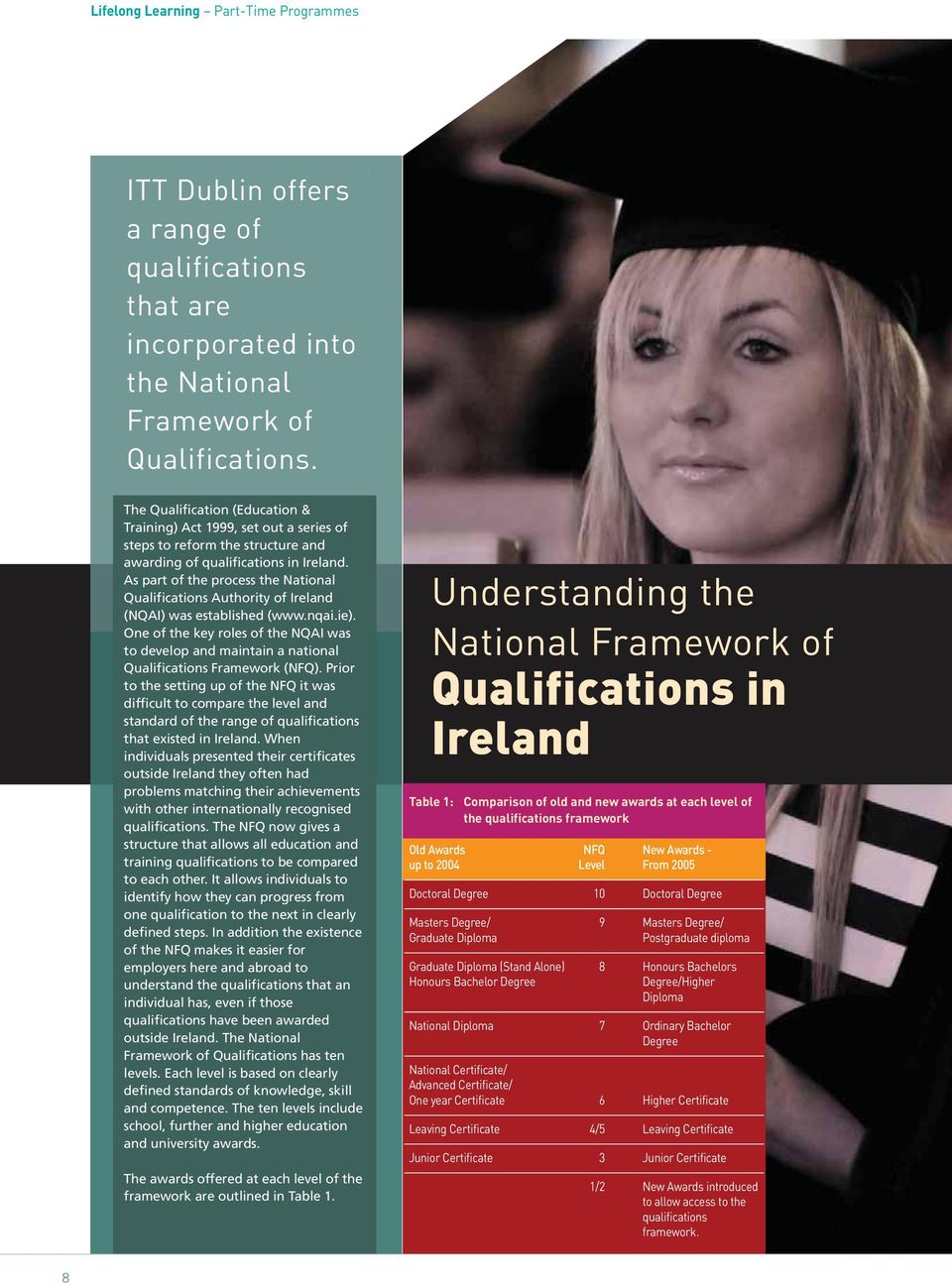
9 Lifelong Learning Part-Time Programmes ITT Dublin offers a range of qualifications that are incorporated into the National Framework of Qualifications. The Qualification (Education & Training) Act 1999, set out a series of steps to reform the structure and awarding of qualifications in Ireland. As part of the process the National Qualifications Authority of Ireland (NQAI) was established ( One of the key roles of the NQAI was to develop and maintain a national Qualifications Framework (NFQ). Prior to the setting up of the NFQ it was difficult to compare the level and standard of the range of qualifications that existed in Ireland. When individuals presented their certificates outside Ireland they often had problems matching their achievements with other internationally recognised qualifications. The NFQ now gives a structure that allows all education and training qualifications to be compared to each other. It allows individuals to identify how they can progress from one qualification to the next in clearly defined steps. In addition the existence of the NFQ makes it easier for employers here and abroad to understand the qualifications that an individual has, even if those qualifications have been awarded outside Ireland. The National Framework of Qualifications has ten levels. Each level is based on clearly defined standards of knowledge, skill and competence. The ten levels include school, further and higher education and university awards. The awards offered at each level of the framework are outlined in Table 1. Understanding the National Framework of Qualifications in Ireland Table 1: Comparison of old and new awards at each level of the qualifications framework Old Awards NFQ New Awards - up to 2004 Level From 2005 Doctoral Degree 10 Doctoral Degree Masters Degree/ 9 Masters Degree/ Graduate Diploma Postgraduate diploma Graduate Diploma (Stand Alone) 8 Honours Bachelors Honours Bachelor Degree Degree/Higher Diploma National Diploma 7 Ordinary Bachelor Degree National Certificate/ Advanced Certificate/ One year Certificate 6 Higher Certificate Leaving Certificate 4/5 Leaving Certificate Junior Certificate 3 Junior Certificate 1/2 New Awards introduced to allow access to the qualifications framework. 8
10 Introduction Qualifications at ITT Dublin UNDERSTANDING MAJOR, MINOR, SUPPLEMENTAL & SPECIAL PURPOSE AWARDS Dublin offers a range of qualifications that are incorporated into ITTthe National Framework of Qualifications. The National Framework of Qualifications is designed to recognise both large and small parcels of learning. Consequently the framework incorporates five types of awards. Major Awards These are the main kind of award made at each level for example the Higher Certificate is the major award at Level 6; the Honours Bachelor Degree and the Higher Diploma are the major awards at Level 8. ITT Dublin offer a range Higher Certificate and Degree programmes in Business, Science, Computing and Engineering. Some people would like to return to education and work towards an accredited award, but their work, home and family commitments mean they are unable to commit to a course that might take two years or more. However they could manage part-time study if they could commit for a shorter time. Similarly, employers often need tailored training for their staff. For them, small, discrete amounts of training individually tailored to their needs would be very useful. The new minor, supplemental and special purpose awards that have been introduced as part of the National Framework of Qualifications offer a perfect opportunity for individuals to complete an accredited smaller parcel of learning that allows progression to other accredited awards. Minor Awards These awards recognise the successful completion of a smaller amount of learning which is a part of a major award but which has relevance in its own right for example, the Certificate in Good Manufacturing Practice & Technology (Minor Award) available at ITT Dublin. Minor awards are accredited qualifications. ITT Dublin has delegated authority from HETAC to confer its own awards for all taught programmes to Masters Degree level. Special Purpose Awards These awards recognise learning for more specific, relatively narrow, purposes for example, Certificate in Fundamentals of Software Development (Special Purpose Award) that ITT Dublin has developed. Special Purpose Award are accredited qualifications. Supplemental Awards These awards recognise learning which is additional to a previous award. The award could, for example, accredit the learning that takes place when an individual updates and refreshes existing knowledge or skills, or completes a continuing professional development programme. Supplemental awards are accredited qualifications. Individual Module Accreditation Students can opt to complete individual modules and accumulate credits toward a minor or major award. (This is possible through the Accumulation of Credits and Certification of Subjects (ACCS) Scheme). Subjects successfully completed are certified individually. Supplemented awards are accredited qualifications. How NFQ Qualifications are Awarded The Qualification (Education & Training) Act 1999, also legislated for two new councils to be set up to make the awards of the new National Framework of Qualifications. The Further Education and Training Council (FETAC) makes awards up to Level 6 of the framework. The Higher Education and Training Council (HETAC) is the new awarding body for all third level institutions except the universities. HETAC is the successor to the National Council for Educational Awards (NCEA). HETAC makes awards from Level HETAC has the power to delegate authority to make awards to recognised institutions. Recognised institutions with delegated authority can make awards in their own name. 9

11 Lifelong Learning Part-Time Programmes Course Listing PROGRAMME TITLE NAMED AWARD NFQ PG Certificate in Prepartatory Study for Third Level Special Purpose Award Level 6 6 DEPARTMENT OF ACCOUNTANCY Higher Certificate in Business in Accounting Higher Certificate in Business Level 6 13 Bachelor of Business in Accounting Bachelor of Business Level 7 15 Honours Bachelor of Business in Accounting Bachelor of Business (Honours) Level 8 17 PROFESSIONAL STUDIES COURSES Accounting Technician ATI Professional Institute 24 Certificate in Personnel Practice (CIPD) CIPD Professional Institute 27 Certificate in Production & Inventory Management (IPICS) IPICS Professional Institute 29 DEPARTMENT OF MANAGEMENT Bachelor of Business in Management Bachelor of Business Level 7 32 Honours Bachelor of Business in Management Bachelor of Business (Honours) Level 8 35 Bachelor of Arts in Technology Management Bachelor of Arts Level 7 38 Honours Bachelor of Science in Technology Management Bachelor of Science (Honours) Level 8 39 DEPARTMENT OF MARKETING Higher Diploma in Business in Marketing Management Higher Diploma in Business Level 8 43 DEPARTMENT OF HUMANITIES English as a Foreign Language Single Module Certification (5 credits) 46 Bachelor of Arts in Culinary Arts Bachelor of Arts Level 7 51 Total Immersion Chef Programme (TICP) National Certificate in Professional Level 6 Cookery (FETAC) 54 DEPARTMENT OF SCIENCE Higher Certificate in Science in Good Manufacturing Higher Certificate in Science Level 6 Practice & Technology 59 Higher Certificate in Bio & Pharmaceutical Analysis Higher Certificate in Science Level 6 60 Bachelor of Science in Pharmaceutical Technology Bachelor of Science Level 7 61 Higher Diploma in Science in Pharmaceutical Production Higher Diploma in Science Level 8 62 Master of Science in Pharmaceutical Production Master of Science Level 9 63 Master of Science in Pharmaceutical Science Master of Science Level 9 65 Higher Certificate in Science in Sterile Services Technology Higher Certificate in Science Level 6 67 Bachelor of Science in Sterile Services Management Bachelor of Science Level 7 68 Certificate in Good Manufacturing Practice & Technology Minor Award Level 6 70 Certificate in Good Manufacturing Practice & Regulatory Affairs Minor Award Level

12 Introduction PROGRAMME TITLE NAMED AWARD NFQ PG DEPARTMENT OF COMPUTING Bachelor of Science in Information Technology Management Bachelor of Science Level 7 74 Honours Bachelor of Science in Information Technology Management Bachelor of Science Level 8 77 Master of Science in Information Technology Management Master of Science Level 9 78 Master of Science in Distributed & Mobile Computing Master of Science Level 9 79 Certificate in Fundamentals of Software Development Minor Award Level 6 82 Certificate in Web Design, Development & Maintenance Minor Award Level 6 83 CISCO Certified Network Associate Programme CISCO Professional Institute 84 DEPARTMENT OF ELECTRONIC ENGINEERING Higher Certificate in Engineering in Electronic Engineering Higher Certificate in Engineering Level 6 86 Bachelor of Engineering in Electronic Engineering Bachelor of Engineering Level 7 89 Honours Bachelor of Engineering in Electronic Engineering Bachelor of Engineering (Honours) Level 8 94 Master of Engineering in Electronic Design Engineering Master of Engineering Level 9 97 Structured Analogue Design Single Module Certification (5 credits) 99 DEPARTMENT OF MECHANICAL ENGINEERING Bachelor of Engineering in Mechanical Engineering (FESCAP) Bachelor or Engineering Level Bachelor of Engineering in Mechanical Engineering Bachelor of Engineering Level Honours Bachelor of Engineering in Mechanical Engineering Bachelor of Engineering (Honours) Level Diploma in Quality Management Part 1 Excellence Ireland Quality Association Professional Institute 108 Diploma in Quality Management Part 2 Excellence Ireland Quality Association Professional Institute 109 Bachelor of Engineering in Energy & Environmental Engineering Bachelor or Engineering Level SYNERGY CENTRE Enterprise Launch Programme 117 Enterprise platform Programme

13 Lifelong Learning Part-Time Programmes Department of Accountancy & Professional Studies For employers, the challenge is to find well qualified people who can help them overcome the tough times and come out the other side a stronger organisation. For my department, the challenge is to equip students with the skills employers are looking for. Our programmes have always been strongly attuned to the needs of industry but now more than ever they are focused on the workplace to create added value for potential employers. bring out the very best in students. It is no coincidence, I think, that in recent years two students on our Diploma in Financial Management (Dip FM) programme took first place globally in their exams. Such achievements by our students are great to see but just as pleasing to us is the role we play in helping to get people back into the workforce through the Certificate in Preparatory Study for Third Level. This HEA-funded programme incorporates several accountancy modules as well as Helping you stand out from the crowd The labour market has changed dramatically in recent years, for accountants as much as anyone else. As jobs have been lost and more people chase fewer accountancy positions, it has become highly competitive. We set ourselves very high standards right across the programmes we run and try to bring out the very best in students Despite the doom-and-gloom out there, there are still openings for those with good experience and the right qualifications. Although Irish banks are experiencing major challenges, international banks and financial services firms as a whole are actively recruiting for specialist back-officetype services, of which Ireland is a key provider. There has also been a flow of accountants into senior positions within the new financial services regulatory apparatus, creating opportunities for progression and movement among ambitious and well qualified accountants to fill the vacancies. We set ourselves very high standards right across the programmes we run and try to input from other disciplines at ITT Dublin. It acts as a stepping stone for the unemployed to get back into education and gain a marketable qualification so that when the upturn does arrive, they will be in a position to apply for the new jobs that will inevitably become available. The same applies to our accountancy students: while demand for accountants has levelled off in recent years, the upturn, when it comes, should see a significant increase in demand across the board. As history has shown again and again, in the long run accountancy is always a good career choice. Martin Nolan, BComm, MA, FCA, AITI Head of Department, Accountancy & Professional Studies 12

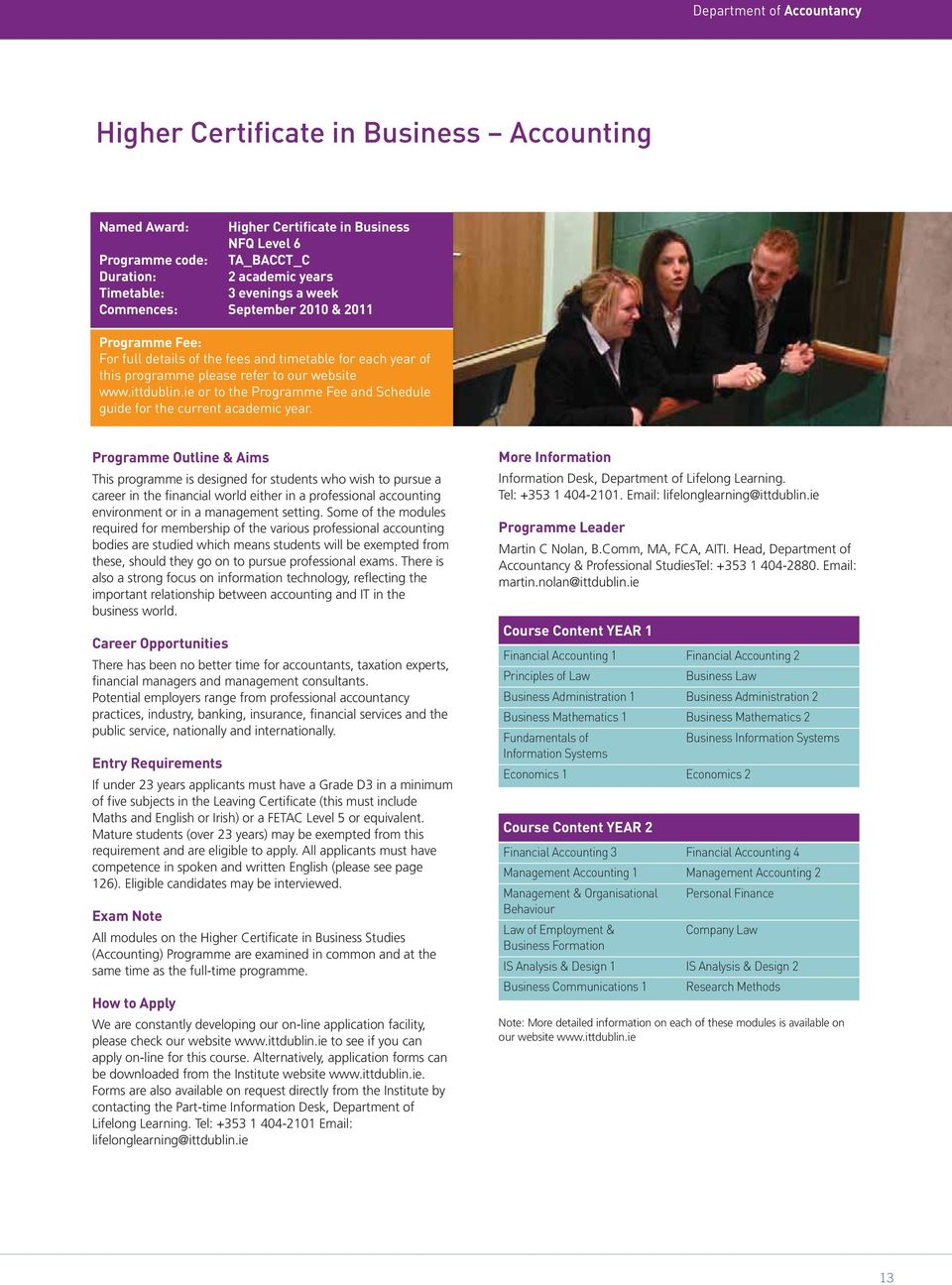
14 Department of Accountancy Higher Certificate in Business Accounting Named Award: Higher Certificate in Business NFQ Level 6 Programme code: TA_BACCT_C Duration: 2 academic years Timetable: 3 evenings a week Commences: September 2010 & 2011 Programme Fee: For full details of the fees and timetable for each year of this programme please refer to our website or to the Programme Fee and Schedule guide for the current academic year. Programme Outline & Aims This programme is designed for students who wish to pursue a career in the financial world either in a professional accounting environment or in a management setting. Some of the modules required for membership of the various professional accounting bodies are studied which means students will be exempted from these, should they go on to pursue professional exams. There is also a strong focus on information technology, reflecting the important relationship between accounting and IT in the business world. Career Opportunities There has been no better time for accountants, taxation experts, financial managers and management consultants. Potential employers range from professional accountancy practices, industry, banking, insurance, financial services and the public service, nationally and internationally. Entry Requirements If under 23 years applicants must have a Grade D3 in a minimum of five subjects in the Leaving Certificate (this must include Maths and English or Irish) or a FETAC Level 5 or equivalent. Mature students (over 23 years) may be exempted from this requirement and are eligible to apply. All applicants must have competence in spoken and written English (please see page 126). Eligible candidates may be interviewed. Exam Note All modules on the Higher Certificate in Business Studies (Accounting) Programme are examined in common and at the same time as the full-time programme. How to Apply We are constantly developing our on-line application facility, please check our website to see if you can apply on-line for this course. Alternatively, application forms can be downloaded from the Institute website Forms are also available on request directly from the Institute by contacting the Part-time Information Desk, Department of Lifelong Learning. Tel: [email protected] More Information Information Desk, Department of Lifelong Learning. Tel: [email protected] Programme Leader Martin C Nolan, B.Comm, MA, FCA, AITI. Head, Department of Accountancy & Professional StudiesTel: [email protected] Course Content YEAR 1 Financial Accounting 1 Financial Accounting 2 Principles of Law Business Law Business Administration 1 Business Administration 2 Business Mathematics 1 Business Mathematics 2 Fundamentals of Business Information Systems Information Systems Economics 1 Economics 2 Course Content YEAR 2 Financial Accounting 3 Financial Accounting 4 Management Accounting 1 Management Accounting 2 Management & Organisational Personal Finance Behaviour Law of Employment & Company Law Business Formation IS Analysis & Design 1 IS Analysis & Design 2 Business Communications 1 Research Methods Note: More detailed information on each of these modules is available on our website 13
15 Lifelong Learning Part-Time Programmes Student View I m in my second and final year of the Higher Certificate in Business Accounting. The course is quite broad. Last year it covered a broad range of subjects such as information systems, financial accounting, economics, law and business. This year we re also doing management & organisational behaviour, information systems analysis & design and personal finance alongside the core subjects of financial and management accounting. I decided to enrol on it because I d done accountancy in the Leaving Certificate in 2006 and I felt it would be sort of building on that. ITT Dublin was right for me for a number of reasons. It s just down the road from where I m living and I can get a bus right there. It s also less expensive than some other colleges. As well as that, one of my friends who had done the course told me that the lecturers were friendly and very approachable it was easy to ask them questions. The lectures are on three nights a week. Moodle, the Institute s learning website, is also useful. You can find lecture notes on there. It makes it easier to study at home. After I get my certificate, I might go on and do the degree (Bachelor of Business) in accounting but I haven t made up my mind yet. Ultimately, I d like to work as an accountant in business or be a consultant. I would certainly recommend this course, especially if you ve done accounting before. If not, it could be more challenging but still worthwhile. Ultimately, I d like to work as an accountant in business or be a consultant Name: Akhila Chawla Programme: Higher Certificate in Business Accounting 14

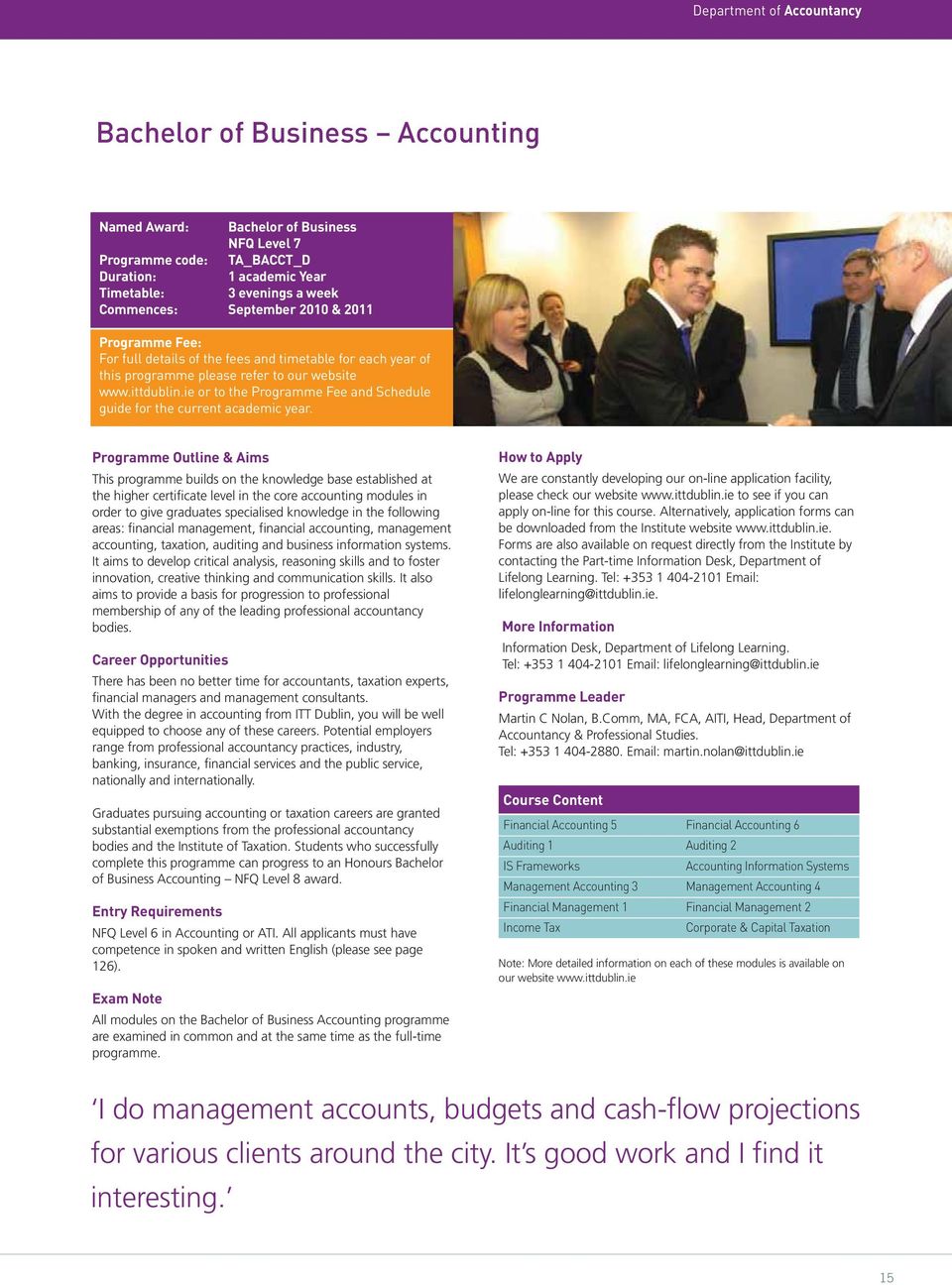
16 Department of Accountancy Bachelor of Business Accounting Named Award: Bachelor of Business NFQ Level 7 Programme code: TA_BACCT_D Duration: 1 academic Year Timetable: 3 evenings a week Commences: September 2010 & 2011 Programme Fee: For full details of the fees and timetable for each year of this programme please refer to our website or to the Programme Fee and Schedule guide for the current academic year. Programme Outline & Aims This programme builds on the knowledge base established at the higher certificate level in the core accounting modules in order to give graduates specialised knowledge in the following areas: financial management, financial accounting, management accounting, taxation, auditing and business information systems. It aims to develop critical analysis, reasoning skills and to foster innovation, creative thinking and communication skills. It also aims to provide a basis for progression to professional membership of any of the leading professional accountancy bodies. Career Opportunities There has been no better time for accountants, taxation experts, financial managers and management consultants. With the degree in accounting from ITT Dublin, you will be well equipped to choose any of these careers. Potential employers range from professional accountancy practices, industry, banking, insurance, financial services and the public service, nationally and internationally. Graduates pursuing accounting or taxation careers are granted substantial exemptions from the professional accountancy bodies and the Institute of Taxation. Students who successfully complete this programme can progress to an Honours Bachelor of Business Accounting NFQ Level 8 award. Entry Requirements NFQ Level 6 in Accounting or ATI. All applicants must have competence in spoken and written English (please see page 126). Exam Note All modules on the Bachelor of Business Accounting programme are examined in common and at the same time as the full-time programme. How to Apply We are constantly developing our on-line application facility, please check our website to see if you can apply on-line for this course. Alternatively, application forms can be downloaded from the Institute website Forms are also available on request directly from the Institute by contacting the Part-time Information Desk, Department of Lifelong Learning. Tel: [email protected]. More Information Information Desk, Department of Lifelong Learning. Tel: [email protected] Programme Leader Martin C Nolan, B.Comm, MA, FCA, AITI, Head, Department of Accountancy & Professional Studies. Tel: [email protected] Course Content Financial Accounting 5 Financial Accounting 6 Auditing 1 Auditing 2 IS Frameworks Accounting Information Systems Management Accounting 3 Management Accounting 4 Financial Management 1 Financial Management 2 Income Tax Corporate & Capital Taxation Note: More detailed information on each of these modules is available on our website I do management accounts, budgets and cash-flow projections for various clients around the city. It s good work and I find it interesting. 15
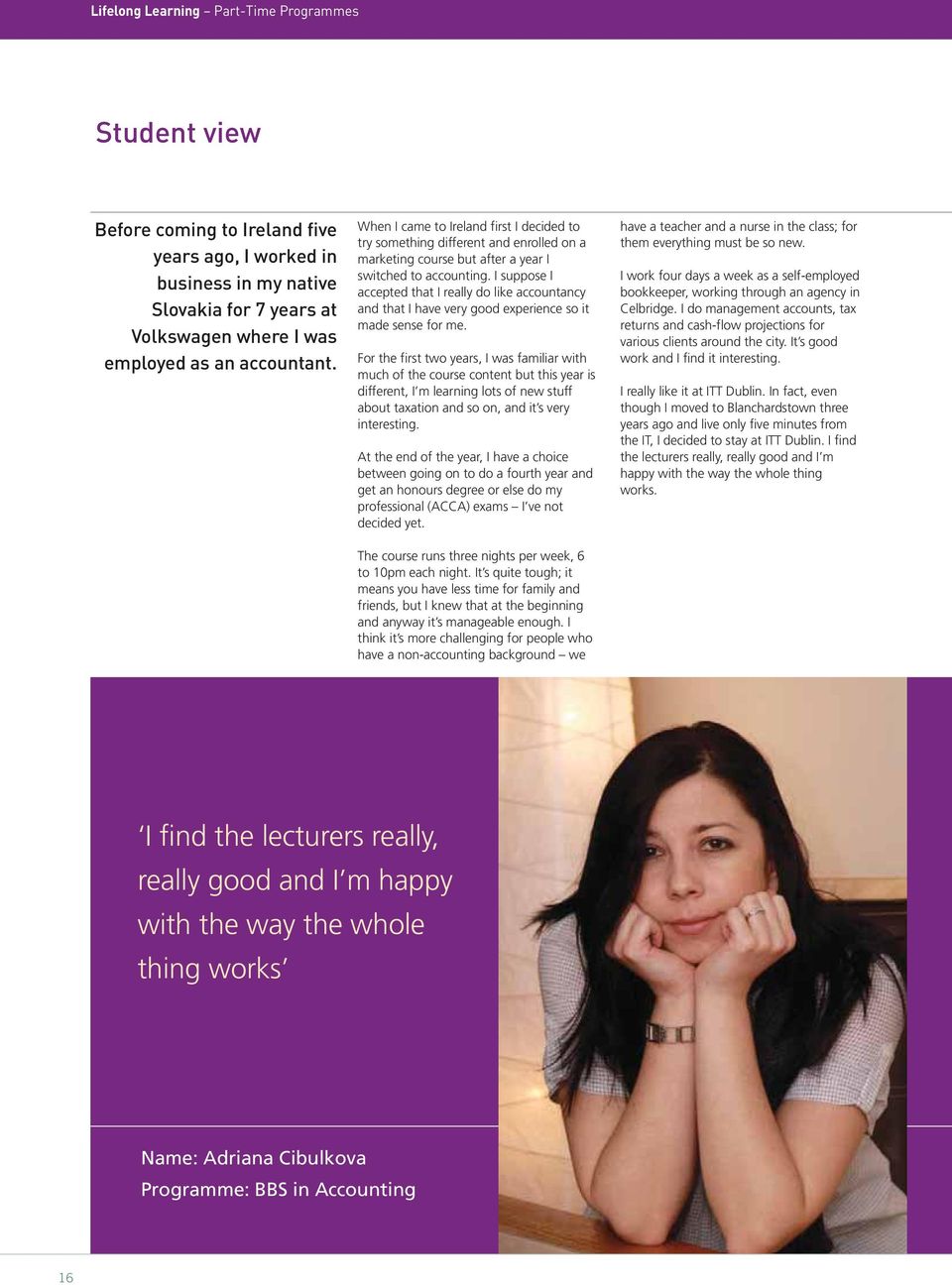
17 Lifelong Learning Part-Time Programmes Student view Before coming to Ireland five years ago, I worked in business in my native Slovakia for 7 years at Volkswagen where I was employed as an accountant. When I came to Ireland first I decided to try something different and enrolled on a marketing course but after a year I switched to accounting. I suppose I accepted that I really do like accountancy and that I have very good experience so it made sense for me. For the first two years, I was familiar with much of the course content but this year is different, I m learning lots of new stuff about taxation and so on, and it s very interesting. At the end of the year, I have a choice between going on to do a fourth year and get an honours degree or else do my professional (ACCA) exams I ve not decided yet. The course runs three nights per week, 6 to 10pm each night. It s quite tough; it means you have less time for family and friends, but I knew that at the beginning and anyway it s manageable enough. I think it s more challenging for people who have a non-accounting background we have a teacher and a nurse in the class; for them everything must be so new. I work four days a week as a self-employed bookkeeper, working through an agency in Celbridge. I do management accounts, tax returns and cash-flow projections for various clients around the city. It s good work and I find it interesting. I really like it at ITT Dublin. In fact, even though I moved to Blanchardstown three years ago and live only five minutes from the IT, I decided to stay at ITT Dublin. I find the lecturers really, really good and I m happy with the way the whole thing works. I find the lecturers really, really good and I m happy with the way the whole thing works Name: Adriana Cibulkova Programme: BBS in Accounting 16
18 Department of Accountancy Honours Bachelor of Business Accounting Named Award: Bachelor of Business (Honours) NFQ Level 8 Programme code: TA_BACCT_B Duration: 1 academic year Timetable: 3 evenings a week Commences: September 2010 & 2011 Programme Fee: For full details of the fees and timetable for each year of this programme please refer to our website or to the Programme Fee and Schedule guide for the current academic year. Programme Outline & Aims This programme will equip its graduates with the conceptual skills necessary for an executive career in business, the public service, not-for-profit organisations or to establish his/her own business. In particular, the graduate will have a strategic view of the finance function in a dynamic environment; understand the regulatory environment within which the professional accountant operates; have the ability to apply strategic information systems; and have specialised knowledge in financial accounting and audit practice, business policy, tax planning and corporate finance. Career Opportunities With the honours degree in accounting from ITT Dublin, you will be well equipped to choose a number of careers. Potential employers range from professional accountancy practices, industry, banking, insurance, financial services and the public service, nationally and internationally. Professional Body Exemptions Graduates pursuing accounting or taxation careers are granted substantial exemptions from the examinations of the following professional bodies: Institute of Chartered Accountants in Ireland (ICAI) Association of Chartered Certified Accountants (ACCA) Institute of Certified Public Accountants in Ireland (CPA) Chartered Institute of Management Accountants (CIMA) Institute of Incorporated Public Accountants (IIPA) Institute of Chartered Secretaries & Administrators (ICSA) Irish Taxation Institute (ITI) Exemptions from professional examinations in accountancy depend upon the individual accountancy body and students will need to take advice from the course Coordinator. Graduates of this course are also qualified to apply for teaching at second level. Entry Requirements NFQ Level 7 in Accounting or equivalent qualification. All applicants must have competence in spoken and written English (please see page 126). Exam Note All modules on the Honours Bachelor of Business Accounting Programme are examined in common and at the same time as the fulltime programme. Course Content Advanced Financial Accounting Advanced Financial Accounting & & Audit Practice 1 Audit Practice 2 Strategic Management 1 Strategic Management 2 Corporate Finance 1 Corporate Finance 2 Business Communications 2 Managing Information Systems Advanced Taxation Tax Planning HRM Industrial Relations* Professional Services Marketing* Innovation* Enterprise Development* * Electives choose one set Note: More detailed information on each of these modules is available on our website How to Apply We are constantly developing our on-line application facility, please check our website to see if you can apply on-line for this course. Alternatively, application forms can be downloaded from the Institute website Forms are also available on request directly from the Institute by contacting the Part-time Information Desk, Department of Lifelong Learning. Tel: [email protected]. More Information Information Desk, Department of Lifelong Learning. Tel: [email protected] Programme Leader Martin C Nolan, B.Comm, MA, FCA, AITI, Head, Department Accountancy & Professional Studies. Tel: [email protected]. 17

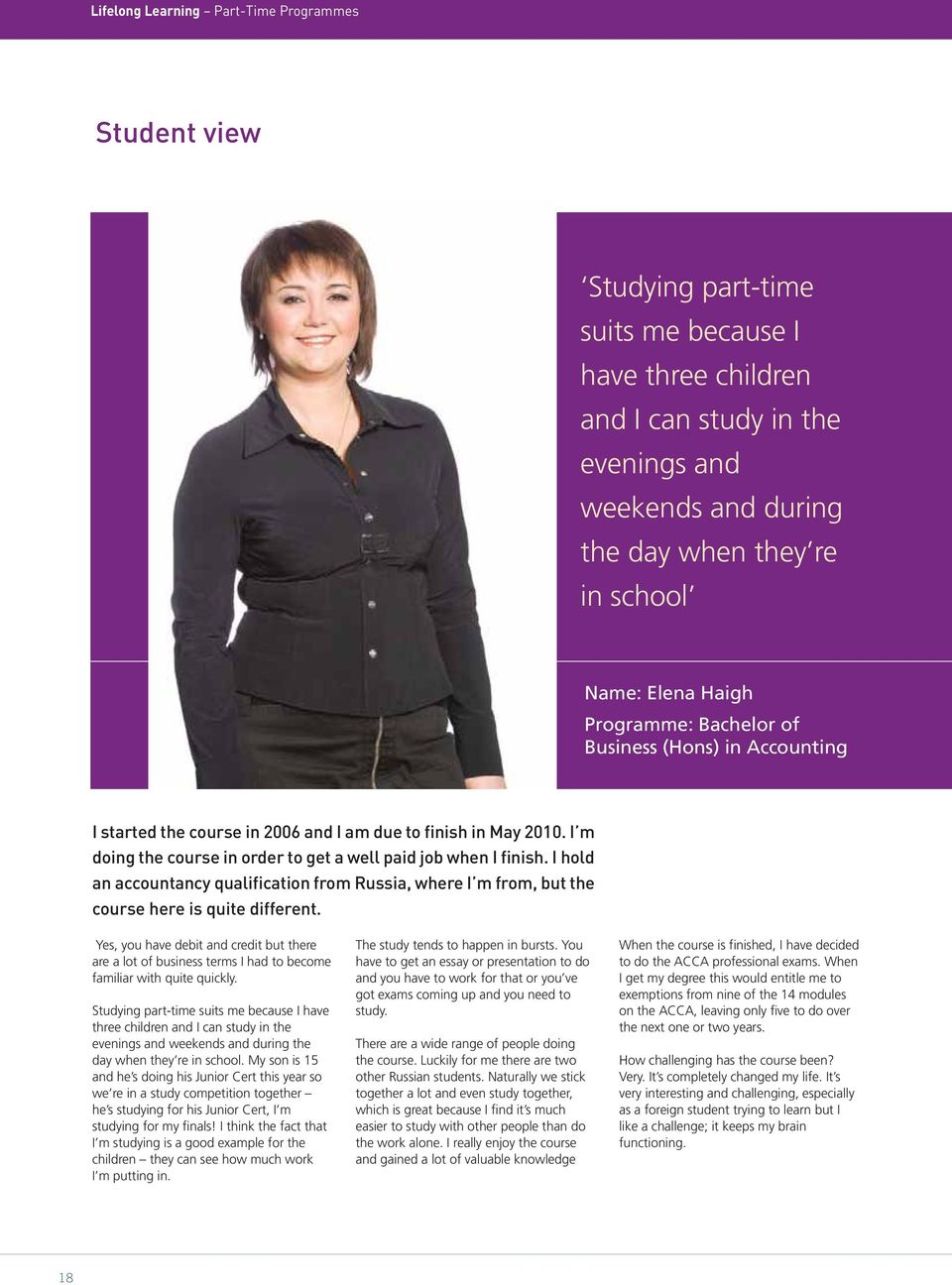
19 Lifelong Learning Part-Time Programmes Student view Studying part-time suits me because I have three children and I can study in the evenings and weekends and during the day when they re in school Name: Elena Haigh Programme: Bachelor of Business (Hons) in Accounting I started the course in 2006 and I am due to finish in May I m doing the course in order to get a well paid job when I finish. I hold an accountancy qualification from Russia, where I m from, but the course here is quite different. Yes, you have debit and credit but there are a lot of business terms I had to become familiar with quite quickly. Studying part-time suits me because I have three children and I can study in the evenings and weekends and during the day when they re in school. My son is 15 and he s doing his Junior Cert this year so we re in a study competition together he s studying for his Junior Cert, I m studying for my finals! I think the fact that I m studying is a good example for the children they can see how much work I m putting in. The study tends to happen in bursts. You have to get an essay or presentation to do and you have to work for that or you ve got exams coming up and you need to study. There are a wide range of people doing the course. Luckily for me there are two other Russian students. Naturally we stick together a lot and even study together, which is great because I find it s much easier to study with other people than do the work alone. I really enjoy the course and gained a lot of valuable knowledge When the course is finished, I have decided to do the ACCA professional exams. When I get my degree this would entitle me to exemptions from nine of the 14 modules on the ACCA, leaving only five to do over the next one or two years. How challenging has the course been? Very. It s completely changed my life. It s very interesting and challenging, especially as a foreign student trying to learn but I like a challenge; it keeps my brain functioning. 18
20 Department of Accountancy This course not running Up skill for the future of financial services Honours Bachelor Degree in Business - Financial Services & Investment Analysis The financial services market has had its difficulties recently but it will pick up and when it does, you can be in a position to take full advantage. How? By enrolling on our part-time degree in Financial Services & Investment Analysis which started in September With the recent happenings in the financial services industry, there is a much greater need for graduates who have a thorough understanding of the challenges and complexities of this industry. Employers are no longer satisfied with general business qualifications but are seeking high quality graduates with industry specific knowledge Pasqueline Tierney, Programme Leader Skills gap A number of reports have identified major skills gaps in the financial services industry and the need to attract people into the sector who have the right qualifications as well as re-skill those already in the industry to move into new roles. Our new part-time honours degree aims to plug this gap by providing a comprehensive and market relevant qualification that will appeal to a wide range of employers. Career opportunities Graduates from this programme can choose from a diverse range of careers including: Corporate treasury Governance & compliance Currency trading Credit risk management Custodial services Fund accounting Investor research Hedge funds management Pension fund management Life insurance Client wealth management Exemptions Graduates of this programme may gain exemptions from the Institute of Bankers of Ireland examinations and professional accounting bodies examinations. Who should apply? Experienced financial services professionals who wish to gain a formal qualification Current or former financial services employees who wish to re-skill in order to move into growth sectors of the market Commercially savvy employees from other industries who wish to move into financial services This programme will appeal to those who want an industry specific qualification that will help them progress their career in financial services Martin Nolan, Head, Department of Accountancy & Professional Studies 19

21 Lifelong Learning Part-Time Programmes This course not running Honours Bachelor Degree in Business - Financial Services & Investment Analysis Named Award: Bachelor of Business (Honours) NFQ Level 8 Programme code: TA_BAFIN_B Duration: 4 years Timetable: 3 evenings per week Commences: September 2010 & 2011 Programme Fee: For full details of the fees and timetable for each year of this programme please refer to our website or to the Programme Fee and Schedule guide for the current academic year. Programme Outline & Aims The Financial Services industry is a key sector for the Irish economy and is a very significant employer in Ireland and internationally. This industry is going through a process of change, as was demonstrated recently with the significant market downturn. Now, more than ever, this sector needs well trained individuals that can move quickly into middle and senior management roles. Awards The award on successful completion of the four year programme is an Honours Bachelor Degree in Business - Financial Services and Investment Analysis. Exit awards are also possible at the end of year two Higher Certificate in Business Financial Services and at the end of year three Bachelor of Business Financial Services and Investment Analysis. Career Opportunities Graduates from this course can choose from the very diverse and dynamic range of opportunities available: Corporate Treasury Currency Trading Custodial Services Investor Research Private Banking Life Assurance Governance & Compliance Credit Risk Management Fund Accounting Hedge Fund Management Pension Fund Management Client Wealth Management Mature applicants (23 years of age) may not be required to meet the minimum entry requirements (as set out above) but may be considered on their merits. All applicants must have competence in spoken and written English (please see page 126). Research Opportunities Research opportunities are available at Postgraduate level for Honours Students. Exemptions It may be possible on the successful completion of this program to gain exemptions from the Institute of Bankers of Ireland examinations and from Professional Accounting Bodies examinations. More Information Information Desk, Department of Lifelong Learning. Tel: [email protected] Programme Leader Pasqueline Tierney FCCA, MBS Modules are semesterised and delivered using a combination of industry specialists and lecturers. Exam Note All modules on the programme are examined in common and at the same time as the full-time programme. Entry Requirements If under 23 years applicants must have a Grade D3 in a minimum of five subjects in the Leaving Certificate (this must include Maths and English or Irish) or a FETAC Level 5 or equivalent. Mature students (over 23 years) may be exempted from this requirement and are eligible to apply. All applicants must have competence in spoken and written English (please see page 126). Eligible candidates may be interviewed. 20
22 Department of Accountancy Course Content The following modules must be completed over the course of this programme Course Content YEAR 1 Financial Accounting 1 Financial Accounting 2 Economics 1 Economics 2 Business Maths 1 Business Maths 2 Business Administration 1 Business Administration 2 Fundamentals of I.S. Business Information Systems Principles of Law Business Law Course Content YEAR 2 Financial Accounting 3 Financial Accounting 4 Monetary & International Regulatory Environment & Economics Compliance Research Methods Statistics Introduction to Financial Services Personal Finance I.S. Analysis & Design 1 I.S. Analysis & Design 2 Banking & Insurance Law 1 Banking & Insurance Law 2 Course Content YEAR 3 Financial Reporting & Analysis Fund Accounting Investor Research & Analysis Income Tax E-Business for Financial Services Financial Management Information for Mgt Decision Making Internal Control Institutional Lending Corporate & Capital Taxation S.I.S. for Fin. Services/Financial Modelling Investment Analysis Course Content YEAR 4 Corporate Governance Business Ethics Business Communications Marketing Financial Services Treasury & Risk Management Financial Derivatives Tax Planning & Wealth Tax Planning & Wealth Management 1 Management 2 Strategic Management HRM & Industrial Relations Corporate & International Corporate & International Finance 1 Finance 2 Note: More detailed information on each of these modules is available on our website The Financial Services industry is a key sector for the Irish economy and is a very significant employer in Ireland and internationally. 21
23 Lifelong Learning Part-Time Programmes This course not running Diploma in Financial Management Postgraduate Professional Programme Title of Award: Diploma in Financial Management (DipFM) Programme code: TA_BFNMG_QD Duration: 1 academic year Timetable: 1 evening per week Professional Institute: Association of Chartered Certified Accountants (ACCA) Commences: September 2010 & 2011 Programme Fee: ITT Dublin Fees For full details of the fees and timetable for each year of this programme please refer to our website or to the Programme Fee and Schedule guide for the current academic year. ACCA Fees As this is a professional qualification, fees are also payable to the Association of Chartered Certified Accountants and you must register with the ACCA separately. Further information is available from ACCA, 9 Leeson Park, Dublin 6. Tel: [email protected]. Entry Requirements Applicants must hold a recognised degree, Level 6 award or membership of a professional body. Individuals may also be admitted on the basis of their work experience. Enquiries relating to Entry Requirements should be directed to ACCA Ireland. All applicants must have competence in spoken and written English (please see page 126). How to Apply You must apply to the ACCA separately and make sure to register for the June exam session. You can apply online by logging onto and following the steps to online application as directed. Application forms may also be downloaded from the Institute website Forms are available on request directly from the Institute by contacting the information desk, Department of Lifelong Learning. Tel: [email protected]. More Information Information Desk, Department of Lifelong Learning. Tel: [email protected] Programme Leader Patricia Morris, BBS, DPA, FCA. Programme Outline & Aims This programme is aimed at non-accountants in managerial positions who wish to deepen their understanding of accounting and finance. It will give them the skills and knowledge necessary to confidently participate in financial decision-making, performance evaluation and control issues. Students will learn how to: interpret financial statements and develop an understanding of the framework, methods and principles applied in their preparation measure business performance using financial and nonfinancial indicators understand the role of financial strategy in the investment, finance and resource allocation decisions within an organisation appreciate the theoretical and practical aspects of corporate governance and develop an understanding of the principal theories and frameworks associated with the management of both financial and non-financial risk Career Opportunities Based on ACCA s highly successful Certified Diploma in Accounting and Finance, which has been completed by nearly 10,000 managers worldwide, the Diploma has an established reputation. Many of these managers have taken advantage of the qualification s postgraduate status to gain advanced standing towards MBAs and other masters qualifications. Even if you do not plan further study, the Diploma will give you added confidence in your understanding of financial matters and allow you to participate more effectively in management or commercial discussions. Course Content Interpretation of Financial Statements Performance Management Financial Strategy Risk Management Note: More detailed information on each of these modules is available on our website It will give them the skills and knowledge necessary to confidently participate in financial decision-making, performance evaluation and control issues. 22
24 Department of Accountancy Student view I was born in Liverpool, moved to South Africa when I was young and then came to live in Ireland 10 years ago. I work for Colgate-Palmolive in Citywest within the IT Support Services organisation. I was interested in doing a course that would give me an insight into finance. Everything in the supply chain integrates with finance at some point so it made sense for me to know a bit more about the financial bit. The Dip in FM was recommended to me from a guy at work and another colleague recommended ITT Dublin. It s a good location for me: it s close to where I work so it s easy to get to and there s plenty of parking. I didn t take on the course lightly. I ve got a full-time job and I m a mother as well. So I asked the Institute whether it would be possible to split the diploma over two years instead of doing it in the usual one they agreed. For me, that was the best solution because trying to do it in one year wouldn t have been possible for me. The course began in September 2008 and will finish in June It s gone very well so far. I got the highest marks globally in the ACCA component in my first year so I was delighted with that. You have to be disciplined though. My third child was born in February 2009, four months before my first-year exams. I would study during his morning nap and in the evenings when I could. My other two are in school and pre-school so at least I had a bit of time in the mornings. I d definitely recommend the course. It s a professional qualification and it s internationally recognised. It covers a wide range of financial disciplines including financial accounting and management accounting. It s definitely been good for me to know about these because in the job I do these two subjects often come into play. I d definitely recommend the course. It s a professional qualification and it s internationally recognised Name: Nicola Rautenbach Programme: Diploma in Financial Management (Dip FM) 23
25 Lifelong Learning Part-Time Programmes Accounting Technician Named Award: Accounting Technician Programme code: TA_BACCT_Q Duration: 2 academic years Timetable: 2 evenings a week Professional Institute: Accounting Technicians Ireland Commences: September 2010 & 2011 Programme Fee: ITT Dublin Fees For full details of the fees and timetable for each year of this programme please refer to our website or to the Programme Fee and Schedule guide for the current academic year. ATI Fees As this is a professional qualification, fees are also payable to Accounting Technicians Ireland and you must register with them separately. Further information is available from: Pearse Street, Dublin 2. Tel: [email protected]. Web: Programme Outline & Aims This programme aims to prepare participants for the examinations of Accounting Technicians Ireland: the Foundation Examination in Academic Year 1 and the Admission Examination in Academic Year 2. Members of the ATI may pursue further studies in accounting in the ITT Dublin Accounting Degree Programme (Year 3). Career Opportunities Accounting Technicians Ireland is a fast-growing professional body, with more than 4,600 members and 5,800 students. It provides a recognised business qualification for ambitious people working or planning to work in middle management or in the accounting area. Graduates of the Foundation Level ATI are qualified to work as accounting technicians within the accountancy profession or alternatively can pursue one of the main professional accountancy qualifications with generous exemptions. Graduates of the Admissions Level typically either go on to pursue careers in public practice or industry/commerce or engage in further study, with ITT Dublin s Degree in Accounting being a very popular choice. Entry Requirements Five passes in Leaving Certificate subjects at grade D or better or four passes at grade D at least two of which are on higher level papers. Subjects must include English and Mathematics or Accountancy. ATI consider the applications from a person who is 21 years or older on the basis of his/her age and work experience. Enquires relating to Entry Requirements should be directed to ATI. All applicants must have competence in spoken and written English (please see page 126). How to Apply You can apply online by logging onto and following the steps to online application as directed. Application forms may also be downloaded from the Institute website Forms are available on request directly from the Institute by contacting the information desk, Department of Lifelong Learning. Tel: [email protected]. More Information Information Desk, Department of Lifelong Learning. Tel: [email protected] Programme Leader Patricia Morris, BBS, DPA, FCA. Course Content YEAR 1 - Foundation Examination Modules Taxation 1 Financial Accounting 1 Business Management Law and Ethics Course ContentYEAR 2 - Admission Examination Modules Management Accounting Taxation 2 Integrated Accounting Systems Financial Accounting 2 24
26 Department of Accountancy Student view I m from Italy and living in Ireland six years now. I decided to enrol on the Accounting Technical course at ITT Dublin because though I had done accounting before I never finished my exams and wanted to put that right. I m in my second and final year. It s going well so far. There are about 30 to 35 of us in the class and we all get on well. The modules we cover are Taxation 2, Management Accounting, Financial Accounting 2 and IAS (integrated accounting systems). I work full-time in accounts in a private company and attend lectures two nights a week at ITT Dublin, four hours per night. It s challenging and quite tough but it s the only way to get it done. There are exams in May, which you can repeat in August. Last year, fortunately, I got through my exams first time. After I graduate, I plan to go on and take my professional Certified Public Accounting (CPA) exams. As a qualified Accounting Technician, I will be entitled to some exemptions, which means I ll have fewer subjects to take. As a CPA, I ll be fully qualified as an accountant and be able to work in industry. The Institute is a nice place to study and very convenient too I live in Rathcoole so it s not far at all. Would I recommend this course? It s a great course it s very practical and handson and you ll benefit from the experience. Yes, I d recommend it 100pc. It s a great course it s very practical and hands-on and you ll benefit from the experience Name: Elida Dibiasi Programme: Accounting Technician 25
27 Lifelong Learning Part-Time Programmes This course not running IPAV Certificate in Auctioneering & Estate Agency Title of Award: Certificate in Auctioneering & Estate Agency Programme code: TA_AAEAG_I Duration: 2 academic years Timetable: 2 evenings per week Professional Institute: Institute of Professional Auctioneers and Valuers (IPAV) Commences: September 2010 & 2011 Programme Fee: ITT Dublin Fees For full details of the fees and timetable for each year of this programme please refer to our website or to the Programme Fee and Schedule guide for the current academic year. IPAV Fees As this is a professional qualification, fees are also payable to IPAV and you must register with IPAV separately. Further information is available from IPAV, 129 Lower Baggot Street, Dublin 2. Tel: Web: Programme Outline & Aims This programme, which is accredited by the Institute of Professional Auctioneers and Valuers (IPAV), aims to prepare graduates for the sale by auction, tender or private treaty of all types of property and commodities. Students will learn how to act as valuers, property managers, arbitrators in property disputes, expert witnesses in courts-of-law and provide other property-related services. Career Opportunities The Certificate in Auctioneering & Estate Agency is designed to produce competent, articulate and professional graduates through a rigorous examination and assessment system. This is a challenging two year course designed to prepare students to enter the profession as junior negotiators. Students who obtain the Certificate and subsequently acquire two years experience in an auctioneering practice (or three if they run their own auctioneering practice), approved by IPAV, qualify to apply for full IPAV membership. Application Procedure All applicants must apply to IPAV in the first instance. They will assess each applicant s suitability and eligibility for this programme. Places on this programme will then be offered to eligible candidates only. Eligible candidates will be informed by IPAV regarding fee structure. Places on this programme may be limited. All applicants must have competence in spoken and written English (please see page 126). Once you have confirmation of your eligibility for this programme from IPAV you must then apply to ITT Dublin directly. How to Apply You can apply online by logging onto and following the steps to online application as directed. Application forms may also be downloaded from the Institute website Forms are available on request directly from the Institute by contacting the information desk, Department of Lifelong Learning. Tel: [email protected]. More Information Information Desk, Department of Lifelong Learning. Tel: [email protected] Programme Leader Gerard Phelan, MA, MSc. Course Content YEAR 1 Professional Practice & Communication Building Studies 1 Valuation 1 Economics Marketing & Sales Techniques Regulatory Environment 26
28 Department of Accountancy CIPD Certificate in Personnel Practice Title of Award: Certificate in Personnel Practice Programme code: TA_BPRPR_QC Duration: 1 academic year Timetable: 1 evening per week Professional Institute: Chartered Institute of Personnel & Development Commences: October 2010 & 2011 Programme Fee: ITT Dublin Fees For full details of the fees and timetable for each year of this programme please refer to our website or to the Programme Fee and Schedule guide for the current academic year. CIPD Fees As this is a professional qualification, fees are also payable to the CIPD. Arrangements for registration will be made once you start the course. More information is available from Programme Outline & Aims The Certificate in Personnel Practice is a one-year part-time programme accredited by the Chartered Institute of Personnel and Development (CIPD). The programme aims to give students a high level of practical competence in a range of core personnel and staff development skills. This qualification is intended for: Anyone working at the level of personnel assistant, personnel administrator or personnel officer whose role is to provide support for key aspects of the personnel function, or to someone new to or aspiring to a career in the personnel function Line managers, supervisors or team leaders who wish to improve their understanding of the personnel area Owner-managers of small businesses Topics covered in the programme include: Personnel management Industrial/employee relations framework Recruitment and selection Training and development needs Designing and delivering short training events Induction Career management Performance management Pay and benefits Personnel information systems Discipline Grievance and interpersonal conflict Discrimination and equal opportunities Assessment Assessment is by assignment, practical skills and work-based projects in each module. Career Opportunities Candidates who successfully complete the programme are awarded associate membership of the CIPD. They may also apply for advanced programmes in the Institute in the areas of human resource management or business or general management studies. Entry Requirements There are no formal Entry Requirements but applicants may be invited for interview to discuss their interest in the programme. All applicants must have competence in spoken and written English (please see page 126). How to Apply You can apply online by logging onto and following the steps to online application as directed. Application forms may also be downloaded from the Institute website Forms are available on request directly from the Institute by contacting the information desk, Department of Lifelong Learning. Tel: [email protected] More Information Information Desk, Department of Lifelong Learning. Tel: [email protected] Programme Leader Eric Whitsell BBS (Hons), MSc (Mgmt), Chartered, MCIPD. Tel: [email protected] Course Content Human Resource Plans and Organisational Context Recruitment & Selection Performance Management & Employee Relations Training & Development Getting the exams gave me a great boost because I d been so out of practice; now I ve proved I can pass, my confidence is growing. 27
29 Lifelong Learning Part-Time Programmes This course not running Title of Award: Certificate in Employment Relations, Law & Practice Programme code: TA_CERLP_QC Duration: 1 academic year Timetable: 1 evening per week Professional Institute: Chartered Institute of Personnel & Development Commences: October 2010 & 2011 Programme Fee: ITT Dublin Fees For full details of the fees and timetable for each year of this programme please refer to our website or to the Programme Fee and Schedule guide for the current academic year. CIPD Fees As this is a professional qualification, fees are also payable to the CIPD. Arrangements for registration will be made once you start the course. More information is available from CIPD Certificate in Employment Relations, Law & Practice Assessment Assessment is by assignments, practical skills and work-based projects in each module. How to Apply You can apply online by logging onto and following the steps to online application as directed. Application forms may also be downloaded from the Institute website Forms are available on request directly from the Institute by contacting the information desk, Department of Lifelong Learning. Tel: [email protected]. More Information Information Desk, Department of Lifelong Learning. Tel: [email protected] Programme Leader Eric Whitsell BBS (Hons), MSc (Mgmt), Chartered, MCIPD.Tel: [email protected] Programme Outline & Aims Covers key aspects of the employment law function required by human resources, employee relations assistants, line managers, owner-managers of small business or any individual who is aspiring to a career in HR management or employee relations. The programme comprises two taught modules each semester delivered one evening each week. There is also a requirement to attend a full Saturday skills development workshop each semester. On completing the programme you will have the practical skills and knowledge to: Readily identify the key issues that impact on employment practice Apply the law effectively to your organisation Use legal frameworks to assess your organisation s employment law practices and procedures Prepare and conduct face-to-face interviews including disciplinary, grievance and exit interviews Give practical advice and guidance on employment law issues to line managers Career Opportunities This programme leads to candidates receiving CIPD Certificate in Employment Relations, Law & Practice together with Associate Membership of the Institute. The programme content provides a sound platform for anyone who wishes to achieve best practice in this crucial area of people management. Entry Requirements There are no formal Entry Requirements but applicants may be invited for interview to discuss their interest in the programme. All applicants must have competence in spoken and written English (please see page 126). Course Content Employee Relations Practice in Context Setting up Employment Contracts Managing the Employment Relationship Managing the Exit from Employment 28
30 Department of Accountancy IPICS Certificate in Production & Inventory Management Title of Award: Certificate in Production Inventory Management (CPIM) Programme code: TA_BPIMG_Q Duration: 2 academic years Timetable: 1 evening per week Professional Institute: The Supply Chain Management Institute (IPICS) Commences: September 2010 & 2011 Programme Fee: ITT Dublin Fees For full details of the fees and timetable for each year of this programme please refer to our website or to the Programme Fee and Schedule guide for the current academic year. IPICS Fees As this is a professional qualification, fees are also payable to IPICS and you must register with IPICS separately. Further information is available from IPICS, Unit 2A, Kilnap, Business & Technology Park, Old Mallow Road, Cork City. Tel: [email protected]. Programme Outline & Aims The CPIM is an internationally recognised qualification that has been awarded to 55,000 people worldwide since The programme covers the latest concepts and techniques in the field of supply chain management. It is aimed at those who work, or plan to work, in the areas of materials management, logistics or supply chain management. Career Opportunities The CPIM was launched by US trade association APICS in 1973 to provide a common basis for individuals to assess their knowledge in the evolving field of materials management. Since then, APICS certification has become recognised around the world as a standard of professional competence in supply chain management. This qualification is a must for those working in managerial roles within supply chain/distribution or planning to do so. Entry Requirements Candidates should have a Leaving Certificate with five subjects including English and Mathematics or an equivalent qualification. Mature students may be exempted from this requirement if their career development to date demonstrates the ability and motivation to succeed on the programme. Applicants may be required to undertake an aptitude test and/or attend an interview. All applicants must have competence in spoken and written English (please see page 126). Enquiries relating to Entry Requirements should be directed to IPICS, Unit 2A, Kilnap Business & Technology Park, Old Mallow Road, Cork City, Ireland. Tel: [email protected]. How to Apply You can apply online by logging onto and following the steps to online application as directed. Application forms may also be downloaded from the Institute website Forms are available on request directly from the Institute by contacting the information desk, Department of Lifelong Learning. Tel: [email protected]. More Information Information Desk, Department of Lifelong Learning. Tel: [email protected] Programme Leader Nigel Donnelly BComm, M.EconSc. Course Content YEAR 1 (weeks 1-10) (weeks 11-20) (weeks 21-30) Course Content YEAR 2 (weeks 1-10) (weeks 11-20) Basics of Supply Chain Management Master Planning of Resources Detailed Scheduling & Planning Execution & Control of Operations Strategic Management of Resources 29
31 Lifelong Learning Part-Time Programmes Student View I work in Pfizer (formerly Wyeth) in Newbridge as a buyer/planner. I decided to do the CPIM for two main reasons. Firstly, although I feel I m good at my job, I wanted more confidence and having a qualification would give me that. Secondly, given the economic environment we re in at the moment, having good qualifications has never been more important. Without the CPIM to my name I feel my career will suffer. Everywhere I went, the CPIM qualification was always one that cropped up. A number of people I worked with said it was a great qualification to have. I discovered the course was being run at ITT Dublin and I enrolled on it. The course began last September. It was a bit of a shock to the system at first because I hadn t studied since doing my Leaving Cert in I couldn t figure out how to study. Also, I work full time and have two small kids so it was extremely hectic at first. However I gradually got into it. Going to class one night a week has really helped a lot I can interact with my classmates and ask questions of my lecturer, who is always very supportive and approachable. There are three exams in the first year and two in the second. I ve passed my first exam and am onto my next one now. Getting the exams gave me a great boost because I d been so out of practice; now I ve proved I can pass, my confidence is growing. As well as the three-hour class on Wednesday nights, I would try to study two other nights of the week and on Sundays I go to a friend s house for a couple of hours to study and get away from distractions. It takes a lot of discipline and motivation because you re working full-time and there s a lot of stuff going on. Name: Josephine Nolan Programme: Certificate in Production & Inventory Management Everywhere I went, the CPIM qualification was always one that cropped up. A number of people I worked with said it was a great qualification to have So what I d say to anyone thinking of doing the CPIM is that, yes, it s very good course but you have to be dedicated; you need to really work on it. At the end of the day, you ll get out of it what you put in. 30
32 Department of Management Department of Management Innovative programmes delivering knowledge and expertise Many of our graduates now hold senior positions in industry, while a high percentage have pursued postgraduate studies If running a business is challenging when times are good and markets are expanding, it is perhaps even more so when conditions become hostile and ultracompetitive. It is in times like these that having the skills and know-how to manage a business effectively becomes a vital asset. In recent years, ITT Dublin has built up a strong portfolio of management programmes that develops students management capabilities and in a way that closely matches the needs of industry. The programmes offered by the Department of Management are: Bachelor of Business in Management Bachelor of Business (Honours) in Management Bachelor of Arts in Technology Management Bachelor of Science (Honours) in Technology Management. In addition the department support and manage the delivery of a number of professional body programmes accredited by the Chartered Institute of Personnel & Development (CIPD). While strong on theory, the management programmes are closely related to the real world of work. They are designed to address workplace challenges and give students the business knowledge and expertise to influence their organisations effectively. Many of our graduates now hold senior positions in industry, while a high percentage have pursued postgraduate studies. Classes are small: students like this because it means better communication with lecturers and greater interaction with them. Dr Phil Mulvaney, Head, Department of Management 31
33 Lifelong Learning Part-Time Programmes Bachelor of Business in Management Named Award: Bachelor of Business NFQ Level 7 Programme code: TA_BAMNG_D Duration: 3 academic years Timetable: 3 evenings per week Commences: September 2010 & 2011 Programme Fee: For full details of the fees and timetable for each year of this programme please refer to our website or to the Programme Fee and Schedule guide for the current academic year. Programme Outline & Aims This programme prepares the student for a career in general management. Graduates may choose to pursue more specialised study leading to a professional qualification in accountancy, marketing, production or personnel management. They may also progress to the honours bachelor degree in Management Studies. Graduates will have specialised knowledge in the following areas: management accounting, management & organisational behaviour, law, economics, marketing and information technology. Exam Note All modules on the Bachelor in Business Studies in Management are examined in common and at the same time as the full-time programme. How to Apply We are constantly developing our on-line application facility, please check our website to see if you can apply on-line for this course. Alternatively, application forms can be downloaded from the Institute website Forms are also available on request directly from the Institute by contacting the Part-time Information Desk, Department of Lifelong Learning. Tel: [email protected]. More Information Information Desk, Department of Lifelong Learning. Tel: [email protected] Programme Leader Glenn Mehta, BBS (Hons), MA. Tel: [email protected] The programme (in academic year 3 particularly) aims to develop critical analysis and reasoning. Graduates should also be able to apply knowledge to case studies and business problems, through innovation, creative thinking and new communication skills. The programme provides for an exit award A Higher Certificate in Business Administration for students who complete year 2 but do not continue to year 3. Career Opportunities The Bachelor of Business in Management prepares participants for management positions within public and private sector organisations. The academic and practical skills that are developed in finance, human resource management, law, marketing, information technology, operations management and business strategy can be applied in any organisation and across all industry sectors. Graduates obtain employment in a variety of business sectors, such as healthcare, banking and finance, education and retail. The programme also provides participants with the knowledge and skills to start their own business or to pursue a career in areas such as teaching and management consultancy. Entry Requirements If under 23 years applicants must have a Grade D3 in a minimum of five subjects in the Leaving Certificate (this must include Maths and English or Irish) or a FETAC Level 5 or equivalent. Mature students (over 23 years) may be exempted from this requirement and are eligible to apply. All applicants must have competence in spoken and written English (please see page 126). Eligible candidates may be interviewed. 32
34 Department of Management Course Content YEAR 1 Financial Accounting 1 Financial Accounting 2 Business Environment Business Administration 2 Economics Economics Business Administration 1 Business Mathematics 2 Fundamentals of Business Information Systems Information Systems Business Mathematcis 1 EU Studies Course Content YEAR 2 Management Accounting 1 Management Accounting 2 Marketing Applied Macro Economics Management & Organisational Management & Organisational Behaviour 1 Behaviour 1 IS Analysis & Design 1 IS Analysis & Design 2 Principles of Law Business Law Personal Finance* Research Methods Business Communication* Course Content YEAR 3 Managerial Economics Company & Competition Law Financial Management 1 Financial Management 2 Marketing Management Sales Mgt & Customer Care Management Communications Industrial Relations Framework HRM - Employee Resourcing HRM Development/Reward E-Business Theory & Practice Operations & Quality Mgt * Electives: Choose one elective (Subject electives will run subject to minimum student numbers) Note: More detailed information on each of these modules is available on our website As I near completion of my studies in ITT Dublin, I realise that in addition to earning a much respected qualification, I am leaving with something much more valuable to both my career development and my life in general - an Education. 33
35 Lifelong Learning Part-Time Programmes Student View In 2006, my business partner and I decided to expand our UKbased business into the Irish market. At the time, I wasn t particularly knowledgeable about how business is conducted in Ireland and decided to find somewhere I could do an accredited course in business management. I went along to an open evening at ITT Dublin and was immediately impressed. The atmosphere was friendly and open and the college representatives professional and helpful. Having listened carefully to my needs, they guided me down the right path, and I duly enrolled in the Honours Bachelor of Business in Management programme. The course began in September Having been out of the educational system for 11 years I was extremely apprehensive as to how I would perform. However, I adapted surprisingly easily to my new environment. I feel the approach adopted by the lecturers played a large part in easing my transition into college life. The course consists of a number of modules, which the lecturers deliver in a dynamic, progressive and interesting way. The modules are all rooted in the real business world, which has given me the knowledge I need to expand, build and strengthen my business not only in Ireland but also in the UK. I am on track to finish my honours degree in May It doesn t seem all that long ago since it all began. During my four years at ITT I have grown in confidence and developed skills that have been vital in keeping my business viable through these recessionary times. I have also developed strong friendships with students and lecturers alike friends and memories I will cherish for life. I have also developed strong friendships with students and lecturers alike friends and memories I will cherish for life Name: Edward McDermott Programme: Honours Bachelor of Business in Management 34
36 Department of Management Honours Bachelor of Business in Management Named Award: Bachelor of Business (Honours) NFQ Level 8 Programme code: TA_BMNGT_B Duration: 1 academic year Timetable: 3 evenings per week Commences: September 2010 & 2011 Programme Fee: For full details of the fees and timetable for each year of this programme please refer to our website or to the Programme Fee and Schedule guide for the current academic year. Upon completing this programme, participants will: have a strategic view of modern business operating in a dynamic environment understand the multi-disciplinary approaches to management understand the institutional framework within which business operates have the ability to apply management information systems have specialised knowledge in the following areas: business policy, human resource management, international marketing, employment law, marketing management, innovation and enterprise development, project management, corporate finance, tourism management and management science Career Opportunities Graduates will have the conceptual skills necessary for an executive career in business, the public service, non-profit organisations or to establish their own business. Entry Requirements NFQ Level 7 or equivalent qualification. All applicants must have competence in spoken and written English (please see page 126). Exam Note All modules on the Honours Bachelor in Business Management are examined in common and at the same time as the fulltime programme. How to Apply We are constantly developing our on-line application facility, please check our website to see if you can apply on-line for this course. Alternatively, application forms can be downloaded from the Institute website Forms are also available on request directly from the Institute by contacting the Part-time Information Desk, Department of Lifelong Learning. Tel: [email protected]. More Information Information Desk, Department of Lifelong Learning. Tel: [email protected] Programme Leader Dr. Joe Mac Donagh. Tel: [email protected] Course Content Coporate Social Responsibilty Project Management Startegic Management 1 Strategic Management 2 Employment Law Corporate Finance Industrial Relations Practice Organisational Development & Change Tourism Mgt 1 (Elective) Tourism Mgt 2 (Elective) Innovation Enterprise Development Strategic Human Resources International Business Note: Times and days of classes are indicative only and are subject to change Full details of modules are available on our website Note: More detailed information on each of these modules is available on our website Graduates will have the conceptual skills necessary for an executive career in business, the public service, non-profit organisations or to establish their own business. 35
37 Lifelong Learning Part-Time Programmes Student view I completed my Leaving Certificate in In September of that year I started Computer Science in DIT but unfortunately after a few months I realised it wasn t the course for me. I dropped out and got a full-time office job which I really enjoyed. I knew I didn t want to go to college full-time so I started looking into colleges that provided parttime business courses. Location was important to me: I didn t want to be trekking in and out of town. I had a few friends that studied courses at ITT Dublin and they recommended it, so I attended an open night to find out more information. I was very impressed and decided to do a part-time business management degree as it would enable me to gain a qualification whilst working full time. I started the course in Over the four years there was a comprehensive range of subjects covered including law, management, finance and innovation. The lecturers were understanding and very encouraging. I found the continuous assessment system very helpful as it balanced the workload throughout the year and made for an even spread of study each year. Another advantage of the course is that it isn t solely focused on theory; there is also a big emphasis on teamwork and a hands-on approach to business practices which has been a big benefit to me. After doing my finals last May, I travelled during the summer and then got a job with Tallaght based Helix Health, where I work as executive assistant to the CEO. I see this as an interim step while I decide what I ultimately want to do. In November 2008 I graduated with an Honours Bachelor of Business in Management. During my time as a part-time student I was also involved with the ITT Dublin Badminton Club. I played in the league and also attended badminton tournaments - winning a few medals along the way. I made a lot of lifelong friends on the court and in the classroom. So, needless to say, I would absolutely recommend the Institute s part-time courses to prospective students. There is a big emphasis on teamwork and a hands-on approach to business practices. Name: Leanne Cullen Programme: Honours Bachelor of Business in Management 36
38 Department of Management Student view I completed the BA in Technology Management in May 2009, having just finished the Higher Cert in Science, GMP & Technology. Upon completion I decided to further my education by continuing on to do a degree. I did this course over one year, three nights of lectures a week, which was six exams per semester -it was a big commitment but once you are organised and prepared to put in the work, it is manageable. You can choose to do this course over two or three years also, so it is very flexible. There was a nice group of people from various industries doing the course and interaction between us was pivotal in the way we learned. We set up a Google Group on Gmail which we used to share information, ask questions and so on. It worked out really well. As a place to study, the Institute has a lot going for it. The library is great and there is a nice atmosphere around the place. During the course, I would sometimes catch up with my old classmates from the Higher Cert to see how they were getting on. As I work in Clondalkin, I would head straight to the Institute for lectures on Mondays, Tuesdays and Thursdays. Classes were held from 6pm-10pm. Three nights of lectures a week, which was six exams per semester it was a big commitment but once you are organised and prepared to put in the work, it is manageable Name: Zoe Lawless Programme: BA in Technology Management Would I recommend the BA? Definitely. You do a wide range of subjects including statistics, organisational theory, IT, quality management and process analysis, so it's a good way of sampling a wider range of areas. I also found the course useful for my work. Whilst doing the course and more so since I have finished, I have been able to apply what I have learnt to many aspects of my job as a QC (quality control) specialist in Pfizer. As for the future, I have the option of continuing on to do the BSc Technology Management which will further widen my horizons but for now I am satisfied with applying what I have learnt in the BA in Technology Management to my current role and enhancing any elements I can. 37
39 Lifelong Learning Part-Time Programmes Bachelor of Arts in Technology Management Named Award: Bachelor of Arts NFQ Level 7 Programme code: TA_BTECH_D Duration: 1 academic year Timetable: 3 evenings per week Commences: September 2010 & 2011 Programme Fee: For full details of the fees and timetable for each year of this programme please refer to our website or to the Programme Fee and Schedule guide for the current academic year. Programme Outline & Aims This programme aims to develop and increase management skills in the technology area, promoting a synergy between management, science & technology disciplines. It fosters creativity and decision-making skills by challenging students with a range of analytical problems and case studies. Career Opportunities This programme offers graduates excellent Career Opportunities in the technology management area. Technology management is about innovation putting in place and managing strategies, structures, staffing and systems for the effective development and commercialisation of products and services with their associated production processes and delivery systems. The academic and practical skills that are developed allow participants to take up positions of responsibility in areas such as the management of R&D and innovation, transferring and using technology, marketing and business/technology strategy. Entry Requirements Higher Certificate in Business Studies or Engineering or equivalent suitable qualifications/work experience. All applicants must have competence in spoken and written English (please see page 126). How to Apply We are constantly developing our on-line application facility, please check our website to see if you can apply on-line for this course. Alternatively, application forms can be downloaded from the Institute website Forms are also available on request directly from the Institute by contacting the Part-time Information Desk, Department of Lifelong Learning. Tel: [email protected]. More Information Information Desk, Department of Lifelong Learning. Tel: [email protected] Programme Leader Ethna O Connor. Tel: [email protected] Course Content Organisation Theory Marketing Applied Statistics & Reliability Process Analysis & Mgt Project Management Quality Management Manufacturing Technology Manufacturing Systems & Logisitics Information Technology Business Information Systems Management Accounting 1 Management Accounting 2 Note: More detailed information on each of these modules is available on our website Whilst doing the course and more so since I have finished, I have been able to apply what I have learnt to many aspects of my job as a QC (quality control) specialist in Pfizer. 38
40 Department of Management Honours Bachelor of Science in Technology Management Named Award: Bachelor of Science (Honours) NFQ Level 8 Programme code: TA_BTECH_B Duration: 1 academic year Timetable: 3 evenings per week Commences: September 2010 & 2011 Programme Fee: For full details of the fees and timetable for each year of this programme please refer to our website or to the Programme Fee and Schedule guide for the current academic year. Programme Outline & Aims This programme provides students with the conceptual and practical skills required for the effective management of innovation and technology. It enables students to understand and critically evaluate the theories that underpin technology management and also develops critical thinking and problem solving skills to enable students to shape and implement technology strategies successfully within their organisations. Career Opportunities The programme prepares students for careers in middle management and technology management in public and private organisations. With technology playing an increasingly pivotal role in the modern organisation, staff who have undergone specialist training in technology management will continue to be seen as a valuable asset within private and public sector organisations. Entry Requirements Bachelor Degree in Technology Management (with Distinction or merit) or an equivalent level qualification in Business/Engineering/Science/Computing. All applicants must have competence in spoken and written English (please see page 126). More Information Information Desk, Department of Lifelong Learning. Tel: [email protected] Programme Leader Dara Mac Carthy Tel: [email protected] Course Content Problem Solving Techniques Business Strategy Project Management Methodology Technology Management & Policy Innovation Information & Technology Planning Strategic Marketing Technology Assessment Technology Strategy Dissertation Change Management ecommerce Business Systems Note: More detailed information on each of these modules is available on our website How to Apply We are constantly developing our on-line application facility, please check our website to see if you can apply on-line for this course. Alternatively, application forms can be downloaded from the Institute website Forms are also available on request directly from the Institute by contacting the Part-time Information Desk, Department of Lifelong Learning. Tel: [email protected]. The project management module has helped in my international co-ordination role, while the technology assessment module has been good for evaluating new technology and equipment. 39
41 Lifelong Learning Part-Time Programmes Student view I got a degree in Electronic Engineering from ITT Dublin in 2002 but I always wanted to do something in the business line. I actually want to do an MBA at some stage but it s a big commitment so I feel the BSc in Technology Management is a nice intermediate step to give me a bit of background in business and management before I take on the MBA. The course should improve my career prospects as it has equipped me with skills needed to take on a broader role in my organisation. The BSc can actually be done in one year but I decided to defer the dissertation until this year. That s one of the advantages of the course to my mind: it s very flexible, you can pick and choose when you want to do the modules. The course covers a wide range of subjects including innovation, technology management, technology strategy, project management, IT management, change management and problem-solving techniques. Innovation was probably my favourite because it involved a different style of lecturing, which brought it alive and made it interesting. I liked change management and technology strategy too, which helped give me a longer-term view of business planning and the like. I work in Citywest for a company called FAAC Electronics, a world class electronics manufacturer. I m in new-product introduction and I liaise with a lot of different departments internationally to coordinate the rapid introduction of new products. I feel the course has definitely helped in my job. The project management module has helped in my international co-ordination role, while the technology assessment module has been good for evaluating new technology and equipment. In addition, when I m dealing with different parts of the company and senior management, I now have a lot of the vocab needed to communicate effectively. The course is pretty demanding in terms of time. You do three evenings a week, four hours each evening, so it s tough going. At the same time it s a very enjoyable, interesting course. I like the way the classes are run, too. The lecturing style is interactive, with plenty of group discussions and the like, which means you can learn a lot from your classmates as well as the lecturer. The lecturing style is interactive, with plenty of group discussions and the like, which means you can learn a lot from your classmates as well as the lecturer Name: David Fletcher Programme: BSc in Technology Management 40
42 Department of Management Open Evenings at ITT Dublin At the Institute of Technology Tallaght we don t just deliver courses, we support you through them. You may want to develop your career prospects You may want to gain additional professional qualifications You may be considering returning to education after a long period You may be thinking about coming to ITT Dublin as a full time students This is your opportunity to discuss your course options and view our facilities. Check for the date of the next open evening. 41
43 Lifelong Learning Part-Time Programmes Department of Marketing Broaden your horizons with a solid marketing qualification Students come from a variety of professional, academic and even cultural backgrounds, which makes for a stimulating and interesting class Education is about opportunity. The opportunity to upskill, gain more knowledge or move into an entirely new career. Our Higher Diploma in Business (Marketing Management) gives students the opportunity to achieve one or all of these goals. The programme is aimed at those who want to get into marketing or who are already in marketing but don t have the qualifications. It s a Level-8 course, the equivalent of an honours degree. As this is a conversion course, students come from a variety of professional, academic and even cultural backgrounds, which makes for a stimulating and interesting class. Some would have business qualifications and want to beef up their marketing knowledge, while others might have done other degrees and want to gain a business qualification that will open the door to a marketing career. The Higher Diploma is run over three semesters, with students taking four subjects per semester marketing environment, marketing, buyer behaviour and e-commerce in semester one; marketing finance, statistics for marketing, integrated marketing communications and marketing law in semester two; and global marketing management, marketing research applications, IS tools for strategic marketing and enterprise development in the final semester. As well as marketing theory, students learn practical marketing skills. On the e- commerce module, for example, they are taught how to design a website and hone their web skills using Dreamweaver. Class sizes are small, which allows for greater interaction between lecturer and student and creates a productive atmosphere. Adrian Payne, MBS, MMII Head, Department of Marketing 42
44 Department of Marketing Higher Diploma in Business - Marketing Management Named Award: Higher Diploma in Business NFQ Level 8 Programme code: TA_BMKTG_HD Duration: 18 months Timetable: 2 evenings per week Commences: September 2010 & 2011 Programme Fee: For full details of the fees and timetable for each year of this programme please refer to our website or to the Programme Fee and Schedule guide for the current academic year. Programme Outline & Aims The Higher Diploma in Business (Marketing Management) is a postgraduate qualification that is a result of consultation with both marketers in industry and graduates. It is designed specifically to equip graduates from a non-marketing discipline with the skills necessary to pursue a successful career in marketing. In recognition of the fact that students will have already completed a degree programme (at NFQ Level 7 or 8), or equivilent, the emphasis is very much on the development of the knowledge, skills and competencies relevant to the role of the marketing professional. Communication and teamwork skills are fostered and real issues from the rapidly changing world of marketing are discussed and analysed. Forms are also available on request directly from the Institute by contacting the Part-time Information Desk, Department of Lifelong Learning. Tel: [email protected]. More Information Information Desk, Department of Lifelong Learning. Tel: [email protected] Programme Leader Adrian Payne, Head of Department. Tel: [email protected] Career Opportunities This programme will equip successful graduates with the skills necessary to pursue a career in any marketing oriented environment, from a large multinational corporation to a smallto-medium sized business. For those who would like to set up their own business, this programme gives them the knowledge and skills to pursue their goals. Entry Requirements Graduates who have successfully completed an Ordinary Degree (NFQ Level 7 or equivalent or above) in engineering, science, humanities or arts are eligible to apply. Graduates with a nonmarketing award in areas like accounting, management and human resources are also eligible to apply. All applicants must have competence in spoken and written English (please see page 126). Course Content YEAR 1 Marketing Environment Marketing Buyer Behaviour E-Commerce Course Content YEAR 2 Global Marketing Management Marketing Research Applications IS Tools for Strategic Marketing Enterprise Development Marketing Finance Statistics for Marketing Integrated Marketing Communications Marketing Law Progression Opportunities Students who successfully complete this programme are eligible to apply for a Masters in Marketing (NFQ Level 9 programme). Note: More detailed information on each of these modules is available on our website How to Apply We are constantly developing our on-line application facility, please check our website to see if you can apply on-line for this course. Alternatively, application forms can be downloaded from the Institute website 43
45 Lifelong Learning Part-Time Programmes Student View I ve just finished my Higher Diploma in Marketing Management. What I particularly liked about this course was the broad mix of people doing it. Some, like me, had worked in marketing but others came from all sorts of backgrounds management, business, engineering and so on. This gave you a different perspective on issues that came up and there was always plenty of lively discussion. We covered lots of ground on the course marketing, finance, e-commerce, management accounting so it was not just marketing. Although it was comprehensive it moved very fast and you needed to keep on top of it. I chose ITT Dublin after researching a lot of different colleges. ITT Dublin was the only one that did this course in 18 months; in the others it was two years or more. Also, I knew a few people who d gone to ITT Dublin and said it was a great college. The facilities here are excellent. There are always plenty of computers available in the computer labs and in the library they have a system for renewing books online after you take them out initially. That s really convenient because it means you don t have to physically haul them back in every time. I plan to do a Masters in UCD later this year and ultimately become a college lecturer. The Higher Diploma is an important stepping stone on that journey because I need a good degree in order to be accepted onto the Masters programme. I was delighted to have done the H Dip because, apart from anything, it got me into the habit of studying again and the prospect of further study is not so scary any more. For those thinking of doing the course, I d say it s well worth it, regardless of whether you re looking to advance in your career or switch into a new one. It s certainly intense but very rewarding. I was delighted to have done the H Dip because, apart from anything, it got me into the habit of studying again Name: Martina Pelly Programme: Higher Diploma in Business, Marketing Management 44
46 Department of Humanities Department of Humanities We regularly survey students to get their opinions on Humanities programmes and one of the most common pieces of feedback we get is that they are relevant they provide the students with a tangible skill with a very quick return. They also value the small class sizes, which ensure that they get a level of individual attention they might not get elsewhere. Complementing this is the Level-6 National Certificate in Professional Cookery, a threeyear programme which allows those working in the catering industry to gain a formal qualification on a part-time basis, one day per week. As part of our strategy of broadening our offering to potential students, we have Practical programmes, marketable skills The one-year English as a Foreign Language (EFL) programme remains very popular, particularly among the large immigrant population of west Dublin. Qualifying from the course enables students to apply for mainstream programmes at ITT Dublin and this partly explains why this course is still much in demand. Culinary Arts remains a key strength for the Department. The flagship programme here is the Level-7 BA in Culinary Arts. It runs over two years on a day-release basis in other words students spend a full day at the college once a week. This allows them to learn the necessary skills without disrupting their work commitments. introduced a new nine-month part-time immersion programme in Professional Cookery designed for career-changers. Staying with the food theme, we have two further programmes: the eight-week Certificate in the Management of Food Hygiene, which trains participants in both the principles and effective management of food hygiene; and the Diploma in Wine and Beverage Management, a minor award aimed at those intent on carving a career in the dynamic wine and beverage sector. Dr David Irwin Head, Department of Humanities As part of our strategy of broadening our offering to potential students, we have introduced a new nine-month part-time immersion programme 45
47 Lifelong Learning Part-Time Programmes English as a Foreign Language Named Award: Single Module NFQ 5 Credits Programme code: TA_HALAN_B Duration: 1 academic year Timetable: 1 evening per week (3 hours) Commences: September 2010 & 2011 Programme Fee: For full details of the fees and timetable for each year of this programme please refer to our website or to the Programme Fee and Schedule guide for the current academic year. Programme Outline & Aims The main aim of this programme is to prepare those whose first language is not English, but who have a good general knowledge of English, for examination leading to a Higher Certificate in English as a Foreign Language (EFL) which is recognised internationally. The programme aims to: Review and consolidate basic grammar points and introduce students to more advanced grammatical concepts appropriate to their level Improve proficiency in written skills with special focus on written communication for business and academic purposes Further develop oral (speaking) competency by focusing on pronunciation, presentation skills, register (the use of appropriate terminology), vocabulary expansion and grammatical accuracy. Enhance listening skills using state-of-the-art technology and materials which focus on issues of national, international and cultural interest (news items, documentaries, films, etc.). Increase the students awareness of Irish culture, politics and history to give them a better understanding of Ireland & the Irish way of life Career Opportunities Successful completion of this course at the highest level (Upper Intermediate/Advanced) meets the English competency entry requirements for entry onto other programmes at ITT Dublin. The placement test consists of two components. The first component comprises a grammar test (multiple choice questions/answers - one hour in duration) and the second component is a short listening test (multiple choice questions/answers - 15 minutes duration). Students will be informed of their results/level within a few days and assigned their class. Course Content At each level, the course will focus on improving existing skills in all four areas of language learning (reading, writing, listening and speaking). Students will further develop their knowledge of grammar and learn to put rules into practice when speaking and writing. Work on grammar is supported by functional written tasks such as letter/ writing, report writing, etc. Students will also apply this grammatical knowledge when engaging in speaking activities (role-plays, interviews, general conversation, presentations, etc.). Emphasis will be placed on identifying and using appropriate vocabulary and making the necessary distinction between professional and idiomatic language. Key areas of pronunciation will be addressed at the start of each course to ensure that students communicate fluently and competently in both a social and/or professional context. Entry Requirements This course is designed for those with a working knowledge of written and spoken English who wish to improve their language skills and gain a formal qualification. The classes are delivered at 3 levels (Lower Intermediate, Intermediate and Higher Intermediate/Advanced). Before attending the first class, all applicants will complete a placement assessment to identify their current level of English. The test will enable the Institute to place students in the correct class for progression of their language skills. The course provides general preparation and guidance for students who wish to sit either the IELTS exam in Academic English or the IELTS exam in General Training. More information on 46
48 Department of Humanities Students will engage in expanding vocabulary through reading texts from a variety of up-to-date sources such as newspapers, magazines, advertisements and letters. Emphasis will be placed on expanding the students existing vocabulary through the use of synonym/antonym exercises, word games and matching exercises. Writing exercises will concentrate on fluency, the employment of an effective range of vocabulary, correct punctuation and spelling. Listening exercises will include topical documentaries and news items which will focus on local and international issues, Irish culture and politics, thus increasing students awareness of Ireland & its people. How to Apply We are constantly developing our on-line application facility, please check our website to see if you can apply on-line for this course. Alternatively, application forms can be downloaded from the Institute website Forms are also available on request directly from the Institute by contacting the Part-time Information Desk, Department of Lifelong Learning. Tel: [email protected]. More Information Information Desk, Department of Lifelong Learning. Tel: [email protected] Programme Leaders Brónach Gollogly, PhD. Tel: [email protected] Mary Thornton, BA, M.Phil, Dip.Mktng Tel: [email protected] An opportunity to develop general communication skills and also improve reading and writing skills. 47
49 Lifelong Learning Part-Time Programmes Student view Ultimately, I want to get a job and for that I will need good English I enrolled on this course to improve my English and understand people when they are talking. Ultimately, I want to get a job and for that I will need good English. In Congo, where I m from, I was a dentist and after I qualify I would like to work in my field or public health area. I have been living in Ireland for the past two years. I heard about the EFL course from a friend of mine. The course began in September. It s quite conversational we talk about lots of things, including Irish culture. We also listen to the radio. The course is only for three hours, one night a week. Obviously you re expected to work at home between lectures. We did exams at Christmas and will do so again in May. Name: Nadine Lubuya Kadima Programme: English as a Foreign Language (EFL) I m the only African in the class. A lot of the others are from Poland and the rest of Eastern Europe. I m the only one who speaks French so it s a bit lonely at times. Overall I find the course very interesting and I would definitely recommend it. It s not suitable for beginners, though. The English is a good standard and beginners might find it hard to keep up. 48
50 Department of Humanities Student view I m from Poland and have been in Ireland about three years. I am half-way through my English as a Foreign Language course and it s going well so far. Last year I did an entry test for the BA in Computing & Information Technology at ITT Dublin. I came up just three points short so I was required to do the EFL course to improve my English a little. The course is on one night a week for three hours so it s not a big commitment in terms of time but you have to study between classes as well obviously. I ve learned a lot so far. We cover grammar and tenses but also do a lot of conversational English, which really improves your vocabulary. Continuous assessment is a big part of the course. We had to give a presentation which accounts for 20pc of the total mark and do an aural test, which accounted for another 16pc. You also do exams at Christmas and the following May. The class is not huge there about 15 of us in total. Polish, Lithuanian, Latvian, African, Brazilian all mixed OK together. We all get on well. Some of them are doing other courses at the moment; others, like me, are hoping to enrol on a course after they finish the EFL. I feel the EFL will be a useful qualification for me and a good addition to my CV. I know there are loads of people who say they are fluent in a language but the real test is when they are in a job interview. It s totally different. When you do something like EFL and you qualify, it confirms that your English is of a certain standard. I d recommend the EFL course to anyone looking to do an English course. Yes, there are plenty of places you can learn English in Dublin city centre but they cost more and they don t have the facilities. At ITT Dublin, you ve got things like the library and Moodle and you can your lecturer if you have a question. You can t do that in those other places. I feel the EFL will be a useful qualification for me and a good addition to my CV Name: Bartosz Walczak Programme: English as a Foreign Language (EFL) 49
51 Stay in touch with your old friends with the ITT Dublin Graduates Association! Officially launched in October 2005, the Association aims to ensure graduates keep in touch with each other and with the Institute after graduation. But that s not all...membership IS FREE and the benefits include: An exclusive, interactive website dedicated to you. Stay in touch with your old friends by building an online profile and viewing the profiles of all registered members and much more (over 1,200 are now online) Competitions and draws Discounts on goods and services including car servicing, banking, gyms, hotels and golfing Careers Section run by the Institute Careers Service Free newsletter to your door (downloadable versions are online) News bulletins and e-communications Re-union events during the year including the Graduates and Friends Ball, and the Christmas Reunion For more information and to register (it takes less than a minute!) visit the website at Also check out our Facebook page by searching on Facebook for IT Tallaght Contact the Graduates Association office: or [email protected] 50
52 Department of Humanities Bachelor of Arts in Culinary Arts Named Award: Bachelor of Arts NFQ Level 7 Programme code: TA_HCART_D Duration: 2 academic years Timetable: Day release Commences: September 2010 & 2011 Programme Fee: For full details of the fees and timetable for each year of this programme please refer to our website or to the Programme Fee and Schedule guide for the current academic year. Programme Outline & Aims The overall aim of the programme is to enable learners to develop, produce and evaluate complex and artistic culinary products of the highest quality, underpinned with the application of advanced (state of the art) technology, within a commercial context. Entry Requirements It is a requirement that students on the programme have achieved a National Certificate in Professional Cookery, FETAC award (Level 6) or equivalent. It is also recommended that applicants have at least one year s post qualification experience. Candidates are chosen on basis of interview, to be held in ITT Dublin. All applicants must have competence in spoken and written English (please see page 126). How to Apply We are constantly developing our on-line application facility, please check our website to see if you can apply on-line for this course. Alternatively, application forms can be downloaded from the Institute website Forms are also available on request directly from the Institute by contacting the Part-time Information Desk, Department of Lifelong Learning. Tel: [email protected]. As places are limited early application is advised. Course Content YEAR 1 Classical & Contemporary Cuisine Gastronomy Culinary Leadership & Training Synoptic Study Work Based Learning Course Content YEAR 2 Specialized Kitchen & Larder Food Product Development Culinary Leadership & Training Synoptic Study Work Based Learning More Information Information Desk, Department of Lifelong Learning. Tel: [email protected] Programme Leader Annette Sweeney B.Ed MAppl. Sc. Tel: [email protected]. Course Content This degree programme is run on a day-release basis over two years and is suitable for qualified chefs, sous chefs and head chefs working in a food business. The other big plus is that it s a very mobile skill; you can travel with it, which makes it much easier to find a job abroad. I m from South Africa originally so I m a good case in point! 51
53 Lifelong Learning Part-Time Programmes This course not running National Certificate in Professional Cookery (FETAC) (Apprenticeship Programme) Programme: National Certificate in Professional Cookery NFQ Level 6 Programme code: TA_OPCAP_E Duration: 3 academic years Timetable: Day release Commences: September 2010 & 2011 Programme Fee: For full details of the fees and timetable for each year of this programme please refer to our website or to the Programme Fee and Schedule guide for the current academic year. Programme Outline & Aims The programme aims to allow those working in the catering industry to gain a formal qualification on a part-time basis. Training is conducted in both industry and in Institute. Students attend college on day per week. Accreditation The qualification is certified by the Further Education and Training Council (FETAC) and is internationally recognised. Entry Requirements A candidate needs to be a chef working full-time in industry, able to shadow a more experienced chef at his/her place of employment who would act as his/her mentor. All applicants must have competence in spoken and written English (please see page 126).Candidates are chosen on basis of interview, to be held in June each year at ITT Dublin. How to Apply We are constantly developing our on-line application facility, please check our website to see if you can apply on-line for this course. Alternatively, application forms can be downloaded from the Institute website Forms are also available on request directly from the Institute by contacting the Part-time Information Desk, Department of Lifelong Learning. Tel: [email protected]. More Information Information Desk, Department of Lifelong Learning. Tel: [email protected] Programme Leader Antonio Sejean Tel: [email protected] Course Content Practical Subjects Professional Cookery Skills Healthy Options Mediterranean Cuisine Larder/Deli Pastry Breakfast/Lunch Buffet Presentation Cuisines of the World Applied Food Science Theory Subjects Information Technology Fire/First Aid Communications Culinary French Gastronomy Nutrition Marketing Economics Food Costing Having a formal qualification behind me is important. If an employer s going to pay you a decent salary, they ll want to see a proper qualification. 52
54 Department of Humanities Student view I m in the final year of my National Certificate in Professional Cookery at ITT Dublin. I ve been working as a chef at the five-star Heritage Hotel in Portlaoise for the past 11 years and I want to become qualified now. It s better for my employer and for me. The economy may not be the best at the moment but I think being a chef is still a good career. There aren t too many chefs out there so if you did lose your job you should be able to pick up another one easily enough. The other big plus is that it s a very mobile skill; you can travel with it, which makes it much easier to find a job abroad. I m from South Africa originally so I m a good case in point! Having a formal qualification behind me is important. If an employer s going to pay you a decent salary, they ll want to see a proper qualification. And while many chefs will work for a few years without getting qualified, eventually most of them go back to college to get the piece of paper - it seems to be the way the industry is going. One of the best things about the course is that it s broader than just cooking. You learn about the industry itself, how to bring in business, how to set up and manage a business. I like that aspect; you wouldn t learn about that if you didn t go to college. I also learn stuff I can apply to the job, such as putting together healthy menus since we learn all about nutrition and the nutritional value of particular ingredients. As for the future, I aim to finish the course and then see how it goes. I ve no plans to move jobs but I would like to set up my own business at some stage - run a bakery perhaps, work for myself. I d definitely recommend the course. You might think it s just about cooking but there s a lot more to it than that. One of the best things about the course is that it s broader than just cooking. You learn about the industry itself, how to bring in business, how to set up and manage a business Name: Werner Coetzee Programme: National Certificate in Professional Cookery 53
55 Lifelong Learning Part-Time Programmes Total Immersion Chef Programme (TICP) National Certificate in Professional Cookery (FETAC) Named Award: FETAC Major Award Advanced Certificate NFQ Level 6 Programme code: TA_OPCAP_E Duration: 9 months Timetable: Day release, 3 days per week Commences: January 2011 & 2012 Programme Fee: For full details of the fees and timetable for each year of this programme please refer to our website or to the Programme Fee and Schedule guide for the current academic year. Programme Outline & Aims The programme is an adaption of Failte Ireland s flagship Advanced Certificate in Professional Cookery (FETAC Level 6). It is designed to be delivered as an intensive 9 month immersion programme, integrating theory and practice. It has been developed to provide a relevant professional qualification for those who wish to embark on a career in professional cookery The programme provides participants with the benefits of personal attention, instant feedback, hands-on experience, and reinforcement so that each carefully planned class logically provides participants with the tools for working in the tourism and hospitality industry. Participants will truly immerse themselves in the world of professional cookery. Classical Culinary Techniques This premier programme offers high quality hands-on education where both theory and practical elements are delivered in stateof-the-art professional culinary facilities. As part of the programme, participants work in industry in a professional production kitchen and learn the practical skills of professional cookery. Work experience is directly aligned to the learning in college to ensure that skills and knowledge are reinforced and embedded for the enhancement of the overall learning experience. Collaboration In adapting the Failte Ireland Advanced Certificate in Professional Cookery programme for delivery in this new model, Failte Ireland consulted and worked closely with the French Culinary Institute in New York. Who should apply? The course is aimed at a variety of people including career changers, employees in industry (industry nominations) and transfers from the National Apprenticeship programme. Only candidates who show a level of maturity and demonstrate a commitment to the field of professional cookery will be considered for entry into this programme.this intensive programme has been developed specifically for those who wish to embark on a career in professional cookery. While prior professional cookery experience is not a requirement, a passion for food and a mature attitude are essential! All applicants must have competence in spoken and written English (please see page 126). Career opportunities After completing the programme graduates will have the necessary skills to become chefs de partie. More Information Information Desk, Department of Lifelong Learning. Tel: [email protected] Programme Leader Pat Stafford Tel: [email protected] Course Content Subjects covered include: Culinary Skills & Standards Food Safety, Nutrition European, Mediterranean & Global Cuisine Pastry Larder Gastronomy Culinary Science & Technology Restaurant Service & Communications The nine month programme is structured as follows: 6 months 3 days in college and 2 days working in industry with an employer of choice 3 months Intensive structured industry training with an employer of choice Award On successful completion of the programme students will receive a FETAC Major Award Advanced Certificate Level 6. I d definitely recommend the course. You might think it s just about cooking but there s a lot more to it than that. 54
56 Department of Humanities This course not running Diploma in Wine and Beverage Management (Minor Award) Title of Award: Diploma in Wine and Beverage Management (Minor Award) NFQ Level 7 Programme code: TBC Duration: 2 academic years Timetable: 2 evenings per week Commences: September 2010 & 2011 Programme Fee: For full details of the fees and timetable for each year of this programme please refer to our website or to the Programme Fee and Schedule guide for the current academic year. Programme Outline & Aims The aim of this programme is to provide students with a general understanding of the wine and beverage sector in Ireland and with the knowledge and skills necessary to enhance career prospects within wine and beverage wholesale and retail operations Career Opportunities The growth of wine retailing and the hospitality sector presents many career opportunities for graduates of this course. Successful participants can progress to a Major award in Wine and Beverage Management Level 7. Entry Requirements If under 23 years applicants must have a Grade D3 in a minimum of five subjects in the Leaving Certificate (this must include Maths and English or Irish) or a FETAC Level 5 or equivalent. Mature students (over 23 years) may be exempted from this requirement and are eligible to apply. All applicants must have competence in spoken and written English (please see page 126). How to Apply We are constantly developing our on-line application facility, please check our website to see if you can apply on-line for this course. Alternatively, application forms can be downloaded from the Institute website Forms are also available on request directly from the Institute by contacting the Part-time Information Desk, Department of Lifelong Learning. Tel: [email protected]. Exam Note All modules on this programme are examined in common and at the same time as the full-time programme. More Information Information Desk, Department of Lifelong Learning. Tel: [email protected]. Programme Co-ordinator Brian Murphy, MSc, PGCE, Dip WSET. Tel [email protected] Course Content YEAR 1 Winter Semester Spring Semester Wine & Beverage Operations 1 Wine & Beverage Operations 2 Communications & Communications & Professional Development Professional Development Hospitality Management 1 Hospitality Management 2 Gastronomy 1 Gastronomy 2 Course Content YEAR 2 Winter Semester Spring Semester Advanced Beverage Operations 1 Advanced Beverage Operations 2 Enterprise Development in Enterprise Development in Wine & Beverage Industry 1 Wine & Beverage Industry 2 Wine Studies 1 Wine Studies 2 Note: More detailed information on each of these modules is available on our website 55
57 Lifelong Learning Part-Time Programmes Focus on research pays off ITT Dublin is forging a strong reputation as a centre of research excellence thanks to a concerted effort by the Institute to invest in and support researchers and research teams. It is vital for the development and maintenance of the Institute s reputation to be able to demonstrate that it has the capacity to produce a continuing stream of PhD-level researchers able to contribute to Ireland s developing knowledge economy. Research is the life-blood of third level institutions. It helps draw in external funding and creates the reputation that is needed to attract top-level academics and students. ITT Dublin has undertaken research for many years and through its doors have passed a number of eminent researchers who have gone on to forge highly successful careers. In recent years, however, as research has moved up the government agenda and started to receive substantial amounts of public funding, ITT Dublin has reorganised and refocused its research activities. 56
58 Department of Humanities With the emphasis on applied research and underlying complementary fundamental research, we have consolidated our research teams into larger groups that have critical mass and that can sustain themselves in terms of winning research funding, says Pat O Donell, Industrial Liaison Manager at ITT Dublin. We have a concept called Institute Research Centres (IRCs), which is a status we award to research groups that meet certain criteria. We currently have seven IRCs in place, which are the core of our research effort. The science IRCs have built up expertise in a variety of areas around nutraceuticals, pharmaceutical R&D, diabetes, microbial host interactions and The high number of trained graduates both at Masters and PhD level is the single most significant output of ITT Dublin s research activities The output of some of the IRCs would be extraordinarily high and it explains why they are so successful in getting funding over and over again. To capitalise on the high research output, ITT Dublin has put in place the infrastructure that will allow it to be commercialised either though licensing or the creation of campus companies. This includes an intellectual property (IP) policy that helps researchers identify promising IP, The high number of trained graduates both at Masters and PhD level is the single most significant output of ITT Dublin s research activities biomedical sensors. In mechanical engineering the focus is on bioengineering, biomedical implants and innovations in medical devices. The main research focus in humanities is built around The National Centre for Franco- Irish Studies. To be designated as an IRC carries a lot of weight when a research team is looking for funding. ITT Dublin is very committed to the continuing development of its research capabilities will see commencement of construction of a new health science research facility on campus funded under PRTLI Cycle 4*. In aparrale, the Institute is actively promoting collaborations with industry leaders to ensure that our research continues to be relevant and adding value to the overall economy. All of this means that graduates of our degree level programmes will have the opportunity for further study towards Masters and PhD at ITT Dublin. protect it and, finally, commercialise it. One of the buzzwords within the research community these days is collaboration the idea of building partnerships within and between research teams in order to tackle particular projects in a more holistic manner. ITT Dublin is involved in several of these collaborative projects and more are in the pipeline. One of the most successful is a joint project between ITT Dublin, DCU, NUI Maynooth and the Adelaide & Meath National Children s Hospital at Tallaght to build a national Centre of Applied Science for Health funded under the Programme for Research in Third Level Institutions Cycle 4*. ITT Dublin s involvement in such cutting-edge projects bodes well for the careers of individual researchers and for the reputation of the entire college as a centre of research excellence. Visit for more information. 57
59 Lifelong Learning Part-Time Programmes Department of Science Ireland may be going through tough times economically but not all parts of the economy are being affected equally. Take the pharma sector for instance. Yes, it s a tough market and the competition is fierce but pharma exports continue to grow. There are still plenty of jobs and opportunities and still a demand for science graduates. Many pharma firms choose ITT Dublin when they are looking to upskill staff. They like the fact we re flexible. We can train students here; we can offer them distance get a large portion of their fees paid. We also take students from the Labour Activation Programme (LAP), a new initiative designed to take people off the dole queues and into higher education. A number of large investments have been made the science area in recent years and so we are fortunate to have a lot of cutting-edge equipment here now. For example, we received a substantial grant from Enterprise Ireland which we used to purchase process analytical technology for Demand still healthy for science grads Many leading pharma firms choose ITT Dublin when they are looking to upskill learning; or, if the group is large enough, we can go onsite to deliver the training. This flexibility applies to all of our most popular programmes including the Higher Cert in GMP & Technology and the Degree in GMP & Technology. We can also deliver Masters in Pharmaceutical Production at distance. We ve noticed a big trend towards reskilling in recent times. For example, it s increasingly common for people who ve worked in the electronics industry to switch to pharma. Both our Higher Cert/Degree in GMP and the Higher Diploma in Pharmaceutical Production would cater for these switchers. ITT Dublin is also involved in initiatives to improve the academic qualifications of those without a third-level qualification. One is the Modular Accreditation Programme (MAP). Under this HEA-funded initiative, students accepted onto our Higher Certificate in GMP & Technology our labs. This equipment is used extensively on our part-time programmes. We are also a heavily research-oriented department. In 2011, we expect to see the opening of a major new research facility, the Centre of Applied Science and Health (CASH), which has received 9 million under the Programme for Research in Third Level Institutes (PRTLI) scheme. It s good to see that as a country we re still investing in the science education. I think it s the right thing to do. In tough economic times, people look to reskill and refocus and we re seeing that reflected in the healthy demand for our various programmes. As a currency, I believe education is more valued than ever. John Behan, BSc (Hons), MSc, MBS (Hons) Head, Department of Science staff. 58
60 Department of Science Higher Certificate in Science - Good Manufacturing Practice (GMP) & Technology Named Award: Programme code: Duration: Timetable: Commences: Higher Certificate in Science NFQ Level 6 TA_SGMPT_C 2 academic years 2 evenings per week September 2010 & 2011 & February 2011 & 2012 Programme Fee: For full details of the fees and timetable for each year of this programme please refer to our website or to the Programme Fee and Schedule guide for the current academic year. Programme Outline & Aims To produce technically competent graduates who can work in production, quality assurance or validation roles. They will possess knowledge of regulatory affairs, documentation and processing technologies for both oral dosage and aseptic finished pharmaceuticals as well as fine chemicals. The programme will offer operators, team leaders and supervisors an opportunity to acquire a foundation in the sciences relevant to industry and to develop a broad perspective of the issues which pertain to a pharmaceutical manufacturing facility. This programme will run over four college semesters part-time. Candidates must take all modules on offer in each semester. Career Opportunities This programme is designed to provide persons starting employment in the bio and pharmaceutical industry and/or persons currently working in the industry but without a relevant qualification with an opportunity to develop a relevant higher level qualification. The industry currently has, because of significant expansion in scale and activity, a continuing strong need for well qualified staff. Entry Requirements If under 23 years applicants must have a Grade D3 in a minimum of five subjects in the Leaving Certificate (this must include Maths and English or Irish) or a FETAC Level 5 or equivalent. Mature students with experience of working in the pharmaceutical industry are also eligible. Eligible candidates may be interviewed. Candidates must be working in an industry of particular relevance for the duration of the programme. All applicants must have competence in spoken and written English (please see page 126). How to Apply We are constantly developing our on-line application facility, please check our website to see if you can apply on-line for this course. Alternatively, application forms can be downloaded from the Institute website Forms are also available on request directly from the Institute by contacting the Part-time Information Desk, Department of Lifelong Learning. Tel: [email protected]. More Information Information Desk, Department of Lifelong Learning. Tel: [email protected] Programme Leaders Dr Adrienne Fleming Tel: [email protected] Ms Miriam O Donoghue Tel: [email protected] Course Content cgmp 1 Occupational H&S Quality Assurance Environmental Management Applied Mathematics for Measurement Science Manufacturing Operations Fundamentals of Chemistry Biology Contamination Control Total Quality Management Clean Room Management cgmp Quality Control Calibration Science Introduction to Pharmaceutical Science Manufacturing and Process Technology Information Systems* Workplace Assignment* * Run outside of semester Note: More detailed information on each of these modules is available on our website 59
61 Lifelong Learning Part-Time Programmes Higher Certificate in Bio & Pharmaceutical Analysis Named Award: Programme code: Duration: Timetable: Commences: Higher Certificate in Bio & Pharmaceutical Analysis NFQ Level 6 TA_SBPAN_C 4 academic years 1 evening and 1 full day September 2010 & 2011 & February 2011 & 2012 Programme Outline & Aims The Higher Certificate programme will equip individuals with the necessary foundations of knowledge, skill and competence expected of graduates in analytical science. It will enable participants to develop, through structured hands-on learning, a professional and technical competency in bio/analytical methods and problem solving skills needed to work effectively in quality driven industry and other environments. Progression Opportunities Graduates may progress onto either the BSc. in Applied Chemistry or the BSc. in Bioanalysis at ITT Dublin. Career Opportunities Graduates of this programme will be capable of working as analytical scientists in the QC/QA functions of the bio & pharmaceutical and healthcare industries. Ireland s pharmaceutical and healthcare sectors have grown steadily over the last number of years and this is set to increase into the near future. Entry Requirements Grade D3 in at least 5 ordinary level subjects in the Leaving Certificate including English or Irish and Mathematics or a relevant FETAC Level 5 qualification or equivalent. Mature students need not meet the above requirements and acceptance will be based on experiential learning, commitment to the programme and interview. All applicants must have competence in spoken and written English (please see page 126). The Higher Certificate programme will equip individuals with the necessary foundations of knowledge, skill and competence expected of graduates in analytical science. Course Content Biology 1: A View of Life Calibration Science Chemistry 1 Biochemistry 1: Cell Structures Laboratory Practice & Microbiology 1 Procedures Health & Safety Mathematics Organic Reactions Biology 2: Bio molecules Inorganic & Environmental & Microbes Chemistry 1 Chemistry 2 Instrumentation 3: HPLC Measurement Science Instrumentation 4: & Computing Electrochemisry & ISE Good Manufacturing Biochemistry 2: Nutritional & Practices Q&A Health Biology Instrumentation 1: Microbiology 2 Spectroscopic Methods Instrumentation 2: Theoretical Chemistry Chromatography & GC GMP & Statistics Inorganic & Environmental Chemistry 2 How to Apply Important Note If you wish to apply for this course you must be employed in a pharmaceutical type company and have approval for day release from the company (for one day per week). You must also be free to attend ITT Dublin one evening per week. This programme is designed for Company Groups only. We are constantly developing our on-line application facility, please check our website to see if you can apply on-line for this course. Alternatively, application forms can be downloaded from the Institute website Forms are also available on request directly from the Institute by contacting the Part-time Information Desk, Department of Lifelong Learning. Tel: [email protected]. More Information Information Desk, Department of Lifelong Learning. Tel: [email protected] Programme Leader John Behan, Head, Department of Science Tel: [email protected] 60
62 Department of Science Bachelor of Science - Pharmaceutical Technology Named Award: Bachelor of Science NFQ Level 7 Programme code: TA_SPHAR_D Duration: 18 months Timetable: 2 evenings per week Commences: September 2010 & 2011 Programme Fees: For full details of the fees and timetable for each year of this programme please refer to our website or to the Programme Fee and Schedule guide for the current academic year. Programme Outline & Aims This programme is a follow-on to the Higher Certificate in Science GMP & Technology. It aims to educate production, technical-grade and supervisory/ managerial staff in fundamental and applied aspects of Good Manufacturing Practice, relevant core science and production management. It also allows some specialisation in finished dosage, or active pharmaceutical ingredient or biotechnology production. The programme will run over three college semesters (18 months) in part-time. Candidates must take all modules on offer in each semester. Career Opportunities The bio and pharmaceutical industries in Ireland are currently undergoing a major expansion of scale and activity creating a wide range of career opportunities for interested and suitably qualified persons. This programme prepares operators working in the bio/pharmaceutical industry with the opportunity for improving their qualifications and preparing them for advancement into supervisory and/or management roles. Entry Requirements The minimum entry requirement is a Pass Award in the Higher Certificate in Science- GMP & Technology programme or its equivalent. Candidates must be working in a relevant industry. All applicants must have competence in spoken and written English (please see page 126). How to Apply We are constantly developing our on-line application facility, please check our website to see if you can apply on-line for this course. Programme Leaders Dr Adrienne Fleming. Tel: [email protected] Ms Miriam O Donoghue. Tel: miriam.o [email protected] Course Content YEAR 1 Manufacturing & Process Technology II Production & Supervisory Management Techology Transfer Course Content YEAR 2 Quantitative Methods Project ELECTIVES* - One of: - Pharmaceutical Formulation II - Process Biotechnology II - Process Chemistry & Engineering II ELECTIVES - One of: - Pharmaceutical Formulation I - Process Biotechnology I - Process Chemistry & Engineering Environmental Management cgmp II Note: More detailed information on each of these modules is available on our website Alternatively, application forms can be downloaded from the Institute website Forms are also available on request directly from the Institute by contacting the Part-time Information Desk, Department of Lifelong Learning. Tel: [email protected]. More Information Information Desk, Department of Lifelong Learning. Tel: [email protected] 61
63 Lifelong Learning Part-Time Programmes Higher Diploma in Pharmaceutical Production Named Award: Higher Diploma in Science NFQ Level 8 Programme code: TA_SPHAR_GD Duration: 18 months Timetable: 2 evenings per week Commences: September 2010 & 2011 Programme Fee: For full details of the fees and timetable for each year of this programme please refer to our website or to the Programme Fee and Schedule guide for the current academic year. Programme Outline & Aims This programme prepares science and engineering graduates for work in the bio/pharmaceutical industry. It allows those already working in the industry to keep their skills fresh and prepares production-based personnel for advancement to supervisory and/or management roles. Specific Aims: To give science/engineering graduates an in-depth study of the specific requirements of the pharmaceutical industry with respect to production To give the student both a sound theoretical and practical grounding in the area To provide students with hands-on experience through assignments undertaken in the Institute s Pharmaceutical Education Centre The programme consists of a set of mandatory modules with an option to specialise in pharmaceutical or biopharmaceutical production. Students will normally be expected to carry out some assignments at their place of employment. This programme will run over three college semesters (18 months) part-time. Candidates must take all modules on offer in each semester. Career Opportunities The bio and pharmaceutical industries in Ireland are currently undergoing a major expansion of scale and activity creating a wide range of career opportunities for interested and suitably qualified persons. Analysts suggest a shortage of well qualified graduates in the coming years which will add to the value placed upon qualifications such as this. Entry Requirements Candidates must possess a science, engineering or related primary degree. Applicants should be in full-time relevant employment in a company operating in the pharmaceutical, biopharmaceutical or healthcare industry. Selection may be by interview. All applicants must have competence in spoken and written English (please see page 126). How to Apply We are constantly developing our on-line application facility, please check our website to see if you can apply on-line for this course. Alternatively, application forms can be downloaded from the Institute website Forms are also available on request directly from the Institute by contacting the Part-time Information Desk, Department of Lifelong Learning. Tel: [email protected]. More Information Information Desk, Department of Lifelong Learning. Tel: [email protected]. Programme Leaders Dr Maureen Walsh. Tel: [email protected] Dr Ed Carey. Tel: [email protected] Course Content YEAR 1 Formulation and Packaging Production Management ELECTIVES * Process Chemistry I or * Bioprocess Technology Course Content YEAR 2 3-day practical workshops. Run in September Aseptic Processing & Utilities Industrial Statistics ELECTIVES * Process Chemistry II or * Pharmaceutical Biotechnology Systems Validation Measurement and Control Systems Regulatory Affairs/GMP Note: More detailed information on each of these modules is available on our website 62
64 Department of Science Masters Degree in Pharmaceutical Production Named Award: Master of Science NFQ Level 9 Programme code: TA_SPHAR_M Duration: 1 academic year Timetable: 2 evenings per week Commences: February 2011 & 2012 Programme Fee: For full details of the fees and timetable for each year of this programme please refer to our website or to the Programme Fee and Schedule guide for the current academic year. Programme Outline & Aims This is a one-year follow-on programme to the Higher Diploma in Pharmaceutical Production. The programme aims to give science/engineering graduates an advanced in-depth study of the specific needs of pharmaceutical production and technology transfer. Students will gain hands-on experience through assignments undertaken in the Institute s Pharmaceutical Education Centre. The programme is designed to allow graduates to work in API, biopharmaceutical and finished dose manufacturing. Programme delivery is done over two college semesters. Candidates must take all modules on offer in each semester. The programme consists of two taught modules, an industry-based work assignment and a thesis and it will incorporate a combination of regular seminars, tutorials and practicals. The Institute s Pharmaceutical Web Campus provides online access to course material. Candidates are expected to be working in a relevant industrial setting and will be expected to carry out some assignments at their place of employment. Career Opportunities The biopharma industry in Ireland is currently undergoing a major expansion of scale and creating a wide range of career opportunities for interested and suitably qualified persons. This qualification will be a valuable asset for employees who aspire towards senior managerial and supervisory positions. Entry Requirements All applicants must be employed in a relevant industrial sector. Selection may be by interview. To be eligible, applicants must hold the Higher Diploma in Pharmaceutical Production from ITT Dublin or an equivalent or a relevant honours degree with significant work experience in pharmaceutical/biopharmaceutical production and bridging studies using selected modules from the Higher Diploma in Pharmaceutical Production where the Institute considers it appropriate. All applicants must have competence in spoken and written English (please see page 126). How to Apply We are constantly developing our on-line application facility, please check our website to see if you can apply on-line for this course. Alternatively, application forms can be downloaded from the Institute website Forms are also available on request directly from the Institute by contacting the Part-time Information Desk, Department of Lifelong Learning. Tel: [email protected]. More Information Information Desk, Department of Lifelong Learning. Tel: [email protected]. Programme Leaders Dr Ed Carey. Tel: or [email protected] Dr Maureen Walsh. Tel: or [email protected] Course Content Pharmaceutical Production Industrial Placement* Thesis** Technology Transfer Thesis** * Work-based assessment ** Thesis will run over both semesters and carries 30 of the 60 academic credits for this programme A number of these modules are now available via Distance Learning. 63
65 Lifelong Learning Part-Time Programmes Successful completion of this Level-9 programme, backed by relevant work experience, means you can apply to become a Qualified Person under the Irish Medicines Board licensing programme. But even if you decide not to take this option, the MSc is a prestigious and valuable qualification that can only stand to you in your work and career. Flexible The programme is composed of 15 modules plus a thesis, with modules covering key areas such as QP practices, pharmaceutical biotechnology and bioprocess technology. If you wish to study selective modules, we will give you a single-subject accreditation for each module you complete. build on your achievements so far and take your career path in an exciting and rewarding new direction. More information Interested? Then contact the Department of Lifelong Learning at ITT Dublin - tel or [email protected]. This programme contains unique modules that we believe will be attractive to many applicants. Even those who have achieved Qualified Person status already may be interested in taking these modules as part of their ongoing professional development. The pharma plant within the on-site National Pharmaceutical Education Centre Kick your career into top gear Master of Science in Pharmaceutical Science Take your pharmaceutical education to the next level with ITT Dublin s new MSc in Pharmaceutical Science, available from September Unique ITT Dublin is the only third-level institute in Ireland running this programme on an independent basis. Another distinction is the presence on-site of the pharma pilot plant within the National Pharmaceutical Education Centre. This gives students hands-on experience of different areas such as biotechnology and chemical processes, which again makes this a unique programme nationally. Bright outlook Despite the downturn, the Irish pharma industry remains a vibrant and dynamic sector which continues to offer superb career opportunities to well qualified and experienced industry professionals. Completing the MSc in Pharmaceutical Science will put you in pole position from an employment perspective - allowing you gives students hands-on experience of different areas such as biotechnology and chemical processes, making this a unique programme nationally John Behan, Head, Department of Science FAST FACTS: Name of programme: MSc in Pharmaceutical Science (Level 9) Duration of programme: two years (four semesters) Qualifications required: a primary degree in Medicine, Chemistry, Pharmaceutical Chemistry & Technology or Biology plus two years relevant work experience Lecture schedule: two evenings a week. Some modules to be delivered via distance learning 64
66 Department of Science Master of Science in Pharmaceutical Science Named Award: Master of Science NQF Level 9 Programme Code: TA_SPHSC_M Duration: 2 years Timetable: Distance mode with 2-3 visits to Institute throughout the semester Commences: September 2010 & 2011 Programme Fees: For full details of the fees and timetable for each year of this programme please refer to our website or to the Programme Fee and Schedule guide for the current academic year. Programme Outline & Aims This exciting course will provide an attractive route for up-skilling and career development in the sector. The course is being designed to integrate the invaluable and relevant work experience individuals gain in the work place with underpinning practical and theoretical knowledge and skills. The course will be supported through the National Pharmaceutical Education Centre. The course and resultant qualification meets the educational and legislative requirements of Article 49 of Directive 2001/83/EC and Article 53 of Directive 2001/82/EC. As a result graduates with a Masters in Pharmaceutical Science and with relevant work experience may apply to their national competent authority for inclusion on their company s manufacturing licence as a Qualified Person, (e.g. in Ireland the competent authority is the Irish Medicines Board). Timetable The program will be run primarily in distance mode over two academic years with the student required to attend college 2-3 times probably on a Saturday morning throughout the semester. A key aspect of the program is that the program is offered on a modular basis. Entry Requirements You must have a minimum of an Honours Degree, level 8. The course studied must have been for 4 years of theoretical and practical components in one of the following scientific disciplines medicine, chemistry, pharmaceutical chemistry and technology, biology. Other disciplines may also be considered. Additionally you must have completed at least two years relevant work experience. All applicants must have competence in spoken and written English (please see page 126). Further Information School of Science [email protected] Tel: Course Content Pharmaceutical, Medicinal and Analytical Chemistry Pharmaceutical Processing Pre-Formulation / Formulation / Packaging Practical Course Process Chemistry Regulatory Affairs and GMP Pharmaceutical Biotechnology Aseptic Processes and Utilities Industrial Statistics Bioprocess Technology Pharmacokinetics Pharmacology I Drug Uses, Actions and Toxicology Pharmacology II Systematic Pharcology Systems Validation Pharmacognosy and Herbal Medicine QP Practices These modules will be covered in September 2010 Pharmaceutical Biotechnology GMP & Regulatory Affairs QP Pratices Formulations Graduates with a Masters in Pharmaceutical Science and with relevant work experience may apply to their national competent authority for inclusion on their company s manufacturing licence as a Qualified Person 65
67 Lifelong Learning Part-Time Programmes Student view I work as a bioanalyst at Wyeth Biotech at Grange Castle. I ve just finished my Masters in Pharmaceutical Production. This is my third qualification from ITT Dublin - I hold a Diploma in Bioanalysis (1998) and an H.Dip. in Pharmaceutical Production (2008) so I know the place pretty well at this stage! The decision to study here again was made very easy by the fact that I d only had great memories of my time in ITT when I did my original diploma, so I was looking forward to coming back here. The location was also ideal, being so close to work. The programme was totally different from what I expected. I came straight into the masters course from the H.Dip. with a two week break in between. I expected the masters to be even more intense than the H.Dip. but actually it s more about working independently, increasing understanding, researching information and managing your own work in your own time. Also, the focus in written assignments is not so much on finding a right or wrong answer or solving a problem but actually discussing your own thoughts and ideas on a topic. It s all about developing ideas, troubleshooting and thinking outside the box. The course content was excellent. Not only was it very relevant to industry but some of the lectures were given by people working in industry. It was great to get a practical and realistic insight into different areas. There was less time spent in lectures compared to the H.Dip. course but then there was more out of hours reading to cover. Overall, I found it easy enough to juggle study and work. The course was informative, practical, relevant, challenging (but in a good way) and well paced and I would definitely recommend it to anyone. I already have mentioned it to my work colleagues, many of whom are interested in returning to learning to keep their knowledge up to date and their brains active and also to help them move into new areas. In an ideal world I would win the lotto, leave work and return to college full time to complete a doctorate - just because for some strange reason I ve always liked studying! In the meantime I intend to continue developing in my current role, become involved in new projects and apply the knowledge I ve gained from my studies. I really feel that having completed the H.Dip. and the masters I have given myself the opportunity to move in any direction I want. So even though I m happy in my current role I feel happier that the option of change is available to me. The course was informative, practical, relevant, challenging (but in a good way) and well paced and I would definitely recommend it to anyone. Name: Victoria Hayes Programme: Masters in Pharmaceutical Production 66
68 Department of Science Higher Certificate - Sterile Services Technology Named Award: Higher Certificate in Science NFQ Level 6 Programme code: TA_SSTSR_C Duration: 2 academic years Timetable: Day release Commences: September 2010 & 2011 Programme Fee: For full details of the fees and timetable for each year of this programme please refer to our website or to the Programme Fee and Schedule guide for the current academic year. Programme Outline & Aims This programme was developed after extensive consultation with the hospital and related sectors and is aimed primarily at sterile services practitioners. Its aim is to produce qualified and knowledgeable sterile service practitioners in a range of scientific, technological and quality activities in the hospital and related sectors. This programme will run over four college semesters (24 months) part-time. Candidates are required to take all modules on offer in each semester. Career Opportunities This programme is primarily designed to provide career-focused education and training for those working in the sterile services centres of hospitals. These individuals would be responsible for the day-to-day operation of sterile services within a busy hospital environment. Entry Requirements If under 23 years applicants must have a Grade D3 in a minimum of five subjects in the Leaving Certificate (this must include Maths and English or Irish) or a FETAC Level 5 or equivalent. Mature students are also eligible. Eligible candidates may be interviewed. Candidates must be working in a sterile services area of a hospital for the duration of the programme. All applicants must have competence in spoken and written English (please see page 126). How to Apply We are constantly developing our on-line application facility, please check our website to see if you can apply on-line for this course. Alternatively, application forms can be downloaded from the Institute website Forms are also available on request directly from the Institute by contacting the Part-time Information Desk, Department of Lifelong Learning. Tel: [email protected]. More Information Information Desk, Department of Lifelong Learning. Tel: [email protected] Programme Leaders John Behan BSc (Hons) MSc MBS (Hons) Tel: [email protected] Course Content YEAR 1 Principles of Biology I Principles of Chemistry I Principles of Physics I Mathematics I Workplace Safety I Course Content YEAR 2 Principles of Biology II Principles of Chemistry II Principles of Physics II Mathematics II Workplace Safety II Microbiology Introduction to Quality Systems Biodecontamination Principles of Law Validation of Sterilization Process Information Technology Project 1 Project 2 Full details of modules are available on our website I would definitely recommend this course to others. If this is the career you ve chosen, you ll need this qualification to get you where you want to be. 67
69 Lifelong Learning Part-Time Programmes Bachelor of Science - Sterile Services Management Named Award: Bachelor of Science NFQ Level 7 Programme code: TA_SSTSR_D Duration: 1 academic year Timetable: Day release, 1 day per week Commences: September 2010 & 2011 Programme Fee: For full details of the fees and timetable for each year of this programme please refer to our website or to the Programme Fee and Schedule guide for the current academic year. Programme Outline & Aims This programme is a follow-on to the Higher Certificate in Science Sterile Services Technology. Its aim is to further educate and train staff working in sterile services technology centres in microbiology so that they can progress to supervisory or management roles. The programme will draw heavily on the work experience of the participants and applying learning from this programme to their day-to-day roles. This programme will run over two college semesters (12 months) part-time. Candidates must take all modules on offer in each semester. Career Opportunities This programme is designed to prepare existing qualified operators with the knowledge and skills for advancement into supervisory and/or management roles. Entry Requirements The minimum entry requirement is a Pass Award in the Higher Certificate in Science Sterile Services Technology programme or its equivalent. All applicants must have competence in spoken and written English (please see page 126). Candidates must be working in a relevant area. How to Apply We are constantly developing our on-line application facility, please check our website to see if you can apply on-line for this course. Alternatively, application forms can be downloaded from the Institute website Forms are also available on request directly from the Institute by contacting the Part-time Information Desk, Department of Lifelong Learning. Tel: [email protected]. More Information Information Desk, Department of Lifelong Learning. Tel: [email protected] Programme Leader John Behan BSc (Hons) MSc MBS (Hons) Tel: [email protected] Maureen Darcy RGN SCN. Tel The aim is to further educate and train staff working in sterile services technology centres in microbiology. Course Content YEAR 1 Statistics Management of Infectious Agents Performance Management Design, Utilities & Waste Management Employment & Safety Law Organizational Behaviour Quality Management Systems Project 1 Project 2 Its aim is to further educate and train staff working in sterile services technology centres in microbiology so that they can progress to supervisory or management roles. 68
70 Department of Science Student view I work as a technician in the Dublin Dental School & Hospital and am studying for a BSc in Sterile Services at ITT Dublin. In the job I do, it s very important to understand how to do things in a certain way and why. Working with blood, bacteria, micro-organisms and pathogens learning how to destroy them is extremely important. We also sterilise medical devices and the course also provides a lot of information about this aspect. The course is well structured - we re in college for one seven-hour day every week. I particularly enjoy the managerial aspects of this course which can be utilised in the working environment. Sometimes having to complete assignments and study for exams can be tough when you re doing a full-time job as well. But I m lucky in that I get a lot of support from my employers. I get time off for study so I don t have to do so much in my own time. They also fund my course. Without them and my manager encouraging me to take this on as part of my personal development I wouldn t be where I am today. I have been a team leader for a long time now and with this degree I can apply for positions that become available. Or I can use my qualifications to help educate staff and students who work or study in my organisation. Right now, I am very happy where I am but hopefully someday I will be able to take on a managerial role. I would definitely recommend this course to others. If this is the career you ve chosen, you ll need this qualification to get you where you want to be. Name: Suzanne Hannon Programme: Higher Certificate - Sterile Serices Technology I would definitely recommend this course to others. If this is the career you ve chosen, you ll need this qualification to get you where you want to be. 69
71 Lifelong Learning Part-Time Programmes Certificate in Good Manufacturing Practice & Technology (Minor Award) Named Award: Certificate in GMP & Technology (Minor Award) Level 6 Programme code: TA_SMGMP_C Duration: 2 academic years Timetable: 2 evenings per week Commences: September 2010 & 2011 Programme Fee: For full details of the fees and timetable for each year of this programme please refer to our website or to the Programme Fee and Schedule guide for the current academic year. Programme Outline & Aims The aim of this programme is to produce technically competent graduates to work in production, quality assurance or validation roles. Those that complete the course will also possess knowledge of regulatory affairs, documentation, and processing technologies for both oral dosage and aseptic finished pharmaceuticals as well as fine chemicals. This programme will run over four semesters, part-time. Candidates must take all modules on offer in each semester. (This programme will run subject to having a sufficient number of eligible candidates.) This course will be delivered to facilitate shift work practice in industry. Students will be required to complete a four-day practical session in the Institute laboratories. Career Opportunities The programme is aimed at those who want to re-skill to build a future career in the pharmaceutical sector. Also, students who have completed this award can go on to complete a second minor award, Industry Practices (six months part-time), and qualify for a Higher Certificate in Science. Note: This course is designed for those not working in the Pharmaceutical industry but who want to pursue a career in the sector. Entry Requirements If under 23 years applicants must have a Grade D3 in a minimum of five subjects in the Leaving Certificate (this must include Maths and English or Irish) or a FETAC Level 5 or equivalent. Mature students (over 23 years) may be exempted from this requirement and are eligible to apply. All applicants must have competence in spoken and written English (please see page 126). Eligible candidates may be interviewed. How to Apply We are constantly developing our on-line application facility, please check our website to see if you can apply on-line for this course. Alternatively, application forms can be downloaded from the Institute website Forms are also available on request directly from the Institute by contacting the Part-time Information Desk, Department of Lifelong Learning. Tel: [email protected]. More Information Information Desk, Department of Lifelong Learning. Tel: [email protected] Programme Leaders Dr Adrienne Fleming Tel: [email protected] Ms Miriam O Donoghue Tel: miriam.o [email protected] Course Content cgmp 1 Occupational H&S Quality Assurance Environmental Management Applied Mathematics for Operators Measurement Science Manufacturing Operations Fundamentals of Chemistry Biology Contamination Control Total Quality Management Clean Room Management cgmp Quality Control Calibration Science Introduction to Pharmaceutical Science Manufacturing and Information Systems* Process Technology Workplace Assignment* Full details of modules are available on our website A number of these modules are now available via Distance Learning. 70
72 Department of Science Student view I started off in the building trade - I m a qualified clerk-of-works - but switched to the pharmaceutical industry several years ago and now work as a manufacturing drug product coordinator for Abbott Ireland in Sligo. I always thought that if you had enough experience you could move up the career ladder but a couple of years ago the production manager told me I would need to get a degree if I wanted to move into management. I could have taken it the wrong way and got down about it but instead decided to take the bull by the horns. I had a look around and set my sights on the degree in Pharmaceutical Technology here in Tallaght. I ve just finished the first stage of that - the Higher Certificate in Science, GMP & Technology - and now I m going straight into the follow-on degree programme. I chose ITT Dublin for the simple reason that I can complete my degree in three and a half years compared with six years in other institutes. Living in Sligo and studying in Dublin is obviously not ideal and I did miss a few lectures I would have liked to attend. Having said that, the lecturers were always available on and over the phone if I needed help and were always very supportive. It was distance learning in action. The most challenging thing, actually, was not the logistics but convincing myself in the beginning that I should and could go back to college after working for many years. All the old insecurities came back. But I decided to go for it and I have to say that the people at the Institute were very supportive and always there on the phone if I had any questions. My advice to anyone who, like myself, is thinking of going back to study after a long time in the workforce is that it s okay to feel apprehensive and frightened - but do it and don t be afraid to ask for help. The bottom line is that in a couple of years time you ll have a recognised qualification. And all that experience you have will be backed up by a piece of paper which is going to enable you to move on in your career. The most challenging thing was convincing myself that I should and could go back to college after working for many years Name: Mark Muldoon Programme: Higher Certificate in Science, Good Manufacturing & Technology 71
73 Lifelong Learning Part-Time Programmes Certificate in Good Manufacturing Practice & Regulatory Affairs (Minor Award) Named Award: Programme code: Duration: Timetable: Commences: Higher Certificate in Science NFQ Level 6 TA_SMGRA_C 1 academic year 2 evenings per week September 2010 & 2011 & February 2011 & 2012 Programme Fee: For full details of the fees and timetable for each year of this programme please refer to our website or to the Programme Fee and Schedule guide for the current academic year. Programme Outline & Aims The aim of this Special Purpose Award is to enable participants gain a working knowledge and understanding of Good Manufacturing Practice, its origins, systems, and application in the bio & pharmaceutical industry. The programme focuses on providing education and training in GMP for the practising professional who is looking for training in GMP to enhance their current professional role or for the nonpractising professional to assist them in transferring into the bio & pharmaceutical industry. Career Opportunities Continued expansion of the bio & pharmaceutical sectors in Ireland is expected in the coming 5 to 10 years. These are high technology value-adding operations which operate in a highly regulated environment. Ongoing training and development of staff in GMP is a normal and necessary part of the industry activity. Career options available include general operators in drug manufacturing and related operations, and quality control and quality assurance. The transfer of persons from other sectors of the economy into the bio & pharmaceutical sector requires that those persons develop a working knowledge and understanding of GMP practices. This programme actively addresses this issue by providing a relevant focused training delivered in the appropriate context. A key constraint on this industry s growth is the continued supply and availability of skilled graduates. There is an ongoing need for new training programs to provide a qualified workforce for company expansions and for new manufacturing enterprises locating in Ireland. Progression Opportunities Candidates may add further academic credits to this qualification by completing further modules from the Higher Certificate in Science GMP & Technology programme. This will allow them to achieve a full Level 6 Higher Certificate in Science qualification. This then allows progression onto the Level 7 BSc degree in Pharmaceutical Production. Entry Requirements If under 23 years applicants must have a Grade D3 in a minimum of five subjects in the Leaving Certificate (this must include Maths and English or Irish) or a FETAC Level 5 or equivalent. Mature applicants over 23 years of age may be exempted from this requirement and are eligible to apply. All applicants must have competence in spoken and written English (please see page 126). Eligible candidates may be interviewed. How to Apply We are constantly developing our on-line application facility, please check our website to see if you can apply on-line for this course. Alternatively, application forms can be downloaded from the Institute website Forms are also available on request directly from the Institute by contacting the Part-time Information Desk, Department of Lifelong Learning. Tel: [email protected]. More Information Information Desk, Department of Lifelong Learning. Tel: [email protected] Programme Leaders Dr Adrienne Fleming Tel: [email protected] Ms Miriam O Donoghue Tel: miriam.o [email protected] Course Content GMP 1 / Quality Assurance GMP 3 / Regulatory Affairs & Validation GMP 2 Quality Control Total Quality Management Full details of modules are available on our website A number of these modules are now available via Distance Learning. 72
74 Department of Computing Department of Computing Despite all that s happened on the economic front, the good news is that there are still jobs in IT and people are still looking to get good qualifications in the area. In the Department of Computing we offer a range of programmes that can help them get that, from minor awards that allow people gain a targeted award and see if this area is for them to masters-level programmes. (LAP), which aims to get the unemployed back into the workforce through education but not all students on the course are LAPfunded. In terms of course content, we reflect the trends at the cutting edge. So, for example, a lot of material about cloud computing has been included in our programmes. Students can do projects People are recognising the real value of an educational qualification A career in IT does compute Our most popular course is the three-year BSc in IT Management (the Flite programme). Numbers are very strong, so much so that we ve even had to turn away some people from this. A BSc follow on honours degree is also available. Those wanting to go a step further can enrol on one of our two masters programmes the MSc in Mobile & Distributed computing or the MSc in Information Technology Management. Aimed at IT managers or business analysts, the MSc in IT Management covers everything from information security through to advanced networking concepts, business process management, IT governance and innovation. This two-year part-time programme has been funded by the Labour-force Activation Programme using the cloud paradigm and gain practical hands-on experience of how it works. Our students come from a wide range of backgrounds but tend to enrol on our courses for various reasons. Some see that IT skills will provide the basis for a career with real prospects and longevity. Many are in a technical role and don t have a formal IT qualification and they want to correct that or they want to add to an existing qualification they might have done some years before. A third group might be working in general IT roles and sees the benefits of gaining a specialist qualification. What they all have in common is they recognise the real value of an educational qualification. Dr Barry Feeney Head, Department of Computing 73
75 Lifelong Learning Part-Time Programmes Bachelor of Science in Information Technology Management Title of Award: Bachelor of Science NFQ Level 7 Programme code: TA_KITMG_D Duration: 3 academic years Timetable: 3 evenings per week Commences: September 2010 & 2011 Programme Fee: For full details of the fees and timetable for each year of this programme please refer to our website or to the Programme Fee and Schedule guide for the current academic year. Programme Outline & Aims The aim of this programme is to produce graduates with the skills knowledge and competence to enable them to work in the IT area with an emphasis on the management of the information technology infrastructure within a business. The course would particularly suit anyone who already works in information technology. The course is also suitable for individuals who are interested in information technology as a future career but who may have limited experience in this sector. No previous qualification in information technology is needed. Career Opportunities Graduates of this programme would be employable in the following areas: IT operations, web development, IT sales consultancy, IT services, IT installation, network planning and administration. Graduates with suitable work experience could develop a career path into management level in the following areas: IT management, business analysis, network management, database management, operations management, security management, information technology consultancy. Flexible Course Delivery A Flexible Information Technology Education (FLITE) programme. This programme is delivered using a blended learning model so students have some choice about when they attend. This allows each student to match their study with home, family, work or social commitments. Classes and laboratories are delivered typically 2.5 evenings per week. Attendance is only compulsory for continuous assessments. (An assessment schedule is given at the beginning of the semester.) You choose what to attend based on your own skills and knowledge use the Saturday sessions to catch up if you don t make a particular class. On Saturday mornings tutors are available to provide support with the subjects on the programme. Typically people seek to go over material where they missed a class during the week or seek extra help with areas they are finding difficult. Extra classes can be arranged in response to demand. All lecture notes and a range of other supporting resources are available over the web via a learning management system. Entry Requirements If under 23 years, applicants must have a grade D3 in a minimum of five subjects in the Leaving Certificate examinations, (this must include Maths and English/Irish) or a FETAC Level 5 qualification of equivalent. Mature students (over 23 years) may be exempted from this requirement and are eiligible to apply. All applicants must have competence in spoken and written English (see page 126). Eligible candidates may be interviewed. Work Placement Completion of a graded work placement element is a requirement of this programme. If you are in work and already working in the IT area, you can gain your work placement credits as you do your daily job. There are a number of other flexible approaches available for those in non-it employment, eg. work shadowing. Alternatively, the Institute will make every effort to facilitate a work placement with a suitable company for you or seek an alternative equivalent activity. However the co-operating companies normally require you to pass a work placement interview. The programme is delivered using a blended learning model so students have some choice about when they attend. How To Apply We are constantly developing our on-line application facility, please check our website to see if you can apply on-line for this course. Alternatively, application forms can be downloaded from the Institute website Forms are also available on request directly from the Institute by contacting the Part-time Information Desk, Department of Lifelong Learning. Tel: [email protected]. More Information Information Desk, Department of Lifelong Learning. Tel: [email protected] 74
76 Department of Computing Programme Leader Barry Feeney Head of Computing, ITT Dublin Tel: [email protected] Course Content YEAR 1 Semester 1 Semester 2 Software 1 Software 2 Systems Analysis 1 Systems Analysis 1 Business & Information Systems Communications Web & Database Fundamentals Maths Computer Architecture Statistics Course Content YEAR 2 Semester 3 Semester 4 Visual Design Operating Systems Introduction to Operating Systems Maths 2 Database 1 Software Engineering Web Development Networking 2 Networking 1 Financial Management Course Content YEAR 3 Semester 5 Semester 6 Advanced Database Security Management Management Distributed & Mobile Computing Web Development 2 Networking 3 Computer Services Management HR Management & Law Management Information Systems Innovation & Entrepreneurship Yearly schedule may be revised, please check website ittdublin.ie In terms of the technical side, the course gives you a brilliant foundation in all the main technologies from networking to databases and then if you want to go on and build on them you can. 75
77 Lifelong Learning Part-Time Programmes Student view This is my second time at ITT Dublin. After I left school I went straight to the Institute where I got a Diploma in Chemical Analysis. After working in the UK for a while I came home and ended up in the microbiology lab at Tallaght Hospital. I now work as an information officer in the hospital s IT department, running reports on the hospital s activities. I m in my third and final year of the BSc in IT Management. I decided to do the course because although I work in the IT department I don t have an IT qualification. I felt this gap of knowledge was a huge disadvantage; I didn t even know what the inside of a computer looked like. What I like about the course is the fact it blends IT and business though it s business as it relates to IT, not pure business. I ve got an awful lot from the course, both in terms of understanding the business side of the hospital and the technical side of IT. In terms of the technical side, the course gives you a brilliant foundation in all the main technologies from networking to databases and then if you want to go on and build on them you can. Another good thing about the course is that knowledge is built slowly it s not information overload: they give you the basics and then they build on that in second year and build on that again in third year. For example, I didn t know how to build a website; now I ve gone from how to make one using a program, to a more complicated version, and this year a more complicated version again. To my mind, you get out of the course what you put in. If you don t have a whole lot of time and you can only give it the basics, then you will be given the foundations to get through it. Equally if you have the time to put in, you can really challenge yourself to get good grades. First time around when I was in college, B was a great grade but not anymore. I made a commitment and said that I d do this course for three years and do it well. My grade point average is quite high and I am getting A s from putting the work in. The number of lectures a week varies one week you have lectures on two evenings; the following week it s on three. There are also optional labs on Saturday, where there s a tutor available if there s anything you re stuck on or need help with. I found these labs absolutely brilliant. I d never done any programming so I was in every Saturday and there were very competent tutors there to help me get to grips with Java. They won t give you the answers but they will talk you through it. It was a great resource and I ended up with an A. I m still doing the same job but because I ve been doing this course I ve been able to do different work and more interesting things, such as systems analysis. I ve also used it to improve my processes, the way I do things and even to streamline the technical side of my job the way I produce reports to make me more effective and more efficient, so everything relates back. I would strongly recommend this course but I would advise people to be aware of what you re signing up for and what commitment you want to give to it. I ve got an awful lot from the course, both in terms of understanding the business side of the hospital and the technical side of IT Name: Pauline McRann Programme: BSc in IT Management 76
78 Department of Computing Honours Bachelor of Science in Information Technology Management Title of Award: Honours Bachelor of Science NFQ Level 8 Programme code: TA_KITMG_B Duration: 1 year Timetable: 3 nights a week Commences: September 2010 & 2011 Programme Fee: For full details of the fees and timetable for each year of this programme please refer to our website or to the Programme Fee and Schedule guide for the current academic year. Programme Outline & Aims We are currently living in an information age where businesses rely on timely and quality information for their survival. All businesses, whether their information technology is maintained on-site or outsourced need people with knowledge of IT on their staff. Our vision for this programme is to develop people with strong technical knowledge in IT allied to an understanding of the strategic needs of businesses. This programme provides you with the skills and knowledge to manage Information Technology infrastructure in a business. In the modern world nearly every business is dependent on its use of information technology for its survival. Whether its sending texts or downloading music, banking or health systems, business or industry all these organisations and activities need information technology professionals to manage, plan and upgrade their IT systems. From semantic web, to cloud, from CISCO to SAP, this programme gives you hands on experience on the latest industry technologies. Career Opportunities The range of careers open to you include database manager, web developer, e-business consultant, network manager, systems support engineer. The role of chief information officer (CIO), IT manager or business consultant is a substantial, interesting and rewarding one in most businesses and these are the career paths which this programme opens for you. It is important to note that IT professionals often work as part of a team, make presentations and are called on to give advice on new and emerging technologies. Of course a degree in information technology is also good general education and those graduates who have chosen other careers (Garda, teacher, business) generally find that their analysis and problem solving skills allied to their knowledge of IT is a real advantage in whatever career path they follow. Over the course of this programme you will obtain an excellent knowledge of information systems, networking, web and multimedia development as well as business and management knowledge. This combination of real technical knowledge allied to business and management skills is highly sought after in the marketplace. Entry Requirements This is a level 8 award on the National Framework of Qualifications. The entry requirement for such a programme is a Level 7 award or equivalent. Candidates for this programme would be expected to hold a Bachelor of Science/National Diploma in Information Technology Management/Computing or a related area.all applicants must have competence in spoken and written English (please see page 126). How To Apply We are constantly developing our on-line application facility, please check our website to see if you can apply on-line for this course. Alternatively, application forms can be downloaded from the Institute website Forms are also available on request directly from the Institute by contacting the Part-time Information Desk, Department of Lifelong Learning. Tel: [email protected]. More Information Information Desk, Department of Lifelong Learning. Tel: [email protected] Programme Leader Barry Feeney, Head of Computing, ITT Dublin. Tel: [email protected] Course Content Information Management Interactive Media Design Operations Research Advanced Database Applications Networking 4 Web Systems Development Strategic Business Marketing Information Technology Governance and Quality Enterprise Applications Architecture Co-Operative Information Systems E-Learning Strategies Project Note: More detailed information on each of these modules is available on our website Classes may start at 4pm on two evenings for those intending to complete in one year. 77
79 Lifelong Learning Part-Time Programmes Master of Science Information Technology Management Named Award: Master of Science NFQ Level 9 Programme code: TA_KITMG_M Duration: Two academic years Timetable: Two evenings per week Commences: September 2010 & 2011 Programme Fee: For full details of the fees and timetable for each year of this programme please refer to our website or to the Programme Fee and Schedule guide for the current academic year. Programme Outline & Aims The MSc in Information Technology Management is a taught masters programme (NFQ Level 9) which provides an opportunity for IT professionals to enhance and update their knowledge of the latest technologies and research activities within the important field of information technology management. Management of the information technology infrastructure which underpins modern business and industry presents a complex challenge. Professionals working in the IT sector experience at first hand the tensions between expectations of constant development, increasing efficiency and industry standard security. Current topics such as cloud computing, semantic web, mobile development, knowledge systems, forensic analysis and process management are treated. Hands on experience of technologies from SAP, Amazon web services, CISCO, Microsoft, Apple and Nokia is part of the programme. Wide elective choice allows you to set your own focus from business intelligence, network and security specialist, development for distributed systems with a technical management perspective. The programme comprises two taught semesters (four semesters in part-time) of modules followed by a dissertation a minithesis on a research area that the student has investigated and completed a practical piece of work for the purpose of the investigation. The programme can be completed part-time in two calendar years. Students typically attend the Institute two nights per week taking an average of two modules per semester. In the second year students also complete a dissertation. Career Opportunities This programme has been developed by the Department of Computing following extensive consultation with senior industry representatives and academia. This qualification opens up a wide range of career possibilities. Potential careers paths include: chief information officer, chief technology officer, IT consultant, Business Analyst, IS manager, IT project manager; network design engineer; systems security specialist; information officer; and research and development engineer. Entry Requirements (a) Computing and Information Technology (MIS) Graduates at 2.2 or higher, Honours graduates (Level 8) with a major in a computing or information technology, at a minimum award level of 2.2 are eligible for entry to the programme. (b) Graduates in Equivalent Cognate Fields at 2.2 or higher Applicants who have an Honours Bachelor s Degree (level 8) in an equivalent cognate field (e.g. scientific, mathematical, engineering, or business IS / MIS discipline), at a minimum award level of 2nd class honours grade 2 (2.2), will be considered for entry if their prior experience is considered an adequate background to prepare them for the programme. These applicants particularly must have demonstrable competencies relevant areas and computer networking. Such applicants will be interviewed to determine their suitability for entry. All applicants must have competence in spoken and written English (please see page 126). Note: applicants who do not meet the criteria above will be considered for entry based on their background and qualifications How to Apply We are constantly developing our on-line application facility, please check our website to see if you can apply on-line for this course. Alternatively, application forms can be downloaded from the Institute website Forms are also available on request directly from the Institute by contacting the Part-time Information Desk, Department of Lifelong Learning. Tel: [email protected] Programme Leaders Dr John Burns and Barry Feeney Head, Department of Computing. [email protected] Ph: More Information Information Desk, Department of Lifelong Learning. Tel: [email protected] Course Content Title Technology Law Scalable Computing Distributed Software Development Network Analysis & Design Software Process Management Business Intelligence & Process Modelling Simulation & Visualisation Mobile Application Design and Development Innovation & Governance Network Security & Forensic Computing Cooperating Sytems & Semantic Web Strategic Management & Finance Status Elective Elective Elective Elective Mandatory Elective Elective Elective Mandatory Elective Elective Mandatory 78
80 Department of Computing Master of Science Distributed and Mobile Computing Named Award: Master of Science NFQ Level 9 Programme code: TA_KDMCO_M Duration: Two academic years Timetable: Two evenings per week Commences: September 2010 & 2011 Programme Fee: For full details of the fees and timetable for each year of this programme please refer to our website or to the Programme Fee and Schedule guide for the current academic year. Programme Outline & Aims The MSc in Distributed and Mobile Computing is a taught masters programme (NFQ Level 9) which provides an opportunity for IT professionals to enhance and update their knowledge of the latest technologies and research activities within the important fields of distributed and mobile computing. This masters programme takes as its main themes the design and development of large scale distributed and mobile computer systems, the design of a network infrastructure to support them, and how scalable systems can be designed that exploit distributed hardware architectures. Students taking the programme are allowed to choose eight modules from an offering of ten modules (subject to sufficient demand for noncore modules). The elective choice is designed to allow students to select whether they wish a technical focus or a management/business focus to go with their mobile/distributed core. The programme comprises two taught semesters of modules followed by a dissertation a mini-thesis on a research area that the student has investigated and completed a practical piece of work for the purpose of the investigation. The programme can be completed part-time in two calendar years. Students typically attend the Institute two nights per week taking an average of two modules per semester. In the second year students also complete a dissertation. Career Opportunities This programme has been developed by the Department of Computing following extensive consultation with senior industry representatives and academia. This qualification opens up a wide range of career possibilities. Potential careers paths include: senior software developer/technical architecture for large scale distributed and mobile computer applications; software project manager; network design engineer; systems security specialist; information officer; cluster and grid computer hardware specialist; and research and development engineer. Entry Requirements A BSc (Hons) in Computing (Level 8), 2nd class honours grade 2 (2.2) minimum or an Honours Bachelor s Degree (Level 8) in a scientific, mathematical or engineering discipline, 2nd class honours grade 2 (2.2) minimum, subject to relevant work experience. All applicants must have competence in spoken and written English (please see page 126). Note: applicants who do not meet the criteria above will be considered for entry based on their background and qualifications. How To Apply We are constantly developing our on-line application facility, please check our website to see if you can apply on-line for this course. Alternatively, application forms can be downloaded from the Institute website Forms are also available on request directly from the Institute by contacting the Part-time Information Desk, Department of Lifelong Learning. Tel: [email protected]. More Information Information Desk, Department of Lifelong Learning. Tel: [email protected] Programme Leader Gary Clynch Tel: [email protected] Course Content Title Technology Law Scalable Computing Distributed Software Development Network Analysis & Design Software Process Management Simulation & Visualisation Mobile Application Design & Development Network Security & Forensic Computing Cooperating Systems & Semantic Web Strategic Management & Finance Status Elective Mandatory Elective Mandatory Elective Elective Mandatory Elective Elective Elective Full details of modules are available on our website 79
81 Lifelong Learning Part-Time Programmes Student View I was working in industry for a number of years and decided that I needed a higher qualification to add to my degree in Information Systems from ITT Dublin. I wanted to further my education and to keep my skills current and up to date with new technologies. Then a colleague suggested I look at doing a masters degree, the logic being that this level of qualification should stand to me throughout my career. I contacted ITT Dublin where I knew many of the computing department lecturers. From my time at degree level I developed a high level of respect for the department and faculty. Then when I found out about the MSc in Distributed & Mobile Computing I got really interested at the prospect of starting this course. I graduated from the course in June It was a two-year course with a dissertation required during or at the end. I completed all the taught modules within the two years but postponed my dissertation for six months because of work commitments. I work as a Systems Manager in the hospitality industry and I was getting ready to open a new property at the time. To have the flexibility to postpone the dissertation for six months was great advantage. On the dissertation itself, I d say it s vitally important to select a subject area that you have a keen interest in. The dissertation is the culmination of the course and it requires a significant amount of time and effort to complete but with the support and guidance of your supervisor it proves to be a highly rewarding challenge. I found the course beneficial in many ways and not just from a technological view: you learn to write in a scholarly and authoritative manner; the way you address problem solving alters and improves. You learn and understand how to research a subject independently and in great detail the onus is on you to work for and achieve the qualification. I also liked the fact that the masters offered a wide choice of subjects. The elective subjects that I chose particularly related to my role as a Systems Manager. This included technology law, strategic management and finance. That coupled with the advanced networking, programming and design subjects was a perfect fit with my job. As for the future, I m confident that the masters will improve my career development and help me achieve promotion within my company, possibly up to area director level or into the corporate offices. The way I look at it is: if you re going to invest in yourself, you should invest in a course that s respected and delivers a qualification that will last you throughout your career. If you re going to invest in yourself, you should invest in a course that s respected and delivers a qualification that will last you throughout your career Name: Ronan McCabe Programme: MSc in Distributed & Mobile Computing 80
82 Department of Computing Student View I completed the M.Sc. in Distributed and Mobile Computing in I undertook this course because of my work and interest in the continuous evolution and modernization of the IBM mainframe (IBM's z platform). An evolution that has seen the mainframe become a central enterprise server, running all of the latest technologies, in a heterogeneous distributed environment. The IBM z platform has been extended to run the modern applications that deliver agile, flexible and reusable applications ondemand in real time that satisfy the new business demands dictated by the Internet, e-business and e-commerce. The mainframe achieves this through the implementation of modern technologies. These include, implementation of a fully compliant J2EE standard for application servers through the use of IBM's Websphere Application Server product and Java, support for Object Oriented Programming through the Java and C++ programming languages, fully compliant V4 and V6 TCP/IP stacks, Web Services and Web enablement support. The z platform also runs the Linux operating system and the z/os operating system can run UNIX workloads as it is fully Portable Operating System Interface for Unix (POSIX) compliant. I wanted to extend my core skill set, in traditional mainframe technologies, to incorporate these new distributed technologies. I had two objectives when undertaking this course. Firstly, the course would provide the opportunity to learn these new technologies in a class and workshop format. Secondly, to apply these technologies in the mainframe environment Both objectives were achieved and the dissertation is a good example of how both goals were attained. The dissertation I undertook was titled 'Web Service enabling Mainframe legacy Applications'. It involved running experiments in a distributed environment (z/os, Windows and UNIX). Therefore, I was able to apply the skills I learned in class and workshops to implement these new technologies on several platforms. Another beneficial aspect of the course is learning how to write literary reviews and a thesis. I reviewed other masters courses but rejected these in favor of ITT's 'Distributed and Mobile Applications' course because it was a perfect fit for what I wanted. It provided a nice blend of the theoretical and the practical. In addition, the emphasis was on the leading edge technologies. The college's objective being to use a persons knowledge of the traditional technologies as a base and bring them up to speed on the newer technologies, for example, web services. I have found the course to be of tremendous benefit in the work environment. I work for IBM in a performance team that measures how distributed applications behave. One such application is IBM's Lotus Connections product that provides social computing software for businesses. This product is leading edge and therefore utilizes the latest distributed technologies. I can apply the knowledge I learnt on the course to the workplace simply because the course content was also leading edge for distributed technologies. In addition, one of the numerous platforms that Lotus Connections runs on is the mainframe running a Linux operating system. With that particular setup I can combine and apply my z knowledge with the skills learnt in college. This is exactly why I undertook the course. I was very satisfied with the facilities the college had to offer. The components that I consider important were all in place. The equipment was excellent freely available, the course material was leading edge, the lectures were excellent and the college itself was very easy to deal with and flexible. I would have no hesitation in recommending this course to others. I joined IBM s Performance Team in September 2009 and I m convinced that having the masters was key to my getting the job Name: John Redmond Programme: Mobile and Distributed Computing 81
83 Lifelong Learning Part-Time Programmes Certificate in Fundamentals of Software Development (Minor Award) Named Award: Certificate in Fundamentals of Software Development (Minor Award) NFQ Level 6 Programme Code: TA_KMFSD_C Duration: 1 semester (12 weeks) Timetable: 1.5 evenings per week Commences: September 2010 & 2011 Programme Fee: For full details of the fees and timetable for each year of this programme please refer to our website or to the Programme Fee and Schedule guide for the current academic year. Programme Outline & Aims The aim of this programme is to give candidates the requisite skills and knowledge to have a sound technical foundation in computing. Those who successfully complete the course will have an opportunity to progress onto particular areas such as web development, networking and information systems. The modules proposed in software (Java), Systems Analysis and Business and Information Systems will provide students with an understanding of technical issues in computing. Assessment is via practicals, assignment and final examination. Career Opportunities Small businesses in particular can find it difficult to hire and maintain qualified IT graduates. At the same time many people in the workforce have an interest in IT, see the excellent Career Opportunities and are seeking a path which can lead to IT qualifications. This course lays a foundation in programming and analysis and allows participants to see if they wish to develop in this area. Successful participants will earn 15 credits towards the Higher Certificate in Computing. Successful completion of this set of modules will allow students to access other programmes such as the web management. Students will also be eligible to apply for a BSc in Information Technology Management in part-time mode. How To Apply We are constantly developing our on-line application facility, please check our website to see if you can apply on-line for this course. Alternatively, application forms can be downloaded from the Institute website Forms are also available on request directly from the Institute by contacting the Part-time Information Desk, Department of Lifelong Learning. Tel: [email protected]. More Information Information Desk, Department of Lifelong Learning. Tel: [email protected] Programme Leaders Barry Feeney, Head of Computing, ITT Dublin. Tel: [email protected] Course Content Systems Analysis Business and Information Systems Software Development Full details of modules are available on our website Entry Requirements If under 23 years applicants must have a Grade D3 in a minimum of five subjects in the Leaving Certificate (this must include Maths and English or Irish) or a FETAC Level 5 or equivalent. Mature students (over 23 years) may be exempted from this requirement and are eligible to apply. All applicants must have competence in spoken and written English (please see page 126). Eligible candidates may be interviewed. Those who successfully complete the course will have an opportunity to progress onto particular areas such as web development, networking and information systems. 82
84 Department of Computing Certificate in Web Design, Development and Maintenance (Minor Award) Named Award: Certificate in Web Design, Development & Maintenance (Minor Award) NFQ Level 6 Programme code: TA_KMWDM_C Duration: 1 semester (1 x 12 weeks) Timetable: 2 evenings per week Commences: February 2011 & 2012 Programme Fee: For full details of the fees and timetable for each year of this programme please refer to our website or to the Programme Fee and Schedule guide for the current academic year. Programme Outline & Aims The aim of this programme is to give candidates the requisite skills and knowledge to become effective web managers for businesses. On completion of the modules in this proposal the candidates will be able to administer, manage, support and develop a website in a secure fashion which is in keeping with modern industry standards. The programme covers not only web design and development but also the fundamental network infrastructure and related security issues on which web applications run. This programme will be based on the customised versions of the following modules available in the current IT Management BSc: Web design and development 1 & 2; Networking 1; and Security Management. Assessment is via a mix of practicals, assignments, project and examinations. Career Opportunities Many businesses depend heavily on the web not just for marketing but also to support their business processes. Current and future uses of the web require a knowledge of distributed computing and security issues as well as web development, server maintenance and application support. People working in this area need to refresh their skill-set to allow them to work in the more complex, security conscious and regulated environment which currently prevails. For those wishing to pursue further study, this award serves as a useful step along the road because successful participants earn 21 credits towards the BSc in IT Management. The remaining elements of this programme will be available in part-time mode for candidates wishing to obtain a BSc. In some cases the modules will allow participants to apply for the Level 8 Honours BSc programme in Computing IT Management. Entry Requirements Candidates will be expected to demonstrate a basic knowledge of programming/scripting either through prior learning, certified training or other equivalent. Candidates without this knowledge may access this course by first completing the course in Fundamentals of Software Development. All applicants must have competence in spoken and written English (see page 126). Eligible candidates may be interviewed. Course Content Web Development 1 Security Management Web Development 2 Networking How to Apply We are constantly developing our on-line application facility, please check our website to see if you can apply on-line for this course. Alternatively, application forms can be downloaded from the Institute website Forms are also available on request directly from the Institute by contacting the Part-time Information Desk, Department of Lifelong Learning. Tel: [email protected]. More Information Information Desk, Department of Lifelong Learning. Tel: [email protected] Programme Leader Enda Lee Tel: [email protected] Current and future uses of the web require a knowledge of distributed computing and security issues as well as web development, server maintenance and application support. 83
85 Lifelong Learning Part-Time Programmes CISCO Certified Network Associate (CCNA) Title of Award: Cisco Certified Network Associate (CCNA) Programme code: TA_BCISC_C Duration: 1 academic year Timetable: 2 evenings per week Commences: September 2010 & 2011 Programme Fee: For full details of the fees and timetable for each year of this programme please refer to our website or to the Programme Fee and Schedule guide for the current academic year. Programme Outline & Aims This course prepares students to take CCNA certification examinations. CCNA is a globally recognised professional qualification from Cisco Systems, the world s largest networking equipment supplier. Cisco professional qualifications are widely regarded as the premium certifications to possess in the networking world. ITT Dublin is an official Cisco Local Academy and has been certified by Cisco to offer courses of study leading to CCNA certification. All courses are delivered by Cisco Certified instructors in modern labs. ITT Dublin has provided CCNA for a number of years. This course, which has a strong practical focus, is being run jointly by the Department of Computing and the Department of Electronic Engineering using an experienced mix of instructors from both computing and electronic engineering backgrounds. Graduates of this programme may be considered for exemptions for studies on programmes in both of these departments. Graduates may also receive single subject certification in the networking modules of the BSc in Computing, subject to satisfactory performance. THE CCNA is obtained in one of two ways: 1 By taking both the ICND1 and ICND2 Interconnecting Cisco Networking Devices Part 1& 2 exams or 2 Taking the composite Cisco Certified Network Associate exam. The full CCNA course (comprising ICND1 & 2) is delivered in a single academic year over two college semesters. ICND 1 will be completed in a 12- week block commencing September ICND 2 will be completed in a 12-week block commencing February Career Opportunities CCNA qualification holders can obtain positions as network designers, administrators and managers. Installation, troubleshooting and network maintenance all form part of a networking technical support brief. Holders of a CCNA qualification work as network engineers/field technicians and as technical supports for network service providers. Minor Award in Networking & Design Implementation Participants on the CISCO programme will also be offered the opportunity to complete a Certificate in Networking Design & Implementation (level 6). This Minor Award gives 10 credits towards a degree in Computing/IT Management. Entry Requirements All applicants must have competence in spoken and written English (please see page 126). Eligible candidates may be interviewed. How To Apply We are constantly developing our on-line application facility, please check our website to see if you can apply on-line for this course. Alternatively, application forms can be downloaded from the Institute website Forms are also available on request directly from the Institute by contacting the Part-time Information Desk, Department of Lifelong Learning. Tel: [email protected]. More Information David White Tel: [email protected] John Sexton Tel: Information Desk, Department of Lifelong Learning. Tel: [email protected] Programme Leaders Barry Feeney, Head of Computing, ITT Dublin. Tel: [email protected] James Wright, Head, Department of Electronic Engneering Tel: [email protected] Course Content ICND 1: Networking Fundamentals; Connecting to a WAN; Basic Security and Wireless Concepts; Routing and Switching Fundamentals; the TCP/IP and OSI Models; IP Addressing; WAN Technologies; Operating and Configuring IOS Devices; Configuring RIPv2, Static and Default Routing; Implementing NAT and DHCP; Configuring Simple Networks. ICND 2: VLSM and IPv6 Addressing; Extending Switched Networks with VLANs; Configuring, Verifying and Troubleshooting VLANs; the VTP, RSTP, OSPF EIGRP Protocols; Determining IP Routes; Managing IP Traffic with Access lists; NAT and DHCP; Establishing Point-to- Point Connections; Establishing Frame Relay Connections Full details of modules are available on our website 84
86 Department of Electronic Engineering Electronic Department of Engineering Electronic Engineering is a large and ever changing field of engineering that encompasses a wide range of applications from advanced computer networks to the simple radio. When working as an electronic engineer you can be involved with research, product design, testing and the manufacture of devices and systems. These days industry is moving towards more complex, high-end manufacturing which will make more demands on the technician and the engineer in terms of knowledge and higher skills. In the Department of Electronic Engineering at ITTDublin we offer Engineer a new career for yourself By upskilling and taking our programmes, you can open many different doors in your career. We can offer you many advantages while you study with us. The first is flexibility. At ITT Dublin, we re very supportive of our students who attend on a part-time basis and are working as well. We do our best to facilitate them as much as possible in their study, work and home life. The second advantage is that we have excellent lab facilities that we believe are second to none. This allows our students to work with industrial standard equipment and learn excellent construction and measurement techniques. The third advantage is the quality of our People who are well into their careers perhaps and are returning to education in order to keep up with the needs of the marketplace. We re strong in research, particularly in RF, networking and high-speed design, which feeds back into the programmes and modules we run day-to-day electronic engineering programmes at all levels. Those thinking of starting a career in the area can take the Level 6 FLASHE Higher Certificate programme while those with qualifications and already working in the industry can use our Level 7 B.Eng and Level 8 B.Eng(Hons) to upskill and improve their promotional prospects. In engineering, your qualifications generally act as a guide to the type of work you will be required to perform. For example, someone with a level-6 qualification might be assigned the job to commission and maintain equipment on a production line or in an office environment. At level 7, the responsibility increases and you might find yourself writing software, installing and supporting computer networks, using advanced testing equipment or delivering design add-ons as part of a team. Those with a level 8 qualification will be involved in the area of design engineering and bringing new products to the market as well as team management in a manufacturing environment or out in the field. faculty. All of our staff members have spent a significant portion of their career working in industry, in areas such as semiconductor manufacturing, hardware design, computer network design and software engineering. Their knowledge and experience are invaluable when it comes to lecturing and working with our students in the laboratory. Finally, we re strong in research, particularly in RF design, device fabrication, networking and highspeed digital design, and all this knowledge feeds back into the programmes and modules we run every day in the Department. As for engineering itself, the benefits speak for themselves. Engineering makes you a very strong problem-solver. Engineers apply scientific knowledge to solve technical problems and develop products and services that benefit society. You ll end up being very creative in the way you approach things and that is something that is seen as very valuable in many industries. James Wright Head, Department of Electronic Engineering 85
87 Lifelong Learning Part-Time Programmes FLASHE: Higher Certificate in Engineering Electronic Engineering Named Award: Higher Certificate in Engineering NFQ Level 6 Programme code: TA_EELEC_C Duration: 2-3 academic years Timetable: 8 hours per week (minimum) (Choice of times & days) (Support sessions also available and options to take additional modules to accelerate progress) Commences: September 2010 & 2011 Programme Fee: For full details of the fees and timetable for each year of this programme please refer to our website or to the Programme Fee and Schedule guide for the current academic year. Timetable Morning Afternoon Evening Mon Tue Wed Thu Fri Sat Lab Time Classroom Time Support Time Programme Outline & Aims The FLASHE (Flexible Access to Higher Education) Higher Certificate in Electronic Engineering is an innovation from ITT Dublin which gives you control of when, where and how you study. Requiring only a minimum of eight hours a week attendance at the Institute during each semester, this programme allows you to reap the benefits of a recognised and internationally accredited qualification in engineering in just over two years. The course has been designed to provide flexibility in attendance times and progression rates, so that whatever your circumstances, you will be able to excel. You enroll with the college in the normal manner but it is not necessary to attend full-time classes between 09:00 and 17:00. Instead, the timetable is spread across the whole week with repeated classes during the day and evening and at both ends of the week. If you have other commitments such as employment or family responsibilities then the flexible learning arrangement may suit your needs. The principle is that the students may construct a convenient timetable around other aspects of their lives thus allowing maximum engagement. Career Opportunities This accredited engineering qualification can lead to employment in the many companies operating in hi-tech industries. It can also be the first step in attaining a Degree in Electronic Engineering from ITT Dublin as students who successfully complete the Higher Certificate can continue their studies on the BEng in Electronic Engineering Programme. Entry Requirements If under 23 years applicants must have a Grade D3 in a minimum of five subjects in the Leaving Certificate (this must include Maths and English or Irish) or a FETAC Level 5 or equivalent qualification. Mature students (over 23 years) may be exempted from this requirement and are eligible to apply. All applicants must have competence in spoken and written English (please see page 126). Eligible candidates may be interviewed. The timetable on the left shows the arrangement for a typical semester. Students are required to attend at least one green session and one red session per week. All other contact time is optional, depending on how much extra support you need or which additional modules you decide to attend. Occasionally during the course you will be required to attend short workshops dealing with specific topics of your course. In addition, the student is provided with learning material for home study and is supported and assessed by college tutors I d really recommend this course, especially to those who like electronics or want to understand how things work and what they are made from. 86
88 Department of Electronic Engineering Course Content The following modules must be completed over the course of the programme Mathematics 1 to 4 Digital Systems 1& 2 Microprocessor Fundamentals Electrical Circuits 1& 2 Analogue Electronics Physical Electronics Analogue Audio Circuits Computer Programming 1& 2 Robotics Engineering Science Communications and Computer Applications Electronic Production Radio Frequency Propagation Introduction to Digital Transmission Project Computer Aided Design Computer Networking 1&2 Control Systems Note: A range of modules will be offered each semester. Please contact the School of Engineering phone or [email protected] for further information the programme. How to Apply We are constantly developing our on-line application facility, please check our website to see if you can apply on-line for this course. Alternatively, application forms can be downloaded from the Institute website Forms are also available on request directly from the Institute by contacting the Part-time Information Desk, Department of Lifelong Learning. Tel: [email protected]. More Information Information Desk, Department of Lifelong Learning. Tel: [email protected] Programme Leaders Caitriona Ní Shé Tel: [email protected] 87
89 Lifelong Learning Part-Time Programmes Student view I m from Egypt originally but I ve been living in Ireland for 12 years now. I work as a manager in a bakery in Cookstown, near Tallaght. I ve taken various courses since arriving in Ireland English as a Foreign Language, European Computer Driving Licence (EDCL) and Business & Administration. However I ve always wanted to study engineering. I d completed one year in physics and chemistry when I lived in Egypt and this stood to me when I applied to ITT Dublin to enrol on the Higher Certificate in Electronic Engineering. The main reason I chose ITT Dublin is convenience. It s in a perfect location I live in Firhouse and work in Cookstown and it means I can go straight to college from work. I couldn t do this if I was studying in another college further away. I see the Higher Certificate as a first step along the road to becoming an engineer. I ve not found the course too difficult so far. The lecturers are very good and always happy to help. Something else I like about the course is its flexibility. For example, although it s a twoyear programme, the faculty gave me permission to take some extra modules this semester and last so that I could finish in May 2010 rather than January 2011 when the rest of the class finishes. The reason is that I ve enrolled in the ordinary degree in Electronic Engineering, which starts in September. The only way I could make the start date was to finish the Higher Certificate in a shorter time. After I ve completed my ordinary degree my plan is to find work in the engineering field while doing an honours degree parttime. Would I recommend this course? Yes, definitely. Electronic engineering is hugely important to the world we live in today. The likes of telecoms networks and many new technologies depend on it. So it s a very relevant and marketable qualification to have. I see the Higher Certificate as a first step along the road to becoming an engineer Name: Mohamed Omar Programme: Higher Certificate in Engineering Electronic Engineering 88
90 Department of Electronic Engineering Bachelor of Engineering Electronic Engineering Named Award: Bachelor of Engineering NFQ Level 7 Programme code: TA_EELEC_D Duration: 2 academic years Timetable: Day release (evening classes please check website Commences: September 2010 & 2011 Programme Fee: For full details of the fees and timetable for each year of this programme please refer to our website or to the Programme Fee and Schedule guide for the current academic year. Programme Outline & Aims This programme aims to produce well qualified electronic technician engineers for employment in the design, servicing, manufacturing, quality maintenance and sales functions of local, national and European industry. It builds on the technical foundation established at Certificate level while providing the opportunity to add a level of specialisation to a strong technically focused programme. Students will learn how to: solve problems and integrate discrete aspects of engineering activity such as product design, testing, manufacturing and quality integrate knowledge and skills across a range of subjects and provide their own input into the design or adaptation of a practical electronic system, through a substantial project component. Career Opportunities This programme is accredited by Engineers Ireland and on graduating you will be invited to become a member of that organisation. You will find employment opportunities in high technology industry, computer networking, software design teams, telecommunications companies and hardware design groups. The School of Engineering has strong links with many companies in this sector, including Intel, Analogue Devices, Xilinx and HP. However, due to the range of subjects offered on the course there are opportunities in many other sectors, including telecommunications. The growth of the telecommunications and computer network industry will create a strong demand for qualified hands-on engineers. Skills developed include computer programming, system design and computer network engineering, all of which are attractive to a wide range of sectors besides engineering. This course also prepares students to progress to the Honours BEng in Electronic Engineering. Entry Requirements NFQ Level 6 in Engineering or equivalent. All applicants must have competence in spoken and written English. Eligible candidates may be interviewed. Course Content The following modules must be completed over the course of the programme. Mathematics 5 & 6 Embedded Systems 1&2 Computer Networks 3 & 4 Project Control System Design Digital Communication Systems Semiconductor Technology 1* CAD 1 - FPGA Design* Radio and Line Transmission Principles* CAD 2 - IC Layout* Analogue Systems Design Digital Signal Processing * Elective module. Students must complete 2 elective modules. Note: A range of modules will be offered each semester. Please contact the School of Engineering phone or [email protected] for further information More Information Information Desk, Department of Lifelong Learning. Tel: [email protected] Programme Leaders Gerard Stockil. Tel Michael Gill Tel [email protected] 89
91 Lifelong Learning Part-Time Programmes Exciting New Course in development Honours Bachelor of Science in Advanced Engineering Technology We are currently developing a new programme:the BSc in Advanced Engineering Technology, which will lead to a Bachelor of Science (Honours) NFQ level 8 award. In order to qualify, you will already need to have gained an appropriate Level 7 qualification and have to meet the lifelong learning and career development needs of people employed in the high technology sector. Therefore, for those holding Level 7 technical qualifications this programme offers an opportunity to progress to a Level 8 qualification. The mode of delivery is designed to meet lifelong learning and career development needs relevant industrial experience. The main target group for the programme is those students with engineering, science or equivalent qualifications who are working in industry and wish to upskill. The course has two basic aims: The first being to equip the student with the appropriate skills to work as a technologist within the semiconductor, pharmaceutical, wireless or broader ICT sector. Secondly, in keeping with the overall ITT Dublin policy, the course is designed We believe there are a large number of people who will be interested in enrolling on this programme and to ensure we are on the right track, the programme content has been developed in conjunction with our industrial partners. In terms of structure, the programme will run over several semesters in part-time mode and several modules will be delivered during a semester. It s up to each student to decide how many modules he or she can handle in a semester but it will usually be a maximum of three. We re very excited about this course which we see as both a welcome addition to the range of programmes offered by the School of Engineering at ITT Dublin and a valuable educational programme for our industry partners. Stage 1 Four Core modules and two Electives Mathematics Software Development 1 Project Management Quality and operations Stage 1 Elective List Integrated Circuit Technology System Modelling Measurement and Control Communications Systems Semiconductor Technology 1 Stage 2 Four Core modules and two electives Stage 2 Elective List Mathematics Semiconductor Technology 2 Software Development 2 Semiconductor Materials Project Characterisation Wireless Communications Signal and Image Processing Process Analytical Technology Please note that an elective module will require a minimum number of students registered to take the module before it can commence 90
92 Department of Electronic Engineering Honours Bachelor of Science in Advanced Engineering Technology Named Award: Programme code: Duration: Timetable: Commences: Bachelor of Science (Honours) NFQ Level 8 TBC 2 years part time 1 hour per week Check website ittdublin.ie Entry Requirements NFQ Level 7 award in engineering/science programme or equivalent qualification and relevant industrial experience. All candidates must have suitable competence in written and spoken English (please see page 126) and may be required to take an interview. Programme Fee: For full details of the fees and timetable for each year of this programme please refer to our website or to the Programme Fee and Schedule guide for the current academic year. Programme Outline & Aims To offer a technical programme that will equip the student with skills to work as a technologist in the semiconductor, pharmaceutical, wireless and broader ICT sector. To ensure that the mode of delivery is designed to meet lifelong learning and career development needs of the target groups. Graduates of the course will be able to: Select and apply advanced solutions in the areas of semiconductor materials, communications systems and instrumentation systems based on a knowledge of advanced engineering technologies. Identify and solve engineering technology problems in a specialised area. Contribute to the design of a system, component or process to meet specified needs and to carry out performance measurement of the final design. Understand the need for high ethical standards in the practice of engineering. Work effectively as an individual, in teams and in multidisciplinary settings together with the capacity to undertake lifelong learning. Communicate effectively, through presentations and written reports with the engineering community, interdisciplinary groups and with society at large. Career Opportunities Graduates will have system-engineering skills and expertise that will be of particular value to the semiconductor, pharmaceutical and communications industries. It is likely that many of the course participants will already be employed in one of these sectors and this qualification will help promote their career to the next level. Course Structure A number of modules are offered per stage. A student can complete the programme in two years. Each module has assigned hours which include laboratory work and tutorials Students may be required to attend classes, laboratories or seminars out of semester Each successfully completed module accumulates five (or more) credits towards the named award. While taking the programme students will be required to choose elective subjects from the following specialisations; - Semiconductor technology, - Process Technology - Communications Engineering. How to Apply Once the course is available you can apply online by logging onto and following the steps to online application as directed or download an application form and apply offline. Forms are also available on request directly from the Institute by contacting the information desk, Department of Lifelong Learning. Tel: or by ing: [email protected] More Information Information Desk, Department of Lifelong Learning. Tel: or [email protected] Programme Leader Brian Keogh, Lecturer, Department of Electronic Engineering. Tel: [email protected] The course content has been developed in conjunction with leading companies. 91
93 Lifelong Learning Part-Time Programmes Student view I work as an equipment technician with Intel. I ve been there since I joined the company with no third-level qualifications and for years that was fine my job seemed safe and it was a good place to work. But times have changed. If I went out into the jobs market without a third-level qualification I d have no chance of getting a job, never mind a well paid one. This was my thinking for going back to college in 2006 to do the Higher Cert in electronic engineering at ITT Dublin. I had thought about going back to college for many years before that, but the longer I was out of the educational loop the harder it got to go back. I had a real fear that I d be swamped and unable to cope. But in fact I got very good grades. I finished the Cert in February 2009 and started the ordinary Degree last September. If all goes well, I ll complete the course in summer When I was sitting the Higher Cert, I studied two evenings a week. Now I m doing one long day 9am to 9pm. The course is fast-paced. You ve got to keep up; if you fall behind you ve no chance. It s hard but I do enjoy it. And I ve been able to apply the skills I ve learned to my work. The standard of lecturing is good and the lecturers are very helpful. Their mentality is not just 9 to 5 if you re stuck on a problem at home in the evenings you can them and they ll get back to you. Our classes are small, which is good because it means you get plenty of attention from the lecturers. I m heading for the big four-oh so I m probably older than most students. People say to me: You ve spent five years at college, that s a huge commitment. My response is: The five years are going to go by anyway; you might as well use that time productively rather than just sitting on your behind. Having said that, the course does place big demands on your time and to an extent your life does come to a standstill; between work and study you ve little time for anything else. So my advice to anyone thinking of doing the course is not to sign up for it unless you re prepared to make that commitment. But it s well worth the time: you ll come away with a qualification that could well change your life. Our classes are small, which is good because it means you get plenty of attention from the lecturers Kevin Monaghan Programme: Bachelor of Engineering Electronic Engineering 92
94 Department of Electronic Engineering Student view I m in the final year of my B Eng Honours Degree I ve finished my exams and just have my project to hand in, hopefully in May. The programme follows on from the ordinary degree in Electronic Engineering. Whilst there is a lot of continuity, it is a fair step up in standard it s noticeably harder and you do have to put in that extra bit of effort. It s a well balanced course regular lectures and exams are mixed with continuous assessment. I found I ve been able to apply what I ve learned on the programme in areas such as emission microscopy and programming to my job as a Failure-Analysis Technician with Intel. When I finish the programme, I may end up moving into more of an engineering role at Intel. I d like to do research into new techniques of failure analysis or further research into existing techniques. Doing a course part-time is not easy because it s demanding and requires a lot of time and effort or at least that was my experience. At the same time there s good support available. Lecturers are very accessible and are always happy to help if you re stuck on something. I also found study groups invaluable. A couple of us on the programme are from Intel and we would get together in the run-up to exams to revise material, which I found really helpful. If you re thinking of making a career in engineering, having an honours degree is really important. If you don t, there are going to be whole chunks of knowledge you ll be missing and you ll find this will be a barrier to moving on in your career. I would definitely recommend it. I found I ve been able to apply what I ve learned on the course to my job as a failure-analysis technician with Intel Name: Pete Turner Programme: Honours Bachelor of Engineering Electronic Engineering 93
95 Lifelong Learning Part-Time Programmes Honours Bachelor of Engineering Electronic Engineering Named Award: Bachelor of Engineering (Honours) NFQ Level 8 Programme code: TA_EELEC_B Duration: 3 academic years Timetable: Day release Commences: September 2010 and 2011 Programme Fee: For full details of the fees and timetable for each year of this programme please refer to our website or to the Programme Fee and Schedule guide for the current academic year. Programme Outline & Aims This programme aims to provide graduates with the opportunity to work as professional engineers in the electronics industry as well as creating opportunities for postgraduate study. The programme has been developed in consultation with the electronics industry in Ireland and abroad, and as a result it has a very strong focus on the needs (and therefore the job opportunities) of the Irish and European economies. Key objectives are to: equip students with the analytical skills required to solve complex engineering problems within a broad spectrum of activity ranging from design, simulation, low and high volume manufacture to service. give students the opportunity to use industry-standard computer-based tools to develop relevant engineering solutions to various real-life problems give students the knowledge and skills required to allow them to function in a team-based environment provide students with the opportunity to stream their area of desired career focus by selection of specific optional modules in either engineering software, telecoms, digital systems design or RF design. Students will also be expected to complete a significant design and implementation project in their chosen area of specialisation. The programme is delivered in a repeating block format to facilitate attendance and to enable greater student immersion, in particular given the academic level and expected student development reflected in a degree program. Classes will run on one evening (18:00 to 22:00), and one full day (08:00 to 21:00) every week. Career Opportunities The Bachelor of Engineering (Honours) provides its graduates with a wide range of opportunities in many sectors. Upon completion of the programme the student will have developed key technical skills such as system design on an individual basis and as part of a team, which are very attractive attributes. The student will also have the opportunity to progress into research & development either through continued study or as part of a development team. Graduates of the programme have moved on to work in Integrated Circuit Design, telecommunication systems design, communication network design, software design and digital signal processing. These graduates will also have the opportunity to move to management level and will achieve full membership of Engineers Ireland and Chartered status. Entry Requirements NFQ Level 7 or equivalent qualification, with an appropriate level of mathematics. All applicants must have competence in spoken and written English (please see page 126). What I like most about the programme is the fact the college has a great array of industrial-standard equipment, and being able to put into practice theory gained through lectures/study is great. 94
96 Department of Electronic Engineering Course Content The following modules must be completed over the course of the programme. Mathematics 7-10 Structured Design for Quality Digital Systems 1&2 Analogue Circuits & Modelling Telecommunications 5 & 6 Engineering Software 1& 2 Management Practice 1& 2 Signals and Systems VLSI Design Semiconductor Technology 3 Manufacturing Quality Systems Project Data communications 1&2 Digital Signal Processing 1&2 Silicon Compilation Product Development Telecommunications 7* Engineering Software 3* Telecommunications 8* RF Design* Engineering Software 4* Engineering Software 5* Semiconductor Technology 4* * Elective module. Students must complete a number of the elective modules Note: A range of modules will be offered each semester. Please contact the School of Engineering phone or [email protected] for further information How to Apply We are constantly developing our on-line application facility, please check our website to see if you can apply on-line for this course. Alternatively, application forms can be downloaded from the Institute website Forms are also available on request directly from the Institute by contacting the Part-time Information Desk, Department of Lifelong Learning. Tel: [email protected]. More Information Information Desk, Department of Lifelong Learning. Tel: [email protected] Programme Leaders Donal O Toole. Tel [email protected]. 95
97 Lifelong Learning Part-Time Programmes Introducing an exciting New Course Master of Engineering in Electronic Design Engineering From September 2010, a new programme will be offered by the Department of Electronic Engineering in ITT Dublin The MEng in Electronic Design Engineering (NFQ level 9 award). In order to qualify, you will already need to have gained an appropriate Level 8 qualification. The main To meet the lifelong learning and career development needs of people employed in the high technology sector. To ensure that the programme delivers the skillsets required by industry, the The mode of delivery is designed to meet lifelong learning and career development needs of the target group. target group for the programme is those students with engineering, science or equivalent qualifications. The course has two basic aims: To equip the student with the appropriate skills to work as a Design Engineer within the Semiconductor, Networking, wireless or broader ICT sector. programme content has been developed in conjunction with our industry partners. For those holding or about to acquire a Level 8 technical qualification this programme offers an opportunity to progress to a very relevant Level 9 qualification. In terms of structure, the course will run over one calendar year in full time mode (3 Semesters) and over two calendar years (6 semesters) in part-time mode. Course Content Digital Systems Design 1 Digital Modelling and Synthesis Digital Systems Design 2 Verification Engineering Software High Frequency Electronics RF Design Engineering Software Design Technical Innovation and Research Methods We re very happy to be delivering this course which we see as highly enabling to our graduates as well as being a valuable educational programme for our industry partners in this important segment of Irish Industry. 96
98 Department of Electronic Engineering Master of Engineering in Electronic Design Engineering Named Award: Masters of Engineering NFQ Level 9 Programme code: TA_EEESD_M Duration: 2 Years Timetable: 2 evenings per week Commences: September 2010 and 2011 Programme Fee: For full details of the fees and timetable for each year of this programme please refer to our website or to the Programme Fee and Schedule guide for the current academic year. Programme Outline & Aims To offer a suitably paced technical programme that will equip the student with skills to work as a Design Engineer in the Semiconductor, Networking, Software and the broader ICT sector. To ensure that the mode of delivery is designed to meet lifelong learning and career development needs of the target groups. To specifically target Design and Innovation - key areas for the future development of our economy Graduates of the course will be able to: Select and apply advanced solutions in the areas of Digital Design, High Frequency Design or Software Design based on knowledge and practice of advanced Electronic Design engineering principles and methods. Identify and solve a wide variety of advanced engineering problems in an innovative manner. Lead the design of a system, component or process to meet specified needs and to carry out performance measurement of the design. Understand the need for high ethical standards in the practice of engineering. Work effectively as an individual, in teams and in multidisciplinary settings together with the capacity to undertake lifelong learning. Communicate effectively, through presentations and written reports with the engineering community, interdisciplinary groups and with society at large. Career Opportunities Graduates will have Design-Engineering skills and expertise that will be of particular value to the Semiconductor, Networking and Wireless Industries. It is likely that many of the course participants will already be employed in one of these sectors and this qualification will help move their career to the next level. Entry Requirements NFQ Level 8 award in engineering or science programme or an equivalent qualification. All candidates must have suitable competence in written and spoken English (please see page 126) and may be required to take an interview. Course Structure In full time mode four modules are offered per semester. A Part Time student can choose to register for two modules per semester and complete the programme in two years. Each module has three contact hours, including labs, tutorials Each successfully completed module accumulates 7.5 credits towards the named award. Thus the 8 modules accumulate 60 credits. A project in semester 3 accumulates 30 credits. How to Apply You can apply online by logging onto and following the steps to online application as directed or download an application form and apply offline. Forms are also available on request directly from the Institute by contacting the information desk, Department of Lifelong Learning. Tel: or by ing: [email protected] Programme Leader Richard Gahan, Lecturer, Department of Electronic Engineering. Tel: [email protected] More Information Information Desk, Department of Lifelong Learning. Tel: or [email protected] 97
99 Lifelong Learning Part-Time Programmes An exciting new short course which will target the area of Audio Amplifier Design is now available Structured Analogue Design Short Course Transistor Level Design of Audio Frequency Amplifiers This is a laboratory based short course which explores the design, analysis, simulation and construction of an analogue audio amplifier circuit. The students will complete the module by constructing and testing their own stereo amplifier in the laboratory. The module will provide an in-depth study of audio frequency amplifier design which will be of interest to professional engineers and scientists as well as others interested in the design of audio systems. A Higher Certificate (or better) in Electronic Engineering, Music Technology or an appropriate Science qualification is usually to explore the fundamentals (Small and Large signal) of practical amplifier circuits utilising discrete BJTs, and to verify using modern CAD Simulation techniques. The course content has been developed over several years as part of an analogue design stream within the Electronic Engineering Programme and will be supported by many practical design examples and simulation studies. Those attending will learn many circuit concepts to supplement their textbook knowledge. The module forms an interesting training programme on the design of high Structured Analogue Design: Transistor level design of an Audio Amplifier The specialised short course is a very welcome addition to the range of programmes offered by the School of Engineering at ITT Dublin and a valuable educational programme for engineers and scientists already working in industry. necessary in order to register for the Module. Other qualifications combined with evidence of relevant employment can be taken into account. Supporting evidence for application might include: evidence of courses taken, a letter of support from the applicant s company and evidence of previous experience. The Institute reserves the right to refuse an application if it is felt that the student will have problems completing the Module. The course has two basic aims: to emphasise visual and intuitive understanding, to facilitate a very practical and useful circuit design experience performance transistor (bipolar or MOS) amplifiers and will prove attractive to those already possessing an engineering or scientific qualification who would like to give their professional design practice a solid conceptual base. The course will run over one semester and the class will occur on one evening per week lasting for three hours. There will be a mix of classroom and laboratory work with a strong emphasis on hands on learning. 98
100 Department of Electronic Engineering Structured Analogue Design Named Award: Single Module Certification Programme code: TBC Duration: 11 weeks Timetable: One evening Commences: September 2010 and 2011 Programme Fee: For full details of the fees and timetable for each year of this programme please refer to our website or to the Programme Fee and Schedule guide for the current academic year. Module Outline & Aims To offer a semester long course that will provide an in depth knowledge of practical audio frequency amplifier design. To ensure that the mode of delivery is designed to meet lifelong learning and career development needs of engineers and scientists and others employed in relevant areas. Those who complete the Module will be able to: Analyse, design and explain the operation of small signal and large signal amplifiers. Identify and solve problems encountered in low frequency amplifier design Be able to construct, measure and evaluate a range of amplifier circuits using a simulation tool. Characterise the performance and stability of compound systems incorporating feedback. Work effectively as an individual, together with the capacity to undertake lifelong learning. Assemble and test a Stereo amplifier on a dedicated PCB Topics addressed by the Module: Introduction to the analysis and design of small signal amplifiers using Ebers-Moll and small signal analysis Class A, B and AB circuit configurations and methods of operation Transistor design including DC biasing and decoupling caps. Application and analysis of feedback with respect to amplifier performance Stability of feedback system performance and frequency domain compensator design Amplifier design sequence and the use of SPICE simulation tools The 2 transistor Non-Inverting Pre-Amp circuit Large signal (Power) amplifiers, Darlington power devices Frequency response of typical amplifier circuits and high frequency model of the BJT Standard stabilisation using the Miller Capacitor Tone control and EQ Mains DC power supply requirements and routing of the earth rail Entry Requirements A minimum award of NFQ Level 6 in Electronic Engineering, Music Technology or appropriate Science programme or an equivalent qualification. Other qualifications combined with evidence of relevant employment can be taken into account. All candidates must have suitable competence in written and spoken English (please see page 126) and may be required to take an interview. How to Apply You can apply online by logging onto and following the steps to online application as directed or download an application form and apply offline. Forms are also available on request directly from the Institute by contacting the information desk, Department of Lifelong Learning. Tel: or by ing [email protected] More Information Information Desk, Department of Lifelong Learning. Tel: [email protected] Programme Leader Declan Ennis, Lecturer, Department of Electronic Engineering. Tel: [email protected] Department of Mechanical Engineering 99
101 Lifelong Learning Part-Time Programmes Department of Mechanical Engineering Employers demand graduates who are highly skilled, hard working, innovative and have an aptitude for solving complex engineering problems in an efficient manner. This is exactly what the Mechanical Engineering Department offers. We are responsive to industry s demand and tailor our programmes to fit current and future requirements of industry. One of the keys to improving our economic climate is investing in our technical expertise. We need graduates with the knowledge and skillset to develop new products and systems in energy and mechanical engineering sectors in an economical and innovative manner. The Department of Mechanical Engineering at ITT Dublin has been steadily building a solid reputation as one of the leading Institutes of Technology in the provision of part time engineering programmes in a flexible manner. We recognise that part time students need to often juggle work and personal life with progressing their career through part time study. Potential students can chose topclass Level-7 B.Eng programmes that open up a wide range of career possibilities, even more so if they then progress to Level-8 B.Eng (Honours) and Level-9 (Masters). While students must attend the campus for lectures, they can complete much of their learning experience remotely. The Department has set up an online learning system for this purpose, which provides students with online discussion forums, sample papers and quizzes, feedback mechanisms and other helpful tools. The objective is to produce graduates who are useful to industry and graduates who have the soft skills to match the technical expertise. All our engineering programmes recognise the value to industry of producing graduates who are ready for industry. We ensure that graduates gain experience of business management systems, financial accounting, information technology and communications skills to complement their engineering modules on all our programmes. The Department is also research-active. Our academic and technical staff are involved in research areas such as mechanical, biomedical, energy and environmental engineering. We have also developed strong links with leading industry players, particularly in the Flexible programmes focused on industry needs pharmaceutical, energy and food technology sectors. The B.Eng in Mechanical Engineering is aimed at producing industry-relevant graduates with excellent problem-solving skills. Our other Level-7 programme is the B.Eng in Energy & Environmental Engineering. These are two very popular programmes. There is a large demand now for people with knowledge and experience of energy technologies and also analytical skills to work on large scale engineering projects in the food, pharmaceutical, biomedical and power generation industries. There are endless opportunities awaiting you through a career in engineering. Fiona Cranley B. Eng, M.Sc. Eng, MIEI Head, Department of Mechanical Engineering We try to be responsive as possible and tailor our programmes to fit current and future requirements of both students and industry 100
102 Department of Mechanical Engineering Student View I work as a construction plant fitter, maintaining and servicing diggers and other equipment. It s tough times in construction and a few months ago there were six of us doing this job; now there are just two. We re totally reliant on the building industry and now it s gone quiet. I was looking at what other jobs I could do and there still seemed to be quite a lot of demand for surveyors by insurance firms. The problem was they were all looking for third level qualifications so I decided to go back to college to give me a new direction in my career. The programme started in September It s over four years, so there s a long way to go yet. It s going very well so far. I like all the subjects although maths is pretty tough. I did a refresher course in maths a few months before the course started to get me up to speed on it, which really helped. You get very into it. I couldn t wait to get back to the lectures after Christmas I didn t know what to be doing with myself! The lecturers move through the material really fast, which means you need to do quite a few hours study each week to keep on top of it, at least ten hours I d say. I go into lectures two evenings a week Tuesdays and Thursdays and then study at home a couple of other nights during the week and all day Saturday usually. I use Moodle [the web-based learning resource] a lot. It s fantastic and means you can download lecture notes if you miss a lecture. Having said that, I m a big believer in attending lectures and I rarely miss one. There s no substitute for the one-to-one. The location of the Institute is perfect for me. My company is based in Walkinstown so if I knock off at 5pm I can be down at the Institute having a cup of coffee in the student canteen by The facilities are great, particularly the parking. I can t fault the place. Name: Dave Whelan Programme: Bachelor of Engineering in Mechanical Engineering I use Moodle a lot. It s fantastic and means you can download lecture notes if you miss a lecture 101
103 Lifelong Learning Part-Time Programmes Bachelor of Engineering - Mechanical A degree engineered to suit you Would you like to do a mechanical engineering degree but are worried it will take too long or you won't be able to fit in the lectures on top of work? Then ITT Dublin has just the degree for you. Bachelor of Engineering - Mechanical Engineering Flexible Student Centered Access Programme (FESCAP) In September 2009, we introduced a parttime Bachelor of Engineering (BEng) in Mechanical Engineering that breaks new ground for us and, hopefully, you as well. Fast and Flexible Not only is it fast - just four years - it is also very flexible. You can attend lectures on a Tuesday or a Thursday, during the day or in the evening. So whether you work standard hours or shifts, fitting in lectures won't be a problem. Top Career Choice Mechanical engineering has always been a very popular and successful career choice because it's so broad. Graduates can secure jobs in a wide range of industries such as pharmaceuticals, semiconductors, medical devices, healthcare and renewable energy. This Level 7 qualification is internationally recognised as well, so that the student who wants to go to Canada, the US, Australia or wherever can work as an engineer there. The BEng in Mechanical Engineering - a high-quality, flexible degree programme that will help you get to where you want to go. Career Opportunities Mechanical engineering is one of the best known categories of engineering worldwide. It provides the graduate with a solid and broad foundation in engineering where they can apply their knowledge of design, mechanics, automation control, manufacturing systems, quality management, heat and fluid systems, electrical engineering and materials to a wide range of engineering careers in Ireland, Europe and Worldwide. The following modules must be completed over the course of this programme: Mathematics 1 Engineering Graphics Mathematics 4 Design2 Physical Science Materials & Processes 2 Mechanics 3 Fluid Mechanics 2 Electrical Circuits Quality and Manufacturing Systems Electrical Systems & Networks Management & Professional Development Engineering Graphics & Communications Mathematics 3 Group Project & Environmental Technology Mechanics 5 Materials & Processes 1 Mechanics 2 Information Technology 1 Instrumentation & Control Systems Measurement Systems Automation 1 Thermodynamics 1 Project Mathematics 2 Statistics Mathematics 5 Information Technology 2 Mechanics 1 Design 1 Mechanics 4 Thermodynamics 2 Electrical Engineering 1 Fluid Mechanics 1 Automation 2 Design 2 102
104 Department of Mechanical Engineering Bachelor of Engineering - Mechanical Engineering Flexible Student Centered Access Programme (FESCAP) Named Award: Bachelor of Engineering NQF Level 7 Programme Code: TA_EAMEC_D Duration: 4 years Timetable: The student chooses the days and times attend. A total of 8 hours per week is required during term along with attendance at four Saturdays during each term to complete lab work. Commences: September 2010 & 2011 Programme Fee: For full details of the fees and timetable for each year of this programme please refer to our website or to the Programme Fee and Schedule guide for the current academic year. Programme Outline & Aims This Flexible Student Centered Access Programme is a new and innovative delivery mode for a Bachelor of Engineering in Mechanical Engineering. This mode allows the student to choose when they attend classes. The student must attend only eight hours per week and four additional days (usually Saturdays) in each term. A student must attend one blue session and one yellow session (refer to table opposite) allowing the following attendance flexibility: Tuesday afternoon & evening Tuesday & Thursday evening The combinations allow the student to choose their own flexible attendance which facilitates day release, shift patterns and evening attendance. Students can also change attendance pattern during the term. The course is delivered over three terms during each academic year. Term 1 - September to January Times of attendance: Term 2 - February to May Afternoon: to Term 3 - May to July Evening: to Attendance is required for four additional full days (usually Saturdays) per term for laboratory work. This laboratory work will contribute to the assessment marks for the modules on offer. The time for Saturday labs is to Dates for the Saturday laboratory will be posted on the Institute website. The aims of this programme are to provide the student with a nationally and internationally recognised qualification and to equip graduates to work in the current and next generation of engineering industries e.g. pharmaceutical, bioengineering, R & D, high value food processing, energy and environmental, design and high value electronics. The programme also establishes the foundation knowledge for progression to further study. Entry Requirements If under 23 years, applicants must have a grade D3 (ordinary level) in a minimum of five subjects in the Leaving Certificate examinations including a B3 in Ordinary Level mathematics. Mature students (over 23 years) may be exempted from this requirement and are eligible to apply. Any full FETAC (NCVA) Level 5/6 provided it contains a distinction in one of the following: C20174 Maths for Engineering, C20175 Maths for Computing, C20139 Maths. All applicants must have competence in spoken and written English (please see page 126). Eligible candidates may be interviewed. Maths Entry Module For students who are under 23 years and do not have the Maths requirement in their leaving certificate examinations, a short mathematics course will be offered in the Institute before the course commences. This course will be approximately 8 hours in contact and will be delivered in the evening. Full details and cost of this course is given on the Institute website. Course Content TIMETABLE TUESDAY THURSDAY 1pm - 3pm MODULE 1 3pm - 5pm MODULE 2 6pm - 8pm MODULE 3 MODULE 1 8pm - 10pm MODULE 4 MODULE 2 please check the ITT website to confirm days and times of the module blocks More Information Information Desk, Department of Lifelong Learning. Tel: [email protected] Programme Leader For queries specific to course content, delivery, etc. please [email protected] 'The beauty of this programme is that the student can decide when to attend. It facilitates people at work. It facilitates career-changers because they can study in the evening. It facilitates those on shift work because they can attend lectures when they are not on shift. 103
105 Lifelong Learning Part-Time Programmes This course not running Bachelor of Engineering in Mechanical Engineering Named Award: Bachelor of Engineering NFQ Level 7 Programme code: TA_EMECH_D Duration: 1 calendar year (after completion of NFQ Level 6 or equivalent) Timetable: Day release 8am-10pm (day will be confirmed on website) Commences: September 2010 and 2011 Programme Fee: For full details of the fees and timetable for this programme please refer to our website or to the Programme Fee and Schedule guide for the current academic year. Programme Outline & Aims This is an add-on programme designed for those that have completed a Higher Certificate in Mechanical Engineering or equivalent, Level 6. Mechanical Engineering is the broadest of all engineering disciplines. It is central to industries as varied as designing, manufacturing, power generation and transport. As a mechanical engineering graduate, you will be involved in designing, building and managing all sorts of things, from small products to the factories that make them. The fundamental aim of the programme is to give students the ability to apply analytical skills to solve complex engineering problems. Apart from maths, engineering science and mechanics, the programme will look at: how metals and plastics behave, and how you can make things out of them how fluids, electricity and heat energy behave how to use and program computers how to read and create engineering drawings and design parts how to write reports and use different management tools how to automate and control production machines, and ensure good quality Career Opportunities A Bachelor Degree in Mechanical Engineering is a passport to an almost limitless range of industries and, since it is accredited by Engineers Ireland, the qualification will be recognised around the world. Whether a company is making computers or combine harvesters, pills or pizzas it will still need mechanical engineers. We ve gone out to these industries and asked them what skills they are looking for, and built that in to all our courses. You might end up Designing products or parts of a machine Working in the quality department of a factory Managing a production area Trying to improve or fix a machine Dealing with customers or suppliers Or selling engineering products or services A Bachelor Degree is also a passport to further study in the form of a Honours Bachelor of Engineering Degree. Entry Requirements NFQ Level 6 in Engineering or equivalent. All applicants must have competence in spoken and written English (please see page 126). Eligible candidates may be interviewed. Course Content The following modules must be completed over the course of the programme. Mathematics 5 Mechanics 4 Automation 2 Design 2 Fluid Mechanics Management & Professional Development Mechanics 5 Control Systems Project Information Technology Thermodynamics Note: A range of modules will be offered each semester. Please [email protected] for further information. How to Apply We are constantly developing our on-line application facility, please check our website to see if you can apply on-line for this course. Alternatively, application forms can be downloaded from the Institute website Forms are also available on request directly from the Institute by contacting the Part-time Information Desk, Department of Lifelong Learning. Tel: [email protected]. More Information Information Desk, Department of Lifelong Learning. Tel: [email protected] Programme Leader [email protected] 104
106 Department of Mechanical Engineering Honours Bachelor of Engineering Mechanical Engineering Named Award: Bachelor of Engineering (Honours) NFQ Level 8 Programme code: TA_EMECH_B Duration: 4 academic years (after NFQ Level 7 or equivalent qualification) Timetable: Day release Commences: September 2010 and 2011 Programme Fee: For full details of the fees and timetable for each year of this programme please refer to our website or to the Programme Fee and Schedule guide for the current academic year. Programme Outline & Aims This programme aims to give graduates the opportunity to work as professional mechanical engineers and also to create opportunities for postgraduate study in research or taught mode. Other Aims Include Providing students with knowledge and skills required to allow them to function in a team-based environment Enabling students to apply analytical skills to solve complex engineering problems Meeting the needs of industry for professional engineers Preparing graduates for working in medical device, pharmaceutical, automotive, food, high-volume manufacture, aeronautical and mechanical environments Providing students with opportunity to use standard computer-based tools to develop relevant engineering solutions to various real-life problems Career Opportunities Graduates of this programme are very marketable and have a wide range of career options open to them. Further professional development is another career option (PhD or Masters) from an Honours Bachelor of Engineering Degree. Entry Requirements Students need a B grade in Maths at NFQ Level 7 and a Merit 2 at NFQ Level 7 in Engineering or equivalent. A minimum of grade B in Ordinary Level Maths is also a requirement for entry into this course. All applicants must have competence in spoken and written English (please see page 126). Course Content The following modules must be completed over the course of the programme. Mathematics 7, 8, 9, 10 Materials Science 1, 2 Manufacturing Processes Electrical Circuits & Electronics Computer Studies 1, 2 Design 1, 2 Fluid Mechanics 1, 2, 3 Management Practice 1, 2 Measurement Systems & Control Manufacturing Economics & Systems Mechanics of Materials Control Systems Analysis Electrical Engineering Thermodynamics Health, Safety, Environment. & Quality Mechanics of Machines Control & Automation Bioengineering Heat Transfer Project How to Apply We are constantly developing our on-line application facility, please check our website to see if you can apply on-line for this course. Alternatively, application forms can be downloaded from the Institute website Forms are also available on request directly from the Institute by contacting the Part-time Information Desk, Department of Lifelong Learning. Tel: [email protected]. More Information Information Desk, Department of Lifelong Learning. Tel: [email protected] Programme Leader For queries specific to course content, delivery, etc. please [email protected] This programme aims to give graduates the opportunity to work as professional mechanical engineers and also to create opportunities for postgraduate study in research or taught mode. 105
107 Lifelong Learning Part-Time Programmes Student View The fact we re all continually assessed helps us know what we need to do and what areas to cover Name: Des Gilhooly Programme: B Eng in Energy & Environmental Engineering My background is in construction and facilities management. I lost my job in June 2008 and so was out of work for a while when I heard about the Labour Activation Programme (LAP). LAP is a scheme that allows the unemployed to get back into college by paying their course fees until they return to work. There were limited places on LAP and it only applied to certain courses so I got a list of the ones that were available. As well as ITT Dublin, I looked at doing a course at Blanchardstown IT but when I looked at the syllabus of each and compared them, I much preferred the Energy & Environmental Engineering programme. Energy & Environmental Engineering is a new programme and there are about 30 of us in the class on the part-time side. There s a growing demand for graduates with these sorts of skills so I would have very high hopes of getting a position in the energy industry when I finish. I m in my first year of a three-year programme and we ve just completed our first semester. We ve so far studied global environment, traditional energy sources, maths and energy science on the course. We ll also be studying renewable energy technologies. It s a great course: it s well put together, well presented and the lecturers really work with you and are willing to help you out. It s not my first time at college. Back in the early 1990s I enrolled in a science degree at NUI Maynooth and then transferred into electrical engineering at DIT. I was offered a job and decided to take it so I never completed my degree. When I was in college in the past one of my big problems was that it all came down to one or two papers per subject at the end of the year. In ITT Dublin, the fact we re all continually assessed helps us know what we need to do and what areas to cover. The fact you have a certain percentage of marks already in the bag takes the pressure off. I used to get stressed about exams; now I am relaxed going in. It s completely changed my view of education, completely opened by eyes; and I m really enjoying being back in college. 106
108 Department of Mechanical Engineering Student View After I completed a Higher Cert in Mechanical Engineering last year I decided to go on and do the follow-on ordinary degree in Mechanical Technology. It s very much an extension of the Cert in terms of subjects covered but it s a grade higher and it feels it. There s a lot more required of the student in terms of presentation and what you put into it. You need to do a bit more thinking and followup with your lecturers as well. We re in twice a week for six hours of lectures each day, plus labs. It s difficult enough to keep up with the workload but you can if you re organised and apply yourself. You also need to keep a balance between study and work. The standard of lecturing is quite high: lecturers are very good at bringing subjects to life and engaging you in what s happening. Exams take place at Christmas, May and then during the summer. If all goes to plan, I ll graduate at the end of the year. Depending on results, I plan to continue on to the honours course. To do that, I will need a B average in maths so that s something I m keeping a close eye on. I work with a scaffolding company Instant UpRight. They ve been very supportive of my studies and are pleased I ve gone on to do a follow-on year. I ve also been able to apply some of what I ve learned to my work. For example, when you re being trained as an engineer you learn how to approach a problem in a logical, methodical way. The approach may seem quite slow but the idea is that you save time later because you ve thought it through properly. My advice for anyone thinking of doing the course is simply this: go for it. One of the main things I learned from the Cert course was that if you applied yourself and focused on what you have to do, you ll get your qualification. I think the same goes for the Degree. The standard of lecturing is quite high: lecturers are very good at bringing subjects to life and engaging you in what s happening. Name: Colin Bright Programme: Bachelor of Engineering in Mechanical Technology 107
109 Lifelong Learning Part-Time Programmes Diploma in Quality Management - Part 1 Named Award: Excellence Ireland Quality Association Diploma in Quality Management Part 1 Programme code: TA_EQUMG_D Duration: 26 weeks Timetable: one night per week Commences: September 2010 and 2011 Programme Fee: For full details of the fees and timetable for this programme please refer to our website or to the Programme Fee and Schedule guide for the current academic year. About the Course The aims of this course are to give students an understanding of general management principles and of how quality is managed. It will also explain the methodology of quality improvement, in particular, the various tools and techniques for analysis. The Diploma in Quality Management is professionally accredited by EIQA. Entry Level An introduction to Quality Assurance Course and/or relevant work experience, or an equivalent qualification is required for entry to the Diploma Part 1. All applicants must have competence in spoken and written English. Course Content: Quality Management Systems (ISO 9000) Auditing Quality Engineering Problem Solving Service/Product Quality More Information Information Desk, Department of Lifelong Learning. Tel: [email protected] Further Information Programme Leader: [email protected] The aims of this course are to give students an understanding of general management principles and of how quality is managed. How to Apply We are constantly developing our on-line application facility, please check our website to see if you can apply on-line for this course. Alternatively, application forms can be downloaded from the Institute website Forms are also available on request directly from the Institute by contacting the Part-time Information Desk, Department of Lifelong Learning. Tel: [email protected]. 108
110 Department of Mechanical Engineering Diploma in Quality Management - Part 2 Named Award: Excellence Ireland Quality Association Diploma in Quality Management Part 2 Programme code: TA_EQUMG_D Duration: 26 weeks Timetable: one night per week Commences: September 2010 and 2011 Programme Fee: For full details of the fees and timetable for this programme please refer to our website or to the Programme Fee and Schedule guide for the current academic year. About the Course This programme is designed for technical staff, supervisors and management, who are already familiar with the principles and basic practices of Quality Management, and who now require further development to enhance their expertise in relation to the quality function. The programme is intended as a follow-on to the Diploma in Quality Management (Part 1). More Information Information Desk, Department of Lifelong Learning. Tel : [email protected] Programme Leader: [email protected] Entry Level Those who have successfully attained the Excellence Ireland Quality Association Diploma in Quality Management (Part 1) or equivalent. Course Content: Introduction to total quality Quality management philosophies Review of quality standards Quality awards Leadership Human resource development Teamwork and co-operation Process management Measurement and strategic information management Building and sustaining total quality organisations Critical analysis of developments in total quality How to Apply We are constantly developing our on-line application facility, please check our website to see if you can apply on-line for this course. Alternatively, application forms can be downloaded from the Institute website Forms are also available on request directly from the Institute by contacting the Part-time Information Desk, Department of Lifelong Learning. Tel: [email protected]. 109
111 Lifelong Learning Part-Time Programmes Bachelor of Engineering in Energy & Environmental Engineering Named Award: Bachelor of Engineering NQF Level 7 Programme Code: TA_EAEEE_D Duration: 3 years Timetable: Day release or part time please check website Commences: September 2010 and 2011 Programme Fee: For full details of the fees and timetable for each year of this programme please refer to our website or to the Programme Fee and Schedule guide for the current academic year. About the Programme B.Eng in Energy & Environmental Engineering is an innovative new programme, which ran for the first time in September 2009, delivered as a joint programme across the School of Engineering. The area of energy and environmental engineering is currently high on the agenda of many individuals, companies and governments as we become increasingly aware of the importance of sustaining energy cost effectively and reducing environmental damage. The programme has been driven by this agenda. We have collaborated with academic colleagues in France and Austria to design the programme with a European context given the global interest in energy and environmental activity. It is envisaged that the Masters programme will be available for the first graduates of this proposed programme in We will draw on the expertise of academics and technical staff from the Departments of Mechanical and Electronic Engineering in the delivery of this programme. The programme will be offered in two modes; day time and evening time, therefore giving students the flexibility to attend lectures at a time which suits their work and personal commitments best. Programme Aims: The aims of this programme are to equip graduates with knowledge, skills and competencies necessary to promote energy efficiency and environmental awareness in industry. Graduates will be able to work effectively in the domestic and international energy industries having gained a broad technical knowledge with particular focus on energy technologies. The key focus of the programme is to provide graduates with the following: An understanding of the operating principles of a wide range of energy and environmental systems An ability to identify and solve problems in the specialised area of energy and the environment as well as carrying out system performance measurements. A good working knowledge of software and hardware systems relevant to analysis, modelling, design and control of energy and environmental systems Technical and financial analysis capabilities relevant to the energy industry including the optimisation of energy system performance Valuable interpersonal and written communication skills to permit effective communications and debating with the engineering community, interdisciplinary groups and with society at large Entry Requirements If under 23 years, applicants must have a grade D3 (ordinary level) in a minimum of five subjects in the Leaving Certificate. Mature students (over 23 years) may be exempted from this requirement and are eligible to apply. All applicants must have competence in spoken and written English (please see page 126). Eligible candidates may be interviewed. Career Opportunities As indicated in the EU and Irish Government White papers on Energy, it is anticipated that there will be significant growth in employment opportunities in the conventional and renewable energy sectors as energy efficiency assumes a greater importance. This also signals an increase in opportunities for careers in the Energy and Environmental areas globally. The main roles for graduates of this programme are to: Implement energy demand side management for industrial and commercial facilities, including conducting energy audits, the establishment and operation of energy management systems, the identification and development of energy reduction opportunities. Install, operate, maintain and optimise the performance of conventional and renewable energy technologies Assist with the design and development of energy systems and elements of these systems as part of a design team Install, operate, maintain and optimize the performance of waste handling systems Assist with the design and development of waste handling systems and elements of these systems as part of a design team 110
112 School of Engineering Manage and engage in projects in the installation of conventional and renewable energy systems Fulfil a technical sales support role advising clients and fellow members of a sales team on technical aspects of proposed energy and waste handling projects Programme Leader For queries specific to course content, delivery, etc. please [email protected] More Information Information Desk, Department of Lifelong Learning. Tel: [email protected] Course Content Year 1 Maths A Energy Communications A Design with Computers A Energy Science A Global Environment Traditional Energy Sources Maths B Renewable Energy Design with Computers B Energy Science B Thermal Energy Analysis Electrical Fundamentals Course Content Year 2 Maths C Energy Communications B Network Management Control Systems A Power Generation Electrical Power Systems A Course Content Year 3 Operations & Business Management Project A Transport Environmental Technology Refrigeration & HVAC Energy Distribution Systems Maths D Financial Analysis Renewable Energy Systems Control Systems B Process Heating Electrical Power Systems B Energy Audits Project B Energy Systems Design Building Energy Rating Energy & Environmental Regulation Demand Reduction Note: More detailed information on each of these modules is available on our website Students must complete 4 modules per semester from any of the time slots provided. Students must pass all 12 modules per year before progressing to the following year. The area of energy and environmental engineering is currently high on the agenda of many individuals, companies and governments as we become increasingly aware of the importance of sustaining energy cost effectively and reducing environmental damage. 111
113 Lifelong Learning Part-Time Programmes ITT Dublin works closely with employers to design and deliver training that suits their needs. ITT Dublin provides work-based education and training programmes that build on the knowledge, skills and competencies of those currently in the workplace. workforce development Meeting the individual training needs of the workplace The training approach adopted focuses on fitness for purpose courses and modules to: Enable access by supporting and accrediting the building of individual learning portfolios Identify individual training needs - Facilitate the identification of individual goals for upskilling - Facilitate the development of individual personal training plans to achieve goals identified Provide choice and flexibility in terms of content and teaching and learning opportunities to meet identified needs. Allows a blend of modules across subject areas, for example, technical/business Award recognised accreditation. The new National Framework of Qualifications gives ITT Dublin flexibility to build accredited qualifications in small steps by using individual module accreditation, and developing Minor, Supplemental or Special Purpose awards that accredit different sized blocks of learning. Flexible delivery options ITT Dublin uses a flexible, blended learning approach to teaching and learning. Training can be delivered as in-company programmes, day or block release, and flexible, repeated delivery to allow for shift working. Benefits from an employee s perspective: Relevant training designed to meet personal needs Opportunities to upskill and get recognised accreditation Flexibility and choice to suit individual needs and work at his/her own pace Roadmap for personal lifelong learning journey. Benefits from an employer s perspective: Training tailored to meet an employer s particular needs Cost-effective training (in many cases funding is available from government initiatives) Employees who are better able to meet the demands of their daily work Employees who have the confidence to further develop their own lifelong learning A competitive and progressive workforce. ITT Dublin provides work based education and training programmes that build on the knowledge, skills and competencies of those currently in the workplace. If you would like to discuss your training needs or require any further information please contact: Dr Terry Maguire Head of Lifelong Learning ITT Dublin Tallaght Tel: [email protected] 112
114 ITT Dublin is committed to two projects that will support workforce development. The Roadmap for Employment - Academic Partnerships (REAP) and the Sectoral Flexible Learning Project are both funded under the strategic Innovation fund (SIF2). Over the lifecycle of these projects ITT Dublin will enhance and develop partnerships with employers and provide more flexible blended opportunities for individuals to pursue their lifelong journey in a way that best suits their life, work and family commitments. Roadmap for Employment - Academic Partnerships (REAP) Higher Education Institutions and employers should strive for mature, long term partnerships that can meet and exceed current needs and anticipate future needs. The National Development Plan (NDP) , under Human Capital, identified one of two key areas for action in labour force development as: Ensuring the development of a high skilled, adaptable workforce through continued emphasis on lifelong learning and training of those in employment. This action can best be achieved by coherent, consistent and well developed tripartite relationships between Learners, Employers and Higher Education Institutions REAP is a collaborative project, involving eight Higher Education Institutional partners, for the research, development and validation of a Higher Education / Employment Partnership Model and Roadmap. It will identify learning needs within workplaces, draw up a comprehensive plan for partnership between employers and HEI s, As part of this project ITT Dublin will, in partnership with learners and employers: Identify training needs now and into the future Collaboratively develop specialist course to meet identified needs Identify and implement good models of partnership Foster closer relationships through academic staff/student and employer/exchanges Develop structures to allow those in work to pursue advanced postgraduate research degrees through work based research Sectoral Flexible Learning Project Flexible learning opportunities developed will expand choice on what, when, where and how people learn. A core aim of this collaborative project is to establish a branded initiative (Open Institute of Technology) to mainstream flexible learning at the Institutes of Technology, enabling the sector to deliver on learner and workforce development needs. Flexible learning opportunities developed will expand choice on what, when, where and how people learn. Flexible Learning involves anticipating, and responding to the ever-changing needs and expectations of potential learners and supports different styles of learning. Flexible learning incorporates a variety of media including written and audio materials, the Internet, disk-based software and video conferencing. Workforce development is becoming increasingly important both for business and industry. The latter need professional development to create a dynamic flexible workforce. Higher education institutions recognise that the work environment is rapidly changing, increasingly influenced by accelerating developments in information and communities technology and that new models of training and education are needed. ITT Dublin s commitment to the Flexible Learning project will ensure the Institute builds capacity and capability to respond effectively to workplace needs. If you would like further information on these projects please contact Dr Terry Maguire Head of Lifelong Learning, ITT Dublin Tallaght Dublin 24 [email protected] Phone:
115 Lifelong Learning Part-Time Programmes Modular Accreditation Programme (MAP) (Higher Education Authority) Government initiatives provide support for individuals who want to upgrade their skills and work towards accredited qualifications. MAP flexible, affordable, parttime career development for working in the pharmaceutical and biotechnological industry MAP The national Modular Accreditation Programme (MAP) has been developed through the Higher Education Authority (HEA). This innovative initiative provides support for individuals who want to access part-time, flexible, affordable career development opportunities. MAP involves the collaboration of national 3rd level colleges to offer: Initiatives to support workforce development part-time courses designed by you to meet your needs from a single subject to a full degree Flexible and supportive delivery, built around your life Tutor support and guidance ITT Dublin is the only college nationally offering this programme on a pilot basis. Programme Through MAP, your employees can register for modules from the pool on offer. Credits towards an award can be completed at each individual s own pace. Completion of all the programme modules on offer in the pilot programme lead to a Higher Certificate in Good Manufacturing Practice (GMP) and Technology. Eligibility Employees of companies that do not currently fund individuals to complete training leading to a nationally recognised accredited qualification at Level 6 in Good Manufacturing Practice and Technology are eligible to apply. Priority will be given to applicants who don t have a 3rd Level qualification and who want to develop a career in the pharmaceutical sector. To be eligible for the fee subsidy all applicants must meet the HEA eligibility criteria (page 132). Applicants who apply for the subsidy may be asked to attend for interview. Modules Available through the Programme cgmp 1/Quality Assurance Occupational H&S/Environmental Management Applied Mathematics for Manufacturing Operations Measurement Science Fundamentals of Chemistry Information Systems Biology Total Quality Management Contamination Control/Clean Room Management cgmp 2/Quality Control Calibration Science Introduction to Pharmaceutical Science Manufacturing and Process Technology Labour Market Activisation (LMA) This initative is aimed at those who have been made redundant or who are unemployed for a minimum of 6 months and want to return to study at higher level A number of places are allocated on particular courses under the LMA scheme. Please check our fee and course schedule for this academic year or website for full details of this initative. Application forms for these places can be downloaded from the Institute website Forms are also available on request directly from the Institute by contacting the Part-time Information Desk, Department of Lifelong Learning. Tel: [email protected]. More Information Information Desk, Department of Lifelong Learning. Tel: [email protected] 114
116 The PharmaBio Education and Training Services group specialises in providing tailored training services for companies in the pharmaceutical and biopharmaceutical industries. Its training consultants are all highly experienced industry practitioners with a proven track record in the pharmaceutical, biopharmaceutical and medical device sectors. The group was established after in-depth market research identified untapped demand for third-party specialist training services. In recent years, the Irish market has seen a rapid growth in the number of pharmaceutical/biopharmaceutical companies as well as spin-out biotech firms, which has created significant demand for specialist training services. Target companies of PharmaBio Education and Training Services include multinational and indigenous pharmaceutical and biopharmaceutical companies; spin-out biotech firms, especially those preparing for clinical trials and organisations specialising in process development/small-scale manufacture of clinical material. existing personnel to be trained in these new areas as they unfold. How does a company cope with training new recruits and existing personnel in all the required areas of science and technology with an emphasis on the working of a manufacturing facility? ITT Dublin has the capability to partner with companies to create short customised courses that offer a foundation in certain areas associated with the industry. Through these courses ITT Dublin has been successful in: Implementing a hands-on, industry-driven curriculum Developing modules which provide the technical and practical components required by the industry. Developing modules which suit the company needs and can be built upon at a later date if the students desire to achieve a recognised scientific qualification. Pharma Education Centre A one-stop-shop for training services Training is offered in a wide range of areas including: Good Manufacturing Practice (GMP), Good Clinical Practice (GCP), Good Laboratory Practice (GLP) Validation Auditing Regulatory affairs Technology transfer and scale-up Analytical development Lean manufacturing Concept facility design Manufacturing and processing technology Clean-room design and control Induction training for new employees in API, chemical, biopharma, finished dosage form Advanced training in key technical areas Further Information Miriam O Donoghue PharmaBio Education and Training Services National Pharmaceutical Education Centre ITT Dublin, Tallaght, Dublin 24 Tel: or [email protected] Dr. Adrienne Fleming PharmaBio Education and Training Services National Pharmaceutical Education Centre ITT Dublin, Tallaght, Dublin 24 Tel: or [email protected] Customised Training As Pharmaceutical companies continue to expand, new technologies and drugs come on-line and new pharmaceutical/biopharmaceutical plants are built, the need for skilled manufacturing personnel has grown dramatically. The ability of companies to recruit fully trained and experienced staff becomes more difficult. Changing technologies also require 115
117 Lifelong Learning Part-Time Programmes [Campus incubation centres] provide an ideal environment for knowledge-intensive companies with growth and export potential through the provision of access to: Mentoring on key aspects of business development The research and technological expertise of the host institution A prestigious address with high-quality office space R&D facilities on campus A pool of students for placements and possible recruitment. Campus Incubation Centres - Driving Enterprise Across Ireland Enterprise Ireland, December 2008 Synergy Centre Synergy Centre is a modern, purpose-built facility at ITT Dublin that works with entrepreneurs to build and grow indigenous, knowledge-based businesses. The Centre forms an integral part of ITT Dublin s workforce development strategy, concentrating on the entrepreneur and the development of the early-stage business. The building itself houses offices of varying sizes, innovation laboratory space, shared desk facilities, coffee shop, training room, boardroom and administration offices. There are over 30 companies based in Synergy Centre currently. The Centre runs a number of enterprise development programmes which together form the Synergy System - a three-stage process for developing high-technology or knowledge-intensive companies (see Figure 1). Business Idea Enterprise Launch Programme Viable Concept M50 Enterprise Platform Programme Figure 1: The Synergy System This system works with the entrepreneur who has a business idea, bringing them from initial business idea right through to a trading, growth-oriented enterprise. Programmes and supports are tailored at every stage of the system to the needs of the enterprise and its workforce at that point in time. Particular emphasis is placed on the skills and actions required of the directors and senior management of the growing company. Synergy Programme Timetable 2010: Trading Business Synergy Business Incubation March 2010/11: Synergy Enterprise Platform Programme - intake 1 (closing date 26 Feb, 2010) September 2010/11: Enterprise Launch Programme - intake 2 November 2010/11: Synergy Enterprise Platform Programme - intake 2 Synergy positions itself as an innovation hub, providing networking and information-exchange opportunities for small businesses that are both relevant and accessible. In a series of monthly lunches, breakfasts and informal coffee mornings, the Centre acts as a point of exchange between experts, business and academia. The Juice breakfast series aims to provide industry with thought-provoking presentations on niche business areas in addition to less formal networking opportunities afterwards. The breakfasts are free and open to anyone: places are limited and should be reserved in advance. The Brown Bag lunches offer an opportunity to zero in on a business offering that might improve efficiency, attract investment, protect assets or generate sales; these are free of charge but should be reserved. To learn more about Synergy Centre, our client companies, our facilities, our programmes or our events, visit call us on or drop in to visit us on campus at ITT Dublin. Below is just a sample of our breakfast ( The Juice ) and lunch ( Brown Bag ) series The Juice Breakfast Synergy: Session Building Personal Resilience Boom to Bust-How to Waste a Windfall Investment Leadership for Growing Young Companies Presenter Jonathan Logue, PeopleWorks Rory O Neill, Lynn O Neill & Co, Chartered Accountants Dr. Tom McCarty, CEO Irish Management Institute. All breakfasts commence at 8.30am, are free of charge, and can be booked by ing [email protected]. Monday Brown Bag Synergy: Session Personal Finance as an Entrepreneur Market Intelligence, What drives strategic decision making for successful companies Presenter Keith Cleary, Irish Life and Permanent Mary Ryan, Product Innovator. All lunch sessions run from 1pm to 2pm, are free of charge, and can be booked by ing [email protected] 116
118 Synergy Centre Enterprise Launch Programme Title of Award: Programme code: Duration: Timetable: Professional Institute: Enterprise Launch Programme TBC 6 weeks Fri evening/sat morning Institute of Leadership and Management (UK) Commences: September 2010 & 2011 January 2011 & 2012 More information: Tel Programme Fee: For full details of the fees and timetable for each year of this programme please refer to our website or to the Programme Fee and Schedule guide for the current academic year. Programme Outline & Aims Think you have a good idea for a business start-up but want to roadtest the idea first before you give up the day job? Then Enterprise Launch, a business start-up course being run at Synergy Centre could be just what you are looking for. This programme offers a realistic marketplace perspective on what is involved in creating a competitive and sustainable enterprise. It is aimed at people with management experience and a desire to develop a technology or knowledge intensive business with export potential. While no particular qualifications, educational or otherwise, are required to be accepted onto the course, the idea itself must have some intellectual property (IP) or technology association, rather than be a consultancy play or be in a traditional low tech sector such as arts and crafts. The high-calibre tutor panel includes legal experts from Arthur Cox and Gerry Delaney, an acknowledged expert in financing small businesses. Career Opportunities Make decisions regarding the feasibility of your business idea and give insights into the essential elements involved in creating a new enterprise. You will also obtain advice and support on where to look for further assistance in developing your business. Programme participants may also go on to complete a business plan for submission for an award to the Institute of Leadership and Management (ILM).* * This may incur a further fee Entry Requirements There are no formal Entry Requirements for this programme. Candidates must have a business idea and be genuinely interested in testing the viability of this idea with a view to setting up their own enterprise. All applicants must have competence in spoken and written English. Eligible candidates may be interviewed. Course Contents Finding the opportunity and building a sustainable competitive advantage The business planning process I The business planning process II The new venture team the entrepreneur as manager Sales and marketing I Starting a business from Ireland: legal issues including intellectual property rights Commercial Law Sales and marketing II Financial planning and supports I Financial planning and supports II Presenting your plan and negotiating the deal Next steps Programme Leader Pat O Donnell, Manager, Synergy Centre Tel: [email protected] How to Apply An application form is available on the Synergy Centre website ( More Information Synergy Centre Tel: [email protected] 117
119 Lifelong Learning Part-Time Programmes Synergy Enterprise Platform Programme Title of Award: Programme code: Duration: Timetable: Synergy Enterprise Platform Programme TA_AMSOP_Z 1 year Full time, workshops and clinics not limited to academic terms Commences: March 2010, November 2010 More information: Tel Programme Fee: Free Programme Outline & Aims Taking your business from viable concept to successful, highgrowth company in 12 months. The Synergy Enterprise Platform Programme is for those with a viable business concept who are committed to working on the business full time and have high growth ambition as well as an international outlook. The programme works intensively with the business promoter(s) to craft a solid, investible business plan, generate sales, manager technology development and product pipelines, build a management team etc. Programme participants are given incubation space within Synergy Centre for the 12 month duration and are entitled to apply for CORD funding with Enterprise Ireland (up to 30,000). The Synergy Enterprise Platform Programme (formerly M50 programme) is considered to be one of the top Enterprise Development Programmes in the country (with one of the highest CORD approval rates) and there is much competition for places on the programme. Trainer/s: All trainers are business consultants experienced in working with small business/business start-up. The team has been carefully chosen by Synergy Centre for their energy, genuine interest in start-ups and the experience and knowledge that they bring in their subject area. Start date November 2010, March 2011 Course duration/pattern: 12 months full time. Workshop and clinic attendance is mandatory and the participant is expected to be committed full time to working on their business. Location: Synergy Centre (on campus at ITT Dublin). See for map. Fees: No fee but competition for places. Contact: Onray Brainard ([email protected], tel ) or Pat O Donnell ([email protected], tel )
120 Help When STATISTICS You ITT DUBLIN PROVIDES FREE SUPPORT TO STUDENTS IN THE FOLLOWING AREAS: MATHS ACADEMIC ENGLISH STUDY SKILLS REVISION AND EXAM TECHNIQUES CAREER PLANNING Need It At ITT Dublin, it s all about you! Maths Support Centre ITT Dublin provides support to students who need additional help in all areas of mathematics. There are two types of support available: 1. Maths drop-in Centre This is a drop-in centre staffed by mathematics lecturers who will help students with any problems they may have. The staff have a great deal of experience in boosting the confidence of adult learners returning to higher education. 2. CALMAT A computer based learning environment used by ITT Dublin to provide maths support for the past 10 years, CALMAT has been particularly successful with adults returning to study. Academic English Support Many students returning to study require some support with structuring reports and assignments. ITT Dublin provides Academic English Support to give them any help they may require, especially in the early stages of their programme. Where English is not a student s first language, the Academic English Support will give them any help they need with written English. The service supports students who need help with all aspects of academic writing and communication. Study Skills Workshop These interactive workshops are designed to help students find out what type of learner they are and how to get the most out of their college experience. Areas the workshops cover include Motivation & Time Management, The Study Environment, Taking Notes in Class, Research & Writing, Effective Memory Techniques and Presentation skills. Revision & Exam Techniques Workshop This workshop is for students who need pointers on how best to revise and prepare for exams. When studying part-time, we recognise that there can be many demands on student s time and it is therefore important to take control and implement an effective revision and exam strategy. During these sessions students are given practical advice on revision techniques and preparing for exams. Career Planning Workshop These workshops provide students with an excellent opportunity to look at self assessment, including making informed career decisions and determining what they really want to do. During the sessions students also look at active job searching skills including networking and how to make recruitment agencies work for them. Statistics Support The Statistics Clinic is an opportunity for students to get some statistical support with any research project they might be undertaking, whether big or small. Similar to a visit to a GP, students sit down and have a chat about their project. Help and advice can be given on all areas of statistics including the collecting and organising of data as well as analysis. Head Start Programmes ITT Dublin run a number of Head Start programmes for students who want to refresh their skills in Maths and Academic English. Please visit our website for further details. 119
121 Lifelong Learning Part-Time Programmes ITT Dublin sees its library as vitally important to the provision of a quality learning environment for all students regardless of what programme or course they are registered on. The library supports the Institute in terms of its teaching, learning, research and development goals. Through its learning resources and knowledge, it also gives individuals the life skills necessary to play an active role in society and the workplace. The Library Your Partner in Learning Libraries are central to any educational facility, from primary schools right up to third-level institutes. Our philosophy Rather than spoon-feed students information, the library encourages them to learn for themselves. We run an information skills training programme, the goal of which is to equip all library users with the skills to identify their information needs and enable them to locate, use and evaluate library resources effectively. Embracing the student-centred learning ethos means it is essential that all students have the necessary skills and knowledge to enable them to become independent and successful lifelong learners. Being information-literate is a transferable skill and a key component of ongoing academic success and learning for life, supporting the Institute s policy on progression, student retention and lifelong learning for all. 120
122 Our approach The library works closely with the Department of Lifelong Learning and academic departments to ensure students achieve high levels of literacy, reading, learning, critical thinking, problem solving and ICT skills. The growth of the internet and the proliferation of electronic information and digital resources only emphasises the need for students to acquire these skills. Our librarians also contribute to effective and appropriate information use through their understanding of copyright and plagiarism issues. Librarians further assist part-time students by providing subject-specific support across each of the disciplines and disseminating high-quality learning materials. Each librarian acts as a subject liaison assigned to an academic department, advising students on the library materials that are available, providing information skills training and helping them with subject and research queries. The range of materials available to students includes: an extensive collection of print books and periodicals online databases daily Irish newspapers past exam papers Part-time students benefit from enhanced borrowing entitlements. Through our interlibrary loan service and reciprocal borrowing agreements with other Institutes of Technology, the library further increases the quality and availability of learning resources. E-learning The library has a proven track record in the use of technology to support and enhance teaching and learning on and off campus. Students can access a range of services 24 hours a day via the library website and online library catalogue. These include: exam papers a personalised portal booking service for book loans study rooms Ask a librarian facility The library also has access to a wide range of subscription online databases, e-books, multimedia material and digitised texts covering all the major disciplines of the Institute s academic programmes. Professionally trained library staff provide a range of in-house training programmes in the use of online resources. The training takes place in the library using the latest learning technologies. Many of the library s online services have been integrated into the college s learning management system, Moodle, providing a further mechanism of support. The electronic library service at ITT Dublin extends the learning environment beyond the physical building, offering flexible services and resources to part-time students and staff at times that suit them. Top-class facilities In terms of space, equipment and storage, the physical library building offers a comfortable and vibrant learning environment conducive to learning and study. Facilities include: Group-study rooms, which facilitate group learning and discussion Quiet study spaces and individual study carrels A computer lab with data projection facilities (for training purposes) Modern IT and computing facilities, including networked PCs and wireless internet access An assistive-technology area for students with disabilities and learning difficulties Opening hours Library opening hours are in line with the academic year, with extended opening hours prior to and during exam periods. Tell us what you think You may be happy with the services we offer - but we never are. We have a number of continuous improvement and feedback mechanisms in place to evaluate services on a regular basis and ensure the services we offer match your needs. We constantly invite feedback via the library website, library blog and the library committee. On top of this, we run an indepth user survey every three years to get direct feedback from our learning community. If you have any comments or observations about our services, drop in and let us know or contact us at: tel: ; [email protected]. We look forward to hearing from you. 121
123 Lifelong Learning Part-Time Programmes ITT DUBLIN FACILITIES &SERVICES Institute Bookshop During semester the bookshop is open until 19:30 (16:00 on Fridays). The shop sells all essential recommended text books along with a wide range of related programme materials, stationery, computer disks, confectionery and newspapers. Restaurant During semester the Institute restaurant serves meals and snacks between 08:30 and 20:30 Monday to Thursday and until 16:30 on Fridays. Health Service During semester the Institute s Health Centre (Room 108, first floor) provides a nursing service in the evenings from 17:00 to 21:00 Monday to Thursday and on Saturday from 09:00 to 13:00. Information Technology The Institute is equipped with the most up-todate computer technology to meet students needs. Students have access to industry standard hardware (personal computers, printers, scanners etc) and software (for example word processing, accounting spreadsheets, database, statistics, computer aided design, graphics programming application). 122
124 The institute uses a web-based learning management system called Moodle. Lecturers upload lecture notes, assignments and other resources that students can access at any time from home or work. An IT Support Desk (Room 205, Top Floor) provides students with face to face, and telephone communication for all IT-related issues. The desk is open from 09:00 to 19:00 Monday to Thursday and 09:00 to 17:00 on Friday. IT support is also available to students via at [email protected] or by telephone at Clubs and Societies ITT Dublin has a number of clubs and societies check out the Institute s Sports and Recreation Handbook or visit our website for more information. Reprographics Services The Reprographic Centre (open until 20:00 Monday to Thursday and until 17:00 on Fridays during semester) provides a print, copying and finishing service to students. Do it yourself printing and copying are available at all times around the Institute. Facilities for Students with Disabilities The building and approaches have been designed to ensure ease of access. The Institute welcomes and encourages applications from students with disability. It is Institute policy to provide appropriate support for students with physical disability or specific learning problems. Students with disabilities should inform the Institute of their disability when they apply. Every effort will be made to provide assistance by timetabling classes in ground floor rooms near the entrance, offering access to lifts and giving general advice as required. If you have particular concerns/questions and would like to discuss them further please contact the Disability Officer, Garry Toner. Tel: (01) [email protected]. Car Parking The Institute has excellent parking facilities. There are also a number of public car parks adjacent to the Institute. Please note that a traffic management solution is in place on campus which means that cars parked in non designated parking areas will be towed and clamped. How to get to the Institute ITT Dublin is easily accessible by road from the city centre and from the north and south city via the M50 motorway. The completion of the Northern Cross motorway and the Southern Cross motorway has eased access by road from all directions. For those using public transport, the Luas Red line runs between Connolly and the Square in Tallaght, stopping within a couple of minute s walk of the Institute. ITT Dublin is also accessible by bus, with a number of scheduled services stopping directly outside or close to the Institute. Please see our website for detailed information on how to find us. 123
125 Lifelong Learning Part-Time Programmes The normal requirement for admission to an ITT Dublin programme is as follows: Higher Certificate programmes (NFQ Level 6) and ab initio* Bachelor Degree programmes (NFQ Level 7/8) * An ab initio programme is one where students must complete the full three/four year course to gain an accredited award. If you are under 23 years old on 1 January you must have achieved Grade D3 in five Leaving Certificate subjects, including Mathematics and English or Irish or a FETAC Level 5 qualification or equivalent unless otherwise stated. If you are over 23 years old, you will be considered as a mature applicant, and you may be admitted without meeting the Leaving Certificate requirement. Your application will be considered on the basis of your educational background and your work and life Admission Requirements experience will be fully taken into account. You may be asked to attend for interview. Bachelor Degree (NFQ Level 7) Higher Certificate at Pass level, in an appropriate discipline, or a qualification which the Institute considers equivalent. Honours Bachelor Degree (NFQ Level 8) - School of Business & Humanities and School of Science: Ordinary degree at pass level or a qualification the Institute considers equivalent. - School of Engineering: Ordinary degree at pass level with GPA of 2.50 or equivalent, in an appropriate discipline, or a qualification the Institute considers equivalent; applicants also require a grade B in mathematics at Ordinary degree level or equivalent maths standard. Masters Degree (NFQ Level 9) Honours degree at pass level or a qualification the Institute considers equivalent. Applications from those without Irish Qualifications If you would like to apply to ITT Dublin but you have qualifications from a country other than Ireland, there are a number of ways to check if your qualifications meet the requirements for entry. 124
126 Application options for those without Irish qualification include: Option one: Get your qualification recognised through the National Qualifications Authority of Ireland (NQAI). To have your award evaluated, you must complete an application form and submit documentation relating to the award. Full details of the process and the application form are available on the NQAI website: on/qualificationsrecognition/ Alternatively you can contact NQAI at the following address: Qualifications Recognition Ireland The National Qualifications Authority of Ireland 5th Floor Jervis House Jervis Street Dublin 1 Tel: Fax: [email protected] You will need to provide: Certified photocopy of the Award (Degree, Diploma, Certificate etc) in its original language Certified photocopy of your transcript/mark sheets/list of subjects passed in original language Certified translation of the award into English or Irish Translation of transcript/mark sheets/list of subjects passed A complete application form (available form NQAI) Option two: Have your qualification checked by ITT Dublin. ITT Dublin belongs to the Institutes of Technology Central Evaluation Forum (IOTCEF). This group produces a publication, which is reviewed regularly A World of Access, detailing many of the qualifications from around the world and matching them to the entry requirement for programmes. ITT Dublin will try and match your qualification with the qualifications required for entry to the programme you have chosen. To help us, you will need to: Attach the original transcript of your qualification when you apply for the programme you want to complete. (The qualification or transcript should state the standard obtained, the subject area and the level of the award) Attach a certified English translation of the qualification if the original is not in English. If you would like to check your qualifications yourself, A World of Access is available on the Central Applications Office website If your qualification is not covered by this booklet then ITT Dublin will check your qualification on a recognised international database called NARIC (National Academic Recognition database) and then let you know if you have met the requirements for entry to the programme you have chosen. Admission onto Professional Institute Programmes Each Professional Institute sets its own Entry Requirements for their qualifications. If you intend to study in ITT Dublin for the examinations of a Professional Institute, you must at the outset verify with the Professional Institute of your choice that you meet the Entry Requirements for registration. It is the student s responsibility, and not that of ITT Dublin or any of its agents/ staff, to satisfy him/herself in this regard. Competence in English Every registered student of ITT Dublin who does not have Leaving Certificate English must provide evidence of equivalent competence either through a School Leaving Certificate, Matriculation Certificate or FETAC Level 5 Communications or at least an equivalent level qualification examined through English. For applicants that do not have evidence of their competence in English, ITT Dublin offers the opportunity to complete an Access English Test. (see page 126). Procedure for getting Garda Vetting Step 1 Garda Vetting forms are available by request from the Department of Lifelong Learning. Step 2 The form must be completed in full using BLOCK CAPITALS (please state N/A if a question does not apply to you). Writing must be clear and legible. Step 3 Return the completed form to the Department of Lifelong Learning as soon as possible. Step 4 The forms may take a number of weeks to be processed by the Gardai. Step 5 If you have any problems filling out the Garda Vetting form, please contact the Department of Lifelong Learning. Department of Lifelong Learning Ph: [email protected] 125
127 Lifelong Learning Part-Time Programmes Competence in English Classes for part-time programmes are generally taught in English. If English is not your first language you must demonstrate to ITT Dublin that you speak and write English competently. This will ensure that you will get the best out of the programme you join. There are a number of ways you can show you are competent in English: If you have studied English in school: Provide evidence that you have studied and passed English as part of a school leaving certificate or matriculation programme Bring in the original of your school or matriculation certificate when you apply for the programme you want to complete If the certificate is not in English you must also bring in a certified English translation If you have not studied English in school: Provide evidence that you have successfully completed a recognised examination in English competency. The recognised English Competency examinations are listed in Table 1. If you have completed an examination in English competency that is not listed here you should: Attach the original of your certificate or transcript when you apply for the programme you want to complete. (The document should state the qualification obtained, the level of the award and the awarding body) If the certificate is not in English you must also attach a certified English translation of the certificate or transcript ITT Dublin will consider your application and may ask you to complete a test to determine how well you speak and write English. If you require any further information please contact the Department of Lifelong Learning Tel: [email protected]. ITT Dublin Access English Test If you would like to register for a programme at ITT Dublin, but you cannot provide any evidence that your English is of the required standard for entry to the Institute (as detailed below), then you have the option of completing the ITT Dublin Access English Test. This test measures your aural and written English. The test will be held at the Institute and takes approximately 1 hour to complete. You may also be asked to complete an oral test. General or Title of Award Level Required Academic English Academic IELTS International English Language Testing System 6 Academic ETAPP English Test for Academic and Professional Purposes C1 Academic TOEFL Test of English as a Foreign Language PBT 550 CBT 213 IBT 80 Academic British Council UCLES/IDP University of Cambridge Local Examinations Syndicate 6 Academic JMB University Entrance test in Joint Matriculation Board the Universities of Manchester, Pass English (Overseas) Liverpool, Leeds, Sheffield and Birmingham Academic AEB Associated Examining Board C Academic OEB - English as a Foreign Oxford Examining Body Pass Language (Higher Paper) General TIE Test of Interactive English (TIE) Ireland C1 General CoE Council of Europe Framework C1 General Trinity College (UK) Trinity College (UK) 10 ISE Level III General TOEIC Test of English for International Communication 750 General London Tests of English Pearson Language Assessment Level 4 (Edexcel) General Cambridge ESOL CAE Certificate in Advanced English Grade C CPE Certificate of Proficiency in English Grade C General Pitman UK Pitman UK Level 5 (Advanced) General ARELS/Oxford UK Association of Recognised English Language Services Higher Good General ITT Dublin EFL Modular Credit (5) Pass Table 1. This table provides guidance to a Minimum standard required in English Language Examinations. In certain circumstances results in examinations other than those outlined above may be accepted as proof of competence in the English language. For example (i) students who have successfully achieved a grade in an examination which is deemed by an Institute to be the equivalent of the Irish Leaving Certificate and (ii)non native speakers of English who have completed their education through the medium of English. (Achievement of the minimum standard in EFL tests satisfies the English minimum entry standard, but it is not used to compute points). 126
128 Step by Step Guide to Application and Fee PaymentNote: Closing dates for some courses may vary Please check our website As an applicant for admission to ITT Dublin, you will be regarded by the Institute as either: A new applicant Type A An applicant who is seeking admission to an ITT Dublin programme for the first time. A new applicant Type B An applicant who has already been registered on a programme at ITT Dublin and wants to complete a further programme. This includes individuals who for example want to complete a Degree having completed a Higher Certificate or a National Certificate or equivalent, or an applicant seeking admission to an Honours Degree having completed a Degree or a National Diploma or equivalent. Or A re-registration student A student who has completed a number of the modules of a Higher Certificate, Degree, National Diploma or Honours Degree in the past and who wishes to register for some or all of the modules on offer from the same programme. Or A Professional Institute applicant A student who wants to study at ITT Dublin to complete the examinations of a particular Professional Institute. Applicants need to ensure that they meet the Entry Requirements for registration as a student member of that Institute, by studying its appropriate regulations or by contacting the Professional Institute directly. 127
129 Lifelong Learning Part-Time Programmes Application as a New Applicant Type A and Type B Making an Application Type A: New Applicant to ITT Dublin Get Application Form Available from: P/T Information Desk, [email protected] or phone Complete Application Form Mark the programmes/modules you wish to study for the year, winter and spring semesters. Before you return your Application Form you need to submit Proof of competence in English (see page 126) Photo ID Leaving Cert results or equivalent if under 23 Transcript of 3rd level qualification if appropriate Application fee of 650, paid by postal order, bank draft, laser or credit card (not AE). No personal cheques or cash accepted OR Declaration of Payment of Fees by company* Stamped Social Welfare form if applying for 25% reduction in tuition fees* *Form available from Forms All forms can be downloaded from Applications will not be processed if incomplete. New Applicant for Add on Type B (Degree, Hons Degree, H. Dip, Masters) Get Application Form Available from: P/T Information Desk, [email protected] or phone Complete Application Form Mark the programmes/modules you wish to study for the year, winter and spring semesters. Before you return your Application Form you need to submit Transcript of 3rd level qualification if appropriate Application fee 1, paid by postal order, bank draft, laser or credit card (not AE). No personal cheques or cash accepted OR Declaration of Payment of Fees by company* Stamped Social Welfare form if applying for 25% reduction in tuition fees* *Form available from Forms All forms can be downloaded from Applications will not be processed if incomplete Please check the programme fee and schedule guide for the current academic year for appropriate application fee.
130 Application as a New Applicant Type A and Type B: 1. Complete the cover page of the ITT Dublin New Applicant application form. Take care to specify correctly the programme, with programme name and code, to which you are seeking admission. 2. Tick the course you want to apply for. If you are not taking all the modules on offer (please refer to programme fee and schedule guide for the current academic year) please list the modules you intend to take in the box provided. 4. Return the completed application form along with relevant documentation (e.g. copy of birth certificate/passport/driving licence, photocopy of Leaving Certificate results or equivalent if under 23, photocopy of third level qualification transcript etc) together with application fee to: The Part-Time Registration Office, ITT Dublin, Tallaght, Dublin 24 to be received as soon as possible but no later than 17:00 on 12 September. 5. Fees may be paid by company cheque, postal order, bank draft, Laser or credit card (except American Express). Cheques should be made payable to Institute of Technology Tallaght. No cash or personal cheques will be accepted. 6. Applications will not be processed without the application fee unless your course fees are being paid for by your company or you are taking individual modules whose fees add up to less than the full application fee. If your course fees are being paid by your employers, an authorised person in your company will need to complete a Declaration of Payment of Fees by Company Form (CPF071). This form is available to download from our website or on request from the Part-time Information Desk, Department of Lifelong Learning Tel: [email protected]. Please return the completed form, stamped with the company stamp, along with your application form. No application fee is required in this instance. If you are taking individual module credits and your total fee is less than the full application fee please pay that amount only. Please ensure that your application form is completed in full, is correct and is accompanied by all relevant documentation to support your application. (All applicants under 23 years of age must provide a copy of their Leaving Certificate or equivalent results with their application). If there are errors or essential information or documentation is missing, the application form will be returned to you. This will result in delays in processing your application and may result in the Institute being unable to accommodate you on your chosen programme. What Happens Next? 1. The Institute will post an acknowledgement of receipt of your application form within 10 working days of receipt. If you do not receive this acknowledgement please contact the Part-time Information Desk, Department of Lifelong Learning Tel: [email protected] 2. Based on your application the Institute will determine if you meet the Entry Requirements and are eligible to be registered on the programme of your choice. 3. If you are deemed eligible, the Institute will post you: a) A letter of offer of a place on the modules for which you have applied and the date you should attend the Institute for induction and; b) An invoice for payment of the appropriate balance of fee, including registration and examination fees will be sent to you separately. You will also be advised on how you can pay the outstanding balance, complete your registration and obtain your student identity card. 4. If you are deemed ineligible your application fee will be refunded in full. No new applicant - Type B can register unless all outstanding fees for the previous years have been paid in full. Places are filled on a First come first served basis. Apply early and avoid disappointment. Note: ITT Dublin reserves the right to request original document re certification if required 129
131 Lifelong Learning Part-Time Programmes Application as a Re-Registration Student Re-register to ITT Dublin Get a Re-registration Form Sent with transcripts P/T Information Desk, [email protected] or phone Complete Re-registration Form Mark the programmes/modules you wish to study for the year, winter and spring semesters. Before you return your Re-registration Form you need to submit Correct application fee 1 by postal order, bank draft, laser or credit card (not AE). No personal cheques or cash accepted OR Declaration of Payment of Fees by company* Stamped Social Welfare form if applying for 25% reduction in tuition fees* *Form available from Forms All forms can be downloaded from Application as a Re-Registration Student: If you are a Re-registration student (you have completed some, but not all modules at a particular level of an ITT Dublin programme) and are in good standing: Note you will not be allowed to register unless you have paid all fees due to that date. No student can be re-registered until all outstanding fees for the previous years have been paid in full. 1. A re-registration form will be sent to you. 2. You should complete the re-registration form as directed. 3. You should return the re-registration form, completed correctly and in full by 17:00 on 30 June or, for students taking supplemental exams, by 17:00 on 18 September, to: The Part-time Information Desk, Department of Lifelong Learning, ITT Dublin Tallaght, Dublin All applications must include the correct application fee unless your course fees are being paid for by your company. If you are taking individual modules whose fees add up to less than the application fee, please pay only this amount and your registration and any applicable examination fees. 5. All applicants deemed eligible will then receive a letter stating the start date of the chosen programme. An invoice for payment of the balance of fee if appropriate, including registration and examination fees will be sent to you separately Please check the programme fee and schedule guide for the current academic year for appropriate application fee.
132 Application as a Professional Institute Applicant Making an Application to a Professional Institute Programme Get Application Form Available from: P/T Information Desk, [email protected] or phone Complete Application Form Mark the Specific programme you wish to study Ensure you meet entry requirements of the Institute in question Before you return your Application Form you need to submit Proof of competence in English (see page 126) Photo ID Payment of application fee 1 in full by by postal order, bank draft, laser or credit card (not AE). No personal cheques or cash accepted OR Stamped Social Welfare form if applying for 25% reduction in tuition fees* *Form available from Forms All forms can be downloaded from Applications will not be processed if incomplete. Application as a Professional Institute Applicant: If you intend to apply to ITT Dublin to study for the examinations of a Professional Institute, you must at the outset verify with the Professional Institute of your choice that you meet the Entry Requirements for registration as a student member of that Institute. It is the student s responsibility, and not that of ITT Dublin or any of its agents/staff, to satisfy him/herself in this regard. Once you have met the requirements of the Professional Institute you can apply to ITT Dublin for a place on the relevant programme. Application forms for Professional Institute students may be downloaded from the ITT Dublin website Forms are also available from the Part-time Information Desk, Department of Lifelong Learning Tel: [email protected] Once you have the form, do the following: 1. Complete the application form for Professional Institute programmes. 2. Identify clearly the programme of your choice marking clearly the relevant year/stage of the programme for which you want to register. (Students attending Professional Institute programmes normally attend all subjects provided for each academic year/stage). 3. Return the completed application form along with relevant documentation together with the full application fee (please refer to the programme fee and schedule guide for the current academic year for the fee due) to: The Part-time Information Desk, Department of Lifelong Learning, ITT Dublin, Tallaght, Dublin 24 to be received as soon as possible but no later than 12 September unless otherwise stated. 4. Fees may be paid by company cheque, postal order, bank draft, Laser or credit card (but not American Express). Cheques should be made payable to Institute of Technology Tallaght. No cash or personal cheques will be accepted. Note: participation on a Professional Institute programme is likely to involve payment of membership/examination and other fees to the Professional Institute concerned, in addition to the fee payable to ITT Dublin. ITT Dublin does not process fees on behalf of any Professional Institute. In the event that a problem arises with your registration as a student member of the Professional Institute after you have registered as a student with ITT Dublin, no refund of any fees paid will be made by ITT Dublin. What Happens Next? ITT Dublin will post you a receipt of your fee, instructions on how to obtain your student identity card and notification of commencement of classes within 10 working days of receipt of your application. If you do not receive this receipt please contact the Part-time Information Desk, Department of Lifelong Learning Tel: [email protected] Online Applications Our online application facilities are developing constantly. Please check our website to see if you can apply for your course online. If you do not wish to apply online please follow the process outlined. 1 Please check the programme fee and schedule guide for the current academic year for appropriate application fee. 131
133 Lifelong Learning Part-Time Programmes Fee Concessions Social Welfare If your sole income is derived from Social Welfare payments, or if you are the dependant of a person with such, you may be eligible for a substantial reduction in the tuition fees payable to ITT Dublin for Professional Institute and Undergraduate Programmes. You can apply for this concession as follows: Step 1 - An application form including the ITT Dublin deposit of 650 must be completed and submitted to the Part-time Programme Office, ITT Dublin, Tallaght, Dublin 24 Step 2 - The application form will be reviewed by the appropriate Head of Department and the applicant will be offered a place on the course if he/she has met all the requirements for entry to the course of their choice. Step 3 - The applicant must complete a Social Welfare Claim Form (FR091) available from or from the Parttime Student Information Desk. Step 4 - The completed Social Welfare Claim Form (FR091) must be stamped and dated by the applicant s Social Welfare Officer. (The form must be dated on or after 1st September). Step 5 - The Social Welfare Claim Form must be returned to the Part-Time Student Information Desk at ITT Dublin. No Forms will be accepted after the second Friday in October (for those starting a course in September) or the first Friday in March ( for those starting in February) NO claims can be made retrospectively. Step 6 - The application will be considered by the Institute and the individual will be informed in writing by the end of October (or March for February starts) if they have qualified for the concession. Note: This concession is not available to a student whose fees are paid on his/her behalf by any organisation or group. HEA Subsidy Bachelor of Science in Information Technology (FLITE) Higher Certificate in Engineering Electronic Engineering (FLASHE) Higher Certificate in Science - Good Manufacturing Practice & Technology (Minor Award) (MAP) This year the Higher Education Authority (HEA) will provide a subsidy against the fees of the above programmes. All students who apply for these courses will be assessed for their eligibility for this HEA fee subsidy. The fee subsidy will be awarded to all eligible students as described below. HEA Subsidy: Eligibility Criteria To be eligible for the HEA Subsidy you must either: 1. Hold EU nationality 2. Have refugee status in Ireland 3. Have humanitarian leave to remain in the state and have been a resident in an EU Member State for three of the five years prior to entry. Evidence of meeting one of these criteria include: An Irish/EU passport An original Irish/EU birth certificate The original letter from the Department of Justice, Equality & Law Reform granting you Refugee Status in Ireland or Humanitarian leave to remain in the State. If you do not qualify under the above, you may still be eligible under the following circumstances: 4. If you are under 23 on entry to the programme you and your parents must have been permanently resident in an EU Member State for three of the five years prior to entry 5. If you are over 23 on entry to the programme you must have been permanently resident in an EU Member State for three of the five years prior to entry. Evidence of residency in an EU country for a minimum of three of the five years preceding entry can be demonstrated as follows: P21 tax certificates P60 certificates Social Welfare documentation (if you are under 23, this should relate to your parents). Copies of these documents (relating to a minimum of three of the preceding 5 years) should be submitted with your application. If you have any queries, please contact the Part-time Student Information Desk. Note: any student who does not meet the conditions A or B above will not be eligible for the HEA fee subsidy and will have to pay the full fee for the programme. Government Initiatives Please see page 114 for details of support available under the MAP (HEA) and Labour Market Activation (LMA) (FÁS) It is the student s responsibility to ensure that they have completed the necessary paperwork to claim fee subsidy within the time frame allowed. 132
134 Income Tax Relief on Fees Students who pay their own fees are eligible under the 1996 Finance Act for tax relief at the standard rate on tuition fees paid for modules or years/stages of a programme of at least two years duration. Claiming tax relief Step 1: Once your fees have been paid in full, request a Fee Payment Confirmation Tax Form from the Part-time Student Information Desk Step 2: Claim the tax relief from the Revenue Office either: On your individual tax return at the end of the tax year or During the tax year using the application form available from the Revenue Office Full details of how to claim tax relief are available from Note: Tax relief is only available on tuition fees. Fees Refund Policy The Institute accepts no obligation to refund any fee (or any part of a fee) paid by a student to the Institute in respect of any module or year/stage of a programme, or service provided by the Institute, to a student who withdraws from that module or year/stage of a programme. A full refund (less 120 administration fee) will be given if requested in writing before the commencement of teaching. Refunds will not be given thereafter. Special cases Where a student has to withdraw from a module or year/stage of a programme in exceptional circumstances, e.g. certified serious illness, having registered and paid the applicable fee, a partial refund may be considered. Detailed medical certificates or supporting documentation must accompany any refund request. Requests for fee refunds should be made in writing to the Registrar. The date of receipt of the written request will be taken as the applicable date for consideration of refund requests. Withdrawal from a Programme Notification of withdrawal from a programme must be made in writing to the Part-Time Programme Registration Office, Department of Lifelong Learning, ITT Dublin, Tallaght, Dublin 24. Student Cards Student cards are issued to all registered students of the college. Once you receive your card you should carry it with you at all times. The card is needed to access many of the facilities in the college. You will also be asked for your card at the examination centre each time you are completing an exam. 133
135 Lifelong Learning Part-Time Programmes Exemptions In some circumstances, you may be eligible for exemptions based on your previous study, work or life experiences. When granted, an exemption means that you do not have to attend classes or sit examinations for a module - you simply secure the associated academic credit. Important: An exemption from a module will only be granted when a student can demonstrate that they have acquired accredited or experiential learning for all the skills and knowledge described by the learning outcomes of the module. Accreditation of Prior Learning The onus to apply for exemption and to demonstrate that learning outcomes have been met through prior learning rests solely with the student. Please ensure you read the Guide to Exemption Application (see page 135) thoroughly before completing your application. Further information on exemptions is available online at and also in the Institute Regulations Handbook. Notes: The full fee will be charged for all modules regardless of exemptions. A separate exemption form must be completed for each module. No late applications will be processed. Exemption Help Desk Students who are considering claiming an exemption will have the opportunity to attend an exemption workshop in the last week of September. This workshop will go through the process of claiming exemptions. An exemption help desk will also be in operation up to the closing day (second Friday in October at 12 noon). Further information is available from the Part-time Student Information Desk. Deferrals To request a deferral of your place on a programme you must make a formal, written request to the Registrar giving full details of the programme you wish to defer and the reason for your request. The deadline for requesting a deferral of your place on a programme in the current academic year will be October of that year. Please note that deferral in one academic year is subject to the programme being viable and running in the following academic year and you are not able to defer your place on one programme in order to join another. Application for deferrals may be submitted only if all fees have been paid in full. 134
136 A Guide to the Exemption Application PLEASE READ BEFORE COMPLETING APPLICATION FORM Applying for an exemption Before completing your application, download a copy of the module summary form for the module you want to claim exemption from. Module summary forms can be downloaded from the relevant course information page on the ITT Dublin website Read the module summary form paying particular attention to the learning outcomes. If you feel you have sufficient skills and knowledge to meet these learning outcomes and want to apply for an exemption please complete the exemption form and the proof of prior learning form. (The level of knowledge and skills that you must demonstrate will depend on the level that the module is placed on the National framework of Qualifications (NFQ). The awards standards for each subject area have been determined by the Higher Education Authority (HEA). Please read the award standards for your subject area (Business, Science, Engineering etc) that are described on the HETAC website at Guidelines for Completing the Exemption Application Form You will need one Exemption Application form (These can be downloaded from our website for each module you are seeking an exemption in You will need one Proof of Prior Learning form for each learning outcome for the module you are seeking an exemption in. Students who gain exemption on modules or elements in their study programme will still be subject to the module registration charges. The exemption is academic not financial. The student is required to attend all modules on which they have registered, including those from which they have sought exemption, until they have been informed officially that exemption has been granted. Where a module exemption has been granted, a student s Grade Point Average (GPA) will be calculated with the exempted credits omitted. The student s transcript of results will clearly show module exemptions granted. Exemptions may be granted for up to 50% of the credits in a programme with the exception of the award stage where no exemption will be granted. In a 3 year programme using a 60 credit year, for example, a student could be exempted to a maximum of 90 credits at first and second year only. In cases where it is clear that the student s APL exceeds the maximum allowable exemption credits the student shall choose the exempted modules up to the allowed credit maximum only. All exemptions for the current academic year both the winter semester and the spring semester must be submitted on or before noon on the first Friday in October (or the first Friday in March for those starting February). No applications will be processed after these dates. Exemption application forms (hard copies only and ensure they are signed) should be submitted to the Information Desk, Department of Lifelong Learning on the ground floor. Tel: ; [email protected]. You will be notified whether or not you have been granted an exemption by your relevant school before last Friday in October You may be required to attend for an interview to defend your application for an exemption. Definitions Accrediting prior certificated learning (APCL): the process of accrediting learning that has previously been assessed and certificated. Note: APCL will only be granted for prior certified learning that has been attained within the last five years. This position is adopted to ensure that the prior learning is relevant and current within the context of a student s chosen programme of study. Accrediting prior experiential learning (APEL): the process of accrediting learning that has been achieved outside education or training systems. Note: Prior Experiential Learning or learning gained prior to enrolment on a course is defined as knowledge and skills acquired through life, work experience and study, not formally attested through formal certification. Experience is an input and learning outcomes are the result of a successful learning process. Therefore, academic credit can be awarded only for achievement of learning outcomes, not for experience per se. The achievement of these learning outcomes is dependent on the learner and the quality and duration of the experience; this can include experience gained as a result of involvement in employment, community activity, home duties, sport and other life/work experience. HETAC Policy Document: Prior Experiential Learning April
137 Lifelong Learning Part-Time Programmes It s the time of year when Leaving Cert students are hitting the books in a big way and looking forward to the exciting times that lie ahead once the exams are over. Many of you will be going on to Third Level and will have filled out your CAO forms. But if you still haven t decided where to go to college, it s not too late - the late closing date for CAO applications is not until 1 May and, even then, you can change your mind right up until 1 July. School leavers we want you! Hopefully ITT Dublin will feature as one of your top choices but, in case you don t know a lot about us, here are a few reasons you should consider us. ITT Dublin offers an extensive range of courses in Business, Humanities, Science, Computing & Engineering. We believe in giving our students a quality education - and one that has a good standing in the marketplace. As a result our courses are deliberately industry-focused; they are designed with business in mind. The qualification you receive at the end of your time here will make you attractive to employers. This is always important but especially now when there are fewer jobs to go around. Every year, there are more courses to choose from. Our exciting courses include: DNA & Forensic Science Energy & Environmental Engineering Financial Services & Investment Analysis Social Care Sports Science & Health Travel Tourism and Hospitality We also believe in giving students the maximum support to ensure that they make the most of their time in college. We have a learning support unit that s there to help our students who are having problems academically, particularly in their first year. Other supports include a counsellor, a nurse, a careers officer and a chaplain. ITT Dublin is a fun and friendly place to go to college. Every year gets off to a bang with our loud and colourful Freshers Week, when 50-plus clubs and societies vie with each other to attract new students. After that, it s up to you but there is no shortage of activities to choose from, from GAA, soccer to karting, drama, paintball or music. We even have our own radio station - ITT fm. Throw in everything else ITT Dublin has to offer - such as excellent transport links, superb library and its own bank as well as proximity to the great bars and restaurants of Tallaght town centre - and you can see why we have become the college of choice for thousands of full- and part-time students from all over Dublin - and far beyond. For more information, drop in to meet us or contact: Schools Liaison Office Tel: Fax: [email protected] Best of luck in your exams and see you in the autumn hopefully! Alison Hawkins School Liaison Officer, ITT Dublin 136
138 Are you interested in studying full-time? Honours Bachelor Degrees - Level 8 International Hospitality & Tourism Management - TA 026 Electronic Engineering - TA 221 Mechanical Engineering - TA 222 Accounting - TA 121 Advertising & Marketing Communications - TA 023 Bioanalytical Science - TA 325 Computing - TA 322 Creative Digital Media - TA 022 European Studies - TA 021 Financial Services & Investment Analysis - TA 124 Information Technology Management - TA 323 Management - TA 122 Marketing Management - TA 123 Pharmaceutical Science - TA 321 Social Care Practice - TA 025 DNA and Forensic Science - TA 326 Sports Science and Health - TA 327 Bachelor Degrees - Level 7 Accounting - TA 111 Bio Analysis - TA 311 Chemical Analysis - TA 311 Computing - TA 312 DNA and Forensic Science - TA 315 Electronic Engineering - TA 216 Energy & Environmental Engineering - TA 215 Information Technology Management - TA 313 Management - TA 113 Marketing - TA 114 Mechanical Engineering - TA 213 Pharmaceutical Science - TA 314 Sports Science & Health - TA 316 International Hospitality & Tourism Management - TA 015 We know choosing the right course can be difficult, so talk to us. For further information please contact: Schools Liaison Officer, ITT Dublin. Tallaght, Dublin 24 Tel: Fax: [email protected] Apply through the CAO at Higher Certificates - Level 6 Accounting - TA 101 Applied Biology - TA 301 Applied Chemistry - TA 301 Business Administration - TA 102 Computing - TA 302 Electronic Engineering - TA 201 Electro-Mechanical Engineering - TA 202 Marketing - TA 103 Mechanical Engineering - TA 203 Culinary Arts - TA 006 Hospitality Studies - TA
139 Lifelong Learning Part-Time Programmes Would you prefer to do a course full-time? 10 Higher Certificates - Level 6 (2 years) 13 Ordinary Degrees - Level 7 (3 years) 17 Honours Degrees - Level 8 (4 years) See the Full-time Prospectus for details of courses. Available online at Mature students* are welcome on our full-time courses - we reserve places on every course for mature applicants who do not have the minimum entry requirements. Selection is by interview. Application for full-time courses is through the CAO. Apply online at Late applications will be accepted until 1st May. Mature students can benefit from the supports offered by the Access Office: Financial support Personal support Academic support Social support For further information: See the Mature Students section of our website for more details: Contact: Maggie Ryan, Access Officer Phone: [email protected] *A mature student is a person who is 23 years old by the 1st of January of the year they enter higher education. If you want to start a course in September, you must be 23 by the 1st of January. You can transfer from part-time to full-time: many of our part-time courses are also available full-time. For further information contact the Registrar s Office - Admissions:
140 Freedom of Information Act Governing Body Members The Institute came under the remit of the FOI Act 1997 on 21 October 2001 with effect from 1 October The Freedom of Information Amendment Bill 2003 was signed into law on 11 April The 2003 Act has effect on and from this date. The main objective of the Freedom of Information Acts 1997 and 2004 is to foster and develop a culture of openness, transparency and accountability in public bodies. The FOI Act affords people three key rights: The right of any member of the public to obtain information held by the Institute The right of interested parties to obtain reasons for decisions affecting them The right of any member of the public to amend records containing personal information where it is incorrect, incomplete or misleading Under the Act the Institute has published detailed information on its website regarding all aspects of its activities: Section 15 A guide to the Structure, Functions, Services and Records of the Institute ITT Dublin Chairman: President: Other representatives as follows: Academic Staff Reps: Support Staff Rep: Student Reps: County Dublin VEC: County Wicklow VEC: County Kildare VEC: County Meath VEC: Irish Congress of Trade Union: Enterprise Ireland: Fáilte Ireland: South Dublin Chamber of Commerce: Institution of Engineers of Ireland: Tom Clarke Pat McLaughlin Section 16 A guide to the Rules, Guidelines and Practices Governing the Activities of the Institute. For further details on the Acts, assistance, or to make a request, please contact the Institute s Freedom of Information Officer, Gwen Cassidy, on (01) or by at [email protected] or refer to the Institute s website Disclaimer It is deemed to be accepted by all applicants that the contents of this Guide are for information purposes only and are not to be regarded as providing the basis for any contract between the Institute and any student, applicant or other person. The delivery of the programme elements included in this Guide, is subject to the Institute having the required suitably qualified academic staff, teaching and technical support, accommodation/equipment, and financial resources to run each programme element, and also to sufficient numbers of students presenting for registration and taking up allotted places on a programme element. The Institute reserves the right to withdraw any programme element, and/or amend fees and/or timetables at any time. ITT Dublin, Tallaght, Dublin 24 Tel: Fax: Web: ITT Dublin,
141 Lifelong Learning Part-Time Programmes Mission Statement The Institute came under the remit of the FOI Act 1997 on Institute of Technology Tallaght, Dublin (ITT Dublin) will provide learners with flexible higher education opportunities of the highest quality. Our programmes will reflect current and emerging knowledge and practices and will be relevant to the needs of the individual and or region. We will offer accessible programmes, delivered in a professional manner in a friendly and supportive environment. We will foster graduates who are ready to undertake the roles, responsibilities and challenges available in business, industry, the professions, public service and society. ITT Dublin is the regional higher education institution of the County of South Dublin. We aspire to be a major contributor to the social cultural and economic life of the County, and the surrounding region including the Greater Dublin Area and the adjacent parts of Wicklow, Kildare and Meath. We will realise this aspiration by carrying out our core activities in a manner that reflects our commitment to the values of the Institute. Core Activities The core activities of the Institute are teaching and learning, research and development and providing support for innovation and enterprise. Values In ITT Dublin we are committed to: Excellence in teaching in a supportive learning environment Public service Promoting equality, diversity and inclusiveness The highest standards of governance and management Implementing and maintaining quality assurance policies and procedures Responding positively to individuals, organisations and communities Being respectful of individuals and supportive of their needs and aspirations Continuous development of the Institute itself and its staff Co-operating with other educational institutions and local, regional and national organizations 140
142
GMITACC8PageNEW_Layout 1 04/04/2012 12:16 Page 1 THE SCHOOL OF BUSINESS. Opening Your Mind to the World of Business
 GMITACC8PageNEW_Layout 1 04/04/2012 12:16 Page 1 THE SCHOOL OF BUSINESS Opening Your Mind to the World of Business GMITACC8PageNEW_Layout 1 04/04/2012 12:16 Page 2 Bachelor of Business (Honours) in Accounting
Bachelor of Financial Services 2014/2015
 Bachelor of Financial Services 2014/2015 iii The Institute of Banking Who we are THE INSTITUTE OF BANKING The Institute of Banking is the largest professional institute in Ireland. We are a community of
Guide to Further Study Exemptions offered by other awarding bodies
 Guide to Further Study Exemptions offered by other awarding bodies Introduction This guide lists the various exemptions that are available to those who have successfully completed all Accounting Technicians
Business & Management
 Business & Management Third Level Courses Certificate in Front Line Management Higher Certificate in Business in Social Media Marketing Higher Certificate in Business Bachelor of Business (Hons) Higher
How To Get A Certificate Of He At Leicester University
 Certificate of Higher Education in Leadership and Business Management Credit Value Study Mode Duration Next Intake 120 Part-time campus 15 months October 2014 based. 1 evening per week. This Certificate
Professional Accountancy Programmes School of Business, CIT
 Professional Accountancy Programmes School of Business, CIT Institute of Certified Public Accountants in Ireland (CPA) CR_BCPAC_8 320 per subject (F2) 395 per subject (P1) 395 per subject (P2) (Includes
NEW IMMIGRATION REGIME FOR FULL TIME NON-EEA STUDENTS
 NEW IMMIGRATION REGIME FOR FULL TIME NON-EEA STUDENTS Notice regarding Full Time Accountancy Courses which prepare Full Time non-eea Students to sit Professional Accounting Exams July 2011 Introduction
Luton International College
 Luton International College An independent, co-educational college with courses in Business, Heath & Social Care, Childcare, Accounting, Teaching, Management and ESOL. The College is a Pearson Vue and
Graduate Diploma in Financial Planning
 Graduate Diploma in Financial Planning The College of Professional Finance Postgraduate Education 2015/2016 www.iob.ie/postgrad Who we are THE INSTITUTE OF BANKING The Institute of Banking is the largest
The Claude Littner Business School
 The Claude Littner Business School A connected education: Close links with professional business bodies. The Claude Littner Business School is based in the heart of west London, at the centre of a highly
Guide to Higher Level Apprenticeships
 Guide to Higher Level Apprenticeships www.nwrc.ac.uk 02 Employ Clever with a Higher Level Apprenticeship North West Regional College, supported by the Department for Employment and Learning (DEL), Ulster
BSc Early Childhood Care, Health and Education. Part Time Degree. Title. Award Degree Level 7. Entry Requirements
 BSc Early Childhood Care, Health and Education Part Time Degree BSc Early Childhood Care, Health and Education Award Degree Level 7 Entry Requirements Be currently working in an Early Child Care, Health
PROGRAMME SPECIFICATION
 PROGRAMME SPECIFICATION Bachelor of Arts with Honours (SW) in Marketing Awarding institution Teaching institution UCAS Code JACS Code Programme Duration Language of Programme Liverpool John Moores University
British Computer Society
 Faculty of Engineering and Informatics School of Electrical Engineering and Computer Science Programme Specification Programme title: BSc (Hons) Business Computing Academic Year: 2015-2016 Degree Awarding
UCD ARCHITECTURE- PROFESSIONAL DIPLOMA (ARCHITECTURE) COURSE INFORMATION 2011/12
 UCD ARCHITECTURE- PROFESSIONAL DIPLOMA (ARCHITECTURE) COURSE INFORMATION 2011/12 PROGRAMME DESCRIPTOR UCD Course Code: PDARCH002 -Major T157 The Professional Diploma (Architecture) is the final professional
Professional Certificate in Asset Management
 Professional Certificate in Asset Management Postgraduate Education 2015/2016 www.iob.ie/postgrad Who we are THE INSTITUTE OF BANKING The Institute of Banking is the largest professional institute in Ireland.
MASTER IN BUSINESS ADMINISTRATION. Overview. Fee: 10,000 euros (International Students Non EU) Awarding Body:
 MASTER IN BUSINESS ADMINISTRATION Overview Fee: 10,000 euros (International Students Non EU) Awarding Body: Award Level: Title of Award: Duration: Quality & Qualifications Ireland (QQI) - formerly The
FREEING YOU TO DO WHAT YOU DO BEST
 PROAKTIVE PEOPLE FREEING YOU TO DO WHAT YOU DO BEST PROAKTIVE PEOPLE FREEING YOU TO DO WHAT YOU DO BEST WHY? Freeing you to do what you do best. This is our purpose. The reason why ProAktive exists. This
UCD Engineering Engineering Your Future
 UCD College of Engineering and Architecture UCD Engineering Engineering Your Future DN150 Engineering DN140 Structural Engineering with Architecture ENGINEERING OPEN EVENING Wednesday, 13 January 2016
Graduate Diploma in. Management. (Grad.Dip.Mgmt)
 cmi-ireland.com T: 01 492 7070 Graduate Diploma in Management (Grad.Dip.Mgmt) CMI Page 1 Graduate Diploma in Management About the Course CMI have teamed up with the ICM Institute of Commercial Management
Accounting & Administration. & Information Technology. Marketing. Accounting. Technologies. Innovation & Leadership. in the Public Service
 YOU THINK YOU MIGHT WANT TO STUDY: Accounting & Administration Management Administration & Information Technology Marketing Accounting Financial Services Technologies Innovation & Leadership Innovation
www.business.mmu.ac.uk/pro-accounting Faculty of Business and Law Business School
 Professional Accounting A part-time programme, developed in partnership with AAT and ICAEW, providing an accelerated route to achieving your professional accountancy qualifications. Faculty of Business
YOU THINK YOU MIGHT WANT TO STUDY:
 YOU THINK YOU MIGHT WANT TO STUDY: CULINARY ARTS PROFESSIONAL COOKERY FOOD HYGIENE 214 GASTRONOMY & CULINARY ARTS Course LISTING Higher Certificate in Arts in Culinary Arts Bachelor of Arts in Culinary
BA (Hons) Business Management BA (Hons) Business Management with Enterprise and Innovation. Undergraduate
 BA (Hons) Business Management BA (Hons) Business Management with Enterprise and Innovation Undergraduate Why study at Winchester? 175 YEARS 1840-2015 WORLD-LEADING VALUES-DRIVEN HIGHER EDUCATION The University
GRADUATE DIPLOMA IN FINANCIAL PLANNING 2013 2014
 School of Professional Finance THE SCHOOL OF PROFESSIONAL FINANCE GRADUATE DIPLOMA IN FINANCIAL PLANNING 2013 2014 Gateway to the Prestigious International Designation Certified Financial Planner professional
Programme Information 2014/2015
 Pathways Programme Information 2014/2015 CULearning & Development Pathways Overview Certificate in CU Governance Diploma in CU Governance Certificate in CU Operations Diploma in CU Operations Degree in
TABLE OF CONTENTS. Chapter 1. General Provisions. Chapter 2. Admission of Students and Auditors
 TABLE OF CONTENTS Chapter 1. General Provisions Chapter 2. Admission of Students and Auditors Chapter 3. System of Studies: Cycles and Modes of Studies Volume and Duration of Studies Study Programmes Forms
Professional Certificate in Operational Risk Management (including Conduct Risk) 2015/2016
 Professional Certificate in Operational Risk Management (including Conduct Risk) 2015/2016 Who we are THE INSTITUTE OF BANKING The Institute of Banking is the largest professional institute in Ireland.
BSc Money, Banking and Finance
 BSc Be a bright light in the Big City: our programme combines the analytical rigour of an economics degree with practical focus on banking, accounting, law and finance. Create impact. Birmingham Business
Programme Specification PG Cert/ PG Dip/ MA Integrative Counselling
 Programme Specification PG Cert/ PG Dip/ MA Integrative Counselling 1. Awarding institution/body University of Worcester 2. Teaching institution The Iron Mill Institute, Exeter PCI College, Dublin 3. Programme
Summary of Programmes 2015/2016. www.gmit.ie. GMIT Prospectus Available online: www.gmit.ie
 Reach your potential Summary of Programmes 2015/2016 GMIT Prospectus Available online: www.gmit.ie www.gmit.ie Galway Mayo Letterfrack Mountbellew AGRICULTURE Agri-business Agri-science GA172 BB Rural
Launch Your Career! Launch Your Career! Master of Business Degree Programs Administration (MBA) Graduate Diploma in Business. Administration (MBA)
 Formerly Formerly UIC UIC SYDNEY SYDNEY Launch Your Career! Launch Your Career! Master of Business Degree Programs Administration (MBA) Master of Business Discipline of Accounting Administration (MBA)
Executive MBA. Welcome to the Executive Master in Business Administration. www.um.edu.mt/fema/mba
 www.um.edu.mt/fema/mba Executive MBA Faculty of Economics Management and Accountancy University of Malta About the E-MBA 2010 sees the launch of a new Executive MBA. Improved and streamlined. Page 2 Course
UNIVERSITY OF WOLLONGONG www.uow.edu.au
 82 LAW A UOW Bachelor of Laws (LLB) degree provides an excellent foundation for a career in legal practice, and it also opens up a diverse range of other career options as well (see Graduate Destinations,
Making an application for the Professional Diploma in Post-Primary Education (PDE)
 Making an application for the Professional Diploma in Post-Primary Education (PDE) If you are considering making an application for the PDE programme, following is what you need to do: 1. Meet the minimum
Faculty of Education, Health and Sciences. PROGRAMME SPECIFICATION BSc Psychology Online. Valid from September 2012. 1 www.derby.ac.
 Faculty of Education, Health and Sciences PROGRAMME SPECIFICATION BSc Online Valid from September 2012 1 www.derby.ac.uk/ehs CONTENTS SECTION ONE: GENERAL INFORMATION... 1 SECTION TWO: OVERVIEW AND PROGRAMME
BA (Hons) Professional Accounting
 The University for World-Class Professionals BA (Hons) Professional Accounting Part-time degree A part-time programme, developed in partnership with AAT and ICAEW, providing an accelerated route to achieving
Chartered Institute of Marketing. Part time programmes. www.derby.ac.uk/cim 1
 Chartered Institute of Marketing Part time programmes www.derby.ac.uk/cim 1 1 Drive forward your career Wherever you are in your career, you can never afford to stop learning. The Chartered Institute of
Faculty of Education, Health and Sciences. PROGRAMME SPECIFICATION BA Applied Social Work. Valid from September 2012. www.derby.ac.
 Faculty of Education, Health and Sciences PROGRAMME SPECIFICATION BA Applied Social Work Valid from September 2012 www.derby.ac.uk/ehs CONTENTS SECTION ONE: GENERAL INFORMATION... 1 SECTION TWO: OVERVIEW
MA EDUCATION MA Education: Childhood and Youth Studies MA Education: Higher Education MA Education: Leadership and Management MA Education: TESOL
 Programme Specification MA EDUCATION MA Education: Childhood and Youth Studies MA Education: Higher Education MA Education: Leadership and Management MA Education: TESOL PGCert Artist Teacher PGCert Challenging
Undergraduate 2015-16. Accounting programmes
 Undergraduate 2015-16 Accounting programmes 5 reasons why 1 2 3 4 5 You ll be taught by award winning* lecturers who are passionate about their subject and have a wealth of professional experience and
2015-2016 Guide to Undergraduate Study
 2015-2016 Guide to Undergraduate Study About Construction 3 Certificate of Higher Education - Construction 4 HNC in Construction and the Built Environment (Building Services Engineering) 5 Degree in Construction
COURSE OR HONOURS SUBJECT TITLE: BSc Hons Information Technologies with/without DPP/DPP(I)/DIAS with CertHE and AB exit awards (FT)
 UNIVERSITY OF ULSTER PROGRAMME SPECIFICATION COURSE OR HONOURS SUBJECT TITLE: BSc Hons Information Technologies with/without DPP/DPP(I)/DIAS with CertHE and AB exit awards (FT) BSc Hons Information Technologies
http://www.oireachtas.ie/viewdoc.asp?fn=/documents/bills28/acts/2007/a2107.pdf
 UCD School of Architecture Professional Diploma (Architecture) 2012-13 PROGRAMME INFORMATION The Professional Diploma (Architecture) is the final professional examination for architectural graduates leading
Hello Future Summary of Programmes
 GMITsummary2015_Layout 1 08/09/2015 12:29 Page 6 Hello Future Summary of Programmes 2016/2017 GMIT Prospectus Available online: www.gmit.ie www.gmit.ie Galway l Mayo l Letterfrack l Mountbellew GMITsummary2015_Layout
FACULTY OF LAW & FINANCIAL STUDIES
 Calendar 2003-04 UNIVERSITY of GLASGOW FACULTY OF LAW & FINANCIAL STUDIES DEAN: Professor Noreen Burrows LLB PHD Senior Adviser of Studies (Accountancy): Margaret Milner BA MAcc Senior Adviser of Studies
BA (Hons) Accountancy and Financial Management - Kaplan Higher Education Institute/Academy (Singapore)
 BA (Hons) Accountancy and Financial Management - Kaplan Higher Education Institute/Academy (Singapore) Programme Specification Primary Purpose: Course management, monitoring and quality assurance. Secondary
Regulatory Reform of the International Education Sector and the Student Immigration Regime. Policy Statement
 Regulatory Reform of the International Education Sector and the Student Immigration Regime Policy Statement September 2014 1. INTRODUCTION 1.1 Ireland has a strong reputation for delivery of high quality
FTMS SCHOOL OF ACCOUNTING AND BUSINESS MANAGEMENT
 FTMS SCHOOL OF ACCOUNTING AND BUSINESS MANAGEMENT Training Tomorrow s Professionals Today Postgraduate Level Master of Business Administration (MBA) Developed to meet the needs of middle/senior managers
BA Community Health and Nursing Studies
 BA Community Health and Nursing Studies Awarding Institution: Teaching Institution: Relevant QAA benchmarking group Faculty of Economic and Social Sciences For students commencing the programme in 2002
The School of Professional Finance
 The School of Professional Finance GRADUATE DIPLOMA IN FINANCIAL PLANNING 2012 2013 Gateway to the Prestigious International Designation Certified Financial Planner professional The Institute of Bankers
Calendar 2010-11 DEGREES, DIPLOMAS AND CERTIFICATES AWARDED IN CONJUNCTION WITH THE GLASGOW SCHOOL OF ART
 Calendar 2010-11 DEGREES, DIPLOMAS AND CERTIFICATES AWARDED IN CONJUNCTION WITH THE GLASGOW SCHOOL OF ART Contents Page Appeals 4 Introduction.. 4 Degrees of Bachelor of Arts in Design and Bachelor of
Faculty of Engineering, the Built Environment and Information Technology Technology for tomorrow
 Faculty of Engineering, the Built Environment and Information Technology If you want to be at the forefront of what s happening in engineering, construction or IT, then stick around because NMMU is where
PROGRAMME SPECIFICATION MSc Psychology
 PROGRAMME SPECIFICATION MSc Psychology 1. Awarding institution/body University of Worcester 2. Teaching institution University of Worcester 3. Programme accredited by British Psychological Society 4. Final
Higher Certificate Programmes Degree Programmes Honours Programmes Postgraduate Diploma Programmes
 Higher Certificate Programmes Degree Programmes Honours Programmes Postgraduate Diploma Programmes www.mancosa.co.za accredited affordable accessible PROSPECTUS 2015 Have a look around Making a career
Why UCD Sport & Performance?
 Sport & Performance Health & Performance Science 107 Management 108 Diploma in Sports Management 109 Do you have a passion for sport? Do you want to work in an exciting global industry? If so, UCD is the
Develop an entrepreneurial approach to working supported by autonomous thinking and accountability.
 COURSE SPECIFICATION COURSE TITLE: BSc (Hons) Culinary Arts Management PLEASE NOTE: This specification provides a concise summary on the main features of the course and the learning outcomes that a typical
PLAN YOUR FUTURE PLAN YOUR DEGREE
 PLAN YOUR FUTURE PLAN YOUR DEGREE 2014 Student Information Guide Semester 1 2014 Undergraduate Courses Bachelor of Business 1 www.swinburne.edu.au/business Table of Contents A message from the Director
FACULTY OF BUSINESS SYDNEY BUSINESS SCHOOL
 FACULTY OF BUSINESS SYDNEY BUSINESS SCHOOL S The Sydney Business School operates from two main locations: UOW s main campus in Wollongong and the Sydney campus. Administration (MBA) go.uow.edu.au/mba 013031G
Professional Certificate in Asset Management
 Professional Certificate in Asset Management Postgraduate Education 2015/2016 www.iob.ie/postgrad Who we are THE INSTITUTE OF BANKING The Institute of Banking is the largest professional institute in Ireland.
This course has specialisations available in financial planning and banking
 Education provider Course Duration Prerequisite Available majors Course description Charles Sturt University Master of Applied Finance 2 years full- time or equivalent part- time study CQUniversity Australia
Programme Specification and Curriculum Map for BA (Hons) Human Resource Management
 Programme Specification and Curriculum Map for BA (Hons) Human Resource 1. Programme title BA (Hons) Human Resource 2. Awarding institution Middlesex University 3. Teaching institution Middlesex University
Bachelor of Arts (Honours) in
 Faculty of Business Computing and Law Bachelor of Arts (Honours) in Banking and Finance (Top-up) Programme Specification Valid from September 2012 JACS code N310 N300 N342 Programme code N3N1 Valid for
BSc Supply Chain Management
 BSc Supply Chain Management Programme Information Contents Programme Title... 1 Award Type... 1 Rationale... 1 Learning Outcomes... 2 Structure... 3 Entry Requirements... 3 Exit Awards:... 4 BSc Degree
Part-time Undergraduate
 Making Education Accessible www.laoisthirdlevel.ie Part-time Undergraduate & Post Graduate Courses Offering courses from: IPA, NCI, UCC, NUI Galway, NUI Maynooth, UL, UCD Business/Management Web Technology
Finance & Accounting. Professional Qualifications, Corporate Development and Short Courses
 Finance & Accounting Professional Qualifications, Corporate Development and Short Courses Etisalat Academy We are the largest single-source training provider in the Middle East. We have a passion for providing
UCD Registry Student Desk & Records. Tierney Building University College Dublin Belfield, Dublin 4, Ireland
 DIPLOMA SUPPLEMENT This Diploma Supplement model was developed by the European Commission, Council of Europe and UNESCO/CEPES. The purpose of the supplement is to provide sufficient independent data to
COURSE APPLICATION FORM. Professional Diploma Post Primary Education
 COURSE APPLICATION FORM Professional Diploma Post Primary Education Please complete this application form with reference to the accompanying Information Sheet. SECTION 1: PERSONAL DETAILS Surname: (As
Contents. 1 Exemption and accreditation 3. 2 Assessment for exemption 7. 3 Exemption accreditation applications 11.
 Contents 1 Exemption and accreditation 3 2 Assessment for exemption 7 3 Exemption accreditation applications 11 4 Appendices 15 2 exemption and accreditation What is exemption accreditation? 4 What types
Part one: Programme Specification
 Part one: Programme Specification Course record information Name and level of final award: Name and level of intermediate awards: Awarding body/institution: Status of awarding body/institution: Location
Our Honours Qualifications
 Faculty of Department of industrial psychology and People Our Honours Qualifications Content Page 1. Who are we? 1 2. What is our total offering? 2 3. What is the profile of the graduates we aim to deliver?
INSTITUTES/PROFESSIONAL BODIES
 ACCREDITED QUALIFICATIONS The listing below displays all of the qualifications that have previously been accredited by the Chartered Insurance Institute (CII) on behalf of our students. If your qualification
Bachelor of Education Degree
 Bachelor of Education Degree Contents The B.Ed. Programme 2 Numbers admitted 2 The Church of Ireland College of Education 4 Student facilities 3 Accommodation 3 Library 3 Societies and Sport 3 Entry requirements
We welcome applications from mature. A guide for undergraduate mature students. Returning to learning
 /law A guide for undergraduate mature students www.york.ac.uk We welcome applications from mature students. Your wealth of experience and skills can make a valuable contribution to your course and your
FACULTY OF EDUCATION. DEAN: Dr Hirek Kwiatkowski MA MEd PhD Chief Adviser of Studies: Kevin Clancy MA MLitt MEd DATES OF SEMESTERS
 Calendar 2004-05 UNIVERSITY of GLASGOW FACULTY OF EDUCATION DEAN: Dr Hirek Kwiatkowski MA MEd PhD Chief Adviser of Studies: Kevin Clancy MA MLitt MEd DATES OF SEMESTERS Semester 1: 28th September 2004-21st
Certificate in Applied Management
 Certificate in Applied Management MANAGE TO MAKE THE DIFFERENCE Follow us on: twitter.com/myotc Like us on: facebook.com/theopentrainingcollege ACCREDITED PROFESSIONAL TRAINING FOR FRONT LINE MANAGERS
WELCOME. Message from Principal. About Williams College. Accreditations
 WELCOME Message from Principal Kate Stanis Principal Our mission is to provide students with a rewarding learning experience, helping them to achieve their personal and professional goals in a relaxed
(FHEQ) level 7] MA/MSc Postgraduate Diploma Postgraduate Certificate. September 2015
![(FHEQ) level 7] MA/MSc Postgraduate Diploma Postgraduate Certificate. September 2015](/thumbs/27/12226013.jpg "(FHEQ) level 7] MA/MSc Postgraduate Diploma Postgraduate Certificate. September 2015") Faculty of Management and Law, School of Management Programme Specification Programme title: MSc in Finance and Investment Academic Year: 2015-16 Degree Awarding Body: Final and interim award(s): University
Faculty of Management and Law, School of Management Programme Specification Programme title: MSc in Finance and Investment Academic Year: 2015-16 Degree Awarding Body: Final and interim award(s): University
APPLICATIONS. UCD School of Architecture Professional Diploma (Architecture) 2014-15 PROGRAMME INFORMATION
 UCD School of Architecture Professional Diploma (Architecture) 2014-1 PROGRAMME INFORMATION The Professional Diploma (Architecture) is the final professional examination for architectural graduates leading
Your introduction to CIPD training with Home Learning College
 Your introduction to CIPD training with Home Learning College 1 Introduction Thank you for considering Home Learning College for your CIPD qualification studies. We would like to lead you through our learning
UNIVERSITY OF YORK POSTGRADUATE PROGRAMME REGULATIONS
 UNIVERSITY OF YORK POSTGRADUATE PROGRAMME REGULATIONS This document applies to students who commence the programme(s) in: Awarding institution University of York Department(s) The York Management School
YOU THINK YOU MIGHT WANT TO STUDY: CULINARY ARTS FOOD TECHNOLOGY 210 GASTRONOMY & CULINARY ARTS
 YOU THINK YOU MIGHT WANT TO STUDY: CULINARY ARTS FOOD TECHNOLOGY 210 GASTRONOMY & CULINARY ARTS Course LISTING Higher Certificate in Arts in Culinary Arts Bachelor of Arts in Culinary Arts Bachelor of
INSTITUTE OF PUBLIC ADMINISTRATION
 INSTITUTE OF PUBLIC ADMINISTRATION WHITAKER SCHOOL OF GOVERNMENT & MANAGEMENT UNDERGRADUATE PROSPECTUS 2015 2016 WELCOME TO THE IPA AND TO THE WHITAKER SCHOOL It is my great pleasure to introduce the
JOB DESCRIPTION. 1. JOB TITLE: Senior Lecturer (MA Special Educational Needs)
 JOB DESCRIPTION 1. JOB TITLE: Senior Lecturer (MA Special Educational Needs) 2. HRMS REFERENCE NUMBER: HRMS/13233 3. ROLE CODE: FINSLTSR5 4. DEPARTMENT: Faculty of Education & Children s Services, Department
BA Hons Sports Business, Sponsorship and Advertising. Design, Media & ManagementDesign, Media & Management
 PROGRAMME SPECIFICATION This Programme Specification is correct as of the date indicated; however, minor amendments may be made throughout the year and will be incorporated in the annual updating process.
College of Life and Natural Sciences PROGRAMME HANDBOOK. for. BSc (Hons) Psychological Studies
 College of Life and Natural Sciences PROGRAMME HANDBOOK for BSc (Hons) Psychological Studies 2014-2015 CONTENTS Introduction...1 The First week and beyond...2 Textbook and pre-reading... 2 Structure of
Programme Specification and Curriculum Map for BA (Hons) Business Management (Marketing)
 Programme Specification and Curriculum Map for BA (Hons) Business (Marketing) 1. Programme title Business (Marketing) 2. Awarding institution Middlesex University 3. Teaching institution Middlesex University
PROGRAMME SPECIFICATION Postgraduate Diploma / Master of Science Psychology
 Faculty of Education, Health and Sciences PROGRAMME SPECIFICATION Postgraduate Diploma / Master of Science Psychology Valid from September 2012 www.derby.ac.uk/ehs 1 CONTENTS SECTION ONE: GENERAL INFORMATION...
Institiúid Teicneolaíochta na Gaillimhe-Mhaigh Eo Galway Mayo Institute of Technology GMIT FEES SCHEDULE 2015/2016
 Institiúid Teicneolaíochta na GaillimheMhaigh Eo FEES SCHEDULE 15/16 Approved by Governing Body 17/09/15 FEES FOR UNDERGRADUATE PROGRAMMES TUITION FEES: Level 8 (Honours Degree Full Time Programmes) Applicants
Introduction to Irish higher education & DIT at a glance. www.dit.ie. Dr Anne Murphy
 Introduction to Irish higher education & DIT at a glance www.dit.ie Dr Anne Murphy Higher education in the NQF EQF Levels EHEA Framework (Bologna) Irish NFQ Levels Irish NFQ Major Award-types 1 1 Level
Business Management - Human Resource Management and BA (Hons) Business Management (Human Resource Management) with Placement Year
 Business Management - Human Resource Management and BA (Hons) Business Management (Human Resource Management) with Placement Year BA (Hons) Business Management (Human Resource Management) Final award BA