
PUBLIC SAP Cloud for Travel and Expense Library
|
|
|
- Maximilian Walton
- 9 years ago
- Views:
Transcription
1 PUBLIC Library

2

3 Table Of Contents 1 Welcome to! What's New for All Users Help (HTML5) Getting Started (HTML5) Travel and Expenses (HTML5) Requesting Approval for a Trip (HTML5) Planning and Booking a Trip (HTML5) Claiming Expenses (HTML5) Organizing Trips and Claiming Expenses on Behalf of a Colleague (HTML5) Mobile Devices Using from a Mobile Device Approvals Managing Approver Tasks Defining Substitutions for Approval Tasks Task - Approve Expense Report Auditing (HTML5) Managing Auditing Tasks (HTML5) Postings Posting Expense Reports Data Privacy Management Data Privacy Management in Reporting (HTML5) Introduction to Reports (HTML5) Using 3 Month Rule: Overview of Trips to the Same Location (HTML5) Using Expense Reports Taxable and Tax-Exempt Amounts for Payroll (HTML5) Using Expenses by Beneficiary (HTML5) Using Expense Reports By Destination (HTML5) Using Expense Reports Expenses and Reimbursements (HTML5) Using Expense Reports Input VAT Refund (HTML5) Using Expense Reports Overview of Settlement Amounts (HTML5) Using Expense Reports by Cost Object (HTML5) Using Travel Expense Budget Consumption (HTML5) Incidents (HTML5) Report an Incident Copyright / Legal Notice Help Table Of Contents P U B L I C 2014 SAP SE or an SAP affiliate company. All rights reserved. 3
4 4.1 Getting Started Travel and Expenses Requesting Approval for a Trip Planning and Booking a Trip Claiming Expenses Organizing Trips and Claiming Expenses on Behalf of a Colleague Mobile Devices Using from a Mobile Device Approvals Managing Approver Tasks Defining Substitutions for Approval Tasks Task - Approve Expense Report Auditing Managing Auditing Tasks Postings Posting Expense Reports Data Privacy Management Data Privacy Management in Reporting Introduction to Reports Using 3 Month Rule: Overview of Trips to the Same Location Using Expense Reports Input VAT Refund Using Expense Reports Overview of Settlement Amounts Using Expense Reports Taxable and Tax-Exempt Amounts for Payroll Using Expenses by Beneficiary Using Expense Reports By Destination Using Expense Reports Expenses and Reimbursements Using Expense Reports by Cost Object Using Travel Expense Budget Consumption Incidents Reporting and Tracking Incidents Copyright / Legal Notice SAP SE or an SAP affiliate company. All rights reserved. P U B L I C Table Of Contents

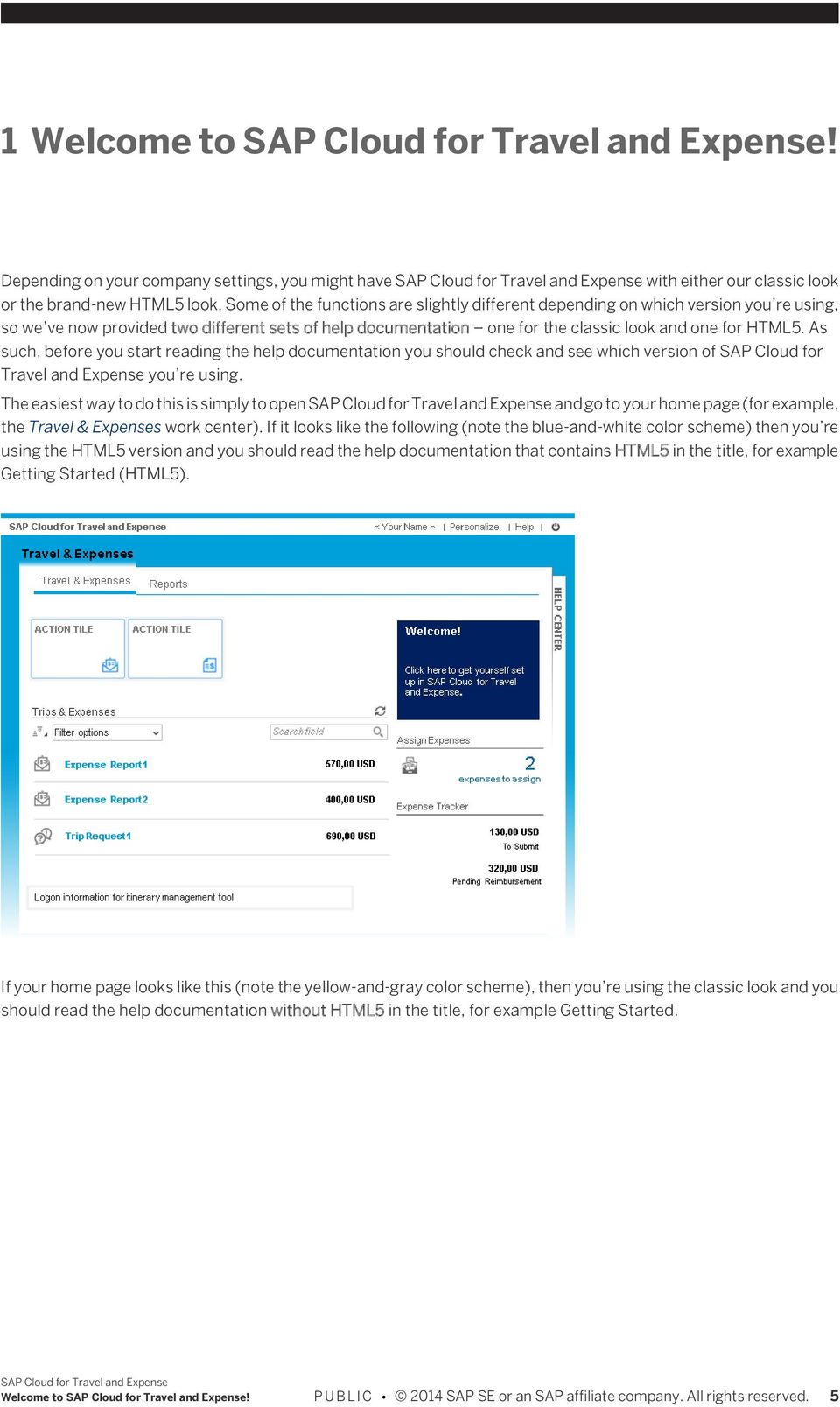
5 1 Welcome to! Depending on your company settings, you might have with either our classic look or the brand-new HTML5 look. Some of the functions are slightly different depending on which version you re using, so we ve now provided two different sets of help documentation one for the classic look and one for HTML5. As such, before you start reading the help documentation you should check and see which version of SAP Cloud for Travel and Expense you re using. The easiest way to do this is simply to open and go to your home page (for example, the Travel & Expenses work center). If it looks like the following (note the blue-and-white color scheme) then you re using the HTML5 version and you should read the help documentation that contains HTML5 in the title, for example Getting Started (HTML5). If your home page looks like this (note the yellow-and-gray color scheme), then you re using the classic look and you should read the help documentation without HTML5 in the title, for example Getting Started. Welcome to! P U B L I C 2014 SAP SE or an SAP affiliate company. All rights reserved. 5
6 SAP SE or an SAP affiliate company. All rights reserved. P U B L I C Welcome to!

7 2 What's New for All Users To quickly find what's new for all users in as of August 2014, click Show All in the top right corner of the document and use the search function in your browser to find your keywords. Depending on your company settings, you might have with either our classic look or the new HTML5 look. Some functions work slightly differently depending on which version you re using. Check out Welcome to! [page 5] in the Help Center to see what's different. Features marked with the HTML5 symbol are available in the HTML5 client only. Features marked with are highlight topics. Features marked with indicate enhancements that we already made available in the previous release in response to customer feedback we received. On Your Computer or Laptop Traveler and Travel Assistant In the Travel & Expenses work center, you can now use the following new functions in both the Travel & Expenses and Travel & Expenses on Behalf views. Function Home Page Action tiles Welcome! Preview expense reports What's New or Changed Our What's New popup, which appears the first time you open Travel & Expenses, will give you a first impression of how we've restructured the home page to make it easier to navigate. With the new action tiles at the top of your home page, we've made it easier for you to quickly find and choose your next action. In the Welcome area on the right side of the home page, you can take a guided video tour of the solution, and learn how to set up mobile apps, the expenses by functions, or online booking tools to get the best out of the system. Just click the Welcome picture and you'll be up and running in no time. Want to quickly check how much you'll be reimbursed for your trip or the current status of your reimbursements? The print preview of your expense report is now only two clicks away. On the home page in your list of expense reports, under More click Print Preview. We've also reduced the number of actions under More to the most-frequently used actions. s Travel Assistants: Receive s on behalf of a colleague As a travel assistant, you might need to receive s on your manager's behalf, for example, to be notified when an expense report you submitted for your manager has been approved. To switch this function on, go to Personalize My Data and select the Receive On Behalf checkbox. In the table, you can select which s you'd like to receive. The selections you make here will apply to all colleagues whose travel assistant you are. There are new assistant-specific e- mails to support this function as well. What's New for All Users P U B L I C 2014 SAP SE or an SAP affiliate company. All rights reserved. 7
![Check out Welcome to! [page 5] in the Help Center to see what's different. Features marked with the HTML5 symbol are available in the HTML5 client only. Features marked with are highlight topics.](/docs-images/43/18073052/images/page_7.jpg "Features marked with indicate enhancements that we already made available in the previous release in response to customer feedback we received.")
8 Function What's New or Changed Prefixes in subject lines To prevent long subject lines from being cut off, we have renamed the prefixes in all e- mail subject lines: TO-DO (old: ACTION REQUIRED) INFO (old: NOTIFICATION) Don't forget to update your rules accordingly if you had set up rules using the old terms. notifications for credit card expenses You can now receive s with information about your credit card expenses. To switch this function on, go to Personalize My Data and under Notifications, select the Credit card expenses checkbox. Expense Report Identify and quickly correct overlapping expense reports Improved timing of error messages Easier to change itemization dates Assign expenses more efficiently If you try to create a new expense report whose dates overlap with an existing one, a message now informs you of this and displays a list of your existing expense reports. You can then either quickly change the dates or select an expense report from the list. In the past, you might have been bothered by error messages that appeared prematurely when you were creating an expense report. Now messages are much better timed, so that they'll only appear when you submit an expense report that has errors or if you have forgotten to enter something. If you change the date of an itemized expense, the items are now automatically adjusted as well. For example, an item assigned to the second day of the original time period will be assigned to the second day of the new time period. In the previous version, you had to adjust each item individually. We've made a few usability improvements to the Assign Expenses screen: action buttons are available directly for the individual expenses, as well as in the menu, assigned expenses are removed immediately from the list, and a new info icon for credit card expenses shows additional transaction details if this data is available from the provider ( ). Renaming of the buttons in attendee/recipient list We have renamed a few buttons on the expense details screen, in the attendee/recipient list. The features of the buttons are still the same. You Can Also... is now More Add Row is now Add Rows instead of only one, you can now add several empty lines Add Attendees is now Search & Add Copy expenses as recurring expenses Access the recipient list faster NPI number available for search Create an expense once and copy it as a recurring expense to your expense report. If you frequently travel to the same destination using the same means of transportation, the new Copy as Recurring option under More will make claiming expenses much faster. On the expense details screen, now the number of recipients is displayed for Gift expenses along with an Add Recipients link to take you directly to the recipient list. Up to now, this link was called Show and available for Entertainment expenses only. If your company has access to the MedProID healthcare practitioner database, now you will be able to use the NPI number as a search criterion when you add physicians as attendees or recipients to your expense reports SAP SE or an SAP affiliate company. All rights reserved. P U B L I C What's New for All Users

9 Function Attendees and recipients available for all expense types Delete host in Entertainment expenses Quickly check and calculate amounts Automatic round-trip calculation when claiming mileage User assistance for country and currency fields What's New or Changed You can now report attendees and recipients for other expense types, not just Entertainment and Gift. For example, if you take your family along on a business trip. Your travel administrator needs to specify first whether it is mandatory or relevant at all to add attendees and recipients to other expense types. Up to now, for Entertainment expenses, the host was always mandatory as an attendee and couldn t be deleted. Now you can delete the host from an attendee list, but also add them again. There is no longer an automatic calculation of amounts when you are creating an expense report. With the new Check & Calculate button, you can quickly check your expense report for errors and have amounts recalculated when you make changes, for example, when you add a new expense. We've added a new round-trip flag to the Claim Mileage screen which automatically doubles the distance calculated. If you've ever been in doubt about which country to enter, for example, because you flew from Germany to Canada with a stopover in the US, we've solved this issue by renaming the Country fields more clearly and by adding explanations where necessary. We distinguish between destination country and expense country (where you actually paid for an expense). This should also act as a reminder that you might sometimes have to enter a different currency. Trip Request Delete trips Activity field Tidy up your home page by deleting trips from the list at any time. You can now delete trips that you no longer need. If you delete a trip that contains an itinerary, you have to ensure that you first cancel any flights, hotels and so on, wherever you booked them. Your travel administrator can retrieve a deleted trip if necessary. You cannot delete a trip containing an expense report that is pending reimbursement and has one of these statuses: Released for Reimbursement, Released for Reimbursement, Advances Not Cleared, Reimbursed, Advances Not Cleared, or Reimbursed. Depending on your system settings, when you create a trip request, you may now be able to select an activity for which different reimbursement rates, such as meal per diem or mileage, apply. On Your Mobile Device This overview shows you the functions available on mobile devices and points out what's new. For functions marked as Coming soon, please check the respective app stores for availability. Function ipad ios6 and higher iphone ios6 and higher Android 4.0 and higher Microsoft Windows Phone 8 Blackberry OS5-OS7* Optimized for Tablet Smartphone Smartphone Smartphone Smartphone Automatically configure the app by clicking the link provided in the Welcome - What's New for All Users P U B L I C 2014 SAP SE or an SAP affiliate company. All rights reserved. 9
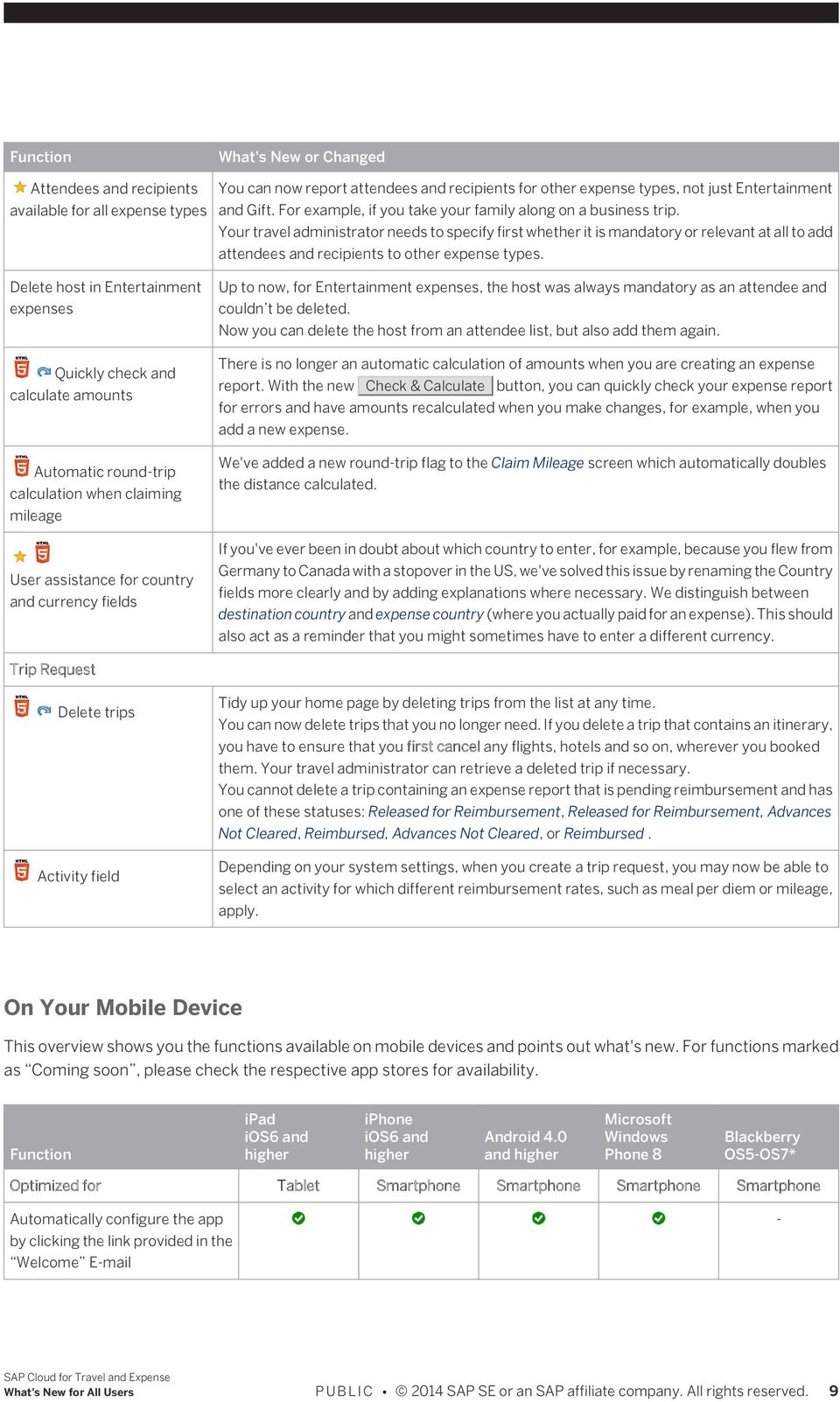
10 Function ipad ios6 and higher iphone ios6 and higher Android 4.0 and higher Microsoft Windows Phone 8 Blackberry OS5-OS7* Capture expenses / Handle unassigned expenses Capture expenses with image recognition - - Claim mileage - Handle per diems Handle attendees and spend tracking - Coming soon - Itemize expenses - Offline mode - Change assignment of expense to expense report - - Create expense report - View and submit expense reports - - Process expense reports Check image attachments in thumbnail view Reopen expense reports Approve travel documents - - View advances in approvals - View attachments in trip requests (Approvals) View pdf attachments View other attachment types (doc, ppt etc.) Follow news feeds SAP SE or an SAP affiliate company. All rights reserved. P U B L I C What's New for All Users

11 3 Help (HTML5) 3.1 Getting Started (HTML5) Welcome to. The information in this section helps you to easily get started with all the tasks that you want to perform. Read the FAQs and learn, for example, how works for the different roles, how you can log on to from a mobile device, and how you can navigate in Travel & Expenses. Check out the following how-to videos: Getting Started Requesting Approval Shows you how you as a traveler can get started on your home page in SAP Cloud for Travel and Expense. Shows you how to request approval for your trip. for a Trip covers all steps of the travel process, from requesting approval for a trip, through booking a trip in an online booking tool, to claiming your expenses. Depending on the settings at your company, you as a traveler might only be able to use some of these functions and processes. Your company might have decided not to use any online booking tools, for instance, and so the functions for booking a trip won't appear on your home page; or your company might use another variant of the approval process. FAQs What Can I Do in? What you can do in depends on your assigned role and the scope of your solution. Travelers, for example, can submit requests for trip approval, claim travel and non-travel-related expenses, both from the desktop and from mobile devices. The Scenario Explorer provides detailed information about the possible scenarios and business processes for the various roles. Learn more about the roles and tasks in here. How Do I Log On to on a Mobile Device? You can log on to from your mobile device if a suitable app is available for download. The logon info and URL address, which you can find in the Welcome or on the traveler'home page, work both on the desktop application and on your mobile device. You can download your app using the links in the Welcome and from the following locations (search for SAP Cloud for Travel and Expense ): For the BlackBerry devices: BlackBerry App World or the SAP Store Help (HTML5) P U B L I C 2014 SAP SE or an SAP affiliate company. All rights reserved. 11

12 For the Apple iphone and the Apple ipad devices: itunes Store or the SAP Store For the Android devices: Google Play Store or the SAP Store The functionality available in the mobile app depends on the type of mobile device. For more information about the available functionality, see the documentation available on your mobile device in the SAP Cloud for Travel and Expense app. What Can I Actually Do on My Mobile? This overview shows you the functions available on mobile devices and points out what's new. For functions marked as Coming soon, please check the respective app stores for availability. Function ipad ios6 and higher iphone ios6 and higher Android 4.0 and higher Microsoft Windows Phone 8 Blackberry OS5-OS7* Optimized for Tablet Smartphone Smartphone Smartphone Smartphone Automatically configure the app by clicking the link provided in the Welcome - Capture expenses / Handle unassigned expenses Capture expenses with image recognition - - Claim mileage - Handle per diems Handle attendees and spend tracking - Coming soon - Itemize expenses - Offline mode - Change assignment of expense to expense report - - Create expense report - View and submit expense reports - - Process expense reports Check image attachments in thumbnail view Reopen expense reports Approve travel documents - - View advances in approvals - View attachments in trip requests (Approvals) View pdf attachments View other attachment types (doc, ppt etc.) SAP SE or an SAP affiliate company. All rights reserved. P U B L I C Help (HTML5)

13 Function ipad ios6 and higher iphone ios6 and higher Android 4.0 and higher Microsoft Windows Phone 8 Blackberry OS5-OS7* Follow news feeds Want to learn more? Just read here [page 47]. How Do I Send Expenses by from My Mobile? Simply send an to the address you got specifically for this purpose in the Welcome . You can also find this address on the traveler home page. In the subject field, enter the expense details as shown here separated only by a space: expense typeamountcurrencydate. The itself should contain no content. You receive an notification that your expenses have been sent. Taxi USD 04/11/2014 Can I Send Receipts as Attachments to? Yes, in addition to being able to upload attachments in your desktop application, you can also send any receipts with file types.jpg,.jpeg,.tif,.tiff, or.pdf by , for example from your mobile device. Just send them to the same address you use for sending expenses by mobile. You can find this address in your Welcome or on the tile of the Welcome Experience on the traveler home page. Want to learn more? Just read the section Attaching Receipts in the Claiming Expenses [page 26] document. What Happens to Expenses I Send from My Mobile? Expenses that are sent to are either automatically assigned to the relevant expense report based on the date of the expense report, or they appear as unassigned expenses on your home page and you have to assign them manually. Where Can I Track the Status of My Expense Report or Trip Request? You can see the status on the traveler home page in the list of your expense reports and trip requests. The status is also displayed at the top of each individual document. What Tasks Can My Travel Assistant Take Over? You assign a travel assistant under Personalize My Travel Assistant. Your travel assistant can request approval for a trip, book a trip, and claim expenses on your behalf. If they have authorization for your calendar, they can also create expense reports for you by sending a meeting request for the period of the expense report to a dedicated e- mail address. This address is in the Welcome and on the tile of the Welcome Experience on the traveler home page. Can I Switch Off the Automatic Notifications? Yes, if your administrator has enabled this personalization function, you can switch on and off notification of certain automatic s. In some cases, you can also specify a number of days for reminders to be sent. You do this under Personalize My Data. Help (HTML5) P U B L I C 2014 SAP SE or an SAP affiliate company. All rights reserved. 13

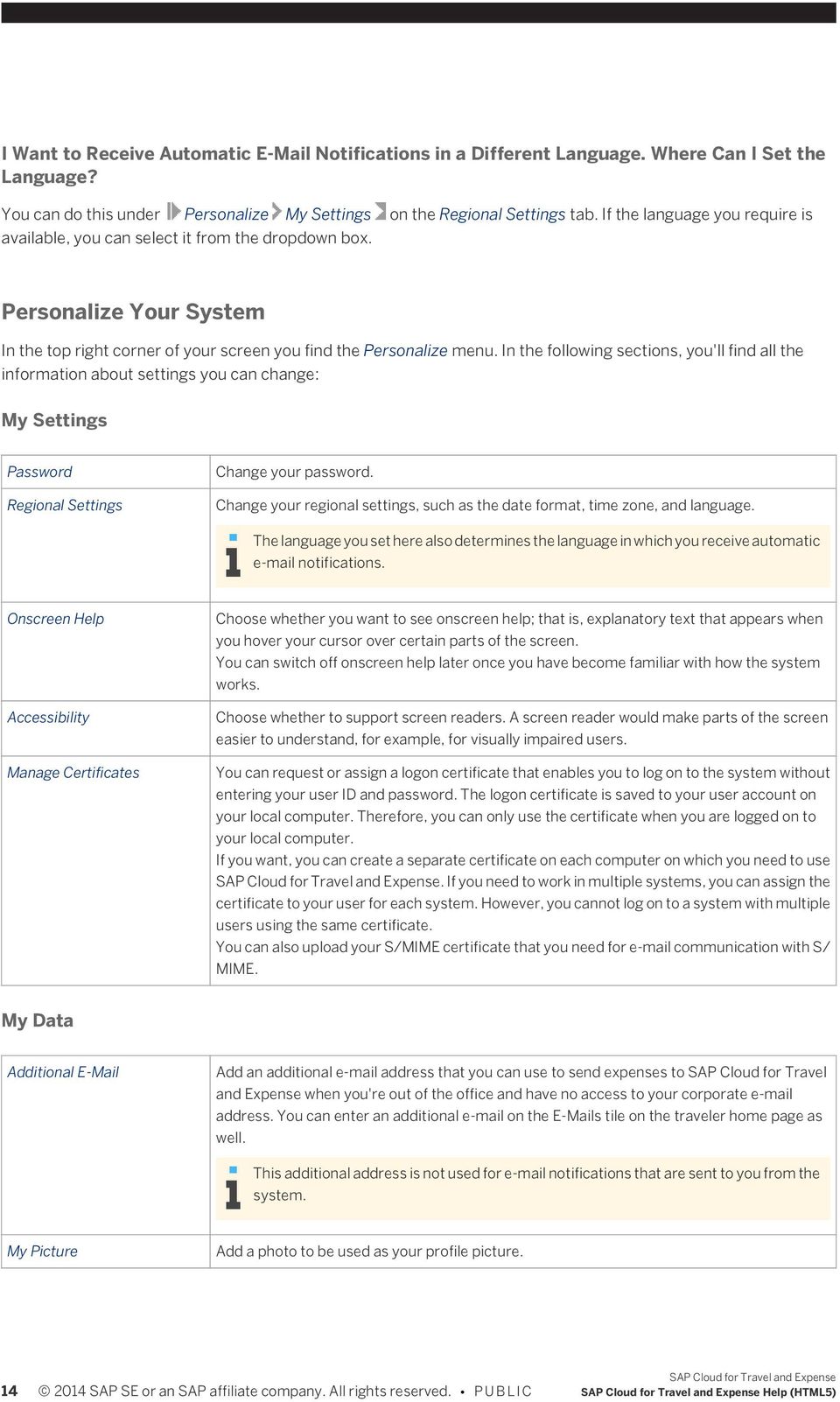
14 I Want to Receive Automatic Notifications in a Different Language. Where Can I Set the Language? You can do this under Personalize My Settings on the Regional Settings tab. If the language you require is available, you can select it from the dropdown box. Personalize Your System In the top right corner of your screen you find the Personalize menu. In the following sections, you'll find all the information about settings you can change: My Settings Password Regional Settings Change your password. Change your regional settings, such as the date format, time zone, and language. The language you set here also determines the language in which you receive automatic notifications. Onscreen Help Accessibility Manage Certificates Choose whether you want to see onscreen help; that is, explanatory text that appears when you hover your cursor over certain parts of the screen. You can switch off onscreen help later once you have become familiar with how the system works. Choose whether to support screen readers. A screen reader would make parts of the screen easier to understand, for example, for visually impaired users. You can request or assign a logon certificate that enables you to log on to the system without entering your user ID and password. The logon certificate is saved to your user account on your local computer. Therefore, you can only use the certificate when you are logged on to your local computer. If you want, you can create a separate certificate on each computer on which you need to use. If you need to work in multiple systems, you can assign the certificate to your user for each system. However, you cannot log on to a system with multiple users using the same certificate. You can also upload your S/MIME certificate that you need for communication with S/ MIME. My Data Additional Add an additional address that you can use to send expenses to SAP Cloud for Travel and Expense when you're out of the office and have no access to your corporate address. You can enter an additional on the s tile on the traveler home page as well. This additional address is not used for notifications that are sent to you from the system. My Picture Add a photo to be used as your profile picture SAP SE or an SAP affiliate company. All rights reserved. P U B L I C Help (HTML5)
15 Default Cost Assignment Settings Specify the cost assignment you want to use as the default in your trip requests and expense reports. You can do the following: You can select the cost center you're assigned to or the last used cost object as your default cost assignment. You can also search for and select any other cost object by choosing Selected Cost Object in the Cost Assignment field. Notification Settings Decide which automatic notifications you want to receive and, in some cases, specify when you want to receive reminders. You can specify that you want to receive an reminder if you haven't submitted your expense report within 3 weeks after returning from a trip. My Credit Cards Here you can see all the corporate credit cards currently assigned to your user account, both company-paid corporate cards and employee-paid corporate cards with employee liability. You can enter details of your personal employee-paid corporate credit card with employee liability here. This information can be used by the administrator in the event that he needs to check which cards are assigned to your employee ID. When you enter a credit card number, it's stored in the higly secure Paymetric system. Whenever you make a payment with this card, Paymetric replaces the credit card number with an encrypted token, which it then sends to. In this way, your credit card details will always be secure. My Travel Assistant Here you can assign a colleague in your company as your travel assistant so that they'll be able to request approval for trips, book trips, and claim expenses on your behalf. If your travel assistant has authorization to create meeting requests in your calendar as well, they can also create expense reports for you from your calendar. You can only assign colleagues who have the Travel Assistant role. Start / End Personalization Here you can personalize the appearance of a screen. That is, you can change the layout and rename the field labels, add mashups, fields, and third-party web services for example, a newsfeed of current events or social media updates to the screen you're currently working on. The available mashups and web services depend on your company settings. To change the appearance of a screen, do the following: 1. Choose Personalize Start Personalization. 2. Hover your cursor over the area that you want to change. Icons with the available functions appear in the upper corner of each framed area. 3. Click the appropriate icon and make the required change. 4. Once you have finished, choose Personalize End Personalization. Help (HTML5) P U B L I C 2014 SAP SE or an SAP affiliate company. All rights reserved. 15

16 To reverse your changes, choose Personalize Discard Screen Screen Layout in Travel & Expenses The following figure illustrates the layout of the traveler home page - the central starting point for all actions: Here, you find explanations for the most important areas of the Travel & Expenses screen: Area Description 1. Header bar Your name and personalize menu, access to the help documentation, and the log-off option. 2. Work centers The work centers you have access to. 3. Work center views The views you have access to within one work center 4. Welcome! Just getting started? Don't worry - just click Let's go and check out the info on the Intro, Mobile Apps, Itineraries, and tiles. This introductory information will help you to quickly find your way around. Once you re familiar with the solution, you can hide this area of the screen to give yourself more room to work. 5. Action tiles The starting point for everything you ll need to do before, during, and after your trip. Here you can, for example, request approval for a trip, book a trip, or claim your expenses. The action tiles you see here depend on how your company has set up SAP Cloud for Travel and Expense. 6. Refresh button Use this to refresh the screen after, for example, resetting a filter option (see no. 8 below) SAP SE or an SAP affiliate company. All rights reserved. P U B L I C Help (HTML5)

17 Area Description 7. Filter options Once you ve started going on trips and claiming expenses, you ll probably have quite a few travel documents in your list. Use these filter options to specify the travel documents you want to see as follows: In Progress Documents that you have not yet submitted, that are pending approval, pending reimbursement, and those that were declined by your approver and returned to you for correction and resubmission. Reimbursed Expense reports for which you ve got your money back. To Submit Documents that you have not yet submitted, and those that were declined by your approver and returned to you for correction and resubmission. Pending... Documents that are pending approval by your approver or an auditor. All 8. Your travel documents All your travel documents - trip requests, itineraries, and expense reports. For every document in your list, you can see at a glance all the important information like the trip purpose, dates, and status. 9. Search field Here you can enter a search term - for example, a city name - and choose to display all your documents that contain that term. To display all your documents again, just remove the search term and press Enter. 10. Assign Expenses Here you can see how many expenses you have yet to assign to an expense report (including credit card expenses). If you don't have any unassigned expenses, this area won't appear on your home page. 11. Expense tracker Here you can keep an eye on your expenses: To Submit Shows the total amount of all the expenses you have not yet submitted, or that were declined and need to be resubmitted. Pending Reimbursement Shows the total amount of all the expenses you have submitted and that are waiting to be approved. This includes expense reports with status Pending Approval, Pending Audit, or Pending Reimbursement. Help (HTML5) P U B L I C 2014 SAP SE or an SAP affiliate company. All rights reserved. 17

18 Area Description 12. Help Center Need a hand when you're working with? Just click here and have a look at the help documents we ve added for you. Each document is specific to the screen you re on, so you ll always be able to quickly find helpful info about the task you re currently working on. In the Help Center, you can also: Search for help documentation by name or keyword Access the complete online library for an overview of all available documentation Write your own personal help notes View company-specific help documentation, if it s set up at your company If something goes wrong, you can also report an incident here, as well as from the Help menu in the header bar. (See no. 1 above). 13. Traxo information If you re using Traxo itinerary management to organize your trips, there'll be an additional bar where you'll see all Traxo-relevant information and messages. In this bar, you can log on to Traxo initially to set up your connection to SAP Cloud for Travel and Expense and then, after you start booking trips, to check up on the synchronization of your itineraries. Whether Traxo itinerary management is available to you depends on your company settings. 3.2 Travel and Expenses (HTML5) Requesting Approval for a Trip (HTML5) In your solution, you can request approval for a planned business trip from your manager before you book the required travel services. This pre-trip approval workflow as provided by your solution is an optional step, and needs to be configured by your system administrator. Your company may follow a different approval process. Depending on your company s settings, you can also request advance payment to cover expected travel expenses using the trip request form. Once the trip request is approved by your manager, you ll receive the payment immediately and it ll appear in your expense report. When you want to claim your expenses after the trip, open the expense report, choose Recall and start adding your expenses. For more information, see Claiming Expenses (HTML5) [page 26]. From the moment you create a trip request, it has a status. This status indicates where your trip request is in the approval process. As soon as you save or submit a trip request, it is assigned a trip ID. This trip ID is the unique identifier of your trip throughout the complete process in your solution. Status of Your Trip Request Your trip request can have one of the following statuses: SAP SE or an SAP affiliate company. All rights reserved. P U B L I C Help (HTML5)

19 Status Not Submitted Pending Approval Approved Declined Description This is the initial status of the trip request when you create a trip request. You can, for example, save the trip request without submitting it for approval. This is can be useful if you do not have all of the information available to complete the request. Having completed the trip request, you submitted your trip request for approval. The approver is notified by about your request. You receive an informing you that your trip request is approved. You can then book the required travel services for your business trip, such as transportation and accommodation. An expense report is automatically created, and you can immediately start adding expenses to it. You receive an informing you that your trip request is declined. In this , the approver should indicate whether your trip request is declined permanently, or whether you should make changes and submit it again. If required, edit your trip request and resubmit it for approval. Tasks Create a Trip Request 1. Choose Request Trip Approval on your home page. The Request Trip Approval dialog box appears. 2. Enter the purpose of your trip, and the start and end date. Optionally, enter the city to which you ll be travelling, the estimated cost of your trip, and the amount for an advance payment if you need one. 3. Choose Save and Open. At this point, you can also submit the trip request by clicking and choosing Submit and Close. As soon as the trip request is approved, the advance payment if you asked for one will be paid to your bank account. 4. Under Estimated Costs, you can specify what you think individual things like the flights and accommodation for your trip will cost. You can only enter estimated costs in your home currency here. 5. Under Cost Assignment, verify that the cost of the trip is assigned to the correct cost object (that is, cost center, internal order, project, and so on). This is to ensure that the proper approver receives your trip request. If you frequently travel using the same cost objects and you want to reuse one of them, click Display Recently Used Assignments. You can split the costs between different cost objects by clicking Split Costs. The system automatically sets the owner of the cost object to which you assign the highest share of the costs as approver. You can t change this approver manually. 6. Enter a comment for the approver that provides some information about the purpose of your trip (optional). 7. Once you ve entered everything, do one of the following: Help (HTML5) P U B L I C 2014 SAP SE or an SAP affiliate company. All rights reserved. 19

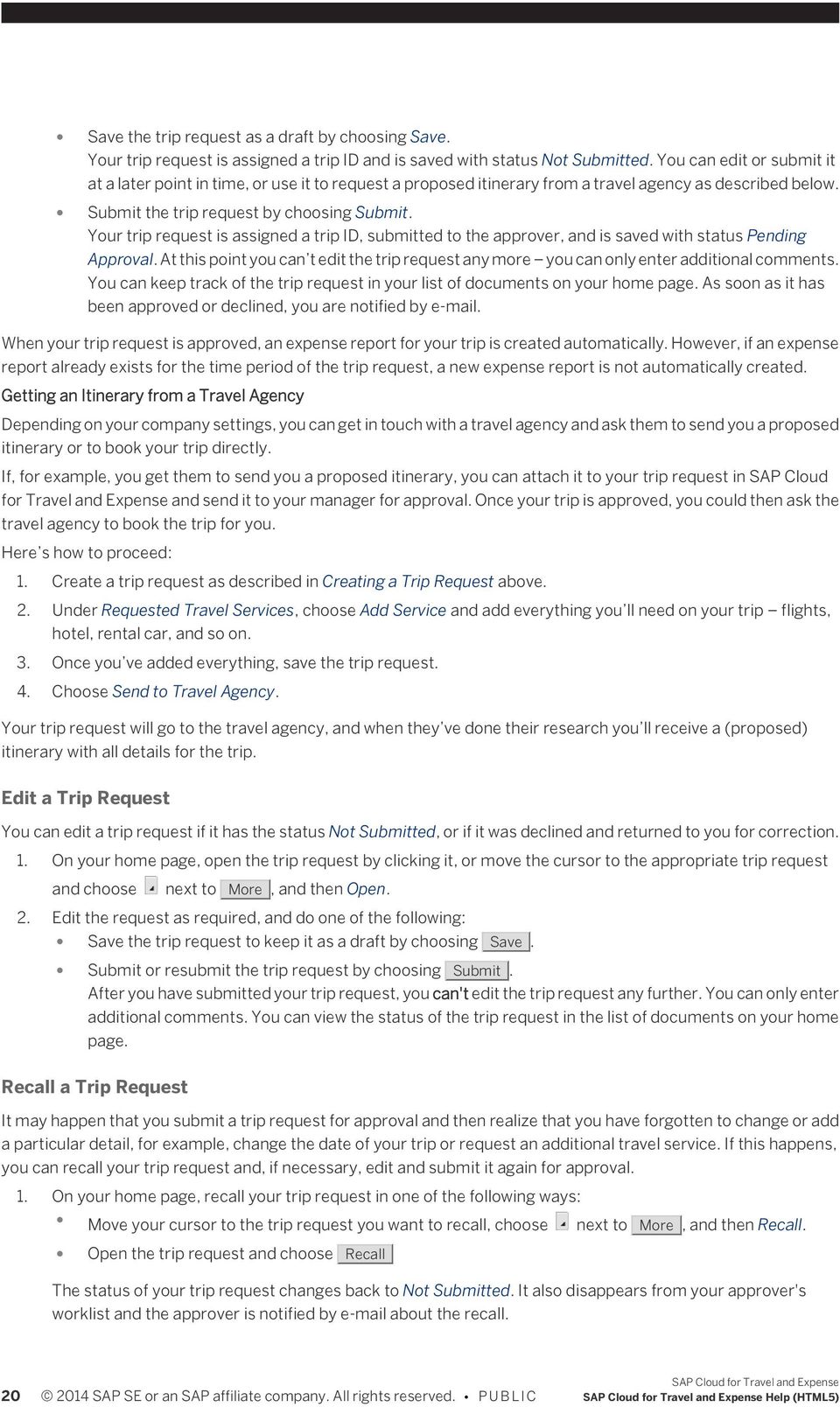
20 Save the trip request as a draft by choosing Save. Your trip request is assigned a trip ID and is saved with status Not Submitted. You can edit or submit it at a later point in time, or use it to request a proposed itinerary from a travel agency as described below. Submit the trip request by choosing Submit. Your trip request is assigned a trip ID, submitted to the approver, and is saved with status Pending Approval. At this point you can t edit the trip request any more you can only enter additional comments. You can keep track of the trip request in your list of documents on your home page. As soon as it has been approved or declined, you are notified by . When your trip request is approved, an expense report for your trip is created automatically. However, if an expense report already exists for the time period of the trip request, a new expense report is not automatically created. Getting an Itinerary from a Travel Agency Depending on your company settings, you can get in touch with a travel agency and ask them to send you a proposed itinerary or to book your trip directly. If, for example, you get them to send you a proposed itinerary, you can attach it to your trip request in SAP Cloud for Travel and Expense and send it to your manager for approval. Once your trip is approved, you could then ask the travel agency to book the trip for you. Here s how to proceed: 1. Create a trip request as described in Creating a Trip Request above. 2. Under Requested Travel Services, choose Add Service and add everything you ll need on your trip flights, hotel, rental car, and so on. 3. Once you ve added everything, save the trip request. 4. Choose Send to Travel Agency. Your trip request will go to the travel agency, and when they ve done their research you ll receive a (proposed) itinerary with all details for the trip. Edit a Trip Request You can edit a trip request if it has the status Not Submitted, or if it was declined and returned to you for correction. 1. On your home page, open the trip request by clicking it, or move the cursor to the appropriate trip request and choose next to More, and then Open. 2. Edit the request as required, and do one of the following: Save the trip request to keep it as a draft by choosing Save. Submit or resubmit the trip request by choosing Submit. After you have submitted your trip request, you can't edit the trip request any further. You can only enter additional comments. You can view the status of the trip request in the list of documents on your home page. Recall a Trip Request It may happen that you submit a trip request for approval and then realize that you have forgotten to change or add a particular detail, for example, change the date of your trip or request an additional travel service. If this happens, you can recall your trip request and, if necessary, edit and submit it again for approval. 1. On your home page, recall your trip request in one of the following ways: Move your cursor to the trip request you want to recall, choose next to More, and then Recall. Open the trip request and choose Recall The status of your trip request changes back to Not Submitted. It also disappears from your approver's worklist and the approver is notified by about the recall SAP SE or an SAP affiliate company. All rights reserved. P U B L I C Help (HTML5)
21 2. If necessary, edit your trip request (for example, by changing the date of your trip) and submit it again. You can only recall trip requests that are in status Pending Approval. Delete a Trip On your home page, move the cursor to the trip that you want to delete, and choose Delete. next to More, and then If you delete a trip request with status Pending Approval, you'll receive an letting you know that your trip request has been recalled. This simply means that your trip request was removed from your approvers worklist. If follow-on documents, such as an itinerary or an expense report, exist, note the following: If your trip also contains itineraries, be aware that you should first cancel them wherever you booked them (for example, an online booking tool or a travel agency) before you delete the trip. If your trip contains an expense report that is pending reimbursement and has one of the following statuses, then you can t delete it: Released for Reimbursement; Released for Reimbursement, Advances Not Cleared; Reimbursed, Advances Not Cleared; Reimbursed See Also Planning and Booking a Trip (HTML5) [page 21] Claiming Expenses (HTML5) [page 26] Planning and Booking a Trip (HTML5) Using as a starting point, you can plan and book your business trip using one of the following tools that may be supported by your company: Tool GetThere by Sabre Amadeus e-travel Management cytric by i:fao Traxo Description Online booking tool Online booking tool Online booking tool Itinerary management system The availability of these tools depends on your company settings, so you might be able to use one of these tools, a combination of several, or possibly none at all. If your company doesn t use any of these tools, then you can skip this document entirely. Help (HTML5) P U B L I C 2014 SAP SE or an SAP affiliate company. All rights reserved. 21
22 Once you ve booked all the necessary travel services flight, hotel, and so on for your trip, the information is compiled and sent to as an itinerary. Here, you can see all the info like the name and costs of the trip, and keep track of its status (whether it s been approved yet or not). Please keep in mind that the costs displayed in your itinerary are based on information currently available from the online booking tool, and might not reflect the eventual total costs at the time of billing. For details, check with your travel agent or support center. Multiple Itineraries for One Trip You can have multiple itineraries for the same trip. This might happen if, for example, you ve got a trip in SAP Cloud for Travel and Expense called Consultant visit. You re not sure until the last minute whether you ll be visiting the consultant in New York or Chicago, so you book two flights to the separate destinations. The itinerary for each flight is then automatically assigned to the same trip in. Once you ve decided where to go, you can just open your trip on the home page and cancel the itinerary you don't need anymore. How Can You Book and Manage Trips? Book a Trip with an Online Booking Tool 1. Make sure that you have added the web site of the online booking tool to your list of trusted web sites, and that your browser allows pop-ups. 2. On your home page, do one of the following: If you didn't have to request approval before booking the trip, choose Book Trip on your home page and book the required travel services. If you did have to request approval for a trip, move the cursor to the approved trip request and choose Book Trip using the dropdown button. Alternatively, open the approved trip request and choose Book Trip. For information about how to work in the online booking tool, see the help information in the online booking tool itself. Make sure that when booking trips in the online booking tool you are not working on any document in (that is, a trip request, itinerary, or expense report). Otherwise trip data can't be transferred from the online booking tool to. Once you 've made your bookings, trip data is sent to and, after a few minutes your trip appears in your list of documents. If your address is maintained in the profile of the online booking tool, you receive an with your final itinerary details. Otherwise, please check with your travel agent for final itinerary and ticketing details. In this case, please have the Booking ID of your trip ready to give to your travel agent. The costs displayed in your itinerary are based on information currently available from the online booking tool, and might not reflect the eventual total costs at the time of billing. For details, check with your travel agent. Manage Your Itinerary with Traxo If your company supports Traxo, you can sign up for an account and use the tool to compile all your online bookings into easy-to-manage itineraries. Sign up as follows: 1. Add Traxo ( or to your list of trusted web sites, and ensure that your browser allows pop-ups SAP SE or an SAP affiliate company. All rights reserved. P U B L I C Help (HTML5)
23 2. Register yourself at You can also do this from the bottom of your SAP Cloud for Travel and Expense home page. During the sign-up process, you have to allow the SAP system to access your Traxo account. This is so that trip data can be sent from Traxo to. If, at some point in time, you don't want this connection anymore, you can change this setting at Traxo. Once you ve got an account, you can book your travel services with service providers affiliated to Traxo. Traxo will then group the travel services by trip and send the info to, where it will be available as an itinerary. Here are some examples of how this works: You manually forward the booking reservations that you receive by to Traxo scans those s and compiles the trip data into an itinerary. You book your trip with travel service providers that are affiliated with Traxo. They send the trip data automatically to Traxo, where it is compiled into an itinerary. To make use of this option, check the list of travel service providers with Traxo and add them to your profile in Traxo. You have a frequent flyer account and you add the account data to your Traxo profile. Traxo checks this account on a daily basis and, as soon as you book a flight, compiles the info into an itinerary and sends it to. The itinerary is then sent to and appears in your list of trips on your home page. To view your trips in Traxo, go to your trip on your home page and choose View in Itinerary from the dropdown button. If you are allowed to use Traxo and an online booking tool, you can view the complete trip (including the travel services booked via the online booking tool) in Traxo. Remember that when working in Traxo to mark all relevant trip information as business trips. Trip information for private trips are not sent to. Book a Trip Through a Travel Agency You can now book a trip by sending your trip request data to a travel agency. This function must have been switched on by your administrator. For more information, see Requesting Approval for a Trip (HTML5) [page 18]. What Else Can You Do With Your Itinerary? Assign an Itinerary to a Different Trip If you have multiple itineraries assigned to the same trip, they are sorted according to the dates. If an itinerary has been wrongly assigned to a trip, you can do the following: If an itinerary was assigned to the wrong trip, you can reassign it by choosing next to More, and then Assign to Existing Trip. You can also assign an itinerary if a new trip was created for an itinerary but this itinerary belongs to a different and already existing trip. If an itinerary was assigned to the wrong trip and you realize that this itinerary is a separate trip, you simply create a new one by choosing choosing next to More, and then Create New Trip. This itinerary is then automatically assigned to the new trip which appears in your list of documents. Help (HTML5) P U B L I C 2014 SAP SE or an SAP affiliate company. All rights reserved. 23
24 Add a Comment to Your Itinerary If you need to add a comment (for example, if you booked a more expensive hotel than usual and you need to inform your approver about it), you can do this on your home page. Simply open your trip, choose then Add Comment. next to More, and Edit or Cancel an Itinerary You can only edit or cancel an itinerary if it has the status Booked or On Hold and there is no approval process in place. If the itinerary comes from GetThere, you can also edit/cancel it if has status Approved. 1. On the home page, open your trip and choose next to More, and then Open in <online booking tool or itinerary management system>. 2. Edit or cancel the required travel services directly in the online booking tool or in Traxo. After you have edited or canceled your trip, the itinerary and its status is automatically updated in SAP Cloud for Travel and Expense. Delete a Trip If you want to delete a trip that contains itineraries, be aware that you should first cancel them wherever you booked them (for example, an online booking tool or a travel agency). To delete your trip on your home page, move the cursor to the appropriate trip and choose next to More, and then Delete. If your trip contains an expense report that is pending reimbursement and has one of the following statuses, then you can t delete it: Released for Reimbursement Released for Reimbursement, Advances Not Cleared Reimbursed, Advances Not Cleared Reimbursed Status of Your Itinerary From the moment an itinerary is created, it has a status. These statuses depend on whether or not an approval workflow is in place. If you need managerial approval for trips organized by Traxo, you can create a separate trip request to send to your manager. Once this trip request is approved, an expense report is created. An itinerary is created by Traxo and sent to. Based on the dates of your trip, the itinerary is automatically assigned to the corresponding trip request and expense report Status of Your Itinerary Without Approval Workflow Status names for itineraries might not always be identical in and the online booking tools or Traxo SAP SE or an SAP affiliate company. All rights reserved. P U B L I C Help (HTML5)
25 Status in SAP Cloud for Travel and Expense Online booking tools only: On Hold Booked Canceled What does it mean? You ve made reservations in the online booking tool, but you re not ready to actually purchase them yet for example, because you want to check if your manager agrees to the trip so you ve put the trip on hold. No invoice has been issued yet. Since the reservations are only valid for a limited time (for example, one or two days), check the validity period for each reservation in the online booking tool. After this time, the reservations are automatically canceled, and - if required - you have to start booking the trip all over again. Whether you can put a trip on hold depends on whether your user has the appropriate authorizations assigned in the online booking tool. For details, contact your system administrator. You ve purchased the trip in the online booking tool. Your travel services flight, hotel, and so on - are booked, and you ve been issued an invoice. You canceled your trip with the online booking tool. Please keep in mind that cancellation fees may be charged depending on the policies of the vendor for the booked travel service. These fees are subject to change, and do not appear in your itinerary in. For more information, check with your travel agent. Status of Your Itinerary With Approval Workflow (Online Booking Tools only) The approval workflow provided by is an optional step that is configured by your system administrator. Your company may follow a different approval process. Keep in mind that the status names for itineraries are not always identical in and the online booking tool. Status in SAP Cloud for Travel and Expense Pending Approval Approved / Pending Confirmation Booked Declined / Pending Cancellation Declined Canceled What does it mean? You have booked your trip and your approver receives an with the request to approve your itinerary. Your itinerary has been approved. Your bookings are about to be automatically confirmed by the online booking tool. Your bookings have been confirmed by the online booking tool. Your itinerary has been declined by your approver. Your bookings are now going to be automatically canceled by the online booking tool. Your bookings have been canceled by the online booking tool. Your approver didn t review your itinerary in time, so your reservations for the travel services have been automatically canceled in the online booking tool. Each travel service is only reserved for a limited period of time, and this period of time depends on the individual travel service. For example, a flight reservation might only be held for a day depending on the airline. A reservation for a hotel room might be held for several weeks. To check this, log on to the online booking tool and review your individual bookings. Please keep in mind that cancellation fees may be charged depending on the policies of the vendor of the booked travel service. These fees are subject to change and do not appear in your itinerary in. For more information, check with your travel agent. Help (HTML5) P U B L I C 2014 SAP SE or an SAP affiliate company. All rights reserved. 25
26 See Also Requesting Approval for a Trip (HTML5) [page 18] Claiming Expenses (HTML5) [page 26] Claiming Expenses (HTML5) In, you can claim back expenses that occur either during a business trip, or as part of your everyday working life. You create an expense report, enter all your expense details, and submit the expense report for approval. Your expense report is then reviewed by an approver or an auditor as necessary, and, once it has been approved, your expenses are reimbursed directly to your bank account. You can submit expense reports from both the desktop application or your mobile device. If your company enables advances, you can also request an advance payment to cover expected travel expenses. Once the expense report has been approved by your manager, you ll receive the advance immediately and it ll appear in your expense report. An expense can be, for example, the cost of your hotel, flight, or rental car, or the cost of taking a consultant to dinner. Depending on the nature of an expense, you can specify that there were additional attendees (for example, for a business meal), itemize the expense (for example, divide a hotel bill into room, tax, and breakfast charges), or split the costs between several cost assignment types (for example, cost centers, internal orders, projects, or sales orders). You can claim two types of expenses: Expense Type Travel Expenses Non-Travel-Related Expenses Description Expenses that occur on a business trip. Expenses that are not related to a trip, for example, postage for mailing a package to a colleague in another office, or taking a consultant to dinner. How Can Expenses Be Added To? The following describes how expenses can be added to your solution and what you have to do with them: Source Credit Card Mobile Description Expenses you paid for with your corporate credit card, and which are automatically sent to your solution by your credit card company. If these expenses fall within the start and end dates of your trip, they are automatically assigned to the relevant expense report. If not, they appear as unassigned expenses and you have to manually assign them to an expense report. Expenses you add to your solution using the app for your mobile device. If these expenses fall within the start and end dates of your trip, they are automatically assigned to the relevant expense report. If not, they appear as unassigned expenses and you have to manually assign them to an expense report. You can also edit the expense you added on your mobile device SAP SE or an SAP affiliate company. All rights reserved. P U B L I C Help (HTML5)
27 Source Description Expenses you send to your solution by from either a desktop PC or a mobile device as follows: 1. In your program, create a new message. 2. In the To field, enter the address for reporting expenses that you got in your welcome , for example, [email protected]. 3. In the subject box, enter the expense details exactly as shown here: <expense type> <amount> <currency> <date> For example: Taxi USD 04/11/10 ignores any text in the message body. If you have an signature, we recommend that you disable it before you compose the . This will help prevent your solution from accidentally interpreting text in your signature as expense information. 4. Send the . Depending on how is set up in your company, expenses might be automatically assigned to the relevant expense report if these expenses fall within the start and end date of your trip. If this has not been configured, these expenses appear as unassigned expenses, and you then have to manually assign them to an expense report. If your company has enabled smart receipt recognition, receipts you send by to SAP Cloud for Travel and Expense can be analyzed to extract text relating to expense type, date, amount, currency, and itemization, if your system is set up for it. This process can take some time and you can monitor the progress by viewing the expense status on the Assign Expenses screen, where all unassigned expenses are listed. If successful, these expenses are automatically assigned to the relevant expense report if these expenses fall within the start and end date of your trip. If this has not been configured, or if the receipt analysis is not successful, the receipt images appear as unassigned expenses. You then have to manually assign them to an expense report. Manual Expenses you add to an expense report directly in your solution. Status of Your Expense Report From the moment you create an expense report, it has a status. This status indicates where your expense report is in the approval process. The sequence of steps in the approval process and the availability of statuses like Pending Audit and Pending Approval depend on the setup of your solution. The following is based on the standard workflow delivered by. Status Not Submitted Pending Audit Description This is the initial status of the expense report when you create it and do not submit it for approval. Your expense report is saved as a draft, and has not yet been submitted for approval. You can still open and edit the expense report. You have submitted your expense report, and it is waiting to be checked by an auditor. When an expense report is approved by an auditor, its status changes as follows: To Pending Approval, if managerial approval is required. To Released for Reimbursement, if managerial approval is not required. You cannot edit an expense report that is pending audit. Help (HTML5) P U B L I C 2014 SAP SE or an SAP affiliate company. All rights reserved. 27
28 Status Pending Approval Declined Released for Reimbursement Released for Reimbursement, Advances Not Cleared Reimbursed, Advances Not Cleared Reimbursed Description Your expense report is awaiting approval by an approver, for example, the owner of the cost center you are charging your expenses to. You cannot edit an expense report that is pending approval. Your expense report has been declined by the approver or the auditor. If necessary, open the expense report, make the required changes, and submit the expense report again. Your expense report has been approved by all approvers, and your expenses will be reimbursed. Your advance has been approved and posted and will be paid out shortly. The advance will be cleared after the expense report has been submitted. Your advance has been paid out. The advance will be cleared after the expense report has been submitted. Your expenses have been reimbursed. Main Tasks Creating an Expense Report 1. On your home page, choose Claim Travel Expenses or choose Claim Non-Travel-Related Expenses. The Claiming Expenses dialog box appears. 2. Enter the purpose of your trip, the start and end date, and the country. For non-travel-related expenses, you only need to enter a purpose. The purpose provides the approver with information about your trip, and is also what will help you to find the expense report in the list of documents on your home page. Therefore, be specific. If you use the 24 hour time format, please note that 24:00 h marks the beginning of the following day. 3. Choose Save and Open. At this point, you can also do the following: Save this expense report as a draft and start working on a new expense report by choosing and then Save and New to save your current entries and create a new expense report. Save this expense report as a draft and continue with a different task by choosing and then choosing Save and Close. Once you have saved your entries, the expense report shows up in the list of your travel documents. Next time you want to edit the expense report, it opens up in a new screen with all the details. 4. You can now add expenses. Requesting an Advance Payment If you need to cover travel expenses before you go on a trip, you can request an advance payment as follows: 1. On your home page, choose Claim Travel Expenses. The Claiming Expenses dialog box appears SAP SE or an SAP affiliate company. All rights reserved. P U B L I C Help (HTML5)
29 2. Fill in all mandatory fields, such as Purpose, Start Date, and Country. The purpose provides the approver with information about your trip, and is also what will help you to find the expense report in the list of documents on your home page. Therefore, be specific. If you use the 24 hour time format, please note that 24:00 h marks the beginning of the following day. 3. Click Save and Open. 4. In the expense report details area, enter the requested amount in the Advance Payment field and choose Submit. As soon as the expense report has been approved, the amount is paid to your bank account. Adding Expenses to an Expense Report When you open a newly-created expense report, default cost assignment details appear automatically. If required, you can change the default cost assignment or you can split the costs of your trip between different cost assignment types available in your solution (for example, cost centers, internal orders, networks, or sales orders) by choosing Split Costs. The system automatically displays the owner of the cost assignment to which you assign the highest share of the costs as approver. You cannot change the approver manually. To find out more about how you can set up the default cost assignment, see My Data under Personalize Your System [page 14]. Expense types you add to the expense report inherit the cost assignment of the expense report but you can change the cost assignment of individual expense types if you need to. If you later change the cost assignment of the expense report, you should note that this change will be applied to all expense types that have the same cost assignment as the expense report. Any expense types with a different cost assignment will not be affected by the change. If you frequently travel using the same cost assignments, and you want to reuse this information, choose Display Recently Used Assignments. 1. Add any unassigned expenses to this expense report in one of the following ways. Unassigned expenses are expenses sent to by credit card, mobile, or that could not be automatically assigned to an existing expense report, for example, because they don't fall within the start and end dates of any of your trips. You cannot assign expenses for which smart receipt recognition is still in progress. For more information about unassigned expenses, see section How Can Expenses Be Added to [page 26]How Can Expenses Be Added to [page 95] above. Help (HTML5) P U B L I C 2014 SAP SE or an SAP affiliate company. All rights reserved. 29
30 From the expense report 1. Click Assign Expenses (number). 2. On the Assign Expenses screen, select one of the unassigned expenses in the list and choose Assign. Alternatively, you can select multiple items in the list using the CTRL key and in the menu choose Assign. 3. The selected expenses are automatically assigned to the expense report and removed from the list. A success message is displayed. From your traveler home page 1. Click <number> expenses to assign. 2. Select one or more expenses, and then in the menu, choose the arrow beside Assign to. 3. Select the relevant expense report from the list that appears. 4. The selected expenses are automatically assigned to the expense report and removed from the list. A success message is displayed. To unassign an expense from your list of expenses, move your cursor to the expense, choose the arrow beside More and choose Unassign. 2. Manually add any necessary expenses by choosing Add Expense. 3. Select an Expense Type from the dropdown list, enter the amount, the currency, the date when you incurred the expense, and choose Add. You can also choose Add and New to save the current entries and add a new expense. The expense is added, and the total Requested Amount of your expense report is updated. Regardless of the currency you enter for an expense, the Requested Amount always displays in your home currency. You can use Previous and Next to easily scroll through the expenses. If there are compliance check findings identified for the expenses you have added, they will be shown at the top of the Expense Details screen and indicated with. Depending on your company settings, some findings may prevent you from submitting an expense report. In that case, additional error messages are displayed. To find out more about compliance check findings, see Fraud Prevention with Compliance Checks. 4. Once you have added all your expenses and receipts, you might have to do the following, for example: Itemize an expense Merge expenses if you have two or more expense items referring to the same expense but coming from different sources Maintain your per diems and taxable benefits (Relevant for certain country versions only. See section Maintaining Your Per Diems and Taxable Benefits [page 33]Maintaining Your Per Diems and Taxable Benefits [page 102].) Claim mileage for your personal car Submit your receipts for scanning These tasks are described separately later in this document. 5. After you have entered all the necessary information in your expense report, you can submit it for approval by choosing Submit. A summary of the expense report appears. 6. Review the summary and choose Submit again. The expense report is submitted for approval, and the status of the report changes to Pending Approval or Pending Audit, depending on the approval process in your company. The report is now locked by the system, and cannot be edited (it is read-only) unless you reopen it for further changes. For more information, see task Reopening an Expense Report [page 42]Reopening an Expense Report [page 110] SAP SE or an SAP affiliate company. All rights reserved. P U B L I C Help (HTML5)
31 You can also submit an expense report from your list of travel documents on your home page. Move your cursor to the expense report, choose and then Submit. However, if you do it this way you do not receive a summary of the expense report. As such, if you would like to doublecheck that everything in the expense report is correct, we recommend submitting it using the Submit button within the report itself. If your expense report is returned for correction by your approver or auditor, it will appear in your list with status Declined. If necessary, you can then edit and resubmit the expense report for approval. Creating an Expense Report using Microsoft Outlook You can also create an expense report by sending a meeting request from Microsoft Outlook to SAP Cloud for Travel and Expense. 1. Open Microsoft Outlook and create a new meeting request with the following information: Field To Subject Location Enter The address for. You can find this address in the welcome you received from, and in the introductory information on the home page. The purpose of your trip. For example, Software conference. The country to which you traveled. Enter only the country here. If you enter the city or any other part of the address to which you traveled, the solution won't be able to recognize it. If you decide not to enter anything here, the solution automatically creates the expense report using your home country. You can then change the country later if necessary. Start time End time The start date and time of your trip. The end date and time of your trip. 2. Send the meeting request. The expense report is created in your solution, and you receive an in return confirming this. If for some reason the expense report couldn't be created, you receive an with some suggestions about the best way to try again. When you want to edit, submit, or delete the expense report you just created, you have to log on to your solution and do so directly. Itemizing an Expense Depending on your company's policies, you may be required to provide a list of the individual costs that add up to the total of an expense. 1. In your expense report, move your cursor to the expense you want to itemize, choose next to More, and then Itemize. Alternatively, open the expense details by choosing More, and then choose Itemize Expense in the Expense Details dialog box. Help (HTML5) P U B L I C 2014 SAP SE or an SAP affiliate company. All rights reserved. 31
32 2. On the screen that opens up next, specify the expense type, the amount, and the days for which the cost applies. If necessary, mark the expense as a personal expense. Example Your hotel bill comes to a total of $200, consisting of room, internet access, and breakfast charges. Your company policy specifies that you can only claim for the room, and so you itemize your hotel expense into room ($50 x 3), internet access ($10 x 2), and breakfast ($15 x 2), marking the last two as personal expenses. Expense Type Amount All Days Day 1 Day 2 Day 3 Personal Expense Hotel $ 50 X Internet Charges $ 10 - X - X X Breakfast $ X X X 3. After you have completed the itemization, choose Close. If you are required to add attendees or recipients for some of the itemized expenses (for example, business meals or gifts), you can do the following: 1. In your list of expenses in the expense report, move your cursor to the appropriate expense and choose Show Itemization. 2. Click More for the relevant expense item. 3. On the next screen, add the attendees or recipients. See Adding Attendees or Recipients to an Expense [page 38]Adding Attendees or Recipients to an Expense [page 107] if you need more details. 4. If you need to describe the products you promoted during entertainment activities or when you handed out gifts, choose Add Products and enter the names of the products. See Adding Related Products to an Expense [page 43]Adding Related Products to an Expense [page 111] if you need more details. Merging Expenses In some cases, two or more expense items in your expense report may refer to the same expense. While on a trip, you pay for your hotel using your corporate credit card. You want to add this expense to your expense report immediately so that you don't forget about it. Therefore, you take a photo of the invoice using your mobile device and send an expense to your solution including the attached invoice. After you have returned from your trip, you assign this expense to the appropriate expense report in your solution. In the meantime, the credit card company has also sent the expense for this hotel stay automatically to your solution. The credit card expense has already been assigned to the appropriate expense report. As a result, there are now two expense items in your expense report for one and the same expense, but they are coming from different sources: One you sent by from your mobile device with the hotel invoice attached One sent by the credit card company Since you only require one expense item in your expense report per expense, you can now merge the two expenses. Merge in this context means that two expenses are combined into one, and the information provided by both expenses is consolidated. In the overall hierarchy of expense types, the leading expense is always the credit card expense, then the mobile expense, then , and finally the manual expense. This means that information coming from the credit card expense is always considered first before the one provided by expenses that were created SAP SE or an SAP affiliate company. All rights reserved. P U B L I C Help (HTML5)
33 manually, via your mobile device, or by . The reason for this is that the credit card expense always provides the most accurate data for an expense (such as the final amount). If you already split the costs of one of the expense items to be merged, the costs of the resulting merged expense will also be split in the exact same way: Example: In your expense report, you have the following two expense items for the same expense: One hotel expense of 200 USD that you created manually. You split the costs for this expense between your default cost center (50%) and an internal order (50%). One hotel expense of 210 USD that was sent to your solution by your credit card company, and was automatically added to the expense report. This expense is assigned 100% to your default cost center. You merge these two expenses, resulting in a merged hotel expense of 210 USD, the costs of which are split between your default cost center (50%) and an internal order (50%). Procedure 1. In your expense report, move your cursor to an expense that you want to merge. 2. Click next to More, and then Merge With... The system displays all expenses that are candidates for a merge. You can only merge expenses that have the same date, currency, and expense type, but different source. The amount may differ. If you merge an itemized expense with an expense that is higher in the hierarchy and the amounts do differ, the itemization is only taken over to the merged expense if the leading expense was itemized. Example: You return from a customer visit in New York, during which you added an hotel expense of 185 USD to your expense report. After your return, you itemized this hotel expense. The corresponding credit card expense for this hotel stay is added to the expense report shortly afterwards with an amount of 187 USD. You then merge the credit card and expense: If the credit card expense is the leading expense and it is not itemized, the merged expense will show the amount of 187 USD but the itemization from the expense is deleted and you have to itemize the merged expense again. If the credit card expense was itemized and the hotel expense wasn't, the itemization is taken over to the merged expense. 3. Click the appropriate expense from the list of candidates. The two expense items are merged into one, and the system now displays only one consolidated expense in the list. This expense provides information about the sources of the original expenses and contains all relevant information that the original expenses provided. 4. If required, you can now continue to merge the consolidated expense item with a third one. To reverse the merge, move the cursor to a merged expense, choose Original Expenses. next to More and then Split Into Maintaining Your Per Diems and Taxable Benefits Per diems are relevant for country versions Australia, Austria, Brazil, China, Denmark, Germany, India, Spain, and Switzerland only. Help (HTML5) P U B L I C 2014 SAP SE or an SAP affiliate company. All rights reserved. 33
34 If you got any meals or nights of lodging for free, you have to indicate this in your expense report. Depending on your company settings, you will have to do one of the following: Task Deduct meals / lodging from your per diems Description 1. In your expense report, open the per diem in question. 2. If you got any meals or accommodation for free, select the corresponding checkbox and your per diems will be reduced accordingly. You went on a three-day business trip from 12/03/20xx to 15/03/20xx. When you return from your trip, you create your expense report and see that your meals per diems for the three days appear in the expense report automatically. However, you remember that on the second day of your trip you were taken to dinner by a consultant, and therefore didn t have to pay for the meal. In your expense report, you open your meals per diem for 14/03/20xx and select the checkbox for Dinner. Your per diem for this day is reduced accordingly. Add a taxable benefit 1. In your expense report, choose Add Taxable Benefit. 2. Select the meal that you got for free. A standard taxable amount will be added to your expense report. Please note that this amount is set by the relevant tax authority - you can't change it. You went on a three-day business trip from 12/03/20xx to 15/03/20xx. When you return from your trip, you create your expense report and see that your meals per diems for the three days appear in the expense report automatically. However, you remember that on the second day of your trip you were taken to dinner by a consultant, and therefore didn t have to pay for the meal. In your expense report, you add the following taxable benefit: Taxable Benefit Type: Taxable benefit for dinner Date: 14/03/20xx This taxable benefit is added to your expense report. Claiming Mileage for Your Personal Car 1. In your expense report, choose Claim Mileage. 2. Enter your starting point in the From field, and your destination in the To field. 3. Enter the date on which you started the trip, and the distance you drove. The unit of measurement for the Distance field is automatically set to either miles or kilometers depending on your company-specific settings. 4. Click Add, or and then Add and New to add the current mileage and create a new one. Your solution calculates the cost of your journey, and adds it to your list of expenses. 5. To claim mileage for other days or destinations, repeat steps To add more details to your mileage expense, choose More and enter relevant information, such as number of passengers or comments SAP SE or an SAP affiliate company. All rights reserved. P U B L I C Help (HTML5)
35 If you drive to several destinations, or on several different days, you should claim these all individually. For example, you drive from New York to Boston (173 miles) on Aug. 8th, Boston to Montreal (273 miles) on Aug. 12th, and from Montreal back to New York (327 miles) on Aug. 18th. When claiming your mileage in SAP Cloud for Travel and Expense, claim each leg of your journey individually. You should not, for instance, claim a single journey from New York to New York with a total mileage of 773 miles, as this will make it difficult for your approver to tell if the costs were justified, and may slow down the time it takes for your expenses to be reimbursed. If you take passengers on your trip, you should make sure, that for each leg of your journey you add the correct number of passengers. Submitting Receipts for Scanning Receipt scanning is only available for companies that use a central receipt scanning service. Once you have collected all your receipts from your trip, you can submit your receipts to the central receipt scanning service used by your company. 1. In your expense report, choose Print Preview. You must only print the cover sheet from the relevant expense report, as a barcode is generated that is later used to attach the scanned receipts to the expense report. 2. On the Preview dialog box, choose Expense Report Cover Sheet. The cover sheet page appears. For the best printing results, follow the directions on the cover sheet. 3. Print the cover sheet. 4. Attach the cover sheet to your receipts and send them in an envelope to the address supplied by your company for the central receipt scanning service. When the receipts have been scanned by the central receipt scanning service, they are automatically attached to the relevant expense report. Several attachments from the central receipt scanning service can be attached to one expense report. You can submit the expense report for approval before the attachment is received from the central scanning service; the attachment will be attached to the expense report automatically when it arrives. However, please be aware that your own company s travel policies might specify that you have to wait until all attachments are scanned before you submit your expense report. Attaching Receipts You can attach receipts to your expense report, or to an individual expense within an expense report, for example, a receipt for your hotel stay, or a scanned list of attendees at a business dinner. You can upload and add attachments either directly to your solution, or you can send them by . You can upload attachments with the following file types:.png.jpg or.jpeg.gif.tif or.tiff Help (HTML5) P U B L I C 2014 SAP SE or an SAP affiliate company. All rights reserved. 35
36 .BMP.PDF The following file types have certain limitations:.bmp files are not supported by . You can only upload them directly to your solution..pdf files are not supported on smartphone devices. The size limit for an individual attachment is 3MB. You can do the following with receipts: Task Attach a receipt to an expense report Attach a receipt to an individual expense Steps In your expense report, choose Attachments and upload your receipt. Do one of the following in your expense report: Go to the expense details of an expense and upload an attachment. Go to the expense details of an expense and add an attachment from the expense report. Send a receipt as attachment to an with expense details 1. In your program, create a new message. 2. In the To field, enter the address for reporting expenses which you got in your welcome , for example, [email protected]. 3. In the subject box, enter the expense details, for example, Taxi 15.00$ 04/11/10. ignores any text in the message body. 4. Attach your attachment, and send the . Your solution receives the and adds the expense including the attached receipt to the relevant expense report if the date matches start and end dates of your trip. If not, this expense including its receipt appears as an unassigned expense and you have to manually assign it to an expense report as described in section Creating an Expense Report [page 28]Creating an Expense Report [page 97]. This process can also be combined with smart receipt recognition. Based on the content of the subject an expense is created and the receipt is attached. Additionally the receipt details are analyzed and further information, like for example itemization or attendees added to the expense. If for legal reasons your company uses central receipt scanning, sending the receipt by is not sufficient, you also have to submit the original receipt for scanning SAP SE or an SAP affiliate company. All rights reserved. P U B L I C Help (HTML5)
37 Task Send a receipt as attachment to an without expense details Steps The following steps support smart receipt recognition, whereby your solution analyzes receipt images you send by and attempts to assign the expense information to open expense reports. You can send receipts with the following file types:.jpg or.jpeg.tif or.tiff.pdf.bmp and.png might work but are not recommended. You can send both single page and multi-page receipts, such as hotel or car rental bills. 1. In your program, create a new message. 2. In the To field, enter the address for reporting expenses which you got in your welcome , for example, [email protected]. 3. Attach your receipt, and send the . ignores any text in the message body. supports: For Germany receipts in German and English For US receipts in English Your solution receives the , analyzes the attachment, and extracts information about the expense type, date, amount, and currency. If successful, this expense is automatically assigned to the relevant expense report if it falls within the start and end date of your trip. If the analysis of attachments has not been configured, or if the analysis is not successful, the receipt images appear as unassigned expenses. You then have to manually add this receipt to an expense or expense report as described in step 4 of section Creating an Expense Report [page 28]Creating an Expense Report [page 97]. For smart receipt recognition, your solution supports the picture formats (single page and multi-page) TIFF, JPEG and PDF. PNG and BMP might work but currently not official supported by OCR. If multi-page images are sent document separation is done for recognition based on document classes. For document classes hotel and car rental multi-page receipts are assumed. Page determination is done automatically based on page number information in the footer or header of the documents. The image quality is indicated by a 1 3 star rating displayed beneath the receipt view on the Assign Expenses screen. Some reasons why the attachment analysis may not succeed include the following: The photo of the receipt is not readable, due to problems such as poor lighting, blurry focus, crumpling, and so on. The receipt does not contain text relating to the following: expense type, date, amount, or currency. For best results, we recommend that you do the following. When photographing receipts: Use a camera with 5 megapixel resolution. Don't use camera with less than 2 megapixels. Ensure your camera lens is clean. Use daylight if possible, or two light sources. Help (HTML5) Turn P U B Loff I C your flash SAP SE or an SAP affiliate company. All rights reserved. 37 Enable auto-focus.
38 Task Detach a receipt Delete a receipt Steps Go to the expense details and detach the receipt from this expense. The attachment is detached from the individual expense, but is still available in your solution in case you want to reattach it. In your expense report, choose Attachments and remove the appropriate receipt. The attachment is removed from the expense report, and is deleted from your solution. If you delete a receipt from an expense report this way, the attachment is also automatically removed from any individual expenses within the report. Further Tasks Adding Attendees or Recipients to an Expense In this section we mostly refer to attendees but the same procedure applies to recipients as well. Your company might require you to report persons that for example, attended an entertainment event you organized, received a gift from you, or accompanied you on a train during your business trip. To do that, you have to add attendees or recipients to your expenses. Travel administrator configures for which expense types it is mandatory or optional to specify attendees and recipients. If you mark an expense as a personal expense, you will not see the list of attendees, and if you already made some entries in the list, they will be deleted in this case. Remember to scroll down to the bottom of the screen to reach the attendee list or click the link next to the number of attendees on the Expense Details screen. 1. Open the expense for which you want to add attendees. If mandatory, you need to add at least one other attendee apart from yourself or at least one recipient, to be able to submit the expense report later. 2. In the Attendees list, choose Search & Add. 3. On the screen that appears next, choose a tab and then select an attendee by choosing. Under Recent, you can find all attendees you have added in the last 6 months and under Customers and Employees you can find all employees and business partners stored in your solution. The attendee you've just chosen appears in the Selected section, and is marked with to help you distinguish the already selected attendees. 4. If your company is using the MedProID service, the information about US-registered healthcare providers is available to you under the MedProID tab. This means you can select any of the physicians from the MedProID database that attended your entertainment events or received a gift from you, and add them to your expense report. 5. When you have selected all the attendees you wanted to add, choose OK to go back to the attendee list in the expense. 6. To remove an attendee, choose in the attendee list, and to remove all of the attendees from the list, choose More Remove All Attendees. 7. When you have finished adding attendees, choose Done SAP SE or an SAP affiliate company. All rights reserved. P U B L I C Help (HTML5)
39 If you want to merge expenses that both contain lists of attendees, please note that only the attendee list from one of the expenses will be used for the merged expense. The list that will be used depends on the kind of expenses you re merging credit card expenses take top priority, and then in the following order mobile expenses, expenses, and manually added expenses. For example, if you merge a credit card expense with a manually added expense, the attendee list for the credit card expense will be used. If you merge a mobile expense with an expense, the attendee list for the mobile expense will be used, and so on. Splitting the Cost of an Expense When you add an expense in, it is assigned to the cost object you set as default. Initially, the default cost object is your cost center but if you want, you can split the costs of your expenses between other cost objects such as projects, networks, sales orders or internal orders. For example, if the cost of a business trip is being covered by two projects, then you can specify that the amounts in the expense report be assigned 50% to one project and 50% to the other. You can do this for either an entire expense report or an individual expense. 1. Depending on whether you want to split the costs of an entire expense report or an individual expense, proceed as follows: To split the costs of an entire expense report, open the expense report and choose Split Costs. To split the costs of an individual expense, open the expense report, then open the individual expense and choose Split Costs. If you don't see Split Costs right away, choose Show Details in the Expense Report Details section. The Cost Assignments table appears. 2. Click Add Assignment. 3. Enter a cost object, such as network, internal order, or project. 4. If you need to add more cost assignments, repeat steps 2 3. If you want to reuse some of the previous cost assignments, choose Display Recently Used Assignments and select the ones you need. 5. When you have added all the cost assignments you require, split the costs of the trip between them by entering percentages in the Assignment % field. Remember to ensure that the total percentage equals 100%. 6. When you have finished splitting the costs, choose Save. Example: Splitting the Costs of an Expense Cost Assignment ID / Name Assignment % Project EXAMPLE1 45 Project EXAMPLE2 45 Cost Center EXAMPLE3 10 Editing the Exchange Rate for an Expense When you enter an expense in a foreign currency, your solution automatically converts the amount to your home currency using the exchange rate from the day on which you incurred the expense. You can edit this exchange rate, if, for example, the exchange rate for that particular currency is better on the day you actually submit your expenses. You cannot edit the exchange rate for expenses you paid for with a credit card. Help (HTML5) P U B L I C 2014 SAP SE or an SAP affiliate company. All rights reserved. 39
40 1. In your expense report, open the expense for which you want to edit the exchange rate. 2. Click the Edit option beside the converted amount. 3. Enter the new exchange rate. As an alternative to entering the exchange rate directly, you can also use absolute values to calculate an exchange rate for you. For example, you check the receipt for a recent purchase and see that you got 200 CHF for 120 USD. Using the calculator in, you enter 120/200, which gives you the exchange rate. 4. Enter the new exchange rate, and choose Done. The exchange rate for that expense is updated. If at any point you want to return to using the old rate, open the expense again and choose Use Previous Rate. Depending on your company's policy, if you edit the exchange rate of an expense it may make your entire expense report relevant for audit. As such, you may want to check with your approver before editing the exchange rate for an expense. Copying an Expense Report If you travel to the same destination more than once, you may find it useful to copy an expense report. This saves you time entering details for later trips. For example, you regularly visit a customer at the same address, and the costs of the trip are assigned to the same internal order. You can also copy expense reports for non-travel-related expenses. Click Copy from the dropdown button of the expense report you want to copy and enter a new purpose. 1. Copy an expense report in one of the following ways: Move the cursor to the expense report that you want copy, and choose Copy using the dropdown button. Open an existing expense report, choose More, and then Copy. Create a new expense report by choosing Claim Travel Expenses on the home page. On the Claim Travel Expenses screen, fill in the required data. Save your entries, choose More, and then Copy. The Copy Expense Report dialog box appears. You can enter a new purpose in the Purpose field, for example, a new phase in a project with the same customer. 2. Enter a new start date for the trip and choose Copy. If you have entered a start date that overlaps with an existing trip, you receive a message that a trip already exists for this start date. Correct the date and choose Copy again. A new expense report opens. You see the following data if you provided it in the original expense report: Start and end date of trip The new end date is calculated from the duration of the original trip and the new start date you entered. You may need to modify the calculated end date if the new trip is, for example, shorter or longer than the original one. Start time and end time of trip (German country version) Destination (including detailed address if available) Cost assignment SAP SE or an SAP affiliate company. All rights reserved. P U B L I C Help (HTML5)
41 Per diems (German country version) Deductions Mileage Expenses and itemized expenses Purpose (unless you entered a new purpose) Please bear in mind that these items are not copied: Credit card receipts Attendees or recipients Related products Attachments 3. Do one of the following: Save it as a draft by choosing Save and work on it later. Edit the expense report, then submit it for approval by choosing Submit. Copying an Expense You can copy mileage and manually created expenses within the same expense report. This saves you time entering details for the frequently used expense types. 1. Open an expense report and select the expense you want to copy. 2. Click Copy from the dropdown menu of the More button. The Expense Details screen opens up 3. Make your changes to the copied expense and save it by choosing Close. Copying an Expense as a Recurring Expense You can have your expenses which apply to more than one day of your trip, such as frequent taxi trips from and to the same locations, or the same parking fees throughout the trip, copied to a period or the whole expense report in just a few clicks. You can create recurring expenses for travel-related and non-travel-related expense reports, however you can't create recurring expenses from Hotel or Car Rental expenses. 1. Open an expense report and select a manually created expense you want to copy. 2. Click Copy as Recurring from the dropdown menu of the More button. 3. On a screen that appears next, enter a start and end of the period to which the expense applies. The period to which the recurring expense applies can be the whole trip or a certain part of the trip. If the expense you are copying is already part of this period, the system will not make another copy of it. 4. Select the days of the week on which the expense recurs. You have been parking your car in the same parking lot every Monday, Tuesday, and Friday for two weeks of your trip so you select Monday, Tuesday, and Friday. In this case, for a two-week trip and a recurring expense on three days of the week, the system will create 6 Parking expenses, 2 for each Monday, Tuesday, and Friday of your two-week trip. 5. Save your changes. Help (HTML5) P U B L I C 2014 SAP SE or an SAP affiliate company. All rights reserved. 41
42 Copies of your recurring expense now appear under the corresponding days of your expense report and you can adapt them if necessary. Reopening an Expense Report It may happen that you submit an expense report for approval and then realize that you have forgotten to add a particular expense, for example, the cost of your hotel. If this happens, you can reopen your expense report and, if necessary, edit and submit it again for approval. 1. Reopen an expense report in one of the following ways: Move your cursor to the expense report you want to reopen, choose, and then Reopen. Open the expense report and choose Reopen. The status of your expense report changes back to Not Submitted. It also disappears from your approver's worklist. 2. If necessary, edit your expense report (for example, by adding new expenses) and submit it again. If you add new expenses to a reopened expense report and submit it again, you might receive either a single reimbursement or multiple reimbursements. This depends on your company settings. Deleting an Expense If you want to delete an expense, please keep in mind the following: Your expense report must have status Not Submitted or Declined. You must split a merged expense into its original expenses before you can delete it. You can't remove expenses paid for by the company, such as credit card expenses. You can't remove expenses that are automatically created, such as per diems. In your expense report, move your cursor to the expense you want to delete, choose, and then Delete. The expense is deleted permanently from your solution. Deleting an Expense Report If you want to delete an expense report, please keep in mind the following: You can't delete expense reports that are already pending reimbursement and have one of the following statuses: Released for Reimbursement Released for Reimbursement, Advances Not Cleared Reimbursed, Advances Not Cleared Reimbursed Only the manually added expenses will be deleted together with the expense report; expenses added via credit card feed or will become unassigned expenses. Attachments of manual expenses will be deleted together with the expense report unless they are attached to credit card expenses, mobile or expenses. Move your cursor to the expense report you want to delete, choose, and then Delete. The expense report is deleted permanently from your solution SAP SE or an SAP affiliate company. All rights reserved. P U B L I C Help (HTML5)
43 Adding Related Products to an Expense If you need to mention the products, which you promoted during entertainment activities or when you handed out gifts such as covered products related to the US Physician Payment Sunshine Act you can do the following: Please keep in mind that the Related Products field is available only for expense categories Entertainment and Gift, and that your administrator has to make additional settings to make it available. 1. Open the expense report and then the relevant expense. 2. Click Add Products and enter up to 5 products. You only have to enter the product name, Position is automatically filled out. 3. To remove a product, choose in the list of products, and to remove all of the products from the list, choose Remove All Related Products. 4. Click Done to save your entries. Using Spend Tracking and More Ways to Add Attendees or Recipients In this section we mostly refer to attendees but the same procedure applies to recipients as well. If your company requires you not just to report attendees but also amounts you spent per attendee, this means the process known as spend tracking is activated in your system and that you can use beneficiary types that require you to report amounts. Spend tracking enables your approver or auditor to assess whether the amounts spent are within the limits set in your company's policy and whether they comply with legal requirements for your country version. If you are not required to comply with the spend tracking process, you will not see any of the fields related to amounts. Amounts that you distribute manually take precedence over automatic distribution, which is done by default. The system automatically distributes any remaining amount evenly among the attendees that you haven't changed. To revoke manual distribution of amounts and distribute the expense amount evenly among all attendees, choose More and then Distribute Amount. There are several other ways to add attendees, regardless of whether spend tracking is activated in your system or not. If the most common way described in Adding Attendees and Recipients to an Expense [page 38]Adding Attendees and Recipients to an Expense [page 107] doesn't fully meet your needs, please see the following points to find one that does: To add attendees one by one, in the Attendees list choose Add Rows and make your entries, keeping in mind the following: Several empty rows are created and those you don't fill in the system will remove as soon as you save your entries. The beneficiary type is defaulted every time you add a new row to the list, but you can change the type manually. When adding employees as attendees, the beneficiary type is defaulted to Internal or to another internal type specified as default in your company settings. Name is a mandatory entry, but Organization is optional. If an attendee is specified as contact person for the organization, the organization is automatically filled out. Help (HTML5) P U B L I C 2014 SAP SE or an SAP affiliate company. All rights reserved. 43
44 If you have itemized your expense, then the amount left for distribution among attendees is shown as Remaining Amount. To add more attendees by copying them from another expense, please continue as follows: 1. In the Attendees list choose More and then Copy Attendees from Another Expense. 2. On the screen that appears next, search for an expense that contains the list of attendees you want to copy. 3. Select the relevant expense and choose OK. To add more attendees by uploading them from an XML file, please continue as follows: 1. In the Attendees list choose More and then Upload Attendees from File. 2. Click Browse to search for the XML file. If you don't have an appropriate XML file ready for upload, you can download the Create and Upload Attendees or Recipients Microsoft Excel template by choosing Download Template. You then fill it out with the relevant information about attendees. Please keep in mind the following when working with the template: When you download the template, you have to save it in XLSX format, otherwise attendees that you add there might not be processed correctly. If you are working with this template for the first time, please follow the guidelines in the template. Please do not delete or change any predefined rows or columns in the template. Make sure you save the data you have entered in XML Data (*.xml) format. This way you create the XML file, which is then ready for upload. If you later want to reuse the filled-out template to create another XML file, save the template in XLSX format. 3. Click Upload to add attendees from the XML file to your expense report. See Also Requesting Approval for a Trip (HTML5) [page 18] Planning and Booking a Trip (HTML5) [page 21] Expenses from your Mobile Device [page 47] Organizing Trips and Claiming Expenses on Behalf of a Colleague (HTML5) If you have been assigned the role of a travel assistant in, and if a colleague has added you as a travel assistant (they can do this in Personalize My Travel Assistant ), you can organize trips and claim expenses on behalf of this colleague. Any trip requests, itineraries, and expense reports you create will be visible to both you and the colleague. To get started, in the Travel & Expenses On Behalf work center, click Employees and choose the colleague from the list of names. Your home page will automatically show the relevant person s trips and expenses, and you can immediately start creating new ones or working on existing ones. To switch to another colleague, just click Change Employee and select a different name from the list SAP SE or an SAP affiliate company. All rights reserved. P U B L I C Help (HTML5)
45 Tasks Requesting Approval for a Trip on Behalf of a Colleague 1. In Travel & Expenses Travel & Expenses on Behalf, choose Request Trip Approval. If your company enables advances, you can also request an advance payment for a colleague to cover expected travel expenses when you create the trip request. Once the trip request has been approved by the manager, your colleague will receive the payment immediately and the advance payment will appear in the expense report. 2. Complete the trip request and submit it as described in Requesting Approval for a Trip [page 18]. As soon as you save or submit the trip request, the document appears on your home page and on the home page of the actual traveler. Once the trip request has been approved or declined, the traveler is notified by . If it is declined, either you or the traveler can change and resubmit the trip request. Booking a Trip on Behalf of a Colleague If your company uses an online booking tool, you can use it to book a trip on behalf of a colleague. Unfortunately, you can't yet book trips for someone in the Traxo itinerary management tool. However, if a colleague has already booked a trip in Traxo themselves, you can still manage the itineraries for this trip in SAP Cloud for Travel and Expense. See section Managing Itineraries below. Before you start booking trips, you must make sure that your user in the online booking tool is assigned the appropriate role so you can book trips on behalf of a colleague. A booked itinerary appears on both your home page and on the home page of the traveler only if the itinerary is based on an existing trip request or expense report. In all other cases, only the traveler can see and access an itinerary and the subsequent expense report on his or her home page. 1. In Travel & Expenses Travel & Expenses on Behalf, choose Book Trip. 2. Log on to the online booking tool with your user and password and book the trip on behalf of your colleague. For more information about itineraries, see Planning and Booking a Trip [page 21]. Managing Itineraries Once you've booked a trip for someone in an online booking tool (or, in the case of Traxo, they've booked it for themselves), you can manage the itineraries for the trip on their behalf. You'll see the itineraries in, and you can do the following: Assign an itinerary to another trip Edit or cancel an itinerary (only those from an online booking tool) Delete an itinerary Claiming Expenses on Behalf of a Colleague 1. In Travel & Expenses Travel & Expenses on Behalf, choose Claim Travel Expenses or Claim Non-Travel- Related Expenses. Help (HTML5) P U B L I C 2014 SAP SE or an SAP affiliate company. All rights reserved. 45
46 If your company enables advances, you can also request an advance payment for a colleague to cover expected travel expenses when you create an expense report. Once the expense report has been approved by the manager, your colleague will receive the payment immediately and the advance payment will appear in the expense report. 2. Complete and submit the expense report as described in Claiming Expenses [page 26]. As soon as you save or submit the expense report, the document appears on your home page and on the home page of the actual traveler. Once the expense report has been approved or declined, the traveler is notified by . If it is declined, either you or the traveler can change and resubmit the expense report. Creating an Expense Report from a Colleague's Microsoft Outlook Calendar You can create an expense report on behalf of another employee as their travel assistant simply by sending a meeting request from Microsoft Outlook to. Prerequisites The employee has assigned you as a travel assistant in Travel and Expenses My Travel Assistants. The business role Travel Assistant has been assigned to you in Application and User Management Business Users. The employee has given you authorization to create items in their calendar. What You Do 1. Open your colleague's Microsoft Outlook calendar and create a new meeting request with the following information: Field To You enter The dedicated address for this purpose in. For example, [email protected]. You can find this address in the welcome you received from SAP Cloud for Travel and Expense, and in the introductory information on the traveler's home page in the Travel and Expenses work center. Subject Location The purpose of the trip. The country to which your colleague is traveling. You can enter the city and/or the country. If you enter both, your entries must be in the order city, country and separated by a comma. For the country, you must either use the same spelling as in the system, or enter the country code, for example DE for Germany. If you don't enter anything here, your solution automatically creates the expense report using your home country. You can then change the country later if necessary. Start time End time The start date and time of the trip. The end date and time of the trip. 2. Send the meeting request. The expense report is created for your colleague and listed in the list of expense reports SAP SE or an SAP affiliate company. All rights reserved. P U B L I C Help (HTML5)
47 You receive an by return confirming that the expense report has been created. If for some reason the expense report couldn't be created, you receive an with some troubleshooting suggestions. Receiving Notifications You can specify which s you would like to receive and set certain reminder deadlines, if required. As a prerequisite, the business role Travel Assistant has to be assigned to you in Management Business Users. Application and User 1. Go to Personalize My Data. 2. Select the Receive On Behalf checkbox. 3. In the Notification section, under Receive On Behalf, select the s you want to receive. 4. Optional: Under First (in days), specify after how many days you want to receive the first . Use the Recurrence (every...days) as a reminder function, if required. 5. Choose Save and Close. You will receive the s you selected for all colleagues you act on behalf of. 3.3 Mobile Devices Using from a Mobile Device You can also use on your mobile device, provided that a suitable app is available for download. Your logon info and URL address for the desktop application work on your mobile device, too. In your welcome you'll find not only the download links for the different devices, but also the a link that configures the app for you. After you've installed the app, open your account from your mobile device and click on the configuration link. Just for BlackBerry you'll have to enter the URL yourself. You can download your app from the following locations (search for ): For the Apple iphone and the Apple ipad devices: itunes Store or the SAP Store For the Android devices: Google Play Store For the BlackBerry devices: BlackBerry App World or the SAP Store For the Microsoft Windows Phone 8: Windows Phone The functions available in the mobile app depend on the type of mobile device. For an overview take a look at the table below. This overview shows you the functions available on mobile devices and points out what's new. For functions marked as Coming soon, please check the respective app stores for availability. Help (HTML5) P U B L I C 2014 SAP SE or an SAP affiliate company. All rights reserved. 47
48 Function ipad ios6 and higher iphone ios6 and higher Android 4.0 and higher Microsoft Windows Phone 8 Blackberry OS5-OS7* Optimized for Tablet Smartphone Smartphone Smartphone Smartphone Automatically configure the app by clicking the link provided in the Welcome - Capture expenses / Handle unassigned expenses Capture expenses with image recognition - - Claim mileage - Handle per diems Handle attendees and spend tracking - Coming soon - Itemize expenses - Offline mode - Change assignment of expense to expense report - - Create expense report - View and submit expense reports - - Process expense reports Check image attachments in thumbnail view Reopen expense reports Approve travel documents - - View advances in approvals - View attachments in trip requests (Approvals) View pdf attachments View other attachment types (doc, ppt etc.) Follow news feeds ipad / iphone / Android / Windows Phone 8 Help for ipad and iphone for iphone and ipad FAQ for Android FAQ for Android SAP SE or an SAP affiliate company. All rights reserved. P U B L I C Help (HTML5)
49 Help for Windows Phone 8 for Windows Phone 8 BlackBerry FAQ for BlackBerry FAQ for BlackBerry Getting Support In the desktop application, report an incident to your system administrator ( Help Report an Incident ). Make sure you enter your device model, device version, and all required information. 3.4 Approvals Managing Approver Tasks As an approver, you are authorized to approve or decline documents for employees. These documents can be trip requests, itineraries, or expense reports. You can approve or decline documents both in the desktop application and on your mobile phone (for example, BlackBerry or iphone). In the desktop application, you can also forward documents to another approver. For a quick overview of everything you can do as an approver, check out the video Approving Trips and Expenses. Whether you need to approve all three document types (trip requests, itineraries, or expense reports) depends on the setup of in your company. For expense reports, auditor approval is necessary in addition if your company has a two-level approval process. In a two-level approval process, when an employee submits an expense report for approval, it is first sent to the auditor for checking, and only after the auditor has approved the expense report does it appear in your list of documents awaiting approval. How Does the Approval Workflow Work? In fine-tuning for, the system administrator can specify the amount above which trip requests, itineraries, and expense reports require manual approval. The system administrator specifies that expense reports up to $20 are approved automatically, while expense reports over $20 require manual approval. Depending on the settings in place at your company, the approval workflow runs as follows: Help (HTML5) P U B L I C 2014 SAP SE or an SAP affiliate company. All rights reserved. 49
50 Workflow Type Description Manual approval 1. The employee submits a document with an amount over the specified limit. The document appears in your list of documents to be reviewed, and you receive an notification. 2. You review the document, and either approve or decline it, or forward it to another approver. If you forward a document to another approver, the new approver is notified by and the document appears in their list as well. The employee is notified of your decision by . Automatic approval The employee submits a document with an amount under the specified limit. The document is approved automatically, and you receive an notification. What About When You're Not in the Office? If you go on a business trip, or if you will be out of the office for other reasons, you can assign a colleague as your substitute to take over your approval tasks. Read more [page 53]. Tasks Approving or Declining a Document In Approvals, you see all the documents currently awaiting review. You have the following display options and functions: Filter the list to view one specific document type: itineraries, expense reports, or trip requests. Switch between list or chunk view. Use one of the many sort options available, for example, you can sort the list by traveler name or by document ID. You can process trip requests and expense reports item by item or process multiple items in one go (by holding down CTRL and choosing the function from the menu). Itineraries can only be approved or declined one by one. If a document violates your company's travel policy, it appears with a warning icon beside it SAP SE or an SAP affiliate company. All rights reserved. P U B L I C Help (HTML5)
51 Action What it means Steps Result Approve 1. To approve one or multiple items: a. Move the cursor to the document you want to approve and choose the Approve this item icon. or b. Select several trip requests or expense reports by holding down the CTRL key and choose Approve from the menu. 2. In the APPROVE <DOCUMENT TYPE>: <Purpose> dialog box, you can enter an optional comment. 3. Choose OK. For trip requests / expense reports: The employee is notified of the approval by . For itineraries: The booked travel services are automatically purchased with the booking tool. The employee is notified about the approval by . Decline Decline here means that you can either decline a trip request or an expense report permanently, or return the document to the employee for correction with a comment. Declining an itinerary is always permanent. You can neither enter comments nor return the itinerary for correction. 1. To decline one or multiple items: a. Move the cursor to the document you want to decline and choose the Decline this item icon. or b. Select several trip requests or expense reports by holding down the CTRL key and choose Decline from the menu. 2. In the DECLINE <DOCUMENT TYPE>: <Purpose> dialog box, enter a comment, for example, the reason you are declining the document. 3. Choose OK. For trip requests / expense reports: The employee is notified by that their document has been declined. The employee can then edit the trip request or expense report as required and resubmit it for approval. For itineraries: When you decline an itinerary, the booked travel services are automatically cancelled with the booking tool, and the employee is notified by about the cancellation. Help (HTML5) P U B L I C 2014 SAP SE or an SAP affiliate company. All rights reserved. 51
52 Action What it means Steps Result Forward If you think another approver in your company would be better qualified to make a decision about a travel document, you can forward it to them. 1. Move your cursor to the document in question and click Forward or select multiple items (trip requests or expense reports) and choose Forward from the menu. 2. In the Assign Approver dialog box, enter *<last name>* (as search term) or the employee ID of the new approver and choose OK. The new approver is notified by , and the document appears in their list. The document stays in your worklist as well, so you can keep track of it. When the new approver approves or declines the document, it disappears from both worklists. Show Budget Viewing budget details can help you decide whether to approve or decline a document. You can only view budget details for trip requests and expense reports, not for 1. Move your cursor to the document in question and choose Show Budget. 2. In the Budget Overview dialog box, you can see details of the budget already committed, requested, and remaining. 3. Choose Approve or Decline. The employee is notified of your decision by . itineraries. You can view the budget details for one selected item. Approving or Declining a Document by When a traveler submits a document for you to review, you receive an informing you that there's a new document awaiting your attention. If you want, you can use this to approve or decline the document without having to log on to. For more information about encryption and signatures for s, Configuration: Load Certificates and Activate Signing and Encryption for s. 1. Open the informing you that there's a new document awaiting your attention. 2. At the end of the , you'll see several links offering you various actions. Depending on what you want to do, choose one of the following: Approve by Decline by A reply is created. When you decline a document, you must enter a comment explaining why. You can do this in the Digitally sign this using the certificate assigned to you in the system, then choose Send. The document is approved or declined, and the employee is notified by . You can log on directly from the by choosing either Log On and Approve or Log On and Decline SAP SE or an SAP affiliate company. All rights reserved. P U B L I C Help (HTML5)
53 See Also Setting Up Approval by Defining Substitutions for Approval Tasks Overview When you are on a business trip or out of the office for other reasons, you may want to assign a colleague to take over your approval tasks. The substitute you define receives all the documents that require your approval and processes them on your behalf. Once activated, the substitute immediately receives all of your open approval tasks. You can assign more than one colleague to fill in for you during your absence. Your substitute must have been assigned the Approver role in SAP Cloud for Travel. When you return to the office, remember to deactivate your substitute assignments. Approval tasks that are already in process stay with the appointed substitute. All new tasks are reassigned to you. You can also act as a substitute for one of your colleagues. Appoint a Substitute for your Approvals 1. Select Define someone as a substitute. 2. Under My Substitutes, add or remove substitutes using Add Row and Remove. 3. Activate or deactivate the selected employees and choose Save. Fill in for a Colleague 1. Select Fill in for someone. A list appears showing colleagues who have assigned you to be their substitute. 2. Under People I fill in for, activate or deactivate being a substitute for the listed employees and choose Save Task - Approve Expense Report Overview When the payables accountant submits an expense report, a task is sent to the responsible cost center manager or, by delegation, to the team assistant. Tasks of this type are decision tasks which can be approved, rejected, or sent back to the payables accountant for revision. By default, this type of task has medium priority, however, this can be reconfigured to suit business requirements. This task type is mandatory and cannot be deactivated. This task type will not expire automatically; you must process and close the task before it expires. The reference business document is the expense report. Help (HTML5) P U B L I C 2014 SAP SE or an SAP affiliate company. All rights reserved. 53
54 Relevance A task of this type is sent to the manager s worklist. By default, this is the manager who is responsible for the reimbursing cost center of the employee who requested the expense reimbursement. However, the approver can be reconfigured to suit business requirements. Response To respond to this task, select the task in the worklist and proceed as follows: 1. In the Details section, review the details of the task. 2. Click Edit or click the alert title to open the expense report. Here you can: a. Approve this expense report in order to release it for expense reimbursement. A notification is sent to the employee who requested the expense reimbursement to inform about the approval. b. Send the expense report back for revision. A revision task is sent to the accountant who is responsible for processing the expense report. You can enter a comment for the receiver of the revision task. c. Reject the expense report. A notification is sent to the employee who requested the expense reimbursement to inform about the rejection. You can enter a comment for the receiver of the notification. If You Choose Not to Respond: Depending on the configuration settings, two deadlines for this task are set to a specified number of days after the creation of the task. The first deadline is the latest start date. If you do not start processing the task by this time it will escalate. The second deadline is the latest end date. If you do not complete the task by this time, an alert will be sent to remind you to finalize this task. Configuration Using the Business Task Management for Expense and Reimbursement Management fine-tuning activity, you can configure the following: Reimbursement amount limit. For example, an approval task is created when a request for reimbursement is higher than USD. Priority Latest Start Date Latest End Date SAP SE or an SAP affiliate company. All rights reserved. P U B L I C Help (HTML5)
55 3.5 Auditing (HTML5) Managing Auditing Tasks (HTML5) As auditor, your job is to check whether employees have accurately and correctly reported their expenses. For example, you check whether the correct expense types have been used or whether all the receipts are attached to the expense report. You can approve these expense reports or decline them, in which case they are returned to the employee for correction. In some country versions of, you can also check how many miles or travel days an employee has claimed in a particular period. How Does the Auditing Workflow Work? When an employee submits an expense report, it appears in the list of expense reports waiting for approval. For each expense report, you see, for example, the expense report ID, purpose, dates, name of employee requesting approval, and the date the expense report was submitted for approval. If you want, you can customize the layout of this list by removing or adding columns, or changing the order in which columns are displayed. To do this, go to your Personalize menu, choose This Screen, and make your changes. To view details of an expense report in the list, click either the expense report ID or the purpose. You can filter expense reports by employee by entering the employee's name in the Find field and choosing Go. Once you are done, you can do one of the following: Enter a different name in the Find field and choose Go again. Remove the name of the employee from the Find field, and click either the Refresh icon or Enter. Depending on the approval and auditing process defined in your company, it is possible that the expense report is sent for reimbursement directly after the auditor's approval, without a manager's prior approval. For more information about the auditing and approval process, see the configuration tasks in Setting Up The Approval and Auditing Process. Tasks Approving or Declining an Expense Report In Auditing Expense Reports, the auditor can approve or decline expense reports. Decline means that you can either decline an expense report permanently, or return it to the employee for correction. If an employee has submitted an expense report for approval that violates the company's travel policy, it appears with a warning icon in the list of expense reports waiting for approval. 1. Open the document you want to audit by clicking either the Trip ID or the Purpose. 2. Review the document using one or more of the available functions. For example, you can: Display a printable version of the expense report including reimbursement details. To do so, choose Print Preview. Help (HTML5) P U B L I C 2014 SAP SE or an SAP affiliate company. All rights reserved. 55
56 Display a report summary or an overview of changes made by choosing one of the options under More. Review each expense in an expense report. On the Expense Details screen, you can use the Mark as Reviewed & Close or Mark as Reviewd & Next button to mark an expense as Reviewed. Three new icons indicate the statuses: Reviewed Not Reviewed Changed after Review You can navigate from item to item using the Previous or Next buttons, and recall items already reviewed. In your list of expenses on the Expense Report main screen, you can then easily spot reviewed expenses since they are designated with a check mark. As soon as the traveler changes an expense changed, the Reviewed check mark disappears and you can immediately distinguish the expenses, which need to be reviewed again. (changed behavior) This doesn t apply to mileage and per diem expenses. If there are compliance check findings for expenses you are reviewing, they will be shown at the top of the screen and indicated with. For more information on compliance checks, see Fraud Prevention with Compliance Checks. 3. When you have reviewed the expense report, approve or decline it as described in the table: Approving an expense report Review the expense report and select the Paper Receipts Received checkbox if your company travel policy requires confirmation that receipts have been submitted with the expense report. This flag is only visible if confirmation is required. Optional: You can enter a comment for the employee if you want. When you choose Approve, the expense report disappears from the list, and the employee is notified by of the approval. Declining an expense report Review the expense report and decide whether you want to return it to the employee for changes. Enter a comment explaining your reasons. When you choose Decline, the expense report disappears from the list, and the employee is notified by e- mail. The employee can then edit the expense report as required and resubmit it for approval. Creating an Expense Report on Behalf The auditor can claim expenses on behalf of an employee. 1. In Auditing, choose Create Expense Report or Claim Non-Travel-Related Expenses. 2. In the dialog box, enter the name or, if you know it, the ID of the employee for whom you want to claim travelrelated or non-travel-related expenses. 3. Save your entries and open the expense report to complete it. For more details about how to complete and submit the expense report, see Claiming Expenses [page 26]. Recalculating Expense Report Settlements You might have to recalculate the settlement of an expense report that has already been submitted and approved. For example, if the system administrator updates per diem rates and applies the change retroactively, then the reimbursement employees were entitled to changes and you'll have to recalculate their expense reports accordingly SAP SE or an SAP affiliate company. All rights reserved. P U B L I C Help (HTML5)
57 You can recalculate expense reports manually, or set up an automatic recalculation run so that the settlements of expense reports are always kept up-to-date. 1. Go to Auditing Expense Settlement Recalculation Run New. 2. Give your new recalculation run a name, and specify all the details, such as whether you would like it to recalculate all expense reports from a particular period, or just a specific expense report from a specific employee. 3. Choose Set to Active and then Save and Close. 4. Select the row for your new run and choose Schedule. 5. Specify when you want the recalculation run to start, and then Save and Close. 6. To view the results of your recalculation run, select the row and then click the Application Log ID number. If you want, you can export the results of your run to a Microsoft Excel file. Viewing Mileage Accumulation and Day Accumulation Mileage accumulation is relevant for country versions Austria, Australia, Canada, Denmark, France, Italy, Mexico, Switzerland, and United Kingdom. Day accumulation is relevant for country version Austria only. In some country versions, travelers are subject to mileage limits. If the traveler claims more than a certain number of miles in a particular calendar year or fiscal year, then they begin to receive a lower reimbursement rate per mile. Austria Only: There is also a similar limit which is relevant for Austria only. If a traveler spends more than a certain number of travel days per calendar year or per fiscal year in a particular community, their per diems become subject to tax. As an auditor, you may find it useful to keep track of the number of miles and days an employee has accumulated, so you can always be aware of where they are in relation to the limit. 1. In Auditing, choose one of the following: Mileage Accumulation Day Accumulation 2. Choose New, search for an employee, and save your entries. Continue adding as many employees as necessary in this way. 3. Refresh your screen and all the new employees you've added appear in the list. 4. To view the mileage accumulation or day accumulation for a particular employee, select that employee and choose View. If you want, you can export these results to a Microsoft Excel file. Setting Submission Deadlines for Expense Reports Some companies need to set a maximum limit on the number of days between the end of a trip and submission of the expense report. You can define a maximum submission period as follows: 1. Go to Auditing Company Settings, 2. Select a company and choose Actions Set Expense Report Submission Deadline. 3. Enter the number of days after the end of a trip within which the expense report has to be submitted. 4. Save your entries. Follow-up Employees are automatically notified by a number of days before the submission deadline that they have an expense report to be submitted. The default set for this reminder is 5 days before the deadline. If you want to change the default, you can do so in the Set Preferences fine-tuning activity. Read More. Help (HTML5) P U B L I C 2014 SAP SE or an SAP affiliate company. All rights reserved. 57
58 3.6 Postings Posting Expense Reports Using Postings, you can transfer expense reports manually to the accounting system for recording in the general ledger and for payment processing. After expense reports are approved for reimbursement, they need to be transferred to the accounting system for payment processing. The transfer of expense data to the accounting system requires a number of system settings to be made by the system administrator. In, expense reports can be posted to the accounting system in two ways: Automatically Depending on the setup of in your company, expense reports can be posted automatically after they have been approved and have status Pending Reimbursement. Manually This method allows you to do the following: Check the details of an expense reports and if necessary leave a comment. Send expense reports to the accounting system whenever you want without the need to wait for a scheduled posting run. Tasks Posting an Expense Report Manually 1. In the Show field, select Reports Ready for Posting and choose Go. To refine your list, enter text in the Find field. You can review the expense report by clicking the report ID. If required, you can add a comment before posting the expense report. 2. Select the expense report that you want to post and choose Post. To post more than one expense report, select multiple expense reports by pressing the Ctrl key, and choose Post. The selected expense reports are sent to the accounting system. To post all expense reports, simply choose Post All. The posting will run in the background, and you can refresh the screen to see the progress. Repeating a Posting If necessary, you can repeat the posting of an expense report SAP SE or an SAP affiliate company. All rights reserved. P U B L I C Help (HTML5)
59 Before you do this, you should confirm that repeating the posting is definitely necessary. For example, the situation could unfold as follows: 1. There is a technical error with the initial posting. 2. You carry out an analysis of the problem, and discover that all the messages for the initial posting have been canceled. 3. Technical support suggests that you repeat the posting. Confirming the necessity for a repeat posting is very important, because otherwise the same expense report could be posted twice. To repeat a posting, proceed as follows: 1. In the Postings work center, change the view to Posted Expense Reports and select the expense report for which you want to repeat the posting. 2. On the Request a Transfer Restart tab, choose Request. 3. Select whether you want to resend the posting to FIN, HCM, or an external payment provider, and enter a reason explaining why. 4. Choose OK. The request for a posting restart is sent. For security reasons, another financial controller has to review and confirm the request. You can keep track of the status of your request on the Request a Transfer Restart tab. Viewing Accounting Documents for a Posted Expense Report 1. In the Show field, select Posted Reports. 2. Do one of the following: To display all the posted expense reports in your company, choose Go. To display only specific expense reports, narrow your search for example, by entering an employee name or report ID and then choose Go. The list of posted expense reports appears. You can also display expense reports based on their posting or reimbursement status, but you first have to add the relevant fields under Personalize This Screen. 3. Select a line and choose the Accounting Documents tab. You see all the accounting documents for that particular posting of the expense report. Viewing Expense Report Details There are two ways to view expense report details in Postings: Select a report and view the cost assignment details in the lower table. In the Report ID column, click a link to go to the corresponding expense report page. Changing Posting Dates You can assign a different posting date to an expense report that has not yet been posted to accounting as follows: 1. In the Show field, select Reports Ready for Posting. 2. Select the expense report and choose Edit Posting Date. 3. In the Posting Date field, specify the new date and choose OK. Help (HTML5) P U B L I C 2014 SAP SE or an SAP affiliate company. All rights reserved. 59
60 Manually Exporting Expense Reports to Microsoft Excel You can export the details of expense reports to a Microsoft Excel file. With this feature, you can easily send the expense report details to FIN or HCM systems that can't be connected through IDoc messages or web services. You might also find this useful if you'd like to read or store the details of the expense report offline. In order for the export to work correctly, you have to update your browser settings and add SAP Cloud for Travel and Expense to your list of trusted websites. In addition, if you're using Internet Explorer you have to do the following: 1. Go to Internet Options Security. 2. Choose Custom Level. 3. Under the Downloads section, ensure that both Automatic prompting for file downloads and File download are enabled. 4. Choose OK. You can only download an expense report after it has been posted, so that any subsequent changes to the expense report can be handled properly. Therefore, you need to post them first before downloading. 1. Choose the view Posted Reports. 2. Select the row of the expense report you want to export, and choose Download. 3. Select one of the following options: Name SAP Default SAP Default SAP Default Type FIN/Financials (Changes Only) This template contains the delta of all FIN-relevant information between the most recent version of an expense report and its previous version. HCM/Payroll (Complete) Using this template, you download all versions of an expense report that contains all Payroll-relevant changes of all versions. HCM/Payroll (Changes Only) This template contains the delta of all HCM/Payroll-relevant information between the most recent version of an expense report and its previous version. 4. Choose Download again. Automatically Exporting Expense Reports to Microsoft Excel If you use the downloaded expense reports to initiate the reimbursement or taxation process in your FIN or HCM payroll system, you should follow the process description below to ensure that all expense reports will be downloaded exactly once. SAP recommends that you restrict access to this manual FIN/HCM integration scenario to as few people as possible, because if the posting data is downloaded multiple times - and if the receiving system doesn't check for duplicates - these expenses will be reimbursed multiple times. In addition, you should run this manual integration process only once a day to simplify the identification of all relevant expense reports. Select which expense reports will be downloaded 1. Choose view Reports Ready for Posting. 2. Select the expense reports you want to download, and choose Edit Posting Date. See also the section Changing Posting Dates above SAP SE or an SAP affiliate company. All rights reserved. P U B L I C Help (HTML5)
61 3. Enter a unique posting date (for example, today) and choose OK. This posting date is then used as an indicator which identifies all relevant expense reports in the subsequent process steps. Post the expense reports 1. In the view Reports Ready for Posting, activate the Advanced view. (Note: If you're running SAP Cloud for Travel and Expense in HTML5, this view is called Show Advanced Filter) 2. Enter the chosen posting date in the field Posting Date. 3. Run the query with Go. This selects all expense reports with the same posting date. 4. Choose Post All. The posting is carried out in the background. When posted, the Last Transfer Date of the expense report will be set to the current date/time in UTC. It gives the date/time when the expense report has been posted. This should not be confused with the Posting Date, which is generally used in Financials Accounting in order to identify the relevant accounting period. 5. Refresh the list from time to time. The number of expense reports in the list will decrease continuously as they are being posted in background. If any new expense reports with exactly the same posting date have been submitted in the meantime, they will appear in the list. After the background posting process is finished, you can then select and post the new expense reports manually (for example, by using action Post). Download the expense reports 1. Switch to view Posted Reports. 2. Activate the Advanced view. (Note: If you're running in HTML5, this view is called Show Advanced Filter) 3. In the Last Transfer Date field, enter the current date. In the Time field, enter 00: Click the More Options icon. and then >= Greater than or equal. The Last Transfer Date is set automatically during the posting process, and remains unchanged. In some specific situations, the Posting Date you set manually will be changed again by the system due to internal consistency checks and dependencies with other update rules. For that reason, the Last Transfer Date is used to identify the posted expense reports instead of the Posting Date. Please note that the Last Transfer Date displays the system time in UTC. Depending on your time zone, the chosen posting date can differ from the Last Transfer Date. In addition, you have to consider that on the UI you can only enter the time in hh:mm, while in the system the time stamp is exact to the millisecond. You should check the list of results and adopt the selection criteria date and time accordingly if required. If you don't see the Last Transfer Date as an entry field on the selection screen - or as a column in the list of results - you can activate it as follows: 1. Choose Personalize This Screen. 2. In the section Selection Group, activate the field Last Transfer Date. 3. In the section Expense Report Posting, activate the field Last Transfer Date. 4. Choose Save, and close the personalization screen. 5. Run the query with Go. 6. Choose Download, and select a format from the list. Help (HTML5) P U B L I C 2014 SAP SE or an SAP affiliate company. All rights reserved. 61
62 If you want to run multiple downloads per day, you have to be more precise with your selection criteria. The date/time of the Last Transfer Date must be before the start of the current Post All, but greater than the Last Transfer Date of the previous Post All. Creating Your Own Template for the Export of Expense Reports To create your own template, you have to download a default Excel template, edit the template, and then upload it again to. For this step Download template Do this In the Postings work center, ensure the view is set to Posted Reports. 2. Search by posting date or by a specific report ID (if available). 3. Choose Download. 4. On the Select Format dialog box, select one of the SAP default options and choose Download. A Microsoft Excel template is saved to the location of your choosing. 2. Edit template 1. Open the template and edit it as required by your FIN system. You can change the column formats (always mark the complete column if you want to change a column format), the sequence of the columns, and you can delete columns. Please be aware of the following restrictions: You can't change column headers. You can't change line 1 and 2 of the Excel. Otherwise you risk problems when uploading your template back to SAP Cloud for Travel and Expense. 2. Save the Microsoft Excel template locally. 3. Upload template 1. On the Expense Report Postings screen, choose Download. 2. On the Select Format dialog box, choose Configure and then Add. 3. Enter a name for the new template, specify the type from the dropdown box, and confirm with OK. 4. Select the new template and choose Upload. 5. Browse to the new template and choose Open. 6. Choose Done. See Also Searching in SAP SE or an SAP affiliate company. All rights reserved. P U B L I C Help (HTML5)
63 3.7 Data Privacy Management Data Privacy Management in The Data Privacy Management work center allows those responsible for data protection in an organization to respond to requests to disclose personal information about employees or private accounts. Please keep in mind that only certain data is available for disclosure. The following list contains information on private accounts that can be disclosed in addition to other data: General Data Additional Identifiers (such as NPI (National Provider Identifier) of health care providers in the US) Beneficiary in Expense Reports Attendee in Entertainment Activities Recipient of Gifts Beneficiary in Other Activities The following list contains information on employees that can be disclosed in addition to other data: Employee Work Agreements <Company> Travel and Expenses Trips Identity Additional Details (such as personal details, office address and cost center assignment) Beneficiary in Expense Reports Attendee in Entertainment Activities Recipient of Gifts Beneficiary in Other Activities Unassigned Expenses Credit Card Transactions Without Expenses Unassigned Trips (for example, a trip by an employee whose work agreement doesn't match the time of that particular trip) Assigned Credit Cards Help (HTML5) P U B L I C 2014 SAP SE or an SAP affiliate company. All rights reserved. 63
64 3.8 Reporting (HTML5) Introduction to Reports (HTML5) In, you can run reports which provide you with an immediate, live overview of all travel-related and expense-related information. The amount of information displayed by a report depends on your role; for example, if you're a traveler you can display a breakdown of all the expenses you yourself have claimed throughout the year, whereas if you're a manager you can display the same information for multiple employees. You can access reports from the Reports view of any work center. Working with Reports You can read all about using the basic and advanced functions of reports in the following help documentation: Area Help Documentation Basic info and navigation in reports Overview of Analytics Reporting Charts Key figures and system administrator tasks Key Figure Settings Aggregation Conversion Formulas Conditions Exceptions Exception Aggregation Data Sources Business Reports The following reports are available in. Please note that depending on your user role and your company settings you might not have access to all of these. Report Expense Reports Overview of Settlement Amounts (HTML5) Expense Reports By Destination (HTML5) Displays Information about all aspects of travel. This report is highly customizable, so depending on your requirements you can display a high-level overview such as a list of the countries to which employees have travelled to, or something very specific such as how many employees from a particular project spent on taxis in New York in a particular month. Read more [page 74]. Expenses grouped by the country or city in which they were incurred. Read more [page 71] SAP SE or an SAP affiliate company. All rights reserved. P U B L I C Help (HTML5)
65 Report Expenses by Beneficiary (HTML5) Expense Reports Input VAT Refund (HTML5) Expense Reports Taxable and Tax-Exempt Amounts for Payroll (HTML5) 3 Month Rule: Overview of Trips to Same Location (HTML5) Expense Reports Expenses and Reimbursements (HTML5) Expense Reports by Cost Object (HTML5) Travel Expense Budget Consumption (HTML5) Displays Expenses grouped by an attendee of an entertainment event, or a recipient of a gift. Read more [page 68]. Expenses incurred abroad, and how much VAT you may be able to claim back from foreign tax authorities. Read more [page 73]. Expenses which have been reimbursed, indicating which ones are taxable and which are taxexempt. Read more [page 67]. The employees that have travelled multiple times to the same location within a 3 month period, and how many tax-free and taxable days their expenses are subject to as a result. Read more [page 65]. Details of the expense reports, such as expense types for each settlement, and reimbursements rates. Read more [page 72]. Expenses per employee assigned to a cost object, such as a cost center or internal order. Read more [page 76]. Details of the budget use for a specific cost center or cost object, in a certain period. Read more [page 77] Using 3 Month Rule: Overview of Trips to the Same Location (HTML5) When an employee goes on a business trip, they are given a per diem amount for meals for each day of their trip (for example, 10 for breakfast, 10 for lunch, and 15 for dinner). Ordinarily, these per diems are tax-free. However, if an employee spends more than 26 days within a 3 month period at the same location for the same purpose (without a break of at least 28 days between trips), the employee's per diems become subject to tax. Stephan works in Frankfurt, and goes on the following business trips to Stuttgart (Musterstr. 11, 7xxxx Stuttgart): 1st March 12th March 9th April 18th April 24th April 5th May Total days spent in Stuttgart: 31 Stephan spends more than 26 days in a 3 month period on location at Musterstr. 11, 7xxxx Stuttgart. Because of this, some of his per diems for future trips may now be subject to tax. By running this report, you can see all the employees that have made multiple trips to the same location within a 3 month period, and how many of them are approaching the 26 day limit. For employees that are over the 26 day limit, you see for how many days their per diems are subject to tax. Help (HTML5) P U B L I C 2014 SAP SE or an SAP affiliate company. All rights reserved. 65
66 Tasks Running the Report 1. Select the report. The default setting is that the report displays the information for all employees in your company. However, you can narrow your search using any of the following criteria: Employee ID Using employee ID, specify that the report only displays information for a particular employee. To add multiple employee IDs, do one of the following: Add the IDs manually, separated by a semicolon. Click next to Employee ID and choose employee IDs from the list. Name Using an employee name, specify that the report only displays information for a particular employee. To add multiple employee names, do one of the following: Add the names manually, separated by a semicolon. Click next to Name and choose employee names from the list. Expense Report Start Date Time Tax-Free Days Taxable Days Specify that the report only displays employees that have travelled after a particular date. Specify that the report only displays employees that have a certain number of tax-free days. Specify that the report only displays employees that have a certain number of taxable days. 2. When finished, choose Go. Saving the Results Once you have run the report and collected all the information you require, you can then save a snapshot of your company's travel and expense information at that point in time. Choose Download and then one of the following options: Export to Spreadsheet Report in CSV Format Data Source in CSV Format If you choose any of these options and the Microsoft Excel file does not appear, add *.sapbydesign.com to your list of trusted websites and try again. Sending the Results by Once you have run the report, choose Send and then one of the following options: As Attachment As Link (Web Browser) SAP SE or an SAP affiliate company. All rights reserved. P U B L I C Help (HTML5)
67 As Link (Microsoft Excel in XML Format) See Also Introduction to Reports (HTML5) [page 64] Using Expense Reports Taxable and Tax-Exempt Amounts for Payroll (HTML5) By running this report, you see the amount of expenses that have been reimbursed by your company, and which of those expenses are taxable and which are tax-exempt. Tasks Running the Report 1. Select the report and enter the following information: Country Version Created On Display Currency- Conversion Date This is set to your country version by default. If you want to change it, select another country from the dropdown list. Choose a time period for which you want to see the expenses for example, Last 60 Days or Last Year. Choose a time period for example, Today or First Day of Current Year. You can also specify additional factors like employee IDs, expense report IDs, or the expense reports with a particular status. 2. When finished, choose Go. Saving the Results Once you have run the report and collected all the information you require, you can then save a snapshot of your company's travel and expense information at that point in time. Choose Download and then one of the following options: Export to Spreadsheet Report in CSV Format Data Source in CSV Format If you choose any of these options and the Microsoft Excel file does not appear, add *.sapbydesign.com to your list of trusted websites and try again. Sending the Results by Once you have run the report, choose Send and then one of the following options: Help (HTML5) P U B L I C 2014 SAP SE or an SAP affiliate company. All rights reserved. 67
68 As Attachment As Link (Web Browser) As Link (Microsoft Excel in XML Format) See Also Introduction to Reports (HTML5) [page 64] Using Expenses by Beneficiary (HTML5) By running this report, you see the expenses spent on particular beneficiaries that are part of the spend tracking process. Beneficiaries are participants assigned to an expense incurred for a specific expense category. In entertainment expenses, beneficiaries are referred to as attendees, and in gift expenses, beneficiaries are referred to as recipients. Tasks Running the Report 1. Go to Auditing Reports Expenses by Beneficiary. 2. Enter the following information: Beneficiary Type Choose and select a beneficiary type for which you want to see details of expenses and beneficiaries. By default all beneficiary types are displayed on the report. Expense Year This field is defaulted to the current year. If you want to change it, choose and select another year. Display Currency This field is defaulted to your home currency. If you want to change it, choose and select another currency. Clear the field if you want to see the amounts in expense currency without conversion. If the currencies differ, you won't be able to summarize the amounts. Home Currency is equivalent to Company Currency. Display Currency Conversion Date Specify the date which will determine the currency exchange rate. The default is Today. Related Product Enter a product or choose and select one or more products from the list. 3. When finished, choose Go. Customizing the Report To add additional characteristics or key figures, run the report first and then do the following: SAP SE or an SAP affiliate company. All rights reserved. P U B L I C Help (HTML5)
69 1. Open Views window by clicking next to the View field. 2. Under Available Fields, choose a characteristic or a key figure. Characteristics are automatically added to Row Fields and key figures are automatically added to Column Fields. Every time you add a characteristic or a key figure, the report is immediately updated displaying the new fields. If you want to add all the fields first and then run the report, choose Defer Refresh. Key Figures Here you can find out more about the available key figures that can help you better analyze the expenses for each attendee or recipient. Key Figure Amount Description Shows the amount in the default or arbitrarily chosen display currency. If you select the display currency other than default and the report doesn't reflect that, make sure you check out the information and warnings by choosing and then Report Header. Amount in Home Currency Amount in Expense Currency Shows the amount in currency stored for your country version. Shows the amount in currency in which an expense was paid. Characteristics The following descriptions of certain characteristics may help you decide which characteristics to use in the report. Characteristic Beneficiary Additional Identifier Description Shows other identifiers you have recorded in the system with the business partner master data. For example, a passport number of an employee. If you want to use this characteristic, make sure you define a filter on the matching beneficiary additional identification type. This is to ensure the right values are displayed if you have different additional identifiers recorded in the master data. Beneficiary Additional Identification Type Beneficiary Data Beneficiary Organization Data Employee Expense Source Shows the source of the beneficiary additional identifier, such as passport or driver's license. Shows the ID of a person from the business partner master data. For example, an employee's ID or medical practitioner's ID. Shows the ID of an organization from the business partner master data. For example, your company's ID or ID of a medical equipment manufacturer. Shows the ID of the employee from the business partner master data. Shows the origin of expense. For example, manually created expense or expense sent by . Help (HTML5) P U B L I C 2014 SAP SE or an SAP affiliate company. All rights reserved. 69
70 Characteristic Related Product <Number> Description Shows products that were promoted during entertainment activities or when gifts were handed out. They are the same products a traveler entered in the corresponding expense report as related products. Keep in mind that the related products are available only for expense categories Entertainment and Gift. You can add up to 5 related products to be shown on the report, the same number of products travelers can specify in their expense reports. Beneficiary National Provider Identifier (NPI) Shows the unique identifier recorded for a health care provider. Remember that there are additional display settings available under and that you can add more fields to the report by clicking Add Fields. You can also change settings of the existing fields by clicking the characteristic or key figure directly in the report. Saving the Results Once you have run the report and collected all the information you require, you can then save a snapshot of your company's travel and expense information at that point in time. Choose Download and then one of the following options: Export to Spreadsheet Report in CSV Format Data Source in CSV Format If you choose any of these options and the Microsoft Excel file does not appear, add *.sapbydesign.com to your list of trusted websites and try again. Sending the Results by Once you have run the report, choose Send and then one of the following options: As Attachment As Link (Web Browser) As Link (Microsoft Excel in XML Format) See Also Introduction to Reports (HTML5) [page 64] SAP SE or an SAP affiliate company. All rights reserved. P U B L I C Help (HTML5)
71 3.8.5 Using Expense Reports By Destination (HTML5) By running this report, you see details of business trip destinations, such as countries and cities, of the employees in your company. Expense reports that contain receipts only are not included. Tasks Running the Report 1. Select the report and enter the relevant information. Here are the details on some of the parameters you can enter: Country Version Country City Created On Arrival Date This is set to your country version by default. If you want to change it, select another country from the dropdown list. The destination country of the trip. The destination city of the trip. Choose a time period for which you want to see the expenses for example, Last 60 Days or Last Year. The arrival date at the destination city. You can also specify additional factors like employee IDs, expense report IDs, or the expense reports with a particular status. 2. When finished, choose Go. Saving the Results Once you have run the report and collected all the information you require, you can then save a snapshot of your company's travel and expense information at that point in time. Choose Download and then one of the following options: Export to Spreadsheet Report in CSV Format Data Source in CSV Format If you choose any of these options and the Microsoft Excel file does not appear, add *.sapbydesign.com to your list of trusted websites and try again. Sending the Results by Once you have run the report, choose Send and then one of the following options: As Attachment Help (HTML5) P U B L I C 2014 SAP SE or an SAP affiliate company. All rights reserved. 71
72 As Link (Web Browser) As Link (Microsoft Excel in XML Format) See Also Introduction to Reports (HTML5) [page 64] Using Expense Reports Expenses and Reimbursements (HTML5) By running this report, you see details of the expense reports created by employees in your company, such as expense types for each settlement and reimbursements rates. The displayed settlement amount includes all expenses, including those that were paid by the company in advance, whereas the reimbursement amount is the amount reimbursed to the employee who claimed the expenses. These amounts include VAT. Tasks Running the Report 1. Select the report and enter the relevant information. Here are the details on some of the parameters you can enter: Country Version Created On Expense Report Start Date This is set to your country version by default. If you want to change it, select another country from the dropdown list. Choose a time period for which you want to see the expenses for example, Last 60 Days or Last Year. Choose a date on which the business trip began. Receipt-based expense reports don't have an expense start date. Expense Report Category The following categories are available: Trip-Based expense reports from individual business trips. Receipt-Based expense reports that contain receipts for miscellaneous expenses only. Period-Based expense reports for expenses incurred during a particular time period, such as a week or month. Display Currency Conversion Date Specify the date which will determine the currency exchange rate. The default is Today. You can also specify additional factors like employee IDs, expense report IDs, or the expense reports with a particular status SAP SE or an SAP affiliate company. All rights reserved. P U B L I C Help (HTML5)
73 2. When finished, choose Go. Saving the Results Once you have run the report and collected all the information you require, you can then save a snapshot of your company's travel and expense information at that point in time. Choose Download and then one of the following options: Export to Spreadsheet Report in CSV Format Data Source in CSV Format If you choose any of these options and the Microsoft Excel file does not appear, add *.sapbydesign.com to your list of trusted websites and try again. Sending the Results by Once you have run the report, choose Send and then one of the following options: As Attachment As Link (Web Browser) As Link (Microsoft Excel in XML Format) See Also Introduction to Reports (HTML5) [page 64] Using Expense Reports Input VAT Refund (HTML5) By running this report, you see how many expenses employees have incurred abroad, and as a result how much VAT you may be entitled to claim back from foreign tax authorities. Tasks Running the Report 1. Select the report and enter the following information: Country Version Expense Date Display Currency Conversion Date This is set to your own country version by default. If you want, you can choose another country from the dropdown list. Choose a time period from the list of options for example, Last Year. Specify the date which will determine the currency exchange rate. You can also narrow your search by specifying, for example, the type of expenses you want to see or the currency in which the expenses were paid. Help (HTML5) P U B L I C 2014 SAP SE or an SAP affiliate company. All rights reserved. 73
74 2. When finished, choose Go. Saving the Results Once you have run the report and collected all the information you require, you can then save a snapshot of your company's travel and expense information at that point in time. Choose Download and then one of the following options: Export to Spreadsheet Report in CSV Format Data Source in CSV Format If you choose any of these options and the Microsoft Excel file does not appear, add *.sapbydesign.com to your list of trusted websites and try again. Sending the Results by Once you have run the report, choose Send and then one of the following options: As Attachment As Link (Web Browser) As Link (Microsoft Excel in XML Format) See Also Introduction to Reports (HTML5) [page 64] Using Expense Reports Overview of Settlement Amounts (HTML5) By running this report, you see all expense reports with calculated settlement amounts. The settlement amount includes all expenses, including those that were paid by the company in advance. Note that this amount includes VAT. Tasks Running the Report 1. Select the report and enter the relevant information. Here are the details on some of the parameters you can enter: View Country Version Displays This is set to your country version by default. If you want to change it, select another country from the dropdown list SAP SE or an SAP affiliate company. All rights reserved. P U B L I C Help (HTML5)
75 View Created On Expense Report Start Date Displays Choose a time period for which you want to see the expenses for example, Last 60 Days or Last Year. Choose a date on which the business trip began. Receipt-based expense reports don't have an expense start date. Expense Report Category The following categories are available: Trip-Based expense reports from individual business trips. Receipt-Based expense reports that contain receipts for miscellaneous expenses only. Period-Based expense reports for expenses incurred during a particular time period, such as a week or month. Display Currency Conversion Date Specify the date which will determine the currency exchange rate. The default is Today. You can also specify additional factors like employee IDs, expense report IDs, or the expense reports with a particular status. 2. When finished, choose Go. Saving the Results Once you have run the report and collected all the information you require, you can then save a snapshot of your company's travel and expense information at that point in time. Choose Download and then one of the following options: Export to Spreadsheet Report in CSV Format Data Source in CSV Format If you choose any of these options and the Microsoft Excel file does not appear, add *.sapbydesign.com to your list of trusted websites and try again. Sending the Results by Once you have run the report, choose Send and then one of the following options: As Attachment As Link (Web Browser) As Link (Microsoft Excel in XML Format) See Also Introduction to Reports (HTML5) [page 64] Help (HTML5) P U B L I C 2014 SAP SE or an SAP affiliate company. All rights reserved. 75
76 3.8.9 Using Expense Reports by Cost Object (HTML5) By running this report, you see expenses per employee assigned to a cost object, such as a cost center or internal order. Tasks Running the Report 1. Select the report and enter the relevant information. Here are the details on some of the parameters you can enter: Cost Center Cost Object Type Expense Report Category The cost center to which the employee is assigned. A cost object, other than the cost center, to which employees can assign their expenses. For example, an internal order or a project. The following categories are available: Trip-Based expense reports from individual business trips. Receipt-Based expense reports that contain receipts for miscellaneous expenses only. Period-Based expense reports for expenses incurred during a particular time period, such as a week or month. Country Version Created On This is set to your country version by default. If you want to change it, select another country from the dropdown list. Choose a time period for which you want to see the expenses for example, Last 60 Days or Last Year. You can also specify additional factors like expense report IDs, or the expense reports with a particular status. 2. When finished, choose Go. Saving the Results Once you have run the report and collected all the information you require, you can then save a snapshot of your company's travel and expense information at that point in time. Choose Download and then one of the following options: Export to Spreadsheet Report in CSV Format Data Source in CSV Format If you choose any of these options and the Microsoft Excel file does not appear, add *.sapbydesign.com to your list of trusted websites and try again. Sending the Results by Once you have run the report, choose Send and then one of the following options: SAP SE or an SAP affiliate company. All rights reserved. P U B L I C Help (HTML5)
77 As Attachment As Link (Web Browser) As Link (Microsoft Excel in XML Format) See Also Introduction to Reports (HTML5) [page 64] Using Travel Expense Budget Consumption (HTML5) By running this report, you see details of the budget use for a specific cost center or cost object, in a certain period. Tasks Running the Report 1. Select the report and enter the relevant information. Here are the details on some of the parameters you can enter: Cost Object Type Cost Object ID Key Date Display Currency Conversion Date A cost center or cost object, such as an internal order or a project, to which employees can assign their expenses. Choose a specific cost object of the selected cost object type. Specify the budget period. Specify the date which will determine the currency exchange rate.. 2. When finished, choose Go. Saving the Results Once you have run the report and collected all the information you require, you can then save a snapshot of your company's travel and expense information at that point in time. Choose Download and then one of the following options: Export to Spreadsheet Report in CSV Format Data Source in CSV Format If you choose any of these options and the Microsoft Excel file does not appear, add *.sapbydesign.com to your list of trusted websites and try again. Sending the Results by Once you have run the report, choose Send and then one of the following options: As Attachment As Link (Web Browser) Help (HTML5) P U B L I C 2014 SAP SE or an SAP affiliate company. All rights reserved. 77
78 As Link (Microsoft Excel in XML Format) See Also Introduction to Reports (HTML5) [page 64] 3.9 Incidents (HTML5) Report an Incident Overview Please note that this document is relevant only for HTML5-based screens. Either the described function is available only in HTML5, or its HTML5 version differs from the Microsoft Silverlight version. To use this function in the Microsoft Silverlight client, please log on to the Microsoft Silverlight-based screen and follow the instructions in the corresponding help document. Your solution is HTML5-based if the system URL contains /HTML5. Your solution is Microsoft Silverlightbased if a Silverlight pop-up window appears when you right-click anywhere on the screen. If you encounter a problem in the application, you can search existing knowledge bases for a solution. If no solution is available, you can report an incident to your administrator to request help in solving the problem. The system collects context data, such as system information, a screenshot of the screen from which the incident was reported, and relevant business data, and attaches it to the incident. This data gives information about the system at the time at which the incident occurred and helps your provider to better understand the problem if your administrator cannot solve the incident. The context data is only useful if you report the incident from the screen on which the problem occurred since it includes information that is specific to this screen. Therefore, it is important that you always report application-related incidents from the screen on which they occur. To do so, go to Help Report an Incident. If your administrator forwards the incident to SAP and SAP's root cause analysis shows that the incident results from a partner product which your company has licensed, SAP may forward this incident, including all corresponding context data, to the support organization of the partner responsible. If you encounter a problem when exporting or uploading business data from or to Microsoft Excel, you can also access the Report Incident screen from the SAP Add-in tab by clicking Help Report an Incident. Prerequisites You have configured your computer settings correctly by choosing Check My Computer Settings from the logon screen. Process Flow 1. To reach the Report an Incident screen, click Help Report an Incident SAP SE or an SAP affiliate company. All rights reserved. P U B L I C Help (HTML5)
79 2. Under Show us where the issue is you can annotate a screenshot of where you were working to better illustrate your problem. You can highlight areas of the screenshot or add comments by inserting a callout. This helps your administrator to better understand the problem and solve your incident more quickly. If the screenshot is not relevant, you can: Close the Report an Incident screen without saving the changes, then navigate to the screen on which the problem occurred and report an incident from there to ensure that a relevant screenshot is attached to the incident. Deselect the Attach Screen checkbox. The screenshot will not be included and you can continue reporting the incident. Optional: You can provide screenshots or other relevant information as attachments to help your administrator understand your problem quickly. To add an attachment, click Attach File. 3. Under Tell us what's wrong, specify the information your administrator requires to solve the incident: In the Subject field, enter a brief description of the problem. Enter a detailed description of the problem that includes the following information: The events or actions that led to the problem, that is, details how to reproduce the problem The results you expected (for example, different values or a more detailed error message) If you are not reporting the incident from the Help Center, also include the following information in your description: Your user name The work center and view in which the issue occurred The documents or object IDs in which the issue occurred The system behavior (for example, the error message displayed) For security reasons, never include your password anywhere in the incident. If you are an administrator and you want to send the incident directly to your provider, select the Forward to Provider checkbox. 4. Under How serious is it?, select the priority of your incident based on the following information: Business Impact for Incident Priorities Business Impact Critical business processes are affected and crucial tasks cannot be carried out. The incident requires immediate attention because it could result in business downtime for the organization. Security-related incidents must always be assigned this priority. If you want to report an incident with this priority to SAP outside of your standard local business hours, enter the incident information in English to ensure that it can be processed by after hours support, which is available 24 hours a day, 7 days a week. Business processes are affected, but the incident has only a minor impact on business productivity. The issue has little or no effect on business processes. Priority Can't work I am concerned Minor thing 5. To save your entries and submit the incident to your administrator, click Submit. The incident is submitted to your administrator, who either solves your problem directly or forwards the incident to the provider for further analysis. For more information, see Working with Incidents. Help (HTML5) P U B L I C 2014 SAP SE or an SAP affiliate company. All rights reserved. 79
80 3.10 Copyright / Legal Notice 2014 SAP SE or an SAP affiliate company. All rights reserved. To view the copyright in its entirety, along with important disclaimers and legal information, see Copyrights and Copyright Agent SAP SE or an SAP affiliate company. All rights reserved. P U B L I C Help (HTML5)
81 4 Help 4.1 Getting Started Welcome to. The information in this section helps you to easily get started with all the tasks that you want to perform. Read the FAQs and learn, for example, how works for the different roles, how you can log on to from a mobile device, and how you can navigate in Travel & Expenses. Check out the following how-to videos: Getting Started Claiming Expenses Learn how you as a traveler can get started on your home page in SAP Cloud for Travel and Expense. Learn how you claim expenses and get your money back. covers all steps of the travel process, from requesting approval for a trip, to booking a trip in an online booking tool, to claiming your expenses. However, depending on the settings at your company you as a traveler might only be able to use some of these functions and processes. Your company might have decided not to use any online booking tools, for instance, and so the functions for booking a trip won't appear on your home page; or your company might use another variant of the approval process. FAQs What Can I Do in? What you can do in depends on your assigned role and the scope of your solution. Travelers, for example, can submit requests for trip approval, claim travel and non-travel-related expenses, both from the desktop and from mobile devices. The Scenario Explorer provides detailed information about the possible scenarios and business processes for the various roles. Learn more about the roles and tasks in here. How Do I Log On to on a Mobile Device? You can log on to from your mobile device if a suitable app is available for download. The logon info and URL address, which you can find in the Welcome or on the traveler's home page, work both on the desktop application and on your mobile device. You can download your app using the links in the Welcome and from the following locations (search for SAP Cloud for Travel and Expense ): For the BlackBerry devices: BlackBerry App World or the SAP Store For the Apple iphone and the Apple ipad devices: itunes Store or the SAP Store For the Android devices: Google Play Store or the SAP Store Help P U B L I C 2014 SAP SE or an SAP affiliate company. All rights reserved. 81
82 What Can I Actually Do on My Mobile? This overview shows you the functions available on mobile devices and points out what's new. For functions marked as Coming soon, please check the respective app stores for availability. Function ipad ios6 and higher iphone ios6 and higher Android 4.0 and higher Microsoft Windows Phone 8 Blackberry OS5-OS7* Optimized for Tablet Smartphone Smartphone Smartphone Smartphone Automatically configure the app by clicking the link provided in the Welcome - Capture expenses / Handle unassigned expenses Capture expenses with image recognition - - Claim mileage - Handle per diems Handle attendees and spend tracking - Coming soon - Itemize expenses - Offline mode - Change assignment of expense to expense report - - Create expense report - View and submit expense reports - - Process expense reports Check image attachments in thumbnail view Reopen expense reports Approve travel documents - - View advances in approvals - View attachments in trip requests (Approvals) View pdf attachments View other attachment types (doc, ppt etc.) Follow news feeds Want to learn more? Just read here [page 47] SAP SE or an SAP affiliate company. All rights reserved. P U B L I C Help
83 How Do I Send Expenses by Mobile? Simply send an to the address you got specifically for this purpose in the Welcome . You can also find this address on the traveler home page. In the subject field, enter the expense details exactly as shown here: expense typeamountcurrencydate The itself should contain no content. You receive an notification that your expenses have been sent. Taxi USD 04/11/2014 Can I Send Receipts as Attachments to? Yes, in addition to being able to upload attachments in your desktop application, you can also send any receipts with file types.jpg,.jpeg,.tif,.tiff, or.pdf by , for example from your mobile device. Just send them to the same address you use for sending expenses by mobile. You can find this address in your Welcome or on the tile of the Welcome Experience on the traveler home page. Want to learn more? Just read the section Attaching Receipts in the Claiming Expenses [page 95] document. What Happens to Expenses I Send from My Mobile? Expenses that are sent to are either automatically assigned to the relevant expense report based on the date of the expense report, or they appear as unassigned expenses on your home page and you have to assign them manually. Where Can I Track the Status of My Expense Report or Trip Request? You can see the status on the traveler home page in the list of your expense reports and trip requests. The status is also displayed at the top of each individual document. What Tasks Can My Travel Assistant Take Over? You assign a travel assistant under Personalize My Travel Assistant. Your travel assistant can request approval for a trip, book a trip, and claim expenses on your behalf. If they have authorization for your calendar, they can also create expense reports for you by sending a meeting request for the period of the expense report to a dedicated e- mail address. This address is in the Welcome and you can also find it on the traveler home page. Can I Switch Off the Automatic Notifications? Yes, if your administrator has enabled this personalization function, you can switch on and off notification of certain automatic s. In some cases, you can also specify a number of days for reminders to be sent. You do this under Personalize My Data. I Want to Receive My Automatic Notifications in a Different Language. Where Can I Set the Language? You can do this under Personalize My Settings on the Regional Settings tab. If the language you require is available, you can select it from the dropdown box. Personalize Your System In the top-right corner of your screen you find the Personalize menu. Here you can do the following: Help P U B L I C 2014 SAP SE or an SAP affiliate company. All rights reserved. 83
84 My Settings Password Regional Settings Change your password. Change your regional settings, such as the preferred date format, time zone, and language. The language you set here also determines the language in which you receive automatic notifications. Onscreen Help Accessibility Manage Certificates Choose whether you want to see onscreen help; that is, explanatory text that appears when you hover your cursor over certain parts of the screen. You can switch off onscreen help later once you have become familiar with how the system works. Choose whether to support screen readers. A screen reader would make parts of the screen easier to understand, for example, for visually impaired users. You can request or assign a logon certificate that enables you to log on to the system without entering your user ID and password. The logon certificate is saved to your user account on your local computer. Therefore, you can only use the certificate when you are logged on to your local computer. If you want, you can create a separate certificate on each computer on which you need to use SAP Cloud for Travel and Expense. If you need to work in multiple systems, you can assign the certificate to your user for each system. However, you cannot log on to a system with multiple users using the same certificate. You can also upload your S/MIME certificate that you need for communication with S/ MIME. My Data Additional Add an additional address that you can use to send expenses to SAP Cloud for Travel and Expense when you're out of the office and have no access to your corporate address. This additional address is not used for notifications that are sent to you from the system. My Picture Default Cost Assignment Settings Add a photo to be used as your profile picture. Specify the cost assignment you want to use as the default in your trip requests and expense reports. You can choose from the following: You can select the cost center you're assigned to or the last used cost object as your default cost assignment. You can also search for and select any other cost object by choosing Selected Cost Object in the Cost Assignment field. Notification Settings Decide which automatic notifications you want to receive and, in some cases, specify when you want to receive reminders. You can specify that you want to receive an reminder if you haven't submitted your expense report within 3 weeks after returning from a trip SAP SE or an SAP affiliate company. All rights reserved. P U B L I C Help
85 My Credit Cards Here you can see all the corporate credit cards currently assigned to your user account, both company-paid corporate cards and employee-paid corporate cards with employee liability. You can enter details of your personal employee-paid corporate credit card with employee liability here. This information can be used by the administrator in the event that he needs to check which cards are assigned to your employee ID. When you enter a credit card number, it's stored in the higly secure Paymetric system. Whenever you make a payment with this card, Paymetric replaces the credit card number with an encrypted token, which it then sends to. In this way, your credit card details will always be secure. My Travel Assistant Here you can assign a colleague in your company as your travel assistant so that they'll be able to request approval for trips, book trips, and claim expenses on your behalf. If your travel assistant has authorization to create meeting requests in your calendar as well, they can also create expense reports for you from your calendar. You can only assign colleagues who have the Travel Assistant role. This Screen Here, you can personalize the appearance of a screen. That is, you can change the layout of a screen. In addition, you can add mashups and third-party web services for example, a newsfeed of current events or social media updates to the screen you're currently working on. The available mashups and web services depend on your company settings. To change the layout of a screen or to add a mashup or third party web service, do the following: 1. Choose Personalize This Screen. 2. In the Screen Layout area, select or deselect the appropriate sections and fields that you want to make visible or invisible. 3. Choose Save. 4. To add mashups or web services, choose Mashups and Web Services, select the ones you'd like to add, and choose Save. To reverse all changes, choose Discard. My Background Image If you like, you can upload a picture as your background image, which will then appear as the background on all screens when you're using. Here you can also tweak the color and transparency of the image to get it just the way you like. Screen Layout in Travel & Expenses The following figure illustrates the layout of the main screen - the central starting point for all actions: Help P U B L I C 2014 SAP SE or an SAP affiliate company. All rights reserved. 85
86 Here, you find explanations for the most important areas of the Travel & Expenses screen: Area Description 1. Header bar Your name and personalize menu, access to the help documentation, and the log-off option. 2. Work centers The work centers you have access to. 3. Introductory information about SAP Cloud for Travel and Expense Just getting started? Don't worry, click here and this info help you find your way around SAP Cloud for Travel and Expense. Once you re familiar with the solution, you can hide this area of the screen to give yourself more room to work. 4. Action buttons Your starting point for everything you ll need to do before, during, and after your trip. Using these buttons, you can: Request approval for a trip Book a trip with the online booking tool Claim travel expenses Claim travel expenses for a one-day trip Claim non-travel-related expenses The options available on these buttons depend on the way your company has set up. You might not see all the options listed above SAP SE or an SAP affiliate company. All rights reserved. P U B L I C Help
87 Area Description 5. Filter options Once you ve started going on trips and claiming expenses, you ll probably have quite a few travel documents in your list. Use these filter options to specify the travel documents you want to see as follows: To Submit Documents that you have not yet submitted, and those that were declined by your approver and returned to you for correction and resubmission. Pending... Documents that are pending approval by your approver or an auditor. Reimbursed Expense reports for which you ve got your money back. All 6. Search field Here you can enter a search term - for example, a city name - and choose to display all your documents that contain that term. To display all your documents again, just remove the search term and press Enter. 7. Refresh button Use this to refresh the screen after, for example, resetting a filter option (see no. 5 above). 8. Your travel documents All your travel documents - trip requests, itineraries, and expense reports. For every document in your list, you can immediately see all the important information like the trip purpose, dates, and status. 9. Expense tracker Here, you can keep an eye on your expenses. Expenses Not Submitted Shows the total amount of all the expenses you have not yet submitted, or that were declined and need to be resubmitted. Expenses Pending Reimbursement Shows the total amount of all the expenses you have submitted and that are waiting to be approved. This includes expense reports with status Pending Approval, Pending Audit, or Released for Reimbursement. 10. Calendar All your past, current, and future trips are marked here. 11. Help Center Need a hand when you're working with? Just click here and have a look at the help documents we ve added for you. Each document is specific to the screen you re on, so you ll always be able to quickly find helpful info about the task you re currently working on. In the Help Center, you can also: Search for help documentation by name or keyword Access the complete online library for an overview of all available documentation Write your own personal help notes View company-specific help documentation, if it s set up at your company If unfortunately something goes wrong, you can also report an incident here, as well as from the Help menu in the header bar. (See no. 1 above). Help P U B L I C 2014 SAP SE or an SAP affiliate company. All rights reserved. 87
88 Area 12. Messages (including Traxo information) Description You'll get all relevant messages, notifications, and warnings here. If you re using Traxo itinerary management to organize your trips (whether this tool is available to you depends on your company settings), there'll be an additional bar where you'll see all Traxo-relevant information and messages. In this bar, you can log on to Traxo initially to set up your connection to and then, after you start booking trips, to check up on the synchronization of your itineraries. 4.2 Travel and Expenses Requesting Approval for a Trip In your solution, you can request approval for a planned business trip from your manager before you book the required travel services. This pre-trip approval workflow as provided by your solution is an optional step, and needs to be configured by your system administrator. Your company may follow a different approval process. From the moment you create a trip request, it has a status. This status indicates where your trip request is in the approval process. As soon as you save or submit a trip request, it is assigned a trip ID. This trip ID is the unique identifier of your trip throughout the complete process in your solution. Status of Your Trip Request Your trip request can have one of the following statuses: Status Not Submitted Pending Approval Approved Declined Description This is the initial status of the trip request when you create a trip request. You can, for example, save the trip request without submitting it for approval. This is can be useful if you do not have all of the information available to complete the request. Having completed the trip request, you submitted your trip request for approval. The approver is notified by about your request. You receive an informing you that your trip request is approved. You can then book the required travel services for your business trip, such as transportation and accommodation. An expense report is automatically created, and you can immediately start adding expenses to it. You receive an informing you that your trip request is declined. In this , the approver should indicate whether your trip request is declined permanently, or whether you should make changes and submit it again. If required, edit your trip request and resubmit it for approval SAP SE or an SAP affiliate company. All rights reserved. P U B L I C Help
89 Tasks Creating a Trip Request 1. Choose Request Trip Approval from the action button on your home page. The cost assignment, country, and home currency appear automatically on the Request Trip Approval screen. The approver displayed on this screen is the responsible cost manager for your trip, and is automatically determined by the system. 2. Fill in the following mandatory fields: Field Purpose Description This field provides the approver with information about your trip. Therefore, be specific. The content of this field is copied over to the itinerary and expense report that follow this trip request. Start/End Date The entered start date also automatically appears as end date of your trip. Don't forget to modify it if required. 3. Optionally, enter a city and state (if available). If required, you can edit details of your destination by clicking Edit Address Details. 4. Enter the estimated costs for your trip (optional). The system automatically adds up the total amount estimated for your trip. To enable the approver to better estimate the costs, you can only enter the estimated costs using the home currency. You can't change the currency in the trip request form. 5. Check and - if required reassign the costs of your trip: If you frequently travel using the same cost centers, internal orders, projects, or sales orders and you want to reuse this information, click Display Recently Used Assignments. You can split the costs between different cost centers, internal orders, projects, or sales orders by clicking Split Costs. The system automatically sets the owner of the cost center (or internal order, or project) to which you assign the highest share of the costs as approver. You can't change the approver manually. 6. Enter a comment for your approver that provides additional information about the purpose of your trip (optional). 7. Do one of the following: Save the trip request to keep it as a draft by choosing Save. Your trip request is saved with a trip ID, and its status is Not Submitted. You can edit or submit it at a later point in time. Submit the trip request by choosing Submit. Your trip request is saved with a trip ID, and its status changes to Pending Approval. After you have submitted your trip request, you can't edit the trip request any further. You can only enter additional comments. You can view the status of the trip request in your list of documents on your home page. As soon as it has been approved or declined, you are notified by . Help P U B L I C 2014 SAP SE or an SAP affiliate company. All rights reserved. 89
90 When your trip request is approved, an expense report for your trip is created automatically. However, if an expense report already exists for the time period of the trip request, a new expense report is not automatically created. Editing a Trip Request You can edit a trip request if it has the status Not Submitted, or if it was declined and returned to you for correction. 1. On your home page, open the trip request by clicking it, or move the cursor to the appropriate trip request and choose Open Trip Request using the dropdown button. 2. Edit the request as required, and do one of the following: Save the trip request to keep it as a draft by choosing Save. Submit or resubmit the trip request by choosing Submit. After you have submitted your trip request, you can't edit the trip request any further. You can only enter additional comments. You can view the status of the trip request in the list of documents on your home page. Removing a Trip Request On your home page, move the cursor to the trip request that you want to delete, and choose Remove Trip using the dropdown button. If follow-on documents, such as an itinerary or an expense report, exist, you can only remove a trip request in the following cases: An itinerary exists for the trip request that you want to remove. The status of this itinerary must be either Cancelled (without approval workflow) or Declined (with approval workflow). An expense report exists for the trip request that you want to remove. It must not contain any expense items. See Also Planning and Booking a Trip [page 90] Claiming Expenses [page 95] Planning and Booking a Trip Using as a starting point, you plan and book your business trip using one of the following tools that may be supported by your company: GetThere by Sabre Amadeus e-travel Management cytric by i:fao For example, in your company, you might have to submit a trip request before you can actually book the required travel services. To be able to provide your manager with a good estimate of the costs, you log on to the online booking tool and check, for example, airfares, or hotel and rental car rates. You then request approval for the trip in SAP Cloud for Travel and Expense, listing these estimated costs. After your manager has approved your trip request, you SAP SE or an SAP affiliate company. All rights reserved. P U B L I C Help
91 book the required travel services using the online booking tool. Your itinerary is then visible in your list of documents on your home page in. Depending on your company's settings, you can also use Traxo to manage your itinerary. That is, you plan and book your travel services according to your company policy. This could mean that you might be allowed to book your trip with different travel service providers, and not just with a single online booking tool. Once you have a Traxo account, the communication with Traxo could work as follows: You manually forward your booking reservations that you receive by to [email protected]. Traxo scans those s and compiles the trip data into an itinerary. You book your trip with travel service providers that are affiliated with Traxo. They send the trip data automatically to Traxo, where it is compiled into an itinerary. To make use of this option, check the list of travel service providers with Traxo and add them to your profile in Traxo. If, for example, you have a frequent flyer account, you can add the account data to your Traxo profile. Traxo will then check this account on a daily basis to see if you made any bookings via this frequent flyer account. If you did, all trip data is then sent automatically to Traxo and compiled into an itinerary. The itinerary is then sent to and appears in your list of documents on your home page. For each itinerary, you always see its current status, the booking ID provided by the online booking tool, trip dates, and destination. The header area contains administrative details, such as the internal trip ID, and the name of your approver. The amount of data displayed in the header depends on whether your itinerary is based on a trip request or you created the itinerary from scratch. In the detail area, you see detailed information for each travel service that you booked as well as the corresponding costs. Please keep in mind that the costs displayed in your itinerary are based on information currently available from the online booking tool, and might not reflect the eventual total costs at the time of billing. For details, check with your travel agent or support center. Status of Your Itinerary From the moment an itinerary is created, it has a status. Possible statuses depend on whether an approval workflow is in place in your company and supported for the online booking tool used in your company: Online Booking Tool GetThere Approval Workflow Supported? Yes The approval workflow provided by is an optional step that is configured by your system administrator. Your company may follow a different approval process. Amadeus e-travel Management cytric by i:fao Yes Yes Help P U B L I C 2014 SAP SE or an SAP affiliate company. All rights reserved. 91
92 Online Booking Tool Traxo Approval Workflow Supported? If you need managerial approval for trips organized by Traxo, you can create a separate trip request to send to your manager. Once this trip request is approved, an expense report is created. The itinerary created by Traxo and sent to, will have a separate trip ID than the trip request and the corresponding expense report. That is, you will have two documents on your home page for to the same trip. Status of Your Itinerary (Without Approval Workflow) Status names for itineraries are not always identical in and the online booking tools. Status in SAP Cloud for Travel and Expense On Hold Description You have made reservations - such as flight, hotel, or rental car - for your trip in the online booking tool. No invoice has been issued yet, and the reservations are only valid for a limited time (for example, one or two days). Check the validity period for each reservation in the online booking tool. After this time, the reservations are automatically canceled, and - if required - you have to start booking the trip all over again. For example, you may want to put a trip on hold until you have checked that your manager agrees to the trip. Once you have the approval, you can then purchase the trip in the online booking tool. Whether you can put a trip on hold depends on whether your user has the appropriate authorizations assigned in the online booking tool to book trips on hold. For details, contact your system administrator. Booked Canceled You have purchased the trip with the online booking tool. Your travel services - such as flight, hotel, or rental car - are reserved, and an invoice has been issued. If your address is maintained in your profile in the online booking tool, you receive an containing your itinerary. You canceled your trip with the online booking tool. Please keep in mind that cancellation fees may be charged depending on the policies of the vendor for the booked travel service. These fees are subject to change, and do not appear in your itinerary in. For more information, check with your travel agent. Status of Your Itinerary (With Approval Workflow) The approval workflow provided by is an optional step that is configured by your system administrator. Your company may follow a different approval process. Keep in mind that the status names for itineraries are not always identical in and the online booking tool SAP SE or an SAP affiliate company. All rights reserved. P U B L I C Help
93 Status in SAP Cloud for Travel and Expense Pending Approval Approved / Pending Confirmation Booked Declined / Pending Cancellation Declined Canceled Description You have booked your trip and your approver receives an with the request to approve your itinerary. Your itinerary has been approved. Your bookings are about to be automatically confirmed by the online booking tool. Your bookings have been confirmed by the online booking tool. Your itinerary has been declined by your approver. Your bookings are now going to be automatically canceled by the online booking tool. Your bookings have been canceled by the online booking tool. If your itinerary has status Pending Approval and your approver does not review your itinerary in time, your reservations for the travel services booked in the online booking tool are automatically canceled. That is, each travel service is only reserved for a limited period of time. This period of time depends on the individual travel service. For example, a reservation for a flight with a particular airline might only be held for a day depending on the airline. A reservation for a hotel room might be held for several weeks. To check this, log on to the online booking tool and review your individual bookings. Please keep in mind that cancellation fees may be charged depending on the policies of the vendor of the booked travel service. These fees are subject to change and do not appear in your itinerary in. For more information, check with your travel agent. Tasks Booking a Trip with an Online Booking Tool 1. Make sure that you have added the web site of the online booking tool to your list of trusted web sites, and that your browser allows pop-ups. 2. Log on to the online booking tool in one of the following ways: Logon Location In SAP Cloud for Travel and Expense Description 1. Choose Book Trip from the action button on your home page. If your company requires you to request approval for your trip, you can also log on as follows: Move the cursor to an approved trip request and choose Book Trip using the dropdown button. Alternatively, open an approved trip request and choose Book Trip. 2. Log on to the online booking tool with the your user and password. Make sure that when booking trips in the online booking tool you are not working on any document in (that is, a trip request, itinerary, or expense report). Otherwise, trip data can't be transferred from the online booking tool to. Help P U B L I C 2014 SAP SE or an SAP affiliate company. All rights reserved. 93
94 Logon Location Online booking tool Description Log on directly to the online booking tool with your user and password. 3. Book the required travel services in the online booking tool. Make sure that you have added the web site of the online booking tool to your list of trusted web sites, and that your browser allows pop-ups. For information about how to work in the online booking tool, see the help information in the online booking tool. Once you have completed your bookings, trip data is replicated to and your itinerary appears in your list of documents. If your address is maintained in the profile of the online booking tool, you receive an with your final itinerary details. Otherwise, please check with your travel agent for final itinerary and ticketing details. In this case, please have the Booking ID of your trip ready to give to your travel agent. Please keep in mind that the costs displayed in your itinerary are based on information currently available from the online booking tool, and might not reflect the eventual total costs at the time of billing. For details, check with your travel agent. Managing Your Itinerary with Traxo 1. Add Traxo ( or to your list of trusted web sites, and ensure that your browser allows pop-ups. 2. If you don't have a Traxo account yet, register yourself at You can also do this from the bottom of your home page. During the sign-up process, you have to allow the SAP system to access your Traxo account. This is so that trip data can be sent from Traxo to. If - at some point in time - you don't want this connection anymore, you can change this setting at Traxo. 3. To view your trips in Traxo, go to the itinerary on your home page and choose View in Itinerary from the dropdown button. Editing or Cancelling an Itinerary You can only edit or cancel a trip if the itinerary has the following status: Booked: if no approval workflow is in place On Hold: if no approval workflow is in place and if the option to book a trip on hold has been activated for your user in the online booking tool. GetThere only: Approved if an approval workflow is in place 1. Open your itinerary and choose Edit. 2. Log on to the online booking tool with the your user and password. 3. Edit or cancel the required travel services directly in the online booking tool. If you need information about how to work in the online booking tool, see the help information in the online booking tool. After you have edited or canceled your trip, the itinerary and its status is automatically updated in SAP Cloud for Travel and Expense SAP SE or an SAP affiliate company. All rights reserved. P U B L I C Help
95 Removing an Itinerary In Travel & Expenses, move the cursor to the appropriate itinerary in your list of documents and choose Remove Trip using the dropdown button. You can only remove an itinerary if it has status Canceled (without approval workflow) or Declined (with approval workflow). If an expense report exists as a follow-on document to your itinerary, you can only remove the expense report if it does not contain any expenses. See Also Requesting Approval for a Trip [page 88] Claiming Expenses [page 95] Claiming Expenses In, you can claim back expenses that occur either during a business trip, or as part of your everyday working life. You create an expense report, enter all your expense details, and submit the expense report for approval. Your expense report is then reviewed by an approver or an auditor as necessary, and, once it has been approved, your expenses are reimbursed directly to your bank account. You can submit expense reports from both the desktop application or your mobile device. An expense can be, for example, the cost of your hotel, flight, or rental car, or the cost of taking a consultant to dinner. Depending on the nature of an expense, you can specify that there were additional attendees (for example, for a business meal), itemize the expense (for example, divide a hotel bill into room, tax, and breakfast charges), or split the costs between several cost assignment types (for example, cost centers, internal orders, projects, or sales orders). You can claim two types of expenses: Expense Type Travel Expenses Non-Travel-Related Expenses Description Expenses that occur on a business trip. Expenses that are not related to a trip, for example, postage for mailing a package to a colleague in another office, or taking a consultant to dinner. How Can Expenses Be Added To? The following describes how expenses can be added to your solution and what you have to do with them: Help P U B L I C 2014 SAP SE or an SAP affiliate company. All rights reserved. 95
96 Source Credit Card Mobile Description Expenses you paid for with your corporate credit card, and which are automatically sent to your solution by your credit card company. If these expenses fall within the start and end dates of your trip, they are automatically assigned to the relevant expense report. If not, they appear as unassigned expenses and you have to manually assign them to an expense report. Expenses you add to your solution using the app for your mobile device. If these expenses fall within the start and end dates of your trip, they are automatically assigned to the relevant expense report. If not, they appear as unassigned expenses and you have to manually assign them to an expense report. You can also edit the expense you added on your mobile device. Expenses you send to your solution by from either a desktop PC or a mobile device as follows: 1. In your program, create a new message. 2. In the To field, enter the address for reporting expenses that you got in your welcome , for example, [email protected]. 3. In the subject box, enter the expense details exactly as shown here: <expense type> <amount> <currency> <date> For example: Taxi USD 04/11/10 ignores any text in the message body. If you have an signature, we recommend that you disable it before you compose the . This will help prevent your solution from accidentally interpreting text in your signature as expense information. 4. Send the . Depending on how is set up in your company, expenses might be automatically assigned to the relevant expense report if these expenses fall within the start and end date of your trip. If this has not been configured, these expenses appear as unassigned expenses, and you then have to manually assign them to an expense report. If your company has enabled smart receipt recognition, receipts you send by to SAP Cloud for Travel and Expense can be analyzed to extract text relating to expense type, date, amount, currency, and itemization, if your system is set up for it. This process can take some time and you can monitor the progress by viewing the expense status on the Assign Expenses screen, where all unassigned expenses are listed. If successful, these expenses are automatically assigned to the relevant expense report if these expenses fall within the start and end date of your trip. If this has not been configured, or if the receipt analysis is not successful, the receipt images appear on your home page as unassigned expenses. You then have to manually assign them to an expense report. Manual Expenses you add to an expense report directly in your solution. Status of Your Expense Report From the moment you create an expense report, it has a status. This status indicates where your expense report is in the approval process. The sequence of steps in the approval process and the availability of statuses like Pending Audit and Pending Approval depend on the setup of your solution. The following is based on the standard workflow delivered by SAP SE or an SAP affiliate company. All rights reserved. P U B L I C Help
97 Status Not Submitted Pending Audit Description This is the initial status of the expense report when you create it and do not submit it for approval. Your expense report is saved as a draft, and has not yet been submitted for approval. You can still open and edit the expense report. You have submitted your expense report, and it is waiting to be checked by an auditor. When an expense report is approved by an auditor, its status changes as follows: To Pending Approval, if managerial approval is required. To Released for Reimbursement, if managerial approval is not required. You cannot edit an expense report that is pending audit. Pending Approval Declined Released for Reimbursement Reimbursed Your expense report is awaiting approval by an approver, for example, the owner of the cost center you are charging your expenses to. You cannot edit an expense report that is pending approval. Your expense report has been declined by the approver or the auditor. If necessary, open the expense report, make the required changes, and submit the expense report again. Your expense report has been approved by all approvers, and your expenses will be reimbursed. Your expenses have been reimbursed. Main Tasks Creating an Expense Report 1. From the action button on your home page, choose Claim Travel Expenses or Claim Non-Travel-Related Expenses. A new expense report is created. Your default cost assignment details appear automatically in the new report. If required, you can change the default cost assignment or you can split the costs of your trip between different cost assignment types (for example, cost centers, internal orders, projects, or sales orders) by choosing Split Costs. The system automatically displays the owner of the cost assignment to which you assign the highest share of the costs as approver. You cannot change the approver manually. To find out more about how you can set up the default cost assignment, see My Data under Personalize Your System [page 84]. The cost assignment of the expense report is inherited by the expense types you add to the expense report but you can change the cost assignment of individual expense types if you need to. If you later change the cost assignment of the expense report, you should note that this change will be applied to all expense types that have the same cost assignment as the expense report. Any expense types with a different cost assignment will not be affected by the change. If you frequently travel using the same cost assignments, and you want to reuse this information, choose Display Recently Used Assignments. 2. Fill in all mandatory fields, such as Purpose, Start Date / Time, and End Date / Time. Help P U B L I C 2014 SAP SE or an SAP affiliate company. All rights reserved. 97
98 For non-travel-related expenses, you only need to enter a purpose. The purpose provides the approver with information about your expense, and is also what will help you to find the expense report in the list of documents on your home page. Therefore, be specific. If you use the 24 hour time format, please note that 24:00 h marks the beginning of the following day. 3. Optionally, enter a city, select a state (if required), and provide a comment for your approver. 4. Add any unassigned expenses to this expense report in one of the following ways: Unassigned expenses are expenses sent to by credit card, mobile, or that could not be automatically assigned to an existing expense report, for example, because they don't fall within the start and end dates of any of your trips. You cannot assign expenses for which smart receipt recognition is still in progress. For more information about unassigned expenses, see section How Can Expenses Be Added to [page 26]How Can Expenses Be Added to [page 95] above. From the expense report 1. Choose either You have <number> expense(s) to assign to an expense report or Assign Expenses. 2. On the Assign Expenses screen, select one of the unassigned expenses in the list and choose Assign. Alternatively, you can select multiple items in the list using the CTRL key and in the menu choose Assign. 3. The selected expenses are automatically assigned to the expense report and removed from the list. A success message is displayed. From your traveler home page 1. Choose You have <number> expenses to assign to an expense report. 2. Select one or more expenses, and then in the menu, choose the arrow beside Assign to. 3. Select the relevant expense report from the list that appears. 4. The selected expenses are automatically assigned to the expense report and removed from the list. A success message is displayed. To unassign an expense from your list of expenses, move your cursor to the expense, choose the arrow beside Edit Details and choose Unassign Expense. 5. Manually add any necessary expenses by choosing Add Expense. 6. Select an Expense Type from the dropdown list, enter the amount, the currency, the date when you incurred the expense, and choose Add. The expense is added, and the total Requested Amount of your expense report is updated. Regardless of the currency you enter for an expense, the Requested Amount always displays in your home currency. 7. Once you have added all your expenses and receipts, you might have to do the following, for example: Itemize an expense Merge expenses if you have two or more expense items referring to the same expense but coming from different sources Maintain your per diems and taxable benefits (Relevant for certain country versions only. See section Maintaining Your Per Diems and Taxable Benefits [page 33]Maintaining Your Per Diems and Taxable Benefits [page 102].) Claim mileage for your personal car Submit your receipts for scanning These tasks are described separately later in this document SAP SE or an SAP affiliate company. All rights reserved. P U B L I C Help
99 8. After you have entered all the necessary information in your expense report, you can submit it for approval by choosing Submit. A summary of the expense report appears. 9. Review the summary and choose Submit again. The expense report is submitted for approval, and the status of the report changes to Pending Approval or Pending Audit, depending on the approval process in your company. The report is now locked by the system, and cannot be edited (it is read-only) unless you reopen it for further changes. For more information, see task Reopening an Expense Report [page 42]Reopening an Expense Report [page 110]. You can also submit an expense report from your list of documents on your home page by moving your cursor to the expense report and choosing Submit Expense Report from the dropdown button. However, if you do it this way you do not receive a summary of the expense report. As such, if you would like to double-check that everything in the expense report is correct, we recommend submitting it using the Submit button within the report itself. If your expense report is returned for correction by your approver or auditor, it will appear in your list with status Declined. If necessary, you can then edit and resubmit the expense report for approval. Creating an Expense Report using Microsoft Outlook You can also create an expense report by sending a meeting request from Microsoft Outlook to SAP Cloud for Travel and Expense. 1. Open Microsoft Outlook and create a new meeting request with the following information: Field To Subject Location Enter The address for. You can find this address in the welcome you received from, and in the introductory information on the home page. The purpose of your trip. For example, Software conference. The country to which you traveled. Enter only the country here. If you enter the city or any other part of the address to which you traveled, won't be able to recognize it. If you decide not to enter anything here, your solution automatically creates the expense report using your home country. You can then change the country later if necessary. Start time End time The start date and time of your trip. The end date and time of your trip. 2. Send the meeting request. The expense report is created in your solution, and you receive an in return confirming this. If for some reason the expense report couldn't be created, you receive an with some suggestions about the best way to try again. When you want to edit, submit, or delete the expense report you just created, you have to log on to your solution and do so directly. Help P U B L I C 2014 SAP SE or an SAP affiliate company. All rights reserved. 99
100 Itemizing an Expense Depending on your company's policies, you may be required to provide a list of the individual costs that add up to the total of an expense. 1. In your expense report, move your cursor to the expense you want to itemize, and choose next to Edit Details, and choose Itemize Expense. Alternatively, open the expense details by choosing Edit Details, and then choose Itemize Expense in the Expense Details dialog box. 2. In the Itemize Expense dialog box, specify the expense type, the amount, and the days for which the cost applies. If necessary, mark the expense as a personal expense. Example Your hotel bill comes to a total of $200, consisting of room, internet access, and breakfast charges. Your company policy specifies that you can only claim for the room, and so you itemize your hotel expense into room ($50 x 3), internet access ($10 x 2), and breakfast ($15 x 2), marking the last two as personal expenses. Expense Type Amount All Days Day 1 Day 2 Day 3 Personal Expense Hotel $ 50 X Internet Charges $ 10 - X - X X Breakfast $ X X X 3. After you have completed the itemization, choose Done. If you choose Done without having selected the day(s) for which the cost applies, the itemization is not saved by the system. If you are required to add attendees or recipients for some of the itemized expenses (for example, business meals or gifts), you can do the following: 1. In your list of expenses in the expense report, move your cursor to the appropriate expense and choose Show Itemization. 2. Choose Edit Details for the relevant itemized expense. 3. On the next screen, add the attendees or recipients. See task Adding Attendees or Recipients to an Expense [page 38]Adding Attendees or Recipients to an Expense [page 107] if you need more details. 4. If you need to describe the products you promoted during entertainment activities or when you handed out gifts, choose Add Products and enter the names of the products. See task Adding Related Products to an Expense [page 43]Adding Related Products to an Expense [page 111] if you need more details. Merging Expenses In some cases, two or more expense items in your expense report may refer to the same expense SAP SE or an SAP affiliate company. All rights reserved. P U B L I C Help
101 While on a trip, you pay for your hotel using your corporate credit card. You want to add this expense to your expense report immediately so that you don't forget about it. Therefore, you take a photo of the invoice using your mobile device and send an expense to your solution including the attached invoice. After you have returned from your trip, you assign this expense to the appropriate expense report in your solution. In the meantime, the credit card company has also sent the expense for this hotel stay automatically to your solution. The credit card expense has already been assigned to the appropriate expense report. As a result, there are now two expense items in your expense report for one and the same expense: One you sent by from your mobile device with the hotel invoice attached One sent by the credit card company Since you only require one expense item in your expense report per expense, you can now merge the two expenses. Merge in this context means that two expenses are combined into one, and the information provided by both expenses is consolidated. In the overall hierarchy of expense types, the leading expense is always the credit card expense, then the mobile expense, then , and finally the manual expense. This means that information coming from the credit card expense is always considered first before the one provided by expenses that were created manually, via your mobile device, or by . The reason for this is that the credit card expense always provides the most accurate data for an expense (such as the final amount). If you already split the costs of one of the expense items to be merged, the costs of the resulting merged expense will also be split in the exact same way: Example: In your expense report, you have the following two expense items for the same expense: One hotel expense of 200 USD that you created manually. You split the costs for this expense between your default cost center (50%) and an internal order (50%). One hotel expense of 210 USD that was sent to your solution by your credit card company, and was automatically added to the expense report. This expense is assigned 100% to your default cost center. You merge these two expenses, resulting in a merged hotel expense of 210 USD, the costs of which are split between your default cost center (50%) and an internal order (50%). Procedure 1. In your expense report, move your cursor to an expense that you want to merge. 2. Choose next to Edit Details and then Merge With... The system displays all expenses that are candidates for a merge. Help P U B L I C 2014 SAP SE or an SAP affiliate company. All rights reserved. 101
102 You can only merge expenses that have the same date, currency, and expense type, but different source. The amount may differ. If you merge an itemized expense with an expense that is higher in the hierarchy and the amounts do differ, the itemization is only taken over to the merged expense if the leading expense was itemized. Example: You return from a customer visit in New York, during which you added an hotel expense of 185 USD to your expense report. After your return, you itemized this hotel expense. The corresponding credit card expense for this hotel stay is added to the expense report shortly afterwards with an amount of 187 USD. You then merge the credit card and expense: If the credit card expense is the leading expense and it is not itemized, the merged expense will show the amount of 187 USD but the itemization from the expense is deleted and you have to itemize the merged expense again. If the credit card expense was itemized and the hotel expense wasn't, the itemization is taken over to the merged expense. 3. Choose the appropriate expense from the list of candidates. The two expense items are merged into one, and the system now displays only one consolidated expense in the list. This expense provides information about the sources of the original expenses and contains all relevant information that the original expenses provided. 4. If required, you can now continue to merge the consolidated expense item with a third one. To reverse the merge, move the cursor to a merged expense, choose Into Original Expenses. next to Edit Details, and then Split Maintaining Your Per Diems and Taxable Benefits Per diems are relevant for country versions Australia, Austria, Brazil, China, Denmark, Germany, India, Spain, and Switzerland only. If you got any meals or nights of lodging for free, you have to indicate this in your expense report. Depending on your company settings, you will have to do one of the following: Task Deduct meals / lodging from your per diems Description 1. In your expense report, open the per diem in question. 2. If you got any meals or accommodation for free, select the corresponding checkbox and your per diems will be reduced accordingly. You went on a three-day business trip from 12/03/20xx to 15/03/20xx. When you return from your trip, you create your expense report and see that your meals per diems for the three days appear in the expense report automatically. However, you remember that on the second day of your trip you were taken to dinner by a consultant, and therefore didn t have to pay for the meal. In your expense report, you open your meals per diem for 14/03/20xx and select the checkbox for Dinner. Your per diem for this day is reduced accordingly SAP SE or an SAP affiliate company. All rights reserved. P U B L I C Help
103 Task Description Add a taxable benefit 1. In your expense report, choose Add Taxable Benefit. 2. Select the meal that you got for free. A standard taxable amount will be added to your expense report. Please note that this amount is set by the relevant tax authority - you can't change it. You went on a three-day business trip from 12/03/20xx to 15/03/20xx. When you return from your trip, you create your expense report and see that your meals per diems for the three days appear in the expense report automatically. However, you remember that on the second day of your trip you were taken to dinner by a consultant, and therefore didn t have to pay for the meal. In your expense report, you add the following taxable benefit: Taxable Benefit Type: Taxable benefit for dinner Date: 14/03/20xx This taxable benefit is added to your expense report. Claiming Mileage for Your Personal Car 1. In your expense report, choose Claim Mileage. 2. Enter your starting point in the From field, and your destination in the To field. 3. Enter the date on which you started the trip, the distance you drove, and the number of any passengers. The unit of measurement for the Distance field is automatically set to either miles or kilometers depending on your company-specific settings. 4. Choose Add. Your solution calculates the cost of your journey, and adds it to your list of expenses. 5. To claim mileage for other days or destinations, repeat steps 2-5. If you drive to several destinations, or on several different days, you should claim these all individually. For example, you drive from New York to Boston (173 m) on Aug. 8th, Boston to Montreal (273 m) on Aug. 12th, and from Montreal back to New York (327 m) on Aug. 18th. When claiming your mileage in SAP Cloud for Travel and Expense, claim each leg of your journey individually. You should not, for instance, claim a single journey from New York to New York with a total mileage of 773 m, as this will make it difficult for your approver to tell if the costs were justified, and may slow down the time it takes for your expenses to be reimbursed. If you take passengers on your trip, you should make sure, that for each leg of your journey you add the correct number of passengers. Submitting Receipts for Scanning Receipt scanning is only available for companies that use a central receipt scanning service. Once you have collected all your receipts from your trip, you can submit your receipts to the central receipt scanning service used by your company. 1. In your expense report, choose Print Preview. Help P U B L I C 2014 SAP SE or an SAP affiliate company. All rights reserved. 103
104 You must only print the cover sheet from the relevant expense report, as a barcode is generated that is later used to attach the scanned receipts to the expense report. 2. On the Preview dialog box, choose Expense Report Cover Sheet. The cover sheet page appears. For the best printing results, follow the directions on the cover sheet. 3. Print the cover sheet. 4. Attach the cover sheet to your receipts and send them in an envelope to the address supplied by your company for the central receipt scanning service. When the receipts have been scanned by the central receipt scanning service, they are automatically attached to the relevant expense report. Several attachments from the central receipt scanning service can be attached to one expense report. You can submit the expense report for approval before the attachment is received from the central scanning service; the attachment will be attached to the expense report automatically when it arrives. However, please be aware that your own company s travel policies might specify that you have to wait until all attachments are scanned before you submit your expense report. Attaching Receipts You can attach receipts to your expense report, or to an individual expense within an expense report, for example, a receipt for your hotel stay, or a scanned list of attendees at a business dinner. You can upload and add attachments either directly to your solution, or you can send them by . You can upload attachments with the following file types:.png.jpg or.jpeg.gif.tif or.tiff.bmp.pdf The following file types have certain limitations:.bmp files are not supported by . You can only upload them directly to your solution..pdf files are not supported on smartphone devices. The size limit for an individual attachment is 3MB. You can do the following with receipts: Task Attach a receipt to an expense report Steps In your expense report, choose Attachments and upload your receipt SAP SE or an SAP affiliate company. All rights reserved. P U B L I C Help
105 Task Attach a receipt to an individual expense Steps Do one of the following in your expense report: Go to the expense details of an expense and upload a new attachment. Go to the expense details of an expense and add an attachment from the expense report. Send a receipt as attachment to an with expense details 1. In your program, create a new message. 2. In the To field, enter the address for reporting expenses which you got in your welcome , for example, [email protected]. 3. In the subject box, enter the expense details, for example, Taxi 15.00$ 04/11/10. ignores any text in the message body. 4. Attach your attachment, and send the . Your solution receives the and adds the expense including the attached receipt to the relevant expense report if the date matches start and end dates of your trip. If not, this expense including its receipt appears as an unassigned expense and you have to manually assign it to an expense report as described in section Creating an Expense Report [page 28]Creating an Expense Report [page 97]. This process can also be combined with smart receipt recognition. Based on the content of the subject an expense is created and the receipt is attached. Additionally the receipt details are analyzed and further information, like for example itemization or attendees added to the expense. If for legal reasons your company uses central receipt scanning, sending the receipt by is not sufficient, you also have to submit the original receipt for scanning. Help P U B L I C 2014 SAP SE or an SAP affiliate company. All rights reserved. 105
106 Task Send a receipt as attachment to an without expense details Steps The following steps support smart receipt recognition, whereby your solution analyzes receipt images you send by and attempts to assign the expense information to open expense reports. You can send receipts with the following file types:.jpg or.jpeg.tif or.tiff.pdf.bmp and.png might work but are not recommended. You can send both single page and multi-page receipts, such as hotel or car rental bills. 1. In your program, create a new message. 2. In the To field, enter the address for reporting expenses which you got in your welcome , for example, [email protected]. 3. Attach your receipt, and send the . ignores any text in the message body. supports: For Germany receipts in German and English For US receipts in English Your solution receives the , analyzes the attachment, and extracts information about the expense type, date, amount, and currency. If successful, this expense is automatically assigned to the relevant expense report if it falls within the start and end date of your trip. If the analysis of attachments has not been configured, or if the analysis is not successful, the receipt images appear as unassigned expenses. You then have to manually add this receipt to an expense or expense report as described in step 4 of section Creating an Expense Report [page 28]Creating an Expense Report [page 97]. For smart receipt recognition, your solution supports the picture formats (single page and multi-page) TIFF, JPEG and PDF. PNG and BMP might work but currently not official supported by OCR. If multi-page images are sent document separation is done for recognition based on document classes. For document classes hotel and car rental multi-page receipts are assumed. Page determination is done automatically based on page number information in the footer or header of the documents. The image quality is indicated by a 1 3 star rating displayed beneath the receipt view on the Assign Expenses screen. Some reasons why the attachment analysis may not succeed include the following: The photo of the receipt is not readable, due to problems such as poor lighting, blurry focus, crumpling, and so on. The receipt does not contain text relating to the following: expense type, date, amount, or currency. For best results, we recommend that you do the following. When photographing receipts: Use a camera with 5 megapixel resolution. Don't use camera with less than 2 megapixels. Ensure your camera lens is clean. Use daylight if possible, or two light sources SAP SE or an SAP affiliate company. Turn All off rights your flash. reserved. P U B L I C Enable auto-focus. Help
107 Task Detach a receipt Delete a receipt Steps Go to the expense details and detach the receipt from this expense. The attachment is detached from the individual expense, but is still available in your solution in case you want to reattach it. In your expense report, choose Attachments and remove the appropriate receipt. The attachment is removed from the expense report, and is deleted from your solution. If you delete a receipt from an expense report this way, the attachment is also automatically removed from any individual expenses within the report. Further Tasks Adding Attendees or Recipients to an Expense In this section we mostly refer to attendees but the same procedure applies to recipients as well. Your company might require you to report persons that for example, attended an entertainment event you organized, received a gift from you, or accompanied you on a train during your business trip. To do that, you have to add attendees or recipients to your expenses. Travel administrator configures for which expense types it is mandatory or optional to specify attendees and recipients. If you mark an expense as a personal expense, you will not see the list of attendees, and if you already made some entries in the list, they will be deleted in this case. Remember to scroll down to the bottom of the screen to reach the attendee list or choose the link next to the number of attendees on the Expense Details screen. 1. Open the expense for which you want to add attendees. If mandatory, you need to add at least one other attendee apart from yourself or at least one recipient, to be able to submit the expense report later. 2. In the Attendees list, choose Search & Add. 3. On the screen that appears next, choose a tab and then select an attendee by choosing. Under Recent, you can find all attendees you have added in the last 6 months and under Customers and Employees you can find all employees and business partners stored in your solution. The attendee you've just chosen appears in the Selected section, and is marked with to help you distinguish the already selected attendees. 4. If your company is using the MedProID service, the information about US-registered healthcare providers is available to you under the MedProID tab. This means you can select any of the physicians from the MedProID database that attended your entertainment events or received a gift from you, and add them to your expense report. 5. When you have selected all the attendees you wanted to add, choose OK to go back to the attendee list in the expense. 6. To remove an attendee, choose in the attendee list. 7. When you have finished adding attendees, choose Done. Help P U B L I C 2014 SAP SE or an SAP affiliate company. All rights reserved. 107
108 If you want to merge expenses that both contain lists of attendees, please note that only the attendee list from one of the expenses will be used for the merged expense. The list that will be used depends on the kind of expenses you re merging credit card expenses take top priority, and then in the following order mobile expenses, expenses, and manually added expenses. For example, if you merge a credit card expense with a manually added expense, the attendee list for the credit card expense will be used. If you merge a mobile expense with an expense, the attendee list for the mobile expense will be used, and so on. Splitting the Cost of an Expense When you add an expense in, it is assigned to the cost object you set as default. Initially, the default cost object is your cost center but if you want, you can split the costs of your expenses between other cost objects such as projects, networks, sales orders or internal orders. For example, if the cost of a business trip is being covered by two projects, then you can specify that the amounts in the expense report be assigned 50% to one project and 50% to the other. You can do this for either an entire expense report or an individual expense. 1. Depending on whether you want to split the costs of an entire expense report or an individual expense, proceed as follows: To split the costs of an entire expense report, open the expense report and choose Split Costs. To split the costs of an individual expense, open the expense report, then open the individual expense and choose Split Costs. If you don't see Split Costs right away, choose Show Details in the Expense Report Details section. The Cost Assignments table appears. 2. Choose Add Assignment. 3. Enter a cost object, such as network, internal order, or project. 4. If you need to add more cost assignments, repeat steps 2 3. If you want to reuse some of the previous cost assignments, choose Display Recently Used Assignments and select the ones you need. 5. When you have added all the cost assignments you require, split the costs of the trip between them by entering percentages in the Assignment % field. Remember to ensure that the total percentage equals 100%. 6. When you have finished splitting the costs, choose Save. Example: Splitting the Costs of an Expense Cost Assignment ID / Name Assignment % Project EXAMPLE1 45 Project EXAMPLE2 45 Cost Center EXAMPLE3 10 Editing the Exchange Rate for an Expense When you enter an expense in a foreign currency, your solution automatically converts the amount to your home currency using the exchange rate from the day on which you incurred the expense. You can edit this exchange rate, if, for example, the exchange rate for that particular currency is better on the day you actually submit your expenses. You cannot edit the exchange rate for expenses you paid for with a credit card SAP SE or an SAP affiliate company. All rights reserved. P U B L I C Help
109 1. In your expense report, open the expense for which you want to edit the exchange rate. 2. Choose the Edit option beside the converted amount. 3. Enter the new exchange rate. As an alternative to entering the exchange rate directly, you can also use absolute values to calculate an exchange rate for you. For example, you check the receipt for a recent purchase and see that you got 200 CHF for 120 USD. Using the calculator in, you enter 120/200, which gives you the exchange rate. 4. Enter the new exchange rate, and choose Done. The exchange rate for that expense is updated. If at any point you want to return to using the old rate, open the expense again and choose Use Previous Rate. Depending on your company's policy, if you edit the exchange rate of an expense it may make your entire expense report relevant for audit. As such, you may want to check with your approver before editing the exchange rate for an expense. Copying an Expense Report If you travel to the same destination more than once, you may find it useful to copy an expense report. This saves you time entering details for later trips. For example, you regularly visit a customer at the same address, and the costs of the trip are assigned to the same internal order. You can't copy expense reports for non-travel-related expenses. 1. Copy an expense report in one of the following ways: Move the cursor to the expense report that you want copy, and choose Copy Expense Report using the dropdown button. Open an existing expense report, choose More, and then Copy. Create a new expense report by choosing Claim Travel Expenses from the action button on the home page. On the Claim Travel Expenses screen, fill in the required data. Save your entries, choose More, and then Copy. The Copy Expense Report dialog box appears. You can enter a new purpose in the Purpose field, for example, a new phase in a project with the same customer. 2. Enter a new start date for the trip and choose Copy. If you have entered a start date that overlaps with an existing trip, you receive a message that a trip already exists for this start date. Correct the date and choose Copy again. A new expense report opens. You see the following data if you provided it in the original expense report: Start and end date of trip The new end date is calculated from the duration of the original trip and the new start date you entered. You may need to modify the calculated end date if the new trip is, for example, shorter or longer than the original one. Start time and end time of trip (German country version) Help P U B L I C 2014 SAP SE or an SAP affiliate company. All rights reserved. 109
110 Destination (including detailed address if available) Cost assignment Per diems (German country version) Deductions Mileage Expenses and itemized expenses Purpose (unless you entered a new purpose) Please bear in mind that these items are not copied: Credit card receipts Attendees or recipients Related products Attachments 3. Do one of the following: Save it as a draft by choosing Save and work on it later. Edit the expense report, then submit it for approval by choosing Submit. Reopening an Expense Report It may happen that you submit an expense report for approval and then realize that you have forgotten to add a particular expense, for example, the cost of your hotel. If this happens, you can reopen your expense report and, if necessary, edit and submit it again for approval. 1. Reopen an expense report in one of the following ways: Move your cursor to the expense report you want to reopen, choose, and then Reopen Expense Report. Open the expense report and choose Reopen. The status of your expense report changes back to Not Submitted. It also disappears from your approver's worklist. 2. If necessary, edit your expense report (for example, by adding new expenses) and submit it again. If you add new expenses to a reopened expense report and submit it again, you might receive either a single reimbursement or multiple reimbursements. This depends on your company settings. Deleting an Expense To be able to delete an expense, you must be aware of the following: Your expense report must have status Not Submitted or Declined. You must split a merged expense into its original expenses before you can delete it. You can't remove expenses paid for by the company, such as credit card expenses. You can't remove expenses that are automatically created, such as per diems. In your expense report, move your cursor to the expense you want to delete, choose is deleted permanently from your solution., and then Delete. The expense Deleting an Expense Report If you want to delete an expense report, please keep in mind the following: SAP SE or an SAP affiliate company. All rights reserved. P U B L I C Help
111 You can only delete expense reports that have not yet had status Released for Reimbursement. Only the manually added expenses will be deleted together with the expense report; expenses added via credit card feed or will become unassigned expenses. Attachments of manual expenses will be deleted together with the expense report unless they are attached to credit card expenses, mobile or expenses. Move your cursor to the expense report you want to delete, choose, and then Remove Trip. The expense report is removed from your solution. Adding Related Products to an Expense If you need to describe the products such as covered products related to the US Physician Payment Sunshine Act, which you promoted during entertainment activities or when you handed out gifts, you can do the following: If your administrator has already made these settings centrally, you can continue with step 3 right away. 1. Open the relevant expense and choose on the Expense Details screen. 2. Select Related Products under one of the sections and save your changes. The Related Products field and Add Products link appear. The system will remember your personalization settings which means you have to do it only once. Administrators can also do this change once centrally. They can make the Related Products field visible to everyone so the users don't have to do it individually. Please keep in mind that the Related Products field is available only for expense categories Entertainment and Gift. 3. Open an expense, choose Add Products and enter up to 5 products. You only have to enter the name, Position is automatically filled out. 4. To remove a product, choose in the list of products, and to remove all of the products from the list, choose Remove All Related Products. 5. Choose Done to save your entries. Using Spend Tracking and More Ways to Add Attendees or Recipients In this section we mostly refer to attendees but the same procedure applies to recipients as well. If your company requires you not just to report attendees but also amounts you spent per attendee, this means the process known as spend tracking is activated in your system and that you can use beneficiary types that require you to report amounts. Spend tracking enables your approver or auditor to assess whether the amounts spent are within the limits set in your company's policy and whether they comply with legal requirements for your country version. If you are not required to comply with the spend tracking process, you will not see any of the fields related to amounts. Amounts that you distribute manually take precedence over automatic distribution, which is done by default. The system automatically distributes any remaining amount evenly among the attendees that you haven't changed. To revoke manual distribution of amounts and distribute the expense amount evenly among all attendees, choose More and then Distribute Amount. There are several other ways to add attendees, regardless of whether spend tracking is activated in your system or not. If the most common way described in Adding Attendees and Recipients to an Expense [page 38]Adding Help P U B L I C 2014 SAP SE or an SAP affiliate company. All rights reserved. 111
112 Attendees and Recipients to an Expense [page 107] doesn't fully meet your needs, please see the following points to find one that does: To add attendees one by one, in the Attendees list choose Add Rows and make your entries, keeping in mind the following: Several empty rows are created and those you don't fill in the system will remove as soon as you save your entries. The beneficiary type is defaulted every time you add a new row to the list, but you can change the type manually. When adding employees as attendees, the beneficiary type is defaulted to Internal or to another internal type specified as default in your company settings. Name is a mandatory entry, but Organization is optional. If an attendee is specified as contact person for the organization, the organization is automatically filled out. If you have itemized your expense, then the amount left for distribution among attendees is shown as Remaining Amount. To add more attendees by copying them from another expense, please continue as follows: 1. In the Attendees list choose More and then Copy Attendees from Another Expense. 2. On the screen that appears next, search for an expense that contains the list of attendees you want to copy. 3. Select the relevant expense and choose OK. To add more attendees by uploading them from an XML file, please continue as follows: 1. In the Attendees list choose More and then Upload Attendees from File. 2. Choose Browse to search for the XML file. If you don't have an appropriate XML file ready for upload, you can download the Create and Upload Attendees or Recipients Microsoft Excel template by choosing Download Template. You then fill it out with the relevant information about attendees. Please keep in mind the following when working with the template: When you download the template, you have to save it in XLSX format, otherwise attendees that you add there might not be processed correctly. If you are working with this template for the first time, please follow the guidelines in the template. Please do not delete or change any predefined rows or columns in the template. Make sure you save the data you have entered in XML Data (*.xml) format. This way you create the XML file, which is then ready for upload. If you later want to reuse the filled-out template to create another XML file, save the template in XLSX format. 3. Click Upload to add attendees from the XML file to your expense report. See Also Requesting Approval for a Trip [page 88] Planning and Booking a Trip [page 90] Expenses from your Mobile Device [page 47] SAP SE or an SAP affiliate company. All rights reserved. P U B L I C Help
113 4.2.4 Organizing Trips and Claiming Expenses on Behalf of a Colleague If you are assigned the role of a Travel Assistant in and if a colleague has added you as his or her travel assistant under Personalize My Travel Assistant, you can request approval for a trip, book a trip, claim expenses, and create expense reports on behalf of your colleague. Whether you can do all of these tasks depends on the setup of in your company. Once a colleague has added you as their assistant, all trip requests, itineraries, and expense reports that you or your colleague create will appear in both of your lists of documents. If a travel assistant who creates an expense report on behalf of another employee also has the role of Auditor assigned, the auditing step for this expense report is automatically skipped. This is because the same employee who created the expense report would audit it as well. Since a travel assistant can perform the same tasks in as a traveler (that is, view, edit, or remove documents) the documentation available for the above mentioned tasks applies to both roles. The only difference is the layout of the two home pages. Tasks Requesting Approval for a Trip 1. In Travel & Expenses Travel & Expenses on Behalf, choose Create and then Trip Request. 2. In the Select Employee dialog box, enter the name of the employee or the employee ID of the colleague for whom you want to request trip approval. 3. Complete and submit the trip request as described in Requesting Approval for a Trip [page 88]. As soon as you save or submit the trip request, the document appears on your home page and on the home page of the actual traveler. Once the trip request is approved or declined, the traveler is notified by . If it is declined, either of you can change and resubmit the trip request. Booking a Trip If your company uses an online booking tool, you can use it to book a trip on behalf of a colleague. Unfortunately, you can't yet book trips for someone in the Traxo itinerary management tool. However, if a colleague has already booked a trip in Traxo themselves, you can still manage the itineraries for this trip in SAP Cloud for Travel and Expense. See section Managing Itineraries below. Before you start booking trips, you must make sure that your user in the online booking tool is assigned the appropriate role so you can book trips on behalf of a colleague. A booked itinerary appears both on your home page and on the home page of the traveler only if the itinerary is based on an existing trip request or expense report. In all other cases, only the traveler can see and access an itinerary and the subsequent expense report on his or her home page. Help P U B L I C 2014 SAP SE or an SAP affiliate company. All rights reserved. 113
114 1. In Travel & Expenses Travel & Expenses on Behalf, choose Create and then Itinerary. 2. Log on to the online booking tool with your user and password and book the trip on behalf of your colleague. For more information about itineraries, see Planning and Booking a Trip [page 90]. Managing Itineraries Once you've booked a trip for someone in an online booking tool (or, in the case of Traxo, they've booked it for themselves), you can manage the itineraries for the trip on their behalf. You'll see the itineraries in, and you can do the following: Assign an itinerary to another trip Edit or cancel an itinerary (only those from an online booking tool) Delete an itinerary Claiming Expenses 1. In Travel & Expenses Travel & Expenses on Behalf, choose Create and then Expense Report or Non- Travel-Related Expenses. 2. On the Select Employee dialog box, enter the name of the employee or the employee ID of the colleague for whom you want to claim travel-related or non-travel-related expenses. 3. Complete and submit the expense report as described in Claiming Expenses [page 95]. As soon as you save or submit the expense report, the document appears on your home page and on the home page of the actual traveler. Once the expense report is approved or declined, the traveler is notified by . If it is declined, either of you can change and resubmit the expense report. Creating an Expense Report from a Colleague's Microsoft Outlook Calendar You can create an expense report on behalf of another employee as their travel assistant simply by sending a meeting request from Microsoft Outlook to. Prerequisites The employee has assigned you as a travel assistant in Travel and Expenses My Travel Assistants. The business role Travel Assistant has been assigned to you in Application and User Management Business Users. The employee has given you authorization to create items in their calendar. What You Do 1. Open your colleague's Microsoft Outlook calendar and create a new meeting request with the following information: Field To You enter The dedicated address for this purpose in. For example, [email protected]. You can find this address in the welcome you received from SAP Cloud for Travel and Expense, and in the introductory information on the traveler's home page in the Travel and Expenses work center. Subject The purpose of the trip SAP SE or an SAP affiliate company. All rights reserved. P U B L I C Help
115 Field Location You enter The country to which your colleague is traveling. You can enter the city and/or the country. If you enter both, your entries must be in the order city, country and separated by a comma. For the country, you must either use the same spelling as in the system, or enter the country code, for example DE for Germany. If you don't enter anything here, your solution automatically creates the expense report using your home country. You can then change the country later if necessary. Start time End time The start date and time of the trip. The end date and time of the trip. 2. Send the meeting request. The expense report is created for your colleague and listed in the list of expense reports. You receive an by return confirming that the expense report has been created. If for some reason the expense report couldn't be created, you receive an with some troubleshooting suggestions. Receiving Notifications You can specify which s you would like to receive and set certain reminder deadlines, if required. As a prerequisite, the business role Travel Assistant has to be assigned to you in Management Business Users. Application and User 1. Go to Personalize My Data. 2. Select the Receive On Behalf checkbox. 3. In the Notification section, under Receive On Behalf, select the s you want to receive. 4. Optional: Under First (in days), specify after how many days you want to receive the first . Use the Recurrence (every...days) as a reminder function, if required. 5. Choose Save and Close. You will receive the s you selected for all colleagues you act on behalf of. 4.3 Mobile Devices Using from a Mobile Device You can also use on your mobile device, provided that a suitable app is available for download. Your logon info and URL address for the desktop application work on your mobile device, too. In your welcome you'll find not only the download links for the different devices, but also the a link that configures the app for you. After you've installed the app, open your account from your mobile device and click on the configuration link. Just for BlackBerry you'll have to enter the URL yourself. Help P U B L I C 2014 SAP SE or an SAP affiliate company. All rights reserved. 115
116 You can download your app from the following locations (search for ): For the Apple iphone and the Apple ipad devices: itunes Store or the SAP Store For the Android devices: Google Play Store For the BlackBerry devices: BlackBerry App World or the SAP Store For the Microsoft Windows Phone 8: Windows Phone The functions available in the mobile app depend on the type of mobile device. For an overview take a look at the table below. This overview shows you the functions available on mobile devices and points out what's new. For functions marked as Coming soon, please check the respective app stores for availability. Function ipad ios6 and higher iphone ios6 and higher Android 4.0 and higher Microsoft Windows Phone 8 Blackberry OS5-OS7* Optimized for Tablet Smartphone Smartphone Smartphone Smartphone Automatically configure the app by clicking the link provided in the Welcome - Capture expenses / Handle unassigned expenses Capture expenses with image recognition - - Claim mileage - Handle per diems Handle attendees and spend tracking - Coming soon - Itemize expenses - Offline mode - Change assignment of expense to expense report - - Create expense report - View and submit expense reports - - Process expense reports Check image attachments in thumbnail view Reopen expense reports Approve travel documents - - View advances in approvals - View attachments in trip requests (Approvals) View pdf attachments SAP SE or an SAP affiliate company. All rights reserved. P U B L I C Help
117 Function ipad ios6 and higher iphone ios6 and higher Android 4.0 and higher Microsoft Windows Phone 8 Blackberry OS5-OS7* View other attachment types (doc, ppt etc.) Follow news feeds ipad / iphone / Android / Windows Phone 8 Help for ipad and iphone for iphone and ipad FAQ for Android FAQ for Android Help for Windows Phone 8 for Windows Phone 8 BlackBerry FAQ for BlackBerry FAQ for BlackBerry Getting Support In the desktop application, report an incident to your system administrator ( Help Report an Incident ). Make sure you enter your device model, device version, and all required information. 4.4 Approvals Managing Approver Tasks As an approver, you are authorized to approve or decline documents for employees. These documents can be trip requests, itineraries, or expense reports. You can approve or decline documents both in the desktop application and on your mobile phone (for example, BlackBerry or iphone). In the desktop application, you can also forward documents to another approver. For a quick overview of everything you can do as an approver, check out the video Approving Trips and Expenses. Help P U B L I C 2014 SAP SE or an SAP affiliate company. All rights reserved. 117
118 Whether you need to approve all three document types (trip requests, itineraries, or expense reports) depends on the setup of in your company. For expense reports, auditor approval is necessary in addition if your company has a two-level approval process. In a two-level approval process, when an employee submits an expense report for approval, it is first sent to the auditor for checking, and only after the auditor has approved the expense report does it appear in your list of documents awaiting approval. How Does the Approval Workflow Work? In fine-tuning for, the system administrator can specify the amount above which trip requests, itineraries, and expense reports require manual approval. The system administrator specifies that expense reports up to $20 are approved automatically, while expense reports over $20 require manual approval. Depending on the settings in place at your company, the approval workflow runs as follows: Workflow Type Description Manual approval 1. The employee submits a document with an amount over the specified limit. The document appears in your list of documents to be reviewed, and you receive an notification. 2. You review the document, and either approve or decline it, or forward it to another approver. If you forward a document to another approver, the new approver is notified by and the document appears in their list as well. The employee is notified of your decision by . Automatic approval The employee submits a document with an amount under the specified limit. The document is approved automatically, and you receive an notification. What About When You're Not in the Office? If you go on a business trip, or if you will be out of the office for other reasons, you can assign a colleague as your substitute to take over your approval tasks. Read more [page 53]. Tasks Approving or Declining a Document In Approvals, you see all the documents currently awaiting review. You have the following display options and functions: Filter the list to view one specific document type: itineraries, expense reports, or trip requests. Switch between list or chunk view. Use one of the many sort options available, for example, you can sort the list by traveler name or by document ID SAP SE or an SAP affiliate company. All rights reserved. P U B L I C Help
119 You can process trip requests and expense reports item by item or process multiple items in one go (by holding down CTRL and choosing the function from the menu). Itineraries can only be approved or declined one by one. If a document violates your company's travel policy, it appears with a warning icon beside it. Action What it means Steps Result Approve 1. To approve one or multiple items: a. Move the cursor to the document you want to approve and choose the Approve this item icon. or b. Select several trip requests or expense reports by holding down the CTRL key and choose Approve from the menu. 2. In the APPROVE <DOCUMENT TYPE>: <Purpose> dialog box, you can enter an optional comment. 3. Choose OK. For trip requests / expense reports: The employee is notified of the approval by . For itineraries: The booked travel services are automatically purchased with the booking tool. The employee is notified about the approval by . Decline Decline here means that you can either decline a trip request or an expense report permanently, or return the document to the employee for correction with a comment. Declining an itinerary is always permanent. You can neither enter comments nor return the itinerary for correction. 1. To decline one or multiple items: a. Move the cursor to the document you want to decline and choose the Decline this item icon. or b. Select several trip requests or expense reports by holding down the CTRL key and choose Decline from the menu. 2. In the DECLINE <DOCUMENT TYPE>: <Purpose> dialog box, enter a comment, for example, the reason you are declining the document. 3. Choose OK. For trip requests / expense reports: The employee is notified by that their document has been declined. The employee can then edit the trip request or expense report as required and resubmit it for approval. For itineraries: When you decline an itinerary, the booked travel services are automatically cancelled with the booking tool, and the employee is notified by about the cancellation. Help P U B L I C 2014 SAP SE or an SAP affiliate company. All rights reserved. 119
120 Action What it means Steps Result Forward If you think another approver in your company would be better qualified to make a decision about a travel document, you can forward it to them. 1. Move your cursor to the document in question and click Forward or select multiple items (trip requests or expense reports) and choose Forward from the menu. 2. In the Assign Approver dialog box, enter *<last name>* (as search term) or the employee ID of the new approver and choose OK. The new approver is notified by , and the document appears in their list. The document stays in your worklist as well, so you can keep track of it. When the new approver approves or declines the document, it disappears from both worklists. Show Budget Viewing budget details can help you decide whether to approve or decline a document. You can only view budget details for trip requests and expense reports, not for 1. Move your cursor to the document in question and choose Show Budget. 2. In the Budget Overview dialog box, you can see details of the budget already committed, requested, and remaining. 3. Choose Approve or Decline. The employee is notified of your decision by . itineraries. You can view the budget details for one selected item. Approving or Declining a Document by When a traveler submits a document for you to review, you receive an informing you that there's a new document awaiting your attention. If you want, you can use this to approve or decline the document without having to log on to. For more information about encryption and signatures for s, Configuration: Load Certificates and Activate Signing and Encryption for s. 1. Open the informing you that there's a new document awaiting your attention. 2. At the end of the , you'll see several links offering you various actions. Depending on what you want to do, choose one of the following: Approve by Decline by A reply is created. When you decline a document, you must enter a comment explaining why. You can do this in the Digitally sign this using the certificate assigned to you in the system, then choose Send. The document is approved or declined, and the employee is notified by . You can log on directly from the by choosing either Log On and Approve or Log On and Decline SAP SE or an SAP affiliate company. All rights reserved. P U B L I C Help
121 See Also Setting Up Approval by Defining Substitutions for Approval Tasks Overview When you are on a business trip or out of the office for other reasons, you may want to assign a colleague to take over your approval tasks. The substitute you define receives all the documents that require your approval and processes them on your behalf. Once activated, the substitute immediately receives all of your open approval tasks. You can assign more than one colleague to fill in for you during your absence. Your substitute must have been assigned the Approver role in SAP Cloud for Travel. When you return to the office, remember to deactivate your substitute assignments. Approval tasks that are already in process stay with the appointed substitute. All new tasks are reassigned to you. You can also act as a substitute for one of your colleagues. Appoint a Substitute for your Approvals 1. Select Define someone as a substitute. 2. Under My Substitutes, add or remove substitutes using Add Row and Remove. 3. Activate or deactivate the selected employees and choose Save. Fill in for a Colleague 1. Select Fill in for someone. A list appears showing colleagues who have assigned you to be their substitute. 2. Under People I fill in for, activate or deactivate being a substitute for the listed employees and choose Save Task - Approve Expense Report Overview When the payables accountant submits an expense report, a task is sent to the responsible cost center manager or, by delegation, to the team assistant. Tasks of this type are decision tasks which can be approved, rejected, or sent back to the payables accountant for revision. By default, this type of task has medium priority, however, this can be reconfigured to suit business requirements. This task type is mandatory and cannot be deactivated. This task type will not expire automatically; you must process and close the task before it expires. The reference business document is the expense report. Help P U B L I C 2014 SAP SE or an SAP affiliate company. All rights reserved. 121
122 Relevance A task of this type is sent to the manager s worklist. By default, this is the manager who is responsible for the reimbursing cost center of the employee who requested the expense reimbursement. However, the approver can be reconfigured to suit business requirements. Response To respond to this task, select the task in the worklist and proceed as follows: 1. In the Details section, review the details of the task. 2. Click Edit or click the alert title to open the expense report. Here you can: a. Approve this expense report in order to release it for expense reimbursement. A notification is sent to the employee who requested the expense reimbursement to inform about the approval. b. Send the expense report back for revision. A revision task is sent to the accountant who is responsible for processing the expense report. You can enter a comment for the receiver of the revision task. c. Reject the expense report. A notification is sent to the employee who requested the expense reimbursement to inform about the rejection. You can enter a comment for the receiver of the notification. If You Choose Not to Respond: Depending on the configuration settings, two deadlines for this task are set to a specified number of days after the creation of the task. The first deadline is the latest start date. If you do not start processing the task by this time it will escalate. The second deadline is the latest end date. If you do not complete the task by this time, an alert will be sent to remind you to finalize this task. Configuration Using the Business Task Management for Expense and Reimbursement Management fine-tuning activity, you can configure the following: Reimbursement amount limit. For example, an approval task is created when a request for reimbursement is higher than USD. Priority Latest Start Date Latest End Date 4.5 Auditing Managing Auditing Tasks As auditor, you are designated to check whether employees have accurately and correctly reported their expenses. For example, you check whether the correct expense types have been used or whether all the receipts are attached SAP SE or an SAP affiliate company. All rights reserved. P U B L I C Help
123 You can either approve these expense reports or decline them, in which case they are returned to the employee for correction. In some country versions of, you can also check how many miles or travel days an employee has claimed in a particular period. How Does the Auditing Workflow Work? When an employee submits an expense report, it appears in the list of expense reports waiting for approval. For each expense report, you see, for example, the expense report ID, purpose, dates, name of employee requesting approval, and when the expense report was submitted for approval. If you want, you can customize the layout of this list by removing or adding columns, or changing the order in which columns are displayed. To do this, go to your Personalize menu, choose This Screen, and make your changes. To view details of an expense report in the list, click either the expense report ID or the purpose. You can filter expense reports by employee by entering the employee's name in the Find field and choosing Go. Once you are done, you can do one of the following: Enter a different name in the Find field and choose Go again. Remove the name of the employee from the Find field, and click either the Refresh icon or Enter. Depending on the approval process defined in your company, it is possible that the expense report is sent for reimbursement directly after auditing approval, without a manager's prior approval. For more information about the auditing and approval process, see the configuration tasks in Setting Up The Approval and Auditing Process. Tasks Approving or Declining an Expense Report In Auditing Expense Reports, the auditor can approve or decline expense reports. Decline means that the expense report is returned to the employee for correction. If an employee has submitted an expense report for approval that violates the company's travel policy, it appears with a warning icon in the list of expense reports waiting for approval. 1. Open the document you want to audit by clicking either the Trip ID or the Purpose. 2. Review the document using one or more of the available functions. For example, you can: Display a printable version of the expense report including reimbursement details. To do so, choose Print Preview. Display a report summary or an overview of changes made by choosing one of the options under More. When you have reviewed the expense report, approve or decline it as described in the table: Approving an expense report Review the expense report and select the Paper Receipts Received checkbox if your company travel policy requires confirmation that receipts have been submitted with the expense report. This flag is only visible if confirmation is required. Optional: You can enter a comment for the employee if you want. Declining an expense report Review the expense report and decide whether you want to return it to the employee for changes. Enter a comment explaining your reasons. Help P U B L I C 2014 SAP SE or an SAP affiliate company. All rights reserved. 123
124 Approving an expense report When you choose Approve, the expense report disappears from the list, and the employee is notified by of the approval. Declining an expense report When you choose Decline, the expense report disappears from the list, and the employee is notified by e- mail. The employee can then edit the expense report as required and resubmit it for approval. Creating an Expense Report on Behalf The auditor can claim expenses on behalf of an employee. 1. In Auditing, choose Create Expense Report or Claim Non-Travel-related Expenses. 2. In the Select Employee dialog box, enter the name or, if you know it, the ID of the employee for whom you want to claim travel-related or non-travel-related expenses. 3. Complete and submit the expense report as described in Claiming Expenses [page 95]. Recalculating Expense Settlement Settlements You might have to recalculate the settlement of an expense report that has already been submitted and approved. For example, if the system administrator updates per diem rates and applies the change retroactively, then the reimbursement employees were entitled to changes and you'll have to recalculate their expense reports accordingly. You can recalculate expense reports manually, or set up an automatic recalculation run so that the settlements of expense reports are always kept up-to-date. 1. Go to Auditing Expense Settlement Recalculation Run New. 2. Give your new recalculation run a name, and specify all the details, such as whether you would like it to recalculate all expense reports from a particular period, or just a specific expense report from a specific employee. 3. Choose Set to Active and then Save and Close. 4. Select the row for your new run and choose Schedule. 5. Specify when you want the recalculation run to start, and then Save and Close. 6. To view the results of your recalculation run, select the row and then click the Application Log ID number. If you want, you can export the results of your run to a Microsoft Excel file. Viewing Mileage Accumulation and Day Accumulation Mileage accumulation is relevant for country versions Austria, Australia, Canada, Denmark, France, Italy, Mexico, Switzerland, and United Kingdom. Day accumulation is relevant for country version Austria only. In some country versions, travelers are subject to mileage limits. If the traveler claims more than a certain number of miles in a particular calendar year or fiscal year, then they begin to receive a lower reimbursement rate per mile. Austria Only: There is also a similar limit which is relevant for Austria only. If a traveler spends more than a certain number of travel days per calendar year or per fiscal year in a particular community, their per diems become subject to tax. As an auditor, you may find it useful to keep track of the number of miles and days an employee has accumulated, so you can always be aware of where they are in relation to the limit. 1. In Auditing, choose one of the following: Mileage Accumulation SAP SE or an SAP affiliate company. All rights reserved. P U B L I C Help
125 Day Accumulation 2. Choose New, search for an employee, and save your entries. Continue adding as many employees as necessary in this way. 3. Refresh your screen and all the new employees you've added appear in the list. 4. To view the mileage accumulation or day accumulation for a particular employee, select that employee and choose View. If you want, you can export these results to a Microsoft Excel file. Setting Submission Deadlines for Expense Reports Some companies need to set a maximum limit on the number of days between the end of a trip and submission of the expense report. You can define a maximum submission period as follows: 1. Go to Auditing Company Settings, 2. Select a company and choose Actions Set Expense Report Submission Deadline. 3. Enter the number of days after the end of a trip within which the expense report has to be submitted. 4. Save your entries. Follow-up Employees are automatically notified by a number of days before the submission deadline that they have an expense report to be submitted. The default set for this reminder is 5 days before the deadline. If you want to change the default, you can do so in the Set Preferences fine-tuning activity. Read More. 4.6 Postings Posting Expense Reports Using Postings, you can transfer expense reports manually to the accounting system for recording in the general ledger and for payment processing. After expense reports are approved for reimbursement, they need to be transferred to the accounting system for payment processing. The transfer of expense data to the accounting system requires a number of system settings to be made by the system administrator. In, expense reports can be posted to the accounting system in two ways: Automatically Depending on the setup of in your company, expense reports can be posted automatically after they have been approved and have status Pending Reimbursement. Manually This method allows you to do the following: Check the details of an expense reports and if necessary leave a comment. Send expense reports to the accounting system whenever you want without the need to wait for a scheduled posting run. Help P U B L I C 2014 SAP SE or an SAP affiliate company. All rights reserved. 125
126 Tasks Posting an Expense Report Manually 1. In the Show field, select Reports Ready for Posting and choose Go. To refine your list, enter text in the Find field. You can review the expense report by clicking the report ID. If required, you can add a comment before posting the expense report. 2. Select the expense report that you want to post and choose Post. To post more than one expense report, select multiple expense reports by pressing the Ctrl key, and choose Post. The selected expense reports are sent to the accounting system. To post all expense reports, simply choose Post All. The posting will run in the background, and you can refresh the screen to see the progress. Repeating a Posting If necessary, you can repeat the posting of an expense report. Before you do this, you should confirm that repeating the posting is definitely necessary. For example, the situation could unfold as follows: 1. There is a technical error with the initial posting. 2. You carry out an analysis of the problem, and discover that all the messages for the initial posting have been canceled. 3. Technical support suggests that you repeat the posting. Confirming the necessity for a repeat posting is very important, because otherwise the same expense report could be posted twice. To repeat a posting, proceed as follows: 1. In the Postings work center, change the view to Posted Expense Reports and select the expense report for which you want to repeat the posting. 2. On the Request a Transfer Restart tab, choose Request. 3. Select whether you want to resend the posting to FIN, HCM, or an external payment provider, and enter a reason explaining why. 4. Choose OK. The request for a posting restart is sent. For security reasons, another financial controller has to review and confirm the request. You can keep track of the status of your request on the Request a Transfer Restart tab. Viewing Accounting Documents for a Posted Expense Report 1. In the Show field, select Posted Reports. 2. Do one of the following: To display all the posted expense reports in your company, choose Go. To display only specific expense reports, narrow your search for example, by entering an employee name or report ID and then choose Go. The list of posted expense reports appears SAP SE or an SAP affiliate company. All rights reserved. P U B L I C Help
127 You can also display expense reports based on their posting or reimbursement status, but you first have to add the relevant fields under Personalize This Screen. 3. Select a line and choose the Accounting Documents tab. You see all the accounting documents for that particular posting of the expense report. Viewing Expense Report Details There are two ways to view expense report details in Postings: Select a report and view the cost assignment details in the lower table. In the Report ID column, click a link to go to the corresponding expense report page. Changing Posting Dates You can assign a different posting date to an expense report that has not yet been posted to accounting as follows: 1. In the Show field, select Reports Ready for Posting. 2. Select the expense report and choose Edit Posting Date. 3. In the Posting Date field, specify the new date and choose OK. Manually Exporting Expense Reports to Microsoft Excel You can export the details of expense reports to a Microsoft Excel file. With this feature, you can easily send the expense report details to FIN or HCM systems that can't be connected through IDoc messages or web services. You might also find this useful if you'd like to read or store the details of the expense report offline. In order for the export to work correctly, you have to update your browser settings and add SAP Cloud for Travel and Expense to your list of trusted websites. In addition, if you're using Internet Explorer you have to do the following: 1. Go to Internet Options Security. 2. Choose Custom Level. 3. Under the Downloads section, ensure that both Automatic prompting for file downloads and File download are enabled. 4. Choose OK. You can only download an expense report after it has been posted, so that any subsequent changes to the expense report can be handled properly. Therefore, you need to post them first before downloading. 1. Choose the view Posted Reports. 2. Select the row of the expense report you want to export, and choose Download. 3. Select one of the following options: Name SAP Default Type FIN/Financials (Changes Only) This template contains the delta of all FIN-relevant information between the most recent version of an expense report and its previous version. Help P U B L I C 2014 SAP SE or an SAP affiliate company. All rights reserved. 127
128 Name SAP Default SAP Default Type HCM/Payroll (Complete) Using this template, you download all versions of an expense report that contains all Payroll-relevant changes of all versions. HCM/Payroll (Changes Only) This template contains the delta of all HCM/Payroll-relevant information between the most recent version of an expense report and its previous version. 4. Choose Download again. Automatically Exporting Expense Reports to Microsoft Excel If you use the downloaded expense reports to initiate the reimbursement or taxation process in your FIN or HCM payroll system, you should follow the process description below to ensure that all expense reports will be downloaded exactly once. SAP recommends that you restrict access to this manual FIN/HCM integration scenario to as few people as possible, because if the posting data is downloaded multiple times - and if the receiving system doesn't check for duplicates - these expenses will be reimbursed multiple times. In addition, you should run this manual integration process only once a day to simplify the identification of all relevant expense reports. Select which expense reports will be downloaded 1. Choose view Reports Ready for Posting. 2. Select the expense reports you want to download, and choose Edit Posting Date. See also the section Changing Posting Dates above. 3. Enter a unique posting date (for example, today) and choose OK. This posting date is then used as an indicator which identifies all relevant expense reports in the subsequent process steps. Post the expense reports 1. In the view Reports Ready for Posting, activate the Advanced view. (Note: If you're running SAP Cloud for Travel and Expense in HTML5, this view is called Show Advanced Filter) 2. Enter the chosen posting date in the field Posting Date. 3. Run the query with Go. This selects all expense reports with the same posting date. 4. Choose Post All. The posting is carried out in the background. When posted, the Last Transfer Date of the expense report will be set to the current date/time in UTC. It gives the date/time when the expense report has been posted. This should not be confused with the Posting Date, which is generally used in Financials Accounting in order to identify the relevant accounting period. 5. Refresh the list from time to time. The number of expense reports in the list will decrease continuously as they are being posted in background. If any new expense reports with exactly the same posting date have been submitted in the meantime, they will appear in the list. After the background posting process is finished, you can then select and post the new expense reports manually (for example, by using action Post). Download the expense reports 1. Switch to view Posted Reports. 2. Activate the Advanced view. (Note: If you're running in HTML5, this view is called Show Advanced Filter) 3. In the Last Transfer Date field, enter the current date. In the Time field, enter 00: SAP SE or an SAP affiliate company. All rights reserved. P U B L I C Help
129 4. Click the More Options icon. and then >= Greater than or equal. The Last Transfer Date is set automatically during the posting process, and remains unchanged. In some specific situations, the Posting Date you set manually will be changed again by the system due to internal consistency checks and dependencies with other update rules. For that reason, the Last Transfer Date is used to identify the posted expense reports instead of the Posting Date. Please note that the Last Transfer Date displays the system time in UTC. Depending on your time zone, the chosen posting date can differ from the Last Transfer Date. In addition, you have to consider that on the UI you can only enter the time in hh:mm, while in the system the time stamp is exact to the millisecond. You should check the list of results and adopt the selection criteria date and time accordingly if required. If you don't see the Last Transfer Date as an entry field on the selection screen - or as a column in the list of results - you can activate it as follows: 1. Choose Personalize This Screen. 2. In the section Selection Group, activate the field Last Transfer Date. 3. In the section Expense Report Posting, activate the field Last Transfer Date. 4. Choose Save, and close the personalization screen. 5. Run the query with Go. 6. Choose Download, and select a format from the list. If you want to run multiple downloads per day, you have to be more precise with your selection criteria. The date/time of the Last Transfer Date must be before the start of the current Post All, but greater than the Last Transfer Date of the previous Post All. Creating Your Own Template for the Export of Expense Reports To create your own template, you have to download a default Excel template, edit the template, and then upload it again to. For this step Download template Do this In the Postings work center, ensure the view is set to Posted Reports. 2. Search by posting date or by a specific report ID (if available). 3. Choose Download. 4. On the Select Format dialog box, select one of the SAP default options and choose Download. A Microsoft Excel template is saved to the location of your choosing. Help P U B L I C 2014 SAP SE or an SAP affiliate company. All rights reserved. 129
130 For this step Edit template Do this Open the template and edit it as required by your FIN system. You can change the column formats (always mark the complete column if you want to change a column format), the sequence of the columns, and you can delete columns. Please be aware of the following restrictions: You can't change column headers. You can't change line 1 and 2 of the Excel. Otherwise you risk problems when uploading your template back to SAP Cloud for Travel and Expense. 2. Save the Microsoft Excel template locally. 3. Upload template 1. On the Expense Report Postings screen, choose Download. 2. On the Select Format dialog box, choose Configure and then Add. 3. Enter a name for the new template, specify the type from the dropdown box, and confirm with OK. 4. Select the new template and choose Upload. 5. Browse to the new template and choose Open. 6. Choose Done. See Also Searching in 4.7 Data Privacy Management Data Privacy Management in The Data Privacy Management work center allows those responsible for data protection in an organization to respond to requests to disclose personal information about employees or private accounts. Please keep in mind that only certain data is available for disclosure. The following list contains information on private accounts that can be disclosed in addition to other data: General Data Additional Identifiers (such as NPI (National Provider Identifier) of health care providers in the US) Beneficiary in Expense Reports Attendee in Entertainment Activities Recipient of Gifts Beneficiary in Other Activities SAP SE or an SAP affiliate company. All rights reserved. P U B L I C Help
131 The following list contains information on employees that can be disclosed in addition to other data: Employee Work Agreements <Company> Travel and Expenses Trips Identity Additional Details (such as personal details, office address and cost center assignment) Beneficiary in Expense Reports Attendee in Entertainment Activities Recipient of Gifts Beneficiary in Other Activities Unassigned Expenses Credit Card Transactions Without Expenses Unassigned Trips (for example, a trip by an employee whose work agreement doesn't match the time of that particular trip) Assigned Credit Cards 4.8 Reporting Introduction to Reports In, you can run reports which provide you with an immediate, live overview of all travel-related and expense-related information, as well as system-related information. The amount of information displayed by a report depends on your role; for example, if you're a traveler you can display a breakdown of all the expenses you yourself have claimed throughout the year, whereas if you're a manager you can display the same information for multiple employees. You can access reports from the Reports view of any work center. If you are a business user, such as a traveler or approver, you might want to check the reports listed in the Business Reports [page 132] section. If you are a system administrator or travel administrator, you might want to check the reports listed in the Technical Reports [page 133] section. Working with Reports You can read all about using the basic and advanced functions of reports in the following help documentation: Area Help Documentation Basic information Overview of Analytics Working with Reports in a Web Browser Working with Reports and Plans in Microsoft Excel Help P U B L I C 2014 SAP SE or an SAP affiliate company. All rights reserved. 131
132 Area Help Documentation Navigating in reports Add a Field to a Report Working with Selections Table Settings Chart Settings Characteristic Settings Key figures and system administrator tasks Key Figure Settings Aggregation Conversion Formulas Conditions Exceptions Exception Aggregation Data Sources Business Reports The following reports are available in. Please note that depending on your user role and your company settings you might not have access to all of these. Report Expense Reports Overview of Settlement Amounts Expense Reports By Destination Expenses by Beneficiary Expense Reports Input VAT Refund Expense Reports Taxable and Tax-Exempt Amounts for Payroll 3 Month Rule: Overview of Trips to Same Location Expense Reports Expenses and Reimbursements Displays Information about all aspects of travel. This report is highly customizable, so depending on your requirements you can display a high-level overview such as a list of the countries to which employees have travelled to, or something very specific such as how many employees from a particular project spent on taxis in New York in a particular month. Read more [page 136]. Expenses grouped by the country or city in which they were incurred. Read more [page 141]. Expenses grouped by an attendee of an entertainment event, or a recipient of a gift. Read more [page 139]. Expenses incurred abroad, and how much VAT you may be able to claim back from foreign tax authorities. Read more [page 135]. Expenses which have been reimbursed, indicating which ones are taxable and which are taxexempt. Read more [page 138]. The employees that have travelled multiple times to the same location within a 3 month period, and how many tax-free and taxable days their expenses are subject to as a result. Read more [page 133]. Details of the expense reports, such as expense types for each settlement, and reimbursements rates. Read more [page 142] SAP SE or an SAP affiliate company. All rights reserved. P U B L I C Help
133 Report Expense Reports by Cost Object Travel Expense Budget Consumption Displays Expenses per employee assigned to a cost object, such as a cost center or internal order. Read more [page 144]. Details of the budget use for a specific cost center or cost object, in a certain period. Read more [page 145]. Technical Reports As an administrator in, you might find the following technical reports useful in your daily work. The reports can show you, for example a list of all users in the system, comparison of created and solved incidents, or the downtimes of your system for a selected month. Report Access Rights Change Log All Current Access Rights All Current Users Average Availability (Productive System) Created vs. Solved Incidents - Last 12 Months Created vs. Solved Incidents - Last 3 Months Downtime Details (Productive System) Incident History - Last 12 Months Incident History - Last 3 Months My Current Access Rights Open Incidents Software History User Activation and Deactivation Log Displays All changes of access rights assigned to users in a given period. All access rights currently assigned to users. A list of all users currently stored in the system. Details about the average availability of your productive system. A comparison of created versus solved incidents in the last 12 months. A comparison of created versus solved incidents in the last 3 months. Details of the downtimes in your productive system for the selected calendar month. Processing times of requesters and providers for closed incidents in the last 12 months. Processing times of requesters and providers for closed incidents in the last 3 months. The access rights you currently have. A list of open incidents and whether initial response time (IRT) and message processing time (MPT) have been exceeded. Information about the entire history of your system, including change data, product version data, patches, and support packages. All changes made to the validity of users in the system in a given period Using 3 Month Rule: Overview of Trips to the Same Location When an employee goes on a business trip, they are given a per diem amount for meals for each day of their trip (for example, 10 for breakfast, 10 for lunch, and 15 for dinner). Ordinarily, these per diems are tax-free. However, if Help P U B L I C 2014 SAP SE or an SAP affiliate company. All rights reserved. 133
134 an employee spends more than 26 days within a 3 month period at the same location for the same purpose (without a break of at least 28 days between trips), the employee's per diems become subject to tax. Stephan works in Frankfurt, and goes on the following business trips to Stuttgart (Musterstr. 11, 7xxxx Stuttgart): 1st March 12th March 9th April 18th April 24th April 5th May Total days spent in Stuttgart: 31 Stephan spends more than 26 days in a 3 month period on location at Musterstr. 11, 7xxxx Stuttgart. Because of this, some of his per diems for future trips may now be subject to tax. By running this report, you can see all the employees that have made multiple trips to the same location within a 3 month period, and how many of them are approaching the 26 day limit. For employees that are over the 26 day limit, you see for how many days their per diems are subject to tax. Tasks Running the Report 1. Select the report. The default setting is that the report displays the information for all employees in your company. However, you can narrow your search using any of the following criteria: Employee ID Using employee ID, specify that the report only displays information for a particular employee. To add multiple employee IDs, do one of the following: Add the IDs manually, separated by a semicolon. Click the small icon beside the Employee ID field, choose Advanced Select Add. Add the other employee IDs and then choose OK. Name Using an employee name, specify that the report only displays information for a particular employee. To add multiple employee names, do one of the following: Add the names manually, separated by a semicolon. Click the small icon beside the Name field, choose Advanced Select Add. Add the other employee names and then choose OK. From Date Tax-Free Days Taxable Days Specify that the report only displays employees that have travelled after a particular date. Specify that the report only displays employees that have a certain number of tax-free days. Specify that the report only displays employees that have a certain number of taxable days. 2. When finished, choose Go SAP SE or an SAP affiliate company. All rights reserved. P U B L I C Help
135 Saving the Results Once you have run the report and collected all the information you require, you can then do the following to save a snapshot of your company's travel and expense information at that point in time: Print the results of the report. Choose Print. Save the results of the report as a Microsoft Excel file. Choose Export To Microsoft Excel. If you choose this option and the Microsoft Excel file does not appear, add *.sapbydesign.com to your list of trusted websites and try again. Sending the Results by Once you have run the report, choose Send and then one of the following options: As Attachment As Link (Web Browser) As Link (Microsoft Excel in XML Format) See Also Introduction to Reports [page 131] Using Expense Reports Input VAT Refund By running this report, you see how many expenses employees have incurred abroad, and as a result how much VAT you may be entitled to claim back from foreign tax authorities. Tasks Running the Report 1. Select the report and enter the following information: Country Version Expense Date Display Currency Conversion Date This is set to your own country version by default. If you want, you can choose another country from the dropdown list. Choose a time period from the list of options for example, Last Year. Specify the date which will determine the currency exchange rate. You can also narrow your search by specifying, for example, the type of expenses you want to see or the currency in which the expenses were paid. 2. When finished, choose Go. Help P U B L I C 2014 SAP SE or an SAP affiliate company. All rights reserved. 135
136 Saving the Results Once you have run the report and collected all the information you require, you can then do the following to save a snapshot of your company's travel and expense information at that point in time: Print the results of the report. Choose Print. Save the results of the report as a Microsoft Excel file. Choose Export To Microsoft Excel. If you choose this option and the Microsoft Excel file does not appear, add *.sapbydesign.com to your list of trusted websites and try again. Sending the Results by Once you have run the report, choose Send and then one of the following options: As Attachment As Link (Web Browser) As Link (Microsoft Excel in XML Format) See Also Introduction to Reports [page 131] Using Expense Reports Overview of Settlement Amounts By running this report, you see all expense reports with calculated settlement amounts. The settlement amount includes all expenses, including those that were paid by the company in advance. Note that this amount includes VAT. Tasks Running the Report 1. Select the report and enter the relevant information. Here are the details on some of the parameters you can enter: View Country Version Created On Displays This is set to your country version by default. If you want to change it, select another country from the dropdown list. Choose a time period for which you want to see the expenses for example, Last 60 Days or Last Year SAP SE or an SAP affiliate company. All rights reserved. P U B L I C Help
137 View Expense Report Start Date Displays Choose a date on which the business trip began. Receipt-based expense reports don't have an expense start date. Expense Report Category The following categories are available: Trip-Based expense reports from individual business trips. Receipt-Based expense reports that contain receipts for miscellaneous expenses only. Period-Based expense reports for expenses incurred during a particular time period, such as a week or month. Display Currency Conversion Date Specify the date which will determine the currency exchange rate. The default is Today. You can also specify additional factors like employee IDs, expense report IDs, or the expense reports with a particular status. 2. When finished, choose Go. Saving the Results Once you have run the report and collected all the information you require, you can then do the following to save a snapshot of your company's travel and expense information at that point in time: Print the results of the report. Choose Print. Save the results of the report as a Microsoft Excel file. Choose Export To Microsoft Excel. If you choose this option and the Microsoft Excel file does not appear, add *.sapbydesign.com to your list of trusted websites and try again. Sending the Results by Once you have run the report, choose Send and then one of the following options: As Attachment As Link (Web Browser) As Link (Microsoft Excel in XML Format) See Also Introduction to Reports [page 131] Help P U B L I C 2014 SAP SE or an SAP affiliate company. All rights reserved. 137
138 4.8.5 Using Expense Reports Taxable and Tax-Exempt Amounts for Payroll By running this report, you see the amount of expenses that have been reimbursed by your company, and which of those expenses are taxable and which are tax-exempt. Tasks Running the Report 1. Select the report and enter the following information: Country Version Created On Display Currency- Conversion Date This is set to your country version by default. If you want to change it, select another country from the dropdown list. Choose a time period for which you want to see the expenses for example, Last 60 Days or Last Year. Choose a time period for example, Today or First Day of Current Year. You can also specify additional factors like employee IDs, expense report IDs, or the expense reports with a particular status. 2. When finished, choose Go. Saving the Results Once you have run the report and collected all the information you require, you can then do the following to save a snapshot of your company's travel and expense information at that point in time: Print the results of the report. Choose Print. Save the results of the report as a Microsoft Excel file. Choose Export To Microsoft Excel. If you choose this option and the Microsoft Excel file does not appear, add *.sapbydesign.com to your list of trusted websites and try again. Sending the Results by Once you have run the report, choose Send and then one of the following options: As Attachment As Link (Web Browser) As Link (Microsoft Excel in XML Format) SAP SE or an SAP affiliate company. All rights reserved. P U B L I C Help
139 See Also Introduction to Reports [page 131] Using Expenses by Beneficiary By running this report, you see the expenses spent on particular beneficiaries that are part of the spend tracking process. Beneficiaries are participants assigned to an expense incurred for a specific expense category. In entertainment expenses, beneficiaries are referred to as attendees, and in gift expenses, beneficiaries are referred to as recipients. Tasks Running the Report 1. Go to Auditing Reports Gallery Expenses by Beneficiary. 2. Enter the following information: Beneficiary Type Choose and under Basic Select select a beneficiary type for which you want to see details of expenses and beneficiaries. By default all beneficiary types are displayed on the report. Expense Year This field is defaulted to the current year. If you want to change it, choose and under Basic Select select another year. Display Currency This field is defaulted to your home currency. If you want to change it, choose and under Basic Select select another currency. Clear the field if you want to see the amounts in expense currency without conversion. If the currencies differ, you won't be able to summarize the amounts. Home Currency is equivalent to Company Currency. Display Currency Conversion Date Specify the date which will determine the currency exchange rate. The default is Today. Related Product Enter a product or choose and under Basic Select select one or more products from the list. 3. When finished, choose Go. Customizing the Report To add additional characteristics: 1. Expand the Not Currently Shown list. 2. Choose next to the new characteristic you want to add to the report, and choose Move to Columns or Move to Rows. Help P U B L I C 2014 SAP SE or an SAP affiliate company. All rights reserved. 139
140 Key Figures Here you can find out more about the available key figures that can help you better analyze the expenses for each attendee or recipient. Key Figure Amount Description Shows the amount in the default or arbitrarily chosen display currency. If you select the display currency other than default and the report doesn't reflect that, make sure you check out the information and warnings at the top of the screen by clicking. Amount in Home Currency Amount in Expense Currency Shows the amount in currency stored for your country version. Shows the amount in currency in which an expense was paid. Characteristics The following descriptions of certain characteristics may help you decide which characteristics to use in the report. Characteristic Beneficiary Additional Identifier Description Shows other identifiers you have recorded in the system with the business partner master data. For example, a passport number of an employee. If you want to use this characteristic, make sure you define a filter on the matching beneficiary additional identification type. This is to ensure the right values are displayed if you have different additional identifiers recorded in the master data. Beneficiary Additional Identification Type Beneficiary Data Beneficiary Organization Data Employee Expense Source Related Product <Number> Shows the source of the beneficiary additional identifier, such as passport or driver's license. Shows the ID of a person from the business partner master data. For example, an employee's ID or medical practitioner's ID. Shows the ID of an organization from the business partner master data. For example, your company's ID or ID of a medical equipment manufacturer. Shows the ID of the employee from the business partner master data. Shows the origin of expense. For example, manually created expense or expense sent by . Shows products that were promoted during entertainment activities or when gifts were handed out. They are the same products a traveler entered in the corresponding expense report as related products. Keep in mind that the related products are available only for expense categories Entertainment and Gift. You can add up to 5 related products to be shown on the report, the same number of products travelers can specify in their expense reports. Beneficiary National Provider Identifier (NPI) Shows the unique identifier recorded for a health care provider SAP SE or an SAP affiliate company. All rights reserved. P U B L I C Help
141 Saving the Results Once you have run the report and collected all the information you require, you can then do the following to save a snapshot of your company's travel and expense information at that point in time: Print the results of the report. Choose Print. Save the results of the report as a Microsoft Excel file. Choose Export To Microsoft Excel. If you choose this option and the Microsoft Excel file does not appear, add *.sapbydesign.com to your list of trusted websites and try again. Sending the Results by Once you have run the report, choose Send and then one of the following options: As Attachment As Link (Web Browser) As Link (Microsoft Excel in XML Format) See Also Introduction to Reports [page 131] Using Expense Reports By Destination By running this report, you see details of business trip destinations, such as countries and cities, of the employees in your company. Expense reports that contain receipts only are not included. Tasks Running the Report 1. Select the report and enter the relevant information. Here are the details on some of the parameters you can enter: Country Version Country City This is set to your country version by default. If you want to change it, select another country from the dropdown list. The destination country of the trip. The destination city of the trip. Help P U B L I C 2014 SAP SE or an SAP affiliate company. All rights reserved. 141
142 Created On Arrival Date Choose a time period for which you want to see the expenses for example, Last 60 Days or Last Year. The arrival date at the destination city. You can also specify additional factors like expense report IDs, or the expense reports with a particular status. 2. When finished, choose Go. Saving the Results Once you have run the report and collected all the information you require, you can then do the following to save a snapshot of your company's travel and expense information at that point in time: Print the results of the report. Choose Print. Save the results of the report as a Microsoft Excel file. Choose Export To Microsoft Excel. If you choose this option and the Microsoft Excel file does not appear, add *.sapbydesign.com to your list of trusted websites and try again. Sending the Results by Once you have run the report, choose Send and then one of the following options: As Attachment As Link (Web Browser) As Link (Microsoft Excel in XML Format) See Also Introduction to Reports [page 131] Using Expense Reports Expenses and Reimbursements By running this report, you see details of the expense reports created by employees in your company, such as expense types for each settlement and reimbursements rates. The displayed settlement amount includes all expenses, including those that were paid by the company in advance, whereas the reimbursement amount is the amount reimbursed to the employee who claimed the expenses. These amounts include VAT. Tasks Running the Report 1. Select the report and enter the relevant information. Here are the details on some of the parameters you can enter: SAP SE or an SAP affiliate company. All rights reserved. P U B L I C Help
143 Country Version Created On Expense Report Start Date This is set to your country version by default. If you want to change it, select another country from the dropdown list. Choose a time period for which you want to see the expenses for example, Last 60 Days or Last Year. Choose a date on which the business trip began. Receipt-based expense reports don't have an expense start date. Expense Report Category The following categories are available: Trip-Based expense reports from individual business trips. Receipt-Based expense reports that contain receipts for miscellaneous expenses only. Period-Based expense reports for expenses incurred during a particular time period, such as a week or month. Display Currency Conversion Date Specify the date which will determine the currency exchange rate. The default is Today. You can also specify additional factors like employee IDs, expense report IDs, or the expense reports with a particular status. 2. When finished, choose Go. Saving the Results Once you have run the report and collected all the information you require, you can then do the following to save a snapshot of your company's travel and expense information at that point in time: Print the results of the report. Choose Print. Save the results of the report as a Microsoft Excel file. Choose Export To Microsoft Excel. If you choose this option and the Microsoft Excel file does not appear, add *.sapbydesign.com to your list of trusted websites and try again. Sending the Results by Once you have run the report, choose Send and then one of the following options: As Attachment As Link (Web Browser) As Link (Microsoft Excel in XML Format) See Also Introduction to Reports [page 131] Help P U B L I C 2014 SAP SE or an SAP affiliate company. All rights reserved. 143
144 4.8.9 Using Expense Reports by Cost Object By running this report, you see expenses per employee assigned to a cost object, such as a cost center or internal order. Tasks Running the Report 1. Select the report and enter the relevant information. Here are the details on some of the parameters you can enter: Cost Center Cost Object Type Expense Report Category The cost center to which the employee is assigned. A cost object, other than the cost center, to which employees can assign their expenses. For example, an internal order or a project. The following categories are available: Trip-Based expense reports from individual business trips. Receipt-Based expense reports that contain receipts for miscellaneous expenses only. Period-Based expense reports for expenses incurred during a particular time period, such as a week or month. Country Version Created On This is set to your country version by default. If you want to change it, select another country from the dropdown list. Choose a time period for which you want to see the expenses for example, Last 60 Days or Last Year. You can also specify additional factors like expense report IDs, or the expense reports with a particular status. 2. When finished, choose Go. Saving the Results Once you have run the report and collected all the information you require, you can then do the following to save a snapshot of your company's travel and expense information at that point in time: Print the results of the report. Choose Print. Save the results of the report as a Microsoft Excel file. Choose Export To Microsoft Excel. If you choose this option and the Microsoft Excel file does not appear, add *.sapbydesign.com to your list of trusted websites and try again. Sending the Results by Once you have run the report, choose Send and then one of the following options: As Attachment SAP SE or an SAP affiliate company. All rights reserved. P U B L I C Help
145 As Link (Web Browser) As Link (Microsoft Excel in XML Format) See Also Introduction to Reports [page 131] Using Travel Expense Budget Consumption By running this report, you see details of the budget use for a specific cost center or cost object, in a certain period. Tasks Running the Report 1. Select the report and enter the relevant information. Here are the details on some of the parameters you can enter: Cost Object Type Cost Object ID Key Date Display Currency Conversion Date A cost center or cost object, such as an internal order or a project, to which employees can assign their expenses. Choose a specific cost object of the selected cost object type. Specify the budget period. Specify the date which will determine the currency exchange rate.. 2. When finished, choose Go. Saving the Results Once you have run the report and collected all the information you require, you can then do the following to save a snapshot of your company's travel and expense information at that point in time: Print the results of the report. Choose Print. Save the results of the report as a Microsoft Excel file. Choose Export To Microsoft Excel. If you choose this option and the Microsoft Excel file does not appear, add *.sapbydesign.com to your list of trusted websites and try again. Sending the Results by Once you have run the report, choose Send and then one of the following options: As Attachment As Link (Web Browser) As Link (Microsoft Excel in XML Format) Help P U B L I C 2014 SAP SE or an SAP affiliate company. All rights reserved. 145
146 See Also Introduction to Reports [page 131] 4.9 Incidents Reporting and Tracking Incidents If something unfortunately goes wrong while you're using the solution, you can report the incident to your system administrator and then keep track of the incident as the administrator solves it. Tasks Reporting an Incident You can report an incident to your system administrator from any screen in your application. When you do so, the system collects context data for the incident, such as system information and relevant business data, and attaches it to the incident automatically. 1. On the screen where the problem occurs, click Help Center Report Incident. A new screen opens up. If you cannot access this screen, contact your system administrator. 2. In the Subject field, enter a brief description of the problem. 3. From the Priority dropdown list, choose the priority of your incident based on the following information: Business Impact Very High High Medium Low Priority of Business Impact Critical business processes are affected and you cannot perform crucial tasks. The incident requires immediate attention because it could result in business downtime for the organization. Security related incidents must always be assigned this priority. If you want to report an incident with this priority outside of your standard local business hours, report the incident in English. This way, you make sure that it can be processed by after hours support, which is available 24 hours a day, 7 days a week. Key business processes are affected and you cannot perform important tasks. The incident requires prompt attention because it could delay business processes. Business processes are affected, but the incident has only a minor impact on business productivity. The issue has little or no effect on business processes. 4. From the Category dropdown list, choose the appropriate category for your incident SAP SE or an SAP affiliate company. All rights reserved. P U B L I C Help
147 Category Documentation or help material incorrect or missing Environment: integration inoperable How-to: Question or explanation required Issue in System: Abnormal termination / system crash Issue in System: Insufficient system performance Issue in System: Missing data or functionality on screen Issue in System: Warning or error message on screen Issue in System: Wrong data or text on screen Issue with Additional SAP Software Service Request System Access: User and password not working System Environment: Integration issue with another system/service Description You cannot find information about a part of the system, or the information you do find is inaccurate. You are having problems integrating the solution with your program. You have a question about how to complete a task in the system. Your system has stopped working. The performance of your system has a negative effect on business processes. Part of the solution does not work as expected, or essential functions or data are missing (this may be due to authorization issues). An error message is issued that requires the support of an system administrator. Data or text that appears on the screen is incorrect. You are having problems with additional SAP software. You want to request a service such as an add-on form or report. You are having problems related to your user details, password, or system access. You cannot exchange data between the system and other applications. 5. In the Description field, enter a detailed description of the problem, for example: The events or actions that led to the problem. The results you expected (for example, different value(s) or a more detailed error message). For security reasons, never include your password anywhere in the incident. 6. To submit the incident, click Save, and Close. Tracking an Incident You can track the processing of the incident you reported from any screen in your solution by clicking Center Track My Incidents. The Track My Incidents screen appears displaying all incidents that you reported using the previous procedure. Statuses of Your Incidents From the moment you create an incident, it has a status, such as one of the following: Help Status New In Process Requester Action Description You have recently reported the incident and no system administrator has yet taken it over for processing. The incident is being processed by a system administrator. Action is required on your part. Help P U B L I C 2014 SAP SE or an SAP affiliate company. All rights reserved. 147
148 Status Solution Proposed In Process Reopened Completed Description The processor has proposed a solution to the incident and you must now decide whether to accept or reject it. You have rejected a proposed solution and returned the incident to the processor for further analysis. You have canceled the incident or the processor has completed it on your behalf. Incidents are set to Completed automatically if no changes are made to them for 90 days. Completed Solution Rejected Completed Solution Accepted You have rejected a proposed solution and then canceled the incident because it is no longer valid or you have solved it by other means, or the processor has completed the incident on your behalf after you rejected the proposed solution. You have accepted a proposed solution and the incident is resolved from your point of view. If your incident has status Completed, Completed Solution Rejected, or Completed Solution Accepted, you cannot make changes to it or reopen it for further processing. Editing an Incident You can edit a reported incident, for example, if you realize, after submitting it, that you did not provide all relevant information 1. Open the incident you want to edit by double-clicking it. 2. If required, add the additional information on the following tab pages: Tab Page General Incident Information Attachments Possible Action You can enter additional information in the Note field. You can modify the priority of the incident You can add files and links to the incident. In this case, you must also enter a brief explanation of your changes in the Note field on the General tab. 3. Choose Submit. The status of the incident does not change. If the processor requires more information about the incident, the incident is returned to you with a question. The status of the incident changes to Requester Action. The processor s question is displayed under the Note field as a Note for Requester on the General tab page. Enter your reply in the Note field and choose Submit. The status of the incident changes to In Process. Your reply is displayed under the Note field as a Note from Requester. Canceling an Incident You can cancel an incident if it is no longer valid, for example, because you managed to solve it by other means. To do so, open it for editing and choose Cancel Incident. A note with the text Incident canceled by requester is automatically added to the incident and its status changes to Completed. Dealing with Solutions Proposed by the Processor SAP SE or an SAP affiliate company. All rights reserved. P U B L I C Help
149 You can view the solution proposed by the processor by opening the incident for editing and clicking General. The solution comprises a note from the processor (that is, a Note for Requester), and any document that can help to solve your problem. These documents are displayed in the Solution Proposals table. To check and determine whether such a document solves your problem, click its title. You can now do one of the following: Accept the solution if it solves your problem by choosing Accept Solution. The status of the incident changes to Completed Solution Accepted Reject the solution if it does not solve your problem by providing an explanation in the Note field and choosing Reject Solution. The status of the incident changes to In Process Reopened and the incident is returned to the processor for further analysis. Tracing an Incident Do not use this function unless instructed to do so by the processor since it affects the system performance. If the processor requires more information about the steps you carried out immediately prior to the incident you reported, the incident is returned to you with a note asking you to use the trace function. In this case, choose Start Trace and repeat the steps that resulted in the incident Copyright / Legal Notice 2014 SAP SE or an SAP affiliate company. All rights reserved. To view the copyright in its entirety, along with important disclaimers and legal information, see Copyrights and Copyright Agent. Help P U B L I C 2014 SAP SE or an SAP affiliate company. All rights reserved. 149
150 SAP SE or an SAP affiliate company. All rights reserved. No part of this publication may be reproduced or transmitted in any form or for any purpose without the express permission of SAP SE or an SAP affiliate company. The information contained herein may be changed without prior notice. Some software products marketed by SAP SE and its distributors contain proprietary software components of other software vendors. National product specifications may vary. These materials are provided by SAP SE or an SAP affiliate company for informational purposes only, without representation or warranty of any kind, and SAP or its affiliated companies shall not be liable for errors or omissions with respect to the materials. The only warranties for SAP or SAP affiliate company products and services are those that are set forth in the express warranty statements accompanying such products and services, if any. Nothing herein should be construed as constituting an additional warranty. SAP and other SAP products and services mentioned herein as well as their respective logos are trademarks or registered trademarks of SAP SE (or an SAP affiliate company) in Germany and other countries. All other product and service names mentioned are the trademarks of their respective companies. Please see index.epx for additional trademark information and notices. icon courtesy of W3C, see creativecommons.org/licenses/by/3.0/.
Concur Expense Quick Reference Guide
 Content Section 1: Section 2: Section 3: Section 4: Section 4a: Section 4b: Section 4c: Getting Started, Login Explore My Concur tab Update Your Profile, Add an Expense Delegate Create a New Expense Report
Prepare and Submit your Planar Expense Report in 10 Easy Steps
 Prepare and Submit your Planar Expense Report in 10 Easy Steps Step 1: Update Internet Browser Settings Your browser should already be set up to use Concur, but the following steps will ensure that your
Using the Jive for ios App
 Using the Jive for ios App TOC 2 Contents App Overview...3 System Requirements... 4 Release Notes...5 Which Version Am I Using?... 6 Connecting to Your Community... 11 Getting Started...12 Using Your Inbox...13
QuickStart Guide. Concur Expense
 QuickStart Guide Concur Expense PROPRIETARY STATEMENT This document contains proprietary information and data that is the exclusive property of Concur Technologies, Inc, Redmond, Washington If you are
QuickStart Guide Concur Premier: Travel and Expense
 QuickStart Guide Concur Premier: Travel and Expense Proprietary Statement This document contains proprietary information and data that is the exclusive property of Concur Technologies, Inc., Redmond, Washington.
Life after Microsoft Outlook
 Welcome to Gmail What's different, at a glance... Now that you've switched from Microsoft Outlook to Google Apps, here are some tips on beginning to use Gmail as your new mail program. In Microsoft Outlook,
Expense Reimbursement System (ERS) Frequently Asked Questions
 Contents General Questions... 2 What is an Expense Reimbursement System (ERS)?... 2 What is Concur?... 2 Do I have to use the ERS?... 2 Why should I use the ERS?... 2 How do I log in to the ERS?... 2 Is
DarwiNet Client Level
 DarwiNet Client Level Table Of Contents Welcome to the Help area for your online payroll system.... 1 Getting Started... 3 Welcome to the Help area for your online payroll system.... 3 Logging In... 4
Online Services User Guide
 Online Services User Guide Welcome to online banking! Whether you re online or using a mobile device, access your accounts whenever and wherever it s convenient for you. Log In: BankMidwest.com Online
GEMS Program Concur Travel & Expense Quick-Start Guide
 GEMS Program Concur Travel & Expense Quick-Start Guide Your Guide to Booking Travel, and Creating, Submitting, and Approving Expense Reports http://gems.uchicago.edu Proprietary Statement This document
Switching to Gmail from Microsoft Outlook
 Welcome to Gmail What's different, at a glance... Now that you've switched from Microsoft Outlook to Google Apps, here are some tips on beginning to use Gmail as your new mail program. In Microsoft Outlook,
Profile. 2 On the Expense Settings menu on the left
 Section 1: Getting Started Step 1: Log on to Concur Expense 1 In the User Name field, enter your user name. 2 In the Password field, enter your password. 3 Click Login. If you are not sure how to start
Personal Cloud. Support Guide for Mac Computers. Storing and sharing your content 2
 Personal Cloud Support Guide for Mac Computers Storing and sharing your content 2 Getting started 2 How to use the application 2 Managing your content 2 Adding content manually 3 Renaming files 3 Moving
Google Drive lets you store and share all your stuff, including documents, videos, images and other files that are important to
 What are Docs & Drive? Docs Use Google Docs, Sheets and Slides for document editing anywhere, anytime. Google Docs is an online word processor that lets you create and format text documents and collaborate
Concur Expense Guide: Version 2
 Concur Expense Guide: Version 2 Welcome to Concur Expense...3 Log on to Concur...3 Explore the My Concur Page...4 Update Your Expense Profile...5 Step 1: Change Your Password...5 Step 2: Review Your Expense
Sage CRM. Sage CRM 2016 R1 Mobile Guide
 Sage CRM Sage CRM 2016 R1 Mobile Guide Contents Chapter 1: Introduction to Sage CRM Mobile Solutions 1 Chapter 2: Setting up Sage CRM Mobile Apps 2 Prerequisites for Sage CRM mobile apps 3 Enabling users
Amazon WorkMail. User Guide Version 1.0
 Amazon WorkMail User Guide Amazon WorkMail: User Guide Copyright 2016 Amazon Web Services, Inc. and/or its affiliates. All rights reserved. Amazon's trademarks and trade dress may not be used in connection
Concur Expense QuickStart Guide. Concur Technologies Version 1.0
 Concur Expense QuickStart Guide Concur Technologies Version 1.0 August 22, 2014 Document Revision History Date Description Version Author 08/22/2014 Concur Expense QuickStart Guide 1.0 Concur Proprietary
Salesforce Classic Guide for iphone
 Salesforce Classic Guide for iphone Version 37.0, Summer 16 @salesforcedocs Last updated: July 12, 2016 Copyright 2000 2016 salesforce.com, inc. All rights reserved. Salesforce is a registered trademark
Kerio Connect. Kerio Connect Client. Kerio Technologies
 Kerio Connect Kerio Connect Client Kerio Technologies 2015 Kerio Technologies s.r.o. Contents Kerio Connect Client.......................................................... 10 Kerio Connect Client.....................................................
Once your request has been approved, you can begin creating a new expense report.
 Once your request has been approved, you can begin creating a new expense report. Click on the Requests header. Find the request you want to work on. Notice the Status column says Approved. Click Expense
Life after Microsoft Outlook Version 3
 Version 3 Welcome to DCU Apps Email Now that you've switched from Microsoft Outlook to DCU Apps, here are some tips on beginning to use DCU Apps Email as your new mail program. What's different, at a glance...
Student Office 365 Outlook Web App OWA Quick Guide. Getting you up to speed quickly.
 Student Office 365 Outlook Web App OWA Quick Guide Getting you up to speed quickly. Information Services 9-5-2014 Contents Logging into the CWU Student Outlook Web App... 3 Getting Started with Office
1) Important browser information New 2) Why is my browser so slow? 3) How can I view more than one screen without the other disappearing?
 Known/Unresolved issues: Browser Scan to e-mail Creating Help Desk tickets for the scan-to-email issue is no longer necessary. A member of MIS will follow up with each office to determine scan-to-email
WASC Google Drive (Docs) Training
 Accrediting Commission for Schools Western Association of Schools and Colleges WASC Google Drive (Docs) Training Online documents with real-time collaboration Cynthia Newton Publications Specialist [email protected]
Life after Microsoft Outlook Google Apps
 Welcome Welcome to Gmail! Now that you ve switched from Microsoft Outlook to, here are some tips on beginning to use Gmail. Google Apps What s Different? Here are some of the differences you ll notice
Google Apps Migration
 Academic Technology Services Google Apps Migration Getting Started 1 Table of Contents How to Use This Guide... 4 How to Get Help... 4 Login to Google Apps:... 5 Import Data from Microsoft Outlook:...
Q A. CWT To Go. Question Categories
 This is an interactive document. Click on each question category for a series of questions and answers to help you learn more about s features. Question Categories Overview: A General information Registration
Learning Management System User Guide. version 07082013
 Learning Management System User Guide version 07082013 1 Contents 1. Getting Started Creating an Account Activating Your Course or Library Logging In and Out of Your Training Account Setting Up Your Profile
Table of Contents INTRODUCTION... 2 HOME PAGE... 3. Announcements... 7 Personalize & Change Password... 8 Reminders... 9 SERVICE CATALOG...
 Table of Contents INTRODUCTION... 2 HOME PAGE... 3 Announcements... 7 Personalize & Change Password... 8 Reminders... 9 SERVICE CATALOG... 11 Raising a Service Request... 12 Edit the Service Request...
CUSTOMER PORTAL USER GUIDE FEBRUARY 2007
 CUSTOMER PORTAL USER GUIDE FEBRUARY 2007 CONTENTS INTRODUCTION 1. Access to the system 2. Case Management 2.1 Create a case 2.2 Review & Access existing cases 2.3 Update a Case 2.4 Resolve and Close a
ONLINE MERCHANT PORTAL USER GUIDE
 ONLINE MERCHANT PORTAL USER GUIDE MARCH 2015 Content 1. Introduction... 3 1.1. Payments History... 3 2. Getting Started... 4 2.1. Registration... 4 2.2. Logging into Your Account... 6 3. Home Page... 7
TeamWorks Travel and Expense
 TeamWorks Travel and Expense With Concur Technologies TTE System User Reference TABLE OF CONTENTS SECTION 1: GETTING STARTED... 6 Log on to TTE Travel & Expense... 6 SECTION 2: MY CONCUR... 6 Explore the
OfficeSuite HD Meeting User Manual
 OfficeSuite HD Meeting User Manual Welcome to Broadview Networks OfficeSuite HD Meeting. Our service unifies cloud video conferencing, simple online meeting and mobile collaboration into one easy-to-use
ONLINE ACCOUNTABILITY FOR EVERY DEVICE. Quick Reference Guide V1.0
 ONLINE ACCOUNTABILITY FOR EVERY DEVICE Quick Reference Guide V1.0 TABLE OF CONTENTS ACCOUNT SET UP Creating an X3watch account DOWNLOADING AND INSTALLING X3WATCH System Requirements How to install on a
Concur Travel Training California State University, Stanislaus Financial Services
 Concur Travel Training California State University, Stanislaus Financial Services Traveler and Delegate Handbook Lucero Mascorro Accounts Payable- Travel 1 TABLE OF CONTENTS GETTING STARTED 3 USE CONCUR
Online Bill Payment & Presentment User Guide
 Table of Contents Alerts and Notifications... 4 Add an email Notification...4 Cancel an email Notification...5 Automatic Payments... 6 Add a Standard Automatic Payment Rule...6 Add an Automatic Payment
Google Drive: Access and organize your files
 Google Drive: Access and organize your files Use Google Drive to store and access your files, folders, and Google Docs, Sheets, and Slides anywhere. Change a file on the web, your computer, tablet, or
ithenticate User Manual
 ithenticate User Manual Updated November 20, 2009 Contents Introduction 4 New Users 4 Logging In 4 Resetting Your Password 5 Changing Your Password or Username 6 The ithenticate Account Homepage 7 Main
Welcome to Mobile Roadie Pro. mobileroadie.com
 Welcome to Mobile Roadie Pro mobileroadie.com Welcome The purpose of this manual is to aquaint you with the abilities you have as a Pro customer, and the additional enhancements you'll be able to make
Microsoft Outlook 2013 -And- Outlook Web App (OWA) Using Office 365
 1 C H A P T E R Microsoft Outlook 2013 -And- Outlook Web App (OWA) Using Office 365 1 MICROSOFT OUTLOOK 2013 AND OUTLOOK WEB ACCESS (OWA) Table of Contents Chapter 1: Signing Into the Microsoft Email System...
LYNC 2010 USER GUIDE
 LYNC 2010 USER GUIDE D O C U M E N T R E V I S O N H I S T O R Y DOCUMENT REVISION HISTORY Version Date Description 1.0 6/25/2013 Introduction of the Lync 2010 to product line. 2 Lync 2010 User Guide 401
Table of Contents. 1. Content Approval...1 EVALUATION COPY
 Table of Contents Table of Contents 1. Content Approval...1 Enabling Content Approval...1 Content Approval Workflows...4 Exercise 1: Enabling and Using SharePoint Content Approval...9 Exercise 2: Enabling
ithenticate User Manual
 ithenticate User Manual Version: 2.0.2 Updated March 16, 2012 Contents Introduction 4 New Users 4 Logging In 4 Resetting Your Password 5 Changing Your Password or Username 6 The ithenticate Account Homepage
Your First App Store Submission
 Your First App Store Submission Contents About Your First App Store Submission 4 At a Glance 5 Enroll in the Program 5 Provision Devices 5 Create an App Record in itunes Connect 5 Submit the App 6 Solve
American Express Online (AXO) Reference Guide For Saint Louis University
 American Express Online (AXO) Powered by Cliqbook Reference Guide For Saint Louis University July 2006 V1.4 0 Welcome to AXO / powered by Cliqbook. This is Saint Louis University s designated corporate
Webmail Instruction Guide
 Webmail Instruction Guide This document is setup to guide your through the use of the many features of our Webmail system. You may either visit www.safeaccess.com or webmail.safeaccess.com to login with
University of Alaska Statewide Financial Systems User Documentation. BANNER TRAVEL AND EXPENSE MANAGEMENT TEM (Quick)
 University of Alaska Statewide Financial Systems User Documentation BANNER TRAVEL AND EXPENSE MANAGEMENT TEM (Quick) Travel and Expense Management Table of Contents 2 Table of Contents Table of Contents...
Product Guide. 2013 Nintex. All rights reserved. Errors and omissions excepted.
 Product Guide [email protected] www.nintex.com 2013 Nintex. All rights reserved. Errors and omissions excepted. Contents Contents... 2 Introduction... 4 1 Understanding system requirements... 5 1.1 Operating
rbweb RB Web 8 online office for attorneys, paralegals and secretaries User Guide
 rbweb RB Web 8 online office for attorneys, paralegals and secretaries User Guide Table of Contents Program Basics Logging in.... 1 Resetting password for security reasons.... 1 Navigating the site...
BAI online FAQs. Sound and Vision II A Broadcasting Funding Scheme. Version 1.0 23 rd January 2013
 Sound and Vision II A Broadcasting Funding Scheme BAI online FAQs Version 1.0 23 rd January 2013 For all queries regarding this document, contact the BAI at: T: +353 1 6441200 E: [email protected] A: Broadcasting
Getting Started. Getting Started with Time Warner Cable Business Class. Voice Manager. A Guide for Administrators and Users
 Getting Started Getting Started with Time Warner Cable Business Class Voice Manager A Guide for Administrators and Users Table of Contents Table of Contents... 2 How to Use This Guide... 3 Administrators...
Q A. CWT To Go. Question Categories
 This is an interactive document. Click on each question category for a series of questions and answers to help you learn more about s features. Question Categories Overview: A General information Registration
OET Cloud Services Getting Started Guide
 OET Cloud Services Getting Started Guide Introduction OET Cloud Services uses Google Drive to let you store and access OET files anywhere -- on the web, and access them on your PC, or on any device connected
Microsoft Outlook 2003 Basic Guide
 Microsoft Outlook 2003 Basic Guide Table of Contents Introduction... 2 Getting Help... 2 Exploring Outlook... 3 Drop-Down Menus... 3 Navigation Pane... 4 Folder Pane... 7 Reading Pane... 7 Toolbars...
Mobility with Eye-Fi Scanning Guide
 Mobility with Eye-Fi Scanning Guide Scan and Transfer Images Wirelessly with Eye-Fi This document is to be used in addition to the scanner s user guide located on the installation disc. The instructions
Overview Settings Creating Events New Calendars, Granting Permissions and Ownership Subscribing to Other Calendars Help
 Saint Louis University Google Apps Calendar Overview Settings Creating Events New Calendars, Granting Permissions and Ownership Subscribing to Other Calendars Help Information Technology Services IT Training
AUT OneDrive for Business. Instructions for Using OneDrive on Windows Platform
 AUT OneDrive for Business Instructions for Using OneDrive on Windows Platform Contents 1 What s OneDrive for Business?... 3 2 Storing Files... 5 1.1 Saving and Opening files from your Office applications...
COOK COUNTY OFFICE 365 MIGRATION USER GUIDE
 COOK COUNTY OFFICE 365 MIGRATION USER GUIDE Dear Cook County Office 365 User: Your mailbox is schedule to be migrated to Microsoft s Office 365 platform. Page 1 TABLE OF CONTENTS 01. PRE-MIGRATION RECOMMENDATIONS
Mobile Expense Tracking Quick Start Guide: iphone Edition
 Tenrox Mobile Expense Tracking Quick Start Guide: iphone Edition January, 2012 2012 Tenrox. All rights reserved. About this Guide This quick start guide describes how users can quickly track expenses,
Concur Travel & Expense Frequently Asked Questions
 What is Concur Travel & Expense? How do I log in to Concur Travel & Expense? What should I do the first time I log into Concur Travel & Expense? What are the required fields on the profile page? What if
Outlook Web App OWA Quick Guide. Getting you up to speed quickly.
 Outlook Web App OWA Quick Guide Getting you up to speed quickly. Information Services 8-1-2014 Contents Exploring the OWA (Outlook Web App) User Interface... 2 Getting Started... 2 Mail... 6 Creating and
Sage CRM 7.2 Release Preview
 March 2013 7.2 Release Preview Overview The release of 7.2 delivers a host of exciting new features and enhancements that help you leverage the latest trends in mobility, Social CRM, and business collaboration.
NYS OCFS CMS Contractor Manual
 NYS OCFS CMS Contractor Manual C O N T E N T S CHAPTER 1... 1-1 Chapter 1: Introduction to the Contract Management System... 1-2 CHAPTER 2... 2-1 Accessing the Contract Management System... 2-2 Shortcuts
Manager. User. Guide
 Meeting Manager Room7 User Guide Copyright 2008, NetSimplicity Software 8 th Edition, MRM 7.8 User Guide June 2008 Written for Meeting Room Manager 7.8 Written by Barry Shanko ActiveX, Internet Explorer,
Grapevine Mail User Guide
 Grapevine Mail User Guide Table of Contents Accessing Grapevine Mail...2 How to access the Mail portal... 2 How to login... 2 Grapevine Mail user guide... 5 Copying your contacts to the new Grapevine Mail
eopf Release E Administrator Training Manual
 eopf Release E Administrator Training Manual i The United States Office Of Personnel Management eopf Administrator Training Manual for eopf v5 eopf Version 4.1, July 2007, March 2008, March 2009; eopf
Calendar: Advanced Features Set up reminders, sharing, secondary calendars, and more!
 Sign in to Google Calendar at http://email.ucsc.edu with your CruzID and Blue password. You'll see your calendar weekly view. Calendar: Advanced Features Set up reminders, sharing, secondary calendars,
Timeless Time and Expense Version 3.0. Copyright 1997-2009 MAG Softwrx, Inc.
 Timeless Time and Expense Version 3.0 Timeless Time and Expense All rights reserved. No parts of this work may be reproduced in any form or by any means - graphic, electronic, or mechanical, including
1. Manage your Group. 1. Log on to the CampusGroups platform.
 1 1. Manage your Group 1. Log on to the CampusGroups platform. 2. Upon logging in, select your club from the Groups drop-down (next to the Home icon) and click on the Manage button next to the group of
AT&T Voice DNA User Guide
 AT&T Voice DNA User Guide Page 1 Table of Contents GET STARTED... 4 Log In... 5 About the User Dashboard... 9 Manage Personal Profile... 15 Manage Messages... 17 View and Use Call Logs... 22 Search the
Concur Expense System. User Reference Guide
 Concur Expense System User Reference Guide February, 2009 Table of Contents HOW TO GET SETUP IN THE CONCUR EXPENSE SYSTEM... 1 LOG IN... 1 CHANGE YOUR PASSWORD... 1 VIEW AND EDIT YOUR PROFILE INFORMATION...
OUTLOOK WEB ACCESS. User Guide
 OUTLOOK WEB ACCESS User Guide V3 2 August 2013 Not protectively marked GETTING STARTED Outlook Web Access (OWA) provides a useful means to remotely access Council email from outside of the council access.
Sophos Mobile Control user help. Product version: 6.1
 Sophos Mobile Control user help Product version: 6.1 Document date: May 2016 Contents 1 About this help...4 2 About Sophos Mobile Control...5 3 Login to the Self Service Portal...6 3.1 First login...6
Universal Health Record Patient Access v2.2.4 User Guide
 Allscripts FollowMyHealth Universal Health Record Patient Access v2.2.4 User Guide Copyright 2015 Allscripts Healthcare, LLC and/or its affiliates. All Rights Reserved. www.allscripts.com Published Date:
Migration User Guides: The Console Email Application Setup Guide
 Migration User Guides: The Console Email Application Setup Guide Version 1.0 1 Contents Introduction 3 What are my email software settings? 3 Popular email software setup tutorials 3 Apple Mail OS Maverick
Claimants and Delegates
 User Guide Contents Chapter 1: Signing In... 1 Chapter 2: My Profile... 4 Chapter 3: Expense Reimbursements... 9 Chapter 4: Submitting Your Receipts... 17 Chapter 5: Advance Requests... 21 Chapter 6: Acting
Online Booking Guide September 2014
 Online Booking Guide September 2014 Contents GetThere Supported Browser Versions... 3 Connectivity and Response Time... 4 Introduction... 4 Logging In... 5 Travel Arranger Homepage... 6 More Than 50 Travelers...
/ 1. Online Banking User Guide SouthStateBank.com / (800) 277-2175
 / 1 Online Banking User Guide SouthStateBank.com / (800) 277-2175 Welcome Thank you for using South State s Online Banking. Whether you are a first time user or an existing user, this guide will walk you
Sophos Mobile Control User guide for Apple ios. Product version: 4
 Sophos Mobile Control User guide for Apple ios Product version: 4 Document date: May 2014 Contents 1 About Sophos Mobile Control...3 2 About this guide...4 3 Login to the Self Service Portal...5 4 Set
NetIQ Advanced Authentication Framework - Smartphone Applications
 NetIQ Advanced Authentication Framework - Smartphone Applications User Guide Version 3.0 1 Table of Contents 1 Table of Contents 2 Introduction 3 About This Document 3 System Requirements 4 Install Smartphone
Concur Travel and Expense Reporting. Mobile Application
 Questions General Information and Requirements... 3 1. How is Concur's mobile app useful?... 3 2. Does the mobile app offer the same functionality as Concur's full-featured, web-based service?... 3 3.
Resolve Disputes User Guide
 Resolve Disputes User Guide Online Merchant Services Copyright Statement Copyright 2012 by American Express Travel Related Services Company, Inc. All rights reserved. No part of this document may be reproduced
Conferences & Events WPM Education 4.1.7
 Conferences & Events WPM Education 4.1.7 Version: 1.5 Date: 16/04/2015 Contents Conferences & Events Administration Area... 1 Creating a New Event... 2 Copying Events... 2 Step by Step Guide... 3 Create
Normandale Community College Student Employment Website Employer User Guide Updated December 15, 2010
 EMPLOYER USER GUIDE Getting Started... 2 Request Log-In Permission... 3 Log In... 4 My Control Panel... 5 Post a New Job... 7 Review Student Applications... 12 Contact Applicants... 13 Hire a Student...
How To Access Your Cpa.Com Email From Your Computer Or A Mobile Phone Or Ipad (For A Free Download) Without Having To Use A Webmail Account
 CPA.com Full Email Account Getting Started Guide Note: You do not need to read this guide if you signed up for the CPA.com Forward-Only Service. Congratulations on the purchase of your new CPA.com Full
Tired of running to the post office and the bank to get your customers payments
 Getting Paid With QuickBooks Payments APPENDIX E Tired of running to the post office and the bank to get your customers payments into your bank account? Fortunately, Intuit s electronic payment subscription
ARIBA Contract Management System. User Guide to Accompany Training
 ARIBA Contract Management System User Guide to Accompany Training Technical Training Team 6/29/2010 Table of Contents How to use this Guide... 4 Contract Management Process... 5 ARIBA- Getting Started...
Citrix Remote Access Portal U s e r M a n u a l
 Citrix Remote Access Portal U s e r M a n u a l 1 P a g e Table of Contents Table of Contents... 2 Introduction... 3 1. What is Citrix and how does it work?... 4 2. PC Setup/Internet Explorer - Connecting
Tired of running to the post office and the bank to get your customers payments
 Getting Paid With QuickBooks Payments APPENDIX E Tired of running to the post office and the bank to get your customers payments into your bank account? Fortunately, Intuit s new electronic payment subscription
University of Alaska Statewide Financial Systems User Documentation. BANNER TRAVEL AND EXPENSE MANAGEMENT TEM (Detail)
 University of Alaska Statewide Financial Systems User Documentation BANNER TRAVEL AND EXPENSE MANAGEMENT TEM (Detail) Travel and Expense Management Table of Contents 2 Table of Contents Table of Contents...
WebsiteAlive Operator Panel. A WebsiteAlive How-To Guide
 WebsiteAlive Operator Panel A WebsiteAlive How-To Guide TM WebsiteAlive Operator Panel A WebsiteAlive How-To Guide This document will help you familiarize yourself with the WebsiteAlive Operator Panel
Outlook Web Access (OWA) User Guide
 Outlook Web Access (OWA) User Guide September 2010 TABLE OF CONTENTS TABLE OF CONTENTS... 2 1.0 INTRODUCTION... 4 1.1 OUTLOOK WEB ACCESS SECURITY CONSIDERATIONS... 4 2.0 GETTING STARTED... 5 2.1 LOGGING
How Do I Remove My Office 365 Account From An iphone, ipad or ipod Touch?... 1
 How Do I Remove My Office 365 Account From An iphone, ipad or ipod Touch?... 1 How Do I Set Up My Office 365 Account On An iphone, ipad or ipod Touch?... 3 How Do I Remove My Office 365 Account From A
GetThere User Training. Student Guide
 GetThere User Training Student Guide Document Edition 4.9 (January 2016) 2009-2016 GetThere L.P. All rights reserved. This documentation is the confidential and proprietary intellectual property of the
Document Services Online Customer Guide
 Document Services Online Customer Guide Logging in... 3 Registering an Account... 3 Navigating DSO... 4 Basic Orders... 5 Getting Started... 5 Attaching Files & Print Options... 7 Advanced Print Options
The United States Office Of Personnel Management eopf Human Resources Specialist Training Manual for eopf Version 4.0.
 The United States Office Of Personnel Management eopf Human Resources Specialist Training Manual for eopf Version 4.0. Copyright 1994-2007 by Northrop Grumman. All rights reserved. Northrop Grumman, the
Outlook 2010. Mail, Calendar, Contacts, Notes & Tasks. User Guide
 User Guide Outlook 2010 Mail, Calendar, Contacts, Notes & Tasks IT Training (818) 677-1700 [email protected] www.csun.edu/it/training CSUN IT Training YouTube Channel http://www.youtube.com/user/csuninfotech
Strategic Asset Tracking System User Guide
 Strategic Asset Tracking System User Guide Contents 1 Overview 2 Web Application 2.1 Logging In 2.2 Navigation 2.3 Assets 2.3.1 Favorites 2.3.3 Purchasing 2.3.4 User Fields 2.3.5 History 2.3.6 Import Data
Neat Cloud Service + Mobile App
 Getting Started with Neat Cloud Service + Mobile App Neat transforms paper and electronic documents into organized digital files that are easy to find, use, and share. Neat Cloud Service and Mobile App