
united nations global compact Report 2013
|
|
|
- Gregory Thompson
- 10 years ago
- Views:
Transcription
1 united nations global compact Local Network Report 2013
2 Global Compact Local Network Report 2013 May 2014 The information and data in this report are based on the Global Compact Local Networks activities during 2013 and on information placed in the Knowledge Sharing System. About the United Nations Global Compact Launched in 2000, the United Nations Global Compact is a call to companies around the world to align their strategies and operations with ten universal principles in the areas of human rights, labour, environment and anti-corruption, and to take action in support of broader UN goals. Through the development, implementation, and disclosure of responsible corporate policies and practices, business can help ensure that markets advance in ways that benefit economies and societies everywhere. With more than 10,000 signatories in over 135 countries, it is the world s largest corporate responsibility initiative. Visit Printer: Mar+x Myles Inc., New York Designer: Tannaz Fassihi Copyright 2014 United Nations Global Compact Office Two United Nations Plaza, New York, NY 10017, USA [email protected] Disclaimer This publication is intended strictly for learning purposes. The inclusion of company names and/or examples does not constitute an endorsement of the individual companies by the United Nations Global Compact Office. The material in this publication may be quoted and used provided there is proper attribution.

3 Contributing Local Networks The Global Compact Office wishes to thank the Local Networks that uploaded their reports, events, and activities onto the Knowledge Sharing System in 2013, thereby contributing to the production of this report.

4 4 overview Table of Contents Overview 6 XI Annual Local Network Forum Local Network Capacity Building 8 Network Launches & Introductions 9 Secretary-General Visits 10 Local Networks: A Statistical Overview 12 Local Networks: A Regional Overview 18 UN Global Compact Leaders Summit 2013: Architects of a Better World 26 Achievements 33 Internetwork Collaboration 34 Network Support to Participants 36 Human Rights 40 Labour 48 Environment 50 Anti-Corruption 58 Cross-Cutting Issues 62 Post 2015 Development Agenda Consultations 64 Local Networks Directory 67 Index 74
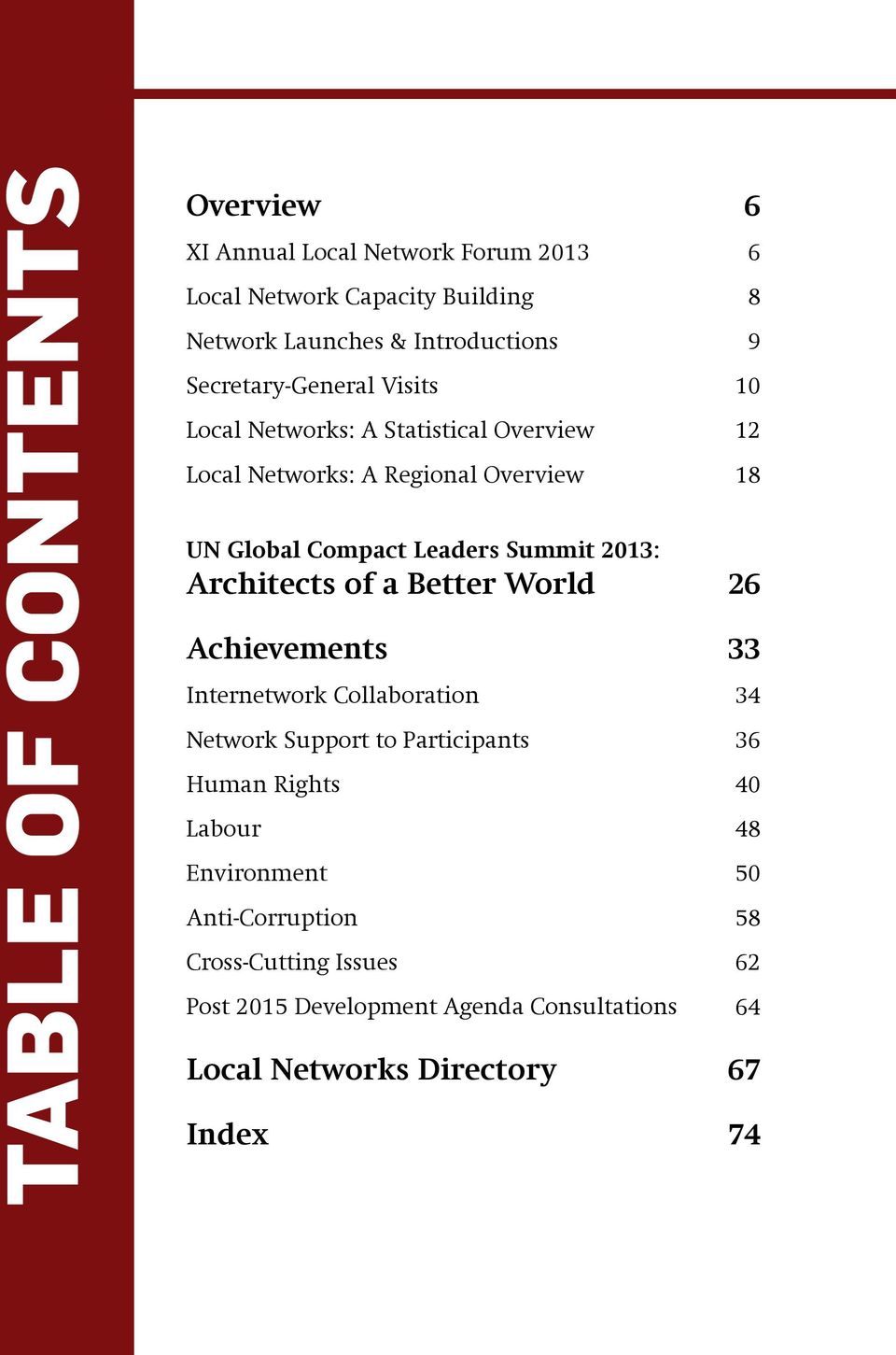
5 5 Formal Network Established Network Emerging Network
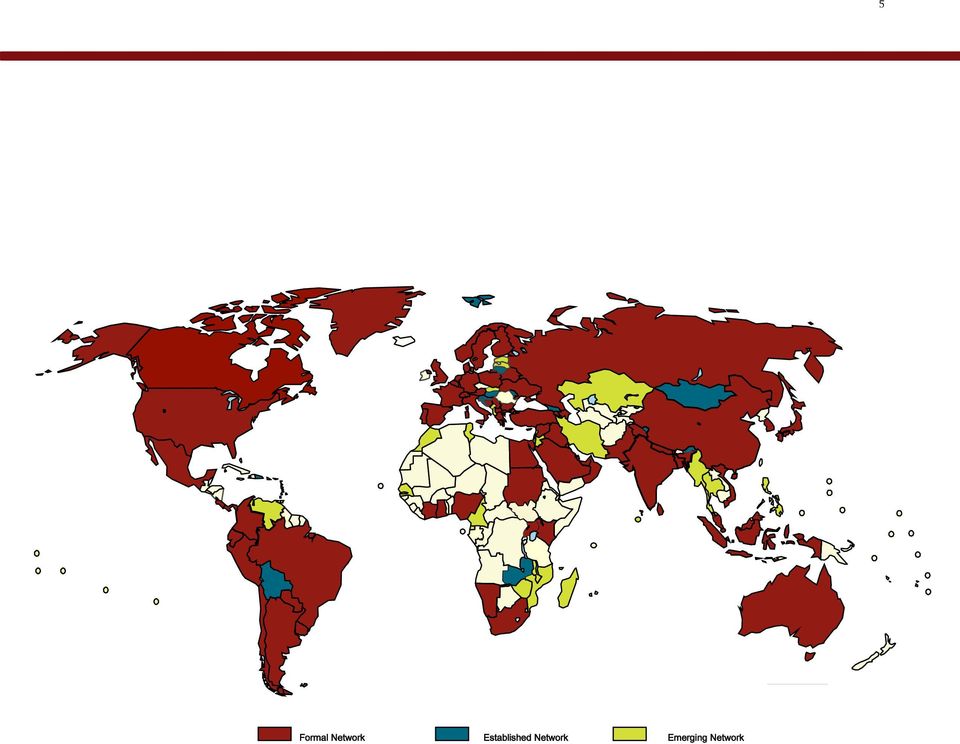
6 6 overview Overview The Global Compact Local Networks provided exceptional vision and leadership in By collaborating with participating companies and non-business stakeholders, Local Networks helped expand connections and advance the Global Compact and its principles at the local level. As the Millennium Development Goals 2015 deadline approaches, the post-2015 period offers an historic opportunity for the international business community to contribute to the advancement of sustainable development goals. Most notably, a growing number of Global Compact Networks have the full capability to convene, organize and implement massive business-led solutions, and facilitate collaboration and collective action to address sustainability challenges. The 2013 Global Compact Local Network report continues to showcase the important work of Local Networks from around the world. It provides a holistic view of Local Network activities as they relate to the UN Global Compact s ten principles in the areas of human rights, labour, environment and anticorruption, and their ability to drive action in support of broader UN goals and issues. The report is not an exhaustive list of achievements from the year, but instead is designed to highlight some of the exciting work by Local Networks as shared in the Knowledge Sharing System (KSS). XI Annual Local Network Forum April 2013, Geneva The XI Annual Local Network Forum (ALNF) provided an opportunity to share best practices, explore synergies between networks and determine a strategic path forward for networks. More than 80 representatives and contact persons from 56 Local Networks attended the three-day ALNF in Geneva, Switzerland.
7 7 Georg Kell, Executive Director of the Global Compact, welcomed participants to the meeting and stressed the importance of Local Networks and the significant role they play in scaling up corporate sustainability and bridging local-global linkages. The meeting included a session on the mutually supporting funding mechanism, followed by discussions on strengthening Local Network governance and brand management, which included an introduction to the new logo policy to ensure brand coherence and integrity. The decision was made to implement a new Memorandum of Understanding (MoU) as of January 2015, which will include a requirement for full financial disclosure and other measures to enhance accountability. Building upon a recommendation from the last ALNF (Rio de Janiero, June 2012), the networks also agreed to establish a Local Network Advisory Group for the first time in order to enhance communication between the Global Compact Office and Local Networks, as well as enhance the voice of the networks in the initiative. Elections were then held for the eight-member Advisory Group representing the following regions: the Americas; Africa; Eastern Europe; Middle-East and North Africa (MENA); South-Central Asia; South-East Asia and the Pacific; Western Europe; and the eighth member, the Head of Global Compact Local Networks. The Advisory Group also selected its own Chair who also occupies the Ex-Officio Local Network position on the Global Compact Board. This year s ALNF included a joint day of programming with UN-System Private Sector Focal Points. Representatives of UN entities and Local Networks each shared an overview of their work and priorities as a gateway to explore opportunities for local engagement. Topics included the post-2015 development agenda; enhancing collaboration between the UN, Local Networks and the private sector; and advancing partnerships at the national level.

8 8 overview Local Network Capacity Building The Global Compact Office is committed to empowering Local Networks to supplement and complement the activities of the UN Global Compact and to fully engage Global Compact participants to internalize the ten principles. As part of this commitment, the Global Compact Office continued to offer capacity building programmes in 2013 to support Local Networks in leveraging their potential as transformative platforms on the ground. Partnership Training Programme Introduced at the XI ALNF in Geneva for the first time, the Partnership Training Programmes were conducted throughout the year. The first two-day Partnership Training was conducted just prior to the XI ALNF, which gathered representatives from 26 Local Networks. The programme provided training to participants on how to achieve common understanding across partnerships, develop a collaborative mindset, create business and social value at the local level, as well as equipped them with resources to broker sustainable partnerships. Following the first programme, training sessions were held at each of the four regional meetings. Designed to address local and regional dynamics, each training session offered Local Networks and business delegates guidance on how to build local capacity and engagement within the region. The training not only focused on creating partnerships, but also providing guidance on how to discuss the Global Compact s work and to recruit new participants in the initiative. Local Network Exchange Programme Designed as a peer-mentoring programme, the Local Network Exchange Programme seeks to bring small groups of Local Network contact persons from various networks to a Local Network host country. The purpose of this exchange is for Local Networks to gain relevant insights into the activities of other networks, foster internetwork and interregional collaboration, and crosspollination of best practices. The Global Compact Network Germany hosted the fourth Local Network Exchange Programme, a five-day forum co-organized with the UN Global Compact. Aimed at fostering collaboration among Local Networks, the Exchange Programme offered participants the opportunity to share experiences and identify best practices across regional boundaries. Representatives from Local Networks in Argentina, Chile, Croatia, France and Uganda attended the event. Attendees participated in practical working sessions related to network governance, activities, integrity measures, collective action and policy dialogue. The participants also had an opportunity to meet with the Steering Committee of the Germany Network and take part in its German General Assembly, which included several sessions dedicated to the post-2015 development agenda, labour rights and training on Communication on Progress (COP).

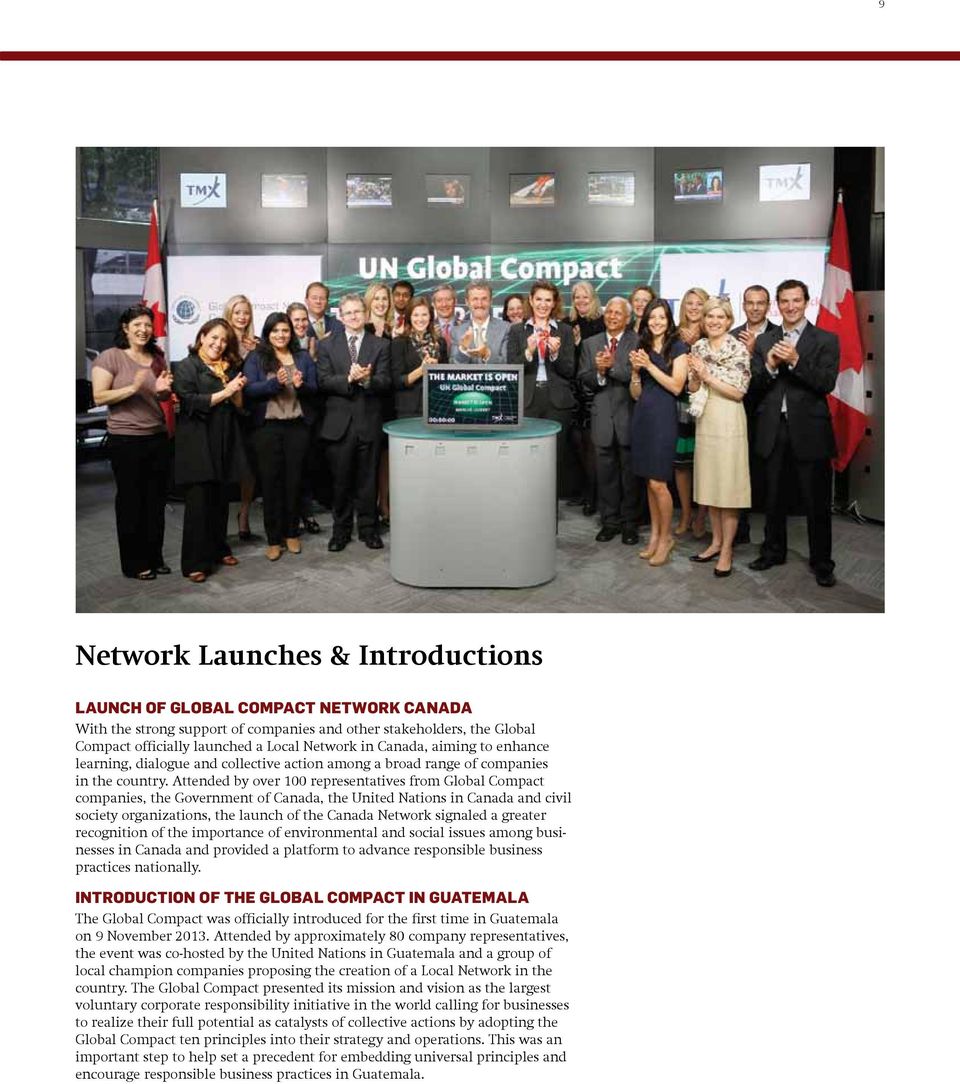
9 9 Network Launches & Introductions LAUNCH OF GLOBAL COMPACT NETWORK CANADA With the strong support of companies and other stakeholders, the Global Compact officially launched a Local Network in Canada, aiming to enhance learning, dialogue and collective action among a broad range of companies in the country. Attended by over 100 representatives from Global Compact companies, the Government of Canada, the United Nations in Canada and civil society organizations, the launch of the Canada Network signaled a greater recognition of the importance of environmental and social issues among businesses in Canada and provided a platform to advance responsible business practices nationally. INTRODUCTION OF THE GLOBAL COMPACT IN GUATEMALA The Global Compact was officially introduced for the first time in Guatemala on 9 November Attended by approximately 80 company representatives, the event was co-hosted by the United Nations in Guatemala and a group of local champion companies proposing the creation of a Local Network in the country. The Global Compact presented its mission and vision as the largest voluntary corporate responsibility initiative in the world calling for businesses to realize their full potential as catalysts of collective actions by adopting the Global Compact ten principles into their strategy and operations. This was an important step to help set a precedent for embedding universal principles and encourage responsible business practices in Guatemala.
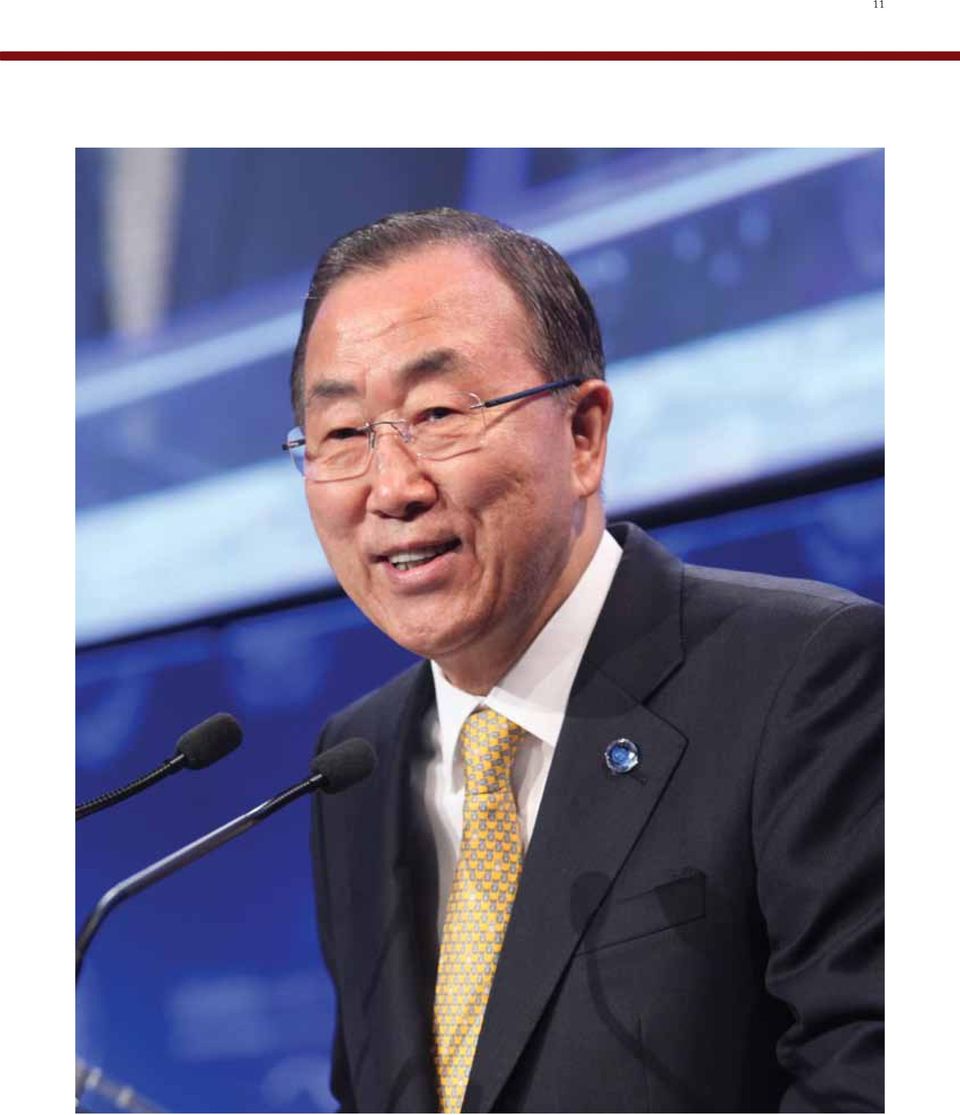
10 10 overview Secretary-General Visits China UN Secretary-General Ban Ki-moon joined a group of Global Compact CEOs on 18 June at a meeting co-hosted by Global Compact Network China, Global Compact Promotion Office of China Enterprise Confederation and the UN Global Compact Office. Centered on the theme Caring for Climate Towards a Low-Carbon Economy, UN representatives, senior business leaders and 14 CEOs shared their commitment to sustainability and insights on business action in combating climate change in China. The meeting provided an opportunity for the Secretary-General to learn how Chinese companies are addressing climate change. The Secretary-General praised the efforts of Chinese companies to address climate change and recognized the achievements of the China Network in recruiting Global Compact signatories and promoting sustainable development in the country. He stressed the urgency of addressing environmental challenges and noted the major role the business community has to play in advancing action on climate and other UN priorities. He expressed his full support for the China Summit on Caring for Climate that was to take place the following month in Beijing. Republic of Korea On 26 August, the Secretary-General attended Global Compact Network Korea s annual CEO Breakfast. The meeting which convened 200 CEOs and other representatives from business, civil society and academia focused on peace in conflict-affected and high-risk areas, with the Korean Network announcing its intention to join the new Business for Peace (B4P) platform to be launched at the Global Compact Leaders Summit in September. The Secretary- General called on Korean companies to actively engage in the post-2015 development agenda, and to scale up efforts to empower women within their organizations.

11 11
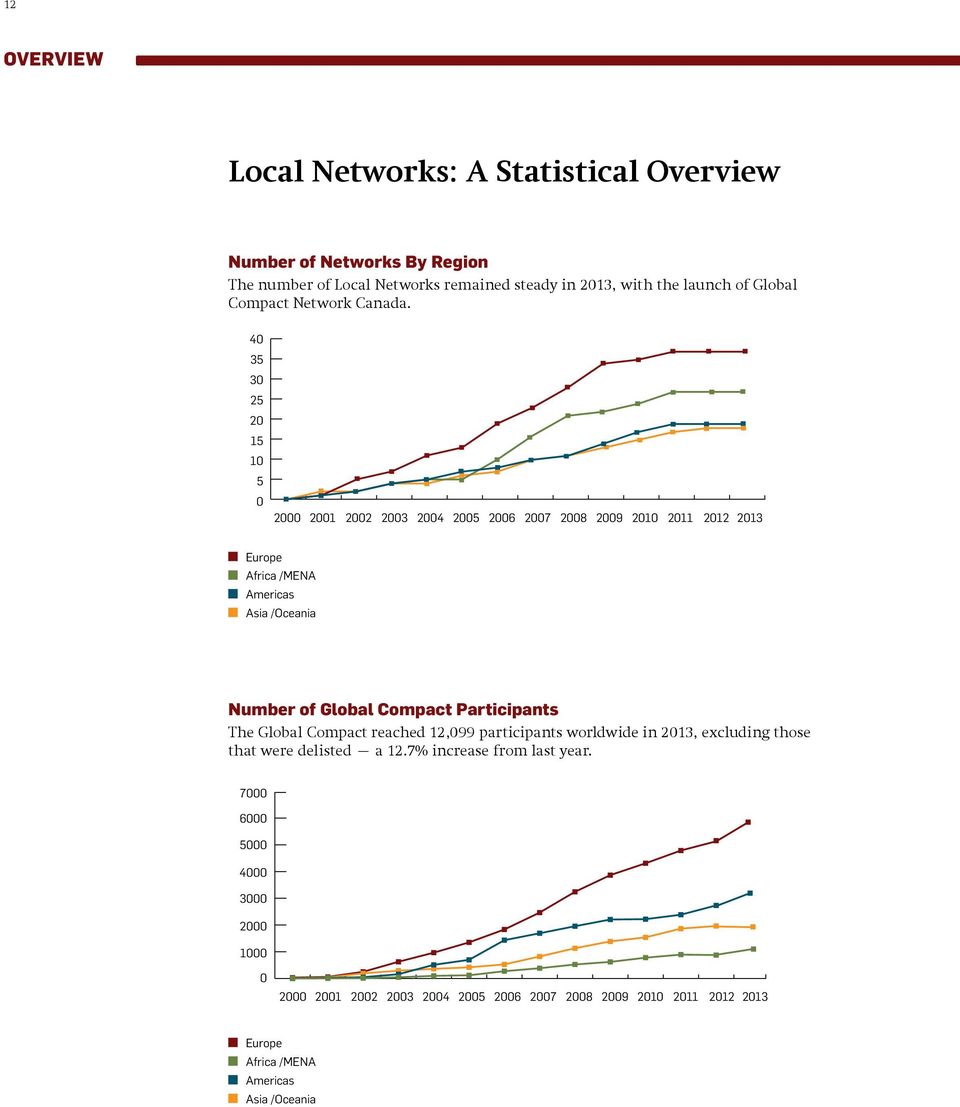
12 12 overview Local Networks: A Statistical Overview Number of Networks By Region The number of Local Networks remained steady in 2013, with the launch of Global Compact Network Canada Europe Africa /MENA Americas Asia /Oceania Number of Global Compact Participants The Global Compact reached 12,099 participants worldwide in 2013, excluding those that were delisted a 12.7% increase from last year Europe Africa /MENA Americas Asia /Oceania
13 13 Net Growth of New Participants Global Africa/MENA Americas Asia/Oceania Europe Distribution of Global Compact Participants 100% 80% 60% Non-Business Business Who are the Participants? Maintaining the trend from last year, SMEs were the largest group of participants globally (4,528), representing approximately 37% of the total 12,099 Global Compact participants. As in 2012, business participants including both SMEs and companies accounted for 66% of total signatories. Of these total business signatories (7,980) engaged in the Global Compact, 53% were from Europe (4,250), 24% from the Americas (1,917), 15% from Asia & Oceania (1,236), and 8% were from Africa & MENA (577). Africa & MENA The African region had the highest rate of growth among the four regions in 2013, expanding 28%, with 48 new business and 79 nonbusiness participants. Participants in the region are composed of 18% companies (190), 37% SMEs (387) and 45% non-business organizations (467). Americas With 1,917 business participants in the region, these participants account for 24% of the total business participants in the Global Compact globally. The region grew 15%, with 256 new business participants joining Local Networks in Participants in the Americas are composed of 40% non-business participants, 28% companies and 32% SMEs. Asia & Oceania Asia & Oceania in 2013 showed an overall decline of 8%, losing 109 participants, mostly SMEs. The challenge of retention of SMEs appeared worldwide, but is especially relevant in this region. 40% 20% 0 Global Africa/MENA Americas Asia/Oceania Europe Non-Business SME Company Europe Europe experienced an increase in participants in Business participants in the region grew 16% since 2012, adding 596 new organizations. The region is composed of 28% non-business participants, 43% SMEs and 29% companies. This represents 50.6% of all SMEs in the Global Compact initiative, and 49.6% of the Global Compact s total companies.

14 14 overview Top 20 Countries with Local Networks By Number of Participants Globally, the number of Global Compact participants has been growing steadily. Of the top 20 Local Networks, 8 are from Europe, 6 are from the Americas, 5 from Asia & Oceania and 1 from Africa & MENA. Spain has the largest number of participants with 1,701, of which 54% are SMEs, 19% companies and 27% non-business organizations, followed by France and the Nordic Network with 991 and 627, respectively. When focusing on the number of companies within a network, the Nordic Network has the highest among European networks with 44%, followed by Germany with 40%. With 132 participants, Iraq is now among the top 20 networks Spain France Nordic Network Mexico Brazil United States of America Colombia Germany India United Kingdom China Argentina Turkey Republic of Korea Japan Italy Ukraine Panama Iraq Australia Non-Business SME Company

15 15 Local Networks by Category (Emerging, Established and Formal) In 2013, 60% of all Local Networks were Formal, 13% were Established and 27% were Emerging. There was a notable increase in the number of Formal Networks in Africa & MENA growing from 9 in 2012 to 12 in 2013 hinting at an increase in capacity in the region. However, non-formal Networks still account for 40% of the total number, which indicates room for Established and Emerging Networks to develop and evolve to the next category. 100% 80% 60% 40% 20% 0 12 Global Africa/MENA Americas Asia/Oceania Europe 13 Emerging Established Formal Established and Formal Networks Set Up As Legal Entities (By Region) In 2013, 38% of all Local Networks were set up as legal entities. Just as last year, Asia & Oceania remained the largest region by number of legal entities, accounting for 71% of these networks. Europe was the second largest region, reporting 37%, followed by 27% in the Americas and 20% in Africa & MENA. 80% 70% 60% 50% 40% 30% 20% 10% 0 Global Africa/MENA Americas Asia/Oceania Europe % Established as Legal Entity

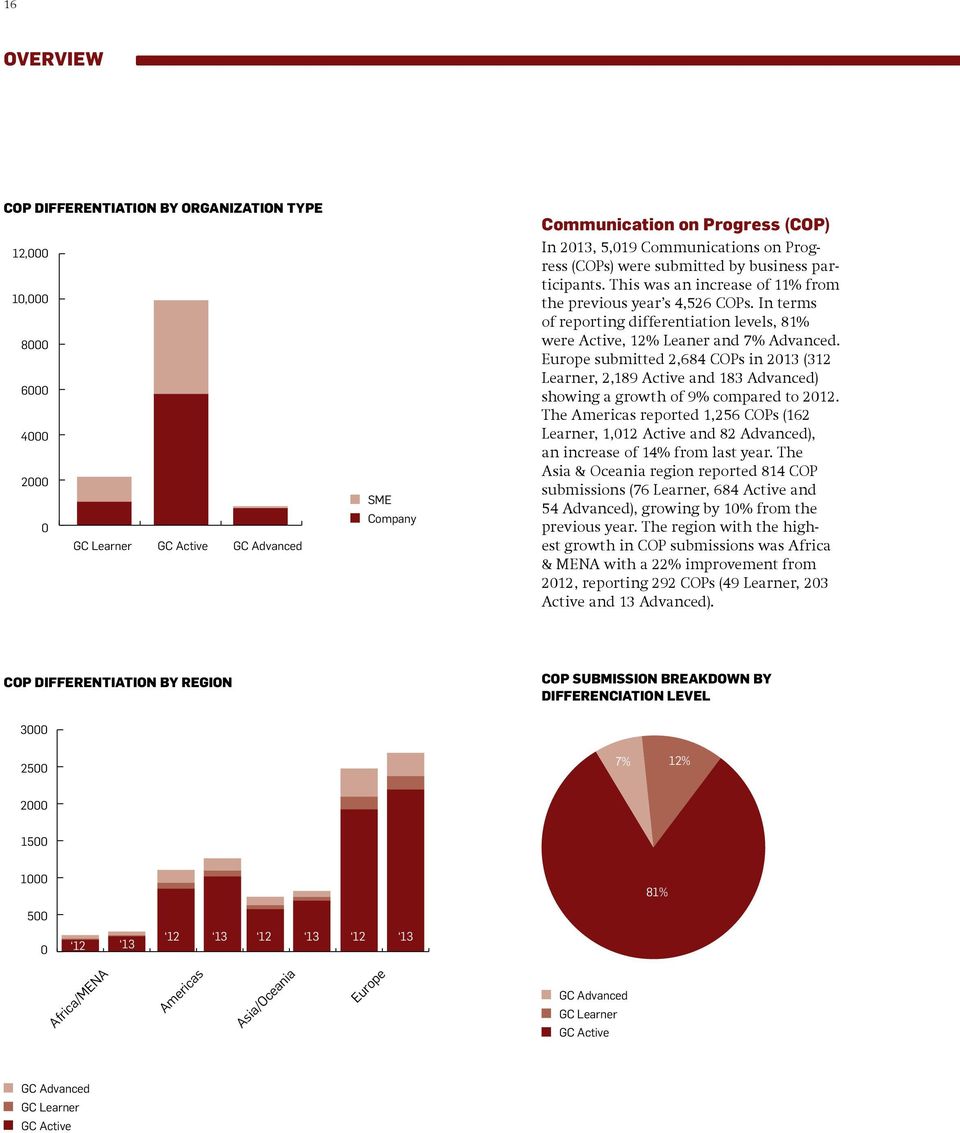
16 16 overview COP Differentiation by organization type 12,000 10, GC Learner GC Active GC Advanced SME Company Communication on Progress (COP) In 2013, 5,019 Communications on Progress (COPs) were submitted by business participants. This was an increase of 11% from the previous year s 4,526 COPs. In terms of reporting differentiation levels, 81% were Active, 12% Leaner and 7% Advanced. Europe submitted 2,684 COPs in 2013 (312 Learner, 2,189 Active and 183 Advanced) showing a growth of 9% compared to The Americas reported 1,256 COPs (162 Learner, 1,012 Active and 82 Advanced), an increase of 14% from last year. The Asia & Oceania region reported 814 COP submissions (76 Learner, 684 Active and 54 Advanced), growing by 10% from the previous year. The region with the highest growth in COP submissions was Africa & MENA with a 22% improvement from 2012, reporting 292 COPs (49 Learner, 203 Active and 13 Advanced). COP Differentiation by Region COP Submission Breakdown By Differenciation Level % 12% % Africa/MENA Americas Asia/Oceania Europe GC Advanced GC Learner GC Active GC Advanced GC Learner GC Active
17 17 Issues and Types of Activities Covered at Events (By Region) Throughout the regions, activities related to learning, outreach and COPs were the most frequently organized activities in 2013: Africa & MENA In Africa & MENA, out of 48 events reported, 62% of the region s activities focused on learning and outreach activities, followed policy dialogue and COP-related activities. Americas In the Americas, there was a focus on learning activities accounting for 24% of all activities and less emphasis on activities related to tool provisions, publications and translations, and policy, than in previous years. Outreach activities accounted for 13%, while COP-related activities accounted for 10%. Asia & Oceania In Asia & Oceania, learning activities were reported more frequently than in any other region, accounting for half of its total activities. Outreach and partnership activities were also common with 26 activities and 25 activities respectively in Europe In Europe, learning (26%), COP (23%), and outreach (21%) activities, were held most frequently. Learning activities, in particular, were hosted and organized more than any other in the region, with 111 activities reported throughout Issues and Types of Activities COP related activity Learning Outreach Partnership Policy Dialogue Tool Provision, Publication or Translation Other Europe Africa /MENA Americas Asia /Oceania

18 18 AFRICA & MENA Local Networks: A Regional Overview AFRICA & MENA Africa is witnessing some of the fastest growing global trends in terms of population and economic growth. However, while the private sector is increasingly recognized as playing an important role in societies, the Global Compact remains underrepresented in the region. In order to remedy this gap, Local Networks from Africa & MENA continued their efforts in 2013 to engage an increasing number of companies and other stakeholders in promoting corporate sustainability and the Global Compact throughout the region. Local Networks are uniquely positioned to raise awareness of the Global Compact among businesses and encourage them to integrate sustainability issues into their strategies and operations. AFRICA & MENA REGIONAL MEETING February 2014, Ghana Global Compact Network Ghana hosted the Africa & MENA Regional Meeting in Accra. Local Networks from Cote d Ivoire, Egypt, Ghana, Malawi, Namibia, Nigeria, South Africa and Uganda were represented. The meeting focused on the outcomes of the Global Compact Leaders Summit 2013, the Post-2015 Business Engagement Architecture and renewed efforts by the Global Compact to scale up corporate sustainability in Africa. The growth and engagement strategy for Africa was presented to Local Networks who welcomed a comprehensive approach in the region, acknowledging the importance of increasing the presence of the Global Compact in Africa. Participants highlighted the need for more inter-african collaboration and identification of local business champions in order to further advance the initiative in the continent. Global Compact Network Ghana and the Global Compact Office partnered with the Ghana Chamber of Mines and the State Secretariat for Economic Affairs (SECO) to co-host a CEO roundtable discussion with over 50 business leaders from a variety of industries on the challenges and opportunities of integrating corporate sustainability principles into their business practices. Top 10 Local Networks By Number of Participants Africa & MENA From 2012 to 2013, the number of participants in the top 10 Local Networks in the region grew by over 150. Iraq grew to become the top Local Network by number of Participants in Africa & MENA with 132 participants in 2013, while in 2012 Nigeria was first with 96 participants Non-Business 0 Iraq Nigeria Gulf States Kenya South Africa Ghana Egypt Syrian Arab Republic Sudan Jordan SME Company

19 19

20 20 AMERICAS AMERICAS The Local Networks in the Americas region continued their efforts to promote sustainability among the private sector in Currently, the region is home to 26% of total Global Compact participants and four of its networks are positioned among the top ten Local Networks overall by number of participants. Participants in both North America and Latin America have shown strong commitments to advancing the work of the Global Compact. However, due to their diverse social and economic backgrounds, the two sub-regions may have different approaches to tackling global issues. For instance, due to the significant development and inequality challenges Latin America faces, companies engaged in the region may have the potential to address these particular issues in their societies. In 2013, the Global Compact welcomed the launch of the Canada Network and the official introduction of the Global Compact in Guatemala. The Regional Center for the Support of the Global Compact in Latin America and the Caribbean held a number of events and developed several resources as part of their continued support to Local Networks in the region. AMERICAS REGIONAL MEETING 5-6 November 2013, Colombia Global Compact Networks in the Americas and the Caribbean met over two days for their annual regional meeting, hosted by the Global Compact Network Colombia and followed by the Latin America and Caribbean Global Compact Business Forum. Local Network representatives from Argentina, Brazil, Chile, Columbia, Mexico, Panama, Paraguay, Peru, Uruguay, as well as the Regional Center for the Support of the Global Compact in Latina America and the Caribbean, attended the meeting. Participants explored elements of the Post-2015 Business Engagement Architecture a framework launched in September 2013 at the UN Global Compact Leaders Summit to help business enhance corporate sustainability as an effective contribution to sustainable development which they agreed to utilize as a foundation for their strategic planning processes and as a means to collectively map their work against a common framework. Attendees were briefed on other new resources and issue platforms launched at the Leaders Summit and received an update from the Global Compact Office on the new Communication on Engagement (COE) reporting requirement for non-business participants Top 10 Local Networks By Number of Participants Americas Between 2012 and 2013, the number of participants in the top 10 Local Networks in the Americas region grew by over 400, with Mexico moving from third largest in 2012 to meeting Brazil as the top Local Network in terms of number of participants in Mexico Brazil United States of America Colombia Argentina Panama Peru Canada Chile Venzuela Non-Business SME Company

21 21 REGIONAL CENTER FOR THE SUPPORT OF THE GLOBAL COMPACT IN LATIN AMERICA AND THE CARIBBEAN The Regional Center was established to advance the mission of the Global Compact within the Latin American and Caribbean (LAC) contexts. In a continuous effort to support Local Networks in the LAC Region, the Regional Center undertook several activities in 2013: PUBLICATIONS The Guide to the Global Compact for Local Governments: Converting the Global Compact into Good Practice. The publication offers guidance to local Governments and public entities on establishing programmes and activities around the ten principles and its four main themes, and included case studies from three municipal areas, as well as international expert reviews. Analysis of the Accomplishment of the 10th Principle of the United Nations Global Compact Regarding Extractive Industries Operating in Latin America. With support from Transparency International s Mexico Chapter, the Regional Center published a study which looked at eight companies from the extractive industry in Latin America in order to illustrate how the 10th principle on anti-corruption translates into practice. The Global Compact in Latin America and the Caribbean: Report In an effort to showcase the work conducted by the Global Compact in Latin America and the Caribbean, the Regional Center issued this publication as a review of the region from a global perspective. The report includes a catalog of LAC participant best practices and major activities of the Regional Center. The launch event, hosted in Bogota, gathered the Local Networks of Colombia, Mexico and Peru, as well as business partners of the Regional Center. EVENTS III Global Compact Business Forum in Latin America and the Caribbean III Global Compact Business Forum in Latin America and the Caribbean, held in Medellin, Colombia, focused on issues related to human rights, labour standards, the post-2015 development agenda, and the role of Latin American companies in global markets. It also brought perspectives from various stakeholders on the need to address human right issues related to indigenous communities, in conflict situations and in areas of significant income inequality.
22 22 ASIA & OCEANIA ASIA & OCEANIA Through their continued engagement on important Global Compact issues, Local Networks in the Asia & Oceania region demonstrated their potential as true catalysts of change by fostering an enabling environment to address global challenges locally. A series of national-level and regional-level consultations on the post-2015 development agenda were convened throughout the region where the Local Networks facilitated multistakeholder discussions closely linked to related development priorities. In order to address a recent decline in the number of new participants, Local Networks in the region stressed a need for regional collaboration and recognized the importance of reorienting their growth and engagement strategy to focus more on small- and mediumsized enterprises (SMEs). However, the networks remained confident in their ability to be a transformational force for advancing corporate sustainability in the region. ASIA & OCEANIA REGIONAL MEETING February 2014, Indonesia Global Compact Networks convened over two days for their annual meeting hosted by Global Compact Network Indonesia. The meeting welcomed participants from Australia, Bangladesh, India, Indonesia, Japan, Maldives, Pakistan, Republic of Korea, Sri Lanka and Viet Nam. The meeting focused primarily on outcomes from the Global Compact Leaders Summit 2013 and the launch of the Post-2015 Business Engagement Architecture. New issue platforms and engagement opportunities were presented as vehicles for business to contribute to the Post-2015 Development Agenda, with a special focus given to the new Business for Peace (B4P) platform. Recognizing common interests and challenges they face in the region, Local Networks agreed to work collaboratively and developed 13 action plans for internetwork collaboration. Attendees also had the opportunity to participate in two site visits to local companies and discuss the challenges and opportunities they face in integrating corporate sustainability principles into their business strategy and operations. Top 10 Local Networks By Number of Participants Asia & Oceania While the overall number of participants in the top 10 Local Networks in this region dropped between 2012 and 2013, networks in India, China, Republic of Korea, Australia, Indonesia, Pakistan, Viet Nam and Malaysia grew by 131 participants collectively India China Korea, Republic of Japan Australia Indonesia Pakistan Viet Nam Singapore Malaysia Non-Business SME Company
23 23
24 24 Europe EUROPE Over the past year, the Local Networks in Europe have demonstrated their strong commitment to the Global Compact by putting environmental and social issues, as well as the implementation of the ten principles, at the heart of their activities. Europe remained a leader in 2013 in terms of the number of Global Compact participants, particularly business participants, in the region. The European networks are well-connected and effective in terms of creating collective action, encouraging policy dialogue and forming new partnerships. In respect to the post-2015 development agenda, open consultations with the public and private sector were carried out throughout 2013 in order to contribute to the UN process of determining the scope and nature of future development goals. EUROPE REGIONAL MEETING November 2013, Spain Global Compact Networks from Bulgaria, Slovenia, Netherlands, France, Germany, Croatia, Macedonia, Nordic Countries, Serbia, Spain, Ukraine, Portugal, and UK participated in their annual meeting hosted by the Global Compact Network Spain. Key topics included outcomes from the Global Compact Leaders Summit 2013, the launch of the Business for Peace (B4P) and Business for Education platforms, as well as the introduction of the Social Enterprise Collaboration Lab and the UN Global Compact Business Partnership Hub. Local Networks were briefed on the recently implemented Communication on Engagement (COE) mechanism for non-business participants, and explored the new Post-2015 Business Engagement Architecture, which they agreed to use as a foundation for their upcoming strategic planning. Participants also initiated the consultation process for the new Memorandum of Understanding (MoU), as agreed upon during the last ALNF in Geneva. Top 10 Local Networks By Number of Participants europe While the placement of Europe s top 10 Local Networks by number of participants remained the same between 2012 and 2013, the number of participants within these 10 grew by over 650. Spain experienced the largest growth with more than 300 new participants, of which over 200 were SMEs Spain France Nordic Network Germany United Kingdom Turkey Italy Ukraine Switzerland Netherlands Non-Business SME Company
25 25
26 26 UN Global Compact Leaders Summit 2013: Architects Of A Better World
27 September 2013 Chaired by UN Secretary-General Ban Ki-moon, the UN Global Compact Leaders Summit 2013 gathered chief executives, leaders from civil society, Government and the United Nations to unveil the Business Engagement Architecture to align and scale up business action in support of sustainable development priorities. The Summit convened 1,200 participants to discuss corporate sustainability strategy at the highest level and produce strategic recommendations and action imperatives for the future of the initiative. Held every three years, the Leaders Summit is the largest gathering of its kind. Leaders Summit Local Network Meeting September 2013, New York Following up on the XI Annual Local Network Forum 2013 in Geneva, Local Networks met just prior to the Leaders Summit at UN Headquarters in New York to discuss the new Collaborative Funding Model. The meeting included representatives from Local Networks in Argentina, Australia, Brazil, Canada, Chile, Colombia, Costa Rica, Egypt, France, Germany, Ghana, India, Indonesia, Iraq, Israel, Italy, Japan, Republic of Korea, Mexico, Netherlands, Nigeria, Nordic Countries, Pakistan, Panama, Paraguay, Peru, Portugal, Russian Federation, Serbia, Singapore, South Africa, Spain, Sri Lanka, Sudan, Switzerland, Turkey, Uganda, Ukraine, United Arab Emirates, United Kingdom, USA, Uruguay, Viet Nam and Zambia. Global Compact Executive Director Georg Kell and Chairman of the Board of Directors of the Foundation for the Global Compact Sir Mark Moody-Stuart welcomed participants and set the context of the meeting. Working closely on the consultations with Local Networks since the last Annual Local Network Forum in April, the newly established Local Networks Advisory Group (LNAG) and the Foundation for the Global Compact presented funding recommendations derived from feedback received through surveys and consultations with Local Networks. The recommendations suggested that the best approach for future fundraising would be to give Local Networks a choice to participate in one of two funding models: Collaborative, or Independent but Mutually Supportive. Both models encourage business participants to contribute locally and globally and involve coordinated messages to the participants. In alignment with the new funding approaches, the Global Compact Office introduced an additional eligibility criterion under the Global Compact Logo Policy. Upon requesting permission to use the We Support logo, the new criterion requires business participants to demonstrate support for the Global Compact by making the applicable annual contribution to the Foundation for the Global Compact. Contributions from companies are vital to the initiative s ability to provide a robust framework for corporate change and innovation around environmental, social and governance issues.
28 28 ARCHITECTS OF A BETTER WORLD Local Network Special Events Many Local Networks took a leading role by organizing several special events on 19 September to address key priority areas. Global Compact Network Brazil held Brazil and the Architecture, a discussion on contributions to the post-2015 development agenda building on the outcomes of Rio+20 from Global Compact participants in Brazil. The Global Compact Cities Programme and the Regional Center for the Support of the Global Compact in Latin America and the Caribbean co-organized a session on Partnerships for Sustainability: Cities, States, Corporations, which convened local Government leaders and businesses to discuss the important role that partnerships and collaboration play in addressing critical urban and regional issues. The UN Global Compact hosted Global Challenges, Local Solutions: Local Networks as Catalysts for Development in the Post Era, which presented case studies to highlight the capacity of Local Networks to implement business-led solutions and facilitate collaboration and collective action toward addressing sustainability challenges. Finally, the Global Compact Network Belgium, in conjunction with UNICEF and with strong support from the Belgian Federal Public Service Foreign Affairs, Foreign Trade and Development Cooperation, hosted a panel discussion entitled Children s Rights are Everyone s Business. Her Majesty the Queen of Belgium gave the opening remarks, which highlighted the respect for and implementation of children s rights as key components and drivers of sustainable development.
29 29
30 30 ARCHITECTS OF A BETTER WORLD Executive Sessions In smaller break-out groups, participants focused on components of the Architecture that have high potential for scale, collaboration and impact. During these highly interactive, world café-style sessions participants discussed key challenges and opportunities for leveraging each mechanism to advance global priorities. Six Executive Sessions were convened around the following topics: 1) Collective Action and Global Issue Platforms; 2) UN-Business Partnerships; 3) Business Sector Initiatives; 4) Local Sustainability Movements; 5) Private Sustainability Finance; and 6) Horizon Session: The Business Enterprise in Participants of the Local Sustainability Movements Session focused on how to enhance the role and contribution of Local Networks and explored considerations for creating more vibrant national-local sustainability movements to widen and deepen impact. Action Fair The Action Fair was a central meeting point for participants at the Leaders Summit to learn, connect and collaborate. Comprised of Global Compact and Local Network exhibitions, as well as five thematic booths, the collaborative space offered innovative tools and practical resources for attendees to discover initiatives and platforms and commit to key actions. The Local Network booth provided an interactive space for participants to learn the importance of Local Networks in addressing global sustainable development priorities as one of the building blocks of the Business Engagement Architecture. The work done by Local Networks was showcased in a Google Earth presentation, highlighting the capacity of networks to scale up Global Compact initiatives and issues within local contexts, as well as to help define and implement global development priorities. Post-2015 Business Engagement Architecture The Leaders Summit s Opening Plenary marked the launch of the Post-2015 Business Engagement Architecture, which was unveiled by the Secretary-General, and set the stage to explore opportunities for business to advance sustainable development beyond The Business Engagement Architecture is an invitation to organizations, initiatives and networks working globally to engage business on sustainable development and to join forces with the UN Global Compact, the World Business Council for Sustainable Development (WBCSD), the Global Reporting Initiative and other like-minded organizations to promote and support corporate commitments and actions that advance UN goals. The Architecture illustrates the main building blocks necessary to enhance corporate sustainability as an effective contribution to sustainable development, creating value for both business and society. Each building block must be further strengthened and connected through a comprehensive and collective effort if these building blocks are to help scale corporate sustainability and turn business into a truly transformative force beyond Based on the suggestions of the Global Compact Office, the Local Networks are currently analyzing local contexts as well as each building block of the Business Engagement Architecture using a multi-stakeholder approach. The objective of this exercise is to prioritize local issues, and lay the foundation for a bottom-up approach to strengthening the local-global linkage. UN Private Sector Forum: Africa Participants from both the public and private sectors including Heads of State, chief executives, leaders from civil society, foundations and the UN attended the annual UN Private Sector Forum, a high-level luncheon held as part of the Leaders Summit. The Forum focused on the role of the private sector in the post-2015 development agenda, with an emphasis on unique opportunities and challenges in Africa. The event was designed to maximize interaction, increase understanding of efforts underway and generate a range of ideas and commitments from the private sector to build a sustainable future for Africa.
31 31
32 32 Local Networks are the soul and foundation of the Global Compact. Jan Eliasson, Deputy Secretary-General, United Nations
33 33Achievements The information and data in this report are based on the Global Compact Local Networks activities during 2013 and information placed in the Knowledge Sharing System (KSS). The report is not an exhaustive list of achievements from the year, but is rather meant to highlight just some of the work being done by Local Networks around the world. the star mark indicates best practice
34 34 Internetwork COLLABORATION Local Networks engage in internetwork collaboration to achieve similar goals, exchange best practices and discuss solutions to common challenges. The following are highlights from several joint events held in 2013: Belgium & India Global Compact Network Belgium and Global Compact Network India collaborated to host a corporate responsibility forum, bringing businesses from Belgium to meet businesses in India in order to discuss how sustainability efforts in partnership can strategically leverage long-term shared value. The platform brought together business, Government, academia and civil society to discuss recent insights on the sustainability agenda in India, including the opportunities and challenges of the new mandatory Corporate Social Responsibility Bill new legislation under India s new Companies Act that requires certain classes of companies, both public and private, to spend at least 2% of their average annual net profit from the three preceding financial years towards corporate sustainability activities. China, Japan & the Republic of Korea The fifth annual Global Compact China-Japan-Korea Roundtable Conference was held during the China Climate Summit. The three-day conference, Caring for Climate Ecological Civilization & Beautiful Home, was attended by approximately 200 participants including business, Government, civil society, academia and youth representatives from all three countries. Executive Director Georg Kell opened the conference with a message of support for regional collaboration, stressing the importance of Local Networks as key players in addressing global issues in a local context. The conference provided a formal learning and collaboration platform for the three networks on three themes: 1) Youth CSR Conference; 2) Researchers Meeting; and 3) Business Best Practices on the Environmental Agenda. Youth representatives from China, Japan and Republic of Korea presented the outcomes of their prior online discussions on sustainable development and demonstrated their support of the Government and business commitments to address climate change in a signed youth statement. The conference selected Corporate Social Responsibility Youth Ambassadors to promote corporate sustainability in their communities and among their peers. Through the lens of youth, academia, and business, the conference facilitated interactive discussion among various stakeholders and called for collective action to address ongoing climate issues. Côte d Ivoire, France & Ghana Global Compact Network France co-hosted two thematic conferences to mark its year-long collaboration with the Local Networks in Côte d Ivoire and Ghana. Participants from business, Government, civil society, labour organizations and UN agencies took part in a meeting on anti-corruption and corporate sustainability in Abidjan, Côte d Ivoire. Panelists took stock of lessons learned from country case examples and agreed on the need for establishing coalitions to fight corruption. The Ghana and France Networks also held workshops on the topics of Corruption in the Supply Chain and Health and Safety: Moving from Rhetoric to Action. They offered Ghanaian attendees the opportunity to study how the French Agency for Development (ADF) tackles corporate sustainability in the country.
35 35 Ghana & Nordic Network A knowledge-sharing workshop entitled Embedding CSR and Sustainability Principles into Responsible Business Conduct, emphasized Nordic and Ghanaian best practices and provided an overview of corporate responsibility trends in Denmark, Finland, Iceland, Norway and Sweden. India & Maldives Global Compact Network India, in partnership with Global Compact Network Maldives, held a COP training on Looking Beyond Compliance: Embracing Effective Corporate Governance and Sustainability Practices. The workshop focused on sustainability reporting and presented valuable case studies from companies in India. The day-long programme consisted of hands-on exercises and the exchange of useful insights and experiences on sustainability and corporate governance. Netherlands & Turkey Celebrating over 400 years of trade relations between the two countries, Global Compact Networks from Turkey and the Netherlands convened at the forum Sustainable Banking in Practice: Managing the Risks, Creating Opportunities. The delegation consisted of policy makers and banking executives from Turkey s top 15 banks. This collaboration was the first of its kind, as the two networks had never before convened to focus on this particular sector. The session provided an opportunity for Local Networks from the Netherlands and Turkey to exchange thoughts on key issues and best practices in the sector.
36 36 NETWORK SUPPORT TO PARTICIPANTS In an effort to develop an enabling environment for corporate sustainability, businesses often engage in multi-stakeholder dialogue, advocacy and debate at national and global levels. Each year, Local Networks develop and organize a comprehensive agenda of events and activities to assist business participants in fulfilling their commitments to corporate sustainability and deepen their engagement in the Global Compact. Companies receive valuable support in translating and implementing the ten principles in a local context. Policy Dialogue To support efforts by the private sector to scale up corporate sustainability practices, Local Networks facilitate multi-stakeholder dialogues with Governments and policy makers in an effort to embed corporate sustainability in national agendas. Chile Global Compact Network Chile held a meeting to formally announce the creation of the Board of Social Responsibility for Sustainable Development. The Ministry of Economy publicly presented the Board, which consists of 20 members across business, Government, academia and civil society. The multi-sectoral body aims to make social responsibility a state policy. Colombia Global Compact Network Colombia organized a roundtable with the national Government, UN agencies and business partners to promote discussion and best practices. Priority areas for the meeting consisted of human rights, child labour, labour standards, environment and anti-corruption. Participants from key organizations engaged in active dialogue and established action plans that would strengthen the comprehensive reporting of the Global Compact principles. This is an ongoing process and participants are expected to gather in 2014 to discuss and carry out the action plans established.
37 37 Communication on Progress The Communication on Progress (COP) is a key requirement for Global Compact signatories to encourage transparency and accountability, as well as showcase continuous performance improvement in the implementation of the ten principles. Participants are required to report their commitments to internal and external stakeholders. Local Networks work closely with companies to ensure they meet their obligations by providing assistance on preparing and submitting COPs, facilitating peer reviews, and organizing workshops to introduce new COP development tools to participants. This critical support from Local Networks helps companies maintain good standing and contribute to a vital set of responsible business practices. The following Local Networks offered participants support on the COP process in various trainings and workshops in 2013: Brazil, Egypt, France, Ghana, Gulf States, India, Italy, Japan, Kenya, Nigeria, Serbia, Singapore, Switzerland, Turkey, USA and Viet Nam. PARTNERSHIPS In addition to internalizing the ten principles in business operations, Global Compact signatories are encouraged to undertake more outward-oriented actions by supporting broader UN goals and issues. Together with companies, Local Networks help develop and facilitate partnership projects with other organizations to leverage the strengths and capacities of a variety of stakeholders in order to maximize impact. Egypt In 2013, Global Compact Network Egypt and Deutsche Gesellschaft für Internationale Zusammenarbeit (GIZ) co-hosted six roundtables to raise peer learning between Global Compact participants and other organizations around the themes of inclusive business models, sustainable tourism, gender diversity, anti-corruption and the Women s Empowerment Principles (WEPs). Japan Seeking to promote disaster preparedness and resiliency in order to support recovery from the Great East Japan Earthquake of 2011, Global Compact Network Japan undertook the Watari-cho Project in partnership with Watari Green Belt Project in Miyagi Prefecture. The project is a collective action initiative for disaster recovery and offers an opportunity for employees of Japan Network participating organizations to perform volunteer activities in the region. Through the platform, the initiative continuously dispatches groups of volunteers from a diverse range of organizations, with over 300 volunteers participating in the project over the course of three years. Spain During Global Compact Network Spain s 10th Annual General Assembly, a new resource to facilitate engagement and partnership among participants was released. The resource, Compactlink, is an online platform created for network participants to increase the ability to interact with each other. The resource is also available for corporate sustainability experts, journalists and other stakeholders. Designed as a tool to assess an organization s corporate sustainability activities, an organization can evaluate the extent to which the Global Compact ten principles are being implemented within its operation by assessing the elements of their corporate strategy and relevant activities. Based on the assessment, the user receives a customized pro-
38 38 posal for how to enhance their organization s activities. Compactlink includes access to other features, including online training courses, discussion groups addressing specific challenges, access to resources and a directory of support entities. Additionally, during the event, local representatives from UNICEF, United Nations High Commissioner for Refugees (UNHCR), United Nations Relief and Works Agency for Palestine Refugees in the Near East (UNRWA), World Food Programme (WFP), Organisation for Economic Co-operation and Development (OECD), and the World Tourism Organization (UNWTO) presented available partnership opportunities for companies. The Spain Network also introduced a summary in Spanish of UN-Business Partnerships: A Handbook, released by the UN Global Compact. AWARENESS-RAISING Local Networks host awareness-raising sessions, a critical type of capacity building activity, as part of their services to participants. Ghana In September 2013, Global Compact Network Ghana organized its first CSR and Sustainability Week Celebration, featuring a public lecture and awards ceremony. The companies that were honoured had publicly informed their stakeholders the year prior of their commitment to internalize the ten UN Global Compact principles into their business operations and spheres of influence. Attended by 100 participants, the event also consisted of a lecture that challenged participants to view CSR as value creation rather than philanthropy. Gulf States Global Compact Network Gulf States, supported by the Arabia CSR Network, organized a fullday training session entitled CSR Fundamentals for Small and Medium Sized Enterprises. Government and business representatives primarily from the oil and gas, property management, transportation and education sectors attended the training. Sessions featured business case studies and a presentation on the Global Compact initiative. During the training, attendees participated in interactive exercises that focused on what companies in the region hope to achieve through corporate sustainability and the challenges they face in implementation. In partnership with the Arabia CSR Network, the network conducted a two-day capacity building workshop for business leaders in the region. The network also brought together corporate sustainability, human resources and communications professionals from public and private organizations. These professionals discussed value creation through long-term corporate sustainability strategies which catalyze innovation and leadership, enhance access to traditional markets and create new opportunities in emerging and underserved markets. Serbia Global Compact Network Serbia s Working Group for Education and CSR Promotion held five meetings in Sessions focused on introducing the Global Compact, the social status of people with disabilities, and Principles for Responsible Management Education (PRME) an engagement framework to advance corporate responsibility through the incorporation of universal values into education institutions and business school curriculum. The following Local Networks also coordinated awareness-raising events for participants this year: Argentina, Canada, Kenya, Poland, Portugal, Republic of Korea, South Africa and Spain.
39 39
40 Al servicio de las personas y las naciones 40 HUMAN RIGHTS HUMAN RIGHTS PRINCIPLES Principle 1: Businesses should support and respect the protection of internationally proclaimed human right; and Principle 2: make sure that they are not complicit in human rights abuses. The first two principles of the UN Global Compact are derived from the Universal Declaration of Human Rights. The endorsement of the Guiding Principles on Business and Human Rights in 2011, has helped more businesses understand the legal, moral, and commercial imperative to respect and support human rights within their own activities and business relationships. Human rights issues remain some of the most challenging areas of corporate sustainability. Companies are often uncertain of how to avoid complicity in human rights abuse and where the boundaries of their human rights responsibility lie. Local Networks help facilitate the advancement of a company s understanding of business involvement on human rights issues by providing guidance, developing tools and coordinating events and knowledge exchanges. The following are examples of how Local Networks are promoting this agenda at the country level: Guía de derechos humanos para empresas Proteger, Respetar y Remediar: Todos Ganamos Argentina Global Compact Network Argentina and the United Nations Development Programme (UNDP) Argentina collaborated on a human rights tool for companies in Argentina, based on the UN Protect, Respect and Remedy Framework, entitled Protect,Respect and Remedy: We All Win. The Local Network launched the publication at an event with national and international experts and marked the inaugural meeting of the network s first Working Group on Business and Human Rights in the country. The Working Group and the publication also received support from the UNDP and the High Commissioner on Human Rights for the Southern Cone of Latin America. The AusTrAliAn MinerAls industry & human rights: Managing Human Rights Risks and Opportunities through the UN Guiding Principles on Business and Human Rights Australia Global Compact Network Australia and the Minerals Council of Australia released the publication, The Australian Minerals Industry & Human Rights: Managing Human Rights Risks and Opportunities through the UN Guiding Principles on Business and Human Rights. The publication highlights how mining companies are applying leading practices to implement the principles. As a significant actor in the Australian economy, mining companies have a considerable opportunity to contribute to sustainable development and positively impact communities and countries around the world.
41 41 Respecting human Rights An introductory guide for business Germany Global Compact Network Germany translated and launched several tools on business and human rights in The Organizational Capacity Assessment Instrument (OCAI) an online questionnaire for companies to self-analyze their capacities to manage human rights risks and responsibilities was translated into Spanish through a partnership with Local Networks from Spain and Argentina, and in cooperation with the Business and Human Rights Resource Center. With the support of the German Federal Ministry of Economic Cooperation and Development, the Germany Network translated the UN Guiding Principles into German, making the text more accessible to German-speaking stakeholders, particularly SMEs. The German Institute for Human Rights, in collaboration with other organizations, produced and published an English translation of the introductory guide: Respecting Human Rights: A Guide for Business. India In 2013, CEOs and senior management representatives from local companies attended the second India CEO Forum on Business and Human Rights. The forum s theme, Growth with Dignity, Respect and Accountability, initiated a dialogue with Indian business leaders on the implementation of the UN Protect, Respect and Remedy Framework within the local context. Participants discussed their strategies for advancing human rights principles in the workplace. Kenya Salt production is a major industry in Kenya and, as such, is critical to the social and environmental sustainability of the country. Global Compact Network Kenya, with Kenya Association of Manufacturers and Kenya National Commission on Human Rights, partnered with salt companies to build their capacity for addressing social and environmental impacts, with a special focus on human rights. Participants attended the meeting to discuss best practices of working with the oil and gas sectors and an action plan for moving forward.
42 42 Netherlands Global Compact Network Netherlands, in collaboration with the Social and Economic Council of the Netherlands (SER), initiated a project to help companies in the process of identifying and prioritizing human rights risks in the local context. The initiative was officially launched in November 2013 with interested companies invited to participate in an introductory session. This session outlined the core elements of human rights due diligence and an overview of the project s proposed methodologies, as well as the time and resource implications for companies and stakeholders involved in the project. Companies who have signed onto the project will continue to meet in 2014 to identify and prioritize risks. Poland Global Compact Network Poland hosted a conference on Implementing UN Guiding Principles on Business and Human Rights. The conference opened with a cameral meeting, which brought together representatives from Polish businesses and the Ministry of Economy, members of the Global Compact Network Poland Programme Board, representatives of the Polish Parliament, state administrators and others engaged with the UN Guiding Principles. The conference focused on the development of national implementation plans and strategies to overcome human rights challenges. Speakers introduced topics pertaining to a variety of sectors including tourism, information and communication technology, and oil and gas. South Africa Global Compact Network South Africa convened a series of activities throughout 2013 on human rights and labour issues. Activities engaged companies and other stakeholders to share their perspectives and experiences in implementing the human rights principles in their business operations. Consolidating learnings gained from these activities together with those from the private sector, the network s Human Rights Working Group is in the process of developing a draft benchmark document featuring best practices as a guide for how South African companies should address these issues in the local context. This process will continue in 2014 as training on the implementation of human rights was identified as an urgent need. United Kingdom In a response to the 4 September 2013 release of the UK National Action Plan implementing UN Guiding Principles on Business and Human Rights meant to highlight the United Kingdom s commitment to protect human rights by helping companies understand and manage human rights Global Compact Network United Kingdom organized A Guide to the Guiding Principles: Examining Why and How to Implement the UN Guiding Principles on Business and Human Rights. The meeting provided background on the Guiding Principles including the rationale for why they are needed, how they were established, and what the implications would be for business. The second session focused on the implementation of the Guiding Principles and provided guidance on how and when companies should begin the process.
43 43 Children s Rights and Business Principles Children are key stakeholders of business as consumers, family members of employees, young workers and as future employees and business leaders. At the same time, children are key members of the communities and environments in which they operate. The Children s Rights and Business Principles, a joint initiative between the UN Global Compact, UNICEF and Save the Children, provide a comprehensive framework for understanding and addressing the impact of business on the rights and well-being of children in the workplace, marketplace, community and the environment. UNICEF/GIACOMO PIROZZI DJECA SU NAŠ NAJVAŽNIJI POSAO: VODIČ 2.0 Vodič za poduzeća zajedno za djecu Part 1 Croatia Global Compact Network Croatia, UNICEF Croatia and the Croatian Employers Association collaborated to launch the first manual for the country to support companies in integrating children s rights in business and management operations. The guide: Children are our Business 2.0, provides case studies of companies around the world that have implemented the Children s Rights and Business Principles into their strategic operations. Company representatives attended a workshop to discuss the need to involve state institutions, formed a leadership initiative and conducted company training sessions. France Global Compact Network France and UNICEF France partnered to organize a launch event for the Children s Rights and Business Principles. After the launch, companies in the CAC 40 the benchmark index for funds investing in the French stock market integrated the Principles into their business operations. UNICEF France partnered with a leading European environmental, social, governance (ESG) rating agency to conduct a study on how these principles were implemented, entitled Integration of Children s Rights and Business Principles by French Multinational Companies. The findings suggest that reporting and disclosure on children s rights-related issues is, with a few exceptions, still underdeveloped compared to other corporate sustainability issues and focus mainly on community investment and child labour. Indonesia Global Compact Network Indonesia, UNICEF and Save the Children teamed up with the Ministry of Women s Empowerment and Child Protection and other national partners to call on the business community to make children s rights a priority in its corporate sustainability agenda. The Children s Rights and Business Principles launched at a national ceremony and panel discussion in Jakarta, bringing together representatives of national and international companies as well as civil society organizations to discuss the ways in which companies can make positive impacts on the lives of children. Peru The Global Compact Network Peru in partnership with a corporate participant hosted a meeting focused on ending child labour. During the event, 14 companies became official signatories of the Corporate Commitment to Prevent and Eradicate Child Labour. The companies signed on to promote their action plans for eliminating child labour.
44 44 Russia Global Compact Network Russia presented a roundtable on Business and Human Rights: Protecting, Supporting and Promoting Children s Rights. The event convened representatives from the business community, Government and civil society to raise awareness of corporate initiatives aimed at providing an enabling environment for children and advancing children s rights. Serbia Global Compact Network Serbia organized a series of meetings with the Working Group for Social Inclusion, with a particular focus on children. UNICEF presented the results of its research on the status of children s rights in Serbia, which shows that there are more poor children in Serbia now than during their parents generation, and that more action needs to be taken on early child development and the prevention of violence against children. Participants were reminded that children s rights must be respected and supported in the workplace, marketplace and community, and companies were encouraged to submit examples of best practices to UNICEF. WOMEN S EMPOWERMENT PRINCIPLES The Women s Empowerment Principles (WEPs) are a set of Principles for business offering guidance on how to empower women in the workplace, marketplace and community. They are the result of a collaboration between the United Nations Entity for Gender Equality and the Empowerment of Women (UN Women) and the UN Global Compact. Subtitled Equality Means Business, the Principles emphasize the business case for corporate action to promote gender equality and women s empowerment and are informed by real-life business practices and input gathered from across the globe. Egypt An informational session on women s empowerment and gender equality in the workplace was hosted by the Egypt Network. During the event, speakers highlighted the importance of the initiative and its impact on developing a sustainable and productive business community. Pakistan Global Compact Network Pakistan launched the Women s Empowerment Principles in partnership with the Employers Federation of Pakistan. The official ceremony brought together representatives of the business community, employees, academia and civil society. The keynote speech emphasized that rather than placing women in traditionally female careers, businesses should focus on creating a more family friendly environment in which women are free to operate and contribute in any career. Turkey Global Compact Network Turkey hosted its annual conference, Equality Means Business: Empowering Women in the Workplace, Marketplace and Community, during which speakers shared case examples on how businesses are partnering with civil society to implement the principles in business practices. Representatives from Local Networks from the Gulf States and Iraq shared examples of how businesses are partnering with civil society to empower women.
45 45
46 46 United Kingdom Global Compact Network United Kingdom and UN Women collaborated to present Equality Means Business, an event to explore the issues of gender and business in the UK. The meeting introduced the WEPs, facilitated discussion of the business case for diversity in the workplace, and identified examples of best practices in the UK. Participants also engaged in discussions during roundtable sessions and shared personal insights on obstacles and concerns. USA Global Compact Network USA presented a symposium called The Business Value of Women s Empowerment. The event fostered discussion and offered expert insights on how empowering women can boost opportunities overall, both economically and socially. Key topics centered around girls education, gender balance in the boardroom, compensation parity, flexible work schedules and women s empowerment globally. Attendees enjoyed the opportunity to learn, share and network with senior leaders from prominent companies and organizations. INDIGENOUS PEOPLES RIGHTS The Global Compact released A Business Reference Guide to the UN Declaration on the Rights of Indigenous Peoples during the second annual UN Forum on Business and Human Rights in Geneva in The guide aims to help businesses understand the rights of indigenous peoples and recommends practical actions to respect and support these rights. The guide is the product of an 18-month collaborative process led by a group of Global Compact LEAD companies. Thousands of stakeholders from around the world, including indigenous peoples, companies, business and industry associations, academia, international organizations, civil society and other experts, were invited to provide input for the guide during a public consultation period. During the consultation stage, Global Compact Network Russia organized a discussion on the draft document and invited the Russian Association of Indigenous Peoples of the North, the Office of the High Commissioner for Human Rights Russia, businesses, and Government authorities to participate and support these efforts. To support the publication dissemination, Global Compact Network Australia introduced the guide at a national event, which coincided with the launch of the Australia Network s Indigenous Engagement Working Group. PERSONS WITH DISABILITIES Many companies recognize the benefits of creating an inclusive environment for persons with disabilities that go beyond legal obligations, making this a part of their overall business strategy to generate value and strengthen confidence in the workplace. Guía para la inclusión laboral de personas con discapacidad 2013 Global Compact Network Panama published a Guide for the Inclusion of Employees with Disabilities in the Workplace. The publication is a resource for companies hoping to be a part of a movement toward a more diverse and inclusive society. The guide aims to support organizations that are committed to providing an inclusive workplace by recommending a model to facilitate the implementation of a successful inclusive strategy. While this is a complex issue, companies must be informed to recognize infrastructure variables and attitudes that could limit disabled people from achieving full access and functionality in the workplace.
47 47
48 48 LABOUR LABOUR PRINCIPLES Principle 3: Businesses should uphold the freedom of association and the effective recognition of the right to collective bargaining; Principle 4: the elimination of all forms of forced and compulsory labour; Principle 5: the effective abolition of child labour; and Principle 6: the elimination of discrimination in respect of employment and occupation. The Principles and Rights identified in the International Labour Organization s (ILO) Declaration on Fundamental Principles and Rights at Work comprise the four Labour Principles of the Global Compact. Local Networks play a critical role by supporting companies in respecting and supporting these universally-accepted values and applying them at the company level. The following examples describe how networks are helping to advance labour rights: Austria Each year, Global Compact Network Austria, in coordination with the Austrian Business Council for Sustainable Development (or RespACT), determines yearly priority topics for all activities and events. In 2013, the organizations selected two focus areas; (1) CSR and human resources and (2) responsible resource management. A general meeting was organized to address each topic. The first gathering discussed a strategic approach combining CSR and human resources, employee engagement and employee action and how to calculate the financial impact of CSR and human resources measures. The second meeting focused on managing rare resources, such as rare earth elements, implementing effective resource management systems and dealing with resource management dilemmas. Bulgaria Global Compact Network Bulgaria designed an initiative entitled, Proud of My Parents Work, which aimed to create compassion with the virtues of labour, introduce children to the workplace and give companies the chance to show their appreciation for employees and to help them find value and self-realization through employment. The objective of this initiative is to foster a positive work environment and to enhance employees motivation, loyalty and satisfaction. Egypt With rising youth unemployment and economic inequality, the Arab region is in need of rapid, holistic and sustainable solutions. In response to this challenge, Global Compact Network Egypt collaborated with the Egyptian Corporate Responsibility Centre, UNDP and Silatech, a social initiative that promotes entrepreneurship, to launch a series of consultations to advance youth empowerment and economic inclusion. Nearly 100 participants from the private sector, public sector and civil society attended It Takes a Nation: Action for Youth-Inclusive Economic Growth. The event featured a plenary session and working group meetings on inclusive business models, entrepreneurship and employability. The working groups identified potential initiatives that could be implemented through collective action by specific task forces.
49 Serbia Global Compact Network Serbia organized several working group meetings for labour rights throughout The first meeting focused on the Agency for the Peaceful Settlement of Labour Disputes. Established in 2005, the Agency works to reduce the number of strikes and resolve individual and collective labour disputes quickly and efficiently. The second meeting was held to discuss a draft of the Law on Strikes and the current law from These meetings provided excellent opportunities for participants to hear and learn from experts in various fields about the Serbian national labour standards, aimed to align with international labour compliance. 49
50 50 ENVIRONMENT ENVIRONMENT PRINCIPLES Principle 7: Businesses should support a precautionary approach to environmental challenges; Principle 8: undertake initiatives to promote greater environmental responsibility; and Principle 9: encourage the development and diffusion of environmentally friendly technologies. As the scope and complexity of environmental issues climate change, water, food and other ecological challenges rapidly expand, it is essential that all players in society acknowledge and understand their environmental responsibilities to help decrease negative impacts. More than ever before, businesses are expected to direct activity to areas such as research, innovation, co-operation, education and selfregulation that can positively address the significant environmental challenges that the world faces today. The principles provide an entry point for businesses to act in support of environmental protection. The following are examples of how Local Networks are catalyzing increased efforts by the private sector: Brazil In collaboration with strategic partners, Global Compact Network Brazil convened a meeting on the environment. Over 60 participants from various companies gathered to draft ten proposals for greater action on environmental issues, five of which pertained to sustainable production and consumption and the remaining five of which focused on reducing environmental impacts. Four of the ten proposals were incorporated during the National Conference in Environment, organized by the Ministry of Environment. Bangladesh Global Compact Network Bangladesh Steering Committee Working Group on Environment held its first meeting in The session featured a presentation on environmental concerns in the local context, as well as the entities actively working on issues of environmental degradation and climate change. A Global Compact signatory shared best practices and discussed its strategy for creating a sustainable business, which includes increasing the use of green technologies, creating a campaign to raise awareness on environmental issues among students and publishing an annual sustainability report. Members of the committee set a one-year action plan to take initiatives forward and agreed to advocate that all signatories adopt better environmental management and community development schemes. Costa Rica As part of an ongoing effort to improve the evaluation of environmental impacts, Global Compact Network Costa Rica and UNDP hosted a Rio+20 Corporate Sustainability Forum on the Business Eco-Efficiency Work Group. Since 2011, the publicprivate partnership has provided companies with advice and tools to measure the Return on Investment (ROI) of reduction, mitigation and compensation efforts. The session described how businesses have contributed to the National Carbon Neutral Goal for The Minister of Environment delivered a presentation on the Carbon Neutrality Policy and UNDP discussed its pineapple sustainability project.
51 51 India Building on the previous year s Rio+20 Conference, Global Compact Network India held The India Sustainability Dialogue: The Ecological Challenge. Distinguished speakers discussed the Rio+20 outcomes with a renewed focus on the imperative to integrate sustainability concepts across the value chain. Panelists addressed ecological concerns and shared best practices from their respective organizations regarding the environment and sustainability. Italy Global Compact Network Italy, in collaboration with the Sant Anna School of Advanced Studies in Pisa and the University Consortium for Research and Socioeconomic Environment, hosted a meeting entitled Eco-System Services in Business Management. The panelists introduced quantifying and mapping tools and discussed best practices in the national context. Paraguay In 2013, Global Compact Paraguay hosted a seminar on sustainable development that explored the link between social economy and the entrepreneurship sector, as well as the relationship between higher education and technology centers. Entitled, Promoting Sustainable Development: Generating Synergies between Government, Business, Civil Society and Academia, the session inspired participants to consider that all sectors should collaborate to support innovation, spur competition and benefit from regional and national development. The event aimed at contributing to collective action among all stakeholders and put in place the capacities to plan local economic growth development strategies. Portugal Global Compact Network Portugal organized a full-day seminar during the 8th Annual Social Responsibility Week in Lisbon. The event was dedicated to the theme Environment and Economy: Sustainability as a Factor of Competitiveness. 40 attendees had the opportunity to discuss essential public goods and services and the challenges to growing a green economy. Switzerland Global Compact Network Switzerland partnered with the International Chamber of Commerce (ICC) Switzerland and Lifefair to present the Green Economy Symposium. 250 participants attended the event to discuss outcomes of the Rio+20 Conference in 2012 and evaluate opportunities for Swiss businesses. The symposium gave business leaders in Switzerland the opportunity to learn about the Global Compact and the Switzerland Local Network. Turkey Following the launch of Sustainable Energy for All (SE4A) by the UN Secretary-General in 2012, Global Compact Network Turkey organized a conference to introduce the initiative, in the hope of launching partnerships with multi-stakeholders across Turkey and advancing the SE4A goals for business. The conference brought together 200 attendees which included leaders from both Turkish and international companies, as well as representatives from academia, business associations, local Governments and UN agencies. Various company best practices were presented, which sparked dialogue among participants and motivated decision makers to join partnerships to scale up the SE4A initiative. The Turkey Network and the Izmir University of Economics also made public policy recommendations to the Government on the topic of Sustainable Energy and Environmental Stewardship.
52 52 Following this launch event, the Turkey Network teamed up with the Turkish Federations of Sectoral Associations and other strategic partners to begin preparations for a report on the adaptation of the SE4A initiative in the local context and which priority areas are most relevant in the case of Turkey. The report is expected to launch in the Fall of 2014 following extensive research, in-person interviews and an online survey. Caring for Climate Through the leadership of the UN Secretary-General and the work of UN agencies and specialized bodies, the UN strives to ensure that all parts of society including business contribute to addressing climate change. Caring for Climate, an initiative launched by the UN Global Compact, the secretariat of the United Nations Framework Convention on Climate Change (UNFCCC) and the United Nations Environment Programme (UNEP), endeavors to help prevent a climate change crisis by mobilizing a critical mass of business leaders to implement and recommend climate change solutions and policies. Chile Global Compact Network Chile partnered with the Biobío Regional Council and Andrés Bello University to co-host the regional seminar Climate Change: Challenges for the Biobío region and Chile. Approximately 100 attendees convened to hear distinguished speakers share their views about corporate decision-making on climate change. The meetings also focused on carbon footprint methodologies and how to develop environmental strategies for sustainability. China The Global Compact Network China hosted the first Caring for Climate China Summit in Beijing, themed Ecological Civilization and Beautiful Home. During the summit, held in July 2013, participating business leaders reached a consensus to sign the Declaration of Chinese Business on Caring for Climate. The youth representatives from China, Japan and the Republic of Korea also signed the Declaration of Youth in China on Caring for Climate. In addition, board secretaries from one hundred publicly listed Chinese companies signed the Declaration from Secretary to the Board of China s Listed Companies Commitment on Building Ecological Civilization and Implement CSR. Kenya The Global Compact Network Kenya organized a series of workshops in four regions Nairobi, Mombasa, Eldoret and Nakuru to create awareness on mounting climate change risks. An average of 60 attendees participated at the meetings in each region. The workshops equipped participants with the skills for planning, managing, monitoring, evaluating and reporting on climate change projects. In addition, the Kenya Network and Kenya Association of Manufacturers co-hosted a breakfast meeting on climate change. Primary focus areas included the business case for private sector engagement on climate change, and standards on climate change mitigation and adaption. A case study was presented about a local company that produces pens and pencils from recycled newspapers, and promotes environmental conservation and economic empowerment. Poland In partnership with the UN Global Compact and the Ministry of Environment of Poland, the Global Compact Network Poland coordinated the national launch of the Caring for Climate initiative in Over 100 representatives from Polish
53 and foreign companies, embassies, UN agencies and environmental institutions convened to discuss a common platform for decreasing the impacts of climate change. The inauguration took place in the presence of the Minister of Environment. Over the course of the year the Poland Network also hosted several events and initiated the Brandbility project. The project focuses on the theme of waste generated during the process of rebranding and remodeling a company s image. It aims to increase public awareness, particularly among entrepreneurs, about sustainable brand management. 53
54 54 CEO Water Mandate Launched by the UN Secretary-General in July 2007, the CEO Water Mandate is a unique public-private initiative designed to assist companies in the development, implementation and disclosure of water sustainability policies and practices. The Mandate recognizes that the business sector, through the production of goods and services, impacts water resources both directly and through supply chains, and that businesses have a responsibility to make water-resources management a priority, and to work with Governments, UN agencies, non-governmental organizations, and other stakeholders to address this global water challenge. The CEO Water Mandate seeks to build an international movement of committed companies. Ghana Global Compact Ghana and the Pacific Institute co-hosted a meeting on the CEO Water Mandate. The meeting featured a multi-stakeholder panel on corporate water stewardship, which inspired participants to dive into active discussion and debate. Participants had the opportunity to learn about the benefits of the CEO Water Mandate, water challenges facing Africa and how companies can implement the Mandate s six core elements and good practices related to water. India The joint venture, India Collaboration Lab: New Alliances for Water and Sanitation, was established in 2013 by Global Compact Network India, the UN Global Compact, and the CEO Water Mandate to advance innovative projects for water access, sanitation, hygiene and water resources management. 120 participants from all sectors attended the two-day inaugural event which gave companies the opportunity to learn about innovative solutions developed by social entrepreneurs, while providing entrepreneurs with the chance to access resources for scaling these innovations. Key outcomes from the meeting included: 1) two new social enterprisecorporate partnerships formed to support water transportation and purification solutions in one of the most water-stressed states in India, Orissa State; and 2) the creation of the India Collaboration Lab Consortium, which aims to track the progress of partnerships and projects, provide mentoring and support for partnerships, and increase engagement within the Lab. The India Network will continue to host a series of India Collaboration Lab Consortium meetings and plans to expand its scope during the first quarter of Indonesia The Global Compact Network Indonesia celebrated World Water Day 2013 with a week-long campaign to promote improved access to clean and safe water. The campaign, organized by the Indonesia Network, UNESCO and Gerakan Ciliwung Bersih an organization focused on developing and empowering the society living along the Ciliwung River consisted of seminars, community training and water detection workshops to raise awareness about the importance of sustainable water management. The Indonesia Network also launched the 1 Million Biopores Project, inviting stakeholders to participate in the effort to create 10,000 biopore holes within one year. The biopore hole is a solution for reducing the chance of a flood disaster and water scarcity in areas which are densely populated and lack open green space, like Jakarta. Within seven months from its launch, approximately 360,000 biopores were installed throughout Indonesia in partnership with participating organizations. The project will continue in Throughout the campaign, representatives from over 120 organizations both local and international companies, academia, civil society, business associations, river communities, students and the media exchanged and promoted ideas to support and engage in collective action in order to improve water quality and management.
55 55
56 56 Food and Agriculture Business Principles Secure and resilient food systems are at the nexus of sustainable livelihoods, economic development, human rights, global energy needs and climate change. Business is a critical partner for Governments, and other stakeholders, in designing and delivering effective, scalable and practical solutions to make food systems secure and agriculture sustainable. The Global Compact has facilitated the development of voluntary Food and Agriculture Business Principles (FAB Principles) for companies to work with the UN, Governments and other stakeholders to realize the goal of sustainable development as articulated in the Rio+20 Outcome Document (The Future We Want). The FAB Principles are the outcome of a broad and inclusive multi-stakeholder process, including over 1,000 businesses, UN agencies and civil society representatives involved in agriculture, nutrition and food systems. By convening stakeholder consultations, Local Networks in 15 countries (Australia, Bangladesh, Brazil, Colombia, Costa Rica, Ghana, India, Japan, the Netherlands, Nigeria, the Nordic Network, Singapore, Spain, Turkey and USA) have mobilized their members and other stakeholders to take an active part in the development of the principles. Local Networks have played a leading role in the implementation of the FAB Principles.
57 57
58 58 ANTI-CORRUPTION ANTI-CORRUPTION PRINCIPLES Principle 10: Businesses should work against corruption in all its forms, including extortion and bribery. Corruption significantly hinders sustainable development and is corrosive to the very fabric of society. It impacts the private sector by impeding economic growth, distorting competition and representing serious legal risks. The rapid development of corporate governance rules around the world is prompting companies to focus on anti-corruption measures as part of their mechanisms to protect their reputations and the interests of their shareholders. Local Networks play an important role in championing collective action against corruption. The following are a few examples of how they are shaping these efforts: Australia Established in 2011 by Global Compact Network Australia, the Anti-Corruption Leadership Group for Business assists the Australian private sector to share best practices on combating bribery and corruption. The Leadership Group held its fourth meeting in Sydney and Melbourne. The sessions included an introduction on recent developments in anti-bribery laws, followed by a presentation on the potential content of anti-bribery policies and compliance programmes. Participants had the opportunity to join an interactive case study discussion on Transparency International s Business Principles for Countering Bribery. Brazil Global Compact Network Brazil, in partnership with Instituto Ethos, organized a workshop entitled Compliance Systems: Mitigation and Risk Prevention. The objective of the event was to facilitate discussions around the importance of anti-corruption monitoring and control systems, particularly in light of the recent passing of the Corporate Anti-Corruption Law in 2013, which requires companies to formalize a framework of independent and autonomous compliance. Such legislation has stimulated the development and refinement of compliance systems. To ensure that participants are prepared for the new law, the workshop featured practical examples of how businesses can prevent and mitigate the risks of fraud. Kenya Among various sessions and workshops conducted on anti-corruption in the course of the year, the Global Compact Network Kenya, in partnership with an independent risk consultancy, organized an awareness session on the UK Bribery Act. The meeting focused on the implications for Kenyan companies trading in Britain, firms that conduct business with British companies or those employing British nationals. The Act applies to the private and public sectors, and British nationals anywhere in the world can be prosecuted irrespective of where the violation takes place. The session highlighted the need for companies to do more than just create anti-corruption policies, but to also put into place adequate procedures for detecting and responding to violations. The Kenya Network and the Ethics Institute of South Africa co-hosted a five-day Ethics Officer Certification Programme. The course was designed to give participants practical skills-based knowledge to manage ethics in an organization. Attendees
59 59 learned to avoid the pitfalls and reputational damage associated with unethical conduct. In observation of International Anti-Corruption Day, a panel on corruption was held in Nairobi and Kisumu on contextualizing ethics and integrity. The two-day sessions raised awareness on corruption and took stock on current efforts to address ethical issues. Mexico Global Compact Network Mexico hosted a forum entitled Business Integrity: Counterpart to Combat Corruption with the UN Office on Drugs and Crime (UNODC), the Monterrey Institute of Technology and a local Global Compact business association participant. Framed around the Incentive for Corporate Integrity and Cooperation Project, the forum gathered 70 representatives from companies and organizations interested in the implementation of the 10th principle. Results from a questionnaire conducted prior to the forum identified the need to communicate, promote and share best practices to prevent corruption in Mexico s private sector. Nigeria Global Compact Network Nigeria, in implementing the Siemens Integrity Initiative, organized a number of activities on anti-corruption. Two workshops were convened, one for Compliance Officers in companies, non-business organizations and public sector agencies and the other for media representatives. Presentations pertained to the historical background on corruption in Nigeria and collective action strategies for accountability, highlighting the need for institutional behavior. The Nigeria Network also organized special dialogues with SMEs and the Extractive Industry, focusing on oil and gas operators. To increase awareness on anti-corruption and the role of businesses in collective action, the Nigeria Network organized a roadshow, in which media houses and corporate organizations were visited. In addition, the Global Compact Network Nigeria and the UN Global Compact organized a country consultation on the Global Compact s Fighting Corruption in Sport Sponsorship and Sport Related Hospitality: A Practical Guide for Companies. Participants, which included major sports sponsoring companies, sports associations and the media, provided feedback on the guide. Paraguay Global Compact Network Paraguay, UNODC an UNDP presented a dialogue session themed Anti-Corruption Measures: Lessons Learned in the Southern Cone Countries during the International Week Against Corruption. Key experts from Brazil, Chile and Uruguay participated in the panel. The event convened approximately 25 attendees from companies, academia, as well as other stakeholders. Republic of Korea Global Compact Network Korea and Transparency International Korea co-hosted the annual Anti-Corruption Symposium, sponsored by the British Embassy and the Anti-Corruption and Civil Rights Commission (ACRC). Marked as a high-level knowledge-sharing event, various presentations were delivered by experts, academia and Government officials. The representative from the ACRC introduced Korea s anti-corruption policies, which aim to prevent the invasion of the livelihoods of the public. The presentation by Transparency International Korea highlighted the results of the 15th International Anti-Corruption Conference held in Brazil. The 2012 Corruption Perceptions Index was also discussed with a focus on the results in the Republic of Korea and how they have improved over the years. During the second session of the Symposium, the British Ambassador spoke about the Bribery Act in the UK and the Foreign Corrupt Practices Act in the U.S.A, as well as the Foreign
60 60 Corrupt Practices Act. Presentations provided updates and guidance to companies in determining the required measures to approach and adapt these regulations in their local context. To engage representatives from Government, academia, and media, the Symposium also featured a panel discussion on the role of the private sector in anti-corruption. Serbia Members of Global Compact Network Serbia s Working Group for the Fight Against Corruption met early in the year to set their vision and goals for The participants decided on priority areas, which included education, partnerships in the public and private sector, and the exchange of global and local best practices. Participants came to an agreement that the Declaration for the Fight Against Corruption should be amended to include zero tolerance of corruption. A member of the National Anti-Corruption Working Group suggested that they should actively participate in the drafting of the national Anti-Corrution strategy, to share their thoughts and comments, and impart private sector knowledge with the Agency for Fighting Against Corruption. South Africa Through conducting several sessions on anti-corruption, Global Compact Network South Africa continued to work on the issue with a focus on training companies on the implementation of anti-corruption measures. The sessions covered relevant legislation, global conventions, various voluntary frameworks and best practice standards. Emphasis was placed on detecting and solving corruption-related problems and building a culture of integrity and ethics in the workplace. Furthermore, in an effort to create a platform for support and learning, the South Africa Network convened two meetings of the Social and Ethics Committee and will continue the work in The aim is to first understand emerging trends and challenges around implementation of anti-corruption practices, and second to improve the level of implementation and reporting through sharing and development of tools, guidelines and benchmarks. Spain Global Compact Network Spain organized a multi-stakeholder working group to offer SMEs the tools to assess risks on corruption. A previous working group within the network had published The Practical Guide on Anti-Corruption to implement prevention measures and promote transparency within the private sector. In 2013, a new group was formed to adapt the previous guide from its original focus on big companies to a tool for SMEs.
61 61
62 Global Compact Japan Network Supply Chain Working Group Fiscal Year 2011 August 30, CROSS-CUTTING ISSUES SUPPLY CHAIN Through capacity building, provision of materials and tools, and experience sharing, Local Networks encourage participants to engage with their suppliers to develop more sustainable and responsible supply chain practices. To improve their processes, companies may utilize the Global Compact platform for identifying and promoting existing initiatives and business practices and exploring critical issues on how to integrate the ten principles into supply chain management systems. Building the Sustainable World A Vision of Desirable CSR Activity in the Supply Chain Japan Global Compact Network Japan s Supply Chain Working Group published a proposal entitled Building the Sustainable World: A Vision of Desirable CSR Activity in the Supply Chain. The document presents an organized summary of the Working Group s discussions from 2008 to 2011 and focuses on three critical processes in sustainable supply chain initiatives: supplier briefings, selfassessment questionnaires, and audits. Created on a foundation of practical experience and a diversity of perspectives, this proposal was designed to be a useful tool for parties engaged in corporate supply chain responsibility measures, as well as for those who intend to improve existing measures. Malaysia In response to new developments of key markets introducing regulatory changes for forestry and paper products, Global Compact Network Malaysia and the Malaysian Timber Certification Council collaborated on the Certification Workshop 2013 on Responsible Procurement and Purchasing of Paper and Other Forestry Products. Presentations at the event provided an overview of the current status of timber certifications in Malaysia, the impact of new certification systems on multinational companies sourcing and procurement policies, and how to strengthen environmental protection while supporting local industries. Participants learned how to adapt and comply with the changing policies and how to bring legally-verified and/ or certified sustainable paper and other timber products to market. The session was targeted towards procurement and sustainability directors. BUSINESS FOR PEACE In September 2013, the UN Secretary-General announced the global launch of the Business for Peace (B4P) platform at the UN Global Compact Leaders Summit in New York. Building on over a decade of work in this area, this new platform aims to expand and deepen private sector action in support of peace in the workplace, marketplace and local communities. B4P supports companies in implementing responsible business practices when operating in conflict-affected and high-risk areas; engaging in public-private dialogue; and aligning business strategies and operations with good practices to promote peace and development. B4P s launch was complimented by a new Resource Package which included an entire section of examples on how Local Networks engage companies to advance peace. The platform also integrates lessons from a three-part consultation series with Local Networks over the summer of 2013, which gathered inputs from leading
63 companies, NGOs, UN bodies and other experts. Given the importance of local context, a unique feature of this platform is that Global Compact Local Networks can join alongside companies. 17 Local Networks who have joined including: Canada, Colombia, Egypt, Germany, India, Indonesia, Iraq, Israel, Mexico, Nigeria, Pakistan, South Africa, Sudan, Sri Lanka, Turkey, Uganda, and the United Kingdom. The UN Global Compact, together with these Local Networks, kicked off a series of B4P national events to raise awareness of the business contribution to peace and to catalyze collaborative action to support peace. Local Networks are serving an essential role in rooting the B4P platform within local contexts and in supporting the now over 100 B4P companies in taking action to support peace. 63
64 64 POST-2015 DEVELOPMENT AGENDA CONSULTATIONS As Governments and the United Nations look ahead to 2015 and the deadline of the Millennium Development Goals, the United Nations Global Compact has been asked to bring business and investor perspectives and actions to the post-2015 global development agenda. Following a year-long series of consultations conducted around the world, thousands of companies, investors, and Local Networks shared their perspective on what should be identified as global priorities and how business can best contribute to future development goals. Local Networks carried out 43 consultations in four regions, engaging over 500 business participants. Consultations took place in the following countries: 1) Africa: Kenya, Uganda, Zambia; 2) Americas: Brazil, Colombia, Paraguay; 3) Asia & Oceania: Australia, Bangladesh, China, India, Indonesia, Japan, Pakistan, Singapore, South Korea, Sri Lanka, Viet Nam; 4) Europe: Belarus, Bulgaria, Greece, Germany, Macedonia, Netherlands, Nordic Network, Spain, Switzerland, Turkey, UK; and 5) MENA: Egypt, Gulf States, Iraq, Syria. Egypt Global Compact Network Egypt organized a series of consultation meetings on the post-2015 development agenda for the Egyptian Corporate Responsibility Center (ECRC) Stakeholders. The meetings invited a total of 15 local Egyptian businesses to offer input on the development agenda and priorities for post They identified energy, human rights, governance and rule of law, education, financial systems, poverty eradication, water, health, and gender equality and women s empowerment as their main priorities. Participants discussed a time frame for accomplishing these goals and how the goals might apply to businesses. Germany Global Compact Network Germany and the German Government co-hosted a policy dialogue to discuss post-2015 with business and Government representatives. Additionally, the Germany Network collaborated with multinational companies, the Federation of German Industry and the German Federal Ministry for Economic Cooperation and Development to launch the Alliance for Integrity a new initiative which follows a collective action approach to promote corporate integrity and contribute to fostering dialogue between the public and private sector. Indonesia Co-organized with the Indonesia National Committee of the Post-2015 Development Agenda and with the support of the UN Global Compact, Global Compact Network Indonesia hosted the Private Sector Leaders Roundtable on Post-2015 Development Agenda to gather perspectives on how business can contribute to the post-2015 agenda. More than 100 business leaders from 14 countries and representatives from five Global Compact Local Networks attended the forum, which addressed the progress of the Millennium Development Goals (MDGs), setting new global commitments as part of the post-2015 development agenda and the role of the private sector in global development. The Leaders Roundtable served as a platform for the Global Compact and its Local Networks to share the results of their previous post consultations and to consult additional business leaders from the Asia-Pacific region. Over two days, participants were charged with determining what pressing global issues they believe should be incorporated in a future set of development goals. Additionally the delegates were asked to identify which mechanisms the private sector is willing to leverage to help address these issues. The highest priority noted by business was good governance and rule of law. Other prominent issues included education, social integration and inclusion, sustainable consumption and production, and poverty eradication.
65 65 Prosperity & Equity Inclusive Growth Education Women s Empowerment & Gender Equality Health Human Needs & Capabilities Food & Agriculture Water & Sanitation Energy & Climate The Resource Triad Peace & Stability Infrastructure & Technology Good Governance & Human Rights Enabling Environment Source: Global Compact LEAD consultations Nordic Network In partnership with UNDP for the Development Chapter and a global business participant, Global Compact Nordic Network organized an open consultation, attended by 55 participants from various sectors. Participants engaged in active and productive roundtable discussions based on four thematic areas: environmental, economic, geopolitical, and societal. The discussions focused mainly on the challenges in determining the scope and nature of goal-setting, implementation mechanisms, and the value for business to contribute to the post-2015 process. A consensus was reached that the post-2015 agenda should be universal, simple and measureable in a time frame of 5 to 15 years with sub-goals and milestones for companies to pursue. It was also suggested that a common and mandatory reporting platform, possibly sector-specific and which consolidates existing reporting methods, is needed to stress the importance of implementation. Pakistan Global Compact Network Pakistan partnered with the Employers Federation of Pakistan to hold a Private Sector Stakeholders Conference on the Post-2015 Developmental Agenda. Over 35 attendees from business, academia, and civil society, participated in the consultations which gathered input on the agenda through the lens of the local perspective. Based on previous experiences and challenges faced in implementing the MDGs, participants stressed the importance of Government involvement and called on political parties to include MDGs and the post-2015 development agenda in their election manifestos.
66 66 Republic of Korea Global Compact Network Korea in collaboration with the UNDP Seoul Policy Centre, the UN Economic and Social Commission for Asia Pacific s Sub-Regional Office for East and North-East Asia (ESCAP), and Korea University co-hosted three-days of debates and consultations on the post-2015 development agenda through the perspective of the North-East Asia Youth. Over 50 youth representatives from China, Japan, Korea and Mongolia attended the conference and adopted a bold declaration: The World We Want: A North-East Asian Youth Vision. The declaration focuses on the future of global development, which prioritized issues around job opportunities, rising inequality, the environment, gender equality and peace and security in North-East Asia. Prepared as a formal input for the UN Secretary-General s Highlevel Panel on the Post-2015 Development Agenda, the declaration was presented to Government officials, including the Minister of Foreign Affairs and Trade. The Korean version of the UN global consultation portal, MY World, was launched as the first non-official UN language of the platform to gather input on public priorities in the post-2015 development framework.
67 67 Local Networks Directory
68 68 DIRECTORY Country Network Representative Contact Person Africa Cote d'ivoire Guy M'Bengue Gerard Amangoua Equatorial Guinea N/A Leo Heileman Ghana Toni Aubynn Kofi Anyemedu Kenya Betty Maina Judy Njino Madagascar N/A Hasina Ramarson Malawi N/A Daisy Kambalame Mauritius Azad Jeetun Vishal Ragoobur Mozambique N/A Nurdine Sale Namibia Timothy Parkhouse Thomas Weber Nigeria Frank Nweke II. Innocent Azih Senegal N/A Katy Tall South Africa Achieng Ojwang Mashadi Mokone Sudan Mustafa Elsheikh Nasser Bur Mohamed Uganda Martin Kasekende Shaffi Manafa Zambia Larry Kalala Rosario Fundanga Zimbabwe N/A Abrahham Jacob AMERICAS Argentina Andrea Avila Flavio Fuertes Bolivia Alvaro Bazan Alvaro Bazan Brazil Jorge Soto Renata Welinski da Silva Seabra Canada Helle Bank Jorgensen Megan Wallingford Chile Margarita Ducci Angie Quiroga Colombia Mauricio López González Juliana Márquez Mancini Costa Rica Manuel Grynspan Flikier Adela De Olano Dominican Republic John Gagain, Jr. José Cabrera Ecuador Dagmar Thiel Gabriel Ocampo El Salvador N/A Alejandro Pacheco Jamaica N/A Carol Narcisse Mexico Gustavo Perez Berlanga Rodolfo Sagahon Panama Teresa Moll de Alba de Alfaro Lucia Freites Paraguay Gustavo Koo Rocio Galiano Peru Gabriel Amaro Jose Luis Altamiza Nieto Trinidad and Tobago N/A Giselle Roberts Uruguay Mariella De Aurrecoechea Rosario Tenconi USA Cecily Joseph Kathee Rebernak Venezuela N/A Marcos Arenas
69 69 Contact Person Website Status N/A Formal N/A Emerging Formal Formal N/A Emerging N/A Emerging N/A Emerging Emerging Formal N/A Formal N/A Emerging Formal Formal N/A Formal N/A Emerging N/A Emerging Formal Established Formal Formal Formal Formal Formal Established Formal N/A Emerging N/A Emerging Formal Formal N/A Formal Formal N/A Emerging N/A Formal Formal Emerging
70 70 DIRECTORY Country Network Representative Contact Person ASIA & OCEANIA Australia Catherine Hunter Alice Cope Bangladesh Farooq Sobhan Shahamin Zaman China Chengyu Fu Bin Han India Uddesh Kohli Pooran Pandey Indonesia Y.W. Junardy Budi Hartono Japan Toshihide Natori Yoshimi Ohno Malaysia Lin Lah Tan Lye Kwan Wong Maldives N/A Athifa Ibrahim Mongolia Nergui Chuluunbat Nergui Chuluunbat Myanmar N/A Aung Thet Nepal Kush Joshi Nabina Shrestha Pakistan Ahsanullah Khan Fasih-ul-Karim Siddiqui Philippines N/A Caroline Pedragosa Republic of Korea Hong-Jae Im Eunkyung (Eva) Lee Singapore Christopher Ang Fion Tsang Sri Lanka Sutheash Balasubramaniam Azam Bakeer Markar Viet Nam Nguyen Quang Vinh Hoa Do EUROPE Albania N/A Jorina Kadare Armenia Andrew Coxshall Ruzanna Hayrapetyan Austria Daniela Knieling Bettina Steinbrugger Azerbaijan Ruslan Atakishiyev Arif Najimov Belarus Janna Grinyuk Vlad Shumsky Belgium Wouter De Geest Annemie Wittockx Bosnia-Herzegovina Aida Daguda Vanja Jankovic Bulgaria Sasho Dontchev Marina Stefanova Croatia Davor Majetic Maja Pokrovac Cyprus N/A Erel Cankan Estonia N/A Liina Joller France Pierre Mazeau Aurélie Dubois Georgia Gia Gvaladze Konstantine Koridze Germany Juergen Janssen Gwendolyn Remmert Greece Maria Alexiou Dimitris Papadopoulos Hungary N/A Danica Viznerova Italy Marco Frey Alessia Sabbatino Kazakhstan N/A Ainur Baimyrza Kosovo N/A Lindita Daija
71 71 Contact Person Website Status Formal Formal Formal Formal N/A Formal Formal N/A Formal N/A Emerging N/A Established N/A Emerging N/A Formal Formal N/A Emerging Formal Formal N/A Formal Formal Emerging Formal Formal N/A Formal N/A Formal Formal Formal Formal Formal Established N/A Emerging Formal Established Formal Formal N/A Established Formal N/A Emerging N/A Emerging
72 72 DIRECTORY Country Network Representative Contact Person Latvia Līiga Meng gelsone Kristina Veihmane Lithuania Audrone Alijosiute Audrone Alijosiute Macedonia, The FYR Goran Lazarevski Nikica Kusinikova Moldova Eugeniu Josan Oleg Brinza Montenegro N/A Milica Begovic Netherlands André van Heemstra Huib Klamer Nordic Network Henrik Munthe Henrik Munthe Poland Kamil Wyszkowski Lukasz Kolano Portugal Mário Parra da Silva Maria Rodrigues Russia Alexandr Ivanov Ekaterina Pushkareva Serbia Mia Vukojevic Sanja Bunic Slovakia N/A Danica Viznerova Slovenia Danica Purg Mojca Markizeti Spain Ángel Pes Isabel Garro Switzerland Thomas Pletscher Nina Haelg Turkey Yilmaz Arguden Melda Cele UK Chris Harrop Steve Kenzie Ukraine Jock Mendoza-Wilson Anna Danylyuk MENA Egypt Youssef Mansour Sherine El Shorbagi Gulf States Habiba Al Marashi Habiba Al Marashi Iraq Mohammed Shakir Aldulaimi Maan Al Maree Israel N/A Momo Mahadav Jordan Mustafa Nasereddin Sarah Kilani Lebanon N/A Ghada Hassan Syria Thaer Laham Rana Al Ahmad Tunisia N/A Mohammed Ennaceur * For Local Networks that are still in the early stages of development, no formal contact person has been assigned. For more information on these Local Networks, please contact Head, Local Networks, UN Global Compact ([email protected])
73 73 Contact Person Website Status Emerging N/A Established N/A Formal Established N/A Emerging Formal Formal Formal Formal N/A Formal Formal N/A Emerging Established Formal Formal Formal Formal Formal Formal N/A Formal Formal Emerging N/A Emerging N/A Emerging Formal N/A Emerging
74 74 INDEX Country Achievements Argentina pg. 38, 40 Australia pg. 40, 46, 56, 58 Austria pg. 48 Bangladesh pg. 50, 56 Belgium pg. 28, 34 Brazil pg. 28, 37, 50, 56, 58 Bulgaria pg. 48 Canada pg. 9, 38, 63 Chile pg. 36, 52 China pg. 10, 34, 52 Colombia pg. 36, 56, 63 Costa Rica pg. 50, 56 Cote d'ivoire pg. 34 Croatia pg. 43 Egypt pg. 37, 44, 48, 63, 64 France pg. 34, 37, 43 Germany pg. 8, 41, 63, 64 Ghana pg. 18, 34, 35, 37, 38, 54, 56 Guatemala pg. 9 Gulf States pg. 37, 38 India pg. 34, 35, 37, 41, 51, 54, 56, 63 Indonesia pg. 22, 43, 54, 63, 64 Iraq pg. 63 Israel pg. 63 Italy pg. 37, 51 Japan pg. 34, 37, 56, 62 Kenya pg. 37, 38, 41, 52, 58 Korea, Republic of pg. 10, 34, 38, 59, 64 Maldives pg. 35 Malyasia pg. 62 Mexico pg. 59, 63 Netherlands pg. 35, 42, 56 Nigeria pg. 37, 56, 59, 63 Nordic pg. 35, 56, 64 Pakistan pg. 43, 63, 64 Panama pg. 46 Paraguay pg. 51, 59 Peru pg. 43 Poland pg. 38, 42, 52 Portugal pg. 38, 51 Russia pg. 44, 46 Serbia pg. 37, 38, 44, 49, 60 Singapore pg. 37, 56 South Africa pg. 38, 42, 60, 63 Spain pg. 24, 37, 38, 56, 60 Sri Lanka pg. 63 Sudan pg. 63 Switzerland pg. 37, 51 Turkey pg. 35, 37, 44, 51, 56, 63 Uganda pg. 63 United Kingdom pg. 42, 46, 63 USA pg. 37, 46, 56 Viet Nam pg. 37
75 75 PHOTO CREDIT Page 11 Michael Dames Page 19 Michael Dames Page 25 GIZ / Ralf Rühmeier Page 28 Christina von Messing Page 29 Michael Dames Page 31 (top left & bottom) Christina von Messing Page 31 (top right) Natural Expressions / UN Global Compact Page 35 Joao Araujo Pinto Page 41 UN Photo / Eskinder Debebe Page 45 (top) UN Photo / Shareef Sarhan Page 47 (top) UN Photo / Albert González Farran Page 47 (bottom) UN Photo / Martine Perret Page 49 UN Photo / Logan Abassi Page 55 UN Photo / Ky Chung Page 57 UN Photo / Kibae Park Page 61 (bottom) Christina von Messing Page 63 Natural Expressions / UN Global Compact
76 The Ten Principles of the United Nations Global Compact Human rights Principle 1 Principle 2 Businesses should support and respect the protection of internationally proclaimed human rights; and make sure that they are not complicit in human rights abuses. Labour Principle 3 Principle 4 Principle 5 Principle 6 Businesses should uphold the freedom of association and the effective recognition of the right to collective bargaining; the elimination of all forms of forced and compulsory labour; the effective abolition of child labour; and the elimination of discrimination in respect of employment and occupation. Environment Principle 7 Principle 8 Principle 9 Businesses should support a precautionary approach to environmental challenges; undertake initiatives to promote greater environmental responsibility; and encourage the development and diffusion of environmentally friendly technologies. Anti-corruption Principle 10 Businesses should work against corruption in all its forms, including extortion and bribery. Published by the United Nations Global Compact Office Printed at Mar+x Myles Inc., New York. Contact: [email protected] May 2014
Appendix 1: Full Country Rankings
 Appendix 1: Full Country Rankings Below please find the complete rankings of all 75 markets considered in the analysis. Rankings are broken into overall rankings and subsector rankings. Overall Renewable
An introduction to the World Federation of Occupational Therapists (WFOT)
 An introduction to the World Federation of Occupational Therapists (WFOT) WHAT IS THE WORLD FEDERATION OF OCCUPATIONAL THERAPISTS? The key international representative for occupational therapists and occupational
The Rio+20 Corporate Sustainability Forum (CSF): Innovation and Collaboration for the Future We Want. Roma, 19 luglio 2012
 The Rio+20 Corporate Sustainability Forum (CSF): Innovation and Collaboration for the Future We Want Roma, 19 luglio 2012 Business & Society The UN Global Compact VISION A more sustainable and inclusive
ADVOC. the international network of independent law firms
 ADVOC the international network of independent law firms About ADVOC ADVOC is an international network of independent law firms, sharing international expertise in jurisdictions across the globe Our member
Cisco Global Cloud Index Supplement: Cloud Readiness Regional Details
 White Paper Cisco Global Cloud Index Supplement: Cloud Readiness Regional Details What You Will Learn The Cisco Global Cloud Index is an ongoing effort to forecast the growth of global data center and
UNITED NATIONS GLOBAL COMPACT NETWORK RUSSIA
 UNITED NATIONS GLOBAL COMPACT NETWORK RUSSIA CONTENT GENERAL INFORMATION... 3 THE STRUCTURE OF THE UN GLOBAL COMPACT NETWORK RUSSIA... 4 ACTIVITIES AND INITIATIVES OF THE UNGC NETWORK RUSSIA... 6 NETWORK
2015 Country RepTrak The World s Most Reputable Countries
 2015 Country RepTrak The World s Most Reputable Countries July 2015 The World s View on Countries: An Online Study of the Reputation of 55 Countries RepTrak is a registered trademark of Reputation Institute.
Corporate Sustainability in The World Economy. Global. united nations. Compact
 Corporate Sustainability in The World Economy united nations Global Compact What Is the UN Global Compact? Never before has there been a greater alignment between the objectives of the international community
FOR IMMEDIATE RELEASE CANADA HAS THE BEST REPUTATION IN THE WORLD ACCORDING TO REPUTATION INSTITUTE
 FOR IMMEDIATE RELEASE CANADA HAS THE BEST REPUTATION IN THE WORLD ACCORDING TO REPUTATION INSTITUTE Study reveals interesting developments in countries reputations amidst the Euro crisis, the rise of Asia
HOME OFFICE EVENT FOR SECURITY & POLICE PROFESSIONALS
 8 10 March 2016 Farnborough, Hampshire Dedicated CYBER ZONE! HOME OFFICE EVENT FOR SECURITY & POLICE PROFESSIONALS Key theme for 2016: Transformational Change POLICING & COUNTER TERRORISM CRITICAL NATIONAL
CMMI for SCAMPI SM Class A Appraisal Results 2011 End-Year Update
 CMMI for SCAMPI SM Class A 2011 End-Year Update Software Engineering Institute Carnegie Mellon University Pittsburgh, PA 15213 1 Outline Introduction Current Status Community Trends Organizational Trends
COST Presentation. COST Office Brussels, 2013. ESF provides the COST Office through a European Commission contract
 COST Presentation COST Office Brussels, 2013 COST is supported by the EU Framework Programme ESF provides the COST Office through a European Commission contract What is COST? COST is the oldest and widest
DSV Air & Sea, Inc. Aerospace Sector. DSV Air & Sea, Inc. Aerospace
 DSV Air & Sea, Inc. Aerospace Sector DSV Air & Sea, Inc. Aerospace Introduction to DSV DSV is a global supplier of transport and logistics services. We have offices in more than 70 countries and an international
Corporate Citizenship in The World Economy. Global. united nations. Compact
 Corporate Citizenship in The World Economy united nations Global Compact What Is the UN Global Compact? Never before in history has there been a greater alignment between the objectives of the international
Combating Tax Evasion through Transparency and Exchange of Information
 Combating Tax Evasion through Transparency and Exchange of Information BSEC 23 November 2012 Simon Knott Global Forum Secretariat OECD What s at stake NO LEVEL PLAYING FIELD tax fraud and evasion lack
Fall 2015 International Student Enrollment
 Fall 2015 International Student Enrollment Prepared by The Office of International Affairs Nova Southeastern University Nova Southeastern University International Student Statistics Fall 2015 International
Mineral Industry Surveys
 4 Mineral Industry Surveys For information contact: Robert L. Virta, Asbestos Commodity Specialist U.S. Geological Survey 989 National Center Reston, VA 20192 Telephone: 703-648-7726, Fax: (703) 648-7757
EMEA BENEFITS BENCHMARKING OFFERING
 EMEA BENEFITS BENCHMARKING OFFERING COVERED COUNTRIES SWEDEN FINLAND NORWAY ESTONIA R U S S I A DENMARK LITHUANIA LATVIA IRELAND PORTUGAL U. K. NETHERLANDS POLAND BELARUS GERMANY BELGIUM CZECH REP. UKRAINE
Carnegie Mellon University Office of International Education Admissions Statistics for Summer and Fall 2010
 Carnegie Mellon University Admissions Statistics for and Fall 2010 New International Students and Fall 2010 Undergraduate 208 16.1% Master's 799 61.7% Doctorate 177 13.7% Exchange 80 6.2% 31 2.4% Total
2012 Country RepTrak Topline Report
 2012 Country RepTrak Topline Report The World s View on Countries: An Online Study of the Reputation of 50 Countries RepTrak is a registered trademark of Reputation Institute. Global Reputation Knowledge
Consolidated International Banking Statistics in Japan
 Total (Transfer Consolidated cross-border claims in all currencies and local claims in non-local currencies Up to and including one year Maturities Over one year up to two years Over two years Public Sector
FDI performance and potential rankings. Astrit Sulstarova Division on Investment and Enterprise UNCTAD
 FDI performance and potential rankings Astrit Sulstarova Division on Investment and Enterprise UNCTAD FDI perfomance index The Inward FDI Performance Index ranks countries by the FDI they receive relative
Foreign Taxes Paid and Foreign Source Income INTECH Global Income Managed Volatility Fund
 Income INTECH Global Income Managed Volatility Fund Australia 0.0066 0.0375 Austria 0.0045 0.0014 Belgium 0.0461 0.0138 Bermuda 0.0000 0.0059 Canada 0.0919 0.0275 Cayman Islands 0.0000 0.0044 China 0.0000
Cisco Smart Care Service
 Q. What is Cisco Smart Care Service? A. Cisco Smart Care Service is a collaborative, comprehensive network wide service that enables your partner to deliver proactive network monitoring, health checkups,
YTD 2015-27 CS AWARDS IN AMERICAS
 YTD 2015-27 CS AWARDS IN AMERICAS Argentina Bolivia Brazil Frontline Customer Service Team of the Year, All Industries (Bronze) Customer Service Department of the Year, Airlines, Distribution & Transportation
Global Education Office University of New Mexico MSC06 3850, Mesa Vista Hall, Rm. 2120 Tel. 505 277 4032, Fax 505 277 1867, geo@unm.
 Global Education Office University of New Mexico MSC06 3850, Mesa Vista Hall, Rm. 220 Tel. 505 277 4032, Fax 505 277 867, [email protected] Report on International Students, Scholars and Study Abroad Programs
The big pay turnaround: Eurozone recovering, emerging markets falter in 2015
 The big pay turnaround: Eurozone recovering, emerging markets falter in 2015 Global salary rises up compared to last year But workers in key emerging markets will experience real wage cuts Increase in
THE ICSID CASELOAD STATISTICS (ISSUE 2015-1)
 THE ICSID CASELOAD STATISTICS (ISSUE 05-) The ICSID Caseload Statistics (Issue 05-) This issue of the ICSID Caseload Statistics updates the profile of the ICSID caseload, historically and for the calendar
Promoting Anti-Corruption Collective Action through Global Compact Local Networks
 Promoting Anti-Corruption Collective Action through Global Compact Local Networks UN Global Compact ANTI-CORRUPTION INTRODUCTION The 10th Principle against Corruption commits UN Global Compact participants
I. World trade developments
 I. World trade developments The value of world merchandise exports increased by 20 per cent in 2011 while exports of commercial services grew by 11 per cent. Key developments in 2011: a snapshot Trade
INTERNATIONAL OVERVIEW John Wilkinson SVP Sales & Products
 INTERNATIONAL OVERVIEW John Wilkinson SVP Sales & Products DE- C I X N G N L A U N C H E V E N T 2 Introduction XConnect provides secure, managed ENUM Registries and SIP based peering services to enable
Senate Committee: Education and Employment. QUESTION ON NOTICE Budget Estimates 2015-2016
 Senate Committee: Education and Employment QUESTION ON NOTICE Budget Estimates 2015-2016 Outcome: Higher Education Research and International Department of Education and Training Question No. SQ15-000549
2015 Growth in data center employment continues but the workforce is changing
 Published in Conjunction with MARKET BRIEFING GLOBAL DATA CENTER EMPLOYMENT 2015 2015 Growth in data center employment continues but the workforce is changing Globally, the number of people working in
Consumer Credit Worldwide at year end 2012
 Consumer Credit Worldwide at year end 2012 Introduction For the fifth consecutive year, Crédit Agricole Consumer Finance has published the Consumer Credit Overview, its yearly report on the international
Triple-play subscriptions to rocket to 400 mil.
 Triple-play criptions to rocket to 400 mil. Global triple-play criptions will reach 400 million by 2017; up by nearly 300 million on the end-2011 total and up by 380 million on the 2007 total, according
List of tables. I. World Trade Developments
 List of tables I. World Trade Developments 1. Overview Table I.1 Growth in the volume of world merchandise exports and production, 2010-2014 39 Table I.2 Growth in the volume of world merchandise trade
BT Premium Event Call and Web Rate Card
 BT Managed Event and BT Self-Managed Event (also referred to as Express, Plus and Premium) Conference Bridge and Call for Booked Audio Conferencing Services will comprise the following for each phone-conference:
Digital Preservation Services
 Agenda item #2.3 Digital Preservation Services Status Report (Jan 2007 - Nov 2008) 34 th INIS Liaison Officers Meeting 3-55 Nov 2008, Vienna, Austria Seyda Rieder Leader, Database Production and Imaging
The World Market for Medical, Surgical, or Laboratory Sterilizers: A 2013 Global Trade Perspective
 Brochure More information from http://www.researchandmarkets.com/reports/2389480/ The World Market for Medical, Surgical, or Laboratory Sterilizers: A 2013 Global Trade Perspective Description: This report
U.S. Trade Overview, 2013
 U.S. Trade Overview, 213 Stephanie Han & Natalie Soroka Trade and Economic Analysis Industry and Analysis Department of Commerce International Trade Administration October 214 Trade: A Vital Part of the
Excerpt Sudan Fixed Telecommunications: Low Penetration Rates Get a Boost from Broadband Internet and VoIP Services
 Excerpt Sudan Fixed Telecommunications: Low Penetration Rates Get a Boost from Broadband Internet and VoIP Services This report is part of Pyramid Research s series of Africa & Middle East Country Intelligence
Contact Centers Worldwide
 A Contact Centers Worldwide Country Tel.no. Supported lang. Contact Center Albania Algeria 852 665 00 +46 10 71 66160 Angola 89900 +34 91 339 2121 (Port) and Portuguese +34 913394044 +34 913394023 (Por)
Introducing Clinical Trials Insurance Services Ltd
 Introducing Clinical Trials Insurance Services Ltd Important Staff Richard Kelly Managing Director Richard joined CTIS in 2006 having previously managed the Pharmaceutical wholesale division at Heath Lambert
World Consumer Income and Expenditure Patterns
 World Consumer Income and Expenditure Patterns 2014 14th edi tion Euromonitor International Ltd. 60-61 Britton Street, EC1M 5UX TableTypeID: 30010; ITtableID: 22914 Income Algeria Income Algeria Income
Sybase Solutions for Healthcare Adapting to an Evolving Business and Regulatory Environment
 Sybase Solutions for Healthcare Adapting to an Evolving Business and Regulatory Environment OVERVIEW Sybase Solutions for Healthcare Adapting to an Evolving Business and Regulatory Environment Rising medical
Carnegie Mellon University Office of International Education Admissions Statistics for Summer and Fall 2015
 Carnegie Mellon University Admissions Statistics for and Fall 2015 New International Students and Fall 2015 Undergraduate 344 15.2% Master's 1599 70.6% Doctorate 167 7.4% Exchange 73 3.2% 81 3.6% Total
41 T Korea, Rep. 52.3. 42 T Netherlands 51.4. 43 T Japan 51.1. 44 E Bulgaria 51.1. 45 T Argentina 50.8. 46 T Czech Republic 50.4. 47 T Greece 50.
 Overall Results Climate Change Performance Index 2012 Table 1 Rank Country Score** Partial Score Tendency Trend Level Policy 1* Rank Country Score** Partial Score Tendency Trend Level Policy 21 - Egypt***
IFI 2011-2013 SPONSOR & PARTNER OPPORTUNITIES CELEBRATING 50 YEARS
 IFI 2011-2013 SPONSOR & PARTNER OPPORTUNITIES CELEBRATING 50 YEARS IFI practice. The International Federation of Interior Architects/ Designers (IFI) is the global voice and authority for professionals
AACSB International Accreditation and Joint Programs
 AACSB International Accreditation and Joint Programs Lucienne Mochel Assistant Vice President for Accreditation Services The AACSB Mission To advance quality management education worldwide through accreditation
Global AML Resource Map Over 2000 AML professionals
 www.pwc.co.uk Global AML Resource Map Over 2000 AML professionals January 2016 Global AML Resources: Europe France Italy Jersey / Guernsey 8 Ireland 1 Portugal 7 Luxembourg 5 United Kingdom 1 50 11 Spain
Guidelines for Enforcing Money Judgments Abroad
 The article was originally published in International Business Lawyer, Volume 21, Number 11, pages 509-512. The International Business Lawyer is published by the Section on Business Law of the International
89% 96% 94% 100% 54% Williams 93% financial aid at Williams. completion statistics $44,753 76% class of 2013 average four-year debt: $12,749
 financial aid at Average - $, financial aid is comprehensive, covering books, health insurance, study abroad costs, travel, and personal expenses % % % % cost met by average % of with demonstrated need
Digital TV Research. http://www.marketresearch.com/digital-tv- Research-v3873/ Publisher Sample
 Digital TV Research http://www.marketresearch.com/digital-tv- Research-v3873/ Publisher Sample Phone: 800.298.5699 (US) or +1.240.747.3093 or +1.240.747.3093 (Int'l) Hours: Monday - Thursday: 5:30am -
Global Dialing Comment. Telephone Type. AT&T Direct Number. Access Type. Dial-In Number. Country. Albania Toll-Free 00-800-0010 888-426-6840
 Below is a list of Global Access Numbers, in order by country. If a Country has an AT&T Direct Number, the audio conference requires two-stage dialing. First, dial the AT&T Direct Number. Second, dial
Proforma Cost for international UN Volunteers for UN Partner Agencies for 2016. International UN Volunteers (12 months)
 Proforma Cost for international UN Volunteers for UN Partner Agencies for 2016 Country Of Assignment International UN Volunteers (12 months) International UN Youth Volunteers (12 months) University Volunteers
I Y L A INTERNATIONAL YOUNG LEADERS ASSEMBLY
 I Y L A INTERNATIONAL YOUNG LEADERS ASSEMBLY Moral and Innovative Leadership: Vision, Service and Entrepreneurship Washington, DC PhiladelphiaNew York August 10-19, 2015 - Co-Conveners - Special Thanks
GfK PURCHASING POWER INTERNATIONAL
 GfK PURCHASING POWER INTERNATIONAL 1 Agenda 1. Europe 3 2. Americas 45 3. Asia & Near East 54 4. Afrika 66 5. Australia 68 6. Overview of countries and available levels 70 2 2 EUROPE 4 GfK
Energy Briefing: Global Crude Oil Demand & Supply
 Energy Briefing: Global Crude Oil Demand & Supply November 6, 215 Dr. Edward Yardeni 516-972-7683 eyardeni@ Debbie Johnson 48-664-1333 djohnson@ Please visit our sites at www. blog. thinking outside the
Myanmar, Shan State. Opium farmers who sell raw opium paste in rural markets are paid in obsolete Indian rupee coins. Farmers use these coins to buy
 Key financial data Myanmar, Shan State. Opium farmers who sell raw opium paste in rural markets are paid in obsolete Indian rupee coins. Farmers use these coins to buy food within the same market Photo:
Report or Explain. How can markets, governments, companies and consumers together make the needed transition to a sustainable Green Economy?
 Report or Explain Why all big companies should report their sustainability performance, or explain why they don t. www.globalreporting.org How can markets, governments, companies and consumers together
Enterprise Mobility Suite (EMS) Overview
 Enterprise Mobility Suite (EMS) Overview Industry trends driving IT pressures Devices Apps Big data Cloud 52% of information workers across 17 countries report using 3+ devices for work Enable my employees
Global Education Office MSC06 3850, 1 University of New Mexico Albuquerque, NM 87131-0001 Phone: (505) 277-4032, FAX: (505) 277-1867
 Global Education Office MSC06 3850, 1 University of New Mexico Albuquerque, NM 87131-0001 Phone: (505) 277-4032, FAX: (505) 277-1867 NEW INTERNATIONAL STUDENT ENROLLMENT FALL 2014 The following charts
Global Effective Tax Rates
 www.pwc.com/us/nes Global s Global s April 14, 2011 This document has been prepared pursuant to an engagement between PwC and its Client. As to all other parties, it is for general information purposes
International IDEA. International Institute for Democracy and Electoral Assistance
 International IDEA International Institute for Democracy and Electoral Assistance DIRECTOR OF PROGRAMMES Job and demand profile Date: 1. December 2009 AUSTRALIA AUSTRIA BELGIUM BRAZIL DENMARK ESTONIA FINLAND
Highlights and Achievements
 Forum on Tax Administration Highlights and Achievements 2013-2014 This report highlights the main developments and summarises the related activities carried out in the period May 2013 to October 2014 in
IOSCO s Education and Training Programs
 IOSCO s Education and Training Programs IOSCO s Education and Training Program has become a powerful vehicle for advancing the organization s regulatory goals and building the regulatory capacity of its
The face of consistent global performance
 Building safety & security global simplified accounts The face of consistent global performance Delivering enterprise-wide safety and security solutions. With more than 500 offices worldwide Johnson Controls
Know the Facts. Aon Hewitt Country Profiles can help: Support a decision to establish or not establish operations in a specific country.
 Aon Hewitt Country Profiles Your eguide to employment requirements and practices Profiles for nearly 90 countries worldwide Risk. Reinsurance. Human Resources. Know the Facts Whether you are a newcomer
How To Help The World
 The World We Want A North-East Asian Youth Vision This Declaration was handed to His Excellency Kim Sung-hwan, Minister of Foreign Affairs and Trade of the Republic of Korea, in Seoul on 9 th of January
PISA FOR SCHOOLS. How is my school comparing internationally? Andreas Schleicher Director for Education and Skills OECD. Madrid, September 22 nd
 PISA FOR SCHOOLS How is my school comparing internationally? Andreas Schleicher Director for Education and Skills OECD Madrid, September 22 nd PISA in brief Over half a million students representing 28
THE INTERNATIONAL FEDERATION OF PURCHASING AND SUPPLY MANAGEMENT. Your global network of procurement professionals
 THE INTERNATIONAL FEDERATION OF PURCHASING AND SUPPLY MANAGEMENT Your global network of procurement professionals A Global Network Do you want to reach a market of 250,000 procurement professionals internationally?
How many students study abroad and where do they go?
 From: Education at a Glance 2012 Highlights Access the complete publication at: http://dx.doi.org/10.1787/eag_highlights-2012-en How many students study abroad and where do they go? Please cite this chapter
Editorial for Summer Edition
 Editorial for Summer Edition of the SOCIETAS ET IURISPRUDENTIA 2015 Dear readers and friends, let me introduce the second issue of the third volume of SOCIETAS ET IURISPRUDENTIA, an international scientific
The value of accredited certification
 Certified Once Accepted Everywhere The value of accredited certification Survey Report Published May 212 In 21/11, the IAF carried out a global survey to capture market feedback on the value of certification.
Introducing GlobalStar Travel Management
 Introducing GlobalStar Travel Management GlobalStar is a worldwide travel management company owned and managed by local entrepreneurs. In total over 80 market leading enterprises, representing over US$13
GLOBAL. 2014 Country Well-Being Rankings. D Social (% thriving) E Financial (% thriving) F Community (% thriving) G Physical (% thriving)
 0 0 GLOBAL 0 Country Rankings 0 0 0 0 0 0 0 0 0 0 0 0 0 0 0 0 0 : >0.0% 0.% 0.0% 0.% 0.0% 0.% 0.0% 0.0% A Country s global rank B in three or more elements of well-being C (% thriving) D (% thriving) E
Student visa and temporary graduate visa programme trends
 Student visa and temporary graduate visa programme trends 2008-09 to 2014-15 This page is left blank intentionally. Table of Contents Page About this report 1 Enquiries 1 Definition of terms 2 Background
The Ministry of Economic Affairs chairs the National Contact Point (NCP). Chairman and board: Advisory members NCP Secretariat:
 National Contact Point, The Netherlands Annual Report 2008 (June 2007- May 2008) Institutional Arrangements The Ministry of Economic Affairs chairs the National Contact Point (NCP). Ministry of Economic
Wealth Accounting and Valuation of Ecosystem Services (WAVES): a Global Partnership. Natural Capital Accounting for Sustainable Development
 Wealth Accounting and Valuation of Ecosystem Services (WAVES): a Global Partnership Natural Capital Accounting for Sustainable Development WAVES Implementation and Funding Partnership Core Implementing
A/HRC/28/L.27. General Assembly. United Nations
 United Nations General Assembly Distr.: Limited 24 March 2015 Original: English A/HRC/28/L.27 Human Rights Council Twenty-eighth session Agenda item 3 Promotion and protection of all human rights, civil,
TRANSFERS FROM AN OVERSEAS PENSION SCHEME
 PENSIONS PROFILE DECEMBER 2011 TRANSFERS FROM AN OVERSEAS PENSION SCHEME = Summary A simplified guide to the process: 1. Individual requests transfer from their overseas pension scheme to their UK registered
Bangladesh Visa fees for foreign nationals
 Bangladesh Visa fees for foreign nationals No. All fees in US $ 1. Afghanistan 5.00 5.00 10.00 2. Albania 2.00 2.00 3.00 3. Algeria 1.00 1.00 2.00 4. Angola 11.00 11.00 22.00 5. Argentina 21.00 21.00 42.00
Customer Support. Superior Service Solutions for Your Laser and Laser Accessories. Superior Reliability & Performance
 Customer Support Superior Service Solutions for Your Laser and Laser Accessories Superior Reliability & Performance Optimizing Service Support for our Customers. Increased up-time Focus on core business
MAUVE GROUP GLOBAL EMPLOYMENT SOLUTIONS PORTFOLIO
 MAUVE GROUP GLOBAL SOLUTIONS PORTFOLIO At Mauve Group, we offer a variety of complete employee management services such as Global Employment Solutions (GES), Professional Employment Outsourcing (PEO),
Region Country AT&T Direct Access Code(s) HelpLine Number. Telstra: 1 800 881 011 Optus: 1 800 551 155
 Mondelēz International HelpLine Numbers March 22, 2013 There are many ways to report a concern or suspected misconduct, including discussing it with your supervisor, your supervisor s supervisor, another
Joint Declaration. On the Establishment of the Regional Co-operation Council (RCC)
 Joint Declaration On the Establishment of the Regional Co-operation Council (RCC) Representatives of the Participating States of the South East European Co-operation Process (SEECP), the United Nations
International Student Population A Statistical Report by The International Office
 International Student Population A Statistical Report by The International Office CURRENT STUDENTS: 2,362 F-1 OPT & STEM OPT STUDENTS: 313 F-2/J-2 DEPENDENTS: 303 TOTAL: 2,978 Basic Information: There
Global Dynamism Index (GDI) 2013 summary report. Model developed by the Economist Intelligence Unit (EIU)
 Global Dynamism Index (GDI) 2013 summary report Model developed by the Economist Intelligence Unit (EIU) What is the Global Dynamism Index (GDI)? the GDI assesses the dynamism of 60 of the world's largest
THE ADVANTAGES OF A UK INTERNATIONAL HOLDING COMPANY
 THE ADVANTAGES OF A UK INTERNATIONAL HOLDING COMPANY Ideal Characteristics for the Location of an International Holding Company Laurence Binge +44 (0)1372 471117 [email protected] www.woolford.co.uk
Carnegie Mellon University Office of International Education Admissions Statistics for Summer and Fall 2013
 Carnegie Mellon University Admissions Statistics for and Fall 2013 New International Students and Fall 2012 Undergraduate 270 14.3% Master's 1301 68.7% Doctorate 192 10.1% Exchange 99 5.2% 31 1.6% Total
E-Government for Disaster Risk Management
 Regional Training Workshop in Asia and the Pacific: Sustainable Development and Disaster Risk Management Using E-Government 25-27 March 2015 Songdo, Republic of Korea E-Government for Disaster Risk Management
360 o View of. Global Immigration
 360 o View of Global Immigration In a fast moving global economy, remaining compliant with immigration laws, being informed and in control is more challenging than ever before. We are a globally linked
Faster voice/data integration for global mergers and acquisitions
 Global agility in technology solutions. sm Faster voice/data integration for global mergers and acquisitions >The InTech Group, Inc. Worldwide in-country technical resources for newly merged companies
Doing Business in Australia and Hong Kong SAR, China
 Doing Business in Australia and Hong Kong SAR, China Mikiko Imai Ollison Private Sector Development Specialist Nan Jiang Private Sector Development Specialist Washington, DC October 29, 2013 What does
How To Get A New Phone System For Your Business
 Cisco Phone Systems Telemarketing Script Cold Call 1. Locate Contact: Name listed Owner General Manager / Office Manager Chief BDM (Business Decision Maker) Note: Avoid talking to IT since this is not
DuchenneConnect. www.duchenneconnect.org
 DuchenneConnect www.duchenneconnect.org 1 What is DuchenneConnect? Web based patient self report registry to link the resources and needs of the Duchenne/Becker muscular dystrophy community, including: