
GRADUATE PROGRAM IN HEALTH ADMINISTRATION
|
|
|
- Reynard Sanders
- 9 years ago
- Views:
Transcription
1 Instructor: Office: Telephone (Office): Telephone (Home): GRADUATE PROGRAM IN HEALTH ADMINISTRATION Indiana University School of Public and Environmental Affairs Indianapolis, Indiana Spring, 2006 H628 Healthcare Information Systems - Section Tuesday, 5:45p 8:25p, Edward W. Koschka Jr., MBA Chief Information Officer Community Health Network No office on campus (8:00am 6:00pm) (8:00pm 10:00pm) [email protected] Introduction Information Systems are a key consideration of Hospital Administration in any healthcare organization today. This course will provide the student with a basic background in the terminology, technology, e-commerce and application of Information Systems in a healthcare setting. Outside presentations will be scheduled to give the student additional information on evolving information technologies. This 15-week course is designed to prepare the student to better understand Information Technologies (IT), Information systems, and the integration with business workflow processes. This increased knowledge will allow the student to become more involved in IT investment decisions, and implementations of major IT initiatives that will occur throughout their career. Course Objectives The specific course objectives are that the student develops: 1) An appreciation of how Information Technology supports all business organizations (not just healthcare) today and in the future. These concepts are important as Healthcare can learn from other industries that are ahead of Healthcare in the innovative use of Information Technology. 2) Apply the concepts learned above into specific uses of technology in a Healthcare setting with specific focus on all areas of the Integrated Delivery Network. 3) Understand and learn the possible pitfalls associated with the implementation of Information Technology into Healthcare business processes. The student will learn how to judge if the culture of the organization is ready for the incorporation of technology into business processes. Teaching Methods This course has been modified for 2006 based upon student feedback form previous years. The course will continue to be delivered using both online and on campus venues. The assigned text will be the basis for all class activities and will be supplemented by videos, lecture materials, guest speakers and Internet research topics as follows: o On-campus sessions - Eight of the fifteen class sessions will be held on campus in and will be focused on a specific topic using videos, outside speakers, hospital tours, and case discussions to enhance the learning experience. The focus of these on campus sessions will be Healthcare Information Technology. o session - The remainder of the coursework will be facilitated on line using and associated self-study activities. These activities include: reviewing a PowerPoint presentation developed for each class session, answering short discussion questions, and participating in online discussion groups that will emphasize the key learning s of each chapter. MHA Competencies The MHA Faculty has identified 10 areas in which students should achieve competency by the conclusion of the program. Although this course is designed to touch on all 10 areas, it primary contributions are to improve the students knowledge in the following competencies: Background of the healthcare system (understand how HIT is applied in all areas of healthcare); leadership and professionalism (improve written and verbal communications skills); quantitative skills (using HIT for process improvement); Information Skills (understand principals of information management and use of technology); Decision Making (develop analytical skills for effective decision making ); Implementing Change (major emphasis on change management as healthcare implements technology to improve processes); and Personal Development (innovative thinking). Required Text Managing Information Systems: Managing Information Technology in the Business Enterprise, Sixth Edition, 2004 O Brien, James A., McGraw-Hill, ISBN Optional Text (Great Overview of Health Information Systems) I will be using as basis for some healthcare lectures The CEO s Guide To Health Care Information Systems, 2 nd Edition, 2001 Joseph M. Deluca, Rebecca Enmark, Jossey-Bass A Wiley Company, ISBN X (Available from $55.00)

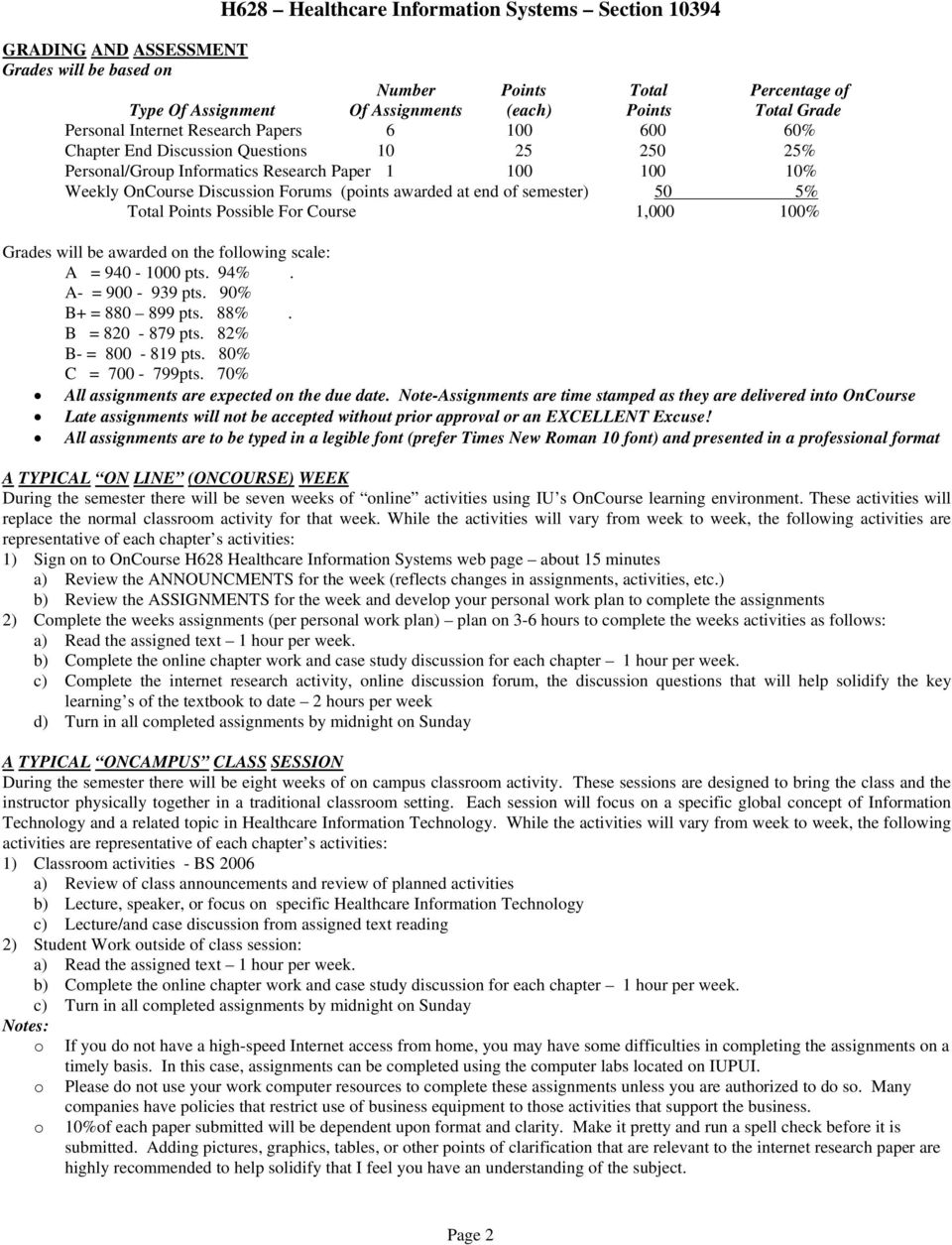
2 GRADING AND ASSESSMENT Grades will be based on Number Points Total Percentage of Type Of Assignment Of Assignments (each) Points Total Grade Personal Internet Research Papers % Chapter End Discussion Questions % Personal/Group Informatics Research Paper % Weekly Discussion Forums (points awarded at end of semester) 50 5% Total Points Possible For Course 1, % Grades will be awarded on the following scale: A = pts. 94%. A- = pts. 90% B+ = pts. 88%. B = pts. 82% B- = pts. 80% C = pts. 70% All assignments are expected on the due date. Note-Assignments are time stamped as they are delivered into Late assignments will not be accepted without prior approval or an EXCELLENT Excuse! All assignments are to be typed in a legible font (prefer Times New Roman 10 font) and presented in a professional format A TYPICAL ON LINE (ONCOURSE) WEEK During the semester there will be seven weeks of online activities using IU s learning environment. These activities will replace the normal classroom activity for that week. While the activities will vary from week to week, the following activities are representative of each chapter s activities: 1) Sign on to H628 Healthcare Information Systems web page about 15 minutes a) Review the ANNOUNCMENTS for the week (reflects changes in assignments, activities, etc.) b) Review the ASSIGNMENTS for the week and develop your personal work plan to complete the assignments 2) Complete the weeks assignments (per personal work plan) plan on 3-6 hours to complete the weeks activities as follows: a) Read the assigned text 1 hour per week. b) Complete the online chapter work and case study discussion for each chapter 1 hour per week. c) Complete the internet research activity, online discussion forum, the discussion questions that will help solidify the key learning s of the textbook to date 2 hours per week d) Turn in all completed assignments by midnight on Sunday A TYPICAL ONCAMPUS CLASS SESSION During the semester there will be eight weeks of on campus classroom activity. These sessions are designed to bring the class and the instructor physically together in a traditional classroom setting. Each session will focus on a specific global concept of Information Technology and a related topic in Healthcare Information Technology. While the activities will vary from week to week, the following activities are representative of each chapter s activities: 1) Classroom activities - a) Review of class announcements and review of planned activities b) Lecture, speaker, or focus on specific Healthcare Information Technology c) Lecture/and case discussion from assigned text reading 2) Student Work outside of class session: a) Read the assigned text 1 hour per week. b) Complete the online chapter work and case study discussion for each chapter 1 hour per week. c) Turn in all completed assignments by midnight on Sunday Notes: o If you do not have a high-speed Internet access from home, you may have some difficulties in completing the assignments on a timely basis. In this case, assignments can be completed using the computer labs located on IUPUI. o Please do not use your work computer resources to complete these assignments unless you are authorized to do so. Many companies have policies that restrict use of business equipment to those activities that support the business. o 10%of each paper submitted will be dependent upon format and clarity. Make it pretty and run a spell check before it is submitted. Adding pictures, graphics, tables, or other points of clarification that are relevant to the internet research paper are highly recommended to help solidify that I feel you have an understanding of the subject. Page 2
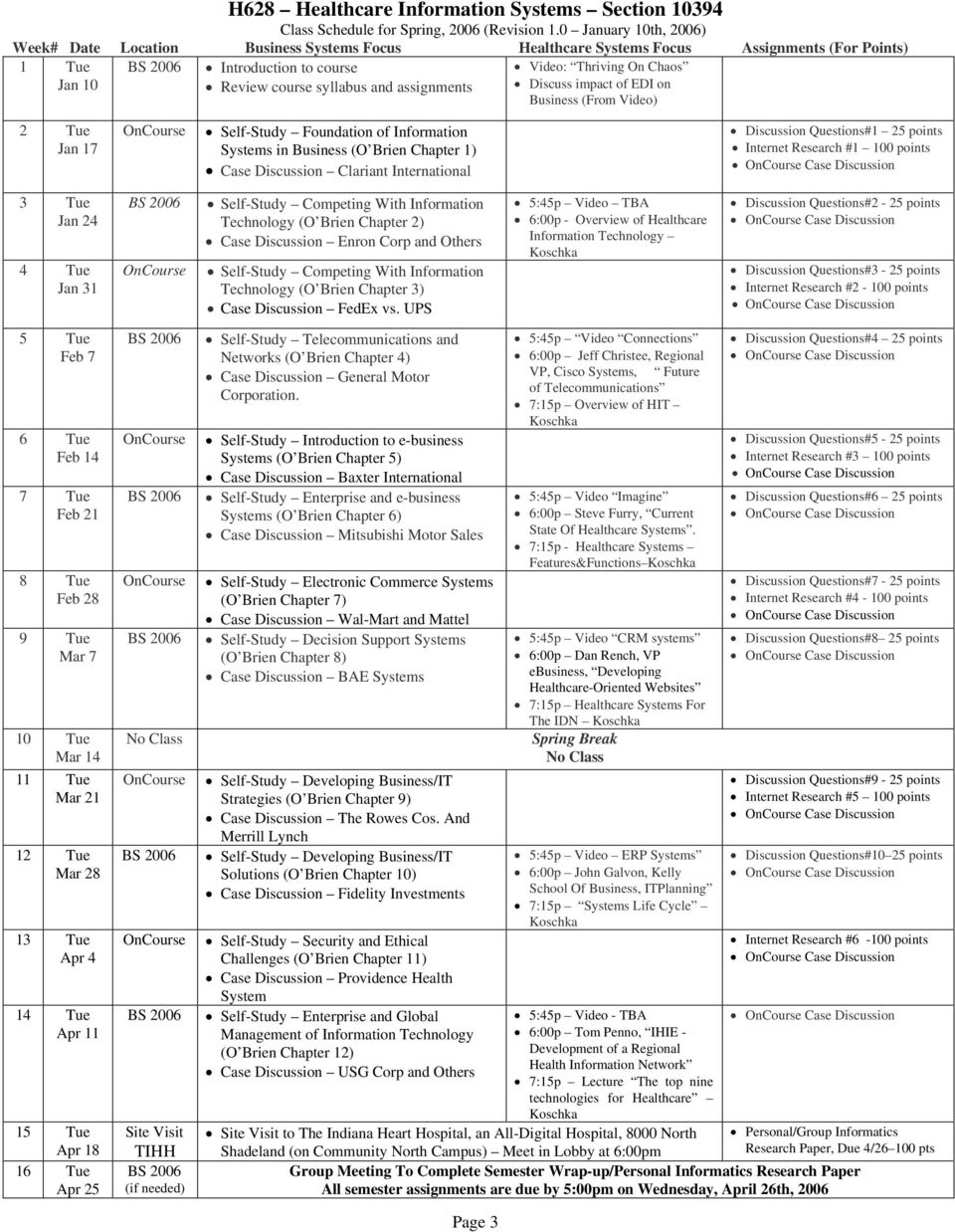
3 Class Schedule for Spring, 2006 (Revision 1.0 January 10th, 2006) Week# Date Location Business Systems Focus Healthcare Systems Focus Assignments (For Points) 1 Tue Introduction to course Video: Thriving On Chaos Jan 10 Review course syllabus and assignments Discuss impact of EDI on Business (From Video) 2 Tue Jan 17 Self-Study Foundation of Information Systems in Business (O Brien Chapter 1) Case Discussion Clariant International Discussion Questions#1 25 points Internet Research #1 100 points 3 Tue Jan 24 4 Tue Jan 31 5 Tue Feb 7 6 Tue Feb 14 7 Tue Feb 21 8 Tue Feb 28 9 Tue Mar 7 10 Tue Mar Tue Mar Tue Mar Tue Apr 4 14 Tue Apr Tue Apr Tue Apr 25 No Class Site Visit TIHH (if needed) Self-Study Competing With Information Technology (O Brien Chapter 2) Case Discussion Enron Corp and Others Self-Study Competing With Information Technology (O Brien Chapter 3) Case Discussion FedEx vs. UPS Self-Study Telecommunications and Networks (O Brien Chapter 4) Case Discussion General Motor Corporation. Self-Study Introduction to e-business Systems (O Brien Chapter 5) Case Discussion Baxter International Self-Study Enterprise and e-business Systems (O Brien Chapter 6) Case Discussion Mitsubishi Motor Sales Self-Study Electronic Commerce Systems (O Brien Chapter 7) Case Discussion Wal-Mart and Mattel Self-Study Decision Support Systems (O Brien Chapter 8) Case Discussion BAE Systems Self-Study Developing Business/IT Strategies (O Brien Chapter 9) Case Discussion The Rowes Cos. And Merrill Lynch Self-Study Developing Business/IT Solutions (O Brien Chapter 10) Case Discussion Fidelity Investments Page 3 5:45p Video TBA 6:00p - Overview of Healthcare Information Technology Koschka 5:45p Video Connections 6:00p Jeff Christee, Regional VP, Cisco Systems, Future of Telecommunications 7:15p Overview of HIT Koschka 5:45p Video Imagine 6:00p Steve Furry, Current State Of Healthcare Systems. 7:15p - Healthcare Systems Features&Functions Koschka 5:45p Video CRM systems 6:00p Dan Rench, VP ebusiness, Developing Healthcare-Oriented Websites 7:15p Healthcare Systems For The IDN Koschka Spring Break No Class 5:45p Video ERP Systems 6:00p John Galvon, Kelly School Of Business, ITPlanning 7:15p Systems Life Cycle Koschka Self-Study Security and Ethical Challenges (O Brien Chapter 11) Case Discussion Providence Health System Self-Study Enterprise and Global 5:45p Video - TBA Management of Information Technology 6:00p Tom Penno, IHIE - (O Brien Chapter 12) Development of a Regional Health Information Network Case Discussion USG Corp and Others 7:15p Lecture The top nine technologies for Healthcare Koschka Site Visit to The Indiana Heart Hospital, an All-Digital Hospital, 8000 North Shadeland (on Community North Campus) Meet in Lobby at 6:00pm Discussion Questions#2-25 points Discussion Questions#3-25 points Internet Research #2-100 points Discussion Questions#4 25 points Discussion Questions#5-25 points Internet Research #3 100 points Discussion Questions#6 25 points Discussion Questions#7-25 points Internet Research #4-100 points Discussion Questions#8 25 points Discussion Questions#9-25 points Internet Research #5 100 points Discussion Questions#10 25 points Internet Research #6-100 points Personal/Group Informatics Research Paper, Due 4/ pts Group Meeting To Complete Semester Wrap-up/Personal Informatics Research Paper All semester assignments are due by 5:00pm on Wednesday, April 26th, 2006
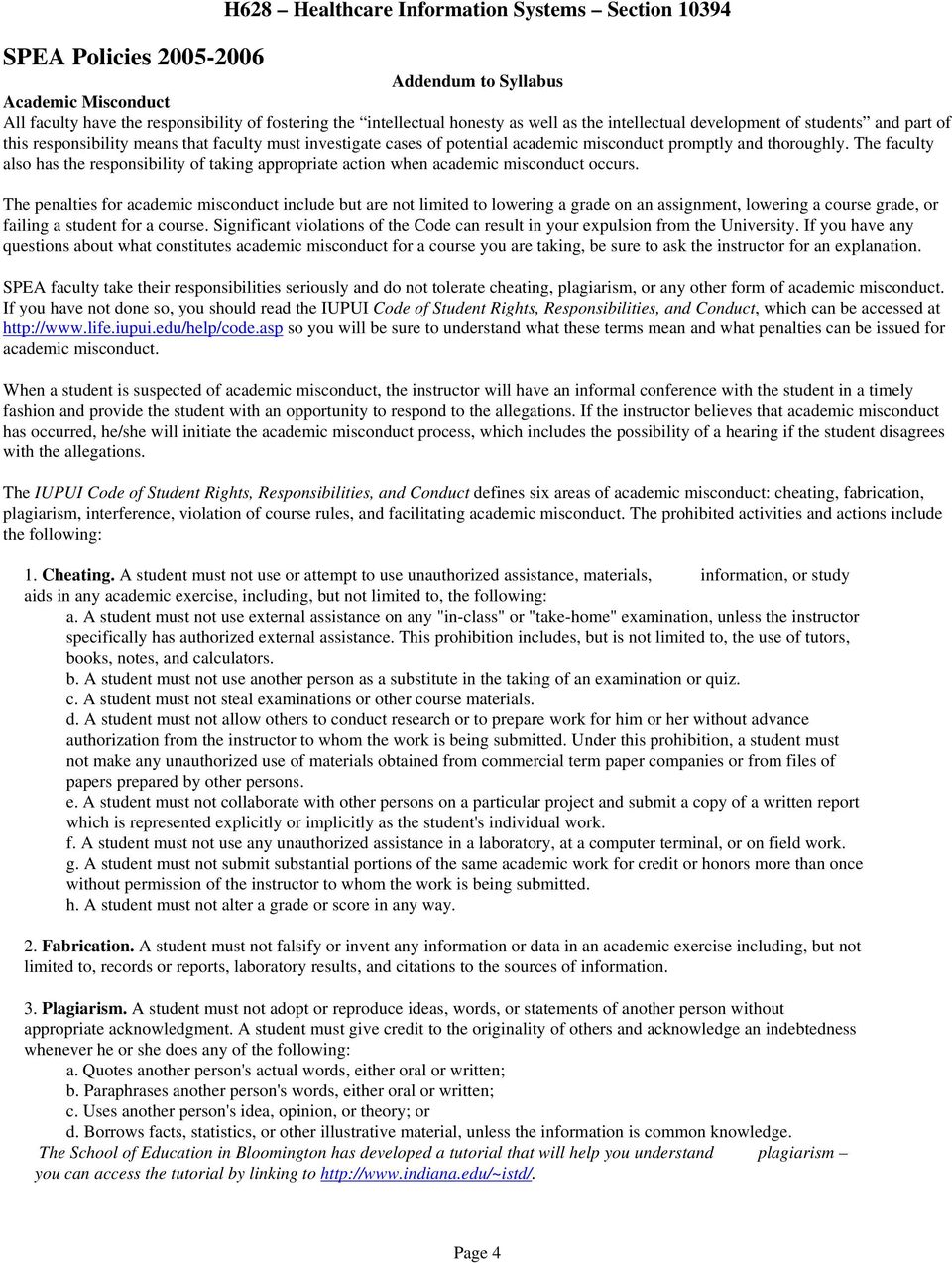
4 SPEA Policies H628 Healthcare Information Systems Section Addendum to Syllabus Academic Misconduct All faculty have the responsibility of fostering the intellectual honesty as well as the intellectual development of students and part of this responsibility means that faculty must investigate cases of potential academic misconduct promptly and thoroughly. The faculty also has the responsibility of taking appropriate action when academic misconduct occurs. The penalties for academic misconduct include but are not limited to lowering a grade on an assignment, lowering a course grade, or failing a student for a course. Significant violations of the Code can result in your expulsion from the University. If you have any questions about what constitutes academic misconduct for a course you are taking, be sure to ask the instructor for an explanation. SPEA faculty take their responsibilities seriously and do not tolerate cheating, plagiarism, or any other form of academic misconduct. If you have not done so, you should read the IUPUI Code of Student Rights, Responsibilities, and Conduct, which can be accessed at so you will be sure to understand what these terms mean and what penalties can be issued for academic misconduct. When a student is suspected of academic misconduct, the instructor will have an informal conference with the student in a timely fashion and provide the student with an opportunity to respond to the allegations. If the instructor believes that academic misconduct has occurred, he/she will initiate the academic misconduct process, which includes the possibility of a hearing if the student disagrees with the allegations. The IUPUI Code of Student Rights, Responsibilities, and Conduct defines six areas of academic misconduct: cheating, fabrication, plagiarism, interference, violation of course rules, and facilitating academic misconduct. The prohibited activities and actions include the following: 1. Cheating. A student must not use or attempt to use unauthorized assistance, materials, information, or study aids in any academic exercise, including, but not limited to, the following: a. A student must not use external assistance on any "in-class" or "take-home" examination, unless the instructor specifically has authorized external assistance. This prohibition includes, but is not limited to, the use of tutors, books, notes, and calculators. b. A student must not use another person as a substitute in the taking of an examination or quiz. c. A student must not steal examinations or other course materials. d. A student must not allow others to conduct research or to prepare work for him or her without advance authorization from the instructor to whom the work is being submitted. Under this prohibition, a student must not make any unauthorized use of materials obtained from commercial term paper companies or from files of papers prepared by other persons. e. A student must not collaborate with other persons on a particular project and submit a copy of a written report which is represented explicitly or implicitly as the student's individual work. f. A student must not use any unauthorized assistance in a laboratory, at a computer terminal, or on field work. g. A student must not submit substantial portions of the same academic work for credit or honors more than once without permission of the instructor to whom the work is being submitted. h. A student must not alter a grade or score in any way. 2. Fabrication. A student must not falsify or invent any information or data in an academic exercise including, but not limited to, records or reports, laboratory results, and citations to the sources of information. 3. Plagiarism. A student must not adopt or reproduce ideas, words, or statements of another person without appropriate acknowledgment. A student must give credit to the originality of others and acknowledge an indebtedness whenever he or she does any of the following: a. Quotes another person's actual words, either oral or written; b. Paraphrases another person's words, either oral or written; c. Uses another person's idea, opinion, or theory; or d. Borrows facts, statistics, or other illustrative material, unless the information is common knowledge. The School of Education in Bloomington has developed a tutorial that will help you understand plagiarism you can access the tutorial by linking to Page 4
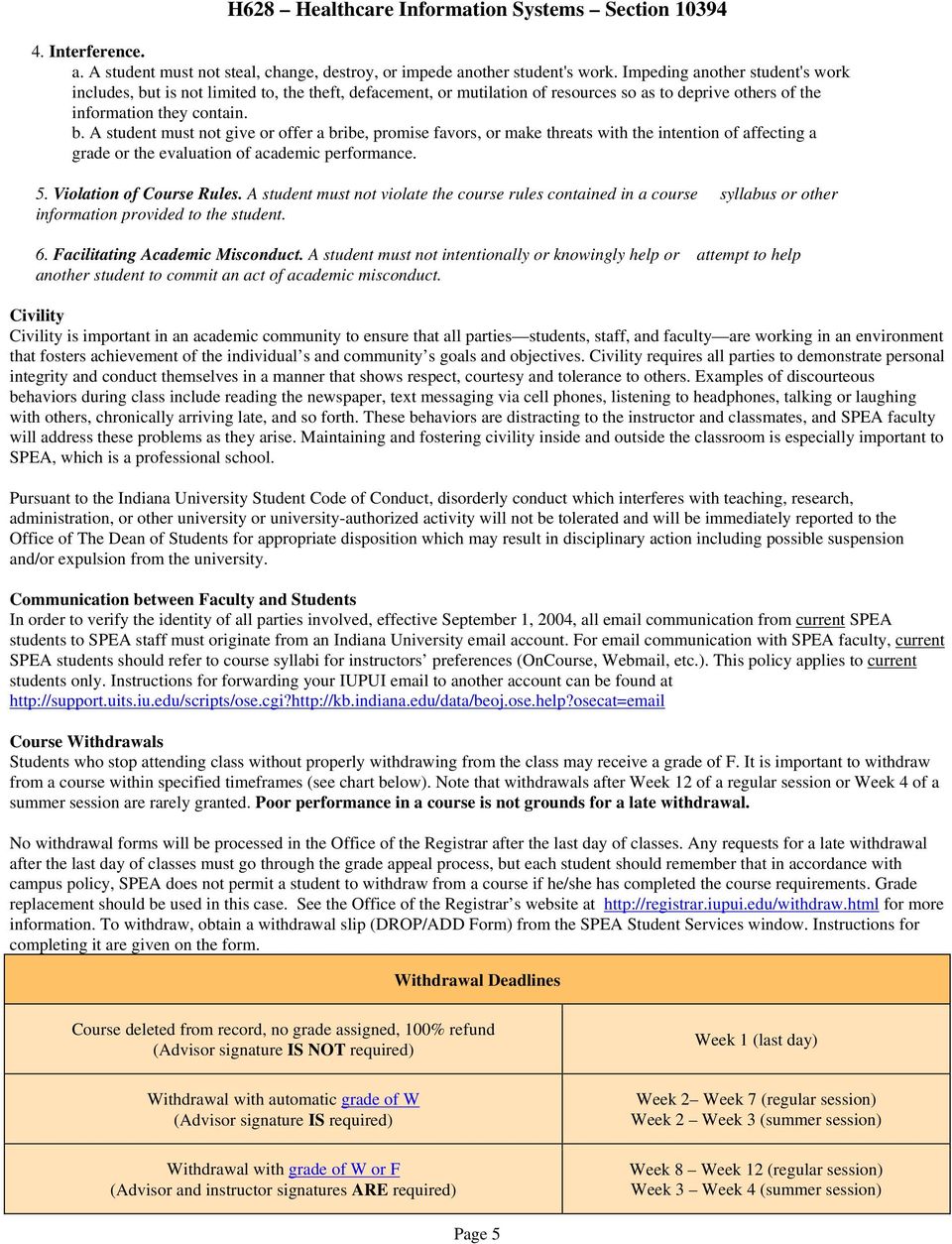
5 4. Interference. a. A student must not steal, change, destroy, or impede another student's work. Impeding another student's work includes, but is not limited to, the theft, defacement, or mutilation of resources so as to deprive others of the information they contain. b. A student must not give or offer a bribe, promise favors, or make threats with the intention of affecting a grade or the evaluation of academic performance. 5. Violation of Course Rules. A student must not violate the course rules contained in a course syllabus or other information provided to the student. 6. Facilitating Academic Misconduct. A student must not intentionally or knowingly help or attempt to help another student to commit an act of academic misconduct. Civility Civility is important in an academic community to ensure that all parties students, staff, and faculty are working in an environment that fosters achievement of the individual s and community s goals and objectives. Civility requires all parties to demonstrate personal integrity and conduct themselves in a manner that shows respect, courtesy and tolerance to others. Examples of discourteous behaviors during class include reading the newspaper, text messaging via cell phones, listening to headphones, talking or laughing with others, chronically arriving late, and so forth. These behaviors are distracting to the instructor and classmates, and SPEA faculty will address these problems as they arise. Maintaining and fostering civility inside and outside the classroom is especially important to SPEA, which is a professional school. Pursuant to the Indiana University Student Code of Conduct, disorderly conduct which interferes with teaching, research, administration, or other university or university-authorized activity will not be tolerated and will be immediately reported to the Office of The Dean of Students for appropriate disposition which may result in disciplinary action including possible suspension and/or expulsion from the university. Communication between Faculty and Students In order to verify the identity of all parties involved, effective September 1, 2004, all communication from current SPEA students to SPEA staff must originate from an Indiana University account. For communication with SPEA faculty, current SPEA students should refer to course syllabi for instructors preferences (, Webmail, etc.). This policy applies to current students only. Instructions for forwarding your IUPUI to another account can be found at Course Withdrawals Students who stop attending class without properly withdrawing from the class may receive a grade of F. It is important to withdraw from a course within specified timeframes (see chart below). Note that withdrawals after Week 12 of a regular session or Week 4 of a summer session are rarely granted. Poor performance in a course is not grounds for a late withdrawal. No withdrawal forms will be processed in the Office of the Registrar after the last day of classes. Any requests for a late withdrawal after the last day of classes must go through the grade appeal process, but each student should remember that in accordance with campus policy, SPEA does not permit a student to withdraw from a course if he/she has completed the course requirements. Grade replacement should be used in this case. See the Office of the Registrar s website at for more information. To withdraw, obtain a withdrawal slip (DROP/ADD Form) from the SPEA Student Services window. Instructions for completing it are given on the form. Withdrawal Deadlines Course deleted from record, no grade assigned, 100% refund (Advisor signature IS NOT required) Week 1 (last day) Withdrawal with automatic grade of W (Advisor signature IS required) Withdrawal with grade of W or F (Advisor and instructor signatures ARE required) Week 2 Week 7 (regular session) Week 2 Week 3 (summer session) Week 8 Week 12 (regular session) Week 3 Week 4 (summer session) Page 5
6 Incompletes A grade of incomplete (I) indicates that a substantial portion of the work in a course has been satisfactorily but not entirely completed by the student as of the end of the semester. The incomplete can be given to a student facing a hardship such that such that it would be unjust to hold the student to the established time limits for completing the work. To be eligible for the incomplete in a SPEA course, the student s work must be of passing quality, and the student must have completed 75% of the course requirements. Poor performance in a course is not grounds for an incomplete. See the Office of the Registrar s website at for more information. Incompletes must be removed within a time period not to exceed one year after the semester in which the student was enrolled in the course. The incomplete will revert to an F if the work is not completed within the allotted timeframe established by the instructor. Grade Changes Under certain circumstances, students can seek grade changes for previously taken courses if they believe that a grade has been calculated or assigned incorrectly. A student who is seeking a grade change must first contact the instructor and ask for the grade change. In the event the instructor does not change the grade, the student can file a Change of Grade Petition with the Registrar s Office. The petition is then sent to SPEA for its consideration. The petition must be filed within 1 year of the date when the student was enrolled in the course. In cases of extenuating circumstances, SPEA may consider petitions filed after this date, but in no case will it consider petitions filed 5 years or more after the date the course is taken. SPEA will review the request and make a final decision. The Change of Grade petition form is located at the Office of the Registrar s website at Students Called to Active Duty SPEA encourages any student who is in the Indiana Military Reserves and is called to active duty to finish his/her coursework if at all possible. Students who cannot complete their courses have the option of withdrawing with 100% fee refund, but this request must be made within one week of being called to active duty. Students who are called to active duty may qualify for an incomplete (provided that all the above criteria have been met). For further information, please see the Office of the Registrar s website at Final Exam Schedule If a final exam is given, it must be held on the day and time set in the final exam schedule. If an instructor has changed the final exam date, the student should first consult with the instructor. Students who have more than three final exams in one day or insufficient time to get from one exam to another should consult with their instructors to resolve these conflicts. Exams may not be given in the week before the final exam week. If a student is not able to resolve a final exam problem with the instructor, the student may report the problem to the Director of Policies, Procedures, and Assessment. See the Office of the Registrar s website at for the final exam week schedule. Page 6

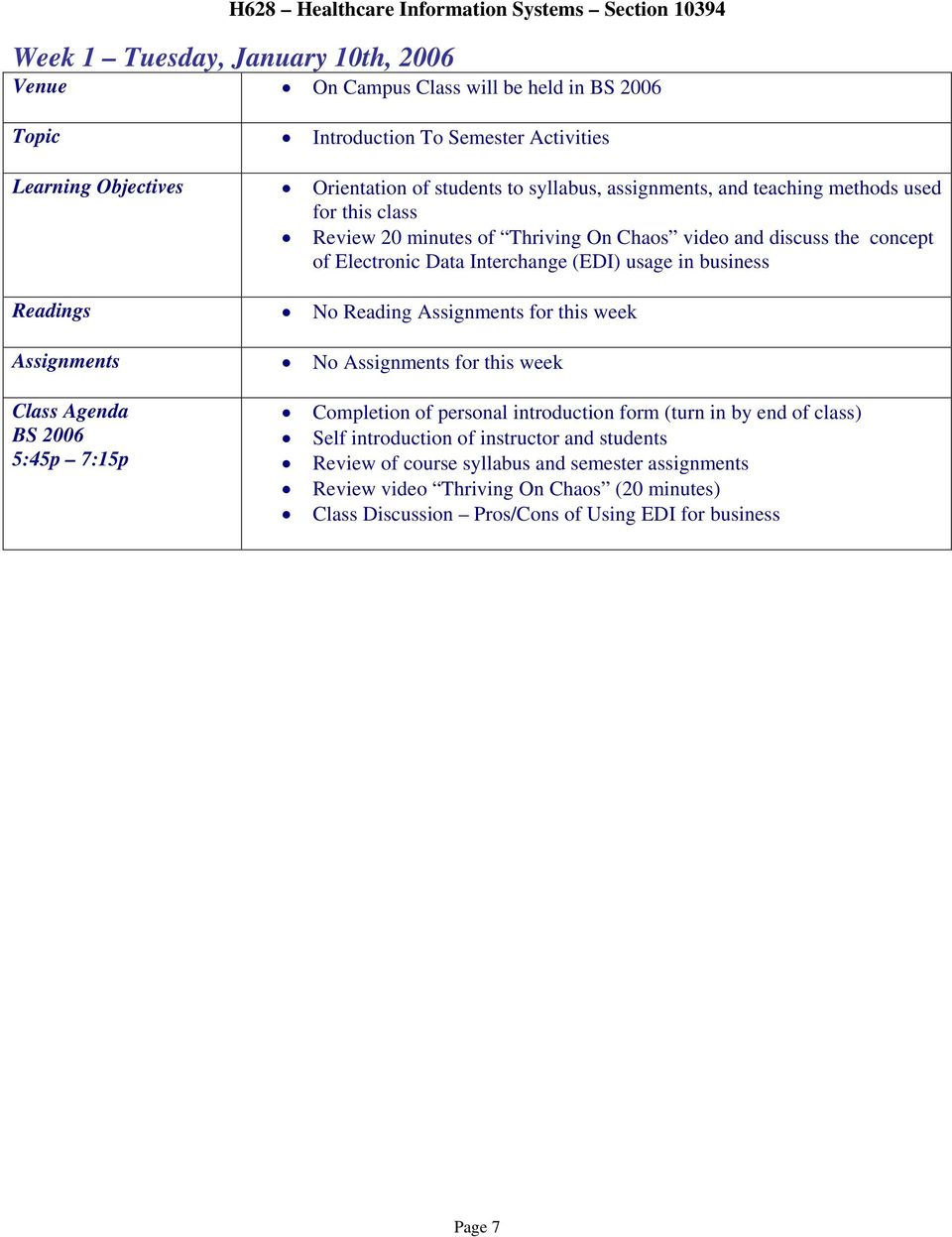
7 Week 1 Tuesday, January 10th, 2006 Venue On Campus Class will be held in Topic Introduction To Semester Activities Learning Objectives Orientation of students to syllabus, assignments, and teaching methods used for this class Review 20 minutes of Thriving On Chaos video and discuss the concept of Electronic Data Interchange (EDI) usage in business Readings No Reading Assignments for this week Assignments No Assignments for this week Class Agenda 5:45p 7:15p Completion of personal introduction form (turn in by end of class) Self introduction of instructor and students Review of course syllabus and semester assignments Review video Thriving On Chaos (20 minutes) Class Discussion Pros/Cons of Using EDI for business Page 7
8 Week 2 Tuesday, January 17th, 2006 Venue Student Self Study Using Internet Facilities of IUPUI Topic Business Focus: Foundations Of Information Systems In Business Healthcare Focus: Development Of Internet Research Paper on Healthcare Related Topic Learning Objectives Explain why knowledge of information systems is important for business professionals and identify five areas of information systems knowledge they need Give examples to illustrate how the business applications of information systems can support a firm s business processes, managerial decision making, and strategies for competitive advantage Provide examples of the components of real world information systems. Illustrate that in an information system, people use hardware, software, data, and networks as resources, to perform input, processing, output, storage, and control activities that transform data resources into information products Provide examples of several major types of information systems from your experiences with business organizations in the real world Identify several challenges that a business manager might face in managing the successful and ethical development and use of information technology in a business. Provide an overview of how Information Technology is used in various Healthcare settings to improve business processes. Readings Read O Brien Chapter 1 Foundations Of Information Systems In Business Read Clariant and Others case study and be prepared to answer the questions at the end of the case Assignments Complete Chapter #1 Discussion Questions (25 points) Participate in Online Discussion Forum for Case Study Complete Internet research Paper #1 that will research he latest developments of information technology in Healthcare Note See H628 Assignment Page For Details Assignment Due Date Note Submission Of all assignments via must occur by Midnight on Sunday, January 22 nd Class Agenda No Formal Class Session Planned, all activities are self study based upon students calendar Page 8

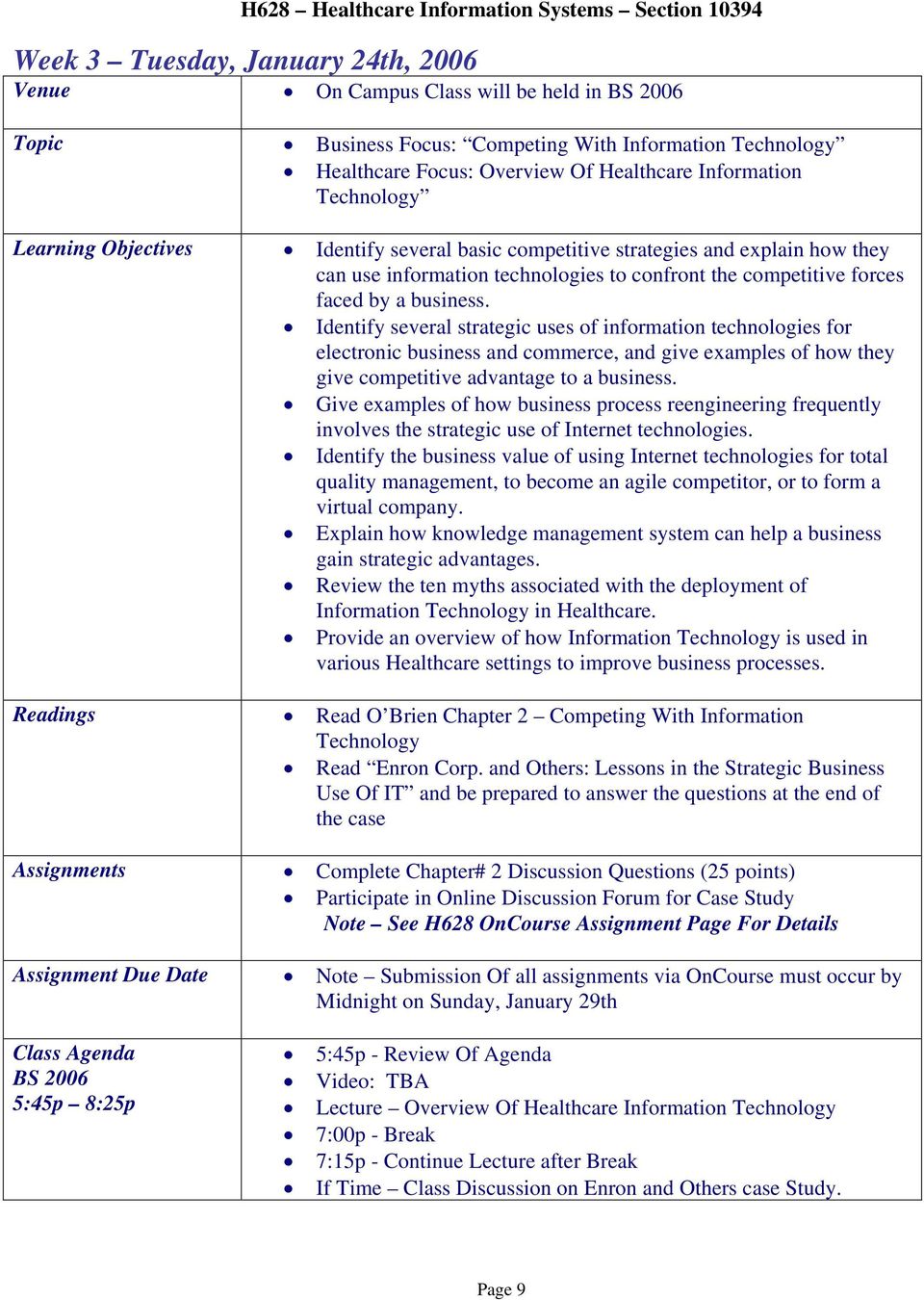
9 Week 3 Tuesday, January 24th, 2006 Venue On Campus Class will be held in Topic Business Focus: Competing With Information Technology Healthcare Focus: Overview Of Healthcare Information Technology Learning Objectives Identify several basic competitive strategies and explain how they can use information technologies to confront the competitive forces faced by a business. Identify several strategic uses of information technologies for electronic business and commerce, and give examples of how they give competitive advantage to a business. Give examples of how business process reengineering frequently involves the strategic use of Internet technologies. Identify the business value of using Internet technologies for total quality management, to become an agile competitor, or to form a virtual company. Explain how knowledge management system can help a business gain strategic advantages. Review the ten myths associated with the deployment of Information Technology in Healthcare. Provide an overview of how Information Technology is used in various Healthcare settings to improve business processes. Readings Read O Brien Chapter 2 Competing With Information Technology Read Enron Corp. and Others: Lessons in the Strategic Business Use Of IT and be prepared to answer the questions at the end of the case Assignments Complete Chapter# 2 Discussion Questions (25 points) Participate in Online Discussion Forum for Case Study Note See H628 Assignment Page For Details Assignment Due Date Note Submission Of all assignments via must occur by Midnight on Sunday, January 29th Class Agenda 5:45p 8:25p 5:45p - Review Of Agenda Video: TBA Lecture Overview Of Healthcare Information Technology 7:00p - Break 7:15p - Continue Lecture after Break If Time Class Discussion on Enron and Others case Study. Page 9
10 Note - Weeks 4 15 are under construction Page 10

Statement of the Kelley School of Business MBA Code of Student Ethics
 Evening MBA Code of Conduct Members of the Indiana University community are governed by rules that support the university s mission of preserving, improving, increasing, transmitting, and applying knowledge.
SPEA-V 506 (25223): Statistical Analysis for Effective Decision Making (3 cr.)
 School of Public and Environmental Affairs Indiana University - Purdue University Indianapolis SPEA-V 506 (25223): Statistical Analysis for Effective Decision Making (3 cr.) Instructor: Jerome Dumortier
INFO B512 Scientific and Clinical Data Management
 INFO B512 Scientific and Clinical Data Management Indiana University School of Informatics and Computing, Indianapolis Fall 2014 Section No.: 13367 Credit Hours: 3 Time: Mondays 6 8:40 pm Location: WK
H124 Healthcare Management and Policy, Spring 2015 Page 1
 Syllabus H124 Healthcare Management & Policy (Sections 28216) Indiana University School of Public and Environmental Affairs Spring 2015 Instructor: Mark A. Norrell, FACHE, HFA Office: SPEA 456 Lecturer
Master of Public Affairs Student Handbook
 Master of Public Affairs Student Handbook Updated April 2015 Table of Contents General Information... 2 Program Mission... 3 Program Requirements... 4 Admission... 4 General Requirements... 5 Concentrations...
INTRODUCTION TO SMALL BUSINESS MANAGEMENT MANAGEMENT 103 (52356) 3 semester credits Summer Semester 2014
 INTRODUCTION TO SMALL BUSINESS MANAGEMENT MANAGEMENT 103 (52356) 3 semester credits Summer Semester 2014 Class Meeting Information This course meets online Full Semester Course (June 9-August 2) ** The
FALL 2012. Monday/Wednesday, 9:00-10:15, IT167, Class # 31388. Department of Psychology Indiana University-Purdue University Indianapolis
 PSY B110 Introduction to Psychology FALL 2012 Monday/Wednesday, 9:00-10:15, IT167, Class # 31388 Department of Psychology Indiana University-Purdue University Indianapolis Instructor Teaching Assistants
Systems and Internet Marketing Syllabus Spring 2011 Department of Management, Marketing and International Business
 Systems and Internet Marketing Syllabus Spring 2011 Department of Management, Marketing and International Business MKT 425.022 (3 credit hour class) Wednesday, 4:00 6:30 pm, BU 465 Instructor: Dr. Charlotte
Health Information Administration Distance Education Course Syllabus M326 Health Information Administration Enrichment I
 Health Information Administration Distance Education Course Syllabus M326 Health Information Administration Enrichment I COURSE INFORMATION Semester: Fall 2013 Course Number/Section: M326/C70953 Credit
BUS 373 ORGANIZATIONAL BEHAVIOR Syllabus Fall 2015
 BUS 373 ORGANIZATIONAL BEHAVIOR Syllabus Fall 2015 Instructor: Office Telephone: Email Address Course Meets: Hope Weninger (402)873-4267 (leave message) [email protected] Fall Term 1 Online via Blackboard
Reece, B.L., and Brandt, R. Human Relations: Principles and Practices, 7th Edition. Boston: Houghton Mifflin Company.
 PSYC 100: Human Relations in Organizations (2 Credits) Course Description The focus of this course is an examination of human relations in business and industry with emphasis on how people can work effectively
INTRODUCTION TO INFORMATION TECHNOLOGY
 Instructor: Steven Brennan Office Location: JW157B Office Hours: TBA Phone: 517.796.8519 E-Mail: [email protected] OVERVIEW This course is designed to make the student computer literate. Systems
I350: Foundations in Legal Informatics Syllabus & Course Information Kim Brand Adjunct Faculty Fall 2013. Version 1.
 I350: Foundations in Legal Informatics Syllabus & Course Information Kim Brand Adjunct Faculty Fall 2013 Version 1.0 August 1, 2013 Prerequisites Courses: NONE Credit Hours: 3 Elective for graduate and
Elmira Business Institute Medical Transcription I (OFF 131)
 Instructor Information: Instructor: Office Location: Telephone: Email: Office and Tutoring Hours: Elmira Business Institute Student Syllabus: Medical Transcription I (OFF 131) Semester: Summer 2014 Course
Health Information Management Distance Education Course Syllabus Lab Enrichment Healthcare Information Requirements and Standards II
 1 Health Information Management Distance Education Course Syllabus Lab Enrichment Healthcare Information Requirements and Standards II Department of BioHealth Informatics Indiana University School of Informatics
Texas A&M University Commerce College of Business Department of Accounting, Syllabus Spring 2015 Principles of Accounting II 222-02W CRN 22142
 Texas A&M University Commerce College of Business Department of Accounting, Syllabus Spring 2015 Principles of Accounting II 222-02W CRN 22142 Life rarely presents multiple choice or short answer questions.
MIS 2000 - Information Systems for Management The University of Manitoba, I.H. Asper School of Business Department of Accounting and Finance
 MIS 2000 - Information Systems for Management The University of Manitoba, I.H. Asper School of Business Department of Accounting and Finance Course Outline Term 2 (Regular Session 2013-2014), Sections
2. Demonstrate patient advocacy in making appropriate ethical nursing responses in client care. 3. Perform patient care measures to relieve pain and
 Nursing 213 Advanced Practice & Complex Nursing Care Syllabus West Virginia State Community and Technical College LPN to RN Option Spring 2008 Patricia Mazzella, R.N., M.S.N., Program Coordinator Office:
COLLEGE OF BUSINESS GRADUATE PROGRAMS MBA STUDENT HANDBOOK
 COLLEGE OF BUSINESS GRADUATE PROGRAMS MBA STUDENT HANDBOOK Hattiesburg Campus College of Business The University of Southern Mississippi 118 College Drive, # 5021 Hattiesburg, MS 39406 P: 601.266.4659
MGSC 290 Computer Information Systems in Business SYLLABUS Spring 2008
 INSTRUCTOR: MGSC 290 Computer Information Systems in Business SYLLABUS Spring 2008 Phil Marshall Office: BA 728 Phone: 803-777-2303 / On campus, you can dial 7-2303. E-mail: Website: Office Hours: Section
Forensic Biology 3318 Syllabus
 #syl-biol3318.501.11s-@anwu-üu7606uj_page 1 of 5 Course Information BIOL 3318-501, Forensic Biology, Spring 2011 Mondays 7:00-9:45 PM, CN1.120 Forensic Biology 3318 Syllabus Instructor Contact Information
MAT150 College Algebra Syllabus Spring 2015
 MAT150 College Algebra Syllabus Spring 2015 Instructor: Donna Guhse Email: [email protected] Phone: 480-423-6012 Office: CM 425 Office Hours: Mon/Wed 10:30 12:00 Tues/Thurs 1:00 1:50 (Wednesday
Florida Gulf Coast University Lutgert College of Business Marketing Department MAR3503 Consumer Behavior Spring 2015
 Course name: Class schedule: Course mode: Classroom: Lutgert Hall, Room 2208 CRN: 10141 Consumer Behavior Tuesday & Thursday, 9:30 AM 10:45 AM On campus, face-to-face meetings Credit hours: 3 Final exam:
MIS 2000 - Information Systems for Management The University of Manitoba, I.H. Asper School of Business Department of Accounting and Finance
 MIS 2000 - Information Systems for Management The University of Manitoba, I.H. Asper School of Business Department of Accounting and Finance Course Outline Term 2 (Regular Session 2014-2015), Sections
EDU 230 Schools in Communities Social & Behavioral Sciences Department
 EDU 230 Schools in Communities Social & Behavioral Sciences Department Catalog Course Description: This course provides students with a basic understanding of the social, political, and historical aspects
COURSE SYLLABUS V373 -- HUMAN RESOURCES MANAGMENT IN THE PUBLIC SECTOR School of Public and Environmental Affairs SPRING 2015 (SECTION 19941)
 COURSE SYLLABUS V373 -- HUMAN RESOURCES MANAGMENT IN THE PUBLIC SECTOR School of Public and Environmental Affairs SPRING 2015 (SECTION 19941) Room: SPEA (PV) 169 Tuesday/Thursday 8:00 AM to 9:15 AM Instructor:
SYLLABUS: MKT 454.022, Monday evening 4:00-6:30pm; BU124 Spring Semester, 2012
 SYLLABUS: MKT 454.022, Monday evening 4:00-6:30pm; BU124 Spring Semester, 2012 Course: Marketing 454, Business-To- Business Marketing, 3 credit hours Department of Management, Marketing, and International
BUS 454 MARKET RESEARCH AND INFORMATION
 Instructor Information Course Syllabus Instructor: Cherol Hudak, M.B.A Email: [email protected] Work Phone: 719-588-9815 Course Delivery Online, Semester-based Credit Hours 3 Semester Hours Course
Telephone: 777-0395 [email protected]. Meets twice a week for 90 minutes. Times vary each semester
 INTRODUCTORY BIOLOGY BIOL 103 Muskegon Community College Instructor: Kathy Pollock B.S. Biology, Oakland University M.S. Biological Science, Michigan State University M.A. Educational Technology, Michigan
MASTER SYLLABUS 2015-2016
 MASTER SYLLABUS 2015-2016 A. Academic Division: Business, Industry and Technology B. Discipline: Industrial Technology Engineering Design C. Course Number and Title: ENRD2170 Computer Aided Design II D.
Communication 170: Semester Interpersonal Communication Classroom: meeting day and time Stephen F. Austin State University
 Communication 170: Semester Interpersonal Communication Classroom: meeting day and time Stephen F. Austin State University Instructor: Office: Phone: Office Hours: Department: Appointments: Languages,
http://fdelgadillo.ba.ttu.edu [email protected] (Texas Tech) AND [email protected] (personal)
 Area of ISQS Professor: Francisco Delgadillo, PhD. Course Name: Working Professionals: Information Technology and Operations Management Course Code: ISQS 5331- Section 294 Meeting time: Saturday, May 30
MGMT 3241: Introduction to Human Resource Management Syllabus Instructor: Katherine A. Frear Second Summer 2012
 Instructor: Katherine A. Frear Second Summer 2012 Email: [email protected] MTWThF 11:30am - 1:00pm Office: 3074 Colvard Location: Friday 112 (Office located inside room 3050 Colvard) Office Hours: Tuesdays
ACCT*2230 MANAGEMENT ACCOUNTING Winter 2012
 Department of Business ACCT*2230 MANAGEMENT ACCOUNTING Winter 2012 INSTRUCTOR: Elliott Currie, Room 207, J.D. MacLachlan Building Email: [email protected] Ext. 52762 Office Hours: Tuesday and Thursday
SOC 101 Introduction to Sociology Social & Behavioral Sciences Department
 SOC 101 Introduction to Sociology Social & Behavioral Sciences Department Catalog Course Description: This course emphasizes the fundamental concepts and principles of sociology, including culture, socialization,
CENTRAL TEXAS COLLEGE SYLLABUS FOR LGLA 1317 LAW OFFICE TECHNOLOGY Semester Hours Credit: 3 INSTRUCTOR: OFFICE PHONE:
 CENTRAL TEXAS COLLEGE SYLLABUS FOR LGLA 1317 LAW OFFICE TECHNOLOGY Semester Hours Credit: 3 INSTRUCTOR: OFFICE PHONE: I. COURSE DESCRIPTION: A. This course introduces computer technology and software applications
Elmira Business Institute Introduction to Health Information Management(MED 270)
 Elmira Business Institute Introduction to Health Information Management(MED 270) Elmira Business Institute Student Syllabus: Introduction to Health Information Management (MED 270) Semester: Summer 2014
Ogeechee Technical College One Joe Kennedy Blvd. Statesboro, Georgia Syllabus English 2130 American Literature
 Ogeechee Technical College One Joe Kennedy Blvd. Statesboro, Georgia Syllabus English 2130 American Literature Semester: Spring Semester 2014 Instructor: Pat Murphey E-mail: [email protected] Class
Master of Public Affairs Graduate Policy Manual
 Master of Public Affairs Graduate Policy Manual Established August 27, 2012 Page 1 Mission Statement The mission of the School of Public & Environmental Affairs Program is to sustain a diverse, collaborative
Course Outline. Fall Session 2015 A03
 MIS 2000 - Information Systems for Management The University of Manitoba, I.H. Asper School of Business Department of Accounting and Finance Course Outline Fall Session 2015 A03 Instructor: Campus Office:
NEW YORK CITY COLLEGE OF TECHNOLOGY City University of New York
 NEW YORK CITY COLLEGE OF TECHNOLOGY City University of New York Health Services Administration Program HSA 3630-2769 Health Care Finance and Accounting Management COURSE OUTLINE Professor Josef Bohm Revised
North Dakota State University Policy Manual
 North Dakota State University Policy Manual SECTION 335 CODE OF ACADEMIC RESPONSIBILITY AND CONDUCT SOURCE: NDSU Faculty Senate Policy The academic community is operated on the basis of honesty, integrity,
COURSE SYLLABUS MAC1105 College Algebra
 COURSE SYLLABUS College Algebra Department Home Page: http://www.daytonastate.edu/campusdirectory/deptinfo.jsp?dept=mat Course: College Algebra Credit: 3 semester hours Prerequisite: Placement through
PSY 201 General Psychology Social & Behavioral Sciences Department
 PSY 201 General Psychology Social & Behavioral Sciences Department Catalog Course Description: This course includes the following topics and concepts in the science of behavior: scientific method, biological
GEORGIA REGENTS UNIVERSITY COLLEGE OF EDUCATION DEPARTMENT OF KINESIOLOGY AND HEALH SCIENCE
 GEORGIA REGENTS UNIVERSITY COLLEGE OF EDUCATION DEPARTMENT OF KINESIOLOGY AND HEALH SCIENCE KNHS 6950 Fall 2014 Physical Activity Instruction of Older Adults (Online only; 3 credit hours) COURSE DESCRIPTION
CENTRAL TEXAS COLLEGE SYLLABUS FOR LGLA 2303 TORTS AND PERSONAL INJURY LAW Semester Hours Credit: 3 INSTRUCTOR: OFFICE HOURS:
 CENTRAL TEXAS COLLEGE SYLLABUS FOR TORTS AND PERSONAL INJURY LAW Semester Hours Credit: 3 INSTRUCTOR: OFFICE HOURS: I. COURSE DESCRIPTION: A. Fundamental concepts of tort and personal injury law including
Paralegal/042 Workers Compensation for Paralegals Spring 2016 Section 1660 CE 206 Saturdays 9:00 a.m. 1:00 p.m. March 12 June 4, 2016
 Paralegal/042 Workers Compensation for Paralegals Spring 2016 Section 1660 CE 206 Saturdays 9:00 a.m. 1:00 p.m. March 12 June 4, 2016 Instructor: Deborah Zexter, Attorney at Law Telephone: 310-287-7285
ISM 280-05 and 05D, Online Class Business Processes and Information Technology SYLLABUS Fall 2015
 The University of North Carolina at Greensboro The Bryan School of Business and Economics Department of Information Systems and Supply Chain Management 1 Professor: Email: Office: Office hours: Phone:
CISM 2201 - Fundamentals of Computer Applications
 CISM 2201 - Fundamentals of Computer Applications Philip Reaves, MBA RCOB 1214, on the Miller (RCOB) Advising Hall [email protected] (678) 839-4772 Office Hours: I have an infant at home and will be staying
PROCEDURES FOR HANDLING ALLEGATIONS OF MISCONDUCT BY FULL-TIME & PART-TIME GRADUATE STUDENTS
 The Johns Hopkins University Krieger School of Arts & Sciences/Whiting School of Engineering PROCEDURES FOR HANDLING ALLEGATIONS OF MISCONDUCT BY FULL-TIME & PART-TIME GRADUATE STUDENTS Established March
SCHOOL OF MANAGEMENT
 SCHOOL OF MANAGEMENT SYLLABUS FOR MIS 363 PROJECT MANAGEMENT FOR MANAGERS (SPRING 2015) Class meets MALL PC37 Mondays 6-9pm Instructor: Dr. Shivon Boodhoo Contact: [email protected] or 973-596- 8459 Office
Belk College of Business Administration, University of North Carolina at Charlotte. INFO 3130-004: MANAGEMENT INFORMATION SYSTEMS Spring 2012
 Belk College of Business Administration, University of North Carolina at Charlotte INFO 3130-004: MANAGEMENT INFORMATION SYSTEMS Spring 2012 Class Website and Primary communication channel: Moodle @ http://moodle.uncc.edu
CJ 4480 Digital Forensics II Syllabus - Term 2 2015
 CJ 4480 Digital Forensics II Syllabus - Term 2 2015 For course syllabus posted prior to the beginning of the term, the instructor reserves the right to make minor changes prior to or during the term. The
AHS 119 Health Careers Allied Health Sciences Department
 AHS 119 Health Careers Allied Health Sciences Department FALL SEMESTER 2014 Catalog Course Description: This course provides information on various health careers to include job responsibility and personal
ACC 2311 COST ACCOUNTING
 ACC 2311 COST ACCOUNTING 1 C SECTION: 2022 TIONO COMPUTER UCRO COM Instructor: Charles Daniels, CPA, CMA, CGMA Phone: (718) 260 5773 Email: [email protected] (preferred) Semester: Spring 2013
School of Business and Nonprofit Management Course Syllabus
 School of Business and Nonprofit Management Course Syllabus Course: SBNM 5121 - Advanced Cost Accounting Academic Year: 2014/15 Semester/Quad: Spring Quad B Credit Hours: 2 Prerequisites: SBNM 5120 - Cost
UNIV 101: INTRODUCTION TO THE UNIVERSITY For International Students (Fall 2013) INSTRUCTOR: Wendy Nugent
 UNIV 101: INTRODUCTION TO THE UNIVERSITY For International Students (Fall 2013) INSTRUCTOR: Wendy Nugent Phone: 827-3882 Office: Franklin Street Gym 221- B Email: [email protected] Office Hours: by appointment
MOUNT ST. MARY S UNIVERSITY MBA PROGRAM SYLLABUS. MBA Foundation Course. BUS 203: Essentials of Finance
 BUS 203-1 MOUNT ST. MARY S UNIVERSITY MBA PROGRAM SYLLABUS MBA Foundation Course BUS 203: Essentials of Finance Fall Semester, 2015 Class meeting dates and times: Saturday October 31, 2015 8:00 AM 12:00
Course title: Management Information Systems Fall 2010 Course number: CRN: Location: Meeting day: Meeting time:
 Course title: Management Information Systems Fall 2010 Course number: B AD 64042 section 001 CRN: 11056 Location: BSA 100 Meeting day: M Meeting time: 6:15-8:55 PM Instructor Information Name: Janet Formichelli,
CAROLINAS COLLEGE OF HEALTH SCIENCES SCHOOL OF NURSING COURSE SYLLABUS
 CAROLINAS COLLEGE OF HEALTH SCIENCES SCHOOL OF NURSING COURSE SYLLABUS Fall 2015 (Last revised 08/04/15) Course: Credit Hours: Placement: NUR 100, Medical Terminology 1 Semester Hour Spring / Fall Course
INFO 2130 Introduction to Business Computing Spring 2013 Self-Paced Section 006
 INFO 2130 Introduction to Business Computing Spring 2013 Self-Paced Section 006 Course Coordinator & Master Instructor: Prof. Ming-Chang Huang Office: 306A, Friday Phone: 704-687-7452 Email: [email protected]
DUAL ENROLLMENT STUDENT GUIDE
 DUAL ENROLLMENT STUDENT GUIDE Contents KCAD General Information... 3 About... 3 Mission... 3 As a college within Ferris State University, Kendall College of Art and Design (KCAD) prepares students for
Course Title: General Psychology CRN: Course Prefix: PSYC Course No.: 1113 Section No.:
 Course Title: General Psychology CRN: Course Prefix: PSYC Course No.: 1113 Section No.: Department of Psychology College of Juvenile Justice and Psychology Instructor Name: Office Location: Psychology
Social Psychology Syllabus
 Social Psychology Syllabus PSYC 307/001 Spring 2014 Lecture: MWF 12:00-12:50 p.m. in Wham 105 Instructor: Rebecca Kietlinski. M.A. Office Location: Life Science II Rm. 275F Office Hours: 10:00 a.m. to
Precalculus Algebra Online Course Syllabus
 VALENCIA COMMUNITY COLLEGE EAST CAMPUS MAC 1140 PRECALCULUS ALGEBRA (ONLINE COURSE) SYLLABUS Term/Year: Spring 2011 CRN: 22693/22954 Professor: Dr. Agatha Shaw Phone: (407) 582 2117 Office: 8-249 Student
OLD DOMINION UNIVERSITY UNIVERSITY COLLEGE - CAREER MANAGEMENT CENTER SYLLABUS Fall 2012
 OLD DOMINION UNIVERSITY UNIVERSITY COLLEGE - CAREER MANAGEMENT CENTER SYLLABUS Fall 2012 Course Title: UNIV 195: Learn and Earn Advantage Program Orientation Class Meeting Times: Meeting Place: Williamsburg
Blinn College Course Syllabus
 Page 1 of 8 Blinn College Course Syllabus 1. Course: HITT 1349-N01, Pharmacology, Spring 2012, Online 2. Instructor: Tammy Orange, RHIA, Information Management, Blinn College, Brenham Campus, Bullock Bldg
College of Southern Maryland Fundamentals of Accounting Practice(ACC 1015) Course Syllabus Spring 2015
 INSTRUCTOR: College of Southern Maryland Fundamentals of Accounting Practice(ACC 1015) Course Syllabus Spring 2015 Bonnie Harrison Office - Room #228 (PFA) Office Hours: Tuesdays: 9:00am 10:00am Wednesday:
Prairie View A&M University Course Syllabus ACCT 2113 Financial Accounting Fall 2015
 Prairie View A&M University Course Syllabus ACCT 2113 Financial Accounting Fall 2015 Department of Accounting, Finance & MIS College of Business Instructor Name: Ada L. Till, MS, CPA Office Location: Hobart
CIS-154-101-14SP Network Administration Course Syllabus
 CIS-154-101-14SP Network Administration Course Syllabus Last updated on 21 January, 2014 About This Course... 2 The Book We ll Use... 2 Things You Need To Know... 2 When and Where... 2 How to Contact Me...
ACG 6625 Section 001 CRN 26676 Information Technology Auditing SPRING SEMESTER 2014 ED 114 Tuesday 7:10-10:00pm
 ACG 6625 Section 001 CRN 26676 Information Technology Auditing SPRING SEMESTER 2014 ED 114 Tuesday 7:10-10:00pm Professor Information DR. PINSKER OFFICE: KH #131 E-MAIL: [email protected] PHONE: 297-3422
How To Pass The Cis 50 Online Course
 CIS 50: Intro to Computing Information Technology Spring 2015 Welcome to Sections: DE1: CRN# 30342 (online), DE2: CRN# 30224 (online), V02: CRN# 30031 (T/TH, 9:30-10:45) 9:30-10:45 CIS 50: Intro to Computing
Introduction to Industrial and Organizational Psychology PSY 319 Spring, 2013 (Section 1)
 Introduction to Industrial and Organizational Psychology PSY 319 Spring, 2013 (Section 1) Professor: Jeff Conte, Ph.D. Office & Phone: Life Sciences (LS) South 287, 594-0706 Mailbox: Life Sciences 110D
IDEAL PROGRAM PRST 224 Critical Thinking & Writing SYLLABUS ONLINE
 Dear Student, IDEAL PROGRAM PRST 224 Critical Thinking & Writing SYLLABUS ONLINE Please read the following course syllabus carefully, especially the course dates, times and location. If you have any questions,
AEC 3073 INTERCULTURAL COMMUNICATION Ms. Mary Rodriguez
 Spring 2015 AEC 3073 - Section 2D38 General Education Categories: Social & Behavioral Sciences (S) and International (N) or S and Diversity (D) Three (3) Credit Hours Tuesday (5 th and 6 th period) 11:45-1:40pm
AGEC 448 AGEC 601 AGRICULTURAL COMMODITY FUTURES COMMODITY FUTURES & OPTIONS MARKETS SYLLABUS SPRING 2014 SCHEDULE
 AGEC 448 AGRICULTURAL COMMODITY FUTURES AGEC 601 COMMODITY FUTURES & OPTIONS MARKETS SYLLABUS SPRING 2014 SCHEDULE Time: TR, 2:20pm 3:35pm (stacked sections) Location: Heep Center, Rm.103 INSTRUCTOR Dr.
Binghamton University Thomas J. Watson School of Engineering and Applied Science Student Academic Honesty Code
 Binghamton University Thomas J. Watson School of Engineering and Applied Science Student Academic Honesty Code Preamble Like all universities, Binghamton University depends on the honesty and integrity
INTRODUCTION TO CRIMINAL JUSTICE 101 - FALL 2015
 INTRODUCTION TO CRIMINAL JUSTICE 101 - FALL 2015 Instructor: Tom Pritchard Office: D-200C Office Hours: M/W 7:30 a.m. 8:20 a.m. E-mail: [email protected] Tuesday 11:30 a.m. 12:20 p.m.
FYS 110 53 Life Maps JACKSON COMMUNITY COLLEGE 1/10 through 2/23/2012 WINTER 2012
 FYS 110 53 Life Maps JACKSON COMMUNITY COLLEGE 1/10 through 2/23/2012 WINTER 2012 Professor: Suzanne E Kiess, CPA, MBA JCC Phone: (517) 796 8608 E Mail: [email protected] JCC Office: Whiting 150D
Austin Community College Marketing Research Marketing 2348.01 Fall 2009 Distance Learning
 Austin Community College Marketing Research Marketing 2348.01 Fall 2009 Distance Learning Professor: Allan W. Hanson, MBA Office: CYP #2204.7 Office Telephone: 223-1790 ext. 26433 Cell Number: 417-5713
Writing effective student learning outcomes
 Writing effective student learning outcomes Attached are three excerpts and sources to help you to develop effective and assessable learning outcomes. Also attached are two syllabi templates: the first
How To Pass A Customer Service Course At Tstc
 MRKG 1301 Customer Relationship Management COURSE SYLLABUS COURSE NUMBER AND TITLE: MRKG 1301 Customer Relationship Management (Online Lecture Class) COURSE (CATALOG) DESCRIPTION: Study of general principles
Math 830- Elementary Algebra
 Math 830- Elementary Algebra Tue, Thur: 1:00pm-2:45pm Instructor: Dr. Lemee Nakamura Room: 3507 Office: 3621 Section 1979 Phone: 760-757-2121 ext.6219 Spring 2010 Email: [email protected] Office
Kent State University, College of Business Administration. Department of Accounting, Fall 2014. REVISED Aug 22, 2014. Instructor:
 Page 1 of 10 Kent State University, College of Business Administration Course: ACCT 33004 Introduction to Accounting Systems Department of Accounting, Fall 2014 REVISED Aug 22, 2014 Instructor: BB Course
PELLISSIPPI STATE COMMUNITY COLLEGE MASTER SYLLABUS PROJECT SCHEDULING W/LAB ENGT 2021
 PELLISSIPPI STATE COMMUNITY COLLEGE MASTER SYLLABUS PROJECT SCHEDULING W/LAB ENGT 2021 Class Hours: 3:0 Credit Hours: 3:0 Laboratory Hours:2:0 Date Revised: Fall 2012 Catalog Course Description: This course
Accounting & Information Systems 300 Accounting Principles Course Syllabus Spring 2011 --- Section one
 Accounting & Information Systems 300 Accounting Principles Course Syllabus Spring 2011 --- Section one Instructor: Section 1: E-mail: Office Hours: Brett Wegner ONLINE ONLY [email protected] Online by appointment
MGT 3361 Project Management
 MGT 3361 Project Management Course Description/Overview This course provides the student with an introduction to the project management process. The course focuses on both the common body of knowledge
For computer access, the NEU library can be used 7 days a week: http://www.lib.neu.edu/ Required Textbook(s)/Materials
 1 PJM 5900 Foundations of Project Management (Virtual classroom) Winter 2016 CPS Quarter, 12-week term (crn 20523 Section 5) January 11, 2016 April 2, 2016 Contact Information Instructor: Cathy Walton
CLARENDON COLLEGE DIVISION OF LIBERAL ARTS FEDERAL GOVERNMENT 2305 ONLINE COURSE SYLLABUS 3 CREDIT HOURS
 CLARENDON COLLEGE DIVISION OF LIBERAL ARTS FEDERAL GOVERNMENT 2305 ONLINE COURSE SYLLABUS 3 CREDIT HOURS FALL 2012 Your instructor for this course is Kim Jeffrey e-mail address: [email protected]
MS in Business Analytics Student Policy Manual
 MS in Business Analytics Student Policy Manual Table of Contents Overview 3 Program Calendar 4 Attendance 5 Academics 6 Conduct 9 Honor Code 10 Financial Responsibilities 12 This information contained
Hong Kong University of Science and Technology School of Business and Management Spring 2015
 Hong Kong University of Science and Technology School of Business and Management Spring 2015 ISOM 2010 INTRODUCTION TO INFORMATION SYSTEMS Instructor: Professor Tat Koon KOH Email: [email protected] Office: LSK