
Geometry Software for Three-Dimensional Visualization and Modeling
|
|
|
- Samuel Barton
- 9 years ago
- Views:
Transcription
1 1 Geometry Software for Three-Dimensional Visualization and Modeling Carl W. Lee Department of Mathematics University of Kentucky Lexington, KY NCTM Conference Denver 2010

2 2 Wingeom 1. Wingeom is free, and you can download it from the website It has a nice 3D window for threedimensional modeling. This program only runs under Windows. 2. There are some tutorials on this website also. Some examples with basic instructions are here and here

3 3 Google SketchUp 3. Google SketchUp is free, and you can download it from the website sketchup.google.com. 4. To see examples of K-12 student work follow the links from the SketchUp site to Education Learn more about SketchUp for K-12 education K-12 Gallery and K-12 Case Studies. For some student work from Jessie Clark Middle School in Lexington, KY with teacher Craig Schroeder, see Some mathematics lesson at various grade levels using SketchUp are here: 5. To see videos on how to use Google SketchUp, go to the website sketchup.google.com/training/videos.html. 8th Grade final_nick Bridges2

4 Eight Grade Project - Jessie Clark Middle School 4

5 5 POV-Ray 1. POV-Ray is a free ray-tracing program, and you can download it from the website 2. Here are some tutorials: and eng.htm. Some of my introductions can be found within some of my notes and examples here: and 3. I was introduced to POV-Ray by a high school student at Dunbar HS in Lexington, KY, who was working on a project on hyperbolic geometry. Here are some examples of school student work: Here are some examples of undergraduate work in one of my courses (including students who were not majoring in math): Here is the course website: Grant Babcock - Irondequoit High School, Rochester, NY

6 Ruled Surface Brian Vincent University of Kentucky 6

7 7 Blender 1. Blender is a free, very sophisticated program that encompasses some capabilities of both SketchUp and POV-Ray. You can download it from the website 2. Here are some tutorials: and urse.pdf. 3. Some examples of using Blender in High School: urse.pdf (Mount Royal, Saskatoon, Saskatchewan) and =2000&BCOB=0&C=55205 (Central Dauphin High School, Harrisburg, PA).

8 Mount Royal High School 8

9 9 Introduction to Google SketchUp Basic Concepts See also Video 1 at sketchup.google.com/training/videos/new_to_gsu.html 1. Start up SketchUp and Select View Toolbars Large Tool Set to display the large tool set. 2. Orbit tool. Change direction of view. You can also do this by pressing and holding the mouse scroll wheel. 3. Zoom tool. Change distance of view. You can also do this by rolling the mouse scroll wheel. 4. Pan tool. Slide the view around. You can also do this by pressing and holding the mouse scroll wheel while also holding the Shift key. 5. Zoom Extents tool. Click on this tool to frame your entire scene. 6. Select tool. Use this to select objects. For example, you can click on an object (like the initial human figure) and press delete to remove it. Double click on a shape to pick up its boundary as well. Triple click on a shape to pick up everything connected to it. To select a collection of objects you can click and drag a frame around what you want to choose, or you can hold the Shift key down while clicking on various objects. 7. Rectangle tool. Draw rectangles. Click and drag. As you are drawing, watch the dimensions of the rectangle in the lower right hand corner of the screen. These dimensions show up for other objects as well. A message and a diagonal appears when your rectangle happens to be a square or a golden section. After dragging you can type, for example, 5,6 and press Enter to get a rectangle that is 5 feet by 6 feet. 8. Line tool. Draw sequences of line segments. Click and drag. Choose a different tool to stop the process. As you are drawing them, line segments are colored red, green, or blue if they are parallel to the axes. After dragging you can type, for example, 10 and press Enter to get a line segment of that length. You need a closed simple polygon for SketchUp to make a shape.

10 10 9. Push/Pull tool. Once you have a closed shape, you can push or pull it into three dimensions. Click and drag. After dragging you can type, for example, 4 and press Enter to achieve a motion of that length. When you have created some three-dimensional objects, you can draw new lines and shapes on their faces, and then push or pull them as well. When you pull polygons you get right prisms. When you pull circles you get cylinders. 10. Circle tool. Draw circles. Click and drag. As you are drawing them, circles are colored red, green, or blue if they are perpendicular to the axes. After dragging you can type, for example, 6 2 and press Enter to get a circle of that radius. Before clicking the center of the circle, move the ghost circle around the scene until it is the desired color (orientation). Then hold the Shift key down to maintain that color, moving the circle to the desired location of its center. 11. Polygon tool. Draw regular polygons. For example, to draw a pentagon, click on the tool, type 5, press Enter, click on the location of the center of the polygon, and then drag to a vertex. As you are drawing them, polygons are colored red, green, or blue if they are perpendicular to the axes, and radii of polygons are colored red, green, or blue if they are parallel to the axes. After dragging you can type, for example, 3 5 and press Enter to get a polygon of that radius. Before clicking the center of the polygon, move the ghost polygon around the scene until it is the desired color (orientation). Then hold the Shift key down to maintain that color, moving the polygon to the desired location of its center. 12. Paint Bucket. Use this to choose textures for your shapes. You can even make them translucent. Experiment! 13. Window Shadows. Turn shadows on and off, and set the time of day. You can also set your location by Window Model Info Geo-location. 14. Move tool. First choose the Select tool. Click on a line segment, or double click on a surface, or triple click on a solid. Select the Move tool. Click on a point and then drag to move the object somewhere else. After dragging you can type, for example, 5 and press Enter to move the selection that distance.

11 11 Challenge #1 Make your own still life with a cube, a rectangular prism, a pentagonal prism, a prism with a base thatt is not a regular polygon, and a cylinder.

12 12 Drawing Shapes See also Video 2 at sketchup.google.com/training/videos/new_to_gsu.html 1. Create a closed loop of edges to make a surface. The edges in the loop must be coplanar. SketchUp snaps to the Red, Green and Blue axes. Watch the edge colors as you draw. 2. Watch the axis directions and use inferring to line up edges. Inferring is done by hovering over key points for two seconds. 3. Learn and use the different inference points. Endpoints are shown with green dots. Midpoints are shown with cyan dots. Where two edges cross is shown with a black dot. 4. Always draw to and from existing edges don t draw edges across another edge.

13 13 Challenge #2 Constructt a 4 x 4 cube with a cylindrical hole having radius 1.5. What is its volume?

14 14 Challenge #3 Make your own Giant s Causeway (or make a different sketch based on tilings by polygons). Suggestion: Make the polygons of particular sizes in advance, and then move them to the desired locations. Giant s Causeway in Northern Ireland

15 15 Challenge #4 Sketch an octahedron a polyhedron composed of 8 equilateral triangles. Suggestion: First draw line segments from the origin to each of the six vertices. Challenge #5 Construct a partial Sierpinski triangle. Suggestion: Make an initial triangle. Choose the Select tool and click on the boundary. Then right click on the boundary and choose Explode Curve. Even though you might not notice the effect, this breaks up the boundary into three separate line segments.

16 16 Some More Drawing Tools 1. Arc tool. Draws an arc. Click to start and click to end the arc, and then click to get the desired curve. 2. Freehand tool. Draws curves freehand. Click and drag.

17 17 Using the Push/Pull Tool 1. Watch Video 3: Modify Tools, and Video 4: Create a Chair The Push/Pull tool works on any flat shape. It can be used to pull out or push in that shape perpendicular to the surface. 3. To push or pull an accurate amount: Begin the action (push or pull). Type in a value, such as 5 3 or 10cm or 6m. Press the Enter key. 4. You can also push or pull an accurate amount by inferring to another surface. Click and drag to start moving one surface. Then move the cursor over to another surface and release to finish. You can infer across and through other surfaces. You can infer to any edge or surface you can see on the screen. 5. To make holes or openings through an object, or shave off portions: Draw shapes on one surface. Push them back to a parallel surface (you can use inferring to tell when to stop upon reaching a back edge or face). Both surfaces must be parallel and clear of edges that might be in the way.

18 18 1. You can move: Endpoints Edges Surfaces Selected Entities Grouped Objects Using the Move Tool 2. Using the tool. First use the Select tool to select what you want to move. Then use the Move tool to click and drag. For accuracy in placement, click on a particular point (like an endpoint or a midpoint) and drag it to another particular point. Also, after dragging you can type, for example, 6 and press Enter to move the selection that particular amount. Moving edges is one way to create slanted surfaces. Unselected objects attached to the selected objects may stretch or deform. If you want to avoid this, after selecting what you want to move, point to the selection, right click, and choose Make Group. Now move it. When you are done, you can select it again, right click, and choose Explode. This breaks the group up into individual independent pieces again. Hold down the Alt key for Auto-fold. 3. Copying. Hold the Control key down while moving, to create and move a copy of your selection. If you use first use Make Component instead of Make Group (you can right click or use the tool for this), your copy will be a clone of the original. Subsequent changes in the original (double click it to edit the component) will occur in the copy or copies also. See the video on Components, 4. Making an array of copies. Hold the Control key down while moving, to create a copy of your selection. Then type, for example, 5x and press Enter to create 5 copies in a row, extending beyond the first copy. You can also type, for example, 5/ and press Enter to create 5 copies between the original selection up to and including the first copy.

19 Challenge #6 19

20 20 Challenge #7 Use copy with array to make a set of bins. Then delete pieces to make a maze. Try walking through this using the Walk tool!

21 21 The Rotate Tool 1. Using the tool. First use the Select tool to select what you want to move. Then choose the Rotate tool. A ``protractor will appear. Click on a point to mark the center of the rotation. For example, you could choose the origin, or some other particular point in the scene. Note the color of the protractor the color will indicate whether it is perpendicular to the Red, Green, or Blue axes. Move the cursor away from the center and click to make a lever arm. Now move the cursor to perform the rotation. Click when you are done. At this point you can type, for example, 30 and press Enter to get a rotation of exactly 30 degrees. Suggestion: You may have to change your viewpoint of the scene first to get a protractor of the desired color try looking along the axis you are interested in. Once it is the desired color, or orientation, you can hold the Shift key down to maintain that orientation. Unselected objects attached to the selected objects may stretch or deform. If you want to avoid this, after selecting what you want to rotate, point to the selection, right click, and choose Make Group. Now rotate it. When you are done, you can select it again, right click, and choose Explode. This breaks the group up into individual independent pieces again. To choose a particular line segment to be the axis of rotation after you have selected the Rotate tool, click one endpoint and drag to the other endpoint. 5. Copying. Hold the Control key down while rotating, to create and rotate a copy of your selection. 6. Making an array of rotated copies. Hold the Control key down while rotating, to create a rotated copy of your selection. Then type, for example, 5x and press Enter to create 5 copies in an arc, extending beyond the first copy. You can also type, for example, 5/ and press Enter to create 5 copies between the original selection up to and including the first copy.
22 Challenge #8 22
23 23 Challenge #9 Make a cube. Double click on a face. Right click and make a group. Then use the rotate tool to start unfolding that face. Repeat (carefully!)
24 24 Challenge 10 Make an icosahedron by first constructing a set of three mutually-perpendicular golden rectangles.
25 25 Challenge 11 Make a tessellation by modifying a rectangle, triangle, or other shape. Note: You can choose Camera Standard Views Top and Camera Parallel Projection to look down on the xy plane from above. The Line and Circle Tools then enable you to make standard straightedge and compass constructions.
26 26 Using the Follow Me Tool 1. With this tool you can cause a shape to follow (extrude) along a path. First draw a path it can be, for example, a path of line segments, or a circle, or a freehand curve. Now draw the shape that you wish to follow the path. It helps to construct the shape to be perpendicular to the start of the path. Use the Select tool to select the entire path. Click the Follow Me tool. Click on the shape. 2. You can use this tool to make spheres, for example just cause a circle to spin around by following the boundary of another circle. 3. Construction Ideas: How can you make a cylinder? A cone? A torus?
27 27 Challenge #12 Construct a sphere. Use the boundary of a circle as a path, and another circle as the shape to follow the path.
28 Challenge #13 28
29 Challenge #14 29
30 30 Challenge #15 This is the Soma Cube puzzle. You can make the individual pieces out of cubes. Then select an entire piece, right click, and Make Group. After that you can move them around (carefully!) with the Move tool. Other Construction Ideas: Demonstrate a dissection of a cube into three congruent pyramids. Into six congruent pyramids. Create some three-dimensional space-fillers, like truncated octahedral or rhombic dodecahedra.
31 31 Challenge #16 You can use the Scale Tool to scale the top of a rectangular prism to make this shape. Then you can select various pieces, right click, Make Group, and finally use the Rotate tool to unfold your shape. Challenge #17 Create and unfold this shape in a non-overlapping way. (I haven t tried to do this yet!)
32 32 Challenge #18 This shows that you can make a square hole through a cube that is precisely the right size to pass a second cube of the same size through the first cube! Getting the angles right is tricky. I made the first cube, then used the Rotate tool more than once to get the main diagonal aligned with the vertical axes. Then I made a square and used the Push/Pull tool to pull it through the first cube. Select everything, right click, and choose Intersect Intersect Selected. Finally, select and delete the pieces you do not want to keep.
33 33 More Here are some brief summaries of some more (but not all!) features. 1. Warehouse. A public repository of premade models is available on the web. Go to File 3D Warehouse. You can fetch models and insert them into your own sketches. You can also post your own models there. 2. Scale Tool. Select a grip and use it to scale the selected objects. Hold the Control key down to scale about the center. Hold the Shift key down for uniform scaling. Type in a particular scale factor for a desired scaling amount (type in -1 to reflect). 3. Offset Tool. Offset selected edges in a plane. 4. Tape Measure Tool. Measure distances, with or without creating guide lines. Pressing the Control key toggles whether or not guide lines will be created. If you click one point and then another, you measure the distance between the two points and create a guide line between them. Type in a particular distance to create a guide line of a particular length. If you click an edge and then click another location, you create a parallel guide line. Type in a particular distance to create a guide line a particular distance away. If you click one point (don t drag), move the tape to a different location, and then type <1,2,3 >, you will get a guide line to a new point at those coordinates relative to the starting point. But if you type [1,2,3 ], you will get a guide line to a new point at those coordinates relative to the origin. Construction Idea: Use guide points with coordinates relative to the origin to construct an octahedron or a tetrahedron. 5. Section Plane. Draw section planes to expose interior details in the model. Sections planes can be moved and rotated to different positions. Construction Ideas: Examine cross-sections of cubes. Create conic sections. Create a demonstration of Cavalieri s principle with a hemisphere and cylinder-with-a-cone-removed.
34 34 Challenge 19 Challenge Intersect Faces. Right click a selection of objects. Then intersect faces will insert elements that are intersections of the various parts. Construction Idea: Construct the shape of intersection of two or three mutually perpendicular cylinders. 7. Layers. Use Window Layers to open a Layers windoww and create multiple layers. Once created, you can select which layers are to be visible. You can then right click selected entities and choose Entity Info to choose the layer in which they exist. 8. Scenes (and Animation). Use Window Scenes to open a Scenes window. create multiple scenes. Scene tabs will be created. Click on a scene tab and manipulate your view of the model and whichh layers are to be visible. Select thatt scene in the Scenes window, and click the Update Scene( (s) icon. Repeat with
35 35 other scenes. Then you can move from scene to scene by clicking on the desired scene tabs. At this point you can use View Animation Play to view the scenes sequentially. 9. Dimension Tool. Draw dimension lines (with labeled distances) between any two points. 10. Protractor Tool. Measure angles and create guides. 11. Text Tool. Insert text labels. 12. Axes. Reposition the coordinate axes D Text Tool. Insert three-dimensional text. 14. Position Camera Tool. Position the camera view with a specific location, eye height and direction. 15. Look Around Tool. Pivot camera view about a stationary point. 16. Walk Tool. Walk with the camera.
SketchUp Instructions
 SketchUp Instructions Every architect needs to know how to use SketchUp! SketchUp is free from Google just Google it and download to your computer. You can do just about anything with it, but it is especially
Discovering Math: Exploring Geometry Teacher s Guide
 Teacher s Guide Grade Level: 6 8 Curriculum Focus: Mathematics Lesson Duration: Three class periods Program Description Discovering Math: Exploring Geometry From methods of geometric construction and threedimensional
Understand the Sketcher workbench of CATIA V5.
 Chapter 1 Drawing Sketches in Learning Objectives the Sketcher Workbench-I After completing this chapter you will be able to: Understand the Sketcher workbench of CATIA V5. Start a new file in the Part
SpaceClaim Introduction Training Session. A SpaceClaim Support Document
 SpaceClaim Introduction Training Session A SpaceClaim Support Document In this class we will walk through the basic tools used to create and modify models in SpaceClaim. Introduction We will focus on:
Angle - a figure formed by two rays or two line segments with a common endpoint called the vertex of the angle; angles are measured in degrees
 Angle - a figure formed by two rays or two line segments with a common endpoint called the vertex of the angle; angles are measured in degrees Apex in a pyramid or cone, the vertex opposite the base; in
Shape Dictionary YR to Y6
 Shape Dictionary YR to Y6 Guidance Notes The terms in this dictionary are taken from the booklet Mathematical Vocabulary produced by the National Numeracy Strategy. Children need to understand and use
ME 111: Engineering Drawing
 ME 111: Engineering Drawing Lecture # 14 (10/10/2011) Development of Surfaces http://www.iitg.ernet.in/arindam.dey/me111.htm http://www.iitg.ernet.in/rkbc/me111.htm http://shilloi.iitg.ernet.in/~psr/ Indian
12 Surface Area and Volume
 12 Surface Area and Volume 12.1 Three-Dimensional Figures 12.2 Surface Areas of Prisms and Cylinders 12.3 Surface Areas of Pyramids and Cones 12.4 Volumes of Prisms and Cylinders 12.5 Volumes of Pyramids
Introduction to Google SketchUp (Mac Version)
 Introduction to Google SketchUp (Mac Version) This guide is handy to read if you need some basic knowledge to get started using SketchUp. You will see how to download and install Sketchup, and learn how
Angles that are between parallel lines, but on opposite sides of a transversal.
 GLOSSARY Appendix A Appendix A: Glossary Acute Angle An angle that measures less than 90. Acute Triangle Alternate Angles A triangle that has three acute angles. Angles that are between parallel lines,
Activity Set 4. Trainer Guide
 Geometry and Measurement of Solid Figures Activity Set 4 Trainer Guide Mid_SGe_04_TG Copyright by the McGraw-Hill Companies McGraw-Hill Professional Development GEOMETRY AND MEASUREMENT OF SOLID FIGURES
Platonic Solids. Some solids have curved surfaces or a mix of curved and flat surfaces (so they aren't polyhedra). Examples:
 Solid Geometry Solid Geometry is the geometry of three-dimensional space, the kind of space we live in. Three Dimensions It is called three-dimensional or 3D because there are three dimensions: width,
An introduction to 3D draughting & solid modelling using AutoCAD
 An introduction to 3D draughting & solid modelling using AutoCAD Faculty of Technology University of Plymouth Drake Circus Plymouth PL4 8AA These notes are to be used in conjunction with the AutoCAD software
12-1 Representations of Three-Dimensional Figures
 Connect the dots on the isometric dot paper to represent the edges of the solid. Shade the tops of 12-1 Representations of Three-Dimensional Figures Use isometric dot paper to sketch each prism. 1. triangular
Creating a Perpendicular Plane, in Google SketchUp
 Creating a Perpendicular Plane, in Google SketchUp A teacher recently asked for instructions to create a plane perpendicular to a line. It s actually quite easy when you use the Follow Me tool. And SketchUp
Introduction to SketchUp
 Introduction to SketchUp This guide is handy to read if you need some basic knowledge to get started using SketchUp. You will see how to download and install Sketchup, and learn how to use your mouse (and
Intro to 3D Animation Using Blender
 Intro to 3D Animation Using Blender Class Instructor: Anthony Weathersby Class Objectives A primer in the areas of 3D modeling and materials An introduction to Blender and Blender s toolset Course Introduction
Pro/ENGINEER Wildfire 4.0 Basic Design
 Introduction Datum features are non-solid features used during the construction of other features. The most common datum features include planes, axes, coordinate systems, and curves. Datum features do
After completing this tutorial, you will be able to: Use the new 3D Modeling tools in AutoCAD 2007 for basic Lofting.
 TUTORIAL 3 Lofted Solid Learning Objectives After completing this tutorial, you will be able to: Use the new 3D Modeling tools in AutoCAD 2007 for basic Lofting. Required Competencies Before starting this
SOLIDS, NETS, AND CROSS SECTIONS
 SOLIDS, NETS, AND CROSS SECTIONS Polyhedra In this section, we will examine various three-dimensional figures, known as solids. We begin with a discussion of polyhedra. Polyhedron A polyhedron is a three-dimensional
 Edinburgh COLLEGE of ART ARCHITECTURE 3D Modelling in AutoCAD - tutorial exercise The screen The graphics area This is the part of the screen in which the drawing will be created. The command prompt area
Introduction to Autodesk Inventor for F1 in Schools
 F1 in Schools race car Introduction to Autodesk Inventor for F1 in Schools In this course you will be introduced to Autodesk Inventor, which is the centerpiece of Autodesk s Digital Prototyping strategy
Hexagonal Pyramid in Google SketchUp
 This project seems simple (and it is) but it shows that there is often more than one way to create something in SketchUp. The object in this case is a hexagonal pyramid, but you can use this project on
Introduction to Autodesk Inventor for F1 in Schools
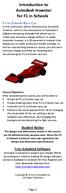 Introduction to Autodesk Inventor for F1 in Schools F1 in Schools Race Car In this course you will be introduced to Autodesk Inventor, which is the centerpiece of Autodesk s digital prototyping strategy
2013 Getting Started Guide
 2013 Getting Started Guide The contents of this guide and accompanying exercises were originally created by Nemetschek Vectorworks, Inc. Vectorworks Fundamentals Getting Started Guide Created using: Vectorworks
Line Segments, Rays, and Lines
 HOME LINK Line Segments, Rays, and Lines Family Note Help your child match each name below with the correct drawing of a line, ray, or line segment. Then observe as your child uses a straightedge to draw
Linkage 3.2. User s Guide
 Linkage 3.2 User s Guide David Rector Wednesday, April 06, 2016 Table of Contents Table of Contents... 2 Installation... 3 Running the Linkage Program... 3 Simple Mechanism Tutorial... 5 Mouse Operations...
SA B 1 p where is the slant height of the pyramid. V 1 3 Bh. 3D Solids Pyramids and Cones. Surface Area and Volume of a Pyramid
 Accelerated AAG 3D Solids Pyramids and Cones Name & Date Surface Area and Volume of a Pyramid The surface area of a regular pyramid is given by the formula SA B 1 p where is the slant height of the pyramid.
DISCOVERING 3D SHAPES
 . DISCOVERING 3D SHAPES WORKSHEETS OCTOBER-DECEMBER 2009 1 . Worksheet 1. Cut out and stick the shapes. SHAPES WHICH ROLL SHAPES WHICH SLIDE 2 . Worksheet 2: COMPLETE THE CHARTS Sphere, triangle, prism,
Working With Animation: Introduction to Flash
 Working With Animation: Introduction to Flash With Adobe Flash, you can create artwork and animations that add motion and visual interest to your Web pages. Flash movies can be interactive users can click
Introduction to CATIA V5
 Introduction to CATIA V5 Release 16 (A Hands-On Tutorial Approach) Kirstie Plantenberg University of Detroit Mercy SDC PUBLICATIONS Schroff Development Corporation www.schroff.com www.schroff-europe.com
Algebra Geometry Glossary. 90 angle
 lgebra Geometry Glossary 1) acute angle an angle less than 90 acute angle 90 angle 2) acute triangle a triangle where all angles are less than 90 3) adjacent angles angles that share a common leg Example:
3D shapes. Level A. 1. Which of the following is a 3-D shape? A) Cylinder B) Octagon C) Kite. 2. What is another name for 3-D shapes?
 Level A 1. Which of the following is a 3-D shape? A) Cylinder B) Octagon C) Kite 2. What is another name for 3-D shapes? A) Polygon B) Polyhedron C) Point 3. A 3-D shape has four sides and a triangular
Tutorial: Biped Character in 3D Studio Max 7, Easy Animation
 Tutorial: Biped Character in 3D Studio Max 7, Easy Animation Written by: Ricardo Tangali 1. Introduction:... 3 2. Basic control in 3D Studio Max... 3 2.1. Navigating a scene:... 3 2.2. Hide and Unhide
Warning! Construction Zone: Building Solids from Nets
 Brief Overview: Warning! Construction Zone: Building Solids from Nets In this unit the students will be examining and defining attributes of solids and their nets. The students will be expected to have
Area of Parallelograms (pages 546 549)
 A Area of Parallelograms (pages 546 549) A parallelogram is a quadrilateral with two pairs of parallel sides. The base is any one of the sides and the height is the shortest distance (the length of a perpendicular
MENSURATION. Definition
 MENSURATION Definition 1. Mensuration : It is a branch of mathematics which deals with the lengths of lines, areas of surfaces and volumes of solids. 2. Plane Mensuration : It deals with the sides, perimeters
Creating Your Own 3D Models
 14 Creating Your Own 3D Models DAZ 3D has an extensive growing library of 3D models, but there are times that you may not find what you want or you may just want to create your own model. In either case
Chapter 1. Creating Sketches in. the Sketch Mode-I. Evaluation chapter. Logon to www.cadcim.com for more details. Learning Objectives
 Chapter 1 Creating Sketches in Learning Objectives the Sketch Mode-I After completing this chapter you will be able to: Use various tools to create a geometry. Dimension a sketch. Apply constraints to
1. Kyle stacks 30 sheets of paper as shown to the right. Each sheet weighs about 5 g. How can you find the weight of the whole stack?
 Prisms and Cylinders Answer Key Vocabulary: cylinder, height (of a cylinder or prism), prism, volume Prior Knowledge Questions (Do these BEFORE using the Gizmo.) [Note: The purpose of these questions is
Basic AutoSketch Manual
 Basic AutoSketch Manual Instruction for students Skf-Manual.doc of 3 Contents BASIC AUTOSKETCH MANUAL... INSTRUCTION FOR STUDENTS... BASIC AUTOSKETCH INSTRUCTION... 3 SCREEN LAYOUT... 3 MENU BAR... 3 FILE
What s New V 11. Preferences: Parameters: Layout/ Modifications: Reverse mouse scroll wheel zoom direction
 What s New V 11 Preferences: Reverse mouse scroll wheel zoom direction Assign mouse scroll wheel Middle Button as Fine tune Pricing Method (Manufacturing/Design) Display- Display Long Name Parameters:
New York State Student Learning Objective: Regents Geometry
 New York State Student Learning Objective: Regents Geometry All SLOs MUST include the following basic components: Population These are the students assigned to the course section(s) in this SLO all students
Autodesk Fusion 360 Badge Guide: Design an F1 in Schools Trophy
 Autodesk Fusion 360 Badge Guide: Design an F1 in Schools Trophy Abstract: Gain basic understanding of creating 3D models in Fusion 360 by designing an F1 in Schools trophy. This badge may be claimed by
E XPLORING QUADRILATERALS
 E XPLORING QUADRILATERALS E 1 Geometry State Goal 9: Use geometric methods to analyze, categorize and draw conclusions about points, lines, planes and space. Statement of Purpose: The activities in this
Area of Parallelograms, Triangles, and Trapezoids (pages 314 318)
 Area of Parallelograms, Triangles, and Trapezoids (pages 34 38) Any side of a parallelogram or triangle can be used as a base. The altitude of a parallelogram is a line segment perpendicular to the base
CATIA Basic Concepts TABLE OF CONTENTS
 TABLE OF CONTENTS Introduction...1 Manual Format...2 Log on/off procedures for Windows...3 To log on...3 To logoff...7 Assembly Design Screen...8 Part Design Screen...9 Pull-down Menus...10 Start...10
Blender Notes. Introduction to Digital Modelling and Animation in Design Blender Tutorial - week 9 The Game Engine
 Blender Notes Introduction to Digital Modelling and Animation in Design Blender Tutorial - week 9 The Game Engine The Blender Game Engine This week we will have an introduction to the Game Engine build
Tessellating with Regular Polygons
 Tessellating with Regular Polygons You ve probably seen a floor tiled with square tiles. Squares make good tiles because they can cover a surface without any gaps or overlapping. This kind of tiling is
SOLIDWORKS: SKETCH RELATIONS
 Sketch Feature: The shape or topology of the initial sketch or model is important, but exact geometry and dimensions of the initial sketched shapes are NOT. It recommended to work in the following order:
Castle Modeling. In this PDF tutorial we will be modeling a simple castle as pictured above.
 Course: 3D Design Title: Castle Modeling Blender: Version 2.6X Level: Beginning Author; Neal Hirsig ([email protected]) May, 2012 This tutorial assumes that you already know how to: Display orthographic
To draw a line. To create a construction line by specifying two points
 Drawing Lines, Polygons and Rectangles The line is the basic object in AutoCAD. You can create a variety of lines: single lines, multiple line segments with and without arcs, multiple parallel lines, and
Star and convex regular polyhedra by Origami.
 Star and convex regular polyhedra by Origami. Build polyhedra by Origami.] Marcel Morales Alice Morales 2009 E D I T I O N M O R A L E S Polyhedron by Origami I) Table of convex regular Polyhedra... 4
GEOMETRY COMMON CORE STANDARDS
 1st Nine Weeks Experiment with transformations in the plane G-CO.1 Know precise definitions of angle, circle, perpendicular line, parallel line, and line segment, based on the undefined notions of point,
CHAPTER 8, GEOMETRY. 4. A circular cylinder has a circumference of 33 in. Use 22 as the approximate value of π and find the radius of this cylinder.
 TEST A CHAPTER 8, GEOMETRY 1. A rectangular plot of ground is to be enclosed with 180 yd of fencing. If the plot is twice as long as it is wide, what are its dimensions? 2. A 4 cm by 6 cm rectangle has
Number Sense and Operations
 Number Sense and Operations representing as they: 6.N.1 6.N.2 6.N.3 6.N.4 6.N.5 6.N.6 6.N.7 6.N.8 6.N.9 6.N.10 6.N.11 6.N.12 6.N.13. 6.N.14 6.N.15 Demonstrate an understanding of positive integer exponents
CATIA Drafting TABLE OF CONTENTS
 TABLE OF CONTENTS Introduction...1 Drafting...2 Drawing Screen...3 Pull-down Menus...4 File...4 Edit...5 View...6 Insert...7 Tools...8 Drafting Workbench...9 Views and Sheets...9 Dimensions and Annotations...10
Exercise: Building and zone geometry import from SketchUp
 Exercise: Building and zone geometry import from SketchUp Purpose Learn how to create and import building and zone geometry from SketchUp into IDA ICE. Learn how to work with imported building and zone
GEOMETRY CONCEPT MAP. Suggested Sequence:
 CONCEPT MAP GEOMETRY August 2011 Suggested Sequence: 1. Tools of Geometry 2. Reasoning and Proof 3. Parallel and Perpendicular Lines 4. Congruent Triangles 5. Relationships Within Triangles 6. Polygons
Geometry and Measurement
 The student will be able to: Geometry and Measurement 1. Demonstrate an understanding of the principles of geometry and measurement and operations using measurements Use the US system of measurement for
Proprietary and restricted rights notice
 Proprietary and restricted rights notice This software and related documentation are proprietary to Siemens Product Lifecycle Management Software Inc. 2012 Siemens Product Lifecycle Management Software
Getting Started in Tinkercad
 Getting Started in Tinkercad By Bonnie Roskes, 3DVinci Tinkercad is a fun, easy to use, web-based 3D design application. You don t need any design experience - Tinkercad can be used by anyone. In fact,
9 Area, Perimeter and Volume
 9 Area, Perimeter and Volume 9.1 2-D Shapes The following table gives the names of some 2-D shapes. In this section we will consider the properties of some of these shapes. Rectangle All angles are right
SURFACE AREA AND VOLUME
 SURFACE AREA AND VOLUME In this unit, we will learn to find the surface area and volume of the following threedimensional solids:. Prisms. Pyramids 3. Cylinders 4. Cones It is assumed that the reader has
Basic 2D Design Be sure you have the latest information!
 Basic 2D Design mastercam x getting started tutorials Basic 2D Design December 2011 Be sure you have the latest information! Information might have been changed or added since this document was published.
56 questions (multiple choice, check all that apply, and fill in the blank) The exam is worth 224 points.
 6.1.1 Review: Semester Review Study Sheet Geometry Core Sem 2 (S2495808) Semester Exam Preparation Look back at the unit quizzes and diagnostics. Use the unit quizzes and diagnostics to determine which
Pro/ENGINEER Wildfire 5.0 Introduction to Surface Modeling
 Introduction Several advanced surface types are available as listed below. Variable Section Sweep Boundary Blend Section to Surfaces Blend Surface to Surface Blend A surface is created by sweeping a single
TABLE OF CONTENTS. INTRODUCTION... 5 Advance Concrete... 5 Where to find information?... 6 INSTALLATION... 7 STARTING ADVANCE CONCRETE...
 Starting Guide TABLE OF CONTENTS INTRODUCTION... 5 Advance Concrete... 5 Where to find information?... 6 INSTALLATION... 7 STARTING ADVANCE CONCRETE... 7 ADVANCE CONCRETE USER INTERFACE... 7 Other important
Three-Dimensional Figures or Space Figures. Rectangular Prism Cylinder Cone Sphere. Two-Dimensional Figures or Plane Figures
 SHAPE NAMES Three-Dimensional Figures or Space Figures Rectangular Prism Cylinder Cone Sphere Two-Dimensional Figures or Plane Figures Square Rectangle Triangle Circle Name each shape. [triangle] [cone]
OD1641 PRINCIPLES OF DRAFTING AND SHOP DRAWINGS
 SUBCOURSE OD1641 EDITION 8 PRINCIPLES OF DRAFTING AND SHOP DRAWINGS US ARMY REPAIR SHOP TECHNICIAN WARRANT OFFICER ADVANCED CORRESPONDENCE COURSE MOS/SKILL LEVEL: 441A PRINCIPLES OF DRAFTING AND SHOP
Geometry. Higher Mathematics Courses 69. Geometry
 The fundamental purpose of the course is to formalize and extend students geometric experiences from the middle grades. This course includes standards from the conceptual categories of and Statistics and
Autodesk Fusion 360: Assemblies. Overview
 Overview In this module you will learn how different components can be put together to create an assembly. We will use several tools in Fusion 360 to make sure that these assemblies are constrained appropriately
Volume of Right Prisms Objective To provide experiences with using a formula for the volume of right prisms.
 Volume of Right Prisms Objective To provide experiences with using a formula for the volume of right prisms. www.everydaymathonline.com epresentations etoolkit Algorithms Practice EM Facts Workshop Game
GeoGebra. 10 lessons. Gerrit Stols
 GeoGebra in 10 lessons Gerrit Stols Acknowledgements GeoGebra is dynamic mathematics open source (free) software for learning and teaching mathematics in schools. It was developed by Markus Hohenwarter
SDC. Schroff Development Corporation WWW.SDCACAD.COM PUBLICATIONS. MultiMedia CD by Jack Zecher
 MultiMedia CD by Jack Zecher An audioi/visual presentation of the tutorial exercises SDC PUBLICATIONS Schroff Development Corporation WWW.SDCACAD.COM AutoCAD 2002 Tutorial 2-1 Lesson 2 Geometric Construction
Generative Drafting. Page 1 1997 2001 DASSAULT SYSTEMES. IBM Product Lifecycle Management Solutions / Dassault Systemes
 Generative Drafting Page 1 Tutorial Objectives Description This Tutorial is an introduction to Generative Drafting. Message To show how CATIA V5 allows the user to automatically generate associative drafting
Geometry Notes PERIMETER AND AREA
 Perimeter and Area Page 1 of 57 PERIMETER AND AREA Objectives: After completing this section, you should be able to do the following: Calculate the area of given geometric figures. Calculate the perimeter
Grade 1 Geometric Shapes Conceptual Lessons Unit Outline Type of Knowledge & SBAC Claim Prerequisite Knowledge:
 Grade 1 Geometric Shapes Conceptual Lessons Unit Outline Type of Knowledge & SBAC Claim Prerequisite Knowledge: Standards: Lesson Title and Objective/Description Shape names: square, rectangle, triangle,
EVERY DAY COUNTS CALENDAR MATH 2005 correlated to
 EVERY DAY COUNTS CALENDAR MATH 2005 correlated to Illinois Mathematics Assessment Framework Grades 3-5 E D U C A T I O N G R O U P A Houghton Mifflin Company YOUR ILLINOIS GREAT SOURCE REPRESENTATIVES:
How does one make and support a reasonable conclusion regarding a problem? How does what I measure influence how I measure?
 Middletown Public Schools Mathematics Unit Planning Organizer Subject Mathematics Grade/Course Grade 7 Unit 3 Two and Three Dimensional Geometry Duration 23 instructional days (+4 days reteaching/enrichment)
Chapter 8 Geometry We will discuss following concepts in this chapter.
 Mat College Mathematics Updated on Nov 5, 009 Chapter 8 Geometry We will discuss following concepts in this chapter. Two Dimensional Geometry: Straight lines (parallel and perpendicular), Rays, Angles
Cabri Geometry Application User Guide
 Cabri Geometry Application User Guide Preview of Geometry... 2 Learning the Basics... 3 Managing File Operations... 12 Setting Application Preferences... 14 Selecting and Moving Objects... 17 Deleting
The University of the State of New York REGENTS HIGH SCHOOL EXAMINATION GEOMETRY. Thursday, January 26, 2012 9:15 a.m. to 12:15 p.m.
 GEOMETRY The University of the State of New York REGENTS HIGH SCHOOL EXMINTION GEOMETRY Thursday, January 26, 2012 9:15 a.m. to 12:15 p.m., only Student Name: School Name: Print your name and the name
Roof Tutorial. Chapter 3:
 Chapter 3: Roof Tutorial The majority of Roof Tutorial describes some common roof styles that can be created using settings in the Wall Specification dialog and can be completed independent of the other
Geometry Enduring Understandings Students will understand 1. that all circles are similar.
 High School - Circles Essential Questions: 1. Why are geometry and geometric figures relevant and important? 2. How can geometric ideas be communicated using a variety of representations? ******(i.e maps,
MATHEMATICS FOR ENGINEERING BASIC ALGEBRA
 MATHEMATICS FOR ENGINEERING BASIC ALGEBRA TUTORIAL 4 AREAS AND VOLUMES This is the one of a series of basic tutorials in mathematics aimed at beginners or anyone wanting to refresh themselves on fundamentals.
1. A plane passes through the apex (top point) of a cone and then through its base. What geometric figure will be formed from this intersection?
 Student Name: Teacher: Date: District: Description: Miami-Dade County Public Schools Geometry Topic 7: 3-Dimensional Shapes 1. A plane passes through the apex (top point) of a cone and then through its
Third Grade Shapes Up! Grade Level: Third Grade Written by: Jill Pisman, St. Mary s School East Moline, Illinois Length of Unit: Eight Lessons
 Third Grade Shapes Up! Grade Level: Third Grade Written by: Jill Pisman, St. Mary s School East Moline, Illinois Length of Unit: Eight Lessons I. ABSTRACT This unit contains lessons that focus on geometric
NEW MEXICO Grade 6 MATHEMATICS STANDARDS
 PROCESS STANDARDS To help New Mexico students achieve the Content Standards enumerated below, teachers are encouraged to base instruction on the following Process Standards: Problem Solving Build new mathematical
Draw Guide: A guide to using the Draw component of OpenOffice.org
 : A guide to using the Draw component of OpenOffice.org Title: : A guide to using the Draw component of OpenOffice.org Version: 1.0 First edition: October 2004 Contents Overview... vi Copyright and trademark
Getting Started With DraftSight A Guide For AEC Users
 Getting Started With DraftSight A Guide For AEC Users DraftSight.com Facebook.com/DraftSight Welcome to DraftSight a valuable tool for any AEC professional! DraftSight is more than a free, professional-grade
39 Symmetry of Plane Figures
 39 Symmetry of Plane Figures In this section, we are interested in the symmetric properties of plane figures. By a symmetry of a plane figure we mean a motion of the plane that moves the figure so that
Drawing in Microsoft Word
 Copyright This document is Copyright 2006 by its contributors as listed in the section titled Authors. You can distribute it and/or modify it under the terms of the Creative Commons Attribution License,
Lesson #13 Congruence, Symmetry and Transformations: Translations, Reflections, and Rotations
 Math Buddies -Grade 4 13-1 Lesson #13 Congruence, Symmetry and Transformations: Translations, Reflections, and Rotations Goal: Identify congruent and noncongruent figures Recognize the congruence of plane
CATIA V5 Tutorials. Mechanism Design & Animation. Release 18. Nader G. Zamani. University of Windsor. Jonathan M. Weaver. University of Detroit Mercy
 CATIA V5 Tutorials Mechanism Design & Animation Release 18 Nader G. Zamani University of Windsor Jonathan M. Weaver University of Detroit Mercy SDC PUBLICATIONS Schroff Development Corporation www.schroff.com
Basic controls of Rhinoceros 3D software
 lecture 2 Basic controls of Rhinoceros 3D software After the start Rhinoceros 3D software shows basic working area compound by four viewports (show model in other positions), popup menu over, palette menu
Google SketchUp Design Exercise 3
 Google SketchUp Design Exercise 3 This advanced design project uses many of SketchUp s drawing tools, and involves paying some attention to the exact sizes of what you re drawing. You ll also make good
This is a preview of the book "QCAD - An Introduction to Computer-Aided Design (CAD)" QCAD. An Introduction to ComputerAided Design (CAD)
 QCAD An Introduction to ComputerAided Design (CAD) Andrew Mustun Table of Contents Introduction Part I: First Steps with QCAD Introducing the QCAD Application 8 15 16 The First Start 16 The Application