
Overview of all the Parallel Ocean Program (POP) runs
|
|
|
- Elinor Harrell
- 10 years ago
- Views:
Transcription
1 Overview of all the Parallel Ocean Program (POP) runs Michael Kliphuis Jun 23, 2014 PROJECT control_mat Description High resolution control run for the project with the restoring under ice term on for TEMP and SALT. Performed by Mat Maltrud (LANL). The run is forced by a prescribed present day atmospheric state with a repeating annual cycle and observed river run-off fields > (10 years, only monthly means) POP (0.1 degrees = 3600x2400x42) Encanto (SGI Altix ICE 8200), New Mexico Computing Applications Center, U.S.A (Stability of the Atlantic Meridional Ocean Circulation) Monthly: UVEL, VVEL, KE, TEMP, SALT, SSH, H2, IDEALAGE, TTD01, TTD02, TTD03, TTD11, HMXL, MXHML, HBLT, MXHBLT, SHF, SFWF, TAUX, TAUY, WVEL, UET, VNT, UES, VNS, PV, Q, PD meridional heat transports and MOC - on /archive/klipdccp/samoc/output/control_mat/tavg : /archive/klipdccp/samoc/output/control_mat/tavg_rectgrid : /archive/klipdccp/samoc/output/control_mat/msf : Filenames tavg: t.t0.1_42l_nccs01.yyyymm.bin tavg_rectgrid: t.t0.1_42l_nccs01.yyyymm.bin.interp900x602.nc MSF_t.t0.1_42l_nccs01.yyyymm.nc monthly mean rectangular 0.4 degrees netcdf

2 run_henk_mixedbc Description High resolution control run for the project with 'implied flux' instead of 'restoring under ice for TEMP and SALT. This so called mixed boundary conditions run is forced by a prescribed present day atmospheric state with a repeating annual cycle and observed river run-off fields (as in control_mat) but also forced with an implied_flux term instead of restoring under ice. This means that we ran the original control run control_mat from year 75 for 5 years with the restoring under ice term on for both TEMP and SALT and then diagnosed the implied flux. We then made a monthly 5-year average of this and used this as an implied flux term in the TEMP and SALT forcing files > (110 years) POP (0.1 degrees = 3600x2400x42) > : CRAY XT6 at EPCC in Edinburgh, Scotland > : Huygens (IBM X6) at SARA in Amsterdam, the Netherlands > (Bullx) at SURFsara in Amsterdam, the Netherlands (Stability of the Atlantic Meridional Ocean Circulation). Monthly: Daily: meridional heat transports and MOC UVEL, VVEL, KE, TEMP, SALT, SSH, H2, SHF, SFWF, TAUX, TAUY, UET, VNT, PD, HMXL, XMXL, TMXL mass, heat and salt transports (141 straits) UVEL_5m, VVEL_5m, TEMP_5m, SALT_5m, UVEL_15m, VVEL_15m, TEMP_15m, SALT_15m, SSH /projects/samoc/run_henk_mixedbc/tavg : /projects/samoc/run_henk_mixedbc/tavg_rectgrid: /projects/samoc/run_henk_mixedbc/ /projects/samoc/run_henk_mixedbc/msf : monthly mean rectangular 0.4 degrees netcdf on /archive/klipdccp/samoc/output/run_henk_mixedbc/tavg : /archive/klipdccp/samoc/output/run_henk_mixedbc/movie : /archive/klipdccp/samoc/output/run_henk_mixedbc/restart : /archive/klipdccp/samoc/output/run_henk_mixedbc/tavg_rectgrid : /archive/klipdccp/samoc/output/run_henk_mixedbc/ /archive/klipdccp/samoc/output/run_henk_mixedbc/msf : dailly mean curvilinear 0.1 degrees binary data monthly mean rectangular 0.4 degrees netcdf Filenames tavg: movie: t.t0.1_42l_nccs01.yyyymm m.t0.1_42l_nccs01.yyyymmdd r.t0.1_42l_nccs01.yyyymm01 tavg_rectgrid: t.t0.1_42l_nccs01.yyyymm.interp900x602.nc transp.t0.1_42l_nccs01.yyyymm01 MSF_t.t0.1_42l_nccs01.yyyymm.nc

3 prod_run1 Description THIS RUN WAS FORCED WITH A WRONG (ONLY 80%) INCOMING SHORTWAVE RADIATION. High resolution 0.1Sv Greenland run for the project. Run with same forcings as control run run_henk_mixedbc but in this run 0.1 Sv of freshwater was dumped (by enhanced run off) around Greenland. The runoff is distributed in a realistic spatial and temporal pattern around the coast of Greenland inspired by studies of present-day runoff from the Greenland Ice Sheet. It ran from spinup year 75 until year 98. When we found out about the incorrect incoming shortwave radiation Mat Maltrud of LANL offered to rerun it on the Encanto supercomputer in New Mexico. This is run prod_run2_mat > (23 years) POP (0.1 degrees = 3600x2400x42) Huygens (IBM X6) at SARA in Amsterdam, the Netherlands (Stability of the Atlantic Meridional Ocean Circulation) Monthly: Daily: - meridional heat transports and MOC UVEL, VVEL, KE, TEMP, SALT, SSH, H2, SHF, SFWF, TAUX, TAUY, DYE, UET, VNT, PD, HMXL, XMXL, TMXL mass, heat and salt transports (141 straits) UVEL_5m, VVEL_5m, TEMP_5m, SALT_5m, UVEL_15m, VVEL_15m, TEMP_15m, SALT_15m, SSH on /archive/klipdccp/samoc/output/prod_run1/tavg : /archive/klipdccp/samoc/output/prod_run1/movie : /archive/klipdccp/samoc/output/prod_run1/restart : /archive/klipdccp/samoc/output/prod_run1/extracted : /archive/klipdccp/samoc/output/prod_run1/moc : dailly mean curvilinear 0.1 degrees binary data monthly and daily mean curvilinear 0.1 degrees netcdf data monthly mean MOC (for World, Atlantic and Indo-pacific) Note: Unfortunately there are files that got lost Filenames tavg: t.t0.1_42l_greenland.yyyymm movie: m.t0.1_42l_greenland.yyyymmdd r.t0.1_42l_greenland.yyyymm01 moc: MSF_t.t0.1_42l_greenland.yyyymm.nc

4 prod_run2_mat Description High resolution 0.1Sv Greenland run for the project. The correct run with same forcings as run_henk_mixedbc but in this run 0.1 Sv of freshwater was dumped (by enhanced run off) around Greenland. The runoff is distributed in a realistic spatial and temporal pattern around the coast of Greenland inspired by studies of present-day runoff from the Greenland Ice Sheet. The run was initially started on supercomputer Encanto by Mat Maltrud (LANL). I: > (16 years, only monthly means) II: > (9 years, only monthly means) III: IV: > (5 years, only monthly means) > (10 years, monthly and daily means) I and II are sequential but Mat Maltrud decided to save different variables for period II. All daily files until and all monthly files for ( until ) and ( until ) got lost. There are restartfiles and transport files for years 115 until 125. POP (0.1 degrees = 3600x2400x42) > Encanto (SGI Altix ICE 8200), New Mexico Computing Applications Center, U.S.A > Huygens (IBM X6) at SARA in Amsterdam, the Netherlands Monthly: II: UVEL, VVEL, KE, TEMP, SALT, SSH, H2, SHF, SFWF, TAUX, TAUY, DYE, PD, HMXL, XMXL, TMXL IV: period II variables but also: SWNET, LWNET, LATENT, SENSIBLE, EVAP, PRECIP, RUNOFF I + III: period IV variables but also: T_STRONG_REST, S_WEAK_REST, S_STRONG_REST All periods: meridional heat transports and MOC Daily: mass, heat and salt transports (141 straits) UVEL_5m, VVEL_5m, TEMP_5m, SALT_5m, UVEL_15m, VVEL_15m, TEMP_15m, SALT_15m, SSH, DYE01_5m, DYE01_zint on /archive/klipdccp/samoc/output/prod_run2_mat/tavg : /archive/klipdccp/samoc/output/prod_run2_mat/movie : dailly mean curvilinear 0.1 degrees binary data /archive/klipdccp/samoc/output/prod_run2_mat/restart : /archive/klipdccp/samoc/output/prod_run2_mat/tavg_rectgrid : monthly mean rectangular 0.4 degrees netcdf data /archive/klipdccp/samoc/output/prod_run2_mat/transport : /archive/klipdccp/samoc/output/prod_run2_mat/msf : monthly mean Global, Atlantic & Indo-pacific MOC Filenames tavg: movie: t.t0.1_42l_greenland.yyyymm m.t0.1_42l_greenland.yyyymmdd r.t0.1_42l_greenland.yyyymm01 tavg_rectgrid: t.t0.1_42l_greenland.yyyymm.interp900x602.nc transp.t0.1_42l_greenlandyyyymm01 MSF_t.t0.1_42l_greenland.yyyymm.nc

5 prod_run3_0.5sv Description High resolution 0.5Sv Greenland run for the project. Run with same forcings as run_henk_mixedbc but in this run 0.5 Sv of freshwater was dumped, by enhanced run off around Greenland. The runoff is distributed in a realistic spatial and temporal pattern around the coast of Greenland inspired by studies of present-day runoff from the Greenland Ice Sheet > (65 years) POP (0.1 degrees = 3600x2400x42) Huygens (IBM X6) at SARA in Amsterdam, the Netherlands Monthly: meridional heat transports and MOC UVEL, VVEL, KE, TEMP, SALT, SSH, H2, SHF, SFWF, TAUX, TAUY, PD, HMXL, XMXL, TMXL Daily: mass, heat and salt transports (141 straits) UVEL_5m, VVEL_5m, TEMP_5m, SALT_5m, UVEL_15m, VVEL_15m, TEMP_15m, SALT_15m, SSH on /archive/klipdccp/samoc/output/prod_run3_0.5sv/tavg : /archive/klipdccp/samoc/output/prod_run3_0.5sv/movie : /archive/klipdccp/samoc/output/prod_run3_0.5sv/restart : /archive/klipdccp/samoc/output/prod_run3_0.5sv/tavg_rectgrid : /archive/klipdccp/samoc/output/prod_run3_0.5sv/transport : /archive/klipdccp/samoc/output/prod_run3_0.5sv/msf : dailly mean curvilinear 0.1 degrees binary data monthly mean rectangular 0.4 degrees netcdf data monthly mean Global, Atlantic & Indo-pacific MOC Filenames tavg: t.t0.1_42l_nccs01.yyyymm movie: m.t0.1_42l_nccs01.yyyymmdd r.t0.1_42l_nccs01.yyyymm01 tavg_rectgrid: t.t0.1_42l_nccs01.yyyymm.interp900x602.nc transp.t0.1_42l_nccs01.yyyymm01 MSF_t.t0.1_42l_nccs01.yyyymm.nc

6 prod_run3_0.5sv_restarted_mixedbc Description Model Version Restart from the (at that time) latest restartfiles ( ) of the High resolution 0.5Sv Greenland run (prod_run3_0.5sv) but now forced with mixed bc conditions (same as run_henk_mixedbc) to see how quickly the MOC recovers > (30 years) POP (0.1 degrees = 3600x2400x42) > (19 years) Huygens (IBM X6) at SARA in Amsterdam, the Netherlands > (11 years) (Bullx) at SURFsara in Amsterdam, the Netherlands Monthly: meridional heat transports and MOC UVEL, VVEL, KE, TEMP, SALT, SSH, H2, SHF, SFWF, TAUX, TAUY, UET, VNT, UES, VNS, PD, HMXL, XMXL, TMXL Daily: mass, heat and salt transports (141 straits) UVEL_5m, VVEL_5m, TEMP_5m, SALT_5m, UVEL_15m, VVEL_15m, TEMP_15m, SALT_15m, SSH Scratch path on /projects/samoc/prod_run3_0.5sv_restarted_mixedbc/tavg: /projects/samoc/prod_run3_0.5sv_restarted_mixedbc/movie: /projects/samoc/prod_run3_0.5sv_restarted_mixedbc/ /projects/samoc/prod_run3_0.5sv_restarted_mixedbc/tavg_rectgrid: /projects/samoc/prod_run3_0.5sv_restarted_mixedbc/transport /projects/samoc/prod_run3_0.5sv_restarted_mixedbc/ daily mean curvilinear 0.1 degrees binary data monthly mean rectangular 0.4 degrees netcdf data monthly mean Global, Atlantic & Indo-pacific MOC /archive/klipdccp/samoc/output/prod_run3_0.5sv_restarted_mixedbc/tavg: monthly mean curvilinear 0.1 degrees on /archive/klipdccp/samoc/output/prod_3_0.5sv_restarted_mixedbc/movie : binary data daily mean curvilinear 0.1 degrees (backup on binary data tape) /archive/klipdccp/samoc/output/prod_run3_0.5sv_restarted_mixedbc/ monthly mean curvilinear 0.1 degrees binary data /archive/klipdccp/samoc/output/prod_run3_0.5sv_restarted_mixedbc/tavg_rectgrid : monthly mean rectangular 0.4 degrees netcdf data /archive/klipdccp/samoc/output/prod_run3_0.5sv_restarted_mixedbc/transport : daily mass, heat and salt transports (141 straits) /archive/klipdccp/samoc/output/prod_run3_0.5sv_restarted_mixedbc/msf : monthly mean Global, Atlantic and Indo-pacific MOC Filenames tavg: t.t0.1_42l_nccs01.yyyymm movie: m.t0.1_42l_nccs01.yyyymmdd r.t0.1_42l_nccs01.yyyymm01 tavg_rectgrid: t.t0.1_42l_nccs01.yyyymm.interp900x602.nc transp.t0.1_42l_nccs01.yyyymm01 MSF_t.t0.1_42l_nccs01.yyyymm.nc

7 prod_run3_0.5sv_restarted_reverse Description Model Version Restart from the latest restartfiles ( ) of the High resolution 0.5Sv Greenland run (prod_run3_0.5sv) but now with a negative freshwater perturbation added meaning that we are basically adding salt (0.5 Sv) instead of freshwater around the coast of Greenland. The run is used to study the recovery of the MOC > (30 years) POP (0.1 degrees = 3600x2400x42) > (20 years) Huygens (IBM X6) at SARA in Amsterdam, the Netherlands > (10 years) (Bullx) at SURFsara in Amsterdam, the Netherlands Monthly: meridional heat transports and MOC UVEL, VVEL, KE, TEMP, SALT, SSH, H2, SHF, SFWF, TAUX, TAUY, UET, VNT, UES, VNS, PD, HMXL, XMXL, TMXL Daily: mass, heat and salt transports (141 straits) UVEL_5m, VVEL_5m, TEMP_5m, SALT_5m, UVEL_15m, VVEL_15m, TEMP_15m, SALT_15m, SSH Scratch path on /projects/samoc/prod_run3_0.5sv_restarted_reverse/tavg: /projects/samoc/prod_run3_0.5sv_restarted_reverse/movie: /projects/samoc/prod_run3_0.5sv_restarted_reverse/ /projects/samoc/prod_run3_0.5sv_restarted_reverse/tavg_rectgrid: /projects/samoc/prod_run3_0.5sv_restarted_reverse/transport /projects/samoc/prod_run3_0.5sv_restarted_reverse/ daily mean curvilinear 0.1 degrees binary data monthly mean rectangular 0.4 degrees netcdf data monthly mean Global, Atlantic & Indo- pacific MOC /archive/klipdccp/samoc/output/prod_run3_0.5sv_restarted_reverse/tavg: monthly mean curvilinear 0.1 degrees on binary data /archive/klipdccp/samoc/output/prod_run3_0.5sv_restarted_reverse/movie : dailly mean curvilinear 0.1 degrees (backup on binary data tape) /archive/klipdccp/samoc/output/prod_run3_0.5sv_restarted_reverse/ monthly mean curvilinear 0.1 degrees binary data /archive/klipdccp/samoc/output/prod_run3_0.5sv_restarted_reverse/tavg_rectgrid : monthly mean rectangular 0.4 degrees netcdf data /archive/klipdccp/samoc/output/prod_run3_0.5sv_restarted_reverse/transport : daily mass, heat and salt transports (141 straits) /archive/klipdccp/samoc/output/prod_run3_0.5sv_restarted_reverse/msf : monthly mean Global, Atlantic and Indo-pacific MOC Filenames tavg: t.t0.1_42l_nccs01.yyyymm movie: m.t0.1_42l_nccs01.yyyymmdd r.t0.1_42l_nccs01.yyyymm01 tavg_rectgrid: t.t0.1_42l_nccs01.yyyymm.interp900x602.nc transp.t0.1_42l_nccs01.yyyymm01 MSF_t.t0.1_42l_nccs01.yyyymm.nc

8 hosing_0.1sv Description High resolution 0.1Sv Atlantic hosing run for the project. Run with same forcings as run_henk_mixedbc but in this run 0.1 Sv enhanced precipitation was dumped in a broad band over the subpolar North Atlantic (as in traditional hosing experiments). This run was initially performed on Encanto by Mat Maltrud but all data got lost so we performed it again on Huygens > (51 years) POP (0.1 degrees = 3600x2400x42) Huygens (IBM X6) at SARA in Amsterdam, the Netherlands Monthly: meridional heat transports and MOC UVEL, VVEL, KE, TEMP, SALT, SSH, H2, SWNET, LWNET, LATENT, SENSIBLE, EVAP, PRECIP, RUNOFF, SHF, SFWF, TAUX, TAUY, DYE, PD, HMXL, XMXL, TMXL Daily: mass, heat and salt transports (141 straits) UVEL_5m, VVEL_5m, TEMP_5m, SALT_5m, UVEL_15m, VVEL_15m, TEMP_15m, SALT_15m, SSH, DYE01_5m, DYE01_zint on /archive/klipdccp/samoc/output/hosing_0.1sv/tavg : /archive/klipdccp/samoc/output/hosing_0.1sv/movie : /archive/klipdccp/samoc/output/hosing_0.1sv/restart : /archive/klipdccp/samoc/output/hosing_0.1sv/tavg_rectgrid : /archive/klipdccp/samoc/output/hosing_0.1sv/transport : /archive/klipdccp/samoc/output/hosing_0.1sv/msf : Filenames tavg: t.t0.1_42l_nccs01.yyyymm movie: m.t0.1_42l_nccs01.yyyymmdd r.t0.1_42l_nccs01.yyyymm01 tavg_rectgrid: t.t0.1_42l_nccs01.yyyymm.interp900x602.nc transp.t0.1_42l_nccs01.yyyymm01 MSF_t.t0.1_42l_nccs01.yyyymm.nc dailly mean curvilinear 0.1 degrees binary data monthly mean rectangular 0.4 degrees netcdf

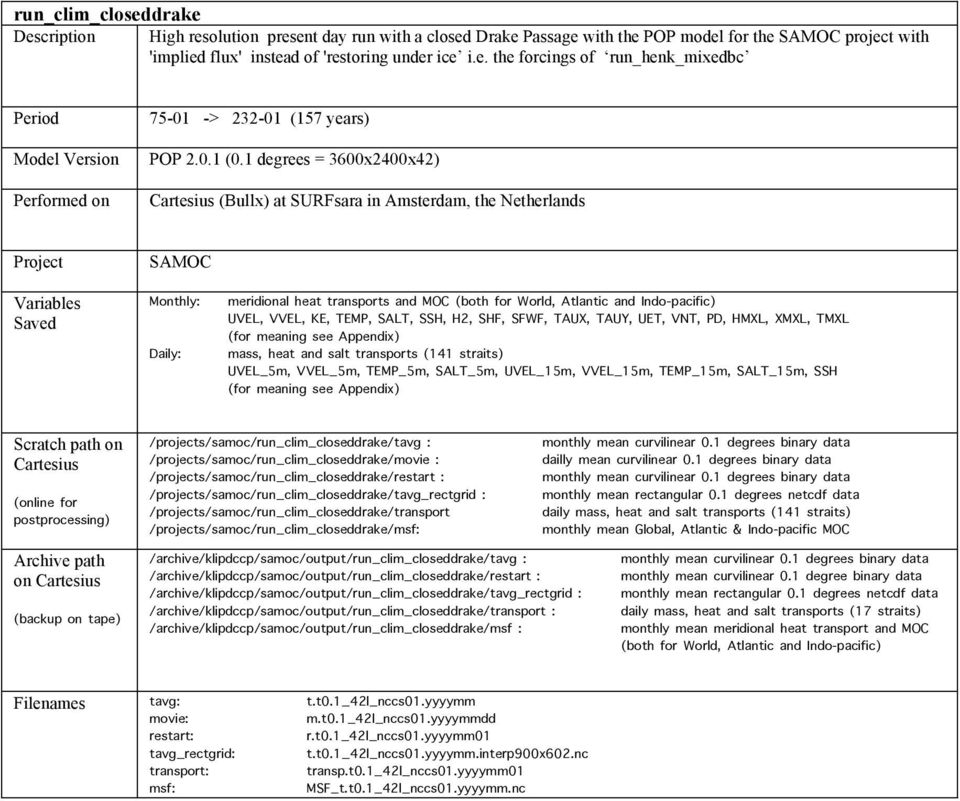
9 run_clim_closeddrake Description High resolution present day run with a closed Drake Passage with the POP model for the project with 'implied flux' instead of 'restoring under ice i.e. the forcings of run_henk_mixedbc > (157 years) POP (0.1 degrees = 3600x2400x42) (Bullx) at SURFsara in Amsterdam, the Netherlands Monthly: Daily: meridional heat transports and MOC UVEL, VVEL, KE, TEMP, SALT, SSH, H2, SHF, SFWF, TAUX, TAUY, UET, VNT, PD, HMXL, XMXL, TMXL mass, heat and salt transports (141 straits) UVEL_5m, VVEL_5m, TEMP_5m, SALT_5m, UVEL_15m, VVEL_15m, TEMP_15m, SALT_15m, SSH on /projects/samoc/run_clim_closeddrake/tavg : /projects/samoc/run_clim_closeddrake/movie : /projects/samoc/run_clim_closeddrake/restart : /projects/samoc/run_clim_closeddrake/tavg_rectgrid : /projects/samoc/run_clim_closeddrake/transport /projects/samoc/run_clim_closeddrake/ /archive/klipdccp/samoc/output/run_clim_closeddrake/tavg : /archive/klipdccp/samoc/output/run_clim_closeddrake/restart : /archive/klipdccp/samoc/output/run_clim_closeddrake/tavg_rectgrid : /archive/klipdccp/samoc/output/run_clim_closeddrake/transport : /archive/klipdccp/samoc/output/run_clim_closeddrake/msf : dailly mean curvilinear 0.1 degrees binary data monthly mean rectangular 0.1 degrees netcdf data monthly mean Global, Atlantic & Indo- pacific MOC monthly mean curvilinear 0.1 degree binary data monthly mean rectangular 0.1 degrees netcdf data daily mass, heat and salt transports (17 straits) Filenames tavg: movie: t.t0.1_42l_nccs01.yyyymm m.t0.1_42l_nccs01.yyyymmdd r.t0.1_42l_nccs01.yyyymm01 tavg_rectgrid: t.t0.1_42l_nccs01.yyyymm.interp900x602.nc transp.t0.1_42l_nccs01.yyyymm01 MSF_t.t0.1_42l_nccs01.yyyymm.nc
10 real_forcing Description High resolution present day run similar to run_henk_mixedbc but with only difference that we used a realistic windstress forcing taken from the CORE dataset of years These windstress fields were downloaded from: and interpolated to the POP grid. With these wind stresses the model however often bombed because of too high velocity katabatic winds mainly on Greenland but also elsewhere in the arctic region. Decreasing the timestep did not help so we decided to use the wind stress forcing of run_henk_mixedbc in the Arctic region above 65N (j=2000) and the CORE windstress for the latitudes on and below 65N. To avoid a sudden jump of wind stress at 65N we tapered the two wind stress fields into each other (in the region j=1900:2100 with a special Ferret function). This avoids any strange circulation that might occur as a result of the jump. After this the model ran without problems > (57 years) with windstress forcing of actual years POP (0.1 degrees = 3600x2400x42) (Bullx) at SURFsara in Amsterdam, the Netherlands (Stability of the Atlantic Meridional Ocean Circulation). Monthly: Daily: meridional heat transports and MOC UVEL, VVEL, KE, TEMP, SALT, SSH, H2, SHF, SFWF, TAUX, TAUY, UET, VNT, PD, HMXL, XMXL, TMXL mass, heat and salt transports (141 straits) UVEL_5m, VVEL_5m, TEMP_5m, SALT_5m, UVEL_15m, VVEL_15m, TEMP_15m, SALT_15m, SSH /projects/samoc/real_forcing/tavg : /projects/samoc/real_forcing/tavg_rectgrid: /projects/samoc/real_forcing/movie : /projects/samoc/real_forcing/msf : monthly mean rectangular 0.4 degrees netcdf dailly mean curvilinear 0.1 degrees binary data on /archive/klipdccp/samoc/output/real_forcing/tavg : /archive/klipdccp/samoc/output/real_forcing/movie : /archive/klipdccp/samoc/output/real_forcing/restart : /archive/klipdccp/samoc/output/real_forcing/tavg_rectgrid : /archive/klipdccp/samoc/output/real_forcing/msf : dailly mean curvilinear 0.1 degrees binary data monthly mean rectangular 0.4 degrees netcdf Filenames tavg: t.t0.1_42l_nccs01.yyyymm movie: m.t0.1_42l_nccs01.yyyymmdd r.t0.1_42l_nccs01.yyyymm01 tavg_rectgrid: t.t0.1_42l_nccs01.yyyymm.interp900x602.nc transp.t0.1_42l_nccs01.yyyymm01 MSF_t.t0.1_42l_nccs01.yyyymm.nc

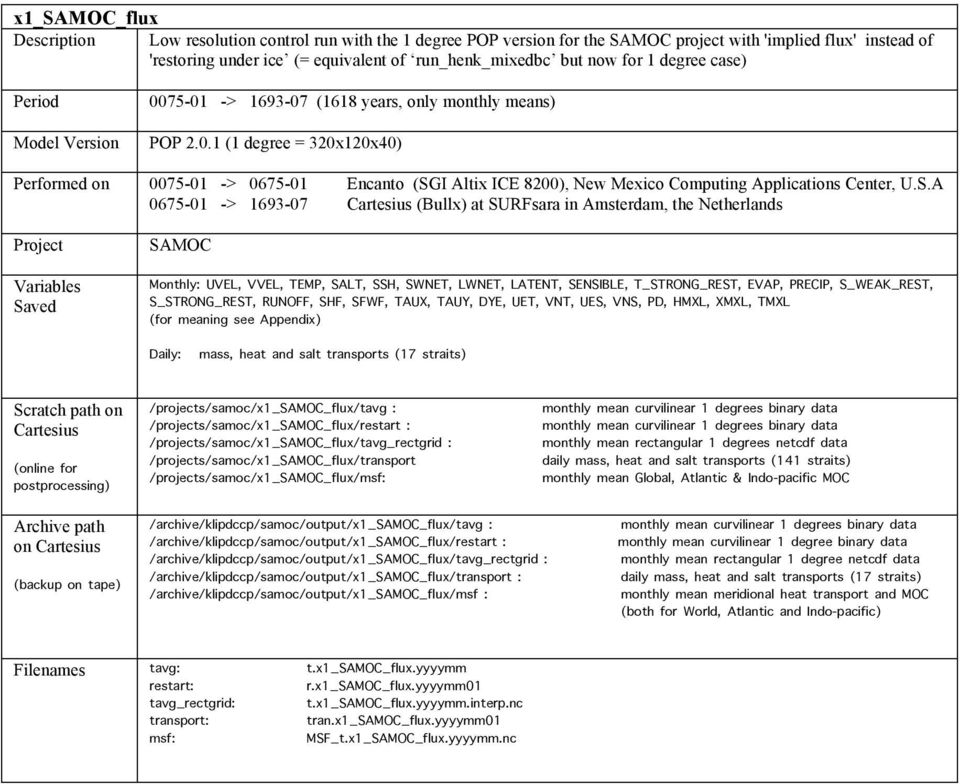
11 x1 flux Description Low resolution control run with the 1 degree POP version for the project with 'implied flux' instead of 'restoring under ice (= equivalent of run_henk_mixedbc but now for 1 degree case) > (1618 years, only monthly means) POP (1 degree = 320x120x40) > Encanto (SGI Altix ICE 8200), New Mexico Computing Applications Center, U.S.A > (Bullx) at SURFsara in Amsterdam, the Netherlands Monthly: UVEL, VVEL, TEMP, SALT, SSH, SWNET, LWNET, LATENT, SENSIBLE, T_STRONG_REST, EVAP, PRECIP, S_WEAK_REST, S_STRONG_REST, RUNOFF, SHF, SFWF, TAUX, TAUY, DYE, UET, VNT, UES, VNS, PD, HMXL, XMXL, TMXL Daily: mass, heat and salt transports (17 straits) /projects/samoc/x1 flux/tavg : /projects/samoc/x1 flux/restart : /projects/samoc/x1 flux/tavg_rectgrid : /projects/samoc/x1 flux/transport /projects/samoc/x1 flux/ monthly mean rectangular 1 degrees netcdf data monthly mean Global, Atlantic & Indo- pacific MOC on /archive/klipdccp/samoc/output/x1 flux/tavg : /archive/klipdccp/samoc/output/x1 flux/restart : /archive/klipdccp/samoc/output/x1 flux/tavg_rectgrid : /archive/klipdccp/samoc/output/x1 flux/transport : /archive/klipdccp/samoc/output/x1 flux/msf : monthly mean curvilinear 1 degree binary data monthly mean rectangular 1 degree netcdf data daily mass, heat and salt transports (17 straits) Filenames tavg: t.x1 flux.yyyymm r.x1 flux.yyyymm01 tavg_rectgrid: t.x1 flux.yyyymm.interp.nc tran.x1 flux.yyyymm01 MSF_t.x1 flux.yyyymm.nc
12 x1 greenland0.1sv Description Low resolution 0.1Sv Greenland run with the 1 degree POP version for the project. Run restarted from the restartfiles of x1 flux control run with same forcings but in this run 0.1 Sv of freshwater was dumped (by enhanced run off) around Greenland. The runoff is distributed in a realistic spatial and temporal pattern around the coast of Greenland inspired by studies of present-day runoff from the Greenland Ice Sheet > (533 years, only monthly means) POP (1 degree = 320x120x40) (Bullx) at SURFsara in Amsterdam, the Netherlands Monthly: UVEL, VVEL, TEMP, SALT, SSH, SWNET, LWNET, LATENT, SENSIBLE, T_STRONG_REST, EVAP, PRECIP, S_WEAK_REST, S_STRONG_REST, RUNOFF, SHF, SFWF, TAUX, TAUY, DYE, UET, VNT, UES, VNS, PD, HMXL, XMXL, TMXL Daily: mass, heat and salt transports (17 straits) /projects/samoc/x1 greenland0.1sv/tavg : /projects/samoc/x1 greenland_0.1sv/restart : /projects/samoc/x1 greenland0.1sv/tavg_rectgrid : /projects/samoc/x1 greenland0.1sv/transport /projects/samoc/x1 greenland0.1sv/ monthly mean rectangular 1 degrees netcdf data monthly mean Global, Atlantic & Indo- pacific MOC on /archive/klipdccp/samoc/output/x1 greenland0.1sv/tavg : /archive/klipdccp/samoc/output/x1 greenland0.1sv/restart : monthly mean curvilinear 1 degree binary data /archive/klipdccp/samoc/output/x1 greenland0.1sv/tavg_rectgrid : monthly mean rectangular 1 degrees netcdf data /archive/klipdccp/samoc/output/x1 greenland0.1sv/transport : daily mass, heat and salt transports (17 straits) /archive/klipdccp/samoc/output/x1 greenland0.1sv/msf : Filenames tavg: t.x1 flux.yyyymm r.x1 flux.yyyymm01 tavg_rectgrid: t.x1 flux.yyyymm.interp.nc tran.x1 flux.yyyymm01 MSF_t.x1 flux.yyyymm.nc

13 x1 greenland0.5sv Description Low resolution 0.5Sv Greenland run with the 1 degree POP version for the project. Run restarted from the restartfiles of x1 flux control run with same forcings but in this run 0.5 Sv of freshwater was dumped (by enhanced run off) around Greenland. The runoff is distributed in a realistic spatial and temporal pattern around the coast of Greenland inspired by studies of present-day runoff from the Greenland Ice Sheet > (1000 years, only monthly means) POP (1 degree = 320x120x40) > Encanto (SGI Altix ICE 8200), New Mexico Computing Applications Center, U.S.A > (Bullx) at SURFsara in Amsterdam, the Netherlands Monthly: UVEL, VVEL, TEMP, SALT, SSH, SWNET, LWNET, LATENT, SENSIBLE, T_STRONG_REST, EVAP, PRECIP, S_WEAK_REST, S_STRONG_REST, RUNOFF, SHF, SFWF, TAUX, TAUY, DYE, UET, VNT, UES, VNS, PD, HMXL, XMXL, TMXL Daily: mass, heat and salt transports (17 straits) /projects/samoc/x1 greenland0.5sv/tavg : /projects/samoc/x1 greenland_0.5sv/restart : /projects/samoc/x1 greenland0.5sv/tavg_rectgrid : /projects/samoc/x1 greenland0.5sv/transport /projects/samoc/x1 greenland0.5sv/ monthly mean rectangular 1 degrees netcdf data monthly mean Global, Atlantic & Indo- pacific MOC on /archive/klipdccp/samoc/output/x1 greenland0.5sv/tavg : /archive/klipdccp/samoc/output/x1 greenland0.5sv/restart : monthly mean curvilinear 1 degree binary data /archive/klipdccp/samoc/output/x1 greenland0.5sv/tavg_rectgrid : monthly mean rectangular 1 degrees netcdf data /archive/klipdccp/samoc/output/x1 greenland0.5sv/transport : daily mass, heat and salt transports (17 straits) /archive/klipdccp/samoc/output/x1 greenland0.5sv/msf : Filenames tavg: t.x1 flux.yyyymm r.x1 flux.yyyymm01 tavg_rectgrid: t.x1 flux.yyyymm.interp.nc tran.x1 flux.yyyymm01 MSF_t.x1 flux.yyyymm.nc

14 x1 greenland0.5sv_restarted_nohosing Description Extension of the Low resolution x1 greenland0.5sv run mentioned above but now forced with mixed bc conditions (same as x1 flux) to see how quickly the MOC recovers. This is the same run as the high resolution prod_run3_0.5sv_restarted_mixedbc run but now with a low resolution Run restarted from the restartfiles of x1 greenland0.5sv > (560 years, only monthly means) POP (1 degree = 320x120x40) (Bullx) at SURFsara in Amsterdam, the Netherlands Monthly: UVEL, VVEL, TEMP, SALT, SSH, SWNET, LWNET, LATENT, SENSIBLE, T_STRONG_REST, EVAP, PRECIP, S_WEAK_REST, S_STRONG_REST, RUNOFF, SHF, SFWF, TAUX, TAUY, DYE, UET, VNT, UES, VNS, PD, HMXL, XMXL, TMXL Daily: mass, heat and salt transports (17 straits) on /projects/samoc/x1 greenland0.5sv_restarted_nohosing/tavg : /projects/samoc/x1 greenland_0.5sv_restarted_nohosing/restart : /projects/samoc/x1 greenland0.5sv_restarted_nohosing/tavg_rectgrid: monthly mean rectangular 1 degrees netcdf data /projects/samoc/x1 greenland0.5sv_restarted_nohosing/transport /projects/samoc/x1 greenland0.5sv_restarted_nohosing/ monthly mean Global, Atlantic & Indo- pacific MOC /archive/klipdccp/samoc/output/x1 greenland0.5sv_restarted_nohosing/tavg : monthly mean curvilinear 1 degrees binary data /archive/klipdccp/samoc/output/x1 greenland0.5sv_restarted_nohosing/restart : monthly mean curvilinear 1 degree binary data /archive/klipdccp/samoc/output/x1 greenland0.5sv_restarted_nohosing/tavg_rectgrid : monthly mean rectangular 1 degrees netcdf data /archive/klipdccp/samoc/output/x1 greenland0.5sv_restarted_nohosing/transport : daily mass, heat and salt transports (17 straits) /archive/klipdccp/samoc/output/x1 greenland0.5sv_restarted_nohosing/msf : monthly mean meridional heat transport and MOC Filenames tavg: t.x1 flux.yyyymm r.x1 flux.yyyymm01 tavg_rectgrid: t.x1 flux.yyyymm.interp.nc tran.x1 flux.yyyymm01 MSF_t.x1 flux.yyyymm.nc

15 x1_run_clim_closeddrake Description Low resolution present day run with a closed Drake Passage with the 1 degree POP model for the project with 'implied flux' instead of 'restoring under ice (= equivalent of x1 flux ) Run restarted from the restartfiles of x1 flux control run with same forcings and with the same topography except for the closed Drake passage > (1000 years, only monthly means) POP (1 degree = 320x120x40) (Bullx) at SURFsara in Amsterdam, the Netherlands Monthly: UVEL, VVEL, TEMP, SALT, SSH, SWNET, LWNET, LATENT, SENSIBLE, T_STRONG_REST, EVAP, PRECIP, S_WEAK_REST, S_STRONG_REST, RUNOFF, SHF, SFWF, TAUX, TAUY, DYE, UET, VNT, UES, VNS, PD, HMXL, XMXL, TMXL Daily: mass, heat and salt transports (17 straits) /projects/samoc/x1_run_clim_closeddrake/tavg : /projects/samoc/x1_run_clim_closeddrake/restart : /projects/samoc/x1_run_clim_closeddrake/tavg_rectgrid : /projects/samoc/x1_run_clim_closeddrake/transport /projects/samoc/x1_run_clim_closeddrake/ monthly mean rectangular 1 degrees netcdf data monthly mean Global, Atlantic & Indo- pacific MOC on /archive/klipdccp/samoc/output/x1_run_clim_closeddrake/tavg : /archive/klipdccp/samoc/output/x1_run_clim_closeddrake/restart : monthly mean curvilinear 1 degree binary data /archive/klipdccp/samoc/output/x1_run_clim_closeddrake/tavg_rectgrid : monthly mean rectangular 1 degrees netcdf data /archive/klipdccp/samoc/output/x1_run_clim_closeddrake/transport : daily mass, heat and salt transports (17 straits) /archive/klipdccp/samoc/output/x1_run_clim_closeddrake/msf : Filenames tavg: t.x1 flux.yyyymm r.x1 flux.yyyymm01 tavg_rectgrid: t.x1 flux.yyyymm.interp.nc tran.x1 flux.yyyymm01 MSF_t.x1 flux.yyyymm.nc

16 x1_run_clim_729mdrake Description Extension of the low resolution x1_run_clim_closeddrake run described above but now with the Drake Passage opened up again from the surface to depthlevel 21 (= 729m depth). The run is done with the 1 degree POP model for the project with 'implied flux' instead of 'restoring under ice (= equivalent of x1 flux ) Run restarted from the restartfiles of x1_run_clim_closeddrake > (525 years, only monthly means) POP (1 degree = 320x120x40) (Bullx) at SURFsara in Amsterdam, the Netherlands Monthly: UVEL, VVEL, TEMP, SALT, SSH, SWNET, LWNET, LATENT, SENSIBLE, T_STRONG_REST, EVAP, PRECIP, S_WEAK_REST, S_STRONG_REST, RUNOFF, SHF, SFWF, TAUX, TAUY, DYE, UET, VNT, UES, VNS, PD, HMXL, XMXL, TMXL Daily: mass, heat and salt transports (17 straits) /projects/samoc/x1_run_clim_729mdrake/tavg : /projects/samoc/x1_run_clim_729mdrake/restart : /projects/samoc/x1_run_clim_729mdrake/tavg_rectgrid : /projects/samoc/x1_run_clim_729mdrake/transport /projects/samoc/x1_run_clim_729mdrake/ monthly mean rectangular 1 degrees netcdf data monthly mean Global, Atlantic & Indo- pacific MOC on /archive/klipdccp/samoc/output/x1_run_clim_729mdrake/tavg : /archive/klipdccp/samoc/output/x1_run_clim_729mdrake/restart : monthly mean curvilinear 1 degree binary data /archive/klipdccp/samoc/output/x1_run_clim_729mdrake/tavg_rectgrid : monthly mean rectangular 1 degrees netcdf data /archive/klipdccp/samoc/output/x1_run_clim_729mdrake/transport : daily mass, heat and salt transports (17 straits) /archive/klipdccp/samoc/output/x1_run_clim_729mdrake/msf : Filenames tavg: t.x1 flux.yyyymm r.x1 flux.yyyymm01 tavg_rectgrid: t.x1 flux.yyyymm.interp.nc tran.x1 flux.yyyymm01 MSF_t.x1 flux.yyyymm.nc

17 ITAMOC project run_clim_closeditf Description High resolution closed indonesian throughflow run for the ITAMOC project. Run with same forcings as run_henk_mixedbc but with a closure of the Indonesian Throughflow > (106 years) POP (0.1 degrees) > CRAY XT6 at EPCC in Edinburgh, Scotland > Huygens (IBM X6) at SARA in Amsterdam, the Netherlands > (Bullx) at SURFsara in Amsterdam, the Netherlands ITAMOC (Impact of the Indonesian Throughflow on the Atlantic Meridional Overturning Circulation) Monthly: meridional heat transports and MOC UVEL, VVEL, KE, TEMP, SALT, SSH, H2, SHF, SFWF, TAUX, TAUY, UET, VNT, PD, HMXL, XMXL, TMXL Daily: mass, heat and salt transports (141 straits) UVEL_5m, VVEL_5m, TEMP_5m, SALT_5m, UVEL_15m, VVEL_15m, TEMP_15m, SALT_15m, SSH /projects/itamoc/run_clim_closeditf/tavg : /projects/itamoc/run_clim_closeditf/tavg_rectgrid : /projects/itamoc/run_clim_closeditf/movie : /projects/itamoc/run_clim_closeditf/ /projects/itamoc/run_clim_closeditf/msf : monthly mean rectangular 0.4 degrees netcdf dailly mean curvilinear 0.1 degrees binary data data on /archive/klipdccp/itamoc/run_clim_closeditf/tavg: /archive/klipdccp/itamoc/run_clim_closeditf/movie : /archive/klipdccp/itamoc/run_clim_closeditf/restart : /archive/klipdccp/itamoc/run_clim_closeditf/tavg_rectgrid : /archive/klipdccp/itamoc /run_clim_closeditf/transport : /archive/klipdccp/itamoc /run_clim_closeditf/msf : Filenames tavg: movie: t.clim_closeditf.yyyymm m.clim_closeditf.yyyymmdd r.clim_closeditf.yyyymm01 tavg_rectgrid: t.clim_closeditf.yyyymm.interp900x602.nc transp.clim_closeditf.yyyymm01 MSF_t.clim_closeditf.yyyymm.nc dailly mean curvilinear 0.1 degrees binary data monthly mean rectangular 0.4 degrees netcdf

18 x1_run_clim_closeditf Description Low resolution present day run with a closed Indonesian Throughflow with the 1 degree POP model for the ITAMOC project with 'implied flux' instead of 'restoring under ice (= equivalent of x1 flux ) Run restarted from the restartfiles of x1 flux control run with same forcings and with the same topography except for the closed Indonesian throughflow > (429 years, only monthly means) POP (1 degree = 320x120x40) (Bullx) at SURFsara in Amsterdam, the Netherlands ITAMOC (Impact of the Indonesian Throughflow on the Atlantic Meridional Overturning Circulation) Monthly: UVEL, VVEL, TEMP, SALT, SSH, SWNET, LWNET, LATENT, SENSIBLE, T_STRONG_REST, EVAP, PRECIP, S_WEAK_REST, S_STRONG_REST, RUNOFF, SHF, SFWF, TAUX, TAUY, DYE, UET, VNT, UES, VNS, PD, HMXL, XMXL, TMXL Daily: mass, heat and salt transports (17 straits) on /projects/itamoc/x1_run_clim_closeditf/tavg : /projects/itamoc/x1_run_clim_closeditf/restart : /projects/itamoc/x1_run_clim_closeditf/tavg_rectgrid : /projects/itamoc/x1_run_clim_closeditf/transport /projects/itamoc/x1_run_clim_closeditf/ /archive/klipdccp/itamoc/x1_run_clim_closeditf/tavg : /archive/klipdccp/itamoc/x1_run_clim_closeditf/restart : /archive/klipdccp/itamoc/x1_run_clim_closeditf/tavg_rectgrid : /archive/klipdccp/itamoc/x1_run_clim_closeditf/transport : /archive/klipdccp/itamoc/x1_run_clim_closeditf/msf : monthly mean rectangular 1 degrees netcdf data monthly mean Global, Atlantic & Indo- pacific MOC monthly mean curvilinear 1 degree binary data monthly mean rectangular 1 degrees netcdf data daily mass, heat and salt transports (17 straits) Filenames tavg: t.x1 flux.yyyymm r.x1 flux.yyyymm01 tavg_rectgrid: t.x1 flux.yyyymm.interp.nc tran.x1 flux.yyyymm01 MSF_t.x1 flux.yyyymm.nc

19 APPENDIX The following tables contain a list of all the saved monthly and daily POP fields. The grid descriptor, DIJK, consists of four integers. The first indicates the dimensionality ("D") of the field (2-D or 3-D). The three integers which follow identify the i,j,k-grid upon which the field resides, where a value of "1" specifies the tracer grid and a value of "2" specifies the staggered velocity grid. Monthly fields DIJK Name Description Units 2110 TMTG Meridional Overturning Streamfunction Global Sv 2110 TMTA Meridional Overturning Streamfunction Atlantic Sv 2110 TMTIP Meridional Overturning Streamfunction Indo-Pacific Sv 2110 SHF Total Surface Heat Flux, Including SW W/m SFWF Virtual Salt Flux in FW Flux formulation kg/m 2 /s 2110 SSH Sea Surface Height cm 2220 TAUX Zonal Windstress dyne/cm TAUY Meridional Windstress dyne/cm HMXL Mixed-Layer Depth cm 2110 MXHML Maximum Mixed-Layer Depth cm 2110 XMXL Maximum Mixed-Layer Depth cm 2110 HBLT Boundary-Layer Depth cm 2110 MXHBLT Maximum Boundary-Layer Depth cm 2110 XBLT Maximum Boundary-Layer Depth cm 2110 TMXL Minimum Mixed-Layer Depth cm 2110 TBLT Minimum Boundary-Layer Depth cm 2110 H2 SSH**2 cm IDEALAGE The age of a water parcel (time since it was last at the surface) years 3111 TTD01 Transit Time Distribution Region 01 years 3111 TTD02 Transit Time Distribution Region 02 years 3111 TTD03 Transit Time Distribution Region 03 years 3111 TTD11 Transit Time Distribution Region 11 years 3221 UVEL Zonal Velocity cm/s 3221 VVEL Meridional Velocity cm/s 3112 WVEL Vertical Velocity cm/s 3111 TEMP Potential Temperature degc 3111 SALT Salinity g/g 3111 PD Potential Density Ref to Surface g/cm UET East Flux of Heat degc/s 3121 VNT North Flux of Heat degc/s 3221 KE Horizontal Kinetic Energy (U**2+V**2)/2 cm 2 /s UES East Flux of Salt g/g/s 3121 VNS North Flux of Salt g/g/s 3111 PV Potential Vorticity 1/cm/s 3111 Q z-derivative of potential density g/cm DYE Dye that we tag to the greenland freshwater perturbation to see where it goes. unitless 2111 SWNET Net shortwave heat flux W/m^ LWNET Net longwave heat flux W/m^ LATENT Latent heat flux W/m^ SENSIBLE Sensible heat flux W/m^ EVAP Evaporation kg/m^2/s 2111 PRECIP Precipitation kg/m^2/s

20 2111 RUNOFF River runoff kg/m^2/s 2111 T_STRONG_REST Strong restoring heat flux W/m^ S_WEAK_REST Salinity weak restoring kg/m^2/s 2111 S_STRONG_REST Salinity strong restoring kg/m^2/s 2110 MHTG mean meridional heat transport world PW (PetaWatts) 2110 MHTA mean meridional heat transport atlantic PW 2110 MHTIP mean meridional heat transport indo-pacific PW 2110 TMTG meridional overturning streamfunction world Sv 2110 TMTA meridional overturning streamfunction atlantic Sv 2110 TMTIP meridional overturning streamfunction indo-pacific Sv Daily fields DIJK Name Description Units 2220 UVEL_5m Zonal Velocity at 5 meters depth cm/s 2220 VVEL_5m Meridional Velocity at 5 meters depth cm/s 2110 TEMP_5m Potential Temperature at 5 meters depth degc 2110 SALT_5m Salinity at 5 meters depth psu 2220 UVEL_15m Zonal Velocity at 15 meters depth cm/s 2220 VVEL_15m Meridional Velocity at 15 meters depth cm/s 2110 TEMP_15m Potential Temperature at 15 meters depth degc 2110 SALT_15m Salinity at 15 meters depth psu 2110 SSH Sea Surface Height cm 2220 DYE01_5m Dye tracer at 5m depth unitless 2220 DYE_zint Dye tracer integrated over entire depth unitless

THE CURIOUS CASE OF THE PLIOCENE CLIMATE. Chris Brierley, Alexey Fedorov and Zhonghui Lui
 THE CURIOUS CASE OF THE PLIOCENE CLIMATE Chris Brierley, Alexey Fedorov and Zhonghui Lui Outline Introduce the warm early Pliocene Recent Discoveries in the Tropics Reconstructing the early Pliocene SSTs
The relationships between Argo Steric Height and AVISO Sea Surface Height
 The relationships between Argo Steric Height and AVISO Sea Surface Height Phil Sutton 1 Dean Roemmich 2 1 National Institute of Water and Atmospheric Research, New Zealand 2 Scripps Institution of Oceanography,
Norwegian Satellite Earth Observation Database for Marine and Polar Research http://normap.nersc.no USE CASES
 Norwegian Satellite Earth Observation Database for Marine and Polar Research http://normap.nersc.no USE CASES The NORMAP Project team has prepared this document to present functionality of the NORMAP portal.
Near Real Time Blended Surface Winds
 Near Real Time Blended Surface Winds I. Summary To enhance the spatial and temporal resolutions of surface wind, the remotely sensed retrievals are blended to the operational ECMWF wind analyses over the
8.5 Comparing Canadian Climates (Lab)
 These 3 climate graphs and tables of data show average temperatures and precipitation for each month in Victoria, Winnipeg and Whitehorse: Figure 1.1 Month J F M A M J J A S O N D Year Precipitation 139
Fundamentals of Climate Change (PCC 587): Water Vapor
 Fundamentals of Climate Change (PCC 587): Water Vapor DARGAN M. W. FRIERSON UNIVERSITY OF WASHINGTON, DEPARTMENT OF ATMOSPHERIC SCIENCES DAY 2: 9/30/13 Water Water is a remarkable molecule Water vapor
Trimodal cloudiness and tropical stable layers in simulations of radiative convective equilibrium
 GEOPHYSICAL RESEARCH LETTERS, VOL. 35, L08802, doi:10.1029/2007gl033029, 2008 Trimodal cloudiness and tropical stable layers in simulations of radiative convective equilibrium D. J. Posselt, 1 S. C. van
Supporting Online Material for
 www.sciencemag.org/cgi/content/full/311/5768/1747/dc1 Supporting Online Material for Paleoclimatic Evidence for Future Ice-Sheet Instability and Rapid Sea- Level Rise Jonathan T. Overpeck,* Bette L. Otto-Bliesner,
How does snow melt? Principles of snow melt. Energy balance. GEO4430 snow hydrology 21.03.2006. Energy flux onto a unit surface:
 Principles of snow melt How does snow melt? We need energy to melt snow/ ice. GEO443 snow hydrology 21.3.26 E = m L h we s K = ρ h = w w we f E ρ L L f f Thomas V. Schuler [email protected] E energy
ES 106 Laboratory # 3 INTRODUCTION TO OCEANOGRAPHY. Introduction The global ocean covers nearly 75% of Earth s surface and plays a vital role in
 ES 106 Laboratory # 3 INTRODUCTION TO OCEANOGRAPHY 3-1 Introduction The global ocean covers nearly 75% of Earth s surface and plays a vital role in the physical environment of Earth. For these reasons,
Comparison of the Vertical Velocity used to Calculate the Cloud Droplet Number Concentration in a Cloud-Resolving and a Global Climate Model
 Comparison of the Vertical Velocity used to Calculate the Cloud Droplet Number Concentration in a Cloud-Resolving and a Global Climate Model H. Guo, J. E. Penner, M. Herzog, and X. Liu Department of Atmospheric,
ATMS 310 Jet Streams
 ATMS 310 Jet Streams Jet Streams A jet stream is an intense (30+ m/s in upper troposphere, 15+ m/s lower troposphere), narrow (width at least ½ order magnitude less than the length) horizontal current
Description of zero-buoyancy entraining plume model
 Influence of entrainment on the thermal stratification in simulations of radiative-convective equilibrium Supplementary information Martin S. Singh & Paul A. O Gorman S1 CRM simulations Here we give more
Mariana Vertenstein. NCAR Earth System Laboratory CESM Software Engineering Group (CSEG) NCAR is sponsored by the National Science Foundation
 Leveraging the New CESM1 CPL7 Architecture - Current and Future Challenges Mariana Vertenstein NCAR Earth System Laboratory CESM Software Engineering Group (CSEG) NCAR is sponsored by the National Science
A Description of the 2nd Generation NOAA Global Ensemble Reforecast Data Set
 A Description of the 2nd Generation NOAA Global Ensemble Reforecast Data Set Table of contents: produced by the NOAA Earth System Research Lab, Physical Sciences Division Boulder, Colorado USA under a
Month-Long 2D Cloud-Resolving Model Simulation and Resultant Statistics of Cloud Systems Over the ARM SGP
 Month-Long 2D Cloud-Resolving Model Simulation and Resultant Statistics of Cloud Systems Over the ARM SGP X. Wu Department of Geological and Atmospheric Sciences Iowa State University Ames, Iowa X.-Z.
MI oceanographic data
 Marine Institute Oceanographic Data SMARTSkills 2013 Postgraduate Workshop Galway, Oct 2013 Kieran Lyons ([email protected]) MI oceanographic data Measured Operational metocean time series (weather
Dynamics IV: Geostrophy SIO 210 Fall, 2014
 Dynamics IV: Geostrophy SIO 210 Fall, 2014 Geostrophic balance Thermal wind Dynamic height READING: DPO: Chapter (S)7.6.1 to (S)7.6.3 Stewart chapter 10.3, 10.5, 10.6 (other sections are useful for those
Titelmasterformat durch Klicken. bearbeiten
 Evaluation of a Fully Coupled Atmospheric Hydrological Modeling System for the Sissili Watershed in the West African Sudanian Savannah Titelmasterformat durch Klicken June, 11, 2014 1 st European Fully
What the Heck are Low-Cloud Feedbacks? Takanobu Yamaguchi Rachel R. McCrary Anna B. Harper
 What the Heck are Low-Cloud Feedbacks? Takanobu Yamaguchi Rachel R. McCrary Anna B. Harper IPCC Cloud feedbacks remain the largest source of uncertainty. Roadmap 1. Low cloud primer 2. Radiation and low
Energy Pathways in Earth s Atmosphere
 BRSP - 10 Page 1 Solar radiation reaching Earth s atmosphere includes a wide spectrum of wavelengths. In addition to visible light there is radiation of higher energy and shorter wavelength called ultraviolet
The Surface Energy Budget
 The Surface Energy Budget The radiation (R) budget Shortwave (solar) Radiation Longwave Radiation R SW R SW α α = surface albedo R LW εσt 4 ε = emissivity σ = Stefan-Boltzman constant T = temperature Subsurface
Indian Ocean and Monsoon
 Indo-French Workshop on Atmospheric Sciences 3-5 October 2013, New Delhi (Organised by MoES and CEFIPRA) Indian Ocean and Monsoon Satheesh C. Shenoi Indian National Center for Ocean Information Services
Coupling micro-scale CFD simulations to meso-scale models
 Coupling micro-scale CFD simulations to meso-scale models IB Fischer CFD+engineering GmbH Fabien Farella Michael Ehlen Achim Fischer Vortex Factoria de Càlculs SL Gil Lizcano Outline Introduction O.F.Wind
Dutch Atmospheric Large-Eddy Simulation Model (DALES v3.2) CGILS-S11 results
 Dutch Atmospheric Large-Eddy Simulation Model (DALES v3.2) CGILS-S11 results Stephan de Roode Delft University of Technology (TUD), Delft, Netherlands Mixed-layer model analysis: Melchior van Wessem (student,
The Oceans Role in Climate
 The Oceans Role in Climate Martin H. Visbeck A Numerical Portrait of the Oceans The oceans of the world cover nearly seventy percent of its surface. The largest is the Pacific, which contains fifty percent
Satellite Products and Dissemination: Visualization and Data Access
 Satellite Products and Dissemination: Visualization and Data Access Gregory Leptoukh GES DISC, NASA GSFC Dana Ostrenga GES DISC, NASA GSFC Introduction The Goddard Earth Sciences Data and Information Services
Comparison of Cloud and Radiation Variability Reported by Surface Observers, ISCCP, and ERBS
 Comparison of Cloud and Radiation Variability Reported by Surface Observers, ISCCP, and ERBS Joel Norris (SIO/UCSD) Cloud Assessment Workshop April 5, 2005 Outline brief satellite data description upper-level
Chapter 2: Solar Radiation and Seasons
 Chapter 2: Solar Radiation and Seasons Spectrum of Radiation Intensity and Peak Wavelength of Radiation Solar (shortwave) Radiation Terrestrial (longwave) Radiations How to Change Air Temperature? Add
Very High Resolution Arctic System Reanalysis for 2000-2011
 Very High Resolution Arctic System Reanalysis for 2000-2011 David H. Bromwich, Lesheng Bai,, Keith Hines, and Sheng-Hung Wang Polar Meteorology Group, Byrd Polar Research Center The Ohio State University
Chapter Overview. Seasons. Earth s Seasons. Distribution of Solar Energy. Solar Energy on Earth. CHAPTER 6 Air-Sea Interaction
 Chapter Overview CHAPTER 6 Air-Sea Interaction The atmosphere and the ocean are one independent system. Earth has seasons because of the tilt on its axis. There are three major wind belts in each hemisphere.
Ocean eddies off southern Norway
 Ocean eddies off southern Norway Ingerid Fossum Avslutningskonferanse MARE, Scandic Hotell Edderkoppen, Oslo, 12-13 oktober 2005 Main questions: Does MI-POM reproduce the circulation pattern in Skagerrak?
Limitations of Equilibrium Or: What if τ LS τ adj?
 Limitations of Equilibrium Or: What if τ LS τ adj? Bob Plant, Laura Davies Department of Meteorology, University of Reading, UK With thanks to: Steve Derbyshire, Alan Grant, Steve Woolnough and Jeff Chagnon
Lecture 3. Turbulent fluxes and TKE budgets (Garratt, Ch 2)
 Lecture 3. Turbulent fluxes and TKE budgets (Garratt, Ch 2) In this lecture How does turbulence affect the ensemble-mean equations of fluid motion/transport? Force balance in a quasi-steady turbulent boundary
Relationship between the Subtropical Anticyclone and Diabatic Heating
 682 JOURNAL OF CLIMATE Relationship between the Subtropical Anticyclone and Diabatic Heating YIMIN LIU, GUOXIONG WU, AND RONGCAI REN State Key Laboratory of Numerical Modeling for Atmospheric Sciences
Ecosystem-land-surface-BL-cloud coupling as climate changes
 Ecosystem-land-surface-BL-cloud coupling as climate changes Alan K. Betts Atmospheric Research, [email protected] CMMAP August 19, 2009 Outline of Talk Land-surface climate: - surface, BL & cloud coupling
How To Model An Ac Cloud
 Development of an Elevated Mixed Layer Model for Parameterizing Altocumulus Cloud Layers S. Liu and S. K. Krueger Department of Meteorology University of Utah, Salt Lake City, Utah Introduction Altocumulus
Observed Cloud Cover Trends and Global Climate Change. Joel Norris Scripps Institution of Oceanography
 Observed Cloud Cover Trends and Global Climate Change Joel Norris Scripps Institution of Oceanography Increasing Global Temperature from www.giss.nasa.gov Increasing Greenhouse Gases from ess.geology.ufl.edu
GEF 1100 Klimasystemet. Chapter 8: The general circulation of the atmosphere
 GEF1100 Autumn 2015 29.09.2015 GEF 1100 Klimasystemet Chapter 8: The general circulation of the atmosphere Prof. Dr. Kirstin Krüger (MetOs, UiO) 1 Lecture Outline Ch. 8 Ch. 8 The general circulation of
4.4 GRAPHICAL AND ANALYTICAL SOFTWARE VISUALIZATION TOOLS FOR EVALUATING METEOROLOGICAL AND AIR QUALITY MODEL PERFORMANCE
 4.4 GRAPHICAL AND ANALYTICAL SOFTWARE VISUALIZATION TOOLS FOR EVALUATING METEOROLOGICAL AND AIR QUALITY MODEL PERFORMANCE Irene Lee * Exponent Inc., Natick, Massachusetts 1. INTRODUCTION A critical part
Stability and Cloud Development. Stability in the atmosphere AT350. Why did this cloud form, whereas the sky was clear 4 hours ago?
 Stability and Cloud Development AT350 Why did this cloud form, whereas the sky was clear 4 hours ago? Stability in the atmosphere An Initial Perturbation Stable Unstable Neutral If an air parcel is displaced
Performance Metrics for Climate Models: WDAC advancements towards routine modeling benchmarks
 Performance Metrics for Climate Models: WDAC advancements towards routine modeling benchmarks Peter Gleckler* Program for Climate Model Diagnosis and Intercomparison () LLNL, USA * Representing WDAC and
Eco Pelmet Modelling and Assessment. CFD Based Study. Report Number 610.14351-R1D1. 13 January 2015
 EcoPelmet Pty Ltd c/- Geoff Hesford Engineering 45 Market Street FREMANTLE WA 6160 Version: Page 2 PREPARED BY: ABN 29 001 584 612 2 Lincoln Street Lane Cove NSW 2066 Australia (PO Box 176 Lane Cove NSW
The Ideal Gas Law. Gas Constant. Applications of the Gas law. P = ρ R T. Lecture 2: Atmospheric Thermodynamics
 Lecture 2: Atmospheric Thermodynamics Ideal Gas Law (Equation of State) Hydrostatic Balance Heat and Temperature Conduction, Convection, Radiation Latent Heating Adiabatic Process Lapse Rate and Stability
RADIATION IN THE TROPICAL ATMOSPHERE and the SAHEL SURFACE HEAT BALANCE. Peter J. Lamb. Cooperative Institute for Mesoscale Meteorological Studies
 RADIATION IN THE TROPICAL ATMOSPHERE and the SAHEL SURFACE HEAT BALANCE by Peter J. Lamb Cooperative Institute for Mesoscale Meteorological Studies and School of Meteorology The University of Oklahoma
Real-time Ocean Forecasting Needs at NCEP National Weather Service
 Real-time Ocean Forecasting Needs at NCEP National Weather Service D.B. Rao NCEP Environmental Modeling Center December, 2005 HYCOM Annual Meeting, Miami, FL COMMERCE ENVIRONMENT STATE/LOCAL PLANNING HEALTH
Guy Carpenter Asia-Pacific Climate Impact Centre, School of energy and Environment, City University of Hong Kong
 Diurnal and Semi-diurnal Variations of Rainfall in Southeast China Judy Huang and Johnny Chan Guy Carpenter Asia-Pacific Climate Impact Centre School of Energy and Environment City University of Hong Kong
1D shallow convective case studies and comparisons with LES
 1D shallow convective case studies and comparisons with CNRM/GMME/Méso-NH 24 novembre 2005 1 / 17 Contents 1 5h-6h time average vertical profils 2 2 / 17 Case description 5h-6h time average vertical profils
Salinity Patterns in the Ocean
 Salinity Patterns in the Ocean Lynne D Talley Volume 1, The Earth system: physical and chemical dimensions of global environmental change, pp 629 64 Edited by Dr Michael C MacCracken and Dr John S Perry
Tutorial #2 Tracers. LMDZ team December 12, 2013. 1 Setting up a case with a zoomed grid 1
 Tutorial #2 Tracers LMDZ team December 12, 2013 Contents 1 Setting up a case with a zoomed grid 1 2 Tracers 2 2.1 Radon and lead............................ 2 2.2 Inserting new tracers.........................
Goal: Understand the conditions and causes of tropical cyclogenesis and cyclolysis
 Necessary conditions for tropical cyclone formation Leading theories of tropical cyclogenesis Sources of incipient disturbances Extratropical transition Goal: Understand the conditions and causes of tropical
Data Assimilation and Operational Oceanography: The Mercator experience
 www.mercator.eu.org Data Assimilation and Operational Oceanography: The Mercator experience Benoît Tranchant [email protected] And the Mercator-Ocean Assimilation Team (Marie Drevillon, Elisabeth
Use of numerical weather forecast predictions in soil moisture modelling
 Use of numerical weather forecast predictions in soil moisture modelling Ari Venäläinen Finnish Meteorological Institute Meteorological research [email protected] OBJECTIVE The weather forecast models
Straits of Mackinac Contaminant Release Scenarios: Flow Visualization and Tracer Simulations
 Straits of Mackinac Contaminant Release Scenarios: Flow Visualization and Tracer Simulations Research Report for the National Wildlife Federation Great Lakes Regional Center By David J. Schwab, Ph.D.,
Georgia Performance Standards Framework for Science Grade 6. Unit Organizer: Water in Earth s Processes. (Approximate Time: 5-6 Weeks)
 The following instructional plan is part of a GaDOE collection of Unit Frameworks, Performance Tasks, examples of Student Work, and Teacher Commentary. Many more GaDOE approved instructional plans are
The impact of parametrized convection on cloud feedback.
 The impact of parametrized convection on cloud feedback. Mark Webb, Adrian Lock (Met Office) Thanks also to Chris Bretherton (UW), Sandrine Bony (IPSL),Jason Cole (CCCma), Abderrahmane Idelkadi (IPSL),
Temporal variation in snow cover over sea ice in Antarctica using AMSR-E data product
 Temporal variation in snow cover over sea ice in Antarctica using AMSR-E data product Michael J. Lewis Ph.D. Student, Department of Earth and Environmental Science University of Texas at San Antonio ABSTRACT
Chapter 7 Stability and Cloud Development. Atmospheric Stability
 Chapter 7 Stability and Cloud Development Atmospheric Stability 1 Cloud Development - stable environment Stable air (parcel) - vertical motion is inhibited if clouds form, they will be shallow, layered
Physics of the Atmosphere I
 Physics of the Atmosphere I WS 2008/09 Ulrich Platt Institut f. Umweltphysik R. 424 [email protected] heidelberg.de Last week The conservation of mass implies the continuity equation:
Wind resources map of Spain at mesoscale. Methodology and validation
 Wind resources map of Spain at mesoscale. Methodology and validation Martín Gastón Edurne Pascal Laura Frías Ignacio Martí Uxue Irigoyen Elena Cantero Sergio Lozano Yolanda Loureiro e-mail:[email protected]
39th International Physics Olympiad - Hanoi - Vietnam - 2008. Theoretical Problem No. 3
 CHANGE OF AIR TEMPERATURE WITH ALTITUDE, ATMOSPHERIC STABILITY AND AIR POLLUTION Vertical motion of air governs many atmospheric processes, such as the formation of clouds and precipitation and the dispersal
Climate Models: Uncertainties due to Clouds. Joel Norris Assistant Professor of Climate and Atmospheric Sciences Scripps Institution of Oceanography
 Climate Models: Uncertainties due to Clouds Joel Norris Assistant Professor of Climate and Atmospheric Sciences Scripps Institution of Oceanography Global mean radiative forcing of the climate system for
An economical scale-aware parameterization for representing subgrid-scale clouds and turbulence in cloud-resolving models and global models
 An economical scale-aware parameterization for representing subgrid-scale clouds and turbulence in cloud-resolving models and global models Steven Krueger1 and Peter Bogenschutz2 1University of Utah, 2National
Developing Continuous SCM/CRM Forcing Using NWP Products Constrained by ARM Observations
 Developing Continuous SCM/CRM Forcing Using NWP Products Constrained by ARM Observations S. C. Xie, R. T. Cederwall, and J. J. Yio Lawrence Livermore National Laboratory Livermore, California M. H. Zhang
Rusty Walker, Corporate Trainer Hill PHOENIX
 Refrigeration 101 Rusty Walker, Corporate Trainer Hill PHOENIX Compressor Basic Refrigeration Cycle Evaporator Condenser / Receiver Expansion Device Vapor Compression Cycle Cooling by the removal of heat
Climate Ready Tools & Resources
 August 2, 2013 Mission Statement To provide the water sector (drinking water, wastewater, and stormwater utilities) with the practical tools, training, and technical assistance needed to adapt to climate
Monsoon Variability and Extreme Weather Events
 Monsoon Variability and Extreme Weather Events M Rajeevan National Climate Centre India Meteorological Department Pune 411 005 [email protected] Outline of the presentation Monsoon rainfall Variability
Scientific Data Management and Dissemination
 Federal GIS Conference February 9 10, 2015 Washington, DC Scientific Data Management and Dissemination John Fry Solution Engineer, Esri [email protected] Agenda Background of Scientific Data Management through
Improving Hydrological Predictions
 Improving Hydrological Predictions Catherine Senior MOSAC, November 10th, 2011 How well do we simulate the water cycle? GPCP 10 years of Day 1 forecast Equatorial Variability on Synoptic scales (2-6 days)
Fluids and Solids: Fundamentals
 Fluids and Solids: Fundamentals We normally recognize three states of matter: solid; liquid and gas. However, liquid and gas are both fluids: in contrast to solids they lack the ability to resist deformation.
Ocean in Motion 2: What Causes Ocean Currents and How Do We Measure Them?
 Ocean in Motion 2: What Causes Ocean Currents and How Do We Measure Them? A. Overview 1. The Ocean in Motion -- Circulation In this program, students will learn about the driving forces responsible for
Seasonal & Daily Temperatures. Seasons & Sun's Distance. Solstice & Equinox. Seasons & Solar Intensity
 Seasonal & Daily Temperatures Seasons & Sun's Distance The role of Earth's tilt, revolution, & rotation in causing spatial, seasonal, & daily temperature variations Please read Chapter 3 in Ahrens Figure
SEA START Climate Change Analysis Tool v1.1
 SEA START Climate Change Analysis Tool v1.1 SEA START RC has developed tool to aid data analysis for the future climate data which is downloaded from Climate Data Distribution System (http://cc.start.or.th).
Group Session 1-3 Rain and Cloud Observations
 Group Session 1-3 Rain and Cloud Observations Targets in Science Plans CINDY Science Plan (Apr. 2009) DYNAMO SPO (Jul. 2009) Atmospheric Research a. Preconditioning processes b. Rossby wave c. Diabatic
Interactive Data Visualization with Focus on Climate Research
 Interactive Data Visualization with Focus on Climate Research Michael Böttinger German Climate Computing Center (DKRZ) 1 Agenda Visualization in HPC Environments Climate System, Climate Models and Climate
Evalua&ng Downdra/ Parameteriza&ons with High Resolu&on CRM Data
 Evalua&ng Downdra/ Parameteriza&ons with High Resolu&on CRM Data Kate Thayer-Calder and Dave Randall Colorado State University October 24, 2012 NOAA's 37th Climate Diagnostics and Prediction Workshop Convective
6 th Grade Science Assessment: Weather & Water Select the best answer on the answer sheet. Please do not make any marks on this test.
 Select the be answer on the answer sheet. Please do not make any marks on this te. 1. Weather is be defined as the A. changes that occur in cloud formations from day to day. B. amount of rain or snow that
Precipitation Remote Sensing
 Precipitation Remote Sensing Huade Guan Prepared for Remote Sensing class Earth & Environmental Science University of Texas at San Antonio November 14, 2005 Outline Background Remote sensing technique