
IBM DB2 9.7 for Linux, UNIX, and Windows
|
|
|
- Mariah Curtis
- 10 years ago
- Views:
Transcription
1 IBM DB2 9.7 for Linux, UNIX, and Windows Version 9 Release 7 Data Recoery and High Aailability Guide and Reference Updated September, 2010 SC

2

3 IBM DB2 9.7 for Linux, UNIX, and Windows Version 9 Release 7 Data Recoery and High Aailability Guide and Reference Updated September, 2010 SC

4 Note Before using this information and the product it supports, read the general information under Appendix B, Notices, on page 381. Edition Notice This document contains proprietary information of IBM. It is proided under a license agreement and is protected by copyright law. The information contained in this publication does not include any product warranties, and any statements proided in this manual should not be interpreted as such. You can order IBM publications online or through your local IBM representatie. To order publications online, go to the IBM Publications Center at To find your local IBM representatie, go to the IBM Directory of Worldwide Contacts at planetwide To order DB2 publications from DB2 Marketing and Sales in the United States or Canada, call IBM-4YOU ( ). When you send information to IBM, you grant IBM a nonexclusie right to use or distribute the information in any way it beliees appropriate without incurring any obligation to you. Copyright IBM Corporation 2001, US Goernment Users Restricted Rights Use, duplication or disclosure restricted by GSA ADP Schedule Contract with IBM Corp.

5 Contents About this book ii Part 1. High aailability Chapter 1. Outages Outage signatures Outage cost Outage tolerance Recoery and aoidance strategies Chapter 2. High aailability strategies.. 7 High aailability through redundancy High aailability through failoer High aailability through clustering Database logging Circular logging Archie logging Log control files Chapter 3. High aailability with IBM Data Serer Automatic client reroute roadmap DB2 fault monitor facilities for Linux and UNIX.. 14 High Aailability Disaster Recoery (HADR) DB2 High Aailability (HA) Feature High aailability through log shipping Log mirroring High aailability through suspended I/O and online split mirror support Chapter 4. Configuring for high aailability Automatic client reroute description and setup.. 21 Configuring automatic client reroute for client connection distributor technology Identifying an alternate serer for automatic client reroute Automatic client reroute limitations DB2 fault monitor registry file Configuring DB2 fault monitor using the db2fm command Configuring DB2 fault monitor using db2fmc and system commands Initializing high aailability disaster recoery (HADR) Configuring automatic client reroute and High Aailability Disaster Recoery (HADR) Index logging and high aailability disaster recoery (HADR) Database configuration for high aailability disaster recoery (HADR) Log archiing configuration for DB2 High Aailability Disaster Recoery (HADR) High aailability disaster recoery (HADR) performance Cluster managers and high aailability disaster recoery (HADR) Initializing a standby database Configuring DB2 High Aailability Disaster Recoery (HADR) synchronization mode High aailability disaster recoery (HADR) support Scheduling maintenance for high aailability Collecting automated maintenance policy information using SYSPROC.AUTOMAINT_GET_POLICY or SYSPROC.AUTOMAINT_GET_POLICYFILE.. 55 Configuring an automated maintenance policy using SYSPROC.AUTOMAINT_SET_POLICY or SYSPROC.AUTOMAINT_SET_POLICYFILE.. 55 Configuring database logging options Configuration parameters for database logging 58 Reducing logging with the NOT LOGGED INITIALLY parameter Blocking transactions when the log directory is full Log file management through log archiing.. 67 Configuring a clustered enironment for high aailability Cluster manager integration with the DB2 High Aailability (HA) Feature IBM Tioli System Automation for Multiplatforms (SA MP) Configuring a cluster automatically with the DB2 High Aailability (HA) Feature Configuring a clustered enironment using DB2 High Aailability Instance Configuration Utility (db2haicu) DB2 cluster manager API Supported cluster management software Synchronizing clocks in a partitioned database enironment Client/serer timestamp conersion Chapter 5. Administering and maintaining a highly aailable solution Log file management On demand log archie Log archiing using db2tapemgr Automating log file archiing and retrieal with user exit programs Log file allocation and remoal Including log files with a backup image Preenting the accidental loss of log files Minimizing the impact of maintenance on aailability Copyright IBM Corp. 2001, 2010 iii
6 Stopping DB2 High Aailability Disaster Recoery (HADR) Database actiation and deactiation in a DB2 High Aailability Disaster Recoery (HADR) enironment Performing rolling updates and upgrades in a DB2 High Aailability Disaster Recoery (HADR) enironment Using a split mirror to clone a database Synchronizing the primary and standby databases 156 DB2 High Aailability Disaster Recoery (HADR) replicated operations DB2 High Aailability Disaster Recoery (HADR) non-replicated operations DB2 High Aailability Disaster Recoery (HADR) standby database states Determining the HADR standby database state using the GET SNAPSHOT command DB2 High Aailability Disaster Recoery (HADR) management DB2 High Aailability Disaster Recoery (HADR) commands HADR reads on standby feature Enabling reads on standby Data concurrency on the actie standby database Temporarily terminating read applications on an actie standby database Reads on standby restrictions Chapter 6. Detecting and responding to system outages in a high aailability solution Administration notification log Detecting an unplanned outage Monitoring high aailability disaster recoery (HADR) Responding to an unplanned outage Automatic client reroute examples Performing an HADR failoer operation Switching database roles in high aailability disaster recoery (HADR) Reintegrating a database after a takeoer operation 182 Part 2. Data recoery Chapter 7. Deeloping a backup and recoery strategy Deciding how often to back up Storage considerations for recoery Backup compression Keeping related data together Backup and restore operations between different operating systems and hardware platforms Chapter 8. Recoery history file Recoery history file entry status Viewing recoery history file entries using the DB_HISTORY administratie iew Pruning the recoery history file Automating recoery history file pruning Protecting recoery history file entries from being pruned Chapter 9. Managing recoery objects 205 Deleting database recoery objects using the PRUNE HISTORY command or the db2prune API. 205 Automating database recoery object management 206 Protecting recoery objects from being deleted Managing snapshot backup objects Chapter 10. Monitoring the progress of backup, restore and recoery operations Table space states Chapter 11. Backup oeriew Using backup Performing a snapshot backup Using a split mirror as a backup image Backing up to tape Backing up to named pipes Backing up partitioned databases Backing up partitioned tables using IBM Tioli Space Manager Hierarchical Storage Management Enabling automatic backup Automatic database backup Optimizing backup performance Priileges, authorities, and authorization required to use backup Compatibility of online backup and other utilities 224 Backup examples Chapter 12. Recoer oeriew Recoering data Recoering data using db2adutl Recoering a dropped table Crash recoery Recoering damaged table spaces Recoering table spaces in recoerable databases 241 Recoering table spaces in non-recoerable databases Reducing the impact of media failure Reducing the impact of transaction failure Recoering from transaction failures in a partitioned database enironment Recoering from the failure of a database partition serer Recoering indoubt transactions on mainframe or midrange serers Disaster recoery Version recoery Rollforward recoery Incremental backup and recoery Restoring from incremental backup images Limitations to automatic incremental restore Optimizing recoery performance i Data Recoery and High Aailability Guide and Reference
7 Priileges, authorities, and authorization required to use recoer Chapter 13. Restore oeriew Using restore Restoring from a snapshot backup image Restoring to an existing database Restoring to a new database Using incremental restore in a test and production enironment Performing a redirected restore operation Redefine table space containers by restoring a database using an automatically generated script Performing a redirected restore using an automatically generated script Database rebuild Rebuild and table space containers Rebuild and temporary table spaces Choosing a target image for database rebuild 277 Rebuilding selected table spaces Rebuild and incremental backup images Rebuilding partitioned databases Restrictions for database rebuild Optimizing restore performance Priileges, authorities, and authorization required to use restore Restore examples Redirected Restore sessions - CLP examples Rebuild sessions - CLP examples Database schema transporting Transportable objects Transport examples Troubleshooting: transporting schemas Chapter 14. Rollforward oeriew Using rollforward Rolling forward changes in a table space Authorization required for rollforward Rollforward sessions - CLP examples Chapter 15. Data recoery with IBM Tioli Storage Manager (TSM) Configuring a Tioli Storage Manager client Considerations for using Tioli Storage Manager 317 DB2 Adanced Copy Serices (ACS) best practices 319 DB2 Adanced Copy Serices (ACS) restrictions 319 Enabling DB2 Adanced Copy Serices (ACS) Installing DB2 Adanced Copy Serices (ACS) 321 Actiating DB2 Adanced Copy Serices (ACS) 322 Configuring DB2 Adanced Copy Serices (ACS) DB2 Adanced Copy Serices (ACS) setup script setup.sh Uninstalling DB2 Adanced Copy Serices (ACS) 324 DB2 Adanced Copy Serices (ACS) API DB2 Adanced Copy Serices (ACS) API functions DB2 Adanced Copy Serices (ACS) API data structures DB2 Adanced Copy Serices (ACS) API return codes DB2 Adanced Copy Serices (ACS) supported operating systems and hardware Part 3. Appendixes Appendix A. Oeriew of the DB2 technical information DB2 technical library in hardcopy or PDF format 371 Ordering printed DB2 books Displaying SQL state help from the command line processor Accessing different ersions of the DB2 Information Center Displaying topics in your preferred language in the DB2 Information Center Updating the DB2 Information Center installed on your computer or intranet serer Manually updating the DB2 Information Center installed on your computer or intranet serer DB2 tutorials DB2 troubleshooting information Terms and Conditions Appendix B. Notices Index Chapter 16. DB2 Adanced Copy Serices (ACS) Contents

8 i Data Recoery and High Aailability Guide and Reference

9 About this book The Data Recoery and High Aailability Guide and Reference describes how to keep your DB2 Database for Linux, UNIX, and Windows database solutions highly aailable, and how to keep your data from being lost. The Data Recoery and High Aailability Guide and Reference is in two parts: Part 1, High aailability, describes strategies and DB2 database features and functionality that help keep your database solutions highly aailable. Part 2, Data recoery, describes how to use DB2 backup and restore functionality to keep your data from being lost. Copyright IBM Corp. 2001, 2010 ii

10 iii Data Recoery and High Aailability Guide and Reference

11 Part 1. High aailability The aailability of a database solution is a measure of how successful user applications are at performing their required database tasks. If user applications cannot connect to the database, or if their transactions fail because of errors or time out because of load on the system, the database solution is not ery aailable. If user applications are successfully connecting to the database and performing their work, the database solution is highly aailable. Designing a highly aailable database solution, or increasing the aailability of an existing solution requires an understanding of the needs of the applications accessing the database. To get the greatest benefit from the expense of additional storage space, faster processors, or more software licenses, focus on making your database solution as aailable as required to the most important applications for your business at the time when those applications need it most. Unplanned outages Unexpected system failures that could affect the aailability of your database solution to users include: power interruption; network outage; hardware failure; operating system or other software errors; and complete system failure in the eent of a disaster. If such a failure occurs at a time when users expect to be able to do work with the database, a highly aailable database solution must do the following: Shield user applications from the failure, so the user applications are not aware of the failure. For example, DB2 Data Serer can reroute database client connections to alternate database serers if a database serer fails. Respond to the failure to contain its effect. For example, if a failure occurs on one machine in a cluster, the cluster manager can remoe that machine from the cluster so that no further transactions are routed to be processed on the failed machine. Recoer from the failure to return the system to normal operations. For example, if standby database takes oer database operations for a failed primary database, the failed database might restart, recoer, and take oer once again as the primary database. These three tasks must be accomplished with a minimum effect on the aailability of the solution to user applications. Planned outage In a highly aailable database solution, the impact of maintenance actiities on the aailability of the database to user applications must be minimized as well. For example, if the database solution seres a traditional store front that is open for business between the hours of 9am to 5pm, then maintenance actiities can occur offline, outside of those business hours without affecting the aailability of the database for user applications. If the database solution seres an online banking business that is expected to be aailable for customers to access through the Internet 24 hours per day, then maintenance actiities must be run online, or scheduled for off-peak actiity periods to hae minimal impact on the aailability of the database to the customers. Copyright IBM Corp. 2001,

12 When you are making business decisions and design choices about the aailability of your database solution, you must weigh the following two factors: The cost to your business of the database being unaailable to customers The cost of implementing a certain degree of aailability For example, consider an Internet-based business that makes a certain amount of reenue, X, eery hour the database solution is sering customers. A high aailability strategy that saes 10 hours of downtime per year will earn the business 10X extra reenue per year. If the cost of implementing this high aailability strategy is less than the expected extra reenue, it would be worth implementing. 2 Data Recoery and High Aailability Guide and Reference

13 Chapter 1. Outages Outage signatures An outage is any disruption in the ability of the database solution to sere user applications. Outages can be classified in two groups: unplanned outages and planned outages. Unplanned outages Examples of unplanned outages include: The failure of one component of the system, including hardware or software failure. Inalid administratie or user application actions such accidentally dropping a table that is needed for business-critical transactions. Poor performance due to suboptimal configuration, or inadequate hardware or software. Planned outages Examples of planned outages include: Maintenance. Some maintenance actiities require you to take a complete outage; other maintenance actiities can be performed without stopping the database, but can adersely affect performance. The latter is the most common type of planned outage. Upgrade. Upgrading your software or hardware can sometimes require a partial or a full outage. In discussions about aailability, the focus is often on disaster scenarios or component failures. Howeer, to design a robust high aailability solution, you need to address all of these types of outage. An outage signature is a collection of symptoms and behaiors which characterize an outage. The signature of an outage may ary from temporary performance issues resulting in slow response time for end users to complete site failure. Consider how these ariations impact your business when deising strategies for aoiding, minimizing, and recoering from outages. Blackout A blackout type of outage is experienced when a system is completely unaailable to its end users. This type of outage may be caused by problems at the hardware, operating system, or database leel. When a blackout occurs, it is imperatie that the scope of the outage is immediately identified. Is the outage purely at the database leel? Is the outage at the instance leel? Or is it at the operating system or hardware leel? Brownout A brownout type of outage is experienced when system performance slows to a point where end users cannot effectiely get their work done. The system as a whole may be up and running, but essentially, in the eyes of the end users it is not working as expected. This type of outage may occur Copyright IBM Corp. 2001,
14 during system maintenance windows and peak usage periods. Typically, the CPU and memory are near capacity during such outages. Poorly tuned or oerutilized serers often contribute to brownouts. Frequency and duration of outages In conersations about database aailability, the focus is often on the total amount or the percentage of down time (or conersely the amount of time the database system is aailable) for a gien time period. Howeer, the frequency and duration of planned or unplanned outages makes a significant difference to the impact that those outages hae on your business. Consider a situation in which you hae to make some upgrades to your database system that will take seen hours to perform, and you can choose between taking the database system offline for an hour eery day during a period of low user actiity or taking the database offline for seen hours during the busiest part of your busiest day. Clearly, seeral small outages would be less costly and harmful to your business actiities than the single, seen-hour outage. Now consider a situation in which you hae intermittent network failures, possibly for a total of a few minutes eery week, which cause a small number of transactions to fail with regular frequency. Those ery short outages might end up costing you a great deal of reenue, and irreparably damage the confidence of your customers in your business resulting in een greater losses of future reenue. Don't focus exclusiely on the total outage (or aailable) time. Weigh the cost of fewer, longer outages against the cost of multiple, smaller outages when making decisions about maintenance actiities or when responding to an unplanned outage. In the middle of an outage, it can be difficult to make such judgments; so create a formula or method to calculate the cost to your business of these outage signatures so that you can make the best choices. Multiple and cascading failures When you are designing your database solution to aoid, minimize, and recoer from outages, keep in mind the possibility for multiple components to fail at the same time, or een for the failure of one component to cause another component to fail. Outage cost The cost of an outage aries from business to business. Each business, as a best practice, should analyze the cost of an outage to their mission critical business processes. The results of this analysis are used to formulate a restoration plan. This plan includes a priority ordering among restoration actiities if more than one process is identified. Outage cost You can estimate the cost to your business of your customer-facing database system being unaailable to process customer transactions. For example, you can calculate an aerage cost in lost sales reenue for eery hour or minute during which that database system is unaailable. Calculating projected losses in reenue as a result of reduced customer confidence is much more difficult, but you should consider this cost when assessing your business's aailability requirements. 4 Data Recoery and High Aailability Guide and Reference

15 Outage tolerance Consider too the cost of internal database systems being unaailable to your business processes. Something as simple as or calendar software being unaailable for an hour can cause your business to grind a halt, because employees are unable to do their work. The tolerance of an outage aries from business to business. Each business, as a best-practice, should analyze the impact of an outage to their mission critical business processes. The results of this analysis are used to formulate a restoration plan. This plan includes an order of priority to the restoration if more than one process is identified. Outage tolerance A crucial factor in determining your aailability needs is to ask how tolerant your business, or a specific system in your business, is to the occurrence of an outage. For example, a restaurant that operates a Web site primarily to publish menu information will not lose much reenue because of an occasional serer outage. On the other hand, any outage on a stock exchange serer that records transactions would be catastrophic. Thus, using a lot of resources to ensure the aailability of the restaurant's serer is 99.99% would not be cost-effectie, whereas it certainly would be for the stock exchange. When discussing tolerance two concepts should be kept in mind: time to recoery, and point of recoery. Time to recoery is the time required to bring a business process or system back online. Point of recoery is the historical point at which the business process or system is restored. In database terms, a plan would weigh the benefits of a quick restore that loses some transactions ersus a complete restore that loses no transactions but which takes longer to perform. Recoery and aoidance strategies When considering purchase and system design choices about aailability, it is tempting to die into long lists of high aailability features and technologies. Howeer, best practices with respect to making and keeping your system highly aailable are just as much about making good design and configuration choices, and designing and practicing sound administratie procedures and emergency plans, as they are about buying technology. You will get the most comprehensie aailability for your inestment by first identifying the high aailability strategies that best suit your business demands. Then you can implement your strategies, choosing the most appropriate technology. When designing or configuring your database solution for high aailability, consider how outages may be aoided, their impact minimized, and your system quickly recoered. Aoid outages Wheneer possible, aoid outages. For example, remoe single points of failure to aoid unplanned outages, or inestigate methods for performing Chapter 1. Outages 5

16 maintenance actiities online to aoid planned outages. Monitor your database system to identify trends in system behaior that indicate problems, and resole the problems before they cause an outage. Minimize the impact of outages You can design and configure your database solution to minimize the impact of planned and unplanned outages. For example, distribute your database solution so that components and functionality are localized, allowing some user applications to continue processing transactions een when one component is offline. Recoer quickly from unplanned outages Make a recoery plan: create clear and well-documented procedures that administrators can follow easily and quickly in the eent of an unplanned outage; create clear architectural documents that describe all components of the systems inoled; hae serice agreements and contact information well organized and close to hand. While recoering quickly is itally important, also know what diagnostic information to collect in order to identify the root cause of the outage and aoid it in the future. 6 Data Recoery and High Aailability Guide and Reference
17 Chapter 2. High aailability strategies It does not matter to a user why his or her database request failed. Whether a transaction timed out because of bad performance, or a component of the solution failed, or an administrator has taken the database offline to perform maintenance, the result is the same to the user: the database is unaailable to process requests. Strategies for improing the aailability of your database solution include: Redundancy haing secondary copies of each component of your solution that can take oer workload in the eent of failure. System monitoring collecting statistics about the components of your solution to facilitate workload balancing or detecting that components hae failed. Load balancing transferring some workload from an oerloaded component of your solution to another component of your solution that has a lighter load. Failoer transferring all workload from a failed component of your solution to a secondary component. Maximizing performance reducing the chance that transactions take a ery long time to complete or time out. Minimizing the impact of maintenance scheduling automated maintenance actiities and manual maintenance actiities so as to impact user applications as little as possible. High aailability through redundancy If any one element or component of your database solution fails, from the power supply or cable connecting your network, to the operating system or application software, the end result is the same: your database solution is not aailable to user applications. An important strategy for maintaining high aailability is haing redundant systems so that if one component fails, a secondary or backup copy of that component can take oer for the failed component, enabling the database to remain aailable to user applications. Redundancy is common in system design: Uninterrupted or backup power supplies Running multiple network fibers between each component Bonding or load balancing of network cards Using multiple hard dries in a redundant array Using clusters of CPUs If any one of these components of the system is not redundant, that component could be a single point of failure for the whole system. You can create redundancy at the database leel, by haing two databases: a primary database that normally processes all or most of the application workload; Copyright IBM Corp. 2001,

18 and a secondary database that can take oer the workload if the primary database fails. In a DB2 High Aailability Disaster Recoer (HADR) enironment, this secondary database is called the standby database. High aailability through failoer Failoer is the transfer of workload from a primary system to a secondary system in the eent of a failure on the primary system. When workload has been transferred like this, the secondary system is said to hae taken oer the workload of the failed primary system. Example 1 In a clustered enironment, if one machine in the cluster fails, cluster managing software can moe processes that were running on the machine that failed to another machine in the cluster. Example 2 In a database solution with multiple IBM Data Serers, if one database becomes unaailable, the database manager can reroute database applications that were connected to the database serer that is no longer aailable to a secondary database serer. The two most common failoer strategies on the market are known as idle standby and mutual takeoer: Idle Standby In this configuration, a primary system processes all the workload while a secondary or standby system is idle, or in standby mode, ready to take oer the workload if there is a failure on the primary system. In an HADR setup, the standby can also be configured to allow read-only workloads. Mutual Takeoer In this configuration, there are multiple systems, and each system is the designated secondary for another system. When a system fails, the oerall performance is negatiely affected because the secondary for the system that failed must continue to process its own workload as well as the workload of the failed system. High aailability through clustering A cluster is a group of connected machines that work together as a single system. When one machine in a cluster fails, cluster managing software transfers the workload of the failed machine onto other machines. Heartbeat monitoring To detect a failure on one machine in the cluster, failoer software can use heartbeat monitoring or keepalie packets between machines to confirm aailability. Heartbeat monitoring inoles system serices that maintain constant communication between all the machines in a cluster. If a heartbeat is not detected, failoer to a backup machine starts. IP address takeoer When there is a failure on one machine in the cluster, cluster managers can transfer workload from one machine to another by transferring the IP address from one machine to another. This is called IP address takeoer, or 8 Data Recoery and High Aailability Guide and Reference

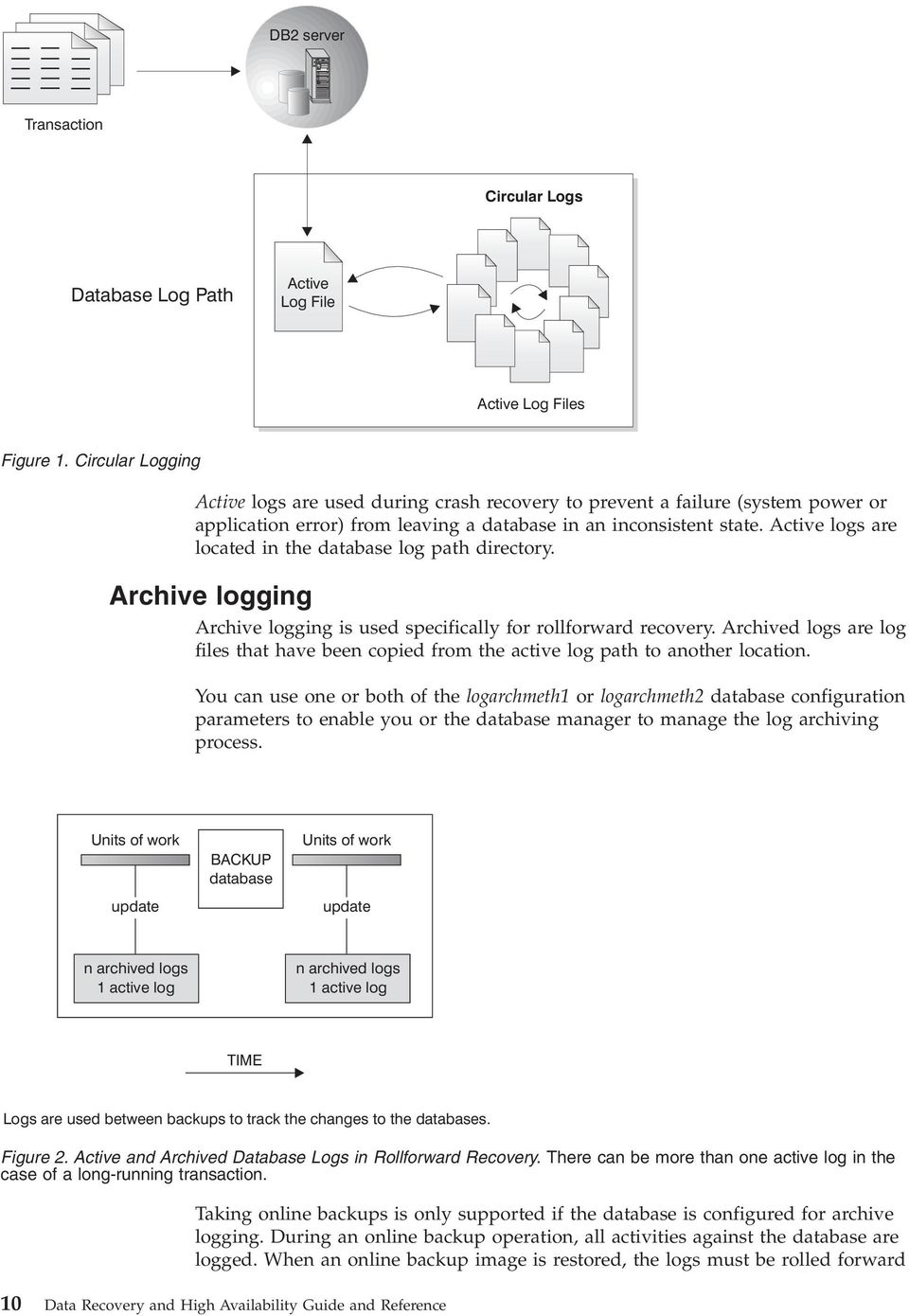
19 Database logging IP takeoer. This transfer is inisible to client applications, which continue to use the original IP address, unaware that the physical machine to which that IP address maps has changed. The DB2 High Aailability (HA) Feature enables integration between IBM Data Serer and cluster managing software. Database logging is an important part of your highly aailable database solution design because database logs make it possible to recoer from a failure, and they make it possible to synchronize primary and secondary databases. All databases hae logs associated with them. These logs keep records of database changes. If a database needs to be restored to a point beyond the last full, offline backup, logs are required to roll the data forward to the point of failure. Two types of database logging are supported: circular and archie. Each proides a different leel of recoery capability: Circular logging Archie logging on page 10 The adantage of choosing archie logging is that rollforward recoery can use both archied logs and actie logs to restore a database either to the end of the logs, or to a specific point in time. The archied log files can be used to recoer changes made after the backup was taken. This is different from circular logging where you can only recoer to the time of the backup, and all changes made after that are lost. Circular logging Circular logging is the default behaior when a new database is created. (The logarchmeth1 and logarchmeth2 database configuration parameters are set to OFF.) With this type of logging, only full, offline backups of the database are allowed. The database must be offline (inaccessible to users) when a full backup is taken. As the name suggests, circular logging uses a ring of online logs to proide recoery from transaction failures and system crashes. The logs are used and retained only to the point of ensuring the integrity of current transactions. Circular logging does not allow you to roll a database forward through transactions performed after the last full backup operation. All changes occurring since the last backup operation are lost. Since this type of restore operation recoers your data to the specific point in time at which a full backup was taken, it is called ersion recoery. Chapter 2. High aailability strategies 9

20 DB2 serer Transaction Circular Logs Database Log Path Actie Log File Actie Log Files Figure 1. Circular Logging Actie logs are used during crash recoery to preent a failure (system power or application error) from leaing a database in an inconsistent state. Actie logs are located in the database log path directory. Archie logging Archie logging is used specifically for rollforward recoery. Archied logs are log files that hae been copied from the actie log path to another location. You can use one or both of the logarchmeth1 or logarchmeth2 database configuration parameters to enable you or the database manager to manage the log archiing process. Units of work update BACKUP database Units of work update n archied logs 1 actie log n archied logs 1 actie log TIME Logs are used between backups to track the changes to the databases. Figure 2. Actie and Archied Database Logs in Rollforward Recoery. There can be more than one actie log in the case of a long-running transaction. Taking online backups is only supported if the database is configured for archie logging. During an online backup operation, all actiities against the database are logged. When an online backup image is restored, the logs must be rolled forward 10 Data Recoery and High Aailability Guide and Reference
21 at least to the point in time at which the backup operation completed. For this to happen, the logs must hae been archied and made aailable when the database is restored. After an online backup is complete, the database manager forces the currently actie log to be closed, and as a result, it will be archied. This ensures that your online backup has a complete set of archied logs aailable for recoery. The logarchmeth1 and logarchmeth2 database configuration parameters allow you to change where archied logs are stored. The logarchmeth2 parameter enables you to archie log files to a second separate location. The newlogpath parameter affects where actie logs are stored. Unless you hae specified that you want to manage the actie logs (by using the LOGRETAIN alue), the database manager remoes log files from the actie log path after these files hae been archied and they are no longer needed for crash recoery. If infinite logging is enabled and space needs to be made aailable for more actie log files, the database serer renames the log files after these files hae been archied. Log control files When a database restarts after a failure, the database manager applies transaction information stored in log files to return the database to a consistent state. To determine which records from the log files need to be applied to the database, the database manager uses information recorded in a log control file. Redundancy for database resilience The database manager maintains two copies of the log control file, SQLOGCTL.LFH.1 and SQLOGCTL.LFH.2, so that if one copy is damaged, the database manager can still use the other copy. Performance considerations Applying the transaction information contained in the log control files contributes to the oerhead of restarting a database after a failure. You can configure the frequency at which the database manager writes transaction to disk in order to reduce the number of log records that need to be processed during crash recoery using the softmax - Recoery range and soft checkpoint interal configuration parameter in Data Serers, Databases, and Database Objects Guide. Chapter 2. High aailability strategies 11
22 12 Data Recoery and High Aailability Guide and Reference
23 Chapter 3. High aailability with IBM Data Serer IBM Data Serer contains functionality that supports many high aailability strategies. Automatic client reroute roadmap Automatic client reroute is an IBM Data Serer feature that redirects client applications from a failed serer to an alternate serer so the applications can continue their work with minimal interruption. Automatic client reroute can be accomplished only if an alternate serer has been specified prior to the failure. Table 1 lists the releant topics in each category. Table 1. Roadmap to automatic client reroute information Category Related topics General information Automatic client reroute limitations on page 24 Automatic client reroute description and setup on page 21 Automatic client reroute description and setup (DB2 Connect ) in DB2 Connect User's Guide Configuration Identifying an alternate serer for automatic client reroute on page 24 Configuration of DB2 Database for Linux, UNIX, and Windows high aailability support for Jaa clients in Deeloping Jaa Applications Configuration of DB2 Database for Linux, UNIX, and Windows high-aailability support for non-jaa clients in Call Leel Interface Guide and Reference, Volume 1 Examples Automatic client reroute examples on page 176 Interaction with other DB2 features Configuring automatic client reroute and High Aailability Disaster Recoery (HADR) on page 31 Configuration of DB2 Database for Linux, UNIX, and Windows high aailability support for Jaa clients in Deeloping Jaa Applications Configuration of DB2 Database for Linux, UNIX, and Windows high-aailability support for non-jaa clients in Call Leel Interface Guide and Reference, Volume 1 Troubleshooting Configuring automatic client reroute for client connection distributor technology on page 23 Note: Automatic client reroute for DB2 for z/os Sysplex is also aailable in IBM data serer clients and non-jaa IBM data serer driers. With this support, applications that access a DB2 for z/os Sysplex can use automatic client reroute capabilities proided by the client, and are not required to go through a DB2 Connect serer. For more information about this feature, see the topic about automatic client reroute (client-side) in the DB2 Information Center. Copyright IBM Corp. 2001,
24 DB2 fault monitor facilities for Linux and UNIX Aailable on UNIX based systems only, DB2 fault monitor facilities keep DB2 Data Serer databases up and running by monitoring DB2 database manager instances, and restarting any instance that exits prematurely. The Fault Monitor Coordinator (FMC) is the process of the Fault Monitor Facility that is started at the UNIX boot sequence. The init daemon starts the FMC and will restart it if it terminates abnormally. The FMC starts one fault monitor for each DB2 instance. Each fault monitor runs as a daemon process and has the same user priileges as the DB2 instance. Once a fault monitor is started, it will be monitored to make sure it does not exit prematurely. If a fault monitor fails, it will be restarted by the FMC. Each fault monitor will, in turn, be responsible for monitoring one DB2 instance. If the DB2 instance exits prematurely, the fault monitor will restart it. The fault monitor will only become inactie if the db2stop command is issued. If a DB2 instance is shut down in any other way, the fault monitor will start it up again. DB2 fault monitor restrictions If you are using a high aailability clustering product such as HACMP, MSCS, or IBM Tioli System Automation for Multiplatforms, the fault monitor facility must be turned off since the instance startup and shut down is controlled by the clustering product. Differences between the DB2 fault monitor and the DB2 health monitor The health monitor and the fault monitor are tools that work on a single database instance. The health monitor uses health indicators to ealuate the health of specific aspects of database manager performance or database performance. A health indicator measures the health of some aspect of a specific class of database objects, such as a table space. Health indicators can be ealuated against specific criteria to determine the health of that class of database object. In addition, health indicators can generate alerts to notify you when an indicator exceeds a threshold or indicates a database object is in a non-normal state. By comparison, the fault monitor is solely responsible for keeping the instance it is monitoring up and running. If the DB2 instance it is monitoring terminates unexpectedly, the fault monitor restarts the instance. The fault monitor is not aailable on Windows. High Aailability Disaster Recoery (HADR) The DB2 Data Serer High Aailability Disaster Recoery (HADR) feature is a database replication feature that proides a high aailability solution for both partial and complete site failures. HADR protects against data loss by replicating data changes from a source database, called the primary, to a target database, called the standby. HADR might be your best option if most or all of your database requires protection, or if you perform DDL operations that must be automatically replicated on the standby database. 14 Data Recoery and High Aailability Guide and Reference
25 Unless you hae reads on standby enabled, applications can access the current primary database only. If you hae reads on standby enabled, only write applications can access the current primary database, but read applications can access both the primary and the actie standby. This enables you to offload some of the read-only workload running on the primary to the standby. Applications connecting to the standby database do not affect the standby's aailability in case of a failoer. The standby database is kept in synch with the primary database through log data that is generated on the primary and shipped to the standby. The standby constantly rolls forward through the logs. A partial site failure can be caused by a hardware, network, or software (DB2 database system or operating system) failure. Without HADR, a partial site failure requires restarting the database management system (DBMS) serer that contains the database. The length of time it takes to restart the database and the serer where it resides is unpredictable. It can take seeral minutes before the database is brought back to a consistent state and made aailable. With HADR, the standby database can take oer in seconds. Further, you can redirect the clients that were using the original primary database to the standby database (new primary database) by using automatic client reroute or retry logic in the application. A complete site failure can occur when a disaster, such as a fire, causes the entire site to be destroyed. Because HADR uses TCP/IP for communication between the primary and standby databases, they can be situated in different locations. For example, your primary database might be located at your head office in one city, while your standby database is located at your sales office in another city. If a disaster occurs at the primary site, data aailability is maintained by haing the remote standby database take oer as the primary database with full DB2 functionality. After a takeoer operation occurs, you can bring the original primary database back up and return it to its primary database status; this is known as failback. With HADR, you can choose the leel of protection you want from potential loss of data by specifying one of three synchronization modes: synchronous, near synchronous, or asynchronous. After the failed original primary serer is repaired, it can rejoin the HADR pair as a standby database if the two copies of the database can be made consistent. After the original primary database is reintegrated into the HADR pair as the standby database, you can switch the roles of the databases to enable the original primary database to once again be the primary database. HADR is only one of seeral replication solutions offered in the DB2 product family. WebSphere Federation Serer and the DB2 database system include SQL replication and Q replication solutions that can also be used, in some configurations, to proide high aailability. These functions maintain logically consistent copies of database tables at multiple locations. In addition, they proide flexibility and complex functionality such as support for column and row filtering, data transformation, updates to any copy of a table, and they can be used in partitioned database enironments. DB2 High Aailability (HA) Feature The DB2 High Aailability (HA) Feature enables integration between IBM Data Serer and cluster managing software. Chapter 3. High aailability with IBM Data Serer 15
26 When you stop a database manager instance in a clustered enironment, you must make your cluster manager aware that the instance is stopped. If the cluster manager is not aware that the instance is stopped, the cluster manager might attempt an operation such as failoer on the stopped instance. The DB2 High Aailability (HA) Feature proides infrastructure for enabling the database manager to communicate with your cluster manager when instance configuration changes, such as stopping a database manager instance, require cluster changes. If the database manager communicates with the cluster manager wheneer instance changes require cluster changes, then you are freed from haing to perform separate cluster operations after performing instance configuration changes. The DB2 HA Feature is composed of the following elements: IBM Tioli System Automation for Multiplatforms (SA MP) is bundled with IBM Data Serer on AIX and Linux as part of the DB2 High Aailability (HA) Feature, and integrated with the DB2 installer. You can install, upgrade, or uninstall SA MP using either the DB2 installer or the installsam and uninstallsam scripts that are included in the IBM Data Serer install media. In a clustered enironment, some database manager instance configuration and administration operations require related cluster configuration changes. The DB2 High Aailability (HA) Feature enables the database manager to automatically request cluster manager configuration changes wheneer you perform certain database manager instance configuration and administration operations. See: Configuring a cluster automatically with the DB2 High Aailability (HA) Feature on page 71 DB2 High Aailability Instance Configuration Utility (db2haicu) is a text based utility that you can use to configure and administer your highly aailable databases in a clustered enironment. db2haicu collects information about your database instance, your cluster enironment, and your cluster manager by querying your system. You supply more information through parameters to the db2haicu call, an input file, or at runtime by proiding information at db2haicu prompts. See: DB2 High Aailability Instance Configuration Utility (db2haicu) on page 78 The DB2 cluster manager API defines a set of functions that enable the database manager to communicate configuration changes to the cluster manager. See: DB2 cluster manager API on page 114 High aailability through log shipping Log shipping is the process of copying whole log files to a standby machine either from an archie deice, or through a user exit program running against the primary database. The standby database is continuously rolling forward through the log files produced by the production machine. When the production machine fails, a failoer occurs and the following takes place: The remaining logs are transferred oer to the standby machine. The standby database rolls forward to the end of the logs and stops. The clients reconnect to the standby database and resume operations. The standby machine has its own resources (for example, disks), but must hae the same physical and logical definitions as the production database. When using this approach the primary database is restored to the standby machine, by using restore utility or the split mirror function. 16 Data Recoery and High Aailability Guide and Reference
27 To ensure that you are able to recoer your database in a disaster recoery situation consider the following: The archie location should be geographically separate from the primary site. Remotely mirror the log at the standby database site Use a synchronous mirror for no loss support. You can do this using modern disk subsystems such as ESS and EMC, or another remote mirroring technology. NVRAM cache (both local and remote) is also recommended to minimize the performance impact of a disaster recoery situation. Note: 1. When the standby database processes a log record indicating that an index rebuild took place on the primary database, the indexes on the standby serer are not automatically rebuilt. The index will be rebuilt on the standby serer either at the first connection to the database, or at the first attempt to access the index after the standby serer is taken out of rollforward pending state. It is recommended that the standby serer be resynchronized with the primary serer if any indexes on the primary serer are rebuilt. You can enable indexes to be rebuilt during rollforward operations if you set the LOGINDEXBUILD database configuration parameter. 2. If the load utility is run on the primary database with the COPY YES option specified, the standby database must hae access to the copy image. 3. If the load utility is run on the primary database with the COPY NO option specified, the standby database should be resynchronized, otherwise the table space will be placed in restore pending state. 4. There are two ways to initialize a standby machine: a. By restoring to it from a backup image. b. By creating a split mirror of the production system and issuing the db2inidb command with the STANDBY option. Only after the standby machine has been initialized can you issue the ROLLFORWARD command on the standby system. 5. Operations that are not logged will not be replayed on the standby database. As a result, it is recommended that you re-sync the standby database after such operations. You can do this through online split mirror and suspended I/O support. Log mirroring IBM Data Serer supports log mirroring at the database leel. Mirroring log files helps protect a database from: accidental deletion of an actie log; and data corruption caused by hardware failure. If you are concerned that your actie logs might be damaged (as a result of a disk crash), you should consider using the MIRRORLOGPATH configuration parameter to specify a secondary path for the database to manage copies of the actie log, mirroring the olumes on which the logs are stored. The MIRRORLOGPATH configuration parameter allows the database to write an identical second copy of log files to a different path. It is recommended that you place the secondary log path on a physically separate disk (preferably one that is also on a different disk controller). That way, the disk controller cannot be a single point of failure. Chapter 3. High aailability with IBM Data Serer 17
28 When MIRRORLOGPATH is first enabled, it will not actually be used until the next database startup. This is similar to the NEWLOGPATH configuration parameter. If there is an error writing to either the actie log path or the mirror log path, the database will mark the failing path as bad, write a message to the administration notification log, and write subsequent log records to the remaining good log path only. DB2 will not attempt to use the bad path again until the current log file is either full or truncated. When DB2 needs to open the next log file, it will erify that this path is alid, and if so, will begin to use it. If not, DB2 will not attempt to use the path again until the next log file is accessed for the first time. There is no attempt to synchronize the log paths, but DB2 keeps information about access errors that occur, so that the correct paths are used when log files are archied. If a failure occurs while writing to the remaining good path, the database shuts down. High aailability through suspended I/O and online split mirror support IBM Data Serer suspended I/O support enables you to split mirrored copies of your primary database without taking the database offline. You can use this to ery quickly create a standby database to take oer if the primary database fails. Disk mirroring is the process of writing data to two separate hard disks at the same time. One copy of the data is called a mirror of the other. Splitting a mirror is the process of separating the two copies. You can use disk mirroring to maintain a secondary copy of your primary database. You can use IBM Data Serer suspended I/O functionality to split the primary and secondary mirrored copies of the database without taking the database offline. Once the primary and secondary databases copies are split, the secondary database can take oer operations if the primary database fails. If you would rather not back up a large database using the IBM Data Serer backup utility, you can make copies from a mirrored image by using suspended I/O and the split mirror function. This approach also: Eliminates backup operation oerhead from the production machine Represents a fast way to clone systems Represents a fast implementation of idle standby failoer. There is no initial restore operation, and if a rollforward operation proes to be too slow, or encounters errors, reinitialization is ery fast. The db2inidb command initializes the split mirror so that it can be used: As a clone database As a standby database As a backup image This command can only be issued against a split mirror, and it must be run before the split mirror can be used. In a partitioned database enironment, you do not hae to suspend I/O writes on all database partitions simultaneously. You can suspend a subset of one or more database partitions to create split mirrors for performing offline backups. If the catalog partition is included in the subset, it must be the last database partition to be suspended. 18 Data Recoery and High Aailability Guide and Reference
29 In a partitioned database enironment, the db2inidb command must be run on eery database partition before the split image from any of the database partitions can be used. The tool can be run on all database partitions simultaneously using the db2_all command. If; howeer, you are using the RELOCATE USING option, you cannot use the db2_all command to run db2inidb on all of the database partitions simultaneously. A separate configuration file must be supplied for each database partition, that includes the NODENUM alue of the database partition being changed. For example, if the name of a database is being changed, eery database partition will be affected and the db2relocatedb command must be run with a separate configuration file on each database partition. If containers belonging to a single database partition are being moed, the db2relocatedb command only needs to be run once on that database partition. Note: Ensure that the split mirror contains all containers and directories which comprise the database, including the olume directory. To gather this information, refer to the DBPATHS administratie iew, which shows all the files and directories of the database that need to be split. Chapter 3. High aailability with IBM Data Serer 19
30 20 Data Recoery and High Aailability Guide and Reference
31 Chapter 4. Configuring for high aailability To configure your DB2 database solution for high aailability, you must: schedule database maintenance actiities; configure the primary and standby database serers to know about each other and their respectie roles in the eent of a failure; and configure any cluster managing software to transfer workload from a failed cluster node. Before configuring your database solution: Assemble and install the underlying hardware and software components that make up the solution. These underlying components might include: power supply; network connectiity; network cards; disks or other storage deices; operating systems; and cluster managing software. Test these underlying components without any database workload to make sure they are functioning properly before attempting to use them in database load balancing, failoer, or recoery operations. Redundancy is an important part of a high aailability solution. Howeer, if you do not schedule maintenance wisely, if you run out of storage space for needed recoery logs, or if your cluster managing software is not configured correctly, your solution might not be aailable when your users need to do crucial work with the database. Configuring for high aailability includes: Configure client reroute Automatic client reroute description and setup Configure fault monitor DB2 fault monitor registry file on page 26 Configure DB2 High Aailability Disaster Recoery Initializing high aailability disaster recoery (HADR) on page 29 Schedule maintenance actiities Scheduling maintenance for high aailability on page 54 Configure logging Configuring database logging options on page 57 Configure cluster managing software Configuring a clustered enironment for high aailability on page 69 Automatic client reroute description and setup The main goal of the automatic client reroute feature is to enable an IBM Data Serer Client application to recoer from a loss of communications so that the application can continue its work with minimal interruption. As the name suggests, rerouting is central to the support of continuous operations. But rerouting is only possible when there is an alternate location that is identified to the client connection. The automatic client reroute feature could be used within the following configurable enironments if the serer is DB2 on Linux, UNIX, or Windows: 1. Enterprise Serer Edition (ESE) with the database partitioning feature (DPF) Copyright IBM Corp. 2001,
32 2. WebSphere Replication Serer 3. High aailability cluster multiprocessor (HACMP) 4. High aailability disaster recoery (HADR). Automatic client reroute works in conjunction with HADR to allow a client application to continue its work with minimal interruption after a failoer of the database being accessed. The automatic client reroute feature could also be used in the following configuration if the database serer is on System i or System z : 1. IBM Data Serer Client connects to a z/os or i5/os system through a DB2 Connect serer which has an alternate serer. The automatic client reroute is used between the IBM Data Serer Client and two DB2 Connect serers. 2. DB2 Connect personal or serer products accessing a DB2 for z/os Sysplex data sharing enironment. Automatic client reroute is used between DB2 Connect and the z/os Sysplex system. The automatic client reroute feature supports seamless failoer between a DB2 Connect-licensed client and the Sysplex. For more information about seamless failoer, see the topic about automatic client reroute (client-side) in the DB2 Information Center. In the case of the DB2 Connect serer and its alternate, because there is no requirement for the synchronization of local databases, you only need to ensure that both the original and alternate DB2 Connect serers hae the target host or System i database catalogued in such a way that it is accessible using an identical database alias. In order for the DB2 database system to hae the ability to recoer from a loss of communications, an alternatie serer location must be specified before the loss of communication occurs. The UPDATE ALTERNATE SERVER FOR DATABASE command is used to define the alternate serer location on a particular database. After you hae specified the alternate serer location on a particular database at the serer instance, the alternate serer location information is returned to the IBM Data Serer Client as part of the connection process. In the case of using automatic client reroute between DB2 Connect personal or serer products and a host or System i database serer, the remote serer must proide one or more alternate addresses for itself. In the case of DB2 for z/os, multiple addresses are known if the database is a Sysplex data sharing enironment. Therefore an alternate serer does not need to be cataloged on DB2 Connect. If communication between the client and the serer is lost for any reason, the IBM Data Serer Client will attempt to reestablish the connection by using the alternate serer information. The IBM Data Serer Client will attempt to reconnect with a database serer which could be the original serer, and alternate serer listed in the database directory file at the serer, or an alternate serer that is in the serer list returned by the z/os Sysplex system. The timing of these attempts to reestablish a connection aries from ery rapid attempts initially to a gradual lengthening of the interals between the attempts. Once a connection is successful, the SQLCODE is returned to indicate that a database connection has been reestablished following the communication failure. The hostname or IP address and serice name or port number are returned. The IBM Data Serer Client only returns the error for the original communications failure to the application if the reestablishment of the client communications is not possible to either the original or alternatie serer. 22 Data Recoery and High Aailability Guide and Reference
33 The following considerations inoling alternate serer connectiity in a DB2 Connect serer enironment should also be noted: When using a DB2 Connect serer for proiding access to a host or System i database on behalf of both remote and local clients, confusion can arise regarding alternate serer connectiity information in a system database directory entry. To minimize this confusion, consider cataloging two entries in the system database directory to represent the same host or System i database. Catalog one entry for remote clients and catalog another for local clients. Any SYSPLEX information that is returned from a target DB2 for z/os serer is kept only in cache at the DB2 Connect serer. Only one alternate serer is written to disk. When multiple alternates or multiple actie serers exist, the information is only maintained in memory and is lost when the process terminates. In general, if an alternate serer is specified, automatic client reroute will be enabled when a communication error (sqlcode ) or a sqlcode is detected. Howeer, in a high aailability disaster recoery (HADR) enironment, it will also be enabled if sqlcode is returned back from the HADR standby serer. Configuring automatic client reroute for client connection distributor technology Distributor or dispatcher technologies such as WebSphere EdgeSerer distribute client application reconnection requests to a defined set of systems if a primary database serer fails. If you are using distributor technology with DB2 automatic client reroute, you must identify the distributor itself as the alternate serer to DB2 automatic client reroute. You might be using distributor technology in an enironment similar to the following: Client > distributor technology > (DB2 Connect Serer 1 or DB2 Connect Serer 2) > DB2 z/os where: The distributor technology component has a TCP/IP host name of DThostname The DB2 Connect Serer 1 has a TCP/IP host name of GWYhostname1 The DB2 Connect Serer 2 has a TCP/IP host name of GWYhostname2 The DB2 z/os serer has a TCP/IP host name of zoshostname The client is catalogued using DThostname in order to utilize the distributor technology to access either of the DB2 Connect Serers. The interening distributor technology makes the decision to use GWYhostname1 or GWYhostname2. Once the decision is made, the client has a direct socket connection to one of these two DB2 Connect gateways. Once the socket connectiity is established to the chosen DB2 Connect serer, you hae a typical client to DB2 Connect serer to DB2 z/os connectiity. For example, assume the distributor chooses GWYhostname2. This produces the following enironment: Client > DB2 Connect Serer 2 > DB2 z/os Chapter 4. Configuring for high aailability 23
34 The distributor does not retry any of the connections if there is any communication failure. If you want to enable the automatic client reroute feature for a database in such an enironment, the alternatie serer for the associated database or databases in the DB2 Connect serer (DB2 Connect Serer 1 or DB2 Connect Serer 2) should be set up to be the distributor (DThostname). Then, if DB2 Connect Serer 1 locks up for any reason, automatic client rerouting is triggered and a client connection is retried with the distributor as both the primary and the alternate serer. This option allows you to combine and maintain the distributor capabilities with the DB2 automatic client reroute feature. Setting the alternate serer to a host other than the distributor host name still proides the clients with the automatic client reroute feature. Howeer, the clients will establish direct connections to the defined alternate serer and bypass the distributor technology, which eliminates the distributor and the alue that it brings. The automatic client reroute feature intercepts the following SQL codes: sqlcode sqlcode (reason code = 7) Note: Client reroute might not be informed of socket failures in a timely fashion if the setting of the "TCP Keepalie" operating system configurations parameter is too high. (Note that the name of this configuration parameter aries by platform.) Identifying an alternate serer for automatic client reroute Wheneer a DB2 serer or DB2 Connect serer crashes, each client that is connected to that serer receies a communications error which terminates the connection resulting in an application error. In cases where aailability is important, you should hae implemented either a redundant set up or the ability to fail the serer oer to a standby node. In either case, the DB2 client code attempts to re-establish the connection to the original serer which might be running on a failoer node (the IP address fails oer as well), or to a new serer. To define a new or alternate serer: Use the UPDATE ALTERNATE SERVER FOR DATABASE or UPDATE ALTERNATE SERVER FOR LDAP DATABASE command. These commands update the alternate serer information for a database alias in the system database directory. Automatic client reroute limitations Consider DB2 database client reroute restrictions when designing your high aailability DB2 database solution. Here is a list of limitations of the DB2 database automatic client reroute feature: Automatic client reroute is only supported when the communications protocol used for connecting to the DB2 database serer, or to the DB2 Connect serer, is TCP/IP. This means that if the connection is using a different protocol other than TCP/IP, the automatic client reroute feature will not be enabled. Een if DB2 database is set up for a loopback, TCP/IP communications protocol must be used in order accommodate the automatic client reroute feature. When using automatic reroute between the DB2 Connect personal or serer products and a host or System i database serer, if you are in the following situations you will hae the associated implications: When using a DB2 Connect serer for proiding access to a host or System i database on behalf of both remote and local clients, confusion can arise 24 Data Recoery and High Aailability Guide and Reference
35 regarding alternate serer connectiity information in a system database directory entry. To minimize this confusion, consider cataloging two entries in the system database directory to represent the same host or System i database. Catalog one entry for remote clients and catalog another for local clients. Any SYSPLEX information that is returned from a target DB2 for z/os serer is kept only in cache at the DB2 Connect serer. Only one alternate serer is written to disk. When multiple alternates or multiple actie serers exist, the information is only maintained in memory and is lost when the process terminates. If the connection is reestablished to the alternate serer location, any new connection to the same database alias will be connected to the alternate serer location. If you want any new connection to be established, to the original location in case the problem on the original location is fixed, there are a couple of options from which to choose: You need to take the alternate serer offline and allow the connections to fail back oer to the original serer. (This assumes that the original serer has been cataloged using the UPDATE ALTERNATE SERVER command such that it is set to be the alternate location for the alternate serer.) You could catalog a new database alias to be used by the new connections. You could uncatalog the database entry and re-catalog it again. DB2 Database for Linux, UNIX, and Windows supports the automatic client reroute feature for both the client and the serer if both the client and serer support this feature. Other DB2 database product families do not currently support this feature. The behaior of the automatic client reroute feature and the behaior of the automatic client rerouting in a DB2 for z/os sysplex enironment are somewhat different. Specifically: The automatic client reroute feature requires the primary serer to designate a single alternatie serer. This is done using the UPDATE ALTERNATE SERVER FOR DATABASE or UPDATE ALTERNATE SERVER FOR LDAP DATABASE command issued at the primary serer. This command updates the local database directory with the alternate serer information so that other applications at the same client hae access this information. By contrast, a data-sharing sysplex used for DB2 for z/os maintains, in memory, a list of one or more serers to which the client can connect. If a communication failure happens, the client uses that list of serers to determine the location of the appropriate alternatie serer. In the case of the automatic client reroute feature, the serer informs the client of the most current special register settings wheneer a special register setting is changed. This allows the client, to the best of its ability, to reestablish the runtime enironment after a reroute has occurred. By contrast, a Sysplex used for DB2 for z/os returns the special register settings to the client on commit boundaries therefore any special registers changed within the unit of work that has been rerouted need to be replayed. All others will be replayed automatically. As of DB2 Uniersal Database Version 8 FixPak 7, full automatic client reroute support is aailable only between a Linux, UNIX, or Windows client and a Linux, UNIX, or Windows serer. It is not aailable between a Linux, UNIX, or Windows client and a DB2 for z/os Sysplex serer (any supported ersion); only the reroute capability is supported. Chapter 4. Configuring for high aailability 25
36 DB2 fault monitor registry file The DB2 database serer installed in the alternate host serer must be the same ersion (but could hae a higher FixPak) when compared to the DB2 database instance installed on the original host serer. Regardless of whether you hae authority to update the database directory at the client machine, the alternate serer information is always kept in memory. In other words, if you did not hae authority to update the database directory (or because it is a read-only database directory), other applications will not be able to determine and use the alternate serer, because the memory is not shared among applications. The same authentication is applied to all alternate locations. This means that the client will be unable to reestablish the database connection if the alternate location has a different authentication type than the original location. When there is a communication failure, all session resources such as global temporary tables, identity, sequences, cursors, serer options (SET SERVER OPTION) for federated processing and special registers are all lost. The application is responsible to reestablish the session resources in order to continue processing the work. You do not hae to run any of the special register statements after the connection is reestablished, because the DB2 database will replay the special register statements that were issued before the communication error. Howeer, some of the special registers will not be replayed. They are: SET ENCRYPTPW SET EVENT MONITOR STATE SET SESSION AUTHORIZATION SET TRANSFORM GROUP When you hae a problem with DB2 Connect, you should refer to the list of restricted special registers specific to the DB2 Connect product on a data serer. If, after the connection is reestablished following a communication failure and the client is using CLI, JCC Type 2 or Type 4 driers, then those SQL and XQuery statements that hae been prepared against the original serer are implicitly re-prepared with the new serer. Howeer, embedded SQL routines (for example, SQC or SQX applications), are not re-prepared with the new serer. Do not run high aailability disaster recoery (HADR) commands on client reroute-enabled database aliases. HADR commands are implemented to identify the target database using database aliases. Consequently, if the target database has an alternatie database defined, it is difficult for HADR commands to determine the database on which the command is actually operating. While a client might need to connect using a client reroute-enabled alias, HADR commands must be applied on a specific database. To accommodate this, you can define aliases specific to the primary and standby databases and only run HADR commands on those aliases. An alternate way to implement automatic client rerouting is to use the DNS entry to specify an alternate IP address for a DNS entry. The idea is to specify a second IP address (an alternate serer location) in the DNS entry; the client would not know about an alternate serer, but at connect time DB2 database system would alternate between the IP addresses for the DNS entry. A fault monitor registry file is created for eery DB2 database manager instance on each physical machine when the fault monitor daemon is started. The keywords and alues in this file specify the behaior of the fault monitors. 26 Data Recoery and High Aailability Guide and Reference
37 The fault monitor registry file can be found in the /sqllib/ directory and is called fm.machine_name.reg. This file can be altered using the db2fm command. If the fault monitor registry file does not exist, the default alues will be used. Here is an example of the contents of the fault monitor registry file: FM_ON = no FM_ACTIVE = yes START_TIMEOUT = 600 STOP_TIMEOUT = 600 STATUS_TIMEOUT = 20 STATUS_INTERVAL = 20 RESTART_RETRIES = 3 ACTION_RETRIES = 3 NOTIFY_ADDRESS = <instance_name>@<machine_name> Fault monitor registry file keywords FM_ON Specifies whether or not the fault monitor should be started. If the alue is set to NO, the fault monitor daemon will not be started, or will be turned off if it had already been started. The default alue is NO. FM_ACTIVE Specifies whether or not the fault monitor is actie. The fault monitor will only take action if both FM_ON and FM_ACTIVE are set to YES. If FM_ON is set to YES and FM_ACTIVE is set to NO, the fault monitor daemon will be started, but it will not be actie. That means that is will not try to bring DB2 back online if it shuts down. The default alue is YES. START_TIMEOUT Specifies the amount of time within which the fault monitor must start the serice it is monitoring. The default alue is 600 seconds. STOP_TIMEOUT Specifies the amount of time within which the fault monitor must bring down the serice it is monitoring. The default alue is 600 seconds. STATUS_TIMEOUT Specifies the amount of time within which the fault monitor must get the status of the serice it is monitoring. The default alue is 20 seconds. STATUS_INTERVAL Specifies the minimum time between two consecutie calls to obtain the status of the serice that is being monitored. The default alue is 20 seconds. RESTART_RETRIES Specifies the number of times the fault monitor will try to obtain the status of the serice being monitored after a failed attempt. Once this number is reached the fault monitor will take action to bring the serice back online. The default alue is 3. ACTION_RETRIES Specifies the number of times the fault monitor will attempt to bring the serice back online. The default alue is 3. NOTIFY_ADDRESS Chapter 4. Configuring for high aailability 27
38 Specifies the address to which the fault monitor will send notification messages. The default is Configuring DB2 fault monitor using the db2fm command You can alter the DB2 fault monitor registry file using the db2fm command. Here are some examples of using the db2fm command to update the fault monitor registry file: Example 1: Update START_TIMEOUT To update the START_TIMEOUT alue to 100 seconds for instance DB2INST1, type the following command from a DB2 database command window: db2fm -i db2inst1 -T 100 Example 2: Update STOP_TIMEOUT To update the STOP_TIMEOUT alue to 200 seconds for instance DB2INST1, type the following command: db2fm -i db2inst1 -T /200 Example 3: Update START_TIMEOUT and STOP_TIMEOUT To update the START_TIMEOUT alue to 100 seconds and the STOP_TIMEOUT alue to 200 seconds for instance DB2INST1, type the following command: db2fm -i db2inst1 -T 100/200 Example 4: Turn on fault monitoring To turn on fault monitoring for instance DB2INST1, type the following command: db2fm -i db2inst1 -f yes Example 5: Turn off fault monitoring To turn off fault monitoring for instance DB2INST1, type the following command: db2fm -i db2inst1 -f no To confirm that fault monitor is no longer running for DB2INST1, type the following command on UNIX systems: ps -ef grep -i fm On Linux, type the following command: ps auxw grep -i fm An entry that shows db2fmd and DB2INST1 indicates that the fault monitor is still running on that instance. To turn off the fault monitor, type the following command as the instance owner: db2fm -i db2inst1 -D Configuring DB2 fault monitor using db2fmc and system commands You can configure the DB2 fault monitor using the DB2 Fault Monitor Controller Utility (FMCU) command db2fmcu or system commands. 28 Data Recoery and High Aailability Guide and Reference
39 Here are some examples of using db2fmcu and system commands to configure the fault monitor: Example 1: Preent FMC from being launched You can preent the FMC from being launched by using the DB2 Fault Monitor Controller Utility (FMCU). The FMCU must be run as root because it accesses the system's inittab file. To block the FMC from being run, type the following command as root: db2fmcu -d Note: If you apply a DB2 Data Serer fix pack this will be reset so that the inittab will again be configured to include the FMC. To preent the FMC from being launched after you hae applied a fix pack, you must reissue the aboe command. Example 2: Include FMC to be launched To reerse the db2fmcu -d command and reconfigure the inittab to include the FMC, type the following command: db2fmcu -u -p fullpath where fullpath is the complete path to the db2fmcd object, for example /opt/ibm/db2/bin/db2fmcd. Example 3: automatically start the DB2 database manager instance You can also enable FMC to automatically start the instance when the system is first booted. To enable this feature for instance DB2INST1, type the following command: db2iauto -on db2inst1 Example 4: disable automatically starting the instance To turn off the autostart behaiour, type the following command: db2iauto -off db2inst1 Example 5: preent fault monitor processes from being launched You can also preent fault monitor processes from being launched for a specific instances on the system by changing a field in the global registry record for the instance. To change the global registry field to disable fault monitors for instance DB2INST1, type the following command as root: db2greg -updinstrec instancename=db2inst1!startatboot=0 To reerse this command and re-enable fault monitors for instance DB2INST1, type the following command as root: db2greg -updinstrec instancename=db2inst1!startatboot=1 Initializing high aailability disaster recoery (HADR) Use the following procedure to set up and initialize the primary and standby databases for DB2 High Aailability Disaster Recoery (HADR). HADR can be initialized through the command line processor (CLP), the Set Up High Aailability Disaster Recoery (HADR) wizard in the Control Center, or by calling the db2hadrstart API. To use the CLP to initialize HADR on your system for the first time: Chapter 4. Configuring for high aailability 29
40 1. Determine the host name, host IP address, and the serice name or port number for each of the HADR databases. If a host has multiple network interfaces, ensure that the HADR host name or IP address maps to the intended one. You need to allocate separate HADR ports in /etc/serices for each protected database. These cannot be the same as the ports allocated to the instance. The host name can only map to one IP address. Note: The instance names for the primary and standby databases do not hae to be the same. 2. Create the standby database by restoring a backup image or by initializing a split mirror, based on the existing database that is to be the primary. In the following example, the BACKUP DATABASE and RESTORE DATABASE commands are used to initialize database SOCKS as a standby database. In this case, an NFS mounted file system is accessible at both sites. Issue the following command at the primary database: backup db socks to /nfs1/backups/db2/socks Issue the following command at the standby database: restore db socks from /nfs1/backups/db2/socks replace history file The following example illustrates how to use the db2inidb utility to initialize the standby database using a split mirror of the primary database. This procedure is an alternatie to the backup and restore procedure illustrated aboe. Issue the following command at the standby database: db2inidb socks as standby Note: a. The database names for the primary and standby databases must be the same. b. It is recommended that you do not issue the ROLLFORWARD DATABASE command on the standby database after the restore operation or split mirror initialization. The results of using a rollforward operation might differ slightly from replaying the logs using HADR on the standby database. If the databases are not identical, issuing the START HADR command with the AS STANDBY option will fail. c. When using the RESTORE DATABASE command, it is recommended that the REPLACE HISTORY FILE option is used. d. When creating the standby database using the RESTORE DATABASE command, you must ensure that the standby remains in rollforward mode. This means that you cannot issue the ROLLFORWARD DATABASE command with either the COMPLETE option or the STOP option. An error will be returned if the START HADR command with the AS STANDBY option is attempted on the database after rollforward is stopped. e. The following RESTORE DATABASE command options should be aoided when setting up the standby database: TABLESPACE, INTO, REDIRECT, and WITHOUT ROLLING FORWARD. f. When setting up the standby database using the db2inidb utility, do not use the SNAPSHOT or MIRROR options. You can specify the RELOCATE USING option to change one or more of the following configuration attributes: instance name, log path, and database path. Howeer, you must not change the database name or the table space container paths. 30 Data Recoery and High Aailability Guide and Reference
41 3. Set the HADR configuration parameters on the primary and standby databases. Note: It is ery important that you set the following configuration parameters after the standby databases has been created: HADR_LOCAL_HOST HADR_LOCAL_SVC HADR_REMOTE_HOST HADR_REMOTE_SVC HADR_REMOTE_INST If they are set prior to creating the standby database, the settings on the standby database will reflect what is set on the primary database. 4. Connect to the standby instance and start HADR on the standby database, as in the following example: START HADR ON DB SOCKS AS STANDBY Note: Usually, the standby database is started first. If you start the primary database first, this startup procedure will fail if the standby database is not started within the time period specified by the HADR_TIMEOUT database configuration parameter. 5. Connect to the primary instance and start HADR on the primary database, as in the following example: START HADR ON DB SOCKS AS PRIMARY 6. HADR is now started on the primary and standby databases. To open the Set Up High Aailability Disaster Recoery (HADR) Databases wizard: a. From the Control Center expand the object tree until you find the database for which you want to configure HADR. b. Right-click the database and click High Aailability Disaster Recoery Set Up in the pop-up menu. The Set Up High Aailability Disaster Recoery Databases wizard opens. Additional information is proided through the contextual help facility within the Control Center. Note: You can start HADR within the Set Up High Aailability Disaster Recoery Databases wizard, or you can just use the wizard to initialize HADR, then start it at another time. To open the Start HADR window: a. From the Control Center, expand the object tree until you find the database for which you want to manage HADR. Right-click the database and click High Aailability Disaster Recoery Manage in the pop-up menu. The Manage High Aailability Disaster Recoery window opens. b. Click Start HADR. The Start HADR window opens. Configuring automatic client reroute and High Aailability Disaster Recoery (HADR) You can use the automatic client reroute feature with the High Aailability Disaster Recoery (HADR) feature to transfer client application requests from a failed database serer to a standby database serer. Restrictions Chapter 4. Configuring for high aailability 31
42 Rerouting is only possible when an alternate database location has been specified at the serer. Automatic client reroute is only supported with TCP/IP protocol. Configuration details Use the UPDATE ALTERNATE SERVER FOR DATABASE command to enable automatic client reroute. Client reroute is enabled by default if you set up HADR using the Set Up High Aailability Disaster Recoery (HADR) Databases wizard in the Control Center. Automatic client reroute does not use the HADR_REMOTE_HOST and HADR_REMOTE_SVC database configuration parameters. The alternate host location is stored in the system database directory file at the serer. If automatic client reroute is not enabled, client applications will receie error message SQL30081, and no further attempts will be made to establish a connection with the serer. Using the UPDATE ALTERNATE SERVER FOR DATABASE command to set up automatic client reroute with HADR Your system is set up as follows: You hae a client where database MUSIC is catalogued as being located at host HORNET. Database MUSIC is the primary database and its corresponding standby database, also MUSIC, resides on host MONTERO with port number 456, which is assigned by the SVCENAME configuration parameter. To enable automatic client reroute, update the alternate serer for database MUSIC on host HORNET: db2 update alternate serer for database music using hostname montero port 456 After this command is issued, the client must successfully connect to host HORNET to obtain the alternate serer information. Then, if a communication error occurs between the client and database MUSIC at host HORNET, the client will first attempt to reconnect to database MUSIC at host HORNET. If this fails, the client will then attempt to establish a connection with the standby database MUSIC on host MONTERO. Index logging and high aailability disaster recoery (HADR) You should consider setting the database configuration parameters LOGINDEXBUILD and INDEXREC for DB2 High Aailability Disaster Recoery (HADR) databases. Using the LOGINDEXBUILD database configuration parameter 32 Data Recoery and High Aailability Guide and Reference
43 Recommendation: For HADR databases, set the LOGINDEXBUILD database configuration parameter to ON to ensure that complete information is logged for index creation, recreation, and reorganization. Although this means that index builds might take longer on the primary system and that more log space is required, the indexes will be rebuilt on the standby system during HADR log replay and will be aailable when a failoer takes place. If index builds on the primary system are not logged and a failoer occurs, any inalid indexes that remain after the failoer is complete will hae to be rebuilt before they can be accessed. While the indexes are being recreated, they cannot be accessed by any applications. Note: If the LOG INDEX BUILD table attribute is set to its default alue of NULL, DB2 will use the alue specified for the LOGINDEXBUILD database configuration parameter. If the LOG INDEX BUILD table attribute is set to ON or OFF, the alue specified for the LOGINDEXBUILD database configuration parameter will be ignored. You might choose to set the LOG INDEX BUILD table attribute to OFF on one or more tables for either of the following reasons: You do not hae enough actie log space to support logging of the index builds. The index data is ery large and the table is not accessed often; therefore, it is acceptable for the indexes to be recreated at the end of the takeoer operation. In this case, set the INDEXREC configuration parameter to RESTART. Because the table is not frequently accessed, this setting will cause the system to recreate the indexes at the end of the takeoer operation instead of waiting for the first time the table is accessed after the takeoer operation. If the LOG INDEX BUILD table attribute is set to OFF on one or more tables, any index build operation on those tables might cause the indexes to be recreated any time a takeoer operation occurs. Similarly, if the LOG INDEX BUILD table attribute is set to its default alue of NULL, and the LOGINDEXBUILD database configuration parameter is set to OFF, any index build operation on a table might cause the indexes on that table to be recreated any time a takeoer operation occurs. You can preent the indexes from being recreated by taking one of the following actions: After all inalid indexes are recreated on the new primary database, take a backup of the database and apply it to the standby database. As a result of doing this, the standby database does not hae to apply the logs used for recreating inalid indexes on the primary database, which would mark those indexes as rebuild required on the standby database. Set the LOG INDEX BUILD table attribute to ON, or set the LOG INDEX BUILD table attribute to NULL and the LOGINDEXBUILD configuration parameter to ON on the standby database to ensure that the index recreation will be logged. Using the INDEXREC database configuration parameter Recommendation: Set the INDEXREC database configuration parameter to RESTART (the default) on both the primary and standby databases. This will cause inalid indexes to be rebuilt after a takeoer operation is complete. If any index builds hae not been logged, this setting allows DB2 to check for inalid indexes and to rebuild them. This process takes place in the background, and the database will be accessible after the takeoer operation has completed successfully. Chapter 4. Configuring for high aailability 33
44 If a transaction accesses a table that has inalid indexes before the indexes hae been rebuilt by the background recreate index process, the inalid indexes will be rebuilt by the first transaction that accesses it. Database configuration for high aailability disaster recoery (HADR) You can use database configuration parameters to achiee optimal performance with DB2 High Aailability Disaster Recoery (HADR). To achiee optimal performance with DB2 High Aailability Disaster Recoery (HADR), ensure that your database configuration meets the following requirements. Recommendation: To the extent possible, the database configuration parameters and database manager configuration parameters should be identical on the systems where the primary and standby databases reside. If the configuration parameters are not properly set on the standby database the following problems might occur: Error messages might be returned on the standby database while replaying the log files that were shipped from the primary database. After a takeoer operation, the new primary database will not be able to handle the workload, resulting in performance problems or in applications receiing error messages they were not receiing when they were connected to the original primary database. Changes to the configuration parameters on the primary database are not automatically propagated to the standby database and must be made manually on the standby database. For dynamic configuration parameters, changes will take effect without shutting down and restarting the database management system (DBMS) or the database. For non-dynamic configuration parameters, changes will take effect after the standby database is restarted. Size of log files configuration parameter on the standby database One exception to the configuration parameter behaior described aboe is the LOGFILSIZ database configuration parameter. Although this parameter is not replicated to the standby database, to guarantee identical log files on both databases, the standby database ignores the local LOGFILSIZ configuration and creates local log files that match the size of the log files on the primary database. After a takeoer, the original standby (new primary) will keep using the alue that was set on the original primary until the database is restarted. At that point, the new primary will reert to the alue configured locally. In addition, the new primary also truncates the current log file and resizes any pre-created log files. If the databases keep switching roles ia non-forced takeoer and neither database is deactiated, then the log file size used will always be the one established by the ery first primary. Howeer, if there is a deactiate and then a restart on the original standby (new primary) then it would use the log file size configured locally. This log file size would continue to be used if the original primary takes oer again. Only after a deactiate and restart on the original primary would the log file size reert back to the settings on the original primary. 34 Data Recoery and High Aailability Guide and Reference
45 Log receie buffer size on the standby database By default, the log receie buffer size on the standby database will be two times the alue specified for the LOGBUFSZ configuration parameter on the primary database. There might be times when this size is not sufficient. For example, when the HADR synchronization mode is asynchronous and the primary and standby databases are in peer state, if the primary database is experiencing a high transaction load, the log receie buffer on the standby database might fill to capacity and the log shipping operation from the primary database might stall. To manage these temporary peaks, you can increase the size of the log receie buffer on the standby database by modifying the DB2_HADR_BUF_SIZE registry ariable. Load operations and HADR If a load operation is executed on the primary database with the COPY YES option, the command will execute on the primary database and the data will be replicated to the standby database as long as the copy can be accessed through the path or deice specified by the LOAD command. If the standby database cannot access the data, the table space in which the table is stored is marked inalid on the standby database. The standby database will skip future log records that pertain to this table space. To ensure that the load operation can access the copy on the standby database, it is recommended that you use a shared location for the output file from the COPY YES option. Alternatiely, you can deactiate the standby database while the load operation is performed, perform the load on the primary, place a copy of the output file in the standby path, and then actiate the standby database. If a load operation is executed on the primary database with the NONRECOVERABLE option, the command will execute on the primary database and the table on the standby database will be marked inalid. The standby database will skip future log records that pertain to this table. You can choose to issue the LOAD command with the COPY YES and REPLACE options specified to bring the table back, or you can drop the table to recoer the space. Since executing a load operation with the COPY NO option is not supported with HADR, the command is automatically conerted to a load operation with the NONRECOVERABLE option. To enable a load operation with the COPY NO option to be conerted to a load operation with the COPY YES option, set the DB2_LOAD_COPY_NO_OVERRIDE registry ariable on the primary database. This registry ariable is ignored by the standby database. Ensure that the deice or directory specified on the primary database can be accessed by the standby database using the same path, deice, or load library. If you are using Tioli Storage Manager (TSM) to perform a load operation with the COPY YES option, you might need to set the VENDOROPT configuration parameter on the primary and standby databases. Depending on how TSM is configured, the alues on the primary and standby databases might not be the same. Also, when using TSM to perform a load operation with the COPY YES option, you must issue the db2adutl command with the GRANT option to gie the standby database read access for the files that are loaded. If table data is replicated by a load operation with the COPY YES option specified, the indexes will be replicated as follows: If the indexing mode is set to REBUILD and the table attribute is set to LOG INDEX BUILD, or the table attribute is set to DEFAULT and the Chapter 4. Configuring for high aailability 35
46 LOGINDEXBUILD database configuration parameter is set to ON, the primary database will include the rebuilt index object in the copy file to enable the standby database to replicate the index object. If the index object on the standby database is marked inalid before the load operation, it will become usable again after the load operation as a result of the index rebuild. If the indexing mode is set to INCREMENTAL and the table attribute is set to LOG INDEX BUILD, or the table attribute is set to NULL and LOGINDEXBUILD database configuration parameter on the primary database is set to ON, the index object on the standby database is updated only if it is not marked inalid before the load operation. Otherwise, the index is marked inalid on the standby database. Registry ariable DB2_HADR_PEER_WAIT_LIMIT When registry ariable DB2_HADR_PEER_WAIT_LIMIT is set, HADR primary database will break out of peer state if logging on the primary database has been blocked for the specified number of seconds because of log replication to the standby. When this limit is reached, primary database will break the connection to the standby database. If peer window is disabled, the primary will enter disconnected state and logging resumes. If peer window is enabled, the primary database will enter disconnected peer state, in which logging continues to be blocked. Primary leaes disconnected peer state upon re-connection or peer window expiration. Logging resumes once primary leaes disconnected peer state. Honoring peer window transition when breaking out of peer state ensures peer window semantics for safe takeoer in all cases. If the primary fails during the transition, normal peer window protection still applies (safe takeoer from standby as long as it's still in disconnected-peer state). On the standby side, after disconnection, the database will continue replaying already receied logs. Once receied logs hae been replayed, the standby will reconnect to the primary. Upon re-connection, normal state transition follows (first remote catchup state, then peer state) Relationship to HADR_TIMEOUT: Database configuration parameter HADR_TIMEOUT does not break the primary out of peer state if the primary keeps receiing heartbeat messages from the standby while blocked. HADR_TIMEOUT is a timeout for the HADR network layer. An HADR database breaks the connection to its partner database if it has not receied any message from its partner for the HADR_TIMEOUT period. It does not control timeout for higher layer operations such as log shipping and ack. If log replay on the standby database is stuck on a large operation such as load or reorganization, the HADR component will still send heartbeat messages to the primary database on normal schedule. In such a scenario, the primary will be blocked as long as the standby replay is blocked, unless DB2_HADR_PEER_WAIT_LIMIT is set. DB2_HADR_PEER_WAIT_LIMIT unblocks primary logging regardless of connection status. Note that een if DB2_HADR_PEER_WAIT_LIMIT is not set, primary always breaks out of peer state when a network error is detected or the connection is closed (possibly as result of HADR_TIMEOUT). 36 Data Recoery and High Aailability Guide and Reference
47 HADR configuration parameters Seeral new database configuration parameters are aailable to support HADR. Setting these parameters does not change the role of a database. You must issue the START HADR or STOP HADR commands to change the role of a database. HADR configuration parameters are not dynamic. Any changes made to an HADR configuration parameter are not effectie until the database has been shut down and restarted. In a partitioned database enironment, the HADR configuration parameters are isible and can be changed, but they are ignored. The local host name of the primary database must be the same as the remote host name of the standby database, and the local host name of the standby database must be the same as the remote host name of the primary database. Use the HADR_LOCAL_HOST and HADR_REMOTE_HOST configuration parameters to set the local and remote hosts for each database. Configuration consistency for the local and remote host names is checked when a connection is established to ensure that the remote host specified is the expected database. An HADR database can be configured to use either IP4 or IP6 to locate its partner database. If the host serer does not support IP6, the database will use IP4. If the serer does support IP6, whether the database uses IP4 or IP6 depends upon the format of the address specified for the HADR_LOCAL_HOST and HADR_REMOTE_HOST configuration parameters. The database attempts to resole the two parameters to the same IP format. The following table shows how the IP mode is determined for IP6-enabled serers: IP mode used for HADR_LOCAL_HOST IP mode used for HADR_REMOTE_HOST IP4 address IP4 address IP4 IP4 address IP6 address Error IP4 address hostname, maps to 4 only IP4 IP4 address hostname, maps to 6 only Error IP4 address hostname, maps to 4 and 6 IP4 IP6 address IP4 address Error IP6 address IP6 address IP6 IP6 address hostname, maps to 4 only Error IP6 address hostname, maps to 6 only IP6 IP6 address hostname, maps to 4 and 6 IP6 hostname, maps to 4 only IP4 address IP4 hostname, maps to 4 only IP6 address Error hostname, maps to 4 only hostname, maps to 4 only IP4 hostname, maps to 4 only hostname, maps to 6 only Error hostname, maps to 4 only hostname, maps to 4 and 6 IP4 hostname, maps to 6 only IP4 address Error hostname, maps to 6 only IP6 address IP6 hostname, maps to 6 only hostname, maps to 4 only Error hostname, maps to 6 only hostname, maps to 6 only IP6 hostname, maps to 6 only hostname, maps to 4 and 6 IP6 IP mode used for HADR communications Chapter 4. Configuring for high aailability 37
48 IP mode used for HADR_LOCAL_HOST IP mode used for HADR_REMOTE_HOST hostname, maps to 4 and 6 IP4 address hostname, maps to 4 and 6 IP6 address hostname, maps to 4 and 6 hostname, maps to 4 only hostname, maps to 4 and 6 hostname, maps to 6 only hostname, maps to 4 and 6 hostname, maps to 4 and 6 IP6 IP mode used for HADR communications IP4 IP6 IP4 IP6 The primary and standby databases can make HADR connections only if they use the same format. If one serer is IP6 enabled (but also supports IP4) and the other serer only supports IP4, at least one of the HADR_LOCAL_HOST or HADR_REMOTE_HOST parameters must specify an IP4 address. This tells the database to use IP4 een if the serer supports IP6. When you specify alues for the high aailability disaster recoery (HADR) local serice and remote serice parameters (HADR_LOCAL_SVC and HADR_REMOTE_SVC) while preparing an update database configuration command, the alues you specify must be ports that are not in use for any other serice, including other DB2 components or other HADR databases. In particular, you cannot set either parameter alue to the TCP/IP port used by the serer to await communications from remote clients (the SVCENAME database manager configuration parameter) or the next port (SVCENAME + 1). If the primary and standby databases are on different machines, they can use the same port number or serice name; otherwise, different alues should be used. The HADR_LOCAL_SVC and HADR_REMOTE_SVC parameters can be set to either a port number or a serice name. The synchronization mode (HADR_SYNCMODE) and time-out period (HADR_TIMEOUT) must be identical on both the primary and standby databases. The consistency of these configuration parameters is checked when an HADR pair establishes a connection. TCP connections are used for communication between the primary and standby databases. A primary database that is not connected to a standby database, either because it is starting up or because the connection is lost, will listen on its local port for new connections. A standby database that is not connected to a primary database will continue issuing connection requests to its remote host. Although the local host and local serice parameters (HADR_LOCAL_HOST, HADR_LOCAL_SVC) are only used on the primary database, you should still set them on the standby database to ensure that they are ready if the standby database has to take oer as the primary database. When the primary database starts, it waits for a standby to connect for a minimum of 30 seconds or for the number of seconds specified by the alue of the HADR_TIMEOUT database configuration parameter, whicheer is longer. If the standby does not connect in the specified time, the startup will fail. (The one exception to this is when the START HADR command is issued with the BY FORCE option.) After an HADR pair establishes a connection, they will exchange heart beat messages. The heartbeat interal is one-quarter of the alue of the 38 Data Recoery and High Aailability Guide and Reference
49 HADR_TIMEOUT database configuration parameter, or 30 seconds, whicheer is shorter. The HADR_HEARTBEAT monitor element shows the number of heartbeats a database expected to receie but did not receie from the other database. If one database does not receie any message from the other database within the number of seconds specified by HADR_TIMEOUT, it will initiate a disconnect. This means that at most it takes the number of seconds specified by HADR_TIMEOUT for a primary to detect the failure of either the standby or the interening network. If you set the HADR_TIMEOUT configuration parameter too low, you will receie false alarms and frequent disconnections. If the HADR_PEER_WINDOW database configuration parameter is set to zero, then when the primary and standby databases are in peer state, problems with the standby or network will only block primary transaction processing for the number of seconds specified by the HADR_TIMEOUT configuration parameter, at most. If you set the HADR_PEER_WINDOW to a non-zero alue, then the primary database will not commit transactions until connection with the standby database is restored, or the HADR_PEER_WINDOW time alue elapses, whicheer happens first. Note: For maximal aailability, the default alue for the HADR_PEER_WINDOW database configuration parameter is zero. When HADR_PEER_WINDOW is set to zero, then as soon as the connection between the primary and the standby is closed (either because the standby closed the connection, a network error is detected, or timeout is reached), the primary drops out of peer state to aoid blocking transactions. For increased data consistency, but reduced aailability, you can set the HADR_PEER_WINDOW database configuration parameter to a non-zero alue, which will cause the primary database to remain in disconnected peer state for the length of time specified by the HADR_PEER_WINDOW alue. The following sample configuration is for the primary and standby databases. On the primary: HADR_LOCAL_HOST host1.ibm.com HADR_LOCAL_SVC hadr_serice HADR_REMOTE_HOST host2.ibm.com HADR_REMOTE_SVC hadr_serice HADR_REMOTE_INST dbinst2 HADR_TIMEOUT 120 HADR_SYNCMODE NEARSYNC HADR_PEER_WINDOW 120 On the standby: HADR_LOCAL_HOST host2.ibm.com HADR_LOCAL_SVC hadr_serice HADR_REMOTE_HOST host1.ibm.com HADR_REMOTE_SVC hadr_serice HADR_REMOTE_INST dbinst1 HADR_TIMEOUT 120 HADR_SYNCMODE NEARSYNC HADR_PEER_WINDOW 120 Setting the hadr_timeout and hadr_peer_window database configuration parameters You can configure the HADR_TIMEOUT and HADR_PEER_WINDOW database configuration parameters for optimal response to a connection failure. hadr_timeout database configuration parameter If an HADR database does not receie any communication from its partner database for longer than the length of time specified by the hadr_timeout Chapter 4. Configuring for high aailability 39
50 database configuration parameter, then the database concludes that the connection with the partner database is lost. If the database is in peer state when the connection is lost, then it moes into disconnected peer state if the hadr_peer_window database configuration parameter is greater than zero, or into remote catchup pending state if hadr_peer_window is not greater than zero. The state change applies to both primary and standby databases. hadr_peer_window database configuration parameter The hadr_peer_window configuration parameter does not replace the hadr_timeout configuration parameter. The hadr_timeout configuration parameter determines how long an HADR database waits before considering its connection with the partner database as failed. The hadr_peer_window configuration parameter determines whether the database goes into disconnected peer state after the connection is lost, and how long the database should remain in that state. HADR will break the connection as soon as a network error is detected during send, receie, or poll on the TCP socket. HADR polls the socket eery 100 milliseconds. This allows it to respond quickly to network errors detected by the OS. Only in the worst case, HADR will wait until timeout to break a bad connection. In this case, a database application that is running at the time of failure can be blocked for a period of time equal to the sum of the hadr_timeout and hadr_peer_window database configuration parameters. Setting the hadr_timeout and hadr_peer_window database configuration parameters It is desirable to keep the waiting time that a database application experiences to a minimum. Setting the hadr_timeout and hadr_peer_window configuration parameters to small alues would reduce the time that a database application must wait if a HADR standby databases loses its connection with the primary database. Howeer, there are two other details that should be considered when choosing alues to assign to the hadr_timeout and hadr_peer_window configuration parameters: The hadr_timeout database configuration parameter should be set to a alue that is long enough to aoid false alarms on the HADR connection caused by short, temporary network interruptions. For example, the default alue of hadr_timeout is 120 seconds, which is a reasonable alue on many networks. The hadr_peer_window database configuration parameter should be set to a alue that is long enough to allow the system to perform automated failure responses. If the HA system, for example a cluster manager, detects primary database failure before disconnected peer state ends, a failoer to the standby database takes place. Data is not lost in the failoer as all data from old primary is replicated to the new primary. If hadr_peer_window is too short, HA system may not hae enough time to detect the failure and respond. Log archiing configuration for DB2 High Aailability Disaster Recoery (HADR) To use log archiing with DB2 High Aailability Disaster Recoery (HADR), configure both the primary database and the standby database for automatic log retrieal capability from all log archie locations. 40 Data Recoery and High Aailability Guide and Reference
51 If either the standby database or the primary database is unable to access all log archie locations, then you must manually copy log files from the log archie to the following locations: the standby database logpath or archie location for local catchup the primary database logpath or archie location for remote catchup Only the current primary database can perform log archiing. If the primary and standby databases are set up with separate archiing locations, logs are archied only to the primary database's archiing location. In the eent of a takeoer, the standby database becomes the new primary database and any logs archied from that point on are saed to the original standby database's archiing location. In such a configuration, logs are archied to one location or the other, but not both; with the exception that following a takeoer, the new primary database might archie a few logs that the original primary database had already archied. After a takeoer, if the new primary database (original standby database) experiences a media failure and needs to perform a restore and rollforward, it might need to access logs that only exist in the original primary database archie location. The standby database will not delete a log file from its local logpath until it has been notified by the primary database that the primary database has archied it. This behaior proides added protection against the loss of log files. If the primary database fails and its log disk becomes corrupted before a particular log file is archied on the primary database, the standby database will not delete that log file from its own disk because it has not receied notification that the primary database successfully archied the log file. If the standby database then takes oer as the new primary database, it will archie that log file before recycling it. If both the logarchmeth1 and logarchmeth2 configuration parameters are in use, the standby database will not recycle a log file until the primary database has archied it using both methods. Note: To speed up the catchup process, you can use a shared log archie deice for the primary and standby databases. This allows the standby database to directly retriee older log files from the archie in local catchup state, instead of retrieing those files indirectly through the primary in remote catchup state. Howeer, it is recommended that you not use a serial archie deice such as a tape drie for HADR databases. With serial deices, you might experience performance degradation on both the primary and standby databases because of mixed read and write operations. The primary writes to the deice when it archies log files and the standby reads from the deice to replay logs. This performance impact can occur een if the deice is not configured as shared. High aailability disaster recoery (HADR) performance Configuring different aspects of your database system, including network bandwidth, CPU power, and buffer size, can improe the performance of your DB2 High Aailability Disaster Recoery (HADR) databases. For optimum HADR performance, consider the following recommendations for managing your system: Network bandwidth must be greater than the database log generation rate. Network delays affect the primary only in SYNC and NEARSYNC modes. The slowdown in system performance as a result of using SYNC mode can be significantly larger than that of the other synchronization modes. In SYNC Chapter 4. Configuring for high aailability 41
52 mode, the primary database sends log pages to the standby database only after the log pages hae been successfully written to the primary database log disk. In order to protect the integrity of the system, the primary database waits for an acknowledgement from the standby before notifying an application that a transaction was prepared or committed. The standby database sends the acknowledgement only after it writes the receied log pages to the standby database disk. The resulting oerhead is: the log write on the standby database plus round-trip messaging. In NEARSYNC mode, the primary database writes and sends log pages in parallel. The primary then waits for an acknowledgement from the standby. The standby database acknowledges as soon as the log pages are receied into its memory. On a fast network, the oerhead to the primary database is minimal. The acknowledgement might hae already arried by the time the primary database finishes local log write. For ASYNC mode, the log write and send are also in parallel; howeer, in this mode the primary database does not wait for an acknowledgement from the standby. Therefore, network delay is not an issue. Performance oerhead is een smaller with ASYNC mode than with NEARSYNC mode. For each log write on the primary, the same log pages are also sent to the standby. Each write operation is called a flush. The size of the flush is limited to the log buffer size on the primary database (which is controlled by the database configuration parameter logbufsz). The exact size of each flush is nondeterministic. A larger log buffer does not necessarily lead to a larger flush size. The standby database should be powerful enough to replay the logged operations of the database as fast as they are generated on the primary. Identical primary and standby hardware is recommended. If you are going to use the reads on standby feature, the standby must hae the resources to accommodate this additional work. If you are going to use the reads on standby feature, configure your buffer pools on the primary, and that information will be shipped to the standby through logs. If you are going to use the reads on standby feature, Tune the pckcachesz, catalogcache_sz, applheapsz, and sortheap configuration parameters on the standby. In most systems, the logging capability is not drien to its limit. Een in SYNC mode, there might not be an obserable slow down on the primary database. For example, if the limit of logging is 40 Mb per second with HADR enabled, but the system was just running at 30 Mb per second before HADR is enabled, then you might not notice any difference in oerall system performance. To speed up the catchup process, you can use a shared log archie deice. Howeer, if the shared deice is a serial deice such as a tape drie, you might experience performance degradation on both the primary and standby databases because of mixed read and write operations. Network congestion If the standby database is too slow replaying log pages, its log-receiing buffer might fill up, thereby preenting the buffer from receiing more log pages. In SYNC and NEARSYNC modes, if the primary database flushes its log buffer one more time, the data will likely be buffered in the network pipeline consisting of the primary machine, the network, and the standby database. Because the standby database does not hae free buffer to receie the data, it cannot acknowledge, so the primary database becomes blocked while waiting for the standby database's acknowledgement. 42 Data Recoery and High Aailability Guide and Reference
53 In ASYNC mode, the primary database continues to send log pages until the pipeline fills up and it cannot send additional log pages. This condition is called congestion. Congestion is reported by the hadr_connect_status monitor element. For SYNC and NEARSYNC modes, the pipeline can usually absorb a single flush and congestion will not occur. Howeer, the primary database remains blocked waiting for an acknowledgement from the standby database on the flush operation. Congestion can also occur if the standby database is replaying log records that take a long time to replay, such as database or table reorganization log records. Increasing the size of the standby database log-receiing buffer can help to reduce congestion, although it might not remoe all of the causes of congestion. By default, the size of the standby database log-receiing buffer is two times the size of the primary database log-writing buffer. The database configuration parameter logbufsz specifies the size of the primary database log-writing buffer. The DB2 registry ariable DB2_HADR_BUF_SIZE can be used to tune the size of the standby database log-receiing buffer. Registry ariable DB2_HADR_PEER_WAIT_LIMIT When registry ariable DB2_HADR_PEER_WAIT_LIMIT is set, the HADR primary database will break out of the peer state if logging on the primary database has been blocked for the specified number of seconds because of log replication to the standby. When this limit is reached, the primary database will break the connection to the standby database. If the peer window is disabled, the primary will enter disconnected state and logging resumes. If the peer window is enabled, the primary database will enter disconnected peer state, in which logging continues to be blocked. The primary database leaes disconnected peer state upon re-connection or peer window expiration. Logging resumes once the primary database leaes disconnected peer state. Honoring peer window transition when breaking out of peer state ensures peer window semantics for safe takeoer in all cases. If the primary fails during the transition, normal peer window protection still applies (safe takeoer from standby as long as it's still in disconnected-peer state). Registry ariables DB2_HADR_SOSNDBUF and DB2_HADR_SORCVBUF To maximize network and HADR performance, the TCP socket buffer sizes may require tuning. HADR log shipping workload, network bandwidth, and transmission delay are important factors to consider when tuning the TCP socket buffer sizes. If you change the TCP socket buffer size at the system leel, he settings are applied to all TCP connections on the machine. Setting a large system leel socket buffer size will consume a large amount of memory. Two registry ariables, DB2_HADR_SOSNDBUF and DB2_HADR_SORCVBUF allow tuning of the TCP socket send and receie buffer size for HADR connections only. These two ariables hae the alue range of 1024 to and default to the socket buffer size of the operating system, which will ary depending on the operating system. Some operating systems will automatically round or silently cap the user specified alue. Chapter 4. Configuring for high aailability 43
54 Cluster managers and high aailability disaster recoery (HADR) You can implement DB2 High Aailability Disaster Recoery (HADR) databases on nodes of a cluster, and use a cluster manager to improe the aailability of your database solution. You can hae both the primary database and the standby database managed by the same cluster manager, or you can hae the primary database and the standby database managed by different cluster managers. Set up an HADR pair where the primary and standby databases are sericed by the same cluster manager This configuration is best suited to enironments where the primary and standby databases are located at the same site and where the fastest possible failoer is required. These enironments would benefit from using HADR to maintain DBMS aailability, rather using crash recoery or another recoery method. You can use the cluster manager to quickly detect a problem and to initiate a takeoer operation. Because HADR requires separate storage for the DBMS, the cluster manager should be configured with separate olume control. This configuration preents the cluster manager from waiting for failoer to occur on the olume before using the DBMS on the standby system. You can use the automatic client reroute feature to redirect client applications to the new primary database. Set up an HADR pair where the primary and standby databases are not sericed by the same cluster manager This configuration is best suited to enironments where the primary and standby databases are located at different sites and where high aailability is required for disaster recoery in the eent of a complete site failure. There are seeral ways you can implement this configuration. When an HADR primary or standby database is part of a cluster, there are two possible failoer scenarios. If a partial site failure occurs and a node to which the DBMS can fail oer remains aailable, you can choose to perform a cluster failoer. In this case, the IP address and olume failoer is performed using the cluster manager; HADR is not affected. If a complete site failure occurs where the primary database is located, you can use HADR to maintain DBMS aailability by initiating a takeoer operation. If a complete site failure occurs where the standby database is located, you can repair the site or moe the standby database to another site. Initializing a standby database One strategy for making a database solution highly aailable is maintaining a primary database to respond to user application requests, and a secondary or standby database that can take oer database operations for the primary database if the primary database fails. Initializing the standby database entails copying the primary database to the standby database. There are seeral ways to initialize the standby database. For example: Use disk mirroring to copy the primary database, and use DB2 database suspended I/O support to split the mirror to create the second database. Create a backup image of the primary database and recoery that image to the standby database. 44 Data Recoery and High Aailability Guide and Reference
55 Use SQL replication to capture data from the primary database and apply that data to the standby database. After initializing the standby database, you must configure your database solution to synchronize the primary database and standby database so the standby database can take oer for the primary database if the primary database fails. Using a split mirror as a standby database Use the following procedure to create a split mirror of a database for use as a standby database. If a failure occurs on the primary database and crash recoery is necessary, you can use the standby database to take oer for the primary database. To use a split mirror as a standby database, follow these steps: 1. Suspend I/O on the primary database: db2 set write suspend for database While the database is suspended, you should not be running other utilities or tools. You should only be making a copy of the database. 2. Use appropriate operating system-leel commands to split the mirror or mirrors from the primary database. Note: Ensure that you copy the entire database directory including the olume directory. You must also copy the log directory and any container directories that exist outside the database directory. To gather this information, refer to the DBPATHS administratie iew, which shows all the files and directories of the database that need to be split. 3. Resume I/O on the primary database: db2 set write resume for database 4. Catalog the mirrored database on the secondary system. Note: By default, a mirrored database cannot exist on the same system as the primary database. It must be located on a secondary system that has the same directory structure and uses the same instance name as the primary database. If the mirrored database must exist on the same system as the primary database, you can use the db2relocatedb utility or the RELOCATE USING option of the db2inidb command to accomplish this. 5. Start the database instance on the secondary system: db2start 6. Initialize the mirrored database on the secondary system by placing it in rollforward pending state: db2inidb database_alias as standby If required, specify the RELOCATE USING option of the db2inidb command to relocate the standby database: db2inidb database_alias as standby relocate using relocatedbcfg.txt where the relocatedbcfg.txt file contains the information required to relocate the database. Note: a. You can take a full database backup using the split mirror if you hae DMS table spaces (database managed space) or automatic storage table spaces. Taking a backup using the split mirror off-loads the oerhead of taking a backup on the production database. If you later restore this Chapter 4. Configuring for high aailability 45
56 backup image and roll the restored database forward to the end of the logs, you will encounter an SQL4970 error unless you hae log records that are newer than when you SET WRITE SUSPEND. If newer log files are not copied from the original database to the restored database, or if the copied log file is empty (i.e. contains no newer log records), then you will receie an SQL4970 error during the rollforward. b. The database directory (including the olume directory), the log directory, and the container directories must be moed to the desired location before you use the RELOCATE USING option. 7. Set up a user exit program to retriee the log files from the primary system. 8. Roll the database forward to the end of the logs or to a point-in-time. 9. Continue retrieing log files, and rolling the database forward through the logs until you reach the end of the logs or the point-in-time required for the standby database. 10. To bring the standby database online issue the ROLLFORWARD command with the STOP option specified. Note: The logs from the primary database cannot be applied to the mirrored database once it has been taken out of rollforward pending state. Configuring DB2 High Aailability Disaster Recoery (HADR) synchronization mode The HADR_SYNCMODE configuration parameter determines the degree of protection your DB2 High Aailability Disaster Recoery (HADR) database solution has against transaction loss. The synchronization mode determines when the primary database serer considers a transaction complete, based on the state of the logging on the standby database. The more strict the synch mode configuration parameter alue, the more protection your database solution has against transaction data loss, but the slower your transaction processing performance. You must balance the need for protection against transaction loss with the need for performance. These modes apply only when the primary and standby databases are in peer or disconnected peer state. Use the HADR_SYNCMODE configuration parameter to set the synchronization mode. Valid alues are: SYNC (synchronous) This mode proides the greatest protection against transaction loss, and using it results in the longest transaction response time among the three modes. In this mode, log writes are considered successful only when logs hae been written to log files on the primary database and when the primary database has receied acknowledgement from the standby database that the logs hae also been written to log files on the standby database. The log data is guaranteed to be stored at both sites. If the standby database crashes before it can replay the log records, the next time it starts it can retriee and replay them from its local log files. If the primary database fails, a failoer to the standby database guarantees that any transaction that has been committed on the primary database has also been committed on the standby database. After the failoer operation, when the client reconnects to the new primary database, there can be 46 Data Recoery and High Aailability Guide and Reference
57 transactions committed on the new primary database that were neer reported as committed to the application on the original primary. This occurs when the primary database fails before it processes an acknowledgement message from the standby database. Client applications should consider querying the database to determine whether any such transactions exist. If the primary database loses its connection to the standby database, what happens next depends on the configuration of the hadr_peer_window database configuration parameter. If hadr_peer_window is set to a non-zero time alue, then upon losing connection with the standby database the primary database will moe into disconnected peer state and continue to wait for acknowledgement from the standby database before committing transactions. If the hadr_peer_window database configuration parameter is set to zero, the primary and standby databases are no longer considered to be in peer state and transactions will not be held back waiting for acknowledgement from the standby database. If the failoer operation is performed when the databases are not in peer or disconnected peer state, there is no guarantee that all of the transactions committed on the primary database will appear on the standby database. If the primary database fails when the databases are in peer or disconnected peer state, it can rejoin the HADR pair as a standby database after a failoer operation. Because a transaction is not considered to be committed until the primary database receies acknowledgement from the standby database that the logs hae also been written to log files on the standby database, the log sequence on the primary will be the same as the log sequence on the standby database. The original primary database (now a standby database) just needs to catch up by replaying the new log records generated on the new primary database since the failoer operation. If the primary database is not in peer state when it fails, its log sequence might be different from the log sequence on the standby database. If a failoer operation has to be performed, the log sequence on the primary and standby databases might be different because the standby database starts its own log sequence after the failoer. Because some operations cannot be undone (for example, dropping a table), it is not possible to reert the primary database to the point in time when the new log sequence was created. If the log sequences are different and you issue the START HADR command with the STANDBY option on the original primary, you will receie a message that the command was successful. Howeer, this message is issued before reintegration is attempted. If reintegration fails, pair alidation messages will be issued to the administration log and the diagnostics log on both the primary and the standby. The reintegrated standby will remain the standby, but the primary will reject the standby during pair alidation causing the standby database to shut down. If the original primary database successfully rejoins the HADR pair, you can achiee failback of the database by issuing the TAKEOVER HADR command without specifying the BY FORCE option. If the original primary database cannot rejoin the HADR pair, you can reinitialize it as a standby database by restoring a backup image of the new primary database. NEARSYNC (near synchronous) While this mode has a shorter transaction response time than synchronous mode, it also proides slightly less protection against transaction loss. Chapter 4. Configuring for high aailability 47
58 In this mode, log writes are considered successful only when the log records hae been written to the log files on the primary database and when the primary database has receied acknowledgement from the standby system that the logs hae also been written to main memory on the standby system. Loss of data occurs only if both sites fail simultaneously and if the target site has not transferred to nonolatile storage all of the log data that it has receied. If the standby database crashes before it can copy the log records from memory to disk, the log records will be lost on the standby database. Usually, the standby database can get the missing log records from the primary database when the standby database restarts. Howeer, if a failure on the primary database or the network makes retrieal impossible and a failoer is required, the log records will neer appear on the standby database, and transactions associated with these log records will neer appear on the standby database. If transactions are lost, the new primary database is not identical to the original primary database after a failoer operation. Client applications should consider resubmitting these transactions to bring the application state up to date. If the primary database fails when the primary and standby databases are in peer state, it is possible that the original primary database cannot to rejoin the HADR pair as a standby database without being reinitialized using a full restore operation. If the failoer inoles lost log records (because both the primary and standby databases hae failed), the log sequences on the primary and standby databases will be different and attempts to restart the original primary database as a standby database without first performing a restore operation will fail. If the original primary database successfully rejoins the HADR pair, you can achiee failback of the database by issuing the TAKEOVER HADR command without specifying the BY FORCE option. If the original primary database cannot rejoin the HADR pair, you can reinitialize it as a standby database by restoring a backup image of the new primary database. ASYNC (asynchronous) This mode has the highest chance of transaction loss if the primary system fails. It also has the shortest transaction response time among the three modes. In this mode, log writes are considered successful only when the log records hae been written to the log files on the primary database and hae been deliered to the TCP layer of the primary system's host machine. Because the primary system does not wait for acknowledgement from the standby system, transactions might be considered committed when they are still on their way to the standby. A failure on the primary database host machine, on the network, or on the standby database can cause log records in transit to be lost. If the primary database is aailable, the missing log records can be resent to the standby database when the pair reestablishes a connection. Howeer, if a failoer operation is required while there are missing log records, those log records will neer reach the standby database, causing the associated transactions to be lost in the failoer. 48 Data Recoery and High Aailability Guide and Reference
59 If transactions are lost, the new primary database is not exactly the same as the original primary database after a failoer operation. Client applications should consider resubmitting these transactions to bring the application state up to date. If the primary database fails when the primary and standby databases are in peer state, it is possible that the original primary database will not be able to rejoin the HADR pair as a standby database without being reinitialized using a full restore operation. If the failoer inoles lost log records, the log sequences on the primary and standby databases will be different, and attempts to restart the original primary database as a standby database will fail. Because there is a greater possibility of log records being lost if a failoer occurs in asynchronous mode, there is also a greater possibility that the primary database will not be able to rejoin the HADR pair. If the original primary database successfully rejoins the HADR pair, you can achiee failback of the database by issuing the TAKEOVER HADR command without specifying the BY FORCE option. If the original primary database cannot rejoin the HADR pair, you can reinitialize it as a standby database by restoring a backup image of the new primary database. High aailability disaster recoery (HADR) support To get the most out of the DB2 database High Aailability Disaster Recoery (HADR) feature, consider system requirements and feature limitations when designing your high aailability database solution. System requirements for High Aailability Disaster Recoery (HADR) To achiee optimal performance with High Aailability Disaster Recoery (HADR), ensure that your system meets the following requirements for hardware, operating systems, and for the DB2 database system. Recommendation: For better performance, use the same hardware and software for the system where the primary database resides and for the system where the standby database resides. If the system where the standby database resides has fewer resources than the system where the primary database resides, it is possible that the standby database will be unable to keep up with the transaction load generated by the primary database. This can cause the standby database to fall behind or the performance of the primary database to degrade. In a failoer situation, the new primary database should hae the resources to serice the client applications adequately. If you enable reads on standby and use the standby database to run some of your read-only workload, ensure that the standby has sufficient resources. An actie standby requires additional memory and temporary table space usage to support transactions, sessions, and new threads as well as queries that inole sort and join operations. Hardware and operating system requirements Recommendation: Use identical host computers for the HADR primary and standby databases. That is, they should be from the same endor and hae the same architecture. Chapter 4. Configuring for high aailability 49
60 The operating system on the primary and standby databases should be the same ersion, including patches. You can iolate this rule for a short time during a rolling upgrade, but take extreme caution. A TCP/IP interface must be aailable between the HADR host machines, and a high-speed, high-capacity network is recommended. DB2 database requirements The ersions of the database systems for the primary and standby databases must be identical; for example, both must be either ersion 8 or ersion 9. During rolling updates, the modification leel (for example, the fix pack leel) of the database system for the standby database can be later than that of the primary database for a short while to test the new leel. Howeer, you should not keep this configuration for an extended period of time. The primary and standby databases will not connect to each other if the modification leel of the database system for the primary database is later than that of the standby database. In order to use the reads on standby feature, both the primary and the standby databases need to be Version 9.7 Fix Pack 1. The DB2 database software for both the primary and standby databases must hae the same bit size (32 or 64 bit). Table spaces and their containers must be identical on the primary and standby databases. Properties that must be identical include the table space type (DMS or SMS), table space size, container path, container size, and container file type (raw deice or file system). The amount of space allocated for log files should also be the same on both the primary and standby databases. When you issue a table space statement on the primary database, such as CREATE TABLESPACE, ALTER TABLESPACE, or DROP TABLESPACE, it is replayed on the standby database. You must ensure that the deices inoled are set up on both of the databases before you issue the table space statement on the primary database. If you create a table space on the primary database and log replay fails on the standby database because the containers are not aailable, the primary database does not receie an error message stating that the log replay failed. To check for log replay errors, you must monitor the db2diag log file and the administration notification log file on the standby database when you are creating new table spaces. If a takeoer operation occurs, the new table space that you created is not aailable on the new primary database. To recoer from this situation, restore the table space on the new primary database from a backup image. In the following example, table space MY_TABLESPACE is restored on database MY_DATABASE before it is used as the new primary database: 1. db2 connect to my_database 2. db2 list tablespaces show detail Note: Run the db2 list tablespaces show detail command to show the status of all table spaces and to obtain the table space ID number required for Step db2 stop hadr on database my_database 4. db2 "restore database my_database tablespace (my_tablespace) online redirect" 50 Data Recoery and High Aailability Guide and Reference
61 5. db2 "set tablespace containers for my_tablespace_id_# ignore rollforward container operations using (path '/my_new_container_path/')" 6. db2 "restore database my_database continue" 7. db2 rollforward database my_database to end of logs and stop tablespace "(my_tablespace)" 8. db2 start hadr on database my_database as primary The primary and standby databases do not require the same database path. If relatie container paths are used, the same relatie path might map to different absolute container paths on the primary and standby databases. Automatic storage databases are fully supported by HADR, including replication of the ALTER DATABASE statement with the ADD STORAGE ON clause. Similar to table space containers, the storage path must exist on both primary and standby. The primary and standby databases must hae the same database name. This means that they must be in different instances. Redirected restore is not supported. That is, HADR does not support redirecting table space containers. Howeer, database directory and log directory changes are supported. Table space containers created by relatie paths will be restored to paths relatie to the new database directory. Buffer pool requirements Since buffer pool operations are also replayed on the standby database, it is important that the primary and standby databases hae the same amount of memory. If you are using reads on standby, you will need to configure the buffer pool on the primary so that the actie standby can accommodate log replay and read applications. Installation and storage requirements for High Aailability Disaster Recoery (HADR) To achiee optimal performance with High Aailability Disaster Recoery (HADR), ensure that your system meets the following installation and storage requirements. Installation requirements For HADR, instance paths should be the same on the primary and the standby databases. Using different instance paths can cause problems in some situations, such as if an SQL stored procedure inokes a user-defined function (UDF) and the path to the UDF object code is expected to be on the same directory for both the primary and standby serer. Storage requirements Automatic storage databases are fully supported by HADR, including replication of the ALTER DATABASE statement with the ADD STORAGE ON clause. Similar to table space containers, the storage path must exist on both primary and standby. Symbolic links can be used to create identical paths. The primary and standby databases can be on the same computer. Een though their database storage starts at the same path, they do not conflict because the actual directories used hae instance names embedded in them (since the primary and standby databases must Chapter 4. Configuring for high aailability 51
62 hae the same database name, they must be in different instances). The storage path is formulated as storage_path_name/inst_name/dbpart_name/db_name/ tbsp_name/container_name. Table spaces and their containers must be identical on the primary and standby databases. Properties that must be identical include: the table space type (DMS or SMS), table space size, container path, container size, and container file type (raw deice or file system). If the database is enabled for automatic storage then the storage paths must be identical. This includes the path names and the amount of space on each that is deoted to the database. The amount of space allocated for log files should also be the same on both the primary and standby databases. When you issue a table space statement on the primary database, such as CREATE TABLESPACE, ALTER TABLESPACE, or DROP TABLESPACE, it is replayed on the standby database. You must ensure that the deices inoled are set up on both of the databases before you issue the table space statement on the primary database. If the table space setup is not identical on the primary and standby databases, log replay on the standby database might encounter errors such as OUT OF SPACE or TABLE SPACE CONTAINER NOT FOUND. Similarly, if the databases are enabled for automatic storage and the storage paths are not identical, log records associated with the ADD STORAGE ON clause of the ALTER DATABASE statement will not be replayed. As a result, the existing storage paths might prematurely run out of space on the standby system and automatic storage table spaces will not be able to increase in size. If any of these situations occurs, the affected table space is put in rollforward pending state and is ignored in subsequent log replay. If a takeoer operation occurs, the table space will not be aailable to applications. If the problem is noticed on the standby system prior to a takeoer then the resolution is to re-establish the standby database while addressing the storage issues. The steps to do this include: Deactiating the standby database. Dropping the standby database. Ensuring the necessary filesystems exist with enough free space for the subsequent restore and rollforward. Restoring the database at the standby system using a recent backup of the primary database (or, reinitialize using split mirror or flash copy with the db2inidb command). If the primary database is enabled for automatic storage then do not redefine the storage paths during the restore. Also, table space containers should not be redirected as part of the restore. Restarting HADR on the standby system. Howeer, if the problem is noticed with the standby database after a takeoer has occurred (or if a choice was made to not address the storage issues until this time) then the resolution is based on the type of problem that was encountered. If the database is enabled for automatic storage and space is not aailable on the storage paths associated with the standby database then follow these steps: 1. Make space aailable on the storage paths by extending the filesystems, or by remoing unnecessary non-db2 files on them. 2. Perform a table space rollforward to the end of logs. In the case where the addition or extension of containers as part of log replay could not occur, if the necessary backup images and log file archies are aailable, 52 Data Recoery and High Aailability Guide and Reference
63 you might be able to recoer the table space by first issuing the SET TABLESPACE CONTAINERS statement with the IGNORE ROLLFORWARD CONTAINER OPERATIONS option and then issuing the ROLLFORWARD command. The primary and standby databases do not require the same database path. If relatie container paths are used, the same relatie path might map to different absolute container paths on the primary and standby databases. Consequently, if the primary and standby databases are placed on the same computer, all table space containers must be defined with relatie paths so that they map to different paths for primary and standby. HADR and Network Address Translation (NAT) support NAT helps alleiate the ineitable shortage of aailable IP4 addresses. It is seen as a quick-fix alternatie to the IP6 solution (which may take decades to implement). NAT is supported in an HADR enironment. HADR and NAT support HADR always cross checks local and remote host configurations on the primary and standby nodes. In a NAT enironment, a host is known to itself by one IP address, but known to the other hosts by a different IP address. This behaior will cause the HADR host cross check to fail. To aoid this situation in a NAT enironment, you can set registry ariable DB2_HADR_NO_IP_CHECK to ON. This will bypass the host cross-check, enabling the primary and standby to connect in a NAT enironment. It is recommended to leae the DB2_HADR_NO_IP_CHECK registry ariable OFF, the default setting, if you are not running in a NAT enironment. Disabling the cross check weakens HADR's alidation of your configuration. Restrictions for high Aailability Disaster Recoery (HADR) To achiee optimal performance with High Aailability Disaster Recoery (HADR), consider HADR restrictions when designing your high aailability DB2 database solution. The following list is a summary of High Aailability Disaster Recoery (HADR) restrictions: HADR is not supported in a partitioned database enironment. The primary and standby databases must hae the same operating system ersion and the same ersion of the DB2 database system, except for a short time during a rolling upgrade. The DB2 database system software on the primary and standby databases must be the same bit size (32 or 64 bit). Clients cannot connect to the standby database unless you hae reads on standby enabled. Reads on standby enables clients to connect to the actie standby database and issue read-only queries. If reads on standby is enabled, operations on the standby database that write a log record are not permitted; only read clients can connect to the actie standby database. If reads on standby is enabled, write operations that would modify database contents are not allowed on Standby. Any asynchronous threads such as Just In Chapter 4. Configuring for high aailability 53
64 Time Statistics (JITS), Auto Index rebuild and utilities that attempt to modify database objects will not be supported. JITS and Auto Index rebuild should not be running on Standby. Log files are only archied by the primary database. Self Tuning Memory Manager (STMM) can be run only on the current primary database. After the primary database is started or the standby database is conerted to a primary database by takeoer, the STMM EDU may not start until the first client connection comes in. Backup operations are not supported on the standby database. Non-logged operations, such as changes to database configuration parameters and to the recoery history file, are not replicated to the standby database. Load operations with the COPY NO option specified are not supported. HADR does not support the use of raw I/O (direct disk access) for database log files. If HADR is started ia the START HADR command, or the database is actiated (restarted) with HADR configured, and raw logs are detected, the associated command will fail. For one-phase commit, an HADR database can act as either a federated serer (Transaction Manager), or a data source (Resource Manager). For two-phase commit, an HADR database can only act as the data source. HADR does not support infinite logging. The system clock of the HADR primary database must be synchronized with the HADR standby database's system clock. Scheduling maintenance for high aailability Your DB2 database solution will require regular maintenance. You will hae to perform maintenance such as: software or hardware upgrades; database performance tuning; database backups; statistics collection and monitoring for business purposes. You must minimize the impact of these maintenance actiities on the aailability of your database solution. Before you can schedule maintenance actiities, you must identify those maintenance actiities that you will hae to perform on your database solution. To schedule maintenance, perform the following steps: 1. Identify periods of low database actiity. It is best to schedule maintenance actiities for low-usage times (those periods of time when the fewest user applications are making requests of the database system). Depending on the type of business applications you are creating, there might een be periods of time when no user applications are accessing the database system. 2. Categorize the maintenance actiities you must perform according to the following: The maintenance can be automated You must bring the database solution offline while you perform the maintenance You can perform the maintenance while the database solution is online 3. For those maintenance actiities that can be automated, configure automated maintenance using one of the following methods: Use the auto_maint configuration parameter Use the Configure Automatic Maintenance Wizard 54 Data Recoery and High Aailability Guide and Reference
65 Use one of the system stored procedure called AUTOMAINT_SET_POLICY and AUTOMAINT_SET_POLICYFILE 4. If any of the maintenance actiities you must perform require the database serer to be offline, schedule those offline maintenance actiities for those low-usage times. 5. For those maintenance actiities that can be performed while the database serer is online: Identify the aailability impact of running those online maintenance actiities. Schedule those online maintenance actiities so as to minimize the impact of running those maintenance actiities on the aailability of the database system. For example: schedule online maintenance actiities for low-usage times; and use throttling mechanisms to balance the amount of system resources the maintenance actiities use. Collecting automated maintenance policy information using SYSPROC.AUTOMAINT_GET_POLICY or SYSPROC.AUTOMAINT_GET_POLICYFILE You can use the system stored procedures AUTOMAINT_GET_POLICY and AUTOMAINT_GET_POLICYFILE to retriee the automated maintenance policy configured for a database. To retriee the automated maintenance policy for a database, perform the following steps: 1. Connect to the database 2. Call AUTOMAINT_GET_POLICY or AUTOMAINT_GET_POLICYFILE The parameters required for AUTOMAINT_GET_POLICY are: a. Maintenance type, specifying the type of automated maintenance actiity about which to return information. b. Pointer to a BLOB in which the procedure will return the automated maintenance policy information in XML format. The parameters required for AUTOMAINT_GET_POLICYFILE are: a. Maintenance type, specifying the type of automated maintenance actiity about which to return information. b. The name of a file to which the procedure will print the automated maintenance policy information. Valid maintenance type alues are: AUTO_BACKUP - automatic backup AUTO_REORG - automatic table and index reorganization AUTO_RUNSTATS - automatic table RUNSTATS operations MAINTENANCE_WINDOW - maintenance window Configuring an automated maintenance policy using SYSPROC.AUTOMAINT_SET_POLICY or SYSPROC.AUTOMAINT_SET_POLICYFILE You can use the system stored procedures AUTOMAINT_SET_POLICY and AUTOMAINT_SET_POLICYFILE to configure the automated maintenance policy for a database. Chapter 4. Configuring for high aailability 55
66 To configure the automated maintenance policy for a database, perform the following steps: 1. Connect to the database 2. Call AUTOMAINT_SET_POLICY or AUTOMAINT_SET_POLICYFILE The parameters required for AUTOMAINT_SET_POLICY are: a. Maintenance type, specifying the type of automated maintenance actiity to configure. b. Pointer to a BLOB that specifies the automated maintenance policy in XML format. The parameters required for AUTOMAINT_SET_POLICYFILE are: a. Maintenance type, specifying the type of automated maintenance actiity to configure. b. The name of an XML file that specifies the automated maintenance policy. Valid maintenance type alues are: AUTO_BACKUP - automatic backup AUTO_REORG - automatic table and index reorganization AUTO_RUNSTATS - automatic table RUNSTATS operations MAINTENANCE_WINDOW - maintenance window Sample automated maintenance policy specification XML for AUTOMAINT_SET_POLICY or AUTOMAINT_SET_POLICYFILE Whether you are using AUTOMAINT_SET_POLICY or AUTOMAINT_SET_POLICYFILE to specify your automated maintenance policy, you must specify the policy using XML. There are sample files in SQLLIB/samples/automaintcfg that demonstrate how to specify your automated maintenance policy in XML. The second parameter you pass to the system stored procedure AUTOMAINT_SET_POLICY is a BLOB containing XML, specifying your desired automated maintenance policy. The second parameter you pass to the system stored procedure AUTOMAINT_SET_POLICYFILE is the name of an XML file that specifies your desired automated maintenance policy. The XML elements that are alid in the BLOB you pass to AUTOMAINT_SET_POLICY are the same elements that are alid in the XML file you pass to AUTOMAINT_SET_POLICYFILE. In the samples directory SQLLIB/samples/automaintcfg there are four XML files that contain example automated maintenance policy specification: DB2MaintenanceWindowPolicySample.xml Demonstrates specifying a maintenance window during which time the database manager should schedule automated maintenance. DB2AutoBackupPolicySample.xml Demonstrates specifying how the database manager should perform automatic backup. DB2AutoReorgPolicySample.xml Demonstrates specifying how the database manager should perform automatic table and index reorganization (including reclaiming extents from multidimensional clustering (MDC) tables). DB2DefaultAutoRunstatsPolicySample.xml 56 Data Recoery and High Aailability Guide and Reference
67 Demonstrates specifying how the database manager should perform automatic table runstats operations. You can create your own automated maintenance policy specification XML by copying the XML from these files and modifying that XML according to the requirements of your system. Configuring database logging options Use database logging configuration parameters to specify data logging options for your database, such as the type of logging to use, the size of the log files, and the location where log files should be stored. To configure database logging options, you must hae SYSADM, SYSCTRL, or SYSMAINT authority. You can configure database logging options using the UPDATE DATABASE CONFIGURATION command on the command line processor (CLP), through the Configure Database Logging wizard GUI in the Control Center, or by calling the db2cfgset API. To configure database logging options using the UPDATE DATABASE CONFIGURATION command on the command line processor: 1. Specify whether you want to use circular logging or archie logging. If you want to use circular logging, the logarchmeth1 and logarchmeth2 database configuration parameters must be set to OFF. This is the default setting. To use archie logging, you must set at least one of these database configuration parameters to a alue other than OFF. For example, if you want to use archie logging and you want to sae the archied logs to disk, issue the following: db2 update db configuration for mydb using logarchmeth1 disk:/u/dbuser/archied_logs The archied logs will be placed in a directory called /u/dbuser/ archied_logs. 2. Specify alues for other database logging configuration parameters, as required. The following are additional configuration parameters for database logging: archretrydelay blk_log_dsk_ful failarchpath logarchopt1 logarchopt2 logbufsz logfilsiz logprimary logretain logsecond max_log mirrorlogpath newlogpath mincommit Chapter 4. Configuring for high aailability 57
68 numarchretry num_log_span oerflowlogpath userexit For more information on these database logging configuration parameters, refer to Configuration parameters for database logging. To open the Configure Database Logging wizard: 1. From the Control Center, expand the object tree until you find the database for which you want to set up logging. 2. Right-click on the database and select Configure Database Logging from the pop-up menu. The Configure Database Logging wizard opens. Detailed information is proided through the online help facility within the Control Center. Configuration parameters for database logging A key element of any high aailability strategy is database logging. You can use database logs to record transaction information, synchronize primary and secondary or standby databases, and rollforward a secondary database that has taken oer for a failed primary database. To configure these database logging actiities according to your needs, you must set a ariety of database configuration parameters. Archie Retry Delay (archretrydelay) Specifies the amount of time (in seconds) to wait between attempts to archie log files after the preious attempt fails. The default alue is 20. Block on log disk full (blk_log_dsk_ful) This configuration parameter can be set to preent disk full errors from being generated when DB2 cannot create a new log file in the actie log path. Instead, DB2 will attempt to create the log file eery fie minutes until it succeeds. After each attempt, DB2 will write a message to the administration notification log. The only way to confirm that your application is hanging because of a log disk full condition is to monitor the administration notification log. Until the log file is successfully created, any user application that attempts to update table data will not be able to commit transactions. Read-only queries might not be directly affected; howeer, if a query needs to access data that is locked by an update request or a data page that is fixed in the buffer pool by the updating application, read-only queries will also appear to hang. Setting blk_log_dsk_ful to YES causes applications to hang when DB2 encounters a log disk full error. You are then able to resole the error and the transaction can continue. A disk full situation can be resoled by moing old log files to another file system, or by increasing the size of the file system so that hanging applications can complete. If blk_log_dsk_ful is set to NO, a transaction that receies a log disk full error will fail and be rolled back. In some cases, the database will come down if a transaction causes a log disk full error. Failoer Archie Path (failarchpath) Specifies an alternate directory for the archie log files if the log archie method specified fails. This directory is a temporary storage area for the log files until the log archie method that failed becomes aailable again at which time the log files will be moed from this directory to the log 58 Data Recoery and High Aailability Guide and Reference
69 archie method. By moing the log files to this temporary location, log directory full situations might be aoided. This parameter must be a fully qualified existing directory. Log archie method 1 (logarchmeth1), log archie method 2 (logarchmeth2) These parameters cause the database manager to archie log files to a location that is not the actie log path. If both of these parameters are specified, each log file is archied twice. This means that you will hae two copies of archied log files in two different locations. Valid alues for these parameters include a media type and, in some cases, a target field. Valid alues are: OFF Specifies that the log archiing method is not to be used. If both logarchmeth1 and logarchmeth2 are set to OFF, the database is considered to be using circular logging and will not be rollforward recoerable. This is the default. LOGRETAIN This alue can only be used for logarchmeth1 and is equialent to setting the logretain configuration parameter to RECOVERY. Ifyou specify this alue, the logretain configuration parameters will automatically be updated. USEREXIT This alue is only alid for logarchmeth1 and is equialent to setting the userexit configuration parameter to ON. If specify this alue, the userexit configuration parameter will be automatically updated. DISK This alue must be followed by a colon(:) and then a fully qualified existing path name where the log files will be archied. For example, if you set logarchmeth1 to DISK:/u/dbuser/ archied_logs the archie log files will be placed in a directory called /u/dbuser/archied_logs. Note: If you are archiing to tape, you can use the db2tapemgr utility to store and retriee log files. TSM If specified without any additional configuration parameters, this alue indicates that log files should be archied on the local TSM serer using the default management class. If followed by a colon(:) and a TSM management class, the log files will be archied using the specified management class. VENDOR Specifies that a endor library will be used to archie the log files. This alue must be followed by a colon(:) and the name of the library. The APIs proided in the library must use the backup and restore APIs for endor products. Note: 1. If either logarchmeth1 or logarchmeth2 is set to a alue other than OFF, the database is configured for rollforward recoery. 2. If you update the userexit or logretain configuration parameters logarchmeth1 will automatically be updated and ice ersa. Howeer, if you are using either userexit or logretain, logarchmeth2 must be set to OFF. Log archie options 1 (logarchopt1), log archie options 2 (logarchopt2) Specifies a string which is passed on to the TSM API or endor APIs. Chapter 4. Configuring for high aailability 59
70 For TSM, this field is used to allow the database to retriee logs that were generated on a different TSM node, by a different TSM user, or in TSM enironments using proxy nodes. The string must be proided in one of the following format: For retrieing logs generated on a different TSM node: "-fromnode=nodename" For retrieing logs generated by a different TSM user: "-fromowner=ownername" For retrieing logs generated on a different TSM node and by a different TSM user: "-fromnode=nodename -fromowner=ownername" For retrieing logs generated in client proxy nodes configurations: "-asnodename=proxynode" where nodename is the name of the TSM node that originally archied the log files, ownername is the name of the TSM user that originally archied the log files, and proxynode is the name of the shared TSM proxy node. Each log archie options field corresponds to one of the log archie methods: logarchopt1 is used with logarchmeth1, and logarchopt2 is used with logarchmeth2. Note: The -fromnode option and the -fromowner option are not compatible with the -asnodename option and cannot be used together. Use the -asnodename option for TSM configurations using proxy nodes and the other two options for other types of TSM configurations. For more information, see Configuring a Tioli Storage Manager client on page 315. Log Buffer (logbufsz) This parameter allows you to specify the amount of memory to use as a buffer for log records before writing these records to disk. The log records are written to disk when any one of the following eents occurs: A transaction commits The log buffer becomes full Some other internal database manager eent occurs. Increasing the log buffer size results in more efficient input/output (I/O) actiity associated with logging, because the log records are written to disk less frequently, and more records are written each time. Howeer, recoery can take longer with a larger log buffer size alue. Log file size (logfilsiz) This parameter specifies the size of each configured log, in number of 4-KB pages. There is a 1024 GB logical limit on the total actie log space that you can configure. This limit is the result of the upper limit for each log file, which is 4 GB, and the maximum combined number of primary and secondary log files, which is 256. The size of the log file has a direct bearing on performance. There is a performance cost for switching from one log to another. So, from a pure performance perspectie, the larger the log file size the better. This parameter also indicates the log file size for archiing. In this case, a larger log file is size it not necessarily better, since a larger log file size can increase the chance of failure or cause a delay in log shipping scenarios. 60 Data Recoery and High Aailability Guide and Reference
71 When considering actie log space, it might be better to hae a larger number of smaller log files. For example, if there are 2 ery large log files and a transaction starts close to the end of one log file, only half of the log space remains aailable. Eery time a database is deactiated (all connections to the database are terminated), the log file that is currently being written is truncated. So, if a database is frequently being deactiated, it is better not to choose a large log file size because DB2 will create a large file only to hae it truncated. You can use the ACTIVATE DATABASE command to aoid this cost, and haing the buffer pool primed will also help with performance. Assuming that you hae an application that keeps the database open to minimize processing time when opening the database, the log file size should be determined by the amount of time it takes to make offline archied log copies. Minimizing log file loss is also an important consideration when setting the log size. Archiing takes an entire log. If you use a single large log, you increase the time between archiing. If the medium containing the log fails, some transaction information will probably be lost. Decreasing the log size increases the frequency of archiing but can reduce the amount of information loss in case of a media failure since the smaller logs before the one lost can be used. Log retain (logretain) This configuration parameter has been replaced by logarchmeth1. It is still supported for compatibility with preious ersions of DB2. If logretain is set to RECOVERY, archied logs are kept in the database log path directory, and the database is considered to be recoerable, meaning that rollforward recoery is enabled. Note: The default alue for the logretain database configuration parameter does not support rollforward recoery. You must change the alue of this parameter if you are going to use rollforward recoery. Maximum log per transaction (max_log) This parameter indicates the percentage of primary log space that can be consumed by one transaction. The alue is a percentage of the alue specified for the logprimary configuration parameter. If the alue is set to 0, there is no limit to the percentage of total primary log space that a transaction can consume. If an application iolates the max_log configuration, the application will be forced to disconnect from the database, the transaction will be rolled back, and error SQL1224N will be returned. You can oerride this behaior by setting the DB2_FORCE_APP_ON_MAX_LOG registry ariable to FALSE. This will cause transactions that iolate the max_log configuration to fail and return error SQL0964N. The application can still commit the work completed by preious statements in the unit or work, or it can roll the work completed back to undo the unit of work. This parameter, along with the num_log_span configuration parameter, can be useful when infinite actie logspace is enabled. If infinite logging is on (that is, if logsecond is -1) then transactions are not restricted to the upper limit of the number of log files (logprimary + logsecond). When the alue of logprimary is reached, DB2 starts to archie the actie logs, rather than Chapter 4. Configuring for high aailability 61
72 failing the transaction. This can cause problems if, for instance, there is a long running transactions that has been left uncommitted (perhaps caused by a bad application). If this occurs, the actie logspace keeps growing, which might lead to poor crash recoery performance. To preent this, you can specify alues for either one or both of the max_log or num_log_span configuration parameters. Note: The following DB2 commands are excluded from the limitation imposed by the max_log configuration parameter: ARCHIVE LOG, BACKUP DATABASE, LOAD, REORG, RESTORE DATABASE, and ROLLFORWARD DATABASE. Mirror log path (mirrorlogpath) To protect the logs on the primary log path from disk failure or accidental deletion, you can specify that an identical set of logs be maintained on a secondary (mirror) log path. To do this, change the alue of this configuration parameter to point to a different directory. Actie logs that are currently stored in the mirrored log path directory are not moed to the new location if the database is configured for rollforward recoery. Because you can change the log path location, the logs needed for rollforward recoery might exist in different directories. You can change the alue of this configuration parameter during a rollforward operation to allow you to access logs in multiple locations. You must keep track of the location of the logs. Changes are not applied until the database is in a consistent state. The configuration parameter database_consistent returns the status of the database. To turn this configuration parameter off, set its alue to DEFAULT. Note: 1. This configuration parameter is not supported if the primary log path is a raw deice. 2. The alue specified for this parameter cannot be a raw deice. New log path (newlogpath) The database logs are initially created in SQLOGDIR, which is a subdirectory of the database directory. You can change the location in which actie logs and future archied logs are placed by changing the alue of this configuration parameter to point to a different directory or to a deice. Actie logs that are currently stored in the database log path directory are not moed to the new location if the database is configured for rollforward recoery. Because you can change the log path location, the logs needed for rollforward recoery might exist in different directories or on different deices. You can change the alue of this configuration parameter during a rollforward operation to allow you to access logs in multiple locations. You must keep track of the location of the logs. Changes are not applied until the database is in a consistent state. The configuration parameter database_consistent returns the status of the database. Number of Commits to Group (mincommit) This parameter allows you to delay the writing of log records to disk until 62 Data Recoery and High Aailability Guide and Reference
73 a minimum number of commits hae been performed. This delay can help reduce the database manager oerhead associated with writing log records and, as a result, improe performance when you hae multiple applications running against a database, and many commits are requested by the applications within a ery short period of time. The grouping of commits occurs only if the alue of this parameter is greater than 1, and if the number of applications connected to the database is greater than the alue of this parameter. When commit grouping is in effect, application commit requests are held until either one second has elapsed, or the number of commit requests equals the alue of this parameter. Number of archie retries on error (numarchretry) Specifies the number of attempts that will be made to archie log files using the specified log archie method before they are archied to the path specified by the failarchpath configuration parameter. This parameter can only be used if the failarchpath configuration parameter is set. The default alue is 5. Number log span (num_log_span) This parameter indicates the number of actie log files that an actie transaction can span. If the alue is set to 0, there is no limit to how many log files one single transaction can span. If an application iolates the num_log_span configuration, the application will be forced to disconnect from the database and error SQL1224N will be returned. This parameter, along with the max_log configuration parameter, can be useful when infinite actie logspace is enabled. If infinite logging is on (that is, if logsecond is -1) then transactions are not restricted to the upper limit of the number of log files (logprimary + logsecond). When the alue of logprimary is reached, DB2 starts to archie the actie logs, rather than failing the transaction. This can cause problems if, for instance, there is a long running transactions that has been left uncommitted (perhaps caused by a bad application). If this occurs, the actie logspace keeps growing, which might lead to poor crash recoery performance. To preent this, you can specify alues for either one or both of the max_log or num_log_span configuration parameters. Note: The following DB2 commands are excluded from the limitation imposed by the num_log_span configuration parameter: ARCHIVE LOG, BACKUP DATABASE, LOAD, REORG, RESTORE DATABASE, and ROLLFORWARD DATABASE. Oerflow log path (oerflowlogpath) This parameter can be used for seeral functions, depending on your logging requirements. You can specify a location for DB2 to find log files that are needed for a rollforward operation. It is similar to the OVERFLOW LOG PATH option of the ROLLFORWARD command; howeer, instead of specifying the OVERFLOW LOG PATH option for eery ROLLFORWARD command issued, you can set this configuration parameter once. If both are used, the OVERFLOW LOG PATH option will oerwrite the oerflowlogpath configuration parameter for that rollforward operation. If logsecond is set to -1, you can specify a directory for DB2 to store actie log files retrieed from the archie. (Actie log files must be retrieed for rollback operations if they are no longer in the actie log path). Chapter 4. Configuring for high aailability 63
74 If oerflowlogpath is not specified, DB2 will retriee the log files into the actie log path. By specifying this parameter you can proide additional resource for DB2 to store the retrieed log files. The benefit includes spreading the I/O cost to different disks, and allowing more log files to be stored in the actie log path. For example, if you are using the db2readlog API for replication, you can use oerflowlogpath to specify a location for DB2 to search for log files that are needed for this API. If the log file is not found (in either the actie log path or the oerflow log path) and the database is configured with userexit enabled, DB2 will retriee the log file. You can also use this parameter to specify a directory for DB2 to store the retrieed log files. The benefit comes from reducing the I/O cost on the actie log path and allowing more log files to be stored in the actie log path. If you hae configured a raw deice for the actie log path, oerflowlogpath must be configured if you want to set logsecond to -1, or if you want to use the db2readlog API. To set oerflowlogpath, specify a string of up to 242 bytes. The string must point to a path name, and it must be a fully qualified path name, not a relatie path name. The path name must be a directory, not a raw deice. Note: In a partitioned database enironment, the database partition number is automatically appended to the path. This is done to maintain the uniqueness of the path in multiple logical node configurations. Primary logs (logprimary) This parameter specifies the number of primary logs of size logfilsiz that will be created. A primary log, whether empty or full, requires the same amount of disk space. Thus, if you configure more logs than you need, you use disk space unnecessarily. If you configure too few logs, you can encounter a log-full condition. As you select the number of logs to configure, you must consider the size you make each log and whether your application can handle a log-full condition. The total log file size limit on actie log space is 256 GB. If you are enabling an existing database for rollforward recoery, change the number of primary logs to the sum of the number of primary and secondary logs, plus 1. Additional information is logged for LONG VARCHAR and LOB fields in a database enabled for rollforward recoery. Secondary logs (logsecond) This parameter specifies the number of secondary log files that are created and used for recoery, if needed. If the primary log files become full, secondary log files (of size logfilsiz) are allocated, one at a time as needed, up to the maximum number specified by this parameter. If this parameter is set to -1, the database is configured with infinite actie log space. There is no limit on the size or number of in-flight transactions running on the database. Infinite actie logging is useful in enironments that must accommodate large jobs requiring more log space than you would normally allocate to the primary logs. Note: 1. Log archiing must be enabled in order to set logsecond to Data Recoery and High Aailability Guide and Reference
75 2. If this parameter is set to -1, crash recoery time might be increased since DB2 might need to retriee archied log files. User exit (userexit) This configuration parameter has been replaced by logarchmeth1. It is still supported for compatibility with preious ersions of DB2. This parameter causes the database manager to call a user exit program for archiing and retrieing logs. The log files are archied in a location that is different from the actie log path. If userexit is set to ON, rollforward recoery is enabled. The data transfer speed of the deice you use to store offline archied logs, and the software used to make the copies, must at a minimum match the aerage rate at which the database manager writes data in the logs. If the transfer speed cannot keep up with new log data being generated, you might run out of disk space if logging actiity continues for a sufficiently long period of time. The amount of time it takes to run out of disk space is determined by the amount of free disk space. If this happens, database processing stops. The data transfer speed is most significant when using tape or an optical medium. Some tape deices require the same amount of time to copy a file, regardless of its size. You must determine the capabilities of your archiing deice. Tape deices hae other considerations. The frequency of the archiing request is important. For example, if the time taken to complete any copy operation is fie minutes, the log should be large enough to hold fie minutes of log data during your peak work load. The tape deice might hae design limits that restrict the number of operations per day. These factors must be considered when you determine the log size. Note: 1. This alue must be set to ON to enable infinite actie log space. 2. The default alue for the userexit database configuration parameter does not support rollforward recoery, and must be changed if you are going to use it. Reducing logging with the NOT LOGGED INITIALLY parameter If your application creates and populates work tables from master tables, and you are not concerned about the recoerability of these work tables because they can be easily recreated from the master tables, you can create the work tables specifying the NOT LOGGED INITIALLY parameter on the CREATE TABLE statement. This reduces logging and improes performance. The adantage of using the NOT LOGGED INITIALLY parameter is that any changes made on a table (including insert, delete, update, or create index operations) in the same unit of work that creates the table will not be logged. This not only reduces the logging that is done, but can also increase the performance of your application. You can achiee the same result for existing tables by using the ALTER TABLE statement with the NOT LOGGED INITIALLY parameter. Note: 1. You can create more than one table with the NOT LOGGED INITIALLY parameter in the same unit of work. 2. Changes to the catalog tables and other user tables are still logged. Chapter 4. Configuring for high aailability 65
76 Because changes to the table are not logged, you should consider the following when deciding to use the NOT LOGGED INITIALLY table attribute: All changes to the table will be flushed out to disk at commit time. This means that the commit might take longer. If the NOT LOGGED INITIALLY attribute is actiated and an actiity occurs that is not logged, the entire unit of work will be rolled back if a statement fails or a ROLLBACK TO SAVEPOINT is executed (SQL1476N). If you are using high aailability disaster recoery (HADR) you should not use the NOT LOGGED INITIALLY table attribute. Tables created on the primary database with the NOT LOGGED INITIALLY option specified are not replicated to the standby database. Attempts to access such tables on an actie standby database or after the standby becomes the primary as a result of a takeoer operation will result in an error (SQL1477N). You cannot recoer these tables when rolling forward. If the rollforward operation encounters a table that was created or altered with the NOT LOGGED INITIALLY option, the table is marked as unaailable. After the database is recoered, any attempt to access the table returns SQL1477N. Note: When a table is created, row locks are held on the catalog tables until a COMMIT is done. To take adantage of the no logging behaior, you must populate the table in the same unit of work in which it is created. This has implications for concurrency. Reducing logging with declared temporary tables If you plan to use declared temporary tables as work tables, note the following: Declared temporary tables are not created in the catalogs; therefore locks are not held. Logging is not performed against declared temporary tables, een after the first COMMIT. Use the ON COMMIT PRESERVE option to keep the rows in the table after a COMMIT; otherwise, all rows will be deleted. Only the application that creates the declared temporary table can access that instance of the table. The table is implicitly dropped when the application connection to the database is dropped. Created temporary tables (CGTTs) and declared temporary tables (DGTTs) cannot be created or accessed on an actie standby. Errors in operation during a unit of work using a declared temporary table do not cause the unit of work to be completely rolled back. Howeer, an error in operation in a statement changing the contents of a declared temporary table will delete all the rows in that table. A rollback of the unit of work (or a saepoint) will delete all rows in declared temporary tables that were modified in that unit of work (or saepoint). Blocking transactions when the log directory is full When the DB2 database manager cannot create a new log file in the actie log path because there is not enough room for the new file, you will get errors indicating the disk is full. If you set the blk_log_dsk_ful database configuration parameter, the DB2 database manager will repeatedly attempt to create the new log file until the file is successfully created instead of returning disk full errors. 66 Data Recoery and High Aailability Guide and Reference
77 If you set the blk_log_dsk_ful database configuration parameter, the DB2 database manager attempts to create the log file eery fie minutes until it succeeds. If a log archiing method is specified, the DB2 database manager also checks for the completion of log file archiing. If an archied log file is archied successfully, the DB2 database manager can rename the inactie log file to the new log file name and continue. After each attempt, the DB2 database manager writes a message to the administration notification log. The only way that you can confirm that your application is hanging because of a log disk full condition is to monitor the administration notification log. Until the log file is successfully created, any user application that attempts to update table data will not able to commit transactions. Read-only queries might not be directly affected; howeer, if a query needs to access data that is locked by an update request, or a data page that is fixed in the buffer pool by the updating application, read-only queries will also appear to hang. Log file management through log archiing DB2 Data Serer log file archiing is complicated by a ariety of operating system file handling and scheduling problems. For example: under certain conditions, the DB2 database manager could try to retriee a log file while the file is being archied; also, if a disk fails just as the DB2 database manager is archiing a queue of log files, those log files (and the transaction data they contain) could be lost. Correctly configuring database logging can preent these kinds of potential problems from undermining your aailability and recoery strategy. The following are general considerations that apply to all methods of log archiing: Specifying a alue for the database configuration parameter logarchmeth1 indicates that you want the database manager to archie files or to retriee log files during rollforward recoery of databases using the method specified. A request to retriee a log file is made when the rollforward utility needs a log file that is not found in the log path directory. Locally attached tape dries should not be used to store log files if you are using any of the following: infinite logging online table space leel recoery replication the Asynchronous Read Log API (db2readlog) high aailability disaster recoery (HADR) Any of these eents can cause a log file to be retrieed, which can conflict with log archiing operations. If you are using log archiing, the log manager will attempt to archie actie logs as they are filled. In some cases, if a database is deactiated before the log manager is able to record the archie as successful, the log manager might try to archie the log again when the database is actiated. Thus, a log file can be archied more than once. When archiing, a log file is passed to the log manager when it is full, een if the log file is still actie and is needed for normal processing. This allows copies of the data to be moed away from olatile media as quickly as possible. The log file passed to the log manager is retained in the log path directory until it is no longer needed for normal processing. At this point, the disk space is reused. Chapter 4. Configuring for high aailability 67
78 When a log file has been archied and it contains no open transactions, the DB2 database manager does not delete the file but renames it as the next log file when such a file is needed. This results in a performance gain, because creating a new log file (instead of renaming the file) causes all pages to be written out to guarantee the disk space. It is more efficient to reuse than to free up and then reacquire the necessary pages on disk. The DB2 database manager will not retriee log files during crash recoery or rollback unless the logsecond database configuration parameter is set to -1. Configuring log archiing does not guarantee rollforward recoery to the point of failure, but only attempts to make the failure window smaller. As log files fill, the log manager will asynchronously archie the logs. Should the disk containing the log fail before a log file is filled, the data in that log file is lost. Also, since the files are queued for archiing, the disk can fail before all the files are copied, causing any log files in the queue to be lost. In the case of a failure of the disk or deice on which the log path resides, you can use the MIRRORLOGPATH database configuration parameter to ensure that your logs are written to the secondary path, as long as the disk or deice on which the mirror log path is located has not also failed. The configured size of each indiidual log file has a direct bearing on log archiing. If each log file is ery large, a large amount of data can be lost if a disk fails. If you configure your database to use small log files the log manager will archie the logs more frequently. Howeer, if you are moing the data to a slower deice such as tape, you might want to hae larger log files to preent the queue from building up. Using larger log files is also recommended if archiing each file requires substantial oerhead, such as rewinding the tape deice or establishing a connection to the archie media. If you are using log archiing, the log manager will attempt to archie actie logs as they are filled. In some cases, the log manager will archie a log before it is full. This will occur if the log file is truncated either due to database deactiation, issuing of the ARCHIVE LOG command, at the end of an online backup, or issuing the SET WRITE SUSPEND command. Note: To free unused log space, the log file is truncated before it is archied. If you are archiing logs and backup images to a tape drie as a storage deice for logs and backup images, you need to ensure that the destination for the backup images and the archied logs is not the same tape drie. Since some log archiing can take place while a backup operation is in progress, an error can occur when the two processes are trying to write to the same tape drie at the same time. The following considerations apply to calling a user exit program or a endor program for archiing and retrieing log files: The DB2 database manager opens a log file in read mode when it starts a user exit program to archie the file. On some platforms, this preents the user exit program from being able to delete the log file. Other platforms, like AIX, allow processes, including the user exit program, to delete log files. A user exit program should neer delete a log file after it is archied, because the file could still be actie and needed for crash recoery. The DB2 database manager manages disk space reuse when log files are archied. If a user exit or endor program receies a request to archie a file that does not exist (because there were multiple requests to archie and the file was deleted after the first successful archiing operation), or to retriee a file that does not 68 Data Recoery and High Aailability Guide and Reference
79 exist (because it is located in another directory or the end of the logs has been reached), it should ignore this request and pass a successful return code. On Windows operating systems, you cannot use a REXX user exit to archie logs. The user exit or endor program should allow for the existence of different log files with the same name after a point in time recoery; it should be written to presere both log files and to associate those log files with the correct recoery path. If a user exit or endor program is enabled for two or more databases that are using the same tape deice to archie log files, and a rollforward operation is taking place on one of the databases, no other database should be actie. If another database tries to archie a log file while the rollforward operation is in progress, the logs required for the rollforward operation might not be found or the new log file archied to the tape deice might oerwrite the log files preiously stored on that tape deice. To preent either situation from occurring, you can ensure that no other databases on the database partition that calls the user exit program are open during the rollforward operation, or you can write a user exit program to handle this situation. Configuring a clustered enironment for high aailability Creating a cluster of machines, and using cluster managing software to balance work load on those machines is one strategy for designing a highly aailable solution. If you install IBM Data Serer on one or seeral of the machines in a cluster, you must configure the cluster manager to properly react to failures that affect the database or databases. Also, you must configure the database manager instances to work properly in the clustered enironment. Configuring and administering the database instances and the cluster manager manually is complex, time-consuming, and prone to error. The DB2 High Aailability (HA) Feature proides infrastructure for enabling the database manager to communicate with your cluster manager when instance configuration changes, such as stopping a database manager instance, require cluster changes. 1. Install cluster managing software. SA MP is integrated with DB2 Enterprise Serer Edition, DB2 Workgroup Serer Edition, DB2 Connect Enterprise Serer Edition and DB2 Connect Application Serer Edition on AIX, Linux, and Solaris SPARC operating systems. It is also integrated with DB2 Express-C Fixed Term License (FTL) and the DB2 High Aailability Feature for Express Edition on Linux operating systems. On Windows operating systems, SA MP is bundled with all of these DB2 database products and features, but it is not integrated with the DB2 installer. 2. Configure IBM Data Serer database manager instances for your cluster manager, and configure your cluster manager for IBM Data Serer. DB2 High Aailability Instance Configuration Utility (db2haicu) is a text based utility that you can use to configure and administer your highly aailable databases in a clustered enironment. db2haicu collects information about your database instance, your cluster enironment, and your cluster manager by querying your system. You supply more information through parameters to the db2haicu call, an input file, or at runtime by proiding information at db2haicu prompts. Chapter 4. Configuring for high aailability 69
80 3. Oer time, as your database needs change and you need to modify your database configuration within the clustered enironment, continue to keep the database manager instance configuration and the cluster manager configuration synchronized. The DB2 High Aailability (HA) Feature proides infrastructure for enabling the database manager to communicate with your cluster manager when instance configuration changes, such as stopping a database manager instance, require cluster changes. Whether you use db2haicu with SA MP, or you use another cluster manager that supports the DB2 cluster manager API, administering you clustered enironment with the DB2 HA Feature is easier than maintaining the database manager configuration and the cluster configuration separately. Cluster manager integration with the DB2 High Aailability (HA) Feature The DB2 High Aailability (HA) Feature enables integration between IBM Data Serer and cluster managing software. When you stop a database manager instance in a clustered enironment, you must make your cluster manager aware that the instance is stopped. If the cluster manager is not aware that the instance is stopped, the cluster manager might attempt an operation such as failoer on the stopped instance. The DB2 High Aailability (HA) Feature proides infrastructure for enabling the database manager to communicate with your cluster manager when instance configuration changes, such as stopping a database manager instance, require cluster changes. The DB2 HA Feature is composed of the following elements: IBM Tioli System Automation for Multiplatforms (SA MP) is bundled with IBM Data Serer on AIX and Linux as part of the DB2 High Aailability (HA) Feature, and integrated with the DB2 installer. You can install, upgrade, or uninstall SA MP using either the DB2 installer or the installsam and uninstallsam scripts that are included in the IBM Data Serer install media. In a clustered enironment, some database manager instance configuration and administration operations require related cluster configuration changes. The DB2 High Aailability (HA) Feature enables the database manager to automatically request cluster manager configuration changes wheneer you perform certain database manager instance configuration and administration operations. See: Configuring a cluster automatically with the DB2 High Aailability (HA) Feature on page 71 DB2 High Aailability Instance Configuration Utility (db2haicu) is a text based utility that you can use to configure and administer your highly aailable databases in a clustered enironment. db2haicu collects information about your database instance, your cluster enironment, and your cluster manager by querying your system. You supply more information through parameters to the db2haicu call, an input file, or at runtime by proiding information at db2haicu prompts. See: DB2 High Aailability Instance Configuration Utility (db2haicu) on page 78 The DB2 cluster manager API defines a set of functions that enable the database manager to communicate configuration changes to the cluster manager. See: DB2 cluster manager API on page Data Recoery and High Aailability Guide and Reference
81 IBM Tioli System Automation for Multiplatforms (SA MP) IBM Tioli System Automation for Multiplatforms (SA MP) proides high aailability and disaster recoery capabilities for AIX, Linux, Solaris SPARC, and Windows. SA MP is integrated with DB2 Enterprise Serer Edition, DB2 Workgroup Serer Edition, DB2 Connect Enterprise Serer Edition and DB2 Connect Application Serer Edition on AIX, Linux, and Solaris SPARC operating systems. It is also integrated with Express Edition for use with DB2 Express-C Fixed Term License (FTL) and the DB2 High Aailability feature. On Windows operating systems, SA MP is bundled with all of these DB2 database products and features, but it is not integrated with the DB2 database product installer. You can use this copy of SA MP to manage the high aailability of your DB2 database system. You cannot use this copy to manage non DB2 database systems without buying an upgrade for the SA MP license. SA MP is the default cluster manager in an IBM data serer clustered enironment on AIX, Linux and Solaris SPARC operating systems. Some enironments require a ersion of SA MP that is more recent than the ersion that was packaged with DB2 Version 9.7 when it first became aailable. Version 9.7 Fix Pack 2 and later fix packs include a later ersion of SA MP that you can use in enironments with SUSE Linux Enterprise Serer (SLES) 11 or POWER7 systems. For more information about SA MP, see publib.boulder.ibm.com/tiidd/td/ IBMTioliSystemAutomationforMultiplatforms3.1.html. The list of supported operating systems is also aailable on the following Web site: software/tioli/products/sys-auto-linux/platforms.html. Configuring a cluster automatically with the DB2 High Aailability (HA) Feature In a clustered enironment, some database manager instance configuration and administration operations require related cluster configuration changes. The DB2 High Aailability (HA) Feature enables the database manager to automatically request cluster manager configuration changes wheneer you perform certain database manager instance configuration and administration operations. To enable the database manager to perform required cluster configuration for database administration tasks, you must configure the instance for high aailability by using db2haicu to create a cluster domain for the instance. For more information, see: Configuring a clustered enironment using DB2 High Aailability Instance Configuration Utility (db2haicu) on page 72. When you perform the following database manager instance configuration and administration operations, the database manager automatically performs related cluster manager configuration for you: Starting a database using START DATABASE or db2start. Stopping a database using STOP DATABASE or db2stop. Creating a database using CREATE DATABASE. Adding storage using CREATE TABLESPACE. Chapter 4. Configuring for high aailability 71
82 Remoing storage using ALTER TABLESPACE DROP or DROP TABLESPACE. Adding or remoing storage paths using ALTER DATABASE. Dropping a database using DROP TABLESPACE. Restoring a database using the RESTORE DATABASE or db2restore. Specifying the table space containers for redirected restore using SET TABLESPACE CONTAINERS. Rolling a database forward using ROLLFORWARD DATABASE or db2rollforward. Recoering a database using RECOVER DATABASE or db2recoer. Creating eent monitors using CREATE EVENT MONITOR. Dropping eent monitors using DROP EVENT MONITOR. Creating and altering external routines using: CREATE PROCEDURE CREATE FUNCTION CREATE FUNCTION CREATE METHOD ALTER PROCEDURE ALTER FUNCTION ALTER METHOD Dropping external routines using: DROP PROCEDURE DROP FUNCTION DROP METHOD Start DB2 High Aailability Disaster Recoery (HADR) operations for a database using START HADR. Stop HADR operations for a database using STOP HADR. Cause an HADR standby database to take oer as an HADR primary database using TAKEOVER HADR. Setting the database manager configuration parameter diagpath or spm_log_path. Setting the database configuration parameter newlogpath, oerflowlogpath, mirrorlogpath, orfailarchpath. Dropping a database manager instance using db2idrop. When the database manager coordinates the cluster configuration changes for database administration tasks listed, you do not hae to perform separate cluster manager operations. Configuring a clustered enironment using DB2 High Aailability Instance Configuration Utility (db2haicu) You can configure and administer your databases in a clustered enironment using DB2 High Aailability Instance Configuration Utility (db2haicu). When you specify database manager instance configuration details to db2haicu, db2haicu communicates the required cluster configuration details to your cluster managing software. There is a set of tasks you must perform before using DB2 High Aailability Instance Configuration Utility (db2haicu). For more information, see: DB2 High Aailability Instance Configuration Utility (db2haicu) prerequisites on page Data Recoery and High Aailability Guide and Reference
83 Restrictions There are some restrictions for using DB2 High Aailability Instance Configuration Utility (db2haicu). For more information, see: DB2 High Aailability Instance Configuration Utility (db2haicu) restrictions on page 112. You can run db2haicu interactiely, or using an XML input file: Interactie mode When you inoke DB2 High Aailability Instance Configuration Utility (db2haicu) by running the db2haicu command without specifying an XML input file with the -f parameter, the utility runs in interactie mode. In interactie mode, db2haicu displays information and queries you for information in a text-based format. For more information, see: Running DB2 High Aailability Instance Configuration Utility (db2haicu) in interactie mode on page 81 Batch mode with an XML input file You can use the -f input-file-name parameter with the db2haicu command to run DB2 High Aailability Instance Configuration Utility (db2haicu) with an XML input file specifying your configuration details. Running db2haicu with an XML input file is useful when you must perform configuration tasks multiple times, such as when you hae multiple database partitions to be configured for high aailability. For more information, see: Running DB2 High Aailability Instance Configuration Utility (db2haicu) with an XML input file on page 81 Perform the following steps for each database manager instance. 1. Create a new cluster domain When you run DB2 High Aailability Instance Configuration Utility (db2haicu) for the first time for a database manager instance, db2haicu creates a model of your cluster, called a cluster domain. For more information, see: Creating a cluster domain using DB2 High Aailability Instance Configuration Utility (db2haicu) on page Continue to refine the cluster domain configuration, and administer and maintain the cluster domain When you are modifying the cluster domain model of your clustered enironment using db2haicu, the database manager propagates the related changes to your database manager instance and cluster configuration. For more information, see: Maintaining a cluster domain using DB2 High Aailability Instance Configuration Utility (db2haicu) on page 111 DB2 High Aailability Instance Configuration Utility (db2haicu) does not hae a separate diagnostic log. You can inestigate and diagnose db2haicu errors using the database manager diagnostic log, db2diag log file, and the db2pd tool. For more information, see: Troubleshooting DB2 High Aailability Instance Configuration Utility (db2haicu) on page 112 Cluster domain A cluster domain is a model that contains information about your cluster elements such databases, mount points, and failoer policies. You create a cluster domain using DB2 High Aailability Instance Configuration Utility (db2haicu). db2haicu uses the information in the cluster domain to enable configuration and maintenance cluster administration tasks. Also, as part of the DB2 High Aailability (HA) Feature, the database manager uses the information in the cluster domain to perform automated cluster administration tasks. Chapter 4. Configuring for high aailability 73
84 If you add a cluster element to the cluster domain, then that element will be included in any subsequent db2haicu configuration operations, or any automated cluster administration operations that are performed by the database manager as part of the DB2 HA Feature. If you remoe a cluster element from the cluster domain, then that element will no longer be included in db2haicu operations or database manager automated cluster administration operations. db2haicu and the database manager can only coordinate with your cluster manager for cluster elements that are in the cluster domain that you create using db2haicu. You can use db2haicu to create and configure the following cluster domain elements: Computers or machines (in a cluster domain context, these are referred to as cluster domain nodes) Network interface cards or NICs (referred to in db2haicu as network interfaces, interfaces, network adaptors, oradaptors) IP addresses Databases, including High Aailability Disaster Recoery (HADR) primary and standby database pairs Database partitions Mount points and paths, including those paths that are not critical to failoer in the eent of a failure Failoer policies Quorum deices Cluster management software: Cluster management software maximizes the work that a cluster of computers can perform. A cluster manager balances workload to reduce bottlenecks, monitors the health of the elements of the cluster, and manages failoer when an element fails. A cluster manager can also help a system administrator to perform administration tasks on elements in the cluster (by rerouting workload off of a computer that needs to be sericed, for example.) Elements of a cluster To function properly, the cluster manager must be aware of many details related to the elements of the cluster, and the cluster manager must be aware of the relationships between the elements of the cluster. Here are some examples of cluster elements of which the cluster manager must be aware: Physical or irtual computers, machines, or deices in the cluster (in a cluster context, these are referred to as cluster nodes) Networks that connect the cluster nodes Network interfaces cards that connect the cluster nodes to the networks IP addresses of cluster nodes Virtual or serices IP addresses Here are some examples of relationships of which the cluster manager must be aware: Pairs of cluster nodes that hae the same software installed and can failoer for one another 74 Data Recoery and High Aailability Guide and Reference
85 Networks that hae the same properties and can be used to failoer for one another The cluster node to which a irtual IP address is currently associated Adding or modifying elements of your cluster To make the cluster manager aware of the elements of your cluster and the relationships between those elements, a system administrator must register the elements with the cluster manager. If a system administrator makes a change to the elements of the cluster, the administrator must communicate that change to the cluster manager. Cluster managers hae interfaces to help with these tasks. Cluster administration is challenging because there is an enormous ariety of possible cluster elements. An administrator must be an expert in the hardware and operating systems of the cluster nodes, networking protocols and configuration, and the software installed on the cluster nodes such as database software. Registering the elements of the cluster with the cluster management software, or updating the cluster manager after a system change, can be complex and time consuming. Using db2haicu to add or modify elements of your cluster In a DB2 database solution, you can use the DB2 High Aailability Instance Configuration Utility (db2haicu) to register the elements of your cluster with the cluster manager, and to update the cluster manager after making an administratie change to your cluster. Using db2haicu simplifies these tasks because once you know the model that db2haicu uses to encapsulate the elements of your cluster and the relationships between those elements, you do not need to be an expert in the idiosyncrasies of your hardware, operating systems, and cluster manager interface to perform the tasks. Resources and resource groups: A resource is any cluster element such a cluster node, database, mount point, or network interface card that has been registered with a cluster manager. If an element is not registered with the cluster manager, then the cluster manager will not be aware of that element and the cluster manager will not include that element in cluster managing operations. A resource group is a logical collection of resources. The resource group is a ery powerful construct because relationships and constraints can be defined on resource groups that simplify performing complex administration tasks on the resources in those groups. When a cluster manager collects resources into groups, the cluster manager can operate on all those resources collectiely. For example, if two databases called database-1 and database-2 belong to the resource group called resource-group-a, then if the cluster manager performs a start operation on resource-group-a then both database-1 and database-2 would be started by that one cluster manager operation. Restrictions A resource group cannot contain an equialency and an equialency cannot contain a resource group (An equialency is a set of resources that proide the same functionality as each other and can fail oer for each other.) A resource can only be in one resource group A resource cannot be in a resource group and in an equialency Chapter 4. Configuring for high aailability 75
86 A resource group can contain other resource groups, but the maximum nesting leel is 50 The maximum number or resources that you can collect in a resource group is 100 Quorum deices: A quorum deice helps a cluster manager make cluster management decisions when the cluster manager's normal decision process does not produce a clear choice. When a cluster manager has to choose between multiple potential actions, the cluster manager counts how many cluster domain nodes support each of the potential actions; and then cluster manager chooses the action that is supported by the majority of cluster domain nodes. If exactly the same number of cluster domain nodes supports more than one choice, then the cluster manager refers to a quorum deice to make the choice. db2haicu supports the quorum deices listed in the following table. Table 2. Types of quorum deice supported by db2haicu Quorum deice network Description A network quorum deice is an IP address to which eery cluster domain node can connect at all times. Networks in a cluster domain: To configure elements of your cluster domain that are related to networks, you can use DB2 High Aailability Instance Configuration Utility (db2haicu) to add a physical network to your cluster domain. A physical network is composed of: network interface cards, IP addresses, and subnetwork masks. Network interface cards A network interface card (NIC) is hardware that connects a computer (also called a cluster node) to a network. A NIC is sometimes referred to as an interface, a network adaptor, or an adaptor. When you use db2haicu to add a physical network to your cluster domain, you specify at least one NIC including: the host name of the computer to which the NIC belongs; the name of the NIC on that host computer; and the IP address of the NIC. IP addresses An Internet Protocol address (IP address) is a unique address on a network. In IP ersion 4, an IP address is 32 bits large, and is normally expressed in dot-decimal notation like this: An IP address is composed of a network portion and a host computer portion. db2haicu does not support IP ersion 6. Subnetwork masks A network can be partitioned into multiple logical subnetworks using subnetwork masks. A subnetwork mask is a mechanism for moing some bits of the host portion of an IP address to the network portion of the IP address. When you use db2haicu to add an IP address to your cluster domain, you will sometimes need to specify the subnetwork mask for the IP address. For example, when you use 76 Data Recoery and High Aailability Guide and Reference
87 db2haicu to add a NIC, you must specify the subnetwork mask for the IP address of the NIC. Network equialencies An equialency is a set of resources that proide the same functionality as each other and can fail oer for each other. When you create a network using db2haicu, the NICs in that network can fail oer for each other. Such a network is also referred to an a network equialency. Network protocols When you use db2haicu to add a network to your cluster domain, you must specify the type of network protocol being used. Currently, only the TCP/IP network protocol is supported. Failoer policies in a cluster domain: A failoer policy specifies how a cluster manager should respond when a cluster element such as a network interface card or a database serer fails. In general, a cluster manager will transfer workload away from a failed element to an alternatie element that had been preiously identified to the cluster manager as an appropriate replacement for the element that failed. This transfer of workload from a failed element to a secondary element is called failoer. Round robin failoer policy When you are using a round robin failoer policy, then if there is a failure associated with one computer in the cluster domain (also called cluster domain nodes or simply nodes) then the database manager will restart the work from the failed cluster domain node on any other node that is in the cluster domain. Mutual failoer policy To configure a mutual failoer policy, you associate a pair of computers in the cluster domain (also called cluster domain nodes or simply nodes) as a system pair. If there is a failure on one of the nodes in this pair, then the database partitions on the failed node will failoer to the other node in the pair. Mutual failoer is only aailable when you hae multiple database partitions. N Plus M failoer policy When you are using a N Plus M failoer policy, then if there is a failure associated with one computer in the cluster domain (also called cluster domain nodes or simply nodes) then the database partitions on the failed node will failoer to any other node that is in the cluster domain. N Plus M failoer is only aailable when you hae multiple database partitions. Local restart failoer policy When you use a local restart failoer policy, then if there is a failure on one of the computers in the cluster domain (also called cluster domain nodes or simply nodes) then the database manager will restart the database in place (or locally) on the same node that failed. Chapter 4. Configuring for high aailability 77
88 HADR failoer policy When you configure a HADR failoer policy, you are enabling the DB2 High Aailability Disaster Recoery (HADR) feature to manage failoer. If an HADR primary database fails, the database manager will moe the workload from the failed database to an HADR standby database. Custom failoer policy When you configure a custom failoer policy, you create a list of computers in the cluster domain (also called cluster domain nodes or simply nodes) onto which the database manager can failoer. If a node in the cluster domain fails, the database manager will moe the workload from the failed node to one of the nodes in the list that you specified Mount points in a cluster domain: After mounting a file system, you can use DB2 High Aailability Instance Configuration Utility (db2haicu) to add that mount point to your cluster domain. Mount points On UNIX, Linux, and AIX operating systems, to mount a file system means to make that file system aailable to the operating system. During the mount operation, the operating system performs tasks such as reading index or naigation data structures, and associates a directory path with that mounted file system. That associated directory path that you can use to access the mounted file system is called a mount point. Non-critical mount points or paths There might be mount points or paths in your cluster that do not need to be failed oer in the eent of a failure. You can use db2haicu to add a list of those non-critical mount points or paths to your cluster domain. Your cluster manager will not include the mount points or paths in that non-critical list in failoer operations. For example, consider the case where you hae a hard drie mounted at /mnt/driea on a computer called node1 in your cluster. If you decide that it is critical for /mnt/driea to be aailable, your cluster manager will fail oer to keep /mnt/driea aailable if node1 fails. Howeer, if you decide that it is acceptable for /mnt/driea to be unaailable if node1 fails, then you can indicate to your cluster manager that /mnt/driea is not critical for failoer by adding /mnt/driea to the list of non-critical paths. If /mnt/driea is identified as non-critical for failoer, then that drie might be unaailable if node1 fails. DB2 High Aailability Instance Configuration Utility (db2haicu) DB2 High Aailability Instance Configuration Utility (db2haicu) is a text based utility that you can use to configure and administer your highly aailable databases in a clustered enironment. db2haicu collects information about your database instance, your cluster enironment, and your cluster manager by querying your system. You supply more information through parameters to the db2haicu call, an input file, or at runtime by proiding information at db2haicu prompts. 78 Data Recoery and High Aailability Guide and Reference
89 Syntax db2haicu [ -f <XML-input-file-name> ] [ -disable ] [ -delete [ dbpartitionnum <db-partition-list> hadrdb <database-name> ]] Parameters The parameters that you pass to the db2haicu command are case-sensitie, and must be in lowercase. -f <XML-input-file-name> You can use the -f parameter to specify your cluster domain details in an XML input file, <XML-input-file-name>. For more information, see: Running DB2 High Aailability Instance Configuration Utility (db2haicu) with an XML input file on page 81. -disable A database manager instance is considered configured for high aailability once you hae used db2haicu to create a cluster domain for that instance. When a database manager instance is configured for high aailability, then wheneer you perform certain database manager administratie operations that require related cluster configuration changes, the database manager will communicate those cluster configuration changes to the cluster manager. When the database manager coordinates these cluster management tasks with the cluster manager for you, you do not hae to perform a separate cluster manager operation for those administratie tasks. This integration between the database manager and the cluster manager is a function of the DB2 High Aailability (HA) Feature. You can use the -disable parameter to cause a database manager instance to cease to be configured for high aailability. If the database manager instance is no longer configured for high aailability, then the database manager will not coordinate with the cluster manager if you perform any database manager administratie operations that require related cluster configuration changes. To reconfigure a database manager instance for high aailability, you can run db2haicu again. -delete You can use the -delete parameter to delete resource groups for the current database manager instance. If you do not use either the dbpartitionnum parameter or the hadrdb parameter, then db2haicu will remoe all the resources groups associated with the current database manager instance. dbpartitionnum <db-partition-list> You can use the dbpartitionnum parameter to delete resource groups that are associated with the database partitions listed in <db-partition-list>. <db-partition-list> is a comma-separated list of numbers identifying the database partitions. hadrdb <database-name> You can use the hadrdb parameter to delete resource groups that are associated with the DB2 High Aailability Disaster Recoery (HADR) database named <database-name>. Chapter 4. Configuring for high aailability 79
90 If there are no resource groups left in the cluster domain after db2haicu remoes the resource groups, then db2haicu will also remoe the cluster domain. Running db2haicu with the -delete parameter causes the current database manager instance to cease to be configured for high aailability. If the database manager instance is no longer configured for high aailability, then the database manager will not coordinate with the cluster manager if you perform any database manager administratie operations that require related cluster configuration changes. To reconfigure a database manager instance for high aailability, you can run db2haicu again. DB2 High Aailability Instance Configuration Utility (db2haicu) startup mode: The first time that you run DB2 High Aailability Instance Configuration Utility (db2haicu) for a gien database manager instance, db2haicu operates in startup mode. When you run db2haicu, db2haicu examines your database manager instance and your system configuration, and searches for an existing cluster domain. A cluster domain is a model that contains information about your cluster elements such databases, mount points, and failoer policies. You create a cluster domain using DB2 High Aailability Instance Configuration Utility (db2haicu). db2haicu uses the information in the cluster domain to enable configuration and maintenance cluster administration tasks. Also, as part of the DB2 High Aailability (HA) Feature, the database manager uses the information in the cluster domain to perform automated cluster administration tasks. When you run db2haicu for a gien database manager instance, and there is no cluster domain that is already created and configured for that instance, db2haicu will immediately begin the process of creating and configuring a new cluster domain. db2haicu creates a new cluster domain by prompting you for information such as a name for the new cluster domain and the hostname of the current machine. If you create a cluster domain, but do not complete the task of configuring the cluster domain, then the next time you run db2haicu, db2haicu will resume the task of configuring the cluster domain. After you create and configure a cluster domain for a database manager instance, db2haicu will run in maintenance mode. DB2 High Aailability Instance Configuration Utility (db2haicu) maintenance mode: When you run DB2 High Aailability Instance Configuration Utility (db2haicu) and there is already a cluster domain created for the current database manager instance, db2haicu operates in maintenance mode. When db2haicu is running in maintenance mode, db2haicu presents you with a list of configuration and administration tasks that you can perform. db2haicu maintenance tasks include adding cluster elements such as databases or cluster nodes to the cluster domain, and remoing elements from the cluster 80 Data Recoery and High Aailability Guide and Reference
91 domain. db2haicu maintenance tasks also include modifying the details of cluster domain elements such as the failoer policy for the database manager instance. When you run db2haicu in maintenance mode, db2haicu presents you with a list of operations you can perform on the cluster domain: Add or remoe cluster nodes (machine identified by hostname) Add or remoe a network interface (network interface card) Add or remoe database partitions (partitioned database enironment only) Add or remoe a DB2 High Aailability Disaster Recoery (HADR) database Add or remoe a highly aailable database Add or remoe a mount point Add or remoe an IP address Add or remoe a non-critical path Moe database partitions and HADR databases for scheduled maintenance Change failoer policy for the current instance Create a new quorum deice for the cluster domain Destroy the cluster domain Running DB2 High Aailability Instance Configuration Utility (db2haicu) in interactie mode: When you inoke DB2 High Aailability Instance Configuration Utility (db2haicu) by running the db2haicu command without specifying an XML input file with the -f parameter, the utility runs in interactie mode. In interactie mode, db2haicu displays information and queries you for information in a text-based format. There is a set of tasks you must perform before using DB2 High Aailability Instance Configuration Utility (db2haicu). For more information, see: DB2 High Aailability Instance Configuration Utility (db2haicu) prerequisites on page 110. When you run db2haicu in interactie mode, you will see information and questions presented to you in text format on your screen. You can enter the information requested by db2haicu at a prompt at the bottom of your screen. To run db2haicu in interactie mode, call the db2haicu command without the -f input-file-name. DB2 High Aailability Instance Configuration Utility (db2haicu) does not hae a separate diagnostic log. You can inestigate and diagnose db2haicu errors using the database manager diagnostic log, db2diag log file, and the db2pd tool. For more information, see: Troubleshooting DB2 High Aailability Instance Configuration Utility (db2haicu) on page 112 Running DB2 High Aailability Instance Configuration Utility (db2haicu) with an XML input file: You can use the -f input-file-name parameter with the db2haicu command to run DB2 High Aailability Instance Configuration Utility (db2haicu) with an XML input file specifying your configuration details. Running db2haicu with an XML input file is useful when you must perform configuration tasks multiple times, such as when you hae multiple database partitions to be configured for high aailability. Chapter 4. Configuring for high aailability 81
92 There is a set of tasks you must perform before using DB2 High Aailability Instance Configuration Utility (db2haicu). For more information, see: DB2 High Aailability Instance Configuration Utility (db2haicu) prerequisites on page 110. There is a set of sample XML input files located in the samples subdirectory of the sqllib directory that you can modify and use with db2haicu to configure your clustered enironment. For more information, see: Sample XML input files for DB2 High Aailability Instance Configuration Utility (db2haicu) on page Create an XML input file. 2. Call db2haicu with the -f input-file-name. To configure your clustered enironment for the current database manager instance using db2haicu and an input file that you create called db2haicu-input.xml, use the following command: db2haicu -f db2haicu-input.xml DB2 High Aailability Instance Configuration Utility (db2haicu) does not hae a separate diagnostic log. You can inestigate and diagnose db2haicu errors using the database manager diagnostic log, db2diag log file, and the db2pd tool. For more information, see: Troubleshooting DB2 High Aailability Instance Configuration Utility (db2haicu) on page 112 DB2 High Aailability Instance Configuration Utility (db2haicu) input file XML schema definition: The DB2 High Aailability Instance Configuration Utility (db2haicu) input file XML schema definition (XSD) defines the cluster domain objects that you can specify in a db2haicu XML input file. This db2haicu XSD is located in the file called db2ha.xsd in the sqllib/samples/ha/xml directory. DB2ClusterType The root element of the db2haicu XML schema definition (XSD) is DB2Cluster, which is of type DB2ClusterType. A db2haicu XML input file must begin with a DB2Cluster element. XML schema definition Subelements on page 83 Attributes on page 84 Usage notes on page 84 XML schema definition <xs:complextype name='db2clustertype'> <xs:sequence> <xs:element name='db2clustertemplate' type='db2clustertemplatetype' minoccurs='0' maxoccurs='unbounded'/> <xs:element name='clusterdomain' type='clusterdomaintype' maxoccurs='unbounded'/> <xs:element name='failoerpolicy' type='failoerpolicytype' minoccurs='0'/> <xs:element name='db2partitionset' type='db2partitionsettype' minoccurs='0' maxoccurs='unbounded'/> <xs:element name='hadrdbset' 82 Data Recoery and High Aailability Guide and Reference
93 type='hadrdbtype' minoccurs='0' maxoccurs='unbounded'/> <xs:element name='hadbset' type='hadbtype' minoccurs='0' maxoccurs='unbounded'/> </xs:sequence> <xs:attribute name='clustermanagername' type='xs:string' use='optional'/> </xs:complextype> Subelements DB2ClusterTemplate Type: DB2ClusterTemplateType Usage notes: Do not include a DB2ClusterTemplateType element in your db2haicu XML input file. The DB2ClusterTemplateType element is currently resered for future use. ClusterDomain Type: ClusterDomainType A ClusterDomainType element contains specifications about: the machines or computers in the cluster domain (also called cluster domain nodes); the network equialencies (groups of networks that can fail oer for one another); and the quorum deice (tie-breaking mechanism). Occurrence rules: You must include one or more ClusterDomain element in your DB2ClusterType element. FailoerPolicy Type: FailoerPolicyType A FailoerPolicyType element specifies the failoer policy that the cluster manager should use with the cluster domain. Occurrence rules: You can include zero or one FailoerPolicy element in your DB2ClusterType element. DB2PartitionSet Type: DB2PartitionSetType A DB2PartitionSetType element contains information about database partitions. The DB2PartitionSetType element is only applicable in a partitioned database enironment. Occurrence rules: You can include zero or more DB2PartitionSet elements in your DB2ClusterType element, according to the db2haicu db2haicu XML schema definition. HADRDBSet Type: HADRDBType A HADRDBType element contains a list of High Aailability Disaster Recoery (HADR) primary and standby database pairs. Chapter 4. Configuring for high aailability 83
94 HADBSet Type: Occurrence rules: You can include zero or more HADRDBSet elements in your DB2ClusterType element, according to the db2haicu db2haicu XML schema definition. Usage notes: You must not include HADRDBSet in a partitioned database enironment. If you include HADRDBSet, then you must specify a failoer policy of HADRFailoer in the FailoerPolicy element. HADBType A HADBType element contains a list of databases to include in the cluster domain, and to make highly aailable. Occurrence rules: You can include zero or more HADBSet elements in your DB2ClusterType element, according to the db2haicu db2haicu XML schema definition. Attributes clustermanagername (optional) The clustermanagername attribute specifies the cluster manager. Valid alues for this attribute are specified in the following table: Table 3. Valid alues for the clustermanager attribute clustermanagername alue TSA Cluster manager product IBM Tioli System Automation for Multiplatforms (SA MP) Usage notes In a single partition database enironment, you will usually only create a single cluster domain for each database manager instance. One possible configuration for a multi-partition database enironment is: Set the FailoerPolicy element to Mutual In the DB2Partition subelement of DB2PartitionSet, use the MutualPair element to specify two cluster domain nodes that are in a single cluster domain ClusterDomainType XML schema definition for DB2 High Aailability Instance Configuration Utility (db2haicu) input files: A ClusterDomainType element contains specifications about: the machines or computers in the cluster domain (also called cluster domain nodes); the network equialencies (groups of networks that can fail oer for one another); and the quorum deice (tie-breaking mechanism). Superelements on page 85 XML schema definition on page 85 Subelements on page 85 Attributes on page Data Recoery and High Aailability Guide and Reference
95 Superelements The following types of elements contain ClusterDomainType subelements: DB2ClusterType XML schema definition <xs:complextype name='clusterdomaintype'> <xs:sequence> <xs:element name='quorum' type='quorumtype' minoccurs='0'/> <xs:element name='physicalnetwork' type='physicalnetworktype' minoccurs='0' maxoccurs='unbounded'/> <xs:element name='clusternode' type='clusternodetype' maxoccurs='unbounded'/> </xs:sequence> <xs:attribute name='domainname' type='xs:string' use='required'/> </xs:complextype> Subelements Quorum Type: QuorumType A QuorumType element specifies the quorum deice for the cluster domain. Occurrence rules: You can include zero or one Quorum element in your ClusterDomainType element. PhysicalNetwork Type: PhysicalNetworkType A PhysicalNetworkType element contains network interface cards that can fail oer for each other. This kind of network is also called a network equialency. Occurrence rules: You can include zero or more PhysicalNetwork elements in your ClusterDomainType element. ClusterNode Type: ClusterNodeType A ClusterNodeType element contains information about a particular computer or machine (also called a cluster domain node) inthe cluster. Occurrence rules: You must specify at least one ClusterNode element in your ClusterDomainType element. Usage notes IBM Tioli System Automation for Multiplatforms (SA MP) supports a maximum of 32 cluster domain nodes. If your cluster manager is SA MP, then you can include a maximum of 32 ClusterNode elements in your ClusterDomainType element. Chapter 4. Configuring for high aailability 85
96 Attributes domainname (required) You must specify a unique name for your ClusterDomainType element. If you are using Reliable Scalable Cluster Technology (RSCT) to manage your cluster, the following restrictions apply to domainname: domainname can only contain the characters A to Z, a to z, digits 0 to 9, period (.), and underscore (_) domainname cannot be "IW" QuorumType XML schema definition for DB2 High Aailability Instance Configuration Utility (db2haicu) input files: A QuorumType element specifies the quorum deice for the cluster domain. Superelements XML schema definition Subelements Attributes Superelements The following types of elements contain QuorumType subelements: ClusterDomainType XML schema definition <xs:complextype name='quorumtype'> <xs:attribute name='quorumdeiceprotocol' type='quorumdeiceprotocoltype' use='required'/> <xs:attribute name='quorumdeicename' type='xs:string' use='required'/> </xs:complextype> Subelements None. Attributes quorumdeiceprotocol (required) quorumdeiceprotocol specifies the type of quorum to use. A quorum deice helps a cluster manager make cluster management decisions when the cluster manager's normal decision process does not produce a clear choice. When a cluster manager has to choose between multiple potential actions, the cluster manager counts how many cluster domain nodes support each of the potential actions; and then cluster manager chooses the action that is supported by the majority of cluster domain nodes. If exactly the same number of cluster domain nodes supports more than one choice, then the cluster manager refers to a quorum deice to make the choice. The type of the quorumdeiceprotocol attribute is QuorumDeiceProtocolType. Here is the XML schema definition for the QuorumDeiceProtocolType: 86 Data Recoery and High Aailability Guide and Reference
97 Table 4. Valid alues for the quorumdeiceprotocol attribute <xs:simpletype name='quorumdeiceprotocoltype'> <xs:restriction base='xs:string'> <xs:enumeration alue='disk'/> <xs:enumeration alue='scsi'/> <xs:enumeration alue='network'/> <xs:enumeration alue='eckd'/> <xs:enumeration alue='mns'/> </xs:restriction> </xs:simpletype> Currently supported alues for this attribute are specified in the following table: quorumdeiceprotocol alue network Meaning A network quorum deice is an IP address to which eery cluster domain node can connect at all times. quorumdeicename (required) The alue of the quorumdeicename depends on the type of quorum deice specified in quorumdeiceprotocol. Valid alues for this attribute are specified in the following table: Table 5. Valid alues for the quorumdeicename attribute Value of quorumdeiceprotocol network Valid alue for quorumdeicename A string containing a properly formatted IP address. For example: For the IP address that you specify to be alid as a network quorum deice, eery cluster domain node must be able to access this IP addressed (using the ping utility, for example.) PhysicalNetworkType XML schema definition for DB2 High Aailability Instance Configuration Utility (db2haicu) input files: A PhysicalNetworkType element contains network interface cards that can fail oer for each other. This kind of network is also called a network equialency. Superelements XML schema definition Subelements on page 88 Attributes on page 88 Superelements The following types of elements contain PhysicalNetworkType subelements: ClusterDomainType XML schema definition <xs:complextype name='physicalnetworktype'> <xs:sequence> <xs:element name='interface' type='interfacetype' minoccurs='1' Chapter 4. Configuring for high aailability 87
98 maxoccurs='unbounded'/> <xs:element name='logicalsubnet' type='ipaddresstype' minoccurs='0' maxoccurs='unbounded'/> </xs:sequence> <xs:attribute name='physicalnetworkname' type='xs:string' use='required'/> <xs:attribute name='physicalnetworkprotocol' type='physicalnetworkprotocoltype' use='required'/> </xs:complextype> Subelements Interface Type: InterfaceType The InterfaceType element consists of an IP address, the name of a computer or machine in the network (also called a cluster domain node), and the name of a network interface card (NIC) on that cluster domain node. Occurrence rules: You must specify one or more Interface elements in your PhysicalNetworkType element. LogicalSubnet Type: IPAddressType A IPAddressType element contains all the details of an IP address such as: the base address, the subnet mask, and the name of the network to which the IP address belongs. Occurrence rules: You can include zero or more LogicalSubnet elements in your PhysicalNetworkType element. Attributes physicalnetworkname (required) You must specify a unique physicalnetworkname for each PhysicalNetworkType element. physicalnetworkprotocol (required) The type of the physicalnetworkprotocol attribute is PhysicalNetworkProtocolType. Here is the XML schema definition for the PhysicalNetworkProtocolType element: <xs:simpletype name='physicalnetworkprotocoltype'> <xs:restriction base='xs:string'> <xs:enumeration alue='ip'/> <xs:enumeration alue='rs232'/> <xs:enumeration alue='scsi'/> <xs:enumeration alue='ssa'/> <xs:enumeration alue='disk'/> </xs:restriction> </xs:simpletype> 88 Data Recoery and High Aailability Guide and Reference Currently supported alues for this attribute are specified in the following table:
99 Table 6. Valid alues for the physicalnetworkprotocol attribute physicalnetworkprotocol alue Meaning ip TCP/IP protocol InterfaceType XML schema definition for DB2 High Aailability Instance Configuration Utility (db2haicu) input files: The InterfaceType element consists of an IP address, the name of a computer or machine in the network (also called a cluster domain node), and the name of a network interface card (NIC) on that cluster domain node. Superelements XML schema definition Subelements Attributes Superelements The following types of elements hae InterfaceType subelements: PhysicalNetworkType XML schema definition <xs:complextype name='interfacetype'> <xs:sequence> <xs:element name='ipaddress' type='ipaddresstype'/> </xs:sequence> <xs:attribute name='interfacename' type='xs:string' use='required'/> <xs:attribute name='clusternodename' type='xs:string' use='required'/> </xs:complextype> Subelements IPAddress Type: IPAddressType A IPAddressType element contains all the details of an IP address such as: the base address, the subnet mask, and the name of the network to which the IP address belongs. Occurrence rules: You must specify exactly one IPAddress in your InterfaceType element. Attributes interfacename (required) You must specify the name of a NIC in the interfacename attribute. The NIC that you specify in the interfacename must exist on the cluster domain node that you specify in the clusternodename attribute. clusternodename (required) You must specify the name of the cluster domain node that is located at the IP address that you specify in the IPAddress element. IPAddressType XML schema element for DB2 High Aailability Instance Configuration Utility (db2haicu) input files: Chapter 4. Configuring for high aailability 89
100 A IPAddressType element contains all the details of an IP address such as: the base address, the subnet mask, and the name of the network to which the IP address belongs. Superelements XML schema definition Subelements Attributes Superelements The following types of elements hae IPAddressType subelements: PhysicalNetworkType InterfaceType DB2PartitionType XML schema definition <xs:complextype name='ipaddresstype'> <xs:attribute name='baseaddress' type='xs:string' use='required'/> <xs:attribute name='subnetmask' type='xs:string' use='required'/> <xs:attribute name='networkname' type='xs:string' use='required'/> </xs:complextype> Subelements None. Attributes baseaddress (required) You must specify the base IP address using a string with a alid IP address format: four sets of numbers ranging from 0 to 255, separated by a period. For example: subnetmask (required) You must specify the base IP address using a string with a alid IP address format. networkname (required) You must specify the same alue for networkname here as you specified for the physicalnetworkname attribute of the PhysicalNetworkType element that contains this IPAddress element. ClusterNodeType XML schema definition for DB2 High Aailability Instance Configuration Utility (db2haicu) input files: A ClusterNodeType element contains information about a particular computer or machine (also called a cluster domain node) in the cluster. Superelements on page 91 XML schema definition on page 91 Subelements on page 91 Attributes on page Data Recoery and High Aailability Guide and Reference
101 Superelements The following types of elements hae ClusterNodeType elements: ClusterDomainType XML schema definition <xs:complextype name='clusternodetype'> <xs:attribute name='clusternodename' type='xs:string' use='required'/> </xs:complextype> Subelements None. Attributes clusternodename (required) You must specify the name of the cluster domain node. FailoerPolicyType XML schema definition for DB2 High Aailability Instance Configuration Utility (db2haicu) input files: A FailoerPolicyType element specifies the failoer policy that the cluster manager should use with the cluster domain. Superelements XML schema definition Subelements on page 92 Possible alues on page 92 Superelements The following types of elements contain InterfaceType subelements: DB2ClusterType XML schema definition <xs:complextype name='failoerpolicytype'> <xs:choice> <xs:element name='roundrobin' type='xs:string' minoccurs='0' /> <xs:element name='mutual' type='xs:string' minoccurs='0' maxoccurs='unbounded'/> <xs:element name='nplusm' type='xs:string' minoccurs='0' maxoccurs='unbounded'/> <xs:element name='localrestart' type='xs:string' fixed=''/> <xs:element name='hadrfailoer' type='xs:string' fixed=''/> <xs:element name='custom' type='xs:string' minoccurs='0' /> </xs:choice> </xs:complextype> Chapter 4. Configuring for high aailability 91
102 Subelements None. Possible alues Select one of the following choices to specify to the cluster manager what type of failoer policy to use if there is a failure anywhere in the cluster domain. A failoer policy specifies how a cluster manager should respond when a cluster element such as a network interface card or a database serer fails. In general, a cluster manager will transfer workload away from a failed element to an alternatie element that had been preiously identified to the cluster manager as an appropriate replacement for the element that failed. This transfer of workload from a failed element to a secondary element is called failoer. RoundRobin When you are using a round robin failoer policy, then if there is a failure associated with one computer in the cluster domain (also called cluster domain nodes or simply nodes) then the database manager will restart the work from the failed cluster domain node on any other node that is in the cluster domain. Mutual To configure a mutual failoer policy, you associate a pair of computers in the cluster domain (also called cluster domain nodes or simply nodes) asa system pair. If there is a failure on one of the nodes in this pair, then the database partitions on the failed node will failoer to the other node in the pair. Mutual failoer is only aailable when you hae multiple database partitions. NPlusM When you are using a N Plus M failoer policy, then if there is a failure associated with one computer in the cluster domain (also called cluster domain nodes or simply nodes) then the database partitions on the failed node will failoer to any other node that is in the cluster domain. N Plus M failoer is only aailable when you hae multiple database partitions. LocalRestart When you use a local restart failoer policy, then if there is a failure on one of the computers in the cluster domain (also called cluster domain nodes or simply nodes) then the database manager will restart the database in place (or locally) on the same node that failed. HADRFailoer When you configure a HADR failoer policy, you are enabling the DB2 High Aailability Disaster Recoery (HADR) feature to manage failoer. If an HADR primary database fails, the database manager will moe the workload from the failed database to an HADR standby database. Custom When you configure a custom failoer policy, you create a list of computers in the cluster domain (also called cluster domain nodes or simply nodes) onto which the database manager can failoer. If a node in the cluster domain fails, the database manager will moe the workload from the failed node to one of the nodes in the list that you specified DB2PartitionSetType XML schema definition for DB2 High Aailability Instance Configuration Utility (db2haicu) input files: 92 Data Recoery and High Aailability Guide and Reference
103 A DB2PartitionSetType element contains information about database partitions. The DB2PartitionSetType element is only applicable in a partitioned database enironment. Superelements XML schema definition Subelements Attributes Superelements InterfaceType is a subelement of: PhysicalNetworkType XML schema definition <xs:complextype name='db2partitionsettype'> <xs:sequence> <xs:element name='db2partition' type='db2partitiontype' maxoccurs='unbounded'/> </xs:sequence> </xs:complextype> Subelements DB2Partition Type: Attributes None. DB2PartitionType A DB2PartitionType element specifies a database partition including the DB2 database manager instance to which the database partition belongs and the database partition number. Occurrence rules: You must specify one or more DB2Partition elements in your DB2PartitionSetType element. DB2PartitionType XML schema element for DB2 High Aailability Instance Configuration Utility (db2haicu) input files: A DB2PartitionType element specifies a database partition including the DB2 database manager instance to which the database partition belongs and the database partition number. Superelements XML schema definition on page 94 Subelements on page 94 Attributes on page 95 Superelements InterfaceType is a subelement of: DB2PartitionSetType Chapter 4. Configuring for high aailability 93
104 XML schema definition <xs:complextype name='db2partitiontype'> <xs:sequence> <xs:element name='virtualipaddress' type='ipaddresstype' minoccurs='0' maxoccurs='unbounded'/> <xs:element name='mount' type='mounttype' minoccurs='0' maxoccurs='unbounded'/> <xs:element name='hadrdb' type='hadrdbtype' minoccurs='0' maxoccurs='unbounded'/> <xs:element name='mutualpair' type='mutualpolicytype' minoccurs='0' maxoccurs='1'/> <xs:element name='nplusmnode' type='nplusmpolicytype' minoccurs='0' maxoccurs='unbounded'/> <xs:element name='customnode' type='custompolicytype' minoccurs='0' maxoccurs='unbounded'/> </xs:sequence> <xs:attribute name='instancename' type='xs:string' use='required'/> <xs:attribute name='dbpartitionnum' type='xs:integer' use='required'/> </xs:complextype> Subelements VirtualIPAddress Type: IPAddressType A IPAddressType element contains all the details of an IP address such as: the base address, the subnet mask, and the name of the network to which the IP address belongs. You can omit including VirtualIPAddress; or you can include an unbounded number of VirtualIPAddress elements in your DB2PartitionType element. Mount Type: MountType A MountType element contains information about a mount point such as the file path that identifies the location of the mounted files. You can omit including Mount; or you can include an unbounded number of Mount elements in your DB2PartitionType element. HADRDB Type: HADRDBType A HADRDBType element contains a list of High Aailability Disaster Recoery (HADR) primary and standby database pairs. You can omit including HADRDB; or you can include an unbounded number of HADRDB elements in your DB2PartitionType element. MutualPair Type: MutualPolicyType 94 Data Recoery and High Aailability Guide and Reference
105 A MutualPolicyType element contains information about a pair of cluster domain nodes that can failoer for each other. You can omit including MutualPair; or you can include exactly one MutualPair elements in your DB2PartitionType element. NPlusMNode Type: NPlusMPolicyType You can omit including NPlusMNode; or you can include an unbounded number of NPlusMNode elements in your DB2PartitionType element. CustomNode Type: CustomPolicyType You can omit including CustomNode; or you can include an unbounded number of CustomNode elements in your DB2PartitionType element. Attributes instancename (required) In the instancename attribute you must specify the DB2 database manager instance with which this DB2PartitionType element is associated. dbpartitionnum (required) In the dbpartitionnum attribute you must specify the database partition number that uniquely identifies the database partition (the dbpartitionnum number specified in the db2nodes.cfg file, for example.) MountType XML schema definition for DB2 High Aailability Instance Configuration Utility (db2haicu) input files: A MountType element contains information about a mount point such as the file path that identifies the location of the mounted files. Superelements XML schema definition Subelements Attributes Superelements The following types of elements contain MountType subelements: DB2PartitionType XML schema definition <xs:complextype name='mounttype'> <xs:attribute name='filesystempath' type='xs:string' use='required'/> </xs:complextype> Subelements None. Attributes filesystempath (required) Specify the path that was associated with the mount point when the file system was mounted. Chapter 4. Configuring for high aailability 95
106 MutualPolicyType XML schema definition for DB2 High Aailability Instance Configuration Utility (db2haicu) input files: A MutualPolicyType element contains information about a pair of cluster domain nodes that can failoer for each other. Superelement XML schema definition Subelements Attributes Superelement The following types of elements contain MutualPolicyType subelements: DB2PartitionType XML schema definition <xs:complextype name='mutualpolicytype'> <xs:attribute name='systempairnode1' type='xs:string' use='required'/> <xs:attribute name='systempairnode2' type='xs:string' use='required'/> </xs:complextype> Subelements None. Attributes systempairnode1 (required) In systempairnode1 you must specify the name of a cluster domain node that can fail oer for the cluster domain node that you specify in systempairnode2. systempairnode2 (required) In systempairnode2 you must specify the name of a cluster domain node that can fail oer for the cluster domain node that you specify in systempairnode1. NPlusMPolicyType XML schema definition for DB2 High Aailability Instance Configuration Utility (db2haicu) input files: Superelements XML schema definition Subelements on page 97 Attributes on page 97 Superelements The following types of elements contain NPlusMPolicyType subelements: DB2PartitionType XML schema definition <xs:complextype name='nplusmpolicytype'> <xs:attribute name='standbynodename' type='xs:string' use='required'/> </xs:complextype> 96 Data Recoery and High Aailability Guide and Reference
107 Subelements None. Attributes standbynodename (required) In the standbynodename element, you must specify the name of a cluster domain node to which the partition that contains this NPlusMPolicyType element can fail oer. CustomPolicyType XML schema definition for DB2 High Aailability Instance Configuration Utility (db2haicu) input files: Superelements XML schema definition Subelements Attributes Superelements The following types of elements contain CustomPolicyType subelements: DB2PartitionType XML schema definition <xs:complextype name='nplusmpolicytype'> <xs:attribute name='standbynodename' type='xs:string' use='required'/> </xs:complextype> Subelements None. Attributes customnodename (required) In the customnodename element, you must specify the name of a cluster domain node to which the partition that contains this CustomPolicyType element can fail oer. HADRDBType XML schema definition for DB2 High Aailability Instance Configuration Utility (db2haicu) input files: A HADRDBType element contains a list of High Aailability Disaster Recoery (HADR) primary and standby database pairs. Superelements XML schema definition on page 98 Subelements on page 98 Attributes on page 98 Usage notes on page 98 Restrictions on page 98 Superelements The following types of elements contain HADRDBType subelements: DB2ClusterType Chapter 4. Configuring for high aailability 97
108 DB2PartitionType XML schema definition <xs:complextype name='hadrdbtype'> <xs:sequence> <xs:element name='virtualipaddress' type='ipaddresstype' minoccurs='0' maxoccurs='unbounded'/> <xs:element name='hadrdb' type='hadrdbdefn' maxoccurs='unbounded'/> </xs:sequence> </xs:complextype> Subelements VirtualIPAddress Type: IPAddressType A IPAddressType element contains all the details of an IP address such as: the base address, the subnet mask, and the name of the network to which the IP address belongs. Occurrence rules: You can including zero or more VirtualIPAddress elements in your HADRDBType element. HADRDB Type: HADRDBDefn A HADRDBDefn element contains information about a High Aailability Disaster Recoery (HADR) primary and standby database pair. Occurrence rules: You can include one or more VirtualIPAddress elements in your HADRDBType element. Attributes None. Usage notes If you include a HADRDBType element in the specification for a gien cluster domain, then you must also include a FailoerPolicy element specifying HADRFailoer in the same cluster domain specification. Restrictions You cannot use the HADRDBType element in a partitioned database enironment. HADRDBDefn XML schema definition for DB2 High Aailability Instance Configuration Utility (db2haicu) input files: A HADRDBDefn element contains information about a High Aailability Disaster Recoery (HADR) primary and standby database pair. 98 Data Recoery and High Aailability Guide and Reference
109 Superelements XML schema definition Subelements Attributes Superelements The following types of elements contain HADRDBDefn subelements: HADRDBType XML schema definition <xs:complextype name='hadrdbdefn'> <xs:attribute name='databasename' <xs:attribute name='localinstance' <xs:attribute name='remoteinstance' <xs:attribute name='localhost' <xs:attribute name='remotehost' </xs:complextype> type='xs:string' use='required'/> type='xs:string' use='required'/> type='xs:string' use='required'/> type='xs:string' use='required'/> type='xs:string' use='required'/> Subelements None. Attributes databasename (required) Enter the name of the HADR database. localinstance (required) The localinstance is the database manager instance of the HADR primary database. remoteinstance (required) The remoteinstance is the database manager instance of the HADR standby database. localhost (required) The localhost is the hostname of the cluster domain node where the HADR primary database is located. remotehost (required) The remotehost is the hostname of the cluster domain node where the HADR standby database is located. HADBType XML schema definition for DB2 High Aailability Instance Configuration Utility (db2haicu) input files: A HADBType element contains a list of databases to include in the cluster domain, and to make highly aailable. Superelements XML schema definition on page 100 Subelements on page 100 Attributes on page 100 Superelements The following types of elements contain HADBType subelements: DB2ClusterType Chapter 4. Configuring for high aailability 99
110 XML schema definition <xs:complextype name='hadbtype'> <xs:sequence> <xs:element name='hadb' type='hadbdefn' maxoccurs='unbounded'/> </xs:sequence> <xs:attribute name='instancename' type='xs:string' use='required'/> </xs:complextype> Subelements HADB Type: HADBDefn A HADBDefn element describes a database to be included in the cluster domain and made highly aailable. Occurrence rules: You must include one or more HADB elements in your HADBType element. Attributes instancename (required) In the instancename attribute, you must specify the DB2 database manager instance to which the databases specified in the HADB elements belong. HADBDefn XML schema element for DB2 High Aailability Instance Configuration Utility (db2haicu) input files: A HADBDefn element describes a database to be included in the cluster domain and made highly aailable. Superelements XML schema definition Subelements Attributes Superelements HADBDefn is a subelement of: HADRDBType XML schema definition <xs:complextype name='hadbdefn'> <xs:attribute name='databasename' type='xs:string' use='required'/> </xs:complextype> Subelements None. Attributes databasename (required) You must specify exactly one database name in the databasename attribute. Sample XML input files for DB2 High Aailability Instance Configuration Utility (db2haicu): 100 Data Recoery and High Aailability Guide and Reference
111 There is a set of sample XML input files located in the samples subdirectory of the sqllib directory that you can modify and use with db2haicu to configure your clustered enironment. db2ha_sample_sharedstorage_mutual.xml: The sample file db2ha_sample_sharedstorage_mutual.xml is an example of an XML input file that you pass to DB2 High Aailability Instance Configuration Utility (db2haicu) to specify a new cluster domain. db2ha_sample_sharedstorage_mutual.xml is located in the sqllib/samples/ha/xml directory. Features The db2ha_sample_sharedstorage_mutual.xml sample demonstrates how to use db2haicu with an XML input file to define a cluster domain with the following details: quorum deice: network computers in the cluster (cluster domain nodes): two failoer policy: mutual database partitions: one irtual (serice) IP addresses: one shared mount points for failoer: one XML source <!-- ================================================================= --> <!-- = Use the DB2 High Aailability Instance Configuration Utility = --> <!-- = (db2haicu) XML schema definition, db2ha.xsd, and specify = --> <!-- = IBM Tioli System Automation for Multiplatforms (SA MP) = --> <!-- = Base Component as the cluster manager. = --> <!-- ================================================================= --> <DB2Cluster xmlns:xsi=" xsi:nonamespaceschemalocation="db2ha.xsd" clustermanagername="tsa" ersion="1.0"> <!-- ================================================================= --> <!-- = Create a cluster domain named db2hadomain. = --> <!-- ================================================================= --> <ClusterDomain domainname="db2hadomain"> <!-- =============================================================== --> <!-- = Specify a network quorum deice (IP address: ). = --> <!-- = The IP must be pingable at all times by each of the cluster = --> <!-- = domain nodes. = --> <!-- =============================================================== --> <Quorum quorumdeiceprotocol="network" quorumdeicename=" "/> <!-- =============================================================== --> <!-- = Create a network named db2_public_network_0 with an IP = --> <!-- = network protocol. = --> <!-- = This network contains two computers: hasys01 and hasys02. = --> <!-- = Each computer has one network interface card (NIC) called = --> <!-- = eth0. = --> <!-- = The IP address of the NIC on hasys01 is = --> <!-- = The IP address of the NIC on hasys02 is = --> <!-- =============================================================== --> <PhysicalNetwork physicalnetworkname="db2_public_network_0" physicalnetworkprotocol="ip"> Chapter 4. Configuring for high aailability 101
112 <Interface interfacename="eth0" clusternodename="hasys01"> <IPAddress baseaddress=" " subnetmask=" " networkname="db2_public_network_0"/> </Interface> <Interface interfacename="eth0" clusternodename="hasys02"> <IPAddress baseaddress=" " subnetmask=" " networkname="db2_public_network_0"/> </Interface> </PhysicalNetwork> <!-- =============================================================== --> <!-- = List the computers (cluster nodes) in the cluster domain. = --> <!-- =============================================================== --> <ClusterNode clusternodename="hasys01"/> <ClusterNode clusternodename="hasys02"/> </ClusterDomain> <!-- ================================================================= --> <!-- = The failoer policy specifies the order in which the cluster = --> <!-- = domain nodes should fail oer. = --> <!-- ================================================================= --> <FailoerPolicy> <Mutual /> </FailoerPolicy> <!-- ================================================================= --> <!-- = Specify all the details of the database partition = --> <!-- ================================================================= --> <DB2PartitionSet> <DB2Partition dbpartitionnum="0" instancename="db2inst1"> <VirtualIPAddress baseaddress=" " subnetmask=" " networkname="db2_public_network_0"/> <Mount filesystempath="/home/db2inst1"/> <MutualPair systempairnode1="hasys01" systempairnode2="hasys02" /> </DB2Partition> </DB2PartitionSet> </DB2Cluster> db2ha_sample_dpf_mutual.xml: The sample file db2ha_sample_dpf_mutual.xml is an example of an XML input file that you pass to DB2 High Aailability Instance Configuration Utility (db2haicu) to specify a new cluster domain. db2ha_sample_dpf_mutual.xml is located in the sqllib/samples/ha/xml directory. Features The db2ha_sample_dpf_mutual.xml sample demonstrates how to use db2haicu with an XML input file to define a cluster domain with the following details: quorum deice: network computers in the cluster (cluster domain nodes): four failoer policy: mutual 102 Data Recoery and High Aailability Guide and Reference
113 database partitions: two irtual (serice) IP addresses: one shared mount points for failoer: two databases configured for high aailability: two XML source <!-- ================================================================= --> <!-- = Use the DB2 High Aailability Instance Configuration Utility = --> <!-- = (db2haicu) XML schema definition, db2ha.xsd, and specify = --> <!-- = IBM Tioli System Automation for Multiplatforms (SA MP) = --> <!-- = Base Component as the cluster manager. = --> <!-- ================================================================= --> <DB2Cluster xmlns:xsi=" xsi:nonamespaceschemalocation="db2ha.xsd" clustermanagername="tsa" ersion="1.0"> <!-- ================================================================= --> <!-- = Create a cluster domain named db2hadomain. = --> <!-- ================================================================= --> <ClusterDomain domainname="db2hadomain"> <!-- =============================================================== --> <!-- = Specify a network quorum deice (IP address: ). = --> <!-- = The IP must be pingable at all times by each of the cluster = --> <!-- = domain nodes. = --> <!-- =============================================================== --> <Quorum quorumdeiceprotocol="network" quorumdeicename=" "/> <!-- =============================================================== --> <!-- = Create a network named db2_public_network_0 with an IP = --> <!-- = network protocol. = --> <!-- = This network contains four computers: hasys01, hasys02, = --> <!-- = hasys03, and hasys04. = --> <!-- = Each computer has a network interface card called eth0. = --> <!-- = The IP address of eth0 on hasys01 is = --> <!-- = The IP address of eth0 on hasys02 is = --> <!-- = The IP address of eth0 on hasys03 is = --> <!-- = The IP address of eth0 on hasys04 is = --> <!-- =============================================================== --> <PhysicalNetwork physicalnetworkname="db2_public_network_0" physicalnetworkprotocol="ip"> <Interface interfacename="eth0" clusternodename="hasys01"> <IPAddress baseaddress=" " subnetmask=" " networkname="db2_public_network_0"/> </Interface> <Interface interfacename="eth0" clusternodename="hasys02"> <IPAddress baseaddress=" " subnetmask=" " networkname="db2_public_network_0"/> </Interface> <Interface interfacename="eth0" clusternodename="hasys03"> <IPAddress baseaddress=" " subnetmask=" " networkname="db2_public_network_0"/> </Interface> <Interface interfacename="eth0" clusternodename="hasys04"> <IPAddress baseaddress=" " subnetmask=" " networkname="db2_public_network_0"/> Chapter 4. Configuring for high aailability 103
114 </Interface> </PhysicalNetwork> <!-- =============================================================== --> <!-- = Create a network named db2_priate_network_0 with an IP = --> <!-- = network protocol. = --> <!-- = This network contains four computers: hasys01, hasys02, = --> <!-- = hasys03, and hasys04 (same as db2_public_network_0.) = --> <!-- = In addition to eth0, each computer has a network interface = --> <!-- = card called eth1. = --> <!-- = The IP address of eth1 on hasys01 is = --> <!-- = The IP address of eth1 on hasys02 is = --> <!-- = The IP address of eth1 on hasys03 is = --> <!-- = The IP address of eth1 on hasys04 is = --> <!-- =============================================================== --> <PhysicalNetwork physicalnetworkname="db2_priate_network_0" physicalnetworkprotocol="ip"> <Interface interfacename="eth1" clusternodename="hasys01"> <IPAddress baseaddress=" " subnetmask=" " networkname="db2_priate_network_0"/> </Interface> <Interface interfacename="eth1" clusternodename="hasys02"> <IPAddress baseaddress=" " subnetmask=" " networkname="db2_priate_network_0"/> </Interface> <Interface interfacename="eth1" clusternodename="hasys03"> <IPAddress baseaddress=" " subnetmask=" " networkname="db2_priate_network_0"/> </Interface> <Interface interfacename="eth1" clusternodename="hasys04"> <IPAddress baseaddress=" " subnetmask=" " networkname="db2_priate_network_0"/> </Interface> </PhysicalNetwork> <!-- =============================================================== --> <!-- = List the computers (cluster nodes) in the cluster domain. = --> <!-- =============================================================== --> <ClusterNode clusternodename="hasys01"/> <ClusterNode clusternodename="hasys02"/> <ClusterNode clusternodename="hasys03"/> <ClusterNode clusternodename="hasys04"/> </ClusterDomain> <!-- ================================================================= --> <!-- = The failoer policy specifies the order in which the cluster = --> <!-- = domain nodes should fail oer. = --> <!-- ================================================================= --> <FailoerPolicy> <Mutual /> </FailoerPolicy> <!-- ================================================================= --> <!-- = Specify all the details of the database partitions. = --> 104 Data Recoery and High Aailability Guide and Reference
115 <!-- ================================================================= --> <DB2PartitionSet> <DB2Partition dbpartitionnum="0" instancename="db2inst1"> <VirtualIPAddress baseaddress=" " subnetmask=" " networkname="db2_public_network_0"/> <Mount filesystempath="/hafs/db2inst1/node0000"/> <MutualPair systempairnode1="hasys01" systempairnode2="hasys02" /> </DB2Partition> <DB2Partition dbpartitionnum="1" instancename="db2inst1"> <Mount filesystempath="/hafs/db2inst1/node0001"/> <MutualPair systempairnode1="hasys02" systempairnode2="hasys01" /> </DB2Partition> <DB2Partition dbpartitionnum="2" instancename="db2inst1"> <Mount filesystempath="/hafs/db2inst1/node0002"/> <MutualPair systempairnode1="hasys03" systempairnode2="hasys04" /> </DB2Partition> <DB2Partition dbpartitionnum="3" instancename="db2inst1"> <Mount filesystempath="/hafs/db2inst1/node0003"/> <MutualPair systempairnode1="hasys04" systempairnode2="hasys03" /> </DB2Partition> </DB2PartitionSet> <!-- ================================================================= --> <!-- = List of databases to be configured for High Aailability = --> <!-- ================================================================= --> <HADBSet instancename="db2inst1"> <HADB databasename = "SAMPLE" /> <HADB databasename = "MYDB" /> </HADBSet> </DB2Cluster> db2ha_sample_dpf_nplusm.xml: The sample file db2ha_sample_dpf_nplusm.xml is an example of an XML input file that you pass to DB2 High Aailability Instance Configuration Utility (db2haicu) to specify a new cluster domain. db2ha_sample_dpf_nplusm.xml is located in the sqllib/samples/ha/xml directory. Features The db2ha_sample_dpf_nplusm.xml sample demonstrates how to use db2haicu with an XML input file to define a cluster domain with the following details: quorum deice: network computers in the cluster (cluster domain nodes): four failoer policy: N Plus M database partitions: two irtual (serice) IP addresses: one shared mount points for failoer: four Chapter 4. Configuring for high aailability 105
116 XML source <!-- ================================================================= --> <!-- = Use the DB2 High Aailability Instance Configuration Utility = --> <!-- = (db2haicu) XML schema definition, db2ha.xsd, and specify = --> <!-- = IBM Tioli System Automation for Multiplatforms (SA MP) = --> <!-- = Base Component as the cluster manager. = --> <!-- ================================================================= --> <DB2Cluster xmlns:xsi=" xsi:nonamespaceschemalocation="db2ha.xsd" clustermanagername="tsa" ersion="1.0"> <!-- ================================================================= --> <!-- = Create a cluster domain named db2hadomain. = --> <!-- ================================================================= --> <ClusterDomain domainname="db2hadomain"> <!-- =============================================================== --> <!-- = Specify a network quorum deice (IP address: ). = --> <!-- = The IP must be pingable at all times by each of the cluster = --> <!-- = domain nodes. = --> <!-- =============================================================== --> <Quorum quorumdeiceprotocol="network" quorumdeicename=" "/> <!-- =============================================================== --> <!-- = Create a network named db2_public_network_0 with an IP = --> <!-- = network protocol. = --> <!-- = This network contains four computers: hasys01, hasys02, = --> <!-- = hasys03, and hasys04. = --> <!-- = Each computer has a network interface card called eth0. = --> <!-- = The IP address of eth0 on hasys01 is = --> <!-- = The IP address of eth0 on hasys02 is = --> <!-- = The IP address of eth0 on hasys03 is = --> <!-- = The IP address of eth0 on hasys04 is = --> <!-- =============================================================== --> <PhysicalNetwork physicalnetworkname="db2_public_network_0" physicalnetworkprotocol="ip"> <Interface interfacename="eth0" clusternodename="hasys01"> <IPAddress baseaddress=" " subnetmask=" " networkname="db2_public_network_0"/> </Interface> <Interface interfacename="eth0" clusternodename="hasys02"> <IPAddress baseaddress=" " subnetmask=" " networkname="db2_public_network_0"/> </Interface> <Interface interfacename="eth0" clusternodename="hasys03"> <IPAddress baseaddress=" " subnetmask=" " networkname="db2_public_network_0"/> </Interface> <Interface interfacename="eth0" clusternodename="hasys04"> <IPAddress baseaddress=" " subnetmask=" " networkname="db2_public_network_0"/> </Interface> </PhysicalNetwork> <!-- =============================================================== --> <!-- = Create a network named db2_priate_network_0 with an IP = --> <!-- = network protocol. = --> 106 Data Recoery and High Aailability Guide and Reference
117 <!-- = This network contains four computers: hasys01, hasys02, = --> <!-- = hasys03, and hasys04 (same as db2_public_network_0.) = --> <!-- = In addition to eth0, each computer has a network interface = --> <!-- = card called eth1. = --> <!-- = The IP address of eth1 on hasys01 is = --> <!-- = The IP address of eth1 on hasys02 is = --> <!-- = The IP address of eth1 on hasys03 is = --> <!-- = The IP address of eth1 on hasys04 is = --> <!-- =============================================================== --> <PhysicalNetwork physicalnetworkname="db2_priate_network_0" physicalnetworkprotocol="ip"> <Interface interfacename="eth1" clusternodename="hasys01"> <IPAddress baseaddress=" " subnetmask=" " networkname="db2_priate_network_0"/> </Interface> <Interface interfacename="eth1" clusternodename="hasys02"> <IPAddress baseaddress=" " subnetmask=" " networkname="db2_priate_network_0"/> </Interface> <Interface interfacename="eth1" clusternodename="hasys03"> <IPAddress baseaddress=" " subnetmask=" " networkname="db2_priate_network_0"/> </Interface> <Interface interfacename="eth1" clusternodename="hasys04"> <IPAddress baseaddress=" " subnetmask=" " networkname="db2_priate_network_0"/> </Interface> </PhysicalNetwork> <!-- =============================================================== --> <!-- = List the computers (cluster nodes) in the cluster domain. = --> <!-- =============================================================== --> <ClusterNode clusternodename="hasys01"/> <ClusterNode clusternodename="hasys02"/> <ClusterNode clusternodename="hasys03"/> <ClusterNode clusternodename="hasys04"/> </ClusterDomain> <!-- ================================================================= --> <!-- = The failoer policy specifies the order in which the cluster = --> <!-- = domain nodes should fail oer. = --> <!-- ================================================================= --> <FailoerPolicy> <NPlusM /> </FailoerPolicy> <!-- ================================================================= --> <!-- = Specify all the details of the database partitions = --> <!-- ================================================================= --> <DB2PartitionSet> <DB2Partition dbpartitionnum="0" instancename="db2inst1"> <VirtualIPAddress baseaddress=" " subnetmask=" " networkname="db2_public_network_0"/> Chapter 4. Configuring for high aailability 107
118 <Mount filesystempath="/ha_dpf1/db2inst1/node0000"/> <Mount filesystempath="/hafs/node0000"/> <NPlusMNode standbynodename="hasys03" /> </DB2Partition> <DB2Partition dbpartitionnum="1" instancename="db2inst1"> <Mount filesystempath="/ha_dpf1/db2inst1/node0001"/> <Mount filesystempath="/hafs/node0001"/> <NPlusMNode standbynodename="hasys04" /> </DB2Partition> </DB2PartitionSet> </DB2Cluster> db2ha_sample_hadr.xml: The sample file db2ha_sample_dpf_hadr.xml is an example of an XML input file that you pass to DB2 High Aailability Instance Configuration Utility (db2haicu) to specify a new cluster domain. db2ha_sample_hadr.xml is located in the sqllib/samples/ha/xml directory. Features The db2ha_sample_hadr.xml sample demonstrates how to use db2haicu with an XML input file to define a cluster domain with the following details: quorum deice: network computers in the cluster (cluster domain nodes): two failoer policy: HADR database partitions: one irtual (serice) IP addresses: none shared mount points for failoer: none XML source <!-- ================================================================= --> <!-- = Use the DB2 High Aailability Instance Configuration Utility = --> <!-- = (db2haicu) XML schema definition, db2ha.xsd, and specify = --> <!-- = IBM Tioli System Automation for Multiplatforms (SA MP) = --> <!-- = Base Component as the cluster manager. = --> <!-- ================================================================= --> <DB2Cluster xmlns:xsi=" xsi:nonamespaceschemalocation="db2ha.xsd" clustermanagername="tsa" ersion="1.0"> <!-- ================================================================= --> <!-- = Create a cluster domain named db2hadomain. = --> <!-- ================================================================= --> <ClusterDomain domainname="db2hadomain"> <!-- =============================================================== --> <!-- = Specify a network quorum deice (IP address: ). = --> <!-- = The IP must be pingable at all times by each of the cluster = --> <!-- = domain nodes. = --> <!-- =============================================================== --> <Quorum quorumdeiceprotocol="network" quorumdeicename=" "/> <!-- =============================================================== --> <!-- = Create a network named db2_public_network_0 with an IP = --> <!-- = network protocol. = --> <!-- = This network contains two computers: hasys01 and hasys02. = --> 108 Data Recoery and High Aailability Guide and Reference
119 <!-- = Each computer has a network interface card called eth0. = --> <!-- = The IP address of eth0 on hasys01 is = --> <!-- = The IP address of eth0 on hasys01 is = --> <!-- =============================================================== --> <PhysicalNetwork physicalnetworkname="db2_public_network_0" physicalnetworkprotocol="ip"> <Interface interfacename="eth0" clusternodename="hasys01"> <IPAddress baseaddress=" " subnetmask=" " networkname="db2_public_network_0"/> </Interface> <Interface interfacename="eth0" clusternodename="hasys02"> <IPAddress baseaddress=" " subnetmask=" " networkname="db2_public_network_0"/> </Interface> </PhysicalNetwork> <!-- =============================================================== --> <!-- = Create a network named db2_priate_network_0 with an IP = --> <!-- = network protocol. = --> <!-- = This network contains two computers: hasys01 and hasys02. = --> <!-- = In addition to eth0, each computer has a network interface = --> <!-- = card called eth1. = --> <!-- = The IP address of eth1 on hasys01 is = --> <!-- = The IP address of eth1 on hasys02 is = --> <!-- =============================================================== --> <PhysicalNetwork physicalnetworkname="db2_priate_network_0" physicalnetworkprotocol="ip"> <Interface interfacename="eth1" clusternodename="hasys01"> <IPAddress baseaddress=" " subnetmask=" " networkname="db2_priate_network_0"/> </Interface> <Interface interfacename="eth1" clusternodename="hasys02"> <IPAddress baseaddress=" " subnetmask=" " networkname="db2_priate_network_0"/> </Interface> </PhysicalNetwork> <!-- =============================================================== --> <!-- = List the computers (cluster nodes) in the cluster domain. = --> <!-- =============================================================== --> <ClusterNode clusternodename="hasys01"/> <ClusterNode clusternodename="hasys02"/> </ClusterDomain> <!-- ================================================================= --> <!-- = The failoer policy specifies the order in which the cluster = --> <!-- = domain nodes should fail oer. = --> <!-- ================================================================= --> <FailoerPolicy> <HADRFailoer /> </FailoerPolicy> <!-- ================================================================= --> <!-- = Specify all the details of the database partitions = --> Chapter 4. Configuring for high aailability 109
120 <!-- ================================================================= --> <DB2PartitionSet> <DB2Partition dbpartitionnum="0" instancename="db2inst1" /> </DB2PartitionSet> <!-- ================================================================= --> <!-- = List of HADR databases = --> <!-- ================================================================= --> <HADRDBSet> <HADRDB databasename="hadrdb" localinstance="db2inst1" remoteinstance="db2inst1" localhost="hasys01" remotehost="hasys02" /> </HADRDBSet> </DB2Cluster> DB2 High Aailability Instance Configuration Utility (db2haicu) prerequisites There is a set of tasks you must perform before using DB2 High Aailability Instance Configuration Utility (db2haicu). General Before a database manager instance owner can run db2haicu, a user with root authority must run the preprpnode command. preprpnode is part of the Reliable Scalable Cluster Technology (RSCT) fileset for AIX and the RSCT package for Linux. preprpnode handles initializing the nodes for intracluster communication. The preprpnode command is run as a part of setting up the cluster. For more information about preprpnode, see: preprpnode Command (AIX) RSCT for Linux Technical Reference - preprpnode For more information about RSCT, see RSCT Administration Guide - What is RSCT? Before running db2haicu, a database manager instance owner must perform the following tasks: Synchronize serices files on all machines that will be added to the cluster. Run the db2profile script for the database manager instance that will be used to create the cluster domain. Start the database manager using the db2start command. DB2 High Aailability Disaster Recoery (HADR) If you will be using HADR functionality, perform the following tasks: Ensure all DB2 High Aailability Disaster Recoery (HADR) databases are started in their respectie primary and standby database roles, and that all HADR primary-standby database pairs are in peer state. Configure hadr_peer_window for all HADR databases to a alue of at least 120 seconds. Disable DB2 fault monitor. 110 Data Recoery and High Aailability Guide and Reference
121 Partitioned database enironment If you hae multiple database partitions to configure for high aailability, perform the following steps: Configure the DB2_NUM_FAILOVER_NODES registry ariable on all machines that will be added to the cluster domain. (Optional) Actiate the database before running db2haicu. Creating a cluster domain using DB2 High Aailability Instance Configuration Utility (db2haicu) When you run DB2 High Aailability Instance Configuration Utility (db2haicu) for the first time for a database manager instance, db2haicu creates a model of your cluster, called a cluster domain. Database paths detected automatically by DB2 High Aailability Instance Configuration Utility (db2haicu): When you run DB2 High Aailability Instance Configuration Utility (db2haicu) for the first time, db2haicu will search your database system for database configuration information that is related to cluster configuration. Single database partition enironment In a single database partition enironment, db2haicu automatically detects the paths: Instance home directory path Audit log path Audit archie log path Sync point manager (SPM) log path DB2 diagnostic log (db2diag log file) path Database related paths: Database log path Database table space container path Database table space directory path Local database directory Multiple database partition enironment In a multiple database partition enironment, db2haicu automatically detects only the following paths: Database log path Database table space container path Database table space directory path Local database directory Maintaining a cluster domain using DB2 High Aailability Instance Configuration Utility (db2haicu) When you are modifying the cluster domain model of your clustered enironment using db2haicu, the database manager propagates the related changes to your database manager instance and cluster configuration. Chapter 4. Configuring for high aailability 111
122 Before you can configure your clustered enironment using db2haicu, you must create and configure a cluster domain. For more information, see Creating a cluster domain using DB2 High Aailability Instance Configuration Utility (db2haicu) on page 111 db2haicu maintenance tasks include adding cluster elements such as databases or cluster nodes to the cluster domain, and remoing elements from the cluster domain. db2haicu maintenance tasks also include modifying the details of cluster domain elements such as the failoer policy for the database manager instance. 1. Run db2haicu When you run db2haicu in maintenance mode, db2haicu presents you with a list of operations you can perform on the cluster domain: Add or remoe cluster nodes (machine identified by hostname) Add or remoe a network interface (network interface card) Add or remoe database partitions (partitioned database enironment only) Add or remoe a DB2 High Aailability Disaster Recoery (HADR) database Add or remoe a highly aailable database Add or remoe a mount point Add or remoe an IP address Add or remoe a non-critical path Moe database partitions and HADR databases for scheduled maintenance Change failoer policy for the current instance Create a new quorum deice for the cluster domain Destroy the cluster domain 2. Select a task to perform, and answer subsequent questions that db2haicu presents. The database manager uses the information in the cluster domain to coordinate with your cluster manager. When you configure your database and cluster elements using db2haicu then those elements are included in integrated and automated cluster configuration and administration proided by the DB2 High Aailability (HA) Feature. When you use db2haicu to make a database manager instance configuration change, the database manager makes the required cluster manager configuration change for you so that you do not hae to make a subsequent call to your cluster manager. DB2 High Aailability Instance Configuration Utility (db2haicu) does not hae a separate diagnostic log. You can inestigate and diagnose db2haicu errors using the database manager diagnostic log, db2diag log file, and the db2pd tool. For more information, see: Troubleshooting DB2 High Aailability Instance Configuration Utility (db2haicu) Troubleshooting DB2 High Aailability Instance Configuration Utility (db2haicu) DB2 High Aailability Instance Configuration Utility (db2haicu) does not hae a separate diagnostic log. You can inestigate and diagnose db2haicu errors using the database manager diagnostic log, db2diag log file, and the db2pd tool. DB2 High Aailability Instance Configuration Utility (db2haicu) restrictions There are some restrictions for using DB2 High Aailability Instance Configuration Utility (db2haicu). 112 Data Recoery and High Aailability Guide and Reference
123 Software and hardware Configuration tasks Usage notes Recommendations on page 114 Software and hardware IBM Tioli System Automation for Multiplatforms (SA MP) is the only cluster manager that db2haicu supports. The SA MP ersions installed by the DB2 Version 9.7 fix packs are as follows: DB2 Version 9.7 Fix Pack 2 and later fix packs: SA MP Prior to DB2 Version 9.7 Fix Pack 2: SA MP To use the db2haicu utility on POWER7 systems, you need to apply Version 9.7 Fix Pack 2 or a later fix pack. If you cannot apply DB2 Version 9.7 Fix Pack 2 or a later fix pack, use the steps described at the following Web site to manually enable POWER7 support: dociew.wss?uid=swg db2haicu does not support IP ersion 6. Configuration tasks You cannot perform the following tasks using db2haicu: You cannot configure automatic client reroute using db2haicu. When you upgrade from DB2 Database for Linux, UNIX, and Windows Version 9 to IBM Data Serer Version 9.5, or from Version 9.5 to a later ersion, you cannot use db2haicu to migrate your cluster configuration. To migrate a cluster configuration, you must perform the following steps: 1. Delete the existing cluster domain (if one exists) 2. Upgrade the database serer 3. Create a new cluster domain using db2haicu Usage notes Consider the following db2haicu usage notes when planning your cluster configuration and administration actiities: Een though db2haicu performs some administration tasks that normally require root authority, db2haicu runs with the priileges of the database manager instance owner. db2haicu initialization, performed by a root user, enables db2haicu to carry out the required configuration changes despite haing only instance owner priileges. When you create a new cluster domain, db2haicu does not erify that the name you specify for the new cluster domain is alid. For example, db2haicu does not confirm that the name is a alid length, or contains alid characters, or that is not the same name as an existing cluster domain. db2haicu does not erify or alidate information that a user specifies and that is passed to a cluster manager. Because db2haicu cannot be aware of all cluster manager restrictions with respect to cluster object names, for example, db2haicu passes text to the cluster manager without alidating it for things like alid characters, or length. If an error happens and db2haicu fails while you are creating and configuring a new cluster domain, you must perform the following steps: Chapter 4. Configuring for high aailability 113
124 1. Remoe the resource groups of the partially created cluster domain by running db2haicu using the -delete parameter 2. Recreate the new cluster domain by calling db2haicu again. When you run db2haicu with the -delete parameter, db2haicu deletes the resource groups associated with the current database manager instance immediately, without confirming whether those resource groups are locked. To remoe resource groups associated with the database manager instances of a DB2 High Aailability Disaster Recoery (HADR) primary database, standby database pair, perform the following steps: 1. Run db2haicu with the -delete parameter against the database manager instance of the HADR standby database first. 2. Also run db2haicu with the -delete parameter against the database manager instance of the HADR primary database. If a cluster operation you attempt to perform using db2haicu times out, db2haicu will not return an error to you. When a cluster operation times out, you will not know that the operation timed out unless you reiew diagnostic logs after making the db2haicu call; or unless a subsequent cluster action fails, and while inestigating that subsequent failure, you determine that the original cluster operation timed out. If you attempt to change the failoer policy for a gien database instance to actie-passie, there is one condition under which that configuration operation will fail, but for which db2haicu will not return a error to you. If you specify a machine that is currently offline to be the actie machine, db2haicu will not make that machine the actie machine, but db2haicu will not return an error indicating that the change did not succeed. Recommendations The following is a list of recommendations for configuration your cluster, and your database manager instances when using db2haicu. When you add new mount points for the cluster by adding entries to /etc/fstab, use the noauto option to preent the mount points from being automatically mounted on more than one machine in the cluster. For example: de/patha1 /db/stpdb/node0010 ext3 noauto 0 0 DB2 cluster manager API The DB2 cluster manager API defines a set of functions that enable the database manager to communicate configuration changes to the cluster manager. Supported cluster management software Cluster managing software enables the transfer of DB2 database operations from a failed primary database on one node of the cluster to a secondary database on another node in the cluster. DB2 database supports the following cluster managing software: High Aailability Cluster Multi-Processing (HACMP), for AIX For detailed information about HACMP/ES, see the white paper entitled IBM DB2 Uniersal Database Enterprise Edition for AIX and HACMP/ES, which is aailable from the IBM Software Library web site ( software/sw-library/). Tioli System Automation for Linux. 114 Data Recoery and High Aailability Guide and Reference
125 For detailed information about Tioli System Automation, see the white paper entitled Highly Aailable DB2 Uniersal Database using Tioli System Automation for Linux, which is aailable from the IBM Software Library web site ( Microsoft Cluster Serer, for Windows operating systems For information about Microsoft Cluster Serer see the following white paper which is aailable from the IBM Software Library web site ( Implementing IBM DB2 Uniersal Database V8.1 Enterprise Serer Edition with Microsoft Cluster Serer. Sun Cluster, or VERITAS Cluster Serer, for the Solaris operating system. For information about Sun Cluster, see the white paper entitled DB2 Uniersal Database and High Aailability on Sun Cluster 3.X, which is aailable from the IBM Software Library web site ( For information about VERITAS Cluster Serer, see the white paper entitled DB2 UDB and High Aailability with VERITAS Cluster Serer, which is aailable from the IBM Support and downloads Web site ( Multi-Computer/SericeGuard, for Hewlett-Packard High Aailability Cluster Multi-Processing for AIX High Aailability Cluster Multi-Processing (HACMP) for AIX is cluster managing software. The nodes in HACMP clusters exchange messages called heartbeats, or keepalie packets. If a node stops sending these messages, HACMP inokes failoer across the other nodes in the cluster; and when the node that failed is repaired, HACMP reintegrates it back into the cluster. There are two types of eents: standard eents that are anticipated within the operations of HACMP, and user-defined eents that are associated with the monitoring of parameters in hardware and software components. One of the standard eents is the node_down eent. This is when a node in the cluster has failed, and HACMP has initiated failoer across the other nodes in the cluster. When planning what should be done as part of the recoery process, HACMP allows two failoer options: hot (or idle) standby, and mutual takeoer. Note: When using HACMP, ensure that DB2 instances are not started at boot time by using the db2iauto utility as follows: db2iauto -off InstName where InstName is the login name of the instance. Cluster Configuration In a hot standby configuration, the AIX processor node that is the takeoer node is not running any other workload. In a mutual takeoer configuration, the AIX processor node that is the takeoer node is running other workloads. Generally, in a partitioned database enironment, DB2 database runs in mutual takeoer mode with database partitions on each node. One exception is a scenario in which the catalog partition is part of a hot standby configuration. One planning consideration is how to manage big clusters. It is easier to manage a small cluster than a big one; howeer, it is also easier to manage one big cluster than many smaller ones. When planning, consider how your applications will be used in your cluster enironment. If there is a single, large, homogeneous Chapter 4. Configuring for high aailability 115
126 application running, for example, on 16 nodes, it is probably easier to manage the configuration as a single cluster rather than as eight two-node clusters. If the same 16 nodes contain many different applications with different networks, disks, and node relationships, it is probably better to group the nodes into smaller clusters. Keep in mind that nodes integrate into an HACMP cluster one at a time; it will be faster to start a configuration of multiple clusters rather than one large cluster. HACMP supports both single and multiple clusters, as long as a node and its backup are in the same cluster. HACMP failoer recoery allows predefined (also known as cascading) assignment of a resource group to a physical node. The failoer recoery procedure also allows floating (or rotating) assignment of a resource group to a physical node. IP addresses, and external disk olume groups, or file systems, or NFS file systems, and application serers within each resource group specify either an application or an application component, which can be manipulated by HACMP between physical nodes by failoer and reintegration. Failoer and reintegration behaior is specified by the type of resource group created, and by the number of nodes placed in the resource group. For example, consider a DB2 database partition (logical node). If its log and table space containers were placed on external disks, and other nodes were linked to those disks, it would be possible for those other nodes to access these disks and to restart the database partition (on a takeoer node). It is this type of operation that is automated by HACMP. HACMP can also be used to recoer NFS file systems used by DB2 instance main user directories. Read the HACMP documentation thoroughly as part of your planning for recoery with DB2 database in a partitioned database enironment. You should read the Concepts, Planning, Installation, and Administration guides, then build the recoery architecture for your enironment. For each subsystem that you hae identified for recoery, based on known points of failure, identify the HACMP clusters that you need, as well as the recoery nodes (either hot standby or mutual takeoer). It is strongly recommended that both disks and adapters be mirrored in your external disk configuration. For DB2 physical nodes that are configured for HACMP, care is required to ensure that nodes on the olume group can ary from the shared external disks. In a mutual takeoer configuration, this arrangement requires some additional planning, so that the paired nodes can access each other's olume groups without conflicts. In a partitioned database enironment, this means that all container names must be unique across all databases. One way to achiee uniqueness is to include the database partition number as part of the name. You can specify a node expression for container string syntax when creating either SMS or DMS containers. When you specify the expression, the node number can be part of the container name or, if you specify additional arguments, the results of those arguments can be part of the container name. Use the argument " $N" ( blank]$n) to indicate the node expression. The argument must occur at the end of the container string, and can only be used in one of the following forms: Table 7. Arguments for Creating Containers. The node number is assumed to be fie. Syntax Example Value blank]$n " $N" 5 blank]$n+ number] " $N+1011" 1016 blank]$n% number] " $N%3" Data Recoery and High Aailability Guide and Reference
127 Table 7. Arguments for Creating Containers (continued). The node number is assumed to be fie. Syntax Example Value blank]$n+ number]% number] " $N+12%13" 4 blank]$n% number]+ number] " $N%3+20" 22 Note: 1. % is modulus. 2. In all cases, the operators are ealuated from left to right. Following are some examples of how to create containers using this special argument: Creating containers for use on a two-node system. CREATE TABLESPACE TS1 MANAGED BY DATABASE USING (deice '/de/rcont $N' 20000) The following containers would be used: /de/rcont0 - on Node 0 /de/rcont1 - on Node 1 Creating containers for use on a four-node system. CREATE TABLESPACE TS2 MANAGED BY DATABASE USING (file '/DB2/containers/TS2/container $N+100' 10000) The following containers would be used: /DB2/containers/TS2/container100 - on Node 0 /DB2/containers/TS2/container101 - on Node 1 /DB2/containers/TS2/container102 - on Node 2 /DB2/containers/TS2/container103 - on Node 3 Creating containers for use on a two-node system. CREATE TABLESPACE TS3 MANAGED BY SYSTEM USING ('/TS3/cont $N%2, '/TS3/cont $N%2+2') The following containers would be used: /TS3/cont0 - on Node 0 /TS3/cont2 - on Node 0 /TS3/cont1 - on Node 1 /TS3/cont3 - on Node 1 Configuring DB2 Database Partitions for HACMP Once configured, each database partition in an instance is started by HACMP, one physical node at a time. Multiple clusters are recommended for starting parallel DB2 configurations that are larger than four nodes. Note that in a 64-node parallel DB2 configuration, it is faster to start 32 two-node HACMP clusters in parallel, than four 16-node clusters. A script file is packaged with DB2 Enterprise Serer Edition to assist in configuring for HACMP failoer or recoery in either hot standby or mutual takeoer nodes. The script file is called rc.db2pe.ee for a single node and rc.db2pe.eee for multiple nodes. They are located in the sqllib/samples/hacmp/es directory. Copy the appropriate file to /usr/bin on each system in the HACMP cluster and rename it to rc.db2pe. Chapter 4. Configuring for high aailability 117
128 In addition, DB2 buffer pool sizes can be customized during failoer in mutual takeoer configurations from within rc.db2pe. (Buffer pool sizes can be configured to ensure proper resource allocation when two database partitions run on one physical node.) HACMP Eent Monitoring and User-defined Eents Initiating a failoer operation if a process dies on a gien node, is an example of a user-defined eent. Eents must be configured manually as a user defined eent as part of the cluster setup. For detailed information on the implementation and design of highly aailable IBM DB2 database enironments see the IBM Software Library web site ( IBM Tioli System Automation for Multiplatforms (Linux and AIX) IBM Tioli System Automation for Multiplatforms (Tioli SA MP) is cluster managing software that facilitates automatic switching of users, applications, and data from one database system to another in a cluster. Tioli SA MP automates control of IT resources such as processes, file systems, and IP addresses. Tioli SA MP proides a framework to automatically manage the aailability of what are known as resources. Examples of resources are: Any piece of software for which start, monitor, and stop scripts can be written to control Any network interface card (NIC) to which Tioli SA MP has been granted access. That is, Tioli SA MP will manage the aailability of any IP address that a user wants to use by floating that IP address amongst NICs that it has been granted access to. For example, both a DB2 instance and the High Aailability Disaster Recoery feature, hae start, stop, and monitor commands. Therefore, Tioli SA MP scripts can be written to automatically manage these resources. Resources that are closely related (for example, ones that collectiely run on the same node at the same time) are called a resource group. DB2 resources In a single-partition DB2 enironment, a single DB2 instance is running on a serer. This DB2 instance has local access to data (its own executable image as well as databases owned by the instance). If this DB2 instance is made accessible to remote clients, an unused IP address must be assigned to this DB2 instance. The DB2 instance, the local data, and the IP address are all considered resources, which must be automated by Tioli SA MP. Since these resources are closely related (for example, they collectiely run on the same node at the same time), they are called a resource group. The entire resource group is collocated on one node in the cluster. In the case of a failoer, the entire resource group is started on another node. The following dependencies exist between the resources in the group: The DB2 instance must be started after the local disk The DB2 instance must be stopped before the local disk The HA IP address must be collocated with the instance 118 Data Recoery and High Aailability Guide and Reference
129 Disk storage The DB2 database can utilize these resources for local data storage: Raw disk (for example, /de/sda1) Logical olume managed by Logical Volume Manager (LVM) File system (for example, ext3, jfs) DB2 data can be stored either entirely on one or more raw disks, entirely on logical olumes, entirely on file systems, or on a mixture of all three. Any executables need to reside on a file system of some sort. DB2 database requirements for the HA IP address The DB2 database has no special requirements for the IP address. It is not necessary to define a highly aailable IP address in order for the instance to be considered highly aailable. Howeer, it is important to remember that the IP address that is protected (if any) is the client s access point to the data, and as such, this address must be well known by all clients. In practice, it is recommended that this IP address be the one that is used by the clients in their CATALOG TCPIP NODE commands. Tioli SA MP resource groups IBM Tioli System Automation for Multiplatforms is a product that proides high aailability by automating resources such as processes, applications, IP addresses, and others in Linux-based clusters. To automate an IT resource (such as an IP address), the resource must be defined to Tioli SA MP. Furthermore, these resources must all be contained in at least one resource group. If these resources are always required to be hosted on the same machine, they should all be placed in the same resource group. Eery application needs to be defined as a resource in order to be managed and automated with Tioli SA MP. Application resources are usually defined in the generic resource class IBM.Application. In this resource class, there are seeral attributes that define a resource, but at least three of them are application-specific: StartCommand StopCommand MonitorCommand These commands may be scripts or binary executables. Setting up Tioli SA MP with your DB2 enironment For detailed configuration information to help you set up Tioli SA MP to work with your DB2 enironment, search for "Tioli System Automation" on the IBM Software Library web site ( Using Tioli SA MP commands with the DB2 High Aailability (HA) Feature When you use the DB2 High Aailability (HA) Feature, many DB2 commands can perform automatically the necessary cluster manager configurations for you if you hae configured the instance for high aailability using the db2haicu command. Chapter 4. Configuring for high aailability 119
130 In those enironments, for example, if you initiate a db2stop command, the resource group is locked to preent Tioli SA MP from bringing the resource back online. Similarly, when you want to perform a takeoer operation in a normal HADR takeoer scenario, you can use the DB2 command TAKEOVER HADR and the database manager will automatically perform the related cluster manager configuration so that the HADR standby database can take oer as a HADR primary database. Note: As an alternatie method to perform a takeoer, you can use the SA MP command rgreq -o moe but this command performs a forced takeoer operation. In a maintenance scenario where you want to perform a normal non-forced takeoer, you should use the DB2 command TAKEOVER HADR. For the list of the DB2 database manager instance configuration and administration operations that perform related cluster manager configuration through SA MP, see Configuring a cluster automatically with the DB2 High Aailability (HA) Feature on page 71. Microsoft Failoer Clustering support (Windows) Microsoft Failoer Clustering supports clusters of serers on Windows operating systems. It automatically detects and responds to serer or application failure, and can balance serer workloads. Introduction Microsoft Failoer Clustering is a feature of Windows serer operating systems. It is the software that supports the connection of two serers (up to four serers in DataCenter Serer) into a cluster for high aailability and easier management of data and applications. Failoer Clustering can also automatically detect and recoer from serer or application failures. It can be used to moe serer workloads to balance machine utilization and to proide for planned maintenance without downtime. The following DB2 database products hae support for Microsoft Failoer Clustering: DB2 Connect serer products (DB2 Connect Enterprise Edition, DB2 Connect Application Serer Edition, DB2 Connect Unlimited Edition for iseries and DB2 Connect Unlimited Edition for zseries ). DB2 Enterprise Serer Edition DB2 Express Edition DB2 Workgroup Serer Edition DB2 Failoer Clustering Components A cluster is a configuration of two or more nodes, each of which is an independent computer system. The cluster appears to network clients as a single serer. 120 Data Recoery and High Aailability Guide and Reference
131 Machine A Machine B D: Quorum disk used by MSCS E: DB2 Group 0 C: SQLLIB C: SQLLIB (Each machine has DB2 code installed on a local disk) F: DB2 Group 1 Cluster disks in a disk tower Figure 3. Example Failoer Clustering Configuration The nodes in a Failoer Clustering cluster are connected using one or more shared storage buses and one or more physically independent networks. The network that connects only the serers but does not connect the clients to the cluster is referred to as a priate network. The network that supports client connections is referred to as the public network. There are one or more local disks on each node. Each shared storage bus attaches to one or more disks. Each disk on the shared bus is owned by only one node of the cluster at a time. The DB2 software resides on the local disk. DB2 database files (for example tables, indexes, log files) reside on the shared disks. Because Microsoft Failoer Clustering does not support the use of raw partitions in a cluster, it is not possible to configure DB2 to use raw deices in a Microsoft Failoer Clustering enironment. The DB2 Resource In a Microsoft Failoer Clustering enironment, a resource is an entity that is managed by the clustering software. For example, a disk, an IP address, or a generic serice can be managed as a resource. DB2 integrates with Microsoft Failoer Clustering by creating its own resource type called DB2 Serer. Each DB2 Serer resource manages a DB2 instance, and when running in a partitioned database enironment, each DB2 Serer resource manages a database partition. The name of the DB2 Serer resource is the instance name, although in the case of a partitioned database enironment, the name of the DB2 Serer resource consists of both the instance name and the database partition (or node) number. Pre-online and Post-online Script You can run scripts both before and after a DB2 resource is brought online. These scripts are referred to as pre-online and post-online scripts respectiely. Pre-online and post-online scripts are.bat files that can run DB2 and system commands. In a situation when multiple instances of DB2 might be running on the same machine, you can use the pre-online and post-online scripts to adjust the configuration so that both instances can be started successfully. In the eent of a failoer, you can use the post-online script to perform manual database recoery. Chapter 4. Configuring for high aailability 121
132 Post-online script can also be used to start any applications or serices that depend on DB2. The DB2 Group Related or dependent resources are organized into resource groups. All resources in a group moe between cluster nodes as a unit. For example, in a typical DB2 single partition cluster enironment, there will be a DB2 group that contains the following resources: 1. DB2 resource. The DB2 resource manages the DB2 instance (or node). 2. IP Address resource. The IP Address resource allows client applications to connect to the DB2 serer. 3. Network Name resource. The Network Name resource allows client applications to connect to the DB2 serer by using a name rather than using an IP address. The Network Name resource has a dependency on the IP Address resource. The Network Name resource is optional. (Configuring a Network Name resource can affect the failoer performance.) 4. One or more Physical Disk resources. Each Physical Disk resource manages a shared disk in the cluster. Note: The DB2 resource is configured to depend on all other resources in the same group so the DB2 serer can only be started after all other resources are online. Failoer Configurations Two types of configuration are aailable: Hot standby Mutual takeoer In a partitioned database enironment, the clusters do not all hae to hae the same type of configuration. You can hae some clusters that are set up to use hot standby, and others that are set up for mutual takeoer. For example, if your DB2 instance consists of fie workstations, you can hae two machines set up to use a mutual takeoer configuration, two to use a hot standby configuration, and one machine not configured for failoer support. Hot Standby Configuration In a hot standby configuration, one machine in the Microsoft Failoer Clustering cluster proides dedicated failoer support, and the other machine participates in the database system. If the machine participating in the database system fails, the database serer on it will be started on the failoer machine. If, in a partitioned database enironment, you are running multiple logical nodes on a machine and it fails, the logical nodes will be started on the failoer machine. Figure 4 on page 123 shows an example of a hot standby configuration. 122 Data Recoery and High Aailability Guide and Reference
133 Cluster Workstation A Workstation B Instance A Instance A Figure 4. Hot Standby Configuration Mutual Takeoer Configuration In a mutual takeoer configuration, both workstations participate in the database system (that is, each machine has at least one database serer running on it). If one of the workstations in the Microsoft Failoer Clustering cluster fails, the database serer on the failing machine will be started to run on the other machine. In a mutual takeoer configuration, a database serer on one machine can fail independently of the database serer on another machine. Any database serer can be actie on any machine at any gien point in time. Figure 5 shows an example of a mutual takeoer configuration. Cluster Workstation A Workstation B Instance A Instance B Instance A Instance B Figure 5. Mutual Takeoer Configuration For detailed information on the implementation and design of highly aailable IBM DB2 database enironments on Windows operating systems, see the IBM Software Library web site ( Solaris Operating System cluster support DB2 supports two cluster managers aailable for the Solaris Operating System: Sun Cluster; and Veritas Cluster Serer (VCS). Note: When using Sun Cluster 3.0 or Veritas Cluster Serer, ensure that DB2 instances are not started at boot time by using the db2iauto utility as follows: Chapter 4. Configuring for high aailability 123
134 db2iauto -off InstName where InstName is the login name of the instance. High Aailability The computer systems that host data serices contain many distinct components, and each component has a "mean time before failure" (MTBF) associated with it. The MTBF is the aerage time that a component will remain usable. The MTBF for a quality hard drie is in the order of one million hours (approximately 114 years). While this seems like a long time, one out of 200 disks is likely to fail within a 6-month period. Although there are a number of methods to increase aailability for a data serice, the most common is an HA cluster. A cluster, when used for high aailability, consists of two or more machines, a set of priate network interfaces, one or more public network interfaces, and some shared disks. This special configuration allows a data serice to be moed from one machine to another. By moing the data serice to another machine in the cluster, it should be able to continue proiding access to its data. Moing a data serice from one machine to another is called a failoer, as illustrated in Figure 6. Machine A Data 1 Machine B Data 0 Switch Data 3 Machine C Data 2 Machine D Figure 6. Failoer. When Machine B fails its data serice is moed to another machine in the cluster so that the data can still be accessed. The priate network interfaces are used to send heartbeat messages, as well as control messages, among the machines in the cluster. The public network interfaces are used to communicate directly with clients of the HA cluster. The disks in an HA cluster are connected to two or more machines in the cluster, so that if one machine fails, another machine has access to them. 124 Data Recoery and High Aailability Guide and Reference
135 A data serice running on an HA cluster has one or more logical public network interfaces and a set of disks associated with it. The clients of an HA data serice connect ia TCP/IP to the logical network interfaces of the data serice only. If a failoer occurs, the data serice, along with its logical network interfaces and set of disks, are moed to another machine. One of the benefits of an HA cluster is that a data serice can recoer without the aid of support staff, and it can do so at any time. Another benefit is redundancy. All of the parts in the cluster should be redundant, including the machines themseles. The cluster should be able to surie any single point of failure. Een though highly aailable data serices can be ery different in nature, they hae some common requirements. Clients of a highly aailable data serice expect the network address and host name of the data serice to remain the same, and expect to be able to make requests in the same way, regardless of which machine the data serice is on. Consider a web browser that is accessing a highly aailable web serer. The request is issued with a URL (Uniform Resource Locator), which contains both a host name, and the path to a file on the web serer. The browser expects both the host name and the path to remain the same after failoer of the web serer. If the browser is downloading a file from the web serer, and the serer is failed oer, the browser will need to reissue the request. Aailability of a data serice is measured by the amount of time the data serice is aailable to its users. The most common unit of measurement for aailability is the percentage of "up time"; this is often referred to as the number of "nines": 99.99% => serice is down for (at most) 52.6 minutes / yr % => serice is down for (at most) 5.26 minutes / yr % => serice is down for (at most) 31.5 seconds / yr When designing and testing an HA cluster: 1. Ensure that the administrator of the cluster is familiar with the system and what should happen when a failoer occurs. 2. Ensure that each part of the cluster is truly redundant and can be replaced quickly if it fails. 3. Force a test system to fail in a controlled enironment, and make sure that it fails oer correctly each time. 4. Keep track of the reasons for each failoer. Although this should not happen often, it is important to address any issues that make the cluster unstable. For example, if one piece of the cluster caused a failoer fie times in one month, find out why and fix it. 5. Ensure that the support staff for the cluster is notified when a failoer occurs. 6. Do not oerload the cluster. Ensure that the remaining systems can still handle the workload at an acceptable leel after a failoer. 7. Check failure-prone components (such as disks) often, so that they can be replaced before problems occur. Fault Tolerance Another way to increase the aailability of a data serice is fault tolerance. A fault tolerant machine has all of its redundancy built in, and should be able to withstand a single failure of any part, including CPU and memory. Fault tolerant machines are most often used in niche markets, and are usually expensie to implement. An Chapter 4. Configuring for high aailability 125
136 HA cluster with machines in different geographical locations has the added adantage of being able to recoer from a disaster affecting only a subset of those locations. An HA cluster is the most common solution to increase aailability because it is scalable, easy to use, and relatiely inexpensie to implement. Sun Cluster 3.0 (and higher) support: If you plan to run your DB2 database solution on a Solaris Operating System cluster, you can use Sun Cluster 3.0 to manager the cluster. A high aailability agent acts as a mediator between DB2 database and Sun Cluster 3.0. The statements made in this topic about the support for Sun Cluster 3.0 also apply to ersions of Sun Cluster higher than 3.0. DB2 HA Agent SC3.0 Figure 7. DB2 database, Sun Cluster 3.0, and High Aailability. The relationship between DB2 database, Sun Cluster 3.0 and the high aailability agent. Failoer Sun Cluster 3.0 proides high aailability by enabling application failoer. Each node is periodically monitored and the cluster software automatically relocates a cluster-aware application from a failed primary node to a designated secondary node. When a failoer occurs, clients might experience a brief interruption in serice and might hae to reconnect to the serer. Howeer, they will not be aware of the physical serer from which they are accessing the application and the data. By allowing other nodes in a cluster to automatically host workloads when the primary node fails, Sun Cluster 3.0 can significantly reduce downtime and increase productiity. Multihost Disks Sun Cluster 3.0 requires multihost disk storage. This means that disks can be connected to more than one node at a time. In the Sun Cluster 3.0 enironment, multihost storage allows disk deices to become highly aailable. Disk deices that reside on multihost storage can tolerate single node failures since there is still a physical path to the data through the alternate serer node. Multihost disks can be accessed globally through a primary node. If client requests are accessing the data through one node and that node fails, the requests are switched oer to another node that has a direct connection to the same disks. A olume manager proides for mirrored or RAID 5 configurations for data redundancy of the multihost disks. Currently, Sun Cluster 3.0 supports Solstice DiskSuite and VERITAS Volume Manager as olume managers. Combining multihost disks with disk mirroring and striping protects against both node failure and indiidual disk failure. 126 Data Recoery and High Aailability Guide and Reference
137 Global Deices Global deices are used to proide cluster-wide, highly aailable access to any deice in a cluster, from any node, regardless of the deice's physical location. All disks are included in the global namespace with an assigned deice ID (DID) and are configured as global deices. Therefore, the disks themseles are isible from all cluster nodes. File systems/global File Systems A cluster or global file system is a proxy between the kernel (on one node) and the underlying file system olume manager (on a node that has a physical connection to one or more disks). Cluster file systems are dependent on global deices with physical connections to one or more nodes. They are independent of the underlying file system and olume manager. Currently, cluster file systems can be built on UFS using either Solstice DiskSuite or VERITAS Volume Manager. The data only becomes aailable to all nodes if the file systems on the disks are mounted globally as a cluster file system. Deice Group All multihost disks must be controlled by the Sun Cluster framework. Disk groups, managed by either Solstice DiskSuite or VERITAS Volume Manager, are first created on the multihost disk. Then, they are registered as Sun Cluster disk deice groups. A disk deice group is a type of global deice. Multihost deice groups are highly aailable. Disks are accessible through an alternate path if the node currently mastering the deice group fails. The failure of the node mastering the deice group does not affect access to the deice group except for the time required to perform the recoery and consistency checks. During this time, all requests are blocked (transparently to the application) until the system makes the deice group aailable. Resource Group Manager (RGM) The RGM, proides the mechanism for high aailability and runs as a daemon on each cluster node. It automatically starts and stops resources on selected nodes according to pre-configured policies. The RGM allows a resource to be highly aailable in the eent of a node failure or to reboot by stopping the resource on the affected node and starting it on another. The RGM also automatically starts and stops resource-specific monitors that can detect resource failures and relocate failing resources onto another node. Data Serices The term data serice is used to describe a third-party application that has been configured to run on a cluster rather than on a single serer. A data serice includes the application software and Sun Cluster 3.0 software that starts, stops and monitors the application. Sun Cluster 3.0 supplies data serice methods that are used to control and monitor the application within the cluster. These methods run under the control of the Resource Group Manager (RGM), which uses them to start, stop, and monitor the application on the cluster nodes. These methods, along with the cluster framework software and multihost disks, enable applications to become highly aailable data serices. As highly aailable data serices, they can preent significant application interruptions after any single failure within the cluster, regardless of whether the failure is on a node, on an interface component Chapter 4. Configuring for high aailability 127
138 or in the application itself. The RGM also manages resources in the cluster, including network resources (logical host names and shared addresses) and application instances. Resource Type, Resource and Resource Group A resource type is made up of the following: 1. A software application to be run on the cluster. 2. Control programs used as callback methods by the RGM to manage the application as a cluster resource. 3. A set of properties that form part of the static configuration of a cluster. The RGM uses resource type properties to manage resources of a particular type. A resource inherits the properties and alues of its resource type. It is an instance of the underlying application running on the cluster. Each instance requires a unique name within the cluster. Each resource must be configured in a resource group. The RGM brings all resources in a group online and offline together on the same node. When the RGM brings a resource group online or offline, it inokes callback methods on the indiidual resources in the group. The nodes on which a resource group is currently online are called its primary nodes, or its primaries. A resource group is mastered by each of its primaries. Each resource group has an associated Nodelist property, set by the cluster administrator, to identify all potential primaries or masters of the resource group. VERITAS Cluster Serer support: If you plan to run your DB2 database solution on a Solaris Operating System cluster, you can use VERITAS Cluster Serer to manager the cluster. VERITAS Cluster Serer can manage a wide range of applications in heterogeneous enironments; and it supports up to 32 node clusters in both storage area network (SAN) and traditional client/serer enironments. Hardware Requirements Following is a list of hardware currently supported by VERITAS Cluster Serer: For serer nodes: Any SPARC/Solaris serer from Sun Microsystems running Solaris 2.6 or later with a minimum of 128 MB RAM. For disk storage: EMC Symmetrix, IBM Enterprise Storage Serer, HDS 7700 and 9xxx, Sun T3, Sun A5000, Sun A1000, Sun D1000 and any other disk storage supported by VCS 2.0 or later; your VERITAS representatie can confirm which disk subsystems are supported or you can refer to VCS documentation. Typical enironments will require mirrored priate disks (in each cluster node) for the DB2 binaries and shared disks between nodes for the DB2 data. For network interconnects: For the public network connections, any network connection supporting IP-based addressing. For the heartbeat connections (internal to the cluster), redundant heartbeat connections are required; this requirement can be met through the use of two additional Ethernet controllers per serer or one additional Ethernet controller per serer and the use of one shared GABdisk per cluster 128 Data Recoery and High Aailability Guide and Reference
139 Software Requirements The following VERITAS software components are qualified configurations: VERITAS Volume Manager 3.2 or later, VERITAS File System 3.4 or later, VERITAS Cluster Serer 2.0 or later. DB Edition for DB2 for Solaris 1.0 or later. While VERITAS Cluster Serer does not require a olume manager, the use of VERITAS Volume Manager is strongly recommended for ease of installation, configuration and management. Failoer VERITAS Cluster Serer is an aailability clustering solution that manages the aailability of application serices, such as DB2 database, by enabling application failoer. The state of each indiidual cluster node and its associated software serices are regularly monitored. When a failure occurs that disrupts the application serice (in this case, the DB2 database serice), either VERITAS Cluster Serer or the VCS HA-DB2 Agent, or both will detect the failure and automatically take steps to restore the serice. The steps take to restore the serice can include restarting the DB2 database system on the same node or moing DB2 database system to another node in the cluster and restarting it on that node. If an application needs to be migrated to a new node, VERITAS Cluster Serer moes eerything associated with the application (that is, network IP addresses, ownership of underlying storage) to the new node so that users will not be aware that the serice is actually running on another node. They will still access the serice using the same IP addresses, but those addresses will now point to a different cluster node. When a failoer occurs with VERITAS Cluster Serer, users might or might not see a disruption in serice. This will be based on the type of connection (stateful or stateless) that the client has with the application serice. In application enironments with stateful connections (like DB2 database), users might see a brief interruption in serice and might need to reconnect after the failoer has completed. In application enironments with stateless connections (like NFS), users might see a brief delay in serice but generally will not see a disruption and will not need to log back on. By supporting an application as a serice that can be automatically migrated between cluster nodes, VERITAS Cluster Serer can not only reduce unplanned downtime, but can also shorten the duration of outages associated with planned downtime (for maintenance and upgrades). Failoers can also be initiated manually. If a hardware or operating system upgrade must be performed on a particular node, the DB2 database system can be migrated to another node in the cluster, the upgrade can be performed, and then the DB2 database system can be migrated back to the original node. Applications recommended for use in these types of clustering enironments should be crash tolerant. A crash tolerant application can recoer from an unexpected crash while still maintaining the integrity of committed data. Crash tolerant applications are sometimes referred to as cluster friendly applications. DB2 database system is a crash tolerant application. Shared Storage Chapter 4. Configuring for high aailability 129
140 When used with the VCS HA-DB2 Agent, Veritas Cluster Serer requires shared storage. Shared storage is storage that has a physical connection to multiple nodes in the cluster. Disk deices resident on shared storage can tolerate node failures since a physical path to the disk deices still exists through one or more alternate cluster nodes. Through the control of VERITAS Cluster Serer, cluster nodes can access shared storage through a logical construct called "disk groups". Disk groups represent a collection of logically defined storage deices whose ownership can be atomically migrated between nodes in a cluster. A disk group can only be imported to a single node at any gien time. For example, if Disk Group A is imported to Node 1 and Node 1 fails, Disk Group A can be exported from the failed node and imported to a new node in the cluster. VERITAS Cluster Serer can simultaneously control multiple disk groups within a single cluster. In addition to allowing disk group definition, a olume manager can proide for redundant data configurations, using mirroring or RAID 5, on shared storage. VERITAS Cluster Serer supports VERITAS Volume Manager and Solstice DiskSuite as logical olume managers. Combining shared storage with disk mirroring and striping can protect against both node failure and indiidual disk or controller failure. VERITAS Cluster Serer Global Atomic Broadcast(GAB) and Low Latency Transport (LLT) An internode communication mechanism is required in cluster configurations so that nodes can exchange information concerning hardware and software status, keep track of cluster membership, and keep this information synchronized across all cluster nodes. The Global Atomic Broadcast (GAB) facility, running across a low latency transport (LLT), proides the high speed, low latency mechanism used by VERITAS Cluster Serer to do this. GAB is loaded as a kernel module on each cluster node and proides an atomic broadcast mechanism that ensures that all nodes get status update information at the same time. By leeraging kernel-to-kernel communication capabilities, LLT proides high speed, low latency transport for all information that needs to be exchanged and synchronized between cluster nodes. GAB runs on top of LLT. VERITAS Cluster Serer does not use IP as a heartbeat mechanism, but offers two other more reliable options. GAB with LLT, can be configured to act as a heartbeat mechanism, or a GABdisk can be configured as a disk-based heartbeat. The heartbeat must run oer redundant connections. These connections can either be two priate Ethernet connections between cluster nodes, or one priate Ethernet connection and one GABdisk connection. The use of two GABdisks is not a supported configuration since the exchange of cluster status between nodes requires a priate Ethernet connection. For more information about GAB or LLT, or how to configure them in VERITAS Cluster Serer configurations, consult the VERITAS Cluster Serer 2.0 User's Guide for Solaris. Bundled and Enterprise Agents An agent is a program that is designed to manage the aailability of a particular resource or application. When an agent is started, it obtains the necessary configuration information from VCS and then periodically monitors the resource or application and updates VCS with the status. In general, agents are used to bring 130 Data Recoery and High Aailability Guide and Reference
141 resources online, take resources offline, or monitor resources and proide four types of serices: start, stop, monitor and clean. Start and stop are used to bring resources online or offline, monitor is used to test a particular resource or application for its status, and clean is used in the recoery process. A ariety of bundled agents are included as part of VERITAS Cluster Serer and are installed when VERITAS Cluster Serer is installed. The bundled agents are VCS processes that manage predefined resource types commonly found in cluster configurations (that is, IP, mount, process and share), and they help to simplify cluster installation and configuration considerably. There are oer 20 bundled agents with VERITAS Cluster Serer. Enterprise agents tend to focus on specific applications such as the DB2 database application. The VCS HA-DB2 Agent can be considered an Enterprise Agent, and it interfaces with VCS through the VCS Agent framework. VCS Resources, Resource Types and Resource Groups A resource type is an object definition used to define resources within a VCS cluster that will be monitored. A resource type includes the resource type name and a set of properties associated with that resource that are salient from a high aailability point of iew. A resource inherits the properties and alues of its resource type, and resource names must be unique on a cluster-wide basis. There are two types of resources: persistent and standard (non-persistent). Persistent resources are resources such as network interface controllers (NICs) that are monitored but are not brought online or taken offline by VCS. Standard resources are those whose online and offline status is controlled by VCS. The lowest leel object that is monitored is a resource, and there are arious resource types (that is, share, mount). Each resource must be configured into a resource group, and VCS will bring all resources in a particular resource group online and offline together. To bring a resource group online or offline, VCS will inoke the start or stop methods for each of the resources in the group. There are two types of resource groups: failoer and parallel. A highly aailable DB2 database configuration, regardless of whether it is partitioned database enironment or not, will use failoer resource groups. A "primary" or "master" node is a node that can potentially host a resource. A resource group attribute called systemlist is used to specify which nodes within a cluster can be primaries for a particular resource group. In a two node cluster, usually both nodes are included in the systemlist, but in larger, multi-node clusters that might be hosting seeral highly aailable applications there might be a requirement to ensure that certain application serices (defined by their resources at the lowest leel) can neer fail oer to certain nodes. Dependencies can be defined between resource groups, and VERITAS Cluster Serer depends on this resource group dependency hierarchy in assessing the impact of arious resource failures and in managing recoery. For example, if the resource group ClientApp1 can not be brought online unless the resource group DB2 has already been successfully started, resource group ClientApp1 is considered dependent on resource group DB2. Chapter 4. Configuring for high aailability 131
142 Synchronizing clocks in a partitioned database enironment You should maintain relatiely synchronized system clocks across the database partition serers to ensure smooth database operations and unlimited forward recoerability. Time differences among the database partition serers, plus any potential operational and communications delays for a transaction should be less than the alue specified for the max_time_diff (maximum time difference among nodes) database manager configuration parameter. To ensure that the log record time stamps reflect the sequence of transactions in a partitioned database enironment, DB2 uses the system clock and the irtual timestamp stored in the SQLOGCTL.LFH file on each machine as the basis for the time stamps in the log records. If, howeer, the system clock is set ahead, the log clock is automatically set ahead with it. Although the system clock can be set back, the clock for the logs cannot, and remains at the same adanced time until the system clock matches this time. The clocks are then in synchrony. The implication of this is that a short term system clock error on a database node can hae a long lasting effect on the time stamps of database logs. For example, assume that the system clock on database partition serer A is mistakenly set to Noember 7, 2005 when the year is 2003, and assume that the mistake is corrected after an update transaction is committed in the database partition at that database partition serer. If the database is in continual use, and is regularly updated oer time, any point between Noember 7, 2003 and Noember 7, 2005 is irtually unreachable through rollforward recoery. When the COMMIT on database partition serer A completes, the time stamp in the database log is set to 2005, and the log clock remains at Noember 7, 2005 until the system clock matches this time. If you attempt to roll forward to a point in time within this time frame, the operation will stop at the first time stamp that is beyond the specified stop point, which is Noember 7, Although DB2 cannot control updates to the system clock, the max_time_diff database manager configuration parameter reduces the chances of this type of problem occurring: The configurable alues for this parameter range from 1 minute to 24 hours. When the first connection request is made to a non-catalog partition, the database partition serer sends its time to the catalog partition for the database. The catalog partition then checks that the time on the database partition requesting the connection, and its own time are within the range specified by the max_time_diff parameter. If this range is exceeded, the connection is refused. An update transaction that inoles more than two database partition serers in the database must erify that the clocks on the participating database partition serers are in synchrony before the update can be committed. If two or more database partition serers hae a time difference that exceeds the limit allowed by max_time_diff, the transaction is rolled back to preent the incorrect time from being propagated to other database partition serers. Client/serer timestamp conersion This section explains the generation of timestamps in a client/serer enironment: If you specify a local time for a rollforward operation, all messages returned will also be in local time. Note: All times are conerted on the serer and (in partitioned database enironments) on the catalog database partition. 132 Data Recoery and High Aailability Guide and Reference
143 The timestamp string is conerted to GMT on the serer, so the time represents the serer's time zone, not the client's. If the client is in a different time zone from the serer, the serer's local time should be used. If the timestamp string is close to the time change due to daylight saings time, it is important to know whether the stop time is before or after the time change so that it is specified correctly. Chapter 4. Configuring for high aailability 133
144 134 Data Recoery and High Aailability Guide and Reference
145 Chapter 5. Administering and maintaining a highly aailable solution Log file management Once you hae created, configured, and started your DB2 database high aailability solution running, there are ongoing actiities you will hae to perform. You need to monitor, maintain, and repair your database solution to keep it aailable to client applications. As your database system runs, you need to monitor and respond to the following kinds of things: 1. Manage log files. Log files grow larger, require archiing; and some log files require copying or moing to be aailable for a restore operation. 2. Perform maintenance actiities: Installing software Upgrading hardware Reorganizing database tables Database performance tuning Database backup 3. Synchronize primary and secondary or standby databases so that failoer works smoothly. 4. Identify and respond to unexpected failures in hardware or software. The DB2 database manager uses a number scheme to name log files. This naming strategy has implications for log file reuse and log sequences. Also, a DB2 database that has no client application connection uses a new log file when the next client application connects to that database serer. These two aspects of DB2 Data Serer database logging behaior affect the log file management choices you make. Consider the following when managing database logs: The numbering scheme for archied logs starts with S LOG, and continues through S LOG, accommodating a potential maximum of 10 million log files. The database manager resets to S LOG if: A database configuration file is changed to enable rollforward recoery A database configuration file is changed to disable rollforward recoery S LOG has been used. The DB2 database manager reuses log file names after restoring a database (with or without rollforward recoery). The database manager ensures that an incorrect log is not applied during rollforward recoery. If the DB2 database manager reuses a log file name after a restore operation, the new log files are archied to separate directories so that multiple log files with the same name can be archied. The location of the log files is recorded in the recoery history file so that they can be applied during rollforward recoery. You must ensure that the correct logs are aailable for rollforward recoery. When a rollforward operation completes successfully, the last log that was used is truncated, and logging begins with the next sequential log. Any log in the log path directory with a sequence number greater than the last log used for Copyright IBM Corp. 2001,
146 rollforward recoery is re-used. Any entries in the truncated log following the truncation point are oerwritten with zeros. Ensure that you make a copy of the logs before inoking the rollforward utility. (You can inoke a user exit program to copy the logs to another location.) If a database has not been actiated (by way of the ACTIVATE DATABASE command), the DB2 database manager truncates the current log file when all applications hae disconnected from the database. The next time an application connects to the database, the DB2 database manager starts logging to a new log file. If many small log files are being produced on your system, you might want to consider using the ACTIVATE DATABASE command. This not only saes the oerhead of haing to initialize the database when applications connect, it also saes the oerhead of haing to allocate a large log file, truncate it, and then allocate a new large log file. An archied log can be associated with two or more different log sequences for a database, because log file names are reused (see Figure 8 on page 137). For example, if you want to recoer Backup 2, there are two possible log sequences that could be used. If, during full database recoery, you roll forward to a point in time and stop before reaching the end of the logs, you hae created a new log sequence. The two log sequences cannot be combined. If you hae an online backup image that spans the first log sequence, you must use this log sequence to complete rollforward recoery. If you hae created a new log sequence after recoery, any table space backup images on the old log sequence are inalid. This is usually recognized at restore time, but the restore utility fails to recognize a table space backup image on an old log sequence if a database restore operation is immediately followed by the table space restore operation. Until the database is actually rolled forward, the log sequence that is to be used is unknown. If the table space is on an old log sequence, it must be caught by the table space rollforward operation. A restore operation using an inalid backup image might complete successfully, but the table space rollforward operation for that table space will fail, and the table space will be left in restore pending state. For example, suppose that a table space-leel backup operation, Backup 3, completes between S LOG and S LOG in the top log sequence (see Figure 8 on page 137). If you want to restore and roll forward using the database-leel backup image, Backup 2, you will need to roll forward through S LOG. After this, you could continue to roll forward through either the top log sequence or the (newer) bottom log sequence. If you roll forward through the bottom log sequence, you will not be able to use the table space-leel backup image, Backup 3, to perform table space restore and rollforward recoery. To complete a table space rollforward operation to the end of the logs using the table space-leel backup image, Backup 3, you will hae to restore the database-leel backup image, Backup 2, and then roll forward using the top log sequence. Once the table space-leel backup image, Backup 3, has been restored, you can initiate a rollforward operation to the end of the logs. 136 Data Recoery and High Aailability Guide and Reference
147 Backup 1 Backup 2 Backup 3 S LOG S LOG S LOG S LOG S LOG... S LOG S LOG... Figure 8. Re-using Log File Names Restore Backup 2 and Roll Forward to end of log 12. On demand log archie IBM Data Serer supports the closing (and, if enabled, the archiing) of the actie log for a recoerable database at any time. This allows you to collect a complete set of log files up to a known point, and then to use these log files to update a standby database. You can initiate on demand log archiing by inoking the ARCHIVE LOG command, or by calling the db2archielog API. Log archiing using db2tapemgr You can use the db2tapemgr utility to store archied log files to tape deices. The db2tapemgr utility copies log files from disk to the specified tape deice, and updates the recoery history file with the new location of the copied log files. Configuration Set the database configuration parameter LOGARCHMETH1 to the location on disk of the log files you want to copy to tape. The db2tapemgr utility reads this LOGARCHMETH1 alue to find the log files to copy. In a partitioned database enironment, the LOGARCHMETH1 configuration parameter must be set on each database partition that contains log files to be copied. The db2tapemgr utility does not use the LOGARCHMETH2 database configuration parameter. STORE and DOUBLE STORE options Issue the DB2TAPEMGR command with either the STORE or DOUBLE STORE option to transfer archied logs from disk to tape. The STORE option stores a range or all log files from the log archie directory to a specified tape deice and deletes the files from disk. The DOUBLE STORE option scans the history file to see if logs hae been stored to tape preiously. If a log has neer been stored before, DB2TAPEMGR stores the log file to tape and but does not delete it from disk. If a log has been stored before, DB2TAPEMGR stores the log file to tape and deletes it from disk. Chapter 5. Administering and maintaining a highly aailable solution 137
148 Use DOUBLE STORE if you want to keep duplicate copies of your archied logs on tape and on disk, or if you want to store the same logs on two different tapes. When you issue the DB2TAPEMGR command with either the STORE or DOUBLE STORE option, the db2tapemgr utility first scans the history file for entries where the LOGARCHMETH1 configuration parameter is set to disk. If it finds that any files that are supposed to be on disk, are not on disk, it issues a warning. If the db2tapemgr utility finds no log files to store, it stops the operation and issues a message to inform you that there is nothing to do. RETRIEVE options Issue the DB2TAPEMGR command with the RETRIEVE option to transfer files from tape to disk. Use the RETRIEVE ALL LOGS or LOGS n TO n option to retriee all archied logs that meet your specified criteria and copy them to disk. Use the RETRIEVE FOR ROLLFORWARD TO POINT-IN-TIME option to retriee all archied logs required to perform a rollforward operation and copy them to disk. Use the RETRIEVE HISTORY FILE option to retriee the history file from tape and copy it to disk. Behaior If the db2tapemgr utility finds log files on disk, it then reads the tape header to make sure that it can write the log files to the tape. It also updates the history for those files that are currently on tape. If the update fails, the operation stops and an error message is displayed. If the tape is writeable, the db2tapemgr utility copies the logs to tape. After the files hae been copied, the log files are deleted from disk. Finally, the db2tapemgr utility copies the history file to tape and deletes it from disk. The db2tapemgr utility does not append log files to a tape. If a store operation does not fill the entire tape, then the unused space is wasted. The db2tapemgr utility stores log files only once to any gien tape. This restriction exists to aoid any problems inherent to writing to tape media, such as stretching of the tape. In a partitioned database enironment, the db2tapemgr utility only executes against one database partition at a time. You must run the appropriate command for each database partition, specifying the database partition number using the ON DBPARTITIONNUM option of the DB2TAPEMGR command. You must also ensure that each database partition has access to a tape deice. Examples The following example shows how to use the DB2TAPEMGR command to store all log files from the primary archie log path for database sample on database partition number 0 to a tape deice and remoe them from the archie log path: db2tapemgr db sample on dbpartitionnum 0 store on /de/rmt0.1 all logs 138 Data Recoery and High Aailability Guide and Reference
149 The following example shows how to store the first 10 log files from the primary archie log path to a tape deice and remoe them from the archie log path: db2tapemgr db sample on dbpartitionnum store on /de/rmt logs The following example shows how to store the first 10 log files from the primary archie log path to a tape deice and then store the same log files to a second tape and remoe them from the archie log path: db2tapemgr db sample on dbpartitionnum double store on /de/rmt logs db2tapemgr db sample on dbpartitionnum double store on /de/rmt logs The following example shows how to retriee all log files from a tape to a directory: db2tapemgr db sample on dbpartitionnum retriee all logs from /de/rmt1.1 to /home/dbuser/archied_logs Automating log file archiing and retrieal with user exit programs You can automate log file archiing and retrieal by creating a user exit program that the DB2 database manager calls to carry out the archiing or retrieal operation. When the DB2 database manager inokes your user exit program, the following happens: the database manager passes control to the user exit program; the database manager passes parameters to the user exit program; and on completion, the use exit program passes a return code back to the database manager. Configuration Before inoking a user exit program for log file archiing or retrieal, ensure that the logarchmeth1 database configuration parameter has been set to USEREXIT. This also enables your database for rollforward recoery. User exit program requirements The executable file for your user exit program must be called db2uext2. User exit programs must copy log files from the actie log path to the archie log path, not moe them. Do not remoe log files from the actie log path. If you remoe log files from the actie log path, your DB2 database might not be able to successfully recoer in the eent of a failure. DB2 database requires the log files to be in the actie log path during recoery. The DB2 database serer will remoe archied log files from the actie log path when these log files are no longer needed for recoery. User exit programs must handle error conditions. Your user exit program must handle errors because the DB2 database manager can only handle a limited set of return conditions. See User exit error handling on page 141. Chapter 5. Administering and maintaining a highly aailable solution 139
150 Each DB2 database manager instance can only inoke one user exit program. Because the database manager instance can only inoke one user exit program, you must design your user exit program with a section for each operation it might hae to perform. Sample user exit programs Sample user exit programs are proided for all supported platforms. You can modify these programs to suit your particular requirements. The sample programs are well commented with information that will help you to use them most effectiely. You should be aware that user exit programs must copy log files from the actie log path to the archie log path. Do not remoe log files from the actie log path. (This could cause problems during database recoery.) DB2 remoes archied log files from the actie log path when these log files are no longer needed for recoery. Following is a description of the sample user exit programs that are shipped with DB2 Data Serer. UNIX based systems The user exit sample programs for DB2 Data Sere for UNIX based systems are found in the sqllib/samples/c subdirectory. Although the samples proided are coded in C, your user exit program can be written in a different programming language. Your user exit program must be an executable file whose name is db2uext2. There are four sample user exit programs for UNIX based systems: db2uext2.ctsm This sample uses Tioli Storage Manager to archie and retriee database log files. db2uext2.ctape This sample uses tape media to archie and retriee database log files. db2uext2.cdisk This sample uses the operating system COPY command and disk media to archie and retriee database log files. db2uxt2.cxbsa This sample works with the XBSA Draft 0.8 published by the X/Open group. It can be used to archie and retriee database log files. This sample is only supported on AIX. Windows operating systems The user exit sample programs for DB2 Data Serer for Windows operating systems are found in the sqllib\samples\c subdirectory. Although the samples proided are coded in C, your user exit program can be written in a different programming language. Your user exit program must be an executable file whose name is db2uext2. There are two sample user exit programs for Windows operating systems: db2uext2.ctsm This sample uses Tioli Storage Manager to archie and retriee database log files. db2uext2.cdisk This sample uses the operating system COPY command and disk media to archie and retriee database log files. 140 Data Recoery and High Aailability Guide and Reference
151 User exit program calling format When the DB2 database manager calls a user exit program, it passes a set of parameters (of data type CHAR) to the program. Command syntax db2uext2 -OS<os> -RL<db2rel> -RQ<request> -DB<dbname> -NN<nodenum> -LP<logpath> -LN<logname> -AP<tsmpasswd> -SP<startpage> -LS<logsize> os Specifies the platform on which the instance is running. Valid alues are: AIX, Solaris, HP-UX, SCO, Linux, and NT. db2rel Specifies the DB2 release leel. For example, SQL request Specifies a request type. Valid alues are: ARCHIVE and RETRIEVE. dbname Specifies a database name. nodenum Specifies the local node number, such as 5, for example. logpath Specifies the fully qualified path to the log files. The path must contain the trailing path separator. For example, /u/database/log/path/, or d:\logpath\. logname Specifies the name of the log file that is to be archied or retrieed, such as S LOG, for example. tsmpasswd Specifies the TSM password. (If a alue for the database configuration parameter tsm_password has preiously been specified, that alue is passed to the user exit program.) startpage Specifies the number of 4-KB offset pages of the deice at which the log extent starts. logsize Specifies the size of the log extent, in 4-KB pages. This parameter is only alid if a raw deice is used for logging. User exit error handling If you create a user exit program to automate log file archiing and retrieal, your user exit program passes return codes to the DB2 database manager that inoked the user exit program. The DB2 database manager can only handle a limited list of specific error codes. Howeer, your user exit program might encounter many different kinds of error conditions, such as operating system errors. Your user exit program must map the error conditions it encounters to error codes that the database manager can handle. Table 8 on page 142 shows the codes that can be returned by a user exit program, and describes how these codes are interpreted by the database manager. If a return code is not listed in the table, it is treated as if its alue were 32. Chapter 5. Administering and maintaining a highly aailable solution 141
152 Table 8. User Exit Program Return Codes. Applies to archiing and retrieal operations only. Return Code Explanation 0 Successful. 4 Temporary resource error encountered. a 8 Operator interention is required. a 12 Hardware error. b 16 Error with the user exit program or a software function used by the program. b 20 Error with one or more of the parameters passed to the user exit program. Verify that the user exit program is correctly processing the specified parameters. b 24 The user exit program was not found. b 28 Error caused by an input/output (I/O) failure, or by the operating system. b 32 The user exit program was terminated by the user. b 255 Error caused by the user exit program not being able to load the library file for the executable. c a For archiing or retrieal requests, a return code of 4 or 8 causes a retry in fie minutes. If the user exit program continues to return 4 or 8 on retriee requests for the same log file, DB2 will continue to retry until successful. (This applies to rollforward operations, or calls to the db2readlog API, which is used by the replication utility.) b User exit requests are suspended for fie minutes. During this time, all requests are ignored, including the request that caused the error condition. Following this fie-minute suspension, the next request is processed. If this request is processed without error, processing of new user exit requests continues, and DB2 reissues the archie request that failed or was suspended preiously. If a return code greater than 8 is generated during the retry, requests are suspended for an additional fie minutes. The fie-minute suspensions continue until the problem is corrected, or the database is stopped and restarted. Once all applications hae disconnected from the database, DB2 issues an archie request for any log file that might not hae been successfully archied preiously. If the user exit program fails to archie log files, your disk might become filled with log files, and performance might be degraded. Once the disk becomes full, the database manager will not accept further application requests for database updates. If the user exit program was called to retriee log files, rollforward recoery is suspended, but not stopped, unless the ROLLFORWARD STOP option was specified. If the STOP option was not specified, you can correct the problem and resume recoery. c If the user exit program returns error code 255, it is likely that the program cannot load the library file for the executable. To erify this, manually inoke the user exit program. More information is displayed. Note: During archiing and retrieal operations, an alert message is issued for all return codes except 0, and 4. The alert message contains the return code from the user exit program, and a copy of the input parameters that were proided to the user exit program. Log file allocation and remoal A log file which is required for crash recoery is called an actie log. Unless infinite logging is enabled, log files in the actie log path are neer remoed if they might be required for crash recoery. 142 Data Recoery and High Aailability Guide and Reference
153 If infinite logging is enabled and space needs to be made aailable for more actie log files, the database manager archies an actie log file and renames it to create a new actie log file. If crash recoery is needed when infinite logging is used, log files might need to be retrieed from the archie log path to complete crash recoery. When the logarchmeth1 database configuration parameter is not set to OFF, a full log file becomes a candidate for remoal only after it is no longer required for crash recoery, unless infinite logging is enabled, in which case the log files might be moed to the archie log path instead. The process of allocating new log files and remoing old log files is dependent on the settings of the logarchmeth1 and logarchmeth2 database configuration parameters: logarchmeth1 and logarchmeth2 are set to OFF Circular logging will be used. Rollforward recoery is not supported with circular logging, while crash recoery is. During circular logging, new log files, other than secondary logs, are not generated and old log files are not deleted. Log files are handled in a circular fashion. That is, when the last log file is full, the database manager begins writing to the first log file. A log full situation can occur if all of the log files are actie and the circular logging process cannot wrap to the first log file. Secondary log files are created when all the primary log files are actie and full. Secondary log files are deleted when the database is deactiated or when the space they are using is required for the actie log files. logarchmeth1 or logarchmeth2 is set to LOGRETAIN Archie logging is used. The database is a recoerable database. Both rollforward recoery and crash recoery are enabled. The database manager does not manage the log files. After you archie the log files, you must delete them from the actie log path so that the disk space can be reused for new log files. To determine which log files are archied logs, check the alue of the loghead database configuration parameter. This parameter indicates the lowest numbered log that is actie. Those logs with sequence numbers less than the loghead alue are not actie and can be archied and remoed. logarchmeth1 or logarchmeth2 is set to a alue other than OFF or LOGRETAIN Archie logging is used. The database is a recoerable database. Both rollforward recoery and crash recoery are enabled. When a log file becomes full, it is automatically archied by the database manager. Log files are usually not deleted. Instead, when a new log file is required and one is not aailable, an archied log file is renamed and used again. An archied log file, is not deleted or renamed once it has been closed and copied to the log archie directory. The database manager waits until a new log file is needed and then renames the oldest archied log. A log file that has been moed to the database directory during recoery is remoed during the recoery process when it is no longer needed. If an error occurs when log files are being archied, archiing is suspended for the amount of time specified by the archretrydelay database configuration parameter. You can also use the numarchretry database configuration parameter to specify the number of times that the database manager is to try archiing a log file to the primary or secondary archie directory before it tries to archie log files to the failoer directory Chapter 5. Administering and maintaining a highly aailable solution 143
154 (specified by the failarchpath database configuration parameter). Numarchretry is only used if the failarchpath database configuration parameter is set. If numarchretry is set to 0, the database manager continuously retries archiing from the primary or the secondary log path. The easiest way to remoe old log files is to restart the database. Once the database is restarted, only new log files and log files that the database manager failed to archie will be found in the database directory. When a database is restarted, the minimum number of logs in the database log directory will equal the number of primary logs which can be configured using the logprimary database configuration parameter. It is possible for more than the number of primary logs to be found in the log directory. This can occur if the number of empty logs in the log directory at the time the database was shut down, is greater than the alue of the logprimary configuration parameter at the time the database is restarted. This will happen if the alue of the logprimary configuration parameter is changed between the database being shut down and restarted, or if secondary logs are allocated and neer used. When a database is restarted, if the number of empty logs is less than the number of primary logs specified by the logprimary configuration parameter, additional log files will be allocated to make up the difference. If there are more empty logs than primary logs aailable in the database directory, the database can be restarted with as many aailable empty logs as are found in the database directory. After database shutdown, secondary log files that hae been created will remain in the actie log path when the database is restarted. Including log files with a backup image When performing an online backup operation, you can specify that the log files required to restore and recoer a database are included in the backup image. This means that if you need to ship backup images to a disaster recoery site, you do not hae to send the log files separately or package them together yourself. Further, you do not hae to decide which log files are required to guarantee the consistency of an online backup. This proides some protection against the deletion of log files required for successful recoery. To make use of this feature specify the INCLUDE LOGS option of the BACKUP DATABASE command. When you specify this option, the backup utility will truncate the currently actie log file and copy the necessary set of log extents into the backup image. To restore the log files from a backup image, use the LOGTARGET option of the RESTORE DATABASE command and specify a fully qualified path that exists on the DB2 serer. The restore database utility will then write the log files from the image to the target path. If a log file with the same name already exists in the target path, the restore operation will fail and an error will be returned. If the LOGTARGET option is not specified, no log files will be restored from the backup image. If the LOGTARGET option is specified and the backup image does not include any log files, an error will be returned before an attempt is made to restore any table space data. The restore operation will also fail if an inalid or read-only path is specified. During a database or table space restore where the LOGTARGET option is specified, if one or more log files cannot be extracted, the restore operation fails and an error is returned. 144 Data Recoery and High Aailability Guide and Reference
155 You can also choose to restore only the log files saed in the backup image. To do this, specify the LOGS option with the LOGTARGET option of the RESTORE DATABASE command. If the restore operation encounters any problems when restoring log files in this mode, the restore operation fails and an error is returned. During an automatic incremental restore operation, only the logs included in the target image of the restore operation will be retrieed from the backup image. Any logs that are included in intermediate images referenced during the incremental restore process will not be extracted from those backup images. During a manual incremental restore, if you specify a log target directory when restoring a backup image that includes log files, the log files in that backup image will be restored. If you roll a database forward that was restored from an online backup image that includes log files, you might encounter error SQL1268N, which indicates roll-forward recoery has stopped due to an error receied when retrieing a log. This error is generated when the target system to which you are attempting to restore the backup image does not hae access to the facility used by the source system to archie its transaction logs. If you specify the INCLUDE LOGS option of the BACKUP DATABASE command when you back up a database, then subsequently perform a restore operation and a roll-forward operation that use that backup image, DB2 will still search for additional transaction logs when rolling the database forward, een though the backup image includes logs. It is standard rollforward behaiour to continue to search for additional transaction logs until no more logs are found. It is possible to hae more than one log file with the same timestamp. Consequently, DB2 does not stop as soon as it finds the first timestamp that matches the point-in-time to which you are rolling forward the database as there might be other log files that also hae that timestamp. Instead, DB2 continues to look at the transaction log until it finds a timestamp greater than the point-in-time specified. When no additional logs can be found, the rollforward operation ends successfully. Howeer, if there is an error while searching for additional transaction log files, error SQL1268N is returned. Error SQL1268N can occur because during the initial restore, certain database configuration parameters were reset or oerwritten. Three of these database configuration parameters are the TSM parameters, TSM_NODENAME, TSM_OWNER and TSM_PASSWORD. They are all reset to NULL. To rollforward to the end of logs, you need to reset these database configuration parameters to correspond to the source system prior to the rollforward operation. Alternatiely, you can specify the NORETRIEVE option when you issue the ROLLFORWARD DATABASE command. This will preent the DB2 database system from trying to obtain potentially missing transaction logs elsewhere. Note: 1. This feature is not supported for offline backups. 2. When logs are included in an online backup image, the resulting image cannot be restored on releases of DB2 database prior to Version 8.2. Preenting the accidental loss of log files In situations where you need to drop a database or perform a point-in-time rollforward recoery, it is possible to lose log files that might be required for future recoery operations. In these cases, it is important to make copies of all the logs in the current database log path directory. Chapter 5. Administering and maintaining a highly aailable solution 145
156 Consider the following scenarios: If you plan to drop a database prior to a restore operation, you need to sae the log files in the actie log path before issuing the DROP DATABASE command. After the database has been restored, these log files might be required for rollforward recoery because some of them might not hae been archied before the database was dropped. Normally, you are not required to drop a database prior to issuing the RESTORE command. Howeer, you might hae to drop the database (or drop the database on one database partition by specifying the AT NODE option of DROP DATABASE command), because it has been damaged to the extent that the RESTORE command fails. You might also decide to drop a database prior to the restore operation to gie yourself a fresh start. If you are rolling a database forward to a specific point in time, log data after the time stamp you specify will be oerwritten. If, after you hae completed the point-in-time rollforward operation and reconnected to the database, you determine that you actually needed to roll the database forward to a later point in time, you will not be able to because the logs will already hae been oerwritten. It is possible that the original set of log files might hae been archied; howeer, DB2 might be calling a user exit program to automatically archie the newly generated log files. Depending on how the user exit program is written, this could cause the original set of log files in the archie log directory to be oerwritten. Een if both the original and new set of log files exist in the archie log directory (as different ersions of the same files), you might hae to determine which set of logs should be used for future recoery operations. Minimizing the impact of maintenance on aailability You will hae to perform maintenance on your DB2 database solution such as: software or hardware upgrades; database performance tuning; database backups; statistics collection; and monitoring for business purposes. Minimizing the impact that performing that maintenance has on the aailability of your solution inoles careful scheduling of offline maintenance, and using DB2 features and functionality that reduce the aailability impact of online maintenance. Before you can use the following steps to minimize the impact of maintenance on the aailability of your DB2 database solution, you must: configure automatic maintenance; and install the High Aailability Disaster Recoery (HADR) feature. 1. Allow automatic maintenance to do your maintenance for you. DB2 database can automate many database maintenance actiities. Once the automatic maintenance has been configured, the maintenance will happen without you taking any additional steps to perform that maintenance. 2. Use a DB2 High Aailability Disaster Recoery (HADR) rolling upgrade to minimize the impact of other maintenance actiities. If you are upgrading software or hardware, or if you are modifying some database manager configuration parameters, the HADR feature enables you to accomplish those changes with minimal interruption of aailability. This seamless change enabled by HADR is called a rolling upgrade. Some maintenance actiities require you to shut down a database before performing the maintenance, een in the HADR enironment. Under some conditions, the procedure for shutting down an HADR database is a little 146 Data Recoery and High Aailability Guide and Reference
157 different than the procedure for shutting down a standard database: if an HADR database is started by a client application connecting to it, you must use the DEACTIVATE DATABASE command. Stopping DB2 High Aailability Disaster Recoery (HADR) If you are using the DB2 High Aailability Disaster Recoery (HADR) feature, performing maintenance on the two DB2 database systems, the primary and the standby, can be more complicated than performing maintenance on one standalone database serer. If you need to stop HADR to perform maintenance, use the STOP HADR command to stop HADR functionality. If you are performing maintenance on the standby database system only, you only need to stop HADR on the standby database. To stop using HADR completely, you can stop HADR on both databases. Warning: If you want to stop the specified database but you still want it to maintain its role as either an HADR primary or standby database, do not issue the STOP HADR command. If you issue the STOP HADR command the database will become a standard database and might require reinitialization in order to resume operations as an HADR database. Instead, issue the DEACTIVATE DATABASE command. You can issue the STOP HADR command against a primary or a standby database only. If you issue this command against a standard database an error will be returned. You can stop HADR by using the command line processor (CLP), the Manage High Aailability Disaster Recoery (HADR) window in the Control Center, or the db2hadrstop application programming interface (API). To use the CLP to stop HADR operations on the primary or standby database, issue the STOP HADR command on the database where you want to stop HADR operations. In the following example, HADR operations are stopped on database SOCKS: STOP HADR ON DATABASE SOCKS If you issue this command against an inactie primary database, the database switches to a standard database and remains offline. If you issue this command against an inactie standby database the database switches to a standard database, is placed in rollforward pending state, and remains offline. If you issue this command on an actie primary database, logs stop being shipped to the standby database and all HADR engine dispatchable units (EDUs) are shut down on the primary database. The database switches to a standard database and remains online. Transaction processing can continue. You can issue the START HADR command with the AS PRIMARY option to switch the role of the database back to primary database. If you issue this command on an actie standby database, an error message is returned, indicating that you must deactiate the standby database before attempting to conert it to a standard database. To open the Stop HADR window: Chapter 5. Administering and maintaining a highly aailable solution 147
158 1. From the Control Center, expand the object tree until you find the database for which you want to manage HADR. Right-click the database and click High Aailability Disaster Recoery Manage in the pop-up menu. The Manage High Aailability Disaster Recoery window opens. 2. Click Stop HADR. The Stop HADR window opens. 3. If you want to stop HADR on one database only, clear the check box for the other database. 4. If only one database is started (either the primary database or the standby database), the name of that database is displayed in the Stop HADR window. 5. Click OK. The window closes. A progress indicator might open to indicate when the command is running. When it completes, you will get a notification indicating whether or not it is successful. Additional information is proided through the contextual help facility within the Control Center. Database actiation and deactiation in a DB2 High Aailability Disaster Recoery (HADR) enironment If a standard database is started by a client connection, the database is shut down when the last client disconnects. If an HADR primary database is started by a client connection, it is equialent to starting the database by using the ACTIVATE DATABASE command. To shut down an HADR primary database that was started by a client connection, you need to explicitly issue the DEACTIVATE DATABASE command. On a standard database in rollforward pending state, the ACTIVATE DATABASE and DEACTIVATE DATABASE commands are not applicable. You can only continue rollforward, stop rollforward, or use START HADR start the database as an HADR standby database. Once a database is started as an HADR standby, you can use the ACTIVATE DATABASE and DEACTIVATE DATABASE commands to start and stop the database. Actiate a primary database using the following methods: client connection ACTIVATE DATABASE command START HADR command with the AS PRIMARY option Deactiate a primary database using the following methods: DEACTIVATE DATABASE command db2stop command with the FORCE option Actiate a standby database using the following methods: ACTIVATE DATABASE command START HADR command with the AS STANDBY option Deactiate a standby database using the following methods: DEACTIVATE DATABASE command db2stop command with the FORCE option 148 Data Recoery and High Aailability Guide and Reference
159 Performing rolling updates and upgrades in a DB2 High Aailability Disaster Recoery (HADR) enironment Use this procedure in a high aailability disaster recoery (HADR) enironment when you upgrade software or hardware, update your DB2 database system, or when you make changes to database configuration parameters. This procedure keeps database serice aailable throughout the upgrade process, with only a momentary serice interruption when processing is switched from one database to the other. Because HADR performs optimally when both the primary and standby databases are on identical systems, you should apply changes to both systems as quickly as possible. Note: All DB2 database system fix packs and upgrades should be implemented in a test enironment before being applied to your production system. The HADR pair should be in peer state before starting the rolling upgrade. This procedure will not work to upgrade from an earlier to a later ersion of a DB2 database system; for example, you cannot use this procedure to upgrade from a ersion 8 to a ersion 9 database system. You can use this procedure to perform a rolling update on your database system from one modification leel to another only, for example by applying a fix pack. This procedure will not work if you update the DB2 HADR configuration parameters. Updates to HADR configuration parameters should be made separately. Because HADR requires the parameters on the primary and standby to be the same, this might require both the primary and standby databases to be deactiated and updated at the same time. Restriction: The following steps do not apply if your updates or upgrades require running the db2upd97 command. You can run the db2upd97 command only on the primary database. Do not run the db2upd97 command on your standby databases. To perform a rolling upgrade in an HADR enironment: 1. Upgrade the system where the standby database resides: a. Use the DEACTIVATE DATABASE command to shut down the standby database. b. If necessary, shut down the instance on the standby database. c. Make changes to one or more of the following: the software, the hardware, or the DB2 configuration parameters. Note: You cannot change any HADR configuration parameters when performing a rolling upgrade. d. If necessary, restart the instance on the standby database. e. Use the ACTIVATE DATABASE command to restart the standby database. f. Ensure that the standby database enters peer state. Use the GET SNAPSHOT command to check this. 2. Switch the roles of the primary and standby databases: a. Issue the TAKEOVER HADR command on the standby database. b. Direct clients to the new primary database. This can be done using automatic client reroute. Chapter 5. Administering and maintaining a highly aailable solution 149
160 Note: Because the standby database takes oer as the primary database, the new primary database is now upgraded. If you are applying a DB2 database system fix pack, the TAKEOVER HADR command will change the role of the original primary database to standby database. Howeer, the command will not let the new standby database connect to the newly updated primary database. Because the new standby database uses an older ersion of the DB2 database system, it might not understand the new log records generated by the updated primary database, and it will be shut down. In order for the new standby database to reconnect with the new primary database (that is, for the HADR pair to reform), the new standby database must also be updated. 3. Upgrade original primary database (which is now the standby database) using the same procedure as in Step 1 aboe. When you hae done this, both databases are upgraded and connected to each other in HADR peer state. The HADR system proides full database serice and full high aailability protection. 4. Optional. To return to your original configuration, switch the roles of the primary and standby database as in step 2. To enable the HADR reads on standby feature during the rolling upgrade, defer the optional Step 4, and follow the procedures listed below. The binding of internal DB2 packages occurs at first connection time, and can only complete successfully on the primary database. These steps are necessary to ensure the consistency of the internal DB2 packages on the standby database before read operations are introduced. 5. Enable the HADR reads on standby feature on the standby database as follows: a. Set the DB2_HADR_ROS registry ariable to ON on the standby database. b. Use the DEACTIVATE DATABASE command to shut down the standby database. c. Restart the instance on the standby database. d. Use the ACTIVATE DATABASE command to restart the standby database. e. Use the GET SNAPSHOT command to check that the standby database enters PEER state. 6. Switch the roles of the primary and standby database as follows: a. Issue the TAKEOVER HADR command on the standby database. b. Direct clients to the new primary database. 7. Repeat the same procedure in Step 5 to enable the HADR reads on standby feature on the new standby database. 8. Optional: To return to your original configuration, switch the roles of the primary and standby database as in step Optional: In an HADR enironment, run db2upd97 only on the primary database. After running the db2upd97 command, you might hae to restart the database for changes from db2upd97 command to take effect. To perform a restart: a. Restart the standby database by deactiating and reactiating it. The standby database is restarted to preent the disruption of primary database serice. 1) Run the following command on the standby database: DEACTIVATE db dbname where dbname is the name of the standby database. 2) Run the following command on the standby database: 150 Data Recoery and High Aailability Guide and Reference
161 ACTIVATE db dbname where dbname is the name of the standby database. b. Switch the roles of the primary and standby databases: 1) Run the following command on the standby database: TAKEOVER hadr on db dbname where dbname is the name of the standby database. 2) Direct clients to the new primary database. Note: The databases hae switched roles. The primary database was preiously the standby database and the standby database was preiously the primary database. c. Restart the standby database (formerly the primary database), using the same method as in Step 1. d. Switch the roles of the primary and standby databases to return the database to their original roles: Switch the roles using the same method as in step 2. Rolling upgrade in an automated High Aailability Disaster Recoery (HADR) enironment When you use the integrated High Aailability (HA) feature to automate HADR, additional steps are required to upgrade software (operating system or DB2 database system), hardware, or when you make changes to database configuration parameters. Use this procedure to perform a rolling upgrade in an automated HADR enironment. You must hae the following prerequisites ready to perform the steps described in the procedures section: Two DB2 instances (in this example, named steera on each node). Two nodes (grom04 and grom03). The grom04 machine is initially hosting the HADR Primary. The instances are originally running at DB2 V9.7 GA code. The instances are configured with Integrated HA control of HADR failoer. The Cluster Domain is named test. Note: All DB2 database system fix packs and upgrades should be implemented in a test enironment before being applied to your production system. The HADR pair should be in peer state before starting the rolling upgrade. Restrictions This procedure will not work to migrate from an earlier to a later ersion of a DB2 database system; for example, you cannot use this procedure to migrate from a ersion 8 to a ersion 9 database system. You can use this procedure to update your database system from one modification leel to another only, for example by applying a fix pack. This procedure will not work if you update the DB2 HADR configuration parameters. Updates to HADR configuration parameters should be made separately. Because HADR requires the parameters on the primary and standby to be the same, this might require both the primary and standby databases to be deactiated and updated at the same time. Chapter 5. Administering and maintaining a highly aailable solution 151
162 1. Display Initial System State: lsrpdomain Name OpState RSCTActieVersion MixedVersions TSPort GSPort test Online No lssam Online IBM.ResourceGroup:db2_steera_grom03_0-rg Nominal=Online '- Online IBM.Application:db2_steera_grom03_0-rs '- Online IBM.Application:db2_steera_grom03_0-rs:grom03 Online IBM.ResourceGroup:db2_steera_grom04_0-rg Nominal=Online '- Online IBM.Application:db2_steera_grom04_0-rs '- Online IBM.Application:db2_steera_grom04_0-rs:grom04 Online IBM.ResourceGroup:db2_steera_steera_SVTDB-rg Nominal=Online - Online IBM.Application:db2_steera_steera_SVTDB-rs - Offline IBM.Application:db2_steera_steera_SVTDB-rs:grom03 '- Online IBM.Application:db2_steera_steera_SVTDB-rs:grom04 '- Online IBM.SericeIP:db2ip_9_26_124_22-rs - Offline IBM.SericeIP:db2ip_9_26_124_22-rs:grom03 '- Online IBM.SericeIP:db2ip_9_26_124_22-rs:grom04 root@grom03:# lsrpnode Name OpState RSCTVersion grom03 Online grom04 Online From the aboe example, you see that you need to upgrade the Standby instance on grom03. To do that, stop all resource groups hosted on grom Stop all Resource Groups on Standby Node and confirm change: root@grom03:# chrg -o Offline db2_steera_grom03_0-rg root@grom03:# lssam g db2_steera_grom03_0-rg Offline IBM.ResourceGroup:db2_steera_grom03_0-rg Nominal=Offline '- Offline IBM.Application:db2_steera_grom03_0-rs '- Offline IBM.Application:db2_steera_grom03_0-rs:grom03 3. Stop Cluster Node (the Standby Node) and confirm change: root@grom03:# stoprpnode grom03 root@grom03:# lsrpdomain Name OpState RSCTActieVersion MixedVersions TSPort GSPort test Offline No Install DB2 fix pack on Standby Node: Optional: On AIX, you might need to install RSCT prerequisites for the fix pack in question. root@grom03:#./installfixpack -b /opt/ibm/db2/v9.7 DBI1017I installfixpack is updating the DB2 product(s) installed in location /opt/ibm/db2/v9.7. DB2 fix pack installation is being started. 5. Start the node and online the resource group: When the installation is completed successfully. root@grom03:# startrpdomain test root@grom03:# lsrpdomain Name OpState RSCTActieVersion MixedVersions TSPort GSPort test Online Yes root@grom03:# chrg -o Online db2_steera_grom03_0-rg 6. Verify that the fix pack is applied and HADR is in peer state again: 152 Data Recoery and High Aailability Guide and Reference
163 db2leel db2pd hadr db SVTDB 7. Perform TAKEOVER: To upgrade the other node (in this case, that is grom04), perform TAKEOVER so that the node grom03 is hosting the HADR Primary. su - steera steera@grom03% db2 takeoer hadr on db SVTDB DB20000I The TAKEOVER HADR ON DATABASE command completed successfully. root@grom03:# lssam Online IBM.ResourceGroup:db2_steera_grom03_0-rg Nominal=Online '- Online IBM.Application:db2_steera_grom03_0-rs '- Online IBM.Application:db2_steera_grom03_0-rs:grom03 Online IBM.ResourceGroup:db2_steera_grom04_0-rg Nominal=Online '- Online IBM.Application:db2_steera_grom04_0-rs '- Online IBM.Application:db2_steera_grom04_0-rs:grom04 Online IBM.ResourceGroup:db2_steera_steera_SVTDB-rg Nominal=Online - Online IBM.Application:db2_steera_steera_SVTDB-rs - Online IBM.Application:db2_steera_steera_SVTDB-rs:grom03 '- Offline IBM.Application:db2_steera_steera_SVTDB-rs:grom04 '- Online IBM.SericeIP:db2ip_9_26_124_22-rs - Online IBM.SericeIP:db2ip_9_26_124_22-rs:grom03 '- Offline IBM.SericeIP:db2ip_9_26_124_22-rs:grom04 8. Perform upgrade at node grom04: root@grom03:# ssh root@grom04 root@grom04:# chrg -o Offline db2_steera_grom04_0-rg root@grom04:# lssam g db2_steera_grom04_0-rg Offline IBM.ResourceGroup:db2_steera_grom04_0-rg Nominal=Offline '- Offline IBM.Application:db2_steera_grom04_0-rs '- Offline IBM.Application:db2_steera_grom04_0-rs:grom04 root@grom04:# stoprpnode grom04 Optional: On AIX, you might need to install RSCT prerequisites for the fix pack in question. root@grom04:#./installfixpack -b /opt/ibm/db2/v9.7 DBI1017I installfixpack is updating the DB2 product(s) installed in location /opt/ibm/db2/v9.7 DB2 fix pack installation is being started. When the installation is completed successfully. root@grom04:# lsrpdomain Name OpState RSCTActieVersion MixedVersions TSPort GSPort test Offline Yes root@grom04:# startrpdomain test root@grom04:# lsrpdomain Name OpState RSCTActieVersion MixedVersions TSPort GSPort test Online Yes root@grom04:# chrg -o Online db2_steera_grom04_0-rg 9. Verify that fix pack has been applied (by running db2leel) and HADR is in Peer State (by running db2pd hadr db stdb): root@grom04:# su - steera steera@grom04% db2pd -hadr -db stdb Chapter 5. Administering and maintaining a highly aailable solution 153
164 Database Partition 0 -- Database SVTDB -- Actie -- Up 0 days 00:00:05 HADR Information: Role State SyncMode HeartBeatsMissed LogGapRunAg (bytes) Standby Peer Sync 0 0 ConnectStatus ConnectTime Timeout Connected Tue May 5 13:20: ( ) 120 PeerWindowEnd PeerWindow Tue May 5 13:25: ( ) 300 LocalHost LocalSerice grom RemoteHost RemoteSerice RemoteInstance grom steera PrimaryFile PrimaryPg PrimaryLSN S LOG 1 0x StandByFile StandByPg StandByLSN StandByRcBufUsed S LOG 1 0x % root@grom04:# lssam Online IBM.ResourceGroup:db2_steera_grom03_0-rg Nominal=Online '- Online IBM.Application:db2_steera_grom03_0-rs '- Online IBM.Application:db2_steera_grom03_0-rs:grom03 Online IBM.ResourceGroup:db2_steera_grom04_0-rg Nominal=Online '- Online IBM.Application:db2_steera_grom04_0-rs '- Online IBM.Application:db2_steera_grom04_0-rs:grom04 Online IBM.ResourceGroup:db2_steera_steera_SVTDB-rg Nominal=Online - Online IBM.Application:db2_steera_steera_SVTDB-rs - Online IBM.Application:db2_steera_steera_SVTDB-rs:grom03 '- Offline IBM.Application:db2_steera_steera_SVTDB-rs:grom04 '- Online IBM.SericeIP:db2ip_9_26_124_22-rs - Online IBM.SericeIP:db2ip_9_26_124_22-rs:grom03 '- Offline IBM.SericeIP:db2ip_9_26_124_22-rs:grom Migrate TSA Domain: root@grom04:# export CT_MANAGEMENT_SCOPE=2 root@grom04:# runact -c IBM.PeerDomain CompleteMigration Options=0 Resource Class Action Response for CompleteMigration root@grom04:# samctrl -m Ready to Migrate! Are you Sure? [Y N]:. Y 11. Ensure that MixedVersions is no longer set to Yes for the Cluster component: root@grom04:# lsrpdomain Name OpState RSCTActieVersion MixedVersions TSPort GSPort test Online No Ensure that the Actie Version Number (AVN) matches the Installed Version Number (IVN) for the HA Manager: 154 Data Recoery and High Aailability Guide and Reference
165 lssrc ls IBM.RecoeryRM grep VN Our IVN : Our AVN : Optional: Perform a takeoer as the instance owner steera on grom04 machine to get grom04 to be the HADR Primary (as per original). Using a split mirror to clone a database Use the following procedure to create a clone database. Although you can write to clone databases, they are generally used for read-only actiities such as running reports. You cannot back up a cloned database, restore the backup image on the original system, or roll forward through log files produced on the original system. You can use the AS SNAPSHOT option, but this proides only an instantaneous copy of the database at that time when the I/O is suspended; any other outstanding uncommitted work will be rolled back after the db2inidb command is executed on the clone. To clone a database, follow these steps: 1. Suspend I/O on the primary database: db2 set write suspend for database While the database is suspended, you should not be running other utilities or tools. You should only be making a copy of the database. 2. Use appropriate operating system-leel commands to split the mirror or mirrors from the primary database. Note: Ensure that you copy the entire database directory including the olume directory. You must also copy the log directory and any container directories that exist outside the database directory. To gather this information, refer to the DBPATHS administratie iew, which shows all the files and directories of the database that need to be split. 3. Resume I/O on the primary database: db2 set write resume for database 4. Catalog the mirrored database on the secondary system. Note: By default, a mirrored database cannot exist on the same system as the primary database. It must be located on a secondary system that has the same directory structure and uses the same instance name as the primary database. If the mirrored database must exist on the same system as the primary database, you can use the db2relocatedb utility or the RELOCATE USING option of the db2inidb command to accomplish this. 5. Start the database instance on the secondary system: db2start 6. Initialize the mirrored database on the secondary system: db2inidb database_alias as snapshot If required, specify the RELOCATE USING option of the db2inidb command to relocate the clone database: db2inidb database_alias as snapshot relocate using relocatedbcfg.txt where the relocatedbcfg.txt file contains the information required to relocate the database. Notes: a. This command will roll back transactions that are in flight when the split occurs, and start a new log chain sequence so that any logs from the primary database cannot be replayed on the cloned database. Chapter 5. Administering and maintaining a highly aailable solution 155
166 b. The database directory (including the olume directory), the log directory, and the container directories must be moed to the desired location before you use the RELOCATE USING option. Synchronizing the primary and standby databases One high aailability strategy is to hae a primary database and a secondary or standby database to take oer operations if the primary database fails. If the standby database must take oer database operations for a failed primary database, it must contain exactly the same data, know about all inflight transactions, and otherwise continue database processing exactly the same way as the primary database serer would, if it had not failed. The ongoing process of updating the standby database so that it is a copy of the primary database is called synchronization. Before you can synchronize the primary and standby databases you must: Create and configure the primary and standby databases. Configure communications between the primary and standby databases. Choose a synchronization strategy (for example, log shipping, log mirroring, suspended I/O and disk mirroring, or HADR.) There are seeral strategies for keeping the primary database serer and the standby database serer synchronized: shipping logs from the primary database to the standby database and rolling them forward on the standby database; writing database logs to both the primary and standby databases at the same time, known as log mirroring; using suspended I/O support with disk mirroring to periodically taking a copy of the primary database, splitting th mirror and initializing the copy as a new standby database serer; and using a aailability feature such as the DB2 High Aailability Disaster Recoery (HADR) feature to keep the primary and standby database synchronized. 1. If you are using logs to synchronize the primary database and the secondary or standby database, configure DB2 database to perform the required log management for you. For example, if you want DB2 database to mirror the logs, set the mirrorlogpath configuration parameter to the location where you want the second copy of the logs to be saed. 2. If you are using DB2 database suspended I/O functionality to split a disk mirror of the primary database, you must do the following: a. Initialize the disk mirroring for the primary database. b. When you need to split the mirror of the primary database, follow the instructions in the topic Using a split mirror as a standby database. 3. If you are using the HADR feature to manage synchronizing the primary and standby databases, configure DB2 database for HADR, and allow DB2 database to synchronize the primary and standby databases for you. DB2 High Aailability Disaster Recoery (HADR) replicated operations DB2 High Aailability Disaster Recoery (HADR) uses database logs to replicate data from the primary database to the standby database. Some actiities can cause the standby database to fall behind the primary database as logs are replayed on 156 Data Recoery and High Aailability Guide and Reference
167 the standby database. Some actiities are so heaily logged that the large amount of log files they generate can cause storage problems. Although replicating data to the standby database using logs is the core of aailability strategies, logging itself can potentially hae a negatie impact on the aailability of your solution. Design you maintenance strategy wisely, configure your system to minimize the negatie impact of logging, and allow logging to protect your transaction data. In high aailability disaster recoery (HADR), the following operations are replicated from the primary to the standby database: Data definition language (DDL) Data manipulation language (DML) Buffer pool operations Table space operations Online reorganization Offline reorganization Metadata for stored procedures and user defined functions (UDF) (but not the related object or library files) During an online reorganization, all operations are logged in detail. As a result, HADR can replicate the operation without the standby database falling further behind than it would for more typical database updates. Howeer, this behaior can potentially hae a large impact on the system because of the large number of log records generated. While offline reorganizations are not logged as extensiely as online reorganizations, operations are typically logged per hundreds or thousands of affected rows. This means that the standby database could fall behind because it waits for each log record and then replays many updates at once. If the offline reorganization is non-clustered, a single log record is generated after the entire reorganization operation. This mode has the greatest impact on the ability of the standby database to keep up with the primary database. The standby database will perform the entire reorganization after it receies the log record from the primary database. HADR does not replicate stored procedure and UDF object and library files. You must create the files on identical paths on both the primary and standby databases. If the standby database cannot find the referenced object or library file, the stored procedure or UDF inocation will fail on the standby database. DB2 High Aailability Disaster Recoery (HADR) non-replicated operations DB2 High Aailability Disaster Recoery (HADR) uses database logs to replicate data from the primary database to the standby database. Non-logged operations are allowed on the primary database, but not replicated to the standby database. If you want non-logged operations, such as updates to the history file, to be reflected in the standby database, you must take extra steps to cause this to happen. The following are examples of cases in which operations on the primary database are not replicated to the standby database: Tables created with the NOT LOGGED INITIALLY option specified are not replicated. Attempts to access such tables after an HADR standby database takes oer as the primary database will result in an error. Chapter 5. Administering and maintaining a highly aailable solution 157
168 All logged LOB columns are replicated. Non-logged LOB columns are not replicated. Howeer, the space for them will be allocated on the standby database using binary zeroes as the alue for the column. Updates to database configuration using the UPDATE DATABASE CONFIGURATION and UPDATE DATABASE MANAGER CONFIGURATION commands are not replicated. Database configuration and database manager configuration parameters are not replicated. For user-defined functions (UDFs), changes to objects external to the database (such as related objects and library files) are not replicated. They will need to be setup on the standby ia other means. The recoery history file (db2rhist.asc), and changes to it, are not automatically shipped from the primary database to the standby database. You can place an initial copy of the history file (obtained from the backup image of the primary) on the standby database by issuing the RESTORE DATABASE command with the REPLACE HISTORY FILE option: RESTORE DB KELLY REPLACE HISTORY FILE After HADR is initialized and subsequent backup actiities take place on the primary database, the history file on the standby database will become out of date. Howeer, a copy of the history file is stored in each backup image. You can update the history file on the standby by extracting the history file from a backup image using the following command: RESTORE DB KELLY HISTORY FILE Do not use regular operating system commands to copy the history file in the database directory from the primary database to the standby database. The history file can become corrupted if the primary is updating the files when the copy is made. If a takeoer operation occurs and the standby database has an up-to-date history file, backup and restore operations on the new primary will generate new records in the history file and blend seamlessly with the records generated on the original primary. If the history file is out of date or has missing entries, an automatic incremental restore might not be possible; instead, a manual incremental restore operation will be required. DB2 High Aailability Disaster Recoery (HADR) standby database states At any time, the standby database is in one of fie states: local catchup; remote catchup pending; remote catchup; peer; and disconnected peer. The state that the standby database is in determines what operations it is capable of performing. You can use the GET SNAPSHOT command to see what state your standby database is in. 158 Data Recoery and High Aailability Guide and Reference
169 Database startup Local catchup Remote catchup pending Connection lost Connected Remote catchup Connection lost HADR_PEER_WINDOW = 0 Connection restored or peer window expires Peer Connection lost HADR_PEER_WINDOW > 0 Disconnected peer Figure 9. States of the standby database Database startup, local catchup, and remote catchup pending With the high aailability disaster recoery (HADR) feature, when the standby database is started, it enters local catchup state and attempts to read the log files in its local log path. If it does not find a log file in the local log path and a log archiing method has been specified, the log file is retrieed using the specified method. After the log files are read, they are replayed on the standby database. During this time, a connection to the primary database is not required; howeer, if a connection does not exist, the standby database tries to connect to the primary database. When the end of local log files is reached, the standby database enters remote catchup pending state. If local log files become aailable after the standby database enters remote catchup pending state, you can shut down the standby database and restart it to cause it to re-enter local catchup state. You might do this if local access to such log files on the standby database is more efficient than allowing HADR to copy the files oer the network from the primary database. Chapter 5. Administering and maintaining a highly aailable solution 159
170 Remote catchup pending, remote catchup, peer The standby database remains in remote catchup pending state until a connection to the primary database is established, at which time the standby database enters remote catchup state. During this time, the primary database reads log data from its log path or by way of a log archiing method and sends the log files to the standby database. The standby database receies and replays the log data. The primary and standby databases enter peer state when the standby database receies all of the log files that are on the disk of the primary database machine. When in peer state, log pages are shipped to the standby database wheneer the primary database flushes a log page to disk. The log pages are written to the local log files on the standby database to ensure that the primary and standby databases hae identical log file sequences. The log pages can then be replayed on the standby database. If the connection between the primary and standby databases is lost when the databases are in remote catchup state, the standby database will enter remote catchup pending state. If the connection between the primary and standby databases is lost when the databases are in peer state, and if the HADR_PEER_WINDOW database configuration parameter is not set (or set to zero) then the standby database will enter remote catchup pending state. Howeer, if the connection between the primary and standby databases is lost when the databases are in peer state, and if the HADR_PEER_WINDOW database configuration parameter is set to a non-zero alue, then the standby database enters disconnected peer state. Disconnected peer If you configure the database configuration parameter HADR_PEER_WINDOW to a time alue that is greater than zero, then if the primary database loses connection with the standby database, then the primary database will continue to behae as though the primary and standby databases were in peer state for the configured amount of time. When the primary database and standby database are disconnected, but behaing as though in peer state, this state is called disconnected peer. The period of time for which the primary database remains in disconnected peer state after losing connection with the standby database is called the peer window. When the connection to the standby database is restored or the peer window expires, the standby database leaes the disconnected peer state. The adantage of configuring a peer window is a lower risk of transaction loss during multiple or cascading failures. Without the peer window, when the primary database loses connection with the standby database, the primary database moes out of peer state. When the primary database is disconnected, it processes transactions independent of the standby database. If a failure occurs on the primary database while it is not in peer state like this, then transactions could be lost because they hae not been replicated on the standby database. With the peer window configured, the primary database will not consider a transaction committed until the primary database has receied acknowledgement from the standby database that the logs hae been written to main memory on the standby system, or that the logs hae been written to log files on the standby database (depending on the HADR synchronization mode.) 160 Data Recoery and High Aailability Guide and Reference
171 The disadantage of configuring a peer window is that transactions on the primary database will take longer or een time out while the primary database is in the peer window waiting for the connection with the standby database to be restored or for the peer window to expire. You can determine the peer window size, which is the alue of the HADR_PEER_WINDOW database configuration parameter, using the GET SNAPSHOT command or the db2pd utility with the -hadr parameter. Implications and restrictions of these standby database states for synchronizing the primary and standby databases One method for synchronizing the primary and standby databases is to manually copy the primary database log files into the standby database log path to be used for local catchup. If you synchronize the primary and standby databases by manually copying the primary database logs into the standby database log path, you must copy the primary log files before you start the standby database for the following reasons: 1. When the end of the local log files is reached, the standby database will enter remote catchup pending state and will not try to access the local log files again until the standby database is restarted. 2. If the standby database enters remote catchup state, copying log files into its log path could interfere with the writing of local log files by the standby database. Determining the HADR standby database state using the GET SNAPSHOT command You can determine the state of a DB2 High Aailability Disaster Recoery (HADR) standby database by issuing the GET SNAPSHOT command with the DATABASE ON option. To determine the state of an HADR standby database in a primary-standby HADR database pair, you can issue the GET SNAPSHOT command from the primary database or the standby database. If you issue the GET SNAPSHOT command from the standby database, the state of the standby database is returned in the State field of the output. If you issue the GET SNAPSHOT command from a primary database that is connected to the standby database, the state of the standby database is returned in the State field of the output. If you issue the GET SNAPSHOT command from a primary database that is not connected to the standby database, disconnected is returned in the State field of the output. For example, if you hae standby database MUSIC, you can issue the following command to see its state: get snapshot for database on music The following output shows the HADR status section returned by the GET SNAPSHOT command: HADR status Role State Synchronization mode = Primary = Peer = Sync Chapter 5. Administering and maintaining a highly aailable solution 161
172 Connection status = Connected, :23: Heartbeat missed = 0 Local host = host1.ibm.com Local serice = hadr_serice Remote host = host2.ibm.com Remote serice = hadr_serice Remote instance = dbinst2 timeout(seconds) = 120 Primary log position(file, page, LSN) = S LOG, 12, BB800C Standby log position(file, page, LSN) = S LOG, 12, BB800C Log gap running aerage(bytes) = 8723 While reiewing the output of the GET SNAPSHOT command, you might notice a log gap. A log gap can happen because when a log file is truncated, either as the result of an explicit log truncation, or as a result of stopping and restarting the primary database, the primary moes to the beginning of the next log file. The standby, howeer, stays at the end of the last log file. As soon as the primary writes any log, the log will be replicated and the standby will update its log position. DB2 High Aailability Disaster Recoery (HADR) management DB2 High Aailability Disaster Recoery (HADR) management inoles configuring and maintaining the status of your HADR system. Managing HADR includes such tasks as: Initializing high aailability disaster recoery (HADR) on page 29 Stopping DB2 High Aailability Disaster Recoery (HADR) on page 147 Switching database roles in high aailability disaster recoery (HADR) on page 181 Performing an HADR failoer operation on page 178 Monitoring high aailability disaster recoery (HADR) on page 174 Checking or altering database configuration parameters related to HADR. Cataloging an HADR database (if required). You can manage HADR using the following methods: Command line processor Control Center GUI tools DB2 administratie API DB2 High Aailability Disaster Recoery (HADR) commands The DB2 High Aailability Disaster Recoery (HADR) feature proides complex logging, failoer, and recoery functionality for DB2 high aailability database solutions. Despite the complexity of the functionality HADR proides, there are only a few actions you need to directly command HADR to perform: starting HADR; stopping HADR; and causing the standby database to take oer as the primary database. There are three high aailability disaster recoer (HADR) commands used to manage HADR: Start HADR Stop HADR Takeoer HADR 162 Data Recoery and High Aailability Guide and Reference
173 To inoke these commands, use the command line processor or the administratie API. You can also inoke these commands using the GUIs aailable from the Manage High Aailability Disaster Recoery window in the Control Center. To open the Manage High Aailability Disaster Recoery window from the Control Center, right-click a database and click High Aailability Disaster Recoery- >Manage. Issuing the START HADR command with either the AS PRIMARY or AS STANDBY option changes the database role to the one specified if the database is not already in that role. This command also actiates the database, if it is not already actiated. The STOP HADR command changes an HADR database (either primary or standby) into a standard database. Any database configuration parameters related to HADR remain unchanged so that the database can easily be reactiated as an HADR database. The TAKEOVER HADR command, which you can issue on the standby database only, changes the standby database to a primary database. When you do not specify the BY FORCE option, the primary and standby databases switch roles. When you do specify the BY FORCE option, the standby database unilaterally switches to become the primary database. In this case, the standby database attempts to stop transaction processing on the old primary database. Howeer, there is no guarantee that transaction processing will stop. Use the BY FORCE option to force a takeoer operation for failoer conditions only. To whateer extent possible, ensure that the current primary has definitely failed, or shut it down yourself, prior to issuing the TAKEOVER HADR command with the BY FORCE option. HADR database role switching A database can be switched between primary and standard roles dynamically and repeatedly. When the database is either online or offline, you can issue both the START HADR command with the AS PRIMARY option and the STOP HADR command. You can switch a database between standby and standard roles statically. You can do so repeatedly only if the database remains in rollforward pending state. You can issue the START HADR command with the AS STANDBY option to change a standard database to standby while the database is offline and in rollforward pending state. Use the STOP HADR command to change a standby database to a standard database while the database is offline. The database remains in rollforward pending state after you issue the STOP HADR command. Issuing a subsequent START HADR command with the AS STANDBY option returns the database to standby. If you issue the ROLLFORWARD DATABASE command with the STOP option after stopping HADR on a standby database, you cannot bring it back to standby. Because the database is out of rollforward pending state, you can use it as a standard database. This is referred to as taking a snapshot of the standby database. After changing an existing standby database into a standard database, consider creating a new standby database for high aailability purposes. To switch the role of the primary and standby databases, perform a takeoer operation without using the BY FORCE option. Chapter 5. Administering and maintaining a highly aailable solution 163
174 To change the standby to primary unilaterally (without changing the primary to standby), use forced takeoer. Subsequently, you might be able to reintegrate the old primary as a new standby. HADR role is persistent. Once an HADR role is established, it remains with the database, een through repeated stopping and restarting of the DB2 instance or deactiation and actiation of the DB2 database. Starting the standby is asynchronous When you issue the START HADR command with the AS STANDBY option, the command returns as soon as the releant engine dispatchable units (EDUs) are successfully started. The command does not wait for the standby to connect to the primary database. In contrast, the primary database is not considered started until it connects to a standby database (with the exception of when the START HADR command is issued on the primary with the BY FORCE option). If the standby database encounters an error, such as the connection being rejected by the primary database, the START HADR command with the AS STANDBY option might hae already returned successfully. As a result, there is no user prompt to which HADR can return an error indication. The HADR standby will write a message to the DB2 diagnostic log and shut itself down. You should monitor the status of the HADR standby to ensure that it successfully connects with the HADR primary. Replay errors, which are errors that the standby encounters while replaying log records, can also bring down the standby database. These errors might occur, for example, when there is not enough memory to create a buffer pool, or if the path is not found while creating a table space. You should continuously monitor the status of the standby database. Do not run HADR commands from a client using a database alias enabled for client reroute When automatic client reroute is set up, the database serer has a predefined alternate serer so that client applications can switch between working with either the original database serer or the alternatie serer with only minimal interruption of the work. In such an enironment, when a client connects to the database ia TCP, the actual connection can go to either the original database or to the alternate database. HADR commands are implemented to identify the target database through regular client connection logic. Consequently, if the target database has an alternatie database defined, it is difficult to determine the database on which the command is actually operating. Although an SQL client does not need to know which database it is connecting to, HADR commands must be applied on a specific database. To accommodate this limitation, HADR commands should be issued locally on the serer machine so that client reroute is bypassed (client reroute affects only TCP/IP connections). HADR commands must be run on a serer with a alid license The START HADR, STOP HADR, and TAKEOVER HADR commands require that a alid HADR license has been installed on the serer where the command is executed. If the license is not present, these commands will fail and return a command-specific error code (SQL1767N, SQL1769N, or SQL1770N, respectiely) along with a reason code of 98. To correct the problem, either install a alid HADR license using db2licm, or install a ersion of the serer that contains a alid HADR license as part of its distribution. 164 Data Recoery and High Aailability Guide and Reference
175 HADR reads on standby feature You can use the reads on standby capability to run read-only operations on the standby database in your High Aailability and Disaster Recoery (HADR) solution. Read operations running on a standby do not affect the standby's main role of replaying logs shipped from the primary database. The reads on standby feature reduces the total cost of ownership of your HADR setup. This expanded role of the standby database allows you to utilize the standby in new ways, such as running some of the workload that would otherwise be running on your primary database. This, in turn frees up the primary for additional workloads. Read and write clients continue to connect to the primary database; howeer read clients can also connect to the read-enabled standby, or actie standby. An actie standby's main role is still to replay logs shipped from the primary. As a result, the data on the standby should be irtually identical to the data on the primary. In the eent of a failoer, any user connections to the standby will be terminated while the standby takes oer as the new primary database. Starting in DB2 Version 9.7 Fix Pack 1, all types of read queries, including scrollable and non-scrollable cursors, are supported on the standby. Read capability is supported in all three HADR synchronization modes (SYNC, NEARSYNC, and ASYNC) and in all HADR states except local catchup. Enabling reads on standby You can enable the reads on standby feature on your High Aailability and Disaster Recoery (HADR) standby database using the DB2_HADR_ROS registry ariable. It is recommended that database configuration parameter logindexbuild be set to ON. This will preent a performance impact from query access plans aoiding any inalid indexes. It is also recommended that you use a irtual IP when you hae reads on standby enabled. Client reroute does not differentiate between writable databases (primary and standard databases) and read-only databases (standby databases). Configuring client reroute between the primary and standby might route applications to the database on which they are not intended to be run. 1. Set the DB2_HADR_ROS registry ariable to ON. 2. Set up and initialize the primary and standby databases for HADR. Your standby database is now considered an actie standby, meaning that it will accept read-only workloads. You can now utilize your standby database as you see fit, such as configuring some of your read-only workload to run on it. Data concurrency on the actie standby database Changes on the HADR primary database may not necessarily be reflected on the HADR actie standby database. Uncommitted changes on the primary may not replicate to the standby until the primary flushes, or sends, its logs to disk. Chapter 5. Administering and maintaining a highly aailable solution 165
176 Logs are only guaranteed to be flushed to disk and, therefore sent to the standby after they hae been committed. Log flushes can also be triggered by undeterministic conditions such as a log buffer full situation. As a result, it is possible for uncommitted changes on the primary to remain in the primary's log buffer for a long time. Because the logger aoids flushing partial pages, this situation may particularly affect small uncommitted changes on the primary. If your workload running on the standby requires the data to be irtually identical to the data on the primary, you should consider committing your transactions more frequently. Isolation leel on the actie standby database The only isolation leel that is supported on an actie standby database (an HADR standby database that is read enabled) is Uncommitted Read (UR). If the isolation leel requested by an application, statement, or sub-statement is higher than UR, an error will be returned (SQL1773N Reason Code 1). If you require an isolation leel other than UR, consider using the HADR primary instead of the standby for this application. If you simply want to aoid receiing this message, set the DB2_STANDBY_ISO registry ariable to UR. When DB2_STANDBY_ISO is set to UR, the isolation leel will be silently coerced to UR. This setting takes precedence oer all other isolation settings such as statement isolation and package isolation. Replay-only window on the actie standby database When an HADR actie standby database is replaying DDL log records or maintenance operations, the standby enters the replay-only window. When the standby is in the replay-only window, existing connections to the standby are terminated and new connections to the standby are blocked (SQL1776N Reason Code 4). New connections are allowed on the standby after the replay of all actie DDL or maintenance operations has completed. The only user connections that can remain actie on a standby in the replay-only window are connections that are executing DEACTIVATE DATABASE or TAKEOVER commands. When applications are forced off at the outset of the replay-only window, an error is returned (SQL1224N). Depending on the number of readers connected to the actie standby, there may be a slight delay before the DDL log records or maintenance operations are replayed on the standby. There are a number of DDL statements and maintenance operations that, when run on the HADR primary, will trigger a replay-only window on the standby. The following lists are not exhaustie. DDL statements CREATE, ALTER, or DROP TABLE (except DROP TABLE for DGTT) CREATE GLOBAL TEMP TABLE TRUNCATE TABLE RENAME TABLE RENAME TABLESPACE CREATE, DROP, or ALTER INDEX CREATE or DROP VIEW CREATE, ALTER, or DROP TABLESPACE CREATE, ALTER, or DROP BUFFER POOL CREATE, ALTER, or DROP FUNCTION 166 Data Recoery and High Aailability Guide and Reference
177 CREATE, ALTER, or DROP PROCEDURE CREATE or DROP TRIGGER CREATE, ALTER, or DROP TYPE CREATE, ALTER, or DROP ALIAS CREATE or DROP SCHEMA CREATE, ALTER, or DROP METHOD CREATE, ALTER, or DROP MODULE CREATE, ALTER, or DROP NICKNAME CREATE, ALTER, or DROP SEQUENCE CREATE, ALTER, or DROP WRAPPER CREATE, ALTER, or DROP FUNCTION MAPPING CREATE or DROP INDEX EXTENSION CREATE or DROP INDEX FOR TEXT CREATE or DROP EVENT MONITOR CREATE, ALTER, or DROP SECURITY LABEL CREATE, ALTER, or DROP SECURITY LABEL COMPONENT CREATE, ALTER, or DROP SECURITY POLICY CREATE or DROP TRANSFORM CREATE, ALTER, or DROP TYPE MAPPING CREATE, ALTER, or DROP USER MAPPING CREATE or DROP VARIABLE CREATE, ALTER, or DROP WORKLOAD GRANT USAGE ON WORKLOAD REVOKE USAGE ON WORKLOAD CREATE, ALTER, or DROP SERVICE CLASS CREATE, ALTER, or DROP WORK CLASS SET CREATE, ALTER, or DROP WORK ACTION SET CREATE, ALTER, or DROP THRESHOLD CREATE, ALTER, or DROP HISTOGRAM TEMPLATE AUDIT CREATE, ALTER, or DROP AUDIT POLICY CREATE or DROP ROLE CREATE, ALTER, or DROP TRUSTED CONTEXT REFRESH TABLE SET INTEGRITY Maintenance operations Classic, or offline, reorg Inplace, or online, reorg Index reorg (indexes all, indiidual index) MDC reclaim reorg Load Bind or rebind db2rbind Runstats Chapter 5. Administering and maintaining a highly aailable solution 167
178 Table moe Auto statistics Auto reorg Real Time Statistics Other operation or actions Automatic Dictionary Creation for tables with COMPRESS YES attribute Asynchronous Index Cleanup on detached table partition Implicit rebind Implicit index rebuild Manual update of statistics. Deferred MDC rollout Asynchronous Index cleanup after MDC rollout Reuse of a deleted MDC block on insert into MDC table Asynchronous background processes updating catalog tables SYSJOBS and SYSTASKS for inserting, updating, and deleting tasks Monitoring the replay-only window To monitor a replay-only window on an actie standby, use the db2pd command with the -hadr option. In the example, below the three pertinent elements are: ReplayOnlyWindowStatus, which indicates whether DDL or maintenance-operation replay is in progress on the standby. Normally, the alue is "Inactie", but when the replay-only window is actie, the alue is "Actie". ReplayWindowStartTime, which indicates the time at which the current replay-only window (if there is one) became actie. MaintenanceTxCount or DDLTxCount, which indicates the total number of existing uncommitted DDL or maintenance transactions executed so far in the current replay-only window (if there is one). db2pd -db hadrdb -hadr Database Partition 0 -- Database HADRDB -- Actie -- Up 0 days 00:00:06 HADR Information: Role State SyncMode HeartBeatsMissed LogGapRunAg (bytes) Standby Peer Nearsync 0 0 ConnectStatus ConnectTime Timeout Connected Sat Jun 15 03:09: ReplayOnlyWindowStatus ReplayOnlyWindowStartTime MaintenanceTxCount Actie Sun Jun 16 08:09: LocalHost LocalSerice skua RemoteHost RemoteSerice RemoteInstance gull inci PrimaryFile PrimaryPg PrimaryLSN S LOG 1 0x F StandByFile StandByPg StandByLSN S LOG 0 0x E 168 Data Recoery and High Aailability Guide and Reference
179 Recommendations for minimizing the impact of the replay-only window Because replay operations on an HADR standby take priority oer readers, frequent read-only windows can be disruptie to readers connected to or attempting to connect to the standby. To aoid or minimize this impact, consider the following recommendations: Run DDL and maintenance operations during a scheduled maintenance window, preferably at off-peak hours. Run DDL operations collectiely rather than in multiple groups. Run REORG or RUNSTATS only on the required tables instead of all tables. Terminate applications on the actie standby using the FORCE APPLICATION command with the ALL option before running the DDL or maintenance operations on the primary. Monitor the replay-only window to determine when it is inactie, and redeploy the applications on the standby. Temporarily terminating read applications on an actie standby database Although an HADR actie standby database can be used to run read-only workloads, its main role is to replay log records in order to stay synchronized with the HADR primary in case it has to take oer the primary's role. In cases where the read-only workload is causing the standby to fall behind in its log replay, you might want to temporarily terminate all of the connections to the standby to allow it to catch up. Use the following procedure to temporarily make an actie standby inaccessible to readers. 1. Issue the FORCE APPLICATION command. This terminates existing connections to the standby. 2. Change the irtual IP configuration. This preents new connections to the standby. After the standby has caught up with the primary through log replay, you need to reert the irtual IP configuration to its original setting to allow the connections to the actie standby to resume. Reads on standby restrictions The High Aailability and Disaster Recoery (HADR) reads on standby feature allows you to run read-only workloads on an HADR actie standby database. In addition to the read-only restriction, this feature has the following limitations that you should be aware of. Write operations are not permitted on the standby. In this context, a write operation is an operation that modifies permanent database objects like catalogs, tables, and indexes. Write operations on the standby return an error (SQL1773N Reason Code 5). In particular, you cannot perform any operation that results in the generation of log records on the standby. The standby is inaccessible to user connections during the replay of DDL log records or maintenance operations (the replay-only window). For more information, see Replay-only window on the actie standby database on page 166. The standby is inaccessible to user connections when it is in the local catchup state. Clients attempting to connect this state will receie an error (SQL1776N Reason Code 1). Chapter 5. Administering and maintaining a highly aailable solution 169
180 Only the Uncommitted Read (UR) isolation leel is supported on the standby. Applications, statements, or sub-statements requesting an higher isolation leel will receie an error (SQL1773N Reason Code 1). For more information, see Isolation leel on the actie standby database on page 166. The instance leel audit configuration is not replicated to the standby. You must ensure that the instance leel auditing settings are the same on the primary and the standby using the db2audit tool. Declared temporary tables (DGTTs) are not supported on the standby. Attempts to create or access them on the standby will receie an error (SQL1773N Reason Code 4). Created temporary tables (CGTTs) can only be created on the primary database and their definition is replicated to the standby. Howeer, access to CGTTs is not supported on the standby, attempts to create or access them will receie an error (SQL1773N Reason Code 4). The creation of created temporary tables (CGTTs) on the primary will trigger the replay-only window on the standby. Not Logged Initially (NLI) tables cannot be accessed on the standby. Applications attempting to read an NLI table on the standby will receie an error (SQL1477N). Queries on the standby database can only make use of SMS system temporary table spaces. A query executed on the standby database that uses DMS system temporary table spaces may result in an error (SQL1773N Reason Code 5). The following data cannot be queried: XML, large object (LOB), long field (LF), a distinct type based on one of these data types, and structured type columns. Attempts to query these data types will receie an error (SQL1773N Reason Code 3). Explain tools (db2exfmt, db2expln, and isual explain) and db2batch tools are not supported on the standby (SQL1773N Reason Code 5). If you want to analyze performance of the read-only workload, you should first run these tools on the primary, make the necessary optimizations to the workload on the primary, and then moe the optimized workload to the standby. Explicit binding and rebinding and implicit rebinding of packages is not supported on the standby. Attempts to run static packages that refer to inalidated objects, as well as implicit rebinds of those packages, will result in an error (SQL1773N Reason Codes 5 and 6, respectiely). Instead, you should bind packages on the primary and run the package on the standby after the change has been replicated to the standby. The self tuning memory manager (STMM) is not supported on the standby. If you want to tune the standby (either to suit running the read-only workload or to perform well after takeoer), you must do so manually. Workload manager (WLM) DDL statements on the primary are replayed on the standby, but they will not be effectie on the standby; howeer, any definitions that exist in the database backup that was used to set up the standby will be actie on the read enabled standby. The creation and alteration of sequences is not supported on the standby. As well, you cannot use the NEXT VALUE expression to generate the next alue in a sequence. Runtime realidation of inalid objects is not supported on the standby. The standby cannot be configured as a Federation Serer. Backup and archie operations are not supported on the standby. Quiesce operations are not supported on the standby. 170 Data Recoery and High Aailability Guide and Reference
181 Chapter 6. Detecting and responding to system outages in a high aailability solution Implementing a high aailability solution does not preent hardware or software failures. Howeer, haing redundant systems and a failoer mechanism enables your solution to detect and respond to failures, and reroute workload so that user applications are still able to do work. When a failure occurs, your database solution must do the following: 1. Detect the failure. Failoer software can use heartbeat monitoring to confirm the aailability of system components. A heartbeat monitor listens for regular communication from all the components of the system. If the heartbeat monitor stops hearing from a component, the heartbeat monitor signals to the system that the component has failed. 2. Respond to the failure: failoer. a. Identify, bring online, and initialize a secondary component to take oer operations for the failed component. b. Reroute workload to the secondary component. c. Remoe the failed component from the system. 3. Recoer from the failure. If a primary database serer fails, the first priority is to redirect clients to an alternate serer or to failoer to a standby database so that client applications can do their work with as little interruption as possible. Once that failoer succeeds, you must repair whateer went wrong on the failed database serer so that is can be reintegrate it back into the solution. Repairing the failed database serer may just mean restarting it. 4. Return to normal operations. Once the failed database system is repaired, you must integrate it back into the database solution. You could reintegrate a failed primary database as the standby database for the database that took oer as the primary database when the failure occurred. You could also force the repaired database serer to take oer as the primary database serer again. DB2 database can perform some of these steps for you. For example: The DB2 High Aailability Disaster Recoery (HADR) heartbeat monitor element, hadr_heartbeat, can detect when a primary database has failed. DB2 client reroute can transfer workload from a failed database serer to a secondary one. The DB2 fault monitor can restart a database instance that terminates unexpectedly. Administration notification log The administration notification log (instance_name.nfy) is the repository from which information about numerous database administration and maintenance actiities can be obtained. A database administrator can use this information to diagnose problems, tune the database, or simply monitor the database. Copyright IBM Corp. 2001,
182 The DB2 database manager writes the following kinds of information to the administration notification log on UNIX and Linux operating system platforms (on Windows operating system platforms, the eent log is used to record administration notification eents): Status of DB2 utilities such REORG and BACKUP Client application errors Serice class changes Licensing actiity File paths Storage problems Monitoring actiities Indexing actiities Table space problems Administration notification log messages are also logged to the db2diag log files using a standardized message format. Notification messages proide additional information to supplement the SQLCODE that is proided. The administration notification log file can exist in two different forms: Single administration notification log file One actie administration notification log file, named instance_name.nfy, that grows in size indefinitely. This is the default form and it exists wheneer the diagsize database manager configuration parameter has the alue of 0 (the default alue for this parameter is 0). Rotating administration notification log files A single actie log file (named instance_name.n.nfy, where N is the file name index that is a continuously growing number starting from 0), although a series of administration notification log files can be found in the location defined by the diagpath configuration parameter, each growing until reaching a limited size, at which time the log file is closed and a new one is created and opened for logging with an incremented file name index (instance_name.n+1.nfy). It exists wheneer the diagsize database manager configuration parameter has a nonzero alue. Note: Neither single nor rotating administration notification log files are aailable on the Windows operating system platform. You can choose which of these two forms exist on your system by appropriately setting the diagsize database manager configuration parameter. Configurations The administration notification log files can be configured in size, location, and the types of eents and leel of detail recorded, by setting the following database manager configuration parameters: diagsize The alue of diagsize decides what form of administration notification log file will be adopted. If the alue is 0, a single administration notification log file will be adopted. If the alue is not 0, rotating administration notification log files will be adopted, and this nonzero alue also specifies 172 Data Recoery and High Aailability Guide and Reference
183 the total size of all rotating diagnostic log files and all rotating administration notification log files. The instance must be restarted for the new alue of the diagsize parameter to take effect. See the "diagsize - Diagnostic log file size configuration parameter" topic for complete details. diagpath Diagnostic information can be specified to be written to administration notification log files in the location defined by the diagpath configuration parameter. See the "diagpath - Diagnostic data directory path configuration parameter" topic for complete details. notifyleel The types of eents and the leel of detail written to the administration notification log files can be specified with the notifyleel configuration parameter. See the "notifyleel - Notify leel configuration parameter" topic for complete details. Note: Starting with DB2 Version 9.7 Fix Pack 1, if the diagsize configuration parameter is set to a non-zero alue and the diagpath configuration parameter is set to split the diagnostic data into separate directories, then the non-zero alue of the diagsize configuration parameter specifies the total size of the combination of all rotating administration notification log files and all rotating diagnostic log files contained within a gien split diagnostic data directory. For example, if a system with 4 database partitions has diagsize set to 1 GB and diagpath set to "$n" (split diagnostic data per database partition), the maximum total size of the combined notification and diagnostic logs can reach 4 GB (4 x 1 GB). Detecting an unplanned outage Before you can respond to the failure of a component, you must detect that the component failed. DB2 Data Serer has seeral tools for monitoring the health of a database, or otherwise detecting that a database has failed. You can configure these tools to notify you or take predefined actions when they detect a failure. You can use the following tools to detect when a failure has occurred in some part of your DB2 database solution: DB2 fault monitor facility The DB2 fault monitor facility keeps DB2 database instances up and running. When the DB2 database instance to which a DB2 fault monitor is attached terminates unexpectedly, the DB2 fault monitor restarts the instance. If your database solution is implemented in a cluster, you should configure the cluster managing software to restart failed database instances instead of the DB2 fault monitor. Heartbeat monitoring in clustered enironments Cluster managing software uses heartbeat messages between the nodes of a cluster to monitor the health of the nodes. The cluster manager detects that a node has failed when the node stops responding or sending any messages. Monitoring DB2 High Aailability Disaster Recoery (HADR) databases The HADR feature has its own heartbeat monitor. The primary database and the standby database each expect heartbeat messages from the other at regular interals. Chapter 6. Detecting and responding to system outages 173
184 Monitoring high aailability disaster recoery (HADR) There are a number of methods you can use to monitor the status of your (high aailability disaster recoery ) HADR databases. Commands and APIs db2pd utility This utility retriees information from the DB2 memory sets. For example, to iew information about high aailability disaster recoery for database MYDB, issue the following: db2pd -db dbname -hadr GET SNAPSHOT FOR DATABASE command This command collects status information and formats the output. The information returned represents a snapshot of the database manager operational status at the time the command was issued. HADR information appears in the output under the heading HADR status. db2getsnapshot API This API collects database manager monitor information and returns it to a user-allocated data buffer. The information returned represents a snapshot of the database manager operational status at the time the API was called. Note: Because HADR configuration parameters are not dynamic, you must use one of these methods if you want to determine which HADR configuration parameters are currently effectie. If you use the GET DATABASE CONFIGURATION command, new alue for the HADR configuration parameters are isible immediately een though they will not take effect until the database is stopped and restarted. Snapshot administratie iews and table functions Use snapshot administratie iews and table function to access a subsection of the snapshot information proided by the GET SNAPSHOT command or db2getsnapshot API. The following snapshot administratie iews proide information equialent to the GET SNAPSHOT FOR DATABASE command: SNAPDB_MEMORY_POOL SNAPDETAILLOG SNAPHADR SNAPSTORAGE_PATHS SNAPDB The following table functions proide information equialent to the GET SNAPSHOT FOR DATABASE command: SNAP_GET_DB_MEMORY_POOL SNAP_GET_DETAILLOG_V91 SNAP_GET_HADR SNAP_GET_STORAGE_PATHS SNAP_GET_DB_V97 You can access the information in any of these iews or table functions using a SELECT statement. 174 Data Recoery and High Aailability Guide and Reference
185 HADR-specific details Some of the details you may want to know about include: Database role The current role of a database is indicated by the database configuration parameter hadr_db_role. Valid alues for this configuration parameter are PRIMARY, STANDBY, or STANDARD (the latter indicates the database is not an HADR database). To determine the role, you can use the GET DATABASE CONFIGURATION command or GET SNAPSHOT FOR DATABASE command (but only when the database is actie). Standby database status The standby database status is indicated by the db_status monitor element. The releant alues for HADR are STANDBY and ACTIVE_STANDBY (the latter indicates that the standby database is read enabled). To determine the status, you can use the GET SNAPSHOT FOR DATABASE or db2pd command, the SNAPDB administratie iew, or the SNAP_GET_DB table functions, as follows: db2 get snapshot for all on hadrdb grep "Database status" Database status = Actie Standby db2pd -db hadrdb Database Partition 0 -- Database HADRDB -- Actie Standby -- Up 0 days 01:24:01 SELECT SUBSTR(DB_NAME, 1, 20) AS DB_NAME, DB_STATUS FROM SYSIBMADM.SNAPDB DB_NAME DB_STATUS HADRDB ACTIVE_STANDBY SELECT SUBSTR(DB_NAME, 1, 20) AS DB_NAME, DB_STATUS FROM table(snap_get_db_v97('hadrdb', 0)) DB_NAME DB_STATUS HADRDB ACTIVE_STANDBY Responding to an unplanned outage Note: Other SNAP_GET_DB table functions will return "4" or "5" instead of "ACTIVE_STANDBY" or "STANDBY", respectiely. If your database management software or cluster management software detects that a database serer has failed, your database solution must respond to that failure as quickly and as smoothly as possible. Your database solution must attempt to shield user applications from the failure by rerouting workload, if possible, and failoer to a secondary or standby database, if one is aailable. If your database or cluster management software detects that a database serer has failed, you or your database or cluster management software must do the following: 1. Identify, bring online, and initialize a secondary database serer to take oer operations for the failed database serer. If you are using DB2 High Aailability Disaster Recoer (HADR) to manage primary and standby database serers, HADR will manage keeping the standby database synchronized with the primary database; and HADR will manage the takeoer of the primary database by the standby database. Chapter 6. Detecting and responding to system outages 175
186 2. Reroute user application workload to the secondary database serer. DB2 client reroute can automatically reroute client application away from a failed database serer to a secondary database serer preiously identified and configured for this purpose. 3. Remoe the failed database serer from the system to repair it. Once the user applications hae been rerouted to a secondary or standby database serer, the failed database serer can not handle any client application requests until it has been restarted or otherwise repaired. For example, if the cause of the failure on the primary database was that a database instance terminated unexpectedly, the DB2 fault monitor facility will automatically restart it. Automatic client reroute examples DB2 Data Serer client reroute can automatically reroute client application away from a failed database serer to a secondary database serer preiously identified and configured for this purpose. You can easily create client applications that test and demonstrate this DB2 Data Serer functionality. Here is an automatic client reroute example for a client application (shown using pseudo-code only): int checkpoint = 0; check_sqlca(unsigned char *str, struct sqlca *sqlca) { if (sqlca >sqlcode == ) { // as communication is lost, terminate the application right away exit(1); } else // print out the error printf(...); if (sqlca >sqlcode == ) { // connection is re-established, re-execute the failed transaction if (checkpoint == 0) { goto checkpt0; } else if (checkpoint == 1) { goto checkpt1; } else if (checkpoint == 2) { goto checkpt2; }... exit; } } } main() { connect to mydb; check_sqlca("connect failed", &sqlca); checkpt0: 176 Data Recoery and High Aailability Guide and Reference
187 EXEC SQL set current schema XXX; check_sqlca("set current schema XXX failed", &sqlca); EXEC SQL create table t1...; check_sqlca("create table t1 failed", &sqlca); EXEC SQL commit; check_sqlca("commit failed", &sqlca); if (sqlca.sqlcode == 0) { checkpoint = 1; } checkpt1: EXEC SQL set current schema YYY; check_sqlca("set current schema YYY failed", &sqlca); EXEC SQL create table t2...; check_sqlca("create table t2 failed", &sqlca); EXEC SQL commit; check_sqlca("commit failed", &sqlca); if (sqlca.sqlcode == 0) { checkpoint = 2; }... } At the client machine, the database called mydb is cataloged which references a node hornet where hornet is also cataloged in the node directory (hostname hornet with port number 456). Example 1 (inoling a non-hadr database) At the serer hornet (hostname equals hornet with a port number), a database mydb is created. Furthermore, the database mydb is also created at the alternate serer (hostname montero with port number 456). You will also need to update the alternate serer for database mydb at serer hornet as follows: db2 update alternate serer for database mydb using hostname montero port 456 In the sample application aboe, and without haing the automatic client reroute feature set up, if there is a communication error in the create table t1 statement, the application will be terminated. With the automatic client reroute feature set up, the DB2 database manager will try to establish the connection to host hornet (with port 456) again. If it is still not working, the DB2 database manager will try the alternate serer location (host montero with port 456). Assuming there is no communication error on the connection to the alternate serer location, the application can then continue to run subsequent statements (and to re-run the failed transaction). Example 2 (inoling an HADR database) At the serer hornet (hostname equals hornet with a port number), primary database mydb is created. A standby database is also created at host montero with port 456. Information on how to setup HADR for both a primary and standby database is found in Data Recoery and High Aailability Guide and Reference. You will also need to update the alternate serer for database mydb as follows: db2 update alternate serer for database mydb using hostname montero port 456 Chapter 6. Detecting and responding to system outages 177
188 In the sample application, aboe, and without haing the automatic client reroute feature set up, if there is a communication error in the create table t1 statement, the application will be terminated. With the automatic client reroute feature set up, the DB2 database system will try to establish the connection to host hornet (with port 456) again. If it is still not working, the DB2 database system will try the alternate serer location (host montero with port 456). Assuming there is no communication error on the connection to the alternate serer location, the application can then continue to run subsequent statements (and to re-run the failed transaction). Example 3 (inoling SSL) You can also use client reroute while you are using SSL for your connections too. The setup is the similar to that shown for Example2. At the client machine, a database alias mydb_ssl for the database mydb is cataloged that references a node, hornet_ssl. hornet_ssl is cataloged in the node directory (hostname is hornet, SSL port number is 45678, and the security parameter is set to SSL). A database alias is also cataloged at the alternate serer (hostname is montero, SSL port number is 45678, and the security parameter is set to SSL). You also need to update the alternate serer for alias mydb_ssl at serer hornet as shown: db2 update alternate serer for database mydb_ssl using hostname montero port In the sample application, aboe, change the connect statement to connect to mydb_ssl. Without haing the automatic client reroute feature set up, if there is a communication error in the create table t1 statement, the application will be terminated. With the automatic client reroute feature set up, the DB2 database manager tries to establish the connection to host hornet (with port 45678) using SSL again. If it is still does not work, the DB2 database manager tries the alternate serer location (host montero at port 45678) using SSL. Assuming there is no communication error on the connection to the alternate serer location, the application can then continue to run subsequent statements (and to re-run the failed transaction). Performing an HADR failoer operation When you want the current standby database to become the new primary database because the current primary database is not aailable, you can perform a failoer. Warning: This procedure might cause a loss of data. Reiew the following information before performing this emergency procedure: Ensure that the primary database is no longer processing database transactions. If the primary database is still running, but cannot communicate with the standby database, executing a forced takeoer operation (issuing the TAKEOVER HADR command with the BY FORCE option) could result in two primary databases. When there are two primary databases, each database will hae different data, and the two databases can no longer be automatically synchronized. Deactiate the primary database or stop its instance, if possible. (This might not be possible if the primary system has hung, crashed, or is otherwise inaccessible.) After a takeoer operation is performed, if the failed database is later restarted, it will not automatically assume the role of primary database. 178 Data Recoery and High Aailability Guide and Reference
189 The likelihood and extent of transaction loss depends on your specific configuration and circumstances: If the primary database fails while in peer state or disconnected peer state and the synchronization mode is synchronous (SYNC), the standby database will not lose transactions that were reported committed to an application before the primary database failed. If the primary database fails while in peer state or disconnected peer state and the synchronization mode is near synchronous (NEARSYNC), the standby database can only lose transactions committed by the primary database if both the primary and the standby databases fail at the same time. If the primary database fails while in peer state or disconnected peer state and the synchronization mode is asynchronous (ASYNC), the standby database can lose transactions committed by the primary database if the standby database did not receie all of the log records for the transactions before the takeoer operation was performed. The standby database can also lose transactions committed by the primary database if both the primary and the standby databases fail at the same time. If the primary database fails while in remote catchup pending state, transactions that hae not been receied and processed by the standby database will be lost. Note: Any log gap shown in the database snapshot will represent the gap at the last time the primary and standby databases were communicating with each other; the primary database might hae processed a ery large number of transactions since that time. Ensure that any application that connects to the new primary (or that is rerouted to the new primary by client reroute), is prepared to handle the following: There is data loss during failoer. The new primary does not hae all of the transactions committed on the old primary. This can happen een when the HADR_SYNCMODE configuration parameter is set to SYNC. Because an HADR standby applies logs sequentially, you can assume that if a transaction in an SQL session is committed on the new primary, all preious transactions in the same session hae also been committed on the new primary. The commit sequence of transactions across multiple sessions can be determined only with detailed analysis of the log stream. It is possible that a transaction can be issued to the original primary, committed on the original primary and replicated to the new primary (original standby), but not be reported as committed because the original primary crashed before it could report to the client that the transaction was committed. Any application you write should be able to handle that transactions issued to the original primary, but not reported as committed on the original primary, are committed on the new primary (original standby). Some operations are not replicated, such as changes to database configuration and to external UDF objects. The TAKEOVER HADR command can only be issued on the standby database. HADR does not interface with the DB2 fault monitor (db2fm) which can be used to automatically restart a failed database. If the fault monitor is enabled, you should be aware of possible fault monitor action on a presumably failed primary database. A takeoer operation can only take place if the primary and standby databases are in peer state or the standby database is in remote catchup pending state. If the standby database is in any other state, an error will be returned. Chapter 6. Detecting and responding to system outages 179
190 Note: You can make a standby database that is in local catchup state aailable for normal use by conerting it to a standard database. To do this, shut the database down by issuing the DEACTIVATE DATABASE command, and then issue the STOP HADR command. Once HADR has been stopped, you must complete a rollforward operation on the former standby database before it can be used. A database cannot rejoin an HADR pair after it has been conerted from a standby database to a standard database. To restart HADR on the two serers, follow the procedure for initializing HADR. If you hae configured a peer window, shut down the primary before the window expires to aoid potential transaction loss in any related failoer. In a failoer scenario, a takeoer operation can be performed through the command line processor (CLP), the Manage High Aailability Disaster Recoery window in the Control Center, or the db2hadrtakeoer application programming interface (API). The following procedure shows you how to initiate a failoer on the primary or standby database using the CLP: 1. Completely disable the failed primary database. When a database encounters internal errors, normal shutdown commands might not completely shut it down. You might need to use operating system commands to remoe resources such as processes, shared memory, or network connections. 2. Issue the TAKEOVER HADR command with the BY FORCE option on the standby database. In the following example the failoer takes place on database LEAFS: TAKEOVER HADR ON DB LEAFS BY FORCE The BY FORCE option is required because the primary is expected to be offline. If the primary database is not completely disabled, the standby database will still hae a connection to the primary and will send a message to the primary database asking it to shutdown. The standby database will still switch to the role of primary database whether or not it receies confirmation from that the primary database has been shutdown. To open the Takeoer HADR window: 1. From the Control Center, expand the object tree until you find the database for which you want to manage HADR. Right-click the database and click High Aailability Disaster Recoery Manage in the pop-up menu. The Manage High Aailability Disaster Recoery window opens. 2. Click Takeoer HADR. The Takeoer HADR window opens. 3. Select that you want to execute a failoer operation. 4. If both databases in the HADR pair hae been started as standby databases, select one of the databases to take oer as the primary database. 5. Click OK. The window closes. A progress indicator might open to indicate when the command is running. When it completes, you will get a notification indicating whether or not it is successful. 6. Refresh the Manage High Aailability Disaster Recoery window to ensure that the standby database has taken oer as the new primary. 7. If you are not using the automatic client reroute feature, redirect client applications to the new primary database. Detailed information is proided through the online help facility within the Control Center. 180 Data Recoery and High Aailability Guide and Reference
191 Switching database roles in high aailability disaster recoery (HADR) During high aailability disaster recoery (HADR), use the TAKEOVER HADR command to switch the roles of the primary and standby databases. The TAKEOVER HADR command can only be issued on the standby database. If the primary database is not connected to the standby database when the command is issued, the takeoer operation will fail. The TAKEOVER HADR command can only be used to switch the roles of the primary and standby databases if the databases are in peer state. If the standby database is in any other state, an error message will be returned. You can switch the HADR database roles using the command line processor (CLP), the Manage High Aailability Disaster Recoery (HADR) window in the Control Center, or the db2hadrtakeoer application programming interface (API). To use the CLP to initiate a takeoer operation on the standby database, issue the TAKEOVER HADR command without the BY FORCE option on the standby database. In the following example, the takeoer operation takes place on the standby database LEAFS: TAKEOVER HADR ON DB LEAFS A log full error is slightly more likely to occur immediately following a takeoer operation. To limit the possibility of such an error, an asynchronous buffer pool flush is automatically started at the end of each takeoer. The likelihood of a log full error decreases as the asynchronous buffer pool flush progresses. Additionally, if your configuration proides a sufficient amount of actie log space, a log full error is een more unlikely. If a log full error does occur, the current transaction is aborted and rolled back. Note: Issuing the TAKEOVER HADR command without the BY FORCE option will cause any applications currently connected to the HADR primary database to be forced off. This action is designed to work in coordination with automatic client reroute to assist in rerouting clients to the new HADR primary database after a role switch. Howeer, if the forcing off of applications from the primary would be disruptie in your enironment, you might want to implement your own procedure to shut down such applications prior to performing a role switch, and then restart them with the new HADR primary database as their target after the role switch is completed. To open the Takeoer HADR window: 1. From the Control Center, expand the object tree until you find the database for which you want to manage HADR. Right-click the database and click High Aailability Disaster Recoery Manage in the pop-up menu. The Manage High Aailability Disaster Recoery window opens. 2. Ensure that the databases are in peer state 3. Click Takeoer HADR. The Takeoer HADR window opens. 4. Select that you want to switch the database roles. 5. If both databases in the HADR pair hae been started as standby databases, select one of the databases to take oer as the primary database. Chapter 6. Detecting and responding to system outages 181
192 6. Click OK. The window closes. A progress indicator might open to indicate when the command is running. When it completes, you will get a notification indicating whether or not it is successful. 7. Refresh the Manage High Aailability Disaster Recoery window to ensure that the databases hae switched roles. 8. If you are not using the automatic client reroute feature, redirect client applications to the new primary database. Additional information is proided through the contextual help facility within the Control Center. Reintegrating a database after a takeoer operation If you executed a takeoer operation in a high aailability disaster recoery (HADR) enironment because the primary database failed, you can bring the failed database back online and use it as a standby database or return it to its status as primary database. To reintegrate the failed primary database into the HADR pair as the new standby database: 1. Repair the system where the original primary database resided. This could inole repairing failed hardware or rebooting the crashed operating system. 2. Restart the failed primary database as a standby database. In the following example, database LEAFS is started as a standby database: START HADR ON DB LEAFS AS STANDBY Note: Reintegration will fail if the two copies of the database hae incompatible log streams. In particular, HADR requires that the original primary database did not apply any logged operation that was neer reflected on the original standby database before it took oer as the new primary database. If this did occur, you can restart the original primary database as a standby database by restoring a backup image of the new primary database or by initializing a split mirror. Successful return of this command does not indicate that reintegration has succeeded; it means only that the database has been started. Reintegration is still in progress. If reintegration subsequently fails, the database will shut itself down. You should monitor standby states using the GET SNAPSHOT FOR DATABASE command or the db2pd tool to make sure that the standby database stays online and proceeds with the normal state transition. If necessary, you can check the administration notification log file and the db2diag log file to find out the status of the database. After the original primary database has rejoined the HADR pair as the standby database, you can choose to perform a failback operation to switch the roles of the databases to enable the original primary database to be once again the primary database. To perform this failback operation, issue the following command on the standby database: TAKEOVER HADR ON DB LEAFS Note: 1. If the HADR databases are not in peer state or the pair is not connected, this command will fail. 2. Open sessions on the primary database are forced closed and inflight transactions are rolled back. 182 Data Recoery and High Aailability Guide and Reference
193 3. When switching the roles of the primary and standby databases, the BY FORCE option of the TAKEOVER HADR command cannot be specified. Chapter 6. Detecting and responding to system outages 183
194 184 Data Recoery and High Aailability Guide and Reference
195 Part 2. Data recoery Recoery is the rebuilding of a database or table space after a problem such as media or storage failure, power interruption, or application failure. If you hae backed up your database, or indiidual table spaces, you can rebuild them should they become damaged or corrupted in some way. There are three types of recoery: Crash recoery protects a database from being left in an inconsistent, or unusable, state when transactions (also called units of work) are interrupted unexpectedly. Version recoery is the restoration of a preious ersion of the database, using an image that was created during a backup operation. Rollforward recoery can be used to reapply changes that were made by transactions that were committed after a backup was made. The DB2 database manager starts crash recoery automatically to attempt to recoer a database after a power interruption. You can use ersion recoery or rollforward recoery to recoer a damaged database. Copyright IBM Corp. 2001,
196 186 Data Recoery and High Aailability Guide and Reference
197 Chapter 7. Deeloping a backup and recoery strategy A database can become unusable because of hardware or software failure, or both. You might, at one time or another, encounter storage problems, power interruptions, or application failures, and each failure scenario requires a different recoery action. Protect your data against the possibility of loss by haing a well rehearsed recoery strategy in place. Some of the questions that you should answer when deeloping your recoery strategy are: Will the database be recoerable? How much time can be spent recoering the database? How much time will pass between backup operations? How much storage space can be allocated for backup copies and archied logs? Will table space leel backups be sufficient, or will full database backups be necessary? Should I configure a standby system, either manually or through high aailability disaster recoery (HADR)? A database recoery strategy should ensure that all information is aailable when it is required for database recoery. It should include a regular schedule for taking database backups and, in the case of partitioned database enironments, include backups when the system is scaled (when database partition serers or nodes are added or dropped). Your oerall strategy should also include procedures for recoering command scripts, applications, user-defined functions (UDFs), stored procedure code in operating system libraries, and load copies. Different recoery methods are discussed in the sections that follow, and you will discoer which recoery method is best suited to your business enironment. The concept of a database backup is the same as any other data backup: taking a copy of the data and then storing it on a different medium in case of failure or damage to the original. The simplest case of a backup inoles shutting down the database to ensure that no further transactions occur, and then simply backing it up. You can then recreate the database if it becomes damaged or corrupted in some way. The recreation of the database is called recoery. Version recoery is the restoration of a preious ersion of the database, using an image that was created during a backup operation. Rollforward recoery is the reapplication of transactions recorded in the database log files after a database or a table space backup image has been restored. Crash recoery is the automatic recoery of the database if a failure occurs before all of the changes that are part of one or more units of work (transactions) are completed and committed. This is done by rolling back incomplete transactions and completing committed transactions that were still in memory when the crash occurred. Recoery log files and the recoery history file are created automatically when a database is created (Figure 10 on page 188). These log files are important if you need to recoer data that is lost or damaged. Copyright IBM Corp. 2001,
198 Each database includes recoery logs, which are used to recoer from application or system errors. In combination with the database backups, they are used to recoer the consistency of the database right up to the point in time when the error occurred. The recoery history file contains a summary of the backup information that can be used to determine recoery options, if all or part of the database must be recoered to a gien point in time. It is used to track recoery-related eents such as backup and restore operations, among others. This file is located in the database directory. The table space change history file, which is also located in the database directory, contains information that can be used to determine which log files are required for the recoery of a particular table space. You cannot directly modify the recoery history file or the table space change history file; howeer, you can delete entries from the files using the PRUNE HISTORY command. You can also use the rec_his_retentn database configuration parameter to specify the number of days that these history files will be retained. Database object or concept Equialent physical object System Recoery log files Instance Recoery history file Database Table space change history file Figure 10. Database recoery files Data that is easily recreated can be stored in a non-recoerable database. This includes data from an outside source that is used for read-only applications, and tables that are not often updated, for which the small amount of logging does not justify the added complexity of managing log files and rolling forward after a restore operation. If both the logarchmeth1 and logarchmeth2 database configuration parameters are set to OFF then the database is Non-recoerable. This means that the only logs that are kept are those required for crash recoery. These logs are known as actie logs, and they contain current transaction data. Version recoery using offline backups is the primary means of recoery for a non-recoerable database. (An offline backup means that no other application can use the database when the backup operation is in progress.) Such a database can only be restored offline. It is restored to the state it was in when the backup image was taken and rollforward recoery is not supported. Data that cannot be easily recreated should be stored in a recoerable database. This includes data whose source is destroyed after the data is loaded, data that is 188 Data Recoery and High Aailability Guide and Reference
199 manually entered into tables, and data that is modified by application programs or users after it is loaded into the database. Recoerable databases hae the logarchmeth1 or logarchmeth2 database configuration parameters set to a alue other than OFF. Actie logs are still aailable for crash recoery, but you also hae the archied logs, which contain committed transaction data. Such a database can only be restored offline. It is restored to the state it was in when the backup image was taken. Howeer, with rollforward recoery, you can roll the database forward (that is, past the time when the backup image was taken) by using the actie and archied logs to either a specific point in time, or to the end of the actie logs. Recoerable database backup operations can be performed either offline or online (online meaning that other applications can connect to the database during the backup operation). Online table space restore and rollforward operations are supported only if the database is recoerable. If the database is non-recoerable, database restore and rollforward operations must be performed offline. During an online backup operation, rollforward recoery ensures that all table changes are captured and reapplied if that backup is restored. If you hae a recoerable database, you can back up, restore, and roll indiidual table spaces forward, rather than the entire database. When you back up a table space online, it is still aailable for use, and simultaneous updates are recorded in the logs. When you perform an online restore or rollforward operation on a table space, the table space itself is not aailable for use until the operation completes, but users are not preented from accessing tables in other table spaces. Automated backup operations Since it can be time-consuming to determine whether and when to run maintenance actiities such as backup operations, you can use the Configure Automatic Maintenance wizard to do this for you. With automatic maintenance, you specify your maintenance objecties, including when automatic maintenance can run. DB2 then uses these objecties to determine if the maintenance actiities need to be done and then runs only the required maintenance actiities during the next aailable maintenance window (a user-defined time period for the running of automatic maintenance actiities). Note: You can still perform manual backup operations when automatic maintenance is configured. DB2 will only perform automatic backup operations if they are required. Deciding how often to back up Your recoery plan should allow for regularly scheduled backup operations, because backing up a database requires time and system resources. Your plan might include a combination of full database backups and incremental backup operations. You should take full database backups regularly, een if you archie the logs (which allows for rollforward recoery). To recoer a database, you can use either a full database backup image that contains all of the table space backup images, or you can rebuild the database using selected table space images. Table space backup images are also useful for recoering from an isolated disk failure or an application error. In partitioned database enironments, you only need to restore the table spaces that reside on database partitions that hae failed. You do not need to restore all of the table spaces or all of the database partitions. Chapter 7. Deeloping a backup and recoery strategy 189
200 Although full database backups are no longer required for database recoery now that you can rebuild a database from table space images, it is still good practice to occasionally take a full backup of your database. You should also consider not oerwriting backup images and logs, saing at least two full database backup images and their associated logs as an extra precaution. If the amount of time needed to apply archied logs when recoering and rolling a ery actie database forward is a major concern, consider the cost of backing up the database more frequently. This reduces the number of archied logs you need to apply when rolling forward. You can initiate a backup operation while the database is either online or offline. If it is online, other applications or processes can connect to the database, as well as read and modify data while the backup operation is running. If the backup operation is running offline, other applications cannot connect to the database. To reduce the amount of time that the database is not aailable, consider using online backup operations. Online backup operations are supported only if rollforward recoery is enabled. If rollforward recoery is enabled and you hae a complete set of recoery logs, you can restore the database, should the need arise. You can only use an online backup image for recoery if you hae the logs that span the time during which the backup operation was running. Offline backup operations are faster than online backup operations, since there is no contention for the data files. The backup utility lets you back up selected table spaces. If you use DMS table spaces, you can store different types of data in their own table spaces to reduce the time required for backup operations. You can keep table data in one table space, long field and LOB data in another table space, and indexes in yet another table space. If you do this and a disk failure occurs, it is likely to affect only one of the table spaces. Restoring or rolling forward one of these table spaces will take less time than it would hae taken to restore a single table space containing all of the data. You can also sae time by taking backups of different table spaces at different times, as long as the changes to them are not the same. So, if long field or LOB data is not changed as frequently as the other data, you can back up these table spaces less frequently. If long field and LOB data are not required for recoery, you can also consider not backing up the table space that contains that data. If the LOB data can be reproduced from a separate source, choose the NOT LOGGED option when creating or altering a table to include LOB columns. Note: Consider the following if you keep your long field data, LOB data, and indexes in separate table spaces, but do not back them up together: If you back up a table space that does not contain all of the table data, you cannot perform point-in-time rollforward recoery on that table space. All the table spaces that contain any type of data for a table must be rolled forward simultaneously to the same point in time. If you reorganize a table, you should back up the affected table spaces after the operation completes. If you hae to restore the table spaces, you will not hae to roll forward through the data reorganization. 190 Data Recoery and High Aailability Guide and Reference
201 The time required to recoer a database is made up of two parts: the time required to complete the restoration of the backup; and, if the database is enabled for forward recoery, the time required to apply the logs during the rollforward operation. When formulating a recoery plan, you should take these recoery costs and their impact on your business operations into account. Testing your oerall recoery plan will assist you in determining whether the time required to recoer the database is reasonable gien your business requirements. Following each test, you might want to increase the frequency with which you take a backup. If rollforward recoery is part of your strategy, this will reduce the number of logs that are archied between backups and, as a result, reduce the time required to roll the database forward after a restore operation. Storage considerations for recoery When deciding which recoery method to use, consider the storage space required. The ersion recoery method requires space to hold the backup copy of the database and the restored database. The rollforward recoery method requires space to hold the backup copy of the database or table spaces, the restored database, and the archied database logs. If a table contains long field or large object (LOB) columns, you should consider placing this data into a separate table space. This will affect your storage space considerations, as well as affect your plan for recoery. With a separate table space for long field and LOB data, and knowing the time required to back up long field and LOB data, you might decide to use a recoery plan that only occasionally saes a backup of this table space. You can also choose, when creating or altering a table to include LOB columns, not to log changes to those columns. This will reduce the size of the required log space and the corresponding log archie space. To preent media failure from destroying a database and your ability to restore it, keep the database backup, the database logs, and the database itself on different deices. For this reason, it is highly recommended that you use the newlogpath configuration parameter to put database logs on a separate deice once the database is created. The database logs can use up a large amount of storage. If you plan to use the rollforward recoery method, you must decide how to manage the archied logs. Your choices are the following: Specify a log archiing method using the LOGARCHMETH1 or LOGARCHMETH2 configuration parameters. Manually copy the logs to a storage deice or directory other than the database log path directory after they are no longer in the actie set of logs. Use a user exit program to copy these logs to another storage deice in your enironment. Backup compression In addition to the storage saings you can achiee through row compression in your actie database, you can also use backup compression to reduce the size of your database backups. Whereas row compression works on a table-by-table basis, when you use compression for your backups, all of the data in the backup image is compressed, including catalog tables, index objects, LOB objects, auxiliary database files and database meta-data. Chapter 7. Deeloping a backup and recoery strategy 191
202 You can use backup compression with tables that use row compression. Keep in mind, howeer, that backup compression requires additional CPU resources and extra time. It may be sufficient to use table compression alone to achiee a reduction in your backup storage requirements. If you are using row compression, consider using backup compression only if storage optimization is of higher priority than the extra time it takes to perform the backup. Tip: Consider using backup compression only on table spaces that do not contain compressed data if the following conditions apply: Data and index objects are separate from LOB and long field data, and Keeping related data together You use row and index compression on the majority of your data tables and indexes, respectiely To use compression for your backups, use the COMPRESS option on the BACKUP DATABASE command. In the process of designing your database, you will deelop an understanding of the relationships that exist between tables. These relationships can be expressed: At the application leel, when transactions update more than one table At the database leel, where referential integrity exists between tables, or where triggers on one table affect another table. You should consider these relationships when deeloping a recoery plan. You will want to back up related sets of data together. Such sets can be established at either the table space or the database leel. By keeping related sets of data together, you can recoer to a point where all of the data is consistent. This is especially important if you want to be able to perform point-in-time rollforward recoery on table spaces. Backup and restore operations between different operating systems and hardware platforms DB2 database systems support some backup and restore operations between different operating systems and hardware platforms. The supported platforms for DB2 backup and restore operations can be grouped into one of three families: Big-endian Linux and UNIX Little-endian Linux and UNIX Windows A database backup from one platform family can only be restored on any system within the same platform family. For Windows operating systems, you can restore a database created on DB2 Uniersal Database (UDB) V8 on a DB2 Version 9 database system. For Linux and UNIX operating systems, as long as the endianness (big endian or little endian) of the backup and restore platforms is the same, you can restore backups that were produced on DB2 UDB V8 on DB2 Version 9. The following table shows each of the Linux and UNIX platforms DB2 supports and indicates whether the platforms are big endian or little endian: 192 Data Recoery and High Aailability Guide and Reference
203 Table 9. Endianness of supported Linux and UNIX operating systems DB2 supports Platform AIX HP on IA64 Solaris x64 Solaris SPARC Linux on zseries Linux on pseries Linux on IA-64 Linux on AMD64 and Intel EM64T 32-bit Linux on x86 Endianness big endian big endian little endian big endian big endian big endian little endian little endian little endian The target system must hae the same (or later) ersion of the DB2 database product as the source system. You cannot restore a backup created on one ersion of the database product to a system running an earlier ersion of the database product. For example, you can restore a DB2 UDB V8 backup on a DB2 V9 database system, but you cannot restore a DB2 V9 backup on a DB2 UDB V8 database system. Note: You can restore a database from a backup image taken on a 32 bit leel into a 64 bit leel, but not ice ersa. The DB2 backup and restore utilities should be used to backup and restore your databases. Moing a fileset from one machine to another is not recommended as this may compromise the integrity of the database. In situations where certain backup and restore combinations are not allowed, you can moe tables between DB2 databases using other methods: db2moe command Export utility followed by the import or the load utilities Chapter 7. Deeloping a backup and recoery strategy 193
204 194 Data Recoery and High Aailability Guide and Reference
205 Chapter 8. Recoery history file A recoery history file is created with each database and is automatically updated wheneer: A database or table spaces are backed up A database or table spaces are restored A database or table spaces are rolled forward A database is automatically rebuilt and more than one image is restored A table space is created A table space is altered A table space is quiesced A table space is renamed A table space is dropped A table is loaded A table is dropped (when dropped table recoery is enabled) A table is reorganized On-demand log archiing is inoked A new log file is written to (when using recoerable logging) A log file is archied (when using recoerable logging) A database is recoered RHF RHF RHF RHF RHF RHF create update update update update update CREATE database BACKUP database Units of work BACKUP database Units of work RESTORE database ROLLFORWARD changes in logs BACKUP database Units of work TIME You can use the summarized backup information in this file to recoer all or part of a database to a gien point in time. The information in the file includes: An identification (ID) field to uniquely identify each entry The part of the database that was copied and how The time the copy was made RHF is the Recoery History File Figure 11. Creating and Updating the Recoery History File The location of the copy (stating both the deice information and the logical way to access the copy) The last time a restore operation was done The time at which a table space was renamed, showing the preious and the current name of the table space The status of a backup operation: actie, inactie, expired, or deleted Copyright IBM Corp. 2001,
206 The last log sequence number saed by the database backup or processed during a rollforward recoery operation. To see the entries in the recoery history file, use the LIST HISTORY command. Eery backup operation (database, table space, or incremental) includes a copy of the recoery history file. The recoery history file is associated with the database. Dropping a database deletes the recoery history file. Restoring a database to a new location restores the recoery history file. Restoring does not oerwrite the existing recoery history file unless the file that exists on disk has no entries. If that is the case, the database history will be restored from the backup image. If the current database is unusable or not aailable, and the associated recoery history file is damaged or deleted, an option on the RESTORE command allows only the recoery history file to be restored. The recoery history file can then be reiewed to proide information on which backup to use to restore the database. The size of the file is controlled by the rec_his_retentn configuration parameter that specifies a retention period (in days) for the entries in the file. Een if the number for this parameter is set to zero (0), the most recent full database backup (plus its restore set) is kept. (The only way to remoe this copy is to use the PRUNE with FORCE option.) The retention period has a default alue of 366 days. The period can be set to an indefinite number of days by using -1. In this case, explicit pruning of the file is required. Recoery history file entry status The database manager creates entries in the recoery history file for eents such as a backup operation, a restore operation, table space creation, and others. Each entry in the recoery history file has an associated status: actie, inactie, expired, deleted, or do_not_delete. The database manager uses the status of a recoery history file entry to determine whether the physical files associated with that entry would be needed to recoer the database. As part of automated pruning, the database manager updates the status of recoery history file entries. Actie database backup An actie database backup is one that can be restored and rolled forward using the current logs to recoer the current state of the database. t 1 t 2 t 3 t 4 d1 d2 d3 d4 LS1 = actie = inactie = expired tn = time dn = backup rsn = restore/rollforward lsn = log sequence Figure 12. Actie Database Backups. The alue of num_db_backups has been set to four. 196 Data Recoery and High Aailability Guide and Reference
207 Inactie database backup An inactie database backup is one that, if restored, moes the database back to a preious state. t 1 t 2 t 3 t 4 d1 d2 d3 d4 LS1 t 5 t 6 t 7 RS1 d5 d6 LS2 = actie = inactie = expired tn = time dn = backup rsn = restore/rollforward lsn = log sequence Figure 13. Inactie Database Backups Expired database backups An expired database backup image is one that is no longer needed, because more recent backup images are aailable. t 1 t 2 t 3 t 4 t 5 d1 d2 d3 d4 d5 LS1 = actie = inactie = expired tn = time dn = backup rsn = restore/rollforward lsn = log sequence Figure 14. Expired Database Backups Entries marked do_not_delete You can remoe (prune) recoery history file entries using the PRUNE HISTORY command or the db2prune API. The database manager also prunes the recoery history file entries as part of automated pruning. There are only three ways to prune entries marked do_not_delete: Inoke the PRUNE HISTORY command with the WITH FORCE option Call the ADMIN_CMD procedure with PRUNE HISTORY and WITH FORCE option Call the db2prune API with the DB2_PRUNE_OPTION_FORCE option Chapter 8. Recoery history file 197
208 Those entries that are marked do_not_delete will neer be pruned from the recoery history file unless you perform one of these three actions. The database manager does not set the status of recoery history file entries to do_not_delete. You can set the status of a recoery history file entry to do_not_delete using the UPDATE HISTORY command. Here are more examples of the status of different recoery history file entries: t 1 t 2 t 3 t 4 d1 d2 d3 d4 LS1 t 5 t 6 t 7 t 8 RS1 d5 d6 d7 LS2 = actie = inactie = expired tn = time dn = backup rsn = restore/rollforward lsn = log sequence Figure 15. Mixed Actie, Inactie, and Expired Database Backups t 1 t 2 t 3 t 4 d1 d2 d3 d4 LS1 t 5 t 6 t 7 t 8 t 9 t 10 RS1 d5 d6 d7 d8 d9 LS2 Figure 16. Expired Log Sequence = actie = inactie = expired tn = time dn = backup rsn = restore/rollforward lsn = log sequence Viewing recoery history file entries using the DB_HISTORY administratie iew You can use the DB_HISTORY() administratie iew to access the contents of the database history file. This method is an alternatie to using the LIST HISTORY CLP command or the C history APIs. A database connection is required to use this function. 198 Data Recoery and High Aailability Guide and Reference
209 Deletes and updates to the database history file can only be done through the PRUNE or UPDATE HISTORY commands. This administratie iew is not aailable for databases created using DB2 Uniersal Database Version 8.2 and earlier. To access the history file: 1. Ensure you are connected to a database. 2. Use the DB_HISTORY() administratie iew within an SQL SELECT statement to access the database history file for the database you are connected to, or on the database partition specified by the DB2NODE enironment. For example, to see the contents of the history file use: SELECT * FROM TABLE(DB_HISTORY()) AS LIST_HISTORY To hide the syntax of the administratie iew, you can create a iew as follows: CREATE VIEW LIST_HISTORY AS SELECT * FROM TABLE(DB_HISTORY()) AS LIST_HISTORY After creating this iew, you can run queries against the iew. For example: SELECT * FROM LIST_HISTORY or or SELECT dbpartitionnum FROM LIST_HISTORY SELECT dbpartitionnum, start_time, seqnum, tabname, sqlstate FROM LIST_HISTORY The Table 10 table lists the columns and the column data types returned by the LIST_HISTORY table function. Table 10. Contents of the history table Column name dbpartitionnum smallint EID start_time seqnum end_time firstlog lastlog backup_id tabschema tabname comment cmd_text num_tbsps tbspnames operation operationtype Data type smallint bigint archar(14) smallint archar(14) archar(254) archar(254) archar(24) archar(128) archar(128) archar(254) clob(2m) integer clob(5m) char(1) char(1) Chapter 8. Recoery history file 199
210 Table 10. Contents of the history table (continued) Column name objecttype location deicetype entry_status sqlcaid sqlcabc sqlcode sqlerrml sqlerrmc sqlerrp sqlerrd1 sqlerrd2 sqlerrd3 sqlerrd4 sqlerrd5 sqlwarn sqlstate Data type archar(255) char(1) char(1) archar(8) archar(8) integer integer smallint archar(70) archar(8) integer integer integer integer integer archar(11) archar(5) Pruning the recoery history file The database manager creates entries in the recoery history file for eents such as a backup operation, a restore operation, table space creation, and others. When an entry in the recoery history file is no longer releant, because the associated recoery objects would no longer be needed to recoer the database, you might want to remoe, or prune, those entries from the recoery history file. You can prune the entries in the recoery history file using the following methods: Inoke the PRUNE HISTORY command Call the db2prune API Call the ADMIN_CMD procedure with the PRUNE_HISTORY parameter When you use one of these methods to prune the recoery history file, the database manager remoes (prunes) entries from the recoery history file that are older than a timestamp you specify. If a recoery history file entry matches the criteria you specify for pruning, but that entry would still be needed for a recoery of the database, the database manager will not prune the entry unless you use the WITH FORCE parameter or the DB2PRUNE_OPTION_FORCE flag. If you use the AND DELETE parameter or the DB2PRUNE_OPTION_DELETE flag, then log files associated with pruned entries will be deleted as well. 200 Data Recoery and High Aailability Guide and Reference
211 If you set the auto_del_rec_obj database configuration parameter to ON, and you use the AND DELETE parameter or the DB2PRUNE_OPTION_DELETE flag, then log files, backup images, and load copy images associated with pruned entries will be deleted. Automating recoery history file pruning You can configure the database manager to automatically prune and update the status of recoery history file entries. You can manually update the status of entries in the recoery history file using the UPDATE HISTORY command, the db2historyupdate API, or the ADMIN_CMD procedure with the "UPDATE_HISTORY" parameter. You can use the PRUNE HISTORY command, the db2prune API, or the ADMIN_CMD procedure with the "PRUNE_HISTORY" parameter to manually remoe, or prune, entries from the recoery history file. Howeer, it is recommended that you configure the database manager to manage the recoery history file instead of updating and pruning the recoery history file manually. The database manager automatically updates and prunes recoery history file entries at the following times: After a full (non-incremental) database backup operation or full (non-incremental) table space operation completes successfully After a database restore operation, where a rollforward operation is not required, completes successfully After a database rollforward operation completes successfully During automated pruning, the database manager performs two operations: 1. Updates the status of the recoery history file entries 2. Prunes expired recoery history file entries The database manager updates the recoery history file entries in the following way: All actie database backup images that are no longer needed are marked as expired. All database backup images that are marked as inactie and that were taken prior to the point at which an expired database backup was taken are also marked as expired. All associated inactie table space backup images and load backup copies are also marked as expired. If an actie database backup image is restored, but it is not the most recent database backup recorded in the history file, any subsequent database backup images belonging to the same log sequence are marked as inactie. If an inactie database backup image is restored, any inactie database backups belonging to the current log sequence are marked as actie again. All actie database backup images that are no longer in the current log sequence are marked as inactie. Any database or table space backup image that does not correspond to the current log sequence, also called the current log chain, is marked inactie. The current log sequence is determined by the database backup image that has been restored, and the log files that hae been processed. Once a database backup image is restored, all subsequent database backup images become inactie, because the restored image begins a new log chain. (This is true if the backup image was restored without rolling forward. If a rollforward operation Chapter 8. Recoery history file 201
212 has occurred, all database backups that were taken after the break in the log chain are marked as inactie. It is conceiable that an older database backup image will hae to be restored because the rollforward utility has gone through the log sequence containing a damaged current backup image.) A table space-leel backup image becomes inactie if, after it is restored, the current state of the database cannot be reached by applying the current log sequence. Any entries that hae a status of do_not_delete are not pruned, and their associated log files, backup images, and load copy images are not deleted. When a database is upgraded, all online database backup entries and all online or offline table space backup entries in the history file are marked as expired, so that these entries are not selected by automatic rebuild as images required for rebuilding. Load copy images and log archie entries are also marked as expired, since these types of entries cannot be used for recoery purposes The following database configuration parameters control which entries the database manager prunes: num_db_backups specifies the number of database backups to retain for a database rec_his_retentn specifies the number of days that historical information on backups will be retained auto_del_rec_obj specifies whether the database manager should delete log files, backup images, and load copy images that are associated with recoery history file entries that are pruned To configure the database manager to automatically manage the recoery history file, set the following configuration parameters: num_db_backups rec_his_retentn auto_del_rec_obj When auto_del_rec_obj is set to ON, and wheneer there are more successful database backup entries than the num_db_backups configuration parameter, then the database manager will automatically prune recoery history file entries that are older than rec_his_retentn. Protecting recoery history file entries from being pruned You can preent key recoery history file entries from being pruned, and associated recoery objects from being deleted by setting the status of the recoery history files entries to do_not_delete. You can remoe (prune) recoery history file entries using the PRUNE HISTORY command, the ADMIN_CMD procedure with PRUNE_HISTORY, or the db2prune API. If you use the AND DELETE parameter with PRUNE HISTORY, or the DB2PRUNE_OPTION_DELETE flag with db2prune, and the auto_del_rec_obj database configuration parameter is set to ON, then the associated recoery objects will also be physically deleted. 202 Data Recoery and High Aailability Guide and Reference
213 The database manager also prunes the recoery history file entries as part of automated pruning. If the auto_del_rec_obj database configuration parameter is set to ON, the database manager will delete the recoery objects associated with any entries that are pruned. To protect key recoery history file entries and associated recoery objects: Use the UPDATE HISTORY command, the db2historyupdate API, or the ADMIN_CMD procedure with "UPDATE_HISTORY" to set the status for key recoery file entries to do_no_delete There are three ways to prune entries marked do_not_delete: Inoke the PRUNE HISTORY command with the WITH FORCE option Call the ADMIN_CMD procedure with PRUNE HISTORY and WITH FORCE option Call the db2prune API with the DB2_PRUNE_OPTION_FORCE ioption Those entries that are marked do_not_delete will neer be pruned from the recoery history file unless you perform one of these three procedures. Restrictions: You can set the status of only backup images, load copy images, and log files to do_not_delete. The status of a backup entry is not propagated to load copy images, non-incremental backups, or log files related to that backup operation. If you want to sae a particular database backup entry and its related log file entries, you must set the status for the database backup entry and the entry for each related log file. Chapter 8. Recoery history file 203
214 204 Data Recoery and High Aailability Guide and Reference
215 Chapter 9. Managing recoery objects As you regularly backup your database, you might accumulate ery large database backup images, and many database logs and load copy images. The IBM Data Serer database manager can simplify managing these recoery objects. Storing recoery objects can consume great amounts of storage space. Once subsequent backup operations are run, you can delete the older recoery objects because they are no longer needed to restore the database. Howeer, remoing the older recoery objects can be time consuming. Also, while you are deleting the older recoery objects, you might accidentally damage recoery objects that are still needed. There are two ways to use the database manager to delete recoery objects that are no longer required to restore the database: You can inoke the PRUNE HISTORY command with the AND DELETE parameter, or call the db2prune API with the DB2PRUNE_OPTION_DELETE flag. You can configure the database manager to automatically delete unneeded recoery objects. Deleting database recoery objects using the PRUNE HISTORY command or the db2prune API You can use the AUTO_DEL_REC_OBJ database configuration parameter and the PRUNE HISTORY command or the db2prune API to delete recoery objects. When you inoke the PRUNE HISTORY command, or call the db2prune API, the IBM Data Serer database manager does the following: Prunes entries from the recoery history file that do not hae the status DB2HISTORY_STATUS_DO_NOT_DEL When you inoke the PRUNE HISTORY command with the AND DELETE parameter, or when you call the db2prune API with the DB2PRUNE_OPTION_DELETE flag, the database manager does the following: Prunes entries from the recoery history file that are older than a timestamp you specify and that do not hae the status DB2HISTORY_STATUS_DO_NOT_DEL Deletes the physical log files associated with the pruned entries If you set the AUTO_DEL_REC_OBJ database configuration parameter to ON, then when you inoke the PRUNE HISTORY command with the AND DELETE parameter, or when you call the db2prune API with the DB2PRUNE_OPTION_DELETE flag, the database manager does the following: Prunes entries from the recoery history file that do not hae the status DB2HISTORY_STATUS_DO_NOT_DEL Deletes the physical log files associated with the pruned entries Deletes the backup images associated with the pruned entries Deletes the load copy images associated with the pruned entries To delete unneeded recoery objects: Copyright IBM Corp. 2001,
216 1. Set the AUTO_DEL_REC_OBJ database configuration parameter to ON. 2. Inoke the PRUNE HISTORY command with the AND DELETE parameter, or call the db2prune API with the DB2PRUNE_OPTION_DELETE flag. Automating database recoery object management You can use the auto_del_rec_obj database configuration parameter and automated recoery history file pruning to configure the IBM Data Serer database manager to automatically delete unneeded recoery objects after eery full database backup operation. After eery successful full (non-incremental) database backup operation, the database manager will prune the recoery history file according to the alue of the num_db_backup and rec_his_retentn configuration parameters: If there are more database backup entries in the recoery history file than the alue of the num_db_backup configuration parameter, the database manager will prune those entries from the recoery history file that are older than the alue of the rec_his_retentn configuration parameter and that do not hae the status DB2HISTORY_STATUS_DO_NOT_DEL. If you set the auto_del_rec_obj database configuration parameter to ON, then the database manager will do the following in addition to pruning entries from the recoery history file: Delete the physical log files associated with the pruned entries Delete the backup images associated with the pruned entries Delete the load copy images associated with the pruned entries If there are no full database backup images aailable for consideration in the current recoery history (perhaps none were eer taken), then images older than the range of time specified by rec_his_retentn will be deleted. If the database manager is unable to delete a file because the file is no longer at the location listed in the recoery history file, then the database manager will prune the history entry. If the database manager is unable to delete a file because of a communication error between the database manager and the storage manager or deice, then the database manager will not prune the history file entry. When the error is resoled, the file can be deleted during the next automated prune. To configure the database manager to automatically delete unneeded recoery objects: 1. Set the auto_del_rec_obj database configuration parameter to ON 2. Set the rec_his_retentn and num_db_backups configuration parameters to enable automated recoery history file pruning. Protecting recoery objects from being deleted Automated recoery object management saes administration time and storage space. Howeer, you might want to preent certain recoery objects from being automatically deleted. You can preent key recoery objects from being deleted by setting the status of the associated recoery history files entries to do_not_delete. 206 Data Recoery and High Aailability Guide and Reference
217 If you set the AUTO_DEL_REC_OBJ database configuration parameter to ON, then recoery objects get deleted when their associated recoery history file entries get pruned. Recoery history file entries get pruned when one of the following happens: You inoke the PRUNE HISTORY command with the AND DELETE parameter You call the db2prune API with the DB2PRUNE_OPTION_DELETE flag The database manager automatically prunes the recoery history file, which happens after eery successful table space or database full backup. Whether you inoke the PRUNE HISTORY command, call the db2prune API, or configure the database manager to automatically prune the entries in the recoery history file, entries that are marked do_not_delete will not be pruned, and the associated recoery objects will not be deleted. Restrictions Restrictions: You can set the status of only backup images, load copy images, and log files to do_not_delete. The status of a backup entry is not propagated to log files, load copy images, or non-incremental backups related to that backup operation. If you want to sae a particular database backup entry and its related log file entries, you must set the status for the database backup entry and the entry for each related log file. Use the UPDATE HISTORY command to set the status for associated recoery file entries to do_no_delete. Managing snapshot backup objects You must use the db2acsutil command to manage snapshot backup objects. Do not moe or delete snapshot backup objects using file system utilities. To perform snapshot backup and restore operations, you need a DB2 ACS API drier for your storage deice. Integrated into IBM Data Serer is a DB2 ACS API drier for the following storage hardware: IBM TotalStorage SAN Volume Controller IBM System Storage DS6000 IBM System Storage DS8000 IBM System Storage N Series NetApp V-series NetApp FAS series Before you can manage snapshot backup objects, you must enable DB2 Adanced Copy Serices (ACS). See: Enabling DB2 Adanced Copy Serices (ACS) on page 320. Restrictions The db2acsutil command is currently only supported on AIX and Linux. 1. To list aailable snapshot backup objects, use the QUERY parameter. For example, to list aailable snapshot backup objects for the database manager instance named dbminst1, use the following syntax: Chapter 9. Managing recoery objects 207
218 db2acsutil query instance dbminst1 2. To check the progress of a gien snapshot backup operation, use the STATUS parameter. For example, to see the progress of snapshot backup operations that might be currently running on a database called database1, use the following syntax: db2acsutil query status db database1 3. To delete a particular snapshot backup object, use the DELETE parameter. For example, to delete all snapshot backup objects for the database called database1 that are older then 10 days, use the following syntax: db2acsutil delete older than 10 days ago db database1 208 Data Recoery and High Aailability Guide and Reference
219 Chapter 10. Monitoring the progress of backup, restore and recoery operations You can use the LIST UTILITIES command to monitor backup, restore, and rollforward operations on a database. To use progress monitoring for backup, restore and recoery operations: Issue the LIST UTILITIES command and specify the SHOW DETAIL option. list utilities show detail The following is an example of the output for monitoring the performance of an offline database backup operation: LIST UTILITIES SHOW DETAIL ID = 2 Type = BACKUP Database Name = SAMPLE Description = offline db Start Time = 10/30/ :55: Throttling: Priority = Unthrottled Progress Monitoring: Estimated Percentage Complete = 41 Total Work Units = bytes Completed Work Units = bytes Start Time = 10/30/ :55: For backup operations, an initial estimate of the number of bytes to be processed will be specified. As the backup operation progresses the number of bytes to be processed will be updated. The bytes shown does not correspond to the size of the image and should not be used as an estimate for backup image size. The actual image might be much smaller depending on whether it is an incremental or compressed backup. For restore operations, no initial estimate will be gien. Instead UNKNOWN will be specified. As each buffer is read from the image, the actual amount of bytes read will be updated. For automatic incremental restore operations where multiple images might be restored, the progress will be tracked using phases. Each phase represents an image to be restored from the incremental chain. Initially, only one phase will be indicated. After the first image is restored, the total number of phases will be indicated. As each image is restored the number of phases completed will be updated, as will the number of bytes processed. For crash recoery and rollforward recoery there will be two phases of progress monitoring: FORWARD and BACKWARD. During the FORWARD phase, log files are read and the log records are applied to the database. For crash recoery, the total amount of work is estimated using the starting log sequence number up to the end of the last log file. For rollforward recoery, when this phase begins UNKNOWN will be specified for the total work estimate. The amount of work processed in bytes will be updated as the process continues. During the BACKWARD phase, any uncommitted changes applied during the FORWARD phase are rolled back. An estimate for the amount of log data to be processed in bytes will be proided. The amount of work processed in bytes will be updated as the process continues. Copyright IBM Corp. 2001,
220 Table space states The current status of a table space is reflected by its state. The table space states most commonly associated with recoery are: Backup pending. A table space is put in this state after a point-in-time rollforward operation, or after a load operation with the no copy option. The table space must be backed up before it can be used. (If it is not backed up, the table space cannot be updated, but read-only operations are allowed.) Restore pending. A table space is put in this state if a rollforward operation on that table space is cancelled, or if a rollforward operation on that table space encounters an unrecoerable error, in which case the table space must be restored and rolled forward again. A table space is also put in this state if, during a restore operation, the table space cannot be restored. Rollforward-in-progress. A table space is put in this state when a rollforward operation on that table space is in progress. Once the rollforward operation completes successfully, the table space is no longer in rollforward-in-progress state. The table space can also be taken out of this state if the rollforward operation is cancelled. Rollforward pending. A table space is put in this state after it is restored, or following an input/output (I/O) error. After it is restored, the table space can be rolled forward to the end of the logs or to a point in time. Following an I/O error, the table space must be rolled forward to the end of the logs. 210 Data Recoery and High Aailability Guide and Reference
221 Chapter 11. Backup oeriew The simplest form of the DB2 BACKUP DATABASE command requires only that you specify the alias name of the database that you want to back up. For example: db2 backup db sample If the command completes successfully, you will hae acquired a new backup image that is located in the path or the directory from which the command was issued. It is located in this directory because the command in this example does not explicitly specify a target location for the backup image. Backup images created by DB2 ersion 9.5 and later are generated with file mode 600, meaning that on UNIX only the instance owner has read and write priileges and on Windows only members of the DB2ADMNS (and Administrators) group hae access to the backup images. Note: If the DB2 client and serer are not located on the same system, DB2 will determine which directory is the current working directory on the client machine and use that as the backup target directory on the serer. For this reason, it is recommended that you specify a target directory for the backup image. Backup images are created at the target location specified when you inoke the backup utility. This location can be: A directory (for backups to disk or diskette) A deice (for backups to tape) A Tioli Storage Manager (TSM) serer Another endor's serer The recoery history file is updated automatically with summary information wheneer you inoke a database backup operation. This file is created in the same directory as the database configuration file. If you want to delete old backup images that are no longer required, you can remoe the files if the backups are stored as files. If you subsequently run a LIST HISTORY command with the BACKUP option, information about the deleted backup images will also be returned. You must use the PRUNE command to remoe those entries from the recoery history file. If your recoery objects were saed using Tioli Storage Manager (TSM), you can use the db2adutl utility to query, extract, erify, and delete the recoery objects. On Linux and UNIX, this utility is located in the sqllib/adsm directory, and on Windows operating systems, it is located in sqllib\bin. For snapshots, use the db2acsutil utility located in sqllib/bin. On all operating systems, file names for backup images created on disk consist of a concatenation of seeral elements, separated by periods: DB_alias.Type.Inst_name.NODEnnnn.CATNnnnn.timestamp.Seq_num For example: STAFF.0.DB201.NODE0000.CATN Copyright IBM Corp. 2001,
222 Note: DB2 Uniersal Database, Version and earlier ersions used a four-leel subdirectory tree when storing backup images on Windows operating systems: DB_alias.Type\Inst_name\NODEnnnn\CATNnnnn\yyyymmdd\hhmmss.Seq_num For example: SAMPLE.0\DB2\NODE0000\CATN0000\ \ Database alias A 1- to 8-character database alias name that was specified when the backup utility was inoked. Type Type of backup operation, where: 0 represents a full database-leel backup, 3 represents a table space-leel backup, and 4 represents a backup image generated by the LOAD...COPY TO command. Instance name A 1- to 8-character name of the current instance that is taken from the DB2INSTANCE enironment ariable. Node number The database partition number. In single partition database enironments, this is always NODE0000. In partitioned database enironments, it is NODExxxx, where xxxx is the number assigned to the database partition in the db2nodes.cfg file. Catalog partition number The database partition number of the catalog partition for the database. In single partition database enironments, this is always CATN0000. In partitioned database enironments, it is CATNxxxx, where xxxx is the number assigned to the database partition in the db2nodes.cfg file. Time stamp A 14-character representation of the date and time at which the backup operation was performed. The time stamp is in the form yyyymmddhhnnss, where: yyyy represents the year (1995 to 9999) mm represents the month (01 to 12) dd represents the day of the month (01 to 31) hh represents the hour (00 to 23) nn represents the minutes (00 to 59) ss represents the seconds (00 to 59) Sequence number A 3-digit number used as a file extension. When a backup image is written to tape: File names are not created, but the information described aboe is stored in the backup header for erification purposes. A tape deice must be aailable through the standard operating system interface. In a large partitioned database enironment, howeer, it might not be practical to hae a tape deice dedicated to each database partition serer. You can connect the tape deices to one or more TSM serers, so that access to these tape deices is proided to each database partition serer. In a partitioned database enironment, you can also use products that proide irtual tape deice functions, such as REELlibrarian 4.2 or CLIO/S. You can use these products to access the tape deice connected to other nodes (database partition serers) through a pseudo tape deice. Access to the remote tape 212 Data Recoery and High Aailability Guide and Reference
223 deice is proided transparently, and the pseudo tape deice can be accessed through the standard operating system interface. You cannot back up a database that is not in a normal or backup-pending state. A table space that is in a normal or backup-pending state can be backed up. If the table space is not in a normal or backup-pending state, a backup may or may not be permitted. Concurrent backup operations on the same table space are not permitted. Once a backup operation has been initiated on a table space, any subsequent attempts will fail (SQL2048). If a database or a table space is in a partially restored state because a system crash occurred during the restore operation, you must successfully restore the database or the table space before you can back it up. A backup operation will fail if a list of the table spaces to be backed up contains the name of a temporary table space. The backup utility proides concurrency control for multiple processes that are making backup copies of different databases. This concurrency control keeps the backup target deices open until all the backup operations hae ended. If an error occurs during a backup operation, and an open container cannot be closed, other backup operations targeting the same drie might receie access errors. To correct such access errors, you must terminate the backup operation that caused the error and disconnect from the target deice. If you are using the backup utility for concurrent backup operations to tape, ensure that the processes do not target the same tape. Displaying backup information You can use db2ckbkp to display information about existing backup images. This utility allows you to: Test the integrity of a backup image and determine whether or not it can be restored. Display information that is stored in the backup header. Display information about the objects and the log file header in the backup image. Using backup Use the BACKUP DATABASE command to take a copy of a database's data and store it on a different medium in case of failure or damage to the original. You can back up an entire database, database partition, or only selected table spaces. You do not need to be connected to the database that is to be backed up: the backup database utility automatically establishes a connection to the specified database, and this connection is terminated at the completion of the backup operation. If you are connected to a database that is to be backed up, you will be disconnected when the BACKUP DATABASE command is issued and the backup operation will proceed. The database can be local or remote. The backup image remains on the database serer, unless you are using a storage management product such as Tioli Storage Manager (TSM) or DB2 Adanced Copy Serices (ACS). Chapter 11. Backup 213
224 If you are performing an offline backup and if you hae actiated the database using the ACTIVATE DATABASE statement, you must deactiate the database before you run the offline backup. If there are actie connections to the database, in order to deactiate the database successfully, a user with SYSADM authority must connect to the database and issue the following commands: CONNECT TO database-alias QUIESCE DATABASE IMMEDIATE FORCE CONNECTIONS; UNQUIESCE DATABASE; TERMINATE; DEACTIVATE DATABASE database-alias In a partitioned database enironment, you can use the BACKUP DATABASE command to back up database partitions indiidually, use the ON DBPARTITIONNUM command parameter to back up seeral of the database partitions at once, or use the ALL DBPARTITIONNUMS parameter to back up all of the database partitions simultaneously. You can use the LIST NODES command to identify the database partitions that hae user tables on them that you might want to back up. Unless you are using a single system iew (SSV) backup, if you are performing an offline backup in a partitioned database enironment, you should back up the catalog partition separately from all other database partitions. For example, you can back up the catalog partition first, then back up the other database partitions. This is necessary because the backup operation may require an exclusie database connection on the catalog partition, during which the other database partitions cannot connect. If you are performing an online backup, all database partitions (including the catalog partition) can be backed up simultaneously or in any order. You can also use the Command Editor to back up database partitions. Because this approach does not support rollforward recoery, you should back up the database residing on these nodes regularly. You should also keep a copy of the db2nodes.cfg file with any backup copies you take, as protection against possible damage to this file. On a distributed request system, backup operations apply to the distributed request database and the metadata stored in the database catalog (wrappers, serers, nicknames, and so on). Data source objects (tables and iews) are not backed up, unless they are stored in the distributed request database If a database was created with a preious release of the database manager, and the database has not been upgraded, you must upgrade the database before you can back it up. Restrictions The following restrictions apply to the backup utility: A table space backup operation and a table space restore operation cannot be run at the same time, een if different table spaces are inoled. If you want to be able to do rollforward recoery in a partitioned database enironment, you must regularly back up the database on the list of nodes, and you must hae at least one backup image of the rest of the nodes in the system (een those that do not contain user data for that database). Two situations require the backed-up image of a database partition at a database partition serer that does not contain user data for the database: 214 Data Recoery and High Aailability Guide and Reference
225 You added a database partition serer to the database system after taking the last backup, and you need to do forward recoery on this database partition serer. Point-in-time recoery is used, which requires that all database partitions in the system are in rollforward pending state. Online backup operations for DMS table spaces are incompatible with the following operations: load reorganization (online and offline) drop table space table truncation index creation not logged initially (used with the CREATE TABLE and ALTER TABLE statements) If you attempt to perform an offline backup of a database that is currently actie, you will receie an error. Before you run an offline backup you can make sure the database is not actie by issuing the DEACTIVATE DATABASE command. The backup utility can be inoked through the command line processor (CLP), the Backup Database wizard in the Control Center, by running the ADMIN_CMD procedure with the BACKUP DATABASE parameter, or the db2backup application programming interface (API). Following is an example of the BACKUP DATABASE command issued through the CLP: db2 backup database sample to c:\db2backups To open the Backup Database wizard: 1. From the Control Center, expand the object tree until you find the database or table space object that you want to back up. 2. Right-click on the object and select Backup from the pop-up menu. The Backup Database wizard opens. Detailed information is proided through the contextual help facility within the Control Center If you performed an offline backup, after the backup completes, you must reactiate the database: ACTIVATE DATABASE sample Performing a snapshot backup A snapshot backup operation uses the fast copying technology of a storage deice to perform the data copying portion of the backup. To perform snapshot backup and restore operations, you need a DB2 ACS API drier for your storage deice. Integrated into IBM Data Serer is a DB2 ACS API drier for the following storage hardware: IBM TotalStorage SAN Volume Controller IBM System Storage DS6000 IBM System Storage DS8000 Chapter 11. Backup 215
226 IBM System Storage N Series NetApp V-series NetApp FAS series Before you can perform a snapshot backup, you must enable DB2 Adanced Copy Serices (ACS). See: Enabling DB2 Adanced Copy Serices (ACS) on page 320. You can perform a snapshot backup using the BACKUP DATABASE command with the USE SNAPSHOT parameter, the db2backup API with the SQLU_SNAPSHOT_MEDIA media type, or the ADMIN_CMD procedure with the BACKUP DATABASE and the USE SNAPSHOT parameters: BACKUP DATABASE command: db2 backup db sample use snapshot ADMIN_CMD procedure with BACKUP DATABASE parameter: CALL SYSPROC.ADMIN_CMD ('backup db sample use snapshot') db2backup API int samplebackupfunction( char dbalias[], char user[], char pswd[], char workingpath[] ) { db2medialiststruct medialiststruct ={0}; medialiststruct.locations = &workingpath; medialiststruct.numlocations = 1; medialiststruct.locationtype = SQLU_SNAPSHOT_MEDIA; db2backupstruct backupstruct ={0}; backupstruct.pidbalias = dbalias; backupstruct.piusername = user; backupstruct.pipassword = pswd; backupstruct.pivendoroptions = NULL; backupstruct.pimedialist = &medialiststruct; db2backup(db2version950, &backupstruct, &sqlca); } return 0; After performing a snapshot backup, you can restore from the snapshot backup. Refer to Restoring from a snapshot backup image on page 264. Using a split mirror as a backup image Use the following procedure to create a split mirror of a primary database for use as a backup image. This procedure can be used instead of performing backup database operations on the primary database. To use a split mirror as a backup image, follow these steps: 1. Suspend I/O on the primary database: db2 set write suspend for database While the database is suspended, you should not be running other utilities or tools. You should only be making a copy of the database. 216 Data Recoery and High Aailability Guide and Reference
227 2. Use appropriate operating system-leel commands to split the mirror or mirrors from the primary database. Note: Ensure that you copy the entire database directory including the olume directory. You must also copy the log directory and any container directories that exist outside the database directory. To gather this information, refer to the DBPATHS administratie iew, which shows all the files and directories of the database that need to be split. 3. Resume I/O on the primary database: db2 set write resume for database 4. A failure occurs on the primary system, necessitating a restore from backup. 5. Stop the primary database instance: db2stop 6. Use operating system-leel commands to copy the split-off data oer the primary system. Do not copy the split-off log files, because the primary logs will be needed for rollforward recoery. 7. Start the primary database instance: db2start 8. Initialize the primary database: db2inidb database_alias as mirror 9. Roll the primary database forward to the end of the logs or to a point-in-time and stop. Backing up to tape When you back up your database or table space, you must correctly set your block size and your buffer size. This is particularly true if you are using a ariable block size (on AIX, for example, if the block size has been set to zero). There is a restriction on the number of fixed block sizes that can be used when backing up. This restriction exists because DB2 database systems write out the backup image header as a 4-KB block. The only fixed block sizes DB2 database systems support are 512, 1024, 2048, and 4096 bytes. If you are using a fixed block size, you can specify any backup buffer size. Howeer, you might find that your backup operation will not complete successfully if the fixed block size is not one of the sizes that DB2 database systems support. If your database is large, using a fixed block size means that your backup operations might take more time than expected to complete. To improe performance, you can use a ariable block size. Note: When using a ariable block size, ensure that you hae well tested procedures in place that enable you to recoer successfully, including explicitly specified buffer sizes for the BACKUP and RESTORE commands, with backup images that are created using a ariable block size. When using a ariable block size, you must specify a backup buffer size that is less than or equal to the maximum limit for the tape deices that you are using. For optimal performance, the buffer size must be equal to the maximum block size limit of the deice being used. Before a tape deice can be used on a Windows operating system, the following command must be issued: db2 initialize tape on deice using blksize Chapter 11. Backup 217
228 Where: deice is a alid tape deice name. The default on Windows operating systems is \\.\TAPE0. blksize is the blocking factor for the tape. It must be a factor or multiple of The default alue is the default block size for the deice. Restoring from a backup image with ariable block size might return an error. If this happens, you might need to rewrite the image using an appropriate block size. Following is an example on AIX: tctl -b 0 -Bn -f /de/rmt0 read > backup_filename.file dd if=backup_filename.file of=/de/rmt0 obs=4096 con=sync The backup image is dumped to a file called backup_filename.file. The dd command dumps the image back onto tape, using a block size of There is a problem with this approach if the image is too large to dump to a file. One possible solution is to use the dd command to dump the image from one tape deice to another. This will work as long as the image does not span more than one tape. When using two tape deices, the dd command is: dd if=/de/rmt1 of=/de/rmt0 obs=4096 If using two tape deices is not possible, you might be able to dump the image to a raw deice using the dd command, and then to dump the image from the raw deice to tape. The problem with this approach is that the dd command must keep track of the number of blocks dumped to the raw deice. This number must be specified when the image is moed back to tape. If the dd command is used to dump the image from the raw deice to tape, the command dumps the entire contents of the raw deice to tape. The dd utility cannot determine how much of the raw deice is used to hold the image. When using the backup utility, you will need to know the maximum block size limit for your tape deices. Here are some examples: Deice Attachment Block Size Limit DB2 Buffer Size Limit (in 4-KB pages) 8 mm scsi 131, s370 65, s s E s370 65, (4 mm) 1 scsi 262, e scsi 262, scsi 2,097, (magstar MP) 262, Note: 1. The 7332 does not implement a block size limit. 256 KB is simply a suggested alue. Block size limit is imposed by the parent adapter. 218 Data Recoery and High Aailability Guide and Reference
229 2. While the 3590 does support a 2-MB block size, you could experiment with lower alues (like 256 KB), proided the performance is adequate for your needs. 3. For information about your deice limit, check your deice documentation or consult with the deice endor. Verifying the compatibility of your tape deice On UNIX, Linux, and AIX operating systems only, to determine whether your tape deice is supported for backing up your DB2 databases, perform the following procedure: As the database manager instance owner, run the operating system command dd to read from or write to your tape deice. If the dd command succeeds, then you can back up your DB2 databases using your tape deice. Backing up to named pipes Support is now aailable for database backup to (and database restore from) local named pipes on UNIX based systems. Both the writer and the reader of the named pipe must be on the same machine. The pipe must exist and be located on a local file system. Because the named pipe is treated as a local deice, there is no need to specify that the target is a named pipe. Following is an AIX example: 1. Create a named pipe: mkfifo /u/dmcinnis/mypipe 2. If this backup image is going to be used by the restore utility, the restore operation must be inoked before the backup operation, so that it will not miss any data: db2 restore db sample from /u/dmcinnis/mypipe into mynewdb 3. Use this pipe as the target for a database backup operation: db2 backup db sample to /u/dmcinnis/mypipe Backing up partitioned databases Backing up a database in a partitioned database enironment can pose difficulties such as: tracking the success of the backup of each database partition; managing the multiple log files and backup images; and ensuring the log files and backup images for all the database partitions span the minimum recoery time required to restore the database. Using a single system iew (SSV) backup is the easiest way to back up a partitioned database. There are three possible ways to back up a database in a partitioned database enironment: Back up each database partition one at a time using the BACKUP DATABASE command, the BACKUP DATABASE command with the ADMIN_CMD procedure, or the db2backup API function Use the db2_all command with the BACKUP DATABASE command to back up all the database partitions that you specify Run a single system iew (SSV) backup to back up some or all of the database partitions simultaneously Chapter 11. Backup 219
230 Backing up each database partition one at a time is time-consuming and error-prone. Backing up all the partitions using the db2_all command is easier than backing up each database partition indiidually because you generally only hae to make one command call. Howeer, when you use db2_all to back up a partitioned database, you sometimes still hae to make multiple calls to db2_all because the database partition containing the catalog can not be backed up simultaneously with non-catalog database partitions. Whether you back up each database partition one at a time or use db2_all, managing backup images created using either of these methods is difficult because the timestamp for each database partition's backup image will be different, and coordinating the minimum recoery time across the database partitions' backup images is difficult as well. For the reasons mentioned aboe, the recommended way to back up a database in a partitioned database enironment is to use a SSV backup. To back up some or all of the database partitions of a partitioned database simultaneously using a SSV backup: 1. Optional: allow the database to remain online, or take the database offline. You can back up a partitioned database while the database is online or offline. If the database is online, the backup utility will acquire shared connections to the other database partitions, so user applications will be able to connect to database partitions while they are being backed up. 2. On the database partition that contains the database catalog, inoke backup with appropriate parameters for partitioned databases. You can call the BACKUP DATABASE command with the ON DBPARTITIONNUMS parameter. You can call the BACKUP DATABASE command with the ON DBPARTITIONNUMS parameter using the ADMIN_CMD procedure. You can call the db2backup API with the iallnodeflag parameter. 3. Optional: include the log files required for recoery with the backup images. By default, log files are included with backup images if you are performing a SSV backup (that is, if you specify the ON DBPARTITIONNUM parameter). If you do not want log files to be included with the backup images, use the EXCLUDE LOGS command parameter when you run the backup. Log files are excluded from the backup image by default for non-ssv backups. See the following topic for more information: Including log files with a backup image on page Optional: delete preious backup images. The method you use to delete old backup images depends on how you store the backup images. For example, if you store the backup images to disk, you can delete the files; if you store the backup images using Tioli storage manager, you can use the db2adutl utility to delete the backup images. If you are using DB2 Adanced Copy Serices (ACS), you can use the db2acsutil to delete snapshot backup objects. Backing up partitioned tables using IBM Tioli Space Manager Hierarchical Storage Management The Tioli Space Manager Hierarchical Storage Manager (HSM) client program automatically migrates eligible files to secondary storage to maintain specific leels of free space on local file systems. With table partitioning, table data is diided across multiple storage objects called data partitions. HSM supports the backup of indiidual data partitions to secondary storage. 220 Data Recoery and High Aailability Guide and Reference
231 Enabling automatic backup When using SMS table spaces, each data partition range is represented as a file in the corresponding directory. Therefore, it is ery easy to migrate indiidual ranges of data (data partitions) to secondary storage. When using DMS table spaces, each container is represented as a file. In this case, infrequently accessed ranges should be stored in their own table space. When you issue a CREATE TABLE statement using the EVERY clause, use the NO CYCLE clause to ensure that the number of table spaces listed in the table leel IN clause match the number of data partitions being created. This is demonstrated in the following example: Example 1 CREATE TABLE t1 (c INT) IN tbsp1, tbsp2, tbsp3 NO CYCLE PARTITION BY RANGE(c) (STARTING FROM 2 ENDING AT 6 EVERY 2); A database can become unusable due to a wide ariety of hardware or software failures. Ensuring that you hae a recent, full backup of your database is an integral part of planning and implementing a disaster recoery strategy for your system. Use automatic database backup as part of your disaster recoery strategy to enable DB2 to back up your database both properly and regularly. You can configure automatic backup using the graphical user interface tools, the command line interface, or the AUTOMAINT_SET_POLICY system stored procedure. To configure automatic backup using the graphical user interface tools: 1. Open the Configure Automatic Maintenance wizard either from the Control Center by right-clicking on a database object or from the Health Center by right-clicking on the database instance that you want to configure for automatic backup. Select Configure Automatic Maintenance from the pop-up window. 2. Within this wizard, you can enable automatic backup and specify a maintenance window for the execution of the BACKUP utility. To configure automatic backup using the command line interface, set each of the following configuration parameters to ON: AUTO_MAINT AUTO_DB_BACKUP To configure automatic backup using the AUTOMAINT_SET_POLICY system stored procedure: 1. Create configuration XML input specifying details like backup media, whether the backup should be online or offline, and frequency of the backup. You can copy the contents of the sample file called DB2DefaultAutoBackupPolicy.xml in the SQLLIB/samples/automaintcfg directory and modify the XML to satisfy your configuration requirements. 2. Optional: create an XML input file containing your configuration XML input. 3. Call AUTOMAINT_SET_POLICY with the following parameters: maintenance type: AutoBackup configuration XML input: either a BLOB containing your configuration XML input text; or the name of the file containing your configuration XML input. Chapter 11. Backup 221
232 See the topic Configuring an automated maintenance policy using SYSPROC.AUTOMAINT_SET_POLICY or SYSPROC.AUTOMAINT_SET_POLICYFILE on page 55 for more information about using the AUTOMAINT_SET_POLICY system stored procedure. Automatic database backup A database may become unusable due to a wide ariety of hardware or software failures. Automatic database backup simplifies database backup management tasks for the DBA by always ensuring that a recent full backup of the database is performed as needed. It determines the need to perform a backup operation based on one or more of the following measures: You hae neer completed a full database backup The time elapsed since the last full backup is more than a specified number of hours The transaction log space consumed since the last backup is more than a specified number of 4 KB pages (in archie logging mode only). Protect your data by planning and implementing a disaster recoery strategy for your system. If suitable to your needs, you may incorporate the automatic database backup feature as part of your backup and recoery strategy. If the database is enabled for roll-forward recoery (archie logging), then automatic database backup can be enabled for either online or offline backup. Otherwise, only offline backup is aailable. Automatic database backup supports disk, tape, Tioli Storage Manager (TSM), and endor DLL media types. Through the Configure Automatic Maintenance wizard in the Control Center or Health Center, you can configure: The requested time or number of log pages between backups The backup media Whether it will be an online or offline backup. If backup to disk is selected, the automatic backup feature will regularly delete backup images from the directory specified in the Configure Automatic Maintenance wizard. Only the most recent backup image is guaranteed to be aailable at any gien time. It is recommended that this directory be kept exclusiely for the automatic backup feature and not be used to store other backup images. The automatic database backup feature can be enabled or disabled by using the auto_db_backup and auto_maint database configuration parameters. In a partitioned database enironment, the automatic database backup runs on each database partition if the database configuration parameters are enabled on that database partition. You can also configure automatic backup using one of the system stored procedures called AUTOMAINT_SET_POLICY and AUTOMAINT_SET_POLICYFILE. 222 Data Recoery and High Aailability Guide and Reference
233 Optimizing backup performance When you perform a backup operation, DB2 will automatically choose an optimal alue for the number of buffers, the buffer size and the parallelism settings. The alues are based on the amount of utility heap memory aailable, the number of processors aailable, and the database configuration. Therefore, depending on the amount of storage aailable on your system, you should consider allocating more memory by increasing the UTIL_HEAP_SZ configuration parameter. The objectie is to minimize the time it takes to complete a backup operation. Unless you explicitly enter a alue for the following BACKUP DATABASE command parameters, DB2 will select one for them: WITH num-buffers BUFFERS PARALLELISM n BUFFER buffer-size If the number of buffers and the buffer size are not specified, resulting in DB2 setting the alues, it should hae minimal effect on large databases. Howeer, for small databases, it can cause a large percentage increase in backup image size. Een if the last data buffer written to disk contains little data, the full buffer is written to the image anyway. In a small database, this means that a considerable percentage of the image size might be empty. You can also choose to do any of the following to reduce the amount of time required to complete a backup operation: Specify table space backup. You can back up (and subsequently recoer) part of a database by using the TABLESPACE option on the BACKUP DATABASE command. This facilitates the management of table data, indexes, and long field or large object (LOB) data in separate table spaces. Increase the alue of the PARALLELISM parameter on the BACKUP DATABASE command so that it reflects the number of table spaces being backed up. The PARALLELISM parameter defines the number of processes or threads that are started to read data from the database and to compress data during a compressed backup operation. Each process or thread is assigned to a specific table space, so there is no benefit to specifying a alue for the PARALLELISM parameter that is larger than the number of table spaces being backed up. When it finishes backing up this table space, it requests another. Note, howeer, that each process or thread requires both memory and CPU oerhead. Increase the backup buffer size. The ideal backup buffer size is a multiple of the table space extent size plus one page. If you hae multiple table spaces with different extent sizes, specify a alue that is a common multiple of the extent sizes plus one page. Increase the number of buffers. Use at least twice as many buffers as backup targets (or sessions) to ensure that the backup target deices do not hae to wait for data. Use multiple target deices. Enable intra-tablespace parallelism. Starting in Version 9.7 Fix Pack 2 and later fix packs, you can reduce the elapsed time for some backup operations in enironments where the size of table spaces is uneen by setting the DB2_ITP_LEVEL registry ariable. For more information, see the registry ariable information. Chapter 11. Backup 223
234 Priileges, authorities, and authorization required to use backup Priileges enable users to create or access database resources. Authority leels proide a method of grouping priileges and higher-leel database manager maintenance and utility operations. Together, these act to control access to the database manager and its database objects. Users can access only those objects for which they hae the appropriate authorization; that is, the required priilege or authority. You must hae SYSADM, SYSCTRL, or SYSMAINT authority to use the backup utility. Compatibility of online backup and other utilities Some utilities can be run at the same time as an online backup, but others cannot. The following utilities are compatible with online backup: EXPORT ONLINE INSPECT The following utilities are compatible with online backup only under certain circumstances: ONLINE CREATE INDEX In SMS mode, online index create and online backup will not be compatible due to the ALTER TABLE lock. Online index create acquires it in exclusie mode while online backup acquires it in share. In DMS mode, online index create and online backup can run concurrently in most cases. There is a possibility if you hae a large number of indexes that the online index create will internally acquire an online backup lock that will conflict with any concurrent online backup. ONLINE INDEX REORG As with online index create, in SMS mode, online index reorganization is not compatible with online backup due to the ALTER TABLE lock. Online index reorganization acquires it in exclusie mode while online backup acquires it in share. In addition, an online index reorganization operation, quiesces the table before the switch phase and acquires a Z lock, which preents an online backup. Howeer, the ALTER TABLE lock should preent an online backup from running concurrently before the Z table lock is acquired. In DMS mode, online index reorganization and online backup can run concurrently. In addition, online index reorganization quiesces the table before the switch phase and gets a Z lock, which preents an online backup. REBALANCE When online backup and rebalancer are running concurrently, online backup will pause the rebalancer and does not wait for it to complete. IMPORT The import utility is compatible with online backup except when the IMPORT command is issued with the REPLACE option, in which case, import gets a Z lock on the table and preents an online backup from running concurrently. ALLOW READ ACCESS LOAD 224 Data Recoery and High Aailability Guide and Reference
235 ALLOW READ ACCESS load operations are not compatible with online backup when the LOAD command is issued with the COPY NO option. In this mode the utilities both modify the table space state, causing one of the utilities to report an error. ALLOW READ ACCESS load operations are compatible with online backup when the LOAD command is issued with the COPY YES option, although there might still be some compatibility issues. In SMS mode, the utilities can execute concurrently, but they will hold incompatible table lock modes and consequently might be subject to table lock waits. In DMS mode, the utilities both hold incompatible "Internal-B" (OLB) lock modes and might be subject to waits on that lock. If the utilities execute on the same table space concurrently, the load utility might be forced to wait for the backup utility to complete processing of the table space before the load utility can proceed. ONLINE TABLE REORG The clean up phase of online table reorganization cannot start while an online backup is running. You can pause the table reorganization, if required, to allow the online backup to finish before resuming the online table reorg. You can start an online backup of a DMS table space when a table within the same table space is being reorganized online. There might be lock waits associated with the reorganization operation during the truncate phase. You cannot start an online backup of an SMS table space when a table within the same table space is being reorganized online. Both operations require an exclusie lock. DDLs that require a Z lock (such as ALTER TABLE, DROP TABLE and DROP INDEX) Online DMS table space backup is compatible with DDLs that require a Z lock. Online SMS table space backup must wait for the Z lock to be released. RUNSTATS (allow write and allow read) The RUNSTATS command is compatible with online backup except when the system catalog table space is a SMS table space. If the system catalog resides in a SMS table space, then the RUNSTATS command and the online backup will hold incompatible table lock on the table causing lock waits. Backup examples The following utilities are not compatible with online backup: REORG TABLE RESTORE ROLLFORWARD ONLINE BACKUP ALLOW NO ACCESS LOAD SET WRITE Example 1 In the following example database SAMPLE is backed up to a TSM serer using 2 concurrent TSM client sessions. The backup utility will compute the optimal number of buffers. The optimal size of the buffers, in 4 KB pages, is automatically calculated based on the amount of memory and the number of target deices that are aailable. The parallelism setting is also automatically calculated and is based on the number or processors aailable and the number of table spaces to be backed up. Chapter 11. Backup 225
236 db2 backup database sample use tsm open 2 sessions with 4 buffers db2 backup database payroll tablespace (syscatspace, userspace1) to /de/rmt0, /de/rmt1 with 8 buffers without prompting Example 2 Following is a sample weekly incremental backup strategy for a recoerable database. It includes a weekly full database backup operation, a daily non-cumulatie (delta) backup operation, and a mid-week cumulatie (incremental) backup operation: (Sun) db2 backup db kdr use tsm (Mon) db2 backup db kdr online incremental delta use tsm (Tue) db2 backup db kdr online incremental delta use tsm (Wed) db2 backup db kdr online incremental use tsm (Thu) db2 backup db kdr online incremental delta use tsm (Fri) db2 backup db kdr online incremental delta use tsm (Sat) db2 backup db kdr online incremental use tsm Example 3 To initiate a backup operation to a tape deice in a Windows enironment, issue: db2 backup database sample to \\.\tape0 226 Data Recoery and High Aailability Guide and Reference
237 Chapter 12. Recoer oeriew Recoering data The recoer utility performs the necessary restore and rollforward operations to recoer a database to a specified time, based on information found in the recoery history file. When you use this utility, you specify that the database be recoered to a point-in-time or to the end of the log files. The utility will then select the best suitable backup image and perform the recoery operations. The recoer utility does not support the following RESTORE DATABASE command options: TABLESPACE tablespace-name. Table space restore operations are not supported. INCREMENTAL. Incremental restore operations are not supported. OPEN num-sessions SESSIONS. You cannot indicate the number of I/O sessions that are to be used with TSM or another endor product. BUFFER buffer-size. You cannot set the size of the buffer used for the restore operation. DLREPORT filename. You cannot specify a file name for reporting files that become unlinked. WITHOUT ROLLING FORWARD. You cannot specify that the database is not to be placed in rollforward pending state after a successful restore operation. PARALLELISM n. You cannot indicate the degree of parallelism for the restore operation. WITHOUT PROMPTING. You cannot specify that a restore operation is to run unattended In addition, the recoer utility does not allow you to specify any of the REBUILD options. Howeer, the recoery utility will automatically use the appropriate REBUILD option if it cannot locate any database backup images based on the information in the recoery history file. Use the RECOVER DATABASE command to recoer a database to a specified time, using information found in the recoery history file. If you issue the RECOVER DATABASE command following an incomplete recoer operation that ended during the rollforward phase, the recoer utility will attempt to continue the preious recoer operation, without redoing the restore phase. If you want to force the recoer utility to redo the restore phase, issue the RECOVER DATABASE command with the RESTART option to force the recoer utility to ignore any prior recoer operation that failed to complete. If you are using the application programming interface (API), specify the caller action DB2RECOVER_RESTART for the irecoeraction field to force the recoer utility to redo the restore phase. If the RECOVER DATABASE command is interrupted during the restore phase, it cannot be continued. You need to reissue the RECOVER DATABASE command. You should not be connected to the database that is to be recoered: the recoer database utility automatically establishes a connection to the specified database, and this connection is terminated at the completion of the recoer operation. Copyright IBM Corp. 2001,
238 The database can be local or remote. You can inoke the recoer utility through the command line processor (CLP) or the db2recoer application programming interface (API). The following example shows how to use the RECOVER DATABASE command through the CLP: db2 recoer db sample Note: In a partitioned database enironment, the recoer utility must be inoked from the catalog partition of the database. Recoering data using db2adutl The examples that follow show how to perform cross-node recoery using the db2adutl command, and the logarchopt1 and endoropt database configuration parameters in a few different Tioli Storage Manager (TSM) enironments. For the following examples, computer 1 is called bar and is running the AIX operating system. The user on this machine is roecken. The database on bar is called zample. Computer 2 is called dps. This computer is also running the AIX operating system, and the user is regress9. Example 1: TSM serer manages passwords automatically (PASSWORDACCESS option set to GENERATE) This cross-node recoery example shows how to set up two computers so that you can recoer data from one computer to another when log archies and backups are stored on a TSM serer and where passwords are managed using the PASSWORDACCESS=GENERATE option. Note: After updating the database configuration, you might hae to take an offline backup of the database. 1. To enable the database for log archiing for the bar computer to the TSM serer, update the database configuration parameter logarchmeth1 for the zample database using the following command: bar:/home/roecken> db2 update db cfg for zample using LOGARCHMETH1 tsm The following information is returned: DB20000I The UPDATE DATABASE CONFIGURATION command completed successfully. 2. Disconnect all users and applications from the database using the following command: db2 force applications all 3. Verify that there are no applications connected to the database using the following command: db2 list applications You should receie a message that says that no data was returned. Note: In a partitioned database enironment, you must perform this step on all database partitions. 4. Create a backup of the database on the TSM serer using the following command: db2 backup db zample use tsm Information similar to the following is returned: 228 Data Recoery and High Aailability Guide and Reference
239 Backup successful. The timestamp for this backup image is : Note: In a partitioned database enironment, you must perform this step on all database partitions. The order in which you perform this step on the database partitions differs depending on whether you are performing an online backup or an offline backup. For more information, see Using backup on page Connect to the zample database using the following command: db2 connect to zample 6. Generate new transaction logs for the database by creating a table and loading data into the TSM serer using the following command: bar:/home/roecken> db2 load from mr of del modified by noheader replace into employee copy yes use tsm where in this example, the table is called employee, and the data is being loaded from a delimited ASCII file called mr. The COPY YES option is specified to make a copy of the data that is loaded, and the USE TSM option specifies that the copy of the data is stored on the TSM serer.. Note: You can only specify the COPY YES option if the database is enabled for rollforward recoery; that is, the logarchmeth1 database configuration parameter must be set to USEREXIT, LOGRETAIN, DISK, or TSM. To indicate its progress, the load utility returns a series of messages: SQL3109N The utility is beginning to load data from file "/home/roecken/mr". SQL3500W The utility is beginning the "LOAD" phase at time "02/16/ :12: ". SQL3519W Begin Load Consistency Point. Input record count = "0". SQL3520W Load Consistency Point was successful. SQL3110N The utility has completed processing. "1" rows were read from the input file. SQL3519W Begin Load Consistency Point. Input record count = "1". SQL3520W Load Consistency Point was successful. SQL3515W The utility has finished the "LOAD" phase at time "02/16/ :12: ". Number of rows read = 1 Number of rows skipped = 0 Number of rows loaded = 1 Number of rows rejected = 0 Number of rows deleted = 0 Number of rows committed = 1 7. After the data has been loaded into the table, confirm that there is one backup image, one load copy image and one log file on the TSM serer by running the following query on the zample database: bar:/home/roecken/sqllib/adsm> db2adutl query db zample The following information is returned: Retrieing FULL DATABASE BACKUP information. 1 Time: Oldest log: S LOG DB Partition Number: 0 Sessions: 1 Retrieing INCREMENTAL DATABASE BACKUP information. No INCREMENTAL DATABASE BACKUP images found for ZAMPLE Retrieing DELTA DATABASE BACKUP information. Chapter 12. Recoer 229
240 No DELTA DATABASE BACKUP images found for ZAMPLE Retrieing TABLESPACE BACKUP information. No TABLESPACE BACKUP images found for ZAMPLE Retrieing INCREMENTAL TABLESPACE BACKUP information. No INCREMENTAL TABLESPACE BACKUP images found for ZAMPLE Retrieing DELTA TABLESPACE BACKUP information. No DELTA TABLESPACE BACKUP images found for ZAMPLE Retrieing LOAD COPY information. 1 Time: Retrieing LOG ARCHIVE information. Log file: S LOG, Chain Num: 0, DB Partition Number: 0, Taken at: To enable cross-node recoery, you must gie access to the objects associated with the bar computer to another computer and account. In this example, gie access to the computer dps and the user regress9 using the following command: bar:/home/roecken/sqllib/adsm> db2adutl grant user regress9 on nodename dps for db zample The following information is returned: Successfully added permissions for regress9 to access ZAMPLE on node dps. Note: You can confirm the results of the db2adutl grant operation by issuing the following command to retriee the current access list for the current node: bar:/home/roecken/sqllib/adsm> db2adutl queryaccess The following information is returned: Node Username Database Name Type DPS regress9 ZAMPLE A Access Types: B - backup images L - logs A - both 9. In this example, computer 2, dps, is not yet set up for cross-node recoery of the zample database. Verify that there is no data associated with this user and computer on the TSM serer using the following command: dps:/home/regress9/sqllib/adsm> db2adutl query db zample The following information is returned: --- Database directory is empty --- Warning: There are no file spaces created by DB2 on the ADSM serer Warning: No DB2 backup images found in ADSM for any alias. 10. Query the TSM serer for a list of objects for the zample database associated with user roecken and computer bar using the following command: dps:/home/regress9/sqllib/adsm> db2adutl query db zample nodename bar owner roecken The following information is returned: --- Database directory is empty --- Query for database ZAMPLE Retrieing FULL DATABASE BACKUP information. 1 Time: Oldest log: S LOG DB Partition Number: 0 Sessions: Data Recoery and High Aailability Guide and Reference
241 Retrieing INCREMENTAL DATABASE BACKUP information. No INCREMENTAL DATABASE BACKUP images found for ZAMPLE Retrieing DELTA DATABASE BACKUP information. No DELTA DATABASE BACKUP images found for ZAMPLE Retrieing TABLESPACE BACKUP information. No TABLESPACE BACKUP images found for ZAMPLE Retrieing INCREMENTAL TABLESPACE BACKUP information. No INCREMENTAL TABLESPACE BACKUP images found for ZAMPLE Retrieing DELTA TABLESPACE BACKUP information. No DELTA TABLESPACE BACKUP images found for ZAMPLE Retrieing LOAD COPY information. 1 Time: Retrieing LOG ARCHIVE information. Log file: S LOG, Chain Num: 0, DB Partition Number: 0, Taken at: This information matches the TSM information that was generated preiously and confirms that you can restore this image onto the dps computer. 11. Restore the zample database from the TSM serer to the dps computer using the following command: dps:/home/regress9> db2 restore db zample use tsm options "'-fromnode=bar -fromowner=roecken'" without prompting The following information is returned: DB20000I The RESTORE DATABASE command completed successfully. Note: If the zample database already existed on dps, the OPTIONS parameter would be omitted, and the database configuration parameter endoropt would be used. This configuration parameter oerrides the OPTIONS parameter for a backup or restore operation. 12. Perform a rollforward operation to apply the transactions recorded in the zample database log file when a new table was created and new data loaded. In this example, the following attempt for the rollforward operation will fail because the rollforward utility cannot find the log files because the user and computer information is not specified: dps:/home/regress9> db2 rollforward db zample to end of logs and stop The command returns the following error: SQL4970N Roll-forward recoery on database "ZAMPLE" cannot reach the specified stop point (end-of-log or point-in-time) because of missing log file(s) on node(s) "0". Force the rollforward utility to look for log files associated with another computer using the proper logarchopt alue. In this example, use the following command to set the logarchopt1 database configuration parameter and search for log files associated with user roecken and computer bar: dps:/home/regress9> db2 update db cfg for zample using logarchopt1 "'-fromnode=bar -fromowner=roecken'" 13. Enable the rollforward utility to use the backup and load copy images by setting the endoropt database configuration parameter using the following command: dps:/home/regress9> db2 update db cfg for zample using VENDOROPT "'-fromnode=bar -fromowner=roecken'" Chapter 12. Recoer 231
242 14. You can finish the cross-node data recoery by applying the transactions recorded in the zample database log file using the following command: dps:/home/regress9> db2 rollforward db zample to end of logs and stop The following information is returned: Rollforward Status Input database alias = zample Number of nodes hae returned status = 1 Node number = 0 Rollforward status = not pending Next log file to be read = Log files processed = S LOG - S LOG Last committed transaction = UTC DB20000I The ROLLFORWARD command completed successfully. The database zample on computer dps under user regress9 has been recoered to the same point as the database on computerbar under user roecken. Example 2: Passwords are user-managed (PASSWORDACCESS option set to PROMPT) This cross-node recoery example shows how to set up two computers so that you can recoer data from one computer to another when log archies and backups are stored on a TSM serer and where passwords are managed by the users. In these enironments, extra information is required, specifically the TSM nodename and password of the computer where the objects were created. 1. Update the client dsm.sys file by adding the following line because computer bar is the name of the source computer NODENAME bar Note: On Windows operating systems, this file is called the dsm.opt file. When you update this file, you must reboot your system for the changes to take effect. 2. Query the TSM serer for the list of objects associated with user roecken and computer bar using the following command: dps:/home/regress9/sqllib/adsm> db2adutl query db zample nodename bar owner roecken password ******* The following information is returned: Query for database ZAMPLE Retrieing FULL DATABASE BACKUP information. 1 Time: Oldest log: S LOG DB Partition Number: 0 Sessions: 1 Retrieing INCREMENTAL DATABASE BACKUP information. No INCREMENTAL DATABASE BACKUP images found for ZAMPLE Retrieing DELTA DATABASE BACKUP information. No DELTA DATABASE BACKUP images found for ZAMPLE Retrieing TABLESPACE BACKUP information. No TABLESPACE BACKUP images found for ZAMPLE Retrieing INCREMENTAL TABLESPACE BACKUP information. No INCREMENTAL TABLESPACE BACKUP images found for ZAMPLE Retrieing DELTA TABLESPACE BACKUP information. 232 Data Recoery and High Aailability Guide and Reference
243 No DELTA TABLESPACE BACKUP images found for ZAMPLE Retrieing LOAD COPY information. 1 Time: Retrieing LOG ARCHIVE information. Log file: S LOG, Chain Num: 0, DB Partition Number: 0, Taken at: If the zample database does not exist on computer dps, perform the following steps: a. Create an empty zample database using the following command: dps:/home/regress9> db2 create db zample b. Update the database configuration parameter tsm_nodename using the following command: dps:/home/regress9> db2 update db cfg for zample using tsm_nodename bar c. Update the database configuration parameter tsm_password using the following command: dps:/home/regress9> db2 update db cfg for zample using tsm_password ******** 4. Attempt to restore the zample database using the following command: dps:/home/regress9> db2 restore db zample use tsm options "'-fromnode=bar -fromowner=roecken'" without prompting The restore operation completes successfully, but a warning is issued: SQL2540W Restore is successful, howeer a warning "2523" was encountered during Database Restore while processing in No Interrupt mode. 5. Perform a rollforward operation using the following command: dps:/home/regress9> db2 rollforward db zample to end of logs and stop In this example, because the restore operation replaced the database configuration file, the rollforward utility cannot find the correct log files and the following error message is returned: SQL1268N Roll-forward recoery stopped due to error " " while retrieing log file "S LOG" for database "ZAMPLE" on node "0". Reset the following TSM database configuration alues to the correct alues: a. Set the tsm_nodename configuration parameter using the following command: dps:/home/regress9> db2 update db cfg for zample using tsm_nodename bar b. Set the tsm_password database configuration parameter using the following command: dps:/home/regress9> db2 update db cfg for zample using tsm_password ******* c. Set the logarchopt1 database configuration parameter so that the rollforward utility can find the correct log files using the following command: dps:/home/regress9> db2 update db cfg for zample using logarchopt1 "'-fromnode=bar -fromowner=roecken'" d. Set the endoropt database configuration parameter so that the load recoery file can also be used during the rollforward operation using the following command: dps:/home/regress9> db2 update db cfg for zample using VENDOROPT "'-fromnode=bar -fromowner=roecken'" 6. You can finish the cross-node recoery by performing the rollforward operation using the following command: dps:/home/regress9> db2 rollforward db zample to end of logs and stop Chapter 12. Recoer 233
244 The following information is returned: Rollforward Status Input database alias = zample Number of nodes hae returned status = 1 Node number = 0 Rollforward status = not pending Next log file to be read = Log files processed = S LOG - S LOG Last committed transaction = UTC DB20000I The ROLLFORWARD command completed successfully. The database zample on computer dps under user regress9 has been recoered to the same point as the database on computerbar under user roecken Example 3: TSM serer is configured to use client proxy nodes This cross-node recoery example shows how to set up two computers as proxy nodes so that you can recoer data from one computer to another when log archies and backups are stored on a TSM serer and where passwords are managed using the PASSWORDACCESS=GENERATE option. Important: The db2adutl command OPTIONS parameter is aailable starting in Version 9.7 Fix Pack 2. In order to perform the steps below, you must hae Version 9.7 Fix Pack 2 (or a later fix pack) installed. Note: After updating the database configuration, you might hae to take an offline backup of the database. In this example, the computers bar and dps are registered under the proxy name of clusternode. The computers are already setup as proxy nodes. 1. Register the computers bar and dps on the TSM serer as proxy nodes using the following commands: REGISTER NODE clusternode mypassword GRANT PROXYNODE TARGET=clusternode AGENT=bar,dps 2. To enable the database for log archiing to the TSM serer, update the database configuration parameter logarchmeth1 for the zample database using the following command: bar:/home/roecken> db2 update db cfg for zample using LOGARCHMETH1 tsm logarchopt1 "'-asnodename=clusternode'" The following information is returned: DB20000I The UPDATE DATABASE CONFIGURATION command completed successfully. 3. Disconnect all users and applications from the database using the following command: db2 force applications all 4. Verify that there are no applications connected to the database using the following command: db2 list applications You should receie a message that says that no data was returned. Note: In a partitioned database enironment, you must perform this step on all database partitions. 234 Data Recoery and High Aailability Guide and Reference
245 5. Create a backup of the database on the TSM serer using the following command: db2 backup db zample use tsm options "'-asnodename=clusternode'" Information similar to the following is returned: Backup successful. The timestamp for this backup image is : Instead of specifying the -asnodename option on the backup command, you can update the endoropt database configuration parameter instead. Note: In a partitioned database enironment, you must perform this step on all database partitions. The order in which you perform this step on the database partitions differs depending on whether you are performing an online backup or an offline backup. For more information, see Using backup on page Connect to the zample database using the following command: db2 connect to zample 7. Generate new transaction logs for the database by creating a table and loading data into the TSM serer using the following command: bar:/home/roecken> db2 load from mr of del modified by noheader replace into employee copy yes use tsm where in this example, the table is called employee, and the data is being loaded from a delimited ASCII file called mr. The COPY YES option is specified to make a copy of the data that is loaded, and the USE TSM option specifies that the copy of the data is stored on the TSM serer. Note: You can only specify the COPY YES option if the database is enabled for rollforward recoery; that is, the logarchmeth1 database configuration parameter must be set to USEREXIT, LOGRETAIN, DISK, or TSM. To indicate its progress, the load utility returns a series of messages: SQL3109N The utility is beginning to load data from file "/home/roecken/mr". SQL3500W The utility is beginning the "LOAD" phase at time "02/16/ :12: ". SQL3519W Begin Load Consistency Point. Input record count = "0". SQL3520W Load Consistency Point was successful. SQL3110N The utility has completed processing. "1" rows were read from the input file. SQL3519W Begin Load Consistency Point. Input record count = "1". SQL3520W Load Consistency Point was successful. SQL3515W The utility has finished the "LOAD" phase at time "02/16/ :12: ". Number of rows read = 1 Number of rows skipped = 0 Number of rows loaded = 1 Number of rows rejected = 0 Number of rows deleted = 0 Number of rows committed = 1 8. After the data has been loaded into the table, confirm that there is one backup image, one load copy image and one log file on the TSM serer by running the following query on the zample database: bar:/home/roecken/sqllib/adsm> db2adutl query db zample options "-asnodename=clusternode" Chapter 12. Recoer 235
246 The following information is returned: Retrieing FULL DATABASE BACKUP information. 1 Time: Oldest log: S LOG DB Partition Number: 0 Sessions: 1 Retrieing INCREMENTAL DATABASE BACKUP information. No INCREMENTAL DATABASE BACKUP images found for ZAMPLE Retrieing DELTA DATABASE BACKUP information. No DELTA DATABASE BACKUP images found for ZAMPLE Retrieing TABLESPACE BACKUP information. No TABLESPACE BACKUP images found for ZAMPLE Retrieing INCREMENTAL TABLESPACE BACKUP information. No INCREMENTAL TABLESPACE BACKUP images found for ZAMPLE Retrieing DELTA TABLESPACE BACKUP information. No DELTA TABLESPACE BACKUP images found for ZAMPLE Retrieing LOAD COPY information. 1 Time: Retrieing LOG ARCHIVE information. Log file: S LOG, Chain Num: 0, DB Partition Number: 0, Taken at: In this example, computer 2, dps, is not yet set up for cross-node recoery of the zample database. Verify that there is no data associated with this user and computer using the following command: dps:/home/regress9/sqllib/adsm> db2adutl query db zample The following information is returned: --- Database directory is empty --- Warning: There are no file spaces created by DB2 on the ADSM serer Warning: No DB2 backup images found in ADSM for any alias. 10. Query the TSM serer for a list of objects for the zample database associated with the proxy node clusternode using the following command: dps:/home/regress9/sqllib/adsm> db2adutl query db zample options="-asnodename=clusternode" The following information is returned: --- Database directory is empty --- Query for database ZAMPLE Retrieing FULL DATABASE BACKUP information. 1 Time: Oldest log: S LOG DB Partition Number: 0 Sessions: 1 Retrieing INCREMENTAL DATABASE BACKUP information. No INCREMENTAL DATABASE BACKUP images found for ZAMPLE Retrieing DELTA DATABASE BACKUP information. No DELTA DATABASE BACKUP images found for ZAMPLE Retrieing TABLESPACE BACKUP information. No TABLESPACE BACKUP images found for ZAMPLE 236 Data Recoery and High Aailability Guide and Reference Retrieing INCREMENTAL TABLESPACE BACKUP information. No INCREMENTAL TABLESPACE BACKUP images found for ZAMPLE Retrieing DELTA TABLESPACE BACKUP information. No DELTA TABLESPACE BACKUP images found for ZAMPLE
247 Retrieing LOAD COPY information. 1 Time: Retrieing LOG ARCHIVE information. Log file: S LOG, Chain Num: 0, DB Partition Number: 0, Taken at: This information matches the TSM information that was generated preiously and confirms that you can restore this image onto the dps computer. 11. Restore the zample database from the TSM serer to the dps computer using the following command: dps:/home/regress9> db2 restore db zample use tsm options "'-asnodename=clusternode'" without prompting The following information is returned: DB20000I The RESTORE DATABASE command completed successfully. Note: If the zample database already existed on dps, the OPTIONS parameter would be omitted, and the database configuration parameter endoropt would be used. This configuration parameter oerrides the OPTIONS parameter for a backup or restore operation. 12. Perform a rollforward operation to apply the transactions recorded in the zample database log file when a new table was created and new data loaded. In this example, the following attempt for the rollforward operation will fail because the rollforward utility cannot find the log files because the user and computer information is not specified: dps:/home/regress9> db2 rollforward db zample to end of logs and stop The command returns the following error: SQL4970N Roll-forward recoery on database "ZAMPLE" cannot reach the specified stop point (end-of-log or point-in-time) because of missing log file(s) on node(s) "0". Force the rollforward utility to look for log files on another computer using the proper logarchopt alue. In this example, use the following command to set the logarchopt1 database configuration parameter and search for log files associated with user roecken and computer bar: dps:/home/regress9> db2 update db cfg for zample using logarchopt1 "'-asnodename=clusternode'" 13. Enable the rollforward utility to use the backup and load copy images by setting the endoropt database configuration parameter using the following command: dps:/home/regress9> db2 update db cfg for zample using VENDOROPT "'-asnodename=clusternode'" 14. You can finish the cross-node data recoery by applying the transactions recorded in the zample database log file using the following command: dps:/home/regress9> db2 rollforward db zample to end of logs and stop The following information is returned: Rollforward Status Input database alias = zample Number of nodes hae returned status = 1 Node number = 0 Rollforward status = not pending Next log file to be read = Log files processed = S LOG - S LOG Chapter 12. Recoer 237
248 Last committed transaction = UTC DB20000I The ROLLFORWARD command completed successfully. The database zample on computer dps under user regress9 has been recoered to the same point as the database on computer bar under user roecken. Recoering a dropped table You might occasionally drop a table that contains data you still need. If this is the case, you should consider making your critical tables recoerable following a drop table operation. You could recoer the table data by inoking a database restore operation, followed by a database rollforward operation to a point in time before the table was dropped. This can be time-consuming if the database is large, and your data will be unaailable during recoery. The dropped table recoery feature lets you recoer your dropped table data using table space-leel restore and rollforward operations. This will be faster than database-leel recoery, and your database will remain aailable to users. For a dropped table to be recoerable, the table space in which the table resides must hae the DROPPED TABLE RECOVERY option turned on. This can be done during table space creation, or by inoking the ALTER TABLESPACE statement. The DROPPED TABLE RECOVERY option is table space-specific and limited to regular table spaces. To determine if a table space is enabled for dropped table recoery, you can query the DROP_RECOVERY column in the SYSCAT.TABLESPACES catalog table. The dropped table recoery option is on by default when you create a table space. If you do not want to enable a table space for dropped table recoery, you can either explicitly set the DROPPED TABLE RECOVERY option to OFF when you issue the CREATE TABLESPACE statement, or you can use the ALTER TABLESPACE statement to disable dropped table recoery for an existing table space. The dropped table recoery feature may hae a performance impact on forward recoery if there are many drop table operations to recoer or if the history file is large. When a DROP TABLE statement is run against a table whose table space is enabled for dropped table recoery, an additional entry (identifying the dropped table) is made in the log files. An entry is also made in the recoery history file, containing information that can be used to re-create the table. For partitioned tables, dropped table recoery is always on een if the dropped table recoery is turned off for non-partitioned tables in one or more table spaces. Only one dropped table log record is written for a partitioned table. This log record is sufficient to recoer all the data partitions of the table. There are some restrictions on the type of data that is recoerable from a dropped table. It is not possible to recoer: The DROPPED TABLE RECOVERY option can not be used for temporary table. The metadata associated with row types. (The data is recoered, but not the metadata.) The data in the hierarchy table of the typed table will be recoered. This data might contain more information than appeared in the typed table that was dropped. XML data. If you attempt to recoer a dropped table that contains XML data, the corresponding column data will be empty. 238 Data Recoery and High Aailability Guide and Reference
249 Crash recoery If the table was in reorg pending state when it was dropped, the CREATE TABLE DDL in the history file will not match exactly that of the import file. The import file will be in the format of the table before the first REORG-recommended ALTER was performed, but the CREATE TABLE statement in the history file will match the state of the table including the results of any ALTER TABLE statements." File type modifiers to use with LOAD or IMPORT To recoer the table by loading or importing, specify the following file type modifiers: The file type modifier usegraphiccodepage should be used in the IMPORT or LOAD command if the data being recoered is of the GRAPHIC or VARGRAPHIC data type. The reason is that it might include more than one code page. The file type modifier delprioritychar should be used in the IMPORT or LOAD commands. It allows LOAD and IMPORT to parse rows which contains newline characters within character or graphic column data. Only one dropped table can be recoered at a time. You can recoer a dropped table by doing the following: 1. Identify the dropped table by inoking the LIST HISTORY DROPPED TABLE command. The dropped table ID is listed in the Backup ID column. 2. Restore a database- or table space-leel backup image taken before the table was dropped. 3. Create an export directory to which files containing the table data are to be written. This directory must either be accessible to all database partitions, or exist on each database partition. Subdirectories under this export directory are created automatically by each database partition. These subdirectories are named NODEnnnn, where nnnn represents the database partition or node number. Data files containing the dropped table data as it existed on each database partition are exported to a lower subdirectory called data. For example, \export_directory\node0000\data. 4. Roll forward to a point in time after the table was dropped, using the RECOVER DROPPED TABLE option on the ROLLFORWARD DATABASE command. Alternatiely, roll forward to the end of the logs, so that updates to other tables in the table space or database are not lost. 5. Re-create the table using the CREATE TABLE statement from the recoery history file. 6. Import the table data that was exported during the rollforward operation into the table. If the table was in reorg pending state when the drop took place, the contents of the CREATE TABLE DDL might need to be changed to match the contents of the data file. Transactions (or units of work) against a database can be interrupted unexpectedly. If a failure occurs before all of the changes that are part of the unit of work are completed and committed, the database is left in an inconsistent and unusable state. Crash recoery is the process by which the database is moed back to a consistent and usable state. This is done by rolling back incomplete transactions and completing committed transactions that were still in memory when the crash occurred (Figure 17 on page 240). When a database is in a consistent and usable state, it has attained what is known as a "point of consistency". Chapter 12. Recoer 239
250 Units of work rollback rollback rollback rollback Crash All four rolled back TIME Figure 17. Rolling Back Units of Work (Crash Recoery) A transaction failure results from a seere error or condition that causes the database or the database manager to end abnormally. Partially completed units of work, or UOW that hae not been flushed to disk at the time of failure, leae the database in an inconsistent state. Following a transaction failure, the database must be recoered. Conditions that can result in transaction failure include: A power failure on the machine, causing the database manager and the database partitions on it to go down A hardware failure such as memory corruption, or disk, CPU, or network failure. A serious operating system error that causes DB2 to go down An application terminating abnormally. If you want the rollback of incomplete units of work to be done automatically by the database manager, enable the automatic restart (autorestart) database configuration parameter by setting it to ON. (This is the default alue.) If you do not want automatic restart behaior, set the autorestart database configuration parameter to OFF. As a result, you will need to issue the RESTART DATABASE command when a database failure occurs. If the database I/O was suspended before the crash occurred, you must specify the WRITE RESUME option of the RESTART DATABASE command in order for the crash recoery to continue. The administration notification log records when the database restart operation begins. If crash recoery is applied to a database that is enabled for forward recoery (that is, the logarchmeth1 configuration parameter is not set to OFF), and an error occurs during crash recoery that is attributable to an indiidual table space, that table space will be taken offline, and cannot be accessed until it is repaired. Crash recoery continues. At the completion of crash recoery, the other table spaces in the database will be accessible, and connections to the database can be established. Howeer, if the table space that is taken offline is the table space that contains the system catalogs, it must be repaired before any connections will be permitted. Recoering damaged table spaces A damaged table space has one or more containers that cannot be accessed. This is often caused by media problems that are either permanent (for example, a bad disk), or temporary (for example, an offline disk, or an unmounted file system). 240 Data Recoery and High Aailability Guide and Reference
251 If the damaged table space is the system catalog table space, the database cannot be restarted. If the container problems cannot be fixed leaing the original data intact, the only aailable options are: To restore the database To restore the catalog table space. Note: 1. Table space restore is only alid for recoerable databases, because the database must be rolled forward. 2. If you restore the catalog table space, you must perform a rollforward operation to the end of logs. If the damaged table space is not the system catalog table space, DB2 attempts to make as much of the database aailable as possible. If the damaged table space is the only temporary table space, you should create a new temporary table space as soon as a connection to the database can be made. Once created, the new temporary table space can be used, and normal database operations requiring a temporary table space can resume. You can, if you want, drop the offline temporary table space. There are special considerations for table reorganization using a system temporary table space: If the database or the database manager configuration parameter indexrec is set to RESTART, all inalid indexes must be rebuilt during database actiation; this includes indexes from a reorganization that crashed during the build phase. If there are incomplete reorganization requests in a damaged temporary table space, you might hae to set the indexrec configuration parameter to ACCESS to aoid restart failures. Recoering table spaces in recoerable databases When crash recoery is necessary, the damaged table space is taken offline and is not accessible. It is placed in roll-forward pending state. If there are no additional problems, a restart operation will succeed in bringing the database online een with the damaged table space. Once online, the damaged table space is unusable, but the rest of the database is usable. To fix the damaged table space and make it usable, follow the procedure below. To make the damaged table space usable, use one of the procedures that follow: Method 1 1. Fix the damaged containers without losing the original data. 2. Complete a table space rollforward operation to the end of the logs. Note: The rollforward operation will first attempt to bring the table space from offline to normal state. Method 2 1. Fix the damaged containers with or without losing the original data. 2. Perform a table space restore operation. 3. Complete a table space rollforward operation to the end of the logs or to a point-in-time. Recoering table spaces in non-recoerable databases When crash recoery is needed, but there are damaged table spaces, you can only successfully restart the database if the damaged table spaces are dropped. In a Chapter 12. Recoer 241
252 non-recoerable database, the logs necessary to recoer the damaged table spaces are not retained. Therefore, the only alid action against such table spaces is to drop them. To restart a database with damaged table spaces: 1. Inoke an unqualified restart database operation. It will succeed if there are no damaged table spaces. If it fails (SQL0290N), look in the administration notification log file for a complete list of table spaces that are currently damaged. 2. If you are willing to drop all of the damaged table spaces, initiate another restart database operation, listing all of the damaged table spaces under the DROP PENDING TABLESPACES option. If a damaged table space is included in the DROP PENDING TABLESPACES list, the table space is put into drop pending state, and you must drop the table space after the recoery operation is complete. The restart operation continues without recoering the specified table spaces. If a damaged table space is not included in the DROP PENDING TABLESPACES list, the restart database operation fails with SQL0290N. Note: Including a table space name in the DROP PENDING TABLESPACES list does not mean that the table space will be in drop pending state. It will be placed in this state only if the table space is found to be damaged during the restart operation. 3. If the restart database operation is successful, inoke the LIST TABLESPACES command to find out which table spaces are in drop pending state. 4. Issue DROP TABLESPACE statements to drop each of the table spaces that are in drop pending state. Once you hae done this, you will be able to reclaim the space that the damaged table spaces were using or re-create the table spaces. 5. If you are unwilling to drop and lose the data in the damaged table spaces, you can: Fix the damaged containers (without losing the original data). Reissue the RESTART DATABASE command. Perform a database restore operation. Reducing the impact of media failure To reduce the probability of media failure, and to simplify recoery from this type of failure: Mirror or duplicate the disks that hold the data and logs for important databases. Use a Redundant Array of Independent Disks (RAID) configuration, such as RAID Leel 5. In a partitioned database enironment, set up a rigorous procedure for handling the data and the logs on the catalog partition. Because this database partition is critical for maintaining the database: Ensure that it resides on a reliable disk Duplicate it Make frequent backups Do not put user data on it. 242 Data Recoery and High Aailability Guide and Reference
253 Protecting against disk failure If you are concerned about the possibility of damaged data or logs due to a disk crash, consider the use of some form of disk fault tolerance. Generally, this is accomplished through the use of a disk array, which is a set of disks. A disk array is sometimes referred to simply as a RAID (Redundant Array of Independent Disks). Disk arrays can also be proided through software at the operating system or application leel. The point of distinction between hardware and software disk arrays is how CPU processing of input/output (I/O) requests is handled. For hardware disk arrays, I/O actiity is managed by disk controllers; for software disk arrays, this is done by the operating system or an application. Hardware disk arrays In a hardware disk array, multiple disks are used and managed by a disk controller, complete with its own CPU. All of the logic required to manage the disks forming this array is contained on the disk controller; therefore, this implementation is operating system-independent. There are seeral types of RAID architecture, differing in function and performance, but only RAID leel 1 and leel 5 are commonly used today. RAID leel 1 is also known as disk mirroring or duplexing. Disk mirroring copies data (a complete file) from one disk to a second disk, using a single disk controller. Disk duplexing is similar to disk mirroring, except that disks are attached to a second disk controller (like two SCSI adapters). Data protection is good: Either disk can fail, and data is still accessible from the other disk. With disk duplexing, a disk controller can also fail without compromising data protection. Performance is good, but this implementation requires twice the usual number of disks. RAID leel 5 inoles data and parity striping by sectors, across all disks. Parity is interleaed with data, rather than being stored on a dedicated drie. Data protection is good: If any disk fails, the data can still be accessed by using information from the other disks, along with the striped parity information. Read performance is good, but write performance is not. A RAID leel 5 configuration requires a minimum of three identical disks. The amount of disk space required for oerhead aries with the number of disks in the array. In the case of a RAID leel 5 configuration with 5 disks, the space oerhead is 20 percent. RAID leel 1+0 (10) inoles mirroring and striping the data across at least two disks. Mirroring writes the data to two or more disks at the same time which gies you the same fault tolerance as RAID leel 1. Striping breaks the data into blocks and each block is written down to a separate disk drie. This achiees high I/O performance by spreading the I/O load across many channels and dries but RAID leel 1+0 reduces the effectie disk space in half as it mirrors all the data. RAID Leel 10 requires a minimum of 4 dries to implement. RAID leel 0+1 is implemented as a mirrored array whose segments are RAID 0 arrays and has the same fault tolerance as RAID leel 5. This gies high I/O rates by spreading the I/O load across many channels and dries. RAID leel 0+1, howeer, is not to be confused with RAID leel 1+0. A single drie failure will cause the whole array to become, in essence, a RAID leel 0 array. When using a RAID (but not a RAID leel 0) disk array, a failed disk will not preent you from accessing data on the array. When hot-pluggable or Chapter 12. Recoer 243
254 hot-swappable disks are used in the array, a replacement disk can be swapped with the failed disk while the array is in use. With RAID leel 5, if two disks fail at the same time, all data is lost (but the probability of simultaneous disk failures is ery small). You might consider using a RAID leel 1 hardware disk array or a software disk array for your logs, because this proides recoerability to the point of failure, and offers good write performance, which is important for logs. To do this, use the mirrorlogpath configuration parameter to specify a mirror log path on a RAID leel 1 file system. In cases where reliability is critical (because time cannot be lost recoering data following a disk failure), and write performance is not so critical, consider using a RAID leel 5 hardware disk array. Alternatiely, if write performance is critical, and the cost of additional disk space is not significant, consider a RAID leel 1 hardware disk array for your data, as well as for your logs. For detailed information about the aailable RAID leels, isit the following web site: Software disk arrays A software disk array accomplishes much the same as does a hardware disk array, but disk traffic is managed by either the operating system, or by an application program running on the serer. Like other programs, the software array must compete for CPU and system resources. This is not a good option for a CPU-constrained system, and it should be remembered that oerall disk array performance is dependent on the serer's CPU load and capacity. A typical software disk array proides disk mirroring. Although redundant disks are required, a software disk array is comparatiely inexpensie to implement, because costly disk controllers are not required. CAUTION: Haing the operating system boot drie in the disk array preents your system from starting if that drie fails. If the drie fails before the disk array is running, the disk array cannot allow access to the drie. A boot drie should be separate from the disk array. Reducing the impact of transaction failure To reduce the impact of a transaction failure, try to ensure: An uninterrupted power supply for each DB2 serer Adequate disk space for database logs on all database partitions Reliable communication links among the database partition serers in a partitioned database enironment Synchronization of the system clocks in a partitioned database enironment. Recoering from transaction failures in a partitioned database enironment If a transaction failure occurs in a partitioned database enironment, database recoery is usually necessary on both the failed database partition serer and any other database partition serer that was participating in the transaction: Crash recoery occurs on the failed database partition serer after the failure condition is corrected. 244 Data Recoery and High Aailability Guide and Reference
255 Database partition failure recoery on the other (still actie) database partition serers occurs immediately after the failure has been detected. In a partitioned database enironment, the database partition serer on which a transaction is submitted is the coordinator partition, and the first agent that processes the transaction is the coordinator agent. The coordinator agent is responsible for distributing work to other database partition serers, and it keeps track of which ones are inoled in the transaction. When the application issues a COMMIT statement for a transaction, the coordinator agent commits the transaction by using the two-phase commit protocol. During the first phase, the coordinator partition distributes a PREPARE request to all the other database partition serers that are participating in the transaction. These serers then respond with one of the following: READ-ONLY No data change occurred at this serer YES NO Data change occurred at this serer Because of an error, the serer is not prepared to commit If one of the serers responds with a NO, the transaction is rolled back. Otherwise, the coordinator partition begins the second phase. During the second phase, the coordinator partition writes a COMMIT log record, then distributes a COMMIT request to all the serers that responded with a YES. After all the other database partition serers hae committed, they send an acknowledgement of the COMMIT to the coordinator partition. The transaction is complete when the coordinator agent has receied all COMMIT acknowledgments from all the participating serers. At this point, the coordinator agent writes a FORGET log record. Transaction failure recoery on an actie database partition serer If any database partition serer detects that another serer is down, all work that is associated with the failed database partition serer is stopped: If the still actie database partition serer is the coordinator partition for an application, and the application was running on the failed database partition serer (and not ready to COMMIT), the coordinator agent is interrupted to do failure recoery. If the coordinator agent is in the second phase of COMMIT processing, SQL0279N is returned to the application, which in turn loses its database connection. Otherwise, the coordinator agent distributes a ROLLBACK request to all other serers participating in the transaction, and SQL1229N is returned to the application. If the failed database partition serer was the coordinator partition for the application, then agents that are still working for the application on the actie serers are interrupted to do failure recoery. The transaction is rolled back locally on each database partition where the transaction is not in prepared state. On those database partitions where the transaction is in prepared state, the transaction becomes in doubt. The coordinator database partition is not aware that the transaction is in doubt on some database partitions because the coordinator database partition is not aailable. If the application connected to the failed database partition serer (before it failed), but neither the local database partition serer nor the failed database partition serer is the coordinator partition, agents working for this application are interrupted. The coordinator partition will either send a ROLLBACK or a Chapter 12. Recoer 245
256 DISCONNECT message to the other database partition serers. The transaction will only be in doubt on database partition serers that are still actie if the coordinator partition returns SQL0279. Any process (such as an agent or deadlock detector) that attempts to send a request to the failed serer is informed that it cannot send the request. Transaction failure recoery on the failed database partition serer If the transaction failure causes the database manager to end abnormally, you can issue the db2start command with the RESTART option to restart the database manager once the database partition has been restarted. If you cannot restart the database partition, you can issue db2start to restart the database manager on a different database partition. If the database manager ends abnormally, database partitions on the serer can be left in an inconsistent state. To make them usable, crash recoery can be triggered on a database partition serer: Explicitly, through the RESTART DATABASE command Implicitly, through a CONNECT request when the autorestart database configuration parameter has been set to ON Crash recoery reapplies the log records in the actie log files to ensure that the effects of all complete transactions are in the database. After the changes hae been reapplied, all uncommitted transactions are rolled back locally, except for indoubt transactions. There are two types of indoubt transaction in a partitioned database enironment: On a database partition serer that is not the coordinator partition, a transaction is in doubt if it is prepared but not yet committed. On the coordinator partition, a transaction is in doubt if it is committed but not yet logged as complete (that is, the FORGET record is not yet written). This situation occurs when the coordinator agent has not receied all the COMMIT acknowledgments from all the serers that worked for the application. Crash recoery attempts to resole all the indoubt transactions by doing one of the following. The action that is taken depends on whether the database partition serer was the coordinator partition for an application: If the serer that restarted is not the coordinator partition for the application, it sends a query message to the coordinator agent to discoer the outcome of the transaction. If the serer that restarted is the coordinator partition for the application, it sends a message to all the other agents (subordinate agents) that the coordinator agent is still waiting for COMMIT acknowledgments. It is possible that crash recoery might not be able to resole all the indoubt transactions. For example, some of the database partition serers might not be aailable. If the coordinator partition completes crash recoery before other database partitions inoled in the transaction, crash recoery will not be able to resole the indoubt transaction. This is expected because crash recoery is performed by each database partition independently. In this situation, the SQL warning message SQL1061W is returned. Because indoubt transactions hold resources, such as locks and actie log space, it is possible to get to a point where no changes can be made to the database because the actie log space is being held 246 Data Recoery and High Aailability Guide and Reference
257 up by indoubt transactions. For this reason, you should determine whether indoubt transactions remain after crash recoery, and recoer all database partition serers that are required to resole the indoubt transactions as quickly as possible. In some scenarios, when LOCKTIMEOUT is -1 or if SET CURRENT LOCK TIMEOUT WAIT is used, locks being held by indoubt transactions might preent node-recoery from completing on the coordinator node. This situation is best resoled by recoering all database partition serers. Note: In a partitioned database serer enironment, the RESTART database command is run on a per-node basis. In order to ensure that the database is restarted on all nodes, use the following recommended command: db2_all "db2 restart database <database_name>" If one or more serers that are required to resole an indoubt transaction cannot be recoered in time, and access is required to database partitions on other serers, you can manually resole the indoubt transaction by making an heuristic decision. You can use the LIST INDOUBT TRANSACTIONS command to query, commit, and roll back the indoubt transaction on the serer. Note: The LIST INDOUBT TRANSACTIONS command is also used in a distributed transaction enironment. To distinguish between the two types of indoubt transactions, the originator field in the output that is returned by the LIST INDOUBT TRANSACTIONS command displays one of the following: DB2 Enterprise Serer Edition, which indicates that the transaction originated in a partitioned database enironment. XA, which indicates that the transaction originated in a distributed enironment. Identifying the failed database partition serer When a database partition serer fails, the application will typically receie one of the following SQLCODEs. The method for detecting which database manager failed depends on the SQLCODE receied: SQL0279N This SQLCODE is receied when a database partition serer inoled in a transaction is terminated during COMMIT processing. SQL1224N This SQLCODE is receied when the database partition serer that failed is the coordinator partition for the transaction. SQL1229N This SQLCODE is receied when the database partition serer that failed is not the coordinator partition for the transaction. Determining which database partition serer failed is a two-step process. 1. Find the partition serer that detected the failure by examining the SQLCA. The SQLCA associated with SQLCODE SQL1229N contains the node number of the serer that detected the error in the sixth array position of the sqlerrd field. (The node number that is written for the serer corresponds to the node number in the db2nodes.cfg file.) 2. Examine the administration notification log on the serer found in step one for the node number of the failed serer. Note: If multiple logical nodes are being used on a processor, the failure of one logical node can cause other logical nodes on the same processor to fail. Chapter 12. Recoer 247
258 Recoering from the failure of a database partition serer To recoer from the failure of a database partition serer, perform the following steps. 1. Correct the problem that caused the failure. 2. Restart the database manager by issuing the db2start command from any database partition serer. 3. Restart the database by issuing the RESTART DATABASE command on the failed database partition serer or serers. Recoering indoubt transactions on mainframe or midrange serers Recoering indoubt transactions on the host when DB2 Connect has the DB2 Syncpoint Manager configured If your application has accessed a host or System i database serer during a transaction, there are some differences in how indoubt transactions are recoered. To access host or System i database serers, DB2 Connect is used. The recoery steps differ if DB2 Connect has the DB2 Syncpoint Manager configured. The recoery of indoubt transactions at host or System i serers is normally performed automatically by the Transaction Manager (TM) and the DB2 Syncpoint Manager (SPM). An indoubt transaction at a host or System i serer does not hold any resources at the local DB2 location, but does hold resources at the host or System i serer as long as the transaction is indoubt at that location. If the administrator of the host or System i serer determines that a heuristic decision must be made, then the administrator might contact the local DB2 database administrator (for example ia telephone) to determine whether to commit or roll back the transaction at the host or System i serer. If this occurs, the LIST DRDA INDOUBT TRANSACTIONS command can be used to determine the state of the transaction at the DB2 Connect instance. The following steps can be used as a guideline for most situations inoling an SNA communications enironment. 1. Connect to the SPM as shown below: db2 => connect to db2spm Database Connection Information Database product = SPM0500 SQL authorization ID = CRUS Local database alias = DB2SPM 2. Issue the LIST DRDA INDOUBT TRANSACTIONS command to display the indoubt transactions known to the SPM. The example below shows one indoubt transaction known to the SPM. The db_name is the local alias for the host or System i serer. The partner_lu is the fully qualified luname of the host or System i serer. This proides the best identification of the host or System i serer, and should be proided by the caller from the host or System i serer. The luwid proides a unique identifier for a transaction and is aailable at all hosts and System i serers. If the transaction in question is displayed, then the uow_status field can be used to determine the outcome of the transaction if the alue is C (commit) or R (rollback). If you issue the LIST DRDA INDOUBT TRANSACTIONS command with the WITH PROMPTING parameter, you can commit, roll back, or forget the transaction interactiely. db2 => list drda indoubt transactions DRDA Indoubt Transactions: 1.db_name: DBAS3 db_alias: DBAS3 role: AR uow_status: C partner_status: I partner_lu: USIBMSY.SY12DQA 248 Data Recoery and High Aailability Guide and Reference
259 corr_tok: USIBMST.STB3327L luwid: USIBMST.STB DFDA5DC xid: 53514C D DFD A63055E F 3. If an indoubt transaction for the partner_lu and for the luwid is not displayed, or if the LIST DRDA INDOUBT TRANSACTIONS command returns as follows: db2 => list drda indoubt transactions SQL1251W No data returned for heuristic query. then the transaction was rolled back. There is another unlikely but possible situation that can occur. If an indoubt transaction with the proper luwid for the partner_lu is displayed, but the uow_status is "I", the SPM doesn't know whether the transaction is to be committed or rolled back. In this situation, you should use the WITH PROMPTING parameter to either commit or roll back the transaction on the DB2 Connect workstation. Then allow DB2 Connect to resynchronize with the host or System i serer based on the heuristic decision. Recoering indoubt transactions on the host when DB2 Connect does not use the DB2 Syncpoint Manager If your application has accessed a host or System i database serer during a transaction, there are some differences in how indoubt transactions are recoered. To access host or System i database serers, DB2 Connect is used. The recoery steps differ if DB2 Connect has the DB2 Syncpoint Manager configured. Use the information in this section when TCP/IP connectiity is used to update DB2 for z/os in a multisite update from either DB2 Connect Personal Edition or DB2 Connect Enterprise Edition, and the DB2 Syncpoint Manager is not used. The recoery of indoubt transactions in this situation differs from that for indoubt transactions inoling the DB2 Syncpoint Manager. When an indoubt transaction occurs in this enironment, an alert entry is generated at the client, at the database serer, and (or) at the Transaction Manager (TM) database, depending on who detected the problem. The alert entry is placed in the db2alert.log file. The resynchronization of any indoubt transactions occurs automatically as soon as the TM and the participating databases and their connections are all aailable again. You should allow automatic resynchronization to occur rather than heuristically force a decision at the database serer. If, howeer, you must do this then use the following steps as a guideline. Note: Because the DB2 Syncpoint Manager is not inoled, you cannot use the LIST DRDA INDOUBT TRANSACTIONS command. 1. On the z/os host, issue the command DISPLAY THREAD TYPE(INDOUBT). From this list identify the transaction that you want to heuristically complete. For details about the DISPLAY command, see the DB2 for z/os Command Reference. The LUWID displayed can be matched to the same luwid at the Transaction Manager Database. 2. Issue the RECOVER THREAD( <LUWID>) ACTION(ABORT COMMIT) command, depending on what you want to do. For details about the RECOVER THREAD command, see the DB2 for z/os Command Reference. Chapter 12. Recoer 249
260 Disaster recoery The term disaster recoery is used to describe the actiities that need to be done to restore the database in the eent of a fire, earthquake, andalism, or other catastrophic eents. A plan for disaster recoery can include one or more of the following: A site to be used in the eent of an emergency A different machine on which to recoer the database Off-site storage of either database backups, table space backups, or both, as well as archied logs. If your plan for disaster recoery is to restore the entire database on another machine, it is recommended that you hae at least one full database backup and all the archied logs for the database. Although it is possible to rebuild a database if you hae a full table space backup of each table space in the database, this method might inole numerous backup images and be more time-consuming than recoery using a full database backup. You can choose to keep a standby database up to date by applying the logs to it as they are archied. Or, you can choose to keep the database or table space backups and log archies in the standby site, and perform restore and rollforward operations only after a disaster has occurred. (In the latter case, recent backup images are preferable.) In a disaster situation, howeer, it is generally not possible to recoer all of the transactions up to the time of the disaster. The usefulness of a table space backup for disaster recoery depends on the scope of the failure. Typically, disaster recoery is less complicated and time-consuming if you restore the entire database; therefore, a full database backup should be kept at a standby site. If the disaster is a damaged disk, a table space backup of each table space on that disk can be used to recoer. If you hae lost access to a container because of a disk failure (or for any other reason), you can restore the container to a different location. Another way you can protect your data from partial or complete site failures is to implement the DB2 high aailability disaster recoery (HADR) feature. Once it is set up, HADR protects against data loss by replicating data changes from a source database, called the primary, to a target database, called the standby. You can also protect your data from partial or complete site failures using replication. Replication allows you to copy data on a regular basis to multiple remote databases. DB2 database proides a number of replication tools that allow you to specify what data should be copied, which database tables the data should be copied to, and how often the updates should be copied. Storage mirroring, such as Peer-to-Peer Remote Copy (PPRC), can also be used to protect your data. PPRC proides a synchronous copy of a olume or disk to protect against disasters. DB2 proides you with seeral options when planning for disaster recoery. Based on your business needs, you might decide to use table space or full database backups as a safeguard against data loss, or you might decide that your enironment is better suited to a solution like HADR. Whateer your choice, you should test your recoery procedures in a test enironment before implementing them in your production enironment. 250 Data Recoery and High Aailability Guide and Reference
261 Version recoery Version recoery is the restoration of a preious ersion of the database, using an image that was created during a backup operation. You use this recoery method with non-recoerable databases (that is, databases for which you do not hae archied logs). You can also use this method with recoerable databases by using the WITHOUT ROLLING FORWARD option on the RESTORE DATABASE command. A database restore operation will restore the entire database using a backup image created earlier. A database backup allows you to restore a database to a state identical to the one at the time that the backup was made. Howeer, eery unit of work from the time of the backup to the time of the failure is lost (see Figure 18). CREATE database BACKUP database Units of work RESTORE database create BACKUP database image TIME Figure 18. Version Recoery. Shows that units of work from the time of the backup to the time of the failure is lost. Rollforward recoery Using the ersion recoery method, you must schedule and perform full backups of the database on a regular basis. In a partitioned database enironment, the database is located across many database partition serers (or nodes). You must restore all database partitions, and the backup images that you use for the restore database operation must all hae been taken at the same time. (Each database partition is backed up and restored separately.) A backup of each database partition taken at the same time is known as a ersion backup. To use the rollforward recoery method, you must hae taken a backup of the database and archied the logs (by setting the logarchmeth1 and logarchmeth2 configuration parameters to a alue other than OFF). Restoring the database and specifying the WITHOUT ROLLING FORWARD option is equialent to using the ersion recoery method. The database is restored to a state identical to the one at the time that the offline backup image was made. If you restore the database and do not specify the WITHOUT ROLLING FORWARD option for the restore database operation, the database will be in rollforward pending state at the end of the restore operation. This allows rollforward recoery to take place. Note: The WITHOUT ROLLING FORWARD option cannot be used if: You are restoring from an online backup image Chapter 12. Recoer 251
262 You are issuing a table space-leel restore The two types of rollforward recoery to consider are: Database rollforward recoery. In this type of rollforward recoery, transactions recorded in database logs are applied following the database restore operation (see Figure 19). The database logs record all changes made to the database. This method completes the recoery of the database to its state at a particular point in time, or to its state immediately before the failure (that is, to the end of the actie logs.) In a partitioned database enironment, the database is located across many database partitions, and the ROLLFORWARD DATABASE command must be issued on the database partition where the catalog tables for the database resides (catalog partition). If you are performing point-in-time rollforward recoery, all database partitions must be rolled forward to ensure that all database partitions are at the same leel. If you need to restore a single database partition, you can perform rollforward recoery to the end of the logs to bring it up to the same leel as the other database partitions in the database. Only recoery to the end of the logs can be used if one database partition is being rolled forward. Point-in-time recoery applies to all database partitions. CREATE database BACKUP database Units of work BACKUP database Units of work RESTORE database ROLLFORWARD changes in logs update update n archied logs 1 actie log n archied logs 1 actie log TIME Figure 19. Database Rollforward Recoery. There can be more than one actie log in the case of a long-running transaction. Table space rollforward recoery. If the database is enabled for forward recoery, it is also possible to back up, restore, and roll table spaces forward (see Figure 20 on page 253). To perform a table space restore and rollforward operation, you need a backup image of either the entire database (that is, all of the table spaces), or one or more indiidual table spaces. You also need the log records that affect the table spaces that are to be recoered. You can roll forward through the logs to one of two points: The end of the logs; or, A particular point in time (called point-in-time recoery). Table space rollforward recoery can be used in the following two situations: After a table space restore operation, the table space is always in rollforward pending state, and it must be rolled forward. Inoke the ROLLFORWARD DATABASE command to apply the logs against the table spaces to either a point in time, or to the end of the logs. If one or more table spaces are in rollforward pending state after crash recoery, first correct the table space problem. In some cases, correcting the table space problem does not inole a restore database operation. For example, a power loss could leae the table space in rollforward pending state. A restore database 252 Data Recoery and High Aailability Guide and Reference
263 operation is not required in this case. Once the problem with the table space is corrected, you can use the ROLLFORWARD DATABASE command to apply the logs against the table spaces to the end of the logs. If the problem is corrected before crash recoery, crash recoery might be sufficient to take the database to a consistent, usable state. Note: If the table space in error contains the system catalog tables, you will not be able to start the database. You must restore the SYSCATSPACE table space, then perform rollforward recoery to the end of the logs. Media error ROLLFORWARD BACKUP table space(s) Units of work RESTORE table space(s) all changes to end of logs Units of work update update n archied logs 1 actie log n archied logs 1 actie log Time Figure 20. Table Space Rollforward Recoery. There can be more than one actie log in the case of a long-running transaction. In a partitioned database enironment, if you are rolling a table space forward to a point in time, you do not hae to supply the list of database partitions on which the table space resides. DB2 submits the rollforward request to all database partitions. This means the table space must be restored on all database partitions on which the table space resides. In a partitioned database enironment, if you are rolling a table space forward to the end of the logs, you must supply the list of database partitions if you do not want to roll the table space forward on all database partitions. If you want to roll all table spaces (on all database partitions) that are in rollforward pending state forward to the end of the logs, you do not hae to supply the list of database partitions. By default, the database rollforward request is sent to all database partitions. If you are rolling a table space forward that contains any piece of a partitioned table and you are rolling it forward to a point in time, you must also roll all of the other table spaces in which that table resides forward to the same point in time. Howeer, you can roll a single table space containing a piece of a partitioned table forward to the end of logs. Chapter 12. Recoer 253
264 Note: If a partitioned table has any attached, detached, or dropped data partitions, then point-in-time rollforward must also include all table spaces for these data partitions. To determine if a partitioned table has any attached, detached, or dropped data partitions, query the SYSDATAPARTITIONS catalog table. Incremental backup and recoery As the size of databases, and particularly warehouses, continues to expand into the terabyte and petabyte range, the time and hardware resources required to back up and recoer these databases is also growing substantially. Full database and table space backups are not always the best approach when dealing with large databases, because the storage requirements for multiple copies of such databases are enormous. Consider the following issues: When a small percentage of the data in a warehouse changes, it should not be necessary to back up the entire database. Appending table spaces to existing databases and then taking only table space backups is risky, because there is no guarantee that nothing outside of the backed up table spaces has changed between table space backups. To address these issues, DB2 proides incremental backup and recoery. An incremental backup is a backup image that contains only pages that hae been updated since the preious backup was taken. In addition to updated data and index pages, each incremental backup image also contains all of the initial database metadata (such as database configuration, table space definitions, database history, and so on) that is normally stored in full backup images. Note: 1. If a table space contains long field or large object data and an incremental backup is taken, all of the long field or large object data will be copied into the backup image if any of the pages in that table space hae been modified since the preious backup. 2. If you take an incremental backup of a table space that contains a dirty page (that is, a page that contains data that has been changed but has not yet been written to disk) then all large object data is backed up. Normal data is backed up only if it has changed. Two types of incremental backup are supported: Incremental. An incremental backup image is a copy of all database data that has changed since the most recent, successful, full backup operation. This is also known as a cumulatie backup image, because a series of incremental backups taken oer time will each hae the contents of the preious incremental backup image. The predecessor of an incremental backup image is always the most recent successful full backup of the same object. Delta. A delta, or incremental delta, backup image is a copy of all database data that has changed since the last successful backup (full, incremental, or delta) of the table space in question. This is also known as a differential, or non-cumulatie, backup image. The predecessor of a delta backup image is the most recent successful backup containing a copy of each of the table spaces in the delta backup image. The key difference between incremental and delta backup images is their behaior when successie backups are taken of an object that is continually changing oer time. Each successie incremental image contains the entire contents of the preious incremental image, plus any data that has changed, or is new, since the 254 Data Recoery and High Aailability Guide and Reference
265 preious full backup was produced. Delta backup images contain only the pages that hae changed since the preious image of any type was produced. Combinations of database and table space incremental backups are permitted, in both online and offline modes of operation. Be careful when planning your backup strategy, because combining database and table space incremental backups implies that the predecessor of a database backup (or a table space backup of multiple table spaces) is not necessarily a single image, but could be a unique set of preious database and table space backups taken at different times. To restore the database or the table space to a consistent state, the recoery process must begin with a consistent image of the entire object (database or table space) to be restored, and must then apply each of the appropriate incremental backup images in the order described below. To enable the tracking of database updates, DB2 supports a new database configuration parameter, trackmod, which can hae one of two accepted alues: NO. Incremental backup is not permitted with this configuration. Database page updates are not tracked or recorded in any way. This is the default alue. YES. Incremental backup is permitted with this configuration. When update tracking is enabled, the change becomes effectie at the first successful connection to the database. Before an incremental backup can be taken on a particular table space, a full backup of that table space is necessary. For SMS and DMS table spaces, the granularity of this tracking is at the table space leel. In table space leel tracking, a flag for each table space indicates whether or not there are pages in that table space that need to be backed up. If no pages in a table space need to be backed up, the backup operation can skip that table space altogether. Although minimal, the tracking of updates to the database can hae an impact on the runtime performance of transactions that update or insert data. Restoring from incremental backup images A restore operation from incremental backup images always consists of the following steps: 1. Identifying the incremental target image. Determine the final image to be restored, and request an incremental restore operation from the DB2 restore utility. This image is known as the target image of the incremental restore, because it will be the last image to be restored. The incremental target image is specified using the TAKEN AT parameter in the RESTORE DATABASE command. 2. Restoring the most recent full database or table space image to establish a baseline against which each of the subsequent incremental backup images can be applied. 3. Restoring each of the required full or table space incremental backup images, in the order in which they were produced, on top of the baseline image restored in Step Repeating Step 3 until the target image from Step 1 is read a second time. The target image is accessed twice during a complete incremental restore operation. During the first access, only initial data is read from the image; none of the user data is read. The complete image is read and processed only during the second access. Chapter 12. Recoer 255
266 The target image of the incremental restore operation must be accessed twice to ensure that the database is initially configured with the correct history, database configuration, and table space definitions for the database that will be created during the restore operation. In cases where a table space has been dropped since the initial full database backup image was taken, the table space data for that image will be read from the backup images but ignored during incremental restore processing. There are two ways to restore incremental backup images. For an automatic incremental restore, the RESTORE command is issued only once specifying the target image to be used. DB2 then uses the database history to determine the remaining required backup images and restores them. For a manual incremental restore, the RESTORE command must be issued once for each backup image that needs to be restored (as outlined in the steps aboe). Automatic Incremental Restore Example To restore a set of incremental backup images using automatic incremental restore, specify the TAKEN AT timestamp option on the RESTORE DATABASE command. Use the time stamp for the last image that you want to restore. For example: db2 restore db sample incremental automatic taken at This will result in the DB2 restore utility performing each of the steps described at the beginning of this section automatically. During the initial phase of processing, the backup image with time stamp is read, and the restore utility erifies that the database, its history, and the table space definitions exist and are alid. During the second phase of processing, the database history is queried to build a chain of backup images required to perform the requested restore operation. If, for some reason this is not possible, and DB2 is unable to build a complete chain of required images, the restore operation terminates, and an error message is returned. In this case, an automatic incremental restore will not be possible, and you will hae issue the RESTORE DATABASE command with the INCREMENTAL ABORT option. This will cleanup any remaining resources so that you can proceed with a manual incremental restore. Note: It is highly recommended that you not use the FORCE option of the PRUNE HISTORY command. The default operation of this command preents you from deleting history entries that might be required for recoery from the most recent, full database backup image, but with the FORCE option, it is possible to delete entries that are required for an automatic restore operation. During the third phase of processing, DB2 will restore each of the remaining backup images in the generated chain. If an error occurs during this phase, you will hae to issue the RESTORE DATABASE command with the INCREMENTAL ABORT option to cleanup any remaining resources. You will then hae to determine if the error can be resoled before you re-issue the RESTORE command or attempt the manual incremental restore again. Manual Incremental Restore Example To restore a set of incremental backup images, using manual incremental restore, specify the target image using the TAKEN AT timestamp option of the RESTORE DATABASE command and follow the steps outlined aboe. For example: 1. db2 restore database sample incremental taken at <ts> 256 Data Recoery and High Aailability Guide and Reference
267 2. 3. where: <ts> points to the last incremental backup image (the target image) to be restored. db2 restore database sample incremental taken at <ts1> where: <ts1> points to the initial full database (or table space) image. db2 restore database sample incremental taken at <tsx> where: <tsx> points to each incremental backup image in creation sequence. 4. Repeat Step 3, restoring each incremental backup image up to and including image <ts>. If you are performing a database restore operation, and table space backup images hae been produced, the table space images must be restored in the chronological order of their backup time stamps. The db2ckrst utility can be used to query the database history and generate a list of backup image time stamps needed for an incremental restore. A simplified restore syntax for a manual incremental restore is also generated. It is recommended that you keep a complete record of backups, and only use this utility as a guide. Limitations to automatic incremental restore 1. If a table space name has been changed since the backup operation you want to restore from, and you use the new name when you issue a table space leel restore operation, the required chain of backup images from the database history will not be generated correctly and an error will occur (SQL2571N). Example: db2 backup db sample > <ts1> db2 backup db sample incremental > <ts2> db2 rename tablespace from userspace1 to t1 db2 restore db sample tablespace ('t1') incremental automatic taken at <ts2> SQL2571N Automatic incremental restore is unable to proceed. Reason code: "3". Suggested workaround: Use manual incremental restore. 2. If you drop a database, the database history will be deleted. If you restore the dropped database, the database history will be restored to its state at the time of the restored backup and all history entries after that time will be lost. If you then attempt to perform an automatic incremental restore that would need to use any of these lost history entries, the RESTORE utility will attempt to restore an incorrect chain of backups and will return an "out of sequence" error (SQL2572N). Example: db2 backup db sample > <ts1> db2 backup db sample incremental > <ts2> db2 backup db sample incremental delta > <ts3> db2 backup db sample incremental delta > <ts4> db2 drop db sample db2 restore db sample incremental automatic taken at <ts2> db2 restore db sample incremental automatic taken at <ts4> Suggested workarounds: Use manual incremental restore. Chapter 12. Recoer 257
268 Restore the history file first from image <ts4> before issuing an automatic incremental restore. 3. If you restore a backup image from one database into another database and then do an incremental (delta) backup, you can no longer use automatic incremental restore to restore this backup image. Example: db2 create db a db2 create db b db2 update db cfg for a using trackmod on db2 backup db a > ts1 db2 restore db a taken at ts1 into b db2 backup db b incremental > ts2 Optimizing recoery performance db2 restore db b incremental automatic taken at ts2 SQL2542N No match for a database image file was found based on the source database alias "B" and timestamp "ts1" proided. Suggested workaround: Use manual incremental restore as follows: db2 restore db b incremental taken at ts2 db2 restore db a incremental taken at ts1 into b db2 restore db b incremental taken at ts2 After the manual restore operation into database B, issue a full database backup to start a new incremental chain The following should be considered when thinking about recoery performance: You can improe performance for databases that are frequently updated by placing the logs on a separate deice. In the case of an online transaction processing (OLTP) enironment, often more I/O is needed to write data to the logs than to store a row of data. Placing the logs on a separate deice will minimize the disk arm moement that is required to moe between a log and the database files. You should also consider what other files are on the disk. For example, moing the logs to the disk used for system paging in a system that has insufficient real memory will defeat your tuning efforts. DB2 automatically attempts to minimize the time it takes to complete a backup or restore operation by choosing an optimal alue for the number of buffers, the buffer size and the parallelism settings. The alues are based on the amount of utility heap memory aailable, the number of processors aailable and the database configuration. To reduce the amount of time required to complete a restore operation, use multiple source deices. If a table contains large amounts of long field and LOB data, restoring it could be ery time consuming. If the database is enabled for rollforward recoery, the RESTORE command proides the capability to restore selected table spaces. If the long field and LOB data is critical to your business, restoring these table spaces should be considered against the time required to complete the backup task for these table spaces. By storing long field and LOB data in separate table spaces, the time required to complete the restore operation can be reduced by choosing not to restore the table spaces containing the long field and LOB data. If the LOB data can be reproduced from a separate source, choose the NOT 258 Data Recoery and High Aailability Guide and Reference
269 LOGGED option when creating or altering a table to include LOB columns. If you choose not to restore the table spaces that contain long field and LOB data, but you need to restore the table spaces that contain the table, you must roll forward to the end of the logs so that all table spaces that contain table data are consistent. Note: If you back up a table space that contains table data without the associated long or LOB fields, you cannot perform point-in-time rollforward recoery on that table space. All the table spaces for a table must be rolled forward simultaneously to the same point in time. The following apply for both backup and restore operations: Multiple deices should be used. Do not oerload the I/O deice controller bandwidth. DB2 uses multiple agents to perform both crash recoery and database rollforward recoery. You can expect better performance during these operations, particularly on symmetric multi-processor (SMP) machines; using multiple agents during database recoery takes adantage of the extra CPUs that are aailable on SMP machines. The agent type introduced by parallel recoery is db2agnsc. DB2 chooses the number of agents to be used for database recoery based on the number of CPUs on the machine. DB2 distributes log records to these agents so that they can be reapplied concurrently, where appropriate. For example, the processing of log records associated with insert, delete, update, add key, and delete key operations can be parallelized in this way. Because the log records are parallelized at the page leel (log records on the same data page are processed by the same agent), performance is enhanced, een if all the work was done on one table. When you perform a recoer operation, DB2 will automatically choose an optimal alue for the number of buffers, the buffer size and the parallelism settings. The alues will be based on the amount of utility heap memory aailable, the number of processors aailable and the database configuration. Therefore, depending on the amount of storage aailable on your system, you should consider allocating more memory by increasing the UTIL_HEAP_SZ configuration parameter. Priileges, authorities, and authorization required to use recoer Priileges enable users to create or access database resources. Authority leels proide a method of grouping priileges and higher-leel database manager maintenance and utility operations. Together, these act to control access to the database manager and its database objects. Users can access only those objects for which they hae the appropriate authorization; that is, the required priilege or authority. You must hae SYSADM, SYSCTRL, or SYSMAINT authority to use the recoer utility. Chapter 12. Recoer 259
270 260 Data Recoery and High Aailability Guide and Reference
271 Chapter 13. Restore oeriew The simplest form of the DB2 RESTORE DATABASE command requires only that you specify the alias name of the database that you want to restore. For example: db2 restore db sample In this example, because the SAMPLE database exists and will be replaced when the RESTORE DATABASE command is issued, the following message is returned: SQL2539W Warning! Restoring to an existing database that is the same as the backup image database. The database files will be deleted. Do you want to continue? (y/n) If you specify y, the restore operation should complete successfully. A database restore operation requires an exclusie connection: that is, no applications can be running against the database when the operation starts, and the restore utility preents other applications from accessing the database until the restore operation completes successfully. A table space restore operation, howeer, can be done online. A table space is not usable until the restore operation (possibly followed by rollforward recoery) completes successfully. If you hae tables that span more than one table space, you should back up and restore the set of table spaces together. When doing a partial or subset restore operation, you can use either a table space-leel backup image, or a full database-leel backup image and choose one or more table spaces from that image. All the log files associated with these table spaces from the time that the backup image was created must exist. You can restore a database from a backup image taken on a 32 bit leel into a 64 bit leel, but not ice ersa. The DB2 backup and restore utilities should be used to backup and restore your databases. Moing a fileset from one machine to another is not recommended as this may compromise the integrity of the database. Under certain conditions, you can use transportable sets with the RESTORE DATABASE command to moe databases. For more information, see Transporting database schemas. Using restore Use the RESTORE DATABASE command to recoer a database or table space after a problem such as media or storage failure, or application failure. If you hae backed up your database, or indiidual table spaces, you can recreate them if they hae become damaged or corrupted in some way. When restoring to an existing database, you should not be connected to the database that is to be restored: the restore utility automatically establishes a connection to the specified database, and this connection is terminated at the completion of the restore operation. When restoring to a new database, an instance Copyright IBM Corp. 2001,
272 attachment is required to create the database. When restoring to a new remote database, you must first attach to the instance where the new database will reside. Then, create the new database, specifying the code page and the territory of the serer. Restore will oerwrite the code page of the destination database with that of the backup image. The database can be local or remote. The following restrictions apply to the restore utility: You can only use the restore utility if the database has been preiously backed up using the DB2 backup utility. If users other than the instance owner (on UNIX), or members of the DB2ADMNS or Administrators group (on Windows) attempt to restore a backup image, they will get an error (SQL2061N). If other users need access to the backup image, the file permissions need to be changed after the backup is generated. A database restore operation cannot be started while the rollforward process is running. If you do not specify the TRANSPORT option, then you can restore a table space into an existing database only if the table space currently exists, and if it is the same table space; same means that the table space was not dropped and then recreated between the backup and the restore operation. The database on disk and in the backup image must be the same. You cannot issue a table space-leel restore of a table space-leel backup to a new database. You cannot perform an online table space-leel restore operation inoling the system catalog tables. You cannot restore a backup taken in a single database partition enironment into an existing partitioned database enironment. Instead you must restore the backup to a single database partition enironment and then add database partitions as required. When restoring a backup image with one code page into a system with a different codepage, the system code page will be oerwritten by the code page of the backup image. You cannot use the RESTORE DATABASE command to conert nonautomatic storage enabled table spaces to automatic storage enabled table space. The following restrictions apply when the TRANSPORT option is specified: If the backup image can be restored by a restore operation, and is supported for upgrades, then it can be transported. If an online backup is used, then both source and target data serers must be running the same DB2 ersion. The RESTORE DATABASE command must be issued against the target database. If the remote client is of the same platform as the serer, then schema transport can be executed locally on the serer or through remote instance attachment. If a target database is a remote database cataloged in the instance where transport runs locally, then schema transport against that remote target database is not supported. You can only transport tables spaces and schemas into an existing database. The transport operation will not create a new database. To restore a database into a new database, you can use the RESTORE DATABASE command without specifying the TRANSPORT option. 262 Data Recoery and High Aailability Guide and Reference
273 If the schemas in the source database are protected by any DB2 security settings or authorizations, then the transported schemas in the target database will retain these same settings or authorizations. Transport is not supported for multi partitioned databases (DPF). If any of the tables within the schema contains an XML column, the transport fails. SQLCODE=SQL2590N rc=2 The TRANSPORT option is incompatible with the REBUILD option. The TRANSPORT option is not supported for restore from a snapshot backup image. The target database must be enabled for database recoery. The staging database is created for transport. It cannot be used for other operations. The auto_real configuration parameter must be set to deferred_force on the target database to transport objects listed as inalid. Otherwise, the transport will fail. SQLCODE=SQL2590 rc19 If an online backup image is used, and the actie logs are not included, then the transport operation will fail. Failure during rollforward process returns SQLCODE=SQL4970. If the backup image is from a preious release, it must be a full offline database leel backup image. If an error occurs on either the staging or target database, the entire restore operation must be reissued. All failures that occur are logged in the db2diag log file on the target serer and should be reiewed before reissuing the RESTORE command. If the transport client fails, then the staging database might not be properly cleaned up. In this case, you need to drop the staging database. Prior to re-issuing the RESTORE command, drop all staging databases to preent containers of staging database from blocking subsequent transport. Concurrent transport running against the same target database is not supported. Generating a redirected restore script is not supported with table space transport. You cannot use the Restore wizard to execute schema transport. The restore utility can be inoked through the command line processor (CLP), the Restore Database notebook or wizard in the Control Center, or the db2restore application programming interface (API). Following is an example of the RESTORE DATABASE command issued through the CLP: db2 restore db sample from D:\DB2Backups taken at To open the Restore wizard: 1. From the Control Center, expand the object tree until you find the database or table space object that you want to restore. 2. Right-click on the object and select Restore from the pop-up menu. The Restore wizard opens. Detailed information is proided through the contextual help facility within the Control Center. Chapter 13. Restore 263
274 Restoring from a snapshot backup image Restoring from a snapshot backup uses the fast copying technology of a storage deice to perform the data copying portion of the restore. To perform snapshot backup and restore operations, you need a DB2 ACS API drier for your storage deice. Integrated into IBM Data Serer is a DB2 ACS API drier for the following storage hardware: IBM TotalStorage SAN Volume Controller IBM System Storage DS6000 IBM System Storage DS8000 IBM System Storage N Series NetApp V-series NetApp FAS series You must perform a snapshot backup before you can restore from a snapshot backup. See: Performing a snapshot backup on page 215. You can restore from a snapshot backup using the RESTORE DATABASE command with the USE SNAPSHOT parameter, or the db2restore API with the SQLU_SNAPSHOT_MEDIA media type: RESTORE DATABASE command: db2 restore db sample use snapshot db2restore API int samplerestorefunction( char dbalias[], char restoreddbalias[], char user[], char pswd[], char workingpath[] ) { db2medialiststruct medialiststruct ={0}; rmedialiststruct.locations = &workingpath; rmedialiststruct.numlocations = 1; rmedialiststruct.locationtype = SQLU_SNAPSHOT_MEDIA; db2restorestruct restorestruct ={0}; restorestruct.pisourcedbalias = dbalias; restorestruct.pitargetdbalias = restoreddbalias; restorestruct.pimedialist = &medialiststruct; restorestruct.piusername = user; restorestruct.pipassword = pswd; restorestruct.icalleraction = DB2RESTORE_STORDEF_NOINTERRUPT; struct sqlca sqlca ={0}; db2restore(db2version900, &restorestruct, &sqlca); } return 0; Restoring to an existing database You can restore any database or table space backup image to an existing database. For a database-leel restore, the backup image can differ from the existing database 264 Data Recoery and High Aailability Guide and Reference
275 in its alias name, its database name, or its database seed. For a table-space leel restore, you can restore a table space into an existing database only if the table space currently exists, and if it is the same table space; "same" means that the table space was not dropped and then recreated between the backup and the restore operation. The database on disk and in the backup image must be the same. A database seed is a unique identifier for a database that does not change during the life of the database. The seed is assigned by the database manager when the database is created. DB2 always uses the seed from the backup image. When restoring to an existing database, the restore utility: Deletes table, index, and long field data from the existing database, and replaces it with data from the backup image. Replaces table entries for each table space being restored. Retains the recoery history file, unless it is damaged or has no entries. If the recoery history file is damaged or contains no entries, the database manager copies the file from the backup image. If you want to replace the recoery history file you can issue the RESTORE command with the REPLACE HISTORY FILE option. Retains the authentication type for the existing database. Retains the database directories for the existing database. The directories define where the database resides, and how it is cataloged. Compares the database seeds. If the seeds are different: Deletes the logs associated with the existing database. Copies the database configuration file from the backup image. Sets NEWLOGPATH to the alue of the logpath database configuration parameter if NEWLOGPATH was specified on the RESTORE DATABASE command. If the database seeds are the same: Deletes the logs if the image is for a non-recoerable database. Retains the current database configuration file. Sets NEWLOGPATH to the alue of the logpath database configuration parameter if NEWLOGPATH was specified on the RESTORE DATABASE command; otherwise, copies the current log path to the database configuration file. Validates the log path: If the path cannot be used by the database, changes the database configuration to use the default log path. Restoring to a new database You can create a new database and then restore a full database backup image to it. If you do not create a new database, the restore utility will create one. When restoring to a new database, the restore utility: Creates a new database, using the database alias name that was specified through the target database alias parameter. (If a target database alias was not specified, the restore utility creates the database with an alias that is the same as that specified through the source database alias parameter.) Restores the database configuration file from the backup image. Sets NEWLOGPATH to the alue of the logpath database configuration parameter if NEWLOGPATH was specified on the RESTORE DATABASE command. Validates the log path: If the path cannot be used by the database, changes the database configuration to use the default log path. Chapter 13. Restore 265
276 Restores the authentication type from the backup image. Restores the comments from the database directories in the backup image. Restores the recoery history file for the database. Oerwrites the code page of the database with the codepage of the backup image. Using incremental restore in a test and production enironment Once a production database is enabled for incremental backup and recoery, you can use an incremental or delta backup image to create or refresh a test database. You can do this by using either manual or automatic incremental restore. To restore the backup image from the production database to the test database, use the INTO target-database-alias option on the RESTORE DATABASE command. For example, in a production database with the following backup images: backup db prod Backup successful. The timestamp for this backup image is : <ts1> backup db prod incremental Backup successful. The timestamp for this backup image is : <ts2> an example of a manual incremental restore would be: restore db prod incremental taken at <ts2> into test without prompting DB20000I The RESTORE DATABASE command completed successfully. restore db prod incremental taken at <ts1> into test without prompting DB20000I The RESTORE DATABASE command completed successfully. restore db prod incremental taken at <ts2> into test without prompting DB20000I The RESTORE DATABASE command completed successfully. If the database TEST already exists, the restore operation will oerwrite any data that is already there. If the database TEST does not exist, the restore utility will create it and then populate it with the data from the backup images. Since automatic incremental restore operations are dependent on the database history, the restore steps change slightly based on whether or not the test database exists. To perform an automatic incremental restore to the database TEST, its history must contain the backup image history for database PROD. The database history for the backup image will replace any database history that already exists for database TEST if: the database TEST does not exist when the RESTORE DATABASE command is issued, or the database TEST exists when the RESTORE DATABASE command is issued, and the database TEST history contains no records. The following example shows an automatic incremental restore to database TEST which does not exist: restore db prod incremental automatic taken at <ts2> into test without prompting DB20000I The RESTORE DATABASE command completed successfully. The restore utility will create the TEST database and populate it. 266 Data Recoery and High Aailability Guide and Reference
277 If the database TEST does exist and the database history is not empty, you must drop the database before the automatic incremental restore operation as follows: drop db test DB20000I The DROP DATABASE command completed successfully. restore db prod incremental automatic taken at <ts2> into test without prompting DB20000I The RESTORE DATABASE command completed successfully. If you do not want to drop the database, you can issue the PRUNE HISTORY command using a timestamp far into the future and the WITH FORCE OPTION parameter before issuing the RESTORE DATABASE command: connect to test Database Connection Information Database serer SQL authorization ID Local database alias = <serer id> = <id> = TEST prune history 9999 with force option DB20000I The PRUNE command completed successfully. connect reset DB20000I The SQL command completed successfully. restore db prod incremental automatic taken at <ts2> into test without prompting SQL2540W Restore is successful, howeer a warning "2539" was encountered during Database Restore while processing in No Interrupt mode. In this case, the RESTORE DATABASE COMMAND will act in the same manner as when the database TEST did not exist. If the database TEST does exist and the database history is empty, you do not hae to drop the database TEST before the automatic incremental restore operation: restore db prod incremental automatic taken at <ts2> into test without prompting SQL2540W Restore is successful, howeer a warning "2539" was encountered during Database Restore while processing in No Interrupt mode. You can continue taking incremental or delta backups of the test database without first taking a full database backup. Howeer, if you eer need to restore one of the incremental or delta images you will hae to perform a manual incremental restore. This is because automatic incremental restore operations require that each of the backup images restored during an automatic incremental restore be created from the same database alias. If you make a full database backup of the test database after you complete the restore operation using the production backup image, you can take incremental or delta backups and can restore them using either manual or automatic mode. Performing a redirected restore operation A redirected restore operation is performed when one of the following situations occur: You want to restore a backup image to a target machine that is different than the source machine You want to restore your table space containers into a different physical location Chapter 13. Restore 267
278 Your restore operation has failed because one or more containers is inaccessible Note: A redirected restore cannot be used to moe data from one operating system to another. During a redirected restore operation, directory and file containers are automatically created if they do not already exist. The database manager does not automatically create deice containers. DB2 only supports adding, changing or remoing table space containers of a DMS table space. For an SMS table space, redirected restore is the only method to modify the table space container configuration. You can redefine table space containers by inoking the RESTORE DATABASE command and specifying the REDIRECT parameter, or by using the Restore Database wizard in the Control Center. The process for inoking a redirected restore of an incremental backup image is similar to the process for inoking a redirected restore of a non-incremental backup image. Issue the RESTORE DATABASE command with the REDIRECT option and specify the backup image that should be used for the incrementally restore of the database. Alternatiely, you can generate a redirected restore script from a backup image, then you can modify the script as required. See Performing a redirected restore using an automatically generated script on page 271. Container redirection proides considerable flexibility for managing table space containers. For example, een though adding containers to SMS table spaces is not supported, you could accomplish this by specifying an additional container when inoking a redirected restore operation. Example A redirected restore operation consists of a two-step database restore process with an interening table space container definition step: 1. Issue the RESTORE DATABASE command with the REDIRECT option. 2. Use the SET TABLESPACE CONTAINERS command to define table space containers for the restored database (specifies the table space locations on the target system) 3. Issue the RESTORE DATABASE command again, this time specifying the CONTINUE option. The following example shows how to perform a redirected restore on database SAMPLE: db2 restore db sample redirect without prompting SQL1277W A redirected restore operation is being performed. Table space configuration can now be iewed and table spaces that do not use automatic storage can hae their containers reconfigured. DB20000I The RESTORE DATABASE command completed successfully. db2 set tablespace containers for 2 using (path 'userspace1.0', path 'userspace1.1') DB20000I The SET TABLESPACE CONTAINERS command completed successfully. db2 restore db sample continue DB20000I The RESTORE DATABASE command completed successfully. 268 Data Recoery and High Aailability Guide and Reference
279 Redefine table space containers by restoring a database using an automatically generated script When you restore a database, the restore utility assumes that the physical container layout will be identical to that of the database when it was backed up. If you need to change the location or size of any of the physical containers, you must issue the RESTORE DATABASE command with the REDIRECT option. Using this option requires that you specify the locations of physical containers stored in the backup image and proide the complete set of containers for each non-automatic table space that will be altered. You can capture the container information at the time of the backup, but this can be cumbersome. To make it easier to perform a redirected restore, the restore utility allows you to generate a redirected restore script from an existing backup image by issuing the RESTORE DATABASE command with the REDIRECT option and the GENERATE SCRIPT option. The restore utility examines the backup image, extracts container information from the backup image, and generates a CLP script that includes all of the detailed container information. You can then modify any of the paths or container sizes in the script, then run the CLP script to recreate the database with the new set of containers. The script you generate can be used to restore a database een if you only hae a backup image and you do not know the layout of the containers. The script is created on the client. Using the script as your basis, you can decide where the restored database will require space for log files and containers and you can change the log file and container paths accordingly. The generated script consists of four sections: Initialization The first section sets command options and specifies the database partitions on which the command will run. The following is an example of the first section: UPDATE COMMAND OPTIONS USING S ON Z ON SAMPLE_NODE0000.out V ON; SET CLIENT ATTACH_DBPARTITIONNUM 0; SET CLIENT CONNECT_DBPARTITIONNUM 0; where SONspecifies that execution of the command should stop if a command error occurs Z ON SAMPLE_NODE0000.out specifies that output should be directed to a file named <dbalias>_node<dbpartitionnum>.out VONspecifies that the current command should be printed to standard output. When running the script on a partitioned database enironment, it is important to specify the database partition on which the script commands will run. RESTORE command with the REDIRECT option The second section starts the RESTORE command and uses the REDIRECT option. This section can use all of the RESTORE command options, except any options that cannot be used in conjunction with the REDIRECT option. The following is an example of the second section: RESTORE DATABASE SAMPLE -- USER '<username>' -- USING '<password>' FROM '/home/jseifert/backups' TAKEN AT DBPATH ON '<target-directory>' Chapter 13. Restore 269
280 INTO SAMPLE -- NEWLOGPATH '/home/jseifert/jseifert/node0000/sql00001/sqlogdir/' -- WITH <num-buff> BUFFERS -- BUFFER <buffer-size> -- REPLACE HISTORY FILE -- REPLACE EXISTING REDIRECT -- PARALLELISM <n> -- WITHOUT ROLLING FORWARD -- WITHOUT PROMPTING ; Table space definitions This section contains table space definitions for each table space in the backup image or specified on the command line. There is a section for each table space, consisting of a comment block that contains information about the name, type and size of the table space. The information is proided in the same format as a table space snapshot. You can use the information proided to determine the required size for the table space. In cases where you are iewing output of a table space created using automatic storage, you will not see a SET TABLESPACE CONTAINERS clause. The following is an example of the table space definition section: -- ********************************************************************* -- ** Tablespace name = SYSCATSPACE -- ** Tablespace ID = 0 -- ** Tablespace Type = System managed space -- ** Tablespace Content Type = Any data -- ** Tablespace Page size (bytes) = ** Tablespace Extent size (pages) = ** Using automatic storage = No -- ** Total number of pages = ********************************************************************* SET TABLESPACE CONTAINERS FOR 0 -- IGNORE ROLLFORWARD CONTAINER OPERATIONS USING ( PATH 'SQLT0000.0' ); -- ********************************************************************* -- ** Tablespace name = TEMPSPACE1 -- ** Tablespace ID = 1 -- ** Tablespace Type = System managed space -- ** Tablespace Content Type = System Temporary data -- ** Tablespace Page size (bytes) = ** Tablespace Extent size (pages) = ** Using automatic storage = No -- ** Total number of pages = 0 -- ********************************************************************* SET TABLESPACE CONTAINERS FOR 1 -- IGNORE ROLLFORWARD CONTAINER OPERATIONS USING ( PATH 'SQLT0001.0' ); -- ********************************************************************* -- ** Tablespace name = DMS -- ** Tablespace ID = 2 -- ** Tablespace Type = Database managed space -- ** Tablespace Content Type = Any data -- ** Tablespace Page size (bytes) = ** Tablespace Extent size (pages) = ** Using automatic storage = No -- ** Auto-resize enabled = No -- ** Total number of pages = ** Number of usable pages = ** High water mark (pages) = ********************************************************************* 270 Data Recoery and High Aailability Guide and Reference
281 SET TABLESPACE CONTAINERS FOR 2 -- IGNORE ROLLFORWARD CONTAINER OPERATIONS USING ( FILE '/tmp/dms1' 1000, FILE '/tmp/dms2' 1000 ); RESTORE command with the CONTINUE option The final section issues the RESTORE command with the CONTINUE option, to complete the redirected restore. The following is an example of the final section: RESTORE DATABASE SAMPLE CONTINUE; Performing a redirected restore using an automatically generated script When you perform a redirected restore operation, you need to specify the locations of physical containers stored in the backup image and proide the complete set of containers for each table space that will be altered. Use the following procedure to generate a redirected restore script based on an existing backup image, modify the generated script, then run the script to perform the redirected restore. You can perform a redirected restore only if the database has been preiously backed up using the DB2 backup utility. If the database exists, you must be able to connect to it in order to generate the script. Therefore, if the database requires an upgrade or crash recoery, this must be done before you attempt to generate a redirected restore script. If you are working in a partitioned database enironment, and the target database does not exist, you cannot run the command to generate the redirected restore script concurrently on all database partitions. Instead, the command to generate the redirected restore script must be run one database partition at a time, starting from the catalog partition. Alternatiely, you can first create a dummy database with the same name as your target database. After the dummy database has been created, you can then generate the redirected restore script concurrently on all database partitions. Een if you specify the REPLACE EXISTING option when you issue the RESTORE command to generate the script, the REPLACE EXISTING option will appear in the script commented out. For security reasons, your password will not appear in the generated script. You need to fill in the password manually. You cannot generate a script for redirected restore using the Restore Wizard in the Control Center. To perform a redirected restore using a script: 1. Use the restore utility to generate a redirected restore script. The restore utility can be inoked through the command line processor (CLP) or the db2restore application programming interface (API). The following is an example of the RESTORE DATABASE command with the REDIRECT option and the GENERATE SCRIPT option: db2 restore db test from /home/jseifert/backups taken at redirect generate script test_node0000.clp This creates a redirected restore script on the client called test_node0000.clp. 2. Open the redirected restore script in a text editor to make any modifications that are required. You can modify: Chapter 13. Restore 271
282 Database rebuild Restore options Automatic storage paths Container layout and paths 3. Run the modified redirected restore script. For example: db2 -tf test_node0000.clp Rebuilding a database is the process of restoring a database or a subset of its table spaces using a set of restore operations. The functionality proided with database rebuild makes DB2 more robust and ersatile, and proides you with a more complete recoery solution. The ability to rebuild a database from table space backup images means that you no longer hae to take as many full database backups. As databases grow in size, opportunities for taking a full database backup are becoming limited. With table space backup as an alternatie, you no longer need to take full database backups as frequently. Instead, you can take more frequent table space backups and plan to use them, along with log files, in case of a disaster. In a recoery situation, if you need to bring a subset of table spaces online faster than others, you can use rebuild to accomplish this. The ability to bring only a subset of table spaces online is especially useful in a test and production enironment. Rebuilding a database inoles a series of potentially many restore operations. A rebuild operation can use a database image, or table space images, or both. It can use full backups, or incremental backups, or both. The initial restore operation restores the target image, which defines the structure of the database that can be restored (such as the table space set and the database configuration). For recoerable databases, rebuilding allows you to build a database that is connectable and that contains the subset of table spaces that you need to hae online, while keeping table spaces that can be recoered at a later time offline. The method you use to rebuild your database depends on whether it is recoerable or non-recoerable. If the database is recoerable, use one of the following methods: Using a full or incremental database or table space backup image as your target, rebuild your database by restoring SYSCATSPACE and any other table spaces from the target image only using the REBUILD option. You can then roll your database forward to a point in time. Using a full or incremental database or table space backup image as your target, rebuild your database by specifying the set of table spaces defined in the database at the time of the target image to be restored using the REBUILD option. SYSCATSPACE must be part of this set. This operation will restore those table spaces specified that are defined in the target image and then use the recoery history file to find and restore any other required backup images for the remaining table spaces not in the target image automatically. Once the restores are complete, roll your database forward to a point in time. If the database is non-recoerable: Using a full or incremental database backup image as your target, rebuild your database by restoring SYSCATSPACE and any other table spaces from the target image using the appropriate REBUILD syntax. When the restore completes you can connect to the database. 272 Data Recoery and High Aailability Guide and Reference
283 Specifying the target image To perform a rebuild of a database, you start by issuing the RESTORE command, specifying the most recent backup image that you use as the target of the restore operation. This image is known as the target image of the rebuild operation, because it defines the structure of the database to be restored, including the table spaces that can be restored, the database configuration, and the log sequence. The rebuild target image is specified using the TAKEN AT parameter in the RESTORE DATABASE command. The target image can be any type of backup (full, table space, incremental, online or offline). The table spaces defined in the database at the time the target image was created will be the table spaces aailable to rebuild the database. You must specify the table spaces you want restored using one of the following methods: Specify that you want all table spaces defined in the database to be restored and proide an exception list if there are table spaces you want to exclude Specify that you want all table spaces that hae user data in the target image to be restored and proide an exception list if there are table spaces you want to exclude Specify the list of table spaces defined in the database that you want to restore Once you know the table spaces you want the rebuilt database to contain, issue the RESTORE command with the appropriate REBUILD option and specify the target image to be used. Rebuild phase After you issue the RESTORE command with the appropriate REBUILD option and the target image has been successfully restored, the database is considered to be in the rebuild phase. After the target image is restored, any additional table space restores that occur will restore data into existing table spaces, as defined in the rebuilt database. These table spaces will then be rolled forward with the database at the completion of the rebuild operation. If you issue the RESTORE command with the appropriate REBUILD option and the database does not exist, a new database is created based on the attributes in the target image. If the database does exist, you will receie a warning message notifying you that the rebuild phase is starting. You will be asked if you want to continue the rebuild operation or not. The rebuild operation restores all initial metadata from the target image. This includes all data that belongs to the database and does not belong to the table space data or the log files. Examples of initial metadata are: Table spaces definitions The history file, which is a database file that records administratie operations The rebuild operation also restores the database configuration. The target image sets the log chain that determines what images can be used for the remaining restores during the rebuild phase. Only images on the same log chain can be used. If a database already exists on disk and you want the history file to come from the target image, then you should specify the REPLACE HISTORY FILE option. The history file on disk at this time is used by the automatic logic to find the remaining images needed to rebuild the database. Chapter 13. Restore 273
284 Once the target image is restored: if the database is recoerable, the database is put into roll-forward pending state and all table spaces that you restore are also put into roll-forward pending state. Any table spaces defined in the database but not restored are put in restore pending state. If the database is not recoerable, then the database and the table spaces restored will go into normal state. Any table spaces not restored are put in drop pending state, as they can no longer be recoered. For this type of database, the rebuild phase is complete. For recoerable databases, the rebuild phase ends when the first ROLLFORWARD DATABASE command is issued and the rollforward utility begins processing log records. If a rollforward operation fails after starting to process log records and a restore operation is issued next, the restore is not considered to be part of the rebuild phase. Such restores should be considered as normal table space restores that are not part of the rebuild phase. Automatic processing After the target image is restored, the restore utility determines if there are remaining table spaces that need to be restored. If there are, they are restored using the same connection that was used for running the RESTORE DATABASE command with the REBUILD option. The utility uses the history file on disk to find the most recent backup images taken prior to the target image that contains each of the remaining table spaces that needs to be restored. The restore utility uses the backup image location data stored in the history file to restore each of these images automatically. These subsequent restores, which are table space leel restores, can be performed only offline. If the image selected does not belong on the current log chain, an error is returned. Each table space that is restored from that image is placed in roll-forward pending state. The restore utility tries to restore all required table spaces automatically. In some cases, it will not be able to restore some table spaces due to problems with the history file, or an error will occur restoring one of the required images. In such a case, you can either finish the rebuild manually or correct the problem and re-issue the rebuild. If automatic rebuilding cannot complete successfully, the restore utility writes to the diagnostics log (db2diag log file) any information it gathered for the remaining restore steps. You can use this information to complete the rebuild manually. If a database is being rebuilt, only containers belonging to table spaces that are part of the rebuild process will be acquired. If any containers need to be redefined through redirected restore, you will need to set the new path and size of the new container for the remaining restores and the subsequent rollforward operation. If the data for a table space restored from one of these remaining images cannot fit into the new container definitions, the table space is put into restore pending state and a warning message is returned at the end of the restore. You can find additional information about the problem in the diagnostic log. 274 Data Recoery and High Aailability Guide and Reference
285 Completing the rebuild phase Once all the intended table spaces hae been restored you hae two options based on the configuration of the database. If the database is non-recoerable, the database will be connectable and any table spaces restored will be online. Any table spaces that are in drop pending state can no longer be recoered and should be dropped if future backups will be performed on the database. If the database is recoerable, you can issue the rollforward command to bring the table spaces that were restored online. If SYSCATSPACE has not been restored, the rollforward will fail and this table space will hae to be restored before the rollforward operation can begin. This means that during the rebuild phase, SYSCATSPACE must be restored. Note: In a partitioned database enironment, SYSCATSPACE does not exist on non-catalog partitions so it cannot be rebuilt there. Howeer, on the catalog partition, SYSCATSPACE must be one of the table spaces that is rebuilt, or the rollforward operation will not succeed. Rolling the database forward brings the database out of roll-forward pending state and rolls any table spaces in roll-forward pending state forward. The rollforward utility will not operate on any table space in restore pending state. The stop time for the rollforward operation must be a time that is later than the end time of the most recent backup image restored during the rebuild phase. An error will occur if any other time is gien. If the rollforward operation is not able to reach the backup time of the oldest image that was restored, the rollforward utility will not be able to bring the database up to a consistent point, and the rollforward fails. You must hae all log files for the time frame between the earliest and most recent backup images aailable for the rollforward utility to use. The logs required are those logs which follow the log chain from the earliest backup image to the target backup image, as defined by the truncation array in the target image, otherwise the rollforward operation will fail. If any backup images more recent than the target image were restored during the rebuild phase, then the additional logs from the target image to the most recent backup image restored are required. If the logs are not made aailable, the rollforward operation will put those table spaces that were not reached by the logs into restore pending state. You can issue the LIST HISTORY command to show the restore rebuild entry with the log range that will be required by roll forward. The correct log files must be aailable. If you rely on the rollforward utility to retriee the logs, you must ensure that the DB2 Log Manager is configured to indicate the location from which log files can be retrieed. If the log path or archie path has changed, you need to use the OVERFLOW LOG PATH option of the ROLLFORWARD DATABASE command. Use the AND STOP option of the ROLLFORWARD DATABASE command to make the database aailable when the rollforward command successfully completes. At this point, the database is no longer in roll-forward pending state. If the rollforward operation begins, but an error occurs before it successfully completes, the rollforward operation stops at the point of the failure and an error is returned. The database remains in roll-forward pending state. You must take steps to correct the problem (for example, fix the log file) and then issue another rollforward operation to continue processing. Chapter 13. Restore 275
286 If the error cannot be fixed, you will be able to bring the database up at the point of the failure by issuing the ROLLFORWARD STOP command. Any log data beyond that point in the logs will no longer be aailable once the STOP option is used. The database comes up at that point and any table spaces that hae been recoered are online. Table spaces that hae not yet been recoered are in restore pending state. The database is in the normal state. You will hae to decide what is the best way to recoer the remaining table spaces in restore pending state. This could be by doing a new restore and roll forward of a table space or by re-issuing the whole rebuild operation again. This will depend on the type of problems encountered. In the situation where SYSCATSPACE is one of the table spaces in restore pending state, the database will not be connectable. Rebuild and table space containers During a rebuild, only those table spaces that are part of the rebuild process will hae their containers acquired. The containers belonging to each table space will be acquired at the time the table space user data is restored out of an image. When the target image is restored, each table space known to the database at the time of the backup will hae its definitions only restored. This means the database created by the rebuild will hae knowledge of the same table spaces it did at backup time. For those table spaces that should also hae their user data restored from the target image, their containers will also be acquired at this time. Any remaining table spaces that are restored through intermediate table space restores will hae their containers acquired at the time the image is restored that contains the table space data. Rebuild with redirected restore In the case of redirected restore, all table space containers must be defined during the restore of the target image. If you specify the REDIRECT option, control will be gien back to you to redefine your table space containers. If you hae redefined table space containers using the SET TABLESPACE CONTAINERS command then those new containers will be acquired at that time. Any table space containers that you hae not redefined will be acquired as normal, at the time the table space user data is restored out of an image. If the data for a table space that is restored cannot fit into the new container definitions, the table space will be put into restore-pending state and a warning (SQL2563W) will be returned to the you at the end of the restore. There will be a message in the DB2 diagnostics log detailing the problem. Rebuild and temporary table spaces In general, a DB2 backup image is made up of the following components: Initial database metadata, such as the table space definitions, database configuration file, and history file. Data for non-temporary table spaces specified to the BACKUP utility Final database metadata such as the log file header Log files (if the INCLUDE LOGS option was specified) In eery backup image, whether it is a database or table space backup, a full or incremental (delta) backup, these core components can always be found. 276 Data Recoery and High Aailability Guide and Reference
287 A database backup image will contain all of the aboe components, as well as data for eery table space defined in the database at the time of the backup. A table space backup image will always include the database metadata listed aboe, but it will only contain data for those table spaces that are specified to the backup utility. Temporary table spaces are treated differently than non-temporary table spaces. Temporary table space data is neer backed up, but their existence is important to the framework of the database. Although temporary table space data is neer backed up, the temporary table spaces are considered part of the database, so they are specially marked in the metadata that is stored with a backup image. This makes it look like they are in the backup image. In addition, the table space definitions hold information about the existence of any temporary table spaces. Although no backup image eer contains data for a temporary table space, during a database rebuild operation when the target image is restored (regardless the type of image), temporary table spaces are also restored, only in the sense that their containers are acquired and allocated. The acquisition and allocation of containers is done automatically as part of the rebuild processing. As a result, when rebuilding a database, you cannot exclude temporary table spaces. Choosing a target image for database rebuild The rebuild target image should be the most recent backup image that you want to use as the starting point of your restore operation. This image is known as the target image of the rebuild operation, because it defines the structure of the database to be restored, including the table spaces that can be restored, the database configuration, and the log sequence. It can be any type of backup (full, table space, incremental, online or offline). The target image sets the log sequence (or log chain) that determines what images can be used for the remaining restores during the rebuild phase. Only images on the same log chain can be used. The following examples illustrate how to choose the image you should use as the target image for a rebuild operation. Suppose there is a database called SAMPLE that has the following table spaces in it: SYSCATSPACE (system catalogs) USERSP1 (user data table space) USERSP2 (user data table space) USERSP3 (user data table space) Figure 21 on page 278 shows that the following database-leel backups and table space-leel backups that hae been taken, in chronological order: 1. Full database backup DB1 2. Full table space backup TS1 3. Full table space backup TS2 4. Full table space backup TS3 5. Database restore and roll forward to a point between TS1 and TS2 6. Full table space backup TS4 7. Full table space backup TS5 Chapter 13. Restore 277
288 Figure 21. Database and table space-leel backups of database SAMPLE Example 1 The following example demonstrates the CLP commands you need to issue to rebuild database SAMPLE to the current point of time. First you need to choose the table spaces you want to rebuild. Since your goal is to rebuild the database to the current point of time you need to select the most recent backup image as your target image. The most recent backup image is image TS5, which is on log chain 2: db2 restore db sample rebuild with all tablespaces in database taken at TS5 without prompting db2 rollforward db sample to end of logs db2 rollforward db sample stop This restores backup images TS5, TS4, TS1 and DB1 automatically, then rolls the database forward to the end of log chain Data Recoery and High Aailability Guide and Reference
289 Note: All logs belonging to log chain 2 must be accessible for the rollforward operations to complete. Example 2 This second example demonstrates the CLP commands you need to issue to rebuild database SAMPLE to the end of log chain 1. The target image you select should be the most recent backup image on log chain 1, which is TS3: db2 restore db sample rebuild with all tablespaces in database taken at TS3 without prompting db2 rollforward db sample to end of logs db2 rollforward db sample stop This restores backup images TS3, TS2, TS1 and DB1 automatically, then rolls the database forward to the end of log chain 1. Note: All logs belonging to log chain 1 must be accessible for the rollforward operations to complete. Choosing the wrong target image for rebuild Suppose there is a database called SAMPLE2 that has the following table spaces in it: SYSCATSPACE (system catalogs) USERSP1 (user data table space) USERSP2 (user data table space) Figure 22 shows the backup log chain for SAMPLE2, which consists of the following backups: 1. BK1 is a full database backup, which includes all table spaces 2. BK2 is a full table space backup of USERSP1 3. BK3 is a full table space backup of USERSP2 Figure 22. Backup log chain for database SAMPLE2 The following example demonstrates the CLP command you need to issue to rebuild the database from BK3 using table spaces SYSCATSPACE and USERSP2: Chapter 13. Restore 279
290 db2 restore db sample2 rebuild with tablespace (SYSCATSPACE, USERSP2) taken at BK3 without prompting Now suppose that after this restore completes, you decide that you also want to restore USERSP1, so, you issue the following command: db2 restore db sample2 tablespace (USERSP1) taken at BK2 This restore fails and proides a message that says BK2 is from the wrong log chain (SQL2154N). As you can see in Figure 22 on page 279, the only image that can be used to restore USERSP1 is BK1. Therefore, you need to type the following command: db2 restore db sample2 tablespace (USERSP1) taken at BK1 This succeeds so that database can be rolled forward accordingly. Rebuilding selected table spaces Rebuilding a database allows you to build a database that contains a subset of the table spaces that make up the original database. Rebuilding only a subset of table spaces within a database can be useful in the following situations: In a test and deelopment enironment in which you want to work on only a subset of table spaces. In a recoery situation in which you need to bring table spaces that are more critical online faster than others, you can first restore a subset of table spaces then restore other table spaces at a later time. To rebuild a database that contains a subset of the table spaces that make up the original database, consider the following example. In this example, there is a database named SAMPLE that has the following table spaces: SYSCATSPACE (system catalogs) USERSP1 (user data table space) USERSP2 (user data table space) USERSP3 (user data table space) The following backups hae been taken: BK1 is a backup of SYSCATSPACE and USERSP1 BK2 is a backup of USERSP2 and USERSP3 BK3 is a backup of USERSP3 280 Data Recoery and High Aailability Guide and Reference
291 Figure 23. Backup images aailable for database SAMPLE The following procedure demonstrates using the RESTORE DATABASE and ROLLFORWARD DATABASE commands, issued through the CLP, to rebuild just SYSCATSPACE and USERSP1 to end of logs: db2 restore db mydb rebuild with all tablespaces in image taken at BK1 without prompting db2 rollforward db mydb to end of logs db2 rollforward db mydb stop At this point the database is connectable and only SYSCATSPACE and USERSP1 are in NORMAL state. USERSP2 and USERSP3 are in restore-pending state. You can still restore USERSP2 and USERSP3 at a later time. Rebuild and incremental backup images You can rebuild a database using incremental images. By default, the restore utility tries to use automatic incremental restore for all incremental images. This means that if you do not use the INCREMENTAL option of the RESTORE DATABASE command, but the target image is an incremental backup image, the restore utility will issue the rebuild operation using automatic incremental restore. If the target image is not an incremental image, but another required image is an incremental image then the restore utility will make sure those incremental images are restored using automatic incremental restore. The restore utility will behae in the same way whether you specify the INCREMENTAL option with the AUTOMATIC option or not. If you specify the INCREMENTAL option but not the AUTOMATIC option, you will need to perform the entire rebuild process manually. The restore utility will just restore the initial metadata from the target image, as it would in a regular manual incremental restore. You will then need to complete the restore of the target image using the required incremental restore chain. Then you will need to restore the remaining images to rebuild the database. Chapter 13. Restore 281
292 It is recommended that you use automatic incremental restore to rebuild your database. Only in the eent of a restore failure, should you attempt to rebuild a database using manual methods. Rebuilding partitioned databases To rebuild a partitioned database, rebuild each database partition separately. For each database partition, beginning with the catalog partition, first restore all the table spaces that you require. Any table spaces that are not restored are placed in restore pending state. Once all the database partitions are restored, you then issue the ROLLFORWARD DATABASE command on the catalog partition to roll all of the database partitions forward. Note: If, at a later date, you need to restore any table spaces that were not originally included in the rebuild phase, you need to make sure that when you subsequently roll the table space forward that the rollforward utility keeps all the data across the database partitions synchronized. If a table space is missed during the original restore and rollforward operation, it might not be detected until there is an attempt to access the data and a data access error occurs. You will then need to restore and roll the missing table space forward to get it back in sync with the rest of the partitions. To rebuild a partitioned database using table-space leel backup images, consider the following example. In this example, there is a recoerable database called SAMPLE with three database partitions: Database partition 1 contains table spaces SYSCATSPACE, USERSP1 and USERSP2, and is the catalog partition Database partition 2 contains table spaces USERSP1 and USERSP3 Database partition 3 contains table spaces USERSP1, USERSP2 and USERSP3 The following backups hae been taken, where BKxy represents backup number x on partition y: BK11 is a backup of SYSCATSPACE, USERSP1 and USERSP2 BK12 is a backup of USERSP2 and USERSP3 BK13 is a backup of USERSP1, USERSP2 and USERSP3 BK21 is a backup of USERSP1 BK22 is a backup of USERSP1 BK23 is a backup of USERSP1 BK31 is a backup of USERSP2 BK33 is a backup of USERSP2 BK42 is a backup of USERSP3 BK43 is a backup of USERSP3 The following procedure demonstrates using the RESTORE DATABASE and ROLLFORWARD DATABASE commands, issued through the CLP, to rebuild the entire database to the end of logs. 1. On database partition 1, issue a RESTORE DATABASE command with the REBUILD option: db2 restore db sample rebuild with all tablespaces in database taken at BK31 without prompting 282 Data Recoery and High Aailability Guide and Reference
293 2. On database partition 2, issue a RESTORE DATABASE command with the REBUILD option: db2 restore db sample rebuild with tablespaces in database taken at BK42 without prompting 3. On database partition 3, issue a RESTORE DATABASE command with the REBUILD option: db2 restore db sample rebuild with all tablespaces in database taken at BK43 without prompting 4. On the catalog partition, issue a ROLLFORWARD DATABASE command with the TO END OF LOGS option: db2 rollforward db sample to end of logs 5. Issue a ROLLFORWARD DATABASE command with the STOP option: db2 rollforward db sample stop At this point the database is connectable on all database partitions and all table spaces are in NORMAL state. Restrictions for database rebuild The following list is a summary of database rebuild restrictions: Optimizing restore performance One of the table spaces you rebuild must be SYSCATSPACE on the catalog partition. You cannot perform a rebuild operation using the Control Center GUI tools. You must either issue commands using the command line processor (CLP) or use the corresponding application programming interfaces (APIs). The REBUILD option cannot be used against a pre-version 9.1 target image unless the image is that of an offline database backup. If the target image is an offline database backup then only the table spaces in this image can be used for the rebuild. The database will need to be migrated after the rebuild operation successfully completes. Attempts to rebuild using any other type of pre-version 9.1 target image will result in an error. The REBUILD option cannot be issued against a target image from a different operating system than the one being restored on unless the target image is a full database backup. If the target image is a full database backup then only the table spaces in this image can be used for the rebuild. Attempts to rebuild using any other type of target image from a different operating system than the one being restored on will result in an error. The TRANSPORT option is incompatible with the REBUILD option. When you perform a restore operation, DB2 will automatically choose an optimal alue for the number of buffers, the buffer size and the parallelism settings. The alues will be based on the amount of utility heap memory aailable, the number of processors aailable and the database configuration. Therefore, depending on the amount of storage aailable on your system, you should consider allocating more memory by increasing the UTIL_HEAP_SZ configuration parameter. The objectie is to minimize the time it takes to complete a restore operation. Unless you explicitly enter a alue for the following RESTORE DATABASE command parameters, DB2 will select one for them: WITH num-buffers BUFFERS PARALLELISM n BUFFER buffer-size Chapter 13. Restore 283
294 For restore operations, a multiple of the buffer size used by the backup operation will always be used. You can specify a buffer size when you issue the RESTORE DATABASE command but you need to make sure that it is a multiple of the backup buffer size. You can also choose to do any of the following to reduce the amount of time required to complete a restore operation: Increase the restore buffer size. The restore buffer size must be a positie integer multiple of the backup buffer size specified during the backup operation. If an incorrect buffer size is specified, the buffers allocated will be the smallest acceptable size. Increase the number of buffers. The alue you specify must be a multiple of the number of pages that you specified for the backup buffer. The minimum number of pages is 8. Increase the alue of the PARALLELISM parameter. This will increase the number of buffer manipulators (BM) that will be used to write to the database during the restore operation. Increase the utility heap size This will increase the memory that can be used simultaneously by the other utilities. Priileges, authorities, and authorization required to use restore Restore examples Priileges enable users to create or access database resources. Authority leels proide a method of grouping priileges and higher-leel database manager maintenance and utility operations. Together, these act to control access to the database manager and its database objects. Users can access only those objects for which they hae the appropriate authorization; that is, the required priilege or authority. You must hae SYSADM, SYSCTRL, or SYSMAINT authority to restore to an existing database from a full database backup. To restore to a new database, you must hae SYSADM or SYSCTRL authority. Redirected Restore sessions - CLP examples Example 1 Following is a typical non-incremental redirected restore scenario for a database whose alias is MYDB: 1. Issue a RESTORE DATABASE command with the REDIRECT option. db2 restore db mydb replace existing redirect 2. Issue a SET TABLESPACE CONTAINERS command for each table space whose containers you want to redefine. For example, in a Windows enironment: db2 set tablespace containers for 5 using (file 'f:\ts3con1'20000, file 'f:\ts3con2'20000) To erify that the containers of the restored database are the ones specified in this step, issue the LIST TABLESPACE CONTAINERS command for eery table space whose container locations are being redefined. 3. After successful completion of steps 1 and 2, issue: 284 Data Recoery and High Aailability Guide and Reference
295 db2 restore db mydb continue This is the final step of the redirected restore operation. 4. If step 3 fails, or if the restore operation has been aborted, the redirected restore can be restarted, beginning at step 1. Note: 1. After successful completion of step 1, and before completing step 3, the restore operation can be aborted by issuing: db2 restore db mydb abort 2. If step 3 fails, or if the restore operation has been aborted, the redirected restore can be restarted, beginning at step 1. Example 2 Following is a typical manual incremental redirected restore scenario for a database whose alias is MYDB and has the following backup images: backup db mydb Backup successful. The timestamp for this backup image is : <ts1> backup db mydb incremental Backup successful. The timestamp for this backup image is : <ts2> 1. Issue a RESTORE DATABASE command with the INCREMENTAL and REDIRECT options. db2 restore db mydb incremental taken at <ts2> replace existing redirect 2. Issue a SET TABLESPACE CONTAINERS command for each table space whose containers must be redefined. For example, in a Windows enironment: db2 set tablespace containers for 5 using (file 'f:\ts3con1'20000, file 'f:\ts3con2'20000) To erify that the containers of the restored database are the ones specified in this step, issue the LIST TABLESPACE CONTAINERS command. 3. After successful completion of steps 1 and 2, issue: db2 restore db mydb continue 4. The remaining incremental restore commands can now be issued as follows: db2 restore db mydb incremental taken at <ts1> db2 restore db mydb incremental taken at <ts2> This is the final step of the redirected restore operation. Note: 1. After successful completion of step 1, and before completing step 3, the restore operation can be aborted by issuing: db2 restore db mydb abort 2. After successful completion of step 3, and before issuing all the required commands in step 4, the restore operation can be aborted by issuing: db2 restore db mydb incremental abort 3. If step 3 fails, or if the restore operation has been aborted, the redirected restore can be restarted, beginning at step If either restore command fails in step 4, the failing command can be reissued to continue the restore process. Example 3 Chapter 13. Restore 285
296 Following is a typical automatic incremental redirected restore scenario for the same database: 1. Issue a RESTORE DATABASE command with the INCREMENTAL AUTOMATIC and REDIRECT options. db2 restore db mydb incremental automatic taken at <ts2> replace existing redirect 2. Issue a SET TABLESPACE CONTAINERS command for each table space whose containers must be redefined. For example, in a Windows enironment: db2 set tablespace containers for 5 using (file 'f:\ts3con1'20000, file 'f:\ts3con2'20000) To erify that the containers of the restored database are the ones specified in this step, issue the LIST TABLESPACE CONTAINERS command. 3. After successful completion of steps 1 and 2, issue: db2 restore db mydb continue This is the final step of the redirected restore operation. Note: 1. After successful completion of step 1, and before completing step 3, the restore operation can be aborted by issuing: db2 restore db mydb abort 2. If step 3 fails, or if the restore operation has been aborted, the redirected restore can be restarted, beginning at step 1 after issuing: db2 restore db mydb incremental abort Rebuild sessions - CLP examples Scenario 1 In the following examples, there is a recoerable database called MYDB with the following table spaces in it: SYSCATSPACE (system catalogs) USERSP1 (user data table space) USERSP2 (user data table space) USERSP3 (user data table space) The following backups hae been taken: BK1 is a backup of SYSCATSPACE and USERSP1 BK2 is a backup of USERSP2 and USERSP3 BK3 is a backup of USERSP3 Example 1 The following rebuilds the entire database to the most recent point in time: 1. Issue a RESTORE DATABASE command with the REBUILD option: db2 restore db mydb rebuild with all tablespaces in database taken at BK3 without prompting 2. Issue a ROLLFORWARD DATABASE command with the TO END OF LOGS option (this assumes all logs hae been saed and are accessible): db2 rollforward db mydb to end of logs 3. Issue a ROLLFORWARD DATABASE command with the STOP option: 286 Data Recoery and High Aailability Guide and Reference
297 db2 rollforward db mydb stop At this point the database is connectable and all table spaces are in NORMAL state. Example 2 The following rebuilds just SYSCATSPACE and USERSP2 to a point in time (where end of BK3 is less recent than the point in time, which is less recent than end of logs): 1. Issue a RESTORE DATABASE command with the REBUILD option and specify the table spaces you want to include. db2 restore db mydb rebuild with tablespace (SYSCATSPACE, USERSP2) taken at BK2 without prompting 2. Issue a ROLLFORWARD DATABASE command with the TO PIT option (this assumes all logs hae been saed and are accessible): db2 rollforward db mydb to PIT 3. Issue a ROLLFORWARD DATABASE command with the STOP option: db2 rollforward db mydb stop At this point the database is connectable and only SYSCATSPACE and USERSP2 are in NORMAL state. USERSP1 and USERSP3 are in RESTORE_PENDING state. To restore USERSP1 and USERSP3 at a later time, using normal table space restores (without the REBUILD option): 1. Issue the RESTORE DATABASE command without the REBUILD option and specify the table space you want to restore. First restore USERSPI: db2 restore db mydb tablespace (USERSP1) taken at BK1 without prompting 2. Then restore USERSP3: db2 restore db mydb tablespace taken at BK3 without prompting 3. Issue a ROLLFORWARD DATABASE command with the END OF LOGS option and specify the table spaces to be restored (this assumes all logs hae been saed and are accessible): db2 rollforward db mydb to end of logs tablespace (USERSP1, USERSP3) The rollforward will replay all logs up to the PIT and then stop for these two table spaces since no work has been done on them since the first rollforward. 4. Issue a ROLLFORWARD DATABASE command with the STOP option: Example 3 db2 rollforward db mydb stop The following rebuilds just SYSCATSPACE and USERSP1 to end of logs: 1. Issue a RESTORE DATABASE command with the REBUILD option: db2 restore db mydb rebuild with all tablespaces in image taken at BK1 without prompting 2. Issue a ROLLFORWARD DATABASE command with the TO END OF LOGS option (this assumes all logs hae been saed and are accessible): db2 rollforward db mydb to end of logs 3. Issue a ROLLFORWARD DATABASE command with the STOP option: db2 rollforward db mydb stop Chapter 13. Restore 287
298 At this point the database is connectable and only SYSCATSPACE and USERSP1 are in NORMAL state. USERSP2 and USERSP3 are in RESTORE_PENDING state. Example 4 In the following example, the backups BK1 and BK2 are no longer in the same location as stated in the history file, but this is not known when the rebuild is issued. 1. Issue a RESTORE DATABASE command with the REBUILD option, specifying that you want to rebuild the entire database to the most recent point in time: db2 restore db mydb rebuild with all tablespaces in database taken at BK3 without prompting At this point, the target image is restored successfully, but an error is returned from the restore utility stating it could not find a required image. 2. You must now complete the rebuild manually. Since the database is in the rebuild phase this can be done as follows: a. Issue a RESTORE DATABASE command and specify the location of the BK1 backup image: db2 restore db mydb tablespace taken at BK1 from <location> without prompting b. Issue a RESTORE DATABASE command and specify the location of the BK2 backup image: db2 restore db mydb tablespace (USERSP2) taken at BK2 from <location> without prompting c. Issue a ROLLFORWARD DATABASE command with the TO END OF LOGS option (this assumes all logs hae been saed and are accessible): db2 rollforward db mydb to end of logs d. Issue a ROLLFORWARD DATABASE command with the STOP option: db2 rollforward db mydb stop At this point the database is connectable and all table spaces are in NORMAL state. Example 5 In this example, table space USERSP3 contains independent data that is needed for generating a specific report, but you do not want the report generation to interfere with the original database. In order to gain access to the data but not affect the original database, you can use REBUILD to generate a new database with just this table space and SYSCATSPACE. SYSCATSPACE is also required so that the database will be connectable after the restore and roll forward operations. To build a new database with the most recent data in SYSCATSPACE and USERSP3: 1. Issue a RESTORE DATABASE command with the REBUILD option, and specify that table spaces SYSCATSPACE and USERSP3 are to be restored to a new database, NEWDB: db2 restore db mydb rebuild with tablespace (SYSCATSPACE, USERSP3) taken at BK3 into newdb without prompting 2. Issue a ROLLFORWARD DATABASE command on NEWDB with the TO END OF LOGS option (this assumes all logs hae been saed and are accessible): db2 rollforward db newdb to end of logs 288 Data Recoery and High Aailability Guide and Reference
299 3. Issue a ROLLFORWARD DATABASE command with the STOP option: db2 rollforward db newdb stop At this point the new database is connectable and only SYSCATSPACE and USERSP3 are in NORMAL state. USERSP1 and USERSP2 are in RESTORE_PENDING state. Note: If container paths are an issue between the current database and the new database (for example, if the containers for the original database need to be altered because the file system does not exist or if the containers are already in use by the original database) then you will need to perform a redirected restore. The example aboe assumes the default autostorage database paths are used for the table spaces. Scenario 2 In the following example, there is a recoerable database called MYDB that has SYSCATSPACE and one thousand user table spaces named Txxxx, where x stands for the table space number (for example, T0001). There is one full database backup image (BK1) Example 6 The following restores all table spaces except T0999 and T1000: 1. Issue a RESTORE DATABASE command with the REBUILD option: db2 restore db mydb rebuild with all tablespaces in image except tablespace (T0999, T1000) taken at BK1 without prompting 2. Issue a ROLLFORWARD DATABASE command with the TO END OF LOGS option (this assumes all logs hae been saed and are accessible): db2 rollforward db mydb to end of logs 3. Issue a ROLLFORWARD DATABASE command with the STOP option: db2 rollforward db mydb stop At this point the database will be connectable and all table spaces except T0999 and T1000 will be in NORMAL state. T0999 and T1000 will be in RESTORE_PENDING state. Scenario 3 The examples in this scenario demonstrate how to rebuild a recoerable database using incremental backups. In the following examples, there is a database called MYDB with the following table spaces in it: SYSCATSPACE (system catalogs) USERSP1 (data table space) USERSP2 (user data table space) USERSP3 (user data table space) The following backups hae been taken: FULL1 is a full backup of SYSCATSPACE, USERSP1, USERSP2 and USERSP3 DELTA1 is a delta backup of SYSCATSPACE and USERSP1 INCR1 is an incremental backup of USERSP2 and USERSP3 DELTA2 is a delta backup of SYSCATSPACE, USERSP1, USERSP2 and USERSP3 Chapter 13. Restore 289
300 DELTA3 is a delta backup of USERSP2 FULL2 is a full backup of USERSP1 Example 7 The following rebuilds just SYSCATSPACE and USERSP2 to the most recent point in time using incremental automatic restore. 1. Issue a RESTORE DATABASE command with the REBUILD option. The INCREMENTAL AUTO option is optional. The restore utility will detect what the granularity of the image is and use automatic incremental restore if it is required. db2 restore db mydb rebuild with tablespace (SYSCATSPACE, USERSP2) incremental auto taken at DELTA3 without prompting 2. Issue a ROLLFORWARD DATABASE command with the TO END OF LOGS option (this assumes all logs hae been saed and are accessible): db2 rollforward db mydb to end of logs 3. Issue a ROLLFORWARD DATABASE command with the STOP option: db2 rollforward db mydb stop At this point the database is connectable and only SYSCATSPACE and USERSP2 are in NORMAL state. USERSP1 and USERSP3 are in RESTORE_PENDING state. Example 8 The following rebuilds the entire database to the most recent point in time using incremental automatic restore. 1. Issue a RESTORE DATABASE command with the REBUILD option. The INCREMENTAL AUTO option is optional. The restore utility will detect what the granularity of the image is and use automatic incremental restore if it is required. db2 restore db mydb rebuild with all tablespaces in database incremental auto taken at DELTA3 without prompting 2. Issue a ROLLFORWARD DATABASE command with the TO END OF LOGS option (this assumes all logs hae been saed and are accessible): db2 rollforward db mydb to end of logs 3. Issue a ROLLFORWARD DATABASE command with the STOP option: db2 rollforward db mydb stop At this point the database is connectable and all table spaces are in NORMAL state. Example 9 The following rebuilds the entire database, except for USERSP3, to the most recent point in time. 1. Issue a RESTORE DATABASE command with the REBUILD option. Although the target image is a non-incremental image, the restore utility will detect that the required rebuild chain includes incremental images and it will automatically restore those images incrementally. db2 restore db mydb rebuild with all tablespaces in database except tablespace (USERSP3) taken at FULL2 without prompting 2. Issue a ROLLFORWARD DATABASE command with the TO END OF LOGS option (this assumes all logs hae been saed and are accessible): 290 Data Recoery and High Aailability Guide and Reference
301 db2 rollforward db mydb to end of logs 3. Issue a ROLLFORWARD DATABASE command with the STOP option: db2 rollforward db mydb stop Scenario 4 The examples in this scenario demonstrate how to rebuild a recoerable database using backup images that contain log files. In the following examples, there is a database called MYDB with the following table spaces in it: SYSCATSPACE (system catalogs) USERSP1 (user data table space) USERSP2 (user data table space) Example 10 The following rebuilds the database with just SYSCATSPACE and USERSP2 to the most recent point in time. There is a full online database backup image (BK1), which includes log files. 1. Issue a RESTORE DATABASE command with the REBUILD option: db2 restore db mydb rebuild with tablespace (SYSCATSPACE, USERSP2) taken at BK1 logtarget /logs without prompting 2. Issue a ROLLFORWARD DATABASE command with the TO END OF LOGS option (this assumes all logs after the end of BK1 hae been saed and are accessible): db2 rollforward db mydb to end of logs oerflow log path (/logs) 3. Issue a ROLLFORWARD DATABASE command with the STOP option: db2 rollforward db mydb stop At this point the database is connectable and only SYSCATSPACE and USERSP2 are in NORMAL state. USERSP1 is in RESTORE_PENDING state. Example 11 The following rebuilds the database to the most recent point in time. There are two full online table space backup images that include log files: BK1 is a backup of SYSCATSPACE, using log files BK2 is a backup of USERSP1 and USERSP2, using log files Issue a RESTORE DATABASE command with the REBUILD option: db2 restore db mydb rebuild with all tablespaces in database taken at BK2 logtarget /logs without prompting The rollforward operation will start at log file 10, which it will always find in the oerflow log path if not in the primary log file path. The log range 46-63, since they are not contained in any backup image, will need to be made aailable for roll forward. 2. Issue a ROLLFORWARD DATABASE command with the TO END OF LOGS option, using the oerflow log path for log files 64-80: db2 rollforward db mydb to end of logs oerflow log path (/logs) 3. Issue a ROLLFORWARD DATABASE command with the STOP option: db2 rollforward db mydb stop Chapter 13. Restore 291
302 At this point the database is connectable and all table spaces are in NORMAL state. Scenario 5 In the following examples, there is a recoerable database called MYDB with the following table spaces in it: SYSCATSPACE (0), SMS system catalog (relatie container) USERSP1 (1) SMS user data table space (relatie container) USERSP2 (2) DMS user data table space (absolute container /usersp2) USERSP3 (3) DMS user data table space (absolute container /usersp3) The following backups hae been taken: BK1 is a backup of SYSCATSPACE and USERSP1 BK2 is a backup of USERSP2 and USERSP3 BK3 is a backup of USERSP3 Example 12 The following rebuilds the entire database to the most recent point in time using redirected restore. 1. Issue a RESTORE DATABASE command with the REBUILD option: db2 restore db mydb rebuild with all tablespaces in database taken at BK3 redirect without prompting 2. Issue a SET TABLESPACE CONTAINERS command for each table space whose containers you want to redefine. For example: db2 set tablespace containers for 3 using (file '/newusersp2' 10000) 3. db2 set tablespace containers for 4 using (file '/newusersp3' 15000) 4. Issue a RESTORE DATABASE command with the CONTINUE option: db2 restore db mydb continue 5. Issue a ROLLFORWARD DATABASE command with the TO END OF LOGS option (this assumes all logs hae been saed and are accessible): db2 rollforward db mydb to end of logs 6. Issue a ROLLFORWARD DATABASE command with the STOP option: db2 rollforward db mydb stop At this point the database is connectable and all table spaces are in NORMAL state. Scenario 6 In the following examples, there is a database called MYDB with three database partitions: Database partition 1 contains table spaces SYSCATSPACE, USERSP1 and USERSP2, and is the catalog partition Database partition 2 contains table spaces USERSP1 and USERSP3 Database partition 3 contains table spaces USERSP1, USERSP2 and USERSP3 The following backups hae been taken, where BKxy represents backup number x on partition y: 292 Data Recoery and High Aailability Guide and Reference
303 BK11 is a backup of SYSCATSPACE, USERSP1 and USERSP2 BK12 is a backup of USERSP2 and USERSP3 BK13 is a backup of USERSP1, USERSP2 and USERSP3 BK21 is a backup of USERSP1 BK22 is a backup of USERSP1 BK23 is a backup of USERSP1 BK31 is a backup of USERSP2 BK33 is a backup of USERSP2 BK42 is a backup of USERSP3 BK43 is a backup of USERSP3 Example 13 The following rebuilds the entire database to the end of logs. 1. On database partition 1, issue a RESTORE DATABASE command with the REBUILD option: db2 restore db mydb rebuild with all tablespaces in database taken at BK31 without prompting 2. On database partition 2, issue a RESTORE DATABASE command with the REBUILD option: db2 restore db mydb rebuild with tablespaces in database taken at BK42 without prompting 3. On database partition 3, issue a RESTORE DATABASE command with the REBUILD option: db2 restore db mydb rebuild with all tablespaces in database taken at BK43 without prompting 4. On the catalog partition, issue a ROLLFORWARD DATABASE command with the TO END OF LOGS option (assumes all logs hae been saed and are accessible on all database partitions): db2 rollforward db mydb to end of logs 5. Issue a ROLLFORWARD DATABASE command with the STOP option: db2 rollforward db mydb stop At this point the database is connectable on all database partitions and all table spaces are in NORMAL state. Example 14 The following rebuilds SYSCATSPACE, USERSP1 and USERSP2 to the most recent point in time. 1. On database partition 1, issue a RESTORE DATABASE command with the REBUILD option: db2 restore db mydb rebuild with all tablespaces in database taken at BK31 without prompting 2. On database partition 2, issue a RESTORE DATABASE command with the REBUILD option: db2 restore db mydb rebuild with all tablespaces in image taken at BK22 without prompting 3. On database partition 3, issue a RESTORE DATABASE command with the REBUILD option: Chapter 13. Restore 293
304 db2 restore db mydb rebuild with all tablespaces in image taken at BK33 without prompting Note: this command omitted USERSP1, which is needed to complete the rebuild operation. 4. On the catalog partition, issue a ROLLFORWARD DATABASE command with the TO END OF LOGS option: db2 rollforward db mydb to end of logs 5. Issue a ROLLFORWARD DATABASE command with the STOP option: db2 rollforward db mydb stop The rollforward succeeds and the database is connectable on all database partitions. All table spaces are in NORMAL state, except USERSP3, which is in RESTORE PENDING state on all database partitions on which it exists, and USERSP1, which is in RESTORE PENDING state on database partition 3. When an attempt is made to access data in USERSP1 on database partition 3, a data access error will occur. To fix this, USERSP1 will need to be recoered: a. On database partitions 3, issue a RESTORE DATABASE command, specifying a backup image that contains USERSP1: db2 restore db mydb tablespace taken at BK23 without prompting b. On the catalog partition, issue a ROLLFORWARD DATABASE command with the TO END OF LOGS option and the AND STOP option: db2 rollforward db mydb to end of logs on dbpartitionnum (3) and stop At this point USERSP1 on database partition 3 can hae its data accessed since it is in NORMAL state. Scenario 7 In the following examples, there is a nonrecoerable database called MYDB with the following table spaces: SYSCATSPACE (0), SMS system catalog USERSP1 (1) SMS user data table space USERSP2 (2) DMS user data table space USERSP3 (3) DMS user data table space There is just one backup of the database, BK1: Example 15 The following demonstrates using rebuild on a nonrecoerable database. Rebuild the database using only SYSCATSPACE and USERSP1: db2 restore db mydb rebuild with tablespace (SYSCATSPACE, USERSP1) taken at BK1 without prompting Following the restore, the database is connectable. If you issue the LIST TABLESPACES command or the MON_GET_TABLESPACE table function, you see that the SYSCATSPACE and USERSP1 are in NORMAL state, while USERSP2 and USERSP3 are in DELETE_PENDING/OFFLINE state. You can now work with the two table spaces that are in NORMAL state. 294 Data Recoery and High Aailability Guide and Reference
305 If you want to do a database backup, you will first need to drop USERSP2 and USERSP3 using the DROP TABLESPACE command, otherwise, the backup will fail. To restore USERSP2 and USERSP3 at a later time, you need to reissue a database restore from BK1. Database schema transporting Transporting a database schema inoles taking a backup image of a database and restoring the database schema to a different, existing database. When you transport a database schema, the database objects in the transported schema are re-created to reference the new database, and the data is restored to the new database. A database schema must be transported in its entirety. If a table space contains both the schema you want to transport, as well as another schema, you must transport all data objects from both schemas. These sets of schemas that hae no references to other database schemas are called transportable sets. The data in the table spaces and logical objects in the schemas in a transportable set reference only table spaces and schemas in the transportable set. For example, tables hae table dependencies only on other tables in the transportable set. The following diagram illustrates a database with seeral table spaces and schemas. In the diagram, the table spaces referenced by the schemas are aboe the schemas. Some schemas reference multiple table spaces and some table spaces are referenced by multiple schemas. Not a alid transport set Index table Index table Index table Index table Index table Index table tablespace1 tablespace2 tablespace3 tablespace4 tablespace5 tablespace6 schema1 schema3 schema4 schema2 schema5 Figure 24. Sets of table spaces and schemas The following combinations of table spaces and schemas are alid transportable sets: tablespace1 with schema1 and schema2 tablespace2 and tablespace3 with schema3 tablespace4, tablespace5, and tablespace6, with schema4 and schema5 A combination of alid transportable sets also constitutes a alid transportable set: tablespace1, tablespace2, and tablespace3, with schema1, schema2, and schema3 Chapter 13. Restore 295
306 The set tablespace4 and tablespace5 with schema4 is not a alid transportable set because there are references between tablespace5 and schema5 and between schema5 and tablespace6. The set requires tablespace6 with schema5 to be a alid transportable set. You can transport database schemas by using the RESTORE command with the TRANSPORT option. When transporting database schemas, a temporary database is created and named as a part of the transport operation. The transport staging database is used to extract logical objects from the backup image so that they can be re-created on the target database. If logs are included in the backup image, they will also be used to bring the staging database to a point of transactional consistency. The ownership of the transported table spaces is then transferred to the target database. Considerations about the database objects re-created when transporting database schemas Reiew the following information related to the re-creation of database objects when transporting database schemas: Database object SQL routines (not external routines using SQL) External routines Source tables in states causing access problems Tables containing the data capture attribute Tables using label-based access control (LBAC) Consideration when transporting schemas A new copy of the SQL routine is created in the target database. For SQL stored procedures, additional catalog space is consumed because an additional copy of the stored procedure byte code is created in the new database. A new catalog entry is created for each routine. This catalog entry references the same binary file as the original source routine. The RESTORE command does not copy the external routine binary file from the source system. For tables that are not in normal state at the time the backup image was generated, such as tables in check pending state or load pending state, the data from those tables might not be accessible in the target database. To aoid this, you can moe the tables to normal state in the source database before schema transport. Source tables with data capture enabled are transported to the target database with the data capture attribute and continue to log interdatabase data replication information. Howeer, replicated tables do not extract information from this table. The user has the option of registering the new target table to act as a replication source after the RESTORE command has completed. When transporting data that is protected by LBAC, the transport operation re-creates the LBAC objects on the target database. If LBAC objects of the same name exist on the target database, the transport operation fails. To ensure that restricted data access is not compromised, the transport operation does not use existing LBAC objects on the target database. When you transport table spaces, a log record with a special format is created on the target database. This format cannot be read by preious DB2 ersions. If you transport table spaces and then downgrade to a ersion earlier than DB2 Version 9.7 Fix Pack 2, then you cannot recoer the target database containing the table spaces that were transported. To ensure that the target database is compatible with earlier DB2 ersions, you can roll forward the target database to a point in time before the transport operation. 296 Data Recoery and High Aailability Guide and Reference
307 Transportable objects When you transport data from a backup image to a different database, the physical and logical objects contained in the table spaces being restored are re-created in the target database, and the table space definitions and containers are added to the target database. The following logical objects are re-created: Tables, created global temporary tables, materialized query tables, and normal and statistical iews The following types of generated columns: Expression Identity Row change timestamp Row change token User-defined functions, user-defined types, and generated functions The following types of constraints: Check Foreign key Unique and primary Functional dependency Indexes Triggers Sequences Functions and procedures except for external routine executables Object authorizations, priileges, security, access control, and audit configuration Table statistics, profiles, and hints Packages The following components of a schema are not created on the target database: Aliases Created global ariables Jobs Index extensions Hierarchical tables, typed tables, and typed iews Nicknames Structured types Methods Serers Wrappers Functional mappings and templates OLE DB external functions Sourced procedures External routine executable files System catalogs Range partitioned tables Chapter 13. Restore 297
308 Transport examples You can use the RESTORE DATABASE command with the TRANSPORT option to copy a set of table spaces and SQL schemas from one database to another database. The following examples use a database named ORIGINALDB as source of the backup image and the target database TARGETDB. The following illustration shows the ORIGINALDB table spaces and schemas: syscatspace mydata1 mydata2 myindex multidata1 multiindex1 multiuser2 /mydb/syscats /mydb/data1 /mydb/data2 /mydb/indexes /mydb/multidata1 /mydb/multiindex /mydb/multiuser2 Index table Index table Index table Index table Index table Index table Index table Tablespace ID 0 Tablespace ID 1 Tablespace ID 2 Tablespace ID 3 Tablespace ID 4 Tablespace ID 5 Tablespace ID 6 sysibm schema1 schema3 schema4 schema2 schema5 Figure 25. ORIGINALDB database The originaldb database contains the following alid transportable sets: mydata1; schema1 + schema2 mydata2 + myindex; schema3 multidata1 + multiuser2 + multiindex1; schema4 + schema5 A combination of alid transportable sets also constitutes a alid transportable set: mydata1 + mydata2 + myindex; schema1 + schema + schema3 The following illustration shows the TARGETDB table spaces and schemas: 298 Data Recoery and High Aailability Guide and Reference
309 syscatspace 4kpagesize 8kdata 8kindex multiuser2 16kindex /db2db/syscats /db2db/4kdata /db2db/8kdata /db2db/8kindex /db2db/16kdata /db2db/16kindex Index table Index table Index table Index table Index table Index table Tablespace ID 0 Tablespace ID 1 Tablespace ID 2 Tablespace ID 3 Tablespace ID 4 Tablespace ID 5 sysibm schema6 schema7 schema3 Figure 26. TARGETDB database If the sources and target databases contain any schemas with the same schema name, or any table spaces of the table space name, then you cannot transport that schema or table space to the target database. Issuing a transport operation that contains a schema or a table space that has the same name as a schema or a table space on the target database will cause the transport operation to fail. For example, een though the following grouping is a alid transportable set, it cannot be directly transported to the target database: mydata2 + myindex; schema3 (schema3 exists in both the source and target databases) If there exists a single online backup image for ORIGINALDB that contains all of the table spaces in the database, then this will be the source for the transport. This also applies to table space leel backup images. You can redirect the container paths for the table spaces being transported. This is especially important if database relatie paths were used. Examples Example 1: Successfully transport the schemas schema1 and schema2 in the mydata1 table space into TARGETDB. db2 restore db originaldb tablespace (mydata1) schema(schema1,schema2) transport into targetdb redirect db2 set tablespace containers for 1 using (path '/db2db/data1') db2 restore db originaldb continue The resulting TARGETDB will contain the mydata1 table space and schema1 and schema2. Chapter 13. Restore 299
310 syscatspace 4kpagesize 8kdata 8kindex 16kdata multiuser2 mydata1 /db2db/syscats / db2db / 4kdata / db2db / 8kdata / db2db / 8kindex / db2db / 16kdata / db2db / 16kindex / db2db / data1 Index table Index table Index table Index table Index table Index table Index table Tablespace ID 0 Tablespace ID 1 Tablespace ID 2 Tablespace ID 3 Tablespace ID 4 Tablespace ID 5 Tablespace ID 6 sysibm schema6 schema7 schema3 schema1 schema2 Figure 27. TARGETDB database after transport Example 2: Transport the schema schema3 in the mydata2 and myindex table spaces into TARGETDB. You cannot transport a schema that already exists on the target database. db2 restore db originaldb tablespace (mydata2,myindex) schema(schema3) transport into targetdb The transport operation will fail because the schema schema3 already exists on the target database. TARGETDB will remain unchanged. SQLCODE=SQL2590N rc=3. Example 3: Transport the schemas schema4 and schema5 in the multidata1, multiindex1, and multiuser2 table spaces into TARGETDB. You cannot transport a table space that already exists on the target database. db2 restore db originaldb tablespace (multidata1,multiindex1,multiuser2) schema(schema4,schema5) transport into targetdb The transport operation will fail and TARGETDB will remain unchanged because table space multiuser2 already exists on the target database. SQLCODE=SQL2590N rc=3. Example 4: Transport the myindex table space into TARGETDB. You cannot transport partial schemas. db2 restore db originaldb tablespace (myindex) schema(schema3) transport into targetdb The list of table spaces and schemas being transported is not a alid transportable set. The transport operation will fail and TARGETDB will remain unchanged. SQLCODE=SQL2590N rc=1. Example 5: Restore the syscatspace table space into TARGETDB. You cannot transport system catalogs. db2 restore db originaldb tablespace (syscatspace) schema(sysibm) transport into targetdb The transport operation will fail because the system catalogs can not be transported. SQLCODE=SQL2590N rc=4. You can transport user defined table spaces or restore the system catalogs with the RESTORE DATABASE command without specifying the transport option. 300 Data Recoery and High Aailability Guide and Reference
311 Example 6: You cannot restore into a target database that does not exist on the system. db2 restore db originaldb tablespace (mydata1) schema(schema1,schema2) transport into notexists The transport operation will fail. Table spaces cannot be transported to a target database that does not exist. Troubleshooting: transporting schemas If an error occurs on either the staging or target database, you must redo the entire restore operation. All failures that occur are logged in the db2diag log file on the target serer. Reiew the db2diag log before reissuing the RESTORE command. Dealing with errors Errors occurring during restore are handled in arious ways depending on the type of object being copied and the phase of transport. There might be circumstances, such as a power failure, in which not eerything is cleaned up. The transport operation consists of the following phases: Staging database creation Physical table space container restoration Rollforward processing Schema alidation Transfer of ownership of the table space containers Schema re-creation in target database Dropping the staging database (if the STAGE IN option is not specified) If any errors are logged at the end of the schema re-creation phase, about transporting physical objects, then the restore operation fails and an error is returned (SQLCODE=SQL2590N). All object creation on the target database is rolled back, and all internally created tables are cleaned up on the staging database. The rollback occurs at the end of the re-create phase, to allow all possible errors to be recorded into the db2diag log file. You can inestigate all errors returned before reissuing the command. The staging database is dropped automatically after success or failure. Howeer, it is not dropped in the eent of failure if the STAGE IN option is specified. The staging database must be dropped before the staging database name can be reused. Chapter 13. Restore 301
312 302 Data Recoery and High Aailability Guide and Reference
313 Chapter 14. Rollforward oeriew The simplest form of the DB2 ROLLFORWARD DATABASE command requires only that you specify the alias name of the database that you want to rollforward recoer. For example: db2 rollforward db sample to end of logs and stop In this example, the command returns: Rollforward Status Input database alias = sample Number of nodes hae returned status = 1 Node number = 0 Rollforward status = not pending Next log file to be read = Log files processed = - Last committed transaction = DB20000I The ROLLFORWARD command completed successfully. The following is one approach you can use to perform rollforward recoery: 1. Inoke the rollforward utility without the STOP option. 2. Inoke the rollforward utility with the QUERY STATUS option If you specify recoery to the end of the logs, the QUERY STATUS option can indicate that one or more log files is missing, if the returned point in time is earlier than you expect. If you specify point-in-time recoery, the QUERY STATUS option will help you to ensure that the rollforward operation has completed at the correct point. 3. Inoke the rollforward utility with the STOP option. After the operation stops, it is not possible to roll additional changes forward. An alternate approach you can use to perform rollforward recoery is the following: 1. Inoke the rollforward utility with the AND STOP option. 2. The need to take further steps depends on the outcome of the rollforward operation: If it is successful, the rollforward is complete and the database will be connectable and usable. At this point it is not possible to roll additional changes forward. If any errors were returned, take whateer action is required to fix the problem (for example, if there is a missing logfile, find the log file, or if there are retriee errors, ensure that log archiing is working). Then reissue the rollforward utility with the AND STOP option. A database must be restored successfully (using the restore utility) before it can be rolled forward, but a table space does not. A table space can be temporarily put in rollforward pending state, but not require a restore operation to undo it (following a power interruption, for example). When the rollforward utility is inoked: Copyright IBM Corp. 2001,
314 Using rollforward If the database is in rollforward pending state, the database is rolled forward. If table spaces are also in rollforward pending state, you must inoke the rollforward utility again after the database rollforward operation completes to roll the table spaces forward. If the database is not in rollforward pending state, but table spaces in the database are in rollforward pending state: If you specify a list of table spaces, only those table spaces are rolled forward. If you do not specify a list of table spaces, all table spaces that are in rollforward pending state are rolled forward. A database rollforward operation runs offline. The database is not aailable for use until the rollforward operation completes successfully, and the operation cannot complete unless the STOP option was specified when the utility was inoked. A table space rollforward operation can run offline. The database is not aailable for use until the rollforward operation completes successfully. This occurs if the end of the logs is reached, or if the STOP option was specified when the utility was inoked. You can perform an online rollforward operation on table spaces, as long as SYSCATSPACE is not included. When you perform an online rollforward operation on a table space, the table space is not aailable for use, but the other table spaces in the database are aailable. When you first create a database, it is enabled for circular logging only. This means that logs are reused, rather than being saed or archied. With circular logging, rollforward recoery is not possible: only crash recoery or ersion recoery can be done. Archied logs document changes to a database that occur after a backup was taken. You enable log archiing (and rollforward recoery) by setting the logarchmeth1 database configuration parameter to a alue other than its default of OFF. When you set logarchmeth1 to a alue other than OFF, the database is placed in backup pending state, and you must take an offline backup of the database before it can be used again. Note: Entries will be made in the recoery history file for each log file that is used in a rollforward operation. Use the ROLLFORWARD DATABASE command to apply transactions that were recorded in the database log files to a restored database backup image or table space backup image. You should not be connected to the database that is to be rollforward recoered: the rollforward utility automatically establishes a connection to the specified database, and this connection is terminated at the completion of the rollforward operation. Do not restore table spaces without cancelling a rollforward operation that is in progress; otherwise, you might hae a table space set in which some table spaces are in rollforward in progress state, and some table spaces are in rollforward pending state. A rollforward operation that is in progress will only operate on the tables spaces that are in rollforward in progress state. The database can be local or remote. 304 Data Recoery and High Aailability Guide and Reference
315 The following restrictions apply to the rollforward utility: You can inoke only one rollforward operation at a time. If there are many table spaces to recoer, you can specify all of them in the same operation. If you hae renamed a table space following the most recent backup operation, ensure that you use the new name when rolling the table space forward. The preious table space name will not be recognized. You cannot cancel a rollforward operation that is running. You can only cancel a rollforward operation that has completed, but for which the STOP option has not been specified, or a rollforward operation that has failed before completing. You cannot continue a table space rollforward operation to a point in time, specifying a time stamp that is less than the preious one. If a point in time is not specified, the preious one is used. You can issue a rollforward operation that ends at a specified point in time by just specifying STOP, but this is only allowed if the table spaces inoled were all restored from the same offline backup image. In this case, no log processing is required. If you start another rollforward operation with a different table space list before the in-progress rollforward operation is either completed or cancelled, an error message (SQL4908) is returned. Inoke the LIST TABLESPACES command on all database partitions (or use the MON_GET_TABLESPACE table function) to determine which table spaces are currently being rolled forward (rollforward in progress state), and which table spaces are ready to be rolled forward (rollforward pending state). You hae three options: Finish the in-progress rollforward operation on all table spaces. Finish the in-progress rollforward operation on a subset of table spaces. (This might not be possible if the rollforward operation is to continue to a specific point in time, which requires the participation of all database partitions.) Cancel the in-progress rollforward operation. In a partitioned database enironment, the rollforward utility must be inoked from the catalog partition of the database. Point in time rollforward of a table space is aailable only from DB2 Version 9 clients. You should upgrade any clients running an earlier ersion of the database product to Version 9 in order to roll a table space forward to a point in time. You cannot roll forward logs from a preious release ersion. The rollforward utility can be inoked through the command line processor (CLP), the Restore wizard in the Control Center, or the db2rollforward application programming interface (API). Following is an example of the ROLLFORWARD DATABASE command issued through the CLP: db2 rollforward db sample to end of logs and stop To open the Restore wizard: 1. From the Control Center, expand the object tree until you find the database or table space object that you want to restore. 2. Right-click on the object and select Roll-forward from the pop-up menu. The Rollforward wizard opens. Detailed information is proided through the contextual help facility within the Control Center. Chapter 14. Rollforward 305
316 Rolling forward changes in a table space If the database is enabled for forward recoery, you hae the option of backing up, restoring, and rolling forward table spaces instead of the entire database. You might want to implement a recoery strategy for indiidual table spaces because this can sae time: it takes less time to recoer a portion of the database than it does to recoer the entire database. For example, if a disk is bad, and it contains only one table space, that table space can be restored and rolled forward without haing to recoer the entire database, and without impacting user access to the rest of the database, unless the damaged table space contains the system catalog tables; in this situation, you cannot connect to the database. (The system catalog table space can be restored independently if a table space-leel backup image containing the system catalog table space is aailable.) Table space-leel backups also allow you to back up critical parts of the database more frequently than other parts, and requires less time than backing up the entire database. After a table space is restored, it is always in rollforward pending state. To make the table space usable, you must perform rollforward recoery on it. In most cases, you hae the option of rolling forward to the end of the logs, or rolling forward to a point in time. You cannot, howeer, roll table spaces containing system catalog tables forward to a point in time. These table spaces must be rolled forward to the end of the logs to ensure that all table spaces in the database remain consistent. When a table space is rolled forward, DB2 will process all log files een if they do not contain log records that affect that table space. To skip the log files known not to contain any log records affecting the table space, set the DB2_COLLECT_TS_REC_INFO registry ariable to ON. This is the default alue. To ensure that the information required for skipping log files is collected, the registry ariable must be set before the log files are created and used. The table space change history file (DB2TSCHG.HIS), located in the database directory, keeps track of which logs should be processed for each table space. You can iew the contents of this file using the db2logsforrfwd utility, and delete entries from it using the PRUNE HISTORY command. During a database restore operation, DB2TSCHG.HIS is restored from the backup image and then brought up to date during the database rollforward operation. If no information is aailable for a log file, it is treated as though it is required for the recoery of eery table space. Since information for each log file is flushed to disk after the log becomes inactie, this information can be lost as a result of a crash. To compensate for this, if a recoery operation begins in the middle of a log file, the entire log is treated as though it contains modifications to eery table space in the system. After this, the actie logs will be processed and the information for them will be rebuilt. If information for older or archied log files is lost in a crash situation and no information for them exists in the data file, they will be treated as though they contain modifications for eery table space during the table space recoery operation. Before rolling a table space forward, inoke the LIST TABLESPACES SHOW DETAIL command. This command returns the minimum recoery time, which is the earliest point in time to which the table space can be rolled forward. The minimum recoery time is updated when data definition language (DDL) statements are run against the table space, or against tables in the table space. The table space must be rolled forward to at least the minimum recoery time, so that it becomes synchronized with the information in the system catalog tables. If recoering more than one table space, the table spaces must be rolled forward to at least the highest 306 Data Recoery and High Aailability Guide and Reference
317 minimum recoery time of all the table spaces being recoered. You cannot roll a table space forward to a time that is earlier than the backup time stamp. In a partitioned database enironment, issue the LIST TABLESPACES SHOW DETAIL command on all database partitions. The table spaces must be rolled forward to at least the highest minimum recoery time of all the table spaces on all database partitions. If you are rolling table spaces forward to a point in time, and a table is contained in multiple table spaces, all of these table spaces must be rolled forward simultaneously. If, for example, the table data is contained in one table space, and the index for the table is contained in another table space, you must roll both table spaces forward simultaneously to the same point in time. If the data and the long objects in a table are in separate table spaces, and the long object data has been reorganized, the table spaces for both the data and the long objects must be restored and rolled forward together. You should take a backup of the affected table spaces after the table is reorganized. If you want to roll a table space forward to a point in time, and a table in the table space is either: An underlying table for a materialized query or staging table that is in another table space A materialized query or staging table for a table in another table space You should roll both table spaces forward to the same point in time. If you do not, the materialized query or staging table is placed in set integrity pending state at the end of the rollforward operation. The materialized query table will need to be fully refreshed, and the staging table will be marked as incomplete. If you want to roll a table space forward to a point in time, and a table in the table space participates in a referential integrity relationship with another table that is contained in another table space, you should roll both table spaces forward simultaneously to the same point in time. If you do not, the child table in the referential integrity relationship will be placed in set integrity pending state at the end of the rollforward operation. When the child table is later checked for constraint iolations, a check on the entire table is required. If any of the following tables exist, they will also be placed in set integrity pending state with the child table: Any descendent materialized query tables for the child table Any descendent staging tables for the child table Any descendent foreign key tables of the child table These tables will require full integrity processing to bring them out of the set integrity pending state. If you roll both table spaces forward simultaneously, the constraint will remain actie at the end of the point-in-time rollforward operation. Ensure that a point-in-time table space rollforward operation does not cause a transaction to be rolled back in some table spaces, and committed in others. This can happen if: A point-in-time rollforward operation is performed on a subset of the table spaces that were updated by a transaction, and that point in time precedes the time at which the transaction was committed. Any table contained in the table space being rolled forward to a point in time has an associated trigger, or is updated by a trigger that affects table spaces other than the one that is being rolled forward. Chapter 14. Rollforward 307
318 The solution is to find a suitable point in time that will preent this from happening. You can issue the QUIESCE TABLESPACES FOR TABLE command to create a transaction-consistent point in time for rolling table spaces forward. The quiesce request (in share, intent to update, or exclusie mode) waits (through locking) for all running transactions against those table spaces to complete, and blocks new requests. When the quiesce request is granted, the table spaces are in a consistent state. To determine a suitable time to stop the rollforward operation, you can look in the recoery history file to find quiesce points, and check whether they occur after the minimum recoery time. After a table space point-in-time rollforward operation completes, the table space is put in backup pending state. You must take a backup of the table space, because all updates made to it between the point in time to which you rolled forward and the current time hae been remoed. You can no longer roll the table space forward to the current time from a preious database- or table space-leel backup image. The following example shows why the table space-leel backup image is required, and how it is used. (To make the table space aailable, you can either back up the entire database, the table space that is in backup pending state, or a set of table spaces that includes the table space that is in backup pending state.) Database Time of rollforward of Restore backup table space TABSP1 to database. T2. Back up TABSP1. Roll forward to end of logs. T1 T2 T3 T Logs are not applied to TABSP1 between T2 and T3 when it is rolled forward to T2. Figure 28. Table Space Backup Requirement In the preceding example, the database is backed up at time T1. Then, at time T3, table space TABSP1 is rolled forward to a specific point in time (T2), The table space is backed up after time T3. Because the table space is in backup pending state, this backup operation is mandatory. The time stamp of the table space backup image is after time T3, but the table space is at time T2. Log records from between T2 and T3 are not applied to TABSP1. At time T4, the database is restored, using the backup image created at T1, and rolled forward to the end of the logs. Table space TABSP1 is put in restore pending state at time T3, because the database manager assumes that operations were performed on TABSP1 between T3 and T4 without the log changes between T2 and T3 haing been applied to the table space. If these log changes were in fact applied as part of the rollforward operation against the database, this assumption would be incorrect. The table space-leel backup that must be taken after the table space is rolled forward to a point in time allows you to roll that table space forward past a preious point-in-time rollforward operation (T3 in the example). Assuming that you want to recoer table space TABSP1 to T4, you would restore the table space from a backup image that was taken after T3 (either the required backup, or a later one), then roll TABSP1 forward to the end of the logs. 308 Data Recoery and High Aailability Guide and Reference
319 In the preceding example, the most efficient way of restoring the database to time T4 would be to perform the required steps in the following order: 1. Restore the database. 2. Restore the table space. 3. Roll the database forward. 4. Roll the table space forward. Because you restore the table space before rolling the database forward, resource is not used to apply log records to the table space when the database is rolled forward. If you cannot find the TABSP1 backup image that follows time T3, or you want to restore TABSP1 to T3 (or earlier), you can: Roll the table space forward to T3. You do not need to restore the table space again, because it was restored from the database backup image. Restore the table space again, using the database backup taken at time T1, then roll the table space forward to a time that precedes time T3. Drop the table space. In a partitioned database enironment: You must simultaneously roll all parts of a table space forward to the same point in time at the same time. This ensures that the table space is consistent across database partitions. If some database partitions are in rollforward pending state, and on other database partitions, some table spaces are in rollforward pending state (but the database partitions are not), you must first roll the database partitions forward, and then roll the table spaces forward. If you intend to roll a table space forward to the end of the logs, you do not hae to restore it at each database partition; you only need to restore it at the database partitions that require recoery. If you intend to roll a table space forward to a point in time, howeer, you must restore it at each database partition. In a database with partitioned tables: If you are rolling a table space containing any piece of a partitioned table forward to a point in time, you must also roll all of the other table spaces in which that table resides forward to the same point in time. Howeer, rolling a single table space containing a piece of a partitioned table forward to the end of logs is allowed. If a partitioned table has any attached, detached, or dropped data partitions, then point-in-time rollforward must also include all table spaces for these data partitions. In order to determine if a partitioned table has any attached, detached, or dropped data partitions, query the SYSCAT.DATAPARTITIONS catalog iew. Authorization required for rollforward Priileges enable users to create or access database resources. Authority leels proide a method of grouping priileges and higher-leel database manager maintenance and utility operations. Together, these act to control access to the database manager and its database objects. Users can access only those objects for which they hae the appropriate authorization; that is, the required priilege or authority. Chapter 14. Rollforward 309
320 You must hae SYSADM, SYSCTRL, or SYSMAINT authority to use the rollforward utility. Rollforward sessions - CLP examples Example 1 The ROLLFORWARD DATABASE command permits specification of multiple operations at once, each being separated with the keyword AND. For example, to roll forward to the end of logs, and complete, the separate commands are: db2 rollforward db sample to end of logs db2 rollforward db sample complete can be combined as follows: db2 rollforward db sample to end of logs and complete Although the two are equialent, it is recommended that such operations be done in two steps. It is important to erify that the rollforward operation has progressed as expected before you stop it, so that you do not miss any logs. If the rollforward command encounters an error, the rollforward operation will not complete. The error will be returned, and you will then be able to fix the error and reissue the command. If, howeer, you are unable to fix the error, you can force the rollforward to complete by issuing the following: db2 rollforward db sample complete This command brings the database online at the point in the logs before the failure. Example 2 Roll the database forward to the end of the logs (two table spaces hae been restored): db2 rollforward db sample to end of logs db2 rollforward db sample to end of logs and stop These two statements are equialent. Neither AND STOP or AND COMPLETE is needed for table space rollforward recoery to the end of the logs. Table space names are not required. If not specified, all table spaces requiring rollforward recoery will be included. If only a subset of these table spaces is to be rolled forward, their names must be specified. Example 3 After three table spaces hae been restored, roll one forward to the end of the logs, and the other two to a point in time, both to be done online: db2 rollforward db sample to end of logs tablespace(tbs1) online db2 rollforward db sample to and stop tablespace(tbs2, TBS3) online Note that two rollforward operations cannot be run concurrently. The second command can only be inoked after the first rollforward operation completes successfully. 310 Data Recoery and High Aailability Guide and Reference
321 Example 4 After restoring the database, roll forward to a point in time, using OVERFLOW LOG PATH to specify the directory where the user exit saes archied logs: db2 rollforward db sample to and stop oerflow log path (/logs) Example 5 In the following example, there is a database called sample. The database is backed up and the recoery logs are included in the backup image; the database is restored; and the database is rolled forward to the end of backup timestamp. Back up the database, including the recoery logs in the backup image: db2 backup db sample online include logs Restore the database using that backup image: db2 restore db sample Roll forward the database to the end of backup timestamp: db2 rollforward db sample to end of backup Example 6 (partitioned database enironments) There are three database partitions: 0, 1, and 2. Table space TBS1 is defined on all database partitions, and table space TBS2 is defined on database partitions 0 and 2. After restoring the database on database partition 1, and TBS1 on database partitions 0 and 2, roll the database forward on database partition 1: db2 rollforward db sample to end of logs and stop This returns warning SQL1271 ( Database is recoered but one or more table spaces are offline on database partitions 0 and 2. ). db2 rollforward db sample to end of logs This rolls TBS1 forward on database partitions 0 and 2. The clause TABLESPACE(TBS1) is optional in this case. Example 7 (partitioned database enironments) In the following example, there is a partitioned database called sample. All the database partitions are backed up with a single system iew backup; the database is restored on all database partitions; and the database is rolled forward to the end of backup timestamp. Perform a single system iew (SSV) backup: db2 backup db sample on all nodes online include logs Restore the database on all database partitions: db2_all "db2 restore db sample taken at " Roll forward the database to the end of backup timestamp: db2 rollforward db sample to end of backup on all nodes Chapter 14. Rollforward 311
322 Example 8 (partitioned database enironments) In the following example, there is a partitioned database called sample. All the database partitions are backed up with one command using db2_all; the database is restored on all database partitions; and the database is rolled forward to the end of backup timestamp. Back up all the database partitions with one command using db2_all: db2_all "db2 backup db sample include logs to /shared/dir/" Restore the database on all database partitions: db2_all "db2 restore db sample from /shared/dir/" Roll forward the database to the end of backup timestamp: db2 rollforward db sample to end of backup on all nodes Example 9 (partitioned database enironments) After restoring table space TBS1 on database partitions 0 and 2 only, roll TBS1 forward on database partitions 0 and 2: db2 rollforward db sample to end of logs Database partition 1 is ignored. db2 rollforward db sample to end of logs tablespace(tbs1) This fails, because TBS1 is not ready for rollforward recoery on database partition 1. Reports SQL4906N. db2 rollforward db sample to end of logs on dbpartitionnums (0, 2) tablespace(tbs1) This completes successfully. db2 rollforward db sample to and stop tablespace(tbs1) This fails, because TBS1 is not ready for rollforward recoery on database partition 1; all pieces must be rolled forward together. Note: With table space rollforward to a point in time, the dbpartitionnum clause is not accepted. The rollforward operation must take place on all the database partitions on which the table space resides. After restoring TBS1 on database partition 1: db2 rollforward db sample to and stop tablespace(tbs1) This completes successfully. Example 10 (partitioned database enironments) After restoring a table space on all database partitions, roll forward to PIT2, but do not specify AND STOP. The rollforward operation is still in progress. Cancel and roll forward to PIT1: db2 rollforward db sample to pit2 tablespace(tbs1) db2 rollforward db sample cancel tablespace(tbs1) 312 Data Recoery and High Aailability Guide and Reference
323 ** restore TBS1 on all dbpartitionnums ** db2 rollforward db sample to pit1 tablespace(tbs1) db2 rollforward db sample stop tablespace(tbs1) Example 11 (partitioned database enironments) Rollforward recoer a table space that resides on eight database partitions (3 to 10) listed in the db2nodes.cfg file: db2 rollforward database dwtest to end of logs tablespace (tssprodt) This operation to the end of logs (not point in time) completes successfully. The database partitions on which the table space resides do not hae to be specified. The utility defaults to the db2nodes.cfg file. Example 12 (partitioned database enironments) Rollforward recoer six small table spaces that reside on a single database partition database partition group (on database partition 6): db2 rollforward database dwtest to end of logs on dbpartitionnum (6) tablespace(tsstore, tssbuyer, tsstime, tsswhse, tsslscat, tssendor) This operation to the end of logs (not point in time) completes successfully. Example 13 (Partitioned tables - Rollforward to end of log on all data partitions) A partitioned table is created using table spaces tbsp1, tbsp2, tbsp3 with an index in tbsp0. Later on, a user adds data partitions to the table in tbsp4, and attaches data partitions from the table in tbsp5. All table spaces can be rolled forward to END OF LOGS. db2 rollforward db PBARDB to END OF LOGS and stop tablespace(tbsp0, tbsp1, tbsp2, tbsp3, tbsp4, tbsp5) This completes successfully. Example 14 (Partitioned tables - Rollforward to end of logs on one table space) A partitioned table is created initially using table spaces tbsp1, tbsp2, tbsp3 with an index in tbsp0. Later on, a user adds data partitions to the table in tbsp4, and attaches data partitions from the table in tbsp5. Table space tbsp4 becomes corrupt and requires a restore and rollforward to end of logs. db2 rollforward db PBARDB to END OF LOGS and stop tablespace(tbsp4) This completes successfully. Example 15 (Partitioned tables - Rollforward to PIT of all data partitions including those added, attached, detached or with indexes) A partitioned table is created using table spaces tbsp1, tbsp2, tbsp3 with an index in tbsp0. Later on, a user adds data partitions to the table in tbsp4, attaches data partitions from the table in tbsp5, and detaches data partitions from tbsp1. The user performs a rollforward to PIT with all the table spaces used by the partitioned table including those table spaces specified in the INDEX IN clause. Chapter 14. Rollforward 313
324 db2 rollforward db PBARDB to and stop tablespace(tbsp0, tbsp1, tbsp2, tbsp3, tbsp4, tbsp5) This completes successfully. Example 16 (Partitioned tables - Rollforward to PIT on a subset of the table spaces) A partitioned table is created using three table spaces (tbsp1, tbsp2, tbsp3). Later, the user detaches all data partitions from tbsp3. The rollforward to PIT is only permitted on tbsp1 and tbsp2. db2 rollforward db PBARDB to and stop tablespace( tbsp1, tbsp2) This completes successfully. 314 Data Recoery and High Aailability Guide and Reference
325 Chapter 15. Data recoery with IBM Tioli Storage Manager (TSM) When calling the BACKUP DATABASE or RESTORE DATABASE commands, you can specify that you want to use the IBM Tioli Storage Manager (TSM) product to manage database or table space backup or restore operation. The minimum required leel of TSM client API is Version 4.2.0, except on the following: 64-bit Solaris systems, which require TSM client API Version bit Windows operating systems, which require TSM client API Version 5.1. All Windows X64 systems, which require TSM client API Version bit Linux for System i and pseries, which require TSM client API Version or later. 64-bit Linux for System i and pseries, which require TSM client API Version or later. 64-bit Linux on AMD Opteron systems, which require TSM client API Version or later. Linux for zseries, which requires TSM client API Version or later. Configuring a Tioli Storage Manager client Before the DB2 database manager can use an IBM Tioli Storage Manager (TSM) client to manage database or table space backup or restore operations, you must configure the TSM enironment. A functioning TSM client and serer must be installed and configured. In addition, the TSM client API must be installed on each DB2 database serer. TSM client proxy nodes are supported if the TSM serer has been configured to support them. For information on serer configuration and proxy node support, see Considerations for using Tioli Storage Manager on page 317 or refer to the Tioli documentation. To configure the TSM enironment for use by DB2 database systems: 1. Set the enironment ariables used by the TSM client API: DSMI_DIR Identifies the user-defined directory path where the API trusted agent file (dsmtca) is located. DSMI_CONFIG Identifies the user-defined directory path to the dsm.opt file, which contains the TSM user options. Unlike the other two ariables, this ariable should contain a fully qualified path and file name. DSMI_LOG Identifies the user-defined directory path where the error log (dsierror.log) will be created. Note: In a multi-partition database enironment, these settings must be specified in the sqllib/userprofile file. 2. If any changes are made to these enironment ariables and the database manager is running, stop and restart the database manager. For example: Copyright IBM Corp. 2001,
326 Stop the database manager using the db2stop command. Start the database manager using the db2start command. 3. Depending on the serer's configuration, a Tioli client might require a password to interface with a TSM serer. If the TSM enironment is configured to use PASSWORDACCESS=generate, the Tioli client needs to hae its password established. The executable file dsmapipw is installed in the sqllib/adsm directory of the instance owner. This executable allows you to establish and reset the TSM password. To execute the dsmapipw command, you must be logged in as the local administrator or root user. When this command is executed, you will be prompted for the following information: Old password, which is the current password for the TSM node, as recognized by the TSM serer. The first time you execute this command, this password will be the one proided by the TSM administrator at the time your node was registered on the TSM serer. New password, which is the new password for the TSM node, stored at the TSM serer. (You will be prompted twice for the new password, to check for input errors.) Note: Users who inoke the BACKUP DATABASE or RESTORE DATABASE commands do not need to know this password. You only need to run the dsmapipw command to establish a password for the initial connection, and after the password has been reset on the TSM serer. Depending on your backup and log archiing strategies, you might need to perform additional steps to configure the TSM clients if you want to use proxy nodes. Proxy nodes enable you to consolidate backups and log archies of databases existing on multiple client nodes or under multiple users to a common target nodename on the TSM serer. This configuration is useful when the administrator or computer that performs the backup can change oer time, such as with a cluster. The asnodename option also allows data to be restored from a different computer or from a user different than the one that performed the backup. If you do not want to use proxy nodes by default, no additional client setup is required. When you want to perform backup or restore operations using proxy nodes, specify the asnodename alue in the OPTIONS parameter when inoking the BACKUP DATABASE or RESTORE DATABASE commands. If you want to use TSM proxy nodes by default, use the following methods: Update database configuration parameters to use different proxy nodes for different databases. Update the dsm.sys file to use the same proxy node for all the users and databases on a machine. All users on the machine will appear as a unique user under the proxy node configuration. Use this method only if each user or instance uses a separate database; otherwise, some files might be oerwritten, and data might be lost. TSM client setup using VENDOROPT, LOGARCHOPT1, and LOGARCHOPT2 You can set one or more of the following database configuration parameters to enable different proxy node settings for each database: 316 Data Recoery and High Aailability Guide and Reference
327 To enable commands using TSM (such as backup and restore) to use proxy nodes, specify the asnodename option in the endoropt database configuration parameter, as follows: db2 update db cfg for dbname using endoropt '-asnodename=proxynode' where proxynode is the name of the shared TSM proxy node. To configure log archiing to the TSM serer, set the logarchmeth1 database configuration parameter to TSM and specify the name of the proxy node as the asnodename alue in the logarchopt1 database configuration parameter, as follows: db2 update db cfg for dbname using logarchmeth1 tsm logarchopt1 '-asnodename=proxynode' where proxynode is the name of the shared TSM proxy node. You can make similar updates to the logarchmeth2 and logarchopt2 database configuration parameters. TSM client setup method using the dsm.sys file 1. Edit the dsm.sys file and add the proxy node information, as follows: asnodename proxynode where proxynode is the name of the shared TSM proxy node. 2. Ensure that the dsm.opt file specified in the DSMI_CONFIG path contains the name of the TSM serer, as follows: serername serername where serername is the TSM serer name. Considerations for using Tioli Storage Manager To use specific features within Tioli Storage Manager (TSM), you might be required to gie the fully qualified path name of the object using the feature. (On Windows operating systems, the \ will be used instead of /.) The fully qualified path name of: A full database recoery object is: /<database>/nodennnn/ FULL_BACKUP.timestamp.seq_no An incremental database recoery object is: /<database>/nodennnn/ DB_INCR_BACKUP.timestamp.seq_no An incremental delta database recoery object is: /<database>/nodennnn/ DB_DELTA_BACKUP.timestamp.seq_no A full table space recoery object is: /<database>/nodennnn/ TSP_BACKUP.timestamp.seq_no An incremental table space recoery object is: /<database>/nodennnn/ TSP_INCR_BACKUP.timestamp.seq_no An incremental delta table space recoery object is: /<database>/nodennnn/ TSP_DELTA_BACKUP.timestamp.seq_no where <database> is the database alias name, and NODEnnnn is the node number. The names shown in uppercase characters must be entered as shown. In the case where you hae multiple backup images using the same database alias name, the time stamp and sequence number become the distinguishing part of a fully qualified name. You will need to query TSM to determine which backup ersion to use. Chapter 15. IBM Tioli Storage Manager (TSM) 317
328 If you perform an online backup operation and specify the USE TSM option and the INCLUDE LOGS option, a deadlock can occur if the two processes try to write to the same tape drie at the same time. If you are using a tape drie as a storage deice for logs and backup images, you need to define two separate tape pools for TSM, one for the backup image and one for the archied logs. To use client proxy nodes, the TSM administrator must complete the following steps on the TSM serer: 1. If the DB2 clients are not already registered with the TSM serer, register each client using the register node TSM command. 2. Register a (irtual) common TSM nodename to be used by the group of clients with the TSM serer using the register node TSM command. 3. Grant proxy authority to all computers in the group using the grant proxynode TSM command. For information on how to set up proxy node clients, see Configuring a Tioli Storage Manager client on page 315 or refer to the Tioli documentation. 318 Data Recoery and High Aailability Guide and Reference
329 Chapter 16. DB2 Adanced Copy Serices (ACS) DB2 Adanced Copy Serices (ACS) enables you to use the fast copying technology of a storage deice to perform the data copying part of backup and restore operations. In a traditional backup or restore operation, the database manager copies data to or from disk or a storage deice using operating system calls. Being able to use the storage deice to perform the data copying makes the backup and restore operations much faster. A backup operation that uses DB2 ACS is called a snapshot backup. To perform snapshot backup and restore operations, you need a DB2 ACS API drier for your storage deice. Integrated into IBM Data Serer is a DB2 ACS API drier for the following storage hardware: IBM TotalStorage SAN Volume Controller IBM System Storage DS6000 IBM System Storage DS8000 IBM System Storage N Series NetApp V-series NetApp FAS series For detailed instructions on the setup and usage of DB2 Adanced Copy Serices (ACS), refer to the Tioli documentation for Adanced Copy Serices at: IBMTioliStorageManagerforAdancedCopySerices5.3.3.html DB2 Adanced Copy Serices (ACS) best practices Consider the following best practices when installing and configuring DB2 Adanced Copy Serices (ACS). Specify a dedicated olume group for log paths It is recommended that the log paths be contained within their own snapshot olume independent from the database directory and database containers. Specify one olume group for each database partition In a database partitioning feature (DPF) enironment, each database partition must reside on a set of snapshot olumes independent of the other database partitions. DB2 Adanced Copy Serices (ACS) restrictions When installing and configuring DB2 Adanced Copy Serices (ACS), there are some restrictions to consider. Volume sharing is not supported. If a database partition resides on the same storage olume as any other database partition, snapshot operations are not permitted. Table 11 on page 320 lists a number of restrictions that can be aoided by obtaining a full license for IBM Tioli Storage Manager (TSM). Copyright IBM Corp. 2001,
330 Table 11. Comparison of supported features with the embedded ACS for DB2 that ships with DB2 with the full ersion of the IBM Tioli Storage Manager (TSM) product Functional item Embedded DB2 support TSM for ACS support Local snapshot backup ersions Snapshot support integrated with mirroring Integrated backup of snapshot image to tape Backup to tape offloaded from production serer Integrated backup of ACS repository Maximum of two snapshot ersions supported No support No integrated support. Traditional and snapshot backups are complementary but not integrated. No integrated support for backup to tape. No support. External backup can be done when repository is inactie or shut down. No product limit. ACS supports as many ersions as the storage deice and aailable resources allow. Support for snapshots from either source or target mirror sets for AIX Logical Volume Manager (LVM) mirroring. Fully integrated support for backup of snapshot image to TSM. A single backup command can drie the snapshot backup together with the backup to TSM. Fully integrated support for performing backup to TSM from a secondary host. Automatic backup to TSM Enabling DB2 Adanced Copy Serices (ACS) To use DB2 Adanced Copy Serices (ACS), or perform snapshot backup operations, you must install, actiate, and configure DB2 ACS. DB2 ACS is part of the IBM DB2 High Aailability (HA) Feature. To use DB2 ACS, you must hae a license for the DB2 HA Feature. To perform snapshot backup and restore operations, you need a DB2 ACS API drier for your storage deice. Integrated into IBM Data Serer is a DB2 ACS API drier for the following storage hardware: IBM TotalStorage SAN Volume Controller IBM System Storage DS6000 IBM System Storage DS8000 IBM System Storage N Series NetApp V-series NetApp FAS series 1. Install DB2 ACS. See: Installing DB2 Adanced Copy Serices (ACS) on page Create the database manager instance or instances with which you will use DB2 ACS. When you create a new database manager instance, a directory called acs is created in the new instance sqllib directory. Because each database manager instance has an acs directory, you can configure each database manager instance differently. 3. For each database manager instance with which you will use DB2 ACS, perform the following steps: 320 Data Recoery and High Aailability Guide and Reference
331 a. Actiate DB2 ACS. See: Actiating DB2 Adanced Copy Serices (ACS) on page 322. b. Configure DB2 ACS. See: Configuring DB2 Adanced Copy Serices (ACS) on page 322. After you hae enabled DB2 ACS, you can perform snapshot backup operations. For detailed instructions on the setup and usage of DB2 Adanced Copy Serices (ACS), refer to the Tioli documentation for Adanced Copy Serices at: IBMTioliStorageManagerforAdancedCopySerices5.3.3.html Installing DB2 Adanced Copy Serices (ACS) Prior to Version 9.7 Fix Pack 2, the files and libraries required for DB2 Adanced Copy Serices (ACS) were always installed automatically by the DB2 installer. In Version 9.7 Fix Pack 2 and later fix packs, the files and libraries for DB2 ACS are installed only during typical and custom installations. Restrictions DB2 ACS supports a subset of hardware and operating systems that DB2 Database for Linux, UNIX, and Windows supports. For a list of hardware and operating systems that DB2 ACS supports, see: DB2 Adanced Copy Serices (ACS) supported operating systems and hardware on page 366. Before installing ACS, you must hae the following libraries installed: On AIX: ln -s /opt/freeware/lib/powerpc-ibm-aix5.3.0//libgcc_s.a /usr/lib/libgcc_s.a On Red Hat Enterprise Linux: ln -s libssl.so.0.9.7xxx libssl.so ln -s libcrypto.so.0.9.7xxx libcrypto.so ln -s libssl.so.0.9.7xxx libssl.so ln -s libssl.so.0.9.7xxx libssl.so.0 1. Reiew DB2 ACS installation and configuration best practices and DB2 ACS restrictions. 2. Install DB2 Database for Linux, UNIX, and Windows using the db2_install command, a typical install, a custom install, or a custom response file installation using the ACS response file keyword. Note: In Version 9.7 Fix Pack 2 and later fix packs, DB2 ACS is no longer installed automatically during compact installations. If you hae already completed a compact installation and must install DB2 ACS later, use a custom response file installation with the ACS keyword, or click Work with Existing from the DB2 Setup wizard to install only DB2 ACS into the DB2 copy that you already installed. 3. Add a port for the DB2 ACS agent in the TCP/IP serices file. For example: db2acs 5400/tcp # DB2 ACS serice port For detailed instructions on the setup and usage of DB2 Adanced Copy Serices (ACS), refer to the Tioli documentation for Adanced Copy Serices at: Chapter 16. DB2 Adanced Copy Serices (ACS) 321
332 IBMTioliStorageManagerforAdancedCopySerices5.3.3.html Actiating DB2 Adanced Copy Serices (ACS) Before you can use DB2 Adanced Copy Serices (ACS) to perform a snapshot backup for a gien database manager instance, you must actiate DB2 ACS functionality on that instance. You actiate DB2 ACS by running a script. You must perform the following tasks before you can actiate DB2 ACS: 1. Install DB2 ACS. Refer to Installing DB2 Adanced Copy Serices (ACS) on page Create the database manager instance or instances with which you will use DB2 ACS. The database manager automatically calls setup.sh to actiate DB2 ACS functionality during database manager instance creation and when you upgrade IBM Data Serer. You can also actiate DB2 ACS manually. To actiate DB2 ACS manually, run the setup.sh script as a user with root authority, and with appropriate parameters to actiate DB2 ACS. For more information about setup.sh see: DB2 Adanced Copy Serices (ACS) setup script setup.sh on page 323. One important result of running the setup.sh script is that the ownership and permissions of DB2 ACS executable files in the sqllib/acs directory are erified. After you hae actiated DB2 ACS, you must configure DB2 ACS before you can perform snapshot backup operations. For detailed instructions on the setup and usage of DB2 Adanced Copy Serices (ACS), refer to the Tioli documentation for Adanced Copy Serices at: IBMTioliStorageManagerforAdancedCopySerices5.3.3.html Configuring DB2 Adanced Copy Serices (ACS) Before you can use DB2 Adanced Copy Serices (ACS) to perform a snapshot backup, you must configure DB2 ACS. You use configuration files to configure DB2 ACS. You must perform the following tasks before you can configure DB2 ACS: 1. Install DB2 ACS 2. Create the database manager instance or instances with which you will use DB2 ACS. 3. Actiate DB2 ACS Run the setup.sh script from the sqllib/acs directory without any parameters. This will lead you through an interactie, text-based wizard that will configure DB2 ACS. The wizard creates a configuration profile file and modifies the /etc/initab on the machine to trigger the launch of the DB2 ACS daemons. The following is sample output from the setup.sh wizard: 322 Data Recoery and High Aailability Guide and Reference
333 ./setup.sh Do you hae a full TSM license to enable all features of TSM for ACS?[y/n] n ****** Profile parameters for section GLOBAL: ****** ACS_DIR [/home/krodger/sqllib/acs ] ACSD [localhost ] TRACE [NO ] ****** Profile parameters for section ACSD: ****** ACS_REPOSITORY *mandatory parameter* /home/krodger/acsrepository ****** Profile parameters for section CLIENT: ****** MAX_VERSIONS [ADAPTIVE ] 2 LVM_FREEZE_THAW [YES ] DEVICE_CLASS [STANDARD ] ****** Profile parameters for section STANDARD: ****** COPYSERVICES_HARDWARE_TYPE *mandatory parameter* NAS_NSERIES COPYSERVICES_PRIMARY_SERVERNAME *mandatory parameter* fas960a COPYSERVICES_USERNAME [superuser ] root ====================================================================== The profile has beeen successfully created. Do you want to continue by specifying passwords for the defined deices? [y/n] y Please specify the passwords for the following profile sections: STANDARD master Creating password file at /home/krodger/sqllib/acs/shared/pwd.acsd. A copy of this file needs to be aailable to all components that connect to acsd. BKI1555I: Profile successfully created. Performing additional checks. Make sure to restart all ACS components to reload the profile. After you hae configured DB2 ACS, you can perform snapshot backup operations. For detailed instructions on the setup and usage of DB2 Adanced Copy Serices (ACS), refer to the Tioli documentation for Adanced Copy Serices at: IBMTioliStorageManagerforAdancedCopySerices5.3.3.html Configuring the DB2 Adanced Copy Serices (ACS) directory When you create a new database manager instance, a directory called acs is created in the new instance sqllib directory. DB2 Adanced Copy Serices (ACS) uses this acs directory to store configuration files like the target olume control file and the shared repository for recoery objects. There are restrictions on the ways you can alter or configure this acs directory. 1. The acs directory must not be inoled in any DB2 ACS or snapshot backup operation. 2. The acs directory can be NFS-exported and NFS-shared on all database partitions and on the backup system for a snapshot backup using IBM Tioli Storage Manager (TSM). DB2 Adanced Copy Serices (ACS) setup script setup.sh The setup.sh script actiates and configures DB2 Adanced Copy Serices (ASC). Chapter 16. DB2 Adanced Copy Serices (ACS) 323
334 Location The script setup.sh is located in the sqllib/acs directory. Syntax Here is the syntax for setup.sh: usage: setup.sh -a action -d DB2_Instance_Directory -u Instance_user_ID_name -g Instance_primary_group_name where action can be one of: start stop query enable disable Usage The database manager automatically calls setup.sh to actiate DB2 ACS functionality during database manager instance creation and when you upgrade IBM Data Serer. You can also call the setup.sh script manually: Actiating DB2 ACS You can actiate DB2 ACS by running setup.sh with the parameters described aboe, as a user with root authority. Configuring DB2 ACS You can configure DB2 ACS by running setup.sh without any parameters. If you run setup.sh without any parameters, then a wizard will lead you through DB2 ACS configuration. One important result of running the setup.sh script is that the ownership and permissions of DB2 ACS executable files in the sqllib/acs directory are erified. Uninstalling DB2 Adanced Copy Serices (ACS) DB2 ACS is uninstalled automatically when you uninstall the DB2 product. Starting in Version 9.7 Fix Pack 2, you can uninstall only DB2 ACS by using the db2_deinstall command, the DB2 Setup wizard, or a response file. To uninstall DB2 ACS, use one of the following methods: Enter the db2_deinstall command with the -F ACS parameter, as follows: db2_deinstall -F ACS In the DB2 Setup wizard, click Work with Existing, and remoe the selection of the DB2 ACS component from the DB2 copy already installed. Add the ACS keyword to your response file, as follows: REMOVE_COMP = ACS 324 Data Recoery and High Aailability Guide and Reference
335 Check the messages in the log file. The log file is located in the following directories: For root installations: /tmp/db2_deinstall.log.processid where processid represents the process ID of the DB2 installer For non-root installations: /tmp/db2_deinstall_userid.log where userid represents the user ID that owns the non-root installation Ensure that DB2 ACS is remoed by using the db2ls command to list all the installed components, as follows: db2ls -q -a -b base-install-path where base-install-path represents the directory that you are querying. DB2 Adanced Copy Serices (ACS) API The DB2 Adanced Copy Serices (ACS) application programming interface (API) defines a set of functions that the database manager uses to communicate with storage hardware to perform snapshot backup operations. To perform snapshot backup and restore operations, you need a DB2 ACS API drier for your storage deice. Integrated into IBM Data Serer is a DB2 ACS API drier for the following storage hardware: IBM TotalStorage SAN Volume Controller IBM System Storage DS6000 IBM System Storage DS8000 IBM System Storage N Series NetApp V-series NetApp FAS series DB2 Adanced Copy Serices (ACS) API functions The database manager communicates DB2 ACS requests to storage hardware through the DB2 ACS API functions. db2acsqueryapiversion - return the current ersion of the DB2 Adanced Copy Serices (ACS) API Returns the current ersion of the DB2 Adanced Copy Serices (ACS) API. API include file db2acsapi.h API and data structure syntax db2acs_version db2acsqueryapiversion(); Parameters None. Usage notes Possible return alues: DB2ACS_API_VERSION1 DB2ACS_API_VERSION_UNKNOWN Chapter 16. DB2 Adanced Copy Serices (ACS) 325
336 db2acsinitialize - initialize a DB2 Adanced Copy Serices (ACS) session Initializes a new DB2 Adanced Copy Serices (ACS) session. This call establishes communication between the database manager's DB2 ACS library and the DB2 ACS API drier for the storage hardware. Include file db2acsapi.h Syntax and data structures /* ========================================================================== * Session Initialization * ========================================================================== */ db2acs_rc db2acsinitialize( db2acs_cb * pcontrolblock, db2acs_returncode * prc ); Parameters pcontrolblock Data type: db2acs_cb * db2acs_cb contains fundamental information required to initialize and terminate a DB2 ACS session. The database manager allocates the memory for this parameter, and passes a pointer to that instantiated object to the function. The database manager is responsible for freeing this memory. Before calling db2acsinitialize(), the database manager populates the following fields: pcontrolblock->session pcontrolblock->options The DB2 ACS API drier populates the following fields before returning: pcontrolblock->handle pcontrolblock->endorinfo prc Data type: db2acs_returncode * db2acs_returncode contains diagnostic information including message text and error codes specific to the storage hardware. The contents of a db2acs_returncode parameter for a DB2 ACS API function call will be recorded in the database manager diagnostic logs. The database manager allocates the memory for this parameter, and passes a pointer to that instantiated object to the function. The database manager is responsible for freeing this memory. The DB2 ACS API drier populates the fields of prc before returning. Return Codes Table 12. Return codes Return code Description Notes DB2ACS_RC_OK The operation was successful. 326 Data Recoery and High Aailability Guide and Reference
337 Table 12. Return codes (continued) Return code Description Notes DB2ACS_RC_INIT_FAILED DB2ACS_RC_INV_ACTION DB2ACS_RC_INV_DEV_HANDLE DB2ACS_RC_DEV_ERROR DB2ACS_RC_IO_ERROR DB2ACS_RC_COMM_ERROR DB2ACS_RC_NO_DEV_AVAIL The database manager attempted to initialize a DB2 ACS session, but the initialization failed. The database manager requested an action from the DB2 ACS API drier that is inalid. The database manager passed a storage deice handle that is inalid. There was an error with a storage deice, such as a tape drie. The DB2 ACS API drier encountered an error resulting from input or output operations. There was a communication error with a storage deice, such as a tape drie. There is currently no storage deice, such as a tape drie, aailable to use. The DB2 ACS API drier encountered an error. The database manager cannot use the DB2 ACS API session. The DB2 ACS API drier encountered an error. The database manager cannot use the DB2 ACS API session. The DB2 ACS API drier encountered an error. The database manager cannot use the DB2 ACS API session. The DB2 ACS API drier encountered an error. The database manager cannot use the DB2 ACS API session. The DB2 ACS API drier encountered an error. The database manager cannot use the DB2 ACS API session. The DB2 ACS API drier encountered an error. The database manager cannot use the DB2 ACS API session. If the DB2 ACS API drier encounters an error, the drier might abort a DB2 ACS operation. The DB2 ACS session cannot be used for any action other than the following: If a call to db2acsbeginquery() preiously succeeded the database manager can call db2acsendquery() If a call to db2acsbeginoperation() preiously succeeded, the database manager can call db2acsendoperation() If a call to db2acsinitialize() preiously succeeded, the database manager can call db2acsterminate() For more information about DB2 ACS API return codes, see the topic: DB2 Adanced Copy Serices (ACS) API return codes on page 364. Usage notes Before the database manager can make any DB2 ACS API calls, except calls to db2acsqueryapiversion(), the database manager must call db2acsinitialize(). Once the database manager establishes a DB2 ACS session by calling db2acsinitialize(), then the database manager can perform any combination of DB2 ACS query, read, write, or delete operations. The database manager can terminate the DB2 ACS session by calling db2acsterminate(). db2acsterminate - terminate a DB2 Adanced Copy Serices (ACS) session Terminates a DB2 Adanced Copy Serices (ACS) session. Include file db2acsapi.h Chapter 16. DB2 Adanced Copy Serices (ACS) 327
338 Syntax and data structures /* ========================================================================== * Session Termination * ========================================================================== */ db2acs_rc db2acsterminate( db2acs_cb * pcontrolblock, db2acs_returncode * prc ); Parameters pcontrolblock Data type: db2acs_cb * db2acs_cb contains fundamental information required to initialize and terminate a DB2 ACS session. The database manager allocated the memory for this parameter before calling db2acsinitialize(). The database manager is responsible for freeing this memory after db2acsterminate(). Before calling db2acsterminate(), the database manager populates the following fields: pcontrolblock->options The DB2 ACS API drier might inalidate and free the memory in pcontrolblock->endorinfo.endorcb. prc Data type: db2acs_returncode * db2acs_returncode contains diagnostic information including message text and error codes specific to the storage hardware. The contents of a db2acs_returncode parameter for a DB2 ACS API function call will be recorded in the database manager diagnostic logs. The database manager allocates the memory for this parameter, and passes a pointer to that instantiated object to the function. The database manager is responsible for freeing this memory. The DB2 ACS API drier populates the fields of prc before returning. Return Codes Table 13. Return codes Return code Description Notes DB2ACS_RC_OK The operation was successful. Free all memory allocated for this session and terminate. DB2ACS_INV_ACTION The database manager requested an action from the DB2 ACS API drier that is inalid. The DB2 ACS API drier encountered an error. The database manager cannot use the DB2 ACS API session. If the DB2 ACS API drier encounters an error, the drier might abort a DB2 ACS operation. The DB2 ACS session cannot be used for any action other than the following: If a call to db2acsbeginquery() preiously succeeded the database manager can call db2acsendquery() If a call to db2acsbeginoperation() preiously succeeded, the database manager can call db2acsendoperation() 328 Data Recoery and High Aailability Guide and Reference
339 If a call to db2acsinitialize() preiously succeeded, the database manager can call db2acsterminate() For more information about DB2 ACS API return codes, see the topic: DB2 Adanced Copy Serices (ACS) API return codes on page 364. Usage notes The DB2 ACS API drier should free all memory that the drier allocated for the DB2 ACS session in db2acsterminate(). Regardless of whether db2acsterminate() completes without error, the database manager cannot call any DB2 ACS functions on this DB2 ACS session again, without first calling db2acsinitialize(). db2acsprepare - prepare to perform a snapshot backup operation. When a snapshot backup is performed, the database manager suspends the database. db2acsprepare() performs all the steps to prepare to perform a snapshot backup operation up to, but not including, the point where the database manager suspends the database. Include file db2acsapi.h Syntax and data structures /* ========================================================================== * Prepare * ========================================================================== */ db2acs_rc db2acsprepare( db2acs_grouplist * pgrouplist, db2acs_cb * pcontrolblock, db2acs_returncode * prc ); Parameters pgrouplist Data type: db2acs_grouplist * db2acs_grouplist contains a list of groups to be included in the snapshot backup operation. If pgrouplist is NULL, all groups (paths) will be included in the snapshot backup operation. If pgrouplist is not NULL: pgrouplist contains a list of groups (paths) to be included in the snapshot backup operation. The database manager is responsible for allocating and freeing the memory for pgrouplist. The database manager populates the following fields before passing pgrouplist to db2acsprepare(): pgrouplist->numgroupid pgrouplist->id pcontrolblock Data type: db2acs_cb * Chapter 16. DB2 Adanced Copy Serices (ACS) 329
340 db2acs_cb contains fundamental information required to initialize and terminate a DB2 ACS session. Before calling db2acsprepare(), the database manager populates the following fields: pcontrolblock->handle pcontrolblock->endorinfo pcontrolblock->options prc Data type: db2acs_returncode * db2acs_returncode contains diagnostic information including message text and error codes specific to the storage hardware. The contents of a db2acs_returncode parameter for a DB2 ACS API function call will be recorded in the database manager diagnostic logs. The database manager allocates the memory for this parameter, and passes a pointer to that instantiated object to the function. The database manager is responsible for freeing this memory. The DB2 ACS API drier populates the fields of prc before returning. Return Codes Table 14. Return codes Return code Description Notes DB2ACS_RC_OK DB2ACS_RC_INV_ACTION DB2ACS_RC_INV_DEV_HANDLE DB2ACS_RC_DEV_ERROR DB2ACS_RC_IO_ERROR The operation was successful. The database manager requested an action from the DB2 ACS API drier that is inalid. The database manager passed a storage deice handle that is inalid. There was an error with a storage deice, such as a tape drie. The DB2 ACS API drier encountered an error resulting from input or output operations. The DB2 ACS API drier encountered an error. The database manager cannot use the DB2 ACS API session. The DB2 ACS API drier encountered an error. The database manager cannot use the DB2 ACS API session. The DB2 ACS API drier encountered an error. The database manager cannot use the DB2 ACS API session. The DB2 ACS API drier encountered an error. The database manager cannot use the DB2 ACS API session. If the DB2 ACS API drier encounters an error, the drier might abort a DB2 ACS operation. The DB2 ACS session cannot be used for any action other than the following: If a call to db2acsbeginquery() preiously succeeded the database manager can call db2acsendquery() If a call to db2acsbeginoperation() preiously succeeded, the database manager can call db2acsendoperation() If a call to db2acsinitialize() preiously succeeded, the database manager can call db2acsterminate() For more information about DB2 ACS API return codes, see the topic: DB2 Adanced Copy Serices (ACS) API return codes on page Data Recoery and High Aailability Guide and Reference
341 Usage notes If db2acsprepare() succeeds, then the database manager will suspend the database before calling db2acssnapshot(). db2acsbeginoperation - begin a DB2 Adanced Copy Serices (ACS) operation. Begins a DB2 Adanced Copy Serices (ACS) operation. Include file db2acsapi.h Syntax and data structures /* ========================================================================== * Operation Begin * * A alid ACS operation is specified by passing an ObjectType OR'd with one of * the following Operations, such as: * * (DB2ACS_OP_CREATE DB2ACS_OBJTYPE_SNAPSHOT) * ========================================================================== */ db2acs_rc db2acsbeginoperation( db2acs_operation operation, db2acs_cb * pcontrolblock, db2acs_returncode * prc ); Parameters operation Data type: db2acs_operation. operation is a bitmask indicating the DB2 ACS operation to begin, and the type of object inoled. Operation types: DB2ACS_OP_CREATE DB2ACS_OP_READ DB2ACS_OP_DELETE Object types: DB2ACS_OBJTYPE_BACKUP DB2ACS_OBJTYPE_LOG DB2ACS_OBJTYPE_LOADCOPY DB2ACS_OBJTYPE_SNAPSHOT For example: ( DB2ACS_OP_CREATE DB2ACS_OBJTYPE_SNAPSHOT ) or ( DB2ACS_OP_DELETE DB2ACS_OBJTYPE_LOADCOPY ). The database manager passes operation to the db2acsbeginoperation() function call. pcontrolblock Data type: db2acs_cb * db2acs_cb contains fundamental information required to initialize and terminate a DB2 ACS session. Before calling db2acsbeginoperation(), the database manager populates the following fields: Chapter 16. DB2 Adanced Copy Serices (ACS) 331
342 pcontrolblock->handle pcontrolblock->endorinfo pcontrolblock->options If operation is DB2ACS_OP_CREATE or DB2ACS_OP_READ, then the database manager also populates the following field: pcontrolblock->operation The information contained within pcontrolblock->operation is only alid within the context of a particular DB2 ACS operation. pcontrolblock->operation will be set during db2acsbeginoperation(), and will remain unchanged until db2acsendoperation() returns. Neither the database manager nor the DB2 ACS API drier should reference pcontrolblock->operation outside the scope of a DB2 ACS operation. prc Data type: db2acs_returncode * db2acs_returncode contains diagnostic information including message text and error codes specific to the storage hardware. The contents of a db2acs_returncode parameter for a DB2 ACS API function call will be recorded in the database manager diagnostic logs. The database manager allocates the memory for this parameter, and passes a pointer to that instantiated object to the function. The database manager is responsible for freeing this memory. The DB2 ACS API drier populates the fields of prc before returning. Return Codes Table 15. Return codes Return code Description Notes DB2ACS_RC_OK DB2ACS_RC_INV_OPTIONS DB2ACS_RC_INV_ACTION The operation was successful. The database manager specified inalid options. The database manager requested an action from the DB2 ACS API drier that is inalid. The DB2 ACS API drier encountered an error. The database manager cannot use the DB2 ACS API session. If the DB2 ACS API drier encounters an error, the drier might abort a DB2 ACS operation. The DB2 ACS session cannot be used for any action other than the following: If a call to db2acsbeginquery() preiously succeeded the database manager can call db2acsendquery() If a call to db2acsbeginoperation() preiously succeeded, the database manager can call db2acsendoperation() If a call to db2acsinitialize() preiously succeeded, the database manager can call db2acsterminate() For more information about DB2 ACS API return codes, see the topic: DB2 Adanced Copy Serices (ACS) API return codes on page 364. Usage notes None. 332 Data Recoery and High Aailability Guide and Reference
343 db2acsendoperation - End a DB2 Adanced Copy Serices (ACS) operation Ends a DB2 Adanced Copy Serices (ACS) operation. Include file db2acsapi.h Syntax and data structures /* ========================================================================== * Operation End * ========================================================================== */ db2acs_rc db2acsendoperation( db2acs_endaction endaction, db2acs_cb * pcontrolblock, db2acs_returncode * prc ); Parameters endaction Data type: db2acs_endaction. endaction is a bitmask indicating how the DB2 ACS API drier should end the DB2 ACS operation. Values: DB2ACS_END_COMMIT DB2ACS_END_ABORT The database manager passes endaction to the db2acsendoperation() function call. pcontrolblock Data type: db2acs_cb db2acs_cb contains fundamental information required to initialize and terminate a DB2 ACS session. Before calling db2acsendoperation(), the database manager populates the following fields: pcontrolblock->handle pcontrolblock->endorinfo pcontrolblock->options prc Data type: db2acs_returncode * db2acs_returncode contains diagnostic information including message text and error codes specific to the storage hardware. The contents of a db2acs_returncode parameter for a DB2 ACS API function call will be recorded in the database manager diagnostic logs. The database manager allocates the memory for this parameter, and passes a pointer to that instantiated object to the function. The database manager is responsible for freeing this memory. The DB2 ACS API drier populates the fields of prc before returning. Chapter 16. DB2 Adanced Copy Serices (ACS) 333
344 Return Codes Table 16. Return codes Return code Description Notes DB2ACS_RC_OK The operation was successful. DB2ACS_RC_INV_ACTION The database manager requested an action from the DB2 ACS API drier that is inalid. The DB2 ACS API drier encountered an error. The database manager cannot use the DB2 ACS API session. DB2ACS_RC_COMMIT_FAILED DB2ACS_RC_ABORT_FAILED The DB2 ACS API drier could not commit a transaction. The database manager attempted to abort a DB2 ACS operation, but the attempt to abort failed. If the DB2 ACS API drier encounters an error, the drier might abort a DB2 ACS operation. The DB2 ACS session cannot be used for any action other than the following: If a call to db2acsbeginquery() preiously succeeded the database manager can call db2acsendquery() If a call to db2acsbeginoperation() preiously succeeded, the database manager can call db2acsendoperation() If a call to db2acsinitialize() preiously succeeded, the database manager can call db2acsterminate() For more information about DB2 ACS API return codes, see the topic: DB2 Adanced Copy Serices (ACS) API return codes on page 364. Usage notes If the database manager passes DB2ACS_END_ABORT as the endaction parameter, the result should be that the snapshot backup objects are deleted. db2acsbeginquery - begin a query about snapshot backup objects Begins a DB2 Adanced Copy Serices (ACS) query operation about snapshot backup objects that are aailable to be used for restore operations. Include file db2acsapi.h Syntax and data structures db2acs_rc db2acsbeginquery( db2acs_queryinput * pqueryinput, db2acs_cb * pcontrolblock, db2acs_returncode * prc ); Parameters pqueryinput Data type: db2acs_queryinput * db2acs_queryinput has the same fields as db2acs_objectinfo. db2acs_objectinfo contains information about object created using the DB2 Adanced Copy Serices (ACS) API. 334 Data Recoery and High Aailability Guide and Reference
345 The database manager allocates the memory for this parameter, and passes a pointer to that instantiated object to the function. The database manager is responsible for freeing this memory. Before calling db2acsbeginquery(), the database manager populates the fields of pqueryinput. The DB2 ACS API drier must support the use of the following wildcards in the query: DB2ACS_WILDCARD in string fields DB2ACS_ANY_PARTITIONNUM for database partition fields DB2ACS_ANY_UINT32 for 32-bit unsigned integer (Uint32) fields pcontrolblock Data type: db2acs_cb * db2acs_cb contains fundamental information required to initialize and terminate a DB2 ACS session. Before calling db2acsbeginquery(), the database manager populates the following fields: pcontrolblock->handle pcontrolblock->endorinfo pcontrolblock->options prc Data type: db2acs_returncode * db2acs_returncode contains diagnostic information including message text and error codes specific to the storage hardware. The contents of a db2acs_returncode parameter for a DB2 ACS API function call will be recorded in the database manager diagnostic logs. The database manager allocates the memory for this parameter, and passes a pointer to that instantiated object to the function. The database manager is responsible for freeing this memory. The DB2 ACS API drier populates the fields of prc before returning. Return Codes Table 17. Return codes Return code Description Notes DB2ACS_RC_OK DB2ACS_RC_INV_ACTION DB2ACS_RC_INV_DEV_HANDLE DB2ACS_RC_DEV_ERROR DB2ACS_RC_IO_ERROR The operation was successful. The database manager requested an action from the DB2 ACS API drier that is inalid. The database manager passed a storage deice handle that is inalid. There was an error with a storage deice, such as a tape drie. The DB2 ACS API drier encountered an error resulting from input or output operations. The DB2 ACS API drier encountered an error. The database manager cannot use the DB2 ACS API session. The DB2 ACS API drier encountered an error. The database manager cannot use the DB2 ACS API session. The DB2 ACS API drier encountered an error. The database manager cannot use the DB2 ACS API session. The DB2 ACS API drier encountered an error. The database manager cannot use the DB2 ACS API session. Chapter 16. DB2 Adanced Copy Serices (ACS) 335
346 If the DB2 ACS API drier encounters an error, the drier might abort a DB2 ACS operation. The DB2 ACS session cannot be used for any action other than the following: If a call to db2acsbeginquery() preiously succeeded the database manager can call db2acsendquery() If a call to db2acsbeginoperation() preiously succeeded, the database manager can call db2acsendoperation() If a call to db2acsinitialize() preiously succeeded, the database manager can call db2acsterminate() For more information about DB2 ACS API return codes, see the topic: DB2 Adanced Copy Serices (ACS) API return codes on page 364. Usage notes db2acsbeginquery() does not return any query data. db2acsgetnextobject - list next snapshot backup object aailable to use for restore Returns the next item in a list of snapshot backup objects that are aailable to be used for a restore operation. Include file db2acsapi.h Syntax and data structures db2acs_rc db2acsgetnextobject( db2acs_queryoutput * pqueryoutput, db2acs_cb * pcontrolblock, db2acs_returncode * prc ); Parameters pqueryoutput Data type: db2acs_queryoutput * db2acs_queryoutput contains query result information about snapshot backup objects. The database manager allocates the memory for this parameter, and passes a pointer to that instantiated object to the function. The database manager is responsible for freeing this memory. The DB2 ACS API drier populates the fields of pqueryoutput before returning. pcontrolblock Data type: db2acs_cb * db2acs_cb contains fundamental information required to initialize and terminate a DB2 ACS session. Before calling db2acsgetnextobject(), the database manager populates the following fields: pcontrolblock->handle pcontrolblock->endorinfo pcontrolblock->options 336 Data Recoery and High Aailability Guide and Reference
347 prc Data type: db2acs_returncode * db2acs_returncode contains diagnostic information including message text and error codes specific to the storage hardware. The contents of a db2acs_returncode parameter for a DB2 ACS API function call will be recorded in the database manager diagnostic logs. The database manager allocates the memory for this parameter, and passes a pointer to that instantiated object to the function. The database manager is responsible for freeing this memory. The DB2 ACS API drier populates the fields of prc before returning. Return Codes Table 18. Return codes Return code Description Notes DB2ACS_RC_OK DB2ACS_RC_INV_ACTION DB2ACS_RC_INV_DEV_HANDLE DB2ACS_RC_DEV_ERROR DB2ACS_RC_IO_ERROR DB2ACS_RC_OBJ_NOT_FOUND DB2ACS_RC_END_OF_DATA DB2ACS_RC_MORE_DATA The operation was successful. The database manager requested an action from the DB2 ACS API drier that is inalid. The database manager passed a storage deice handle that is inalid. There was an error with a storage deice, such as a tape drie. The DB2 ACS API drier encountered an error resulting from input or output operations. The DB2 ACS API drier could not find the snapshot backup object specified by the database manager. The DB2 ACS API drier cannot find any more snapshot backup objects. There is more data to be transferred from the storage location to the database manager. The DB2 ACS API drier encountered an error. The database manager cannot use the DB2 ACS API session. The DB2 ACS API drier encountered an error. The database manager cannot use the DB2 ACS API session. The DB2 ACS API drier encountered an error. The database manager cannot use the DB2 ACS API session. The DB2 ACS API drier encountered an error. The database manager cannot use the DB2 ACS API session. The function call didn't fail, but there are no snapshot backup objects that match the criteria passed to db2acsbeginquery(). The function call didn't fail, but there are no more snapshot backup objects that match the criteria passed to db2acsbeginquery(). Information about a snapshot backup object that matches the criteria passed to db2acsbeginquery() is returned, and there are more snapshot backup objects that match the criteria passed to db2acsbeginquery(). If the DB2 ACS API drier encounters an error, the drier might abort a DB2 ACS operation. The DB2 ACS session cannot be used for any action other than the following: If a call to db2acsbeginquery() preiously succeeded the database manager can call db2acsendquery() If a call to db2acsbeginoperation() preiously succeeded, the database manager can call db2acsendoperation() If a call to db2acsinitialize() preiously succeeded, the database manager can call db2acsterminate() Chapter 16. DB2 Adanced Copy Serices (ACS) 337
348 For more information about DB2 ACS API return codes, see the topic: DB2 Adanced Copy Serices (ACS) API return codes on page 364. Usage notes The database manager must call db2acsbeginquery() before calling db2acsgetnextobject(). The database manager specifies the search criteria in the db2acs_queryinput parameter passed to db2acsbeginquery(). db2acsgetnextobject() returns information about one snapshot backup object that matches the search criteria passed to db2acsbeginquery(). If db2acsgetnextobject() returns DB2ACS_RC_MORE_DATA, the database manager can call db2acsgetnextobject() again to receie information about another snapshot backup object that matches the search criteria. If db2acsgetnextobject() returns DB2ACS_RC_END_OF_DATA, there are no more snapshot backup objects that match the search criteria. db2acsendquery - end a query about snapshot backup objects The database manager uses the DB2 Adanced Copy Serices (ACS) API functions db2acsbeginquery() and db2acsgetnextobject() to query about snapshot backup objects that are aailable to use for restore operations. db2acsendquery() terminates that DB2 ACS query session. Include file db2acsapi.h Syntax and data structures db2acs_rc db2acsendquery( db2acs_cb * pcontrolblock, db2acs_returncode * prc ); Parameters pcontrolblock Data type: db2acs_cb * db2acs_cb contains fundamental information required to initialize and terminate a DB2 ACS session. Before calling db2acsendquery(), the database manager populates the following fields: pcontrolblock->handle pcontrolblock->endorinfo pcontrolblock->options prc Data type: db2acs_returncode * db2acs_returncode contains diagnostic information including message text and error codes specific to the storage hardware. The contents of a db2acs_returncode parameter for a DB2 ACS API function call will be recorded in the database manager diagnostic logs. The database manager allocates the memory for this parameter, and passes a pointer to that instantiated object to the function. The database manager is responsible for freeing this memory. The DB2 ACS API drier populates the fields of prc before returning. 338 Data Recoery and High Aailability Guide and Reference
349 Return Codes Table 19. Return codes Return code Description Notes DB2ACS_RC_OK The operation was successful. DB2ACS_RC_INV_ACTION The database manager requested an action from the DB2 ACS API drier that is inalid. The DB2 ACS API drier encountered an error. The database manager cannot use the DB2 ACS API session. DB2ACS_RC_INV_DEV_HANDLE DB2ACS_RC_DEV_ERROR DB2ACS_RC_IO_ERROR The database manager passed a storage deice handle that is inalid. There was an error with a storage deice, such as a tape drie. The DB2 ACS API drier encountered an error resulting from input or output operations. The DB2 ACS API drier encountered an error. The database manager cannot use the DB2 ACS API session. The DB2 ACS API drier encountered an error. The database manager cannot use the DB2 ACS API session. The DB2 ACS API drier encountered an error. The database manager cannot use the DB2 ACS API session. If the DB2 ACS API drier encounters an error, the drier might abort a DB2 ACS operation. The DB2 ACS session cannot be used for any action other than the following: If a call to db2acsbeginquery() preiously succeeded the database manager can call db2acsendquery() If a call to db2acsbeginoperation() preiously succeeded, the database manager can call db2acsendoperation() If a call to db2acsinitialize() preiously succeeded, the database manager can call db2acsterminate() For more information about DB2 ACS API return codes, see the topic: DB2 Adanced Copy Serices (ACS) API return codes on page 364. Usage notes The database manager cannot call db2acsgetnextobject() again on this DB2 ACS session without first calling db2acsbeginquery() again. db2acssnapshot - perform a DB2 Adanced Copy Serices (ACS) operation Performs a DB2 Adanced Copy Serices (ACS) operation. Include file db2acsapi.h Syntax and data structures typedef union db2acs_readlist { db2acs_grouplist group; } db2acs_readlist; db2acs_rc db2acssnapshot( db2acs_action db2acs_objectid action, objectid, Chapter 16. DB2 Adanced Copy Serices (ACS) 339
350 Parameters action db2acs_readlist * preadlist, db2acs_cb * pcontrolblock, db2acs_returncode * prc ); Data type: db2acs_action The type of DB2 ACS action to perform. Values: DB2ACS_ACTION_WRITE DB2ACS_ACTION_READ_BY_OBJECT DB2ACS_ACTION_READ_BY_GROUP The database manager passes action in to db2acssnapshot(). objectid Data type: db2acs_objectid A db2acs_objectid is a unique identifier for each stored object, which is returned by a query to the storage repository. A db2acs_objectid is guaranteed to be unique and persistent only within the timeframe of a single DB2 ACS session. If the database manager specified DB2ACS_OP_READ or DB2ACS_OP_DELETE as operation in the call to db2acsbeginoperation(), then the database manager passes the alue for objectid in to db2acssnapshot(). preadlist Data type: db2acs_readlist * db2acs_readlist contains a list of groups. preadlist is only used if action is DB2ACS_ACTION_READ_BY_GROUP. If action is DB2ACS_ACTION_READ_BY_GROUP, then the database manager is responsible for allocating memory for and populating the fields of preadlist before calling db2acssnapshot(), and for freeing the memory for preadlist afterwards. pcontrolblock Data type: db2acs_cb * db2acs_cb contains fundamental information required to initialize and terminate a DB2 ACS session. Before calling db2acssnapshot(), the database manager populates the following fields: pcontrolblock->handle pcontrolblock->endorinfo pcontrolblock->options prc Data type: db2acs_returncode * db2acs_returncode contains diagnostic information including message text and error codes specific to the storage hardware. The contents of a db2acs_returncode parameter for a DB2 ACS API function call will be recorded in the database manager diagnostic logs. The database manager allocates the memory for this parameter, and passes a pointer to that instantiated object to the function. The database manager is responsible for freeing this memory. 340 Data Recoery and High Aailability Guide and Reference
351 The DB2 ACS API drier populates the fields of prc before returning. Return Codes Table 20. Return codes Return code Description Notes DB2ACS_RC_OK The operation was successful. DB2ACS_RC_INV_ACTION The database manager requested an action from the DB2 ACS API drier that is inalid. The DB2 ACS API drier encountered an error. The database manager cannot use the DB2 ACS API session. DB2ACS_RC_INV_DEV_HANDLE DB2ACS_RC_DEV_ERROR DB2ACS_RC_IO_ERROR The database manager passed a storage deice handle that is inalid. There was an error with a storage deice, such as a tape drie. The DB2 ACS API drier encountered an error resulting from input or output operations. The DB2 ACS API drier encountered an error. The database manager cannot use the DB2 ACS API session. The DB2 ACS API drier encountered an error. The database manager cannot use the DB2 ACS API session. The DB2 ACS API drier encountered an error. The database manager cannot use the DB2 ACS API session. If the DB2 ACS API drier encounters an error, the drier might abort a DB2 ACS operation. The DB2 ACS session cannot be used for any action other than the following: If a call to db2acsbeginquery() preiously succeeded the database manager can call db2acsendquery() If a call to db2acsbeginoperation() preiously succeeded, the database manager can call db2acsendoperation() If a call to db2acsinitialize() preiously succeeded, the database manager can call db2acsterminate() For more information about DB2 ACS API return codes, see the topic: DB2 Adanced Copy Serices (ACS) API return codes on page 364. Usage notes The database manager calls db2acsbeginoperation() before calling db2acspartition(), db2acsprepare(), and then db2acssnapshot(). The database manager specifies the type of DB2 ACS operation that the DB2 ACS API drier should perform in the operation parameter in the call to db2acsbeginoperation(). db2acspartition - group target data for a database partition together Associates a group identifier with each of the paths listed by the database manager as belonging to a database partition. Include file db2acsapi.h Syntax and data structures /* ========================================================================== * Partition * ========================================================================== */ db2acs_rc db2acspartition( db2acs_pathlist * ppathlist, Chapter 16. DB2 Adanced Copy Serices (ACS) 341
352 Parameters db2acs_createobjectinfo * pcreateobjinfo, db2acs_cb * PControlBlock, db2acs_returncode * prc ); ppathlist Data type: db2acs_pathlist db2acs_pathlist contains a list of database paths, including some extra information about each of those paths specific to DB2 ACS operations. The database manager allocates the memory for this parameter, and passes a pointer to that instantiated object to the function. The database manager is responsible for freeing this memory. The entry field of the db2acs_pathlist structure is an array of elements of type db2acs_pathentry. db2acs_pathentry contains information about a database path. Before calling db2acspartition, the database manager populates the following fields of each db2acs_pathentry entry in ppathlist: path type tobeexcluded Eery path identified by the database manager as belonging to this database partition is gien a group identifier by the DB2 ACS API drier. The DB2 ACS API drier populates the groupid field of each db2acs_pathentry in ppathlist before returning. pcreateobjinfo Data type: db2acs_createobjectinfo db2acs_createobjectinfo contains information about the DB2 ACS backup object creation. The database manager allocates the memory for this parameter, and passes a pointer to that instantiated object to the function. The database manager is responsible for freeing this memory. The database manager populates the fields of pcreateobjinfo before calling db2acspartition. pcontrolblock Data type: db2acs_cb * db2acs_cb contains fundamental information required to initialize and terminate a DB2 ACS session. Before calling db2acspartition(), the database manager populates the following fields: pcontrolblock->handle pcontrolblock->endorinfo pcontrolblock->options prc Data type: db2acs_returncode * db2acs_returncode contains diagnostic information including message text and error codes specific to the storage hardware. The contents of a db2acs_returncode parameter for a DB2 ACS API function call will be recorded in the database manager diagnostic logs. 342 Data Recoery and High Aailability Guide and Reference
353 The database manager allocates the memory for this parameter, and passes a pointer to that instantiated object to the function. The database manager is responsible for freeing this memory. The DB2 ACS API drier populates the fields of prc before returning. Return Codes Table 21. Return codes Return code Description Notes DB2ACS_RC_OK DB2ACS_RC_INIT_FAILED DB2ACS_RC_INV_ACTION DB2ACS_RC_INV_DEV_HANDLE DB2ACS_RC_DEV_ERROR DB2ACS_RC_IO_ERROR DB2ACS_RC_OBJ_OUT_OF_SCOPE The operation was successful. The database manager attempted to initialize a DB2 ACS session, but the initialization failed. The database manager requested an action from the DB2 ACS API drier that is inalid. The database manager passed a storage deice handle that is inalid. There was an error with a storage deice, such as a tape drie. The DB2 ACS API drier encountered an error resulting from input or output operations. The database manager attempted to perform a DB2 ACS operation on a recoery object that is not managed by the DB2 ACS API drier. The DB2 ACS API drier encountered an error. The database manager cannot use the DB2 ACS API session. The DB2 ACS API drier encountered an error. The database manager cannot use the DB2 ACS API session. The DB2 ACS API drier encountered an error. The database manager cannot use the DB2 ACS API session. The DB2 ACS API drier encountered an error. The database manager cannot use the DB2 ACS API session. If the DB2 ACS API drier encounters an error, the drier might abort a DB2 ACS operation. The DB2 ACS session cannot be used for any action other than the following: If a call to db2acsbeginquery() preiously succeeded the database manager can call db2acsendquery() If a call to db2acsbeginoperation() preiously succeeded, the database manager can call db2acsendoperation() If a call to db2acsinitialize() preiously succeeded, the database manager can call db2acsterminate() For more information about DB2 ACS API return codes, see the topic: DB2 Adanced Copy Serices (ACS) API return codes on page 364. Usage notes DB2 Adanced Copy Serices handles the data on a single database partition atomically. That is: the data for one database partition is backed up or restored together, and independently of other database partitions - een when the action is part of an operation inoling multiple database partitions. db2acspartition groups database path information for a single database partition together. The database manager calls db2acspartition before calling db2acssnapshot. The database manager will list all the paths associated with this database partition in Chapter 16. DB2 Adanced Copy Serices (ACS) 343
354 the ppathlist parameter. The database manager can perform a DB2 ACS operation on a subset of the paths listed in ppathlist by specifying that subset of paths in the preadlist parameter passed to db2acssnapshot. db2acsverify - erify that a DB2 Adanced Copy Serices (ACS) operation has completed successfully Verifies that a DB2 Adanced Copy Serices (ACS) operation succeeded Include file db2acsapi.h Syntax and data structures /* ========================================================================== * Verify * ========================================================================== */ db2acs_rc db2acsverify( db2acs_postobjectinfo * ppostobjinfo, db2acs_cb * pcontrolblock, db2acs_returncode * prc ); Parameters ppostobjinfo Data type: db2acs_postobjectinfo db2acs_db2id is a set of data that can not be known at snapshot backup object creation time, but which must be maintained in the object repository. The database manager allocates the memory for this parameter, and passes a pointer to that instantiated object to the function. The database manager is responsible for freeing this memory. The database manager populates the fields of ppostobjinfo before calling db2acsverify. ppostobjinfo contains information that is releant after the DB2 ACS operation. For example, after a successful snapshot backup, ppostobjinfo might contain the first actie log file. If there is no data releant for after the DB2 ACS operation, then the database manager will set ppostobjinfo to NULL. pcontrolblock Data type: db2acs_cb * db2acs_cb contains fundamental information required to initialize and terminate a DB2 ACS session. Before calling db2acsverify(), the database manager populates the following fields: pcontrolblock->handle pcontrolblock->endorinfo pcontrolblock->options prc Data type: db2acs_returncode * db2acs_returncode contains diagnostic information including message text and error codes specific to the storage hardware. The contents of a db2acs_returncode parameter for a DB2 ACS API function call will be recorded in the database manager diagnostic logs. The database manager allocates the memory for this parameter, and passes a pointer to that instantiated object to the function. The database manager is responsible for freeing this memory. 344 Data Recoery and High Aailability Guide and Reference
355 The DB2 ACS API drier populates the fields of prc before returning. Return Codes Table 22. Return codes Return code Description Notes DB2ACS_RC_OK DB2ACS_RC_INV_ACTION DB2ACS_RC_INV_DEV_HANDLE DB2ACS_RC_DEV_ERROR DB2ACS_RC_IO_ERROR The operation was successful. The database manager requested an action from the DB2 ACS API drier that is inalid. The database manager passed a storage deice handle that is inalid. There was an error with a storage deice, such as a tape drie. The DB2 ACS API drier encountered an error resulting from input or output operations. The DB2 ACS API drier encountered an error. The database manager cannot use the DB2 ACS API session. The DB2 ACS API drier encountered an error. The database manager cannot use the DB2 ACS API session. The DB2 ACS API drier encountered an error. The database manager cannot use the DB2 ACS API session. The DB2 ACS API drier encountered an error. The database manager cannot use the DB2 ACS API session. If the DB2 ACS API drier encounters an error, the drier might abort a DB2 ACS operation. The DB2 ACS session cannot be used for any action other than the following: If a call to db2acsbeginquery() preiously succeeded the database manager can call db2acsendquery() If a call to db2acsbeginoperation() preiously succeeded, the database manager can call db2acsendoperation() If a call to db2acsinitialize() preiously succeeded, the database manager can call db2acsterminate() For more information about DB2 ACS API return codes, see the topic: DB2 Adanced Copy Serices (ACS) API return codes on page 364. Usage notes If db2acsverify returns that a snapshot backup operation succeeded, that means that the recoery objects generated by the snapshot backup are aailable to be used for restore operations. db2acsdelete - delete recoery objects that were created using DB2 Adanced Copy Serices (ACS) Deletes recoery objects that were created using DB2 Adanced Copy Serices (ACS) Include file db2acsapi.h Syntax and data structures /* ========================================================================== * Delete * ========================================================================== */ db2acs_rc db2acsdelete( Chapter 16. DB2 Adanced Copy Serices (ACS) 345
356 Parameters db2acs_objectid objectid, db2acs_cb * pcontrolblock, db2acs_returncode * prc ); objectid Data type: db2acs_objectid A db2acs_objectid is a unique identifier for each stored object, which is returned by a query to the storage repository. A db2acs_objectid is guaranteed to be unique and persistent only within the timeframe of a single DB2 ACS session. The database manager can use db2acsquery() to obtain a alid objectid to pass to db2acsdelete(). pcontrolblock Data type: db2acs_cb * db2acs_cb contains fundamental information required to initialize and terminate a DB2 ACS session. Before calling db2acsdelete(), the database manager populates the following fields: pcontrolblock->handle pcontrolblock->endorinfo pcontrolblock->options prc Data type: db2acs_returncode * db2acs_returncode contains diagnostic information including message text and error codes specific to the storage hardware. The contents of a db2acs_returncode parameter for a DB2 ACS API function call will be recorded in the database manager diagnostic logs. The database manager allocates the memory for this parameter, and passes a pointer to that instantiated object to the function. The database manager is responsible for freeing this memory. The DB2 ACS API drier populates the fields of prc before returning. Return Codes Table 23. Return codes Return code Description Notes DB2ACS_RC_OK The operation was successful. The specified object is deleted. No further DB2 ACS operations can be performed on that object. DB2ACS_RC_DELETE_FAILED The DB2 ACS API drier could not successfully delete snapshot backup objects specified by the database manager. The DB2 ACS API drier encountered an error. The database manager cannot use the DB2 ACS API session. DB2ACS_RC_INV_DEV_HANDLE DB2ACS_RC_DEV_ERROR The database manager passed a storage deice handle that is inalid. There was an error with a storage deice, such as a tape drie. The DB2 ACS API drier encountered an error. The database manager cannot use the DB2 ACS API session. The DB2 ACS API drier encountered an error. The database manager cannot use the DB2 ACS API session. 346 Data Recoery and High Aailability Guide and Reference
357 Table 23. Return codes (continued) Return code Description Notes DB2ACS_RC_IO_ERROR The DB2 ACS API drier encountered an error resulting from input or output operations. The DB2 ACS API drier encountered an error. The database manager cannot use the DB2 ACS API session. DB2ACS_RC_OBJ_NOT_FOUND The DB2 ACS API drier could not find the snapshot backup object specified by the database manager. If the DB2 ACS API drier encounters an error, the drier might abort a DB2 ACS operation. The DB2 ACS session cannot be used for any action other than the following: If a call to db2acsbeginquery() preiously succeeded the database manager can call db2acsendquery() If a call to db2acsbeginoperation() preiously succeeded, the database manager can call db2acsendoperation() If a call to db2acsinitialize() preiously succeeded, the database manager can call db2acsterminate() For more information about DB2 ACS API return codes, see the topic: DB2 Adanced Copy Serices (ACS) API return codes on page 364. Usage notes When the database manager calls db2acsdelete, the DB2 ACS API drier deletes the recoery object identified by objectid. The database manager calls db2acsdelete when a user calls db2acsutil with the DELETE parameter. db2acsstoremetadata - store metadata for a recoery object generated using DB2 Adanced Copy Serices (ACS) Stores metadata about a recoery object that was created using DB2 Adanced Copy Serices (ACS) Include file db2acsapi.h Syntax and data structures db2acs_rc db2acsstoremetadata( db2acs_metadata * pmetadata, db2acs_cb * pcontrolblock, db2acs_returncode * prc ); Parameters pmetadata Data type: db2acs_metadata db2acs_metadata stores snapshot backup meta data. The database manager allocates the memory for this parameter, and passes a pointer to that instantiated object to the function. The database manager is responsible for freeing this memory. Chapter 16. DB2 Adanced Copy Serices (ACS) 347
358 The metadata stored in the data field of pmetadata is internal to the database manager, and might change oer time, so the DB2 ACS API drier just treats this data as a binary stream. pcontrolblock Data type: db2acs_cb * db2acs_cb contains fundamental information required to initialize and terminate a DB2 ACS session. Before calling db2acsstoremetadata(), the database manager populates the following fields: pcontrolblock->handle pcontrolblock->endorinfo pcontrolblock->options prc Data type: db2acs_returncode * db2acs_returncode contains diagnostic information including message text and error codes specific to the storage hardware. The contents of a db2acs_returncode parameter for a DB2 ACS API function call will be recorded in the database manager diagnostic logs. The database manager allocates the memory for this parameter, and passes a pointer to that instantiated object to the function. The database manager is responsible for freeing this memory. The DB2 ACS API drier populates the fields of prc before returning. Return Codes Table 24. Return codes Return code Description Notes DB2ACS_RC_OK DB2ACS_RC_INV_ACTION DB2ACS_RC_INV_DEV_HANDLE DB2ACS_RC_DEV_ERROR DB2ACS_RC_IO_ERROR The operation was successful. The database manager requested an action from the DB2 ACS API drier that is inalid. The database manager passed a storage deice handle that is inalid. There was an error with a storage deice, such as a tape drie. The DB2 ACS API drier encountered an error resulting from input or output operations. The DB2 ACS API drier encountered an error. The database manager cannot use the DB2 ACS API session. The DB2 ACS API drier encountered an error. The database manager cannot use the DB2 ACS API session. The DB2 ACS API drier encountered an error. The database manager cannot use the DB2 ACS API session. The DB2 ACS API drier encountered an error. The database manager cannot use the DB2 ACS API session. If the DB2 ACS API drier encounters an error, the drier might abort a DB2 ACS operation. The DB2 ACS session cannot be used for any action other than the following: If a call to db2acsbeginquery() preiously succeeded the database manager can call db2acsendquery() If a call to db2acsbeginoperation() preiously succeeded, the database manager can call db2acsendoperation() If a call to db2acsinitialize() preiously succeeded, the database manager can call db2acsterminate() 348 Data Recoery and High Aailability Guide and Reference
359 For more information about DB2 ACS API return codes, see the topic: DB2 Adanced Copy Serices (ACS) API return codes on page 364. Usage notes A snapshot backup operation is comprised of seeral DB2 ACS API function calls such as: db2acsinitialize, db2acsbeginoperation, db2acsprepare, and db2acssnapshot. db2acsstoremetadata is part of the oerall operation too. All of these API calls, including db2acsstoremetadata must succeed for the snapshot backup operation to succeed. If db2acsstoremetadata fails, the recoery object that was generated by the DB2 ACS backup operation is unusable. db2acsretrieemetadata - retriee metadata about a recoery object generated using DB2 Adanced Copy Serices (ACS) Retriees metadata about a recoery object that was created using DB2 Adanced Copy Serices (ACS) Include file db2acsapi.h Syntax and data structures db2acs_rc db2acsretrieemetadata( db2acs_metadata * pmetadata, db2acs_objectid objectid, db2acs_cb * pcontrolblock, db2acs_returncode * prc ); Parameters pmetadata Data type: db2acs_metadata db2acs_metadata stores snapshot backup meta data. The database manager allocates the memory for this parameter, and passes a pointer to that instantiated object to the function. The database manager is responsible for freeing this memory. The metadata stored in the data field of pmetadata is internal to the database manager, and might change oer time, so the DB2 ACS API drier just treats this data as a binary stream. objectid Data type: db2acs_objectid A db2acs_objectid is a unique identifier for each stored object, which is returned by a query to the storage repository. A db2acs_objectid is guaranteed to be unique and persistent only within the timeframe of a single DB2 ACS session. The database manager can use db2acsquery() to obtain a alid objectid to pass to db2acsretrieemetadata(). pcontrolblock Data type: db2acs_cb * db2acs_cb contains fundamental information required to initialize and terminate a DB2 ACS session. Before calling db2acsretrieemetadata(), the database manager populates the following fields: Chapter 16. DB2 Adanced Copy Serices (ACS) 349
360 pcontrolblock->handle pcontrolblock->endorinfo pcontrolblock->options prc Data type: db2acs_returncode * db2acs_returncode contains diagnostic information including message text and error codes specific to the storage hardware. The contents of a db2acs_returncode parameter for a DB2 ACS API function call will be recorded in the database manager diagnostic logs. The database manager allocates the memory for this parameter, and passes a pointer to that instantiated object to the function. The database manager is responsible for freeing this memory. The DB2 ACS API drier populates the fields of prc before returning. Return Codes Table 25. Return codes Return code Description Notes DB2ACS_RC_OK DB2ACS_RC_INV_ACTION DB2ACS_RC_INV_DEV_HANDLE DB2ACS_RC_DEV_ERROR DB2ACS_RC_IO_ERROR DB2ACS_RC_OBJ_NOT_FOUND The operation was successful. The database manager requested an action from the DB2 ACS API drier that is inalid. The database manager passed a storage deice handle that is inalid. There was an error with a storage deice, such as a tape drie. The DB2 ACS API drier encountered an error resulting from input or output operations. The DB2 ACS API drier could not find the snapshot backup object specified by the database manager. The DB2 ACS API drier encountered an error. The database manager cannot use the DB2 ACS API session. The DB2 ACS API drier encountered an error. The database manager cannot use the DB2 ACS API session. The DB2 ACS API drier encountered an error. The database manager cannot use the DB2 ACS API session. The DB2 ACS API drier encountered an error. The database manager cannot use the DB2 ACS API session. The DB2 ACS API drier encountered an error. The database manager cannot use the DB2 ACS API session. If the DB2 ACS API drier encounters an error, the drier might abort a DB2 ACS operation. The DB2 ACS session cannot be used for any action other than the following: If a call to db2acsbeginquery() preiously succeeded the database manager can call db2acsendquery() If a call to db2acsbeginoperation() preiously succeeded, the database manager can call db2acsendoperation() If a call to db2acsinitialize() preiously succeeded, the database manager can call db2acsterminate() For more information about DB2 ACS API return codes, see the topic: DB2 Adanced Copy Serices (ACS) API return codes on page 364. Usage notes None. 350 Data Recoery and High Aailability Guide and Reference
361 DB2 Adanced Copy Serices (ACS) API data structures To call DB2 Adanced Copy Serices (ACS) API functions, you must use DB2 ACS API data structures. db2acs_backupdetails DB2 Adanced Copy Serices (ACS) API data structure db2acs_backupdetails contains information about a snapshot backup operation. /* */ typedef struct db2acs_backupdetails { /* A traditional DB2 backup can consist of multiple objects (logical tapes), * where each object is uniquely numbered with a non-zero natural number. * */ db2uint32 sequencenum; char imagetimestamp[sqlu_time_stamp_len + 1]; } db2acs_backupdetails; sequencenum Data type: db2uint32. Identifies a backup object by its unique number. imagetimestamp Data type: char[]. A character string of length SQLU_TIME_STAMP_LEN + 1. db2acs_cb DB2 Adanced Copy Serices (ACS) API data structure db2acs_cb contains fundamental information required to initialize and terminate a DB2 ACS session. /* ========================================================================== * DB2 Backup Adapter Control Block * ========================================================================== */ typedef struct db2acs_cb { /* Output: Handle alue for this session. * */ db2uint32 handle; db2acs_vendorinfo endorinfo; /* Input fields and parameters. * */ db2acs_sessioninfo session; db2acs_options options; /* Operation info is optional, possibly NULL, and is only eer alid * within the context of an operation (from call to BeginOperation() until * the EndOperation() call returns). * * The operation info will be present during creation or read operations * of snapshot and backup objects. * */ db2acs_operationinfo * operation; } db2acs_cb; handle Data type: db2uint32. A handle to reference the DB2 ACS session. endorinfo Data type: db2acs_vendorinfo. Chapter 16. DB2 Adanced Copy Serices (ACS) 351
362 db2acs_vendorinfo contains information about the DB2 ACS API drier. session Data type: db2acs_sessioninfo. db2acs_sessioninfo contains all the information about the DB2 ACS session. options Data type: db2acs_options. db2acs_options specifies options to be used for a DB2 ACS operation. This contents of this string is specific to the DB2 ACS API drier. operation Data type: db2acs_operationinfo *. db2acs_operationinfo contains information about a snapshot backup operation. db2acs_createobjectinfo DB2 Adanced Copy Serices (ACS) API data structure db2acs_createobjectinfo contains information about the DB2 ACS backup object creation. /* ========================================================================== * Object Creation Parameters. * ========================================================================== */ typedef struct db2acs_createobjectinfo { db2acs_objectinfo object; db2acs_db2id db2id; /* * The following fields are optional information for the database manager * to use as it sees fit. * */ /* Historically both the size estimate and management * class parameters hae been used by the TSM client API for traditional * backup objects, log archies, and load copies, but not for snapshot * backups. * */ db2uint64 sizeestimate; char mgmtclass[db2acs_max_mgmtclass_sz + 1]; /* The appoptions is a copy of the ioptions field of flags passed to DB2's * db2backup() API when this execution was initiated. This field will * only contain alid data when creating a backup or snapshot object. * */ db2uint32 appoptions; } db2acs_createobjectinfo; object Data type: db2acs_objectinfo db2acs_objectinfo contains information about object created using the DB2 Adanced Copy Serices (ACS) API. db2id Data type: db2acs_db2id db2acs_db2id identifies the IBM Data Serer. sizeestimate Data type: db2uint64. An estimate of the size of backup objects being created. This estimate does not apply to log archies, load copies, or snapshot backups objects. 352 Data Recoery and High Aailability Guide and Reference
363 mgmtclass Data type: db2acs_mgmtclass. A character string of length db2acs_max_mgmtclass_sz + 1. This does not apply to snapshot backup objects. appoptions Data type: db2uint32. A copy of the backup options passed to the backup command that initiated the snapshot backup. db2acs_db2id DB2 Adanced Copy Serices (ACS) API data structure db2acs_db2id identifies the IBM Data Serer. /* ========================================================================== * DB2 Data Serer Identifier * ========================================================================== */ typedef struct db2acs_db2id { db2uint32 ersion; db2uint32 release; db2uint32 leel; char signature[db2acs_signature_sz + 1]; } db2acs_db2id; ersion Data type: db2uint32. Version of IBM Data Serer. For example: 9 release Data type: db2uint32. Release leel of IBM Data Serer. For example: 5 leel Data type: db2uint32. Leel identifier for the IBM Data Serer. For example: 0 signature Data type: char[]. A character string of length DB2ACS_SIGNATURE_SZ + 1. For example: "SQL09050" db2acs_grouplist DB2 Adanced Copy Serices (ACS) API data structure db2acs_grouplist contains a list of groups to be included in the snapshot backup operation. /* ========================================================================== * Snapshot Group List * * This is an array of size 'numgroupids', indicating the set of groups that * are to be included in the snapshot operation. * ========================================================================== */ typedef struct db2acs_grouplist { db2uint32 numgroupids; db2uint32 * id; } db2acs_grouplist; numgroupids Data type: db2uint32. Chapter 16. DB2 Adanced Copy Serices (ACS) 353
364 Number of groups in the array id. id Data type: db2uint32 *. An array of group identifiers. The groups identified are the groups (or lists of paths) to be included in the snapshot backup operation. db2acs_loadcopydetails DB2 Adanced Copy Serices (ACS) API data structure db2acs_loadcopydetails contains information about a load copy operation. /* */ typedef struct db2acs_loadcopydetails { /* Just like the BackupDetails, a DB2 load copy can consist of multiple * objects (logical tapes), where each object is uniquely numbered with a * non-zero natural number. * */ db2uint32 sequencenum; char imagetimestamp[sqlu_time_stamp_len + 1]; } db2acs_loadcopydetails; sequencenum Data type: db2uint32. Identifies a backup object by its unique number. imagetimestamp Data type: char[]. A character string of length SQLU_TIME_STAMP_LEN + 1 db2acs_logdetails DB2 Adanced Copy Serices (ACS) API data structure db2acs_logdetails contains information that identifies a particular database log file. /* */ typedef struct db2acs_logdetails { db2uint32 fileid; db2uint32 chainid; } db2acs_logdetails; fileid Data type: db2uint32. A number which is the file name of the database log file. chainid Data type: db2uint32. A number which identifies the database log file chain to which the database log file fileid belongs. db2acs_objectinfo DB2 Adanced Copy Serices (ACS) API data structure db2acs_objectinfo contains information about object created using the DB2 Adanced Copy Serices (ACS) API. /* ========================================================================== * Object Description and Associated Information. * * This structure is used for both input and output, and its contents define * the minimum information that must be recorded about any object created * through this interface. * ========================================================================== */ 354 Data Recoery and High Aailability Guide and Reference
365 typedef struct db2acs_objectinfo { db2acs_objecttype type; SQL_PDB_NODE_TYPE dbpartitionnum; char db[sql_dbname_sz + 1]; char instance[db2acs_max_owner_sz + 1]; char host[sql_hostname_sz + 1]; char owner[db2acs_max_owner_sz + 1]; union { db2acs_backupdetails db2acs_logdetails db2acs_loadcopydetails db2acs_snapshotdetails } details; } db2acs_objectinfo; type backup; log; loadcopy; snapshot; Data type: db2acs_objecttype. Specifies the snapshot backup objects type. Values: DB2ACS_OBJTYPE_ALL DB2ACS_OBJTYPE_BACKUP DB2ACS_OBJTYPE_LOG DB2ACS_OBJTYPE_LOADCOPY DB2ACS_OBJTYPE_SNAPSHOT DB2ACS_OBJTYPE_ALL can only be used as a filter for queries. There are no objects of type 0. dbpartitionnum Data type: SQL_PDB_NODE_TYPE. An identifier for this database partition. db Data type: char[]. A character string of length SQL_DBNAME_SZ + 1. instance Data type: char[]. A character string of length DB2ACS_MAX_OWNER_SZ + 1. host Data type: char[]. A character string of length SQL_HOSTNAME_SZ + 1. owner Data type: char[]. A character string of length DB2ACS_MAX_OWNER_SZ + 1. details backup Data type: db2acs_backupdetails db2acs_backupdetails contains information about a snapshot backup operation. log Data type: db2acs_logdetails db2acs_logdetails contains information that identifies a particular database log file. Chapter 16. DB2 Adanced Copy Serices (ACS) 355
366 loadcopy Data type: db2acs_loadcopydetails db2acs_loadcopydetails contains information about a load copy operation. snapshot Data type: db2acs_snapshotdetails db2acs_snapshotdetails contains information about a snapshot backup operation. db2acs_objectstatus DB2 Adanced Copy Serices (ACS) API data structure db2acs_objectstatus contains information about the status or progress of a snapshot backup operation, or the status or usability of a snapshot backup object. typedef struct db2acs_objectstatus { /* The total and completed bytes refer only to the ACS snapshot backup * itself, not to the progress of any offloaded tape backup. * * A bytestotal of 0 indicates that the progress could not be determined. * */ db2uint64 bytescompleted; db2uint64 bytestotal; db2acs_progressstate progressstate; db2acs_usabilitystate usabilitystate; } db2acs_objectstatus; bytescompleted Data type: db2uint64. The amount of the snapshot backup that has completed, in bytes. bytestotal Data type: db2uint64. The size of the completed snapshot backup, in bytes. progressstate Data type: db2acs_progressstate. The state of the snapshot backup operation. Values: DB2ACS_PSTATE_UNKNOWN DB2ACS_PSTATE_IN_PROGRESS DB2ACS_PSTATE_SUCCESSFUL DB2ACS_PSTATE_FAILED usabilitystate Data type: db2acs_usabilitystate. The state of the snapshot backup object, how the snapshot backup object can be used. Values: DB2ACS_USTATE_UNKNOWN DB2ACS_USTATE_LOCALLY_MOUNTABLE DB2ACS_USTATE_REMOTELY_MOUNTABLE DB2ACS_USTATE_REPETITIVELY_RESTORABLE DB2ACS_USTATE_DESTRUCTIVELY_RESTORABLE DB2ACS_USTATE_SWAP_RESTORABLE DB2ACS_USTATE_PHYSICAL_PROTECTION DB2ACS_USTATE_FULL_COPY 356 Data Recoery and High Aailability Guide and Reference
367 DB2ACS_USTATE_DELETED DB2ACS_USTATE_FORCED_MOUNT DB2ACS_USTATE_BACKGROUND_MONITOR_PENDING DB2ACS_USTATE_TAPE_BACKUP_PENDING DB2ACS_USTATE_TAPE_BACKUP_IN_PROGRESS DB2ACS_USTATE_TAPE_BACKUP_COMPLETE db2acs_operationinfo DB2 Adanced Copy Serices (ACS) API data structure db2acs_operationinfo contains information about a snapshot backup operation. /* ========================================================================== * Operation Info * * The information contained within this structure is only alid within the * context of a particular operation. It will be alid at the time * BeginOperation() is called, and will remain unchanged until EndOperation() * returns, but must not be referenced outside the scope of an operation. * ========================================================================== */ typedef struct db2acs_operationinfo { db2acs_syncmode syncmode; /* List of database and backup operation partitions. * * For details, refer to the db2acs_partitionlist definition. * */ db2acs_partitionlist * dbpartitionlist; } db2acs_operationinfo; syncmode Data type: db2acs_syncmode. The leel of synchronization between the backup operations on separate database partitions. Values: DB2ACS_SYNC_NONE No synchronization between related operations on multiple database partitions. Used during operations which do not make use of any synchronization between the multiple database partitions. DB2ACS_SYNC_SERIAL Used when performing concurrent snapshot backup operations on multiple database partitions. Each database partition will hae its input and output (IO) suspended when the snapshot backup operation is issued, and then the IO on the database partitions is resumed serially, not concurrently. SYNC_PARALLEL Performing a snapshot operation on multiple partitions concurrently. Once all database partitions that are inoled in the snapshot backup operation hae completed preparations for the snapshot backup operation, input and output (IO) will be suspended on all of the database partitions. The remaining snapshot backup steps will take place concurrently on all of the inoled database partitions. dbpartitionlist Data type: db2acs_partitionlist *. Chapter 16. DB2 Adanced Copy Serices (ACS) 357
368 db2acs_partitionlist contains information about the database partitions that are in the database and that are inoled in a DB2 ACS operation. db2acs_options DB2 Adanced Copy Serices (ACS) API data structure db2acs_options specifies options to be used for a DB2 ACS operation. This contents of this string is specific to the DB2 ACS API drier. /* ========================================================================== * DB2 Backup Adapter User Options * ========================================================================== */ typedef struct db2acs_options { db2uint32 size; oid * data; } db2acs_options; size Data type: db2uint32. Size of data, in bytes. data Data type: oid *. Pointer to a block of memory that contains the options. db2acs_partitionentry DB2 Adanced Copy Serices (ACS) API data structure db2acs_partitionentry is an element of a db2acs_partitionlist. typedef struct db2acs_partitionentry { SQL_PDB_NODE_TYPE num; char host[sql_hostname_sz + 1]; } db2acs_partitionentry; num host Data type: SQL_PDB_NODE_TYPE. An identifier for this database partition entry. Data type: char[]. A character string of length SQL_HOSTNAME_SZ + 1. db2acs_partitionlist DB2 Adanced Copy Serices (ACS) API data structure db2acs_partitionlist contains information about the database partitions that are in the database and that are inoled in a DB2 ACS operation. typedef struct db2acs_partitionlist { db2uint64 numpartsindb; db2uint64 numpartsinoperation; db2acs_partitionentry * partition; } db2acs_partitionlist; numpartsindb Data type: db2uint64. The number of database partitions in the database. numpartsinoperation Data type: db2uint64. The number of database partitions inoled in the DB2 ACS operation. partition Data type: db2acs_partitionentry *. 358 Data Recoery and High Aailability Guide and Reference
369 db2acs_partitionentry is an element of a db2acs_partitionlist. db2acs_pathentry DB2 Adanced Copy Serices (ACS) API data structure db2acs_pathentry contains information about a database path. typedef struct db2acs_pathentry { /* INPUT: The path and type will be proided by the database serer, as well * as a flag indicating if the path is to be excluded from the backup. * */ char path[db2acs_max_path_sz + 1]; db2acs_pathtype type; db2uint32 tobeexcluded; /* OUTPUT: The group ID is to be proided by the backup adapter for use by * the DB2 serer. The group ID will be used during with snapshot * operations as an indication of which paths are dependent and must * be included together in any snapshot operation. Unique group IDs * indicate that the paths in those groups are independent for the * purposes of snapshot operations. * */ db2uint32 groupid; } db2acs_pathentry; path type Data type: char[]. A character string of length DB2ACS_MAX_PATH_SZ + 1. Data type: db2acs_pathtype. The type of path. Values: DB2ACS_PATH_TYPE_UNKNOWN DB2ACS_PATH_TYPE_LOCAL_DB_DIRECTORY DB2ACS_PATH_TYPE_DBPATH DB2ACS_PATH_TYPE_DB_STORAGE_PATH DB2ACS_PATH_TYPE_TBSP_CONTAINER DB2ACS_PATH_TYPE_TBSP_DIRECTORY DB2ACS_PATH_TYPE_TBSP_DEVICE DB2ACS_PATH_TYPE_LOGPATH DB2ACS_PATH_TYPE_MIRRORLOGPATH tobeexcluded Data type: db2uint32. A flag indicating whether to include the gien path in the snapshot backup. Values: 0 - include the path in the snapshot backup 1 - do not include the path in the snapshot backup groupid Data type: db2uint32. A group identifier. db2acs_pathlist DB2 Adanced Copy Serices (ACS) API data structure db2acs_pathlist contains a list of database paths, including some extra information about each of those paths specific to DB2 ACS operations. /* ========================================================================== * Snapshot File List * * This is an array of 'numentries' db2acs_pathentry's, where each path entry is Chapter 16. DB2 Adanced Copy Serices (ACS) 359
370 * a path to some storage on the DB2 serer which is in use by the current * database. * ========================================================================== */ typedef struct db2acs_pathlist { db2uint32 numentries; db2acs_pathentry * entry; } db2acs_pathlist; numentries Data type: db2uint32. The number of path entries in the entry array. entry Data type: db2acs_pathentry. db2acs_pathentry contains information about a database path. db2acs_postobjectinfo DB2 Adanced Copy Serices (ACS) API data structure db2acs_db2id is a set of data that can not be known at snapshot backup object creation time, but which must be maintained in the object repository. /* ========================================================================== * The PostObjectInfo is a set of data that can not be known at object * creation time, but which must be maintained in the object repository. This * is an optional field on the Verify() call, which may be NULL if there are * no post-operation updates to be made. * ========================================================================== */ typedef struct db2acs_postobjectinfo { /* The first actie log will only be alid when creating a backup or * snapshot object. It will indicate the file number and chain id of the * first log required for recoery using this object. * */ db2acs_logdetails firstactielog; } db2acs_postobjectinfo; firstactielog Data type: db2acs_logdetails. db2acs_logdetails contains information that identifies a particular database log file. db2acs_queryinput and db2acs_queryoutput DB2 Adanced Copy Serices (ACS) API data structures db2acs_queryinput contains identifying information for an object about which you are querying. db2acs_queryoutput contains query result information about snapshot backup objects. /* ========================================================================== * Unique Querying. * * When using this structure as query input, to indicate the * intention to supply a 'wildcard' search criteria, DB2 will supply: * * -- character strings as "*". * -- numeric alues as (-1), cast as the appropriate signed or unsigned * type. * ========================================================================== */ typedef struct db2acs_objectinfo db2acs_queryinput; typedef struct db2acs_queryoutput { db2acs_objectid objectid; 360 Data Recoery and High Aailability Guide and Reference
371 db2acs_objectinfo db2acs_postobjectinfo db2acs_db2id db2acs_objectstatus object; postinfo; db2id; status; /* Size of the object in bytes. * */ db2uint64 objectsize; /* Size of the metadata associated with the object, if any, in bytes. * */ db2uint64 metadatasize; /* The creation time of the object is a 64bit alue with a definition * equialent to an ANSI C time_t alue (seconds since the epoch, GMT). * * This field is equialent to the file creation or modification time in * a traditional filesystem. This should be created and stored * automatically by the BA subsystem, and a alid time alue should be * returned with object query results, for all object types. * */ db2uint64 createtime; } db2acs_queryoutput; objectid Data type: db2acs_objectid. A db2acs_objectid is a unique identifier for each stored object, which is returned by a query to the storage repository. A db2acs_objectid is guaranteed to be unique and persistent only within the timeframe of a single DB2 ACS session. object Data type: db2acs_objectinfo db2acs_objectinfo contains information about object created using the DB2 Adanced Copy Serices (ACS) API. postinfo Data type: db2acs_postobjectinfo. db2acs_db2id is a set of data that can not be known at snapshot backup object creation time, but which must be maintained in the object repository. db2id Data type: db2acs_db2id. db2acs_db2id identifies the IBM Data Serer. status Data type: db2acs_objectstatus. db2acs_objectstatus contains information about the status or progress of a snapshot backup operation, or the status or usability of a snapshot backup object. objectsize Data type: db2uint64. Size of the object in bytes. metadatasize Data type: db2uint64. Size of the metadata associated with the object, if any, in bytes. createtime Data type: db2uint64. The creation time of an object. The alue of createtime is equialent to an ANSI C time_t alue. Chapter 16. DB2 Adanced Copy Serices (ACS) 361
372 db2acs_readlist DB2 Adanced Copy Serices (ACS) API data structure db2acs_readlist contains a list of groups. /* The ReadList will only be used for snapshots where the action is READ, and * where one of the granularity modifiers other than BY_OBJ has been specified. * In the typical usage scenario of ( READ BY_OBJ ) the ReadList parameter * should be ignored. * * When the action is DB2ACS_ACTION_BY_GROUP the union is to be interpreted * as a group list. * */ typedef union db2acs_readlist { db2acs_grouplist group; } db2acs_readlist; group Data type: db2acs_grouplist. db2acs_grouplist contains a list of groups to be included in the snapshot backup operation. db2acs_returncode DB2 Adanced Copy Serices (ACS) API data structure db2acs_returncode contains diagnostic information including message text and error codes specific to the storage hardware. The contents of a db2acs_returncode parameter for a DB2 ACS API function call will be recorded in the database manager diagnostic logs. /* ========================================================================== * Storage Adapter Return Code and Diagnostic Data. * * These will be recorded in the DB2 diagnostic logs, but are intended to be * internal return and reason codes from the storage layers which can be used * in conjunction with the DB2ACS_RC to proide more detailed diagnostic info. * ========================================================================== */ typedef struct db2acs_returncode { int returncode; int reasoncode; char description[db2acs_max_comment_sz + 1]; } db2acs_returncode; returncode Data type: int. Return code specific to the storage hardware. reasoncode Data type: int. Reason code specific to the storage hardware. description Data type: char[]. A character string of length DB2ACS_MAX_COMMENT_SZ + 1. db2acs_sessioninfo DB2 Adanced Copy Serices (ACS) API data structure db2acs_sessioninfo contains all the information about the DB2 ACS session. /* ========================================================================== * Session Info * ========================================================================== */ typedef struct db2acs_sessioninfo { 362 Data Recoery and High Aailability Guide and Reference
373 db2acs_db2id db2id; /* Fields identifying the backup session originator. * */ SQL_PDB_NODE_TYPE dbpartitionnum; char db[sql_dbname_sz + 1]; char instance[db2acs_max_owner_sz + 1]; char host[sql_hostname_sz + 1]; char user[db2acs_max_owner_sz + 1]; char password[db2acs_max_password_sz + 1]; /* The fully qualified ACS endor library name to be used. * */ char libraryname[db2acs_max_path_sz + 1]; } db2acs_sessioninfo; db2id Data type: db2acs_db2id db2acs_db2id identifies the IBM Data Serer. dbpartitionnum Data type: SQL_PDB_NODE_TYPE The unique, numeric identifier for a database partition. db Data type: char[]. A character string of length SQL_DBNAME_SZ + 1. instance Data type: char[]. A character string of length DB2ACS_MAX_OWNER_SZ + 1. host Data type: char[]. A character string of length SQL_HOSTNAME_SZ + 1. user Data type: char[]. A character string of length DB2ACS_MAX_OWNER_SZ + 1. password Data type: char[]. A character string of length DB2ACS_MAX_PASSWORD_SZ + 1. libraryname Data type: char[]. A character string of length DB2ACS_MAX_PATH_SZ + 1. db2acs_snapshotdetails DB2 Adanced Copy Serices (ACS) API data structure db2acs_snapshotdetails contains information about a snapshot backup operation. typedef struct db2acs_snapshotdetails { char imagetimestamp[sqlu_time_stamp_len + 1]; } db2acs_snapshotdetails; imagetimestamp Data type: char[]. A character string of length SQLU_TIME_STAMP_LEN + 1. db2acs_metadata DB2 Adanced Copy Serices (ACS) API data structure db2acs_metadata stores snapshot backup meta data. Chapter 16. DB2 Adanced Copy Serices (ACS) 363
374 /* ========================================================================== * The metadata structure itself is internal to DB2 and is to be treated by * the storage interface as an unstructured block of data of the gien size. * ========================================================================== */ typedef struct db2acs_metadata { db2uint64 size; oid * data; } db2acs_metadata; size Data type: db2uint32. Size of data, in bytes. data Data type: oid *. A pointer to a block of memory that the database manager uses to store snapshot backup metadata. db2acs_vendorinfo DB2 Adanced Copy Serices (ACS) API data structure db2acs_vendorinfo contains information about the DB2 ACS API drier. /* ========================================================================== * Storage Vendor Identifier * ========================================================================== */ typedef struct db2acs_vendorinfo { oid * endorcb; /* Vendor control block */ db2uint32 ersion; /* Current ersion */ db2uint32 release; /* Current release */ db2uint32 leel; /* Current leel */ char signature[db2acs_max_vendorid_sz + 1]; } db2acs_vendorinfo; endorcb Data type: oid *. Pointer to a control block that is specific to the DB2 ACS API drier. ersion Data type: db2uint32. Version of the DB2 ACS API drier. release Data type: db2uint32. Release leel of the DB2 ACS API drier. leel Data type: db2uint32. Leel identifier for the DB2 ACS API drier. signature Data type: db2acs_vendorsignature. A character string of length DB2ACS_MAX_VENDORID_SZ + 1. DB2 Adanced Copy Serices (ACS) API return codes DB2 Adanced Copy Serices (ACS) API functions return a defined set of possible return codes. Table 26. DB2 Adanced Copy Serices (ACS) API return codes Return code Description DB2ACS_RC_OK The operation was successful. 364 Data Recoery and High Aailability Guide and Reference
375 Table 26. DB2 Adanced Copy Serices (ACS) API return codes (continued) Return code Description DB2ACS_RC_LINK_EXIST The session was preiously actiated. DB2ACS_RC_COMM_ERROR There was a communication error with a storage deice, such as a tape drie. DB2ACS_RC_INV_VERSION The ersion of the database manager's DB2 ACS library and the ersion of the DB2 ACS API drier are not compatible. DB2ACS_RC_INV_ACTION The database manager requested an action from the DB2 ACS API drier that is inalid. DB2ACS_RC_NO_DEV_AVAIL There is currently no storage deice, such as a tape drie, aailable to use. DB2ACS_RC_OBJ_NOT_FOUND The DB2 ACS API drier could not find the snapshot backup object specified by the database manager. DB2ACS_RC_OBJS_FOUND The DB2 ACS API drier found more than one snapshot backup object that matches the specification gien by the database manager. DB2ACS_RC_INV_USERID The database manager passed an inalid user id to the DB2 ACS API drier. DB2ACS_RC_INV_PASSWORD The database manager passed an inalid password to the DB2 ACS API drier. DB2ACS_RC_INV_OPTIONS The database manager specified inalid options. DB2ACS_RC_INIT_FAILED The database manager attempted to initialize a DB2 ACS session, but the initialization failed. DB2ACS_RC_INV_DEV_HANDLE The database manager passed a storage deice handle that is inalid. DB2ACS_RC_BUFF_SIZE The database manager specified a buffer size that is inalid. DB2ACS_RC_END_OF_DATA The DB2 ACS API drier cannot find any more snapshot backup objects. DB2ACS_RC_END_OF_TAPE The storage deice unexpectedly reached the end of tape backup media. DB2ACS_RC_DATA_RESEND A storage deice, such as a tape drie, requested that the database manager resend the most recent buffer of data. DB2ACS_RC_COMMIT_FAILED The DB2 ACS API drier could not commit a transaction. DB2ACS_RC_DEV_ERROR There was an error with a storage deice, such as a tape drie. DB2ACS_RC_WARNING The storage hardware returned a warning. Look in the database manager diagnostic logs for more information. DB2ACS_RC_LINK_NOT_EXIST The session was not actiated preiously. DB2ACS_RC_MORE_DATA There is more data to be transferred from the storage location to the database manager. DB2ACS_RC_ENDOFMEDIA_NO_DATA The storage deice reached the end of the storage media without finding any data. DB2ACS_RC_ENDOFMEDIA The storage deice reached the end of the storage media. DB2ACS_RC_MAX_LINK_GRANT The maximum number of links has been established. The database manager cannot establish more links. DB2ACS_RC_IO_ERROR The DB2 ACS API drier encountered an error resulting from input or output operations. Chapter 16. DB2 Adanced Copy Serices (ACS) 365
376 Table 26. DB2 Adanced Copy Serices (ACS) API return codes (continued) Return code Description DB2ACS_RC_DELETE_FAILED The DB2 ACS API drier could not successfully delete snapshot backup objects specified by the database manager. DB2ACS_RC_INV_BKUP_FNAME The database manager specified an inalid filename for the snapshot backup object. DB2ACS_RC_NOT_ENOUGH_SPACE The DB2 ACS API drier estimated that there is not enough storage space to perform a snapshot backup of the database specified by the database manager. DB2ACS_RC_ABORT_FAILED The database manager attempted to abort a DB2 ACS operation, but the attempt to abort failed. DB2ACS_RC_UNEXPECTED_ERROR The DB2 ACS API drier encountered a seere, unknown error. DB2ACS_RC_NO_DATA The DB2 ACS API drier did not return any data to the database manager. DB2ACS_RC_OBJ_OUT_OF_SCOPE The database manager attempted to perform a DB2 ACS operation on a recoery object that is not managed by the DB2 ACS API drier. DB2ACS_RC_INV_CALL_SEQUENCE The database manager made calls to DB2 ACS API functions in a sequence that is inalid. For example, the database manager must call db2acsinitialize before calling any other DB2 ACS API function except db2acsqueryapiversion. DB2ACS_RC_SHARED_STORAGE_GROUP The database manager attempted to perform a snapshot operation against a storage object that is being used by another database or application. DB2 Adanced Copy Serices (ACS) supported operating systems and hardware Integrated into IBM Data Serer is a DB2 ACS API drier that supports a subset of the operating systems and hardware that IBM Data Serer supports. Table 27. DB2 Adanced Copy Serices (ACS) API supported operating systems and hardware Hardware IBM TotalStorage SAN Volume Controller IBM System Storage DS6000 IBM System Storage DS8000 AIX operating system with storage area network (SAN) storage AIX operating system with network file system (NFS) storage Linux operating system with network file system (NFS) storage 1 Full support. Not supported. Not supported. Full support except: incremental copying is not supported Full support except: incremental copying is not supported Not supported. Not supported. Not supported. Not supported. IBM System Storage N Fully supported. Fully supported. Fully supported. Series NetApp V-series Fully supported. Fully supported. Fully supported. NetApp FAS series Fully supported Fully supported Fully supported 366 Data Recoery and High Aailability Guide and Reference
377 1 Only the following systems are supported with DB2 ACS and Linux: 64-bit only on x86 (Intel Pentium, Intel Xeon, and AMD) processors POWER (IBM eserer OpenPower, System i or pseries systems that support Linux) Chapter 16. DB2 Adanced Copy Serices (ACS) 367
378 368 Data Recoery and High Aailability Guide and Reference
379 Part 3. Appendixes Copyright IBM Corp. 2001,
380 370 Data Recoery and High Aailability Guide and Reference
381 Appendix A. Oeriew of the DB2 technical information DB2 technical information is aailable through the following tools and methods: DB2 Information Center Topics (Task, concept and reference topics) Help for DB2 tools Sample programs Tutorials DB2 books PDF files (downloadable) PDF files (from the DB2 PDF DVD) printed books Command line help Command help Message help Note: The DB2 Information Center topics are updated more frequently than either the PDF or the hardcopy books. To get the most current information, install the documentation updates as they become aailable, or refer to the DB2 Information Center at ibm.com. You can access additional DB2 technical information such as technotes, white papers, and IBM Redbooks publications online at ibm.com. Access the DB2 Information Management software library site at data/sw-library/. Documentation feedback We alue your feedback on the DB2 documentation. If you hae suggestions for how to improe the DB2 documentation, send an to The DB2 documentation team reads all of your feedback, but cannot respond to you directly. Proide specific examples whereer possible so that we can better understand your concerns. If you are proiding feedback on a specific topic or help file, include the topic title and URL. Do not use this address to contact DB2 Customer Support. If you hae a DB2 technical issue that the documentation does not resole, contact your local IBM serice center for assistance. DB2 technical library in hardcopy or PDF format The following tables describe the DB2 library aailable from the IBM Publications Center at English and translated DB2 Version 9.7 manuals in PDF format can be downloaded from Although the tables identify books aailable in print, the books might not be aailable in your country or region. Copyright IBM Corp. 2001,
382 The form number increases each time a manual is updated. Ensure that you are reading the most recent ersion of the manuals, as listed below. Note: The DB2 Information Center is updated more frequently than either the PDF or the hard-copy books. Table 28. DB2 technical information Name Form Number Aailable in print Last updated Administratie API SC Yes September, 2010 Reference Administratie Routines SC No September, 2010 and Views Call Leel Interface Guide and Reference, Volume 1 SC Yes September, 2010 Call Leel Interface Guide and Reference, Volume 2 SC Yes September, 2010 Command Reference SC Yes September, 2010 Data Moement Utilities SC Yes August, 2009 Guide and Reference Data Recoery and High Aailability Guide and Reference SC Yes September, 2010 Database Administration Concepts and Configuration Reference SC Yes September, 2010 Database Monitoring SC Yes September, 2010 Guide and Reference Database Security Guide SC Yes Noember, 2009 DB2 Text Search Guide SC Yes September, 2010 Deeloping ADO.NET and OLE DB Applications SC Yes Noember, 2009 Deeloping Embedded SQL Applications Deeloping Jaa Applications Deeloping Perl, PHP, Python, and Ruby on Rails Applications Deeloping User-defined Routines (SQL and External) Getting Started with Database Application Deelopment Getting Started with DB2 Installation and Administration on Linux and Windows SC Yes Noember, 2009 SC Yes September, 2010 SC No September, 2010 SC Yes Noember, 2009 GI Yes Noember, 2009 GI Yes August, Data Recoery and High Aailability Guide and Reference
383 Table 28. DB2 technical information (continued) Name Form Number Aailable in print Last updated Globalization Guide SC Yes August, 2009 Installing DB2 Serers GC Yes September, 2010 Installing IBM Data GC No September, 2010 Serer Clients Message Reference SC No August, 2009 Volume 1 Message Reference SC No August, 2009 Volume 2 Net Search Extender Administration and User's Guide SC No September, 2010 Partitioning and SC Yes Noember, 2009 Clustering Guide purexml Guide SC Yes Noember, 2009 Query Patroller Administration and User's Guide SC No August, 2009 Spatial Extender and Geodetic Data Management Feature User's Guide and Reference SQL Procedural Languages: Application Enablement and Support SC No September, 2010 SC Yes September, 2010 SQL Reference, Volume 1 SC Yes September, 2010 SQL Reference, Volume 2 SC Yes September, 2010 Troubleshooting and Tuning Database Performance SC Yes September, 2010 Upgrading to DB2 SC Yes September, 2010 Version 9.7 Visual Explain Tutorial SC No August, 2009 What's New for DB2 SC Yes September, 2010 Version 9.7 Workload Manager SC Yes September, 2010 Guide and Reference XQuery Reference SC No Noember, 2009 Table 29. DB2 Connect-specific technical information Name Form Number Aailable in print Last updated Installing and Configuring DB2 Connect Personal Edition SC Yes September, 2010 Installing and Configuring DB2 Connect Serers SC Yes September, 2010 Appendix A. Oeriew of the DB2 technical information 373
384 Table 29. DB2 Connect-specific technical information (continued) Name Form Number Aailable in print Last updated DB2 Connect User's Guide SC Yes September, 2010 Table 30. Information Integration technical information Name Form Number Aailable in print Last updated Information Integration: Administration Guide for Federated Systems Information Integration: ASNCLP Program Reference for Replication and Eent Publishing Information Integration: Configuration Guide for Federated Data Sources Information Integration: SQL Replication Guide and Reference Information Integration: Introduction to Replication and Eent Publishing SC Yes August, 2009 SC Yes August, 2009 SC No August, 2009 SC Yes August, 2009 GC Yes August, 2009 Ordering printed DB2 books If you require printed DB2 books, you can buy them online in many but not all countries or regions. You can always order printed DB2 books from your local IBM representatie. Keep in mind that some softcopy books on the DB2 PDF Documentation DVD are unaailable in print. For example, neither olume of the DB2 Message Reference is aailable as a printed book. Printed ersions of many of the DB2 books aailable on the DB2 PDF Documentation DVD can be ordered for a fee from IBM. Depending on where you are placing your order from, you may be able to order books online, from the IBM Publications Center. If online ordering is not aailable in your country or region, you can always order printed DB2 books from your local IBM representatie. Note that not all books on the DB2 PDF Documentation DVD are aailable in print. Note: The most up-to-date and complete DB2 documentation is maintained in the DB2 Information Center at 9r7. To order printed DB2 books: To find out whether you can order printed DB2 books online in your country or region, check the IBM Publications Center at publications/order. You must select a country, region, or language to access publication ordering information and then follow the ordering instructions for your location. To order printed DB2 books from your local IBM representatie: 374 Data Recoery and High Aailability Guide and Reference
385 1. Locate the contact information for your local representatie from one of the following Web sites: The IBM directory of world wide contacts at The IBM Publications Web site at publications/order. You will need to select your country, region, or language to the access appropriate publications home page for your location. From this page, follow the "About this site" link. 2. When you call, specify that you want to order a DB2 publication. 3. Proide your representatie with the titles and form numbers of the books that you want to order. For titles and form numbers, see DB2 technical library in hardcopy or PDF format on page 371. Displaying SQL state help from the command line processor DB2 products return an SQLSTATE alue for conditions that can be the result of an SQL statement. SQLSTATE help explains the meanings of SQL states and SQL state class codes. To start SQL state help, open the command line processor and enter:? sqlstate or? class code where sqlstate represents a alid fie-digit SQL state and class code represents the first two digits of the SQL state. For example,? displays help for the SQL state, and?08displays help for the 08 class code. Accessing different ersions of the DB2 Information Center For DB2 Version 9.8 topics, the DB2 Information Center URL is publib.boulder.ibm.com/infocenter/db2luw/9r8/. For DB2 Version 9.7 topics, the DB2 Information Center URL is publib.boulder.ibm.com/infocenter/db2luw/9r7/. For DB2 Version 9.5 topics, the DB2 Information Center URL is publib.boulder.ibm.com/infocenter/db2luw/9r5. For DB2 Version 9.1 topics, the DB2 Information Center URL is publib.boulder.ibm.com/infocenter/db2luw/9/. For DB2 Version 8 topics, go to the DB2 Information Center URL at: Displaying topics in your preferred language in the DB2 Information Center The DB2 Information Center attempts to display topics in the language specified in your browser preferences. If a topic has not been translated into your preferred language, the DB2 Information Center displays the topic in English. To display topics in your preferred language in the Internet Explorer browser: 1. In Internet Explorer, click the Tools > Internet Options > Languages... button. The Language Preferences window opens. Appendix A. Oeriew of the DB2 technical information 375
386 2. Ensure your preferred language is specified as the first entry in the list of languages. To add a new language to the list, click the Add... button. Note: Adding a language does not guarantee that the computer has the fonts required to display the topics in the preferred language. To moe a language to the top of the list, select the language and click the Moe Up button until the language is first in the list of languages. 3. Refresh the page to display the DB2 Information Center in your preferred language. To display topics in your preferred language in a Firefox or Mozilla browser: 1. Select the button in the Languages section of the Tools > Options > Adanced dialog. The Languages panel is displayed in the Preferences window. 2. Ensure your preferred language is specified as the first entry in the list of languages. To add a new language to the list, click the Add... button to select a language from the Add Languages window. To moe a language to the top of the list, select the language and click the Moe Up button until the language is first in the list of languages. 3. Refresh the page to display the DB2 Information Center in your preferred language. On some browser and operating system combinations, you must also change the regional settings of your operating system to the locale and language of your choice. Updating the DB2 Information Center installed on your computer or intranet serer A locally installed DB2 Information Center must be updated periodically. A DB2 Version 9.7 Information Center must already be installed. For details, see the Installing the DB2 Information Center using the DB2 Setup wizard topic in Installing DB2 Serers. All prerequisites and restrictions that applied to installing the Information Center also apply to updating the Information Center. An existing DB2 Information Center can be updated automatically or manually: Automatic updates - updates existing Information Center features and languages. An additional benefit of automatic updates is that the Information Center is unaailable for a minimal period of time during the update. In addition, automatic updates can be set to run as part of other batch jobs that run periodically. Manual updates - should be used when you want to add features or languages during the update process. For example, a local Information Center was originally installed with both English and French languages, and now you want to also install the German language; a manual update will install German, as well as, update the existing Information Center features and languages. Howeer, a manual update requires you to manually stop, update, and restart the Information Center. The Information Center is unaailable during the entire update process. 376 Data Recoery and High Aailability Guide and Reference
387 This topic details the process for automatic updates. For manual update instructions, see the Manually updating the DB2 Information Center installed on your computer or intranet serer topic. To automatically update the DB2 Information Center installed on your computer or intranet serer: 1. On Linux operating systems, a. Naigate to the path where the Information Center is installed. By default, the DB2 Information Center is installed in the /opt/ibm/db2ic/v9.7 directory. b. Naigate from the installation directory to the doc/bin directory. c. Run the ic-update script: ic-update 2. On Windows operating systems, a. Open a command window. b. Naigate to the path where the Information Center is installed. By default, the DB2 Information Center is installed in the <Program Files>\IBM\DB2 Information Center\Version 9.7 directory, where <Program Files> represents the location of the Program Files directory. c. Naigate from the installation directory to the doc\bin directory. d. Run the ic-update.bat file: ic-update.bat The DB2 Information Center restarts automatically. If updates were aailable, the Information Center displays the new and updated topics. If Information Center updates were not aailable, a message is added to the log. The log file is located in doc\eclipse\configuration directory. The log file name is a randomly generated number. For example, log. Manually updating the DB2 Information Center installed on your computer or intranet serer If you hae installed the DB2 Information Center locally, you can obtain and install documentation updates from IBM. Updating your locally-installed DB2 Information Center manually requires that you: 1. Stop the DB2 Information Center on your computer, and restart the Information Center in stand-alone mode. Running the Information Center in stand-alone mode preents other users on your network from accessing the Information Center, and allows you to apply updates. The Workstation ersion of the DB2 Information Center always runs in stand-alone mode.. 2. Use the Update feature to see what updates are aailable. If there are updates that you must install, you can use the Update feature to obtain and install them Note: If your enironment requires installing the DB2 Information Center updates on a machine that is not connected to the internet, mirror the update site to a local file system using a machine that is connected to the internet and has the DB2 Information Center installed. If many users on your network will be installing the documentation updates, you can reduce the time required for indiiduals to perform the updates by also mirroring the update site locally and creating a proxy for the update site. Appendix A. Oeriew of the DB2 technical information 377
388 If update packages are aailable, use the Update feature to get the packages. Howeer, the Update feature is only aailable in stand-alone mode. 3. Stop the stand-alone Information Center, and restart the DB2 Information Center on your computer. Note: On Windows 2008, Windows Vista (and higher), the commands listed later in this section must be run as an administrator. To open a command prompt or graphical tool with full administrator priileges, right-click the shortcut and then select Run as administrator. To update the DB2 Information Center installed on your computer or intranet serer: 1. Stop the DB2 Information Center. On Windows, click Start Control Panel Administratie Tools Serices. Then right-click DB2 Information Center serice and select Stop. On Linux, enter the following command: /etc/init.d/db2icd97 stop 2. Start the Information Center in stand-alone mode. On Windows: a. Open a command window. b. Naigate to the path where the Information Center is installed. By default, the DB2 Information Center is installed in the Program_Files\IBM\DB2 Information Center\Version 9.7 directory, where Program_Files represents the location of the Program Files directory. c. Naigate from the installation directory to the doc\bin directory. d. Run the help_start.bat file: help_start.bat On Linux: a. Naigate to the path where the Information Center is installed. By default, the DB2 Information Center is installed in the /opt/ibm/db2ic/v9.7 directory. b. Naigate from the installation directory to the doc/bin directory. c. Run the help_start script: help_start The systems default Web browser opens to display the stand-alone Information Center. 3. Click the Update button ( ). (JaaScript must be enabled in your browser.) On the right panel of the Information Center, click Find Updates. A list of updates for existing documentation displays. 4. To initiate the installation process, check the selections you want to install, then click Install Updates. 5. After the installation process has completed, click Finish. 6. Stop the stand-alone Information Center: On Windows, naigate to the installation directory's doc\bin directory, and run the help_end.bat file: help_end.bat Note: The help_end batch file contains the commands required to safely stop the processes that were started with the help_start batch file. Do not use Ctrl-C or any other method to stop help_start.bat. 378 Data Recoery and High Aailability Guide and Reference
389 On Linux, naigate to the installation directory's doc/bin directory, and run the help_end script: help_end Note: The help_end script contains the commands required to safely stop the processes that were started with the help_start script. Do not use any other method to stop the help_start script. 7. Restart the DB2 Information Center. On Windows, click Start Control Panel Administratie Tools Serices. Then right-click DB2 Information Center serice and select Start. On Linux, enter the following command: /etc/init.d/db2icd97 start The updated DB2 Information Center displays the new and updated topics. DB2 tutorials The DB2 tutorials help you learn about arious aspects of DB2 products. Lessons proide step-by-step instructions. Before you begin You can iew the XHTML ersion of the tutorial from the Information Center at Some lessons use sample data or code. See the tutorial for a description of any prerequisites for its specific tasks. DB2 tutorials To iew the tutorial, click the title. purexml inpurexml Guide Set up a DB2 database to store XML data and to perform basic operations with the natie XML data store. Visual Explain in Visual Explain Tutorial Analyze, optimize, and tune SQL statements for better performance using Visual Explain. DB2 troubleshooting information A wide ariety of troubleshooting and problem determination information is aailable to assist you in using DB2 database products. DB2 documentation Troubleshooting information can be found in the Troubleshooting and Tuning Database Performance or the Database fundamentals section of the DB2 Information Center. There you will find information about how to isolate and identify problems using DB2 diagnostic tools and utilities, solutions to some of the most common problems, and other adice on how to sole problems you might encounter with your DB2 database products. DB2 Technical Support Web site Refer to the DB2 Technical Support Web site if you are experiencing problems and want help finding possible causes and solutions. The Technical Support site has links to the latest DB2 publications, TechNotes, Appendix A. Oeriew of the DB2 technical information 379
390 Terms and Conditions Authorized Program Analysis Reports (APARs or bug fixes), fix packs, and other resources. You can search through this knowledge base to find possible solutions to your problems. Access the DB2 Technical Support Web site at software/data/db2/support/db2_9/ Permissions for the use of these publications is granted subject to the following terms and conditions. Personal use: You may reproduce these Publications for your personal, non commercial use proided that all proprietary notices are presered. You may not distribute, display or make deriatie work of these Publications, or any portion thereof, without the express consent of IBM. Commercial use: You may reproduce, distribute and display these Publications solely within your enterprise proided that all proprietary notices are presered. You may not make deriatie works of these Publications, or reproduce, distribute or display these Publications or any portion thereof outside your enterprise, without the express consent of IBM. Except as expressly granted in this permission, no other permissions, licenses or rights are granted, either express or implied, to the Publications or any information, data, software or other intellectual property contained therein. IBM reseres the right to withdraw the permissions granted herein wheneer, in its discretion, the use of the Publications is detrimental to its interest or, as determined by IBM, the aboe instructions are not being properly followed. You may not download, export or re-export this information except in full compliance with all applicable laws and regulations, including all United States export laws and regulations. IBM MAKES NO GUARANTEE ABOUT THE CONTENT OF THESE PUBLICATIONS. THE PUBLICATIONS ARE PROVIDED "AS-IS" AND WITHOUT WARRANTY OF ANY KIND, EITHER EXPRESSED OR IMPLIED, INCLUDING BUT NOT LIMITED TO IMPLIED WARRANTIES OF MERCHANTABILITY, NON-INFRINGEMENT, AND FITNESS FOR A PARTICULAR PURPOSE. 380 Data Recoery and High Aailability Guide and Reference
391 Appendix B. Notices This information was deeloped for products and serices offered in the U.S.A. Information about non-ibm products is based on information aailable at the time of first publication of this document and is subject to change. IBM may not offer the products, serices, or features discussed in this document in other countries. Consult your local IBM representatie for information on the products and serices currently aailable in your area. Any reference to an IBM product, program, or serice is not intended to state or imply that only that IBM product, program, or serice may be used. Any functionally equialent product, program, or serice that does not infringe any IBM intellectual property right may be used instead. Howeer, it is the user's responsibility to ealuate and erify the operation of any non-ibm product, program, or serice. IBM may hae patents or pending patent applications coering subject matter described in this document. The furnishing of this document does not grant you any license to these patents. You can send license inquiries, in writing, to: IBM Director of Licensing IBM Corporation North Castle Drie Armonk, NY U.S.A. For license inquiries regarding double-byte character set (DBCS) information, contact the IBM Intellectual Property Department in your country or send inquiries, in writing, to: Intellectual Property Licensing Legal and Intellectual Property Law IBM Japan, Ltd , Shimotsuruma, Yamato-shi Kanagawa Japan The following paragraph does not apply to the United Kingdom or any other country/region where such proisions are inconsistent with local law: INTERNATIONAL BUSINESS MACHINES CORPORATION PROVIDES THIS PUBLICATION AS IS WITHOUT WARRANTY OF ANY KIND, EITHER EXPRESS OR IMPLIED, INCLUDING, BUT NOT LIMITED TO, THE IMPLIED WARRANTIES OF NON-INFRINGEMENT, MERCHANTABILITY, OR FITNESS FOR A PARTICULAR PURPOSE. Some states do not allow disclaimer of express or implied warranties in certain transactions; therefore, this statement may not apply to you. This information could include technical inaccuracies or typographical errors. Changes are periodically made to the information herein; these changes will be incorporated in new editions of the publication. IBM may make improements and/or changes in the product(s) and/or the program(s) described in this publication at any time without notice. Any references in this information to non-ibm Web sites are proided for conenience only and do not in any manner sere as an endorsement of those Web Copyright IBM Corp. 2001,
392 sites. The materials at those Web sites are not part of the materials for this IBM product and use of those Web sites is at your own risk. IBM may use or distribute any of the information you supply in any way it beliees appropriate without incurring any obligation to you. Licensees of this program who wish to hae information about it for the purpose of enabling: (i) the exchange of information between independently created programs and other programs (including this one) and (ii) the mutual use of the information that has been exchanged, should contact: IBM Canada Limited U59/ Steeles Aenue East Markham, Ontario L3R 9Z7 CANADA Such information may be aailable, subject to appropriate terms and conditions, including, in some cases, payment of a fee. The licensed program described in this document and all licensed material aailable for it are proided by IBM under terms of the IBM Customer Agreement, IBM International Program License Agreement, or any equialent agreement between us. Any performance data contained herein was determined in a controlled enironment. Therefore, the results obtained in other operating enironments may ary significantly. Some measurements may hae been made on deelopment-leel systems, and there is no guarantee that these measurements will be the same on generally aailable systems. Furthermore, some measurements may hae been estimated through extrapolation. Actual results may ary. Users of this document should erify the applicable data for their specific enironment. Information concerning non-ibm products was obtained from the suppliers of those products, their published announcements, or other publicly aailable sources. IBM has not tested those products and cannot confirm the accuracy of performance, compatibility, or any other claims related to non-ibm products. Questions on the capabilities of non-ibm products should be addressed to the suppliers of those products. All statements regarding IBM's future direction or intent are subject to change or withdrawal without notice, and represent goals and objecties only. This information may contain examples of data and reports used in daily business operations. To illustrate them as completely as possible, the examples include the names of indiiduals, companies, brands, and products. All of these names are fictitious, and any similarity to the names and addresses used by an actual business enterprise is entirely coincidental. COPYRIGHT LICENSE: This information contains sample application programs in source language, which illustrate programming techniques on arious operating platforms. You may copy, modify, and distribute these sample programs in any form without payment to IBM, for the purposes of deeloping, using, marketing or distributing application programs conforming to the application programming interface for the operating 382 Data Recoery and High Aailability Guide and Reference
393 platform for which the sample programs are written. These examples hae not been thoroughly tested under all conditions. IBM, therefore, cannot guarantee or imply reliability, sericeability, or function of these programs. The sample programs are proided "AS IS", without warranty of any kind. IBM shall not be liable for any damages arising out of your use of the sample programs. Each copy or any portion of these sample programs or any deriatie work must include a copyright notice as follows: (your company name) (year). Portions of this code are deried from IBM Corp. Sample Programs. Copyright IBM Corp. _enter the year or years_. All rights resered. Trademarks IBM, the IBM logo, and ibm.com are trademarks or registered trademarks of International Business Machines Corp., registered in many jurisdictions worldwide. Other product and serice names might be trademarks of IBM or other companies. A current list of IBM trademarks is aailable on the Web at Copyright and trademark information at The following terms are trademarks or registered trademarks of other companies Linux is a registered trademark of Linus Toralds in the United States, other countries, or both. Jaa and all Jaa-based trademarks and logos are trademarks of Sun Microsystems, Inc. in the United States, other countries, or both. UNIX is a registered trademark of The Open Group in the United States and other countries. Intel, Intel logo, Intel Inside, Intel Inside logo, Intel Centrino, Intel Centrino logo, Celeron, Intel Xeon, Intel SpeedStep, Itanium, and Pentium are trademarks or registered trademarks of Intel Corporation or its subsidiaries in the United States and other countries. Microsoft, Windows, Windows NT, and the Windows logo are trademarks of Microsoft Corporation in the United States, other countries, or both. Other company, product, or serice names may be trademarks or serice marks of others. Appendix B. Notices 383
394 384 Data Recoery and High Aailability Guide and Reference
395 Index Special characters instance_name.nfy log file 172 A about this book Data Recoery and High Aailability Guide and Reference ii administration notification log database restart operations 239 details 172 administratie iews DB_HISTORY iewing recoery history file entries 198 AIX backups 192 restores 192 alternate serers examples 176 identifying 24 archie logging 143 oeriew 10 archied logs offline 10 online 10 archiing log files on demand 137 oeriew 67 to tape 137 ASYNC synchronization mode 46 automatic backups enabling 221 sample configuration 56 automatic client reroute alternate serers 24 connection failures 23 details 21 examples 176 high aailability disaster recoery (HADR) 31, 162 limitations 24 roadmap 13 setup 21 automatic incremental restore limitations 257 automatic maintenance AUTOMAINT_GET_POLICY procedure 55 AUTOMAINT_GET_POLICYFILE procedure 55 AUTOMAINT_SET_POLICY procedure 56 AUTOMAINT_SET_POLICYFILE procedure 56 backups 187, 221, 222 configuration retrieal 55 configuring 56 policy specification sample 56 automatic reorganization configuration sample 56 automatic restart crash recoery 239 automatic statistics collection configuration sample 56 B backup compression 191 BACKUP DATABASE command backing up data 213 backup images 144, 211 backup utility authorities and priileges required 224 displaying information 211 examples 225 monitoring progress 209 oeriew 211 performance 223 priileges required 224 restrictions 213 troubleshooting 211 backups automated 187 automatic 222 CLP examples 225 container names 211 databases automatically 221 displaying information 211 frequency 189 incremental 254 named pipes 219 offline 189 online 189 operating system restrictions 192 partitioned databases 219 storage considerations 191 tape 217 user exit program 191 blk_log_dsk_ful configuration parameter details 58 books ordering 374 C cascading assignment 115 circular logging 9, 143 client reroute automatic 21 examples 176 high aailability disaster recoery (HADR) 31 limitations 24 clients communication errors 21 clone databases creating 155 cluster domains database partitions 78 mount points 78 networks 76 oeriew 74 paths 78 clustering heartbeat monitoring 8 IP address takeoer 8 Copyright IBM Corp. 2001,
396 clusters HACMP 115 managing high aailability disaster recoery (HADR) 44 resource groups 75 resources 75 software 74, 114 command line processor (CLP) examples backing up 225 database rebuild sessions 286 redirected restore sessions 284 restore sessions 284 rollforward sessions 310 commands db2adutl cross-node recoery examples 228 compression backup 191 configuration databases HADR 39 fault monitor db2fm command 28 db2fmc command 29 registry file 27 high aailability 21, 34 configuration parameters auto_del_rec_obj 207 autorestart 239 database logging 57, 58 hadr_peer_window optimize 39 hadr_timeout optimize 39 logarchopt1 cross-node recoery examples 228 TCP_KEEPALIVE 23 endoropt cross-node recoery examples 228 Configure Automatic Maintenance wizard details 222 connections failure 39 failures automatic client reroute 23 containers names 211 continuous aailability Solaris Operating System cluster support 123 crash recoery details 239 cross-node database recoery examples 228 D data parity striping by sectors (RAID leel 5) 242 recoering oeriew 185 database objects recoery history file 187 recoery log file 187 table space change history file 187 database partition serers failed 244 recoering from failure 248 database partitions synchronizing clocks 132 databases actiating in High Aailability Disaster Recoery (HADR) enironment 148 backups automated 221 strategy 187 configuring HADR 39 multiple connections 39 deactiating High Aailability Disaster Recoery (HADR) enironment 148 logging circular 9 configuration parameters 58 oeriew 9 nonrecoerable 187 rebuilding examples 286 incremental backup images 281 oeriew 272 partitioned 282 restrictions 283 table space containers 276 target image selection 277 recoery strategy 187 rollforward recoery oeriew 251 temporary table spaces 276 transporting schemas examples 298 oeriew 295 transportable objects 297 troubleshooting 301 DB_HISTORY administratie iew iewing recoery history file entries 198 DB2 Adanced Copy Serices (ACS) actiating 322 best practices 319 configuring 322 directory 323 enabling 320 installing process 321 oeriew 319 restrictions 319 setup script setup.sh 324 uninstalling 324 DB2 Adanced Copy Serices (ACS) API data structures db2acs_backupdetails 351 db2acs_cb 351 db2acs_createobjectinfo 352 db2acs_db2id 353, 360 db2acs_grouplist 353 db2acs_loadcopydetails 354 db2acs_logdetails 354 db2acs_metadata 364 db2acs_objectinfo 354 db2acs_objectstatus 356 db2acs_operationinfo 357 db2acs_options 358 db2acs_partitionentry 358 db2acs_partitionlist Data Recoery and High Aailability Guide and Reference
397 DB2 Adanced Copy Serices (ACS) API (continued) data structures (continued) db2acs_pathentry 359 db2acs_pathlist 359 db2acs_queryinput 360 db2acs_queryoutput 360 db2acs_readlist 362 db2acs_returncode 362 db2acs_sessioninfo 362 db2acs_snapshotdetails 363 db2acs_vendorinfo 364 oeriew 351 functions db2acsbeginoperation 331 db2acsbeginquery 334 db2acsdelete 345 db2acsendoperation 333 db2acsendquery 338 db2acsgetnextobject 336 db2acsinitialize 326 db2acspartition 341 db2acsprepare 329 db2acsqueryapiversion 325 db2acsretrieemetadata 349 db2acssnapshot 339 db2acsstoremetadata 347 db2acsterminate 327 db2acsverify 344 oeriew 325 hardware 366 operating systems 366 oeriew 325 return codes 364 DB2 High Aailability (HA) Feature cluster configuration 71 cluster manager API 114 integration 70 oeriew 16 DB2 Information Center languages 375 updating 376, 377 ersions 375 db2adutl command cross-node recoery examples 228 db2backup API backing up data 213 db2fm command fault monitor oeriew 14 db2haicu utility input file XML schema CustomPolicyType 97 db2haicu utility (DB2 High Aailability Instance Configuration Utility) cluster domains creating 111 maintaining 112 oeriew 74 clustered enironment 72 details 79 detected database paths 111 input file samples db2ha_sample_dpf_mutual.xml 102 db2ha_sample_dpf_nplusm.xml 105 db2ha_sample_hadr.xml 108 db2ha_sample_sharedstorage_mutual.xml 101 input file XML schema 82 db2haicu utility (DB2 High Aailability Instance Configuration Utility) (continued) ClusterDomainType 84 ClusterNodeType 90 DB2ClusterType 82 DB2PartitionSetType 93 DB2PartitionType 93 FailoerPolicyType 91 HADBDefn 100 HADBType 99 HADRDBDefn 99 HADRDBType 97 InterfaceType 89 IPAddressType 90 MountType 95 MutualPolicyType 96 NPlusMPolicyType 96 PhysicalNetworkType 87 QuorumType 86 maintenance mode 80 prerequisites 110 quorum deices 76 restrictions 113 running interactie mode 81 XML input file 82, 101 startup mode 80 troubleshooting 112 db2inidb command creating split mirror 216 oeriew 18 db2recoer API recoering data 227 db2restore API recoering data 261 db2rollforward API applying transactions to restored backup image 304 db2tapemgr command archiing log files to tape 137 db2uext2 program calling format 141 details 139 disaster recoery High Aailability Disaster Recoery (HADR) oeriew 14 requirements 51 oeriew 250 disk mirroring 242 disks failure management 242 redundant array of independent disks (RAID) 242 striping 242 documentation oeriew 371 PDF files 371 printed 371 terms and conditions of use 380 dual logging 17 duplexing RAID leel E errors log full 58 Index 387
398 eent monitors High Aailability Cluster Multi-Processing (HACMP) for AIX 115 examples alternate serer 176 automatic client reroute 176 export utility online backup compatibility 224 F failback operations 182 failoer AIX 115 oeriew 8 performing 171, 175, 178 policies 77 Solaris Operating System 123 Sun Cluster Windows 120 fault monitor configuring db2fm command 28 db2fmc and system commands 29 oeriew 14, 173 registry file 27 fault tolerance 123 G GET SNAPSHOT command HADR standby database state 161 H HADR data concurrency 166 log flushes 166 HADR (High Aailability Disaster Recoery) see High Aailability Disaster Recoery (HADR) 14 HADR actie standby isolation leel 166 HADR actie standby database replay-only window 166 HADR reads on standby enabling 165 oeriew 165 restrictions 169 terminating read applications 169 hadr_peer_window database configuration parameter set parameter 39 hadr_timeout configuration parameter set parameter 39 hardware disk arrays 242 heartbeats High Aailability Cluster Multi-Processing (HACMP) for AIX 115 monitoring 171, 173 Solaris 123 help configuring language 375 SQL statements 375 high aailability administering 135 high aailability (continued) configuring AUTO_DEL_REC_OBJ parameter 207 clustered enironments 69 NAT 53 oeriew 21 designing 1, 49 fault monitor configuring (db2fm command) 28 configuring (db2fmc and system commands) 29 oeriew 173 registry file 27 heartbeat monitoring 173 IBM Data Serer features 13 log shipping 16 maintenance minimizing impact 146 Microsoft Cluster Serer (MSCS) 120 outages aoiding 5 cost 4 detecting 171, 173 oeriew 1, 3 responding 171, 175 signatures 3 tolerance 5 Solaris Operating System 123 strategies clustering 8, 114 failoer 8 oeriew 7 redundancy 7, 156 Sun Cluster Tioli System Automation for Multiplatforms 118 High Aailability Cluster Multi-Processing (HACMP) details 115 High Aailability Disaster Recoery (HADR) automatic client reroute 31 cluster managers 44 commands 162 configuring 34 databases actiating 148 deactiating 148 initializing 29 designing solution 49 failback 182 failoer 178 load operations 34 log archiing 41 managing 162 monitoring 174 non-replicated operations 157 oeriew 14 performance 41 primary reintegration 182 replicated operations 157 requirements 49, 51 restrictions 53 rolling updates 149 rolling upgrades automated High Aailability Disaster Recoery (HADR) 151 performing 149 setting up 29 standby database initializing Data Recoery and High Aailability Guide and Reference
399 High Aailability Disaster Recoery (HADR) (continued) standby database (continued) state 161 synchronizing 156 stopping 147 switching database roles 181 synchronization modes 46 history file accessing 198 hot standby configuration oeriew 115 HP-UX backups 192 restores 192 I IBM Tioli Storage Manager (TSM) data recoery 315 IBM Tioli System Automation for Multiplatforms (SA MP) oeriew 71 images backing up 211 incremental backups details 254 images for rebuilding databases 281 incremental recoery oeriew 254 incremental restores oeriew 266 restoring from incremental backup images 255 indexes logging for high aailability disaster recoery (HADR) 32 indoubt transactions recoering with DB2 syncpoint manager 248 without DB2 syncpoint manager 249 K keepalie packets 115 L Linux backup and restore operations between different operating systems and hardware platforms 192 local catchup state 159 log shipping details 16 synchronizing database serers 156 logarchmeth1 configuration parameter high aailability disaster recoery (HADR) 41 logarchmeth2 configuration parameter high aailability disaster recoery (HADR) 41 logarchopt1 configuration parameter cross-node recoery examples 228 logbufsz database configuration parameter oeriew 58 logfilsiz database configuration parameter high aailability disaster recoery (HADR) 34 oeriew 58 logging reducing 65 logprimary database configuration parameter oeriew 58 logretain database configuration parameter oeriew 58 logs actie 9 administering 172 allocating 143 archie 10 archie logging 143 archiing 41, 67, 137 circular logging 9, 143 configuring 57 control files 11 databases 9 directory 67 including in backup image 144 indexes 32 log control files 11 loss preention 146 managing oeriew 135 mirroring 17, 156 offline archied 10 online archied 10 remoing 143 space requirements recoery 191 user exit programs 191 logsecond configuration parameter details 58 M maintenance scheduling 54 media failures catalog partitions 242 logs 191 reducing impact 242 Microsoft Failoer Clustering serer 120 mincommit database configuration parameter oeriew 58 mirrorlogpath database configuration parameter oeriew 17, 58 monitoring high aailability disaster recoery (HADR) 174 progress 209 multiple instances Tioli Storage Manager (TSM) 317 mutual takeoer configuration 115 N Named Pipes backing up 219 NEARSYNC synchronization mode 46 newlogpath database configuration parameter oeriew 58 nodedown eent 115 nodes synchronization 132 nodeup eent 115 nonrecoerable databases backup and recoery strategy 187 notices 381 Index 389
400 O offline archied logs 10 offline backups compatibility with online backups 224 offline loads compatibility with online backups 224 on demand log archiing 137 online archied logs 10 online backups compatibility with other utilities 224 online index creation compatibility with online backups 224 online index reorganization compatibility with online backups 224 online inspect compatibility with online backups 224 online loads compatibility with online backups 224 online table reorganization compatibility with online backups 224 optimization backup performance 223 restore performance 283 ordering DB2 books 374 oerflowlogpath database configuration parameter 58 P parallelism recoery 258 partitioned database enironments backing up 219 rebuilding databases 282 transactions failure recoery 244 partitioned tables backing up 220 peer states 159 pending states details 159, 210 performance high aailability disaster recoery (HADR) 41 recoery 258 points of consistency database 239 primary database connections disconnect 39 primary database reintegration after takeoer 182 priileges backup utility 224 restore utility 284 rollforward utility 309 problem determination information aailable 379 tutorials 379 proxy nodes Tioli Storage Manager (TSM) configuration 315 example 228 Q quorum deices 76 R rebalancing compatibility with online backups 224 RECOVER DATABASE command authorities required 259 priileges required 259 recoering data 227 recoerable databases details 187 recoery after failure of database partition serer 248 crash 239 cross-node examples 228 damaged table spaces 240, 241, 242 databases oeriew 227 rebuilding 272 dropped tables 238 history file 195 incremental 254 operating system restrictions 192 parallel 258 performance 258 point-in-time 251 reducing logging 65 roll-forward 251 storage considerations 191 strategy oeriew 187 time required 189 Tioli Storage Manager (TSM) proxy nodes example 228 to end of logs 251 two-phase commit protocol 244 ersion 251 recoery history file actie entry status 196 do_not_delete entry status 196, 202 entries protecting 202 pruning 200 expired entry status 196 inactie entry status 196 pruning automated 201 causes 207 db2prune API 200 PRUNE HISTORY command 200 recoery objects deletion automated 206 db2prune API 205 methods 205 PRUNE HISTORY command 205 protecting from being deleted 207 redefining table space containers redirected restore operations oeriew 267 using script 269 redirected restores oeriew 267 using generated script 271 using script 269 redundancy 7 Redundant Array of Independent Disks (RAID) deices data and parity striping by sectors 242 disk mirroring 242 duplexing 242 leel Data Recoery and High Aailability Guide and Reference
401 Redundant Array of Independent Disks (RAID) deices (continued) leel reducing impact of media failure 242 registry ariables DB2_HADR_PEER_WAIT_LIMIT 41 DB2_HADR_SORCVBUF 41 DB2_HADR_SOSNDBUF 41 remote catchup pending state 159 remote catchup state 159 reorganization automatic 222 tables compatibility with online backups 224 replicated operations high aailability disaster recoery (HADR) 157 resource groups 75 resources oeriew 75 RESTART DATABASE command crash recoery 239 RESTORE DATABASE command restoring data 261 restore utility authorities required 284 compatibility with online backups 224 examples 284 monitoring progress 209 oeriew 261 performance 261, 283 priileges required 284 redefining table space containers 267 restoring to existing database 264 restoring to new database 265 restrictions 261 restoring automatic incremental limitations 257 from snapshot backup 264 incremental 254, 255, 266 rollforward recoery 251 to existing database 264 to new database 265 transporting database schemas examples 298 oeriew 295 transportable objects 297 troubleshooting 301 return codes user exit programs 141 roadmaps automatic client reroute 13 roll-forward recoery configuration file parameters 58 databases 251 log management 135 minimum recoery time 306 table spaces 251, 306 ROLLFORWARD DATABASE command applying transactions to restored backup image 304 rollforward utility authorities required 309 compatibility with online backups 224 examples 310 monitoring progress 209 oeriew 303 priileges required 309 rollforward utility (continued) recoering dropped table 238 restrictions 304 rolling updates performing 149 rolling upgrades performing 149, 151 rotating assignments 115 RUNSTATS utility compatibility with online backups 224 S samples automatic maintenance 56 scalability multi-clustered databases 115 seed databases restoring existing databases 264 new databases 265 serer clustering 120 serer failoer clustering 120 serers alternate 21, 24 SET WRITE command compatibility with online backups 224 site failures high aailability disaster recoery (HADR) 14 snapshot backups actiating DB2 Adanced Copy Serices (ACS) 322 managing snapshot backup objects 207 performing 215 restoring from 264 software disk arrays 242 Solaris operating systems backups 192 restores 192 SP frame 115 split mirrors backup images 216 clone databases 155 handling 18 standby databases 45 SQL statements help displaying 375 standby databases states 159 START HADR command starting HADR 162 states pending 210 standby database 159 statistics collection automatic 222 profiling automatic 222 STOP HADR command oeriew 162 stopping high aailability disaster recoery (HADR) 147 storage media failures 191 requirements backup and recoery 191 Index 391
402 Sun Cluster 3.0 high aailability 126 suspended I/O disk mirroring 156 oeriew 18 switching database roles 181, 182 sync point manager (SPM) recoering indoubt transactions 248 SYNC synchronization mode 46 synchronization database partitions 132 modes 46 node 132 recoery 132 system requirements high aailability disaster recoery (HADR) 49 T table spaces containers rebuilding databases 276 rebuilding 272, 280 recoery 240, 241, 242 restoring 251 roll-forward recoery 251, 306 tables recoering dropped tables 238 relationships 192 TAKEOVER HADR command oeriew 162 performing failoer operations 178 switching database roles 181 tape backup procedure 217 tape dries storing log files on 67, 137 target images database rebuilds 277 TCP_KEEPALIVE operating system configuration parameter 23 temporary table spaces database rebuilds 276 terms and conditions publications 380 time database recoery time 189 time stamps conersion in client/serer enironment 132 Tioli Storage Manager (TSM) clients configuration 315 dsmapipw command 315 partitioned tables 220 recoery example 228 serers configuration 317 Tioli System Automation for Multiplatforms high aailability 118 transactions blocking when log directory is full 67 failures recoery in partitioned database enironment 244 reducing impact 239, 244 transports database schemas examples 298 oeriew 295 transports (continued) database schemas (continued) transportable objects 297 troubleshooting 301 troubleshooting online information 379 tutorials 379 tutorials list 379 problem determination 379 troubleshooting 379 Visual Explain 379 two-phase commit partitioned database enironments 244 U uninstalling DB2 Adanced Copy Serices (ACS) 324 unplanned outages detecting 173 updates DB2 Information Center 376, 377 user exit programs archiing log files 67 backups 191 calling format 141 database recoery 139 error handling 141 logs 191 retrieing log files 67 sample programs UNIX 140 Windows 140 user-defined eents 115 userexit database configuration parameter details 58 V endoropt configuration parameter cross-node recoery examples 228 VERITAS Cluster Serer 128 ersion recoery of databases 251 W Windows failoer Data Recoery and High Aailability Guide and Reference
403
404 Printed in USA SC
405 Spine information: IBM DB2 9.7 for Linux, UNIX, and Windows Version 9 Release 7 Data Recoery and High Aailability Guide and Reference
IBM Tivoli Monitoring Version 6.3 Fix Pack 2. Windows OS Agent Reference
 IBM Tioli Monitoring Version 6.3 Fix Pack 2 Windows OS Agent Reference IBM Tioli Monitoring Version 6.3 Fix Pack 2 Windows OS Agent Reference Note Before using this information and the product it supports,
DB2. Data Recovery and High Availability Guide and Reference. DB2 Version 9 SC10-4228-00
 DB2 DB2 Version 9 for Linux, UNIX, and Windows Data Recovery and High Availability Guide and Reference SC10-4228-00 DB2 DB2 Version 9 for Linux, UNIX, and Windows Data Recovery and High Availability Guide
Tivoli Storage Manager for Windows
 Tioli Storage Manager for Windows Version 6.1 Installation Guide GC23-9785-01 Tioli Storage Manager for Windows Version 6.1 Installation Guide GC23-9785-01 Note Before using this information and the product
IBM Tivoli Storage Manager for Linux. Quick Start. Version 5 Release 1 GC23-4692-00
 IBM Tioli Storage Manager for Linux Quick Start Version 5 Release 1 GC23-4692-00 IBM Tioli Storage Manager for Linux Quick Start Version 5 Release 1 GC23-4692-00 Note! Before using this information and
Data Recovery and High Availability Guide and Reference
 IBM DB2 Universal Database Data Recovery and High Availability Guide and Reference Version 8 SC09-4831-00 IBM DB2 Universal Database Data Recovery and High Availability Guide and Reference Version 8 SC09-4831-00
ERserver. iseries. Backup, Recovery and Media Services (BRMS)
 ERserer iseries Backup, Recoery and Media Serices (BRMS) ERserer iseries Backup, Recoery and Media Serices (BRMS) Copyright International Business Machines Corporation 1998, 2002. All rights resered.
Data Protection for Microsoft Exchange Server Installation and User's Guide
 IBM Tioli Storage Manager for Mail Version 6.4 Data Protection for Microsoft Exchange Serer Installation and User's Guide GC27-4009-01 IBM Tioli Storage Manager for Mail Version 6.4 Data Protection for
IBM Rapid Restore Ultra Version 4.0. User s Guide
 IBM Rapid Restore Ultra Version 4.0 User s Guide IBM Rapid Restore Ultra Version 4.0 User s Guide Notice: Before using this information and the product it supports, be sure to read Notices and Trademarks,
Software Installation
 iseries Software Installation Version 5 SC41-5120-05 iseries Software Installation Version 5 SC41-5120-05 Note Before using this information and the product it supports, be sure to read the information
ERserver. iseries. Journal management
 ERserer iseries Journal management ERserer iseries Journal management Copyright International Business Machines Corporation 1998, 2001. All rights resered. US Goernment Users Restricted Rights Use, duplication
DB2 9 for LUW Advanced Database Recovery CL492; 4 days, Instructor-led
 DB2 9 for LUW Advanced Database Recovery CL492; 4 days, Instructor-led Course Description Gain a deeper understanding of the advanced features of DB2 9 for Linux, UNIX, and Windows database environments
Tivoli Identity Manager Server
 Tioli Identity Manager Serer Version 5.1 Installation and Configuration Guide SC27-2410-01 Tioli Identity Manager Serer Version 5.1 Installation and Configuration Guide SC27-2410-01 Note: Before using
IBM SmartCloud Monitoring - Application Insight. User Interface Help SC27-5618-01
 IBM SmartCloud Monitoring - Application Insight User Interface Help SC27-5618-01 IBM SmartCloud Monitoring - Application Insight User Interface Help SC27-5618-01 ii IBM SmartCloud Monitoring - Application
Data Protection for SAP Installation and User's Guide for Oracle
 IBM Tioli Storage Manager for Enterprise Resource Planning Version 6.3 Data Protection for SAP Installation and User's Guide for Oracle SC33-6340-12 IBM Tioli Storage Manager for Enterprise Resource Planning
ERserver. iseries. Service tools
 ERserer iseries Serice tools ERserer iseries Serice tools Copyright International Business Machines Corporation 2002. All rights resered. US Goernment Users Restricted Rights Use, duplication or disclosure
ERserver. iseries. Plan a backup and recovery strategy
 ERserer iseries Plan a backup and recoery strategy ERserer iseries Plan a backup and recoery strategy Copyright International Business Machines Corporation 1998, 2002. All rights resered. US Goernment
IBM Tealeaf CX Version 9 Release 0.2 June 18, 2015. Tealeaf Databases Guide
 IBM Tealeaf CX Version 9 Release 0.2 June 18, 2015 Tealeaf Databases Guide Note Before using this information and the product it supports, read the information in Notices on page 111. This edition applies
IBM Tivoli Storage Manager for Databases Version 7.1. Data Protection for Microsoft SQL Server Installation and User's Guide
 IBM Tioli Storage Manager for Databases Version 7.1 Data Protection for Microsoft SQL Serer Installation and User's Guide IBM Tioli Storage Manager for Databases Version 7.1 Data Protection for Microsoft
IBM License Metric Tool Version 9.0 (includes version 9.0.1, 9.0.1.1 and 9.0.1.2 ) Managing the Software Inventory Guide
 IBM License Metric Tool Version 9.0 (includes ersion 9.0.1, 9.0.1.1 and 9.0.1.2 ) Managing the Software Inentory Guide IBM License Metric Tool Version 9.0 (includes ersion 9.0.1, 9.0.1.1 and 9.0.1.2 )
Configuring the Tivoli Enterprise Monitoring Server on z/os
 IBM Tioli Management Serices on z/os Version 6.2.3 Fix Pack 1 Configuring the Tioli Enterprise Monitoring Serer on z/os SC27-2313-03 IBM Tioli Management Serices on z/os Version 6.2.3 Fix Pack 1 Configuring
Load Balancer Administration Guide
 Load Balancer Administration Guide ii Load Balancer Administration Guide Contents Chapter 3. Product oeriew...... 9 What is new in this release......... 10 Components of Load Balancer that are aailable
Planning an Installation
 IBM Tioli Composite Application Manager for Application Diagnostics Version 7.1.0.2 Planning an Installation GC27-2827-00 IBM Tioli Composite Application Manager for Application Diagnostics Version 7.1.0.2
Tivoli Security Compliance Manager
 Tioli Security Compliance Manager Version 5.1 Tioli Risk Manager Adapter Guide Tioli Security Compliance Manager Version 5.1 Tioli Risk Manager Adapter Guide Note Before using this information and the
Remote Supervisor Adapter II. Installation Instructions for Linux Users
 Remote Superisor Adapter II Installation Instructions for Linux Users Remote Superisor Adapter II Installation Instructions for Linux Users Third Edition (October 2003) Copyright International Business
Lotus. Notes Version 8.5.2. Lotus Notes Traveler
 Lotus Notes Version 8.5.2 Lotus Notes Traeler Lotus Notes Version 8.5.2 Lotus Notes Traeler Note Before using this information and the product it supports, read the information in the Notices section.
IBM Unica Marketing Operations and Campaign Version 8 Release 6 May 25, 2012. Integration Guide
 IBM Unica Marketing Operations and Campaign Version 8 Release 6 May 25, 2012 Integration Guide Note Before using this information and the product it supports, read the information in Notices on page 51.
IBM Maximo for Aviation MRO Version 7 Release 6. Guide
 IBM Maximo for Aiation MRO Version 7 Release 6 Guide Note Before using this information and the product it supports, read the information in Notices on page 185. This edition applies to ersion 7, release
IBM Unica Marketing Platform Version 8 Release 5 June 1, 2012. Administrator's Guide
 IBM Unica Marketing Platform Version 8 Release 5 June 1, 2012 Administrator's Guide Note Before using this information and the product it supports, read the information in Notices on page 449. This edition
ERserver. Backup, Recovery, and Media Services for iseries. iseries. Version 5 SC41-5345-03
 ERserer iseries Backup, Recoery, and Media Serices for iseries Version 5 SC41-5345-03 ERserer iseries Backup, Recoery, and Media Serices for iseries Version 5 SC41-5345-03 Note Before using this information
iseries Troubleshooting clusters
 iseries Troubleshooting clusters iseries Troubleshooting clusters Copyright International Business Machines Corporation 1998, 2001. All rights resered. US Goernment Users Restricted Rights Use, duplication
User s Guide: Beta 1 draft
 IBM Tioli Composite Application Manager for Microsoft Applications: Microsoft SQL Serer Agent Next User s Guide: Beta 1 draft SC23-8880-07 IBM Tioli Composite Application Manager for Microsoft Applications:
IBM Unica Campaign Version 8 Release 6 May 25, 2012. Data Migration Guide
 IBM Unica Campaign Version 8 Release 6 May 25, 2012 Data Migration Guide Note Before using this information and the product it supports, read the information in Notices on page 49. This edition applies
How To Set Up An Ops Console On A Pc Or Mac Or Macbook
 ERserer iseries iseries Access for Windows Operations Console ERserer iseries iseries Access for Windows Operations Console Copyright International Business Machines Corporation 2002, 2003. All rights
Version 9 Release 1.2 September 23, 2015. IBM Campaign Installation Guide IBM
 Version 9 Release 1.2 September 23, 2015 IBM Campaign Installation Guide IBM Note Before using this information and the product it supports, read the information in Notices on page 115. This edition applies
IBM Tivoli Netcool Performance Manager Wireline Component January 2012 Document Revision R2E1. Pack Upgrade Guide
 IBM Tioli Netcool Performance Manager Wireline Component January 2012 Document Reision R2E1 Pack Upgrade Guide Note Before using this information and the product it supports, read the information in Notices
High Availability Guide for Distributed Systems
 Tivoli IBM Tivoli Monitoring Version 6.2.2 Fix Pack 2 (Revised May 2010) High Availability Guide for Distributed Systems SC23-9768-01 Tivoli IBM Tivoli Monitoring Version 6.2.2 Fix Pack 2 (Revised May
ERserver. Single signon. iseries. Version 5 Release 3
 ERserer iseries Single signon Version 5 Release 3 ERserer iseries Single signon Version 5 Release 3 Note Before using this information and the product it supports, be sure to read the information in Notices,
Backup, Recovery, and Media Services for iseries
 iseries Backup, Recoery, and Media Serices for iseries Version 5 SC41-5345-02 iseries Backup, Recoery, and Media Serices for iseries Version 5 SC41-5345-02 Note Before using this information and the product
Product Overview Guide
 IBM Security Identity Manager Version 6.0 Product Oeriew Guide GC14-7692-01 IBM Security Identity Manager Version 6.0 Product Oeriew Guide GC14-7692-01 Note Before using this information and the product
Rational Build Forge. AutoExpurge System. Version7.1.2andlater
 Rational Build Forge AutoExpurge System Version7.1.2andlater Note Before using this information and the product it supports, read the information in Notices, on page 11. This edition applies to ersion
Adapter for Clarify CRM User Guide
 IBM WebSphere Business Integration Adapters Adapter for Clarify CRM User Guide Adapter Version 4.5.x IBM WebSphere Business Integration Adapters Adapter for Clarify CRM User Guide Adapter Version 4.5.x
IBM Universal Behavior Exchange Toolkit Release 16.1.2 April 8, 2016. User's Guide IBM
 IBM Uniersal Behaior Exchange Toolkit Release 16.1.2 April 8, 2016 User's Guide IBM Note Before using this information and the product it supports, read the information in Notices on page 39. This document
IBM InfoSphere Master Data Management Standard and Advanced Editions Version 11 Release 3. Installation Guide GI13-2658-01
 IBM InfoSphere Master Data Management Standard and Adanced Editions Version 11 Release 3 Installation Guide GI13-2658-01 IBM InfoSphere Master Data Management Standard and Adanced Editions Version 11
IBM Storage Management Pack for Microsoft System Center Operations Manager (SCOM) Version 2.4.0. User Guide GC27-3909-11
 IBM Storage Management Pack for Microsoft System Center Operations Manager (SCOM) Version 2.4.0 User Guide GC27-3909-11 Note Before using this document and the product it supports, read the information
In-Memory Database User Guide
 IBM soliddb Version 7.0 In-Memory Database User Guide SC27-3845-05 Note Before using this information and the product it supports, read the information in Notices on page 41. First edition, fifth reision
IBM DB2 for Linux, UNIX, and Windows. Best Practices Physical Database Design for Online Transaction Processing (OLTP) environments
 IBM DB2 for Linux, UNIX, and Windows Best Practices Physical Database Design for Online Transaction Processing (OLTP) enironments Authors The Physical Database Design for Online Transaction Processing
IBM EMM Reports Version 9 Release 1.1 November 26, 2014. Installation and Configuration Guide
 IBM EMM Reports Version 9 Release 1.1 Noember 26, 2014 Installation and Configuration Guide Note Before using this information and the product it supports, read the information in Notices on page 161.
Installation and Configuration Guide
 IBM Tioli Storage Productiity Center Version 5.2 Installation and Configuration Guide SC27-4058-01 IBM Tioli Storage Productiity Center Version 5.2 Installation and Configuration Guide SC27-4058-01 Note:
Business Intelligence Guide
 Sterling Call Center and Sterling Store Business Intelligence Guide Release 9.1.0.10 Sterling Call Center and Sterling Store Business Intelligence Guide Release 9.1.0.10 Note Before using this information
IBM Marketing Operations OnDemand November 17, 2014. Project Manager's Guide
 IBM Marketing Operations OnDemand Noember 17, 2014 Project Manager's Guide Note Before using this information and the product it supports, read the information in Notices on page 63. IBM Marketing Operations
Password Synchronization for Active Directory Plug-in Installation and Configuration Guide
 Tioli Identity Manager Version 5.1 Password Synchronization for Actie Directory Plug-in Installation and Configuration Guide SC23-9622-00 Tioli Identity Manager Version 5.1 Password Synchronization for
Informix Dynamic Server May 2007. Availability Solutions with Informix Dynamic Server 11
 Informix Dynamic Server May 2007 Availability Solutions with Informix Dynamic Server 11 1 Availability Solutions with IBM Informix Dynamic Server 11.10 Madison Pruet Ajay Gupta The addition of Multi-node
IBM Marketing Operations Version 9 Release 1 October 25, 2013. User's Guide
 IBM Marketing Operations Version 9 Release 1 October 25, 2013 User's Guide Note Before using this information and the product it supports, read the information in Notices on page 207. This edition applies
Monitoring: Linux OS Agent Version 6.2.2 Fix Pack 2 (Revised May 2010) User s Guide SC32-9447-03
 Tioli Monitoring: Linux OS Agent Version 6.2.2 Fix Pack 2 (Reised May 2010) User s Guide SC32-9447-03 Tioli Monitoring: Linux OS Agent Version 6.2.2 Fix Pack 2 (Reised May 2010) User s Guide SC32-9447-03
How To Design A Physical Data Warehouse
 IBM DB2 for Linux, UNIX, and Windows Best Practices Physical database design for data warehouse enironments Authors This paper was deeloped by the following authors: Maksym Petrenko DB2 Warehouse Integration
Rocket Servergraph Professional Proactive Data Protection Management
 Rocket Serergraph Professional Proactie Data Protection Management Identifying issues in real time for rapid isolation and resolution Creating efficiencies that free up costly resources Ensure You re Always
IBM Campaign Version 9 Release 1.1 February 18, 2015. User's Guide
 IBM Campaign Version 9 Release 1.1 February 18, 2015 User's Guide Note Before using this information and the product it supports, read the information in Notices on page 245. This edition applies to ersion
Tivoli Integrated Portal Administration and configuration guide. Version 1.0 Tivoli Integrated Portal 2.2
 Tioli Integrated Portal Administration and configuration guide Version 1.0 Tioli Integrated Portal 2.2 Tioli Integrated Portal Administration and configuration guide Version 1.0 Tioli Integrated Portal
IBM Informix Backup and Restore Guide
 Informix Product Family Informix Version 11.50 IBM Informix Backup and Restore Guide SC27-3608-02 Informix Product Family Informix Version 11.50 IBM Informix Backup and Restore Guide SC27-3608-02 Note
A Practical Guide to Backup and Recovery of IBM DB2 for Linux, UNIX and Windows in SAP Environments Part 1 Backup and Recovery Overview
 A Practical Guide to Backup and Recovery of IBM DB2 for Linux, UNIX and Windows in SAP Environments Part 1 Backup and Recovery Overview Version 1.4 IBM SAP DB2 Center of Excellence Revision date: 20.08.2009
Data Protection for Microsoft SQL Server Installation and User s Guide
 IBM Tioli Storage Manager for Databases Data Protection for Microsoft SQL Serer Installation and User s Guide Version 5 Release 2 SC32-9059-01 IBM Tioli Storage Manager for Databases Data Protection for
iseries Getting started with iseries
 iseries Getting started with iseries iseries Getting started with iseries Copyright International Business Machines Corporation 1998, 2001. All rights resered. US Goernment Users Restricted Rights Use,
HRG Assessment: Stratus everrun Enterprise
 HRG Assessment: Stratus everrun Enterprise Today IT executive decision makers and their technology recommenders are faced with escalating demands for more effective technology based solutions while at
IBM Client Security Solutions. Client Security Software Version 5.3 Installation Guide
 IBM Client Security Solutions Client Security Software Version 5.3 Installation Guide IBM Client Security Solutions Client Security Software Version 5.3 Installation Guide First Edition (May 2004) Before
AS/400e. Digital Certificate Management
 AS/400e Digital Certificate Management AS/400e Digital Certificate Management ii AS/400e: Digital Certificate Management Contents Part 1. Digital Certificate Management............ 1 Chapter 1. Print
IBM Endpoint Manager for Software Use Analysis Version 9. Scalability Guide. Version 3
 IBM Endpoint Manager for Software Use Analysis Version 9 Scalability Guide Version 3 IBM Endpoint Manager for Software Use Analysis Version 9 Scalability Guide Version 3 Scalability Guide This edition
ERserver. iseries. Digital certificate management
 ERserer iseries Digital certificate management ERserer iseries Digital certificate management ii iseries: Digital certificate management Contents Part 1. Digital certificate management.....................
Quick Beginnings for DB2 Servers
 IBM DB2 Universal Database Quick Beginnings for DB2 Servers Version 8 GC09-4836-00 IBM DB2 Universal Database Quick Beginnings for DB2 Servers Version 8 GC09-4836-00 Before using this information and
System i and System p. Customer service, support, and troubleshooting
 System i and System p Customer service, support, and troubleshooting System i and System p Customer service, support, and troubleshooting Note Before using this information and the product it supports,
Performance Tuning Guide
 IBM Tioli Storage Manager Version 6.3 Performance Tuning Guide GC23-9788-03 IBM Tioli Storage Manager Version 6.3 Performance Tuning Guide GC23-9788-03 Note: Before using this information and the product
IBM Unica Leads Version 8 Release 5 December 2, 2011. Installation Guide
 IBM Unica Leads Version 8 Release 5 December 2, 2011 Installation Guide Note Before using this information and the product it supports, read the information in Notices on page 61. This edition applies
Readme File for IBM Tivoli Service Automation Manager Extension for Workload Automation. Version 8.6
 Readme File for IBM Tioli Serice Automation Manager Extension for Workload Automation Version 8.6 ii Readme File for IBM Tioli Serice Automation Manager Extension for Workload Automation Contents Chapter
ERserver. iseries. Windows server on iseries
 ERserer iseries Windows serer on iseries ERserer iseries Windows serer on iseries Copyright International Business Machines Corporation 1998, 2002. All rights resered. US Goernment Users Restricted Rights
IBM. Performance Management. Sterling B2B Integrator. Version 5.2
 Sterling B2B Integrator IBM Performance Management Version 5.2 Sterling B2B Integrator IBM Performance Management Version 5.2 Note Before using this information and the product it supports, read the information
Backup and Recovery...
 7 Backup and Recovery... Fourteen percent (14%) of the DB2 UDB V8.1 for Linux, UNIX, and Windows Database Administration certification exam (Exam 701) and seventeen percent (17%) of the DB2 UDB V8.1 for
Software Installation
 AS/400e Software Installation Version 4 SC41-5120-04 AS/400e Software Installation Version 4 SC41-5120-04 Note Before using this information and the product it supports, be sure to read the information
IBM Maximo Asset Management Version 7 Release 5. Workflow Implementation Guide
 IBM Maximo Asset Management Version 7 Release 5 Workflow Implementation Guide Note Before using this information and the product it supports, read the information in Notices on page 47. This edition applies
Backup and Redundancy
 Backup and Redundancy White Paper NEC s UC for Business Backup and Redundancy allow businesses to operate with confidence, providing security for themselves and their customers. When a server goes down
Operations Console Setup
 iseries Operations Console Setup SC41-5508-02 iseries Operations Console Setup SC41-5508-02 Note Before using this information and the product it supports, be sure to read the information in Safety and
IBM Spectrum Control Base Edition Version 2.1.1. Release Notes
 Version 2.1.1 Release Notes First (June 2015) This edition applies to ersion 2.1.1 of the software package. Newer document editions may be issued for the same product ersion in order to add missing information
Linux OS Agent User s Guide
 IBM Tioli Monitoring Version 6.2.3 Fix Pack 1 Linux OS Agent User s Guide SC32-9447-05 IBM Tioli Monitoring Version 6.2.3 Fix Pack 1 Linux OS Agent User s Guide SC32-9447-05 Note Before using this information
IBM Security Role and Policy Modeler Version 1 Release 1. Glossary SC27-2800-00
 IBM Security Role and Policy Modeler Version 1 Release 1 Glossary SC27-2800-00 IBM Security Role and Policy Modeler Version 1 Release 1 Glossary SC27-2800-00 March 2012 This edition applies to ersion
Citrix XenApp-7.5 Administration Training
 1 http://trainings24x7.com copyright 2013-2014 All rights resered. Citrix XenApp-7.5 Administration Training Course Content Course Duration : 40 Hours (5 Weekends) Class Duration : 4 Hours http://trainings24x7.com
Renewing default certificates for Tivoli Workload Scheduler
 IBM Tioli Workload Scheduler Renewing default certificates for Tioli Workload Scheduler Version 8.3.0 8.4.0 8.5.0 8.5.1 8.6.0 IBM Tioli Workload Scheduler Renewing default certificates for Tioli Workload
Version 5.0. MIMIX ha1 and MIMIX ha Lite for IBM i5/os. Using MIMIX. Published: May 2008 level 5.0.13.00. Copyrights, Trademarks, and Notices
 Version 5.0 MIMIX ha1 and MIMIX ha Lite for IBM i5/os Using MIMIX Published: May 2008 level 5.0.13.00 Copyrights, Trademarks, and Notices Product conventions... 10 Menus and commands... 10 Accessing online
BEST/1 Capacity Planning Tool
 iseries BEST/1 Capacity Planning Tool Version 5 SC41-5341-01 iseries BEST/1 Capacity Planning Tool Version 5 SC41-5341-01 Note Before using this information and the product it supports, be sure to read
IBM DB2 for Linux, UNIX, and Windows. DB2 High Availability Disaster Recovery
 IBM DB2 for Linux, UNIX, and Windows Best Practices DB2 High Availability Disaster Recovery Dale McInnis Senior Technical Staff Member DB2 Availability Architect Yuke Zhuge DB2 Development Jessica Rockwood
Installation and Configuration Guide
 Network Manager IP Edition Version 4 Release 1 Installation and Configuration Guide R4.1 E1 Network Manager IP Edition Version 4 Release 1 Installation and Configuration Guide R4.1 E1 Note Before using
Contents. SnapComms Data Protection Recommendations
 Contents Abstract... 2 SnapComms Solution Environment... 2 Concepts... 3 What to Protect... 3 Database Failure Scenarios... 3 Physical Infrastructure Failures... 3 Logical Data Failures... 3 Service Recovery
Extending the Database
 Sterling Selling and Fulfillment Foundation Extending the Database Version 91 Sterling Selling and Fulfillment Foundation Extending the Database Version 91 Note Before using this information and the product
Call Level Interface Guide and Reference Volume 1
 IBM DB2 10.1 for Linux, UNIX, and Windows Call Leel Interface Guide and Reference Volume 1 Updated January, 2013 SC27-3866-01 IBM DB2 10.1 for Linux, UNIX, and Windows Call Leel Interface Guide and Reference
Neverfail for Windows Applications June 2010
 Neverfail for Windows Applications June 2010 Neverfail, from Neverfail Ltd. (www.neverfailgroup.com), ensures continuity of user services provided by Microsoft Windows applications via data replication
Active Directory Adapter with 64-bit Support User Guide
 IBM Security Identity Manager Version 6.0 Actie Directory Adapter with 64-bit Support User Guide SC27-4385-02 IBM Security Identity Manager Version 6.0 Actie Directory Adapter with 64-bit Support User