
M.A. Financial and Managerial Accounting
|
|
|
- Charity Gallagher
- 10 years ago
- Views:
Transcription
1 M.A. Financial and Managerial Accounting Introduction to International Corporate Finance Other Readings Brealey / Myers 9
2 1 Finance and the Financial Manager INTRODUCTION This chapter, like the customary introductory chapter in most textbooks, gives a brief introduction to the topics covered by the book and provides an overview of the book. The chapter is organized in six sections and covers the following topics succinctly. - Organizational forms for business and the advantages and disadvantages of the corporate form - The role and the organizational position of the financial manager - Separation of ownership and management - Financial markets and financial institutions - Overview of the book KEY CONCEPTS IN THE CHAPTER Corporate and Other Forms of Business Organization: Common organizational forms for businesses include the sole proprietorship the typical form for a small business owned and managed by a single individual; the partnerships, and corporations. As the business grows and becomes larger, they tend to be organized as corporations with a large number of stockholders. Most businesses evolve from smaller privately held corporations to large public corporations. The corporate form enjoys the advantages of limited liability for the owners (stockholders) and the ability to attract large amounts of capital. Professional managers are hired to manage today s typical corporations. This separation of ownership and management gives the firm permanence. Corporations have distinct legal identity and are governed by the articles of incorporation. Corporations enjoy considerable flexibility of operation. The disadvantages of the corporate form include costly legal and accounting set-up and double taxation of earnings. Financial Manager s Role: Corporations use different real assets to run their business and finance the acquisition of these assets partly by raising finances through issue of financial securities, which are in the financial markets (figure 1.1). The financial manager s primary role is deciding which assets to invest in and how to finance them. Thus the two types of decisions the financial manager is called upon to make are investing decisions (capital budgeting) and financing decisions. Corporate finance is primarily concerned with these decisions. 10
3 Most firms will have other managers in charge of marketing, production, and other functions who work with the financial manager(s) in managing a corporation s operations. Today corporations operate in a global market place with offices and factories located in many countries. Financial markets are also global and companies often raise financing from investors located in many different countries. Throughout the book, the term financial manager is used in a generic sense meaning anyone who deals with investment and/or financing decisions for a business. Except in very small businesses, the role is typically split into separate positions with the treasurer dealing with cash management, raising capital and dealing with investors and financial institutions; and the controller entrusted with responsibility for managing the firm s internal accounting, preparation of financial statements, and tax obligations. While small firms typically have a treasurer as the only financial manager, larger firms will have a controller also. As the firm gets larger, the organization of the financial management function becomes more complex and a chief financial officer (CFO) oversees the treasurer and the controller with additional responsibility for financial policy and corporate planning. The CFO is part of the top management team for the firm and often is a member of the board of directors. Important financial decisions are often referred to the board of directors and are subject to their approval. Separation of Ownership and Management: Large corporations have hundreds of thousands of shareholders and it will be impossible to have the owners manage the business directly. Thus separation of ownership and management becomes a necessity allowing continuity in management un-affected by changes in ownership. It also paves the way for hiring of professional managers to manage the business. The disadvantage of this separation of ownership and management is that it causes potential principal-agent problems. The managers are the agents of the stockholders, who are the principals. The managers may not always act in the best interest of the stockholders. Agency costs are the costs incurred when managers do not act in the interests of the stockholders and their actions need to be monitored. Obviously, owner-managers do not incur any agency costs, as there are no conflicts of interest. Other principal-agent situations in corporate finance include the relationships between the senior managers and the junior managers and that between the lenders and stockholders. The value of a company can be seen as a pie with a number of different claimants such as stockholders, lenders, employees, and even the government. The different claimants are connected by a web of explicit and implicit contracts. To the extent that the interests of the different claimants differ, conflicts and potential agency problems arise. The principal-agent problem would be easier to solve but for the fact that the parties involved have different information about the value of the business. In other words, agency problems are complicated by information asymmetry. Financial managers need to recognize the information asymmetry involved before attempting solutions to the agency problems. The problems of agency costs and information asymmetry receive detailed coverage in later chapters. Financial Markets and Institutions: Corporations issue stocks and bonds to raise funds for their operations. These are known as primary issues and the market in which these issues are sold is known as the primary market. The bonds and stocks later trade in secondary transactions 11
4 which do not affect the company s cash position or the balance sheet. The daily transactions in the New York Stock Exchange are examples of secondary transactions. Financial markets include physical exchanges such as the New York or Frankfurt Stock Exchanges or network of dealers operating through the electronic media. Examples of the latter kind include the over-thecounter exchange and the inter-bank foreign exchange market. Financial institutions such as banks and insurance companies are also important sources of financing for businesses. These institutions are known as financial intermediaries and they enable flow of capital from the people and institutions, which have savings to the businesses and individuals who need financing. Examples of financial intermediaries include banks, savings and loan companies, mutual funds, and insurance companies. The intermediaries repackage the cash flows they receive from their investments into a form that serves the need of their customers such as depositors, insurance policy holders and investors. Financial institutions provide payment mechanism for the economy and offer risk pooling, loans and deposits, and other services to their customers. They are essential to well-functioning market economies. Overview of the Textbook: The next 34 chapters of the book cover topics, which can be broadly classified into three groups: investment decisions, financing decisions, and decisions where investment and financing interact in such a way that they cannot be separated. The table below provides a summary listing of the different sections, chapters, and topics covered in the book. Sections Part Chapters Topics Introduction 1 The investment decision Financing decision Financial planning Short-term financial management Mergers and governance Conclusion Finance and financial managers How to value assets Risk Managing the investment process Corporate financing and market efficiency Dividend policy and debt policy Options and their applications Valuing different kinds of debt Risk management Financial analysis, financial planning, and strategy Managing short-term assets and liabilities Mergers and corporate governance What do we know and do not know about finance CHAPTER SUMMARY This chapter provides an introduction to the topic of corporate finance and the role of the financial manager. The chapter discusses the corporate form of ownership. Large corporations 12

5 are typically organized as public corporations and are usually owned by thousands of stockholders. Corporations enjoy distinct identity, the stockholders have limited liability, and the owners are not associated with managing the company. The separation of ownership and management enables businesses to hire professional managers to run the business and allows the business to operate independent of changes in ownership. The financial manager plays an important role in the management of the company and is concerned with decisions relating to investment and financing. Depending on the size of the company, the finance function may be organized in different ways. Small companies have a treasurer while larger firms may have a treasurer and a controller. While the treasurer is in charge of cash management and obtaining finances for the business, the controller s job is to see that money is used efficiently and well. Very large corporations have a chief financial officer, who oversees the treasurer and the controller and is part of the senior management team of the company. Shareholders would want the managers to maximize their wealth by maximizing the value of the company s stock. Managers might be interested in objectives other than stockholders interests. This conflict is one of the several different types of agency problems affecting the management of large corporations. Other principal-agent problems include the stockholder-bondholder conflict. The agency problems are complicated by the fact that the agents often have better information than the principals do. LIST OF TERMS Agency problem Agent Bond Capital budgeting Chief financial officer Controller Corporation Financial assets Financial market Financing Intangible asset Investment Limited liability Partnership Principals Real asset Share Securities Sole proprietorship Stock Tangible asset Treasurer EXERCISES Fill-in Questions 1. Most large businesses are organized as. 13

6 2. The financial manager is concerned with and decisions. 3. A is responsible for managing cash and raising finances for the business. 4. The oversees the treasurer and the and is part of the senior management team. 5. A company s include machinery, buildings, and patents. 6. Many accounting firms are organized as. 7. A one-person business is organized as a. 8. Trademarks, patents, and technical expertise are examples of assets. 9. Stocks and bonds are examples of assets. 10. Shareholders of a corporation have. 11. Debt securities issued by corporations are called. 12. Purchasing new machinery for expanding production capacity is. 13. Managers are of shareholders, who are the. 14. is the process of investment decision making. 15. are complicated by the information asymmetry between managers and stockholders. 16. A confers part ownership of a corporation. 17. Corporations issue in capital markets to raise money. Problems 1. Identify the investment and financing decisions from the following list: a. Buying new machinery b. Issuing bonds c. Acquiring a company 14

7 d. Borrowing from the local bank e. Receiving credit from a supplier f. Buying new computers to replace the old machines affected by the year 2000 problem g. Building a new warehouse 2. Separate the real assets from the financial assets: a. Shares of IBM b. Patents for a new process to manufacture microprocessors c. Roads d. Brand names e. Treasury bonds f. An IOU from Bill Gates Essay Questions 1. Why are most large businesses organized as corporations? 2. Separation of ownership and management is necessary and desirable. Discuss. 3. Agency problems will not exist if there was no information asymmetry. Discuss. 4. Describe the differences between each of the following: a. A tangible asset and intangible asset b. Investment and financing c. The treasurer and the controller d. A corporation and a partnership ANSWERS TO EXERCISES Fill-in Questions 1. Corporations 10. Limited liability 2. Investment, financing 11. Bonds 3. Treasurer 12. Investment 4. Chief financial officer, controller 13. Agents, principals 5. Real assets 14. Capital budgeting 6. Partnerships 15. Agency problems 7. Sole proprietorship 16. Share 8. Intangible 17. Securities 9. Financial Problems 1. a. Investment b. Financing c. Investment 15

8 d. Financing e. Financing f. Investment g. Investment 2. a. Financial assets b. Real assets c. Real assets d. Real assets e. Financial assets f. Financial assets 16

9 2 Present Value and the Opportunity Cost of Capital INTRODUCTION This chapter introduces the three basic and related concepts that form the very foundation of modern day finance: present value (PV), net present value (NPV) and opportunity cost. Present value gives the value of cash flows generated by an investment and NPV gives the effective net benefit from an investment after subtracting its costs. Opportunity cost represents the rate of return on investments of comparable risk. Application of these concepts enables you to value different kinds of assets, especially those which are not commonly traded in well-functioning markets. The chapter also presents the economic theory behind the concepts. KEY CONCEPTS IN THE CHAPTER Present Value: One dollar of cash received next year is worth less than one dollar received today. If you have one dollar today and you can invest it at an interest rate of r, this investment will be worth $1(1+r) next year. Therefore, how much is $1 to be received next year worth today? This value is its present value and you can see that it will be $1/(1+r). PV of any cash flow (C 1 ) received next year, will then be C 1 /(1+r) or C 1 x [1/(1+r)] 1. Thus, present value of any future cash flow is its current equivalent. The process of computing PV of future cash flows is called discounting and the rate of interest or return used in computing the PV is called the discount rate. Opportunity Cost: What rate should be used to discount a future cash flow generated by an asset? This rate is the opportunity cost of capital and determined as the rate of return expected to be received from alternate investments forgone. The rate should reflect the investment s risk. In simple terms, it is the rate of return on investments of comparable risk. One typically looks to the capital market to identify an investment of comparable risk. We deal with explicit models for measurement of risk and estimation of rates of returns in later chapters. The terms discount rate, opportunity cost, and hurdle rate are often used synonymously. Net Present Value: NPV of an asset or investment is the present value of its cash flows less the cost of acquiring the asset. Smart investors will only acquire assets that have positive NPVs and will attempt to maximize the NPV of their investments. Presence of well functioning capital markets enable us to extend this rule to the managers of corporations which have a number of shareholders with different consumption preferences. The rate of return received from an 1 This process can be extended to future cash flows beyond next year. Chapter 3 deals with the mechanics of computing the PV for cash flows received at different points in time. 17
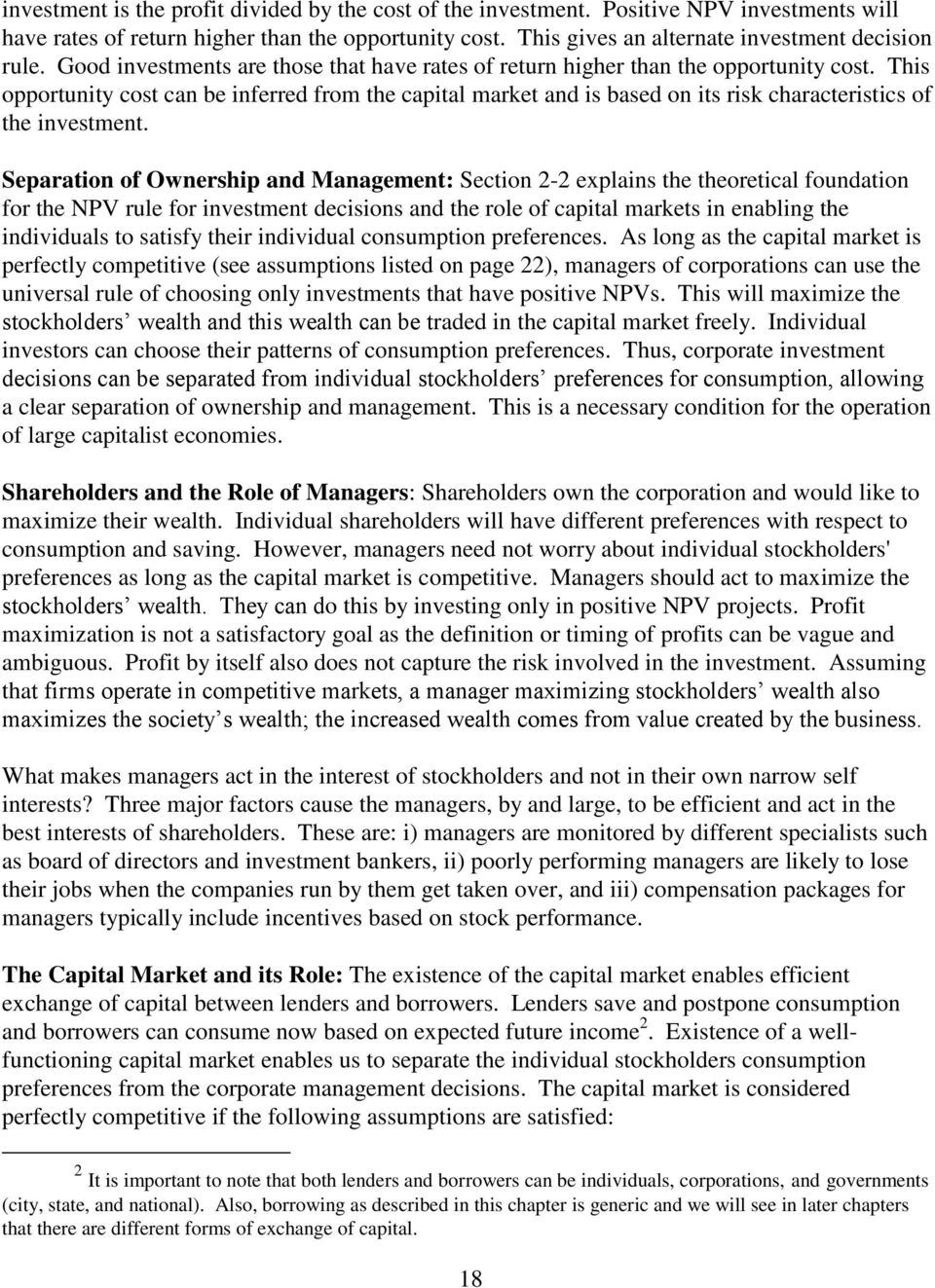
10 investment is the profit divided by the cost of the investment. Positive NPV investments will have rates of return higher than the opportunity cost. This gives an alternate investment decision rule. Good investments are those that have rates of return higher than the opportunity cost. This opportunity cost can be inferred from the capital market and is based on its risk characteristics of the investment. Separation of Ownership and Management: Section 2-2 explains the theoretical foundation for the NPV rule for investment decisions and the role of capital markets in enabling the individuals to satisfy their individual consumption preferences. As long as the capital market is perfectly competitive (see assumptions listed on page 22), managers of corporations can use the universal rule of choosing only investments that have positive NPVs. This will maximize the stockholders wealth and this wealth can be traded in the capital market freely. Individual investors can choose their patterns of consumption preferences. Thus, corporate investment decisions can be separated from individual stockholders preferences for consumption, allowing a clear separation of ownership and management. This is a necessary condition for the operation of large capitalist economies. Shareholders and the Role of Managers: Shareholders own the corporation and would like to maximize their wealth. Individual shareholders will have different preferences with respect to consumption and saving. However, managers need not worry about individual stockholders' preferences as long as the capital market is competitive. Managers should act to maximize the stockholders wealth. They can do this by investing only in positive NPV projects. Profit maximization is not a satisfactory goal as the definition or timing of profits can be vague and ambiguous. Profit by itself also does not capture the risk involved in the investment. Assuming that firms operate in competitive markets, a manager maximizing stockholders wealth also maximizes the society s wealth; the increased wealth comes from value created by the business. What makes managers act in the interest of stockholders and not in their own narrow self interests? Three major factors cause the managers, by and large, to be efficient and act in the best interests of shareholders. These are: i) managers are monitored by different specialists such as board of directors and investment bankers, ii) poorly performing managers are likely to lose their jobs when the companies run by them get taken over, and iii) compensation packages for managers typically include incentives based on stock performance. The Capital Market and its Role: The existence of the capital market enables efficient exchange of capital between lenders and borrowers. Lenders save and postpone consumption and borrowers can consume now based on expected future income 2. Existence of a wellfunctioning capital market enables us to separate the individual stockholders consumption preferences from the corporate management decisions. The capital market is considered perfectly competitive if the following assumptions are satisfied: 2 It is important to note that both lenders and borrowers can be individuals, corporations, and governments (city, state, and national). Also, borrowing as described in this chapter is generic and we will see in later chapters that there are different forms of exchange of capital. 18
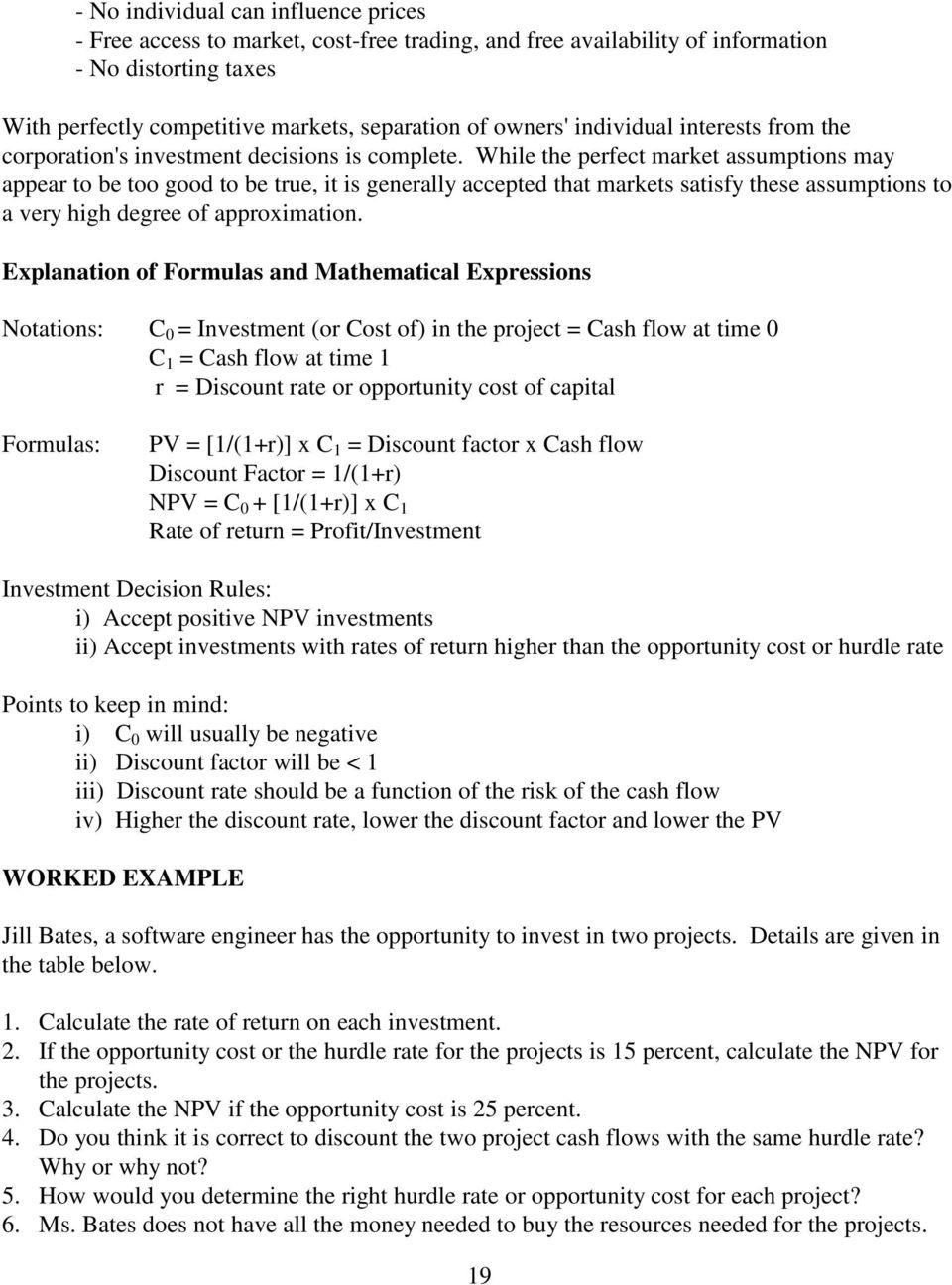
11 - No individual can influence prices - Free access to market, cost-free trading, and free availability of information - No distorting taxes With perfectly competitive markets, separation of owners' individual interests from the corporation's investment decisions is complete. While the perfect market assumptions may appear to be too good to be true, it is generally accepted that markets satisfy these assumptions to a very high degree of approximation. Explanation of Formulas and Mathematical Expressions Notations: C 0 = Investment (or Cost of) in the project = Cash flow at time 0 C 1 = Cash flow at time 1 r = Discount rate or opportunity cost of capital Formulas: PV = [1/(1+r)] x C 1 = Discount factor x Cash flow Discount Factor = 1/(1+r) NPV = C 0 + [1/(1+r)] x C 1 Rate of return = Profit/Investment Investment Decision Rules: i) Accept positive NPV investments ii) Accept investments with rates of return higher than the opportunity cost or hurdle rate Points to keep in mind: i) C 0 will usually be negative ii) Discount factor will be < 1 iii) Discount rate should be a function of the risk of the cash flow iv) Higher the discount rate, lower the discount factor and lower the PV WORKED EXAMPLE Jill Bates, a software engineer has the opportunity to invest in two projects. Details are given in the table below. 1. Calculate the rate of return on each investment. 2. If the opportunity cost or the hurdle rate for the projects is 15 percent, calculate the NPV for the projects. 3. Calculate the NPV if the opportunity cost is 25 percent. 4. Do you think it is correct to discount the two project cash flows with the same hurdle rate? Why or why not? 5. How would you determine the right hurdle rate or opportunity cost for each project? 6. Ms. Bates does not have all the money needed to buy the resources needed for the projects. 19
12 Does that change her decision on the projects? Project Description Investment Payback A B Developing a simple software package for a local bank. Developing a complex software package for an E-Commerce company. The payment for the project will be received in the form of stocks in the company. $12,000 $14,400 $12,000 $20,000 SOLUTION 1. Rate of Return on Project A = ($14,400 - $12,000)/$12,000 = 20 percent Rate of Return on Project B = ($20,000 - $12,000)/$12,000 = 66.7 percent 2. NPV of project A = -$12,000 + ($14,400/1.15) = $ NPV of project B = -$12,000 + ($20,000/1.15) = $5, NPV of project A = -$12,000 + ($14,400/1.25) = - $480 NPV of project B = -$12,000 + ($20,000/1.25) = $4, The two projects appear to have very different risks; project B is more risky and will have a higher hurdle rate. 5. Look at the rates of return on stocks of companies in similar businesses or with comparable risks. 6. Ms. Bates should be able to raise the money needed to invest in the project through the capital market. CHAPTER SUMMARY The chapter introduces the key concepts relating to valuation of corporate assets. Corporate assets are typically not traded in markets, unlike real estate or used cars, and therefore need to be valued using present values of cash flows generated by the assets. Present value of an asset is a function of the cash flow produced by the asset and the riskiness of the cash flow. The chapter also introduces two equivalent rules for investment decisions - the NPV and the rate of return rules. The chapter explains the role of capital market and presents the theoretical basis for the NPV rule. The capital market also forms the basis for the widely practiced separation of ownership from the management of corporations. This allows managers to focus on maximizing 20

13 the corporation's value without worrying about individual stockholders' consumption preferences. LIST OF TERMS Capital market Discount factor Discount rate Hurdle rate Net present value Opportunity cost Present value Rate of return Separation of ownership and management EXERCISES Fill-in-Questions 1. Present value of a cash flow to be received one year from now will when the discount rate increases. 2. Discount factor will generally be than one. 3. If the discount rate is 12 percent, the discount factor for a cash flow received one year from now will be. 4. The NPV rule for investment requires managers to invest only in projects that have NPV. 5. Managers should invest in projects with rates of return than the opportunity cost of capital. 6. A future cash flow is multiplied by the to give its present value. 7. The of an asset is the difference between the PV of its cash flows and its cost. 8. Financial managers will benefit the stockholders if they the individual stockholders consumption preferences and focus only on the NPV of the projects on hand. 9. The expected return from comparable investments in the securities markets gives the for the project. 10. Opportunity cost of capital for a project is on alternate investments of comparable risk. 11. Higher risk projects will have opportunity cost of capital. 21

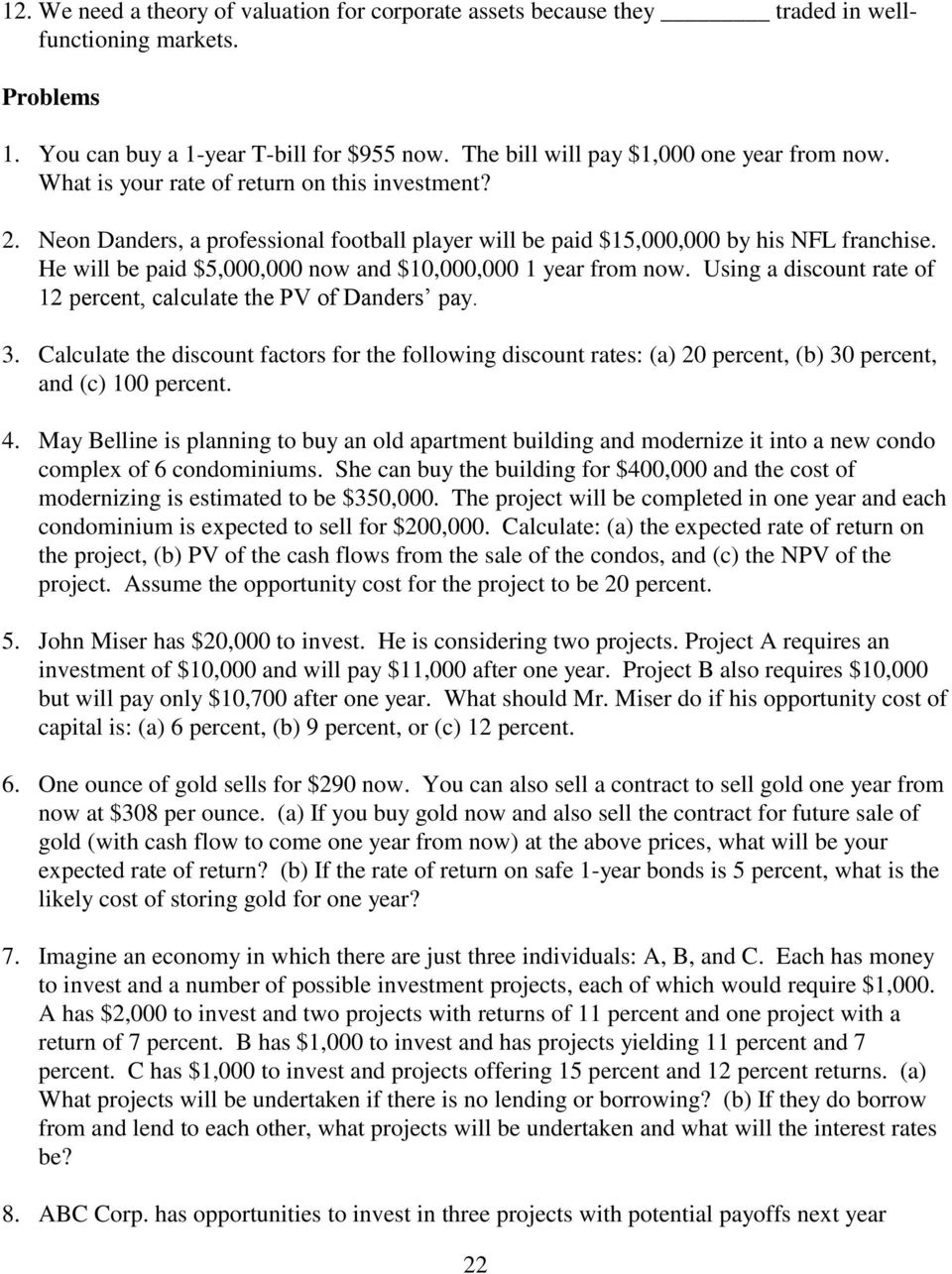
14 12. We need a theory of valuation for corporate assets because they traded in wellfunctioning markets. Problems 1. You can buy a 1-year T-bill for $955 now. The bill will pay $1,000 one year from now. What is your rate of return on this investment? 2. Neon Danders, a professional football player will be paid $15,000,000 by his NFL franchise. He will be paid $5,000,000 now and $10,000,000 1 year from now. Using a discount rate of 12 percent, calculate the PV of Danders pay. 3. Calculate the discount factors for the following discount rates: (a) 20 percent, (b) 30 percent, and (c) 100 percent. 4. May Belline is planning to buy an old apartment building and modernize it into a new condo complex of 6 condominiums. She can buy the building for $400,000 and the cost of modernizing is estimated to be $350,000. The project will be completed in one year and each condominium is expected to sell for $200,000. Calculate: (a) the expected rate of return on the project, (b) PV of the cash flows from the sale of the condos, and (c) the NPV of the project. Assume the opportunity cost for the project to be 20 percent. 5. John Miser has $20,000 to invest. He is considering two projects. Project A requires an investment of $10,000 and will pay $11,000 after one year. Project B also requires $10,000 but will pay only $10,700 after one year. What should Mr. Miser do if his opportunity cost of capital is: (a) 6 percent, (b) 9 percent, or (c) 12 percent. 6. One ounce of gold sells for $290 now. You can also sell a contract to sell gold one year from now at $308 per ounce. (a) If you buy gold now and also sell the contract for future sale of gold (with cash flow to come one year from now) at the above prices, what will be your expected rate of return? (b) If the rate of return on safe 1-year bonds is 5 percent, what is the likely cost of storing gold for one year? 7. Imagine an economy in which there are just three individuals: A, B, and C. Each has money to invest and a number of possible investment projects, each of which would require $1,000. A has $2,000 to invest and two projects with returns of 11 percent and one project with a return of 7 percent. B has $1,000 to invest and has projects yielding 11 percent and 7 percent. C has $1,000 to invest and projects offering 15 percent and 12 percent returns. (a) What projects will be undertaken if there is no lending or borrowing? (b) If they do borrow from and lend to each other, what projects will be undertaken and what will the interest rates be? 8. ABC Corp. has opportunities to invest in three projects with potential payoffs next year 22
15 linked to the state of the economy. Each project requires an investment of $3 million. The payoffs for different states of the economy are given below: Project State of the Economy and Project Payoffs Hurdle Rate Recession Normal Boom A $2 million $4 million $6 million 20 percent B $3 million $3.5 million $4 million 10 percent C $1.5 million $4 million $6.5 million 35 percent Calculate the expected cash flows next year, the rate of return, and the NPV for each project. Which project(s) should be accepted by the company? 9. a. Calculate the NPV and rate of return for each of the following investments. Assume that the opportunity cost of capital to be 15 percent for all the investments. Project Initial Cash Flow Cash Flow in Year 1 A -$6,000 $12,000 B -$8,000 $12,000 C -$16,000 $24,000 D -$21,000 $30,000 b. It is learned that all four projects require the use of a team of engineers who are very busy and will be available to work on only one of the four projects. In other words, you can choose only one of the four projects. Which one will you choose? Essay Questions 1. Corporate managers will generally act in the interests of their stockholders. Discuss. 2. Explain why corporate managers need not be concerned with the stockholders individual consumption preferences, even though they are managing the firm on behalf of the 23

16 stockholders. 3. Explain the NPV and rate of return rules for investment decisions. 4. Many of our stockholders are retired and cannot afford to lose any of the value of their savings; therefore, we demand a higher return on our investments than do many other companies. Discuss. 5. Explain how the existence of capital market benefits consumers and businesses. ANSWERS TO EXERCISES Fill-in Questions 1. Decrease 2. Less 3. 1/1.12 = Positive 5. Greater 6. Discount factor 7. NPV 8. Ignore 9. Opportunity cost 10. Rate of return 11. Higher 12. Are not Problems 1. ($1,000-$955)/$955 = 4.71 percent 2. $5,000,000 + PV of $10,000,000 received 1 year from now = $5,000,000 + $10,000,000/1.12 = $13,928, (a) 1/1.2 = (b) 1/1.3 = (c) 1/2 = (a) Rate of return = Profit/Cost; Cost = $750,000; Profit = $1,200,000 - $750,000 = $450,000 Rate of return = $450,000/$750,000 = 60 percent (b) PV of cash flows = $1,200,000/1.20 = $1,000,000 (c) NPV = $1,000,000 - $750,000 = $250, Calculate the NPVs at each cost of capital for both projects. a. NPV of project A at 6% = ($11,000/1.06) - $10,000 = $ NPV of project B at 6% = ($10,700/1.06) - $10,000 = $94.34 Accept both projects. b. NPV of project A at 9% = ($11,000/1.09) - $10,000 = $

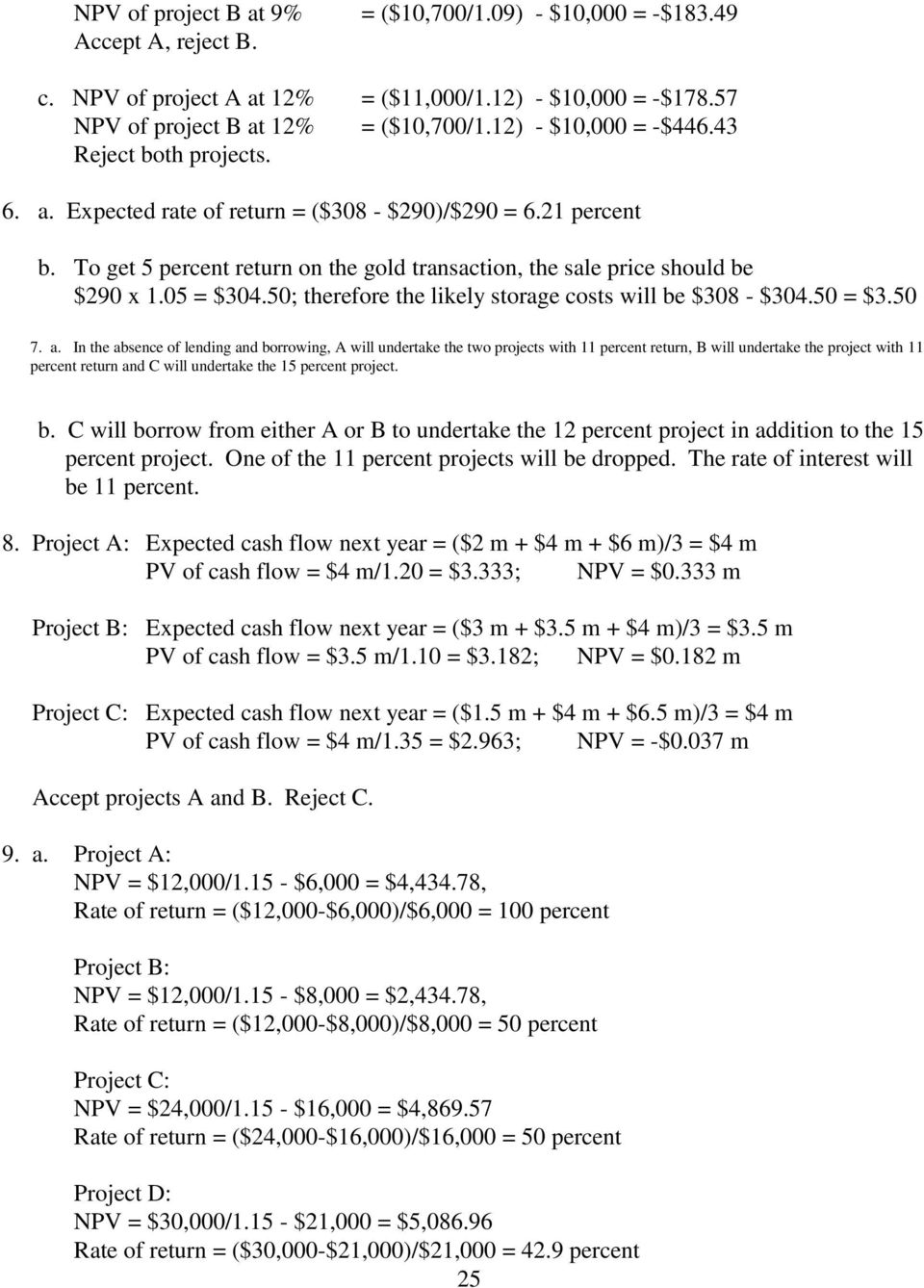
17 NPV of project B at 9% = ($10,700/1.09) - $10,000 = -$ Accept A, reject B. c. NPV of project A at 12% = ($11,000/1.12) - $10,000 = -$ NPV of project B at 12% = ($10,700/1.12) - $10,000 = -$ Reject both projects. 6. a. Expected rate of return = ($308 - $290)/$290 = 6.21 percent b. To get 5 percent return on the gold transaction, the sale price should be $290 x 1.05 = $304.50; therefore the likely storage costs will be $308 - $ = $ a. In the absence of lending and borrowing, A will undertake the two projects with 11 percent return, B will undertake the project with 11 percent return and C will undertake the 15 percent project. b. C will borrow from either A or B to undertake the 12 percent project in addition to the 15 percent project. One of the 11 percent projects will be dropped. The rate of interest will be 11 percent. 8. Project A: Expected cash flow next year = ($2 m + $4 m + $6 m)/3 = $4 m PV of cash flow = $4 m/1.20 = $3.333; NPV = $0.333 m Project B: Expected cash flow next year = ($3 m + $3.5 m + $4 m)/3 = $3.5 m PV of cash flow = $3.5 m/1.10 = $3.182; NPV = $0.182 m Project C: Expected cash flow next year = ($1.5 m + $4 m + $6.5 m)/3 = $4 m PV of cash flow = $4 m/1.35 = $2.963; NPV = -$0.037 m Accept projects A and B. Reject C. 9. a. Project A: NPV = $12,000/ $6,000 = $4,434.78, Rate of return = ($12,000-$6,000)/$6,000 = 100 percent Project B: NPV = $12,000/ $8,000 = $2,434.78, Rate of return = ($12,000-$8,000)/$8,000 = 50 percent Project C: NPV = $24,000/ $16,000 = $4, Rate of return = ($24,000-$16,000)/$16,000 = 50 percent Project D: NPV = $30,000/ $21,000 = $5, Rate of return = ($30,000-$21,000)/$21,000 = 42.9 percent 25
18 All four projects are good investments. b. Since only one of the four projects can be chosen, the right decision will be to choose the project with the highest NPV. Choose Project D. This is an example where the NPV rule and the rate of return rule give different decisions. 136

19 3 How to Calculate Present Values INTRODUCTION This chapter describes the technique for calculating present values. The lessons learned in Chapter 2 form the foundation on which we can build up expertise on calculating present values. We start with the cash flow one year from now and extend the basic approach to the computation of present value of any stream of cash flows. It is very useful to learn short cuts to calculate the present values of three special types of cash-flow streams, which occur often in real life finance problems. These are: - Perpetuity: a fixed payment each year forever - Cash flows growing at a constant rate: payments increasing at a constant rate each year forever - Annuity: a fixed payment each year for a limited number of years The chapter also explains the difference between compound interest and simple interest and the effect of different compounding intervals. Present value calculations can be done in several ways: using the basic formulas, using the tables given in the text provided, or using business calculators. We provide solutions using both the tables and a popular business calculator (the BA II Plus). KEY CONCEPTS IN THE CHAPTER Present Value of a Stream of Cash Flows: We learned in the last chapter that the present value (PV) of a cash flow received one year from now is: PV = C/(1+r); where C is the cash flow and r is the discount rate. PV = DF 1 x C, where DF 1 is known as the discount factor and = 1/(1+r) We can extend this to calculate the PV of any future cash flow. C 2 PV of C 2 received two years from now is = C 2 /(1+r) 2 = DF 2 x PV of a cash flow received t years from now = C t /(1+r) t = DFt x C t ; where DF t = 1/(1+r) t. For a stream of cash flows C 1, C 2, C t received at 1, 2,...t years from now, the present value is the sum of present values of the individual cash flows. 137

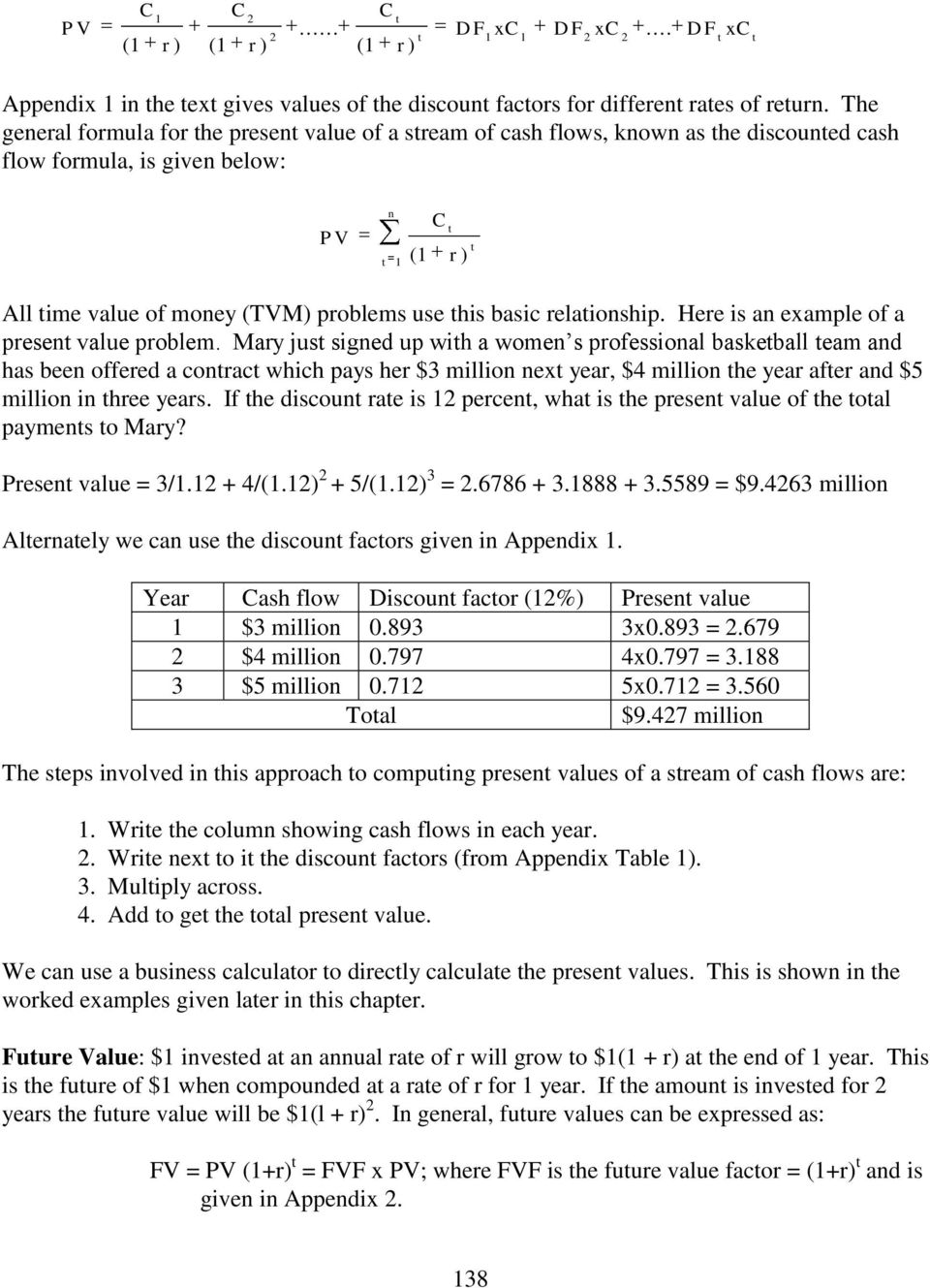
20 PV C C C 1 2 t... ( 1 r ) ( 1 r ) ( 1 r ) DF xc DF xc... DF xc 2 t t t Appendix 1 in the text gives values of the discount factors for different rates of return. The general formula for the present value of a stream of cash flows, known as the discounted cash flow formula, is given below: PV t n 1 C t ( 1 r ) t All time value of money (TVM) problems use this basic relationship. Here is an example of a present value problem. Mary just signed up with a women s professional basketball team and has been offered a contract which pays her $3 million next year, $4 million the year after and $5 million in three years. If the discount rate is 12 percent, what is the present value of the total payments to Mary? Present value = 3/ /(1.12) 2 + 5/(1.12) 3 = = $ million Alternately we can use the discount factors given in Appendix 1. Year Cash flow Discount factor (12%) Present value 1 $3 million x0.893 = $4 million x0.797 = $5 million x0.712 = Total $9.427 million The steps involved in this approach to computing present values of a stream of cash flows are: 1. Write the column showing cash flows in each year. 2. Write next to it the discount factors (from Appendix Table 1). 3. Multiply across. 4. Add to get the total present value. We can use a business calculator to directly calculate the present values. This is shown in the worked examples given later in this chapter. Future Value: $1 invested at an annual rate of r will grow to $1(1 + r) at the end of 1 year. This is the future of $1 when compounded at a rate of r for 1 year. If the amount is invested for 2 years the future value will be $1(l + r) 2. In general, future values can be expressed as: FV = PV (1+r) t = FVF x PV; where FVF is the future value factor = (1+r) t and is given in Appendix
21 Example: I have $121,000 invested in mutual funds as part of my pension plan. How much will this amount accumulate in 15 years if the mutual funds earn an annual return of 12 percent? Future value = $121,000 (1.12) 15 = 121,000 x = $662,354 (5.474 is the future value factor for 12 percent and 15 years given in Appendix 2) Special Streams of Cash Flows: There are three special types of cash flow streams commonly encountered in business and everyday life. Short-cuts are available to compute the present values (and future values) of these special cases. The special cases are discussed next. Perpetuity: We defined perpetuity as a stream of cash flows with fixed payments each year with payments coming forever. Imagine you have $5,000 invested in a bank account and the bank promises to pay you $250 every year as long as you have the money with the bank. The rate of return on this investment is $250/$5,000 = 5%. This can go on forever if you keep the deposit with the bank. Thus, the rate of return on a perpetuity = payment/present value. Or, r = C/PV; PV = C/r Thus, it follows that the present value of a stream of equal payments received each year forever will be simply the payment divided by the rate of return. Alternately, you might prefer to remember that the annual payment is just the principal value times the interest rate ($250 = $5,000 x 0.05, or C = PV x r). Now you can rearrange the expression to get PV = C/r. Example: Early Lawson wants to endow a Chair in the Computer Science Department at Main State University. The University suggests an endowment with an annual income of $75,000. If the endowment investments can earn 8 percent annually, how much should Mr. Lawson donate now? Donation = Annual Payment/Rate of return = $75,000/0.08 = $937,500 Cash flows growing at a constant rate: The present value of a stream of cash flows growing at a constant rate, g, is given by the following formula: PV = C 1 /(r-g), where C 1 is the cash flow to be received one year from now. The formula works as long as r is greater than g. Example: Main State University (refer to the previous example) suggests that the endowment income should be annually adjusted for expected salary growth of 5 percent. How much should the initial endowment be if the first year s income is $75,000 and the estimated rate of return on the investments is 8 percent? Donation = $75,000/( ) = $2,500,000 Annuity: Annuities are truncated perpetuities. Thus the present value of an annuity for 15 years is the difference in the present values of a perpetuity now (first payment at the end of this year) and the present value of another perpetuity with first payment at the end of 15 years. You 139
22 can generalize this approach and get the present value for a t-year annuity as PV (perpetuity A) PV (Perpetuity B), where the payments for A starts next year and payments for B starts at the end of t years. PV ( P erpetuitya ) PV ( P erpetuityb ) C r C r x 1 ( 1 ) r t C(Annuity Factor). PV(Annuity for t years) = PV(Perpetuity A) PV(Perpetuity B) 1 1 C ( t r ( 1 r ) ) = The values of the annuity factors for a range of r and t are given in Appendix 3. This annuity assumes that payments will come at the end of each year and is called ordinary annuity. A stream of cash flows with payments at the beginning of each year is called an annuity due. Since the payments for the annuity due begins one year earlier, the present value of the annuity due will be higher than the present value of an ordinary annuity by a factor of (1+r) or PV (Annuity due) = PV (Ordinary annuity) x (1+r). Typical examples of annuities include mortgage loans and car loans. Please note that these loans are usually structured as monthly annuities. Example: Jane Doe bought a car for $21,000 and financed 90 percent of the purchase price with a loan at an annual interest of 6 percent. Ms. Doe will repay the loan with 48 monthly payments starting next month. What is her monthly payment? PV = C x (Annuity factor), where C is the monthly payment and PV in this case will be the loan amount. C = Loan amount/annuity factor The loan amount = $21,000 x 0.9 = $18,900 Annuity factor = [(1/r) (1/r)(1+r) t ]; r = monthly interest rate = 6/12 = 0.5% Annuity factor = (1/0.005) [1/(0.005x )] = Payment = $18,900/ = $ Simple Interest, Compound Interest, and Present Values: When interest is computed only on the original principal, year after year, the interest is said to accrue as simple interest. When the interest computed for each year (or period, where interest is credited other than on an annual basis) is added to the original principal and earns interest in subsequent periods, you are getting compound interest. A deposit of $100 earning simple interest of 10 percent annually earns only $100 x 0.10 x 5 = $50. If the deposit is earning compound interest, you will earn $100x $100 = $ The difference gets larger and larger as the number of periods increase. For example, $100 deposited at 10 percent annually accumulates to $300 on simple interest, but becomes $ It is obvious that deposits earning compound interest will earn significantly more compared to those earning only simple interest. Most finance problems involve compound interest and unless otherwise stated, it is reasonable to 140
23 assume compound interest. Compounding intervals: Computation of interest requires specifying the frequency of accounting for interest. A 12 percent annual rate of interest can mean different things depending on how frequently the interest is credited (or debited) to the account. If the interest is credited semiannually, you have compounding twice a year. This gives you an effective interest rate of (1 + r/2) 2 1. In general, compounding m times a year gives (1 + r/m) m after 1 year. As m approaches infinity, (1 + r/m) m approaches (2.718) r, which is e r. This is called continuous compounding. $1 invested at a continuously compounded rate of r grows to $e r in 1 year and to $e rt in t years. Appendix Table 4 gives values of e rt. Nominal and Real Interest Rates: Nominal interest rates and cash flows measure what happens in ordinary dollar units, while real rates and cash flows measure what happens in units of purchasing power. The relationship between real and nominal cash flows are given by the equation: Real cash flow = Nominal cash flow/(1+inflation rate) The relationship between nominal interest rate and real interest rate are given by the following equation: 1+r nominal = (1+r real )(1+inflation rate) For example, if the nominal interest rate is 7 percent and inflation rate is 2 percent, the real rate is (1.07/1.02) 1 = 4.9%. Bonds: Bonds are debt instruments issued by corporations and governments. They usually carry regular interest payments, called coupons, and have a stated term or maturity. When you invest in a bond, you receive yearly (or more commonly, half-yearly) coupon payments. At the end of the term of the bond, you will receive the principal or face value of the bond. If we know the required rate of return for the investment in the bond, we can calculate the present value of these payments. The price of the bond should equal the total present value of all the coupon payments and the face value payment. For example, if a 10 percent return is required on a 3-year 6 percent coupon bond with a face value of $1000, the price will equal: PV=60/ / l060/ = $ Conversely, if we know the price, we can compute the return earned on the bond investment. This return is the yield to maturity for the bond or the internal rate of return (discussed in Chapter 10) for the investment in the bond. Most bonds have semi-annual coupons and the yield and price calculations will have to be adjusted for this fact. Summary of Formulas and Mathematical Expressions Formulas: PV = (1/(1+r) t ) x C t = Discount factor x Cash flow Discount Factor = 1/(1+r) t Present value of a stream of cash flows: 141
24 PV n t 1 C t ( 1 r ) t PV of special types of cash flows: PV of a perpetuity = C/r PV of an annuity = C[(1/r) (1/r(1+r) t )] = C[Annuity Factor] Annuity factor = [(1/r) (1/r(1+r) t )] PV of a growing perpetuity = C 1 /(r-g) Relationship between nominal and real interest rates: 1+r nominal = (1+r real )(1+inflation rate) This expression approximates to: r nominal = r real + inflation rate Using a Business Calculator: Business calculators have become a common tool of the business student and are very useful for solving all types of present value problems. While the details of operations differ for the different models, all business calculators share common features, which enable you to solve for the different parameters in typical TVM problems. In this guide, we provide calculator solutions (using Texas Instruments BA II Plus model) in addition to solutions using formulas or the present value tables given in the text. Most business calculators are designed to solve TVM problems in one of two formats: i) the annuity and a single future value format and ii) net present value of uneven cash flows format. The annuity format allows you to calculate any one of five parameters given the other four. The parameters are: present value (PV), future value (FV), payment (PMT), the number of years (periods), and the rate of return or interest rate (I). The NPV format allows direct calculation of NPV or the internal rate of return (IRR) for any stream of cash flows. Example: What is the present value of $1,600 invested for 5 years in an account earning 6 percent annually? Solution: PV = $1,600, FV = Solve, PMT = 0, N = 5, I = 6; Answer: FV = -$2, The calculator shows the answer as a negative number to indicate that the direction of cash flow will be the opposite of the initial flow; i.e. you deposit $1,600 now and you receive $2, five years later. In order to avoid any confusion, from now on, we will follow the convention of using positive numbers for cash inflows and negative numbers for outflows. Example: What is the annual payment which will repay a 3 year, $21,000 loan at an interest rate of 9 percent? Assume equal payments. Solution: This is an annuity problem. PV = $21,000, FV = 0, N=3, I = 9; PMT = Solve = -$8, Example: You have $72,000 in a mutual fund earning an average of 15 percent annual return. What will be the accumulated value of your account at the end of 12 years? Solution: PV = -$72,000, PMT = 0, N= 12, I = 15, FV = Solve = +$385,218 Example: You have $72,000 in a mutual fund earning 15 percent annual return. How many years will it take to accumulate $500,000? Solution: PV = -$72,000, FV = +500,000, PMT = 0, I = 15, N = Solve = years. 142
25 Example: You have $72,000 in a mutual fund. If you want to accumulate $500,000 in 12 years, what annual rate of return should you earn? Solution: PV = -$72,000, FV = +500,000, PMT = 0, N = 12, I = solve = % WORKED EXAMPLES Problem 1: Chien Chen invests $2,500 in a mutual fund where it is expected to earn a return of 12 percent. How much will Chen have in the account at the end of 4 years? Solution using the appendix tables: FV factor from Table 2 for 12 percent, 4 years = 1.574; FV at the end of 4 years = x $2,500 = $ Using calculator: PV = -$2,500, PMT = 0, N = 4, I = 12, FV = solve = +$3, Note: The difference between the two solutions is because of the rounded value for FV factor in the table. The calculator solution is more accurate. Problem 2: Jane Doe wants to create an endowment income of $12,000 a year for her alma mater, but proposes that the first payment not be made until 3 years time. If she can earn a return of 6 percent on her investments, how much should she invest now? Solution using the appendix tables: The present value of the perpetuity will be $12,000/0.06 = $200,000. This amount has to be invested by the end of 2 years so that the first payment of $12,000 will be received at the end of 3 years. PV of this today = PV factor for 6 percent for 2 years x $200,000 = x $200,000 = $178,000. Solution using calculator: FV = +$200,000, PMT = 0, N = 2, I = 6, PV = solve = $177, Problem 3: Mary Corelli borrows $125,000 to buy her home. The loan carries an annual interest of 9 percent and requires 180 equal monthly payments. Calculate the monthly payment. What will be the balance on the loan when she has made 90 payments? Solution using calculator: PV = Loan amount = +$125,000; FV=0, N=180, I = 9/12 = 0.75 PMT = Solve = -$1, To calculate the outstanding balance after 90 payments, calculate the PV for 90 payments (180-90). FV = 0, PMT = -$1,267.83, N = 90, I = 0.75, PV = Solve = $82, (This problem cannot be solved using the appendix tables as the table does include values for the range of interest rate and number of periods needed for the problem. You can calculate the annuity factor for the interest rate of 0.75 percent and 180 periods or 90 periods using the formula: Annuity factor = [(1/r) (1/r(1+r) t )]. The value for 180 periods = , Payment = $125,000/ = $1, The factor for 90 periods = , Loan balance = x$1, = $82,758.26) Problem 4: What is the price of a 10-year, 10 percent coupon bond with a $1,000 face value if investors require a 12 percent return? What is its yield to maturity if its price is $1,100? Assume annual coupon payments. 143
26 Solution using calculator: PMT = Coupon payment = $100, FV = Face value = $1,000, N = 10, I = 12, PV = Price = Solve = $887. Yield to maturity for a price of $1,100: PV = -$1,100, FV = +$1,000, PMT = +$100, N = 10, I = Yield to maturity = solve = 8.48 % Using Appendix Tables: Price of the bond = Coupon payment x annuity factor + Face value x PV factor Annuity factor for 10 years, 12 % interest rate = 5.650, PV factor = Price of the bond = x $ x $1,000 = $887 To find the yield to maturity, you have to find the price at different interest rates and by trial and error get the value closest to $1,100. Price at 9 % = x $ x $1,000 = $1, Price at 8 % = x $ x $1,000 = $1,134. The yield to maturity will be about 11.5%. CHAPTER SUMMARY This chapter completes what was started in chapter 2 and describes the technique calculation of present values of different streams of cash flows. Shortcuts or formulas are developed for special streams of cash flows such as perpetuity, annuity and growing perpetuity. These have wide applications in finance. The chapter also discusses simple and compound interest and compounding frequencies. The present value technique is applied to valuation of bonds. Present value computations are made easier by the tables that give the values for the discount, future value or annuity factors for a range of returns and periods. The text has the following appendices: Table 1. Table 2. Table 3. Table 4. Table 5. Present value of $1 (discount factors) Future value of $1 (future value factors) Present value of an annuity $1 at the end of each year for t years) Future values with continuous compounding Present value of an annuity received as a continuous stream. LIST OF TERMS Annuity Compound interest Continuously compounded rate of interest Coupon rate Discounted-cash-flow (DCF) formula Discount rate Face value Internal rate of return Nominal interest rate Perpetuity Real interest rate Simple interest Yield to maturity EXERCISES 144
27 Fill-in Questions 1. interest is calculated on initial investment only, without reinvestment of interest. 2. The formula for present value is also called the formula. 3. The present value of a future cash flow is calculated by discounting it at the appropriate. 4. interest is calculated on the accumulated amount of the investment, with interest reinvested. 5. A constant stream of cash flows for a limited number of years coming at regular intervals is called a (an). 6. A constant stream of cash flows that go on forever is called a. 7. The interest rate, which is the stated rate in loan and other transactions, is the interest rate. 8. Nominal interest rate less the rate of inflation is the approximate interest rate. 9. The amount of money repaid at the maturity of a bond is the. 10. Most bonds usually pay regular interest payments called the. 11. The principal amount owed on a bond is repaid on its. 12. The rate of return on a bond investment when it is held to maturity is called its. Problems 1. Here are some investments earning different interest rates and invested for different periods. Calculate the accumulated values at the investment period for each one. a. $1,000 invested for 4 years at 8 percent interest. b. $1,000 invested for 8 years at 9 percent. c. $250 invested for 5 years at 7 percent d. $250 invested for 10 years at 7 percent. e. $800 invested for 5 years at an annual rate of 12 percent. f. $800 invested for 5 years at an interest rate of 3 percent every quarter. g. $800 invested for 5 years at an interest rate of 1 percent every month. 2. How long will it take $1,000 to double when it is invested at (a) 3 percent, (b) 5 percent, (c) 10 percent, (d) 12 percent, or (e) 15 percent? 3. How much should I be prepared to pay for (a) $2,000 in 10 years time at an interest rate of
28 percent and (b) $2,000 in 5 years time at an interest rate of 21 percent? 4. An investment of $10,000 will produce income of $2,500 a year for 5 years. Calculate its NPV if the discount rate is 9 percent. 5. An investment costing $4,000 will produce cash flows of $1,500 in year 1, $1,200 in year 2, and $2,000 in year 3. Calculate its net present value at (a) 0 percent, (b) 6 percent, and (c) 12 percent. 6. Mary Jane has already saved $10,000 in a mutual fund account and expects to save an additional $9,000 for each of the next 2 years. She expects to pay $12,000 each at the end of 2 years and 3 years for her son s college education. How much can she afford to spend now on a vacation if she expects to earn (a) 7 percent and (b) 10 percent? 7. I will receive from my late uncle s estate $40 in 1 year s time and annually thereafter in perpetuity. What is the value of this perpetuity at an interest rate of (a) 8 percent and (b) 10 percent? 8. How much is the previous perpetuity worth if it begins in 5 years time instead of 1? 9. I now discover that my uncle s will provides that I receive $40 in 1 year s time and that this amount is to be increased annually at a rate of 6 percent. What is the present value of this growing stream of income at an interest rate of (a) 8 percent and (b) 10 percent? 10. Bollywood Inc. is expected to pay a dividend of $4 next year. The dividends are expected to grow at a constant rate of 8 percent. If the shareholders require a return of 12 percent, what will be the likely price of the stock? 11. Reenbee Construction is expected to pay a dividend of $2 next year. The company s shareholders require a return of 14 percent. If the current share price is $40, what rate of dividend growth must they be expecting? 12. I took a car loan of $20,000 from my bank. The loan carries an annual interest rate of 12 percent and has to be repaid in 30 equal monthly payments. Calculate the monthly payment. 13. I am saving for the deposit to buy a house. I have just invested $1,000 and I expect to save a further $1,000 at the end of each of the next six years. If I invest my savings at 12 percent interest, how much will I have after 6 years? 14. A store offers the following credit terms on a color television set slashed to a price of only $320: only $20 down and 18 monthly payments of $20. (a) Is this an attractive proposition if I can borrow at 1 percent per month? (b) What monthly interest rate is being charged? (c) What annual rate is being charged? 15. How much does $1,000 grow to at continuously compounded interest when invested for (a) 9 years at 6 percent and (b) 6 years at 9 percent? 16. I can get a nominal interest rate of 4 percent on my money market account. If the expected inflation rate is 2 percent, what is the real interest rate I am getting? 146
29 17. Jane wants to save for her 3-year-old daughter s college education. She believes she has 15 years to accumulate the needed $65,000. What is the annual amount she needs to invest in a mutual fund that would give her an annual return of 12 percent? 18. What annually compounded rate is equivalent to an interest rate of 12 percent compounded: (a) semi-annually, (b) quarterly, (c) monthly, (d) weekly (or 52 times a year), (e) daily (365 times a year), and (f) continuously? 19. Value a bond which pays 8 percent coupon, has a face value of $1,000, 10 years till maturity, and the investors require a rate of return of 10 percent. Assume annual coupon payments. 20. If the above bond is selling at a price of $1,070, what is the yield to maturity? 21. An U.S. Treasury bond of 12 years maturity and 9 percent coupon is quoted with a yield to maturity of 8 percent. (a) Calculate its correct price, given that it makes semi-annual coupon payments and the quoted yield is semi-annually compounded. (b) Calculate the (incorrect) price that would have been obtained by assuming annual payments and compounding. ANSWERS TO EXERCISES Fill-in Questions 1. Simple 7. Nominal 2. Discounted-cash-flow 8. Real 3. Discount rate 9. Face value 4. Compound 10. Coupon rate 5. Annuity 11. Maturity date 6. Perpetuity 12. Yield to maturity, internal rate of return. Problems 1. Calculator solutions Using Appendix Table 1 factors N I PV PMT FV = Solve FV Factors Solution a 4 years 8 percent $1360 b 8 years 9 percent $1993 c 5 years 7 percent $ d 10 years 7 percent $$ e 5 years 12 percent $ f 20 quarters 3 percent $ g 60 months 1 percent $ Using the calculator: PV = $1,000, FV = -$2,000, PMT = 0, (a) I = 3, N = solve = years; (b) I = 5, N = solve = years; (c) I = 10, N = solve = 7.27 years; (d) I = 12, N = 147
30 solve = 6.12 years; and (e) I = 15, N = solve = 4.96 years. You can get the approximate answers using Table 1 and looking for the number of years for which the FV factor is close to 2 for each interest rate. 3. a. PV = $2,000, N= 10, I = 10, PMT = 0, FV = solve = -$5, Alternately, using the FV factor from appendix Table 1: factor for 10 years, 10 percent = 2.594, FV = $2,000 x = $5,188 b. PV = 2,000, N= 5, I = 21, PMT = 0, FV = solve = -$5, Alternate solution using table 1: factor for 5 years, 21 percent = 2.594, FV = $2,000 x = $5, You can find the present value of the cash inflows which are in the form of an annuity. Then, subtract the initial investment of $10,000. Using calculator: N = 5, I = 9, PMT = -$2,500, FV = 0, PV = solve = $9, NPV = -$10,000 + $9, = -$ From Table 3, the PV factor for 5 years, p percent = 3.890, PV = $2,500 x = $9,725 NPV = -$10,000 + $9,725 = -$ This problem can be most easily solved using the calculator s cash flow work sheet and the NPV function. Enter the cash flows as follows: CF 0 = -$4,000 (Initial cash flow), CO 1 = $1,500, FO 1 = 1 (This indicates that this cash flow occurs only once) CO 2 = $1,200, FO 2 = 1 CO 3 = $2,000, FO 3 = 1 Once the cash flow data are entered, you proceed to the NPV function work sheet by pressing the NPV key. Entering the appropriate values for I (discount rate), and going down the work sheet using the down arrow key, you can compute the NPVs. (a) I = 0, NPV = $700; (b) I = 6, NPV = $162.33; and (c) I = 12, NPV = -$ The amount she can afford to spend on her vacation is the difference between the present values of her savings and the college education costs. First calculate the present value of Mary Jane s savings for the next two years (an annuity with two payments) and add this to her current savings of $10,000. a. PV of the 2 year annuity; N = 2, I = 7, PMT = -$9,000, FV = 0, PV = Solve = $16, Total PV of savings = $16, $10,000 = $26, PV of education costs: $12,000 at the end of 2 years: N = 2, I = 7, PMT = 0, FV = -$12,000, PV = Solve = $10, $12,000 at the end of 3 years: N = 3, I = 7, PMT = 0, FV = -$12,000, PV = Solve = 148
31 $9, Total PV of education costs = $10, $9, = $20, Amount she can spend on vacation = $26, $20, = $5, b. PV of the 2 year annuity; N = 2, I = 10, PMT = -$9,000, FV = 0, PV = Solve = $15, Total PV of savings = $15, $10,000 = $25, PV of education costs: $12,000 at the end of 2 years - N = 2, I = 10, PMT = 0, FV = -$12,000, PV = Solve = $9, $12,000 at the end of 3 years - N = 3, I = 10, PMT = 0, FV = -$12,000, PV = Solve = $9, Total PV of education costs = $9, $9, = $19, Amount she can spend on vacation = $25, $19, = $6, a. PV of perpetuity = C/r = $40/0.08 = $500 b. PV of perpetuity = $40/0.10 = $ Using Table 1, PV factor for 5 years, 8 percent = Present value of the perpetuity = x $500 = $ a. This is a growing perpetuity. PC = C/(r-g) = $40/( ) = $2,000 b. If r = 10 percent, PV = $40/( ) = $1, The stock can be valued as a growing perpetuity. Price = $4/( ) = $ Price = Dividend/(r-g) = $40, Dividend = $2, r = 0.14 Solving for g, g = $2/40 = 9 percent 12. Calculator solution: N = 30, I = 1, PV = $20,000, FV = 0, PMT = solve = -$ You can also do this using the Appendix Table 3 interpreting the 12 percent annual interest rate as 1 percent/month and finding the factor for 30 years. Annuity PV factor from Table 3 for 30 periods and 1 percent = Payment = $20,000/25.81 = $ See this as a six year annuity plus an initial $1,000. Using the table you can calculate the PV of the annuity plus the initial $1,000. Then calculate the FV of this amount for six years. Factor from Table 3 for six years, 12 percent = 4.111, PV of annuity = $1,000 x = $4,111 PV of total amount available = $4,111 + $1,000 = $5,111 FV factor from Table 2 for 6 years and 12 percent = FV in six years = $5,111 x = $10, Calculator solution: N = 6, I = 12, PV = -$1,000, PMT = -$1,000, FV = solve = $10,
32 14. a. You are taking a loan of $320-$20 = $300. If your interest rate is 1 percent per month, your payment will be $300 divided by the annuity factor for 18 periods, 1 percent (Table 3). Annuity factor for 18 periods, 1 percent = 16.40; Monthly payment = $300/16.40 = $ Since you are required to pay more than this amount, this is not an attractive proposition. b. For payment of $20/month, the annuity factor has to be = $300/$20 = 15. This is very close to the factor for 18 periods and 2 percent (14.99). So the effective interest being charged is 2 percent/month. Effective annual rate = (1.02) 12 1 = percent. 15. a. and b. The answer for both parts are the same because the product of interest rate (r) and number of years (t) is the same and the future value factor for continuous compounding is given by the formula e rt. The value for the factor from Table 4 = 1.716, FV = $1,000 x = $1, The approximate real interest rate = 4 2 = 2 percent. The exact real rate = (1.04/1.02) 1 = = 1.96 percent 17. This can be solved easily with the calculator as follows: N = 15, I = 12, PV = 0, FV = $65,000, PMT = solve = -$1, Alternately, you can use the Appendix tables to solve this problem in 2 steps. First calculate the PV of $65,000 needed in 15 years. Then find the annual payments that will give you this PV. PV factor for 15 years, 12 percent (Table 1) = PV of $65,000 needed in 15 years = $65,000 x = $11,895 Annuity Factor from Table 3 for 15 years and 12 percent = Annual investments required = $11,895/6.811 = $1, The equivalent annually compounded rate or the effective annual rate (EAR) is given by the formula (1+i/m) m 1, where i is the nominal annual rate or the annual percentage rate (APR) and m is the frequency of compounding. The EAR for the different compounding frequencies is: (a) m = 2, EAR = 12.36%; (b) m = 4, EAR = %; (c) m = 12, EAR = %; (d) m = 52, EAR = %; (e) m = 365, EAR = %; and (f) EAR = e 0.12 = %. 19. Calculator solution: N = 10, I = 10, PMT = $80, FV = $1,000, PV = solve = -$ Using Tables: Value = Coupon Payments x Annuity factor + Face value x PV factor = $80 x $1,000 x = $ Calculator solution: N = 10, PV = -$1,070, PMT = $80, FV = $1,000, I = YTM = 7 percent. 150
33 Using the factors from Tables 1 and 3, you can, by trial and error, get the same result. 21. (a) Calculator solution: N = 2x15=30, I = 4, PMT = $45, FV = $1,000, PV = solve = -$1,086.46; (b) Incorrect price: N = 15, I = 8, PMT = $90, FV = $1,000, PV = solve = -$1, Using the Appendix tables: (a) Price = $45 x ,000 x = $1, (b) Price = $90 x $1,000 x = $1,
34 4 The Value of Common Stocks INTRODUCTION This chapter applies the lessons learned from the last two chapters to valuing stocks and other assets. The chapter begins with a description of market activities related to stock trading and follows this with an explanation of stock valuation. Unlike bonds, stocks do not have specified cash flows; however, the value of a share can be seen as the present value of the dividends paid by the stock. This principle of stock valuation, with some modifications, can be applied to valuing businesses in general. The value of any asset is the present value of the free cash flows or cash flows generated by the asset. The discount rate for computation of the present value should be the required rate of return demanded by the investors for investing in the asset. The chapter describes three equivalent ways of looking at the value of a stock: i) as the present value of future dividends, ii) as the present value of free cash flow, and iii) as present value of current earnings plus the present value of growth opportunities. The current market price of a stock can also be used to estimate the market capitalization rate on the stock. This rate is of practical application in setting rates for regulated utilities and other industries. KEY CONCEPTS IN THE CHAPTER How Stocks are Traded: Corporations issue new shares in the primary market which is essentially a distribution network of investment bankers and brokerage firms, who sell these initial issues to individual investors, mutual funds, and other buyers. Once issued, the stocks trade in the secondary markets. Well-known secondary markets include the New York Stock Exchange (NYSE), the "over-the-counter market" which is a network of dealers displaying prices through the National Association of Security Dealers Automated Quotation system (NASDAQ). The Wall Street Journal and other newspapers publish price, dividend, P/E ratio, and other information on stock market transactions. Valuation of Common Stocks: The value of a share can be derived by evaluating the cash flows generated by the investment. If the stock is expected to pay a dividend of DIV1 at the end of the year and the expected price of the stock at the end of the year is P1, then for an investor requiring a return of r, the price of a stock today is: P 0 D IV 1 ( 1 r ) 152
35 This can be extended to future years, so that the price next year can be written as: P 1 DIV 2 ( 1 r ) Substituting this into the previous equation for P 0 gives: P 0 DIV DIV 1 2 ( 1 r ) ( 1 r ) 2 You can substitute the value for P 2 in terms of D 3 and P 3 and so on. This gives you the value of P 0 as the present value of dividends expected to be paid on that stock. P 0 t D IV ( r ) 1 1 t t The value of a firm will be the present value of all future dividends paid on its current outstanding stock. Future dividends on new stocks issued in later years should not be included. Estimation of Market Capitalization Rate: The expected return, r, is often called the market capitalization rate. All securities in the same risk class are priced to offer the same expected return. If one stock offered a higher return, everyone would rush to buy it, pushing its price up and the expected return down. We can use the valuation of a growing perpetuity learned in Chapter 3 to value a stock for which the dividend is expected to grow at a constant rate. If the expected dividend growth rate is g, then P 0 = DIV 1 /(r-g); this formula requires that r > g. For such a stock, the market capitalization rate r is given by: r D P 1 0 g This is a useful formula to estimate the capitalization rate or the required rate of return on a company s stock. This is the cost of equity for the company. Care has to be taken to see that the estimated growth rate is realistic and closely approximates the market perception of the stock. Regulators use this to estimate the fair rate of return on gas and electric utilities. For companies which have a regular pay out of dividends and reinvestment of remaining earnings, the growth rate can be approximated as: g = return on equity x plow back ratio, where the plow back (or retention) ratio is the fraction of earnings reinvested in the business. 153
36 Some cautionary notes on the estimation of the capitalization rate are in order. As estimates for a single stock may be unreliable, it is better to look at the average of estimates for a number of companies. Remember that the estimated growth rate should reflect long-term average growth rate rather that the current high or low rate. The Relationship Between Price and Earnings: The valuation model derived earlier shows the relationship between dividends and stock price. Investors often classify stocks as growth or income stocks depending on the relative growth of earnings and the earnings-price ratio. A growth stock typically has low earnings price ratio and provides most of the return to investors in the form of capital gains. It is important to note that growth, per se, does not add value; only growth opportunities which have positive net present value are valuable and worth pursuing. Depending on the type of growth opportunities, we consider three cases. a. Zero growth case: In this case, all earnings will be distributed as dividends, therefore DIV 1 = EPS 1, where EPS 1 is the earnings per share. r = DIV 1 /P 0 = EPS 1 /P 0 or the expected return equals dividend yield and earnings price ratio. This is the only case where the earnings price ratio equals the capitalization rate. b. Growth rate is positive but the projects have zero NPV: Part of the earnings are reinvested and (EPS 1 /P 0 ) > (DIV 1 /P 0 ). The investors exchange reduction in current dividends for gain in long-term dividends; however, the return earned is exactly equal to the opportunity cost of capital and there is no gain in value. Again, EPS 1 /P 0 = r. c. A company with positive NPV growth opportunities: In this case, the company s growth adds value and the price of the stock is increased by the investment in the growth opportunities. A dollar of current dividend is traded off for more than one dollar equivalent in future dividends. This growth adds to the value of the company. The relationship among the stock price, earnings and the present value of growth opportunities (PVGO) can be expressed by the following equations: P 0 EPS P 1 EPS r 1 PVG O PVG O r ( 1 ) P 0 0 The earnings price ratio will be less than the capitalization rate if the PVGO is positive. The larger the PVGO as a percentage of the stock price, the more the earnings price ratio will understate the capitalization rate. PVGO is rarely negative as firms are not required to invest in projects with negative NPVs. Typically, the growth stocks will have a higher percentage of their value represented by PVGO and will thus have low earnings price ratios. Price-earnings (P/E) ratios are the inverse of earnings price ratios and are published along with stock price quotations in the newspaper. They are based on the most recent earnings 154
37 announcements rather than next year s earnings. Stocks of companies with high PVGO will show high P/E ratios. This implies higher expected future earnings. Of course, stocks whose current earnings are low may also show high P/E ratios. It should be remembered that high P/E ratios do not mean low cost of capital. It should also be remembered that earnings numbers are influenced by the company s choice of accounting procedures and are unlikely to reflect the amount of money, which could be paid out without affecting its capital value. The P/E ratio can therefore be very misleading, even for comparisons of similar companies. Valuation of a Business Using Discounted Cash Flow: Valuing a business is similar to valuing a stock. Instead of looking at dividends, one has to look at the free cash flow produced by the business. The free cash flow is the cash flow that can be withdrawn from the business each year after meeting all its investment needs. Growing firms typically invest more than the depreciation amount and might even exceed their earnings. During these years their free cash flow will be negative. When the investment needs are less than their earnings, the business generates free cash flow, which is similar to dividends. The value of the business will be the present value of the free cash flows generated by the business. The procedure includes estimating free cash flows to a time horizon when the cash flows follow a steady growth or constant growth pattern. The steps involved in valuation of a business are given below: 1. Estimate free cash flow. Cash flow may be negative in early years of rapid growth. 2. Choose the horizon date. Free cash flows are estimated to the horizon date from which point the cash flows form a simple growth pattern, so that one of the short-cut valuation formulas can be applied. 3. Estimate the horizon value. This may be very sensitive to the assumptions and will have to be cross checked with other criteria or benchmarks such as P/E ratios, market to book ratios of other similar companies, and the year when PVGO becomes zero. WORKED EXAMPLES 1. Estimation of PVGO: ABM Inc. is expected to earn $12 per share next year. The company is expected to distribute dividends of $6 and reinvest the remaining earnings on projects with an average ROE of 24 percent. Its capitalization rate is estimated to be 18 percent. Calculate the stock price, the P/E ratio, and the PVGO. What percentage of the stock price is represented by the PVGO? Dividends next year = DIV 1 = $6 Plowback ratio = ($12-$6)/$12 = 0.50 Growth rate = Plow back ratio x ROE = 0.50 x 0.24 = 0.12 Price = $6/( ) = $100 P/E ratio = $100/$12 = 8.33 PVGO = P (EPS 1 /r) = $100 ($12/0.18) = $33.33 This is percent of the value of the stock. 155
38 An alternate way of estimating the PVGO is to look at the investment made in the first year and its NPV. The $6 invested in the first year earns $6 x 0.24 = $1.44 in perpetuity. PV of this cash flow is $1.44/0.18 = $8, NPV = $8-$6 = $2. Each year the company is making similar investments which are growing at 12 percent. Thus, the PVGO is a growing perpetuity = $2/( ) = $ Dracula and Frankenstein (DF) is an established movie producer that specializes in horror movies. The projected earnings and cash flow for the company are given below. Steven Lucas wants to buy the business and requires a rate of return of 20 percent on his investment. Estimate the value of the business. Dollars million Years Assets Earnings Net Investment Free cash flow Earnings growth from previous period (%) The cash flows start growing at a constant rate of 8 percent from the end of 5 years. At this stage, the business is reinvesting one-third of each year s earnings and is earning a ROE of 24 percent. Therefore, the growth rate = 24 x 1/3 = 8 percent. We can choose 5 years as the horizon. The value of the business at this point is that of a growing perpetuity growing at 8 percent. Horizon Value = Value at the end of five years = 22.4/( ) = $ million Value of the business = Present value of free cash flows PV ( FreeC ashflow s) $69. 21m illion ( 1. 2) ( 1. 2) ( 1. 2) ( 1. 2) CHAPTER SUMMARY This chapter applies the principles of discounted cash flow to valuing stocks and businesses. The cash flows generated by a stock are the dividends and therefore the value of a stock will be the present value of all future dividends paid by it. This does not imply that the return on a stock investment is only in the form of dividends. The value of stock held for one year is the present value of the dividends expected to be received and the expected price at the end of the year. Thus, the return received on a stock investment is the dividend yield and the expected capital gain from the price appreciation. Extending this logic for longer periods will lead to the result that the current price is the present value of all future dividends. Using the simplifying assumption of constant dividend growth, current price of a stock can be derived as the value of a growing perpetuity: P 0 = D 1 /(r-g). The assumption of constant growth 156
39 should be seen as an approximation rather than an exact condition. The formula also gives one a simple approach to estimating market capitalization rate or cost of equity capital from current market price of the stock: r = (D 1 / P 0 ) + g. The stock valuation model can be used to derive the relationship between earnings, growth opportunities, and current stock price. The current price of a stock is the sum of the present value of the current earnings in perpetuity and the present value of growth opportunities or PVGO. This relationship also leads to the result that the earnings price ratio will understate the capitalization rate for companies with significant growth opportunities. The approach used to value stocks is extended to value businesses. In general, the value of a business will be the present value of the free cash flows generated by the business. Free cash flows are similar to dividends and are the earnings less net investments needed to be made in the business to generate the earnings. LIST OF TERMS Cost of equity capital Dividend yield Free cash flow Growth stock Income stock Market capitalization rate Payout ratio Plowback ratio (Retention ratio) Price-earnings ratio (P/E ratio) Primary market Return on equity (ROE) Secondary market EXERCISES Fill-in Questions 1. New York Stock Exchange is an example of a. 2. The market capitalization rate for a firm's common stock is also known as its. 3. The is the return that investors require from investment in a stock or bond. 4. Annual dividend per share/share price =. 5. The proportion of earnings retained in the business is called. 6. New issues of stocks are issued through the, which is a network of investment bankers and brokerage firms. 7. The proportion of earnings paid out as dividends is called. 157
40 8. A firm with significant opportunities to invest in positive net present value projects will have a high ratio. 9. Stocks, which give a high proportion of their return in the form of dividends, are usually called. 10. Stocks, which are expected to have high price appreciation, are known as. 11. The cash generated by a company net of its investment needs is the. 12. The ratio of the net profit earned by a company to the book value of stockholders equity is. Problems 1. JBH Inc. is expected to pay dividends of $2, $3, and $5 for the next three years. Thereafter, the dividends are expected to grow at a constant rate of 8 percent. If the required rate of return is 16 percent, what will be the current stock price? What will be the stock price next year and at the end of three years? 2. M Corp. is expected to pay a dividend of $6 a share next year. The dividends are expected to grow at the rate of 6 percent annually. If the current stock price is $60, what is the implied market capitalization rate? 3. You forecast that ITT will pay a dividend of $2.40 next year and that dividends will grow at a rate of 9 percent a year. What price would you expect to see for ITT stock if the market capitalization rate is 15 percent? 4. If the price of ITT is $30, what market capitalization rate is implied by your forecasts of problem 3? 5. Great Leaps Corp. stock is currently selling at $45. Next year s earnings are expected to be $3. Assuming that the current level of earnings can be maintained without any new investment, calculate the PVGO if the investors require a return of: (a) 10 percent (b) 15 percent. 6. Jack Corp. retains 60 percent of its earnings and invests them at an average return on equity (ROE) of 15 percent. Jill Inc. retains only 30 percent of its earnings but invests them at an average ROE of 25 percent. Which company has the higher P/E ratio? 7. Bear Corp. shares are expected to pay a dividend of $4 next year. The dividends are expected to decrease (because the company s sales are declining on account of an industry wide decline) at the rate of 15 percent annually. If the market capitalization rate is 15 percent, what will be the current stock price? 158
41 8. The current earnings of M & M Corp. are $5 a share, and it has just paid an annual dividend of $2. The company is expected to continue to retain 60 percent of its earnings for the next 3 years and that both earnings and dividends will grow at 20 percent a year over that period. From year 4 on, the payout ratio is expected to increase to 70 percent and the growth rate to fall to 10 percent. If the capitalization rate for this stock is 15 percent, calculate (a) its price, (b) its price-earnings ratio, and (c) the present value of its growth opportunities. 9. Big Bull Corp. is expected to pay dividends of $3, $5, and $7 for the next three years. Thereafter, the dividend is expected to grow at the rate 8 percent. If the market capitalization rate is 16 percent, calculate the current stock price and the stock price for each of the next three years. 10. Calculate the dividend yield and capital gains for each of the next three years for the Big Bull Corp. of problem Mac & Burgers Corp. has the following estimated earnings and net investments. Dollar millions Years Assets Earnings Investments The company will continue a payout ratio of 50 percent beyond year 6 and earn 16 percent on the assets. If the market capitalization rate is 15 percent, estimate the value of the business as the present value of free cash flows. 12. What is the horizon value at the end of year 5? If the industry values for mature companies similar to Mac & Burgers in year 5 are: P/E ratio = 16 and Market-to-book ratio = 1.5. Compare alternate valuation methods to the horizon value estimated using the constant growth model. Essay Questions 1. High P/E ratios imply high growth. Discuss. 2. What is the relationship between earnings price ratio and market capitalization rate? 3. A company's earnings figure represents money, which in principle may be distributed to shareholders. Explain why the stock price represents the present value of dividends rather than earnings. 159
42 4. Some companies have a policy of retaining all earnings and never paying a dividend. Does this invalidate the principle that the stock price equals the present value of future dividends? Discuss. ANSWERS TO EXERCISES Fill-in Questions 1. Secondary market 7. Payout ratio 2. Cost of equity 8. P/E ratio 3. Market capitalization rate 9. Income stocks 4. Dividend yield 10. Growth stocks 5. Plowback (retention) ratio 11. Free cash flow 6. Primary market 12. Return on equity. Problems 1. P 0 = DIV 1 /(1+r) + DIV 2 /(1+r) 2 + DIV 3 /(1+r) 3 + P 3 /(1+r) 3 ; where P 3 = DIV 4 /(r-g) = 5 x 1.08/( ) = $67.50; P 0 = (2/1.16) + (3/ ) + ( )/ = 50.40; P 1 = (3/1.16) + ( )/ = $ r = DIV 1 /P + g = $6/$ = 0.16 = 16% 3. P 0 = DIV 1 /(r-g) = $2.4/( ) = $40 4. r = DIV 1 /P + g = $2.40/$ = 0.17 = 17% 5. (a) PVGO = P EPS 1 /r = $45 - $3/0.10 = $15; (b) PVGO = $45 - $3/0.15 = $25 6. P 0 = EPS 0 (1+g) (payout)/(r-g); g = ROE x plowback; PE ratio = (1+g) (payout)/(r-g) For Jack Corp., P/E ratio = 1.09 x 0.4/(r ). For Jill Inc., P/E ratio = x 0.7/(r ). P/E ratios for Jack Corp. and Jill Inc. are shown for different values of r: r 10% 12% 14% Jack Corp Jill Inc We can solve for the value of r at which the P/E will be same for both companies. The value turns out to be 11.06% and the P/E is P 0 = $4/[0.15-(-0.15)] = $
43 8. DIV 0 = $2, DIV 1 = $2 x 1.2 = $2.40, DIV 2 = $2.40 x 1.2 = $2.88, DIV 3 = $2.88 x 1.2 = 3.46 EPS 4 = $5 x x 1.1 = $9.50, DIV 4 = $9.50 x 0.7 = $6.65, P 3 = $6.65/( ) = $133 P 0 = (2.4/1.15) + ($2.88/ ) + [($ $133)/ ] = $96.09, P/E = $96.09/2 = $48.05 PVGO = $96.09 (EPS 1 /r) = $ ($6/0.15) = $ DIV 4 = $7 x 1.08 = $7.56, P 3 = $7.56/( ) = $94.50, P 0 = $3/ ($5/ ) + [($7 + $94.50)/ ] = $71.33, P 1 = $5/ ($101.5/ ) = $79.74, P 2 = $101.5/1.16 = $ Dividend yield for year 1 = $3/71.33 = 4.21%, Capital gains = (P 2 - P 1 )/P 1 = 11.79% Dividend yield for year 2 = $5/79.74 = 6.27%, Capital gains = 9.73%. From year 3 onwards, the dividend yield will be 8% and the capital gains will also be 8%. The capital gains for a stock with constant growth dividends will always be the growth rate in dividends. 11. The earnings, investments, and free cash flows (in $ millions) for the first 5 years are given in the table below. From year six, the free cash flows are growing at 8 percent. We can calculate the horizon value at the end of year 5 and then discount all cash flows and the horizon value to the present at the market capitalization rate of 15 percent. Years Earnings Investments Free cash flow Value of cash flows from year 6 onwards = Free cash flow 6 )/(r-g) = (5.44x1.08)/( ) = 5.88/0.07 = $84 million Value of the business = PV(Free cash flows) ( 115. ) = $34.88 million ( 115. ) ( 115. ) ( 115. ) 12. Horizon value using free cash flow approach = $84 million Horizon value using the PE ratio = 16 x $5.44 = $87.04 million. Using market-to-book = 1.5 x 68 = $102 million 161
44 162
45 5 Why Net Present Value Leads to Better Investment Decisions than Other Criteria INTRODUCTION Chapters 2 and 3 introduced the concept of the net present value (NPV) and its use for making investment or capital budgeting decisions. This chapter starts with a review of the NPV approach to investment decision making and then presents three other widely used measures. These are: - the payback period, - the book rate of return, and - the internal rate of return (IRR). The chapter describes these methods and their major drawbacks. The measures are inferior to the NPV and should not, with the qualified exception of the IRR, normally be relied upon to provide sound corporate investment decisions. The IRR can provide correct and sound decisions if used properly. The primary reason why a chapter is devoted to these measures is that these are commonly used in corporate practice and are often popular. Hence, you should understand the methods and the pitfalls in their use. The chapter also describes how to take capital budgeting decisions when one is faced with the socalled capital rationing problem. This introduces a fourth method called the profitability index. More complex constraints can be dealt with using a technique called linear programming. KEY CONCEPTS IN THE CHAPTER NPV Basics: The first section gives a review of the net present value method. The NPV represents the value added to the business by the project or the investment. It represents the increase in the market value of the stockholders wealth. Thus, accepting a project with a positive NPV will make the stockholders better off by the amount of its NPV. The NPV is the theoretically correct method to use in most situations. Other measures are inferior because they often give decisions different from those given by following the NPV rule. They will not serve the best interests of the stockholders. Here is a review of the steps involved in calculating NPV, the decision rule for using NPV, and the advantages of NPV. This is followed by similar discussion of each of the other measures. Calculating NPV: Forecast the incremental cash flows generated by the project. Determine the appropriate discount rate, which should be the opportunity cost of capital. Calculate the sum of the present values (PV) of all the cash flows generated by the investment. 163
46 NPV = PV of cash inflows - initial investment. Decision rule and interpretation: Accept projects with NPV greater than zero. For mutually exclusive projects, accept the project with the highest NPV, if the NPV is positive. The NPV represents the value added to the stockholders wealth by the project. The discount rate should reflect the opportunity cost of capital or what the stockholders can expect to earn on other investments of equivalent risk. Advantages: The NPV approach correctly accounts for the time value of money and adjusts for the project s risk by using the opportunity cost of capital as the discount rate. Thus, it clearly measures the increase in market value or wealth created by the project. The NPV of a project is not affected by "packaging" it with another project. In other words, NPV(A+B) = NPV(A) + NPV(B). The NPV is the only measure that provides the theoretically correct measure of a project s value. Payback Period: The payback period is simply the time taken by the project to return your initial investment. The measure is very popular and is widely used; it is also a flawed and unreliable measure. Calculation: The cash flows from each year are added to find out the point in time at which the cumulative cash flows equal the initial investment. Decision rule and interpretation: Accept projects with payback less than some specified period. E.g. Accept projects with payback of 4 years or less. Payback represents the number of years required for the original cash investment to be returned, but the time value of money is ignored. Therefore, it will be misleading to think that all cash flows after payback represent profit. Advantages and disadvantages: It is simple to calculate and easy to comprehend. However, payback period has very limited economic meaning because it ignores the time value of money and the cash flows after the payback period. It can be inconsistent and the ranking of projects may be changed by 164
47 packaging with other projects. Discounted payback is a modified version of the payback measure and uses the discounted cash flows to compute payback. This is an improvement over the traditional payback in that the time value of money is recognized. A project, which has a measurable discounted payback, will have a positive NPV. However, the other disadvantages of payback still apply. It is also not simple anymore. Book Rate of Return (BRR): This is a rate of return measure based on accounting earnings and is defined as the ratio of book income to book assets. Decision rule and interpretation: Accept projects with returns greater than the average return on the book value of the firm, or some external yardstick. Book rate of return depends on the accounting rules followed by the company and not on the cash flows generated by the project. This is extremely unlikely to maximize the stockholders wealth. Advantages and disadvantages: Accounting earnings are reported by firms to the stockholders and the book return measure fits in with the reported earnings and the accounting procedures used by firms. However, the measure suffers from the serious drawback that it does not measure the cash flows or economic profitability of the project. It does not consider the time value of money and gives too much weight to distant earnings. The measure depends on the choice of depreciation method and on other accounting conventions. BRR can give inconsistent ranking of projects and rankings may be altered by packaging. There is very little relationship between the book return and the IRR. Chapter 12 discusses some of the problems of using book returns. Internal (or Discounted-Cash-Flow) Rate of Return (IRR): IRR is defined as the discount rate at which the NPV equals zero. Calculation: It is calculated by trial and error. Follow the steps for calculating the NPV and calculate the NPV for several discount rates. Start with a low discount rate and then calculate the NPV at progressively higher rates till the NPV calculated has a negative value. In general, the NPV will decrease as the discount rate is increased. Plot the NPVs (y-axis) against the discount rate (x-axis). The IRR is that discount rate at which the line crosses the X-axis (NPV=0). Decision rule and Interpretation: 165
48 Accept projects that have an IRR greater than the opportunity cost of capital. IRR is often interpreted as the effective rate of return for the investment made in the project. Strictly, this interpretation is true only for a one-period project. Advantages and Disadvantages: Used properly, the IRR will give the same result as the NPV for independent projects and for projects with normal cash flows. 3 As long as the cost of capital is less than the IRR, the NPV for the project will be positive. IRR can rank projects incorrectly, and the rankings may be changed by the packaging of the projects. For mutually exclusive projects, IRR can give incorrect decisions and should not be used to rank projects. If one must use IRR for mutually exclusive projects, it should be done by calculating the IRR on the differences between their cash flows. IRR can also be misleading in cases where the project cash flow patterns are reverses of the normal project. These projects give cash inflows first, followed by outflows. Thus, it is like borrowing and in such cases, the IRR decision rule should be reversed. The project should be accepted only if the IRR is less than the hurdle rate. Another problem with IRR is that for projects whose cash flows change sign more than once there will have more than one IRR. In such cases, it may not be obvious whether a high IRR is good or bad. One will need to look into the NPV profile (the NPV-discount rate graph) to identify the discount rate range for which the NPV is positive. Modified IRR is an improvement over the IRR and is used to overcome the problem of multiple IRRs. The cash flows that change signs during the project s life are discounted using the opportunity cost of capital and added to the cash flows of other years. This removes the multiple changes of sign. IRR does not allow different discount rates to be used for different time periods', i.e., no account can be taken of the term structure of interest rates. Capital Rationing and Profitability Index: Occasionally, companies face resource constraint or capital rationing. The amount available for investment is limited so that all positive NPV projects cannot be accepted. In such cases, stockholder wealth is maximized by taking up projects with the highest NPV per dollar of initial investment. This approach is facilitated by the profitability index (PI) measure. Profitability index is defined as: NPV/Investment. The decision rule for profitability index is to accept all projects with a PI greater than zero. This rule is equivalent to the NPV rule. The modified rule applied in the case of capital rationing is to accept projects with the highest profitability index first, followed by the one with next highest, and so on till the investment dollars are exhausted. This rule will maximize the NPV and stockholder wealth. If the resource constraint is on some other resources, the profitability index needs to be modified to measure the NPV per unit of the resource that is rationed. When more than one resource is rationed, a more complicated (linear programming) analysis is needed. The profitability index cannot cope with mutually exclusive projects or where one project is contingent on another. 3 Normal projects are projects with initial investment (negative cash flows) followed by a number of positive cash flows. 166
49 Capital constraints are often self-imposed to force divisions to focus on priorities and to weed out projects that stem from over-optimism. Such cases are termed soft rationing. The more serious case of capital rationing is when a firm cannot raise capital to finance all its positive NPV projects. This implies capital market imperfections and is termed hard rationing. The use of NPV and PI is still justified in such cases as long as the firm s stockholders have opportunities to invest in capital markets in projects comparable to the ones taken up by the firm. NPV and Other Criteria: The NPV is superior to other criteria because: i) it is the only measure which considers the time value of money, properly adjusting for the opportunity cost of capital, ii) gives consistent measures of the project s value (i.e. not affected by packaging with other projects), and iii) it clearly measures the value added to the stockholders wealth. However, the other three criteria for the evaluation of projects are found to be popular in corporate practice. If you have to use them, make sure you use them in the best possible way and understand the limitations of them. For example, always compare mutually exclusive projects on the basis of the difference between their cash flows. Remember that it is the cash flows that determine the value of a project. Inadequate forecast of the cash flows can be far more disastrous than using the wrong appraisal technique. Cash flow forecasts are difficult to make and can be expensive. It does not make sense to waste the forecasts by using an inferior method of evaluation. WORKED EXAMPLE Bar Breweries is considering an expansion project with an estimated investment of $1,500,000. The equipment will be depreciated to zero salvage value on a straight-line basis over 5 years. The expansion will produce incremental operating revenue of $400,000 annually for 5 years. The company s opportunity cost of capital is 12 percent. Ignore taxes. Calculate: (a) payback period, (b) book rate of return, (c) NPV, (d) IRR, and (e) profitability index. SOLUTION First calculate the annual earnings and cash flows: Operating revenues = $400,000 Less depreciation = $300,000 Book Income = $100,000 Cash flow = $400,000 a. Payback = $1,500,000/$400,000 = 3.75 years b. Average book income = $100,000, Average book value of investment = ($1,500,000+0)/2 = $750,000 Book rate of return = $100,000/$750,000 = 13.33% c. NPV calculation: Amount Discount factor Present value 167
50 Year 0 Initial investment Years 1 through 5 Cash flow Net Present Value -$1,500,000 $400, $1,500,00 $1,442,000 -$58,000 d. IRR is calculated by trial and error. Calculate the NPV at different discount rates: NPV at 10 percent = $400,000(discount factor for 10%, 5 years) - $1,500,000 = $400,000 x $1,500,000 = $16,400 NPV at 11 percent = $400,000 x $1,500,000 = -$21,600 IRR lies between 10 percent and 11 percent. IRR = 10 +[16,400/(16,400+21,600)] = 10.43% Note: You can obtain the solution directly by using the calculator. PV = -$1,500,000, FV = 0, PMT = $400,000, N = 5, I = IRR = solve = 10.42% e. Profitability Index = NPV/Investment = -$58,000/$1,500,000 = SUMMARY This chapter provides a comparison between the different criteria used to evaluate projects. The chapter begins with a review of the NPV, which has already been introduced in the earlier chapters. This is followed by a detailed discussion of three commonly used, but inferior, criteria for evaluation of capital budgeting projects. The payback period is simply the number of years required to recoup the project s initial investment. Aside from its simplicity, there is not much to be said for the payback; it ignores the time value of money, ignores all cash flows after the payback period, and leads to inconsistent ranking of projects. The book rate of return is an accounting measure and suffers from all the weaknesses inherent in accounting earnings being subject to the relatively arbitrary nature of accounting assumptions. The book return does not use cash flows in its computation. Again, the measure can lead to poor decisions. The internal rate of return or IRR is based on discounted cash flows and can give correct decisions for independent projects. The decision rule is to accept projects with an IRR greater than the cost of capital. Any project that satisfies this rule will have a positive NPV. However, the measure should not be used for selection of the best among mutually exclusive projects. A modified approach is needed to get the correct decision using IRR when selecting among mutually exclusive projects. The approach involves calculating the IRR for the differences in cash flows of the two mutually exclusive projects. NPV is superior to the above as it gives the correct decision and is a direct measure of the value added to the stockholders wealth. The only exception to the superiority of NPV is when the firm is constrained by capital rationing. This implies that the firm cannot finance all positive NPV projects and should therefore choose projects that give the highest NPV for each dollar of investment. The profitability index that is defined as the ratio of NPV to the investment amount is used to achieve this selection. LIST OF TERMS 168
51 Book rate of return Capital rationing Discounted-cash-flow rate of return Discounted payback Internal rate of return Linear programming Mutually exclusive projects Payback period Profitability index EXERCISES Fill-in Questions 1. The is the time it takes an investment to repay its initial investment. 2. The is the time beyond which cash flows could disappear and still leave the project with a positive net present value. 3. The is defined as the book income/book investment. 4. The is the discount rate for which the NPV equals zero. 5. is needed to deal with capital rationing or resource constraint problem spread over more than one year. 6. are competing projects among which only one can be selected. 7. The NPV of the project divided by the investment is called. 8. is another name for the IRR. 9. exists when a firm is constrained by limited availability of funds to invest. Multiple Choice Questions Choose from among the five criteria to which the statement applies. Net present value (NPV), payback (P), book rate of return (BRR), internal rate of return (IRR), or profitability index (PI): 1. Could be misleading if the project cash flow patterns are reversed. 2. Affected by the depreciation method used. 3. Puts too much weight on distant cash flows. 4. May have several values. NPV P BRR IRR PI None 169
52 5. Gives the same accept-reject decisions as NPV on single projects. 6. Works well for single period capital rationing. 7. Ignores cash flows beyond some point. 8. Can use multiple discount rates. 9. Gives consistent rankings even if the projects are packaged together differently. 10. Gives the same decisions as the NPV for independent projects. Problems 1. Black and Company is considering an investment in a new plant which will entail an immediate capital expenditure of $4,000,000. The plant is to be depreciated on a straight-line basis over 10 years to zero salvage value. Operating income (before depreciation and taxes) is expected to be $800,000 per year over the 10-year life of the plant. The opportunity cost of capital is 14 percent. Calculate (a) the book rate of return, (b) the payback and discounted payback periods, (c) NPV, (d) IRR, and (e) the profitability index. There are no taxes. 2. Mary Lee owns a computer reselling business and is expanding her business. The estimated investment for the expansion project is $85,000 and it is expected to produce cash flows after taxes of $25,000 for each of the next 6 years. An alternate proposal involves an investment of $32,000 and after-tax cash flows of $10,000 for each of the next 6 years. The opportunity cost of capital is 13 percent. Calculate (a) payback, (b) book rate of return, (c) IRR, and (d) NPV and advise Mary. 3. Refer to problem 2. Is there an opportunity cost of capital that would make Mary indifferent between the two projects? 4. For each of the following projects, calculate the IRR, NPV, and the profitability index. Assume the cost of capital to be 10 percent. Rank the projects using each criterion. Projects Cash flow in $ (1,000) Year 0 Year 1 Year 2 Year 3 Project A Project B Project C Project D An investment of $100 will produce a level stream of cash flows for T years. Find what level of cash flows will give an IRR of: (a) 12 percent and (b) 14 percent for T = 6 years and T = 10 years. 6. Plymouth and Company is considering the following mutually exclusive investments. 170
53 Calculate the payback, IRR, and the NPV for the two projects. Assume a cost of capital of 13 percent. Which project would you choose? Why do the ranking by the different methods differ? Projects Project cash flows ($1,000s) Year 0 Year 1 Year 2 Year 3 Project A Project B Ruckhouser Corp. has an opportunity cost of capital of 10 percent and the following projects. Assuming theses to be independent projects, select the best project(s) for the company. Explain why all the projects will not be selected. Projects Cash flow in $ (1,000) Year 0 Year 1 Year 2 Year 3 IRR -% Project A Project B Project C Project D Project E Refer to question 7. How would your decision change if the projects were not independent projects? 9. Fingerhaus Inc. is considering a project with an investment of $300,000. The project is expected to generate annual cash flows of $85,000 in the first two years and $100,000 from years 3 to 7. At the end of year 8, the company will have to incur a cash flow of $250,00 to clean up the plant facility. Calculate the NPV and IRR for the project. Assume a cost of capital of 12 percent. 10. M & M Corp. has existing operations that will generate cash flows of $150,000 in year 1 and $200,000 in year 2. If the company makes an investment of $40,000 now, it can expect to receive $230,000 in year 1 and $180,000 in year 2. M & M s cost of capital is 12 percent. Calculate the NPV and IRR of the project. Why is the IRR a poor measure of the project's profitability in this case? 11. Please refer to problem 10 above. M & M Corp. finds that the investment needed for the project is $50,000 instead of $40,000. Evaluate the project. 12. Mickey Minn Corp. is considering the following projects. The company is facing resource constraints and can invest only $800,000 this year. Advice the company. Projects Investment ($1,000s) NPV ($1,000s) IRR (%) 171
54 A B C D E F Essay Questions 1. IRR should never be used to evaluate mutually exclusive projects. Discuss. 2. Why is NPV superior to the other measures of project profitability? 3. IRR, used properly, will give correct decisions. Discuss. 4. How can the problem of capital rationing be handled? Discuss the role and limitations of profitability index as the criterion to be used for projects under capital rationing. 5. Why is the measures payback and book rate of return used in capital budgeting? ANSWERS TO EXERCISES Fill-in Questions 1. Payback period 6. Mutually exclusive projects 2. Discounted payback 7. Profitability index 3. Book rate of return 8. Discounted-cash-flow rate of return 4. Internal rate of return 9. Capital rationing 5. Linear programming Multiple Choice Questions 1. IRR 6. PI 2. None 7. P 3. BRR 8. NPV 4. IRR 9. NPV 5. IRR 10. IRR Problems 1. (a) Operating revenues = $800,000 Less depreciation = $400,
55 Book Income = $400,000 Cash flow = $800,000 Average book income = $400,000 Average book value of investment = ($4,000,000+0)/2 = $2,000,000 Book rate of return = $400,000/$2,000,000 = 20 % (b) Payback period = $4,000,000/$800,000 = 5 years Discounted payback is the number of years needed to get the PV of the cash flows to equal the initial investment. Using the calculator: PV = -$4,000,000, PMT =$800,000, FV = 0, I = 14%, N = solve = Discounted payback = 9.2 years. (c) NPV: Present value of cash flows = $800,000 x = $4,172,800 NPV = $4,172,800 - $4,000,000 = $172,800 Alternately, using the calculator you can find the present value of the cash flows to equal $4,172,892. NPV = $172,892 (N = 10, I = 14, FV = 0, PMT = $800,000, PV = solve = $4,172,892) (d) IRR can be directly obtained by using the calculator: PV = -$4,000,000, PMT = $800,000, FV = 0, N = 10, I = solve = IRR = 15.1% 2. Proposal 1: Payback = $85,000/$25,000 = 3.4 years Book income = $25,000 Depreciation = $25,000 ($85,000/6) = $10,833 Book rate of return = $10,833/$42,500 = 25.5% IRR = 19.1% (PV = -$85,000,FV = 0, PMT = $25,000, N = 6, I = IRR) NPV = present value of cash flows - $85,000 = $99,939 - $85,000 = $14,939 (PMT = $25,000, FV =0, N = 6, I = 13, PV = solve = $99,939) Proposal 2: Payback = $32,000/$10,000 = 3.2 years Book rate of return = $4,667/$16,000 = 29.2% IRR = 21.6 % NPV = $7,975 Mary should choose proposal 1 as it has a higher NPV. IRR, BRR, or the payback should not be used to choose among mutually exclusive projects. 3. The cost of capital at which the two projects will produce the same NPV can be found by calculating the IRR of the difference in cash flows between the two projects. Proposal 1 requires an additional investment of $53,000 and generates extra cash flows of $22,000 for six years. The IRR for this set of cash flows is 17.6 % (PV = -53,000, PMT = 15,000, N = 6, I = IRR). This also means that for any cost of capital below 17.6%, proposal 1 will have a higher NPV. 173
56 4. Project A: IRR = 13.2% (PV = -100, FV = 145, PMT = 0, N = 3, I = IRR) NPV = $8,940 (PV of $145 received 3 years from now is $108.94) Profitability index = 8.94/100 = Project B: IRR = 15%; NPV = $4,545; Profitability index = Project C: IRR = -20% and 50%. The project has two IRRs because of the pattern of cash flows (two sign changes). NPV = / /1.21 = = $9,917 Profitability index = Project D: IRR = 15.9%; NPV = $4,737; Profitability index = 4.737/45 = Ranking of projects: IRR: 1. C 2. D 3. B 4. A (also C) NPV: 1. C 2. A 3. D 4. B PI: 1. D 2. C 3. A 4. B 5. (a) Using the Appendix table 3, the annuity factor for 12% and six years is Cash flow 174
57 = $100/4.111 = $ The factor for 10 years is The cash flow = $100/5.650 = $ (b) Using the calculator: PV = -100, FV = 0, I = 14%, N =6 years, PMT = solve = $ For 10 years, N = 10, PMT = $ Payback for A = /310 = 1.58 years. Payback for B = /260 = 2.31 NPV for A = $37,466; NPV for B = $44,035 IRR for A = 19.7%; IRR for B = 18.7% Based on NPV, the company should choose project B. Payback and IRR rank project A better because of the difference in cash flow patterns. Project A has more of its cash flow in the earlier years. 7. The NPVs for the projects are as follows: Project A = $10,
58 Project B = -$10,898 Project C = $2,585 Project D = -$4,789 Project E = -$13,974 Only projects A and C have positive NPVs. The others are really borrowing projects and should not be selected as the cost of borrowing (IRR) is higher than the opportunity cost of capital. 8. If the projects were mutually exclusive, one would select project A as it has the highest NPV. 9. Using the calculator: CF 0 = -300,000, CO 1 = 85,000, FO 1 = 2, CO 2 = 100,000, FO 2 = 5 CO 3 = -250,000, FO 3 = 1, IRR = solve = 16.6%; NPV: I = 12%, NPV =30, Incremental cash flows are: CF 0 = -40,000, CO 1 = 80,000, CO 2 = -30,000; NPV: I = 12, NPV = $7,512; IRR = 50 % 176
59 11. With an increase of $10,000 in the initial investment, the project s NPV will become negative. NPV = -$2,488; IRR = The profitability index and ranking based on PI for the different projects are: Project PI Ranking Project A Project B Project C Project D Project E Project F Projects D, B, and E should be selected to invest the $800,
60 178
61 6 Making Investment Decisions with the Net Present Value Rule INTRODUCTION This chapter discusses the details and nuts and bolts issues of making investment decisions and applying the NPV rule in practice. Specifically, the chapter focuses on two tasks faced in capital budgeting. The first problem faced by anyone making investment decisions is to determine which items should be included in the cash flow analysis. The answer, of course, is to include all the cash flows relevant or incremental to the project. The chapter describes the items to be included and also excluded. The second problem in the application of the NPV rule to investment decision making relates to the fact that most investment decisions interact with or affect other activities or decisions of the firm. These project interactions have to be carefully sorted out and included in the project analysis and decision. This often requires modifying the NPV rule to consider annual costs or benefits from the project under consideration. A typical example might involve alternative proposals, with different project lives, for the replacement of existing machinery. The proper evaluation in this case will be to compare the alternatives in terms of the equivalent annual costs rather than the total costs for each alternative. This technique finds extensive application in a number of different situations. KEY CONCEPTS IN THE CHAPTER Focus on Cash Flow: Capital budgeting decisions should be based on analysis of cash flows and not accounting earnings. It is important to understand that accounting earnings can differ from cash flows because of the set of rules followed by accountants in classifying income and expenditures. Care has to be taken to ensure that cash flows are counted at the point of time they are received or paid out. This might require more than simple manipulation of accounting numbers. Incremental, After-tax Cash Flow: Project evaluation should be based on after-tax cash flows caused by or incidental to the project. All the cash flows that are created by the project or are changed by the acceptance of the project should be considered. The following are some useful pointers in identifying the relevant cash flows: Incremental, not average: It is easy to confuse between the average cost and incremental cost. What is relevant to the project analysis is the portion of the cost (or revenue) that will change because of the project. Expenses incurred regardless of what happens to the project should not be considered, as they are not affected by the project. All incidental effects: All cash flows flowing out of the decision on the project should be 179
62 included in the project analysis. If the project causes a sales increase in another division s business or an increase in administrative expenses, these should be included in project evaluation. Working capital changes: Changes in working capital (accounts receivable plus inventory minus accounts payable) needs caused by the project are part of the cash flows that should be included. It is easy to ignore these and one has to be careful to account for the changes in inventory, receivables, and accounts payables. The investment in working capital is usually recovered at the end of the project. Sunk costs: Sunk costs are costs already incurred or will be incurred anyway regardless of what happens to the project. These should be ignored as they are not affected by the project decision. Opportunity costs: Opportunity costs of all resources, including managers and other personnel, should be included even if there may not be an explicit cash flow relating to that item. When a project uses a resource already owned by the company, the resource is taken off alternate use. Thus, the execution of the project precludes alternate use of the resource and the project should be charged for the use of the resource. Allocated overheads: Accounting rules followed by companies often included allocated charges for use of services. These are often based on the company s historic costs and experiences and do not bear any direct relationship to the project s actual usage of services or other resources. Thus allocated overheads should be ignored and be counted only to the extent they are actual incremental costs. Financing charges: Interest payments and other financing charges are normally not included in project cash flows. Throughout this chapter, we assume that the project is financed through all equity funds. This enables us to separate investment financing decisions. The effect of financing mix will be built into project evaluation in later chapters through appropriate adjustments to the cost of capital. Depreciation: Depreciation is not a cash flow but has cash flow consequences because it is a deductible expense for tax purposes. Most corporations keep two sets of books one for reporting earnings to stockholders and another for tax returns filed with the Internal Revenue Service (IRS). Our tax laws permit accelerated depreciation for most assets used in business. These are based on notional lives assigned to classes of assets. Table 6.4 in the text gives the depreciation schedules for different classes of assets. The effect of depreciation is to provide a reduction in taxes or tax shield equal to the dollar amount of depreciation multiplied by the marginal tax rate of the company. NPV in Other Currencies: The general principles of finance you learn in this book have universal relevance and applicability. Thus, while an American company will compute its cash flows and NPVs in US dollars, a Japanese firm will do the same using the same principles we 180
63 discuss in this and other chapters, but in the Japanese yen. A German company will have its cash flows in the Euro 4, the new common European currency. Some details will differ, though. For example, nominal interest rates, inflation rates, and the opportunity cost of capital may be different from country to country. The tax rates and depreciation rules are decided by the local governments in each country and can be substantially different. Consistent Treatment of Inflation: Inflation affects both the project cash flows and the opportunity cost of capital used to discount the cash flow. One has to be careful to treat inflation effects consistently and correctly. The opportunity cost of capital estimated from current market costs are nominal costs with inflation effects already built into them. Thus, it is easiest to discount nominal (money) cash flows at a nominal discount rate. Some companies prefer to project cash flows in real terms and discount them at a real rate of interest. The relationship between nominal rates, real rates, and inflation is given by the equation: 1+r nomial = (1+r real )(1+ inflation rate). It is important to be consistent in the treatment of inflation. Either discount nominal cash flows with a nominal rate or discount real cash flows with a real rate; do not mix them. Project Interactions: Most investment decisions involve more than one choice or affect other activities of the business. At the least you can always decide to invest or not to invest, invest now or invest a year from now. Other choices might involve replacing old machinery which still has some useful life left, or choosing between machines with different project lives. Often when one investment proposal is accepted, it means that other alternative proposals must be rejected. These are all choices that are mutually exclusive. While the NPV rule is still useful, it is essential to take a sufficiently broad view of net present value and to remember that the goal is to maximize the present value of the whole company. One useful measure of a project s effective cost or benefit is the equivalent annual cost (EAC) or benefit. The EAC is particularly useful for deciding among similar facilities (such as machines) with different lives and for deciding on when an existing facility should be replaced. Some typical cases of project interactions and approaches to deal with them are discussed below. Optimal timing of investment: The fact that a project has a positive NPV does not mean that it is best undertaken now. It may be even more valuable if undertaken at a later date. The optimal choice of timing is the one that maximizes the NPV. Imagine you have some 5 year vintage whiskey for which you can get $1,000 now or $2,000 if you sell it five years from now. If the present value of $2,000 received 5 years from now is higher than $1,000, it makes sense to wait. It is quite likely that you will get even more than $2,000 if you sell six years later or seven years later. The optimal choice will be the one that gives the highest present value. 4 The Euro has become the common unit of account for eleven European countries from January It will be another three years before you start exchanging actual Euro notes and coins. During this period, each country will have its currency locked into a fixed exchange rate with the Euro. 181
64 Projects with different lives: The basic NPV rule will not provide correct decisions in the evaluation of mutually exclusive projects with different lives. The NPV rule does not take into account the value of a likely replacement project. We can convert the projects costs or benefits into annual equivalents and choose the better alternative. Converting the present value (or NPV) into equivalent annual costs is easy; you simply divide the present value by the appropriate annuity factor. The replacement decision: The capital cost of a new machine can be restated in terms of the equivalent annual cost (EAC). Its optimal life is the one that minimizes its EAC. We can decide whether to replace an existing machine by comparing its cost for the next year (including the loss of salvage value over the year) against the EAC of the new machine. EAC is simple to compute and use in a world of certainty. Inflation can be factored in or do the analysis in real terms. Other important considerations, such as technological changes or other uncertainties, could complicate the problem. The cost of excess capacity: Currently available excess capacity of any resource (plant, computers, or a warehouse) may not be free as increased utilization of the resource (such as a computer) may bring forward the date of future replacement of the facility. It is, therefore, essential to consider the cost (an opportunity cost, really) of the use of this excess capacity and factor that into the project s cash flows. Fluctuating load factors: A large plant may have positive NPV but is justified only if the NPV is higher than another size plant which might be able to do the job well enough. In other words, you have to consider different sizes of investment and choose the size which has the highest (positive) NPV. A new project may affect the value of other investments, sometimes we must work out detailed scenarios to unravel these effects. WORKED EXAMPLES 1. Macaroni and Pizza Inc. is considering a new project which requires an investment of $4 million. The project is expected to generate sales revenue of $1 million in the first year, $2 million in the second year and $3 million for years 3, 4, and 5. The cost of goods sold is expected to be 75 percent of sales revenue. Other costs are expected to be 7 percent of sales in the first year and 5 percent of sales thereafter. The project will need working capital investment of $200,000 in the first year and an additional $100,000 in the second year. The investment in plant ($4 million) will be depreciated using the MACRS schedule for the 5 year class. If the company s opportunity cost of capital is 10 percent, calculate the NPV for the project. Assume that the plant will operate for 6 years, and at the end of 6 years, the plant can be sold for a salvage value of $300,000. The tax rate for the company is 36 percent. 182
65 SOLUTION Cash flows ($1000s) Years Investment and salvage -2, Sales 1,000 2,000 3,000 3,000 3,000 3, Cost of goods sold 750 1,500 2,250 2,250 2,250 2, Other costs Depreciation Pre-tax profit [ ] Tax at 36% of Profit after tax [6-7] Operating cash flow [8+5] Change in working capital Total cash flows [1+9+10] -2, Present value at 10% -2, Net present value -2, = -108 Notes: 1. Salvage value $300,000 less tax of $108,000 = $192, Sugar & Honey Cakes is considering replacing their oven with a new one. They have received two offers. Oven A has an initial cost of $34,000, annual operating costs of $6,000, and an operating life of 4 years. Oven B has an initial cost of $24,000, annual operating costs of $8,000, and operating life of 3 years. Which oven is the better choice? Assume an opportunity cost of capital of 12 percent. SOLUTION Present value of costs for oven A = $34,000 + $6,000 x = $52,222 Equivalent annual cost = $52,222/3.037 = $17,195 Present value of costs for oven B = $24,000 + $8,000 x = $43,216 Equivalent annual cost = $43,216/2.402 = $17,992 A is the better choice as it has lower EAC. (3.037 and are the annuity factors for 4 years and 3 years for discount rate of 12 percent.) 3. Joe Vino inherited a cellar of wines from his aunt. The local wine dealer offered Joe $70,000 for all the entire collection. A sommelier (wine expert) friend of Joe suggested that if he kept the wines for another five years he could sell them for $150,000. If Joe s opportunity cost is 14 percent, what is the best course of action for Joe? SOLUTION Present value of $150,000 received 5 years from now = $150,000/ = $77,
66 Joe will be better off waiting 5 years. SUMMARY This chapter describes the application of the NPV rule to actual project evaluation. The focus is on two key problems faced by anyone engaged in capital budgeting decisions: i) what to discount and ii) how to deal with project interactions. Project evaluation should use incremental after-tax cash flows. Specifically, the evaluator should consider all cash flows incidental to and caused by the project. Care has to be taken to ensure that items like working capital increases are considered and sunk costs are ignored. Treatment of inflation in project evaluation should be consistent and avoid confusion between real and nominal cash flows. If nominal cash flows are used, they should be discounted with a nominal cost of capital. By the same token, real cash flows should be discounted by a real cost of capital. Project interactions can be of several different types. Some typical cases include: optimal timing of investment, project with unequal lives, replacement decision for old machinery with useful life, cost of excess capacity, and fluctuating load factors. For optimal timing, one has to look at the choice which will maximize the NPV. Some of the other problems can be evaluated using the technique of EAC. It is also necessary, in the case of excess capacity, to explicitly recognize the opportunity cost of using the capacity, the cost being early replacement of the resource being used. Evaluation of projects with fluctuating load factors should include explicit consideration of alternatives with different capacities and choosing the one with the highest NPV. The essential point to note in the evaluation of all mutually exclusive projects is the definition of alternative projects available and possible. Also, remember that most projects have interactions that will result in mutually exclusive choices. LIST OF TERMS Accelerated depreciation Equivalent annual cost Net working capital Nominal interest rate Opportunity costs Real interest rate Recovery period class Straight-line depreciation Sunk costs Tax depreciation Tax shield 184
67 EXERCISES Fill-in Questions 1. Costs that occurred in the past and are irrecoverable are called. 2. The cost of a resource for its best alternate use is its. 3. Current assets minus current liabilities equal. 4. An interest rate adjusted for inflation, so that it represents an increase in purchasing power, is called the rate. 5. The stated interest rates in most transactions have no adjustment for inflation and is the rate. 6. Under, the amount of depreciation is the same each year. 7. is the general term for any depreciation method that provides larger deductions in the early years of the asset's life. 8. To work out the after-tax cash flows from an investment, we need to know what is allowed, rather than how it is depreciated for accounting purposes. 9. The tax depreciation allowed for a particular asset depends on which it belongs to. 10. The tax depreciation amount multiplied by the tax rate is called the depreciation. 11. The of equipment is the constant annual charge which, over the life of the equipment, has the same present-value cost as the equipment. Problems 1. Gates Hardware Inc. (GHI) is considering an investment of $5 million in plant and machinery. This is expected to produce sales of $2 million in year 1, $4 million in year 2, and $6 million in year 3. Subsequent sales will increase at the expected inflation rate of 10 percent. The plant is expected to be scrapped after 6 years with a salvage value of $1 million. It is depreciated for tax purposes on a straight-line basis of $1 million per year. Operating costs are expected to be 70 percent of the sales. Working capital requirements are negligible. GHI pays tax at 35 percent. Calculate the expected cash flows in each year and the NPV of the investment when the required rate of return is 16 percent. 185
68 2. Repeat the calculation of problem 1, doing the analysis in real instead of nominal terms. Discount at the approximate real rate of 5.45 percent. 3. How does your analysis of problem 1 change if the new plant qualifies for tax depreciation under the 5-year recovery period class? 4. Garfield Corp. is evaluating an investment project which will cost $40 million and generate taxable revenues of $11 million per year for 7 years. There will be no salvage value at the end of this period. Garfield is currently unsure whether the investment will belong to the 3- year, 5-year, or 7-year recovery period class. Calculate the NPV of the project for each of these three possibilities. Garfield s tax rate is 35 percent and its required return is 15 percent. 5. An investment of $200,000 in a computer is expected to reduce costs by $40,000 a year in perpetuity. However, the prices of computers are predicted to fall at 10 percent a year for the next 5 years. When should the computer be purchased if the cost of capital is 13 percent? 6. The Bluebird Company must choose between machines A and B, which perform exactly the same operations but have different lives of 2 and 3 years, respectively. Machine A costs $30,000 initially and has annual costs of $5,000. Machine B has an initial cost of $40,000 and annual costs of $7,000. If Bluebird s cost of capital is 10 percent, which machine should it choose. 7. A machine costs $100,000. At the end of the first year, $5,000 must be spent on maintenance. Each year, the cost of maintenance rises by 15 percent. How long should the machine be kept before it is scrapped if the opportunity cost of capital is 10 percent? (Assume the machine has a zero salvage value.) 8. XYZ Company is considering whether to replace an existing machine or to spend money on overhauling it. The replacement machine would cost $18,000 and would require maintenance of $1,500 at the end of every year. At the end of l0 years, it would have a scrap value of $2,000 and would not be maintained. The existing machine requires increasing amounts of maintenance each year, and its salvage value is falling as shown below: Year Maintenance Cost $2,000 $3,000 $4,000 $5,000 $5,000 Salvage Value $2,500 $2,000 $1,500 $1,000 0 If XYZ faces an opportunity cost of capital of 15 percent, when should it replace the machine? 9. The acceptance of a particular capital budgeting proposal will mean that a new computer 186
69 costing $200,000 will be purchased in 1 year's time instead of in 3 years' time. This also implies that an extra computer programmer costing $30,000 a year must be hired in year 1 instead of year 3. Work out the present-value cost of these two items when the opportunity cost of capital is 14 percent. 10. Bayerhouser Timber has vast tracts of timber land. One tract in the northwest region has timber ready for harvest and at current market prices will fetch a net revenue of $12 million. If the company waited for 1 year, 2 years, 3 years, and 4 years, the values would be $15 million, $17 million, $18 million, and $19 million respectively. What is the optimal harvesting point for the company if the cost of capital is 15 percent? 11. How will your answer change if you are told that the above estimates for the timber values are real dollars and not nominal dollars and the cost of capital is nominal value with an inflation component of 5 percent? 12. Redo problem 3 in the worked examples by assuming a cost of capital of 16 percent. Essay Questions 1. Project evaluation should consider only incremental after-tax cash flows. What are incremental, after-tax cash flows? 2. Depreciation is not a cash flow and therefore should not be considered in project evaluation. Discuss. 3. "We always allocate a proportion of company overhead to a new project in relation to its payroll requirements. After all, in the long run, there's no difference between average and marginal cost." Discuss. 4. Describe how to work out the economic life of a piece of machinery and how to decide when to replace an existing machine which performs the same function. ANSWERS TO EXERCISES Fill-in Questions 1. Sunk costs 7. Accelerated depreciation 2. Opportunity cost 8. Tax depreciation 3. Net working capital 9. Recovery period class 4. Real interest 10. Tax shield 5. Nominal interest 11. Equivalent annual cost 6. Straight line depreciation Problems 187
70 1. The cash flows and the present values are given in the table below. Cash flows ($1000s) Years Investment and salvage -5, Sales 2,000 4,000 6,000 6,600 7,260 7, Cost of goods sold 1,400 2,800 4,200 4,620 5,082 5, Depreciation 1,000 1,000 1,000 1,000 1, Pre-tax profit [2-3-4] ,178 2, Tax at 35% of Profit after tax [5-6] , Operating cash flow [7+4] 740 1,130 1,520 1,637 1,766 1, Total cash flows [1+8] -5, ,130 1,520 1,637 1,766 2, Present value at 16% -5, Net present value -5, = 103 Notes: 1. Salvage value $1,000,000 less tax of $35,000 = $650, The real cash flows and the present values are given in the table below. Cash flows ($1000s) Years Nomianl cash flows -5, ,130 1,520 1,637 1,766 2,207 (same as in problem 1) 2. Real cash flows 1-5, ,142 1,118 1,097 1, Present value at 5.45% -5, Net present value -5, = 103 Notes: 1. The real cash flows are calculated by the following formula = C t /1.1 t 3. See the table below. Cash flows ($1000s) Years Investment and salvage -5, Sales 2,000 4,000 6,000 6,600 7,260 7, Cost of goods sold 1,400 2,800 4,200 4,620 5,082 5, Depreciation 1,000 1, Pre-tax profit [2-3-4] ,404 1,602 2, Tax at 35% of Profit after tax [5-6] ,041 1, Operating cash flow [7+4] 740 1,340 1,506 1,489 1,617 1, Total cash flows [1+8] -5, ,340 1,506 1,489 1,617 2, Present value at 16% -5, Net present value -5, = The tables below give the cash flows and the NPV for the 3 different scenarios. 188
71 Cash flows ($1000s) 3- Year class 5 year class 7 year class Investment -40,000-40,000-40,000 PV of depreciation tax shield 10,719 9,662 8,778 Net revenues 29,747 29,747 29,747 Net present value , The NPV of purchasing the computer after t years is (-200,000 x 0.90 t + 40,000/0.13)/ This expression takes its maximum value of $114,098 (over integer t) for t = 2 years. 6. Present value of costs for A = $38,678, EAC = $22,286 Present value of costs for B = $57,408, EAC = $23,085 A is cheaper. 7. The maintenance cost at the end of year 1 is $5,000, year 2 is $5,000 x 1.15 = $5,750, and so on. You can calculate the PV of the maintenance costs and the initial investment of $100,000 and convert them into EACs for 5 years, 10 years, and so on. The lowest EAC is for 12 years as shown in the table below. Years kept PV of cost Annuity factor EAC (PV/Ann. Factor) , , , , , $31,512 $24,279 $24,014 $23,931 $24, The present value of total costs of the new machine is $24,663. This converts to an EAC of $ The costs of each year's operation of the old machine (adjusted to the end of each year) are given below. Years Cost of operation How calculated $3,175 $4,250 $5,325 $6,900 ( )x ( )x ( )x ( )x1.15 The old machine should be replaced after 2 years. 9. Present-value cost of change in computer timing = $40,444. Present-value cost of extra programmer = $49,
72 10. The table below gives the present values of harvesting at different years. Dollars in 1000s Years Net revenue Present value at 15 % 12,000 12,000 15,000 13,040 17,000 12,854 18,000 11,835 19,000 10,863 The optimal timing will be to harvest at the end of year The real values will have to be discounted at the real rate of (1.15/1.05) - 1 = 9.5%. The table below gives the present values of harvesting at the end of different years. Dollars in 1000s Years Net revenue Present value at 9.5% 12,000 12,000 15,000 13,699 The optimal harvesting will be at the end of 2 years. 17,000 14,178 18,000 13, Present value of $150,000 received 5 years from now = $150,000/ = $71,417 Joe will be better off waiting 5 years. 19,000 13,
73 7 Introduction to Risk, Return, and the Opportunity Cost of Capital INTRODUCTION Most investors generally dislike uncertainty or risk and agree that a safe dollar is worth more than a risky one. Investors will have to be persuaded to take higher risk by offering higher returns. This chapter is the first of the three chapters, which deal with the risk and return tradeoff, and its implications to incorporate finance and the opportunity cost of capital for investments. The chapter deals with risk as faced by individual investors holding portfolios of securities. Later chapters will connect this to the opportunity cost of capital for corporations. Chapter 7 starts with a detailed description of the historic performance of different securities in the U. S. capital markets. This lesson is used to provide basic benchmarks for risk and return. The chapter also describes how we can measure the risk of securities and the role of diversification in reducing risk. The statistical measures of variance and standard deviation are used to measure the risk of individual securities and portfolios. Individual stocks are more risky than portfolios. As the number of the stocks in a portfolio increases, the risk of the portfolio is reduced. The reduction in risk however levels off once the number of stocks in the portfolio reaches a certain number. Thus, there is a certain level of risk that you can never diversify away. This undiversifiable risk stems from economy-wide perils that affect all businesses; it is called market risk. The risk a security adds to a well-diversified portfolio depends on its market risk. This risk is called beta and finds extensive applications in later chapters. Statistics: This chapter uses some basic statistical concepts and will be easy to follow if you already know some elementary statistics. The text gives all the necessary definitions, but you may want to refresh your memory from a statistics textbook. It will help if you are familiar with the terms such as variance, standard deviation, and covariance, and normal distribution. KEY CONCEPTS IN THE CHAPTER A Historic Lesson in Risk and Return: The chapter begins with a description of the performance of five different classes of securities over the 72-year period from The five portfolios are: the U. S. treasury bills, the long-term U. S. government bonds, long-term corporate bonds, common stocks of large companies represented by the Standard & Poor's 500 (popularly known as the S&P 500), and a portfolio of small firm common stocks. The five portfolios represent different risk classes. The treasury bills are considered risk-less and the benchmark for the safest investment possible. On the other extreme the portfolio of smallcompany stocks has provided the highest historic returns, but has also carried the highest level of risk. The S&P 500 portfolio is considered representative of the stock market as a whole. The portfolio, while comprising only 500 stocks of over 8,000 shares in the market, accounts for 191
74 more than seventy percent of the market value. The historic returns for the Treasury bill portfolio have averaged 3.8 percent in nominal terms compared to the S&P 500 portfolio return of 13 percent and the small-firm portfolio s return of 17.7 percent. These historic averages are often used to estimate required rates of returns or opportunity cost of capital. Use of historic returns: Historic data are often used for valuation or cost of capital estimation. Two types of average measures are calculated from the historic data: the arithmetic average and the geometric mean. The arithmetic average will be higher than the geometric mean and is the appropriate yardstick to use for valuation or cost of capital estimation. Interest rates change frequently, and the expected return on the market will change with them. However, the risk premium on the market (the difference between the market return and the return on the risk-free investment (t-bill) is fairly stable. Therefore, when we wish to estimate today's expected return on the market portfolio, we should take today's treasury-bill yield and add to it the normal risk premium (the long-term average) equities have earned above treasury bills. As an example, the current t-bill yield is about 4.5 percent. The long-term average risk premium is 9.2 percent. Therefore, the expected market return can be estimated as = 13.7 percent. Risk: The idea of risk is a familiar one and implies uncertain outcomes. It also means that there are a number of possible outcomes and some of the outcomes are not desirable. The return from an investment in a stock or a portfolio of common stocks cannot be predicted with any accuracy. It is risky. The use of statistics helps us to analyze this type of risk in a precise way. The spread of past returns gives a good indication of the range of uncertainty about future returns. Hence, the need for the history lesson above. The spread, or the uncertainty of outcomes, is measured by the standard deviation or the variance. The standard deviation of the annual returns on the Standard & Poor's Composite Index over the 72 year period analyzed in the Brealey and Myers text is 20.3 percent compared to only 3.2 percent for the portfolios of treasury bills. The higher risk of the stock portfolio explains its high return, which is 9.2 percent over that of the t-bills. Diversification and Risk: Diversification is an important concept with powerful implications. When stocks are combined into portfolios, it is observed that the risk of the portfolio decreases as the number of stocks in the portfolio increases. The risk in a diversified portfolio is lower than for a single security because the returns of different stocks do not move perfectly together. Statistically, individual stock returns are less than perfectly correlated. When we hold many stocks, the risks, which are unique to each one, tend to cancel, as they are largely unconnected. Some risks, though, stem from uncertainty about factors, which affect the whole of the market. This market risk cannot be eliminated by diversification and must be borne by investors, and investors can expect to earn a higher return for bearing it. Calculation of Portfolio Returns and Risk Measures: The chapter describes how the expected return and standard deviation of a portfolio may be calculated from the characteristics of the 192
75 individual stocks. It also describes how we can calculate the risk that a particular stock adds to an incompletely diversified portfolio. The section on formulas and computations describe the methods. If these seem too complicated to you, the chapter also gives the following useful rule of thumb to the benefits of diversification. The variance of a portfolio consisting of equal holdings of N stocks is equal to: Average covariance + (1/N) (average variance average covariance) The average variance of annual returns on individual stocks is about 1,500, and the average covariance between pairs of stocks is about 400. As N becomes larger, 1/N becomes very small and the significance of the individual variances becomes less and less. Thus, the variance of the portfolio returns gets closer to the average covariance of 400. The standard deviation of the returns from a portfolio is simply the square root of their variance, and would approach 20 percent. Beta: The contribution each security makes to the risk of a well-diversified portfolio depends on the security s covariance with other securities in the portfolio. This will depend on how sensitive it is to the changes in the market portfolio. Beta measures this sensitivity. The average stock return will tend to move up and down nearly in tandem with the market. It will move up 5 percent when the market moves up 5 percent. Of course, sometimes it will go up (or down) more or less than the market. However, on average, it moves one for one with the market. This means that its beta is 1. A stock that is more sensitive to market movements might tend to move twice as far (10 percent) in response to a market rise of 5 percent. Conversely, it would tend to fall 10 percent if the market fell 5 percent. This stock is twice as sensitive as the average, and its beta is 2. The beta of a portfolio is the weighted average of the betas of the stocks included in it. In other words, if a portfolio consists of 30 percent of stocks with betas of 1.5 and 70 percent of stocks with betas of 0.8, the beta of the portfolio is (0.3 x 1.5) + (0.7 x 0.8) = When a portfolio is well diversified, the amount of unique risk it contains is negligible. In this case, the standard deviation of the portfolio will be its beta multiplied by the standard deviation of the return on the market portfolio. This makes beta an important number. Beta measures how much a stock contributes to the risk of a well-diversified portfolio. Diversification and Value Additivity: Diversification is good for individual investors. Since it would be relatively easy for investors to diversify directly by holding a variety of stocks, they have no reason to pay more for the stocks of companies, which are already diversified. This has implications for corporate attempts at diversification for the purpose of risk reduction. The implication is that the value of a project does not depend on how its returns mesh with the returns from other activities of the company, which undertakes it. If the capital market establishes a value PV (A) for asset A and PV (B) for asset B, the market value of a firm that holds only these two assets is: 193
76 PV (AB) = PV (A) + PV (B) This is known as the value-additivity principle. Explanation of Formulas and Mathematical Expressions: The chapter describes a number of formulas for calculating expected returns, standard deviations, variances, and betas of securities and portfolios. Expected return of portfolios: The expected return of a portfolio of stocks is the weighted average of the expected returns on the individual stocks. Expected portfolio return, r p, i.e. given by: r p = x 1 r 1 + x 2 r x n r n where x 1 = proportion of portfolio in stock 1, r 1 = expected return on stock 1, etc. Example: Stocks A, B and C have returns of 12 percent, 16 percent, and 11 percent respectively. What is the expected return of a portfolio which includes 40 percent of its value invested in A, 40 percent in B, and 20 percent in C? Expected return = (0.4 x 12) + (0.4 x 16) + (0.2 x 11) = 13.4 % Portfolio variance: Portfolio variance is not the simple weighted average of the individual standard deviations (unless they are perfectly correlated). The portfolio variance is a function of the individual variances of the different stocks and the covariance of all the pairs of stocks in the portfolio. 2 Portfolio variance = x 1 x 1 x 2 x 1 x 2 2 x 2 x 1 x N x 2 x N x N x 2 x N x 2 x N 2 where, = variance of stock 1 ( is its standard deviation) = covariance between stock 1 and stock 2, = where is the correlation between stock 1 and stock 2. If there are N equal-size holdings (i.e. x t = l/n), portfolio variance = (l/n) 2 [N x average variance + (N 2 - N) average covariance] = average covariance + (1/N) (average variance - covariance) A security s contribution to portfolio risk: From the top row of the portfolio variance calculation: 194
77 Stock l's contribution to risk = x 1 (x 1 x 2 x N ) Proportionate contribution to risk = x 1 P / P where P is its covariance with the portfolio and P2 is the variance of the portfolio. Here P/ P is the sensitivity of stock 1 to changes in portfolio value. Since / M = beta, beta measures a stock's contribution to the risk of the market portfolio. The effect of individual stocks on portfolio risk: The risk of a well-diversified portfolio depends on the market risk of the securities included in the portfolio. Beta ( ) measures the market risk of a stock as its sensitivity to market movements. Stocks with betas greater than one are usually more sensitive (than the average stock) to market movements. Stocks with betas less than one are less sensitive to market movements. The beta of a portfolio is the weighted average of the beta of the securities included in it. That is, P = x x x N N The standard deviation of a well-diversified portfolio is its beta times the standard deviation of the market portfolio. A diversified portfolio of high-beta stocks is therefore more risky than a diversified portfolio of low-beta stocks. Beta is important because it measures how much a stock contributes to the risk of a well-diversified portfolio. WORKED EXAMPLES 1. The Treasury bill rate is 3.5 percent. The market risk premium (the difference between the return on the market portfolio and that on Treasury Bills) has historically been about 9.2 percent, and the standard deviation of annual market returns has been about 20 percent. Flybynight Funds offer you a mutual fund with an expected annual return of 21 percent with a standard deviation of 20 percent. SOLUTION The market portfolio offers an expected return of 12.7 percent ( ) with a standard deviation of 20 percent. The prospective investment seems to offer a greater expected reward with less risk and therefore looks attractive! However, you might want to check out the antecedents of the company. 2. Calculate the standard deviation and expected return for the portfolio given below, and work out how each stock contributes to the portfolio's risk. Stock Percentage Expected Standard Correlation among stocks 195
78 held return deviation Stock 1 Stock 2 Stock 3 Stock Stock Stock SOLUTION To work out the standard deviation of a portfolio, we need to first calculate the covariance between stocks. Covariance ij = i j ij Given below is a table of all the covariances. All values are rounded off to whole numbers. Stocks Stock 1 Stock 2 Stock 3 Stock 1 18x18x1 = x24x0.1 = 43 18x36x0.4 = 259 Stock 2 24x18x0.1 = 43 24x24x1 = x36x0.5 = 432 Stock 3 36x18x0.4 = x24x0.5 = x36x1 = 1296 Notice that this table is symmetric about the diagonal (that is, 12,= 21, 13 = 31,etc.). To get the portfolio covariance, each covariance ( ij ) is multiplied by the percentages held in each of the stocks (x i x j ). The table below gives the values for covariance multiplied by the corresponding x i x j. Stocks Stock 1 Stock 2 Stock 3 Stock 1 0.4x0.4x324 = x0.3x43 = x0.3x259 = 31.1 Stock 2 0.3x0.4x43 = x0.3x576 = x0.3x432 = 38.9 Stock 3 0.3x0.4x259 = x0.3x432 = x0.3x1296 = The portfolio variance is the sum of the values all the cells. Portfolio variance = ( ) = Portfolio standard deviation = = % Portfolio return = (0.4 x 15) + (0.3 x 16) + (0.3 x 20) = 16.8 % The sum of each row in the variance calculation shows how much each stock contributes to the total variance. Contribution by stock 1 = P/ P = ( )/370.9 = 0.24 Contribution by stock 2 = P/ P = ( )/370.9 = 0.26 Contribution by stock 3 = P/ P = ( )/370.9 = 0.50 To get the sensitivity of each stock to changes in the portfolio value or beta of the stock with respect to this portfolio, we need to divide the proportionate contribution by the percentage of 196
79 each stock in the portfolio. 1 = 0.24/0.4 = 0.6, 2 = 0.26/0.3 = 0.87, 1 = 0.50/0.3 = 1.67 (Note that these are betas with respect to this portfolio and not the market.) 3. Bulldog Fund has three stocks in its portfolio. The percentage of each stock held and the beta for each stock are: Stock A 35%, beta = 1.2; Stock B 45%, beta = 0.9, Stock C 20%, beta = 1.8. Calculate the portfolio beta. SOLUTION Portfolio beta = (0.35 x 1.2) + (0.45 x 0.9) + (0.2 x 1.8) = 1.19 SUMMARY This chapter provides the first formal introduction to risk and the measurement of risk. The chapter starts with a succinct description of the history of the U. S. capital market from This history lesson is a useful way to understand the risk-return trade off faced by an investor in the capital market. The market performance provides useful benchmarks of risk and return with the U. S. Treasury bills as the risk-free investment and the market portfolio of common stocks as the risky investment with significantly higher expected return. Later chapters use these benchmarks for modeling the risk and expected return of an investment. The chapter also introduces you to the effects of diversification. Shareholders can, and do, reduce their risk very significantly by diversification. The risk that matters to them is, therefore, the market risk that each security adds to a diversified portfolio. This leads to the risk measure, beta, which is the sensitivity of a security s return to the return on the market portfolio. It is the beta of a security, that determines how much risk that security contributes to a diversified portfolio. Later chapters will revisit beta and it will be a very useful tool in estimating the opportunity cost of capital for investment projects. The value of diversification does not imply that corporations can create shareholder value by diversifying their business assets. The value of a project depends only on its cash flows and its market risk and not on how well its returns relate to the other activities of the company. This implies value additivity: the value of project A and the value of project B combined is simply the sum of value of A and the value of B. LIST OF TERMS Beta ( Market risk Correlation Market risk premium (r m - r f ) Covariance Risk-free rate of return (r f ) Diversification Standard deviation ( 197
80 Expected market return (r m ) Unique risk Expected return Value additivity Market portfolio Variability Market return Variance ( 2 ) EXERCISES Fill-in Questions 1. Combining stocks into a portfolio provides an investor and risk reduction. 2. The difference between the risk free rate and the is called the. 3. Standard & Poor's Composite Index is often regarded as the. 4. Diversification cannot eliminate all risk because all stocks are subject to. 5. The average annual between 1926 and 1997 was 13 percent. 6. Diversification reduces. 7. The principle of means that PV(AB) = PV(A) + PV(B). 8. The of the market as a whole is one. 9. The of the S&P 500 portfolio has averaged about 20 percent over the 72-year period of 1926 to Projects, which have the same risk as the market portfolio, can be evaluated by a discount rate equal to the plus the normal risk premium for the market portfolio. 11. The contribution a stock makes to the portfolio risk is measured by its. 12. is the square of standard deviation. 13. The covariance between two stocks is the product of their standard deviations and the coefficient between them. 14. The variability of a well-diversified portfolio depends almost entirely on the average between individual stocks. Problems 1. S. T. Poor & Company is considering investing in a project which has risk similar to the 198
81 market risk. The current risk free rate as measured by the rate on treasury bills is 4.5% and the average for the last three years was 5.2 percent. The return on the S&P 500 portfolio for the last three years were 22 percent, 32 percent, and 35 percent. Suggest an appropriate discount rate for the project. 2. Stock A has an expected return of 16 percent and standard deviation of 28 percent. Stock B has an expected return of 21 percent and standard deviation of 36 percent. Calculate the expected return and standard deviation of a portfolio which is invested equally in the two stocks if the correlation coefficient between the stock returns is: (a) 1, (b) 0.5, and (c) Refer to the problem 2 above. If the correlation coefficients of stock returns of A and B to the market portfolio were 0.7 and 0.3 respectively and the standard deviation of market returns is 14 percent, what will be the betas for A and B? 4. A portfolio of stocks has risks similar to a portfolio consisting of 40 percent of Treasury bills and 60 percent of Standard & Poor's index. The Treasury bill rate is 5 percent, and you expect a normal risk premium of 9 percent on Standard & Poor's index. What return would you expect from the portfolio of stocks? 5. Refer to problem 4. What will be the beta of the portfolio? 6. Your investment will give a return of either -10 or +30 percent. (a) Calculate the expected return and the standard deviation of return if these outcomes are equally likely. (b) Calculate them if there is a 0.6 probability of the -10 percent return and a 0.4 probability of the +30 percent return. 7. A portfolio consists of the three stocks with betas of 0.8, 1.4, and 1.6. If the portfolio is equally invested in each stock, what is the portfolio beta? 8. The diagram below shows the effect of diversification. Label the diagram with appropriate words for the different letters. A D C 199
82 B 9. Details of the stocks held in a portfolio are given below. Stocks Beta Expected return Percentage held Stock A Stock B Stock C Stock D Calculate the expected return and the beta of this portfolio. 10. Calculate the betas of the following stocks if the standard deviation of the market returns is 14 percent. Stocks Stock P Stock Q Stock R Stock S Standard deviation 18% 24% 38% 42% Correlation coefficient with the market portfolio The average variance of the annual returns from a typical stock is about 1,500, and its average covariance with other stocks is about 400. Work out what this implies for the standard deviation of returns from: (a) a fully diversified portfolio, (b) a portfolio of 64 stocks, (c) a portfolio of 16 stocks, (d) a portfolio of 4 stocks. Assume equal-size holdings of each stock. 12. You hold a portfolio of 16 Stocks, each of which has a variance of 1,500 and a covariance of 400 with the other stocks. One stock comprises 25 percent of your portfolio, and the other stocks are held in equal amounts of 5 percent each. (a) What is the standard deviation of your portfolio? (b) How many stocks held in equal amounts would give approximately the same standard deviation? Essay Questions 1. Corporate diversification is good for the stockholders as it reduces the risk of the firm. Discuss. 2. Why is it that diversification cannot eliminate all the risk? 3. Describe what is meant by the beta of a stock. Why is a stock's beta more important than its 200
83 standard deviation? 4. Is it possible for a company s stocks to have a high standard deviation but a low beta? What kind of industries will this stock belong to? 5. Stockholders of publicly quoted companies do not benefit from corporate diversification since they can diversify for themselves. Discuss under what conditions (if any) this principle extends to the case of a privately held company which is 100 percent owned by a single individual. ANSWERS TO EXERCISES Fill-in Questions 1. Diversification 8. Beta 2. Expected market return, market risk premium 9. Standard deviation 3. Market portfolio 10. Risk free rate 4. Market risk 11. Beta 5. Market return 12. Variance 6. Unique risk 13. Correlation 7. Value additivity 14. Covariance Problems 1. Discount rate = risk-free rate + risk premium = 4.5 percent percent = 13.7 percent 2. Expected return = (0.5 x 16) + (0.5 x 21) = 18.5 percent a. Variance of the portfolio = 0.5 x 0.5 x x 0.5 x 0.5 x 28 x 36 x x 0.5 x 36 2 = 1024, standard deviation = 32 [Since the correlation coefficient is 1, the standard deviation will be the weighted average of the standard deviations of the two stocks. b. Variance = 772, Standard deviation = 27.8 percent. c. Variance = 268, Standard deviation = 16.4 percent. 3. A = (28/14) x 0.7 = 1.4, B = (36/14) x 0.3 = expected return = (0.4 x 5) +0.6 x (5+9) = 10.4 percent 5. Beta of the portfolio = (0.4 x 0) + (0.6 x 1) = 0.6 (The T-bill being risk-free will have beta of zero.) 6. a. Expected return = 10 percent, Standard deviation = 20 percent. 201
84 b. Expected return = 6 percent, Standard deviation = 19.6 percent. 7. Portfolio beta = ( )/3 = A = Portfolio standard deviation, B = Number of stocks, C =Market risk, D = Unique risk 9. Expected return = (0.25 x 14) + (0.18 x 10) + (0.23 x 17) + (0.34 x 19) = percent Portfolio beta = (0.25 x 1.1) + (0.18 x 0.8) + (0.23 x 1.4) + (0.34 x 1.5) = P = (18/14) x 0.7 = 0.9, Q = 0.51, R = 1.36, S = Portfolio variance = Average covariance + (1/N) (Average variance Average covariance). For fully diversified portfolio, N is very large and Portfolio variance = Average covariance. For others substitute the value of N = 64, 16, and 4 to get the answers. a. Standard deviation = Square root of 400 = 20 percent; b percent; c percent; d a. Variance = 510, Standard deviation = percent. b. Variance = (1/N)( ) = 510, Solving for N, N =
85 8 Risk and Return INTRODUCTION Chapter 7 introduced risk and risk measurement. The chapter also showed us how diversification enables an investor to reduce risk, but that there is a limit to risk reduction. Only risk unique to individual securities can be diversified away; the risk that a security bears as part of the overall economic system remains in the portfolio. This risk was termed market risk. This chapter builds on the lessons of chapter 7 and presents formal models linking risk and expected return. The chapter begins with a discussion on portfolio theory pioneered by Harry Markowitz. This theory formed the basis for the most popular and widely used model of risk-return relationship: the Capital Asset Pricing Model or CAPM. The CAPM has some empirical evidence to support the basic conclusions derived from the model. Recently, it has been challenged by other theories that purport to rely on assumptions less restrictive than the ones used by CAPM. The chapter presents three alternate theories to CAPM. While CAPM is far from perfect, it remains the most widely accepted model, primarily because of its relative simplicity and ease of application. KEY CONCEPTS IN THE CHAPTER Portfolio Theory: Stock market returns of individual stocks covering relatively short periods closely approximate the normal distribution. This enables one to describe the entire distribution of the returns in terms of two parameters- the mean and standard deviation. Individual investors are assumed to be risk-averse, meaning that they would like to be compensated for bearing more risk. This also means that they like higher returns and lower risk. The standard deviation of returns measures risk. The portfolio theory gives the basic principles of selecting the optimal portfolio in terms of risk and return. We learned in the last chapter that when two stocks are combined into a portfolio, the risk (standard deviation of the portfolio) is less than the average of the two individual standard deviations. Of course, when combining securities into a portfolio, an infinite number of combinations are possible. But investors would choose only those which are efficient portfolios. Portfolios are considered efficient if, for a given standard deviation, they give the highest return, or for a given return they have the lowest standard deviation. Investors need only consider efficient portfolios, for all other portfolios give them a poor deal. Investors have more than two stocks to choose and we can extend the idea of efficient portfolio to the universe of available securities. All the efficient portfolios can be identified and depending on one s own risk-return preference, an investor can choose the best portfolio of his liking. The technique of quadratic programming can be used to choose the efficient portfolio of 203
86 one s preference. If one were to graph the set of all efficient portfolios selected from all the stocks available it will look like the curve shown in Figure 1. Every investor will only choose a portfolio on this curve. Any choice not on the efficient set will be dominated by a portfolio on the efficient set. The curve BC represents all the available efficient portfolios. Figure 1 Expected Return C B A Standard Deviation Investors choices can be expanded by introducing the possibility of lending or borrowing at the risk-free rate. This will allow the investors to combine investing in the stock portfolios given by the efficient set with lending or borrowing (borrowing can be seen as negative lending). The possibilities are shown in Figure 2. Expected Return Figure 2 S C r f B A Standard Deviation The figure shows that investors can choose along the line starting from the risk-free rate to the portfolio S. If the investor chooses to invest all her money in risk-free lending, she will have the risk-free rate at zero standard deviation. Any point between r f and S will have part of the money invested in the stock portfolio S and the remaining lent at the risk-free rate. Any investor is free to choose points to the right of S. This would mean that the investor is borrowing money at the risk free rate and investing that along with his own money in portfolio S. You can clearly see that regardless of where the investor wants to be, the stock portfolio will be the same, namely the portfolio S. In other words, S is the best of all the efficient portfolios and every investor will be invested in this portfolio. This will also mean that every stock will be held as part of this portfolio. 204
87 An investor's job can be separated into two parts: first, to choose the best (risky) portfolio of stocks S and, second, to combine it with the right amount of lending or borrowing to adjust to the preferred level of risk. This is known as the separation theorem: the job of selecting individual stocks in one s portfolio can be independently of one s risk preference. In a competitive market, there is no reason to concentrate portfolios in particular stocks, and we can identify S as the market portfolio. Everyone holds S. Risk preference only decides what fraction of one s investment goes to S. Capital Asset Pricing Model: Capital Asset Pricing Model (CAPM) is an extension of what we saw in Figure 2. Investing in risky assets such as the market portfolio, S, should carry a premium compared to the risk-free rate. Otherwise, investors will not take the risk. The market portfolio is the basic benchmark of risk in the CAPM. The risk premium on the market portfolio, measured as the difference between the market return and the risk-free rate is called the market risk premium. The beta for the market portfolio is 1. The CAPM postulates a linear relationship between risk and return as shown in Figure 3. Figure 3 shows the security market line (SML). Returns Figure 3 r m SMLS r f Beta The risk of each stock is measured by its beta and the risk premium varies in direct proportion to beta. All stocks will lie along the SML and the expected return on a stock can be calculated by adding the risk premium to the risk-free rate. Expected risk premium = r r f = ( r r ) m f A key implication of the CAPM is that it is the risk of a stock that matters in its contribution to portfolio risk. This is what is measured by beta and it depends on the stock s sensitivity to changes in the value of the market portfolio. Validity of CAPM: Over the years, a lot of research has been done to test the validity of CAPM. Remember, however, the CAPM is a theory about expected returns. We can only measure actual 205
88 returns. This makes it difficult to test the theory as it is conceived. Another problem in testing CAPM is that the market portfolio should include all assets, not just stocks traded in stock exchanges. In practice, most of the tests use stock market indexes such as the S & P 500 as proxies for the market portfolio. One of the best known tests of the CAPM s validity involved analyzing portfolio returns over the period 1931 to The study, conducted by Fischer Black, grouped all New York Stock Exchange stocks into 10 portfolios selected according to the ranking of the betas of their stocks. Every year these portfolios were readjusted, using monthly data from the previous 5 years, so that portfolio 1 always contained the 10 percent of stocks with the lowest betas, portfolio 9 the next 10 percent, up to portfolio 10 with the highest beta stocks. The performance of these portfolios was assessed over the 60-year period. The results showed a strong positive relationship between beta and returns and thus broad support for the CAPM. However, it was found that the security market line was flatter than the theory predicted and it was above the risk-free rate. In recent years, the relationship between beta and the risk premium has been particularly flat. It has been argued that some of these results could be attributed to sampling errors (the realized average returns are not the same as the previously expected ones). There is also evidence that suggests that beta is not the only factor that affects expected returns. Firms, which are small, and ones, which have low market-to-book ratios, seem to provide higher average returns irrespective of their betas. It is difficult to judge the economic significance of these results. The small-firm effect is found to be less in more recent studies. It is also possible that some of the results which cast doubts on the validity of the CAPM can be produced by statistical strategies (known as "data mining"). The supporters of the CAPM believe that the broad conclusions of the theory are valid. Consumption CAPM: The consumption CAPM is an alternate theory to the CAPM. The CAPM assumes that investors are concerned with their wealth and uncertainty about the same. The consumption CAPM holds that risk and expected return should be related to changes in investors aggregate consumption rather than their wealth. Investors wealth is not directly relevant to the stock returns. One need not worry about defining the market portfolio. However, you have to estimate aggregate consumption and its changes. Empirically, it is observed that estimated aggregate consumption changes rather gradually through time. This does not give a good explanation of past average rates of return. In short, the model has not caught on and its practical appeal seems limited. Arbitrage Pricing Theory: The arbitrage pricing theory (APT) was the first serious challenger to CAPM. It does not involve many of the restrictive assumptions of CAPM. It postulates that each stock's return depends on several pervasive macroeconomic factors and the risk premium depends on the factor weights. The general model can be written as: Return = a + b 1 (factor 1) + b 2 (factor 2) + Alternately, the risk premium: r - r f = b 1 (premium 1 ) + b 2 (premium 2 ) + 206
89 The APT is general and has appealing features. The market portfolio has a role in the model and thus we need not be concerned with measuring the same. The model is general and is dependent on the absence of arbitrage opportunities. The model does not specify either the number of factors or identity of these factors. The major problem is that there is little agreement on what the factors are. There have been many empirical attempts at identifying the factors. These have been met with limited success. The APT is still a long way from replacing the CAPM as the primary theory for risk-return relationship. The Three-Factor Model: Eugene Fama and Kenneth French incorporate the small-firm effect and the book-to-market ratio effect seen in empirical studies into a formal risk-return relationship model. The model can be represented as: r - r f = b market (r 1market-factor ) + b size (r size factor ) + b market-to-book (r market-to-book ) The model is a practical extension of CAPM. WORKED EXAMPLES 1. Mr. Hernandez wants to invest $10,000. He has a choice of a risky portfolio, M, of stocks with an expected return of 15 percent and a standard deviation of 18 percent. He can also lend and borrow at the risk-free rate of 6 percent. Show how he can construct a portfolio with standard deviations of (a) 9 percent, (b) 27 percent, and (c) 36 percent. Calculate the expected return for each of these portfolios. SOLUTION Since the standard deviation of lending or borrowing at the risk free rate is zero, the portfolio standard deviation is the fraction invested in M multiplied by its standard deviation. Thus if he invests half of his money ($5,000) in M, the portfolio standard deviation will be: 0.5 x 18 = 9 percent. If he borrows $5,000 and invests $15,000 ($10,000 of his own plus the borrowed $5,000) in M, the standard deviation of his investment portfolio will be 1.5 x 18 = 27 percent. Similarly, to get a portfolio with standard deviation of 36 percent, he will have to borrow $10,000 and invest $20,000 in M. The expected return for each portfolio will be: a. (0.5 x 6) + (0.5 x 15) = 10.5% b. (1.5 x 15) (0.5 x 6) = 19.5 c. (2 x 15) (1 x 6) = 24% 2. The Treasury bill rate is 5 percent and the market portfolio return is expected to be 13 percent. a. What is the market risk premium? b. What is required rate of return on an investment which has a beta of 1.6? c. If the expected return on Joy Wish Corp. stock is 17 percent, what is its beta? 207
90 d. If an investment with a beta of 1.8 were expected to give a return of 19 percent, would you accept it? SOLUTION a. Market risk premium = 13 5 = 8% b. Required rate of return for an investment of beta of 1.6 = (13-5) = 17.8% 17 5 c. Return = 5 + (8) = 17, 8 d. Required rate of return The investment return is less than the required rate of return. Hence, its NPV will be negative. 3. ABC Corp. wishes to use the Fama-French 3-factor model to estimate its cost of equity capital. The company has estimated the following factor sensitivities and factor risk premiums: Factors Factor Factor risk Market factor Size factor Book-tomarket factor Sensitivity premium 5.2 percent 3.2 If the risk free rate is 6 percent, estimate the cost of equity capital for the firm. SOLUTION Risk premium = 1. 5x x x percent Cost of equity capital = = percent. SUMMARY The chapter describes the basic principles of portfolio selection and the theories of which provide formal models of the linkage between risk and return. Risk averse investors choose portfolios based on risk and return. It makes sense to choose only efficient portfolios--portfolios which provide the highest return for a given level of risk. In presence of the possibility of risk-free lending and borrowing, investors will end up choosing the one portfolio that, in combination with risk-free lending/borrowing, gives the best choices regardless of one s own risk preferences. This forms the basis for the widely accepted theory, Capital Asset Pricing Model. The CAPM uses the market portfolio as the basic benchmark for risky investments and the risk of any stock or investment is measured relative to the market portfolio. The risk measure is beta and it reflects the stock s sensitivity to changes in the value of the market portfolio. The risk-return relationship is captured by the security market line and the risk premium on any stock is proportional to its beta
91 The CAPM theory finds some empirical support, though recently questions have been raised about the strict validity of the security market line. Alternate theories of risk-return relationship include the consumption CAPM, the arbitrage pricing theory, and the three-factor model. Each of these theories has intellectual appeal and might someday prove to be a replacement to the CAPM; however for the present the CAPM still rules. The primary attraction of the CAPM is its relative simplicity and ease of practical application. The CAPM should be seen as an approximate and partial explanation of the risk-return trade off faced by the investor. We will find many applications of the CAPM in the later chapters. LIST OF TERMS Arbitrage pricing theory Capital Asset Pricing Model Consumption beta Consumption CAPM Efficient portfolios Expected risk premium Market risk premium Normal distribution Quadratic programming Security market line Three-factor model EXERCISES Fill-in Questions 1. The uses less restrictive assumptions than the CAPM does and postulates that returns are dependent on pervasive macroeconomic factors. 2. The distribution of stock returns when considered over fairly short periods, closely follow. 3. A(n) is a portfolio that gives the highest expected return for a given standard deviation or the lowest standard deviation for a given return. 4. Fama and French proposed the. 5. Optimal portfolio selection can be done using the technique. 6. The relates the risk premium to the sensitivity of the investment to changes in consumption, and this sensitivity measure is called the. 7. The relates the risk premium to sensitivity of the asset s returns to changes in the value of the market portfolio. 8. The expected return on a stock investment, according to CAPM, equals the risk free rate plus. 209
92 9. The difference between the expected market return and the risk-free rate is. 10. According to the CAPM, the expected returns from all investments must plot along the. Problems 1. Pick the better investment from each of the following pairs of portfolios. a. Portfolio A: expected return 14 percent, variance 400. Portfolio B: expected return 13 percent, variance 441. b. Portfolio J: expected return 20 percent, variance 529. Portfolio K: expected return 20 percent, variance 400. c. Portfolio R: expected return 8 percent, variance 225. Portfolio S: expected return 9 percent, variance 225. d. Portfolio X: expected return 12 percent, variance 380. Portfolio Y: expected return 15 percent, variance Calculate the expected return for the following portfolios: a. beta = 1.2 b. beta = 1.8 c. beta = 0.5 d. beta = 0 Assume the risk free rate to be 6 percent and the expected market risk premium to equal 15 percent. 3. Your broker is urging you to invest in one of three portfolios on which the returns are expected to be as follows: portfolio A, 12 percent; portfolio B, 16 percent; portfolio C, 20 percent. You believe these estimates, but you also have sufficient data to calculate the betas of the portfolios with confidence. You find the betas are 0.5 for A, 1.1 for B, and 2.0 for C. Which portfolio is best and why? (Hint: See if you can duplicate portfolio B by some combination of A and C.) 4. Stock J has a beta of 1.2 and an expected return of 15.6 percent, and stock K has a beta of 0.8 and an expected return of 12.4 percent. What must be (a) the expected return on the market and (b) the risk-free rate of return, to be consistent with the capital asset pricing model? 5. Stock A has an expected return of 14 percent and a beta of 1.1. Stock B has an expected return of 18. The risk free rate is 5.2 percent. Assume that stock A is correctly priced (i.e. it is on the security market line). If stock B has a beta of 1.4, is it correctly priced? 6. An alternate form of the CAPM is written as: r = r m. Write a general expression for and find the value for for each of the following cases: (a) beta = 1, (b) beta = 2, and (c) beta = 0. What is the value of beta if = zero? 210
93 7. The return on a proposed investment is expected to be 24 percent. The standard deviation is estimated at 24 percent. The risk free rate is 6 percent. Assume the expected market risk premium to be 9 percent. Assume that the standard deviation of market returns to be 15 percent. If the project correlates fairly highly with the economy, comment on the attractiveness of the project. 8. You are told that MM Inc. stock has a beta of 1.3. Estimate its cost of equity capital. 9. A three factor APT model has the following factors and risk premiums: Factors Risk premiums Change in GNP 4 % Change in dollar exchange rates -2 Change in energy prices -1 Calculate the expected rates of return on the following stocks, assuming the risk-free rate to be 5.5 percent. a. Company A: b 1 = 0.5, b 2 = -1.5, b 3 = 0.3 b. Company B: b 1 = 1.2, b 2 = 0, b 3 = -0.5 c. Company C: b 1 = 2, b 2 = 0.5, b 3 = Use the information on factor risk premiums from the worked example three-factor model problem to calculate the required rate of return on the following stocks with factor sensitivities to market, size, and book-to-market as follows: a. Factor sensitivities: 1.2, 2, and 0 b. Factor sensitivities: 1.5, 0.3, and 1 c. Factor sensitivities: 0.5, 0, and Can a security have a negative expected rate of return and still considered to be correctly priced? What will be its beta? Essay Questions 1. Explain the basic principles of portfolio theory. What is an efficient portfolio? 2. Explain the separation theorem and how it leads to all investors choosing the same portfolio of common stocks. 3. Compare and contrast the CAPM, consumption CAPM, and the APT. 4. The CAPM can be considered a special case of the APT. Discuss. ANSWERS TO EXRECISES Fill-in Questions 211
94 1. Arbitrage pricing theory 6. Consumption CAPM, consumption beta 2. Normal distribution 7. Capital asset pricing model 3. Efficient portfolio 8. Risk premium 4. The three-factor model 9. Market risk premium 5. Quadratic programming 10. Security market line Problems 1. The efficient portfolios are: a. Portfolio A - higher return, lower variance b. Portfolio K - same return, lower variance c. Portfolio S - higher return, same variance d. Cannot decide between the two without knowing the investor s risk preference 2. The expected returns can be calculated by the formula: r = r f + (r m - r f ) a. r = (9) = 16.8 % b. r = 22.2 % c. r = 10.5 % d. r = 6 % 3. A portfolio containing 60 percent A and 40 percent C will have the same beta as that of B but has lower return (15.2 %) than that of B. Thus, B is a better choice. 4. r f + 1.2(r m - r f ) = 16, r f + 0.8(r m - r f ) = 12.4 Solving for r f and r m, gives you: r f = 6 percent, r m = 14 percent. 5. Stock A return = (r m - 5.2) = 14, r m = 13.2 percent. Expected return for B, as per CAPM = ( ) = 16.4 percent. This is lower than the expected return given. Stock B will not be on the SML. 6. = (1 - )r f a. If = 1, = 0. b. If = 2, = - r f c. If = 0, = r f If = 0, = 1 7. Beta for the project = mp m p, where mp is the correlation coefficient for the project returns with the market returns and p and m the standard deviation of the project returns and the market returns respectively. If the correlation coefficient is positive 1 (the highest possible value), the beta for the project will be = 24/15 = 1.6. Substituting the values in the CAPM formula for required rate of return, you get required return = (9) = 20.4 percent. The project s return is higher than this and it appears to be a good project. 212
95 8. Based on historic market risk premium of about 9.2 percent, the risk premium for this stock will be 1.3x9.2 = 12 percent. Add this to the current risk-free rate to get an estimate of the cost of equity capital. 9. The returns for the different stocks are: a. r = (4) - 1.5(-2) (-1) = 10.2 % b. r = (4) (-1) = 10.8 % c. r = (4) + 0.5(-2) -2(-1) = 14.5 % 10. The returns are: a. r = (5.2) + 2(3.2) + 0 = % b. r = (5.2) + 0.3(3.2) + 1(5.4) = % c. r = (5.2) (5.4) = 16.70% 213
96 9 Capital Budgeting and Risk INTRODUCTION One of the most common and important applications of the CAPM involves estimation of the company cost of capital and required return for projects. Chapter 9 describes this application in detail. It is important to remember that the required rate of return on a project is a function of the risk of the project and does not depend on whom or which company undertakes it. The risk of the project, which is relevant, is, of course, its market risk or beta and not the total risk. A company s stock beta and its cost of capital reflect the nature of all its assets as well as the financial leverage or the debt it carries in its balance sheet. Using the company cost of capital as the discount rate for all its new projects would be a serious error. Nevertheless, we may still want to know what return is expected from the securities of a company. From this, we can work out what return is required from projects whose risks are similar to those of the company's existing business. Riskier projects should have a higher hurdle rate and safer projects a lower cutoff rate. The chapter also discusses estimation of betas for companies using market information and the relationship between beta, financial leverage, and operating leverage. We can estimate the beta of a stock by comparing the stock s returns over time against the market returns. However, individual company beta estimates tend to be unstable and it is often better to calculate the beta for the industry group to which the company belongs. Other related topics covered in the chapter include the risk and betas for foreign projects and the common, but often erroneous, practice of using arbitrary risk premiums (fudge factors) to adjust for projects considered risky. The concept of certainty equivalent, an alternate approach to adjust for the risk of cash flows, is also explained in this chapter. Most of the discussions on risk-adjusted returns in the chapter use the CAPM as the theoretical risk-return model. The basic principles covered apply to alternate models like the APT or the three-factor model as well. KEY CONCEPTS IN THE CHAPTER Project Risk, Required Rate of Return, and Cost of Capital: We have already learned that diversified investors require returns on their investment based on the market risk or nondiversifiable risk of their investments. The required rate of return on a project should thus be a function of only its market risk or beta. It should not make any difference as to which company undertakes the project. This follows directly from the CAPM and the value additivity principle. Thus, the discount rate used to evaluate a project should be estimated using the project s beta. 214
97 Cost of capital for a company is the required rate of return demanded by the investors on the securities issued by the company. In practice, this is the weighted average of the return on the company s securities, typically debt and equity. Companies estimate their cost of capital using market data and use this company cost of capital as the discount rate for evaluating new projects. Typically the estimated beta is used to compute the cost of equity capital using the CAPM formula: r = r f + (rm - r f ). This cost of equity is appropriate and correct only if the project under consideration is exactly like the existing operations of the company, which is unlikely to be the case for any company with more than one type of business. Please remember that required rate of return demanded by investors depends on the use to which the capital is put. This does not mean that company cost of capital estimates have no practical value. In fact, they are extremely useful in estimating market s assessment of the required rate of return on the typical mix of the company s assets. Thus, for any project, which is of comparable risk, the company cost of capital might be a very good measure. For projects, which have higher risk, a higher discount rate will need to be used and projects, which have lower risk, should be evaluated with lower rate of return. Estimating Beta for a Project: The required rate of return for a project depends on its systematic risk and is measured by its beta. The problem of choosing a suitable discount rate for a project therefore amounts to working out what sort of beta it has. We cannot do this directly because individual investment projects are not traded in the New York Stock Exchange. The best approximation is obtained by estimating the betas of companies, which are in the same business as the project. If one can estimate the betas for a number of companies in an industry and then estimate an average beta for the industry, this will be a reliable estimate for the industry represented by the companies. The beta of a company's stock measures how its price responds to market movements and is estimated by plotting returns on the stock against returns on the market index. Monthly returns are commonly used and the slope of the fitted line through the scatter of points is the beta of the stock. The line is often referred to as the characteristic line for the stock. One can also use published betas produced by a number of brokerage and advisory services. Standard and Poor and Merrill Lynch, among others, publish information on betas. It is important to note that estimates of individual company betas are highly unstable and it is better to use industry betas with any adjustment for financial leverage as discussed later. A beta, calculated for an industry group, would generally provide a more accurate measure of the beta of a project than that of the estimate for a single company. The typical information published with beta include the following: - Beta: the regression-analysis estimate of beta - Alpha: the intercept of the fitted regression line - R 2 : the proportion of the variance of price changes explained by market movements - Residual standard deviation: the standard deviation of the unique risk of the stock - Standard errors of beta and alpha: measures of the probable accuracy of these estimates 215
98 - Adjusted beta: the earlier estimate adjusted to take account of the effect of estimation errors. The R 2 gives the percentage of the variance of the stock returns explained by the market return or a measure of its market risk. A stock with an R 2 of 35 percent has 65 percent unique risk. Thirty five percent of its risk is market risk. Beta and Financial Leverage: The beta of a project in a strict sense should reflect its business risk. The typical beta measured using stock returns reflect not only the business risk, but also the effect of any financial leverage or borrowing of the company. When a company borrows money it increases the risk of the stockholders. Thus, other things equal, financial leverage increases the risk of the company and the beta of a stock with leverage will be higher than the pure asset beta. We can derive the effect of leverage on beta using the relationship: Value of assets = value of equity + value of debt with all the values measured in market values. The beta of a portfolio is the weighted average of the individual security betas. Consider the company's assets as financed by a portfolio of liabilities or sources of funds, i.e. partly by equity and partly by debt. Therefore, the beta of the assets should equal the beta of the weighted average of the betas of the liabilities. assets = equity x equity V where V = equity + debt debt x debt V The beta of debt is often very close to zero. Therefore, we can rewrite the relationship as: assets equity x equity V equity assets V x equity These equations can be used to calculate the beta of assets from the market-estimated beta of a leveraged company stock. Example: ABC Corp. stock has a beta of 1.3. The company has a debt/assets ratio of 30 percent. Assuming the debt beta to be zero, assets 1. 3x
99 What will happen if the company reduces its debt to 20 percent of assets? Again, we can use the relationship above to figure out the beta for the stock. equity equity assets V x equity x ( ) The impact of leverage on beta and the cost of capital presented in this chapter ignores the effect of taxes. We will deal with that in Chapter 19. Betas and Discount Rates for International Projects: The conventional wisdom on overseas investments is that they are generally riskier than investments in one s own country. This perception is based on the general feeling that things get more uncertain when one leaves one s home country. However, this ignores the fact that the risk that matters should be the nondiversifiable risk that is measured by beta and that beta is a function of not only the standard deviation of the project s cash flows but also the correlation of the project s cash flows to the domestic market returns. While the standard deviation for foreign projects can be higher than their domestic counterparts, it is also generally true that the correlation of such projects are a lot less than a comparable domestic project will have to the domestic market return. Thus, it does not automatically follow that foreign projects will have higher betas and should be evaluated at higher discount rates. One should analyze both the standard deviation and the correlation of the project to domestic market returns. This will apply to a foreign company undertaking a project in the U.S. as well. Cost of Capital Across Countries: It is a mistake to compare interest rates and costs of capital across countries without adjusting for the differences in inflation. The nominal interest rates across countries will differ because of the differences in inflation. Thus, the fact that interest rates in Japan are 3 percentage points lower does not mean that it is cheaper to borrow in Japan and Japanese companies enjoy a lower cost of capital advantage. One has to compare the real interest rates before making any judgement. Of course, it is possible that the savings and therefore, the supply of loanable funds could be different and relatively large in one country relative to the demand for loans. In such a case, the country could have a lower real rate. This line of argument assumes that capital does not easily flow across borders; an assumption not too realistic in an increasingly global economy. Arbitrary Discount Rates: Corporate managers often face the task of setting discount rates for projects which are different from the typical project handled by them. These projects may be considered riskier than normal and are often evaluated with an arbitrary and higher discount rate than normal. The higher discount rate may be assigned to cover for an imprecise cash flow estimate and/or for the perceived higher uncertainty surrounding the project. One needs to think through the nature of the risk involved and distinguish between systematic and unique risk. The question is not simply what makes an asset's future earnings uncertain. What matters is the 217
100 extent to which abnormally low earnings are likely to coincide with low earnings in the economy as a whole. It is also better to sort out the cash flow estimation problems by correcting the estimates rather than add an arbitrary risk premium for a vaguely defined risk. High discount rates heavily penalize projects with cash flows in later years of the project s life. Cyclicality, Operating Leverage, and Beta: High standard deviation of earnings does not necessarily mean high beta. What matters are the earnings variability and its relationship to the market returns. Cyclical firms, whose earnings are strongly dependent on the state of the business cycle, tend to have high betas. Variability of earnings can be due to unique risk. A strong relationship between a firm's earnings and aggregate earnings means high market risk. The accounting beta or the cash-flow beta can be used to measure this. These betas are estimated using the accounting earnings or cash flows instead of security returns. Beta is also a function of the operating cost structure. Other things equal, higher fixed costs will mean higher beta. The high level of fixed cost produces a leverage effect which makes profits particularly vulnerable: a small percentage change in revenues will produce a much larger percentage change in profits. Companies with high fixed costs (often called high operating leverage) tend to have high betas. The relationship can be expressed as follows: asset revenue 1 PV ( fixed cos t ) Pv( asset ) Certainty-Equivalent Cash Flows: The standard approach for calculating present value of a stream of uncertain cash flows is to discount the cash flows using a risk-adjusted rate derived from the CAPM or some other risk-return model. That is: N PV t n 0 C ( 1 r ) t t where r r ( r r ) f m f. This procedure would be inappropriate for a project whose beta is expected to vary through time. In such cases, it is better to use the certainty equivalent cash flows (CEQ) which are cash flows fully adjusted for the risk involved so that they can be discounted using the risk-free rate. Thus, the NPV can be written as: N PV t n 0 C EQ ( 1 r ) f t t The certainty equivalent CEQ t is some fraction of the expected cash flow C t. The two methods must give the same present value, so 218
101 N PV t n 0 C EQ ( 1 r ) f t t = t n 0 C ( 1 r ) t t = t n 0 C ( 1 r ) t f t ( 1 r ) f x t ( 1 r ) t CEQ t = a t C t, where a t = ( 1 r ) f ( 1 r ) The certainty equivalent approach is suited for projects where cash flows have uneven risk through the life of the project, so that using one constant discount rate will lead to incorrect decisions. WORKED EXAMPLES t t 1. J. B. McIntosh is interested in finding the appropriate discount rate for its new project for making blue, pink, red and yellow widgets. The average beta of a group of colored widget manufacturers is 1.4 and their average debt-equity ratio is McIntosh plans to have a debt-equity ratio of If the risk-free rate is 6 percent and the expected risk premium on the market portfolio is 9 percent, what is: (a) the required return for the project and (b) the required return on the shares of the company? SOLUTION The average beta of the shares of the other widget manufacturers is 1.4. Debt to equity ratio of 0.3 means debt/assets = 0.3/1.3 = Equity/asset = = Assuming beta for debt is zero, asset equity x equity V 1. 4 x Required rate of return for the project = 6 + (1.08 x 9) = percent Debt/asset ratio for McIntosh = 0.2/1.20 = 0.17, Equity/asset = = 0.83 Beta of the shares of McIntosh = x Return on McIntosh shares = 6 + (1.30 x 9) = 17.7 percent 2. Jale Breaker Inc. is considering a project, which requires an investment of $100,000 now to buy the exclusive rights to a new high tech prison security system from Victor Conway. The security system is still under trial. The results of the trial will be known next year. The experts associated with the project feel that there is a 50 percent chance that the trials will be successful. If found successful, Jale Breaker Inc. will be required to invest $2,000,000 to install the system in prisons in 20 states. The project will generate a cash flow of $500,000 forever, starting from year 2. Typical prison security system companies have a beta of 1.2. The risk free rate is 6 percent and the market risk premium is 9 percent. The cost of capital 219
102 for the typical project is thus estimated at 16.8 percent. Mr. Breaker, CEO of the company, feels that the project has very high risk and therefore wants to discount the cash flows from the project using a rate of 34 percent (double the normal rate). Calculate the NPV of the project using the 34 percent discount rate. Is there a more appropriate way to evaluate the project? SOLUTION NPV using 34 percent discount rate = 100, 000 2, 000, , 000 / = -$495,083 A more appropriate approach will be to evaluate the project in steps. The cash flows from the $2,000,000 investment made next year have the same risk as other security system projects or the discount rate for this should be: r r ( r r ) f m f = 6 + (1.2 x 9) = 16.8 percent. The NPV of the investment of $2,000,000 will then be: NPV = 2, 000, , = $976,190 There is a 50 percent chance of this happening. That is, for the initial investment of $100,000, the company will get either zero (the trial fails) or $976,190 (trial succeeds). Thus, the overall project NPV for the initial investment of $100,000 is: NPV = 0. 5( 100, , 190 ) 367, SUMMARY This chapter deals with the application of CAPM to practical capital budgeting problems. These problems include estimation of required rates of returns for projects and cost of capital. The chapter stresses the essential element of the CAPM the risk that matters is the non-diversifiable risk. Thus, the required return on any investment should be related to this risk component and not the total risk. The chapter also points out the fact that the required rate of return on a project will depend on its market risk and not who undertakes the project. It is a mistake to use the company cost of capital to evaluate all the projects undertaken by a company. The company cost of capital reflects the mix of assets the company has and the only project to which one can apply the company cost of capital are those which are mirror images of the company s existing operations. Estimation of a company s stock beta involves determining the relationship between the stock s returns and the market returns. This is easily accomplished by plotting the two sets of returns on a graph and calculating the slope of the fitted line. It is important to note that the estimated beta reflects the business risk of the company s assets and the financial risk of the company. Higher leverage or borrowings lead to a higher beta. The asset beta reflecting the pure business risk of 220
103 the assets can be derived from the stock beta. The relationship can be used to find betas at different levels of leverage. The common perception that international projects are riskier ignores the fact that international projects often have lower correlation to the domestic market returns than their domestic counterparts. This results in a lower beta, even though the variance of cash flows might be higher. This assumes that each country s investors have a predominantly domestic bias and their market portfolio essentially comprises their home country stocks. The chapter also discusses the common but erroneous practice of adding fudge factors to account for perceived risks. The fudge factors are arbitrary risk premiums and in many cases reflect nonsystematic risk. They are also often used for the correction of cash flow estimation problems. One should look at the factors causing the risk and try to identify the effect they will have on the project s beta. Remember that beta is a function of not only the project cash flows variance, but also the correlation of these cash flows to market returns. Other things equal, a non-cyclical project will have a lower beta compared to a cyclical project. The standard approach to project evaluation uses a risk-adjusted discount rate for discounting all cash flows. This assumes that the project s cumulative risk increases at a constant rate. There may be projects that have cash flows whose risk does not increase steadily. For such projects, the certainty equivalent approach might be preferable. This allows separate risk adjustment for cash flows of different periods. LIST OF TERMS Accounting beta Alpha Business risk Cash-flow beta Certainty equivalent Company cost of capital Cyclical Financial leverage Financial risk Industry beta Operating leverage Project beta Risk-adjusted rate EXERCISES Fill-in Questions 1. The use of the as a discount rate ignores differences in the risk of projects. 2. The discount rate for evaluating a capital budgeting proposal should be derived from the. 3. measures the average rate of price appreciation on a stock in the 221
104 past, when investors in the market as a whole earned nothing. 4. When a company raises debt finance, it increases the borne by its shareholders. 5. The cost of capital depends on the of the firm s investments. 6. Financial risk is produced by leverage. 7. Companies with high fixed costs have high. 8. A firm whose revenues and earnings are strongly dependent on the state of the business cycle is said to be a firm. 9. We can measure the strength of the relationship between a firm's earnings and the aggregate earnings on real assets by estimating either its beta or its. 10. Instead of discounting the expected value of a cash flow by its, we may discount its at the risk-free rate. 11. The beta of a portfolio of stocks drawn from a single industry is called a(n). Problems 1. A firm is considering the following projects: PROJECT BETA EXPECTED RETURN, % A B C D The firm s cost of capital is 16 percent. The risk-free rate is 6 percent and the expected market risk premium is 9 percent. a. Which projects will be accepted if the firm s cost of capital is used? b. Which projects should be accepted? 2. CBC Corp. is considering investing in two new projects. Project A is estimated to give a return of about 14%. The estimated standard deviation for the cash flows from the project is 30% and the correlation coefficient of the cash flows to market returns is 0.4. The standard deviation for the market returns is 15%. The expected market return is 14% and the risk free rate is 5%. The CEO of the company has decided that the project is not a good investment because of its "high risk" as measured by the standard deviation. The CEO does like Project 222
105 B which is expected to give a return of 20% with the same standard deviation of cash flows as Project A. The correlation coefficient for this project s cash flow with that of the market is estimated at about 0.9. Is the CEO right? Is Project B a better investment than project A? Explain your answer to the CEO. 3. Dummy Corp. stock has the following characteristics: Adjusted beta 1.33 Alpha % per month a. How much would the stock tend to go up in a month in an unchanged market? b. How much would the stock tend to go up in a month when the market went up 10 percent? 4. MetaMarket Inc. stocks have a total market value of $50 million and debt of $30 million. The current Treasury bill rate is 6 percent, and the expected market risk premium is 9 percent. A plot of the returns on the stock against the market returns shows a scatter of points through which a line can be fitted with a slope of 45. a. What is the company s financial leverage? b. What is the beta of the stock? c. What is the beta of the company s assets? 5. MetaMarket Inc., of problem 4, now decides to invest $20 million in additional assets that are similar to its existing assets. It decides to finance this investment by borrowing a further $20 million of debt. a. What is the beta of the additional assets? b. What discount rate should be used for these additional assets? c. What is the beta of the stock after the debt issue? 6. The market value of the shares of Astrofab Corp. is currently $24 million, and their beta is 1.4. Astrofab has a nominal $6 million of 8 percent coupon debentures outstanding which mature in 7 years. These debentures have a beta of 0.1, and they currently yield 10 percent. What is the beta of Astrofab's assets? 7. Other things being equal, which company (from each of the following pairs) do you think should be using the higher discount rate in its capital budgeting? a. (i) A steel company, (ii) a brewing company b. (i) a manufacturer of recreational vehicles, (ii) a mining company c. (i) a company with high operating leverage, (ii) a company with high financial leverage d. (i) a manufacturer of office equipment, (ii) an electric utility company. 8. A project is expected to generate net cash flows of $1,000 in each of years 1 and 2. Its beta 223
106 will be 1.5 throughout its life. The risk-free interest rate is 6 percent, and the expected return on the market is 15 percent. Calculate: a. the present value of the cash flows b. the certainty equivalents of the cash flows c. the ratios of the certainty equivalents to the expected cash flow (that is, a 1 and a 2 ). 9. NFL Inc. is expanding its business in Europe. It is evaluating projects in 3 countries with details as follows: Country Project standard Correlation of project returns to deviation US market returns Country A Country B Country C Country D US project 36 percent 28 percent 42 percent 22 percent 18 percent The standard deviation of U.S. market returns is 14 percent. Calculate the beta for evaluation of the projects in each country. Essay Questions 1. Write a short memorandum describing how you will set discount rates for projects with different risks. 2. Your company uses the DCF rate of return to appraise new investment projects in the following way: a. Projects with paybacks less than 3 years are accepted if their DCF rate of return exceeds 12 percent. b. Projects with paybacks longer than 3 years are accepted if their DCF rate of return exceeds 16 percent. Discuss the advantages and disadvantages of this rule. 3. Describe how you would calculate the cost of capital of a company using the CAPM. 4. Explain why foreign projects need not necessarily have a higher discount rate than their domestic counterparts. 5. Explain the difference between the use of risk-adjusted discount rates and certaintyequivalent cash flows. Give an example of a situation where you think the certaintyequivalent method is preferable. 224
107 ANSWER TO EXERCISES Fill-in Questions 1. Company cost of capital 7. Operating leverage 2. Project beta 8. Cyclical 3. Alpha 9. Accounting, cash-flow beta 4. Financial risk 10. Risk-adjusted rate, certainty equivalent 5. Business risk 11. Industry beta 6. Financial Problems 1. a. Only B and C will be accepted. A and D will be rejected. b. The company should use risk-adjusted rates based on project betas. The risk-adjusted rates based betas for the different projects are: A = 12.3 percent, B = 18.6 percent, C = 22.2 percent, and D = 14.1 percent. B and C have returns less than their required rates of return; so they should be rejected. A and D have returns higher than the required rates and should be accepted. 2. Beta for Project A = 0. 4 x ; Beta for Project B = 0. 9 x Based on the betas, the required rates of returns for the projects will be 12.2 percent and 21.2 percent. This shows that project A gives a return higher than its required rate of return, while project B does not clear its hurdle rate a percent. b. r = x percent 4. a. The financial leverage = debt/assets = the beta of assets using the relationship: asset beta of debt = 0) ; b. Beta = 1; c. You can calculate equity x equity V 1x ( ) (assumes 5. a. Beta = b. Discount rate = 6 + (0.63 x 9) =11.67 percent. c. beta = 0 63x Value of debt: market price per bond x 6000 bonds = $ x 6,000 = $5.42 million Value of equity: $24 million Total market value of firm = value of debt + value of equity = $24.00
108 = $29.42 million x debt x equity assets debt equity V V 0. 1x x a. i; b. i; c. i; d. i 8. a. Using r = (15-6) = 19.5 percent, PV = $1, b. Certainty - equivalent cash flows are $887 and $ c. a 1 = 1.06/1.195 = and a 2 = (1.06/1.195) The betas for the different country projects are: A = 1.03; B = 1.2; C = 0.6; D = 1.26; Beta for the U.S. project =
109 10 A Project Is Not a Black Box INTRODUCTION So far we learned the basic tools and techniques needed to evaluate projects. In particular, chapters 2 to 6 showed us how to calculate net present values and how to use them to make capital budgeting decisions. Chapters 7 to 9 explained how the risk of a project affects the discount rate that should be used to evaluate it. However, investment decisions require a lot more than the knowledge of tools and techniques. There are a number of practical issues to be considered. A manager should be able to understand what is going on inside a project. Detailed project analysis enables the manager to understand the vulnarabilities, strengths and weaknesses of a project. Chapters 10, 11, and 12 deal with these issues. The chapters address specific questions such as how to analyze capital investment projects, how to ensure that cash-flow forecasts are realistic, and how to organize and control capital expenditures. The title: A Project Is Not a Black Box, clearly brings out the central theme of the chapter. A black box is something that you accept without questioning what is inside. The financial manager should not simply accept a set of cash-flow forecasts, choose a discount rate, and crank out a net present value. She or he must understand the internal workings of the project and think about where those cash flows came from and what can go wrong with them. Chapter 10 describes five commonly used techniques of project analysis which can help the financial manager to understand the project s structural strengths and weaknesses, its dependence on one or more key inputs, and interrelationships the project might have with future decisions. The techniques described are: sensitivity analysis, scenario analysis, break-even analysis, the Monte Carlo simulation, and decision trees. KEY CONCEPTS IN THE CHAPTER Sensitivity Analysis: Of all the techniques described in this chapter, sensitivity analysis is perhaps the most useful and important one. It is simple to apply and understand and can be particularly effective in identifying the need for additional information. Sensitivity analysis captures the effect of key inputs or variables on the project, one variable at a time. It answers questions such as: what happens to the NPV of the project if the cost of goods sold turns out to be at its pessimistic worst? The NPV of a project is arrived at by combining a number of different forecasts to estimate the after-tax cash flows and then discounting these cash flows. The forecasts include the size of the total market for the product, the company s share of that total market, the price of the product, etc. All the numbers which go into the analysis are best estimates and we cannot be sure what the actual outcome will be for any of these variables. Sensitivity analysis identifies the difference it makes if any of these forecasts turns out to be wrong. The method for 227
110 accomplishing this is to identify the key variables that determine the success of the project, such as sales volume, fixed cost, unit variable cost, and selling price. By taking one variable at a time and replacing its expected value with both an optimistic and a pessimistic estimate, cash flows, and NPVs are recalculated. In this way financial managers can identify those variables which affect NPV most. Additional information or research to reduce the uncertainty of those variables, as well as other, overlooked factors, may then be in order. The results of the sensitivity analysis is typically set out in tables such as the one below which represents part of Table 10-2 of the Brealey and Myers text. NET PRESENT VALUE (Billions of yen) Variable Pessimistic Expected Optimistic Market size Market share Unit price Unit variable cost Fixed cost The table clearly shows that the impact of variations in the unit variable cost or the market share is far more significant than the impact of variations in the total market size or of the project's fixed costs. The manager can now consider actions that might reduce or eliminate the uncertainty with respect to these key components. For example, it may be worth investing in a market survey which will reduce the uncertainty about market share. A survey which indicates poor prospects for the company would allow the project to be abandoned before any major expenditure is incurred. Alternately, expenditure on a different advertising campaign might bolster market share and improve the prospects for the project. Thus, sensitivity analysis alerts the management the importance of keeping a sharp eye on what happens to components key to the success of the project. In the above example, it is alerted to the crucial nature of its variable costs and market share. Steps could be taken to remove uncertainty with respect to key material inputs. These could include hedging in commodity futures markets, negotiating long-term supplier contracts, or commission an additional design study on material efficiency. The strength of sensitivity analysis lies in its ability to highlight key variable and key assumptions, to expose inconsistencies, and to identify where additional information is worthwhile. Sensitivity analysis is limited in its scope, however, because of the subjectivity of the optimistic and pessimistic forecasts and because it ignores interrelationships among variables. Scenario Analysis: Scenario analysis can be seen as the logical extension of sensitivity analysis. Altering the variables one at a time, as is done for sensitivity analysis, ignores the fact that the variables are usually interrelated. One way around this problem is to look at how the project would fare under a number of different plausible scenarios of the future. Forecasts are made for all variables so as to be consistent with a particular view of the world. In the text, for example, 228
111 the forecasters are asked to consider the effects of an immediate 20 percent rise in the price of oil, and the NPV of the project is recalculated on the resulting assumptions. Scenario analysis can be very useful to evaluate the project s exposure to a combination of changes in key variables. The manager can specify the scenarios he would like to have the project analyzed under. Break-even Analysis: Break-even analysis calculates the sales level that will give zero NPV for the project. Knowing the break-even level, one can assess the chances of the project s success. For the textbook example used above, the assumptions of the base case were of an NPV of 3.4 billion yen from sales of 100,000 units. The sensitivity analysis showed that subtracting 10,000 units of sales (by reducing the total market size by 10 percent) reduced the NPV by 2.3 billion yen (from 3.4 billion yen to 1.1 billion yen). To reduce the NPV from 3.4 billion to zero would therefore take a reduction in sales of (3.4/2.3) x 10,000 = 15,000 units. The break-even level of sales must be 100,000-15,000 = 85,000 units. Many companies (and textbooks) use the break-even level computed on a rather different basis, known as the accounting break-even level. This is the level of sales that gives a zero accounting profit. In the example above, accounting profits are made when sales exceed 60,000 units. This level of sales would be very unsatisfactory. Zero accounting profit is really a big loss as it indicates a failure to earn any return on capital, and that represents a loss equal to the opportunity cost of capital. For the example above, our sensitivity analysis tells us that if we expect sales at this level, the NPV of the project would be negative (3.4 billion - [2.3 billion x (40,000/10,000)] = -5.8 billion yen). Break-even analysis enables managers to analyze the impact of operating leverage on the project s NPV. A project with high fixed costs will have a NPV which is more exposed to the level of sales. At higher sales levels, the project would do very well, but if the sales levels happen to be lower than expected, the project would fare worse than one with lower operating leverage. This technique can be useful to evaluate alternate production technologies that have different fixed-variable cost mix. Monte Carlo Simulation: Monte Carlo simulation (or simulation, for short) may be regarded as the ultimate extension of the idea of scenario analysis. In scenario analysis, we look at a small number of specially chosen scenarios. In simulation, the analysis is extended to include a very large number of possible combinations of changes in key variables. Simulation analysis uses complex computer programs to generate possible values for all key inputs to the project. The project analyst specifies probability distributions for all these variables and the computer generates random values for the key variables and the project is simulated. The process is repeated a number of times to produce a distribution of project cash flows. From this distribution of cash flows, you can generate a distribution of IRRs. This provides you with a picture of the variability of the project s returns. All interrelationships among the variables can be taken into account in the simulation model. 229
112 Simulation involves three stages: - Establish equations to model the cash flows of the project. These must reflect any interdependencies among variables. - Specify the probabilities of forecast errors of different magnitudes for each variable - Sample outcomes. The computer samples from the distribution of forecast errors, calculates the cash flows, and records them. This is repeated a large number of times until an accurate picture of the distribution of possible outcomes has been built up. As with all models, Monte Carlo simulation has its good and bad points. On the positive side, simulation forces explicit specification of interdependencies. It can be used also to explore possible modifications to a project. On the negative side, simulation can be time-consuming and expensive. Realism means complexity; building the model may have to be delegated, and this can diminish its credibility to the decision maker. It may replace one black box" with another. Beyond these points a common misuse of simulation arises when it is used to obtain distributions of NPVs, which are calculated by discounting at the risk-free rate. The object is to avoid prejudging the risk of the project, which is reflected in the spread of the distribution. This practice, however, is highly erroneous and misleading because: - NPVs calculated in this way have no real meaning and no longer represent market values of the project. - The distribution does not give the information that would be needed to work out the market value of the project. - The method ignores the investor's ability to diversify. - It offends the value-additivity principle. The distribution of IRRs might be more useful and gives a picture of the variability of the project s returns. Decision Trees: Decision trees are very useful to analyze a sequence of different possible uncertain events and decisions through time. It can be a highly useful and effective way of analyzing decisions that are interdependent over time. Decision trees can show linkages among decisions spread over different periods and dependent on possible and uncertain future outcomes. While the basic technique is simple, the trees can get complicated very quickly. To draw a decision tree, branches from points marked with squares are used to denote different possible decisions. Branches from points marked with circles denote different possible outcomes (with their probabilities often indicated in brackets) and the decisions and outcomes are linked in the logical sequence. Present values are calculated starting from the end the most distant branches first. "Roll back" to the immediate decision by accepting the best decision at each of the later stages. (See problem 2 of our worked examples.) 230
113 Decision trees are valuable because they display the links between decisions over different time periods. Moreover, they force implicit assumptions to be expressed. In particular, they enable us to analyze such things as the option to expand, and the option to abandon a failing project. Usefulness of decision trees is limited, however, because they become unmanageably complex very quickly. They also fail to tell us how to adjust our discount rates to reflect the differences in risk among alternatives. Decision trees can identify options to abandon or bail out of an unsuccessful project. The abandonment value arising from the ability to cut your losses when things do not go well can add significantly to the project s NPV. WORKED EXAMPLES 1. The following forecasts have been prepared for a new investment of $20 million with an 8- year life: PESSIMISTIC EXPECTED OITIMISTIC Market size 60,000 90, ,000 Market share, % Unit price $750 $800 $875 Unit variable cost $500 $400 $350 Fixed cost, millions $7 $4 $3.5 Use straight-line depreciation, assume a tax rate of 35 percent, and an opportunity cost of capital of 14 percent. Calculate the NPV of this project and conduct a sensitivity analysis. What are the principal uncertainties of the project? SOLUTION The first step is to calculate the annual cash flows from the project for the base case (the expected values). These may be calculated as shown: DESCRIPTION HOW CALCULATED VALUE ($ in millions) 1. Revenues 90,000 x 0.30 x $ Variable cost 90,000 x 0.30 x $ Fixed cost $4,000, Depreciation $20,000,000/ Pretax profit Item 1 - (items ) Tax Item 5 x Net profit Item 5 item Net cash flow 1tem 7 + item This level of cash flow occurs for each of the 8 years of the project. The present value of an 8- year, $1 annuity is at 14 percent. The NPV of the project is therefore given by: 231
114 NPV = $5,295,000 x $20,000,000 = $4,563,505 Now that the base case has been completed, the next step is to alter the forecasts one at a time to their optimistic and pessimistic values. The easiest way to do this is to work out how much each change affects the net cash flow and then use the annuity factor as before to work out the NPV. For example, the optimistic value of the market size increases the pretax revenues by 50,000 x 0.30 x ($800 - $400) = $6 million; so it increases the (after-tax) net cash flow by $6 million x 0.65 = 3.90 million, to $9.195 million. The NPV now becomes NPV = $9,195,000 x $20,000,000 = $22,655,605 The following table shows the net cash flows and NPVs corresponding to the pessimistic and optimistic forecasts for each variable. Net Cash Flow ($m) NPV ($m) Pessimistic Optimistic Pessimistic Optimistic Market size Market share, % Unit price Unit variable cost Fixed cost The table clearly shows that the most crucial variable is the total market size. Both the fixed and variable costs also need watching, while market share and unit price seems less likely to cause serious problems. 2. Jill-in-the-Box is evaluating a possible investment in a new plant costing $2,000. By the end of a year, it will know whether cash flows will be $300 a year in perpetuity or only $140 a year in perpetuity. In either case, the first cash flow will not occur until year 2. Alternately, the company would be able to sell their plant in year 1 for $1,800 if the demand is low and for $2,000 if the demand is high. There is a 65 percent chance that the project will turn out well and a 35 percent chance it will turn out badly. The opportunity cost of funds is 10 percent. What should the company do? SOLUTION The problem can best be analyzed by the decision tree shown below. If things go well, the cash flows of $300 in perpetuity starting in year 2 will be worth $300/0.1 = $3,000 in year 1. If things go badly, the cash flows will be worth $140/0.1 = 1,400 in year 1. To analyze the decision tree, we work backwards from the most distant branches of the tree. At the decision branch points, marked with squares, we make decisions. At the uncertainty ones, marked with circles, we calculate expected values. So, if things go well (high demand), we will decide to continue with 232
115 the plant at a value of $3,000 in year 1. However, if things go badly (low demand), we will prefer to sell it for $1,800 rather than wait for cash flows worth only $1,400. We can now take Y ear 0 Y ear 1 Invest 2,000 H igh dem and (0.65) Low dem and (o.35) PV Sales = $3,000 Sell plant =$2,000 PV sales = $1,400 Sell plant = $1,800 the expected value at the uncertainty branch point by weighting each possible outcome by its probability. Expected value in year 1 = $3,000 x $1,800 x 0.35 = $2,580 Net present value of the investment = $2,580/1.1 - $2,000 = $ The project is worth pursuing. CHAPTER SUMMARY Investment decision making involves a lot more than simply cranking out cash flow estimates, discounted cash flows, and NPVs based on these estimates. Investments are always fraught with uncertainties and a project can be vulnerable to a number of factors external and beyond the manager s control. Project analysis enables the manager to identify the project s vulnerabilities and the major threats faced by the project. The chapter describes three approaches to identifying these vulnerabilities and threats sensitivity analysis, scenario analysis, and the Monte Carlo simulation. Sensitivity analysis is the simplest of these and evaluates the impact on the project s NPV caused by changes in key variables, one variable at a time. This type of analysis enables the manager to identify variables crucial to the project s financial health. The manager might find it prudent to spend resources on getting additional information to reduce the uncertainties related to these crucial variables. An extension of sensitivity analysis is the scenario approach where the impact on the project s NPV under different scenarios, where more than one variable might change, is examined. One can look at all possible combinations of variables and get a complete 233
116 distribution of possible cash flows from the project by using the Monte Carlo simulation approach. This approach uses a complete model of the project and assigned distribution for the variables to obtain random values for all the variables and simulates many runs of the project. Simulation can be very useful in understanding the risk and complexities of the project. It forces the project analyst to raise questions that otherwise might not be asked. The process has its limits, though, and can easily be abused. Simulation produces a vast array of data and, in some cases, manager could conceivably get lost in the process. Very few projects are simple, one time accept or reject cases. Projects often involve linkages of decisions over time and can include options to expand, abandon, or otherwise modify the project. Decision tree analysis is ideally suited to evaluate these cases, where one is faced with a sequence of possible decisions. It is important to remember that none of the techniques discussed in this chapter replaces the NPV analysis; they only facilitate better decision making by enabling more accurate computation of the NPV. These techniques help the manager understand the project better and learn what could go wrong with the project. LIST OF TERMS Abandonment value Break-even analysis Decision tree Monte Carlo simulation Probability Project analysis Scenario Sensitivity analysis EXERCISES Fill-in-Questions 1. Sensitivity analysis, simulation, and decision trees are three different forms of. 2. shows the effect of changes in key variables such as sales, costs, etc., on the value of an investment project. 3. The analysis of a project under different gives us a way to do a kind of sensitivity analysis that takes the interrelationships among variables into account. 4. identifies the level of sales for which the project gives zero NPV. 5. uses a complete model of the project and distribution of all key variables to simulate thousands of project runs and produces a complete distribution of project cash flows. 234
117 6. Sequential decisions can be analyzed by constructing a(n). 7. One of the difficulties of using a decision tree or simulation is that it becomes necessary to specify the of different future outcomes. 8. The problem of whether to terminate a project before the end of its normal economic life is called the problem. Problems 1. Deep Drillers Inc. is evaluating a project to produce a high tech deep-sea oil exploration device. The investment required is $80 million for a plant with a capacity of 15,000 units a year. Sales are expected to average 80 percent of capacity. The plant is expected to operate for 5 years. The device will be sold for a price of $12,000 per unit. The variable cost is $7,000 and fixed costs, excluding depreciation, are $25 million per year. Use straight-line depreciation and a tax rate of 36 percent. The required rate of return is 12 percent. a. Calculate the NPV of the project b. Do a sensitivity analysis for the following pessimistic and optimistic assumptions: Pessimistic: Sales 15 percent lower, Unit price 10 percent lower, Fixed costs 10 percent higher. Optimistic: Sales 15 percent higher, Unit price 10 percent higher, Fixed costs 10 percent lower. 2. Colorful Creams Cosmetics Corporation (CCCC) is considering an investment of $500,000 in a new plant for producing fluorescent disco makeup. The plant, which has an expected life of 4 years, has a maximum capacity of 700,000 units per year, and sales are expected to be 85 percent of this in each of the 4 successive years of production. Fixed costs are $200,000 per year and variable costs are $1.20 per unit produced. The product will be sold at a unit price of $2. The plant will be depreciated straight-line over 4 years, and it is expected to have a zero salvage value. The required rate of return on the project is 15 percent and the corporation tax rate is 35 percent. a. Calculate the NPV of this project under the assumptions given above. b. Calculate how sensitive the NPV of the project is to variation in the level of sales, the unit price, the unit variable coot, and the level of fixed costs. c. CCCC is uncertain how to price its new product. What price would give a zero NPV? 235
118 3. In the investment project of problem 2, calculate what level of sales would give break-even in terms of (a) zero NPV and (b) zero accounting profit. 4. In problem 2, CCCC estimated that the annual sales would be 595,000 units, but there is some chance that the sales level will be inadequate to justify the capital expenditure. By commissioning a market survey, CCCC can hope to reduce this risk. CCCC's marketing department has some experience with such surveys. They estimate that there is a 20 percent chance that the survey will change the forecast sales to 500,000 or less, in which case the project would not be worth undertaking. If this does not occur (the remaining 80 percent of the time), they would expect the sales forecast to be revised upward to 640,000 units. What is the maximum amount that CCCC should be prepared to pay for a survey of this kind? 5. CCCC has another investment project with the following characteristics: Cost of investment: $800,000 Expected sales volume: 21,000 units per year for 7 years Unit price: $150 Unit variable cost: $120 Annual fixed costs: $400,000 Life of investment: 7 years (zero salvage value) Tax rate: 35 percent Required rate of return: 17 percent Calculate the NPV of this investment and perform a sensitivity analysis (use straight-line depreciation). 6. Analyze the project of problem 2 under the following two scenarios: Pessimistic scenario Optimistic scenario Sales volume Expected value -20% Expected value +10% Unit price Expected value -10% Expected value +20% Variable cost Expected value +10% Expected value -5% Fixed cost Expected value +10% Expected value -5% 7. In problem 4, the first year of operation would give CCCC the same information as their market survey. After that year, if things go badly (with expected sales of 415,000 units), they can abandon the project to obtain a salvage value of $400,000 (less $8,500 tax) by selling the plant to another company. What value does the market survey have in the light of this option to abandon the project after it has been started? Essay Questions 1. Describe the technique of sensitivity analysis as applied to the appraisal of capital investment projects. What reservations do you have about its usefulness? 236
119 2. Describe how to calculate the break-even point for a capital investment project. Why is it misleading to calculate the break-even point in terms of accounting profit? 3. Work out and describe in detail how you would produce and use a Monte Carlo simulation model to represent the purely financial aspects of pursuing an MBA degree in one of the top ten schools. Assume you will be in a business related career for the next 15 years. Some of the things to keep in mind include: the investment in time and money, possible benefits of the MBA, and the pitfalls (things which could go wrong). Make sure to build appropriate interrelationships between variables into the model where necessary. 4. "What possible use to us, said the Ancient and Venerable Comptroller, "is a technique that pulls numbers out of a hat and adds them? Sure! There are risks in this business, but we expect our managers to know what they're doing: if they don't, then they're out. It's all a matter of judgement, and there's nothing random about that." Is this a valid criticism of Monte Carlo simulation? How would you respond to this argument? 5. A decision must be made whether to launch a new product immediately or subject it to further market research or abandon the idea altogether. Your boss has heard that decision trees can help with this kind of problem. Write a report on how a decision tree might be used in this situation. Describe what sort of information you would need to apply this in practice and how it would be used. 6. Simulation and decision trees are better than NPV for analyzing complex projects with expansion or abandonment options. Discuss. ANSWERS TO EXERCISES Fill-in Questions 1. Project analysis 5. Monte Carlo simulation 2. Sensitivity analysis 6. Decision tree 3. Scenarios 7. Probabilities 4. Break-even 8. Abandonment value Problems 1. a. The following table derives the cash flows and NPV for the base case: 237
120 Item Year 0 Years 1 to 5 ($1000) Investment Revenue Variable cost Fixed cost Depreciation -80, ,000 84,000 25,000 16,000 Pre-tax profit 19, percent 6,840 Net profit 12,160 Net cash flow 28, percent 21,510 b. The sensitivity analysis is presented in the table below: ($1,000) Sensitivity to change of Pessimistic: 15 percent lower sales 10 percent lower price 10 % Higher fixed cost Optimistic 15 percent lower sales 10 percent lower price 10 % Higher fixed cost Effect on annual cash flow -5,760-9,216-1,600 5,760 9,216 1,600 Effect on NPV -20,764-33,222-5,768 20,764 33,222 5, a. The following table derives the cash flows and NPV for the base case and for the pessimistic and optimistic scenarios of problem 6. (All cash flows in $1000s) Item Years 1 to 4 Year 0 Expected Pessimistic Optimistic Investment -500 Revenue Variable cost Fixed cost Depreciation Pretax profit Tax Net Profit Net cash flow NPV at 15 percent
121 b. The next table shows how given changes in sales, variable cost, unit price, and fixed cost affect the net cash flows and the NPV. The final column also shows the levels that give break-even points (i.e., zero NPV): Sensitivity Effect on Effect on Break-even to change of: cash flow NPV level _ 100,000 sales (units) , cent variable cost $ cent unit price $1.88 $10,000 fixed cost $273,875 c. The final column indicates that a price of $1.88 gives a zero NPV. 3. a. The final column of the previous table also shows that the level of sales required for the break-even point in terms of zero NPV is 502,660 units per year. b. The base case gave a pretax profit of $151,000 at sales of 595,000. Each unit reduction in sales reduces pretax profits by $0.80, so sales will have to fall by 151,000/0.80 = 188,750 to eliminate profits entirely. That is, break-even sales are 406, Without the extra information, the value of the project is its usual NPV of $137,100. With the information, there is a 20 percent chance of a zero NPV and an 80 percent chance of $203,900 (=$137, ,460 x 45/100). The new NPV is equal to $163,120 (= $203,900 x 0.80) less the cost of the information. The information must be worth $26,020 (= $163,120 - $137,100). 5. Years 1 to 7 (Cash flows in $1,000) Item Year 0 Expected Pessimistic Optimistic Investment -800 Revenue Variable cost Fixed cost Depreciation Profit before tax Tax Profit after tax Cash flow NPV at l7 percent The sensitivity analysis looks as follows: Sensitivity to change of Effect on cash flow Effect on NPV Break-even level 239
122 l000 unit sales ,740 $1 variable cost $118.9 $1 unit price $151.1 $10,000 fixed cost $377, See the answer to problem Without the abandonment option, we found in problem 4 that the project had an NPV of $163,120 less the cost of the survey, or $137,100 without the survey. This gave the survey a value of $26,020. With the abandonment option, there is now a 20 percent chance of abandoning at an NPV of -$46,913. This is calculated as follows: the expected first year sales of 415,000 will give a cash flow of $129.55, and there will be $400,000 less $8,500 tax from selling the plant. This makes an expected $521,050/ $500,000 = -$46,910. There is also an 80 percent chance of $203,900. Combining the two figures, we find that the abandonment option increases the NPV of the project to $153,740 (= -$46,910 x $203,900 x 0.8). This reduces the value of the survey information to $16,640 (= $153,740 - $137,100). 240
123 11 Where Positive Net Present Values Come From INTRODUCTION This chapter is short but gives some basic lessons in the economics of competition. Modern market economies have intense competition in nearly all industries. Very few firms can expect to earn economic profits or have positive NPV investments unless they have a sustainable comparative advantage in the business they are engaged in. No matter how much we know about the theory of making capital budgeting decisions, we will end up making bad decisions if our forecasts of cash flows turn out badly. This chapter shows you how you can ensure that these forecasts are as good as possible. The first section of the chapter describes how some difficult forecasting problems may be avoided by making use of available market information. The second section focuses on the market in which the firm operates. Firms do not get positive NPV projects without there being some reason for it. A positive NPV can arise only if the firm has some comparative advantage or what the business strategists call competitive advantage. It is important to understand just the nature of such an advantage. What is it that enables the firm and not some other company to exploit the opportunity provided by the project? If you can answer this question satisfactorily, you probably have understood the project and the source of the positive NPV. These ideas are elaborated using a small case study (Marvin Enterprises). Your company can expect a positive NPV from a project if it has competitive advantage in one or more aspects of the project. However, it is good to remember that other firms are not going to be idle and will whittle away your competitive advantage over time. In other words, competitive advantage is never permanent, so it is reasonable to expect that the source of the positive NPV will disappear over time. You want to keep this in mind when you prepare your cash flow estimates. KEY CONCEPTS IN THE CHAPTER Economic Rents: Economic rents are profits in excess of cost of capital. Companies can extract economic rents from its customers if they have an edge over the competition. In competitive markets, all that a firm can expect to get is a fair price covering all its costs. Competition will drive the price down to the point where the price will equal the cost of producing the product or service (cost includes the cost of capital). Whenever you have a positive NPV project, remember that the positive NPV is simply the present value of future economic rents. Look for the source of the economic rent. Economic rent may exist in the short-term when the industry is not in long-run equilibrium. Over the long-term, a company can expect to have economic rents only if it has some kind of monopoly or market power. You should be able to identify the source. Remember the following three points: 241
124 When an industry is in a long-run competitive equilibrium, all assets earn just their opportunity cost of capital, their NPVs are zero, and economic rents are zero. Firms can earn temporary (or permanent) economic rents if there is temporary disequilibrium, or if they have some degree of monopoly or market power. Never accept that a project has a positive NPV unless you understand why your firm has a competitive advantage in doing it. The U.S. chemical producer's initial price spread assumptions for polygone provide an excellent example of this principle. Market Values as Source of Price Information: Market prices provide extremely useful information about the value of commodities. Since investments in commodities do not provide annual dividends, today s price of a commodity is the present value of the future price of the same. A gold mine can look to the current gold price for the present value of future sales of gold because this is consistent with the equilibrium expected return to investors in gold. You can use market prices to reduce the chance of forecasting errors swamping the genuine information. Information that is not generally known can be analyzed separately and added to (or subtracted from) the market value. For example, a department store investment involves at least two distinct bets: one on real estate prices and another on whether the real estate is best suited to running a department store. It is helpful to imagine the business as divided into two parts: a real estate subsidiary that buys the building and rents it out and a retailing one that rents and operates it. This forces you to consider whether the department store is the best current use for the real estate, and whether it is likely to remain so. It would be foolish to make a lousy department store investment because of optimism about real estate prices. Instead, it would be better to buy the real estate and rent it out, though a real estate company would have more expertise in this area. Conversely, it would be silly to be deterred from going ahead with a profitable department store because of pessimism about real estate prices. Instead, it is better to sell the real estate and then rent it back for the department store. Technology, Competition, and Economic Rents: Marvin Enterprises is an extended and useful illustration of what happens in an industry when a firm has a technological break-through and is poised to exploit it. While the example is fictitious, the problems it poses are very real and have many parallels in today's world. The example is about a company that has developed a new technology, but there are other firms hot on its heels and its relative advantage is expected to last for only 5 years. After 5 years, new investments will come in and drive the price of the product (gargle blasters) down to its equilibrium level. The company will therefore earn abnormally high profits (economic rents) 242
125 only over the first 5 years. The main argument of the case runs as follows: The price of a product depends on the total amount of it produced. Producers compete with each other and will expand their capacity until the new investment has a zero net present value. From this, it follows that any single producer can expect to find positive NPV projects only if he or she has some kind of relative advantage over the competition. Such advantages certainly exist: a company may have built up a good reputation for its brand name in the marketplace. You can see that these advantages are hardwon and must be protected tenaciously. The case raises two other important issues. The first is the effect of Marvin Enterprises' new investment on its existing business. Its proposed expansion is sufficiently large to affect the price of the product it is selling. Marvin must worry about the loss of revenue on its existing operations and include this in its calculation of the NPV of the new project. In more extreme situations, this could lead to the company's wishing to suppress its new technology completely. Second, the less efficient producers play an extremely important role. As the capacity of the industry is increased, the price of the product falls, and it becomes increasingly difficult for these producers to stay in business. If the price falls far enough, some producers may withdraw from the market, and other marginal producers may be on the point of doing so. In this situation, the price of the product will be at the point where it just pays the least efficient remaining producer to stay in business. The size of the economic rent obtained by a more efficient producer will simply reflect the difference between their costs (including the opportunity cost of the capital employed). Beware of the misleading argument that a fully depreciated plant is cheaper to run than an otherwise identical un-depreciated one. This argument is often made, but it is falsely based on interpreting accounting income as if it were cash flow. Remember, only cash flows matter, not accounting numbers. Since, in this example, there are no taxes; there is absolutely no difference between cash flows of a depreciated plant and those of an un-depreciated one. Here is a summary of the key points made in the discussion of the Marvin Enterprises case: Anticipated and prolonged economic rents are uncommon. High economic rents usually attract competitors; try to estimate the timing and extent of new entry. Identify your firm's competitive advantages, and try to capitalize on them. Successive generations of technology will tend to reduce the value of earlier generation assets. A growth industry has no mercy on laggards. The NPV of a project may be reduced by the impact it has on the firm's existing business. This can provide an incentive to slow down the speed of innovation. A marginal producer is one who will quit if the price goes any lower, i.e., for whom price equals manufacturing cost plus opportunity cost of not selling out. The economic rent to a 243
126 more efficient producer is simply the difference between its costs and those of a marginal producer. A higher salvage value increased economic rents. The book value of the old plant was irrelevant. WORKED EXAMPLE The Red Robbo Rubber Company is considering a new investment in a fully automated tire plant. Its existing plant produces 1 million tires a year. It cost $80 million 5 years ago, and it could be scrapped for $30 million at any time. The production costs per tire of the old and new plants can be broken down as follows: Raw Materials and energy Labor Other direct costs Total direct costs Old Plant $ $30 New Plant $ $25 The new plant will be able to produce 500,000 tires a year, and it will cost $35 million. The current price of tires is $38 each. Red Robbo's new investment is not expected to affect this, but the price may fall when other companies complete their modernization programs in 2 years' time. Red Robbo's cost of capital is 10 percent, and there are no corporate taxes. a. What is the NPV of the new plant? b. When will the old plant be scrapped, and what is its value today? c. The costs of raw materials and energy suddenly double. The price of tires changes to $50. What are the answers to (a) and (b) now? SOLUTION a. The capital outlay required on the new plant is $70 per annual tire capacity. The break-even price to give a zero NPV is therefore (10 percent x $70) +$25 (direct costs) = $32. This is the price that we should expect to see in 2years' time. With the price now at $38, Red Robbo can expect economic rents of $6 per tire per year for 2 years. The NPV of the new plant is therefore: 500,000 x $6 1.1 $ $5,206,611 b. The old plant should be scrapped when it can no longer earn the opportunity cost of its salvage value, that is, 10 percent x $30 million, or $3 on each tire produced. It will be scrapped when the price falls below $33, that is, in 2 years' time. Meanwhile, it will produce cash flows of $8 million for 2 years. Its value today is therefore: $8, 000, $8, 000, 000 $30, 000, $38, 677, 686
127 c. The change in energy and materials costs modifies the direct costs to $45 and $42 for the old and new plants, respectively. This increases the breakeven price on the new plant to $49, just $1 below the current price of $50. The economic rent is now only $1 per tire produced (for 2 years), so the NPV of the new plant is: 500,000 x [($1/1.1) + ($1/1.1 2 )] = $867,769 The old plant will now be scrapped only if the price of tires falls below $45 + $3 = $48. It is now sensible for manufacturers to build only sufficient new plants to push the price down to $49. The old plant is no longer expected to be scrapped but will earn $5 per tire for 2 years and $4 per tire after that. In year 2, it will be worth 4/0.1 = $40 million; so today it is worth: $5, 000, $5, 000, 000 $40, 000, $41, 735, 537 CHAPTER SUMMARY Project evaluations can show positive NPVs either because the cash flow projections are too good (and wrong) or the project is really good and the company can extract economic rents on account of its competitive advantage over its rivals. Managers should ensure that when they accept positive NPV projects, they belong to the latter group. The biggest practical difficulty in applying the NPV criterion is in establishing reliable cash-flow forecasts. The chapter illustrates the most important dangers and difficulties in forecasting cash flows, and it provides advice on how best to combat them. Although it is hard to provide rules which would cover all situations, it is common sense to look for the source of the positive NPV. Throughout, the key idea is that you can expect a positive NPV only if you have some kind of relative advantage. Market prices provide very useful information on the value of many assets and commodities. Unless you have reason to believe that you know better than the market, you would be well advised to accept the markets values. This applies to real estate or gold or oil, any of the welltraded assets or commodities. If you think an asset is worth more in your possession than its market value, you should be able to explain why. Technological breakthroughs give companies tremendous advantage and significant economic rents. However, this advantage does not last forever; competitors catch up soon. This economic 245
128 rent will be a direct function of the cost difference between the technology leader and the surviving marginal producer. Marginal producers will survive as long as the price in the market is above their cost. LIST OF TERMS Comparative advantage Competitive advantage Economic Rent Marginal producer EXERCISES Fill-in Questions 1. A firm needs to have some over its rivals in the same business in order to economic profits. 2. is another term used to denote comparative advantage. 3. A is a producer who will cease production if there is any fall in the price at which the product is sold. 4. is the term used to describe profits which are in excess of the cost of capital. Problems 1. Which of the following are true and which are false? a. A monopoly can obtain permanent economic rents unless it is regulated in some way. b. The average forecasting error for the cash flow of a project is zero. c. New capacity decisions must take account of the effect on sunk costs, such as investments in existing plants. d. No firm can earn economic rents if it has to buy inputs at a price that reflects their value to the firm. e. Marginal producers have assets with zero market value. f. Fully depreciated assets always have a present value of zero. g. Stock prices reflect the value of growth opportunities only after the firm has announced its plans to invest in new capacity. 2. Goldilocks Mining Company is considering opening a second gold mine. This mine will cost $15 million to develop, and it will produce 30,000 ounces of refined gold a year for 5 years at 246
129 a cost of $220 an ounce. The current gold price is $280 an ounce, and the opportunity cost of funds is 10 percent. a. What is the NPV of this project if you assume that the gold price will grow at 5 percent per year? b. What is the NPV if you assume that the gold price is expected to grow at the cost of funds? 3. Universal Communicators, Inc., makes intergalactic message capsules that sell at $6 million each and cost $4 million each to manufacture. The existing plant produces 2,000 capsules per year, which represents a significant part of the total market. They are considering investing in a new plant that will increase capacity by 500 additional units. When the increased volume of production hits the market, the market price of message capsules is expected to fall to $5.5 million. Universal is currently negotiating contracts for the construction of its new plant, which will reduce production costs to $3 million. The cost of capital for this project is 10 percent. a. What is the maximum price that Universal should be prepared to pay for its new plant, assuming that it can expect to retain a monopoly of the more efficient production technology indefinitely? b. What would the plant be worth to another company that did not already produce message capsules? 4. The manufacture and sale of Bubby Tubbies is highly competitive. The industry is composed of three firms with the following capacities and manufacturing costs: A Total Firms B C Sales (million units) Unit cost The demand curve for Bubby Tubbies is given by: Price (in dollars) = $ x (quantity in millions) The industry opportunity cost of capital is 10 percent, and new plant costs $70 per unit of capacity. All the plants have indefinitely long lives but could be scrapped at salvage values 247
130 of $30 per unit of capacity. Firm C discovers a way of reducing unit-manufacturing costs to $7, keeping capital costs unchanged. It manages to secure monopoly rights to the technique for an extremely long period, and it decides to challenge firm A's market leadership by immediately adding 5 million units of the new capacity. a. What is the present value of firm C's existing plant after the new capacity is added? b. What is the maximum addition to capacity before it is worthwhile to scrap firm C's original plant? c. What is the NPV of firm C's new investment project? d. Can firm C make any profitable investment without first disposing of its old plant? 5. Bay Corp. and Valley Inc. have identical plants that can each manufacture 100,000 chips a year, at a unit cost of $6. These plants could be scrapped at any time with a scrap value of $1.5 million. Bay Corp. plant has been fully depreciated for tax purposes, whereas Valley Inc. plant has been depreciated only to a book value of $1 million and will give rise to annual $500,000 depreciation allowances for the next 2 years. Since both companies pay tax at 50 percent, Bay Corp. would realize only a net of $750,000 from scrapping its plant immediately; while Valley Inc. would realize $1.25 million net. At what prices for chips will each company find it economical to cease production immediately and scrap its plant? (Assume the opportunity cost of capital is 10 percent.) 6. The market for shipping crude oil can be represented in terms of a number of types of tanker serving a number of different routes. One very simplified representation is given below. It shows, in millions, the available tonnage of each class of tanker, the total tonnage required on each route, and the operating costs of each tanker on each route. ANNUAL OPERATING COSTS (PER TON) TANKER TYPE TONNAGE ROUTE 1 ROUTE 2 ROUTE 3 VLCC 500 $ 30 $ 34 Too large MLCC $ 38 Other Tonnage required All tankers are available for charter in a competitive market, and the price mechanism will allocate them to routes so as to minimize the total costs of transporting crude. All tankers have a useful life of 15 years and can be sold for scrap at any time for $150 per ton. Assume the cost of capital is 10 percent. a. What type or types of tanker will be used on each route? b. What will be the annual rental (per ton) for chartering each type of tanker? c. What will be the market price per ton) for purchasing each type of tanker? d. What could happen to the usage and the prices of each type of tanker if the tonnage of VLCCs increased to 700? e. What would happen if (with no increase in the tonnage of VLCCs) an environmental lobby succeeded in banning VLCCs from 50 percent of the required tonnage of route 1? 248
131 Essay Questions 1. Describe the different kinds of biases in forecasts that can affect capital budgeting decisions. Give some guidelines for minimizing their effects. 2. Discuss the relationship among competitive advantage, economic rent, and positive NPV projects. 3. Explain clearly why a company may have an economic incentive to suppress an improvement in technology. 4. Explain clearly what is meant by the statement, The level of economic rents is determined by the costs of the marginal producer. 5. In the Marvin Enterprises example, users of the earlier and more expensive technologies were prepared to continue to produce even at prices that gave negative profits after depreciation. Explain what factors determine their willingness to do so. 6. Describe an industry that has experienced the type of situation and decisions described in Marvin Enterprises. What are the most important similarities and differences between your example and the imaginary gargle blaster industry? 7. Discuss whether a company can still have an incentive to suppress an improvement in technology if all its shareholders hold the market portfolio. ANSWERS TO EXERCISES Fill-in Questions 1. Comparative advantage 3. Marginal producer 2. Competitive advantage 4. Economic rent Problems 1. a. True e. False b. False f. False c. True g. False d. True 2. a. For each ounce of gold mined per year, the present value of the gross revenue stream is: 280 x (annuity factor: t = 5, r = 1.1/1.05 = 4.76%; 4.358) = $1,220 PV of costs = $220 x (annuity factor: t = 5, r = 10%; 3.791) = $834 NPV = -15,000, ,000 [1, ] = -$3,420,
132 b. NPV = -15,000, ,000 [(5 x 400) - ($834)] = $19,980, a. Universal will gain net revenues of $2.5 million on each of its 500 new units a year, and it will lose $500,000 on each of its existing 2,000 units of output. This gives an incremental cash flow of: (500 x $2,500,000) - (2,000 x $500,000) = $250,000,000 At a 10 percent discount rate, the present value is $250 million, and this is the maximum price Universal should be prepared to pay. b. Another company would not stand to lose revenues on the existing plant. The new plant would be worth $1.25 billion to such a company. 4. a. The extra capacity will drive the price down to $12.50 [$24 (0.5 x 23)], but it is best to scrap C's old plant at any price below $13 [$10 + ($30 x 0.1)]. The existing plant is therefore worth only its salvage value of $120 million (4 x $30). b. 4 million units, because at a price of $13 the unit will have to be scrapped. A total capacity of 22 million units will cause the price to fall to $13 = $24 (0.5 x 22). c. Assuming the equilibrium price is $13, the NPV of firm C's project is given as NPV = [5,000,000 x ($6/0.1 - $70)] [$4,000,000 x ($5/0.1 - $30)] = -$50,000,000 - $80,000,000 = -$130,000,000 If firm C scraps all its old plant and the price goes to $14.50, the NPV is still negative (-$55 million). d. It is not possible. When the price is $15, each unit of investment has a NPV of -$70 +$8/0.1 = $10, but unless the old investment has been scrapped, we also reduce the present value of the old plant by 4 x $0.5/0.1 = $20 5. The incremental cash flows from Bay Corp. decision to maintain production are as follows: YEAR 0 YEAR 1 Net revenues after tax 0.5 x (P - 6) x 0.1 Proceeds on disposal Where P is the unit price in dollars and the cash flows are expressed in millions of dollars. These cash flows will have a positive NPV if the price is greater than $
133 Similarly, the incremental cash flows from company Z's decision to maintain production are: YEAR 0 YEAR 1 Net revenues after tax 0.5 x (P - 6) x 0.l Depreciation tax shield 0.25 Proceeds on disposal These cash flows will have a positive NPV if the price is greater than $ a. We can figure out from the structure of operating costs that the total costs of transporting crude are minimized when the demands of each route are satisfied as follows: Route 1: 300 VLCC Route 2: 200 VLCC, 300 MLCC Route 3: 100 MLCC, 150 other b. Since 150 "other" tankers are in use and the remaining 150 are idle, this category of tanker represents a marginal producer, and its rent must equal the opportunity cost of salvage. Since the cost of capital is 10 percent and the salvage value is $150 per ton, the rental must be $15 per ton. MLCCs and "other" tankers are both used on route 3, but the MLCCs are cheaper to operate by $2 per ton. They can therefore command a $2-higher rental of $17 per ton. VLCCs and MLCCs are both used on route 2, with a $3 cost advantage to the VLCCs. This gives them a $3 rental advantage, and the VLCC rental is $20 per ton. c. Capitalizing the rentals of $20, $17, and $15, we find that the market prices of the VLCC, MLCC, and "other" tankers are $200, $170, and $150. d. Route 2: 400 VLCC, 100 MLCC; route 3: 250 MLCC. All "other" would be scrapped, MLCC would drop to salvage value of $150 per ton, and VLCC to $180 per ton. e. Compared with (a), 150 route 1 VLCCs would switch with 150 route 2 MLCCs. There is no change in tanker prices. Price for shipping oil on route 1 increases by $5 per ton. 251
134 252
135 12 Making Sure Managers Maximize NPV INTRODUCTION This chapter describes the organization of the capital budgeting process. The chapter also discusses the agency problems involved in investment decision making at different levels of management and possible steps needed to ensure that the managers make optimal investment decisions in the best interests of the shareholders. The measurement problems encountered when using the commonly used accounting measure of profitability are analyzed. Alternate concepts of residual income and economic value added are presented. KEY CONCEPTS IN THE CHAPTER Capital Budgeting Process: Capital budgeting process typically involves the following four stages. i) Preparation of capital budget - This is a broad list of projects to be taken up during the year. The list has summary details and is typically generated through a bottom-up process with different departments, plants, or divisions coming up with their list of proposed projects. ii) Project authorization - This step involves formal vetting of the projects by the top management through appropriate analyses and screening. The step ensures that the projects included reflect the firm's strategic direction. Before expenditure on individual projects is committed through appropriation requests, project details are prepared and analyses using NPV or other measures of project acceptability are conducted. Typically, managers are delegated authority to approve expenditures up to set ceilings with the projects requiring large investment requiring approval at the highest level or the board of directors. iii) Implementation and control - Project details are monitored during construction with appropriate information feed back to top management for control and necessary corrective actions. Project cost, time schedule, and any change in key inputs or factors affecting the project viability are among the elements monitored regularly. iv) Post-audit - Firms do post-audits of completed projects shortly after the project is completed. This enables the management to identify the errors and omissions with respect to project details. The step is part of a continuous learning process for everyone involved in project management and enables the firm to avoid the errors in the future. It is important to note that there are important and often sizable investments made by firms, which are not part of the capital budgeting process. These include R and D, marketing campaigns, training and development expenditures, and investment in information technology. 253
136 The control systems in place should take into account the existence of these and ensure that the expenses add value. Information: Timely and accurate information is needed by top management to ensure that right decisions are taken and implemented. The structure and organization of capital budgeting framework should guard against the common pitfalls of inconsistent assumptions across the firm and at different levels of management, bias on the part of project sponsors, accuracy and timeliness of the information made available to the decision makers, and conflicts of interest for the project sponsors and decision makers. The key to ensure the flow of accurate and timely information is to ensure that the managers are rewarded appropriately and given incentives to take NPV maximizing decisions. In short, the structure of the rewards system should be such as to minimize the effect of agency problems. Agency Problems: Investment decisions are among the most important decisions taken by corporate managers. The right decisions, properly implemented, will result in enhanced shareholder value; the wrong decisions on the other hand will lead to deterioration of shareholder wealth. The stockholders are the principals and the managers are the agents given the responsibility of running the firm on behalf of the stockholders. Corporate managers rarely own significant amounts of the firm s stock; therefore they do not necessarily share the stockholders enthusiasm for maximizing NPV. This is the essence of the agency problems, which cause suboptimal behavior on the part of the managers. Some examples of this behavior include - reduced efforts (or shirking), use of perks, empire building or expanding the business for its own sake, taking up entrenching investments which ensures the manager s position, and a tendency to avoid risk even when it is in the interest of the stockholder. The empire building propensity is caused by the fact that the manager s relative importance, authority, and position are a function of the size of the operation she or he commands rather than the value added by it. The reduction in value of the firm caused by the agency problems is the agency cost. Mitigating Agency Costs: While the agency cost cannot be totally eliminated, the organization of the capital budgeting process and the rewards system for managers should be structured such that the agency cost is limited to the minimum possible. This is achieved through a mix of monitoring of managers behavior and by designing the managers rewards and incentives in a way to align the managers interests with that of the stockholders. Monitoring is done at different levels and is delegated by the stockholders to the board of directors who monitor the top management. The top management in turn takes care of monitoring the managers at lower levels. Accounting firms who perform regular audits of companies books of accounts and financial statements perform an important role in the overall monitoring of corporations. In general, small stockholders leave it to the larger stockholders to closely watch corporate performance on a regular basis. This might actually lead to the free-rider problem, where everyone assumes that someone else will do the job and nobody does it. Monitoring has its limits and to be effective has to be used in combination with well-designed compensation plans for managers. The ideal compensation plans will succeed in aligning the managers interest with that of the stockholders. A fixed salary will never work, as this does not 254
137 give any incentive to the manager to do the best she or he can. Part of the problem in rewarding managers is the fact that managerial inputs cannot be measured effectively, while the output depends on not only managerial input but also on external factors on which the manager has no control. In practice, more and more firms are designing managerial compensation packages such that they include a fixed component and bonuses or rewards for improved corporate performance. Rewards for the top management can be based on the overall corporate performance or price of the firm s shares. However, compensating managers at divisional and plant levels on the basis of the company s share performance is not fair and will not produce the best efforts from these managers. Here one has to use other measures of performance. Measuring Performance: If performance based compensation plans for managers are to be effective, the measures of performance have to reflect the performance accurately. The traditional tool used in the past is the accounting return on investment (ROI). The ROI and accounting earnings or net income have two major advantages: i) it measures performance on absolute basis and ii) this can be used to measure performance of managers of departments and divisions. However, the accounting measures also suffer from some major drawbacks: i) it is subject to manager s control, ii) they are often biased and are subject to the type of accounting rules used, and iii) the typical accounting profit does not include any provision for the cost of funds used in the business. This means that positive earnings and earnings growth by themselves do not reflect superior performance. Accounting earnings are also biased against new investments in that they understate a project s profitability in the early years of the project and overstate the same in the later years. Any comparison of accounting earnings across firms in different industries can be very misleading (See the text for the comparison of profits for some firms in the pharmaceutical and the chemical industry; page 439). Unless firms earn more than their cost of capital, they are not adding value to the firm or its stockholders. An alternate measure which overcomes most of the drawbacks of the accounting earnings is the residual income or the economic value added ). 5 EVA measures the value added after covering the cost of capital for the investment used in the business. It equals the income earned less the cost of funds used. A similar measure is the economic profit (EP) used by McKinsey and Company. This is measured as the capital used in the business multiplied by the difference between the return on investment and the cost of capital. EVA explicitly recognizes the cost of capital and focuses on profits earned after meeting the cost of capital. It has become quite popular in recent years and firms use EVA to measure and reward divisional performance. While EVA is a great improvement over the accounting earnings, it retains some of the biases of the accounting profits. Thus for new projects or investments carrying long-term benefits and shortterm costs, EVA will understate the value added in the early years. The problem here is that EVA, like accounting earnings, is understating real economic income. This is often because of overstatement of depreciation or inclusion of elements, which are investments rather than current expenses (e.g. R & D). Effective implementation of EVA as a measurement and compensation tool requires changing some of the accounting rules or adjusting for them so that EVA is an accurate reflection of the value added. - This is a copyrighted term registered by the consulting firm, Stern and Stewart. 255
138 Economic Depreciation: Economic depreciation measures the real decline in the value of the asset and thus is measured by the change in the present value of cash flows generated by the asset. Unlike accounting or book depreciation, economic depreciation can be negative (i.e. the value of the asset increases). Explanation of Formulas and Mathematical Expressions Notations: C 1 = Cash receipts during the period P 0, P 1 = Price of the asset at the beginning and the end of the period BV 0, BV 1 = Book value at the beginning and the end of the period r = Cost of capital ROI = Return on investment Rate of return C ( P P ) P 0 EVA = Income earned - Cost of capital x Investment Economic Income = Cash receipts - Economic depreciation Economic depreciation = P 0 - P 1 EP = (ROI - r) Capital employed Book income = Cash receipts - Book depreciation = C 1 + (BV 1 - BV 0 ) Book ROI = C ( BV BV ) BV 0 Points to keep in mind: i) EVA = EP ii) Book depreciation will always be positive or zero. iii) Economic depreciation may be negative or the asset value may increase. WORKED EXAMPLE Gatsby Inc. is considering an investment of $120 million on a project with the following expected cash flows. The project generates cash flows for 5 years and will be closed down after that. The cost of capital is estimated at 15%. Assume straight-line depreciation for book income calculations. Year Cash flows (millions)
139 Calculate the NPV for the project and forecast the book income, the ROI, the economic income and EVA for the project. SOLUTION NPV = ( 115. ) ( 115. ) ( 115. ) Forecast of book income and ROI: 257 Cash flow in millions Years Cash flow Beginning book value Ending book value Change in book value Book income Book ROI Book depreciation Book income = cash flow + change in book value Book ROI = Book Income/Beginning book value Forecast of economic income, economic rate of return, and EVA: Cash flow in millions Years Cash flow Beginning present value Ending present value Change in value Economic income Economic rate of return Economic depreciation Economic value added
140 Economic income = cash flow + change in present value Economic return = Economic income/beginning present value Economic value added = Economic income - cost of capital x beginning value CHAPTER SUMMARY This chapter describes the capital budgeting process, which typically includes the four stages of budget preparation, project authorization, procedures for control of projects, and post-audits conducted soon after project completion. Ideally, the capital budgeting process should combine bottom-up projects generation and top down strategic planning. It is to be noted that many important investments do not necessarily go through formal capital budgeting procedures. These include R & D expenditure, major marketing campaigns, and training and development expenses. The finance manager should be aware of these and proper control evaluation procedures should be in place to ensure that these projects add value. The chapter also discusses the need and significance of accurate information and forecasts on projects which is needed by top management in order to be able make the right decisions. Some of the problems involved include bias on the part of project sponsors, inconsistent assumptions, and conflict of interests. Monitoring and designing appropriate rewards and incentives for managers are essential to ensure that managers maximize NPV. Structuring rewards and incentives for managers require measurement of performance. The chapter analyzes the drawbacks of the widely used accounting measures of performance. The accounting earnings and ROI understate the profitability of new projects and overstate the earnings and ROI of older projects. Alternate measures based on economic income and economic depreciation are better in measuring performance. One such measure is the newly popular EVA. LIST OF TERMS Appropriation request Capital budget Economic depreciation Economic income Economic profit Economic value added Post-audit Project authorization Return on investment EXERCISES Fill-in Questions 1. The initial step in the investment process is the preparation of the list of projects proposed to be undertaken during the year called. 258
141 2. The accounting ROI generally the profitability of new projects and that of older projects. 3. Most companies require that a formal be prepared before funds are released for a project. 4. Economic income is measured by the cash flow plus the change in the of the assets. 5. Project sponsors generally tend to the benefits of the project and the costs of the project. 6. of projects are usually undertaken soon after the projects are completed. 7. Senior management can be considered as the of the. 8. Senior managers are monitored by. 9. Auditing firms also provide of the firm s performance. 10. Managers sometimes sponsor projects which have a for their skills. Problems 1. True or False? a. Fixed salaries rarely provide the right incentives for managers. b. Accounting ROI provides an absolute measure of performance. c. Inflation has little effect on the ROI as it affects both the revenues and costs. d. All important expenditures pass through the capital budgeting process. e. Economic value added as usually calculated reflect the NPV of the project. f. Book depreciation cannot be negative. g. Economic depreciation can be negative. h. Changing project hurdle rates has little effect on the number of projects proposed. 2. Joe s Café is considering an expansion project which requires an investment of $200,000 and is expected to produce after-tax annual cash flows of $60,000 for each of the next five years. 259
142 The cash flows beyond five years are ignored. Calculate the NPV, IRR, pay back, and the average accounting ROI for the project. Assume a cost of capital of 15 percent and straightline depreciation. 3. A project has the following cash flows: C 0 = -168, C 1 = 60, C 2 = 75, C 3 = 90. a. Calculate the IRR. b. Find the accounting rate of return for each year using straight-line depreciation. c. Calculate the weighted average accounting rate of return using the beginning period book value discounted at the IRR as the weight for each year. 4. An asset costs $740,000 and is expected to produce a cash flow of $180,000 each year for the next 6 years. The cost of capital is 12 percent. a. Calculate the accounting income using straight-line depreciation. b. Calculate the economic income for each year. c. What are the cash flows required to make the economic depreciation straight-line and provide the same present value? 5. Division X of ABC Inc. has an accounting income of $145,000. The division uses assets of $800,000 and has a cost of capital of 15%. Calculate the ROI and the EVA. 6. Given below are the income and asset values for three divisions of FOB Corp. Calculate the ROI and the EVA. Between accounting income and EVA, which measures the performance of the divisions better? Division 1 Division 2 Division 3 Net Income $215 million $400 million $125 million Assets employed $2,100 million $2,600 million $750 million Cost of capital 14% 11% 12% Essay Questions 1. Describe the various stages of the capital budgeting process. 2. Discuss the relative merits of using EVA and ROI for measuring the operating performance of divisions and departments. 3. Explain the importance of timely and accurate information in the capital budgeting process. 4. It is not possible or even desirable to eliminate all agency costs. Discuss. 5. Describe some of the problems involved in managing and controlling the capital budgeting 260
143 process and ensuring that managers maximize the shareholders wealth. 6. Compare and contrast economic and book income. Do you agree with the view that accountants should not try to measure economic income? ANSWERS TO EXERCISES Fill-in-Questions 1. Capital budget 6. Post-audit 2. Understates, overstates 7. Agents, shareholders 3. Appropriation request 8. Board of directors 4. Price 9. Monitoring 5. Overestimate, underestimate 10. Need Problems 1. True or False? a. True b. True c. False d. False e. False f. True g. True h. True 2. NPV = $1,129 IRR = 15.24% Pay back period = 3.33 years Average accounting ROI = AverageAccountingIncome AverageInvestm ent = $20,000/$100,000 = 20% Average accounting income = cash flow - book depreciation = $60,000 - $40,000 = $20, a. IRR = 15 % b. Accounting rates of return are given in the table below: Year 1 Year 2 Year 3 261
144 Cash flow Beginning book value Depreciation Book income Accounting ROI (%) c. Weighted average accounting ROI: Year Discounted book value Weight Accounting ROI Weighted ROI 1 168/1 = / = /1.15 = / = /(1.15) 2 = / = Total The weighted average ROI is the same (except for rounding error) as the IRR. 4. a. Accounting income = cash flow - depreciation = $180,000 - ($740,000/6) = $56,667 b. Year Cash flow Present value Economic depreciation Economic income c. Each year the present value should decrease by (740,000/6) = $123,333. Each year s cash flow will be the depreciation amount + 12 percent of the previous year s present value. The present value and cash flows are given in the table below: Year Present value Cash flow 0 $740,
145 1 $616,667 $212,133 2 $493,333 $197,333 3 $370,000 $182,533 4 $246,667 $167,733 5 $123,333 $152, $138, ROI = $145,000/$800,000 = 18.13% EVA = $145, x$800,000 = $25, Division 1 Division 2 Division 3 Net income $215 million $400 million $125 million ROI 215/2100 = 10.24% 400/2,600 = 15.38% 125/750 = 16.67% EVA x 2100 = -$79 million x 2600 = $114 million x 750 = $35 million The EVA is a better measure of performance as it adjusts for the capital employed and the business risk through the cost of capital. Division 1 has not earned enough income to cover its cost of capital. 148
146 13 Corporate Financing and the Six Lessons of Market Efficiency INTRODUCTION This chapter is the first of 15 chapters dealing with corporate financing decisions. So far, we have focused on the asset side of the balance sheet. Now the focus shifts to raising funds to finance corporate investments. While both financing and investment decisions can add or destroy value; it is much harder to find positive NPV financing decisions. Financial markets are efficient and fierce competition one encounters in these markets is likely to eliminate any possible gain. The chapter explains the concept of market efficiency in detail and reviews evidence supporting and contradicting market efficiency. The chapter concludes with the six lessons or key implications of market efficiency for the corporate finance manager. This chapter is a very important precursor to corporate financing decisions because understanding market efficiency and its implications is key to understanding all financing decisions. While analyzing investment decisions, we have assumed away the financing question or taken the financing as given. The same approach, in reverse, is used for evaluating the financing decisions; (i.e., with the investment decisions as given, what will be the best financing decision?). The primary goal of maximizing the NPV remains the same. The main lesson in this chapter is that owing to the competitive nature of the financial markets, it will be very hard to find positive NPV financing opportunities, or simply put, there is no easy way to make money. KEY CONCEPTS IN THE CHAPTER NPV of Financing Decisions: When corporations raise money from the capital market through bond or stock issue, they receive funds in exchange for explicit or implied promise of future payments to the investors who buy these bonds or stocks. The NPV for a financing decision can be calculated just like it was done for the investment decisions, though the pattern of cash flows will be somewhat different, with cash inflows at the beginning and outflows in later years. The discount rate used for computing present values should reflect the normal cost of the type of financing used. In general, financing decisions differ from investment decisions in the following ways: i) financing decisions are often more complex because of the variety of financing forms used - debt, equity, long-term and short term debt, convertible debt, debt with adjustable interest rates, to name some typical forms used; ii) it is harder to find positive NPV financing decisions because of intense competition in the capital market, and iii) financing decisions can often be reversed more easily than most investment decisions. The important difference between financing and investment is that firms rarely have a competitive advantage in financing unlike in real product markets where they have often built up competitive advantage in terms of brand loyalty and reputation for quality and service. It is also true that financial markets are far less segmented than some might imagine. Capital flows freely across borders and different types of 149
147 markets. Market Efficiency: A market is considered efficient when prices in the market fully reflect information about the securities. Since new information about securities, by definition, will be random, price changes also must be random. In other words, day to day price changes cannot be predicted and will be totally random. A British statistician did find stock price changes to be random and actual price changes observed were found to be as random as the results of a serial coin tossing game with a slightly higher pay-off for heads. A direct implication of market efficiency is that it will not be easy to find positive NPV financing or investment opportunities. In other words, it will not be possible to find under-priced or overpriced securities. Economists have classified market efficiency into three forms based on the type of information that is reflected in security prices. These are briefly described below. Weak form efficiency: The market is said to be weak form efficient if prices fully reflect all information about past prices. In other words, market prices will not follow any predictable patterns. Any forecast based on past price patterns will be useless as investment tools and will not help an investor make superior returns. Competition for profits will destroy any useful patterns or cycles. Semi-strong form efficiency: The market is said to be semi-strong form efficient if security prices fully reflect all publicly available information such as announcement of earnings, issues of stocks or bonds, stock splits, mergers, etc. In essence, a semi-strong form efficient market will react quickly and instantaneously to new information and it will be impossible to trade on the news and make money. Strong form efficiency: The most rigorous form of efficiency implies that security prices will fully reflect all information including that which is not publicly available. It implies that even information which is unearthed by careful and expensive research analysts and investment managers will not give you superior returns, as the prices will reflect even this information. Semi-strong form efficiency implies weak form efficiency and strong form efficiency implies weak and semi-strong form efficiencies. Investment Analysts and Market Efficiency: Market efficiency is the result of competition among investment analysts and portfolio managers to exploit any mis-pricing observed in the market. These analysts and portfolio managers spend enormous amounts of resources to uncover the latest and most useful information about any stock they are interested in. Typical investment analysts can be classified into one of two types: fundamental analysts who study the firm s business and all the factors which affect the company s earnings prospects; and technical analysts who study historic prices and attempt to identify specific patterns using charts and other tools. Competition among fundamental analysts will ensure that market prices reflect all available information and competition among technical analysts ensures that prices reflect historic price information. 150
148 Empirical Evidence: Market efficiency is one of the most researched topics in financial economics and empirical evidence generally finds it to be efficient. Different types of tests were used to test the different forms of market efficiency. Weak form efficiency was tested by using trading rules suggested by technical analysts who claimed to have discovered patterns in price movements. It was invariably found that these trading rules did not generate superior profits. Other tests for weak form efficiency included tests for significant relationships between successive daily or weekly returns. Tests have found little serial correlation in daily or weekly returns for markets in many different countries. Tests for semi-strong form efficiency have included analyzing market reactions to earnings announcements, stock splits, accounting changes, and mergers or other significant corporate events. In general, these tests have shown that market reaction is swift and nearly instantaneous leaving very little time to make profitable trades once the news is announced. Performance of mutual fund managers and stock analysts has been used to test the strong form efficiency. If these professionals show superior performance, it can be interpreted as market inefficiency. While some fund managers appear to have shown consistently better performance, most studies have failed to find superior performance by fund managers and analysts. In general, few mutual funds do consistently better than the market averages or comparable benchmarks. When the mutual fund performance is adjusted for expenses, the returns on average are lower than comparable market benchmarks. This is fairly strong support of the efficient market hypothesis. Evidence Against Market Efficiency: While the evidence for market efficiency is very convincing, researchers have also discovered a number of anomalies or puzzles, which seem to indicate some market inefficiencies. These anomalies include: significantly higher returns for smaller stocks, persistent patterns of higher returns for the month of January compared to other months, lower returns for Mondays compared to Fridays, and patterns indicating differing returns for different times of the trading day. Researchers have offered different explanations for these puzzles and anomalies. The small firm effect, for example, may be explained as one of three possible cases: i) higher risk premium required by investors and not fully captured by the CAPM, ii) result of the specific time period used for the study - the effect would disappear if one looked at the returns for the nineties, and iii) a possible exception to the efficient market theory. It is important to note that few of these anomalies and puzzles have actually yielded opportunities for making money. Relative vs. Absolute Efficiency: An implication of market efficiency is that securities are fairly priced and the prices reflect the intrinsic value of the securities. The stock market crash of October 19, prices dropped 23 percent in a single day - raised serious doubts about the market s ability to value securities correctly. If the prices were fair the day before the crash, it is hard to argue that they remained fair the day after. While one can justify large price changes as the result of changes in expectations of earnings growth, it will be hard to argue that the market or the investors can always correctly price securities on an absolute basis. The pricing or valuation is correct only in a relative sense. It is impossible to test absolute intrinsic valuation and thus absolute efficiency. We can price the stock of General Motors and be reasonably sure about its valuation, only if we assume that Ford or some other automobile manufacturer 151
149 comparable to GM is priced reasonably correct. In the absence of such a benchmark for comparison, we cannot be sure of our valuation. Thus, while we are reasonably certain about the market being relatively efficient, one cannot make any claim about absolute market efficiency. Implications of Market Anomalies: Market anomalies may lead to under-pricing or overpricing of the firm s stock. It is important to note that overpricing of your firm s stock does not mean that it is good to issue stocks and invest in negative NPV projects; you are better off in investing in the capital markets in other securities. Under-pricing of your stock precludes you from issuing stocks. The Six Lessons of Market Efficiency: While the anomalies and puzzles raise serious questions about market efficiency, the finance manager will do well to heed some basic lessons about market behavior. These are summarized below. Lesson 1 - Markets have no memory: This stresses weak form efficiency and clearly implies that attempts at timing the market for bond or stock issue are unlikely to result in value maximizing decisions. Historic prices and recent trends are not much help in forecasting the market trend. It is unfortunately true that many managers try to time the market by picking the best time to issue securities. Lesson 2 - Trust market prices: It is not possible for most investors to consistently find bargains or under-priced securities in the market. Market prices reflect the collective wisdom of all the investors and analysts and therefore will be the best estimates of the value of the securities. In other words, it is unreasonable and unwise to assume that one can predict the prices better than the market itself. The Orange County story is an excellent example of how a county treasurer lost $1.7 billion betting on his ability to forecast the direction of interest rate changes. Lesson 3 - Read the entrails: Market prices tell us a lot about the future. Security prices typically reflect what investors expect to happen in the future. For example, the difference between shortterm and long-term interest indicates the expected changes in interest rates. The return offered by a company s bonds and the variability of its common stock prices are good indicators of the probability of its going bankrupt. Market reactions to corporate announcements such as mergers, acquisitions, and restructuring give managers fair indication of the valuation effect of these actions. The market reaction to Viacom s takeover bid of Paramount in 1993 is a good example of this lesson (page...). A very good measure of the market reaction is the abnormal return, which is the net return on the stock surrounding the event after taking into account the normal or expected return. (Abnormal return = actual return - expected return, where the expected return is measured as a + b r m ). Lesson 4 - There are no financial illusions: Investors are concerned with the firm s cash flows and are unlikely to be impressed by accounting gimmicks or other cosmetic changes which do not enhance the cash flows. Therefore, a firm cannot expect to increase its value by merely cosmetic changes such as stock splits or by manipulating the earnings reported to shareholders. 152
150 Lesson 5 - The do-it-yourself alternative: Investors will not pay others for anything that they can create or do themselves at a lower cost. An implication of this lesson is that corporate combinations pursuing diversification for risk reduction is unlikely to be valued highly in the market as investors can duplicate this strategy at lower costs by buying shares of companies in different industries. Lesson 6 - Seen one stock, seen all: Unlike branded products, stocks do not have unique qualities; investors buy a stock if the expected return it offers is fair compensation for the risk it entails. This means that stocks, which offer similar return-risk trade off, are near perfect substitutes for each other or the demand for any given stock is highly elastic. The implication is that large blocks of a stock can be sold at close to the market price as the market is convinced that you have no private information. Scholes study of secondary offerings confirmed that large offerings had only a very small effect on the price. Explanation of Terms and Mathematical Expressions NPV of financing = Present value of amount raised - Present value of all future payments NPV of a loan (or bond issue) = Amount borrowed - PV (interest payments) - PV (principal payments) Abnormal return = Actual return - Expected return Expected return = a + b r m, where a is the return on the stock when the market return is zero and b is the beta of the stock. Abnormal return measures the extra return on a stock as a reaction to a specific announcement by the company and is used to measure the impact of an action taken by the company using the event study method. WORKED EXAMPLE a. Salken Inc., a Japanese machine tool manufacturer, is planning to expand its manufacturing base in the US and has been offered a special loan of $25 million by the state of Tennessee. The loan is for a term of 5 years and carries an interest of 4% to be paid annually. Salken s normal borrowing rate for 5 year borrowing is 6%. What is the value of this special loan to Salken? b. SD Cambridge and Company, an Internet firm, is trying to decide on an issue of new shares. The company already has 6 million shares outstanding and it is authorized to issue up to an additional 2 million shares. i. What proportion of the firm will have to be sold in order to raise $15 million if shares can be sold: at $50 each and at $30 each? 153
151 ii. The company s shares are currently selling at $50. What is the loss to the existing shareholders if the shares are actually sold to new investors at $30? iii. If the market is efficient, what is the likely price at which the company can sell the shares? SOLUTION a. The special loan offer is obviously a good one and the value of the special loan can be calculated by computing the NPV of the loan using Salken s normal borrowing rate of 6%. NPV = PV (interest payments) - PV (principal) = = $2.106 m b. i) Number of shares to be issued to raise $15 $50/share = 15,000,000/50 = 300,000; total shares after the issue = 6,300,000 Proportion sold to new investors = 300,000/6,300,000 = $30/share = 15,000,000/30 = 500,000; total shares after the issue = 6,500,000 Proportion sold to new investors = 500,000/6,500,000 = 7.69% ii) Value of the firm before the new issue = $50 x 6,000,000 = $300 m New capital raised = $30 x 500,000 = $15 m Total value of the firm after issue = $315 m Value per share = $315/6.5 = $48.46/share Loss to existing stockholders = 6,000,000 ($50-$48.46) = $9.24 m iii) If the market is efficient, the stocks could be sold at a price closer to $50 than at $30. CHAPTER SUMMARY This chapter covered one of the most important ideas of modern financial economics - the efficient market hypothesis. The financial markets are characterized by intense competition among investors trying to exploit all the information they have and thus causing prices to be fair and competitive. This means that all one can hope for is a fair return. It is not easy to make money in the financial markets; one can only get fair returns for the risk born. Market prices fully reflect information available about the securities. The efficiency is termed weak form, semistrong form, or strong form depending on the type of information which is reflected in the security prices (historic prices for weak form, public information for semi-strong form, and all information for strong form). The three forms are nested; strong form efficiency implies the other two forms and semi-strong form implies weak form efficiency. Empirical evidence strongly supports weak form and semi-strong form and offers qualified support for the strong form. Researchers have discovered several anomalies and puzzles. This has led to some serious 154
152 challenges to the efficient market hypothesis. Market efficiency implies fair valuation of assets; however, valuation can only be relative. There is no way we can be sure about intrinsic valuation of assets in an absolute sense. We can only be certain of market efficiency in a relative sense. Efficient market provides six important lessons to the finance manager. A smart manager will heed these lessons, as ignoring them is unlikely to lead to value enhancing decisions. LIST OF TERMS Abnormal return Efficient market Elasticity of demand Fundamental analysis Random walk Semi-strong form efficiency Stock dividend Stock split Strong-form efficiency Technical analysis Weak form efficiency EXERCISES Fill-in-Questions 1. In an efficient market, security prices fully reflect about the securities. 2. The three forms of market efficiency are,, and. 3. A strong form efficient market implies also. 4. The prices of securities appear to follow a in which each successive price change is independent of all previous price changes. 5. Analysts who research basic business information about the company and the industry to estimate the company s earnings and stock price are called analysts. 6. analysts study the history of past prices to discover patterns that they believe can be exploited to earn high returns. 7. A strong form efficient market implies that investors can only earn a return on their investment. 8. If prices reflect all published information, the market satisfies the conditions for. 9. If prices fully reflect historic information on prices, the market is said to be. 155
153 10. The of an article is the percentage change in the quantity demanded for onepercent change in its price. 11. The abnormal return on a firm s stock is the difference between its actual return and its return. 12. A increases the number of outstanding shares and reduces the unit price. Problems 1. True or False? a. A market which is weak form efficient will also be semi-strong form efficient. b. A strong form efficient market will also be weak form efficient. c. In an efficient market, investors can only earn the risk free rate of return. d. The demand elasticity for stocks is fairly low. e. Stock splits will enhance shareholder value. f. If short-term interest rates were lower than long-term rates, it would be better to borrow short-term. g. In an efficient market investors cannot expect to earn high abnormal returns. 2. O Reilly Ketchups is planning to invest in a new food processing plant in Ireland and the Irish government has offered them a low interest loan for $15 million. The loan has a term of 3 years and an interest rate of 3%. The cost of a comparable bank loan for O Reilly will be 5%. What is the value of the special loan to O'Reilly? 3. Oats and Barley Inc. has 26 million shares outstanding and the stock is currently selling at $120. The company announced a 3 for 2 stock split. What will be the stock price after the split becomes effective? How many outstanding shares will there be after the split? 4. Dream.com is an Internet company and it believes that its stock is currently overvalued by the market. Its shares are selling at $60 although management believes they are worth only $40. There are currently 10 million shares outstanding, and the company plans to raise $50 million by issuing 1 million shares at $50 each. The existing shareholders can sell their rights to subscribe to this issue for $9,090,900. Assume that the existing stockholders sell their rights and all the new shares are taken up by new investors. How much will the original shareholders have gained if: (a) the shares were worth only $40 before and (b) they were worth $60? 156
154 5. You can buy a 12 percent coupon, 15-year bond at $1,000 (face value). It is expected that one year from now, the bond will yield 10 percent. (a) If this forecast is correct, what will be your return on this investment? (b) What implications does this have for forecasting interest rates in terms of (i) its usefulness and (ii) its difficulty? Assume interest is paid annually. 6. The highly respected economic forecasting department of a major United States bank announces that its latest forecast predicts a significant upturn in economic activity and corporate profits starting in 2 years and lasting for 3 or 4 years. What effect on share prices do you expect this to have (a) immediately, (b) in 2 years, and (c) in 6 years? 7. Identify for which two of the following items demand is least elastic with respect to price and for which two it is most elastic: (a) steak, (b) tobacco, (c) a financial security, (d) gasoline, (e) tuxedos, and (f) shortening. 8. Happy Luck Club has a market value of $40 million. Don t Worry Inc. has a market value of $20 million. A proposed merger between them seems likely to reduce the standard deviation of their equity returns from 40 percent individually to 35 percent combined. What would you expect the market value of the combined company to be after the merger? 9. Which of the following is most likely to result in an increase in the value of a company s shares? (a) It announces that its long-awaited contract with the federal government has now been finalized, and production will begin as soon as a satisfactory specification can be agreed upon. (b) As a result of a change in its depreciation policy, the earnings figure in its newly released annual report is almost double the figure for the previous year. (c) It announces a 50 percent increase in its dividend. (d) Its main competitor announces a price cut. 10. In 1998, Daimler Benz, the German automobile manufacturer, and Chrysler Corporation agreed to merge. Each Chrysler share was to be exchanged for shares of Daimler. Shortly after the announcement, Chrysler shares were selling for $52 and the Daimler shares were selling at $96. (The basic share is traded in German marks, but its equivalent (American Depository Receipts (ADR) was traded in the New York stock exchange.). Some saw this as an opportunity to make money with no risk and an example of market inefficiency. What do you think? Essay Questions 1. Financing decisions are easier to make, but it is harder to increase shareholder value through financing decisions. Discuss. 2. There are so many anomalies and puzzles that efficient market is an exception rather than the rule. Discuss. 157
155 3. Band-Aid mutual fund has earned high annual returns for each of the last three years beating the market handily. Can this be seen as clear evidence against the strong form efficiency? 4. George Soros manages a very large hedge fund with assets over $5 billion. His fund has earned very high annual returns through sophisticated trading techniques in a variety of markets (foreign exchange, stock markets, and bond markets in many different countries). How will you respond to the argument that cases like Mr. Soros clearly show that markets are inefficient and lots of money can be made through various trading techniques? 5. Performance of some very successful mutual funds is proof that the market is inefficient. Discuss. ANSWERS TO EXERCISES Fill-in Questions 1. Information 7. Fair 2. Weak form, semi-strong form, strong form 8. Semi-strong form 3. Semi-strong form and weak form 9. Weak form 4. Random walk 10. Demand elasticity 5. Fundamental analysts 11. Expected 6. Technical 12. Stock split (or stock dividend) Problems 1. True or False a. False b. True c. False d. False e. False f. False g. True 2. Value of the special loan to O Reilly = NPV of the loan financing at 5 percent = +15 PV(interest payments) PV(principal) = +15 ( x 0.45) ( x 15) = $0.817 million 3. Stock price after the split = $120 x 2/3 = $80 Number of shares after the split = 26 x 3/2 = 39 million shares 4. a. If the shares were worth $40: Value before issue = $40 x 10 = $400 million After the issue, the existing stockholders receive $ million and 10/11 th of the value of the firm before the issue plus the $50 million raised by the issue. Value after the issue = $ /11(400+50) = $ million 158
156 The existing shareholders have benefited by $ million. b. If the shares were worth $60: Value before issue = $60 x 10 = $600 million After the issue, the existing stockholders receive $ million and 10/11 th of the value of the firm before the issue plus the $50 million raised by the issue. Value after the issue = $ /11(600+50) = $600 million 5. a. The value of the value of the bond one-year from now will rise to $1, An investor buying the bond today will receive the coupon of $120 plus $1, earning a total return of per cent. b. Any one who can forecast interest rates accurately can make a lot of money. It will be extremely difficult to make accurate forecasts. 6. There will be an immediate effect on the stock price to the extent that the forecast represents an improvement for the company s prospects. There will be no effect in later years. 7. The tobacco and tuxedos will have the lowest elasticity and the financial security and shortening will have the highest. 8. The value of the combined company will be about $60 million; the market prices for each company already reflect their market risk as measured by their beta. 9. The award of the contract is likely to result in an increase in its stock price to the extent this is not already expected and reflected in the price. The other news are unlikely to cause an increase in stock price. 10. If Chrysler shares were to fully reflect the value of the impending merger, they should be selling at $96 x = $60. Thus, it appears that they are undervalued. However, an arbitrage transaction involving buying Chrysler shares and selling Daimler shares in equivalent quantities is unlikely to be risk free. Two factors to be considered are: i) potential foreign exchange risk (Daimler shares are priced in German marks), and ii) possible breakdown in the merger talks. Thus, the market price is probably a reflection of the risks involved rather than an opportunity to make money in a risk free transaction. 159
157 14 An Overview of Corporate Financing INTRODUCTION This chapter provides a broad introduction to corporate financing and gives a descriptive overview of the three main generic types of securities companies issue: common stock, debt, and preferred stock. The chapter also gives you a glimpse of derivative securities such as options of various kinds. This is the first of the many chapters on long-term financing decisions. While companies finance a large part of their new investments from internally generated funds, they also use large amounts of externally raised money. Most of this external funding comes from the issuance of either debt or equity. The simple classification of external financing sources as debt and equity takes away all the details in which these can be different. The debt securities issued by a company can differ in so many little details, with some important consequences for the firm. Even equity issues can have different classifications based on voting rights. All these have given rise to a number of technical terms used in the world of corporate finance. The chapter explains these terms and the context of the use for them. Students of finance are expected to have at least a passing familiarity with this language of investment banking. The list of the main new terms and the set of fill-in questions should prove to be very useful in learning these terms. The first section of the chapter provides a description of the changing patterns of corporate financing in the U.S. The section also includes a very interesting comparison of the financing patterns across countries. It is important to realize that comparisons of this type have to take into account the differences in accounting rules and conventions followed in different countries. Each of the next four sections covers common stock, debt, preferred stock, and derivatives. At the end of the chapter, you will realize that there are many different manifestations of equity, debt, and even preferred stock. The later chapters will get into the rationale for the existence of the many forms of corporate securities. KEY CONCEPTS IN THE CHAPTER There are a few new concepts in this chapter. The chapter essentially provides a descriptive overview of corporate financing. We will give here key terms and substantive material included in the text. Patterns of Corporate Financing: For 1997, the following summary pattern emerged for uses and sources of funds by the U.S. non-financial corporations: (all figures indicate percentages) 160
158 Uses Capital Expenditure Net working capital Percent Sources Internally generated External financing Net stock issue Net debt issue - 29 Percent 15 Total 100 Total 100 The pattern during the period 1988 to 1997 was similar though year to year variations were there. For seven of the ten years, companies bought back stock or there was net negative stock issue. These large net repurchases of this decade are atypical. More commonly, you will find a small percentage of stock issue. What is also common is the high percentage of funds provided by internally generated cash. Companies have to make two basic financing decisions: what percentage of profits to be paid out as dividends (the remaining to be reinvested in business) and what mix of debt and external equity should be used to finance the deficit. These questions take you directly to dividend and debt policies and are discussed in chapters 16, 17, and 18. Overall, financing decisions can be regarded as the marketing of a package of securities with rights to the company profits and cash flows. In general, during the last 45 years or so, companies' balance sheets have shown a marked increase in the proportion of debt to total assets (from a little over 30 percent in the fifties to over 60 percent in the nineties). At least part of the reason is that progressive inflation has increased the market values of assets relative to their book values. It is also observed that debt ratios of the nineties are similar to the ratios of the 1920s and 1930s. We will also see some other explanations discussed in later chapters. Despite this large increase, the proportion of debt in U.S. balance sheets does not seem too out of line when international comparisons are made. One has to be careful to correct for accounting differences before drawing conclusions about differences across countries. The U.S. companies are in the middle of the international pack compared. Common Stock: Common stock represents ownership of the company and the common stockholders, as the owners of the company, have a general preemptive right to anything of value that the company may wish to distribute. The stockholders are residual claimants of everything the company has. They receive distribution of profits usually in the form of dividends. While most companies have only one form of common stock, some companies have issued stocks of different classes with different voting rights. 85 A company is allowed to issue shares up to the amount specified by its authorized share capital, which can only be increased with the permission of the shareholders. Outstanding shares are 161
159 those held by investors. Shares that have been issued but subsequently repurchased by the company (and held in its treasury) are called treasury shares. They are said to be issued but not outstanding. All issued shares are entered in the company's accounts at their par value. Because some states do not allow companies to sell shares below par value, par value is generally set at a low figure, which has no economic significance. Stockholders, as owners of the company, have the ultimate control of the company. Their control over the company's affairs is manifested by their right to vote on appointments to the board of directors and on some other issues such as a merger of the company with another. Stockholders have to vote approval of major changes in the articles of incorporation of the company. Voting may be on a majority basis or on a cumulative basis. Cumulative voting makes it more likely for minority groups to obtain representation on the board. Under this system shareholders may, if they wish, allot all their votes to one candidate. For example, if six directors are to be elected, a shareholder can allocate all six votes from each share to a single candidate and does not have to choose six candidates to vote for. Where there are different classes of stocks with different voting rights, the classes with more voting rights will generally command a premium in the market. The premium will be a function of the extra benefits the stockholders can get because of their superior voting rights. Ownership interests in businesses may be held in forms other than common stock. While common stocks are issued by corporations, comparable ownership securities for other organization forms of business are called different names such as units in master limited partnerships and real estate investment trusts. Preferred Stock: Preferred stock is legally considered as equity but generally has only limited voting rights. Unlike common stock, though, most preferred stock is issued with a stipulated dividend and this dividend has to be paid before any dividend to common stockholders can be paid. Preferred stockholders claims take precedence over that of the common stockholders if the company ever goes out of business. In general, only a small portion of corporate financing needs is met through the issue of preferred stock. It can be very useful means of financing in certain special situations. There are some interesting tax implications with preferred stock dividends. Preferred stock dividends are not tax-deductible expenses for the company paying them. However, corporations receiving preferred stock dividends have to pay tax only on 30 percent of the dividends. Most of the preferred stocks is held by corporations (favorable treatment of dividend income), and most is issued by regulated utility companies (who would be made to lower their rates if they used subsidized debt instead). Corporate Debt: There are a great variety of ways in which companies can borrow money. The common feature is that the company promises to make regular interest payments and to repay the principal amount according to an agreed schedule. The company's liability is limited, so lenders 162
160 can only look to the earnings and assets of the company for their payment. Lenders cannot look beyond those assets to the shareholders for repayment. Generally, debt can be classified along the following eight dimensions: Maturity: The length of time before the debt is due to be completely repaid. Long-term debt which does not mature for more than a year is called funded debt. Short-term debt due in less than a year is called unfunded debt. Provision for repayment: Long-term loans may be repaid in a single "bullet" payment on their maturity date, or they may be repaid steadily over time. A sinking fund is often used to retire publicly traded bonds gradually. The borrower may also have a call provision which provides the right to repay all or part of the debt issue before maturity at some specified premium above its face value. Seniority: Debt may be junior or senior. If the company goes bankrupt, its junior (or subordinated) debt is not eligible to receive payment until all senior debt has been paid in full. Security: Debt may be secured by some or all of the assets of the company. A lot of corporate debt is issued as unsecured debt without explicit collateral. Secured debt has first claim, in the event of default, on the assets specified as collateral. A mortgage is an example of this, while long-term bonds which are unsecured are called debentures (at least in the U.S., but not in Great Britain). Securitization involves selling securities backed by assets to investors. The assets which are the collateral are sold to an independent trust which receives all the cash flows from the assets, which are passed on to the investors. The securities issued in this form are asset-backed securities. Typical assets used for securitization include credit card debt, car loans, mortgages, etc. Default risk: A bond is investment-grade if it qualifies for one of the top four ratings from the Moody's or Standard and Poor's rating services. Below-investment-grade debts are called junk bonds. Bond ratings are discussed in Chapter 23. Public versus privately placed debt: Bonds sold as a public issue are offered to anyone who wants to buy them and can be freely traded afterwards. Bonds sold in a private placement are sold directly to a small number of qualified institutional investors, and subsequently can only be resold among these investors. Fixed rate or floating rate: The interest rate may be fixed for the whole term of the loan when the debt is issued. Alternatively, it may be a floating rate, determined from time to time during the term according to an agreed formula such as "1 percent above prime" or "1/2 percent above LIBOR." Floating rate debt may be issued using a number of different benchmark interest rates. Country and currency: Although most borrowing by United States corporations is done in the United States and in United States dollars, firms may also borrow in foreign countries or in foreign currencies. When a company issues debt in a currency outside the currency s home country (e.g. yen bonds outside Japan), these are called eurobonds. Leases: A contract to lease equipment is essentially an alternative form of borrowing. Leasing is considered equivalent to long-term secured debt. Chapter 25 analyzes leases. 163
161 Warrants: Warrants are often issued by companies as part of a package to sell other securities. Most commonly they are used to sell bonds. Warrants give their owner the right to purchase one share of common stock at a specified price on or before a specified future date. Thus, they are essentially call options issued by the company. Convertible Bonds: These are bonds issued by the company that can be exchanged for (or converted to) a specified number of shares on specific future dates if the holder wishes. The holder will, of course, wish to convert if the stock price goes up well above the level when conversion makes sense. If the stock price does not go up, the holder has no obligation to convert. Essentially, a convertible bond is like a package of a bond plus a warrant. One difference is that when the convertible bondholder converts, she exchanges the bond for a certain number of shares, but pays no cash. The warrant holder has to pay cash to get his shares. Warrants and convertible bonds are covered in Chapter 22. Derivatives: Derivatives are securities whose value depend on an underlying asset such as a commodity or market price such as interest rate or exchange rate. Corporations do not issue derivatives to raise money, but often buy them to hedge against adverse changes in external factors such as interest rates, currency values, commodity prices, etc. Four basic types of derivatives have been very popular. These are: traded options, futures contracts, forward contracts, and swaps. Traded Options: An option gives you the right to buy (call) or sell (put) an asset without the obligation to do so. Options are traded on stocks, bonds, currencies, and many commodities. Futures and Forwards: Futures and forward contracts allow you to buy or sell an asset at a future date for a fixed price, which is fixed when you buy the contract. Futures are standardized, exchange traded contracts. Forward contracts are custom designed and agreed to between the buyer and the seller. Banks buy and sell custom made forward contracts on currencies to corporations interested in them. Swaps: A swap is an exchange of obligations to service different debts, for example, dollars vs. sterling or fixed rate vs. floating. Options are covered in Chapters 20 and 21. The other derivatives are discussed in Chapter 26. SUMMARY This chapter provided an overview of the different types of securities issued and used by corporations. The chapter also gave a historic perspective on the changing patterns of corporate financing in the U.S. and provided international comparisons with other industrialized countries. The primary objective of the chapter is to familiarize you with the broad features of corporate securities and the terminology used in corporate finance. 164
162 Corporations use three types of securities to raise the financing they need. The simplest of these is common stock. Common stockholders are owners of the corporation and are entitled to its profits, vote on the composition of the company s board of directors, and other important matters. Companies occasionally use preferred stock, though its use is far less common than debt and is used in special situations. Preferred stock has features of both debt and common stock it has a fixed payment, but it is legally considered equity, and payments to preferred stockholders are not tax-deductible. Debt is widely used by companies to meet part of their external funding needs. Debt comes in many different varieties and the chapter lists the many features taken on modern day corporate debt. Debt can be classified in terms of its maturity, repayment provisions, seniority of the debt, security, interest payment, issue procedures, and currency of the debt. Lastly, the chapter provides a very brief introduction to derivatives. The four common derivative securities covered are options, futures, forwards, and swaps. Corporations use these to protect against risk related to external factors. LIST OF TERMS Authorized share capital Call Commercial paper Convertible bond Cumulative voting Debenture Derivatives Eurobond Eurodollar Floating rate Forward Funded debt Future Investment grade Junk bond Leasing Line of credit Majority voting Mortgage Outstanding shares Par value Preferred stock Prime rate Secured Senior Sinking fund Subordinated Swap Traded options Treasury shares Warrant EXERCISES Fill-in Questions 165
163 1. The maximum number of shares that a company can issue is known as its. 2. Shares that have already been issued and are held by investors are called. 3. are shares that have been repurchased by the company. 4. The of a security is the value at which it is entered in the company's books. 5. is the name for the voting system under which each director is voted on separately. 6. The voting system under which a stockholder may cast all of her or his votes for one candidate is known as. 7. Large credit-worthy companies issue as the most common short-term debt security. A(n) with a bank provides further flexibility to meet unexpected cash needs. 8. debt is debt that matures after more than 1 year. 9. To repay its long-term loans in an orderly fashion over an extended period, a company may pay each year a sum of cash into a(n), which is then used to repurchase the bonds. 10. In the event of bankruptcy, debt must be repaid before subordinated debt receives any payment. 11. debt represents a junior claim which, in the event of default, is paid only after all senior creditors are satisfied. 12. In the event of default, debt has first claim on specified assets. 13. A(n) is secured, while a(n) is a longterm bond that is unsecured. 14. The interest on a(n) loan varies with the short-term interest rate. 15. Banks use the as a benchmark interest rate for most of their loans. 166
164 16. A(n) is a dollar that has been deposited with a bank outside the United States. 17. A(n) is an issue of debt that is sold simultaneously in several countries. 18. A long-term rental agreement, known as a(n) can provide an alternative to borrowing. 19. stock is an equity security, which offers a fixed dividend that must be paid before any dividend can be paid on the common stock. 20. A(n) option provides the right to purchase an asset at a specified price on or before a specified exercise date. 21. A(n) is a long-term security issued by a company, which gives the holder the right to purchase one share of common stock at a set price on or before a set date. 22. A bond that may be converted to the company's common stock at the discretion of the holder is called a(n). 23. A(n) gives the holder the right to buy (or sometimes to sell) an asset at a fixed price up to a specified date. 24. A(n) is like a(n) contract but is generally traded on an organized exchange. Both contracts give an obligation to buy (or sell) at a fixed price at some future date. 25. An arrangement by which two companies lend to each other on different terms (for example, in different currencies) is called a(n). 26. Warrants, convertibles, futures, and swaps are all examples of. 27. A debt security is if it qualifies for one of the top four ratings from the Moody's or S&P's rating services. 28. Bonds that are not investment-grade are called. Problems 1. The authorized share capital of Boom Corp. is 8 million. The equity is currently shown in the company's accounts as follows: 167
165 Dollars Common stock ($0.10 par value) 500,000 Additional paid-in capital 4,500,000 Retained earnings 23,000,000 Common equity 28,000,000 Treasury stock (1,000,000 shares) 4,000,000 Net common equity 24,000,000 a. How many shares are issued? b. How many are outstanding? c. How many more shares can be issued without the approval of the shareholders? d. What is the share price if it is twice its book value? 2. Boom Corp. of problem 1 issues a further 1 million shares at an issue price of $4 a share. How will the equity be shown in the company's books after the issue? 3. There are nine directors to be elected, and I own a round lot of 100 shares. What is the maximum number of votes I can cast for my favorite candidate under: (a) majority voting and (b) cumulative voting? 4. The shareholders of Boom Corp. need to elect five directors. There are 4 million shares outstanding. How many shares do you need to own to ensure that you can elect at least one director (a) under majority voting and (b) under cumulative voting? 5. The Bust Card Company has the following income for the year: Taxable income from operations $253,000 Interest income 42,000 Dividends from preferred stock 20,000 Dividends from common stock 10,000 Total income $325,000 It has paid interest charges amounting to $59,000 and dividends on its preferred and common stock of $35,000 and $50,000 respectively. If it pays tax at 35 percent, what is its tax bill for the year? 6. The Bust Card Company of the last problem had the following income and payments in the previous year: 168
166 Income from: Operations $224,000 Interest 32,000 Preferred dividends 40,000 Common dividends 40,000 $336,000 Payments: Preferred dividends $35,000 Common dividends $45,000 How much tax should it have paid? 7. Which of the following are true and which are false? Interest $44,000 a. If a bond is secured, the company makes regular payments of cash into a sinking fund. b. The firm's capital expenditure requirements are usually more than covered by internally generated cash. c. A traded option is not issued by the company whose shares can be bought or sold using it. d. U.S. leverage ratios have risen steadily over the last 40 years. e. Junk bonds are bonds issued by recycling companies. Essay Questions 1. Explain how issued share capital is shown in a company's accounts, and describe what rights and privileges shareholders enjoy. 2. Describe the variety of different types of debt that a company can issue. 3. What is preferred stock, who issues it, who buys it, and why? 4. Describe the main sources and uses of companies' funds. What is meant by the financial deficit and how has its funding varied through time? 169
167 5. "It's only when a company goes to the market to raise new equity that it is forced to earn the cost of capital on its funds." Discuss. ANSWERS TO EXERCISES Fill-in Questions 1. Authorized share capital 15. Prime rate 2. Outstanding shares 16. Eurodollar 3. Treasury shares 17. Eurobond 4. Par value 18. Lease 5. Majority voting 19. Preferred 6. Cumulative voting 20. Call 7. Commercial paper, line of credit 21. Warrant 8. Funded 22. Convertible bond 9. Sinking fund 23. Traded option 10. Senior 24. Future, forward 11. Subordinated 25. Swap 12. Secured 26. Derivatives 13. Mortgage, debenture 27. Investment-grade 14. Floating-rate 28. Junk bonds Problems 1. a. 5 million shares b. 4 million c. 3 million d. 2 x ($24/4) = $12 2. The books will show the equity account as follows: Dollars Common stock ($0.10 par value) 600,000 Additional paid-in capital 8,400,000 Retained earnings 23,000,000 Common equity 32,000,000 Treasury stock (1,000,000 shares) 4,000,000 Net common equity 28,000, a
168 b a. More than half the outstanding shares are needed, that is, 2,000,001 shares. b. As long as your candidate comes out in the top of a field of six or more candidates she will get elected. This means that she needs one more than one-sixth, that is, 666,667 is sufficient. 5. The taxable income is calculated as follows: Income from operations $253,000 Interest income 42, percent of dividends 9,000 $304,000 Less interest expense 59, ,000 Its tax bill is 35 percent of $245,000, which is $85, Taxable income is given by: Income from operations $224,000 Interest income 32, percent of dividends 24,000 $280,000 Less interest expense 44,000 Taxable income $236,000 Tax is 35 percent of $236,000, which is $82, a. False b. False c. True d. True e. False 171
169 172
170 15 How Corporations Issue Securities INTRODUCTION This chapter describes the procedures used by companies for raising long-term funds in the capital market. It provides a wealth of institutional details and guidance to managers on decisions about long-term capital. The chapter describes the process of venture capital financing in some detail through an extension of the Marvin Enterprises you saw in Chapter 11. This chapter is structured to show the different ways in which companies raise finance in the capital markets. It starts by describing the provision of venture capital to young companies and then describes what happens when a company makes an initial public offering (IPO). The subsequent sections describe the general cash offer used for most public issues of debt or equity securities in the United States. Equity issues made directly to existing shareholders are called privileged subscription issues or rights issues, and these are described in Appendix A. The chapter also discusses the role of the underwriter and the costs of different types of issues. The chapter also covers private placements and their importance in financing small- and medium-sized companies. Financial managers concerned with raising finance need to decide the method of issue, the size of the issue, the pricing of the security, the use of an underwriter, and the type of underwriting arrangement. The manager should also be concerned with the effect the issue will have on the firm s market value. All these are closely related to market efficiency. In general, it is very unlikely that financing decisions will enhance the market value of the firm as a whole. It is, however, quite possible that there may be wealth transfer between one group of security holders and another. The manager will do well to remember the lessons of market efficiency learned in Chapter 13. Here are some implications of market efficiency relevant to this chapter. Financing Decisions and Stockholder Wealth: Financing decisions seldom affect total security holders' wealth. Furthermore, it is reasonable to assume that most financing decisions have a net present value of zero. This is because a positive NPV financing decision is one where the money raised exceeds the value of the liability created. In the highly competitive capital market, it is very unlikely that any firm could consistently fool investors in this way. Financing Decisions and the Distribution of Wealth: Financing decisions can, however, affect the distribution of wealth between security holders. If new securities are under-priced, new holders will obtain a bargain at the expense of existing holders. This is not a problem, however, in the case of rights issues, where existing holders are given rights to subscribe in proportion to the size of their holdings. The worked example should help you to handle the kind of calculations that arise with rights issues. 173
171 The Importance of Market Prices: When a company is deciding on the issue price for new securities, the best guide to what a company can hope to obtain is the price of closely comparable securities, which are already traded. There Are No Financial Illusions: It is the effect of financing decisions on stockholders' wealth that matters, and it is difficult to imagine that stockholders will believe one share at $20 is worth more than two shares at $10. Bear this in mind when you read about rights issues. It is Helpful to Separate Investment and Financing Decisions: If the market believes the investment projects for which the issue proceeds are destined will provide inadequate returns, the stock price will fall. This is the result of a poor investment decision and has nothing to do with the financing operation or the issue method employed. KEY CONCEPTS IN THE CHAPTER Venture Capital: Equity investment in the early stages of a business is often called venture capital. Venture capital is key to the success of any growing business as the original investors and founders of the business are unlikely to have the needed capital. The investment is risky, but is rewarded by the high returns of the successful ventures. Specialist investors who are often organized as partnerships typically provide this type of financing. Wealthy individuals and financial institutions are also important players in the venture capital business. In order to monitor the progress of the business and to limit the risk of the investment, venture capital financing is provided in stages with each additional stage of funding contingent on successful completion of some set targets or milestones. First-stage financing generally is based on a business plan. The business plan describes the exact nature of the proposed business: the product, the market, the resources it will use, and the income it will generate. In obtaining an injection of equity capital, the after-the-money valuation is important in putting an implicit valuation on the entrepreneurs' existing equity. Successful completion of the first stage will lead to second-stage financing and possibly further stages before the company is ready to go public with an initial public offering. The United States has a well-developed venture capital market. Specialist partnerships pool funds from a variety of investors and seek out fledgling companies to invest in. The nature of these investments is that for every 10 first-stage venture capital investments, only two or three may survive as successful businesses, but if one becomes very successful, it will make up for all the others. The Initial Public Offering: The initial public offering or IPO is the first issue of shares to the general public. Generally, IPOs are done when the business has made considerable progress and is on its way to successfully establishing itself in the market. The IPO establishes a market value of the investment made by the founding entrepreneurs and the venture capitalists. A primary offering is one where shares are sold to raise additional cash for the company. Often a primary offering is combined with a secondary offering where existing shareholders (the venture 174
172 capitalists and sometimes the founding entrepreneurs) sell some of their shares. An underwriter is used to sell the offered shares to the general investor. Underwriters are investment banks and provide a host of services related to the issue. The first formal step of an IPO is the approval of the issue by the board and by stockholders if an increase in authorized capital is necessary. A registration statement is then prepared for submission to the Securities and Exchange Commission (SEC). This statement presents information about the proposed financing, the firm's history, existing business, and plans for the future. The first part of the registration statement is usually distributed as a preliminary prospectus, also called a red herring. It contains a statement printed in red ink, which draws attention to its preliminary status and that securities are not permitted to be sold until the registration becomes effective. Meanwhile, the SEC studies the documentation and requests changes to it. Finally, an amended statement is filed with the SEC. After registration, the final prospectus is issued, giving the issue price, which is fixed at this stage. A registrar is appointed to record any issues of stock and to prevent unauthorized issues' taking place. A transfer agent is also appointed to look after the transfer of the newly issued securities. Winners curse may be a problem with some IPOs. This means that a successful bidder in an auction is likely to have overvalued the asset. Thus, investors, being unaware of other investors` valuation of the stock, can end up paying a high price. This may be the reason why IPOs are often underpriced. Public issue can be expensive. The costs include the administrative and transaction costs as well as the cost due to underpricing of the shares. The company and its underwriters discuss and agree on the issue price. The company would, of course, like to secure the highest possible price, but too high a price and the issue will fail, leaving the underwriters in particular with a disaster on their hands. Underwriters make their profit by buying the issue from the company at a discount from the price at which they resell it to the public. There are other more hidden costs of under-pricing: on average the new investors also get a bargain when they buy new issues. A study of nearly 9,000 new issues from 1960 to 1987 indicated average under-pricing of 16 percent. Some of the recent Internet IPOs had relatively high under-pricing costs. The administrative costs include preparation of all the documentation by management, legal counsel, and accountants, besides other fees, printing and mailing costs. While these costs add up to a substantial amount, the hidden costs can be much higher. Types of Issues: Public issue of securities can be either general cash offers or rights issues. General cash offers are made to the public and in the United States, this is the most commonly used mode for all debt and equity issues. In some other countries it is common to find rights issues (also known as privileged subscription issues) where the issue is offered to the existing shareholders as a right. The shareholders can sell their rights to subscribe to the issue in the market. 175
173 Companies can file a single shelf registration statement covering financing plans for up to 2 years into the future. This provides prior approval to issue a stated amount of securities over this period and without being tied to particular underwriters. The company is then able to issue securities gradually to the market, and it can make those decisions on short notice. Large, wellestablished companies often issue securities in more than one country and these are known as International issues. There is considerable economy of scale in issue costs. The percentage cost is smaller for large issues than for small ones. (See Table 15-2 and Figure 15-3) We also have to consider the effects of underpricing and price pressure. The announcement of new issues of common stock on average results in a decline in the stock price of about 3 percent (for industrial issues in the United States), which represents nearly one-third of the new money raised by the issue. This is probably an information effect: managers are more likely to issue stock when they think it is overvalued. Dilution, Investment, and Financing: Under-pricing does not affect the value of the company. It can transfer wealth from one group of security holders to another. When people talk about dilution, they often mean that new issue of stocks leads to lower per share earnings and therefore lower price. Dilution can be real only if the proceeds of the issue are to be used to finance poor investment projects. However, any fall in share price which this may give rise to on the issue announcement is due solely to the poor investment decision and has nothing to do with the financing decision. Always try to avoid confusing the effects of the investment and financing decisions. Underwriter: The marketing of a general cash offer is handled by underwriters, who also provide advice and usually underwrite or guarantee the issue's subscription. Their remuneration is the spread between the issue price (or offering price) and the price at which they buy the securities from the company. Where a new issue of common stock is unusually risky, the underwriter may handle the issue on a best-efforts basis (not guaranteeing to sell the entire issue) or on an all-or-none basis (where the deal is called off completely if the entire issue is not sold). A syndicate of underwriters usually handles large issues. In this case, the syndicate manager keeps about 20 percent of the spread, a further 20 to 30 percent goes to pay the members of the group who buy the issue, and the remainder goes to the firms who actually sell the issue. For each public issue, a "tombstone advertisement is published that lists the names of all the underwriters. Members of the underwriting syndicate are not allowed to sell securities at below the issue price, although they may be allowed to "support" the market by buying them at the market price. If the issue cannot be sold, the syndicate will be broken. Underwriting is just like insurance. The underwriters guarantee the issue's success, promising full subscription at the issue price in return for a fee. It is worthwhile as long as the value of the guarantee is worth at least as much as the fee paid. The value of the guarantee depends on the risk of the issue failing. 176
174 Private Placements: A private placement is an alternative to public issue and has certain advantages compared to a public offering. Private placements do not involve registration and is limited to a few buyers. Transaction costs will be lower. The placement can be made very quickly. There are disadvantages too. The securities issued in this way are very illiquid and are held for long-term investment rather than resale. This is a greater disadvantage for issues of common stock than for debt issues, so private placements of common stock (called letter stock) are rare. Bond issues, particularly of small- and medium-sized firms, account for the bulk of private placements. They are often negotiated directly with the lender, while for larger issues an investment banker will act as agent. By 1989, the proportion of corporate debt issues made as private placements had increased to almost one-half. Since 1990, large financial institutions (known as qualified institutional buyers) have been allowed to trade unregistered securities among themselves, and this has provided a further boost to this market. Rights Issue (The Privileged Subscription): Rights issue can be a very effective and inexpensive way of raising additional funding. The issue is offered to the firm's existing stockholders in proportion to their current holding in the company. The stockholders can transfer or sell their rights in the market. Rights issue effectively avoids wealth transfer between existing stockholders and new stockholders, since they are one and the same. Therefore, the actual pricing of the issue is of little consequence. If N is the number of existing shares required to receive one right (i.e. it will give you the right to buy one new share), the value of a right can be written as: Value of one right = (rights-on price issue price)/(n+1) The expression is derived in the worked-out example. WORKED EXAMPLES 1. The entrepreneurs' original investment in Marvin Enterprises amounted to $100,000. Firststage financing raised $1 million and placed a $2 million after-the-money valuation on the firm. At the next stage, the enterprise was valued at $10 million. a. What (paper) return and increase in value had the entrepreneurs enjoyed by each of these two stages? b. How would your answer to the previous question change if they had agreed on a firststage after-the-money valuation of $1.50 million instead of $2 million and a second stage valuation of $9 million? SOLUTION a. The original stockholders have a paper value to their stock of $1 million at the first stage. With an additional $1 million raised, they have 50 percent of the stock. At the second 177
175 stage, company value of $10 million is worth $5 million. These valuations represent 10- fold and 5-fold increases in the two stages, representing returns of 900 percent and 400 percent respectively. b. At a $1.5 million firm valuation, the original stockholders would have a paper value to their stock of $0.5 million at the first stage. With an additional $1 million raised, they have only one-third of the company s stock, which at the second stage, company value of $9 million is worth $3 million. These valuations represent 5-fold and 6-fold increases in the two stages (returns of 400 percent and 500 percent respectively). 2. Jackrabbits Corporation is making a rights issue to raise $6 million. Just before the issue, Jackrabbits stock price was $20, and the terms of the issue are 1 for 4 at a subscription price of $15. Calculate (a) the expected price of the stock ex-rights and (b) the value of one right. (c) Baby Rabbit owns 20,000 shares. How many rights will he have to sell to maintain the same ($400,000) investment in the company? (d) Show that in general, the value of a right is given by the formula (rights-on price - issue price)/(n + I) when the terms of the issue are 1 for N. SOLUTION a. After the issue is completed, all shares will be ex-rights. For every 4 shares worth $20 before the issue, there will be 5 shares worth $20 x 4 + $15 (= $95) after the issue. Each share will, therefore, be worth $95/5, so the ex-rights price is $19. b. The value of one right is the difference between the rights-on price (the share price before the issue) and the ex-rights price. This is $1. c. Baby Rabbit will get 5,000 rights and if he were to keep all his rights, he would end up with 25,000 shares valued at a total of 25,000 x $19 = $475,000. In order to retain his original investment, he should have $400,000/$19 = 21,053 shares. Therefore, he needs to keep only 1,053 rights and sell the remaining 3,947 rights. This will give him $3,947. d. N shares at the rights-on price gets an additional share subscribed to at the offer price. This gives the basic equation: N x (rights-on price) + issue price = (N + 1)(ex-rights price) Alternatively, this can be written as: [(N + 1) x rights-on price] - (rights-on price - issue price) = (N + 1) ex-rights price Value of a right = right-on price - ex-rights prices 178
176 = rights-on price - issue price/(n+1) SUMMARY This chapter provided a summary description of the procedures used by corporations for raising finance through the issue of securities. Companies raise finances through a variety of ways with venture capital funding for start-up and young companies and seasoned issues for established and mature companies. The chapter highlighted some very important implications for the financial manager. These can be summarized as below: Larger is cheaper. This suggests that there is economy of scale in raising money and the manager can take advantage of this by avoiding small issues. Beware of under-pricing. Perhaps the most significant of the hidden costs of financing is under-pricing of the security. This is especially true for the IPOs. Underwriters may be tempted to go too far to reduce the fear of winners curse make an impression on the investor. Winners curse may need to be addressed in IPOs and careful design of issue procedures is needed. New stock issues cause lowering of stock price. This may be due to information the market might be reading into the company s actions. Managers would do well to keep the market fully informed. Take advantage of shelf-registration, which is particularly useful for debt issues of established, financially strong firms. LIST OF TERMS After-the-money valuation All-or-none Best efforts Business plan Dilution First-stage financing General cash offer Initial public offering Issue price Red herring Registrar Registration statement Rights issue Road show Seasoned stock issue Secondary offering Shelf registration Spread 179
177 Letter stock Offering price Preemptive rights Primary offering Private placement Privileged subscription Prospectus Tombstone Transfer agent Under-pricing Underwriting Unseasoned issue Venture capital EXERCISES Fill-in Questions 1. Equity investment in young private companies is generally known as. 2. In order to obtain capital, the young company must first prepare a detailed. 3. The first injection of equity capital from the venture capital market is known as. 4. The proportion of the company, which the original owners will have to give up, depends on the of the company. 5. The first issue of a security by a company is known as a(n) or a(n). 6. Before a general cash offer or a large public issue, companies often put up a to familiarize the investors with the company. 7. When new shares are sold to raise additional cash for the company, it is called. 8. When shares of existing shareholders are offered to the public, it is called. 9. An issue of securities that is offered to the general public or investors is called a(n). 10. An issue of securities that is offered to current stockholders is usually called a(n). 11. Rights issues are also known as issues. 12. For most public issues, a(n) must be submitted to the Securities and Exchange Commission. 180
178 13. Information about an issue is provided in its, which must be sent to all purchasers and to all those who are offered securities through the mail. 14. The preliminary prospectus is called a(n). 15. A(n) is an advertisement, which lists the underwriters to an issue of securities. 16. A financial institution is usually appointed as to record the issue and ownership of the company's securities. 17. A(n) may be appointed to look after the transfer of newly issued securities. 18. The sale of a public issue is normally handled by a(n), who provides financial and procedural advice and usually buys the security for less than the offering price and accepts the risk of not being able to resell it. 19. The underwriter's is the difference between the price at which the underwriter buys an issue from a company and the or. 20. Occasionally, the underwriter does not guarantee the sale of an entire issue but handles the issue on a(n) basis, promising only to sell as much of the issue as possible. 21. underwriting is where the entire issue is cancelled if the underwriter is unable to resell it all at the offer price. 22. occurs in a general cash offer when securities are sold at an offer price which is below their market price. 23. is the name given to the potential diminution of share value through the value of the firm being shared between a larger number of stockholders. 24. Stock for which there is an existing market goes by the spicy name of stock. 25. The right of common stockholders (to anything of value distributed by the firm) includes the right to subscribe to new offerings. 26. The provides an alternative to making a public offering. 181
179 27. Privately placed common stock cannot easily be resold. It is often called because the SEC requires a letter from the purchaser stating that the stock is not intended for resale. 28. allows large companies to obtain prior approval for their financing plans for up to 2 years into the future. Problems 1. DuckBills is a young company started by two brothers, Bill and Larry, with their savings amounting to $200,000. The firm received venture capital financing two years after its startup. The venture capitalists provided first-stage financing of $2.5 million and valued the firm after-the-money at $5 million. Two years later, the firm received second-stage financing from the same venture capital company. DuckBills received $6 million and was valued at $20 million after-the-money. A year later, DuckBills was ready for its IPO and the underwriters valued the company (before the IPO) at $60 million. Calculate the returns for the brothers and the venture capital firm at each stage of financing. 2. Marvin Enterprises' first-stage financing had placed a $1 million dollar paper value on the one million shares held by the original entrepreneurs. The venture capitalists put in another $1 million and held 50 percent of the equity. A further $4 million was raised at its secondstage financing, which placed a $14 million after-the-money valuation on the company. By the time third-stage funds were needed, the enterprise was valued at $42 million. a. What return and increase in value had the entrepreneurs enjoyed between the first-stage and second-stage and between the first-stage and third-stage? b. How would your answer to the previous question change if they had agreed a second-stage after-the-money valuation of $8 million instead of $14 million, with the before-the-money third-stage valuation of $42 million unchanged? 3. ABX Corp. decides to issue the stock via a general cash offer. The board believes it can raise the $18 million the company requires by issuing shares at $36. The company has 5 million shares outstanding and the current stock price is $40. Ignoring the underwriter's spread, calculate the following: a. The number of new shares that ABX will have to offer. b. The expected price of the shares after the issue. c. The loss per share to existing holders. d. The percentage reduction in value of an existing stockholder's investment in the company e. The net present value of purchasing 100 shares via the general cash offer. 4. ABX is considering the alternative of a privileged subscription stock issue to raise $18 million. The terms of the issue are 1 for 10 at $36, and the corporation's current stock price is $40. Calculate the following: a. The market value of the corporation's equity prior to the issue. 182
180 b. The percentage increase in market value due to the issue. c. The expected price of one right. d. The expected price of the stock ex-rights. 5. United Fasteners is issuing a 20-year bond to raise $10 million. The corporation can either: a. Issue the bond publicly, in which case it will be sold at par and will carry a 9 percent coupon. The underwriter's spread would be 0.5 percent, and there are no other issue costs. b. Issue the bond through a private placement, in which case it will be sold at par and carry a 9 1/8 percent coupon. The total cost of the private placement will be $20,000. Which option should United Fasteners choose? Essay Questions 1. Discuss the following statement: Venture capital is essential for a young, growing company, but it is also an expensive way of raising money. 2. Describe the main features of the process by which a young company might raise venture capital. 3. Discuss the following statement: Rights issue is the best way to raise new equity for an established company, as one does not have to worry about underpricing. 4. Discuss the relative merits of a public issue versus a private placement for a company wishing to raise new debt finance. What factors should be taken into account in pricing the bond issue? 5. Compare and contrast the role of the investment banker (or underwriter) in (a) general cash offers of either stock or bonds and (b) private placements of bonds 6. Describe how the costs of raising new capital depend on the type and amount of financing raised. ANSWERS TO EXERCISES Fill-in Questions 1. Venture capital 15. Tombstone 2. Business plan 16. Registrar 3. First-stage financing 17. Transfer agent 183
181 4. After-the-money valuation 18. Underwriter 5. Initial public offering, unseasoned issue 19. Spread; issue price; offering price 6. Road show 20. Best efforts 7. Primary offering 21. All-or-none 8. Secondary offering 22. Under-pricing 9. General cash offer 23. Dilution 10. Rights issue 24. Seasoned 11. Privileged subscription 25. Preemptive 12. Registration statement 26. Private placement 13. Prospectus 27. Letter stock 14. Red herring 28. Shelf registration Problems 1. The brothers initial investment of $200,000 became $2.5 million in the first stage financing providing 12.5 fold increase or 1,150 percent return. During the next phase, the $2.5 million became $7 million (half of $20 million - $6 million). This is now 35 percent of the value of the firm. The return during this phase is 180 percent. At the time of IPO, the brothers stake is valued at $21 million ($60 million x 0.35) and the return during this phase is 200 percent. The venture capitalists initial investment of $2.5 million became $7 million at the time of second financing providing a return of 180 percent. During the next phase their investment of $13 million became $39 million to give a return of 200 percent. 2. a. The original entrepreneurs have a paper value to their stock of $5 million at the second stage. With an additional $4 million raised at a share price of $5 per share, there were now 2.8 million shares issued and outstanding. At the third stage this has now increased to a value of $15 per share, and the paper value of the original entrepreneurs holdings is now $15 million. These valuations represent 5-fold and 15-fold increases from stages 1 to 2 and 1 to 3, respectively (that is, returns of 400 percent and 1400 percent), and gains of $4 million and $14 million. b. At an $8 million second-stage after-the-money valuation, the second-stage share price would have been $2 instead of $5. To raise $4 million, it would have been necessary to sell a further 2 million shares, making 4 million shares outstanding altogether, instead of 2.8 million. The subsequent $42 million firm valuation now imputes a share value of $ These valuations represent 2-fold and 10.5-fold increases to the two stages (that is, returns of 100 percent and 950 percent), with gains of $1 million and $9.5 million. 3. a. Number of new shares = $18,000,000/$36 = 500,000 shares b. Value of company after issue = $200,000,000 + $18,000,000 = $218,000,000 Share price after issue $218,000,000/5,500,000 = $
182 c. Loss per share to existing holders = $40 - $39.64 = $0.36 d. Percentage reduction in value = ($0.36/$40) x 100 percent = 0.90 percent e. NPV purchasing shares via offer = $ $36 = $ a. Value of equity before issue = 5,000,000 x $40 = $200,000,000 b. Increase in value = $18 m/$200 m x 100 percent = 9% c. Value of right = (rights-on price - issue price)/(n+ 1) = ($40 - $36)/11 = $0.36 d. Ex-rights price = (rights-on price - value of right) = $40 - $0.36 = $ a. Cost of public issue = $10,000,000 x 0.5 percent = $50,000 b. Cost of private placement = $20,000 + additional interest cost Additional interest = $10,000,000 x 1/8 percent = $12,500 per year for 20 years If we discount these interest payments at 9 percent, i.e., the market rate for identical cash flows which are traded in the capital market, we obtain = $134,113 Total cost of private placement = $20,000 + ($12,500 x 9.129) That is, shareholders will be better off if United Fasteners makes a public issue. 185
How To Calculate The Value Of A Project
 Chapter 02 How to Calculate Present Values Multiple Choice Questions 1. The present value of $100 expected in two years from today at a discount rate of 6% is: A. $116.64 B. $108.00 C. $100.00 D. $89.00
Chapter 6. Discounted Cash Flow Valuation. Key Concepts and Skills. Multiple Cash Flows Future Value Example 6.1. Answer 6.1
 Chapter 6 Key Concepts and Skills Be able to compute: the future value of multiple cash flows the present value of multiple cash flows the future and present value of annuities Discounted Cash Flow Valuation
CHAPTER 4. The Time Value of Money. Chapter Synopsis
 CHAPTER 4 The Time Value of Money Chapter Synopsis Many financial problems require the valuation of cash flows occurring at different times. However, money received in the future is worth less than money
3. If an individual investor buys or sells a currently owned stock through a broker, this is a primary market transaction.
 Spring 2012 Finance 3130 Sample Exam 1A Questions for Review 1. The form of organization for a business is an important issue, as this decision has very significant effect on the income and wealth of the
How to calculate present values
 How to calculate present values Back to the future Chapter 3 Discounted Cash Flow Analysis (Time Value of Money) Discounted Cash Flow (DCF) analysis is the foundation of valuation in corporate finance
You just paid $350,000 for a policy that will pay you and your heirs $12,000 a year forever. What rate of return are you earning on this policy?
 1 You estimate that you will have $24,500 in student loans by the time you graduate. The interest rate is 6.5%. If you want to have this debt paid in full within five years, how much must you pay each
TIME VALUE OF MONEY (TVM)
 TIME VALUE OF MONEY (TVM) INTEREST Rate of Return When we know the Present Value (amount today), Future Value (amount to which the investment will grow), and Number of Periods, we can calculate the rate
Discounted Cash Flow Valuation
 Discounted Cash Flow Valuation Chapter 5 Key Concepts and Skills Be able to compute the future value of multiple cash flows Be able to compute the present value of multiple cash flows Be able to compute
Finance 331 Corporate Financial Management Week 1 Week 3 Note: For formulas, a Texas Instruments BAII Plus calculator was used.
 Chapter 1 Finance 331 What is finance? - Finance has to do with decisions about money and/or cash flows. These decisions have to do with money being raised or used. General parts of finance include: -
Key Concepts and Skills. Multiple Cash Flows Future Value Example 6.1. Chapter Outline. Multiple Cash Flows Example 2 Continued
 6 Calculators Discounted Cash Flow Valuation Key Concepts and Skills Be able to compute the future value of multiple cash flows Be able to compute the present value of multiple cash flows Be able to compute
Discounted Cash Flow Valuation
 6 Formulas Discounted Cash Flow Valuation McGraw-Hill/Irwin Copyright 2008 by The McGraw-Hill Companies, Inc. All rights reserved. Chapter Outline Future and Present Values of Multiple Cash Flows Valuing
The Time Value of Money
 The following is a review of the Quantitative Methods: Basic Concepts principles designed to address the learning outcome statements set forth by CFA Institute. This topic is also covered in: The Time
Chapter 6. Learning Objectives Principles Used in This Chapter 1. Annuities 2. Perpetuities 3. Complex Cash Flow Streams
 Chapter 6 Learning Objectives Principles Used in This Chapter 1. Annuities 2. Perpetuities 3. Complex Cash Flow Streams 1. Distinguish between an ordinary annuity and an annuity due, and calculate present
Present Value Concepts
 Present Value Concepts Present value concepts are widely used by accountants in the preparation of financial statements. In fact, under International Financial Reporting Standards (IFRS), these concepts
Review for Exam 1. Instructions: Please read carefully
 Review for Exam 1 Instructions: Please read carefully The exam will have 20 multiple choice questions and 4 work problems. Questions in the multiple choice section will be either concept or calculation
Web. Chapter FINANCIAL INSTITUTIONS AND MARKETS
 FINANCIAL INSTITUTIONS AND MARKETS T Chapter Summary Chapter Web he Web Chapter provides an overview of the various financial institutions and markets that serve managers of firms and investors who invest
CALCULATOR TUTORIAL. Because most students that use Understanding Healthcare Financial Management will be conducting time
 CALCULATOR TUTORIAL INTRODUCTION Because most students that use Understanding Healthcare Financial Management will be conducting time value analyses on spreadsheets, most of the text discussion focuses
The Mathematics of Financial Planning (supplementary lesson notes to accompany FMGT 2820)
 The Mathematics of Financial Planning (supplementary lesson notes to accompany FMGT 2820) Using the Sharp EL-738 Calculator Reference is made to the Appendix Tables A-1 to A-4 in the course textbook Investments:
Management Accounting Financial Strategy
 PAPER P9 Management Accounting Financial Strategy The Examiner provides a short study guide, for all candidates revising for this paper, to some first principles of finance and financial management Based
How to Calculate Present Values
 How to Calculate Present Values Michael Frantz, 2010-09-22 Present Value What is the Present Value The Present Value is the value today of tomorrow s cash flows. It is based on the fact that a Euro tomorrow
Time Value of Money (TVM)
 BUSI Financial Management Time Value of Money 1 Time Value of Money (TVM) Present value and future value how much is $1 now worth in the future? how much is $1 in the future worth now? Business planning
MBA Financial Management and Markets Exam 1 Spring 2009
 MBA Financial Management and Markets Exam 1 Spring 2009 The following questions are designed to test your knowledge of the fundamental concepts of financial management structure [chapter 1], financial
Finance 3130 Corporate Finiance Sample Final Exam Spring 2012
 Finance 3130 Corporate Finiance Sample Final Exam Spring 2012 True/False Indicate whether the statement is true or falsewith A for true and B for false. 1. Interest paid by a corporation is a tax deduction
The Mathematics of Financial Planning (supplementary lesson notes to accompany FMGT 2820)
 The Mathematics of Financial Planning (supplementary lesson notes to accompany FMGT 2820) Using the Sharp EL-733A Calculator Reference is made to the Appendix Tables A-1 to A-4 in the course textbook Investments:
Time Value of Money. Work book Section I True, False type questions. State whether the following statements are true (T) or False (F)
 Time Value of Money Work book Section I True, False type questions State whether the following statements are true (T) or False (F) 1.1 Money has time value because you forgo something certain today for
REVIEW MATERIALS FOR REAL ESTATE ANALYSIS
 REVIEW MATERIALS FOR REAL ESTATE ANALYSIS 1997, Roy T. Black REAE 5311, Fall 2005 University of Texas at Arlington J. Andrew Hansz, Ph.D., CFA CONTENTS ITEM ANNUAL COMPOUND INTEREST TABLES AT 10% MATERIALS
EXAM 2 OVERVIEW. Binay Adhikari
 EXAM 2 OVERVIEW Binay Adhikari FEDERAL RESERVE & MARKET ACTIVITY (BS38) Definition 4.1 Discount Rate The discount rate is the periodic percentage return subtracted from the future cash flow for computing
CHAPTER 5. Interest Rates. Chapter Synopsis
 CHAPTER 5 Interest Rates Chapter Synopsis 5.1 Interest Rate Quotes and Adjustments Interest rates can compound more than once per year, such as monthly or semiannually. An annual percentage rate (APR)
How To Read The Book \"Financial Planning\"
 Time Value of Money Reading 5 IFT Notes for the 2015 Level 1 CFA exam Contents 1. Introduction... 2 2. Interest Rates: Interpretation... 2 3. The Future Value of a Single Cash Flow... 4 4. The Future Value
Finding the Payment $20,000 = C[1 1 / 1.0066667 48 ] /.0066667 C = $488.26
![Finding the Payment $20,000 = C[1 1 / 1.0066667 48 ] /.0066667 C = $488.26](/thumbs/17/134163.jpg "Finding the Payment $20,000 = C[1 1 / 1.0066667 48 ] /.0066667 C = $488.26") Quick Quiz: Part 2 You know the payment amount for a loan and you want to know how much was borrowed. Do you compute a present value or a future value? You want to receive $5,000 per month in retirement.
Quick Quiz: Part 2 You know the payment amount for a loan and you want to know how much was borrowed. Do you compute a present value or a future value? You want to receive $5,000 per month in retirement.
TVM Applications Chapter
 Chapter 6 Time of Money UPS, Walgreens, Costco, American Air, Dreamworks Intel (note 10 page 28) TVM Applications Accounting issue Chapter Notes receivable (long-term receivables) 7 Long-term assets 10
CHAPTER 4 DISCOUNTED CASH FLOW VALUATION
 CHAPTER 4 DISCOUNTED CASH FLOW VALUATION Solutions to Questions and Problems NOTE: All-end-of chapter problems were solved using a spreadsheet. Many problems require multiple steps. Due to space and readability
CHAPTER 4 DISCOUNTED CASH FLOW VALUATION
 CHAPTER 4 DISCOUNTED CASH FLOW VALUATION Answers to Concepts Review and Critical Thinking Questions 1. Assuming positive cash flows and interest rates, the future value increases and the present value
International Financial Strategies Time Value of Money
 International Financial Strategies 1 Future Value and Compounding Future value = cash value of the investment at some point in the future Investing for single period: FV. Future Value PV. Present Value
MBA Finance Part-Time Present Value
 MBA Finance Part-Time Present Value Professor Hugues Pirotte Spéder Solvay Business School Université Libre de Bruxelles Fall 2002 1 1 Present Value Objectives for this session : 1. Introduce present value
The Time Value of Money
 The Time Value of Money Future Value - Amount to which an investment will grow after earning interest. Compound Interest - Interest earned on interest. Simple Interest - Interest earned only on the original
Statistical Models for Forecasting and Planning
 Part 5 Statistical Models for Forecasting and Planning Chapter 16 Financial Calculations: Interest, Annuities and NPV chapter 16 Financial Calculations: Interest, Annuities and NPV Outcomes Financial information
Time Value of Money. 2014 Level I Quantitative Methods. IFT Notes for the CFA exam
 Time Value of Money 2014 Level I Quantitative Methods IFT Notes for the CFA exam Contents 1. Introduction... 2 2. Interest Rates: Interpretation... 2 3. The Future Value of a Single Cash Flow... 4 4. The
CHAPTER 8 INTEREST RATES AND BOND VALUATION
 CHAPTER 8 INTEREST RATES AND BOND VALUATION Answers to Concept Questions 1. No. As interest rates fluctuate, the value of a Treasury security will fluctuate. Long-term Treasury securities have substantial
FNCE 301, Financial Management H Guy Williams, 2006
 REVIEW We ve used the DCF method to find present value. We also know shortcut methods to solve these problems such as perpetuity present value = C/r. These tools allow us to value any cash flow including
The cost of capital. A reading prepared by Pamela Peterson Drake. 1. Introduction
 The cost of capital A reading prepared by Pamela Peterson Drake O U T L I N E 1. Introduction... 1 2. Determining the proportions of each source of capital that will be raised... 3 3. Estimating the marginal
Financial Math on Spreadsheet and Calculator Version 4.0
 Financial Math on Spreadsheet and Calculator Version 4.0 2002 Kent L. Womack and Andrew Brownell Tuck School of Business Dartmouth College Table of Contents INTRODUCTION...1 PERFORMING TVM CALCULATIONS
Part 7. Capital Budgeting
 Part 7. Capital Budgeting What is Capital Budgeting? Nancy Garcia and Digital Solutions Digital Solutions, a software development house, is considering a number of new projects, including a joint venture
FNCE 301, Financial Management H Guy Williams, 2006
 Review In the first class we looked at the value today of future payments (introduction), how to value projects and investments. Present Value = Future Payment * 1 Discount Factor. The discount factor
e C P M 1 0 5 : P o r t f o l i o M a n a g e m e n t f o r P r i m a v e r a P 6 W e b A c c e s s
 e C P M 1 5 : P o r t f o l i o M a n a g e m e n t f o r P r i m a v e r a P 6 W e b A c c e s s Capital Budgeting C o l l a b o r a t i v e P r o j e c t M a n a g e m e n t e C P M 1 5 C a p i t a l
How To Value Cash Flow
 Lecture: II 1 Time Value of Money (TVM) A dollar today is more valuable than a dollar sometime in the future...! The intuitive basis for present value what determines the effect of timing on the value
Module 5: Interest concepts of future and present value
 file:///f /Courses/2010-11/CGA/FA2/06course/m05intro.htm Module 5: Interest concepts of future and present value Overview In this module, you learn about the fundamental concepts of interest and present
Solutions to Problems: Chapter 5
 Solutions to Problems: Chapter 5 P5-1. Using a time line LG 1; Basic a, b, and c d. Financial managers rely more on present value than future value because they typically make decisions before the start
1. If you wish to accumulate $140,000 in 13 years, how much must you deposit today in an account that pays an annual interest rate of 14%?
 Chapter 2 - Sample Problems 1. If you wish to accumulate $140,000 in 13 years, how much must you deposit today in an account that pays an annual interest rate of 14%? 2. What will $247,000 grow to be in
Finance 3130 Sample Exam 1B Spring 2012
 Finance 3130 Sample Exam 1B Spring 2012 True/False Indicate whether the statement is true or false. 1. A firm s income statement provides information as of a point in time, and represents how management
5. Time value of money
 1 Simple interest 2 5. Time value of money With simple interest, the amount earned each period is always the same: i = rp o We will review some tools for discounting cash flows. where i = interest earned
Cost of Capital and Project Valuation
 Cost of Capital and Project Valuation 1 Background Firm organization There are four types: sole proprietorships partnerships limited liability companies corporations Each organizational form has different
Chapter 6 Contents. Principles Used in Chapter 6 Principle 1: Money Has a Time Value.
 Chapter 6 The Time Value of Money: Annuities and Other Topics Chapter 6 Contents Learning Objectives 1. Distinguish between an ordinary annuity and an annuity due, and calculate present and future values
Foundation review. Introduction. Learning objectives
 Foundation review: Introduction Foundation review Introduction Throughout FN1, you will be expected to apply techniques and concepts that you learned in prerequisite courses. The purpose of this foundation
Topic 3: Time Value of Money And Net Present Value
 Topic 3: Time Value of Money And Net Present Value Laurent Calvet [email protected] John Lewis [email protected] From Material by Pierre Mella-Barral MBA - Financial Markets - Topic 3 1 2. Present
2 The Mathematics. of Finance. Copyright Cengage Learning. All rights reserved.
 2 The Mathematics of Finance Copyright Cengage Learning. All rights reserved. 2.3 Annuities, Loans, and Bonds Copyright Cengage Learning. All rights reserved. Annuities, Loans, and Bonds A typical defined-contribution
Mathematics. Rosella Castellano. Rome, University of Tor Vergata
 and Loans Mathematics Rome, University of Tor Vergata and Loans Future Value for Simple Interest Present Value for Simple Interest You deposit E. 1,000, called the principal or present value, into a savings
Module 5: Interest concepts of future and present value
 Page 1 of 23 Module 5: Interest concepts of future and present value Overview In this module, you learn about the fundamental concepts of interest and present and future values, as well as ordinary annuities
Section 8.1. I. Percent per hundred
 1 Section 8.1 I. Percent per hundred a. Fractions to Percents: 1. Write the fraction as an improper fraction 2. Divide the numerator by the denominator 3. Multiply by 100 (Move the decimal two times Right)
Answers to Review Questions
 Answers to Review Questions 1. The real rate of interest is the rate that creates an equilibrium between the supply of savings and demand for investment funds. The nominal rate of interest is the actual
CHAPTER 5 INTRODUCTION TO VALUATION: THE TIME VALUE OF MONEY
 CHAPTER 5 INTRODUCTION TO VALUATION: THE TIME VALUE OF MONEY Answers to Concepts Review and Critical Thinking Questions 1. The four parts are the present value (PV), the future value (FV), the discount
1. What are the three types of business organizations? Define them
 Written Exam Ticket 1 1. What is Finance? What do financial managers try to maximize, and what is their second objective? 2. How do you compare cash flows at different points in time? 3. Write the formulas
CHAPTER 5 INTRODUCTION TO VALUATION: THE TIME VALUE OF MONEY
 CHAPTER 5 INTRODUCTION TO VALUATION: THE TIME VALUE OF MONEY 1. The simple interest per year is: $5,000.08 = $400 So after 10 years you will have: $400 10 = $4,000 in interest. The total balance will be
Bond valuation. Present value of a bond = present value of interest payments + present value of maturity value
 Bond valuation A reading prepared by Pamela Peterson Drake O U T L I N E 1. Valuation of long-term debt securities 2. Issues 3. Summary 1. Valuation of long-term debt securities Debt securities are obligations
Time-Value-of-Money and Amortization Worksheets
 2 Time-Value-of-Money and Amortization Worksheets The Time-Value-of-Money and Amortization worksheets are useful in applications where the cash flows are equal, evenly spaced, and either all inflows or
1 (a) Net present value of investment in new machinery Year 1 2 3 4 5 $000 $000 $000 $000 $000 Sales income 6,084 6,327 6,580 6,844
 Answers Fundamentals Level Skills Module, Paper F9 Financial Management June 2013 Answers 1 (a) Net present value of investment in new machinery Year 1 2 3 4 5 $000 $000 $000 $000 $000 Sales income 6,084
CHAPTER 6. Accounting and the Time Value of Money. 2. Use of tables. 13, 14 8 1. a. Unknown future amount. 7, 19 1, 5, 13 2, 3, 4, 6
 CHAPTER 6 Accounting and the Time Value of Money ASSIGNMENT CLASSIFICATION TABLE (BY TOPIC) Topics Questions Brief Exercises Exercises Problems 1. Present value concepts. 1, 2, 3, 4, 5, 9, 17, 19 2. Use
Bond Price Arithmetic
 1 Bond Price Arithmetic The purpose of this chapter is: To review the basics of the time value of money. This involves reviewing discounting guaranteed future cash flows at annual, semiannual and continuously
Investments. 1.1 Future value and present value. What you must be able to explain:
 Investments What you must be able to explain: Future value Present value Annual effective interest rate Net present value (NPV ) and opportunity cost of capital Internal rate of return (IRR) Payback rule
ICASL - Business School Programme
 ICASL - Business School Programme Quantitative Techniques for Business (Module 3) Financial Mathematics TUTORIAL 2A This chapter deals with problems related to investing money or capital in a business
Chapter 4. The Time Value of Money
 Chapter 4 The Time Value of Money 4-2 Topics Covered Future Values and Compound Interest Present Values Multiple Cash Flows Perpetuities and Annuities Inflation and Time Value Effective Annual Interest
FinQuiz Notes 2 0 1 4
 Reading 5 The Time Value of Money Money has a time value because a unit of money received today is worth more than a unit of money to be received tomorrow. Interest rates can be interpreted in three ways.
TIME VALUE OF MONEY. In following we will introduce one of the most important and powerful concepts you will learn in your study of finance;
 In following we will introduce one of the most important and powerful concepts you will learn in your study of finance; the time value of money. It is generally acknowledged that money has a time value.
CHAPTER 6 DISCOUNTED CASH FLOW VALUATION
 CHAPTER 6 DISCOUNTED CASH FLOW VALUATION Answers to Concepts Review and Critical Thinking Questions 1. The four pieces are the present value (PV), the periodic cash flow (C), the discount rate (r), and
Simple Interest. and Simple Discount
 CHAPTER 1 Simple Interest and Simple Discount Learning Objectives Money is invested or borrowed in thousands of transactions every day. When an investment is cashed in or when borrowed money is repaid,
HOW TO CALCULATE PRESENT VALUES
 Chapter 2 HOW TO CALCULATE PRESENT VALUES Brealey, Myers, and Allen Principles of Corporate Finance 11 th Global Edition McGraw-Hill Education Copyright 2014 by The McGraw-Hill Companies, Inc. All rights
DISCOUNTED CASH FLOW VALUATION and MULTIPLE CASH FLOWS
 Chapter 5 DISCOUNTED CASH FLOW VALUATION and MULTIPLE CASH FLOWS The basic PV and FV techniques can be extended to handle any number of cash flows. PV with multiple cash flows: Suppose you need $500 one
Capital Budgeting OVERVIEW
 WSG12 7/7/03 4:25 PM Page 191 12 Capital Budgeting OVERVIEW This chapter concentrates on the long-term, strategic considerations and focuses primarily on the firm s investment opportunities. The discussions
This is Time Value of Money: Multiple Flows, chapter 7 from the book Finance for Managers (index.html) (v. 0.1).
 This is Time Value of Money: Multiple Flows, chapter 7 from the book Finance for Managers (index.html) (v. 0.1). This book is licensed under a Creative Commons by-nc-sa 3.0 (http://creativecommons.org/licenses/by-nc-sa/
Finance CHAPTER OUTLINE. 5.1 Interest 5.2 Compound Interest 5.3 Annuities; Sinking Funds 5.4 Present Value of an Annuity; Amortization
 CHAPTER 5 Finance OUTLINE Even though you re in college now, at some time, probably not too far in the future, you will be thinking of buying a house. And, unless you ve won the lottery, you will need
Time Value of Money. 2014 Level I Quantitative Methods. IFT Notes for the CFA exam
 Time Value of Money 2014 Level I Quantitative Methods IFT Notes for the CFA exam Contents 1. Introduction...2 2. Interest Rates: Interpretation...2 3. The Future Value of a Single Cash Flow...4 4. The
CHAPTER 6. Accounting and the Time Value of Money. 2. Use of tables. 13, 14 8 1. a. Unknown future amount. 7, 19 1, 5, 13 2, 3, 4, 7
 CHAPTER 6 Accounting and the Time Value of Money ASSIGNMENT CLASSIFICATION TABLE (BY TOPIC) Topics Questions Brief Exercises Exercises Problems 1. Present value concepts. 1, 2, 3, 4, 5, 9, 17 2. Use of
Chapter 4. The Time Value of Money
 Chapter 4 The Time Value of Money 1 Learning Outcomes Chapter 4 Identify various types of cash flow patterns Compute the future value and the present value of different cash flow streams Compute the return
STATEMENT OF CASH FLOWS AND WORKING CAPITAL ANALYSIS
 C H A P T E R 1 0 STATEMENT OF CASH FLOWS AND WORKING CAPITAL ANALYSIS I N T R O D U C T I O N Historically, profit-oriented businesses have used the accrual basis of accounting in which the income statement,
appendix B COMPOUND SUM OF AN ANNUITY OF $1 appendix C PRESENT VALUE OF $1 appendix D PRESENT VALUE OF AN ANNUITY OF $1
 appendices appendix A COMPOUND SUM OF $1 appendix B COMPOUND SUM OF AN ANNUITY OF $1 appendix C PRESENT VALUE OF $1 appendix D PRESENT VALUE OF AN ANNUITY OF $1 appendix E TIME VALUE OF MONEY AND INVESTMENT
Prepared by: Dalia A. Marafi Version 2.0
 Kuwait University College of Business Administration Department of Finance and Financial Institutions Using )Casio FC-200V( for Fundamentals of Financial Management (220) Prepared by: Dalia A. Marafi Version
Introduction to Real Estate Investment Appraisal
 Introduction to Real Estate Investment Appraisal Maths of Finance Present and Future Values Pat McAllister INVESTMENT APPRAISAL: INTEREST Interest is a reward or rent paid to a lender or investor who has
t = 1 2 3 1. Calculate the implied interest rates and graph the term structure of interest rates. t = 1 2 3 X t = 100 100 100 t = 1 2 3
 MØA 155 PROBLEM SET: Summarizing Exercise 1. Present Value [3] You are given the following prices P t today for receiving risk free payments t periods from now. t = 1 2 3 P t = 0.95 0.9 0.85 1. Calculate
LOS 56.a: Explain steps in the bond valuation process.
 The following is a review of the Analysis of Fixed Income Investments principles designed to address the learning outcome statements set forth by CFA Institute. This topic is also covered in: Introduction
CAPITAL BUDGETING. Definition. Time Value of Money [TVM] TVM is the reward for postponement of consumption of money.
![CAPITAL BUDGETING. Definition. Time Value of Money [TVM] TVM is the reward for postponement of consumption of money.](/thumbs/24/2775650.jpg "CAPITAL BUDGETING. Definition. Time Value of Money [TVM] TVM is the reward for postponement of consumption of money.") 11 CAPITAL BUDGETING 1LO 1: Time Value of Money Definition Time Value of Money [TVM] TVM is the reward for postponement of consumption of money. Principle Rs.100 received today is greater than Rs. 100
11 CAPITAL BUDGETING 1LO 1: Time Value of Money Definition Time Value of Money [TVM] TVM is the reward for postponement of consumption of money. Principle Rs.100 received today is greater than Rs. 100
The explanations below will make it easier for you to use the calculator. The ON/OFF key is used to turn the calculator on and off.
 USER GUIDE Texas Instrument BA II Plus Calculator April 2007 GENERAL INFORMATION The Texas Instrument BA II Plus financial calculator was designed to support the many possible applications in the areas
Review Solutions FV = 4000*(1+.08/4) 5 = $4416.32
 Review Solutions 1. Planning to use the money to finish your last year in school, you deposit $4,000 into a savings account with a quoted annual interest rate (APR) of 8% and quarterly compounding. Fifteen
CHAPTER 14: BOND PRICES AND YIELDS
 CHAPTER 14: BOND PRICES AND YIELDS PROBLEM SETS 1. The bond callable at 105 should sell at a lower price because the call provision is more valuable to the firm. Therefore, its yield to maturity should
Important Financial Concepts
 Part 2 Important Financial Concepts Chapter 4 Time Value of Money Chapter 5 Risk and Return Chapter 6 Interest Rates and Bond Valuation Chapter 7 Stock Valuation 130 LG1 LG2 LG3 LG4 LG5 LG6 Chapter 4 Time
FIN 3000. Chapter 6. Annuities. Liuren Wu
 FIN 3000 Chapter 6 Annuities Liuren Wu Overview 1. Annuities 2. Perpetuities 3. Complex Cash Flow Streams Learning objectives 1. Distinguish between an ordinary annuity and an annuity due, and calculate
Copyright 2009 Pearson Education Canada
 The consequence of failing to adjust the discount rate for the risk implicit in projects is that the firm will accept high-risk projects, which usually have higher IRR due to their high-risk nature, and
Oklahoma State University Spears School of Business. Time Value of Money
 Oklahoma State University Spears School of Business Time Value of Money Slide 2 Time Value of Money Which would you rather receive as a sign-in bonus for your new job? 1. $15,000 cash upon signing the
Module 8: Current and long-term liabilities
 Module 8: Current and long-term liabilities Module 8: Current and long-term liabilities Overview In previous modules, you learned how to account for assets. Assets are what a business uses or sells to
Ipx!up!hfu!uif Dsfeju!zpv!Eftfswf
 Ipx!up!hfu!uif Dsfeju!zpv!Eftfswf Credit is the lifeblood of South Louisiana business, especially for the smaller firm. It helps the small business owner get started, obtain equipment, build inventory,