
FACTORING QUADRATICS through 8.1.4
|
|
|
- Tobias Quentin Goodman
- 10 years ago
- Views:
Transcription
1 Chapter 8 FACTORING QUADRATICS 8.. through 8..4 Chapter 8 introduces students to rewriting quadratic epressions and solving quadratic equations. Quadratic functions are any function which can be rewritten in the form y = a 2 + b + c (where a 0 ) and when graphed, produce a U-shaped curve called a parabola. There are multiple methods that can be used to solve quadratic equations. One of them requires students to factor a quadratic epression first. In Lessons 8.. through 8..4, students factor quadratic epressions. In previous chapters, students used algebra tiles to build generic rectangles of quadratic epressions. In the figure below, the length and width of the rectangle are ( + 2) and ( + 4). Since the area of a rectangle is given by (base)(height) = area, the area of the rectangle in the figure below can be epressed as a product, ( + 2)( + 4). But the small pieces of the rectangle also make up its area, so the area can be epressed as a sum, , or simplified as, Thus students wrote ( + 2)( + 4) = In the figure at right, the length and width of the rectangle, which are ( + 2) and ( + 4), are factors of the quadratic epression , since ( + 2) and ( + 4) multiply together to produce the quadratic Notice that the 4 and the 2 are located diagonally from each other. They are like terms and can be combined and written as 6. The factors of are ( + 2) and ( + 4) The a 2 term and the c term are always diagonal to one another in a generic rectangle. In this eample, the a 2 term is ( 2 ) and the c term is the constant 8; the product of this diagonal is 2 8 = 8 2. The two -terms make up the other diagonal and can be combined into a sum since they are like terms. The b of a quadratic epression is the sum of the coefficients of these factors: = 6, so b = 8. The product of this other diagonal is (2)(4) = 8 2. Note that the products of the two diagonals are always equivalent. In the tetbook, students may nickname this rule Casey s Rule, after the fictional character Casey in problem 8-4. To factor a quadratic epression, students need to find the coefficients of the two -terms so that the products of the two diagonals are equivalent, and also the sum of the two - terms is b. Students can use a diamond problem to help organize their sums and products. For more information on using a diamond problem to factor quadratic epressions, see the Math Notes bo in Lesson For additional information, see the Math Notes boes in Lessons 8.. through For additional eamples and more practice, see the Checkpoint 0B materials at the back of the student tetbook. Parent Guide with Etra Practice 89

2 Eample Factor Sketch a generic rectangle with 4 sections. 2 Write the 2 and the 2 along one diagonal. Find two terms whose product is 2 2 and whose sum is 7 (in this case, 3 and 4). Students are familiar with this situation as a diamond problem from Chapter. Write these terms as the other diagonal. Either term can go in either diagonal space. Find the base and height of the large outer rectangle by using the areas of the small pieces Write the complete equation, showing that the product form is equivalent to the sum (factored) form = ( + 3)( + 4) Eample 2 Factor Sketch a generic rectangle with 4 sections. Write the 2 and the 30 along one diagonal. Find two terms whose product is 30 2 and whose sum is 7. In this case, 3 and 0. Write these terms as the other diagonal. Either term can go in either diagonal space. Find the base and height of the outer large rectangle Write the complete equation showing the factored form = ( 3)( +0) 90 Core Connections Algebra

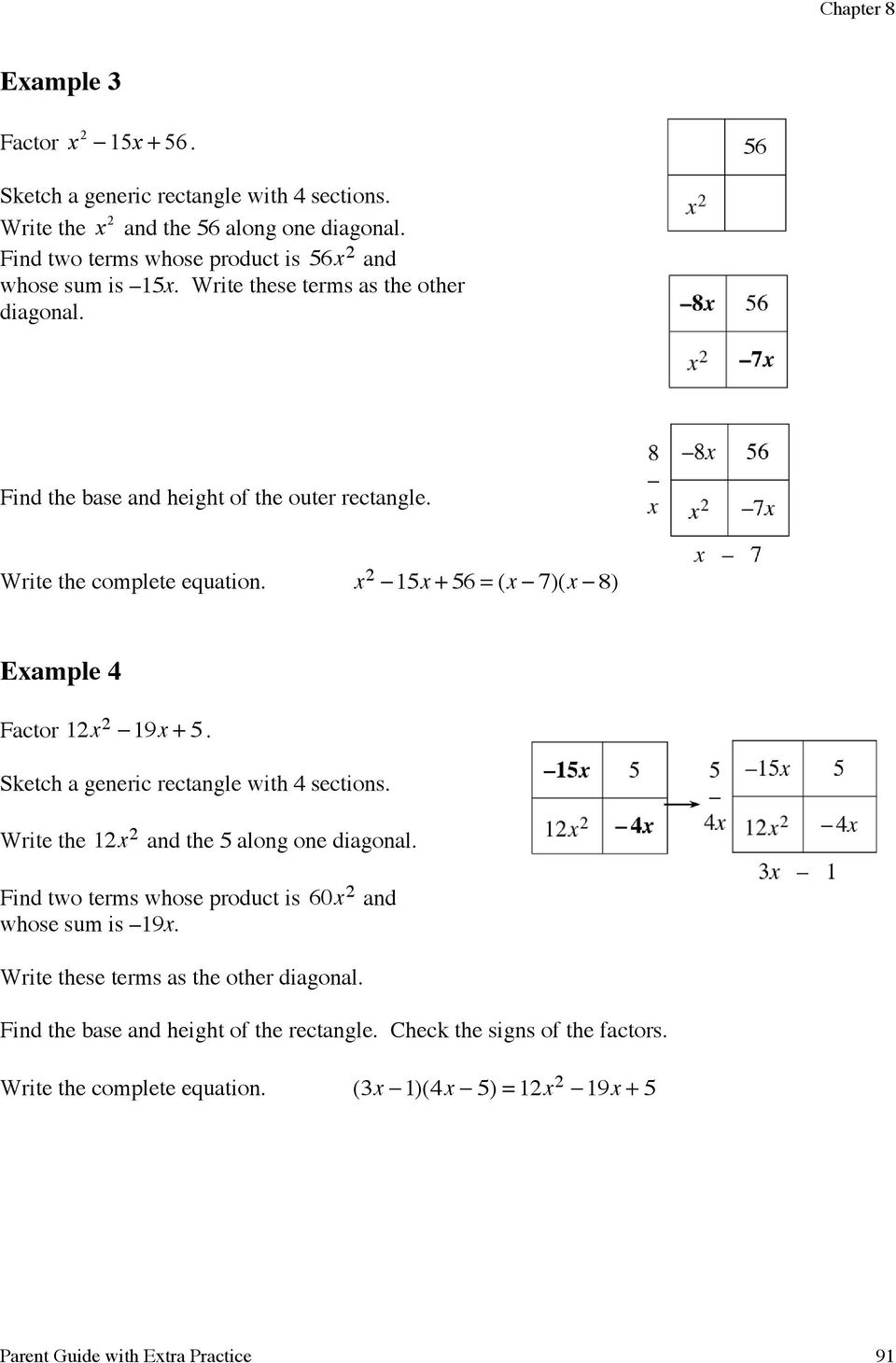
3 Chapter 8 Eample 3 Factor Sketch a generic rectangle with 4 sections. Write the 2 and the 56 along one diagonal. Find two terms whose product is 56 2 and whose sum is 5. Write these terms as the other diagonal Find the base and height of the outer rectangle. Write the complete equation = ( 7)( 8) Eample 4 Factor Sketch a generic rectangle with 4 sections. Write the 2 2 and the 5 along one diagonal. Find two terms whose product is 60 2 and whose sum is Write these terms as the other diagonal. Find the base and height of the rectangle. Check the signs of the factors. Write the complete equation. (3 )(4 5) = Parent Guide with Etra Practice 9
4 Eample 5 Factor Note: If a common factor appears in all the terms, it should be factored out first. For eample: = 3( ). Then can be factored in the usual way, as in Eample above: = ( + 3)( + 4). Then, since the epression had a factor of three, = 3( ) = 3( + 3)( + 4). Problems Answers. ( + 2)( + 3) 2. ( + )(2 + 3) 3. (3 + )( + ) 4. 3( + 5)( + 5) 5. ( + )( + 4) 6. ( + 6)( + ) 7. 2( + 8)( + 3) 8. ( + 8)( 4) 9. (2 + 3)(2 + 3) 0. 2(3 )(4 + 5). ( 8)( + 9) 2. ( 7)(3 + ) 3. ( 4)( 7) 4. ( + 6)(2 ) 5. ( + 3)(2 ) 6. ( 5)( + 2) 7. (2 3)(2 3) 8. (3 + 5)( ) 9. (2 + )(3 2) 20. (3 4)(3 2) 92 Core Connections Algebra

5 Chapter 8 FACTORING SHORTCUTS 8..5 Although most factoring problems can be done with generic rectangles, there are two special factoring patterns that, if recognized, can be done by sight. The two patterns are known as the Difference of Squares and Perfect Square Trinomials. The general patterns are as follows: Difference of Squares: Perfect Square Trinomial: a 2 2 b 2 y 2 = ( a + by) ( a by) a aby + b 2 y 2 = ( a + by) 2 Eample Difference of Squares 2 49 = ( + 7)( 7) = (2 5)(2 + 5) 2 36 = ( + 6)( 6) 9 2 = (3 )(3 + ) Perfect Square Trinomials = ( 5) = (3 + 2) = ( 3) = (2 + 5) 2 Eample 2 Sometimes removing a common factor reveals one of the special patterns: y 2 2(4 2 25y 2 ) 2(2 + 5y)(2 5y) ( ) 3(2 + ) 2 Parent Guide with Etra Practice 93

6 Problems Factor each difference of squares m p 2 9q y y p y 2 Factor each perfect square trinomial y 2 + 8y m 2 0m a 2 + 8ab +6b y + 9y y 2 6y Factor completely y + 8y y +0y + 25y Answers. ( + 4) ( 4) 2. ( + 5) ( 5) 3. ( 8m + 5) ( 8m 5) 4. ( 2 p + 3q) ( 2 p 3q) 5. ( 3y + 7) ( 3y 7) 6. ( 2 + 5) ( 2 5) 7. ( 8 + y) ( 8 y) 8. ( p) ( 2 5 p) 9. ( y) ( 3 2 2y) 0. ( + 2) 2. ( y + 4 ) 2 2. ( m 5) 2 3. not factorable (prime) 4. ( a + 4b) 2 5. ( 6 +) 2 6. ( 5 3y) 2 7. ( 3y ) 2 8. ( 7 +) 2 9. ( 3 + 4) ( 3 4) 20. ( ) ( + 2) ( 2) ( + 2y) y( + 5) ( + 3) ( 3) 25. ( 2 + 3) ( 2 3) ( ) ( ) 94 Core Connections Algebra

7 Chapter 8 USING THE ZERO PRODUCT PROPERTY and The graph of a quadratic function, a parabola, is a symmetrical curve. Its highest or lowest point is called the verte. The graph is formed using the equation y = a 2 + b + c. Students have been graphing parabolas by substituting values for and solving for y. This can be a tedious process, especially if an appropriate range of -values is not known. One possible shortcut if only a quick sketch of the parabola is needed, is to find the -intercepts first, then find the verte and/or the y-intercept. To find the -intercepts, substitute 0 for y and solve the quadratic equation, 0 = a 2 + b + c. Students will learn multiple methods to solve quadratic equations in this chapter and in Chapter 9. One method to solve quadratic equations uses the Zero Product Property, that is, solving by factoring. This method utilizes two ideas: () When the product of two or more numbers is zero, then one of the numbers must be zero. (2) Some quadratics can be factored into the product of two binomials, For additional information see the Math Notes bo in Lesson Eample Find the -intercepts of y = The -intercepts are located on the graph where y = 0, so write the quadratic epression equal to zero, then solve for = 0 Factor the quadratic. ( + 4)( + 2) = 0 Set each factor equal to 0. ( + 4) = 0 or ( + 2) = 0 Solve each equation for. = 4 or = 2 The -intercepts are ( 4, 0) and ( 2, 0). You can check your answers by substituting them into the original equation. ( 4) 2 + 6( 4) ( 2) 2 + 6( 2) Parent Guide with Etra Practice 95

8 Eample 2 Solve = 0. Factor the quadratic. (2 3)( + 5) = 0 Set each factor equal to 0. (2 3) = 0 or ( + 5) = 0 Solve for each. 2 = 3 = 3 2 or = 5 Eample 3 If the quadratic does not equal 0, rewrite it algebraically so that it does, then use the zero product property. Solve 2 = 6 2. Set the equation equal to 0. Factor the quadratic. 2 = = = (2 +)(3 2) Solve each equation for. (2 +) = 0 or (3 2) = 0 2 = or 3 = 2 = 2 = 2 3 Eample 4 Solve = 0. Factor the quadratic = 0 (3 )(3 ) = 0 Solve each equation for. Notice the factors are the same so there will be only one solution. (3 ) = 0 3 = = 3 96 Core Connections Algebra

9 Chapter 8 Problems Solve for = = = = = = = = = = = = = = = 45 4 Answers. = 4 or 3 2. = 2 3 or 3 3. = 5 or 4 4. = 5 3 or 2 5. = 4 or 6. = 3 7. = 4 3 or 2 8. = 4 or 2 9. = 3 2 or = 3 2. = 4 or 2 2. = or 3 3. = 5 or 2 4. = 2 or 3 5. = 5 or 9 Parent Guide with Etra Practice 97

10 GRAPHING FORM AND COMPLETING THE SQUARE In Lesson 8.2.3, students found that if the equation of a parabola is written in graphing form: f () = ( h) 2 + k then the verte can easily be seen as (h, k). For eample, for the parabola f () = ( + 3) 2 the verte is ( 3, ). Students can then set the function equal to zero to find the -intercepts: solve 0 = ( + 3) 2 to find the -intercepts. For help in solving this type of equation, see the Lesson Resource Page, available at Students can set = 0 to find the y-intercepts: y = (0 + 3) 2. When the equation of the parabola is given in standard form: f () = 2 + b + c, then using the process of completing the square can be used to convert standard form into graphing form. Algebra tiles are used to help visualize the process. For additional eamples and practice with graphing quadratic functions, see the Checkpoint materials at the back of the student tetbook. Eample (Using algebra tiles) Complete the square to change f () = into graphing form, identify the verte and y-intercept, and draw a graph. f () = would look like this: Arrange the tiles as shown in the picture at right to make a square. 6 small unit tiles are needed to fill in the corner, but only ten unit tiles are available. Show the 0 small square tiles and draw the outline of the whole square The complete square would have length and width both equal to ( + 4), so the complete square can be represented by the quadratic epression ( + 4) 2. But the tiles from do not form a complete square the epression has si fewer tiles than a complete square. So is a complete square minus 6, or ( + 4) 2 minus 6. That is, = ( + 4) 2 y 6. From graphing form, the verte is at (h, k) = ( 4, 6). The y-intercept is where = 0, so y = (0 + 4) 2 6 = 0. The y-intercept is (0, 0), and the graph is shown at right. 98 Core Connections Algebra

11 Chapter 8 Eample 2 (Using the general process) Complete the square to change f () = into graphing form, identify the verte and y-intercept, and draw a graph. Rewrite the epression as: f () = f () = ( ?) + 2 Make ( ?) into a perfect square by taking half of the -term coefficient and squaring it: ( 5 2 )2 = Then ( ) is a perfect square. We need too write an equivalent function with , but if we add 25 4, we also need to subtract it: f () = which can be rewritten as: y = ( ) f () = ( ) The function is now in graphing form. The verte is at ( 5 2, 7 4 ) or ( 2.5, 4.25). Alternatively, if the process above is unclear, draw a generic rectangle of and imagine algebra tiles, as in Eample above There should be ( 2.5) 2 = 6.25 tiles in the upper right corner to complete the square. But the epression only provides 2 tiles. So there are 4.25 tiles missing. Thus, there are 4.25 tiles missing from the rectangle below: That is, ( + 2.5) 2 minus 4.25 tiles is the equivalent of , or, = ( + 2.5) The y-intercept is where = 0. Thus, y = ( ) = 2 and the y-intercept is at (0, 2). y Parent Guide with Etra Practice 99

12 Problems Complete the square to write each equation in graphing form. Then state the verte.. f () = f () = f () = f () = f () = f () = f () = f () = f () = f () = 2 3 Answers. f () = ( + 3) 2 2; ( 3, 2) 2. f () = ( + 2) 2 + 7; ( 2, 7) 3. f () = ( + 5) 2 25; ( 5, 25) 4. f () = ( + 3.5) ; ( 3.5, 0.25) 5. f () = ( 3) 2 ;(3,0) 6. f () = 2 + 3; (0, 3) 7. f () = ( 2) 2 4; (2, 4) 8. f () = ( +) 2 4; (, 4) 9. f () = ( )2 2 4 ;( 5 2, 2 4 ) 0. f () = ( 6 )2 36 ;( 6, 36 ) 00 Core Connections Algebra

FACTORING QUADRATICS 8.1.1 and 8.1.2
 FACTORING QUADRATICS 8.1.1 and 8.1.2 Chapter 8 introduces students to quadratic equations. These equations can be written in the form of y = ax 2 + bx + c and, when graphed, produce a curve called a parabola.
Using the Area Model to Teach Multiplying, Factoring and Division of Polynomials
 visit us at www.cpm.org Using the Area Model to Teach Multiplying, Factoring and Division of Polynomials For more information about the materials presented, contact Chris Mikles [email protected] From CCA
Polynomial Degree and Finite Differences
 CONDENSED LESSON 7.1 Polynomial Degree and Finite Differences In this lesson you will learn the terminology associated with polynomials use the finite differences method to determine the degree of a polynomial
Using Algebra Tiles from Polynomials to Factoring
 Using Algebra Tiles from Polynomials to Factoring For more information about the materials you find in this packet, contact: Chris Mikles (888) 808-4276 [email protected] CPM Educational Program 203, all
POLYNOMIAL FUNCTIONS
 POLYNOMIAL FUNCTIONS Polynomial Division.. 314 The Rational Zero Test.....317 Descarte s Rule of Signs... 319 The Remainder Theorem.....31 Finding all Zeros of a Polynomial Function.......33 Writing a
10.1. Solving Quadratic Equations. Investigation: Rocket Science CONDENSED
 CONDENSED L E S S O N 10.1 Solving Quadratic Equations In this lesson you will look at quadratic functions that model projectile motion use tables and graphs to approimate solutions to quadratic equations
ALGEBRA 2: 4.1 Graph Quadratic Functions in Standard Form
 ALGEBRA 2: 4.1 Graph Quadratic Functions in Standard Form Goal Graph quadratic functions. VOCABULARY Quadratic function A function that can be written in the standard form y = ax 2 + bx+ c where a 0 Parabola
Lesson 9.1 Solving Quadratic Equations
 Lesson 9.1 Solving Quadratic Equations 1. Sketch the graph of a quadratic equation with a. One -intercept and all nonnegative y-values. b. The verte in the third quadrant and no -intercepts. c. The verte
In this section, you will develop a method to change a quadratic equation written as a sum into its product form (also called its factored form).
 CHAPTER 8 In Chapter 4, you used a web to organize the connections you found between each of the different representations of lines. These connections enabled you to use any representation (such as a graph,
6706_PM10SB_C4_CO_pp192-193.qxd 5/8/09 9:53 AM Page 192 192 NEL
 92 NEL Chapter 4 Factoring Algebraic Epressions GOALS You will be able to Determine the greatest common factor in an algebraic epression and use it to write the epression as a product Recognize different
Section 5.0A Factoring Part 1
 Section 5.0A Factoring Part 1 I. Work Together A. Multiply the following binomials into trinomials. (Write the final result in descending order, i.e., a + b + c ). ( 7)( + 5) ( + 7)( + ) ( + 7)( + 5) (
CPM Educational Program
 CPM Educational Program A California, Non-Profit Corporation Chris Mikles, National Director (888) 808-4276 e-mail: mikles @cpm.org CPM Courses and Their Core Threads Each course is built around a few
Unit 7 Quadratic Relations of the Form y = ax 2 + bx + c
 Unit 7 Quadratic Relations of the Form y = ax 2 + bx + c Lesson Outline BIG PICTURE Students will: manipulate algebraic expressions, as needed to understand quadratic relations; identify characteristics
Students Currently in Algebra 2 Maine East Math Placement Exam Review Problems
 Students Currently in Algebra Maine East Math Placement Eam Review Problems The actual placement eam has 100 questions 3 hours. The placement eam is free response students must solve questions and write
A.3. Polynomials and Factoring. Polynomials. What you should learn. Definition of a Polynomial in x. Why you should learn it
 Appendi A.3 Polynomials and Factoring A23 A.3 Polynomials and Factoring What you should learn Write polynomials in standard form. Add,subtract,and multiply polynomials. Use special products to multiply
Factoring Trinomials using Algebra Tiles Student Activity
 Factoring Trinomials using Algebra Tiles Student Activity Materials: Algebra Tiles (student set) Worksheet: Factoring Trinomials using Algebra Tiles Algebra Tiles: Each algebra tile kits should contain
Multiplying Binomials and Factoring Trinomials Using Algebra Tiles and Generic Rectangles
 Multiplying Binomials Standard: Algebra 10.0 Time: 55 mins. Multiplying Binomials and Factoring Trinomials Using Algebra Tiles and s Materials: Class set of Algebra Tiles or access to a computer for each
Factors and Products
 CHAPTER 3 Factors and Products What You ll Learn use different strategies to find factors and multiples of whole numbers identify prime factors and write the prime factorization of a number find square
Review of Intermediate Algebra Content
 Review of Intermediate Algebra Content Table of Contents Page Factoring GCF and Trinomials of the Form + b + c... Factoring Trinomials of the Form a + b + c... Factoring Perfect Square Trinomials... 6
Algebra 1 Course Title
 Algebra 1 Course Title Course- wide 1. What patterns and methods are being used? Course- wide 1. Students will be adept at solving and graphing linear and quadratic equations 2. Students will be adept
Mathematics More Visual Using Algebra Tiles
 www.cpm.org Chris Mikles CPM Educational Program A California Non-profit Corporation 33 Noonan Drive Sacramento, CA 958 (888) 808-76 fa: (08) 777-8605 email: [email protected] An Eemplary Mathematics Program
a. You can t do the simple trick of finding two integers that multiply to give 6 and add to give 5 because the a (a = 4) is not equal to one.
 FACTORING TRINOMIALS USING THE AC METHOD. Factoring trinomial epressions in one unknown is an important skill necessary to eventually solve quadratic equations. Trinomial epressions are of the form a 2
AIP Factoring Practice/Help
 The following pages include many problems to practice factoring skills. There are also several activities with examples to help you with factoring if you feel like you are not proficient with it. There
Alum Rock Elementary Union School District Algebra I Study Guide for Benchmark III
 Alum Rock Elementary Union School District Algebra I Study Guide for Benchmark III Name Date Adding and Subtracting Polynomials Algebra Standard 10.0 A polynomial is a sum of one ore more monomials. Polynomial
Answers to Basic Algebra Review
 Answers to Basic Algebra Review 1. -1.1 Follow the sign rules when adding and subtracting: If the numbers have the same sign, add them together and keep the sign. If the numbers have different signs, subtract
A Concrete Introduction. to the Abstract Concepts. of Integers and Algebra using Algebra Tiles
 A Concrete Introduction to the Abstract Concepts of Integers and Algebra using Algebra Tiles Table of Contents Introduction... 1 page Integers 1: Introduction to Integers... 3 2: Working with Algebra Tiles...
Systems of Equations Involving Circles and Lines
 Name: Systems of Equations Involving Circles and Lines Date: In this lesson, we will be solving two new types of Systems of Equations. Systems of Equations Involving a Circle and a Line Solving a system
Brunswick High School has reinstated a summer math curriculum for students Algebra 1, Geometry, and Algebra 2 for the 2014-2015 school year.
 Brunswick High School has reinstated a summer math curriculum for students Algebra 1, Geometry, and Algebra 2 for the 2014-2015 school year. Goal The goal of the summer math program is to help students
Summer Math Exercises. For students who are entering. Pre-Calculus
 Summer Math Eercises For students who are entering Pre-Calculus It has been discovered that idle students lose learning over the summer months. To help you succeed net fall and perhaps to help you learn
Factoring and Applications
 Factoring and Applications What is a factor? The Greatest Common Factor (GCF) To factor a number means to write it as a product (multiplication). Therefore, in the problem 48 3, 4 and 8 are called the
Vocabulary Words and Definitions for Algebra
 Name: Period: Vocabulary Words and s for Algebra Absolute Value Additive Inverse Algebraic Expression Ascending Order Associative Property Axis of Symmetry Base Binomial Coefficient Combine Like Terms
Pre-Calculus II Factoring and Operations on Polynomials
 Factoring... 1 Polynomials...1 Addition of Polynomials... 1 Subtraction of Polynomials...1 Multiplication of Polynomials... Multiplying a monomial by a monomial... Multiplying a monomial by a polynomial...
The Distance Formula and the Circle
 10.2 The Distance Formula and the Circle 10.2 OBJECTIVES 1. Given a center and radius, find the equation of a circle 2. Given an equation for a circle, find the center and radius 3. Given an equation,
ax 2 by 2 cxy dx ey f 0 The Distance Formula The distance d between two points (x 1, y 1 ) and (x 2, y 2 ) is given by d (x 2 x 1 )
 SECTION 1. The Circle 1. OBJECTIVES The second conic section we look at is the circle. The circle can be described b using the standard form for a conic section, 1. Identif the graph of an equation as
SUNY ECC. ACCUPLACER Preparation Workshop. Algebra Skills
 SUNY ECC ACCUPLACER Preparation Workshop Algebra Skills Gail A. Butler Ph.D. Evaluating Algebraic Epressions Substitute the value (#) in place of the letter (variable). Follow order of operations!!! E)
Polynomial Operations and Factoring
 Algebra 1, Quarter 4, Unit 4.1 Polynomial Operations and Factoring Overview Number of instructional days: 15 (1 day = 45 60 minutes) Content to be learned Identify terms, coefficients, and degree of polynomials.
expression is written horizontally. The Last terms ((2)( 4)) because they are the last terms of the two polynomials. This is called the FOIL method.
 A polynomial of degree n (in one variable, with real coefficients) is an expression of the form: a n x n + a n 1 x n 1 + a n 2 x n 2 + + a 2 x 2 + a 1 x + a 0 where a n, a n 1, a n 2, a 2, a 1, a 0 are
Factoring Quadratic Trinomials
 Factoring Quadratic Trinomials Student Probe Factor x x 3 10. Answer: x 5 x Lesson Description This lesson uses the area model of multiplication to factor quadratic trinomials. Part 1 of the lesson consists
The majority of college students hold credit cards. According to the Nellie May
 CHAPTER 6 Factoring Polynomials 6.1 The Greatest Common Factor and Factoring by Grouping 6. Factoring Trinomials of the Form b c 6.3 Factoring Trinomials of the Form a b c and Perfect Square Trinomials
CHAPTER 7: FACTORING POLYNOMIALS
 CHAPTER 7: FACTORING POLYNOMIALS FACTOR (noun) An of two or more quantities which form a product when multiplied together. 1 can be rewritten as 3*, where 3 and are FACTORS of 1. FACTOR (verb) - To factor
Math 0980 Chapter Objectives. Chapter 1: Introduction to Algebra: The Integers.
 Math 0980 Chapter Objectives Chapter 1: Introduction to Algebra: The Integers. 1. Identify the place value of a digit. 2. Write a number in words or digits. 3. Write positive and negative numbers used
Florida Math for College Readiness
 Core Florida Math for College Readiness Florida Math for College Readiness provides a fourth-year math curriculum focused on developing the mastery of skills identified as critical to postsecondary readiness
FACTORING ax 2 bx c WITH a 1
 296 (6 20) Chapter 6 Factoring 6.4 FACTORING a 2 b c WITH a 1 In this section The ac Method Trial and Error Factoring Completely In Section 6.3 we factored trinomials with a leading coefficient of 1. In
How To Factor Quadratic Trinomials
 Factoring Quadratic Trinomials Student Probe Factor Answer: Lesson Description This lesson uses the area model of multiplication to factor quadratic trinomials Part 1 of the lesson consists of circle puzzles
A Quick Algebra Review
 1. Simplifying Epressions. Solving Equations 3. Problem Solving 4. Inequalities 5. Absolute Values 6. Linear Equations 7. Systems of Equations 8. Laws of Eponents 9. Quadratics 10. Rationals 11. Radicals
Chris Yuen. Algebra 1 Factoring. Early High School 8-10 Time Span: 5 instructional days
 1 Chris Yuen Algebra 1 Factoring Early High School 8-10 Time Span: 5 instructional days Materials: Algebra Tiles and TI-83 Plus Calculator. AMSCO Math A Chapter 18 Factoring. All mathematics material and
HIBBING COMMUNITY COLLEGE COURSE OUTLINE
 HIBBING COMMUNITY COLLEGE COURSE OUTLINE COURSE NUMBER & TITLE: - Beginning Algebra CREDITS: 4 (Lec 4 / Lab 0) PREREQUISITES: MATH 0920: Fundamental Mathematics with a grade of C or better, Placement Exam,
MEMORANDUM. All students taking the CLC Math Placement Exam PLACEMENT INTO CALCULUS AND ANALYTIC GEOMETRY I, MTH 145:
 MEMORANDUM To: All students taking the CLC Math Placement Eam From: CLC Mathematics Department Subject: What to epect on the Placement Eam Date: April 0 Placement into MTH 45 Solutions This memo is an
BEST METHODS FOR SOLVING QUADRATIC INEQUALITIES.
 BEST METHODS FOR SOLVING QUADRATIC INEQUALITIES. I. GENERALITIES There are 3 common methods to solve quadratic inequalities. Therefore, students sometimes are confused to select the fastest and the best
Core Maths C1. Revision Notes
 Core Maths C Revision Notes November 0 Core Maths C Algebra... Indices... Rules of indices... Surds... 4 Simplifying surds... 4 Rationalising the denominator... 4 Quadratic functions... 4 Completing the
Florida Math 0028. Correlation of the ALEKS course Florida Math 0028 to the Florida Mathematics Competencies - Upper
 Florida Math 0028 Correlation of the ALEKS course Florida Math 0028 to the Florida Mathematics Competencies - Upper Exponents & Polynomials MDECU1: Applies the order of operations to evaluate algebraic
Algebra and Geometry Review (61 topics, no due date)
 Course Name: Math 112 Credit Exam LA Tech University Course Code: ALEKS Course: Trigonometry Instructor: Course Dates: Course Content: 159 topics Algebra and Geometry Review (61 topics, no due date) Properties
Definitions 1. A factor of integer is an integer that will divide the given integer evenly (with no remainder).
 Math 50, Chapter 8 (Page 1 of 20) 8.1 Common Factors Definitions 1. A factor of integer is an integer that will divide the given integer evenly (with no remainder). Find all the factors of a. 44 b. 32
MTH 092 College Algebra Essex County College Division of Mathematics Sample Review Questions 1 Created January 17, 2006
 MTH 092 College Algebra Essex County College Division of Mathematics Sample Review Questions Created January 7, 2006 Math 092, Elementary Algebra, covers the mathematical content listed below. In order
Polynomials and Factoring
 7.6 Polynomials and Factoring Basic Terminology A term, or monomial, is defined to be a number, a variable, or a product of numbers and variables. A polynomial is a term or a finite sum or difference of
Chapter 6 Quadratic Functions
 Chapter 6 Quadratic Functions Determine the characteristics of quadratic functions Sketch Quadratics Solve problems modelled b Quadratics 6.1Quadratic Functions A quadratic function is of the form where
Algebra II A Final Exam
 Algebra II A Final Exam Multiple Choice Identify the choice that best completes the statement or answers the question. Evaluate the expression for the given value of the variable(s). 1. ; x = 4 a. 34 b.
Polynomials and Quadratics
 Polynomials and Quadratics Want to be an environmental scientist? Better be ready to get your hands dirty!.1 Controlling the Population Adding and Subtracting Polynomials............703.2 They re Multiplying
Factoring Polynomials and Solving Quadratic Equations
 Factoring Polynomials and Solving Quadratic Equations Math Tutorial Lab Special Topic Factoring Factoring Binomials Remember that a binomial is just a polynomial with two terms. Some examples include 2x+3
Higher Education Math Placement
 Higher Education Math Placement Placement Assessment Problem Types 1. Whole Numbers, Fractions, and Decimals 1.1 Operations with Whole Numbers Addition with carry Subtraction with borrowing Multiplication
Copy in your notebook: Add an example of each term with the symbols used in algebra 2 if there are any.
 Algebra 2 - Chapter Prerequisites Vocabulary Copy in your notebook: Add an example of each term with the symbols used in algebra 2 if there are any. P1 p. 1 1. counting(natural) numbers - {1,2,3,4,...}
Algebra 1 If you are okay with that placement then you have no further action to take Algebra 1 Portion of the Math Placement Test
 Dear Parents, Based on the results of the High School Placement Test (HSPT), your child should forecast to take Algebra 1 this fall. If you are okay with that placement then you have no further action
LAKE ELSINORE UNIFIED SCHOOL DISTRICT
 LAKE ELSINORE UNIFIED SCHOOL DISTRICT Title: PLATO Algebra 1-Semester 2 Grade Level: 10-12 Department: Mathematics Credit: 5 Prerequisite: Letter grade of F and/or N/C in Algebra 1, Semester 2 Course Description:
4.9 Graph and Solve Quadratic
 4.9 Graph and Solve Quadratic Inequalities Goal p Graph and solve quadratic inequalities. Your Notes VOCABULARY Quadratic inequalit in two variables Quadratic inequalit in one variable GRAPHING A QUADRATIC
Algebraic expressions are a combination of numbers and variables. Here are examples of some basic algebraic expressions.
 Page 1 of 13 Review of Linear Expressions and Equations Skills involving linear equations can be divided into the following groups: Simplifying algebraic expressions. Linear expressions. Solving linear
ACT Math Vocabulary. Altitude The height of a triangle that makes a 90-degree angle with the base of the triangle. Altitude
 ACT Math Vocabular Acute When referring to an angle acute means less than 90 degrees. When referring to a triangle, acute means that all angles are less than 90 degrees. For eample: Altitude The height
Polynomial and Synthetic Division. Long Division of Polynomials. Example 1. 6x 2 7x 2 x 2) 19x 2 16x 4 6x3 12x 2 7x 2 16x 7x 2 14x. 2x 4.
 _.qd /7/5 9: AM Page 5 Section.. Polynomial and Synthetic Division 5 Polynomial and Synthetic Division What you should learn Use long division to divide polynomials by other polynomials. Use synthetic
2.3. Finding polynomial functions. An Introduction:
 2.3. Finding polynomial functions. An Introduction: As is usually the case when learning a new concept in mathematics, the new concept is the reverse of the previous one. Remember how you first learned
MATH 60 NOTEBOOK CERTIFICATIONS
 MATH 60 NOTEBOOK CERTIFICATIONS Chapter #1: Integers and Real Numbers 1.1a 1.1b 1.2 1.3 1.4 1.8 Chapter #2: Algebraic Expressions, Linear Equations, and Applications 2.1a 2.1b 2.1c 2.2 2.3a 2.3b 2.4 2.5
Factoring Polynomials
 UNIT 11 Factoring Polynomials You can use polynomials to describe framing for art. 396 Unit 11 factoring polynomials A polynomial is an expression that has variables that represent numbers. A number can
SECTION P.5 Factoring Polynomials
 BLITMCPB.QXP.0599_48-74 /0/0 0:4 AM Page 48 48 Chapter P Prerequisites: Fundamental Concepts of Algebra Technology Eercises Critical Thinking Eercises 98. The common cold is caused by a rhinovirus. The
Unit #3: Investigating Quadratics (9 days + 1 jazz day + 1 summative evaluation day) BIG Ideas:
 Unit #3: Investigating Quadratics (9 days + 1 jazz day + 1 summative evaluation day) BIG Ideas: Developing strategies for determining the zeroes of quadratic functions Making connections between the meaning
Florida Algebra 1 End-of-Course Assessment Item Bank, Polk County School District
 Benchmark: MA.912.A.2.3; Describe the concept of a function, use function notation, determine whether a given relation is a function, and link equations to functions. Also assesses MA.912.A.2.13; Solve
Thnkwell s Homeschool Precalculus Course Lesson Plan: 36 weeks
 Thnkwell s Homeschool Precalculus Course Lesson Plan: 36 weeks Welcome to Thinkwell s Homeschool Precalculus! We re thrilled that you ve decided to make us part of your homeschool curriculum. This lesson
A synonym is a word that has the same or almost the same definition of
 Slope-Intercept Form Determining the Rate of Change and y-intercept Learning Goals In this lesson, you will: Graph lines using the slope and y-intercept. Calculate the y-intercept of a line when given
Mathematics Online Instructional Materials Correlation to the 2009 Algebra I Standards of Learning and Curriculum Framework
 Provider York County School Division Course Syllabus URL http://yorkcountyschools.org/virtuallearning/coursecatalog.aspx Course Title Algebra I AB Last Updated 2010 - A.1 The student will represent verbal
CAHSEE on Target UC Davis, School and University Partnerships
 UC Davis, School and University Partnerships CAHSEE on Target Mathematics Curriculum Published by The University of California, Davis, School/University Partnerships Program 006 Director Sarah R. Martinez,
Introduction Assignment
 PRE-CALCULUS 11 Introduction Assignment Welcome to PREC 11! This assignment will help you review some topics from a previous math course and introduce you to some of the topics that you ll be studying
Imagine a cube with any side length. Imagine increasing the height by 2 cm, the. Imagine a cube. x x
 OBJECTIVES Eplore functions defined b rddegree polnomials (cubic functions) Use graphs of polnomial equations to find the roots and write the equations in factored form Relate the graphs of polnomial equations
2x 2x 2 8x. Now, let s work backwards to FACTOR. We begin by placing the terms of the polynomial inside the cells of the box. 2x 2
 Activity 23 Math 40 Factoring using the BOX Team Name (optional): Your Name: Partner(s): 1. (2.) Task 1: Factoring out the greatest common factor Mini Lecture: Factoring polynomials is our focus now. Factoring
Roots, Linear Factors, and Sign Charts review of background material for Math 163A (Barsamian)
 Roots, Linear Factors, and Sign Charts review of background material for Math 16A (Barsamian) Contents 1. Introduction 1. Roots 1. Linear Factors 4. Sign Charts 5 5. Eercises 8 1. Introduction The sign
Higher. Polynomials and Quadratics 64
 hsn.uk.net Higher Mathematics UNIT OUTCOME 1 Polnomials and Quadratics Contents Polnomials and Quadratics 64 1 Quadratics 64 The Discriminant 66 3 Completing the Square 67 4 Sketching Parabolas 70 5 Determining
Algebra I Vocabulary Cards
 Algebra I Vocabulary Cards Table of Contents Expressions and Operations Natural Numbers Whole Numbers Integers Rational Numbers Irrational Numbers Real Numbers Absolute Value Order of Operations Expression
POLYNOMIALS and FACTORING
 POLYNOMIALS and FACTORING Exponents ( days); 1. Evaluate exponential expressions. Use the product rule for exponents, 1. How do you remember the rules for exponents?. How do you decide which rule to use
SOLVING QUADRATIC EQUATIONS - COMPARE THE FACTORING AC METHOD AND THE NEW TRANSFORMING METHOD (By Nghi H. Nguyen - Jan 18, 2015)
 SOLVING QUADRATIC EQUATIONS - COMPARE THE FACTORING AC METHOD AND THE NEW TRANSFORMING METHOD (By Nghi H. Nguyen - Jan 18, 2015) GENERALITIES. When a given quadratic equation can be factored, there are
7.7 Solving Rational Equations
 Section 7.7 Solving Rational Equations 7 7.7 Solving Rational Equations When simplifying comple fractions in the previous section, we saw that multiplying both numerator and denominator by the appropriate
MSLC Workshop Series Math 1148 1150 Workshop: Polynomial & Rational Functions
 MSLC Workshop Series Math 1148 1150 Workshop: Polynomial & Rational Functions The goal of this workshop is to familiarize you with similarities and differences in both the graphing and expression of polynomial
Operations with Algebraic Expressions: Multiplication of Polynomials
 Operations with Algebraic Expressions: Multiplication of Polynomials The product of a monomial x monomial To multiply a monomial times a monomial, multiply the coefficients and add the on powers with the
INVESTIGATIONS AND FUNCTIONS 1.1.1 1.1.4. Example 1
 Chapter 1 INVESTIGATIONS AND FUNCTIONS 1.1.1 1.1.4 This opening section introduces the students to man of the big ideas of Algebra 2, as well as different was of thinking and various problem solving strategies.
What are the place values to the left of the decimal point and their associated powers of ten?
 The verbal answers to all of the following questions should be memorized before completion of algebra. Answers that are not memorized will hinder your ability to succeed in geometry and algebra. (Everything
NSM100 Introduction to Algebra Chapter 5 Notes Factoring
 Section 5.1 Greatest Common Factor (GCF) and Factoring by Grouping Greatest Common Factor for a polynomial is the largest monomial that divides (is a factor of) each term of the polynomial. GCF is the
1.3 Algebraic Expressions
 1.3 Algebraic Expressions A polynomial is an expression of the form: a n x n + a n 1 x n 1 +... + a 2 x 2 + a 1 x + a 0 The numbers a 1, a 2,..., a n are called coefficients. Each of the separate parts,
SOL Warm-Up Graphing Calculator Active
 A.2a (a) Using laws of exponents to simplify monomial expressions and ratios of monomial expressions 1. Which expression is equivalent to (5x 2 )(4x 5 )? A 9x 7 B 9x 10 C 20x 7 D 20x 10 2. Which expression
Examples of Tasks from CCSS Edition Course 3, Unit 5
 Examples of Tasks from CCSS Edition Course 3, Unit 5 Getting Started The tasks below are selected with the intent of presenting key ideas and skills. Not every answer is complete, so that teachers can
Wentzville School District Algebra 1: Unit 8 Stage 1 Desired Results
 Wentzville School District Algebra 1: Unit 8 Stage 1 Desired Results Unit Title: Quadratic Expressions & Equations Course: Algebra I Unit 8 - Quadratic Expressions & Equations Brief Summary of Unit: At
Five 5. Rational Expressions and Equations C H A P T E R
 Five C H A P T E R Rational Epressions and Equations. Rational Epressions and Functions. Multiplication and Division of Rational Epressions. Addition and Subtraction of Rational Epressions.4 Comple Fractions.
o Graph an expression as a function of the chosen independent variable to determine the existence of a minimum or maximum
 Two Parabolas Time required 90 minutes Teaching Goals:. Students interpret the given word problem and complete geometric constructions according to the condition of the problem.. Students choose an independent
HFCC Math Lab Beginning Algebra 13 TRANSLATING ENGLISH INTO ALGEBRA: WORDS, PHRASE, SENTENCES
 HFCC Math Lab Beginning Algebra 1 TRANSLATING ENGLISH INTO ALGEBRA: WORDS, PHRASE, SENTENCES Before being able to solve word problems in algebra, you must be able to change words, phrases, and sentences