
THE NATIONAL BEE KEEPING TRAINING AND EXTENSION MANUAL
|
|
|
- Pearl Wiggins
- 10 years ago
- Views:
Transcription
1 THE REPUBLIC OF UGANDA Minisry of Educaion and Spors MINISTRY OF AGRICULTURE, ANIMAL INDUSTRY AND FISHERIES THE NATIONAL BEE KEEPING TRAINING AND EXTENSION MANUAL FARM INCOME ENHANCEMENT AND FOREST CONSERVATION PROJECT APICULTURE PROMOTION SUB COMPONENT Funded by:the AFRICAN DEVELOPMENT BANK AND GOVERNMENT OF UGANDA March 2012

2

3 The Naional Bee Keeping Training and Exension Manual Funded by:- THE AFRICAN DEVELOPMENT BANK AND GOVERNMENT OF UGANDA

4 Edied by: 1. Ms. Kangave Alice, 2. Mr. Buele Cosmas Alfred, 3. Mr. Onzoma Apollo, and 4. Mr. Kao Agapius ii Naional Bee keeping raining and exension manual, 2012

5 TABLE OF CONTENTS Ediors ii Table of Conens iii Lis of Figures iv Lis of ables v Foreword vi Acknowledgemens vii Lis of Acronyms viii Inroducion ix CHAPTER ONE: THE HONEYBEE AND ITS IMPORTANCE Module 1: Bee Biology and Behaviour Module 2: The Imporance of Beekeeping Module 3: Pollinaion CHAPTER TWO: MANAGEMENT OF THE HONEYBEE Module 4: Beekeeping Sysems Module 5: Beekeeping Equipmen Module 6: Making Beekeeping Equipmen Module 7: Apiary Managemen Module 8: The Floral Calendar and Beekeeping Module 9: Bee Sings and Managemen Module 10: Hive Inspecion Module 11: Populaing he Hive Module 12: Caching a Swarm Module 13: Transferring Bees Module 14: Dividing and Uniing Colonies Module 15: Feeding of Bees Module 16: Bee Pess, Predaors and Diseases Module 17: Making Bio-Pesicides CHAPTER THREE: HIVE PRODUCTS AND PROCESSING Module 18: Hive Producs Module 19: Qualiy Honey Harvesing Module 20: Processing Honey Module 21: Beeswax CHAPTER FOUR: EXPLANATION OF COMMON BEEKEEPING TERMS APPENDICES Appendix 1: Appendix 2: References: Naional Bee keeping raining and exension manual, 2012 iii
6 LIST OF FIGURES Fig. 1: The honeybee cases in a colony Fig. 2: Diagram of he lifecycle of he honey bee Fig. 3: Peanu-shaped queen cell Fig. 4: Queen cells Fig. 5: Pebbly exured drone cells Fig. 6: The worker bee visiing a flower, helping o pollinae he plan Fig. 7: Measuremens for woven baske hive Fig. 8: Woven baske hive Fig. 9: The log hive Fig. 10: Clay hives Fig. 11: Picure of Johnson hive Fig. 12: KTB hive showing how he comb aaches o he bar inside he hive Fig. 13: A op bar lifed from a KTB hive Fig. 14: A KTB hive being opened Fig. 15: Cacher box for a KTB hive Fig. 16: Langsroh hive showing he differen pars of he hive Fig. 17: Langsroh hive Fig. 18: Langsroh hive- brood chamber, empy frame, honey chamber, combed frame, queen excluder, cover Fig. 19: Cacher box for a Langsroh Fig. 20: Frame brick hive Fig. 21: Bee smokers Fig. 22: Bee sui Fig. 23: Sof laex gloves Fig. 24: Bee brushes Fig. 25: Hive openers Fig. 26: Knife Fig. 27: Airigh bucke (food grade) Fig. 28: Food grade drum Fig. 29: Honey Refracomeer Fig. 30 (a): Sraining cloh Fig. 30 (b): Sraining cloh ied around a bucke ready for sraining honey Fig. 31: Cenrifuge exracor Fig. 32: Honey seling ank Fig. 33: Honey press Fig. 34: Honey jars Fig. 35: Bee house Fig. 36: Dimensions for he body of a Kenyan Top Bar hive Fig. 37: Top bar measuremens Fig. 38: Langsroh hive dimensions Fig. 39: Solar wax exracor Fig. 40: Bee veil Fig. 41: Dimensions of bee veil Fig. 42: Bee veil pars Fig. 43: Bee veil plan Fig. 44: Overall plan Fig. 45: Measuremens of bee glove Fig. 46: Measuremens and making of a bee smoker iv Naional Bee keeping raining and exension manual, 2012

7 Fig. 47: Floral calendar Fig. 48: Comb Fig. 49: Caching a swarm Fig. 50: Transferring bees Fig. 51: Dividing a colony Fig. 52: Opening an old weak colony for uniing wih a swarm Fig. 53: The appearance of queen cells and queen cups Fig. 54: Farmers selling honey-wine a a show Fig. 55: Hoima Naural Honey on display Fig. 56: A pollen rap Fig. 57: Uncapping fork Fig. 58: Differen ypes of honey press and locally made boling conainers Fig. 59: A skech and picure of a honey cenrifuge exracor Fig. 60: Meling wax Fig. 61: Wax exracion using a sack and a drum Fig. 62: Wax exracion wih cloh and sicks Fig. 63: Skech of a solar wax exracor LIST OF TABLES Table 1: Lifespan of bees Table 2: An example of a hive/colony record shee Table 3: Visiors Book Table 4: Cash Book Table 5: Floral calendar Table 6: Forms of honey and how hey are made Naional Bee keeping raining and exension manual, 2012 v

8 FOREWORD I is everybody s concern o see ha he rural communiies generae susainable incomes as soon as possible. Livesock producion and markeing offers an opion. Ou of he various livesock enerprises, namely, poulry, fisheries, cale, piggery, ec beekeeping enerprise offers one of he bes opions for he rural communiies and commercial farmers because of is minimal requiremens for land, machinery and equipmen, labor and capial invesmen. In Uganda, honey producion poenial is enormous, esimaed a 500,000 meric ones per year. This poenial is no ye fully exploied. The basic knowledge and skills needed o exploi he honey producion poenial are lacking among he echnocras and farmers. Over he years, several sakeholders including Governmen Minisries, Deparmens and Agencies have been carrying ou raining of farmers in heir own ways wihou sandard guide and uniformiy. Some of he guides/manuals used by he sakeholders are subsandard. This pracice has for long undermined effors o increase producion and enforce compliance o sandards. This manual has herefore been developed o provide he basic sandards for raining beekeepers all over Uganda. I is my sincere hope ha rainers, exension workers, farmers and sudens will find his manual very valuable. Okaasai S. Opolo For: PERMANENT SECRETARY vi Naional Bee keeping raining and exension manual, 2012

9 ACKNOWLEDGEMENTS We are very much graeful o he African Developmen Bank (ADB) and Governmen of Uganda (GoU) for funding he FIEFOC Projec which has produced his very imporan Naional Beekeeping Training and Exension Manual. For sure his manual will guide eachers, rainers, sudens, farmers and beekeepers. We appreciae and acknowledge he following people who provided lieraure wihou which his manual would no have been produced:- Mr. Kao Agapius, Enomologis, Mukono, DLG; Mr. Ayo George, DEO, Lira DLG; Mr. Rubaihayo John, DEO, Kabarole DLG; Mr. Mugume Amos, DAO, Kabarole DLG; Mr. Bagonza Adolf, Kabarole Beekeepers Associaion, Kabarole Disric; Mr. Ayauhaire Asaph, Wes Honeys Uganda, Mbarara Disric; Mr. Kanyike Charles, DEO, Nakasongola DLG; Mr. Palanda Rober Obumai, Assisan Enomologis, Adjumani DLG; Mr. Ochoun Emirious, Privae Service Provider, Nebbi Disric; Mr. Lule Henry, DEO, Luwero DLG; Mr. Kefa John, Moyo Beekeepers Associaion, Moyo Disric; Mr. Amafua Morpha, Privae Service Provider, Yumbe Disric; Mr. Kawawa Rashid, DEO, Yumbe DLG; Mr. Cema Philliam, DEO, Arua DLG; Ms. Kesubi Nice Alex, BNU, Arua Disric; Babua Fred, Arua Moyo Nebbi Beekeepers Associaion, Arua Disric; Mr. Khauka Edmond, Beemaser, Mbale DLG; Mr. Ogwoli Geoffrey, DEO, Sironko DLG; Mr. Kisaali Bosco, Privae Service Provider, Sironko Disric; Nyangas Simon, Privae Service Provider, Kapchorwa Disric; Mr. Oluka Michael, DEO, Bukedea DLG; Mr. Esima Mike, Privae Service Provider, Soroi Disric; Mr. Kwikiriza Jibril, Ag. DEO, Masindi DLG; Mr. Mugisha Daudi, Assisan Enomologis, Hoima DLG; Mr. Kasangaki Parice, DEO, Kibaale DLG; Mr. Kasereka J. Muranga, Rwenzori Mounains Developmen Organizaion (REMODA), Kasese Disric; Mr. Besekya Hilary, Tropical Bee Care Cenre, Bushenyi Disric; Mr. Tumuhimbise Gordon, DEO, Bushenyi DLG; Mrs. Margare Rose Ogaba, Kigum Women Beekeepers Associaion (KWOBA); Kaddu John (2012) Bee keeping equipmen manufacurer and rainer Kampala, Uganda. Thanks o all he people who paricipaed acively in consrucive discussions during workshops organized, bu no menioned here. Las bu no leas, grea hanks o Mrs. Kangave Alice, Principal Enomologis Producive Insecs/Manager Apiculure Promoion Sub Componen of FIEFOC Projec, DLH&E, MAAIF Hqrs; Mr. Buele Cosmas Alfred, Senior Enomologis Apiculure, DLH&E, MAAIF Hqrs; and Mr. Onzoma Apollo, Senior Training Officer, HRD, MAAIF Hqrs for having compiled he lieraure and views provided, and ediing. Dr. Nicholas Kaua COMMISSIONER, LIVESTOCK HEALTH AND ENTOMOLOGY Naional Bee keeping raining and exension manual, 2012 vii

10 Lis of Acronyms ADB - African Developmen Bank BNU - Bee Naural Uganda Ld BQV - Black Queen Virus disease DAO - Disric Agriculural Officer DEO - Disric Enomology Officer DLG - Disric Local Governmen DLH&E - Deparmen of Livesock Healh and Enomology FIEFOC - Farm Income Enhancemen and Fores Conservaion Projec FIG - Figure GoU - Governmen of Uganda HIV/AIDS - Human Immune Virus/Acquired Immune Deficiency Syndrome Hqrs - Headquarers HRD - Human Resource Deparmen Hrs - Hours KBA - Kabarole Beekeeper s Associaion KTB - Kenya Top Bar beehives KWOBA - Kigum Women Beekeepers Associaion MAAIF - Minisry of Agriculure, Animal Indusry and Fisheries MBA - Moyo Beekeeper s Associaion NAC - Naional Apiculure Cenre NGO - Non-Governmenal Organizaion PE - Principal Enomologis PSP - Privae Service Provider REMODA - Rwenzori Mounains Developmen Organizaion SE - Senior Enomologis STO - Senior Training Officer TVs - Televisions viii Naional Bee keeping raining and exension manual, 2012
11 INTRODUCTION Over he years several privae service providers, NGOs, Projecs, Governmen agencies and deparmens have been carrying ou raining of farmers in beekeeping in heir own ways wihou uniformiy. In oher words here have been many differen raining manuals/guides being used by he differen sakeholders in he apiculure indusry, some of which are sub-sandard. This pracice has for long undermined effors o enforce compliance o code of pracice, sandard operaing procedures and qualiy sandards in apiculure indusry, hence he need for harmonizaion and uniformiy. The African Developmen Bank and he Governmen of Uganda hrough he Farm Income Enhancemen and Fores Conservaion (FIEFOC) Projec, under Apiculure Promoion sub-componen embarked on a series of inervenions which include among ohers, sandardizaion of he naional raining documen. The projec herefore provided funds o develop a naional beekeeping raining and exension manual as a sraegy o promoe compliance o sandards in beekeeping indusry in Uganda. The process of developing he naional bee keeping raining and exension manual had sages and sared in February 2009 wih field rips organized for collecion of lieraure from various regions and disrics (see appendix 1). This was followed wih a 2 day rerea, organized for seleced enomologiss and privae service providers a Ulrika Gues House, Kisubi, 7h - 8h May 2009 (see appendix 2). The aim of he rerea was o consolidae and analyse he lieraure colleced and come up wih sandard modular raining manual for use hroughou Uganda. The firs draf manual was produced and several consulaive workshops followed o finalize i. The manual is caegorized ino four(4) broad chapers, namely: (1) The Honeybee and is imporanc (2) Managemen of he Honeybee (3) Hive Producs and processing, and (4) Explanaion of common beekeeping erms. This Naional Beekeeping Training and Exension Manual have been developed o sreamline and harmonize he beekeeping raining and exension for he sakeholders involved in he Indusry. I will laer be ranslaed ino major languages of Uganda in order o promoe is usage and adopion. Naional Bee keeping raining and exension manual, 2012 ix
12

13 CHAPTER ONE THE HONEY BEE AND ITS IMPORTANCE MODULE 1: BEE BIOLOGY AND BEHAVIOUR INTRODUCTION There are various ypes of bees which include he singless bees, soliary bees, honey bees. This manual focuses on honey bees. Honey Bees belong o he animal kingdom, Phylum Arhropoda, Order Hymenopera, class Inseca, Super family Apoidea, family Apidae, genus Apis. The genus Apis is divided ino several species and sub-species/ races bu he 5 main species are: Apis dorsaa (he gian honeybee), Apis laboriosa (he darker gian honeybee), Apis florea (he dwarf honeybee), Apis cerana and Apis mellifera. Research needs o be done o ascerain he major species available in Uganda. Honey bees are social insecs ha live in colonies of 10,000 o 60,000 bees. A colony consiss of a queen (ferile female), a few hundred drones (males) and housands of workers (serile females). They pollinae flowering plans and crops. They also produce honey, beeswax and oher bee producs of very high economic value. Learning objecives By he end of he session, paricipans will be able o:- 1) Idenify he differen cases of honey bee colony. 2) Sae he roles played by he differen cases in a honey bee colony. 3) Explain he life cycle of he differen bee cases. Targe Paricipans: Beekeepers, exension service providers, individuals and organizaions/insiuions. Suggesed Number of Paricipans: A maximum of 30 persons Duraion: 2 hours. Maerials Flip char and masking ape or chalkboard, marker pens or chalk, noebooks and pens, bees and/or picures of bees, TVs, Projecors, generaors, films abou bees and hand ous. Mehods Lecure Brainsorming Group discussion Field exercise o idenify he differen cases in a bee colony Seps: Sep 1 Wrie he ile Bee biology and behavior on he chalkboard or flip char Naional Bee keeping raining and exension manual,

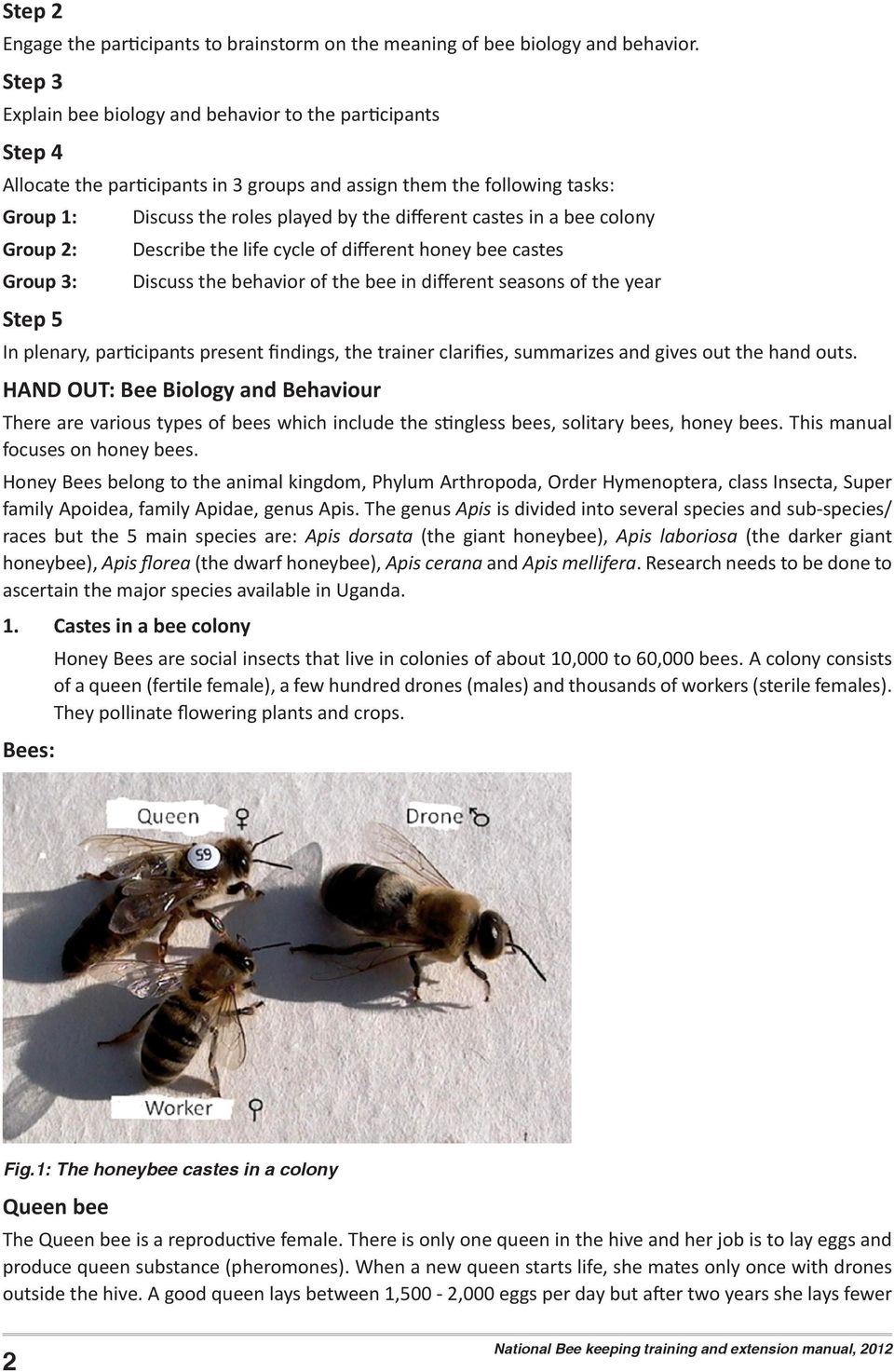
14 Sep 2 Engage he paricipans o brainsorm on he meaning of bee biology and behavior. Sep 3 Explain bee biology and behavior o he paricipans Sep 4 Allocae he paricipans in 3 groups and assign hem he following asks: Group 1: Group 2: Group 3: Sep 5 Discuss he roles played by he differen cases in a bee colony Describe he life cycle of differen honey bee cases Discuss he behavior of he bee in differen seasons of he year In plenary, paricipans presen findings, he rainer clarifies, summarizes and gives ou he hand ous. HAND OUT: Bee Biology and Behaviour There are various ypes of bees which include he singless bees, soliary bees, honey bees. This manual focuses on honey bees. Honey Bees belong o he animal kingdom, Phylum Arhropoda, Order Hymenopera, class Inseca, Super family Apoidea, family Apidae, genus Apis. The genus Apis is divided ino several species and sub-species/ races bu he 5 main species are: Apis dorsaa (he gian honeybee), Apis laboriosa (he darker gian honeybee), Apis florea (he dwarf honeybee), Apis cerana and Apis mellifera. Research needs o be done o ascerain he major species available in Uganda. 1. Cases in a bee colony Honey Bees are social insecs ha live in colonies of abou 10,000 o 60,000 bees. A colony consiss of a queen (ferile female), a few hundred drones (males) and housands of workers (serile females). They pollinae flowering plans and crops. Bees: Fig.1: The honeybee cases in a colony Queen bee The Queen bee is a reproducive female. There is only one queen in he hive and her job is o lay eggs and produce queen subsance (pheromones). When a new queen sars life, she maes only once wih drones ouside he hive. A good queen lays beween 1,500-2,000 eggs per day bu afer wo years she lays fewer 2 Naional Bee keeping raining and exension manual, 2012
15 eggs. She lives for hree o five years. I is very difficul o find he queen bu she can be recognized by her long and slender body and shor wings. She is fed by he young workers and is bigger han he oher occupans due o massive feeding especially wih royal jelly. She has a sing ha is only used agains rival queens. Her pheromones or scens serve o conrol he oher bees and harmonize he colony s behaviour. The Queen bee can be marked on he dorsal surface of he abdomen for easy idenificaion and o avoid being crushed accidenally during hive manipulaions. Drones The Drones are males and are bigger han he workers. They develop from unferilized eggs and heir major ask is o mae wih he queen. They are singless, very large eyes which are used o spo he Queen during maing. Drones look large and square and make a loud buzzing noise when hey fly. Drones are dependen on he workers for food because heir proboscis is shor and canno collec food for hem. There can be abou 200 o 500 drones in a hive bu in ime of food shorage he workers chase he drones ou of he hive o die. Their lifespan is usually no more han 2 monhs. The Workers Mos of he bees in he hive are workers- hey are all serile females. The worker bees change asks according o age. Young worker bees clean he hive, feed boh young and he Queen and make he beeswax combs. They conrol he emperaure of he hive by flapping heir wings and also guard he hive. Older workers scou for food and collec he pollen, necar, waer and propolis. They have a sing plus special glands and organs o help hem o defend he colony agains enemies. The workers are also responsible for he honey formaion process. The lifespan of a worker bee is 7-8 weeks during he main flowering season when hey work hard. They can live longer during dorman periods. 2. Life cycle of a bee Each bee in he course of is life passes hrough 4 sage meamorphosis: Egg Larva Pupa Adul. During he developmen sages, he eggs, larvae and pupae are known as brood. Fig.2: Diagram of he life cycle of he honeybee The egg laid by he queen looks like a small grain of rice or hair ni. Wheher an egg will develop ino a queen, drone or worker depends on he ype of cell i is laid in (i is very imporan o learn he difference beween capped brood and capped honey capped brood is usually dark brown and capped honey is usually whie or creamy in colour). The egg develops ino larva, which looks like a whie maggo. All larvae are fed on royal jelly for he firs Naional Bee keeping raining and exension manual, 2012

16 hree days afer which larvae for workers and drones are fed on pollen (bee bread) and honey pu ino he cell by he nurse bees (younger worker bees). The queen feeds on royal jelly hroughou he life. Fig.3: Peanu-shaped queen cell Fig.4: Queen cells Fig.5: Pebbly exured drone cells The larvae are sealed wih a wax capping in he comb afer six days where hey urn ino pupae and laer emerge as adul bees as shown in he able below. Table 1: Life span of bees Case Egg Larvae Pupae Toal days Worker Queen Drone Communicaion in bees Bees communicae wih one anoher in a number of ways such as drumming fee, flapping wings like a dance and use of pheromones. The dance performed by he scou bees is one way he bees inform each oher of he locaion of food and how far away i is. There are several ypes of dances performed by he bees, bu he main ones are he round dance and he waggle dance. The round dance is performed by bees ha forage less han approximaely 100 meres from he hive. Waggle dance is performed o locae food source beyond 100 meres from he hive. The scou bees also perform a characerisic dance o locae he new found home o which bees inend o swarm. Naional Bee keeping raining and exension manual, 2012

17 The queen releases a subsance called a pheromone (someimes called queen subsance) which serves differen funcions. The pheromone enables her o idenify members of he colony, o inhibi ovary developmen in worker bees, o preven he workers from building queen cells, o help a swarm or colony o move as a cohesive uni, and o arac drones during maing flighs. The absence of he queen subsance (e.g. when he queen dies) produces opposie responses, i.e. worker bees begin o develop ovaries and o build queen cells, and a swarm searching for accommodaion will no cluser bu will divide ino smaller groups ha canno suppor he normal life of a bee colony. Colony decisions are aken by he collecive behaviour of bees wihin one colony sharing he same odour, allowing guard bees o deec inruders. MODULE 2: THE IMPORTANCE OF BEEKEEPING Inroducion Beekeeping is he science and ar of rearing bees. I is imporan o keep bees for he producion of honey, beeswax, propolis, pollen (bee bread), royal jelly and bee venom; for food, medicine and income. Beekeeping is also imporan for pollinaion and recreaional aciviies. Learning Objecives By he end of he session, paricipans will be able o:- 1. Undersand and appreciae he imporance of beekeeping in he sociey. 2. Describe he imporance of he various bee producs and services. Targe Paricipans: Beekeepers, exension service providers, individuals and organizaions / Insiuions Suggesed Number of Paricipans: A maximum of 30 persons Duraion: 2 hours. Maerials Flip char and masking ape or chalkboard, marker pens or chalk, noebooks and pens, bee producs and flowers and fruis/ heir picures, posers, TVs, Projecors, generaors, films abou bee producs and services, and hand ous. Mehods Lecures Brainsorming Group discussions Case sudies Seps: Sep 1 Wrie he ile THE IMPORTANCE OF BEEKEEPING on he chalkboard or flip char and inroduce i. Sep 2 Engage he paricipans o brainsorm on why i is imporan o keep bees. Naional Bee keeping raining and exension manual, 2012
18 Sep 3 Allocae he paricipans in 2 groups and assign hem he following asks:- Group 1: Discuss he imporance of beekeeping Group 2: Explain he imporance of each bee produc or service Sep 4 In plenary, paricipans presen findings, he rainer clarifies, summarizes and gives ou he hand ous. HAND OUT: The imporance of Beekeeping Beekeeping is he science and ar of keeping bees using bes pracices. Beekeeping is very imporan, for he producion of honey, beeswax, propolis, pollen (bee bread), royal jelly and bee venom; for food, medicine and income. Beekeeping is also imporan for pollinaion and recreaional aciviies. There are various reasons for keeping bees, namely:- 1. For culural purposes Honey is used for beverage brewing and occasionally served a imporan culural ceremonies such as weddings. I is also served o very imporan guess as sign of high regard. The Maji Maji rebellion used bees as a weapon o defend hemselves agains he colonialiss. Honey was used in Egyp as cosmeics and also for embalming he Egypians dead pharaohs. Honey was among he ihes and offerory given by he Jews o he Levies in heir culure. In some African culures honey is also used o pay dowry. 2. As source of food Honey is delicious and nuriious. I is an imporan food for many people in Uganda. I is consumed whole or mixed wih oher foods as supplemen. Among he Langi and Acholi, honey is mixed wih simsim and groundnu pase. Bee brood (larvae and pupae) have high nuriional value and are fed o malnourished children. Royal jelly and pollen are consumed for heir high proein value. 3. As source of medicine Bee producs such as bee venom, honey and propolis are used for reamen of many condiions following he anibioic naure of he producs. The condiions/diseases reaed using bee producs include somach upses, diarrhea, vomiing, wounds, burns, cough, measles, false eeh, oohaches and fungal infecions. I also helps o boos he immuniy of people living wih HIV/AIDS. 4. For income generaion The honeybee producs can be markeed locally or abroad o ge money, wih or wihou value addiion. Beekeeping indusry also provides incomes o various sakeholders in he value chain. These include bee farmers, arisans, pharmaceuical indusry, food, beverage indusry, honey dealers among ohers. 5. Pollinaion The honeybees provide pollinaion services, hereby playing a vial role in food producion and overall agriculural produciviy. Over 75% of all he crops in sub Saharan Africa benefi from pollinaion. Bees are considered he mos efficien pollinaors because hey have hairy bodies which easily pick up pollen grains as hey move abou in flowers. During a single day one bee may visi several hundred flowers. So bees are imporan o farmers. More bees means beer pollinaion and high yields. In oher counries pollinaion by bees is hired and feches addiional money o he beekeeper. 6. Conservaion of naural resources Beekeeping is a non desrucive aciviy ha could be employed in he conservaion of biodiversiy in proeced areas. Households living adjacen hese areas can suppor he conservaion effors of hese resources by esablishing apiaries wihin or a he boundary of hese proeced areas. Naional Bee keeping raining and exension manual, 2012

19 Farmers realizing ha vegeaion is a source of forage for bees will guard agains he desrucion and be encouraged o plan more plans for supplying pollen and necar. In he process many plans are conserved and proeced from desrucion. 7. Hobby Oher people keep bees as a hobby. 8. Api-Tourism and research Esablishmen of bee reserves for purposes of ouris aracion and research holds a big poenial for he fuure. 9. Apiherapy Bee producs are used in he reamen of many human ailmens. For example, bee venom is an imporan remedy for many ailmens such as Arhriis, Parkinson disease and oher diseases relaed o he nervous sysem. The venom can be obained hrough bee sings. 10. Beekeeping is a cheap underaking (i) (ii) (iii) Beekeeping does no involve mass feeding of bees because in mos cases he bees provide heir own food all year round. All he necessary inpus and echnologies required for beekeeping are available locally. Some may be wased if bees are no kep, e.g. pollen and necar from flowering plans. Honey and beeswax can be produced in semi-arid areas ha are unsuiable for any oher agriculural use. The beekeeper requires limied land o keep bees. MODULE 3: POLLINATION Inroducion Pollinaion is he ransfer of pollen grains from he anher o he sigma of he same flower or anoher flower of he same plan or anoher plan bu of he same species. In oher words, pollinaion is he mixing of he male and female pars of a flower. Pollinaion is a vial sep in he reproducion of flowering plans and is necessary for all seed and frui producion. Plans require pollen o be ransferred from one plan o anoher and many depend upon insecs o do his as hey forage. Bees play a vial role in food producion and overall agriculural produciviy, as pollinaors. Learning Objecives By he end of he session, paricipans will be able o:- 1. Define pollinaion 2. Undersand he imporance of pollinaion 3. Idenify and lis down bee forage plans in heir areas 4. Consruc a flowering calendar for heir local areas 5. Explain possible dangers o bees arising from spraying crops wih pesicides, during flowering sage. Targe Paricipans: Beekeepers, crop farmers, exension service providers, individuals and organizaions/insiuions Suggesed Number of Paricipans: A maximum of 30 persons Duraion: 2 hours. Naional Bee keeping raining and exension manual, 2012

20 Maerials Mehod STEPS Sep 1 Flip char and masking ape or chalkboard, marker pens or chalk, noebooks and pens, worker bee, flowers, picures, posers, video and hand ous. Lecures Brainsorming Group discussions Field exercise- observing bee forage plans and pollinaion Aciviy- flowering calendar Wrie he ile Pollinaion on he chalkboard or flip char and inroduce i. Sep 2 Engage he paricipans o brainsorm on why pollinaion is imporan. Sep 3 Allocae he paricipans in 2 groups and assign hem he following asks: Group 1: Group 2: Sep 4 Idenify and lis bee forage plans in heir areas. Explain he dangers of agriculural pesicide use on bees. In plenary, paricipans presen findings, he rainer clarifies and summarizes, gives ou he hand ous. Sep 5 Sep 6 Field exercise: walk wih he rainees around he local area o see how pollinaion akes place and o idenify bee forage plans in he area Consruc a flowering calendar for he local area HAND OUT: Pollinaion Plans require pollen o be ransferred from one plan o anoher o aid reproducion. This ransfer of pollen grains is called pollinaion. I can be ransfer from he anher o he sigma of he same flower or anoher flower of he same plan or anoher plan bu of he same species. In oher words, pollinaion is he mixing of he male and female pars of a flower. Pollinaion is herefore a vial sep in he reproducion of flowering plans and is necessary for all seed and frui producion. Over 75% of all he crops in sub Saharan Africa benefi from insec pollinaion. Oher agens of pollinaion are wind, animals, birds, waer, man and repiles Insecs including bees forage plans for food, hey visi many flowers a day in search of pollen and necar. Many flowering plans depend upon hese insecs for he pollen ransfer (pollinaion) as hey forage. Adequae insec pollinaion improves he qualiy of he crop; uneven, misshaped and small fruis are ofen indicaion ha pollinaion has been insufficien. Among he insecs, bees are considered he mos efficien pollinaors because hey have hairy bodies which easily pick up pollen grains as hey move abou in flowers. During a single day one bee may visi several hundred flowers. Furhermore, bees are consisen foragers and end o work one kind of flower a a ime. Naional Bee keeping raining and exension manual, 2012

21 Scou bees will locae he bes flowers and hen encourage heir hive maes o use he same source. Pollen from he anhers is rapped in hairs covering he bee and carried o he sigma of he same plan or anoher from he same species. This is he firs sep owards ferilizaion and he producion of seeds and fruis. Bees, herefore, play a vial role in food producion and overall agriculural produciviy, as pollinaors. So beekeeping provides pollinaion services. Fig 6: The worker bee visiing a flower, helping o pollinae he plan In some counries he economic value of pollinaion is higher han he value of honey. Beekeepers move heir hives o differen bee forages in order o maximize honey flow and o improve crop pollinaion. In America, India and China pollinaion by bees is hired and feches addiional money o he beekeeper. Growers are willing o ren hives from beekeepers. Hives are placed near o he blooming crops (especially frui and oil seed crops) and removed afer flowering. Many beekeepers make money in his way and sill have he honey from he hive. They end up wih a double profi! In Uganda, examples of organizaions ha have praciced pollinaion services are:- Kawere Coffee Planaion in Mubende Disric. J. P. Cuings in Lugaluga, Wakiso Disric. Bees are known o increase and improve he yields of avocado, coffee, coon, sunflower, mandarin, onion, papaya, beans, mango, bananas, and many oher cash crops. So bees are imporan o farmers. More bees mean beer pollinaion and higher yields. If bees are killed, he value of crops is reduced. Therefore i is in everyone s ineres o mainain srong populaion of honeybees. Insecicides kill bees and conaminae hive producs. Farmers can help by selecing and using he recommended pesicides wih grea care and never using pesicides when flowers are open. Foraging insecs work on open blossoms and will be killed if sprayed a his ime. If pesicides mus be used, i is bes sprayed early or lae in he day when crop flowers are closed and here is no wind o drif he spray ono oher flowers or hives. Farmers should always ry o choose a pesicide ha aacks he pes bu will no harm bees. Beekeepers should each ohers he value of pollinaion by insecs. They should also educae neighboring farmers abou insecicides and heir negaive impac on he bee colony. Fores rees are also imporan bee forage and foress are essenial for he survival of bees. No rees, no bees: no honey, no money. Conserving fores biodiversiy is herefore imporan for beekeepers. Fores rees naive o Africa ha are imporan for bees include among ohers:- Acacia species Coffea species Naional Bee keeping raining and exension manual, 2012
22 Combreum species Diospyrus species Dombeya species Julbernardia globiflora Penaclehra macrophylla Vernonia amygdlina Calliandra callohyrsus Eucalypus sp. Musa sp. There are commercially available and major sources of forage for bees o produce excellen honeys, and can flower all year round. The following are examples of such plans: black berry (Rubus arguus), calliandra (Callindra callohyrsus), Cirus (Cirus spp.) e.g. angerine and orange, coffee (Coffea spp.), clover (Trifolium incarnaum), sunflower (Helianhus spp.), coon (Gossypium spp.), mango (Mangifera indica), cashew (Anacadinaceae), neem (Azadirachia indica), eucalypus (Eucalypus sp.), banana (Musa sp.), bole brush and passion frui. Bees forage on differen flowers in differen areas depending on wha is available. Mos plans flower only a cerain imes of he year bu bees need food over many monhs, so a variey of plans mus be available. I is a good idea o idenify which plans bees feed on in your area. I is hen possible o plan flowering plans around apiaries o ensure he bees have adequae forage when hey need i. Wild plans should be allowed o grow wherever here is space, including by he side of roads, near houses and in beween fields. Produce a flowering calendar lising he flowers ha are available each monh of he year. 10 Naional Bee keeping raining and exension manual, 2012
23 CHAPTER TWO MANAGEMENT OF THE HONEY BEE MODULE 4: BEEKEEPING SYSTEMS Inroducion The long relaionship beween humans and honey bees sared wih honey huning. To reduce he hardship and unpredicabiliy of harvesing from wild colonies, people found ways o increase heir conrol over bees hrough he ownership and managemen of colonies kep in hives. Currenly, here are various beekeeping sysems used, ranging from he local/radiional mehods o he modern sysems. Learning Objecives By he end of he session, paricipans will be able o:- 1. Appreciae he imporance of keeping bees in hives. 2. Describe he differen beekeeping sysems. 3. Undersand he economic imporance of he differen beekeeping sysems. 4. Selec he mos appropriae beekeeping sysem (he bes hive ype) for heir areas based on cos benefi analysis. Targe Paricipans: Beekeepers, exension service providers, individuals and organizaions/insiuions Suggesed Number of Paricipans: A maximum of 30 persons Duraion: 2 hours. Maerials Flip char and masking ape or chalkboard, marker pens or chalk, noebooks and pens, differen bee hives / heir picures, posers and hand ous. Mehod Lecure Brainsorming Group discussion STEPS Sep 1 Wrie he ile BEEKEEPING SYSTEMS on he chalkboard or flip char and inroduce i. Sep 2 Engage he paricipans o brainsorm on he differen beekeeping sysems in heir areas. Sep 3 Allocae he paricipans in 3 groups and assign hem he following asks: Group 1: Explain why people keep bees in hives Group 2: Explain he differen beekeeping sysems in heir areas Naional Bee keeping raining and exension manual,
24 Group 3: Sep 4 Discuss he economic imporance of he differen beekeeping sysems In plenary, paricipans presen findings, he rainer clarifies, summarizes and engages hem on cos benefi analysis of differen bee keeping sysems and gives ou he hand ous. HAND OUT: Beekeeping Sysems There are differen beekeeping sysems used and hese include:- (a) Honey huning and bee-killing The long relaionship beween humans and honey bees sared wih honey huning in he wild. Honey huning coninues in some communiies o dae. I involves killing he bees in he wild colony so as o obain combs conaining honey and brood (larvae and pupae). This primiive mehod involves use of open fire o kill he bees, evenually desroying no only he colony bu also he environmen as bushes are se on fire in he process of harvesing honey. Advanages Minimal work and knowledge is required There is no invesmen or expendiure involved Disadvanages Ness and bees are desroyed Bees may become aggressive Remaining bees may abscond Access o he ness can be far and dangerous Combs ge mixed up during harvesing hence producing poor qualiy honey Environmen is desroyed if rees are cu down or se on fire. To reduce he hardship and unpredicabiliy of harvesing from wild colonies, people found ways o increase heir conrol over bees hrough he ownership and managemen of colonies kep in hives. These beekeeping sysems range from he local/radiional mehods o he modern sysems. (b) Bee-having This is an inermediae sep beween honey huning/bee-killing and beekeeping. In bee-having, bees are housed in hollowed secions of ree runks, clay pos, gourds, bark hives, or woven wigs and mud baskes. Combs conaining honey are fixed and removed periodically. The farmer provides proecion o he bee colony in reurn for periodic harvess of honey, wax and oher bee producs. The idea is o mainain he colony for fuure harvess insead of desroying i for a one-ime harves. Boh bee-killing and bee-having are carried on wih very lile undersanding of he biology of he bee. I is no uncommon o find bee-having among farmers who have relaively sophisicaed equipmen which allows for managemen of heir colonies. They remain bee-havers because hey lack he raining o make opimum use of heir equipmen. This mehod is someimes referred o as local/radiional. Advanages Bees and ness are conserved Minimum cos (cheap locally available maerials and labor) Suiable for defensive bees Less risky han honey huning Hives can be placed near homes 12 Naional Bee keeping raining and exension manual, 2012
25 Disadvanages (c) Combs are fixed and mus be broken during harvesing Honey yields are modes Hive inspecion is difficul. Beekeeping Beekeeping implies he manipulaion of a bee colony based on some undersanding of he bees. This gives grea ease of managemen and harvesing for higher yields and beer qualiy of honey. Beekeeping herefore can be lucraive a any level of echnology, bu he level used should fi ogeher wih he local culural and economic realiy. There are 3 caegories of beekeeping namely:- (i) Local/radiional beekeeping in fixed comb hives. (ii) Transiional (beween local/radiional beekeeping and modern beekeeping): in op bar hives. (iii) Modern beekeeping: in frame hives Advanages Hives can be managed efficienly Bees are less disurbed and herefore less defensive Hives are easy o visi, harves, rea, feed, unie and divide Hives can be made o he righ volume and combs are movable Honey and beeswax can be of good qualiy Disadvanages Equipmen can be cosly Exernal financial suppor and donaed equipmen may be required Hive mus be made very precisely in order o work effecively Diseases and pess can be spread easily due o movemen of equipmens. More knowledge and skills are required Choosing he mos appropriae hive ype The bes hive is one ha is appropriae given he maerials ha are available, and he skills and financial resources of he beekeeper. The simpler and cheaper a hive is o make, he more people will be able o ake par in beekeeping. An expensive sysem does no necessarily resul in higher oupu. To avoid unnecessary deb and dependence on exernal suppor, beekeepers should be able o make or buy cheap hives made from local maerials. This independence gives hem he freedom o ge sared in beekeeping and expand heir business. Honey harvess are affeced by he availabiliy of forage for bees, he srengh of he colony, and he size of he conainer used as a hive. I is no simply he ype of hive ha deermines how much honey he bees will sore bu also he size. Feaures of an appropriae hive Aracive for bees - dry, correc size, nice scen, easy o proec from pess and predaors. Suiable for he beekeeper - affordable, manageable, locally available, susainable. Fixed comb (local/radiional) hives Fixed comb hives are conainers made from whaever maerials are locally available, such as grasses, logs, bark, raffia palm, clay, ec. Bees build heir nes inside he conainer, jus as hey would build in a naurally occurring caviy. The bees aach he combs o he inside upper surface of he hive. The honeycombs need o be cu off from his surface o be harvesed and canno hen be replaced. Naional Bee keeping raining and exension manual,
26 Fixed comb hives such as he hollowed ou logs, bark hives, clay pos and woven grasses, ec are cheap o consruc, relaively easy o manage and suiable for defensive bees like in ropical Africa, including Uganda. The main inpus are local knowledge and local maerials, raher han exernal financial suppor and donaed equipmen. Fixed comb hives, usually cylindrical in shape, have been used in Africa for generaions. A variey of differen syles can be found across he coninen, from hollowed-ou logs and bark formed ino cylinders, o clay pos and woven grasses. Local mehods have evolved over a long period o sui local resources and indigenous bees. Honey bee brood diseases are no observed o cause problems in fixed comb hives, probably because of he frequen movemen of ropical honey bee colonies and heir rebuilding of combs, hereby he brood is reared in fresh combs, leaving no chance for he brood diseases o persis and accumulae. Fixed comb hives are a proven echnology ha have sood he es of ime and can be highly profiable. The replacemen of fixed comb hives wih oher hive ypes should no be considered necessarily ineviable or desirable. Cos-benefi analyses prove ha fixed comb hives are more profiable han oher hive ypes in ropical Africa. Mos honey harvesed in ropical Africa oday comes from fixed comb hives e.g. in he Norh Wes Province of Zambia, beekeepers harves high qualiy honey and beeswax from fixed comb and expor hese producs o he European Union. Top bar (ransiional) hives Top-bar hives are boxes wih a series of bars arranged side by side along he op. Bees are encouraged o consruc heir combs from he undersides of hese op-bars. Top-bars enable he beekeeper o lif individual combs ou of he hive for inspecion. Combs conaining unripe honey or brood can be replaced and hose conaining ripe honey can be removed for harves. Harvesing honey and beeswax from op-bar hives is simple and can be achieved wihou damage o he colony. Top-bar hives are paricularly suiable for beginner beekeepers because i is ofen easier o learn how o manage and harves from a op-bar hive han from a fixed comb hive. Insalled a wais heigh and kep close o home, op-bar hives are ofen popular wih women. All he equipmen needed for op-bar hive beekeeping can be bough or made locally. Top-bar hives are ofen inroduced by projecs keen o promoe new and seemingly modern ideas, ye hey funcion well only if he beekeeper undersands he bees, he benefis and limiaions. Poor use of op-bar hives can lead o disappoinmen and abandonmen. Frame hives Frame hive is a box wih movable frames. This ype of hive is appropriae in ropical Africa bu is expensive o buy and mainain, machinery is required o exrac he honey. Beeswax yields from frame hives are low compared o fixed comb hives. MODULE 5: BEEKEEPING EQUIPMENT Inroducion Many differen ypes of equipmen are used in beekeeping indusry righ from he apiary hrough harvesing and processing o ransporing and sorage of hive producs. Learning Objecives By he end of he session, paricipans will be able o:- 1. Idenify he differen beekeeping equipmen and heir uses 2. Demonsrae he operaion and use of he various beekeeping equipmen Targe Paricipan Beekeepers, exension service providers, arisans, individuals and organizaions/insiuions 14 Naional Bee keeping raining and exension manual, 2012
27 Suggesed Number of Paricipans: Maximum 30 Duraion: 4 hours. Maerials Mehod STEPS Sep 1 Flip char and masking ape or chalkboard, noebooks and pens, marker pens or chalk, beekeeping equipmen and/or heir picures and hand ous. Lecures Brain sorming Demonsraions Group Discussions Wrie he ile BEEKEEPING EQUIPMENT on he chalkboard or flip char and inroduce i. Sep 2 Engage he paricipans o brainsorm on he differen beekeeping equipmen in heir areas. Sep 3 Allocae he paricipans in 3 groups and assign hem he following asks: Group 1: Group 2: Group 3: Sep 4 Idenify he differen beekeeping equipmen and heir uses Demonsrae he operaion and use of he various ypes of beekeeping equipmen Discuss he economic imporance of he various ypes of beekeeping equipmen In plenary, paricipans presen findings, he rainer clarifies, demonsraes, summarizes and gives ou he noes. HAND OUTS: Bee Keeping Equipmen Inroducion Beekeeping equipmens include beehives, harvesing gear, processing gear, sorage and ransporaion faciliies. 1. Bee hives Types of beehives 1. Tradiional hives (fixed comb hives) a. Woven baske hive They vary in shape, size and ype of maerials used for example hey can be conical or cylindrical in shape, he cylindrical one measures approximaely 90 cm in lengh and 30 cm in diameer Maerials: papyrus, bamboo, fibre, wigs or sicks, cow dung or soil for smearing, grass or banana fibre or dry banana leaves as cover. Durabiliy of he hive depends on he maerials used and managemen. One end compleely closed, One end bearing 5-6 holes of diameer 8-10 mm in a row Naional Bee keeping raining and exension manual,
28 Baske hive Sandardized dimensions: ± 30 cm Hive body Fron cover Ø 30 cm 90 cm 5-6 Holes Ø 8-10 mm Back cover Ø 30 cm Fig 7: Measuremens for Woven baske hive Fig 8: Woven baske hive Advanages Cheap Maerials are locally available Does no require a lo of skills and echnology High propolis produciviy. High wax produciviy Disadvanages Difficul o inspec Combs break when ranspored over long disances Producion is limied since hive canno be exended Difficul o harves and a lo of smoke is needed Difficul o deermine harvesing capaciy or volume because of differences in lengh and diameer. Swarming and absconding are common 16 Naional Bee keeping raining and exension manual, 2012
29 b. Log hive Cylindrical in shape. One end closed bu one end bears he enrance hole for he bees Fig 9: The log hive Advanages Cheap Maerials are locally available Does no require a lo of skills and echnology High wax produciviy Durable wih good pracices High colonizaion rae. Disadvanages Difficul o inspec Combs break when ranspored over long disances Producion is limied since hive canno be exended Difficul o harves and a lo of smoke is needed Difficul o deermine harvesing capaciy or volume because of differences in lengh and diameer. Swarming and absconding are common c. Clay hive: Made from baked clay soil Can ake he cylindrical or oval shapes The cylindrical has enrances a one end The oval shape has enrances a he boom wih he op covered a plank of wood. Naional Bee keeping raining and exension manual,
30 Fig 10: Clay hives Advanages Cheap Maerials are locally available Does no require a lo of skills and echnology High wax produciviy High colonizaion rae Disadvanages Difficul o inspec Delicae o ranspor as i may fall and break Producion is limied since hive canno be exended Difficul o harves and a lo of smoke is needed Difficul o deermine harvesing capaciy or volume because of differences in shape. Swarming and absconding are common d. Johnson hive Made from well seasoned imber of Musizi, Nkago, Nkuzanyana and Muvule measuring 12 x 1 inches. Doors measure 30 X 30 cm Sides measure 91 cm X 30 cm Top board measures 97 cm X 30 cm wih iron shee cover Boom measures 91 cm X 26 cm Wih a queen excluder in he middle Wih enrances on eiher side of he excluder Wire loops for hanging 18 Naional Bee keeping raining and exension manual, 2012
31 Fig: 11: Picure of Johnson hive Advanages: Separaes honey from brood High wax producion Disadvanages There may be wo colonies in he hive creaing confusion A colony may seal off he queen excluder wih propolis and remain on one side of he hive. Combs break when ranspored over long disances Producion is limied since hive canno be exended Swarming and absconding are common 2. Improved hives (movable op bar hives) a) Kenyan Top Bar Hive Fig 12: KTB hive showing how he comb aaches o he bar inside he hive Naional Bee keeping raining and exension manual,
32 Fig 13: A op bar lifed from a KTB hive Fig 14: A KTB hive being opened NB: 1. All op bar hives should have op bars wih dimension of widh of 3.2 cm and a lengh of approximaely 48cm. 2. Kenya op bar hive can be made ou of bricks, imber, bamboo, papyrus, baske and clay. 3. The cover can be fabricaed provided i is waerproof maerial e.g. Plasic shees, grass, banana fibers, and mas 20 Naional Bee keeping raining and exension manual, 2012
33 Advanages Colony spliing and muliplicaion easy. Conrol of swarming is possible. Easy o inspec o know he condiion of he colony Harvesing is easy and possible o selec sealed combed (ripe) honey Maerials for consrucion are available Durable High colonizaion rae when baied. Disadvanages I requires high skills and echnology o manufacure Expensive for an ordinary person o afford Producion is limied as i can no be expanded Combs can easily break while in ransi b) KTB Cacher box: The KTB cacher box is usually a quarer of he acual KTB hive. I is used for rapping passing bee swarms in he wild. Fig 15: Cacher box for a KTB hive 3. Modern hives (Movable frame hives): Examples: Langsroh and Dadan Frames arranged verically righ on op of he brood chamber (super) Naional Bee keeping raining and exension manual,
34 a) Langsroh hive: Langsroh hive A modern hive consiss of: An ouer cover 12 frames per super A queen excluder A brood chamber An inner cover A honey super 12 frames per chamber A boom board Fig 16: Langsroh hive showing he differen pars of he hive Fig 17: Langsroh hive 22 Naional Bee keeping raining and exension manual, 2012
35 Fig 18: Langsroh hive- brood chamber, empy frame, honey chamber, combed frame, queen excluder, cover Fig 19: Cacher box for a Langsroh hive Advanages of Langsroh / Dadan hives Transporable High honey yield Easy o inspec and harves Easy o conrol swarming Bee breeding and queen rearing possible Long lasing Naional Bee keeping raining and exension manual,
36 Disadvanages of Langsroh / Dadan hives Very expensive Some of he maerials for consrucion need o be impored Requires high skills and echnology Producion of oher hive producs is very minimal (wax and propolis) Requires high managemen skills. I is prone o pes and disease aack. b) Brick frame hive The main body of a frame brick hive is made of bricks wih 2 sides, a fron wih holes for bees o ener and a back. 28 frames A cover for proecion agains rain Frame brick hive Sandardized dimensions: 62cm 53cm 115cm Fig 20:Frame brick hive Advanages High honey produciviy Easy o manage, inspec and harves Long lasing Breeding of bees possible No expensive Maerials locally available Having naural insulaion properies Disadvanages The frames require high level of skills o consruc No ransporable More prone o pess, diseases and floods 24 Naional Bee keeping raining and exension manual, 2012
37 2. Bee harvesing gear a) Smokers The body consiss of a galvanized meallic shee of gauge 28 canon and pumping bellow. The canon has a chamber wih 2 holes- one for incoming air and he oher one o le ou smoke. Inside he chamber is placed a sieve o proec he inle from being blocked wih ash. The pumping bellow consiss of 2 pieces of wood of size 12 cm X 20 cm, reurnable spring, leaher or canvas maerial. Fig 21: Bee smokers Recommended maerials for smoking Semi dry grass Wood shaving Coffee husks Maize comb Bean husks Mille husks Dry cacus Dry pawpaw sem Ec. Recommended procedures in lighing a smoker Pu glowing charcoal on he sieve in he canon chamber, followed by any of he smoking maerials menioned above, filling he chamber 3 quarer way. Before closing he smoker fill he canopy i.e. he las quarer wih fresh green grass or leaves. Genly, sar pumping he bellow and smoking b) Bee sui Consiss of an overall and a head veil; he overall is made of whie or yellow khaki maerial wih a head veil aached o i. The ne of he head veil is made ou of srong black nylon maerial in order o have good vision and venilaion. The ha of he veil consiss of he same khaki maerial of he overall wih a round sreching siff ring of approximae diameer of 42 cm. The veil is aached o he overall wih a double zip and can be deached. The overall should cover whole body righ from he legs, arms up o he neck wih a long jacke zipper from he fry up o he neck. The overall should be fiing loosely (no igh) wih provision of pockes; a leas Naional Bee keeping raining and exension manual,
38 4 pockes - 2 a he ches and 2 around he highs. There should be elasic of code 16 a he wris and ankles. Fig 22: Bee sui c) Bee gloves Can be made of sof leaher maerial or sof laex gloves, joined wih a piece of cloh of he same khaki maerial and colour of whie or yellow as ha of he overall, reaching up o he elbow fixed wih an elasic of code 16. Fig 23: Sof laex gloves d) Gumboos Gumboos o be used by a beekeeper should be whie in colour and of his/her own size. One can innovae a gumboo ou of polyhene sacks used for carrying maize, beans, sugar and used as overshoes and ie over he overall near he knee. 26 Naional Bee keeping raining and exension manual, 2012
39 e) Hive ool se Consiss of a bee brush, hive opener and sainless seel knife: l The bee brush should be made of sof naural fibre e.g. sisal fibre. One can also use bird quill feaher or very sof leaves or grass provided hey are clean. l The hive opener is made ou of fla iron bar of 6mm hickness, widh of 25mm and lengh of 24cm. The hive opener is sharpened a boh ends bu curved a one end and should be pained wih rusproof pain o avoid conaminaion of honey wih corrosion and rusing wih honey. Fig 24: Bee brushes Fig 25: Hive openers Fig 26: Knife Naional Bee keeping raining and exension manual,
40 3. Bee processing Equipmen a) Air-igh buckes They should be whie or yellow in colour and of food grade maerial of capaciy no more han 25kgs for ease of ransporaion. Fig 27: Airigh Bucke (food grade) b) Food grade drums The drum mus be made of sainless seel, air-igh and resed on wooden palles. Fig 28: Food grade drum c) Refracomeer I is a machine used o deermine he percenage of moisure in honey. I is impored ready made. Fig 29: Honey refracomeer 28 Naional Bee keeping raining and exension manual, 2012
41 How o use a refracomeer Open he slide cover and pu a drop of honey sample and cover. Hold agains ligh, view from he eye piece and adjus accordingly unil you ge a dark border line; where i marks is he percenage of he waer conen of ha sample. Then, clean he slide hereafer. (i) d) Weighing scale I is a device used o weigh honey, beeswax and oher bee producs. There are 3 ypes of weighing scales commonly used in Uganda, namely:- Plaform Weighing Scale. I comprises of a plaform and a scaled arm. How o use a plaform weighing scale Pu he conainer wih he bee produc in quesion on he plaform and adjus he scaled arm unil i balances. The reading where i balances gives you he weigh of he produc in he conainer. ii) Clock Face Weighing Scale I has a scaled clock face wih a poiner, 2 hooks and re-seing nu. These weighing scales vary wih maximum weighing capaciy ranging from 25kgs o 200kgs. How o use a Clock Face Weighing Scale 1. Re-se he poiner o 0 mark using a re-seing nu. 2. Use upper hook for suspending he scale in a rope ied o a horizonal bar. 3. Hang he conainer wih he produc on o he lower hook. 4. Take he reading from he scale where he poiner ends and record. iii) Clock face-wih- weighing bowl-and-base weighing scale I has a scaled clock face wih a poiner, a bowl, a base and re-seing nu. They vary wih maximum weighing capaciy ranging from 1 gram o 2kgs. How o use a Clock face-wih- weighing bowl-and-base weighing scale 1. Re-se he poiner o 0 mark using a re-seing nu. 2. Pu he conainer wih he produc on he bowl. 3. Take he reading from he scale where he poiner ends and record. 4. Used o weigh small quaniies e) Sraining cloh: Fig 30 (a): Sraining cloh Fig. 30 (b) Sraining cloh ied around a bucke ready for sraining honey Naional Bee keeping raining and exension manual,
42 f) Cenrifuge exracor I is a machine used o exrac honey from combs and framed combs. I comes ready made. Some are made of food grade plasic while ohers made of food grade sainless seel. They have exracing capaciy ranging from 2 frames o 18. The combs or frames are arranged eiher radially, riangularly or recangularly in order o exrac honey. There are manual exracors as well as he elecrical ones. All ypes have a spou for draining he honey ou of he ank. The boom is convex inside o allow all he honey o drain. They are fied on 3 sands. The main body is cylindrical. They have 2 ransparen plasic covers. Fig 31: Cenrifuge exracor g) Honey seling Tank There are 2 ypes; food grade plasic anks and sainless seel anks. They vary in capaciy from 25, 50, 100, 200 and hen 400kgs. I has a cover and a spou wih a convex boom inside. Some come wih inbuil honey srainer while ohers come wih separae double srainers. Fig 32: Honey seling ank 30 Naional Bee keeping raining and exension manual, 2012
43 h) Honey Press: Fig 33: Honey Press i) Honey jars: Fig. 34: Honey jars j) Bee house: Fig 35: Bee house Naional Bee keeping raining and exension manual,
44 k) Honey collecion and processing premises: 1. The honey processing environmen should be free of pess, conaminans and polluans i.e. i should be free from filh, fumes, sagnan waer/breeding places for mosquioes, swampy areas, agrochemicals, human or animal wase or garbage. 2. The premises should be suiable in size for he purpose of handling/processing food 3. I should be spacious o allow smooh flow of processes 4. Adequae lighing should be provided 5. I should be vermin and bee proof 6. Have good drainage 7. Have high roof-he ceilings shall be smooh, impervious and easy o clean MODULE 6: MAKING BEEKEEPING EQUIPMENT Inroducion Mos beekeeping equipmen can be made locally or simply using he local maerials. I is herefore imporan o know he recommended dimensions and how o make some of he key equipmen required for primary producion a he apiary. Learning objecives By he end of he session, paricipans will be able o:- 1. Explain he dimensions of beekeeping equipmen 2. Make differen bee keeping equipmens and ools. Targe Paricipan: Arisans, beekeepers, service providers, individuals or organizaions Suggesed Number of Paricipans: Maximum 20 Duraion: 2 hours (classroom), 3 days for pracical session on making beekeeping equipmen. Maerials Flip char and masking ape or chalkboard, noebooks and pens, marker pens or chalk, equipmen plans, maerials and ools for making equipmens and finished pieces of he equipmen for demonsraion and hand ous. Mehod Lecures Pracicals STEPS Sep 1 Wrie he ile MAKING BEEKEEPING EQUIPMENT (Specify Equipmen) on he chalkboard or flip char and inroduce i. Sep 2 Ask one or wo paricipans o help you in demonsraing and modeling he differen beekeeping equipmen specified in sep 1 above. 32 Naional Bee keeping raining and exension manual, 2012
45 Sep 3 Give ou he equipmen plans. Go hrough he plans carefully. Explain using he finished piece of he equipmen. Sep 4 The rainer asks he paricipans some quesions o check heir undersanding and clarify on gaps. Sep 5 Pracical sessions for making he equipmens HAND OUTS (i) Kenya Top Bar Hive Plans The only exac measuremens required in he consrucion are hose of he op bar iself. Ohers are no oo criical, so he size of he hive can vary o sui local condiions. Give hese plans o a local carpener and explain he following dimensions: Dimensions for body Lid: 94cm x 52cm Side: 26cm x 87cm Boom: 24cm x 87cm or o 90cm maximum Ends (2): 25cm in heigh, 42cm wide a op and 20cm wide a boom 94cm 52cm TOP LID 87cm Enrance holes 8mm - 10mm 26cm Side A 87cm - 90cm 25cm Fron side 24cm BOTTOM 20cm Back side 42cm 25cm 87cm 26cm Side B Fig 36: Dimensions for he body of a Kenya Top Bar hive Dimensions for op bars:- Lengh: 45.5cm Widh: 3.2cm Naional Bee keeping raining and exension manual,
46 Types of op bars: T- shaped, V- shaped, Grooved-op bar and half round op bar (i) V - shaped op bar 3.2cm 2cm 1.6cm (ii) T - shaped op bar 3.2cm 2cm 1.35cm 1.5cm (iii) 0.5cm Grooved op bar 3.2cm 2cm 1.5cm 0.4cm 1.4cm (iv) Round op bar 3.2cm 2cm Noe: All shapes MUST be rebaed a boh ends o sop slide off from he hive. 48cm 2cm 3.5cm 1cm 1cm 34 Naional Bee keeping raining and exension manual, 2012
47 Maerials Any imber for he body and he op bars mus be suiable, well seasoned wood. Insrucions Noe: Cu he sides, ends and boom o he required size. The sides of he hive should be a an angle o approximae he curve of he combs ha he bees will naurally make (his limis he inclinaion of he bees o aach he comb o he side walls). All surfaces need o be smooh and all joins free from cracks and gaps. Make 6-8 small round or riangular shaped holes a one end of he hive near he boom as he enrance: 8-10mm in diameer. The op bars require criical measuremens and uniformiy and mus be 32mm or 1.24 inches wide. Pu a srip or groove along he cenre of he op bars, ono which beeswax is placed o encourage comb formaion and bai. This hive should hold beween 20 o 33 op bars packed ighly in he hive wih no gaps. Try and make he op bars he exac same measuremen (32 mm) in all your op bar hives (he sandard op bar is 19 inches or 48cm long) o allow bees o be ransferred from one ype of hive o he oher. (ii) Mud and Sick Hive The body of a op bar hive can be made up of locally available maerials provided ha he sandard measuremens of bars are followed. So he following dimensions are given only as a guide and can vary according o local needs. However he measuremens for he op bar are criical and mus be 32mm wide. Inernal Dimensions for body Lengh: 900mm Widh: 440mm Heigh: 300mm Dimensions for op bars Lengh: 480mm Widh: 32mm (The lengh is jus a guide bu i MUST be 32mm or 1.25 inches wide for op bar). COMB SPACE GUIDE 3.2cm 1.5cm 0.5cm 0.5cm Fig 37: Top bar measuremens Maerials Long and shor sicks Naional Bee keeping raining and exension manual,
48 Wire, sring or acacia bark fibre Mud or dung (mud from a ermie mound works he bes) Maerial (wood, in or polyhene o cover he hive Timber for he op bars Insrucions iii) For he body you will need approximaely 50 long and 30 shor sraigh sicks. Make a frame of sicks firs o form he boom or base of he hive. Tie on oher sicks o he frame o form he sides. Make slighly sloped sides if possible. Use wire, wine or fibre o ie all he sicks ogeher. If you bind hem ighly hen you can have a very srong frame ha does no wobble. Plaser ouside he frame wih mud and cow dung and leave o dry. Make 6-8 small holes of 8-10mm in diameer a one end of he hive as he enrance. These should be close o he boom of he hive o make i easy for he bees o keep he hive clean. Experimen wih any available low cos maerial o cover he hive. Use in or imber if available (approx 57cms x 97cms). Bu don pu a in roof direcly on he op bars as i migh ge oo ho in he sun leave a gap beween he op bars and he in cover. You may also use a plasic shee over he lid o sop he hive geing we. Consruc he op bars from imber and pu a srip of wood along he cenre, ono which beeswax is placed o encourage comb formaion and bai. This is called a comb guide. Try and make he op bars he exac same lengh in all your op bar hives o allow bees o be ransferred from one ype of hive o he oher. Langsroh bee hive plan: ¾ exernal plywood cover wih in ¼ exernal plywood Inner cover Hive frames (inside shallow super) Clea for handhold 45cm 40cm Ouer cover 52.5cm 47.5cm 5cm 7.5cm Hole Framed Queen excluder 40cm 47.5cm Brooder Hive frames (lifed o reveal inside consrucion of super) Boards o suppor frames inside super Clea for handhold Movable boom board ¾ exernal plywood Hive sand 40cm 40cm Deep super (deep hive body) 55cm 47.5cm 15cm Sailess wire of 0.47mm diameer Fig. 38: Langsroh hive dimensions LANGSTROTH HIVE All wood used should be of 2cm hickness. 36 Naional Bee keeping raining and exension manual, 2012
49 (1) Cover Frame 57cm x 50cm of widh 4cm and hickness 2cm Fied wih plywood op of size 57cm x 50cm Then covered wih plain iron shee gauge 32. (2) Inner cover Plywood cu o size 48cm x 48.5cm (3) Supper / Honey box 1cm Size 42.5cm x50.5cm and heigh of 14cm I has a op rebae inside on he sides of 42.5cm. The rebae size is 2cm in deph and 1cm in lengh. 2cm Fied wih frame spacers o accommodae 11 frames (4) Queen excluder Coffee ray wire cu o size 42cm x 50cm Framed wih bindings a he edges. The size of he bindings is 2.5cm widh and 2mm hickness Binding Coffee ray wire (5) Brood box Size 42.4cm x 50.5 cm x 28cm Fied wih boom board which leave 1cm gap from boom line I has a op rebae inside on he sides of 42.5cm. The rebae size is 2cm in deph and 1cm in lengh. Naional Bee keeping raining and exension manual,
50 1cm 2cm Fied wih frame spacers o accommodae frames (6) Supper frame 48cm 4cm 12cm Sides 1cm 1cm Sainless wire Boom 1cm 39.5cm 1cm (7) Brooder frame Sainless wire 20cm All oher dimensions are he same as of supper and brooder frame excep he sides Top pieces are made of sizes 2cm x 2.5 cm Top piece is fied wih a groove Side and boom pieces are made of sizes 1cm x 2.5 cm (8) Sainless wire Super frame is fied wih 2 sainless wires of gauge 0.47mm Brooder frame is fied wih 3 sainless wires of gauge 0.47mm 38 Naional Bee keeping raining and exension manual, 2012
51 (9) Wax foundaion shee Super frame is fied wih comb foundaion shee Brood frame is fied a leas ½ of he comb foundaion shee (iv) Solar wax meler plans A solar wax meler provides a simple and safe mehod o exrac wax. I is a glass or plasic covered box ha uses he hea of he sun o mel beeswax. Sun rays Double skin of glass or plasic shee Wire mesh o hold back debris Fig 39: Solar wax exracor Collecing conainer for meled wax Insulaing maerial Meal ray shaped o direc wax ino conainer The dimensions of he body depend on he maerials and space available. Maerials Wood and black pain for he body (inside and ouside) 2 Glass shee of 2mm gauge wih a space of 4mm in beween Sainless meal shees for ray (unpained) Conainer (plasic wih sloping sides works bes) Wire mesh over he conainer o srain wax Insrucions 1. Make a box 2. Make he collecing conainer 3. Make he meling ray 4. Pu he separaing mesh 5. Consruc a double clear glass or clear plasic lid. The 2 shees should be abou one inch and a quarer (1 ¼ ) or 4cm apar o help increase and reain absorbed hea. The enire box should be pained black from ouside for maximum hea absorpion. Naional Bee keeping raining and exension manual,
52 Using he solar wax exracor 1. The meler is placed in a sunny spo. The box is iled a an angle o cach he sun. 2. Combs are placed on he meal shee. The shee should no be pained, as pain conains lead, which can conaminae he wax. The meler can be used o render old combs, cappings and oher hive scrapings. 3. The wax mels and runs ino a collecing conainer hrough a wire mesh, o form wax blocks according o he shape of he collecing conainer. (v) Bee veil The mos imporan piece of he bee sui is he veil for covering he head. Veil 1 - Dimensions for body:- The lengh will vary depending on he size of he ha. The oal finished deph of he veil should be 70cm (20cm of cloh, 30cm of screen, and 20cm of cloh). Maerials Cloh x 2 pieces Elasic x 1 piece Black screen x 1 piece A ha wih a brim Insrucions The cloh used for he veil needs o be a cool maerial so he head does no ge oo ho. Cu and sew he cloh and screen according o he size of he ha. Place drawsrings around he boom and op of he veil. Place he veil over a ha wih a wide brim. Ensure he veil is kep clear of he skin. Alernaively inser siff wire or flexible sicks hrough he veil and make a ring o keep i siff. The lower edge of he veil mus be fixed igh so ha bees canno ge in. Fig 40: Bee veil Veil 2 An alernaive veil can be made as follows:- Maerials Cloh x 2 pieces Black screen x 1 piece 40 Naional Bee keeping raining and exension manual, 2012
53 Fig 41: Dimensions of Bee veil Insrucions 1. Cu he cloh and mark he poins A G on he maerial (see above). 2. Sew he screen and firs cloh from A o B 1 (see below). 3. Sew he screen and cloh from B o C (see below). 4. Aach he second cloh and sew from A o B, and o C and o D (see below). 5. Sew he back of he veil from A o G and finish he hem (see below). Fig 42: Bee veil pars Bee veil and Overall plan: BEE VEIL (1) (i). Cu 2 round pieces of maerials of diameer 18cm for he op of ha (ii). Cu 4 pieces of maerial for he of he ha (2) 27cm 12cm 35cm Fig 43: Bee veil plan: (iii) Cu 2 round pieces of maerial for he ha base (circular and hole of 17cm in he middle) Naional Bee keeping raining and exension manual,
54 (3) 17cm 45cm Sew ogeher 1 round op No.1, 2 pieces sides No.2 and 1 base o make a ha. Fi 2 has ogeher and fold he base over a ring wire of 125cm circumference and sew. (4) (i). Cu a black ne of size 63 cm x 31 cm (ii). Cu a maerial of size 67cm x 31 cm (iii). Sew he maerial and he ne a eiher side of 31cm o make i round. Maerial 31cm 31cm 67cm Ne (iv). Cu maerial of size 160cm x 11 cm. Fold i ino 2 o make 160 cm x 5.5 cm and sew all round he above ne and cloh. (v). Then fix 2 self locking jacke zips of 56cm saring in he middle back on eiher sides (vi). Then sew he whole piece on he ha. (vii). Pu anoher ring wire 15cm from he ha and sew over i a maerial of 160cm x 5cm. OVERALL 1. Ge a piece of maerial 160cm x 90 cm hen fold i ino 2 o ge 45cm x 160cm. 160cm 25cm 40cm 29cm 45cm 23cm 47cm Fig 44: Overall plan: 42 Naional Bee keeping raining and exension manual, 2012
55 You have o ge 2 pieces one for he lef and anoher for he righ. 2. Ge a piece of maerial of size 80cm x 76cm and fold i ino 2 o ge 80cm x 38cm. 27cm 76cm 51cm 19cm 80cm You ge 2 pieces for boh hands. 3. Cu 2 pieces of size 26cm x 29 cm for he down pockes 4. Then cu 1 piece of size 13cm x 18cm for he upper pocke and cu a covering flap of 18cm x 19cm and fold ino 2 o ge 9cm x 19cm and fix a sick- on (kamaa). 5. Sar sewing he lef and righ pieces in No.1 a he back and highs and hen fix a zip of 76cm a he fron. 6. Fix a collar according o he size of he overall 7. Then fix he 2 down pockes and one upper pocke. 8. Pu lasic a he end of he arms legs and back. 9. Fix he covering flap on he upper pocke 10. Sew he second par of he zip from he veil. 11. Pu flap wih sick-on (kamaa) a he fron and back when he zip sars and ends. vii) Bee glove plan: Gloves A 38cm C B D 28.5cm (i) Buy laex gloves wih coon lining inside (o absorb swea and easy o pu on and off) Naional Bee keeping raining and exension manual,
56 (ii) (iii) (iv) (v) Cu 2 khaki maerials as per size above (ha is 38cm x 28.5cm) Join side B o C and make i round. Pu a provision for a elasic a side A Then sew side D o he gloves of lef and righ so ha i becomes longer up o he elbow. B C A D Fig. 45: Measuremens of Bee glove viii) Measuremens of Bee Smoker: Fig 46: Measuremens and making of a bee smoker: Seps: (1) (i) Cu he pylon wire as per size above (ii) Make holes a and b wih diameer of he rive o be used (iii) Cu off corners (2) (i) Cu as per size above plain shee gauge 28. (ii) Join sides a and b o make a cone wih a hole. (iii) Fold ou he base 2 mm a righ-angle o he base of he cone 44 Naional Bee keeping raining and exension manual, 2012
57 (3) X 2.5cm b a Fold W 34cm X (i) Cu plain shee gauge 28 as per size above (ii) Fold o remove he sharp edge a side W. (iii) Join side a and b and make i round Join Fold b a W (iv) Fold 3mm a righ angle all round a X. (4) Fix No. 2 o No. 3 and join firmly he base of he cone o he ring a X. 2 X 3 W Naional Bee keeping raining and exension manual,
58 (5) 2cm W 2cm 2cm 5cm 5cm 19cm S 6cm a b 2cm T 6cm c d 2cm 4cm 33cm X 4cm (i) Cu plain shee gauge 28 as per size above. (ii) Make a hole of 2cm diameer. (iii) Make holes a, b, c and d as he size of he rive o be used. (iv) Join side S o T and form a cylinder of 10 cm diameer. (v) Fold 1mm o remove he sharp edge a side X. (vi) Fold 1mm a righ angle a side W near a big hole. W 19cm Ridge 1cm (vii) Pu a ridge 1 cm from side X. X 46 Naional Bee keeping raining and exension manual, 2012
59 (6) 2mm 11.5cm (i) (ii) Cu a circular plain shee of gauge 28 wih a diameer11.5 cm. Fold 2mm a righ angle facing upward all round. 2mm 11.1cm (7) Place side W No.5 on No.6 and fix firmly he boom X 5 W 6 Naional Bee keeping raining and exension manual,
60 (8) (i) Cu plain shees gauge 24 as per size 7.5cm 1cm a 1cm 3cm 1cm A a 3cm 2.5cm 8.5cm 1cm 1cm 1cm a a 1cm 1cm B (ii) 14cm Fold he 2 ongues around a rive. Rive A (iii) (iv) Pu holes as he size of rives. Fold he ongue of B around he rive which was fixed in par A and form a hinge as below. 48 Naional Bee keeping raining and exension manual, 2012
61 Rive A B (9) Fix he par of No. 4 o par of No. 7 wih a hinge above. 4 A 7 Hinge B (10) 1cm 2cm 1cm 8cm 1cm 4.5cm 6.5cm (i) Cu plain shee gauge 28 as per size Naional Bee keeping raining and exension manual,
62 (ii) (iii) Fold he bigges par on a round bar of 16mm diameer. Bend he 2 ongues a 3cm a a righ angle. 3cm 16mm (11) 2cm a c 10mm b 2.5cm 17cm (i) (ii) (iii) Cu plain shee gauge 24 as per size (2 pieces). Make 2 holes (a and b) o accommodae rives and hole C o fi 10mm bol Bend he above in small n leer like. 4cm 6.5cm (iv) Fix he 2 piece on par No. 9 using hole a,b,c and d which were made in No.5 50 Naional Bee keeping raining and exension manual, 2012
63 A Hinge B (12) 10.52cm a (i) 21.5cm Cu 2 pieces of plyan wire and make a rive hole in he middle (13) 9.5cm 9.5cm Holes (i) (ii) Cu plain shee of gauge 28 of diameer 9.5cm Pu abou 40 air holes a random in he above piece of abou 8mm diameer. Naional Bee keeping raining and exension manual,
64 (14) (i) Cross he 2 pieces of No.12 and fix hem on No. 13 wih a rive as below Rave 6cm (ii) Then fold he four poins of No.12 a 6cm o form sanding legs. (15) Pu No. 14 inside No.7 wih legs sanding down. 14 (16) Pu No. 10 ino a big hole of 2cm diameer when is ongues ouch he lower of No.11 (17) 52 Naional Bee keeping raining and exension manual, 2012
65 12cm 8mm a 8mm 20cm 11mm b (i) (ii) (iii) (iv) Cu 2 pieces of wood as per size above wih a hickness of 1cm. Drill 3 holes in he middle line. (a) holes should correspond wih holes of No.11 o fix 10mm bol. (b) holes b should be direced o he air pipe No.10 as fixed in No.16. Fix he drilled piece wih 10mm bols using holes of No.11. Fix a reurn spring a he upper par of wooden piece. Reurn spring Naional Bee keeping raining and exension manual,
66 (v) Cu a canvus as per size. 25cm 13cm 25cm 9cm 9cm 4cm (vi) Fix he canvus around he wood saring from boom wih axi nails. (vii) Fix he second wooden piece agains he spring and nail he canvus around i. (viii) Fix he lace around he wo pieces of wood over he canvus wih chair pins a leas 1cm apar o seal any air leakage. MODULE 7: APIARY MANAGEMENT Inroducion An apiary is he locaion of beehives or bee colonies in hives. Apiary managemen is he se of rouine aciviies in an apiary depending on weaher or seasonal changes and he iniial objecives of se up. I is imporan for a beekeeper o know and use Good Agriculural Pracices (GAPs) in his/her apiary for maximum yields and qualiy producs. Learning Objecives By he end of he session, paricipans will be able o:- 1. Idenify a good apiary sie 2. Demonsrae hive hanging and placing 3. Demonsrae how o arac bees ino a new empy hive, cach a wild swarm, ransfer bees ino a hive, division of an exising colony and unie smaller colonies. 4. Keep clean and hygienic apiary 5. Carry ou hive inspecion 6. Keep good records Targe Paricipan Beekeepers, exension service providers, arisans, individuals and organizaions/insiuions. Suggesed Number of Paricipans: Maximum 30 Duraion: 3 hours. Maerials Flip char and masking ape or chalkboard, noebooks and pens, marker pens or chalk, proecive wear, hive ool se, films, video, generaor, projecor, apiary and/or heir picures and hand ous. Mehod Lecures Brainsorming 54 Naional Bee keeping raining and exension manual, 2012
67 STEPS Sep 1 Demonsraions Group discussions Wrie he ile Apiary managemen on he chalkboard or flip char and inroduce i. Sep 2 Engage he paricipans o brainsorm on he characerisics of good apiary sie. Sep 3 Divide he paricipans ino 3 groups and assign hem he following asks:- Group 1: Group 2: Group 3: Sep 4 Describe hive hanging, hive placing and how o arac bees ino a new empy hive Describe caching a wild swarm, ransferring bees ino a hive, muliplying an exising colony and uniing smaller colonies Describe hive inspecion and record keeping In plenary, paricipans presen findings, he rainer clarifies, summarizes and gives ou he noes. HAND OUT: Apiary Managemen The locaion of honey bee colonies (beehives) is called an apiary. Beehives are hollow conainers ha can be closed and are purposely made o house bees, and hese include: a. Tradiional hives wih fixed combs e.g. log hives and woven hives. b. Top bar hives wih movable combs e.g. Kenya Top Bar (KTB) hives. c. Modern frame hives wih movable combs e.g. Langsroh. Apiary siing A good apiary managemen sars wih choosing a good sie o hang or place hives. If you choose a poor sie people and animals may be sung. If he sie is insecure honey and hives can be solen. The following are recommended pracices for a good apiary sie:- The sie mus be easy o ge o and from in order for you o check he hives regularly. An apiary can house up o 20 hives depending on he availabiliy of flowering rees in he area as bees forage up o 3 km from he apiary. A high hedge or fence should be pu around he apiary o separae he bees from people and animals, as bees can be aggressive. The apiary should be away from human and livesock dwelling areas, roads and public areas. I should be safe from srong direc sunshine, be shaded during he ho par of he day bu have sun in he morning. Shade mus be consruced if none is available a he sie. I should be safe from srong direc wind and allow good air circulaion. I mus be near a fresh waer supply; his can be a river, pond or even a dripping ap. I mus be near food sources such as rees/necar bearing crops, and cash crops ha need pollinaion. Puing hives in a bee house/shed, which can be locked o preven hieves sealing he honey, is one opion. Bu here mus be holes in he wall o allow he bees o ge enough fresh air in and ou of heir hives. I is beer if he apiary is away from areas where children play or any source of coninual noise. Noise can disurb he bees and make hem defensive. Naional Bee keeping raining and exension manual,
68 The apiary should be on higher ground, away from marsh or land liable o possible flooding. Humid condiions encourage fungal growh and preven honey mauring and bees from foraging. The apiary mus no be close o areas where pesicides are used as hey may kill he bees and conaminae he honey. The bees will also appreciae being away from smoke, fire and unfriendly neighbours. There should be good waer no conaminaed one. Should no be near he road. Should be near good planaion like coffee planaions. Remember ha once he bees ener he hives i will be more difficul o change hings so choosing a good sie o begin wih is mos imporan! Hive Hanging Hang hives using srong greased galvanized wires o proec he bees from pess. Hang hives in or under well-shaded rees. Suspend hives from wires so ha predaors such as he honey badger canno push hem over. Remember always when hanging hives ha i is imporan o allow for ease of harvesing. Honey qualiy is improved by careful harvesing which is easier when he hive is wihin easy and comforable reach. Use rees or solid poles o hang he hive. The hives should be hung a wais heigh above he ground. This is imporan in modern beekeeping as he beekeeper wears a bee sui making climbing difficul. Tradiional hives are usually hung in rees. Alernaively a hive can be suspended on a rope wih a pulley ha can be lowered for harvesing. Hive Placing Place hives on surdy sands especially hives, which are no srong enough o hang. Place hives o allow you o approach he hives from behind. Placing hives on sands makes hem accessible and easy o harves and manage. Remember he sand should be surdy and high enough for he hive o be a wais heigh. The legs of he sand mus be placed in cans of used engine oil o preven pess such as ans geing ino he hive. Alernaively pu bands of grease around he legs and spread ashes around he sand o discourage grass growh. The legs of he sand mus be fied wih ra guards. Alernaively hives can be pu under a sheler or in a bee house. This can be a simple hu wih holes in he walls for bees o ge in and ou. A bee house is useful because i can be locked o preven hieves sealing he honey or he hives. Whichever mehod is chosen, i is always imporan o remember To avoid long sraigh rows of hives o reduce drifing and disease ransmission. To cu he grass shor around he hives. To remove small sones or debris in he apiary as he beekeeper may sumble over hem. Posiioning he apiary should comply wih all condiions of beekeeping. I ofen happens ha bees do no ener he hive for quie a while. I is disurbing o see ha he new hive ha you have worked so hard o build says empy and he empy hive does no produce any honey! There is herefore need o arac bees o he new empy hive. 56 Naional Bee keeping raining and exension manual, 2012
69 How o arac bees o he new empy hive Keep he hives clean and pes free no dir, spiders, cobwebs or insecs. Place hives along he swarming roues of bees. Use bee aracans or bais such as beeswax, propolis and lemon grass (wax he op bars for example). Use bai hives and cacher boxes o cach a swarm. Transfer bees from a fixed comb hive or from a wild nes. Divide an exising colony. Buy bees Caching a wild swarm of bees Swarming happens when he colony ges oo big and he bees wan o reproduce he colony by making a new queen. The old, experienced queen and mos of he adul workers leave he hive wih he swarm and fly ou of he old hive looking for a new home. New queen laer haches ou and akes over he old colony and he remaining bees. The beekeeper can capure he swarm and place i ino a emporary or permanen hive. The swarm has a beer chance of saying ino he new hive if i is capured during a necar flow season. Transferring bees ino he hive I is possible o ransfer bees from a wild nes or from a radiional hive wih fixed combs in order o colonise he hive. How o divide an exising colony Choose he srong, producive and less defensive colony o make divisions o increase your colonies. You can make a division of an exising healhy colony in order o colonise a new hive. Make division afer he honey flow o increase colony numbers. The bes ime o divide a colony is when he bees are geing ready o swarm. Avoid making divisions during he honey season because i will reduce he amoun of honey o be produced. Beween he beginning and he peak of he flowering seasons, srong colonies can suddenly become overcrowded wih clusers of bees near he enrance, and large numbers of drones. To check if a colony is geing ready o swarm look for signs ha he colony is overcrowded and he queen has run ou of cells o lay eggs in. A colony can fill beween 9 and 15 brood combs wih brood of all sages, including a lo of drone brood and someimes here is even lile surplus honey. Also he bees will be producing queen cells. Dividing conrols swarming and saves he beekeeper from losing he bees or he rouble of caching a swarm. Bu always choose he mos producive and less defensive colony. By dividing i you are spreading is good geneic characerisics. To divide a colony you mus:- I. Prepare your new hive firs clean and rub i wih some beeswax or propolis so ha i smells familiar for he bees. Pu i nex o he overcrowded hive. II. Use your smoker and sui and keep your smoker aligh nearby in case you need i. III. Choose a big healhy colony o divide and check i has brood, eggs, pollen and honey. IV. Selec a comb wih queen cells, remove i from he hive and break all he queen cells excep he bigges capped wo. You need wo jus in case one ges damaged. V. Now ransfer he comb wih he 2 queen cells ino he new hive. VI. Also ransfer one or wo oher combs wih a lo of sealed brood and a lile unsealed brood. More brood means adul bees will emerge very quickly in he new hive. VII. Also ransfer one or wo combs of food comb wih los of sealed honey and pollen. Naional Bee keeping raining and exension manual,
70 VIII. You can make a division wih combs as long as he new colony has female worker eggs of less ha hree days old and larvae in he combs ransferred. From he very young larvae hey will be able o make new queen cells wihin a few days and raise a new queen. IX. Include bees on all he combs you ransfer and brush or shake in bees from 2 or 3 oher combs as well. X. Check very horoughly ha you DO NOT have he old queen on he combs you move or brush off. She mus remain undisurbed in he old hive or moher colony. If you are in doub hen make sure you leave eggs and a leas leave one big capped queen cell in he old hive in case you have aken her by acciden. The bees will desroy he queen cell if he queen is presen. Remember o pu he brood combs in he middle and he honeycombs on eiher side o insulae he brood nes. The framing combs feed and help he bees o keep he brood warm. Where here is no honey supplemenary feeding can be done. XI. These bees will become a new colony. Mos of he adul bees will remain in he old hive and coninue o make honey. XII. The bees will look afer he queen cells in he new colony and a new queen will hach ou. The firs queen o hach ou will desroy he oher queen cell. XIII. Wai unil dark hen move he new hive o a sie a leas 2kms from he old sie if possible. XIV. If you don have a place o pu he new divided colony 2kms away hen you mus move boh hives 1m eiher side of he old locaion. This will ensure ha some reurning bees go ino he old hive and some ino he new. XV. You will need o feed he bees in he new hive, as hey will no know where o go and ge food in heir new place. A small colony can become weak very quickly. XVI. If you see he queen or brood afer 4 weeks hen his has now become an esablished colony. XVII. If you observe bees collecing pollen afer wo weeks, his is an indicaion ha a new queen has emerged in ha hive. Uniing colonies Beekeepers unie colonies in order o enlarge a colony, improve heir yield of honey or conrol a workerlaying problem. A colony can produce surplus honey only if i is srong enough and conains 6-8 combs wih pleny of brood and sealed honey and covered well by bees. This very much depends on he colony having a producive queen. If a colony fails o produce surplus honey for 2 seasons, or if i is weakened by repeaed swarming, hen i can be srenghened. Two weak colonies can be combined o make one srong colony. One large colony collecs more honey han 2 smaller colonies. A colony can be unied wih anoher colony or wih a swarm. To unie a colony wih anoher:- I. Remove and kill he queen from he weaker, mos defensive or leas producive colony. II. Cach and cage he queen from he oher colony in a machbox and place he hive near o he old colony. III. Smoke boh hives horoughly so ha heir familiar smells are covered. IV. To preven bees fighing also dus hem wih flour or spray wih sugar syrup hey will be busy cleaning hemselves and will no figh! V. Place he queen in her cage in he old hive nex o he brood nes. The bees will chew he machbox o release he queen. VI. Transfer all he op bars wih combs and bees ino he old hive. Alernae combs from he differen colonies as you do so unil all he brood combs are unied and hen add he honeycombs. VII. Close he hive and leave he unied colony undisurbed for he nex few days. 58 Naional Bee keeping raining and exension manual, 2012
71 To unie a colony wih a swarm you mus: - I. Cach a swarm and if you can find he queen hen cage her. II. Open he hive and remove he old queen (undesired queen) in a cage and kill her laer. III. Smoke he bees and place he new caged queen near he brood nes. IV. Shake he swarm ino an empy par of he hive. V. If you did no find eiher queen hen do no worry. Leave boh queens in he hive and he sronger one will kill he weaker one. Noe: In he process of uniing he colony, you may experience swarming or absconding. As he new colony has eggs and larvae in he combs hey need o be proeced. While uniing he colony he queen should no be kep away for more han 1 hour. Buy bees Buy pes and disease free bees only from licensed dealers in colony muliplicaion and queen rearing. Hive Inspecion Once he hive is occupied and he bees are busy, i is said o be colonized and i is imporan o inspec he colony o monior is performance. Observe he following simple guidelines while carrying ou inspecion: I. Do no sand in he fligh pah of he bees. II. Work genly wihou excessive alking or banging noises. III. Puff smoke genly around he enrance of he hive and remove he lid carefully. IV. Remove a few empy bars o creae a gap a one end of he hive. This should no disurb he bees. Thereafer, remove one bar a a ime. Smoke he gap genly and hold he bar verically so as no o break off he comb. V. Use a hive ool or knife o separae bars ha are glued ogeher by propolis. VI. Keep he bars in he same order and ry no o squash any bees when replacing hem in he hive. Squashed bees release a smell (alarm pheromone) ha ses oher bees on he aack. VII. Do no visi he hive in he warm par of he day-abou six o clock in he evening is a good ime. VIII. Do no ry and work wih oo many hives a a ime, a leas no more han 45 minues in an apiary as bees from he firs hive worked on will become agiaed and aack, leading o furher commoion amongs all he bees. IX. Always wear ligh coloured clohes. Ideally, proecive clohing should be worn, especially a veil o proec he eyes and face. X. Make sure he op bars are pushed ogeher as hey are replaced, so ha no gap exiss. Finally, genly replace he lid on he hive. XI. Always keep he grass cu and he area around he hives idy. XII. Always exinguish he smoker if no in use. Noe he following during inspecion: 1. Check on he srengh of he colony by observing he brood: eggs, larvae and pupae. 2. Is he queen presen? If she is hiding, he newly laid eggs can prove ha she is presen. Naional Bee keeping raining and exension manual,
72 3. Is he queen prolific-laying enough eggs? 4. Is he colony healhy? Check on any indicaion of bee diseases. 5. Check on food sores (honey and pollen). 6. Is honey ready for harvesing? Indicaion is he capping of he honey cells. The comb should be capped/sealed on boh sides. 7. Is he room enough for he bees? If no, remove some of he brood combs and unie wih a weaker colony and replace wih empy bars. 8. Are here indicaions of swarming? This is when hey consruc many queen cells or drone cells. Desroy some and provide more room (as long as he queen is presen). I is recommended o keep simple bu accurae record of each hive. To monior he developmen in he colony, i is very useful o ake noes in a noebook. Afer inspecion, you should make noe of wha you have found in he colony and any adjusmen you have made. For example, noe he size or srengh of he bee colony, he number of harvesed combs ec. In summary, keep noes on he following:- Dae of inspecion Colony srengh, i.e. number of brood combs, is here necar, pollen, honey ec. Characerisics of he colony, calm, defensive, very defensive (someimes some colonies can be so defensive ha no inspecion maybe carried ou on ha day). Record keeping Good records kep by he beekeeper will help him/her o follow he general progress of his/her operaions. Two records are paricularly imporan: colony and operaional records. Why should we keep records? I is a good idea o keep records during each hive inspecion so ha you can follow he progress of each colony and monior heir condiion. Bu bear in mind ha each inspecion should have some purpose and rouine examinaions should be planned. Records can be kep so ha you know wha was done las ime and wha o do nex ime and wha equipmen you migh need. Keeping records allows us o idenify where we have made misakes in colony handling. Managemen records are for he beekeeper s individual benefi. Some people like o keep records of all heir financial ougoings. From hese hey can work ou when hey migh recuperae heir coss from he sale of he honey or work ou how much profi hey will ge. Mos of us can remember wha is going on if we have one colony bu wha abou 5 or 10? All he daa colleced is useful when he number of colonies has grown considerably and you wan o sar selecing he bes ones. You need records o have any chance of success in selecing good queens o breed or in rearing queens. Types of records a) Colony Records Dae/ime of las inspecion, forage and weaher condiions. Dae of occupaion/colonizaion Age of queen Dae of las harves 60 Naional Bee keeping raining and exension manual, 2012
73 Honey yield per hive. Colony srengh and growh rae (number of combs conaining brood) Timely manipulaion (swarm prevenion, feeding) Amoun of honey/sores in hive Characerisics of hive (defensive, calm, producive, poor) Swarming record how ofen, when and why. Pess and diseases. Hives name and number Type of hive Remarks b) Operaional Records Visis o he apiary sie Cash flow how much money spen or earned. Purchases Labour Transpor coss Servicing of equipmen Oher expenses Income How o keep records A simple able can be drawn in a hard-covered book and sored a home. Alernaively, you can wrie he informaion on card and aach i o he underside of he cover of he hive (no inside he hive or he bees will chew i up). The column headings will vary according o wha you hink is essenial. Mos hings can be recorded in he commens column. For adminisraive purposes i is useful o number he hives. The record should be read before opening he colony. They should be filled ou wih essenial informaion immediaely afer every hive inspecion. Records should be brief. You will develop your own mehod of recording informaion. Wih pracice he wriing of records will soon become an inegraed par of every inspecion. A cash flow record and oher operaional records should be separae record from he hive/colony record. Good record keeping denoes a serious beekeeper. Remember he wise saying:- The shores pencil is beer han he longes memory Naional Bee keeping raining and exension manual,
74 Table 2: An example of a hive/colony record shee Hive number Dae of colonizaion Dae of las inspecion Dae of las harvesing No of kgs (yield) Dae of curren inspecion Commens Acion /10/ /4/ /09/2002 Laying queen presen. 4 brood combs. 24 honey combs. Colony very aggressive. Honey ready for harvesing. 20 honey combs o be harvesed /04/ /10/05 01/10/05 8 Kgs of combed honey 02/06/2006 Many bees, srong colony. Queen presen. 2 brood combs. 1 honey comb Examples of Operaional Records:- Table 3: Visiors Book Dae Names Conac address/ Telephone Purpose of visi Commens Signaure Table 4: Cash Book Dae Pariculars Debi Credi 62 Naional Bee keeping raining and exension manual, 2012
75 MODULE 8: THE FLORAL CALENDAR AND BEE KEEPING Inroducion Beekeeping follows seasonal cycles. The seasonal weaher impacs upon he bee populaion and hive producs. Reduced food means ha he queen lays less eggs and he populaion of he hive falls. Increased food means increased laying and he populaion increases. This knowledge is very imporan in modern beekeeping. Learning Objecives By he end of he session, paricipans will be able o:- 1. Consruc a flowering calendar for heir localiies 2. Idenify and explain he 4 key seasons of a colony cycle in a year. 3. Manage colonies during he differen seasons in a year 4. Tell signs of harvesing period Targe Paricipan: Beekeepers, exension service providers, individuals and organizaions/insiuions Suggesed Number of Paricipans: Maximum 30 Duraion: 2 hours. Maerials Flip char and masking ape or chalkboard, noebooks and pens, marker pens or chalk, dummy board, queen excluder and/or heir picures and hand ous. Mehod Lecure Brainsorming Group discussion STEPS Sep 1 Wrie he ile FLORAL CALENDAR AND BEEKEEPING on he chalkboard or flip char and inroduce i. Sep 2 Engage he paricipans o brainsorm on he seasons in a year in heir areas. Sep 3 Divide he paricipans in 3 groups and assign each group he following asks: i. Idenify he plans bees visi during flowering and heir monhs of flowering in a paricular area. ii. Consruc a flowering calendar and show honey flow monhs of he area iii. Describe indicaors of honey harvesing seasons Sep 4 In plenary, paricipans presen findings, he rainer clarifies, summarizes and gives ou he noes. Naional Bee keeping raining and exension manual,
76 HAND OUT: Floral Calendar and Bee Keeping Seasonal weaher impacs upon necar and pollen resources, which in urn impac on he colony populaion (performance). Reduced food means ha he queen lays less eggs and he populaion of he hive falls. Increased food means increased laying and he populaion increases. Since more bees means more food can be colleced he colonies wih small populaions will emphasize brood rearing. I is imporan o undersand how he bee colony changes hroughou he year because he bee colony can be manipulaed o produce more honey. Condiions for bees can vary widely hroughou he counry and he managemen of he bees depends on where hey are found. Neverheless, when managing bees for honey producion, he aim is o have he maximum colony populaion during he necar flow. Provided he necar flow is good and he weaher condiions are righ a good honey crop can be realized. Answering he following quesions will give you a good overview of he honey year and help you prepare for he honey flow:- Wha are he plans and rees ha bees use? When do hey flower and for how long? When is he swarming seasons? Which rees or plans give he bes honey? When he righ is imes of he year o expec honey and which are he signs of honey harvesing seasons? Wha facors affec plan flowering? If he above informaion is recorded carefully as in able below, i is easy o look ahead and predic which plans will flower when. Table 5: Floral Calendar Plans/rees Monh Pollen/necar Jan Feb Mar Apr May Jun Jul Aug Sep Oc Nov Dec The bees behaviour is very sensiive o heir environmen. When here is pleny of food, bees make honey o ea laer on when here is lile food. The beekeeper shares in his sock of food. Manipulaing he colony o be a he peak srengh a he righ ime is fundamenal o good beekeeping. Good flying condiions (dry weaher) for he bees are also imporan during he necar flow o ge maximum yields. Therefore all managemen pracices are relaed o he bee colony cycle and undersanding which sage he colony is in. There are four seasons during a cycle and hese may occur more han once in a year: 1. Dearh no much necar is being colleced due o bad weaher and poor forage. 2. Build-up here are many bee forage plans and he weaher is favourable he colony expands. 3. Honey flow many plans provide necar and flower a he same ime 4. Harvesing seasons - mos plans have sopped flowering and honey is ready for harvesing. 64 Naional Bee keeping raining and exension manual, 2012
77 Fig 47: Floral Calendar Honey flow and harvesing season follow one anoher. Managing he bees during dearh Weak colonies can be unied. If combs are dry or movemen from he hive enrance is very slow hen bees should be fed wih sugar syrup. Alernaively, do no harves all he honey from he combs. Leave enough for he bees in he dearh period. Decrease he number of combs when he colony ges smaller. A dummy board can be placed near he combs o make he hive space smaller and more comforable for a small colony. This is a movable pariion made of hardboard or similar maerial. The fligh enrance of his empy par of he hive should be closed. If he weaher is cold hen he hive can be insulaed wih a sack or dry grass a nigh. Check for any aacks by ans, wax moh or oher pess as hey can cause a lo of rouble o weak colonies. Close he fligh enrance wih coarse mesh and nails so ha mice and lizards canno ge in bu bees can ge ou. Remove all unoccupied combs as he bees will no defend hese agains wax mohs. Managing he bees during build-up Aim o ge colonies o be srong and abou he same size. A srong colony should have a minimum of 6-8 combs ha are fully covered wih bees. Combs of sealed brood (wihou bees) can be aken from very srong colonies and placed in he hives of weaker colonies. Feed he colony if i is weak and canno be srenghened by giving i brood. Build-up coss energy, so feed he bees if he honey flow is poor. Check ha here is enough drinking waer in he surroundings. Unie very weak colonies. Alernaively weak colonies can be allowed o build up and honey can hen be harvesed a a much laer dae. Naional Bee keeping raining and exension manual,
78 Provide more space as necessary. I is imporan o keep adjusing he size of he hive o he size of he colony. The bees should be able o occupy all he frames. Only hen can he oal comb surface be proeced from inruders and kep a he righ emperaure. To preven brood from developing in he honeycombs, place a queen excluder beween he brood and he honey pars of he nes. However his is no imperaive o honey producion. Check for bee diseases. Managing he bees during honey flow Give he bee space and venilaion when colonies become srong. Provide exra room by moving he dummy board and adding more op bars. Check for queen cells (afer drones are seen flying) by rying o sop any swarming by desroying queen cells or dividing he colony. However, i is beer o divide colonies during he build-up and no he honey flow as any loss of populaion can decrease he honey producion. The main principles of floral calendar and beekeeping Knowing he area, he plans ha bees like and when hey flower and for how long. Undersanding he colony cycle and aiming for srong colonies a he same ime as he necar flow for maximum honey yield. Leaving food for he bees when harvesing o keep hem during ime of food scarciy (dearh). Providing space for he bees and expanding and conracing he brood nes as needed. Managemen during harvesing season Inspec hives which are due for harvesing Prepare enough conainers for honey Have proecives, smokers and helpers ready. MODULE 9: BEE STINGS AND MANAGEMENT Inroducion Bees are feared no only in Africa bu all over he world. They sing painfully, bu he ropical bee, in addiion, can kill boh man and his animals. However bees should no be considered exremely dangerous. The sings can be successfully avoided and managed. Learning Objecives By he end of he session, paricipans will be able o:- 1. Explain wha causes bees o sing 2. Explain how o avoid bee sings 3. Describe how o manage bee sings Targe Paricipan: Exising beekeepers ineresed in gaining more knowledge, or individuals or organizaions waning o sar keeping bees Suggesed Number of Paricipans: A minimum 10, maximum 30 Duraion: 1 hour. 66 Naional Bee keeping raining and exension manual, 2012
79 Maerials Flip char and masking ape or chalkboard, noebooks and pens, marker pens or chalk, noes, live worker bees, proecive wear and/or heir picures and hand ous. Mehod Mehods should include brainsorming, group work and presenaion. STEPS Sep 1 Wrie he ile BEE STINGS AND MANAGEMENT on he chalkboard or flip char and inroduce i. Sep 2 Engage he paricipans o brainsorm on heir experiences and body reacions o bee sings. Sep 3 Allocae he paricipans in 3 groups and assign each group he following asks: i. Wha causes bees o sing ii. Describe body reacions o bee sings iii. How o avoid and manage bee Sep 4 In plenary, paricipans presen findings, he rainer clarifies and summarizes, gives ou he noes. HANDOUT: BEE STINGS AND MANAGEMENT Bees are feared no only in Africa bu all over he world. They sing painfully, bu he ropical bee, in addiion, can kill boh man and his animals. Bees in he fores areas and hose in he emperae region in he souh are less aggressive han hose in he savannah vegeaion and in he Sahara; he leas disurbance may provoke he deser bee o abscond. Even hough sings can kill, bees should no be considered as exremely dangerous. The beekeeper who is afraid of his bees is like a lorry driver who will no drive for fear of an acciden, or a farmer who will no go o his farm for fear of a snake bie. I is ineresing o noe ha he bee sings can rea diseases like arhriis and ha bee venom is used as a desensiizer for people who are allergic o sings. Thus a few sings ha adminiser small doses of venom may be helpful. Bu oo much can be dangerous, and people allergic o bee sings should no keep bees. If a sing is insered ino he skin, i mus be scraped away wih he fingernail or a knife. Do no pull i ou, or more poison will be injeced ino he flesh. If he resul is iching and swelling, do no rub he spo, as his acion will cause greaer pain and swelling. Trea bee sings by applying cold clohs. In exreme cases, vicims should be sen o he hospial. Ephedrine may be adminisered when a docor s help canno be obained. Wha causes bees o sing? Visiing a hive during he warm par of he day; Disurbing hem wihou smoke; Breahing ino he hive, especially if he beekeeper has been drinking any alcoholic beverage, including beer; Wearing a cosmeic iem which conains beeswax; Talking, drumming or making any oher noise when bees are busy nearby; Sanding in heir fligh pah; Wearing dark clohes near he hive during he dayime; Making jerky movemens near he hive; Naional Bee keeping raining and exension manual,
80 Crushing a bee near a hive or squashing a bee body and smearing he juice on one s body; Swaing wih he hand o drive a bee away. Grazing wihin he apiary Poor selecion of he sie How does he bee aack? I is safe o work as long as no bees aack. However, he firs bee sing aracs ohers o srike. If he vicim sands quiely wihou moving his body, all oher aackers will sing on he same spo as he firs srike. Every bee ha sings pus more alarm pheromone on he spo, hus causing more and more bees o srike, and he resuling pain makes he vicim swa round and round, causing oher aackers o sing oher pars of he body. How o avoid sings Remember ha a queenless colony is very aggressive during is early days. Remember ha every bee ha sings dies aferwards. Thus he apiaris who causes his bees o srike in fac kills hem. A reducion of he field force means a reducion of oupu of work which resuls in less honey producion. If unproeced, one should run away afer he firs sing. The aacker may chase he beekeeper, bu he should no be afraid of a second sing by he same bee. This bee can be killed so ha she canno reurn o he colony and pass on informaion. The sing of he worker bee is designed o perforae he skin of her enemies and o pump poison ino he sing sie. I has abou en barbs, so ha when i is hrus ino flesh, he bee canno pull i back again. I breaks off wih he poison sac always aached o i, enabling more poison o penerae for as long as i remains in he flesh. The bee s sing is lodged in a special sheah and is released only when he need arises. The sing of he queen bee is longer han ha of he worker. I is used only o figh and kill rival queens in he hive. The drone has no sing and is oally defenseless. Managemen of bee sing If you work wih bees, one hing is cerain, a some sage you will ge sung. Bu mos beekeepers are ruly amazed by he genleness of bees and even hough sings can kill in cerain siuaions and wih cerain individuals, bees should no be considered exremely dangerous. Ofen people ge sung purely because hey swa a or kill a bee. Bees die afer hey sing, and will generally sing only when hey perceive ha he colony is hreaened. Bees away from he hive rarely sing unless provoked. Bee sings can range from nohing more han a minor irriaion o life-hreaening allergic reacions. I is very imporan o know he difference beween a normal and a life hreaening reacion. An iniial reacion especially for new beekeepers is local redness, swelling, pain and ichiness. This is known as a normal reacion. Life- hreaening sysemic allergic reacions affec he whole body especially circulaory sysems (movemen of he blood) and respiraory sysems (breahing). Sympoms are no localized jus around he sing sie. Firs sympoms of a severe allergic reacion occurring wihin he firs 5 minues of being sung include: Nausea/sickness Dizziness An urge o use he oile General weakness and a need o lie down Ichy palms, soles, eyes and hroa. Hear failure The above sympoms of severe allergic reacion o be sings are very rare. A person showing hese sympoms should be aken o a hospial immediaely. A severe reacion like his will only happen o a person who has 68 Naional Bee keeping raining and exension manual, 2012
81 had several sings in he pas and a previous bad reacion. Severe allergic reacions can be reaed by:- Using an epinephrine inhaler ha can be purchased in some pharmacies in he even ha an unexpeced allergic reacion occurs. Using an Epipen injecor, his conains epinephrine. This is an inra muscular injecion of adrenaline bu is only used in very exreme condiions. Normal bee sings can be reaed immediaely by:- Applying cold clohs or a cooling agen such as cold clean waer, very dilue vinegar or ice. Plasering a hin layer of clay soil over he sung area or applying he gel of he aloe vera plan can also soohe and cool swelling. If nohing else is available hen a lile honey could be applied o he area. Taking an anihisamine which can reduce swelling. Bu o reduce he chances of being sung use a smoker. Bees exchange chemical signals or smells o communicae. If one bee is spreading a signal of alarm by singing an aacker or inruder, hen smoking he bees will cover hese smells. This sops he bees communicaing and can preven an aack. Because of he smoke hrea many of he bees will rush o he honey cells and fill heir somachs ready for an emergency absconding. Once he bees are full hey are less inclined o sing because i is harder for he bees o bend. Smoking can reduce he risk of dangerous siuaions bu i should be remembered ha no beekeeper would avoid sings compleely. If you are sung hen: 1. Say calm: pu he combs back in he hive and close he hive. If he aacker bee chases he beekeeper i is beer o kill he bee, so she canno reurn o he colony and pass on informaion. 2. Remove he sing as quickly as possible: The longer he sing is in he skin he more venom is ransferred! I is necessary o remove he singer by scraping underneah he venom sack wih a fingernail or a sharp objec. The venom sac mus no be squeezed or pulled ou, as i will discharge venom ino he sing sie increasing he pain. Do no rub he spo, as his acion will cause greaer pain and swelling. 3. Smoke he sing sie: The smell of he poison is called alarm pheromone. This smell irriaes oher bees and aracs hem o srike on he same spo. Therefore he sing sie and fingernail mus be smoked quickly. 4. Run avoid human, animal and busy dwellings. Avoid sings or reduce he number of bee sings by doing he following:- Hives should be sied so as no o cause a nuisance o neighbors and animals. Make sure he hives are no being bohered by pess. Work hives on days when bees are flying well. If i is windy, rainy or cold all he bees will be a home. Sie your hives ou of he midday sun and work bees a midday. Avoid working he hive in hreaening weaher such as exreme hea, srong winds and approaching sorms. Harves honey lae in he day jus before dark. Bees can become enangled in hair and clohing. Wear appropriae proecion. Wash your bee clohes horoughly periodically especially if bees have been singing. Wear whie or ligh coloured clohes; however he veil iself should be black o enable he beekeeper o see more clearly. Avoid srong smells such as perspiraion, alcohol, soap and perfume. Naional Bee keeping raining and exension manual,
82 Smoke your face and arms repeaedly before you sar working wih he bees. Don sand in fron of he hive enrance or in he bee s fligh pah. Ligh 2 smokers incase one goes ou during he inspecion Work he hive wih 2 people. One doing he smoking and one he handling. Have enough fuel for he smoker a hand. Make sure he smoke is hick, cool, whie smoke and ha no sparks come ou of he smoke. Use your smoker wisely don over smoke he bees. Keep calm and move slowly and deliberaely around he bees. Don swa a flying bees, flap your arms abou or run away. Avoid banging agains he hive or squeezing and crushing bees. Smoke any sing sie and ry rubbing scened herbs on he spo Remember ha a queen less colony is very aggressive during his early days, so be exra careful. Common sense and experience goes a long way oward helping he novice beekeeper avoid or reduce he number of singing incidens. MODULE 10: HIVE INSPECTION Inroducion I is imporan for a beekeeper o underake hive inspecion in he apiary. Learning objecives By he end of he session, paricipans will be able o:- 1. Undersand he imporan seps in hive inspecion, 2. Carry ou sysemaic hive inspecion. Targe Paricipans: Exising beekeepers, exension service providers, individuals and organizaions ineresed in pes and disease conrol and qualiy honey harvesing. Suggesed Number of Paricipans: A maximum of 30 persons Duraion: 3 hours. Maerials Flip char and masking ape or chalkboard, marker pens or chalk, noebooks and pens, colonized beehive(s) and/or heir picures, bee suis, smokers and hive ool se (hive opener, bee brush and sainless seel knife) and hand ous. Mehods Lecure Brainsorming Group discussion Field or pracical exercise o inspec a hive 70 Naional Bee keeping raining and exension manual, 2012
83 HAND OUT: Hive Inspecion Imporance hings o noe during hive inspecion Check he weaher and proceed o he apiary in he lae afernoon if he weaher is good. All he rainees mus pu on heir bee suis or adjus heir clohing appropriaely. There are a number of hings you can check in he apiary and he hive. The firs imporan hing is o know how o prepare and open he hive. Seps in hive inspecion 1. Ligh he smokers using charcoal and dry cow dung. Make sure you have pleny of fuel a hand for he inspecion. Check for cool whie smoke and smoke your hands, head and arms if you do no have he full proecive gear. 2. Now check your clohing. Push your veil inside your -shir and uck your rousers ino your socks if you do no have a full bee sui. 3. Go o he hive and smoke he enrance holes of he hive bu do no sand in fron of he hive enrance. Wai for half a minue and smoke i again. Repea his 8 imes. 4. Remove he lid genly and slowly. Knock he op bars genly wih your hive ool or knife. You will hear when he combs begin. 5. Loosen and lif a op bar wih your knife 6-8 bars away from he las comb. 6. Blow smoke inside immediaely. 7. Take ou a few op bars o give you room o work (working gap) and use your knife if bars are suck ogeher. Shake any bees ino he hive from he combs by hiing your arm behind he wris. 8. Move he empy op bars owards he empy side of he hive one by one, leaving no gaps beween, where bees can come up. Do his genly, smoke beween each sep and be careful no o squash any bees beween op bars. If a bee ges squashed, smoke i and pu i ino your smoker. If you do ge sung, don panic, move away and remove he singer. 9. When you are near he firs comb, smoke he bees unil you hear hem buzz. Too much will irriae hem. The smoke will drive hem from he honeycomb. 10. Before you lif he comb ou, make a gap so he nex comb is visible and blow smoke in he gap. Never ouch he bees and combs wih he smoker. Lif he comb ou and look if he honey is ripe hen replace i owards he empy side of he hive. Always hold combs in a verical posiion or hey may break. Coninue in his way, smoking he bees, checking each comb and shifing each one along o he empy side of he hive. Replace each comb in he same order. Cover he working gap wih a cloh as ofen as possible. Large porions of pollen indicae ha he brood nes is near. Now inspec he brood nes (see diagram) bu do no disurb i for longer han is necessary. 11. When you have finished, push he op bars carefully back ino heir original posiion. Shif 2 op bars wih combs in one go. As you close he gaps, drive he bees back inside wih smoke. Do no leave any gaps. 12. Close he hive and pass hrough some bushes o rid yourself of any bees following you. During his hive inspecion and inspecion of he brood nes check he following:- Check for surplus sealed honey. Bees sore honey o ea during imes of hardship. If you see combs wih large areas of sealed whie cappings hen he honey is ready for harvesing. The beekeeper will share in his sore. Any honeycomb you wan o crop mus be more han half sealed on eiher side. Some honey should be lef in he hive a all imes or Naional Bee keeping raining and exension manual,
84 he bees may sarve or abscond. If you do no see los of whie sealed combs hen his means here is no surplus and no honey should be harvesed. Check if he bees are disurbed or aggressive. I is imporan o know ha some bees are more aggressive han ohers and may sing or swarm when being worked. Also if bees are hungry hey can be angry or if hey have los of honey hey can be defensive. Aggressiveness may also be due o queenlessness, disease or pes harassmen. Remember pes disurbance can also mean humans! Naural aggressiveness can be conrolled by he selecion of a genler queen. Check for queenlessness. If you find no eggs, larvae or capped brood (and he hive is aggressive) hen i may be queen less. Check for sealed and unsealed brood. Sealed brood or larva is he iny baby bee. This looks like a maggo and is in an uncovered cell. The sealed brood or pupa is he more developed bee and is in a covered cell. If you can see boh eggs and larvae hen you know he queen is presen. If you don see pupa bu see eggs hen maybe he queen is new! Check he brood paern. When he queen lays eggs in every empy cell and fills up he comb, she is said o be a good laying queen, showing a good brood paern. If you find spoy egg laying, oo many drones or a slow queen in he hive hen i is a good idea o replace he queen. Check for honey and pollen. When here is no honey or pollen in he hive, bees may be more aggressive and sop producing wax. If you do no see any sored honey or pollen hen he bees may need feeding wih sugar soluion. I is very imporan o learn he difference beween capped brood and capped honey. You do no wan o harves he brood. Honey is always a he op and brood below. Capped brood is usually dark brown (bu can be paler on new combs) and locaed in he middle of he colony and a he boom of he comb. You can see he disinc ouline of each cell wih is hick seal bu you canno see he brood iself. Fig. 48: Comb 72 Naional Bee keeping raining and exension manual, 2012
85 Capped honey is usually whie or creamy in color and locaed a eiher side or above he brood comb. I is harder o see he individual cells and wih is hin seal you can see he shiny honey. Remember:- NEVER harves a brood comb even if i conains large porions of sealed honey. Check for old brood combs and black combs. Afer a number of seasons he bees will decide o shif he brood nes from he dark combs o he ligh combs of he honey secion. Move he new brood o he original posiion of he brood nes and crop he dark combs his will also help o conrol disease. Old black combs may also mean ha he bees are unable o make new combs and his is no a good sign. The bees may be hungry. I is beer o move he old comb ou of he hive or o he ouside of he nes. Pu newer combs in he middle or add a op bar wih a wax sarer srip. Check for queen cells. When he bees make numerous peanu shaped wax cells and he hive is populous hen he bees maybe saring swarm preparaion. This is a naural insinc o divide he colony in half he old queen leaves wih half he bees and new queen haches in he original hive. Check he hive arrangemen. The brood nes should be compac and no spread ou. I should be in he cener of he colony in order o incubae he eggs. Combs of brood should be placed ogeher. Do no pu combs of honey beween combs of brood because his could preven he queen from expanding he brood nes properly. Check for fauly combs. Someimes you may find pars of combs being cross-buil or aached o oher op bars or combs. Correc his by cuing pars off, changing posiions or even removing combs. Never leave any wax pieces on he hive boom. Replace warped op bars and damaged or los sarer srips wih clean wax. Check for diseases and pess. Hives are subjec o aack by pess such as mies, ans and wax moh. Seal any small cracks and gaps wih pieces of wood glued wih wax or propolis. Check for drone brood. Transfer any combs full of drone brood o he edge of he brood nes. This will secure he brood nes space for he more producive workers. Finally check he locaion of he hive. If bees are placed in a damp place he honey will be very waery and unripe honey will fermen. Hives in a ho place or in he dires sun will force he bees o carry waer o cool he hive. When hey are doing his hey will no be producing honey! This sresses he colony and i may leave or die. The apiary should be clean. The grass should be cu shor and any branches ha reach he hives rimmed o preven pess crawling in. The wires holding he hive should be greased o also preven pess. Close he hive. Beekeepers mus aim for a srong colony wih new combs, eggs, unsealed brood, sealed brood, honey and pollen. A beekeeper should inspec hives regularly o monior he progress of he bees. When he bees are making honey you should open he hives once a week. A oher imes open he hives every monh. Simply looking a he hives wihou opening hem can be done almos daily. Observing he bees for a few minues can ell Naional Bee keeping raining and exension manual,
86 you a lo. Simply check if he bees are collecing pollen on heir legs. If hey are hen, i indicaes ha he bees are feeding he young. I shows ha he bees are healhy and have a laying queen. A smell of honey will indicae ha he bees are soring i and ha a harves may no be far off! MODULE 11: POPULATING THE HIVE Inroducion I ofen happens ha bees do no ener he hive for quie a while. The new hive ha you have worked so hard o build and invesed money in says empy - and an empy hive does no produce any honey! Learning objecives By he end of he session, paricipans will be able o:- 1. Define a swarm 2. Describe he mehods involved in populaing a hive Targe paricipan: Exising beekeepers and exension service providers. Suggesed number of paricipans: A maximum of 30 Duraion: 2 hours. Maerials: Flip char and masking ape or chalkboard, noebooks and pens, marker pens or chalk, a swarm of bees, a swarm bag or conainer, bee sui, smoker, smoker fuel, Bee aracan or bai, a queen cage, a prepared hive, cacher box and/or heir picures and hand ous. Mehod: Lecures Brainsorming Group work and presenaion Field exercise STEPS Sep 1 Wrie he ile POPULATING A HIVE on he chalkboard or flip char and inroduce i. Sep 2 Engage he paricipans o brainsorm on heir experiences and successes wih he various mehods of populaing a hive. Sep 3 Allocae he paricipans in 2 groups and assign each group he following asks: Group 1:: Lis down all he maerials required in each mehod o do successful hive populaing Group 2:: Describe seps of each mehod of populaing a hive Sep 4 In plenary, paricipans presen findings, he rainer clarifies and summarizes, gives ou he hand ous. 74 Naional Bee keeping raining and exension manual, 2012
87 Sep 5 Field exercise- engage he paricipans ino pracical hive baiing. HAND OUT: Populaing a Hive Wha should we do o ge bees o ener he beehive? Choose a good sie for he hive Wax he op bars Keep he hive clean and pes free Cach a wild swarm of bees Transfer bees ino he hive Make a division of an exising colony Buy bees Imporan hings o noe A hive mus be sied in an appropriae place. To encourage bees o ener a hive you mus make i aracive. Ofen beekeepers pu wax on he op bars and wax, propolis or lemon grass inside he hive. Bu he wax should be fresh and have a srong smell. Bees are very clean insecs and do no like a diry hive. There should no be any dir, spiders, cobwebs or insecs ha migh capure a scou bee and preven i reurning o fech he swarm. If here are any ans, lizards or ras nesing in i, you mus clean i ou and re-grease he wires. Swarming Swarming happens when he colony ges oo big and he bees wan o reproduce he colony by making a new queen. The old, experienced queen and mos of he adul workers leave he hive wih he swarm and fly ou of he old hive looking for a new home. She needs o find a secure place o mae and sar laying eggs. A swarming colony does no have any combs. A new queen laer haches ou and akes over he old colony and he remaining bees. During he swarming season i is easier for hives o be occupied quickly. In some areas, swarming seasons coincide wih rainfall when here are a lo of flowers for he bees o feed on. I is a good idea o ask experienced beekeepers in your area when he swarming season is. A swarm is a colony of bees clusered in he open and looking for a new home. A swarming colony is easy o cach. The beekeeper can capure he swarm and place i ino a emporary or permanen hive. The swarm has a beer chance of saying in is new hive if i is capured during a necar flow. Caching a swarm Very simply he seps include:- Preparing a new hive firs. Using a smoker, bee veil and sui. Looking for a swarm of bees clusering on a branch or a place where hey can be easily caugh. Spraying he bees wih sugar waer o we heir wings. Caching he swarm in a conainer ha is easy o close, easy o carry and be venilaed - such as a cardboard box, a wide mouhed baske or even a bag made from cloh. Smoking he bees. Holding he conainer under he swarm and shaking he swarm direcly ino he conainer. Finding and caging he queen. Naional Bee keeping raining and exension manual,
88 Placing he cage wih he queen in he upper par of he conainer. Leaving he conainer in a shady place unil evening covered wih a damp cloh. Shaking he bees ino your empy hive when evening comes. Placing he caged queen in he hive. Giving he bees a comb wih some uncapped honey and a brood comb wih eggs (bu wihou bees!) from anoher hive. Fig. 49: Caching a swarm Fixing queen gaes or includers in fron of he enrance holes. Releasing he queen afer a few days when he bees have seled down. Feeding he bees in he firs few evenings o help he swarm o sele during he nighs. Checking ha bees are enering and leaving he hive. You can also rap swarms in a swarm box or bai hive. You can also use special bai hives or cacher boxes (mini op bar hives) o cach swarms bu boxes, baskes or gourds may also be used as bai hives. The bes cacher boxes will have op bars from which he bees can build combs. If so hese bars should be he same size as hose found in your new permanen hive o make ransfer easy. Very simply he seps include:- Preparing he bai hive wih empy comb, propolis or aromaic plans. Siing he bai hive along a swarm or in a good apiary locaion. Inspecing he hive every few days. Transferring he new colony o your empy op bar hive, comb afer comb, in he same order. Adding 2 brood combs and a food comb from anoher hive. Brushing he remaining bees ino he hive and leing he bees sele undisurbed. Feeding he bees. Anoher way o populae your op bar hives is by ransferring bees from a wild nes or from a radiional hive wih fixed combs (combs which are no moveable). 76 Naional Bee keeping raining and exension manual, 2012
89 Transferring bees Seps include:- Transferring he colony shorly before sunse. Using a lo of smoke o drive he bees away from he combs. Taking combs ou of eiher wild ness or fixed comb hives by cuing hem along he op where hey join he conainer and wihou breaking hem. Tying combs wih large areas of brood and pollen one by one on o he op bars of he new hive wih srips of naural fibre. Puing he combs wih brood ied ono op bars back ino he nesing chamber of he original nes and smoking he bees ono he combs. Placing he combs, covered in bees, ino he new op bar hive. Scooping he remaining bees very genly ino he hive. Placing he hive close o he previous sie or hive so ha foraging bees will reurn o i. Closing he enrance o he original sie securely or removing he old hive. Checking if he queen is presen or capuring he queen and inroducing her o he hive when he res of he ransfer is complee. Fig. 50: Transferring bees Dividing colonies Seps include:- Choosing he mos producive, docile colony wih brood, eggs, pollen and honey. Making divisions afer he honey flow o increase colony numbers or Dividing a colony when he bees are geing ready o swarm. Preparing your new hive firs. Using a smoker and bee veil and sui. Selecing a comb wih queen cells and breaking all he queen cells excep wo. Transferring he comb wih he queen cells ino he new hive. Transferring one or wo combs wih sealed brood and a lile unsealed brood, plus one or wo combs of honey and pollen. A new Queen will hach ou in he new colony. The firs queen o hach ou will desroy he oher queen cell. Including bees on all he combs you ransfer and brushing in bees from 2 or 3 oher combs. Mos of he adul bees will remain in he old hive and coninue o make honey. Checking ha you do NOT have he old queen on he combs you move or brush off. Remembering o pu he brood combs in he middle and he honeycombs on eiher side o insulae he brood nes. Waiing unil dark hen moving he new hive o a sie a 2kms from he old sie. Alernaively moving boh hives 1m eiher side of he old locaion. Naional Bee keeping raining and exension manual,
90 Feeding he bees in he new hive. Fig. 51: Dividing a colony We can also populae a hive by buying bees from a beekeeper. Beekeepers buy and sell bees as a business such as:- Swarms. Laying queens only wih eggs - hough you mus have a queen less colony or a colony wih a bad queen. A nucleus hive - wih a small populaion of bees, 4 or 5 combs and a laying queen. Full hives his is less common and difficul o ranspor. Caching a swarm Advanages Free Common Pleniful in season Easy o capure Gives he bees a home Disadvanages Don know he bees sock Bees may be aggressive Bees may be diseased infesed wih pess or of inferior sock. Transferring a wild colony ino he hive: Advanages Free Pleniful wih exra wax and honey Disadvanages Esablished colonies can be aggressive and bees may sing Queen could be killed The process can be difficul for new beekeepers Making a division of an exising colony Advanages Free Nearby and available 78 Naional Bee keeping raining and exension manual, 2012
91 Can divide he bes colonies easily and when you wan Can supply he bees wih everyhing hey need Can quickly muliply your bee populaion Disadvanages Need o already have a bee populaion Can be complicaed Needs echnical knowledge and experience Buying bees Advanages Easy All ages and brood can be obained Disadvanages Migh be cosly Queen may be old or of poor qualiy Wax comb may have diseases or pess MODULE 12: CATCHING A SWARM Inroducion A swarm is a colony of bees clusered in he open and looking for a new home. A swarming colony is easy o cach. A beekeeper can capure a swarm and place i ino a emporary or permanen hive. The swarm has a beer chance of saying in is new hive if i is capured and inroduced beween he beginning and he peak of a main necar flow. Oherwise hey won sele easily and may abscond soon afer he inroducion ino a hive. Learning objecives By he end of he session, paricipans will be able o:- 1. Define a swarm 2. Describe he seps involved in caching a swarm Targe paricipan: Exising beekeepers and exension service providers. Suggesed number of paricipans: A maximum of 30 Duraion: 2 hours. Maerials: Flip char and masking ape or chalkboard, noebooks and pens, marker pens or chalk, a swarm of bees, a swarm bag or conainer, bee sui, smoker, smoker fuel, a queen cage, a prepared hive, cacher box and/or heir picures and hand ous. Mehod: Lecures Brainsorming Naional Bee keeping raining and exension manual,
92 Group work and presenaion Field exercise STEPS Sep 1 Wrie he ile Caching a swarm on he chalkboard or flip char and inroduce i. Sep 2 Engage he paricipans o brainsorm on heir experiences and successes wih caching a swarm. Sep 3 Allocae he paricipans in 2 groups and assign each group he following asks: Group 1:: Group 2:: Lis down all he maerials required o do successful swarm caching Describe seps of swarm caching Sep 4 In plenary, paricipans presen findings, he rainer clarifies and summarizes, gives ou he hand ous. Sep 5 Field exercise- walk wih he rainees o he sie of a swarm wihin he local area o paricipae in swarm caching exercise. HAND OUT: Caching a Swarm A swarm is a colony of bees clusered in he open and looking for a new home. A swarming colony is easy o cach. A beekeeper can capure he swarm and place i ino a emporary or permanen hive. A swarm has a beer chance of saying in is new hive if i is capured and inroduced beween he beginning and he peak of a main necar flow. Oherwise hey won sele easily and may abscond soon afer he inroducion ino a hive. For his operaion i is bes o seek help from an experienced friend raher han rying o do i alone. Seps of caching a swarm and puing he swarm inside a hive Caching a swarm (i) (ii) (iii) (iv) (v) Prepare your new hive firs clean i and by rub i wih some beeswax or propolis so i smells familiar for he bees. Boh propolis and beeswax, can be sofened in ho waer, near fire or in he sun before using hem. Use your smoker and bee veil and sui when caching a swarm, as some swarms may be hungry and difficul o manage. Generally swarming bees are docile as hey have no brood o proec bu always be careful wih srange bees, as hey may be aggressive! Keep your smoker aligh nearby in case you need i. Check where he swarm is locaed. Bees clusering on a branch where you can cach hem are easy. A naural swarm hanging from a ree is normally docile and can be easily removed and hived. If he swarm is in an awkward place hen use your smoker (or any smell hey insincively move away from, such as squashed marigold leaves) o move he swarm o a place where you can ge underneah and cach i easily. Check he size of he swarm. Don wase ime wih very small swarms (smaller han a person s head), as hey are more rouble han hey are worh. Spray or sprinkle he bees wih waer (preferably wih sugar added) o we heir wings. This will sop hem flying away and hey will lick each oher and become more saisfied. Also blow smoke genly and repeaedly over he swarm wihou arousing i. 80 Naional Bee keeping raining and exension manual, 2012
93 (vi) You can cach a swarm in a conainer such as a cardboard box, a wide mouhed baske or even a bag made from cloh. The conainer needs o be easy o close, easy o carry and be venilaed. Do no use a plasic bag as he bees will suffocae! Bee veils ha are ied a he boom can also make good swarm cachers. (vii) Hold he conainer under he swarm. Now shake or brush he whole swarm of bees wih a feaher or brush made from sof leaves, direcly ino he conainer. Bu never brush bees wihou smoking before hand. If he swarm is hanging from a branch hen a firm blow on he branch (or one or wo hard shakes) will make he bees drop ino he conainer. Alernaively you may cu he branch if i is hin and carry he swarm o he conainer. (viii) Now observe he bees, if mos of he bees have enered, you can be cerain you have go he queen. If you have he queen, you auomaically have he swarm. (ix) Close he conainer and quickly bu genly urn i upside down so he enrance is a he boom. The bees will si or hang from he op of he inside of he conainer. Wai for abou 20 minues for all he bees o sele. (x) BUT if you are no sure ha you have he queen and wan o be on he safe side, hen shake he swarm on o a whie shee or cloh and find he queen bee. Seize her genly by he ches or wings (NEVER her abdomen) - she will no sing. (xi) Place her in a queen cage such as a machbox. You can also use an old hair roller blocked a eiher end by wax or wood or a roll of wire mesh (queen excluder size). Slighly open he machbox so he bees can communicae wih her and feed her bu she canno escape. (xii) Place he cage wih he queen in he upper par of he conainer. The bees will follow he queen and cluser around he cage. Puing he swarm in a hive (i) (ii) (iii) (iv) (v) (vi) Once you have he swarm of bees, leave or hang he conainer in a shady place or dark corner unil evening. Make sure he bees do no become ho in he conainer - covering i wih a damp cloh can help. When evening comes, ake he bees o he apiary. Remove half of he op bars from an empy hive, wih he remaining op bars covering one end of he hive. If you have oher hives give he bees a capped brood comb and a brood comb wih eggs (bu wihou bees!) o encourage hem o say. The swarm will feel a home wih brood o look afer. Also give he swarm a comb wih some uncapped honey and pollen and frame he brood combs wih hese. If you have caged he queen hen fix he cage o a op bar. Lower he swarm ino he hive and wih a sudden jerk, shake he bees ino your empy hive. They will gaher under he bars near he queen. (vii) If he queen is caged hen release her afer a few days when he bees have seled down. Push he machbox open near a cluser of bees and he queen will quickly creep among he oher bees. Do no cage he queen for longer han 3 days. (viii) If no brood comb and food combs are available for your newly hived swarm you can fix queen gaes or includers in fron of he enrance holes wih sof wax. Use paper clips wih he inner measuremens of 4mm. This prevens he queen and he res of he swarm escaping. (Bu only use queen excluders if you are sure he queen has maed). (ix) Iniial feeding in he firs few evenings will help he swarm o sele during he nighs. I is bes no o open he hive during he nex 4 weeks, as he colony has o sele undisurbed. Bu remember if you caugh he swarm during a poor flowering season i is beer coninue feeding sugar waer for 2 weeks. Naional Bee keeping raining and exension manual,
94 (x) Check ha bees are enering and leaving he hive. If he bees are carrying pollen his is a good sign, as i means hey are making and feeding new brood and are happy in heir new home. Trapping swarms in cacher boxes You can also use special bai hives or cacher boxes o cach swarms. These are like mini shor op bar hives wih abou 4 bars - bu boxes, baskes or gourds may also be used as bai hives. The seps of rapping a swarm in a swarm box:- (i) (ii) (iii) (iv) (v) (vi) A few pieces of empy comb (wihou brood or dead brood) aken from an esablished colony and suck in he cacher box increase is aracion. Rubbing beeswax, propolis or aromaic plans such as lemon grass, can also make hem more aracive. Lemon grass has a similar smell o he queen bee. Honey should no be used as his will arac ans and wax mohs. The ideal locaions o sie bai hives are he same as hose where an apiary could be se up. I should be hung in a ree close o he place where you wan o pu he op bar hive. In some areas, swarms fly along he same roue during he same season each year. These roues make good locaions for bai hives. You may find ou he roues by asking local people or beekeepers. The bes cacher boxes will have op bars from which he bees can build combs. These bars should be he same size as hose found in your new permanen hive o make ransfer easy. Cacher boxes mus be inspeced every few days as a new swarm quickly builds comb and becomes esablished. I is hen difficul o ransfer i ino a more permanen home. In he evening ake he swarm box nex o he empy op bar hive ha you wan o populae and smoke he bees. Avoid breaking combs! Pu he swarm box nex o your hive, smoke he bees and ransfer he new colony o your empy op bar hive, comb afer comb, in he same order. (vii) Add 2 brood combs and a comb wih open honey and pollen from anoher hive wih a srong colony if you have one. Smoke and brush he remaining bees ino he hive, close he hive and le he bees sele undisurbed. There will probably be enough food in he combs. (viii) Suspend he swarm box again as i should always be ready o help you o increase your colonies! Why bees abscond Use of insecicides and chemicals. How you may avoid absconding Use of chemicals wih shor residual effecs e.g. pyrehroids. Shifing hives wih colonies from an area argeed for spraying and reurning hem afer flowering. Demarcae areas for bee keeping. Encourage hose near gazzeed areas e.g. naional parks o sie heir hives here. 82 Naional Bee keeping raining and exension manual, 2012
95 MODULE 13: TRANSFERRING BEES Inroducion I is possible o ransfer bees from a wild nes or from a radiional hive wih fixed combs (combs which are no moveable) in order o populae a hive. Transferring is no easy for he beginner. Transferring bees from a fixed comb hive is much easier han ransferring bees from a wild nes. Learning objecives By he end of he session, paricipans will be able o:- 1. Explain he purpose for ransferring bees 2. Describe he seps involved in ransferring bees Targe Paricipan: Exising beekeepers and exension service providers Suggesed number of paricipans: A maximum of 30 Duraion: 2 hours. Maerials: Flip char and masking ape or chalkboard, noebooks and pens, marker pens or chalk, an exising radiional occupied hive or wild colony, an empy prepared hive, op bars, naural fibre, bee sui, smoker and smoker fuel, a queen cage and/or heir picures and hand ous. Mehod: Lecures Brainsorming Group work and presenaion Field exercise STEPS Sep 1 Wrie he ile Transferring bees on he chalkboard or flip char and inroduce i. Sep 2 Engage he paricipans o brainsorm on heir experiences and successes wih ransferring bees. Sep 3 Allocae he paricipans in 2 groups and assign each group he following asks:- Group 1:: Lis down all he maerials required o do successful ransfer of bees o populae a hive Group 2:: Describe seps of ransferring bees Sep 4 In plenary, paricipans presen findings, he rainer clarifies and summarizes, gives ou he hand ous. Sep 5 Field exercise- walk wih he rainees o he sie of a colony or an apiary wihin he local area o paricipae in he exercise of ransferring bees. Naional Bee keeping raining and exension manual,
96 HAND OUT: TRANSFERRING BEES I is possible o ransfer bees from a wild nes or from a radiional hive wih fixed combs (combs which are no moveable) in order o populae a new hive. Transferring is no easy for he beginner. Transferring bees from a fixed comb hive is much easier han ransferring bees from a wild nes. Seps of ransferring a colony:- (i) The bes ime o do his ransfer is shorly before sunse NOT in he middle of he day. In he middle of he day, many worker bees would have been ou of he hive foraging bu in he evening hey will have come back. (ii) In some cases wild colonies may no be easily accessible and may be difficul o ransfer. Holes may have o be carefully cu in rees. (iii) Use a lo of smoke o drive he bees away from he combs. Harves he honeycombs ino a bucke for processing. Make sure he bucke has a cover! (iv) I is essenial ha combs be aken ou of eiher wild ness or fixed comb hives by cuing hem along he op where hey join he conainer and wihou breaking hem. Combs wih large areas of brood and pollen are ighly ied one by one on o he op bars of he new hive. The combs should be ouching he op bar. Srips of naural fibre such as cloh, coon sring, banana sem fibre or acacia bark, can be used in o hold he combs in place. Tie he combs o he op bars in 2 places for securiy. The bees will join he comb o he op bar and hen break hese down in ime. Rubber bands and plasic sring can be used bu may cause problems because i is very difficul for he bees o cu hem and hey may damage he comb. (v) Pu one or wo combs wih brood ied ono op bars back ino he nesing chamber of he original nes, from where you cu he comb. Leave i for 20 minues. Smoke he bees ono he combs and le hem sele. (vi) Now place he comb, covered in bees, ino he new op bar hive. If he bees are no singing scoop he remaining bees very genly by hand (or using a po) and pu hem in he hive wih he combs. (vii) I is good o place he hive as close as possible o, or on he previous nes sie or old hive sie, so ha foraging bees will reurn o i. Bu close he enrance o he original sie securely wih rags, sacking or newspaper o sop any bees reurning here. Or remove he old hive, close i and pu i indoors where he bees will no be able o find i. (viii) Check he bees. If he bees have heir ails in he air showing heir whie sripe hen hey are communicaing o he oher bees ha he queen is here. If he bees are siing in one place in he new hive hen i is likely ha you have he queen- i is no in he new hive. (ix) If he bees are doing his fanning behaviour wih heir ails in he air in he old sie hen you mus capure he queen in queen cage and inroduce her o he hive when he res of he ransfer is complee. Place her close o he brood. Any remaining bees will come o he new hive if he queen is presen. (x) Alernaively is o ake several brood combs wih sealed brood, eggs and pollen o he new hive. Take as many bees as you can scoop in your hands also o he new hive. Take he new hive 3 kms or so away from he old nes sie. This is a good mehod if you have rouble finding he queen as he new hive will simply make a new queen cell and form a new colony. This mehod is bes ried near swarming season when drones are available. I may no be necessary o ake he new hive 3 kms away, jus change he direcion of he enrances of he old hive 180, while mainaining he new hive in he former posiion of he old hive. (xi) Alernaively you can make wild bees swarm by smoking or hiing he ree in which hey are nesing 84 Naional Bee keeping raining and exension manual, 2012
97 wih a hammer coninuously. The bees will leave and cluser ouside. They can hen be caugh in a swarm bag and insalled as a swarm. You may also place a bai hive near he sie a swarming ime and cach he swarm a he righ ime. However he main problem wih hese mehods is ha he honey, pollen and combs from he nes will be wased. You can also use he above mehod o ransfer a wild colony ino a box or oher radiional hive. Afer removing he brood comb from he old sie you simply lean he combs agains he inside of your new hive or prop i up wih a sick. You mus be careful ha boh sides of he comb are accessible - he brood on he underside will ro if he comb is lying down and he bad smell will cause absconding. MODULE 14: DIVIDING AND UNITING COLONIES Inroducion You can make a division of an exising healhy colony in order o populae a new hive bu always choose he mos producive and docile colony. By dividing i you are spreading is good geneic characerisics. Someimes we may also need o unie colonies. Beekeepers unie colonies in order o enlarge a colony and improve heir yield of honey or o survive he dearh. Learning Objecives By he end of he session, paricipans will be able o:- 1. Explain he purpose for dividing and uniing colonies 2. Describe he seps involved in dividing and uniing colonies Targe paricipan: Exising beekeepers and exension service providers. Suggesed number of paricipans: A maximum of 30 Duraion: 3 hours. Maerials Flip char or chalkboard, masking ape, marker pens or chalk, noebooks and pens, an exising occupied hive, an empy prepared hive, bee sui, smoker and smoker fuel, and/or heir picures and hand ous. Mehod: Lecures Brainsorming Group work and presenaion Game (of dividing a colony) Field exercise STEPS (a) Dividing colonies Sep 1 Wrie he ile Dividing an overcrowded colony on he chalkboard or flip char and inroduce i. Sep 2 Engage he paricipans o brainsorm on heir experiences and successes wih dividing colonies. Naional Bee keeping raining and exension manual,
98 Sep 3 Allocae he paricipans in 2 groups and assign each group he following asks:- Group 1:: Group 2:: Sep 4 Lis down all he maerials required o do successful colony division Describe seps of dividing colonies In plenary, paricipans presen findings, he rainer clarifies and summarizes. (b) Sep 1 Uniing colonies Wrie he ile Uniing a colony wih anoher colony on he chalkboard or flip char and inroduce i. Sep 2 Engage he paricipans o brainsorm on heir experiences and successes wih uniing a colony wih anoher colony. Sep 3 Allocae he paricipans in 2 groups and assign each group he following asks:- Group 1:: Group 2:: Sep 4 Lis down all he maerials required o do successful uniing of a colony wih anoher colony. Describe seps involved in uniing a colony wih anoher colony In plenary, paricipans presen findings, he rainer clarifies and summarizes, gives ou he hand ous. Sep 5 Field exercise- walk wih he rainees o he sie of an apiary wihin he local area o paricipae in he exercise of dividing and uniing colonies. HAND OUT: Dividing and Uniing Colonies A- Dividing a Colony You can make a division of an exising healhy colony in order o populae a new hive. You should avoid making divisions during he honey season because i will reduce he amoun of honey produced and o be harvesed. Make divisions afer he honey flow o increase colony numbers. The bes ime o divide a colony is when he bees are ready o swarm and he bees are rying naurally o reproduce. How o know if he bees are geing ready o swarm Beween he beginning and he peak of he flowering seasons srong colonies can suddenly become overcrowded wih clusers of bees near he enrance, and large numbers of drones. To check if a colony is geing ready o swarm and waning o divide iself we mus look for signs ha he colony is overcrowded and he queen has run ou of cells o lay eggs in. A colony can fill beween 9 and 15 brood combs wih brood of all sages, including a lo of drone brood and someimes here is even lile surplus honey. There will be clusers of bees ouside he hive and los of drones flying. Also he bees will be producing queen cells (he long humb shaped cells proruding from he edge of he combs). Dividing sops hem from swarming and saves he beekeeper from losing he bees or he rouble of caching a swarm. 86 Naional Bee keeping raining and exension manual, 2012
99 Ways of prevening bees from swarming Making sure ha he queen has enough room o lay eggs. Make exra space around he brood nes by removing honeycombs and puing in empy combs near he brood nes. Weakening he srong colony can preven is urge o swarm. Desroy all he queen cells in he colony hen swich he hive locaion wih a weaker colony. The foraging bees from he srong colony will reurn o he original sie of he hive and srenghen he weak colony. You may also give brood comb (wihou bees) from he srong colony o a weaker colony and hus weaken he srong one. Arificially swarming he bees for swarm conrol by making a division Making divisions is also a grea way o increase your colonies bu always choose he mos producive and docile colony. By dividing i you are spreading is good geneic characerisics. The seps of dividing a colony:- (i) (ii) (iii) (iv) (v) (vi) Prepare your new hive firs clean i and by rub i wih some beeswax or propolis so i smells familiar for he bees. Pu on proecive gear and have he smoker li. Always choose a big healhy colony o divide and check i has brood, eggs, pollen and honey. Pu he new hive nex o he overcrowded hive. From he big healhy colony, selec a comb wih queen cells, remove i from he hive and break all he queen cells excep he bigges capped wo. You need wo jus in case one ges damaged. Now ransfer he comb wih he 2 queen cells ino he new hive. (vii) Also ransfer one or wo oher combs wih a lo of sealed brood and a lile unsealed brood. The number will depend on how many you have in he original hive. The sealed brood is very imporan because more brood means adul bees will emerge very quickly in he new hive. Also sealed brood are sronger and can survive beer han unsealed brood. (viii) Also ransfer one or wo combs of food comb wih los of sealed honey and pollen. (ix) You can make a division wihou queen cells as long as he new colony has female worker eggs and larvae in he combs ransferred. From he very young larvae hey will be able o make new queen cells wihin a few days and raise a new queen. (x) Include bees on all he combs you ransfer and brush or shake in bees from 2 or 3oher combs as well. Include he bees siing on he brood combs as hese are nurse bees ha will soon produce royal jelly for he new queen. These are very imporan o feed and warm he brood also. (xi) Check very horoughly ha you do NOT have he old queen on he combs you move or brush off. She mus remain undisurbed in he old hive or moher colony. If you are in doub hen make sure you leave eggs and a leas leave one big capped queen cell in he old hive in case you have aken her by acciden. The bees will desroy he queen cell if he queen is presen. (xii) Remember o pu he brood combs in he middle and he honeycombs on eiher side o insulae he brood nes. The framing combs feed and help he bees o keep he brood warm. (xiii) These bees will become a new colony. Mos of he adul bees will remain in he old hive and coninue o make honey. (xiv) The bees will look afer he queen cells in he new colony and a new queen will hach ou. The firs queen o hach ou will desroy he oher queen cells. (xv) Wai unil dark hen move he new hive o a sie a leas 2kms from he old sie if possible. (xvi) If you don have a place o pu he new divided colony 2 kms away hen you mus move boh hives 1m eiher side of he old locaion. This will ensure ha some reurning bees go ino he old hive and some ino he new. Naional Bee keeping raining and exension manual,
100 (xvii) You will need o feed he bees in he new hive, as hey will no know where o go and ge food in heir new place. A small colony can become weak very quickly. (xviii) If you see he queen or brood afer 3-4 weeks hen his has now become an esablished colony. (xix) Alernaively, place one hive on op of he oher bu wih differen direcion of enrances. Game: In order o check your undersanding of dividing a colony, you will play a simple game. Use he following paper combs provided: 5 combs wih honey, pollen and brood; 3 combs wih sealed brood, unsealed brood and honey; 4 combs of honey alone; 2 combs wih honey, pollen brood and queen cells; 1 comb wih honey, pollen, brood and queen. These combs will be suck ono a shee of paper wih bluack and aped ono he wall of he raining room o represen he overcrowded colony ha needs dividing. Anoher blank piece of flip char will be aped up ono he wall o represen a new hive ha is waiing o be colonized. Two people are required o play his game. The ask is o divide he colony and place he righ combs ino he righ hives in he righ order. Ensure ha he new colony has combs wih queen cells plus more sealed brood combs framed by pleny of food combs. The queen should have remained in he old hive wih enough brood and food. The combs should be roughly divided equally beween he hives or wih more combs lef in he old hive. You mus also shake off los of young bees ino he new hive - hey will give royal jelly o he new queen. B- Uniing Colonies We have seen how o divide a colony bu someimes we may also need o unie colonies. Beekeepers unie colonies in order o enlarge a colony and improve heir yield of honey or surviving he dearh. A colony can produce surplus honey only if i is srong enough and conains 6-8 combs wih pleny of brood and sealed honey and covered well by bees. This very much depends on he colony having a producive queen. If a colony fails o produce surplus honey for 2 seasons, or if i weakened by repeaed swarming, hen i can be srenghened. Two weak colonies can be combined o make one srong colony. One large colony collecs more honey han wo smaller colonies. A colony can be unied eiher wih anoher colony or wih a swarm. Uniing a colony wih anoher colony The seps of uniing a colony wih anoher colony:- (i) In he lae afernoon, check which colony has he younges and healhies queen. Remove and kill he queen from he wors, mos aggressive or leas producive colony. (ii) Leave his colony for 24 hrs, hey will now be missing he queen and ready o accep a new one. They will also be less likely o figh as here will be no smell on hem of he dead queen afer 24 hours. (iii) In he evening cach and cage he queen from he oher colony in a queen cage and place he hive near o he queenless colony. You will have o move i slowly and gradually over a number of days (1m per day) so as no o lose any foraging bees. Alernaively always choose he locaion of he sronger colony. (iv) Smoke boh hives horoughly so ha heir familiar smells are covered. (v) The cage will proec he queen should any fighing sar. BUT o preven bees fighing also dus hem wih flour or spray wih sugar waer hey will be busy cleaning hemselves and will no figh! (vi) Place he queen in her cage in he queenless hive nex o he brood nes. (vii) Transfer all he op bars wih combs and bees ino he hive. Smoke each comb as you do so. Alernae combs from he differen colonies as you do so unil all he brood combs are unied and hen add he honeycombs a he sides. (viii) Compleely remove he empy hive. 88 Naional Bee keeping raining and exension manual, 2012
101 (ix) (x) (xi) Release he queen when you see ha here is no fighing beween he 2 unied colonies. Close he occupied hive and leave he unied colony undisurbed for he nex few days. Any furher disurbances may cause he bees o abscond. If you did no find eiher queen or do no which one is he bes hen you can sill unie he colonies. Leave boh queens in he hive and he sronger one will kill he weaker one. Bu remember fighs are likely o happen and bees may fly away, so smoke heavily and flick he bees wih waer o separae hem. Wach hem and keep smoking hem for an hour or so unil hey sele down. Beekeepers may also unie a colony wih anoher because one queen has died or has go los. If a colony becomes lazy when ohers are busy hen he young queen may be los during her maing fligh. There will be no brood o raise a new queen and workers will sar o lay unferilized eggs. You will noice ha many brood cells are crammed wih eggs - his is called Worker Laying. I is ofen oo lae o give he bees some brood from anoher colony so hey can make a new queen. Workers will ofen be oo old o produce milk o raise her. So unie he colony by removing all he combs, brushing off he bees and adding he combs o a healhy colony. Smoke he bees ou of he old hive and carry i away. Mos of he homeless bees will be welcomed by he colony as hey have honey o offer. Uniing a colony wih a swarm The seps of uniing a colony wih a swarm:- (i) In he evening ime cach a swarm and if you can find he queen hen cage her. (ii) Open he hive, remove he old queen in a cage and kill her laer. (iii) Smoke he bees and place he new caged queen from he swarm near he brood nes. (iv) Shake he swarm ino an empy par of he hive. (v) You may leave boh queens in he hive o figh and he sronger one will survive. You can also increase a honey producing colony by parially uniing i. Top bars wih capped brood (wihou bees) can be added from oher colonies bu he receiving colony mus be able o occupy he combs and keep he brood warm or hey will die. Fig. 52: Opening an old weak colony for uniing wih a swarm Naional Bee keeping raining and exension manual,
102 Fig. 53: The appearance of Queen Cells and Queen cups MODULE 15: FEEDING OF BEES Inroducion In general feeding bees is no recommended unless you are sure of why you are doing i. Bees do no need o be fed regularly like oher livesock. As long as here are flowers hen bees will feed hemselves. You can wase a lo of money buying sugar o feed bees when you need i for yourself and your family. Feeding bees is ime consuming, messy and expensive. Ofen people feed when i is unnecessary and ge no reurn for heir money. Furhermore if he bees can fly away or abscond hen your money is wased. Bu here are some occasions when i is imporan o feed bees. Learning objecives By he end of he session, paricipans will be able o:- 1. Explain he occasions when i is necessary o feed bees 2. Describe he seps involved in feeding bees Targe paricipan: Exising beekeepers and exension service providers. Suggesed number of paricipans: A maximum of 30 Duraion: 2 hours. Maerials Flip char and masking ape or chalkboard, noebooks and pens, marker pens and chalk, an occupied hive, a feeder box or jam or plae or lid of a milk in or bowl, waer, sugar, dry sicks or grass and/or heir picures and hand ous. Mehod: Lecures Brainsorming Group work and presenaion Field exercise 90 Naional Bee keeping raining and exension manual, 2012
103 STEPS Sep 1 Wrie he ile Feeding bees on he chalkboard or flip char and inroduce i. Sep 2 Engage he paricipans o brainsorm on he occasions when i is imporan o feed bees. Sep 3 Allocae he paricipans in 3 groups and assign each group he following asks:- Group 1:: Describe how o prepare he feed for he bees Group 2:: Group 3:: Sep 4 Describe he mehods for geing he feed ready o go in he hive Describe how o pu he feed in he hive In plenary, paricipans presen findings, he rainer clarifies and summarizes, gives ou he hand ous. Sep 5 Field exercise - walk wih he rainees o he sie of an occupied hive wihin he local area o paricipae in he exercise of feeding bees. HAND OUT: FEEDING OF BEES Bees do no need o be fed regularly like oher livesock. As long as here are flowers hen bees will feed hemselves. You can wase a lo of money buying sugar o feed bees when you need i for yourself and your family. I is ime consuming, messy and expensive. Bu here are some occasions when i is imporan o feed bees:- (i) Bees should be fed in imes of food shorage when here are no flowers. They should also be fed during drough or excessively we, windy and cold periods when he bees canno ge ouside. Feed bees when aciviy is low and in poor flying weaher. If you see ha raffic o and from he hive is slow hen he bees migh need feeding. If he combs are dry and here is no honey hen he bees are hungry. Feeding a such imes may preven he bees absconding and migraing away from he area or even preven sarvaion. (ii) Bees should be fed o replace he honey harvesed from hem a he end of he season, especially if a lo of honey has been harvesed. Remember ha a colony from which you have already removed a lo of honey canno bridge a dearh period wihou being fed wih sugar soluion. A colony is fed o simulae developmen during dearh periods and in preparaion for he honey flow. (iii) Regular feeding wih very small quaniies of sugar soluion (or dilued honey) simulaes he developmen of brood. Bees should be fed for abou 6-8 weeks before a necar flow when flowers are pleniful. The queen will hen lay her eggs and he colony will build up in numbers before he honey flow. I akes 6 weeks from egg o adul foraging bee, which is ready o fly ouside he hive and collec necar. There will hen be a large number of bees ready o go ou and collec necar hus more honey o harves! (iv) Bees can be fed o assis hem when esablishing a new colony. Iniial feeding when esablishing a new colony will help a swarm or divided o sele down during heir firs nighs. This will help o preven hem from waning o abscond during heir firs few days. (v) Bees should also be fed a imes of sress such as disease, sickness or afer spray damage from insecicides. If he bees have been sick, remove any roen, dry and dead larvae from he hive and hen feed he bees. Naional Bee keeping raining and exension manual,
104 (vi) If you can sell honey for a good price hen i is good o be generous wih feeding in imes of poor honey flow. I is possible hen o recover he cos of he sugar, and make a good profi, because he colony and honey yields will increase due o he feeding. Bu be aware ha if you feed very close o he ime of harves, sugar syrup may be mixed ino he honey, which spoils is qualiy. How much you feed he bees and how ofen will depend on he bees, he sie, he number of colonies, he available forage and he weaher. The mos convenien food o give bees is sores of sealed honeycombs and pollen. These can be ransferred a any ime in he acive season from prosperous colonies o hose in need. If you have many colonies hen you can ransfer a co from one hive o anoher. However honey sores are no always available and sugar syrup is he food ha mos people associae wih feeding bees. Preparing he feed:- (i) (ii) (iii) Take some sugar, some ho boiled waer and a conainer. Dissolve one par qualiy whie crysal sugar and one par ho waer ogeher. Use boiled waer o avoid disease bu do no boil he mixure. I is beer no o use raw sugar or brown sugar as i may cause sickness among he bees. (iv) Sir unil he sugar is dissolved, as i is difficul for he bees o ea if here are whole crysals. Add a easpoon full of honey if available. (v) Never prepare more sugar soluion han he bees can ake up in 2 days o minimize inrusion by robber bees and fermenaion of he feed inside he hive. Mehod 1 Place he soluion in a small conainer and cover wih a large lid. You can use a large jam jar for his. Quickly urn he jar upside down and wai for i o cool. Push a mach carefully beween he jar and lid, so ha he sugar waer can rickle ou for he bees o drink Alernaively use a nail o knock a large number of iny holes in he lid of a large jam jar and urn i upside down. Mehod 2 Pu he sugar soluion ino a bowl or jar and place some broken wigs/grass o floa on he surface of he syrup o preven he bees from drowning. The bees will si on he grass o drink. 92 Naional Bee keeping raining and exension manual, 2012
105 Mehod 3 Use a specially designed feeder box for a op bar hive. Puing he feed in he hive:- (i) (ii) (iii) (iv) (v) (vi) Remove one or wo op bars or frames from he hive and pu he feeder in he place close o he cluser of bees so ha hey will find i quickly. Remove he feeder bole as soon as i is empy. Place he feeder bole close o he cluser of bees so ha hey will find i quickly. Once he firs 2 or 3 bees find he syrup he word soon goes around and here will be a seady movemen of syrup ou of he feeder. Remove he feeder bole as soon as i is empy. I is beer o place he feed a he opposie side of he hive from he enrance which will make i easier for he bees o proec from robber bees. Ensure sure ha only he bees in he hive have access o he syrup. Avoid spillages of sugar syrup or honey around he apiary as his can arac ans or sar robbing. Robbing is where bees aack each oher o rob sores of honey. Weak colonies are prone o robbing by he srong and hundreds of bees can be killed. Try o keep all colonies equal in srengh and unie small unis o srong colonies. Hive enrances should be reduced and all oher enrances and holes plugged so he hive is easier o defend. Beekeepers should make sure ha here are no openings hrough which bees, wasps, ans ec can seal he sugar and NEVER offer food ouside of he hive. Feed bees in he evening so he bees can ge used o he presence of food during he nigh and will have seled down by morning. Never feed in he middle of he day. If you have several colonies always ake he food ou of he hive during he day o preven robbing and replace i a nigh. Alernaively feed all he colonies ogeher during a one-ime feed. (vii) Sop feeding as soon as he bees no longer immediaely ake up he sugar or if i remains unouched for a day. This means hey eiher don need he food or are oo weak o ea i. How much he bees will ea will depend on how many bees here are in he hive. MODULE 16: BEE PESTS, PREDATORS AND DISEASES Inroducion A number of bee pess, predaors and diseases occur and affec o a significan degree he healh and produciviy of bee colonies world over. I is herefore very imporan o know he differen bee pess, predaors and diseases ha may occur in your area and how o comba hem. Learning Objecives By he end of he session, paricipans will be able o:- 1. Idenify differen bee pess, predaors and diseases 2. Explain he effecs of pess, predaors and diseases on beekeeping 3. Sugges mehods o conrol various bee pess, predaors and diseases Targe Paricipans: Beekeepers, exension service providers, arisans, individuals and organizaions/insiuions Suggesed Number of Paricipans: A maximum of 30 persons Duraion: 3 hours. Naional Bee keeping raining and exension manual,
106 Maerials Flip char and masking ape or chalkboard, marker pens or chalk, noebooks and pens, picures of disease sympoms, samples of pess and predaors, TVs, Projecors, generaors, films abou bee pess and diseases, hand ous. Mehods Lecure STEPS Sep 1 Brainsorming Group discussion Field or pracical exercise o idenify he differen bee pess and diseases Wrie he ile Bee pess, predaors and diseases on he chalkboard or flip char and inroduce i. Sep 2 Engage every paricipan o give examples of bee pess and predaors and heir conrol wihin in heir localiy. Sep 3 Guide he paricipans in describing he common bee diseases affecing bees and heir conrol Sep 4 The rainer clarifies, summarizes and gives ou he hand ou on bee pess, diseases and predaors. Sep 5 Field or pracical exercise for rainees o paricipae in idenifying he differen bee pess, predaors and diseases. Feedback on field excursion. HANDOUT: Bee Pess, Predaors and Diseases Examples of Bee pess and predaors Wax moh Ans including safari ans Honey badgers Hawk mohs Man Cale Baboons Termies Hive beeles Birds Wasps and hornes Louse Spiders Lizards Mice Robber bees Pesicides Mould and fungus Acarine (racheal) Mie Varroa Mie Tropaelaelaps Mie Man: Clepoparasiic drone flies (flies ha look like bees) People can cause a lo of damage o hives and are usually considered he wors enemy of bees. Honey huners and hieves desroy counless bee colonies and hives. Children ofen anagonize bees by hrowing sones a beehives, which ofen resuls in people and livesock being sung. However, always ry and keep your hives where hey can be supervised. Hives mus be mainained and proeced agains harsh weaher, naural enemies and fires. Hives can be placed in a bee house or a srong fence placed around he apiary. 94 Naional Bee keeping raining and exension manual, 2012
107 Wax Moh (greaer and lesser): This moh looks like he moh ha eas grain and desroys woolen clohes. I lays eggs in he hive and he larvae looks like a worm or maggo. Boh he larvae and adul feed on he combs. The greaer moh s larvae feed on he brown combs and desroy he wax. I burrows hrough he combs and leaves a whie web or mesh in a long line in he comb. The lesser moh ends o aack processed wax so always use clean wax on sarer srips! Scrape away any eggs, wax moh faeces or pupa. Kill any larvae or adul wax mohs. Seal any holes and cracks in he op bars and he hive body. Remove old combs during imes of food scarciy when he colony size shrinks. Keep he hive clean and free from bis of comb and debris. Conrol of wax moh Wax moh can be conrolled by a srong colony. Unie weak colonies wih sronger ones. Smoking he hives will expel adul wax mohs from hives. Avoid liering of apiaries wih beeswax. Safari and oher ans: Ans go for bees, brood and honey during any season or when he hives smell of honey. I is advisable ha you hang hives and grease hanging wires regularly. If hives are on sands, place he legs of he sands in ins of old engine oil. Alernaively ie rags soaked in diesel around he suppors or smear he poss wih a ring of grease or creosoe. Clear he ground under he hive sand and spread dry ashes around he poss he ans will no walk on he ashes. Keep he grass shor and sop he branches from ouching he hives. Make hive pars fi ogeher wihou gaps. Also keep he hive boom clean and be careful no o spill honey or sugar syrup when feeding. Termies: Termies will no aack he bees hemselves bu will desroy your hives, hive sands and equipmen. Suspend hives beween rees insead of poles. Alernaively rea he poss wih used engine oil and place he suppors in ins of old oil. Also avoid using unburn bricks as hive suppors. Hive beeles (large and small): Beeles may ener hrough gaps and cracks bu also hrough large enrance holes. The large black beele feeds on brood and is mos numerous during he rains. Ohers wih disinc markings feed on small amouns of honey and pollen. The smaller hive beeles lay eggs in pollen cells, which can be urned ino a sinking mess by he maggos wihin a few days. To preven he beele, use holes insead of slis for he enrance and reduce he size of he enrance holes (8-10mm). Hand pick or desroy hem if found in he hive. Disinfecing he ground in apiaries will help kill he pupae. Smoking is equally very effecive in he conrol of hive beeles. Honey Badger or horr: The honey badger can break ino hives o ea honey and brood. Hang he hives securely 1.5 meres from he ground o preven he badger knocking hem down, ie lids on securely wih wire and pu heavy sones on he covers, o preven he badger breaking hem open. Alernaively use a pulley sysem and suspend hives over 2 meers from he ground by means of a rope. Pirae Wasp (lion of he honeybee): These are slender wasps, yellow-brown wih black cross sripes. They will moles colonies, aack and ea worker bees. Fill any gaps and holes in he hive and make he enrance small enough for he bees o defend. Cu a bole wih a narrow mouh in half and inver he op, pu some waer and jam in, he wasps will ener and drown (do no bai wih honey). They can also be conrolled by seing a waer rap by he hive enrance. Naional Bee keeping raining and exension manual,
108 Moulds: These are fungi ha grow on he inside of he hive and are caused by excess moisure. Moulds may indicae ha he hive is sied in a damp place. This is a problem mainly during and shorly afer he rains bu is generally no a major problem. To preven his, avoid siing hives in damp places and remove any unaended empy combs from he edges of he nes if bees fail o fan any surplus moisure ou of he hive. Increase he number of enrance holes o improve hive venilaion and air passage. Birds, such as honey guides and bee eaers: Some birds si on he hive and ea worker bees coming ou. Ohers e.g wood peckers make holes in he hive while he honey guides ea bees and bee brood. Honey guides on he oher hand lead oher predaors o he hive. Don leave any brood combs exposed and scare he birds away or use raps. Alernaively place your hives in a bee house. Do no use sof wood o make bee hives. Do proper hanging of he hives. Bee Louse: This is a small ligh brown insec wih 6 legs (3 pairs). I is seen on he backs of he bee bu causes negligible damage o he colony. Smoke he hive regularly o conrol hem. Varroa mie: This is a fla, reddish brown mie and is a relaive of he spider wih 8 legs (4 pairs). I is similar o he bee louse bu smaller. This mie feeds on he bee s blood, making he bee weaker and weaker. I is mainly found on he developing drone bee pupae and emerges wih he adul bee. Varroa causes deformiy on bees and slowly kills he colony. I is a major devasaing parasie for Apis mellifera bees hroughou Europe, Norh America and elsewhere. I should no be confused wih he bee louse. This is a parasiic mie causing wide spread damage worldwide. Uganda beekeepers should be on he look ou for varroa as i is an exremely serious pes. Know he difference beween bee louse and varroa! Do no impor bees o avoid he spread of Varroa and oher pess! Acarine mies (Acarapi woodi): These live in he breahing ubes of young bees and preven breahing. Tropilealaps: These are smaller han varroa bu also feed on he bee s blood. Lizards: They si by he hive enrances and ea worker bees as hey move in and ou. Unoccupied hives ofen arac squirrels, mice, dormice and lizards. The smell of heir droppings will discourage swarms from occupying he hive and may even damage i. Proec unoccupied hives agains pess and keep hem clean and baied. Avoid having landing boards on hive enrances. Pu ra guards on hive sands. Bee diseases: American Foul Brood Sacbrood Nosema Chalkbrood Paralysis Brood diseases affec he developing brood. A beekeeper mus always check he brood for abnormaliies. Larvae should be fa, shiny and whie and he sealed brood should be even. Chalkbrood: A fungus infecing and killing larvae ha hen dries and shrinks o a chalk like mummy. The house bees expose and hen remove hese mummies. Only occasionally does he disease affec so many larvae ha 96 Naional Bee keeping raining and exension manual, 2012
109 he mummies are seen. I weakens bu does no usually kill he colony.remove he infeced combs, conrol he disease and keep sresses on he colony (insecicides, pess, ec.) o a minimum. Unie he colony wih a sronger one. This disease is found in Uganda. European Foul Brood: This bacerium affecs he unsealed brood. I causes larvae o die and seem o mel down in he cells. They urn brown and cause a sour smell in he hive. Combs are removed and new combs are added from unaffeced colonies. The queen is caged for a few days so workers can remove diseased larvae and hen released. American Foul Brood: This bacerium causes bees o die in he larvae or pupa sage. I is very serious and very conagious. Cappings are indened, he sealed brood becomes sunken and i looks like here is glue in he cells. The brood nes becomes irregular and here is a smell of glue in he hive. All bees and op bars mus be burn and he hive scorched and washed. Do no feed honey or exchange op bars and combs. Remember do no impor bees and used beekeeping equipmens ino Uganda. Sacbrood: This disease affecs brood a he pre pupae sage. The sealed brood will have los of holes and pupae may be unsealed. The pupae will be found dead, poined and underdeveloped. I is similar o European Foul Brood bu wihou smell. If you suspec ha you have a brood disease you should: Remove and desroy all he affeced brood combs. Cage he queen for 7 days o sop he disease cycle Feed he bees each day. Use a queen gae afer releasing he queen o preven absconding. Never exchange combs and op bars beween hives. Oher diseases ha affec adul bees. These are easier o deec, as you will find dead bees in and ouside he hive and include he following: Nosema: This is a disease of adul bees ha causes poor brood nes developmen and is ofen accompanied by diarrhea. You will ofen see yellow diarrhea ouside and a he enrance of he hive. I has o be deeced by microscope and reaed wih medicines. Paralysis: A virus ha causes deah. The bees shake when hey are born and canno fly. Someimes infeced bees exhibi no specific signs and specialis echniques are needed o idenify i. Black Queen Virus (BQV) disease (repored in Uganda): I mosly affecs housed apiaries and hose in damp places. Prevenion of BQV is by removing he bee colony from he apiary and removing he dead bee. Avoid siing hives in damp places. Insecicides and pesicides: Pesicides poison bees. A colony can die wihin 3 hours of exposure o insecicides as hey quickly pass i in he necar o oher bees and brood in he hive. A bee spinning on he ground ouside he hive is a sign of insecicide poisoning. Also bees ofen die wih heir ongues sicking ou. Keep in ouch wih oher farmers and know when hey are spraying. Ask hem o spray a nigh when he bees are no flying. When spraying is aking place close your colonies using mesh wire o allow venilaion. NEVER oally block up he holes or he bees may die of suffocaion! Feed he bees wih sugar syrup whils hey are enclosed. Research and Naional Bee keeping raining and exension manual,
110 sugges alernaive less oxic alernaives, such as obacco in soap powder or neem leaves crushed in waer. As a las resor move he hives from he area eiher emporarily or permanenly. Noe: 1. We mus always be on he lookou for diseases as hey can spread quickly and may adversely affec bee keeping in he area. 2. The apiary should be kep clean as a general conrol sraegy for mos pess and diseases. 3. For effecive conrol and managemen of pess and diseases, an inergraed approach should be used. MODULE 17: MAKING BIO-PESTICIDES Bio pesicides are organic subsances used as alernaives o pesicides o deer and eliminae crop pess, especially insecs. Farming involves wide use of pesicides ha also kill bees and make beekeeping impossible if hey are sprayed heavily in bee forage areas. I is herefore advisable ha farmers look for alernaive insecicides such as bio pesicides. Learning Objecives By he end of he session, paricipans will be able o:- 1. Undersand wha bio pesicides are. 2. Explain he imporance of using bio pesicides 3. Demonsrae he use and applicaion of bio pesicides in pes and disease conrol Targe Paricipans: Beekeepers, exension service providers, farmers, individuals and organizaions Suggesed Number of Paricipans: A maximum of 30 persons Duraion: 4 hours. Maerials Flip char and masking ape or chalkboard, marker pens or chalk, noebooks and pens, bio pesicide maerials, videos, picures and hand ous. Mehods Lecure Brainsorming Group discussion Field or pracical exercise STEPS Sep 1 Wrie he ile bio pesicides on he chalkboard or flip char and inroduce i. 98 Naional Bee keeping raining and exension manual, 2012
111 Sep 2 Engage he paricipans o brainsorm on wha bio pesicides are and heir imporance. Sep 3 Divide he paricipans ino 2 groups and assign hem he following asks: Group 1: Group 2: Sep 4 Discuss he disadvanages of insecicides The imporance of using bio pesicides In plenary, paricipans presen findings, he rainer clarifies, demonsraes and summarizes, gives ou he hand ous. HAND OUT: Making Bio-pesicides Bio pesicides are organic subsances used as alernaives o pesicides o deer and eliminae crop pess, especially insecs. Farming involves wide use of pesicides ha also kill bees and make beekeeping impossible if hey are sprayed heavily in bee forage areas. I is herefore advisable ha farmers look for alernaive insecicides such as bio pesicides. Mos common maerials used for making bio pesicides include he following among ohers:- Lanana camara - Kapanga Red paper Solanum incanum - Sodom apple Phyoloca dodecandria - Omuwoko Gynodropsis gynandra - Ejobyo Ash Neem ree Mexican marigold The dangers and disadvanages of inorganic insecicides. Insecicides poison bees and reduce producion from beekeeping. Insecicides kill beneficial insecs like pollinaors and predaory insecs. As a resul of years of insecicide applicaion, frui and vegeable yields may suffer because of lack of pollinaors. Insecicides kill micro-organisms in he soil, reduce soil qualiy and make plans more prone o aack. Insecicides are oxic o humans and livesock and could resul in deah if consumed in large quaniy by acciden. Many insecicides are available in he marke bu ofen he healh warnings and insrucions for use are no prined in a language ha people undersand. This means here is a high risk of misuse and wrong dosages. Traders sell insecicides in small quaniies in unlabelled conainers increasing he danger of misuse even furher. Insecicides can adversely affec human healh even when consumed in small quaniies in our food or inhaled when we are spraying! Insecicides have been shown o affec childhood developmen and have been linked o cancers and oher diseases. Insecicides are expensive and may no be available jus a he ime you mos need hem. Naional Bee keeping raining and exension manual,
112 Noe: Applicaion of inorganic pesicides should be resriced o evening hours and during non flowering period. Since insecicides kill bees heir use can make beekeeping impossible if hey are sprayed heavily in bee forage areas. An enire colony of bees can be desroyed in as lile as 3 hours if foragers bring insecicide conaminaed honey loads back o he hive. Bees poisoned wih insecicide are ofen found dead ouside he hive wih heir ongues sicking ou. They migh behave srangely flying round and round in circles on he ground before hey die. If you wan o keep bees and also produce fruis, vegeables and oher livesock, hen you need o look for naural alernaives o insecicides such as bio-pesicides. Bio pesicides help:- Bio-pesicides may no kill beneficial insecs (insecs ha are predaors o pes insecs and help o conrol hem). To preven pes insec infesaion - hey are usually no harmful o humans bu are oxic or disaseful o pes insecs. To ge rid of insec pess afer hey have aacked he crop. To ac as ferilizer - hey can also have he double benefi of acing as ferilizers as well as deerring insecs. To save money on insecicides and ferilizers - because bio-pesicides can be made using he locally available plans in an area, hey are cheaper han using insecicides. To proec he environmen from chemical polluion. To be independen and no have o wai for chemical pesicides o be available. To help mainain soil qualiy. To avoid he oxic effecs of insecicides on our families. To save our bees and our livelihoods! Bio chemicals do no conaminae honey. An effecive bio-pesicide - cum - liquid manure can be made by composing differen plans ha are bier, srong smelling, ho o ase, oxic o insecs and no eaen by livesock. These may include: cow dung, ash, urine, wase maerials, ec you may know in your local area. Follow seps 1 o 3 o prepare your bio-pesicide: 1. Collec as many leaves and roos from he lis of plans given above as possible, enough o fi ino he big drum or bucke ha you have chosen. 2. Cu up hese plans very finely, if you have a pesle and morar you can grind he chilies, onions, garlic, coriander and cloves. Pu all he cu up plans ino he drum and hen cover he plan maerial wih waer. 3. Take raw fresh cow dung and ashes and ie hem up ino he piece of sack or old cloh. Pu his ino he drum on op of he cu up leaves and cover wih waer. The cow dung will ac as a seed of microorganisms o help he leaves o ro in he waer and he ashes help provide he righ environmen for he composing process. 4. Allow he leaves o ro compleely in he waer. This should ake abou a week in very ho weaher and a maximum of abou 3 weeks in he rainy seasons. The mixure should smell srong and should look a lile like liquid manure (cow dung). 5. The smelling liquid, wih he leaves srained off, is your compleed bio-pesicide. 100 Naional Bee keeping raining and exension manual, 2012
113 How o apply bio pesicides The mehod of applicaion of he bio-pesicide is he same for boh young and esablished plans bu he diluions are differen. I can be pu ino a clean sprayer (no one which conains remnans of insecicides) and sprayed ono he plans. Alernaively, i can be mixed in a bucke and a broom or leaves used o sprinkle i ono your crops o sop he insecs from aacking. Apply i regularly o your crops jus before he usual season ha insec pess cause problems. Spray your plans wih bio-pesicide all hrough he crop cycle. The regulariy of spraying depends on how suscepible he plans are o insec aack and how much in need of exra ferilizer he soil is. The less ferile he soil and he higher he risk of insec aack, he more regularly you should apply he bio-pesicide. Noe: Bio-pesicide Treamens if he bio-pesicide cum liquid manure fails o work If insecs aack he crop despie he use of bio-pesicide ry using he bio-pesicide slighly less dilued bu only apply i o affeced areas. You can also ry using anoher bio-pesicide reamen recipe such as: Tobacco waer - Soak obacco leaves in waer over nigh wih some ashes and some cow s urine. Add a lile soap powder and sprinkle his on he affeced plans. Neem Waer - Soak neem leaves and fruis in waer over nigh and sprinkle his on he affeced areas. The mixure should be concenraed and ase very bier. If i does no ase bier ry boiling he leaves in waer. Ashes - Apply ashes around he affeced plans. Myrrh waer - Soak abou 250g myrrh in 7 lires of waer for 6-7 days and spray his on he plans. Daura - Mix ogeher abou a half (½) kg of dried powdered leaves in 10 lires of waer and soak hem for 24 hours. Beware ha Daura is oxic! Spray on plans bu avoid bees and do no spray anyhing you will ea in he nex week. Anoher mehod of conrolling insec pess especially on vegeable crops is o use inegraed vegeable growing echniques or inercropping. This mehod of vegeable growing involves mixing up differen shapes, smells and ypes of plans in your vegeable plos, so ha i is more difficul for he insec pes o locae is preferred plan and o move from one plan o anoher. Combine leaf crops and roo crops ogeher and o mix up differen shapes of plan. Mix garlic, onions, coriander, marigold, basil and any oher srong smelling plans amongs your vegeable crops o help mask he smell of any plans ha arac insec pess. Everyone should ry and preven he unnecessary use of pesicides by using naural bio-pesicides made from locally available plans. We should all ry o educae farmers abou chemical insecicides and heir negaive impac on boh bees and he environmen. Naional Bee keeping raining and exension manual,
114 CHAPTER THREE HIVE PRODUCTS AND PROCESSING MODULE 18: HIVE PRODUCTS Inroducion In he hive, bees produce a number of producs useful o man and o he bees. These producs may be used direcly or may ac as raw maerials for making oher by-producs. Learning Objecives By he end of he session, paricipans will be able o:- 1. Lis and describe he differen bee producs 2. Lis and explain he uses of he differen bee producs 3. Explain how he differen bee producs are exraced Targe Paricipan Beekeepers, exension service providers, individuals and organizaions/insiuions Suggesed Number of Paricipans: Maximum 30 Duraion: 2 hours. Maerials Flip char and masking ape or chalkboard, noebooks and pens, marker pens or chalk, hive producs, by-producs and/or heir picures, any oher relevan maerials and hand ous. Mehod Lecures Brainsorming Discussions Pracicals (demonsraions) STEPS Sep 1 Wrie he ile Hive producs on he chalkboard or flip char and inroduce i. Sep 2 Engage he paricipans o brainsorm on he differen hive producs in heir areas. Sep 3 Allocae he paricipans in 3 groups and assign hem he following asks: Group 1: Lis and describe he differen bee producs Group 2: Lis and explain he uses of he differen bee producs Group 3: Explain how he differen bee producs are exraced Sep 4 In plenary, paricipans presen findings, he rainer clarifies and summarizes, gives ou he hand ous. 102 Naional Bee keeping raining and exension manual, 2012
115 HAND OUTS: Hive Producs Honey Pollen Royal Jelly Propolis Bee venom Beeswax (i) Honey Honey is he swee, viscous juice usually colleced in he larges quaniies from he beehive. I is found in cells of he honeybee comb. Maure (ripe) honey is usually found in sealed combs and can be kep indefiniely; unsealed honey is no maure (unripe) and herefore fermens shorly afer i is harvesed. Honey is used as food, medicine (consipaion, duodenal ulcers, liver problems, burns, ec) and as ingrediens in medicine (added in cough syrups), food (confecionary indusry), making beverages and cosmeic creams. Fig 54: Farmers selling Honey Wine a a show (ii) Fig 55: Hoima Naural Honey on display Pollen Pollen is he principle food of bees and is colleced from he anhers of flowers on he legs of he bees. The hairs on he bee s legs ac like a hair comb. As he bees collec he pollen, hey moisen i wih a lile necar when packing i ino pollen loads on heir hind legs. Par of he pollen serves o pollinae flowers, and par is brough back o he hive in heir pollen baskes. Bees hen sore pollen in he combs bu no in grea quaniies. Pollen comes in many differen colours from red, yellow o brown, depending on he flower source. All are differen, some can be bier while some can be swee and all hese varieies can be mixed ogeher. Beekeepers collec i for medicinal needs as i conains high qualiy nuriens and is richer in proein han eggs, mea and milk. I conains mos of he viamins and proeins ha he body needs. I can be eaen dry bu is primarily used in food, radiional medicines, as nuriional supplemens and in cosmeics such as shampoos, creams and even perfume. As a food, i aids digesion, builds energy, srenghens immuniy, improves concenraion (i is good for he brain!) and helps o balance he meabolism (so aids weigh loss or gain). I also has some anibioic properies. Many beekeepers ea pollen in he comb (beebread). I is easier o diges han dry pollen and can help people live longer lives, for example, one ribe in Pakisan is known only o survive on nus, berries and beebread heir average age is 140 years. Boh bee bread and pollen should no be eaen in large quaniies as i is hard o diges and can cause somach upse. I is beer o ea small amouns, especially a firs o allow he body o become accusomed o i. Naional Bee keeping raining and exension manual,
116 How pollen is colleced I is easy. The beekeeper pus a pollen rap in he hive enrance. The pollen rap looks like a meal shee full of holes or a 5mm wire mesh. A simple pollen rap can be made locally, cheaply and easily. As he bees pass hrough he holes he pollen pelles are knocked from he bees legs and fall ino a drawer or ray covered by a finer mesh. However, in order no o harm he colony, collecions mus be limied o every oher day o 2-3kg per hive per year from a srong colony. Remember he bees need pollen sores o feed he brood so raps should be removed a regular inervals or he colony will be shor of food. Pollen mus no be colleced from a weak colony. The pollen mus be immediaely dried ou of he sun, as he sun will desroy he viamins in he pollen. I should be spread in a hin layer in he shade where a breeze is fel. Pollen iself is mois as i mixes wih necar bu well dried pollen will crack beween a person s eeh like rice. I mus be sored in a dry cool place in sealed conainers and proeced agains moisure. Pollen collecion is more successful in dry areas as humidiy increases he danger of conaminaion of colleced pollen wih mould and fungi. Fig 56: A pollen rap (iii) Royal jelly Royal Jelly is a whiish fluid, secreed by he young bees and used o feed he queen bee in large amouns. Young bees ha have jus hached ou produce i jus wihin heir firs 6 days. Royal jelly does no come from flowers. A queen bee can live beween four and five years if she is fed exclusively on royal jelly, lays abou 1,500 eggs a day, and has a healhy life proeced from baceria and parasies. Wihou royal jelly she canno be a queen bee. I is he rich nuriion in royal jelly ha makes he queen ferile and srong. I conains viamins and hormones for increasing feriliy, which is why she can lay so many eggs over so many years. Oher female worker bees ha do no feed on royal jelly are serile and canno lay eggs. Royal jelly also has nuriional, energeic and meabolic advanages for humans. I is so special bu no many beekeepers collec i. I is rich in proeins and all B viamins and increases overall menal and physical well-being. I can be aken pure or blended wih honey (5 pars royal jelly o 120 pars honey). I is also used as a dieary supplemen and feriliy simulan. In skin preparaion such as soap i is known o preven wrinkles. How royal jelly is colleced I needs specialized equipmen and refrigeraion. The mehod involves removing he queen from he hive so he bees make new queen cells. When he qualiy and he quaniy of he royal jelly are a is peak, he beekeeper exracs he queen bee larvae wih weezers and removes he precious subsance by sucion g can be colleced from each hive every year. I mus be kep below 4 degrees cenigrade from he 104 Naional Bee keeping raining and exension manual, 2012
117 poin of collecion as i goes roen very quickly, if i is o be sold for commercial value. This may be a good income opporuniy for beekeepers in Uganda o explore. (iv) Propolis Bees gaher resin from around he new buds of cerain living rees and plans. They collec i in heir mouhs, pack i in heir legs and use i for making propolis. I is used by bees for repairing he hive and also serves as proecion o he hive from baceria, fungi and viruses. Bees use i as medicine in he hive because i is a powerful naural anibioic and is boh anifungal and anibacerial. Ineresingly, if a pes or predaor dies in he hive and can no be removed, he bees will wrap i in propolis so ha i does no ro or smell. Humans also use propolis o preven infecion. Propolis is helpful for prevening coughs and colds; and reaing somach ulcers. If eaen in is naural sae, i is beer o suck a small piece as i sicks o he eeh if you chew i! I also helps o rea wounds and skin disorders. Raw propolis can be aken and suck over a cu jus like sealing plaser! I also helps o simulae he body s own immune sysem o figh disease for iself. Propolis can be used in many applicaions and is used o produce creams, mouhwash, oohpase, and hroa syrup. I is also used in animal feed o rea some disorders and as he basis for fine wood varnishes. How o collec propolis The beekeeper collecs i by scraping he bars and walls of he hive wih a knife or hive ool. To increase collecion, many beekeepers will pu a piece of mesh inside he op of he hive. The bees will fill he holes of he mesh wih propolis as hey will consider his o be he boundary of he nes. I is sicky and sof when warm bu hard and brile when cold. The propolis can hen be scraped off or he mesh can be pu in he freezer for 24 hours. This will make i easier o knock or scrape off he hardened propolis g a year can be colleced from each hive. I should be sored in dark, clean sealed buckes, away from excessive hea and mus be proeced agains conaminaion such as chemicals. Generally speaking, mos uses require i o be in liquid form and i has o be dissolved. This exracion however requires some care and skill. (v) Bee venom Bee venom is he poisonous, colorless liquid conained in he venom sac of he bee, used o sing predaors or enemies. I is an ani-inflammaory and is used by humans o relieve pain. I is effecive in reaing he sympoms of rheumaoid arhriis, neuralgia, high blood pressure, high choleserol and even muliple sclerosis. Bee venom herapy can also help wih inferiliy problems. Applying bee venom medicinally can be easy. This is done by holding boh of he bee s wings and applying he ip of he abdomen o he painful area and allowing he bee o sing he area. The bee hen dies as he sing is lef in he skin. The number of sings and lengh of reamen required depends on how old and severe he disease is. However i mus be remembered ha i is dangerous o sing people who are allergic o bee sings. Always ask he person firs if hey are allergic o bee sings. A small, localized swelling wih redness is normal. Iching all over he body and shorness of breah is no. Bee venom is widely used in creams, soaps, linimens and oinmens. I may also come in capsule form. How o collec bee venom An elecric shock mehod is used o simulae he bees o sing a collecor frame or cloh where i dries and is hen scraped off. This powder is very dangerous o handle and i mus be freeze-dried and proeced from moisure and ligh. If done correcly i can be colleced wihou killing he bees. (vi) Beeswax Beeswax is no a plan produc bu a bee secreion and bees do no collec i from ouside of he hive. Worker bees make regular hexagonal wax cells and cappings in he hive o sore new honey. These honeycombs are made from beeswax produced by wax glands on he underside of he abdomen of Naional Bee keeping raining and exension manual,
118 Noe: a worker bee beween 12 and 15 days old. Tiny scales of wax are secreed and knead (sofened) and hen use heir legs o consruc he cells of he honeycomb. Bees ea beween 8 and 22 kgs of honey o produce 1 kg of wax. Humans mos commonly use wax in candle making as i makes drip less, smokeless and long lasing candles. I is he base for lipsick and rouge and is used in lip balm, skin creams, deodorans and hair creams. I is also used in drugs (as he ouside coaing of pills), modeling and saue making, cosmeics, prining, food processing and furniure polish. How o collec beeswax The beekeeper ges he beeswax from he honeycombs having firs exraced he honey. Beeswax can also be go from old empy combs. I can hen be meled and sieved and sold as a raw commodiy. However mos beekeepers do no know he benefis of beeswax and hrow combs away. Bu many small businesses can be developed from beeswax producion. MODULE 19: QUALITY HONEY HARVESTING Inroducion I is imporan for a beekeeper o idenify, harves, grade and handle excellen qualiy honey for markeing purposes. The qualiy of honey can be judged from is cleanliness, ase, smell, colour and moisure conen. Learning objecives By he end of he session, paricipans will be able o:- 1. Idenify, harves, grade and handle excellen qualiy honey 2. Explain he differen mehods used o check waer conen in honey Targe Paricipans: Exising beekeepers, exension service providers, honey raders, individuals and organizaions ineresed in harvesing, processing and selling honey. Suggesed Number of Paricipans: A maximum of 30 persons Duraion: 3 hours. Maerials Flip char and masking ape or chalkboard, marker pens or chalk, noebooks and pens, capped honey and/or he picure, 2 air igh buckes, bee suis, smokers and hive ool se (hive opener, bee brush and sainless seel knife), waer, spoon, refracomeer (if available), honey samples a range from oher regions and oher counries and hand ous. Mehods Lecure Brainsorming Group discussion Field or pracical exercise o idenify, harves, grade and handle excellen qualiy honey 106 Naional Bee keeping raining and exension manual, 2012
119 STEPS Sep. 1 Wrie he ile Qualiy honey harvesing on he chalkboard or flip char Sep 2 Inroduce he opic and engage he paricipans o brainsorm on wha maerials bees use for making honey and why differen honeys have differen ases and smells. Sep 3 Allocae he paricipans in 3 groups and assign hem he following asks: Group 1: Group 2: Group 3: Sep 4 Wha affecs he good qualiy of a honey produc? How do we know when honey is ready o be harvesed? Wha should you consider when acually harvesing honey from he hive? In plenary, paricipans presen findings, he rainer clarifies and summarizes, gives ou he hand ous. Sep 5 Give ou he hand ou on bee diseases and discuss each disease one by one using he noes and picures on he handou. Sep 6 Field or pracical exercise for rainees o paricipae in honey harvesing in a nearby apiary, while following he seps of he harvesing process in he hand ou. Wha abou he oher bee producs. Include propolis and wax harvesing. Pollen be looked ino for apping resources. HAND OUT: Qualiy Honey Harvesing Wha do bees make honey from? Honey is he primary produc of he hive. Bees make honey from necar which is a sugary secreion of flowers. Necar conains 70-80% waer. To make honey he bees add enzymes and reduce he waer conen of he necar o ha of honey (good honey conains less han 19% waer). Bees ransfer necar from heir somachs o oher bees ha in urn pass i on o oher bees. As i is ransferred, he waer conen is reduced and he bees add enzymes from heir honey sacks, which preven fermenaion of he necar. The bees hen place his ino he cells of he honeycomb and coninue o reduce he waer conen furher by warming he honey o abou 35 degrees cenigrade (he emperaure of human blood). The bees fan heir wings o ake any warm damp air ou of he hive and o allow cooler dry air in. This evaporaion process evenually reduces he waer conen o 19% and he bees hen cap he honey. This process helps he honey o be kep for a long periods in he hive. Why do differen honeys have differen ases and smells? The differen ases, aromas and colours of honey are a resul of he differen flowers ha he bees have colleced necar from. Colour is also affeced by he age of he combs old combs give darker honey han new combs. Honey mosly conains differen kinds of naural frui sugars (80-85%) ha are easily and immediaely absorbed by he body, are high in carbohydraes and give he body energy. The sugar in honey is no he same as refined granules (sucrose), which can have a negaive effec on he healh. Refined sugar is more difficul for he body o break down and can lead o diabees in laer life. Naional Bee keeping raining and exension manual,
120 Honey also conains many viamins and minerals from he pollen. Honey has medicinal properies and is used o help cure coughs, ulcers, wounds and sore hroas. Generally bees do a very good job of making honey and i is he beekeeper ha ends o spoil he qualiy of he honey wih poor harvesing, processing and markeing echniques. I is essenial ha he produc being sold reains is properies, is of good qualiy and well presened. Wha affecs he good qualiy of a honey produc? Honey mus be clean and clear - no dir, dead bees, wax, dus, spliners of wood or ashes. Honey mus have a good ase. I should no be oo smoky or have a fermened ase. Chemicals and insecicides can affec he smell and ase of honey. Honey mus have a good smell. Harvesing old dark combs and brood combs can affec he smell and colour of he honey. Over smoking he combs can also affec is smell. Honey mus have a good colour his depends upon he necar source and age of he combs. Usually dark honey has sronger flavour and ligh coloured honey a more delicae flavour. The Presence of pollen can make he honey appear muddy or cloudy bu is in fac highly nuriious and good for he body. Honey mus be ripe and have a low waer conen moisure should no be greaer han 19% or he honey is likely o fermen. Harvesing incompleely sealed combs can resul in excessive waer conen in honey. This is measured using a refracomeer Honey buyers and raders ofen use a refracomeer o check he waer conen of honey samples from huners and beekeepers. They will avoid buying honey wih high waer conen, as i is likely o fermen. They will selec only honey wih a waer conen of around 19%, as honey wih a waer conen of over 20% mus be used oo quickly for markeing in oher regions or counries. However hey will no be wary of honey wih very low waer conen. If i is oo low hen hey know he honey has probably been heaed o evaporae off more waer or may have even been aduleraed wih sugar waer. There are some very simple mehods ha you can ry o check he waer conen wihou a refracomeer. Pu a machsick in he honey and if he waer conen is oo high hen he head will be damp and will no burn. Drop a drople of honey on dry soil. If he honey spreads ino he soil and disperses hen he waer conen is oo high. The honey should si on he soil as a globule. How do we know when honey is ready o be harvesed? Honey is ready for harves when he hive becomes heavy, smells of honey and bees may have become more aggressive and noisy han usual as hey proec heir sores. Look for ripe sealed honey wih an even layer of sealing on he honeycomb. Regular inspecions of he hives during he honey flow period will ensure ha you harves as soon as he honey is ready. Generally harvesing is relaed o he rains and harvesing should be done afer he flowers have wihered and fallen. Wha should you consider when acually harvesing honey from he hive? The ideal harvesing ime is in he cool of dusk, jus before dark. Don harves during he day ime unless apiary is locaed far away from public places. Do no crop honey during rainy weaher as he honey draws moisure from he air and ges oo waery. Use a bee sui and a smoker when harvesing, as usually he bees ge upse! 2 people are beer han one and 2 smokers are beer han one. Don harves alone. Harves combs ha are a leas 2/3 capped or sealed full of honey. Uncapped honey conains oo much waer and will sar o fermen. 108 Naional Bee keeping raining and exension manual, 2012
121 Using a clean knife cu away he ligh-colored combs leaving abou 2cms of comb for he bees o use o rebuild a new honeycomb. Leave he combs wih brood, pollen and some honey for he bees o ea o enable fuure producion of honey. In fixed comb hives only ake away he combs a he sides of he hive. Always carry 2 clean and dry conainers wih airigh lids. The conainers should be plasic or wood and NOT meal unless he meal conains sainless seel. Honey is corrosive and if pu in a meallic conainer ha is no coaed, i will reac wih he meal. The meal dissolved in he honey may presen a healh hazard o he consumer. Place he honeycombs ino a po or bucke ha can be closed o avoid robbing. Pu combs wih lile or no capped honey ino he oher conainer. Keep his 2nd grade honey for local or home consumpion, as i canno be sored for a long period ea i quickly! Make sure here is no dir in he honey. Someimes more money is paid for cerain kinds or colours of honey han for a mixure so harves his kind of honey separaely. Separae he ligh and dark combs. Avoid propolis and oo much pollen in honey if you are markeing your honey widely. These make he honey cloudy and many cusomers prefer clear honey. Honey presened for sale in he comb is seen o be pure and can fech a good price. Selec undamaged whie sealed comb o sell as cu comb as dark combs do no ase so nice. The seps of he harvesing process: 1. Ligh he smokers and pu on he bee suis. 2. Smoke he bees and check for combs ha are a leas 2/3 capped or sealed full of honey. Honeycombs are usually a he back of he hive opposie he enrance. Always leave he combs wih brood, large porions of pollen and some honey for he bees. 3. Always hold he combs in a verical posiion o avoid breaking. 4. Lif he comb, blow smoke on boh sides and quickly brush he bees back ino he hive wih a feaher or bee brush. 5. Cu away he ligh-coloured combs wih a knife leaving abou 1 cm of comb. This will serve as an orienaion line for a new comb. 6. Place he capped honey in a clean and dry conainer wih a sealed lid o keep he bees ou. Reurn he op bar o he hive. 7. Pu combs wih lile or no capped honey ino a separae conainer. 8. Make sure here is no dir or bees in he honey and avoid propolis and oo much pollen in he honey. 9. While harvesing also scrape he propolis off he op bars before replacing hem and keep his for fuure baiing of hives. 10. Coninue cropping all he ripe combs in he same way bu do no crop oo much or he bees may abscond. Leave a leas 8 combs for he bees. 11. Before closing he hive push he unripe combs behind he las brood or pollen comb and pu he cropped op bars behind hese. 12. Carry he conainers ou of reach of he bees sill buzzing around. Naional Bee keeping raining and exension manual,
122 MODULE 20: PROCESSING HONEY Inroducion There are a number of mehods for processing honey, namely floaing, pressing and cenrifuging. Learning objecives By he end of he session, paricipans will be able o:- Sae he differen uses of honey Describe he various mehods of processing honey Process honey for sale or use. Targe paricipans: Exising beekeepers, exension service providers, raders, individuals and organizaions ineresed in selling or using of honey. Suggesed Number of Paricipans: A maximum of 30 persons Duraion: 3 hours. Maerials: Flip char and masking ape or chalkboard, marker pens or chalk, noebooks and pens, combed honey, clean honey sieve cloh, honey refracomeer, clean air igh buckes, clean honey jars, honey warmer, uncapping fork or knife, honey press, cenrifugal honey exracor and hand ous. Mehods: Lecure STEPS: Sep 1 Brainsorming Group discussion Pracical exercise o process qualiy honey Wrie he ile Processing Honey on he chalkboard or flip char Sep 2 Engage all he paricipans o brainsorm on wha is honey, how i is processed and wha is i used for. Sep 3 Allocae he paricipans in 3 groups and assign hem he following asks:- Group 1:: Group 2:: Group 3:: Sep 4 Describe he seps involved in using floaing mehod for processing honey. Describe he seps involved in using pressing mehod for processing honey. Describe he seps involved in using cenrifugal mehod for processing honey. In plenary, paricipans presen findings, he rainer clarifies and summarizes, gives ou he hand ous. Sep 5 Pracical exercise o process qualiy honey 110 Naional Bee keeping raining and exension manual, 2012
123 HAND OUT: Processing Honey Honey is he swee produc of he honey bee. Honey can be processed ino comb honey, chunked honey, cream honey, pressed honey and srained honey. Mehods of processing honey There are hree mehods of exracing honey: 1. Floaing Mehod Floaing is he simples, bu akes he longes, which is especially disadvanageous in he rainy season (honey is hygroscopic and will absorb waer from he air in imes of high humidiy) unless you work wih closed conainers. This mehod requires a clean airigh conainer, a clean cloh or special honey sieve and an uncapping fork or knife. Fig. 57: Uncapping fork Seps: 1. Remove he wax caps of he capped honey cells wih an uncapping fork or knife. Uncapping knives mus be well filed and razor sharp. A emperaures of less han 25 C you can make uncapping easier by holding he uncapping ool in a basin of ho waer for a shor while (bu do dry i before use). 2. The combs are broken ino small pieces and placed in an airigh bucke or oher conainer. 3. Afer a few days he wax which has floaed o he op can be skimmed off. 4. The honey is srained hrough a clean cloh, nylon socking or special honey sieve and is again pu away for 3 days o sele. 5. Any foam and wax paricles which have floaed o he surface can be skimmed off and he honey is now ready for sorage and packaging. 2. Pressing Pressing honey is more work, bu akes less ime. There are various press consrucions. Fig: 58: Differen ypes of Honey Press and locally made boling conainers Naional Bee keeping raining and exension manual,
124 Seps: 1. Scrape open he combs, break hem ino pieces and ie hem up in a clean porous cloh in he shape of a pillow case. 2. Knead he combs in he cloh and hen press he honey hrough he cloh. 3. Twis ou he cloh (you need wo people for his, or one person and a fixed poin), bu i is faser o work wih a wooden press. There are various press consrucions. 4. Pour he honey hrough a clean cloh or sieve ino a po or mauring vessel and leave i o sand for a few days. Any remaining wax paricles and pollen grains will floa o he op and can be skimmed off. 3. Cenrifuging Mehod The cenrifugal honey exracor consiss of a cylindrical conainer in which a cage made of a frame covered wih srong wire mesh urns on an axle. The advanage of cenrifuging is ha you can exrac he honey very quickly and ha you can use he combs again. Fig. 59: A skech and picure of a honey cenrifuge exracor In his kind of cenrifugal honey exracor 2, 3, 4, 6 or 8 frames can be exraced a he same ime. The cage in which he frames are placed is urned by means of a handle wih gears. The honey is hrown ou of he combs agains he inside walls of he conainer. A handy blacksmih can make hese cenrifugal honey exracors using, for example, some cogs from an old gear box. I is even possible o cenrifuge pars of he comb or op bar combs ino a cenrifugal exracor. In ha case you mus make wire baskes in which he comb pieces are ighly enclosed. The baskes are handled as hough hese are frames. The pieces of comb can be used again in he hive, re-aaching hem o op bars wih pieces of sring or sraws. Alernaively, he remaining comb can be used for wax processing. Seps:- 1. Beneah he ap a he boom of he conainer place he honey sieve or clean cloh hrough which he honey runs ino a bucke or sraigh ino he vessel. 2. Place honey frames ino he cage (one on each side of he cage). In case of op bars, place he wire baske. 3. Firs, urn he handle slowly, oherwise he weigh of he honey inside he comb will press he comb hrough he wire mesh of he cage. 112 Naional Bee keeping raining and exension manual, 2012
125 4. Then place he frames in reverse and urn he handle unil he cells on his side of he combs are compleely empy. 5. Finally urn he combs once again and urn he handle unil he cells on he firs side of he combs are also compleely empy. 6. The empy combs are pu ino a honey super and given back o he colony, so ha hey can lick he cells clean. If here is no longer any honey flow he old combs mus be removed. New ones can be sored. 7. Leave he honey in he seling vessel for a few days so ha air bubbles and wax paricles can floa o he op. Skim hese off and pour he honey ino airigh conainers. NOTE: Honey should be processed in a space where bees canno ener (all openings mus be closed wih fine wire mesh). I is also possible o work in he evening. You can also spin honey in a en which seals well wih he ground so ha here are no gaps. If necessary you can sore well-capped frames in a well-sealed conainer. If your honey conains oo much waer, you can dry your uncapped honey by making a chimney of he honey supers and blowing air hrough hem wih a venilaor. If you place newspapers on he floor of he room you can easily remove spil honey. Table 6: Forms of honey and how hey are made: Liquid Honey Chunk honey Creamed honey Comb honey Crude honey Semi-refined honey Granulaed honey Some honey remains in liquid sae naurally if hey have glucose o waer raio of less han 1:8. This is where 1 or 2 srips of cu comb are placed in a ransparen wide mouhed jar, which is hen filled wih ligh-coloured liquid honey. Homogeneously sable crysallized honey wih a pleasan creamy appearance obained by he addiion of a small quaniy of already crysallized honey o liquid honey. Small secion of compleely sealed comb buil of virgin (new/whie) bees wax, preferably wih ligh coloured honey. Combinaion of honey, pollen, bee broods and oher impuriies like sicks, ree leaves ec. Skimmed honey afer removal of comb afer several days of seling. I needs o be furher sieved o remove impuriies. Honey is a super sauraed soluion i.e. i conains more dissolved subsance han he solven can normally reain in soluion a any specific emperaure. Such a soluion is unsable and will in ime rever o he sable sauraed condiion by crysallizing he excess solue. Liquid Honey Some honey remains in liquid sae naurally if hey have glucose o waer raio of less han 1:8. Chunk honey This is where 1 or 2 srips of cu comb are placed in a ransparen wide mouhed jar, which is hen filled wih ligh-coloured liquid honey. Naional Bee keeping raining and exension manual,
126 Creamed honey Homogeneously sable crysallized honey wih a pleasan creamy appearance obained by he addiion of a small quaniy of already crysallized honey o liquid honey. Comb honey Small secion of compleely sealed comb buil of virgin (new/whie) bees wax, preferably wih ligh coloured honey. Crude honey Combinaion of honey, pollen, bee broods and oher impuriies like sicks, ree leaves ec. Semi-refined honey Skimmed honey afer removal of comb afer several days of seling. I needs o be furher sieved o remove impuriies. Granulaed honey Honey is a super sauraed soluion i.e. i conains more dissolved subsance han he solven can normally reain in soluion a any specific emperaure. Such a soluion is unsable and will in ime rever o he sable sauraed condiion by crysallizing he excess solue. Sorage of honey Honey should be sored in clean glass jars, food grade plasic airigh buckes or plasic coaed meal conainers immediaely afer exracion. NOTE: The honey can sar o fermen during sorage if he waer conen is oo high (>19%). Heaing he honey will cause boh he ase and smell of he honey o deeriorae. Heaed honey is of an inferior qualiy as he enzymes are broken down. MODULE 21: BEESWAX Inroducion Beeswax is ofen he second mos valuable produc afer honey. Unforunaely in Uganda many beekeepers hrow away wax combs on harvesing or afer honey exracion. So i is imporan for our beekeepers o have he knowledge and skills on he uses of beeswax and how o process i a local level. Learning objecives By he end of he session, paricipans will be able o:- Sae he differen uses of beeswax Describe he various mehods of processing beeswax Process beeswax from he combs for sale or use. Targe paricipans: Exising beekeepers, exension service providers, raders, individuals and organizaions ineresed in selling or using of beeswax. Suggesed Number of Paricipans: A maximum of 30 persons 114 Naional Bee keeping raining and exension manual, 2012
127 Duraion: 3 hours. Maerials: Flip char and masking ape or chalkboard, marker pens or chalk, noebooks and pens, solar wax meler, wax combs (from honey refining session) soaked overnigh in clean waer, large aluminium cooking po, addiional po, fire and waer, old rice sack or cloh bag (no oo fine a weave), 2 long clean sicks (1 Inch diameer), selecion of beeswax, beeswax producs such as lip balm, soap, cream and candles, and hand ous. Mehods: Lecure STEPS: Sep 1 Brainsorming Group discussion Pracical exercise o process qualiy beeswax from he combs Wrie he ile Beeswax on he chalkboard or flip char Sep 2 Engage all he paricipans o brainsorm on wha is beeswax, where i comes from and on wha is i used for. Sep 3 Allocae he paricipans in 2 groups and assign hem he following asks:- Group 1: Group 2: Sep 4 Describe he seps involved in using solar wax meler for processing wax. Describe he seps involved in using ho waer bah mehod for processing wax. In plenary, paricipans presen findings, he rainer clarifies and summarizes, gives ou he hand ous. Sep 5 Pracical exercise o process qualiy beeswax from he combs Insrucion Organize he raining sessions so ha making producs from beeswax follows direcly afer his module. Encourage paricipans o aend boh sessions. Prepare all your equipmen in good ime and do no keep your rainees waiing soak he combs overnigh, pu he beeswax in he wax meler a he beginning of he session and pu he meler in he sun, sar he fire and begin heaing he comb mix. HAND OUTS: Beeswax Wha is beeswax? Beeswax is he subsance used by bees o make heir combs o sore heir honey. Beeswax is ofen he second mos valuable produc afer honey. I is harder han oher waxes such as paraffin wax and has a low meling poin (64 degrees cenigrade). Beeswax is no a plan produc bu a bee secreion. Naional Bee keeping raining and exension manual,
128 Where does i come from? The wax bee (a worker bee aged beween days) makes perfecly hexagonal wax cells and cappings in he hive o sore new honey, pollen and brood. These honeycombs are made from beeswax secreed from wax glands on he underside of he abdomen of a worker bee. Wax can be seen as small flakes on he underside of bees. Bees are simulaed o produce wax when he queen needs space o lay more eggs when he colony is expanding during he build up. Bees are simulaed o produce wax when here is surplus honey o be sored during he honey flow and a lack of honeycomb in which o sore i. Beekeeping using radiional hives or movable combs can resul in high yield of beeswax. Wha is i used for? The bees use i o make combs. Beekeepers use i on sarer srips and o bai hives. Indusries use i for making: Cosmeics: i is he base for lipsick and rouge and is used in lip balm, skin creams, soaps, deodorans and hair creams. Pharmaceuicals. Food processing. Candles ha are drip less, smokeless and long lasing. Polishes for preserving leaher and wood such as shoe polish and furniure polish. Oinmens for skin problems, cus and grazes. Los wax casing and modeling for saue making. Wax prining and baiks. Treamen for cracked hooves of livesock. Mending cracked pos and waer conainers. For waxing hreads in shoe making. Beeswax can be used as he basis of many small business aciviies and is a valuable commodiy and expor crop, which sells for US$3-5 per kg on he world marke. In some counries, wax raher han honey is he mos valued hive produc. Beeswax is valued according o is puriy and someimes is colour - ligh wax (from new combs) is ofen more highly valued han dark wax (from old combs). The presence of pollen, propolis and impuriies can cause he beeswax o become yellow. I will also darken wih age so i is beer used or sold as quickly as possible. Unlike honey, beeswax does no require careful packaging, which simplifies ranspor and sorage. However wax mus be sored in a sealed conainer o proec i from aack by wax mohs. Explain ha a simple wax collecing sysem and bulk selling of wax can resul in income from an oherwise wased resource. Boh honey huners and beekeepers should realize ha beeswax is a valuable produc in addiion o honey. The beekeeper can harves combs from he hive ha are no being used. The beekeeper can also ake he beeswax from he honeycombs having firs exraced he honey. The honey is exraced by firs removing he wax cappings. The honey is hen squeezed and srained hrough a clean cloh. The combs can hen be meled and sieved and used or sold as a raw commodiy. Beeswax is valuable and all old combs, scrapings from he hive and pieces of wax should be kep! The process by which wax from combs is convered ino blocks of clean wax is known as rendering. All mehods of rendering involve meling he wax. 116 Naional Bee keeping raining and exension manual, 2012
129 Poins o noe:- Never use iron, zinc, brass or copper conainers as he wax will reac wih he po - hey discolor wax and make i loose is smell. Use unchipped enamel, galvanized iron, sainless seel or aluminum conainers. Never boil wax or hea i direcly on he fire as i damages he wax and reduces is qualiy. Overheaed or burn wax is worhless. Be careful, as wax is flammable! Use fresh combs recenly removed from hives whenever possible. Fresh pale whie combs give he bes beeswax. Avoid combs wih brood, as i will make he wax smell over ime. New whie combs are beer han dark combs (as new bees are born ou of he comb, hey spin cocoons making he combs dark and hard and hey hold less wax). Always process old comb separaely from new ligh coloured comb as old comb is lower qualiy and will reduce he value of he end produc. Ensure all equipmen is clean and will no conaminae he wax. Never use conainers ha have held any chemicals. NEVER add anyhing o he beeswax. Some people pu sones and sand ino he seing beeswax o increase he weigh. This is unehical and mos buyers will break beeswax ino pieces o check he qualiy. Mehods of wax exracion: There are 2 main mehods of wax exracion. Solar wax meler. Ho waer bah mehod. The solar wax meler. This provides a simple, safe and cheap mehod using he hea of he sun. I is a box wih a glass lid ha is iled a an angle o cach he sun. The sun mels he wax over a period of ime. There is a shee of aluminum meal (or galvanized seel) ha direcs wax ino he conainer There is a single or double wall of glass ha helps hea absorpion. The wire mesh prevens debris from slipping ino he conainer. The dark pained walls help o hea absorpion if necessary. The meler mus no have any cracks or gaps ha will encourage hea loss or allow any robber bees inside. The smell of he wax will arac bees and ans. I mus be se up in such a way ha ans canno gain access. Seps: Wash he sicky combs ou in cold waer and le he combs dry ou in he sun. Place he combs on he meal shees of he meler. Place he box in he direc sunshine for a few hours unil he wax has meled, run ino he conainer and formed blocks. Srain i hrough a cloh ino a second conainer A very simple way o mel small scraps of wax is o place hem on a piece of meal aluminum foil (such as from a cigaree packe) and leave hem in he sun. Fold he foil carefully so he meled wax canno run ou! In srong sunligh he wax will mel and can be poured ino a conainer. This is a very good way of preparing wax for he sarer srips on op bars. Naional Bee keeping raining and exension manual,
130 For larger amouns of wax an open box may simply be lined wih in foil and placed in he direc sun. Anoher simple mehod is o place a wire mesh across he op of a bucke and place i in he ho sun. The mesh will separae he cocoons from he meling wax, which can hen be srained hrough a cloh. The ho waer bah mehod: This mehod involves heaing wax in waer over fire. This is much safer han using hea alone as beeswax is very flammable. Seps: Break up comb ino small pieces and wash or soak i overnigh in clean warm fresh waer. Rinse he combs 2 or 3 imes o ge rid of all he honey and dir. (Remember don hrow he waer away use i as bee feed!) Add waer o cover he combs. Be aware ha combs will floa so ensure here is adequae waer in he po. Pu he po on he fire and hea he mixure slowly and genly and sir unil he wax mels. Do NOT make he waer boil for long or oo hard because oo much hea will spoil he wax and make i brile. In fac waer boils a 100 degrees cenigrade and wax mels a abou 64 degrees cenigrade so here is no need o boil i. In addiion he waer mus no be allowed o boil over, as wax is very flammable and could burn easily. Fig. 60: meling wax Smear he sides of a second big wide po or bucke wih non-scened soapy waer. Once yellow oily liquid beeswax is seen on he op of he waer, he mixure is hen srained hrough a wire mesh or cloh bag ino he second clean empy conainer or bucke. The ends of he cloh can hen be wised and he mixure squeezed. Or 2 sicks can be used o squeeze he bag from op o boom. You need 2 people o do his! Beeswax is squeezed ou of he combs. The black cocoons spun by he larvae (and oher debris) remain in he cloh. This residue can be used as swarm bai. As i cools he wax separaes from he waer and rises o he surface of he conainer like a plae. Cover he po so dus and insecs canno ge i. Leave he po wih he waer and molen beeswax in a cool dark place. Do no disurb he po unil he beeswax has se hard on he op of he waer. This may ake hours especially in he ho season. Lif he shee of beeswax from he surface of he waer and discard he waer. Debris is scraped from he boom of he wax cake once i has hardened. To obain even purer wax mel he wax in a double boiler and srain again. The rendered beeswax is now ready for sale or o be made ino candles, skin creams or polishes. Anoher mehod for large amouns of comb can be ried using an oil drum 118 Naional Bee keeping raining and exension manual, 2012
131 Combs and rocks are ied in a sack and he sack placed in a drum of waer over he fire. The waer should be heaed bu no boiling and he wax will mel and come o he surface. The sack should be removed and squeezed and he wax and waer lef o cool. Fig. 61: Wax exracion using a sack and a drum Wax should no be sored in he comb form. Combs should be processed quickly as hey become brile. In addiion combs may be eaen by wax moh. However puing he conainer of wax ouside for some hours in he sunshine each day can help keep he mohs ou. Wax blocks mus be sored in sealed plasic, airigh conainers and in a cool dry place. Wax blocks should never be sored near pesicides or chemicals as he wax may absorb hem. Wax should be wrapped in plasic or newspaper in order o sore i for long periods of ime wihou damage. Wax can reain is qualiy and shape for hundreds of years. Summary: Beeswax is a valuable commodiy and expor crop and can be used as he basis of many small business aciviies. A simple wax collecing sysem and bulk selling of wax can resul in income from an oherwise wased resource. Boh honey huners and beekeepers should realize ha beeswax is a valuable produc in addiion o honey. In some counries, wax raher han honey is he mos valued hive produc. Beeswax is valued according o is puriy and someimes is colour - ligh wax is ofen more highly valued han dark wax. The presence of pollen, propolis and impuriies can cause he beeswax o become yellow and i will darken wih age. Unlike honey, beeswax does no require careful packaging, which simplifies ranspor and sorage. However wax mus be sored in a sealed conainer o proec i from aack by wax mohs. Collecing beeswax is easy: he beekeeper akes he beeswax from he honeycombs having firs exraced he honey. The beeswax can hen be meled and sieved and sold as a raw commodiy. The process by which wax from combs is convered ino blocks of clean wax is known as rendering. All mehods of rendering involve meling he wax. During rendering never use iron, zinc, brass or copper conainers as hey discolour wax and make i loose is smell. Use un-chipped enamel, galvanized iron, sainless seel or aluminium conainers. Never boil wax as i damages he wax and is dangerous as wax is flammable. Use fresh combs recenly removed from hives whenever possible. Always process old comb separaely from new comb as old comb is lower qualiy. Always process dark comb separaely from ligh comb as his will reduce he value of he end produc. Ensure all equipmen is clean and will no conaminae he wax. NEVER add anyhing o he beeswax. Some people pu sones and sand ino he seing beeswax o increase he weigh. This is unehical and mos buyers will break beeswax ino pieces o check he qualiy. Naional Bee keeping raining and exension manual,
132 There are 2 main mehods of wax exracion:- The ho waer bah mehod: involves heaing wax in waer, which is much safer han using hea alone as beeswax is very flammable. Break up old comb ino small pieces and wash i in clean warm fresh waer. Fig. 62: Wax exracion wih cloh and sicks Pu in an aluminium po and waer is added o cover he wax. The po is pu on he fire and he mixure heaed genly and sirred unil he wax mels. The mixure is hen srained hrough a wire mesh or cloh bag. The ends of he cloh can hen be wised and he mixure squeezed. The debris remains in he cloh. The wax separaes from he waer and rises o he surface. Cover he po and leave i o cool. Lif he shee of beeswax from he surface of he waer. Debris is scraped from he boom of he wax cake once i has hardened. A very simple way o mel small scraps of wax is o place hem on a piece of meal foil and leave hem in he sun. In srong sunligh he wax will mel and can be poured ino a conainer. The solar wax meler: provides a simple, safe and cheap mehod using he hea of he sun. The box wih a glass lid is iled a an angle o cach he sun. The sun mels he wax over a period of ime. The meler mus no have any cracks or gaps ha will encourage hea loss or allow any robber bees or ans inside. Remember: Wax should no be sored in he comb form, as i will be eaen by wax moh. However puing he conainer of wax ouside for some hours in he sunshine each day can keep he mohs ou. 120 Naional Bee keeping raining and exension manual, 2012
133 Fig. 63: Skech of a solar wax exracor Wax blocks mus be sored in sealed plasic, airigh conainers and in a cool dry place. Wax blocks should never be sored near pesicides or chemicals as he wax may absorb hem. Wax should be wrapped in plasic or newspaper in order o sore i for long periods of ime wihou damage. Wax can reain is qualiy and shape for hundreds of years. MODULE 22: Inroducion MAKING BEESWAX PRODUCTS Beeswax is good for candle making as i burns wih a brigh seady flame. Beeswax is he bes subsance for making skin producs such as scened creams and anisepic oinmens. Learning objecives By he end of he session, paricipans will be able o:- Make body creams Make candles Targe paricipans: Exising beekeepers, exension service providers, raders, individuals and organizaions ineresed in selling beeswax producs. Suggesed number of paricipans: A maximum of 30 persons Duraion: 3 hours. Maerials Flip char and masking ape or chalkboard, marker pens or chalk, noebooks and pens, Pure clean rendered beeswax, clean candle moulds (bamboo, cardboard, wood or plasic pipe), soap powder or oil, wick (from paraffin lamp or braided coon sring), bole ops, machsicks or oohpicks, cooking po and small bowl/ in can, box of clay soil, waer, fire and fuel, sick for sirring, conainers for cream(such as film canisers), perfume or oher flavouring and hand ous. Naional Bee keeping raining and exension manual,
134 Mehods Lecure STEPS Sep 1 Brainsorming Group discussion Pracical exercise o make body creams and beeswax candles Wrie he ile Making Beeswax producs on he chalkboard or flip char Sep 2 Engage he paricipans o brainsorm on wha maerials are used for making differen beeswax producs. Sep 3 Allocae he paricipans in 4 groups and assign hem he following asks: Group 1: Group 2: Group 3: Group 4: Sep 4 Describe he seps followed in making basic cream Describe he seps followed in making urmeric cream Describe he seps followed in making propolis cream Describe he seps followed in making scened cream In plenary, paricipans presen findings, he rainer clarifies and summarizes, gives ou he hand ous. Sep 5 Pracical exercise for rainees o paricipae in making beeswax producs. HANDOUT: Making Beeswax Producs CANDLES Beeswax is good for candle making as i burns wih a brigh seady flame and i has a higher meling poin han cheaper candles. The candle will remain uprigh in ho weaher and does no smoke. Candles can be made simply using bough candle moulds or local producs like plasic pipe, gourds or hollowed ou frui. Alernaively use a rolled up piece of cardboard (from a soap packe) fasened wih rubber bands. Please noe ha a hick candle will need a hick wick bu a hin candle will need a hinner wick. Follow hese seps:- Smear he inside of he pipe wih oil or soap/deergen mixed wih waer. Thread he wick hrough he pipe. Punch a hole in he middle of he bole op, hread he wick hrough and kno i. Cover he boom of he pipe by pushing he pipe ono he bole op. Tie he op of he wick o a machsick and ensure he wick is in he cener of he pipe. Sand he mould uprigh in he firm soil o preven leakage. Break up he wax and mel i indirecly inside a in can placed in a po of ho waer. Do no boil he wax. Pour he meled wax ino he moulds making sure he wick remains in he middle of he pipe. Leave he candle for 2 o 3 days o become solid and hen remove i from he lubricaed mould. Tes he candles o ensure hey burn properly. Varying he wick size can aler how a candle burns. If he wick is oo hin he candle will go ou. If i is oo hick he candle will burn very quickly. 122 Naional Bee keeping raining and exension manual, 2012
135 Creams Beeswax is good for making creams and oinmens. Adding ingrediens such as urmeric, honey or propolis can give he cream anibacerial properies. Adding herbs, gums or bough perfume can give he cream a nice scen of your choice. To make he basic cream, follow hese seps:- Hea waer in he big po on he fire. Mel he beeswax by placing i inside he small bowl and placing he small bowl inside he po. Remove from he hea and mix 1 ablespoon or cup of molen beeswax o 4 ablespoons or cup of oil ino one of he small bowls. Add 1 ablespoon of any addiional ingrediens. Reurn o hea and mix. Remove and sir i unil i cools. I should have a creamy consisency. Spoon i ino small conainers. Cover immediaely. To make propolis cream, follow hese seps:- Scrape some propolis from your hive ino a conainer. Add some waer and hea. Any wax will mel and floa o he surface. The propolis will sick o he boom. Afer cooling remove he wax, pour off he waer and save he propolis mass beneah. Place he conainer in a cool place and le he propolis harden and become dry and brile. Sore he propolis in a sealed conainer. Hea waer in he big po on he fire. Mel he beeswax by placing i inside he small bowl and placing he small bowl inside he po. Remove from he hea and mix 1 ablespoon of molen beeswax o 4 ablespoons of oil in a small bowl. Add 1 ablespoon of propolis granules. Reurn o hea and mix. Remove and sir i unil i cools. I should have a creamy consisency. Spoon i ino small conainers. Cover immediaely. To make urmeric cream, follow hese seps:- Mix 5 ablespoon of urmeric wih 1 lire of oil. (Infuse any smelling herbs or gums in he same way for an alernaive cream). Leave he mixure for 15 days o allow he urmeric powder o infuse in he cooking oil. Shake he po each morning and evening. Srain he sained oil and hrow away he powder debris. Hea waer in he big po on he fire. Mel he beeswax by placing i inside he small bowl and placing he small bowl inside he po. Remove from he hea and mix 1 ablespoon of molen beeswax o 4 ablespoons of he infused oil in a small bowl. Reurn o hea and mix. Remove and sir i unil i cools. I should have a creamy consisency. Naional Bee keeping raining and exension manual,
136 Spoon i ino small conainers. Cover immediaely. To make scened cream, follow hese seps:- Hea waer in he big po on he fire. Mel he beeswax by placing i inside he small bowl and placing he small bowl inside he po. Remove from he hea and mix 1 ablespoon of molen beeswax o 4 ablespoons of oil in a small bowl. Reurn o hea and mix. Remove and sir i unil i cools. I should have a creamy consisency. Add a few drop of perfume as you spoon i ino small conainers. 124 Naional Bee keeping raining and exension manual, 2012
137 CHAPTER FOUR EXPLANATION OF COMMON BEEKEEPING TERMS Terms Absconding Apiary Apiary hygiene Apiary inspecion Apiculure Bark hive Baske hive Bee bread Bee brood Bee brush Bee calendar Bee Forage Bee House Bee keeper s calendar Bee Proecive Wear Bee Smoker Beeswax Bee Venom Build-up Cacher box Cenrifuge exracor Comb Comb Knife Dearh Frame hive Explanaion This occurs when all honey bees leave he hive or nes. The sie where a number of colonized hives are kep. Is keeping apiary clean. Rouine observaion of wha is going on in and around he apiary. The science and ar of bees and beekeeping Is a ype of radiional or local hive made ou of he bark of rees which can be buil in a cylindrical or oher shape. Is a woven hive made ou of various locally available maerials. Is a produc of pollen and honey o make a dough sored as food for he bees. I includes eggs, larvae and pupa in a comb. Used o brush off bees from he honey comb during inspecion or harvesing. Is wha happens inside he hive all year round. Plans which provide pollen, necar, honey dew and propolis for he colony. A house specifically designed wih holes on he walls ha are conneced o he hive enrances. Is a series of aciviies carried ou by a bee keeper during various seasons. Used o proec bee keepers from sings and comprises of an overall, bee gloves, bee veil and gum boos. Is a simple device / ool used o generae smoke during hive inspecion or harvesing o calm he bees. Wax produced by honey bees and used o build combs. Is a poisonous subsance produced by worker and queen bees for defense. Is a season when here are many bee forage plans and he weaher is favourable, he colony expands. Is a small hive wih abou 4 o 5 frames / bars used o rap passing swarms. I is a machine used o exrac honey from combs. This is a hangingsrucure buil by bees ou of beewax used for rearing brood and soring honey and pollen. Used o cu off honey comb from a op bar or a local hive. Is a season when no much necar is being colleced due o bad weaher and poor forage. A hive which conains frames e.g. Langsroh, Dadan, and Smih. They all recognize he imporance of bee space and use movable - frames as shown in figure. Naional Bee keeping raining and exension manual,
138 Hive Hive Baiing Hive Inspecion Hive Tool Honey Honey Bee Colony Honey flow Honey processing Honey Refracomeer Modern processing mehods Necor Propolis Pollen Royal jelly Siing hive Solar wax exracor Top Bar Hive Tradiional hive Waering bees Queen Excluder This is a man-made conainer or naural caviy or hollow in a ree/ground modified by man in which a colony lives. This is a ac of aracing bees ino a hive by using be aracans such as beeswax, propolis or any oher suiable maerial. Opening he hive and observing wha is going on inside he hive and also wha is going on ouside he hive. Used o open he hive and loosen he bars or frames ha are suck ogeher wih propolis. A swee viscous fluid made by bees from Necar or honey dew and sored in combs. A colony is a group of honey bees living ogeher comprising of a queen, drones and workers. Is a season when many plans provide necar and flower a he same ime. Is he geing of honey ou of he comb. An insrumen used o measure he moisure conen of honey. Using equipmen (Honey press, Sainless seel anks ec) o process he honey. The swee fluid secreed by necaries of plans commonly in flowers ha helps arac bees and is he raw maerial from which honey is made. Is a hive produc made by bees from resinous subsances picked from plans. I is used o seal cracks in he hive and o reduce hive enrance when necessary. Are grains produced by flowers and are used as food for bees. Nuriious subsance produced by young worker bees o feed he young larvae and queen. Is placing hives in a suiable place. Equipmen for exracing wax using sunshine. A design of a hive wih bars on op. Top - bar hives are ransiional hives beween he radiional hives and he frame hives. Is a hive which is made ou of local maerials available in any locaion e.g. log hive, clay po hives, gourd hives, bark hives, or woven wigs and mud baske hives. This is provision of waer in an apiary. A device for convining he queen o a paricular secion of he hive. 126 Naional Bee keeping raining and exension manual, 2012
139 Appendix Appendix 1: The regions and disrics where he beekeeping raining and exension lieraure was colleced: Region N0. Disrics Norhern and Wes Nile 1 Nakasongola 2 Lira 3 Adjumani 4 Moyo 5 Yumbe 6 Arua 7 Nebbi 8 Luweero Easern 9 Mbale 10 Sironko 11 Kapchorwa 12 Bukedea 13 Soroi Norh Wesern & Souh Wesern 14 Masindi 15 Hoima 16 Kibaale 17 Kabarole 18 Kasese 19 Bushenyi 20 Mbarara 21 Masaka Naional Bee keeping raining and exension manual,
140 Appendix 2: Aendance lis in he rerea o produce he firs draf: S/No. NAMES DISTRICT/ ORGANIZATION DESIGNATION CONTACT (TEL/ ) 1 Ramsey Owo Nakasongola Apiculure Cenre Direcor [email protected] 2 George Ayo Ogwal Lira Disric Local Governmen Senior Enomologis [email protected] 3 Kyaligonza Peer Busia Disric Local Governmen Enomologis [email protected] 4 Ndyabarema Rober TUNADO Execuive Direcor [email protected] 5 Agapius Kao Mukono Disric Local Governmen Senior Enomologis [email protected] 6 Kabbale Fredrick Kamuli Disric Local Governmen Enomologis [email protected] 7 Kaddu John Wakiso Disric / Kaddu John Bee Equipmens Technical personnel / [email protected] 8 Kangave Alice MAAIF Principal Enomologis [email protected] 9 Buele Cosmas Alfred MAAIF Senior Enomologis cosmasalfred2000@yahoo. com 10 Kanyike Charles Nakasongola 11 Bisase G. Kampala Senior Enomologis Farmer/ processor Naional Bee keeping raining and exension manual, 2012
141 REFERENCES: 1. Amafua, M. (2009). Beekeeping Training Noes. PSP LDG; Yumbe - Uganda. 2. Ayauhaire, A. (2009). Beekeeping Training Noes. Wes Hongs, Mbarara - Uganda. 3. Ayo, G. (2009). Beekeeping Training Noes. Lira LDG; Lira - Uganda. 4. Babua, F. (2009). Beekeeping Training Noes. Arua, Moyo, Nebbi Beekeepers Associaion. Uganda. 5. Bees for Developmen (2010). Beekeeping Training Modules: Choosing and making a bee hive. Monmouh U.K. 6. Bees for Developmen (2010). Beekeeping Training modules. Honey bee colony managemen. Monmouh - UK. 7. Bees for Developmen (2010). Beekeeping Training modules: Value and life of he honey bee. Monmouh - UK. 8. Besekya, H. (2009) Beekeeping Training Noes. TBCC, Bushenyi - Uganda. 9. Bugonza, A. (2009). Beekeeping Training Noes. KBA For poral - Uganda. 10. Buele, C. A. (2009). Beekeeping Training Noes. MAAIF, Enebbe - Uganda. 11. Cema, P. (2009). Beekeeping Training Noes. Arua - Uganda. 12. Commonwealh House Secrearia (1999). Beekeeping as a business. Marborough House, Pall Mall, London - UK. 13. Dadan and Sons. (1992). The Hive and he Honeybee. Exensively rivised. Dadan and Sons. Hamilon, Illinois. 14. Esima, M. (2009). Beekeeping Training Noes. PSP Soroi - Uganda. 15. Kabbale, F. (2009). Beekeeping Training Noes. Kamuli DLG. Kamuli - Uganda. 16. Kaddu J. (2012). Bee keeping equipmen making raining noes - Kawempe, Kampala - Uganda. 17. Kangave, A. (2009). Beekeeping Training Noes. MAAIF, Enebbe - Uganda. 18. Kanyike, C. (2009). Beekeeping Training Noes. Nakasongola LDG; Nakasongola - Uganda. 19. Kasangaki, P. (2009) Beekeeping Training Noes. Kibaale DLG. Kibale - Uganda. 20. Kasereka, J. (2009) Beekeeping Training Noes. Kasese - Uganda. 21. Kao, A. (2009). Beekeeping Training Noes. Mukono DLG. Mukono - Uganda. 22. Kawawa, R. (2009). Beekeeping Training Noes Yumbe - Uganda. 23. Keshubi, N. A. (2009). Beekeeping Training Noes. BNU; Arua - Uganda. 24. Keffa, J. (2009). Beekeeping Training Noes. MBA LDG; Moyo - Uganda. 25. Kisaali, B. (2009) Beekeeping Training Noes. PSP Kapchorwa - Uganda. 26. Khauka, E. (2009). Beekeeping Training Noes. Mbale DLG. Mbale - Uganda. 27. Kugonza, D.R. (2009). Beekeeping: Theory and Pracice. Founain Publishers - Kampala, Uganda. 28. Kwikiriza, J. (2009) Beekeeping Training Noes. Masindi DLG. Masindi - Uganda. 29. Lule, H. (2009). Beekeeping Training Noes. Luweero DLG.Mbal - Uganda. 30. Minisry of Naural Resources and Tourism (2001). Beekeeping in Tanzani. Dar-es-Salaam - Tanzania. Naional Bee keeping raining and exension manual,
142 31. Mugisha, D. (2009) Beekeeping Training Noes. Hoima DLG. Hoima - Uganda. 32. Mugonza, J. (209) Beekeeping Training noes. Masaka DLG. Masaka - Uganda. 33. Mugume, A. (2009). Beekeeping Training Noes. Kabarole DLG. Forporal - Uganda. 34. Ndyabarema, R. (2009). Beekeeping Training Noes. TUNADO. Kampala - Uganda. 35. Nyangas, S. (2009) Beeping Training Noes. PSP Kapchorwa - Uganda. 36. Ochoun, E. (2009). Beekeeping Training Noes. PSP Nebbi - Uganda 37. Ogaba, Rose Margre. (2009) Beekeeping Training Noes. Kigum - Uganda. 38. Ogwoli, G. (2009) Beekeeping Training Noes. Sironko DLG. Sironko - Uganda. 39. Oluka, M. (2009) Beekeeping Training Noes. Bukedea DLG. Bukedea - Uganda. 40. Owo, R. (2009). Beekeeping Training Noes. NAC LDG; Nakasongola - Uganda. 41. Polanda, R. O. (2009). Beekeeping Training Noes. Adjumani LDG; Adjumani - Uganda. 42. Progressive Inervenions ( ). An inroducion o Beekeeping: Designed for exension workers o promoe beekeeping as a commercial aciviy. Mogadishu - Somalia. 43. Rubaihayo, J. (209). Beekeeping Training Noes. Kabarole DLG, For poral - Uganda. 44. Tumuhimbise, G. (2009) Beekeeping Training Noes. Bushenyi DLG. Bushenyi - Uganda. 130 Naional Bee keeping raining and exension manual, 2012
143
144 THE REPUBLIC OF UGANDA Minisry of Educaion and Spors MINISTRY OF AGRICULTURE, ANIMAL INDUSTRY AND FISHERIES Plo 5 Kyadondo Road, Nakasero. Legacy Towers, Block A. P. O. Box 34518, Kampala - Uganda. Tel: (0) : (0) Fax: (0) / 4 [email protected] Websie: Funded by:- THE AFRICAN DEVELOPMENT BANK AND GOVERNMENT OF UGANDA
Topic 9: Ecology 9b. Biodiversity 9b1. Wanted Poster
 Topic 9: Ecology 9b. Biodiversiy 9b1. Waned Poser Resources: Miller, K., Levine, J. (2004). Biology. Boson, MA: Pearson Prenice Hall. 22 May 2009. Top New Species of 2008 [Inerne]. Mongabay. Cied 4 Aug.
Caring for trees and your service
 Caring for rees and your service Line clearing helps preven ouages FPL is commied o delivering safe, reliable elecric service o our cusomers. Trees, especially palm rees, can inerfere wih power lines and
Performance Center Overview. Performance Center Overview 1
 Performance Cener Overview Performance Cener Overview 1 ODJFS Performance Cener ce Cener New Performance Cener Model Performance Cener Projec Meeings Performance Cener Execuive Meeings Performance Cener
USE OF EDUCATION TECHNOLOGY IN ENGLISH CLASSES
 USE OF EDUCATION TECHNOLOGY IN ENGLISH CLASSES Mehme Nuri GÖMLEKSİZ Absrac Using educaion echnology in classes helps eachers realize a beer and more effecive learning. In his sudy 150 English eachers were
Chapter 1.6 Financial Management
 Chaper 1.6 Financial Managemen Par I: Objecive ype quesions and answers 1. Simple pay back period is equal o: a) Raio of Firs cos/ne yearly savings b) Raio of Annual gross cash flow/capial cos n c) = (1
Morningstar Investor Return
 Morningsar Invesor Reurn Morningsar Mehodology Paper Augus 31, 2010 2010 Morningsar, Inc. All righs reserved. The informaion in his documen is he propery of Morningsar, Inc. Reproducion or ranscripion
GoRA. For more information on genetics and on Rheumatoid Arthritis: Genetics of Rheumatoid Arthritis. Published work referred to in the results:
 For more informaion on geneics and on Rheumaoid Arhriis: Published work referred o in he resuls: The geneics revoluion and he assaul on rheumaoid arhriis. A review by Michael Seldin, Crisopher Amos, Ryk
Molding. Injection. Design. GE Plastics. GE Engineering Thermoplastics DESIGN GUIDE
 apple GE Plasics GE Engineering Thermoplasics DESIGN GUIDE Wall Thickness Paring Lines Ejecion Appearance Pars Ribs/Gusses Bosses Holes Depressions Radii, Filles and Corners Molding Design Injecion s for
PROFIT TEST MODELLING IN LIFE ASSURANCE USING SPREADSHEETS PART ONE
 Profi Tes Modelling in Life Assurance Using Spreadshees PROFIT TEST MODELLING IN LIFE ASSURANCE USING SPREADSHEETS PART ONE Erik Alm Peer Millingon 2004 Profi Tes Modelling in Life Assurance Using Spreadshees
Impact of scripless trading on business practices of Sub-brokers.
 Impac of scripless rading on business pracices of Sub-brokers. For furher deails, please conac: Mr. T. Koshy Vice Presiden Naional Securiies Deposiory Ld. Tradeworld, 5 h Floor, Kamala Mills Compound,
The Grantor Retained Annuity Trust (GRAT)
 WEALTH ADVISORY Esae Planning Sraegies for closely-held, family businesses The Granor Reained Annuiy Trus (GRAT) An efficien wealh ransfer sraegy, paricularly in a low ineres rae environmen Family business
Double Entry System of Accounting
 CHAPTER 2 Double Enry Sysem of Accouning Sysem of Accouning \ The following are he main sysem of accouning for recording he business ransacions: (a) Cash Sysem of Accouning. (b) Mercanile or Accrual Sysem
The Application of Multi Shifts and Break Windows in Employees Scheduling
 The Applicaion of Muli Shifs and Brea Windows in Employees Scheduling Evy Herowai Indusrial Engineering Deparmen, Universiy of Surabaya, Indonesia Absrac. One mehod for increasing company s performance
Duration and Convexity ( ) 20 = Bond B has a maturity of 5 years and also has a required rate of return of 10%. Its price is $613.
 Graduae School of Business Adminisraion Universiy of Virginia UVA-F-38 Duraion and Convexiy he price of a bond is a funcion of he promised paymens and he marke required rae of reurn. Since he promised
Acceleration Lab Teacher s Guide
 Acceleraion Lab Teacher s Guide Objecives:. Use graphs of disance vs. ime and velociy vs. ime o find acceleraion of a oy car.. Observe he relaionship beween he angle of an inclined plane and he acceleraion
Appendix A: Area. 1 Find the radius of a circle that has circumference 12 inches.
 Appendi A: Area worked-ou s o Odd-Numbered Eercises Do no read hese worked-ou s before aemping o do he eercises ourself. Oherwise ou ma mimic he echniques shown here wihou undersanding he ideas. Bes wa
Chapter 6: Business Valuation (Income Approach)
 Chaper 6: Business Valuaion (Income Approach) Cash flow deerminaion is one of he mos criical elemens o a business valuaion. Everyhing may be secondary. If cash flow is high, hen he value is high; if he
TSG-RAN Working Group 1 (Radio Layer 1) meeting #3 Nynashamn, Sweden 22 nd 26 th March 1999
 TSG-RAN Working Group 1 (Radio Layer 1) meeing #3 Nynashamn, Sweden 22 nd 26 h March 1999 RAN TSGW1#3(99)196 Agenda Iem: 9.1 Source: Tile: Documen for: Moorola Macro-diversiy for he PRACH Discussion/Decision
Individual Health Insurance April 30, 2008 Pages 167-170
 Individual Healh Insurance April 30, 2008 Pages 167-170 We have received feedback ha his secion of he e is confusing because some of he defined noaion is inconsisen wih comparable life insurance reserve
C Fast-Dealing Property Trading Game C
 AGES 8+ C Fas-Dealing Propery Trading Game C Y Collecor s Ediion Original MONOPOLY Game Rules plus Special Rules for his Ediion. CONTENTS Game board, 6 Collecible okens, 28 Tile Deed cards, 16 Wha he Deuce?
12. TESTING OF CEMENT PART 1.
 Chaper 12-Tesing of Cemen Par 1 12. TESTING OF CEMENT PART 1. 12.1 Densiy The densiy is he fundamenal physical characerisic of he maerial. Densiy is defined by mass of a uni volume of a maerial subsance,
4. International Parity Conditions
 4. Inernaional ariy ondiions 4.1 urchasing ower ariy he urchasing ower ariy ( heory is one of he early heories of exchange rae deerminaion. his heory is based on he concep ha he demand for a counry's currency
BALANCE OF PAYMENTS. First quarter 2008. Balance of payments
 BALANCE OF PAYMENTS DATE: 2008-05-30 PUBLISHER: Balance of Paymens and Financial Markes (BFM) Lena Finn + 46 8 506 944 09, [email protected] Camilla Bergeling +46 8 506 942 06, [email protected]
Automatic measurement and detection of GSM interferences
 Auomaic measuremen and deecion of GSM inerferences Poor speech qualiy and dropped calls in GSM neworks may be caused by inerferences as a resul of high raffic load. The radio nework analyzers from Rohde
CHARGE AND DISCHARGE OF A CAPACITOR
 REFERENCES RC Circuis: Elecrical Insrumens: Mos Inroducory Physics exs (e.g. A. Halliday and Resnick, Physics ; M. Sernheim and J. Kane, General Physics.) This Laboraory Manual: Commonly Used Insrumens:
Prostate Cancer. Options for Localised Cancer
 Prosae Cancer Opions for Localised Cancer You or someone you know is considering reamen opions for localised prosae cancer. his leafle is designed o give you a shor overview of he opions available. For
Principal components of stock market dynamics. Methodology and applications in brief (to be updated ) Andrei Bouzaev, bouzaev@ya.
 Principal componens of sock marke dynamics Mehodology and applicaions in brief o be updaed Andrei Bouzaev, [email protected] Why principal componens are needed Objecives undersand he evidence of more han one
cooking trajectory boiling water B (t) microwave 0 2 4 6 8 101214161820 time t (mins)
 Alligaor egg wih calculus We have a large alligaor egg jus ou of he fridge (1 ) which we need o hea o 9. Now here are wo accepable mehods for heaing alligaor eggs, one is o immerse hem in boiling waer
Chapter 8: Regression with Lagged Explanatory Variables
 Chaper 8: Regression wih Lagged Explanaory Variables Time series daa: Y for =1,..,T End goal: Regression model relaing a dependen variable o explanaory variables. Wih ime series new issues arise: 1. One
Advise on the development of a Learning Technologies Strategy at the Leopold-Franzens-Universität Innsbruck
 Advise on he developmen of a Learning Technologies Sraegy a he Leopold-Franzens-Universiä Innsbruck Prof. Dr. Rob Koper Open Universiy of he Neherlands Educaional Technology Experise Cener Conex - Period
Module 3 Design for Strength. Version 2 ME, IIT Kharagpur
 Module 3 Design for Srengh Lesson 2 Sress Concenraion Insrucional Objecives A he end of his lesson, he sudens should be able o undersand Sress concenraion and he facors responsible. Deerminaion of sress
WATER MIST FIRE PROTECTION RELIABILITY ANALYSIS
 WATER MIST FIRE PROTECTION RELIABILITY ANALYSIS Shuzhen Xu Research Risk and Reliabiliy Area FM Global Norwood, Massachuses 262, USA David Fuller Engineering Sandards FM Global Norwood, Massachuses 262,
OPERATION MANUAL. Indoor unit for air to water heat pump system and options EKHBRD011ABV1 EKHBRD014ABV1 EKHBRD016ABV1
 OPERAION MANUAL Indoor uni for air o waer hea pump sysem and opions EKHBRD011ABV1 EKHBRD014ABV1 EKHBRD016ABV1 EKHBRD011ABY1 EKHBRD014ABY1 EKHBRD016ABY1 EKHBRD011ACV1 EKHBRD014ACV1 EKHBRD016ACV1 EKHBRD011ACY1
Course Outline. Course Coordinator: Dr. Tanu Sharma Assistant Professor Dept. of humanities and Social Sciences Email:[email protected].
 Course Name : HUMAN RESOURCE MANAGEMENT Course Code: 10B1WPD75 Course Credi: (-0-0) Semeser: VII Course Type: Elecive (All B. Tech. sudens) Deparmen: Humaniies and Social Sciences Course Coordinaor: Dr.
LEASING VERSUSBUYING
 LEASNG VERSUSBUYNG Conribued by James D. Blum and LeRoy D. Brooks Assisan Professors of Business Adminisraion Deparmen of Business Adminisraion Universiy of Delaware Newark, Delaware The auhors discuss
Idealistic characteristics of Islamic Azad University masters - Islamshahr Branch from Students Perspective
 Available online a www.pelagiaresearchlibrary.com European Journal Experimenal Biology, 202, 2 (5):88789 ISSN: 2248 925 CODEN (USA): EJEBAU Idealisic characerisics Islamic Azad Universiy masers Islamshahr
CAREER MAP HOME HEALTH AIDE
 CAREER MAP HOME HEALTH AIDE CAREER MAP HOME HEALTH AIDE Home healh aides are one of he fases growing jobs in New York Ciy. Wih more educaion, home healh aides can move ino many oher ypes of jobs in healh
LECTURE: SOCIAL SECURITY HILARY HOYNES UC DAVIS EC230 OUTLINE OF LECTURE:
 LECTURE: SOCIAL SECURITY HILARY HOYNES UC DAVIS EC230 OUTLINE OF LECTURE: 1. Inroducion and definiions 2. Insiuional Deails in Social Securiy 3. Social Securiy and Redisribuion 4. Jusificaion for Governmen
Nowadays, almost all health organizations do not have
 Original Aricle The Developmen of Nurse Residency Program OBJECTIVE: To sudy new graduae nurses work problems; o design raining program courses as well as he experimenal evaluaion of he effeciveness of
Single-machine Scheduling with Periodic Maintenance and both Preemptive and. Non-preemptive jobs in Remanufacturing System 1
 Absrac number: 05-0407 Single-machine Scheduling wih Periodic Mainenance and boh Preempive and Non-preempive jobs in Remanufacuring Sysem Liu Biyu hen Weida (School of Economics and Managemen Souheas Universiy
Premium Income of Indian Life Insurance Industry
 Premium Income of Indian Life Insurance Indusry A Toal Facor Produciviy Approach Ram Praap Sinha* Subsequen o he passage of he Insurance Regulaory and Developmen Auhoriy (IRDA) Ac, 1999, he life insurance
MACROECONOMIC FORECASTS AT THE MOF A LOOK INTO THE REAR VIEW MIRROR
 MACROECONOMIC FORECASTS AT THE MOF A LOOK INTO THE REAR VIEW MIRROR The firs experimenal publicaion, which summarised pas and expeced fuure developmen of basic economic indicaors, was published by he Minisry
A Guide to Valuing Natural Resources Wealth
 A Guide o Valuing Naural esources Wealh Policy and Economics Team Environmen Deparmen, World Bank For quesions: Giovanni ua, [email protected] Conens: Basic framework Sub-soil asses Fores (imber asses)
Outline. Role of Aggregate Planning. Role of Aggregate Planning. Logistics and Supply Chain Management. Aggregate Planning
 Logisics and upply Chain Managemen Aggregae Planning 1 Ouline Role of aggregae planning in a supply chain The aggregae planning problem Aggregae planning sraegies mplemening aggregae planning in pracice
The Greek financial crisis: growing imbalances and sovereign spreads. Heather D. Gibson, Stephan G. Hall and George S. Tavlas
 The Greek financial crisis: growing imbalances and sovereign spreads Heaher D. Gibson, Sephan G. Hall and George S. Tavlas The enry The enry of Greece ino he Eurozone in 2001 produced a dividend in he
Software Project Management tools: A Comparative Analysis
 Sofware Projec Managemen ools: A Comparaive Analysis Mrs. Sonali Nemade Pad.Dr.D.Y.Pail A.C.S. College, Pimpri (India) [email protected] Mrs. Madhuri.A. Darekar Pad.Dr.D.Y.Pail A.C.S. College,
Appendix D Flexibility Factor/Margin of Choice Desktop Research
 Appendix D Flexibiliy Facor/Margin of Choice Deskop Research Cheshire Eas Council Cheshire Eas Employmen Land Review Conens D1 Flexibiliy Facor/Margin of Choice Deskop Research 2 Final Ocober 2012 \\GLOBAL.ARUP.COM\EUROPE\MANCHESTER\JOBS\200000\223489-00\4
Market Analysis and Models of Investment. Product Development and Whole Life Cycle Costing
 The Universiy of Liverpool School of Archiecure and Building Engineering WINDS PROJECT COURSE SYNTHESIS SECTION 3 UNIT 11 Marke Analysis and Models of Invesmen. Produc Developmen and Whole Life Cycle Cosing
AP Calculus AB 2010 Scoring Guidelines
 AP Calculus AB 1 Scoring Guidelines The College Board The College Board is a no-for-profi membership associaion whose mission is o connec sudens o college success and opporuniy. Founded in 1, he College
NYWEA Asset Management Task Force White Paper
 The New York Waer Environmen Associaion, Inc. The Waer Qualiy Professionals 525 Plum Sree Suie 102 Syracuse, New York 13204 (315) 422-7811 Fax: 422-3851 www.nywea.org e-mail: [email protected] NYWEA Asse Task
One dictionary: Native language - English/English - native language or English - English
 Faculy of Social Sciences School of Business Corporae Finance Examinaion December 03 English Dae: Monday 09 December, 03 Time: 4 hours/ 9:00-3:00 Toal number of pages including he cover page: 5 Toal number
Multiprocessor Systems-on-Chips
 Par of: Muliprocessor Sysems-on-Chips Edied by: Ahmed Amine Jerraya and Wayne Wolf Morgan Kaufmann Publishers, 2005 2 Modeling Shared Resources Conex swiching implies overhead. On a processing elemen,
Chapter 2 Problems. 3600s = 25m / s d = s t = 25m / s 0.5s = 12.5m. Δx = x(4) x(0) =12m 0m =12m
 Chaper 2 Problems 2.1 During a hard sneeze, your eyes migh shu for 0.5s. If you are driving a car a 90km/h during such a sneeze, how far does he car move during ha ime s = 90km 1000m h 1km 1h 3600s = 25m
CRISES AND THE FLEXIBLE PRICE MONETARY MODEL. Sarantis Kalyvitis
 CRISES AND THE FLEXIBLE PRICE MONETARY MODEL Saranis Kalyviis Currency Crises In fixed exchange rae regimes, counries rarely abandon he regime volunarily. In mos cases, raders (or speculaors) exchange
Chapter 4: Exponential and Logarithmic Functions
 Chaper 4: Eponenial and Logarihmic Funcions Secion 4.1 Eponenial Funcions... 15 Secion 4. Graphs of Eponenial Funcions... 3 Secion 4.3 Logarihmic Funcions... 4 Secion 4.4 Logarihmic Properies... 53 Secion
Child Protective Services. A Guide To Investigative Procedures
 Child Proecive Services A Guide To Invesigaive Procedures The purpose of his brochure is o help you undersand he Child Proecive Services (CPS) reporing and response process. Please conac your CPS worker
STUDY ON THE GRAVIMETRIC MEASUREMENT OF THE SWELLING BEHAVIORS OF POLYMER FILMS
 452 Rev. Adv. Maer. Sci. 33 (2013) 452-458 J. Liu, X.J. Zheng and K.Y. Tang STUDY ON THE GRAVIMETRIC MEASUREMENT OF THE SWELLING BEHAVIORS OF POLYMER FILMS J. Liu, X. J. Zheng and K. Y. Tang College of
INTRODUCTION TO FORECASTING
 INTRODUCTION TO FORECASTING INTRODUCTION: Wha is a forecas? Why do managers need o forecas? A forecas is an esimae of uncerain fuure evens (lierally, o "cas forward" by exrapolaing from pas and curren
Technology and the future bioeconomy
 AGRICULTURAL ECONOMICS Agriculural Economics 44 2013 supplemen 95 102 Technology and he fuure bioeconomy David Zilberman a,, Eunice Kim a, Sam Kirschner a, Sco Kaplan a, Jeanne Reeves b a Deparmen of Agriculural
Measuring macroeconomic volatility Applications to export revenue data, 1970-2005
 FONDATION POUR LES ETUDES ET RERS LE DEVELOPPEMENT INTERNATIONAL Measuring macroeconomic volailiy Applicaions o expor revenue daa, 1970-005 by Joël Cariolle Policy brief no. 47 March 01 The FERDI is a
Equities: Positions and Portfolio Returns
 Foundaions of Finance: Equiies: osiions and orfolio Reurns rof. Alex Shapiro Lecure oes 4b Equiies: osiions and orfolio Reurns I. Readings and Suggesed racice roblems II. Sock Transacions Involving Credi
Permutations and Combinations
 Permuaions and Combinaions Combinaorics Copyrigh Sandards 006, Tes - ANSWERS Barry Mabillard. 0 www.mah0s.com 1. Deermine he middle erm in he expansion of ( a b) To ge he k-value for he middle erm, divide
Chapter 8 Student Lecture Notes 8-1
 Chaper Suden Lecure Noes - Chaper Goals QM: Business Saisics Chaper Analyzing and Forecasing -Series Daa Afer compleing his chaper, you should be able o: Idenify he componens presen in a ime series Develop
I. Basic Concepts (Ch. 1-4)
 (Ch. 1-4) A. Real vs. Financial Asses (Ch 1.2) Real asses (buildings, machinery, ec.) appear on he asse side of he balance shee. Financial asses (bonds, socks) appear on boh sides of he balance shee. Creaing
IR Receiver Module for Light Barrier Systems
 IR Receiver Module for Ligh Barrier Sysems MECHANICAL DATA Pinning: 1 = OUT, 2 = GND, 3 = V S 19026 APPLICATIONS Reflecive sensors for hand dryers, owel or soap dispensers, waer fauces, oile flush Vending
Chapter 5. Aggregate Planning
 Chaper 5 Aggregae Planning Supply Chain Planning Marix procuremen producion disribuion sales longerm Sraegic Nework Planning miderm shorerm Maerial Requiremens Planning Maser Planning Producion Planning
AP Calculus BC 2010 Scoring Guidelines
 AP Calculus BC Scoring Guidelines The College Board The College Board is a no-for-profi membership associaion whose mission is o connec sudens o college success and opporuniy. Founded in, he College Board
The Complete VoIP Telecom Service Provider The Evolution of a SIP Trunking Provider
 The Complee VoIP Telecom Service Provider The Evoluion of a SIP Trunking Provider By: Sean Rivers Direcor of Technology parner Assurance 1 Agenda Who is Bandwidh.com Today Before VoIP The Addiion of VoIP
The Real Business Cycle paradigm. The RBC model emphasizes supply (technology) disturbances as the main source of
 Prof. Harris Dellas Advanced Macroeconomics Winer 2001/01 The Real Business Cycle paradigm The RBC model emphasizes supply (echnology) disurbances as he main source of macroeconomic flucuaions in a world
SOLUTIONS RADIOLOGICAL FUNDAMENTALS PRACTICE PROBLEMS FOR TECHNICAL MAJORS
 SOLUTIONS RADIOLOGICAL FUNDAMENTALS PRACTICE PROBLEMS FOR TECHNICAL MAJORS Noe: Two DOE Handbooks are used in conjuncion wih he pracice quesions and problems below o provide preparaory maerial for he NPS
µ r of the ferrite amounts to 1000...4000. It should be noted that the magnetic length of the + δ
 Page 9 Design of Inducors and High Frequency Transformers Inducors sore energy, ransformers ransfer energy. This is he prime difference. The magneic cores are significanly differen for inducors and high
Ecodesign Requirements for Electric Motors Towards a System-Approach. Demonstrating the benefits of motor starters for fixed speed applications
 Ecodesign Requiremens for Elecric Moors Towards a Sysem-Approach Demonsraing he benefis of moor sarers for fixed speed applicaions A message from he CAPIEL Presidens Philippe Sauer CAPIEL Presiden Karlheinz
Table of contents Chapter 1 Interest rates and factors Chapter 2 Level annuities Chapter 3 Varying annuities
 Table of conens Chaper 1 Ineres raes and facors 1 1.1 Ineres 2 1.2 Simple ineres 4 1.3 Compound ineres 6 1.4 Accumulaed value 10 1.5 Presen value 11 1.6 Rae of discoun 13 1.7 Consan force of ineres 17
1 HALF-LIFE EQUATIONS
 R.L. Hanna Page HALF-LIFE EQUATIONS The basic equaion ; he saring poin ; : wrien for ime: x / where fracion of original maerial and / number of half-lives, and / log / o calculae he age (# ears): age (half-life)
Market Liquidity and the Impacts of the Computerized Trading System: Evidence from the Stock Exchange of Thailand
 36 Invesmen Managemen and Financial Innovaions, 4/4 Marke Liquidiy and he Impacs of he Compuerized Trading Sysem: Evidence from he Sock Exchange of Thailand Sorasar Sukcharoensin 1, Pariyada Srisopisawa,
Mobile and Ubiquitous Compu3ng. Mul3plexing for wireless. George Roussos. [email protected]
 Mobile and Ubiquious Compu3ng Mul3plexing for wireless George Roussos [email protected] Overview Sharing he wireless (mul3plexing) in space by frequency in 3me by code PuEng i all ogeher: cellular
The Transport Equation
 The Transpor Equaion Consider a fluid, flowing wih velociy, V, in a hin sraigh ube whose cross secion will be denoed by A. Suppose he fluid conains a conaminan whose concenraion a posiion a ime will be
The Influence of Iran's Entrance into the WTO on Major Indexes of Tehran Stock Exchange
 2013, TexRoad Publicaion ISSN: 2090-4274 Journal of Applied Environmenal and Biological Sciences www.exroad.com The Influence of Iran's Enrance ino he WTO on Major Indexes of Tehran Sock Exchange Darush
C The Fast-Dealing Property Trading Game C
 AGES 8+ C The Fas-Dealing Propery Trading Game C Y riginal MNPLY Game Rules plus Special Rules for his Ediion. CNTENTS Gameboard, 6 okens, 28 Tile Deed cards, 6 U.N.I.T Cards, 6 Gallifrey Cards, pack of
WHAT ARE OPTION CONTRACTS?
 WHAT ARE OTION CONTRACTS? By rof. Ashok anekar An oion conrac is a derivaive which gives he righ o he holder of he conrac o do 'Somehing' bu wihou he obligaion o do ha 'Somehing'. The 'Somehing' can be
Photo Modules for PCM Remote Control Systems
 Phoo Modules for PCM Remoe Conrol Sysems Available ypes for differen carrier frequencies Type fo Type fo TSOP173 3 khz TSOP1733 33 khz TSOP1736 36 khz TSOP1737 36.7 khz TSOP1738 38 khz TSOP174 4 khz TSOP1756
Hedging with Forwards and Futures
 Hedging wih orwards and uures Hedging in mos cases is sraighforward. You plan o buy 10,000 barrels of oil in six monhs and you wish o eliminae he price risk. If you ake he buy-side of a forward/fuures
Random Walk in 1-D. 3 possible paths x vs n. -5 For our random walk, we assume the probabilities p,q do not depend on time (n) - stationary
 Random Walk in -D Random walks appear in many cones: diffusion is a random walk process undersanding buffering, waiing imes, queuing more generally he heory of sochasic processes gambling choosing he bes
Documenting Uncertain Times: Post-graduate Transitions of the. Academically Adrift. Cohort. Josipa Roksa
 Documening Uncerain Times: Pos-graduae Transiions of he Academically Adrif Cohor Richard Arum Esher Cho Jeannie Kim Josipa Roksa Acknowledgmens This research projec is organized by he Social Science Research
Form measurement systems from Hommel-Etamic Geometrical tolerancing in practice DKD-K-02401. Precision is our business.
 Form measuremen sysems from Hommel-Eamic Geomerical olerancing in pracice DKD-K-02401 Precision is our business. Drawing enries Tolerance frame 0.01 0.01 Daum leer Tolerance value in mm Symbol for he oleranced
Lecture Note on the Real Exchange Rate
 Lecure Noe on he Real Exchange Rae Barry W. Ickes Fall 2004 0.1 Inroducion The real exchange rae is he criical variable (along wih he rae of ineres) in deermining he capial accoun. As we shall see, his
Making Use of Gate Charge Information in MOSFET and IGBT Data Sheets
 Making Use of ae Charge Informaion in MOSFET and IBT Daa Shees Ralph McArhur Senior Applicaions Engineer Advanced Power Technology 405 S.W. Columbia Sree Bend, Oregon 97702 Power MOSFETs and IBTs have
Investigation of Human Resource Management Practices (HRM) in Hospitals of Jalgaon District
 BUSINESS AND TECHNOLOGY (IJSSBT), Vol. 1,.2, FEBRUARY 213 Invesigaion of Human Resource Managemen Pracices (HRM) in Hospials of Jalgaon Disric Saroj B. Pail*; Dr. P.T.Choudhari** *Research Scholar, rh
Can Individual Investors Use Technical Trading Rules to Beat the Asian Markets?
 Can Individual Invesors Use Technical Trading Rules o Bea he Asian Markes? INTRODUCTION In radiional ess of he weak-form of he Efficien Markes Hypohesis, price reurn differences are found o be insufficien
MEDIA KIT NEW YORK CITY BAR
 MEDIA KIT NEW YORK CITY BAR The New York Ciy Bar is he premier professional membership associaion for lawyers in he greaer New York Meropolian area. Wih over 24,000 aorney and law suden members, we represen
AP Calculus AB 2013 Scoring Guidelines
 AP Calculus AB 1 Scoring Guidelines The College Board The College Board is a mission-driven no-for-profi organizaion ha connecs sudens o college success and opporuniy. Founded in 19, he College Board was
Academic Advising. Ultimately the college experience you build is your responsibility. Office: Phone: Web: Advising Hours:
 C C M T a s h g i e H w e N o k o o b e id u G n io a r is g e R d n a g in is v d A, n io a n ie r Suden O ! C C M T o e m o c l We y. ne ur jo l na io a uc ed ur yo ou gh ou hr o be used ed nd e in is
Statistical Analysis with Little s Law. Supplementary Material: More on the Call Center Data. by Song-Hee Kim and Ward Whitt
 Saisical Analysis wih Lile s Law Supplemenary Maerial: More on he Call Cener Daa by Song-Hee Kim and Ward Whi Deparmen of Indusrial Engineering and Operaions Research Columbia Universiy, New York, NY 17-99
Mathematics in Pharmacokinetics What and Why (A second attempt to make it clearer)
 Mahemaics in Pharmacokineics Wha and Why (A second aemp o make i clearer) We have used equaions for concenraion () as a funcion of ime (). We will coninue o use hese equaions since he plasma concenraions