
Energy policy and the EU
|
|
|
- Rudolf Harrington
- 10 years ago
- Views:
Transcription
1 Energy policy and the EU How a better deal could bring down the cost of energy and save jobs Matthew Elliott and Oliver Lewis

2 Business for Britain exists to give a voice to the large, but often silent, majority among Britain s business community who want to see fundamental changes made to the terms of our EU membership. We are independent and non-partisan, involving people from all parties and none. As a campaign, we aim to reflect the views of our business signatories, and the campaign is represented in the media and at events by people with real business experience. By pushing these voices into the mainstream - through quality research, eye-catching campaigns, rapid rebuttals and set-piece events such as lectures and debates - Business for Britain ensures that the British people understand that many UK business people want a better deal from Brussels and are not scared to fight to achieve that change. Alan Halsall (Co-Chairman) Chairman, Silver Cross John Mills (Co-Chairman) Chairman and Founder, JML Daniel Hodson (Honorary Treasurer) Former CEO, LIFFE Matthew Elliott (Chief Executive) Founder, TaxPayers Alliance & Big Brother Watch Neville Baxter Director, RH Development Harriet Bridgeman CBE Founder, The Bridgeman Art Library Dr Peter Cruddas Chief Executive, CMC Markets Robert Hiscox Honorary President, Hiscox Ltd John Hoerner Former CEO, Tesco Central European Clothing Brian Kingham Chairman, Reliance Security Group Adrian McAlpine Partner, Sir Robert McAlpine Jon Moynihan OBE Former Executive Chairman, PA Consulting About the Authors Matthew Elliott led the hugely successful No campaign against the Alternative Vote in the 2011 referendum, founded the TaxPayers Alliance, civil liberties campaign Big Brother Watch and, most recently, Business for Britain. Oliver Lewis is the Research Director of Business for Britain. He has previously worked for Michael Gove and the New Schools Network and has written for The Spectator. Energy Policy and the EU Business For Britain is a Company Limited by Guarantee in England No

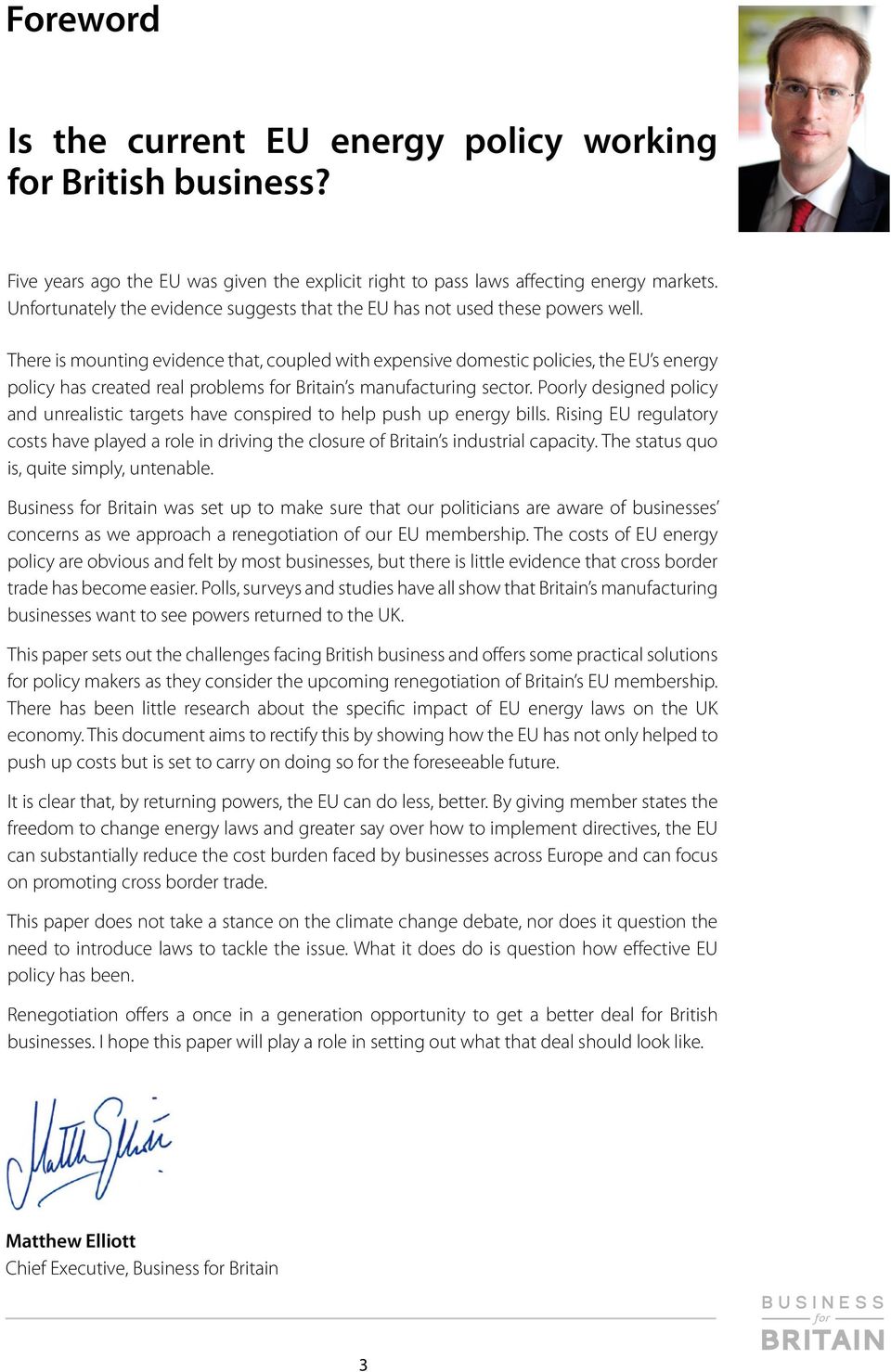
3 Foreword Is the current EU energy policy working for British business? Five years ago the EU was given the explicit right to pass laws affecting energy markets. Unfortunately the evidence suggests that the EU has not used these powers well. There is mounting evidence that, coupled with expensive domestic policies, the EU s energy policy has created real problems for Britain s manufacturing sector. Poorly designed policy and unrealistic targets have conspired to help push up energy bills. Rising EU regulatory costs have played a role in driving the closure of Britain s industrial capacity. The status quo is, quite simply, untenable. Business for Britain was set up to make sure that our politicians are aware of businesses concerns as we approach a renegotiation of our EU membership. The costs of EU energy policy are obvious and felt by most businesses, but there is little evidence that cross border trade has become easier. Polls, surveys and studies have all show that Britain s manufacturing businesses want to see powers returned to the UK. This paper sets out the challenges facing British business and offers some practical solutions for policy makers as they consider the upcoming renegotiation of Britain s EU membership. There has been little research about the specific impact of EU energy laws on the UK economy. This document aims to rectify this by showing how the EU has not only helped to push up costs but is set to carry on doing so for the foreseeable future. It is clear that, by returning powers, the EU can do less, better. By giving member states the freedom to change energy laws and greater say over how to implement directives, the EU can substantially reduce the cost burden faced by businesses across Europe and can focus on promoting cross border trade. This paper does not take a stance on the climate change debate, nor does it question the need to introduce laws to tackle the issue. What it does do is question how effective EU policy has been. Renegotiation offers a once in a generation opportunity to get a better deal for British businesses. I hope this paper will play a role in setting out what that deal should look like. Matthew Elliott Chief Executive, Business for Britain 3
4 Acknowledgements We would like to thank the trade bodies that took the time to share their thoughts with us, as well as Ruth Lea, David Lewis, Jonathan Lindsell, John Redwood, Matt Sinclair and others who have offered their advice. Finally, we would like to thank Tim Philpott for his help with the original research. The opinions and conclusions expressed in this paper are ours alone. Energy Policy and the EU 4
5 Contents Executive Summary 6 1 Introduction 8 2 The rising costs of energy The growing cost of energy The future of energy costs Why are energy prices increasing? The rising costs of EU energy regulation 20 3 The impact on British businesses The impact of high energy costs on British business Industry Case study: Metals Industry Case study: Chemicals and chemical products Industry Case study: Paper and paper products Industry Case study: Mineral extraction Industry Case study: Glass products Industry Case study: Ceramics and cement The threat to jobs from high energy prices Manufacturing companies are leaving the EU The impact on energy producers Changing investment patterns Increased energy dependence 43 4 Changing the situation Business leaders believe that powers need to flow back to member states Promoting cross border trade Short term fixes not requiring Treaty change Long term solutions requiring Treaty change 52 5 Conclusion 55 Appendix: The costs of EU energy laws 56 5
6 Executive Summary Energy prices in the European Union are among the highest in the developed world, comparable to Asian countries like Japan and Korea. Medium sized industrial consumers in the EU pay about 20 per cent more for electricity than companies in China, about 65 per cent more than companies in India and more than twice as much as companies based in the US and Russia. In recent years the EU has passed a number of targets, setting demands on what proportion of each member state s energy mix should come from renewables and have demanded investment into biofuels. This paper agrees with the Government that the EU should just set one target for reducing emissions and that member states should be free to devise their own policies to meet this target. Europe s high energy prices undermine efforts to combat climate change as Europe could become increasingly dependent on imports from other countries, countries which do not comply with the same high environmental standards that European firms do. The high costs of energy (both gas and electricity) are being felt keenly by British manufacturing, especially the Energy Intensive Industries such as metal founding, ceramics and glass manufacturing. This paper calculates for the first time that rising energy costs threaten up to 1.5 million jobs in the energy intensive sector alone, with 363,000 of these jobs being at high risk. High energy prices don t just affect businesses; in alone the National Health Service spent about 630 million on energy. There is a pressing need to review existing EU laws, and to see whether particularly burdensome laws can be repealed or modified. Leading trade bodies and British manufacturers believe that there is an urgent need for much more flexibility and a review of existing EU energy laws. Environmental groups like Friends of the Earth have noted that EU energy regulation has not made an effective impact on emissions, leading them to call for member states to have a greater role in shaping energy laws. Policy makers should seek to reduce the EU s regulatory burden instead of considering protectionism or subsidies. Such a new deal would not just benefit the UK but the whole EU. Based on British Government figures, this paper calculates that EU energy regulations will cost the UK economy between 86.6 billion and 93.2 billion (net). Despite this high cost there is little evidence from European Commission figures that this regulation has significantly promoted cross border trade. Were the UK to opt out of the Renewables Target alone energy bills for Energy Intensive Industries could fall by up to 7 per cent. Energy Policy and the EU 6
7 These costs look set to only increase as the EU makes greater use of its new powers to legislate over energy. While this paper doesn t dispute that UK policies have, independently, driven up the cost of energy, it is clear that the EU s role in driving up the cost of energy is substantial. New research in the report shows that EU policies currently account for up to 9 per cent of the cost of energy for Energy Intensive Industries. By 2030 this could rise to just under 16 per cent. High energy bills are not found in other major economies. Between 2005 and 2012 the gas price index for the EU increased by 35 per cent and the electricity price index increased by 38 per cent. In the United States by contrast the gas price fell by 66 per cent and the electricity price fell by 4 per cent, due in part to shale and in part to other factors. Expensive energy bills, along with other factors, are already having a negative impact on the UK s economy. The share of manufacturing in the UK s GDP has fallen from 19 per cent in 1997 to 10 per cent today. According to existing research, half of the UK power stations earmarked for closure in 2020 have been forced to close because of the demands of the EU s Large Combustion Directive (2001/80/EC). This is estimated to cost the UK 11GW in capacity, raising serious concerns about security of supply. These figures do not include the impact of the upcoming Industrial Emissions Directive which will, in all likelihood, close down even more energy generating capacity in the coming years. By 53 per cent to 38 per cent British manufacturers, who are much more dependent on energy than other business sectors, believe that the costs of EU membership outweigh the benefits. A majority want powers returned. This paper does not take a stance on the need for environmental legislation or targets for carbon emission, in many respects the global shift towards green technology and the decreasing costs of clean energy will encourage investment in green technology regardless of the decision of policy makers. Instead it attempts to provide an analysis of the impact of recent EU energy laws and asks if there is a more cost effective way of securing a transition to a greener economy by giving member states the power to determine their own way of meeting the EU s targets without subjecting firms to over-regulation. 7
8 1 Introduction European Energy Intensive Industries must decide whether to invest in Europe or abroad, in countries with much more promising market dynamics. The European Commission 1 This statement, made in the first half of 2014, was a long-overdue acknowledgement by the European Commission of the problems that many manufacturing companies in the European Union (EU) face today. For several years an increasing number of manufacturing firms have been warning national governments and European lawmakers that their industries are having to reconsider their future in Europe because of the ever increasing cost of energy. This is a growing problem which has stemmed, at least in part, from badly designed EU policy. There are many factors that have created problems for Britain s Energy Intensive Industries, ranging from global economic shifts to ever-increasing improvements in technology. The answer to these problems does not lie in seeking to protect industries from these trends but in identifying and removing the unnecessary burdens that stem from poorly thought out legislation. This paper looks at whether current EU policy actually improves cross border trade or whether it simply adds an extra burden to British and European companies. It has a deliberately narrow focus, looking at the impact of energy related legislation on both energy producers and Energy Intensive Industries; the firms who have the most to lose from bad energy laws. Over the last ten years European regulation has had a detrimental effect on British industry in many different ways, placing an upward pressure on energy prices but failing to substantially improve cross border trade in energy products. Over the last few years the UK, along with the rest of Europe, has seen the retail price of energy go up. The reason, at least in part, seems to be that the focus of EU legislators is not on reducing the cost for industry but instead on overly ambitious political objectives. Many EU rules seem to have failed to promote cross border trade, but have added to the (already substantial) administrative burden. The British Government has already recognised the role of the EU in driving up energy costs and adding administrative burdens to British businesses, with the Prime Minister s Red Tape Taskforce warning in October 2013: High energy prices, additional charges on business, onerous record keeping, and unnecessary bureaucracy all make it harder for our companies to compete in global markets. EU rules cannot be allowed to undermine the competitiveness of European business. Where EU rules place EU firms at a competitive disadvantage, they must be tackled rigorously and speedily in order to free up our businesses to help create growth and jobs. Cut EU Red Tape: Report from the Business Taskforce 2 Energy Policy and the EU 1 European Commission Communication, Energy Prices and costs in Europe, COM(2014) 21, p. 12, 29 January 2014, found at < 2 Cut EU red tape: Report from the Business Taskforce, 15 October 2013, found at < publications/cut-eu-red-tape-report-from-the-business-taskforce/> 8
9 In a recent letter to the President of the European Commission, José Manuel Barroso, the British Prime Minister, David Cameron, also made it clear that the EU needed to avoid placing a regulatory burden on British businesses: It is essential that we avoid regulations or targets that will force member states away from their least cost decarbonisation pathway or undermines a level technology playing field. David Cameron, Letter to the European Commission 3 This paper seeks to highlight and calculate the impact of EU legislation on energy producers and users. This paper does not attempt to argue that the EU has been the main driver of energy prices, it cannot be disputed that UK Governments have, in some areas, gone considerably further than the EU in introducing expensive policies. Both unilateral UK action and a tendency to goldplate EU directives means that UK policy has, historically, accounted for the bulk of, though not all, regulatory energy costs. However this should not cloud the fact that the EU does play a role in driving up the cost of energy and has introduced expensive policies. Some excellent research has been done to highlight how successive British Governments have driven up energy prices, both via their own initiatives and by goldplating EU directives. Unfortunately relatively little research has been done on how the EU specifically is exerting an ever increasingly role in driving up the cost of energy. What is even more concerning for many British businesses is that this rise in energy bills is not being felt everywhere. In other major economic areas, in particular the United States, the last few years have seen a marked decrease in energy prices as restrictions on accessing new types of energy, especially shale gas, have been reduced. The research below shows that many energy intensive firms are now considering moving to areas where there are lower energy costs, a decision which would have a devastating effect on jobs in the UK. Those firms who can t relocate face the prospect of closure, with the same disastrous effect on employment. While expensive energy has had a particularly corrosive impact on the manufacturing sector (especially the Energy Intensive Industries such as petrochemicals, metal founding, ceramics and glass manufacturing) it is worth remembering that high energy costs don t just affect businesses; in alone the National Health Service spent about 630 million on energy. 4 Something needs to be done to help Britain s manufacturers; however this report very firmly believes that the answer does not lie in subsidy or protectionism, but in devolving decision making powers back to the member states. Policy makers should aim to reduce the regulatory burden faced by energy producers and users. European leaders, in particular the Prime Minister David Cameron, have emphasised the need to simplify EU rules and targets in order to reduce energy bills. There may be a case for the EU to set an emissions target - a target derived from the United Nations Framework Convention on Climate Change (UNFCCC) - but there is no need for the EU to micromanage member state s energy policies. 3 Letter from D. Cameron to J.M. Barroso, 4 December TaxPayers Alliance, Research Note 133: Energy and Water Bills in the NHS, 21 November 2013, found at < 9

10 David Cameron s promise to renegotiate Britain s membership of the EU offers a once in a generation opportunity to refocus the EU and to devolve powers back to the member states. There are important changes which could be introduced to rectify these problems as part of any future renegotiation; changes which will make sure that the UK s voice is strengthened and is protected from new attempts by the European Commission to micromanage the UK s energy policy. Renegotiation must clarify the EU s limited role, give the member states the ability to block poorly thought out EU legislation and should require the EU to demonstrate how all future energy policy proposals consider affordability, international competitiveness and security of supply not just sustainability. It should always be remembered that there are several factors which have driven up energy prices and imposed burdens on businesses, including British laws. Previous British Governments also supported many of the EU s energy policies and sometime even added extra provisions when implementing EU laws but soon noted that the EU s target system made it extremely hard for them to alter policy when circumstances changed. EU laws have clearly played a significant role in driving up the regulatory burdens on energy producers and suppliers as well as Energy Intensive Industries, either by directly adding to a member state s administrative burden, by restricting the options of member state s governments or by simply encouraging poorly thought out policy. This paper focusses on the role of the EU by analysing the various ways European regulation has increased costs for British businesses and the wider UK economy. It is not intended to be a detailed study of energy price dynamics; instead it is an attempt to highlight the impact that EU law has had on both energy producers and on manufacturers in both the UK and Europe. While there is some disagreement, most businesses are clear that a substantial change in Britain s relationship with the EU is needed and that energy policy should be governed by the principle of subsidiarity. Many organisations support legislation to tackle climate change, but believe that current policies are ineffective and expensive. This paper tries to find common ground among the various positions that have been put forward by British business and suggests solutions which are achievable, practical and desirable. Energy Policy and the EU 10
11 The rising costs of energy 2 The EU has a long history of involvement in energy issues. Despite the fact it was only given the formal power to legislate on energy in 2009, the EU has been involved in energy decisions for many years, developing a de facto energy policy over several decades. This arguably started when the then European Economic Community sought to come to a common position against the Organisation of Petroleum Exporting Countries (OPEC) during the 1973 energy crisis. During the Maastricht Treaty discussions in the early 1990s, proposals for an energy chapter were vetoed and the final wording of the Treaty meant that the EU lacked the legal foundations for energy laws for several years. However, despite this lack of a legal basis, directives were still passed that affected energy markets, notably via initiatives that sought to create an internal market in electricity (Directive 96/92/EC) and gas (Directive 98/30/EC) which were based on internal market or environmental clauses in the Treaties. Other clauses like the Renewables Energy Directive (Directive 2009/28/EC) and introduction of the EU s Emissions Trading Scheme (EU ETS) were based on environmental clauses. It was noted by the House of Lords EU Committee that before 2009 certain European energy laws lacked a specific legal basis. 5 The EU has engaged in a process of market opening in network industries, including in the energy markets. In recent years there has been a succession of new policies introduced by the EU, including measures to complete the Single Market in energy (in July 2007 every EU consumer was given the right to purchase electricity and gas from any other supplier in the EU) and to tackle climate change. More recently, these interventions have become more direct as the EU has sought to realise the aims set out by the United Nations Framework Convention on Climate Change (UNFCCC). Perhaps the most notable example of this recent intervention is the EU s demand that member states meet set targets for shares of renewable energy consumption via the renewable energy targets, with the UK s Renewables Obligation (RO) adapted to become one of the main vehicles to deliver this target. In 2009, the Lisbon Treaty created a new title on energy (Article 194 TFEU) which expanded the EU s legal basis and gave the organisation new powers to pass laws affecting energy policy. 6 For the first time the Treaty made it clear that energy policy is a shared competence between the EU and the member states, stating that the EU was tasked with ensuring the functioning and security of energy supply and promoting energy efficiency, interconnection and renewable energy. The year 2009 also saw the EU introduce the Third Energy Package, which aimed to finally create single markets in electricity and gas. As of July 2014 there were 224 legislative instruments falling under the remit of Directorate General for Energy. 7 These are the inevitable product of decades of both legislative creep and the EU s ambition of integrating Europe s energy markets. There are, at first glance, strong arguments in favour of integrating energy markets, not least to allow energy firms access to larger markets and to improve the UK s energy security. But there are serious 5 House of Lords European Union Committee, The Treaty of Lisbon: an impact assessment: Volume I, p. 221, February 2008, found at < 6 The Foreign and Commonwealth Office (FCO) determined that the powers were new in its own assessment of the Lisbon Treaty, found in FCO, A comparative table of the current EC and EU Treaties as amended by the Treaty of Lisbon, January 2008, found at < 7 DG ENER, Overview of the secondary EU legislation (directives and regulations) that falls under the legislative competence of DG ENER and that is currently in force, found at < 11

12 questions about the costs which come with such regulation and whether the new laws actually promote cross border trade. 2.1 The growing cost of energy In 2012 medium-size industrial consumers in the EU paid about 20 per cent more [for electricity] than companies based in China, about 65 per cent more than companies in India, more than twice as much as companies based in US and Russia and more than three times as much as Middle Eastern industrial consumers in e.g. Saudi Arabia and United Arab Emirates in 2012 mediumsized industrial consumers in the EU paid four times as much for natural gas as industrial consumers in the US, Canada, India and Russia. The European Commission 8 Natural gas prices for industry in the first quarter of 2012 were on average 241 per cent higher in EU OECD than in the US. Günther Oettinger, European Commissioner for Energy ( ) 9 As the above admissions make clear, today Europe is one of the most expensive areas in the world for energy. European gas and electricity prices, including in the UK, have gone up over the last few years and today are among the highest in the developed world. 10 It is a mistake to talk about an average EU price or EU cost of energy, as there has always been a great deal of variation in energy prices between EU member states. Averaging simply distorts the actual situation and risks obfuscating the fact that other EU countries have lower energy prices than the UK. However when one compares the prices of all available European states to countries from outside the EU it becomes clear very quickly that, despite this variation, European countries are among the most expensive in the developed world for energy and that, while most European states have lower costs than Japan, there are very few comparable to the United States. 11 As Figure 1 makes clear, industries in European countries (pink) have to face high electricity prices, especially when compared to other countries such as the United States (non-eu states coloured in grey). Energy Policy and the EU 8 European Commission Staff Working Document, Energy Prices and costs report, p.202, 17 March 2014, found at < 9 Question for written answer E /2012 to the Commission Rule 117 Nuno Teixeira (PPE); Answer given by M. Oettinger on behalf of the Commission on It is important to note the difference between price and cost. Energy prices refer to the price energy consumers actually pay for a given unit of energy. Energy costs/bills refer to the amount of money consumers have to pay for their energy consumption. Electricity prices and costs have risen for industry across Europe since More information on prices and costs can be found at < 11 It is tempting to attribute US success solely to its large shale gas reserves and nothing to do with policy, however this ignores the fact that the EU enjoys very large shale gas reserves as well, reserves which have been under-utilised, not least because, up until recently, there has been a threat of over-regulation. While it cannot be assumed that UK shale gas will, initially at least, be as cheap as US gas as pointed out by the House of Lords, it is still very important to compare EU prices to the US as investors and manufacturers have already started to move resources and facilities to the US. However shale gas has to be appreciated by a short-medium term answer rather than a long term one. 12

13 Figure 1: Retail price of electricity for industry in OECD countries (2012) 12 The same is also true of natural gas prices for industry, with European countries facing much higher prices than the United States (see Figure 2). While the UK has one of the lowest gas prices in Europe, it is clear that it is nearly double the price found in the US. Contrasting Europe s high energy prices with those of the United States gives some idea of the problems facing Europe s industries. Figure 2: Retail price of natural gas for industry in OECD countries (2012) 13 While it is clear that the UK enjoys relatively low energy prices compared to many other EU countries (a product, in part, down to liberalised energy markets), it is also clear that, along with other EU countries, Britain s gas and electricity prices are much higher than those found 12 International Energy Association, 2013 Key World Energy Statistics, pp. 42-3, found at < freepublications/publication/keyworld2013.pdf> Omissions are a result of lack of information. 13 International Energy Association, 2013 Key World Energy Statistics, pp. 42-3, found at < freepublications/publication/keyworld2013.pdf> Omissions are a result of lack of information. 13
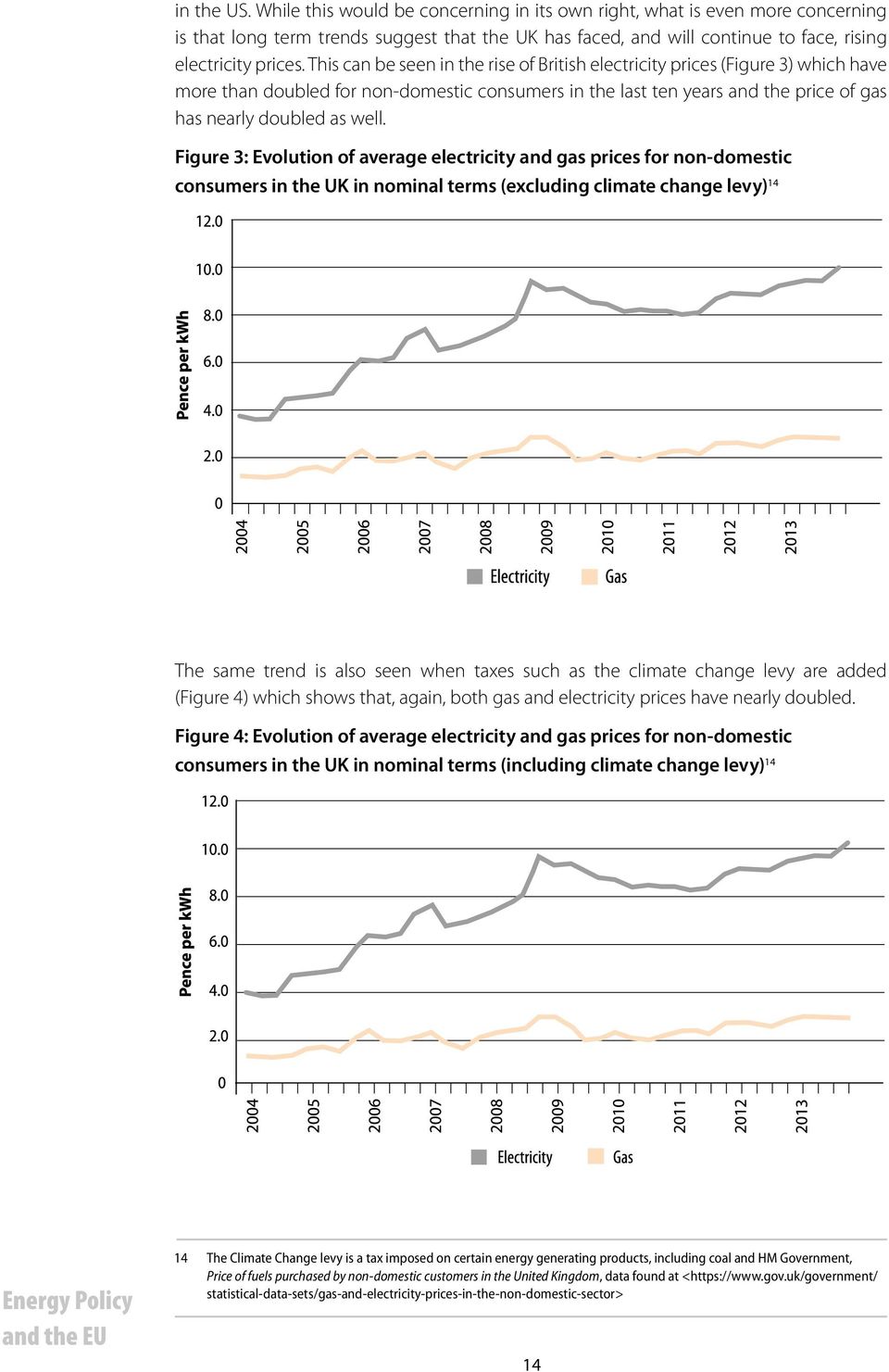
14 in the US. While this would be concerning in its own right, what is even more concerning is that long term trends suggest that the UK has faced, and will continue to face, rising electricity prices. This can be seen in the rise of British electricity prices (Figure 3) which have more than doubled for non-domestic consumers in the last ten years and the price of gas has nearly doubled as well. Figure 3: Evolution of average electricity and gas prices for non-domestic consumers in the UK in nominal terms (excluding climate change levy) 14 The same trend is also seen when taxes such as the climate change levy are added (Figure 4) which shows that, again, both gas and electricity prices have nearly doubled. Figure 4: Evolution of average electricity and gas prices for non-domestic consumers in the UK in nominal terms (including climate change levy) 14 Energy Policy and the EU 14 The Climate Change levy is a tax imposed on certain energy generating products, including coal and HM Government, Price of fuels purchased by non-domestic customers in the United Kingdom, data found at < statistical-data-sets/gas-and-electricity-prices-in-the-non-domestic-sector> 14
15 The UK s struggles are faced across the whole of the EU: according to the Commission between 2005 and 2011 EU manufacturing saw the highest increase in energy costs relative to the US, China and Japan. 15 According to Commission President Barroso, between 2005 and 2012 the gas price for European industry increased by 35 per cent and the electricity price increased by 38 per cent. In the US by contrast gas prices fell by 66 per cent and electricity prices fell by 4 per cent. 16 The marked difference can be seen in Figure 5 which shows the annual industrial gas prices for the UK and US between 2005 and 2011 and the rising gap that has emerged as US prices have fallen while the UK s prices have continued to rise. Figure 5: End user gas prices for industry 17 And the same trend can be seen in electricity prices (Figure 6) where the UK s prices have increased significantly while US prices have remained static. Figure 6: End-user electricity prices for industry European Commission Staff Working Document, Energy Prices and costs report, p.197, 17 March 2014, found at < 16 European Commission, Energy Priorities for Europe: Presentation of J.M. Barroso to the European Council, 22 May 2013, found at < 17 HM Government, International industrial energy prices including taxes, data found at < statistical-data-sets/gas-and-electricity-prices-in-the-non-domestic-sector> 18 HM Government, International industrial energy prices including taxes, data found at < statistical-data-sets/gas-and-electricity-prices-in-the-non-domestic-sector> 15

16 This divergence is not confined to just the UK. Last year the European Commission came to the disturbing conclusion that almost all member states have seen a consistent rise in consumer prices of electricity and gas and found that certain Energy Intensive Industries (EIIs) had reported gas price rises of between 27 and 40 per cent in the period The same study also concluded that since 2008 electricity network costs have increased by 30 per cent for industrial consumers and that taxes and levies rose by 127 per cent for industry, before exemptions. 20 This was not an isolated study; other reports by the EU have found that between 2008 and 2012 industrial electricity prices (excluding VAT and recoverable taxes) have gone up by about 3.5 per cent per year, although in some countries retail industrial prices have actually increased more dramatically than this. Estonia, Lithuania and Latvia have all experienced an annual increase in prices of more than 8 per cent. 21 Other econometric surveys have also come to similar conclusions. A recent study of the Real Unit of Energy Costs (RUEC) for EU member states concluded that these costs had increased by 47 per cent between 2000 and Between 2000 and 2009 the UK had an average annual RUEC increase of 4.6 per cent while the EU as a whole saw an average increase of 4.2 per cent (an increase in Real Unit Energy Costs means that the amount of money spent on energy sources to obtain one unit of value has increased) The future of energy costs What is even more concerning is that it seems these high costs are only going to increase over the coming years. The European Commission has recently warned that European industry s efforts to compensate for higher energy costs... may need to go even further. 23 In a recent report, the International Energy Agency (IEA) warned that electricity and gas costs will remain high for another 20 years. The report has also warned that the EU is likely to lose up to a third of its global market share of energy intensive exports. The IEA has stressed that the gap between the US and the EU is structural. It s not a one-off. 24 There are several factors that the EU is going to have to face over the coming ten years which are going to increase energy costs regardless of policy. Investment is needed and there are concerns that international fossil fuel prices may increase. 25 However, it is also clear that poorly designed EU law will also have a role in driving up the price of energy and the costs for Energy Intensive Industries (EIIs). Energy Policy and the EU 19 European Commission, Energy Prices and costs in Europe, COM(2014) 21/2, p.6, 29 January 2014, found at < 20 European Commission, Energy Prices and costs in Europe, COM(2014) 21/2, p.6, 29 January 2014, found at < 21 European Commission Staff Working Document, Energy Prices and costs report, p.9, 17 March 2014, found at < 22 European Commission, Energy Economic Developments in Europe, pp , 2014, found at < 23 European Commission, Energy Prices and costs in Europe, COM(2014) 21/2, p.13, 29 January 2014, found at < 24 International Energy Agency, World Energy Outlook, data found at < quotes/2/> 25 European Commission, EU Energy, Transport and GHG Emissions: Trends to 2050, pp. 47-8, 16 December 2013, found at < 16
17 The British Government has already begun to warn British businesses to expect an increase in their energy costs and has warned medium-sized users of energy to expect cost increases of between per cent higher as a result of both EU and UK policies. The Department for Energy and Climate Change (DECC) has provided a breakdown of how bills are going to increase over the coming few years which is summarised in Table Table 1: Estimated gas and electricity costs for medium-sized business users Average gas bill 520, , ,000 Average electricity bill 1,070,000 1,360,000 1,570,000 Average energy bill 1,590,000 1,900,000 2,130,000 What makes this even more concerning is that, as shown above, this increasing burden is not being felt in other major economic areas, putting British industry at a disadvantage. The International Energy Agency has warned that the price gap between Europe and the US is here to stay, warning that: Lower energy prices in the United States mean that it is well-placed to reap an economic advantage, while higher costs for energy intensive industries in Europe and Japan are set to be a heavy burden. International Energy Agency 28 Why are energy prices increasing? 2.3 There are numerous factors which drive up the price of energy and drive up the costs for Energy Intensive Industries (EIIs): wholesale fossil fuel prices, market structure, the state of existing infrastructure are just some of the factors which intertwine and shift the price of energy to varying degrees on a day to day basis. 29 While working out the exact effect of each of these drivers on energy prices is not within the remit of this paper, it is worth noting that there is also a growing consensus that EU policy has played a small but significant role in driving up EIIs energy bills, a role which is growing. Despite the EU s claims that the rise in costs is mostly driven by external factors, including rising fossil fuel prices and the taxes and levies set in the member states, the European 26 Non-CRC participant, counting impact of climate change policies, data found at < uploads/system/uploads/attachment_data/file/172923/130326_-_price_and_bill_impacts_report_final.pdf> 27 Non-CRC participant, found in Estimated impacts of energy and climate change policies on energy prices and bills, found at < Impacts_Report_Final.pdf> 28 International Energy Agency, World Energy Outlook 2013 Press Release, found at < pressreleases/2013/november/name,44368,en.html> 29 Factors that have been highlighted by other studies range from the economic climate to the accessibility of fuels to the impact of legislation (both European and British). In the gas market for example there is a concerning lack of suppliers and gas prices are still often indexed to oil prices. The sheer number of factors that can influence energy prices and the complex way these factors interact means there remains a serious lack of credible and comparable information on what actually finally determines prices and costs of energy for different consumers. There are also factors which influence the global energy markets, such as the impact of subsidised coal in China. 17

18 Commission has itself acknowledged that its policy has had an impact on energy costs, stating that its policies will ensure a sustainable energy sector in the long run, with acknowledged higher costs in the short term 30 Various studies by the European Union, British Government and various think tanks have also begun to highlight specific EU laws that are causing problems either by increasing the regulatory burden or by driving up costs. In a recent report, an analyst at Oxford University s Institute for Energy Studies warned: The cost of Europe s clean energy policies has also risen, and will rise further, as a result of the Commission s proposals, made in January 2014, for EU energy and climate change targets. Institute for Energy Studies, Oxford University 31 In a recent major study, the Department for Energy and Climate Change (DECC) identified two EU policies that are having a particularly harmful effect and have pushed up energy bills: the EU Emissions Trading Scheme (EU ETS) (combined with the UK Government s Carbon Price Floor) 32 and the Renewables Obligation (RO). The RO (which is due to be replaced) was created independently by the British Government but has since been adopted to comply with the EU s renewable target, despite the UK s developing hostility to the idea of a renewables target. 33 In addition, the Government s Red Tape Task Force was told by several companies that there were significant problems with the Emissions Trading Scheme Regulation, Energy Efficiency Directive and Energy Performance of Buildings Directive. 34 It is possible to calculate the cost of the two most expensive EU energy policies: the EU ETS and RO. DECC has provided detailed breakdowns of the impact (and predicted future impact) of individual climate change policies on energy bills. This allows us to, at least for these two policies, calculate the impact on UK Energy Intensive Industries (EIIs). While the CPF is not counted as an EU cost in this report, experts who spoke to the authors did point out that the CPF was introduced because of the perceived failure of the EU ETS to deter energy producers away from fossil fuels. While DECC figures show that many costs stem from the UK, it is also clear that the cost of the EU ETS and RO is increasing with time. Via this new analysis it soon becomes clear that, on their own, these two measures are going to have a growing impact on EIIs over the coming fifteen years. For EIIs, these two policies account for 9 per cent of the cost of energy today and will account for just under 16 per cent of energy bills by Energy Policy and the EU 30 European Commission, Energy Prices and costs in Europe, COM(2014) 21/4, p.2, 29 January 2014, found at < 31 D. Buchan, Costs, competitiveness and climate policy: distortions across Europe, p.5, April 2014, found at < 32 Department of Energy & Climate Change, Estimated impacts of energy and climate change policies on energy prices and bills, p.29, found at < and_bill_impacts_report_final.pdf> 33 For more information please see House of Commons Library, The Renewables Obligation, found at < uk/briefing-papers/sn05870.pdf> 34 Cut EU red tape: Report from the Business Taskforce, 15 October 2013, found at < publications/cut-eu-red-tape-report-from-the-business-taskforce/> 18

19 Figure 7: Estimated average energy bills paid by an energy intensive user consuming 100,000MWh each of gas and electricity (2012 prices) 35 It is important to note that, while this information provides a good quantification of the costs of the two main planks of EU energy legislation, it should not be seen as a definitive figure for the additional burden placed on Energy Intensive Industries by the EU. The figure does not include other, less significant, EU policies and in addition there is a good chance that the UK would have introduced similar policies had it been outside of the EU, although the costs would likely have been much smaller (see Section 2.4 for more details). What the above graph does show however is that the two main planks of EU energy policy are exerting an increasing burden on EIIs, though it would be wrong to claim that they are the sole problem. While this paper does not take a stance on the need for environmental legislation or the question of the need to reduce carbon emissions, it is also worth noting however that organisations like Friends of the Earth have condemned the EU ETS as being ineffective in combating climate change. 36 The upward pressure that the EU is exerting on energy costs is now acknowledged by most commentators. As recently noted by The Economist: European industries pay three to four times more for gas and over twice as much for electricity as American ones (who benefit from cheap shale gas). 37 American newspapers have also warned that US policy makers should not aim to copy the EU; in a recent editorial the Washington Post argued that We ought to take note of what s happening on the other side of the Atlantic across Europe, the price of retail electricity has soared by 20 per cent over four years, thanks to the European Union Please note that the CPF is counted as a non regulatory cost. For consistency highest cost estimates were used for all policies in 2020 and 2030.Estimated impact of regulations on wholesale prices are counted as non-regulatory cost. For more information, see DECC, Estimated impacts of energy and climate change policies, p.86, March 2013, found at < Impacts_Report_Final.pdf> 36 Friends of the Earth Europe, The EU Emissions Trading System: failing to deliver, found at < consultations/articles/0005/registered/ _friends_of_the_earth_europe_en.pdf> 37 Europe s energy woes, The Economist, 25 January 2014, p Editorial: European Union cooling to global-warming costs, Washington Times, found at < com/news/2014/jan/27/editorial-cooling-to-windmills> 19

20 2.4 The rising costs of EU energy regulation This massive tide of red tape also means higher administration and manufacturing costs which in turn acts as a gigantic brake upon the entrepreneurial spirit. Owner of a medium-sized manufacturing business based in East England In addition to applying upward pressure on energy prices, EU energy laws also place a significant regulatory burden on British firms. There is mounting evidence that the UK has been particularly badly hit by the compliance costs that have stemmed from EU energy laws, in part down to the UK s failure to secure exemptions or tendency to go beyond minimum EU requirements. The consequences of complying with a mounting complex regulatory burden has been noted by firms with high energy demands: The EU s stringent hazard based / precautionary approach to regulation can cause serious implementation problems for companies. British Ceramic Confederation 39 It is possible to calculate the cost of EU energy laws by looking at detailed HM Government Impact Assessments (IAs). These are official documents produced by departments to accompany new regulations, stating how far the specific recommended policy meets the Government s objectives and to calculate the potential costs and benefits. While there has been a noted failure by the Government to place all the IAs in one repository (previous attempts to compile such a collection have had notable omissions) it is possible to select a large sample which includes as many relevant IAs as possible. Our methodology for both selecting relevant IAs and analysing them can be found in the Appendix. The EU and British Government both claim that these directives bring benefits which often outweigh the costs, but this claim has been widely disputed, not least by Open Europe. 40 There is a lot of evidence to show that the benefits have been exaggerated: for example the ETS Impact Assessment said the benefits were dependent on a scenario where EU action is pivotal in achieving a global deal. 41 Clearly this was a flawed assumption. In other IAs the projected benefits are based on an attempt to quantify predicted improvements in the environment. By looking at the total cost to British business via these IAs we can start to get an idea of the total cost of EU regulations, with a detailed breakdown of the costs and benefits provided in Table 2. Energy Policy and the EU 39 British Ceramic Confederation, Response to the call for evidence on the Government s review of the balance of competences, 17 January 2014, p Open Europe, Top 100 EU regulations cost the UK economy 27.4 billion a year and costs outweigh benefits in a quarter of cases, 21 October 2013, found at < 41 Government Impact Assessment of the EU Climate and Energy package, found at < publications/ccs-reports/decc_cb_90.pdf> 20
21 Table 2: Net costs of EU energy directives 42 IA Title Total Cost (lower) Total Cost (upper) Total Benefits (Lower) Total Benefits (Upper) Net Costs (Lower) Net Costs (Higher) EU Renewable Energy Directive 98.9bn 119.1bn 6.2bn 12.4bn 92.7bn 106.6bn EU Climate and Energy package, the revised EU Emissions Trading System Directive and meeting the UK nontraded target through UK carbon budgets. Directives concerning the Internal Market in Gas & Electricity Proposal to recast the Basic Safety Standards (96/29)(and other Euratom) Directives 20.6bn 20.6bn 9.2bn 9.2bn bn 11.4bn 2.0m 4.5m 0 0 2m 4.5m 124.2m 127.8m m 127.8m Industrial Emissions Directive (IED) 3.4m 20.6m m 20.6m Regulations on the supervision and control of shipments of radioactive waste and spent fuel EU requirements for Heating, Cooling and Hot Water networks 690, , , , Energy End-Use and Services Directive 377.3m 378.2m 547.8m 551.5m m m Oil Stocking Order 126m 126m 554m 554m - 428m - 428m Energy Products Directive 1.2bn 1.7bn 4.9bn 6.0bn - 3.8bn - 4.4bn Planning for nationally significant infrastructure 200m 200m 4bn 5bn - 3.8bn - 4.8bn Energy Performance of Buildings Directive 7.1bn 8.6bn 9.9bn 30.3bn bn bn Totals 128.7bn 150.7bn 35.4bn 64.1bn 93.2bn 86.6bn 42 The following values were determined by adding the relevant Impact Assessments. It is important to note that the UK can go beyond minimum EU standards and that the costs and benefits stem not just from the EU but from the decision of UK policymakers as well. However it is equally important to remember that the origin of many of these rules and directives stemmed originally from the EU and that the measures cited were primary introduced to meet EU requirements. IAs also provide a lower and upper estimate of the costs, both are provided in Table Benefits in this IA were based on the assumption 2009 Copenhagen Agreement would result in a global climate change deal. As the IA points out: Benefits depend on other s actions and the emissions concentration trajectory the world is on. High end of range reflects world where EU action is pivotal in achieving a global deal. Considering the failure of the Copenhagen Summit only lower benefit estimates were counted, not the billion higher estimate. 21
22 It is important to note that many of these IAs state that there is both a cost and a benefit that stems from the policy. There are benefits that stem from these laws, not least the potential to make the air cleaner and it is worth emphasising that the above analysis suggests that some EU directives actually have a net benefit for the UK. This table simply shows the net costs that stem from these rules. It should be emphasised that this paper does not take a stance on the climate change debate and does not consider the environmental pros and cons of these laws. It has been suggested that, even were it outside the EU, the UK Government would go beyond minimum EU requirements in implementing EU regulations. However, this claim is deceptive: studies by Open Europe have shown that British regulation is more effective at delivering benefits than European regulation, so were the UK to replicate EU laws, these rules would likely be much less onerous and, crucially, could have been altered in response to changing circumstances. 44 Finally, it is worth pointing out that while these directives have, usually, been based on the argument that they are building a Single Market in energy, there has been a noted failure to actually improve cross border trade. While the European Commission has argued that completing the Single Market could add significantly to Europe s GDP and claims that the EU s efforts to unbundle networks and to open the energy markets have had a downward impact on prices, there is a concerning lack of evidence for this in many areas. 45 The UK Government has noted the missing links in the EU s energy infrastructure 46 while reports for the European Commission have noted that the EU has managed to secure some market coupling over the last ten years market coupling is delivering only the benefits of short term arbitrage in energy trading. The Target Electricity Model only makes partial progress in delivering a fully integrated electricity market. 47 Other reports have pointed out that price convergence between markets has not materialised. In the Central West Europe region market coupling initially resulted in price convergence of 66 per cent in the first year (2011) but by 2012, this figure had fallen to 46 per cent and, in 2013, to just 15 per cent. According to the study market coupling has failed to overcome national supply/demand factors. 48 The lack of growth in cross border energy trade can also be seen in Figure 8 which, while showing significant variation over several months, also shows a concerning lack of growth over time. Energy Policy and the EU 44 Open Europe, Still out of control? Measuring eleven years of EU regulation, June 2010, found at < uk/content/documents/pdfs/stilloutofcontrol.pdf> 45 European Commission, Energy Economic Developments in Europe 2014, p.61, < publications/european_economy/2014/pdf/ee1_en.pdf> 46 BIS, European Commission Consultation on the Single Market Act, p. 23, February 2011, found at < Government/uploads/system/uploads/attachment_data/file/32275/ uk-response-single-market-act.pdf> 47 Booz&co, Benefits of an integrated European Energy Market,20 July 2013, found at < infrastructure/studies/doc/ _energy_integration_benefits.pdf> 48 Energy Economist, Trying to get a single European electricity market, 27 February 2014, information and summary can be found at < 22
23 Figure 8: EU Cross border monthly physical flows by region 49 In summary, it is hard to disagree with The Economist that Europe suffers from Balkanised energy markets. 50 The sad fact is that 86 billion of regulation has done little to improve Europe s cross border trade. The impact on British businesses 3 The effect that increased energy costs and the increased regulatory burden are having on British manufacturing is deeply concerning. Commentators have noted that the combination of European energy regulation and the upward pressure this regulation places on energy prices risks endangering hundreds of thousands of British jobs and is holding Britain back from restoring its manufacturing industries. 51 High energy costs have played a significant role in the decline of key sectors of British manufacturing and have forced British businesses to reconsider their investment decisions. Expensive energy has, in particular, had a devastating impact on Energy Intensive Industries (EIIs). This chapter aims to detail the impact that high energy costs will have on British EIIs. This narrow focus isn t down to a belief that these firms are special or in need of state protection, but instead reflects the fact that these firms are particularly at risk from high energy prices. 52 While this chapter only focuses on a few industries. It is worth noting that the costs that stem from expensive energy will be felt across the wider economy. 49 European Commission, Quarterly Report on European Electricity Markets, Vol.6 Issue 2, p. 22, found at < energy/observatory/electricity/doc/ _q2_quarterly_report_on_european_electricity_markets.pdf> 50 Europe s energy woes, The Economist, 25 January 2014, p J. Redwood, The UK s current membership costs us at least 500,000 jobs, 28 March 2014, found at < johnredwoodsdiary.com/2014/03/28/the-uks-eu-current-membership-costs-us-at-least jobs> 52 The House of Lords recently warned that Rising energy costs pose a particular challenge for energy intensive sectors, more information found at House of Lords Economic Affairs Committee, The Economic Impact on UK Energy Policy of Shale Gas and Oil, p. 19, May 2014, found at < 23
24 3.1 The impact of high energy costs on British business Our business is increasingly concerned about rising energy costs, as I m sure most manufacturing businesses must be. - Owner of a large manufacturing business based in the West Midlands In addition to placing a hefty administrative cost on British business, it is also clear that the increase in energy prices is having a detrimental effect on manufacturing businesses, in particular EIIs who depend on cheap energy. While there is no definitive definition of such an industry, we are able to reach one by combining the UK s definition with the EU s. 53 This provides us with the following industries which this paper will investigate: Metals (Section 3.1.1) Chemicals and chemical products (Section 3.1.2) Paper and paper products (Section 3.1.3) Mineral extraction (Section 3.1.4) Glass products (Section 3.1.5) Ceramics and cement (Section 3.1.6) This is not meant to be a definitive list of all EIIs within the UK; however it does include all of the industries which are considered to be energy intensive by the European Commission. It is also not an argument that these firms are special cases, instead it is simply an analysis of their concerns. EIIs have long invested in energy efficiency, motivated both by the need to reduce costs and to combat climate change. This dependency on energy means that the recent increase in prices has had a devastating effect on EIIs. Production levels in these firms have been in decline in both the UK and the EU. The impact is not limited to just EIIs: the share of manufacturing in the UK s GDP fell from 19 per cent in 1997 to 10 per cent today. 54 Manufacturers have no doubt that high energy costs are one of the main reasons for this decline: The high cost of energy in Europe has become one of the biggest threats to the competitiveness of European industry. When compared with other regions of the world, industrial energy costs in Europe are substantially higher. - Accenture 55 The impact of high energy costs on Europe s EIIs looks set to only grow over the coming years: the International Energy Agency recently warned that the EU is set to lose 10 per cent of the global market in energy intensive exports. A short analysis of the energy intensive sectors shows the devastating impact that high energy bills are having on the EIIs. This chapter looks at each industry individually and calculates the number of jobs that could be lost as a result of expensive energy. Energy Policy and the EU 53 The EU s definition is provided at < 54 World Bank, data found at < 55 Accenture, Unlocking industrial opportunities, p.22, found at < Accenture-EBS-2013-Unlocking-Industrial-Opportunities.pdf> 24
25 INDUSTRY CASE STUDIES 25
26 Metals TOTAL UK EMPLOYMENT 471,000 in (foundry sector employs around 62,000 employees). 57 THE STATE OF THE SECTOR Metal, along with plastics and materials accounted for 2.0 per cent of UK GVA (gross value added) in 2011 (an output of 28 billion). 58 In 2013 alone metals accounted for 18.4 billion of UK exports with around 30,000 companies in the UK metals sector (80 per cent of foundries are SME s.) 59 Output of metal products has recently fallen (see Figure 10) however there has been a slight recovery in recent years. PROBLEMS FACING THE SECTOR The metal sector has been described by commentators as a sector where closures and redundancies had become the norm in northern England (the greatest concentration of jobs in the metal industry are located in Yorkshire, Humberside and the West Midlands). 60 High energy bills, coupled with the economic downturn have hurt the European steel industry. In a wide-ranging report by EEF in 2012 it was reported that ArcelorMittal had permanently halted iron and steelmaking at its Liège (Belgium) and Florange (France) plants, mothballed steelmaking plant in Schifflange (Luxembourg) and a plate mill in Galati (Romania) and had halted its rolling mills at Schifflange and Rodange. Riva s Taranto plant (Italy), the largest steel plant in the EU, was only operating at 70 per cent capacity. Beltrame has also announced the permanent closure of rolling mills in Belgium, Luxembourg and Italy, together with the mothballing of its steel plant in Turin. Mechel is mothballing its Romanian operations. In the UK, Tata Steel s Scunthorpe works is only operating two of its four blast furnaces, while output from its Port Talbot blast furnaces has been temporarily cut back. The closure of the Thamesteel Sheerness plant also removed capacity from the market. 61 There have been numerous factors which have been cited as the reasons behind this recent decline. Trade bodies have raised concerns about the recent lack of demand from the EU27 with Eurofer warning about the impact (see Figure 11). This lack of demand is almost certainly down in part to the recent recession and on-going crisis with the Single Currency. 62 However, despite this concerning trend in the EU, there remains very strong demand from third countries, especially China, with Figure 12 showing that output is slowly increasing since the dip in THE IMPACT OF HIGH ENERGY BILLS While the economic downturn has certainly had an impact on the steel and aluminium industry, leading industrial figures have warned that high energy costs are also threatening their firms. ArcelorMittal, the world s largest steel making company has been vocal in raising their concerns, According to the CEO, Lakshmi Mittal, the huge cost gap [between Europe and the US] is threatening Europe s energy intensive industries and has described the EU s policies as being punishing. 64 These fears are not just confined to the UK; Wolfgang Eder, chief executive of Voestalpine, the Austrian steel company, has warned that the exodus has started in the chemical, automotive and steel industries. If Europe doesn t change course, that process will accelerate and at some point not be reversible. 65 Following a European Court Decision in April 2010 that the power plant is subject to the Large Combustion Plant Directive (despite the protests of the UK Government) Rio Tinto Alcan s aluminium smelter in Lynemouth closed in March Government figures put together employment figures for many different industries, making it very hard to separate the exact number of employees for any given industry (example found at < bis.gov.uk/assets/biscore/economics-and-statistics/docs/i/ industrial-strategy-uk-sector-analysis>). As a result Trade Body figures or Trade Union sources, supported by academic research were used to calculate employee numbers of each individual sector. 57 Unite: the Union, Steel, metals and foundry sector overview, found at < sector_overview.aspx> 58 BIS, Industrial Strategy: UK sector analysis, September 2012, p.10, found at < docs/i/ industrial-strategy-uk-sector-analysis> 59 Department for Business Innovation and Skills, BIS Economics Paper No.18: Industrial strategy: Sector analysis, September 2012, found at < docs/i/ industrial-strategy-uk-sector-analysis> and Unite: the Union, found at < including_foundry/sector_overview.aspx> 60 C. Tighe and A. Bounds, UK Steel furnaces roar back into life, Financial Times, 13 May 2012, found at < 9cdf-11e feabdc0.html#axzz2yBc1YxtJ> 61, 62, 63 EEF and UK Steel, Steel Market Report: November 2012, found at < 64 L. Mittal, Rewrite energy policy and re-industrialise Europe, Financial Times, 20 January 2014, found at < af5859b0-81c8-11e3-87d feab7de.html#axzz2ws0k31po> 65 C. Bryant, High European energy prices drive BMW to US, Financial Times, 27 May 2013, found at < ab5a-11e2-8c feabdc0.html#axzz2xit8e8w8> 26
27 INDUSTRY CASE STUDY Figure 10: Output - Basic metals and metal products index (2010=100) 66 Figure 11: Percentage change in real EU steel demand (estimates) 67 Figure 12: UK s Balance of Payments in Iron and Steel ( ) ONS, Detailed Index of Production, found at < 67 EEF and UK Steel, Steel Market Report: November 2012, found at < A393A3BC5F3/21891/SteelMarketReport_Nov12.pdf> 68 ONS, Monthly Review of External Trade Statistics, August 2011, found at < 27
28 Chemicals and chemical products TOTAL UK EMPLOYMENT The chemicals industry supports 600,000 jobs in the UK and provides direct employment for 214,000 people. 69 The pharmaceutical industry accounts for 72,000 total employment (27,000 in research and development) with 200,000 more employed indirectly. 70 THE STATE OF THE SECTOR The UK chemicals industry is a vital part of the UK economy, accounting for 16 per cent of the UK manufacturing output (1.2 per cent of UK GVA), with a turnover of 60 billion and is estimated to generate 222 billion of revenue downstream. 71 Basic chemicals, fertilisers and nitrogen compounds accounted for 1.6 per cent of total UK manufacturing in Pharmaceutical products accounted for 0.7 per cent of UK GVA in 2011 (an output of 10 billion). 72 However there has been a recent decline in chemical output, as can be seen in Figure 13. This recent decline can also be seen in the pharmaceutical industry, which has suffered a much more dramatic drop since The pharmaceutical sector makes a greater contribution than other high-tech industries to the UK and, over the past decade, has generated an ever-widening trade surplus reaching a little over 6 billion in In 2008 UK-based pharmaceutical companies invested nearly 4 billion in the R&D of new medicinal products. 74 PROBLEMS FACING THE SECTOR Despite some decline in the decades following the Second World War, much of the UK chemicals infrastructure is still in place and productive. Unfortunately, despite these apparent strengths, many chemical plants in the UK are reaching the end of their economic life and in recent years many plants have decided to close rather than undergo the cost of refitting. 75 At the same time there is also a declining number of raw resources: In recent years the dynamics of the industry have changed The supply of raw materials is either being exhausted, or becoming uneconomic. Many UK operators are already seeing the impact of declining North Sea oil reserves. The EU and Energy Policy - PWC 76 Like other industries, the chemical sector have recently suffered from a dip in output, in part brought about by the world recession but also from problems stemming from high energy bills. According to INEOS, the UK has seen 22 chemical plant closures since 2009 with no new builds. 77 In addition there have been historic concerns about the fact that the UK chemical industry has reduced its investment in research and development and instead appears to depend on maintaining existing business rather than generating new products. As a result there are fewer new chemicals businesses in the UK. 78 THE IMPACT OF HIGH ENERGY BILLS It has been estimated that the chemical industry consumes about 22 per cent of total UK industrial energy. As a result it is unsurprising that high energy costs have already had a very detrimental effect on the chemicals industry. There has already been concern about UK companies moving abroad to escape high energy costs ( carbon leakage ), as pointed out by Tyndall Manchester: 69, 70 Chemical Industries Association, Science Education: Britain s next deficit?, found at < pdf_37_education%20leaflet_finallr.pdf> and UK Trade and Investment figures, found at < chemicals.html> 71 UKTI, Chemicals, < html> see also Dr P. Gilbert, Dr M. Roeder and Dr P. Thornley, Tyndall Manchester, Can the UK afford (not) to produce chemicals in 2050?, June 2013, found at < schoolofmechanicalaerospaceandcivilengineering/research/centres/ tyndall/pdf/chemical_industry_in_the_uk_final_update.pdf> 72 BIS, Industrial Strategy: UK sector analysis, September 2012, p.10, found at < docs/i/ industrial-strategy-uk-sector-analysis> 73 ABPI data, found at < 74 The Stockholm Network Expert s Series, The UK Pharmaceutical Industry: Current challenges and future solutions, January 2009, found at < Industry_Carroll_Jan_09.pdf> 75, 76 PwC, The future of UK manufacturing, p. 24, found at < pwc.co.uk/assets/pdf/uk-manufacturing-report-sectors.pdf> 77 J. Ratcliffe, Open Letter to Mr Jose Manuel Barroso, found at < J. Brophy, The impact of chemicals industry mergers, acquisitions and restructuring on the UK chemical infrastructure, found at < rsc.org/pdf/general/m&aukreport.pdf> 79 Gilbert, Roeder and Thornley, Tyndall Manchester, Can the UK afford not to produce chemicals in 2050, found at < ac.uk/media/eps/schoolofmechanicalaerospaceandcivilengineering/ research/centres/tyndall/pdf/chemical_industry_in_the_uk_final_ Update.pdf> 28
29 INDUSTRY CASE STUDY The reduction in the UK s chemical industry emissions has largely been a result of the closure of production sites and/or relocation to other nations with lower production costs and energy and feedstock costs. - Tyndall Manchester 79 Figure 13: Output - Chemicals and chemical products index (2010=100) 80 This concern was recently highlighted to the public when the chairman of INEOS wrote a blunt open letter to European Commission President Barroso: I wish to express my deepest concerns about the future of the European chemical industry. Sadly, I predict that much of it will face closure within the next 10 years - INEOS 81 This is also the case in the pharmaceutical industries, who have also suffered as a result of the increasing energy prices: The recent rises in electricity, gas and oil prices are having a punitive effect on this important area of the UK pharmaceutical industry. - Stockholm Network 82 As a result of these high bills, it is unsurprising that UK Chemical Industries Association said energy costs were easily the biggest problem its members faced (ahead of the regulatory climate and employers additional social costs) and that the CIA has been vocal in calling for the UK and EU s energy policies to not be too radical (unless there is a global deal) ONS, Detailed Index of Production, < 81 INEOS, Open Letter found at < 82 The Stockholm Network Expert s Series, The UK Pharmaceutical Industry: Current Challenges and Future Solutions, p.25, found at < 83 G. Chazan, Energy cost is top worry for chemical groups, Financial Times, 30 April 2012, found at < cms/s/0/790fa052-92c8-11e1-b6e feab49a.html#axzz2ws0k31po> Chemical Industries Association, Energy and Climate Change Policy, found at < &%20Climate%20Change%20Policy.pdf> 29
30 Paper and paper products TOTAL UK EMPLOYMENT 25,000 direct and more than 100,000 indirect employees. 84 There are over 65 companies represented by specialist trade bodies in the UK. 85 THE STATE OF THE SECTOR The industry currently has an annual turnover of 5 billion. 86 While production fell from a high of 6.5 million tonnes in 2000, the period since 2009 has seen uninterrupted growth in the sector, although it remains significantly below its high point in The last few years have, again, seen a concerning decline in output (as shown in Figure 14). The last few years have also seen employment and the number of UK paper mills fall as well. PROBLEMS FACING THE SECTOR There are a number of factors that are challenging the paper industry. In addition to high energy prices, there are other pressures on the industry, including changing international standards on quality and concerns about water abstraction regulation. 88 The EU s REACH directive has also had an effect on the paper industry, regulating the use and supply of certain chemicals. Faced with higher prices and ever-more regulation the number of jobs in paper mills has, unsurprisingly, declined from 25,000 in 1993 to under 10,000 in See Figure 15. THE IMPACT OF HIGH ENERGY BILLS For a paper mill producing on average 500 ADt/day using typical energy costs the annual energy spend would be 15.5 million per year. 89 This is despite the fact that between 1990 and 2010 the UK papermaking industry reduced total energy use by 34 per cent per tonne of paper made. 90 There have been warnings that energy and climate change policies risk job losses in the paper industry. 91 This has not been confined to the UK but in paper mills across Europe in recent years, with various facilities marked for closure across the EU. 92 These concerns have been exacerbated by fears that paper mills will not be allowed to retain a carbon The EU and Energy Policy leakage status, which means that they may not receive enough carbon allowances to cover their emissions under the EU ETS. It has been estimated that, were the paper industry to lose their status then it would cost the UK paper industry 94 million between 2015 and However, even with this protection, the Confederation of European Paper Industries has already warned that problems are mounting: The European Industry needs affordable energy. CEPI calls upon on the European Commission and member states to urgently address the increasing cost differences in energy costs compared to North America resulting from the shale gas boom. This situation is unsustainable. The competitiveness of industry is seriously at risk. Even for single companies, the costs differences are tens of millions of euros a year, compared to competitors buying gas in the USA. If nothing is done, the growing price gap will soon make most of the investments in Europe including low-carbon technologies simply economically unattractive. - Confederation of European Paper Industries Confederation of Paper Industries, found at < aboutcpi/pages/who_we_are.html> 85 Confederation of Paper Industries, Industry Facts, found at < A. Reece, Government policies bad news for UK paper industry, 16 November 2012, found at < UK/Government_policies_bad_news_UK_paper_industry-2433#. U0aE2vldVQg> 87 CPI, Industry Facts, found at < statistics/industryfacts2013.pdf> 88 CPI, UK Paper, found at < A29wrw/AnnualReview1213/resources/index. htm?referrerurl=http%3a%2f%2fwww.paper.org. uk%2finformation%2fpages%2fannual_reviews.html> 89 Carbon Trust, Industrial Efficiency Accelerator Guide to the paper sector, found at < 90 Confederation of Paper Industries, Myth: Paper production uses too much energy, found at < myth5.html> 91 G. Pitcher, Paper industry chief warns of many closures, Materials Recycling World, found at < 92 European industrial relations observatory online, Workers react to threat of closure of paper mills, found at < europa.eu/eiro/2008/01/articles/fi i.html> 93 Confederation of European Paper Industries, The difference we cannot afford: CEPI position to the costs of Natural Gas in Europe, found at < competitive_gas_0.pdf> 30
31 INDUSTRY CASE STUDY Figure 14: Output - Paper & pulp index (2010=100) 94 Figure 15: Paper and board mills/employees ONS, Detailed Index of Production, < 95 CPI, Industry Facts, found at < 31
32 Mineral extraction TOTAL UK EMPLOYMENT 35,000 people are directly employed by the mineral extraction industry with a further 35,000 jobs supported by it. 96 Over 88,000 jobs are supported by the oil refining industry. 97 THE STATE OF THE SECTOR Mining and quarrying currently accounts for around 2.9 per cent GVA ( 39.6 billion in 2011). Cement, lime and petroleum accounted for 0.45 per cent of total UK manufacturing in PROBLEMS FACING THE SECTOR Like other industrial sectors, the recession of had a large negative impact on the minerals industry. Today commentators have started to describe attrition in the extractive industries. 99 The high costs of extraction have had a negative effect on the industry at large, with a significant drop in output and production. In petroleum a clear divergence has appeared with European and Asian operators struggling (2013 saw European refinery runs plummet to 25 year lows) while US refineries fared better. 100 In addition there are also concerns surrounding depletion. While Q saw a rise in European demand for petroleum, this was the first time this had happened since Q Productive capacity for both minerals and petroleum has fallen dramatically over the last few years, seen clearly in Figure 16. The problems facing the industry can also be seen in the declining amount of minerals being sold by the UK as well. As Figure 17 shows, there has been a substantial drop in the amount that the UK sells. In 2013, UK production of crude oil fell by 9 per cent, in line with the long term trend and became a net importer of petroleum products for the first time since 1984 (which itself was an aberration created by the Miners Strike) 101 as shown by Figure 18. In addition the UK s petrochemical and petroleum industries have been seriously compromised by over-regulation. It has been estimated that, as a result of UK, EU and international regulation, between 2015 and 2020 the cost of a barrel is going to increase by $2.5 per barrel of which only $1.3 can be passed onto the consumer (assuming if EU based petroleum companies are going to remain competitive with non-eu countries). According to UKPIA: The EU and Energy Policy It should be noted that cost items that are EU specific reduce the ability of EU refineries to compete with refineries outside the EU not subject to such stringent regulation. 102 THE IMPACT OF HIGH ENERGY BILLS The mineral products industry comprises activities which are energy intensive such as cement and lime manufacture and activities which are less energy intensive such as asphalt and aggregates production. This means that, while the industry as a whole will not be severely damaged by the rise of energy costs, certain areas will suffer. High energy prices have had a significant impact on worldwide competitiveness. At the Wood Mackenzie Short Term Oil Markets Seminar held on 19 February 2014, it was suggested that US Gulf Coast refiners were obtaining gross refining margins some $8/bbl higher than North West European refiners. It was also estimated that EU regulatory cost on UK refineries would be 5,205,280 (the UK regulatory cost by contrast was 677,203). 103 High energy costs and a complex regulatory climate make the UK a less competitive place for the minerals sector to do business. Despite efforts by the Government to streamline the planning and regulatory system, it remains cumbersome, time consuming and expensive. 96 According to BIS around 61,000 are employed in mining and quarrying. See also < html> 97 UKPIA, Statistical Review 2013, found at < pdf/statsreview2013.pdf> 98 TUC and EIUG, Building our low-carbon industries, found at < tuc.org.uk/sites/default/files/tucfiles/buildingourlowcarboninds.pdf> 99 C. Tighe, Mining decline has brought coals to Newcastle, Financial Times, found at < feabdc0.html#axzz2yBc1YxtJ> 100 International Energy Agency, T. Bosoni, International Refining Markets in 2013 and Medium Term Outlook, (Antwerp, Belgium 30-1 January 2014) 101 UKPIA, The role and future of the UK s Refining Sector in the Supply of Petroleum products and its value to the UK economy, 10 May 2013, found at < pdf> 102, 103 IHS and Purvin & Gertz, The role and future of the UK refining sector, p.16, < refiningsector.pdf> 104 Written evidence on behalf of the CBI Minerals Group, found at < Committee_CBIMG_response_23_09_13.pdf> 32 - CBI Minerals Group 104
33 INDUSTRY CASE STUDY Figure 16: Output - Crude petroleum, coke and refined petroleum indexes (2010=100) 105 Figure 17: Tonnes of minerals sold (2010=100) 106 Figure 18: Petroleum products net trade (exports - imports) 105 Note: data limited to 1997, found at ONS Detailed Index of Production, < 106 MPA, Market summary , found at < 33
34 Glass products TOTAL UK EMPLOYMENT Employs around 7,000 people directly and at least a further 150,000 in related industries across the supply chain, in retail, research and development, marketing and office administration. 107 THE STATE OF THE SECTOR The glass industry is a high tech industry, with a combined value in the UK of approximately 2.5 billion. 108 Along with stones and ceramics, glass accounts for 3 per cent of UK exports (about 19.6 billion). 109 PROBLEMS FACING THE SECTOR The glass industry is affected by numerous issues, including product innovation, quality standards and legislation. Analysts have described how it is an industry which never stops changing and developing across the whole glass supply chain. 110 Constant innovation is needed to help ensure that UK glass produces remain competitive worldwide. Glass industries are investing significant resources in intensive R&D programmes to develop new ways to use glass and to make available new products. Unfortunately however the industry has identified skills gaps in technical and soft skills. This is down to both an ageing work force and the industry having difficulty in attracting young people. EU demand for UK glass products has also either been weak or has only seen modest growth in the last four years, as shown in Figure 19. THE IMPACT OF HIGH ENERGY BILLS Glass manufacture is an energy intensive industry. For years the glass industry has sought to mitigate the amount of damage caused by high energy bills, investing heavily in energy efficiency. Between 1979 and 2003 the amount of energy required to melt a tonne of glass has fallen from 3.2MWh per tonne to 1.5MWh. 112 However, despite these improvements, the UK glass industry remains susceptible to the problems generated by expensive energy. In 2006 EIUG warned that the gas price spike had contributed to 6,000 job losses in the glass sector. 113 In a recent report British glass also pointed out that energy prices and the price of raw materials remain a cause for concern throughout all glass manufacturing sectors. 114 The Government has said they will extend the compensation for energy intensive industries for the cost of the Carbon Price Floor and EU emissions trading system to , however, the glass industry is not entitled to benefit from this unless they widen the terms to include us. - British Glass 115 If increases continue there will be some partial closures and redundancies at least. At worst, firms will transfer production from the UK to elsewhere The EU and Energy Policy - British Glass Talent Retention, The Glass British Glass, found at < 108 Talent Retention, The Glass British Glass, found at < 109 BIS, Industrial Strategy: UK sector analysis, September 2012, p.10, found at < docs/i/ industrial-strategy-uk-sector-analysis> 110 British Glass, found at < 111 British Glass press statement, found at < business/ stm> 112 British Glass, found at < download/glass-society-and-the-environment> 113 CIVITAS, R. Lea & J. Nicholson, British Energy Policy and the threat to manufacturing industry, p.11, found at < EnergyPolicyJune2010> 114 British Glass, found at < download/reacting-to-changing-market-demands> 115 British Glass press statement, found at < news/british-glass-response-to-the-2014-budget> 34
35 INDUSTRY CASE STUDY Figure 19: British glass exports to EU Figure 20: UK glass production by output (2008) British Glass, found at < 117 British Glass, found at < 35
36 Ceramics and cement TOTAL UK EMPLOYMENT 20,000 in direct employment, at least 40,000 when including indirect employment. 15,000 jobs are indirectly supported by the cement industry, 3,400 directly employed. 118 (At an EU level the European ceramic industry employs over 200,000 people). 119 THE STATE OF THE SECTOR Along with glass, ceramics accounts for 3 per cent of UK exports (about 19.6 billion). 120 Recent reports have suggested that exports to non-eu countries may be increasing after several years of decline. The cement industry has recently faced a substantial decline in sales; a recent report by CIVITAS noted that the UK s balance of payments in cement has declined, while at the same time cement production has decreased substantially, as can be seen in Figure PROBLEMS FACING THE SECTOR Commentators have been noting the decline of certain ceramics industries, such as pottery for many years. 122 It has been noted also that the cement industry has declined over the last few years, even before the financial crisis, with both production and consumption falling dramatically between 1992 and The cement industry also faces the criticism of lacking competition (with customers facing increased prices) and the Competition Commission has recently ruled that there needs to be a fifth cement producer in the UK to try and increase the amount of competition in the market. 124 There are issues with the approach of the EU which should be addressed in order to improve performance and outcomes. The EU and Energy Policy - British Ceramic Confederation 125 THE IMPACT OF HIGH ENERGY BILLS According to international studies, energy costs can amount to per cent of production costs. As a result it is unsurprising that the UK ceramics industry is warning that the UK economy is becoming less competitive: The range and interaction of energy issues in the UK now are making industry less competitive than in other countries in and outside the European Union. 118 Communities and local Government, information found at < ac.uk/downloads/start.cfm?id=1353> additional information provided by British Ceramic Confederation 119 Cerame-Unie, Paving the way to 2050, found at < downloads/04ed1d019530eec2cfe5fd2f4e174a19bbd363ae.pdf> 120 BIS, Industrial Strategy: UK sector analysis, September 2012, p.10, found at < docs/i/ industrial-strategy-uk-sector-analysis> 121 CIVITAS, Rock solid, an investigation into the British cement industry, found at < 122 The Economist, The China Syndrome, 23 August 2001, found at < Communities and local Government, information found at < ac.uk/downloads/start.cfm?id=1353> 124 Competition Commission, information found at < competition-commission.org.uk/media-centre/latest-news/2014/jan/ cc-to-create-new-cement-producer> 125 British Ceramic Confederation, Submission to the Balance of Competences 126 British Ceramic Confederation, Key Priorities for the New Government, found at < for_new_government_bcc_april_2010.pdf> 127 British Cement Association, Submission to the European Commission, found at < en.pdf> 36 - British Ceramic Confederation 126 The British Ceramic Confederation has gone on to stress the need for secure energy prices; natural gas represents approximately 85 per cent of all energy consumed in the ceramics sector. Similar concerns are also found in the cement industry. The British Cement Association has warned that energy represents an increasing proportion of the variable costs of cement manufacture. 127
37 INDUSTRY CASE STUDY Figure 21: Output - Cement, lime, plaster products index (2010=100) 128 Figure 22: Output - Glass, clay porcelain and ceramic products index (2010 = 100) ONS, Detailed Index of Production, < 37
38 3.2 The threat to jobs from high energy prices By taking the employee numbers in each industry and by highlighting those who are in direct employment, we can calculate the number of people whose jobs are likely to be directly affected by rising energy costs and those whose careers risk being severely disrupted: Table 3: EII Employee numbers Industry Total employee numbers Total number of people in direct employment (High risk) Metals 471,000 62,000 Chemicals and chemical products 600, ,000 Paper and paper products 100,000 25,000 Mineral extraction 158,000 35,000 Glass products 157,000 7,000 Ceramics and cement 40,000 20,000 Total 1,526, ,000 It is important to stress that the EU policy is not the sole factor behind rising energy costs and that it is far from clear what the final impact of high energy costs will be on employment in Energy Intensive Industries. However what is clear is that job losses in EIIs are already mounting and that there is evidence that the EU is playing a growing role in driving up the energy costs these firms face. 3.3 Manufacturing companies are leaving the EU In the longer run I can only see the situation getting worse. We are competing against countries with far lower energy costs. How are we to compete in a global market if organisations such as the EU seek to impose more and more costs onto companies? - Owner of a medium-sized manufacturing business based in the East Midlands Despite the large amount of evidence cited above which suggests that European firms are either considering leaving the EU for areas with cheaper energy, or are having to close down, there is little acknowledgement of this problem by the EU. A recent study by the European Commission even argued that there was no evidence for carbon leakage (i.e. industry leaving the EU for countries with lower carbon emissions targets). This was based however on a very narrow criteria (it examined whether the ETS was the sole driver of carbon leakage) and in fact the report acknowledged that: Energy Policy and the EU 38
39 Energy discussions play a major role in the overall situation for industry and are always on the background of carbon leakage discussions. Be it cheap shale gas in the US and Middle East or subsidised coal in China, the impact of energy prices is real. - Carbon Leakage Evidence Project 129 In addition, numerous commentators from both business and beyond have warned that EU policies are contributing to the closure of businesses. The International Energy Association s chief economist recently warned that Europe s high gas prices risked driving away a big share of its Energy Intensive Industries such as cement and steel: These industries are critical for the European economy as they employ over 30 million people and it could have a major knock on effect on the European Union economy. 130 Any estimate of the exact number of firms who have left the EU because of expensive energy are unlikely to be satisfactory. There are several reasons why a firm may choose to leave the EU, including a desire to tap into the national resources of other countries. 131 Attempts to calculate the relative importance of energy prices in any firm s investment decisions is incredibly difficult. At the same time the Commission s attempts to mitigate against carbon leakage via a host of different rules and allowances produces a very complex set of circumstances, with each different sector affected differently by new and existing EU laws. It is very hard to find a situation in which firms identify high energy costs as the sole reason for closing down their facilities (and even harder to find situations in which one specific policy is blamed for the decision to move facilities). However it is possible to see incidents where individual EU laws are named as overwhelming reasons for the decision to close a facility. 132 It is also possible to identify cases of firms having to close or to move onto other areas as a result of high energy costs. CIVITAS looked into incidents of carbon leakage in the UK and pointed out that in 2003 Britannia Zinc near Bristol was closed (with a loss of 400 jobs) and in 2006 EIUG warned that the gas price spike had contributed to 6,000 job losses in the glass sector. 133 Beyond the UK a similar pattern can be seen elsewhere in Europe, in 2013 BMW announced that it was moving its manufacturing facilities to the US to benefit from the cheaper energy Ecorys, Carbon Leakage Evidence Project, p.11, 23 September 2013, found at < leakage/docs/cl_evidence_factsheets_en.pdf> 130 International Energy Agency, World Energy Outlook, found at < 131 More information provided by Oxford University, see D. Buchan, Costs, competitiveness and climate policy: distortions across Europe, p.5, April 2014, found at < Competitiveness-and-Climate-Policy.pdf> 132 RWE, Report on the first half of 2013, p. 10, found at < Quarterly%20Reports/DE Q EQ-E-00.pdf> 133 CIVITAS, Lea and Nicholson, British Energy Policy, p.11, June 2010, found at < EnergyPolicyJune2010> 134 C. Bryant, High European energy prices drive BMW to US, Financial Times, 27 May 2013, found at < cms/s/0/be69a732-ab5a-11e2-8c feabdc0.html#axzz2xit8e8w8> 39
40 3.4 The impact on energy producers The Large Combustion Directive is forcing us to close our coal power stations increasing energy prices. - Owner of a medium-sized manufacturing business based in the East Midlands In addition to raising energy bills, EU policies have already had a direct impact on firms which generate energy. A quarter of the UK s current electricity generating capacity is due to close by Of these power stations, half (including all of the coal and oil stations scheduled for closure) are closing to comply with the Large Combustion Directive (2001/80/ EC). The stations that have closed, or are scheduled to close are presented in Table 4: Table 4: Power plants that have closed or are due to close to comply with Directive 2001/80/EC and lost capacity 135 Station Capacity (MW) Closure Date Grain A 1300 Dec-12 Kingsnorth 1940 Dec-12 Cockenzie 1152 Mar-13 Didcot A 1958 Mar-13 Fawley 968 Mar-13 Tilbury 750 Aug-13 Ferrybridge C units 1 & To close by end 2015 Ironbridge 600 To close by end 2015 Littlebrook 1370 To close by end 2015 In total this represents a loss in capacity of over 11GW (UK daily demand is just under 40GW) and it is estimated that over 1000 jobs will be lost as a direct result of these closures. This raises serious concerns about the UK s energy security. The House of Lords has recently warned that they are concerned about the imminent closure of large numbers of coal plants across the EU due to environmental rules. 136 We must also take into account the impact of the Industrial Emissions Directive (2010/75/EU) which will place additional restrictions on the operation of some existing coal and older CCGT stations post 2016/17. These policies have been criticised by many different groups. In a recent report, Ofgem warned that the risks to electricity security of supply over the next six winters have increased. 137 It put the reduction of capacity down to plants using up their allotted hours much quicker than expected and having to close to comply with the terms of the Large Combustion Plant Directive (LCP Directive). Likewise LCP Directive opted-out oil plants Energy Policy and the EU 135 Freedom of Information request from Business for Britain to the Department of Energy and Climate Change. Further information can be found at < and < parliament.uk/pa/ld200708/ldselect/ldeconaf/195/19505.htm> 136 House of Lords European Union Sub Committee, No country is an energy island: securing investment for the EU s future, 2 May 2013, p.5, found at < euenergypolicyfinalreport.pdf> 137 Ofgem, Electricity Capacity Assessment Report, pp. 9-12, 27 June 2013, found at < 40
41 were also closing faster than expected. 138 The report also warned that LCP Directive opted-in plants which were converting to biomass had reduced capacity. 139 The LCP Directive is a good example of how the UK is unable to adapt its energy policy in response to changing circumstances because it is, in effect, locked into poorly planned EU regulations. Changing investment patterns 3.5 It is difficult to calculate the exact impact that EU energy laws have had on investment patterns. There are numerous factors that influence investment, not least the decline of natural resources, however the EU s own studies have noted: It can be concluded from a general observation of public information and interviews with industry that there are indications for investment relocation from the EU to the rest of the world in certain sectors Based on the limited information available so far, carbon cost may be one factor that cannot be excluded. - Carbon Leakage Evidence Project 140 There are various reasons why investors are investing in countries beyond the EU; attractive growing economies, promising demographic trends and different approaches to education have all informed investment decisions. However it is felt by trade bodies, including the Intensive Energy User s Group, that EU regulation has made a substantial impact on investment decisions. 141 While the Commission has calculated that 13.8 trillion of assets is theoretically available, the CBI has warned the House of Lords that it is hard to attract high levels of investment into the UK and EU energy s infrastructure. 142 There is little doubt that the EU and UK have found it harder to secure investment; since 2008 the share price of European utilities has declined dramatically (as can be seen in Figure 23). 138, 139 Ofgem, Electricity Capacity Assessment Report, pp. 9-12, 27 June 2013, found at < 140 Ecorys, Carbon Leakage Evidence Project, p.13, 23 September 2013, found at < leakage/docs/cl_evidence_factsheets_en.pdf> 141 Interview between author and Intensive Energy User s Group. 142 House of Lords European Union Sub Committee, No coutry is an energy island: securing investment for the EU s future, p.9, 2 May 2013, found at < 41
42 Figure 23: Performance of EU utilities share prices (Euro Stoxx) against other share prices (Stoxx 600) 143 There has also been a notable lack of investment in the EU s energy sphere over the last few years. An FDI Intelligence report recently warned that, across the EU, capital investment in the coal, oil and natural gas sector fell by 36 per cent. 144 This is in spite of the urgent need for investment. The UK Government stated that the UK electricity sector will require around 110 billion of investment over the next decade to improve its infrastructure. 145 It seems clear that, at the very least, Britain would be lucky to get the investment that it needs just to maintain and repair its existing energy infrastructure. In addition to the evidence provided above, there has also been an increasing number of firms who are not classed as energy intensive who have stated that they will have to move somewhere where there are low energy prices. As noted above BMW recently decided to build their energy intensive plant in the United States. Joerg Pohlman, managing director of the venture, has gone on record stating: The main reason for wanting to be based there was to secure an adequate supply of energy from renewable sources. But another decisive factor was the low energy price. 146 Energy Policy and the EU 143 House of Lords European Union Sub Committee, No country is an energy island: securing investment for the EU s future, p.37, 2 May 2013,found at < euenergypolicyfinalreport.pdf> 144 FDI Intelligence, UK tops European inward and outward FDI tables, found at < Info/What-s-New/Press-releases/UK-tops-European-inward-and-outward-FDI-tables> 145 House of Lords European Union Sub Committee, No country is an energy island: securing investment for the EU s future, p.9, 2 May 2013, found at < 146 C. Bryant, High European energy prices drive BMW to US, Financial Times, 27 May 2013, found at < cms/s/0/be69a732-ab5a-11e2-8c feabdc0.html?siteedition=uk#axzz2vzrh528n> 42
43 Increased energy dependence 3.6 Another consequence of the high energy costs and the closure of power plants is that there has been a noted increase in dependency on energy suppliers from outside of the EU (see Figure 24). The last decade has seen the EU increase its import dependency whereas the US has satisfied the increased demand mainly from domestic sources and has significantly decreased its energy imports (gas imports in monetary terms decreased by 56 per cent, compared to their peak in 2005). Thanks in part, to its willingness to utilise shale gas reserves, the United States is set to become a net gas exporter by 2035 and is making strides towards ending its dependency on imported oil. The EU, by contrast, will become far more dependent on energy imports by 2035 and, as Figure 24 shows, will be one of the most dependent blocs in the world by Figure 24: Net oil and gas import dependence by region ( ) 147 This has significant ramifications for both the EU and the wider world. It undermines efforts to combat climate change as Europe effectively exports its energy production to countries which do not comply with the same high standards. As noted in a recent report: It is likely that these refineries outside of the region would be emitting similar levels of CO2 and other industrial emissions as if the refining capacity had remained within the UK and EU and potentially significantly higher levels of emissions depending on how stringent local regulations would be and how well operated the refineries were. Europe would simply have exported the environmental and climate change issues associated with supplying Europe s refined product demand to other countries. - The role of the UK refining sector Replication of original graph found in European Commission, Energy Priorities for Europe: Presentation of J.M. Barroso to the European Council, 22 May 2013, found at < 148 IHS and Purvin & Gertz, The role and future of the UK refining sector, p.19, 10 May 2013, found at < files/pdf/therolefutureoftheukrefiningsector.pdf> 43
44 There are also security concerns. Europe s dependency on foreign suppliers of energy reduces its diplomatic clout (something that was highlighted in the recent Ukraine crisis). Following the recent uprising in Kiev and subsequent regional turmoil, British trade bodies warned that the supply of gas could be compromised, with the British Ceramic Confederation warning that: The problems in Ukraine reinforce the need for the Government to ensure the UK has extra gas storage capacity and a requirement to hold adequate safety stocks. Uncertainty over supply has led to terrible price volatility in the past and will do so in future, leading to harmful effects on manufacturing and investment and a possible loss of jobs. - British Ceramic Confederation 149 Concerns have also been raised by the House of Lords who have warned that The UK is not directly dependent on Russian supplies but in an integrated market we would not be immune from shortages or price increases across the European Union. 150 Reducing the burdens faced by European energy suppliers shouldn t just be considered an economic necessity; it should be seen as an essential component of Europe s security. Dependency on other countries also means that the EU s commitment to combating climate change is thrown into question, as many states don t comply with the same high green standards as those found in Europe Changing the situation Europe s carbon and energy markets are dysfunctional. - The Economist 152 As shown above there is very little confidence in EU energy policy among commentators: it is incredibly expensive and despite decades of work the EU has not yet managed to complete the Single Market in gas or electricity (see section 2.4). On top of this, certain energy measures, in particular the Large Combustion Plant Directive, have imposed significant costs on the UK, adding to many firms compliance costs. Europe s Energy Intensive Industries have already started to leave for cheaper locations and jobs losses are starting to mount. Energy Policy and the EU 149 British Ceramic Confederation, Press Release on turmoil in Ukraine could spark energy crisis for UK Industry, found at < House of Lords Economic Affairs Committee, The Economic Impact on UK Energy Policy of Shale Gas and Oil, p. 17, May 2014, found at < 151 It is easy to exaggerate the difference between EU and other countries green credentials. Certain reports have stressed that in many ways the EU and the US have very similar systems and that industries transferring between the two may be carbon neutral. However, it is clear that other states are much more lax when it comes to EU law. See D. Buchan, Costs, competitiveness and climate policy: distortions across Europe, p.5 found at < 152 Europe s energy woes, The Economist, 25 January 2014, p.32 44
45 Despite these problems, the EU s current policy agenda seems to be more of the same. Current proposals from the European Commission focus on completing the Single Market, with specific proposals for more regulation and harmonisation with a view to improve interconnectivity. It should also be remembered that, while important, interconnection on its own does not guarantee that prices will fall; as President Barroso admitted in a recent presentation when looking at the impact of EU proposals, energy costs [are] to rise in all scenarios. 153 The recent 2030 framework for climate and energy policies unfortunately failed to address the EU s failings, instead introducing a new renewables target of 27 per cent (though as of yet there hasn t been new binding targets on member states) and only offered a review of the energy efficiency directive, looking at policy measures at the EU and national levels. 154 The problem with EU regulation in recent years is that it has been based on a number of assumptions, assumptions which, in the words of the House of Lords, have been proven inaccurate. 155 In particular the EU s belief in the mid-2000s that there would be a global deal agreed at Copenhagen (in which the EU would play a major role) to tackle climate change never materialised. At the same time the period has seen major changes in the global markets: economic recession has brought the price of carbon down while the shift to shale gas in the US has, at least in the short to medium term, revolutionised and revitalised fossil fuel industries that had previously been seen as endangered. EU policy decided in the mid-2000s is already well out of date, yet it is very hard for the UK to opt out of or modify these laws. In many respects the global shift towards green technology and the decreasing costs of clean energy will encourage investment in green technology regardless of the decision of policy makers. Across the world there has been a noted decline in the costs of clean energy. To take just one example, according to research from the financial firm Lazard Freres & Co. the levelised cost of electricity for wind and solar installations across the US has fallen by over 50 per cent in the past four years. 156 The falling costs of green technology mean that, in many ways, market dynamics will encourage a more effective investment in green technology regardless of EU action. This final chapter demonstrates British business desire for a new deal and looks at the ways renegotiation could change the current, unsatisfactory situation. Big changes can be secured via both short term changes in the way EU works and longer term changes which would involve changing the EU s Treaties. Such long term changes would allow for existing laws to be reviewed and would clarify the limits of the EU s power, giving member states greater safeguards to protect their energy policies and energy mixes from future EU regulation. Such long term changes would also give member states the chance to reassess their membership of EU programmes like the EU Emissions Trading Scheme, something that groups such as Open Europe have long advocated. 153 European Commission, Energy Priorities for Europe: Presentation of J.M. Barroso to the European Council, 22 May 2013, found at < 154 European Commission Climate Action, information found at < 155 Lords European Union Sub Committee, No country is an energy island, p. 9, 2 May 2013, found at < documents/lords-committees/eu-sub-com-d/energy/euenergypolicyfinalreport.pdf> 156 Lazard, Levelized cost of Energy Analysis - Version 7.0, August 2013, found at < ce c3d223633ecfa59/files/lazard_levelized_cost_of_energy_v7.0.1.pdf> 45
46 4.1 Business leaders believe that powers need to flow back to member states British business is very clear: the status quo is unacceptable. In a recent survey of European business leaders, 58 per cent stated that they were pessimistic that European industry would be cost competitive compared to other main countries like the US, China or Russia in three years time. 157 Successive surveys and polls have shown that British businesses want to see powers return to the member states. It is important to emphasise that there is a lot of debate among various organisations about how much of a change is needed. During interviews and surveys certain organisations suggested to the authors that the UK should consider leaving the EU. Others said that Britain should remain inside the EU but that some repatriation of powers could be beneficial. The British Ceramic Confederation, for example, has argued that in certain instances it could appear to be desirable to restore the balance of competence from the EU to the UK but has noted that a key concern is the level of UK resources (including financial and expertise), that would be available to implement this effectively. 158 Business for Britain was set up to accurately reflect the views and opinions of UK business leaders when it comes to the EU. In light of the very different views and opinions that have been put forward by different bodies (but noting the overwhelming demand for changes in the current relationship with the EU) it was decided that independent research had to be done to assess businesses attitudes. One of the abiding issues with drawing too heavily from previous surveys is that the majority of research purporting to represent the views of business is drawn from membership surveys of trade associations. These surveys are not useful as the respondents are chosen from a pre-defined panel of members and therefore cannot claim to be providing an accurate and impartial reflection of overall British business opinion. In order to get a more comprehensive idea of attitudes towards the EU across company size, sector and location, Business for Britain commissioned YouGov to conduct a representative poll of 1,000 business leaders based in the United Kingdom on what they thought about Britain s membership of the EU. This poll aimed to be as fair and accurate reflection of British business as possible. As a result we oversampled the number of medium and large companies (our poll was weighted 70 per cent small, 15 per cent medium and 15 per cent large, whereas the official BIS classification is 97 per cent small, 2.5 per cent medium and 0.5 per cent large) and we also oversampled the number of exporting businesses, around half the respondents in our poll exported overseas. 159 This allows us to also specifically analyse the view of British manufacturers, the group who have been most adversely affected by high energy prices. Energy Policy and the EU 157 Accenture, Unlocking industrial opportunities, p.22, found at < Accenture-EBS-2013-Unlocking-Industrial-Opportunities.pdf> 158 British Ceramic Confederation, Response to the call for evidence on the Government s review of the balance of competences, 17 January See the full paper Britain and the EU: What Business Thinks at < sites/2/2013/10/britain-and-the-eu-what-business-thinks-embargoed pdf 46
47 41 per cent of British manufacturers said that they would vote for Britain to leave the EU, 53 per cent said that they would vote to stay. When asked, 53 per cent of our polling respondents said that they thought that the costs of Single Market regulation outweighed the benefits of being part of the EU, only 37 per cent thought that benefits outweighed the costs, as can be seen in Table 5: Table 5: Views on the costs and benefits of the EU Which statement best reflects your view: the costs of complying with EU Single Market regulation outweighs the benefits of being in the EU, or the benefits of being in the EU outweighs the costs of complying with EU Single Market regulation? (%) All businesses Manufacturing Costs outweigh benefits Benefits outweigh costs Neither 8 5 Don't know 10 9 The evidence from our polls and interviews showed that people thought that the main problem with the current terms of EU membership was the large volume of EU regulation. While the leaders of large companies were most likely to say that the benefits of the Single Market outweighed the costs, small business leaders in particular were overwhelmingly opposed to the current situation. In our poll we asked manufacturing business leaders to decide whether they thought the EU or the UK Government should be in control of key policy areas currently under the purview of the European Union, the results are provided in Figure 25. Figure 25: Views on the balance of competences 47
48 It is clear that there is a deep concern among British business leaders that the EU is not working in their interests. At the very least, these results suggest that there needs to be a substantial return of powers to the UK. Finally, when asked what they would like the future relationship between Britain and the EU to look like, a majority of manufacturers made it clear that they thought that powers should return to the UK, with the majority calling for the return of powers. Only 6 per cent opted for closer integration (full details are provided in Table 7). Table 7: Views on the future relationship between the UK and EU Please say which of the following best describes what you think Britain should do? (%) All businesses Manufacturing Integrate more deeply with the EU, eventually becoming part of the Eurozone. Remain a member of the EU but don t join the Euro Remain a member of the EU but repatriate some powers back to Britain only so long as EU-wide reform is achieved creating a multitier Europe Negotiate a new relationship with the EU based on trade with the Single Market and allow non-exporting British companies the ability to opt out of European legislation Leave the EU and don t negotiate a new relationship Don t know Promoting cross border trade The EU is clear that it sees improving cross border trade and completing the Single Market in energy as the main tool for lowering energy prices. There are certainly many potential benefits which come from removing barriers to trade: the prospect of larger markets and more competition means a Single Market in energy has always been an attractive idea. However, attempts to improve the Single Market need to be reviewed critically to make sure any future proposals actually do improve cross border trade. The British Government has already taken the lead in promoting more cross border trade between the EU member states. David Cameron recently wrote a letter to the President of the European Council, Herman Van Rompuy, stating that the EU needed to establish a Energy Policy and the EU 48
49 genuine, efficient and effective internal market in energy by 2014 Energy interconnection should be enhanced to help underpin security of supply. 160 This is a promising intervention but the UK cannot rest on its laurels. The UK has fully implemented the Third Energy Package, the first country to do so, however the fact that the UK was the only state to introduce this package early on and the patchy record of the other member states in implementing it has led the Trade Policy Research Centre to warn that Energy is yet another area where the UK s efforts to achieve EU reform have been less than successful. 161 The UK has a right to demand that other member states comply with their current Treaty obligations faster so that the UK isn t put at a disadvantage. Clearly further action is needed by the EU to make sure that interconnection is made available. However, completing the Single Market cannot be allowed to become a catch-all term which justifies unnecessary harmonisation or further over-prescriptive regulation. The assumption that harmonisation and more regulations will complete the Single Market and will bolster competitiveness can also only be taken so far. Tendency towards harmonisation, while useful in certain cases, is not always beneficial. Energy UK has noted that in certain areas, in particular interconnection, a one-size-fits-all EU approach is not appropriate. 162 It is important in our view that the Network Codes focus particularly on overcoming barriers to trade and do not impose unnecessary costs. This is particularly important for a mature competitive market such as the UK, where costly system changes could be required without major benefit in terms of promoting cross border competition. - Energy UK 163 Harmonisation and interconnection is important for exporters, but it cannot be seen as a cure all to the problems that EU policy has created. The fact that several proposals haven t even improved cross border trade just underlines the limits of this approach. The European Commission has a poor track record of introducing expensive and ineffective regulation in the name of completing the Single Market. While there are many potential benefits in dismantling barriers to trade, protections are needed to make sure that completing the Single Market doesn t become an excuse for introducing unnecessary laws. 160 Joint letter to President Van Rompuy and President Barroso, 20 February 2012, found at < news/joint-letter-to-president-van-rompuy-and-president-barroso> 161 Trade Policy Research Centre, The EU, Energy and Climate Change, p. 11, 23 October ,163 Energy UK, Balance of Competences Review, 15 January 2014, found at < finish/162/997.html> 49
50 4.3 Short term fixes not requiring Treaty change The EU has a massive paperwork administration problem in that it is unable to control its thousands of various departments in acting as one for the sake of common sense. This in effect means that we are regularly subjected to a massive tide of written legislation and red tape that very often makes no sense whatsoever. - Owner of a medium-sized manufacturing business based in East England As this paper has shown, expensive European regulation has become a serious problem for British businesses; the 86 billion cost of these laws (see Section 2.4) is clear evidence of the need for powers to return to the member states. Because these costs are being felt today, it is important that action is taken as soon as possible. Fortunately, there are actions that the EU can and should take immediately, actions which would reassure the EIIs thinking of moving overseas and would, at least in the short term, reduce the number of European laws going on the statute books. The changes discussed in this section are described as short term because they can be secured within the current Treaties; these changes involve the EU changing its internal practices, reviewing current policies and encouraging the UK to make better use of existing opt-out clauses. Without the longer term changes described below the policies detailed in this section are not sufficient, but they would represent a good start for any renegotiation. First there needs to be much more scrutiny of proposed EU laws. The appointment of a new European Commission is a golden opportunity to reassess how regulations are determined at the European level. The EU needs to fundamentally change its approach, in the words of the British Ceramic Confederation: there are issues with the approach of the EU which should be addressed in order to improve performance and outcomes. 164 In particular, the new Commission needs to introduce a more critical approach to new proposals, an approach which clearly and explicitly takes the concerns of businesses more into consideration. One immediate step that the Commission could take is to improve the quality of its impact assessments when proposing new laws. When the EU proposes new laws the proposal should show how the Commission has considered the impact that each law will have on businesses in each member state. There is a pressing need for each new European proposal to i) show how the proposal will facilitate cross border trade and ii) show that it has taken into account business opinion. In short EU lawmakers need to show that they are using evidence when they are devising policy and demonstrate that, for all future energy policy proposals, the EU is considering affordability, international competitiveness and security of supply, not just sustainability. This should be true of both original Commission proposals and any subsequent amendments made to that proposal by the European Parliament. Energy Policy and the EU 164 British Ceramic Confederation, Submission to the Balance of Competences 50
51 The EU should also make it clear that there will be no new renewables targets for the member states and should make clear that future targets will concentrate only on reducing emissions overall. This can be done by reassessing the 2030 framework of climate change and replacing the EU s myriad of renewables and energy targets with one emissions target, a policy that has the support of the British Government. [We need] an opportunity to simplify the existing targets regime from three targets to one. This will reduce unnecessary costs that our embattled energy sector is currently bearing. - David Cameron, Letter to the European Commission 165 The EU needs to show a greater willingness to reassess existing laws by offering more frequent reviews and responding more positively to member states parliament s requests for new proposals, or a reassessment of existing laws. In addition the EU has a tendency to bundle policies together in packages, forcing member states to accept certain policies that they may disagree with or risk losing the whole package. This problem was well articulated by the European Commission when discussing why it is not possible to change biofuel targets: You can t change a political objective without risking a debate on all the other objectives. 166 This is not a sensible way to determine or administer energy policy: member states should not be locked in to policies which are causing economic harm. Energy issues are subject to rapid change; it is an area where policy makers want as much discretion as possible to adapt policy to changing circumstances and, when necessarily, discard bad ideas. Detailed scrutiny of each proposal, on-going analysis and revision of energy policy should be encouraged, not avoided. Future policies should not be presented or voted on as bundles, but as individual proposals, assessed on their own merits. At the UK level there also needs to be much greater use of opt out clauses. It should be assumed as default that the UK will make use of any opt out clauses unless there is a very good reason not to and should seek, whenever possible, to implement EU regulations without goldplating. While these changes, if enacted properly, would go a long way towards reducing the burden of the EU s laws, it clearly offers no long term protections for the UK or the other member states. As shown above (Section 2), the EU had a historic tendency to regulate on energy policy even before it had been given the explicit right to do so. As a result it would be a mistake to solely rely on the changes described above. The existing laws need to be reviewed, powers need to return to the member states, and safeguards are needed to ensure that the EU cannot pass new harmful laws. These sorts of changes can only be secured via Treaty change, something that would take a longer time to secure, but something that is essential. 165 Letter from D. Cameron to J.M. Barroso, 4 December Open Europe, The EU Climate Action and Renewable Energy Package, October 2008, found at < uk/content/documents/pdfs/carep.pdf> 51
52 4.4 Long term solutions requiring Treaty change Business opinion is clear: the central problem with the EU is that it legislates too much and that too many of its laws are unnecessary exercises in micromanagement. In many ways this is a historic problem of the EU; the current definition of subsidiarity has failed to be an effective legal block on the EU s ever-growing remit. 167 There is very little support for more integration among businesses and the Prime Minister has also made his opposition to this clear as well: The EU must be able to act with the speed and flexibility of a network, not the cumbersome rigidity of a bloc. We must not be weighed down by an insistence on a one size fits all approach which implies that all countries want the same level of integration. The fact is that they don t and we shouldn t assert that they do. - David Cameron, Bloomberg Speech 168 This last section looks at how powers could be formally returned to the member states. Treaty change is a rare chance to enshrine the limits of the EU s role and to give the UK a greater say to block harmful laws. There is a need for much greater clarity in the Treaties setting out the limits of what the EU can and cannot do in each policy area, including energy. Treaty change should clearly establish that the member states are responsible for determining their own energy mixes and that the EU has no role in setting renewables targets or attempting to alter energy policy beyond setting a single UNFCCC-approved emissions target. This would win the support of many businesses. It should be a national matter on how we decide to keep our lights on. - Owner of a medium-sized manufacturing business based in the East Midlands The changes suggested in this section are much more substantial (and in several ways more important) than the changes suggested above, and will require the EU to review hundreds of existing laws and to agree to Treaty change, both of which will require large amounts of political capital. However both are essential. It is clear that the existing EU laws need to be reviewed. The UK and other member states should push for existing EU energy rules to be reviewed by the Commission, Council of Ministers and Parliament, with a view towards scraping unnecessary laws or to return powers back to the member states. Treaty changes should grant member states the right to demand that existing laws can be reviewed. The 224 laws administered by the Energy DG should be reviewed to determine if they are working well and to work out whether the UK would benefit from being exempt from the law in question. The cost/benefits in particular Energy Policy and the EU 167 Subsidiarity was formally entered into the Treaties in D. Cameron, EU speech at Bloomberg (London, 23 January 2013) found at < 52
53 should be considered: were the UK to opt out of the Renewable target today it would be able to reduce energy bills for EIIs by up to 7 per cent. 169 As part of this process the Government should also review the current EU ETS program and investigate the possibility of introducing a more flexible regime. It should also consider whether both industry and the environment would benefit from the UK opting out of the scheme entirely. Friends of the Earth had argued for more action at a national level and for a carbon tax to be introduced to replace the EU ETS. 170 Open Europe has also suggested that the UK should seek to renegotiate the existing renewable energy target, with the objective of abandoning it entirely or at least downgrading its ambition. 171 In addition to reassessing current EU laws, there also needs to be new safeguards for the UK and other member states against future dangerous proposals. At the moment the UK has very little influence over the formation of EU law. While some have claimed the UK is influential, this is usually based on anecdotal accounts or a handful of examples. The UK currently has no veto over energy policy and its ability to alter legislation that is determined by Qualified Majority Voting (QMV) has been seriously disputed by Business for Britain in research documents. 172 In addition the UK s voting power remains very small; it currently has only 8 per cent votes in the Council of Ministers and 9.5 per cent of votes in the European Parliament; the two bodies which determine EU law. 173 The UK may be one of the larger EU members, but this does not give it a whip hand, something which is demonstrated by the fact that the UK has not managed to block any proposal which it opposed being approved by the Council of Ministers. 174 Any renegotiation needs to address the fundamental problems that exist with the current terms of Britain s EU membership. The primacy of European law and the fact that the UK is obliged by Treaty to obey existing rules means that the Government is forced to comply with EU regulations and directives, regardless of the evidence that is harming Britain s industries. In the words of the think tank Open Europe, the UK is currently locked into badly designed EU energy policies. 175 The UK along with the other member states need a much greater say over the laws it is currently forced to comply with and a much greater ability to block new, dangerous proposals. 169 Figures taken from DECC breakdown of impact of regulation on EII Energy bills for 2013 using highest cost estimates. The British government has long made its opposition to the RO well known and were the EU s Renewable Target abolished it is unlikely to be replaced with a British equivalent today. For more information see DECC, Estimated impacts of energy and climate change policies, p.86, March 2013, found at < attachment_data/file/172923/130326_-_price_and_bill_impacts_report_final.pdf > 170 Friends of the Earth Europe, The EU Emissions Trading System: failing to deliver, found at < consultations/articles/0005/registered/ _friends_of_the_earth_europe_en.pdf> 171 Open Europe, Open Europe submissions to the UK Government s Balance of Competences Review: Environment and Climate Change synopsis, August 2013, found at < Environment_and_Climate_Change.pdf> 172 Upcoming changes to the voting weights look set to give the Eurozone a permanent majority. For more information please see Business for Britain, Measuring Britain s Influence in the Council of Ministers, Briefing Note 3, found at < org/measuring_britains_influence_council_ministers.pdf> 173 Due to the lack of information it is not possible to calculate or quantify the informal influence that Britain has behind closed doors (e.g. in preventing proposals from even being presented to the Council) however considering the poor record of the UK when an actual vote takes place and comments by officials on the willingness of the UK to support proposals the UK disagrees with, it would be fair to say that this particular area of influence is far from satisfactory. 174 Business for Britain, Measuring Britain s Influence, found at < ministers.pdf> 175 Open Europe, The EU Climate Action and Renewable Energy Package: Are we about to be locked into the wrong policy?, found at < 53
54 In short, renegotiation should enshrine the limits of EU competence in the Treaties, making it clear how far the EU may legislate in the different policy areas and make it clear that the EU should not be granted any new powers. Energy UK in particular has stressed that at the moment it does not see the need for policy decisions to be shifted to EU level and wants the member states to continue to decide their own energy mixes. 176 (It is pleasing to note that, so far, the 2030 targets have only been set at an EU level and that there appears to be no plan to renew national renewable energy targets.) The UK should also consider new safeguards against any future EU proposals which manage to circumvent these new restrictions. 177 Energy Policy and the EU 176 Energy UK, Balance of Competences Review, 15 January 2014, found at < finish/162/997.html> 177 Please see Section 2 for historic examples 54
55 Conclusion 5 The EU s energy policy isn t working and we are already paying the price for its failure. Over the last few years EU rules and regulations have played an increasing role in reducing Britain s industrial output and in destroying jobs. As this paper has shown, if Energy Intensive Industries continue to leave Europe s shores up to 1.5 million jobs could be lost in the UK. While protection or subsidy aren t effective solutions, making sure that firms don t have to also face unnecessary and expensive regulation would go a long way toward reducing the pressure on them. A mounting number of investigations, including European Commission reports and Government studies, have highlighted the role of the EU in driving up the cost of energy. Changing this unfair status quo should be considered a matter of economic urgency; Britain s Energy Intensive Industries are already starting to leave for cheaper shores. Action is needed as soon as possible. Requiring the Commission to consider the impact of its proposals on British business, replacing the complex set of targets with one emissions target and making greater use of opt outs would help to reduce the burden on British businesses. These actions, along with new initiatives to promote cross border trade, should be pursued as a matter of urgency. However, simply petitioning for minor changes in policy alone isn t good enough; powers need to return to the member states. Treaty change is needed to clarify the limits of the EU s role, to make it clear that beyond setting emission targets (based on UNFCCC agreements) it is down to the member states to decide their own energy policy and their own energy mix. A reformed EU needs to give the member states the ability to question current EU energy policies and should also give them the right to look for cheaper and/or greener alternatives. For too long opposition to EU energy policy has been dismissed by claims that the UK would have introduced similar laws unilaterally. It is true that Britain may have introduced the Renewables Obligation before it was required to by the EU but it also true that it has since voiced opposition to retaining a renewable target. Under the current terms of EU membership the UK has lost its freedom to change its policies. The UK is now stuck with a renewables target it opposes and laws that demand power stations close early, raising serious concerns about energy security. Clearly, something needs to change. This paper does not attempt to claim that the EU is the only reason that energy prices have increased over the last decade, however it is clear that the EU has played a significant and growing role in driving up the cost of energy. Restoring the power to block, amend or leave poorly designed EU laws to the member states will help address these problems. Such changes will help ensure that future EU energy policies take the needs of British industry into greater consideration. In short, renegotiation offers an opportunity for the British Government to create savings, reduce the cost of energy and halt the exodus of manufacturing. It is an opportunity that should be grasped. 55
56 Appendix: The costs of EU energy laws Calculations were made using Government Impact Assessments (IAs), official documents produced by Government departments to accompany new regulations, stating how far the specific recommended policy meets stated objectives and quantifying the potential costs and administrative burdens. However, despite this impressive resource, it is important to note that there are limitations to using IAs. There has been a noted failure by the Government to place all the IAs in one repository and previous attempts to compile such a collection have had notable omissions. In addition there are also inconsistencies in compiling IAs, both over time and between departments. It is important to also note that these costs are estimates, though they are derived from Government assessments and analysis. IAs provide a range of different figures in their reports, including minimum cost, maximum cost and estimated cost. We have calculated the net costs for both the minimum and maximum estimates. This study is based on the collection of IAs available on the Gov.uk website and a detailed search for IAs on environmental and energy policy on various departmental websites and the National Archives. This detailed search for IAs of all Directives that have been highlighted by EIIs and the Energy sector and all IAs cited on the DG Energy list was carried out between 1 February and 1 April While we recognise that this might mean that not all relevant IAs have been selected, it should account for the vast majority of relevant laws and include the most expensive and intrusive regulations, however we recognise that due to these limitations our final figures may under-estimate the cost of energy-related regulation. It is important to also note that all of the EU laws cited do not affect all businesses in the same way. Some laws clearly only have an impact on certain industries. It should also be noted that different IAs can look at the same EU directive from various different perspectives (multiple IAs since 2008 have looked at the impact of the Energy Products Directive for example). This, however, is not a disadvantage. In fact adding together multiple IAs on the same regulation gives a better idea of the total cost of that regulation. This approach allows us to get a better estimate of the costs/benefits that stem from each rule and regulation. The costs and benefits are extracted from the option on the IA chosen by the British Government as the right course of action (as stated in the IA or on the Government s own websites). It is also worth pointing out that there are sometimes some variations in where the information is placed on a sheet, despite the standard layout that IAs have. When no information is provided on the number of years annual costs will be paid for, this is recorded as on-going. It is possible that, had the EU not introduced these laws then the UK would have chosen to legislate in these areas anyway, but it is worth pointing out that British laws are more likely to offer a better cost/benefit ratio. Energy Policy and the EU 56
57 Table 8: All energy Impact Assessments analysed IA Title Impact Assessment: Proposed changes to Part L of the Building Regulations 2012/13 Net costs Net costs (Lower) Net costs (Higher) - 2,388,000,000-21,075,000,000 Impact Assessment: Stamp duty land tax relief for new zero carbon homes - - Impact Assessment: Recast of the Energy Performance of Buildings Regulations Impact Assessment: Increasing the fees for entering Energy Performance Certificates and Related Documents onto the Energy Performance Certificate Registers Impact Assessment of a suite of measures to widen access to energy performance certificate registers. Impact Assessment: Recast of the Energy Performance of Buildings Regulations Impact Assessment: Requiring Energy Performance Certificates (EPCs) for houses in multiple occupation (HMOs) Impact Assessment: Proposals for requiring Energy Performance Certificate ratings to be displayed on all property advertisements - 237,800, ,700, , , ,800, ,800,000-25,400,000-25,400,000 34,700 34,700 Impact Assessment: Making better use of energy performance data 600, ,000 Impact Assessment: Proposals for extending Display Energy Certificates (DEC) to commercial buildings - 316,000, ,000,000 Impact Assessment: Making better use of Energy Performance data 1,400,000 1,400,000 Impact Assessment: Requiring Energy Performance Certificates (EPCs) for short term holiday lets Impact Assessment: Energy Performance of Buildings Directive - Compliance and Enforcement - 5,300,000-5,300,000 6,780,000 6,780,000 Impact Assessment: Making Energy Performance Certificate data available - 3,700, ,500,000 Impact Assessment: Regulatory impact assessment for changes to the VAT rules on the place of supply of gas and electricity Impact Assessment of the implementation of the Energy Products Directive (EPD) on private pleasure boats Impact Assessment of the implementation of the Energy Products Directive on private pleasure flying Impact Assessment of the implementation of the Energy Products Directive (EPD) on the use of waste oils reused as fuel Impact Assessment of EuP Implementing Measure for External Power Supplies - 1,500,000-3,000,000 5,100,000 6,600, , ,000-37,040,000-21,040,000 Impact Assessment of EuP Implementing Measures for Tertiary Lighting - 1,184,000,000-1,138,000,000 Impact Assessment of EuP Implementing Measures for non-directional household lamps - 960,000,000-1,514,000,000 57
58 IA Title Net costs (Lower) Net costs Net costs (Higher) Impact Assessment: EuP Implementing Measures for Simple Set Top Boxes - 496,301, ,301,000 Impact Assessment of the Proposed Penalty Regime for the Energy Using Products and Energy Labelling Regulations - 64,000, ,000,000 Impact Assessment of the compliance & enforcement regime of the Energy- Using Products (EuP) & Energy Labelling Dir ,000, ,000,000 Impact Assessment of Cost Sharing Options available to the Market Surveillance Authority under the Energy Using Products and Energy Labelling Regulations - 4,000,000-12,100,000 Impact Assessment of Implementing Measures for ecodesign requirements and energy labelling of Televisions (TVs) - 871,000, ,000,000 Impact Assessment: Hydrocarbon Oils Duty: Relief for rebated heavy oils used to generate electricity Impact Assessment: Implementation of Article 5 of the Energy End Use and Energy Services Directive 179,510, ,510,000 Impact Assessment: Provision of historic consumption on Energy Bills - 350,000, ,000,000 Impact Assessment of Directive 2006 / 32 /EC on energy end use efficiency and energy services B: Non Net bound supplies - - 2,814,000 Impact Assessment of UK Renewable Energy Strategy 55,000,000,000 54,000,000,000 Impact Assessment of proposals for a UK Renewable Energy Strategy - Renewable Electricity 33,200,000,000 33,200,000,000 Impact Assessment for the Government Response to the Consultation on the Grandfathering Policy of Support for Dedicated Biomass, Anaerobic Digestion and Energy from Waste Under the Renewables Obligation Impact Assessment: Amendments to the Renewable Transport Fuel Obligation for compliance with the Renewable Energy Directive (1) Minimum Sustainability Criteria Impact Assessment: Amendments to the Renewable Transport Fuel Obligation for compliance with the Renewable Energy Directive (2) Verification Impact Assessment: Amendments to the Renewable Transport Fuel Obligation for compliance with the Renewable Energy Directive ) (3) Non) Road Mobile Machinery (NRMM) Impact Assessment: Amendments to the Renewable Transport Fuel Obligation for compliance with the Renewable Energy Directive ) (4) Minimum Obligation Threshold Impact Assessment: Amendments to the Renewable Transport Fuel Obligation for compliance with the Renewable Energy Directive ) (5) Double Certification of Waste)Derived Biofuels - 850,000, ,000,000 28,200,000 99,300,000 6,500,000 6,500,000 14,000,000 26,000,000-15,600,000-31,500,000 Energy Policy and the EU 58
59 IA Title Impact Assessment: Amendments to the Renewable Transport Fuel Obligation for compliance with the Renewable Energy Directive ) (6) Buyout Recycling Impact Assessment: Amendments to the Renewable Transport Fuel Obligation for compliance with the Renewable Energy Directive ) (7) Partially Renewable Fuels Impact Assessment: Amendments to the Renewable Transport Fuel Obligation for compliance with the Renewable Energy Directive - (1) Minimum Sustainability Criteria Impact Assessment of Increasing renewables deployment in the UK and Banding of the Renewables Obligation (RO) Impact Assessment: Government response to the consultation on proposals for the levels of banded support under the Renewables Obligation for the period and the Renewables Obligation Order Impact Assessment: Future Management of the Compulsory Stocking Obligation in the UK (p.27) Impact Assessment of proposals for amending the Renewable Transport Fuels Obligation Order Impact Assessment: Third Package: Articles concerning provision of consumer information (p.11) Impact Assessment: Obliging Ofgem to assess future electricity capacity requirements Impact Assessment of regulations on the supervision and control of shipments of radioactive waste and spent fuel Impact Assessment: Expected European Commission (EC) proposal to recast the Basic Safety Standards (96/29)(and other Euratom) Directives Net costs Net costs (Lower) Net costs (Higher) - 82,000, ,000,000 2,900,000,000 3,100,000,000 2,900,000,000 4,000,000,000 5,575,500,000 6,975,500, ,000,000 5,464,000,000 1,250,000 2,500, ,000 2,000, , , ,200, ,800,000 Impact Assessment: Oil Stocking Order - 428,000, ,000,000 Impact Assessment of EU Climate and Energy package, the revised EU Emissions Trading System Directive and meeting the UK non-traded target through UK carbon budgets. Impact Assessment: Metering requirements for Heating, Cooling and Hot Water networks 20,600,000,000 20,600,000,000 Updated Impact Assessment of the Industrial Emissions Directive (IED) 3,400,000 20,600,000 Impact Assessment of Planning Bill proposals for nationally significant infrastructure - 3,800,000,000-4,800,000,000 59
60 Advisory Council Please note that Advisory Council members, like Board members and Signatories, have signed up to Business for Britain in a personal capacity Edward Atkin CBE - Avent & ARCC Innovations (Founder) L ord Kalms - Dixons Retail Plc (President) Patrick Barbour - Barbour Index & Microgen (Former Chairman) J ohn Kersey - Kersey Hairdressing (Managing Director) Lord Bell - BPP Communications (Chairman) P aul Killik - Killik & Co LLP (Founder) Gordon Black CBE - Black Family Investments (Chairman) S tuart Lamb - William Lamb Footwear (Chairman) Roger Bootle - Capital Economics (Founder and Managing Director) R uth Lea - Arbuthnot Banking Group (Economic Adviser) Rosemary Brown OBE - Tomorrow s Achievers (Founder and Chairman) M ichael Liebreich - Bloomberg New Energy Finance (Founder) David Buik - Panmure Gordon & Co (Market Commentator) R upert Lowe - Southampton Leisure Holdings (Former Chairman) Lars Seier Christensen - Saxo Bank (Co-Founder & CEO) N eil MacKinnon - The ECU Group plc (Global Macro Strategy Adviser) Damon de Laszlo - Harwin Plc (Chairman) A lastair MacMillan - White House Products Ltd (Founding Director) Olivia Dickson - Investec (Non Exec Director) S ir Christopher Meyer KCMG - Former Ambassador to the USA & Germany Ben Elliot - Quintessentially (Founding Director) J ulie Meyer - Ariadne Capital (Chairman & CEO) Matthew Ferrey - Ranworth Capital (CEO) Helena Morrissey - Newton Investment Management (CEO) Lord Flight - Flight & Partners Ltd (Chairman) C harlie Mullins - Pimlico Plumbers (Founder and Managing Director) Mark Florman - Time Partners Ltd (Chairman) J ohn Nike - Nike Land Securities (Founder) Amy Folkes - Folkes Holdings Ltd (Director) R ichard Patient - Indigo Public Affairs (Managing Director) Sir Rocco Forte - The Rocco Forte Collection (Exec Chairman) M ichael Petley - The ECU Group Plc (CIO) Ian Fraser - Brammer plc (Group Chief Executive) S imon Stilwell - Liberum Capital (CEO) Dr David Hammond - Chartered Accountant R hoddy Swire - Pantheon Ventures (Founder) Graham Hampson Silk - Hampson Holdings (Chairman) L ord Vinson - British Airport Authorities (Former Director) Oliver Hemsley - Numis Securities (CEO) D avid Wall - I.M. Group (Director of Business Development) Sir Michael Hintze - CQS Management Ltd (Chairman) M ichael Webster - Gorkana (Co-Founder) Alexander Hoare - Hoare & Co (Board member) L ord Wei - House of Lords Tony Howard - HATS Group (Director of Logistics) J ames Woolf - Flow East (CEO) Luke Johnson - Patisserie Valerie (Chairman) 55 Tufton Street, London SW1P 3QL (office hours) [email protected] Published by Business for Britain, all rights reserved. Information correct at time of print, E&Os accepted. Designed by Niche Creative Services Ltd. Printed by Impress Print
61 Energy Policy and the EU is a timely and well-researched reminder of the way in which the EU s misguided policies significantly ramp up energy costs... It cannot be said too often that the EU s policies, especially in relation to renewables, are deeply flawed. They are in urgent need of reform as this paper, a very useful contribution to the debate, persuasively argues. Ruth Lea, Director and Economic Adviser, Arbuthnot Banking Group Not since the early 1970s has the very real threat of big energy price spikes and power supply interruptions been so real. Slavish adherence to draconian and damaging EU energy directives has undermined a coherent and sustainable energy policy for the UK. This report highlights the problem and provides credible solutions Tony Lodge, Research Fellow, Centre for Policy Studies This timely report shows how EU policy is driving up the cost of energy and undermining the competitiveness of our Energy Intensive Industries. If we want UK manufacturing to thrive, we need less prescriptive EU legislation and more freedom for markets to deliver cleaner, internationally competitive energy supplies. Jeremy Nicholson, Director, Energy Intensive Users Group This important paper is a valuable contribution to the debate and should be required reading for MEPs and EU officials as they set out their agenda James Sproule, Chief Economist, Institute of Directors
Summary of the Impact assessment for a 2030 climate and energy policy framework
 Summary of the Impact assessment for a 2030 climate and energy policy framework Contents Overview a. Drivers of electricity prices b. Jobs and growth c. Trade d. Energy dependence A. Impact assessment
Good afternoon, and thanks to the Energy Dialogue for your kind invitation to speak today.
 Good afternoon, and thanks to the Energy Dialogue for your kind invitation to speak today. Europe is at the forefront of a global transition to a cleaner energy economy. At the same time globally energy
A housing stock fit for the future: Making home energy efficiency a national infrastructure priority
 A housing stock fit for the future: Making home energy efficiency a national infrastructure priority The benefits of home energy efficiency Reduce carbon emissions Energy efficiency can reduce carbon emissions
Wind and solar reducing consumer bills An investigation into the Merit Order Effect
 Switch for Good Wind and solar reducing consumer bills An investigation into the Merit Order Effect Executive summary Concerns over the cost of renewable subsidy schemes have led to significant policy
Investing in the UK s energy future Sam Laidlaw, CEO Centrica - 2 December 2013
 Investing in the UK s energy future Sam Laidlaw, CEO Centrica - Thank you Andrew and congratulations on the timing of this Spectator Energy Conference. Whether by accident or design you have assembled
NATURAL GAS DEMAND AND SUPPLY Long Term Outlook to 2030
 1. Background On different occasions, Eurogas is asked to present its views on the future of the European gas industry. The forecasts are mainly needed for conferences and bilateral discussions with European
In our member surveys, the following themes are repeatedly mentioned as concerns:
 The Rt Hon George Osborne MP Chancellor of the Exchequer HM Treasury 1 Horse Guards Road London SW1A 2HQ 22 November 2013 Growth and Britain's Number One Manufacturing Exporter From the Chief Executive
HMT Consultation Reforming the business energy efficiency tax landscape: Response from the Energy Intensive Users Group
 HMT Consultation Reforming the business energy efficiency tax landscape: Response from the Energy Intensive Users Group General comments The Energy Intensive Users Group (EIUG) represents manufacturing
Is fracking cracking the renewable industry? How big a threat is shale gas to renewables?
 Is fracking cracking the renewable industry? How big a threat is shale gas to renewables? Infrastructure Investor: Renewable Energy Forum 2012 London, 30 th October 2012 Dragoș Tâlvescu on behalf Karen
Revision of Primary Energy Factors in EU Legislation. A EURELECTRIC view
 Revision of Primary Energy Factors in EU Legislation A EURELECTRIC view August 2015 EURELECTRIC is the voice of the electricity industry in Europe. We speak for more than 3,500 companies in power generation,
Executive Summary. The core energy policy is as follows:
 Executive Summary Energy management must become more sustainable and less dependent on increasingly scarce fossil fuels. Energy is a fundamental element of the economy, and the Netherlands must do more
Capacity Building in the New Member States and Accession Countries on Further Climate Change Action Post-2012
 Capacity Building in the New Member States and Accession Countries on Further Climate Change Action Post-2012 (Service Contract N o 070402/2004/395810/MAR/C2) 29 November 2007 Almost all New Members States
1. EXECUTIVE SUMMARY AND KEY RECOMMENDATIONS
 1. EXECUTIVE SUMMARY AND KEY RECOMMENDATIONS EXECUTIVE SUMMARY Energy policy in Greece has the potential to make a significant contribution to the country s economic recovery. Increasing competition and
World Energy Outlook. Dr. Fatih Birol IEA Chief Economist Paris, 27 February 2014
 World Energy Outlook Dr. Fatih Birol IEA Chief Economist Paris, 27 February 2014 The world energy scene today Some long-held tenets of the energy sector are being rewritten Countries are switching roles:
CRS Report Summaries WORKING DRAFT
 CRS Report Summaries R40147 Green Buildings This is a definition and analysis of the cost and benefits of green buildings. It also cites agencies and laws that encourage the building of environmentally
Speech by Commissioner Phil Hogan. at the British Irish Chamber of Commerce Lunch
 Speech by Commissioner Phil Hogan at the British Irish Chamber of Commerce Lunch London, 8 December 2015 Ladies and Gentlemen, I want to thank you very much for the invitation to be your guest at today's
The Global Commission on the Economy and Climate. Major Economies Forum, Paris
 The Global Commission on the Economy and Climate Major Economies Forum, Paris Jeremy Oppenheim, Programme Director 11 th July 2014 Purpose of the Global Commission Reframe the debate about economic growth
Energy Megatrends 2020
 Energy Megatrends 2020 Esa Vakkilainen 1 NOTE The data included in the following is mainly based on International Energy Agency's (IEA) World Energy Outlook 2007 IEA is considered the most reliable source
EU renewable energy and biofuel targets what will they mean?
 EU renewable energy and biofuel targets what will they mean? Background The EU Commission has today tabled proposals for reductions in carbon dioxide emissions a 20% cut by 2020. Alongside this legally
Price developments on the EU retail markets for electricity and gas 1998 2011
 Price developments on the EU retail markets for electricity and gas 1998 2011 The Market Observatory for Energy has analysed price developments on the retail markets for electricity and natural gas (domestic
UNECE Energy Week Geneva. in Energy Security
 UNECE Energy Week Geneva Investing in Energy Security Committee on Sustainable Energy and related Meetings Wednesday 28 November 2007 Special Session: Investing in and Financing the Hydrocarbon Sector
Working Paper Research Unit Global Issues Stiftung Wissenschaft und Politik German Institute for International and Security Affairs.
 Working Paper Research Unit Global Issues Stiftung Wissenschaft und Politik German Institute for International and Security Affairs Friedemann Müller Paper presented at KAS CFIE CFISAE AHK International
UK exports of insurance and financial services are crucially important, but EU share is falling as growth disappoints
 UK exports of insurance and financial services are crucially important, but EU share is falling as growth disappoints Ruth Lea, Chairman of Economists for Britain, February 2015 Main points: The UK trade
Norwegian position on the proposed EU framework for climate and energy policies towards 2030
 Norwegian position on the proposed EU framework for climate and energy policies towards 2030 The EU plays an important role as a global leader in climate policy and has a fundamental interest in strengthening
Energy White Paper at a glance
 and Science Energy White Paper at a glance WWW. i Energy White Paper at a glance The Australian Government made an election commitment to deliver an Energy White Paper to give industry and consumers certainty
World Energy Outlook 2009. Presentation to the Press London, 10 November 2009
 World Energy Outlook 29 Presentation to the Press London, 1 November 29 The context The worst economic slump since the 2 nd World War & signs of recovery but how fast? An oil price collapse & then a rebound
CORRIGENDUM Annule et remplace le document COM(2014) 21 final du 22.1.2014. Concerne la version EN uniquement, page 6, page 9 et figure 9.
 EUROPEAN COMMISSION Brussels, 29.1.2014 COM(2014) 21 /2 CORRIGENDUM Annule et remplace le document COM(2014) 21 final du 22.1.2014. Concerne la version EN uniquement, page 6, page 9 et figure 9. COMMUNICATION
This document outlines Wales & West Utilities Business Plan for the next regulatory period from 2013-2021.
 This document outlines Wales & West Utilities Business Plan for the next regulatory period from 2013-2021. It has been prepared following extensive consultation with a wide range of stakeholders and reflects
1.2 The CIOT s Environmental Taxes Working Group has previously commented on the principles of environmental taxes.
 Reforming the business energy efficiency tax landscape HM Treasury consultation document September 2015 Response by the Chartered Institute of Taxation 1 Introduction 1.1 The Chartered Institute of Taxation
Shaping Our Energy Future: The Cost of Energy
 1. Introduction The total average UK household energy bill in 2011 has been assessed as between 1,249 and 1,300 [1] [2] [3]. The wholesale cost of gas and electricity is estimated to account for around
CEEP OPINION ON THE TRANSATLANTIC TRADE
 Brussels, 12 June 2014 Opinion.05 CEEP OPINION ON THE TRANSATLANTIC TRADE AND INVESTMENT PARTNERSHIP (TTIP) Executive Summary Focus 1: The respect of the EU Treaty Principle and EU political balance on
DRAFT PROPOSAL FOR A NEW SETTLEMENT FOR THE UK WITHIN THE EU
 BRIEFING DRAFT PROPOSAL FOR A NEW SETTLEMENT FOR THE UK WITHIN THE EU FEBRUARY 2016 ON 02 FEBRUARY 2016, THE PRESIDENT OF THE EUROPEAN COUNCIL PUT FORWARD A DRAFT PROPOSAL FOR A NEW SETTLEMENT FOR THE
Adjusting to a Changing Economic World. Good afternoon, ladies and gentlemen. It s a pleasure to be with you here in Montréal today.
 Remarks by David Dodge Governor of the Bank of Canada to the Board of Trade of Metropolitan Montreal Montréal, Quebec 11 February 2004 Adjusting to a Changing Economic World Good afternoon, ladies and
Kilian GROSS Acting Head of Unit, A1, DG ENER European Commission
 Kilian GROSS Acting Head of Unit, A1, DG ENER European Commission 1 Climate and energy: where do we stand? 2008/2009 2011 2014 The EU climate and energy package 2 Climate and energy: where do we stand?
Foratom event 29 April 2015
 Foratom event 29 April 2015 New nuclear in the UK and Electricity Market Reform Colin Parker Head of European Liaison - EDF Energy 1 April 2015 EDF Energy plc. All rights reserved. EDF Energy A UK energy
The UK and the EU: Jobs and trade 1
 The UK and the EU: Jobs and trade 1 Michael Gasiorek, Maximiliano Mendez-Parra and Bridget Azubuike 2 The UK is going through a somewhat stormy period in its relationship with the EU. David Cameron has
The economic competitiveness of nuclear energy
 How competitive is nuclear energy? by J.H. Keppler* The economic competitiveness of nuclear energy will be crucial for determining its future share in world electricity production. In addition, the widespread
Impact Assessment (IA)
 Impact Assessment Review of current funding restrictions for community radio IA No: 1814 Lead department or agency: Department for Culture, Media and Sport Other departments or agencies: Summary: Intervention
LONDON CHAMBER OF COMMERCE & INDUSTRY SUBMISSION TO THE GLA REVIEW OF LONDON S INTERNATIONAL OFFICES
 LONDON CHAMBER OF COMMERCE & INDUSTRY SUBMISSION TO THE GLA REVIEW OF LONDON S INTERNATIONAL OFFICES June 2008 The London Chamber of Commerce & Industry (LCCI) has been asked to contribute to the GLA s
Reforming the business energy efficiency tax landscape
 Reforming the business energy efficiency tax landscape September 2015 Reforming the business energy efficiency tax landscape September 2015 Crown copyright 2015 This publication is licensed under the
Global growth rates Macroeconomic indicators CEDIGAZ Reference Scenario
 Medium and Long Term Natural Gas Outlook CEDIGAZ February 215 Global growth rates Macroeconomic indicators CEDIGAZ Reference Scenario 4 3 %/year 199-213 213-235 6 Main consuming markets - %/year (213-235)
G20 ENERGY EFFICIENCY ACTION PLAN VOLUNTARY COLLABORATION ON ENERGY EFFICIENCY
 G20 ENERGY EFFICIENCY ACTION PLAN VOLUNTARY COLLABORATION ON ENERGY EFFICIENCY 16 NOVEMBER 2014 G20 Energy Efficiency Action Plan 2 1. Executive summary 1.1 Energy efficiency is a priority for G20 members.
Role of Natural Gas in a Sustainable Energy Future
 Role of Natural Gas in a Sustainable Energy Future Alexander Medvedev, Deputy Chairman of Gazprom Management Committee, Director General of Gazprom Export 2 nd Ministerial Gas Forum Doha, 30 November 2010
World Energy Outlook 2007: China and India Insights. www.worldenergyoutlook.org International Energy Agency
 World Energy Outlook 27: China and India Insights www.worldenergyoutlook.org International Energy Agency Why Focus on China & India? Increase in World Primary Energy Demand, Imports & Energy-Related CO
The 2024 prospects for EU agricultural markets: drivers and uncertainties. Tassos Haniotis
 1. Introduction The 2024 prospects for EU agricultural markets: drivers and uncertainties Tassos Haniotis Director of Economic Analysis, Perspectives and Evaluations; Communication DG Agriculture and Rural
Response to the Energy White Paper Issues Paper PREPARED BY EMC ENGINEERING FOR THE AUSTRALIAN GOVERNMENT DEPARTMENT OF INDUSTRY
 Response to the Energy White Paper Issues Paper PREPARED BY EMC ENGINEERING FOR THE AUSTRALIAN GOVERNMENT DEPARTMENT OF INDUSTRY i P a g e www.energym adeclean.com CONTENTS
LONG-TERM OUTLOOK FOR GAS TO 2 35
 LONG-TERM OUTLOOK FOR GAS TO 2 35 Eurogas is the association representing the European gas wholesale, retail and distribution sectors. Founded in 1990, its members are some 50 companies and associations
Energy efficiency and excess winter deaths: Comparing the UK and Sweden
 Westgate House 2a Prebend Street London N1 8PT 020 7359 8000 [email protected] Energy efficiency and excess winter deaths: Comparing the UK and Sweden November 2013 1 Introduction David Cameron pledged in
EXECUTIVE SUMMARY 30 FINDINGS, 10 IMMEDIATE ACTIONS AND 10 LONG-TERM BUILDING BLOCKS
 EXECUTIVE SUMMARY 30 FINDINGS, 10 IMMEDIATE ACTIONS AND 10 LONG-TERM BUILDING BLOCKS Extract from: Sami Andoura and Jean-Arnold Vinois, From the European Energy Community to the Energy Union. A policy
Electricity network services. Long-term trends in prices and costs
 Electricity network services Long-term trends in prices and costs Contents Executive summary 3 Background 4 Trends in network prices and service 6 Trends in underlying network costs 11 Executive summary
ENERGY PRIORITIES OF THE POLISH PRESIDENCY OF THE EU COUNCIL: THE CZECH PERSPECTIVE
 ENERGY PRIORITIES OF THE POLISH PRESIDENCY OF THE EU COUNCIL: THE CZECH PERSPECTIVE Petr Binhack Energy Security as a Part of the EU Agenda Energy is an important precondition for European economic development.
THE UK CLIMATE CHANGE PROGRAMME AND EXAMPLES OF BEST PRACTICE. Gabrielle Edwards United Kingdom
 Workshop on Best Practices in Policies and Measures, 11 13 April 2000, Copenhagen THE UK CLIMATE CHANGE PROGRAMME AND EXAMPLES OF BEST PRACTICE Gabrielle Edwards United Kingdom Abstract: The UK published
Energy Prices. Presented by: John Heffernan
 Global Wholesale Energy Prices Presented by: John Heffernan Energy in 2012 In 2012, the growth in Energy consumption slowed in 2012 90% of this growth came from China & India Consumption & production of
Electricity and natural gas price statistics 1
 Electricity and natural gas price statistics 1 Source: Statistics Explained (http://epp.eurostat.ec.europa.eu/statistics_explained/) - 21/11/2011-09:11:44 Electricity and natural gas price statistics Data
Electricity Market Reform: Proposals for Implementation
 EMR Programme Team Department of Energy & Climate Change 4 th Floor Area D 3 Whitehall Place London SW1A 2AW 23 rd December 2013 Dear Sirs, Electricity Market Reform: Proposals for Implementation I am
Page 1 of 11. F u t u r e M e l b o u r n e C o m m i t t e e Agenda Item 7.1. Notice of Motion: Cr Wood, Renewable Energy Target 9 September 2014
 Page 1 of 11 F u t u r e M e l b o u r n e C o m m i t t e e Agenda Item 7.1 Notice of Motion: Cr Wood, Renewable Energy Target 9 September 2014 Motion 1. That Council resolves that the Chair of the Environment
How do I manage the complexity in my organization?
 Insights into organization How do I manage the complexity in my organization? Suzanne Heywood Rubén Hillar David Turnbull How do I manage the complexity in my organization? 1 Why is this important? All
Introducing Gazprom Energy Stable, secure, reliable energy from one of the world s biggest names. With deals tailored around your needs, not ours.
 Introducing Gazprom Energy Stable, secure, reliable energy from one of the world s biggest names. With deals tailored around your needs, not ours. About us Gazprom Energy customers receive a long lasting
Review of the Energy Savings Scheme. Position Paper
 Review of the Energy Savings Scheme Position Paper October 2015 Contents Executive summary... 3 Energy Savings Scheme Review Report package... 3 Expanding to gas... 3 Target, penalties and duration...
Critical Policy Options to Protect Industry Competitiveness
 Critical Policy Options to Protect Industry Competitiveness Graham Weale Chief Economist, RWE AG IEA Energy Business Council Meeting, Paris 4 th June 2013 RWE Group a leading European energy utility >
Global Energy Dynamics: Outlook for the Future. Dr Fatih Birol Chief Economist, IEA 18 June 2014
 Global Energy Dynamics: Outlook for the Future Dr Fatih Birol Chief Economist, IEA 18 June 2014 The world energy scene today Some long held tenets of the energy sector are being rewritten Countries are
PROTECTING HUMAN RIGHTS IN THE UK THE CONSERVATIVES PROPOSALS FOR CHANGING BRITAIN S HUMAN RIGHTS LAWS
 PROTECTING HUMAN RIGHTS IN THE UK THE CONSERVATIVES PROPOSALS FOR CHANGING BRITAIN S HUMAN RIGHTS LAWS HUMAN RIGHTS IN CONTEXT Britain has a long history of protecting human rights at home and standing
The Real Economic Impact of a European Financial Transactions Tax
 (Cover page) Red Tape Watch! The Real Economic Impact of a European Financial Transactions Tax July 2013 NEW DIRECTION Page 1 of 12 About Red Tape Watch! Analysing the economic impact of European Union
Globalization and International Trade
 12 Globalization and International Trade Globalization refers to the growing interdependence of countries resulting from the increasing integration of trade, finance, people, and ideas in one global marketplace.
Civitas: Online Report. The Costs and Benefits of the European Union
 Civitas: Online Report The Costs and Benefits of the European Union Would we be better off if we left? If the UK were to leave the EU, there would be no net loss of jobs or trade. In addition, we would
Innovation in Construction: Ideas are the currency of the future
 Innovation in Construction: Ideas are the currency of the future Survey 2007 Research by: Jamie Dale, CIOB CONTENTS 1 2 3 4 5 6 7 Foreword 3 Introduction 4 Purpose of Study 4 Background research 5 Methodology
Roadmap for moving to a competitive low carbon economy in 2050
 Roadmap for moving to a competitive low carbon economy in 2050 COUNTRY CAPITAL XXX, 9 March 2011 NAME XXX DG Climate Action European Commission 1 Limiting climate change a global challenge Keeping average
Shifting sands the UK market for low carbon B2B offerings may never be the same again
 Shifting sands the UK market for low carbon B2B offerings may never be the same again White Paper June 2015 Contact: Michael Brown [email protected] +44 131 466 5544 Dina Darshini [email protected]
COMMISSION STAFF WORKING PAPER EXECUTIVE SUMMARY OF THE IMPACT ASSESSMENT. Accompanying the document
 EUROPEAN COMMISSION Brussels, 22.6.2011 SEC(2011) 780 final COMMISSION STAFF WORKING PAPER EXECUTIVE SUMMARY OF THE IMPACT ASSESSMENT Accompanying the document DIRECTIVE OF THE EUROPEAN PARLIAMENT AND
Green paper on the management of biowaste in the European Union
 COUNCIL OF EUROPEAN MUNICIPALITIES AND REGIONS CONSEIL DES COMMUNES ET REGIONS D EUROPE Green paper on the management of biowaste in the European Union COM (2008) 811 final CEMR RESPONSE Brussels, March
Annex 5A Trends in international carbon dioxide emissions
 Annex 5A Trends in international carbon dioxide emissions 5A.1 A global effort will be needed to reduce greenhouse gas emissions and to arrest climate change. The Intergovernmental Panel on Climate Change
GLOBAL RENEWABLE ENERGY MARKET OUTLOOK 2013
 GLOBAL RENEWABLE ENERGY MARKET OUTLOOK 213 FACT PACK GUY TURNER HEAD OF ECONOMICS AND COMMODITIES APRIL 26, 213 GLOBAL RENEWABLE ENERGY MARKET OUTLOOK, 26 APRIL 213 1 INTRODUCTION This year s Global Renewable
COMMISSION STAFF WORKING DOCUMENT. Executive Summary of the Impact Assessment. Accompanying the document
 EUROPEAN COMMISSION Brussels, 11.9.2013 SWD(2013) 332 final COMMISSION STAFF WORKING DOCUMENT Executive Summary of the Impact Assessment Accompanying the document Proposal for a Regulation of the European
ELECTRICITY MARKET REFORM (EMR) & THE ENERGY BILL INENCO OVERVIEW
 ELECTRICITY MARKET REFORM (EMR) & THE ENERGY BILL INENCO OVERVIEW February 2014 ELECTRICITY MARKET REFORM (EMR) & THE ENERGY BILL The Energy Bill is the government s flagship energy policy. There have
Prosperity Fund Creating Conditions for Global Growth Turkey Programme Strategy (2015-16)
 Prosperity Fund Creating Conditions for Global Growth Turkey Programme Strategy (2015-16) Contents Introduction & Context Programme Objectives and Indicators General Guidance Notes Programme Structure
Port Jackson Partners
 Port Jackson Partners NOT JUST A CARBON HIT ON ELECTRICITY PRICES Many factors will drive a doubling of electricity prices in many states by 15. This will have a major impact on virtually all businesses.