
Cascadia Deep Earthquakes
|
|
|
- Amos Cain
- 10 years ago
- Views:
Transcription
1 Cascadia Deep Earthquakes 2008 Also published as Open File Report by the Washington Division of Geology and Earth Resources

2 Executive Summary Deep earthquakes Deep earthquakes pose a serious risk to Cascadia. In Puget Sound, for example, there is an 84% chance of a magnitude 6.5 or greater deep earthquake striking within 50 years. Beneath northwestern California, northwestern Oregon and southwestern British Columbia the probability of a similar sized earthquake over 50 years is somewhat lower, but still a major component of the earthquake hazard in each area. The most recent deep event was a M6.8 earthquake on February 28, 2001, centered under the Nisqually delta. Building walls crumbled, bridge supports cracked, and the cost ultimately tallied at $4 billion. The number of injuries exceeded 400, but resulted in only one death. The Nisqually earthquake was deep, because the fault slipped almost 30 miles (50 kilometers) underground. Deep earthquakes are particularly important because of their frequency. Preparing for a deep earthquake will help prepare you for other types of earthquakes that put the region at risk. Deep earthquakes characteristics in Cascadia They occur generally below depths of 18 miles (30 kilometers) on fractures within the subducting seafloor plate. Northern California deep earthquakes may be shallower. They are usually less than M7.5. Damaging deep earthquakes occur every years in the Puget Sound area. Because the faults break so deeply, the seismic wave energy they radiate spreads over a much larger area than in a shallow quake. A larger area experiences significant shaking, although much less so directly above the fault, than in a similarsized shallow quake. Few, if any, aftershocks occur. No tsunami is expected, although landslides could trigger local tsunamis. Potential hazards Primary hazards include ground shaking (which can be increased locally by poor soils) and ground failure (including liquefaction and landslides). These can also produce secondary hazards, such as ruptured utility lines, hazardous spills, and fires. Damage to buildings and bridges is probably the most visible and dangerous. Unreinforced masonry (URM) and other types of buildings can fail, burying streets with rubble or trapping people inside. Other types of buildings are also at risk. Failed bridges can disrupt entire neighborhoods for months after an earthquake. Recent earthquakes Recent deep earthquakes in the Puget Sound area show similar general patterns of damage, though the details of each was different, depending on the size of the event, the epicenter, and the affected built environment. Deep earthquakes have also occurred under Pender Island, British Columbia; Corvallis, Oregon; and northwestern California. Potential future earthquakes Four enclosed maps show potential peak ground accelerations (pga) for deep earthquakes centered beneath several Cascadia locations. PGA is one measure of shaking, which can help forecast areas of damage. Local soil conditions and building vulnerability also influence the amount of damage. Pender Island, British Columbia The heaviest damage is likely to be concentrated on Vancouver Island and along the Strait of Georgia. Everett, Washington Much of the Puget Sound area would be at risk. Beaverton, Oregon This earthquake could destroy many URMs in the greater Portland-Vancouver (Washington) area. Northwestern California Deep earthquakes here contribute a significant hazard between Cape Mendocino and southernmost Oregon. Lessons for the future The Nisqually earthquake showed that mitigating hazards before an earthquake can pay off. Homeowners who reinforced their chimneys were spared having to repair or replace them. Companies in upgraded buildings and with effective contingency plans were able to continue their operations. Post-disaster recovery starts before the earthquake hits, with preparation and mitigation plans. Steps for earthquake planning: Take care of people first. Prepare a family plan. Businesses and governments must help their employees stay safe and know their families are safe. Learn about your local earthquake hazard. Have a response plan and practice it. Assume that utilities and transportation lines may not be available immediately after the shaking. Know where the most vulnerable buildings and other structures are and work with others to develop and implement plans to strengthen them. 2 CREW Deep Earthquakes in Cascadia, 2008

3 Why deep earthquakes matter If you live in Cascadia, you ll probably experience a serious, damaging earthquake in your lifetime. Scientists estimate that within 50 years, there s an 84% chance of a magnitude (M)6.5 or higher deep earthquake occurring in the Puget Sound region. The odds are less for Oregon and northern California, but still significant. This means every person, every business, and every organization in the region is nearly guaranteed to face the consequences of a deep, damaging earthquake. Such earthquakes strike, on average, every 30 years, with the latest in 2001, 1965 and Several of them are reviewed later in this paper. On February 28, 2001, Puget Sound was rocked by an M6.8 deep earthquake centered about 30 miles (50 km) beneath the surface. It was felt from British Columbia to Utah, though the property damage was largely confined to western Washington. Building walls crumbled, bridge supports cracked, and the cost ultimately reached $4 billion. More than 400 injuries resulted, but fortunately, only one death. While not the largest earthquakes expected in Cascadia, the frequency of deep earthquakes makes them particularly important. If you live west of the Cascade Range, preparing for a deep earthquake will minimize the effects on you and the region when all types of earthquakes occur. Earthquake characteristics Three source zones produce earthquakes in Cascadia. Deep events start below the interface between the subducting Juan de Fuca and Gorda plates and overlying North America plate. A second zone lies within the crust of the overlying North America plate; this hosts shallow earthquakes like the 1994 Northridge, California event. The third zone is on the interface between the subducting plate and the North America plate. Because of its great extent, it can break over an enormous area, causing chaos across all of Cascadia. Each type exhibits a specific set of characteristics. Deep earthquakes Deep earthquakes take place within the oceanic plate as it descends, or subducts, beneath the North America plate. Several The Cascadia subduction zone stretches 800 miles (1,300 km) from the Brooks Peninsula, Vancouver Island to Cape Mendocino, California. As the Juan de Fuca and Gorda plates descend beneath the North America plate (red hachured line), active geologic processes affect the entire overlying region. Map: Oregon Department of Geology and Mineral Industries (DOGAMI) Deep, shallow (or crustal), and subduction zone earthquakes each initiate in a different section of the Earth s interior, as shown above. The frequent occurrence and widespread effects of deep earthquakes means everyone should prepare for them. Map: United States Geological Survey (USGS) CREW Deep Earthquakes in Cascadia, 2008

4 In 2005, the Earthquake Engineering Research Institute and the Washington Military Department published a scenario for an M6.7 earthquake on the Seattle Fault (which would be a shallow event). The report was written by an interdisciplinary team of scientists, engineers, and emergency managers from throughout the region. The map above shows the approximate location of the fault trace on the surface (white line), along with areas (in red) that would likely suffer the greatest damage. Peak ground accelerations (pga) of.10g to.20g could cause slight damage, with major damage occurring at higher pga values. Map: USGS terms are used to describe these events, including slab, intraslab, intraplate, subcrustal, Wadati-Benioff zone, and Benioff zone earthquakes. Deep earthquakes in Cascadia exhibit a specific set of characteristics: They occur on faults within the subducting Juan de Fuca plate. (Beneath northwestern California, deep earthquakes occur within the Gorda plate.) Beneath Puget Sound, deep earthquakes occur at depths of about 30 to 50 miles (80 to 45 km); beneath northwestern California the depths are somewhat shallower, on the order of 25 miles (40 km). They are usually less than M7.5. Damaging deep earthquakes occur every years in Puget Sound, less frequently elsewhere. Because the faults that break during the earthquake are so deep, the seismic wave energy they radiate spreads over a much larger area than in a shallow quake. A larger area experiences significant shaking, although much less so directly above the fault, than in a similar-sized shallow quake. Few, if any, aftershocks occur. No tsunami is expected, although landslides could trigger local tsunamis. In the past 150 years, most damaging deep earthquakes have been in the Puget Sound area. Recent examples include the 2001 Nisqually (M6.8), the 1965 Seattle (M6.5), and the 1949 Olympia (originally measured M7.1, now revised to M6.8) earthquakes in Washington. Shallow earthquakes They occur within the continental crust of the overlying North America plate, generally at depths of less than 20 miles (35 kilometers). They are expected to be less than M7.5. Because of the abundance of shallow faults, small earthquakes are recorded every day in Cascadia. The presence of these faults directly under the surface, sometimes in populated areas, means that damaging shallow earthquakes occur every few decades. Any specific fault may produce an earthquake every few hundred years or every few thousand years. Strong shaking generally lasts a few seconds to a minute or so, although it could be longer in localized areas. Aftershocks are common and may cause further disruption. Tsunamis are unlikely, though there could be a local tsunami from landslides, or from shallow earthquakes occurring under Puget Sound, the Strait of Georgia, or large lakes and rivers. 2 CREW Deep Earthquakes in Cascadia, 2008

5 Several significant Cascadia earthquakes were shallow, including the 1946 Vancouver Island, British Columbia (M7.3), 1993 Scotts Mills, Oregon (M5.6), and 1954 Eureka, California (M6.5) events. Subduction earthquakes The Juan de Fuca and Gorda plates (offshore northern California) descend, or subduct, beneath the North America plate. Large areas of the interface between the two plates act as if stuck, causing stresses to build. Eventually the stresses reach the breaking strength and the two plates slip rapidly, releasing the stresses. Huge areas may slip, generating very large earthquakes that radiate strong seismic waves throughout Cascadia. They can be as large as M9. Geological evidence suggests an average of 500 years between events. Depending on location, strong shaking might be felt for several minutes. Injuries and fatalities could number in the thousands, and hundreds of buildings could be destroyed. Many aftershocks will occur; some in the M7 range are possible, creating the potential for additional damage. A destructive tsunami will quickly hit the Cascadia coast, and travel across the Pacific Ocean toward Alaska, Hawaii, and Asia. The last Cascadia earthquake occurred on January 26, Previous quakes were in the years (approximately) 900, 750, and 400. Similar magnitude, different outcomes A comparison of the effects of the Nisqually earthquake and those of the 1994 event in Northridge, California (M6.7) illustrates the differences between deep and shallow earthquakes. The smaller, shallow (11 miles or 17 km deep) Northridge event caused 72 deaths and economic damage of more than $12 billion. The deep Nisqually earthquake produced only one death and losses of $4 billion. Although Northridge was a more developed area, part of the difference was due to the different source regions of the earthquakes. The Nisqually earthquake occurred when a deep fault broke, radiating seismic waves as the two sides of the fault slipped several feet within a few seconds. Because the waves originated from such depth, they traveled farther to reach the surface, losing energy along the way, and spreading out laterally. As in all deep earthquakes, the area directly above the epicenter felt less severe shaking than from a shallow earthquake of the same magnitude, but the shaking affected a larger area overall. These maps compare the intensity of shaking felt in the 2001 Nisqually earthquake (above) and the 1994 Northridge earthquake (below). The distance and intensity scales of the maps are identical. The deep earthquake at Nisqually shows a wide area of potential damage, but Northridge shows a concentration of heavier damage near the epicenter. CREW Deep Earthquakes in Cascadia,

6 This photo of a building in Olympia after the 2001 Nisqually earthquake shows typical damage from a deep earthquake. A major source of injury is falling parapets, such as those seen above. Photo: Josh (Robert) Logan, DGER ShakeMaps, maps of shaking intensity generated nearly instantly, help emergency responders, and provide a basis for assessing region-wide damage, as well as providing public information in the aftermath of a large earthquake. ShakeMaps are automatically produced by computers receiving measurements of actual shaking levels from continuously operating monitoring instruments. Comparing the maps on page 3 from the M6.8 Nisqually and M6.7 Northridge events shows the difference between deep and shallow events. The ShakeMaps have identical distance and intensity scales. Intensity measures the effects of an earthquakes, which can be estimated from the ground motions recorded by monitoring instruments in the region. It is different than magnitude, which directly measures the size of the earthquake; that is, it measures a characteristic of the earthquake itself, not its effects. Shallow earthquakes like Northridge cause destruction near the epicenter, evident in the larger, but concentrated red area on the Northridge ShakeMap. However, the yellow area, indicative of light damage, is more widespread on the Nisqually map than the Northridge map. Shallow earthquakes commonly have numerous aftershocks, which can cause more damage. Deep earthquakes have few, if any, aftershocks. What kind of earthquake should you prepare for? In the Puget Sound area, as mentioned above, the chances of a deep earthquake larger than M6.5 in the next 50 years is 84%. The chances are 15% for a shallow event, and 10-14% for a subduction earthquake. In your area, the exact percentages for each type of event may differ, but damage from a deep earthquake should be considered. Preparations can reduce earthquake damage. Repairs to homes, offices, schools, and other buildings can be expensive. Earthquake insurance deductibles are typically high. After a large event, federal funds may be available, but they may be in the form of loans, or may not cover your entire loss. Many small businesses that close because of an earthquake never reopen. Whatever measurers you take will also prepare you for the other two types of earthquakes. In addition to preparing your own home and having an emergency plan, earthquake hazard reduction calls for regional planning and preparation. Individuals and companies can be part of broader discussions about what needs to be done and how to do it. 4 CREW Deep Earthquakes in Cascadia, 2008

7 Hazards in a deep earthquake Ground shaking: Some soil types cause earthquake waves to amplify, causing increased shaking and damage. The risk of amplification increases on deep, soft soils, especially on valley bottoms and areas of artificial fill. These soils can be identified before an earthquake. Most areas at risk can be identified from soil studies done for land use planning and development, or on geologic maps. Ground failure: Sandy soils saturated with water can liquefy behave like a liquid during an earthquake. Major earthquake destruction is often found on these soils, which are prevalent along rivers, streams, and lakes. Liquefaction can seriously damage buildings, bridges, pipelines, and roads by undermining their foundations and supports. Earthquakes can also trigger landslides. These may happen immediately, or can occur days, even weeks, later. The more water there is in the soil, the more likely are landslides. Lateral spreading is a specific type of landslide that forms on very gentle slopes. It can, for example, cause roadways to break up. After shaking and liquefaction, the ground must resettle. Differential settlement can cause structures to tilt, resulting in structural and nonstructural damage. Tsunami: Deep earthquakes do not produce tsunamis because they do not significantly disrupt the ocean floor or inland waterways. Landslides could produce localized tsunamis, but they are rare in the history of Cascadia. Secondary hazards Fire: Fire often destroys property after an earthquake. Ruptured gas lines may provide fuel, and broken water lines hinder firefighters efforts. Gas lines turned off to prevent fire may not be restored for days, causing other hardships. Hazardous materials: Hazardous materials may be spilled from commercial or industrial sources, but they can also be released in households. Serious problems can happen if the contents of several containers mix such as ammonia and chlorine bleach. In addition, trucks carrying hazardous materials may be stuck on roadways if highways and bridges have to be closed. Building vulnerabilities: Much damage and injury in earthquakes results from structural failures. However, we can reduce building vulnerability. As we ve learned more about the earthquake danger in Cascadia, building codes have been upgraded. The buildings most at risk in an earthquake include unreinforced masonry buildings (URMs) and nonductile Many areas of potential liquefaction have been mapped. These are among the most likely places to have damage in an earthquake. The above map shows potential liquefaction sites in the Kent Valley, Washington, south of Seattle. Red shows the highest risk. Black areas are concentrations of major buildings. Map: Washington State Division of Geology and Earth Resources (DGER) Many structures, utility lines, and transportation systems (road, air, rail, port) need to be inspected after a large earthquake. Structures can be given a yellow tag, like this one, meaning it can be used to some extent but repairs must be made. A red tag means the structure cannot be used until it is repaired. Photo: William S. Lingley, DGER CREW Deep Earthquakes in Cascadia,

8 This house shifted off its foundation, breaking the utility lines and leaving it uninhabitable. Newer building codes require a house being tied to the foundation, but homeowners may need to retrofit older homes. Photo: USGS Closed businesses and disrupted streets, like this one after the Nisqually earthquake, can be a problem for the economic health of communities. Photo: Robert J. Reid concrete-frame buildings. URMs are generally built with brick walls and wood or concrete floors that are poorly connected to the walls. Nonductile concrete frames have very little steel reinforcement and are very brittle when subjected to earthquake motions. Wood-frame homes generally fare well in earthquakes. But chimneys and brick facings can collapse and windows can break. If not securely fastened together, a house may separate from its foundation, disconnecting utility lines and making the house unlivable. The design of a building, as well as construction material, also affects its vulnerability. The more square or rectangular a building shape, the more likely it can withstand shaking. Parts of individual structures or closely-spaced, adjacent buildings may pound against each other. Soft stories, such as parking levels, open retail space, and other floors with insufficient strength are more susceptible to collapse in earthquakes. The most common type of damage is nonstructural. All buildings can suffer nonstructural damage, resulting in injuries and economic losses. Falling debris like bookshelves, light fixtures, and computers can be dangerous, even at home. Furniture moving across a floor, pipes breaking and spilling contents, and parapets falling from buildings are just a few examples that can be avoided by relatively inexpensive nonstructural strengthening before earthquakes occur. Mitigating nonstructural hazards is usually less expensive than reinforcing or rebuilding existing structures. It also can be done in stages, as resources permit. The best time to address building structural and nonstructural deficiencies is in conjunction with other planned major renovations. It s not over when the shaking stops Damaged bridges, destroyed building walls, and impassable roads are examples of obvious and immediate earthquake damage. Some dangers may not be immediately apparent as in landslides that occur days after the shaking. Closed businesses are not just a problem for the owners, but for the employees who lose jobs and the overall economic health of the city, which loses tax revenue particularly needed to cover the extra expenses of earthquake repairs. Damaged roads, bridges, and other transportation lines can snarl traffic and delay the arrival of supplies needed for rebuilding. Although fortunately rare where enforced building codes exist, deaths and serious injuries do occur, and take their own toll on a community. It is easier and less expensive to take precautions before an earthquake than to experience and pay for the cleanup after one. 6 CREW Deep Earthquakes in Cascadia, 2008

9 Recent deep earthquakes The epicenters of several Cascadia deep earthquakes during the last hundred years were in the Puget Sound region. However, they can also be centered under British Columbia (an M5.6 earthquake in 1909 off Vancouver Island caused damage in British Columbia and Washington), Oregon, and California. Their frequent occurrence, the high population density in the areas likely affected, and the damage pattern of these events, means all of Cascadia needs to be aware of deep earthquakes. Looking at the past helps us understand what the next earthquake might look like, keeping in mind that deep earthquakes provide relatively gentle reminders of the inevitable, but less frequent, catastrophic subduction zone earthquakes that loom in Cascadia s future. The 2001 Nisqually earthquake, the most damaging recent event in Cascadia, is described in a separate section Olympia A deep earthquake at 11:55 AM on April 13, 1949 was centered between Olympia and Tacoma, along the southern edge of Puget Sound. The original magnitude of 7.1 has been revised to M6.8. It was felt from British Columbia to Montana to California. Eight people were killed and dozens seriously injured. Two of the dead were children: one was crushed by falling brick while working as a crossing guard and one was the senior class president at Castle Rock High School. Olympia, Seattle, and Tacoma incurred property damage estimated at $200 million (in 2006 dollars). The most severe damage was centered between Seattle and Chehalis, with 40% of Chehalis business buildings and houses damaged. About 10,000 chimneys in Western Washington needed repair. Thirty Washington schools, normally serving 10,000 students, were damaged in Ten of these schools were condemned and permanently closed Three Seattle schools were torn down and one rebuilt. Fortunately the 1949 and 1965 earthquakes occurred during spring vacation, sparing more school children from fatalities and injuries. In Olympia, almost all large buildings were Chimney failures are a common problem for homeowners after an earthquake. The above chimney did not fall but remained a safety hazard until it was rebuilt. Photo: Michael Polenz, DGER The Long Beach, California school above shows how dangerous old, brick buildings can be. In the 1949 Olympia earthquake, the Senior Class President of Castle Rock High School was killed by falling bricks. The gable on the school collapsed, even though the structure was more than 50 miles (80 kilometers) from the epicenter. Photo: USGS CREW Deep Earthquakes in Cascadia,

10 During the April 1949 earthquake, the owner of the Busy Bee Cafe barred the doors to keep panicking patrons from rushing outside. Seconds later, brick fell from the top of the Hotel Seattle, crushing several cars. Photo: Seattle Post-Intelligencer Collection, Museum of History & Industry; All Rights Reserved Landslides are an often-overlooked danger of earthquakes. They are particularly likely during rainy, water-soaked winter months in Cascadia. Almost 40 miles (60 kilometers) from the epicenter, this section of the Union Pacific Railway was left dangling after the hillside fill beneath it slid away in the 1965 earthquake. A sewer main also broke. Photo: University of California, Berkeley damaged to some extent, including eight structures on the Capitol grounds. Water and gas mains broke, and electric and telegraph services were interrupted. In Tacoma, many chimneys were knocked to the ground and many buildings were damaged. The Tacoma Narrows bridge sustained damage. South of Tacoma, railroad bridges were thrown out of alignment. In Seattle, houses on filled ground were demolished, many old brick buildings were damaged, and chimneys toppled. Because of old construction and unstable ground, most buildings in Pioneer Square received some damage. Water spouted from cracks that formed in the ground at Centralia, Longview, and Seattle. One new spring developed on a farm at Forest Corvallis At 7:45 AM on September 1, 1962, an M4.5 deep event struck northwest of Corvallis. Because of the earthquake s small size, there was no damage. However, it does demonstrate that Oregon is at risk from deep earthquakes located inside its own borders, as well as from those centered in Washington and California Seattle At 7:28 AM on April 29, 1965, an M6.5 earthquake struck very near the 1949 epicenter. It killed seven and caused damage of $100 million (in 2006 dollars). Falling debris killed three people: one on South King Street in Seattle s Pioneer Square and two at Fisher Flouring Mills on Seattle s Harbor Island. Four elderly women died from heart failure attributed to the earthquake. In general, damage patterns repeated those from the 1949 shock. Some buildings damaged in 1949 sustained additional damage in One example is the Alki Beach section of West Seattle, where a majority of chimneys were knocked down in 1949, and again in The greatest devastation in 1965 occurred in West Seattle, Harbor Island, the Duwamish River Industrial Area, and South Seattle. Numerous bridges were damaged along the Duwamish Waterway and River blocking boat traffic along the river. Failures affected virtually every building, pier, and facility at Harbor Island and along the Seattle waterfront. 8 CREW Deep Earthquakes in Cascadia, 2008

11 In Tacoma, damage occurred mainly to cornices and chimneys of older structures built on soft ground in lowland areas and on firmer gravel in highland areas. In Olympia, damage was primarily confined to the old part of the city and to areas of the port built on artificial fill. The State Capitol Building was temporarily closed and government departments moved to nearby motels while buildings were being repaired. Eight Seattle schools normally serving 8,800 students were closed until safety inspections could be carried out. In general the most vulnerable buildings were those having unreinforced masonry walls with sand-lime mortar. Wood-frame houses came through quite well, although a few had cracked plaster or chimney failures. Split-level homes fared worse because the two sections of the houses vibrated at different frequencies, concentrating stress along the junction between the sections Pender Island At 1:35 AM on May 16, 1976, an M5.3 earthquake, about 40 miles (70 km) deep woke the residents of Pender Island (to the east of Vancouver Island). The earthquake jolted people awake and even knocked people out of their beds in White Rock. The Lower Mainland and southern Vancouver Island sustained slight damage. Banks alarms rang out, windows broke, and dishes rattled in Victoria. Electrical service was cut in Richmond, South Vancouver, and the Sechelt Peninsula. Although small and without significant consequence, this earthquake provides an important reminder of the risk that local deep earthquakes pose to British Columbia Satsop A M5.9 earthquake shook the Pacific Northwest on July 2, 1999, at 6:44 PM. It was centered beneath Satsop, just west of Olympia, and felt from British Columbia to Idaho to Oregon. The most visible damage was to the Grays Harbor County Courthouse in Montesano, an unreinforced mansonry building from The cupola atop a clock tower was extensively damaged, and interior walls showed new cracks. Total damage to county buildings was estimated at $10 million. The Montesano fire station, built around 1979, also suffered structural damage. A number of other fire stations in the county were damaged. Falling walls are not necessary for injuries to occur. Kitchens can be a place of major nonstructural damage. Glassware, dishes, and food containers can fall from shelves. Cleaning supplies can fall off shelves and break. Mixing of some chemicals, like chlorine bleach and ammonia, can produce serious hazards. Photo: P. W. Weigand, California State University at Northridge CREW Deep Earthquakes in Cascadia,

12 Gas leaks, toppled chimneys, and power outages were reported all over Grays Harbor County after the earthquake. More than 300 homes needed repair. Many of the brick and concrete buildings in Aberdeen were damaged. These included a furniture store built of unreinforced masonry, which suffered a roof and exterior wall collapse. The city lost power following the earthquake, but it was fully restored by the following morning. Several water main breaks were reported. There was a gas leak reported downtown and the Grays Harbor PUD shut off the natural gas supply for a day after the earthquake. The historic Grays Harbor County Courthouse in Montesano, Washington suffered several million dollars worth of damage in the 1999 earthquake. Photo: Grays Harbor County The Gorda plate: Off the northwestern California coast Major Gorda earthquakes Although often considered as a single subduction zone, Cascadia actually contains two subducting plates the larger Juan de Fuca plate and the smaller Gorda plate off the northwestern California coast (see the map on page 1). The Gorda, the North America and the Pacific plates meet at the Mendocino Triple Junction, located just seaward of Cape Mendocino. Off northern California, there is a fourth earthquake source zone that contributes to the hazard and risk of the region. The flat-lying section of the Gorda plate immediately north and west of the triple junction is one of the most seismically active areas in North America. Since 1899, eight earthquakes greater than M7 have occurred here. One event, the 1992 Mendocino earthquake, occurred on the southern portion of the Cascadia subduction zone; the other events were further offshore. 10 CREW Deep Earthquakes in Cascadia, 2008

13 2001 Nisqually On February 28, 2001 at 10:54 AM, an earthquake measuring M6.8 was centered near the Nisqually delta north of Olympia. It shook Puget Sound and beyond. One person died from a stress-induced heart attack and there were 400 injuries, including 27 head injuries from falling brick. After the shaking stopped, 40,000 people applied for FEMA assistance. Damage was estimated at $4 billion. Only 10% of that was insured. The earthquake caused evacuations from Victoria to Oregon (along the coast and in the mid-willamette Valley), and was felt as far away as Salt Lake City, Utah. The damage pattern showed the importance of local soil and geological conditions. Seattle and Olympia had numerous damaged buildings. Although Tacoma sits between these two cities and did suffer some damage, as detailed in sections below, it was substantially less affected than the other metropolitan regions. This is clearly shown on the intensity map on page 3. Damage to buildings Most of the property damage occurred very near the epicenter in Olympia; in nonductile concrete or masonry (URM) buildings, such as those in the Pioneer Square and SODO neighborhoods of Seattle; and in areas of poor soils, such as near Sea-Tac Airport. Repairs to more than 350 historic buildings in Washington cost an estimated $50 million. Nonstructural damage was extensive, though generally not life-threatening. Even in these areas, however, there were success stories. The SODO Center building, home of Starbucks, originally built in 1914 and expanded over the next few decades, sustained little structural damage. The building owner had retrofitted the structure to improve seismic performance and Starbucks had extensive contingency planning in place. Although operations had to be temporarily relocated, its business was able to sustain the interruption The Capitol building in Olympia had to be closed for over three years because the dome shifted. It had previously been damaged in 1949 and Other buildings on the Capitol campus were also closed for repair. Damage forced Washington s Governor Gary Locke to move out of the Governor s Mansion, and he reported watching their television bounce off its shelf, nearly hitting his young son. In all, 27 buildings were closed in Olympia. URMs in Olympia and Seattle were hit hard. Several buildings had wall collapses and more than a thousand A Community Internet Intensity Map for the Nisqually earthquake was immediately generated online by the USGS. An Internet survey asked people to record whether they felt the earthquake and how strong it was. The results are displayed by zip code area. The earthquake was felt outside the area shown on this map, but this shows where it was most intense. The red star shows the epicenter, and colored areas on the map indicate the intensity, as described in the key. Map: USGS Earthquake retrofits and other preparations paid off at the SODO Center for Starbucks. They were able to sustain the interruption due to the earthquake. Photo: A. Sanli and M. Celebi, USGS; and S. Akkar, METU, Turkey CREW Deep Earthquakes in Cascadia, 2008

14 Successful preparation: Project Impact The damage in Seattle could have been much worse without the seismic upgrades made just before the earthquake. Project Impact, a now discontinued Federal Emergency Management Agency (FEMA) program, was intended to help communities reduce future damage from earthquakes. It worked quite well in Seattle. Seattle Emergency Management provided overall project coordination and fund management of its $1 million Project Impact grant, which was completed in City of Seattle has institutionalized Seattle Project Impact and we are committed to continuing these efforts well into the future, including managing additional grants and regional partnerships. Over the life of the Project Impact grant, approximately half of the money was spent on the Home Retrofit program, the overall goal of which is to encourage homeowners to structurally retrofit their homes. Seattle Public Schools received most of the remaining money for non-structural Schools Retrofit. The last component of the grant supported better Hazard Mapping. From the Seattle City website. For more information, go to: projectimpact. were red-tagged (too dangerous to remain open) or yellow-tagged (seriously damaged and only partially usable). The most common damage was cracking or partial collapse of walls and loose bricks from falling parapets and chimneys. More than 300,000 buildings were damaged. After one year there were still 17 redtagged buildings and 204 yellow-tagged. Wood-frame and more modern constructed buildings performed well. However, downtown Olympia and select neighborhoods around Seattle had heavy chimney damage, usually the most vulnerable part of wood houses. In west Seattle, areas suffering damage in the 1965 earthquake experienced a high rate of chimney damage. Damage was also concentrated along the Seattle fault zone. In Seattle, 75 schools reported mostly light damage. The Seattle School District had focused on nonstructural upgrades that undoubtedly prevented injuries. Typical projects had secured items such as bookcases, library shelves, ceiling light fixtures, wall-mounted speakers, computers, and vending machines. All hospitals in the area stayed open, though some had nonstructural damage. One Seattle hospital spent $3 million in repairs, having to replace 85 seismic joints. In Steilacoom, south of Tacoma, a building at Western State Hospital was red-tagged, so the staff had to transfer patients to another ward. A fire station in Ashford, east of Tacoma, was redtagged because of severe cracking. New buildings built to updated building codes or to structures retrofitted to current standards fared well, although even they experienced nonstructural damage. Minor damage was found as far away as Victoria, British Columbia, including broken pipes and windows, and small cracks in walls. Shelter The American Red Cross opened seven shelters on the day of the disaster. Four days later they were all closed. The scant need for shelter may be connected to the type of buildings damaged, most being commercial and governmental properties. Only about 200 homes and apartments were seriously damaged. Small business losses The Small Business Administration granted 6,253 lowinterest loans, totaling $834 million. They approved 61% of applications to the program. A University of Washington survey taken after the earthquake found that 75% of the business owners 12 CREW Deep Earthquakes in Cascadia, 2008

15 surveyed paid for damages out of their own pocket, without insurance or government loans. Roads Most damage to roads was because of liquefaction and landslides. The northbound lanes of US 101 west of Olympia slid away during the earthquake and were closed until a detour was established. Two lanes of I-405 in the Renton area buckled because the earthquake rerouted groundwater, which then pressed against the surface of the freeway. The Deschutes Parkway in Olympia closed for more than a year. Liquefaction of fill under the Parkway caused part of the road to slide into Capitol Lake. Solid fill materials were added to the road s foundation to compensate for the high water table in the area, but it may not be a permanent solution. Repairs totaled $5 million. A landslide caused significant damage to five houses, as well as the roadway, on Maplewild Avenue in Burien, which was built in the 1930s on a steep slope. Repair costs exceeded $7 million. Because Maplewild is a Federal Arterial, it was eligible for $6.6 million in federal aid. On SR 202 near Snoqualmie Falls, the shoulder fell away about six inches and a 900-foot long crack developed in the road. SR 302 east of Allyn had a quarter-mile stretch where the lanes dropped several inches and left significant cracks in the pavement. Repairs cost $1.4 million. Bridges Washington State Department of Transportation (WSDOT) inspected nearly a thousand bridges, finding damage, mostly light, at 40 of them. The City of Seattle reported mostly light damage to 22 other bridges, and other counties around the epicenter found similar damage. Very few bridges, mainly among those built before 1980, had to be closed for an extended time. Undoubtedly this success reflects an extensive retrofit program, implemented during the The South Park Bridge in Seattle suffered extensive damage. Above is one of 22 columns that cracked in the earthquake. Epoxy was injected to shore up the structure. Crews worked round the clock to repair this and other structures throughout the area. Photo: King County Liquefaction, lateral spreading, and landslides damaged many roads throughout the area. Photo: William S. Lingley, DGER CREW Deep Earthquakes in Cascadia,

16 Olympia s Fourth Avenue Bridge was closed after the earthquake because of severe damage (above). The rebuilt structure (below) is an asset to the community, not only because of its aesthetics, but because it was designed for pedestrians and bicyclists as well as automobiles. Above photo: Robert J. Reid; Below photo: Timothy J. Walsh, DGER decade before the earthquake, that upgraded many bridges. Three in Seattle (the Ballard, Fremont, and University bridges), each more than 80 years old, were seismically retrofitted before the earthquake, and escaped damage. Seattle The Alaskan Way Viaduct along the waterfront was (and remains) a great concern after the earthquake. WSDOT made $3.5 million in immediate repairs to keep it functional and began semi-annual earthquake inspections to closely monitor cracks, structural movement and foundation integrity. A long-term plan for this structure is still being developed, with any replacement costs certain to be in the billions of dollars. The Magnolia Bridge was closed for nearly four months. Immediate repairs cost $3 million, but the span is due to be replaced because of its age. Funding has not yet been identified, but Seattle is hoping to start construction in The Holgate Street overpass over I-5 was closed a few days. The SR 99 Spokane Street Viaduct was closed briefly due to minor damage to existing seismic retrofit features. The 1st Avenue S. Drawbridge on SR 509 had minor damage that cost $500,000 to repair. The eastbound on-ramp to Interstate 90 at 4th Avenue S. experienced minor cracks. Olympia The Fourth Avenue bridge, built in 1920 and retrofitted in 1949, was severely damaged and closed. Even before the earthquake it had been scheduled for replacement and upgrade to current seismic codes. It is now part of the 4th/5th Avenue Bridge and Corridor. The $37 million project included a wider bridge, with three vehicle 14 CREW Deep Earthquakes in Cascadia, 2008

17 lanes, plus sidewalks and bike lanes on both sides. The I-5 Capitol Lake Bridge suffered minor damage. The I-5 Capitol Way Bridge had damage to existing seismic retrofit features. Tacoma The Tacoma Narrows Bridge needed minor repairs. The bridge is undergoing a complete retrofit, to be completed in The SR 509 bridge (11th Street) was unable to open for ships until repaired. Other Three days after the earthquake, 25 bridges in the area were still closed for repair or inspection. One was over I-5 near Chehalis, where the railroad overcrossing was seriously damaged and needed emergency repairs costing $550,000. Other bridges near Centralia, Morton, and Kalama were closed briefly to vehicles. Airports At Sea-Tac, the tower was damaged severely enough to reroute air traffic to Portland and Spokane for several hours. By the end of the day, 50% of traffic was restored to Sea-Tac. The tower itself sustained structural damage. There was also significant nonstructural damage. Boeing Field is part of the King County Airport and is home to cargo carriers and civil aviation, as well as being a support facility for Boeing s final manufacturing operations. Liquefaction caused gaps in the runway, closing the airport for a week. Boeing sent 90,000 workers home the day of the quake. Railroads The earthquake disrupted Amtrak s train service between Portland and Seattle, and on another line between Seattle and Los Angeles. Ports Seattle is the fifth largest US container port, so any disruption is potentially serious. Cargo handling was briefly suspended until inspections were completed and showed no damage. As expected in areas with soft soils, there were sand boils, lateral spreading, and water line breaks, but none of them interrupted service. The tower at Sea-Tac sustained both structural and nonstructural damage. Even so, the airport was able to reopen after a few hours. Photo: Washington State Department of Transportation CREW Deep Earthquakes in Cascadia,

18 Liquefaction and landslides can break utility lines as well as damage roads and property. With widespread damage, repairs may take longer than expected. Photo: Robert J. Reid Salmon Beach, near Tacoma, was the site of a landslide three days after the 2001 earthquake. The same hillside slid after the 1949 event. Photo: Dave Sherrod, USGS Tacoma is the sixth largest container port. The Port of Tacoma had some buckled pavement and structural damage to three buildings, largely because of liquefaction. Power Immediately after the earthquake, 200,000 customers in South King, Pierce, and Thurston counties lost power. Within six hours, only 8,000 customers remained without power. No damage was reported to the electrical power generation and distribution systems. Water, sewer, and gas lines Although there were several water main breaks throughout the area, water supplies were not disrupted. In Victoria, a broken water main in south Oak Bay flooded six homes. One gas line and several water lines were ruptured in Tumwater s Mobile Estate Park. At the Cedar Creek Correctional Center near Olympia, an explosion on a natural gas line injured two workers. On Harbor Island in King County, there was a 1,300 gallon spill of diesel and gasoline. Fire is often a major concern after an earthquake because of broken gas lines and the difficulty of fire fighting with broken water mains. However, only one fire was reported, a building in Seattle. Communications Telephone lines both landlines and cell phones were jammed immediately after the earthquake. According to US West, 60 million calls were initiated in Western Washington on the day of the quake. The overall number of calls for the 24-hour period was at least six times normal. In the first 24 hours after the earthquake, AT&T rejected seven million calls from outside the area. On the afternoon of the earthquake, MSN reported five million more s than normal. In general, the 800 MHz public safety radio system worked well, but not all jurisdictions had it. The system was overwhelmed in King County and was only partly functional the day of the earthquake. 16 CREW Deep Earthquakes in Cascadia, 2008

19 Dams Washington state engineers inspected almost 300 dams and only five were damaged. All five had previously been identified as potential problems. Inspectors from the Federal Energy Regulatory Commission, the Bureau of Reclamation, and the US Army Corps of Engineers found no damage to the dams they regulate. Landslides Damage from earthquake-induced landslides was estimated at approximately $34 million. Hundreds of landslides occurred, though not all with damage. Landslides were mapped from British Columbia to Portland, Oregon, but were concentrated in the Puget Sound area. The large events described below were not included in the road damage or other sections above. Salmon Beach (near Tacoma) Repair costs were estimated at $1.5 million. The slide demolished two houses at the base of the slope; eight other houses were red-tagged because of danger from slide material still above them. The slide occurred three days after the earthquake, as the result of the cliff being weakened from shaking. Salmon Beach was also the site of an enormous landslide after the 1949 landslide. Damage then included smashed boats, dock areas, and a wooden boardwalk. Deschutes Parkway (Olympia) Besides the road damage to the Deschutes Parkway described above, several lateral-spread landslides around the margins of Capitol Lake created a significantly larger problem. Water and sewer lines crossing the area broke in places. The cost to repair landslide damage to Capitol Lake, Marathon Park, and Deschutes Parkway was estimated at approximately $22 million. Cedar River (near Renton) Landslides caused damage costing nearly $2 million to fix. One slide blocked the Cedar River and created a reservoir until the debris could be moved. Part of a flood-erosion control facility was destroyed. Two houses and considerable land were flooded upstream of the temporary dam. A second landslide just upstream of the dam slammed into a house. A woman ran out of her home and barely avoided being buried by the debris that filled her kitchen. A landslide dammed the Cedar River, resulting in flooding that damaged two houses. Photo: King County CREW Deep Earthquakes in Cascadia,

20 Future Deep Earthquakes Not the Big One, but big enough to matter Reading the maps 1. What is acceleration? Acceleration is how much velocity changes over time. Consider a car increasing in speed from 0 to 60 mph (see metric units below). 60 mph is 88 feet per second (s). If the acceleration is constant, then the car reaches a velocity of 88 ft/s in 8 seconds. The velocity changes by 11 ft/s every second, so the acceleration is 11 ft/s/s. In metric units, consider a car increasing in speed from 0 to 97 kph. 97 kph is 27 meters per second (s). If the acceleration is constant, then the car reaches a velocity of 27 m/s in 8 seconds. The velocity changes by 3.4 m/s every second, so the acceleration is 3.4 m/s/s. If the acceleration were not uniform, but started small then increased, the highest value of acceleration would be the peak acceleration. 2. What is peak acceleration as a measure of earthquake ground motion? All particles comprising the Earth and objects sitting on its surface move back and forth irregularly as earthquake waves pass through them. The rate at which this movement changes can be described by its acceleration. Peak acceleration is the maximum reached during the passage of the earthquake waves. 3. What is percent of gravity (%g)? We experience acceleration as a force (as in a moving car). The force we are most experienced with is due to gravity. The units of acceleration on the map are measure in terms of g, the acceleration due to gravity. This factor g has a value of 32 ft/s/s (9.8 m/s/s). For the car example above, an acceleration of 11 ft/s/s (3.4 m/s/s), divided by g, is 34%g or 0.34g. Modified from the USGS Earthquakes Hazards Programs definitions. For more information on pga and how it affects buildings, see gov/research/hazmaps/haz101/faq/faq.php. What follows are four maps that show how deep earthquakes could affect various parts of Cascadia. Four epicenters are discussed: Everett (north of Seattle), Washington; Pender Island (off southeastern Vancouver Island), British Columbia; Beaverton (west of Portland), Oregon; and northwestern California. For each area, the map shows the extent of expected ground shaking. This will help local authorities understand how a large, deep earthquake could affect their communities. (Note: Earthquakes centered under other locations are also possible.) Ground shaking strength is measured in terms of peak ground acceleration (pga). Higher pga generally results in more damage. The effect of any earthquake will depend on the distance to the epicenter, how deep it is, soil types, and building types. PGA is used because building codes prescribe how much horizontal force, or acceleration, a building should be able to withstand during an earthquake. The force we are most experienced with is due to gravity, so pga is expressed as a percent of gravity. These maps are broad generalizations of the expected shaking patterns, and do not include the effects of variations in local soil types. In many areas, the pga will be higher than indicated. A pga of approximately.10 to.20 can cause damage in unreinforced masonry buildings (URMs) on soft soils. A.20 pga can trigger landslides on steep slopes with saturated soils. URMs are old brick or masonry buildings that have not been upgraded to current earthquake codes. Though these are among the most dangerous places to be in an earthquake, they can be retrofitted for greater safety. These maps can be used as inputs in HAZUS, a model developed by the Department of Homeland Security Federal Emergency Management Agency (FEMA) to forecast earthquake damage and losses. Maps of forecasted pga are input to HAZUS, which produces estimates of potential damage to buildings, utilities and roadways, and more, as well as forecasts for injuries at various times of day. HAZUS can be used as a starting point for earthquake preparation and response planning. Some previous deep earthquakes are recapped earlier, starting on page 7. These give you an idea of the kind of damage and losses that can be expected in future deep earthquakes. 18 CREW Deep Earthquakes in Cascadia, 2008

21 The above map shows potential pga for an M6.8 deep earthquake under Pender Island, British Columbia. This map does not include the variations in soil types, topography, and subsurface geologic structure that may increase or decrease shaking and damage locally. The heaviest damage is likely to be concentrated on Vancouver Island and along the Strait of Georgia. The shaking itself will be felt beyond the edges of this map. Map: Art Frankel, USGS The above map shows potential pga for an M6.8 deep earthquake under Everett, Washington. This map does not include the variations in soil types, topography, and subsurface geologic structure that may increase or decrease shaking and damage locally. Much of the Puget Sound area would be at risk for damage. Because the epicenter is under a more developed area than the Nisqually earthquake was, the damage is likely to be worse. The shaking itself will be felt beyond the edges of this map. Map: Art Frankel, USGS CREW Deep Earthquakes in Cascadia,
22 The above map shows potential pga for an M6.5 deep earthquake under Beaverton, Oregon. This map does not include the variations in soil types, topography, and subsurface geologic structure that may increase or decrease shaking and damage locally. This earthquake could pose a significant risk to many URMs in the greater Portland area. The shaking itself will be felt beyond the edges of this map. Map: Art Frankel, USGS The above map shows potential pga for an M6.8 deep earthquake under northwestern California. This map does not include the variations in soil types, topography, and subsurface geologic structure that may increase or decrease shaking and damage locally. The shaking itself is likely to be felt beyond the edges of this map. Deep earthquakes beneath northwestern California contribute significant hazard to the coast between Cape Mendocino and southernmost Oregon. Map: Art Frankel, USGS 20 CREW Deep Earthquakes in Cascadia, 2008
23 Lessons for the future Preparation dramatically reduces injuries, deaths, and property loss from earthquakes. What are the most important preparations we can make before the next earthquake? Individuals and families can take basic steps like assembling emergency kits, making their homes earthquake resistant, and having a family communication plan. Governments, utilities, and businesses must also make plans to protect and support their staffs. In addition, they will need to have preparedness plans and have implemented mitigation measures. Extensive work has been done on how to prepare for future earthquakes. You can take advantage of this knowledge as you plan to reduce future damage in your own community. The websites on page 22 are a good place to start your research. Start with people Whether you re responsible for a family or a multinational corporation, your preparedness plans and mitigation measures should start with protecting people. Employees cannot focus on the work you need them to do unless they are safe and they know their loved ones are safe. Family emergency plans are easy to put together. In general, they include where the family members should meet after an earthquake (driving may be difficult because of jammed roads) and how they can contact each other (a central phone number, preferably outside Cascadia). Many organizations have templates. Learn to drop, cover, and hold, and know the evacuation routes out of your homes, offices, or schools. Drills can be held periodically. Provisions should be made for those with disabilities. Whether you re responsible for a family, a school, a workplace, or an entire region, an emergency response plan is a must. It should be flexible enough to put into place with whoever is available during the earthquake, but detailed enough so that people know what is expected of them. It must be practiced. Three-day emergency kits can be stocked, kept current, and placed to be easily grabbed when evacuating. Know your earthquake hazard. Become educated about the earthquake hazard where you live, work, or go to school. Many local or state jurisdictions publish maps that show the hazard in their area. Some are even available online. Never stand in a doorway during an earthquake. The safest course is to drop (beneath a desk or table), cover, and hold. The table surface will help protect you from falling debris. Some states mandate drills for their students, but not all adults know these simple steps. Photo: USGS CREW Deep Earthquakes in Cascadia,
24 Buildings are important Three things make a building dangerous: its type of construction, the soil it s built on, and how secure the nonstructural elements are. Most urban jurisdictions have soil maps that show more vulnerable areas. Information about buildings also is available. For example, the American Society of Civil Engineers published ASCE 31-02, Seismic Evaluation of Existing Buildings, to help assess building risk. The National Research Council of Canada published NRCC-36941, Guidelines for the Seismic Evaluation of Existing Buildings. Nonstructural damage in homes and offices, like bookcases, computers, and dishes falling, can be dangerous and expensive. Photo: Ray Lasmanis, DGER These or other methods can be used to make an inventory of the most potentially hazardous buildings in a community. This is particularly important for public facilities like fire/police stations and schools. Large apartments or commercial buildings might also be high risk. Since resources are always limited, it makes sense to start mitigation with the structures that may affect the most people. Securing nonstructural elements may prevent considerable injury and damage. This could mean providing stronger ties for overhead lights or better strapping for water heaters and piping, bracing for sprinkler lines, and fastening bookshelves to walls. In offices, low-cost effective improvements include using nonskid mats for computers and restraints for bookshelves. Simple measures can help. Reinforcing parapets and bolting houses to foundations lessen the danger of injury and property damage. A building does not need to be completely rebuilt to make a significant difference. Mitigation measures sometimes involves difficult choices, such as choosing a new building site in a safer location, either on harder ground or away from active faults. Many resources exist to help with earthquake preparation. Here are just a few: CREW Red Cross Institute for Business & Home Safety Emergency Preparedness for Industry and Commerce Council USGS and regional earthquake centers: earthquake.usgs.gov pnsn.org seismo.berkeley.edu British Columbia earthquakescanada.ca Washington state emd.wa.gov Oregon California CREW Deep Earthquakes in Cascadia, 2008
25 Business lessons learned Businesses with comprehensive contingency plans are much more likely to remain open after the earthquake, or reopen quickly. Experience has shown that many businesses that close after a natural disaster never reopen. Besides making provisions for their staffs, there are operational issues to consider. A survey after Nisqually showed what business leaders learned from that earthquake. Seismic restraints paid off: Inexpensive earthquake straps and quake mats saved equipment and downtime. Seismic retrofits were proven in several companies. Suspended ceiling grids and light fixtures need to be seismically restrained: If they drop, people and sprinkler systems are endangered. Shelving must be braced: Freestanding shelving should be secured to the wall and/or floor. Tall shelving, like in warehouses and warehouse clubs, should be secured to the floor, and from the top, and/or be diagonally braced. Don t get red-tagged needlessly: Even without significant structural damage, buildings can be redtagged because of nonstructural hazards that can be mitigated before an earthquake. Simple disaster plans are the best: A hospital supervisor said, Our disaster script needs to be rewritten with the highlights on ONE page at the beginning of the plan. Train employees: People who immediately dropped under desks or tables (drop, cover, and hold) emerged uninjured and ready to help after the shaking stopped. Emergency drills are important: When a disaster hits, knowing where to go and what to do must be automatic. Fright and panic are reduced when employees know what to expect. The telephone system was overwhelmed: For the first 90 minutes (to accommodate emergency calls), don t use the phone unless you have an emergency. After the shaking stops, hang up any phones that may have shaken off the hook. Employees need to contact their families: People need to let their families know they are safe, though they should wait 90 minutes before calling. Encourage them to arrange an out-of-state contact for family members to call to coordinate messages. Employees will not be able to concentrate on work until they know their loved ones are safe. A more general list of needs was put together by a group of Puget Sound business representatives invited by CREW to discuss potential post-earthquake con- Successful response: The Boeing Company in Seattle Within minutes after the Nisqually earthquake, Boeing activated eight Emergency Operations Centers and these centers were fully operational and staffed in 45 minutes. Emergency generators kicked in and within 42 seconds, the company s Computing Emergency Response Center transferred computing control to a backup center in Wichita, Kansas. Though the facility was evacuated, some people stayed behind to ensure that the gas was shut off within minutes and water within the first half hour. One overhead crane operator remained at his post until the fin of a large commercial aircraft was no longer a hazard, saving lives and millions of dollars in product. The Nisqually earthquake caused damage to the Boeing plant but product orders were not affected and no product delivery was delayed. Like Starbucks, if you were a customer and you hadn t read the press, you wouldn t know Boeing had damage. From the CREW paper, Did the Nisqually Earthquake Cause Change Within the Business Community? See for more examples. CREW Deep Earthquakes in Cascadia,
26 Nonprofit rebirth: The Seattle Compass Center For 55 years, the Compass Center served as a homeless shelter, housed in a 5-story brick building in Seattle s Pioneer Square. Nisqually earthquake damage caused the building to be red-tagged, and many thought it was the end of the shelter and the other services it offered. In fact, it took $16 million to rehabilitate the building, raised from public and private sources. But the Compass Center reopened in June 2005, complete with a new hygiene center, and is again serving some of Seattle s homeless residents. cerns. This list can be used to help businesses focus on pre-earthquake mitigation activities. Here are the post-earthquake issues identified by this group, listed in order of importance: Personal concerns such as childcare, food, and shelter, including the effects on businesses because of injuries or deaths to employees and customers. Loss of power during and immediately following the event. Specific effects vary by industry. Loss of surface transportation the ability to get employees and inventory to and from work, and access of emergency vehicles and repair equipment to damaged areas. Questions of the ability of businesses to communicate with customers, from being open for business to the general loss of communication services during and after a disaster. Physical loss and damage to business structures and facilities. Questions of the capacity of hospitals and health care facilities to accommodate people injured by the earthquake, while continuing to provide care to people ailing from other causes. Losses because of limited Just in-time inventories. Potential for permanent loss of businesses due to weeks or months of damaged infrastructure. Government lessons We expect governments to do some projects that are massive in scale or that cannot be done for profit. Examples include running the school or road systems. As employers and service providers, governments must take care of their staff, and can incorporate the business lessons outlined above. But they have additional responsibilities. Here are three examples of government mitigation activities. Vulnerable public buildings Merchandise spilled off shelves in the Nisqually earthquake. It creates a safety problem for business employees and customers, and also diminishes the amount of resources available for use after the earthquake. Grocery stores, among others, have the type of stock needed to respond to, and resupply after, an earthquake. Photo: Brian Sandwick In 1933, an M6.2 earthquake struck Long Beach, California. Engineered buildings and reinforced concrete buildings sustained little or no structural damage in the earthquake. But brick buildings, including many schools, failed catastrophically. Even though the tremor was just 24 CREW Deep Earthquakes in Cascadia, 2008
27 before 6 PM, five children died in school gymnasiums. If the earthquake had struck during school hours, there would have been significant loss of life. Another 115 people died, mostly from collapsed houses and other buildings, or falling debris. As a result, the Field Act passed in California, mandating earthquake-resistant design and construction for public schools from kindergartens through community colleges. No Field Act school has ever failed in an earthquake. In 2007, the State of Oregon completed a Statewide Seismic Needs Assessment of public school buildings, acute in-patient care facilities, fire stations, police stations, sheriffs offices, and other law enforcement agency buildings. This is only the first step in a multipart process that will eventually create a pool of state money that can be used to seismically retrofit eligible buildings. Planning for the future The City of Cannon Beach, Oregon was the pilot community for a study in post-disaster, long-term recovery planning. Long-term recovery planning is a blueprint for how a community can be restored after a major disaster. It incorporates both long- and short-term strategies, including land use planning, business continuity planning, and other programs. Recovery planning is a shared responsibility between individuals, private businesses and industries, state and local governments, and the federal government. The planning forum resulted in a number of recommendations for action. Here are just a few: Establish a Disaster Resilience Committee. Develop a Post-Disaster Recovery Ordinance. Develop a funding matrix that provides a list of potential funding mechanisms for disaster recovery and mitigation activities. Conduct a study to determine priorities for postdisaster utility restoration. Develop a proposal to relocate or retrofit important buildings that are critical to post-disaster recovery efforts. Assist businesses in developing business continuity plans. Create a list of qualified local and regional contractors to perform recovery work post-disaster. Prepare a City Continuity of Operations Plan. Create a post-disaster housing plan that includes a vacant home database. For more information on how your community can develop a similar plan, go to and click on Post-Disaster Recovery Planning Forum. The 1971 San Fernando earthquake substantially damaged these Juvenile Hall facilities. A portion of the two-story administration building collapsed completely into the first story. Photo: E.V. Leyendecker, USGS The mall in Scotia, California was destroyed by a fire after an earthquake. Before the fire, the mall consisted of a lumber yard, pharmacy, coffee shop, grocery store, and variety store. Long-term recovery planning gives communities a framework for post-disaster rebuilding. Photo: Lindie Brewer, USGS CREW Deep Earthquakes in Cascadia,
28 CREW CREW (the Cascadia Region Earthquake Workgroup) is a partnership of the private and public sectors, created to help our area prepare for earthquakes. A variety of products about the region s earthquake threat and how to prepare for it are available as.pdf files on our website ( CREW Board of Directors President Robert Zimmerman Vice President Andre Le Duc Secretary Steve Charvat Treasurer Timothy Walsh Executive Director Bob Freitag Stacy Bartoletti Maiclaire Bolton George Crawford Gail Dreckman Jim Goltz Chris Jonientz-Trisler Matthew A. Mabey Charles Macaulay Vaughn Mason Ines Pearce Woody Savage Fredrick Savaglio Joan Scofield Tracy Skinner Dave Spicer William Steele Ann Steeves Yumei Wang Craig Weaver James Whyte Jay Wilson The Boeing Company University of Oregon University of Washington Washington Department of Natural Resources CREW Degenkolb Engineers British Columbia Provincial Emergency Program Washington Emergency Management Bonneville Power Administration California Office of Emergency Services Department of Homeland Security Oregon Department of Transportation Global Risk Consultants Work Safe Technologies Pearce Global Partners United States Geological Survey Virginia Mason Medical Center Washington Office of the Insurance Commissioner Washington Survey and Rating Bureau US Army Corps of Engineers University of Washington Samaritan Health Services Oregon Department of Geology and Mineral Industries United States Geological Survey British Columbia Provincial Emergency Program Oregon Emergency Management This 24-page report gives background information on earthquakes in Cascadia and presents a scenario of what a magnitude 9 earthquake might do to the region. This 16-page report explains how other groups have used CREW scenarios and how you can use the lessons they learned to help your earthquake preparations. This 27-minute video documents what risk reduction measures worked to mitigate damage in the 2001 Nisqually earthquake. This 32-page guide provides an approach for assisting communities in identifying issues they will face after a disaster. This 12-page paper uses the Seattle area as a case study of how crucial it is to understand inventory and supply chain practices as part of earthquake preparation. 26 CREW Deep Earthquakes in Cascadia, 2008
February 28 Earthquake: We got off easy
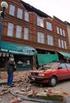 February 28 Earthquake: We got off easy State Geologist John Beaulieu Lucky may not be the first word that comes to mind after an earthquake that injured more than 200 and caused more than $1 billion damage,
EARTHQUAKE. Definition of Hazard. History of Hazard as it Affects the City of Kent. Hazard Identification
 EARTHQUAKE Definition of Hazard Earthquakes are defined as the sudden release of energy occurring from the collision or shifting of crustal plates on the earth s surface or from the fracture of stressed
Chapter 7 Earthquake Hazards Practice Exam and Study Guide
 Chapter 7 Earthquake Hazards Practice Exam and Study Guide 1. Select from the following list, all of the factors that affect the intensity of ground shaking. a. The magnitude of the earthquake b. Rather
KCC Event Brief: 2014 La Habra Earthquake
 KAREN CLARK & COMPANY KCC Event Brief: 2014 La Habra Earthquake June 2014 2 COPLEY PLACE BOSTON, MA 02116 T: 617.423.2800 F: 617.423.2808 Overview On Friday, March 28, 2014 at 9:09pm, a magnitude 5.1 earthquake
Earthquake Preparedness Tips & Strategies
 Earthquake Preparedness Tips & Strategies What to Do BEFORE an Earthquake What to Do DURING an Earthquake BE PREPARED! For more information, log onto: www.gema.ga.gov www.ready.ga.gov www.geophysics.eas.gatech.edu
Effect on structures. Uniform settlement - no concerns. Angular distortion - causes damage due to tensile strain
 Effect on structures Uniform settlement - no concerns Angular distortion - causes damage due to tensile strain 1/500 - safe limit for no cracking of buildings 1/150 - potential structural damage 36 37
GEOTECHNICAL ISSUES OF LANDSLIDES CHARACTERISTICS MECHANISMS PREPARDNESS: BEFORE, DURING AND AFTER A LANDSLIDE QUESTIONS FOR DISCUSSIONS
 GEOTECHNICAL ISSUES OF LANDSLIDES CHARACTERISTICS MECHANISMS PREPARDNESS: BEFORE, DURING AND AFTER A LANDSLIDE QUESTIONS FOR DISCUSSIONS Huge landslide Leyte, Phillipines, 1998 2000 casulties Small debris
Landslides. Landslides-1. March 2007
 Landslides Learn if landslides, including debris flows, could occur in your area by contacting local officials, your state geological survey or department of natural resources, or the geology department
Five reasons buildings fail in an earthquake and how to avoid them
 Five reasons buildings fail in an earthquake and how to avoid them by Jeff White, AIA Published in Healthcare Design magazine There s a saying among seismologists: Earthquakes don t kill people. Buildings
Fire Following Earthquake:
 Fire Following Earthquake: Planning, Strategic, and Tactical Considerations Los Angeles County Fire Department Chief Deputy (Acting) David R. Richardson Jr. Fire Following Earthquake: An Overlooked Dilemma
Landslides & Mudslides
 Landslides & Mudslides Landslides, also known as mudslides and debris flow, occur in all U.S. states and territories. In snowy mountainous areas winter snow landslides are called avalanches. Landslides
HOMEOWNER S GUIDE. to LANDSLIDES. and MITIGATION RECOGNITION, PREVENTION, CONTROL, Compiled by Dr. Scott F. Burns Tessa M. Harden Carin J.
 HOMEOWNER S GUIDE to LANDSLIDES RECOGNITION, PREVENTION, CONTROL, and MITIGATION Compiled by Dr. Scott F. Burns Tessa M. Harden Carin J. Andrew Federal Emergency Management Agency Region 10 If you are
1-800-927-4357. www.insurance.ca.gov. Earthquake. Insurance. California Department of Insurance
 1-800-927-4357 www.insurance.ca.gov Earthquake Insurance California Department of Insurance Table of Contents Page 2 Before You Buy Earthquake Insurance 4 Basic Earthquake Insurance 6 What Earthquake Insurance
Earthquakes: Interesting Facts and F.A.Q.
 Earthquakes: Interesting Facts and F.A.Q. Earthquakes kill approximately 8,000 people each year and have caused an estimated 13 million deaths in the past 4,000 years. The moment magnitude scale (MMS)
Earthquakes: Risk & Insurance Issues
 Earthquakes: Risk & Insurance Issues An earthquake is a sudden and rapid shaking of the earth caused by the breaking and shifting of rock beneath the earth s surface. This shaking can sometimes trigger
Chapter 3 DESIGN AND CONSTRUCTION FEATURES IMPORTANT TO SEISMIC PERFORMANCE
 Chapter 3 DESIGN AND CONSTRUCTION FEATURES IMPORTANT TO SEISMIC PERFORMANCE To satisfy the performance goals of the NEHRP Recommended Seismic Provisions, a number of characteristics are important to the
Presentations. Session 1. Slide 1. Earthquake Risk Reduction. 1- Concepts & Terminology
 Earthquake Risk Reduction Presentations Session 1 Slide 1 Earthquake Risk Reduction 1- Concepts & Terminology Welcome to the World Bank Institute s (WBI) Distance Learning (DL) course on Earthquake Risk
A Report on Post-Earthquake Rapid Visual Damage Assessment of Buildings Of Tribhuvan International Airport
 A Report on Post-Earthquake Rapid Visual Damage Assessment of Buildings Of Tribhuvan International Airport Prepared By: Civil Engineering Division Tribhuvan International Airport Civil Aviation Office
Structural Damage Due to Floods
 Structural Damage Due to Floods By Craig D. Rogers, P.E. The Federal Emergency Management Agency (FEMA) reports that each year approximately 90 percent of all disaster-related property damage results from
Magnitude 8.8 OFFSHORE MAULE, CHILE
 A great 8.8-magnitude struck central Chile early Saturday. The quake hit 200 miles (325 kilometers) southwest of the capital Santiago. The epicenter was just 70 miles (115 kilometers) from Concepcion,
Earthquake Hazards and Risks
 Page 1 of 7 EENS 3050 Tulane University Natural Disasters Prof. Stephen A. Nelson Earthquake Hazards and Risks This page last updated on 28-Aug-2013 Earthquake Risk Many seismologists have said that "earthquakes
STRUCTURAL ASSESSMENT REPORT BOLINAS MARINE STATION - BOLINAS, CALIFORNIA
 STRUCTURAL ASSESSMENT REPORT BOLINAS MARINE STATION - BOLINAS, CALIFORNIA College of Marin c/o Swinerton Management & Consulting P.O. Box 144003 835 College Avenue, Building MS-3 Kentfield, California
Chincha and Cañete, Peru, Based
 Reconstruction of Ica, Pisco, Chincha and Cañete, Peru, Based on Updated Hazard Maps Julio Kuroiwa Professor emeritus National University of Engineering and UNDP Reconstruction Program/Sustainable Cities.
 Testimony of Mr. Robert J. Fenton, Jr. Assistant Administrator for Response, Office of Response and Recovery Federal Emergency Management Agency U.S. Department of Homeland Security Before House Committee
APPLICATION OF EARTHQUAKE ENGINEERING INFORMATION IN HOSPITAL EMERGENCY RESPONSE AND RECOVERY
 APPLICATION OF EARTHQUAKE ENGINEERING INFORMATION IN HOSPITAL EMERGENCY RESPONSE AND RECOVERY Robert Reitherman 1 1. Consortium of Universities for Research in Earthquake Engineering 1301 South 46 th Street,
Earthquakes and Data Centers
 7x24 Exchange Fall Symposium September 11, 2013 Hilton Bellevue Andrew W. Taylor, Ph.D., S.E., FACI Earthquake Hazards 2 September 11, 2013 1 Cascadia Earthquake Sources Figure Credit: Craig Weaver, Pacific
Part 1 - How Much Danger is Your Home or Business In? Where do you live?
 Earthquake Insurance and San Diego County Residents Part 1 - How much danger is your home in? Where do you live? Part 2 - What do San Diego County residents have to know about Earthquake Insurance Policies,
APPLICATION OF EARTHQUAKE ENGINEERING INFORMATION IN HOSPITAL EMERGENCY RESPONSE AND RECOVERY
 Workshop on Seismic Design and Retrofitting of Hospitals in Seismic Areas, October 21-22, 1999. APPLICATION OF EARTHQUAKE ENGINEERING INFORMATION IN HOSPITAL EMERGENCY RESPONSE AND RECOVERY Robert Reitherman
Recent Earthquakes: Implications for U.S. Water Utilities [Project #4408]
![Recent Earthquakes: Implications for U.S. Water Utilities [Project #4408]](/thumbs/25/5582528.jpg "Recent Earthquakes: Implications for U.S. Water Utilities [Project #4408]") Recent Earthquakes: Implications for U.S. Water Utilities [Project #4408] ORDER NUMBER: 4408 DATE AVAILABLE: July 2012 PRINCIPAL INVESTIGATORS: John Eidinger and Craig A. Davis PROJECT PURPOSE: The purpose
Recent Earthquakes: Implications for U.S. Water Utilities [Project #4408] ORDER NUMBER: 4408 DATE AVAILABLE: July 2012 PRINCIPAL INVESTIGATORS: John Eidinger and Craig A. Davis PROJECT PURPOSE: The purpose
ENGINEERING-BASED EARTHQUAKE RISK MANAGEMENT
 ENGINEERING-BASED EARTHQUAKE RISK MANAGEMENT MRP Engineering Newsletter February 2012 The world recently experienced several major earthquakes, which caused severe local impacts and major worldwide repercussions.
Analysis of the Interstate 10 Twin Bridge s Collapse During Hurricane Katrina
 Analysis of the Interstate 0 Twin Bridge s Collapse During Hurricane Katrina By Genda Chen, Emitt C. Witt III, David Hoffman, Ronaldo Luna, and Adam Sevi The Interstate 0 Twin Span Bridge over Lake Pontchartrain
Earthquakes. Earthquakes: Big Ideas. Earthquakes
 Earthquakes Earthquakes: Big Ideas Humans cannot eliminate natural hazards but can engage in activities that reduce their impacts by identifying high-risk locations, improving construction methods, and
WSDOT s Approach to Seismic Retrofit of Highway Structures
 WSDOT s Approach to Seismic Retrofit of Highway Structures Role of the Lifeline Route in Reducing Network Risk Lynn Peterson Secretary of Transportation Patrick Morin, PE Capital Program Development &
Preparation. Preparation. Step 2 Prepare an emergency kit. Step 1 Prepare your emergency plan. Step 4 Tune into warnings
 This emergency toolkit provides you with steps to take before and during emergencies to protect you and your property. The Victoria State Emergency Service (SES) is a volunteer organisation dedicated to
Earthquakes: Risk and Insurance Issues
 Page 1 of 8 HOT TOPICS & INSURANCE ISSUES Earthquakes: Risk and Insurance Issues THE TOPIC JULY 2003 An earthquake is a sudden and rapid shaking of the earth caused by the breaking and shifting of rock
Date, Time and Place: Presented by: Presented to: 22 August 2013, 0900 hrs, Pier 1 The Embarcadero, San Francisco
 Date, Time and Place: 22 August 2013, 0900 hrs, Pier 1 The Embarcadero, San Francisco Presented by: Nick Rogers, Mike Jacka, Kate Williams, Sjoerd van Ballegooy and Rick Wentz, Tonkin & Taylor International
Chapter. Earthquake Damage: Types, Process, Categories
 3 Chapter Earthquake Damage: Types, Process, Categories Earthquakes leave behind a trail of damage and destruction. People s lives are affected by the loss of loved ones, destruction of property, economic
Landslides & Mudflows
 1 2 - What is a Landslide? - Geologic hazard Common to almost all 50 states Annual global Billions in losses Thousands of deaths and injuries 3 1 - What is a Landslide? - Gravity is driving force Some
6 RETROFITTING POST & PIER HOUSES
 Retrofitting Post & Pier Houses 71 6 RETROFITTING POST & PIER HOUSES by James E. Russell, P.E. 72 Retrofitting Post & Pier Houses Retrofitting Post & Pier Houses 73 RETROFITTING POST AND PIER HOUSES This
Chapter 5: Earthquakes
 Chapter 5: Earthquakes 1. Experiencing an Earthquake firsthand 2. The Science of Ghost Forests and Megaearthquakes 3. Faults, Earthquakes, and Plate Tectonics 4. Seismic Waves and Earthquake Detection
EARTHQUAKE PREPAREDNESS
 EARTHQUAKE PREPAREDNESS STEP 1. IDENTIFY POTENTIAL HAZARDS IN YOUR HOME AND BEGIN TO FIX THEM. Earthquake safety is more than minimizing damage to buildings. We must also secure the contents of our buildings
Landslides: The Poor Stepchild of GeoHazards; What We and Other Countries Can Do to Solve It! Scott Burns Portland State University Dept.
 Landslides: The Poor Stepchild of GeoHazards; What We and Other Countries Can Do to Solve It! Scott Burns Portland State University Dept. of Geology Afghanistan: 2014: 2700 dead West Salt Creek Landslide,
4.11 Geologic and Soil Resources
 4.11 Geologic and Soil Resources Geology and soils are evaluated as part of an environmental document because conditions in the project area can influence the type and size of a project s structure, the
Regents Questions: Plate Tectonics
 Earth Science Regents Questions: Plate Tectonics Name: Date: Period: August 2013 Due Date: 17 Compared to the oceanic crust, the continental crust is (1) less dense and more basaltic (3) more dense and
Section 9315. Operations Section Organizational Guidance
 Section 9315 Operations Section Organizational Guidance T able of Contents Section Page 9315 Operations Section Organizational Guidance... 9315-1 9315.1 Minor Inland Spill Scenario... 9315-1 9315.2 Minor
Safe & Sound Bridge Terminology
 Safe & Sound Bridge Terminology Abutment A retaining wall supporting the ends of a bridge, and, in general, retaining or supporting the approach embankment. Approach The part of the bridge that carries
The correct answers are given below. Some talking points have been added for the teachers use.
 Natural Resources Canada 2011: Lesson Plan Grades 11 and 12 Landslide activity 5b: Landslides in Canada quiz Description: This is an independent study activity for grades 11 and 12. Students will read
TECTONICS ASSESSMENT
 Tectonics Assessment / 1 TECTONICS ASSESSMENT 1. Movement along plate boundaries produces A. tides. B. fronts. C. hurricanes. D. earthquakes. 2. Which of the following is TRUE about the movement of continents?
Olympic Region Traffic Management Center. Olympic Radio
 Olympic Region Traffic Management Center Olympic Radio Six Regions - One DOT We work in close partnership with other TMCs 6 WSDOT Regions 6 Regional Traffic Management Centers Tacoma Seattle Vancouver
Prepared For San Francisco Community College District 33 Gough Street San Francisco, California 94103. Prepared By
 Project Structural Conditions Survey and Seismic Vulnerability Assessment For SFCC Civic Center Campus 750 Eddy Street San Francisco, California 94109 Prepared For San Francisco Community College District
How To Prepare For An Earthquake
 Staying Safe Where the Earth Shakes San Diego County Edition Developed by: Earthquake Country Alliance California Earthquake Authority California Governor s Office of Emergency Services San Diego County
FACT SHEET: HAZARDOUS MATERIALS ACCIDENTS
 FACT SHEET: HAZARDOUS MATERIALS ACCIDENTS A hazardous materials accident can occur anywhere. Communities located near chemical manufacturing plants are particularly at risk. However, hazardous materials
Factors to Consider When Developing an Evacuation Plan
 The following should be viewed only as suggestions: Factors to Consider When Developing an Evacuation Plan 1. You must identify your document with a specific title and explanation. Example: Evacuation
Elevating Your House. Introduction CHAPTER 5
 CHAPTER 5 Elevating Your House Introduction One of the most common retrofitting methods is elevating a house to a required or desired Flood Protection Elevation (FPE). When a house is properly elevated,
How do scientists measure earthquakes?
 Name: Source: http://www.scholastic.com/browse/article.jsp?id=4892 http://gizmodo.com/5833688/what-do-earthquake-magnitudes-mean http://www.kids-fun-science.com/moment-magnitude-scale.html http://tremor.nmt.edu/faq/how.html
4.6 GEOLOGIC AND SEISMIC HAZARDS
 4.6 GEOLOGIC AND SEISMIC HAZARDS This Section describes the current conditions relating to the geologic and seismic characteristics of the City of Cypress. This Section concludes with an analysis of geologic
Disaster Preparedness and Safety Element
 Disaster Preparedness and Safety Element Element Objectives The policies and actions of the Disaster Preparation and Safety Element are intended to achieve the following six objectives: 1. Establish and
Activities Earthquake Hazard Maps & Liquefaction
 Activities Earthquake Hazard Maps & Liquefaction Geology and Earth Resources Division geologists actively identify, assess, and map geologic hazards for land-use and emergency-management planning, disaster
COASTAL DAMAGE INSPECTION SOUTHWEST VITI LEVU, FIJI AFTER CYCLONE SINA
 COASTAL DAMAGE INSPECTION SOUTHWEST VITI LEVU, FIJI AFTER CYCLONE SINA Brendan J. Holden SOPAC Technical Secretariat July 1992 SOPAC Technical Report 148 Prepared for: South Pacific Applied Geoscience
EARTHQUAKES. Compressional Tensional Slip-strike
 Earthquakes-page 1 EARTHQUAKES Earthquakes occur along faults, planes of weakness in the crustal rocks. Although earthquakes can occur anywhere, they are most likely along crustal plate boundaries, such
EARTHQUAKE MAGNITUDE
 EARTHQUAKE MAGNITUDE Earliest measure of earthquake size Dimensionless number measured various ways, including M L local magnitude m b body wave magnitude M s surface wave magnitude M w moment magnitude
Hurricane Preparedness in Pinellas County
 Emergency Management Contact: Gary Vickers, Director (727) 464-5550 Hurricane Preparedness in Pinellas County Hurricane Katrina s devastation in the Louisiana- Mississippi area has refocused attention
EL Civics Objective 16 (Emergencies) Level: Beginning Low & Beginning High Task #1: Identify Emergencies & Disasters
 EL Civics Objective 16 (Emergencies) Level: Beginning Low & Beginning High Task #1: Identify Emergencies & Disasters Language & Literacy Objectives: 1. Identify what constitutes an emergency or disaster,
The Boscastle Flood 2004
 The Boscastle Flood 2004 by Phil Bull Causes of the Flood Physical Causes The flood took Boscastle entirely by surprise - it was a flash flood event & the village is not prone to regular annual flooding
TOWN OF HARRISBURG FIRE DEPARTMENT 6450 Morehead Road, Harrisburg North Carolina 28075 Phone: 704 455 3574 Fax 704 455 6391 www.harrisburgfd.
 FLOOD FACTS AND SAFETY TIPS Floods are one of the most common hazards in the United States. Flood effects can be local, impacting a neighborhood or community, or very large, affecting entire river basins
How To Understand The History Of Infrastructure Failures In Seattle
 Infrastructure Failures Key Points Infrastructure is the network of utilities that supplies our basic needs for mobility, power, water, sewer and communications. This chapter covers major structural failures
The Severity of an Earthquake - ---- U.S. Department of the Interior/Geological Survey
 The Severity of an Earthquake - ---- U.S. Department of the Interior/Geological Survey ----~ Earthquakes can be measured in terms of either the effect of the earthquake (intensity) or of the energy released
Building Condition Assessment: 215-219 West Lexington Street Baltimore, Maryland
 KPA The Joint Venture of EBA Engineering, Inc. and Kennedy Porter & Associates, Inc. 4813 Seton Drive, Baltimore, MD 21215 Phone: (410-358-7171) Fax: (410)358-7213 Building Condition Assessment: Baltimore,
Update, 2013 Cascadia Region Earthquake Workgroup
 Cascadia Subduction Zone Earthquakes: A Magnitude 9..0 Earthquake Scenario Update, 2013 Cascadia Region Earthquake Workgroup Also available as Washington Division of Geology and Earth Resources Information
Hurricane Sandy Recovery Efforts
 Hurricane Sandy: Recovery Efforts One Year Later There's nothing more important than us getting this right. And we're going to spend as much time, effort and energy as necessary to make sure that all the
2014 Polk County ESF #3 Public Works and Engineering: Damage Assessment Section
 2014 Polk County ESF #3 Public Works and Engineering: Damage Assessment Section Public Version ESF#3 Damage Assessment Section 2014 Polk County Emergency Management Agency Page 1 of 14 Table of Contents
DAMAGE TO FOUNDATIONS FROM EXPANSIVE SOILS
 DAMAGE TO FOUNDATIONS FROM EXPANSIVE SOILS J. David Rogers, Robert Olshansky, and Robert B. Rogers Expansive soils in many parts of the United States pose a significant hazard to foundations for light
Improved Warnings for Natural Hazards: A Prototype System for Southern California
 Improved Warnings for Natural Hazards: A Prototype System for Southern California Yehuda Bock Research Geodesist Scripps Institution of Oceanography University of California San Diego, La Jolla, Calif.
Flood Risk Management
 Flood Risk Management Value of Flood Risk Management Every year floods sweep through communities across the United States taking lives, destroying property, shutting down businesses, harming the environment
Flood Risk Management
 Flood Risk Management Value of Flood Risk Management Value to Individuals and Communities Every year floods sweep through communities across the United States taking lives, destroying property, shutting
Economic Benefit Cost Analysis: CoreFirst vs. Standard Retrofit
 Economic Benefit Cost Analysis: CoreFirst vs. Standard Retrofit Kleinhenz & Associates 2602 Berkshire Road Cleveland, Ohio 44106 www.kleinhenzassociates.com June 2014 Introduction CoreFirst, llc. (CoreFirst)
How To Check For Scour At A Bridge
 Case Studies Bridge Scour Inspection and Repair Edward P. Foltyn, P.E. Senior Hydraulic Engineer ODOT Bridge Unit 2013 PNW Bridge Inspectors Conference April 2013 REFERENCES Stream Stability at Highway
American Society of Civil Engineers
 American Society of Civil Engineers Technical Council on Lifeline Earthquake Engineering Earthquake Investigation Committee Lifelines Water and Wastewater Electric Power and Communication Gas and Liquid
Flash Flood Science. Chapter 2. What Is in This Chapter? Flash Flood Processes
 Chapter 2 Flash Flood Science A flash flood is generally defined as a rapid onset flood of short duration with a relatively high peak discharge (World Meteorological Organization). The American Meteorological
Foundations 65 5 FOUNDATIONS. by Richard Chylinski, FAIA and Timothy P. McCormick, P.E. Seismic Retrofit Training
 Foundations 65 5 FOUNDATIONS by Richard Chylinski, FAIA and Timothy P. McCormick, P.E. 66 Foundations Foundations 67 FOUNDATIONS Let's assume that the retrofit has been done correctly from the roofline
Earthquakes. What to Do Before an Earthquake
 EARTHQUAKES Earthquakes What to Do Before an Earthquake Earthquakes strike suddenly, violently and without warning. Identifying potential hazards ahead of time and advance planning can reduce the dangers
4.3.5 - Breakaway Walls
 4.3.5 - Breakaway Walls Elevation of a structure on a properly designed foundation reduces the potential for water damage from flooding. When the space below the lowest elevated floor is maintained free
PACIFIC CATASTROPHE RISK ASSESSMENT AND FINANCING INITIATIVE
 PACIFIC CATASTROPHE RISK ASSESSMENT AND FINANCING INITIATIVE NIUE SEPTEMBER 11 COUNTRY RISK PROFILE: NIUE Niue is expected to incur, on average,.9 million USD per year in losses due to earthquakes and
Magnitude 7.2 GUERRERO, MEXICO
 A powerful magnitude-7.2 earthquake shook central and southern Mexico on Friday. The earthquake occurred at a depth of 24 km (15 miles). Its epicenter was in the western state of Guerrero, near the seaside
Bernie Nimer, Dave Seton Mayfair Hotel Development Corporation
 SITE INVESTIGATION REPORT NO. S1r1 PROJECT: The Mayfair Hotel PROJECT NO: 140565 ATTN: Bernie Nimer, Dave Seton Mayfair Hotel Development Corporation PREPARED BY: Cory Zurell, PhD, P.Eng. DATE: 13 April
Home Buyers Insurance Checklist
 Home Buyers Insurance Checklist Shopping for your dream house? There are many considerations when looking at real estate, such as property taxes, school district, available recreational opportunities in
Lecture 12 Earthquake Magnitude
 Lecture 12 Earthquake Magnitude Locating Earthquakes Last time, we learned that we could obtain a rough estimate of the distance in miles to an earthquake epicenter by multiplying the S - P time interval
Resilient Washington State
 Resilient Washington State A Framework for Minimizing Loss and Improving Statewide Recovery after an Earthquake November 2012 Also published as Information Circular 114 by the Division of Geology and Earth