
Climate Services Toolkit
|
|
|
- Deborah Beasley
- 10 years ago
- Views:
Transcription
1 Straw-person for ICT-CSIS Discussion Provide resources for Climate Services in Developing Countries Coordinate Climate Services Guidance and Examples between countries Connects Research with Operations Facilitates Climate Information Use in Applications

2 Climate Availability, Management, and Mining Features and Functions Information flow Climate Analysis Monitoring PUSH Climate Forecasts Climate Projections RCCs & NMHSs PULL USER INTERFACE Feedback and Requirements

3 Objectives To ensure that climate-sensitive sectors in any country have access to the most up-to-date, reliable and consistent climate information and products that meet their basic needs; To provide a conduit for technology transfer to developing countries, enabling their access to the latest methods, techniques and information required for CSIS activities and products; To facilitate climate services standards in effectiveness, consistency and quality for the Regional Climate Centers and National Meteorological and Hydrological Services

4 Why? Improve efficiency and raise capacity of service providers by facilitating the production, communication and application of climate information products. Ensure that the information and products developed for and provided to end-users is reliable, consistent (through time and across regions) and of high quality. Share new tools, information and methods, and thereby enable all CSIS providers to take advantage of research advances. Facilitate climate services standards and consistency in support of National Meteorological and Hydrological Services Enable more countries to develop their national products, and so encourage improved data sharing, and foster the interaction and shared learning between information providers through the development of a common set of skills. Reduce the need for expensive capacity building through availability of training resources. The will also make training workshops more focused, tangible and efficient in imparting the operational skills.

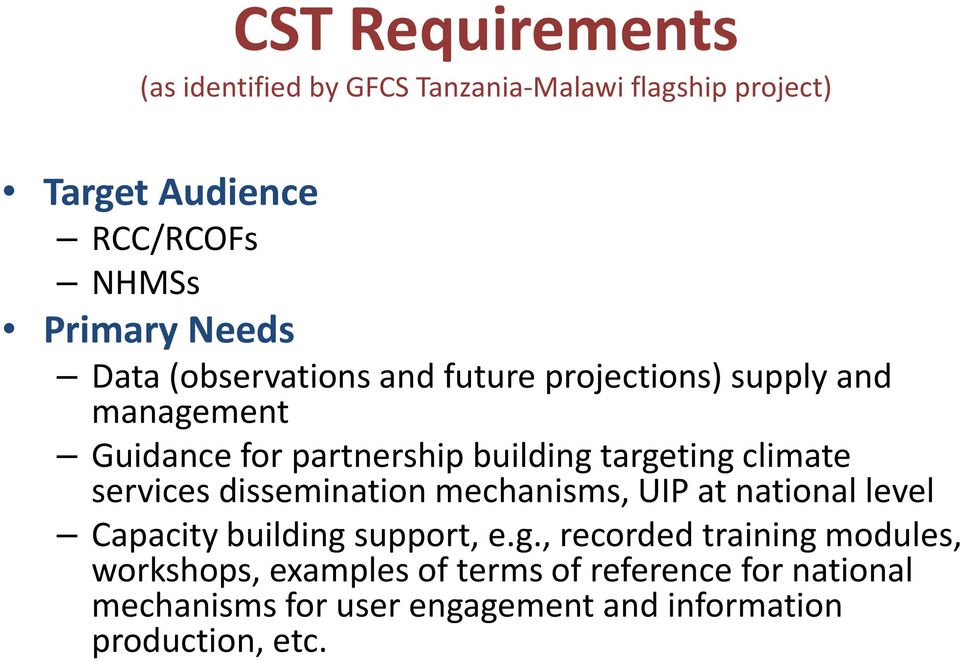
5 Requirements (as identified by GFCS Tanzania-Malawi flagship project) Target Audience RCC/RCOFs NHMSs Primary Needs (observations and future projections) supply and management Guidance for partnership building targeting climate services dissemination mechanisms, UIP at national level Capacity building support, e.g., recorded training modules, workshops, examples of terms of reference for national mechanisms for user engagement and information production, etc.
6 Requirements Credibility The set of offerings will incorporate the latest scientific and technological advances. Accessibility The tools should be easily available from the Internet and/or available on request upon a portable electronic medium PC-compatible version available Usability The has to give to the user the ability to save data, analytical results, and predictions in digital and graphical publication-quality formats.

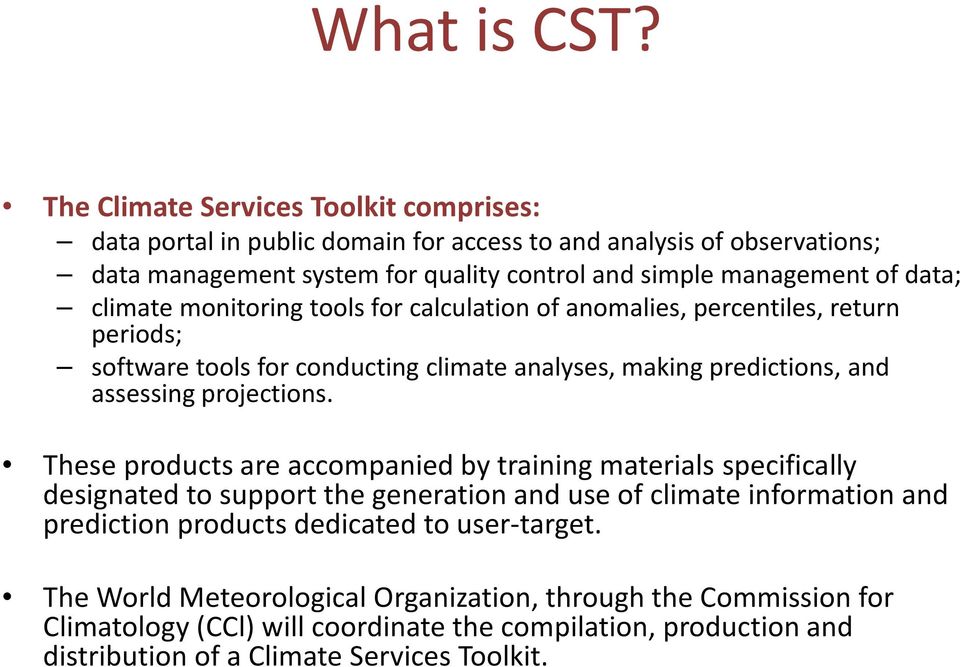
7 What is CST? The comprises: data portal in public domain for access to and analysis of observations; data management system for quality control and simple management of data; climate monitoring tools for calculation of anomalies, percentiles, return periods; software tools for conducting climate analyses, making predictions, and assessing projections. These products are accompanied by training materials specifically designated to support the generation and use of climate information and prediction products dedicated to user-target. The World Meteorological Organization, through the Commission for Climatology (CCl) will coordinate the compilation, production and distribution of a.
8 Definition CST is a suite of guidance, data, software tools, training resources, and examples for enabling actionable climate services at global, regional, and national levels

9 Improve efficiency and raise capacity of service providers by facilitating the production, communication and application of climate information products. Ensure that the information and products developed for and provided to end-users is reliable, consistent (through time and across regions) and of high quality. Share new tools, information and methods, and thereby enable all CSIS providers to take advantage of research advances. Facilitate climate services standards and consistency in support of National Meteorological and Hydrological Services Enable more countries to develop their national products, and so encourage improved data sharing, and foster the interaction and shared learning between information providers through the development of a common set of skills. Reduce the need for expensive capacity building through availability of training resources. The will also make training workshops more focused, tangible and efficient in imparting the operational skills.

10 Catalog of implementation resources for implementation of the results framework for WMO s contribution to the Global Framework for Climate Services WMO s Technical Commissions, Regional Association climate-related working groups, and programmes, including joint programmes, have generated a large number of resources for supporting the Global Framework for Climate Services (GFCS) implementation. These resources include software, guidelines and manuals, training curricula, experts, institutional assets, programme delivery capabilities and others. An initial inventory of some of these resources is below. They are organized by the five pillars of the GFCS with the last pillar, User Interface Platforms, further sub-setted into the five GFCS priority areas. These resources will be drawn upon in the course of implementing the results framework for WMO s contribution to the GFCS. [Note to contributors: The following is initially intended as a list of examples to inform a discussion by the Presidents of Technical Commissions and Regional Associations and joint programme representatives in January Inclusion criteria include that the item identified is already operational and deployable and that the description clearly links it to an aspect of implementation of the GFCS and, ideally, specifically the draft results framework for WMO s contribution. Please note that they are categorized by GFCS pillar and priority rather than by WMO department. The initial list below is merely indicative. There is no standard format for the entries below for the moment but one can be developed subsequently.] Plan: Observations and monitoring Climate Services Information System Research Modeling and Prediction User Interface Platforms Disaster Risk Reduction Water resources Agriculture Health Energy

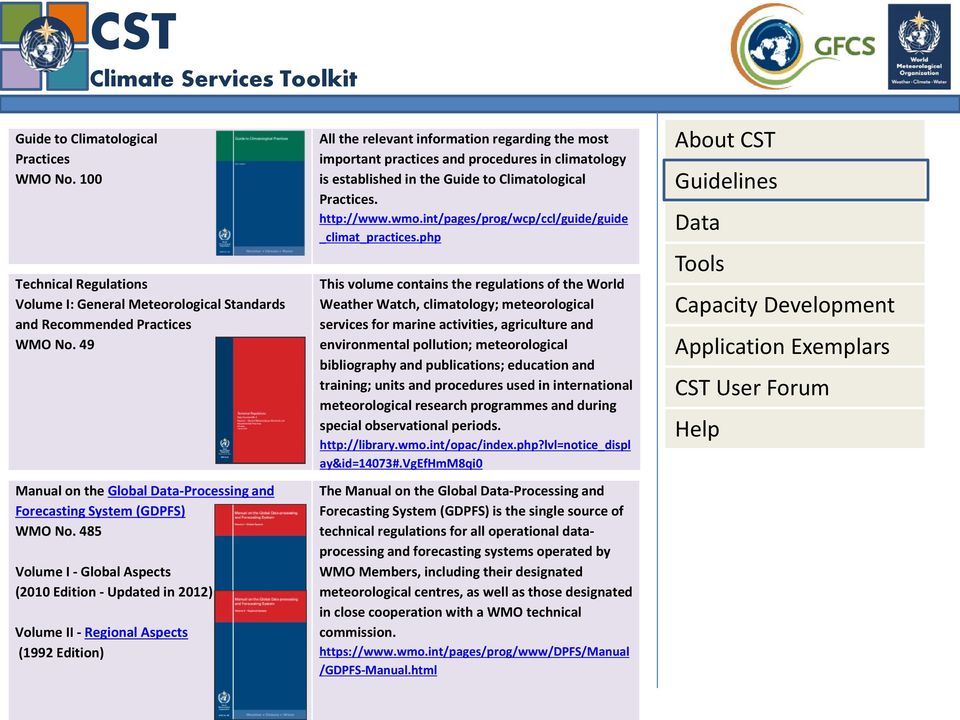
11 Guide to Climatological Practices WMO No. 100 Technical Regulations Volume I: General Meteorological Standards and Recommended Practices WMO No. 49 Manual on the Global -Processing and Forecasting System (GDPFS) WMO No. 485 Volume I - Global Aspects (2010 Edition - Updated in 2012) Volume II - Regional Aspects (1992 Edition) All the relevant information regarding the most important practices and procedures in climatology is established in the Guide to Climatological Practices. _climat_practices.php This volume contains the regulations of the World Weather Watch, climatology; meteorological services for marine activities, agriculture and environmental pollution; meteorological bibliography and publications; education and training; units and procedures used in international meteorological research programmes and during special observational periods. ay&id=14073#.vgefhmm8qi0 The Manual on the Global -Processing and Forecasting System (GDPFS) is the single source of technical regulations for all operational dataprocessing and forecasting systems operated by WMO Members, including their designated meteorological centres, as well as those designated in close cooperation with a WMO technical commission. /GDPFS-Manual.html
12 Observations Current Conditions Forecasts Temperature Precipitation Sea Surface Temperature Projections

13 Climate Services provide access to best practices in accessing, mining, and using information for improving climate services and supporting climate-sensitive societal challenges Managing Analyzing Climate Monitoring Climate Forecasting & Verification Projecting Future Tailoring Information Standards and Specifications
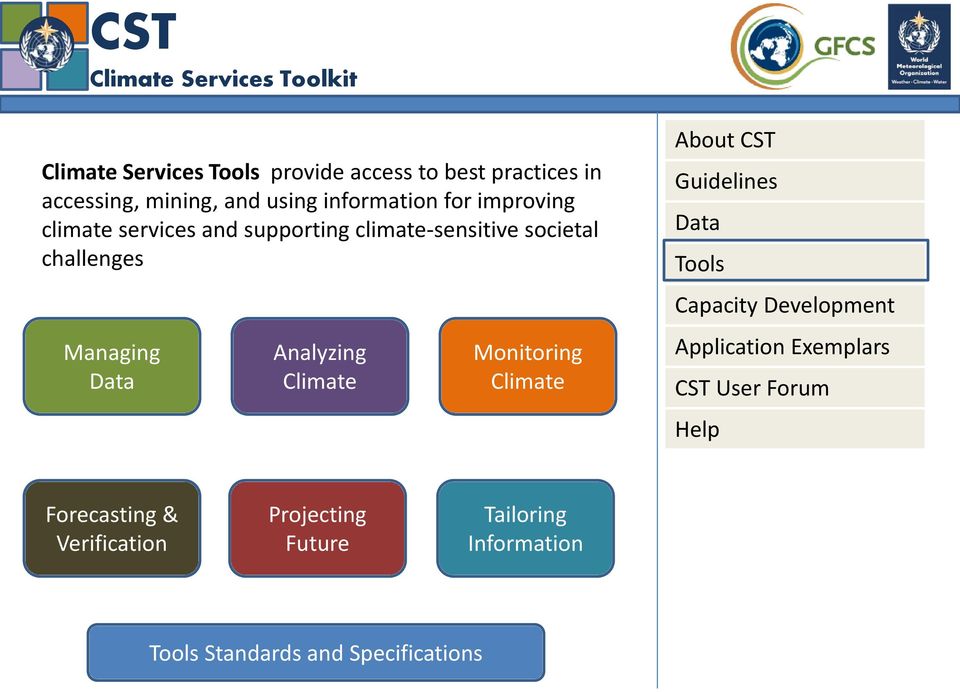
14 for Managing Portal MCH ClimatView Management ClimSoft CliSys Analysis Climate Explorer LCAT Library WCT

15 resources provide access to: Education and Training Resources Guidance on Quality Management Guide to Climatological Practices Advisors on Social Media Infrastructural and Institutional Capabilities

16 Education and Training Resources provide learning progressions for staff from RCCs and NMHSs as well as technical user of climate information. Climate Introduction Producing Actionable Climate Information Climate 101 Climate Variability: Mechanisms, Impacts, Predictability Climate Change: Mechanisms, Impacts, Predictability Climatology Products Climate Monitoring Products Intraseasonal and Seasonal Outlooks Assessing Future Climate Making Climate Sensitive Decisions Tailored Climate Information Communication and Dissemination Practices Climate Adaptation Planning Monitoring and Evaluation of Climate Service

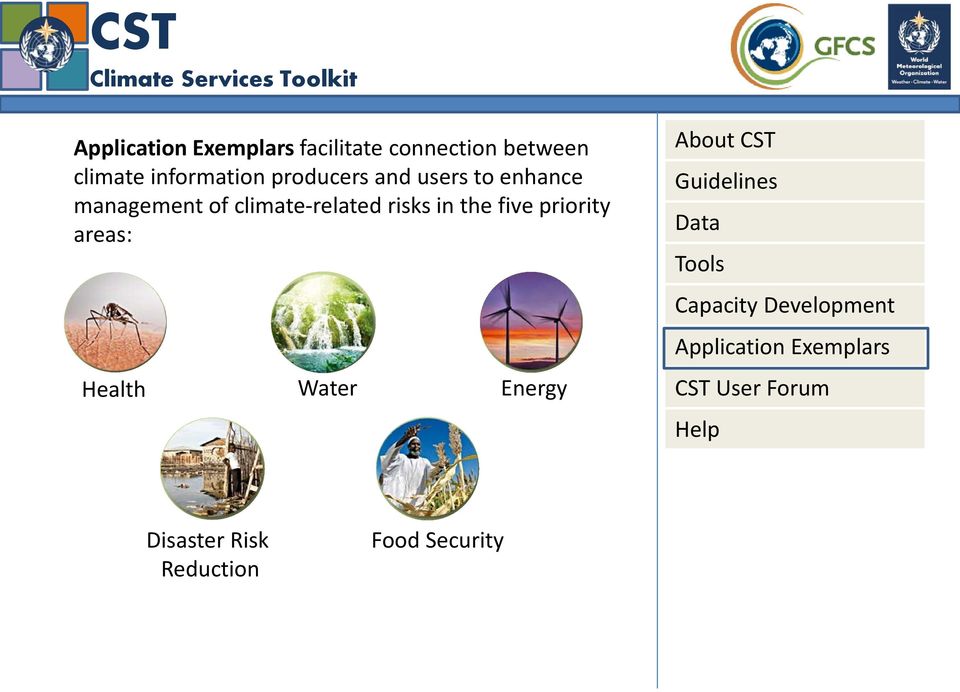
17 facilitate connection between climate information producers and users to enhance management of climate-related risks in the five priority areas: Health Water Energy Disaster Risk Reduction Food Security
18 fosters development of climate community including climate information users, producers, and researchers. The forum fosters usability of climate data and tools, shares information, improves climate knowledge management, and promotes ideation for climate services.

19 CST Desk FAQ&A Contact Experts Search Catalogs Applications Applications Guidance

20 Network of CST Coordination IBCS SMEs:, WMO PAC CCL GFCS CST CAgM RCC, NMHS Chy CAS CBS

21 Development and Deployment Timeline Scoping December 2015 CST basic framing identified CST scoping meeting (ICT-CSIS) conducted CST working group formed CST management process identified CST mock-up produced Engagement of CST stakeholders initiated Development December 2016 Standards and integration process for CST components agreed Network of providers of climate data and tools formed, CST components coordination workshop conducted Initial integration of CST components completed Communication with stakeholders continued Beta version of CST delivered to priority countries on electronic media Deployment July 2017 CST modification based on CST deployment in priority countries addressed First version of CST deployed and delivered for all countries CST monitoring and evaluation process established and feedback collected Plan for CST updates produced CST user engagement continued
Global Framework for Climate Services (GFCS): Roles of Global, Regional and National Operational Entities
 World Meteorological Organization Working together in weather, climate and water Global Framework for Climate Services (GFCS): Roles of Global, Regional and National Operational Entities Rupa Kumar Kolli
Climate Services Information System: The Operational Core of the Global Framework for Climate Services
 Climate Services Information System: The Operational Core of the Global Framework for Climate Services Anahit Hovsepyan Rupa Kumar Kolli WMO Climate Service Information System (CSIS) The CSIS is the component
The European (RA VI) Regional Climate Centre Node on Climate Monitoring
 The European (RA VI) Regional Climate Centre Node on Climate Monitoring Peter Bissolli Deutscher Wetterdienst, Germany WMO RA VI Regional Climate Centre (RCC) 1 Outline 1. Overview of the Regional Climate
WMO Activities on Water and Climate Change
 WMO World Meteorological Organization Working together in weather, climate and water WMO Activities on Water and Climate Change Sophia Sandström Climate and Water Department World Meteorological Organization
WMO Climate Monitoring Activities. Omar Baddour Data Management Applications Division Observing and Information System Department Obaddour@wmo.
 WMO Climate Monitoring Activities Omar Baddour Data Management Applications Division Observing and Information System Department [email protected] CONTENT 1. Brief introduction on WCP and WCSP 2. Purpose
How To Help The Environment
 CIIFEN Activities 2012 Rodney Martínez Güingla [email protected] Workshop on Climate Change in Mediterranean and Caribbean Seas: Guayaquil, Ecuador, 08-11 May 2011 MISSION To promote, coordinate and
THE GLOBAL FRAMEWORK FOR CLIMATE SERVICES: Communicating climate change science
 World Meteorological Organization Working together in weather, climate and water THE GLOBAL FRAMEWORK FOR CLIMATE SERVICES: Communicating climate change science Dr. Mannava Sivakumar Director Climate Prediction
Global Framework for Climate Services (GFCS): Heat-Health Perspectives
 Global Framework for Climate Services (GFCS): Heat-Health Perspectives R. Kolli World Meteorological Organization [email protected] http://gfcs.wmo.int Why a Framework for Climate Services? It will enable
Development of the Global Framework for Climate Services at the national level
 Guideline Development of the Global Framework for Climate Services at the national level Date: 5 May 2014 Page 1 of 47 Acknowledgments: We would like to highlight the tremendous work done by Dr Tall in
Weather, Climate and Water Services for the Least Developed Countries
 Weather, Climate and Water Services for the Least Developed Countries The WMO Programme for the Least Developed Countries (LDCs) was established in 2003 in response to the call of the Third United Nations
New challenges of water resources management: Title the future role of CHy
 New challenges of water resources management: Title the future role of CHy by Bruce Stewart* Karl Hofius in his article in this issue of the Bulletin entitled Evolving role of WMO in hydrology and water
Guidelines for Implementing a Quality Management System in Hydrology August 2013
 Guidelines for Implementing a Quality Management System in Hydrology August 2013 Introduction Quality management is a process for ensuring that all the activities necessary to design, develop, and deliver
WMO Capacity Development Strategy CCl Task Team September 2015
 WMO Capacity Development Strategy CCl Task Team September 2015 Rob Masters Director for Development and Regional Activities WMO; DRA WMO Executive Council called to develop Capacity Development Strategy
THE STRATEGIC PLAN OF THE HYDROMETEOROLOGICAL PREDICTION CENTER
 THE STRATEGIC PLAN OF THE HYDROMETEOROLOGICAL PREDICTION CENTER FISCAL YEARS 2012 2016 INTRODUCTION Over the next ten years, the National Weather Service (NWS) of the National Oceanic and Atmospheric Administration
The Global Framework for Climate Services
 The Global Framework for Climate Services L. S. Rathore DGM & Co-Vice-Chair Intergovernmental Board on Climate Services http://gfcs.wmo.int 1 History of the GFCS Third World Climate Conference (2009):
WMO Disaster Risk Reduction Work Plan (2012-2015) Updated as of: 21 March 2014
 WMO Disaster Risk Reduction Work Plan (2012-2015) Updated as of: 21 March 2014 Approved by 64 th Session of WMO Executive Council (25 June 3 July 2012, Geneva, Switzerland) For more information, please
BASIC APPROACH TO CLIMATE MONITORING PRODUCTS AND CLIMATE MONITORING PRODUCTS IN WMO RA VI
 BASIC APPROACH TO CLIMATE MONITORING PRODUCTS AND CLIMATE MONITORING PRODUCTS IN WMO RA VI Mesut DEMIRCAN Geodesy and Photogrametry Engineer Turkish State Meteorological Service Agrometeorology and Climatological
Expected Result: 11 EFFECTIVE AND EFFICIENT MANAGEMENT PERFORMANCE AND OVERSIGHT OF THE ORGANIZATION
 World Meteorological Organization EC-LXII/Doc. 7.2(1) EXECUTIVE COUNCIL Secretary-General & Submitted by: Chairman, EC Working Group on WMO Strategic and Operational Planning Date: 31.V.2010 SIXTY-SECOND
Africa Adaptation Programme
 Africa Adaptation Programme Examples of experiences, challenges and success stories from implemented and ongoing projects and initiatives on climate observations Joseph D. Intsiful AAP Data and information
ECUADORIAN NATIONAL CLIMATE OUTLOOK FORUM (NCOF)
 ECUADORIAN NATIONAL CLIMATE OUTLOOK FORUM (NCOF) OBJECTIVES To present the official seasonal forecast issued by the National Meteorological and Hydrological Service of Ecuador (INAMHI). This also included
THE ESTABLISHMENT OF A HELPDESK FOR INTEGRATED FLOOD MANAGEMENT
 FRAMEWORK DOCUMENT FOR THE ESTABLISHMENT OF A HELPDESK FOR INTEGRATED FLOOD MANAGEMENT This document sets out the basic objectives, structure and roles of the HelpDesk for Integrated Flood Management.
Standardized Runoff Index (SRI)
 Standardized Runoff Index (SRI) Adolfo Mérida Abril Javier Gras Treviño Contents 1. About the SRI SRI in the world Methodology 2. Comments made in Athens on SRI factsheet 3. Last modifications of the factsheet
Symposium on Climate Risk Management
 Symposium on Climate Risk Management Guayaquil, Ecuador 10 th 12 th October 2011 Session 2: Background and Objectives Deborah Hemming Met Office Hadley Centre Weather / Climate impacts on all sectors and
Seventh African Development Forum. Climate Risk Management: Monitoring, Assessment, Early Warning and Response
 Seventh African Development Forum Acting on Climate Change for Sustainable Development in Africa Climate Risk Management: Monitoring, Assessment, Early Warning and Response Issues Paper #4 ADF VII 10-15
IODE Quality Management Framework for National Oceanographic Data Centres
 IOC/IODE-XXII/22 Page 1 INTERGOVERNMENTAL OCEANOGRAPHIC COMMISSION (of UNESCO) Twenty-second Session of the IOC Committee on International Oceanographic Data and Information Exchange (IODE-XXII) Ensenada,
Copernicus Climate Change Service C3S. Jean-Noël Thépaut. [email protected]. Funded by the European Union.
 Copernicus Climate Change Service C3S Jean-Noël Thépaut [email protected] Funded by the European Union Implemented by C3S: State of play of play From the Copernicus regulation (EU) 377/2014:
Armenian State Hydrometeorological and Monitoring Service
 Armenian State Hydrometeorological and Monitoring Service Offenbach 1 Armenia: IN BRIEF Armenia is located in Southern Caucasus region, bordering with Iran, Azerbaijan, Georgia and Turkey. The total territory
IDMP Management Committee 10 September 2015
 IDMP Management Committee 10 September 2015 1 Agenda IDMP Management Committee Meeting Discussion of progress on implementation of IDMP activities for the year 2014/2015 Oversight recommendations from
Saskatoon North Partnership for Growth (P4G) Draft Communications and Engagement Strategy
 Saskatoon North Partnership for Growth (P4G) Draft Communications and Engagement Strategy Introduction This Communications and Engagement Strategy (Strategy) sets the communications and engagement framework
What is Drought? Why is Drought Important? NATIONAL WEATHER SERVICE MAY 2008
 NATIONAL WEATHER SERVICE MAY 2008 What is Drought? Drought is a deficiency in precipitation over an extended period, usually a season or more, resulting in a water shortage causing adverse impacts on vegetation,
II. Related Activities
 (1) Global Cloud Resolving Model Simulations toward Numerical Weather Forecasting in the Tropics (FY2005-2010) (2) Scale Interaction and Large-Scale Variation of the Ocean Circulation (FY2006-2011) (3)
Managing Drought Risk in a Changing Climate: The Role of National Drought Policy
 Managing Drought Risk in a Changing Climate: The Role of National Drought Policy Dr. Donald A. Wilhite School of Natural Resources University of Nebraska-Lincoln Drought Risk in the Context of Change 22
DESIGN DATABASE MANAGMENT SYSTEM FOR IGAD-HYCOS TERMS OF REFERENCE
 WMO IGAD EC Intergovernmental Authority on Development (IGAD) Hydrological Cycle Observing System (HYCOS) Project IGAD-HYCOS DESIGN DATABASE MANAGMENT SYSTEM FOR IGAD-HYCOS 1. Background TERMS OF REFERENCE
NIST Cloud Computing Program Activities
 NIST Cloud Computing Program Overview The NIST Cloud Computing Program includes Strategic and Tactical efforts which were initiated in parallel, and are integrated as shown below: NIST Cloud Computing
Implementing a Quality Management System in NMHSs
 World Meteorological Organization Working together in weather, climate and water Implementing a Quality Management System in NMHSs Sue O Rourke Head of Disaster Mitigation & Severe Weather Services Australian
KENYA METEOROLOGICAL SERVICE
 Operational Training (OTC) MINISTRY OF ENVIRONMENT, WATER AND NATURAL RESOURCES Institute for Training and Research/ World Organization, Regional Training Centre All s are competence-based and upon completion
MCH Meteorology, Climatology and Hydrology Data base Management System
 WMO World Meteorological Organization Working together in weather, climate and water MCH Meteorology, Climatology and Hydrology Data base Management System WMO, Climate and Water department: Nirina Ravalitera
NCDC Strategic Vision
 NOAA s National Climatic Data Center World s Largest Archive of Climate and Weather Data Presented to: Coastal Environmental Disasters Data Management Workshop September 16, 2014 Stephen Del Greco Deputy
How To Help The European Single Market With Data And Information Technology
 Connecting Europe for New Horizon European activities in the area of Big Data Márta Nagy-Rothengass DG CONNECT, Head of Unit "Data Value Chain" META-Forum 2013, 19 September 2013, Berlin OUTLINE 1. Data
DESWAT project (Destructive Water Abatement and Control of Water Disasters)
 A new national hydrological forecast and warning system is now in advanced implementation phase, within the Romanian Waters National Administration, in the framework of DESWAT project. The main objectives
CALIFORNIA OCEAN PROTECTION COUNCIL. Staff Recommendation March 11, 2011 STATEWIDE SCIENCE INTEGRATION AND MARINE PROTECTED AREA MONITORING PROGRAMS
 CALIFORNIA OCEAN PROTECTION COUNCIL Staff Recommendation March 11, 2011 STATEWIDE SCIENCE INTEGRATION AND MARINE PROTECTED AREA MONITORING PROGRAMS File No.: 08-123-02 File No.: 06-090-02 Project Managers:
MEbA (MICROFINANCE FOR ECOSYSTEM-BASED ADAPTATION TO CLIMATE CHANGE)
 MEbA (MICROFINANCE FOR ECOSYSTEM-BASED ADAPTATION TO CLIMATE CHANGE) NEWSLETTER N 1-2013 GENERAL MESSAGE Alejandro Laguna The microfinance for ecosystem-based adaptation (MEbA) project represents an innovative
Eastern Caribbean Open-Source Geospatial Data Sharing and Management Workshop
 Eastern Caribbean Open-Source Geospatial Data Sharing and Management Workshop Data Collection and Management in the Caribbean Spice Island Resort, St. George s, Grenada October 6 7, 2011 Presented by:
RUP Deployment. RUP Deployment Workflow RUP Deployment Artifacts & Deliverables
 RUP Deployment RUP Deployment Workflow RUP Deployment Artifacts & Deliverables RUP Deployment - Purpose The Deployment Workflow describes the activities associated with ensuring that the software product
Primary author: Kaspar, Frank (DWD - Deutscher Wetterdienst), [email protected]
 Primary author: Kaspar, Frank (DWD - Deutscher Wetterdienst), [email protected] Co-authors: Johannes Behrendt (DWD - Deutscher Wetterdienst), Klaus-Jürgen Schreiber (DWD - Deutscher Wetterdienst) Abstract
PWS CSA 09-14 Annex B1. Appendix A.1 Detailed Output Definitions - PWS Outputs
 PWS CSA 09-14 Annex B1 Appendix A.1 Detailed Output Definitions - PWS Outputs 1a - High Impact weather forecast service - UK Requirement - To enable the UK public and emergency responders to take appropriate
Introducing the Knowledge Management System. Victor Low UNEP
 Introducing the Knowledge Management System Victor Low UNEP Objectives of the Session on the CTCN KMS Understand the CTCN Knowledge Management System and the types of assistance it can provide Stimulate
Second International Workshop for Port Meteorological Officers. Teruko Manabe World Meteorological Organization
 Second International Workshop for Port Meteorological Officers Teruko Manabe World Meteorological Organization Second International Workshop for Port Meteorological Officers Background of the workshop
Terrace Consulting Services
 Terrace Consulting Services Overview: Every project will require some degree of Planning before Implementation can begin. Analysis and Planning are essential in order to confirm requirements, define the
Emergency Management Service. early warning FLOOD AND FIRE ALERTS. Space
 Emergency Management Service early warning FLOOD AND FIRE ALERTS Space 1 Copernicus at a Glance Copernicus is the European Union s Earth Observation programme: a user-driven space programme under civil
Symbiosis: Responding to Coral Bleaching in the Two Samoas
 Symbiosis: Responding to Coral Bleaching in the Two Samoas Coral reefs get their structure from calcium carbonate skeletons built by individual corals (animals) which take many shapes and their colors
IPCC Support to National GHG Inventories
 Task Force on National Greenhouse Gas Inventories IPCC Support to National GHG Inventories WRI MAPT Workshop 2 December, 2012 Nalin SRIVASTAVA Technical Support Unit, IPCC TFI Contents Who we are: The
http://www.isac.cnr.it/~ipwg/
 The CGMS International Precipitation Working Group: Experience and Perspectives Vincenzo Levizzani CNR-ISAC, Bologna, Italy and Arnold Gruber NOAA/NESDIS & Univ. Maryland, College Park, MD, USA http://www.isac.cnr.it/~ipwg/

Requirements of Aircraft Observations data and Data Management Framework for Services and Other Data Users. (Submitted bymichael Berechree)
 WORLD METEOROLOGICAL ORGANIZATION WMO AMDAR PANEL WORKSHOP ON AIRCRAFT OBSERVING SYSTEM DATA MANAGEMENT Workshop on Aircraft Observing System Data Management/Doc.3.2 (31.V.2012) (GENEVA, SWITZERLAND, 5
Preliminary advances in Climate Risk Management in China Meteorological Administration
 Preliminary advances in Climate Risk Management in China Meteorological Administration Gao Ge Guayaquil,Ecuador, Oct.2011 Contents China Framework of Climate Service Experience in Climate/disaster risk
Basic Climatological Station Metadata Current status. Metadata compiled: 30 JAN 2008. Synoptic Network, Reference Climate Stations
 Station: CAPE OTWAY LIGHTHOUSE Bureau of Meteorology station number: Bureau of Meteorology district name: West Coast State: VIC World Meteorological Organization number: Identification: YCTY Basic Climatological
GOSIC NEXRAD NIDIS NOMADS
 NOAA National Climatic Data Center GOSIC NEXRAD NIDIS NOMADS Christina Lief NOAA/NESDIS/NCDC GOSIC Program Manager NOAA/NESDIS/NCDC Asheville, NC 28801 GEOSS AIP Phase 2 Workshop September 25-26, 2008
Sage 300 ERP 2014 Get more done.
 Sage 300 ERP 2014 Get more done. Get more done by connecting your business, providing a better customer experience, and increasing revenue. New web and mobile functionality: driving better customer experiences
TERMS OF REFERENCE Vulnerability and Socio-economic Impact Assessment Specialist
 TERMS OF REFERENCE Vulnerability and Socio-economic Impact Assessment Specialist 1. Background The Protocol Agreement between the African Development Bank Fund (ADF) and the African Centre of Meteorological
DISTANCE LEARNING PROGRAMME COURSE SYLLABUS UNIVERSITY DIPLOMA IN RURAL DEVELOPMENT BY DISTANCE LEARNING
 DISTANCE LEARNING PROGRAMME COURSE SYLLABUS UNIVERSITY CERTIFICATE IN RURAL DEVELOPMENT BY DISTANCE LEARNING 1 (30 credits usually over 1 year or less) UNIVERSITY DIPLOMA IN RURAL DEVELOPMENT BY DISTANCE
Real-time observation monitoring and analysis network
 Real-time observation monitoring and analysis network Haihe LIANG 1, Chunhui ZHANG 2,Zhaolin MENG 1 1 Meteorological Observation Centre of China Meteorological Administration, No.46, Zhongguancun South
Guide to Climatological Practices
 Guide to Climatological Practices 2011 edition WMO-No. 100 Guide to Climatological Practices WMO-No. 100 2011 2011, World Meteorological Organization, Geneva ISBN 978-92-63-10100-6 Note The designations
Copernicus Atmosphere Monitoring Service (CAMS) Copernicus Climate Change Service (C3S)
 Vincent-Henri Peuch ECMWF, Head of Copernicus Atmosphere Monitoring Service Copernicus Atmosphere Monitoring Service (CAMS) Copernicus Climate Change Service (C3S) European Centre for Medium-Range Weather
Tools from the US EPA s Climate Ready Water Utilities Initiative (CRWU) EPA Region 3 Conference Extreme Weather Events: Adapt, Mitigate, and Survive
 Tools from the US EPA s Climate Ready Water Utilities Initiative (CRWU) EPA Region 3 Conference Extreme Weather Events: Adapt, Mitigate, and Survive May 9, 2013 1 Presentation Overview Background on EPA
ANALYSIS OF DATA EXCHANGE PROBLEMS IN GLOBAL ATMOSPHERIC AND HYDROLOGICAL NETWORKS SUMMARY REPORT 1. June 2004
 ANALYSIS OF DATA EXCHANGE PROBLEMS IN GLOBAL ATMOSPHERIC AND HYDROLOGICAL NETWORKS SUMMARY REPORT 1 June 2004 Global Climate Observing System (GCOS) Secretariat 1 This summary report is based on a study
5 day Training on Climate Change and Adaptation
 Training Programme 5 day Training on and Adaptation Developed by: Bangladesh Centre for Advanced Studies (BCAS) [A comprehensive training module along with guideline for trainers aiming to enhance capacity
Geospatial Software Solutions for the Environment and Natural Resources
 Geospatial Software Solutions for the Environment and Natural Resources Manage and Preserve the Environment and its Natural Resources Our environment and the natural resources it provides play a growing
Research Infrastructures in Horizon 2020
 Research Infrastructures in Horizon 2020 Philippe Froissard Deputy Head of Unit - Research Infrastructures European Commission DG Research & Innovation Research Infrastructures Research infrastructures
OpenAIRE Research Data Management Briefing paper
 OpenAIRE Research Data Management Briefing paper Understanding Research Data Management February 2016 H2020-EINFRA-2014-1 Topic: e-infrastructure for Open Access Research & Innovation action Grant Agreement
MONITORING OF DROUGHT ON THE CHMI WEBSITE
 MONITORING OF DROUGHT ON THE CHMI WEBSITE Richterová D. 1, 2, Kohut M. 3 1 Department of Applied and Land scape Ecology, Faculty of Agronomy, Mendel University in Brno, Zemedelska 1, 613 00 Brno, Czech