
EZPanel Enhanced Programming Software Manual Manual Part Number EZP-PANELEDIT-M Revision A.1
|
|
|
- Walter Scott
- 10 years ago
- Views:
Transcription
1 EZPanel Enhanced Programming Software Manual Manual Part Number EZP-PANELEDIT-M Revision A.1
2 This page intentionally left blank.

3 The Most Sensible Automation Products Direct From the Factory EZPanel Enhanced Programming Software Manual Manual Part Number EZP-PANELEDIT-M Revision A.1

4 WARNING! Programmable control devices such as EZPanel Enhanced are not fail-safe devices and as such must not be used for stand-alone protection in any application. Unless proper safeguards are used, unwanted start-ups could result in equipment damage or personal injury. The operator must be made aware of this hazard and appropriate precautions must be taken. In addition, consideration must be given to the use of an emergency stop function that is independent of the programmable controller. The diagrams and examples in this user manual are included for illustrative purposes only. The manufacturer cannot assume responsibility or liability for actual use based on the diagrams and examples. CAUTION Do not press the EZPanel Enhanced touchscreen with any sharp objects. This practice may damage the unit beyond repair. Trademarks This publication may contain references to products produced and/or offered by other companies. The product and company names may be trademarked and are the sole property of their respective owners. EZ Automation disclaims any proprietary interest in the marks and names of others. Manual Part Number: EZP-PANELEDIT-M Copyright 2005, EZ Automation All Rights Reserved No part of this manual shall be copied, reproduced, or transmitted in any way without the prior written consent of EZAutomation. EZAutomation retains the exclusive rights to all information included in this document. MANUFACTURED by AVG 4140 Utica Ridge Rd. Bettendorf, IA MARKETED by EZ Automation 4140 Utica Ridge Rd. Bettendorf, IA Phone: EASY Fax: EASY EZP-PANELEDIT-M

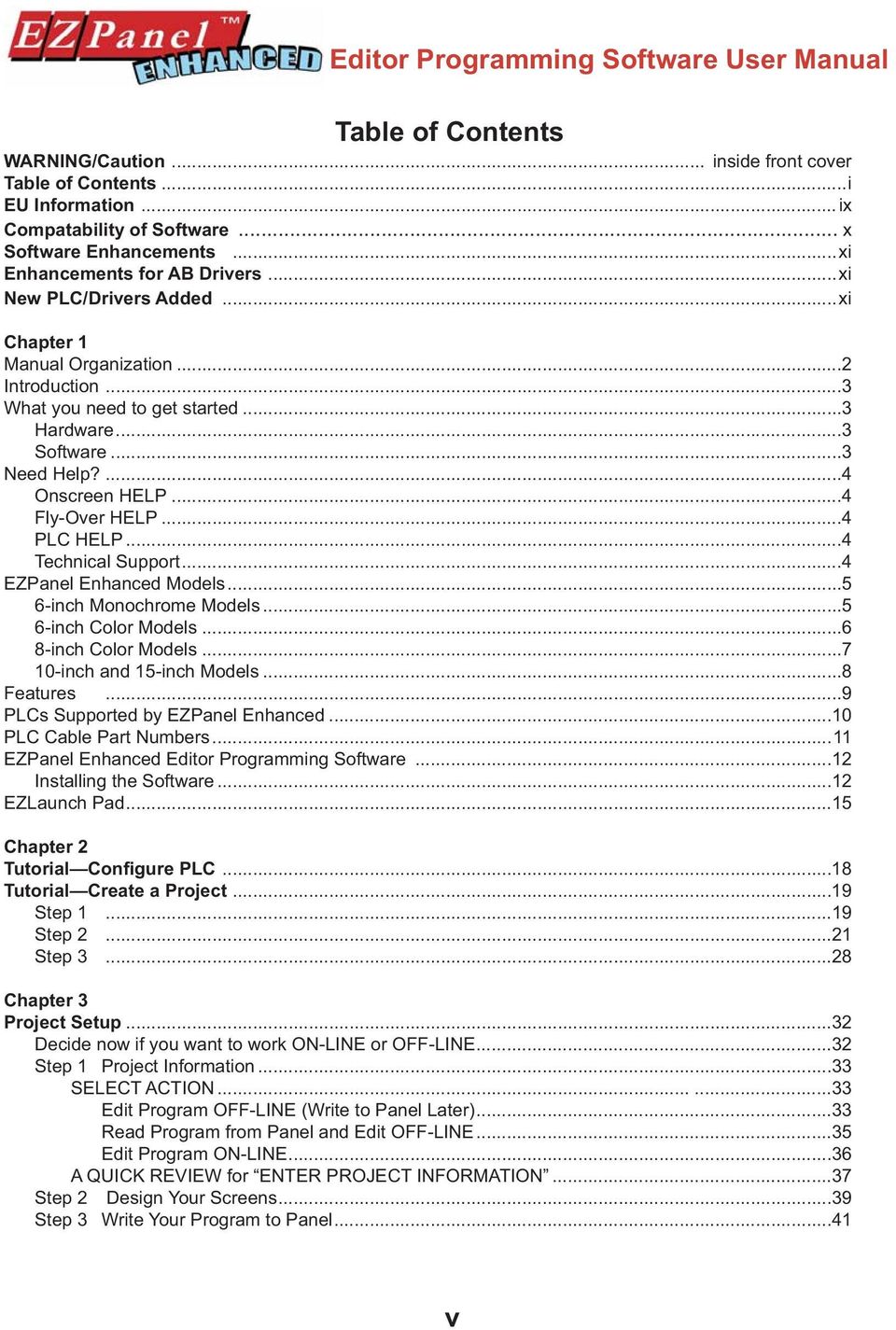
5 Table of Contents WARNING/Caution... inside front cover Table of Contents...i EU Information...ix Compatability of Software... x Software Enhancements...xi Enhancements for AB Drivers...xi New PLC/Drivers Added...xi Chapter 1 Manual Organization...2 Introduction...3 What you need to get started...3 Hardware...3 Software...3 Need Help?...4 Onscreen HELP...4 Fly-Over HELP...4 PLC HELP...4 Technical Support...4 EZPanel Enhanced Models inch Monochrome Models inch Color Models inch Color Models inch and 15-inch Models...8 Features...9 PLCs Supported by EZPanel Enhanced...10 PLC Cable Part Numbers...11 EZPanel Enhanced Editor Programming Software...12 Installing the Software...12 EZLaunch Pad...15 Chapter 2 Tutorial Configure PLC...18 Tutorial Create a Project...19 Step Step Step Chapter 3 Project Setup...32 Decide now if you want to work ON-LINE or OFF-LINE...32 Step 1 Project Information...33 SELECT ACTION Edit Program OFF-LINE (Write to Panel Later)...33 Read Program from Panel and Edit OFF-LINE...35 Edit Program ON-LINE...36 A QUICK REVIEW for ENTER PROJECT INFORMATION...37 Step 2 Design Your Screens...39 Step 3 Write Your Program to Panel...41 v
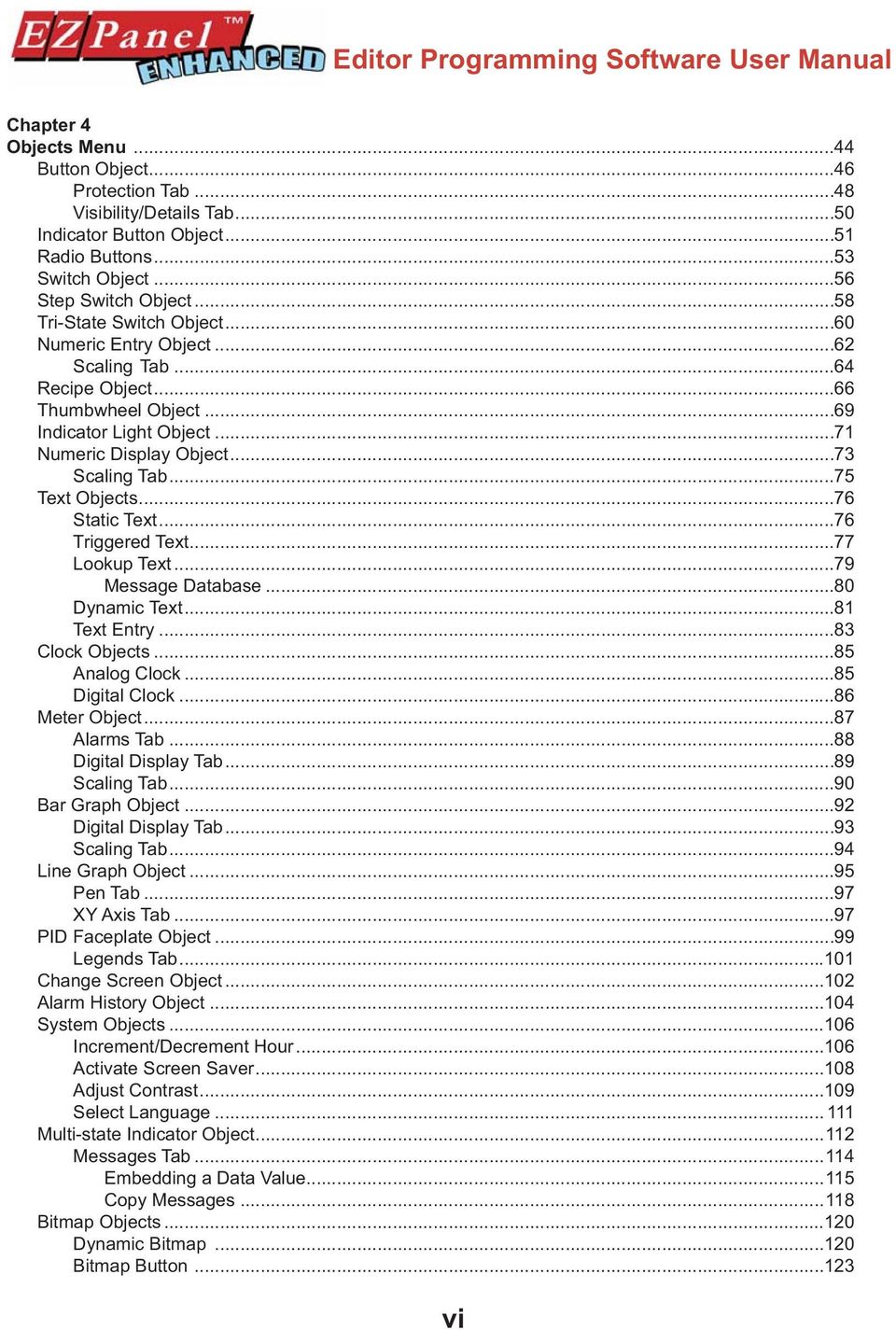
6 Chapter 4 Objects Menu...44 Button Object...46 Protection Tab...48 Visibility/Details Tab...50 Indicator Button Object...51 Radio Buttons...53 Switch Object...56 Step Switch Object...58 Tri-State Switch Object...60 Numeric Entry Object...62 Scaling Tab...64 Recipe Object...66 Thumbwheel Object...69 Indicator Light Object...71 Numeric Display Object...73 Scaling Tab...75 Text Objects...76 Static Text...76 Triggered Text...77 Lookup Text...79 Message Database...80 Dynamic Text...81 Text Entry...83 Clock Objects...85 Analog Clock...85 Digital Clock...86 Meter Object...87 Alarms Tab...88 Digital Display Tab...89 Scaling Tab...90 Bar Graph Object...92 Digital Display Tab...93 Scaling Tab...94 Line Graph Object...95 Pen Tab...97 XY Axis Tab...97 PID Faceplate Object...99 Legends Tab Change Screen Object Alarm History Object System Objects Increment/Decrement Hour Activate Screen Saver Adjust Contrast Select Language Multi-state Indicator Object Messages Tab Embedding a Data Value Copy Messages Bitmap Objects Dynamic Bitmap Bitmap Button vi
7 Multi-state Bitmap Images Tab Increment/Decrement Value Object View File Object Chapter 5 Main Programming Screen Title Bar Main Menu Bar Standard Tool Bar Object Tool Bars Basic Objects Tool Bar Text Objects Tool Bar System Objects Tool Bar Bitmap Objects Tool Bar Draw Tool Bar Panel Tool Bar Status Bar Easy Steps Tool Bar Project Screen Explorer View Programming Screen Chapter 6 Reference File Menu Edit Menu Overlapping Objects Pick and Apply Attributes Simulate Next and Previous States Screen Menu Objects Menu Draw Menu Sizing a Bitmap in Symbol Factory Panel Menu Setup Menu Tag Database Tag Cross Reference Export Tags Import Tags Alarm Database Export Alarms Message Database Export Messages Project Attributes General tab Printer tab Passwords tab Clock tab Panel to PLC tab PLC to Panel tab How do I switch screens from a PLC? Language tab Alarm Protection tab Project Description vii

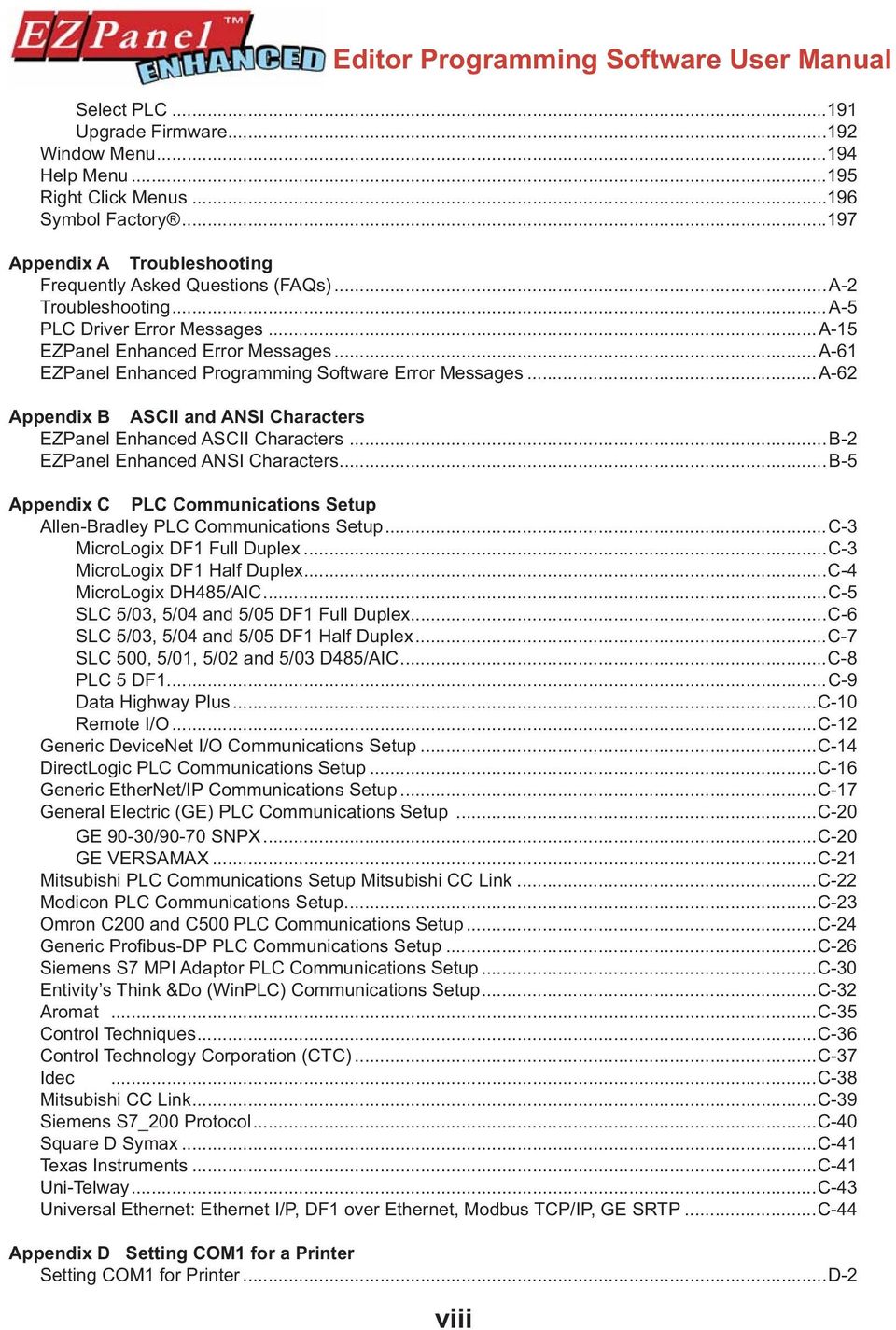
8 Select PLC Upgrade Firmware Window Menu Help Menu Right Click Menus Symbol Factory Appendix A Troubleshooting Frequently Asked Questions (FAQs)...A-2 Troubleshooting...A-5 PLC Driver Error Messages...A-15 EZPanel Enhanced Error Messages...A-61 EZPanel Enhanced Programming Software Error Messages...A-62 Appendix B ASCII and ANSI Characters EZPanel Enhanced ASCII Characters...B-2 EZPanel Enhanced ANSI Characters...B-5 Appendix C PLC Communications Setup Allen-Bradley PLC Communications Setup...C-3 MicroLogix DF1 Full Duplex...C-3 MicroLogix DF1 Half Duplex...C-4 MicroLogix DH485/AIC...C-5 SLC 5/03, 5/04 and 5/05 DF1 Full Duplex...C-6 SLC 5/03, 5/04 and 5/05 DF1 Half Duplex...C-7 SLC 500, 5/01, 5/02 and 5/03 D485/AIC...C-8 PLC 5 DF1...C-9 Data Highway Plus...C-10 Remote I/O...C-12 Generic DeviceNet I/O Communications Setup...C-14 DirectLogic PLC Communications Setup...C-16 Generic EtherNet/IP Communications Setup...C-17 General Electric (GE) PLC Communications Setup...C-20 GE 90-30/90-70 SNPX...C-20 GE VERSAMAX...C-21 Mitsubishi PLC Communications Setup Mitsubishi CC Link...C-22 Modicon PLC Communications Setup...C-23 Omron C200 and C500 PLC Communications Setup...C-24 Generic Profi bus-dp PLC Communications Setup...C-26 Siemens S7 MPI Adaptor PLC Communications Setup...C-30 Entivity s Think &Do (WinPLC) Communications Setup...C-32 Aromat...C-35 Control Techniques...C-36 Control Technology Corporation (CTC)...C-37 Idec...C-38 Mitsubishi CC Link...C-39 Siemens S7_200 Protocol...C-40 Square D Symax...C-41 Texas Instruments...C-41 Uni-Telway...C-43 Universal Ethernet: Ethernet I/P, DF1 over Ethernet, Modbus TCP/IP, GE SRTP...C-44 Appendix D Setting COM1 for a Printer Setting COM1 for Printer...D-2 viii
9 EU Information The EZPanel Enhanced is manufactured in compliance with European Union (EU) Directives and carries the CE mark. EZPanel Enhanced has been tested under CE Test Standard #EN55011, and is listed under UL File #E The following information is provided to comply with EU documentation requirements. Please NOTE: Products with CE marks perform their required functions safely and adhere to relevant standards as specified by EU Directives provided they are used according to their intended purpose and that the instructions in this manual are adhered to. The protection provided by the equipment may be impaired if this equipment is not used in accordance with this manual. Only replacement parts supplied by EZAutomation or its agents should be used. Technical Support SELV Circuits Environmental Specifications Consult EZPanel Enhanced Editor Programming Software Help or you may fi nd answers to your questions in the operator interface section of our If you still need assistance, please call our technical support from 6 a.m. to Midnight CST at EASY or FAX us at EASY. All electrical circuits connected to the communications port receptacle are rated as Safety Extra Low Voltage (SELV). Operating Temperature 6 White on Blue & Mono non-expandable...0 to 45 C 6 Color...0 to 50 C 6 Color TFT...0 to 55 C 8 Color...0 to 50 C 8 Color TFT...0 to 55 C 10 Color...0 to 55 C 15 Color...0 to 55 C Storage Temperature 6 White on Blue & Mono non-expandable to +60 C 6 Color to +60 C 6 Color TFT to +65 C 8 Color to +60 C 8 Color TFT to +65 C 10 Color to +65 C 15 Color to +65 C Operating Humidity % R.H>, noncondensing Air Composition...No corrosive gases permitted Preventative Maintenance and Cleaning No preventative maintenance is required. The EZPanel Enhanced touchscreen should be cleaned as needed with warm, soapy water. See the EZPanel Enhanced Hardware Manual (P/N EZP-PANEL-M) for a list of compatible/incompatible chemicals and compounds. ix

10 EZPanel Enhanced Editor Editor Programming Software User Manual The EZPanel Enhanced product has been modifi ed to offer new features in: Software Drivers Compatibility of Software The EZPanel Enhanced Editor Software is compatible with current EZTouch Panels (from ADC) as well as the new EZPanel Enhanced models. However, EZPanel Enhanced Editor Programming Software does not allow current EZTouch Panels (from ADC) to utilize software upgrades, Enhanced drivers (Universal Ethernet, Aromat Mewtocol COM, Control Techniques, Control Technology Corp. (CTC), EZPLC, Idec Computer Link, Mitsubishi CC Link, Siemens S7_200, Square D Symax, and Texas Instruments), or Enhanced Features (Overlapping of Objects, Free Sizing of Touch Objects, Display of Tag Address on Objects, and Pick and Apply Style). EZPanel Enhanced Editor Programming Software Enhancements x

11 EZPanel Enhanced Editor Programming Software Enhancements Overlapping of objects Free-sizing of touch objects Added convenience features such as pick and apply attributes and display address on objects Report object View File object added for EZCE Touchpanel Enhancement for AB Drivers Support for ST & Long File types in AB Drivers Support for full range of I/O and direct addressing of I/O for DF1 and Micrologix Support ControlLogix and Compact Logix Tag names Support for binary fi les (B3:0/0) using the shortcut method of B3/0, B3/1, and B3/2 New PLC/Drivers added Aromat Control Techniques - Unidrive 2-wire, 4-wire (binary) Control Technology Corporation (CTC) - CTC2600, 2700, and 5100 (CTC Binary) Idec - Computer Link Mitsubishi - CC Link (CC Link protocol) Siemens S7_200 Square D Symax Series CPU, 400 Series CPU (Symax) Texas Instruments - TI5x5 Series, TI505, TI , TI Uni Telway - Telemecanique TSX 37 Micro (UNI-TE Version 1.1) Universal Ethernet: Ethernet/IP, DF1 over Ethernet, Modbus TCP/IP, GE SRTP xi

12 This page intentionally left blank. xii

13 Introduction 1 In this chapter... Manual Organization Introduction What you need to get started Need HELP? Models Features PLCs Supported by EZPanels PLC Cable Part Numbers Programming Cable Part Number EZPanel Enhanced Editor Programming Software Installation

14 Introduction Manual Organization The EZPanel Enhanced Editor Programming Software User Manual is arranged in chapters. A description of key information contained in each chapter is provided below. Chapter 1 Description Introduction Provides Manual Organization, and lists what you need to get started, hardware and software. Discusses how to get help with questions or problems you might encounter through Onscreen Help and Technical Support. Provides you with a table listing the various models, their part numbers and special features. Lists the important features of all EZPanel Enhanced models. Lists the PLCs supported by the panels, by brand, model and protocol. Lists the part numbers for PLC cables and the programming cable. Tells how to install programming software A B C D Tutorial Provides instructions to create an example (or demo ) project. Discusses how to confi gure a PLC ladder logic program to use with the demo project. Takes you through the steps necessary to create an EZPanel Enhanced project using the programming software. Shows you how to transfer the project to the panel, and testing the project once transferred. Project Setup Discusses ON-LINE and OFF-LINE confi guration options. Tells you how to set up a project by entering project information (Step 1). Discusses screen design (Step 2), and how to transfer the project to the panel (Step 3). Objects Provides step-by-step instructions for confi guring each of the EZPanel Enhanced objects. Reference Provides more details on menu commands. Takes you through the main menu bar item by item, command by command, with instructions. Contains information on the various tool bars and the status bar. Describes right click menus and Screens Explorer view. Appendix A Troubleshooting Aids in diagnosing problems you might encounter when installing or operating your EZPanel Enhanced. Provides steps to take to isolate and correct problems. Lists panel error messages, programming software error messages, and PLC Driver Error messages. Appendix B Characters Provides a list of the ASCII Characters supported by the EZPanel Enhanced. This information may be useful when creating a Text Entry or Dynamic Text object. Appendix C PLC Communications Setup Provides instructions on how to set up most PLC Types to communicate with the EZPanel Enhanced. Appendix D Setting COM1 to Printer Provides instructions on how to set COM1 on the EZPanel Enhanced to Printer. 2

15 Introduction EZPanel Enhanced There are two manuals that you will need for installation this manual, the EZPanel Enhanced Editor Programming Software User Manual, and the EZPanel Enhanced Hardware User Manual ( P/N EZP-PANEL-M) shipped with your EZPanel Enhanced. These manuals will take you through the steps necessary to get your EZPanel Enhanced up and running in the shortest possible time. Although your familiarity with programmable graphic operator interface devices will determine how quickly you move through the steps it s as easy as Introduction Introduction Install the EZPanel Enhanced using the instructions in the Hardware Manual. Program the EZPanel Enhanced using the instructions in this Software Manual. What you need to get started... Hardware EZPanel Enhanced 24 Volt DC Power Supply (1.5 AMP or larger Slo-Blo input power fuse recommended) RS-232C Programming Cable ( P/N EZP-PGMCBL) RS-232C or RS-422A/485A PLC Interface Cable (see page 11 for part numbers) PC requirements: IBM or compatible PC (Pentium 166 MHZ or better) with a mouse and separate serial port VGA display with at least 800 x 600 resolution (1024 x 768 recommended) Standard Windows 98/NT4.0/2000/XP Professional/ XP Home Requirements CD ROM Drive Software EZPanel Enhanced Editor Programming Software ( P/N EZP-PANELEDIT) 3

16 Need HELP? Introduction PLEASE NOTE: The Troubleshooting section (Appendix A) should be able to help you with most problems you might encounter. Onscreen HELP One of the most important features of the EZPanel Enhanced Editor Programming Software is the availability of context sensitive onscreen help. To access the Help windows, simply press the F1 function key while on the topic where you need help. For example, if you need help while working with screens, press the F1 function key while in that area and a popup window will be displayed. You may also click on the Help button located at the bottom of most dialog boxes to go to the help topic. Fly-Over HELP When the mouse cursor comes to rest over any tool bar or object button for a short while, a small window will appear containing a brief description of the function of that particular button. The window will disappear as soon as the cursor has been moved off the button. PLC HELP If you need help with the PLC to EZPanel Enhanced Interface, consult the EZPanel Enhanced Editor Programming Software Help. Each PLC Driver has a Help Topic that lists the error messages and provides an explanation for each. Also provided are PLC to EZPanel Enhanced wiring diagrams. Technical Support Although most questions can be answered with EZPanel Enhanced HELP or the manuals, you may fi nd answers to your questions in the operator interface section of our web If you still need assistance, please call our technical support from 6 a.m. to Midnight at EASY or FAX us at EASY. Warranty Repairs If your EZPanel Enhanced is under warranty, contact net or call EASY. Out of Warranty Repairs If your EZPanel Enhanced is out of warranty, contact EZAutomation s Service Department for an evaluation of repair EASY. You can then decide whether it is more economical to proceed with factory repairs or purchase a new panel. 4

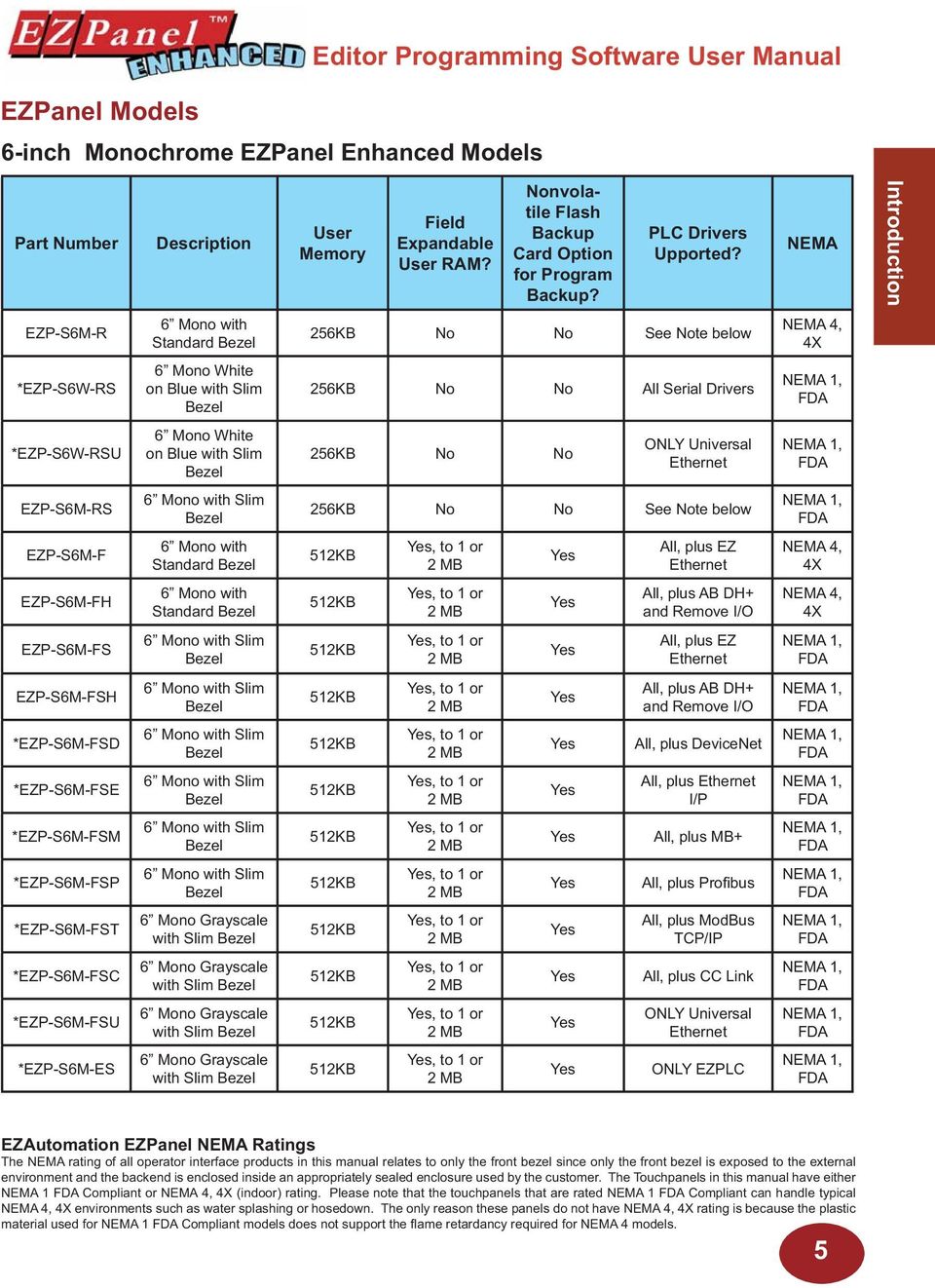
17 EZPanel Models 6-inch Monochrome EZPanel Enhanced Models Part Number EZP-S6M-R *EZP-S6W-RS *EZP-S6W-RSU EZP-S6M-RS EZP-S6M-F EZP-S6M-FH EZP-S6M-FS EZP-S6M-FSH *EZP-S6M-FSD *EZP-S6M-FSE *EZP-S6M-FSM *EZP-S6M-FSP *EZP-S6M-FST *EZP-S6M-FSC *EZP-S6M-FSU *EZP-S6M-ES Description 6 Mono with Standard Bezel 6 Mono White on Blue with Slim Bezel 6 Mono White on Blue with Slim Bezel 6 Mono with Slim Bezel 6 Mono with Standard Bezel 6 Mono with Standard Bezel 6 Mono with Slim Bezel 6 Mono with Slim Bezel 6 Mono with Slim Bezel 6 Mono with Slim Bezel 6 Mono with Slim Bezel 6 Mono with Slim Bezel 6 Mono Grayscale with Slim Bezel 6 Mono Grayscale with Slim Bezel 6 Mono Grayscale with Slim Bezel 6 Mono Grayscale with Slim Bezel User Memory Field Expandable User RAM? Nonvolatile Flash Backup Card Option for Program Backup? PLC Drivers Upported? 256KB No No See Note below 256KB No No All Serial Drivers 256KB No No ONLY Universal Ethernet 256KB No No See Note below 512KB 512KB 512KB 512KB 512KB 512KB 512KB 512KB 512KB 512KB 512KB 512KB Yes, to 1 or 2 MB Yes, to 1 or 2 MB Yes, to 1 or 2 MB Yes, to 1 or 2 MB Yes, to 1 or 2 MB Yes, to 1 or 2 MB Yes, to 1 or 2 MB Yes, to 1 or 2 MB Yes, to 1 or 2 MB Yes, to 1 or 2 MB Yes, to 1 or 2 MB Yes, to 1 or 2 MB Yes Yes Yes Yes Yes Yes Yes Yes Yes Yes Yes Yes All, plus EZ Ethernet All, plus AB DH+ and Remove I/O All, plus EZ Ethernet All, plus AB DH+ and Remove I/O All, plus DeviceNet All, plus Ethernet I/P All, plus MB+ All, plus Profi bus All, plus ModBus TCP/IP All, plus CC Link ONLY Universal Ethernet ONLY EZPLC NEMA NEMA 4, 4X NEMA 1, FDA NEMA 1, FDA NEMA 1, FDA NEMA 4, 4X NEMA 4, 4X NEMA 1, FDA NEMA 1, FDA NEMA 1, FDA NEMA 1, FDA NEMA 1, FDA NEMA 1, FDA NEMA 1, FDA NEMA 1, FDA NEMA 1, FDA NEMA 1, FDA Introduction Introduction EZAutomation EZPanel NEMA Ratings The NEMA rating of all operator interface products in this manual relates to only the front bezel since only the front bezel is exposed to the external environment and the backend is enclosed inside an appropriately sealed enclosure used by the customer. The Touchpanels in this manual have either NEMA 1 FDA Compliant or NEMA 4, 4X (indoor) rating. Please note that the touchpanels that are rated NEMA 1 FDA Compliant can handle typical NEMA 4, 4X environments such as water splashing or hosedown. The only reason these panels do not have NEMA 4, 4X rating is because the plastic material used for NEMA 1 FDA Compliant models does not support the fl ame retardancy required for NEMA 4 models. 5
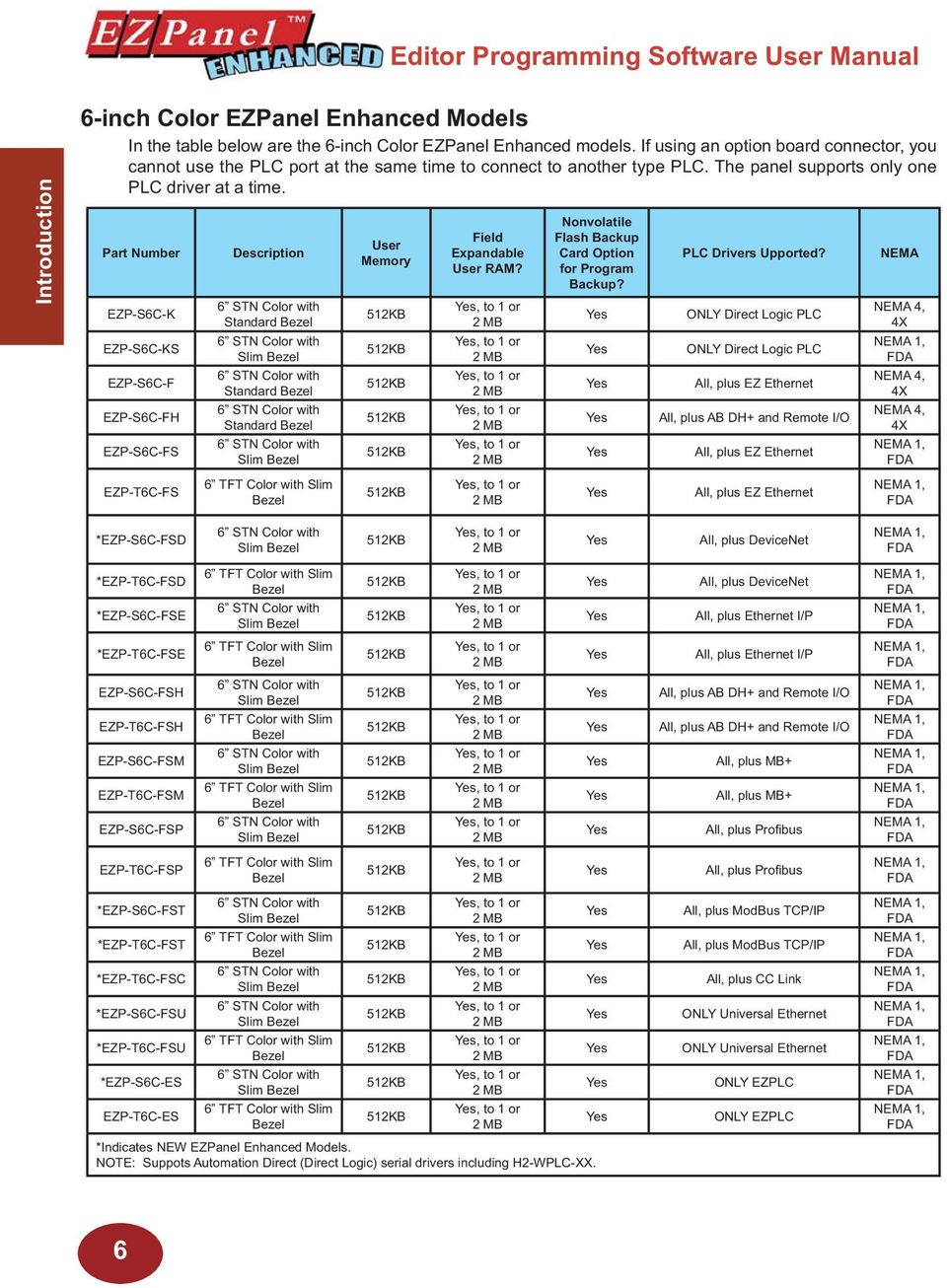
18 Introduction 6-inch Color EZPanel Enhanced Models In the table below are the 6-inch Color EZPanel Enhanced models. If using an option board connector, you cannot use the PLC port at the same time to connect to another type PLC. The panel supports only one PLC driver at a time. Part Number EZP-S6C-K EZP-S6C-KS EZP-S6C-F EZP-S6C-FH EZP-S6C-FS Description 6 STN Color with Standard Bezel 6 STN Color with Slim Bezel 6 STN Color with Standard Bezel 6 STN Color with Standard Bezel 6 STN Color with Slim Bezel User Memory 512KB 512KB 512KB 512KB 512KB Field Expandable User RAM? Yes, to 1 or 2 MB Yes, to 1 or 2 MB Yes, to 1 or 2 MB Yes, to 1 or 2 MB Yes, to 1 or 2 MB Nonvolatile Flash Backup Card Option for Program Backup? Yes Yes Yes Yes Yes PLC Drivers Upported? ONLY Direct Logic PLC ONLY Direct Logic PLC All, plus EZ Ethernet All, plus AB DH+ and Remote I/O All, plus EZ Ethernet NEMA NEMA 4, 4X NEMA 1, FDA NEMA 4, 4X NEMA 4, 4X NEMA 1, FDA EZP-T6C-FS 6 TFT Color with Slim Bezel 512KB Yes, to 1 or 2 MB Yes All, plus EZ Ethernet NEMA 1, FDA *EZP-S6C-FSD 6 STN Color with Slim Bezel 512KB Yes, to 1 or 2 MB Yes All, plus DeviceNet NEMA 1, FDA *EZP-T6C-FSD *EZP-S6C-FSE 6 TFT Color with Slim Bezel 6 STN Color with Slim Bezel 512KB 512KB Yes, to 1 or 2 MB Yes, to 1 or 2 MB Yes Yes All, plus DeviceNet All, plus Ethernet I/P NEMA 1, FDA NEMA 1, FDA *EZP-T6C-FSE 6 TFT Color with Slim Bezel 512KB Yes, to 1 or 2 MB Yes All, plus Ethernet I/P NEMA 1, FDA EZP-S6C-FSH EZP-T6C-FSH EZP-S6C-FSM EZP-T6C-FSM EZP-S6C-FSP 6 STN Color with Slim Bezel 6 TFT Color with Slim Bezel 6 STN Color with Slim Bezel 6 TFT Color with Slim Bezel 6 STN Color with Slim Bezel 512KB 512KB 512KB 512KB 512KB Yes, to 1 or 2 MB Yes, to 1 or 2 MB Yes, to 1 or 2 MB Yes, to 1 or 2 MB Yes, to 1 or 2 MB Yes Yes Yes Yes Yes All, plus AB DH+ and Remote I/O All, plus AB DH+ and Remote I/O All, plus MB+ All, plus MB+ All, plus Profi bus NEMA 1, FDA NEMA 1, FDA NEMA 1, FDA NEMA 1, FDA NEMA 1, FDA EZP-T6C-FSP 6 TFT Color with Slim Bezel 512KB Yes, to 1 or 2 MB Yes All, plus Profi bus NEMA 1, FDA *EZP-S6C-FST *EZP-T6C-FST *EZP-T6C-FSC *EZP-S6C-FSU *EZP-T6C-FSU *EZP-S6C-ES EZP-T6C-ES 6 STN Color with Slim Bezel 6 TFT Color with Slim Bezel 6 STN Color with Slim Bezel 6 STN Color with Slim Bezel 6 TFT Color with Slim Bezel 6 STN Color with Slim Bezel 6 TFT Color with Slim Bezel 512KB 512KB 512KB 512KB 512KB 512KB 512KB Yes, to 1 or 2 MB Yes, to 1 or 2 MB Yes, to 1 or 2 MB Yes, to 1 or 2 MB Yes, to 1 or 2 MB Yes, to 1 or 2 MB Yes, to 1 or 2 MB *Indicates NEW EZPanel Enhanced Models. NOTE: Suppots Automation Direct (Direct Logic) serial drivers including H2-WPLC-XX. Yes Yes Yes Yes Yes Yes Yes All, plus ModBus TCP/IP All, plus ModBus TCP/IP All, plus CC Link ONLY Universal Ethernet ONLY Universal Ethernet ONLY EZPLC ONLY EZPLC NEMA 1, FDA NEMA 1, FDA NEMA 1, FDA NEMA 1, FDA NEMA 1, FDA NEMA 1, FDA NEMA 1, FDA 6
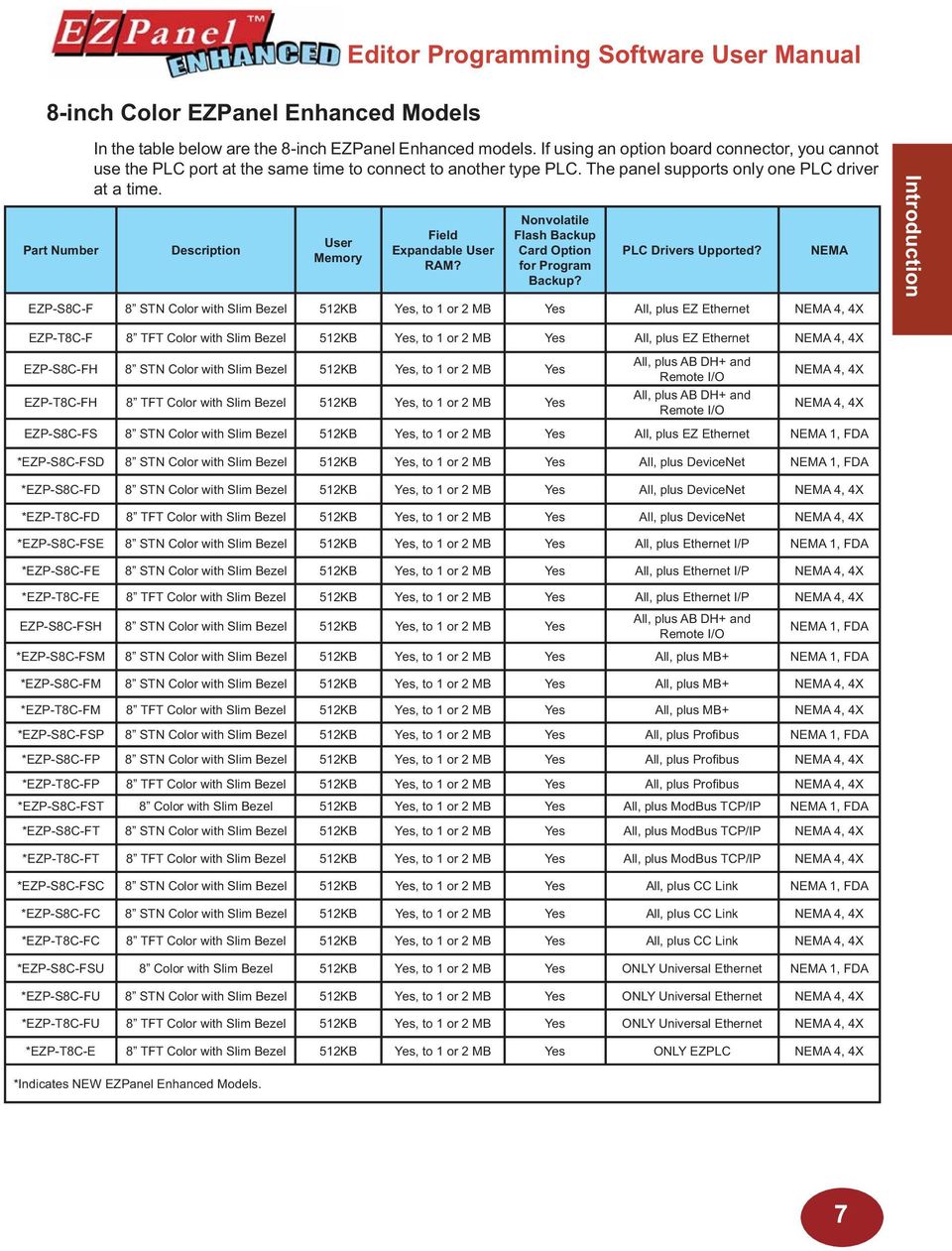
19 8-inch Color EZPanel Enhanced Models Part Number In the table below are the 8-inch EZPanel Enhanced models. If using an option board connector, you cannot use the PLC port at the same time to connect to another type PLC. The panel supports only one PLC driver at a time. Description User Memory Field Expandable User RAM? Nonvolatile Flash Backup Card Option for Program Backup? PLC Drivers Upported? EZP-S8C-F 8 STN Color with Slim Bezel 512KB Yes, to 1 or 2 MB Yes All, plus EZ Ethernet NEMA 4, 4X NEMA Introduction Introduction EZP-T8C-F 8 TFT Color with Slim Bezel 512KB Yes, to 1 or 2 MB Yes All, plus EZ Ethernet NEMA 4, 4X EZP-S8C-FH 8 STN Color with Slim Bezel 512KB Yes, to 1 or 2 MB Yes EZP-T8C-FH 8 TFT Color with Slim Bezel 512KB Yes, to 1 or 2 MB Yes All, plus AB DH+ and Remote I/O All, plus AB DH+ and Remote I/O NEMA 4, 4X NEMA 4, 4X EZP-S8C-FS 8 STN Color with Slim Bezel 512KB Yes, to 1 or 2 MB Yes All, plus EZ Ethernet NEMA 1, FDA *EZP-S8C-FSD 8 STN Color with Slim Bezel 512KB Yes, to 1 or 2 MB Yes All, plus DeviceNet NEMA 1, FDA *EZP-S8C-FD 8 STN Color with Slim Bezel 512KB Yes, to 1 or 2 MB Yes All, plus DeviceNet NEMA 4, 4X *EZP-T8C-FD 8 TFT Color with Slim Bezel 512KB Yes, to 1 or 2 MB Yes All, plus DeviceNet NEMA 4, 4X *EZP-S8C-FSE 8 STN Color with Slim Bezel 512KB Yes, to 1 or 2 MB Yes All, plus Ethernet I/P NEMA 1, FDA *EZP-S8C-FE 8 STN Color with Slim Bezel 512KB Yes, to 1 or 2 MB Yes All, plus Ethernet I/P NEMA 4, 4X *EZP-T8C-FE 8 TFT Color with Slim Bezel 512KB Yes, to 1 or 2 MB Yes All, plus Ethernet I/P NEMA 4, 4X EZP-S8C-FSH 8 STN Color with Slim Bezel 512KB Yes, to 1 or 2 MB Yes All, plus AB DH+ and Remote I/O NEMA 1, FDA *EZP-S8C-FSM 8 STN Color with Slim Bezel 512KB Yes, to 1 or 2 MB Yes All, plus MB+ NEMA 1, FDA *EZP-S8C-FM 8 STN Color with Slim Bezel 512KB Yes, to 1 or 2 MB Yes All, plus MB+ NEMA 4, 4X *EZP-T8C-FM 8 TFT Color with Slim Bezel 512KB Yes, to 1 or 2 MB Yes All, plus MB+ NEMA 4, 4X *EZP-S8C-FSP 8 STN Color with Slim Bezel 512KB Yes, to 1 or 2 MB Yes All, plus Profi bus NEMA 1, FDA *EZP-S8C-FP 8 STN Color with Slim Bezel 512KB Yes, to 1 or 2 MB Yes All, plus Profi bus NEMA 4, 4X *EZP-T8C-FP 8 TFT Color with Slim Bezel 512KB Yes, to 1 or 2 MB Yes All, plus Profi bus NEMA 4, 4X *EZP-S8C-FST 8 Color with Slim Bezel 512KB Yes, to 1 or 2 MB Yes All, plus ModBus TCP/IP NEMA 1, FDA *EZP-S8C-FT 8 STN Color with Slim Bezel 512KB Yes, to 1 or 2 MB Yes All, plus ModBus TCP/IP NEMA 4, 4X *EZP-T8C-FT 8 TFT Color with Slim Bezel 512KB Yes, to 1 or 2 MB Yes All, plus ModBus TCP/IP NEMA 4, 4X *EZP-S8C-FSC 8 STN Color with Slim Bezel 512KB Yes, to 1 or 2 MB Yes All, plus CC Link NEMA 1, FDA *EZP-S8C-FC 8 STN Color with Slim Bezel 512KB Yes, to 1 or 2 MB Yes All, plus CC Link NEMA 4, 4X *EZP-T8C-FC 8 TFT Color with Slim Bezel 512KB Yes, to 1 or 2 MB Yes All, plus CC Link NEMA 4, 4X *EZP-S8C-FSU 8 Color with Slim Bezel 512KB Yes, to 1 or 2 MB Yes ONLY Universal Ethernet NEMA 1, FDA *EZP-S8C-FU 8 STN Color with Slim Bezel 512KB Yes, to 1 or 2 MB Yes ONLY Universal Ethernet NEMA 4, 4X *EZP-T8C-FU 8 TFT Color with Slim Bezel 512KB Yes, to 1 or 2 MB Yes ONLY Universal Ethernet NEMA 4, 4X *EZP-T8C-E 8 TFT Color with Slim Bezel 512KB Yes, to 1 or 2 MB Yes ONLY EZPLC NEMA 4, 4X *Indicates NEW EZPanel Enhanced Models. 7
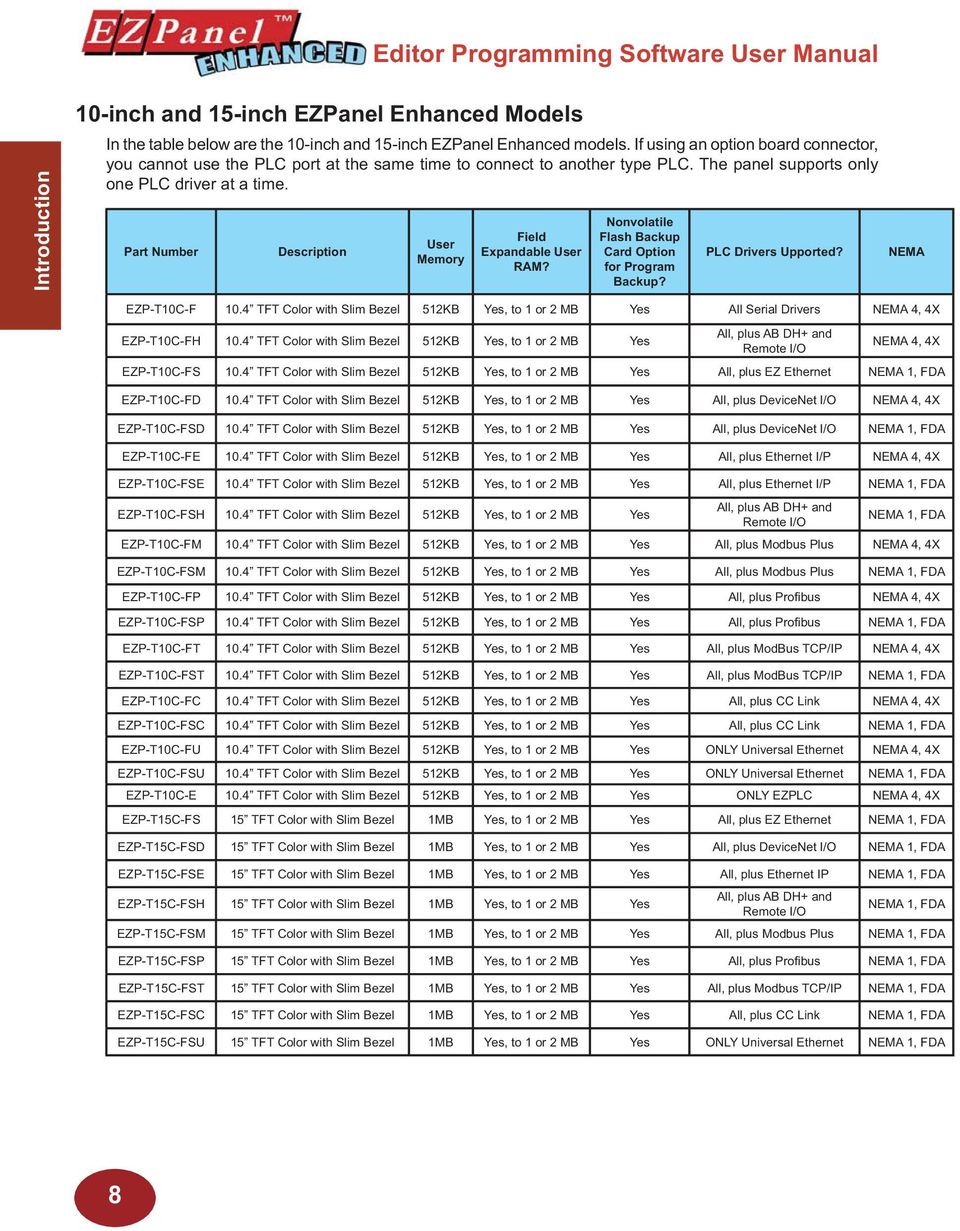
20 Introduction 10-inch and 15-inch EZPanel Enhanced Models In the table below are the 10-inch and 15-inch EZPanel Enhanced models. If using an option board connector, you cannot use the PLC port at the same time to connect to another type PLC. The panel supports only one PLC driver at a time. Part Number Description User Memory Field Expandable User RAM? Nonvolatile Flash Backup Card Option for Program Backup? PLC Drivers Upported? NEMA EZP-T10C-F 10.4 TFT Color with Slim Bezel 512KB Yes, to 1 or 2 MB Yes All Serial Drivers NEMA 4, 4X EZP-T10C-FH 10.4 TFT Color with Slim Bezel 512KB Yes, to 1 or 2 MB Yes All, plus AB DH+ and Remote I/O NEMA 4, 4X EZP-T10C-FS 10.4 TFT Color with Slim Bezel 512KB Yes, to 1 or 2 MB Yes All, plus EZ Ethernet NEMA 1, FDA EZP-T10C-FD 10.4 TFT Color with Slim Bezel 512KB Yes, to 1 or 2 MB Yes All, plus DeviceNet I/O NEMA 4, 4X EZP-T10C-FSD 10.4 TFT Color with Slim Bezel 512KB Yes, to 1 or 2 MB Yes All, plus DeviceNet I/O NEMA 1, FDA EZP-T10C-FE 10.4 TFT Color with Slim Bezel 512KB Yes, to 1 or 2 MB Yes All, plus Ethernet I/P NEMA 4, 4X EZP-T10C-FSE 10.4 TFT Color with Slim Bezel 512KB Yes, to 1 or 2 MB Yes All, plus Ethernet I/P NEMA 1, FDA EZP-T10C-FSH 10.4 TFT Color with Slim Bezel 512KB Yes, to 1 or 2 MB Yes All, plus AB DH+ and Remote I/O NEMA 1, FDA EZP-T10C-FM 10.4 TFT Color with Slim Bezel 512KB Yes, to 1 or 2 MB Yes All, plus Modbus Plus NEMA 4, 4X EZP-T10C-FSM 10.4 TFT Color with Slim Bezel 512KB Yes, to 1 or 2 MB Yes All, plus Modbus Plus NEMA 1, FDA EZP-T10C-FP 10.4 TFT Color with Slim Bezel 512KB Yes, to 1 or 2 MB Yes All, plus Profi bus NEMA 4, 4X EZP-T10C-FSP 10.4 TFT Color with Slim Bezel 512KB Yes, to 1 or 2 MB Yes All, plus Profi bus NEMA 1, FDA EZP-T10C-FT 10.4 TFT Color with Slim Bezel 512KB Yes, to 1 or 2 MB Yes All, plus ModBus TCP/IP NEMA 4, 4X EZP-T10C-FST 10.4 TFT Color with Slim Bezel 512KB Yes, to 1 or 2 MB Yes All, plus ModBus TCP/IP NEMA 1, FDA EZP-T10C-FC 10.4 TFT Color with Slim Bezel 512KB Yes, to 1 or 2 MB Yes All, plus CC Link NEMA 4, 4X EZP-T10C-FSC 10.4 TFT Color with Slim Bezel 512KB Yes, to 1 or 2 MB Yes All, plus CC Link NEMA 1, FDA EZP-T10C-FU 10.4 TFT Color with Slim Bezel 512KB Yes, to 1 or 2 MB Yes ONLY Universal Ethernet NEMA 4, 4X EZP-T10C-FSU 10.4 TFT Color with Slim Bezel 512KB Yes, to 1 or 2 MB Yes ONLY Universal Ethernet NEMA 1, FDA EZP-T10C-E 10.4 TFT Color with Slim Bezel 512KB Yes, to 1 or 2 MB Yes ONLY EZPLC NEMA 4, 4X EZP-T15C-FS 15 TFT Color with Slim Bezel 1MB Yes, to 1 or 2 MB Yes All, plus EZ Ethernet NEMA 1, FDA EZP-T15C-FSD 15 TFT Color with Slim Bezel 1MB Yes, to 1 or 2 MB Yes All, plus DeviceNet I/O NEMA 1, FDA EZP-T15C-FSE 15 TFT Color with Slim Bezel 1MB Yes, to 1 or 2 MB Yes All, plus Ethernet IP NEMA 1, FDA EZP-T15C-FSH 15 TFT Color with Slim Bezel 1MB Yes, to 1 or 2 MB Yes All, plus AB DH+ and Remote I/O NEMA 1, FDA EZP-T15C-FSM 15 TFT Color with Slim Bezel 1MB Yes, to 1 or 2 MB Yes All, plus Modbus Plus NEMA 1, FDA EZP-T15C-FSP 15 TFT Color with Slim Bezel 1MB Yes, to 1 or 2 MB Yes All, plus Profi bus NEMA 1, FDA EZP-T15C-FST 15 TFT Color with Slim Bezel 1MB Yes, to 1 or 2 MB Yes All, plus Modbus TCP/IP NEMA 1, FDA EZP-T15C-FSC 15 TFT Color with Slim Bezel 1MB Yes, to 1 or 2 MB Yes All, plus CC Link NEMA 1, FDA EZP-T15C-FSU 15 TFT Color with Slim Bezel 1MB Yes, to 1 or 2 MB Yes ONLY Universal Ethernet NEMA 1, FDA 8
21 Features Pre-built panel components for easy screen design Screen Objects such as: Toggle Switch, Slide Switch, Selector Switch, Throw Switch, Thumbwheel Object, Meters, PID Face plates, and Analog/Digital Clock Flash memory-based design for easy fi rmware upgrade Field expandable user RAM (not all models) Introduction Introduction Nonvolatile fl ash card option for user program backup (not all models) Color models support 128-color palette for components and bitmaps 16 shades of gray on monochrome models Multiple languages (up to 9) PLC Two communications ports Computer (RS-232C) and (RS-232C, RS-422A, or RS-485A) Up to 999 screens Built-in clock and calendar or reference the PLC clock Built-in soft keypad for numeric and alphanumeric entry Password Protection for every touch object Passwords for up to 8 user groups 16 level undo and redo Import bitmaps Serial Printer support 40-character tag names allow you to use meaningful names for PLC memory locations instead of cryptic PLC addresses New features including: overlapping of objects, free-sizing of touch objects, Pick and Apply Attributes, display address 9
22 PLCs Supported by EZPanels Editor Programming Software User Manual Introduction PLC Brand Model Protocols Supported EZAutomation EZPLC EZ Protocol MicroLogix 1000/1200/1500, SLC500,5/01, /02, /03 DH 485/AIC/AIC+ MicroLogix 1000/1200/1500SLC 5/03, 5/04, and 5/05 DF1 Half Duplex/DF1 Full Duplex Allen Bradley SLC 504, PLC5 DH+ (Option Card) PLC 5 DF1 PLC 2, 3, and 5 Remote I/O (with DH+ Plus Option Card) Aromat Aromat Mewtocol COM Control Techniques Unidrive 2-wire, 4-wire Binary Control Technology Corporation (CTC) CTC 2600, 2700, and 5100 CTC Binary DeviceNet DeviceNet I/O DeviceNet I/O (OptionCard) Ethernet Control Logic, Micro Logic, Compact Logic, GE Versamax Ethernet I/P, SRTP, DF1, Modbus TCP/IP General Electric 90/30 and 90/70 Versamax SNPX/SNP Idec Idec Computer Link Mitsubishi FX Series (all) FX, Direct CC Link CC Link Protocol 984 CPU, Quantum 113 CPU, AEG Modicon Micro Series Modicon 110, CPU: 311-xx, 411-xx, 512-xx, 612-xx Modbus RTU 984 Series, Qunatum Series Modicon Plus (Option Card) Omron C200, C500, CQM1, CPM1, CPM2 Host Link Profi bus Profi bus-dp Generic Profi bus DP(Option Card) DL105 K-Sequence, DirectNet, Modbus (Koyo Addressing) DL105 K-Sequence Direct Logic DL205 DL305 DL405 D2-230 K-Sequence D2-240 K-Sequence; DirectNet D2-250/D /260 D2-240/250 w/dcm K-Sequence; DirectNet; ModBus (Koyo addressing) DirectNet D3-330/330P DirectNet D3-340 DirectNet D3-350 K-Sequence; DirectNet; ModBus (Koyo addressing) D3-350 w/dcm DirectNet D4-430 K-Sequence; DirectNet D4-440 K-Sequence; DirectNet D4-450 All with DCM K-Sequence; DirectNet; ModBus (Koyo addressing) DirectNet Siemens S7 MPI Adaptor 3964R Siemens Siemens S7_200 Siemens S7_200 Square D Symax 300 Series CPU, 400 Series CPU Symax Texas Instruments TI5X5 Series, TI505, TI , TI TBP (Transparent ByteProtocol) or NITP (Non-Intelligent Terminal Protocol) Uni-Telway Telemecanique TSX 37 Micro UNI-TE (Version 1.1) Other H2- WinPLC (Entivity (Think & Do) V5.2 orlater, check for version compatability Entivity (Think & Do) Modbus RTU (Serial Port) 10
23 PLC Cable Part Numbers Cable Part Number Cable Description EZP-CBL RS232C shielded cable to connect any EZPanel Enhanced to EZPLC. 15 pin D-shell male connector to 9 pin D-shell male connector. EZP-2CLB 10 RS232C shielded cable to connect any EZPanel, Enhanced to DL05, DL06, DL105, DL205, D3-350 or D4-450 CPU. 15 pin D-shell male connector to RJ 12 modular connector. EZP-2CBL-1 10 RS232C shielded cable to connect any EZPanel Enhanced to a DL06, D2-250(-1) or D2-260 (bottom port) CPU. 15 pin D-shell male connector to 15 pin male HD. EZP-3CBL 10 RS232C shielded cable to connect any EZPanel Enhanced to a D3-340 CPU top or bottom port. 15 pin D-shell male connector to RJ11 modular connector. EZP-4CBL-1 10 RS232C shielded cable to connect any EZPanel Enhanced panel to DL 405 (top port) CPU. 15 pin D-shell male connector to 15 pin D-shell male connector. EZP-4CBL-2 10 RS 232C shielded cable to connect any EZPanel Enhanced to a D2-DCM, D3-350 (bottom port), a D3-232-DCU installed on D3-333 or D3-340, or DL 405 (bottom point) CPU. EZP-MLOGIX-CBL 6 shielded cable to connect any EZPanel Enhanced to an AB Micrologix 1000, 1200, or 1500 CPU. 15 pin D-shell male connector to 8 pin DIN connector EZP-SLC-232-CBL 10 RS232C shielded cable to connect any EZPanel Enhanced to an AB SLC 5/03, 5/04 or 5/05 CPU with DF-1 port. 15 pin D-shell male connector to 9 pin D-shell female connector. EZP-PLC5-232-CBL1 10 RS232C shielded cable to connect any EZPanel Enhanced to an AB PLC5 CPU with DF1 port. 15 pin D-shell male connector to 25 pin D-shell male connector. EZP-DH485-CBL 10 RS232C shielded cable to connect any EZPanel Enhanced to an AB SLC 500 CPU with a DH485 port and 747-A/C Module. EZP CBL 10 RS232C shielded cable to connect any EZPanel Enhanced to GE Fanuc Series 90/30, 90/70 serial port using SNPX protocol. 15 pin D-shell male connector to 15 pin D-shell male connector. EZP-MITSU-CBL 10 RS422 shielded cable to connect any EZPanel Enhanced to Mitsubishi FX series CPU. 15 pin D-shell male connector to 25 pin D-shell male connector. EZP-MITSU-CBL-1 10 RS422 shielded cable to connect any EZPanel Enhanced to Mitsubishi FX series CPU. 15 pin D-shell male connector to 8 pin min. din. EZP-S7MPI-CBL 10 shielded cable to connect any EZPanel Enhanced to Siemens Simatic S7 series CPU. 15 pin D-shell male connector to 9 pin D-shell connector EZP-OMRON-CBL 10 RS232C shielded cable to connect any EZPanel Enhanced to Omron C200 or C500 with Hostlink protocol. 15 pin D-shell male connector to 25 pin D-shell male connector. EZP-ARCOL-CBL 10 RS232C shielded cable to connect any EZPanel Enhanced to Aromat PLC. 15 pin D-Shell male connector to 5 pin mini DIN male connector. EZP-CTRLUNI-CBL 10 RS422 shielded cable to connect any EZPanel Enhanced to Control Techniques Unidrive 4-wire. 15 pin D-Shell male connector to 9 pin D-shell female connector. EZP-CTRLUNI-CBL-1 10 RS485 shielded cable to connect any EZPanel Enhanced to Control Techniques Unidrive 2-wire. 15 pin D-Shell male connector to 9 pin D-shell female connector. EZP-CTCBI-CBL 10 RS232 shielded cable to connect any EZPanel Enhanced to Control Technology Corportation (CTC). 15 pin D-Shell male connector to RJ12. EZP-IDECM-CBL 10 RS485 shielded cable to connect any EZPanel Enhanced to IDEC Micro 3 PLC. 15 pin D-Shell male connector to 8-pin Mini DIN connector. 10 RS485 shielded cable to connect any EZPanel Enhanced to Modicon Uni-Telway EZP-MODUNI-CBL Telemecanique TSX 37 Micro PLC. 15 pin D-Shell male connector to 8 pin mini DIN connector. EZP-MODRTU-CBL 10 RS232C shielded cable to connect any EZPanel Enhanced to Modicon Modbus RTU. 15 pin D-Shell male connector to 9 pin D-shell male connector. EZP-S7200-CBL 10 RS485 shielded cable to connect any EZPanel Enhanced to Siemens S7 200 PLC. 15 pin D-Shell male connector to 9 pin D-shell male connector. EZP-SYMAX-CBL 10 RS422 shielded cable to connect EZPanel Enhanced to Square-D symax. 15 pin D-Shell male connector to 9 pin D-shell male connector. EZP-TX505-CBL 10 RS232C shielded cable to connect any EZPanel Enhanced connect to Texas Instrument 505 Series PLC. 15 pin D-Shell male connector to 9 pin D-shell female connector. EZP-IDECS-CBL 10 RS232C shielded cable to connect any EZPanel Enhanced to IDEC Micro Smart PLC. 15 pin D-Shell male connector to 8 pin mini DIN male connector. EZP-TX545-CBL 10 RS422 shielded cable to connect any EZPanel Enhanced to Texas Instrument series PLC. 15 pin D-Shell male connector to 9 pin D-shell male connector. EZP-TX545-CBL1 10 RS422 shielded cable to connect any EZPanel Enhanced to Texas Instrument PLC. 15 pin D-Shell male connector to 9 pin D-shell female connector. EZP-MODRJ 10 RS232 Shielded Cable to connect any EZPanel Enhanced to Modicon Micro PLC. 15-pin D-shell male connector to RJ45 connector. EZP-PGMCBL Programming Cable NOTE: See Appendix A for cable pinouts, or use the EZPanel Enhanced Editor Programming Software (P/N EZP-PANELEDIT) Help Topics. For RS-422A connections to DirectLogic PLCs also see Appendix A. 11 Introduction Introduction
24 EZPanel Enhanced Editor Programming Software Introduction EZPanel Enhanced models are configured with software running on an IBM or compatible personal computer. This software is available through EZ Automation, part number EZP-PANELEDIT. The panel can be confi gured on-line or off-line (See page 3 for requirements). Installing the Software Perform the following steps to install the EZPanel Enhanced Editor Programming Software onto your PC. Place the CD into your CD ROM drive. The install program should launch automatically. If it does not, perform the following steps. 1 From Windows click on the Start Button, and then click on Run from the menu. The Run dialog box will pop up. 2 At the prompt type D:\ (or your CD ROM drive) setup.exe or click on the Browse Button and fi nd the Setup.exe fi le for EZPanel Enhanced Editor Programming Software. 3 Click on the OK button to begin the installation. The EZPanel Enhanced Editor Programming Software Installation Screen will appear. Follow the onscreen prompts to load the software. (Installation screens are shown, next page). Installation Screens 12
25 Introduction Introduction This icon will appear on your desktop after installation. Simply follow the onscreen prompts to install the software. You will select the destination folder where your software program will be installed. The default destination location is C:\Program Files\EZPanel. If you wish to select another destination, click on the Browse button, choose the destination and click on the Next > button. Select whether to install the English or the Spanish version of EZPanel Enhanced Editor Programming Software. Click on the Next> button. To complete the installation, click on Finish > button. That s all there is to it! The EZPanel Icon shown above will appear on your desktop. Simply click on it to open the Programming Software! NOTE: A different version number may appear depending on which version of the software you are installing. 13
26 Once you ve fi nished installing the software, the screen below should appear. Open the software to view the EZLaunch Pad (see next page). Introduction 14
27 EZLaunch Pad Overview EZLaunch Pad is a convenient place to launch all EZAutomation software from one dialog box. Distribution EZLaunch Pad software is distributed with all EZAutomation software packages, such as EZPanel Editor, EZText, EZPLC and EZMarquee String generator. The software is also available on as a free download. Introduction Introduction Installation To install this software please run the EZLaunchPadSetup.exe fi le. The software installs itself and places an icon onto your desktop for your convenience. Function To use EZLaunch Pad software, click onto the EZLauch Pad icon. The software opens up a dialog box that lists all the installed and non-installed EZAutomation software on your computer. You may click on any of the installed programs to launch that software. The non-installed software is also listed but cannot be used. If you have multiple versions of any installed EZAutomation software, the Launch Pad lists all versions for your convenience. 15
28 Introduction This page intentionally left blank. 16
29 Tutorial 2 In this chapter... Confi gure a PLC Create a Project
30 Tutorial Configure PLC Editor Programming Software User Manual For the purposes of this Tutorial, we will be using a DirectLogic 05 Series Programmable Logic Controller (PLC), with K-Sequence Protocol. To configure the PLC we are using DirectSOFT Programming Software. The purpose of this part of the tutorial is to show you how to confi gure your PLC to communicate with an EZPanel Enhanced. Connect the programming PC to the DL05 PLC. With DirectSOFT Programming Software running on your PC, perform the following steps. 1. Enter the Ladder Logic as shown in the example below. These PLC locations will be used by Tags that you will create in the EZPanel Enhanced Editor Programming Software. Tutorial 2. Save this program and transfer it to the PLC. Place the PLC in Run Mode.* 3. Exit DirectSOFT. For this tutorial, we will be connecting the panel to PLC Port 1 of a DL05 (K-Sequence, 9600 Baud, Odd Parity). These are the settings that will be used when setting up the panel communications. You have now configured the PLC to communicate with an EZPanel Enhanced Project that you will create in the next section of this tutorial. The following is a project tutorial. You ve already confi gured your PLC to *The mode switch of all DirectLogic PLCs must be in (TERM) position in order for the EZPanel Enhanced to communicate with the PLC. Also, if it is necessary for the Ladder Logic of the PLC to be protected by a Password, a multi-level password must used. Please refer to your PLC user manual to see if your PLC supports this feature. 18
31 Tutorial Create a Project work with the EZPanel Enhanced project you will be creating in this section. Now we ll take you through the process of creating a new project, placing objects on the screen, and transferring a project to EZPanel Enhanced. This should help familiarize you with the EZPanel Enhanced Editor Programming Software environment. Let s assume you have the programming software installed on your PC (if you don t, go back to page 12 and install now). Connect EZPanel Enhanced to your PC using the P/N EZP-PGMCBL cable. Connect EZPanel Enhanced to your PLC using the appropriate panel to PLC cable. Introduction Step 1 In Step 1, Project Information, you will be setting up your project by entering project information. 1. From the Project Information screen, click on the Edit Program OFF-LINE (Write to Panel Later) button. Tutorial 2. Under Project Name, type in Demo Project 1. Press Enter. The primary EZPanel Enhanced Program fi le has a.ezt suffi x. 3. Under Start Editing Screen, leave the screen number as 1. Click in the fi eld next to Name. Replace New Screen by typing in Numeric Entry Screen. 19
32 4. Click on the DOWN arrow to the right of the Panel Type fi eld to view choices. Select the Panel Type you are using. Enter Screen Number. Type in Numeric Entry Screen here. Tutorial Click on DOWN arrow to view Panel Types and select the Part Number/Model Type you are using. Click on DOWN arrow to view PLC Type and Protocol and select the type you are using. 5. Click on the DOWN arrow to the right of PLC Type and Protocol to view the list. For the purpose of this Demo Program, select DirectLogic K-Sequence. (We are using a DirectLogic DL05 PLC with K-Sequence Protocol.) To set PLC Attributes, click on this button. A dialog box particular to the type PLC and Protocol you have selected will appear. 6. Click on the View/Edit PLC Com Setup to edit the PLC Attributes. Set the attributes to match those in the DirectLogic K-Sequence attributes dialog box shown to the right. Click OK. (These settings must match the PLC Com Port settings. Check your PLC User Manual for port settings for your particular PLC.) 20
33 Step 2 This software option remembers the last Data Type used, and it becomes the Default Data Step 1 is complete! You are now ready for Step 2, Design Your Screens. In Step 2 we will place 4 objects on the screen. You have already configured your PLC ladder logic for this Demo Project in the fi rst part of the tutorial. The EZPanel Enhanced Editor Programming Software working environment is shown below. Tool bars provide easy access to all major programming functions and features. The objects shown below represent the touch buttons and displays that will be transferred to the panel and communicate with the PLC when this tutorial is completed. PROGRAMMING TIP: Before you begin placing objects on the programming screen, click on Edit > Default Tag Data Type and select BCD_INT_16. By selecting the default data type as BCD_INT_16 here, you won t have to select it later when confi guring the tag details for the objects. Please note, however, that if the data type for an object requires something other than the default data type you have selected, it will show the required data type (i.e., Discrete). 1. Click on Objects > Numeric Entry. The following screen will appear. These are the four objects you are about to configure in this tutorial. Introduction Tutorial 21
34 2. Click on the box in front of Label Text to activate the object label. Tutorial 3. In the field next to Label Text, type in Demo Numeric Entry as shown above. 4. Click in the fi eld next to Tag Name and type in NUMERIC ENTRY. Press Enter. The following screen will appear. 5. In the fi eld next to Address String, type in V2002, as shown above. PLEASE NOTE: If your panel is connected to multiple PLCs, use the Station Number to address a specific PLC. For example: 2 V2002 would address the PLC Station Number 2. Select BCD_INT_16 for the Data Type. Click OK. 6. Click on the Protection tab. The following screen will appear. 22
35 7. Click on the box in front of Password Protect Object, and then click Introduction Tutorial on the box in front of Managers. Click on OK. NOTES ON RESIZING AN OBJECT: Drag the object to move, or drag a handle to resize, the object. The pointer changes to a fourway arrowhead (for moving), or a two-way arrow (for resizing). Dragging a side handle changes the width or height only; dragging a corner handle changes the width and height simultaneously. 8. A cross-hair cursor will appear on the programming screen. Position cross-hair where you want the object to appear, and click once. 9. Grab the object by a handle and drag to resize it until the label displays in its entirety, as shown to the right. 10. Now go to the Main Menu Bar and click on Setup > Project Attributes. From the Main Menu Bar, click on Setup > Project Attributes > Passwords to enter the password for the Numeric Entry Object. (You may have noticed that on the Numeric Entry Object Protection tab, there is a button that says Edit Passwords. You can use this button to enter the password for the object, but in this tutorial, we wanted to provide you with an example of how Project Attribute confi guration relates to object confi guration.) 23
36 11. Click on the Passwords tab. Under PASSWORD for the GROUP, Managers, type in Click OK. 12. Next, we ll create a Numeric Display object. Click on Objects > Numeric Display. The following dialog box will appear. Tutorial Please Note: Once the password is entered for Managers, all objects that you configure for Protection at the Manager level, will now require the Password Click on the box in front of Label Text to activate the object label. 14. In the fi eld next to Label Text, type in Demo Numeric Display. 24
37 15. Click in the fi eld next to Tag Name and type in NUMERIC DISPLAY. Press Enter. The following screen will appear. 16. In the fi eld next to Address String, type in V2003, as shown above. Select BCD_INT_16 as the Data Type. Click OK. Introduction Tutorial 17. A cross-hair cursor will appear on the programming screen. Position cross-hair where you want the object to appear, and click once. 18. Grab the object by a handle and drag to resize it until the label displays in its entirety, as shown below. 19. Next, we ll create a Button object. Click on Objects > Buttons. The following dialog box will appear. 20. Click on the box in front of Label Text to activate the object label. 25
38 21. In the fi eld next to Label Text, type in Demo Button. 22. Click in the fi eld next to Tag Name and type in BUTTON OBJECT. Press Enter. The following screen will appear. 23. In the fi eld next to Address String, type in C0, as shown above. The Data Type will remain as DISCRETE. Click OK. Tutorial 24. A cross-hair cursor will appear on the programming screen. Position where you want the object to appear (under the Numeric Entry object), and click once. 25. Grab the object by a handle and drag to resize it until the label displays in its entirety, as shown to the right. 26. Next, we ll create an Indicator Light object. Click on Objects > Indicator Lights. The following dialog box will appear. 27. Click on the box in front of Label Text to activate the object label. 26
39 28. In the field next to Label Text, type in Demo Indicator Light as shown above. 29. Click in the fi eld next to Tag Name and type in INDICATOR LIGHT. Press Enter. The following screen will appear. 30. In the fi eld next to Address String, type in C1, as shown above. The Introduction Tutorial Data Type will remain as DISCRETE. Click OK. 31. A cross-hair cursor will appear on the programming screen. Position the cross-hair where you want the object to appear (under the Numeric Display object), and click once. 32. Grab the object by a handle and drag to resize it until the label displays in its entirety, as shown to the right. 33. Click on File > Save Project. You ve just completed Step 2, Design Your Screens! Now we will transfer Demo Project 1 to EZPanel Enhanced. You are now ready for Step 3, Write Your Program to Panel. Demo Project 1 should look similar to that shown below. 1. Click on the 3 button (Write Your Program to Panel) as shown in the graphic below. 2. Click on the Start button at the bottom of the Write Program to Panel dialog box to begin transferring the project to the panel. 3. Your user program, Demo Project 1, should now be written to the EZPanel Enhanced, and the screen you have created should be displayed on the panel. 27
40 Step 3 4. Panel Information will be updated with information it receives from establishing a link with the panel and the PLC. 5. To test the link, press the Demo Numeric Entry button on your EZPanel Enhanced screen. A popup keypad similar to the one shown below should display. 6. Enter the Password 1234 on the keypad. Press Enter. Tutorial 28
41 7. Another popup keypad similar to the one shown below will display. 8. Enter a number on the keypad by pressing the number keys. Press Enter. The keypad will disappear and the number you entered should appear on the Demo Numeric Display on your panel screen. 9. Press the Demo Button on your panel screen. It will change from Introduction The Panel to PLC Link will display a green dot next to the Connected message to indicate that a link between the panel and PLC is established. Panel Information will display the Total and Free Memory in Bytes. It will also display the Firmware Revision number the revision of the EZPanel Enhanced internal software. Tutorial Off to On. The Demo Indicator Light should change from Off to On, also. 29
42 You ve just completed Step 3, Write Your Program to Panel! Tutorial You have now successfully confi gured a PLC, created a user program, transferred it to the EZPanel Enhanced and established communication between the PLC and panel. This simple tutorial has taken you through the major steps to creating a working link between your application and an EZPanel Enhanced. Of course, there are almost unlimited capabilities for creating a program unique to your application! Changes are easy, too. Create your own Demo project based on this one, adding color, password protection, and dynamic graphics, for instance. EZPanel Enhanced and EZPanel Enhanced Editor Programming Software are practical, versatile and best of all make it EZ for you to create a dynamic interface for your application! 30
43 Project Setup 3 In this chapter... ON-LINE and OFF-LINE Projects Project Setup Entering Project Information (Step 1) Designing Screens (Step 2) Write Your Program to Panel (Step 3)
44 Project Setup Decide now if you want to work ON-LINE or OFF-LINE... You may create a new project on your PC by working off-line (not connected to an EZPanel Enhanced). You may also work on-line with an EZPanel Enhanced unit to make changes to an existing project. Working off-line you may use EZPanel Enhanced Editor Programming Software to design your EZPanel Enhanced unit in your office or home or even while traveling. Your project becomes as portable as your laptop, and your EZPanel Enhanced is not down while you are redesigning or making modifications as your unique application needs grow or change. Your project may be transferred to the EZPanel Enhanced at any time. The transfer function allows you to select a project to be transferred to the Panel. Project Setup Working on-line is unique to EZPanels. Working in this mode allows you to make quick fi xes or design changes to an installed EZPanel Enhanced and its existing program. You can eliminate a step or two and save time by transferring these changes directly to the current opened screen. Now you can see the effect of the screen design changes you have made immediately, eliminating the traditional edit-compile-download cycle. Simply click on Save Screen or Save Project and all changes on the current opened screen will immediately be saved in the EZPanel Enhanced. Most users will employ both methods at one time or another, but whether working off-line or on-line you will certainly appreciate the versatility and accessibility provided by EZPanel Enhanced and its easy-to-use programming software. The next section takes you through the steps necessary to create a project and transfer it to EZPanel Enhanced. EZPanel Enhanced Editor Programming Software simplifi es this process by using Windows-based architecture and lots of popup and pull down selections that guide you through the process to quickly build your screens and get you up and running in no time at all! We recommend you go through the tutorial beginning on page 17 of this manual. You ll see how easy it is to get up and running! 32
45 Step 1 Project Information Editor Programming Software User Manual SELECT ACTION Edit Program OFF-LINE (Write to Panel Later) Under SELECT ACTION, click on one of the three working mode buttons. If you want to work off-line (not connected to an EZPanel Enhanced), click on the button labeled Edit Program OFF-LINE (Write to Panel Later). You will use this mode when creating a new project. Project Setup NOTE: If you change your mind and click on another SELECT ACTION button, a confirm action message will appear, just to make sure that this is what you intended to do. Click on Yes or No. 1. From Project Information screen, click on the Edit Program OFF-LINE (Write to Panel Later) button. 2. Click on the Browse button if you want to navigate to another Directory or Folder where you will store your project. If you want to accept the default folder (where EZPanel Enhanced Editor Programming Software resides), just enter the name of your new project in the empty fi eld under Project Name. 3. Under Start Editing Screen, leave the screen number as 1. Click in the fi eld next to Name to highlight New Screen. Replace this by typing in the name of your fi rst screen. If you haven t decided on a name, just leave it as is, you can change it later. 33
46 4. Click on the DOWN arrow to the right of the Panel Type fi eld to view choices. Select the Panel Type you are using. 5. Click on the DOWN arrow to the right of PLC Type and Protocol to view the list. Select the PLC Type and Protocol you are using. 6. Click on the View/Edit PLC COM Setup to edit the PLC Attributes. A dialog box will appear that is particular to the type of PLC you have selected in the previous step. Set the attributes to match your PLC. Click OK. Project Setup 7. You should now be back to the Project Information screen. Check to ensure that your Ethernet/COM Port is set to match your PC (COM1, COM2, COM3 or COM4), or, if you want an Ethernet connection, select Ethernet. A Select Panel button will appear (as shown below). 8. Click on the Select Panel button to begin Ethernet confi guration. Please note: For help with Ethernet configuration refer to the Ethernet Option Card Manual, P/N EZP-ETHERNET-M, or Ethernet Help topics. 9. When finished with Ethernet Configuration, click on the OK button. 34
47 10. You will return to the Project Information screen, click on the OK button to accept all settings. You are now ready to begin configuring your first screen. Read Program from Panel and Edit OFF-LINE If you are connected to a panel and want to transfer a project from the panel to your EZPanel Enhanced Editor Programming Software for editing, click on the Read Program from Panel and Edit OFF-LINE button. Any changes you make to the project will not take effect until you write the edited project to your panel. If not using the default directory, click on the Browse button to go to directory and folder where project will be stored. 1. From the Project Information screen, click on the Read Program from Panel and Edit OFF-LINE. The following screen will appear. 2. Click on the Browse button if you want to navigate to another Directory or Folder where you will store your program. If you want Project Setup Select or enter Project Name. Click on Start button to Start Reading Project from Panel or Abort to quit. to accept the default folder (usually where the EZPanel Enhanced Editor Programming Software resides), just enter the name that you desire for the project you are about to Read in the empty fi eld under Project Name. 3. Click on the Start button to start reading the project from the panel. 4. A progress bar will appear, along with a text message, showing you the status of the panel read. 5. When fi nished, click OK. You will be taken back to the Project Information Screen. Notice that the project name entered now 35
48 The message Project downloaded successfully will appear when the program has finished downloading. Click on OK to exit screen. appears under Project Name in this screen. 6. Under Start Editing Screen, the Name and Number of Screen number 1 will appear. If you want to begin editing another screen, click on the down arrow next to Name or Number and select. Project Setup Edit Program ON-LINE 7. Click on the OK button to begin editing. You will go to the EZPanel Enhanced Editor Main Programming Screen. You are now ready to edit the selected screen. The third choice available is to make changes to the project while online. Click on the button labeled, Edit Program ON-LINE. The changes are effective each time Save Screen or Save Project is selected, reducing downtime. Click on Save Screen or Save Project and the changes will appear on the panel screen immediately. This is recommended when you need to make changes quickly to an existing user program without shutting down the system. 1. From the Project Information screen, click on the button labeled, Edit Program ON-LINE. The Panel Type, PLC Type, and Firmware Revision of the panel will soon display. 2. Under Start Editing Screen, screen Number 1 will appear with that screen s Name. If you want to begin editing a screen other than Number 1, click on the down arrow next to the Number fi eld or the down arrow next to the Name field to select the screen you want to edit. 3. Click on OK. The screen you have selected will open on the main programming screen for you to make changes. 4. Click on Save Screen to download changes to the screen immediately. Click on Save Project to transfer all changes, including project attributes and databases. They will be immediately downloaded to the panel. 36
49 A QUICK REVIEW for ENTER PROJECT INFORMATION Click on the Help Button at anytime for help. Click on Clear to clear your entries and start over. Click on Exit to quit without saving your selections, or click on OK to save and begin editing. Under ENTER PROJECT INFORMATION you will perform all or some of the following actions (depending upon the working mode you have selected): 1. Project Location will default to the directory where the EZPanel Software program is stored. If your project resides in another location, click on the Browse button to navigate to a different folder. 2. Under Project Name, click on the down arrow to view saved projects or enter the new project name. Project Setup NOTE: Panels with an option card installed will have an C, D, E, H, M, P, T, or U on the end of the model part number to indicate this. The program loader doesn t list these under Panel Type, so just select the model part number without the C, D, E, H, M, P, T, or U that is closest to your panel part number. See step 8, next page. 3. Start Editing Screen allows you to select the screen that you want to begin editing. To have the project open to the screen you wish to edit, click on the down arrow to select the Name or the Number of the screen. If it is a new project, the screen will default to screen 1 with <New Screen> in the Name fi eld. Replace this with whatever name you wish or wait until later and rename. 4. The fi eld Panel Type, allows you to select or change your panel type. If you are connected to the panel (editing project on-line), the Firmware Revision of the panel s internal software will be 37
50 displayed. Please NOTE: PLC compatibility is always being updated. If you don t see your type PLC and protocol, visit our website at net to see if your PLC driver is now available to download. 5. PLC Type and Protocol allows you to further define your project by selecting the PLC used in your application and the protocol it uses. Click on the down arrow for a list of the available PLC types. 6. Click on the View/Edit PLC COM Setup button to display the PLC Attributes. The attributes screen particular to the PLC and Protocol type you have selected will appear. You may change attributes from this screen. 7. If you are using a Think-n-Do Map File for Automation Direct, click on the Browse button to go to the directory or folder where the map fi le resides. The map fi le is simply a text delimited fi le that resides in any Think-n-Do project. The EZPanel Enhanced Editor is set up to pull tag names from your Think-n-Do project. This frees the user from having to remember these tag names. Project Setup The map fi le will load into the project s Tag Database. Tag Database Log View will open if there are problems. You may correct any problems from within the Think-N-Do map fi le or the Tag Database. 8. If you are using an EZPanel Enhanced unit with an Option Card installed, the Model Part Numbers for your unit have a C, D, E, H, M, P, T, or U on the end to designate C for Mitsubishi CC Link, D for Generic DeviceNet I/O, E for Generic Ethernet I/P, H for Allen Bradley Data Highway Plus/Remote I/O, M for Modicon Modbus Plus, P for Siemens Profibus, T for Modicon Modbus TCP/IP, U for Universal Ethernet (Ethernet/IP, DF1 over Ethernet, Modbus TCP/IP, and GE SRTP. These option card designation letters do not appear on all model types where an option card is available when you are selecting your Panel Type on the Project Information screen. Just click on the model part number without the C, D, E, H, M, P, T, or U on the end that matches your panel size. In other words, the program loader doesn t see any differences in panel type between an EZ- S8C-FH (with A-B DH+ option card installed) and an EZ-S8C-F, so you will select ALL, 8 Color, 640x480. Any differences between the units are confi gured when you select the PLC Type and Protocol as Mitsubishi CC Link, Generic DeviceNet I/O, Generic Ethernet/IP, Allen-Bradley Remote I/O, Modicon Modbus Plus, Siemens Profi bus, Modicon Modbus TCP/IP, or Universal Ethernet (Ethernet/IP, DF1 over Ethernet, Modbus TCP/IP, GE SRTP). Once you click on OK, the project will open to the screen you have selected and you may begin creating or editing your project! 38
51 Step 2 Design Your Screens Your project information has been entered and you are now ready to begin designing your screens. Remember that you can go back to step one and change project information, if necessary. Just click on the 1 button on the 3 Easy Steps Tool Bar, shown to the left. For more information on the Main Programming Screen, see page 136. Project Setup 1. Click on the 2 button, Design Your Screens, and the following screen will appear. 2. Double click on one of the screens in the Screen List to open it, or enter a new screen number and name and click on the Open button. 39
52 Screens Explorer View 3. You may also use the Screen Explorer view to navigate between screens. Double click on an existing screen listed in the Explorer window that you want to edit. The Main Programming Screen will open to the selected screen. You can easily switch between screens you are working on, to copy, paste, make changes, etc. 4. Right click the mouse at any time while designing your screens to access the menu shown to the right Some of the screen design features available to you are: Project Setup Program labels in up to 9 languages Popup Keypad that allows you to enter data Vector-based graphics for easy sizing, displayed in up to 128 colors Graphical trending PID loop tune face plates Recipe download Thumbwheel interface Radio buttons Analog clocks Meters, switches and lamps Symbol Factory library of over 4,000 factory objects 5. You are now ready to begin confi guring objects. 40
53 Step 3 Write Your Program to Panel Editor Programming Software User Manual Click on the button for Step 3, Write Your Program to Panel. Check to ensure that Ethernet/COM Port matches the port that is connected to your panel and click on the Start button. Read the information below to learn more about the Write Program to Panel screen. Project Information: Provides information about the current project you are about to transfer to the panel. Before Panel Write... Panel to PLC Link will display Not Connected until download is completed. DON T LOSE AN EXISTING PROGRAM! If you re not sure of the changes you have made, save the existing program to a different project name from the one you are about to transfer to the panel before you click on the Start button. Project Setup Press the Start Button, the program will be transferred to the panel. Panel Write Completed... If the panel is connected to a PLC, the Panel to PLC Link will display a green dot next to the Connected message to indicate that a link is established. Panel Information will display the Total and Free Memory in Bytes. (Most models allow you to increase memory by adding another RAM card.) It will also display the Firmware Revision number the revision of the EZPanel Enhanced internal firmware. 41
54 Project Setup EZPanel Enhanced is shipped with a bitmap program installed. The image shown above will display on the EZPanel Enhanced screen upon initial power-up. The first project you transfer to the panel will replace this bitmap program! 42
55 Objects 4 In this chapter you will be shown how to create... Buttons Indicator Buttons Radio Buttons Switches Step Switch Tri-state Switch Numeric Entry Recipe Thumbwheel Indicator Lights Numeric Display Text Objects Clock Object Meter Bar Graphs Line Graph PID Face Plate Change Screen Alarm History System Objects Multi-state Indicator Bitmap Objects Increment/Decrement Value
56 Objects Menu In PLC-based control, the PLC performs the following control sequence continuously: reads inputs, solves control logic ( ladder logic), writes values, and sets/resets outputs. The state of inputs and outputs is kept as bits in a data table. The data table is typically organized in words, with each word having 16 bits. Data values, such as parts count, are also kept as words in the data table. EZPanel Enhanced provides direct access to the bits and words of the PLC data table, without going through I/O modules. The panel provides this access through its tags. EZPanel Enhanced has tags that are mapped to the PLC data table. The mapping between panel tags and PLC data tables is user-defi ned through a simple dialog box. EZPanel Enhanced objects allow you to set/reset bits and to read/write from the PLC data table through the panel tags. For example, when a panel button object is pressed, it sets a panel tag. The panel transfers the state of this tag to the mapped bit in the PLC data table. Similarly, the PLC may set an output bit that turns on a pilot light on the panel. Please Note: Panel Tags may be internal (not mapped to the PLC) or external (mapped to the PLC). Objects Panel Tags may be: Discrete 16-bit ( Signed/Unsigned) 32-bit ( Signed/ Unsigned) 16-bit BCD 32-bit BCD 32-bit Floating Point ASCII String IMPORTANT! To learn all the steps to configuring an object, read the instructions for the first object, Button Object, in its entirety. It will take you through each step in detail, explaining all the variables and choices. Because the objects share many common features, they are not repeated for each object. Any features that are unique to a particular object are explained in its own section. We recommend that you try out the tutorial, beginning on page 14, to learn the steps involved in creating an EZPanel Enhanced project. 44
57 BASIC OBJECTS TOOL BAR TEXT OBJECTS TOOL BAR SYSTEM OBJECTS TOOL BAR The Objects menu allows you to choose from several predefi ned objects. Objects provide generic panel functions. The objects can be accessed from the Object Tool Bars Basic Objects, Text Objects, System Objects, and Bitmap Objects shown above and to the left, and the Objects Menu shown on the preceding page. All of the objects in this menu have user-defi ned frame types, line and fi ll colors, and text. To confi gure an object, click on the object icon on the object tool bars or on the object name in the menu drop down list with your mouse. BITMAP OBJECTS TOOL BAR Configure an object by selecting it from the OBJECT MENU or one of the OBJECT TOOL BARS Basic Objects Tool Bar Icon Buttons Indicator Buttons Radio Buttons Switches Step Switch Tri-State Switch Numeric Entry Recipe Thumbwheel Indicator Lights Numeric Display Analog Clock Digital Clock Meter Bar Graph Line Graph PID Face Place Change Screen Alarm History Multi-state Indicator Increment/Decrement Value Report View File Text Objects Tool Bar Icon Static Text Triggered Text Lookup Text Dynamic Text Text Entry System Objects Tool Bar Icon Adjust Contrast Increment/Decrement Hour Activate Screen Saver Select Language Bitmap Objects Tool Bar Icon Dynamic Bitmap Bitmap Button Multi-state Bitmap Objects 45
58 Button Object Pressing a Button object allows you to WRITE to a Tag. It can be displayed in a variety of colors, sizes and shapes and has a simulation option (allowing you to see how it will look when pressed). You may select from 5 types of button states: Momentary ON, Momentary OFF, Set ON, Set OFF and TOGGLE. Objects Choose from 128 Colors! Click on the down arrow next to the default color block for text or background to view the color palette. Move the cursor over your choice and simply click to select. To put a Label on a Button, perform the following steps: 1. Click on the box in front of Label Text. 2. Use the UP/DOWN arrows after the Language box to select a language number. (See section on Language, page 180.) 3. Select Character Size from the available choices. 4. Enter Label Text up to 40 characters. 5. Select the Position of the label, whether you want it to appear at the Top or the Bottom of the object frame. 6. Select the Text and Background Color. Click on the down arrow to view the color palette. 7. Display Frame is selected by default. If you do not want the frame around the button to be visible, click on the box to deselect (the box will be empty). To Choose a Button Style, perform the following steps: 1. Under Select Style, click on the style you prefer for the button object you are creating. 2. Your choice will appear under Selected Style. 46
59 Enter a Tag Name: 1. Enter a Tag Name or click on the down arrow and select the Tag Name that you want the button to correspond to. 2. If the Tag Name is new, the Add New Tag Details dialog box will appear where you will map the tag. The Tag Name will appear in the fi rst fi eld. Enter an Address String appropriate for your type PLC. Click on the OK button. For more information about Tags, see Tag Database, page 165. NOTE: If your panel is connected to multiple PLCs, use the Station Number to address a specific PLC. For example: 2 V2002 would address the PLC Station Number 2. NOTE: If you select Momentary ON or Momentary OFF, the PLC must set bit to proper state on powerup. This must be done when programming PLC Logic. NOTE: To edit the Address String, with your cursor in the Tag Name field, click on the right mouse button. The Edit Tag Details screen will appear. Select from the following Actuator Types: Actuator Type determines how the tag will be controlled. NOTE: If you have assigned Password Protection for this object and select Momentary On or Momentary Off, the protection feature is disabled with this actuator type. Momentary On will turn the tag on for as long as you touch the button. (Password Protection is disabled.) Momentary Off will turn the tag off for as long as you touch the button. (Password Protection is disabled.) Set On will latch the tag ON. Set Off will latch the tag OFF. Toggle will change the state of the tag every time the button is pressed. Enter On/Off Text: Here you will enter the Text that will appear within the object, and control how that text will appear. Hello... Hola... Guten Tag... For each object, you may program the text to display in up to 9 Languages! (See Language section on page 180.) 1. Select the Language number (1 9) for the On/Off Text. 2. Type in what you want to appear within the button for the On Text and for the Off Text (i.e., you might want to place the words STOP and RUN inside the buttons, instead of Off and On). 3. Select Character Size from the available choices 4. Select the Color of the Text and the Color of the Background. 5. If you want the Text or the Background to Blink, click on the box below Blink to place a check mark indicating that the option is enabled. Objects OK/Cancel/Help Buttons Click on OK button to save your selections and exit the dialog box. Click on Cancel button to exit the dialog box without saving your selections. Click on Help button to go to the Help Topic for that dialog box. Place Button on the screen and size it. To size the button, grab a handle and drag it to the size you want. 47
60 Grab a handle with your mouse To move the button, select it, click and hold left mouse button and drag it to the area of the screen where you want it to appear. Simulate Press To Simulate Press, double click the object to bring up the object dialog box. (You may have to drag the dialog box to see the object on the programming screen.) Click on the Simulate Press button to see how the button object will display on the screen when pressed. Click on the Protection Tab Protection Tab Objects The following touch objects allow you to enable protection and assign passwords to allow a group or individual (user-defined) to have access to that object: Buttons Indicator Buttons Switches Step Switches Tri-State Switches Numeric Entry Recipe Thumbwheel Text Entry Change Screen Alarm History Increment/Decrement Hour Activate Screen Saver Adjust Contrast Select Language Bitmap Button Increment/Decrement Value The Password Protect Object feature allows you to prevent unauthorized users from accessing certain objects and their functions. This feature is useful when several people will be using EZPanel Enhanced to perform different tasks, such as, changing initial values, or monitoring system status. To enable password protection for the object, click in the box in front of the groups you wish to allow access. IMPORTANT! Password Protection is not intended to work with objects when the actuator type selected is Momentary On and Momentary Off. 48 Edit Passwords There are eight groups that you may assign Passwords to. Passwords allow you to implement restrictions on who can use the password protected objects (e.g., to make system or internal panel adjustments, enter text or values, or control a machine function in your application). Click on the Edit Passwords button to setup or change the passwords. GROUP
61 (You may change the Group names to suit your application.) Managers Engineers Supervisors Maintenance Shift 1 Operator Shift 2 Operator Shift 3 Operator General Password/Tag NOTE: If you enter a password with leading zeroes, e.g., or 00533, the leading zeroes will be ignored! A keypad similar to the one shown below will appear on the panel when a protected objected is pressed, prompting the operator to enter the password. Select whether or not you want your password to be stored in the panel or in the PLC. If you choose Password, it will be stored in the panel. If you choose Tag, it will be stored in the PLC. PASSWORD A 1 10 digit number (numeric only) is assigned here. The user must then enter this number to perform protected functions for a particular Group. You will not be allowed to enter a password if you select Tag in the second column. Objects Do not enter leading zeroes in a password. Leading zeroes are ignored. In other words, if you enter a password of 00456, your password will be 456. TAG Tag names are assigned to PLC addresses that hold the passwords. This allows you to store the codes in your PLC. You will not be allowed to enter a Tag if you select Password in the second column. 49
62 Click on the Visibility/Details Visibility/Details Tab Visibility 1. Check the box in front of Visibility Tag if you want to control when the object is visible on the screen. (If it is not checked the object will always be visible.) 2. Click on the down arrow next to the Tag Name box to view a list of the tags you have previously programmed or create a new one. Select the tag that links the object to the register bit that you want to control it. 3. Select whether you want the Object Visible when the bit is ON or OFF. Objects Details 1. Type in a name for the object in the space provided under Object Name. The name can be up to 40 characters long. 2. Type in a description of the object in the space provided under Object Description. An Object Description can be up to 400 characters long. 50
63 Indicator Button Object An Indicator Button combines a regular button with an i ndicator light. It allows you to perform a WRITE operation to one bit and a READ operation from a second discrete location. The state of that READ location determines whether the button is displayed in the ON or OFF mode. You may choose to make the READ and WRITE location the same. To put a Label on an Indicator Button, perform the following steps: 1. Click on the box in front of Label Text. 2. Use the UP/DOWN arrows after the Language box to select a language number. (See section on Language, page 180.) 3. Select Character Size from the available choices. 4. Enter Label Text up to 40 characters. 5. Select the Position of the label, whether you want it to appear at the Top or the Bottom of the object frame. 6. Select the Text and Background Color. Click on the down arrow to view the color palette. 7. Display Frame is selected by default. If you do not want the frame around the button to be visible, click on the box to deselect (the box will be empty). Objects To Choose an Indicator Button Style, perform the following steps: 1. Under Select Style, click on the style you prefer for the button object you are creating. 2. Your choice will appear under Selected Style. NOTE: To edit the Address String, with your cursor in the Tag Name field, click on the right mouse button. The Edit Tag Details screen will appear. Enter a Tag Name: 1. Enter a Tag Name or click on the down arrow and select the Tag Name that you want the Indicator button and the Indicator to correspond to. 2. If the Tag Name is new, the Add New Tag Details dialog box will appear where you will enter tag details. The Tag Name will 51
64 appear in the fi rst fi eld. Enter an Address String appropriate for your type PLC. Click on the OK button. NOTE: If you have assigned Password Protection for this object and select Momentary On or Momentary Off, the protection feature will not be enabled. Also, if you select Momentary ON or Momentary OFF, the PLC must set bit to proper state on powerup. This must be done when programming PLC Logic. Select from the following Actuator Types: Actuator Type determines how the tag will be controlled. Momentary On will turn the tag on for as long as you touch the button. (Password Protection is disabled.) Momentary Off will turn the tag off for as long as you touch the button. (Password Protection is disabled.) Set On will latch the tag ON. Set Off will latch the tag OFF. Toggle will change the state of the tag every time the button is pressed. Enter On/Off Text: Here you will enter the Text that will appear within the object, and control how that text will appear. 1. Select the Language number (1 9) for the On/Off Text. 2. Type in what you want to appear within the button for the On Text and for the Off Text (i.e., you might want to place the words STOP and RUN inside the buttons, instead of Off and On). 3. Select Character Size from the available choices 4. Select the Color of the Text and the Color of the Background. 5. If you want the Text or the Background to Blink, click on the box below Blink to place a check mark indicating that the option is enabled. Protection (See Button Object.) Visibility/Details (See Button Object.) Objects OK/Cancel/Help Buttons Click on OK button to save your selections and exit the dialog box. Click on Cancel button to exit the dialog box without saving your selections. Click on Help button to go to the Help Topic for that dialog box. Place Indicator Button on the screen and size it. To size the Indicator button, select it, grab a handle and drag. To move the button, select it, click and hold left mouse button and drag it to where you want it to appear on the screen. Simulate Press To Simulate Press, double click the object to bring up the object dialog box. (You may have to drag the dialog box to one side to see the object on the programming screen.) Click on the Simulate Press button to see how the button object will display on the screen when pressed. 52
65 Radio Buttons Object The Radio Button object has a maximum of 8 buttons, however, only one can be on at any given time. When a button is pressed it releases any button that may be ON, and becomes the active button. Each button controls a bit and is assigned an area of the touchscreen. Radio buttons can have from 2 to 8 buttons. Please note that no more than 6 vertical buttons can be used for the regular 6-inch panels, slim bezels with 192 (16 x 12) touch cells can have up to 8 buttons. To put a Label on a Radio Button, perform the following steps: 1. Click on the box in front of Label Text. 2. Use the UP/DOWN arrows after the Language box to select a language number. (See section on Language, page 180.) 3. Select Character Size from the available choices. 4. Enter Label Text up to 40 characters. 5. Select the Position of the label, whether you want it to appear at the Top or the Bottom of the object frame. 6. Select the Text and Background Color. Click on the down arrow to view the color palette. 7. Display Frame is selected by default. If you do not want the frame around the button to be visible, click on the box to deselect (the box will be empty). Objects NOTE: To edit the Address String, with your cursor in the Tag Name field, click on the right mouse button. The EDIT TAG DETAILS screen will appear. To Choose a Radio Button Style, perform the following steps: 1. Under Select Style, click on the style you prefer for the button object you are creating. 2. Your choice will appear under Selected Style. Enter a Tag Name: 1. Enter a Tag Name or click on the down arrow and select the Tag Name that you want to button to correspond to. 2. If the Tag Name is new, the Add New Tag Details dialog box will appear where you will enter tag details. The Tag Name will appear in the fi rst fi eld. Enter an Address String appropriate 53
66 for your type PLC. Click on the OK button. NOTE: This object can use a signed or unsigned Data Type. Button 1 = Bit 0 in assigned tag. Button 8 = Bit 7 in assigned tag. Bits 9 to 15 are not used. Select Number of Buttons: 1. Click on the UP or DOWN arrow to select the number of radio buttons. You may choose from 2 to 8 buttons. (You may only have 6 buttons for 6-inch panels with 48 touch cells.) Enter On/Off Text: Text size and color are programmed under the General Tab. These characteristics will be implemented for all of the inside button text. 1. Select the Character Size for the On Text and the Off Text. 2. Choose the Color of the Text by clicking on the arrow button to view the color palette. Move the cursor over the color you want and click to select. 3. Select whether or not the Text will Blink. 4. Next, select the Background Color of the button and whether or not it will Blink. 5. Each Radio Button (from 2 to 8) may contain different text and Click on the Button #1 Tab to edit Language and On/Off Text. Objects a different language. Click on the Button #1 tab. 6. Choose the Language number (1 9) and type in the text as you want it to appear within that button when ON and when OFF (i.e., you might want to place the words STOP and RUN inside the buttons, instead of Off and On). Remember that the other universal characteristics for the button text and background have been chosen under the 54
67 General Tab (character size, color, etc.). Protection (See Button Object.) Visibility/Details (See Button Object.) OK/Cancel/Help Buttons Click on OK button to save your selections and exit the dialog box. Click on Cancel button to exit the dialog box without saving your selections. Click on Help button to go to the Help Topic for that dialog box. Place Radio Button on the screen and size it. To size the button, select it, grab a handle and drag. To move the button, select it, click and hold left mouse button and drag to where you want it to appear on the screen. Simulate Press To Simulate Press, double click the object to bring up the object dialog box. (You may have to drag the dialog box to see the object on the programming screen.) Select the tab of the button you want to simulate. Click on the Simulate Press button to see how the button object will display on the screen when pressed. Objects 55
68 Switch Object There are several types of Switch objects that you may place on the EZPanel Enhanced screen. They simulate mechanical switches of the same type, e.g.; Throw Switch, Selector Switch, Slide Switch, Toggle Switch, etc. Objects To put a Label on a Switch, perform the following steps: 1. Click on the box in front of Label Text. 2. Use the UP/DOWN arrows after the Language box to select a language number. (See section on Language, page 180.) 3. Select Character Size from the available choices. 4. Enter Label Text up to 40 characters. 5. Select the Position of the label, whether you want it to appear at the Top or the Bottom of the object frame. 6. Select the Text and Background Color. Click on the down arrow to view the color palette. 7. Display Frame is selected by default. If you do not want the frame around the switch to be visible, click on the box to deselect (the box will be empty). 56 NOTE: To edit the Address String, with your cursor in the Tag Name field, click on the right mouse button. The EDIT TAG DETAILS screen will appear. To Choose a Switch Style, perform the following steps: 1. Under Select Style, click on the style you prefer for the switch object you are creating. 2. Your choice will appear under Selected Style. Enter a Tag Name: 1. Enter a Tag Name or click on the down arrow and select the Tag Name that you want the switch to correspond to. 2. If the Tag Name is new, the Add New Tag Details dialog box will appear where you will enter tag details. The Tag Name will appear in the fi rst fi eld. Enter an Address String appropriate for your type PLC.Click on the OK button.
69 Select the Switch Background color by clicking on the DOWN arrow and selecting a color from the palette. NOTE: If you select Momentary ON or Momentary OFF, the PLC must set bit to proper state on powerup. This must be done when programming PLC Logic. Select from the following Actuator Types: Actuator Type determines how the tag will be controlled. If you have assigned Password Protection for this object and select Momentary On or Momentary Off, the protection feature will not be enabled with this actuator type. Momentary On will turn the tag on for as long as you touch the switch. (Password Protection is disabled.) Momentary Off will turn the tag off for as long as you touch the switch. (Password Protection is disabled.) Set On will latch the tag ON. Set Off will latch the tag OFF. Toggle will change the state of the tag every time the switch is pressed. Enter On/Off Text: Here you will enter the Text that will appear within the object, and control how that text will appear. 1. Select the Language number (1 9) for the On/Off Text. 2. Type in what you want to appear within the switch for the On Text and for the Off Text (i.e., you might want to place the words STOP and RUN inside the switches, instead of Off and On). 3. Select Character Size from the available choices 4. Select the Color of the On Text and the Color of the Off Text. 5. If you want the Text to Blink, click on the box below Blink to place a check mark indicating that the option is enabled. Protection (See Button Object.) Visibility/Details (See Button Object.) OK/Cancel/Help Buttons Click on OK button to save your selections and exit the dialog box. Click on Cancel button to exit the dialog box without saving your selections. Click on Help button to go to the Help Topic for that dialog box. Objects Place Switch on the screen and size it. To size a switch, click on it to select, grab a handle with the mouse and drag to the size you want. To move the switch, select it, click and hold left mouse button, and drag to where you want it to appear on the screen. 57
70 Step Switch Object The Step Switch object simulates a Mechanical Step Switch on the panel. It allows you to simultaneously monitor and control two, three, or four different bits and display ON and OFF text for each bit. Each time the Step Switch is pressed, each bit will be cycled one at a time from OFF to ON with only one bit ON at a time. Objects To put a Label on a Switch, perform the following steps: 1. Click on the box in front of Label Text. 2. Use the UP/DOWN arrows after the Language box to select a language number. (See section on Language, page 180.) 3. Select Character Size from the available choices. 4. Enter Label Text up to 40 characters. 5. Select the Position of the label, whether you want it to appear at the Top or the Bottom of the object frame. 6. Select the Text and Background Color. Click on the down arrow to view the color palette. 7. Display Frame is selected by default. If you do not want the frame around the switch to be visible, click on the box to deselect (the box will be empty). To Choose a Step Switch Style, perform the following steps: 1. Under Select Style, click on the style you prefer for the button object you are creating. 2. Your choice will appear under Selected Style. Choose the Number of Steps (from 1 to 4) in the process or application that you want your switch to control. Enter the number of steps or click on the up/down arrows to select. 58
71 Step #1 Tab NOTE: To edit the Address String, with your cursor in the Tag Name field, click on the right mouse button. The EDIT TAG DETAILS screen will appear. 1. Click on Step #1 tab. 2. Enter Tag Name for Step #1. 3. Select Language (1 to 9) for On/Off Text and then enter the On Text and Off Text that you want to appear within Step Switch #1. 4. Select Character Size, Color of Text and Background and whether or not, Text and/or Background will Blink. 5. Repeat for Step #2, Step #3 and Step #4, if necessary. Protection (See Button Object.) Visibility/Details (See Button Object.) OK/Cancel/Help Buttons Click on OK button to save your selections and exit the dialog box. Click on Cancel button to exit the dialog box without saving your selections. Click on Help button to go to the Help Topic for that dialog box. Objects Place Step Switch on the screen and size it. To size the switch, grab a handle and drag. To move the switch, select it, click and hold left mouse button and drag. Simulate Press To Simulate Press, double click the object to bring up the object dialog box. (You may have to drag the dialog box to see the object on the programming screen.) Select the tab of the Step you want to simulate (if on General tab, will simulate Step 1 only). Click on the Simulate Press button to see how the switch object will display on the screen when pressed. 59
72 Tri-State Switch Object The Tri-State Switch object controls two bits at a time from two different tags. It consists of three buttons. If the fi rst button is pressed, both the bits are OFF. If the second button is pressed, the first bit is ON and second bit is OFF. If third button is pressed, the fi rst bit is OFF and second bit is ON. To put a Label on a Switch, perform the following steps: Objects NOTE: The Tri-State switch object is always snapped to a touch cell to ensure that it operates properly on the panel screen. If you select the vertical style, you will notice that a label is not available (grayed out). 1. Click on the box in front of Label Text. 2. Use the UP/DOWN arrows after the Language box to select a language number. (See section on Language, page 180.) 3. Select Character Size from the available choices. 4. Enter Label Text up to 40 characters. 5. Select the Position of the label, whether you want it to appear at the Top or the Bottom of the object frame. 6. Select the Text and Background Color. Click on the down arrow to view the color palette. 7. Display Frame is selected by default. If you do not want the frame around the switch to be visible, click on the box to deselect (the box will be empty). NOTE: To edit the Address String, with your cursor in the Tag Name field, click on the right mouse button. The EDIT TAG DETAILS screen will appear. To Choose a Tri-State Switch Style, perform the following steps: 1. Under Select Style, click on the style you prefer for the button object you are creating. 2. Your choice will appear under Selected Style. Tag Names Click on the down arrow to select or enter new Tag Names for the First Bit and for the Second Bit. If the Tag Name is new, the Add New Tag Details dialog box will appear where you will enter tag details. The Tag Name will appear in the fi rst fi eld. Enter an Address String appropriate for your type PLC. Click on the OK button. 60
73 Text Here you will enter the Text that will appear within the object, and control how that text will appear. 1. Select the Language number for the Off, First (bit) and Second (bit) Text. 2. Type in what you want to appear within the button for the Off Text, First Text and for the Second Text. 3. Select Character Size from the available choices. 4. Select the Color of the Text and the Color of the Background. If you want the Text or the Background to Blink, click on the box below Blink to place a check mark indicating that the option is enabled. Protection (see Button Object.) Visibility/Details (see Button Object.) OK/Cancel/Help Buttons Click on OK button to save your selections and exit the dialog box. Click on Cancel button to exit the dialog box without saving your selections. Click on Help button to go to the Help Topic for that dialog box. Place Tri-State Switch on the screen and size it. To size the switch, grab a handle and drag it to size you want. To move the switch, select it, click and hold left mouse button and drag to where you want it to appear on the screen. Objects 61
74 Numeric Entry Object The Numeric Entry object allows you to write a value to a PLC register. A numeric keypad will pop up when the Numeric Entry object is pressed on the EZPanel Enhanced screen. When you select a Tag Name, you will be selecting the PLC location where you want the keypad accumulator data to go. In other words, the value the operator enters on the keypad will be written to the PLC location. Objects Please Note: Numeric label is truncated to 20 characters on the popup keypad. To put a Label on the Numeric Entry object, perform the following steps: 1. Click on the box in front of Label Text. 2. Use the UP/DOWN arrows after the Language box to select a language number. (See section on Language, page 180.) 3. Select Character Size from the available choices. 4. Enter Label Text up to 40 characters. 5. Select the Position of the label, whether you want it to appear at the Top or the Bottom of the object frame. 6. Select the Text and Background Color. Click on the down arrow to view the color palette. 7. Display Frame is selected by default. If you do not want the frame around the object to be visible, click on the box to deselect (the box will be empty). 62 Choose Tag(s): 1. Choose whether or not you want to use a single tag for both Entry and Display purposes, or two tags a Display Tag and an Entry Tag. Two tags will be necessary if you are using Expressions in the tag. (See Note in margin on next page.)
75 NOTE: To edit the Address String, with your cursor in the Tag Name field, click on the right mouse button. The EDIT TAG DETAILS screen will appear. NOTE: When a single tag is used, the I/O type the tag can accept is Read/Write. When two tags are used, the first tag s I/O type also accepts Read Only and, therefore, can define source expressions. 2. Enter a Tag Name or click on the down arrow and select the Tag Name that you want the object to correspond to. 3. If the Tag Name is new, the Tag Entry dialog box will appear where you will enter tag details. The Tag Name will appear in the fi rst fi eld. Enter an Address String appropriate for your type PLC and select the Data Type (from available choices). Click on the OK button. To Enter Range Check, perform the following steps: 1. Under Range Check, set the minimum and maximum set points. Click on Minimum, the low end point, and enter a value. The operator will not be allowed to enter a value lower than the value in this fi eld. 2. Click on Maximum, the high end point, and enter a value. The operator will not be allowed to enter a value higher than the value in this fi eld. (Valid Range is shown in the next window.) 3. The Valid Range is shown. Your minimum and maximum set points must be within these limits. To Select the Format of the Numeric Entry Keypad, perform the following steps: Objects The Data Type is dependent upon the Tag data type. In turn, the Tag data type is dependent upon the type of PLC you are using. Therefore, your selections next to Data Type in this object will be limited by your Tag and PLC data type. EZPanel Enhanced Editor Programming Software will automatically limit your selections based on the PLC and Tag address format. The program will also let you know if you have entered an invalid data type. SIGNED DATA TAG: UNSIGNED DATA TAG: BCD DATA TAG: FLOATING POINT TAG (if available for that PLC): SIGNED Keypad only UNSIGNED, OCTAL, HEX Keypad BCD Keypad only FLOATING POINT Keypad only 63
76 The Data Types, and their respective ranges, that may be available, are as follows: Signed 16 Decimal: to Signed 32 Decimal: to Unsigned 16 Decimal: 0 to Unsigned 32 Decimal: 0 to Octal 16: 0 to Octal 32: 0 to Hex 16: 0 to FFFF Hex 32: 0 to FFFFFFFF BCD 16: 0 to 9999 BCD 32: 0 to Objects NOTE: If a Decimal Point tag is selected, the Fractional Digits will not be used. The number of fractional digits will come from the value of the tag. 1. Click on Data Type and select from the available choices. 2. Click on Justification and select from the following: Leading Zeroes, Leading Spaces, or Trailing Spaces. 3. Click on Size and select from the available character sizes. (Click on down arrow to view list of sizes.) 4. Under Color, click on down arrow to view the color palette for Text. Click on any color to select. 5. Click on the box in front of Blink if you want your text characters to blink. 6. Select color for Background and whether or not you want it to Blink. 7. Click on Total Digits under # Digits. The panel will display the minimum value and the maximum number inside the keypad. Here you will select how many digits, from 1 to 10 (depending on the data type and tag value type chosen), that you want to display. 8. If you want Fractional Digits, enter 1 through 10 here (select 0 for none). For example, if your maximum value is 999, you would enter 3 under total digits. If your maximum value is 99.9, enter 3 under Total Digits and 1 under Fractional Digits. 9. If you want a tag to control the decimal points, click in the box in front of Use tag for decimal point and then enter or select a Decimal point Tag Name. NOTE: Click on the Scaling tab if you want the Display Value to be different than the PLC Value. 64 Scaling Tab Under the Numeric Entry object Scaling tab, you can scale the entered value from the numeric entry object to another value in the PLC. Enter the Point 1 and Point 2 PLC Values and Point 1 and Point 2 Display Values. (An example of SCALING is provided on the dialog box.). Notification and Handshake Tab:
77 Click on this tab if you want to confi gure a discrete tag that will notify the panel when the numeric entry has been received. To let the operator know, the keypad will automatically close when the value has been received. 1. Click in the box in front of Use Notification and Handshake tags to enable this option. 2. In the Notification Tag Name fi eld, enter or select a tag name where the tag will notify a location that a numeric entry value has been received. 3. In the Handshake Tag Name fi eld, enter or select a tag name where the tag will return a value to the panel that will close the keypad thereby letting the operator know that the value was received and entered. 4. Enter a Handshake Time out time in milliseconds. Enter a number between 1 and Protection (see Button Object.) Visibility/Details (see Button Object.) OK/Cancel/Help Buttons Click on OK button to save your selections and exit the dialog box. Click on Cancel button to exit the dialog box without saving your selections. Click on Help button to go to the Help Topic for that dialog box. Objects Place Object on the screen and size it. To size the Numeric Entry object, grab a handle and drag. To move the object, select it, click and hold left mouse button and drag to where you want it to appear on the screen. This is an example of a SIGNED DECIMAL Popup Keypad as it will display on your panel Screen. If you enter an invalid value, press the Clear (CLR) button and reenter. 65
78 Recipe Object The Recipe object allows you to write preset values of up to 20 Tags to the PLC to change the process. Thus, this feature can be used to download recipes to the PLC. To put a Label on the Recipe object button, perform the following steps: Objects 1. Click on the box in front of Label Text. 2. Use the UP/DOWN arrows after the Language box to select a language number. (See section on Language, page 180.) 3. Select Character Size from the available choices. 4. Enter Label Text up to 40 characters. 5. Select the Position of the label, whether you want it to appear at the Top or the Bottom of the object frame. 6. Select the Text and Background Color. Click on the down arrow to view the color palette. 7. Display Frame is selected by default. If you do not want the frame around the object to be visible, click on the box to deselect (the box will be empty). Enter Text: Here you will enter the Text that will appear within the object, and control how that text will appear. 1. Select the Language number (1 9) for the Text. 2. Type in what you want to appear within the button. 3. Select Character Size from the available choices 4. Select the Color of the Text and the Color of the Background. 5. If you want the Text or the Background to Blink, click on the box below Blink to place a check mark indicating that the option is enabled. 66
79 Enter Tag Name and Register Values: Pressing the Recipe button allows you to write values to several locations at once. Click on the Recipe tab, to view the window above. This is where the recipe tag database is displayed. You will enter the values to be written to the PLC location as follows. 1. Click on the Add/Edit Tags button. The following window will appear. Objects 2. Under Destination, Tag Name, click on the down arrow to view list of available tags (or enter a new name). Select the tag you wish to use. If you enter a new tag name the Add New Tag Details dialog will open. Enter the tag details. 3. The Destination tag type determines the data format. 4. Under Source, choose Constant (default) or Another tag for the value. 5. If you choose Constant, the Value from a constant group will 67
80 be enabled and Value from another tag will be disabled. 6. Enter a Value that you want written to the register. 7. Select from the available Data Format choices (i.e., Unsigned Decimal, Signed Decimal, Octal or Hex.) 8. If you choose Another tag, the Value from another tag will be enabled and Value from a constant will be disabled. 9. Enter a new source tag or choose an existing tag from those available. Only the tags that are of the same data type as the destination tag will be displayed. 10. Repeat for the second entry. You may continue writing values for up to 20 Tags (locations). Note: If a Discrete tag is chosen, enter a 0 for OFF or a 1 for ON. Protection (see Button Object.) Visibility/Details (see Button Object.) OK/Cancel/Help Buttons Click on OK button to save your selections and exit the dialog box. Click on Cancel button to exit the dialog box without saving your selections. Click on Help button to go to the Help Topic for that dialog box. Objects Place Recipe object button on the screen and size it. To size the object, grab a handle and drag. To move the object, select it, click and hold left mouse button while dragging the object to where you want it placed on the screen. 68
81 Thumbwheel Object The function of this object is similar to Numeric Entry Button. The Thumbwheel object allows you to display a Thumbwheel keypad on the panel. This button can be 1 to 5 digits. Using the popup thumbwheel, the operator can change each digit separately. The operator presses the UP or DOWN arrow to increment or decrement the value of each digit. Press the enter button to write that value to the defi ned tag. This allows the operator to assign a value to a specifi c PLC register. NOTE: ONLY TWO TAG TYPES are available for the Thumbwheel object UNSIGNED_INT_16 (can be UNSIGNED Decimal or HEX Data type) and BCD_ INT_16. To put a Label on the Thumbwheel object button, perform the following steps: 1. Click on the box in front of Label Text. 2. Use the UP/DOWN arrows after the Language box to select a language number. (See section on Language, page 180.) 3. Select Character Size from the available choices. 4. Enter Label Text up to 40 characters. 5. Select the Position of the label, whether you want it to appear at the Top or the Bottom of the object frame. 6. Select the Text and Background Color. Click on the down arrow to view the color palette. 7. Display Frame is selected by default. If you do not want the frame around the object to be visible, click on the box to deselect (the box will be empty). Enter a Tag Name: 1. Enter a Tag Name or click on the down arrow and select the Tag Name that you want the object to correspond to. 2. If the Tag Name is new, the Add New Tag Details dialog box will appear where you will enter tag details. The Tag Name will appear in the fi rst fi eld. Enter an Address String appropriate for your type PLC and select the Data Type (from available choices). Click on the OK button. 69 Objects
82 Select Thumbwheel Format: 1. Select the Number of Wheels (from 1 to 5) for the object. You will only be able to use 4 digits (wheels) when using BCD or Hex data types. 2. Choose the size of the numbers (Character Size) that will appear within the thumbwheels. 3. Select the Data Type of the numbers from the available selections. Protection (see Button Object.) Visibility/Details (see Button Object.) OK/Cancel/Help Buttons Click on OK button to save your selections and exit the dialog box. Click on Cancel button to exit the dialog box without saving your selections. Click on Help button to go to the Help Topic for that dialog box. Objects Place Thumbwheel object button on the screen and size it. To size object, grab a handle and drag the object to the size that you want. To move the object, select it, click and hold left mouse while dragging to where you want it to appear on the screen. 70
83 Indicator Light Object An Indicator Light object allows you to monitor and display the state of a bit. The Indicator Light reads the bit information and produces the appropriate display. For example, the Indictor Light could display the status of a bit linked to a push button. No Frame To put a Label on the Indicator Light object, perform the following steps: 1. Click on the box in front of Label Text. 2. Use the UP/DOWN arrows after the Language box to select a language number. (See section on Language, page 180.) 3. Select Character Size from the available choices. 4. Enter Label Text up to 40 characters. 5. Select the Position of the label, whether you want it to appear at the Top or the Bottom of the object frame. 6. Select the Text and Background Color. Click on the down arrow to view the color palette. 7. Display Frame is selected by default. If you do not want the frame around the object to be visible, click on the box to deselect (the box will be empty). Objects To Choose an Indicator Light Style, perform the following steps: 1. Under Select Style, click on the style you prefer for the indicator light object you are creating. 2. Your choice will appear under Selected Style. Enter a Tag Name: 1. Enter a Tag Name or click on the down arrow and select the Tag Name that you want the Indicator Light to monitor. 2. If the Tag Name is new, the Add New Tag Details dialog box will appear where you will enter tag details. The Tag Name will appear in the fi rst fi eld. Enter an Address String appropriate for your type PLC. Click on the OK button. 71
84 Enter On/Off Text: Here you will enter the Text that will appear within the object, and control how that text will appear. 1. Select the Language number (1 9) for the On/Off Text. 2. Type in what you want to appear within the Indicator Light object for the On Text and for the Off Text (i.e., you might want to place the words STOPPED and RUNNING inside the Indicator light, instead of Off and On). 3. Select Character Size from the available choices. 4. Select the Color of the Text and the Color of the Background. 5. If you want the Text or the Background to Blink, click on the box below Blink to place a check mark indicating that the option is enabled. Visibility/Details (See Button Object.) OK/Cancel/Help Buttons Click on OK button to save your selections and exit the dialog box. Click on Cancel button to exit the dialog box without saving your selections. Click on Help button to go to the Help Topic for that dialog box. Place Indicator Light object on the screen and size it. To size it grab a handle and drag it to the size that you want. To move the button, select it, click and hold left mouse button and drag to where you want it to appear on the screen. Objects Simulate Press To Simulate Press, double click the object to bring up the object dialog box. (You may have to drag the dialog box to see the object on the programming screen.) Click on the Simulate Press button to see how the Indicator Light object will display on the screen when pressed. 72
85 Numeric Display Object The Numeric Display object allows you to display a Tag value within a frame on the screen. NOTE: To edit the Address String, with your cursor in the Tag Name field, click on the right mouse button. The EDIT TAG DETAILS screen will appear. To put a Label on the Numeric Display object, perform the following steps: 1. Click on the box in front of Label Text. 2. Use the UP/DOWN arrows after the Language box to select a language number. (See section on Language, page 180.) 3. Select Character Size from the available choices. 4. Enter Label Text up to 40 characters. 5. Select the Position of the label, whether you want it to appear at the Top or the Bottom of the object frame. 6. Select the Text and Background Color. Click on the down arrow to view the color palette. 7. Display Frame is selected by default. If you do not want the frame around the object to be visible, click on the box to deselect (the box will be empty). Enter a Tag Name: 1. Enter a Tag Name or click on the down arrow and select the Tag Name that you want the Numeric Display object to monitor. 2. If the Tag Name is new, the Tag Entry dialog box will appear where you will enter tag details. The Tag Name will appear in the fi rst fi eld. Enter an Address String appropriate for your type PLC and select the Data Type (from available choices). Click on the OK button. Objects 73
86 Enter the Format of the Numeric Display: The Data Type is dependent upon the Tag type. In turn, the Tag data type is dependent upon the type of PLC you are using. Therefore, your selections next to Data Type in this object will be limited by your Tag and PLC data type. EZPanel Enhanced Editor Programming Software will automatically limit your selections based on the PLC and Tag address format. The Data Types, and their respective ranges, that may be available, are as follows: Signed 16 Decimal: to Signed 32 Decimal: to Unsigned 16 Decimal: 0 to Unsigned 32 Decimal: 0 to Octal 16: 0 to Octal 32: 0 to Hex 16: 0 to FFFF Hex 32: 0 to FFFFFFFF BCD 16: 0 to 9999 BCD 32: 0 to Objects NOTE: If a Decimal Point tag is selected, the Fractional Digits will not be used. The number of fractional digits will come from the value of the tag. 1. Click on Data Type and select from the available choices. 2. Click on Justification and select from the following: Left Justify, Right Justify, or Leading Zeroes. 3. Click on Size and select from the available character sizes. (Click on down arrow to view list of sizes.) 4. Under Color, click on down arrow to view the color palette for Text. Click on any color to select. 5. Click on the box in front of Blink if you want your text characters to blink. 6. Select color for Background and whether or not you want it to Blink. 7. Click on Total Digits under # Digits. Here you will select how many digits, from 1 to 10 (depending on the Data Type and Tag Type), that you want to display. 8. If you want Fractional Digits, enter 1 through 10 here (select 0 for none). For example, if your maximum value is 999, you would enter 3 under total digits. If your maximum value is 99.9, enter 3 under Total Digits and 1 under Fractional Digits. 9. If you want a tag to control the decimal points, click in the box in front of Use tag for decimal point and then enter or select a Decimal point Tag Name. 74
87 Scaling Tab Click on the Scaling tab if you want the Display Value to be different than the PLC Value. Under the Scaling tab, you can scale the value in the PLC to another value on the Numeric Display. Enter Point 1 and Point 2 PLC Values. Scale these values by entering the Point 1 and Point 2 Display Values. For example, say the PLC values are an analog value of , and represent a range of PSI. Enter a PLC Value (Point 1) = 0 and a Display Value (Point 1) = 0 (PSI) Enter a PLC Value (Point 2) = 4095 and a Display Value (Point 2) = 500 (PSI) If the PLC Value is then = 1024, the Display Value will be 125. Objects Visibility/Details (See Button Object.) OK/Cancel/Help Buttons Click on OK button to save your selections and exit the dialog box. Click on Cancel button to exit the dialog box without saving your selections. Click on Help button to go to the Help Topic for that dialog box. Place Object on the screen and size it. To size the object, grab a handle and drag it to the size you want. To move the button, select it, click and hold left mouse button and drag to the area on the screen that you want it to appear. 75
88 Text Objects Static Text This object allows you to place text anywhere on the screen to provide information, screen description, etc. You can choose whether or not to display a frame around the text and whether or not you want it to be transparent. Under the General tab you will make the following selections: Grab a handle with your mouse The Text Object Tool Bar as it originally appears in the programming window. Objects You can move the tool bar to other locations on the programming window by clicking and holding the left mouse button on the handle bar (see above), and dragging to where you want it to appear in the Programming Window. The Text Tool bar as it appears on the programming screen. 1. Select a Language (1 9) that you want the text to display in. 2. Select a Character Size from those available (e.g., 6 x 8, 8 x 16, 8 x 32). 3. Type in the Text as you want it to display on the panel screen. The text can be up to 500 characters and wraps within the frame. 4. Select Horizontal (Left, Center, or Right) and Vertical (Top, Center, or Bottom) Justification for the text. Default for both is Center. 5. If you want the text to appear within a frame, click on the box in front of Display Frame to enable. If you want to see through the text and/or frame to what lies underneath, click on the box in front of Transparent. 6. Select the Text and Background Color from the available choices. Default Text color is black and the default Background color is gray. OK/Cancel/Help Buttons Click on OK button to save your selections and exit the dialog box. Click on Cancel button to exit the dialog box without saving your selections. Click on Help button to go to the Help Topic for that dialog box. Place Text Object on the screen and size it. To size it grab a handle and drag. To move the button, select it, click and hold left mouse button and drag to where you want it to appear on the screen. 76
89 Triggered Text The Triggered Text object monitors a bit to display different text strings for ON and OFF conditions. This would be used in applications where you want to provide a message or a description of the process or condition. To put a Label on the Triggered Text object, perform the following steps: 1. Click on the box in front of Label Text. 2. Use the UP/DOWN arrows after the Language box to select a language number. (See section on Language, page 180.) 3. Select Character Size from the available choices. 4. Enter Label Text up to 40 characters. 5. Select the Position of the label, whether you want it to appear at the Top or the Bottom of the object frame. 6. Select the Text and Background Color. Click on the down arrow to view the color palette. 7. Display Frame is selected by default. If you do not want the frame around the text to be visible, click on the box to deselect (the box will be empty). Objects Enter the Text you want to appear on the display when ON and when OFF: 1. Select the Language number for the On Text and the Off Text. 2. Type in what you want to appear within the frame for the On Text and for the Off Text (up to 500 characters). 77
90 NOTE: To edit the Address String, with your cursor in the Tag Name field, click on the right mouse button. The EDIT TAG DETAILS screen will appear. Enter a Tag Name: 1. Enter a Tag Name or click on the down arrow and select the Tag Name that you want the Trigger Text object to monitor. 2. If the Tag Name is new, the Add New Tag Details dialog box will appear where you will enter tag details. The Tag Name will appear in the fi rst fi eld. Enter an Address String appropriate for your type PLC. Click on the OK button. Make selections for On Text and Off Text Format: Under On Text Format: 1. Select Size from the available choices. 2. Select the Color of the Text and the Color of the Background. 3. If you want the Text or the Background to Blink, click on the box below Blink to place a check mark indicating that the option is enabled. 4. Choose the Horizontal and Vertical Justification for the On Text. For Horizontal justifi cation, click in front of one of the following: Left, Center, or Right. For Vertical Justifi cation, click in front of Top, Center, or Bottom. Under Off Text Format, repeat the steps above. Objects Visibility/Details (See Button Object.) OK/Cancel/Help Buttons Click on OK button to save your selections and exit the dialog box. Click on Cancel button to exit the dialog box without saving your selections. Click on Help button to go to the Help Topic for that dialog box. 78
91 Lookup Text Lookup Text is an object that is created to display pre-programmed messages within a frame on the panel screen. These pre-programmed messages are stored in the Message Database. It displays one message at a time. (Click on the Message Database button at the bottom of the dialog box to program messages in the database.) A Value corresponding to the Tag Name is the Message Number that will be displayed inside the frame of the Lookup Text. Each message designed in the Message Database is numbered from 1 to 999. So, if the Value corresponding to the Tag Name is 10, Message Number 10 will be displayed within the Lookup Text Frame. NOTE: To edit the Address String, with your cursor in the Tag Name field, click on the right mouse button. The EDIT TAG DETAILS screen will appear. To put a Label on the Lookup Text object, perform the following steps: 1. Click on the box in front of Label Text. 2. Use the UP/DOWN arrows after the Language box to select a language number. (See section on Language, page 180.) 3. Select Character Size from the available choices. 4. Enter Label Text up to 40 characters. 5. Select the Position of the label, whether you want it to appear at the Top or the Bottom of the object frame. 6. Select the Text and Background Color. Click on the down arrow to view the color palette. 7. Display Frame is selected by default. If you do not want the frame around the text to be visible, click on the box to deselect (the box will be empty). Objects 79
92 NOTE: The value corresponding to the Tag Name tells which message number from the message database is to be displayed. Enter a Tag Name: 1. Enter a Tag Name or click on the down arrow and select the Tag Name from the available choices. 2. If the Tag Name is new, the Add New Tag Details dialog box will appear where you will enter tag details. The Tag Name will appear in the fi rst fi eld. Enter an Address String appropriate for your type PLC and select the Data Type (from available choices). Click on the OK button. Select Message Text Justification: Messages created in the Lookup Text object are saved in the Message Database. (See page 176 for Message Database setup.) This is a local attribute for each Lookup Text object. So, the same message in one Lookup text object can be left justifi ed within the frame while in another Lookup Text object, it can be right justifi ed. 1. Select the Horizontal and Vertical Justifi cation for the text as it will appear within the frame when displayed on the panel. 2. To create a message, click on the Message Database button. Visibility/Details (See Button Object.) OK/Cancel/Help Buttons Click on OK button to save your selections and exit the dialog box. Click on Cancel button to exit the dialog box without saving your selections. Click on Help button to go to the Help Topic for that dialog box. Objects Place Lookup Text object on the screen and size it. To size it grab a handle and drag. To move the button, select it, click and hold left mouse button and drag. Message Database The Message Database stores programmed messages that can be accessed by the Lookup Text object. Create messages in the database dialog box to be used by the Lookup Text object. Up to 999 messages (limited by available memory) may be stored in the database. Each message may be up to 200 characters and you can choose various message attributes such as, Character Size, Text Color, Background Color, Blink, and Language. Use the scroll bar to view more messages. To add a new message, or edit an existing message, click on Add/Edit button, then click in the Message Text field and type your message. To delete a Message, select the message text, then click on the Delete button. A screen will appear asking you to confi rm the delete message. Click on OK to delete message. 80 For more information on the Message Database see page 176.
93 Dynamic Text The Dynamic Text object will allow you to display the characters from ASCII values stored in a Tag. The tag will read a block of registers in the PLC. Each 16-bit register in the PLC can contain 2 ASCII characters. The maximum number of PLC registers in the block is 20 (a maximum of 40 ASCII characters). This object allows you to place text anywhere on the screen to provide information. It is typically used for displaying part numbers, VIN numbers, or production numbers. Dynamic Text is triggered by a bit Tag in the PLC. You choose whether the Text is triggered by the bit when it is in the ON state or the OFF state. The Dynamic Text object will then display a text string that is programmed in the PLC. To put a Label on the Dynamic Text object, perform the following steps: 1. Click on the box in front of Label Text. 2. Use the UP/DOWN arrows after the Language box to select a language number. (See section on Language, page 180.) 3. Select Character Size from the available choices. 4. Enter Label Text up to 40 characters. 5. Select the Position of the label, whether you want it to appear at the Top or the Bottom of the object frame. 6. Select the Text and Background Color. Click on the down arrow to view the color palette. 7. Display Frame is selected by default. If you do not want the frame around the text to be visible, click on the box to deselect (the box will be empty). Choose the Trigger Tag Name: This Tag allows the EZPanel Enhanced to monitor a bit in the PLC and display text based on the ASCII values in a block of PLC registers. Objects 81
94 NOTE: To edit the Address String, with your cursor in the Tag Name field, click on the right mouse button. The EDIT TAG DETAILS screen will appear. 1. Select the Trigger Tag Name by clicking on the down arrow to display the list or enter a Tag Name in the entry fi eld. If the Tag Name is new, the ADD NEW TAG DETAILS dialog box will appear. The Tag Name will appear in the fi rst fi eld. Enter an Address String appropriate for your type PLC. Click on the OK button. 2. Choose to Activate When ON or Activate When OFF. If you choose ON, the Text will display when the bit is ON. When the bit is OFF, the Text will disappear. NOTE: For a list of ASCII Characters that EZPanel Enhanced Supports, see Appendix B. Choose the String Tag Name: The String Tag is the PLC register location where the values are read and displayed in a character string. The string may be up to 40 characters long. The Address String is the beginning register for the text. Choose the Tag Name by clicking on the down arrow to display the list of Tags or type in the Tag Name in the entry fi eld. If the Tag Name is new, the ADD NEW TAG DETAILS dialog box will appear where you will enter tag details. The Tag Name will appear in the fi rst fi eld. Enter an Address String appropriate for your type PLC (ASCII STRING is the only choice). Click on the OK button. Objects Select the Dynamic Text Characteristics: 1. Select the Character Size from the available choices. 2. Select the Color of the Text and Background and whether or not they will Blink. 3. Choose the Justification of the Text that is displayed within the frame. Choose both Horizontal (Left, Center, or Right) and Vertical (Top, Center, or Bottom) justifi cation for the Text within the frame. Visibility/Details (See Button Object.) OK/Cancel/Help Buttons Click on OK button to save your selections and exit the dialog box. Click on Cancel button to exit the dialog box without saving your selections. Click on Help button to go to the Help Topic for that dialog box. Place object on the screen and size it. To size the object, grab a handle and drag it to the size you want. To move the object, select it, click and hold left mouse button and drag to where you want it to appear on the screen. 82
95 Text Entry The Text Entry object, when pressed on the panel, brings up a character entry (alphanumeric) keypad. This allows the operator to enter text up to 40 characters to send to a Tag assigned to an address in a PLC. It has many uses, some of which may be: to send part numbers or production numbers to a PLC, or to send a message to a PLC that will, in turn, route it to one or more plant fl oor message display(s). To put a Label on the Text Entry object, perform the following steps: 1. Click on the box in front of Label Text if you want a label for your object. 2. Use the UP/DOWN arrows after the Language box to select a language number. (See section on Language, page 180.) 3. Select Character Size from the available choices. 4. Enter Label Text up to 40 characters. 5. Select the Position of the label, whether you want it to appear at the Top or the Bottom of the object frame. 6. Select the Text and Background Color. Click on the down arrow to view the color palette. 7. Display Frame is selected by default. If you do not want the frame around the text to be visible, click on the box to deselect (the box will be empty). Objects 83
96 NOTE: To edit the Address String, with your cursor in the Tag Name field, click on the right mouse button. The EDIT TAG DETAILS screen will appear. NOTE: 1. For a list of ASCII Characters that EZPanel Enhanced Supports, see Appendix B. 2. Each ASCII character uses 1 byte of data. There are 2 characters per register. 40 character maximum uses 20 consecutive registers. The Address String is the first register of the consecutive register block. Choose the String Tag Name: The String Tag represents the PLC locations where the values are sent. The string may be up to 40 characters long. 1. Choose the Tag Name by clicking on the down arrow to display the list of Tags or type in the Tag Name in the entry fi eld. If the Tag Name is new, the Add New Tag Details dialog box will appear where you will enter tag details. The Tag Name will appear in the fi rst fi eld. Enter an Address String appropriate for your type PLC. (ASCII STRING is only choice available.) Select the Number of Characters. Click on the OK button. Select the String Characteristics: 1. Select the Character Size from the available choices. 2. Select the Color of the Text and Background and whether or not they will Blink. 3. Choose the Justification of the Text that is displayed within the frame. Choose both Horizontal (Left, Center, or Right) and Vertical (Top, Center, or Bottom) justification for the Text within the frame. Protection (See Button Object.) Visibility/Details (See Button Object.) Objects OK/Cancel/Help Buttons Click on OK button to save your selections and exit the dialog box. Click on Cancel button to exit the dialog box without saving your selections. Click on Help button to go to the Help Topic for that dialog box. This is the Popup ( alphanumeric) Keypad that displays on the EZPanel Enhanced touchscreen when the Text Entry object is pressed. 84
97 Clock Object The Clock object allows you to display a real time clock, showing the current date, time, or both (analog clock displays time only.) It can display as either an Analog or Digital Clock. Analog Clock NOTE: See page 163 to set up the Clock Attributes. Clock with Frame and Label Clock with Label, NO Frame Clock with NO Frame, NO Label To put a Label on the Clock object, perform the following steps: 1. Click on the box in front of Label Text if you want a label for your object. 2. Use the UP/DOWN arrows after the Language box to select a language number. (See Language section, page 180.) 3. Select Character Size from the available choices. 4. Enter Label Text up to 40 characters. 5. Select the Position of the label, whether you want it to appear at the Top or the Bottom of the object frame. 6. Select the Text and Background Color. Click on the down arrow to view the color palette. 7. Display Frame is selected by default. If you do not want the frame around the clock to be visible, click on the box to deselect (the box will be empty). To Choose how the Analog Clock will appear, perform the following steps: 1. Under Color, choose the color of the Background (face of the clock), Digits, and Hour/Minute Hand. 2. Select whether or not you want the Second Hand to Display and the Color, if enabled. Objects Visibility/Details (See Button Object.) OK/Cancel/Help Buttons Click on OK button to save your selections and exit the dialog box. 85
98 Digital Clock Objects Clock with Frame and Label Clock with Frame, NO Label Clock with Label, NO Frame Clock with NO Frame, NO Label To put a Label on the Clock object, perform the following steps: 1. Click on the box in front of Label Text if you want a label for your object. 2. Use the UP/DOWN arrows after the Language box to select a language number. (See Language section, page 180.) 3. Select Character Size from the available choices. 4. Enter Label Text up to 40 characters. 5. Select the Position of the label, whether you want it to appear at the Top or the Bottom of the object frame. 6. Select the Text and Background Color. Click on the down arrow to view the color palette. 7. Display Frame is selected by default. If you do not want the frame around the clock to be visible, click on the box to deselect (the box will be empty). To choose how the Digital Clock will appear, perform the following steps: 1. Under Options, choose to display just the Date, just the Time, or both Time and Date. 2. Select whether or not you want the Time to be displayed in 24-Hour Mode and whether or not to Show Seconds. 3. Choose the Date Format from the available choices and the Character Size. 4. Under Color, click on the down arrow next to Text and Background to view the color palette. Click on a color swatch to select. 5. Click on the box under Blink if you want the Background or Text to Blink. 86 Visibility/Details (See Button Object.) OK/Cancel/Help Buttons
99 Meter Object A Meter object is used to display an analog gauge, such as a speedometer. The meter consists of a data tag, a data type, data value range, location of the meter on the screen, the sweep direction for the needle, the needle color, and the number of ticks to display. In simulating an analog gauge, the Meter object displays a needle that sweeps through an arc as the tag value changes. Tick marks NOTE: To edit the Address String, with your cursor in the Tag Name field, click on the right mouse button. The EDIT TAG DETAILS screen will appear. are displayed along the arc. To put a Label on the Meter object, perform the following steps: 1. Click on the box in front of Label Text if you want a label for your object. 2. Use the UP/DOWN arrows after the Language box to select a language number. (See Language section, page 180.) 3. Select Character Size from the available choices. 4. Enter Label Text up to 40 characters. 5. Select the Position of the label, whether you want it to appear at the Top or the Bottom of the object frame. 6. Select the Text and Background Color. Click on the down arrow to view the color palette. 7. Click on a Style under Select Style. 8. Display Frame is selected by default. If you do not want the frame around the Meter to be visible, click on the box to deselect (the box will be empty). 87 Objects
100 Enter a Tag Name: 1. Enter a Tag Name or click on the down arrow and select the Tag Name from the available choices. 2. If the Tag Name is new, the Tag Entry dialog box will appear where you will enter tag details. The Tag Name will appear in the fi rst fi eld. Enter an Address String appropriate for your type PLC and select the Data Type (from available choices). Click on the OK button. Make the following selections to Format your meter: 1. If you want to show tick marks on your meter, click on box in front of Show Ticks to enable. 2. Next select the Number of Major Divisions and the Number of Sub (Minor) Divisions to display (maximum for each is 20). 3. Click on the down arrow next to Color to view the color palette for the Tick marks. Place the cursor over a color, and click to select. 4. If you want to show numbers indicating the value of a particular Tick mark, click on the box behind Show Tick Numbers. 5. If you have selected a Floating Point Tag, you may enable the Precision for Floating Point object. This will allow NOTE: When entering limits, the ranges cannot overlap! Objects NOTE: These visual alarm settings are only for display on the meter, and are not related to actual alarms in the alarm database. 88 you to display the value of a tick mark on the meter with up to 5 decimal points. 6. Select the Minimum and Maximum Range of the values represented in the meter display. Ranges should be en-
101 tered in decimal only 7. Select the Color of the Background and the Color of the Needle from the available choices. Click on the Alarms Tab to set the Visual Alarm parameters: The Visual Alarm Settings, provide a color band on the arc representing various limit parameters set by the programmer. They provide the operator with a visual indication of current readings (as needle sweeps over area) that may or may not exceed/fall below important values for the process or function the meter is monitoring. 1. Click on the box in front of Low Low Limit, Low Limit, Objects High Limit, and/or High High Limit, to display a visual alarm for that parameter. 2. Click on the down arrow under Color to view the color palette. Move your cursor over the color you want and click to select. 3. Enter the Set Limit for each of the parameters. They must fall within the Range Minimum and Maximum set under the General tab. 4. Choose the Needle Direction, Clockwise or Counterclockwise. 89
102 Click on the Scaling tab if you want the Meter s Display Value to be different than the PLC Value. Objects Click on the Digital Display Tab to Format the numbers and how they will be displayed on the Meter: 1. Click on the box in front of Digital Display if you want the current register values to display on the meter. 2. Click on Justification and select from the following: Leading Zeroes, Leading Spaces, or Trailing Spaces. 3. Click on Total under # Digits. Here you will select how many digits, from 1 to 10 (depending on the Data Type of the Tag), that you want to display. 4. If you want Fractional Digits, enter 1 through 10 here (select 0 for none). For example, if your maximum value is 999, you would enter 3 under total digits. If your maximum value is 99.9, enter 3 under Total Digits and 1 under Fractional Digits. Scaling Tab Under the Meter object Scaling tab, you can scale the value in the PLC to another value on the Meter. Enter Point 1 and Point 2 PLC Values and Point 1 and Point 2 Display Values. 90
103 Minimum and Maximum Ranges Precision for Floating Point enabled, 3 decimal places are displayed Major Divisions = 5 (tick marks) Illustration of how meter image on the panel corresponds to attributes programmed using the dialog box. Objects 91
104 Bar Graph Object The Bar Graph object allows you to monitor and display a tag value in a bar graph form on the screen. The Bar Graph can be displayed in various formats and can be programmed to read from top to bottom, left to right, right to left, etc. Objects NOTE: To edit the Address String, with your cursor in the Tag Name field, click on the right mouse button. The EDIT TAG DETAILS screen will appear. To put a Label on the Bar Graph object, perform the following steps: 1. Click on the box in front of Label Text if you want a label for your object. 2. Use the UP/DOWN arrows after the Language box to select a language number. (See Language section, page 180.) 3. Select Character Size from the available choices. 4. Enter Label Text up to 40 characters. 5. Select the Position of the label, whether you want it to appear at the Top or the Bottom of the object frame. 6. Select the Text and Background Color. Click on the down arrow to view the color palette. 7. Display Frame is selected by default. If you do not want the frame around the Bar Graph object to be visible, click on the box to deselect (the box will be empty). Enter a Tag Name: 1. Enter a Tag Name or click on the down arrow and select the Tag Name from the available choices. 2. If the Tag Name is new, the Add New Tag Details dialog 92
105 Maximum Number for the Major Divisions and Sub Divisions is 20! box will appear where you will enter tag details. The Tag Name will appear in the fi rst fi eld. Enter an Address String appropriate for your type PLC and select the Data Type (from available choices). Click on the OK button. Make the following selections to Format the Bar Graph: 1. If you want to show tick marks on your bar graph, click on box in front of Show Ticks to enable. 2. Select where you want the tick marks to be on the graph; Left/Top, or Right/Bottom. 3. Select the Number of Major Divisions and the Number of Minor (Sub) Divisions to display. The maximum ticks allowed for Major or Minor Divisions is Click on the down arrow next to Color to view the color palette for the tick marks. Place the cursor over a color, and click to select. 5. If you want to show numeric values for the tick marks, click on the box behind Show Tick Numbers. 6. If you have selected a Floating Point Tag, the Precision for Floating Point entry will be enabled. This will allow you to display the value of a tick mark on the bar graph with up to 5 decimal points. Click on the down arrow to select number of decimal points. 7. Select the Minimum and Maximum Range of the values represented in the bar graph display. Ranges must be entered in Decimal. 8. If you want a Bipolar bar graph, click on the box in front of Bipolar and enter a Midpoint value. A Midpoint between Objects the Minimum and Maximum Range will appear. 9. Under Color, click on the down arrows next to Back- 93
106 ground, Bar Foreground (fi ll) and Bar Background to view the color palettes and make your selections. Click on the box below Blink to enable that feature. Click on the Digital Display Tab to Format the numbers and how they will be displayed on the Bar Graph: 1. Click on the box in front of Digital Display if you want the current register values to display on the bar graph. 2. Click on Justification and select from the following: Leading Zeroes, Leading Spaces, or Trailing Spaces. Click on the Scaling tab if you want the Bar Graph s Display Value to be different than the PLC Value. Objects 3. Click on Total under # Digits. Here you will select how many digits, from 1 to 10 (depending on the Data Type of the Tag), that you want to display. 4. If you want Fractional Digits, enter 1 through 10 here (select 0 for none). For example, if your maximum value is 999, you would enter 3 under total digits. If your maximum value is 99.9, enter 3 under Total Digits and 1 under Fractional Digits. Scaling Tab Under the Bar Graph object Scaling tab, you can scale the value in the PLC to another value on the bar graph. Enter the Point 1 and Point 2 PLC Values and the Point 1 and Point 2 Display Values. Visibility/Details (See Button Object.) 94
107 Line Graph Object The Line Graph object will continuously monitor specifi c Tags in the panel and display the value of these data tags as they change over time. This allows the panel to display the graph as soon as the screen containing the graph is selected. Up to 6 tags can be monitored per line graph and up to 100 line graphs can be programmed. Line graphs are unique in that most of the work is done for you. The line graph plots the tag values on a line as they change over a period of time. To put a Label on the Line Graph object, perform the following steps: 1. Click on the box in front of Label Text if you want a label for your object. 2. Use the UP/DOWN arrows after the Language box to select a language number. (See Language section, page 180.) 3. Select Character Size from the available choices. 4. Enter Label Text up to 40 characters. 5. Select the Text and Background Color. Click on the down arrow to view the color palette. Objects Select the Background Color and the Axis/Tick Color from those offered on the color palette. To select a Color, click on the down arrow to see the palette, and then simply click on the color swatch you want. 95
108 NOTE: To edit the Address String, with your cursor in the Tag Name field, click on the right mouse button. The EDIT TAG DETAILS screen will appear. NOTE: The minimum number of readings is two! Display Frame is selected by default. If you do not want the frame around the Line Graph to be visible, click on the box to deselect (the box will be empty). The Sample Rate for the Line Graph can be timed or triggered by an event. Timed how often, in Seconds, Minutes, or Hours the line graph will update. Enter this parameter next to Sample Rate and select (per) Hour, Minutes or Seconds. Triggered triggered by a bit that will be monitored to up date the line graph. The trigger state conveys whether the line graph will be updated when the monitor bit is on or off. Select an existing, or enter a new, Tag Name for the monitor bit. Select On State or Off State. Objects Total # of Samples is the number of readings stored in the line graph at one time. The maximum number of readings is 999. Sample per Chart is the maximum number of readings that will be visible on the chart. Use the arrow buttons on the object to view more of the chart. 96 Number of readings to average per sample: You may choose to have the graph average a number of readings in a sample and display that sample average on a the chart. For instance, if you want to take several temperature readings in an hour s time and then have the graph display this average as one sample on the chart. Select a number between 1 and 255.
109 Click on the Pen tab to program individual readings/lines: 1. Click on the down arrow to select the Tag Name (or enter a new tag name) for the register you want Pen 1 (or 2, 3, 4, 5, 6) to monitor and illustrate. 2. Select the Color and Line Type from the available choices. 3. Select the Language Number (1 9). 4. Click in the Legend fi eld and type in the text you would like to display in the legend for Pens 1 through 6. (The legend will display the Color and Line type and what you enter in the Legend fi eld.) Limit the legend names to 16 characters (maximum). 5. Click on the box in front of Display Legend if you want the legend to appear on the line graph object. Objects Click on the XY Axis tab to continue formatting your Line Graph: The Line Graph is set up with the vertical axis (Y) representing the Tag value ( Value), and the horizontal axis (X) represents time ( Readings). Under X-Axis make the following selections: 1. Choose whether or not to Show Ticks for the X-Axis (Reading). Click on the box in front of Show Ticks if you want them to display on the object. 2. Enter the number of Major Divisions and the number of Minor Divisions you want to display on the graph. 20 tick marks are the maximum allowable for major and minor divisions. 97
110 3. Choose whether or not to Show X-Axis Grid and Show Tick Numbers. 4. Click in the box in front of Label if you want if you want a label for the X-Axis. Here you will enter the label Text and make selections for the text Language number, and Color. Objects Under Y-Axis make the following selections: 1. Choose whether or not to Show Ticks for the Y-Axis (Value). Click on the box in front of Show Ticks if you want them to display on the object. 2. Enter the number of Major Divisions and the number of Minor Divisions you want to display on the graph. 20 tick marks are the maximum allowable for major and minor divisions. 3. Choose whether or not to Show Vertical Grid and Show Tick Numbers. 4. Click in the box in front of Label if you want if you want a label for the Y-Axis. Here you will enter the label Text and make selections for the text Language number, and Color. 5. Under Range, click on Signed, Unsigned, or Floating Point (they must match Pen tag type.) Valid Ranges will display for your selection. 6. Enter a Minimum and Maximum Range within the Valid Range displayed. 7. If you have selected Floating Point, you may choose 0 to 5 decimal points to display on the Y- Axis Major Divisions for precise graph readings. Select 0, 1, 2, 3, 4, or 5 decimal point display next to Precision for Floating. Scroll Keys Clear and Stop Keys Not all of the line graph may be shown on the panel. Use the ARROW keys to scroll forwards and backwards along the graph. Press the CLR button to clear the readings displayed on the line graph. Press the STOP button to stop the line graph from displaying the current readings. 98
111 PID Faceplate Object In addition to a ladder logic program, some PLCs have process control loop capability. These PLCs use a Proportional Integral Derivative (PID) algorithm to generate the control output value. The PID Faceplate, below, is an object that reads three controlled values of the PID loop and displays them in the form of a bar graph. This graph provides valuable and timely process information, that allows the operator to take suitable action at the appropriate time. The PID Faceplate also monitors two discrete bits: Mode Bit and Alarm Bit. Mode Bit tells the operator whether the process is in Auto Mode or Manual Mode. Alarm Bit tells the operator if any alarm for the process is active or not. Process Variable (PV) is the controlled variable in the process. It is the actual value measured. S et Point (SP) is the theoretical perfect value of the Process Variable. Output Variable controls the Process Variable. Using PID algorithm, the PLC calculates this value and uses it to keep the Process Variable as close the to Set Point value as possible. Objects To put a Label on the PID Faceplate object, perform the following steps: 1. Click on the box in front of Label Text if you want a label for your object. 2. Use the UP/DOWN arrows after the Language box to select a language number. (See Language section, page 180.) 99
112 3. Select Character Size from the available choices. 4. Enter Label Text up to 40 characters. 5. Select the Position of the label, whether you want it to appear at the Top or the Bottom of the object frame. 6. Select the Text and Background Color. Click on the down arrow to view the color palette. 7. Display Frame is selected by default. If you do not want the frame around the PID Faceplate to be visible, click on the box to deselect (the box will be empty). Objects NOTE: To edit the Address String, with your cursor in the Tag Name field, click on the right mouse button. The EDIT TAG DETAILS screen will appear. Under Process Variable/Set Point you will make the following selections: 1. Select the Tag Name for Process Variable that will monitor the process. 2. Select the Bar Color and Background Color for the Process Variable as displayed on the PID Faceplate object. 3. Select the Tag Name for the Set Point. 4. Select the Bar Color and the Background Color for the Set Point as displayed on the PID Faceplate object. 5. Enter the Minimum and Maximum Range for the bar graph. Select the Total number of digits you want to display and how many, if any, of those digits should be Fractional. Under Output you will make the selections for the output as displayed on the PID Faceplate object: 1. Click on the down arrow to reveal Tag Names (or enter a new tag name) and make your selection. 2. Enter the Minimum and Maximum ranges for the Output bar graph display. 3. Select the Total number of digits you want to display and how many, if any, of those digits should be Fractional. 100
113 4. Choose the Color for the Bar and Background. 5. The PID Faceplate monitors two discrete bits: Mode Bit tells the operator whether the process is in Auto Mode or Manual Mode. Enter the tag name for the discrete bit to be monitored for Mode. ON= Manual, OFF = Auto Alarm Bit tells the operator if any alarm for the process is active or not. Enter the tag name for the discrete bit to be monitored for active alarms. ON = Alarm, OFF = no display Click on the Legend tab to make your selections for the Legend that will display on the object: 1. Under Output, select the Language number for the Legend text you want to enter. You may program up to 9 different languages to display on the legend. 2. Type in the text for the Legend. 3. Under Alarm, select the Text and Background Color. 4. Select the Language number, and type in the text you want to appear for the Legend. 5. Under Mode, select the Text and Background Color. 6. Select the Language number for Auto and Manual. 7. Type in the Legend text for Auto and for Manual that you want to appear on the object Objects 101
114 Change Screen Object This object will allow EZPanel Enhanced to change to (display) another Screen. Objects NOTE: See Project Attributes > PLC to Panel > Switch to Screen Number (page 185) for information related to changing screens from the PLC. To put a Label on the Change Screen object, perform the following steps: 1. Click on the box in front of Label Text if you want a label for your object. 2. Use the UP/DOWN arrows after the Language box to select a language number. (See Language section, page 180.) 3. Select Character Size from the available choices. 4. Enter Label Text up to 40 characters. 5. Select the Position of the label, whether you want it to appear at the Top or the Bottom of the object frame. 6. Select the Text and Background Color. Click on the down arrow to view the color palette. 7. Display Frame is selected by default. If you do not want the frame around the button to be visible, click on the box to deselect (the box will be empty). 102 To Create the Change Screen Button object: 1. Select the Style of the button from the available choices. 2. Click in the empty fi eld next to Go To Screen and type in the name of the screen or click on the down arrow for a list of screens in the project and select. 3. Select the Language Number (1 9) for the Text that will appear within the button. 4. Type in the Text that you wish to appear within the button.
115 5. Select Character Size from the available choices. 6. Select the Color of the Text and the Background (inside the button) from the available choices. 7. Click in the box under Blink if you want the Text or Background to blink. Protection (See Button Object.) Visibility/Details (See Button Object.) OK/Cancel/Help Buttons Click on OK button to save your selections and exit the dialog box. Click on Cancel button to exit the dialog box without saving your selections. Click on Help button to go to the Help Topic for that dialog box. Objects 103
116 Alarm History Object The Alarm History Object allows you to confi gure a button, that when pressed, will provide the Alarm Count or Alarm History. Alarm Details are accessed through the Alarm History object. Alarms are set up in the Alarm Database (see page 173 for setup instructions.) The Alarm Count lists all alarms and shows the total count for each alarm. The Alarm History will show each alarm that has occurred with the most recent at the top. When you press the Alarm Detail button, you will get the Entry Number (No.) of the Alarm, when it was activated (time and date), when it was cleared, actual value, high/low limits, and which limit is tripped (HIGH/LOW/DIS). NOTE: The steps necessary to program your EZPanel Enhanced to monitor the PLC for errors and trigger an alarm are provided in Appendix A, Troubleshooting, How do I Log and Display a PLC Error Message? Objects NOTE: An active alarm will be displayed across the bottom of the panel screen. To see a history, use the Alarm History object. To put a Label on the Alarm History object, perform the following steps: 1. Click on the box in front of Label Text if you want a label for your object. 2. Use the UP/DOWN arrows after the Language box to select a language number. (See Language section, page 180.) 3. Select Character Size from the available sizes. 4. Enter Label Text up to 40 characters. 5. Select the Position of the label, whether you want it to appear at the Top or the Bottom of the object frame. 6. Select the Text and Background Color. Click on the 104
117 PLEASE NOTE: Use the Alarm Protection feature to keep operators from using the CLEAR ALL or CLEAR buttons on the Alarm History and/or Alarm Count screens that display on the panel (screens shown below). You can limit access to these buttons, so that an operator must enter a password on the popup keypad to be able to use them. For information on how to do this, see Setup >Project Attributes > Alarm Protection, page 188.) down arrow to view the color palette. 7. Display Frame is selected by default. If you do not want the frame around the object to be visible, click on the box to deselect (the box will be empty). Under Display Screen, you will choose which alarm screen you want to display when the Alarm History button object is pressed Alarm History or Alarm Count. It should be noted that you can switch from one to the other from either screen. Under Text, choose the Language, Character Size, Color of Text and Background, and whether or not you want to enable the Blink feature for the text that will appear within the Alarm History button. Enter the Text that you want to appear. Protection (See Button Object.) Visibility/Details (See Button Object.) OK/Cancel/Help Buttons Click on OK button to save your selections and exit the dialog box. Click on Cancel button to exit the dialog box without saving your selections. Click on Help button to go to the Help Topic for that dialog box. Objects These buttons can be password protected! 105
118 System Objects The System Objects allow the operator control over certain panel functions and settings. Increment/Decrement Hour The Increment/Decrement Hour object allows you to place a button on the screen that allows you to adjust the hour (up or down) of the internal Real-Time clock. Objects NOTE: This object is to be used with the Internal clock, only. Do not use the Increment/Decrement object if you have chosen External clock under Project Attributes > Clock. To Create Label Text, perform the following steps: 1. Click on the box in front of Label Text if you want a label for your object. 2. Use the UP/DOWN arrows after the Language box to select a language number. (See Language section, page 180.) 3. Select Character Size from the available choices. 4. Enter Label Text up to 40 characters. 5. Select the Position of the label, whether you want it to appear at the Top or the Bottom of the object frame. 6. Select the Text and Background Color. Click on the down arrow to view the color palette. 7. Display Frame is selected by default. If you do not want the frame around the button to be visible, click on the box to deselect (the box will be empty). 106
119 Choose the function of the button: Select Increment or Decrement for the button function. If increment is selected, when pressed it will increase the time on a clock object by one hour. If decrement is selected, when pressed it will decrease the time on a clock object by one hour. Enter Text for the button object: Choose the Language, Character Size, Color of Text and Background, and whether or not you want to enable the Blink feature for the text that will appear within the button and/or the background. Enter the Text that you want to appear. Protection (See Button Object.) Visibility/Details (See Button Object.) OK/Cancel/Help Buttons Click on OK button to save your selections and exit the dialog box. Click on Cancel button to exit the dialog box without saving your selections. Click on Help button to go to the Help Topic for that dialog box. Place Increment/Decrement Clock Button on the screen and size it. To size the button, select it, grab a handle and drag to the size you want. To move the button, select it, click and hold left mouse button and drag to where you want it to appear on the screen. Objects 107
120 Activate Screen Saver The Activate Screen Saver object allows you to place a button on the screen that enables you to activate the panel screen saver. ( Screen Saver time-out is programmed under Setup > Project Attributes > General Tab > Display Saver.) Objects To put a Label on the object, perform the following steps: 1. Click on the box in front of Label Text if you want a label for your object. 2. Use the UP/DOWN arrows after the Language box to select a language number. (See Language section, page 180.) 3. Select Character Size from the available choices. 4. Enter Label Text up to 40 characters. 5. Select the Position of the label, whether you want it to appear at the Top or the Bottom of the object frame. 6. Select the Text and Background Color. Click on the down arrow to view the color palette. 7. Display Frame is selected by default. If you do not want the frame around the button to be visible, click on the box to deselect (the box will be empty). Enter Text for the button object: Choose the Language, Character Size, Color of Text and Background, and whether or not you want to enable the Blink feature for the text that will appear within the button. Enter the Text that you want to appear. Protection (See Button Object.) 108 Visibility/Details (See Button Object.)
121 OK/Cancel/Help Buttons Click on OK button to save your selections, exit the dialog box, and place the object on the screen. Click on Cancel button to exit the dialog box without saving your selections. Click on Help button to go to the Help Topic for that dialog box. Place Screen Saver Button on the screen and size it. To size the button, select it, grab a handle and drag to the size you want. To move the button, select it, click and hold left mouse button and drag to where you want it to appear on the screen. Adjust Contrast Use the Adjust Contrast object to place a button on the EZPanel Enhanced screen that gives you access to the panel s adjust contrast feature. Use the UP and DOWN arrows that appear on the button to adjust the screen contrast. The current setting will appear on the button above the arrows and will change as you press the arrow keys. Objects NOTE: Contrast cannot be adjusted on EZPanel Enhanced TFT models including 6, 8, 10 and 15 panels. To put a Label on the Adjust Contrast object, perform the following steps: 1. Click on the box in front of Label Text if you want a label for your object. 2. Use the UP/DOWN arrows after the Language box to 109
122 select a language number. (See Language section, page 180.) 3. Select Character Size from the available choices. 4. Enter Label Text up to 40 characters. 5. Select the Position of the label, whether you want it to appear at the Top or the Bottom of the object frame. 6. Select the Text and Background Color. Click on the down arrow to view the color palette. 7. Display Frame is selected by default. If you do not want the frame around the button to be visible, click on the box to deselect (the box will be empty). Select Digit Format: This allows you to program characteristics of the current contrast setting that will display on the button. The current setting will appear on the button above the UP and DOWN arrows. Use the arrows to increment or decrement the setting. Select the Size and Color of the characters (Text) and whether or not they will Blink, and set the color of the button Background and whether or not it will Blink. Protection (See Button Object.) Visibility/Details (See Button Object.) Objects OK/Cancel/Help Buttons Click on OK button to save your selections and exit the dialog box. Click on Cancel button to exit the dialog box without saving your selections. Click on Help button to go to the Help Topic for that dialog box. Place Adjust Contrast Button on the screen and size it. To size the button, select it, grab a handle and drag to the size you want. To move the button, select it, click and hold left mouse button and drag to where you want it to appear on the screen. 110
123 Select Language The Select Language object allows the operator to change the Language by pressing a button on the panel. Text that has been programmed for that language will convert to the language that the operator selects. If an object s text has not been programmed for the language selected, it will default to Language 1. To put a Label on the Select Language object, perform the following steps: 1. Click on the box in front of Label Text if you want a label for your object. 2. Use the UP/DOWN arrows after the Language box to select a language number. (See Language section, page 180.) 3. Select Character Size from the available choices. 4. Enter Label Text up to 40 characters. 5. Select the Position of the label, whether you want it to appear at the Top or the Bottom of the object frame. 6. Select the Text and Background Color. Click on the down arrow to view the color palette. 7. Display Frame is selected by default. If you do not want the frame around the button to be visible, click on the box to deselect (the box will be empty). Objects Select Language that you want to switch to. Languages are named under Setup > Project Attributes > Language tab. Enter Text for the button object: Choose the Language, Character Size, Color of Text and Background, and whether or not you want to enable the Blink feature for the text that will appear within the button. Enter the Text that you want to appear. 111
124 Multi-state Indicator Multi-state Indicator is an object that is created to display preprogrammed messages within a frame on the panel screen. Each object has pre-programmed messages that are stored in the object itself. In other words, Messages are stored in the object, not the Message Database. It displays one message at a time based on a bit (the one that is set), or a value in the tag. The maximum number of messages that can be programmed is 255. Click on the Messages tab to program messages in the database. Messages designed in the Database are numbered based on the tag data type. If the Value corresponding to the Tag Name is 10, Message Number 10 will be displayed within the Multi-state Indicator Text Frame. Objects To put a Label on the Multi-state Indicator object, perform the following steps: 1. Click on the box in front of Label Text. 2. Use the UP/DOWN arrows after the Language box to select a language number. (See section on Language, page 180.) 3. Select Character Size from the available choices. 4. Enter Label Text up to 40 characters. 5. Select the Position of the label, whether you want it to appear at the Top or the Bottom of the object frame. 112
125 NOTE: To edit the Address String, with your cursor in the Tag Name field, click on the right mouse button. The EDIT TAG DETAILS NOTE: Selecting Bit Number will display the messages based on whichever bit is ON in the tag. Selecting Message Number will display 6. Select the Text and Background Color. Click on the down arrow to view the color palette. Display Frame is selected by default. If you do not want the frame around the object to be visible, click on the box to deselect (the box will be empty). Enter a Tag Name: 1. Enter a Tag Name or click on the down arrow and select the Tag Name from the available choices. 2. If the Tag Name is new, the Add New Tag Details dialog box will appear where you will enter tag details. The Tag Name will appear in the first field. Enter an Address String appropriate for your type PLC and select the Data Type (from available choices). Click on the OK button. Choose how Messages will be displayed: Messages can be displayed based on bit (whichever is set), or based on a value in the tag. The maximum number of messages that can be programmed for an object depends on the tag data type. 1. Under Messages, select to Display messages based on Bit Number or Message Number. 2. If you chose Bit Number, select either Bits are represented in Decimal system or in Octal system. 3. Next you will choose the Non-programmed message action on panel. If a value or a message number is sent to the panel that does not have a valid programmed message Objects associated with it, an error message will display by default ( Display an error message is selected). You may choose instead to have the panel Display a blank message, or Display the last displayed message (ignore the new value). 113
126 The first column will either be titled Msg# or Bit # depending on what you selected previously. 4. Select Justification of Text: This is a local attribute for each Multi-state Indicator object. So, a message in one object can be left justified within the frame while in another object, it can be right justifi ed. Select the Horizontal and Vertical justification for the text as it will appear within the frame when displayed on the panel. Objects Enter Message and Attributes: Messages created in each Multi-state Indicator object are saved in the object. (Only the Lookup Text object uses the project Message Database.) NOTE: To set the printer parameters, see page 146, Project Attributes, Printer tab. To set the panel COM1 1. Click on the Messages Tab. 2. Click on the Add/Edit Message button. If you have selected to Display Messages based on Bit Number (under the General tab), the dialog box shown to the left will appear. (See Step 3, below, if you are displaying a message based on message number.) a. Select the Message Number that you want to display (Decimal: DEFAULT or 0-15 for 16-Bit Address, 0-31 for 32-Bit Address. Octal: DEFAULT or 0-17 for 16-Bit Addresses or 0-37 for 32-Bit Address). A DEFAULT Message can be programmed that will display if NO bit is ON in the register address. If you choose not to program a DEFAULT message, an error message will 114
127 Embedding a Data Value display on the panel if NO bit is ON (If you don t want error messages to display, you must deselect the Display Error Message option under the General tab.) b. Under Limits, select the Text Color and the Background Color and whether or not they will Blink. c. Select the Character Size from the available choices. d. Click on the box in front of Print this Message if you want the message to print when triggered. (See note to the left.) e. Select the Language Number (1 9). f. Enter the Message Text (up to 200 characters) for the message you are creating, or edit the text of the Message Number selected, above. g. Press the F7 function key on your keyboard to embed a data value within the message. (See Step 4, below, for more information on embedding a data value.) 3. Click on the Add/Edit Message button. If you have selected to Display Messages based on Message Objects Number (under the General tab), the dialog box shown to the left will appear.) a. Enter a Message Number consistent with the Data Type selected (Signed, Unsigned, BCD). b. Under Limits, select the Text Color and the Background Color and whether or not they will Blink. c. Select the Character Size from the available choices. d. Click on the box in front of Print this Message if you 115
128 Embedded data values are represented as shown above in the message where they are programmed. They will be replaced with the actual value when displayed in the message on the panel. Up to 4 embedded data values may be programmed in each message. want the message to print when triggered. e. Select the Language Number (1-9). f. Enter the Message Text (up to 200 characters) for the message you are creating, or edit the text of the Message Number selected, above. g. Press the F7 function key on your keyboard to embed a data value within the message. (See next step to embed a data value.) 4. The following dialog box will appear when you press F7 to embed a data value within a message. Special characters in the message determine where the embedded data from the registers should go. Up to four data values may be embedded in a single message. Program how the data value will be displayed as follows: a. Select the Embedded Command that determines the type of value to embed. Available choices are Discrete, Numeric, String and Printer. Depending on what type command you choose, certain areas of the dialog box become available or unavailable (grayed out) for selection or data entry. b. If you choose Discrete, Numeric, or String, select or enter the Tag name where the data value will be read by clicking in the fi eld or on the down arrow next to Select tag from where value will be read for embedded data. Objects NOTE: Consult your printer manual for appropriate printer ASCII character commands. c. If you have selected Numeric, the options under Selected tag is a numeric tag will be enabled. d. Select Display Format from the available choices. e. Select Justification from Leading Zeroes, Leading Spaces, or Trailing Spaces. 116 f. Under # Digits, click on the box in front of Auto Size if you want to have the panel automatically determine the number of digits to be placed for the
129 embedded value. Total Digits and Fractional Digits will be disabled if you choose Auto Size. g. Also, under # Digits, you may enter the Total Digits that you want to display, and enter the Fractional Digits you want to display (leave at default, 0, if you do not want fractional digits). h. If you have selected Discrete, the fi elds under Selected tag is a discrete tag, will be available. Enter the text that you want to appear within the Objects This example shows how an embedded printer command will be represented in a message 117
130 message when the Discrete register in ON and when the Discrete register is OFF. PROGRAMMING TIP: If you want the Multi-state Indicator object to act as a Multi-state Indicator Light, simply create your Messages with different Background Colors and no Message Text. Use the Blink feature to draw the operator s attention! Objects i. If you have selected Printer under Embedded Command, the fi eld, Specify string for sending to printer, will be available. j. Enter the ASCII string that you want to send to the printer. Copy Messages k. To embed a non-printable ASCII character, click in the fi eld where you want it to appear and press F7. The following dialog box will appear. l. Enter values in Hexadecimal in fi eld next to 0x, or you may click in front of ESC (for escape), FF (form feed), CR (carriage return), 118
131 When you have selected the Confirm before overwriting option, the following message will appear. Click on YES, to replace message, or No to cancel the overwrite. or LF (line feed) to embed these commonly used printer commands. m. Click on Apply to enter your selections. You will exit the Non-Printable ASCII Character dialog and return to the Embedding Data Value dialog. n. The ASCII characters will appear in blue, and underlined, in the printer string fi eld (example shown below.) o. Press the Add button to add the embedded data to the message. You will return to the Add New Message dialog. When inserted in a message, each Embedded Data Value will be represented in blue, and underlined, as shown below. 5. You may continue to add messages or click on the Close button to return to the Messages tab dialog. Your programmed messages will display in the list. 6. If you want a programmed message s attributes to become the default for all new messages created, click on the message in the list (to highlight) and then click on the Set Objects 119
132 Bitmap Objects Bitmap Objects allow you to create simple to complex objects. You can use the extensive built-in Symbol Factory library to copy and paste hundreds of graphic fi les directly to the project screen. You can also use your own bitmap (.bmp), Windows Metafile (.wmf), or Windows Enhanced Metafile (.emf) graphic fi les. They can be arranged and positioned in just about any manner you prefer Dynamic Bitmap Object A Dynamic Bitmap can show a visual representation of a process. There are two bitmaps per object, one that is shown when a bit is ON and another that is displayed when the bit is OFF. For example, you could create a green blower and a red blower to display. If the process is running, the green blower would be shown. If the Objects 120 process is not running, the red blower would be displayed. To put a Label on the Dynamic Bitmap object, perform the following steps: 1. Click on the box in front of Label Text if you want a label for your object. 2. Use the UP/DOWN arrows after the Language box to select a language number. (See Language section, page 180.) 3. Select Character Size from the available choices. 4. Enter Label Text up to 40 characters.
133 NOTE: To edit the Address String, with your cursor in the Tag Name field, click on the right mouse button. The EDIT TAG DETAILS screen will appear. IMPORTANT NOTE: (SYMBOL FACTORY option) To size a symbol, go to Options in the Symbol Factory when selecting the symbol, or see page 160 for instructions. Click on the bitmap to highlight, grab a handle with the cursor and drag to size the object 5. Select the Position of the label, whether you want it to appear at the Top or the Bottom of the object frame. 6. Select the Text and Background Color. Click on the down arrow to view the color palette. To create On Bitmap and Off Bitmap: 1. Enter a Tag Name or click on the down arrow and select the Tag Name from the available choices. 2. If the Tag Name is new, the Tag Entry dialog box will appear where you will enter tag details. The Tag Name will appear in the fi rst fi eld. Enter an Address String appropriate for your type PLC. Click on the OK button. 3. Select Background color for Bitmaps. Click on the down arrow to view the color palette. Select the color for the background of the Bitmap object. 4. Select whether or not you want to Display Frame (selected by default) around the bitmap and whether or not you want the Background to be Transparent. 5. Under On Bitmap or Off Bitmap (the On Bitmap is the one that is triggered to display when the bit is ON, the Off Bitmap is triggered to display when the bit is OFF) 6. Click on the box in front of Allow Stretching, for the On Bitmap and/or the Off Bitmap if you want the bitmap to stretch to fi t the area of the object as you size it on the screen. Choose from the following two options: Stretch to Fit or Maintain Aspect Ratio. 7. You have three choices for importing a bitmap: a. Click on the Import Bitmap button and a window will appear allowing you to navigate to the directory/folder where the bitmap file resides. Click on it to highlight and click on the Open button. The File Name and Size of the Bitmap will be displayed. If the Bitmap is too large, you will be asked if you want to resize the image to fi t the screen (see message to the left). b. You may also click on Symbol Factory to gain access to a library of over 4,000 symbols for industrial automation, including pumps, pipes, valves, tanks, mixers, motors, ducts, electrical symbols, flow meters, material handling, sensors, PLCs, transmitters, and ISA symbols. Once in Symbol Factory, navigate to the symbol you want to import, click on Copy and the symbol is automatically imported into the object. c. The third option is to click on Copy from Clipboard. This will copy a bitmap you have saved to the clipboard onto the current screen. You can copy a bitmap saved or created in another program onto the system clipboard, and then import it into the current screen. Objects 121
134 Visibility/Details (See Button Object.) Simulate Press Press the Simulate Press button to see how the Dynamic Bitmap object will be displayed on the screen when pressed. OK/Cancel/Help Buttons Click on OK button to save your selections, exit the dialog box, and place the object on the screen. Objects For more information about the Symbol Factory, see page 160, in this manual or better yet, click on Symbols on the main menu bar within the EZPanel Enhanced Editor Programming Software and browse through the over 4,000 symbols to see for yourself what is available (and how EZ it is) to use in building dynamic EZPanel Enhanced screens! 122
135 Bitmap Button A Bitmap Button is a touch object that combines functions of a button, a Dynamic Bitmap, and an Indicator Light. It allows you to perform a WRITE operation to one bit and a READ operation from a second discrete location. The state of that READ location determines whether the button is displayed in the ON or OFF mode. You may choose to make the READ and WRITE location the same. NOTE: To edit the Address String, with your cursor in the Tag Name field, click on the right mouse button. The EDIT TAG DETAILS screen will appear. To put a Label on the Bitmap Button, perform the following steps: 1. Click on the box in front of Label Text if you want a label for your object. 2. Use the UP/DOWN arrows after the Language box to select a language number. (See Language section, page 180.) 3. Select Character Size from the available choices. 4. Enter Label Text up to 40 characters. 5. Select the Position of the label, whether you want it to appear at the Top or the Bottom of the object frame. 6. Select the Text and Background Color. Click on the down arrow to view the color palette. Enter a Tag Names: 1. Enter a Tag Name or click on the down arrow and select the Tag Name that you want the Button (tag) and the Indicator (tag) to correspond to. Objects 123
136 NOTE: If you select Momentary ON or Momentary OFF, the PLC must set bit to proper state on powerup. This must be done when programming PLC Logic. 2. If the Tag Name is new, the Add New Tag Details dialog box will appear where you will enter tag details. The Tag Name will appear in the fi rst fi eld. Enter an Address String appropriate for your type PLC. Click on the OK button. 3. Select from the Actuator Type. Actuator Type determines Objects how the tag will be controlled. If you have assigned Password Protection for this object and select Momentary On or Momentary Off, the protection feature will not be enabled. Momentary On will turn the tag on for as long as you touch the button. (Password Protection is disabled.) Momentary Off will turn the tag off for as long as you touch the button. (Password Protection is disabled.) Set On will latch the tag ON. Set Off will latch the tag OFF. Toggle will change the state of the tag every time the button is pressed. 4. Select Background color for Bitmaps. Click on the down arrow to view the color palette. Select the color for the background of the Bitmap Button. 5. Select whether or not you want to Display Frame (selected by default) around the bitmap and whether or not you want the Background to be Transparent. To create On Bitmap and Off Bitmap: 1. Under On Bitmap or Off Bitmap (the On Bitmap is the one that is triggered to display when the bit is ON, the Off Bitmap is triggered to display when the bit is OFF). 2. Select the Alignment parameters for the bitmap. If you want the bitmap to stretch when the object is sized on the screen, make sure that the box in front of Allow Stretching is checked and then select Stretch to Fit or Maintain Aspect Ratio. Select the Justification for the bitmap 124
137 within the object. 3. You have three choices for bringing a bitmap into the object, they are: a. Click on the Import Bitmap button and a window will appear allowing you to navigate to the directory/folder where the bitmap fi le resides. Click on it to highlight and click on the Open button. The Size of the Bitmap will be displayed. If the Bitmap is too large, you will be asked if you want to resize the image to fi t the screen (see message to the left). b. You may also click on Symbol Factory to gain access to a library of over 4,000 symbols for industrial automation, including pumps, pipes, valves, tanks, mixers, motors, ducts, electrical symbols, fl ow meters, material handling, sensors, PLCs, transmitters, and ISA symbols. Once in Symbol Factory, navigate to the symbol you want to import, click on Copy and the symbol is automatically imported into the object. c. The third option is to click on Copy from Clipboard. This will copy a bitmap you have saved to the clipboard onto the current screen. You can copy a bitmap saved or created in another program onto the system clipboard, and then import it into the current screen. Visibility/Details (See Button Object.) Simulate Press Press the Simulate Press button to see how the Bitmap Button will be displayed on the screen when pressed. Objects OK/Cancel/Help Buttons Click on OK button to save your selections, exit the dialog box, and place the object on the screen. Click on Cancel button to exit the dialog box without saving your selections. Click on Help button to go to the Help Topic for that dialog box. Place Bitmap Button on the screen and size it. To size the button, select it, grab a handle and drag to the size you want. To move the button object, select it, click and hold left mouse button, and drag to where you want it to appear on the screen. 125
138 Multi-state Bitmap Multi-state Bitmap is an object that is created to display images within a frame on the panel screen. Each object has its own programmed images. The object will display one image at a time based on a bit (the one that is set), or a value in the tag. The maximum number of images that can be programmed is based on available memory. Click on the Images tab to program images for the object. Images stored in the object are numbered based on the Tag Data type (Signed, Unsigned, BCD). If the Value corresponding to the Tag Name is 10, Image Number 10 will be displayed within the NOTE: If you convert images from one to the other type of display ( Bit Number, Image Number), you may lose some of the pro- Objects 126 Multi-state Bitmap image frame. Keep in mind that the number of images that you can program are limited by available memory. To put a Label on the Multi-state Bitmap object, perform the following steps: 1. Click on the box in front of Label Text. 2. Use the UP/DOWN arrows after the Language box to select a language number. (See section on Language, page 180.) 3. Select Character Size from the available choices. 4. Enter Label Text up to 40 characters. 5. Select the Position of the label, whether you want it to appear at the Top or the Bottom of the object frame. 6. Select the Text and Background Color. Click on the down arrow to view the color palette.
139 NOTE: To edit the Address String, with your cursor in the Tag Name field, click on the right mouse button. Display Frame is selected by default. If you do not want the frame around the image to be visible, click on the box to deselect (the box will be empty). Enter a Tag Name: 1. Enter a Tag Name or click on the down arrow and select the Tag Name from the available choices. 2. If the Tag Name is new, the Add New Tag Details dialog box will appear where you will enter tag details. The Tag Name will appear in the first field. Enter an Address String appropriate for your type PLC and select the Data Type (from available choices). Click on the OK button. Choose how Images will be displayed and other Image options: Images can be displayed based on bit (whichever is set), or based on a value in the tag. The maximum number of Images that can be programmed for an object depends on the available memory and/or tag data type. 1. Under Images, select to Display images based on Bit Number or Image Number. 2. If you chose Bit Number, select either Bits are represented in Decimal System or in Octal System. 3. Select Background Attributes of bitmap: This is a local attribute for each Multi-state Bitmap object. Click on the down arrow next to Color to select the background color from the available selections. 4. Choose whether or not you want the background to be Transparent when it appears on the panel. 5. Next you will choose the Non-programmed bitmap action on panel. If a value or a image number is sent to the panel that does not have a valid programmed image associated with it, an error message will display by default (Display an error message is selected). You may choose instead to have the panel Display a blank bitmap, or Display the last displayed bitmap (ignore the new value). Objects 127
140 Objects Program Images: Images programmed to display in the Multi-state Bitmap object are saved in the object s own Image database. To program images, perform the following steps: Click on the Images tab, the following dialog box will open. 2. To add an image, click on the Add Image... button. The following dialog box will open. 3. Click on the box in front of Allow Stretching if you want the bitmap to stretch with the object when sized. Choose how you want the image to stretch from the options Stretch to Fit, or Maintain Aspect Ratio. 4. Select an Image Number. You may program up to 17 (0 15, and the DEFAULT image) images for an object. The DEFAULT image is displayed when no bits are on.
141 5. Select from the 3 available options, Browse..., From Clipboard, or Symbol Factory... a. If you click on the Browse button, a window will appear allowing you to navigate to the directory/folder where the bitmap fi le resides. Click on it to highlight and click on the Open button. b. Click on From Clipboard. This will copy a bitmap you have saved to the clipboard onto the current screen. You can copy a bitmap saved or created in another program onto the system clipboard, and then import it into the current screen. c. You may also click on Symbol Factory to gain access to a library of over 4,000 symbols for industrial automation, including pumps, pipes, valves, tanks, mixers, motors, ducts, electrical symbols, fl ow meters, material handling, sensors, PLCs, transmitters, and ISA symbols. Once in Symbol Factory, navigate to the symbol you want to import, click on Copy and the symbol is automatically imported into the object. Objects 6. The size of the bitmap you have selected will appear in the fi eld next to Dimensions. If the Bitmap is too large, you will be asked if you want to resize the image to fi t the screen (see message to the left). 7. Click on Yes to resize or No to leave as is. 129
142 8. To edit an image, click on the Image in the list to highlight it. The number of the image will appear in the Image Number fi eld. A thumbnail view of the image will also appear as shown in the example below. 9. You may then click on the Symbol Factory, Select Image, or Copy from Clipboard buttons to select or import another bitmap. 10. To delete an image from the list, click on it to highlight, and then click on the Remove Image button. 11. Click on OK to save or Cancel to close window without saving. Visibility/Details (See Button Object.) Simulate Press Press the Simulate Press button to see how the Multi-state Bitmap object will be displayed on the screen when pressed. Objects OK/Cancel/Help Buttons Click on OK button to save your selections, exit the dialog box, and place the object on the screen. Click on Cancel button to exit the dialog box without saving your selections. Click on Help button to go to the Help Topic for that dialog box. Place Multi-state Bitmap object on the screen and size it. To size the object, select it, grab a handle and drag to the size you want. To move the object, select it, click and hold left mouse button, and drag to where you want it to appear on the screen. 130
143 Increment/Decrement Value Object The Increment/Decrement Value Object allows you to confi gure a button, that when pressed, will Add or Subtract from a value using two tags and a programmed value. You will be able to Read a value in the fi rst tag and then Write to another using the value you have programmed to increment or decrement that register value. To put a Label on the Increment/Decrement Value object, perform the following steps: 1. Click on the box in front of Label Text if you want a label for your object. 2. Use the UP/DOWN arrows after the Language box to select a language number. (See Language section, page 180.) 3. Select Character Size from the available sizes. 4. Enter Label Text up to 40 characters. 5. Select the Position of the label, whether you want it to appear at the Top or the Bottom of the object frame. 6. Select the Text and Background Color. Click on the down arrow to view the color palette. 7. Display Frame is selected by default. If you do not want the frame around the object to be visible, click on the box to deselect (the box will be empty). Objects Enter Text: Here you will enter the Text that will appear within the touch object, and control how that text will appear. 1. Select the Language number (1 9) for the Text. 2. Type in what you want to appear within the button. 3. Select Character Size from the available choices. 4. Select the Color of the Text and the Color of the Back- 131
144 ground. 5. If you want the Text or the Background to Blink, click on the box below Blink to place a check mark indicating that the option is enabled. Objects NOTE: To edit the Address String, with your cursor in the Tag Name field, click on the right mouse button. The EDIT TAG DETAILS screen will appear. To program the increment/decrement operation: 1. Click on the Increment/Decrement Value tab. 2. Enter a Read from Tag or click on the down arrow and select the Tag Name that you want the button to correspond to. 3. If the Tag Name is new, the Add New Tag Details dialog box will appear where you will map the tag. The Tag Name will appear in the fi rst fi eld. Enter an Address String appropriate for your type PLC. Click on the OK button. 4. Under Do, click on the down arrow next to the Operation fi eld and select + (ADD) or (SUBTRACT). Select + (ADD) if you want to increment a register value, or select (SUBTRACT) if you want to decrement a value. 5. Select your Data Format (type) from the available choices (Signed Decimal, Unsigned Decimal, Octal, Hex, BCD, or Floating Point). 6. Enter the Value. This value will be either added to or subtracted from (depending on which operation you have chosen) the destination tag, each time you press the INC/DEC Value object button. 7. Select or enter the Write to Tag. (The Write to Tag may be the same as the Read from Tag.) 132
145 View File Object The View File Object allows you to confi gure a button, that when pressed, will launch a Windows CE File Viewer to view a Windows fi le. The File Viewer/application launched is determined either automatically by the extension of the fi le name (e.g. a.doc fi le will launch Word Viewer, a.pdf fi le will launch PDF Viewer, etc.), or manually by entering the path of where the.exe file for the preferred application resides. NOTE: The View File Object is only available for CE units, i.e. EZCE Touchpanel, as it allows an operator to launch Windows files from the HMI application. To put a Label on the View File object, perform the following steps: 1. Click on the box in front of Label Text if you want a label for your object. 2. Use the UP/DOWN arrows after the Language box to select a language number. (See Language section, page 180.) 3. Select Character Size from the available sizes. 4. Enter Label Text up to 40 characters. 5. Select the Position of the label, whether you want it to appear at the Top or the Bottom of the object frame. 6. Select the Text and Background Color. Click on the down arrow to view the color palette. 7. Display Frame is selected by default. If you do not want the frame around the object to be visible, click on the box to deselect (the box will be empty). Objects Enter Text: Here you will enter the Text that will appear within the touch object, and control how that text will appear. 1. Select the Language number (1 9) for the Text. 2. Type in what you want to appear within the button. 133
146 3. Select Character Size from the available choices. 4. Select the Color of the Text and the Color of the Background. 5. If you want the Text or the Background to Blink, click on the box below Blink to place a check mark indicating that the option is enabled. Enter an Application and File name In the Application Name field, please enter the name of the application including its path that would open the fi le. If you are using one of the File Viewer applications included with the Windows CE OS, and the fi le has an associated extension (.doc,.xls,.pdf, etc.) you may choose Auto and need not enter the Application name. In the File Name fi eld, enter the path where the fi le is saved that you want to open. Auto Feature Click the box next to Auto if you are planning to open a file supported by one of Windows CE File Viewers. This feature will launch the application that is associated with the fi le name s extension. (See table below for supported documents.) Objects As shown in the example above, the File Viewer PDF Viewer will launch, because it is associated with the fi le extension. File Viewer: Word Viewer or WordPad Excel Viewer PowerPoint Viewer PDF Viewer Image Viewer Media Player Supports documents authored in the following formats: Microsoft Word 97, Word 2000, and Word XP Microsoft Excel 97, Excel 2000, and Excel XP Microsoft PowerPoint 97, Power- Point 2000, and PowerPoint XP Adobe Acrobat PDF (Portable Document Format) version 1.3.gif,.bmp and.jpeg image fi les.mpg video fi les 134
147 Main Programming Screen 5 In this chapter... Title Bar Main Menu Bar Standard Tool Bar Object Tool Bars Basic Objects Tool Bar Text Objects Tool Bar System Objects Tool Bar Bitmap Objects Tool Bar Draw Tool Bar Panel Tool Bar Status Bar 3 Easy Steps Tool Bar Project Screens Explorer View Programming Screen
148 Main Programming Screen The Main Programming Screen is shown above. It is here that you will design your EZPanel Enhanced operator interface screens. In this section, we ll briefl y identify and describe the main features of this screen and familiarize you with the EZPanel Enhanced Editor Programming Software work area. Main Programming Screen Title Bar The Title Bar tells you the name of the project and name and number of the screen that you currently have open. Main Menu Bar This is the Main Menu Bar. EZPanel Enhanced Editor Programming Software menus are represented by the names listed across the top of the Main Programming Screen and directly under the Title Bar. 136
149 Standard Tool Bar The Standard Tool Bar consists of icons for frequently used commands. These commands are also found in, and accessible from, the Main Menu Bar. From left to right as placed on the tool bar, the icons and their functions are shown below. Open Poject Open screen Save screen Cut the selection and put it on the clipboard Copy the selection and put it on the cliboard Paste clipboard contents Undo the last action or Redo the previously undone action Display project screens Explorer view Print the active document Display program information, version number, and copyright Display help for clicked on buttons, menus and windows Zoom to a predefi ned screen magnifi cation Displays Grid on the screen Snaps to Grid Show or Hide TouchCells Show 320 x 240 Rectangle (size of 6-inch panel screen) Aligns left sides of all the selected objects to that of left most object Aligns all the selected objects to the vertical center of screen Aligns right sides of all the selected objects to that of right most object Aligns top sides of all the selected objects to that of top most object Aligns all the selected objects to the horizontal center of screen Aligns bottom sides of all the selected objects to that of bottom most object Make all selected objects the same size Main Programming Screen 137
150 Make all selected objects the same eight Make all selected objects the samewidth Arrange windows so they ovrlap Arrange windows as non-overlappingtiles Shows Tag Database Show Tag Address on Object Show Tag Name on Object Simulate Next State Simulate Previous State Object Tool Bars The Object Tool bars consist of icons that provide a shortcut to the predefined programming objects. These object shortcut icons are grouped into four tool bars: Basic Objects Tool Bar, Text Objects Tool Bar, System Objects Tool Bar, and Bitmap Objects Tool Bar. The objects provide generic panel replacement functions. Click on the icon to place the object on the screen and set the object parameters. These objects are also found in, and accessible from the Main Menu Bar > Objects. From left to right as placed on the tool bar, the icons and the object they represent are shown below. Basic Objects Tool Bar Push Button Main Programming Screen Indicator Button Radio Button Switches Step Switch Tri-State Switch Numeric Entry Recipe 138 Thumbwheel Indicator Light
151 Numeric Display Analog Clock Digital Clock Meter Bar Graph Line Graph PID Face Place Change Screen Alarm History Multi-state Indicator Increment/Decrement Value Report View File Text Objects ToolBar Static Text Triggered Text Lookup Text Dynamic Text Text Entry System Objects Tool Bar Adjust Contrast Increment/Decrement Hour Activate ScreenSaver Select Language Main Programming Screen Bitmap Objects Tool Bar Dynamic Bitmap Bitmap Button Multi-state Bitmap 139
152 Draw Tool Bar Any of the following draw functions can be accessed by choosing the selection from the Draw Menu or by clicking on the specifi c Draw Tool Bar icons shown below. Pointer Line Rectangle Circle Static Bitmap Draw Frame Panel Tool Bar The Panel Tool bar consists of icons for frequently used commands. These commands are also found in, and accessible from the Main Menu Bar. From left to right, they are as follows: Trasfer to Panel Panel Information Display Screen Reboot Panel Panel Time and Date Diagnostics COM Port Confi guration Main Programming Screen Status Bar The Status Bar is located at the bottom of the Programming Screen and shows the status of the current screen. It provides information about a tool bar or menu item on the main programming screen that the pointer passes over, the number of selected objects, the XY location (coordinates) of the cursor, and the current programming mode (ONLINE or OFFLINE). 140
153 3 Easy Steps Tool Bar This tool bar appears on the right hand side of the main programming screen. It allows you to easily navigate to one of the three main steps in creating a program for your panel using the EZPanel Enhanced Editor Programming Software. Click on button number 1 to Exit Project to Information Screen. You will exit your current project and return to the Step 1, Project Information Screen. Click on button number 2 to Design Your Screens. The Open New Screen dialog box will appear. You can select from one of the current project s screens, or enter a new number and name to create a new screen. Click on this button to quickly go to another screen in your project for editing, or create a new screen. Click on button number 3 to Write Your Program to Panel. When you are fi nished with the project, or want to test it on the panel, select this button. The Write Program to Panel Screen will appear allowing you to transfer the current project to the panel memory. Click on this button to transfer your project to the panel. Project Screens Explorer View This window is located on the left hand side of the main programming screen. It is displayed by default. If you don t want it to display click on Edit > Tool Bars > Project Screens to deselect. To go to a screen shown in the Project Screens list, double click on it. You can move the window to a different location in the programming window. Just click on the bar at the top, hold the left mouse button, and drag it to where you want it to appear. If you double click on the bar at the top it will change to a fl oating window, as shown below. Double click on the title bar on the fl oating tool box and it will relocate to its last position. Main Programming Screen 141
154 Programming Screen This is the programming screen where you will build project screens that will in turn be displayed on the panel. You may program from 1 to 999 screens in a project. These screens are used primarily to incorporate objects, messages, and graphics. Placing these items onto the programming screen allows you to have input and control over what is being displayed on the panel. Main Programming Screen (with Show Touch Cells enabled) Objects Main Programming Screen You can move the tool bars to several different locations on your programming screen. Just click and hold on the tool bar handle and drag to another location. Release the mouse button and the tool bar will snap to the closest available position. Click and hold button Drag to new location Release button 142
155 Reference 6 In this chapter... File Menu Edit Menu Screen Menu Draw Menu Panel Menu Setup Menu Window Menu Help Menu Right Click Menus Symbol Factory
156 Reference Reference The Reference Section provides more details on Menu commands. It takes you through the Main Menu Bar item by item, command by command, with instructions. It also contains information about the various tool bars and the status bar. File Menu Open Project To open an existing project or to create a new project while in a programming window, click on File > Open Project. The Step 1, Project Information dialog box will appear. Click on one of the SELECT ACTION buttons. Choose from the available project fi les or enter a new Project Name. Click on OK to open the project, or Exit to quit without opening. Close Project Click on File>Close Project to quit the current project. Save Screen Click on File > Save Screen to save the current, active screen. Save Project Click on File > Save Project to save the current project. Screens, Project Attributes and databases will all be saved. 144
157 Copy Project As... Click on File > Copy Project As... to save your project under another name. The dialog box shown to the right will appear allowing you to enter a name for the copied project. Reference Save Project As Protected If you click on Save Project As Protected, you will only be able to transfer the project, to and from the panel, as is. The project will not open in EZPanel Programming Software to allow editing. This protects the project from unauthorized changes after distribution. Make sure you have another copy saved if it will require changes or updates. Copy Screen If you want to copy screens from another project (.ezt) into the current project, click on Copy Screen. You will be copying the tags associated with objects in the screen also. 1. In the Copy Screen window, click on the Browse button and the Select Source Project window will open. Click on Browse to select Source Project Click on Choose Project 2. Click on the project that contains the screens you want to copy into your current (open) project. 145
158 Reference 3. The Copy Screen window will list the programmed screens. Click on the screen(s) that you want to copy to highlight them, and then If the Source ID is the same as the Destination ID, a dialog box will appear asking you if you want to Overwrite the Destination ID (screen). Click Yes if you want to overwrite the screen, click No if you do not want to overwrite the screen(s). Select Screens to Copy click on OK. 4. The Define Screen IDs for Copied Screens window will open listing the Source ID (Src ID)for each screen you have selected to copy. The Source ID is the number of the screen in the Source Project. Under the column Destination ID (Dest ID), enter the screen number you want for the copied screen in your current project. Click OK when fi nished. 5. Next, the Copying Tags Screen will appear. Here you may change the name and/or address of the Source Tag before it is copied in the Destination Tag database. This prevents overwriting tags with the same name and/or address. The screens will be copied into your current project with the number you have assigned. The name of the screen in the Source project will be the same in your current project. They will appear in the Project Screens Explorer view. You can also change the names by using the Rename feature. Click on menu item Screen > Rename. 146
159 You can also click on the icon in the Panel Tool Bar, shown to the left. T ransfer to Panel... Transfer to Panel... allows you to transfer the current (open) project to the panel. Click on Transfer to Panel and the following dialog box will open. This dialog box provides information about the current project and the panel memory available. Reference DON T LOSE AN EXISTING PROGRAM! When you write the program to the panel, it will write over any program already loaded into panel. Save the existing program before you click on the Start button to transfer your new program. To do this, exit project and Read Program from Panel, then save it to your PC. Under Project Information, the screen provides you with the Project Title you are about to transfer, the Panel Type you are transferring the project to, and the PLC Type and Protocol that you have selected as used by your application. Press Start to begin the transfer or Cancel to abort. If you receive an error message, check to ensure your panel to PC connections are correct. Under Ethernet/COM Port, click on Configuration button. The window shown to the left will appear. Click on the down arrow under Ethernet/COM Port to select the correct PC Port COM1, COM2, COM3, or COM4. Group Number and Unit Number must match that of the panel you are trying to communicate with. The Progress Bar will let you know where you are in the transfer process and when the process is complete. After the transfer is complete, Panel Information gathered during transfer communication is displayed. It will tell you the Total Memory installed in your panel (in bytes) and the Free Memory available after the project upload. The panel Firmware Revision (internal software) number is displayed and whether or not a Panel to PLC Link is established. 147
160 Reference Be sure to select screens (click on them to select) up here if you choose Selected Screens down here! Printing from Panel Only Alarms and Messages will print from the Panel. To print alarms from the Panel, see the Alarm Database section, page 175. To print Messages from the Panel, see the Message Database section on page 178. NOTE: To set the printer parameters, see page 182, Project Attributes, Printer tab. To set the panel COM1 port to Printer, see Appendix D. Print When you click on the Print menu item, you will be asked if you want to save the project. Click on Yes or No. The screen shown above will appear. Select Items for Printing Choose Print Alarm Database, Print Tag Database (select Sort by Tag Name or Sort by Tag Address), or Print Message Database. If you want to Print Screens, select All Screens to print all of the screens from the project, or Selected Screens to print selected screens from the list. Click on the box in front of With Object Details, if you want the details of the selected screens to print, also. Click on a screen in the list to highlight it. Press and hold the Ctrl key and click to select more than one. Click on OK when you have made your selections. Print Setup Choose or change your print settings here. Exit Click on Exit to quit the program. 148
161 Edit Menu Undo The Undo command is used to reverse the previous action. This function must be performed next in order for the action to be undone. The undo command goes back sixteen levels of undo. Redo will redo the previously undone action. Cut This allows you to Cut (remove) a selected item(s) to the clipboard. Reference Copy This allows you to Copy (without removing) a selected item(s) to the clipboard. Paste This allows you to Paste a selected item from the clipboard onto the displayed screen. Select All Click on Select All to select all items on the displayed screen. Align This allows you to Align selected items on the screen. You may also execute these commands by clicking on their respective icons on the standard tool bar. You must have at least two objects selected in order to execute the Left, Right, Top, or Bottom Align commands. Left Aligns left sides of all the selected objects to that of left most object Vertical Center Aligns all the selected objects to the vertical center of screen Right Aligns right sides of all the selected objects to that of right most object Top Aligns top sides of all the selected objects to that of top most object Horizontal Center Aligns all the selected objects to the horizontal center of screen Bottom Aligns bottom sides of all the selected objects to that of bottom most object 149
162 Reference Delete Click on Delete to remove a selected item without placing it on the clipboard. Edit Select an object and then click on the Edit command to make changes to an object s characteristics. Tool bar Click on Tool bar to see menu. Click on Standard, Basic Objects, Text Objects, System Objects, Bitmap Objects, Draw, Panel, 3 Easy Steps (Navigation Tool bar), or Project Screens (Explorer View) to place a check mark enabling that tool bar, or click on a selected tool bar to remove check mark and thereby remove it from view. Current Editing Language Allows you to select the Current Editing Language. Click on down arrow to view Default Tag Data Type Click on this menu item to set the Default T ag Data Type. Click on the down arrow to view the list of data types. 150
163 Tag Name as Address Click on this to use the Tag Name that you type in as the Tag Address. The Address must be in the correct Data Format. For example, if using an Allen-Bradley SLC 500, you might name the tag N7:2, which is the address format of the PLC register. Obje cts Overlapping Warning This is enabled by default. Click on it to deselect (check mark in front of item will disappear). This warning message, if enabled, will pop up when you attempt to save a screen or project with overlapping objects. Click Yes to save with overlapping objects or No to cancel the save. Reference Overlapping Objects Information Click on this to bring up the following dialog box. Information about the overlapping objects is displayed. From here you can rearrange the order of the overlapping objects by bringing them forward (Move Up) or sending them back (Move Down). Click on the object in the list that you want to move to highlight it, and then click on the Move Up or Move Down button. You can also click on an object in the list and click on the Edit button to edit the object details or click on Remove to remove the object from the screen. This dialog shows overlapping Dynamic Objects only. It does not show Static Objects (such as Static Bitmap and a rectangle or circle), 151
164 Reference Pick Attri butes The Pick Attributes function can be accessed through the Edit Menu or by right-clicking onto an object. It basically acts as a copy and paste function only pertaining to the visual characteristics of an object. Once an object is selected, the Pick Attributes function copies the shape and color of the text and background and will apply those attributes by using the Apply Attributes function. To Pick Attributes perform the following steps: 1. Select the object which has the attributes you would like to pick by clicking the object. 2. Click the Edit Menu and select Pick Attributes (you can also right-click onto the object and choose Pick Attributes). NOTE: The Apply Attributes function will only work on like objects and it doesn t work on ALL objects. Apply Attri butes The Apply Attributes function will paste, or apply, the attributes you selected through the Pick Attributes function. To Apply Attributes perform the following steps: 1. Select the object you want to Apply Attributes to by clicking the object (to select several objects you can click and hold to drag a box around the objects you would like to select. 2. Click the Edit Menu and select Apply Attributes (you can also right click onto one of the selected objects and choosing Apply Attributes). 3. The Attributes from the object you performed the Pick Attributes function on should now appear in the objects you performed the Apply Attributes function on. Step 1. Step 2. Step 3. Select Objects Click Edit Menu or rightclick onto an object Apply Attributes 152
165 Simul ate Next State and Simulate Previous State Click on the Simulate Next State and Simulate Previous State buttons to view the other states of a button (example: ON/OFF, Tri-State Button). Reference 153
166 Screen Menu Reference New Screen Enter a screen Number and a Title for the New Screen. Click on Open to display the new screen or Cancel to exit without saving the new screen. Open Screen NOTE: See page 141 for information about Project Screen Explorer View. The Open Screen command brings up the dialog box shown below. Click on the screen in the Screen List that you want to open and then click on the Open button. Rename Screen This dialog box allows you to Rename an existing screen in your project. 154
167 1. Select the screen you wish to change from the Screen List. 2. Click in the Title box and change the title to the new name. Reference 3. Click on the Rename button. Your screen will be renamed to the Title you have entered. Delete Screen Click on the screen(s) you want to delete from the project, and then press the Delete button. 155
168 Grid Size Reference NOTE: EZPanel Enhanced Model Part Numbers EZP-S6W- RS, EZP-S6W-RSU, EZP-S6M- F, EZP-S6M-FH, EZP-S6M-R, EZP-S6M-ES, EZP-S6M-RS, EZP-S6C-F, EZP-S6C-FH, and EZP-S6C-K have 20 pixel by 20 pixel touch cells. The minimum Grid or size for any touch object on these panel models is 20 x 20. When you click on Grid Size on the Screen Menu, the dialog box shown above will appear, allowing you to adjust the spacing between the grid points. You may want to adjust to a character size, touch cell size or specific values. The size range is 3 to 100 (you will not be allowed to enter a value outside these parameters.) From here you may enable the Show Grid and the Snap to Grid features. To adjust the grid size: 1. Type in a value in the box after Horizontal and Vertical Grid Size, or click on the Set to TouchPad Size to set the grid to 40 by 40 (or 20 x 20, see note to the left). 40 pixels by 40 pixels is the size of a single touch cell on the panel and is the minimum size for any touch object. 2. Click OK to exit and save settings, or Cancel to exit without making any changes. Display Grid The Display Grid function is the display equivalent of graph paper. Represented by a series of dots, the grid helps you align your drawings and objects and make them more precise. There are three ways to enable this function: 1. Click on the icon in the Standard Tool bar. 2. Right click on an empty area of the screen window. The menu shown to the left will appear. Click on Display Grid. 3. From the Main Menu Bar, click on Screen>Display Grid. (You can also activate this feature from the Grid Size dialog box, described above.) A check mark will appear to show you that it is enabled. Click on it again to hide the Grid. Snap to Grid Snap to Grid attaches lines, rectangles, circles and other drawn objects to grid points as they are drawn. Objects placed on the screen will align with the grid also. 156
169 There are three ways to enable this function: 1. Click on the icon in the Standard Tool bar. 2. Right click on an empty area of the screen window. The menu shown to the left will appear. Click on Snap to Grid. 3. From the Main Menu Bar, click on Screen > Grid Size. A dialog box will appear. Click on the box in front of Snap to Grid. (You can also activate this feature from the Grid Size dialog box, described on the previous page.) A check mark will appear to show you that it is enabled. Click on it again to disable snap feature. Reference Description (Screen) Click on this menu item to view, enter, or edit a description of the current screen. You may enter up to 400 characters. When you print this screen, the description you have entered here will appear on the printed page beneath the picture of the screen. Screen Background Color This feature allows you to change the color of your Screen Background. Click on the down arrow to view the color palette. Move the pointer over the color swatches to view the color of the background on your current screen. Click on the color you want to select. 157
170 Reference Show Touch Cells Click on Show Touch Cells and a grid will appear on the screen representing the touch cells on your size screen. This makes it easier to place your objects directly over touch cells. Click on this menu item again to disable. with Show Touch Cells selected Show 320x240 Rectangle Click on this men item or the icon to show a 320 x 240 area on your 8-inch or 10-inch programming screen. The 320 x 240 area depicts the size of the 6-inch panel screen. This is useful when designing screens for more than one panel size. Be sure to select Screen >Show Touch Cells when using this feature, in order to actually see the rectangle. Zoom Click on Zoom to view your screens at preset magnifi cations. Select from the available magnifications. Use the scroll bars to the right and bottom of the screen to view another area of the screen. Project Screens Explorer View You may also use the Project Screens Explorer View to navigate between screens while programming in EZPanel Enhanced Programming Software. Double click on an existing screen listed in the Explorer window that you want to edit. The Main Programming Screen will open to the selected screen. You can easily switch between screens you are working on, to copy, paste, make changes, etc. Objects Menu Because objects are the main screen creation tool in the project, a section of this manual is dedicated to explaining each object in detail. For information about an object, see the OBJECTS chapter of this manual on page
171 Draw Menu NOTE: To toggle between horizontal/vertical lines and diagonal lines, you may press F8 on your keyboard. Line The Line draw tools allows you to draw a line. To draw a Line: 1. Click on the Line icon on the tool bar or select Line from the Draw Menu. 2. A dialog box will appear allowing you to select the color and type of line to draw. 3. Click on the box following Draw Horizontal/Vertical to limit the line draw to horizontal and vertical lines. All lines will automatically Reference be drawn either up and down (vertically), or across the screen (horizontally). 4. Select a point on the screen with the pointer and click the left mouse button. Move the mouse to draw the line. When you ve completed the line, click the button again to terminate the segment. Rectangle This Draw tool allows you to draw a Rectangle To draw a Rectangle: 1. Click on the Rectangle icon on the tool bar or select Rectangle from the Draw Menu. 2. A dialog box will appear allowing you to select the outline and the fi ll color. 3. Select a point on the screen with the pointer and click the left mouse button to locate the fi rst corner of the rectangle. Pull the box with the mouse to the size you want and release the mouse button to set the box size. Circle The Circle Draw tool allows you to draw a circle. To draw a Circle: 1. Click on the Circle icon or select Circle from the Draw Menu. 2. A dialog box will appear allowing you to select the outline and fi ll color of the circle. 159
172 Reference 3. Select a point on the screen with the pointer and click the left mouse button to locate the starting point of the circle. Pull the circle with the mouse to the size you want and release the mouse button to set the perimeter size. Static Bitmap This object allows you to import a bitmap and place it on the screen. NOTE: (IMPORT BITMAP option) To size a Bitmap once it has been placed on the screen, click on it to select, grab one of the handles and drag to the size you want. To place a Bitmap on the screen: 1. Click on the Static Bitmap icon or select Static Bitmap from the Draw Menu. The following dialog box will appear. 2. If you want to be able to stretch the image once it is placed on NOTE: (SYMBOL FACTORY option) To SIZE a symbol in Symbol Factory, go to Options in the Symbol Factory when selecting the symbol. (See instructions on page 162.) the screen, click in the box in front of Allow stretching on the screen. If you want to Maintain aspect ratio, click in that box, also. 3. There are 3 options for importing a bitmap: a. Click on the Import Bitmap button and a window will appear (shown below) allowing you to navigate to the directory/folder where a Bitmap (.BMP), Windows Metafi le (.WMF), Windows Enhanced Metafi le (.EMF) fi le resides. Click on it to highlight and click on the Open button. The File Name and Size of the graphic fi le will be displayed. If the graphic fi le is too large, you will be asked if you want it to be resized to fi t the screen (see message to the left). 160
173 b.you may also click on Symbol Factory to gain access to a library of over 4,000 symbols for industrial automation, including pumps, pipes, valves, tanks, mixers, motors, ducts, electrical symbols, fl ow meters, material handling, sensors, PLC s, transmitters, and ISA symbols. Once in Symbol Factory navigate to the symbol you want to import, click on Copy and the symbol is automatically imported into the object. (See next pagefor sizing a bitmap in Symbol Factory.) Reference c. The third option is to click on Copy from Clipboard. This will copy a bitmap you have saved to the clipboard onto the current screen. You can copy a bitmap saved or created in another program onto the system clipboard, and then import it into the current screen. 3. Click OK to import the bitmap, or Cancel to quit. Frame This Draw tool allows you to draw a Frame. It can then be placed behind an object or text. Draw a Frame around a Button object. To position the frame behind an object or text, click on the frame box to select, right click the mouse button to view the menu shown here. Click on Send to Back and then position the frame around the object. To draw a Frame: 1. Click on the Frame icon on the tool bar or select Frame from the Draw Menu. 2. A dialog box will appear allowing you to select the color of the Frame outline, Frame Top/Left, Frame Bottom/Right and Interior. 3. Select a point on the screen with the pointer and click the left mouse button to locate the first corner of the frame. Grab a corner or side handle of the frame with the mouse to the size you want 161
174 Sizing a Bitmap in Symbol Factory Reference Double click on the Static Bitmap symbol already placed on the screen to change the size ( resize object). The screen to the right will appear. Click on Symbol Factory button. The Symbol Factory screen to the right will appear. Click on the Options... button. When picture symbols are exported as bitmaps, they are exported at the size of the Preview window. If you need a larger bitmap, you can increase the Export Scale Factor from 1X to 10X from the Symbol Options screen. Fine adjustment of the exported bitmap size can be done by resizing the Preview window. To resize the Preview window, drag its right or bottom edge. From the Symbol Options screen, click on the DOWN Arrow next to Export Scale Factor under Export Options. Select the Scale Factor (in this case 3X). Click on OK. You will be taken back to the Symbol Factory screen shown to the right. Click on the Copy button. You will be taken back to the Static Bitmap Screen (fi rst screen capture shown above, right), click on OK. You will return to the EZPanel Enhanced Editor Programming Screen you were configuring. Your object will be scaled to the size you have selected. If the Scale Factor you have selected is too large for the screen, you will receive a This Symbol when to import the bitmap. If this changed to a Scale Factor of 3X will be replaced with this size symbol. Sizing a Dynamic Bitmap object in Symbol Factory works the same way! warning message and will not be allowed happens, select a smaller Scale Factor. 162
175 Panel Menu Display Screen This selection allows you to select a screen to display on the panel. To Reference NOTE: When going on-line with any of the Panel Menu items, ensure that the correct COM Port/ Ethernet is selected. Click on COM Configuration to make your selection. display a screen, enter the number or click on the name in the Screen List to highlight it, and then click on the Display button. Information Click for important information about the EZPanel Enhanced unit you are using and your PLC. Information includes: Revisions: Hardware: This is the revision of the EZPanel Enhanced unit. Boot Software: This is internal panel fi rmware used to powerup the panel. 163
176 Reference Exec Software: This is also internal fi rmware, used to display panel information and allow panel adjustments to the internal clock, Contrast adjustment, and testing of the Touch cells and Display. Memory (bytes): Exec Flash: Amount of memory available to hold the boot and exec fi rmware. User Memory Flash: This will let you know if the panel (all models, except 6-inch mono restricted (P/N EZP-S6M-R or EZP- S6M-RS) can have a Flash card installed. (It will say 0 if not installed.) This feature allows you to back up your program from the panel itself. There are two available memory sizes 512K (P/N EZP-FLASH-1) and 1 MEG (P/N EZP-FLASH-2). Once the program is backed uponto the card, you can use it to load the program into different units no programming computer is necessary. System Memory: This tells you how much RAM memory is used by the fi rmware. Driver Memory: This is the memory used by the PLC Driver. User Program: This is the size of the program that you currently have loaded into your panel. Free Memory: This is the RAM memory that you have left to use in the panel. User Memory: This is the total RAM Memory available for use in the panel. PLC Driver: PLC Manufacturer, PLC Model, PLC Driver Code Revision: This provides information about the type of PLC you are using. Panel Name: A description of the panel model is provided. Option Board: Option Board Type: This tells you if you have an option board installed and the type. Reboot Click here to reboot the EZPanel. Clear Program Click here to Clear the current user program from the panel. 164
177 Flash Click on RAM to Flash to copy RAM memory to Flash card. This will transfer the user program loaded on your panel to the Flash Card. The Flash card may then be removed and installed into another panel to transfer to the RAM. You may also backup your user program to save it before shutting off power to the panel. You may then reinstall the program later. Reference Click on Flash to RAM to copy the contents of the Flash card to the panel RAM memory. This is used to copy the user program from one panel to another or to reinstall a program to the panel. Update PLC Driver Click on this to update your PLC Driver. This will send the current PLC Driver code to your panel (other project information is not sent.) Be aware that the existing driver will be removed from the panel. Click on OK to start the update, or Cancel to quit without updating. PLC DRIVER CODE only Time/Date Here you may view and set the Panel Time and Date and then send it to the panel. The current Panel Time and Date will display in the window. Under Set Panel Time and Date, your PC time will display. To change the Time, click on the hour, minutes or seconds and type in the appropriate numbers or use the UP/DOWN arrows to change the time. 165
178 Reference To change the Date, click the DOWN arrow next to the date field. A calendar, shown below, will appear. Use the arrows to search for date. (The current PC date will be circled.) Click on the Send to Panel button to send your changes to the EZPanel Enhanced clock. Diagnostics To run a diagnostic program on the panel, click here. The following screen will appear, letting you choose from Test RAM and Test Flash. Click OK to begin diagnostic. When you click on OK, you will receive the following warning message. Save program to disk before testing the panel memory! COM Configuration When communicating with the Panel, ensure that the correct COM Port/ Ethernet is selected. Click on the down arrow for a list of available ports. For Ethernet configuration, refer to EZEthernet Option Card Manual (P/N EZ-ETHERNET-M) or to EZPanel Enhanced Programming Software Help Topics. 166
179 Setup Menu Tag Database The Tag Database is where you defi ne the Tags for your project. A Tag can be a discrete (single bit) location or word location within the panel. Tags may be either Internal (no address) or External (PLC Address). In other words, a Tag is an alias for a PLC address or an Internal panel location that an object is communicating with. Reference PLC Model/Manufacturer The model and manufacturer of the PLC used in the project is listed at the top of this dialog box. Number of PLC tags, Number of internal tags, and Total Tags The number of PLC and internal tags that are currently programmed in the project are provided. Also provided is the combined total of both kinds of tags. Highlight Internal Tags This is enabled by default. Click on the box with the check mark to deselect this option. When it is selected the internal tags in the list will be displayed in blue. Highlight Unused Tags Click in the box in front of Highlight Unused Tags to enable this option. The tags that are not currently linked to an object or attribute are highlighted in the list. The unused tags are highlighted in yellow. 167
180 Reference NOTE: If your panel is connected to multiple PLCs, use the Station Number to address a specific PLC. For example: 2 V2002 would address the PLC Station Number 2. Tag # This is the number of the Tag in the list. Tag Name You may enter a descriptive Tag Name of up to 40 characters. Data Type This is the format of the data. Select the Data Type that is appropriate for your type PLC. Choose from DISCRETE, SIGNED_INT_16, SIGNED_INT_ 32, UNSIGNED_INT_16, UNSIGNED_INT_32, BCD_INT_16, BCD_INT_32, FLOATING_PT_32, and ASCII_STRING. PLC Address The syntax for entering PLC addresses depends on the type of PLC. A message (similar to the one shown to the left) will display letting you know if the PLC Address type and Tag Data Type don t match or if the Address is invalid. Number of Characters If the Tag will read a character ( ASCII) string from the PLC or write a character string to the PLC, you will need to enter the number of characters here. Each PLC register can contain 2 characters. You may enter up to 40 characters. The PLC will assign the correct number of sequential registers needed for the string. The address you have entered for the tag is the starting address. See Appendix B for a list of ASCII characters supported by the EZPanel Enhanced. Add/Edit Button Click on this button to Add a new tag, or Edit an existing tag. To Add a New Tag: 1. Click on Add/Edit button. (If you have existing tags, ensure that none are highlighted or you will go to the edit tag window.) The following screen will appear. 168
181 2. Click in the fi eld next to Tag Name and enter a name for the tag. 3. Click on the DOWN arrow next to the Tag Data Type fi eld and select the data type from the list. 4. Enter a PLC Address, or leave blank if it is an Internal Tag. Reference 5. If you have selected ASCII String as your Data Type, the # of Characters fi eld will become available. Enter or select the number of characters (up to 40) for the ASCII String. 6. Click on the Add New Tag button. The new tag will appear in the Tag Database list. To Edit an existing tag: 1. Highlight the tag in the list that you wish to edit. 2. Click on the Add/Edit button. The following screen will appear. 3. Make any changes and then click on the Apply Tag Changes button. The changes will be made to the tag and are refl ected in the Tag Database list. To Sort the Tag Database list: 1. Right click your mouse while your cursor resides anywhere in the Tag Database list. The popup menu to the right will appear. 2. From here you may Add, Edit, or Delete a tag. You may also choose to sort the list by Address, Tag Name, or Data Type. 169
182 Reference If you click on Sort by Address, the list will be sorted alphanumerically by the PLC address. If you click on Sort by Tag Name, the tag list will be sorted alphabetically (A to Z) by the name of the tag. If you click on Sort by Data Type, the tag list will be sorted by Data Type. For tags with same data type, it will perform a second sort by the address. Tag Cross Reference The Tag Cross Reference screen provides you with a list of the programmed tags and a cross reference to the objects that use them. NOTE: The Tag Cross Reference screen is for information purposes only. You cannot change or edit the tag parameters from this window. Information is provided on the PLC Name (type and protocol) at the top of the screen. Tag Names are listed alphabetically. Click on the arrow to scroll to a particular tag name. Information on the Address, Data Type, I/O Type and Number of Alarms programmed to the tag is given. In the Object List you are provided with the objects or Project Attributes that use the selected Tag. The Object Type,Tag Type in Object, and the Screen Name of where the Object appears is listed in the window. To view specifics for each Tag, go to the Tag Name field, click on the DOWN arrow, and select one from the drop down list. 170
183 Export Tags Click on the Export Tags menu item to write the tags from your current (open) project to an Excel fi le or a CSV fi le. Comma delimited... The CSV ( Comma delimited or Comma-separated values) fi le format saves only the text and values as they are displayed in cells of the Tag Database. All rows and all characters in each cell are saved. Columns of data are separated by commas, and each row of data ends in a carriage return. If a cell contains a comma, the cell contents are enclosed in double quotation marks. Reference Example of what a CSV fi le looks like opened in Notepad: NUMERIC ENTRY,BCD_INT_16,V02002, NUMERIC DISPLAY,BCD_INT_16,V02003, BUTTON OBJECT,DISCRETE,C0000, INDICATOR LIGHT,DISCRETE,C0001, Click on Comma delimited... if you want to save the tag database as a.csv fi le. The following window will appear allowing you to name the fi le and navigate to the directory and folder where you want to save it. A status window will appear letting you know the progress of the Exporting Tags process. To Excel... Click on the To Excel... menu item to write the tags from your current (open) project to a Microsoft Excel fi le. The EZPanel Enhanced Programming Software will open Microsoft Excel and write the tags to an Excel book as shown on the next page. Click on File >Save As in the Excel program and enter a name for the fi le. Click on the Save button to save the fi le under the name you have entered. Close Excel to return to EZPanel Enhanced 171
184 Reference Import Tags Click on the Import Tags menu item to import the tags into your current (open) project from a Microsoft Excel (.xls) file or a CSV ( Comma delimited or Comma-separated values) fi le format. DirectSoft Version 4.0, Build 16 (or higher) has the ability to export tags in a version that EZPanel Enhanced can import. See DirectSoft documentation for details. Comma delimited Click on Import Tags > Comma delimited... to import tags from a.csv fi le. The following window will appear. Navigate to the folder where the fi le is stored. 172
185 2. Click on the.csv file you want to import to highlight it and then click on the Open button. The fi le will be written to the Tag Database. A Tag Database Log View will display letting you know if there were any problems importing the fi le into your current project. Reference 3. Click on Setup>Tag Database to view the database and make any corrections or changes. Excel Format... Click on the Import Tags > Excel Format...menu item to select the Microsoft Excel fi le where the tag database resides. Navigate to the fi le you want, click on it to highlight it and then click on the Open button. The Tag Database Import from Excel window will appear (shown on the next page). EZPanel Enhanced Editor Programming Software will read the Excel Database Fields and allow you to choose the fi eld name that correlates with the EZPanel Enhanced Tag Database fi eld in your project. 1. Click on the down arrow to view the Excel Database Fields and select the Excel field that corresponds to the EZPanel Enhanced Tag Database fi eld (Tag Name, Data Type, Address, No. of characters). (See Tag Database Import from Excel dialog, next page.) 173
186 Reference 2. Each column heading in the Excel fi le you have imported will display when you click on the down arrow next to each field. (You may have other information in the fi le that you cannot import into the Tag Database. The Tag Database only allows the four types of information shown in the dialog box, below.) Select the heading of the Excel column that corresponds to the column headings in the Tag Database. 3. If the fi rst row in the Excel fi le to be imported contains header information, click on the box in front of First row contains the header information (selected by default). If you want the software to copy over existing tags with the same Name and Data Type as in the Excel fi le that is being copied, click on the box in front of Only import addresses for tags that have the same Name and Data Type. 4. Click on the Import button to import tags. The tags will be written to your project. Tags that already exist will not be overwritten. A message (shown directly below) will appear letting you know if the Excel fi le was successfully imported into the Tag Database. The Tag Database Log View will appear to let you know if there were problems in the import process or if the tags already exist in the project. Open the Tag Database to make changes. This is a sample of an Excel file that is selected to import into the Tag DataBase. Here you will select the columns in the Excel file that correspond to the Tag Database columns. Once you have made your selections and click on Import, the data in the Excel fields will be placed into the Tag Database columns, shown here. 174
187 Alarm Database To program the panel to monitor the PLC for errors and trigger an alarm, see page 185, Project Attributes, Panel to PLC tab, PLC Error and PLC Error Code Value. Reference NOTE: The steps necessary to program your panel to monitor the PLC for errors and trigger an alarm are provided in Appendix A, Troubleshooting, How do I Log and Display a PLC Error Message? To program an alarm in the Alarm Database, perform the following steps: (Alarms are numbered from 1 to 999.) 1. Click on the Add/Edit button to add a new alarm. To edit an existing alarm, click on it in the list to highlight and then click on the Add/Edit button. One of the following screens will appear. 2. Use the UP/DOWN arrows next to the Alarm Number fi eld to Add New Alarm Dialog Box NOTE: Alarms will be displayed across the bottom of the EZPanel Enhanced Screen. 175
188 Edit Alarm Details Dialog Box Reference scroll to the alarm number you wish to add. Click on the DOWN arrow next to the Tag Name field and select the tag that will trigger the alarm. 3. If your Data Type is DISCRETE, you will be able to select whether the alarm will be displayed when the bit is On or when the bit is Off. (If the data type of the tag is another data type, the Alarm State selections are not available.) The default is On. 4. Enter the Limits (tag set points) Low Limit and High Limit. The alarm will activate when the tag value goes outside the set point limits. The available ranges for the Low and High Limits will be displayed in these fi elds and are particular to the data type. The limits you place here must be within these ranges. (If the data type of tag is Discrete then data boxes for Low Limit and High Limit will not be available.) 5. Click on the box next to Log if you want the alarm to be logged in Alarm History when it is triggered. The Alarm History object will store up to 64 alarms and, when the 65th alarm comes in, it will dump the oldest alarm. 6. Click on the box next to Print if you want the alarm message to print out the Serial Port of the panel every time it is triggered. The Alarm print outs will look similar to the following: 7. Click on the box next to Display if you want the alarm to be displayed on the panel when triggered. Alarm Print Out TIME & DATE: 10:40:38 23-MAY-01 ACTUAL VALUE: STATE: ON ALARM; DISCRETE ALARM #1 TIME & DATE: 10:41:30 23-MAY-01 ACTUAL VALUE: STATE: OFF ALARM; DISCRETE ALARM #1 TIME & DATE: 10:43:04 23-MAY-01 ACTUAL VALUE: 555 STATE: LOW ALARM; NUMERIC ALARM #1 176 TIME & DATE: 10:43:31 23-MAY-01 ACTUAL VALUE: 3000 STATE: OFF ALARM; NUMERIC ALARM #1
189 NOTE: The Add New Alarm and Edit Alarm Details dialog boxes default to Log and Display enabled (check mark in box preceding feature). 8. Select the Language number and type in the Alarm Text (message) you want to display on the panel when the alarm is triggered. The message can be up to 34 characters in up to 9 different languages. 9. Click on Add New Alarm # or Apply Changes Alarm # button to save and exit the dialog box. Reference Export Alarms Click on the Export Alarms menu item to write the alarms from your current (open) project to an Excel fi le or a CSV fi le. Comma delimited... The CSV ( Comma delimited or Comma-separated values) fi le format saves only the text and values as they are displayed in cells of the Alarm Database. All rows and all characters in each cell are saved. Columns of data are separated by commas, and each row of data ends in a carriage return. If a cell contains a comma, the cell contents are enclosed in double quotation marks. Example of what a CSV fi le looks like opened in Notepad: ALARM #,TAG NAME,ALARM STATE,LOW LIMIT,HIGH LIMIT,DISPLAY,LOG,PRINT,LANG #,ALARM TEXT 1,MOTOR RUNNING,ON,,,YES,YES,NO,1,The Motor is Running 2,MOTOR STOPPED,OFF,,,YES,YES,NO,1,The motor has stopped 3,OVER TEMP,,0,100,YES,YES,NO,1,Oven Temperature is over maximum Click on Comma delimited... if you want to save the alarm database as a.csv fi le. The window to the right will appear allowing you to name the fi le and navigate to the directory and folder where you want to save it. To Excel... Click on the To Excel... menu item to write the alarm from your current (open) project to a Microsoft Excel file. The EZPanel Enhanced Programming Software will open Microsoft Excel and write the alarms to an Excel book as shown below. Click on File >Save As in the Excel program and enter a name for the fi le. Click on the Save button to save the fi le under the name you have entered. Close Excel to return to EZPanel Enhanced Editor Programming Software. 177
190 Reference NOTE: The Message Database is used by the Lookup Text Object. For information on how to use the Message Database in a Lookup Text Object, see Chapter 4, Lookup Text, page 79. Message Database Here you may create up to 999 messages (limited by available memory). Each message may be up to 200 characters and you can choose various message attributes such as, Character Size, Text Color, Background Color, Blink (for text and/or background), and Language. The Message Database is used by the Lookup Text object to display a message on the panel. The value for the message is assigned in the Tag associated with a Lookup Text object. To create a new message: Add New Message Details Dialog Box Colors you have selected for the message text and background display right in the message database window! Click on the Add button. The following Add New Message dialog box will appear. 2. Select the Message Number using the UP/DOWN arrows. 3. Select the Text Color by clicking on the DOWN arrow to view the color palette. Click on the box in front of Blink if you want the text in the message to blink on and off.
191 4. Select the Background Color and whether or not you want the background of the message to Blink. 5. Select the Character Size of the Message Text by clicking on the down arrow next to the Char. Size fi eld to choose from the available choices. 6. Click on the box in front of Print if you want the message to print to a printer anytime it is displayed on the Panel. The Message print out will look similar to the following: Reference Message Print Out NOTE: To set the printer parameters, see page 146, Project Attributes, Printer tab. To set the panel COM1 port to Printer, see Appendix D. TIME & DATE: 8:18:57 28-MAY-01 MESSAGE: THIS IS MESSAGE NO. 1 THIS IS MESSAGE NO. 1 TIME & DATE: 8:25:47 28-MAY-01 MESSAGE: THIS IS MESSAGE NO. 1 THIS IS MESSAGE NO. 1 TIME & DATE: 8:25:51 28-MAY-01 MESSAGE: THIS IS MESSAGE NO. 2 THIS IS MESSAGE NO. 2 TIME & DATE: 8:25:53 MESSAGE: HI! 28-MAY-01 TIME & DATE: 8:25:55 28-MAY-01 MESSAGE: BYE! TIME & DATE: 8:25:58 28-MAY-01 MESSAGE: THIS IS MESSAGE NO. 1 THIS IS MESSAGE NO Under Message Text, select the Language for the message (up to 9) and then enter the text for the message. When fi nished, click on the Add New Message # button. To edit an existing message: Edit Message Details Dialog Box 1. Click on the message in the Message Database list to highlight it and then double click or click on the Add button. The following dialog box will appear. 2. Make changes and then click on the Apply Changes Message # button. The changes will be saved to the Message Database. 179
192 Reference Export Messages Click on the Export Messages menu item to write the messages from your current (open) project to an Excel fi le or a CSV fi le. Comma delimited... The CSV ( Comma delimited or Comma-separated values) file format saves only the text and values as they are displayed in cells of the Message Database. All rows and all characters in each cell are saved. Columns of data are separated by commas, and each row of data ends in a carriage return. If a cell contains a comma, the cell contents are enclosed in double quotation marks. Example of what a CSV fi le looks like opened in Notepad: 1,YES,6x8,144,NO, ,NO,1,This is message number 1. 2,NO,6x8,49152,NO, ,NO,1,This is message number 2. 3,NO,8x16,0,NO, ,NO,1,This is message number 3. 4,NO,6x8, ,YES, ,YES,1,This is message number 4. Click on Comma delimited... if you want to save the Message Database as a.csv fi le. The following window will appear allowing you to name the fi le and navigate to the directory and folder where you want to save it. To Excel... Click on the To Excel... menu item to write the messages from your current (open) project to a Microsoft Excel fi le. The EZPanel Enhanced Editor Programming Software will open Microsoft Excel and write the messages to an Excel book as shown below. Click on File >Save As in the Excel program and enter a name for the file. Click on the Save button to save the file under the name you have entered. Close Excel to return to EZPanel Enhanced Editor Programming Software. 180
193 Project Attributes Project Attributes represent the attributes that contribute to the configuration of the panel. Attributes listed under the General, Printer, Passwords, Clock, Panel to PLC, PLC to Panel, and Language tabs are provided below. Under the General tab, you will enter the following attributes: Reference Power-Up Screen This is the screen that will be displayed after the unit completes its power-up sequence. If the initial value of the Switch to Screen Number (from PLC) is anything but zero, this entry will be ignored. Range is Alarm Display Time (sec.) Specifi es the length of time in seconds (1 to 60) that each alarm will remain displayed before the next alarm, in the circular queue, is displayed. Alarm List Size If two or more alarms are active, they are placed in a circular queue and displayed one after another. This parameter specifi es the length of the queue. Range is In other words, this is the maximum number of alarms that will be on at one time. This is not the number of alarm inputs that are monitored. See the section on alarms for more information. Display Saver ( minutes) 0 = Disabled The length of time in minutes that passes before the screen saver is activated. The timer is reset when a new screen is displayed, or when the screen is touched or an alarm is activated. 181
194 Reference Default Language This value is the language that the panel will use when it powers up. Choose from Languages 1 to 9. Languages are programmed when creating the object text or in the Message Database. Languages are named under the Language Tab. To change the active language when in the EZPanel Enhanced Editor Programming Software, click on Edit > Current Editing Language. Display large keypad on panel (Defaults to smaller one) Select this option if you are using an 8-, 10-, or 15-inch panel and you want the popup keypad to take up the entire screen area. This option is grayed out (not available) if you have select a 6-inch panel. Enable Beeper When the beeper is enabled, the beeper will sound when the screen is touched on an active area. If the beeper is disabled, the beeper never sounds. Select Yes or No. Under the Printer tab, you will make selections for the following attributes: NOTE: To set the panel COM1 port to Printer, see Appendix D. Baud Rate Select baud rate to match Printer. Select from 1200, 2400, 4800, 9600, 19200, or Default is
195 Parity, Stop Bits, Data Bits Select the corresponding attributes of the printer. Select RS485 This allows you to select RS-485 as the communication protocol. If you are connecting RS-232 or RS-422, do NOT select this feature. Click on the box to place a check mark, if you want to enable RS-485. Reference Require CTS Select this to match the printer. Control RTS Select this to match the printer. Under the Passwords tab, you can make the following selections: There are eight groups to which you may assign Passwords. Passwords restrict a user from using objects, such as push Buttons, Numerical Entry, etc. Passwords can also be used with Change Screen buttons to restrict access to other screens. Select from the following Group headings, or enter your own. GROUP Managers Shift 1 Operator Engineers Shift 2 Operator Supervisors Shift 3 Operator Maintenance General 183
196 Reference NOTE: Leading Zeroes are ignored in passwords. In other words, if you enter a password of , the password will be 455. All touch objects allow you to select the security or Protection level of those that have access to that screen. A numerical keypad will pop up when the touch object is pressed, prompting the user to enter a password. Select Password or Tag under the Password/Tag heading. If you select Tag, the password value will be stored in the PLC. If you select Password, you will enter the password here. Passwords are entered by the operator with a popup keypad. PASSWORD A 1-10 digit number is assigned here that the user must enter to perform protected functions for a particular Group level. A password is an internal value stored in the panel. TAG Tag names are assigned to PLC registers that hold the passwords. This allows you to change the codes by writing new code values in the assigned PLC registers. It also gives you the ability to design a screen that allows a Supervisor to change security codes from the touch screen. Only use positive values when assigning tag values. Under the Clock tab, you will select the following attributes: 184 Date Tags: Year (word): Tag for the location that the panel sets with the year (0 99). Month (word): Tag for the location that the panel sets with the month (1 12).
197 Day (word): Tag for location that the panel sets with the day (1 31). Time Tags Hour (word): Tag for internal location that the panel sets with the hour (1-12 or 0-23 depending on hour mode). Minute (word): Tag for internal location that the panel sets with the minute (00 59). Second (word): Tag for internal location that the panel sets with the second (00 59). Reference NOTE: If using Internal, the tag address string must use a READ/ WRITE register in the PLC. The PLCs use READ ONLY registers for their internal clock/calendars and cannot be written to. If using External, be sure to use the correct PLC addresses! Clock Source If you select Internal, the panel maintains clock using onboard Real-Time Clock chip. The panel will write data and time values to the PLC, if the tags are mapped to the PLC. (SEE NOTE TO THE LEFT.) If you select External, the panel uses values from the tags in place of internal Real-Time Clock. The panel will read these values from the PLC if the tags are mapped to the PLC. (SEE NOTE TO THE LEFT.) Under the Panel to PLC tab, you will enter the following attributes: Current Screen (word) Tag for the register that the panel writes to, indicating the screen number that is currently displayed on the panel. 185
198 Reference Good Communication Toggle (Discrete) Watchdog this bit is toggled every 5 seconds allowing the PLC to determine if the panel is communicating. Low Battery (Discrete) Indicates battery for system RAM needs to be replaced. Cleared on powerup, set when low battery is detected. Screen Buffer Overflow (Discrete) Indicates that the current screen and its objects and graphics contain more data than the screen buffer can hold. Set/cleared when switching screens. Popup Keypad (Discrete) Indicates that the Popup Keypad is active on the panel screen. NOTE: Map to internal tag only DO NOT assign PLC addresses or other objects to these tags: NOTE: The steps necessary to program your panel to monitor the PLC for errors and trigger an alarm are provided in the Troubleshooting Appendix A (see How do I Log and Display PLC Error Messages? ). Current Language Number (word) Shows the value (1 9) of the current language being used on the screen. PLC Error (discrete) and PLC Error Code Value (word) Error Code Value (word) Tag for internal location that the panel writes values to indicating which PLC errors have occurred in the unit. The values are in decimal only. Convert them to Hex to fi nd the PLC Error Code Value. PLC Error messages are listed in the Appendix A, PLC Error Messages, and in the programming software help under the PLC Help topic, Driver Errors. PLC Error (Discrete) Tag for internal location where the panel sets a bit to indicate that a PLC error has occurred. 186
199 Under the PLC to Panel tab, you will enter the following attributes: Reference Under this Project Attributes tab, you will enter a tag to an internal panel location. These locations can be written to by the PLC. How do I switch screens from a PLC? Switch to Screen Number (word) This tag can be written to by the PLC to display a screen on the panel. This will allow the PLC to change screens at anytime. A zero (0) placed in the tag will return the customer to the previous screen. How to Switch Screens from a PLC: 1. Create a project or open an existing project that contains multiple screens. 2. From the Main Menu Bar select Setup >Project Attributes and click on the PLC to Panel tab. 3. For the item labeled Switch to Screen Number enter a tag for this item. (Note: Must be a word type tag and the data type for this tag should be unsigned decimal or BCD.) 4. Save the project and then write the project to your Panel. 5. When communications between the PLC and the Panel are established, the PLC can control the screen that will be displayed on the Panel. 187
200 Reference a. In the PLC write a value to the register that was assigned to the Switch to Screen Number tag. The value should correspond to the screen number you wish to display. (Note: this attribute is value oriented not bit oriented.) b. If a value is written that does not correspond to a valid screen number, the displayed screen will not change or give any indication that the value was invalid. c. Writing a value of zero to the Switch to Screen Number tag will change the screen displayed on the panel to the previously displayed screen. d. Writing the same value to the Switch to Screen Number tag will be ignored. For Example: Assume the PLC wrote a 5 to the Switch to Screen Number tag and the Panel is displaying screen 5. If the panel screen is changed using a Change Screen Object to change to screen 6, writing a 5 to the Switch to Screen Number tag a second time will be ignored. The panel will not respond until it sees a new value in the Switch to Screen Number tag. Beeper On/Off (Discrete) This tag can by written to by the PLC to turn on the panel beeper. This will allow the PLC to turn on the panel beeper at anytime. (Beeper is activated by PLC and not by a press to a touch cell.) I ncrease Clock by 1 hour (Discrete) This allows the PLC to increment the panel system clock by 1 hour. Decrease Clock by 1 hour (Discrete) This allows the PLC to decrement the system clock by 1 hour. Clear Alarm History (Discrete) This allows the PLC to clear the panel alarm history. Clear Alarm Count (Discrete) This allows the PLC to clear the panel alarm count. Trigger Screen Saver (Discrete) This allows the PLC to trigger the panel screen saver. Select Current Language (word) This allows the PLC to select the current language (1 9). 188
201 Under the Language tab, you will assign the following attributes: Reference NOTE: For an operator to change the language on a configured panel, see System Objects, Select Language. NOTE: For ANSI (and ASCII) Character Codes, see Appendix B. ANSI Character Codes can be used to insert Spanish characters into text. To insert an ANSI Character, refer to the list in appendix b. You must press and hold the ALT key, and, using the numeric keypad on your keyboard, enter a 0 plus the 3-digit code from the list. EZPanel Enhanced supports Multiple Languages. Language Preference allows you to select and view different versions of text strings while you are working in the programming software. Each version can be created for a different language (up to 9) for each Object where text is displayed. Enter the name of the Language in the fi elds next to the Language number. Select the System Language (English or Spanish) for the language used for System Messages and Prompts. The Default Language is the language to be used by EZPanel Enhanced on power-up. A brief tutorial is provided here to show you how the Multi-Language Support Feature works. If, for instance, you are creating a Push Button Object, and you want the text within the button to say Hello in Language Number 1, HOLA (Spanish equivalent) in Language Number 2, and GUTEN TAG (German equivalent) in Language Number 3, do the following: 1. Click on the Button Object, and then click on the General tab, if necessary. 2. In the Language Number box type in 1 (or click on arrows to scroll up or down), then type HELLO in the text box. Go back to Language Number box and type in 2, then type HOLA in the text box, and repeat for 3 and GUTEN TAG. 3. Click on OK. 189
202 Reference Hello... Hola... Guten Tag The next time you type in Language Number 1, 2 or 3, the corresponding text string will come up in the text box. 5. To view the different languages for the Button object text, click on Edit on the Main Menu Bar and select Current Editing Language..., and then enter the Working language number that you want to view in EZPanel Enhanced Editor Programming Software. The text in your Button Object will change accordingly. Keep in mind that this is for viewing only while working in the EZPanel Enhanced Editor Programming Software. To set the language preference that will be displayed on the panel, you must select the preferred Language Number as the Default Language while programming your Project Attributes. Under the Alarm Protection tab, you can make the following selections: There are eight groups to which you may assign Passwords. Passwords restrict a user or group of users from clearing the Alarm History or Alarm Counts. See note on dialog box, above. Select from the following Group headings, or enter your own. To program passwords to the groups see Passwords feature beginning on page 183. GROUP Managers Shift 1 Operator Engineers Shift 2 Operator Supervisors Shift 3 Operator Maintenance General 190
203 NOTE: This does not effect the Alarm History Object. Alarms allow you to select the security or Protection level of those that can clear alarm history or counts. A numerical keypad will pop up when the Clear or Clear All buttons are pressed on the Alarm History screen or the Alarm Counts screen, prompting the user to enter a password. Passwords are entered by the operator with the popup keypad. Reference Project Description Enter text here to describe your project. You may enter up to 400 characters. Click on the OK button when you are fi nished. Select PLC Click on the down arrow to view the available PLCs. Select the type/protocol you are using. If you want to View or Edit the PLC Attributes, click on the View/Edit Attributes button. Click on OK to save selection. 191
204 Reference The dialog box shown below appears when you click on the View/Edit Attributes button. It is specifi c to the type PLC and protocol you have selected in the previous dialog box (in this case, DirectLogic K-Sequence). You may change the attributes from this dialog box. Click on OK to save your changes or Help to view the help topics available for that particular PLC. NOTE: These settings must match the PLC Communications Port that you are connecting the panel to. Upgrade Firmware (SEE CAUTION, BELOW) There may be occasional upgrades to the EZPanel Enhanced internal software, also referred to as the Exec or Firmware. (Check the EZAutomation website periodically for information about software and firmware upgrades.) CAUTION CAUTION: Existing programs that are saved to Flash memory must be re-saved to Flash after upgrade. When upgrading firmware, YOU MUST write the program to the panel and save the program to FLASH using Panel > Flash > RAM to Flash. To Upgrade Firmware: 1. Back up the user program currently stored in the panel and save to disk or Flash option card. 2. Click on Upgrade Firmware and navigate (click on Browse button) to the new fi rmware fi le (.hex fi le). 192
205 Reference 3. Select the appropriate COM port under Ethernet/Com Port and click on the OK button to begin the upgrade. A status bar will let you know when the upgrade is complete. Check File Revision number against Panel Revision number. The dialog box will show the File Revision number of the fi rmware and the Panel Revision of the Firmware. Check these revision numbers. If they are the same (no upgrade is needed) you may click on the Cancel button to exit. Click on the Continue button to upgrade the fi rmware. If the fi le you have selected is not the right one, click on the Select a different file... button. 193
206 Window Menu Reference Cascade Click here to view open screen fi les in the window. Screens will cascade down window, overlapping each other, but with their title bars in view. This is helpful when you are making changes to two or more screens at the same time. Click on the title bar of one of the screens to bring it to the front. The title bar is grayed out in screens that are not currently active. Tile Click here to view open screen files in the window. Screens will be arranged within the window. This is helpful if you want to copy or cut and paste objects or drawings between screens. The title bar is grayed out in screens that are not currently active 1 new project.ezt - #1 Panel Control Screen 2 new project.ezt - #2 Screen 2 This is a list of the project screens that are currently open. Click on a screen in this list to bring it into view. A check mark will appear in front of the active screen in this list. 194
207 Help Menu Help Topics Click on Help Topics to view the help topics for EZPanel Enhanced Editor Programming Software. The help window is in Windows 2000 format. Use the Contents tab to view help topics by category. Click on the Index tab to view an alphabetical list of all help topics. Click on the Search tab and enter a word or words to search the help topics for. Reference About EZPanel Click on About EZPanel Enhanced for copyright, manufacturer, and version number of the EZPanel Enhanced Editor Programming Software. 195
208 Right Click Menus Reference Right click while cursor is on programming screen Some functions are accessible with a click on the right mouse button. With your cursor anywhere on the programming window, click the right mouse button. The menu to your left will appear. Some items may be grayed out (not available), depending upon the objects you have selected. From this menu you can: Cut, Copy, or Paste selected Objects (you must select more than one object) Select All objects on screen Create New, Open an existing, or Rename a Screen Change the screen magnifi cation with the Zoom control Display Grid, activate Snap to Grid, or change Grid Size Show Touch Cell grid Enter or Change the current Screen Description Change Background Color of the screen Provides information about Overlapping Objects on the current screen and allows you to make changes Right click while cursor is on an object The functions on the menu to the left are accessible when you have one or more objects selected on a screen and click the right mouse button. Some items may be grayed out (not available), depending upon the objects you have selected. From this menu you can: Edit an object Cut, Copy, or Paste an object Select All objects on current screen Bring selected object(s) to the Front of the screen Send selected object(s) to the Back of the screen Make selected objects the Same Size, Height, or Width (you must select more than one object). All selected objects will be sized to the first object you select Provides information about Overlapping Objects on the current screen and allows you to make changes Simulate the Next or Previous State of an object Pick and Apply Attributes Display Tag N ame or Address on an object Right click while cursor is in the Project Screens Explorer View window The functions on the menu to the left are accessible when you right click the mouse button while in the Project Screens Explorer View window. Add a New Screen to your project Open an existing Screen Rename a Screen from your project Delete a Screen 196
209 Symbol Factory Symbol Factory is a product we have included in our software for your use in creating screen graphics. The Symbol Factory is a library of over 4,000 symbols for industrial automation, including pumps, pipes, valves, tanks, mixers, motors, ducts, electrical symbols, fl ow meters, material handling, sensors, PLCs, transmitters, and ISA symbols. It is accessible from the Draw > Static Bitmap and Objects > Dynamic Bitmap menus. Once opened, click on Symbol Factory Help menu item for Help. Reference NOTE: Go back to page 162 for instructions on how to size a symbol bitmap before or after importing onto a screen, or see Symbol Factory Help. Over 4000 Symbols to choose from customize your panel screens! 197
210 Reference This page intentionally left blank. 198
211 Troubleshooting A In this Appendix... Frequently Asked Questions (FAQs) Troubleshooting PLC Driver Error Messages Allen-Bradley PLCs Aromat PLCs Control Techniques PLCs CTC PLCs DirectLogic PLCs General Electric PLCs Idec PLCs Mitsubishi PLCs Modicon PLCs OMRON PLCs Siemens S7 PLCs Square D PLCs Texas Instruments PLCs Generic DeviceNet I/O Generic Ethernet/IP Generic Profi bus-dp Modicon Modbus Plus Uni Telway PLCs EZPanel Error Messages EZPanel Enhanced Editor Programming Software Error Messages
212 Frequently Asked Questions ( FAQs) 1. How do I format an address string when connecting to multiple PLCs? Simply add the PLC Station Number to the beginning of the address string. (For example, if the PLC Station number is 3 and the address is V2003, enter 3-V2003 for the address string.) Appendix A Troubleshooting 2. Can I change the Data Type of a Tag Name s assigned Address String (PLC Address)? Yes, but only if the Tag is used on no more than one object. If it is currently used by more than one object, you must: a. assign the other objects to a new or different tag(s) or delete those objects b. change the data type of the PLC Address under Setup > Tag Database c. reassign the other objects to the original tag as necessary 3. Can the Tag Database be exported to DirectSOFT32 or other applications? The Tag Database, Alarm Database, and the Message Database can be exported to an Excel fi le or a CSV fi le (comma delimited). An Excel or CSV fi le can also be imported into the Tag Database. 4. How do I convert a project from one panel size to another? Converting a project created on a 6 panel to an 8 or 10 panel requires nothing more than opening the project with the new size selected. Converting from 8 or 10 to 6 size is best done by the following procedure: a. Select Screen > Show 320x240 Rectangle. b. Move all the objects onto the new small 6 grid shown. c. Save the project. d. Open the project again, selecting the new panel size on the Project Information box. 5. Can I use the Power Up Screen selection (under the Project Attributes > General menu) and also use the Switch to Screen Number (under Project Attributes > PLC to Panel)? Not exactly, because before the panel can actually display the Power Up Screen, it reads from the PLC and displays the Switch to Screen Number. 6. Can I place objects anywhere on the screen? Yes, with EZPanel Enhanced Editor Programming Software you can place Objects anywhere on the screen, but with EZPanel Enhanced Editor Software Touch Objects like Push Buttons, Switches, Numeric Entry, etc., will always snap to touch cells. 7. What is a touchcell? A touchcell is the physical area on the panel that defi nes user selection by touching. A Touch Object can contain more than one touchcell, but cannot contain less than one touchcell. On most* panels, the size of a touchcell is 40 x 40 pixels. However, since the screen size differs, the physical size of 40 pixels does as well. On the 6-inch panels, 40 pixels = On the 8-inch panel 40 pixels = On the 10-inch panel 40 pixels = On the 15-inch panel, 40 pixels =.738. *On panel Model P/N s EZ-S6M-R or EZ-S6M-RS, the size of a touchcell is 20 x 20 pixels. A-2
213 8. Can I use the floating point data type with all objects? No, only Numeric Entry, Numeric Display, Meter, Bar Graph, PID Faceplate, Line Graph and Recipe objects support fl oating point tags. All other objects do not support fl oating point tags. 9. Why do I not see all the discrete tags in a pushbutton object on the Tag Name pulldown? You may have defi ned tags as discrete but if the PLC addresses assigned to these tags are read only addresses, then you will not see these tags. The reason is because a pushbutton writes discrete data to the PLC address and if a tag is mapped to a Read Only PLC address, the pushbutton is not allowed to write the data. 10. Can I use a label on a vertical Radio button? No, a label is not available for either vertical style Radio button or vertical style Tri-State Switch. 11. How does a Radio button work? A Radio button is assigned to a word (16 bit register) in the PLC. Each bit in the word (of this associated tag) corresponds to an individual button of the Radio button object. Only one button can be ON at a time. So, turning one button ON automatically turns all other buttons OFF. Appendix A Troubleshooting 12. What is the initial state of objects when the project is written to the panel? If the object reads from the PLC, it will show the current PLC value. If it writes to the PLC, it will default to zero (for OFF). 13. What will be the state of objects if they are mapped to internal tags? Internal tags are initialized to OFF. 14. When I select a group of objects and try to move, will all the objects do not move? Yes, if you select a group of Objects you can move this group anywhere on the screen. Whereas, with EZPanel Enhanced Software, touch objects are always snapped to a touch cell, therefore you would be able to move only display objects. 15. When I have objects at the boundary of the screen, I am not able to move the objects freely (vertically up/down or Horizontally left/right near the boundary). What can I do to correct this? You can use the PC s keyboard arrow keys to move objects up or down along the boundary line. 16. What is the maximum number of screens that a project can have? The maximum possible is 999. However, the panel s memory may limit the achievable maximum to a lower number of screens, depending on the complexity of bitmaps and objects. A-3
214 17. What is the maximum number of alarms that a project can have? The maximum is 999, but there is no limit to how many times each alarm can be used in the panel. 18. What is the maximum number of messages that a project can have? You can defi ne a maximum of 999 messages in a project. Appendix A Troubleshooting 19. Can I insert a 640 x 480 bitmap on a screen? The maximum size of a bitmap that can ever be placed on a screen is 640 x 480 on a 8 or 10 panel. But, the compressed size of bitmap is also a limitation. EZPanel Enhanced uses an RLE (RunLength Encoding) algorithm to compress bitmaps for storage. If this compressed bitmap size exceeds 64K bytes, you cannot place the bitmap on the screen. 20. Is it possible to find out whether the compressed bitmap size is less than 64K before trying to insert the bitmap? No, the only sure way to know is to try. An error message will alert you immediately if the 64K size is exceeded. Using fewer colors (like 256 vs. 24 bit) will help prevent this problem. 21. Is there a limit to the number of objects that can be placed on a single screen? Yes, the amount of objects that can be placed on a single screen is limited by the screen buffer size. The maximum number of objects is dependant upon object types. 22. Can I use shortcut method when addressing (B3:0/0)? Yes, you can use the shortcut method when addressing, such as B3/0, B3/1, B3/ Is Enhanced EZPanel Software compatible with EZTouch? Yes, EZPanel Enhanced Editor Software is compatible with current EZTouch Panels (from ADC) as well as the new EZPanel Enhanced models. However, EZPanel Enhanced Editor Programming Software does not allow current EZTouch Panels (from ADC) to utilize software upgrades, Enhanced drivers (Universal Ethernet, Aromat Mewtocol COM, Control Techniques, Control Technology Corp. (CTC), EZPLC, Idec Computer Link, Mitsubishi CC Link, Siemens S7-200, Square D Symax, and Texas Instruments), or Enhanced Features (Overlapping of Objects, Free Sizing of Touch Objects, Display of Tag Address on Objects, and Pick and Apply Style). A-4
215 Troubleshooting Problem: Panel won t power up. Action: 1. Connect power to the panel (24 VDC, 1.5A or larger). 2. Apply power while observing the LED in the back of the panel. a. LED does not light means: NO POWER to unit or power supply failed. Check power supply or replace. b. LED turns RED and stays RED means: Unit failure, return for service. c. LED fl ashes RED and turns GREEN means: normal operation. (1) the display does not light after 10 seconds, see Display Blank, below. (2) the display lights, normal operation. Refer to the EZPanel Enhanced Editor Programming Software Help topic, or the EZPanel Enhanced Hardware Manual chapter on Connections and Wiring for more information. Appendix A Troubleshooting Problem: Cannot communicate with Panel from Programming Computer. Action: 1. Check cable, ensure that it is the correct cable and that it is properly connected at both ends. 2. Check panel for power. 3. Check to ensure the correct PC COM port is selected in the EZPanel Enhanced Editor Programming Software and that it is available in the PC. 4. Check the COM1 setting in Setup Mode on the panel. Refer to the EZPanel Enhanced Editor Programming Software Help topic, or the EZPanel Enhanced Hardware Manual chapter on Connections and Wiring for more information. Problem: Panel does not communicate with PLC. Action: 1. Check communications cable: a. Is it the right cable? b. Is it connected? c. Is the cable terminated properly? 2. Check PLC settings: a. Is PLC system powered? b. Is PLC COM Port properly confi gured? c. If there is a RUN switch on PLC, is it in the term/remote mode? A-5
216 Refer to the EZPanel Enhanced Editor Programming Software Help topic, or the EZPanel Enhanced Hardware Manual chapter on Connections and Wiring for more information. Problem: Memory unavailable. Action: 1. Make sure that the Flash Card is in top slot, and the RAM Card is in the bottom slot. Appendix A Troubleshooting Refer to the EZPanel Enhanced Editor Programming Software Help topic, or the EZPanel Enhanced Hardware Manual chapter on Connections and Wiring for more information. Problem: Display is Blank. Action: 1. Display indicates NO USER PROGRAM after power up. There is no user program installed into the panel. 2. Display is blank. Push extreme upper left and extreme lower left touch cells on front of panel (top and bottom of column 1 on panel.) At this point, one of the following will occur: a. There is no change, and the display remains blank. This indicates UNIT FAILURE: return for service. b. Unit SETUP screen appears, screen is hard to read. Adjust screen contrast control for 6- or 8-inch units (10-inch units have no contrast adjustment). c. Unit SETUP screen appears normal. Unit has no user program transfer user program to panel. Refer to the EZPanel Enhanced Editor Programming Software Help topic, or the EZPanel Enhanced Hardware Manual chapter on Connections and Wiring for more information. Problem: Display hangs when unit is powered up, Initializing... message remains on screen (unit has invalid RAM memory) Action: 1. Remove power. While pressing extreme upper and lower left touch cells on the panel, reapply power. 2. You will now be in setup mode. 3. Run EZPanel Enhanced Editor Programming Software. Select Panel > Clear Memory from main menu bar, or transfer a new user program to the panel. 4. Press exit to enter run mode. Screen will be blank. A-6
217 Problem: How do I log and display PLC Error Messages? Action: Following is a description of how to set up the panel to monitor communications between the PLC and panel. This will allow the panel to detect a PLC error and log the PLC ERROR CODE VALUE in the Alarm Database. Open your EZPanel Project in the EZPanel Enhanced Editor Programming Software. For the purposes of this demo, we are using DirectLogic K-Sequence Protocol. 1. From the Main Menu Bar, click on Setup > Project Attributes and then click on the Panel to PLC tab. 2. Click in the fi eld next to Error Code Value (word). Type in ERROR CODE VALUE for the tag name as shown below. Appendix A Troubleshooting 3. Press Enter. The following ADD NEW TAG DETAILS dialog box will appear. A-7
218 4. LEAVE THE Address String FIELD EMPTY and select UNSIGNED_ INT_16 as the Data Type. Click OK. 5. Click in the fi eld next to PLC Error (Discrete) and type in PLC ERROR as shown below. Appendix A Troubleshooting 6. Press Enter. The following ADD NEW TAG DETAILS dialog box will appear. 7. LEAVE THE Address String FIELD EMPTY and select DISCRETE as the Data Type. Click OK. 8. From the Main Menu Bar, click on Setup > Alarm Database. On the Alarm Database dialog box, click on the Add/Edit button. The following dialog box will appear. A-8
219 9. Enter the following parameters in the A dd New Alarm dialog box. a. For Alarm Number 1, click on the arrow next to Tag Name and select ERROR CODE VALUE from the list. b. Leave 0 as the Low Limit and change the High Limit to 1. c. Leave Log and Display checked. d. Under Alarm Text, type in the alarm message as Error Code Value. e. Click on Add New Alarm button. f. For Alarm Number 2, click on the arrow next to Tag Name and select PLC ERROR from the list. g. Leave Log and Display checked. Appendix A Troubleshooting h. Under Alarm Text, type in the alarm message as PLC ERROR. i. Click on Close. The Alarm Database should look like the screen capture, below. 10. Click on OK. To be able to view the Alarm History and the PLC ERROR CODE VALUE, perform the steps on the following page. A-9
220 1. First we ll program a screen with an Alarm History button that will allow you to view alarm history. Open the screen in your EZPanel Enhanced Editor Programming Software where you want to place the Alarm History Button. 2. Click on Objects > Alarm History. The following screen will appear. Appendix A Troubleshooting 3. Type in View in the Text fi eld. Click on OK. 4. A cross-hair cursor will appear on the programming screen. Position the cross-hair where you want the object to appear (center at the bottom of the screen), and click once. 5. Grab the object by a handle and drag to resize it until the label displays in its entirety, as shown below. 6. Click on File > Save Project. 7. Transfer the saved Project to the panel. A-10
221 8. To test the Alarms, perform the following steps. a. Disconnect the PLC and then reconnect it as soon as you can after the fi rst error message fl ashes on the panel screen. (While disconnected the PLC COMMUNICATION TIMEOUT error message will fl ash across the top of the panel screen, and the 01/02 ERROR CODE VALUE error message will fl ash across the bottom of the screen.) b. Press the ALARM HISTORY button on the panel screen. The Alarm History screen will appear. It will look similar to the one shown below. (Each time the error message flashes on the panel screen it is counted as an entry.) c. Press the ALARM COUNT button. The following screen will appear, showing you the number of times the messages was sent. Appendix A Troubleshooting A-11
222 d. Press the ALARM HISTORY button. From this screen press the DETAILS button. The following screen will appear, showing the details of the alarm. Appendix A Troubleshooting A-12
223 e. Press on the NEXT button to view details of the second alarm. Remember or write down the ACTUAL VALUE. (In this case, the actual decimal value is 256.) Appendix A Troubleshooting f. Press the EXIT button to return to ALARM HISTORY screen, and then press the EXIT button on this screen to return to the project screen. g. Convert the Actual Value of the error that you wrote down from the Alarm History Details screen. All PLC ERROR CODE VALUEs are in decimal. Convert them to HEX. From the Actual Value of 256, you will get a Hex value of 100. Look for this value under Driver Errors (0x0100). See the following section for PLC Driver Error Messages A-13
224 Problem: What is Screen Buffer Overflow? This message indicates that there are more objects on the screen than the panel can display. When a screen is displayed, the panel copies the objects to a buffer. If the buffer is fi lled then this message is displayed and any remaining objects are ignored. The amount of memory used by an object is dependent on the type of object, visibility, the label, and strings used by the object. Some objects should be removed from the screen. Appendix A Troubleshooting Problem: What is Write Queue Overflow? This message indicates that the panel was unable to write all of the tags to the PLC. The panel can queue up to 40 tags to write to the PLC. After the tag is written to the PLC it is removed from the queue. If a write is attempted while the queue is full then this error message is displayed and the write is ignored. A-14
225 PLC Driver Error Messages ALLEN-BRADLEY PLCs Driver Errors for Micrologix/SLC 500 DH-485/AIC 0x0000 No error 0x0001 Incompatible Revision This error will be displayed when the driver and exec have incompatible revision. 0x0002 Limit of elements per screen exceeded This occurs when there are too many registers on the display to monitor. 0x0004 Incorrect Map Size This occurs when an incompatible map is loaded into the unit. The driver will not attempt to communicate with the PLC when this error occurs. Appendix A Troubleshooting 0x0008 Invalid Checksum Received This error occurs when a message with an invalid checksum is received by the unit. 0x0010 Communications Errors This error occurs if there are problems receiving messages. 0x0020 Communications time-out PLC xx This error occurs when the panel does not receive a reply form PLC xx to its command. The unit will retry once in the time-out time before displaying this error. 0x0040 Panel register xxxx is read only This error will occur if an attempt to write to a read only register in the PLC is made. 0x0080 Invalid PLC attributes using defaults This error occurs if there are problems with the PLC attributes. 0x0100 Max node address less than Panel address This error will occur if the maximum node address is less than the address of the panel. The maximum node address must be made equal to or greater than the address for the panel on the network. 0x0200 STS xx EXTSTS xx Errors from PLC xx This error will occur if the unit receives an error message from the PLC in response to the command it sent. Check your Allen-Bradley protocol manual for the error codes. 0x0400 Panel only active node on network This error occurs when the panel is the only active node on the DH485 network. The panel will display this error until another panel or PLC is into the network. A-15
226 0x0800 PLC address xx out of range This error occurs if a PLC address entered in the map is greater than the max node address entered in the PLC attributes. To correct this problem, either set max node address higher in the PLC attributes or set the PLC address in the map to a lower PLC address. 0x1000 PLC address equals Panel address This will occur if a PLC address in a map string is the same as the panel address entered in the PLC attributes. To correct this problem enter a valid PLC address in the map entry or set the Panel address to a unique node address. Appendix A Troubleshooting 0x2000 Panel not being solicited This error occurs if the panel is on the network but is not being solicited with a connect message. To correct this problem check the maximum node address setting in the PLC or Panel with highest address. This error will not appear on the screen until 10 seconds after the panel is on the network. Time-out Errors The time-out time specifi es the amount of time the panel will wait for a reply to a message before triggering an error. Each message sent to the PLC must be acknowledged by the PLC. The acknowledgment must be received within a certain amount of time. If an acknowledgment is not received, the driver will retry the message. After the message has been sent twice with no response, the driver will report a time-out. If the panel is constantly displaying time-out errors or communication errors, the time-out time or poll time may have to be increased. Only the Panel is allowed to communicate with the SLC500-20, 20- or 40 series PLCs. These PLCs can only handle one or two messages at a time, and if more than one Panel is trying to communicate, errors will occur. A panel and a program loader can be connected to this series of PLCs without errors occurring. The amount of information being requested from the Panel and the amount of activity on the DH485 network can affect the response time of a message. Driver Errors for Micrologix/SLC 500 with DF1 Half Duplex Protocol 0x0000 No error 0x0001 Incompatible Revision This error will be displayed when the driver and exec have incompatible revision. 0x0002 PLC error incorrect map size This error occurs when an incompatible map is loaded into the unit. The driver will not attempt to communicate with the PLC when this occurs. 0x0004 Limit of elements per screen exceeded This occurs when there are too many register on the display that can be monitored. 0x0008 PLC MSG time-out CMD=X This error occurs when the unit does not receive a reply to its command. The unit will retry a command and wait for the specifi c time-out period before reporting this command. The command ID causing this error is reported. CMD 0xAA=READ CMD 0XA2=WRITE. 0x0010 Invalid PLC attributes - using defaults This will occur if the PLC driver receives an invalid set of attributes. The default attributes will be used when this occurs. A-16
227 0x0020 PLC bad checksum CMD=X This occurs when a reply with an invalid checksum is received by the unit. The command ID of the command that incurred the error is reported as part of the message. CMD 0XAA=Read CMD 0XA2=Write. 0x0040 PLC Error STS=XX EXTSTS=XX CMD=ZZ This is reported when a controller responds to a command with an error. The error code is shown and can be looked up in the Allen-Bradley documentation. The command ID of the command causing the error is reported. CMD 0XAA=Read, CMD 0XA2=Write. 0x0080 PLC Nack Error This error is reported when a controller responds to a command with a negative acknowledgment. 0x0100 PLC element read-only This is reported when an attempt is made to write to an element with a read-only map entry. Readonly map entries are: input fi le, output fi le, and all discrete entries. The driver can only read discrete entries, it cannot write to a single bit within a word. 0x0200 PLC TX buffer full The error is reported if the transmit buffer becomes full in the PLC driver. Appendix A Troubleshooting 0x0400 PLC error no reply This occurs when the DF1 modules indicate the PLC has no reply to the last message. It is usually displayed when the unit reestablishes communications after a PLC message time-out error. This can also occur when the panel message time-out is too short. If the PLC message time-out does not give the PLC enough time to respond to the message this error will be displayed. 0x0800 Error code xx This is reported when the PLC driver encounters an unknown error. This should never occur. Driver Errors for PLC5 with DF1 Protocol 0x0000 No error 0x0001 Incompatible Revision This error will be displayed when the driver and exec have an incompatible revision. 0x0002 PLC error incorrect map size This error occurs when an incompatible map is loaded into the unit. The driver will not attempt to communicate with the PLC when this occurs. 0x0004 Limit of elements per screen exceeded This occurs when there are too many registers on the display to be monitored. The number of registers on the display must be reduced. 0x0008 PLC MSG Time-out CMD=X This occurs when the unit does not receive a reply to its command. The unit will retry a command and wait for the specifi ed time-out period before reporting this command. The command ID causing the error is reported. A-17
228 0x0010 Invalid PLC attributes - using defaults This error is reported when the PLC driver receives an invalid set of PLC attributes. The default attributes will be used when this error occurs. 0x0020 PLC Bad checksum CMD=X This error occurs when a reply with an invalid checksum is received by the unit. The command ID of the command that incurred the error is reported as part of the message. Appendix A Troubleshooting 0x0040 PLC Error STS=xx EXTSTS=yy CMD=zz This error is reported if a controller responds to a command with an error. The error code is shown and can be looked up in the Allen-Bradley documentation. The command ID of the command causing the error is reported. 0x0080 PLC Nack Error This error is reported if a controller responds to a command with a negative acknowledgment error. 0x0100 PLC Element Read Only This error is reported if an attempt is made to write to an element with a read only map entry. Read only map entries are: INPUT fi le, OUTPUT fi le, and the control word of TIMERS, COUNTERS, and CONTROL structures. 0x0200 PLC Transmit Buffer Full The error is reported if the transmit buffer becomes full in the PLC driver. 0x8000 Error Code XX This error is reported when the PLC driver encounters an unknown error. This should never occur. Time-outs This specifi es the amount of time the panel will wait for a reply to a message before triggering an error. Each message sent to the PLC must be acknowledged by the PLC. The acknowledgment must be received within the time-out period. After the message has been sent twice with no response, the time-out message will be displayed. Driver Errors for Micrologix/SLC 500 with DF1 Full Duplex Protocol 0x0000 No error 0x0001 Incompatible Revision This error will be displayed when the driver and exec have incompatible revision. 0x0002 PLC error incorrect map size This error occurs when an incompatible map is loaded into the unit. The driver will not attempt to communicate with the PLC when this occurs. 0x0004 Limit of elements per screen exceeded This occurs when there are too many register on the display that can be monitored. 0x0008 PLC MSG time-out CMD=X A-18
229 This error occurs when the unit does not receive a reply to its command. The unit will retry a command and wait for the specifi c time-out period before reporting this command. The command ID causing this error is reported. CMD 0xAA=READ CMD 0XA2=WRITE. 0x0010 Invalid PLC attributes - using defaults This will occur if the PLC driver receives an invalid set of attributes. The default attributes will be used when this occurs. 0x0020 PLC bad checksum CMD=X This occurs when a reply with an invalid checksum is received by the unit. The command ID of the command that incurred the error is reported as part of the message. CMD 0XAA=Read CMD 0XA2=Write. 0x0040 PLC Error STS=XX EXTSTS=XX CMD=ZZ This is reported when a controller responds to a command with an error. The error code is shown and can be looked up in the Allen-Bradley documentation. The command ID of the command causing the error is reported. CMD 0XAA=Read, CMD 0XA2=Write. 0x0080 PLC Nack Error This error is reported when a controller responds to a command with a negative acknowledgment. Appendix A Troubleshooting 0x0100 PLC element read-only This is reported when an attempt is made to write to an element with a read-only map entry. Read-only map entries are: input fi le, output fi le, and all discrete entries. The driver can only read discrete entries, it cannot write to a single bit within a word. 0x0200 PLC TX buffer full The error is reported if the transmit buffer becomes full in the PLC driver. 0x0400 PLC error no reply This occurs when the DF1 modules indicate the PLC has no reply to the last message. It is usually displayed when the unit reestablishes communications after a PLC message time-out error. This can also occur when the panel message time-out is too short. If the PLC message time-out does not give the PLC enough time to respond to the message this error will be displayed. 0x0800 Error code xx This is reported when the PLC driver encounters an unknown error. This should never occur. Driver Errors for Data Highway Plus NO_ERROR 0 INVALID_WRITE 1 MSG_TIMEOUT 2 OPTION_BRD_ERROR 3 REGISTER_READ_ONLY 4 BAD_ADDRESS 5 COMM_ERROR 6 A-19
230 STATUS_ERROR 7 INVALID_CARD_ERROR 8 INVALID_DRIVER_STATE 9 GENERAL_ERROR 10 LAST_ERROR 11 Error 0: NO_ERROR Screen Message: N/A Condition: Never will occur Appendix A Troubleshooting Error 1: INVALID_WRITE Screen Message: INVALID WRITE TO REGISTER: oo-nxxx::yyyy Condition: If writing a value to a T or R and the values id greater than 0x7FFF or value is less than 0. If writing to a T, C, or R and the value is a DISCRETE Error 2: MSG_TIMEOUT Screen Message: PLC COMMUNICATION TIMEOUT Condition: Driver timed out while waiting for a reply to a transmission Error 3: OPTION_BRD_ERROR Screen Message: OPTION BOARD CONFIGURATION ERROR Condition: While resetting the card failed to load code from prom to RAM While resetting the card failed to reach a waiting to transmit condition While resetting the card failed to indicate restart was successful While taking the card offl ine, the card failed to reach a waiting to ransmit condition Error 4: REGISTER_READ_ONLY Screen Message: OI REGISTER IS READ ONLY: oo-nxxx:yyyy Condition: If writing to I or O Error 5: BAD_ADDRESS Screen Message: BAD ADDRESS: oo-nxxx:yyyy Condition: If writing to SLC500 and the fi le address is greater than 255 or the word address is greater than 255. If reading from SLC500 and the fi le address is greater than 255 or the word address is greater than 255 A-20 Error 6: COMM_ERROR Screen Message: COMMUNICATION ERRORS Condition: Driver timed out while waiting for a reply to a transmission Card was not in a waiting to transmit condition during an attempted transmission Error 7: STATUS_ERROR Screen Message: STS xx EXT_STS xx ERRORS FROM PLC xx Condition: PLC s reply to a read message returned a status error PLC s reply to a write message returned a status error
231 Error 8: INVALID_CARD_ERROR Screen Message: INVALID OR NO OPTION BOARD Condition: Invalid or no card found during restart Error 9: INVALID_DRIVER_STATE Screen Message: INVALID DRIVER STATE Condition: Driver reached an invalid state during a write Driver reached an invalid state during a read Error 10: GENERAL_ERROR Screen Message: ERROR CODE xxx Condition: Never should occur Error 11: LAST_ERROR Screen Message: N/A Condition: Never would occur Driver Errors for Remote I/O NO_ERROR 0 OPTION_BRD_ERROR 1 INVALID_CARD_ERROR 2 RACK_ERROR 3 NO_RACK 4 PROGRAM_MODE_ERROR 5 NO_WORD_ERROR 6 NO_COMM_ERROR 7 NONACTIVE_QUARTER_ERROR 8 NONACTIVE_BTR_ERROR 9 NONACTIVE_QUARTER_32_ERROR 10 NONACTIVE_QUARTER_R32_ERROR 11 GENERAL_ERROR 12 INVALID_DRIVER_STATE 13 LAST_ERROR 14 Appendix A Troubleshooting Error 0: NO_ERROR Screen Message: N/A Condition: Never will occur Error 1: OPTION_BRD_ERROR Screen Message: OPTION BOARD CONFIGURATION ERROR Condition: While resetting the card failed to load code from PROM to RAM. While resetting the card failed to indicate it is present and running. While resetting the card failed to indicate restart was successful. A-21
232 Error 2: INVALID_CARD_ERROR Screen Message: INVALID OR NO OPTION BOARD Condition: Invalid or no card found during restart. Appendix A Troubleshooting Error 3: RACK_ERROR Screen Message: RACK STATUS: RACK ERROR: T: aabg-ww / bb tag map string Condition: While reading or writing a tag, the PLC indicated a rack error. The PLC sees no response from this rack in this map string. Error 4: NO_RACK Screen Message: NO RACK ERROR: T: aabg-ww / bb tag map string Condition: When reading or writing a tag, the PLC indicated that the rack in this map string is not present. Error 5: PROGRAM_MODE_ERROR Screen Message: PLC IN PROGRAM MODE: T: aabg-ww / bb tag map string Condition: When reading or writing a tag, the PLC indicated that it was in program or test mode. Error 6: NO_WORD_ERROR Screen Message: WORD NOT IN BTX: T: aabb-ww / bb tag map string Condition: When reading from the BTX specifi ed in the map string, the word number was not found in the BTR, or the length of the tag element was longer than the specifi ed BTX. Error 7: NO_COMM_ERROR Screen Message: NO COMM ERROR Condition: When reading or writing the Remote I/O interface card indicated that it has not received a valid message from the PLC within a period of 160 milliseconds. Error 8: NONACTIVE_QUARTER_ERROR Screen Message: WRITE TO NONACTIVE QUARTER: T: aabg-ww / bb tag map string Condition: When writing to the quarter specifi ed by the group in the map string, the PLC indicated that this quarter was not active. Error 9: NONACTIVE_BTR_ERROR Screen Message: WORD NOT IN BTR: T: aabg-ww / bb tag map string Condition: When writing to the BTR specifi ed in the map string, the word number was not found in the BTR, or the length of the tag element was longer than the specifi ed BTR. A-22 Error 10: NONACTIVE_QUARTER_32_ERROR Screen Message: WRITE TO NONACTIVE INPUT QTR: T: aabg-ww / bb tag map string Condition: When writing a 32 bit or string value to an Input, the value was either mapped to a nonactive quarter or out of the range for the rack specifi ed by the map string.
233 Error 11: NONACTIVE_QUARTER_R32_ERROR Screen Message: NONACTIVE_QUARTER_R32_ERROR Condition: When reading a 32-Bit or string value from an Input or Output, the value was out of the range for the rack specifi ed by the map string. Error 12: GENERAL_ERROR Screen Message: ERROR CODE xxx Condition: Never should occur Error 13: INVALID_DRIVER_STATE Screen Message: INVALID DRIVER STATE Condition: Driver reached an invalid state during a write. Driver reached an invalid state during a read. Error 14: LAST_ERROR Screen Message: N/A Condition: Never would occur. Appendix A Troubleshooting AROMAT PLC WITH MEWTOCOL COM PROTOCOL Error 0: NO_ERROR Screen Message: Condition: N/A NEVER WILL OCCUR Error 1: INVALID_ATTRIBUTES Screen Message: INVALID PLC ATTRIBUTES - USING DEFAULTS Condition: If attributes do not exist or there are less than the original number of attributes. Error 2: MSG_ERR Screen Message: Condition: Error 3: PLC_TIMEOUT Screen Message: Condition: Error 4: BCC_ERR Screen Message: Condition: Error 5: FMT_ERR Screen Message: Condition: INVALID PLC RESPONCE: Txxxxx[,xxx][/BB] The Driver did not receive the reply from the PLC that it expected. PLC TIMEOUT The Driver did not receive a reply to a message in the allowed time. CHECKSUM ERROR Command string was not sent from the Panel to the PLC correctly, or the checksum in the message was incorrect. FORMAT ERROR Command string was missing characters or some were incorrect. Error 6: NOT_ERR Screen Message: NOT SUPPORT ERROR A-23
234 Condition: Command from Panel does not exist on the PLC. Error 7: PRO_ERR Screen Message: PROCEDURE ERROR Condition: Command was sent to the PLC while it was still processing an existing command. Error 8: WRONG_STN_ERR Screen Message: WRONG STATION REPLIED TO MSG Condition: The received message contained a different station number from the message the driver sent. Appendix A Troubleshooting Error 9: CSUM_ERR Screen Message: INCORRECT CSUM FROM PLC Condition: The received message from the PLC had a bad checksum. Error 10: INVALID_DRIVER_STATE Screen Message: INVALID DRIVER STATE Condition: NEVER SHOULD OCCUR. Error 11: GENERAL_ERROR Screen Message: ERROR CODE xxx Condition: NEVER SHOULD OCCUR. Error 12: LAST_ERROR Screen Message: N/A Condition: NEVER WOULD OCCUR CTC PLC WITH BINARY PROTOCOL Error 0: NO_ERROR Screen Message: N/A Condition: Never will occur Error 1: INVALID_ATTRIBUTES Screen Message: INVALID PLC ATTRIBUTES - USING DEFAULTS Condition: The error will be displayed if attributes do not exist or there are less than the original number of attributes. Error 2: RECEIVED_BAD_CHECKSUM Screen Message: INVALID CHECKSUM RECEIVED: (Txxxxx [,xxx] [/BB] Condition: This error will be displayed if a message received from the PLC has a bad checksum. Error 3: SENT_BAD_CHECKSUM Screen Message: INVALID CHECKSUM SENT: (Txxxxx [,xxx] [/BB] Condition: This error will be displayed if the driver sent the PLC a message with a bad checksum. Error 4: ILLEGAL_REG_READ Screen Message: INVALID REGISTER READ: (Txxxxx [,xxx] [/BB] A-24
235 Condition: This error will be displayed if the PLC indicated that the driver attempted to read a register with an invalid address. Error 5: ILLEGAL_REG_WRITE Screen Message: INVALID REGISTER WRITE: (Txxxxx [,xxx] [/BB] Condition: This error will be displayed if the PLC indicated that the driver attempted to write to a register with an invalid address. Error 6: VAL_OUT_RANGE Screen Message: VALUE OUT OF RANGE: (Txxxxx [,xxx] [/BB] Condition: This error will be displayed if the driver attempted to write to a value than was out of range. Error 7: MSG_ERR Screen Message: Condition: INVALID PLC RESPONSE: (Txxxxx [,xxx] [/BB] This error will be displayed if the driver did not receive the reply from the PLC that it expected. Error 8: DT_ELEM_NOT_FOUND Screen Message: DATA TABLE VALUE NOT FOUND: (Txxxxx [,xxx] [/BB] Condition: This error will be displayed if the driver found a tag that does not exist on the data table. For example, the Row or Column number was out of the range of the PLC s data table limits. Appendix A Troubleshooting Error 9: PLC_TIMEOUT Screen Message: Condition: PLC TIMEOUT This error will display if the driver did not receive a reply to a message in the allowed time. Error 10: DT_STRING_OUT_BOUNDS Screen Message: MESSAGE STRING OUT OF BOUNDS: (Txxxxx [,xxx] [/BB] Condition: This error will display if the driver found a tag that does not exist on the data table. For example, the message string included a column number that was out of the range of the PLC s data table limits. Error 14: INVALID_DRIVER_STATE Screen Message: INVALID DRIVER STATE Condition: Never should occur. Error 15: GENERAL_ERROR Screen Message: ERROR CODE xxx Condition: Never should occur. Error 16: LAST_ERROR Screen Message: Condition: N/A Never should occur. DIRECTLOGIC PLCS K-Sequence Protocol/Direct Logic PLC Models: DL05, DL105, D2-230, D2-240, D2-250, D3-350, D4-430, D4-440, D4-450 A-25
236 0x0000 No Error 0x0001 Incompatible Revision This error will be displayed when the driver and exec have an incompatible revision. 0x0002 Limit of elements per screen exceeded. This occurs when there are too many registers on the display to monitor. 0x0004 Invalid Checksum This error occurs when a message with an invalid checksum is received by the unit. The unit is receiving invalid data. Appendix A Troubleshooting 0x0008 Protocol Error The driver has received a serial communications protocol error from the PLC. The driver is unable to communicate with the PLC when this error occurs. 0x0040 PLC Error Incorrect Map Size An incompatible map has been loaded into the unit. The driver will not attempt to communicate with the PLC when this error occurs. 0x0080 Invalid write to panel register nnn A write was attempted to the panel s internal register nnnn when that register is mapped to a readonly location in the PLC. 0x0100 PLC Communications Timeout The panel is unable to communicate with the PLC. 0x0200 Invalid attributes - using defaults The driver received attributes it could not use. The default values for all PLC attributes will be used. DirectNet Protocol (except DL330/340)/ Direct Logic PLC Models: DL05, D2-240, D2-250, D2-240/250 DCM, D3-350, D3-350 DCM, D4-430, D4-440, D4-450, DL405 Series all with DCM 0x0000 No Error 0x0001 Incompatible Revision This error will be displayed when the driver and exec have an incompatible revision. 0x0002 Limit of elements per screen exceeded. This occurs when there are too many registers on the display to monitor. 0x0004 Invalid Checksum This error occurs when a message with an invalid checksum is received by the unit. The unit is receiving invalid data. A-26
237 0x0008 Protocol Error The driver has received a serial communications protocol error from the PLC. The driver is unable to communicate with the PLC when this error occurs. 0x0040 PLC Error Incorrect Map Size An incompatible map has been loaded into the unit. The driver will not attempt to communicate with the PLC when this error occurs. 0x0080 Invalid write to panel register nnn A write was attempted to the panel s internal register nnnn when that register is mapped to a read-only location in the PLC. 0x0100 PLC Communications Timeout The panel is unable to communicate with the PLC. 0x0200 Invalid attributes - using defaults The driver received attributes it could not use. The default values for all PLC attributes will be used. ModBus (Koyo Addressing) RTU Protocol/Direct Logic PLC Models: DL05, D2-250, D3-350, D4-450 Appendix A Troubleshooting 0x0000 No error 0x0001 Incompatible Revision This error will be displayed when the driver and exec have an incompatible revision. 0x0002 Limit of elements per screen exceeded This occurs when there are too many registers on the display to monitor. 0x0004 Reply received from invalid slave nnn If the driver received a message from a PLC with address nnn when one was not expected. 0x0008 Invalid Checksum Received This error occurs when a message with an invalid checksum is received by the unit. 0x0010 Incorrect Reply The driver received an incorrect or unexpected reply from the PLC with address nnn. 0x0020 Error - PLC nnn - <error> The driver received a ModBus message exception code from the PLC. The <error> strings are: Illegal Function The PLC received an invalid function code. Illegal Data Address The address requested is not allowable for the PLC. This may appear instead of a time-out when a PLC is in bridge mode to a ModBus Plus network. The PLC that the Panel is communicating with will return this error if the message could not be passed on to the addressed PLC. Illegal Data Value The value in the data fi eld is not allowed for the PLC. Slave Device Failure An unrecoverable error occurred in the PLC. Acknowledge A-27
238 The PLC requires more time to process the message. Slave Device Busy The PLC is processing a long command and is not ready for a new one. Negative Acknowledgment The PLC cannot perform the function requested. Memory Parity Error An error was detected in the PLC memory. 0x0040 Broadcast not allowed in read command If a broadcast message to read was attempted. Appendix A Troubleshooting 0x0080 PLC time-out - PLC nnn The panel is unable to communicate with the PLC with address nnn. This may be corrected by increasing the time-out time or increasing the baud rate. An alternative may be to lower the number of registers or coils per message. This causes the panel to use smaller messages, that the PLC should be able to respond to at a faster rate. 0x0100 PLC reply length exceeded - PLC nnn The driver received, or is receiving a message with a length exceeding the maximum allowed by ModBus protocol from the PLC with address nnn. 0x0200 Invalid write to panel register nnn A write was attempted to the panel s internal register nnnn when that register is mapped to a read-only location in the PLC. 0x0400 Invalid attributes - using defaults The driver received attributes it could not use. The default values for all PLC attributes will be used. DirectNet Protocol DL330, DL340/Direct Logic PLC Models: D3-330/330P, D x0000 No Error 0x0001 Incompatible Revision This error will be displayed when the driver and exec have an incompatible revision. 0x0002 Limit of elements per screen exceeded. This occurs when there are too many registers on the display to monitor. 0x0004 Invalid Checksum This error occurs when a message with an invalid checksum is received by the unit. The unit is receiving invalid data. 0x0008 Protocol Error The driver has received a serial communications protocol error from the PLC. The driver is unable to communicate with the PLC when this error occurs. 0x0040 PLC Error Incorrect Map Size An incompatible map has been loaded into the unit. The driver will not attempt to communicate with the PLC when this error occurs. A-28
239 0x0080 Invalid write to panel register nnn A write was attempted to the panel s internal register nnnn when that register is mapped to a read-only location in the PLC. 0x0100 PLC Communications Timeout The panel is unable to communicate with the PLC. 0x0200 Invalid attributes - using defaults The driver received attributes it could not use. The default values for all PLC attributes will be used. GENERAL ELECTRIC PLCS 0x0000 No error 0x0001 Incompatible Revision This error will be displayed when the driver and exec have an incompatible revision. 0x0002 Limit of elements per screen exceeded This occurs when there are too many registers on the display to monitor. Appendix A Troubleshooting 0x0004 PLC Time-out - X = YYYYY This error results from a loss of communication with a PLC. The X shown stands for the PLC that timed out. This will be a number one through 16 or default. The YYYYY stands for the actual SNP-X ID string entered for the PLC that timed out. If the SNP-X ID string is a null string, the space after the equal sign will be the last character in the error string. 0x0008 Invalid PLC Attributes - using default The attributes passed from the program loader, or the existing attributes in memory do not match those expected by the driver. The default attributes will be used and normal operations will commence. 0x0010 Invalid Write to panel register xxx There was an attempted write to panel internal register number xxx which is mapped to an address which has read-access only. 0x0020 PLC Message Error A communications error occurred which resulted in an invalid message. It could also indicate that an address was requested which is out of the range limits of the PLC. 0x0040 Incorrect Map Size This error occurs when a map is stored that is not the size the PLC expects. IDEC PLC WITH COMPUTER LINK PROTOCOL Error 1: INVALID PLC ATTRIBUTES - USING DEFAULTS This error is reported when the PLC driver receives an invalid set of PLC attributes. The default attributes will be used when this error occurs. A-29
240 Error 2: PLC TIMEOUT The Driver did not receive a reply to a message in the allowed time. Check the communication between panel and PLC. Error 3: DATA RANGE ERROR This error occurs when response from PLC to read or write had a data range error. Error 4: T/C PRESET CHANGE This error occurs when response from plc for an invalid, present value is written to timer or counter. Appendix A Troubleshooting Error 5: CALENDAR/CLOCK DATA This error occurs when invalid data is sent to calendar or clock. Command was sent to the PLC while it was still processing an existing command. Error 6: WRONG STATION REPLIED TO MSG The received message contains a different station number from the message that the driver sent from panel. Error 7: INCORRECT CSUM FROM PLC Error 8: BCC ERROR The calculated Check sum from the panel did not match with the value that PLC received in a message. Error 9: FRAME ERROR Number of bits received by the PLC differs from the preset value (stop bit is 0 for example). Error 10: DATA SEND/RECEIVE ERROR Parity error or overrun error occurred on PLC. Error 11: COMMAND ERROR Unsupported request message is received Error 12: PROCEDURE/DATA QUANTITY ERROR Received request message for the panel does not match the expected data (including quantity of data). MITSUBISHI PLCs 0x0001 Incompatible Revision This error will be displayed when the driver and exec have incompatible revision. 0x0002 Limit of elements per screen exceeded This occurs when there are too many elements on the display to monitor. A-30
241 0x0004 Communications Error This error occurs when there is an error involving communications between the panel and PLC. A communications error results from one of the following: no or bad physical connection between panel and PLC, bad checksum in reply from the PLC, bad checksum in command from the panel, bad command from the panel, bad format of command from the panel, or unexpected reply from the PLC. 0x0010 Invalid Write - Panel register : xxxx This error will occur when an attempt to write to a read only MFX element. The panel register xxxx contains the address of the MFX element that is read-only. 0x0020 PLC Message Time-out This message occurs when the unit does not receive a reply to its command. The unit will retry a command and wait for the specifi ed time-out period before reporting this command. 0x0040 Invalid PLC attributes - using defaults This error is reported when the PLC driver receives an invalid set of PLC attributes. The default attributes will be used when this error occurs. Timeouts The timeout time specifi es the amount of time the panel will wait for a reply to a message before triggering an error. Each message sent to the PLC must be acknowledged by the PLC. The acknowledgment must be received within the time-out period. If the acknowledgment is not received the driver will retry the command. After the message has been sent twice with no response, the timeout error message will be posted. Appendix A Troubleshooting MODICON PLC WITH MODBUS RTU PROTOCOL 0x0000 No error 0x0001 Incompatible Revision This error will be displayed when the driver and exec have an incompatible revision. 0x0002 Limit of elements per screen exceeded This occurs when there are too many registers on the display to be monitored. The number of registers on the display must be reduced. 0x0004 Reply received from invalid slave nnn If the driver received a message from a PLC with address nnn when one was not expected. 0x0008 Invalid Checksum Received This error occurs when a message with an invalid checksum is received by the unit. 0x0010 Incorrect Reply The driver received an incorrect or unexpected reply from the PLC with address nnn. 0x0020 Error - PLC nnn - <error> The driver received a Modbus message exception code from the PLC. The <error> strings are: Illegal Function The PLC received an invalid function code. Illegal Data Address A-31
242 The address requested is not allowable for the PLC. This may appear instead of a time-out when a PLC is in bridge mode to a Modbus Plus network. The PLC that the panel is communicating with will return this error if the message could not be passed on to the addressed PLC. Illegal Data Value The value in the data fi eld is not allowed for the PLC. Slave Device Failure An unrecoverable error occurred in the PLC. Acknowledge The PLC requires more time to process the message. Appendix A Troubleshooting Slave Device Busy The PLC is processing a long command and is not ready for a new one. Negative Acknowledgment The PLC cannot perform the function requested. Memory Parity Error An error was detected in the PLC memory. 0x0040 Broadcast not allowed in read command If a broadcast message to read was attempted. 0x0080 PLC time-out - PLC nnn The panel is unable to communicate with the PLC with address nnn. This may be corrected by increasing the time-out time or increasing the baud rate. An alternative may be to lower the number of registers or coils per message. This cause the panel to use smaller messages, which the PLC should be able to respond to at a faster rate. 0x0100 PLC reply length exceeded - PLC nnn The driver received, or is receiving a message with a length exceeding the maximum allowed by Modbus protocol from the PLC with address nnn. 0x0200 Invalid write to Panel register nnn A write was attempted to the panel s internal register nnnn when that register is mapped to a read-only location in the PLC. 0x0400 Invalid attributes - using defaults The driver received attributes it could not use. The default values for all PLC attributes will be used. MODICON PLC WITH MODBUS PLUS PROTOCOL 0x0000 No error 0x0001 Incompatible Revision, Need Exec rev. This error will be displayed when the driver and exec have an incompatible revision. 0x0002 Limit of elements per screen exceeded This occurs when there are too many registers on the display to be monitored. The number of registers on the display must be reduced. A-32
243 0x0003 Board did not restart This message occurs when the software on the option board was unable to start. 0x0004 Modbus Plus Command xx time-out This occurs when a command to the option board times out. The Modbus Plus command that timed out is xx. 0x0005 Board Crashed cmd cc, code ee, state ss This error occurs when the option board code crashes. The command it crashed on is in cc, the crash code is in ee, and state of the software is ss. where cc = (processor command) 0x00 - get service request 0x01 - put master command to output path 0x04 - get master response from output path 0x05 - abort transaction 0x06 - confi guration status 0x07 - interface diagnostic 0x08 - software reset 0x09 - put global data 0x0A - get global data Appendix A Troubleshooting 0x0006 Incompatible/NO option board present This occurs when the driver can not identify a Modbus Plus option board. 0x0007 Routing failure node nn error ee This occurs when Modbus Plus software seed a routing failure error. The routing failure error code in ee and is from node nn. where ee = (routing failure error conditions) 01h - no response received 02h - program access denied 04h - exception response received 08h - invalid node type in routing path 10h - slave rejected the Modbus command 20h - initiated transaction forgotten by slave 40h - unexpected master output path received 80h - unexpected response received 0x0008 Modbus Plus cmd pp exception, Modbus Plus cc This error occurs when an exception response is returned to Modbus Plus command pp via a Modbus command of cc. 0x0009 Invalid write to Panel register r This error occurs when an attempt is made to write to a register r when r is mapped to a read-only PLC element. 0x000A Path busy msg This occurs when the fi rst fi ve bytes of a message are attempted to be sent out a busy Modbus Plus path. 0x000B PLC message timed-out This occurs when a no reply or error is seen within the time-out time in the Panel PLC attributes. If the Panel is displaying time-out errors, the time-out may need to be increased. A-33
244 0x000C No communication with any other node This occurs when the Modbus Plus software reports it never gets the token or it is the sole station. 0x000D Duplicate Node seen This will occur when the Modbus Plus software reports a duplicate station. 0x000E 0x000F Invalid PLC attributes PLC Error Incorrect Map Size Appendix A Troubleshooting 0x0010 PUT GLB DATA This will occur when the Global register used is greater than the number of global registers declared. 0x0011 General Error OMRON HOST LINK PLCs 0x0000 No error 0x0001 Incompatible Revision This error will be displayed when the driver and exec have an incompatible revision. 0x0002 Limit of elements per screen exceeded This occurs when there are too many registers on the display to monitor. 0x0004 Incorrect Unit Response This will occur when there are too many registers on the display to be monitored. The number of MODICON PLC WITH MODBUS TCP/IP PROTOCOL Error 1: Missed at least one frame The EZEthernet Card did not see one or more page mode requests from the Panel. The user should reattempt the previous operation. If the problem persists, please contact Technical Support. Error 2: Adapter could not lock Shared Ram The EZEthernet Card was denied a request to lock one or more internal data transfer buffers. This prob lem is considered critical and may require a panel reset to restore proper operation. If the problem persists, please contact Technical Support. Error 3: Node ID???? is not responding The Node with Module ID???? is not responding to the EZEthernet card. If seen by the user, this mes sage will immediately be replaced by the more generic Plc? is Offl ine (where? is the Node ID as con fi gured in the EZEthernet confi guration utility. The user should check both the physical and logical link be tween the Panel and the PLC. Error 4: Invalid tag type Internal error that indicates the EZEthernet Card was given a tag to process in which the tag type is in valid. Operations on that tag only will be halted. This might indicate a corrupt EZPanel Enhanced Project tag database. A-34
245 Error 5: Could not append pointer table The EZEthernet card encountered a fatal internal error. The user should reset the panel. If the problem persists, the user should contact Technical Support. Error 6: Could not build transactions The EZEthernet card encountered a fatal internal error. The user should reset the panel. If the problem persists, the user should contact Technical Support. Error 7: No nodes defined The panel is attempting to obtain information for a program in which the EZEthernet Card is not confi gured to process. This error would most likely be seen if the user placed a factory EZEthernet Card into a Panel that has an existing program. The user should confi gure the EZEthernet card to eliminate this problem. Error 8: No Items to process The EZEthernet Card attempted either a read or a write tag operation when there were no valid tags to process. User should retry the operation. If the problem persist, the user should contact Technical Support. Error 9: No gateway address Attempt was made to communicate with a node that is located behind a router, but no gateway address was confi gured for the device. The user should add the appropriate gateway IP address to the node in the EZEthernet Card Confi guration Utility and download the new confi guration to the panel. Appendix A Troubleshooting Error 10: Tag references non-existing node An error condition in which the panel is requesting service for a tag that does not have a corresponding node confi gured in the EZEthernet internal node confi guration table. The user should either delete the tag or confi gure a node for the tag. Error 11: No valid address for node The EZEthernet Card was not able to use the confi gured ECOM information to contact an ECOM device. The user should re-check the EZEthernet node confi guration. Error 12: Node ID is offline; Reason Not used in this release. Error 13: Node ID is offline; Reason unknown Not used in this release (Error number 14 is not used.) Error 15: Node ID???? : No more ecom buffers A condition in which EZEthernet Card requests are being discarded by the node indicated by???? because the ECOM transaction buffers are saturated. The user should reduce the load on the ECOM by optimizing panel screens and/or removing panels confi gured to talk through that ECOM. Error 16: Program Segment packet timeout An exchange between the EZPanel Program Loader and the corresponding EZEthernet Card was not completed in the time-out period specifi ed in the EZEthernet Confi guration Utility. The user should retry the operation. If this error occurs frequently, the user should increase the time-out setting. Error 17: Could not write point A EZEthernet adapter was unable to process a tag write request. The user should retry the operation. If the problem persists, the user should contact Technical Support. A-35
246 Error 18: Tag scan off. Cannot complete Operation Not used in this release. Editor Programming Software User Manual Error 19: Critical. No more transaction buffers The EZEthernet Card has exceeded its resources attempting to handle the tags for a given panel screen. The user should spread the tags across screens to prevent is error. Error 20: Packet send error Generic error that occurs if the EZEthernet Adapter cannot send an Ethernet packet. If the problem persists, the user should contact Technical Support. Appendix A Troubleshooting Error 21: Read Transaction failed The EZEthernet Card was unable to process an incoming tag data response from a node. If the problem persists, the user should contact Technical Support. (Error number 22 is not used.) Error 23: Discrete Value must be 0 or 1 The EZEthernet was instructed to perform a discrete operation on a tag that had a non-binary (0 or 1) value. This would happen only if the panel tag database is corrupt. Error 24: Attempted operation on NULL pointer Internal EZEthernet Card Error. If this error persist, check EZPanel Enhanced Project and the EZEthernet confi guration. Error 25: Could not build internal arrays Fatal internal EZEthernet Adapter error. Please call Technical Support. Error 26: Did not receive response from tag write The EZEthernet Card sent one or more tag write requests that did not respond within the time out period. The user should re-send the request. If the problem persists, the user should increase the timeout period for the corresponding node using the EZEthernet Confi guration Utility. Error 27: Adapter write Queue Overflow The EZEthernet can normally process up to twenty-fi ve multiple write requests simultaneously. However, under some situations, the write queue could be over run with requests. The user should ensure that the network has signifi cant bandwidth to handle the traffi c. Error 28: Adapter Read Queue Overflow Not used in this release. Error 29: Direct Net send request failed The EZEthernet Card was unable to send a Koyo DirectNet protocol packet. Contact Technical Support. Error 30: K-Sequence send request failed The EZEthernet Card was unable to send a Koyo K-Sequence protocol packet. Contact Technical Support. Error 31: K-Sequence negative response The EZEthernet Card received an error response from the targeted slave node. Error 32: Write tag retry count exceeded The EZEthernet Card was unable to successfully process a user tag write request. This occurs only after the attempt failed for the number of retries specifi ed for the node in the EZEthernet Confi guration Utility. This error normally indicates a network problems. The user should adjust the node s timeout and retry settings until this error is no longer seen. A-36
247 Error 33: Exceeded system tag limit The EZEthernet adapter was told to process a single screen of data that contained more than the tag limit (500 tags/screen for reads, 25 tags/request on writes). The user should spread some of the tags across a second screen. Error 34: PLC not in TERM; Tag write inhibited The user attempted to write a tag when the target PLC s switch was not set to Terminal. The user should place the switch in Terminal mode so writes can be processed. The inhibited write must be re-issued after the PLC is placed in Terminal mode. Error 35: Node using an invalid protocol Attempt to use protocol other than IPX/IP/HOST. MODICON PLS WITH UNI TELWAY PROTOCOL Error 0: NO_ERROR Screen Message: N/A Condition: NEVER WILL OCCUR Error 1: INVALID_ATTRIBUTES Screen Message: INVALID PLC ATTRIBUTES Condition: You will receive this message if attributes do not exist or there are less than the original number of attributes. Appendix A Troubleshooting Error 2: PLC_TIMEOUT_NP Screen Message: PLC TIMEOUT_NP Condition: The Driver did not get polled to send a message in the allowed time (see Timeout in attributes). Error 3: PLC_TIMEOUT_NM Screen Message: PLC TIMEOUT, NO MSG Condition: The Driver did not receive a reply to a message in the allowed time (see Timeout in attributes). Error 4: BAD_MODULE Screen Message: INCORRECT MODULE REPLIED: DA:TTrrrrr[/BB] Condition: The Driver received a reply to a message from the incorrect module. Error 5: BAD_CHANEL Screen Message: INCORRECT CHANNEL REPLIED: DA:TTrrrrr[/BB] Condition: The Driver received a reply to a message from the incorrect channel. Error 6: SERVICE_MSG Screen Message: REQUEST NOT PROCESSED: DA:TTrrrrr[/BB] Condition: The Driver s last message was not processed by the server. Error 7: BAD_READ_REPLY Screen Message: INCORRECT REPLY TO READ: DA:TTrrrrr[/BB] Condition: The driver did not receive the reply it expected for a read. Error 8: BAD_WRITE_REPLY Screen Message: INCORRECT REPLY TO WRITE: DA:TTrrrrr[/BB] Condition: The driver did not receive the reply it expected for a write. A-37
248 Error 9: NEG_CONFIRM Screen Message: NEG CONFIRM. OF REQUEST: DA:TTrrrrr[/BB] Condition: The operation could not be executed by the server; unknown request, value out of range, confi guration absent, etc. Error 10: VAL_NOT_READ Screen Message: REG NOT RETURNED IN READ: DA:TTrrrrr[/BB] Condition: The driver expected a value for a register, but it was not contained in the read reply from the server may occur during a read or a read-modify-write sequence. Error 11: INVALID_DRIVER_STATE Screen Message: INVALID DRIVER STATE Condition: NEVER SHOULD OCCUR Appendix A Troubleshooting Error 12: GENERAL_ERROR Screen Message: ERROR CODE xxx Condition: NEVER SHOULD OCCUR Error 13: LAST_ERROR Screen Message: N/A Condition: NEVER WOULD OCCUR OMRON PLC WITH HOST LINK PROTOCOL 0x0000 No error 0x0001 Incompatible Revision This error will be displayed when the driver and exec have an incompatible revision. 0x0002 Limit of elements per screen exceeded This occurs when there are too many registers on the display to monitor. 0x0004 Incorrect Unit Response This will occur when there are too many registers on the display to be monitored. The number of registers on the display must be reduced. 0x0008 PLC Invalid Checksum received An invalid checksum was received in a message from the PLC. 0x0010 Incorrect reply received The driver received an incorrect reply from a PLC. 0x0020 Response to an undefined command The driver received the undefi ned command response. 0x0040 Command cc Error Response Code xx This error occurs when a response code xx is returned to a PLC message command of cc. 0x0080 Incorrect Map Size This error occurs when an incorrect map is stored that is not the correct map entry size the driver expects. 0x0100 Invalid Write to Panel register r This error occurs when an attempt is made to write to a register r when r is mapped to read-only element. A-38
249 0x0400 PLC Message Time-out This error occurs when a no reply or error is seen within the time-out time in the Panel PLC attributes. If the Panel is displaying time-out errors, the timeout may need to be increased. 0x2000 Invalid PLC attributes - using defaults The driver received attributes it could not use. The default values for all PLC attributes will be used. GENERIC DEVICENET I/O ERROR CODE DESCRIPTIONS Driver Generated Errors Error 0: NO_ERROR Screen Message: N/A Condition: NEVER WILL OCCUR Error 1: NO_OPTION_BD Screen Message: NO OPTION CARD Condition: You will receive this error message if the DeviceNet I/O option card is not present. Please Note: user should not see this message, instead they should see: Error 11 CARD_INIT_ERROR - CARD INITIALIZATION PROCESS FAILED Appendix A Troubleshooting Error 2: INVALID_ATTRIBUTES Screen Message: INVALID ATRIBUTES FROM PROGRAM LOADER Condition: You will receive this error message if the driver did not get the expected list of attributes from the Program Loader Error 3: NOT_INITIALIZED Screen Message: CARD INDICATES IT S NOT INITIALIZED Condition: The DeviceNet I/O option card went through its initialization process, however it indicated that it is not initialized. Please Note: user should not see this message, instead they should see: Error 11 CARD_INIT_ERROR - CARD INITIALIZATION PROCESS FAILED Error 4: DPRAM_FAILURE Screen Message: OPTION CARD DUAL PORT RAM FAILED Condition: On powerup the dual port RAM test failed. Please Note: user should not see this message, instead they should see: Error 11 CARD_INIT_ERROR - CARD INITIALIZATION PROCESS FAILED Error 5: INVALID_DRIVER_STATE Screen Message: INVALID DRIVER STATE Condition: Driver is in an unexpected state this condition should never occur. A-39
250 Error 6: ACCESS_UNATTAINABLE Screen Message: DRIVER CAN T ACCESS OPTION CARD DPRAM Condition: Driver failed to get the lock on an area in DPRAM while trying to do a read or write. Error 7: RELEASE_FAILURE Screen Message: DRIVER CAN T RELEASE OPTION CARD DPRAM Condition: Driver failed to release the lock on an area in DPRAM while trying to do a read or write. Appendix A Troubleshooting Error 8: MSG_TIMEOUT Screen Message: DRIVER TIMEOUT Condition: The DeviceNet I/O option card failed to respond to one of the driver s mailbox init messages. Error 9: MB_S_TIMEOUT Screen Message: TIMEOUT WAITING SEND MAILBOX ACCESS Condition: The driver timed out waiting to place a message into the card s mailbox. Error 10: MB_R_TIMEOUT Screen Message: TIMEOUT WAITING RECV MAILBOX ACCESS Condition: CURRENTLY, NEVER WILL OCCUR Error 11: CARD_INIT_ERROR Screen Message: CARD INITIALIZATION PROCESS FAILED Condition: Occurs when the driver fails to start after power up, or the driver fails to start after a reset. Could be a result of errors 1-10 Error 12: CARD_RW_ERR Screen Message: CARD INIT FAILED OR DRIVER STOPPED Condition: Driver has attempted to Read or Write from the card after the card s init has failed, or the driver has been stopped. Error 13: CARD_WD_ERR Screen Message: CARD IS DEAD Condition: Driver has attempted to Read the watchdog counter, and found it not updating, indicating a card failure. Error 14: CARD_OL_ERR Screen Message: CARD NOT ONLINE Condition: Driver has attempted to Read or Write from the card, however, it found the card to be offl ine. A-40
251 Error 15: CARD_CN_ERR Screen Message: CARD NOT CONNECTED Condition: Driver has attempted to Read or Write from the card, however, it found the card was not connected. Error 16: INVALID_TAG_ERR Screen Message: TAG NOT DEFINED IN MEMORY: T : r r r [ / BB] Condition: Occurs if the driver encounters a tag during a Read or Write, that does not exist in the user-defi ned IN or OUT area of the DeviceNet I/O option card Error 17: TAG_READONLY_ERR Screen Message: TAG IS READ ONLY: T : r r r [ /BB] Condition: Occurs when the driver encounters an OUTPUT tag during a Write and OUTPUT data can t be written to. Error 18: INVALID_MESSAGE _ID Screen Message: INVALID MESSAGE ID Condition The option card responded to a mailbox message that the driver sent. The option card thinks that the message had an invalid message ID. Appendix A Troubleshooting Error 19 INVALID_MESSAGE_TYPE Screen Message: INVALID MESSAGE TYPE Condition: The option card responded to a mailbox message that the driver sent. The option card thinks that the message had an invalid message type. Error 20: INVALID_COMMAND Screen Message: INVALID COMMAND Condition: The option card responded to a mailbox message that the driver sent. The option card thinks that the message had an invalid command. Error 21: INVALID_DATA_SIZE Screen Message: INVALID DATA SIZE Condition: The option card responded to a mailbox message that the driver sent. The option card thinks that the message had an invalid data size in the data that the driver sent in its message. Error 22: INVALID_FRAME_COUNT Screen Message: INVALID FRAME COUNT Condition: The option card responded to a mailbox message that the driver sent. The option card thinks that the message had an invalid frame count. A-41
252 Error 23: INVALID_FRAME_NUMBER Screen Message: INVALID FRAME NUMBER Condition: The option card responded to a mailbox message that the driver sent. The option card thinks that the message had an invalid frame number. Error 24: INVALID_OFFSET Screen Message: INVALID OFFSET Condition: The option card responded to a mailbox message that the driver sent. The option card thinks that the message had an invalid offset. Appendix A Troubleshooting Error 25: INVALID_ADDRESS Screen Message: INVALID ADDRESS Condition: The option card responded to a mailbox message that the driver sent. The option card thinks that the message had an invalid address. Error 26: INVALID_RESPONSE Screen Message: INVALID RESPONSE Condition: The option card responded to a mailbox message that the driver sent. The option card thinks that the message had an invalid response. Error 27: FLASH_CONFIG_ERROR Screen Message: FLASH CONFIGURATION ERROR Condition: The option card responded to a mailbox message that the driver sent. The option card thinks that there is a fl ash confi guration error. Error 28: INCORR_IN_IO_LENGTH Screen Message: INCORRECT IN I/O LENGTH Condition: The option card responded to an Generic Init mailbox message that the driver sent. The option card thinks that the length, as entered in the attributes of the Program Loader, of the INPUT is invalid. Error 29: INCORR_IN_DPRAM_LENGTH Screen Message: INCORRECT IN DPRAM LENGTH Condition: The option card responded to a Generic Init mailbox message that the driver sent. The option card thinks that the length of the INPUT DPRAM is invalid, this length is calculated from the length of the INPUT, as entered in the attributes of the Program Loader. Error 30: INCORR_IN_TOTAL_LENGTH Screen Message: INCORRECT IN TOTAL LENGTH A-42
253 Condition: The option card responded to a Generic Init mailbox message that the driver sent. The option card thinks that the length of the INPUT total length is invalid, this length is calculated from the length of the INPUT, as entered in the attributes of the Program Loader. Error 31: INCORR_OUT_IO_LENGTH Screen Message: INCORRECT OUT I/O LENGTH Condition: The option card responded to a Generic Init mailbox message that the driver sent. The option card thinks that the length, as entered in the attributes of the Program Loader, of the OUTPUT is invalid. Error 32: INCORR_OUT_DPRAM_LENGTH Screen Message: INCORRECT OUT DPRAM LENGTH Condition: The option card responded to a Generic Init mailbox message that the driver sent. The option card thinks that the length of the OUTPUT DPRAM is invalid, this length is calculated from the length of the OUTPUT, as entered in the attributes of the Program Loader. Appendix A Troubleshooting Error 33: INCORR_OUT_TOTAL_LENGTH Screen Message: INCORRECT OUT TOTAL LENGTH Condition: The option card responded to a Generic Init mailbox message that the driver sent. The option card thinks that the length of the OUTPUT total length is invalid, this length is calculated from the length of the OUTPUT, as entered in the attributes of the Program Loader. Error 34: INCORR_CFG_MOD_STATUS_WD Screen Message: INCORRECT CONFIG. MODULE STATUS WORD Condition: The option card responded to a Generic Init mailbox message that the driver sent. The option card thinks that the confi guration of the bits in the module status word is incorrect. Error 35: INCORR_CFG_INT_NOTIFY_WD Screen Message: INCORRECT CONFIG. INT. NOTIFICATION WORD Condition: The option card responded to a Generic Init mailbox message that the driver sent. The option card thinks that the confi guration of the bits in the Interrupt Notifi cation word is incorrect. Error 36: INCORR_WDOG_CNTR_DIFF_VAL Screen Message: INCORRECT WATCHDOG CNTR DIFFERENCE VAL. Condition: The option card responded to a Generic Init mailbox message that the driver sent. The option card thinks that there is an incorrect Watchdog Counter difference value. A-43
254 GENERIC ETHERNET/IP ERROR CODE DESCRIPTIONS Error 0: NO_ERROR Screen Message: N/A Condition: NEVER WILL OCCUR Appendix A Troubleshooting Error 1: NO_OPTION_BD Screen Message: NO OPTION CARD Condition: If the Ethernet/IP option card is not present Please Note: user should not see this message, instead they should see: Error 11 CARD_INIT_ERROR - CARD INITIALIZATION PROCESS FAILED Error 2: INVALID_ATTRIBUTES Screen Message: INVALID ATRIBUTES FROM PROGRAM LOADER Condition: The driver did not get the expected list of attributes from the Program Loader Error 3: NOT_INITIALIZED Screen Message: CARD INDICATES IT S NOT INITIALIZED Condition: The Ethernet/IP option card went through its initialization process however it indicated that it is not initialized. Please Note: user should not see this message, instead they should see: Error 11 CARD_INIT_ERROR - CARD INITIALIZATION PROCESS FAILED Error 4: DPRAM_FAILURE Screen Message: OPTION CARD DUAL PORT RAM FAILED Condition: On power up the dual port ram test failed Please Note: user should not see this message, instead they should see: Error 11 CARD_INIT_ERROR - CARD INITIALIZATION PROCESS FAILED Error 5: INVALID_DRIVER_STATE Screen Message: INVALID DRIVER STATE Condition: Driver is in an unexpected state, this condition should never occur Error 6: ACCESS_UNATTAINABLE Screen Message: DRIVER CAN T ACCESS OPTION CARD DPRAM Condition: Driver failed to get the lock on an area in DPRAM while trying to do a read or write. Error 7: RELEASE_FAILURE Screen Message: DRIVER CAN T RELEASE OPTION CARD DPRAM Condition: Driver failed to release the lock on an area in DPRAM while trying to do a read or write. A-44
255 Error 8: MSG_TIMEOUT Screen Message: DRIVER TIMEOUT Condition: The Ethernet/IP option card failed to respond to one of the driver s mailbox init messages. Error 9: MB_S_TIMEOUT Screen Message: TIMEOUT WAITING SEND MAILBOX ACCESS Condition: The driver timed out waiting to place a message into the card s mailbox Error 10: MB_R_TIMEOUT Screen Message: TIMEOUT WAITING RECV MAILBOX ACCESS Condition: CURRENTLY, NEVER WILL OCCUR Error 11: CARD_INIT_ERROR Screen Message: CARD INITIALIZATION PROCESS FAILED Condition: Occurs when the driver fails to start after power up, or the driver fails to start after a reset. Could be a result of errors 1-10 Appendix A Troubleshooting Error 12: CARD_RW_ERR Screen Message: CARD INIT FAILED OR DRIVER STOPPED Condition: Driver has attempted to Read or Write from the card after the card s init has failed, or the driver has been stopped. Error 13: CARD_WD_ERR Screen Message: CARD IS DEAD Condition: Driver has attempted to Read the watchdog counter, and found it not updating, indicating a card failure. Error 14: CARD_OL_ERR Screen Message: CARD NOT ONLINE Condition: Driver has attempted to Read or Write from the card, however, it found the card to be offl ine. Error 15: CARD_CN_ERR Screen Message: CARD NOT CONNECTED Condition: Driver has attempted to Read or Write from the card, however, found the card was not connected. A-45
256 Error 16: INVALID_TAG_ERR Screen Message: TAG NOT DEFINED IN MEMORY: T : r r r [ / BB] Condition: Occurs if the driver encounters a tag during a Read or Write, that does not exist in the user-defi ned IN or OUT area of the Ethernet/IP option card. Error 17: TAG_READONLY_ERR Screen Message: TAG IS READ ONLY: T : r r r [ /BB] Condition: Occurs when the driver encounters an OUTPUT tag during a Write and OUTPUT data can t be written to. Appendix A Troubleshooting Error 18: DATA_ERR (NOT IMPLEMENTED) Screen Message: DATA ERR; NN-E:CCCCC,IIIII,AAA[,MMMMM] Condition: The option card responded to a mailbox message that the driver sent. The quantity of data in the reply is more than what was specifi ed by the tag. Error 19: CONFIG_IP_ERROR Screen Message: NO IP ADDRESS Condition: The attributes were confi gured with an IP address ( ) or a subnet mask ( ). Error 20: EXP_MSG_TIMEOUT (NOT IMPLEMENTED) Screen Message: UCMM TIMEOUT: NN-E:CCCCC,IIIII,AAA[,MMMMM] Condition: The Ethernet/IP option card failed to respond to an explicit message. Error 21: INVALID_MESSAGE _ID Screen Message: INVALID MESSAGE ID Condition: The option card responded to a mailbox message that the driver sent. The option card thinks that the message had an invalid message ID. Error 22: INVALID_MESSAGE_TYPE Screen Message: Invalid message type Condition: The option card responded to a mailbox message that the driver sent. The option card thinks that the message had an invalid message type. Error 23: INVALID_COMMAND Screen Message: Invalid command Condition: The option card responded to a mailbox message that the driver sent. The option card thinks that the message had an invalid command. A-46
257 Error 24: INVALID_DATA_SIZE Screen Message: Invalid data size Condition: The option card responded to a mailbox message that the driver sent. The option card thinks that the message had an invalid data size in the data that the driver sent in its message. Error 25: INVALID_FRAME_COUNT Screen Message: Invalid frame count Condition: The option card responded to a mailbox message that the driver sent. The option card thinks that the message had an invalid frame count. Error 26: INVALID_FRAME_NUMBER Screen Message: Invalid frame number Condition: The option card responded to a mailbox message that the driver sent. The option card thinks that the message had an invalid frame number. Appendix A Troubleshooting Error 27: INVALID_OFFSET Screen Message: Invalid offset Condition: The option card responded to a mailbox message that the driver sent. The option card thinks that the message had an invalid offset. Error 28: INVALID_ADDRESS Screen Message: Invalid address Condition: The option card responded to a mailbox message that the driver sent. The option card thinks that the message had an invalid address. Error 29: INVALID_RESPONSE Screen Message: Invalid response Condition: The option card responded to a mailbox message that the driver sent. The option card thinks that the message had an invalid response. Error 30: FLASH_CONFIG_ERROR Screen Message: Flash configuration error Condition: The option card responded to a mailbox message that the driver sent. The option card thinks that there is a fl ash confi guration error. Error 31: INCORR_IN_IO_LENGTH Screen Message: Incorrect IN I/O length Condition: The option card responded to an initialization mailbox message that the driver sent. The option card thinks that the length, as entered in the attributes of the Program Loader, of the INPUT is invalid. A-47
258 Error 32: INCORR_IN_DPRAM_LENGTH Screen Message: Incorrect IN DPRAM length Condition: The option card responded to an initialization mailbox message that the driver sent. The option card thinks that the length of the INPUT DPRAM is invalid, this length is calculated from the length of the INPUT, as entered in the attributes of the Program Loader. Appendix A Troubleshooting Error 33: INCORR_IN_TOTAL_LENGTH Screen Message: Incorrect IN total length Condition: The option card responded to a initialization mailbox message that the driver sent. The option card thinks that the length of the INPUT total length is invalid, this length is calculated from the length of the INPUT, as entered in the attributes of the Program Loader. Error 34: INCORR_OUT_IO_LENGTH Screen Message: Incorrect OUT I/O length Condition: The option card responded to an initialization mailbox message that the driver sent. The option card thinks that the length, as entered in the attributes of the Program Loader, of the OUTPUT is invalid. Error 35: INCORR_OUT_DPRAM_LENGTH Screen Message: Incorrect OUT DPRAM length Condition: The option card responded to a initialization mailbox message that the driver sent. The option card thinks that the length of the OUTPUT DPRAM is invalid, this length is calculated from the length of the OUTPUT, as entered in the attributes of the Program Loader. Error 36: INCORR_OUT_TOTAL_LENGTH Screen Message: Incorrect OUT total length Condition: The option card responded to an initialization mailbox message that the driver sent. The option card thinks that the length of the OUTPUT total length is invalid, this length is calculated from the length of the OUTPUT, as entered in the attributes of the Program Loader. Error 37: INCORR_CFG_MOD_STATUS_WD Screen Message: Incorrect config. module status word Condition: The option card responded to an initialization mailbox message that the driver sent. The option card thinks that the confi guration of the bits in the module status word is incorrect. A-48
259 Error 38: INCORR_CFG_INT_NOTIFY_WD Screen Message: Incorrect config. int. notification word Condition: The option card responded to an initialization mailbox message that the driver sent. The option card thinks that the confi guration of the bits in the Interrupt Notifi cation word is incorrect. Error 39: INCORR_WDOG_CNTR_DIFF_VAL Screen Message: Incorrect watchdog cntr difference val. Condition: The option card responded to an initialization mailbox message that the driver sent. The option card thinks that there is an incorrect Watchdog Counter difference value. Error 40: FLASH_FULL (NOT IMPLEMENTED) Screen Message: Flash full Condition: The option card responded to an initialization mailbox message that the driver sent. The option card had an error while storing the initialization confi guration in FLASH. Appendix A Troubleshooting Error 41: STORE_OPERATION_ERROR (NOT IMPLEMENTED) Screen Message: Store operation error Condition: The option card responded to an initialization mailbox message that the driver sent. The option card had an error while storing the initialization confi guration in FLASH. Error 42: BAD_CRC_OR_FLASH_EMPTY (NOT IMPLEMENTED) Screen Message: CRC mismatch or FLASH empty Condition: The option card responded to an initialization mailbox message that the driver sent. The option card had an error while retrieving the initialization confi guration from FLASH. Error 43: LOAD_FAILED (NOT IMPLEMENTED) Screen Message: Load failed Condition: The option card responded to an initialization mailbox message that the driver sent. The option card had an error while retrieving the initialization confi guration from FLASH. Error 44: INVALID_IP_ADDR_OR_SUBNET_MASK Screen Message: Invalid IP-address or Subnet mask Condition: The option card responded to an initialization mailbox message that the driver sent. The option card was unable to process the command. Error 45: INVALID_SOCKET_TYPE Screen Message: Invalid socket type Condition: The option card responded to a mailbox message that the driver sent. The option card was unable to process the command. A-49
260 Error 46: NO_FREE_SOCKET Screen Message: No free socket Condition: The option card responded to a mailbox message that the driver sent. The option card was unable to process the command. Appendix A Troubleshooting Error 47: INVALID_SOCKET Screen Message: Invalid socket Condition: The option card responded to a mailbox message that the driver sent. The option card was unable to process the command. Error 48: NOT_CONNECTED Screen Message: Not connected Condition: The option card responded to a mailbox message that the driver sent. The option card was unable to process the command. Error 49: COMMAND_FAILED Screen Message: Command failed Condition: The option card responded to a mailbox message that the driver sent. The option card was unable to process the command. Error 50: ETHERNET_INVALID_DATA_SIZE Screen Message: Invalid data size Condition: The option card responded to a mailbox message that the driver sent. The option card was unable to process the command. Error 51: INVALID_FRAGMENT_TYPE Screen Message: Invalid fragment type Condition: The option card responded to a mailbox message that the driver sent. The option card was unable to process the command. Error 52: FRAGMENT_ERROR Screen Message: Fragment error Condition: The option card responded to a mailbox message that the driver sent. The option card was unable to process the command. A-50 Error 53: INVALID_TIMEOUT_TIME Screen Message: Invalid timeout time Condition: The option card responded to a mailbox message that the driver sent. The option card was unable to process the command.
261 Error 54: CAN_NOT_SEND_MORE Screen Message: Can t send more Condition: The option card responded to a mailbox message that the driver sent. The option card was unable to process the command. Error 55: FILE_ACCESS_ERROR Screen Message: Failed to open file or file not found Condition: The option card responded to a mailbox message that the driver sent. The option card was unable to process the command. Error 56: INVALID_FILE_DESCRIPTOR Screen Message: Invalid file descriptor Condition: The option card responded to a mailbox message that the driver sent. The option card was unable to process the command. Appendix A Troubleshooting Error 57: INVALID_OPEN_METHOD Screen Message: Invalid open method Condition: The option card responded to a mailbox message that the driver sent. The option card was unable to process the command. Error 58: NO_ _SERVER_CONFIGURED Screen Message: No server configured Condition: The option card responded to a mailbox message that the driver sent. The option card was unable to process the command. Error 59: COMMAND_ABORTED Screen Message: Command aborted Condition: The option card responded to a mailbox message that the driver sent. The option card was unable to process the command. Error 60: TOO_MANY_REGISTERED_OBJECTS Screen Message: Too many registered objects Condition: The option card responded to a mailbox message that the driver sent. The option card was unable to process the command. Error 61: OBJECT_ALREADY_REGISTERED Screen Message: Object already registered Condition: The option card responded to a mailbox message that the driver sent. The option card was unable to process the command. A-51
262 Error 62: DEREGISTERING_INVALID_OBJECT Screen Message: Deregistering invalid object Condition: The option card responded to a mailbox message that the driver sent. The option card was unable to process the command. Error 63: UNSUPPORTED_COMMAND Screen Message: Unsupported Command Condition: The option card responded to a mailbox message that the driver sent. The option card was unable to process the command. Appendix A Troubleshooting Error 64: FAILED_TO_SEND_UCMM_COMMAND Screen Message: Failed to send UCMM command Condition: The option card responded to a mailbox message that the driver sent. The option card was unable to process the command. Error 65: NO_TIMEOUT Screen Message: No timeout Condition: The option card responded to a mailbox message that the driver sent. The option card was unable to process the command. Error 66: INVALID_PORT_NUMBER Screen Message: Invalid port number Condition: The option card responded to a mailbox message that the driver sent. The option card was unable to process the command. Error 67: DUPLICATE_PORT_NUMBER Screen Message: Duplicate port number Condition: The option card responded to a mailbox message that the driver sent. The option card was unable to process the command. Error 68: EPATH_TOO_BIG Screen Message: EPATH too big Condition: The option card responded to a mailbox message that the driver sent. The option card was unable to process the command. Error 69: MAPPING_FAILED Screen Message: Mapping Failed Condition: The option card responded to a mailbox message that the driver sent. The option card was unable to process the command. A-52
263 Error 70: RST_NOTIFICATION_TYPE_UNSUPORTD Screen Message: Reset notification type unsupported Condition: The option card responded to a mailbox message that the driver sent. The option card was unable to process the command. Error 71: AB_ FAULT Screen Message: Option card internal fault Condition: The option card has a fault. This error can occur for a connection timeout (fl ashing red LED) or a duplicate IP address (steady red LED) fault. Check the network status indicator to obtain more information. Error 72: DUP_IP_OR_TIMEOUT Screen Message: Duplicate IP address/connection timeout Condition: The option card has a network status error. This error can occur for a minor (fl ashing red LED) or a major (steady red LED) fault. Check the module status indicator to obtain more information. Determined that the IP address used to confi gure the module is already being used on the subnet. Appendix A Troubleshooting Error 73: NO_ETHERNET_LINK Screen Message: Not connected to Ethernet network Condition: The option card is not connected to an Ethernet network or has lost its Ethernet network connection. Error 74: CIP_ERROR (NOT IMPLEMENTED) Screen Message: CIP Err:XX NN-E:CCCCC,IIIII,AAA[,MMMMM] Condition: A device has replied with an error while attempting to process an explicit message. A-53
264 GENERIC PROFIBUS-DP ERROR CODE DESCRIPTIONS Driver Generated Errors Error 0: NO_ERROR Screen Message: N/A Condition: NEVER WILL OCCUR Appendix A Troubleshooting Error 1: NO_OPTION_BD Screen Message: NO OPTION CARD Condition: You will receive this error message if the Profi bus-dp option card is not present. Please Note: user should not see this message, instead they should see: Error 11 CARD_INIT_ERROR - CARD INITIALIZATION PROCESS FAILED Error 2: INVALID_ATTRIBUTES Screen Message: INVALID ATRIBUTES FROM PROGRAM LOADER Condition: You will receive this error message if the driver did not get the expected list of attributes from the Program Loader Error 3: NOT_INITIALIZED Screen Message: CARD INDICATES IT S NOT INITIALIZED Condition: The Profi bus-dp option card went through its initialization process, however it indicated that it is not initialized. Please Note: user should not see this message, instead they should see: Error 11 CARD_INIT_ERROR - CARD INITIALIZATION PROCESS FAILED Error 4: DPRAM_FAILURE Screen Message: OPTION CARD DUAL PORT RAM FAILED Condition: On powerup the dual port RAM test failed. Please Note: user should not see this message, instead they should see: Error 11 CARD_INIT_ERROR - CARD INITIALIZATION PROCESS FAILED Error 5: INVALID_DRIVER_STATE Screen Message: INVALID DRIVER STATE Condition: Driver is in an unexpected state this condition should never occur. Error 6: ACCESS_UNATTAINABLE Screen Message: DRIVER CAN T ACCESS OPTION CARD DPRAM Condition: Driver failed to get the lock on an area in DPRAM while trying to do a read or write. A-54
265 Error 7: RELEASE_FAILURE Screen Message: DRIVER CAN T RELEASE OPTION CARD DPRAM Condition: Driver failed to release the lock on an area in DPRAM while trying to do a read or write. Error 8: MSG_TIMEOUT Screen Message: DRIVER TIMEOUT Condition: The Profi bus-dp option card failed to respond to one of the driver s mailbox init messages. Error 9: MB_S_TIMEOUT Screen Message: TIMEOUT WAITING SEND MAILBOX ACCESS Condition: The driver timed out waiting to place a message into the card s mailbox. Error 10: MB_R_TIMEOUT Screen Message: TIMEOUT WAITING RECV MAILBOX ACCESS Condition: CURRENTLY, NEVER WILL OCCUR Appendix A Troubleshooting Error 11: CARD_INIT_ERROR Screen Message: CARD INITIALIZATION PROCESS FAILED Condition: Occurs when the driver fails to start after power up, or the driver fails to start after a reset. Could be a result of errors 1-10 Error 12: CARD_RW_ERR Screen Message: CARD INIT FAILED OR DRIVER STOPPED Condition: Driver has attempted to Read or Write from the card after the card s init has failed, or the driver has been stopped. Error 13: CARD_WD_ERR Screen Message: CARD IS DEAD Condition: Driver has attempted to Read the watchdog counter, and found it not updating, indicating a card failure. Error 14: CARD_OL_ERR Screen Message: CARD NOT ONLINE Condition: Driver has attempted to Read or Write from the card, however, it found the card to be offl ine. A-55
266 Error 15: CARD_CN_ERR Screen Message: CARD NOT CONNECTED Condition: Driver has attempted to Read or Write from the card, however, it found the card was not connected. Error 16: INVALID_TAG_ERR Screen Message: TAG NOT DEFINED IN MEMORY: T r r r [ / BB] Condition: Occurs if the driver encounters a tag during a Read or Write, that does not exist in the user-defi ned IN or OUT area of the DeviceNet I/O option card Appendix A Troubleshooting Error 17: TAG_READONLY_ERR Screen Message: TAG IS READ ONLY: T r r r [ /BB] Condition: Occurs when the driver encounters an OUTPUT tag during a Write and OUTPUT data can t be written to. Error 18: INVALID_MESSAGE _ID Screen Message: INVALID MESSAGE ID Condition The option card responded to a mailbox message that the driver sent. The option card thinks that the message had an invalid message ID. Error 19 INVALID_MESSAGE_TYPE Screen Message: INVALID MESSAGE TYPE Condition: The option card responded to a mailbox message that the driver sent. The option card thinks that the message had an invalid message type. Error 20: INVALID_COMMAND Screen Message: INVALID COMMAND Condition: The option card responded to a mailbox message that the driver sent. The option card thinks that the message had an invalid command. Error 21: INVALID_DATA_SIZE Screen Message: INVALID DATA SIZE Condition: The option card responded to a mailbox message that the driver sent. The option card thinks that the message had an invalid data size in the data that the driver sent in its message. A-56 Error 22: INVALID_FRAME_COUNT Screen Message: INVALID FRAME COUNT Condition: The option card responded to a mailbox message that the driver sent. The option card thinks that the message had an invalid frame count.
267 Error 23: INVALID_FRAME_NUMBER Screen Message: INVALID FRAME NUMBER Condition: The option card responded to a mailbox message that the driver sent. The option card thinks that the message had an invalid frame number. Error 24: INVALID_OFFSET Screen Message: INVALID OFFSET Condition: The option card responded to a mailbox message that the driver sent. The option card thinks that the message had an invalid offset. Error 25: INVALID_ADDRESS Screen Message: INVALID ADDRESS Condition: The option card responded to a mailbox message that the driver sent. The option card thinks that the message had an invalid address. Appendix A Troubleshooting Error 26: INVALID_RESPONSE Screen Message: INVALID RESPONSE Condition: The option card responded to a mailbox message that the driver sent. The option card thinks that the message had an invalid response. Error 27: FLASH_CONFIG_ERROR Screen Message: FLASH CONFIGURATION ERROR Condition: The option card responded to a mailbox message that the driver sent. The option card thinks that there is a fl ash confi guration error. Error 28: INCORR_IN_IO_LENGTH Screen Message: INCORRECT IN I/O LENGTH Condition: The option card responded to an Generic Init mailbox message that the driver sent. The option card thinks that the length, as entered in the attributes of the Program Loader, of the INPUT is invalid. Error 29: INCORR_IN_DPRAM_LENGTH Screen Message: INCORRECT IN DPRAM LENGTH Condition: The option card responded to a Generic Init mailbox message that the driver sent. The option card thinks that the length of the INPUT DPRAM is invalid, this length is calculated from the length of the INPUT, as entered in the attributes of the Program Loader. Error 30: INCORR_IN_TOTAL_LENGTH Screen Message: INCORRECT IN TOTAL LENGTH A-57
268 Condition: The option card responded to a Generic Init mailbox message that the driver sent. The option card thinks that the length of the INPUT total length is invalid, this length is calculated from the length of the INPUT, as entered in the attributes of the Program Loader. Error 31: INCORR_OUT_IO_LENGTH Screen Message: INCORRECT OUT I/O LENGTH Condition: The option card responded to a Generic Init mailbox message that the driver sent. The option card thinks that the length, as entered in the attributes of the Program Loader, of the OUTPUT is invalid. Appendix A Troubleshooting Error 32: INCORR_OUT_DPRAM_LENGTH Screen Message: INCORRECT OUT DPRAM LENGTH Condition: The option card responded to a Generic Init mailbox message that the driver sent. The option card thinks that the length of the OUTPUT DPRAM is invalid, this length is calculated from the length of the OUTPUT, as entered in the attributes of the Program Loader. Error 33: INCORR_OUT_TOTAL_LENGTH Screen Message: INCORRECT OUT TOTAL LENGTH Condition: The option card responded to a Generic Init mailbox message that the driver sent. The option card thinks that the length of the OUTPUT total length is invalid, this length is calculated from the length of the OUTPUT, as entered in the attributes of the Program Loader. Error 34: INCORR_CFG_MOD_STATUS_WD Screen Message: INCORRECT CONFIG. MODULE STATUS WORD Condition: The option card responded to a Generic Init mailbox message that the driver sent. The option card thinks that the confi guration of the bits in the module status word is incorrect. Error 35: INCORR_CFG_INT_NOTIFY_WD Screen Message: INCORRECT CONFIG. INT. NOTIFICATION WORD Condition: The option card responded to a Generic Init mailbox message that the driver sent. The option card thinks that the confi guration of the bits in the Interrupt Notifi cation word is incorrect. Error 36: INCORR_WDOG_CNTR_DIFF_VAL Screen Message: INCORRECT WATCHDOG CNTR DIFFERENCE VAL. Condition: The option card responded to a Generic Init mailbox message that the driver sent. The option card thinks that there is an incorrect Watchdog Counter difference value. Error 37: FB_ERROR A-58
269 Screen Message: FIELDBUS LED ERROR Condition: The Fieldbus Diagnostics LED #4 is ON. Observe the LED and time it. Consult the LED Indicator descriptions for the exact error. SQUARE D PLC WITH SY MAX PROTOCOL Error 0 Screen Message: No message displayed. Condition: No error. Error 1 Screen Message: REMOTE DEVICE INACTIVE Condition: No reply received from the PLC. This error message will also be displayed for time outs. If replies are slow in returning from the PLC, increasing the timeout time may clear this error. Appendix A Troubleshooting Error 2 Screen Message: INVALID CHECKSUM RECEIVED Condition: The reply has a checksum error. Error 3 Screen Message: REMOTE DEVICE BUSY Condition: The command attempted cannot be carried out. The PLC is busy performing another task. Error 4 Screen Message: INVALID PLC ATTRIBUTES USING DEFAULTS Condition: Invalid attributes received from the program loader. Error 5 Screen Message: INVALID ACKNOWLEDGE RECEIVED Condition: The driver received a negative acknowledge, an invalid character in the response, or an invalid ID. Error 6 Screen Message: INVALID REPLY Condition: The replay did not follow protocol. Error 7 A-59
270 Screen Message: INVALID DRIVER STATE Condition: An unknown condition has occurred. Editor Programming Software User Manual Error 8 Screen Message: PLC ERROR CODE: eee eee Error code return by the PLC (1-255) Condition: The command attempted failed; a corresponding error was returned in the reply. Appendix A Troubleshooting Error 9 Screen Message: UNKNOWN PLC ERROR CODE: eee eee Error code return by the PLC (1-255) Condition: The command attempted failed; an unexpected error was returned in the reply. TEXAS INSTRUMENTS PLC WITH SERIES 5x5 PROTOCOL 0x0000 No error 0x0002 Limit of elements per screen exceeded This occurs when there are too many registers on the display to monitor. 0x0004 Invalid checksum received An invalid checksum was received in a message from the PLC. 0x0008 PLC Error - Check PLC Status The PLC has sent an error code to the Panel stating there was a problem with the program in the PLC or with the setup of the Panel. 0x0010 Communications time-out This error will appear if there is a loss of communications. This error is based on time-out time entered in the PLC attributes. 0x0020 Panel Register xxxx is read only This error will occur if there is an attempt to write to a read-only variable within the PLC. 0x0040 Register xxxx Address out of range This error will occur if an attempt to read or write to a variable within the PLC that is out of range of the PLC memory. 0x0080 Register xxxx Data not found This will occur if the data requested cannot be found within the PLC. This is an error sent by the PLC. 0x0100 Invalid PLC attributes - using defaults The driver received attributes that it could not use. The default values for all PLC attributes will be used. A-60
271 EZPanel Enhanced Error Messages Editor Programming Software User Manual WRITE QUEUE OVERFLOW This message indicates that the panel was unable to write all of the tags to the PLC. The panel can queue up to 20 tags to write to the PLC. After the tag is written to the PLC it is removed from the queue. If a write is attempted while the queue is full then this error message is displayed and the write is ignored. EXTERNAL CLOCK - OBJECT IGNORED This message indicates that the increment/decrement hour system object was pressed while the external clock has been selected in the project attributes. The object can not change the external clock. RAM TEST FAILED This message indicates that the RAM test performed at reset failed. The RAM in the unit may be unreliable. VIDEO CHIP TEST FAILED This message indicates that the video controller chip did not program correctly. Appendix A Troubleshooting VIDEO RAM TEST FAILED This message indicates that the video RAM test performed at reset failed. The video RAM in the unit may be unreliable. KEYPAD ENTRY TOO HIGH This message indicates that the user attempted to enter a value that was greater than the maximum value for the numeric keypad. The value is ignored. KEYPAD ENTRY TOO LOW This message indicates that the user attempted to enter a value that was less than the minimum value for the numeric keypad. The value is ignored. TAG TYPE VALUE MISMATCH This message indicates that the object contains a value that is of a different type than the object s tag. For example, the value may be a signed value but the tag may be an unsigned value. The object should be edited to contain the correct value type. INVALID CODE This message indicates that the user entered an invalid password for a protected object. The user must enter a valid password. The passwords are defi ned in the project attributes. SCREEN BUFFER OVERFLOW This message indicates that there are more objects on the screen than the panel can display. When a screen is displayed, the panel copies the objects to a buffer. If the buffer is fi lled then this message is displayed and any remaining objects are ignored. The amount of memory used by an object is dependent on the type of object, visibility, the label, and strings used by the object. Some objects should be removed from the screen. A-61
272 EZPanel Enhanced Error Messages Error Codes Editor Programming Software User Manual Appendix A Troubleshooting Error Codes are divided into categories and are numbered with prefixes and 3 digits as follows: Value Range Errors Vxx_x PLC Conversion Errors Pxx_x Tag Errors Txx_x Project Information (Step 1) Errors Ixx_x Saving Errors Sxx_x Object Errors Jxx_x Communication Errors Cxx_x Miscellaneous Errors Mxx_x Value Range Errors (Vxx_x) Value Errors common to all objects: Error V01_1: Minimum value is not within range. Error V01_2: Maximum value is not within range. Error V01_3: Minimum value is greater than maximum value. Error V01_4: Maximum value is less than minimum value. Value Errors related to Meter object: Error V02_1: LowLow limit is not within range. Error V02_2: Low limit is not within range. Error V02_3: High limit is not within range. Error V02_4: HighHigh limit is not within range. Value Errors related to Numeric Entry/Numeric Display. Error V03_1: PLC Value 1 is not within range. Error V03_2: PLC Value 2 is not within range. Error V03_3: Display Value 1 is not within range. Error V03_4: Display Value 2 is not within range. Value Error related to Bar Graph: Error V04_1: Mid value is not within range. Value Errors related to PID Faceplate: Error V05_1: Process value (Minimum) is not within range. Error V05_2: Process value (Maximum) is not within range. Error V05_3: Output value (Minimum) is not within range. Error V05_4: Output value (Maximum) is not within range. A-62
273 Value Error related to Recipe object: Error V06_1: Value is not within range. Reason: These errors occur when a value is not within selected tag s data range. Solution: Enter a value that is within the appropriate range. Valid ranges for various tag data types are: TAG DATA TYPE MINIMUM MAXIMUM Signed 16 bit Signed 32 bit Unsigned 16 bit Unsigned 32 bit BCD 16 bit BCD 32 bit Floating point PLC Conversion Errors (Pxx_x) Appendix A Troubleshooting Error P01_1: The selected panel type does not support the PLC chosen for the project. Do you want to continue? Reason: Some panels support all of the available PLC drivers and some support only DirectLOGIC drivers. Solution: Select an appropriate panel. Error P02_1: <PLCFrom> is not compatible with <PLCTo>. If you continue, the PLC address from each tag will be lost and all the tags will become internal tags. Do you want to continue? Error P02_2: Change in selected PLC would result in possible loss of tag data. Do you want to continue? Error P02_3: Unable to convert to <PLCTo>. Error P02_4: Unable to convert PLC Address. Reason: This error occurs if, after creating a project with addressed tags, an attempt is made to change to a PLC with a different address format. Solution: When changing PLCs, check the addressing in the PLC manuals to see if they are compatible. If they are not compatible, then the tag database is no longer valid and the addresses will have to be reentered. Error P02_5: Unable to build PLC details structure while converting to < >. Reason: If you try to change PLCs in a previously created project and select Cancel in the fi rst message window, a second window will appear. Solution: This message window appears to inform the user that no tag addresses were changed. Tag Related Errors (Txx_x) Error T01_1: Define a valid tag for <control name>. Reason: This error occurs when you have not defi ned all tags in an object requiring multiple tags. Solution: Defi ne all the required tags for the selected object. A-63
274 Error T01_2: Tag name already exists. Reason: The tag name that was entered is a name that already has a data type and/or PLC address assigned to it in the tag database. Solution: Change the tag name entered to a name that is unique when compared to all the other tags in the Tag Database. Error T01_3: Tag category does not match. Reason: This error occurs when a Tag Name of an incorrect data type is typed into the Tag Name fi eld of an object. Solution: Select a valid Tag Name from the pulldown list, or create a new valid Tag Name. Appendix A Troubleshooting Error T02_1: Invalid Unit Number. Error T02_2: Invalid Address Type. Error T02_3: Invalid Address. Error T02_4: Invalid Bit Number. Error T02_5: Address in not Word Aligned (Even address is required). Error T02_6: Address is not Word Aligned (Odd address is required). Reason: Address entered for the tag is not correct. Solution: Specify a valid PLC address. Error T02_7: Address type does not match Tag data type, or the address is invalid. Error T02_8: Tag IO Type does not match Object type. Reason: If you specify a discrete address to an object requiring a word address or vice versa, you will receive this error message. Solution: Specify a valid PLC address, with appropriate I/O Type. Error T02_9: This object requires a Read/Write PLC address. Entered address is Read Only location. Reason: This error occurs if a Read Only PLC address was entered for a Touch Object. Solution: Enter a Read/Write location for touch objects. Object Type Touch Objects Display Objects Alarms Project Attributes (Internal Clock) Project Attributes (External Clock) Project Attributes (Passwords) Project Attributes (Panel to PLC) Project Attributes (PLC to Panel) Type of Address Read/Write Read/Write or Read Only Read/Write or Read Only Read/Write Read/Write or Read Only Read/Write or Read Only Read/Write Read/Write or Read Only Error T02_10: Number of Characters must be even and valid range is from 2 to 40. Reason: In the process of making an ASCII tag, the number of characters must remain between 2 and 40. If the user enters a number outside of this range, this error occurs. Solution: The user can either reenter a number within the specifi ed range or use the wheel to the right edge of that fi eld. A-64
275 Error T02_11: IO Type is not valid for <ControlName>. Unable to convert. Reason: If you specify a discrete address to an object requiring a word address or vice versa, you will receive this error message. Solution: Specify a valid PLC address. Error T03_1: Unable to get the data type. Reason: The Tag Database has become corrupted. Solution: Try the following: 1) Go to Tag Database (Setup > Tag Database) and select a tag not associated with any objects. 2) Delete the tag by pressing Delete button or by using delete key on keyboard. 3) Save the project. 4) Close and then restart EZPanel Enhanced Editor Programming Software. 5) Open the project and check for the error again. Error T03_2: Tag index not found. Creating internal tags. Solution: Try the following: 1) Accept defaults 2) Open Tag Database and check to see if all tags are there. 3) Some Tags will be UNKNOWN, modify to your requirements. Appendix A Troubleshooting Error T03_3: Unable to open tag database file (*.map). Reason: This error occurs if the project map fi le gets deleted or is missing when an attempt to load the program is made. Solution: Recovering or fi nding original map fi le will recover project; if this cannot be done, creating a new project with a new map fi le is the only solution. Error T03_4: Tag index limit reached; unable to create a new tag. Reason: You ve reached the tag maximum. Maximum number of tags that can be entered is 32,000. Error T03_5: Incorrect number of PLC tags and Internal tags. Reason: Tag database is corrupted. Solution: Rebuild the project. Error T03_6: Tag expected but not found. Creating it as an internal tag. Solution: Try the following: 1) Accept defaults 2) Open Tag Database and check to see if all tags are there. 3) Some Tags will be UNKNOWN, modify to your requirements. Error T04_1: Cannot delete <Tag>. Tag associated with an object. Reason: The selected tag is associated with an object/alarm/project attribute. Solution: Use Setup> Tag Cross Reference to see what objects/alarms/project attributes are linked to the tag. Error T04_2: No map data found in tag database file named. Reason: Tag database is corrupted. Solution: Rebuild the project. A-65
276 Project Information Dialog box (STEP 1) Errors (Ixx_x) Error I01_1: Attributes file associated with this project not found; creating one with default attributes. Reason: There are six different fi les that make up the project. If the saved attributes fi le (.atr) is moved, deleted, or is altered outside of panel, the fi le may not load or will not be found. Solution: The program loader will reset the attributes to default. Go to Setup > Select PLC and redefi ne the communication parameters required. Appendix A Troubleshooting Error I02_1: Invalid file name or path Reason: You have specifi ed an invalid fi le name. Solution: You have to specify a valid fi le name. Do not include any special characters (\, /,.,*,?,<,>,,etc.) while naming your fi les. First character should be alphanumeric. Error I02_2: Invalid file name. Do not use symbols. Reason: You have specifi ed an invalid fi le name. Solution: To avoid getting both these messages, when creating a project do not use character symbols (/,{,},[,],<,>, etc.) in the project name. Only use letters A-Z and/or numbers 0-9 for a unique project name. Error I02_3: Invalid Think and Do map file. Reason: When working with Think and Do PLC type, this program will map the EZPanel Enhanced project to an existing Think and Do map fi le. If you try to map the EZPanel project to a map fi le generated by any program other than Think and Do, this message will appear and prevent you from continuing with the project. Solution: Select a valid Think and Do map fi le. Error I03_1: Unable to find the Dll Path. Unable to build the Tag Database Solution: If you have moved the Dlls to some other directory move them back. If you have deleted them, you must reinstall the software. Error I03_2: Cannot edit Online unless the panel has a program. Edit Offline first and write a program to the panel. Reason: Having no project loaded into the touch panel, the program loader will not allow one to go into On-Line Edit mode, or if the map fi le has been altered, and this message will come up. Solution: Get into Off-Line Edit mode and upload a project, exit out to the Step: Project Information, click on the On-Line edit mode, and select OK. If that doesn t work, make new project with new map fi le. Error I03_3: Screen Number must be in the range. Reason: You have entered an invalid Screen number Solution: Enter a valid Screen number. A-66
277 Saving Errors (Sxx_x) Error S01_1: The EZPanel Enhanced Editor has detected that one or more static objects (line, arc, circle, pie, static bitmap and static text) are on top of dynamic objects. Static objects cannot be on top of dynamic objects. These static objects will be placed below the dynamic objects. Reason: If you have any static and dynamic objects on the same screen, you need to make sure the dynamic objects are always on top or away from the static objects. Panel refreshes only the dynamic objects once all the objects are drawn. If for any reason a static object gets on top of a dynamic (or brought to front with the right-click menu option with dynamic object on top), this message will appear. Solution: 1) The Editor will take care of this automatically. It will sequence the objects in such a way that static objects are drawn below the dynamic objects. 2.) Other option is you can select the objects, right-click on the mouse and select Bring Forward / Send Backward to rearrange them manually. Error S01_2: EZPanel Enhanced Editor detected that one or more objects on screen number x are outside the 320x240 resolution. Please move objects on this and all other screens within 320x240 limits BEFORE changing the panel. You may use Show 320x240 Rectangle icon to show a 320x240 rectangle. Please ensure on all screens that the objects are within this rectangle before trying to change to a lower resolution panel. Solution: Move the objects to within the 320x240 rectangle on all screens. Appendix A Troubleshooting Error S01_3: Unable to save this screen. Screen size exceeds the maximum: 128K. Please delete a few objects and try to save again. Solution: Either delete a few of the objects or move the objects to a different screen. Error S02_1: Unable to save the project to the panel. Reason: When working ONLINE, the panel loses power or the communication link between the panel and PC is interrupted or disconnected. When you select Save Screen or Save Project, you will receive this error message. Solution: Check to see if power is getting to the panel, then check the COM line between the panel and PC for a good connection. Object Errors (Jxx_x) Radio Buttons Error J01_1: Object cannot be accommodated in the new position. Reason: The radio buttons object cannot have any buttons over hanging on the screen. The vertical and horizontal radio buttons will only allow enough buttons to go from one end of the screen to the other end. Any more buttons will generate this message. Solution: One of two courses of action may be taken. The fi rst is to reduce the size of the object itself. The second option is to reduce the number of buttons in the object. Error J01_2: Cannot add another button. To do so would exceed the panel size. Reason: The radio button object will not allow more buttons when the object is the same height/width as the touch panel screen. Step Switch Error J02_1: Number of steps: Range is from 2 to 4. A-67
278 Solution: Enter a number between 2 and 4 or use the wheel next to the box. Error J02_2: Step Switch x Tag is not Defined. (x being the step number) Reason: The Tag Name, in the Step #1 tab, was empty when the OK button was selected. Solution: Click on a tag from the drop-down menu for the Tag Name box, or type in a valid tag name in the Tag Name box, in the tab Step #1. Thumbwheel Error J03_1: Number of Wheels: Range is from 1 to 5. Solution: Only enter a number between 1 and 5 into the Number of Wheels fi eld, or use the wheel to the right side of the entry fi eld. UNSIGNED DECIMAL format: 5 digits (wheels), HEX: 4 digits (wheels) Appendix A Troubleshooting Recipe Error J04_1: At least one valid recipe tag should be defined. Reason: When creating a recipe button, if there are no tags entered under the Recipe tab, this message will appear. Solution: Click on the Recipe tab and enter a tag in the fi rst box. Numeric Entry/Numeric Display Error J05_1: PLC Value 1 is greater than PLC Value 2. Solution: Enter a value for PLC Value 1 that is less than PLC Value 2. Error J05_2: Display Value 1 is greater than Display Value 2. Solution: Enter a value for Display Value 1 that is less than Display Value 2. Meter Error J06_1: LowLow limit should be greater than Minimum value. Error J06_2: Low limit should be greater than LowLow limit. Error J06_3: LowLow limit is greater than High limit. Error J06_4: High limit is greater than HighHigh limit. Error J06_5: HighHigh limit is greater than Maximum value. Reason: You will get above errors when the following rule is not met. Minimum Value < Low Low Limit < Low Limit < High Limit < High High Limit < Maximum Value Solution: Change the values appropriately. Note: while changing the values of alarm limits, use the following rule of thumb: If you are changing the values towards higher values, start from HighHigh limit and go backwards. If you are changing the values towards lower values, start from LowLow limit and go upwards. Bar Graph Error J07_1: Mid value is not in between Minimum and Maximum values. Reason: You will get above errors when the limits (for alarm) are not within selected tag s data range. Solution: You need to modify the values so that the values are within appropriate range. PID Faceplate Error J08_1: Process Variable Tag and Set Point Tag must be of same Data Type. Solution: Ensure that the Process Variable tag and the Set Point Tag are of the same data type. In other words, if you defi ne a signed tag for Process Variable, defi ne a signed tag for Set Point tag, also. Always assign the same data tag type to both the Process Variable and Set Point. A-68
279 Error J08_2: Process value (Maximum) is less than Present value (Minimum). Solution: Ensure that Present value (Maximum) is greater than Present value (Minimum). Error J08_3: Output value (Minimum) cannot be greater than Present value (Maximum). Solution: Ensure that Output value (Maximum) is greater than Output value (Minimum). Line Graph Error J10_1: At least one valid Pen tag must be defined. Reason: When using a line graph, there must be a minimum of one tag (signed, unsigned, or BCD) assigned to the Pen entries. Solution: Be sure to assign a minimum of one tag (signed, unsigned, or BCD) to the Pen. Error J10_2: All Pen tags must be of the same sign type. Reason: The program loader requires that all the Pen tags have the same sign type for each line graph object. If you assign tags with different sign types (signed 16/32 and unsigned 16/32, or BCD 16/32 and signed 16/32) to the same line graph object, this message will appear. Solution: If you need a line graph that contains a signed tag and an unsigned tag, they will then require multiple line graph objects (one for each individual sign type). Appendix A Troubleshooting Error J10_3: Pen tags and Range type must be of same sign type. Reason: When assigning tags to the Pen page, they all must be of the same tag type, and that also has to agree with the Range type under the XY Axis tab. If one is different from the other and the OK button is selected, this message will appear. Solution: After assigning the Pen tags, (same sign type) go to the XY Axis tab and select the appropriate range type corresponding to the assigned Pen tags (or select the range type before assigning any tags to the Pen). Either way, the Pen tags and the Range type must be the same before the OK button is selected. Error J10_4: Total number of line graphs must be between 0 and 255. Reason: You will not be able to create more than 255 line graphs in a single screen. Dynamic Bitmap/Static Bitmap Error J11_1: Selected file is not a BMP file. Solution: Select a valid Windows BMP fi le. Error J11_2: No Bitmap file was selected. Please select a BMP File. Solution: One of three actions can be taken: 1) Select Copy from Clipboard to copy the fi le name chosen from the Symbol Factory. 2) Select Import Bitmap to choose a bitmap from a fi le somewhere in your computer or off the network to enter in the File Name box. Error J11_3: Select either ON or OFF bitmap. Reason: Dynamic bitmaps require at least one bitmap to be selected. Error J11_4: Compressed BMP size exceeds the maximum size usable BMP size Reason: Panels use a Run Length Encoding (RLE) technique to compress Bitmaps for display and saving purposes. The maximum allowable size of a compressed BMP is 64K. If the selected BMP results more than 64K during compression, this error occurs. Even if the bitmap size is less than the panel s resolution, you may get this error. A-69
280 Solution: You need to select a different BMP. If you would like to use the same bitmap, you need to reduce the complexity of the bitmap. Although, there is no straight forward way to tell that a bitmap would result in less than 64K during compression, the following tips might be useful: 1) Try to have the same color across the bitmap. If you mix lot of color patches, that may increase the compressed bitmap size. 2) Try to reduce the font usage in the bitmap. Appendix A Troubleshooting Error J11_5: Selected BMP files combined must not exceed 64K size. Please select a different BMP file. Reason: There are two BMP fi les for dynamic bitmap. Both BMP fi les would be compressed using RLE technique and combined length of compressed BMPs together should not exceed 64K in size. If it exceeds, you would get this error. Solution: Select BMPs which do not exceed the 64K size limit. Error J11_6: Height and Width out of range. BMP s height must be less than ( h ). BMP s width must be less than ( w ). Reason: 10 and 8 panels support bitmaps no larger than 640 x 480 pixels. Similarly, 6 panels support a maximum bitmap size of 320x240 pixels. This error indicates that a bitmap exceeds the maximum size. Solution: Select a bitmap that fi ts within the above ranges. Error J11_7: Compressed BMP size exceeds the maximum usable BMP size; unable to save ON bitmap. Error J11_8: Compressed BMP size exceeds the maximum usable BMP size; unable to save OFF bitmap. Error J11_9: Compressed BMP size exceeds the maximum usable BMP size; unable to save Static Bitmap. Reason: Panels use a Run Length Encoding (RLE) technique to compress Bitmaps for display and saving purposes. The maximum allowable size of a compressed BMP is 64K. If the selected BMP results more than 64K during compression, this error occurs. Even if the bitmap size is less than the panel s resolution, you may get this error. Solution: You need to select a different BMP. If you would like to use the same bitmap, you need to reduce the complexity of the bitmap. Although, there is no straight forward way to tell that a bitmap would result in less than 64K during compression, the following tips might be useful: 1) Try to have the same color across the bitmap. If you mix lot of color patches, that may increase the compressed bitmap size. 2) Try to reduce the font usage in the bitmap. Error J11_10: Error in extracting Bitmap for ON button. Solution: Delete the bitmap object and recreate the object again. If you still receive this error messages, close and then reopen the application and try again. Error J11_11: Decompression was not successful. Reason: The Project fi le has become corrupted. Solution: If you get this error, you will have to recreate this project. Error J11_12: Select Palette failed in Paint DOB. Reason: Resource not available in the system to draw the bitmap. Solution: Close other applications and try to insert the bitmap. If it still does not work, restart the system. A-70
281 Miscellaneous Error J12_1: This field cannot be empty. Solution: Your cursor will be located in the data entry fi eld that requires data entry. Enter an appropriate value. Communication Errors (Cxx_x) Port Related Errors Error C01_1: Unable to open communication port. Solution: Select another COM port. Error C01_2: Communications port not found. Reason: No valid communication port is found on the computer. Solution: At least one valid serial communication port should be available for communication between the panel and PC. Error C01_3: Communications port is being used by some other application. Access denied. Solution: Close the other application and try to communicate from panel or, if you have an extra serial port, connect the cable to that port and select that extra port for communication from panel. Appendix A Troubleshooting Write to Panel Related Errors Error C02_1: Selected panel does not match connected panel. Write to panel is aborted. Reason: When writing to the panel, if the panel type selected on the screen Step 1: Project Information does not match the panel that the computer and PLC are physically connected to, the program loader will not upload project. Solution: Exit the OFF-LINE Editor to the Step 1: Project Information screen, and select the appropriate panel type for the connected panel. Error C02_2: Unable to update PLC driver. Reason: You will receive this error message if communication is not working between the programming software and the panel, or if the panel is still trying to communicate with the old driver and you are attempting to update the driver. Solution: Restart the panel and try communicating with the panel. If you still face this problem, clear memory from panel (using Panel > Clear Memory) and update the PLC driver and then, save your project. Ensure that you have the project saved to disk before you do clear memory. Error C02_3: PLC Attributes could not be written to the Panel. Error C02_4: Tags could not be written to the Panel. Error C02_5: Error in sending Project attributes to panel. Error C02_6: Error in sending screens to panel. Error C02_7: Error in sending alarm database to panel. Error C02_8: Error in sending message database to panel. Solution: Check the connections between the panel and computer. Restart the panel and try communicating again. Error C02_9: Objects are overlapping; project cannot be written to the panel. Reason: Objects are overlapping in one or more screens; you will not be able to save / write to the panel. Solution: If you get this error, you will see an object highlighted in the screen. The highlighted object is overlapping another object. Please move the object so that it does not overlap another object,and send the project again. A-71
282 Error C02_10: Uploading could not be completed. Solution: Check the connections between the panel and computer. Restart the panel or resave the project and try communicating again. Error C02_11: Out of Memory Error. Reason: Flash card is smaller than user RAM size. Solution: Please contact your panel vendor. Appendix A Troubleshooting ONLINE Programming Communication Errors Error C03_1: Unable to delete screen from panel. Reason: If Screen > Delete Screen (on main menu bar) is selected while there is a disruption in the communication between the panel and computer, this error message is produced. Solution: Check the COM line, power to panel, and COM port used for correct setting and function. Error C03_2: Memory diagnosing failed. Solution: Check connections and COM port settings. Ensure the proper function and power distribution of panel (no system faults). If all checks out OK and you are still receiving this error message, there maybe a physical problem with the panel s memory. Error C03_3: Errors in Warm Boot. Reason: Panel is not warm booting. Solution: This could be due to panel not active/communication is not there between PC to panel. Please check the connection between panel to PC. If the problem persists, restart the panel. Error C03_4: Unable to program User Flash. Error C03_5: Errors in Reading Flash card. Reason: If the fl ash card is not set properly / communication is not happening between the panel and editor, you would get this error. Solution: Check whether the fl ash card is fi t properly in the slot / restart the panel / check the cable for communication. Error C03_6: Unable to read PLC Attributes from Panel. Error C03_7: Unable to delete screen <screen number> from the panel. Error C03_8: Unable to get Information from Panel. Please check the connection between panel and computer. Error C03_9: Unable to read System Attributes from panel. Error C03_10: Unable to read tags from the panel. Solution: Check the connection between panel and computer. Restart the panel and try communicating again. Error C03_11: Testing RAM - failed Solution: If you have a RAM Card installed in the panel, remove this RAM card and redo the test. If the test passes, replace the RAM card with a new RAM card. It the test fails, there is a problem with the panel. Please contact technical support. Error C03_12: Testing Flash - failed Solution: Replace the Flash card. A-72
283 Miscellaneous Errors (Mxx_x) Error M01_1: Error in memory allocation. Reason: You will get this error if EZPanel Enhanced Editor is not able to allocate certain amount of memory for doing some operations. Solution: close other applications and try. If you still get this error, save the project and close the application. Restart your computer and try again. Error M02_2: Unable to open the Project file (*.ezt). Error M02_3: Unable to open message database file (*.msd). Error M02_4: Unable to open alarm database file (*.alr). Error M02_5: Unable to open PLC attributes file (*.atr). Error M02_6: Unable to open annotations file (*.ano). Error M02_7: Unable to open project options file (*.opt). Solution: You have renamed your project accidentally while project was open in EZPanel Enhanced. Close this project and open it again. Error M03_1: Unable to create project file (*.ezt). Error M03_2: Unable to create PLC attributes file (*.atr). Error M03_3: Unable to create message database file (*.msd). Error M03_4: Unable to create alarm database file (*.alr). Error M03_5: Unable to create annotation file (*.ano). Error M03_6: Unable to create project options file (*.opt). Error M03_7: Unable to save PLC Attributes file (*.atr). Error M04_1: Unable to create temporary project file (*.ezt). Error M04_2: Unable to create temporary annotations file (*.ano). Error M04_3: Unable to create temporary PLC attributes file (*.atr). Reason: You might receive these error messages if you are running two instances of the EZPanel Enhanced Editor Programming Software, opened a project in one and then gave the same project name in another to be downloaded from panel. Solution: Give a valid project fi le name that is not open in any application. If you still face the problem, close all your applications and run only one instance of EZPanel and try again. Appendix A Troubleshooting Error M05_1: Unable to unload. Error M05_2: Unable to load. Reason: There is a.dll fi le in the directory that doesn t belong. The program loader will report this error. Solution: Remove the specifi ed fi le, and reinstall the software. Error M06_1: Not a panel. Solution: Connect a panel to the computer and try to communicate with the panel. Error M06_2: File corrupted; number of bytes in the screen is zero. Error M06_3: Unable to rename the selected screen. Error M06_4: Problems in project checksum Error M06_5: Invalid screen checksum A-73
284 Solution: You need to recreate the project. If this problem persists, please report it to technical support. Error M06_6: There are no PLC dlls available in this execution directory. Reason: If you have moved all the PLC dlls from the directory where EZPanelEnhanced.exe resides, you will receive this error message. Solution: Reinstall the software Error M06_7: PLC Dll file being used by this project is not found. Reason: A PLC.dll fi le has been moved or deleted from the program directory. Solution: Reinstall the software. Appendix A Troubleshooting Error M06_8: Received checksum is not equal to calculated checksum. Solution: Reinstall software and try again. Error M06_9: No PLC has been selected. Solution: Reinstall software and try again. Error M07_1: Invalid Screen Name. Error M07_2: Invalid screen ID, screen ID range is Reason: Valid screen name s length is 1 to 40 characters. Solution: You have to specify a valid screen name. Do not include any special characters (\, /,.,*,?,<,>,,etc.) while naming your fi les. First character should be alphanumeric. Error M08_1: Downloaded project is a protected project. This cannot be edited/viewed in the editor. Reason: Project is write protected. Solution: You will not be able to open this project for viewing / editing purpose. Contact the people from whom you got this project. Error M09_1: System out of memory to run Symbol Factory. Solution: Restart your system Error M09_2: Invalid Symbol Factory.exe file. Solution: Reinstall the software Error M09_3: Unable to find Symbol Factory application. Solution: If you have moved symbols directory to some other place, please copy it back. Otherwise, reinstall the software. A-74
285 ASCII and ANSI Characters B In this Appendix... ASCII Character List ANSI Character List
286 EZPanel Enhanced ASCII Characters Name Octal Dec Hex Description Appendix B Characters SP Space! Exclamation point Double quote # Pound sign $ Dollar sign % Percent sign & Ampersand Apostrophe (single quote) ( Left parenthesis ) Right parenthesis * A Asterisk B Plus, C Comma D Hyphen (minus) E Period (decimal point)/dot / F Slant (slash) Zero One Two Three Four Five Six Seven Eight Nine : A Colon ; B Semicolon < C Less than / Left angle bracket = D Equals sign > E Greater than / Right angle bracket? F Question At sign A Uppercase A B Uppercase B C Uppercase C B-2
287 Name Octal Dec Hex Description D Uppercase D E Uppercase E F Uppercase F G Uppercase G H Uppercase H I Uppercase I J A Uppercase J K B Uppercase K L C Uppercase L M D Uppercase M N E Uppercase N O F Uppercase O P Uppercase P Q Uppercase Q R Uppercase R S Uppercase S T Uppercase T U Uppercase U V Uppercase V W Uppercase W X Uppercase X Y Uppercase Y Z A Uppercase Z [ B Left square bracket \ C Back slash ] D Right square bracket ^ E Caret _ F Underscore Back quote a Lowercase a b Lowercase b c Lowercase c d Lowercase d e Lowercase e f Lowercase f g Lowercase g h Lowercase h Appendix B Characters B-3
288 Name Octal Dec Hex Description Appendix B Characters i Lowercase i j A Lowercase j k B Lowercase k l C Lowercase l m D Lowercase m n E Lowercase n o F Lowercase o p Lowercase p q Lowercase q r Lowercase r s Lowercase s t Lowercase t u Lowercase u v Lowercase v w Lowercase w x Lowercase x y Lowercase y z A Lowercase z { B Left curly brace C Vertical bar } D Right curly brace ~ E Tilde B-4
289 EZPanel Enhanced ANSI Characters ANSI Character Codes can be entered into text objects on the panel by pressing and holding the ALT button and then typing in 0 and the 3-digit code for the character on the numeric keypad on your computer keyboard. EXAMPLE: To enter the character: 1. Press and hold the ALT key on your computer keyboard 2. Enter 0191 on the Numeric Keyboard on your computer keyboard. 3. The character will appear as a text character. Character Code Description 191 Inverted Question Mark À 192 Latin Capital Letter A with Grave Á 193 Latin Capital Letter A with Acute  194 Latin Capital Letter A with Circumfl ex à 195 Latin Capital Letter A with Tilde Ä 196 Latin Capital Letter A with Diaeresis* Å 197 Latin Capital Letter A with Ring Above Æ 198 Latin Capital Letter Ae Ç 199 Latin Capital Letter C with Cedilla È 200 Latin Capital Letter E with Grave É 201 Latin Capital Letter E with Acute Ê 202 Latin Capital Letter E with Circumfl ex Ë 203 Latin Capital Letter E with Diaeresis Ì 204 Latin Capital Letter I with Grave Í 205 Latin Capital Letter I with Acute Î 206 Latin Capital Letter I with Circumfl ex Ï 207 Latin Capital Letter I with Diaeresis Ð 208 Latin Capital Letter Eth Ñ 209 Latin Capital Letter N with Tilde Ò 210 Latin Capital Letter O with Grave Ó 211 Latin Capital Letter O with Acute Ô 212 Latin Capital Letter O with Circumfl ex Õ 213 Latin Capital Letter O with Tilde Ö 214 Latin Capital Letter O with Diaeresis 215 Multiplication Sign Ø 216 Latin Capital Letter O with Stroke Ù 217 Latin Capital Letter U with Grave Appendix B Characters * Diaeresis is also called an Umlaut continued, next page B-5
290 Appendix B Characters Character Code Description Ú 218 Latin Capital Letter U with Acute Û 219 Latin Capital Letter U with Circumfl ex Ü 220 Latin Capital Letter U with Diaeresis Ý 221 Latin Capital Letter Y with Acute Þ 222 Latin Capital Thorn ß 223 Latin Small Letter Sharp S à 224 Latin Small Letter A with Grave á 225 Latin Small Letter A with Acute â 226 Latin Small Letter A with Circumfl ex ã 227 Latin Small Letter A with Tilde ä 228 Latin Small Letter A with Diaeresis å 229 Latin Small Letter A with Ring Above æ 230 Latin Small Letter Ae ç 231 Latin Small Letter C with Cedilla è 232 Latin Small Letter E with Grave é 233 Latin Small Letter E with Acute ê 234 Latin Small Letter E with Circumfl ex ë 235 Latin Small Letter E with Diaeresis ì 236 Latin Small Letter I with Grave í 237 Latin Small Letter I with Acute î 238 Latin Small Letter I with Circumfl ex ï 239 Latin Small Letter I with Diaeresis ð 240 Latin Small Letter Eth ñ 241 Latin Small Letter N with Tilde ò 242 Latin Small Letter O with Grave ó 243 Latin Small Letter O with Acute ô 244 Latin Small Letter O with Circumfl ex õ 245 Latin Small Letter O with Tilde ö 246 Latin Small Letter O with Diaeresis 247 Division Sign ø 248 Latin Small Letter O with Stroke ù 249 Latin Small Letter U with Grave ú 250 Latin Small Letter U with Acute û 251 Latin Small Letter U with Circumfl ex ü 252 Latin Small Letter U with Diaeresis ý 253 Latin Small Letter Y with Acute þ 254 Latin Small Letter Thorn ÿ 255 Latin Small Letter Y with Diaeresis B-6
291 PLC Communications Setup C In this Appendix... Allen-Bradley PLC Communications Setup MicroLogix DF1 Full Duplex MicroLogix DF1 Half Duplex MicroLogix DH485/AIC SLC 5/03, 5/04 and 5/05 DF1 Full Duplex SLC 5/03, 5/04 and 5/05 DF1 Half Duplex SLC 500, 5/01, 5/02 and 5/03 D485/AIC PLC 5 DF1 Data Highway Plus Remote I/O Aromat Control Techniques Control Technology Corporation (CTC) Generic DeviceNet I/O Communications Setup DirectLogic PLC Communications Setup Generic EtherNet/IP Communications Setup General Electric (GE) PLC Communications Setup GE 90-30/90-70 SNPX GE VERSAMAX Idec Mitsubishi PLC Communications Setup Mitsubishi CC Link Modicon PLC Communications Setup Omron PLC Communications Setup Generic Profi bus-dp Communications Setup Siemens S7 MPI Adapter Communications Setup Siemens S7_200 Entivity s Think & Do (WinPLC) Communications Setup Texas Instruments Uni-Telway Universal Ethernet: Ethernet I/P, DF1 over Ethernet, Modbus TCP/IP, GE SRTP
292 IMPORTANT NOTE: This section provides examples of the communications setup for several PLC types. It is provided for your reference and is not intended to cover all PLCs and applications. New PLC drivers will be added to the EZPanel Enhanced Editor Programming Software based on customer feedback. If your PLC driver is not shown here, please check for the latest version of EZPanel Enhanced Editor Programming Software (P/N EZP-PANELEDIT) and check the EZPanel Enhanced Editor Programming Software Help File to see if your PLC has been added. Appendix C PLC Setup C-2
293 Allen-Bradley PLC Communications Setup MicroLogix DF1 Full Duplex The following screens provide you with an example of how to set up a MicroLogix PLC with DF1 Full Duplex Protocol. To set up the MicroLogix PLC (DF1 Full Duplex) using RSLogix configuration software, program the Channel Configuration screen as shown to the right. Open EZPanel Enhanced Programming Software and confi gure Project Information as shown in the fi gure below. After selecting the PLC Type and Protocol, click on the View/Edit PLC Com Setup. The PLC Attributes dialog box will appear. Enter the parameters shown. Click on the OK button to save your selections. You will return to the Project Information screen. Click on the OK button to begin creating your EZPanel Enhanced Project. Appendix C PLC Setup C-3
294 MicroLogix DF1 Half Duplex (use this driver if connecting to 1747KE Module) The following screens provide you with an example of how to set up a MicroLogix PLC with DF1 Full Duplex Protocol. To set up the MicroLogix PLC (DF1 Full Duplex) using RSLogix configuration software, program the Channel Configuration screen as shown to the right. Open EZPanel Enhanced Programming Software and configure Project Information as shown in the fi gure below. After selecting the PLC Type and Protocol, click on the View/Edit PLC Com Setup. The PLC Attributes dialog box will appear. Enter the parameters shown. Click on the OK button to save your selections. You will return to the Project Information screen. Click on the OK button to begin creating your EZPanel Enhanced Project. Appendix C PLC Setup NOTE: If attached to a 1747KE communication module, the PLC address is the address of the processor that the module is attached to. Station Number is the Station number assigned to the KE module. If attached directly to a processor, the PLC address is not used. The Station Number refers to the PLC address. C-4 NOTE on TAGS for this type PLC: If communicating to other than the default PLC, the address string must be preceded by the PLC address of the unit you want to communicate with. For example, 3-N7:0 is PLC address 3.
295 MicroLogix DH485/AIC The following screens provide you with an example of how to set up a MicroLogix PLC with DH485 Protocol. To set up the MicroLogix PLC (DH485) using RSLogix confi guration software, program the Channel Confi guration screen as shown to the right. Open EZPanel Enhanced Editor Programming Software and confi gure Project Information screen as shown in the fi gure below. After selecting the PLC Type and Protocol, click on the View/Edit PLC Com Setup. The PLC Attributes dialog box will appear. Enter the parameters shown. Click on the OK button to save your selections. You will return to the Project Information screen. Click on the OK button to begin creating your EZPanel Enhanced Project. NOTE: The Default PLC Address (Default Station Number) can be any valid unused address from 0 to 31. Appendix C PLC Setup NOTE on TAGS for this type PLC: If communicating to other than the default PLC, the address string must be preceded by the PLC address of the unit you want to communicate with. For example, 3-N7:0 is PLC address 3. C-5
296 SLC 5/03, 5/04, and 5/05 DF1 Full Duplex The following screens provide you with an example of how to set up a SLC 500 Series PLC with DF1 Full Duplex Protocol. To set up the SLC 500 PLC (DF1 Full Duplex) using RSLogix configuration software, program the Channel Confi guration screen as shown to the right. Open EZPanel Enhanced Editor Programming Software and configure Project Information as shown in the fi gure below. After selecting the PLC Type and Protocol, click on the View/Edit PLC Com Setup. The PLC Attributes dialog box will appear. Enter the parameters shown. Click on the OK button to save your selections. You will return to the Project Information screen. Click on the OK button to begin creating your EZPanel Enhanced Project. Appendix C PLC Setup C-6
297 SLC 5/03, 5/04, and 5/05 DF1 Half Duplex The following screens provide you with an example of how to set up a SLC 500 Series PLC with DF1 Half Duplex Protocol. To set up the SLC 500 PLC (DF1 Half Duplex) using RSLogix configuration software, program the Channel Confi guration screen as shown to the right. Open EZPanel Enhanced Editor Programming Software and configure Project Information as shown in the fi gure below. After selecting the PLC Type and Protocol, click on the View/Edit PLC Com Setup. The PLC Attributes dialog box will appear. Enter the parameters shown. Click on the OK button to save your selections. You will return to the Project Information screen. Click on the OK button to begin creating your EZPanel Enhanced Project. (use this driver if connecting to 1747KE Module) NOTE: If attached to a 1747KE communication module, the PLC address is the address of the processor that the module is attached to. Station Number is the Station number assigned to the KE module. If attached directly to a processor, the PLC address is not used. The Station Number refers to the PLC address. Appendix C PLC Setup NOTE on TAGs for this type PLC: If communicating to other than the default PLC, the address string must be preceded by the PLC address of the unit you want to communicate with. For example, 3-N7:0 is PLC address 3. C-7
298 SLC 500, 5/01, 5/02 and 5/03 DH485/AIC The following screens provide you with an example of how to set up a SLC500 Series PLC with DH485 Protocol. To set up the SLC500 PLC (DH485) using RSLogix confi guration software, program the Channel Confi guration screen as shown to the right. Open EZPanel Enhanced Editor Programming Software and confi gure Project Information screen as shown in the fi gure below. After selecting the PLC Type and Protocol, click on the View/Edit PLC Com Setup. The PLC Attributes dialog box will appear. Enter the parameters shown. Click on the OK button to save your selections. You will return to the Project Information screen. Click on the OK button to begin creating your EZPanel Enhanced Project. Appendix C PLC Setup NOTE: The Default PLC Address can be any valid unused address from 0 to 31. C-8 NOTE on TAGs for this type PLC: If communicating to other than the default PLC, the address string must be preceded by the PLC address of the unit you want to communicate with. For example, 3-N7:0 is PLC address 3.
299 PLC5 DF1 The following screens provide you with an example of how to set up a PLC5 with DF1 Protocol. To set up the PLC5 DF1 using RSLogix confi guration software, program the Channel Confi guration screens as shown to the right. Open EZPanel Enhanced Editor Programming Software and confi gure Project Information as shown in the fi gure below. After selecting the PLC Type and Protocol, click on the View/Edit PLC Com Setup. The PLC Attributes dialog box will appear. Enter the parameters shown. Click on the OK button to save your selections. You will return to the Project Information screen. Click on the OK button to begin creating your EZPanel Enhanced Project. Appendix C PLC Setup C-9
300 Data Highway Plus The following screens provide you with an example of how to set up a PLC5 with Data Highway Plus Protocol. To set up the PLC5 with DH+ using PLC-5 Programming Software Series A 6200, program the Channel Confi guration screens as shown below. Select DH+ to highlight, and then press F5 to access the Channel Confi guration screen. Appendix C PLC Setup Configure as shown in the screen to the right. NOTES: 1) Panel baud rate must match PLC baud rate 2) Default PLC Station Number must match PLC Node address. C-10
301 Open EZPanel Enhanced Editor Programming Software and confi gure Project Information as shown in the fi gure below. After selecting the PLC Type and Protocol, click on the View/Edit PLC Com Setup. The PLC Attributes dialog box will appear. Enter the parameters shown. Click on the OK button to save your selections. You will return to the Project Information screen. Click on the OK button to begin creating your EZPanel Enhanced Project. Appendix C PLC Setup NOTE: If connecting to a SLC500, the Station Number of the SLC500 MUST be entered here. C-11
302 Remote I/O The following screens provide you with an example of how to set up a PLC5 with Remote I/O Protocol. To set up the PLC5 with Remote I/O using PLC-5 Programming Software Series A 6200, program the Channel Confi guration screens as shown below. This screen is the Channel overview. Highlight the Channel setting (in this case Channel 1B is set for Scanner Mode). Once setting is highlighted press F5 key to access next screen. Appendix C PLC Setup NOTES: 1) Panel baud rate must match PLC baud rate. 2) Rack assignment of the PLC must include rack assignments designated in the panel. C-12
303 Open EZPanel Enhanced Editor Programming Software and confi gure Project Information as shown in the fi gure below. After selecting the PLC Type and Protocol, click on the View/Edit PLC Com Setup. The PLC Attributes dialog box will appear. Click on Rack Number 01 in the list to highlight and then click on the Define button. Make the selections shown. Click on the OK button to save your selections. Rack Number 01 will show Rack Status as Defined. Click on OK. You will return to the Project Information screen. Click on the OK button to begin creating your EZPanel Enhanced Project. Appendix C PLC Setup EZPanel Enhanced simulates Remote I/O Racks. Defi ne the Racks where the Panel will reside. C-13
304 Generic DeviceNet I/O Communications Setup The following screens provide you with an example of how to set up a Generic DeviceNet I/O Network project using RSNetWorx confi guration software with an Allen-Bradley 1747-SDN Scanner Module. To set up DeviceNet I/O communications, open EZPanel Enhanced Editor Programming Software and configure Project Information screen as shown in the fi gure to the right. After selecting the PLC Type and Protocol, click on the View/Edit PLC Com Setup. The PLC Attributes dialog box will appear. Enter the parameters shown (remember this is an example, you must enter parameters that are applicable to your system confi guration). Click on the OK button to save your selections. 1. Download the project to the panel. 2. Attach the panel to the DeviceNet network. 3. Run RSNetWorx. Appendix C PLC Setup 4. Now, you must commission the Generic DeviceNet I/O.EDS fi le using RSNetWorx. You ll fi nd the.eds fi le under the EZPanel Enhanced Editor Programming Software directory that was created when you installed the software. (The default directory is C:\Program Files\ EZPanelEnhanced.) 5. Scan the network so the DeviceNet software will find the EZPanel and place it on the network. 6. Click on the Scanner Module icon. C-14
305 7. The Scanner Module window will open. Click on the Scanlist tab. 8. Look in field under Available Devices, and find the DeviceNet I/O HMI (this represents the panel.) Click on it to highlight and then click on the button to add to the Scanlist. 9. Click on the Edit I/O Parameters button. 10. Match the Input Size and Output Size to the attributes that you set up in the EZPanel Enhanced Editor Programming Software project. 11. Click on OK button, the Inputs and Outputs will be mapped to the scanner module. 12. The following two bitmaps show examples of the Output and Input Mapping to the scanner module. (This example uses discrete I/O mapping. It is possible to map this to the M0/M1 fi les.) Appendix C PLC Setup 13. Return to EZPanel Enhanced Editor Programming Software and begin creating your EZPanel Enhanced project. C-15
306 DirectLogic PLC Communications Setup K-Sequence, DirectNet and Koyo Modbus The following screens provide you with an example of how to set up a DirectLogic PLC with K-Sequence Protocol using DirectSoft confi guration software. To set up the DL05 PLC K-Sequence using DirectSoft confi guration software, program the Setup Communication Ports screen as shown to the right. DirectNet and Modbus are selected here also. Open EZPanel Enhanced Editor Programming Software and confi gure Project Information screen as shown in the fi gure below. Editor Programming Software User Manual Appendix C PLC Setup After selecting the PLC Type and Protocol, click on the View/Edit PLC Com Setup. The PLC Attributes dialog box will appear. Enter the parameters shown. Click on the OK button to save your selections. You will return to the Project Information screen. Click on the OK button to begin creating your EZPanel Enhanced Project. NOTE on TAGs for this type PLC: The PLC driver defaults to station 1. To communicate with another station number, the map string must be preceded by the station number of the unit you want to communicate with. For example, 4-V2000 to communicate with station number 4. C-16
307 Generic EtherNet/IP Communications Setup The following screens provide you with an example of how to set up a Generic Ethernet /IP Network project using RSLogix 5000 configuration software. This example assumes that the EtherNet/IP Bridge module has been added to the confi guration in the Control Logix PLC. To set up EtherNet/IP communications, open EZPanel Enhanced Editor Programming Software and confi gure Project Information screen as shown in the fi gure to the right. After selecting the PLC Type and Protocol, click on the View/Edit PLC Com Setup. The PLC Attributes dialog box will appear. Enter the parameters shown (remember this is an example, you must enter parameters that are applicable to your system confi guration). Click on the OK button to save your selections. Please Note: There are special considerations when the panel is connected to a n Ethernet/IP network: When leaving the panel Setup Mode, all values currently residing in the INPUT TAGS are cleared to a value of 0 (zero). Also, when leaving the panel Setup Mode, there is a delay of approximately 10 to 15 seconds (while the Ethernet/IP interface card is being initialized) before the panel values being displayed are updated. Appendix C PLC Setup 1. Download the project to the panel. 2. Attach the panel to the Ethernet/IP network. C-17
308 3. Run RSLogix Under I/O Configuration, right click the Ethernet Module, and from the pop up menu select New Module, as shown to the right. 5. The Select Module Type window will appear. Select Generic Ethernet Module, as shown below. 6. In the next window, RSLogix will ask for Appendix C PLC Setup information regarding the communication to the Generic Module. Enter a name for the module. (We have used Generic_EthernetIP.) This name will create a tag in RSLogix that can be used to access the memory location in the PLCs memory where the data for the Generic Ethernet/IP module will be stored. C Select the Comm Format. Here we have selected Data- SINT that will represent the data in the Generic module as a fi eld of 8-bit bytes. 8. I/O data is accessed in input instance 100 and output instance 150, so these values have t o be entered as the instance values for input and output. The size of the input connection and the output connection should correspond to the size that we have confi gured the Generic module for. In this case we are using 32 bytes of input data, so that is the size we will enter (in both input and output).
309 9. The Generic Module does not support a confi guration assembly, but RSLogix requires that a value be entered here. An instance value of 0 is not a valid instance ID, but any non-zero value will work. We have selected 1. The data size of the confi guration instance is then set to As a fi nal step we enter the IP Address that we have confi gured for the module. Press the Next button. The dialog box to the right will open. 11. Enter a value for the time between each scan of the module. For this example, we will leave it at the default of 10 msec. Click on the Finish button. 12. The Generic Module has been added to the configuration in RSLogix. Select Go Online in the Communications Menu and download Appendix C PLC Setup the confi guration. The confi guration will now be downloaded to the PLC, and if no errors are detected, the window will look as follows. 13. Return to EZPanel Enhanced EditorProgramming Software and begin creating your EZPanel Enhanced project. C-19
310 General Electric (GE) PLC Communications Setup GE 90-30/90-70 SNPX The following screens provide you with an example of how to set up a GE PLC with SNPX Protocol. To set up the PLC using Logic Master confi guration software, program the PLC Communications Serial Port Setup screen as shown to the right. Open EZPanel Enhanced Editor Programming Software and configure Project Information screen as shown in the fi gure below. Appendix C PLC Setup After selecting the PLC Type and Protocol, click on the View/Edit PLC Com Setup. The PLC Attributes dialog box will appear. Enter the parameters shown. Click on the OK button to save your selections. You will return to the Project Information screen. Click on the OK button to begin creating your EZPanel Enhanced Project. C-20
311 GE VERSAMAX The following screens provide you with an example of how to set up a GE Versamax PLC with SNP Protocol. To set up the PLC using GE Fanuc Software VersaPro confi guration software, program the Port 1 and Port 2 as shown to the right. Open EZPanel Enhanced Editor Programming Software and confi gure Project Information screen as shown in the fi gure below. After selecting the PLC Type and Protocol, click on the View/Edit PLC Com Setup. The PLC Attributes dialog box will appear. Enter the parameters shown. Click on the OK button to save your selections. You will return to the Project Information screen. Click on the OK button to begin creating your EZPanel Enhanced Project. Appendix C PLC Setup C-21
312 Mitsubishi PLC Communications Setup Melsec FX The following screens provide you with an example of how to set up a MFX PLC Communications Driver. To set up the MFX PLC using MEDOC confi guration software, program the Communication Setup screen as shown to the right. Open EZPanel Enhanced Editor Programming Software and configure Project Information screen as shown in the fi gure below. Appendix C PLC Setup After selecting the PLC Type and Protocol, click on the View/Edit PLC Com Setup. The PLC Attributes dialog box will appear. Enter the parameters shown. Click on the OK button to save your selections. You will return to the Project Information screen. Click on the OK button to begin creating your EZPanel Enhanced Project. C-22
313 Modicon PLC Communications Setup Modbus RTU The following screens provide you with an example of how to set up a Modicon PLC with Modbus RTU Protocol. To set up the Modicon Modbus RTU using MODSOFT configuration software, program the PLC Communications Parameters screen as shown to the right. Open EZPanel Enhanced Editor Programming Software and confi gure Project Information screen as shown in the fi gure below. After selecting the PLC Type and Protocol, click on the View/Edit PLC Com Setup. The PLC Attributes dialog box will appear. Enter the parameters shown. Click on the OK button to save your selections. You will return to the Project Information screen. Click on the OK button to begin creating your EZPanel Enhanced Project. Appendix C PLC Setup NOTE on TAGs for this type PLC: If communicating to other than the default PLC, the address string must be preceded by the PLC address of the unit you want to communicate with. For example, is PLC address 3. C-23
314 OMRON C200 and C500 PLC Communications Setup The following provides you with an example of how to set up an OMRON PLC. OMRON PLC s Host Link setup confi guration is done by setting a series of switches on the Host Link unit. Set the switches in accordance with the fi gure and tables provided below. Setting Switches Before setting switches, be sure to turn off the power to the PC. Using a standard screwdriver, set each switch so that the desired set value appears on the window below the switch. SW1 to SW4 are set to 0 as a factory-set condition. FRONT PANEL SWITCH SETTINGS SW1 and SW2 Set the Unit No. of the Host Link Unit by using SW1 and SW2. A Unit No. from 00 to 31 can be set. Do not set the same Unit No. in duplicate. SW3 Sets the transmission speed. Match the transmission speed of the Host Link Unit to the host computer. SW4 Sets the command level, parity, and transmission format. Appendix C PLC Setup SW1 SW SW2 SW4 RS 232C C-24
315 BACK PANEL SWITCH SETTINGS Set Switches SW1 through SW4 in the OFF position as shown in the fi gure below. This is the Single-Link setting. Set CTS Switch to always ON (the 0, or down position). ON Open EZPanel Enhanced Editor Programming Software and confi gure Project Information as shown in the fi gure to the right. After selecting the PLC Type and Protocol, click on View/ Edit PLC Com Setup. The PLC Attributes dialog box will appear. Enter the parameters shown. Click on the OK button to save your selections. You will return to the Project Information screen. Click on the OK button to begin creating your EZPanel Enhanced Project. Appendix C PLC Setup NOTE on TAGs for this type PLC: If communicating to other than the default Host Link Unit, the address string must be preceded by the Host Link Number of the unit you want to communicate with. For example, 2-HR05 is Host Link Unit 2. C-25
316 Generic Profi bus-dp PLC Communications Setup The following screens provide you with an example of how to set up a Generic Profi bus-dp Network project using Simatic Step 7 confi guration software. To set up Profi bus-dp communications, open EZPanel Enhanced Editor Programming Software and confi gure Project Information screen as shown in the fi gure to the right. After selecting the PLC Type and Protocol, click on the View/Edit PLC Com Setup. The PLC Attributes dialog box will appear. Enter the parameters shown (remember this is an example, you must enter parameters that are applicable to your system confi guration). Click on the OK button to save your selections. 1. Download the project to the panel. Appendix C PLC Setup 2. Attach the panel to the Profi bus-dp network. 3. Run Simatic Step 7 software. 4. First you must add the GSD fi le as follows. C-26 a. Using the SIMATIC Manager, open the Hardware settings window. b. From Hardware Config window, choose OPTIONS>INSTALL NEW GSE... c. The Installing new GSE window will appear. d. You ll fi nd the.gds fi le under the EZPanel Enhanced Editor Programming Software directory that was created when you installed the software. (The default directory is C:\Program Files\EZPanelEnhanced.) Select hms_1003.gsd and click OPEN.
317 e. Follow the onscreen prompts and the installation is complete. 5. Now you will set up the module as follows: a. Create a New Project or Open an existing project using SIMATIC Manager b. Open the Hardware Configuration window by double clicking the Hardware icon as shown to the right. c. Select VIEW>CATALOG or press CRTL+K to open the catalog shown to the right. d. Open the PROFIBUS DP folder until you get to ANYBUS-S PDP. Click on the folder and drag it to the line in the window shown in the picture to the right. e. The properties window will open as shown to the right (once you drag and drop). f. Under the PARAMETERS tab configure your PROFIBUS ADDRESS. Appendix C PLC Setup g. Click the PROPERTIES button in order to configure the modules profi bus connection. Please Note: When dragging the folder, make sure you have it right on the line before releasing the mouse button. C-27
318 h. Go to the NETWORK SETTINGS tab and configure the Transmission Rate you want your module to use. NOTE: This must match that of your Profi bus Network. i. Click OK to exit the window and save changes. j. Click OK again to exit the properties window and save changes. 6. The Module is now set up. All that is left is setting up I/O. Appendix C PLC Setup 7. To add the I/O, simply doubleclick the ANYBUS-S PDP folder. 8. A list of available I/O will drop down. Drag and Drop the desired I/O from right to left. C-28
319 9. Once the I/O is configured, your module is properly confi gured choose PLC>DOWNLOAD TO MODULE Follow the on-screen prompts and you are fi nished. 11. Return to EZPanel Enhanced Editor Programming Software and begin creating your EZPanel Enhanced project. Appendix C PLC Setup C-29
320 Siemens S7 MPI Adapter PLC Communications Setup The following screens provide you with an example of how to set up a Siemens S7 MPI Adapter with Siemens 3964R Protocol. Using the Siemens Step 7 Programming Software, open your project and proceed to the MPI Interface Setup Screen. Click on the Properties button, then click on the Parameters tab, and set the MPI Address to 2. Appendix C PLC Setup Click on the Properties button, then click on the Network Settings tab. Set the Transmission Rate to kbit/s. C-30
321 Open EZPanel Enhanced Editor Programming Software and configure Project Information as shown in the following fi gure. After selecting the PLC Type and Protocol, click on the View/Edit PLC Com Setup. The PLC Attributes dialog box will appear. Enter the parameters shown. Click on the OK button to save your selections. You will return to the Project Information screen. Click on the OK button to begin creating your EZPanel Enhanced Project. Appendix C PLC Setup C-31
322 Entivity s Think & Do ( WinPLC) Communications Setup The following screens provide you with an example of how to set up a Think & Do (WinPLC) Project with Modbus RTU Protocol. To set up the PLC using Think & Do confi guration software, program the PLC Communications Serial Port Setup screen as shown below. Appendix C PLC Setup Data Types that EZPanel Enhanced Editor Programming Software can import from Think & Do Software: Think & Do Live Think & Do Studio Flag Flag Number Number Input Input Output Output Counter N/A Float Float* String** *Think & Do Studio supports double-precision (64-bit) fl oating point numbers. However, EZPanel Enhanced Editor Programming Software only supports single precision (32-bit) fl oating point numbers. This means that the panel cannot display numbers greater than seven digits. Anything larger will be rounded into an exponent number. **Go to for software version (or later) that will support strings. The maximum number of characters that the string data type will handle is 40. C-32
323 How do I import a Think & Do Map file into an EZPanel Enhanced Project? Appendix C PLC Setup 1. Start the EZPanel Enhanced Software and select EDIT PROGRAM OFF-LINE (Write to panel later). From here you can either create a NEW project or EDIT an EXISTING project. If you are creating a new project proceed to step 2, below. If you are editing an existing project proceed to step 3, below. 2. Enter the name of your new project into the Project Name fi eld and press ENTER. C-33
324 3. Select the Panel Type that you are using. 4. Select the PLC Type and Protocol for the Think N Do Entivity (Think & DO) Modbus - Rev B driver. 5. Click on the View/Edit PLC Com Setup button. The PLC Attributes dialog box will appear (shown to the right). Enter the parameters shown. Click on the OK button to save your selections. You will return to the Project Information screen. 6. Once the Think & Do driver is selected, the Think-n-Do Map file fi eld is available. In this fi eld type the path where your Think & Do map fi le can be found or click on the Browse button and navigate to its location. Appendix C PLC Setup 7. Click the OK button. EZPanel Enhanced Editor Programming Software will load and convert your Think & Do map so it can be used by the EZPanel Enhanced project. NOTE: Once in the main programming screen the software will display the Tag Database Log View dialog box showing the tags that could not be converted. These tags could not be converted because they were not one of the 7 commands supported by EZPanel Enhanced. The supported commands are Counter, Flag, Float, Input, Number, Output, and String. C-34
325 Aromat PLC Mewtocol Protocol The following screens provide you with an example of how to set up a Mewtocol Protocol. To set up the Aromat PLC (Mewtocol Protocol) using FP Win GR confi guration software, program the Channel Confi guration screen as shown to the right. Open EZPanel Enhanced Editor Programming Software and confi gure Project Information as shown in the fi gure below. After selecting the PLC Type and Protocol, click on the View/Edit PLC Com Setup. The PLC Attributes dialog box will appear. Enter the parameters shown. Click on the OK button to save your selections. You will return to the Project Information screen. Click on the OK button to begin creating your EZPanel Enhanced Project. Appendix C PLC Setup C-35
326 Control Techniques Uni Drive 2-wire, 4-wire (binary) The following screens provide you with an example of how to set up a Uni Drive 2-wire, 4-wire Protocol. Open EZPanel Enhanced Editor Programming Software and confi gure Project Information as shown in the fi gure below. After selecting the PLC Type and Protocol, click on the View/Edit PLC Com Setup. The PLC Attributes dialog box will appear. Enter the parameters shown. Click on the OK button to save your selections. You will return to the Project Information screen. Click on the OK button to begin creating your EZPanel Enhanced Project. Appendix C PLC Setup C-36
327 Control Technology Corporation (CTC) CTC2600, 2700, and 5100 (CTC Binary) Editor Programming Software User Manual The following screens provide you with an example of how to set up a CTC2600, 2700, and 5100 CTC Binary Protocol. To set up the CTC PLC (Binary) using Modasst confi guration software, program the Channel Confi guration screen. Open EZPanel Enhanced Editor Programming Software and configure Project Information as shown in the fi gure below. After selecting the PLC Type and Protocol, click on the View/Edit PLC Com Setup. The PLC Attributes dialog box will appear. Enter the parameters shown. Click on the OK button to save your selections. You will return to the Project Information screen. Click on the OK button to begin creating your EZPanel Enhanced Project. Appendix C PLC Setup C-37
328 Idec Computer Link Protocol The following screens provide you with an example of how to set up a Computer Link Protocol. To set up the Idec PLC (Computer Link) using Idec Window Loader confi guration software, program the Channel Confi guration screen. Open EZPanel Enhanced Editor Programming Software and confi gure Project Information as shown in the fi gure below. After selecting the PLC Type and Protocol, click on the View/ Edit PLC Com Setup. The PLC Attributes dialog box will appear. Enter the parameters shown. Click on the OK button to save your selections. You will return to the Project Information screen. Click on the OK button to begin creating your EZPanel Enhanced Project. Appendix C PLC Setup C-38
329 Mitsubishi CC Link CC Link Protocol The following screens provide you with an example of how to set up a CC Link Protocol. To set up the Mitsubishi PLC (CC Link) using GX Developer confi guration software, program the Channel Confi guration screen. Open EZPanel Enhanced Editor Programming Software and confi gure Project Information as shown in the fi gure below. After selecting the PLC Type and Protocol, click on the View/Edit PLC Com Setup. The PLC Attributes dialog box will appear. Enter the parameters shown. Click on the OK button to save your selections. You will return to the Project Information screen. Click on the OK button to begin creating your EZPanel Enhanced Project. Appendix C PLC Setup C-39
330 Siemens S7_200 Protocol The following screens provide you with an example of how to set up a Siemens S7_200 Protocol. To set up the Siemens S7_200 PLC using Step 7 confi guration software, program the Channel Confi guration screen. Open EZPanel Enhanced Editor Programming Software and configure Project Information as shown in the fi gure below. After selecting the PLC Type and Protocol, click on the View/Edit PLC Com Setup. The PLC Attributes dialog box will appear. Enter the parameters shown. Click on the OK button to save your selections. You will return to the Project Information screen. Click on the OK button to begin creating your EZPanel Enhanced Project. Appendix C PLC Setup C-40
331 Square D Symax 300 Series CPU, 400 Series CPU (Symax) Protocol The following screens provide you with an example of how to set up a 300 Series CPU or 400 Series CPU using Symax Protocol. Open EZPanel Enhanced Editor Programming Software and confi gure Project Information as shown in the fi gure below. After selecting the PLC Type and Protocol, click on the View/Edit PLC Com Setup. The PLC Attributes dialog box will appear. Enter the parameters shown. Click on the OK button to save your selections. You will return to the Project Information screen. Click on the OK button to begin creating your EZPanel Enhanced Project. Appendix C PLC Setup C-41
332 Texas Instruments TI5x5 Series, TI505, TI , TI (Transparent Byte Protocol or Non-Intelligent Terminal Protocol) The following screens provide you with an example of how to set up a TI5x5, TI505, TI , and TI Protocol. Open EZPanel Enhanced Editor Programming Software and confi gure Project Information as shown in the fi gure below. After selecting the PLC Type and Protocol, click on the View/Edit PLC Com Setup. The PLC Attributes dialog box will appear. Enter the parameters shown. Click on the OK button to save your selections. You will return to the Project Information screen. Click on the OK button to begin creating your EZPanel Enhanced Project. Appendix C PLC Setup C-42
333 Modicon PL Communications Setup Uni Telway Protocol The following screens provide you with an example of how to set up a Uni Telway Protocol. Open EZPanel Enhanced Programming Software and confi gure Project Information as shown in the fi gure below. After selecting the PLC Type and Protocol, click on the View/Edit PLC Com Setup. The PLC Attributes dialog box will appear. Enter the parameters shown. Click on the OK button to save your selections. You will return to the Project Information screen. Click on the OK button to begin creating your EZPanel Enhanced Project. Appendix C PLC Setup C-43
334 Universal Ethernet: DF1 for AB, I/P for ControlLogix SRTP for GE and Modbus TCP/IP The following screens provide you with an example of how to set up DF1 for AB, I/P for ControlLogix SRTP for GE and Modbus TCP/IP Protocol. Open EZPanel Enhanced Editor Programming Software and confi gure Project Information as shown in the fi gure below. After selecting the PLC Type and Protocol, click on the View/Edit PLC Com Setup. The Ethernet Attributes dialog box will appear. Enter the parameters shown below. Click on the Add/Edit button to open the Add PLC Details box. Use the drop arrow to select a PLC and enter the parameters shown below. Click on the Add PLC Details button to add the desired PLC. Appendix C PLC Setup C-44
335 Setting COM1 for a Printer D In this Appendix... Instructions
336 Setting COM1 for Printer 1. Place the panel into Setup Mode by pressing the upper left and lower left corners of the touch screen simultane ously. When the panel is in Setup Mode, the following screen will appear. Appendix D COM1 to Printer 2. Press the COM1 button. When the COM1 button is pressed, the following screen will appear. 3. Press the Printer button to assign COM1 as a printer port. When you press the Printer button, the panel will return to the Main Setup screen as shown on the next page. D-2
337 COM1 will now read Printer. The panel is now set up to recognize a printer. NOTE: You must set up the communication parameters for your printer using EZPanel Enhanced Editor Programming Software. Appendix D COM1 to Printer The communication parameters must be set in the Project Attributes windows of your EZPanel Enhanced Project. From the Main Menu, go to Setup > Project Attributes and click on the Printer tab. The window shown to the left will appear. You must match the communication settings in EZPanel Enhanced to that of the printer that you are using. Those settings can usually be found in the printer s hardware/user manual. The objects that can be printed from the panel are Messages from the Message Database (Lookup Text Object), Alarms, and Messages from the Multi-state Indicator. D-3
338 Appendix D COM1 to Printer This page intentionally left blank. D-4
339 Symbols Index + (ADD) 132.bmp 120.EMF 160.emf 120.ezt 19.WMF 160.wmf 120 (SUBTRACT) bit bit register Volt Power Supply 3 32-bit 44 3 Easy Steps Tool Bar 141 A About EZPanel Enhanced 195 accumulator data 62 Activate 82 Activate Screen Saver Label 108 Text 108 ACTUAL VALUE. A-13 Actuator Type 124 Actuator Types 47 Add 131,133 Add/Edit Button Tag Database 168 Add/Edit Message 114 Address String 22,47,82,132 connecting panel to multiple PLCs 47,168 empty fi eld A-8 Add Image 128 Add New Alarm Dialog Box 175 Add New Tag Details 47,132 Adjust Contrast 109 Digit Format 110 Label 109 Air Composition ix Alarm Bit 99 Display Time (sec.) 181 History 188 print outs from Panel 176 Alarms Print D-3 Protection 191 Alarms Tab 89 Alarm Count button A-11 Alarm Database A-7,A-8,A-9 Alarm History 191,A-10 button A-10,A-11 Details A-13 screen A-11 Alarm History Object 104 Details 104 Display Screen 105 Label 104,131,133 Text 105 Alarm List Size 181 algorithm 99 Align 149 Allen-Bradley PLCs Data Highway Plus Protocol C-10,C-12 Remote I/O Protocol C-12 Allen-Bradley PLC Communications Setup C-3 Allow Stretching 121,124,128 alphanumeric 84 keypad 83 alphanumeric entry 9 Analog Clock 9,85 analog gauge 87 application 32 Application Name 134 Apply Attributes 152 Apply Changes Alarm # 177 Apply Changes Message # 179 Arc 160 ARROW keys 98 ASCII 168 ASCII Characters 82,84,B-2 ASCII character command 116 ASCII String 44,118 Auto Feature 134 Auto Mode 99 Auto Size 117 B Bar Graph 92 Color 93 Bar Graph Object 92 Digital Display Tab 94 Format 93 numbers 94 Fractional Digits 94 Label 92 Tag Name 92 Basic Objects Tool Bar 138 battery Introduction INDEX
340 INDEX BCD 44 Beeper On/Off 188 Bipolar 93 bit 44,71,81 Bitmap 120,123,160 sizing.see Sizing a Bitmap in Symbol Factory bitmap 120 bitmaps 9 Bitmap Button 123 Bitmap Button Object 123 Actuator Type 124 Label 123 On Bitmap, Off Bitmap 124 Tag Names 123 Bitmap Objects 120 Bitmap Objects Tool Bar 139 bits 44 Bits are represented in Decimal or Octal systems 113 Bits are represented in Decimal System, Octal System 127 Bit Number 113,126 Boot Software 163 Browse 33,35 Button Object 46 Actuator Types 47 Button Style 46 Label 46 On/Off Text 47,131,133 Place Button 47 Tag Name 47 Button object 25 button states 46 Bytes 41 C cable A-5 calendar 9 carriage return 171,177 Cascade 194 CAUTION removing RAM or Flash card 192 Upgrade Firmware 192 CD ROM Drive 3 CE mark ix CE Test Standard #EN55011 ix changes 36 Change Screen 188 Change Screen Object 102 Go To Screen Label 102 Style 102 Changing Screens from a PLC 187 Characters B-2,B-5 character string 168 Circle 159 Cleaning ix Clear Alarm Count 188 Clear Alarm History 188 Clear Program 164 Clock 9,184 clock 164 Clock Object 85 Analog Clock 85 Color 85 Label 85 Digital Clock 86 Date 86 Label 86 Options 86 Close Project 144 codes 49 color band 89 color palette 46 COM1 button D-2 Comma-separated values 171,172,177,180 Comma delimited 171,172,177,180 Comma delimited Communications cable A-5 from EZ Touch to Computer A-5 ports 9 communications between the PLC and panel A-7 communications port receptacle ix Communication Errors (Cxx_x) A-71 compatible/incompatible chemicals and compounds ix COM Confi guration 166 COM Port 166 COM port 193 confi guring your fi rst screen 35 Connecting Panel to Multiple PLCs, addressing 22,47,168 context sensitive onscreen help 4 Contrast 109 controlled variable in the process 99 control logic 44 control output value 99 control sequence 44 Copy 149 Copying Tags Screen 146
341 Copy from Clipboard 125,161 Copy Screen 145 corrosive gases ix CSV fi le 171,177,180 CTS Switch C-25 Current Editing Language 150 Current Language Number 186 Current Screen 185 customize 197 Cut 149 D databases 36 Data Format 132 Data Highway Plus C-10 Data Highway Plus Models 8 data table 44 data tag 87 data type 87 data value 116 Data values 44 data value range 87 Decimal 127 decimal points controlled by tag 64,74 Decimal point Tag Name 64,74 Decrease Clock by 1 hour 188 decrement value 131 DEFAULT image 128 Default Language 182,189 DEFAULT Message 114 Default Tag Data Type 150 Delete 150 Delete Screen 155 Demo Button 26,29 Demo Indicator Light 27,29 Demo Numeric Display 24,29 Demo Numeric Entry 22,28 Demo Project 30 Demo Project 1 19,27 Description (Screen) 157 description of process or condition 77 design 32 design changes 32 design screens 136 Design Your Screens 39 Details 50 DETAILS button A-12 detect a PLC error A-7 Diagnostics 166 Digital Clock 85 Digital Display 90,94 Justifi cation 94 Digits 64,74,90,94 Dimensions 129 DirectLogic PLC Communications Setup C-16 DirectSoft importing and exporting tags 172 DirectSoft confi guration software C-16 Discrete 44 Display 164 Display an error message 113,127 Display a blank bitmap 127 Display a blank message 113 Display Blank A-6 Display Frame 46 Display Grid 156 display images on panel 126 Display images based on Bit Number 127 Display images based on Image Number 127 Display messages based on Bit Number 113 Display Messages based on Message Number 113 Display Saver 108,181 display tag character values 81 Display Tag Name or Address 196 Display the last displayed bitmap (ignore the new 127 Display the last displayed message (ignore the new 113 Divisions 93 Draw Frame 161 Draw Horizontal/Vertical 159 Draw Menu 159 Draw Tool Bar 140 Driver Errors ALLEN-BRADLEY PLCs A-15 Data Highway Plus A-19 Micrologix/SLC 500 (DF1 Full Duplex) A-18 Micrologix/SLC 500 (DF1 Half Duplex) A-16 Micrologix/SLC 500 DH-485/AIC A-15 PLC5 with DF1 Protocol A-17 Remote I/O A-21 DirectLogic PLCs A-23,A-25 DirectNet Protocol (except DL330/340) A-26 DirectNet Protocol DL330, DL340 A-28 K-Sequence Protocol A-25 ModBus (Koyo Addressing) RTU Protocol A-27 General Electric PLCs A-29 GENERIC DEVICENET I/O A-39,A-54 MITSUBISHI PLCs A-30 Modicon PLC (MODBUS RTU Protocol) A-31 7 Introduction INDEX
342 INDEX OMRON HOST LINK PLCs A-32 Driver Memory 164 Dynamic Bitmap Object 120 Copy from Clipboard 121,125,129 Label 120,123 On Bitmap and Off Bitmap 121,124 Symbol Factory 121,125,129 Sizing Bitmap.See Sizing a Bitmap in Symbol Factory Tag Name 121 Dynamic Text 81 Label 81 String Tag Name 82 Text Characteristics 82 Trigger Tag Name 81 E Edit 150 edit-compile-download 32 editing 35 Edit Alarm Details Dialog Box 176 edit an existing tag 169 Edit Menu 149 Edit Message Details Dialog Box 179 Edit Passwords 23,48 Edit Program OFF-LINE (Write to Panel Later) 33 Edit Program ON-LINE 36 Edit Tag Details 47 electrical circuits ix Embedded Command 116,118 embedded data Tag 116 Embedded Data Value 119 embedded printer command 117 Embedding Data Value 119 Enable Beeper 182 ENTER PROJECT INFORMATION 37 Entivity (Think & DO) Modbus - Rev B C-34 Environmental Specifi cations ix Error Codes A-62 Error Code Descriptions GENERIC DEVICENET I/O A-39,A-54 ERROR CODE VALUE A-7,A-9,A-11 Error Code Value 186,A-7 Error Messages A-15,A-61 EZTouch Panel A-61 EZTouch Programming Software A-62 PLC Drivers A-15 Ethernet 34,166 Ethernet/COM Port 34 European Union (EU) Directives ix EU Information ix 8 Excel 171,177,180 Excel Database Fields 173 Excel fi le 171,172,177,180 Exec 192 Exec Flash 164 Exec Software 164 EXISTING PROGRAM 41 Exit 148 Explorer View 158 Explorer view 40 Export Alarms 177 Comma delimited To Excel Export Messages 180 Export Scale Factor 162 Export Tags 171,177 external tags 44 EZTouch Panel Error Messages A-15,A-61 Hardware User Manual 3 Programming Software 12 EZTouch Panel Error Messages A-61 EZTouch Programming Software 3 EZTouch Programming Software Error Messages A-62 EZTouch Tag Database fi eld 173 F F1 function key 4 Faceplate 99 FAQs A-2 Features 9 File Menu 144 File Name 134 Firmware 164,192 Revision 36,37,41 Firmware Revision number 29 fi rmware upgrade 9 Flash 165 Flash card 164 Flash to RAM 165 Floating Point 44,98 Floating Point Tag 93 Fly-Over HELP 4 Fractional Digits 64,74,90,94 Frame 161 frame 45 Free Memory 29,164 Frequently Asked Questions A-2 G General Electric (GE) PLC Communications Setup
343 C-20 Generic EtherNet/IP Communications Setup C-17 GENERIC PROFIBUS-DP Error Code Descriptions A-54 GE 90-30/90-70 SNPX C-20,C-21 GE Fanuc Software VersaPro confi guration software C-21 GE VERSAMAX PLC Communications Setup C-21 Good Communication Toggle 186 Go To Screen 102 Graphical trending 40 graphic fi le size 160 Grid Size 156 GROUP 48 H handle 47,48 Handshake Tag 65 Hardware 163 HELP 4 Help button 4 Menu 195 Topics 195 windows 4 Hexadecimal 118 Highlight Internal Tags Tag Database 167 Highlight Unused Tags Tag Database 167 horizontal axis (X) 97 Horizontal Center 149 Host Link unit C-24 I I/O modules 44 IBM 3 IBM or compatible PC 3 icon 13 Images tab 126,128 Image database 128 Image Number 126 Import Bitmap 121,125 Import Tags 172 Increase Clock by 1 hour 188 increment value 131 Increment/Decrement Hour 106 Choose the function 107 Label 106 Text 107 increment/decrement operation program 132 Increment/Decrement Value Object 131,133 Enter Text 131,133 increment/decrement operation program 132 Label 131,133 Increment/Decrement Value tab 132 Increment/Decrement Value Object 131 Indicator Button Object 51 Actuator Types 52,124 Label 51 On/Off Text 52 Style 51 Tag Name 51,123 Indicator Light 71 Indicator Light Object 71 Label 71 On/Off Text 72 Style 71 Tag Name 71 Indicator Light object 26 industrial automation 197 Information (Panel) 163 inputs 44 Installation 12 Installing the Software 12 internal Real-Time clock 106 internal tags 44 Introduction 3,5 J K K-Sequence, DirectNet and Koyo Modbus C-14,C- 16,C-17,C-26 Keypad 84 Data Type 63 Fractional Digits 64 Justifi cation 64 keypad 28,62,69 display large 182 L Label 46,131,133 label numeric entry keypad 62 ladder logic 44,99 Language 111,189 Languages 47,182 languages 9 9 Introduction INDEX
344 INDEX leading zeroes 49 LED A-5 legend 97 Line 159 lines horizontal and vertical restraint 159 Line Graph 95 Line Graph Object 95 Axis/Tick Color 95 Background Color 95 Display Legend 97 formatting 97 Label 95 Language 97 Pen Tab Legend 97 Tag Name 97 Pen tab 97 Sample per Chart 96 Sample Rate 96 XY Axis tab 97 Logic Master confi guration software C-20,C-23 log the PLC error code A-7 Lookup Text Object 178 Enter Message and Attributes 114 Justifi cation 114 Label 79,112,126 Language 115,116 Message Database 79,112,126 M magnifi cations screen 158 Maintain Aspect Ratio 121,124,128 Maintain aspect ratio 160 Main Menu Bar 136 Main Programming Screen 136 Major Divisions 88,93 Manual Mode 99 mapped 44 mapping 44 map fi le 38 mechanical switches 56 Melsec FX C-22 Memory 41 Memory (bytes) 164 Memory Card A-6 Menu commands 144 Message print out from PLC 179 sending to printer 118 Messages 112, Print D-3 messages 79,112 Message Database 79,80,112,178 Message Number 114 Message Text 80 Meter 87 Meters 9 Meter Object 87 Alarms Tab 89 Digital Display Tab 90 Format 88 numbers 90 Fractional Digits 90 Justifi cation 90 Label 87 Style 87 Tag Name 88 Micrologix 1500 C-5 MicroLogix DF1 Full Duplex C-3,C-35,C-36,C-37,C- 38,C-39,C-40,C-41,C-42,C-43 MicroLogix DF1 Half Duplex C-4 MicroLogix DH485/AIC C-5 Midpoint value 93 Miscellaneous Errors (Mxx_x) A-73 Mitsubishi PLC Communications Setup C-22 Modbus RTU C-23 mode 33,37 models 5 Model Part Numbers 38 Mode Bit 99 Modicon PLC Communications Setup C-23 Momentary Off 46,47,52,57,124 Momentary On 46,47,52,57,124 Momentary ON or Momentary OFF setting powerup state 47,52,57,124 monitor and display a tag 92 monitor a bit 81 monitor specifi c Tags 95 mouse 3 mouse cursor 4 Multi-Language Support Feature 189 Multi-state Bitmap 126 Multi-state Bitmap Object 126 Images Add Image 128 how they will be displayed 127 Programming 128 Remove Image 130 tab 128 Label 126 Tag Name 127 Multi-state Indicator 112 print messages from D-3 used as an indicator light 118
345 Multi-state Indicator Object Label 112 Messages embed a data value within 115 enter, and attributes 114 how displayed 113 Tag Name 113 N Navigation Tool Bar 39 ndicator light 51 needle 87 New Screen 154 Non-Printable ASCII Character 119 non-printable ASCII character 118 Non-programmed bitmap action on panel 127 Non-programmed message action on panel. 113 Nonvolatile fl ash card 9 Notepad 171,177 Notifi cation Tag 65 Number of Steps 58 numeric 9 Numeric Display 24,73 Numeric Display Object 73 Data Type 74 Digits 74 Display Values 75 Format 74 Fractional Digits 74 Justifi cation 74 Label 73 PLC Values 75 Scaling Tab 75 Tag Name 73 Numeric Entry 22,62 Numeric Entry Object 62 Enter Range and Test Display 63 Label 62 PLC Values 64,90,94 Scaling Tab 64 Select the Format of the Keypad 63 O Objects 45 objects print D-3 Objects Menu 44 Objects Overlapping 151 Object Description 50 Object Errors (Jxx_x) A-67 object icon 45 Object Name 50 OBJECT TOOLBAR 45 Object Tool Bar 138 Object Tool Bars 138 Octal 127 OFF-LINE 32 Off Bitmap 124 OK/Cancel/Help Buttons 47 OMRON C200 and C500 PLC Communications Setup C-24 OMRON Host Link PLC C-24 ON-LINE 32 On/Off Text 47,54,131,133 Onscreen HELP 4 onscreen prompts 12 On Bitmap 124 Open Project 144 Open Screen 154 Operation 132 Option Board 164 Type 164 Option Card installed 38 outputs 44 Output Variable 99 Overlapping Objects 151 Overlapping Objects Information 151 P P/N EZ-TOUCH-M 3 P/N EZ-TOUCHEDIT 3 P/N EZTOUCH-PGMCBL 3,19 palette 9 Panel Error Messages A-61,B-2,B-5 Panel Information 28 Panel Menu 163 Panel Name 164 panel tags 44 Panel Time and Date 165 Panel Tool Bar 140 Panel to PLC 185 Panel to PLC Link 29,41 Panel Type 20,34,36 PASSWORD 49 GROUP 48 Password 28,48 Password/Tag 49 Passwords 48,183,190 Password PLC 49 Password Protect Object 48 Paste 149 PC 3 PC Com Port (Connects to Panel) 34 PC requirements 3 11 Introduction INDEX
346 INDEX Pen 97 Pick Attributes 152 PID Faceplates 9 PID Faceplate Object 99 Alarm Bit 101 Label 99 Legend tab 101 Mode Bit 101 Output 100 Bar color 101 Bar ranges 100 Tag Name 100 Process Variable/Setpoint Tag Name 100 PID loop tune face plates 40 Place Button 47 PLC 44 addresses 9,49 Attributes 38 data type 74 Driver 164 Driver Code Revision 164 Driver memory 164 Error 186 HELP 4 location 62 Manufacturer 164 memory locations 9 Model 164 register 62,69,82 registers 81 Type 36 Type and Protocol 34,38 PLC-5 Programming Software Series A 6200 C-10,C- 12 PLC-based control 44 PLC5 DF1 C-9 PLCs Supported 10 PLC Attributes 20 PLC Communications Serial Port Setup C-20,C- 21,C-23,C-32 PLC Communications Setup C-3 Allen-Bradley C-3 Data Highway Plus C-10 MicroLogix DF1 Full Duplex C-3,C-35,C-36,C- 37,C-38,C-39,C-40,C-41,C-42,C-43 MicroLogix DF1 Half Duplex C-4 MicroLogix DH485/AIC C-5 PLC5 DF1 C-9 Remote I/O C-12 SLC 5/03, 5/04, and 5/05 DF1 Full Duplex C-6 SLC 5/03, 5/04, and 5/05 DF1 Half Duplex C-7 12 SLC 500, 5/01, 5/02 and 5/03 DH485/AIC C-8 DirectLogic C-16 K-Sequence, DirectNet and Koyo Modbus C-16 General Electric (GE) C-20 GE 90-30/90-70 SNPX C-20 GE Versamax PLC C-21 Generic DeviceNet I/O C-14 Generic Ethernet /IP Network C-17 Generic Profi bus-dp C-26 Mitsubishi C-22 Melsec FX C-22 MODBUS C-23 Modbus RTU C-23 OMRON C200 and C500 C-24 OMRON Host Link C-24 Seimens S7 MPI Adaptor C-30 WinPLC Communications Setup C-32 PLC Communication TIMEOUT A-11 PLC Com Port settings 20 PLC Conversion Errors (Pxx_x) A-63 PLC Driver Error Messages A-15 PLC ERROR A-9 PLC Error A-8 PLC Error (Discrete) A-8 PLC error code value A-7 PLC ERROR CODE VALUEs A-13 PLC Error Messages log and display A-7 PLC to Panel 187 PLC Type and Protocol 20 plots 95 Point 1 64,75 Point 2 75,90,94 Popup Keypad 40,65,186 popup keypad 28,29 popup thumbwheel 69 Power-Up Screen 181 Power Supply A-5 Precision for Floating 98 Precision for Floating Point entry 93 predefi ned programming objects 45 preprogrammed messages 79 Present Value 100 preset values 66 Preventative Maintenance ix Print 148 Printer 9 Project Attributes 182 sending ASCII commands to 118 Setting COM1 for D-2 Printing from PLC 148 Print Alarm Database 148 Print Message Database 148
347 Print Screens 148 Print Setup 148 Print Tag Database 148 Process Variable/Set Point 100 Process Variable (PV) 99 programmable graphic operator interface 3 Programming Screen 142 Program Images 128 Progress Bar 147 Project Attributes 181 Alarm Display Time (sec.) 181 Alarm List Size 181 Alarm Protection 190 Clock 184 Clock Source 185 Date Tags 184 Time Tags 185 Default Language 182 Display Saver 181 Enable Beeper 182 General 181 Language 189 Panel to PLC 185 Current Language Number 186 Current Screen 185 Good Communication Toggle 186 Low Battery 186 PLC Error 186 PLC Error Code Value 186 Popup Keypad 186 Screen Buffer Overfl ow 186 Passwords 183,190 GROUP 183,190 PASSWORD 184 TAG 184 PLC to Panel 187 Beeper On/Off 188 Clear Alarm Count 188 Clear Alarm History 188 Decrease Clock by 1 hour 188 Increase Clock by 1 hour 188 Select Current Language 188 Switch to Screen Number 187 Trigger Screen Saver 188 Power-Up Screen 181 Printer 182 Baud Rate 182 Control RTS 183 Data Bits 183 Parity 183 Require CTS 183 Select RS Stop Bits 183 project attributes 36 Project Attribute confi guration 23 Project Description 191 Project Information 33,41,147 Project Information Dialog box Errors (Ixx_x) A-66 Project Location 37 Project Name 33,35 Project Screens Explorer View 141,158 Project Screens Explorer View window 196 Project Setup 32 Proportional Integral Derivative (PID) 99 Protect 48 Protection 23,48,184,191 Protection Tab 48 Protocol 34 Q quotation marks 171,177 R Radio Buttons 53 Radio Button Object Label 53 On/Off Text 54 Style 53 Tag Name 53 RAM 9,41 RAM Memory 164 RAM to Flash 165 Range 63,88 read/write 44 Readings 97 Read from Tag 132 Read Program from Panel and Edit OFF-LINE 35 Reboot 164 Recipe 66 Recipe Object 66,67 Label 66 Recipe Tab 67 Register Values 67 Text 66 Rectangle 159 redo 9,149 Reference 144 register value increment or decrement 132 Remote I/O C-12 Remove Image 130 Rename Screen 154 Requirements 3 13 Introduction INDEX
348 INDEX resize a symbol 162 RESIZING AN OBJECT 23 REVIEW 37 Revisions 163 Right click 40 Right click menu Project Screens Explorer View 196 Right Click Menus 196 RS-232C or RS-422A/485A PLC Interface Cable 3 RS-232C Programming Cable 3 RS RSLogix confi guration software C-3 S Safety Extra Low Voltage (SELV) ix Sample Rate 96 Triggered State 96 Save Project 36,144 Save Project As Protected 145 Save Screen 36,144 Saving Errors (Sxx_x) A-67 Scaling 64,75,90,94 Screens 194 changing from a PLC 187 Explorer View 40 navigate Explorer View 158 switch between or open 158 screens 9 Screen Background Color 157 Screen Buffer Overfl ow 186 screen contrast 109 screen description 76 screen design features 40 Screen List 39 Screen Menu 154 Screen number 36 Screen Saver 108 Search 195 security 184,191 Seimens S7 C-30 Seimens Step 7 Programming Software C-30 Selector Switch 9,56 SELECT ACTION 33 Select All 149 Select Current Language 188 Select Language Object 111 Label 111 select the language 111 Text Select Node 34 Select PLC 191 SELV Circuits ix separated by commas 171,177 serial port 3 Setup.exe 12 Setup Menu 167 Set Limit 89 Set Off 46,47,52,57,124 Set On 46,47,52,57,124 Set Panel Time 165 Set Point 100 set points 63 Set Point (SP) 99 Show 320x240 Rectangle 158 Show Ticks 88,93 Show Touch Cells 158 Siemens 3964R Protocol C-30 Siemens S7 MPI Adaptor C-30 Signed 44 Signed/Unsigned 44 Simulate Next State 153 Simulate Press 48 Simulate Previous State 153 size a Bitmap Static Bitmap 160 Sizing a Bitmap in Symbol Factory 162 sizing bitmaps Dynamic Bitmap 121 Static Bitmap 162 SLC 5/03, 5/04, and 5/05 DF1 Full Duplex C-6 SLC 5/03, 5/04, and 5/05 DF1 Half Duplex C-7 SLC 500, 5/01, 5/02 and 5/03 DH485/AIC C-8 Slide Switch 9,56 Snap to Grid 156 Software 3 Sort by Address Tag Database 170 Sort by Data Type Tag Database 170 Sort by Tag Name Tag Database 170 sort the Tag Database 169 Special characters 116 Standard Tool Bar 137 Start Editing Screen 33,36 state 44 Static Bitmap 160,162 Static Text Object 76 General tab 76 Language 76 Station Number 22,47,168 Status Bar 140
349 Step 1 19 Step 1 Project Information 19,33 Step 2 Design Your Screens 21,39 Step 3 Write Your Program to Panel 27,41 Step Switch 58 Step Switch Object 58 Label 58 Number of Steps 58 Simulate Press 59 Step #1 Tab 59 Style 58 Stretch to Fit 124,128 String Tag 82 Subtract 131 Sub Divisions 93 switches C-24 switch between screens 158 Switch Object 56 Actuator Types 57 Background Color 57 Label 56 On/Off Text 57 Style 56 Tag Name 56 Switch Screens from a PLC 187 Switch to Screen Number 187,188 Symbol Factory 120,121,125,129,162 Symbol Factory 161,197 sizing a bitmap 162 Symbol Options 162 system clock 188 System Memory 164 System Objects 106 System Objects Tool Bar 139 T Tag 44,49 tag 9 Tags Internal, tag database 167 tags internal tag database 167 Tag Database 47,167,170 Data Type 168 Number of Characters 168 PLC Address 168 Sort list 169 Tag Name 168 Tag No. 167 Tag Data Type set default 150 Tag Name 47,132 Tag Related Errors (Txx_x) A-63 tation Number 168 Technical Support ix,4 test A-11 testing 164 Test Flash 166 Test RAM 166 Text 111 Text Entry 83 Text Entry Object Label 83 String Characteristics 84 String Tag Name 84 Text Object 76 Text Objects Tool Bar 139 text strings 77 theoretical perfect value 99 Think-n-Do Map File, 38 Think N Do Live C-32 Think N Do Map File Import C-33 Think N Do Software data types import C-32 Think N Do Studio C-32 Throw Switch 9,56 thumbnail view 130 Thumbwheel 69 Thumbwheel Object 9,69 Format 70 Label 69 Number of Wheels 70 Tag Name 69 Tile 194 Time/Date 165 Time and Date 86 Title Bar 136 Toggle 46,47,52,57,124 toggle between horizontal/vertical lines 159 Toggle Switch 9,56 Toolbar 150 Tool Bars 3 Easy Steps 141 Draw 140 Objects 138 Basic 138 Bitmap 139 System 139 Text 139 Panel 140 Project Screens Explorer View 141 Standard 137 tool bars 15 Introduction INDEX
350 INDEX moving 142 top slot A-6 Touch cells 158,164 touch objects 48 To Excel ,177,180 transfer 36 Transfer to Panel transmission format C-24 transmission speed C-24 Transparent 124 transparent object 76 Tri-State Switch 60 Tri-State Switch Object 60 Label 60 Style 60 Tag Names 60 Text 61 Triggered Text Object 77 Format 78 Label 77 Language 77 Tag Name 78 Text - On and Off 77 Trigger Screen Saver 188 Trigger Tag 82 Troubleshooting A-5 Tutorial 17 Tutorial Confi gure PLC 18 Tutorial Create a Project 19 U UL File #E ix unauthorized users 48 Undo 149 undo 9 Unsigned 44 Update PLC Driver 165 Upgrade Firmware 192 user-defi ned 44 user-defi ned frame types 45 User Memory 164 User Memory Flash 164 User Program 164 user program backup 9 V Value 97,132 Value Range Errors (Vxx_x) A-62 Vector-based graphics 40 vertical axis (Y) Vertical Center 149 VGA display 3 view custom screen magnifi cations 158 View/Edit Attributes 191 View/Edit PLC Com Setup 34,38 View File Object 133 Visibility 50 Visibility/Details 50 Visibility/Details Tab 50 Visibility Tag 50 Visual Alarm Settings 89 W Watchdog 186 What you need to get started 3 Windows-based architecture 32 Windows 98/NT4.0/2000/ME 3 Windows Enhanced Metafi le 120 Windows Enhanced Metafi le (.EMF) 160 Windows Menu 194 Windows Metafi le 120 Windows Metafi le (.WMF) 160 WinPLC C-32 WinPLC Communications Setup C-32 wiring diagrams PLC 4 word 44 Write Program to Panel 27,41 WRITE to a Tag 46 Write to Tag 132 X X-Axis 97 XY Axis Label 98 Major Divisions 97 Minor Divisions 97 Show Ticks 97 Show Tick Numbers 98 Show Vertical Grid 98 X-Axis Grid 98 Y Y-Axis 98 Range 98 Z Zoom 158
EA7-T8C EA7-T10C EA7-T12C EA7-T15C
 The new Generation of Touch Panels with ambitious image presentation and integrated operating function With the C-more series, featuring STN and TFT touch screens, AutomationDirect now provides the best
QUICK START GUIDE. SG2 Client - Programming Software SG2 Series Programmable Logic Relay
 QUICK START GUIDE SG2 Client - Programming Software SG2 Series Programmable Logic Relay SG2 Client Programming Software T he SG2 Client software is the program editor for the SG2 Series Programmable Logic
Display units With alphanumeric screen
 Display units With alphanumeric screen Compact display units Display Capacity lines, 0 characters 4 lines, 0 characters Back-lit LCD, green Back-lit LCD, green Back-lit LCD, 3 colours: green, orange, red
SCADAPack E ISaGRAF 3 User Manual
 SCADAPack E ISaGRAF 3 User Manual 2 SCADAPack E ISaGRAF 3 User Manual Table of Contents Part I ISaGRAF 3 User Manual 3 1 Technical... Support 3 2 Safety... Information 4 3 Preface... 6 4 Overview... 8
Pop. Parker operator panels. Pop CANopen. Compax3 I21T11 CANopen. with integrated axis. standalone SMH/MH. CANopen. digital inputs & outputs
 Pop Compax3 powerplmc C1x with integrated axis Compax3 I21T11 powerplmc-e20 standalone SMH/MH digital inputs & outputs servo motors PIO I/O Pop Parker operator panels 2 3 Automation Control and Monitoring
REMOTE-ACCESS CARD/SOFTWARE USER MANUAL
 REMOTE-ACCESS CARD/SOFTWARE USER MANUAL REMOTE MONITORING, CONTROL, PROGRAMMING, DATA ACQUISITION AND ALARM-EMAILS WITH EZSERIES TOUCHPANELS Manual Part Number EZ-RMC-M Revision 1.0 June 2008 www.ezautomation.net
 Control Technology Corporation CTC Monitor User Guide Doc. No. MAN-1030A Copyright 2001 Control Technology Corporation All Rights Reserved Printed in USA The information in this document is subject to
Orbit PCI Mk 2 Network Card. User Manual. Part No. 502566 Issue 4
 Orbit PCI Mk 2 Network Card User Manual Part No. 502566 Issue 4 Information in this document is subject to change without notice. Companies, names and data used in examples herein are fictitious unless
MI4 - Operator Panel : Engineering
 MI4 - Operator Panel : Engineering MI4 - Operator Panel : Engineering Overview MI4 Text Operator Panel MI4 Graphic Operator Panel MI4 Touch Operator Panel Communication modules Accessories MI4-CFG-1 Engineering
ZEN-SOFT01-V3. Cat.No.W386-E1-03
 ZEN-SOFT01-V3 Cat.No.W386-E1-03 ZEN-SOFT01-V3 ZEN Support Software Operation Manual Revised April 2003 iv Notice: OMRON products are manufactured for use according to proper procedures by a qualified operator
DUKANE Intelligent Assembly Solutions
 PC Configuration Requirements: Configuration Requirements for ipc Operation The hardware and operating system of the PC must comply with a list of minimum requirements for proper operation with the ipc
6AV3617-1JC30-0AX1. Type of voltage. UPS connectable (serial) Backup battery. minimum backup duration Memory. Flash / RAM.
 6AV3617-1JC30-0AX1 Page 1 Product data sheet 6AV3617-1JC30-0AX1 OPERATOR PANEL OP17/DP12 LC DISPLAY, BACKLIT LED 4X20/8X40 LINESXCHARACTERS SIMATIC S5, 505, S7, M7, NATIVE DRIVERS, PROFIBUS-DP 12 MBAUD,
AXIS Camera Station Quick Installation Guide
 AXIS Camera Station Quick Installation Guide Copyright Axis Communications AB April 2005 Rev. 3.5 Part Number 23997 1 Table of Contents Regulatory Information.................................. 3 AXIS Camera
ENET-710. ENET-710 - Ethernet Module ENET-710 JAN / 06 FOUNDATION
 ENET-710 ENET-710 - Ethernet Module JAN / 06 ENET-710 FOUNDATION E N E T 7 1 0 ME smar www.smar.com Specifications and information are subject to change without notice. Up-to-date address information is
TEXT DISPLAY TD17 LC DISPLAY, BACK-LIT LED, 4X20/8X40 LINES X CHARACTERS F0R SIMATIC S5,505,S7,M7 NATIVE DRIVERS, PROFIBUS-DP12
 6AV3017-1NE30-0AX0 Page 1 Product data sheet 6AV3017-1NE30-0AX0 TEXT DISPLAY TD17 LC DISPLAY, BACK-LIT LED, 4X20/8X40 LINES X CHARACTERS F0R SIMATIC S5,505,S7,M7 NATIVE DRIVERS, PROFIBUS-DP12 Supply voltage
User s Guide for version 5 Page
 Network Management Interface Catalog VPi 32.15E For use with these ATS products: 7000 & 4000 Series (Group 5 Controller) Series 300 (Group 1 Controller), and 940, 962, 436, 434, 447, 448 (Group 6A/7A Control
How To Connect A Directsofl To A Powerpoint With An Acd With An Ctel With An Dm-Tel Modem On A Pc Or Ipad Or Ipa (Powerpoint) With A Powerline 2 (Powerline
 Application Note Last reviewed: 03/17/2008 AN-KEP-003.doc Page 1 of 23 Introduction... 1 Recommended s and ports to use... 1 Cable Wiring... 2 MDM-TEL Configuration ( Wizard)... 3 Direct Logic Communications
Phone: 800.894.0412 - Fax: 888.723.4773 - Web: www.ctiautomation.net - Email: [email protected]
 Safety Precautions Read and understand this specifications, instruction manual, installation manual and catalog to make proper use of the product. WARNING If critical situations that could lead to user
Instruction manual. testo easyheat Configuration and Analysis software
 Instruction manual testo easyheat Configuration and Analysis software en 2 General Information General Information This documentation includes important information about the features and application of
Eaton Corporation Cutler-Hammer Business Unit 811 Green Crest Drive Columbus, OH 43081. PanelMate Transfer Utility User s Guide
 Eaton Corporation Cutler-Hammer Business Unit 811 Green Crest Drive Columbus, OH 43081 PanelMate Transfer Utility User s Guide Preface Information in this manual is subject to change without notice and
Building a groov HMI for Allen-Bradley Logix Systems. About groov. Building a groov HMI for Allen-Bradley Logix. A-B Systems and groov
 About groov Opto 22 s groov makes it easy to build and deploy simple, effective operator interfaces for your system. groov is browser-based and uses only Internet standards (HTML5, CSS3, SVG, SSL). That
OPERATION MANUAL. MV-410RGB Layout Editor. Version 2.1- higher
 OPERATION MANUAL MV-410RGB Layout Editor Version 2.1- higher Table of Contents 1. Setup... 1 1-1. Overview... 1 1-2. System Requirements... 1 1-3. Operation Flow... 1 1-4. Installing MV-410RGB Layout
Modbus RTU (RS-485) TCP/IP (Ethernet)
 Eaton Innovative Technology PEM PC Software Installation and Operation Instruction Manual: IM01005006E Rev. 2 March 2007 Modbus RTU (RS-485) TCP/IP (Ethernet) Effective Date 3/2007 For more information
Universal Serial Bus (USB) to DH-485 Interface Converter
 Installation Instructions Universal Serial Bus (USB) to DH-485 Interface Converter Catalog Number 1747-UIC Contents Overview..................................................3 Computer and Operating System
Modbus Communications for PanelView Terminals
 User Guide Modbus Communications for PanelView Terminals Introduction This document describes how to connect and configure communications for the Modbus versions of the PanelView terminals. This document
NETWORK PRINT MONITOR User Guide
 NETWORK PRINT MONITOR User Guide Legal Notes Unauthorized reproduction of all or part of this guide is prohibited. The information in this guide is subject to change without notice. We cannot be held liable
RSLinx-Lite PLC Programming software communication interface. RSLinx-OEM Provides DDE capability for Rockwell DDE capable software.
 H 1 H. RSLinx is a windows based communication software package developed by Rockwell Software to interface to all of the Rockwell and A-B industrial control and automation hardware. RSLinx comes in a
WinPFT File Transfer Utility (Catalog No. 2711-ND7)
 Technical Data WinPFT File Transfer Utility (Catalog No. 2711-ND7) Overview WINPFT is a stand-alone Windows utility which lets you transfer applications developed for standard PanelView terminals or Dataliner
SA-9600 Surface Area Software Manual
 SA-9600 Surface Area Software Manual Version 4.0 Introduction The operation and data Presentation of the SA-9600 Surface Area analyzer is performed using a Microsoft Windows based software package. The
PC Program User s Guide (01.01.05) 1. Connecting the PC. 2. Installation and Start-up. 3. Programming
 Work Off-Line Set up a new database or modify a previously saved database (without being connected to the telephone system). This helps minimize on-site programming time. Work On-Line (connected directly
Cart Interface Installation & Control Board Manual for M38 XP and RX Carts and Legacy M39 Carts
 Rubbermaid Medical Solutions Cart Interface Installation & Control Board Manual for M38 XP and RX Carts and Legacy M39 Carts REVISED FEBRUARY 25, 2010 Filename: Cart Interface Installation & Control Board
USB 2.0 VGA ADAPTER USER MANUAL
 USB 2.0 VGA ADAPTER USER MANUAL CONTENTS INTRODUCTION... 3 FEATURES... 3 SYSTEM REQUIREMENTS... 3 PACKAGE CONTENTS... 3 SUPPORTED COMMON DISPLAY RESOLUTION... 4 TECHNICAL SPECIFICATIONS... 4 INSTALLATION
About This Guide SolarEdge Configuration Tool Software Guide. About This Guide
 About This Guide 3 About This Guide This user guide is intended for Photovoltaic (PV) system owners, installers, technicians, maintainers, administrators and integrators who are authorized to configure
WAMLocal. Wireless Asset Monitoring - Local Food Safety Software. Software Installation and User Guide BA/WAM-L-F
 Wireless Asset Monitoring - Local Food Safety Software BA/WAM-L-F Software Installation and User Guide System Overview The BAPI Wireless Asset Monitoring Local (WAM Local) Software receives temperature
LabelWriter. Print Server. User Guide
 LabelWriter Print Server User Guide Copyright 2010 Sanford, L.P. All rights reserved. 08/10 No part of this document or the software may be reproduced or transmitted in any form or by any means or translated
13 Managing Devices. Your computer is an assembly of many components from different manufacturers. LESSON OBJECTIVES
 LESSON 13 Managing Devices OBJECTIVES After completing this lesson, you will be able to: 1. Open System Properties. 2. Use Device Manager. 3. Understand hardware profiles. 4. Set performance options. Estimated
OWNERS MANUAL. Status Monitor. for Windows 95, 98, ME, NT 4, 2000 & XP. SIGNALCRAFTERS TECH, INC. www.signalcrafters.com
 OWNERS MANUAL Status Monitor for Windows 95, 98, ME, NT 4, 2000 & XP SIGNALCRAFTERS TECH, INC. www.signalcrafters.com 57 Eagle Rock Avenue, East Hanover, NJ 07936 Tel: 973-781-0880 or 800-523-5815 Fax:
Centurion PLUS CPC4 Download Guide
 Centurion PLUS CPC4 Download Guide using C4 File Transfer Utility. 1010537 03 01 10 Section 50 1.0 Background: 1.1 The Centurion PLUS Control system consists of a Centurion PLUS Core (CPC4 1) and Color
PanelView e Transfer Utility
 PanelView e Transfer Utility (Cat. No. 2711E-ND7) User Manual Important User Information Because of the variety of uses for the products described in this publication, those responsible for the application
NDA-30141 ISSUE 1 STOCK # 200893. CallCenterWorX-Enterprise IMX MAT Quick Reference Guide MAY, 2000. NEC America, Inc.
 NDA-30141 ISSUE 1 STOCK # 200893 CallCenterWorX-Enterprise IMX MAT Quick Reference Guide MAY, 2000 NEC America, Inc. LIABILITY DISCLAIMER NEC America, Inc. reserves the right to change the specifications,
Software User's Guide
 Software User's Guide Brother QL-series The contents of this guide and the specifications of this product are subject to change without notice. Brother reserves the right to make changes without notice
OP--9001 Communications Master. Manual Number OP--9001--M
 OP--900 Communications Master Manual Number OP--900--M WARNING Thank you for purchasing automation equipment from PLCDirect. We want your new DirectLOGIC automation equipment to operate safely. Anyone
OP--613 Operator Panel. Manual Number OP--613--M
 OP--613 Operator Panel Manual Number OP--613--M WARNING Thank you for purchasing automation equipment from PLCDirect. We want your new DirectLOGIC automation equipment to operate safely. Anyone who installs
WA Manager Alarming System Management Software Windows 98, NT, XP, 2000 User Guide
 WA Manager Alarming System Management Software Windows 98, NT, XP, 2000 User Guide Version 2.1, 4/2010 Disclaimer While every effort has been made to ensure that the information in this guide is accurate
Global Water Instrumentation, Inc.
 Global Water Instrumentation, Inc. 151 Graham Road P.O. Box 9010 College Station, TX 77842-9010 Telephone : 800-876-1172 International : (979) 690-5560, Fax : (979) 690-0440 e-mail : [email protected]
OPERATOR PANEL OP7/DP LC DISPLAY, BACKLIT LED 4 LINES, 20 CHARACTERS/LINE, SIMATIC S7, M7, PROFIBUS-DP 1.5 MBAUD UL/CSA-LISTED
 6AV3607-1JC20-0AX1 Page 1 Product data sheet 6AV3607-1JC20-0AX1 OPERATOR PANEL OP7/DP LC DISPLAY, BACKLIT LED 4 LINES, 20 CHARACTERS/LINE, SIMATIC S7, M7, PROFIBUS-DP 1.5 MBAUD UL/CSA-LISTED Supply voltage
E-series/E1000-series Cable Guide
 E-series/E1000-series Cable Guide Overview NOTE! o All RS422 cables can be used for E-series and E1000- series! o To use the E-series RS232 cables for E1000-series, the adapter CAB12 has to be used! o
EDI Distributor Control Interface Wiring and Setup Instructions
 Universal I/O EDI Distributor Control Interface Wiring and Setup Instructions EDI UNIVERSAL I/O INTERFACE MODULE The only interface needed for EDI-V5 controls Network compatible with all older EDI controls
How to read this guide
 How to read this guide The following shows the symbols used in this Quick start guide with descriptions and examples. Symbol Description Example P oint Reference Caution [ ] This symbol explains information
Silver Series EM Operator Interface Terminals. Addendum to EZwarePlus Programming Manual
 Silver Series EM Operator Interface Terminals Addendum to EZwarePlus Programming Manual Operator Interface Terminals 1241 Bundy Boulevard, Winona, Minnesota USA 55987 Phone: +1 (507) 454-5300, Fax: +1
GV-Data Capture V3 Series User's Manual
 GV-Data Capture V3 Series User's Manual Before attempting to connect or operate this product, please read these instructions carefully and save this manual for future use. 2006 GeoVision, Inc. All rights
To perform Ethernet setup and communication verification, first perform RS232 setup and communication verification:
 PURPOSE Verify that communication is established for the following products programming option (488.2 compliant, SCPI only): DCS - M9C & DCS M130, DLM M9E & DLM-M9G & DLM M130, DHP - M9D, P series, SG,
Allen-Bradley. User Manual. PanelView 1200/1400e Transfer Utility. (Cat. No. 2711E ND7)
 Allen-Bradley PanelView 1200/1400e Transfer Utility User Manual (Cat. No. 2711E ND7) Important User Information Because of the variety of uses for the products described in this publication, those responsible
T-BOXN12R. First steps with T-BOXN12R. You can make it wireless. Date: 2004-07-16 Version 1.0
 T-BOXN12R You can make it wireless First steps with T-BOXN12R Date: 2004-07-16 Version 1.0 Content 1. Purpose of this document... 3 2. T-BoxN12R overview... 4 3. First step... 5 3.1. Preparing your workshop
Allen-Bradley. User Manual. PanelView e Transfer Utility. (Cat. No. 2711E ND7)
 Allen-Bradley PanelView e Transfer Utility User Manual (Cat. No. 2711E ND7) Important User Information Because of the variety of uses for the products described in this publication, those responsible for
USB to DVI-I Graphics Adapter CSV-2300D USER S MANUAL
 USB to DVI-I Graphics Adapter CSV-2300D USER S MANUAL 1 of 40 Table of contents Safety instructions 3 Copyright 4 Trademarks 4 Introduction 4 Features 5 Application 5 Package contents 6 System requirement
Cyberex BCM-SFCM Configurator/Monitor User's Manual
 BRANCH/SUBFEED CIRCUIT MANAGEMENT Cyberex BCM-SFCM Configurator/Monitor User's Manual Updated: 04/01/13 Thomas & Betts Power Solutions 5900 Eastport Boulevard Richmond, VA 23231-4453 Tel: 800-238-5000
Validity 1. Improvements in STEP 7 2. Improvements in WinCC 3. Simatic. Readme. Readme
 Validity 1 Improvements in STEP 7 2 Simatic Improvements in WinCC 3 2012 Legal information Warning notice system This manual contains notices you have to observe in order to ensure your personal safety,
Inventory Tracking Software Operations Manual
 Version 4.1 Inventory Tracking Software Operations Manual Shipping Address: 7201 N. 98th St., Lincoln, NE 68507 Mailing Address: P.O. Box 29709, Lincoln, NE 68529 Toll Free: 800-278-4241 System Requirements
32 Transferring Projects and Data
 32 Transferring Projects and Data This Chapter explains how to transfer GP-Pro EX project files to the GP and how to transfer the project files stored on the GP to your PC. Please start by reading 32.1
GE Healthcare Life Sciences UNICORN 5.31. Administration and Technical Manual
 GE Healthcare Life Sciences UNICORN 5.31 Administration and Technical Manual Table of Contents Table of Contents 1 Network setup... 1.1 Network terms and concepts... 1.2 Network environment... 1.3 UNICORN
UniOP epad33 and epad33t
 UniOP epad33 and epad33t The epad33 and epad33t are state-of-the-art HMI devices with a 10.4 graphic display and a complete keypad. The aluminum bezel offers an appealing look in a rugged and convenient
ViewPower. User s Manual. Management Software for Uninterruptible Power Supply Systems
 ViewPower User s Manual Management Software for Uninterruptible Power Supply Systems Table of Contents 1. ViewPower Overview... 2 1.1. Introduction...2 1.2. Structure...2 1.3. Applications...2 1.4. Features...2
Additional Requirements for ARES-G2 / RSA-G2. One Ethernet 10 Base T/100 Base TX network card required for communication with the instrument.
 TA Instruments TRIOS Software Installation Instructions Installation Requirements Your TRIOS Instrument Control software includes all the components necessary to install or update the TRIOS software, as
S PT-E550W ELECTRONIC E C LABELING L SYSTEM
 ELECTRONIC E C LABELING L SYSTEM S PT-E0W In order to use your P-touch labeling system safely, read the included Quick Setup Guide first. Read this guide before you start using your P-touch labeling system.
LSR4300 Control Center Software
 LSR4300 Control Center Software User Guide Updated for version 2.0 software Table Of Contents Introduction...3 System Requirements...4 Installation...4 Launching The Software...5 Reference...7 Main Screen...7
TimeValue Software Due Date Tracking and Task Management Software
 User s Guide TM TimeValue Software Due Date Tracking and Task Management Software File In Time Software User s Guide Copyright TimeValue Software, Inc. (a California Corporation) 1992-2010. All rights
testo easyheat Configuration and Analysis software Instruction manual
 testo easyheat Configuration and Analysis software Instruction manual en 2 General Information General Information This documentation includes important information about the features and application of
IMPORTANT PRODUCT INFORMATION
 January 2010 IMPORTANT PRODUCT INFORMATION READ THIS INFORMATION FIRST Product: Max-ON Hot-Backup Redundancy Software, Release 2.05 Introduction Max-ON is a trademark of GE Intelligent Platforms, Inc.
Legal Notes. Regarding Trademarks. 2012 KYOCERA Document Solutions Inc.
 Legal Notes Unauthorized reproduction of all or part of this guide is prohibited. The information in this guide is subject to change without notice. We cannot be held liable for any problems arising from
FINS Gateway For OMRON PLCs
 1 Purpose This Technical Note describes how to set up a remote collaboration. A remote collaboration consists in configuring, programming or monitoring a PLC from a remote location, without the need of
PLC Master / Slave Example
 PLC Master / Slave Example A 2 PLC The Example This chapter provides an example of a PLC master / slave network and is designed for the experienced user. This chapter does not provide detailed descriptions
How To Use Safety System Software (S3)
 SPECIFICATION DATA Safety System Software (S3) APPLICATION Safety System Software (S 3 ) is a robust, full featured configuration, diagnostic, programming and real-time monitoring package for integrators
Installation & Upgrade Guide. Hand-Held Configuration Devices Mobility DHH820-DMS. Mobility DHH820-DMS Device Management System Software
 Installation & Upgrade Guide Hand-Held Configuration Devices Mobility DHH820-DMS Mobility DHH820-DMS Device Management System Software WARNING notices as used in this manual apply to hazards or unsafe
Getting Started. rp5800, rp5700 and rp3000 Models
 Getting Started rp5800, rp5700 and rp3000 Models Copyright 2011 Hewlett-Packard Development Company, L.P. The information contained herein is subject to change without notice. Microsoft, Windows, and Windows
ROM ACCESS CONTROL USER S MANUAL
 ROM ACCESS CONTROL USER S MANUAL Manual Software Pro-Access Page: 1 PRO-ACCESS SOFTWARE GUIDE PRO-ACCESS SOFTWARE GUIDE 1 0. INTRODUCTION 3 1. INSTALLIG THE SOFTWARE 4 2. SOFTWARE OPERATORS AND COMPETENCIES.
Vicon Flash Upgrade Software
 INSTRUCTION MANUAL Notes Refer to XX134 NO. XX134-13-01 REV. 1212 Vicon Flash Upgrade Software It is possible to upgrade software for the SurveyorVFT and Surveyor -Mini Camera Domes through a PC using
User Manual Revision 1.400 English Converter / Adapter Ethernet to RS232 / RS485 (Order Code: HD67038-2 HD67038-2-M HD67038-25 HD67038-25-M)
 Document code: MN67038-2_ENG Revision 1.400 Page 1 of 25 User Manual Revision 1.400 English Converter / Adapter Ethernet to RS232 / RS485 (Order Code: HD67038-2 HD67038-2-M HD67038-25 HD67038-25-M) for
GX-2009 Data Logger Management Program Operator s Manual
 GX-2009 Data Logger Management Program Operator s Manual Part Number: 71-0163RK Revision: C Released: 3/19/12 www.rkiinstruments.com Warranty RKI Instruments, Inc. warrants gas alarm equipment sold by
WindO/I-NV2 Utility Pass-Through Tool
 B-1159(3) WindO/I-NV2 Utility Pass-Through Tool Instruction Manual Introduction This instruction manual explains the operation and handling of the WindO/I-NV2 Utility Pass-Through Tool. Before using the
EPSON Scan Server & EPSON TWAIN Pro Network
 EPSON Scan Server & EPSON TWAIN Pro Network EPSON Scan Server & EPSON TWAIN Pro Network SCANNER UTILITY PROGRAMS All rights reserved. No part of this publication may be reproduced, stored in a retrieval
Updated: May 2008. Copyright 2005-2008 DBA Software Inc. All rights reserved. 2 Getting Started Guide
 Updated: May 2008 Copyright 2005-2008 DBA Software Inc. All rights reserved. 2 Getting Started Guide Table of Contents Welcome 4 Support Center Subscription 5 1. System Requirements 7 2. Installing the
Section 5: Installing the Print Driver
 Section 5: Installing the Print Driver In This Section Print Driver Installation for USB Connection Using the Ethernet Connection and a Crossover Cable Print Driver: The Epilog print driver is the software
Easy! Smooth! GP/ST-3500 Series->GP4000 Series Replacement Guidebook
 Easy! Smooth! GP/ST-3500 Series->GP4000 Series Replacement Guidebook 1/46 The 6th Edition April 2013 Copyright 2013.4 Digital Electronics Corporation. All Rights Reserved. Preface This guidebook introduces
PanelView Standard Operator Terminals
 PanelView Standard Operator Terminals User Manual (Catalog Numbers PV300 Micro, PV300, PV550, PV600, PV900, PV1000, PV1400) Important User Information Solid state equipment has operational characteristics
Business Plus Accounting Hardware Setup Guide For Windows XP
 Business Plus Accounting Hardware Setup Guide For Windows XP 1 Contents Chapter 1 - Description of Computer Ports...3 Chapter 2 - Connecting Your Touch Screen...4 Chapter 3 Setting Up Your Printers In
The Interact Xpress User Guide
 The Interact Xpress User Guide July 2008 Parker-CTC Automation 50 W. TechneCenter Drive, Milford, Ohio 45150 Part #: GA-84018-102 Copyright and Trademark Notice Product Warranty Information Copyright 2008
JEROME COMMUNICATIONS SOFTWARE (JCS) INSTALLATION and OPERATION MANUAL V1.02 for Windows XP
 AZI P/N 700-0042-B Last update May 2009 USER MANUAL JEROME COMMUNICATIONS SOFTWARE (JCS) INSTALLATION and OPERATION MANUAL V1.02 for Windows XP May 2009 ARIZONA INSTRUMENT LLC 3375 N Delaware Street Chandler,
FactoryTalk ViewPoint Quick Start Guide
 FactoryTalk ViewPoint Quick Start Guide Publication FTVP-QS002F-EN-E - September 2015 Supersedes Publication FTVP-QS002E-EN-E Important user information Read this document and the documents listed in the
LOVELINK III- Process Monitoring, Logging, Graphing, & Configuration
 LOVELINK III- Process Monitoring, Logging, Graphing, & Configuration VERSION 1.00.00 USER MANUAL Updated 09/13/2002 Table of Contents Hardware/Software Requirements...2 Computer Requirements...2 Instrument
Real Time Monitor. A Real-Time Windows Operator Interface. DDE Compliant. (for remote data display)
 Real Time Monitor A Real-Time Windows Operator Interface DDE Compliant (for remote data display) TABLE OF CONTENTS 1. INTRODUCTION...1 1.1 INSTALLATION...2 1.2 FIRST START UP - DDE CONFIGURE...2 1.3 AUTO-STARTUP...2
Ultra Thin Client TC-401 TC-402. Users s Guide
 Ultra Thin Client TC-401 TC-402 Users s Guide CONTENT 1. OVERVIEW... 3 1.1 HARDWARE SPECIFICATION... 3 1.2 SOFTWARE OVERVIEW... 4 1.3 HARDWARE OVERVIEW...5 1.4 NETWORK CONNECTION... 7 2. INSTALLING THE
IP SERIAL DEVICE SERVER
 IP SERIAL DEVICE SERVER ( 1 / 2 / 4 serial port ) Installation guide And User manual Version 1.0 1Introduction... 5 1.1Direct IP mode...5 1.2Virtual COM mode...5 1.3Paired mode...6 1.4Heart beat... 6
DTAP3000 DTSX3000 Control Visualization Software LAS2.0 Data Conversion Guide
 User s Manual DTAP3000 DTSX3000 Control Visualization Software LAS2.0 Data Conversion Guide 1st Edition Blank Page < Introduction > i Introduction About this Manual Thank you for purchasing the DTSX3000
DCT-16 USB HD Audio Converter
 DCT-16 USB HD Audio Converter Operation Manual DISCLAIMERS The information in this manual has been carefully checked and is believed to be accurate. Cypress Technology assumes no responsibility for any
Signature Center Getting Started Guide
 Signature Center Getting Started Guide 1113710 PRODUCED IN IRELAND Copyright 2010 McKesson Corporation and/or one of its subsidiaries. All Rights Reserved. This documentation is an unpublished work of
Programming and Using the Courier V.Everything Modem for Remote Operation of DDF6000
 Programming and Using the Courier V.Everything Modem for Remote Operation of DDF6000 1.0 Introduction A Technical Application Note from Doppler System July 5, 1999 Version 3.x of the DDF6000, running version
StrikeRisk v6.0 IEC/EN 62305-2 Risk Management Software Getting Started
 StrikeRisk v6.0 IEC/EN 62305-2 Risk Management Software Getting Started Contents StrikeRisk v6.0 Introduction 1/1 1 Installing StrikeRisk System requirements Installing StrikeRisk Installation troubleshooting
Getting Started with Vision 6
 Getting Started with Vision 6 Version 6.9 Notice Copyright 1981-2009 Netop Business Solutions A/S. All Rights Reserved. Portions used under license from third parties. Please send any comments to: Netop
T3 Mux M13 Multiplexer
 T3 Mux M13 Multiplexer User Manual [Type the abstract of the document here. The abstract is typically a short summary of the contents of the document. Type the abstract of the document here. The abstract