
BACHELOR OF APPLIED SCIENCE ARTS BACHELOR OF
|
|
|
- Andrea Alexis Chapman
- 10 years ago
- Views:
Transcription
1 BACHELOR OF APPLIED SCIENCE ARTS BACHELOR OF

2 WELCOME TO OPEN POLYTECHNIC Whether you are looking to improve your career prospects or want to learn something new, we can help you achieve your goal. We specialise in open learning learning that gives you more freedom to decide what you study and where you study. Our courses are specifically designed for delivery by distance, which means you can fit your study around your life. And just because you are learning by distance, doesn t mean you have to do it alone. You will have access to your tutors and lecturers by or phone and to other students studying the same course through the Online Campus, the student support section of our website. It is our goal to make sure that you enjoy your study and that you succeed. So welcome to learning for today s world, and congratulations on taking up the challenge of further education. Please note that all information contained in this brochure may be subject to change without notice.
3 CONTENTS Key dates 2 Bachelor of Arts 3 Bachelor of Arts with a single major 3 major 4 Humanities major 6 Information and Library Studies major 8 Social Sciences major 10 Bachelor of Arts with a double major 12 and Information & Library Studies double major 13 Humanities and Information & Library Studies double major 16 General information 50 Assessment 50 Admission requirements 51 Study time 51 Fees 51 Set texts 51 Loans, allowances and other funding 51 Enrolment 52 Learning support 53 Appendix 1: Computer requirements 54 Appendix 2: Definitions 55 Cross credit/credit transfer form Bachelor of Applied Science 18 Bachelor of Applied Science with a single major 19 major 20 Environment major 22 Information and Library Studies major 24 Psychology major 26 Unspecified major 28 Contact us Other useful contact details inside back cover inside back cover Bachelor of Applied Science with a double major 29 and Environment double major 30 and Psychology double major 32 Certificates and diplomas 34 Open Polytechnic Certificate in Tertiary Study Skills 34 certificates and diplomas 35 Environment certificates and diplomas 38 Information and Library Studies certificates and diplomas 42 Certificate in Web Design and Writing 46 Psychology diplomas 47 1

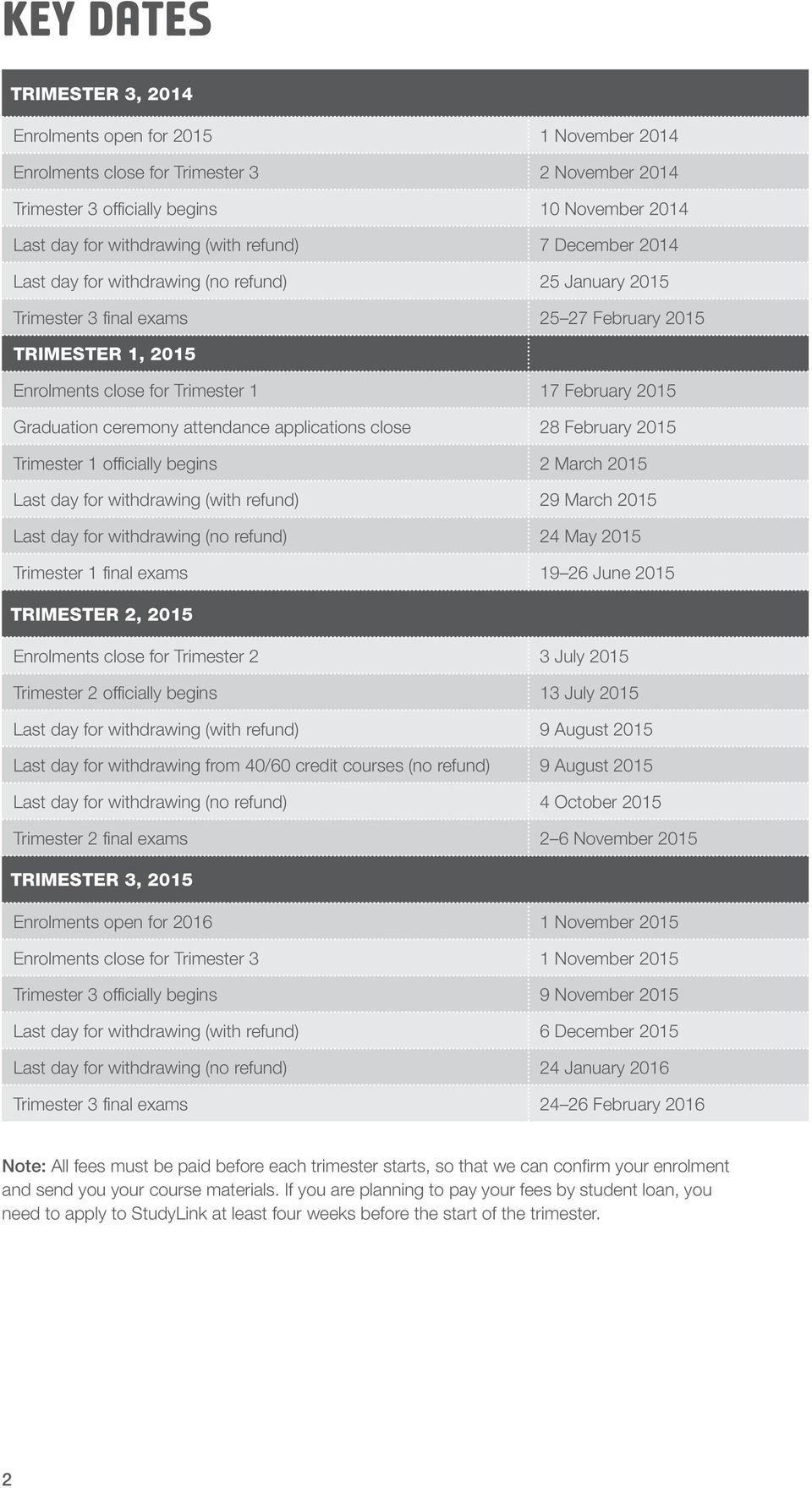
4 KEY DATES TRIMESTER 3, 2014 Enrolments open for November 2014 Enrolments close for Trimester 3 2 November 2014 Trimester 3 officially begins 10 November 2014 Last day for withdrawing (with refund) 7 December 2014 Last day for withdrawing (no refund) 25 January 2015 Trimester 3 final exams February 2015 TRIMESTER 1, 2015 Enrolments close for Trimester 1 17 February 2015 Graduation ceremony attendance applications close 28 February 2015 Trimester 1 officially begins 2 March 2015 Last day for withdrawing (with refund) 29 March 2015 Last day for withdrawing (no refund) 24 May 2015 Trimester 1 final exams June 2015 TRIMESTER 2, 2015 Enrolments close for Trimester 2 3 July 2015 Trimester 2 officially begins 13 July 2015 Last day for withdrawing (with refund) 9 August 2015 Last day for withdrawing from 40/60 credit courses (no refund) 9 August 2015 Last day for withdrawing (no refund) 4 October 2015 Trimester 2 final exams 2 6 November 2015 TRIMESTER 3, 2015 Enrolments open for November 2015 Enrolments close for Trimester 3 1 November 2015 Trimester 3 officially begins 9 November 2015 Last day for withdrawing (with refund) 6 December 2015 Last day for withdrawing (no refund) 24 January 2016 Trimester 3 final exams February 2016 Note: All fees must be paid before each trimester starts, so that we can confirm your enrolment and send you your course materials. If you are planning to pay your fees by student loan, you need to apply to StudyLink at least four weeks before the start of the trimester. 2
5 BACHELOR OF ARTS Qualification code: OP7020 Levels: 5 7 The world of work is changing. To help you gain the skills you need to develop your career, the Open Polytechnic Bachelor of Arts qualification offers a combination of vocational, specialist and broad-based subjects. All the courses have been developed with input from employers and other stakeholders. They offer practical skills that can be used across a range of careers. The transferable skills you will gain such as clear communication, critical thinking, analysis and research are highly valued by employers. Arts graduates are regarded as creative and critical thinkers who have both specialist and broad subject knowledge. The Open Polytechnic Bachelor of Arts qualification offers single majors in: You can choose to study for a Bachelor of Arts with a single major or with a double major. Alternatively, you can study one of our diplomas that can be credited towards a degree. Note: When you enrol online, please specify your major subject. If we know what major you are planning to complete your degree in, then: we can link you to pages in Online Campus that are related to your major we can provide you with access to a range of resources that support your study, including study plans and advice about study pathways you can contact other students who are studying towards the same degree as you you can find information about the various industries related to the major. BACHELOR OF ARTS SINGLE MAJOR OP Humanities OP Information and Library Studies OP Social Sciences OP And double majors in: and Information & Library Studies OP Humanities and Information & Library Studies OP CERTIFICATES AND DIPLOMAS We also offer a range of certificates and diplomas that can be used as a stepping stone to a degree. We suggest you plan your study so that, where applicable, the first qualification you get is a certificate or diploma. Plan your qualification online with My Study Plan It s easy to start planning your Bachelor of Arts with our fun and interactive online planning tool called My Study Plan. You can use the tool to plan what courses to study and when. To create your study plan today, visit openpolytechnic.ac.nz/mystudyplan BACHELOR OF ARTS WITH A SINGLE MAJOR A Bachelor of Arts with a single major is made up of 18 courses of 20 credits each (or the equivalent if including 60-credit Humanities and Social Sciences courses). This makes a total of 360 credits where: a maximum of 160 credits can be at Level 5 a minimum of 80 credits must be at Level 7. We suggest you begin your studies at Level 5 and work your way up to the next levels. If you want to complete your degree in three years you will need to do 120 credits a year. If you are working, and studying part-time, we suggest you begin with just one course. QUALIFICATION STRUCTURES MAJOR MAJOR S ELECTIVE S TOTAL CREDITS 220 credits 140 credits 360 Humanities 240 credits 120 credits 360 Information and Library Studies 240 credits 120 credits 360 Social Sciences 240 credits 120 credits 360 Note: A 60-credit course is the equivalent of three 20-credit courses. 3

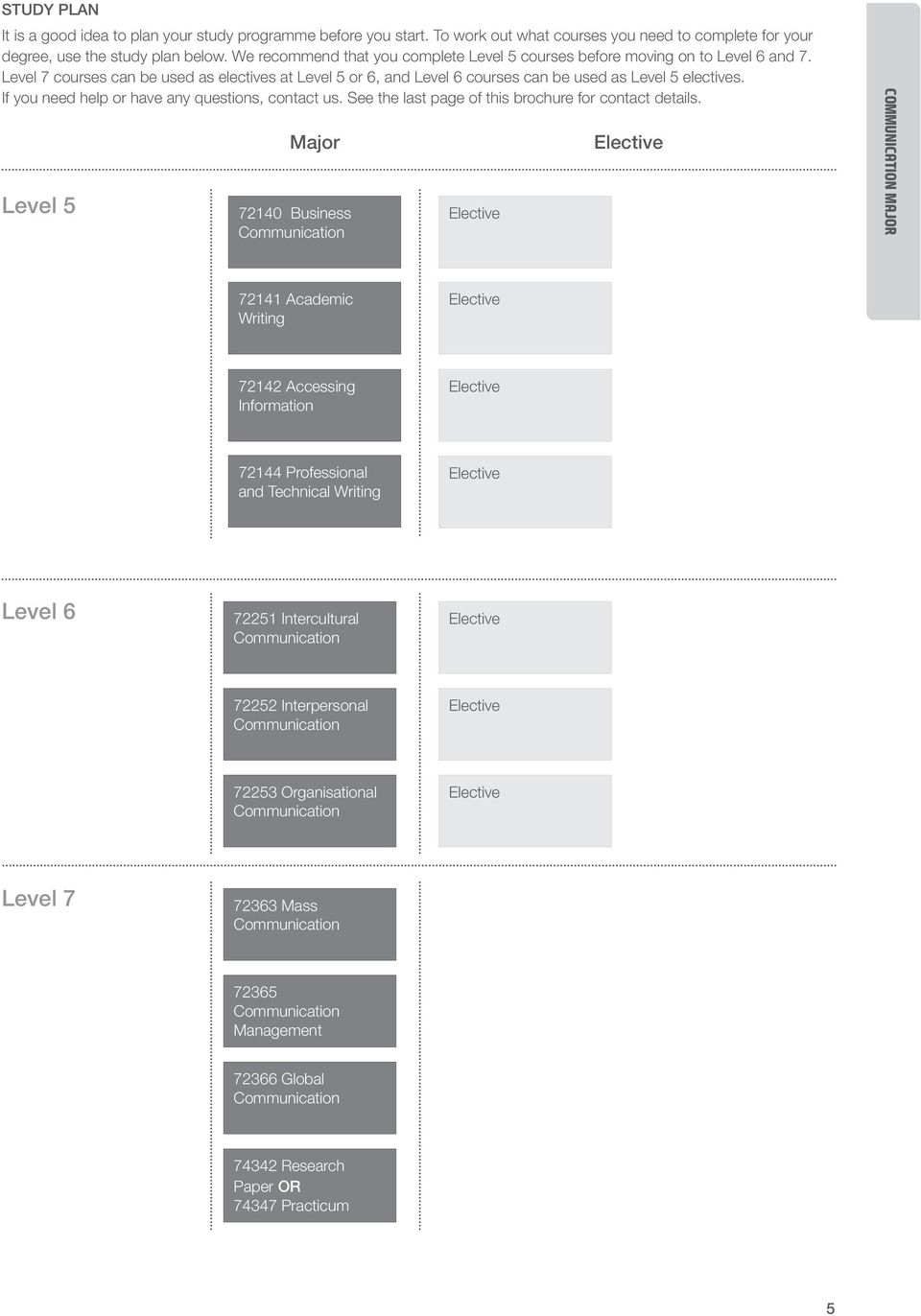
6 COMMUNICATION MAJOR Qualification code: OP The Bachelor of Arts major covers interpersonal, intercultural, organisational and global communication. It also includes courses on writing for the web, technical writing and public relations. Students in this major will develop an understanding of communication that is both applied and theoretical. Graduates of the Bachelor of Arts qualification majoring in : are confident and effective communicators with strong strategic abilities can analyse and use information logically write concisely and communicate effectively at personal, group and organisational levels can analyse and address complex communication issues and problems and offer practical solutions have an understanding of communication in relation to social issues demonstrate ability to analyse texts and their contexts. These skills equip communication graduates for a wide range of employment opportunities, including careers in management, human resource management, marketing, teaching, policy analysis, advertising and corporate communications. QUALIFICATION STRUCTURE NOTE: ALL S ARE 20 CREDITS UNLESS SPECIFIED ELEVEN MAJOR S (220 CREDITS) Business Academic Writing Accessing Information Professional and Technical Writing Intercultural Interpersonal Organisational Mass Management Global Research Paper OR Practicum 7 7 ELECTIVE S (140 CREDITS) 80 credits from major courses in the Bachelor of Arts (Humanities, Information and Library Studies, Social Sciences and ). See our website for the range of options. 60 credits at Level 5 and 6 can be from any degree course offered by the Open Polytechnic or any other accredited New Zealand institute. Note: If you enrolled in this qualification prior to 2013 you can complete it under the regulations that existed at the time of your enrolment. 4

7 STUDY PLAN It is a good idea to plan your study programme before you start. To work out what courses you need to complete for your degree, use the study plan below. We recommend that you complete Level 5 courses before moving on to Level 6 and 7. Level 7 courses can be used as electives at Level 5 or 6, and Level 6 courses can be used as Level 5 electives. If you need help or have any questions, contact us. See the last page of this brochure for contact details. Level 5 Major Business COMMUNICATION MAJOR Academic Writing Accessing Information Professional and Technical Writing Level Intercultural Interpersonal Organisational Level Mass Management Global Research Paper OR Practicum 5
8 HUMANITIES MAJOR Qualification code: OP The Bachelor of Arts Humanities major introduces humanities and arts disciplines and develops interdisciplinary approaches to key historical and cultural movements in Europe and New Zealand. It is based on courses from the Open University UK, supplemented by references to New Zealand contexts and examples, including Mäori and Pasifika. The first year courses introduce the subject knowledge, academic approaches, and interrelationships of art history, literature, history, philosophy, the history of science and classical studies. The second year 60-credit course focuses on the study of art and visual culture, based on the broad chronological period from medieval times through to the present. The third year course studies Renaissance art, questioning the traditional geographical and social boundaries of this in line with contemporary developments in academic research. Students further develop their research, analysis and communication skills by completing the research paper or the practicum. Humanities graduates: have knowledge of, and skills in, art history, literature, history, classical studies, philosophy, religious studies and the history of science have a deepened understanding of human culture, society, creativity and belief can apply their interdisciplinary knowledge and skills to specific cultural, social and work contexts can use their analytical skills to develop arguments and support judgements and views with appropriate evidence. This major prepares graduates for a range of employment pathways in areas such as heritage, education, research and community development. QUALIFICATION STRUCTURE NOTE: ALL S ARE 20 CREDITS UNLESS SPECIFIED EIGHT MAJOR S (240 CREDITS): Academic Writing Introducing Humanities and Arts Humanities: Tradition and Dissent Humanities: Cultural Encounters Art and Literature New Zealand Exploring Art and Visual Culture (60 credits) Renaissance Art Reconsidered (60 credits) Research Paper OR Practicum ELECTIVE S (120 CREDITS): courses can be selected from any Open Polytechnic degree qualification see our website for the range of options. A 60-credit course is the equivalent of three 20-credit courses. RECOMMENDED ELECTIVES INCLUDE: Aotearoa New Zealand Society Introduction to Social Sciences 1: Making Social Lives Introduction to Social Sciences 2: Exploring Social Lives Writing for the Web Intercultural 6 Note: If you enrolled in this qualification prior to 2014 you can complete it under the regulations that existed at the time of your enrolment.

9 STUDY PLAN It is a good idea to plan your study programme before you start. To work out what courses you need to complete for your degree, use the study plan below. We recommend that you complete Level 5 courses before moving on to Level 6 and 7. Level 7 courses can be used as electives at Level 5 or 6, and Level 6 courses can be used as Level 5 electives. If you need help or have any questions, contact us. See the last page of this brochure for contact details. Major Level Academic Writing HUMANITIES MAJOR Introducing Humanities and Arts Humanities: Tradition and Dissent Humanities: Cultural Encounters Art and Literature New Zealand Level Exploring Art and Visual Culture (60 credits) Level Renaissance Art Reconsidered (60 credits) Research Paper OR Practicum 7

10 INFORMATION AND LIBRARY STUDIES MAJOR Qualification code: OP A graduate of the Bachelor of Arts with a major in Information and Library Studies is highly information literate and adept at problem solving attributes which are essential to work in information services in today s information-rich world. The major combines knowledge of traditional librarianship with a knowledge of contemporary advances in information technology and the rapidly changing management of information services. In particular graduates: learn about the principles of librarianship and about using information technology to manage information have information and library skills and skills in policy development and change management understand, and can deal with, contemporary issues in the information services profession. People with a major in Information and Library Studies can pursue a career at management level in a wide variety of library and information services, including public and tertiary libraries, schools, public and private sector businesses and other environments where strong research skills and providing information have a central role. QUALIFICATION STRUCTURE NOTE: ALL S ARE 20 CREDITS UNLESS SPECIFIED TWELVE MAJOR S (240 CREDITS): Academic Writing Accessing Information The Information Industry Library Systems and Processes Information Sources and Services User Education and Reference Skills Cataloguing and Classification Research Methods and Interpretation Information Issues Policy and Planning for Information Services Social Informatics Research Paper OR Practicum 7 7 ELECTIVE S (120 CREDITS) 80 credits from major courses in the Bachelor of Arts (Humanities, Information and Library Studies, Social Sciences and ). See our website for the range of options. 40 credits at Level 5 and 6 can be from any degree course offered by the Open Polytechnic or any other accredited New Zealand institute. Note: If you enrolled in this qualification prior to 2014 you can complete it under the regulations that existed at the time of your enrolment. 8

11 STUDY PLAN It is a good idea to plan your study programme before you start. To work out what courses you need to complete for your degree, use the study plan below. We recommend that you complete Level 5 courses before moving on to Level 6 and 7. Level 7 courses can be used as electives at Level 5 or 6, and Level 6 courses can be used as Level 5 electives. If you need help or have any questions, contact us. See the last page of this brochure for contact details. Level 5 Major Academic Writing Accessing Information INFORMATION AND LIBRARY STUDIES MAJOR The Information Industry Library Systems and Processes Level Information Sources and Services User Education and Reference Skills Cataloguing and Classification Research Methods and Interpretation Level Information Issues Policy and Planning for Information Services Social Informatics Research Paper OR Practicum 9

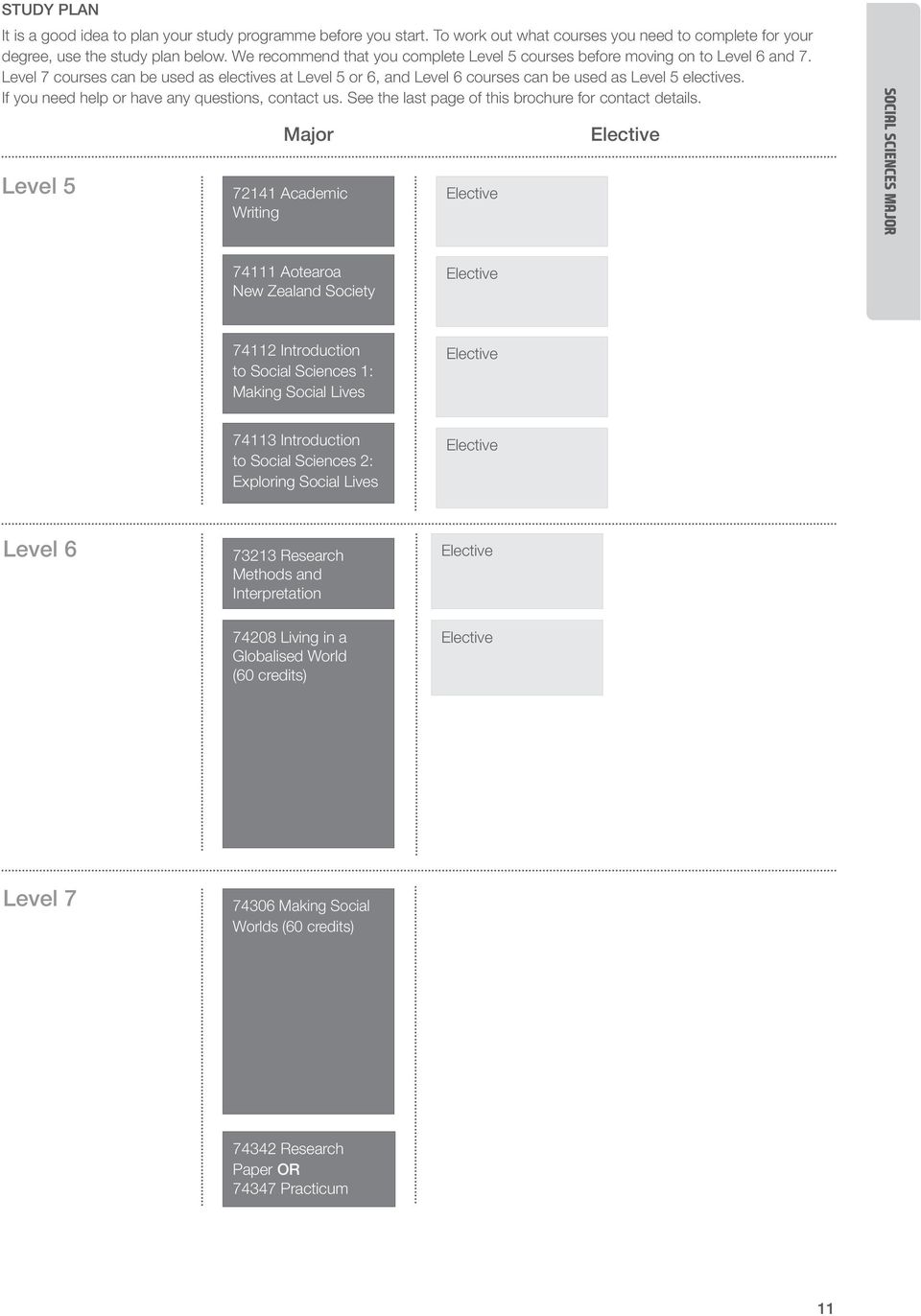
12 SOCIAL SCIENCES MAJOR Qualification code: OP The Bachelor of Arts Social Sciences major introduces a range of issues and methods across the social sciences, drawing from sociology, human geography, cultural studies and political science. It is based on courses licenced from the Open University, UK, with supplementary material which reflects an Aotearoa New Zealand context. The interdisciplinary courses develop critical thinking skills and understanding of some key contemporary social issues, theoretical paradigms and methodological approaches. Particular emphasis is on issues of cultural change and identity, environmental politics, employment and migration, and trade and globalisation. Social Science graduates: know about a variety of contemporary social issues and theoretical approaches understand a range of methodologies for describing and explaining social phenomena can apply their interdisciplinary skills to various social contexts have creative problem-solving skills have strong communication and analytical skills are able to critically consider the role of social and political values in contemporary society. This major prepares graduates for employment pathways in public, private and non-government organisation sectors. It provides graduates with analytical skills applicable to a wide range of other employment areas, such as social policy and community development, journalism, human resources, education and research. QUALIFICATION STRUCTURE NOTE: ALL S ARE 20 CREDITS UNLESS SPECIFIED MAJOR S (240 CREDITS): Academic Writing Research Methods and Interpretation Aotearoa New Zealand Society Introduction to Social Sciences 1: Making Social Lives Introduction to Social Sciences 2: Exploring Social Lives Living in a Globalised World (60 Credits) Making Social Worlds (60 credits) Research Paper OR Practicum 7 7 ELECTIVE S (120 CREDITS) courses can be selected from any degree course offered by the Open Polytechnic or any other accredited New Zealand institute see our website for the range of options. A 60-credit course is the equivalent of three 20-credit courses. Note: If you enrolled in this qualification prior to 2014 you can complete it under the regulations that existed at the time of your enrolment. 10

13 STUDY PLAN It is a good idea to plan your study programme before you start. To work out what courses you need to complete for your degree, use the study plan below. We recommend that you complete Level 5 courses before moving on to Level 6 and 7. Level 7 courses can be used as electives at Level 5 or 6, and Level 6 courses can be used as Level 5 electives. If you need help or have any questions, contact us. See the last page of this brochure for contact details. Level 5 Major Academic Writing SOCIAL SCIENCES MAJOR Aotearoa New Zealand Society Introduction to Social Sciences 1: Making Social Lives Introduction to Social Sciences 2: Exploring Social Lives Level Research Methods and Interpretation Living in a Globalised World (60 credits) Level Making Social Worlds (60 credits) Research Paper OR Practicum 11
14 BACHELOR OF ARTS WITH A DOUBLE MAJOR A double major will give you a more vocationally targeted degree and will also expand the breadth of your knowledge and understanding of social and cultural issues. Options for a double major are: and Information & Library Studies OP Humanities and Information & Library Studies OP A double major is made up of 20 courses of 20 credits (400 credits), or the equivalent in 60-credit courses (400 credits in total) where: a maximum of 160 credits can be at Level 5 a minimum of 120 credits must be at Level 6 a minimum of 120 credits must be at Level 7 all the core requirements of the degree in which the double major is to be taken are completed. QUALIFICATION STRUCTURE NOTE: ALL S ARE 20 CREDITS UNLESS SPECIFIED DOUBLE MAJORS MAJOR S ELECTIVE S TOTAL S and Information & Library Studies Humanities and Information & Library Studies = 180 credits Information and Library Studies = 200 credits Humanities = 200 credits Information and Library Studies = 200 credits 20 credits 400 credits 400 credits Note: The 20-credit elective course can be selected from any Open Polytechnic degree qualification see our website for the range of options. 12

15 COMMUNICATION AND INFORMATION & LIBRARY STUDIES DOUBLE MAJOR Qualification code: OP The and Information and Library Studies double major is a qualification with a strong vocational emphasis. It provides graduates with knowledge and understanding of a range of communication and library and information issues and concepts. The Information and Library Studies courses focus on the New Zealand library and information environment, while the courses provide personal, intercultural, organisational and global communication skills. Graduates with this double major: are information literate, adept at problem solving, and are confident and practical communicators have a strong strategic focus, can analyse and use information logically, and write concisely and clearly COMMUNICATION AND INFORMATION AND LIBRARY STUDIES DOUBLE MAJOR are competent at analysing and addressing complex communication issues and problems, and arriving at practical solutions have a wealth of knowledge of the traditional underpinnings of librarianship to draw on and apply to contemporary contexts can use information technology to provide and store information have an understanding of the New Zealand context and the importance of the Treaty of Waitangi. The double major prepares graduates for a range of employment opportunities, including human resource management, marketing, teaching, policy analysis, and library and information management. 13

16 QUALIFICATION STRUCTURE NOTE: ALL S ARE 20 CREDITS UNLESS SPECIFIED NINE COMMUNICATION MAJOR S (180 CREDITS): Business Academic Writing Professional and Technical Writing Intercultural Interpersonal Organisational Mass Management Global 7 TEN INFORMATION AND LIBRARY STUDIES MAJOR S (200 CREDITS): Accessing Information The Information Industry Library Systems and Processes Information Sources and Services User Education and Reference Skills Cataloguing and Classification Research Methods and Interpretation Information Issues Policy and Planning for Information Services Social Informatics OR Research Paper OR Practicum ELECTIVE S (20 CREDITS): courses can be selected from any Open Polytechnic degree qualification see our website for the range of options. Note: If you enrolled in this qualification prior to 2014 you can complete it under the regulations that existed at the time of your enrolment. 14

17 STUDY PLAN It is a good idea to plan your study programme before you start. To work out what courses you need to complete your degree, use the study plan below. We recommend that you complete Level 5 courses before moving on to Level 6 and 7. If you need help or have any questions, contact us. See the last page of this brochure for contact details. Level Business Academic Writing Information and Library Studies Accessing Information The Information Industry COMMUNICATION AND INFORMATION AND LIBRARY STUDIES DOUBLE MAJOR Professional and Technical Writing Library Systems and Processes Level Intercultural Interpersonal Organisational Information Sources and Services User Education and Reference Skills Cataloguing and Classification Research Methods and Interpretation Level Mass Information Issues Management Policy and Planning for Information Services Global Social Informatics OR Research Paper OR Practicum 15

18 HUMANITIES AND INFORMATION & LIBRARY STUDIES DOUBLE MAJOR Qualification code: OP The Humanities and Information & Library Studies double major is a qualification with a strong vocational application. It also provides a breadth of knowledge and understanding of a range of cultural and social issues and contexts. The Information and Library Studies courses focus on the New Zealand library and information environment, while the Humanities major develops understanding and critical thinking skills within the context of key philosophical and cultural movements. Graduates of this double major: are skilled in critical analysis, argument and expression can analyse texts and their contexts and apply their knowledge to interdisciplinary study in the arts have a broad knowledge of the humanities and arts can draw on knowledge of the traditional underpinnings of librarianship and apply these to contemporary contexts are adept at using information technology demonstrate broad subject knowledge with an arts focus have a strong understanding of the New Zealand context and the importance of the Treaty of Waitangi. Graduates are prepared for a range of employment opportunities in management, human resource management, marketing, teaching, policy analysis, heritage conservation and library and information management. QUALIFICATION STRUCTURE NOTE: ALL S ARE 20 CREDITS UNLESS SPECIFIED SIX HUMANITIES MAJOR S (200 CREDITS): Introducing Humanities and Arts Humanities Tradition and Dissent Humanities and Cultural Encounters Art and Literature New Zealand Exploring Art and Visual Culture (60 credits) Renaissance Art Reconsidered (60 credits) 7 TEN INFORMATION AND LIBRARY STUDIES MAJOR S (200 CREDITS): Academic Writing OR Accessing Information The Information Industry Library Systems and Processes Information Sources and Services User Education and Reference Skills Cataloguing and Classification Research Methods and Interpretation Information Issues Policy and Planning for Information Services Social Informatics OR Research Paper OR Practicum Note: If you enrolled in this qualification prior to 2014 you can complete it under the regulations that existed at the time of your enrolment. 16

19 STUDY PLAN It is a good idea to plan your study programme before you start. To work out what courses you need to complete your degree, use the study plan below. We recommend that you complete Level 5 courses before moving on to Level 6 and 7. If you need help or have any questions, contact us. See the last page of this brochure for contact details. Level 5 Humanities Introducing Humanities and Arts Humanities: Tradition and Dissent Humanities: Cultural Encounters Information and Library Studies Academic Writing OR Accessing Information Library Systems and Processes The Information Industry HUMANITIES AND INFORMATION AND LIBRARY STUDIES DOUBLE MAJOR Art and Literature New Zealand Level Exploring Art and Visual Culture (60 credits) Information Sources and Services User Education and Reference Skills Cataloguing and Classification Research Methods and Interpretation Level Renaissance Art Reconsidered (60 credits) Information Issues Policy and Planning for Information Services Social Informatics OR Research Paper OR Practicum 17

20 BACHELOR OF APPLIED SCIENCE Qualification code: OP7010 Levels: 5 7 QUALIFICATION The Open Polytechnic Bachelor of Applied Science qualification offers majors in: OP Environment OP Information and Library Studies OP Psychology OP Unspecified OP You can study for a Bachelor of Applied Science with a single major, a double major, or without a major (unspecified). Note: When you enrol online, please specify your major subject. If we know what major you are planning to complete your degree in, then: we can link you to pages in Online Campus that are related to your major we can provide you with access to a range of resources that support your study, including study plans and advice about study pathways you can contact other students who are studying towards the same degree you can find information about the various industries related to the major. CERTIFICATES AND DIPLOMAS We also offer a range of certificates and diplomas that can be used as a stepping stone to a degree. We suggest you plan your study so that, where applicable, the first qualification you get is a certificate or diploma. PLAN YOUR QUALIFICATION ONLINE WITH MY STUDY PLAN It s easy to start planning your Bachelor of Applied Science with our fun and interactive online planning tool called My Study Plan. You can use the tool to plan what courses to study and when. To create your study plan today, visit openpolytechnic.ac.nz/mystudyplan FUTURE SKILLS In today s volatile work environment, you need to be self-motivated and a confident problem solver. Our courses focus on a problem solving approach, promoting skills in effective thinking, communication, relationship building and the ability to access and use information relevant to your field. As a graduate of the Bachelor of Applied Science qualification, you will have the skills to: identify and define problems and devise appropriate solutions communicate information, concepts and arguments clearly and effectively use a range of information technologies to store, organise, present, process and analyse information for a variety of purposes; and gather, process, interpret and present data. By improving your skills, you will have shown both personal responsibility and initiative attitudes highly sought after by employers. 18

21 BACHELOR OF APPLIED SCIENCE WITH A SINGLE MAJOR A degree qualification with a single major is made up of 18 courses of 20 credits each, where: a maximum of eight courses (160 credits) can be at Level 5 a minimum of four courses (80 credits) must be at Level 7 your study programme must meet the core, major and elective requirements of the relevant degree major qualification. QUALIFICATION STRUCTURE NOTE: ALL S ARE 20 CREDITS UNLESS SPECIFIED MAJOR CORE S MAJOR S ELECTIVE S TOTAL CREDITS BACHELOR OF APPLIED SCIENCE WITH A SINGLE MAJOR 80 credits 140 credits 140 credits 360 Environment 80 credits 180 credits 100 credits 360 Information and Library Studies 80 credits 220 credits 60 credits 360 Psychology 80 credits 160 credits 120 credits 360 Unspecified 80 credits 120 credits 160 credits 360 Note: courses can be selected from any Open Polytechnic degree qualification see our website for the range of options. A 60-credit course is the equivalent of three 20-credit courses. 19
22 COMMUNICATION MAJOR Qualification code: OP As a graduate of the Bachelor of Applied Science qualification majoring in, you will be a confident and effective communicator with a strong strategic focus. You will be able to: analyse and use information logically write clearly and concisely communicate effectively in a variety of contexts analyse and address complex communication issues and problems offer practical solutions understand organisational dynamics. These skills prepare graduates for a wide range of employment opportunities in the private and public sectors. They support careers in management, human resource management, marketing, teaching, policy analysis, advertising and corporate communications. QUALIFICATION STRUCTURE NOTE: ALL S ARE 20 CREDITS UNLESS SPECIFIED FOUR CORE S (80 CREDITS): Business Accessing Information Statistical Analysis Research Methods and Interpretation 6 SIX COMPULSORY MAJOR S (120 CREDITS): Professional and Technical Writing Intercultural Interpersonal Mass Management Global 7 PLUS AT LEAST ONE OF (20 CREDITS): Organisational Plain English for Professional Purposes 6 SEVEN ELECTIVE S (140 CREDITS): courses can be selected from any Open Polytechnic degree qualification see our website for the range of options. A 60-credit course is the equivalent of three 20-credit courses. 20
23 STUDY PLAN It is a good idea to plan your study programme before you start. To work out which courses you need to complete your degree, use the study plan below. We recommend that you complete Level 5 courses before moving on to Level 6 and 7. If you need help or have any questions, contact us. See the last page of this brochure for contact details. Level Business Core Major Professional and Technical Writing COMMUNICATION MAJOR Accessing Information Statistical Analysis Level Research Methods and Interpretation Intercultural Interpersonal Organisational OR Plain English for Professional Purposes Level Mass Management Global 21
24 ENVIRONMENT MAJOR Qualification code: OP Graduates of the Bachelor of Applied Science Environment major will have the theoretical and practical understanding to: recognise and analyse the causes of environmental problems facing New Zealand and the global community apply environmental principles and legislation to practical situations involving the protection and use of natural resources evaluate policy and management approaches to resolve environmental problems contribute to identifying and implementing effective actions to achieve sustainable environmental outcomes. Graduates may find career opportunities in central or local government, public interest groups and private sector organisations, working in planning, policy analysis, resource management, research, consultancy or environmental education. QUALIFICATION STRUCTURE NOTE: ALL S ARE 20 CREDITS UNLESS SPECIFIED FOUR CORE S (80 CREDITS): Business Accessing Information Statistical Analysis Research Methods and Interpretation 6 THREE COMPULSORY MAJOR S (60 CREDITS): Global Environmental Studies Sustainability and New Zealand Introduction to New Zealand Ecology 5 PLUS THREE OF (60 CREDITS): Coastal and Marine Management Resource Management Act and Local Government Act Conservation and Natural Resources Law Environmental Monitoring and Reporting Environmental Impact Assessment 6 PLUS AT LEAST 60 CREDITS FROM: Environmental Management Systems and Strategies Environment and the Economy Environmental Perspectives and the Media Environmental Studies Research (40 credits) 7 FIVE ELECTIVE S (100 CREDITS): courses can be selected from any Open Polytechnic degree qualification see our website for the range of options. No more than 120 credits can be at Level 5 and no less than 80 credits can be at Level 7. A 60-credit course is the equivalent of three 20-credit courses. 22
25 STUDY PLAN It is a good idea to plan your study programme before you start. To work out which courses you need to complete your degree, use the study plan below. We recommend that you complete Level 5 courses before moving on to Level 6 and 7. Level 7 courses can be used as electives at Level 5 or 6, and Level 6 courses can be used as Level 5 electives. If you need help or have any questions, contact us. See the last page of this brochure for contact details. Level Business Core Major Global Environmental Studies ENVIRONMENT MAJOR Accessing Information Sustainability and New Zealand Statistical Analysis Introduction to New Zealand Ecology Level Research Methods and Interpretation Major Major Major Level 7 Major Major Major 23
26 INFORMATION AND LIBRARY STUDIES MAJOR Qualification code: OP A graduate of the Bachelor of Applied Science majoring in Information and Library Studies will be highly information literate and adept at problem solving attributes which are essential for the successful provision of information services in today s information rich world. An understanding of the skills and knowledge of traditional librarianship is combined with contemporary advances in information technology and the rapidly changing management of information services. A graduate in Information and Library Studies will be equipped to work at management level in a wide variety of library and information positions. These include public and tertiary libraries and schools, and business positions in both public and private sectors and other environments where the provision of information and research skills has a central role. Graduates will have: knowledge of the traditional underpinnings of librarianship translated into contemporary contexts knowledge of information technology as a tool in the provision of information management skills in an information and library context, including policy development and change management an understanding of and ability to deal with contemporary issues in the information services profession. QUALIFICATION STRUCTURE NOTE: ALL S ARE 20 CREDITS UNLESS SPECIFIED FOUR CORE S (80 CREDITS): Business Accessing Information Statistical Analysis Research Methods and Interpretation 6 ELEVEN COMPULSORY MAJOR S (200 CREDITS): Business Computing The Information Industry Library Systems and Processes Principles of Records Management Principles of Information Management Information Sources and Services User Education and Reference Skills Information Issues Policy and Planning for Information Services Social Informatics Research Paper OR Practicum 7 7 THREE ELECTIVE S (60 CREDITS): courses can be selected from any Open Polytechnic degree qualification see our website for the range of options. A 60-credit course is the equivalent of three 20-credit courses. 24
27 STUDY PLAN It is a good idea to plan your study programme before you start. To work out which courses you need to complete your degree, use the study plan below. We recommend that you complete Level 5 courses before moving on to Level 6 and 7. Level 7 courses can be used as electives at Level 5 and 6, and Level 6 courses can be used as Level 5 electives. If you need help or have any questions, contact us. See the last page of this brochure for contact details. Level Business Accessing Information Core Major Business Computing The Information Industry INFORMATION AND LIBRARY STUDIES MAJOR Statistical Analysis Library Systems and Processes Principles of Records Management Level Research Methods and Interpretation Principles of Information Management Information Sources and Services User Education and Reference Skills Level Information Issues Policy and Planning for Information Services Social Informatics Research Paper OR Practicum 25
28 PSYCHOLOGY MAJOR Qualification code: OP The completion of the Bachelor of Applied Science Psychology major or a diploma in this discipline will open up a number of career options and further study opportunities. As a successful graduate with a Psychology major, your entry into careers such as counselling, human resource management, organisational psychology, marketing, teaching and nursing is enhanced. Your degree will strongly supplement more specialised training in these fields. Note: While psychology can provide a theoretical foundation, it is not sufficient for practising counselling. For more information, refer to the New Zealand Association of counsellors, nzac.org.nz You will find opportunities in any field that requires the ability to critically evaluate situations for example, policy analysis. QUALIFICATION STRUCTURE NOTE: ALL S ARE 20 CREDITS UNLESS SPECIFIED FOUR CORE S (80 CREDITS): Business Accessing Information Statistical Analysis Research Methods and Interpretation 6 TWO COMPULSORY MAJOR S (40 CREDITS): General and Applied Psychology Social and Individual Psychology 5 PLUS SIX OF (AT LEAST THREE AT 7) (120 CREDITS): Social Psychology Brain and Behaviour Thought, Memory and Language Behaviour Modification Te Hauora Hinengaro Child and Adolescent Psychopathology Child and Adolescent Developmental Psychology Organisational Psychology Psychological Assessment Personality and Individual Differences Adult Psychopathology 7 SIX ELECTIVE S (120 CREDITS): courses can be selected from any Open Polytechnic degree qualification see our website for the range of options. A 60-credit course is the equivalent of three 20-credit courses. Note: Students who complete Personality and Individual Differences and Psychological Assessment as part of a Bachelor of Applied Science may be considered for test user registration at Level C through the New Zealand Council for Educational Research (NZCER). Contact the programme leader for further information. 26
29 STUDY PLAN It is a good idea to plan your study programme before you start. To work out which courses you need to complete your degree, use the study plan below. We recommend that you complete Level 5 courses before moving on to Level 6 and 7. Level 7 courses can be used as electives at Level 5 or 6, and Level 6 courses can be used as Level 5 electives. If you need help or have any questions, contact us. See the last page of this brochure for contact details. Level Business Core Major General and Applied Psychology PSYCHOLOGY MAJOR Accessing Information Social and Individual Psychology Statistical Analysis Level Research Methods and Interpretation Major Major Major Level 7 Major Major Major 27
30 UNSPECIFIED MAJOR Qualification code: OP A Bachelor of Applied Science with an unspecified major is made up of 360 credits, where: 80 credits must be at Level 7 no more than 160 credits can be at Level 5 a minimum of 120 credits are from a sequential study programme (either a single major or an embedded diploma) that has been approved by the head of school, and which includes a minimum of 40 credits at Level 7. Note: If you are interested in a Bachelor of Applied Science with an unspecified major, we strongly recommend that you contact us to talk through your study options before you enrol to make sure that your planned programme will meet the requirements. See the last page of this brochure for contact details. QUALIFICATION STRUCTURE NOTE: ALL S ARE 20 CREDITS UNLESS SPECIFIED FOUR CORE S (80 CREDITS): Business Accessing Information Statistical Analysis Research Methods and Interpretation 6 14 ELECTIVE S (280 CREDITS): courses can be selected from any Open Polytechnic degree qualification see our website for the range of options. A 60-credit course is the equivalent of three 20-credit courses. 28
31 BACHELOR OF APPLIED SCIENCE WITH A DOUBLE MAJOR Taking a double major will give you a more vocationally targeted degree and will also expand the breadth of your knowledge and understanding of social and cultural issues. A degree qualification with a double major is made up of 20 courses of 20 credits each where: a maximum of eight courses (160 credits) can be at Level 5 all the core requirements of the degrees in which the double major is to be taken are completed. Options for a double major are: and Environment OP and Psychology OP BACHELOR OF APPLIED SCIENCE WITH A DOUBLE MAJOR QUALIFICATION STRUCTURES DOUBLE MAJORS CORE S MAJOR S ELECTIVE S TOTAL CREDITS and Environment 80 credits = 140 credits Environment = 140 credits 40 credits 400 credits and Psychology 80 credits = 140 credits Psychology = 160 credits 20 credits 400 credits Notes: courses can be selected from any Open Polytechnic degree qualification see our website for the range of options. A 60-credit course is the equivalent of three 20-credit courses. Within your course selection, you must meet the core, major and elective requirements of the relevant majors you are studying. Read through the descriptions of the majors in the following pages and contact us if you would like to discuss your study options. See the last page of this brochure for contact details. 29
32 COMMUNICATION AND ENVIRONMENT DOUBLE MAJOR Qualification code: OP Graduates majoring in and Environment will have the strategic understanding and practical communication skills needed to analyse and report on environmental issues in both the private and public sectors. This degree equips graduates with the discipline, expertise and strategic communication skills required in a range of employment areas, such as resource management, policy analysis, environmental auditing and advocacy. QUALIFICATION STRUCTURE NOTE: ALL S ARE 20 CREDITS UNLESS SPECIFIED FOUR CORE S (80 CREDITS): Business Accessing Information Statistical Analysis Research Methods and Interpretation 6 SIX COMPULSORY COMMUNICATION MAJOR S (120 CREDITS): Professional and Technical Writing Intercultural Interpersonal Mass Management Global 7 PLUS AT LEAST ONE OF (20 CREDITS): Organisational Plain English for Professional Purposes 6 FOUR COMPULSORY ENVIRONMENT MAJOR S (80 CREDITS): Introduction to New Zealand Ecology Environmental Management Systems and Strategies Environment and the Economy Environmental Perspectives and the Media 7 PLUS THREE OF (60 CREDITS): Global Environmental Studies OR Sustainability and New Zealand Coastal and Marine Management Resource Management Act and Local Government Act Conservation and Natural Resources Law Environmental Monitoring and Reporting Environmental Impact Assessment 6 TWO ELECTIVE S (40 CREDITS): courses can be selected from any Open Polytechnic degree qualification see our website for the range of options. 30
33 STUDY PLAN It is a good idea to plan your study programme before you start. To work out which courses you need to complete your degree, use the study plan below. We recommend that you complete Level 5 courses before moving on to Level 6 and 7. If you need help or have any questions, contact us. See the last page of this brochure for contact details. Level Business Accessing Information Core Environment Professional and Technical Writing Introduction to New Zealand Ecology Major COMMUNICATION AND ENVIRONMENT DOUBLE MAJOR Statistical Analysis Level Research Methods and Interpretation Intercultural Major Interpersonal Major Organisational OR Plain English for Professional Purposes Level Mass Environmental Management Systems and Strategies Management Environment and the Economy Global Environmental Perspectives and the Media (Any level) 31
34 COMMUNICATION AND PSYCHOLOGY DOUBLE MAJOR Qualification code: OP Graduates majoring in and Psychology will have the discipline, expertise, analytical and communication skills to succeed in a number of employment areas. These include human resource management, corporate communications, community services, advertising and education. QUALIFICATION STRUCTURE NOTE: ALL S ARE 20 CREDITS UNLESS SPECIFIED FOUR CORE S (80 CREDITS): Business Accessing Information Statistical Analysis Research Methods and Interpretation 6 SIX COMPULSORY COMMUNICATION MAJOR S (120 CREDITS): Professional and Technical Writing Intercultural Interpersonal Mass Management Global 7 PLUS ONE OF (20 CREDITS): Organisational Plain English for Professional Purposes 6 TWO COMPULSORY PSYCHOLOGY MAJOR S (40 CREDITS): General and Applied Psychology Social and Individual Psychology 5 PLUS SIX OF (120 CREDITS) (AT LEAST THREE AT 7): Social Psychology Brain and Behaviour Thought, Memory and Language Behaviour Modification Te Hauora Hinengaro Child and Adolescent Psychopathology Child and Adolescent Developmental Psychology Organisational Psychology Psychological Assessment Personality and Individual Differences Adult Psychopathology 7 32
35 ONE ELECTIVE (20 CREDITS): courses can be selected from any Open Polytechnic degree qualification see our website for the range of options. STUDY PLAN It is a good idea to plan your study programme before you start. To work out which courses you need to complete your degree, use the study plan below. We recommend that you complete Level 5 courses before moving on to Level 6 and 7. If you need help or have any questions, contact us. See the last page of this brochure for contact details. Core Psychology COMMUNICATION AND PSYCHOLOGY DOUBLE MAJOR Level Business Professional and Technical Writing General and Applied Psychology Accessing Information Social and Individual Psychology Statistical Analysis Level Research Methods and Interpretation Intercultural Major Interpersonal Major Organisational OR Plain English for Professional Purposes Major Level Mass Major Management Major Global Major (Any level) 33
36 CERTIFICATES AND DIPLOMAS Open Polytechnic certificates An Open Polytechnic certificate is made up of at least two courses, and can be used as a stepping stone to a diploma or degree. Open Polytechnic diplomas An Open Polytechnic diploma is the equivalent of one year s full-time study and can easily be completed in two or three years of part-time study. Diplomas can be used as stepping stones to Open Polytechnic degrees, and courses completed for one diploma can also be credited towards another diploma. A diploma is made up of six courses. At least four of those courses must be at or above the level at which the diploma is rated. So for a Level 6 diploma, you must do at least four courses at Level 6 or above. We suggest you plan your study so that, where applicable, the first qualification you get is a certificate or diploma. Please note that some courses have prerequisites, so you might not be able to complete a diploma in two trimesters. PLAN YOUR QUALIFICATION ONLINE WITH MY STUDY PLAN It s easy to start planning your qualification with our fun and interactive online planning tool called My Study Plan. You can use the tool to plan what courses to study and when. To create your study plan today, visit openpolytechnic.ac.nz/mystudyplan Note: All certificate and diploma courses are 20 credits. OPEN POLYTECHNIC CERTIFICATE IN TERTIARY STUDY SKILLS Qualification code: OP4240 Level 4 If you are thinking of taking up tertiary study for the first time or you ve been away from study for a while, the Open Polytechnic Certificate in Tertiary Study Skills is a good place to start. The certificate is made up of two courses that will help you develop learning strategies, academic writing, information literacy, research and online learning skills. You will have a mentor for your first course to support your learning. For your second course you will choose an area of interest like business, communication, environment, psychology, information & library studies or social work. When you successfully complete the course, you will not only achieve the Open Polytechnic Certificate in Tertiary Study Skills, you will also have one course towards an Open Polytechnic qualification at Level 5 or above. For more information about the Open Polytechnic Certificate in Tertiary Study Skills, visit the qualification page on our website or contact us. See the last page of this brochure for contact details. 34
37 certificates and diplomas The certificates and diplomas are for those interested in a career in the communication field, for communication practitioners who want a specialist qualification in professional communication, and for people in any field of work (paid or voluntary) where skill and competence in communication is a key requirement. There are two certificates, both at Level 5, and two diplomas, one at Level 5 and one at Level 6. CERTIFICATE IN PUBLIC RELATIONS AND COMMUNICATION MANAGEMENT Qualification code: OP Level: 5 The Certificate in Public Relations and Management will provide you with an introduction to the core concepts and principles of public relations. CERTIFICATES AND DIPLOMAS If you are interested in an advanced qualification, you can go on to complete the Diploma in Public Relations and Management. Note: Holders of the Public Relations Institute s APR (Accredited in Public Relations) will be cross credited for Introduction to Public Relations. QUALIFICATION STRUCTURE Business Introduction to Public Relations 5 Note: If you enrolled in this qualification prior to 2013 you can complete it under the regulations that existed at the time of your enrolment. CERTIFICATE IN TECHNICAL COMMUNICATION Qualification code: OP5505 Level: 5 The Certificate in Technical will teach you how to analyse the purpose, audience and context of written communications, and produce documents that are clear, concise and reader centred. Graduates of this qualification will have the skills to work in the areas of technical communication, public relations, advertising, marketing and corporate communication. QUALIFICATION STRUCTURE CORE : Plain English for Professional Purposes 6 PLUS ONE OF: Professional and Technical Writing Writing for the Web 5 35
38 DIPLOMA IN COMMUNICATION STUDIES Qualification code: OP5271 Level: 5 The Diploma in Studies is an entry level diploma that focuses on communication skills and theory. Graduates of this diploma will be able to write business and technical reports, prepare and deliver oral presentations, evaluate communication systems and relate communication processes for cultural, societal, interpersonal and ethical issues in communication. The core courses provide a pathway from the diploma into the Bachelor of Arts or Bachelor of Applied Science degrees. QUALIFICATION STRUCTURE CORE S: Business Aotearoa New Zealand Society 5 PLUS FOUR OF: Academic Writing Professional and Technical Writing Writing for the Web Intercultural Interpersonal Plain English for Professional Purposes 6 36
39 DIPLOMA IN PUBLIC RELATIONS AND COMMUNICATION MANAGEMENT Qualification code: OP Level: 6 The Diploma in Public Relations and Management will teach you how to develop and implement communication plans, and manage an organisation s reputation. This is an excellent qualification for communication professionals who want to advance their careers, and for students training for communication, legal, management and IT roles. This diploma is designed to be a stand-alone professional qualification, but it can also be credited towards the Bachelor of Applied Science or Bachelor of Arts degrees. Note: Holders of the Public Relations Institute s APR (Accredited in Public Relations) will be cross-credited for Introduction to Public Relations. COMMUNICATION AND PSYCHOLOGY DOUBLE MAJOR QUALIFICATION STRUCTURE CORE S: Business Introduction to Public Relations Management 7 PLUS THREE OF: Intercultural Interpersonal Organisational Communcation Reputation Management Plain English for Professional Purposes Global 7 Note: If you enrolled in this qualification prior to 2013, you can complete it under the regulations that existed at the time of your enrolment. 37
40 Environment certificates and diplomas Our environment qualifications are tailored to provide a theoretical and practical understanding of how and why environmental problems arise, and how they can be addressed. As with all degree courses, they have been developed in consultation with recognised specialists. These qualifications are for anyone with an interest in environmental issues and management whether you are already working in the field and seeking to update your skills, or you have a personal interest in learning more about the world you live in. You can study towards a formal qualification or take individual courses for your own professional development. CERTIFICATE IN ENVIRONMENT AND SUSTAINABILITY Qualification code: OP5213 Level: 5 The Certificate in Environment and Sustainability is an introduction to sustainable development and New Zealand ecology. It will help you understand the interdependence of humans and the environment, and explore the relationship between the ecological, economic, environmental, and social concepts of sustainability. You may use this certificate as a stepping stone to Open Polytechnic s Diploma in Environment and Sustainability. QUALIFICATION STRUCTURE CORE S: Sustainability and New Zealand Introduction to New Zealand Ecology 5 PLUS ONE OF: Global Environmental Studies Plants and People An Introduction to Ethnobotany New Zealand Native Plants 5 DIPLOMA IN ENVIRONMENT AND SUSTAINABILITY Qualification code: OP5214 Level: 5 The Diploma in Environment and Sustainability extends the knowledge and skill areas of the Level 5 certificate. You will learn about the principles of sustainable development, how ecosystems function and the relationship between people and the ecosystems they depend on. There is also the option to enhance workplace skills in communication and information access. QUALIFICATION STRUCTURE CORE S: Global Environmental Studies Sustainability and New Zealand Introduction to New Zealand Ecology 5 PLUS THREE OF: Business Accessing Information Plants and People An Introduction to Ethnobotany New Zealand Native Plants 5 38
41 CERTIFICATE IN ENVIRONMENTAL MANAGEMENT Qualification code: OP6213 Level: 6 The Certificate in Environmental Management will provide you with an understanding of New Zealand s local government and resource management law, and the ability to apply this knowledge to a variety of practical scenarios. You will also have the option to study other statutes that apply to resource use, conservation, the principles of environmental monitoring, impact assessment and marine management. You may use this certificate as a stepping stone to Open Polytechnic s Diploma in Environmental Management. QUALIFICATION STRUCTURE ENVIRONMENT CERTIFICATES AND DIPLOMAS CORE S: Resource Management Act and Local Government Act Environmental Impact Assessment 6 PLUS ONE OF: Sustainability and New Zealand Introduction to New Zealand Ecology Coastal and Marine Management Conservation and Natural Resources Law Environmental Monitoring and Reporting 6 DIPLOMA IN ENVIRONMENTAL MANAGEMENT Qualification code: OP6214 Level: 6 The Diploma in Environmental Management builds on the knowledge and skill areas of the Level 6 certificate. The diploma is intended to equip you with a broad knowledge of New Zealand s environmental and resource management legislation. You will also have the option of developing your skills in analysing, interpreting and communicating information. QUALIFICATION STRUCTURE CORE S: Resource Management Act and Local Government Act Conservation and Natural Resources Law Environmental Impact Assessment 6 PLUS THREE OF (WITH AT LEAST ONE AT 6): Business Statistical Analysis Sustainability and New Zealand Introduction to New Zealand Ecology Coastal and Marine Management Environmental Monitoring and Reporting Research Methods and Interpretation 6 39
42 GRADUATE CERTIFICATE IN SUSTAINABLE MANAGEMENT Qualification code: OP7213 Level: 7 The Graduate Certificate in Sustainable Management is for graduates or people with relevant work experience who wish to gain new skills in the area of environmental law and management. It provides knowledge of sustainable management applications. Within the qualification, you will be asked to critically examine theories relating to sustainability, and explore how this knowledge could be applied to particular issues in a way that will enhance environmental outcomes. You may use the Graduate Certificate in Sustainable Management as a stepping stone to Open Polytechnic s Graduate Diploma in Sustainable Management. QUALIFICATION STRUCTURE GROUP 1: CHOOSE ONE Coastal and Marine Management Resource Management Act and Local Government Act Conservation and Natural Resources Law Environmental Monitoring and Reporting Environmental Impact Assessment Research Methods and Interpretation 6 GROUP 2: CHOOSE TWO Environmental Management Systems and Strategies Environment and the Economy Environmental Perspectives and the Media 7 40
43 GRADUATE DIPLOMA IN SUSTAINABLE MANAGEMENT Qualification code: OP7214 Level: 7 The Graduate Diploma in Sustainable Management is for graduates or people with relevant work experience who wish to gain new skills in the area of environmental law and management. This qualification expands on the knowledge areas of the Graduate Certificate in Sustainable Management. Within the diploma you will be expected to critically discuss the theory and practice of environmental management and devise and evaluate approaches to environmental problems. You will also have the opportunity to carry out an independent research project on an environmental issue of special interest. QUALIFICATION STRUCTURE ENVIRONMENT CERTIFICATES AND DIPLOMAS CORE : Environmental Research Paper (40 credits) 7 PLUS FOUR OF (WITH AT LEAST TWO AT 7): Coastal and Marine Management Resource Management Act and Local Government Act Conservation and Natural Resources Law Environmental Monitoring and Reporting Environmental Impact Assessment Research Methods and Interpretation Environmental Management Systems and Strategies Environment and the Economy Environmental Perspectives and the Media 7 Note: The Graduate Certificate and Graduate Diploma are for people with an existing degree or five years plus experience in the environmental field. You should discuss your eligibility to enrol in these qualifications with us. See the last page of this brochure for contact details. If you have a Bachelor of Applied Science with an Environment major or a similar qualification from another tertiary provider, you cannot enrol in the Graduate Certificate in Sustainable Management or the Graduate Diploma in Sustainable Management. 41
44 Information and Library Studies certificates and diplomas We offer two Information and Library Studies diplomas, two specialised certificates and a Diploma in Records and Information Management. DIPLOMA IN INFORMATION AND LIBRARY STUDIES Qualification code: OP Level: 5 This diploma is an entry-level qualification for librarians and is suitable for people with no prior experience in libraries, as well as those currently working in a library. It must be completed before you can enrol in the Level 6 diploma, and is also a starting point for a Bachelor of Applied Science or Bachelor of Arts degree. We recommend you complete Level 5 courses before moving on to Level 6. This usually means completing electives before doing Information Sources and Services and User Education and Reference Skills. QUALIFICATION STRUCTURE FIVE CORE S: Accessing Information The Information Industry Library Systems and Processes Information Sources and Services User Education and Reference Skills 6 PLUS ONE OF: Business Computing Business Principles of Records Management Writing for the Web Introducing Humanities and Arts Aotearoa New Zealand Society Literature and Information Resources for Children and Young People 6 Note: If you enrolled in this qualification prior to 2013 you can complete it under the regulations that existed at the time of your enrolment. 42
45 DIPLOMA IN INFORMATION AND LIBRARY STUDIES Qualification code: OP Level: 6 This diploma is an option for students who do not wish to achieve a degree. You must have successfully completed the Level 5 diploma before applying to enrol in this diploma. QUALIFICATION STRUCTURE CORE S: INFORMATION AND LIBRARY STUDIES CERTIFICATES AND DIPLOMAS Intercultural Information Issues Policy and Planning for Information Services 7 ONE FROM: Cataloguing and Classification Archives Management Literature and Information Resources for Children and Young People Library Services for Children and Young People Social Informatics 7 TWO ELECTIVES: Business Computing Web Design Business Academic Writing Statistical Analysis Interpersonal Organisational Cataloguing and Classification Archives Management Literature and Information Resources for Children and Young People Library Services for Children and Young People Research Methods and Interpretation Social Informatics 7 Note: If you enrolled in this qualification prior to 2013 you can complete it under the regulations that existed at the time of your enrolment. 43
46 DIPLOMA IN RECORDS AND INFORMATION MANAGEMENT Qualification code: OP Level: 6 This qualification is tightly structured to deliver core skills in records and archives management and electronic documents and records management. The project management course gives a practical element to the qualification. QUALIFICATION STRUCTURE CORE S: Principles of Records Management Archives Management Electronic Document and Records Management Project Management 7 TWO S FROM THE FOLLOWING ELECTIVES: Business Computing Principles of Information Management Intercultural Information Issues OR Policy and Planning for Information Services Social Informatics 7 Note: You may choose either Information Issues or Policy and Planning for Information Services. You cannot choose both to be credited towards this qualification. CERTIFICATE IN CATALOGUING Qualification code: OP5101 Level: 5 This is a specialist certificate for people already working in a library, or who have started their Level 5 diploma and wish to specialise in this area. This is not a preliminary qualification leading to a diploma, but can be studied at the same time as a diploma. You can enrol in this certificate after completing The Information Industry. If you have sufficient library industry experience you may not have to complete as a prerequisite. Please contact us for more information. See the last page of this brochure for contact details. QUALIFICATION STRUCTURE Business Computing Library Systems and Processes Cataloguing and Classification 6 44
47 CERTIFICATE IN LITERATURE AND LIBRARY SERVICES FOR CHILDREN AND YOUNG PEOPLE Qualification code: OP6273 Level: 6 This Level 6 certificate complements existing generic library qualifications. This is not a preliminary qualification leading to a diploma, but can be studied at the same time as a diploma. You can enrol in the Certificate in Literature and Library Services for Children and Young People EITHER after doing the following prerequisite courses: Information Industry Library Systems and Processes Information Sources and Services INFORMATION AND LIBRARY STUDIES CERTIFICATES AND DIPLOMAS User Education and Reference Skills. OR after completing the Level 5 Diploma in Information and Library Studies, OR after completing a recognised professional library qualification. Please contact us for more information. See the last page of this brochure for contact details. Graduates of this certificate will be able to recognise and respond to children s and young adults information-seeking behaviours and literacy issues, and apply knowledge of children s and young adults development when providing library services for this user group. Topics covered include planning and managing collections and services for children and young people, evaluating literature and information resources for children and young people, and contemporary trends in children s and young adults literature and library services in New Zealand and overseas. QUALIFICATION STRUCTURE Literature and Information Resources for Children and Young People Library Services for Children and Young People 6 45
48 Information Systems and Technology CERTIFICATE IN WEB DESIGN AND WRITING Qualification code: OP5266 Level: 5 This certificate provides the knowledge and skills required to research, plan and develop a small functional website for use as either a business or communication tool. When you have completed this qualification, you will be able to: work as part of a web design and maintenance project team to produce and maintain a collection of web documents develop web pages that validate to the latest World Wide Web Consortium (W3C) standard recommendations use web authoring tools to create websites that are easy to access and navigate write clear and effective web content by using the right style, tools and techniques make effective use of the web as a communication tool. QUALIFICATION STRUCTURE Writing for the Web Web Design 5 46
49 Psychology diplomas DIPLOMA IN PSYCHOLOGY Qualification code: OP5300 Level: 5 This diploma will provide you with an academic background in psychology and help you work in areas such as advertising, marketing, police work, and community work. It can be a stepping stone to a degree in psychology, and to a career as a psychologist (with relevant postgraduate training). QUALIFICATION STRUCTURE PSYCHOLOGY DIPLOMAS CORE S: General and Applied Psychology Social and Individual Psychology 5 PLUS FOUR OF: Psychology of Stress Counselling Theory Human Development Social Psychology Brain and Behaviour Thought, Memory and Language Behaviour Modification Te Hauora Hinengaro 6 47
50 DIPLOMA IN HEALTH AND HUMAN BEHAVIOUR Qualification code: OP5350 Level: 5 The Diploma in Health and Human Behaviour provides an introduction to general psychological principles for those looking for a career in health, social services or counselling. It won t allow you to be registered as a counsellor or practice counselling, but it will equip you with a basic knowledge of relevant psychology issues and counselling skills. For more information refer to the New Zealand Association of Counsellors at nzac.org.nz This diploma will suit you if you have been away from study for some time, or wish to staircase into a higher diploma or degree. QUALIFICATION STRUCTURE CORE S: Relationship and Management Psychology of Grief Psychology of Stress Social and Individual Psychology Counselling Theory Human Development 5 DIPLOMA IN CHILD AND ADOLESCENT PSYCHOLOGY Qualification code: OP6210 Level: 6 This diploma enables you to develop valuable skills to help you work with children and their parents, teachers, and caregivers of children who are exhibiting behavioural and/or emotional problems. In order to be able to provide remedial input, you will develop an understanding of child and adolescent psychological disorders and therapeutic techniques. This diploma is particularly suitable for students who have previously completed a Level 5 qualification in psychology, counselling or social services. QUALIFICATION STRUCTURE CORE S: General and Applied Psychology OR Social and Individual Psychology Counselling Theory Child and Adolescent Issues Behaviour Modification Child and Adolescent Psychopathology Child and Adolescent Developmental Psychology 7 48
51 DIPLOMA IN ORGANISATIONAL PSYCHOLOGY Qualification code: OP Level: 6 The Diploma in Organisational Psychology provides a sound undergraduate understanding of the theories and practice of organisational psychology. It will suit those looking for a career in human resource management and related areas. QUALIFICATION STRUCTURE Social and Individual Psychology Social Psychology Research Methods and Interpretation Organisational Psychology Psychological Assessment Personality and Individual Differences 7 PSYCHOLOGY DIPLOMAS DIPLOMA IN APPLIED MENTAL HEALTH Qualification code: OP6120 Level: 6 The Diploma in Applied Mental Health is for people who are interested in pursuing a career in psycho-social rehabilitation, providing support for people experiencing mental health difficulties. You will complete a 40-hour practicum for within a mental health and addictions service, organised through Platform, a network of community based mental health and addictions services. Please contact us before you apply to enrol in the course to discuss the practicum. QUALIFICATION STRUCTURE CORE S: General and Applied Psychology OR Social and Individual Psychology Counselling Theory Understanding Mental Health Te Hauora Hinengaro Adult Psychopathology Mental Health and Addiction Studies Treatment Issues* 7 * A history of criminal conviction may prevent you from attending this practicum. You will be required to consent to a check of your police record. If you have a criminal conviction, please contact us to discuss this. See the last page of this brochure for contact details. We recommend you enrol early to allow time for police record checking to be completed before your course begins
52 GENERAL INFORMATION Assessment We measure your progress and judge whether you have achieved the learning outcomes of your course through assessments such as essays, reports, tasks, projects, block course work, examinations, and practicums. There are two types of assessment. Formative assessment, which involves activities and feedback designed to improve learning. This is not used to decide your final result. Summative assessment, which involves grading of in-course assessments which do decide your final result. Some courses also have a three-hour final examination. To be eligible to sit the final examination you must successfully pass all the summative in-course assessments by their due date. For some courses you will need to attend contact sessions or assessment workshops while other courses have voluntary contact sessions (depending upon demand). Check our website for details. To pass each course, you must: finish all your summative in-course assessments by their due date score at least 40% in each assessment score at least 40% in the final examination (if the course has a final examination) receive a final mark of at least 50% of the total possible marks for the course. Assessment varies for each course. Full details will be in the course information, which is sent to you when you enrol. EXAMINATIONS We have examination venues throughout New Zealand. You will be allocated a venue closest to your home address. Before you choose the courses that you want to enrol in, check that you can attend the examination, because examination times and dates cannot be changed. Examination dates and times are listed on our website. Sitting examinations outside New Zealand If you are, or will be, living overseas at the time of the examination, you will need to arrange a suitable examination venue and an appropriate supervisor. We will contact you eight weeks before the examination to help you make these arrangements. Any costs relating to the overseas venue and supervision will be your responsibility, including the costs associated with your supervisor returning your completed examination paper to us by courier. Note: A fee may apply if you need to sit your examinations overseas and did not pay the international handling fee at the time of enrolment. Special assistance for examinations If you need special arrangements to enable you to sit an examination, we may be able to help. Download and return the Application for Special Assistance form from openpolytechnic.ac.nz/specialassistance. We will need your application form at least six weeks before your examination. The more notice we have, the more likely it is we will be able to help you. If you would like to discuss your needs, contact us by ing: [email protected] GRADING SYSTEM The following grading system is used for Open Polytechnic degree and associated diploma and certificate courses. A+ 85% 100% A 80% 84% A- 75% 79% B+ 70% 74% B 65% 69% B- 60% 64% C+ 55% 59% C 50% 54% 50
53 Admission requirements All students must meet the academic and admission requirements as stated in specific programme regulations. If you don t meet these requirements, we will consider the probability of you passing the course and then make a decision before approving your application. You may need to provide evidence such as records of past academic history and/or current CV. You also require one of the following: At least 60 credits at NCEA Level 3. Passes in Level 5 courses that are recognised in New Zealand. An overseas qualification assessed to be equivalent to one of these by the programme leader. Passes in other certificate/diploma qualifications or courses considered appropriate by the programme leader. If you don t meet these criteria, please contact us. We will then consider the likelihood of you being successful based on your prior learning and/or other qualifications. We recommend that you think carefully about both your previous education achievements and your personal commitments before choosing which programme to enrol in. If this will be your first enrolment at tertiary level, we strongly advise you to think about doing our Certificate in Tertiary Study Skills first. ENGLISH LANGUAGE English is the language of study at Open Polytechnic. You will need to be able to read and write well in English so that you can understand course materials and also submit written assessments. There are criteria that must be met if English is not your first language. For more information about English language requirements, please call freephone or visit openpolytechnic.ac.nz/englishlanguage COMPUTER AND ONLINE ACCESS Given the significance of computer usage in modern business and organisational settings, it is important that you develop strong computer competencies. You will need access to a computer because: your in-course assessments need to be word processed and submitted online many courses require computers as an integral part of the course work some courses have assessable components that require participation in discussion forums in Online Campus important information such as newsletters and assessment feedback are sent electronically. See Appendix 1 for more information and the technical requirements. If you do not have access to a computer and the internet please contact us to discuss your study options. Study time All courses have a credit value which helps you work out how much study time you will need. Allow about 10 hours of study per credit. To determine how many hours of study this means each week, divide the total hours by the enrolment period. For example, if you enrol in a 20-credit course over a trimester (17 weeks), you will need to complete about (200 17) hours of study per week. Fees Fees are displayed on each course and qualification page on our website. Visit openpolytechnic.ac.nz and browse our subjects and courses to find the fee information you need. Set texts A list of set texts required is on our website at openpolytechnic.ac.nz/textbooks GENERAL INFORMATION Texts can be bought online via a link on the qualification page on our website. Or you can go to vicbooks.co.nz and click the Open Polytechnic link. Loans, allowances and other funding Student loans and allowances are administered by StudyLink. We recommend that you apply for a student loan at least four weeks before the trimester starts. We cannot confirm your enrolment or send your course materials until your fees have been paid. For more information, or to find out if you re eligible for a student loan, visit studylink.govt.nz or give StudyLink a call on
54 FINANCIAL ASSISTANCE We have a fund to help students who are in financial need and have no other option for financial support. This fund is available for course fees and/or set textbooks. Conditions apply. Contact us for more information. See the last page of this brochure for contact details. SCHOLARSHIPS We also offer a range of scholarships to support students. Visit openpolytechnic.ac.nz/scholarships for more information. Enrolment You can enrol online from our website. Visit openpolytechnic.ac.nz/howtoenrol for more information. You will be advised if additional information is needed to progress your application, and you can usually complete this online during the application process. Please check the key dates section at the beginning of this brochure for enrolment deadlines for each trimester. RECOGNITION OF PRIOR LEARNING (RPL) RPL is the process used to recognise your existing experience and skills in formal qualifications. RPL takes account of work and life experience, and previous education and training courses which may be relevant to your course. You may be able to use RPL to qualify for credits towards papers in a formal qualification with us. If your application is accepted you will need to provide verified evidence that you have met the learning outcomes of the course you are seeking credit for. For more information visit openpolytechnic.ac.nz/rpl NEW ZEALAND STUDENTS A New Zealand Student is any New Zealand citizen, including citizens or permanent residents of the Cook Islands, Tokelau or Niue studying there or in New Zealand; New Zealand residents or New Zealand permanent residents living in New Zealand; and Australian citizens or Australian permanent residents living in New Zealand. For more information contact us see the last page of this brochure for contact details. INTERNATIONAL STUDENTS International students who are residing in New Zealand and studying part-time must have a verified work permit/visa. Please note the expiry date must be after the end date of your course. You also need to have one of the following. OVERSEAS HANDLING FEE If you live overseas, you will need to pay an extra international handling charge. The amount of this fee will depend on where you live. The overseas handling fee will be added to your course fees when you enrol. LOCATION CHARGE PER TRIMESTER Australia $50 South Pacific region $70 East Asia and North America $95 Europe $105 Rest of the world $120 CROSS-CREDITS AND CREDIT TRANSFER If you have already passed some courses (either through us or another tertiary provider) that you think will exempt you from having to do some parts of a qualification, you can apply for cross-credit or credit transfer. You will need to provide evidence that you have already met the learning outcomes of the course you want credit for. You can apply for cross-credit and credit transfer after you have enrolled. Cross-credits may be specified or unspecified. A specified credit means the content, level and learning outcomes of the course or qualification you have already done closely matches one of our courses. An unspecified credit is where you have an unrelated course or qualification from another recognised tertiary institution and want to apply for unspecified credit towards our qualification. We will decide how many credits will be awarded, and at what level. Unspecified credits may only be used to replace elective courses within a qualification. The number of unspecified credits will depend on the degree and major you are studying. Please contact us for advice. See the last page of this brochure for contact details. The most cross-credits allowed is up to two-thirds of a degree (12 20-credit courses), up to half of a diploma (3 20-credit courses), and one course per certificate. You cannot gain partial cross-credit for a course, and you cannot cross-credit to Level 7 courses. You may request informal advice about which courses might cross-credit. That advice is for guidance only and does not guarantee the award of cross-credits. A Variation of Conditions allowing study at Open Polytechnic. A letter of authorisation from your employer (on letterhead) confirming that you need to undertake this training as part of your job. International fees must be paid in full at the time of enrolment. 52
55 Learning support YOUR LECTURER You will have a lecturer for each course that you study. Your lecturer is there to help you through the course work, provide study support, advice and feedback, and to mark your assessments. You can contact your lecturer on our freephone or by , fax or letter. Their contact details will be in the information we send you after you enrol. STUDENT INFORMATION You can find current enrolment and study information on our website including details of our systems and processes and the services we offer. For more information visit openpolytechnic.ac.nz/studywithus STUDY HELP The Learning Support section of our website has information about the study support and resources we offer. Visit openpolytechnic.ac.nz/learningsupport for more information. MY OPEN POLYTECHNIC My Open Polytechnic is our online portal for our students. With My Open Polytechnic you can: update your details view your study information track the status of your materials access your assessment submission deadlines, marks and final grades for each course check your account balance GENERAL INFORMATION TE WÄHANGA WHAKAPAKARI AKO (THE LEARNING CENTRE) Te Wähanga Whakapakari Ako (the Learning Centre) can help you with a wide range of learning support services and resources. These include: tips and techniques to help you succeed in online and distance learning one-to-one consultations with a learning advisor (telephone or ) StudyWise and ExamWise which are free online study and exam preparation workshops disability services a student mentoring programme. For more information visit openpolytechnic.ac.nz/learningsupport TE KURA WÄNANGA (THE MÄORI OFFICE) Te Kura Wänanga (the Mäori Office) can help you with your learning and cultural needs in a kaupapa Mäori context. We use Mäori values and principles to enhance your learning journey. For more information visit openpolytechnic.ac.nz/maorisupport PLAN YOUR QUALIFICATION ONLINE WITH MY STUDY PLAN It s easy to start planning your qualification with our fun and interactive online planning tool called My Study Plan. You can use the tool to plan what courses to study and when. To create your study plan today, visit openpolytechnic.ac.nz/mystudyplan access Online Campus and the library. Once you re enrolled, you can also keep track of your study information on the go with the My Open Polytechnic smartphone app called My OP. To download the app, search for My OP on the App Store (Apple iphone) or Google Play Store (Android smartphone). These come pre-installed on your smartphone. ONLINE CAMPUS Online Campus is the area of our website where you can: access and submit assessments link to web pages specific to your course, including frequently asked questions (FAQ), assessment hints, web resources, staff information and sometimes online quizzes and tutorials communicate with other students in your course, and with your lecturer or tutor access the library download past exam papers. LIBRARY We provide a library service for students. There is no additional fee for using it. The library service provides: online resources guides on how to search for information a distance lending service with free and fast delivery information about study techniques. For more information about the library visit openpolytechnic.ac.nz/oplibrary 53
56 APPENDIX 1: COMPUTER REQUIREMENTS To study the Bachelor of Applied Science and Bachelor of Arts degrees at Open Polytechnic, you need to be able to do the following: send and receive s access and contribute to the Online Campus discussion forums download documents carry out online research submit your work to us online in one of the following formats:.doc,.pdf,.ppt,.rtf or.zip. For some courses you will also need to provide spreadsheets and/or databases to us in one of the following formats:.xls and/or.mdb. Note: The software you use must allow you to save your work in these specified formats. For some courses you may also need specialised software (e.g. MYOB, MS Access), a DVD drive and a printer. See individual course descriptions for details. Note: We use Microsoft software and the resources we provide for your study are in this format. If you need to buy software, you can buy it at a special academic price from most software retailers (generally about a third of the normal retail cost). You will need proof you have been accepted into a course. Your letter confirming your enrolment will provide this. There is a list of Microsoft software retailers at microsoft.com/nz/retailers HELP We have a helpdesk that can give you technical help or support. You can our helpdesk at [email protected]. Please include your name and student ID in the message. 54
57 APPENDIX 2: DEFINITIONS Assessment: One way for us to know if you have achieved the learning outcomes of a course of study is through assessment, which may include examinations, report writing, practical tasks, projects, block courses, and on-the-job work. There are two main types of assessment: Formative assessment: This involves activities and feedback designed to improve learning, and is not used to decide your final result. Summative assessment: This involves grading of in-course assessments to decide your final result. We recommend you do the formative work as it will help you to see how you are doing with the course and highlight any problems early enough so we can deal with them. Certificate: A programme of study made up of courses, with a total minimum credit value of 40 credits. Course leader: Responsible for the content maintenance of the courses and for teaching and supporting students. NZQA Framework: NZQA Level 5 is equivalent to a stage 1 university course at 100 Level NZQA Level 6 is equivalent to a stage 2 university course at 200 Level NZQA Level 7 is equivalent to a stage 3 university course at 300 Level. Prerequisite: A course that needs to be passed, or a set of skills and knowledge that needs to be demonstrated before you can enrol in a course. Staircasing: This refers to the way in which students are able to complete courses in one qualification and credit these courses towards another qualification at a higher level. Trimester: A period in which a course is studied, including the examination cycle. APPENDICES Diploma: A 120-credit qualification that constitutes a defined area of specialisation. Degree programme: A programme of study made up of courses, with a minimum credit value of 360 credits. Core course: A compulsory course within a qualification. Degree course: A course of study that is worth 20, 40 or 60 credits at Level 5, 6 or 7 on the NZQA Framework and is part of an Open Polytechnic degree qualification. Double major: A degree qualification consisting of 400 credits, and which constitutes two defined areas of specialisation. course: A non-compulsory course. You choose from a list of elective courses to make up credits to finish your qualification. In most degree qualifications you choose these courses from any Open Polytechnic degree qualification. You may also use degree level courses from other recognised tertiary institutions, subject to cross credit approval. Major course: A course that constitutes a defined area of specialisation within a specific degree qualification. Single major: A degree qualification consisting of 360 credits, and constituting a defined area of specialisation. Degree programme leader: Provides leadership of the degree and advises and approves students courses of study. Lecturer: Teaches students, provides study support, advice and feedback and marks assessments. 55
58 NOTES 56
59 NOTES NOTES 57
60 NOTES 58
61 CROSS CREDIT/CREDIT TRANSFER Important information original signed copy of your Academic Transcript Personal details Print clearly using a black or blue ball point pen Print your full legal name Cross credit/credit transfer (Refer to Important Notes). Office use only day month year day month year Financial details Overseas qualifications only see Important Information above How are you paying for your cross credit/credit transfer if applicable? Tick appropriate boxes day month year day month year day month year day month year month year AcRegV
62 Application for Cross Credit/Credit Transfer Instructions: Students please complete columns (1 7) Columns 1 5 refer to the course you wish to transfer credits from Columns 6 & 7 refer to the course you want credited Course Number Course Name Received at (Institution) Year Grade Open Polytechnic Course Number Open Polytechnic Course Name For Open Polytechnic use only AcRegV
63 Contact us Website: openpolytechnic.ac.nz Freephone: Overseas phone: [email protected] Private Bag Lower Hutt 5040 New Zealand OTHER USEFUL CONTACT DETAILS Academic Registry [email protected] Freephone: Learning Centre [email protected] Freephone: StudyLink Website: studylink.govt.nz Phone: Join us youtube.com/openpolytechnic twitter.com/openpolytechnic facebook.com/openpolytechnic
64 BA/BAPSCI Open Polytechnic Freephone Overseas phone openpolytechnic.ac.nz Private Bag Lower Hutt 5040 New Zealand
INFORMATION AND LIBRARY STUDIES
 INFORMATION AND LIBRARY STUDIES WELCOME TO OPEN POLYTECHNIC Whether you are looking to improve your career prospects or learn something new, we can help you achieve your goal. We specialise in open learning
WELCOME TO OPEN POLYTECHNIC
 PSYCHOLOGY WELCOME TO OPEN POLYTECHNIC Whether you are looking to improve your career prospects or want to learn something new, we can help you achieve your goal. We specialise in open learning learning
BACHELOR OF AND ASSOCIATED DIPLOMAS AND CERTIFICATES
 2015 BUSINESS BACHELOR OF AND ASSOCIATED DIPLOMAS AND CERTIFICATES WELCOME TO OPEN POLYTECHNIC Whether you are looking to improve your career prospects or learn something new, we can help you achieve your
2015 APPLIED MANAGEMENT BACHELOR OF
 2015 APPLIED MANAGEMENT BACHELOR OF WELCOME TO OPEN POLYTECHNIC Whether you are looking to improve your career prospects or learn something new, we can help you achieve your goal. We specialise in open
NEW ZEALAND DIPLOMA IN BUSINESS
 NEW ZEALAND DIPLOMA IN BUSINESS WELCOME TO OPEN POLYTECHNIC Whether you are looking to improve your career prospects or to learn something new, we can help you achieve your goal. We specialise in open
WELCOME TO OPEN POLYTECHNIC
 FINANCIAL SERVICES WELCOME TO OPEN POLYTECHNIC Whether you are looking to improve your career prospects or learn something new, we can help you achieve your goal. We specialise in open learning learning
BACHELOR OF INFORMATION TECHNOLOGY
 BACHELOR OF INFORMATION TECHNOLOGY WELCOME TO OPEN POLYTECHNIC Whether you are looking to improve your career prospects, or just learn something new, we can help you achieve your goal. We specialise in
BACHELOR OF SOCIAL WORK
 BACHELOR OF SOCIAL WORK WELCOME TO OPEN POLYTECHNIC Whether you are looking to improve your career prospects or want to learn something new, we can help you achieve your goal. We specialise in open learning
2014 Social Work Course Information CONTENTS
 2014 Social Work Course Information CONTENTS Working with People 2 Careers in the Social Work 3 Pathways to a Professional Qualification 4 Application and Enrolment 5 Bachelor of Social Work Regulations
EARLY CHILDHOOD EDUCATION
 EARLY CHILDHOOD EDUCATION WELCOME TO OPEN POLYTECHNIC Whether you are looking to improve your career prospects, or just learn something new, we can help you achieve your goal. We specialise in open learning
EARLY CHILDHOOD EDUCATION
 EARLY CHILDHOOD EDUCATION WELCOME TO OPEN POLYTECHNIC Whether you are looking to improve your career prospects, or just learn something new, we can help you achieve your goal. We specialise in open learning
THE UNIVERSITY OF EDINBURGH. PROGRAMME SPECIFICATION M.A. Honours in Psychology and Business Studies1
 THE UNIVERSITY OF EDINBURGH PROGRAMME SPECIFICATION M.A. Honours in Psychology and Business Studies1 1) Awarding Institution: University of Edinburgh 2) Teaching Institution: University of Edinburgh 3)
Guidelines for Professional Library/Information Educational Programs
 Guidelines for Professional Library/Information Educational Programs These guidelines were endorsed by the IFLA Professional Committee at its meeting in August 2012 Executive summary These guidelines replace
Addictions, Counselling & Health Studies
 Addictions, Counselling & Health Studies 2015 Programmes Life matters. Right here Walk alongside others on their journey to wellbeing. WelTec is a leader in the specialist training of addiction practitioners,
The New Zealand Qualifications Framework NEW ZEALAND QUALIFICATIONS AUTHORITY
 The New Zealand Qualifications Framework NEW ZEALAND QUALIFICATIONS AUTHORITY Contents Section 1. The New Zealand Qualifications Framework 2 Purpose of the NZQF 2 Principles underpinning New Zealand qualifications
COURSE REGULATIONS SCHOOL OF BUSINESS. BACHELOR OF MARKETING AND PUBLIC RELATIONS / BACHELOR OF BEHAVIOURAL SCIENCE BMktg&PR/BBehSc COURSE CODE: 3505
 COURSE REGULATIONS SCHOOL OF BUSINESS BACHELOR OF MARKETING AND PUBLIC RELATIONS / BACHELOR OF BEHAVIOURAL SCIENCE BMktg&PR/BBehSc COURSE CODE: 3505 THESE COURSE REGULATIONS ARE EFFECTIVE FROM 1.1.2016
STUDY AT ONE OF THE WORLD S BEST UNIVERSITIES
 STUDY AT ONE OF THE WORLD S BEST UNIVERSITIES WHY AT UOW Psychology at UOW connects you with people, programs and technology to enhance your learning experience. 1. RECOGNISED AUSTRALIA-WIDE When peak
International Communications and Development
 PROGRAMME SPECIFICATION POSTGRADUATE PROGRAMMES KEY FACTS Programme name International Communications and Development Award MA School School of Arts and Social Sciences Department or equivalent Department
COURSE REGULATIONS SCHOOL OF ARTS AND SCIENCES. BACHELOR OF COMMUNICATIONS AND MEDIA/BACHELOR OF MARKETING AND PUBLIC RELATIONS BComnMedBMktg&PR
 COURSE REGULATIONS SCHOOL OF ARTS AND SCIENCES BACHELOR OF COMMUNICATIONS AND MEDIA/BACHELOR OF MARKETING AND PUBLIC RELATIONS BComnMedBMktg&PR COURSE CODE: 3365 THESE COURSE REGULATIONS ARE EFFECTIVE
COURSE REGULATIONS SCHOOL OF BUSINESS. BACHELOR OF COMMERCE (HOSPITALITY MANAGEMENT) BComm(HospMgt) COURSE CODE: 3433
 COURSE REGULATIONS SCHOOL OF BUSINESS BACHELOR OF COMMERCE (HOSPITALITY MANAGEMENT) BComm(HospMgt) COURSE CODE: 3433 THESE COURSE REGULATIONS ARE EFFECTIVE FROM 1.1.2014 SCHOOL OF BUSINESS 1. These Course
Programme Specification PG Cert/ PG Dip/ MA Integrative Counselling
 Programme Specification PG Cert/ PG Dip/ MA Integrative Counselling 1. Awarding institution/body University of Worcester 2. Teaching institution The Iron Mill Institute, Exeter PCI College, Dublin 3. Programme
ASSOCIATE DEGREE OF BUSINESS COURSE OUTLINE 2015. Information correct as of August 2014. Provider CRICOS Code 00020G Higher Education Provider
 GOVERNMENT OF WESTERN AUSTRALIA ASSOCIATE DEGREE OF BUSINESS COURSE OUTLINE 2015 Information correct as of August 2014. Provider CRICOS Code 00020G Higher Education Provider The Administrative Information
GradDipTchLn (Primary) College of Education. Primary. Education
 GradDipTchLn (Primary) College of Education Primary. Education 20 Graduate Diploma of Teaching and Learning (Primary) Primary Teaching Primary teaching (for Years 1 8, ages 5 13) allows you to use your
How To Get A Social Work Degree In Hku.Hku.Hk
 FACULTY OF SOCIAL 93 SOCIAL DEGREES OFFERED Website: http://www.hku.hk/socsc/ Title Abbreviation to be used JUPAS Code in the application form Bachelor of Social Sciences BSS 6717 BSocSc Bachelor of Social
Qualifications in Practice Management (Health)
 Qualifications in Practice Management (Health) An opportunity for Practice Managers and Administrators The Practice Managers and Administrators Association of New Zealand (PMAANZ) negotiated with the New
The 2016 Monash University Handbook will be available from October 2015. This document contains interim 2016 course requirements information.
 Master of Education Detailed Course Requirements The 2016 Monash University Handbook will be available from October 2015. This document contains interim 2016 course requirements information. Description
PROGRAMME SPECIFICATION University Certificate Psychology. Valid from September 2012. Faculty of Education, Health and Sciences -1 -
 Faculty of Education, Health and Sciences PROGRAMME SPECIFICATION University Certificate Valid from September 2012-1 - www.derby.ac.uk/ehs CONTENTS SECTION ONE: GENERAL INFORMATION... 1 SECTION TWO: OVERVIEW
School (Netherlands); Molde University College (Norway); ICN (France) Full-time; part-time (approved but not operational)
 University of Westminster MSc in Supply Chain Logistics and Management Programme Specification Course Record Information Name and level of final & intermediate Awards Awarding Body Location of Delivery
FACULTY OF BUSINESS SYDNEY BUSINESS SCHOOL
 FACULTY OF BUSINESS SYDNEY BUSINESS SCHOOL S The Sydney Business School operates from two main locations: UOW s main campus in Wollongong and the Sydney campus. Administration (MBA) go.uow.edu.au/mba 013031G
How To Get A Masters Degree In Management At University Of Bromford
 Faculty of Management and Law Programme Specification Programme title: Master of Science in Finance, Accounting and Management Academic Year: 2015-2016 Degree Awarding Body: Final and interim award(s):
Programme Specification. MSc Human Resource Management. Valid from: September 2015 Faculty of Business
 Programme Specification MSc Human Resource Management Valid from: September 2015 Faculty of Business SECTION 1: GENERAL INFORMATION Awarding body: Teaching institution and location: Final award: Programme
Programme Specification and Curriculum Map for BA (Hons) Business Management (Marketing)
 Programme Specification and Curriculum Map for BA (Hons) Business (Marketing) 1. Programme title Business (Marketing) 2. Awarding institution Middlesex University 3. Teaching institution Middlesex University
POSTGRADUATE PROGRAMME REGULATIONS AND SYLLABUSES 2015-2016. Master of Education (MEd) Introduction
 Master of Education (MEd) Introduction The School of Education at Cave Hill aims to be a centre of excellence with respect to teaching, research and human resource development in education for the Eastern
If you wish to complete your whole degree at Avondale, here are the areas of study available through the School of Humanities & Creative Arts:
 ARTS FAQ 2014-15 1. How long is the Bachelor of Arts degree? When studied full time, the Bachelor of Arts is a three (3) year degree. 2. What is your structure for the Bachelor of Arts (BA)? The BA consists
ADULT EDUCATION & TRAINING
 ADULT EDUCATION & TRAINING WELCOME TO OPEN POLYTECHNIC Whether you are looking to improve your career prospects, or just learn something new, we can help you achieve your goal. We specialise in open learning
Adult education & training
 Adult education & Training WELCOME TO OPEN POLYTECHNIC Whether you are looking to improve your career prospects, or just learn something new, we can help you achieve your goal. We specialise in open learning
Faculty of Education, Health and Sciences. PROGRAMME SPECIFICATION BSc Psychology Online. Valid from September 2012. 1 www.derby.ac.
 Faculty of Education, Health and Sciences PROGRAMME SPECIFICATION BSc Online Valid from September 2012 1 www.derby.ac.uk/ehs CONTENTS SECTION ONE: GENERAL INFORMATION... 1 SECTION TWO: OVERVIEW AND PROGRAMME
COURSE REGULATIONS SCHOOL OF BUSINESS MASTER OF PROFESSIONAL ACCOUNTING MPA COURSE CODE: 5105
 COURSE REGULATIONS SCHOOL OF BUSINESS MASTER OF PROFESSIONAL ACCOUNTING MPA COURSE CODE: 5105 THESE COURSE REGULATIONS ARE EFFECTIVE FROM 1.1.2014 SCHOOL OF BUSINESS 1. These Course Regulations apply to
STUDY AT ONE OF THE WORLD S BEST UNIVERSITIES
 MASTER OF EDUCATION ADULT AND VOCATIONAL EDUCATION / EDUCATIONAL LEADERSHIP / HIGHER EDUCATION / INFORMATION AND COMMUNICATION TECHNOLOGY IN EDUCATION AND TRAINING / INTERDISCIPLINARY STUDIES IN EDUCATION
COURSE REGULATIONS SCHOOL OF BUSINESS. MASTER OF BUSINESS MBus COURSE CODE: 5016
 COURSE REGULATIONS SCHOOL OF BUSINESS MASTER OF BUSINESS MBus COURSE CODE: 5016 THESE COURSE REGULATIONS ARE EFFECTIVE FROM 1.1.2014 SCHOOL OF BUSINESS 1. These Course Regulations apply to all students
COURSE REGULATIONS SCHOOL OF EDUCATION BACHELOR OF EDUCATION / BACHELOR OF BEHAVIOURAL SCIENCE COURSE CODES: 3427, 3119 & 3130
 COURSE REGULATIONS SCHOOL OF EDUCATION BACHELOR OF EDUCATION / BACHELOR OF BEHAVIOURAL SCIENCE Early Childhood and Care: 0-8 YEARS (3427) - BEd(ECEC)/BBehSc Primary (3119) - BEd(Prim)/BBehSc Secondary
MASTER OF APPLIED MANAGEMENT POSTGRADUATE DIPLOMA IN APPLIED MANAGEMENT
 POSTGRADUATE DIPLOMA IN APPLIED MANAGEMENT Information for International applicants The Master of Applied Management and the Postgraduate Diploma in Applied Management enable students who have completed
ASCENT OF MANAGEMENT 2014/15
 NZIM QUALIFICATION PATHWAYS 2 NZIM Philosophy What is Ascent of Management? 3 NZIM management qualifications 4 Quality assurance 5 NZIM Ascent of Management staircase 6 NZIM Certificate Qualifications
FACULTY OF EDUCATION. MEd Degree, DEd Degree, PhD (Education) Degree
 FACULTY OF EDUCATION MEd Degree, DEd Degree, PhD (Education) Degree INFMATION F GRADUATE STUDENTS ABOUT THE MEd degree, DEd degree and PhD (Education) degree BECOME PART OF A VIBRANT RESEARCH COMMUNITY
Nottingham Trent University Programme Specification
 Nottingham Trent University Programme Specification Basic Programme Information 1 Awarding Institution: Nottingham Trent University 2 School/Campus: School of Education/ Clifton campus/ Offsite 3 Final
Foundation Degree in Supporting Childrens Development and Learning-Newbury College X313 For students entering Part 1 in 2009/0
 Foundation Degree in Supporting Childrens Development and Learning-Newbury College X313 For students entering Part 1 in 2009/0 UCAS code: Awarding Institution: Teaching Institution: Relevant QAA subject
Postgraduate Diploma in Practice Education (Social Work) For students entering in 2008
 Postgraduate Diploma in Practice Education (Social Work) For students entering in 08 Awarding Institution: University of Reading Teaching Institution: University Of Reading Faculty of Social Sciences Relevant
Arts, Humanities and Social Science Faculty
 MA in Public Policy (full-time) For students entering in 2014/5 Awarding Institution: Teaching Institution: Relevant QAA subject Benchmarking group(s): Faculty: Programme length: Date of specification:
Lecturer / Senior Lecturer- Nursing (Foundation)
 Faculty of Health, Humanities and Science School of Nursing and Human Services Lecturer / Senior Lecturer- Nursing (Foundation) Position: Contract/Grade: Full Time Tenured Academic Staff Member (ASM) INTRODUCTION
Psychology, Early Childhood Studies, Counselling Date specification last up-dated May 2014
 Child Psychology Final award Intermediate awards available UCAS code Details of professional body accreditation BSc (Hons) Cert. HE, DipHE, BSc C823 British Psychological Society Relevant QAA Benchmark
PROGRAMME SPECIFICATION POSTGRADUATE PROGRAMMES KEY FACTS. Criminology and Criminal Justice
 PROGRAMME SPECIFICATION POSTGRADUATE PROGRAMMES KEY FACTS Programme name Criminology and Criminal Justice Award MSc School School of Arts and Social Sciences Department or equivalent Department of Sociology
REGULATIONS GOVERNING THE DEGREE OF MASTER OF EDUCATION
 REGULATIONS GOVERNING THE DEGREE OF MASTER OF EDUCATION May 27, 2013 NOTES: 1) Students who are admitted to the Master of Education Degree programs as of Spring Semester 1994 will be governed by the following
Approved by the Health and Care Professions Council
 PROGRAMME SPECIFICATION Master of Arts in Social Work Awarding institution Teaching institution UCAS Code JACS Code Programme Duration Language of Programme Liverpool John Moores University LIVERPOOL JOHN
COURSE REGULATIONS SCHOOL OF BUSINESS. BACHELOR OF HUMAN RESOURCE MANAGEMENT / BACHELOR OF BEHAVIOURAL SCIENCE BHRM/BBehSc COURSE CODE: 3170
 COURSE REGULATIONS SCHOOL OF BUSINESS BACHELOR OF HUMAN RESOURCE MANAGEMENT / BACHELOR OF BEHAVIOURAL SCIENCE BHRM/BBehSc COURSE CODE: 3170 THESE COURSE REGULATIONS ARE EFFECTIVE FROM 1.1.2015 SCHOOL OF
UNIVERSITY OF WOLLONGONG www.uow.edu.au 57
 UNIVERSITY OF WOLLONGONG www.uow.edu.au 57 EDUCATION The Faculty of has built an international reputation on the excellence of its pre-service education programs and the quality and diversity of its ongoing
PROGRAMME SPECIFICATION
 PROGRAMME SPECIFICATION Bachelor of Arts Honours (SW) in Business Studies Awarding institution Teaching institution UCAS Code JACS Code Programme Duration Language of Programme Liverpool John Moores University
Master of Nursing 2016
 Master of Nursing 2016 For New Zealand Citizens & Permanent Residents The Master of Nursing is a 240 credit (two years full-time or five years part-time), applied clinically-focused programme characterised
SECONDARY SCHOOLS CAREER ADVISOR GUIDE
 SECONDARY SCHOOLS CAREER ADVISOR GUIDE 2016 i changes alert The following is a list of changes since the 2015 study guides. More details can be found on page 52. While this information is correct at the
Heriot-Watt Management Programme Programme Handbook 2009-2010. School of Management and Languages
 Heriot-Watt Management Programme Programme Handbook 2009-2010 School of Management and Languages Heriot-Watt Management Programme School of Management and Languages Programme Handbook 2009-2010 PART A
GUIDELINES S. Degrees and Related Qualifications. Guidelines for Programme Approval and Accreditation to Provide Programmes
 GUIDELINES S Degrees and Related Qualifications Guidelines for Programme Approval and Accreditation to Provide Programmes 1 2 Degrees and Related Qualifications Guidelines for Programme Approval and Accreditation
Nottingham Trent University Course Specification
 Nottingham Trent University Course Specification 1. 2. 3. 4. 5. Basic Course Information Awarding Institution: School/Campus: Final Award, Course Title and Modes of Study: Normal Duration: UCAS Code: Nottingham
SUMMARY ACCREDITATION REPORT
 SUMMARY ACCREDITATION REPORT HONG KONG INSTITUTE OF TECHNOLOGY LEARNING PROGRAMME RE-ACCREDITATION ASSOCIATE DEGREE OF SCIENCE AND TECHNOLOGY, ASSOCIATE DEGREE OF ARTS AND ASSOCIATE DEGREE OF BUSINESS
MASTER OF HEALTH SCIENCE POSTGRADUATE DIPLOMA IN HEALTH SCIENCE Information for International applicants 2016 ENTRY. international.eit.ac.
 MASTER OF HEALTH SCIENCE POSTGRADUATE DIPLOMA IN HEALTH SCIENCE Information for International applicants 2016 ENTRY The Master of Health Science is a 180 credit (one and one-half years full time) programme
Master of Teaching and Learning (MTchgLn) College of Education. Inspire. Education
 Master of Teaching and Learning (MTchgLn) College of Education Inspire. Education 2015 Master of Teaching and Learning (MTchgLn) Ahakoa he iti, he pounamu Although it is small, it is greenstone About the
PROGRAMME SPECIFICATION MSc Speech, Language and Communication Needs in Schools: Advanced Practice
 PROGRAMME SPECIFICATION MSc Speech, Language and Communication Needs in Schools: Advanced Practice Awarding body: Institute of Education, University of London / City University London Teaching Institutions:
Academic Staff Member Nursing
 Faculty of Health, Humanities and Science School of Nursing and Human Services Academic Staff Member Nursing Position: Permanent; full time commencing April 2009 Contract/Grade: Academic Staff Member Grade
Henley MBA by Flexible Learning For students entering in 2012/3. Relevant QAA subject Benchmarking group(s): Programme length:
 Henley MBA by Flexible Learning For students entering in 2012/3 Awarding Institution: Teaching Institution: Relevant QAA subject Benchmarking group(s): Faculty: Programme length: Date of specification:
Appendix 2: Intended learning outcomes of the Bachelor IBA
 Appendix 2: Intended learning outcomes of the Bachelor IBA Intended international & intercultural learning outcomes are presented in bold. Content related aspects Have knowledge of business administrative
REGULATIONS FOR THE DEGREE OF MASTER OF EDUCATION (MEd)
 215 REGULATIONS FOR THE DEGREE OF MASTER OF EDUCATION (MEd) (See also General Regulations) Any publication based on work approved for a higher degree should contain a reference to the effect that the work
COURSE REGULATIONS SCHOOL OF BUSINESS BACHELOR OF SPORT AND RECREATION MANAGEMENT / BACHELOR OF SCIENCE BSPRECMGMT/BSC COURSE CODE: 3332
 COURSE REGULATIONS SCHOOL OF BUSINESS BACHELOR OF SPORT AND RECREATION MANAGEMENT / BACHELOR OF SCIENCE BSPRECMGMT/BSC COURSE CODE: 3332 THESE COURSE REGULATIONS ARE EFFECTIVE FROM 1.1.2015 SCHOOL OF BUSINESS
MSc International Management & International Relations
 Programme Specification MSc International Management & International Relations Valid from: September 2015 Faculty of Business & Faculty of Humanities & Social Sciences SECTION 1: GENERAL INFORMATION Awarding
All LJMU programmes are delivered and assessed in English
 PROGRAMME SPECIFICATION Bachelor of Science with Honours in Wildlife Conservation Awarding institution Teaching institution UCAS Code JACS Code Programme Duration Language of Programme Liverpool John Moores
Bachelor of Health Sciences Course outline. Health. Education
 Bachelor of Health Sciences Course outline Health. Education BHSc 3 Published September 2 by the College of Education, University of Canterbury, Private Bag 4800, Christchurch 8140, New Zealand. Information
Bachelor of Laws (Honours)
 Bachelor of Laws (Honours) Detailed Course Requirements The 2016 Monash University Handbook will be available from October 2015. This document contains interim 2016 course requirements information. Description
PRIMARY EDUCATION. 1 P age
 PRIMARY EDUCATION WHY STUDY PRIMARY EDUCATION AT AVONDALE?... 2 BACHELOR OF EDUCATION (PRIMARY) [BEd (Primary)]... 2 Details... 2 Overview... 2 Where it could take you... 3 Course Structure... 3 BACHELOR
PROGRAMME SPECIFICATION KEY FACTS. Programme name Journalism AND Psychology. Department or equivalent Journalism. Total UK credits 360 Total ECTS 180
 PROGRAMME SPECIFICATION KEY FACTS Programme name Journalism AND Psychology Award BA (Hons) School School of Arts Department or equivalent Journalism UCAS Code CP85 Programme code UJJAPS Type of study Full
Programme Specification and Curriculum Map for BA (Hons) International Business
 Programme Specification and Curriculum Map for BA (Hons) International Business 1. Programme title BA (Hons) International Business 2. Awarding institution Middlesex University 3. Teaching institution
Psychology. Undergraduate
 Undergraduate Psychology Psychology encompasses a range of disciplines that share an interest in understanding how humans and other animals interpret and respond to their mental and physical world. It
Mode of Study The MPH course will be delivered full-time and part-time on campus at the Kedleston Road site
 PROGRAMME SPECIFICATION DOCUMENT SECTION ONE: GENERAL INFORMATION Programme Title/ Subject Title: Master of Public Health Award title and Interim awards: Postgraduate Certificate in Public Health Postgraduate
How To Get A Certificate Of He At Leicester University
 Certificate of Higher Education in Leadership and Business Management Credit Value Study Mode Duration Next Intake 120 Part-time campus 15 months October 2014 based. 1 evening per week. This Certificate
Master of Business Administration
 2016 Master of Business Administration Certificate in Management Studies Postgraduate Diploma in Business Administration Postgraduate Diploma in Human Resource Management Postgraduate Diploma in Marketing
PROGRAMME SPECIFICATION UNDERGRADUATE PROGRAMMES
 PROGRAMME SPECIFICATION UNDERGRADUATE PROGRAMMES KEY FACTS Programme name BEng Electrical & Electronic Engineering / BEng Electrical & Electronic Engineering with Placement Award BEng (Hons) School School
Post-graduate Programmes in Construction. Chartered Institute of Building; Royal Institution of Chartered Surveyors
 MSc Construction Management (full-time) For students entering in 2014/5 Awarding Institution: Teaching Institution: Relevant QAA subject Benchmarking group(s): Faculty: Programme length: Date of specification:
Finance Human Resource Management Management Marketing
 Programme Specification and Curriculum Map 1. Programme title BA (Hons) International Business Administration 2. Awarding institution Middlesex University 3. Teaching institution Middlesex University 4.
INSTITUTE OF EDUCATION /
 INSTITUTE OF EDUCATION / Education 79 / Psychology 81 / Social Sciences 82 / The world-renowned Newsam Library is the largest education research library in Europe, containing a copy of every book on education
Programme length: Date of specification: December 2008. CEM Board for the Undergraduate Courses Accreditation:
 BSc Construction Management For students entering Level 1 in December 2008 UCAS code: N/A Awarding Institution: The University of Reading Teaching Institution: College of Estate Management Relevant QAA
flinders.edu.au Postgraduate Education
 flinders.edu.au 2013 Postgraduate Education A Flinders postgraduate degree can enhance your career Flinders offers a wide range of full-time or part-time postgraduate courses to help you secure a successful
PROGRAMME SPECIFICATION UNDERGRADUATE PROGRAMMES. Programme name BEng Electrical & Electronic Engineering with Foundation Year
 PROGRAMME SPECIFICATION UNDERGRADUATE PROGRAMMES KEY FACTS Programme name BEng Electrical & Electronic Engineering with Foundation Year Award BEng (Hons) School School of Engineering and Mathematical Sciences
UNIVERSITY OF ULSTER PROGRAMME SPECIFICATION. Honours Subject Business Studies Major and Honours Subject Business Minor
 SECTION B1 Programme Specifications UNIVERSITY OF ULSTER PROGRAMME SPECIFICATION HONOURS SUBJECT TITLE: BSc Hons Business Studies with Specialisms Honours Subject Business Studies Major and Honours Subject
Anthropology Single Honours (BSc)
 Programme Specification Anthropology Single (BSc) Valid from: September 202 Faculty of Humanities and Social Sciences Department of Social Sciences SECTION : GENERAL INFORMATION Awarding body: Teaching
MASTER OF EDUCATIONAL LEADERSHIP IN EARLY CHILDHOOD
 EDUCATIONAL LEADERSHIP IN EARLY CHILDHOOD 01 EDUCATIONAL LEADERSHIP IN EARLY CHILDHOOD The University of Canberra The University of Canberra (UC), established in 1968, is located in Australia s national
National Certificate in Business Administration and Computing (Level 3)
 NQF Ref 0633 Version 3 Page 1 of 6 National Certificate in Business Administration and Computing (Level 3) Level 3 Credits 60 Purpose This national certificate is designed to: recognise a broad range of
Nottingham Trent University Course Specification
 Nottingham Trent University Course Specification Basic Course Information 1. Awarding Institution: Nottingham Trent University 2. School/Campus: Nottingham Business School / City 3. Final Award, Course