
OPTIMAL DISCONTINUOUS GALERKIN METHODS FOR THE ACOUSTIC WAVE EQUATION IN HIGHER DIMENSIONS
|
|
|
- Lambert Garrett
- 10 years ago
- Views:
Transcription
1 OPTIMAL DISCONTINUOUS GALERKIN METHODS FOR THE ACOUSTIC WAVE EQUATION IN HIGHER DIMENSIONS ERIC T. CHUNG AND BJÖRN ENGQUIST Abstract. In tis paper, we developed and analyzed a new class of discontinuous Galerkin (DG) metods for te acoustic wave equation in mixed form. Traditional mixed finite element (FE) metods produce energy conserving scemes, but tese scemes are implicit, making te time-stepping inefficient. Standard DG metods give explicit scemes, but tese approaces are typically dissipative or suboptimally convergent, depending on te coice of numerical fluxes. Our new metod can be seen as a compromise between tese two kinds of tecniques, in te way tat it is bot explicit and energy conserving, locally and globally. Moreover, it can be seen as a generalized version of te Raviart-Tomas FE metod and te finite volume metod. Stability and convergence of te new metod are rigorously analyzed, and we ave sown tat te metod is optimally convergent. Furtermore, in order to apply te new metod for unbounded domains, we proposed a new way to andle te second order absorbing boundary condition. Te stability of te resulting numerical sceme is analyzed.. Introduction. Let be a bounded domain in R d, d = 2, 3, wit Lipscitz continuous boundary and let T > be a fixed time. We consider te following velocity-stress form of te acoustic wave equation (.) (.2) ρ u p = f, A p u =, (x, t) [, T], (x, t) [, T]. In te above system (.)-(.2), te scalar function u(x, t) and te vector field p(x, t) are te unknowns to be approximated. Te function f(x, t) is a given source term. Te coefficient ρ(x) satisfies ρ(x) ρ > for all x and te d d symmetric matrix A satisfies q T Aq a q 2, wit a >, for all q R d and for all x. We supplement te system (.)-(.2) wit te boundary condition and te initial condition u = on [, T] u(x, ) = u (x) and p(x, ) = p (x), x. An equivalent formulation of te system (.)-(.2) is te following displacement form (.3) ρ 2 w 2 = (A w) + f wit suitable initial and boundary conditions. Te two formulations (.)-(.2) and (.3) are related troug u = w t and p = A w. One important pysical property described by te system (.)-(.2) is te following conservation of energy: if f =, ten (.4) d dt 2 (ρu2 + p T Ap) dx =, d dt 2 (ρu2 + p T Ap) dx = u p n dσ for any subdomain. Let Σ be a set. Trougout te paper, we use H m (Σ) to denote te Hilbert space of functions defined on Σ suc tat te functions togeter wit all weak derivatives of order up to m are L 2 integrable on Σ, see Adams []. Te space H m (Σ) is equipped wit norm v H m (Σ) = ( ( α v) 2 dx) 2 and semi-norm v H m (Σ) = ( α =m Σ α m ( α v) 2 dx) 2. We ave H (Σ) = L 2 (Σ), and te norm on L 2 (Σ) is denoted by v L 2 (Σ). Wen Σ =, we suppress te subscript and use v = v L2 (). Similarly, H m (Σ) d is te Hilbert space of vector fields in R d suc tat eac component is in H m (Σ) wit norm and semi-norm defined in te standard Department of Matematics, Te Cinese University of Hong Kong, Hong Kong. ([email protected]). Department of Matematics, University of Texas at Austin, TX 7872, USA. ([email protected]). Σ
2 way. On te oter and, we use H(div; Σ) to denote te Hilbert space of vector fields defined on Σ suc tat te vector fields togeter wit teir divergence are L 2 integrable, see Girault and Raviart [4]. Te space H(div; Σ) is equipped wit te norm q H(div;Σ) = ( Σ ( q 2 + ( q) 2 ) dx) 2. For any Banac space Y, we use W m,p (, T; Y ) to denote te Banac space of functions u(x, t) suc tat u(x, t) Y for eac t [, T] and T l tu p Y ds < for all l m. Te space W m,p (, T; Y ) is equipped wit te norm m T ( u l p Y ds) p. l= Raviart and Tomas [23] introduces te popular mixed FE space tat is suitable for te spatial approximation of te acoustic wave equation in te form (.)-(.2), and convergence is analyzed in Geveci [3]. Te advantage of using suc metod is tat te energy is conserved bot locally and globally, wic is an important pysical property described by te system (.)-(.2), see (.4). However, wen a time discretization is applied, tis metod produces an implicit time-marcing sceme because of te non-diagonal mass matrix, wic makes te time-stepping inefficient. Mass lumping tecniques, wic is a way to approximate te mass matrix by a diagonal matrix, are developed to improve te efficiency, see Bécace, Joly and Tsogka [3] and Coen, Joly, Torjman and Roberts []. An excellent review of mixed FE metods for wave propagation can be found in Joly [8]. A DG metod for te second order wave equation, in te form (.3), is proposed and analyzed in Grote, Scneebeli and Scötzau [5] and a space-time DG metod for te first order yperbolic system, wic is te general version of (.)-(.2), is also proposed and analyzed in Monk and Ricter [2]. Tese kinds of DG metods are typically based on te upwind numerical flux, and are ence dissipative. In addition, te metod in Grote, Scneebeli and Scötzau [5] is energy conserving wit respect to a newly defined energy. In Cung and Engquist [7], te original optimal DG metod is introduced for wave propagation in two space dimensions. Te metod is energy conserving and explicit wit optimal order of accuracy. Moreover, te L 2 -norm stability as well as a novel discrete energy norm stability are obtained. To our knowledge, it is te first metod tat is energy conserving, explicit, optimally convergent and stable in energy norm. Te stability and optimal convergence are acieved by a careful coice of te FE spaces so tat tey satisfy some inf-sup conditions and preserve te adjointness as well as te null space of te derivative operators. In tis paper, we will develop and analyze a new class of DG metod for te approximation of te system (.)-(.2) in two and tree space dimensions. Our new metod can be seen as a compromise between te mixed FE metods and te traditional DG metods, in te way tat it is bot explicit and energy conserving. Moreover, te energy conservation olds on te wole domain as well as on any subdomain defined by te union of connected cells, wic is true for te continuous problem (.)-(.2), see (.4). Furtermore, our new metod can be seen as a generalized version of te Raviart-Tomas FE metod [23] in te following sense. For te Raviart-Tomas FE metod, it is well-known tat te sceme is H(div; )-conforming for te variable p and L 2 ()-conforming for te variable u. Tat is, te variable p as continuous normal component across cell boundaries wile te variable u is discontinuous. In our new metod, te variable p as continuous normal component only on a subset of cell boundaries, and te variable u is continuous on te cell boundaries were te normal component of p is discontinuous. Tus, for our new metod, we relax continuity condition for te variable p and at te same time enforce continuity condition for te variable u. Hence, we say tat our new metod is locally H(div; )-conforming for te variable p and locally H ()- conforming for te variable u. Stability and optimal convergence of te new metod are rigorously analyzed wit respect to te L 2 -norm as well as an energy norm, were te energy norm for te variable u is defined as te L 2 -norm of te gradient and te jump along cell boundaries, wile te energy norm for te variable p is defined as te L 2 -norm of te divergence and te jump of te normal component along cell boundaries. Te stability and optimal convergence is based on a new way to discretize te gradient and divergence operators, so tat te adjointness and te null space of te operators are preserved. Consequently, our new metod can also be seen as a generalization of te finite volume metod, see Cung, Du and Zou [5, 8] and Nicolaides and Wu [22]. We empasize tat te new metod described in tis paper is different from te metod in Cung and Engquist [7]. Since a large amount of real applications requires te solution of (.)-(.2) on an unbounded domain, we will consider our new metod coupled wit te first order and te second order absorbing boundary conditions (c.f. Enqguist and Majda []). In practice, te computational domain is cosen to be rectangular to simplify te calculation. However, tere is additional stability issue at te corner of te computational 2
3 domain, see Bamberger, Joly and Roberts [2]. In tis paper, we will propose a new way to apply te second order absorbing boundary conditions. Te new way andles te corner problem easily and te stability of te resulting numerical sceme wit respect to bot L 2 norm and energy norm are proved. Te paper is organized as follows. In Section 2, we will derive te new optimal DG metod for te wave equation (.)-(.2). It is based on a new way to discretize te gradient and divergence operators. Furtermore, interpolation operators based on tese new discrete operators are defined, and stability and error estimates are obtained. In Section 3, we will prove two inf-sup conditions wit respect to te discrete operators tat are important for te stability and optimal convergence, wic will be sown in Section 4. Numerical examples will be illustrated in Section 5. Finally, in Section 6, we describe te new way to apply te second order absorbing boundary conditions for unbounded domain problems. Te stability of te resulting numerical sceme is analyzed and numerical results are sown. A conclusion will be given in Section Te new metod. Assume te domain is triangulated by a family of tetraedra T so tat = {τ τ T }. To fix te notation, we assume R 3. Let F be te set of all faces and let F F be te set of all interior faces. We denote by N te set of all interior nodes of te triangulation T. Let ν N. We define (2.) S(ν) = {τ T ν τ}, namely, S(ν) is te union of all tetraedra tat ave ν as one of te nodes. We will assume te triangulation T satisfies te following conditions. Assumption on triangulation: Tere exist a subset N N suc tat (A). = {S(ν) ν N }. (A2). S(ν i ) S(ν j ) F for all distinct ν i, ν j N. In te appendix, we will illustrate tat suc triangulation can always be constructed. Besides te above conditions, we also assume tat te triangulation T satisfies te standard regularity assumption, see Ciarlet [9]. We let = max τ T τ were τ is te maximum side lengt of te tetraedron τ. For eac interior face F, we define = max( τ, τ2 ) were τ and τ 2 are te two tetraedra tat ave te face. Let ν N. We define (2.2) F p (ν) = { F ν }, namely, F p (ν) is te set of all faces wic ave ν as one of te nodes and ν N. We furter define (2.3) F p = {F p (ν) ν N } and F u = F\F p. Tus, we ave divided te set F into te disjoint union of F p and F u, were by definition F u is te set of all faces suc tat none of teir nodes belongs to te set N. Notice tat F u contains all boundary faces. We define Fu = F u F. Furtermore, for te interior face Fu, we will let R() be te union of te two tetraedra saring te same face. For te boundary face F u \Fu, we will let R() be te only tetraedron aving te face. Now we ave te following property regarding te triangulation T. Lemma 2.. We ave te following. (a) Eac τ T as exactly one vertex tat belong to N. (b) Eac τ T as exactly tree faces tat belong to F p. (c) Te set Fu is non-empty. (d) = Fu R(). Proof. (a) Let τ T. Notice tat τ as at least one interior node. If none of te nodes of τ belongs to N, ten τ S(ν) is an empty set for all ν N. Here τ is te interior of τ. Tus, τ ( ν N S(ν)) is an empty set, wic implies tat ν N S(ν). Tis contradicts te assumption (A). If τ as two vertices ν i and ν j tat are elements of N, ten S(ν i ) S(ν j ) contains τ, wic contradicts te assumption (A2). Similarly, te assumption (A2) is violated if τ as tree or four of its vertices tat are elements of N. Hence, (a) is proved. (b) Let τ T and ν be te only node of τ tat belongs to N. Ten te node ν is one of te vertices of exactly tree faces of τ as τ is a tetraedron. Consequently, tere are exactly tree faces of τ tat belong to F p. Tus, (b) is proved. 3
4 (c) By te result of (b), tere is exactly one face of τ suc tat all of its vertices are not in N. So, tis face must belong to F u if τ is an interior tetraedron, and (c) is proved. (d) Tis follows from te fact tat all tetraedra ave exactly one face tat belongs to F u. We will also define a unit normal vector n on eac face in F by te following way. If F\F is a boundary face, ten we define n as te unit normal vector of pointing outside of. If F is an interior face, ten we fix n as one of te two possible unit normal vectors on. Wen it is clear tat wic face we are considering, we will use n instead of n to simplify te notations. Now, we will discuss te finite element spaces. Let k be a non-negative integer. Let τ T and F. We define P k (τ) and P k () as te spaces of polynomials of degree less tan or equal to k on τ and respectively. Ten we define te following: Local H ()-conforming finite element space (2.4) U = {v v τ P k (τ); v is continuous on F u ; v = }. Notice tat, if v U, ten v R() H (R()) for eac face F u. Furtermore, te condition v = is equivalent to v = for all F u \Fu since F u contains all boundary faces. We also define te following degrees of freedom. (UD). For eac face Fu, we ave φ (v) := vp k dσ for all p k P k (). (UD2). For eac τ T, we ave φ τ (v) := vp k dx τ for all p k P k (τ). In tis paper, we use te notation S to represent te number of elements in te set S. Now we ave te following lemma. Lemma 2.2. Any function v in te local H ()-conforming finite element space U is uniquely determined by te degrees of freedom (UD)-(UD2). Proof. Te dimension of te space P k () is 2 (k + )(k + 2) wile te dimension of te space P k (τ) is 6 (k + )(k + 2)(k + 3). First we ave dim(u ) = T 6 (k + )(k + 2)(k + 3) F u 2 (k + )(k + 2) F u\fu (k + )(k + 2) 2 were te subtraction of te second and te tird terms on te rigt and side is a result of te continuity of functions in U on eac face in Fu and te zero boundary condition on respectively. Let UD be te total number of degrees of freedom associated wit (UD) and (UD2). Ten we ave UD = F u 2 T (k + )(k + 2) + k(k + )(k + 2), 6 were te first and te second term on te rigt and side denotes te number of degrees of freedom associated wit (UD) and (UD2) respectively. Subtracting, we ave dim(u ) UD = 2 (k + )(k + 2)( T 2 F u F u\f u ). Notice tat, we can associate eac face in F u to two tetraedra in T, and associate eac face in F u \F u to one tetraedron. By Lemma 2., different faces in F u are associated to different tetraedra. Tus, we ave 2 F u + F u\f u = T. Hence we ave dim(u ) = UD. 4
5 Since dim(u ) = UD, it suffices to sow uniqueness. Suppose v U is defined suc tat all degrees of freedom associated to bot (UD) and (UD2) are equal to zero. Tat is φ (v) =, F u, (2.5) φ τ (v) =, τ T. (2.6) Let τ T. Ten, by Lemma 2., τ as exactly one face tat belongs to F u. If F u \Fu, ten and we ave v =. If Fu, ten by using (2.5), we also ave v =. Since v is a k-t degree polynomial on τ, we ave v τ = λ ṽ k for some polynomial ṽ k P k (τ), were λ is te unique linear function defined on τ suc tat λ = at te tree vertices of and λ = at te remaining vertex of τ. Using (2.6), we ave τ vp k dx = for any polynomial p k P k (τ). Taking p k = ṽ k, we ave τ λ ṽk 2 dx =. Tus, we ave ṽ k =. Hence v τ = for eac τ. Tis finises te proof. In te space U we define te following norms u 2 X = u 2 dx + (2.7) u 2 dσ, (2.8) u 2 Z = F u u 2 dx + F p [u] 2 dσ. Here we recall tat, by definition, u U is continuous on eac face in te set Fu and is discontinuous on eac face in te set F p. We say u X is te discrete L 2 -norm of u and u Z is te discrete H -norm of u. In te above definition, te jump [u] is defined in te following way. For eac F p, tere exist two tetraedra τ and τ 2 suc tat is a common face of tem. Moreover, eac τ i, i =, 2, as a face i tat belongs to F u. Tus, R( i ) for i =, 2. Ten for suc F p, we write m i as te outward unit normal vector of R( i ) for i =, 2, and define { δ (i) = if m i = n on if m i = n on were n is te unit normal vector of te face. Ten te jump [u] on te face is defined as [u] = δ () u + δ (2) u 2 were u i = u τi. Now, we define te following: Local H(div; )-conforming finite element space (2.9) W = {q q τ P k (τ) 3 and q n is continuous on F p }. Notice tat, if q W, ten q S(ν) H(div; S(ν)) for eac ν N. We also define te following degrees of freedom. (WD). For eac F p, we ave ψ (q) := q n p k dσ for all p k P k (). (WD2). For eac τ T, we ave for all p k P k (τ) 3. ψ τ (q) := q p k dx τ 5
6 Te following lemma sows te unisolvence of te degrees of freedom (WD)-(WD2) for te space W. Lemma 2.3. Any function q in te local H(div; )-conforming finite element space W is uniquely determined by te degrees of freedom (WD)-(WD2). Proof. Since q is a vector aving tree components and eac component is a polynomial of degree k, we ave dim(w ) = 3 T 6 (k + )(k + 2)(k + 3) F p (k + )(k + 2), 2 were te subtraction of te second term on te rigt and side is a result of te continuity of te normal component of q on eac face in F p. Let WD be te total number of degrees of freedom associated wit (WD) and (WD2). Ten WD = F p 2 T (k + )(k + 2) + 3 k(k + )(k + 2), 6 were te first and te second term on te rigt and side denotes te number of degrees of freedom associated wit (WD) and (WD2) respectively. Subtracting, we ave dim(w ) WD = (k + )(k + 2)( 3 T 2 F p ). Now we recall tat F p contains only interior faces. Tus, eac face in F p can be associated wit two tetraedra. By Lemma 2., eac tetraedron can be associated wit tree faces in F p. Terefore, we ave 3 T = 2 F p. Hence dim(w ) = WD. Since dim(w ) = WD, it suffices to sow uniqueness. Suppose q W is defined suc tat all degrees of freedom associated to bot (WD) and (WD2) are equal to zero. Tat is (2.) (2.) ψ (q) =, F p, ψ τ (q) =, τ T. Consider a particular tetraedron τ T. Notice tat tere are tree faces i, i =, 2, 3, on τ tat belong to F p. Let n, n 2 and n 3 be te normal vector of te tree faces. Using (2.), and for eac j =, 2, 3, we ave q n j = λ j p (j) k on τ for some p(j) k P k (τ), were λ j is te unique linear function defined on τ suc tat λ j = at te tree vertices of j and λ j = at te remaining vertex of τ. Using (2.) and taking p k = p (j) k n j, we ave τ q n jp (j) k dx =. Tus, we ave τ λ j(p (j) k )2 dx =. Consequently, we ave p (j) k =. Hence q n j = for eac j =, 2, 3 on τ. Tis implies tat q = on τ. In te space W, we define te following norms p 2 X = p 2 dx + (2.2) (p n) 2 dσ, (2.3) p 2 Z = F p ( p) 2 dx + F u [p n] 2 dσ. Here we recall tat, by definition, p W as continuous normal component on eac face in F p. We say p X is te discrete L 2 -norm of p and p Z is te discrete H(div; )-norm of p. In te above definition, te jump [p n] is defined in te following way. Let Fu. Ten tere are exactly two tetraedra τ and τ 2 suc tat is a common face of tem. Let ν i be te node of τ i tat does not lie on. Ten we ave S(ν i ) for i =, 2. Let m i be te outward unit normal vector of S(ν i ). We define { δ (i) = if m i = n on if m i = n on were n is te unit normal vector of te face. Ten te jump [p n] on te face is defined as [p n] = δ () p n + δ (2) p 2 n, 6
7 were p i = p τi. We will derive te optimal DG metod for te wave equation (.)-(.2). Let Fu. Multiplying bot sides of (.) by a function v wit v = and integrating te resulting equation on R(), R() Integration by parts yields, ρ u v dx + R() ρ u v dx R() R() p v dx = R() fv dx. p v dx p m v dσ = fv dx, R() R() were m is te outward unit normal vector of R(). Since Fu, by Lemma 2., we ave R() F p. So, we can write te above equation as (2.4) ρ u v dx + p v dx p m v dσ = fv dx, were Fu. R() R() R() R() F p For any F u \Fu, we ave and R()\ F p. Performing similar steps in obtaining (2.4), we ave (2.5) ρ u v dx + p v dx p m v dσ p n v dσ = fv dx R() R() ( R()\) F p were, by definition, te outward unit normal vector on R() is equal to te unit normal vector of. Using te boundary condition v =, we ave (2.6) ρ u v dx+ p v dx p mv dσ = fv dx, were F u \Fu. R() R() ( R()\) F p Now we consider te following. For eac F p, tere exist two tetraedra τ and τ 2 suc tat is a common face of tem. Moreover, eac τ i, i =, 2, as a face i tat belongs to F u. Tus, R( i ) for i =, 2. Ten for eac F p, we write m i as te outward unit normal vector of R( i ) for i =, 2, and obtain p m v dσ + p m 2 v 2 dσ = p n δ () v dσ + p n δ (2) v 2 dσ = p n [v] dσ were v i = v R(i) and we ave used te fact tat p n is continuous on. Adding all equations in (2.4) and (2.6), and using te above observation, we ave (2.7) ρ u v dx + p v dx p n [v] dσ = fv dx. F p Let ν N. We multiply bot sides of (.2) by q and integrate te resulting equation on S(ν) to obtain A p q dx u q dx =. Using integration by parts, (2.8) S(ν) S(ν) S(ν) R() R() A p q dx + u q dx u q m dσ =, S(ν) S(ν) were m is te outward unit normal vector of S(ν). Summing over all ν N, we ave p q dx + u q dx u q m dσ =. 7 ν N S(ν)
8 Notice tat ν N S(ν) = F u. If Fu, ten tere are exactly two tetraedra τ and τ 2 suc tat is a common face of tem. Let ν i be te node of τ i tat does not lie on. Ten we ave S(ν i ) for i =, 2. Tus, u q m dσ + u q 2 m 2 dσ = u δ () q n dσ + u δ (2) q 2 n dσ = u [q n] dσ were we ave used te fact tat u is continuous on eac F u. Applying te above observation for eac face Fu, we ave (2.9) A p q dx + u q dx u [q n] dσ u q n dσ =. F u Using te boundary condition u = on, we ave (2.2) A p q dx + u q dx F u Equations (2.7) and (2.2) suggest te following numerical sceme. Te optimal discontinuous Galerkin metod: Find u U and p W suc tat ρ u (2.2) v dx + B (p, v) = F (v), A p (2.22) q dx B (u,q) =, for all v U and q W were (2.23) B (p, v) = (2.24) (2.25) B (u,q) = F (v) = p v dx F p u q dx + fv dx. F u u [q n] dσ =. p n [v] dσ, u [q n] dσ, Using (2.23), we define a discrete divergence operator C : W U by te following manner. For any q W, we define C q U by C q, v = B (q, v), v U. Similarly, using (2.24), we define a discrete gradient operator C : U W by te following manner. For any v U, we define C v W by C v,q = B (v,q), q W. Here te notation, is te standard L 2 inner product and te associated norm is denoted by. Te two bilinear forms B and B satisfy te following property. Lemma 2.4. For all v U and q W, we ave (2.26) B (v,q) = B (q, v). In particular, te operator C is te adjoint of C and vice versa. Furtermore, te following continuity conditions old (2.27) B (v,q) v X q Z, B (v,q) v Z q X. 8
9 Proof. For any v U and q W, we ave B(q, v) = v q dx + v [q n] dσ = F u ν N { } v q dx + v q m dσ, S(ν) S(ν) were te last equality follows from te derivation of (2.2) and m is te outward unit normal vector of S(ν). Let τ S(ν). Ten by Lemma 2., tere is exactly one face tat belongs to F u and te oter tree faces i, i =, 2, 3, belong to F p (ν). Notice tat S(ν). Using integration by parts, we ave v q dx + v q m dσ = q v dx τ τ 3 v q m i dσ = i i= τ q v dx were δ i = if n = m i and δ i = oterwise. Summing over all τ S(ν), we ave v q dx + v q m dσ = q v dx q n [v] dσ. S(ν) Summing over all ν N, we ave { v q dx + ν N S(ν) S(ν) S(ν) S(ν) F p(ν) 3 i= i δ i v q n dσ, } v q m dσ = q v dx q n [v] dσ = B (v,q). F p Tis proves (2.26). Te inequalities in (2.27) are proved by te Caucy-Scwarz inequality and te definitions of te norms defined in (2.7)-(2.8) and (2.2)-(2.3). Similar discrete gradient and divergence operators can be found in Cung, Du and Zou [5, 8] and Nicolaides and Wu [22], were finite volume metods are analyzed for Maxwell s equations and div-curl system. 3. Inf-sup conditions. In tis section, we will sow tat te two bilinear forms B and B defined in (2.23)-(2.24) satisfy two inf-sup conditions. Moreover, we will define interpolation operators onto te spaces U and W and prove te corresponding error estimates. Similar to te optimal DG metod developed in Cung and Engquist [7], te following two inf-sup conditions are important for te stability and optimal convergence of te numerical sceme (2.2)-(2.22). For more general teory regarding inf-sup condition, see Brezzi and Fortin [4]. Trougout te paper, K denotes a generic constant wic may ave a different value at difference occurrence. First, we will state and prove te two inf-sup conditions. Teorem 3.. Tere is a uniform constant K > suc tat (3.) inf q W sup v U B (v,q) v X q Z K. Proof. Let q W. It suffices to find v U suc tat By te definition of B, we ave B(v,q) = B (v,q) K q 2 Z and v X K q Z. v q dx + F u v [q n] dσ. First, we will find v U suc tat v = for eac Fu and te following old: (3.2) B(v,q) K ( q) 2 dx and v 2 dx ( q) 2 dx. 9
10 In particular, te second inequality in (3.2) implies tat v X q Z. Let τ T. Ten tere is exactly one face τ tat belongs to F u. We can define v τ by te following v τ = λ τ, q, were λ τ, is te unique linear function defined on τ suc tat λ τ, = at te tree vertices of and λ τ, = at te oter vertex of τ. Ten v U. Since λ τ,, we obtain v 2 dx ( q) 2 dx wic proves te second inequality in (3.2). Since λ τ, = on, we ave v [q n] dσ =. F u By using te norm equivalence argument (see Cung and Engquist [7]), tere is a uniform constant K suc tat v q dx = v q dx = λ τ, ( q) 2 dx K ( q) 2 dx K ( q) 2 dx. τ T τ τ T τ τ T τ Tus, te first inequality in (3.2) is proved. Secondly, we will find v 2 U as follows. Let U be te subset of U defined by { U = v U v q k dx =, q k P k (τ), τ T τ }. Tat is U is te subset of U suc tat all degrees of freedom associated wit (UD2), namely φ τ, are equal to zero. Ten we define v 2 U suc tat all degrees of freedom associated wit (UD) are given by (3.3) φ (v 2 ) := v 2 p k dσ = [q n]p k dσ, p k P k () for all Fu. For eac Fu, we take p k = [q n] in (3.3) to get v 2 [q n] dσ = [q n] 2 dσ. Summing over all F u, we ave Tus we obtain (3.4) B (v 2,q) = τ T F u τ v 2 [q n] dσ = v 2 q dx + F u F u [q n] 2 dσ. v 2 [q n] dσ = F u [q n] 2 dσ. Taking p k = v 2 in (3.3), we ave for eac Fu { v2 2 dσ = [q n]v 2 dσ wic implies v2 2 dσ } { [q n] 2 2 dσ [q n] 2 dσ. v 2 2 dσ } 2,
11 By te norm equivalence and te scaling arguments, we ave R() v2 2 dx K v2 2 dσ. Tus, we ave (3.5) v 2 2 X K F u [q n] 2 dσ K q 2 Z. Let v = v + v 2. Ten, by te second inequality in (3.2) and (3.5), we ave v X v X + v 2 X K q Z. Moreover, by te first inequality in (3.2) and (3.4), we ave B (v,q) = B (v,q) + B (v 2,q) K q 2 Z. Teorem 3.2. Tere is a uniform constant K > suc tat (3.6) inf v U B (q, v) sup K. q W q X v Z Proof. Let v U. It suffices to find q W suc tat (3.7) B (q, v) K v 2 Z and q X K v Z. Recall tat te definition of B (q, v) is B (q, v) = q v dx F p We will first find q W suc tat q n = for all F p and (3.8) B (q, v) K v 2 dx and q n [v] dσ. q 2 dx K v 2 dx. In particular, te second inequality in (3.8) implies tat q X K v Z. Let τ T. Ten, on te boundary τ, tere are exactly tree faces i F p, i =, 2, 3, wit te corresponding unit normal vectors n (i). We take q n () = λ τ, q () k, q n (2) = λ τ,2 q (2) k and q n (3) = λ τ,3 q (3) k were q () k, q(2) k and q(3) k will be determined later. In te above definition, λ τ,i, i =, 2, 3, is te unique linear function defined on τ suc tat λ τ,i = at te tree vertices of i and λ τ,i = at te remaining vertex of τ. By tis definition, we ave q n = for all F p. Let A be te matrix suc tat te rows are given by te tree vectors n (), n (2) and n (3). Ten clearly A is invertible. Moreover, λ τ, q () k A q = λ τ,2 q (2) k, λ τ,3 q (3) k λ τ, q () q = A k λ τ,2 q (2) k. λ τ,3 q (3) k Now we define q () k, q(2) k and q(3) k as te tree functions suc tat A v = q () k q (2) k q (3) k.
12 Ten we ave τ K τ λ τ, q () T k q v dx = λ τ,2 q (2) k A T A τ λ τ,3 q (3) k q () T k q () q (2) A T A k q (2) dx = K k q (3) k k q (3) k q () k q (2) k q (3) k τ dx v 2 dx. Summing over all τ and using te fact tat q n = for all F p, we obtain te first part of (3.8). For te second inequality of (3.8), q 2 dx K τ T 3 q n (i) 2 dx K τ T τ i= 3 τ i= q (i) k 2 dx K v 2 dx. Secondly, we will find q 2 W as follows. Let W be te subset of W defined by { W = q W q p k dx =, p k P k (τ) 3, τ T τ Tat is W is te subset of W suc tat all degrees of freedom associated wit (WD2), namely ψ τ, are equal to zero. Ten we define q 2 W suc tat all degrees of freedom associated wit (WD) are given by (3.9) ψ (q 2 ) := q 2 n p k dσ = [v] p k dσ, p k P k (), for eac F p. For any F p, we take p k = [v] in (3.9) to get q 2 n [v] dσ = [v] 2 dσ. Summing over all F p, we ave F p q 2 n [v] dσ = F p F p [v] 2 dσ. Tus, using te definition of te space W, we obtain (3.) B (q 2, v) = q 2 v dx q 2 n [v] dσ = Taking p k = q 2 n in (3.9), we ave { q 2 n 2 dσ = [v] q 2 n dσ wic implies q 2 n 2 dσ [v] 2 dσ. F p [v] 2 dσ. }. } { } q 2 n 2 2 dσ [v] 2 2 dσ By te norm equivalence and scaling arguments, we ave τ q 2 2 dx K 3 i= i i q 2 n i 2 dσ for eac τ, were i, i =, 2, 3, are te tree faces on τ tat belong to F p. Tus we ave (3.) q 2 2 X K [v] 2 dσ K v 2 Z. F p 2
13 Finally, we define q = q + q 2. Ten, by te second inequality in (3.8) and (3.), we ave q X q X + q 2 X K v Z. Moreover, by te first inequality in (3.8) and (3.), we ave B (q, v) = B (q, v) + B (q 2, v) K v 2 Z. Using te above two inf-sup conditions (3.) and (3.6), we can find te kernels of te two operators C and C. We will make use of Nédélec s finite element of te first type [2]. Lemma 3.3. Let R k+ be te space of (k + )-t order H(curl; )-conforming Nédélec finite element space of te first type and let { V = z z = r, r R k+}. We ave ker(c ) = {} and ker(c ) = V. Proof. By te inf-sup condition (3.6) and Lemma 2.4, we ave C sup v,q K v Z, v U. q W q X Tus, if C v =, ten we ave v Z =. Tis implies tat v is a constant on te wole domain. Since v =, we ave v =, and we ave proved tat ker(c ) = {}. Using te teory in Nédélec [2], we know tat functions in V are polynomials of degree k on eac τ T, and are divergence free. Moreover, since te functions in R k+ are tangentially continuous across all interior faces, we conclude tat functions in V are normally continuous across all interior faces F. Hence, by (2.24) and Lemma 2.4, we ave V ker(c ). By te inf-sup condition (3.) and Lemma 2.4, we ave C q, v sup K q Z, q W. v U v X Tus, if C q =, ten we ave q Z =. So, any element q in ker(c ) as te following property (3.2) q =, τ T, and [q n] =, F. Let S k+ be te space of (k + )-t order H(div; )-conforming Nédélec finite element space of te first type, and let S be te kernel of te divergence operator on S k+. Ten, by (3.2), we ave ker(c ) S. Furtermore, by using te exact sequence property of Nédélec finite element space of te first type, we ave S = V. Hence we conclude tat ker(c ) V. Te inf-sup condition (3.) implies tat tere exists an operator I : H () U suc tat (3.3) B (Iu u,q) =, q W. By Lemma 3.3, te existence of Iu is unique. Moreover, since U and W are finite-dimensional, (3.) is equivalent to te following (3.4) inf v U sup q W B (v,q) v X q Z K. Similarly, te inf-sup condition (3.6) implies tat tere exists an operator J : H(div; ) W suc tat (3.5) (3.6) B (Jp p, v) =, v U, Jp p,z =, z V. 3
14 By Lemma 3.3, te existence of Jp is unique. Also, (3.6) is equivalent to te following (3.7) inf q W B (q, v) sup K. v U q X v Z In te following teorem, we will prove te stability and interpolation error estimate for te operator I. Teorem 3.4. (Stability and interpolation error for I.) Assume tat u H (). Ten we ave (3.8) Iu X + Iu Z K u H (). If u H k+ (), ten we ave (3.9) u Iu K k+ u H k+ (), and u Iu Z K k u H k+ () Proof. By te inf-sup condition (3.4) and (2.27), we ave B K Iu X sup (Iu,q) B = sup (u,q) u X. q W q Z q W q Z By te definition of te X-norm, see (2.7), we ave u 2 X = u 2 dx + F u u 2 dσ. For te second term on te rigt and side, we use te following standard trace inequality u 2 dσ K u 2 H (R()) were te factor is obtained by te scaling argument. Consequently, we ave u X K u H (). By te inf-sup condition (3.6), Lemma 2.4 and (2.27), we ave B (q, Iu) B K Iu Z sup = sup (Iu,q) B = sup (u,q) u Z. q W q X q W q X q W q X By te definition of Z-norm, see (2.8), we ave u Z = u 2 dx + F p [u] 2 dσ. Since u H (), te trace of u on any face is continuous. Terefore, we ave [u] = on F p. Tus, u Z K u H (). Tis proves (3.8). Now we will prove (3.9). For any polynomial p k of degree k, by (3.4), we ave B K Ip k p k X sup (Ip k p k,q) =. q W q Z Tus, Ip k = p k. By te standard teory for polynomial preserving operators (see Ciarlet [9]), we obtain (3.2) Iu u K k+ u H k+ () and (Iu u) K k u H k+ (). Tis implies te first inequality in (3.9). By te definition of Z-norm (2.8), we ave Iu u 2 Z = (Iu u) 2 dx + [Iu u] 2 dσ. 4 F p
15 Te first term on te rigt and side can be estimated by (3.2). For te second term, we employ te following trace inequality (see Süli, Scwab and Houston [24]) } Using (3.2), we ave { (Iu u) 2 dσ K Iu u L 2 (R()) (Iu u) L 2 (R()) + Iu u 2 L 2 (R()) F p [Iu u] 2 dσ K 2k u H k+ (). Tis completes te proof of (3.9). In te following teorem, we will prove te stability and interpolation error estimate for te operator J. Teorem 3.5. (Stability and interpolation error for J.) Assume tat p H(div ; ). Ten we ave (3.2) Jp X + Jp Z K p H(div ;). If p H k+ () 3, ten we ave (3.22) p Jp K k+ p H k+ () 3 and p Jp Z Kk p H k+ () 3.. Proof. Te proof is similar to tat of Teorem 3.4, and it can be obtained by using te inf-sup conditions (3.) and (3.7), Lemma 2.4, continuity inequality (2.27), te continuity of normal component of vector fields in H(div; ) as well as te following trace teorem (p n) 2 dσ K p 2 H(div ; τ) were τ is te union of te two tetraedra tat ave te common face. 4. Stability and convergence. In tis section, we will prove te stability and te optimal convergence of te sceme (2.2)-(2.22) wit respect to te L 2 -norm as well as te discrete H () and H(div; ) norms. Moreover, we will sow tat te sceme (2.2)-(2.22) is energy conserving bot globally and locally on te union of connected tetraedra. Te following teorem sows L 2 stability and convergence of te sceme (2.2)-(2.22) and its energy conservation. We will employ te notations u 2 ρ = ρu2 dx and p 2 A = pt Ap dx. Teorem 4.. Let (u,p) W, (, T; H k+ ()) W, (, T; H k+ () 3 ) be te solution of (.)-(.2), and let (u,p ) be te solution of te numerical sceme (2.2)-(2.22). Ten we ave te following stability estimate { (4.) u ρ + p A K u (, ) ρ + p (, ) A + and te following convergence estimate T } f ds. (4.2) u u ρ + p p A (Iu u )(, ) ρ + (Jp p )(, ) A + K k+ ( u W, (,T;H k+ ()) + p W, (,T;H k+ () 3 )). Moreover, if f =, ten te following conservation of energy relations old d { } (4.3) u 2 ρ + p dt 2 2 A = and (4.4) d { } ρ u 2 dx + p T dt 2 Ap dx = u p n dσ 5
16 were is a subdomain of formed by te union of connected pieces of S(ν), ν N, and is defined by te union of all R(), F u, tat ave non-empty intersection wit. Proof. Letting v = u and q = p in (2.2)-(2.22) and adding, we obtain Tus, ρ u u dx + p T A p dx = F (u ). d { } u 2 ρ + p 2 dt 2 A = F (u ). In particular, if f =, we ave te conservation of energy relation (4.3). Using Caucy-Scwarz inequality, we ave d { } u 2 ρ 2 dt + p 2 A ρ 2 f u ρ. Integrating in time from to t, we ave t u 2 ρ + p 2 A u (, ) 2 ρ + p (, ) 2 A + 2ρ 2 max u ρ f ds t T u (, ) 2 ρ + p (, ) 2 A + { 2 max u 2 ρ + 2ρ T 2. f ds} t T Hence inequality (4.) follows. To sow te local energy conservation relation (4.4), we define v U and q W by { { u x v = oterwise, q = p x oterwise. Using te above v and q in (2.2)-(2.22) wit f = and relations (2.5) and (2.8) wit u replaced by u and p replaced by p, we obtain (4.4). For convergence, subtracting (.) by (2.2) and (.2) by (2.22), we ave ρ (u u )v dx + B (p p, v) =, v U A (p p ) q dx B(u u,q) =, q W. Using te properties of I and J, we ave (4.5) ρ (u u )v dx + B ((Jp) p, v) =, v U (4.6) A (p p ) q dx B ((Iu) u,q) =, q W. Letting v = Iu u and q = Jp p, we ave ρ (u u )(Iu u ) dx + B ((Jp) p, Iu u ) = A (p p ) (Jp p ) dx B ((Iu) u, Jp p ) =. Adding te two equations and using (2.26), we ave ρ (Iu u )(Iu u ) dx + A (Jp p ) (Jp p ) dx = ρ (Iu u)(iu u ) dx + A (Jp p) (Jp p ) dx 6
17 Hence, we ave d { } Iu u 2 ρ + Jp p 2 dt 2 A (Iu u) ρ Iu u ρ + (Jp p) A Jp p A. Using (3.9) and (3.22), we ave d { } Iu u 2 ρ + Jp p 2 dt 2 A K k+{ } u t H k+ () Iu u ρ + p t H k+ () 3 Jp p A. To simplify te notations, we write e(t) = (Iu u )(, t) 2 ρ + (Jp p )(, t) 2 A. Integrating wit respect to time from to t, we ave (4.7) e(t) e() + K k+{ max t T Iu u ρ Notice tat, t t K k+ max Iu u ρ u t H k+ () ds K 2k+2 ( t T u t H k+ () ds + max t T Jp p A t t p t H k+ () 3 ds }. u t H k+ () ds) max t T Iu u 2 ρ. A similar inequality olds for te second term on te rigt and side of (4.7). Tus, (4.7) becomes e(t) e() + K 2k+2{ ( Hence, for any t T, we ave t u t H k+ () ds) 2 + ( Iu u ρ + Jp p A (Iu u )(, ) ρ + (Jp p )(, ) A +K k+ t t p t H k+ () 3 ds)2}. ( u t H ()+ p k+ t H k+ () 3) ds. Using tis inequality, te Sobolev inequality max t T v(t) K v W, (,T) and te interpolation error estimates (3.9) and (3.22), we conclude tat (4.2) olds. Te following teorem sows te H () and H(div; ) stability as well as optimal convergence of te sceme (2.2)-(2.22). Teorem 4.2. Let (u,p) W +m, (, T; H k+ m ()) W +m, (, T; H k+ m () 3 ), for m = and m =, be te solution of (.)-(.2), and let (u,p ) be te solution of te numerical sceme (2.2)-(2.22). Ten we ave te following stability estimate { } (4.8) u Z + p Z K u (, ) Z + p (, ) Z + f W, (,T;L 2 ()). and te following convergence estimate (4.9) u u Z + p p Z (I u u )(, ) ρ + (J p p )(, ) A + K k ( u W +m, (,T;H k+ m ()) + p W +m, (,T;H k+ m () 3 )). m= Proof. Taking time derivative in (2.2)-(2.22), we ave ρ 2 u 2 v dx + B ( p, v) = f v dx, v U, A 2 p 2 q dx B ( u,q) =, q W. 7
18 We take v = u For any < t < t, we ave and q = p. Ten d { u 2 dt 2 ρ + p } 2 A ρ 2 f u ρ. u (, t) 2 ρ + p (, t) 2 A u (, t ) 2 ρ + p (, t ) 2 A + 2ρ 2 Now, by using (2.2) and (2.27), we ave u 2 ρ K( p 2 Z + f 2 ) t t f u ρ ds. were we ave used te fact tat te norms ρ and X are equivalent on U. Similarly, using (2.22) and (2.27), we ave Tus, we obtain p 2 A K u 2 Z. u { (, t) 2 ρ + p (, t) 2 A K u (, t ) 2 Z + p (, t ) 2 Z + f(, t ) 2 + 2ρ 2 Letting t, we ave u (, t) 2 ρ + p (, t) 2 A K { u (, ) 2 Z + p (, ) 2 Z + f(, ) Consequently, we ave t t f } t u ρ ds. f } u ρ ds. u (, t) ρ + p { } (, t) A K u (, ) Z + p (, ) Z + f W, (,T;L 2 ()). Using te inf-sup condition (3.6), B (q, u ) B K u Z sup = sup (u,q) = sup q W q X q W q X q W Similarly, using te inf-sup condition (3.), we ave B K p Z sup (v,p F ) B (p = sup, v) (v) = sup v U v X v U v X v U A p q dx q X v X ρ u v dx p A. f + u ρ. Combining te results, we obtain (4.8). Now we prove te convergence estimate (4.9). By te inf-sup condition (3.6), Lemma 2.4 and (4.6), we ave Tus, B (q, Iu u ) B K Iu u Z sup = sup (Iu u,q) = sup q W q X q W q X q W Iu u Z K (p p ) A. 8 A (p p ) q dx q X
19 Similarly, by using te inf-sup condition (3.), Lemma 2.4 and (4.5), we ave Jp p Z K (u u ) ρ. Using a similar tecnique in te proof of Teorem 4., we ave (4.) (u u ) ρ + (p p ) A (I u u )(, ) ρ + (J p p )(, ) A + K k ( u W 2, (,T;H k ()) + p W 2, (,T;H k () 3 )). Combining te results, we obtain (4.9). Notice tat we ave p = A w, and consequently te variable Ap is curl-free. Te numerical solution p is discrete curl-free in te following sense (4.) A p z dx =, z V. We remark tat (4.) follows from Lemma Numerical examples. In tis section, we will illustrate some numerical examples. Unless oterwise specified, we use f =, ρ = and A = I were I is te identity matrix. We consider = [, ] d for d = 2, 3. Now we define te triangulation T tat leads to te triangulation T, see te Appendix. We first divide into N d uniform-sized squares/cubes, were N is te number of subinterval in eac direction. For d = 2, we subdivide eac square into two triangles by using one of te diagonals. For d = 3, we subdivide eac cube into six tetraedra. Ten T is te union of all tese triangles/tetraedra. Let N T be te number of subintervals for [, T] and let t = T/N T. We define t n = n t. Ten we discretize in time by using te leap-frog sceme (5.) (5.2) u n+ v dx = p n+ 3 2 q dx = u n v dx tb (p n+ 2, v) + tf (v), v U p n+ 2 q dx + tb (un+,q), q W were u n = u (x, t n ) and p n+ 2 = p (x, t n+ ). Te convergence of tis fully discrete sceme (5.)-(5.2) can 2 be analyzed by te tecnique in Cung and Engquist [6]. 5.. Test for convergence. We begin wit te two dimensional case. Te exact solution of te wave equation (.)-(.2) is cosen as u = 2 2π sin(2πx)sin(2πy)sin(2 2πt) and p = ( ) 2π cos(2πx)sin(2πy)cos(2 2πt) 2π sin(2πx)cos(2πy)cos(2. 2πt) We test for convergence in te L 2 -norm at T =.5. We perform te numerical calculation for bot piecewise constant approximation (k = ) and piecewise linear approximation (k = ). We repeat te calculation for various N and N T and te L 2 -norm errors are reported in Table 5.. By using te data in Table 5. and te least squares metod, we find tat te rate of convergence measured in te L 2 -norm for k = is.32 wile for k = is 2.8. Tis is in good agreement wit te teoretical estimates. Now we sow te numerical results for te tree-dimensional case. Te exact solution of te wave equation (.)-(.2) is cosen as u = 2 3π sin(2πx)sin(2πy)sin(2πz)sin(2 3πt) 9
20 N N T L 2 error wit k = N N T L 2 error wit k = Table 5. Test for convergence for 2D. Left: piecewise constant k =, te rate of convergence is.32. Rigt: piecewise linear k =, te rate of convergence is 2.8. and 2π cos(2πx)sin(2πy)sin(2πz)cos(2 3πt) p = 2π sin(2πx)cos(2πy)sin(2πz)cos(2 3πt) 2π sin(2πx)sin(2πy)cos(2πz)cos(2. 3πt) We will also test for convergence in te L 2 -norm at T =.5. Te numerical results are sown in Table 5.2. Using te data, we find tat te rate of convergence measured in te L 2 -norm for k = is.53 wile for k = is Tis is again in good agreement wit te teoretical estimates. N NT L 2 error wit k = N NT L 2 error wit k = Table 5.2 Test for convergence for 3D. Left: piecewise constant k =, te rate of convergence is.53. Rigt: piecewise linear k =, te rate of convergence is Wave propagation in a L-saped domain. In tis section, we consider te propagation of a circular wave in a L-saped domain, wic is defined as = [, ] 2 \[.7, ] 2. Te initial data are given by u (x, y) = 2e 5((x.5)2 +(y.5) 2), p (x, y) =. To solve te problem (.)-(.2) by te numerical sceme (2.2)-(2.22), we use piecewise linear finite element spaces, tat is, k =, as well as N = 64 and t =.5. In Fig. 5., te contour plots of te solution u (x, t) are sown at times t =,.,,.3,.4 and.45. We see tat te wave touces te corner (, 7,.7) at a time approximately equals t =.3. After tat time, te wave is reflected in a form of anoter circular wave. In Fig. 5.2, we compare te numerical solution u and te exact solution u at te time t =.45. Here te exact solution u is found by solving te same problem by using N = 28 and t =.25. From te figure, we see tat te numerical and exact solutions are in good agreement Wave propagation in nonomogeneous media. Te domain is = [, ] 2. We define ρ by { 4, if x.65 ρ(x, y) =, if x >.65. Te initial data are given by u (x, y) = 2e 5((x.5)2 +(y.5) 2), p (x, y) =. To solve te problem (.)-(.2) by te numerical sceme (2.2)-(2.22), we use piecewise linear finite element spaces, tat is, k =, as well as N = 64 and t =.5. In Fig. 5.3, te contour plots of te solution 2
21 t = t =. t = e e t =.3 t =.4 t = e e e Fig. 5.. Contour plots of u at various times for te L-saped domain problem. t =.45 t= e e Fig Contour plots of numerical solution u and exact solution u at time t =.45 for te L-saped domain problem. Left: Numerical. Rigt: Exact. u (x, t) are sown at times t =,.4,.5,.6,.7 and.75. We see tat te wave touces te interface {x =.65} at a time approximately equals t =.4. After tat time, te wave passes troug te interface wit a faster speed. In Fig. 5.4, we compare te numerical solution u and te exact solution u at te time t =.75. Here te exact solution u is found by solving te same problem by using N = 28 and t =.25. From te figure, we see tat te numerical and exact solutions are in good agreement. 6. Use of absorbing boundary conditions. In tis section, we will solve te wave equation (.)- (.2) for unbounded domains. We will employ bot te first order and te second order absorbing boundary conditions (ABC) developed by Engquist and Majda [, 2]. Even toug finite difference metods exist for absorbing boundary conditions (see Engquist and Majda [, 2]), finite element type metods wit rigorous stability analysis are rarely seen in literature. 2
22 t = t =.4 t = e e t =.6 t =.7 t = e e e Fig Contour plots of u at various times for te nonomogeneous media problem. t =.75 t = e e Fig Contour plot of numerical solution u and exact solution u at time t =.75 for te nonomogeneous media problem. Left: Numerical. Rigt: Exact. 6.. First order ABC. We impose te following first order absorbing boundary condition (6.) u = p n, on. Te well-posedness of tis boundary condition can be easily proved by energy metod, see Engquist and Majda [] and Ha-Duong and Joly [6]. We define (6.2) Ũ = {v v τ P k (τ); v is continuous on F u }. 22
23 By using (2.5), te boundary condition (6.) and a similar derivation in obtaining (2.2)-(2.22), we obtain te following numerical sceme: find u Ũ and p W suc tat ρ u (6.3) v dx + u v dσ + B (p, v) = F (v), v Ũ, A p (6.4) q dx u q n dσ B (u,q) =, q W. We remark tat te boundary condition (6.) is imposed implicitly by te term u v dσ. Now we ave te following stability estimates for te above numerical sceme (6.3)-(6.4). Te proof is similar to tat of (4.) and (4.8). Teorem 6.. Let (u,p ) be te solution of (6.3)-(6.4). Ten u 2 ρ + p 2 A + t u 2 Z + p 2 Z + t { u 2 dσ K u (, ) ρ + p (, ) A + t f ds} 2, ( u { 2. )2 dσ K u (, ) Z + p (, ) Z + f W, (,T;L ())} Second order ABC for alf plane. In tis section, we consider ABC for te alf-plane. We take = {x > } be a alf-space domain. From Engquist and Majda [, 2], we know tat te absorbing boundary condition for (.3) is 2 w 2 2 w x 2 w 2 y 2 =. Te well-posedness of tis boundary condition can be proved by energy metod, see Ha-Duong and Joly [6] or te Kreiss s teory [9], see Engquist and Majda [2]. As observed by Higdon [7], tis is te same as 2 w w x + 2 w x 2 =. Since w is te solution of (.3), so are w () := w t = u and w (2) := w x = p, were p is te first component of p. In Bamberger, Joly and Roberts [2], a finite element metod for te second order absorbing boundary condition is proposed. In tis paper, we will propose a new way to andle te second order ABC. To do so, we apply te following cange of variables We ave u (i) = w (i) t and p (i) = w (i), i =, 2. (6.5) (6.6) Te initial conditions are u (i) p (i) = p (i) u (i) =. Notice tat, on te boundary, we ave u () (x, ) = u t (x, ) and p () (x, ) = u, u (2) (x, ) = (u ) x and p (2) (x, ) = (p ) x. 2 w 2 = u(), 2 w x = p() n = u (2), Tus, te second order ABC for te alf-plane becomes 2 w x 2 = p(2) n. (6.7) u () u (2) + p () n p (2) n =, on {x = } [, T], 23
24 and (6.8) u (2) + p () n =, on {x = } [, T]. For eac i =, 2, by deriving a relation similar to (2.5) for te system (6.5)-(6.6) and using te absorbing boundary conditions (6.7)-(6.8), we obtain te following numerical sceme: find u (i) Ũ and p (i) W, i =, 2, suc tat (6.9) (6.) u (2) (6.) (6.2) p () u () v dx + p (2) v dx + q dx ( u () q dx u (2) u () v dσ + B (p (), v) =, q n dσ B (u(),q) =, + 2u(2) )v dσ + B (p (2), v) =, u (2) q n dσ B (u(2),q) = for all v Ũ and q W. Stability estimates for te above sceme (6.9)-(6.2) can be obtained easily by te energy metod. Since u () = w () t = u t, we can recover te variable u from te system (6.9)-(6.2) by te following formula u (t, x) = u (x) + t u () (s, x) ds. Similarly, we ave p () = w () = u = p, we can recover te variable p from te system (6.9)-(6.2) by te following formula p (t, x) = p (x) + t p () (s, x) ds Examples. In tis section, we will present some numerical examples. We will use te same triangulation and notation as in Section 5, and use te following version of te leap-frog sceme for te time-discretization of (6.3)-(6.4) ρ un+ u n t 3 A pn+ 2 p n+ 2 t v dx + q dx u n+ + u n 2 u n+ v dσ + B (p n+ 2, v) = F (v), v Ũ, q n dσ B (un+,q) =, q W. A similar time discretization is used for te system (6.9)-(6.2). Te initial condition is given by a circular pulse centered at (.,.5) u (x, y) = 2e 5((x.)2 +(y.5) 2 ) and p =. We will solve te first order ABC problem (6.3)-(6.4) and te second order ABC problem (6.9)- (6.2) on te domain = [, ] [, ]. For (6.9)-(6.2), since we only consider ABC on te left boundary {x = }, we will impose te omogeneous Diriclet boundary condition for u (i), i =, 2, on te oter parts of te boundary. Te mes parameters are given by N = 64 and t =.. We will find te exact solution by solving te same problem on a larger domain [, ] [, ] wit N = 28 and t =.5. In Fig. 6., we compare te contour plots of te exact solution u, te numerical solution u wit first and second order ABC at T =.3. Te figure on te left is te numerical solution using first order ABC, te figure in te middle is te exact solution and te figure on te rigt is te numerical solution using second 24
25 Numerical solution at T =.3 wit first order ABC Exact solution at T =.3 Numerical solution at T =.3 wit second order ABC e e e y y y x x x Fig. 6.. Contour plot of exact solution and te numerical solutions wit first and second order ABC at time T =.3. Left: first order ABC. Middle: exact solution. Rigt: second order ABC. order ABC. We see tat te numerical solution wit second order ABC as significantly less reflection at te boundary {x = } compared wit te numerical solution wit first order ABC. In Fig. 6.2, we compare te exact solution u, te numerical solution u wit first and second order ABC at tree different locations (.5,.5), (.5,.5) and (.5,.38). In all of te tree figures, we use blue solid line to represent te exact solution, we use te green cross to represent te numerical solution wit first order ABC and we use te red circle to represent te numerical solution wit second order ABC. From tese figures, we see tat te second order ABC produces muc better solution compared wit te first order ABC. Compare te exact and numerical solution wit st and 2nd order ABC at (.5,.5) Compare te exact and numerical solution wit st and 2nd order ABC at (.5,.5) Compare te exact and numerical solution wit st and 2nd order ABC at (.5,.38).5.4 exact first order second order exact first order second order.4.3 exact first order second order time time time Fig Comparison of exact solution and te numerical solutions wit first and second order ABC. Left: solution at (.5,.5). Middle: solution at (.5,.5). Rigt: solution at (.5,.38) Second order ABC for rectangular domain. In tis section, we consider te second order ABC for te rectangular domain. Suppose tat te rectangular domain = [, ] [, ]. Te absorbing boundary conditions are 2 w w x + 2 w x 2 =, for x =, and 2 w w x + 2 w =, x2 for x =, 2 w w y + 2 w y 2 =, for y =, and 2 w w y + 2 w =, y2 for y =. Taking t and y derivatives in (6.3), we ave (6.5) 3 w w 2 x + 3 w =, and x2 3 w w 2 x + 3 w =, and x2 (6.6) 25 3 w 2 y 2 3 w x y + 3 w x 2 =, y for x =, 3 w 2 y w x y + 3 w x 2 =, y for x =.
26 Similarly, taking t and x derivatives in (6.4) yields (6.7) (6.8) 3 w w 2 y + 3 w =, and y2 3 w w 2 y + 3 w =, and y2 We introduce te following variables We also introduce We ave (6.9) (6.2) 3 w 2 x 2 3 w x y + 3 w =, x y2 for y =, 3 w 2 x w x y + 3 w =, x y2 for y =. w () = w tt, w (2) = w tx, w (3) = w ty, and w (4) = w xy. u (i) = w (i) t and p (i) = w (i), for i =, 2, 3, 4. u (i) p (i) = p (i) u (i) =. We supplement te system (6.9)-(6.2) wit te following initial conditions u () (x, ) = u tt (x, ) and p () (x, ) = u t (x, ), u (2) (x, ) = u tx (x, ) and p (2) (x, ) = p tx, u (3) (x, ) = u ty (x, ) and p (3) (x, ) = p ty, u (4) (x, ) = (u ) xy and p (4) (x, ) = (p ) xy. In te following, we discuss boundary condition for (6.9)-(6.2). On te boundary x =, using (6.5) and n = (, ), we ave u () 2u (2) p (2) n =, u (3) 2u (4) p (4) n =, (6.2) u (2) = w ttx = p () n, u (4) = w txy = p (3) n. In te same way, on te boundary x =, using (6.6) and n = (, ), we ave u () + 2u (2) + p (2) n =, u (3) + 2u (4) + p (4) n =, (6.22) u (2) = w ttx = p () n, u (4) = w txy = p (3) n. On te boundary y =, using (6.7) and n = (, ), we ave u () 2u (3) p (3) n =, u (2) 2u (4) p (4) n =, (6.23) u (3) = w tty = p () n, u (4) = w txy = p (2) n. In te same way, on te boundary y =, using (6.8) and n = (, ), we ave u () + 2u (3) + p (3) n =, u (2) + 2u (4) + p (4) n =, (6.24) u (3) = w tty = p () n, u (4) = w txy = p (2) n. 26
27 Finally, te numerical sceme is, for i =, 2, 3, 4, find u (i) Ũ and p (i) W suc tat (6.25) (6.26) p (i) for all v Ũ and q W, were M () (v) = u (2) v dy {x=} M (2) (v) = ( u () M (3) (v) = M (4) (v) = {x=} {x=} {x=} u (i) q dx v dx + M (i) (v) + B (p (i), v) =, u (i) u (2) v dy + q n dσ B (u(i),q) =. {y=} u (3) v dx {y=} u (3) v dx, + 2u(2) )v dy + (u () + 2u (2) )v dy + u (4) v dx u (4) v dx, {x=} {y=} {y=} u (4) v dy u (4) v dy + ( u () ( u (3) {x=} + ( u (2) {y=} {x=} {y=} + 2u(4) )v dy + (u (3) {x=} + 2u(4) )v dx + (u (2) {y=} Moreover, by a direct computation, we ave 4 i= M (i) (u (i) ) = 2 (u (2) {x=} {x=} )2 + (u (4) + 2u(4) )v dy + 2u(3) )v dx + (u () {y=} + 2u(4) )v dx. )2 dy + 2 (u (3) {y=} {y=} )2 + (u (4) + 2u(3) )v dx, )2 dx. Tus, stability estimates can be easily obtained by te energy metod. Notice tat piecewise linear FE metod is generally required for te second order ABC, see Bamberger, Joly and Roberts [2]. Now we will see tat te piecewise constant (k = ) version of our metod (6.25)-(6.26) is as efficient as te piecewise linear FE metod in terms of order of accuracy. For te piecewise constant case, k =, we ave te following estimate (6.27) 4 i= { u (i) u (i) + p(i) p (i) } K. for our new metod (6.25)-(6.26). Notice tat u (2) = (w tx ) t = (u x ) t and u (3) = (w ty ) t = (u y ) t. Tus, we ave first order accuracy in te variable u x and u y. Moreover, te ODE resulting from te time discretization of (6.25)-(6.26) is block diagonal. Hence te time-stepping is very efficient. 7. Conclusion. In tis paper, we developed and analyzed a new DG metod for te acoustic wave equation (.)-(.2). Te metod is bot explicit and energy conserving, globally and locally. A new way to discretize te divergence and gradient operators is defined, and te resulting numerical metod is stable and optimally convergent wit respect to bot L 2 -norm and energy norm. Furtermore, a novel approac to apply te second order ABC is proposed, and we sow tat te corresponding metod is stable. Appendix. In tis appendix, we will describe ow te triangulation is constructed. We consider te case d = 3. First, we let T be a standard triangulation of te domain. For eac τ T, we take an interior point ν τ, and define N as te set of all suc points. For eac τ and te corresponding interior point ν, we subdivide τ into 4 sub-tetraedra by using te point ν. Tis defines a new triangulation T of. For eac ν, we define S(ν) = τ. Ten te triangulation T satisfies (A)-(A2). REFERENCES 27
28 [] R. A. Adams, Sobolev spaces, Academic Press, New York, 975. [2] A. Bamberger, P. Joly and J. E. Roberts, Second-order absorbing boundary conditions for te wave equations: A solution for te corner problem, SIAM J. Numer. Anal., 27 (99), pp [3] E. Bécace, P. Joly and C. Tsogka, An analysis of new mixed finite elements for te approximation of wave propagation problems, SIAM J. Numer. Anal., 37 (2), pp [4] F. Brezzi and M. Fortin, Mixed and ybrid finite element metods, Springer-Verlag, New York, 99. [5] E. T. Cung, Q. Du and J. Zou, Convergence analysis on a finite volume metod for Maxwell s equations in nonomogeneous media, SIAM J. Numer. Anal., 4 (23), pp [6] E. T. Cung and B. Engquist, Convergence analysis of fully discrete finite volume metods for Maxwell s equations in nonomogeneous media, SIAM J. Numer. Anal., 43 (25), pp [7] E. T. Cung and B. Engquist, Optimal discontinuous galerkin metods for wave propagation, SIAM J. Numer. Anal., 44 (26), pp [8] E. T. Cung and J. Zou, Te eigenvalues and eigenspaces of some discrete div- and curl-related operators, SIAM J. Matrix Anal. Appl., 24 (23), pp [9] P. G. Ciarlet, Te Finite Element Metod for Elliptic Problems, Nort-Holland Publising, Amsterdam, 978. [] G. Coen, P. Joly, N. Torjman and J. Roberts, Higer order triangular finite elements wit mass lumping for te wave equation, SIAM J. Numer. Anal., 38 (2), [] B. Engquist and A. Majda, Absorbing boundary conditions for te numerical simulation of waves, Mat. Comp., 3 (977), pp [2] B. Engquist and A. Majda, Radiation boundary conditions for acoustic and elastic wave calculations, Comm. Pure Appl. Mat., 32 (979), pp [3] T. Geveci, On te application of mixed finite element metods to te wave equations, RAIRO Modél. Mat. Anal. Numér., 22 (988), pp [4] V. Girault and P. A. Raviart, Finite Element Approximation of te Navier-Stokes equations, Springer-Verlag, New York, 979. [5] M. Grote, A. Scneebeli and D. Scötzau, Discontinuous galerkin finite element metod for te wave equation, SIAM J. Numer. Anal., 44 (26), pp [6] T. Ha-Duong and P. Joly, On te stability analysis of boundary conditions for te wave equation by energy metods. Part I: Te omogeneous case, Mat. Comp., 62 (994), pp [7] R. L. Higdon, Absorbing boundary conditions for difference approximations to te multidimensional wave equation, Mat. Comp., 47 (986), pp [8] P. Joly, Variational metods for time-dependent wave propagation problems, in Topics in Computational Wave Propagation, Lect. Notes Comput. Sci. Eng. 3, Springer-Verlag, Berlin, pp [9] H. O. Kreiss, Initial boundary value problems for yperbolic systems, Comm. Pure Appl. Mat., 23 (97), pp [2] P. Monk and G. Ricter, A discontinuous Galerkin metod for linear symmetric yperbolic systems in inomogeneous media, J. Sci. Comput., 22 (25), pp [2] J. Nédélec, Mixed finite elements in R 3, Numer. Mat., 35 (98), pp [22] R. A. Nicolaides and X. Wu, Covolume solutions of tree-dimensional div-curl equations, SIAM J. Numer. Anal., 34 (997), pp [23] P. A. Raviart and J. M. Tomas, A mixed finite element metod for 2nd order problems, in Matematical Aspects of te Finite Element Metod, Springer Lecture Notes in Matematics, 66 (977), Springer-Verlag, Berlin-Heidelberg-New York. [24] E. Süli, C. Scwab and and P. Houston, p-dgfem for partial differential equations wit nonnegative caracteristic form, Lect. Notes Comput. Sci. Eng., Springer-Verlag, Berlin, pp
FINITE DIFFERENCE METHODS
 FINITE DIFFERENCE METHODS LONG CHEN Te best known metods, finite difference, consists of replacing eac derivative by a difference quotient in te classic formulation. It is simple to code and economic to
Verifying Numerical Convergence Rates
 1 Order of accuracy Verifying Numerical Convergence Rates We consider a numerical approximation of an exact value u. Te approximation depends on a small parameter, suc as te grid size or time step, and
Optimized Data Indexing Algorithms for OLAP Systems
 Database Systems Journal vol. I, no. 2/200 7 Optimized Data Indexing Algoritms for OLAP Systems Lucian BORNAZ Faculty of Cybernetics, Statistics and Economic Informatics Academy of Economic Studies, Bucarest
Instantaneous Rate of Change:
 Instantaneous Rate of Cange: Last section we discovered tat te average rate of cange in F(x) can also be interpreted as te slope of a scant line. Te average rate of cange involves te cange in F(x) over
The EOQ Inventory Formula
 Te EOQ Inventory Formula James M. Cargal Matematics Department Troy University Montgomery Campus A basic problem for businesses and manufacturers is, wen ordering supplies, to determine wat quantity of
A New Cement to Glue Nonconforming Grids with Robin Interface Conditions: The Finite Element Case
 A New Cement to Glue Nonconforming Grids wit Robin Interface Conditions: Te Finite Element Case Martin J. Gander, Caroline Japet 2, Yvon Maday 3, and Frédéric Nataf 4 McGill University, Dept. of Matematics
The finite element immersed boundary method: model, stability, and numerical results
 Te finite element immersed boundary metod: model, stability, and numerical results Lucia Gastaldi Università di Brescia ttp://dm.ing.unibs.it/gastaldi/ INdAM Worksop, Cortona, September 18, 2006 Joint
Derivatives Math 120 Calculus I D Joyce, Fall 2013
 Derivatives Mat 20 Calculus I D Joyce, Fall 203 Since we ave a good understanding of its, we can develop derivatives very quickly. Recall tat we defined te derivative f x of a function f at x to be te
Tangent Lines and Rates of Change
 Tangent Lines and Rates of Cange 9-2-2005 Given a function y = f(x), ow do you find te slope of te tangent line to te grap at te point P(a, f(a))? (I m tinking of te tangent line as a line tat just skims
Lecture 10: What is a Function, definition, piecewise defined functions, difference quotient, domain of a function
 Lecture 10: Wat is a Function, definition, piecewise defined functions, difference quotient, domain of a function A function arises wen one quantity depends on anoter. Many everyday relationsips between
Schedulability Analysis under Graph Routing in WirelessHART Networks
 Scedulability Analysis under Grap Routing in WirelessHART Networks Abusayeed Saifulla, Dolvara Gunatilaka, Paras Tiwari, Mo Sa, Cenyang Lu, Bo Li Cengjie Wu, and Yixin Cen Department of Computer Science,
SAT Subject Math Level 1 Facts & Formulas
 Numbers, Sequences, Factors Integers:..., -3, -2, -1, 0, 1, 2, 3,... Reals: integers plus fractions, decimals, and irrationals ( 2, 3, π, etc.) Order Of Operations: Aritmetic Sequences: PEMDAS (Parenteses
Can a Lump-Sum Transfer Make Everyone Enjoy the Gains. from Free Trade?
 Can a Lump-Sum Transfer Make Everyone Enjoy te Gains from Free Trade? Yasukazu Icino Department of Economics, Konan University June 30, 2010 Abstract I examine lump-sum transfer rules to redistribute te
ACT Math Facts & Formulas
 Numbers, Sequences, Factors Integers:..., -3, -2, -1, 0, 1, 2, 3,... Rationals: fractions, tat is, anyting expressable as a ratio of integers Reals: integers plus rationals plus special numbers suc as
2 Limits and Derivatives
 2 Limits and Derivatives 2.7 Tangent Lines, Velocity, and Derivatives A tangent line to a circle is a line tat intersects te circle at exactly one point. We would like to take tis idea of tangent line
Geometric Stratification of Accounting Data
 Stratification of Accounting Data Patricia Gunning * Jane Mary Horgan ** William Yancey *** Abstract: We suggest a new procedure for defining te boundaries of te strata in igly skewed populations, usual
Projective Geometry. Projective Geometry
 Euclidean versus Euclidean geometry describes sapes as tey are Properties of objects tat are uncanged by rigid motions» Lengts» Angles» Parallelism Projective geometry describes objects as tey appear Lengts,
An inquiry into the multiplier process in IS-LM model
 An inquiry into te multiplier process in IS-LM model Autor: Li ziran Address: Li ziran, Room 409, Building 38#, Peing University, Beijing 00.87,PRC. Pone: (86) 00-62763074 Internet Address: [email protected]
 Computer Science and Engineering, UCSD October 7, 1999 Goldreic-Levin Teorem Autor: Bellare Te Goldreic-Levin Teorem 1 Te problem We æx a an integer n for te lengt of te strings involved. If a is an n-bit
Høgskolen i Narvik Sivilingeniørutdanningen STE6237 ELEMENTMETODER. Oppgaver
 Høgskolen i Narvik Sivilingeniørutdanningen STE637 ELEMENTMETODER Oppgaver Klasse: 4.ID, 4.IT Ekstern Professor: Gregory A. Chechkin e-mail: [email protected] Narvik 6 PART I Task. Consider two-point
In other words the graph of the polynomial should pass through the points
 Capter 3 Interpolation Interpolation is te problem of fitting a smoot curve troug a given set of points, generally as te grap of a function. It is useful at least in data analysis (interpolation is a form
Distances in random graphs with infinite mean degrees
 Distances in random graps wit infinite mean degrees Henri van den Esker, Remco van der Hofstad, Gerard Hoogiemstra and Dmitri Znamenski April 26, 2005 Abstract We study random graps wit an i.i.d. degree
Research on the Anti-perspective Correction Algorithm of QR Barcode
 Researc on te Anti-perspective Correction Algoritm of QR Barcode Jianua Li, Yi-Wen Wang, YiJun Wang,Yi Cen, Guoceng Wang Key Laboratory of Electronic Tin Films and Integrated Devices University of Electronic
CHAPTER 7. Di erentiation
 CHAPTER 7 Di erentiation 1. Te Derivative at a Point Definition 7.1. Let f be a function defined on a neigborood of x 0. f is di erentiable at x 0, if te following it exists: f 0 fx 0 + ) fx 0 ) x 0 )=.
The Derivative as a Function
 Section 2.2 Te Derivative as a Function 200 Kiryl Tsiscanka Te Derivative as a Function DEFINITION: Te derivative of a function f at a number a, denoted by f (a), is if tis limit exists. f (a) f(a+) f(a)
Note nine: Linear programming CSE 101. 1 Linear constraints and objective functions. 1.1 Introductory example. Copyright c Sanjoy Dasgupta 1
 Copyrigt c Sanjoy Dasgupta Figure. (a) Te feasible region for a linear program wit two variables (see tet for details). (b) Contour lines of te objective function: for different values of (profit). Te
TRADING AWAY WIDE BRANDS FOR CHEAP BRANDS. Swati Dhingra London School of Economics and CEP. Online Appendix
 TRADING AWAY WIDE BRANDS FOR CHEAP BRANDS Swati Dingra London Scool of Economics and CEP Online Appendix APPENDIX A. THEORETICAL & EMPIRICAL RESULTS A.1. CES and Logit Preferences: Invariance of Innovation
Mathematics Course 111: Algebra I Part IV: Vector Spaces
 Mathematics Course 111: Algebra I Part IV: Vector Spaces D. R. Wilkins Academic Year 1996-7 9 Vector Spaces A vector space over some field K is an algebraic structure consisting of a set V on which are
A Multigrid Tutorial part two
 A Multigrid Tutorial part two William L. Briggs Department of Matematics University of Colorado at Denver Van Emden Henson Center for Applied Scientific Computing Lawrence Livermore National Laboratory
Equilibria in sequential bargaining games as solutions to systems of equations
 Economics Letters 84 (2004) 407 411 www.elsevier.com/locate/econbase Equilibria in sequential bargaining games as solutions to systems of equations Tasos Kalandrakis* Department of Political Science, Yale
BANACH AND HILBERT SPACE REVIEW
 BANACH AND HILBET SPACE EVIEW CHISTOPHE HEIL These notes will briefly review some basic concepts related to the theory of Banach and Hilbert spaces. We are not trying to give a complete development, but
SAT Math Must-Know Facts & Formulas
 SAT Mat Must-Know Facts & Formuas Numbers, Sequences, Factors Integers:..., -3, -2, -1, 0, 1, 2, 3,... Rationas: fractions, tat is, anyting expressabe as a ratio of integers Reas: integers pus rationas
1 VECTOR SPACES AND SUBSPACES
 1 VECTOR SPACES AND SUBSPACES What is a vector? Many are familiar with the concept of a vector as: Something which has magnitude and direction. an ordered pair or triple. a description for quantities such
Comparison between two approaches to overload control in a Real Server: local or hybrid solutions?
 Comparison between two approaces to overload control in a Real Server: local or ybrid solutions? S. Montagna and M. Pignolo Researc and Development Italtel S.p.A. Settimo Milanese, ITALY Abstract Tis wor
Figure 2.1: Center of mass of four points.
 Chapter 2 Bézier curves are named after their inventor, Dr. Pierre Bézier. Bézier was an engineer with the Renault car company and set out in the early 196 s to develop a curve formulation which would
Part II: Finite Difference/Volume Discretisation for CFD
 Part II: Finite Difference/Volume Discretisation for CFD Finite Volume Metod of te Advection-Diffusion Equation A Finite Difference/Volume Metod for te Incompressible Navier-Stokes Equations Marker-and-Cell
Determine the perimeter of a triangle using algebra Find the area of a triangle using the formula
 Student Name: Date: Contact Person Name: Pone Number: Lesson 0 Perimeter, Area, and Similarity of Triangles Objectives Determine te perimeter of a triangle using algebra Find te area of a triangle using
The modelling of business rules for dashboard reporting using mutual information
 8 t World IMACS / MODSIM Congress, Cairns, Australia 3-7 July 2009 ttp://mssanz.org.au/modsim09 Te modelling of business rules for dasboard reporting using mutual information Gregory Calbert Command, Control,
Chapter 7 Numerical Differentiation and Integration
 45 We ave a abit in writing articles publised in scientiþc journals to make te work as Þnised as possible, to cover up all te tracks, to not worry about te blind alleys or describe ow you ad te wrong idea
SAMPLE DESIGN FOR THE TERRORISM RISK INSURANCE PROGRAM SURVEY
 ASA Section on Survey Researc Metods SAMPLE DESIG FOR TE TERRORISM RISK ISURACE PROGRAM SURVEY G. ussain Coudry, Westat; Mats yfjäll, Statisticon; and Marianne Winglee, Westat G. ussain Coudry, Westat,
1 The Collocation Method
 CS410 Assignment 7 Due: 1/5/14 (Fri) at 6pm You must wor eiter on your own or wit one partner. You may discuss bacground issues and general solution strategies wit oters, but te solutions you submit must
Solutions by: KARATUĞ OZAN BiRCAN. PROBLEM 1 (20 points): Let D be a region, i.e., an open connected set in
 KOÇ UNIVERSITY, SPRING 2014 MATH 401, MIDTERM-1, MARCH 3 Instructor: BURAK OZBAGCI TIME: 75 Minutes Solutions by: KARATUĞ OZAN BiRCAN PROBLEM 1 (20 points): Let D be a region, i.e., an open connected set
Introduction to the Finite Element Method (FEM)
 Introduction to the Finite Element Method (FEM) ecture First and Second Order One Dimensional Shape Functions Dr. J. Dean Discretisation Consider the temperature distribution along the one-dimensional
Mean Value Coordinates
 Mean Value Coordinates Michael S. Floater Abstract: We derive a generalization of barycentric coordinates which allows a vertex in a planar triangulation to be expressed as a convex combination of its
The Heat Equation. Lectures INF2320 p. 1/88
 The Heat Equation Lectures INF232 p. 1/88 Lectures INF232 p. 2/88 The Heat Equation We study the heat equation: u t = u xx for x (,1), t >, (1) u(,t) = u(1,t) = for t >, (2) u(x,) = f(x) for x (,1), (3)
New Vocabulary volume
 -. Plan Objectives To find te volume of a prism To find te volume of a cylinder Examples Finding Volume of a Rectangular Prism Finding Volume of a Triangular Prism 3 Finding Volume of a Cylinder Finding
Cyber Epidemic Models with Dependences
 Cyber Epidemic Models wit Dependences Maocao Xu 1, Gaofeng Da 2 and Souuai Xu 3 1 Department of Matematics, Illinois State University [email protected] 2 Institute for Cyber Security, University of Texas
Section 2.3 Solving Right Triangle Trigonometry
 Section.3 Solving Rigt Triangle Trigonometry Eample In te rigt triangle ABC, A = 40 and c = 1 cm. Find a, b, and B. sin 40 a a c 1 a 1sin 40 7.7cm cos 40 b c b 1 b 1cos40 9.cm A 40 1 b C B a B = 90 - A
M(0) = 1 M(1) = 2 M(h) = M(h 1) + M(h 2) + 1 (h > 1)
 Insertion and Deletion in VL Trees Submitted in Partial Fulfillment of te Requirements for Dr. Eric Kaltofen s 66621: nalysis of lgoritms by Robert McCloskey December 14, 1984 1 ackground ccording to Knut
Optimization of Supply Chain Networks
 Optimization of Supply Chain Networks M. Herty TU Kaiserslautern September 2006 (2006) 1 / 41 Contents 1 Supply Chain Modeling 2 Networks 3 Optimization Continuous optimal control problem Discrete optimal
MATH 304 Linear Algebra Lecture 9: Subspaces of vector spaces (continued). Span. Spanning set.
 MATH 304 Linear Algebra Lecture 9: Subspaces of vector spaces (continued). Span. Spanning set. Vector space A vector space is a set V equipped with two operations, addition V V (x,y) x + y V and scalar
1 Local Brouwer degree
 1 Local Brouwer degree Let D R n be an open set and f : S R n be continuous, D S and c R n. Suppose that the set f 1 (c) D is compact. (1) Then the local Brouwer degree of f at c in the set D is defined.
1 if 1 x 0 1 if 0 x 1
 Chapter 3 Continuity In this chapter we begin by defining the fundamental notion of continuity for real valued functions of a single real variable. When trying to decide whether a given function is or
Section 3.3. Differentiation of Polynomials and Rational Functions. Difference Equations to Differential Equations
 Difference Equations to Differential Equations Section 3.3 Differentiation of Polynomials an Rational Functions In tis section we begin te task of iscovering rules for ifferentiating various classes of
- 1 - Handout #22 May 23, 2012 Huffman Encoding and Data Compression. CS106B Spring 2012. Handout by Julie Zelenski with minor edits by Keith Schwarz
 CS106B Spring 01 Handout # May 3, 01 Huffman Encoding and Data Compression Handout by Julie Zelenski wit minor edits by Keit Scwarz In te early 1980s, personal computers ad ard disks tat were no larger
1 Norms and Vector Spaces
 008.10.07.01 1 Norms and Vector Spaces Suppose we have a complex vector space V. A norm is a function f : V R which satisfies (i) f(x) 0 for all x V (ii) f(x + y) f(x) + f(y) for all x,y V (iii) f(λx)
NOTES ON LINEAR TRANSFORMATIONS
 NOTES ON LINEAR TRANSFORMATIONS Definition 1. Let V and W be vector spaces. A function T : V W is a linear transformation from V to W if the following two properties hold. i T v + v = T v + T v for all
Math 113 HW #5 Solutions
 Mat 3 HW #5 Solutions. Exercise.5.6. Suppose f is continuous on [, 5] and te only solutions of te equation f(x) = 6 are x = and x =. If f() = 8, explain wy f(3) > 6. Answer: Suppose we ad tat f(3) 6. Ten
Channel Allocation in Non-Cooperative Multi-Radio Multi-Channel Wireless Networks
 Cannel Allocation in Non-Cooperative Multi-Radio Multi-Cannel Wireless Networks Dejun Yang, Xi Fang, Guoliang Xue Arizona State University Abstract Wile tremendous efforts ave been made on cannel allocation
Computer Graphics. Geometric Modeling. Page 1. Copyright Gotsman, Elber, Barequet, Karni, Sheffer Computer Science - Technion. An Example.
 An Example 2 3 4 Outline Objective: Develop methods and algorithms to mathematically model shape of real world objects Categories: Wire-Frame Representation Object is represented as as a set of points
T ( a i x i ) = a i T (x i ).
 Chapter 2 Defn 1. (p. 65) Let V and W be vector spaces (over F ). We call a function T : V W a linear transformation form V to W if, for all x, y V and c F, we have (a) T (x + y) = T (x) + T (y) and (b)
LEARNING OBJECTIVES FOR THIS CHAPTER
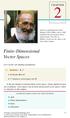 CHAPTER 2 American mathematician Paul Halmos (1916 2006), who in 1942 published the first modern linear algebra book. The title of Halmos s book was the same as the title of this chapter. Finite-Dimensional
1.6. Analyse Optimum Volume and Surface Area. Maximum Volume for a Given Surface Area. Example 1. Solution
 1.6 Analyse Optimum Volume and Surface Area Estimation and oter informal metods of optimizing measures suc as surface area and volume often lead to reasonable solutions suc as te design of te tent in tis
Math Test Sections. The College Board: Expanding College Opportunity
 Taking te SAT I: Reasoning Test Mat Test Sections Te materials in tese files are intended for individual use by students getting ready to take an SAT Program test; permission for any oter use must be sougt
24. The Branch and Bound Method
 24. The Branch and Bound Method It has serious practical consequences if it is known that a combinatorial problem is NP-complete. Then one can conclude according to the present state of science that no
No: 10 04. Bilkent University. Monotonic Extension. Farhad Husseinov. Discussion Papers. Department of Economics
 No: 10 04 Bilkent University Monotonic Extension Farhad Husseinov Discussion Papers Department of Economics The Discussion Papers of the Department of Economics are intended to make the initial results
To motivate the notion of a variogram for a covariance stationary process, { Ys ( ): s R}
 4. Variograms Te covariogram and its normalized form, te correlogram, are by far te most intuitive metods for summarizing te structure of spatial dependencies in a covariance stationary process. However,
How To Ensure That An Eac Edge Program Is Successful
 Introduction Te Economic Diversification and Growt Enterprises Act became effective on 1 January 1995. Te creation of tis Act was to encourage new businesses to start or expand in Newfoundland and Labrador.
Labeling outerplanar graphs with maximum degree three
 Labeling outerplanar graphs with maximum degree three Xiangwen Li 1 and Sanming Zhou 2 1 Department of Mathematics Huazhong Normal University, Wuhan 430079, China 2 Department of Mathematics and Statistics
These axioms must hold for all vectors ū, v, and w in V and all scalars c and d.
 DEFINITION: A vector space is a nonempty set V of objects, called vectors, on which are defined two operations, called addition and multiplication by scalars (real numbers), subject to the following axioms
Haptic Manipulation of Virtual Materials for Medical Application
 Haptic Manipulation of Virtual Materials for Medical Application HIDETOSHI WAKAMATSU, SATORU HONMA Graduate Scool of Healt Care Sciences Tokyo Medical and Dental University, JAPAN [email protected]
Spectral-collocation variational integrators
 Spectral-collocation variational integrators Yiqun Li*, Boying Wu Department of Matematics, Harbin Institute of Tecnology, Harbin 5, PR Cina Melvin Leok Department of Matematics, University of California
Metric Spaces. Chapter 1
 Chapter 1 Metric Spaces Many of the arguments you have seen in several variable calculus are almost identical to the corresponding arguments in one variable calculus, especially arguments concerning convergence
Duality of linear conic problems
 Duality of linear conic problems Alexander Shapiro and Arkadi Nemirovski Abstract It is well known that the optimal values of a linear programming problem and its dual are equal to each other if at least
Class Meeting # 1: Introduction to PDEs
 MATH 18.152 COURSE NOTES - CLASS MEETING # 1 18.152 Introduction to PDEs, Fall 2011 Professor: Jared Speck Class Meeting # 1: Introduction to PDEs 1. What is a PDE? We will be studying functions u = u(x
FIELDS-MITACS Conference. on the Mathematics of Medical Imaging. Photoacoustic and Thermoacoustic Tomography with a variable sound speed
 FIELDS-MITACS Conference on the Mathematics of Medical Imaging Photoacoustic and Thermoacoustic Tomography with a variable sound speed Gunther Uhlmann UC Irvine & University of Washington Toronto, Canada,
Sections 3.1/3.2: Introducing the Derivative/Rules of Differentiation
 Sections 3.1/3.2: Introucing te Derivative/Rules of Differentiation 1 Tangent Line Before looking at te erivative, refer back to Section 2.1, looking at average velocity an instantaneous velocity. Here
Section 6.1 - Inner Products and Norms
 Section 6.1 - Inner Products and Norms Definition. Let V be a vector space over F {R, C}. An inner product on V is a function that assigns, to every ordered pair of vectors x and y in V, a scalar in F,
Numerical Analysis Lecture Notes
 Numerical Analysis Lecture Notes Peter J. Olver 5. Inner Products and Norms The norm of a vector is a measure of its size. Besides the familiar Euclidean norm based on the dot product, there are a number
LINEAR ALGEBRA W W L CHEN
 LINEAR ALGEBRA W W L CHEN c W W L Chen, 1997, 2008 This chapter is available free to all individuals, on understanding that it is not to be used for financial gain, and may be downloaded and/or photocopied,
THE FUNDAMENTAL THEOREM OF ALGEBRA VIA PROPER MAPS
 THE FUNDAMENTAL THEOREM OF ALGEBRA VIA PROPER MAPS KEITH CONRAD 1. Introduction The Fundamental Theorem of Algebra says every nonconstant polynomial with complex coefficients can be factored into linear
Inner Product Spaces
 Math 571 Inner Product Spaces 1. Preliminaries An inner product space is a vector space V along with a function, called an inner product which associates each pair of vectors u, v with a scalar u, v, and
Training Robust Support Vector Regression via D. C. Program
 Journal of Information & Computational Science 7: 12 (2010) 2385 2394 Available at ttp://www.joics.com Training Robust Support Vector Regression via D. C. Program Kuaini Wang, Ping Zong, Yaoong Zao College
Solving partial differential equations (PDEs)
 Solving partial differential equations (PDEs) Hans Fangor Engineering and te Environment University of Soutampton United Kingdom [email protected] May 3, 2012 1 / 47 Outline I 1 Introduction: wat are
MATH 425, PRACTICE FINAL EXAM SOLUTIONS.
 MATH 45, PRACTICE FINAL EXAM SOLUTIONS. Exercise. a Is the operator L defined on smooth functions of x, y by L u := u xx + cosu linear? b Does the answer change if we replace the operator L by the operator
BX in ( u, v) basis in two ways. On the one hand, AN = u+
 1. Let f(x) = 1 x +1. Find f (6) () (the value of the sixth derivative of the function f(x) at zero). Answer: 7. We expand the given function into a Taylor series at the point x = : f(x) = 1 x + x 4 x
December 4, 2013 MATH 171 BASIC LINEAR ALGEBRA B. KITCHENS
 December 4, 2013 MATH 171 BASIC LINEAR ALGEBRA B KITCHENS The equation 1 Lines in two-dimensional space (1) 2x y = 3 describes a line in two-dimensional space The coefficients of x and y in the equation
Understanding Basic Calculus
 Understanding Basic Calculus S.K. Chung Dedicated to all the people who have helped me in my life. i Preface This book is a revised and expanded version of the lecture notes for Basic Calculus and other
3. INNER PRODUCT SPACES
 . INNER PRODUCT SPACES.. Definition So far we have studied abstract vector spaces. These are a generalisation of the geometric spaces R and R. But these have more structure than just that of a vector space.
Random graphs with a given degree sequence
 Sourav Chatterjee (NYU) Persi Diaconis (Stanford) Allan Sly (Microsoft) Let G be an undirected simple graph on n vertices. Let d 1,..., d n be the degrees of the vertices of G arranged in descending order.
Adaptive Online Gradient Descent
 Adaptive Online Gradient Descent Peter L Bartlett Division of Computer Science Department of Statistics UC Berkeley Berkeley, CA 94709 bartlett@csberkeleyedu Elad Hazan IBM Almaden Research Center 650
2.1: The Derivative and the Tangent Line Problem
 .1.1.1: Te Derivative and te Tangent Line Problem Wat is te deinition o a tangent line to a curve? To answer te diiculty in writing a clear deinition o a tangent line, we can deine it as te iting position
A strong credit score can help you score a lower rate on a mortgage
 NET GAIN Scoring points for your financial future AS SEEN IN USA TODAY S MONEY SECTION, JULY 3, 2007 A strong credit score can elp you score a lower rate on a mortgage By Sandra Block Sales of existing