
Lecture 4. Parallel Programming II. Homework & Reading. Page 1. Projects handout On Friday Form teams, groups of two
|
|
|
- Pamela Harvey
- 10 years ago
- Views:
Transcription
1 age Lecture 4 arallel rogramming II Spring 2005 rof. Babak Falsafi write X Memory send X Memory read X Memory Slides developed in part by rofs. Adve, Falsafi, Hill, Lebeck,, Reinhardt, Smith, and Singh of University of Illinois, Carnegie Mellon University, University of Wisconsin, Duke University, University of Michigan,, and rinceton University. Homework & Reading rojects handout On Friday Form teams, groups of two Homework Homework 2 due by Friday Homework 3 will be review questions only Reading Chapter

2 age 2 artitioning for erformance Balance workload reduce time spent at synchronization Reduce communication Reduce extra work determining and managing good assignment These are at odds with each other Data vs. Functional arallelism Data arallelism same ops on different data items Functional (control, task) arallelism pipeline Impact on load balancing? Functional is more difficult longer running tasks

3 age 3 Impact of Task Granularity Granularity = Amount of work associated with task Large tasks worse load balancing lower overhead less contention less communication Small tasks too much synchronization too much management overhead might have too much communication (affinity scheduling) Impact of Concurrency Managing Concurrency load balancing Static Can not adapt to changes Dynamic Can adapt Cost of management increases Self-scheduling (guided self-scheduling) Centralized task queue» contention Distributed task queue» Can steal from other queues» Arch: Name data associated with stolen task
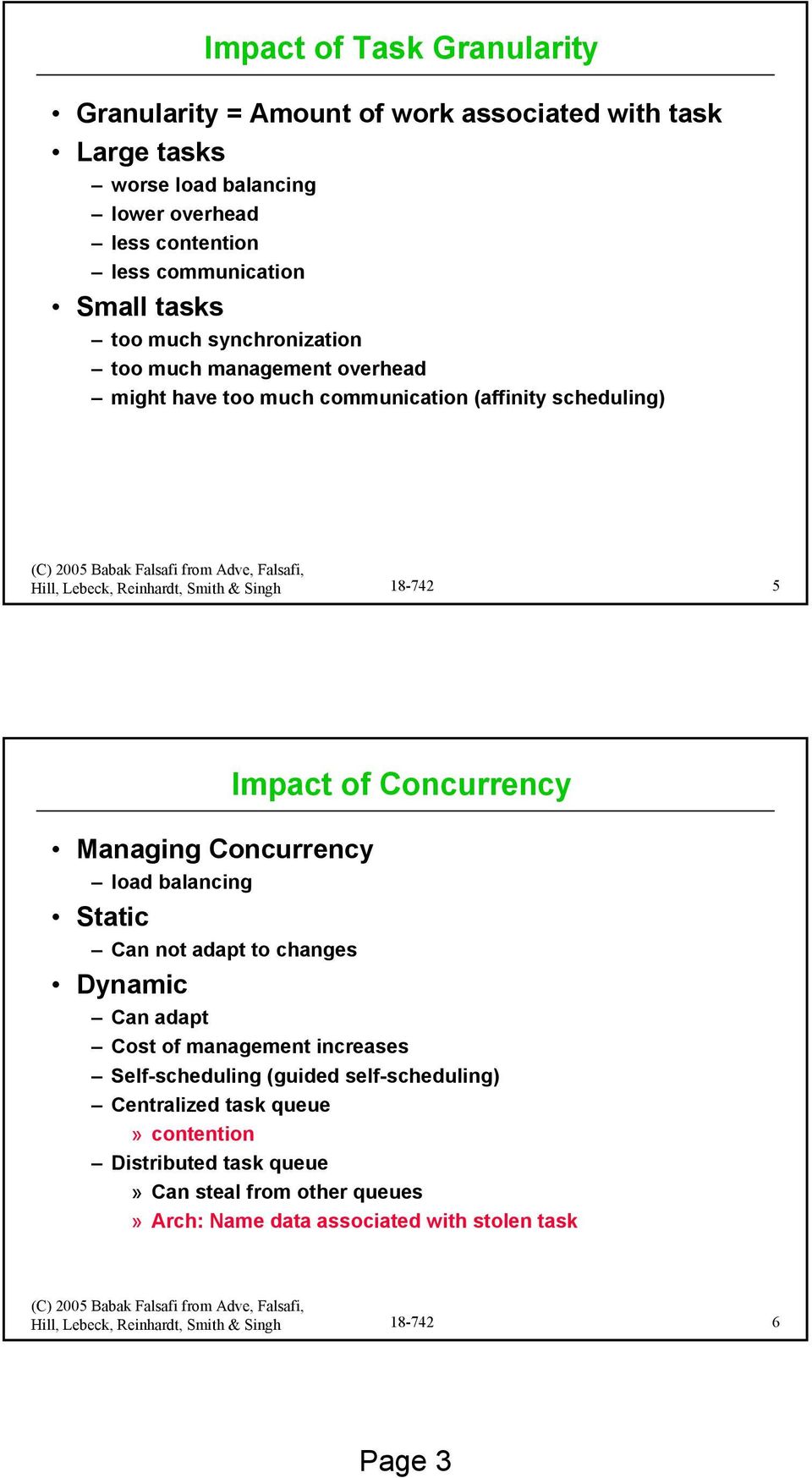
4 age 4 Task Queues copyright 1999 Morgan Kaufmann ublishers, Inc Dynamic Load Balancing copyright 1999 Morgan Kaufmann ublishers, Inc
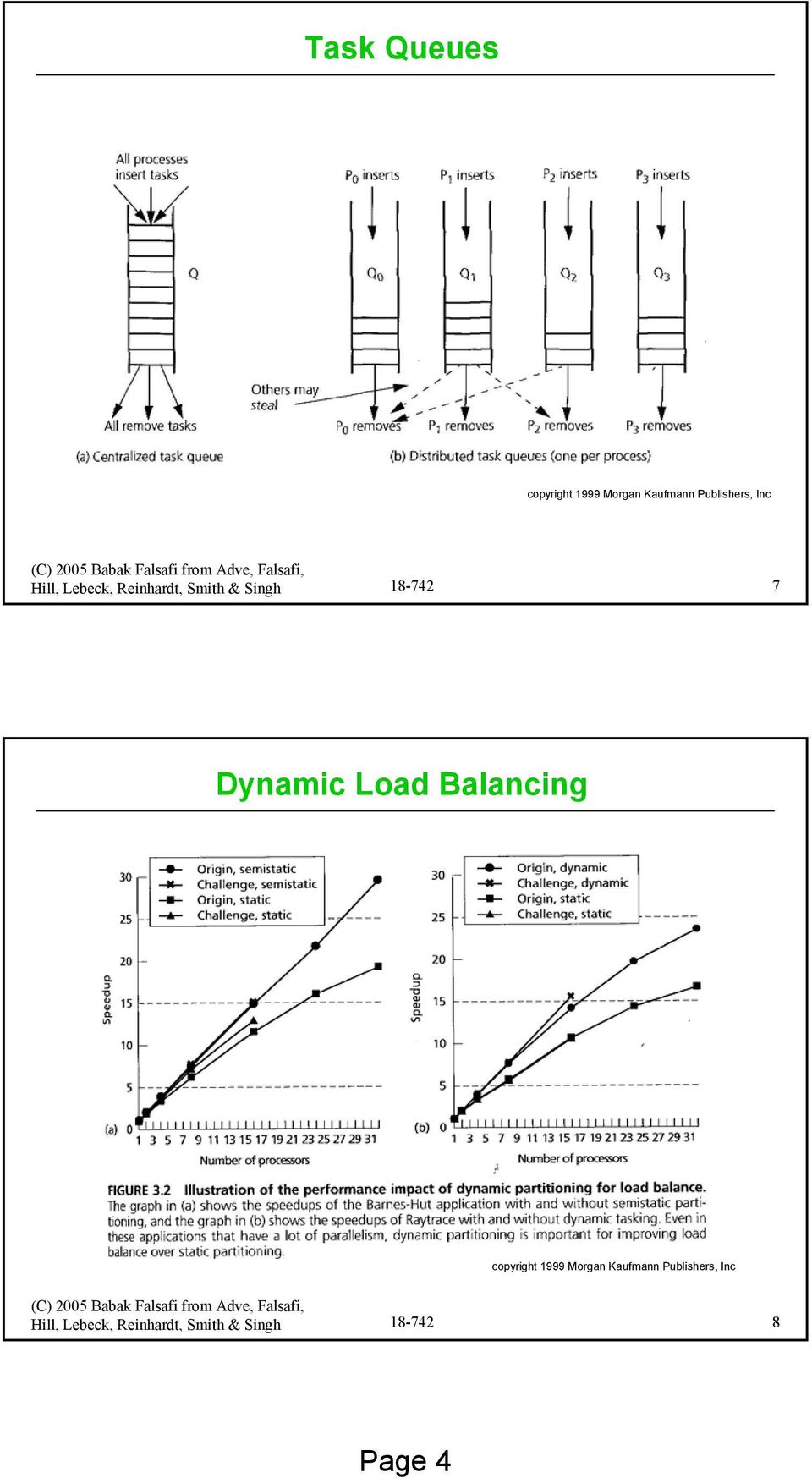
5 age 5 Impact of Synchronization and Serialization Too coarse synchronization barriers instead of point-to-point synch poor load balancing Too many synchronization operations lock each element of array costly operations Coarse grain locking lock entire array serialize access to array Architectural aspects cost of synchronization operation synchronization name space Where Do rograms Spend Time? Sequential erforming real computation Memory system stalls arallel erforming real computation Stalled for local memory Stalled for remote memory (communication) Synchronizing (load imbalance and operations) Overhead Speedup (p) = time(1)/time(p) Amdahl s Law (low concurrency limits speedup) Superlinear speedup possible (how?)
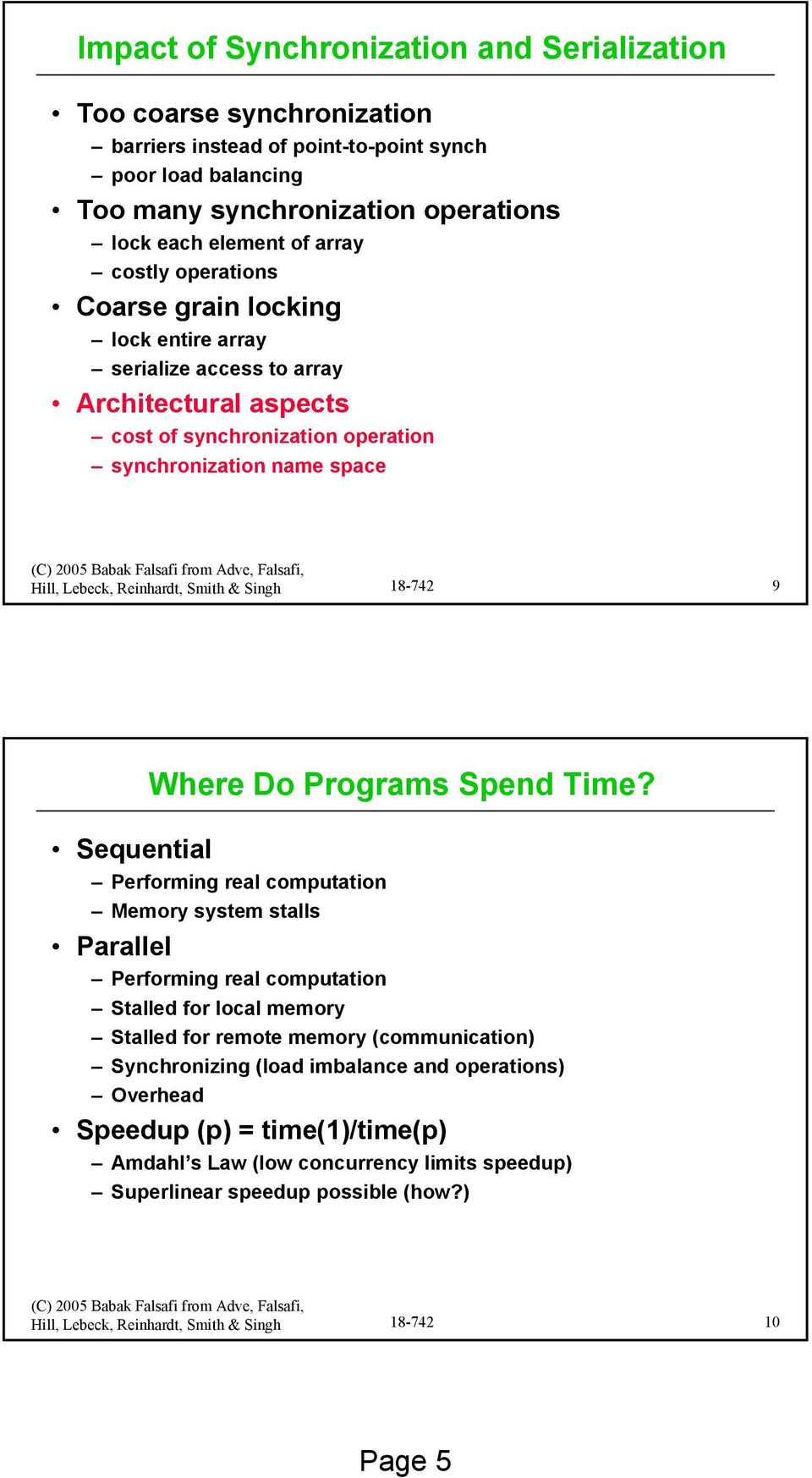
6 age 6 Cache Memory 101 Locality + smaller HW is faster = memory hierarchy Levels: each smaller, faster, more expensive/byte than level below Inclusive: data found in top also found in the bottom Definitions Upper is closer to processor Block: minimum unit of data present or not in upper level Frame: HW (physical) place to put block (same size as block) Address = Block address + block offset address Hit time: time to access upper level, including hit determination 3C Model compulsory, capacity, conflict Add another C: communication misses Multiprocessor as an Extended Mem. Hier. Example: computation: 2 instructions per cycle (IC)» or 500 cycles per 1000 instructions 1 long miss per 1000 instructions» 200 cycles per long miss => 700 cycles per 1000 instructions (40% slowdown) $ $ Node 0 Node 1 Mem CA $ Interconnect Mem $ CA Mem CA Mem CA Node 2 Node
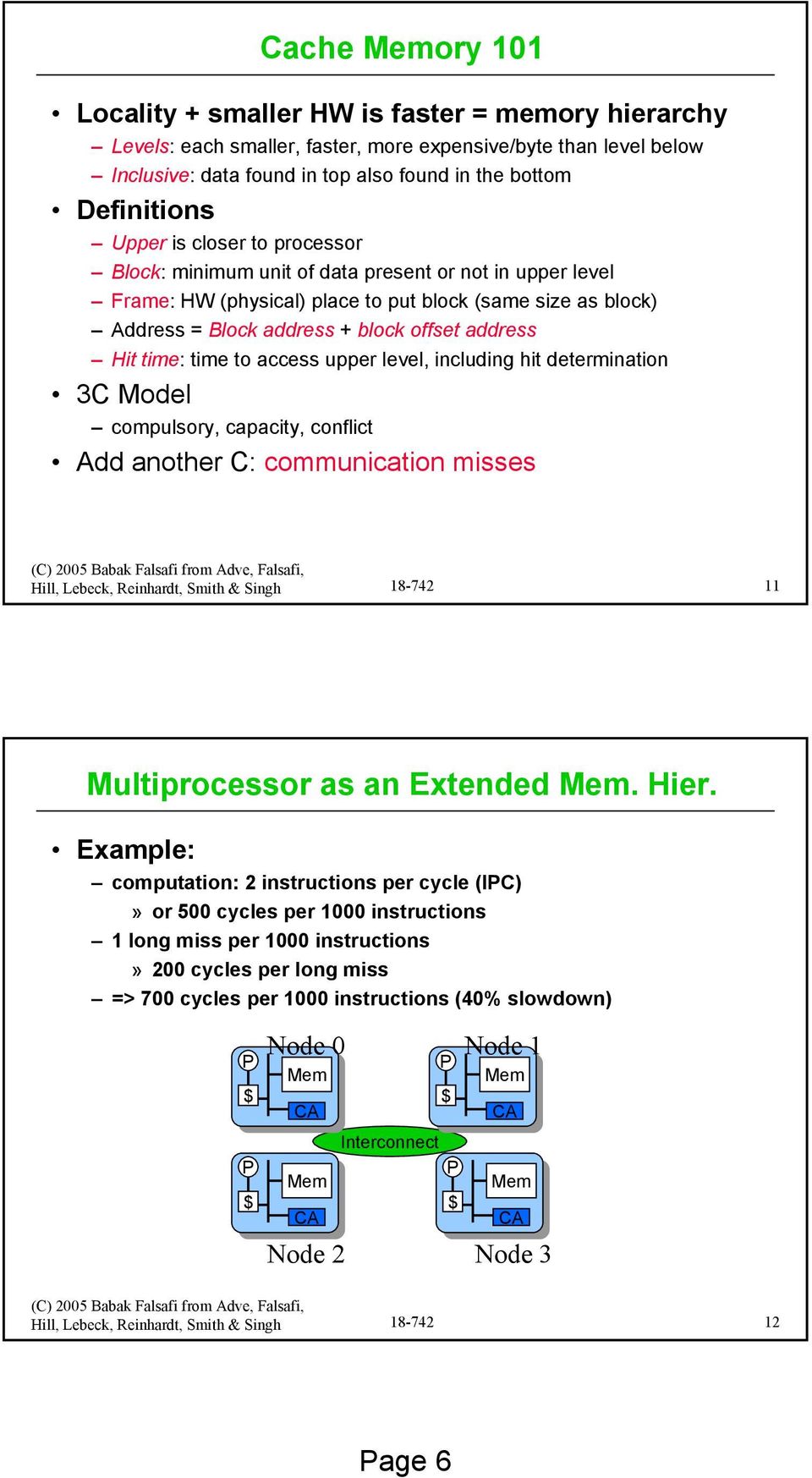
7 age 7 Cache Coherent Shared Memory 1 2 Time Interconnection Network x Main Memory Cache Coherent Shared Memory 1 2 ld r2, x Time Interconnection Network x Main Memory

8 age 8 Cache Coherent Shared Memory 1 2 ld r2, x Time ld r2, x Interconnection Network x Main Memory Cache Coherent Shared Memory 1 2 ld r2, x Time ld r2, x add r1, r2, r4 st x, r1 Interconnection Network x Main Memory

9 age 9 Reorder Computation for Caches Exploit Temporal and Spatial Locality Temporal locality affects replication Touch too much data == capacity misses Computation Blocking Naïve Computation Order Blocked Computation order Reorder Data for Caches: Before Elements on Same age Elements on Same Cache Block

10 age 10 Reorder Data for Caches: With Blocking Elements on Same age Elements on Same Cache Block Scaling: Why is it important? Over time: computer systems become larger and more powerful» more powerful processors» more processors» also range of system sizes within a product family problem sizes become larger» simulate the entire plane rather than the wing required accuracy becomes greater» forecast the weather a week in advance rather than 3 days Scaling: How do algorithms and hardware behave as systems, size, accuracies become greater? Intuitively: erformance should scale linearly with cost

11 age 11 Cost Cost is a function of more than just the processor. Cost is a complex function of many hardware components and software Cost is often not a "smooth" function Often a function of packaging» how many pins on a board» how many processors on a board» how many boards in a chassis (C) 2003 J. E. Smith CS/ECE Aside on Cost-Effective Computing Isn t Speedup() < inefficient? If only throughput matters, use computers instead? But much of a computer s cost is NOT in the processor [Wood & Hill, IEEE Computer 2/95] Let Costup() = Cost()/Cost(1) arallel computing cost-effective: Speedup() > Costup() E.g. for SGI owerchallenge w/ 500MB: Costup(32) =

12 age 12 Fundamental Question: Questions in Scaling What do real users actually do when they get access to larger parallel machines? Constant roblem Size Just add more processors Memory Constrained Scale data size linearly with # of processors Can significantly increase execution time Time Constrained Keep same wall clock time as processors are added Solve largest problem in same amount of time roblem Constrained Scaling User wants to solve same problem, only faster E.g., Video compression & VLSI routing Speedup C (p) = Time(1) Time(p) Assessment Good: easy to do & explain May not be realistic Doesn t work well for much larger machine (c.f., Amdahl s Law)

13 age 13 Time Constrained Scaling Execution time is kept fixed as system scales User has fixed time to use machine or wait for result erformance = Work/Time as usual, and time is fixed, so SpeedupTC(p) = Work(p) Work(1) Assessment Often realistic (e.g., best weather forecast over night) Must understand application to scale meaningfully (would scientist scale grid, time step, error bound, or combination?) Execution time on a single processor can be hard to get (no uniprocessor may have enough memory) Memory Constrained Scaling Scale so memory usage per processor stays fixed Scaled Speedup: Is Time(1) / Time(p)? Speedup MC (p) = Work(p) Time(p) x Time(1) Work(1) Assessment Realistic for memory-constrained programs (e.g., grid size) Can lead to large increases in execution time if work grows faster than linearly in memory usage e.g. matrix factorization» 10,000-by 10,000 matrix takes 800MB and 1 hour on uniprocessor» With 1,000 processors, can run 320K-by-320K matrix» but ideal parallel time grows to 32 hours! = Increase in Work Increase in Time

14 age 14 Scaling Down Scale down to shorten evaluation time on hardware and especially on simulators Scale up issues apply in reverse Must watch out if problem size gets too small Communication dominates computation (e.g., all boundary elements) roblem size gets too small for realistic caches, yielding too many cache hits» Scale caches down considering application working sets» E.g., if a on a realistic problem a realistic cache could hold a matrix row but not whole matrix» Scale cache so it hold only row or scaled problem s matrix The SLASH2 Benchmarks Kernels Complex 1D FFT Blocked LU Factorization Blocked Sparse Cholesky Factorization Integer Radix Sort Applications Barnes-Hut: interaction of bodies Adaptive Fast Multipole (FMM): interaction of bodies Ocean Simulation Hierarchical Radiosity Ray Tracer (Raytrace) Volume Renderer (Volrend) Water Simulation with Spatial Data Structrue (Water-Spatial) Water Simulation without Spatial Data Structure (Water-Nsquared)

32 K. Stride 8 32 128 512 2 K 8 K 32 K 128 K 512 K 2 M
 Evaluating a Real Machine Performance Isolation using Microbenchmarks Choosing Workloads Evaluating a Fixed-size Machine Varying Machine Size Metrics All these issues, plus more, relevant to evaluating
Introduction to Cloud Computing
 Introduction to Cloud Computing Parallel Processing I 15 319, spring 2010 7 th Lecture, Feb 2 nd Majd F. Sakr Lecture Motivation Concurrency and why? Different flavors of parallel computing Get the basic
Chapter 12: Multiprocessor Architectures. Lesson 01: Performance characteristics of Multiprocessor Architectures and Speedup
 Chapter 12: Multiprocessor Architectures Lesson 01: Performance characteristics of Multiprocessor Architectures and Speedup Objective Be familiar with basic multiprocessor architectures and be able to
Parallel Scalable Algorithms- Performance Parameters
 www.bsc.es Parallel Scalable Algorithms- Performance Parameters Vassil Alexandrov, ICREA - Barcelona Supercomputing Center, Spain Overview Sources of Overhead in Parallel Programs Performance Metrics for
Control 2004, University of Bath, UK, September 2004
 Control, University of Bath, UK, September ID- IMPACT OF DEPENDENCY AND LOAD BALANCING IN MULTITHREADING REAL-TIME CONTROL ALGORITHMS M A Hossain and M O Tokhi Department of Computing, The University of
Parallel Computing. Benson Muite. [email protected] http://math.ut.ee/ benson. https://courses.cs.ut.ee/2014/paralleel/fall/main/homepage
 Parallel Computing Benson Muite [email protected] http://math.ut.ee/ benson https://courses.cs.ut.ee/2014/paralleel/fall/main/homepage 3 November 2014 Hadoop, Review Hadoop Hadoop History Hadoop Framework
Multiprocessor Scheduling and Scheduling in Linux Kernel 2.6
 Multiprocessor Scheduling and Scheduling in Linux Kernel 2.6 Winter Term 2008 / 2009 Jun.-Prof. Dr. André Brinkmann [email protected] Universität Paderborn PC² Agenda Multiprocessor and
Designing and Building Applications for Extreme Scale Systems CS598 William Gropp www.cs.illinois.edu/~wgropp
 Designing and Building Applications for Extreme Scale Systems CS598 William Gropp www.cs.illinois.edu/~wgropp Welcome! Who am I? William (Bill) Gropp Professor of Computer Science One of the Creators of
Parallelism and Cloud Computing
 Parallelism and Cloud Computing Kai Shen Parallel Computing Parallel computing: Process sub tasks simultaneously so that work can be completed faster. For instances: divide the work of matrix multiplication
Parallel Algorithm Engineering
 Parallel Algorithm Engineering Kenneth S. Bøgh PhD Fellow Based on slides by Darius Sidlauskas Outline Background Current multicore architectures UMA vs NUMA The openmp framework Examples Software crisis
Performance Metrics and Scalability Analysis. Performance Metrics and Scalability Analysis
 Performance Metrics and Scalability Analysis 1 Performance Metrics and Scalability Analysis Lecture Outline Following Topics will be discussed Requirements in performance and cost Performance metrics Work
Scheduling Task Parallelism" on Multi-Socket Multicore Systems"
 Scheduling Task Parallelism" on Multi-Socket Multicore Systems" Stephen Olivier, UNC Chapel Hill Allan Porterfield, RENCI Kyle Wheeler, Sandia National Labs Jan Prins, UNC Chapel Hill Outline" Introduction
Multi-GPU Load Balancing for Simulation and Rendering
 Multi- Load Balancing for Simulation and Rendering Yong Cao Computer Science Department, Virginia Tech, USA In-situ ualization and ual Analytics Instant visualization and interaction of computing tasks
Multi-core architectures. Jernej Barbic 15-213, Spring 2007 May 3, 2007
 Multi-core architectures Jernej Barbic 15-213, Spring 2007 May 3, 2007 1 Single-core computer 2 Single-core CPU chip the single core 3 Multi-core architectures This lecture is about a new trend in computer
Performance Evaluation of 2D-Mesh, Ring, and Crossbar Interconnects for Chip Multi- Processors. NoCArc 09
 Performance Evaluation of 2D-Mesh, Ring, and Crossbar Interconnects for Chip Multi- Processors NoCArc 09 Jesús Camacho Villanueva, José Flich, José Duato Universidad Politécnica de Valencia December 12,
COMPUTER ORGANIZATION ARCHITECTURES FOR EMBEDDED COMPUTING
 COMPUTER ORGANIZATION ARCHITECTURES FOR EMBEDDED COMPUTING 2013/2014 1 st Semester Sample Exam January 2014 Duration: 2h00 - No extra material allowed. This includes notes, scratch paper, calculator, etc.
Overlapping Data Transfer With Application Execution on Clusters
 Overlapping Data Transfer With Application Execution on Clusters Karen L. Reid and Michael Stumm [email protected] [email protected] Department of Computer Science Department of Electrical and Computer
A Lab Course on Computer Architecture
 A Lab Course on Computer Architecture Pedro López José Duato Depto. de Informática de Sistemas y Computadores Facultad de Informática Universidad Politécnica de Valencia Camino de Vera s/n, 46071 - Valencia,
Performance metrics for parallel systems
 Performance metrics for parallel systems S.S. Kadam C-DAC, Pune [email protected] C-DAC/SECG/2006 1 Purpose To determine best parallel algorithm Evaluate hardware platforms Examine the benefits from parallelism
MPI and Hybrid Programming Models. William Gropp www.cs.illinois.edu/~wgropp
 MPI and Hybrid Programming Models William Gropp www.cs.illinois.edu/~wgropp 2 What is a Hybrid Model? Combination of several parallel programming models in the same program May be mixed in the same source
CHAPTER 1 INTRODUCTION
 1 CHAPTER 1 INTRODUCTION 1.1 MOTIVATION OF RESEARCH Multicore processors have two or more execution cores (processors) implemented on a single chip having their own set of execution and architectural recourses.
CS 575 Parallel Processing
 CS 575 Parallel Processing Lecture one: Introduction Wim Bohm Colorado State University Except as otherwise noted, the content of this presentation is licensed under the Creative Commons Attribution 2.5
A Comparison of Task Pools for Dynamic Load Balancing of Irregular Algorithms
 A Comparison of Task Pools for Dynamic Load Balancing of Irregular Algorithms Matthias Korch Thomas Rauber Universität Bayreuth Fakultät für Mathematik, Physik und Informatik Fachgruppe Informatik {matthias.korch,
Power-Aware High-Performance Scientific Computing
 Power-Aware High-Performance Scientific Computing Padma Raghavan Scalable Computing Laboratory Department of Computer Science Engineering The Pennsylvania State University http://www.cse.psu.edu/~raghavan
Synchronization. Todd C. Mowry CS 740 November 24, 1998. Topics. Locks Barriers
 Synchronization Todd C. Mowry CS 740 November 24, 1998 Topics Locks Barriers Types of Synchronization Mutual Exclusion Locks Event Synchronization Global or group-based (barriers) Point-to-point tightly
Benchmarking Hadoop & HBase on Violin
 Technical White Paper Report Technical Report Benchmarking Hadoop & HBase on Violin Harnessing Big Data Analytics at the Speed of Memory Version 1.0 Abstract The purpose of benchmarking is to show advantages
Load Balancing on a Non-dedicated Heterogeneous Network of Workstations
 Load Balancing on a Non-dedicated Heterogeneous Network of Workstations Dr. Maurice Eggen Nathan Franklin Department of Computer Science Trinity University San Antonio, Texas 78212 Dr. Roger Eggen Department
Multilevel Load Balancing in NUMA Computers
 FACULDADE DE INFORMÁTICA PUCRS - Brazil http://www.pucrs.br/inf/pos/ Multilevel Load Balancing in NUMA Computers M. Corrêa, R. Chanin, A. Sales, R. Scheer, A. Zorzo Technical Report Series Number 049 July,
Performance Characteristics of Large SMP Machines
 Performance Characteristics of Large SMP Machines Dirk Schmidl, Dieter an Mey, Matthias S. Müller [email protected] Rechen- und Kommunikationszentrum (RZ) Agenda Investigated Hardware Kernel Benchmark
E6895 Advanced Big Data Analytics Lecture 14:! NVIDIA GPU Examples and GPU on ios devices
 E6895 Advanced Big Data Analytics Lecture 14: NVIDIA GPU Examples and GPU on ios devices Ching-Yung Lin, Ph.D. Adjunct Professor, Dept. of Electrical Engineering and Computer Science IBM Chief Scientist,
Outline. Introduction. Multiprocessor Systems on Chip. A MPSoC Example: Nexperia DVP. A New Paradigm: Network on Chip
 Outline Modeling, simulation and optimization of Multi-Processor SoCs (MPSoCs) Università of Verona Dipartimento di Informatica MPSoCs: Multi-Processor Systems on Chip A simulation platform for a MPSoC
Performance evaluation
 Performance evaluation Arquitecturas Avanzadas de Computadores - 2547021 Departamento de Ingeniería Electrónica y de Telecomunicaciones Facultad de Ingeniería 2015-1 Bibliography and evaluation Bibliography
Load Imbalance Analysis
 With CrayPat Load Imbalance Analysis Imbalance time is a metric based on execution time and is dependent on the type of activity: User functions Imbalance time = Maximum time Average time Synchronization
High Performance Computer Architecture
 High Performance Computer Architecture Volker Lindenstruth Lehrstuhl für Hochleistungsrechner Archittektur Ruth-Moufang Str. 1 email: [email protected] URL: www.compeng.de Telefon: 798-44100 Volker Lindenstruth
Achieving Nanosecond Latency Between Applications with IPC Shared Memory Messaging
 Achieving Nanosecond Latency Between Applications with IPC Shared Memory Messaging In some markets and scenarios where competitive advantage is all about speed, speed is measured in micro- and even nano-seconds.
Architecture Support for Big Data Analytics
 Architecture Support for Big Data Analytics Ahsan Javed Awan EMJD-DC (KTH-UPC) (http://uk.linkedin.com/in/ahsanjavedawan/) Supervisors: Mats Brorsson(KTH), Eduard Ayguade(UPC), Vladimir Vlassov(KTH) 1
FPGA-based Multithreading for In-Memory Hash Joins
 FPGA-based Multithreading for In-Memory Hash Joins Robert J. Halstead, Ildar Absalyamov, Walid A. Najjar, Vassilis J. Tsotras University of California, Riverside Outline Background What are FPGAs Multithreaded
Making Multicore Work and Measuring its Benefits. Markus Levy, president EEMBC and Multicore Association
 Making Multicore Work and Measuring its Benefits Markus Levy, president EEMBC and Multicore Association Agenda Why Multicore? Standards and issues in the multicore community What is Multicore Association?
Hardware-Aware Analysis and. Presentation Date: Sep 15 th 2009 Chrissie C. Cui
 Hardware-Aware Analysis and Optimization of Stable Fluids Presentation Date: Sep 15 th 2009 Chrissie C. Cui Outline Introduction Highlights Flop and Bandwidth Analysis Mehrstellen Schemes Advection Caching
PART IV Performance oriented design, Performance testing, Performance tuning & Performance solutions. Outline. Performance oriented design
 PART IV Performance oriented design, Performance testing, Performance tuning & Performance solutions Slide 1 Outline Principles for performance oriented design Performance testing Performance tuning General
This Unit: Multithreading (MT) CIS 501 Computer Architecture. Performance And Utilization. Readings
 This Unit: Multithreading (MT) CIS 501 Computer Architecture Unit 10: Hardware Multithreading Application OS Compiler Firmware CU I/O Memory Digital Circuits Gates & Transistors Why multithreading (MT)?
Lecture 2 Parallel Programming Platforms
 Lecture 2 Parallel Programming Platforms Flynn s Taxonomy In 1966, Michael Flynn classified systems according to numbers of instruction streams and the number of data stream. Data stream Single Multiple
The Quest for Speed - Memory. Cache Memory. A Solution: Memory Hierarchy. Memory Hierarchy
 The Quest for Speed - Memory Cache Memory CSE 4, Spring 25 Computer Systems http://www.cs.washington.edu/4 If all memory accesses (IF/lw/sw) accessed main memory, programs would run 20 times slower And
Advances in Virtualization In Support of In-Memory Big Data Applications
 9/29/15 HPTS 2015 1 Advances in Virtualization In Support of In-Memory Big Data Applications SCALE SIMPLIFY OPTIMIZE EVOLVE Ike Nassi [email protected] 9/29/15 HPTS 2015 2 What is the Problem We
Tableau Server Scalability Explained
 Tableau Server Scalability Explained Author: Neelesh Kamkolkar Tableau Software July 2013 p2 Executive Summary In March 2013, we ran scalability tests to understand the scalability of Tableau 8.0. We wanted
Solution: start more than one instruction in the same clock cycle CPI < 1 (or IPC > 1, Instructions per Cycle) Two approaches:
 Multiple-Issue Processors Pipelining can achieve CPI close to 1 Mechanisms for handling hazards Static or dynamic scheduling Static or dynamic branch handling Increase in transistor counts (Moore s Law):
Cache Conscious Programming in Undergraduate Computer Science
 Appears in ACM SIGCSE Technical Symposium on Computer Science Education (SIGCSE 99), Copyright ACM, Cache Conscious Programming in Undergraduate Computer Science Alvin R. Lebeck Department of Computer
Next Generation GPU Architecture Code-named Fermi
 Next Generation GPU Architecture Code-named Fermi The Soul of a Supercomputer in the Body of a GPU Why is NVIDIA at Super Computing? Graphics is a throughput problem paint every pixel within frame time
Agenda. Enterprise Application Performance Factors. Current form of Enterprise Applications. Factors to Application Performance.
 Agenda Enterprise Performance Factors Overall Enterprise Performance Factors Best Practice for generic Enterprise Best Practice for 3-tiers Enterprise Hardware Load Balancer Basic Unix Tuning Performance
HETEROGENEOUS SYSTEM COHERENCE FOR INTEGRATED CPU-GPU SYSTEMS
 HETEROGENEOUS SYSTEM COHERENCE FOR INTEGRATED CPU-GPU SYSTEMS JASON POWER*, ARKAPRAVA BASU*, JUNLI GU, SOORAJ PUTHOOR, BRADFORD M BECKMANN, MARK D HILL*, STEVEN K REINHARDT, DAVID A WOOD* *University of
Distributed Operating Systems
 Distributed Operating Systems Prashant Shenoy UMass Computer Science http://lass.cs.umass.edu/~shenoy/courses/677 Lecture 1, page 1 Course Syllabus CMPSCI 677: Distributed Operating Systems Instructor:
Distributed communication-aware load balancing with TreeMatch in Charm++
 Distributed communication-aware load balancing with TreeMatch in Charm++ The 9th Scheduling for Large Scale Systems Workshop, Lyon, France Emmanuel Jeannot Guillaume Mercier Francois Tessier In collaboration
Binary search tree with SIMD bandwidth optimization using SSE
 Binary search tree with SIMD bandwidth optimization using SSE Bowen Zhang, Xinwei Li 1.ABSTRACT In-memory tree structured index search is a fundamental database operation. Modern processors provide tremendous
Pipelining Review and Its Limitations
 Pipelining Review and Its Limitations Yuri Baida [email protected] [email protected] October 16, 2010 Moscow Institute of Physics and Technology Agenda Review Instruction set architecture Basic
Operatin g Systems: Internals and Design Principle s. Chapter 10 Multiprocessor and Real-Time Scheduling Seventh Edition By William Stallings
 Operatin g Systems: Internals and Design Principle s Chapter 10 Multiprocessor and Real-Time Scheduling Seventh Edition By William Stallings Operating Systems: Internals and Design Principles Bear in mind,
Parallel Computing 37 (2011) 26 41. Contents lists available at ScienceDirect. Parallel Computing. journal homepage: www.elsevier.
 Parallel Computing 37 (2011) 26 41 Contents lists available at ScienceDirect Parallel Computing journal homepage: www.elsevier.com/locate/parco Architectural support for thread communications in multi-core
Load Balancing on a Grid Using Data Characteristics
 Load Balancing on a Grid Using Data Characteristics Jonathan White and Dale R. Thompson Computer Science and Computer Engineering Department University of Arkansas Fayetteville, AR 72701, USA {jlw09, drt}@uark.edu
In-Memory Databases Algorithms and Data Structures on Modern Hardware. Martin Faust David Schwalb Jens Krüger Jürgen Müller
 In-Memory Databases Algorithms and Data Structures on Modern Hardware Martin Faust David Schwalb Jens Krüger Jürgen Müller The Free Lunch Is Over 2 Number of transistors per CPU increases Clock frequency
CMSC 611: Advanced Computer Architecture
 CMSC 611: Advanced Computer Architecture Parallel Computation Most slides adapted from David Patterson. Some from Mohomed Younis Parallel Computers Definition: A parallel computer is a collection of processing
Program Optimization for Multi-core Architectures
 Program Optimization for Multi-core Architectures Sanjeev K Aggarwal ([email protected]) M Chaudhuri ([email protected]) R Moona ([email protected]) Department of Computer Science and Engineering, IIT Kanpur
GEDAE TM - A Graphical Programming and Autocode Generation Tool for Signal Processor Applications
 GEDAE TM - A Graphical Programming and Autocode Generation Tool for Signal Processor Applications Harris Z. Zebrowitz Lockheed Martin Advanced Technology Laboratories 1 Federal Street Camden, NJ 08102
Petascale Software Challenges. Piyush Chaudhary [email protected] High Performance Computing
 Petascale Software Challenges Piyush Chaudhary [email protected] High Performance Computing Fundamental Observations Applications are struggling to realize growth in sustained performance at scale Reasons
Stream Processing on GPUs Using Distributed Multimedia Middleware
 Stream Processing on GPUs Using Distributed Multimedia Middleware Michael Repplinger 1,2, and Philipp Slusallek 1,2 1 Computer Graphics Lab, Saarland University, Saarbrücken, Germany 2 German Research
Vorlesung Rechnerarchitektur 2 Seite 178 DASH
 Vorlesung Rechnerarchitektur 2 Seite 178 Architecture for Shared () The -architecture is a cache coherent, NUMA multiprocessor system, developed at CSL-Stanford by John Hennessy, Daniel Lenoski, Monica
IMCM: A Flexible Fine-Grained Adaptive Framework for Parallel Mobile Hybrid Cloud Applications
 Open System Laboratory of University of Illinois at Urbana Champaign presents: Outline: IMCM: A Flexible Fine-Grained Adaptive Framework for Parallel Mobile Hybrid Cloud Applications A Fine-Grained Adaptive
Cellular Computing on a Linux Cluster
 Cellular Computing on a Linux Cluster Alexei Agueev, Bernd Däne, Wolfgang Fengler TU Ilmenau, Department of Computer Architecture Topics 1. Cellular Computing 2. The Experiment 3. Experimental Results
PARSEC vs. SPLASH 2: A Quantitative Comparison of Two Multithreaded Benchmark Suites on Chip Multiprocessors
 PARSEC vs. SPLASH 2: A Quantitative Comparison of Two Multithreaded Benchmark Suites on Chip Multiprocessors ChristianBienia,SanjeevKumar andkaili DepartmentofComputerScience,PrincetonUniversity MicroprocessorTechnologyLabs,Intel
Performance Monitoring of Parallel Scientific Applications
 Performance Monitoring of Parallel Scientific Applications Abstract. David Skinner National Energy Research Scientific Computing Center Lawrence Berkeley National Laboratory This paper introduces an infrastructure
COMP 422, Lecture 3: Physical Organization & Communication Costs in Parallel Machines (Sections 2.4 & 2.5 of textbook)
 COMP 422, Lecture 3: Physical Organization & Communication Costs in Parallel Machines (Sections 2.4 & 2.5 of textbook) Vivek Sarkar Department of Computer Science Rice University [email protected] COMP
Operating Systems. Virtual Memory
 Operating Systems Virtual Memory Virtual Memory Topics. Memory Hierarchy. Why Virtual Memory. Virtual Memory Issues. Virtual Memory Solutions. Locality of Reference. Virtual Memory with Segmentation. Page
Reconfigurable Architecture Requirements for Co-Designed Virtual Machines
 Reconfigurable Architecture Requirements for Co-Designed Virtual Machines Kenneth B. Kent University of New Brunswick Faculty of Computer Science Fredericton, New Brunswick, Canada [email protected] Micaela Serra
Characterizing the Performance of Dynamic Distribution and Load-Balancing Techniques for Adaptive Grid Hierarchies
 Proceedings of the IASTED International Conference Parallel and Distributed Computing and Systems November 3-6, 1999 in Cambridge Massachusetts, USA Characterizing the Performance of Dynamic Distribution
Parallel Compression and Decompression of DNA Sequence Reads in FASTQ Format
 , pp.91-100 http://dx.doi.org/10.14257/ijhit.2014.7.4.09 Parallel Compression and Decompression of DNA Sequence Reads in FASTQ Format Jingjing Zheng 1,* and Ting Wang 1, 2 1,* Parallel Software and Computational
Exploiting Transparent Remote Memory Access for Non-Contiguous- and One-Sided-Communication
 Workshop for Communication Architecture in Clusters, IPDPS 2002: Exploiting Transparent Remote Memory Access for Non-Contiguous- and One-Sided-Communication Joachim Worringen, Andreas Gäer, Frank Reker
Computer Architecture TDTS10
 why parallelism? Performance gain from increasing clock frequency is no longer an option. Outline Computer Architecture TDTS10 Superscalar Processors Very Long Instruction Word Processors Parallel computers
10.04.2008. Thomas Fahrig Senior Developer Hypervisor Team. Hypervisor Architecture Terminology Goals Basics Details
 Thomas Fahrig Senior Developer Hypervisor Team Hypervisor Architecture Terminology Goals Basics Details Scheduling Interval External Interrupt Handling Reserves, Weights and Caps Context Switch Waiting
Deciding which process to run. (Deciding which thread to run) Deciding how long the chosen process can run
 SFWR ENG 3BB4 Software Design 3 Concurrent System Design 2 SFWR ENG 3BB4 Software Design 3 Concurrent System Design 11.8 10 CPU Scheduling Chapter 11 CPU Scheduling Policies Deciding which process to run
Datacenter Operating Systems
 Datacenter Operating Systems CSE451 Simon Peter With thanks to Timothy Roscoe (ETH Zurich) Autumn 2015 This Lecture What s a datacenter Why datacenters Types of datacenters Hyperscale datacenters Major
LOAD BALANCING DISTRIBUTED OPERATING SYSTEMS, SCALABILITY, SS 2015. Hermann Härtig
 LOAD BALANCING DISTRIBUTED OPERATING SYSTEMS, SCALABILITY, SS 2015 Hermann Härtig ISSUES starting points independent Unix processes and block synchronous execution who does it load migration mechanism
OpenCL Optimization. San Jose 10/2/2009 Peng Wang, NVIDIA
 OpenCL Optimization San Jose 10/2/2009 Peng Wang, NVIDIA Outline Overview The CUDA architecture Memory optimization Execution configuration optimization Instruction optimization Summary Overall Optimization
COSC 6374 Parallel Computation. Parallel I/O (I) I/O basics. Concept of a clusters
 COSC 6374 Parallel I/O (I) I/O basics Fall 2012 Concept of a clusters Processor 1 local disks Compute node message passing network administrative network Memory Processor 2 Network card 1 Network card
Hardware design for ray tracing
 Hardware design for ray tracing Jae-sung Yoon Introduction Realtime ray tracing performance has recently been achieved even on single CPU. [Wald et al. 2001, 2002, 2004] However, higher resolutions, complex
Dynamic Load Balancing in a Network of Workstations
 Dynamic Load Balancing in a Network of Workstations 95.515F Research Report By: Shahzad Malik (219762) November 29, 2000 Table of Contents 1 Introduction 3 2 Load Balancing 4 2.1 Static Load Balancing
Course Development of Programming for General-Purpose Multicore Processors
 Course Development of Programming for General-Purpose Multicore Processors Wei Zhang Department of Electrical and Computer Engineering Virginia Commonwealth University Richmond, VA 23284 [email protected]
System Interconnect Architectures. Goals and Analysis. Network Properties and Routing. Terminology - 2. Terminology - 1
 System Interconnect Architectures CSCI 8150 Advanced Computer Architecture Hwang, Chapter 2 Program and Network Properties 2.4 System Interconnect Architectures Direct networks for static connections Indirect
Parallel Ray Tracing using MPI: A Dynamic Load-balancing Approach
 Parallel Ray Tracing using MPI: A Dynamic Load-balancing Approach S. M. Ashraful Kadir 1 and Tazrian Khan 2 1 Scientific Computing, Royal Institute of Technology (KTH), Stockholm, Sweden [email protected],
Tableau Server 7.0 scalability
 Tableau Server 7.0 scalability February 2012 p2 Executive summary In January 2012, we performed scalability tests on Tableau Server to help our customers plan for large deployments. We tested three different