
Curriculum Overview Standards & Skills
|
|
|
- Adam Shanon Harmon
- 10 years ago
- Views:
Transcription
1 Curriculum Overview Standards & Skills You CAN Do The Rubik's Cube Instructional Curriculum

2 Curriculum Overview / Skills & Standards How to Solve The Rubik's Cube Part 1 - Curriculum Overview Part 2 - Skills & Standards Contents: Part 1 - Overview...1 Part 2 - Standards & Skills...6 Common Core by Grade...6 National Math Standards and Expectations st Century Learning...17 Published by: Seven Towns, Ltd 7 Lambton Place London W11 2SH England Copyright 2011 by Seven Towns, Ltd., London, England Rubik's is a registered trademark of Seven Towns, Ltd., London, England About the Author: Amber Baur has been an educator and math coach in Southern California since She is a certified GATE teacher with a Master of Education in Cross-Cultural Teaching and currently works as an Educational Consultant, speaking at conferences and hosting trainings on differentiation with "Depth & Complexity" and related mathematical practices. She has served as President of Orange County Math Council (OCMC) and is editor of the OCMC Newsletter. Acknowledgments: The "How to Solve the Rubik's Cube" lesson plans are intended as a comprehensive instructional guide for teachers and educators based on the You CAN Do The Rubik's Cube solution guide. We wish to thank all our friends in the Rubik's community for their support and inspiration.

3 Curriculum Overview Overview Each lesson has a brief one sentence overview of the focus of the lesson. The You CAN Do the Rubik's Cube Instructional Curriculum can be taught over the course of 6, 7, 8, 9 or 10 weeks. For the 6 week course: Week 1: Lesson 1 Week 2: Lessons 2 & 3 Week 3: Lesson 4 Week 4: Lessons 5 & 6 Week 5: Lessons 7 & 8 Week 6: Review Lesson CD ROM Included on the Inside Front Cover of this booklet is a CD-ROM containing a digital copy of the complete You CAN Do The Rubik's Cube Instructional Curriculum including each PowerPoint presentation and appendices for easy printing. Materials Curriculum Overview For the 7 week course: Week 1: Lesson 1 Part A Week 2: Lesson 1 Part B Week 3: Lessons 2 & 3 Week 4: Lesson 4 Week 5: Lessons 5 & 6 Week 6: Lesson 7 & 8 Week 7: Review Lesson Note: The 7-week course can be designed by using any variation of separating and/or combining double lessons. For the 8 week course: Note: The 8-week course can be designed by using the 7-week course and separating another double lesson. For the 9 week course: Note: The 9-week course can be designed by using the 7-week course and separating two other double lessons. For the 10 week course: Week 1: Lesson 1 Part A Week 2: Lesson 1 Part B Week 3: Lesson 2 Week 4: Lesson 3 Week 5: Lesson 4 Week 6: Lesson 5 Week 7: Lesson 6 Week 8: Lesson 7 Week 9: Lesson 8 Week 10: Review Lesson 1

4 Curriculum Overview Curriculum Overview Objectives Each lesson has three objectives, based on Bloom s Taxonomy. The objectives include the information taught in the Lesson Extensions. Solution Guide Each lesson coordinates with a STAGE from the You CAN Do The Cube Solution Guide. This section notes the stage. The explanation of steps to achieve each stage, while adopted from the Solution Guide, are sometimes adjusted to meet the needs for whole class instruction. Standards & Skills: Each lesson has been cross-referenced with the Common Core Standards, National Expectations, and the Framework for 21st Century Learning. The list of standards and skills by grade level are listed on the first page of each booklet. Complete details regarding all standards begins on page 5 of this booklet. Goal This section of the lesson shows a cube image of the end goal of the lesson. Gray Boxes Some lessons contain gray boxes with instructions for combining lessons. If you wish to combine certain lesson together, follow instructions in the gray boxes. Whole Class Lesson Lesson Vocabulary The Lesson Vocabulary pertains to the cube and some mathematical terms necessary to understand the instructions to solve the Rubik's Cube. Lesson Focus This section of each lesson contains the instructions for achieving the goal of that lesson. In the Lesson Focus, there are specific teacher instructions, such as; Ask, Tell, Say, Check, Explain, Show. For example: Tell students: These instructions are meant to guide your dialogue during lessons in order to give more direct and accurate instructions based on how students learn overall. 2 At the end of each Lesson Focus, the GOAL is noted by text and picture.

5 Curriculum Overview Differentiation Leveled Group Activities Each lesson contains activities for differentiation, should you decide to expand the scope of your lesson to leveled instructions and group work. Selecting an activity (or group) for each student can vary from week to week. Below are the descriptions of each group. The activities for these groups, with the exception of M-Modify, are designed to be done mostly on their own, though some groups may need teacher assistance. The purpose of grouping for differentiation is to allow the teacher to move freely from small group to small group to enable more one-on-one attention. Suggested group size: no more than 4-6 students per group. With 4-6 students per group, a class may be comprised of several A or T groups. Curriculum Overview Special Note: English Learners may fall into any of the four MATH groups based on their understanding. The handouts with graphics will assist in helping the EL students communicate and understand the lesson. M Modify the lesson for understanding This group level is designed for students who have special learning needs or need consistent one-on-one assistance. This group may or may not have activities that will promote achieving the end of lesson goal. The activities will always incorporate the cube and steps toward becoming familiar, manipulating, and/or solving the cube. A Apply the lesson to repeated practice This group level is designed for students who are at-level with respect to solving the cube. These students may or may not be at-level mathematically. Each lesson will have pre-requisite instructions for selecting students for this group. This group will focus on repeated practice of the lesson instructions. T Re-Teach the lesson for mastery This group level is designed for students who need extra help understanding and following the lesson instructions. This group will focus on the lesson instructions at a slower pace and/or with teacher assistance. H Higher level learning for enrichment This group level is designed for students who have mastered the lesson instructions and, without moving ahead of the class, are ready for more difficult activities. This group should be able to work without teacher assistance. Differentiation Appendices Each MATH Group differentiation activity is marked by MATH Group and Lesson number. For example, the activity for the H group in lesson one is marked: Appendix 1.H. 3

6 Curriculum Overview Review Curriculum Overview Each lesson has condensed lesson instructions for a quick review at the end of a session. Lesson Extension This section relates the lesson instructions for solving the Rubik's Cube to a mathematical concept at various elementary grade levels. Depending upon the purpose of your "How To Solve the Rubik's Cube" course, this section may be optional. Rubik s Trivia Each lesson has a question and answer about the history of the Rubik s Cube. This section is designed for fun facts and class interaction. Evaluation Based on the objectives at the beginning of each lesson, the Evaluation section is a recap checklist for the teacher to monitor what the students were able to accomplish in each session. Home Connection Each lesson is accompanied with a review page that can be copied and sent home with the students. The review page has the objectives, algorithms for each lesson, Rubik s Trivia, and the Lesson Extension so the students and their parents can practice and learn together. This section is meant to promote parent and family involvement to further promote student success. Power Point Each lesson has a coordinating Power Point that includes graphics and condensed instructions that follow the chronology of the lesson. Using the Power Points, in conjunction with the verbal lessons, offers a visual learning tool that assists in meeting the needs of all students and all levels, including English Learners, Special Needs, At- Risk, At-Level, and Gifted. In each lesson, you will find a notation, such as PP3, indicating the slide number that correlates to a specific part of the lesson. If you do not have access to Power Point, a hard copy of each slide has been provided for use under a document camera. The hard copies can also be photo copied onto transparencies for use on an overhead projector. Reference Sheet 4 On the inside back cover of each booklet you will find the Quarter Turn Reference sheet. This sheet can be copied and given to students to use during lessons or to take home for practice and review.

7 Standards & Skills 5

8 Common Core - Kindergarten Counting and Cardinality (K.CC) Count to tell the number of objects. 5. Count to answer how many? questions about as many as 20 things arranged in a line, a rectangular array, or a circle, or as many as 10 things in a scattered configuration; given a number from 1 20, count out that many objects. Common Core Operations and Algebraic Thinking (K.OA) Understand addition as putting together and adding to, and understand subtraction as taking apart and taking from. 5. Fluently add and subtract within 5. Measurement and Data (K.MD) Describe and compare measurable attributes. 1. Describe measurable attributes of objects, such as length or weight. Describe several measurable attributes of a single object. Geometry (K.G) Identify and describe shapes (squares, circles, triangles, rectangles, hexagons, cubes, cones, cylinders, and spheres). 1. Describe objects in the environment using names of shapes, and describe the relative positions of these objects using terms such as above, below, beside, in front of, behind, and next to. 3. Identify shapes as two-dimensional (lying in a plane, flat ) or three- dimensional ( solid ). Analyze, compare, create, and compose shapes. 4. Analyze and compare two- and three-dimensional shapes, in different sizes and orientations, using informal language to describe their similarities, differences, parts (e.g., number of sides and vertices/"corners") and other attributes (e.g., having sides of equal length). 6

9 Common Core - Grade One Operations and Algebraic Thinking (1.OA) Understand and apply properties of operations and the relationships between addition and subtraction. 4. Understand subtraction as an unknown-addend problem. For example, subtract 10 8 by finding the number that makes 10 when added to 8. Work with addition and subtraction equations. 7. Understand the meaning of the equal sign, and determine if equations involving addition and subtraction are true or false. For example, which of the following equations are true and which are false? 6 = 6, 7 = 8 1, = 2 + 5, = Measurement and Data (1.MD) Tell and write time. 3. Tell and write time in hours and half-hours using analog and digital clocks. Common Core Geometry (1.G) Reason with shapes and their attributes. 1. Distinguish between defining attributes (e.g., triangles are closed and three-sided) versus non-defining attributes (e.g., color, orientation, overall size); build and draw shapes to possess defining attributes. 7

10 Common Core - Grade Two Operations and Algebraic Thinking (2.OA) Represent and solve problems involving addition and subtraction. 1. Use addition and subtraction within 100 to solve one- and two-step word problems involving situations of adding to, taking from, putting together, taking apart, and comparing, with unknowns in all positions, e.g., by using drawings and equations with a symbol for the unknown number to represent the problem. Add and subtract with 20. Common Core 2. Fluently add and subtract within 20 using mental strategies. By end of Grade 2, know from memory all sums of two one-digit numbers. Number and Operations in Base Ten (2.NBT) Use place value understanding and properties of operations to add and subtract. 5. Fluently add and subtract within 100 using strategies based on place value, properties of operations, and/or the relationship between addition and subtraction. Measurement and Data (2.MD) Measure and estimate lengths in standard units. 1. Measure the length of an object by selecting and using appropriate tools such as rulers, yardsticks, meter sticks, and measuring tapes. Relate addition and subtraction to length. 6. Represent whole numbers as lengths from 0 on a number line diagram with equally spaced points corresponding to the numbers 0, 1, 2, and represent whole-number sums and differences within 100 on a number line diagram. Work with time and money. 7. Tell and write time from analog and digital clocks to the nearest five minutes, using a.m. and p.m. Geometry (2.G) Reason with shapes and their attributes. 2. Partition a rectangle into rows and columns of same-size squares and count to find the total number of them. 8

11 Common Core - Grade Three Measurement and Data (3.MD) Solve problems involving measurement and estimation of intervals of time, liquid volumes, and masses of objects. 1. Tell and write time to the nearest minute and measure time intervals in minutes. Solve word problems involving addition and subtraction of time intervals in minutes, e.g., by representing the problem on a number line diagram. Geometry (3.G) Reason with shapes and their attributes. 1. Understand that shapes in different categories (e.g., rhombuses, rectangles, and others) may share attributes (e.g.,having four sides), and that the shared attributes can define a larger category (e.g., quadrilaterals). Recognize rhombuses, rectangles, and squares as examples of quadrilaterals, and draw examples of quadrilaterals that do not belong to any of these subcategories. Common Core Common Core - Grade Four Operations and Algebraic Thinking (4.OA) Generate and analyze patterns. 5. Generate a number or shape pattern that follows a given rule. Identify apparent features of the pattern that were not explicit in the rule itself. Number and Operations Fractions (4.NF) Extend understanding of fraction equivalence and ordering. 1. Explain why a fraction a/b is equivalent to a fraction (n a)/(n b) by using visual fraction models, with attention to how the number and size of the parts differ even though the two fractions themselves are the same size. Use this principle to recognize and generate equivalent fractions. Understand decimal notation for fractions, and compare decimal fractions. 5. Express a fraction with denominator 10 as an equivalent fraction with denominator 100, and use this technique to add two fractions with respective denominators 10 and 100. For example, express 3/10 as 30/100, and add 3/10 + 4/100 = 34/ Use decimal notation for fractions with denominators 10 or 100. For example, rewrite 0.62 as 62/100; describe a length as 0.62 meters; locate 0.62 on a number line diagram. Geometry (4.G) Draw and identify lines and angles, and classify shapes by properties of their lines and angles. 1. Draw points, lines, line segments, rays, angles (right, acute, obtuse), and perpendicular and parallel lines. Identify these in two-dimensional figures. 3. Recognize a line of symmetry for a two-dimensional figure as a line across the figure such that the figure can be folded along the line into matching parts. Identify line-symmetric figures and draw lines of symmetry. 9

12 Common Core - Grade Five Number and Operations Fractions (5.NF) Apply and extend previous understandings of multiplication and division to multiply and divide fractions. Common Core 4. Apply and extend previous understandings of multiplication to multiply a fraction or whole number by a fraction. b. Find the area of a rectangle with fractional side lengths by tiling it with unit squares of the appropriate unit fraction side lengths, and show that the area is the same as would be found by multiplying the side lengths. Multiply fractional side lengths to find areas of rectangles, and represent fraction products as rectangular areas. Measurement and Data (5.MD) Geometric measurement: understand concepts of volume and relate volume to multiplication and to addition. 3. Recognize volume as an attribute of solid figures and understand concepts of volume measurement. a. A cube with side length 1 unit, called a unit cube, is said to have one cubic unit of volume, and can be used to measure volume. b. A solid figure which can be packed without gaps or overlaps using n unit cubes is said to have a volume of n cubic units. Geometry (5.G) Classify two-dimensional figures into categories based on their properties. 3. Understand that attributes belonging to a category of two-dimensional figures also belong to all subcategories of that category. For example, all rectangles have four right angles and squares are rectangles, so all squares have four right angles. 4. Classify two-dimensional figures in a hierarchy based on properties. 10

13 Common Core - Grade Six The Number System (6.NS) Compute fluently with multi-digit numbers and find common factors and multiples. 3. Fluently add, subtract, multiply, and divide multi-digit decimals using the standard algorithm for each operation. Apply and extend previous understandings of numbers to the system of rational numbers. 5. Understand that positive and negative numbers are used together to describe quantities having opposite directions or values (e.g., temperature above/below zero, elevation above/below sea level, credits/debits, positive/negative electric charge); use positive and negative numbers to represent quantities in real-world contexts, explaining the meaning of 0 in each situation. 6. Understand a rational number as a point on the number line. Extend number line diagrams and coordinate axes familiar from previous grades to represent points on the line and in the plane with negative number coordinates. a. Recognize opposite signs of numbers as indicating locations on opposite sides of 0 on the number line; recognize that the opposite of the opposite of a number is the number itself, e.g., ( 3) = 3, and that 0 is its own opposite. Common Core Expression and Equations (6.EE) Apply and extend previous understandings of arithmetic to algebraic expressions. 2. Write, read, and evaluate expressions in which letters stand for numbers. a. Write expressions that record operations with numbers and with letters standing for numbers. For example, express the calculation Subtract y from 5 as 5 y. Geometry (6.G) Solve real-world and mathematical problems involving area, surface area, and volume. 2. Find the volume of a right rectangular prism with fractional edge lengths by packing it with unit cubes of the appropriate unit fraction edge lengths, and show that the volume is the same as would be found by multiplying the edge lengths of the prism. Apply the formulas V = l w h and V = b h to find volumes of right rectangular prisms with fractional edge lengths in the context of solving real-world and mathematical problems. 4. Represent three-dimensional figures using nets made up of rectangles and triangles, and use the nets to find the surface area of these figures. Apply these techniques in the context of solving real-world and mathematical problems. 11

14 National Math Standards and Expectations Process Pre-K 12 Expectations Problem Solving Instructional programs from pre-kindergarten through grade 12 should enable all students to: Build new mathematical knowledge through problem solving. Solve problems that arise in mathematics and in other contexts. Apply and adapt a variety of appropriate strategies to solve problems. Monitor and reflect on the process of mathematical problem solving. National Math Standards Reasoning and Proof Instructional programs from pre-kindergarten through grade 12 should enable all students to: Recognize reasoning and proof as fundamental aspects of mathematics. Select and use various types of reasoning and methods of proof. Communication Instructional programs from pre-kindergarten through grade 12 should enable all students to: Organize and consolidate their mathematical thinking through communication. Communicate their mathematical thinking coherently and clearly to peers, teachers, and others. Analyze and evaluate the mathematical thinking and strategies of others. Connections Instructional programs from pre-kindergarten through grade 12 should enable all students to: Recognize and use connections among mathematical ideas. Understand how mathematical ideas interconnect and build on one another to produce a coherent whole. Recognize and apply mathematics in contexts outside of mathematics. Representation Instructional programs from pre-kindergarten through grade 12 should enable all students to: Create and use representations to organize, record, and communicate mathematical ideas. Select, apply, and translate among mathematical representations to solve problem. Use representations to model and interpret physical, social, and mathematical phenomena. 12

15 Number and Operations Understand numbers, ways of representing numbers, relationships among numbers, and number systems Pre-K 2 Expectations: In pre-k through grade 2 all students should: count with understanding and recognize "how many" in sets of objects. understand and represent commonly used fractions, such as 1/4, 1/3, and 1/2. Grades 3 5 Expectations: In grades 3 5 all students should: develop understanding of fractions as parts of unit wholes, as parts of a collection, as use on number lines, and as divisions of whole numbers. Understand meanings of operations and how they relate to one another Pre-K 2 Expectations: In pre-k through grade 2 all students should: understand situations that entail multiplication and division, such as equal groupings of objects and sharing equally. understand various meanings of addition and subtraction of whole numbers and the relationship between the two operations. understand the effects of adding and subtracting whole numbers. Grades 3 5 Expectations: In grades 3 5 all students should: identify and use relationships between operations, such as division as the inverse of multiplication, to solve problems. Grades 6 8 Expectations: In grades 6 8 all students should: understand and use the inverse relationships of addition and subtraction, multiplication and division, and squaring and finding square roots to simplify computations and solve problems. Compute fluently and make reasonable estimates Grades 6 8 Expectations: In grades 6 8 all students should: develop and analyze algorithms for computing with fractions, decimals, and integers and develop fluency in their use. National Math Standards Algebra Understand patterns, relations, and functions Pre-K 2 Expectations: In pre-k through grade 2 all students should: sort, classify, and order objects by size, number, and other properties. recognize, describe, and extend patterns such as sequences of sounds and shapes or simple numeric patterns and translate from one representation to another. analyze how both repeating and growing patterns are generated. Grades 3 5 Expectations: In grades 3 5 all students should: describe, extend, and make generalizations about geometric and numeric patterns. represent and analyze patterns and functions, using words, tables, and graphs. Grades 6 8 Expectations: In grades 6 8 all students should: represent, analyze, and generalize a variety of patterns with tables, graphs, words, and, when possible, symbolic rules. Represent and analyze mathematical situations and structures using algebraic symbols Pre-K 2 Expectations: In pre-k through grade 2 all students should: use concrete, pictorial, and verbal representations to develop an understanding of invented and conventional symbolic notations. 13

16 Geometry Analyze characteristics and properties of two- and three-dimensional geometric shapes and develop mathematical arguments about geometric relationships Pre-K 2 Expectations: In pre-k through grade 2 all students should: recognize, name, build, draw, compare, and sort two- and three-dimensional shapes. describe attributes and parts of two- and three-dimensional shapes. Grades 3 5 Expectations: In grades 3 5 all students should: identify, compare, and analyze attributes of two- and three-dimensional shapes and develop vocabulary to describe the attributes. classify two- and three-dimensional shapes according to their properties and develop definitions of classes of shapes such as triangles and pyramids. explore congruence and similarity. Grades 6 8 Expectations: In grades 6 8 all students should: precisely describe, classify, and understand relationships among types of two- and three-dimensional objects using their defining properties. understand relationships among the angles, side lengths, perimeters, areas, and volumes of similar objects. National Math Standards Specify locations and describe spatial relationships using coordinate geometry and other representational systems Pre-K 2 Expectations: In pre-k through grade 2 all students should: describe, name, and interpret relative positions in space and apply ideas about relative position. Grades 3 5 Expectations: In grades 3 5 all students should: describe location and movement using common language and geometric vocabulary. Apply transformations and use symmetry to analyze mathematical situations Pre-K 2 Expectations: In pre-k through grade 2 all students should: recognize and apply slides, flips, and turns. recognize and create shapes that have symmetry. Grades 3 5 Expectations: In grades 3 5 all students should: predict and describe the results of sliding, flipping, and turning two-dimensional shapes. identify and describe line and rotational symmetry in two- and three-dimensional shapes and designs. Grades 6 8 Expectations: In grades 6 8 all students should: describe sizes, positions, and orientations of shapes under informal transformations such as flips, turns, slides, and scaling. examine the congruence, similarity, and line or rotational symmetry of objects using transformations. Use visualization, spatial reasoning, and geometric modeling to solve problems Pre-K 2 Expectations: In pre-k through grade 2 all students should: create mental images of geometric shapes using spatial memory and spatial visualization. recognize and represent shapes from different perspectives. relate ideas in geometry to ideas in number and measurement. recognize geometric shapes and structures in the environment and specify their location. 14

17 Use visualization, spatial reasoning, and geometric modeling to solve problems Grades 3 5 Expectations: In grades 3 5 all students should: identify and build a three-dimensional object from two-dimensional representations of that object. use geometric models to solve problems in other areas of mathematics, such as number and measurement; the classroom or in everyday life. create and describe mental images of objects, patterns, and paths. recognize geometric ideas and relationships and apply them to other disciplines and to problems that arise in the classroom or in everyday life. Grades 6 8 Expectations: In grades 6 8 all students should: use two-dimensional representations of three-dimensional objects to visualize and solve problems such as those involving surface area and volume. use geometric models to represent and explain numerical and algebraic relationships. use visual tools such as networks to represent and solve problems. recognize and apply geometric ideas and relationships in areas outside the mathematics classroom, such as art, science, and everyday life. Measurement Understand measurable attributes of objects and the units, systems, and processes of measurement Pre-K 2 Expectations: In pre-k through grade 2 all students should: recognize the attributes of length, volume, weight, area, and time. understand how to measure using non-standard and standard units. select an appropriate unit and tool for the attribute being measured. Grades 3 5 Expectations: In grades 3 5 all students should: understand such attributes as length, area, weight, volume, and size of angle and select the appropriate type of unit for measuring each attribute. Grades 6 8 Expectations: In grades 6 8 all students should: understand both metric and customary systems of measurement. understand, select, and use units of appropriate size and type to measure angles, perimeter, area, surface area, and volume. National Math Standards Apply appropriate techniques, tools, and formulas to determine measurements Pre-K 2 Expectations: In pre-k through grade 2 all students should: use tools to measure. Grades 3 5 Expectations: In grades 3 5 all students should: select and apply appropriate standard units and tools to measure length, area, volume, weight, time, temperature, and the size of angles. develop strategies to determine the surface areas and volumes of rectangular solids. Grades 6 8 Expectations: In grades 6 8 all students should: use common benchmarks to select appropriate methods for estimating measurements. select and apply techniques and tools to accurately find length, area, volume, and angle measures to appropriate levels of precision. develop strategies to determine the surface area and volume of selected prisms, pyramids, and cylinders. 15

18 Data Analysis and Probability Formulate questions that can be addressed with data and collect, organize, and display relevant data to answer them Pre-K 2 Expectations: In pre-k through grade 2 all students should: sort and classify objects according to their attributes and organize data about the objects. National Math Standards 16

19 21 st Century Learning The How to Solve the Rubik s Cube Curriculum collectively meets the following Frameworks for 21st Century Learning. Learning and Innovation Skills Creativity and Innovation Work Creatively with others View failure as an opportunity to learn; understand that creativity and innovation is a long-term, cyclical process of small successes and frequent mistakes. Critical Thinking and Problem Solving Use Systems Thinking Analyze how parts of a whole interact with each other to produce overall outcomes in complex situations. Make Judgments and Decisions Reflect critically on learning experiences and processes. Solve Problems Solve different kinds of non-familiar problems in both conventional and innovative ways. Identify and ask significant questions that clarify various points of view and lead to better solutions. Communication and Collaboration Communicate Clearly Listen effectively to decipher meaning, including knowledge, values, attitudes and intentions. Communicate effectively in diverse environments (including multi-lingual). Collaborate with Others Demonstrate ability to work effectively and respectfully with diverse teams. Exercise flexibility and willingness to be helpful in making necessary compromises to accomplish a common goal. Assume shared responsibility for collaborative work, and value the individual contributions made by each team member. Information, Media & Technology Skills Information Literacy Use and Manage Information Manage the flow of information from a wide variety of sources. 21 st Century Learning 17

20 Life and Career Skills Flexibility and Adaptability Be Flexible Incorporate feedback effectively. Deal positively with praise, setbacks, and criticism. Initiative and Self-Direction Manage Goals and Time Balance tactical (short-term) and strategic (long-term) goals. Utilize time and manage workload efficiently. Work Independently Monitor, define, prioritize and complete tasks without direct oversight. Be Self-directed learners Go beyond basic mastery of skills and/or curriculum to explore and expand one s own learning and opportunities to gain expertise. Social and Cross-Cultural Skills Interact Effectively with Others Know when it is appropriate to listen and when to speak. Work Effectively in Diverse Teams Respect cultural differences and work effectively with people from a range of social and cultural backgrounds. Respond open-mindedly to different ideas and values. 21st Century Learning Productivity and Accountability Manage Projects Set and meet goals, even in the face of obstacles and competing pressures. Produce Results Demonstrate additional attributes associated with producing high quality products including the abilities to: - Work positively and ethically. - Manage time and projects effectively. - Multi-task. - Participate actively, as well as be reliable and punctual. - Present oneself professionally and with proper etiquette. - Collaborate and cooperate effectively with teams. - Respect and appreciate team diversity. - Be accountable for results. Leadership and Responsibility Guide and Lead Others Leverage strengths of others to accomplish a common goal. Inspire others to reach their very best via example and selflessness. Be Responsible to Others Act responsibly with the interests of the larger community in mind. 18

21
22 2011 Seven Towns Limited Rubik's is a registered trademark of Seven Towns, Ltd, London, England
Minnesota Academic Standards
 A Correlation of to the Minnesota Academic Standards Grades K-6 G/M-204 Introduction This document demonstrates the high degree of success students will achieve when using Scott Foresman Addison Wesley
NEW MEXICO Grade 6 MATHEMATICS STANDARDS
 PROCESS STANDARDS To help New Mexico students achieve the Content Standards enumerated below, teachers are encouraged to base instruction on the following Process Standards: Problem Solving Build new mathematical
COMMON CORE STATE STANDARDS FOR MATHEMATICS 3-5 DOMAIN PROGRESSIONS
 COMMON CORE STATE STANDARDS FOR MATHEMATICS 3-5 DOMAIN PROGRESSIONS Compiled by Dewey Gottlieb, Hawaii Department of Education June 2010 Operations and Algebraic Thinking Represent and solve problems involving
Voyager Sopris Learning Vmath, Levels C-I, correlated to the South Carolina College- and Career-Ready Standards for Mathematics, Grades 2-8
 Page 1 of 35 VMath, Level C Grade 2 Mathematical Process Standards 1. Make sense of problems and persevere in solving them. Module 3: Lesson 4: 156-159 Module 4: Lesson 7: 220-223 2. Reason both contextually
Grade 1. M3: Ordering and Expressing Length Measurements as Numbers
 Grade 1 Key Areas of Focus for Grades K-2: Addition and subtraction-concepts, skills and problem solving Expected Fluency: Add and Subtract within 10 Module M1: Addition and Subtraction of Numbers to 10
Such As Statements, Kindergarten Grade 8
 Such As Statements, Kindergarten Grade 8 This document contains the such as statements that were included in the review committees final recommendations for revisions to the mathematics Texas Essential
r the COR Common Core State Standards Learning Pathways
 BUI LT fo COM r the MON COR E 2015 2016 Common Core State Standards Learning Pathways Table of Contents Grade 3...3 Grade 4...8 Grade 5... 13 Grade 6... 18 Grade 7...26 Grade 8...32 Algebra Readiness...36
K-12 Louisiana Student Standards for Mathematics: Table of Contents
 K-12 Louisiana Student Standards for Mathematics: Table of Contents Introduction Development of K-12 Louisiana Student Standards for Mathematics... 2 The Role of Standards in Establishing Key Student Skills
Analysis of California Mathematics standards to Common Core standards- Kindergarten
 Analysis of California Mathematics standards to Common Core standards- Kindergarten Strand CA Math Standard Domain Common Core Standard (CCS) Alignment Comments in reference to CCS Strand Number Sense
CCSS Mathematics Implementation Guide Grade 5 2012 2013. First Nine Weeks
 First Nine Weeks s The value of a digit is based on its place value. What changes the value of a digit? 5.NBT.1 RECOGNIZE that in a multi-digit number, a digit in one place represents 10 times as much
EVERY DAY COUNTS CALENDAR MATH 2005 correlated to
 EVERY DAY COUNTS CALENDAR MATH 2005 correlated to Illinois Mathematics Assessment Framework Grades 3-5 E D U C A T I O N G R O U P A Houghton Mifflin Company YOUR ILLINOIS GREAT SOURCE REPRESENTATIVES:
MAFS: Mathematics Standards GRADE: K
 MAFS: Mathematics Standards GRADE: K Domain: COUNTING AND CARDINALITY Cluster 1: Know number names and the count sequence. CODE MAFS.K.CC.1.1 Count to 100 by ones and by tens. MAFS.K.CC.1.2 MAFS.K.CC.1.3
ISAT Mathematics Performance Definitions Grade 4
 ISAT Mathematics Performance Definitions Grade 4 EXCEEDS STANDARDS Fourth-grade students whose measured performance exceeds standards are able to identify, read, write, represent, and model whole numbers
Glencoe. correlated to SOUTH CAROLINA MATH CURRICULUM STANDARDS GRADE 6 3-3, 5-8 8-4, 8-7 1-6, 4-9
 Glencoe correlated to SOUTH CAROLINA MATH CURRICULUM STANDARDS GRADE 6 STANDARDS 6-8 Number and Operations (NO) Standard I. Understand numbers, ways of representing numbers, relationships among numbers,
Chapter 111. Texas Essential Knowledge and Skills for Mathematics. Subchapter A. Elementary
 Elementary 111.A. Chapter 111. Texas Essential Knowledge and Skills for Mathematics Subchapter A. Elementary Statutory Authority: The provisions of this Subchapter A issued under the Texas Education Code,
STRAND: Number and Operations Algebra Geometry Measurement Data Analysis and Probability STANDARD:
 how August/September Demonstrate an understanding of the place-value structure of the base-ten number system by; (a) counting with understanding and recognizing how many in sets of objects up to 50, (b)
BPS Math Year at a Glance (Adapted from A Story Of Units Curriculum Maps in Mathematics K-5) 1
 Grade 4 Key Areas of Focus for Grades 3-5: Multiplication and division of whole numbers and fractions-concepts, skills and problem solving Expected Fluency: Add and subtract within 1,000,000 Module M1:
Academic Standards for Mathematics
 Academic Standards for Grades Pre K High School Pennsylvania Department of Education INTRODUCTION The Pennsylvania Core Standards in in grades PreK 5 lay a solid foundation in whole numbers, addition,
Everyday Mathematics. Grade 4 Grade-Level Goals CCSS EDITION. Content Strand: Number and Numeration. Program Goal Content Thread Grade-Level Goal
 Content Strand: Number and Numeration Understand the Meanings, Uses, and Representations of Numbers Understand Equivalent Names for Numbers Understand Common Numerical Relations Place value and notation
Everyday Mathematics. Grade 4 Grade-Level Goals. 3rd Edition. Content Strand: Number and Numeration. Program Goal Content Thread Grade-Level Goals
 Content Strand: Number and Numeration Understand the Meanings, Uses, and Representations of Numbers Understand Equivalent Names for Numbers Understand Common Numerical Relations Place value and notation
Everyday Mathematics GOALS
 Copyright Wright Group/McGraw-Hill GOALS The following tables list the Grade-Level Goals organized by Content Strand and Program Goal. Content Strand: NUMBER AND NUMERATION Program Goal: Understand the
CCSS-M Critical Areas: Kindergarten
 CCSS-M Critical Areas: Kindergarten Critical Area 1: Represent and compare whole numbers Students use numbers, including written numerals, to represent quantities and to solve quantitative problems, such
1 BPS Math Year at a Glance (Adapted from A Story of Units Curriculum Maps in Mathematics P-5)
 Grade 5 Key Areas of Focus for Grades 3-5: Multiplication and division of whole numbers and fractions-concepts, skills and problem solving Expected Fluency: Multi-digit multiplication Module M1: Whole
Mathematical Practices
 The New Illinois Learning Standards for Mathematics Incorporating the Common Core Mathematical Practices Grade Strand Standard # Standard K-12 MP 1 CC.K-12.MP.1 Make sense of problems and persevere in
Everyday Mathematics CCSS EDITION CCSS EDITION. Content Strand: Number and Numeration
 CCSS EDITION Overview of -6 Grade-Level Goals CCSS EDITION Content Strand: Number and Numeration Program Goal: Understand the Meanings, Uses, and Representations of Numbers Content Thread: Rote Counting
NCTM Curriculum Focal Points for Grade 5. Everyday Mathematics, Grade 5
 NCTM Curriculum Focal Points and, Grade 5 NCTM Curriculum Focal Points for Grade 5 Number and Operations and Algebra: Developing an understanding of and fluency with division of whole numbers Students
South Carolina College- and Career-Ready Standards for Mathematics
 South Carolina College- and Career-Ready Standards for Mathematics South Carolina Department of Education Columbia, South Carolina 2015 State Board of Education Approved First Reading on February 11, 2015
Current Standard: Mathematical Concepts and Applications Shape, Space, and Measurement- Primary
 Shape, Space, and Measurement- Primary A student shall apply concepts of shape, space, and measurement to solve problems involving two- and three-dimensional shapes by demonstrating an understanding of:
Mathematics Scope and Sequence, K-8
 Standard 1: Number and Operation Goal 1.1: Understands and uses numbers (number sense) Mathematics Scope and Sequence, K-8 Grade Counting Read, Write, Order, Compare Place Value Money Number Theory K Count
Grade 5 Math Content 1
 Grade 5 Math Content 1 Number and Operations: Whole Numbers Multiplication and Division In Grade 5, students consolidate their understanding of the computational strategies they use for multiplication.
Illinois State Standards Alignments Grades Three through Eleven
 Illinois State Standards Alignments Grades Three through Eleven Trademark of Renaissance Learning, Inc., and its subsidiaries, registered, common law, or pending registration in the United States and other
Number Sense and Operations
 Number Sense and Operations representing as they: 6.N.1 6.N.2 6.N.3 6.N.4 6.N.5 6.N.6 6.N.7 6.N.8 6.N.9 6.N.10 6.N.11 6.N.12 6.N.13. 6.N.14 6.N.15 Demonstrate an understanding of positive integer exponents
Math at a Glance for April
 Audience: School Leaders, Regional Teams Math at a Glance for April The Math at a Glance tool has been developed to support school leaders and region teams as they look for evidence of alignment to Common
Pocantico Hills School District Grade 1 Math Curriculum Draft
 Pocantico Hills School District Grade 1 Math Curriculum Draft Patterns /Number Sense/Statistics Content Strands: Performance Indicators 1.A.1 Determine and discuss patterns in arithmetic (what comes next
Grades K-6. Correlated to the Common Core State Standards
 Grades K-6 Correlated to the Common Core State Standards Kindergarten Standards for Mathematical Practice Common Core State Standards Standards for Mathematical Practice Kindergarten The Standards for
Mathematics. Mathematical Practices
 Mathematical Practices 1. Make sense of problems and persevere in solving them. 2. Reason abstractly and quantitatively. 3. Construct viable arguments and critique the reasoning of others. 4. Model with
Grade 5 Common Core State Standard
 2.1.5.B.1 Apply place value concepts to show an understanding of operations and rounding as they pertain to whole numbers and decimals. M05.A-T.1.1.1 Demonstrate an understanding that 5.NBT.1 Recognize
South Carolina College- and Career-Ready Standards for Mathematics
 South Carolina College- and Career-Ready Standards for Mathematics South Carolina Department of Education Columbia, South Carolina 2015 State Board of Education Approved First Reading on February 11, 2015
Charlesworth School Year Group Maths Targets
 Charlesworth School Year Group Maths Targets Year One Maths Target Sheet Key Statement KS1 Maths Targets (Expected) These skills must be secure to move beyond expected. I can compare, describe and solve
Tennessee Mathematics Standards 2009-2010 Implementation. Grade Six Mathematics. Standard 1 Mathematical Processes
 Tennessee Mathematics Standards 2009-2010 Implementation Grade Six Mathematics Standard 1 Mathematical Processes GLE 0606.1.1 Use mathematical language, symbols, and definitions while developing mathematical
The Australian Curriculum Mathematics
 The Australian Curriculum Mathematics Mathematics ACARA The Australian Curriculum Number Algebra Number place value Fractions decimals Real numbers Foundation Year Year 1 Year 2 Year 3 Year 4 Year 5 Year
Overview. Essential Questions. Grade 8 Mathematics, Quarter 4, Unit 4.3 Finding Volume of Cones, Cylinders, and Spheres
 Cylinders, and Spheres Number of instruction days: 6 8 Overview Content to Be Learned Evaluate the cube root of small perfect cubes. Simplify problems using the formulas for the volumes of cones, cylinders,
Common Core Unit Summary Grades 6 to 8
 Common Core Unit Summary Grades 6 to 8 Grade 8: Unit 1: Congruence and Similarity- 8G1-8G5 rotations reflections and translations,( RRT=congruence) understand congruence of 2 d figures after RRT Dilations
Common Core State Standards for. Mathematics
 Common Core State Standards for Mathematics Table of Contents Introduction 3 Standards for Mathematical Practice 6 Standards for Mathematical Content Kindergarten 9 Grade 1 13 Grade 2 17 Grade 3 21 Grade
Major Work of the Grade
 Counting and Cardinality Know number names and the count sequence. Count to tell the number of objects. Compare numbers. Kindergarten Describe and compare measurable attributes. Classify objects and count
Scope and Sequence KA KB 1A 1B 2A 2B 3A 3B 4A 4B 5A 5B 6A 6B
 Scope and Sequence Earlybird Kindergarten, Standards Edition Primary Mathematics, Standards Edition Copyright 2008 [SingaporeMath.com Inc.] The check mark indicates where the topic is first introduced
In mathematics, there are four attainment targets: using and applying mathematics; number and algebra; shape, space and measures, and handling data.
 MATHEMATICS: THE LEVEL DESCRIPTIONS In mathematics, there are four attainment targets: using and applying mathematics; number and algebra; shape, space and measures, and handling data. Attainment target
1A: Understand numbers, ways of representing numbers, relationships among numbers, and number systems.
 NCTM STANDARD 1: Numbers and Operations Kindergarten Grade 2 1A: Understand numbers, ways of representing numbers, relationships among numbers, and number systems. Kindergarten Grade One Grade Two 1. Count
MATHS LEVEL DESCRIPTORS
 MATHS LEVEL DESCRIPTORS Number Level 3 Understand the place value of numbers up to thousands. Order numbers up to 9999. Round numbers to the nearest 10 or 100. Understand the number line below zero, and
Problem of the Month: Once Upon a Time
 Problem of the Month: The Problems of the Month (POM) are used in a variety of ways to promote problem solving and to foster the first standard of mathematical practice from the Common Core State Standards:
FIRST GRADE MATH Summer 2011
 Standards Summer 2011 1 OA.1 Use addition and subtraction within 20 to solve word problems involving situations of adding to, taking from, putting together, taking apart, and comparing, with unknowns in
Fourth Grade Math Standards and "I Can Statements"
 Fourth Grade Math Standards and "I Can Statements" Standard - CC.4.OA.1 Interpret a multiplication equation as a comparison, e.g., interpret 35 = 5 x 7 as a statement that 35 is 5 times as many as 7 and
PUBLIC SCHOOLS OF EDISON TOWNSHIP DIVISION OF CURRICULUM AND INSTRUCTION ELEMENTARY MATH GRADE 2 MATH IN FOCUS
 PUBLIC SCHOOLS OF EDISON TOWNSHIP DIVISION OF CURRICULUM AND INSTRUCTION ELEMENTARY MATH GRADE 2 MATH IN FOCUS Length of Course: Term Elective / Required: Required Schools: Elementary Student Eligibility:
SCOPE & SEQUENCE. Kindergarten, First Grade, and Second Grade. Skills and Activities
 SCOPE & SEQUENCE Kindergarten, First Grade, and Second Grade Skills and Activities INNOVATIVE LEARNING CONCEPTS INC. creators of TOUCHMATH TouchMath materials were first published in 1975. Innovative Learning
-- Martensdale-St. Marys Community School Math Curriculum
 -- Martensdale-St. Marys Community School Standard 1: Students can understand and apply a variety of math concepts. Benchmark; The student will: A. Understand and apply number properties and operations.
Mathematics K 6 continuum of key ideas
 Mathematics K 6 continuum of key ideas Number and Algebra Count forwards to 30 from a given number Count backwards from a given number in the range 0 to 20 Compare, order, read and represent to at least
Arizona s College and Career Ready Standards Mathematics
 Arizona s College and Career Ready Mathematics Mathematical Practices Explanations and Examples Third Grade ARIZONA DEPARTMENT OF EDUCATION HIGH ACADEMIC STANDARDS FOR STUDENTS State Board Approved June
Primary Curriculum 2014
 Primary Curriculum 2014 Suggested Key Objectives for Mathematics at Key Stages 1 and 2 Year 1 Maths Key Objectives Taken from the National Curriculum 1 Count to and across 100, forwards and backwards,
New York State. P-12 Common Core. Learning Standards for. Mathematics
 New York State P-12 Common Core Learning Standards for Mathematics This document includes all of the Common Core State Standards in Mathematics plus the New York recommended additions. All of the New York
Common Core State Standards for Mathematics for California Public Schools Kindergarten Through Grade Twelve
 Common Core State Standards for Mathematics for California Public Schools Kindergarten Through Grade Twelve Adopted by the California State Board of Education August 2010 Updated January 2013 Prepublication
Performance Level Descriptors Grade 6 Mathematics
 Performance Level Descriptors Grade 6 Mathematics Multiplying and Dividing with Fractions 6.NS.1-2 Grade 6 Math : Sub-Claim A The student solves problems involving the Major Content for grade/course with
Prentice Hall Connected Mathematics 2, 7th Grade Units 2009
 Prentice Hall Connected Mathematics 2, 7th Grade Units 2009 Grade 7 C O R R E L A T E D T O from March 2009 Grade 7 Problem Solving Build new mathematical knowledge through problem solving. Solve problems
for the Common Core State Standards 2012
 A Correlation of for the Common Core State s 2012 to the Common Core Georgia Performance s Grade 2 FORMAT FOR CORRELATION TO THE COMMON CORE GEORGIA PERFORMANCE STANDARDS (CCGPS) Subject Area: K-12 Mathematics
Prentice Hall: Middle School Math, Course 1 2002 Correlated to: New York Mathematics Learning Standards (Intermediate)
 New York Mathematics Learning Standards (Intermediate) Mathematical Reasoning Key Idea: Students use MATHEMATICAL REASONING to analyze mathematical situations, make conjectures, gather evidence, and construct
Grade 6 Mathematics Assessment. Eligible Texas Essential Knowledge and Skills
 Grade 6 Mathematics Assessment Eligible Texas Essential Knowledge and Skills STAAR Grade 6 Mathematics Assessment Mathematical Process Standards These student expectations will not be listed under a separate
Measurement with Ratios
 Grade 6 Mathematics, Quarter 2, Unit 2.1 Measurement with Ratios Overview Number of instructional days: 15 (1 day = 45 minutes) Content to be learned Use ratio reasoning to solve real-world and mathematical
Chapter 111. Texas Essential Knowledge and Skills for Mathematics. Subchapter B. Middle School
 Middle School 111.B. Chapter 111. Texas Essential Knowledge and Skills for Mathematics Subchapter B. Middle School Statutory Authority: The provisions of this Subchapter B issued under the Texas Education
Problem of the Month: Cutting a Cube
 Problem of the Month: The Problems of the Month (POM) are used in a variety of ways to promote problem solving and to foster the first standard of mathematical practice from the Common Core State Standards:
numerical place value additional topics rounding off numbers power of numbers negative numbers addition with materials fundamentals
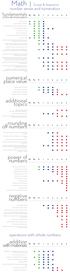 Math Scope & Sequence fundamentals number sense and numeration of the decimal system Count to 10 by units Associate number to numeral (1-10) KN 1 KN 1 KN 2 KN 2 Identify odd and even numbers/numerals and
Graphic Organizers SAMPLES
 This document is designed to assist North Carolina educators in effective instruction of the new Common Core State and/or North Carolina Essential Standards (Standard Course of Study) in order to increase
Prentice Hall Mathematics Courses 1-3 Common Core Edition 2013
 A Correlation of Prentice Hall Mathematics Courses 1-3 Common Core Edition 2013 to the Topics & Lessons of Pearson A Correlation of Courses 1, 2 and 3, Common Core Introduction This document demonstrates
Standards and progression point examples
 Mathematics Progressing towards Foundation Progression Point 0.5 At 0.5, a student progressing towards the standard at Foundation may, for example: connect number names and numerals with sets of up to
How To Learn To Understand And Understand The Math Of The Year
 Year R Maths Objectives In order to meet the Early Learning Goals at the end of Year R children must be able to: Numbers Count reliably with numbers from -0, place them in order and say which number is
INDIANA ACADEMIC STANDARDS. Mathematics: Grade 6 Draft for release: May 1, 2014
 INDIANA ACADEMIC STANDARDS Mathematics: Grade 6 Draft for release: May 1, 2014 I. Introduction The Indiana Academic Standards for Mathematics are the result of a process designed to identify, evaluate,
Florida Department of Education Adult General Education Curriculum Framework
 Florida Department of Education Adult General Education Curriculum Framework Program Title Program Number 9900000 Course Title Course Number 9900001 CIP Number 1532010200 Grade Equivalent 0.0 8.9 Grade
Solve addition and subtraction word problems, and add and subtract within 10, e.g., by using objects or drawings to represent the problem.
 Solve addition and subtraction word problems, and add and subtract within 10, e.g., by using objects or drawings to represent the problem. Solve word problems that call for addition of three whole numbers
Performance Assessment Task Which Shape? Grade 3. Common Core State Standards Math - Content Standards
 Performance Assessment Task Which Shape? Grade 3 This task challenges a student to use knowledge of geometrical attributes (such as angle size, number of angles, number of sides, and parallel sides) to
Students are able to represent and solve problems involving multiplication and division.
 Grade 3 Learning Targets and I Can Statements Operations and Algebraic Thinking Students are able to represent and solve problems involving multiplication and division. o I understand the product of multiplication
Warning! Construction Zone: Building Solids from Nets
 Brief Overview: Warning! Construction Zone: Building Solids from Nets In this unit the students will be examining and defining attributes of solids and their nets. The students will be expected to have
Curriculum Map by Block Geometry Mapping for Math Block Testing 2007-2008. August 20 to August 24 Review concepts from previous grades.
 Curriculum Map by Geometry Mapping for Math Testing 2007-2008 Pre- s 1 August 20 to August 24 Review concepts from previous grades. August 27 to September 28 (Assessment to be completed by September 28)
Algebra 1 2008. Academic Content Standards Grade Eight and Grade Nine Ohio. Grade Eight. Number, Number Sense and Operations Standard
 Academic Content Standards Grade Eight and Grade Nine Ohio Algebra 1 2008 Grade Eight STANDARDS Number, Number Sense and Operations Standard Number and Number Systems 1. Use scientific notation to express
Functional Math II. Information CourseTitle. Types of Instruction
 Functional Math II Course Outcome Summary Riverdale School District Information CourseTitle Functional Math II Credits 0 Contact Hours 135 Instructional Area Middle School Instructional Level 8th Grade
KEANSBURG SCHOOL DISTRICT KEANSBURG HIGH SCHOOL Mathematics Department. HSPA 10 Curriculum. September 2007
 KEANSBURG HIGH SCHOOL Mathematics Department HSPA 10 Curriculum September 2007 Written by: Karen Egan Mathematics Supervisor: Ann Gagliardi 7 days Sample and Display Data (Chapter 1 pp. 4-47) Surveys and
MATHEMATICS. Standard Course of Study and Grade Level Competencies
 MATHEMATICS Standard Course of Study and Grade Level Competencies K-12 Public Schools of North Carolina State Board of Education Department of Public Instruction TABLE OF CONTENTS ACKNOWLEDGMENTS...1
For example, estimate the population of the United States as 3 times 10⁸ and the
 CCSS: Mathematics The Number System CCSS: Grade 8 8.NS.A. Know that there are numbers that are not rational, and approximate them by rational numbers. 8.NS.A.1. Understand informally that every number
Problem of the Month: William s Polygons
 Problem of the Month: William s Polygons The Problems of the Month (POM) are used in a variety of ways to promote problem solving and to foster the first standard of mathematical practice from the Common
Integer Operations. Overview. Grade 7 Mathematics, Quarter 1, Unit 1.1. Number of Instructional Days: 15 (1 day = 45 minutes) Essential Questions
 Grade 7 Mathematics, Quarter 1, Unit 1.1 Integer Operations Overview Number of Instructional Days: 15 (1 day = 45 minutes) Content to Be Learned Describe situations in which opposites combine to make zero.
Common Core State Standards for Mathematics Accelerated 7th Grade
 A Correlation of 2013 To the to the Introduction This document demonstrates how Mathematics Accelerated Grade 7, 2013, meets the. Correlation references are to the pages within the Student Edition. Meeting
Big Ideas in Mathematics
 Big Ideas in Mathematics which are important to all mathematics learning. (Adapted from the NCTM Curriculum Focal Points, 2006) The Mathematics Big Ideas are organized using the PA Mathematics Standards
WORK SCHEDULE: MATHEMATICS 2007
 , K WORK SCHEDULE: MATHEMATICS 00 GRADE MODULE TERM... LO NUMBERS, OPERATIONS AND RELATIONSHIPS able to recognise, represent numbers and their relationships, and to count, estimate, calculate and check
Mathematics Florida Standards (MAFS) Grade 2
 Mathematics Florida Standards (MAFS) Grade 2 Domain: OPERATIONS AND ALGEBRAIC THINKING Cluster 1: Represent and solve problems involving addition and subtraction. MAFS.2.OA.1.1 Use addition and subtraction
Polynomial Operations and Factoring
 Algebra 1, Quarter 4, Unit 4.1 Polynomial Operations and Factoring Overview Number of instructional days: 15 (1 day = 45 60 minutes) Content to be learned Identify terms, coefficients, and degree of polynomials.
Everyday Mathematics. and the Common Core State Standards 100% About Everyday Mathematics. A Research-Based Program. A Design That Works
 and the Common Core State Standards About was developed by the University of Chicago School Mathematics Project (UCSMP) to help all children learn more mathematics and become lifelong mathematical thinkers
Grade 6 Mathematics Common Core State Standards
 Grade 6 Mathematics Common Core State Standards Standards for Mathematical Practice HOW make sense of problems, persevere in solving them, and check the reasonableness of answers. reason with and flexibly
CAMI Education linked to CAPS: Mathematics
 - 1 - TOPIC 1.1 Whole numbers _CAPS curriculum TERM 1 CONTENT Mental calculations Revise: Multiplication of whole numbers to at least 12 12 Ordering and comparing whole numbers Revise prime numbers to
Prentice Hall Algebra 2 2011 Correlated to: Colorado P-12 Academic Standards for High School Mathematics, Adopted 12/2009
 Content Area: Mathematics Grade Level Expectations: High School Standard: Number Sense, Properties, and Operations Understand the structure and properties of our number system. At their most basic level
Kindergarten Math Curriculum Course Description and Philosophy Text Reference:
 Kindergarten Math Curriculum Course Description and Philosophy How do numbers and math affect our daily lives? What types of problems can be solved by understanding numbers and math concepts? Through inquiry,
Pre-Algebra 2008. Academic Content Standards Grade Eight Ohio. Number, Number Sense and Operations Standard. Number and Number Systems
 Academic Content Standards Grade Eight Ohio Pre-Algebra 2008 STANDARDS Number, Number Sense and Operations Standard Number and Number Systems 1. Use scientific notation to express large numbers and small
Drawing 3-D Objects in Perspective
 Mathematics Instructional Materials SAS#.1 (one per pair of students) SAS#.2 (one per pair of students) TIS#.1 (transparency) TIS#.2 (transparency) TIS#.3 (Journal prompt) Isometric Dot Paper Isometric
Level 1 - Maths Targets TARGETS. With support, I can show my work using objects or pictures 12. I can order numbers to 10 3
 Ma Data Hling: Interpreting Processing representing Ma Shape, space measures: position shape Written Mental method s Operations relationship s between them Fractio ns Number s the Ma1 Using Str Levels