
Problem of the Month: Once Upon a Time
|
|
|
- Liliana Cross
- 9 years ago
- Views:
Transcription
1 Problem of the Month: The Problems of the Month (POM) are used in a variety of ways to promote problem solving and to foster the first standard of mathematical practice from the Common Core State Standards: Make sense of problems and persevere in solving them. The POM may be used by a teacher to promote problem solving and to address the differentiated needs of her students. A department or grade level may engage their students in a POM to showcase problem solving as a key aspect of doing mathematics. It can also be used schoolwide to promote a problem solving theme at a school. The goal is for all students to have the experience of attacking and solving non routine problems and developing their mathematical reasoning skills. Although obtaining and justifying solutions to the problems is the objective, the process of learning to problem solve is even more important. The Problem of the Month is structured to provide reasonable tasks for all students in a school. The structure of a POM is a shallow floor and a high ceiling, so that all students can productively engage, struggle, and persevere. The Primary Version Level A is designed to be accessible to all students and especially the key challenge for grades K 1. Level A will be challenging for most second and third graders. Level B may be the limit of where fourth and fifth grade students have success and understanding. Level C may stretch sixth and seventh grade students. Level D may challenge most eighth and ninth grade students, and Level E should be challenging for most high school students. These grade level expectations are just estimates and should not be used as an absolute minimum expectation or maximum limitation for students. Problem solving is a learned skill, and students may need many experiences to develop their reasoning skills, approaches, strategies, and the perseverance to be successful. The Problem of the Month builds on sequential levels of understanding. All students should experience Level A and then move through the tasks in order to go as deeply as they can into the problem. There will be those students who will not have access into even Level A. Educators should feel free to modify the task to allow access at some level. Overview In the Problem of the Month, students use measurement, number properties, and circular geometry to solve problems involving time and angles. The mathematical topics that underlie this POM are time measurement, including conversion between years, months, weeks, days, hours, minutes, and seconds; modular arithmetic that involves divisibility and remainders; pattern recognition, as well as circles and angular measurement. In Level A of the POM, students are presented with the task of determining how many minutes will pass before the large hand catches up to the small hand on a

2 clock. Their task involves counting up and understanding how a clock measures time. At Level B, the students are asked to convert their age from years into seasons, months, and weeks. Students are also asked to determine what day number the current date is in the year. In Level C, students are given a problem that requires an understanding of divisibility and may be determined by using knowledge of relatively prime factors. In Level D, the student is presented with a problem that involves three different sized alarm clocks that ring at varied intervals. The task is to determine if or when the three clocks chime simultaneously. Some students may use an understanding of modular division to solve the problem. In Level E, students are asked to determine the times in a day that the clock hands form an angle of 48 degrees. Mathematical Concepts This POM involves cyclical patterns and measurement. The most common cyclical pattern is time measurement. Time measurement and circles are intertwined. The fact that circles have 360 degrees has its roots in the original calendars that determined a year was 360 days. Cyclical relationships are often represented by circles and their component parts, such as angles and sectors. Cyclical relationships are common throughout mathematics with links between number, geometry, algebra, trigonometry, and measurement.

3 Problem of the Month Level A: When it is four o clock, how many minutes must pass before the big hand (minute hand) gets to where the little hand (hour hand) was at four o clock? How did you figure it out? When it is six-thirty, how many minutes must pass before the big hand (minute hand) gets to where the little hand (hour hand) was at six-thirty? Explain the way you figured it out. Problem of the Month Page 1 This work is licensed under a Creative Commons Attribution-NonCommercial-NoDerivatives 3.0 Unported License (

4 Level B: How old are you? State your answer in years. State your answer in seasons. State your answer in months. State your answer in weeks. What date is it? What number day of the year is it? How many more days until January 1? Problem of the Month Page 2 This work is licensed under a Creative Commons Attribution-NonCommercial-NoDerivatives 3.0 Unported License (

5 Level C: I met a man who said, If you can guess my age, I will pay you one dollar for each year that I have lived. I will also give you two hints. If you take my age and divide it by any odd number greater than 1 and less than 9, you will get a remainder of 1. But if you take my age and divide it by any even number greater than 1 and less than 9, you will not get a remainder of 1. How much money could you earn? Explain your solution and how you know it is the only correct answer. Problem of the Month Page 3 This work is licensed under a Creative Commons Attribution-NonCommercial-NoDerivatives 3.0 Unported License (

6 Level D: An eccentric clockmaker built three different clocks. The first clock was a five-minute clock designed with an alarm set to sound each time the hand reached the number 2. The second clock was a six-minute clock designed to sound each time the hand reached the number 3. The third clock was a seven-minute clock designed to sound each time the hand reached the number 4. The clockmaker started the clocks simultaneously one day, and each clock began to sound at its appropriate time. Was there a time when all three clocks sounded their alarms together? If so, tell when it occurred and explain why. If not, explain why not Problem of the Month Page 4 This work is licensed under a Creative Commons Attribution-NonCommercial-NoDerivatives 3.0 Unported License (

7 Level E: The minute hand and the hour hand on a clock form a 48 angle. What time is it? At what other times during the day do the hands on the clock form a 48 angle? How many times in a day (24 hour period) do the hands form a 48 angle? Explain your reasoning. Problem of the Month Page 5 This work is licensed under a Creative Commons Attribution-NonCommercial-NoDerivatives 3.0 Unported License (

8 Problem of the Month Primary Version Level A Materials: A large demonstration clock, a small clock per group Discussion on the rug: Teacher holds up the clock set at 4:00. What time does this clock say? Teacher solicits answers from students. Which is the minute hand? Which is the hour hand? Teacher solicits answers from students; teacher may refer to hands as big and small. How do the hands move around the clock? Students demonstrate. Which hand moves faster? In small groups: Each group has an individual clock. The teacher states the following: Set your clock to 4 o clock. Which direction do the hands move? Which is the minute hand (big hand)? How many minutes must pass before the minute hand gets to where the hour hand (little hand) is now? Draw a picture or use words to explain how you know. Set your clock to 6:30. Which direction do the hands move? Which is the minute hand (big hand)? How many minutes must pass before the minute hand gets to where the hour hand (little hand) is now? Draw a picture or use words to explain how you know. At the end of the investigation have students either discuss or dictate a response to these summary questions. Problem of the Month Page 6 This work is licensed under a Creative Commons Attribution-NonCommercial-NoDerivatives 3.0 Unported License (

9 Problem of the Month Task Description Level A This task challenges a student to determine how many minutes will pass before the large hand will catch up with the small hand on an analog clock. A student will understand how an analog clock measures time and will using counting principles to work on this task. Common Core State Standards Math Content Standards Counting and Cardinality Know number names and the count sequence. K.CC.1 Count to 100 by ones and by tens. K.CC.5 Count to answer how many? questions about as many as 20 things arranged in a line, a rectangular array, or a circle, or as many as 10 things in a scattered configuration; given a number from 1 20, count out that many objects. Operations and Algebraic Thinking Understand addition as putting together and adding to, and understand subtraction as taking apart and taking from. K.OA.1 Represent addition and subtraction with objects, fingers, mental images, drawings, sounds (e.g., claps), acting out situations, verbal explanations, expressions, or equations. Add and subtract within OA.5 Relate counting to addition and subtraction (e.g., by counting on 2 to add 2). Represent and solve problems involving addition and subtraction. 2.OA.1 Use addition and subtraction within 100 to solve one and two step word problems involving situations of adding to, taking from, putting together, taking apart, and comparing, with unknowns in all positions, e.g., by using drawings and equations with a symbol for the unknown number to represent the problem. Measurement and Data Tell and write time. 1.MD.3 Tell and write time in hours and half hours using analog and digital clocks. Work with time and money. 2.MD.7 Tell and write time from analog and digital clocks to the nearest five minutes, using a.m. and p.m. Common Core State Standards Math Standards of Mathematical Practice MP.7 Look for and make use of structure. Mathematically proficient students look closely to discern a pattern or structure. Young students, for example, might notice that three and seven more is the same amount as seven and three more, or they may sort a collection of shapes according to how many sides the shapes have. Later, students will see 7 x 8 equals the wellremembered 7 x x 3, in preparation for learning about the distributive property. In the expression x 2 + 9x + 14, older students can see the 14 as 2 x 7 and the 9 as They recognize the significance of an existing line in a geometric figure and can use the strategy of drawing an auxiliary line for solving problems. They also can step back for an overview and shift perspective. They can see complicated things, such as some algebraic expressions, as single objects or as being composed of several objects. For example, they can see 5 3(x y) 2 as 5 minus a positive number times a square and use that to realize that its value cannot be more than 5 for any real numbers x and y. MP.8 Look for and express regularity in repeated reasoning. Mathematically proficient students notice if calculations are repeated, and look both for general methods and for shortcuts. Upper elementary students might notice when dividing 25 by 11 that they are repeating the same calculations over and over again, and conclude they have a repeating decimal. By paying attention to the calculation of slope as they repeatedly check whether points are on the line through (1, 2) with slope 3, middle school students might abstract the equation (y 2)/(x 1) = 3. Noticing the regularity in the way terms cancel when expanding (x 1)(x+1),(x 1)(x2+x+1),and(x 1)(x3 +x2+x+1)might lead them to the general formula for the sum of a geometric series. As they work to solve a problem, mathematically proficient students maintain oversight of the process, while attending to the details. They continually evaluate the reasonableness of their intermediate results.

10 Problem of the Month Task Description Level B This task challenges a student to convert their age from years into seasons, months, and weeks. A student is also asked to determine what day number the current date is in the year. A student may use unit conversions and variables. Common Core State Standards Math Content Standards Operations and Algebraic Thinking Represent and solve problems involving addition and subtraction. 2.OA.1 Use addition and subtraction within 100 to solve one and two step word problems involving situations of adding to, taking from, putting together, taking apart, and comparing, with unknowns in all positions, e.g., by using drawings and equations with a symbol for the unknown number to represent the problem. Number and Operations in Base Ten Use place value understanding and properties of operations to add and subtract. 2.NBT.5 Fluently add and subtract within 100 using strategies based on place value, properties of operations, and/or the relationship between addition and subtraction. Use place value understanding and properties of operations to perform multi digit arithmetic. 3.NBT.2 Fluently add and subtract within 1000 using strategies and algorithms based on place value, properties of operations, and/or the relationship between addition and subtraction. Use place value understanding and properties of operations to perform multi digit arithmetic. 4.NBT.4 Fluently add and subtract multi digit whole numbers using the standard algorithm. Measurement and Data Solve problems involving measurement and conversion of measurements from a larger unit to a smaller unit. 4.MD.1 Know relative sizes of measurement units within one system of units including km, m, cm; kg, g; lb, oz.; l, ml; hr, min, sec. Within a single system of measurement, express measurements in a larger unit in terms of a smaller unit. 4.MD.2 Use the four operations to solve word problems involving distances, intervals of time, liquid volumes, masses of objects, and money, including problems involving simple fractions or decimals, and problems that require expressing measurements given in a larger unit in terms of a smaller unit Expressions and Equations Apply and extend previous understandings of arithmetic to algebraic expressions. 6.EE.2 Write, read, and evaluate expressions in which letters stand for numbers. Common Core State Standards Math Standards of Mathematical Practice MP.7 Look for and make use of structure. Mathematically proficient students look closely to discern a pattern or structure. Young students, for example, might notice that three and seven more is the same amount as seven and three more, or they may sort a collection of shapes according to how many sides the shapes have. Later, students will see 7 x 8 equals the wellremembered 7 x x 3, in preparation for learning about the distributive property. In the expression x 2 + 9x + 14, older students can see the 14 as 2 x 7 and the 9 as They recognize the significance of an existing line in a geometric figure and can use the strategy of drawing an auxiliary line for solving problems. They also can step back for an overview and shift perspective. They can see complicated things, such as some algebraic expressions, as single objects or as being composed of several objects. For example, they can see 5 3(x y) 2 as 5 minus a positive number times a square and use that to realize that its value cannot be more than 5 for any real numbers x and y. MP.8 Look for and express regularity in repeated reasoning. Mathematically proficient students notice if calculations are repeated, and look both for general methods and for shortcuts. Upper elementary students might notice when dividing 25 by 11 that they are repeating the same calculations over and over again, and conclude they have a repeating decimal. By paying attention to the calculation of slope as they repeatedly check whether points are on the line through (1, 2) with slope 3, middle school students might abstract the equation (y 2)/(x 1) = 3. Noticing the regularity in the way terms cancel when expanding (x 1)(x+1),(x 1)(x2+x+1),and(x 1)(x3 +x2+x+1)might lead them to the general formula for the sum of a geometric series. As they work to solve a problem, mathematically proficient students maintain oversight of the process, while attending to the details. They continually evaluate the reasonableness of their intermediate results.

11 Problem of the Month Task Description Level C This task challenges a student to determine a man s age and to explain the solution and how it is the only correct solution. Two hints are given. A student will use basic operations and understand remainders in a real life context. A student will use an understanding of divisibility and the knowledge of relatively prime factors to work on this task. Common Core State Standards Math Content Standards Operations and Algebraic Thinking Gain familiarity with factors and multiples. 4.OA.4 Find all factor pairs for a whole number in the range Recognize that a whole number is a multiple of each of its factors. Determine whether a given whole number in the range is a multiple of a given one digit number. Determine whether a given whole number in the range is prime or composite. Analyze patterns and relationships. 5.OA.3 Generate two numerical patterns using two given rules. Identify apparent relationships between corresponding terms. Form ordered pairs consisting of corresponding terms from the two patterns, and graph the ordered pairs on a coordinate plane. For example, given the rule Add 3 and the starting number 0, and given the rule Add 6 and the starting number 0, generate terms in the resulting sequences, and observe that the terms in one sequence are twice the corresponding terms in the other sequence. Explain informally why this is so. The Number System Compute fluently with multi digit numbers and find common factors and multiples. 6.NS.2 Fluently divide multi digit numbers using the standard algorithm. 6.NS.4 Find the greatest common factor of two whole numbers less than or equal to 100 and the least common multiple of two whole numbers less than or equal to 12. Common Core State Standards Math Standards of Mathematical Practice MP.7 Look for and make use of structure. Mathematically proficient students look closely to discern a pattern or structure. Young students, for example, might notice that three and seven more is the same amount as seven and three more, or they may sort a collection of shapes according to how many sides the shapes have. Later, students will see 7 x 8 equals the well remembered 7 x x 3, in preparation for learning about the distributive property. In the expression x 2 + 9x + 14, older students can see the 14 as 2 x 7 and the 9 as They recognize the significance of an existing line in a geometric figure and can use the strategy of drawing an auxiliary line for solving problems. They also can step back for an overview and shift perspective. They can see complicated things, such as some algebraic expressions, as single objects or as being composed of several objects. For example, they can see 5 3(x y) 2 as 5 minus a positive number times a square and use that to realize that its value cannot be more than 5 for any real numbers x and y. MP.8 Look for and express regularity in repeated reasoning. Mathematically proficient students notice if calculations are repeated, and look both for general methods and for shortcuts. Upper elementary students might notice when dividing 25 by 11 that they are repeating the same calculations over and over again, and conclude they have a repeating decimal. By paying attention to the calculation of slope as they repeatedly check whether points are on the line through (1, 2) with slope 3, middle school students might abstract the equation (y 2)/(x 1) = 3. Noticing the regularity in the way terms cancel when expanding (x 1)(x+1),(x 1)(x2+x+1),and(x 1)(x3 +x2+x+1)might lead them to the general formula for the sum of a geometric series. As they work to solve a problem, mathematically proficient students maintain oversight of the process, while attending to the details. They continually evaluate the reasonableness of their intermediate results.

12 Problem of the Month: Task Description Level D This task challenges a student to determine when the alarms on three different modular clocks that ring at varied intervals will all sound at the same time. A student will need a deep understanding of place value and quantities for working on this task. Some students may use an understanding of modular division to solve the problem. Common Core State Standards Math Content Standards Operations and Algebraic Thinking Gain familiarity with factors and multiples. 4.OA.4 Find all factor pairs for a whole number in the range Recognize that a whole number is a multiple of each of its factors. Determine whether a given whole number in the range is a multiple of a given one digit number. Determine whether a given whole number in the range is prime or composite. Analyze patterns and relationships. 5.OA.3 Generate two numerical patterns using two given rules. Identify apparent relationships between corresponding terms. Form ordered pairs consisting of corresponding terms from the two patterns, and graph the ordered pairs on a coordinate plane. For example, given the rule Add 3 and the starting number 0, and given the rule Add 6 and the starting number 0, generate terms in the resulting sequences, and observe that the terms in one sequence are twice the corresponding terms in the other sequence. Explain informally why this is so. The Number System Compute fluently with multi digit numbers and find common factors and multiples. 6.NS.2 Fluently divide multi digit numbers using the standard algorithm. 6.NS.4 Find the greatest common factor of two whole numbers less than or equal to 12. Expressions and Equations Solve real life and mathematical problems using numerical and algebraic expressions and equations. 7.EE.4 Use variables to represent quantities in a real world or mathematical problem, and construct simple equations and inequalities to solve problems by reasoning about the quantities. Analyze and solve linear equations and pairs of simultaneous linear equations. 8.EE.7 Solve linear equations in one variable. Common Core State Standards Math Standards of Mathematical Practice MP.7 Look for and make use of structure. Mathematically proficient students look closely to discern a pattern or structure. Young students, for example, might notice that three and seven more is the same amount as seven and three more, or they may sort a collection of shapes according to how many sides the shapes have. Later, students will see 7 x 8 equals the wellremembered 7 x x 3, in preparation for learning about the distributive property. In the expression x 2 + 9x + 14, older students can see the 14 as 2 x 7 and the 9 as They recognize the significance of an existing line in a geometric figure and can use the strategy of drawing an auxiliary line for solving problems. They also can step back for an overview and shift perspective. They can see complicated things, such as some algebraic expressions, as single objects or as being composed of several objects. For example, they can see 5 3(x y) 2 as 5 minus a positive number times a square and use that to realize that its value cannot be more than 5 for any real numbers x and y. MP.8 Look for and express regularity in repeated reasoning. Mathematically proficient students notice if calculations are repeated, and look both for general methods and for shortcuts. Upper elementary students might notice when dividing 25 by 11 that they are repeating the same calculations over and over again, and conclude they have a repeating decimal. By paying attention to the calculation of slope as they repeatedly check whether points are on the line through (1, 2) with slope 3, middle school students might abstract the equation (y 2)/(x 1) = 3. Noticing the regularity in the way terms cancel when expanding (x 1)(x+1),(x 1)(x2+x+1),and(x 1)(x3 +x2+x+1)might lead them to the general formula for the sum of a geometric series. As they work to solve a problem, mathematically proficient students maintain oversight of the process, while attending to the details. They continually evaluate the reasonableness of their intermediate results.

13 Problem of the Month Task Description Level E This task challenges a student to determine the times in a day when the hands of an analog clock will form a 48 degree angle. A student will use their understanding of angle and angular measures to work on this task. Common Core State Standards Math Content Standards Geometry Draw and identify lines and angles, 4.G.1 Draw points, lines, line segments, rays, angles (right, acute, obtuse), Ratios and Proportional Relationships 6.RP Understand ratio concepts and use ratio reasoning to solve problems. 6.RP.1 Understand the concept of a ratio and use ratio language to describe a ratio relationship between two quantities. For example, The ratio of wings to beaks in the bird house at the zoo was 2:1, because for every 2 wings there was 1 beak. For every vote candidate A received, candidate C received nearly three votes. 6.RP.3 Use ratio and rate reasoning to solve real world and mathematical problems, e.g., by reasoning about tables of equivalent ratios, tape diagrams, double number line diagrams, or equations. 6.RP.3.d Use ratio reasoning to convert measurement units; manipulate and transform units appropriately when multiplying or dividing quantities. The Number System Compute fluently with multi digit numbers and find common factors and multiples. 6.NS.2 Fluently divide multi digit numbers using the standard algorithm. 6.NS.4 Find the greatest common factor of two whole numbers less than or equal to 12. Expressions and Equations Solve real life and mathematical problems using numerical and algebraic expressions and equations. 7.EE.4 Use variables to represent quantities in a real world or mathematical problem, and construct simple equations and inequalities to solve problems by reasoning about the quantities. Analyze and solve linear equations and pairs of simultaneous linear equations. 8.EE.7 Solve linear equations in one variable. High School Algebra Creating Equations Create equations that describe numbers or relationships. A CED.1 Create equations and inequalities in one variable and use them to solve problems. High School Geometry Congruence Experiment with transformations in the plane G CO.1 Know precise definitions of angle, circle, perpendicular line, parallel line, and line segment, based on the undefined notions of point, line, distance along a line, and distance around a circular arc. G CO.4 Develop definitions of rotations, reflections, and translations in terms of angles, circles, perpendicular lines, parallel lines, and line segments. Make geometric constructions G CO.12 Make formal geometric constructions with a variety of tools and methods (compass and straightedge, string, reflective devices, paper folding, dynamic geometric software, etc.). Common Core State Standards Math Standards of Mathematical Practice MP.7 Look for and make use of structure. Mathematically proficient students look closely to discern a pattern or structure. Young students, for example, might notice that three and seven more is the same amount as seven and three more, or they may sort a collection of shapes according to how many sides the shapes have. Later, students will see 7 x 8 equals the well remembered 7 x x 3, in preparation for learning about the distributive property. In the expression x 2 + 9x + 14, older students can see the 14 as 2 x 7 and the 9

14 as They recognize the significance of an existing line in a geometric figure and can use the strategy of drawing an auxiliary line for solving problems. They also can step back for an overview and shift perspective. They can see complicated things, such as some algebraic expressions, as single objects or as being composed of several objects. For example, they can see 5 3(x y) 2 as 5 minus a positive number times a square and use that to realize that its value cannot be more than 5 for any real numbers x and y. MP.8 Look for and express regularity in repeated reasoning. Mathematically proficient students notice if calculations are repeated, and look both for general methods and for shortcuts. Upper elementary students might notice when dividing 25 by 11 that they are repeating the same calculations over and over again, and conclude they have a repeating decimal. By paying attention to the calculation of slope as they repeatedly check whether points are on the line through (1, 2) with slope 3, middle school students might abstract the equation (y 2)/(x 1) = 3. Noticing the regularity in the way terms cancel when expanding (x 1)(x+1),(x 1)(x2+x+1),and(x 1)(x3 +x2+x+1)might lead them to the general formula for the sum of a geometric series. As they work to solve a problem, mathematically proficient students maintain oversight of the process, while attending to the details. They continually evaluate the reasonableness of their intermediate results.

15 Problem of the Month Task Description Primary Level This task challenges a student to work with analog clocks to lay a foundation for understanding time. A discussion is held so that a student would understand the measurement of time with an analog clock. The teacher asks the class, when shown an analog clock, which is the minute hand and which is the hour hand. A teacher also needs to ask about the movement of the hands and which hand moves faster than the other. Each group of students has an individual clock which they set at 4 o clock. Then they are asked how many minutes must pass before the minute hand gets to where the hour hand is now. Each student is asked to draw a picture or explain how they know. The groups are then instructed to set the clock at 6:30 and asked, How many minutes must pass before the minute hand gets to where the hour hand is now? Each student draws a picture or explains how they know. Common Core State Standards Math Content Standards Counting and Cardinality Know number names and the count sequence. K.CC.1 Count to 100 by ones and by tens. K.CC.5 Count to answer how many? questions about as many as 20 things arranged in a line, a rectangular array, or a circle, or as many as 10 things in a scattered configuration; given a number from 1 20, count out that many objects. Operations and Algebraic Thinking Understand addition as putting together and adding to, and understand subtraction as taking apart and taking from. K.OA.1 Represent addition and subtraction with objects, fingers, mental images, drawings, sounds (e.g., claps), acting out situations, verbal explanations, expressions, or equations. Add and subtract within OA.5 Relate counting to addition and subtraction (e.g., by counting on 2 to add 2). Represent and solve problems involving addition and subtraction. 2.OA.1 Use addition and subtraction within 100 to solve one and two step word problems involving situations of adding to, taking from, putting together, taking apart, and comparing, with unknowns in all positions, e.g., by using drawings and equations with a symbol for the unknown number to represent the problem. Measurement and Data Tell and write time. 1.MD.3 Tell and write time in hours and half hours using analog and digital clocks. Work with time and money. 2.MD.7 Tell and write time from analog and digital clocks to the nearest five minutes, using a.m. and p.m. Common Core State Standards Math Standards of Mathematical Practice MP.7 Look for and make use of structure. Mathematically proficient students look closely to discern a pattern or structure. Young students, for example, might notice that three and seven more is the same amount as seven and three more, or they may sort a collection of shapes according to how many sides the shapes have. Later, students will see 7 x 8 equals the wellremembered 7 x x 3, in preparation for learning about the distributive property. In the expression x 2 + 9x + 14, older students can see the 14 as 2 x 7 and the 9 as They recognize the significance of an existing line in a geometric figure and can use the strategy of drawing an auxiliary line for solving problems. They also can step back for an overview and shift perspective. They can see complicated things, such as some algebraic expressions, as single objects or as being composed of several objects. For example, they can see 5 3(x y) 2 as 5 minus a positive number times a square and use that to realize that its value cannot be more than 5 for any real numbers x and y. MP.8 Look for and express regularity in repeated reasoning. Mathematically proficient students notice if calculations are repeated, and look both for general methods and for shortcuts. Upper elementary students might notice when dividing 25 by 11 that they are repeating the same calculations over and over again, and conclude they have a repeating decimal. By paying attention to the calculation of slope as they repeatedly check whether points are on the line through (1, 2) with slope 3, middle school students might abstract the equation (y 2)/(x 1) = 3. Noticing the regularity in the way terms cancel when expanding (x 1)(x+1),(x 1)(x2+x+1),and(x 1)(x3 +x2+x+1)might lead them to the general formula for the sum of a geometric series. As they work to solve a problem, mathematically proficient students maintain oversight of the process, while attending to the details. They continually evaluate the reasonableness of their intermediate results.

Problem of the Month: Perfect Pair
 Problem of the Month: The Problems of the Month (POM) are used in a variety of ways to promote problem solving and to foster the first standard of mathematical practice from the Common Core State Standards:
Problem of the Month: Digging Dinosaurs
 : The Problems of the Month (POM) are used in a variety of ways to promote problem solving and to foster the first standard of mathematical practice from the Common Core State Standards: Make sense of
Problem of the Month The Wheel Shop
 Problem of the Month The Wheel Shop The Problems of the Month (POM) are used in a variety of ways to promote problem solving and to foster the first standard of mathematical practice from the Common Core
Problem of the Month: Double Down
 Problem of the Month: Double Down The Problems of the Month (POM) are used in a variety of ways to promote problem solving and to foster the first standard of mathematical practice from the Common Core
Problem of the Month Through the Grapevine
 The Problems of the Month (POM) are used in a variety of ways to promote problem solving and to foster the first standard of mathematical practice from the Common Core State Standards: Make sense of problems
Problem of the Month: William s Polygons
 Problem of the Month: William s Polygons The Problems of the Month (POM) are used in a variety of ways to promote problem solving and to foster the first standard of mathematical practice from the Common
Problem of the Month Pick a Pocket
 The Problems of the Month (POM) are used in a variety of ways to promote problem solving and to foster the first standard of mathematical practice from the Common Core State Standards: Make sense of problems
Problem of the Month Diminishing Return
 The Problems of the Month (POM) are used in a variety of ways to promote problem solving and to foster the first standard of mathematical practice from the Common Core State Standards: Make sense of problems
BPS Math Year at a Glance (Adapted from A Story Of Units Curriculum Maps in Mathematics K-5) 1
 Grade 4 Key Areas of Focus for Grades 3-5: Multiplication and division of whole numbers and fractions-concepts, skills and problem solving Expected Fluency: Add and subtract within 1,000,000 Module M1:
Problem of the Month: Cutting a Cube
 Problem of the Month: The Problems of the Month (POM) are used in a variety of ways to promote problem solving and to foster the first standard of mathematical practice from the Common Core State Standards:
Problem of the Month: Fair Games
 Problem of the Month: The Problems of the Month (POM) are used in a variety of ways to promote problem solving and to foster the first standard of mathematical practice from the Common Core State Standards:
Fourth Grade Math Standards and "I Can Statements"
 Fourth Grade Math Standards and "I Can Statements" Standard - CC.4.OA.1 Interpret a multiplication equation as a comparison, e.g., interpret 35 = 5 x 7 as a statement that 35 is 5 times as many as 7 and
Measurement with Ratios
 Grade 6 Mathematics, Quarter 2, Unit 2.1 Measurement with Ratios Overview Number of instructional days: 15 (1 day = 45 minutes) Content to be learned Use ratio reasoning to solve real-world and mathematical
COMMON CORE STATE STANDARDS FOR MATHEMATICS 3-5 DOMAIN PROGRESSIONS
 COMMON CORE STATE STANDARDS FOR MATHEMATICS 3-5 DOMAIN PROGRESSIONS Compiled by Dewey Gottlieb, Hawaii Department of Education June 2010 Operations and Algebraic Thinking Represent and solve problems involving
Integer Operations. Overview. Grade 7 Mathematics, Quarter 1, Unit 1.1. Number of Instructional Days: 15 (1 day = 45 minutes) Essential Questions
 Grade 7 Mathematics, Quarter 1, Unit 1.1 Integer Operations Overview Number of Instructional Days: 15 (1 day = 45 minutes) Content to Be Learned Describe situations in which opposites combine to make zero.
Standards for Mathematical Practice: Commentary and Elaborations for 6 8
 Standards for Mathematical Practice: Commentary and Elaborations for 6 8 c Illustrative Mathematics 6 May 2014 Suggested citation: Illustrative Mathematics. (2014, May 6). Standards for Mathematical Practice:
Grades K-6. Correlated to the Common Core State Standards
 Grades K-6 Correlated to the Common Core State Standards Kindergarten Standards for Mathematical Practice Common Core State Standards Standards for Mathematical Practice Kindergarten The Standards for
Charlesworth School Year Group Maths Targets
 Charlesworth School Year Group Maths Targets Year One Maths Target Sheet Key Statement KS1 Maths Targets (Expected) These skills must be secure to move beyond expected. I can compare, describe and solve
Mathematics. Mathematical Practices
 Mathematical Practices 1. Make sense of problems and persevere in solving them. 2. Reason abstractly and quantitatively. 3. Construct viable arguments and critique the reasoning of others. 4. Model with
Problem of the Month: Circular Reasoning
 Problem of the Month: Circular Reasoning The Problems of the Month (POM) are used in a variety of ways to promote problem solving and to foster the first standard of mathematical practice from the Common
1 ST GRADE COMMON CORE STANDARDS FOR SAXON MATH
 1 ST GRADE COMMON CORE STANDARDS FOR SAXON MATH Calendar The following tables show the CCSS focus of The Meeting activities, which appear at the beginning of each numbered lesson and are taught daily,
Polynomial Operations and Factoring
 Algebra 1, Quarter 4, Unit 4.1 Polynomial Operations and Factoring Overview Number of instructional days: 15 (1 day = 45 60 minutes) Content to be learned Identify terms, coefficients, and degree of polynomials.
Major Work of the Grade
 Counting and Cardinality Know number names and the count sequence. Count to tell the number of objects. Compare numbers. Kindergarten Describe and compare measurable attributes. Classify objects and count
Grade Level Year Total Points Core Points % At Standard 9 2003 10 5 7 %
 Performance Assessment Task Number Towers Grade 9 The task challenges a student to demonstrate understanding of the concepts of algebraic properties and representations. A student must make sense of the
NEW MEXICO Grade 6 MATHEMATICS STANDARDS
 PROCESS STANDARDS To help New Mexico students achieve the Content Standards enumerated below, teachers are encouraged to base instruction on the following Process Standards: Problem Solving Build new mathematical
Math at a Glance for April
 Audience: School Leaders, Regional Teams Math at a Glance for April The Math at a Glance tool has been developed to support school leaders and region teams as they look for evidence of alignment to Common
Numeracy Targets. I can count at least 20 objects
 Targets 1c I can read numbers up to 10 I can count up to 10 objects I can say the number names in order up to 20 I can write at least 4 numbers up to 10. When someone gives me a small number of objects
For example, estimate the population of the United States as 3 times 10⁸ and the
 CCSS: Mathematics The Number System CCSS: Grade 8 8.NS.A. Know that there are numbers that are not rational, and approximate them by rational numbers. 8.NS.A.1. Understand informally that every number
Voyager Sopris Learning Vmath, Levels C-I, correlated to the South Carolina College- and Career-Ready Standards for Mathematics, Grades 2-8
 Page 1 of 35 VMath, Level C Grade 2 Mathematical Process Standards 1. Make sense of problems and persevere in solving them. Module 3: Lesson 4: 156-159 Module 4: Lesson 7: 220-223 2. Reason both contextually
Common Core Unit Summary Grades 6 to 8
 Common Core Unit Summary Grades 6 to 8 Grade 8: Unit 1: Congruence and Similarity- 8G1-8G5 rotations reflections and translations,( RRT=congruence) understand congruence of 2 d figures after RRT Dilations
Solve addition and subtraction word problems, and add and subtract within 10, e.g., by using objects or drawings to represent the problem.
 Solve addition and subtraction word problems, and add and subtract within 10, e.g., by using objects or drawings to represent the problem. Solve word problems that call for addition of three whole numbers
r the COR Common Core State Standards Learning Pathways
 BUI LT fo COM r the MON COR E 2015 2016 Common Core State Standards Learning Pathways Table of Contents Grade 3...3 Grade 4...8 Grade 5... 13 Grade 6... 18 Grade 7...26 Grade 8...32 Algebra Readiness...36
Creating, Solving, and Graphing Systems of Linear Equations and Linear Inequalities
 Algebra 1, Quarter 2, Unit 2.1 Creating, Solving, and Graphing Systems of Linear Equations and Linear Inequalities Overview Number of instructional days: 15 (1 day = 45 60 minutes) Content to be learned
Everyday Mathematics CCSS EDITION CCSS EDITION. Content Strand: Number and Numeration
 CCSS EDITION Overview of -6 Grade-Level Goals CCSS EDITION Content Strand: Number and Numeration Program Goal: Understand the Meanings, Uses, and Representations of Numbers Content Thread: Rote Counting
Scope and Sequence KA KB 1A 1B 2A 2B 3A 3B 4A 4B 5A 5B 6A 6B
 Scope and Sequence Earlybird Kindergarten, Standards Edition Primary Mathematics, Standards Edition Copyright 2008 [SingaporeMath.com Inc.] The check mark indicates where the topic is first introduced
Indicator 2: Use a variety of algebraic concepts and methods to solve equations and inequalities.
 3 rd Grade Math Learning Targets Algebra: Indicator 1: Use procedures to transform algebraic expressions. 3.A.1.1. Students are able to explain the relationship between repeated addition and multiplication.
Everyday Mathematics GOALS
 Copyright Wright Group/McGraw-Hill GOALS The following tables list the Grade-Level Goals organized by Content Strand and Program Goal. Content Strand: NUMBER AND NUMERATION Program Goal: Understand the
Questions. Strategies August/September Number Theory. What is meant by a number being evenly divisible by another number?
 Content Skills Essential August/September Number Theory Identify factors List multiples of whole numbers Classify prime and composite numbers Analyze the rules of divisibility What is meant by a number
Analysis of California Mathematics standards to Common Core standards- Kindergarten
 Analysis of California Mathematics standards to Common Core standards- Kindergarten Strand CA Math Standard Domain Common Core Standard (CCS) Alignment Comments in reference to CCS Strand Number Sense
CCSS Mathematics Implementation Guide Grade 5 2012 2013. First Nine Weeks
 First Nine Weeks s The value of a digit is based on its place value. What changes the value of a digit? 5.NBT.1 RECOGNIZE that in a multi-digit number, a digit in one place represents 10 times as much
NCTM Curriculum Focal Points for Grade 5. Everyday Mathematics, Grade 5
 NCTM Curriculum Focal Points and, Grade 5 NCTM Curriculum Focal Points for Grade 5 Number and Operations and Algebra: Developing an understanding of and fluency with division of whole numbers Students
In mathematics, there are four attainment targets: using and applying mathematics; number and algebra; shape, space and measures, and handling data.
 MATHEMATICS: THE LEVEL DESCRIPTIONS In mathematics, there are four attainment targets: using and applying mathematics; number and algebra; shape, space and measures, and handling data. Attainment target
Overview. Essential Questions. Precalculus, Quarter 4, Unit 4.5 Build Arithmetic and Geometric Sequences and Series
 Sequences and Series Overview Number of instruction days: 4 6 (1 day = 53 minutes) Content to Be Learned Write arithmetic and geometric sequences both recursively and with an explicit formula, use them
Illinois State Standards Alignments Grades Three through Eleven
 Illinois State Standards Alignments Grades Three through Eleven Trademark of Renaissance Learning, Inc., and its subsidiaries, registered, common law, or pending registration in the United States and other
K-12 Louisiana Student Standards for Mathematics: Table of Contents
 K-12 Louisiana Student Standards for Mathematics: Table of Contents Introduction Development of K-12 Louisiana Student Standards for Mathematics... 2 The Role of Standards in Establishing Key Student Skills
ISAT Mathematics Performance Definitions Grade 4
 ISAT Mathematics Performance Definitions Grade 4 EXCEEDS STANDARDS Fourth-grade students whose measured performance exceeds standards are able to identify, read, write, represent, and model whole numbers
EVERY DAY COUNTS CALENDAR MATH 2005 correlated to
 EVERY DAY COUNTS CALENDAR MATH 2005 correlated to Illinois Mathematics Assessment Framework Grades 3-5 E D U C A T I O N G R O U P A Houghton Mifflin Company YOUR ILLINOIS GREAT SOURCE REPRESENTATIVES:
Level 1 - Maths Targets TARGETS. With support, I can show my work using objects or pictures 12. I can order numbers to 10 3
 Ma Data Hling: Interpreting Processing representing Ma Shape, space measures: position shape Written Mental method s Operations relationship s between them Fractio ns Number s the Ma1 Using Str Levels
Minnesota Academic Standards
 A Correlation of to the Minnesota Academic Standards Grades K-6 G/M-204 Introduction This document demonstrates the high degree of success students will achieve when using Scott Foresman Addison Wesley
Common Core State Standards for Mathematics Accelerated 7th Grade
 A Correlation of 2013 To the to the Introduction This document demonstrates how Mathematics Accelerated Grade 7, 2013, meets the. Correlation references are to the pages within the Student Edition. Meeting
Mathematics Scope and Sequence, K-8
 Standard 1: Number and Operation Goal 1.1: Understands and uses numbers (number sense) Mathematics Scope and Sequence, K-8 Grade Counting Read, Write, Order, Compare Place Value Money Number Theory K Count
MATHS LEVEL DESCRIPTORS
 MATHS LEVEL DESCRIPTORS Number Level 3 Understand the place value of numbers up to thousands. Order numbers up to 9999. Round numbers to the nearest 10 or 100. Understand the number line below zero, and
Glencoe. correlated to SOUTH CAROLINA MATH CURRICULUM STANDARDS GRADE 6 3-3, 5-8 8-4, 8-7 1-6, 4-9
 Glencoe correlated to SOUTH CAROLINA MATH CURRICULUM STANDARDS GRADE 6 STANDARDS 6-8 Number and Operations (NO) Standard I. Understand numbers, ways of representing numbers, relationships among numbers,
Math. MCC6.RP.1 Understand the concept of a ratio and use
 MCC6.RP.1 Understand the concept of a ratio and use ratio language to describe a ratio relationship between two quantities. For example, The ratio of wings to beaks in the bird house at the zoo was 2:1,
5 th Grade Common Core State Standards. Flip Book
 5 th Grade Common Core State Standards Flip Book This document is intended to show the connections to the Standards of Mathematical Practices for the content standards and to get detailed information at
Academic Standards for Mathematics
 Academic Standards for Grades Pre K High School Pennsylvania Department of Education INTRODUCTION The Pennsylvania Core Standards in in grades PreK 5 lay a solid foundation in whole numbers, addition,
MACMILLAN/McGRAW-HILL. MATH CONNECTS and IMPACT MATHEMATICS WASHINGTON STATE MATHEMATICS STANDARDS. ESSENTIAL ACADEMIC LEARNING REQUIREMENTS (EALRs)
 MACMILLAN/McGRAW-HILL MATH CONNECTS and IMPACT MATHEMATICS TO WASHINGTON STATE MATHEMATICS STANDARDS ESSENTIAL ACADEMIC LEARNING REQUIREMENTS (EALRs) And GRADE LEVEL EXPECTATIONS (GLEs) / Edition, Copyright
Pocantico Hills School District Grade 1 Math Curriculum Draft
 Pocantico Hills School District Grade 1 Math Curriculum Draft Patterns /Number Sense/Statistics Content Strands: Performance Indicators 1.A.1 Determine and discuss patterns in arithmetic (what comes next
Math 0980 Chapter Objectives. Chapter 1: Introduction to Algebra: The Integers.
 Math 0980 Chapter Objectives Chapter 1: Introduction to Algebra: The Integers. 1. Identify the place value of a digit. 2. Write a number in words or digits. 3. Write positive and negative numbers used
Pearson Algebra 1 Common Core 2015
 A Correlation of Pearson Algebra 1 Common Core 2015 To the Common Core State Standards for Mathematics Traditional Pathways, Algebra 1 High School Copyright 2015 Pearson Education, Inc. or its affiliate(s).
N Q.3 Choose a level of accuracy appropriate to limitations on measurement when reporting quantities.
 Performance Assessment Task Swimming Pool Grade 9 The task challenges a student to demonstrate understanding of the concept of quantities. A student must understand the attributes of trapezoids, how to
a. Look under the menu item Introduction to see how the standards are organized by Standards, Clusters and Domains.
 Chapter One Section 1.1 1. Go to the Common Core State Standards website (http://www.corestandards.org/math). This is the main site for further questions about the Common Core Standards for Mathematics.
Curriculum Overview Standards & Skills
 Curriculum Overview Standards & Skills You CAN Do The Rubik's Cube Instructional Curriculum Curriculum Overview / Skills & Standards How to Solve The Rubik's Cube Part 1 - Curriculum Overview Part 2 -
High School Functions Interpreting Functions Understand the concept of a function and use function notation.
 Performance Assessment Task Printing Tickets Grade 9 The task challenges a student to demonstrate understanding of the concepts representing and analyzing mathematical situations and structures using algebra.
Everyday Mathematics. Grade 4 Grade-Level Goals CCSS EDITION. Content Strand: Number and Numeration. Program Goal Content Thread Grade-Level Goal
 Content Strand: Number and Numeration Understand the Meanings, Uses, and Representations of Numbers Understand Equivalent Names for Numbers Understand Common Numerical Relations Place value and notation
1 BPS Math Year at a Glance (Adapted from A Story of Units Curriculum Maps in Mathematics P-5)
 Grade 5 Key Areas of Focus for Grades 3-5: Multiplication and division of whole numbers and fractions-concepts, skills and problem solving Expected Fluency: Multi-digit multiplication Module M1: Whole
Primary Curriculum 2014
 Primary Curriculum 2014 Suggested Key Objectives for Mathematics at Key Stages 1 and 2 Year 1 Maths Key Objectives Taken from the National Curriculum 1 Count to and across 100, forwards and backwards,
Grade 6 Mathematics Common Core State Standards
 Grade 6 Mathematics Common Core State Standards Standards for Mathematical Practice HOW make sense of problems, persevere in solving them, and check the reasonableness of answers. reason with and flexibly
Prentice Hall Connected Mathematics 2, 7th Grade Units 2009
 Prentice Hall Connected Mathematics 2, 7th Grade Units 2009 Grade 7 C O R R E L A T E D T O from March 2009 Grade 7 Problem Solving Build new mathematical knowledge through problem solving. Solve problems
Current Standard: Mathematical Concepts and Applications Shape, Space, and Measurement- Primary
 Shape, Space, and Measurement- Primary A student shall apply concepts of shape, space, and measurement to solve problems involving two- and three-dimensional shapes by demonstrating an understanding of:
with functions, expressions and equations which follow in units 3 and 4.
 Grade 8 Overview View unit yearlong overview here The unit design was created in line with the areas of focus for grade 8 Mathematics as identified by the Common Core State Standards and the PARCC Model
Prentice Hall: Middle School Math, Course 1 2002 Correlated to: New York Mathematics Learning Standards (Intermediate)
 New York Mathematics Learning Standards (Intermediate) Mathematical Reasoning Key Idea: Students use MATHEMATICAL REASONING to analyze mathematical situations, make conjectures, gather evidence, and construct
LESSON 4 Missing Numbers in Multiplication Missing Numbers in Division LESSON 5 Order of Operations, Part 1 LESSON 6 Fractional Parts LESSON 7 Lines,
 Saxon Math 7/6 Class Description: Saxon mathematics is based on the principle of developing math skills incrementally and reviewing past skills daily. It also incorporates regular and cumulative assessments.
Grade 5 Math Content 1
 Grade 5 Math Content 1 Number and Operations: Whole Numbers Multiplication and Division In Grade 5, students consolidate their understanding of the computational strategies they use for multiplication.
CAMI Education linked to CAPS: Mathematics
 - 1 - TOPIC 1.1 Whole numbers _CAPS curriculum TERM 1 CONTENT Mental calculations Revise: Multiplication of whole numbers to at least 12 12 Ordering and comparing whole numbers Revise prime numbers to
Mathematical Practices
 The New Illinois Learning Standards for Mathematics Incorporating the Common Core Mathematical Practices Grade Strand Standard # Standard K-12 MP 1 CC.K-12.MP.1 Make sense of problems and persevere in
FOREWORD. Executive Secretary
 FOREWORD The Botswana Examinations Council is pleased to authorise the publication of the revised assessment procedures for the Junior Certificate Examination programme. According to the Revised National
CORE Assessment Module Module Overview
 CORE Assessment Module Module Overview Content Area Mathematics Title Speedy Texting Grade Level Grade 7 Problem Type Performance Task Learning Goal Students will solve real-life and mathematical problems
Number Sense and Operations
 Number Sense and Operations representing as they: 6.N.1 6.N.2 6.N.3 6.N.4 6.N.5 6.N.6 6.N.7 6.N.8 6.N.9 6.N.10 6.N.11 6.N.12 6.N.13. 6.N.14 6.N.15 Demonstrate an understanding of positive integer exponents
Big Ideas in Mathematics
 Big Ideas in Mathematics which are important to all mathematics learning. (Adapted from the NCTM Curriculum Focal Points, 2006) The Mathematics Big Ideas are organized using the PA Mathematics Standards
Numeracy and mathematics Experiences and outcomes
 Numeracy and mathematics Experiences and outcomes My learning in mathematics enables me to: develop a secure understanding of the concepts, principles and processes of mathematics and apply these in different
Standards and progression point examples
 Mathematics Progressing towards Foundation Progression Point 0.5 At 0.5, a student progressing towards the standard at Foundation may, for example: connect number names and numerals with sets of up to
Georgia Standards of Excellence Curriculum Map. Mathematics. GSE 8 th Grade
 Georgia Standards of Excellence Curriculum Map Mathematics GSE 8 th Grade These materials are for nonprofit educational purposes only. Any other use may constitute copyright infringement. GSE Eighth Grade
Grade 6 Mathematics Assessment. Eligible Texas Essential Knowledge and Skills
 Grade 6 Mathematics Assessment Eligible Texas Essential Knowledge and Skills STAAR Grade 6 Mathematics Assessment Mathematical Process Standards These student expectations will not be listed under a separate
Prentice Hall Mathematics Courses 1-3 Common Core Edition 2013
 A Correlation of Prentice Hall Mathematics Courses 1-3 Common Core Edition 2013 to the Topics & Lessons of Pearson A Correlation of Courses 1, 2 and 3, Common Core Introduction This document demonstrates
Scaffolding Task: Angle Tangle
 Fourth Grade Mathematics Unit Scaffolding Task: Angle Tangle STANDARDS FOR MATHEMATICAL CONTENT MCC4.MD.5. Recognize angles as geometric shapes that are formed wherever two rays share a common endpoint,
G C.3 Construct the inscribed and circumscribed circles of a triangle, and prove properties of angles for a quadrilateral inscribed in a circle.
 Performance Assessment Task Circle and Squares Grade 10 This task challenges a student to analyze characteristics of 2 dimensional shapes to develop mathematical arguments about geometric relationships.
MAFS: Mathematics Standards GRADE: K
 MAFS: Mathematics Standards GRADE: K Domain: COUNTING AND CARDINALITY Cluster 1: Know number names and the count sequence. CODE MAFS.K.CC.1.1 Count to 100 by ones and by tens. MAFS.K.CC.1.2 MAFS.K.CC.1.3
Performance Level Descriptors Grade 6 Mathematics
 Performance Level Descriptors Grade 6 Mathematics Multiplying and Dividing with Fractions 6.NS.1-2 Grade 6 Math : Sub-Claim A The student solves problems involving the Major Content for grade/course with
Math Placement Test Sample Problems PRE-ALGEBRA
 Math Placement Test Sample Problems The Math Placement Test is an untimed, multiple-choice, computer-based test. The test is composed of four sections: pre-algebra, algebra, college algebra, and trigonometry.
Chapter 111. Texas Essential Knowledge and Skills for Mathematics. Subchapter A. Elementary
 Elementary 111.A. Chapter 111. Texas Essential Knowledge and Skills for Mathematics Subchapter A. Elementary Statutory Authority: The provisions of this Subchapter A issued under the Texas Education Code,
Mathematics Curriculum Guide Precalculus 2015-16. Page 1 of 12
 Mathematics Curriculum Guide Precalculus 2015-16 Page 1 of 12 Paramount Unified School District High School Math Curriculum Guides 2015 16 In 2015 16, PUSD will continue to implement the Standards by providing
numerical place value additional topics rounding off numbers power of numbers negative numbers addition with materials fundamentals
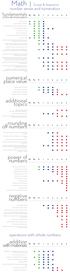 Math Scope & Sequence fundamentals number sense and numeration of the decimal system Count to 10 by units Associate number to numeral (1-10) KN 1 KN 1 KN 2 KN 2 Identify odd and even numbers/numerals and
Autumn - 12 Weeks. Spring 11 Weeks. Summer 12 Weeks. Not As We Know It Limited 2014
 A Year 5 Mathematician Planning of coverage and resources. Autumn - 12 Weeks Spring 11 Weeks Summer 12 Weeks TARGETS NHM YR 5 Collins 5 Abacus 5 Abacus 6 LA Prior Step NHM 4 CPM 4 Ginn 4 Number, place
MATH 095, College Prep Mathematics: Unit Coverage Pre-algebra topics (arithmetic skills) offered through BSE (Basic Skills Education)
 MATH 095, College Prep Mathematics: Unit Coverage Pre-algebra topics (arithmetic skills) offered through BSE (Basic Skills Education) Accurately add, subtract, multiply, and divide whole numbers, integers,
South Carolina College- and Career-Ready (SCCCR) Pre-Calculus
 South Carolina College- and Career-Ready (SCCCR) Pre-Calculus Key Concepts Arithmetic with Polynomials and Rational Expressions PC.AAPR.2 PC.AAPR.3 PC.AAPR.4 PC.AAPR.5 PC.AAPR.6 PC.AAPR.7 Standards Know
The Most Widely Used. Mathematics Textbook Series in Japan is Now in English! Introducing Tokyo Shoseki s. and
 The Most Widely Used Mathematics Textbook Series in Japan is Now in English! Introducing Tokyo Shoseki s Mathematics International (Elementary School, s 1 to 6) and Mathematics International (Lower Secondary
PUBLIC SCHOOLS OF EDISON TOWNSHIP DIVISION OF CURRICULUM AND INSTRUCTION ELEMENTARY MATH GRADE 2 MATH IN FOCUS
 PUBLIC SCHOOLS OF EDISON TOWNSHIP DIVISION OF CURRICULUM AND INSTRUCTION ELEMENTARY MATH GRADE 2 MATH IN FOCUS Length of Course: Term Elective / Required: Required Schools: Elementary Student Eligibility:
NEW YORK STATE TEACHER CERTIFICATION EXAMINATIONS
 NEW YORK STATE TEACHER CERTIFICATION EXAMINATIONS TEST DESIGN AND FRAMEWORK September 2014 Authorized for Distribution by the New York State Education Department This test design and framework document
Geometry. Higher Mathematics Courses 69. Geometry
 The fundamental purpose of the course is to formalize and extend students geometric experiences from the middle grades. This course includes standards from the conceptual categories of and Statistics and