
AT&T Global Network Client User s Guide
|
|
|
- Roger Wells
- 10 years ago
- Views:
Transcription
1 Version AT&T Global Network Client User s Guide 2012 AT&T Intellectual Property. All rights reserved. AT&T, the AT&T logo and all other AT&T marks contained herein are trademarks of AT&T Intellectual Property and/or AT&T affiliated companies. All other marks contained herein are the property of their respective owners. The information contained herein is not an offer, commitment, representation or warranty by AT&T and is subject to change.
2 Notice Every effort was made to ensure that the information in this document was complete and accurate at the time of publication. However, information is subject to change. Document Revisions This document is revised and maintained by AT&T Global Network Client Development, AT&T Labs. Copyright 2012 AT&T. All Rights Reserved. -2-
3 Overview... 4 AT&T Global Network Client Overview... 5 Preparing for Installation... 6 Installation... 9 Custom Installation Options Connecting to the Network Tasks Settings Help Accessibility Features Uninstall VPN Connections Wi-Fi Connections Mobility Connections Dial Connections AT&T Firewall Endpoint Security Appendix A: Supported Mobility Devices Appendix B: Third-Party Firewall Support Appendix D: Integrating with Third Party Software Table of Figures Index Copyright 2012 AT&T. All Rights Reserved. -3-
4 Overview The AT&T Global Network Client is a program that enables your Windows computer to easily connect to the Internet or your company s private network over any connection. Using this Document This document is intended for all users of the AT&T Global Network Client as a tool to understand the basic function and configuration of the client. The reader is assumed to have basic knowledge of Microsoft Windows and computer networking. This document may refer you to your Customer Account Administrator for additional help on various topics. Your Customer Account Administrator is an employee at your company which can provide you with additional support and is usually a technical resource for your company. Related Documents AT&T Global Network Client Administrator s Guide ftp://ftp.attglobal.net/pub/client/win32/9.0.2/adminguide.pdf AT&T Domain Login Guide ftp://ftp.attglobal.net/pub/client/win32/9.0.2/domainlogonguide.pdf Copyright 2012 AT&T. All Rights Reserved. -4-
5 AT&T Global Network Client Overview The AT&T Global Network Client is software that allows Windows computers to easily access the Internet and your company s private network from many locations around the world. It provides a simple, powerful interface that automatically detects and connects over mobility, Wi-Fi, broadband, dial, and ISDN networks. It also provides security policy enforcement, offline access-point directory browsing, detailed connection history, and in-depth diagnostic logging. The AT&T Global Network Client is packaged in three editions (Internet, Managed VPN, and LaptopConnect). Each edition supports the same simple user interface and integrated support tools and each is designed to install only the features required to support your contracted network service. More information about the AT&T Client Editions can be found in the Installation Chapter of this document. Copyright 2012 AT&T. All Rights Reserved. -5-
6 Preparing for Installation System Requirements The AT&T Global Network Client and its components are supported on the following operating systems and hardware. (The AT&T Client may function properly on other operating systems and lesser hardware, but it is not formally tested or supported): Operating System Software Hardware Windows XP (SP2 or later) 1, Windows Vista Windows 7 Administrator Rights Required: The user must have administrator rights when the installation is executed. Windows Installer 3.5 or later MSXML 3 or 4 Windows XP IBM PC or 100% compatible 800 MHz processor higher recommended 1 MB RAM or higher recommended Windows Vista & Windows 7 IBM PC or 100% compatible 1 gigahertz (GHz) or faster 32- bit (x86) or 64-bit (x64) processor 2 MB RAM or higher recommended Cross OS Requirements 250 MB free disk space Dial connection: 14,400 modem recognized & configured by Windows Wi-Fi connection: wireless adapter that adheres to NDIS 5 specifications and tested by AT&T Mobility connection: PC Mobility Card 1 Microsoft Wireless LAN API (KB918997) is required for private Wi-Fi connections using Windows XP; it is included in Windows XP SP3. Windows XP x64 is not supported. Copyright 2012 AT&T. All Rights Reserved. -6-
7 Requirements for Installation & Use Before starting the AT&T Global Network Client installation and setup, verify you have the information required in the following checklist. If you are missing any information, please contact your AT&T account administrator. Administrator rights to install or upgrade Your Windows install media (CD or installed MSI files) may be required. Hardware/Equipment necessary to establish basic network connectivity. For example, an existing Internet connection via cable or DSL, Wi-Fi, Mobility modem/card, ISDN T/A, or a Dial modem & phone line. For credential driven connections: Account User ID Password AT&T Global Network Client Editions The AT&T Client is packaged in three editions. You should only install the edition provided to you by your Customer Account Administrator. Installing an edition which includes services your company does not use may prevent you from connecting to the network. An overview of each of the editions is shown in the table below. Remote Access Services Managed VPN Services Extended Access AT&T Firewall Lightweight Policy Enforcement LaptopConnect Mobile Drivers Figure 1: AT&T Client Edition Table Internet Edition The Internet Edition includes the AT&T Global Network Client. Managed VPN Edition The Managed VPN Edition includes the AT&T Global Network Client and the features required to support the AT&T Managed VPN Services. Copyright 2012 AT&T. All Rights Reserved. -7-
8 LaptopConnect Edition The LaptopConnect Edition includes the AT&T Global Network Client and the features required to support the AT&T Managed VPN Services plus automatic installation of the Mobility Device Drivers required for connections using AT&T LaptopConnect. Obtaining the AT&T Global Network Client The AT&T Client is distributed through a public Internet download. If you have previously installed from a private FTP/Intranet download location, you may be using a custom version of the AT&T Client; contact your Customer Account Administrator to request an updated version. Users of Custom Version: Do not manually download new releases. Contact your AT&T Account Representative to request an updated custom version. Edition Internet Managed VPN LaptopConnect Downloads ftp://ftp.attglobal.net/pub/client/win32/9.0.2/agnc_int.exe ftp://ftp.attglobal.net/pub/client/win32/9.0.2/agnc_vpn.exe ftp://ftp.attglobal.net/pub/client/win32/9.0.2/agnc_laptopconnect.exe Figure 2: Download Location Table Copyright 2012 AT&T. All Rights Reserved. -8-
9 Installation Your Customer Account Administrator may have customized your installation of the AT&T Client. When using a customized version of the client one or more of the following windows may not be shown. Upgrading Previous Releases If you already have the AT&T Client installed on your workstation, AT&T Client version 9.0 will perform an upgrade of previous, version 7.x and version 8.x releases of the AT&T Client. During the upgrade, the previous AT&T Client will be uninstalled, the workstation may be rebooted, and then the new AT&T Client will be installed. Your user data and AT&T Client customizations will be preserved. If you are using a version prior to version 6.0 of the AT&T Client, it is recommended you uninstall your current version prior to installing version or later. To upgrade you must be running version 6.0 or higher: If you are using a version of the AT&T Client prior to version 6.0, you should uninstall your current version prior to installing Upgrading Version 7 Installations If you already have a 7.0 or later version of the AT&T Client installed, when you launch the installation program the upgrade confirmation dialog shown below will be displayed. Click Yes to continue. Figure 3: Upgrade Confirmation Dialog Upgrading to a Different Edition It is not recommended to upgrade to a different Edition of the version 9 of the AT&T Client. The only exception is the LaptopConnect Edition which can be used to upgrade an existing version 9 installation to include the AT&T LaptopConnect Mobile Device Drivers. When upgrading from an existing version 8 installation to the LaptopConnect Edition the Mobile Device Drivers are automatically installed. Starting with version 8.8, you can manually choose the type of Device Drivers installation with the LaptopConnect Edition. Copyright 2012 AT&T. All Rights Reserved. -9-

10 Figure 4: Selectively Choosing Mobile Device Drivers Installation Begin the installation by double-clicking on the executable file on your installation media (USB drive, software download, etc.). The executable file name for each of the editions is shown below. Edition Internet Managed VPN LaptopConnect executable file agnc_int.exe agnc_vpn.exe agnc_laptopconnect.exe Figure 5: Executable File Names Table Copyright 2012 AT&T. All Rights Reserved. -10-
11 Step 1 Click Next> on the Installation Confirmation Window to continue. Figure 6: Installation Initialization Window Step 2 You must agree to the License Agreement to continue. Click the checkbox next to I accept the terms in the license agreement. Click Next>. Figure 7: License Agreement Window Copyright 2012 AT&T. All Rights Reserved. -11-
12 Step 3 A Typical installation is recommended. You should only change to Custom if your account administrator has provided you with detailed instructions for a Custom installation. Click Next>. Step 4 Click Install. Figure 8: Setup Type Window Note: Choose Custom installation if you wish to: Connect directly to a cellular or Wi-Fi connection without the AT&T Global Client prompting you for credentials. Enable default Persistent Connection settings. Select your Language Support. See the section below on Custom Installation Options for more information. Step 5 Click the checkbox next to Launch AT&T Global Network Client Edition to immediately launch the AT&T Client. Click Finish. Figure 9: Installation Ready Window Figure 10: Installation Complete Window Copyright 2012 AT&T. All Rights Reserved. -12-
13 Filter Driver Installation The installation program will automatically prevent a Driver Installation Error when installing the AGN Filter Driver on Windows 7. Upon detection of the error, the Installation Program will increase the MaxNumFilters key by 1. It will then continue with the installation. The installation program will continue incrementing the MaxNumFilters until it is able to complete the installation. Failed Installation If you cancel the installation prior to receiving the Installation Complete Window confirmation, or an error occurs during installation, an error window will confirm the installation was not successful. Click Finish and reboot your computer before attempting installation again or resuming other work. Figure 11: Installation Interrupted Window Copyright 2012 AT&T. All Rights Reserved. -13-
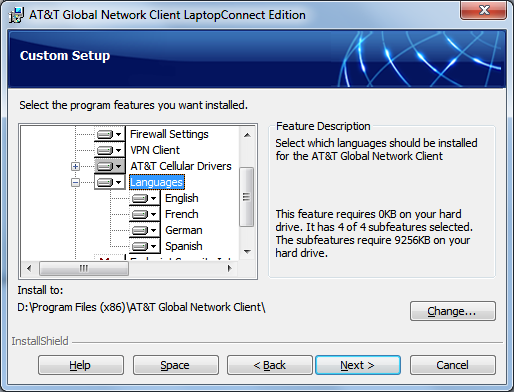

14 Custom Installation Options Selecting Custom Installation Path To access Custom Installation Options, select Custom during Step 3 of the Installation as described above and as shown in Figure 12: Custom Installation Path. Click Next> to continue and view Custom Installation Options. Including Optional Features Each edition of the AT&T Client automatically includes the core features necessary for most Figure 12: Custom Installation Path services. You should only select custom features if instructed by your Client Account Administrator. When installing the AT&T Client you must select the Custom Installation Path to access optional Features. Selecting Your Language Support The AT&T Client automatically installs support for English, French, German, Japanese 2 or Spanish. Installing the files necessary to support English is required. Support for other languages is configurable. Expand the Languages folder to change your language support settings. Select the arrow next to the language you wish to change to view available options. Figure 13: Language Selection 2 Japanese is only supported if supported by the installed Microsoft Windows Operating System. Copyright 2012 AT&T. All Rights Reserved. -14-

15 Once all optional features have been selected, click Next> to continue installation. Mobility Device Driver Installation When installing the LaptopConnect Edition the Mobility Device Drivers are automatically installed; Mobility Device Driver installation can be manually controlled with the LaptopConnect Edition using Custom Installation Options. Figure 14: Mobility Device Drivers T6 Client The T6 Client provides support for IPv6. IPv6 is designed to succeed IPv4, the current version of Internet Protocol. The AT&T Client does not automatically install the T6 client. Use the Custom installation path to install the T6 client. Figure 15: AT&T T6 Client Installation Copyright 2012 AT&T. All Rights Reserved. -15-

16 Shortcuts You can choose to have the installer create an icon on your desktop and/or your quick launch bar. Click Next> to continue. Figure 16: Shortcuts Connecting Directly to a Mobility or Wi-Fi Network Installation Option for Mobility Internet Connections Without Prompting for Credentials Some networks do not require AT&T Global Network authentication to obtain network access. There are two options that will allow users to connect directly to mobility or Wi-Fi networks without entering AT&T Global Network credentials. During install you can select the Custom Installation option and under Network Access Option, enable the checkbox Default to The Internet for network connections (see figure below). By checking this box at installation you will not be required to enter RAS credentials for mobility or Wi-Fi use. Alternately, your administrator can set this checkbox to default to being selected for all users at install by referring to the Customizations section of the Administrators guide document. Figure 17: Network Access Option Copyright 2012 AT&T. All Rights Reserved. -16-
17 Default Settings for Persistent Connection Mode Default Persistent Connection settings can be enabled by you or your account administrator during installation. The default settings do the following: 1. Create a shortcut to the AT&T Client executable in the All Users Startup folder. 2. Enable the Minimize main window to system tray checkbox in the When this program starts section of the Preferences tab of Login Properties. 3. Enable the Minimize main window to system tray instead of taskbar checkbox in the After connecting section of the Preferences tab of Login Properties. 4. Set the default connection sequence to Persistent connection. During install you can select the Custom Installation option and under Network Access Option, enable the checkbox Default settings for Persistent Connection mode (see figure above). Copyright 2012 AT&T. All Rights Reserved. -17-

18 Connecting to the Network Most users are able to establish a connection with no manual configuration prior to their first connection. The AT&T Client includes an Automatic Connection feature which will attempt a connection over all possible network types installed on your computer. Starting the AT&T Client To launch the AT&T Client double-click on the AT&T Global Network Client icon on your desktop OR click Start, click All Programs, Click AT&T Global Network Client folder, and click AT&T Global Network Client. Connecting Step 1 Figure 18: AT&T Global Network Client Icon To connect, click the BIG green Connect button on the Main Window or click on the Connect button underneath the method desired, e.g. Wi-Fi. Figure 20: Wi-Fi Connect Button Figure 19: Main Window Copyright 2012 AT&T. All Rights Reserved. -18-
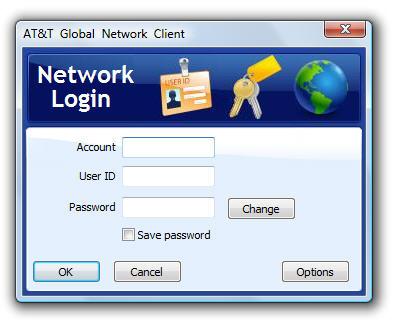
19 Step 2 The first time you connect the AT&T Client will prompt you to enter your Account, User ID, and Password. Click Save password to save your password in the AT&T Client and you will not be prompted to enter it for future connections. Click OK. Token Users If you are using an authentication type which requires a PIN and token, enter your PIN immediately followed by the current token in the Password field. See the section titled PIN and Token Authentication on page 25 of this guide for additional information. Figure 21: Network Login Window Step 3 You are now connected! Figure 22: Main Window/Connected Copyright 2012 AT&T. All Rights Reserved. -19-
20 Connected Included on the Main Window when connected is a throughput meter which shows your network statistics for your current connection. You can mouse over the numbers of the throughput meter for more information about each number. Starting in the upper right hand corner and moving clockwise, displayed are the statistics for: Maximum Number of Bytes Transferred per Second Bytes Sent in the Last Second Bytes Received in the Last Second Bytes Sent/Received to the Network Figure 23: Main Window/Connected - Throughput Meter Showing Dial Connection Dial is not shown by default and can be added if needed at install time with the SHOW_DIAL Public Property or by selecting Show Dial Connection from the Settings menu. Figure 24: Show Dial Connection Menu Security Status When enabled by your Account Administrator, a Security Status panel is available on the AT&T Client Main Window. The Security Status panel includes useful information about your computer and network security. Click on the icons in the Security Status panel of the Main Window to open a pop-up window with information related to the icon topic. Copyright 2012 AT&T. All Rights Reserved. -20-
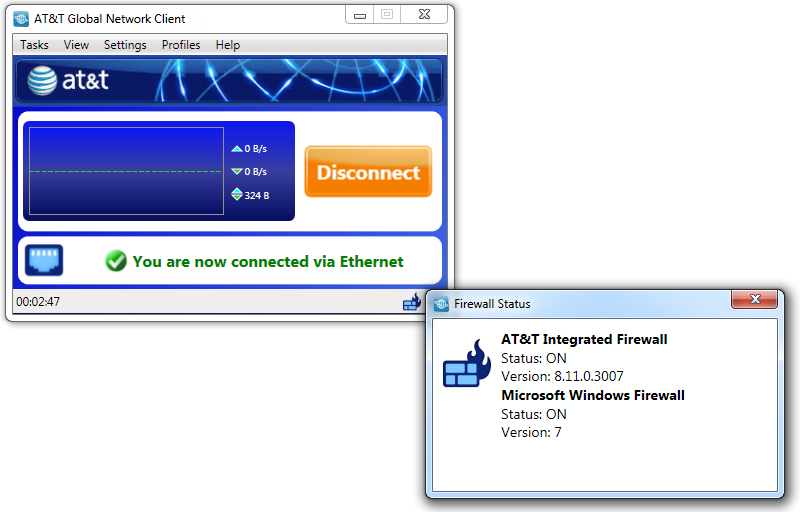
21 Figure 25: Firewall Status Info The Firewall Status icon will show: when no additional action is required. If additional action or configuration is required the status will change to:. The Security Status icon: will show when no additional action is required. If additional action or configuration is required the status will change to:. Copyright 2012 AT&T. All Rights Reserved. -21-
22 Change Password Password changes are performed at connection time. From the Network Login Window, click the change button to display password change fields as shown below. Enter your current password in the Password field, enter your new password in the New Password and Confirm new password fields. Your password may be required to meet criteria defined by your administrator (ex: it may need to be a minimum number of characters). Click the Password Rule button to view your currently configured password rules. Click OK on the Network Login Window to connect and change your password. Figure 26: Network Login Window Change Password Option Copyright 2012 AT&T. All Rights Reserved. -22-

23 Saved Login Information After your first successful connection, if your Customer Account Administrator allows you to save your network login credentials and password, the Network Login Window will no longer be displayed after clicking Connect. To display the Network Login Window click the arrow next to the Connect button and select Connect and prompt for user ID and password Figure 27: Main Window/Connect with Saved Login Credentials Network Awareness Your Customer Account Administrator may define certain networks for which it is not necessary to connect with the AT&T Client. When connected to a network for which no AT&T network connection is required, the AT&T Client Connect button will be disabled. Copyright 2012 AT&T. All Rights Reserved. -23-

24 Figure 28: Main Window: Network Awareness Customization Persistent Connections When enabled, the Persistent Connections feature will automatically connect or reconnect the AT&T Client with little or no user interaction. Persistent Connections can be used with all AT&T services as well as credential-less connections. For AT&T services, it must be configured both in the AT&T Client and the AT&T Administration Server. For Credential-less internet connections, the setting can be controlled with just the AT&T Client. One example of the Persistent Connection advantage is a user with an active AT&T Client connection whose machine enters hibernation state, automatically disconnecting the AT&T Client connection. When the user returns and resumes their work, the AT&T Client enabled with Persistent Connections would automatically initiate a connection attempt to establish connectivity, without action from the user. If the Save Password option is enabled, no user interaction is required to establish the new connection. Disconnect To end your session click the orange Disconnect button on the Main Window. Click Yes on the Disconnect Warning dialog. Copyright 2012 AT&T. All Rights Reserved. -24-
25 Figure 29: Disconnect Warning Dialog Lightweight Policy Enforcement AT&T Lightweight Policy Enforcement (LPE) is an optional service which performs basic application monitoring. Your Customer Account Administrator may have customized your version of the AT&T Client to require firewall, anti-virus, or anti-spyware software be installed and running on your computer before you can connect using the AT&T Client. The Security Status area of the AT&T Client Main Window displays information about security programs running on your computer that may be required for your Lightweight Policy Enforcement compliance. If you are not in compliance with the rules defined by your Customer Account Administrator you will receive an error. If you receive an error that specified software is not running, contact your Customer Account Administrator for assistance. Figure 30: Lightweight Policy Enforcement Error Dialog PIN and Token Authentication You can input a PIN and token together with no spaces into the Password field of the Network Login Window. After your first connection, the Network Login window will change to include PIN and token fields. Copyright 2012 AT&T. All Rights Reserved. -25-
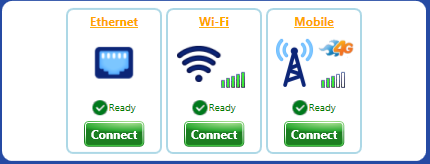
26 You can manually control the style of the Network Login window by clicking Options located on the bottom right corner of the Network Login Window to open the Login Window Options dialog. Figure 31: Network Login and Options Dialog Windows On the Login Window Options dialog change the drop down box labeled Password format to PIN and token. Click OK. When PIN and token is set at the Password format type, the Network Login Window will include fields for PIN and token. If software token software is installed, the AT&T Client will recognize it and issue a prompt asking if the token is to be used for authentication. If the answer is yes, the AT&T Client will automatically obtain the token from the token software and send it in along with the PIN entered. Figure 32: Network Login with Token Connecting to a Specific Type of Network In general, simply pressing the main Connect button on the main window of the client will connect you to your network using the best connectivity option available. However, there may be times when you wish to connect to a specific network, instead of letting the client determine the best network option, such as if a Wi-Fi access point is not functioning properly or the signal strength is low and you would prefer to connect using mobility. If you wish to connect using a specific type of network, just click the connectivity type you want to use from the possible connection type. For Wi-Fi connections, all hot spots in the area that can be detected will be listed, along with an indication of what type of hot spot it is (Preferred, encrypted, etc.). For mobility connectivity, a Connect button will be shown to connect directly using mobility, along with details on the mobility device and network statistics. Copyright 2012 AT&T. All Rights Reserved. -26-
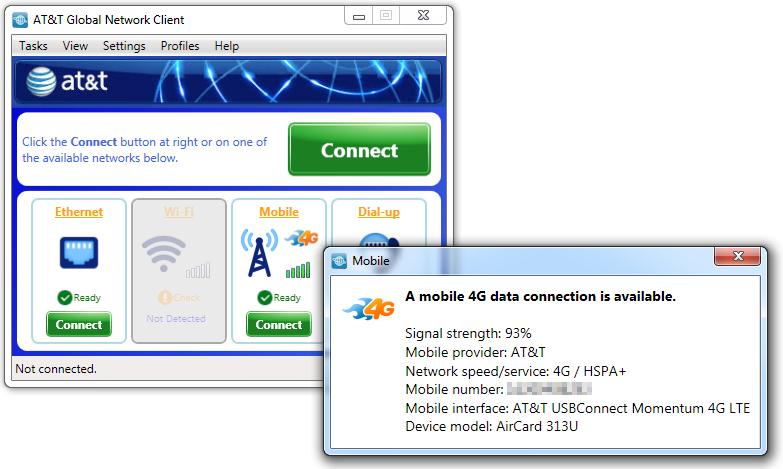
27 Figure 33 Connecting Directly Using Cellular How to Connect Beginning in Version 9.0, the AT&T Client no longer uses the Change connection sequence functionality. The connection sequence is set using the following sequence: Figure 34: Connection Sequence CHECK Diagram The Dial connection is not shown by default and can be added if needed at install time with the SHOW_DIAL Public Property or by selecting Show Dial Connection from the Settings menu. Copyright 2012 AT&T. All Rights Reserved. -27-
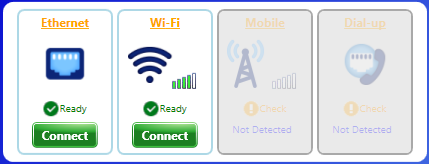
28 Figure 35: Show Dial Connection Menu If a connection sequence item is unavailable, the AT&T Client will grey-out the item. See Figure below: Figure 36: Connection Panel with Unavailable Connection Methods To activate a defined Connection type, select a Connect button of the connection type desired. Copyright 2012 AT&T. All Rights Reserved. -28-
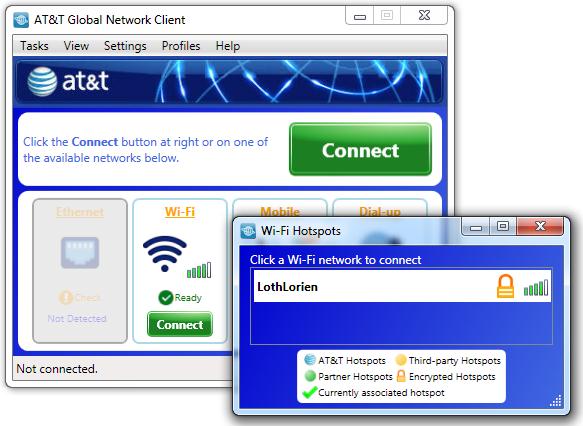
29 Figure 37: Main Window with Dial Connection Shown Figure 38: Main Window - Available Network Details Copyright 2012 AT&T. All Rights Reserved. -29-
30 Connecting to Third-Party Wired and Wireless Locations that Require a Browser Login The AT&T Client has support for connecting to Third-Party locations that require a browser login. The third party network is detected automatically by the AT&T Client. For example, if Third-Party Wired Ethernet is detected then the Connection Sequence will display Ethernet (third-party) in the corresponding connection type of the Connection Sequence panel of the Main Window. A Third-Party Ethernet warning dialog is displayed during the connection process. Proceed by clicking Yes ; Cancel this connection process by clicking No, stop ; or Skip the connection by clicking No, continue. Figure 39: Third-Party Ethernet Warning If you proceed by clicking Yes then you will be shown the Third-Party Login dialog box providing instructions for connecting manually using a web browser based login. Copyright 2012 AT&T. All Rights Reserved. -30-
31 Figure 40: Third-Party Ethernet Login Figure 41: Browser Based Login Dialog Note: This action is prohibited from the Windows Logon Desktop (WinLogon Desktop) to prevent your user desktop from being exposed to any potential security risks or malicious activity. Therefore, third-party connections which require browser based login will not Copyright 2012 AT&T. All Rights Reserved. -31-
32 appear in the connection sequence as this would require that an internet browser be launched. Software Updates The AT&T Client will automatically attempt to update the following components after initial installation and on regular intervals thereafter: Access Point Directory (Wi-Fi locations, phone numbers, etc.), VPN Certificates, AT&T Client software, Mobility firmware, Lightweight Policy Enforcement files, and Dynamic customizations files. Automatic Check for Updates A program that periodically checks for updates to all AT&T Client software components is installed with the AT&T Client and runs in the background when your Windows machine boots up. It does not require the AT&T Client to be running. The default checking interval for all components is 14 days. If an update is available, the download is initiated. Downloads in the background run at low priority and only occur when the workstation is idle. A system tray icon will be displayed when checking or retrieving and installing updates are occurring. To view the status of the current download operation mouse over the system tray icon. To cancel the download double-click on the icon to open the NetUpdates User Interface and select cancel. If the Access Point Directory, VPN Certificates, Lightweight Policy Enforcement files, or Dynamic customizations files are newer than the installed files, the delta updates will automatically download without prompting. If the AT&T Client has scheduled a software update and you are using a connection that is either a metered Mobility data plan or is considered a low bandwidth connection; I.E. Dial-Up Networking, you will be given a popup message warning you that the updates may result in additional network usage. If you would like to continue with the software download you can click Yes. Copyright 2012 AT&T. All Rights Reserved. -32-


33 Figure 42: Warning for Automatic Update of a Mobility Connection After an update is downloaded, the next time the AT&T Client is launched an installation prompt will be shown. Figure 43: Install Updates When connected, the status of software updates is available on the Main Window by clicking the Updates icon. Copyright 2012 AT&T. All Rights Reserved. -33-
34 Manual Check for Updates To manually initiate a check for updates, click Check for Updates from the Help panel on the left hand side of the Main Window. Figure 44: Software Updates Window The Software Updates window will list the components and the version information. If an update is available, the component will be automatically checked. Click Download checked items to complete the update process. All checked components will be updated. Administrator Rights May Be Required: You may need Microsoft Administrator rights to update the AT&T Client software. User Permissions Depending on your Operating System, Microsoft Windows Administrator Rights may be required for automatic software update of the AT&T Client software. If you are running Windows XP, Administrator rights are required to update the AT&T Client software. If you are running Windows Vista, the AT&T Client uses the guidelines and rules defined by Windows Vista and Windows Installer to determine the necessary access rights for an update. The first time the AT&T Client attempts to perform a software update Windows Vista users may be prompted to allow the FTP network activity. Windows Vista Administrator rights are required to allow the FTP traffic. When an update is installed, if you are a Restricted User, you may be prompted to enter credentials with Administrator rights to successfully continue the update. If you have any questions about your Microsoft Windows permissions, contact your Customer Account Administrator. Copyright 2012 AT&T. All Rights Reserved. -34-

35 Tasks Browse the Access-Point Directory The Access-Point Directory is a tool for off-line browsing of available access points. You do not set or change your access point using this tool. Click Browse the access-point directory in the Tasks panel on the Main Window to open the Access Point Directory Window to review the global directory of connection options including dial, Ethernet and Wi-Fi connection types. Figure 45: Access-Point Directory Window If you click on any of the Access Points with addresses highlighted in blue, the location will be displayed in your browser using Yahoo! Maps. Copyright 2012 AT&T. All Rights Reserved. -35-
36 The Connection History window allows you to sort previous connection attempts by Date/Time, Duration, Type, or Description. Click the plus sign next to the connection attempt for additional information. Search for key words using the Look For field. Figure 46: Connection History Window Copyright 2012 AT&T. All Rights Reserved. -36-
37 Settings Your Customer Account Administrator has preconfigured your network settings in a central AT&T Network Server. When you connect to the AT&T Global Network the AT&T Client retrieves those settings and applies them to your connection. It is recommended you do not override network settings using manual configuration in the AT&T Client unless you are instructed to do so by your Customer Account Administrator or AT&T Customer Care. Configuration Is Not Required: Most users can establish connections with no manual configuration. Profile Management AT&T Client profiles store user information. A profile includes: Account User ID Advanced Login Properties (Service, WINS, DNS, Domain Suffix, Windows Login) Service Most users connect with the same information a majority of the time and will only require one profile. If you connect with different user IDs or services you may want to define profiles for your common combinations to easily switch between them. AT&T Client profiles can be assigned common names to help you remember when to use them, for example, "My Internet Profile" or "VPN Servers - Germany". Login Properties To access Login Properties click the Settings Menu > Login properties on the main window of the AT&T Client. The AT&T Client Login Properties window allows you to configure the settings and properties for your current connection. It is recommended you use the default values and values defined in the AT&T Administration Server. Copyright 2012 AT&T. All Rights Reserved. -37-
38 Show the Login Properties Window The AT&T Client Login Properties window allows you to configure the settings and properties for your current connection. It is recommended you use the default values and values defined by your Customer Account Administrator. To access Login Properties click the Settings Menu > Login properties on the main window of the AT&T Client. Figure 47: Login Properties Window General Profile Manager Use the drop down box to activate an existing profile. Click New to create a new profile. Click Rename to rename a profile. Click Remove to delete a profile. Network Services Click Configure to change the Account, User ID, or Network Service. Your default network service is the service defined in the AT&T Administration Server for your specified Account and User ID. If you override the network service in the AT&T Client, you must be authorized for the new service in the AT&T Administration Server for a successful connection. Copyright 2012 AT&T. All Rights Reserved. -38-
39 Figure 48: Configure Network Services Screens Servers DNS, WINS, and Domain Suffix configuration information is normally stored in the AT&T Administration Server. The AT&T Client automatically retrieves the values and updates the workstation to use the supplied values throughout the connection. Click Configure to to verify or define your server information. Figure 49: Server s Configure Button To override the values defined in the AT&T Administration Server select Use the following manual settings and enter the corresponding values. For WINS and Domain Suffix you also have the ability to select Do not update and the AT&T Client will not alter the specified settings when connected. If you running Windows XP and are required to be authenticated by a Windows Domain to logon to your Windows workstation, you can enable Windows Logon. Select Yes, automatically start this program during Windows logon to establish a network connection using the AT&T Client prior to your Windows logon. If you do not require a Windows Domain authentication to logon to your workstation, select No, do not automatically start this program. Copyright 2012 AT&T. All Rights Reserved. -39-


40 Figure 50: Server Configure - Windows Logon Window Preferences Preferences define the usability settings for your connection. Preferences are organized by AT&T Client Profile. For more information about profiles see Profile Management on page 37 of this guide. Click the checkbox next to Override defaults to change any of the settings. Figure 51: Login Properties - Preferences Window Copyright 2012 AT&T. All Rights Reserved. -40-
41 Autostart Autostart allows you to define programs to launch at any of the following times: Before Connecting After Connecting After Performing Network Updates Before Disconnecting After Disconnecting Autostart settings are organized by AT&T Client Profile. For more information about profiles see Profile Management earlier in this chapter of this guide. Click the checkbox next to Override defaults to change any of the settings. Click the Add, Change, and Remove buttons to configure the program information. Click on the arrow buttons to move a program up and down in the launch order. Figure 52: Login Properties - Autostart Window Copyright 2012 AT&T. All Rights Reserved. -41-
42 Programs The Programs tab allows you to configure which programs will be updated by the AT&T Client when connected to the network. Temporary updates are useful to eliminate or reduce the manual configuration needed before using the programs. The update values are defined in the AT&T Administration Server. Figure 53: Login Properties - Programs Window To prevent the use of the values from the AT&T Administration Server or to define new values, click Override defaults and select the program you wish to change. Click Settings to review the values and make any changes. You can select to have the values Automatically Update to the values defined in the AT&T Administration Server, Do not update the values, or Manually update to values you define locally. For example, using the Programs tab, you can remove Microsoft Internet Explorer proxy settings while connected by clicking Override Defaults, selecting Microsoft Internet Explorer, clicking Settings, clicking to highlight Auto-Proxy URL, clicking Manually update to, and leaving the Auto Proxy URL to use field blank. Timeouts The AT&T Client supports two variations of Timeouts which can be configured by clicking Override defaults. Copyright 2012 AT&T. All Rights Reserved. -42-
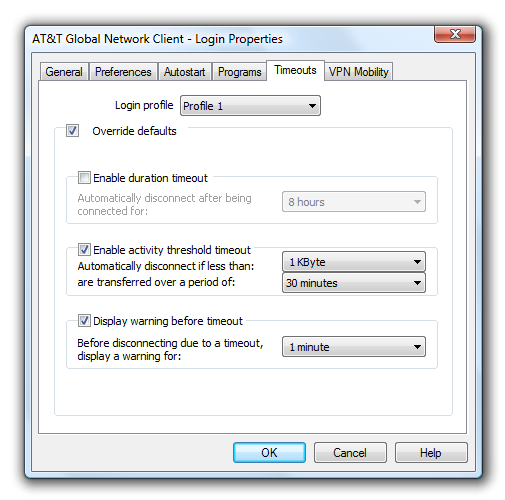
43 Figure 54: Login Properties - Timeouts Window Copyright 2012 AT&T. All Rights Reserved. -43-

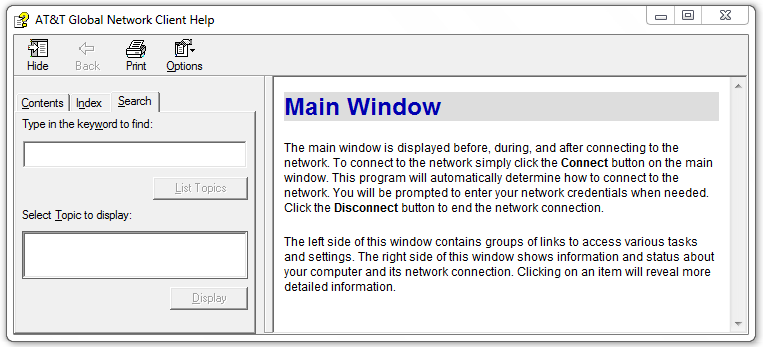
44 Help About this Program Click About this program in the Help panel of the Main Window to display useful program information including the AT&T Client and Access-point directory version information. Figure 55: About Window Help for this program Click Help for this program in the Help panel of the Main Window to open the local help program for the AT&T Client. Figure 56: Help Window Copyright 2012 AT&T. All Rights Reserved. -44-
45 Check for Updates On the Help panel of the Main Window click Check for Updates to initiate a manual check for software updates. See the chapter titled Software Updates on page 32 of this guide for more information about software updates. Show Detailed Messages On the Main Window, click on the Help menu; then Show detailed messages to open the Detailed Messages Window. The Detailed Messages Window is an in-depth troubleshooting tool normally used by only your Customer Account Administrator or AT&T Customer Care. Contact Customer Support On the Main Window, click on the Help menu; then click Contact customer support to open the Customer Support window containing your AT&T help desk phone numbers. Help desk phone numbers change for each country. All countries have help desk staff that speak both the local language and English. You should call the phone number for the country to which you are trying to connect. Figure 57: Customer Support Window When working with support, the technician may request additional information in order to assist you. If they need to look at the logs from the client, you can click the Gather Logs button which will gather all the client logs and create a zip archive that can then be provided to the person assisting you. If you are having an issue, they may also request that you recreate the issue with detailed tracing enabled. Click the Detailed Tracing button to enabled high level tracing. When you click the Detailed Tracing button, high Copyright 2012 AT&T. All Rights Reserved. -45-
46 level tracing will immediately be enabled and you will see the Stop Tracing Window. Leave the Stop Tracing window open and use the client to recreate the issue. Figure 58: Stop Tracing Window After you have recreated the issue, click the Stop Tracing button. When you click the Stop Tracing button, the tracing will be set to the normal tracing level and the logs which contain the high level tracing will be gathered into a zip archive. The Support Log Created window will then be displayed, providing options to get the log for the support technician. Figure 59: Support Log Created Window Click Close to return to the AT&T Client. Copyright 2012 AT&T. All Rights Reserved. -46-

47 Create Support Log On the Main Window, click on the Help menu; then click Create support log to gather the client logs into a zip archive with useful support information for your Customer Account Administrator or AT&T Customer Care. The AT&T Client will display the Support Log Created window, providing the options to get the log for the support technician. Figure 60: Support Log Created Window Copyright 2012 AT&T. All Rights Reserved. -47-
48 Accessibility Features The AT&T Client complies with US regulations to support accessibility for persons with disabilities, including Section 508 regulations. Visual Display of Screen Element in Focus The AT&T Client screen element in focus is depicted a gray dotted box surrounding the control. When first launched, the Connect button is in focus as shown below. Keyboard Navigation The AT&T Client can be navigated and utilized exclusively using a keyboard. The controls can be operated either by pressing the space bar or the Enter key. To move between controls, use the tab key to navigate forward or shift key and tab key in unison to navigate backward. To simulate a right mouse click, use the menu key or the shift key in unison with the F10 key. Expanding screen elements such as Available Networks, Security Status and Connection Sequence will expand automatically as you tab through their controls. Copyright 2012 AT&T. All Rights Reserved. -48-
49 Uninstall The AT&T Client is removed via the Windows Control Panel, Programs and Features option. Figure 61: Programs and Features Window Uninstall The Programs and Features Uninstall option is not supported for the AT&T Global Network Client; to uninstall click Change and follow the directions below. Change Click Change on the Programs and Features window list to Modify, Repair or Remove the AT&T Client program Step 1 Click Remove and click Next> to continue. Figure 62: Modify, Repair, Remove Welcome Copyright 2012 AT&T. All Rights Reserved. -49-
50 Step 2 Program files will be removed, you can select which user settings are removed. Select Leave all user settings on the computer. (default) to leave user information such as account and user ID as well as profile information on the computer. Select Remove only my user settings to remove only the settings stored for the current user. Select Remove settings for all users on this computer to remove all AT&T Client user settings on the computer. Click Next> to continue. Step 3 Click Remove to continue. Figure 63: Remove User Data Window Figure 64: Remove the Program Warning Copyright 2012 AT&T. All Rights Reserved. -50-
51 Step 4 Click Finish. Reboot May Be Required: You will be prompted if you must reboot your workstation after removing the AT&T Client. Figure 65: Removal Completed Window Copyright 2012 AT&T. All Rights Reserved. -51-
52 VPN Connections VPN Login Window If you are using a VPN service which requires a two-phased login after clicking Connect on the Main Window you will be prompted to enter your VPN Login credentials to successfully connect. Enter your VPN credentials and click OK on the VPN Login Window to continue. Figure 66: VPN Login Window VPN Security Banner Most VPN services require you comply with rules and regulations of the service. Before you can use your connection you must click OK on the Security Banner agreeing to the terms and conditions outlined by your company. Click Cancel on the Security Banner to terminate your connection. Refer all questions about the terms and conditions outlined in your security banner message to your Customer Account Administrator. Figure 67: Security Banner Copyright 2012 AT&T. All Rights Reserved. -52-
53 VPN Client ID In previous versions of the AT&T Client you may have been required to enter an eight digit VPN Client ID supplied to you by your Customer Account Administrator. The AT&T Client no longer requires manual input of the VPN Client ID. It is recommended you do not override network settings using manual configuration in the AT&T Client unless you are instructed to do so by your Customer Account Administrator or AT&T Customer Care. Manual Configuration is Not Recommended: Do not override network settings using manual settings unless you are instructed to do so. If you must manually input your VPN Client ID, in the Settings panel click Show the login properties window Next, in the Network Services panel of the Login Properties Window Click Configure On the VPN Client ID Window, Click Use the following manual settings, enter your 8 digit VPN Client ID and your VPN user name. Click Finish. Figure 68: VPN Client ID Window Copyright 2012 AT&T. All Rights Reserved. -53-
54 VPN Mobility VPN Mobility is not enabled for all users. Your Customer Account Administrator may enable this optional feature which will attempt to maintain your VPN regardless of changes in your network connectivity. This allows you to transition between network interfaces (ex: wired to wireless) without interruption to your VPN connection. When changes to your network interface require the VPN to transition, your VPN status indicator will turn orange as shown below. Figure 69: Main Window/VPN Mobility After the VPN is transitioned to the new network interface you will receive a pop-up notifying you the transition was successful. Figure 70: Main Window/VPN Mobility Restored Copyright 2012 AT&T. All Rights Reserved. -54-
55 Disable VPN Mobility To disable VPN Mobility for one or more profiles, select Login Properties, VPN Mobility tab, select the desired profile from the Login profile drop down box, enable the checkbox next to Override defaults, and disable the checkbox next to Operate in VPN Mobility mode. Figure 71: Disable VPN Mobility Local Subnet Access Local subnet access is not enabled for all users. Your Customer Account Administrator may enable this option which allows some traffic to flow to your local subnet when a VPN tunnel is active. This is useful when needing to print to a local printer, for example. However, in some cases, allowing local subnet access causes network addressing issues. If your Customer Account Administrator has enabled local subnet access and there is a need to disable it, you can. To disable local subnet access, select Login Properties, Preferences tab, and check the box next to Disable access to the local subnet while VPN connected in the VPN section. Copyright 2012 AT&T. All Rights Reserved. -55-
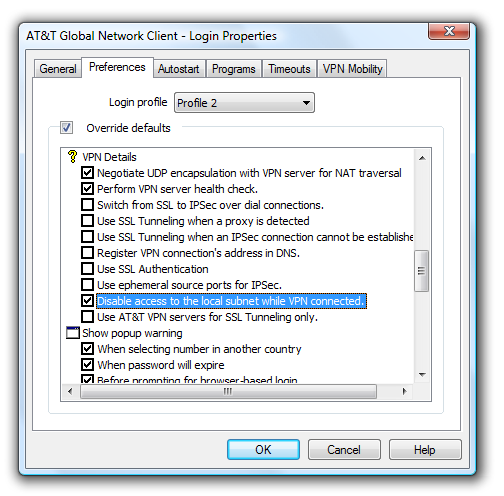
56 Figure 72: Disable Local Subnet Access OPSWAT Certified VPN The AT&T Global Network Client VPN is certified through the OPSWAT Certification Program. This certification demonstrates that the AT&T Global Network Client VPN is compatible with products from other market-leading technology vendors. Products carrying OPSWAT certification follow standards that assure their product will not adversely affect other installed security software. To learn more, visit the OPSWAT Certification website at Copyright 2012 AT&T. All Rights Reserved. -56-
57 Wi-Fi Connections The AT&T Client supports connections to both public and private Wi-Fi hotspots. If a wireless network is in range an additional option to Click here to view nearby Wi-Fi networks is available under the Connect button and a Wi-Fi icon will be shown in the Available Networks area. Figure 73: Main Window - Wi-Fi Networks in Range Associating to a Wi-Fi Hotspot The AT&T Client recognizes a connection as Wi-Fi when the AT&T Client controls the association to the hotspot. If you are using another program that acts as a radio manager (i.e. IBM Access Connections), and that program automatically associates to Wi-Fi hotspots whenever they are in range the AT&T Client may categorize the connection type as a generic broadband/ethernet connection type. There will be an Ethernet icon with the word Existing below it. Click Connect and the AT&T Client will use the default automatic connection sequence to establish your connection using Wi-Fi providing Wi-Fi is in the connection sequence and a Wi-Fi network is in range. To associate to a specific hotspot directly, rather than using the automatic connection sequence, click Click here to view nearby Wi-Fi networks. The networks in range will be listed. Click on the name of the hotspot network to which you would like to connect. Copyright 2012 AT&T. All Rights Reserved. -57-
58 Figure 74: Main Window - Wi-Fi Details Copyright 2012 AT&T. All Rights Reserved. -58-
59 Wi-Fi Hotspot Types The AT&T Client categorizes Wi-Fi hotspots in five categories, Encrypted, preferred private, preferred, non-preferred, and free. More information about each type is shown in the following table. TYPE Encrypted Preferred Private 3 Preferred Non-Preferred Free DESCRIPTION The hotspot supports encrypted traffic, requires a password to associate and the password is unknown to the AT&T Client. This hotspot type may be located in a private or public location. The hotspot requires a password to associate and the password has been configured either in the AT&T Client or Microsoft Windows. This hotspot type is typically located in a private location (your office, home, etc.) The hotspot is owned by a partner of AT&T. You must be authorized to use the AT&T Preferred Wi-Fi service by your Customer Account Administrator. An AT&T account, user ID and password are required to associate to the hotspot. This hotspot type is usually located in a public location. The hotspot is broadcasting an SSID and traffic to/from the hotspot is not encrypted. A separate authentication (outside the AT&T Client, usually through a web browser) is required to associate to the hotspot. This hotspot type is usually located in a public location. The hotspot is broadcasting an SSID, does not require a password to associate and traffic to/from the hotspot is not encrypted. This hotspot may be located in a private or public location. Figure 75: Hotspot Types 3 Preferred Private connections are only supported on Windows XP and Windows Vista. Windows XP users must install the Microsoft Wireless LAN API (KB918997) to support Preferred Private connections. Copyright 2012 AT&T. All Rights Reserved. -59-
60 Preferred Private Hotspots You can manage the VPN access setting by clicking on Wi-Fi in the Connection Sequence area of the Main Window to expand the Wi-Fi connection types. Doubleclick on (Preferred Private) to open the Preferred Private Wi-Fi Networks Dialog. Click the checkbox next to your SSID for VPN needed to change the state. Figure 76: Preferred Private Wi-Fi Networks Dialog RSA SecurID Protected Preferred Private Hotspots Before attempting to connect to an RSA SecurID protected Hotspot, you must be running Windows Vista or Windows XP SP2 with the Microsoft Wi-Fi API Hot fix as well as have the EAP Client from RSA Authentication Agent 6.1+ installed. When configuring the Hotspot in Microsoft Windows, select RSA EAP - Protected OTP as the EAP type on the Authentication tab of the Hotspot properties dialog. The AT&T Client attempts all connections in the active connection sequence. If a Wi-Fi match is found to a RSA SecurID secured Hotspot, you must authenticate to the Hotspot using your SecurID token. After associating to the Hotspot a popup will appear in your system tray. Figure 77: RSA SecurID Hotspot Logon Notification Copyright 2012 AT&T. All Rights Reserved. -60-

61 On the pop-up, click Click here to select a certificate or other credentials for connection to the network, to display the RSA SecurID User Name Required window. Enter your User name and click OK. Figure 78: RSA SecurID User Name Prompt Enter your PIN immediately followed by your SecurID token in the Passcode field (do not insert any characters between the PIN and token). Click OK. If Hotspot authentication is successful, the connection will complete and you will have network access. If Hotspot authentication fails or you click Cancel, the AT&T Client continues to the next connection type in the connection sequence. Figure 79: RSA SecurID Passcode Prompt Copyright 2012 AT&T. All Rights Reserved. -61-
62 Preferred Hotspots If you connect to a Preferred Hotspot you must agree to the terms and conditions of using a Preferred Wi-Fi Hotspot before you can associate. Click Yes to continue. Figure 80: Preferred Wi-Fi Hotspot Warning Free Hotspots The internal firewall is enabled when associating to unknown free Wi-Fi hotspots to protect your computer from potential exposure. If you choose to leave the firewall off, the client will not attempt to associate to and probe unknown hotspots to determine if free Wi-Fi is available. Connections to Preferred and Preferred Private hotspots are still allowed. This default behavior can be customized by your Customer Account Administrator at installation time to allow free Wi-Fi discovery even if the firewall is disabled. Copyright 2012 AT&T. All Rights Reserved. -62-
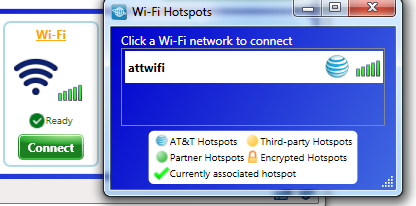
63 Wi-Fi Access Using AT&T LaptopConnect mobility SIM AT&T offers Wi-Fi access to users with certain AT&T LaptopConnect service plans. Beginning with Version 7.4 the AT&T Global Network Client can be used to connect to supported Wi-Fi locations using the AT&T Mobility credentials read from your AT&T LaptopConnect mobility card. Your mobility data device must be attached to your computer for the connection to work to the attwifi hotspot. Figure 81: Connection Sequence AT&T Wi-Fi This option is included in your default connection sequence without any additional configuration needed by you. The LaptopConnect Wi-Fi connection is prioritized ahead of any other Wi-Fi type connections. Copyright 2012 AT&T. All Rights Reserved. -63-
64 Wi-Fi Connection Features When a Wi-Fi network is used for the connection the signal strength of the Wi-Fi connection is shown under the Disconnect button. Figure 82: Main Window/Connected - Wi-Fi Click on the signal strength icon under the Disconnect button for more information about the Wi-Fi connection and the SSID. Copyright 2012 AT&T. All Rights Reserved. -64-
65 Mobility Connections Mobility devices are used if Mobility is included in the automatic connection sequence and a mobility device is available. The AT&T Client supports all mobility cards listed in Appendix A: Supported Mobility Devices; AT&T LaptopConnect Mobility Device Drivers are installed automatically with the LaptopConnect Edition of the AT&T Client other Mobility Device Drivers must be manually installed independent of the AT&T Client installation process. When a Mobility connection is available, a Mobile icon will be visible in the Connection area of the Main Window. Figure 83: Main Window - Mobile Icon The mobility service mode (if supported by the mobility device) can be selected by clicking on the link or by clicking on the Settings; Mobile Menu; Setup Mobile Provider Copyright 2012 AT&T. All Rights Reserved. -65-

66 Figure 84: Main Window Select Service Mode Automatic sets the card to the manufacturer s default setting. 4G only enables the card to attach only to a 4G HSPA+ or 4G LTE network. 3G only enables the card to attach only to a 3G network. 2G only enables the card to attach only to a 2G network. When the AT&T client is closed, the mobility device will be set back to its original setting. If the AT&T Client is unable to automatically determine your mobility provider or your mobility network authentication credentials, the first time your mobility connection is used you will be prompted to define the information using the Mobility Provider Setup window. Select a predefined provider from the drop down list by clicking the Select a provider radio button. Or, manually define a new provider by selecting the Use the following provider information radio button and entering your provider information in the input fields provided. Future connections will automatically use the defined information. Figure 85: Mobile Provider Setup Dialog To access the Mobility Provider Setup Dialog when not attempting a connection, right-click on Copyright 2012 AT&T. All Rights Reserved. -66-
67 the Mobility connection type in the Connection Sequence panel of the Main Window and click on Setup mobility provider. Mobility Details To view your Mobility details, click on the Mobility icon on the Main Window. Figure 86: Main Window - Cellular Details Copyright 2012 AT&T. All Rights Reserved. -67-

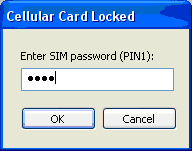
68 Errors with your mobility connection that are recognized by the AT&T Client (including SIM errors) are shown in the Mobility details area. Figure 87: Mobility Details - SIM Error For a SIM locked error, click (click here to unlock) to open the Mobility Card Locked dialog to enter your PIN. Figure 88: Mobility Card Locked Dialog For a RIM locked error, you will be automatically prompted to enter the PIN for your device by the AT&T Client. If your Blackberry RIM is locked, you must successfully unlock your device to use mobility connectivity. Copyright 2012 AT&T. All Rights Reserved. -68-
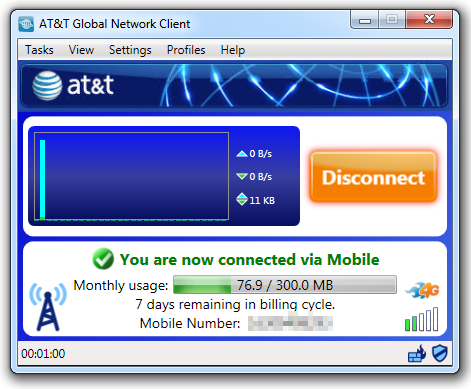
69 Mobility Data Usage Meter The AT&T Global Network Client provides usage data for AT&T mobility customers. This usage meter will allow AT&T s mobility customers to view their cumulative monthly usage in the context of their monthly billing cycle and data rate plan size. Figure 89: Data Usage Meter Figure 90: Data Usage Meter with Limited Data Remaining Copyright 2012 AT&T. All Rights Reserved. -69-

70 Figure 91: Data Usage Meter with no Data Remaining As your monthly usage approaches your data plan threshold you will receive warnings during your session. A warning is generated if you have exceeded your threshold. Figure 92: Warning when threshold is about to be exceeded Copyright 2012 AT&T. All Rights Reserved. -70-
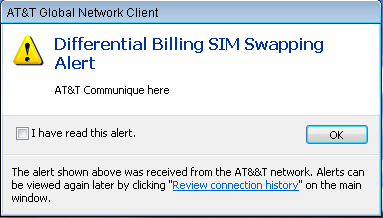
71 A Warning is generated if your threshold has been exceeded and you are starting a new connection. Figure 93: Warning when your threshold has been exceeded Mobility Date Usage Meter with a VPN Connection The AT&T Global Network Client receives usage information from an AT&T Usage Server that is accessed via the internet. Users who connect to a VPN and have internet access will be able to use the Data Usage Meter. Users who connect only to a VPN and have no access to the internet will not have valid information for the Data Usage Meter. AT&T Network Initiated SMS Messages If you are connected via an AT&T Wireless Mobility data connection the AT&T Network can initiate informational SMS messages that advise of certain events. For example, if you have exceeded your available data plan AT&T Wireless may send you an SMS message with a warning. These messages show up as pop-up windows. Figure 94: AT&T Wireless SMS Message Low Signal Network performance can suffer significantly if you are connected to a weak mobility signal. The AT&T Client will provide a warning if you are in an area that does not have sufficient signal strength to provide a proper network performance. If you are aware of Copyright 2012 AT&T. All Rights Reserved. -71-
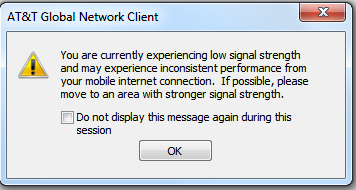
72 the connectivity issues and do not want the warning to continue to display, you can check the Do not display this message again during this session option and click OK. Figure 95: Low Signal Strength Warning Conflicts with Mobility Monitoring Programs When connecting with the AT&T Client using a Mobility service, the AT&T Client and third party programs that monitor your mobility connectivity (usually supplied by your Mobility Provider) may conflict with each other. To prevent any conflict, third party mobility monitoring programs should not be running when the AT&T Client is launched. An active third party mobility monitoring program may prevent the AT&T Client from establishing a connection. To use your third party mobility monitoring program, you must disable mobility device support. For information on integrating the AT&T Client with Lenovo Access Connections mobility support, see Appendix D: Integrating with Third Party Software. Permanently Disable Mobility Device Support To permanently disable mobility device support click Login Properties, Preferences tab, check the box next to Permanently disable mobility device support to disable the AT&T Client monitoring of your mobility activity and allow the third party program access to the mobility data. To enable monitoring, uncheck the box next to Permanently disable mobility device support. You must restart the AT&T Client for monitoring to resume. Copyright 2012 AT&T. All Rights Reserved. -72-
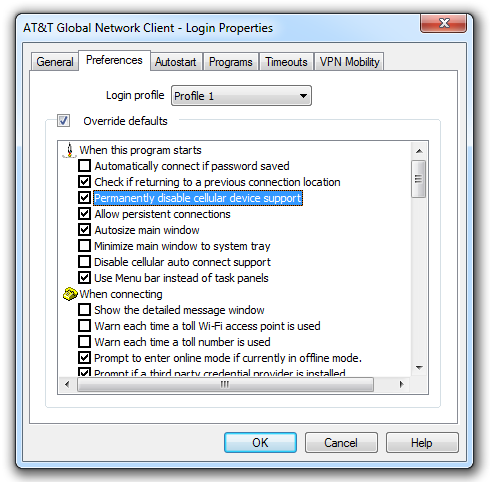
73 Figure 96: Disable Mobility Monitoring Temporarily Disable Mobility Device Support To temporarily disable mobility device support expand the Connection Sequence area of the Main Window, right-click on the mobility Connection type and select Disable mobility monitoring. This will disable mobility monitoring until you manually enable it or the AT&T Client is restarted. Copyright 2012 AT&T. All Rights Reserved. -73-
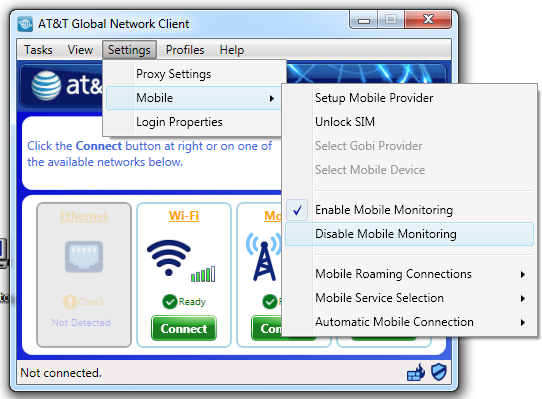
74 Figure 97: Disable Mobility Monitoring AutoConnect Feature Some mobility device have an auto-connect feature, which is sometimes also referred to as NDIS mode, though this is not actually an accurate description of the feature. This auto-connect feature configures the mobility device to automatically connect to the mobility network as soon as it has power. The AT&T Global Network Client can be used to enable or disable the auto-connect setting on mobility devices connected to your laptop. If the current mobility device connected to your laptop supports the auto-connect feature, the mobility pop-up menu will include an Automatic mobility connection item. Copyright 2012 AT&T. All Rights Reserved. -74-
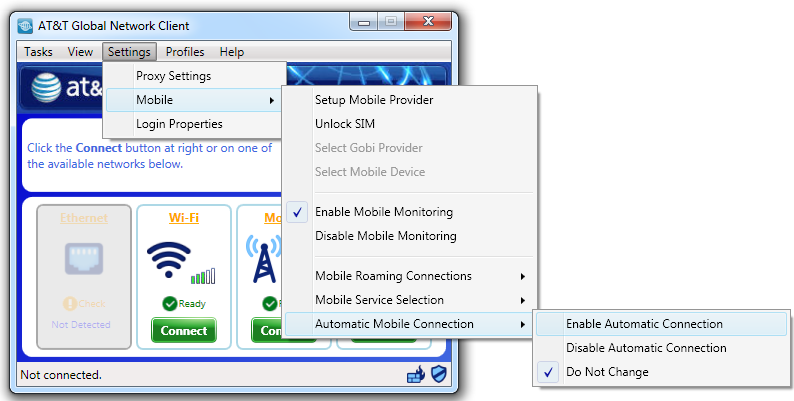
75 Figure 98: Enable/Disable AutoConnect Copyright 2012 AT&T. All Rights Reserved. -75-
76 The default behavior of the client is to leave the device s current auto-connect setting alone and not to change it. If you wish to enable the auto-connect feature on devices connected to your laptop, select the Enable autoconnect item from the Automatic mobility connection submenu. When you click Enable autoconnect the client will immediately enable the auto-connect feature on the current mobility device. It will also remember this setting and enable auto-connect on mobility devices that support auto-connect which are connected to this laptop in the future. If you wish to disable the auto-connect feature on devices connected to your laptop, select the Disable autoconnect item from the Automatic mobility connection submenu. When you click Disable autoconnect the client will immediately disable the auto-connect feature on the current mobility device. It will also remember this setting and disable auto-connect on mobility devices that support auto-connect which are connected to this laptop in the future. If you would like to enable auto-connect on your current mobility device only, and not have the client alter the current auto-connect feature state on any future devices, client the Enable autoconnect item from the Automatic mobility connection submenu to immediately enable auto-connect on the current device, then select the Do not change item from the Automatic mobility connection submenu to again set the client to leave the auto-connect setting on devices alone. When the AT&T Global Network Client is run, it is aware of the auto-connected state of the mobility device connected to the laptop. If the device is not auto-connected, the client will show that a connection can be established, or if Persistent Connections are configured, the client will automatically initiate the connection as it would for any available connection type for Persistent Connections. If the mobility device is autoconnected, the client state will reflect that. If the service for the current profile is Internet, when the client detects the auto-connected mobility device, it will immediately switch to the Connected window. If the service for the current profile is one of the VPN services, the client will denote that the mobility device is auto-connected in the Available Networks task panel and the Connect button will be enabled to allow the establishment of the VPN connection. Copyright 2012 AT&T. All Rights Reserved. -76-
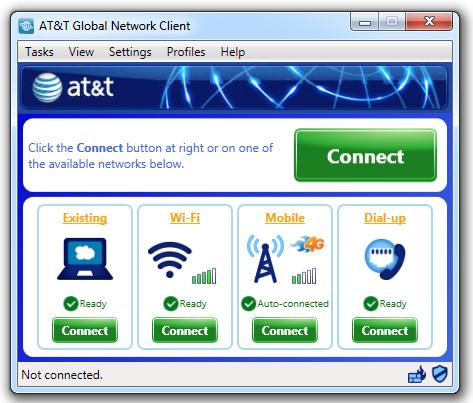
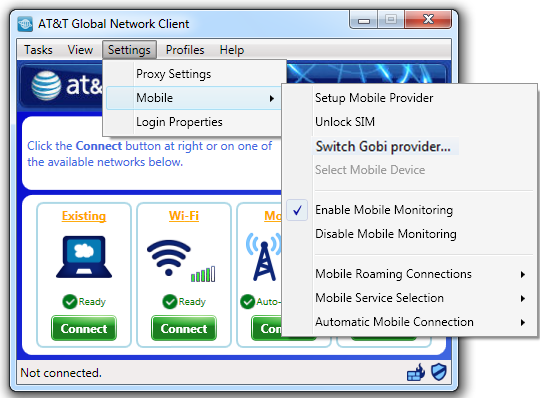
77 Figure 99: Auto-Connected Mobility with VPN Service Changing Image on Gobi Devices Gobi devices have the ability to connect to a variety of mobility carriers, including both CDMA and GSM carriers. The devices are able to do this because the image which is loaded onto the device determines how it will connect. The AT&T Global Network Client includes a feature that enables loading a different image onto your Gobi device so it can be used to connect to any provider with which you already have service. Figure 100: Switch Gobi Image Copyright 2012 AT&T. All Rights Reserved. -77-
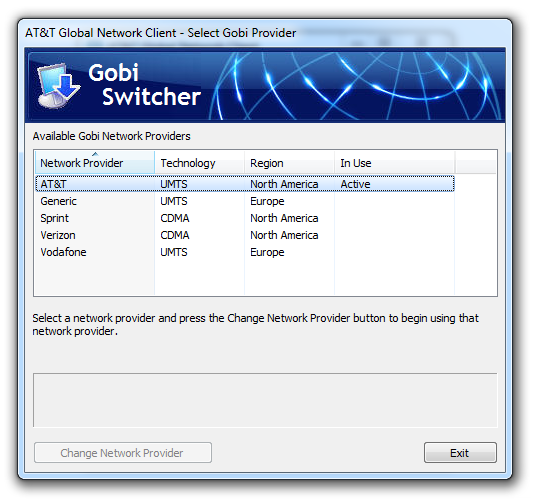
78 In order to switch the image loaded on your Gobi device, right-click the Mobility icon in the Available Networks task panel to bring up the mobility menu. From the menu, select the Switch Gobi provider menu item. This will bring up the Select Gobi Provider dialog which will list the images which are available on your laptop. Each laptop manufacturer decides which images it will load on its machines with the Gobi devices and supporting drivers, so different laptops will display different lists, depending what is available on your specific laptop. Figure 101: Select Gobi Provider The image currently loaded onto your Gobi device is shown as the Active image. To switch to a different image, select the image you would like to load and click the Change Network Provider button. The client will then load the selected image onto your device. Loading an image onto your device is not enough to enable you to use the device with another provider. You must have already established service with the provider you are selecting in order to use your Gobi device with the selected provider. HP Gobi Devices: Gobi Image Switching is not compatible with all versions of HP Connection Manager. The HP Connection Manager has logic in it to automatically change the carrier image and can override the settings made by the AT&T Client. If you have HP Connection Manager installed on PC it is strongly advised that you uninstall it before using the Gobi image switching feature of the AT&T Client. Copyright 2012 AT&T. All Rights Reserved. -78-
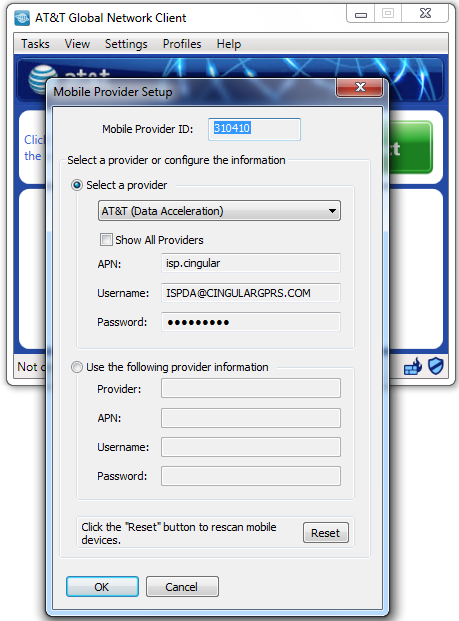
79 Troubleshooting Recognition of Mobility Devices Automatic Scan for Mobility Devices If your Mobility Device is not recognized by the AT&T Client, you may need to initiate the AT&T Client to scan for Mobility devices. Click on the Settings menu; then Mobile; then Setup Mobility Provider. On the Mobile Provider Setup window, click the Reset button. Then click OK to close the Mobile Provider Setup dialog. Then restart the client and the search for a new device will take place. Figure 102: Mobile Provider Setup Window Copyright 2012 AT&T. All Rights Reserved. -79-
80 Dial Connections For dial connections, the Select Dial Access Points window will prompt you to select a phone number using your location information. Click the links under Search by to sort the list and narrow your choices by location, country, state and city. Select an access point by clicking the checkbox next to the City name. Click OK to continue Figure 103: Select Dial Access Points Window Selecting a Modem Change the modem used for the connection using the Connect using drop down box on the Select Dial Access Points Window. Configuring the Number to Dial The AT&T Client selects the most common dial preferences. Verify and change the information for Dial Prefix and Number to dial on the Select Dial Access Points Window Copyright 2012 AT&T. All Rights Reserved. -80-
81 AT&T Firewall The AT&T Firewall is a component of the AT&T Client which provides basic firewall capabilities. The AT&T Firewall uses a filter driver written by AT&T for firewall and fencing on Windows XP and uses the Windows firewall engine for the firewall and fencing on Windows Vista and later. The AT&T Firewall provides the following: Blocks unsolicited traffic when not connected Blocks unsolicited Internet traffic while VPN connected OPSWAT Certified Firewall The AT&T Global Network Client Firewall is certified through the OPSWAT Certification Program. This certification demonstrates that the AT&T Global Network Client Firewall is compatible with products from other market-leading technology vendors. Products carrying OPSWAT certification follow standards that assure their product will not adversely affect other installed security software. To learn more, visit the OPSWAT Certification website at Firewall Settings Window The AT&T Global Network Client Firewall Settings Window allows you to select the Firewall state (On/Off) when a VPN connection is not active. The Firewall Settings window can be accessed by clicking the Microsoft Windows Start Menu, mouse over All Programs, click AT&T Global Network Client, and click Firewall Settings. The AT&T Firewall Settings window can only be open when the AT&T Client application is not running. If the Firewall Settings is not available as an option in your AT&T Global Network Client Programs Menu your Customer Figure 104: Firewall Settings Window Account Administrators chose to not install the application. If the buttons on your Firewall Settings Window are inactive and you cannot make changes, your Customer Account Administrator chose to not allow changes. Copyright 2012 AT&T. All Rights Reserved. -81-
82 Endpoint Security Note: Endpoint Security is not supported in Version but may be supported in a future release. Copyright 2012 AT&T. All Rights Reserved. -82-
83 Appendix A: Supported Mobility Devices AT&T LaptopConnect Supported Devices Device drivers for the following list of devices is installed automatically with the LaptopConnect Edition of the AT&T Client. LaptopConnect MODEM CARDS AT&T Client Minimum Version AT&T Sierra Wireless AC890 (AC504, Triple Lindy) AT&T USBConnect 881 Card AT&T USBConnect Elevate 4G AT&T USBConnect Force 4G AT&T USBConnect Lightning AT&T USBConnect Momentum 4G 9.0 AT&T USBConnect Turbo AT&T USBConnect Velocity AT&T USBConnect Shockwave AT&T USBConnect Adrenaline AT&T USBConnect 900 (E1815) Sierra Wireless AirCard 890 LaptopConnect Card Huawei Force 4G (E368) Novatel U730 LaptopConnect Card (Windows XP SP2+) Option Globetrotter Combo LaptopConnect Card (Windows XP only) Option GT MAX 1.8 LaptopConnect Card Option GT Max 3.6 LaptopConnect Card Option GT Max 3.6 Express LaptopConnect Card Option GT Ultra LaptopConnect Card Option GT Ultra Express Card Option icon 3.6U5i (322 / Faema / AT&T Quicksilver) Sierra Wireless AirCard 750 LaptopConnect Card Sierra Wireless AirCard 775 LaptopConnect Card Sierra Wireless AirCard 860 LaptopConnect Card Sierra Wireless AirCard 875 LaptopConnect Card Sierra Wireless AirCard 875U LaptopConnect Card Sierra Wireless AirCard 881 LaptopConnect Card Sierra Wireless USBConnect Mercury (Poptart) Sony Ericsson GC82 LaptopConnect Card Sony Ericsson GC83 LaptopConnect Card Sony Ericsson W518a Last Client Release Supported 4 If you encounter any difficulty using your device, check the AT&T Global Network Client Knowledge Base ( for an article relating to your device. Copyright 2012 AT&T. All Rights Reserved. -83-
84 Copyright 2012 AT&T. All Rights Reserved. -84-
85 LaptopConnect NETBOOKS AT&T Client Minimum Version Acer Aspire One HP Iverson Lenovo S Samsung Go (Pebble) Nokia Booklet 3G Dell 11z Last Client Release Supported LaptopConnect Compatible Phones 5 AT&T Client Minimum Version Last Client Release Supported AT&T Quickfire AT&T Tilt HP ipaq Obsidian HTC FUZE LG Arena (GT950) LG CB LG CF LG Chiwoo CU LG CU LG CU LG CU LG INCITE LG Invision LG Monaco (GW820) LG Secret LG Shine II (GD710) LG TRAX Motorola Tundra Motorola V Motorola V Motorola V Motorola V Motorola V3xx Motorola RAZR V Motorola Z9 Husky Nokia If using your handset as a tethered modem, you may need a data cable accessory, sold separately, to connect the phone to your PC. Copyright 2012 AT&T. All Rights Reserved. -85-
86 LaptopConnect Compatible Phones 5 AT&T Client Minimum Version Last Client Release Supported Nokia Nokia Mural (6750) Nokia Surge (6790) Pantech C Pantech C Pantech C Pantech Duo Pro Pantech Matrix Research In Motion BlackBerry 8700c Research In Motion BlackBerry Research In Motion BlackBerry Research In Motion BlackBerry Research In Motion BlackBerry Bold Research In Motion BlackBerry Bold Research In Motion BlackBerry Bold Research In Motion BlackBerry Curve Research In Motion BlackBerry Curve Research In Motion BlackBerry Curve Research In Motion BlackBerry Curve Research In Motion BlackBerry Curve Research In Motion BlackBerry Curve Research In Motion BlackBerry 9000 Raptor / Bold Research In Motion BlackBerry Gemini Research In Motion BlackBerry Pearl Research In Motion BlackBerry Torch Samsung A707 Sync Samsung A Samsung A Samsung A Samsung A Samsung A Samsung A Samsung BJ Plus i Samsung Eternity Samsung i607 Blackjack Samsung i907 Mirage Samsung Peridot SGH A Samsung Propel Samsung Rugby SGH-A Samsung ZX Samsung ZX Sony Ericsson W760a Copyright 2012 AT&T. All Rights Reserved. -86-
87 LaptopConnect Compatible Phones 5 AT&T Client Last Client Minimum Version Release Supported Sony Ericsson Bear Z750a Copyright 2012 AT&T. All Rights Reserved. -87-
88 The following list of devices is supported for use with the AT&T Client, but installation and configuration of the device must be manually performed outside of the AT&T Client installation process. DEVICE DEVICE TYPE TECHNOLOG Y STATUS 6 AT&T CLIENT MINIMU M VERSION Alcatel X220l USB GSM Supported 8.2 Asus Halley Handset HSDPA Supported Bandrich M250 Embedded HSDPA Supported M280 Embedded HSDPA Certified Dell Dell 5540 Mobile Embedded HSUPA Certified Broadband Dell 5505 Mobile Embedded HSDPA Supported Broadband Dell 5510 Mobile ExpressCard/ HSDPA 3.6 Supported Broadband Embedded Dell 5520 Mobile Broadband Embedded HSDPA 3.6 Supported LAST SUPPORTED AT&T Client Version Dell 5530 Mobile Broadband Dell 5720 Mobile Broadband Dell 5600 Mobile Broadband Dell 5620 Mobile Broadband Embedded HSUPA Supported Embedded EVDO Supported Embedded EVDO/HSPA Certified Embedded EVDO/HSPA Certified SDK Definitions: Supported: Device has been tested by Smith Micro (provider of the SDK) against a version of the SDK. Certified: Device has specifically been tested by AT&T against the version of the AGN client listed. Pending: Device is pending certification by AT&T. Not Supported: Device is either not tested or does not work. * Devices marked by an asterisk are known by more than one name. Copyright 2012 AT&T. All Rights Reserved. -88-
89 DEVICE DEVICE TYPE TECHNOLOG Y STATUS 6 AT&T CLIENT MINIMU M VERSION Ericsson R520m Handset GPRS Supported F3307 Embedded HSUPA Certified F3507g Embedded HSUPA Certified F3607gw Embedded HSUPA Pending F5521gw Embedded HSUPA Pending 8.2 Franklin Wireless CDU680 USB EVDO Supported CMU300 USB EVDO Supported CMU301 USB EVDO Supported U600 (Dual Mode USB EVDO Supported Device) M600 (Dual Mode Embedded EVDO Supported Device) Fujistu F2402* PC Card WCDMA Supported P2402 PC Card WCDMA Supported MC8781* Embedded HSUPA Supported HP HS2300* USB HSDPA Supported HS2600(?)* Embedded HSUPA Pending un2400* Embedded HSUPA Certified un2420* Embedded HSUPA Pending QC430AA Embedded HSUPA/EVDO Supported 8.8 QC430UT Embedded HSUPA/EVDO Supported 8.8 HTC 4600/4605 Handset GSM Supported /8925 Handset GSM Supported Huawei E169 USB HSDPA Supported E17X (E170/E172) USB HSDPA Supported E220 USB HSDPA Supported E226 USB HSDPA Supported EC228 USB EVDO Supported E230 USB HSDPA Supported E270 USB HSDPA Supported E272* USB HSDPA Supported E280 USB HSDPA Supported EC360 USB EVDO Supported E510 PC Card UMTS Certified E600 PC Card UMTS Supported E612 PC Card UMTS Supported E618 PC Card UMTS Supported E620 PC Card HSDPA Supported LAST SUPPORTED Copyright 2012 AT&T. All Rights Reserved. -89-
90 DEVICE DEVICE TYPE TECHNOLOG Y STATUS 6 AT&T CLIENT LAST SUPPORTED E621 PC Card HSDPA Supported 6.7 MINIMU E630 PC Card HSDPA Supported 6.9 M E660A PC Card HSDPA 7.2 Supported 6.9 VERSION EM730 Embedded HSDPA 7.2 Supported E770 Embedded HSDPA 7.2 Supported EM770w Embedded HSDPA 7.2 Certified E800 PC Card HSDPA 7.2 Supported E800A PC Card HSDPA 7.2 Supported E870 PC Card HSDPA 7.2 Supported B970 USB EDGE Supported E3565 (E160G) PC Card GPRS/EDGE Certified 7.4 E3735 (E880) PC Card GPRS/EDGE Certified 7.4 K3715 (E180, USB HSDPA Certified E182) EG162 PC Card GPRS/EDGE Supported K3520 USB HSDPA Supported M3710 USB HSDPA Supported K3565 USB HSDPA Supported E1762v PC Card HSDPA Certified E1615 PC Card HSDPA Supported E1550 USB HSDPA Supported E1552 USB HSDPA Supported K3765 USB HSDPA Supported K4505 USB HSDPA Supported UMG181 USB HSDPA Supported 8.1 UMG1691 USB HSDPA Supported 8.1 E168 (EC168) USB HSDPA Supported 8.1 E1820 USB HSDPA Supported 8.1 E1756 USB HSDPA Supported 8.1 R201 USB HSDPA Supported 8.2 K4605 USB HSPA Supported K3806 USB HSPA Supported E820 Embedded HSDPA 7.2 Supported Imate Jas Jam Handset GPRS Supported SP Jas Handset GPRS Supported Kyocera KPC650 PC Card 1xEVDO/1xRTT Supported KPC680 Express Card 1xEVDO Supported Lenovo MC8775* Embedded HSDPA Supported LG A7110 Handset EDGE Supported C1300 Handset GPRS Supported G4050 Handset GPRS Supported Copyright 2012 AT&T. All Rights Reserved. -90-
91 DEVICE DEVICE TYPE TECHNOLOG Y STATUS 6 AT&T CLIENT LAST SUPPORTED L1200 Handset GPRS Supported 6.7 MINIMU L1400 Handset GPRS Supported 6.7 M LX160 Handset EVDO Supported 7.3 VERSION LX400 Handset EVDO Supported LX550 Handset EVDO Supported LX570 Handset EVDO Supported LX600 Handset EVDO Supported AX840 Handset EVDO Supported 8.2 CU320 Handset UMTS Supported CB630 Handset UMTS Supported CU500 Handset UMTS Supported CU515* Handset HSDPA Supported CU720 Handset UMTS Supported CU920 Handset HSDPA Supported CU575* Handset UMTS Supported X110 Embedded HSUPA Supported GR500 Handset HSUPA Supported Bobsleigh USB HSUPA Supported GT950 Handset HSUPA Supported GW820 Handset HSUPA Supported GD710 Handset HSUPA Supported GR700 Handset HSUPA Supported 8.1 AC8370 Handset EVDO Supported Adrenaline (3g) USB HSPA Supported 8.4 Adrenaline (LTE) USB HSPA Supported 8.8 Firmware Upgrade Required Motorola A008 Handset GPRS Supported A630 Handset GPRS Supported A845 Handset UMTS Supported M2501 PC Card FOMA Supported IZAR* Handset UMTS Supported KZRZ* Handset UMTS Supported KZRZ* Handset EVDO Supported RAZR Handset EVDO Supported SLVR Handset EVDO Supported T280i Handset GPRS Supported T720i Handset GPRS Supported V60gi Handset GPRS Supported V66i Handset GPRS Supported V180 Handset GPRS Supported V220 Handset GPRS Supported V3 Razr Handset GPRS Supported V3Gxx Handset UMTS Supported Copyright 2012 AT&T. All Rights Reserved. -91-
92 DEVICE DEVICE TYPE TECHNOLOG Y STATUS 6 AT&T CLIENT LAST SUPPORTED V9m Handset EVDO Supported 7.3 MINIMU V400 Handset GPRS Supported 6.7 M V600 Handset GPRS Supported 6.7 VERSION Volans* Handset UMTS Supported Z551 Handset EDGE Supported Z9 Handset HSDPA Supported VA76r Handset HSDPA Supported QA1 Handset HSDPA Supported NEC 232 Handset GPRS Supported D01NX PC Card GPRS Supported D01NE PC Card GPRS Supported Nokia 3220 Handset EDGE Supported BT3600 Handset GPRS Supported BT3650 Handset GPRS Supported Handset GPRS Supported Handset GPRS/GSM Supported Handset EDGE Supported Handset EDGE Supported Handset UMTS Supported Handset UMTS/GSM Supported i Handset GPRS Supported Handset HSDPA Supported b* Handset GPRS Supported Handset EDGE Supported Handset UMTS Supported Handset GPRS Supported Handset GPRS Supported Handset GPRS Supported Handset EDGE Supported Handset GPRS Supported Handset GPRS Supported E50 Handset UMTS Supported E61 Handset UMTS Supported E71 Handset UMTS Supported N73 Handset UMTS Supported Tarpon Handset UMTS Supported Nokia/Intel Windigo Embedded UMTS Not Supported Novatel C201 PC Card 1xRTT Supported G100 PC Card GPRS Supported G301 PC Card GPRS Supported Copyright 2012 AT&T. All Rights Reserved. -92-
93 DEVICE DEVICE TYPE TECHNOLOG Y STATUS 6 AT&T CLIENT LAST SUPPORTED u520 PC Card UMTS Supported 6.7 MINIMU u530 PC Card UMTS Supported 6.7 M u630 PC Card UMTS Supported 6.7 VERSION v620* PC Card 1xEVDO/1xRTT Supported s620* PC Card 1xEVDO/1xRTT Supported S720* PC Card 1xEVDO/1xRTT Supported U720 USB EVDO Supported U727 USB EVDO Supported U730* USB HSDPA Supported EM725 Embedded EVDO Supported EM726 Embedded EVDO Supported EM727 Embedded EVDO Supported Expedite Embedded EVDO Supported 9.0 EX720 ExpressCard EVDO Supported EV730* Embedded HSDPA Supported EU730* Embedded HSDPA Supported U740* PC Card HSDPA Supported U760 USB EVDO Supported E760 Embedded EVDO Supported C777 Express EVDO Supported EU740* Embedded HSDPA Supported XU870* ExpressCard/ HSDPA 3.6 Supported Embedded U870* PC Card HSDPA 3.6 Supported EU860D Embedded HSDPA 3.6 Supported EU870D* ExpressCard/ HSDPA 3.6 Supported Embedded XU950D ExpressCard/ HSDPA 7.2 Supported Embedded MC950* ExpressCard/ HSDPA 7.2 Supported Embedded MC950D ExpressCard/ HSDPA 7.2 Supported Embedded MC990D USB HSDPA 7.2 Supported U998 USB EVDO Supported 8.2 MiFi2352 USB WiFi/HSDPA Supported U1000 (Dual CDMA/GSM Supported mode CDMA/GSM) PC770 Express/PC CDMA Supported 8.2 MC547 USB CDMA Supported Option GT Fusion+ PC Card UMTS/WiFi Supported G/EDGE* GT Fusion+ PC Card GPRS Supported HSDPA* GT Combo EDGE* PC Card EDGE Supported Copyright 2012 AT&T. All Rights Reserved. -93-
94 DEVICE DEVICE TYPE TECHNOLOG Y STATUS 6 AT&T CLIENT LAST SUPPORTED GT EDGE* PC Card EDGE Supported 6.7 MINIMU GT 3G Quad* PC Card UMTS Supported 6.7 M GT 3G/EDGE* PC Card UMTS Supported 6.7 VERSION GT HSDPA* PC Card UMTS Supported GT Max W* PC Card HSDPA Supported GT Max E* PC Card HSDPA Supported GT Max J* PC Card HSDPA Supported GT Max 7.2 Ready PC Card HSDPA Supported E GT Max 7.2 Ready PC Card HSDPA Supported W GT Express 7.2 E* PC Card HSDPA 7.2 Supported GT Express 7.2 PC Card HSDPA 7.2 Supported W* GT Express PC Card HSUPA Supported HSUPA E* GT Express PC Card HSUPA Supported HSUPA W* GT Express 401 PC Card HSUPA Certified G* PC Card UMTS Supported GT* PC Card HSDPA/EDGE Supported GTM 351 E* Embedded HSDPA Supported GTM 378 Embedded HSDPA 3.6 Supported GTM 380 E* Embedded HSDPA 7.2 Supported GTM 380 W* Embedded HSDPA 7.2 Supported GTM 382 Embedded HSDPA 7.2 Supported GS Icon* USB HSDPA Supported GS 401 USB HSDPA Certified GS Icon 7.2 E* USB HSDPA 7.2 Supported GS Icon 3 USB HSDPA 7.2 Certified GT GTM378 E* Embedded HSDPA 3.6/7.2 Supported GT GE 201/202* ExpressCard HSDPA 7.2 Supported GT GE 301/302* ExpressCard HSDPA 7.2 Supported GS GI 301/302* USB HSUPA Supported E3730 ExpressCard HSUPA Supported GTM 378 Embedded HSDPA 3.6 / Supported Icon 322 USB HSDPA 7.2 Supported GI0505 USB HSDPA Supported GE441 USB HSDPA Supported Icon 461 USB HSDPA Supported Palm Treo 750v* Handset GPRS Supported Pantech C810* Handset HSDPA Supported PX-500 PC Card 1xEVDO Rev Supported Copyright 2012 AT&T. All Rights Reserved. -94-
95 DEVICE DEVICE TYPE TECHNOLOG Y STATUS 6 AT&T CLIENT LAST SUPPORTED A/ 1xRTT MINIMU M 5740 PC Card 1xEVDO/1xRTT Supported 7.3 VERSION PC Card 1xEVDO/1xRTT Supported C630 Handset HSDPA Supported C610 Handset HSDPA Supported UM175AL USB EVDO Supported 8.1 Qualcomm GOBI* Embedded HSUPA Certified GOBI* Embedded 1xEVDO/1xRTT Supported GOBI Embedded EVDO Supported GOBI 2000* Embedded HSUPA Certified GOBI 2000* Embedded EVDO Certified GOBI 3000* Embedded LTE 7 /EVDO/HS Supported 8.8 PA RIM 7130c Handset GPRS Supported v Handset GPRS Supported g Handset GPRS Supported Handset GPRS Supported Handset 1xEVDO/1xRTT Supported v Handset GPRS Supported v Handset GPRS Supported Handset GPRS Supported Handset EDGE Supported Handset EVDO Pending Handset EVDO Pending * Handset EDGE Supported Handset EDGE Supported v Handset UMTS Supported c Handset UMTS Supported Handset EVDO Supported Handset UMTS Supported Handset UMTS Supported Handset CDMA Pending Handset UMTS Supported v Handset GPRS Supported v Handset UMTS Supported Handset EVDO Supported Handset GPRS Supported Handset GPRS Certified Handset GPRS Pending Handset EVDO Pending LTE is a trademark of ETSI Copyright 2012 AT&T. All Rights Reserved. -95-
96 DEVICE DEVICE TYPE TECHNOLOG Y STATUS 6 AT&T CLIENT LAST SUPPORTED 9650 Handset EVDO Pending MINIMU 9700 Handset GPRS Certified M 9700a Handset GPRS Pending 8.2 VERSION 9800 Handset HSDPA/EDGE Certified Samsung A900M Handset EVDO Supported E317 Handset GPRS Supported m300 Handset EVDO Supported m500 Handset EVDO Supported m510 Handset EVDO Supported m540 Handset EVDO Supported m620 Handset EVDO Supported m630 Handset EVDO Supported SGH-A727* Handset UMTS Supported SGH-A747 Handset HSDPA Supported SGH-i617* Handset HSDPA Supported SGH-i627 Handset HSDPA Supported SGH-i637 Handset HSDPA Supported SGH-A737* Handset EDGE Supported SGH-A837 Handset EDGE Supported S105 Handset GPRS Supported S307 Handset GPRS Supported SGH300 Handset GPRS Supported SGH-ZV50 Handset GPRS Supported SGH-Z560V Handset GPRS Supported SGH-Z700 Handset EVDO Supported SPH-900 Handset EVDO Supported SPH-920 Handset EVDO Supported ZX10 Handset UMTS Supported ZX20 Handset UMTS Supported i907 Handset UMTS Supported SGH-A867 Handset UMTS Supported SGH-A767 Handset UMTS Supported SGH-A777 Handset UMTS Supported SGH-A797 Handset UMTS Supported SGH-A877 Handset UMTS Supported SGH-A657 Handset UMTS Supported SGH-A887 Handset UMTS Supported SGH-A897 Handset UMTS Supported NC10 Embedded HSDPA Supported NC20 Embedded HSDPA Supported Y3100 Embedded HSDPA Certified Y3300 Embedded HSDPA Supported 8.1 N150 Embedded HSDPA Supported 8.1 Sanyo Copyright 2012 AT&T. All Rights Reserved. -96-
97 DEVICE DEVICE TYPE TECHNOLOG Y STATUS 6 AT&T CLIENT LAST SUPPORTED Katana DLX Handset EVDO Supported 7.3 MINIMU Katana LX Handset EVDO Supported 7.3 M Pro 200 Handset EVDO Supported 7.3 VERSION Pro 700 Handset EVDO Supported S1 Handset EVDO Supported SCP-3100 Handset EVDO Supported SCP-3200 Handset EVDO Supported SCP-6650 Handset EVDO Supported SCP-7050 Handset EVDO Supported SCP-8400 Handset EVDO Supported SCP-M1 Handset EVDO Supported Seiko VC701SI* PC Card UMTS Supported Siemens C61 Handset GPRS Supported CT56 Handset GPRS Supported CT66 Handset GPRS Supported P207 Handset EDGE Supported P777 Handset EDGE Supported S46 Handset GPRS Supported S55 Handset GPRS Supported S56 Handset GPRS Supported SL56 Handset GPRS Supported Sierra Wireless Aircard 550 PC Card 1xRTT Supported Aircard 555 PC Card 1xRTT Supported Aircard 580 PC Card 1xEVDO/1xRTT Supported Aircard 595 PC Card EVDO RevA Supported Aircard 595u USB EVDO RevA Supported Aircard C597 ExpressCard EVDO RevA Supported Aircard 597e ExpressCard EVDO RevA Supported Aircard C598 USB EVDO Supported Aircard 710 PC Card GPRS Supported Aircard 750 PC Card GPRS Supported Aircard 775 PC Card EDGE Supported Aircard 850* PC Card HSDPA Supported Aircard 860 PC Card HSDPA Supported Aircard 875 PC Card HSDPA Supported Aircard 875u USB HSDPA Supported Aircard 881 PC Card HSDPA 7.2 Supported Aircard 881u USB HSDPA 7.2 Supported Airprime 3200 PC Card 1xRTT Supported Airprime 3300 PC Card 1xRTT Supported Airprime 5220 PC Card 1xEVDO Supported HS2300 Embedded HSDPA Supported 9.0 Copyright 2012 AT&T. All Rights Reserved. -97-
98 DEVICE DEVICE TYPE TECHNOLOG Y STATUS 6 AT&T CLIENT LAST SUPPORTED MC5725 Embedded EVDO Supported 7.3 MINIMU MC5727 Embedded EVDO Certified 7.4 M MC5728 Embedded EVDO Supported VERSION MC Embedded LTE 9 /HSPA+ Certified 8.8 MC Embedded LTE/EVDO/HSP Supported 8.8 A+ MC8755 Embedded HSDPA Supported MC8765 Embedded HSDPA Supported MC8775 Embedded HSDPA 3.6 Supported 6.7 MC8780 Embedded HSDPA 7.2 Supported MC8781 Embedded HSUPA Supported 7.3 MC8790 Embedded HSUPA Certified C885 USB HSUPA Certified AC402 ExpressCard EVDO Certified USB305 USB HSUPA Supported USBConnect USB HSUPA Certified 8.1 Lightning USB306 USB HSUPA Supported AC 890 USB HSPA Certified AC 250U USB CDMA Supported 8.2 USB308 USB HSPA+ Certified Sprint Branded T598??? CDMA Supported 8.11 Softbank C01SI ExpressCard HSDPA 3.6 Supported Sony Ericsson K800 Handset HSDPA Supported M600/M600i Handset HSDPA Supported T68i Handset GPRS Supported T300 Handset GPRS Supported T310 Handset GPRS Supported T316 Handset GPRS Supported T610 Handset GPRS Supported T616 Handset GPRS Supported T637 Handset GPRS Supported S710 Handset EDGE Supported P800 Handset GPRS Supported P990i Handset UMTS Supported W200i Handset HSDPA Supported Z500a Handset GPRS Supported GC75 PC Card GPRS Supported The MC7700 is only approved for the AT&T 4G LTE network. 9 LTE is a trademark of ETSI 10 The MC7750 is only approved for the Verizon 4G LTE Network. Copyright 2012 AT&T. All Rights Reserved. -98-
99 DEVICE DEVICE TYPE TECHNOLOG Y STATUS 6 AT&T CLIENT LAST SUPPORTED GC79 PC Card GPRS/WiFi Supported 6.7 MINIMU GC82 PC Card EDGE Supported 6.7 M GC83 PC Card EDGE Supported 6.7 VERSION GC85 PC Card EDGE Supported GC89 PC Card EDGE/WiFi Supported GC89c PC Card EDGE/WiFi Supported EC400 ExpressCard HSDPA Supported W760 Handset HSDPA Supported Bear Handset HSDPA Supported W518a Handset HSDPA Supported C905 Handset HSDPA Supported TimesPower WM2080B PC Card UMTS Supported UT StarComm PC-5740SP PC Card UMTS Supported PC-5750SP PC Card UMTS Supported UM100 USB EVDO Supported UM150 USB EVDO Supported UM175 USB EVDO Supported GTX75 Handset UMTS Supported Verizon Branded USB760 USB CDMA Supported 8.11 Vodafone Pebble USB HSDPA Supported Pebble USB HSDPA 7.2 Supported Pebble USB HSDPA 7.2 Supported Anaconda USB HSDPA Supported Vodafone VPA Handset UMTS Supported Compact III ZTE MF626 USB HSPA (HSDPA) Supported MF630 USB HSPA (HSDPA) Supported MF633r USB HSPA (HSDPA) Certified MF636 USB HSPA (HSDPA) Supported MF180 USB HSPA (HSDPA) Supported MF668 USB HSPA (HSDPA) Supported MZ29 USB HSDPA Certified MZ10 USB HSDPA Certified MZ628 USB HSDPA Supported K3520-Z USB HSDPA Certified K3565-Z USB HSDPA Supported K3570-Z USB HSDPA Supported 8.1 K3571-Z USB HSDPA Supported 8.1 K3765-Z USB HSDPA Supported Copyright 2012 AT&T. All Rights Reserved. -99-
100 DEVICE K4505-Z K3805-Z K3806-Z DEVICE TYPE USB USB USB TECHNOLOG Y HSDPA HSDPA HSDPA STATUS 6 Supported Certified Supported AT&T CLIENT MINIMU M 8.2 VERSION LAST SUPPORTED Copyright 2012 AT&T. All Rights Reserved
101 Appendix B: Third-Party Firewall Support The Client program uses IP to communicate with other computers on the network just like other network programs (such as web browsers and programs). Third-party personal firewalls can prohibit certain types of network communication. Running multiple firewalls on users PCs can cause difficulties and is not supported by AT&T. Some firewalls must be configured to allow the Client to communicate with the network in order for client features to function properly. The table below lists the required changes. More information about the features is found in the list below the table. Feature Protocol: Port Dial TCP:5053 Authentication Disconnect UDP:7000 Warning Software TCP:20,21 Updates SLA Data HTTP/TCP:80 Collection, Configuration Settings Figure 105: Client Firewall Configuration Table Dial Authentication The AT&T Client uses a proprietary enhanced authentication process using TCP:5053. A customization could be made to the AT&T Client to disable enhanced authentication and use PAP, but it is not recommended. If disabled, the following consequences would occur: Meaningful error messages are lost. Instead of "invalid user ID", "expired password", "revoked password", etc. the user only sees "authentication failed." Login retries are lost. The user must redial to change user ID or password. The ability to warn a user if a closer access number is available is lost. Ability to change passwords is lost. The AT&T helpdesk will not provide first-level support without special arrangements Disconnect warning The AT&T Client communicates with the dialed gateway after connecting using UDP:7000 to be notified of pending disconnects. Disconnect time limits are configured in the AT&T Administration Server. If the connection is idle for the specified amount of time a datagram is sent from the gateway to the Client and the Client displays a warning that the connection will be disconnected in 1 minute unless the user takes the appropriate action. Copyright 2012 AT&T. All Rights Reserved
102 Maximum inactivity timeouts are set in the AT&T Configuration Server at the account level. The AT&T gateways will timeout inactive connections regardless of the client used. The warning will only be displayed if the Client is allowed to communicate on UDP port This is not a critical feature, but it is recommended. Software updates The AT&T Client periodically checks for and downloads updates to the Access Point Directory and the executable program using anonymous FTP (TCP:20/21). The program update starting in version will automatically query the user during the connection sequence to retrieve the applicable network settings. The Service Manager will then send the information to the AT&T Client and enable or restrict program updates based on VPN Client ID and other information provided by the user. This action prevents the user from inadvertently downloading a program update if there is a custom program update available applicable to their Client ID. It also enables the Network Administrator to control if users are able to Check for Updates and therefore reduces the risk of different users being on different versions of the AT&T Client. Figure 106: Software Updates For customers that use the AT&T Client for the Internet service without an Account or User ID, program updates will always be available. SLA data collection The AT&T Client uploads data about all connection attempts using HTTP (TCP:80) to a server after connecting. This data is used for measuring SLAs (Service Level Agreements). If the SLA data is not collected, AT&T will not provide service-level guarantees. AT&T requires companies to add policy rules to the company s firewall to allow SLA data to be sent to those servers. Copyright 2012 AT&T. All Rights Reserved
103 Configuration Updates The AT&T Client requests configuration settings (like start page, server, proxy server, etc) from an AT&T Administration Server. The AT&T Client updates third-party and browser programs with these settings. AT&T recommends adding policy rules to the firewall to allow updates to be retrieved. Copyright 2012 AT&T. All Rights Reserved
104 Appendix D: Integrating with Third Party Software Although the AT&T Global Network Client contains an integrated VPN client that supports multiple tunnel endpoints, some customers prefer to use a third-party VPN client and use the AT&T Client to establish an underlying Internet connection. Examples of third party software VPN clients that the AT&T Client integrates well with are Cisco, Nortel, and NetMotion. In other cases, the AT&T Global Network Client is used to establish the VPN connection and third party software is used as the underlying Internet connection. This section describes how the AT&T Client interacts with some third party software clients. Changes in the NetMotion client status are logged to the message log. Lenovo Access Connections Access Connections can be used to establish network connections on a ThinkPad computer. When a Wi-Fi or mobility connection is made, there can be contention between the Lenovo Access Connections client and the AT&T Client. The user can specify which software client is in control of the connection by clicking on Login Properties, Preferences tab, and checking the box next to Disable Lenovo Access Connections under the When this program starts section. This checkbox is only visible when the Access Connections software is detected on the user s computer. If this checkbox is checked (default), the AT&T Client will assume control of both Wi-Fi and mobility access on start up and will disable the Access Connections software if running. If the AT&T Client does disable Access Connections on start up, it will re-enable it before exiting. If this checkbox is not checked, the AT&T Client will disable its own Wi-Fi and mobility control and allow Access Connections to control the network access. Copyright 2012 AT&T. All Rights Reserved
105 Table of Figures FIGURE 1: AT&T CLIENT EDITION TABLE... 7 FIGURE 2: DOWNLOAD LOCATION TABLE... 8 FIGURE 3: UPGRADE CONFIRMATION DIALOG... 9 FIGURE 4: SELECTIVELY CHOOSING MOBILE DEVICE DRIVERS FIGURE 5: EXECUTABLE FILE NAMES TABLE FIGURE 6: INSTALLATION INITIALIZATION WINDOW FIGURE 7: LICENSE AGREEMENT WINDOW FIGURE 8: SETUP TYPE WINDOW FIGURE 9: INSTALLATION READY WINDOW FIGURE 10: INSTALLATION COMPLETE WINDOW FIGURE 11: INSTALLATION INTERRUPTED WINDOW FIGURE 12: CUSTOM INSTALLATION PATH FIGURE 13: LANGUAGE SELECTION FIGURE 14: MOBILITY DEVICE DRIVERS FIGURE 15: AT&T T6 CLIENT INSTALLATION FIGURE 16: SHORTCUTS FIGURE 17: NETWORK ACCESS OPTION FIGURE 18: AT&T GLOBAL NETWORK CLIENT ICON FIGURE 19: MAIN WINDOW FIGURE 20: WI-FI CONNECT BUTTON FIGURE 21: NETWORK LOGIN WINDOW FIGURE 22: MAIN WINDOW/CONNECTED FIGURE 23: MAIN WINDOW/CONNECTED - THROUGHPUT METER FIGURE 24: SHOW DIAL CONNECTION MENU FIGURE 25: FIREWALL STATUS INFO FIGURE 26: NETWORK LOGIN WINDOW CHANGE PASSWORD OPTION FIGURE 27: MAIN WINDOW/CONNECT WITH SAVED LOGIN CREDENTIALS FIGURE 28: MAIN WINDOW: NETWORK AWARENESS CUSTOMIZATION FIGURE 29: DISCONNECT WARNING DIALOG FIGURE 30: LIGHTWEIGHT POLICY ENFORCEMENT ERROR DIALOG FIGURE 31: NETWORK LOGIN AND OPTIONS DIALOG WINDOWS FIGURE 32: NETWORK LOGIN WITH TOKEN FIGURE 33 CONNECTING DIRECTLY USING CELLULAR FIGURE 34: CONNECTION SEQUENCE CHECK DIAGRAM FIGURE 35: SHOW DIAL CONNECTION MENU FIGURE 36: CONNECTION PANEL WITH UNAVAILABLE CONNECTION METHODS FIGURE 37: MAIN WINDOW WITH DIAL CONNECTION SHOWN FIGURE 38: MAIN WINDOW - AVAILABLE NETWORK DETAILS FIGURE 39: THIRD-PARTY ETHERNET WARNING FIGURE 40: THIRD-PARTY ETHERNET LOGIN FIGURE 41: BROWSER BASED LOGIN DIALOG FIGURE 42: WARNING FOR AUTOMATIC UPDATE OF A MOBILITY CONNECTION FIGURE 43: INSTALL UPDATES FIGURE 44: SOFTWARE UPDATES WINDOW FIGURE 45: ACCESS-POINT DIRECTORY WINDOW Copyright 2012 AT&T. All Rights Reserved
106 FIGURE 46: CONNECTION HISTORY WINDOW FIGURE 47: LOGIN PROPERTIES WINDOW FIGURE 48: CONFIGURE NETWORK SERVICES SCREENS FIGURE 49: SERVER S CONFIGURE BUTTON FIGURE 50: SERVER CONFIGURE - WINDOWS LOGON WINDOW FIGURE 51: LOGIN PROPERTIES - PREFERENCES WINDOW FIGURE 52: LOGIN PROPERTIES - AUTOSTART WINDOW FIGURE 53: LOGIN PROPERTIES - PROGRAMS WINDOW FIGURE 54: LOGIN PROPERTIES - TIMEOUTS WINDOW FIGURE 55: ABOUT WINDOW FIGURE 56: HELP WINDOW FIGURE 57: CUSTOMER SUPPORT WINDOW FIGURE 58: STOP TRACING WINDOW FIGURE 59: SUPPORT LOG CREATED WINDOW FIGURE 60: SUPPORT LOG CREATED WINDOW FIGURE 61: PROGRAMS AND FEATURES WINDOW FIGURE 62: MODIFY, REPAIR, REMOVE WELCOME FIGURE 63: REMOVE USER DATA WINDOW FIGURE 64: REMOVE THE PROGRAM WARNING FIGURE 65: REMOVAL COMPLETED WINDOW FIGURE 66: VPN LOGIN WINDOW FIGURE 67: SECURITY BANNER FIGURE 68: VPN CLIENT ID WINDOW FIGURE 69: MAIN WINDOW/VPN MOBILITY FIGURE 70: MAIN WINDOW/VPN MOBILITY RESTORED FIGURE 71: DISABLE VPN MOBILITY FIGURE 72: DISABLE LOCAL SUBNET ACCESS FIGURE 73: MAIN WINDOW - WI-FI NETWORKS IN RANGE FIGURE 74: MAIN WINDOW - WI-FI DETAILS FIGURE 75: HOTSPOT TYPES FIGURE 76: PREFERRED PRIVATE WI-FI NETWORKS DIALOG FIGURE 77: RSA SECURID HOTSPOT LOGON NOTIFICATION FIGURE 78: RSA SECURID USER NAME PROMPT FIGURE 79: RSA SECURID PASSCODE PROMPT FIGURE 80: PREFERRED WI-FI HOTSPOT WARNING FIGURE 81: CONNECTION SEQUENCE AT&T WI-FI FIGURE 82: MAIN WINDOW/CONNECTED - WI-FI FIGURE 83: MAIN WINDOW - MOBILE ICON FIGURE 84: MAIN WINDOW SELECT SERVICE MODE FIGURE 85: MOBILE PROVIDER SETUP DIALOG FIGURE 86: MAIN WINDOW - CELLULAR DETAILS FIGURE 87: MOBILITY DETAILS - SIM ERROR FIGURE 88: MOBILITY CARD LOCKED DIALOG FIGURE 89: DATA USAGE METER FIGURE 90: DATA USAGE METER WITH LIMITED DATA REMAINING FIGURE 91: DATA USAGE METER WITH NO DATA REMAINING FIGURE 92: WARNING WHEN THRESHOLD IS ABOUT TO BE EXCEEDED Copyright 2012 AT&T. All Rights Reserved
107 FIGURE 93: WARNING WHEN YOUR THRESHOLD HAS BEEN EXCEEDED FIGURE 94: AT&T WIRELESS SMS MESSAGE FIGURE 95: LOW SIGNAL STRENGTH WARNING FIGURE 96: DISABLE MOBILITY MONITORING FIGURE 97: DISABLE MOBILITY MONITORING FIGURE 98: ENABLE/DISABLE AUTOCONNECT FIGURE 99: AUTO-CONNECTED MOBILITY WITH VPN SERVICE FIGURE 100: SWITCH GOBI IMAGE FIGURE 101: SELECT GOBI PROVIDER FIGURE 102: MOBILE PROVIDER SETUP WINDOW FIGURE 103: SELECT DIAL ACCESS POINTS WINDOW FIGURE 104: FIREWALL SETTINGS WINDOW FIGURE 105: CLIENT FIREWALL CONFIGURATION TABLE FIGURE 106: SOFTWARE UPDATES Copyright 2012 AT&T. All Rights Reserved
108 Index A Access Point Directory, 35 Accessibility Features, 48 AGN Filter Driver, 13 AT&T Client Installation Package, 8 AT&T Firewall, 81 Settings Window, 81 Automatic Connection, 18 Automatic Updates, 32, 102 Other programs, 42 Autostart, 41 Cellular, 65, 83 Cellular Monitoring, 72 Check Status, 21 Configuration Login Properties, 37, 38 Connected, 20 Connecting, 18 Connection History, 36 Connection Sequence, 27 Custom Installation, 12, 14 Default Service, 38 Dial, 80 Dial Access Points, 80 Disconnect, 24 Distribution, 8 DNS, 39 Domain Suffix, 39 C D Gobi, 77 Gobi Image switching, 78 Help, 44 Hotspot Types, 59 HP Connection Manager, 78 G H Icon, 18 Installation, 9, 10 Checklist, 7 Editions. See Editions Failure, 13 Requirements, 6 Internet Explorer Proxy Settings, 42 Lenovo Access Connections, 104 License Agreement, 11 Lightweight Policy Enforcement, 25 Login Properties. See Configuration, See Configuration Login Window Options, 25 LPE. See Lightweight Policy Enforcement Main Window Features, 20 MaxNumFilters, 13 I L M Editions, 5, 7 Internet, 7 Managed VPN, 7, 8 Encrypted Hotspot, 59 Endpoint Security, 82 Firewall, 101 Free Hotspot, 59 E F Network Login, 19 Network Service Default. See Default Service Non-Preferred Hotspot, 59 Password changing, 22 Persistent Connections, 12 N P Copyright 2012 AT&T. All Rights Reserved
109 Default Settings for, 17 PIN, 25 Preferences, 40 Preferred Hotspot, 59 Preferred Private Hotspot, 59 Profile Manager, 38 Profiles, 37 radio manager, 57 RIM, 68 SDK Definitions, 88 SecurID, 25 Security Status, 20 Service Level Agreements, 102 SIM Card, 68 Software Updates. See Automatic Updates System Requirements. See Installation R S Throughput Meter, 20 Timeouts, 42 Token, 25 Uninstall, 49 Upgrading Client Software, 9 VPN Local subnet access, 55 VPN Client ID, 53 VPN Login Window, 52 VPN Mobility, 54 VPN Security Banner, 52 Wi-Fi, 57, 64 Windows Logon, 39 WINS, 39 T U V W Copyright 2012 AT&T. All Rights Reserved
AT&T Global Network Client Client Features Guide. Version 9.6
 Version 9.6 AT&T Global Network Client Client Features Guide 2015 AT&T Intellectual Property. All rights reserved. AT&T, the AT&T logo and all other AT&T marks contained herein are trademarks of AT&T Intellectual
AT&T Global Network Client Administrator s Guide. Version 9.6
 Version 9.6 AT&T Global Network Client Administrator s Guide 2015 AT&T Intellectual Property. All rights reserved. AT&T, the AT&T logo and all other AT&T marks contained herein are trademarks of AT&T Intellectual
Verizon Remote Access User Guide
 Version 17.12 Last Updated: August 2012 2012 Verizon. All Rights Reserved. The Verizon names and logos and all other names, logos, and slogans identifying Verizon s products and services are trademarks
AT&T Global Network Client Domain Logon Guide. Version 9.6
 Version 9.6 AT&T Global Network Client Domain Logon Guide 2015 AT&T Intellectual Property. All rights reserved. AT&T, the AT&T logo and all other AT&T marks contained herein are trademarks of AT&T Intellectual
User Guide HUAWEI UML397. Welcome to HUAWEI
 User Guide HUAWEI UML397 Welcome to HUAWEI 1 Huawei UML397 4G LTE Wireless Modem User Manual CHAPTER 1 BEFORE USING YOUR UML397 WIRELESS MODEM ABOUT THIS USER MANUAL...4 WHAT S INSIDE THE PRODUCT PACKAGE...4
Getting Started with WebEx Access Anywhere
 Getting Started with WebEx Access Anywhere This guide provides basic instructions to help you start using WebEx Access Anywhere quickly. This guide assumes that you have a user account on your meeting
User Manual. Onsight Management Suite Version 5.1. Another Innovation by Librestream
 User Manual Onsight Management Suite Version 5.1 Another Innovation by Librestream Doc #: 400075-06 May 2012 Information in this document is subject to change without notice. Reproduction in any manner
Citrix Access Gateway Plug-in for Windows User Guide
 Citrix Access Gateway Plug-in for Windows User Guide Access Gateway 9.2, Enterprise Edition Copyright and Trademark Notice Use of the product documented in this guide is subject to your prior acceptance
Sharp Remote Device Manager (SRDM) Server Software Setup Guide
 Sharp Remote Device Manager (SRDM) Server Software Setup Guide This Guide explains how to install the software which is required in order to use Sharp Remote Device Manager (SRDM). SRDM is a web-based
Getting Started with Vision 6
 Getting Started with Vision 6 Version 6.9 Notice Copyright 1981-2009 Netop Business Solutions A/S. All Rights Reserved. Portions used under license from third parties. Please send any comments to: Netop
SonicWALL SSL VPN 3.5: Virtual Assist
 SonicWALL SSL VPN 3.5: Virtual Assist Document Scope This document describes how to use the SonicWALL Virtual Assist add-on for SonicWALL SSL VPN security appliances. This document contains the following
FAS Asset Accounting FAS CIP Accounting FAS Asset Inventory SQL Server Installation & Administration Guide Version 2011.1
 FAS Asset Accounting FAS CIP Accounting FAS Asset Inventory SQL Server Installation & Administration Guide Version 2011.1 2011 Sage Software, Inc. All rights reserved. Published by Sage 2325 Dulles Corner
for Windows 7 Laplink Software, Inc. Quick Start Guide h t t p : / / w w w. l a p l i n k. c o m / h e l p MN-LLG-EN-15 (REV.
 1 for Windows 7 Laplink Software, Inc. Customer Service/Technical Support: Web: http://www.laplink.com/help E-mail: [email protected] Laplink Software, Inc. 14335 NE 24th Street, Suite 201 Bellevue,
TECHNICAL BULLETIN. Configuring Wireless Settings in an i-stat 1 Wireless Analyzer
 i-stat TECHNICAL BULLETIN Configuring Wireless Settings in an i-stat 1 Wireless Analyzer Before configuring wireless settings, please enable the wireless functionality by referring to the Technical Bulletin
Core Protection for Virtual Machines 1
 Core Protection for Virtual Machines 1 Comprehensive Threat Protection for Virtual Environments. Installation Guide e Endpoint Security Trend Micro Incorporated reserves the right to make changes to this
How To Backup Your Computer With A Remote Drive Client On A Pc Or Macbook Or Macintosh (For Macintosh) On A Macbook (For Pc Or Ipa) On An Uniden (For Ipa Or Mac Macbook) On
 Remote Drive PC Client software User Guide -Page 1 of 27- PRIVACY, SECURITY AND PROPRIETARY RIGHTS NOTICE: The Remote Drive PC Client software is third party software that you can use to upload your files
Network Connect Installation and Usage Guide
 Network Connect Installation and Usage Guide I. Installing the Network Connect Client..2 II. Launching Network Connect from the Desktop.. 9 III. Launching Network Connect Pre-Windows Login 11 IV. Installing
WatchGuard Mobile User VPN Guide
 WatchGuard Mobile User VPN Guide Mobile User VPN establishes a secure connection between an unsecured remote host and a protected network over an unsecured network using Internet Protocol Security (IPSec).
ZENworks 11 Support Pack 4 Full Disk Encryption Agent Reference. May 2016
 ZENworks 11 Support Pack 4 Full Disk Encryption Agent Reference May 2016 Legal Notice For information about legal notices, trademarks, disclaimers, warranties, export and other use restrictions, U.S. Government
SSL VPN Service. Once you have installed the AnyConnect Secure Mobility Client, this document is available by clicking on the Help icon on the client.
 Contents Introduction... 2 Prepare Work PC for Remote Desktop... 4 Add VPN url as a Trusted Site in Internet Explorer... 5 VPN Client Installation... 5 Starting the VPN Application... 6 Connect to Work
Installing the Microsoft Network Driver Interface
 Installing the Microsoft Network Driver Interface Overview This guide explains how to install the PictureTel Live200 Microsoft Network Driver Interface (NDIS) software you have downloaded from PictureTel's
Endpoint Security VPN for Windows 32-bit/64-bit
 Endpoint Security VPN for Windows 32-bit/64-bit E75.20 User Guide 13 September 2011 2011 Check Point Software Technologies Ltd. All rights reserved. This product and related documentation are protected
Contents. VPN Instructions. VPN Instructions... 1
 VPN Instructions Contents VPN Instructions... 1 Download & Install Check Point VPN Software... 2 Connect to FPUA by VPN... 6 Connect to Your Computer... 8 Determine Your Machine Type... 10 Identify 32-bit
Allworx OfficeSafe Operations Guide Release 6.0
 Allworx OfficeSafe Operations Guide Release 6.0 No part of this publication may be reproduced, stored in a retrieval system, or transmitted, in any form or by any means, electronic, mechanical, photocopy,
QBalance.com. We make QuickBooks work for you. Call Toll-Free: (800) 216-0763. Congratulations! You are using the best accounting software available!
 QBalance.com We make QuickBooks work for you CPA Call Toll-Free: (800) 216-0763 Congratulations! You are using the best accounting software available! But: you may be one of the 75% of all QuickBooks installations
TANDBERG MANAGEMENT SUITE 10.0
 TANDBERG MANAGEMENT SUITE 10.0 Installation Manual Getting Started D12786 Rev.16 This document is not to be reproduced in whole or in part without permission in writing from: Contents INTRODUCTION 3 REQUIREMENTS
Kerio VPN Client. User Guide. Kerio Technologies
 Kerio VPN Client User Guide Kerio Technologies 2011 Kerio Technologies s.r.o. All rights reserved. This guide provides detailed description on Kerio VPN Client, version 7.1 for Windows. All additional
Network Scanner Tool R3.1. User s Guide Version 3.0.04
 Network Scanner Tool R3.1 User s Guide Version 3.0.04 Copyright 2000-2004 by Sharp Corporation. All rights reserved. Reproduction, adaptation or translation without prior written permission is prohibited,
Setting Up Your Personally- Owned Computer
 Setting Up Your Personally- Owned Computer For use with the Kwansei Gakuin University Computer Network On-Campus Wireless LAN Connection for Windows 10 Revised Date: Jul, 2016 Organization for Information
Intel Unite Solution. Standalone User Guide
 Intel Unite Solution Standalone User Guide Legal Disclaimers & Copyrights All information provided here is subject to change without notice. Contact your Intel representative to obtain the latest Intel
InventoryControl for use with QuoteWerks Quick Start Guide
 InventoryControl for use with QuoteWerks Quick Start Guide Copyright 2013 Wasp Barcode Technologies 1400 10 th St. Plano, TX 75074 All Rights Reserved STATEMENTS IN THIS DOCUMENT REGARDING THIRD PARTY
Iridium Extreme TM Satellite Phone. Data Services Manual
 Iridium Extreme TM Satellite Phone Data Services Manual Table of Contents 1 OVERVIEW... 1 2 HOW IT WORKS... 1 3 BEFORE INSTALLING... 2 4 USB DRIVER INSTALLATION... 3 5 MODEM INSTALLATION AND CONFIGURATION...
VERITAS Backup Exec 9.1 for Windows Servers Quick Installation Guide
 VERITAS Backup Exec 9.1 for Windows Servers Quick Installation Guide N109548 Disclaimer The information contained in this publication is subject to change without notice. VERITAS Software Corporation makes
Step-by-Step Guide for Creating and Testing Connection Manager Profiles in a Test Lab
 Step-by-Step Guide for Creating and Testing Connection Manager Profiles in a Test Lab Microsoft Corporation Published: May, 2005 Author: Microsoft Corporation Abstract This guide describes how to create
Pearl Echo Installation Checklist
 Pearl Echo Installation Checklist Use this checklist to enter critical installation and setup information that will be required to install Pearl Echo in your network. For detailed deployment instructions
Setup and Configuration Guide for Pathways Mobile Estimating
 Setup and Configuration Guide for Pathways Mobile Estimating Setup and Configuration Guide for Pathways Mobile Estimating Copyright 2008 by CCC Information Services Inc. All rights reserved. No part of
Guide to Installing BBL Crystal MIND on Windows 7
 Guide to Installing BBL Crystal MIND on Windows 7 Introduction The BBL Crystal MIND software can not be directly installed on the Microsoft Windows 7 platform, however it can be installed and run via XP
Verizon Wireless VZAccessSM Manager User's Guide
 Verizon Wireless VZAccessSM Manager User's Guide I Verizon Wireless VZAccess Manager Table of Contents Part I Introduction 3 1 Supported Services... 3 2 System Requirements... 3 3 Setup Overview... 4 Part
IBM Aspera Add-in for Microsoft Outlook 1.3.2
 IBM Aspera Add-in for Microsoft Outlook 1.3.2 Windows: 7, 8 Revision: 1.3.2.100253 Generated: 02/12/2015 10:58 Contents 2 Contents Introduction... 3 System Requirements... 5 Setting Up... 6 Account Credentials...6
User Guide Win7Zilla
 User Guide Win7Zilla Table of contents Section 1: Installation... 3 1.1 System Requirements... 3 1.2 Software Installation... 3 1.3 Uninstalling Win7Zilla software... 3 Section 2: Navigation... 4 2.1 Main
Tufts VPN Client User Guide for Windows
 Tufts VPN Client User Guide for Windows Introduction The Tufts Virtual Private Network (VPN) implementation is a service that is provided to the faculty and staff of Tufts University to enable secure access
Portions of this product were created using LEADTOOLS 1991-2009 LEAD Technologies, Inc. ALL RIGHTS RESERVED.
 Installation Guide Lenel OnGuard 2009 Installation Guide, product version 6.3. This guide is item number DOC-110, revision 1.038, May 2009 Copyright 1992-2009 Lenel Systems International, Inc. Information
All Rights Reserved. Copyright 2006
 All Rights Reserved Copyright 2006 The use, disclosure, modification, transfer, or transmittal of this work for any purpose, in any form, or by any means, without the written permission of the copyright
Lenovo Online Data Backup User Guide Version 1.8.14
 Lenovo Online Data Backup User Guide Version 1.8.14 Contents Chapter 1: Installing Lenovo Online Data Backup...5 Downloading the Lenovo Online Data Backup Client...5 Installing the Lenovo Online Data
Contents. Hardware Configuration... 27 Uninstalling Shortcuts Black...29
 Contents Getting Started...1 Check your Computer meets the Minimum Requirements... 1 Ensure your Computer is Running in Normal Sized Fonts... 7 Ensure your Regional Settings are Correct... 9 Reboot your
NETGEAR genie Apps. User Manual. 350 East Plumeria Drive San Jose, CA 95134 USA. August 2012 202-10933-04 v1.0
 User Manual 350 East Plumeria Drive San Jose, CA 95134 USA August 2012 202-10933-04 v1.0 Support Thank you for choosing NETGEAR. To register your product, get the latest product updates, get support online,
Dial-up Installation for CWOPA Users (Windows Operating System)
 Dial-up Installation for CWOPA Users (Windows Operating System) 1 Table of Contents Download and Install Digital Certificates... 3 Internet Explorer 8/9 Certificate Installation.3 Windows XP Instructions
Juniper NetScreen IPSec Dial Client. Installation Guide for Windows 2000 Windows XP Windows Vista
 Juniper NetScreen IPSec Dial Client Installation Guide for Windows 2000 Windows XP Windows Vista Revision 2.0 NetScreen is a registered trademark of Juniper, Inc. Windows is a registered trademark of Microsoft
Setting up VPN and Remote Desktop for Home Use
 Setting up VPN and Remote Desktop for Home Use Contents I. Prepare Your Work Computer... 1 II. Prepare Your Home Computer... 2 III. Run the VPN Client... 3-4 IV. Remote Connect to Your Work Computer...
JKW-IP. IP Video Entry System. QuikStart Guide
 1210 JKW-IP IP Video Entry System QuikStart Guide This is an abbreviated instruction manual for installation purposes. Please see the JKW-IP Installation Manual and JKW-IP Operation Manual for complete
Diamond II v2.3 Service Pack 4 Installation Manual
 Diamond II v2.3 Service Pack 4 Installation Manual P/N 460987001B ISS 26APR11 Copyright Disclaimer Trademarks and patents Intended use Software license agreement FCC compliance Certification and compliance
File and Printer Sharing with Microsoft Windows
 Operating System File and Printer Sharing with Microsoft Windows Microsoft Corporation Published: November 2003 Abstract File and printer sharing in Microsoft Windows allows you to share the contents of
WebEx Remote Access User s Guide
 About This Guide This guide introduces you to WebEx Remote Access and its features. This guide assumes that you have a user account for your Remote Access service. Note To obtain a user account, contact
How To Install Sedar On A Workstation
 SEDAR Client Installation Guide Version 1.2 January 27, 2014 10 Contents About This Guide... 2 Assumptions... 3 Date Format Synchronization... 3 Before You Begin the Installation Test of the SEDAR Client...
MN-700 Base Station Configuration Guide
 MN-700 Base Station Configuration Guide Contents pen the Base Station Management Tool...3 Log ff the Base Station Management Tool...3 Navigate the Base Station Management Tool...4 Current Base Station
VPN Overview. The path for wireless VPN users
 VPN Overview The path for wireless VPN users First, the user's computer (the blue computer) connects to an access point in the uiuc-wireless-net network and is assigned an IP address in that range (172.21.0.0
N600 WiFi USB Adapter
 Model WNDA3100v3 User Manual December 2014 202-11470-01 350 East Plumeria Drive San Jose, CA 95134 USA Support Thank you for selecting NETGEAR products. After installing your device, locate the serial
formerly Help Desk Authority 9.1.3 Upgrade Guide
 formerly Help Desk Authority 9.1.3 Upgrade Guide 2 Contacting Quest Software Email: Mail: Web site: [email protected] Quest Software, Inc. World Headquarters 5 Polaris Way Aliso Viejo, CA 92656 USA www.quest.com
BorderGuard Client. Version 4.4. November 2013
 BorderGuard Client Version 4.4 November 2013 Blue Ridge Networks 14120 Parke Long Court, Suite 103 Chantilly, Virginia 20151 703-631-0700 WWW.BLUERIDGENETWORKS.COM All Products are provided with RESTRICTED
Xerox 700 Digital Color Press with Integrated Fiery Color Server. Utilities
 Xerox 700 Digital Color Press with Integrated Fiery Color Server Utilities 2008 Electronics for Imaging, Inc. The information in this publication is covered under Legal Notices for this product. 45072726
DATA PROJECTOR XJ-A146/XJ-A246/XJ-A256
 DATA PROJECTOR XJ-A146/XJ-A246/XJ-A256 E Data Projector Wireless Function Guide Be sure to read the precautions in the Setup Guide that comes with the Data Projector. Be sure to keep all user documentation
RSA Authentication Agent 7.2 for Microsoft Windows Installation and Administration Guide
 RSA Authentication Agent 7.2 for Microsoft Windows Installation and Administration Guide Contact Information Go to the RSA corporate web site for regional Customer Support telephone and fax numbers: www.rsa.com
CONNECT-TO-CHOP USER GUIDE
 CONNECT-TO-CHOP USER GUIDE VERSION V8 Table of Contents 1 Overview... 3 2 Requirements... 3 2.1 Security... 3 2.2 Computer... 3 2.3 Application... 3 2.3.1 Web Browser... 3 2.3.2 Prerequisites... 3 3 Logon...
AXIS Camera Station Quick Installation Guide
 AXIS Camera Station Quick Installation Guide Copyright Axis Communications AB April 2005 Rev. 3.5 Part Number 23997 1 Table of Contents Regulatory Information.................................. 3 AXIS Camera
Introduction 1-1 Installing FAS 500 Asset Accounting the First Time 2-1 Installing FAS 500 Asset Accounting: Upgrading from a Prior Version 3-1
 Contents 1. Introduction 1-1 Supported Operating Environments................ 1-1 System Requirements............................. 1-2 Security Requirements........................ 1-3 Installing Server
Aventail Connect Client with Smart Tunneling
 Aventail Connect Client with Smart Tunneling User s Guide Windows v8.7.0 1996-2006 Aventail Corporation. All rights reserved. Aventail, Aventail Cache Control, Aventail Connect, Aventail Connect Mobile,
Table of Contents. CHAPTER 1 About This Guide... 9. CHAPTER 2 Introduction... 11. CHAPTER 3 Database Backup and Restoration... 15
 Table of Contents CHAPTER 1 About This Guide......................... 9 The Installation Guides....................................... 10 CHAPTER 2 Introduction............................ 11 Required
DATA PROJECTOR XJ-A135/XJ-A145/XJ-A235/ XJ-A245
 DATA PROJECTOR XJ-A135/XJ-A145/XJ-A235/ XJ-A245 E Data Projector Wireless Function Guide Be sure to read the precautions in the User s Guide (Basic Operations) that comes with the Data Projector. Be sure
GUARD1 PLUS SE Administrator's Manual
 GUARD1 PLUS SE Administrator's Manual Version 4.4 30700 Bainbridge Road Solon, Ohio 44139 Phone 216-595-0890 Fax 216-595-0991 [email protected] www.guard1.com i 2010 TimeKeeping Systems, Inc. GUARD1 PLUS
Windows and MAC User Handbook Remote and Secure Connection Version 1.01 09/19/2013. User Handbook
 Windows and MAC User Handbook How to Connect Your PC or MAC Remotely and Securely to Your U.S. Department of Commerce Account Developed for You by the Office of IT Services (OITS)/IT Service Desk *** For
Getting Started - Client VPN
 Getting Started - Client VPN Symantec Client VPN v9.0 This chapter includes the following topics: What is new in this release on page 2 System requirements on page 3 Documentation on page 3 Upgrading to
RSA Authentication Agent 7.1 for Microsoft Windows Installation and Administration Guide
 RSA Authentication Agent 7.1 for Microsoft Windows Installation and Administration Guide Contact Information Go to the RSA corporate web site for regional Customer Support telephone and fax numbers: www.rsa.com
VPN Network Access. Principles and Restrictions
 BBG VPN WINDOWS CLIENT INSTALLATION PROCEDURES Page 1 of 11 Principles and Restrictions VPN Network Access High Speed access via broadband Internet connections is available for the Agency network resources
BillQuick Agent 2010 Getting Started Guide
 Time Billing and Project Management Software Built With Your Industry Knowledge BillQuick Agent 2010 Getting Started Guide BQE Software, Inc. 2601 Airport Drive Suite 380 Torrance CA 90505 Support: (310)
Setting up VPN and Remote Desktop for Home Use
 Setting up VPN and Remote Desktop for Home Use Contents I. Prepare Your Work Computer... 1 II. Prepare Your Home Computer... 2 III. Run the VPN Client... 3 IV. Remote Connect to Your Work Computer... 4
Veritas Cluster Server Database Agent for Microsoft SQL Configuration Guide
 Veritas Cluster Server Database Agent for Microsoft SQL Configuration Guide Windows 2000, Windows Server 2003 5.0 11293743 Veritas Cluster Server Database Agent for Microsoft SQL Configuration Guide Copyright
Software Version 5.1 November, 2014. Xerox Device Agent User Guide
 Software Version 5.1 November, 2014 Xerox Device Agent User Guide 2014 Xerox Corporation. All rights reserved. Xerox and Xerox and Design are trademarks of Xerox Corporation in the United States and/or
Troubleshooting Sprint Mobile Broadband USB Modem by Novatel Wireless TM (Ovation TM U727)
 Troubleshooting Sprint Mobile Broadband USB Modem by Novatel Wireless TM (Ovation TM U727) If you are unable to resolve your issue using the Troubleshooting steps below, please contact Sprint Customer
CentreWare Internet Services Setup and User Guide. Version 2.0
 CentreWare Internet Services Setup and User Guide Version 2.0 Xerox Corporation Copyright 1999 by Xerox Corporation. All rights reserved. XEROX, The Document Company, the digital X logo, CentreWare, and
AirStation VPN Setup Guide WZR-RS-G54
 AirStation VPN Setup Guide WZR-RS-G54 WZR-RS-G54 Introduction The WZR-RS-G54 s VPN services allows users to securely access their home or office network from anywhere in the world. All services available
VPN CLIENT USER S GUIDE
 STONEGATE IPSEC VPN 5.1 VPN CLIENT USER S GUIDE V IRTUAL PRIVATE NETWORKS Legal Information End-User License Agreement The use of the products described in these materials is subject to the then current
This guide provides all of the information necessary to connect to MoFo resources from outside of the office
 REMOTE ACCESS GUIDE INTRODUCTION This guide provides all of the information necessary to connect to MoFo resources from outside of the office Links to topics in this document Connect remotely from your
Metasys System Direct Connection and Dial-Up Connection Application Note
 Metasys System Direct Connection and Dial-Up Connection Application Note Code No. LIT-1201639 Software Release 5.1 Issued August 27, 2013 Supersedes October 4 2010 Refer to the QuickLIT website for the
BIGPOND ONLINE STORAGE USER GUIDE Issue 1.1.0-18 August 2005
 BIGPOND ONLINE STORAGE USER GUIDE Issue 1.1.0-18 August 2005 PLEASE NOTE: The contents of this publication, and any associated documentation provided to you, must not be disclosed to any third party without
VERITAS Backup Exec TM 10.0 for Windows Servers
 VERITAS Backup Exec TM 10.0 for Windows Servers Quick Installation Guide N134418 July 2004 Disclaimer The information contained in this publication is subject to change without notice. VERITAS Software
SYSTEM REQUIREMENTS...
 Contents INTRODUCTION... 1 BillQuick HR Setup Checklist... 2 SYSTEM REQUIREMENTS... 3 HARDWARE REQUIREMENTS... 3 SOFTWARE REQUIREMENTS... 3 Operating System Requirements... 3 Other System Requirements...
Quick Start Guide for VMware and Windows 7
 PROPALMS VDI Version 2.1 Quick Start Guide for VMware and Windows 7 Rev. 1.1 Published: JULY-2011 1999-2011 Propalms Ltd. All rights reserved. The information contained in this document represents the
Networking. General networking. Networking overview. Common home network configurations. Wired network example. Wireless network examples
 Networking General networking Networking overview A network is a collection of devices such as computers, printers, Ethernet hubs, wireless access points, and routers connected together for communication
Nexio Connectus with Nexio G-Scribe
 Nexio Connectus with Nexio G-Scribe 2.1.2 3/20/2014 Edition: A 2.1.2 Publication Information 2014 Imagine Communications. Proprietary and Confidential. Imagine Communications considers this document and
Step-by-Step Guide to Securing Windows XP Professional with Service Pack 2 in Small and Medium Businesses
 Step-by-Step Guide to Securing Windows XP Professional with Service Pack 2 in Small and Medium Businesses 2004 Microsoft Corporation. All rights reserved. This document is for informational purposes only.
MySabre with Sabre VPN
 MySabre with Sabre VPN MIGRATION / INSTALLATION GUIDE T a b l e o f C o n t e n t s Table of Contents... ii Introduction... 3 Before Installing... 3 New MySabre User Installation... 4 Appendix A ActiveX
Symantec Backup Exec TM 11d for Windows Servers. Quick Installation Guide
 Symantec Backup Exec TM 11d for Windows Servers Quick Installation Guide September 2006 Symantec Legal Notice Copyright 2006 Symantec Corporation. All rights reserved. Symantec, Backup Exec, and the Symantec
Personal Call Manager User Guide. BCM Business Communications Manager
 Personal Call Manager User Guide BCM Business Communications Manager Document Status: Standard Document Version: 04.01 Document Number: NN40010-104 Date: August 2008 Copyright Nortel Networks 2005 2008
Legal Notes. Regarding Trademarks. 2013 KYOCERA Document Solutions Inc.
 Legal Notes Unauthorized reproduction of all or part of this guide is prohibited. The information in this guide is subject to change without notice. We cannot be held liable for any problems arising from
Charter Business Desktop Security Administrator's Guide
 Charter Business Desktop Security Administrator's Guide Table of Contents Chapter 1: Introduction... 4 Chapter 2: Getting Started... 5 Creating a new user... 6 Recovering and changing your password...
Nortel Networks Call Center Reporting Set Up and Operation Guide
 Nortel Networks Call Center Reporting Set Up and Operation Guide www.nortelnetworks.com 2001 Nortel Networks P0919439 Issue 07 (24) Table of contents How to use this guide... 5 Introduction...5 How this
Canon WFT-E1 (A) Wireless File Transmitter. Network Support Guide
 1 Canon WFT-E1 (A) Wireless File Transmitter Network Support Guide Windows XP - Infrastructure Wireless Mode Connection 2 Setting up the WFT-E1A on Windows XP Home or Professional Infrastructure Wireless
Installation Instruction STATISTICA Enterprise Server
 Installation Instruction STATISTICA Enterprise Server Notes: ❶ The installation of STATISTICA Enterprise Server entails two parts: a) a server installation, and b) workstation installations on each of
c. Securely insert the Ethernet cable from your cable or DSL modem into the Internet port (B) on the WGT634U. Broadband modem
 Start Here Follow these instructions to set up your router. Verify That Basic Requirements Are Met Assure that the following requirements are met: You have your broadband Internet service settings handy.
Dell Statistica 13.0. Statistica Enterprise Installation Instructions
 Dell Statistica 13.0 2015 Dell Inc. ALL RIGHTS RESERVED. This guide contains proprietary information protected by copyright. The software described in this guide is furnished under a software license or