
2010 FLORIDA BUILDNG CODE, FIRE AND LIFE SAFETY i
|
|
|
- Nancy Ginger Summers
- 10 years ago
- Views:
Transcription
1 2010 FLORIDA BUILDNG CODE, FIRE AND LIFE SAFETY i Changes between the 2006 and 2009 Editions of the International Codes account for the vast majority of changes to the 2010 Florida Building Code. In many cases there is extensive reformatting, expansion, or relocation of provisions without substantive change. This is the first edition of the Florida Building Codes containing marginal markings to reflect changes in the base code. The base code adopts a new convention in which selected definitions where the term is used in the body of the code are shown in italics. This change results in many marginal markings in which the only change is italicizing the selected term. This document will highlight some significant changes related to administration, occupancy, height and area, mixed occupancy, fire resistant construction, interior finishes, fire protection, and means of egress. Chapter 1 Administration. New exemptions from the code are added to implement legislative mandates for certain prefabricated mausoleums and temporary housing for prisoners provided by the Department of Corrections [ 102.2(i); 102.2(j)] (FSA See Endnotes). A section is added prohibiting agencies and local governments from requiring upgrading the installation of existing roof top mechanical equipment to implement legislation. The installation of such equipment cannot be required to be upgraded to current code requirements unless the equipment is required to be removed or replaced ( 102.8) (FSA). Several changes affecting the permitting and inspection of impact resistant coverings and systems: All such installations now require a building permit due to the removal of the word required ( 105.1) (FSA). Included in the minimum plan review criteria for buildings ( ). Added to the inspection requirements list ( 110.3, Item 9). Chapter 2 Definitions. A number of new definitions were added and a number of existing definitions were modified. While all terms defined are listed in Chapter 2, the listing often refers the code user to the appropriate section in another chapter. Beginning with Chapter 5, most chapters contain definitions in the second section (e.g. Section 502 Definitions) ( 201). Chapter 3 Occupancy Classification. There are changes adding to the lists and exceptions in most occupancy classes in the base code. Chapter 4 Special Detailed Requirements Based On Use And Occupancy. There are a number of changes in Chapter 4, including the mall section, a rewrite of the high-rise section, atrium provisions, and motor-vehicle related occupancies. There are considerable changes to the state agency regulations contained in Chapter 4. Chapter 5 General Building Heights and Areas. Expands site address to apply to existing buildings and addresses where not visible ( 501.2). Table 503: Reductions in allowable stories for Types IIB and IIIB Construction: 1. Business. Reduced to three stories. 2. Mercantile. Reduced to two stories. 3. Storage S-1. Reduced to two stories. 4. Storage S-2. Reduced to three stories. Measurement of Width (W) for calculation of area increase for frontage for buildings on same lot changed to from the exterior face of a building to the exterior face of an opposing building ( ; See Figure 1.). Section adopted; previously reserved. With fire sprinklers permits two story unlimited area of any type construction. Modifies unlimited area Group A to apply solely to theaters as opposed to Group A without a stage requiring proscenium opening protection ( ). Adds new section addressing multiple buildings above Group S-2 Parking Garages ( 509.9). Mixed Use and Occupancies. Adds live/work units to exceptions ( 508.1). DISCLAIMER This piece is intended only to give the reader factual information that is current at the time of printing. This piece is not a substitute for professional advice and should not be used for guidance or decisions related to a specific design or construction project. This piece does not reflect the opinion of any of the entities, agencies or organizations identified in the materials and if any opinions appear they are those of the author and should not be relied upon in any event. Applicable to the 2010 Florida Building Code, Building, and Residential.
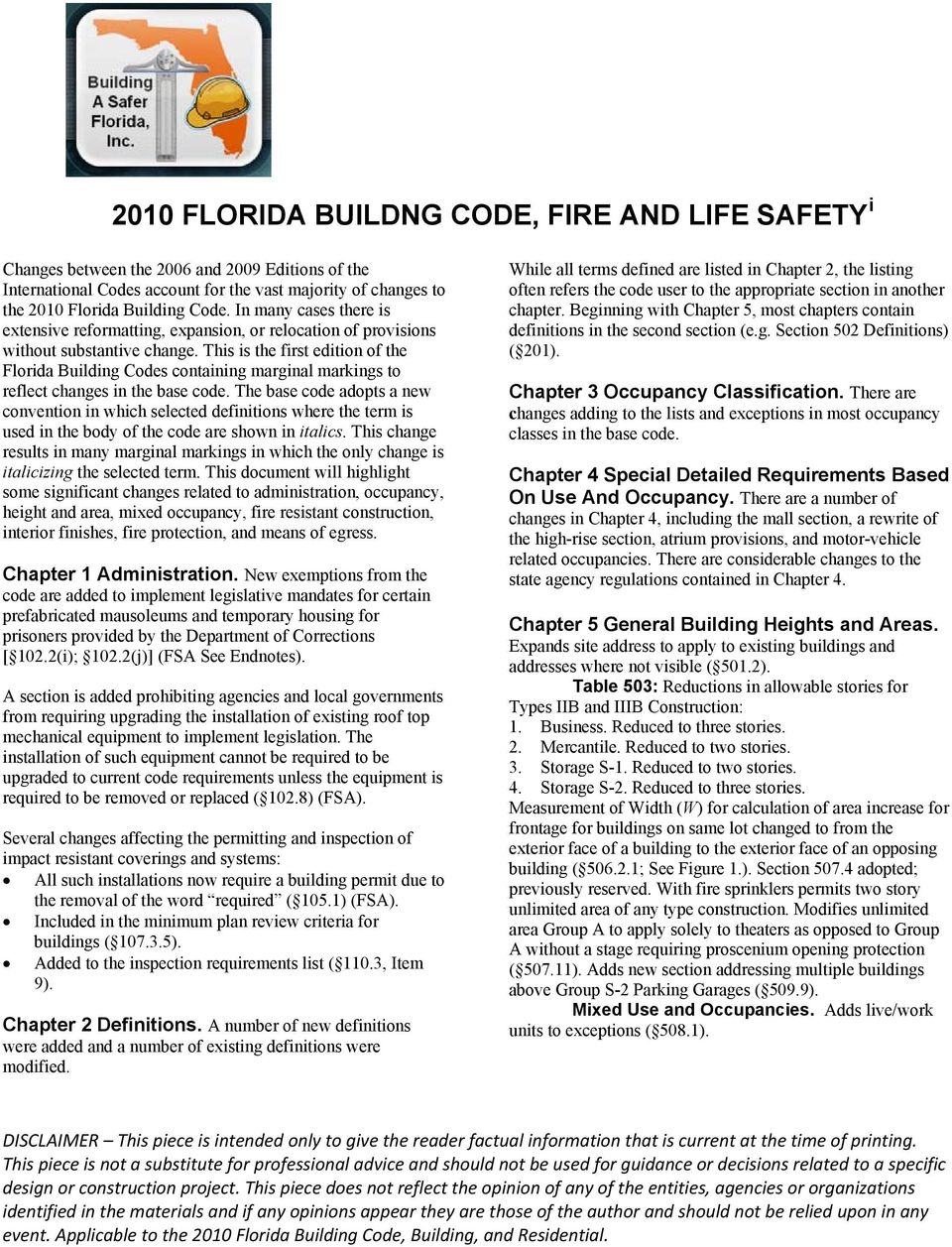
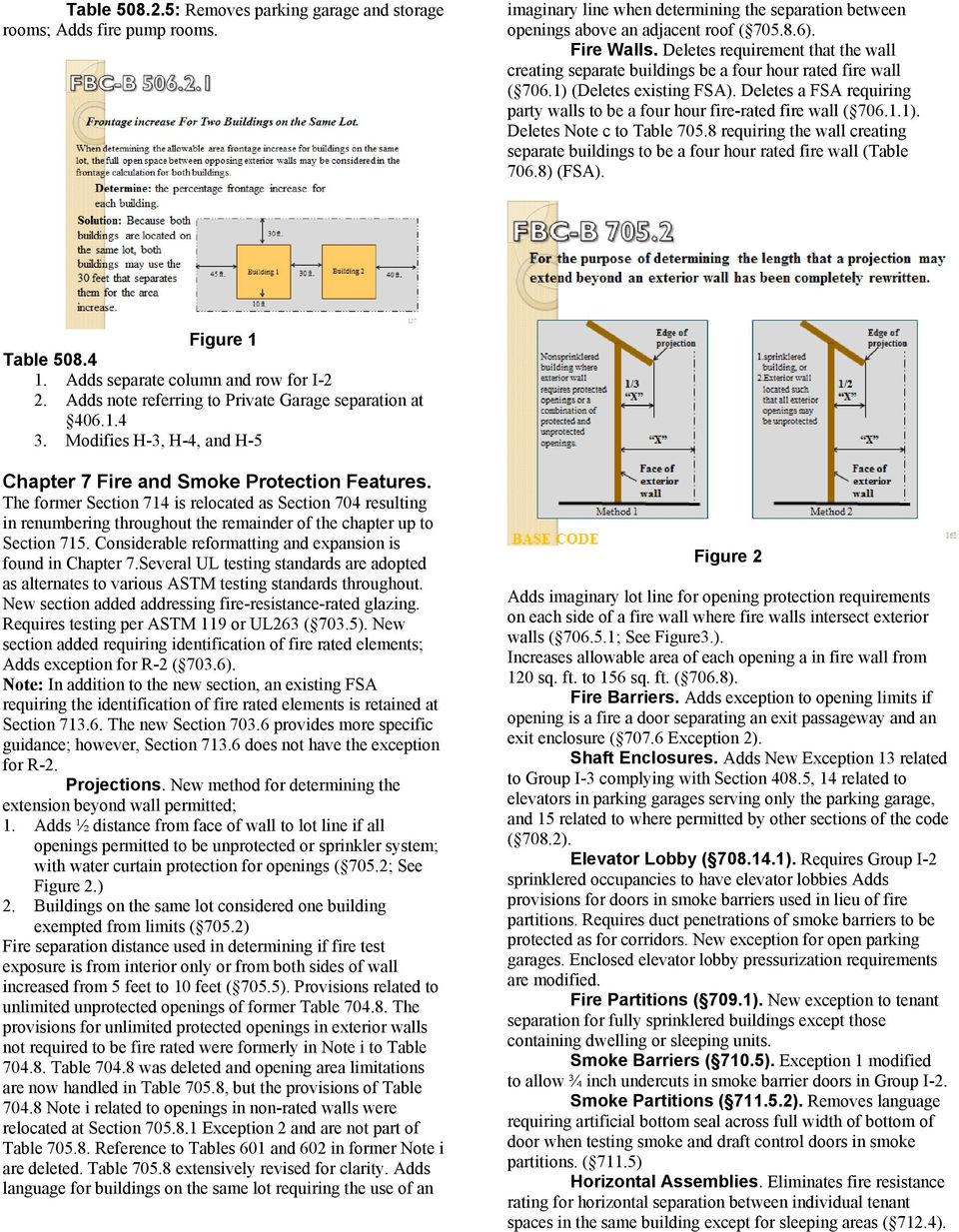
2 Table : Removes parking garage and storage rooms; Adds fire pump rooms. imaginary line when determining the separation between openings above an adjacent roof ( ). Fire Walls. Deletes requirement that the wall creating separate buildings be a four hour rated fire wall ( 706.1) (Deletes existing FSA). Deletes a FSA requiring party walls to be a four hour fire-rated fire wall ( ). Deletes Note c to Table requiring the wall creating separate buildings to be a four hour rated fire wall (Table 706.8) (FSA). Figure 1 Table Adds separate column and row for I-2 2. Adds note referring to Private Garage separation at Modifies H-3, H-4, and H-5 Chapter 7 Fire and Smoke Protection Features. The former Section 714 is relocated as Section 704 resulting in renumbering throughout the remainder of the chapter up to Section 715. Considerable reformatting and expansion is found in Chapter 7.Several UL testing standards are adopted as alternates to various ASTM testing standards throughout. New section added addressing fire-resistance-rated glazing. Requires testing per ASTM 119 or UL263 ( 703.5). New section added requiring identification of fire rated elements; Adds exception for R-2 ( 703.6). Note: In addition to the new section, an existing FSA requiring the identification of fire rated elements is retained at Section The new Section provides more specific guidance; however, Section does not have the exception for R-2. Projections. New method for determining the extension beyond wall permitted; 1. Adds ½ distance from face of wall to lot line if all openings permitted to be unprotected or sprinkler system; with water curtain protection for openings ( 705.2; See Figure 2.) 2. Buildings on the same lot considered one building exempted from limits ( 705.2) Fire separation distance used in determining if fire test exposure is from interior only or from both sides of wall increased from 5 feet to 10 feet ( 705.5). Provisions related to unlimited unprotected openings of former Table The provisions for unlimited protected openings in exterior walls not required to be fire rated were formerly in Note i to Table Table was deleted and opening area limitations are now handled in Table 705.8, but the provisions of Table Note i related to openings in non-rated walls were relocated at Section Exception 2 and are not part of Table Reference to Tables 601 and 602 in former Note i are deleted. Table extensively revised for clarity. Adds language for buildings on the same lot requiring the use of an Figure 2 Adds imaginary lot line for opening protection requirements on each side of a fire wall where fire walls intersect exterior walls ( ; See Figure3.). Increases allowable area of each opening a in fire wall from 120 sq. ft. to 156 sq. ft. ( 706.8). Fire Barriers. Adds exception to opening limits if opening is a fire a door separating an exit passageway and an exit enclosure ( Exception 2). Shaft Enclosures. Adds New Exception 13 related to Group I-3 complying with Section 408.5, 14 related to elevators in parking garages serving only the parking garage, and 15 related to where permitted by other sections of the code ( 708.2). Elevator Lobby ( ). Requires Group I-2 sprinklered occupancies to have elevator lobbies Adds provisions for doors in smoke barriers used in lieu of fire partitions. Requires duct penetrations of smoke barriers to be protected as for corridors. New exception for open parking garages. Enclosed elevator lobby pressurization requirements are modified. Fire Partitions ( 709.1). New exception to tenant separation for fully sprinklered buildings except those containing dwelling or sleeping units. Smoke Barriers ( 710.5). Exception 1 modified to allow ¾ inch undercuts in smoke barrier doors in Group I-2. Smoke Partitions ( ). Removes language requiring artificial bottom seal across full width of bottom of door when testing smoke and draft control doors in smoke partitions. ( 711.5) Horizontal Assemblies. Eliminates fire resistance rating for horizontal separation between individual tenant spaces in the same building except for sleeping areas ( 712.4).
3 Membrane Penetrations. Modifies provisions for use of electrical and other boxes ( ). Fire Resistant Joint Systems. Deletes reference to ASTM E 119 and positive pressure differential and requires compliance with ASTM E 2307 ( 714.4). Figure 3 Opening Protectives ( 715). There are a number of changes related to fire doors and fire window assemblies addressing transoms, sidelights, glazing, labeling, identification, and testing standards. Fire-Protection-Rated Glazing. ( 715.5) Adds UL 9 as alternate to NFPA 257 throughout. Table modified New section requires glazing in fire windows subject to human impact in hazardous locations to comply with Chapter 24 ( ). Ducts and Air Transfer Openings. Requires normal mechanical ventilation systems serving as part of smoke control system to be included in rational analysis ( ). Permits ceiling dampers to be tested as part of assembly per ASTM E 119 or UL ( 716.3). Dampers activation raised from 286º F to 350º F in a smoke control system ( ). New provisions for penetration of horizontal exits. Where protected as a through penetration in sprinklered buildings, deletes damper at penetration of corridor walls ( ). Requires fire dampers in duct and transfer openings in fire-resistance-rated exterior walls required to have protected openings ( ). New section requiring smoke dampers at each point an air transfer opening penetrates a smoke partition ( ). Concealed Spaces, Fireblocking ( ). Existing provisions separated into new sections, adds dimensions to materials, and prohibits. foam sealants and caulk as fireblocking unless specifically tested in form and manner intended for use ( ). Thermal and Sound Insulating Materials. Adds UL 723 as alternate to ASTM E 84 for flame spread testing throughout Section ( 719). Chapter 8 Interior Finishes. Adds UL 723 as alternate to ASTM E 84 throughout. Section 801 reformatted to address interior wall and ceiling and interior floor finishes separately. Ads definitions for Interior Floor-Wall Base and Site-Fabricated Stretch System. Section 803 reformatted and contains new sections addressing high-density polyethylene ( ) and site-fabricated stretch systems ( ). Decorative Materials and Trim ( ). For combustible decorative materials: 1. Changes "10 percent of the aggregate area of walls and ceilings" to "10 percent of the specific wall or ceiling area to which attached." 2. Exception 1 increases the permissible amount of decorative material meeting the flame propagation performance criteria of NFPA 701 from 50 percent to 75 percent of the aggregate wall area in auditoriums in Group A. New Section addressing Interior floor-wall base: 1. Limits to 6 inches or less in height. 2. Tested IAW Not less than Class II; Where Class I floor finish required, shall be Class I. New Section 808 incorporating provisions of former Section for acoustical ceiling systems. Chapter 9 Fire Protection Systems. Sprinkler Systems. Group A-2: Deletes nightclubs with occupant load of 100 or more as it is covered in Item 2 of Section for Group A-2 with and occupant load of 100 or more ( ). Group A-4: Deletes exception for areas used exclusively as participant sports areas ( ). Group B: Ambulatory health care facilities. Sprinkler system required where: 1. Four or more incapable of self-preservation 2. One or more incapable of self-preservation located at other than the level of exit discharge ( ) Group E: Reduced from fire areas greater than 20,000 sq. ft. to greater than 12,000 sq. ft. ( ). Group M: Adds any size used for sale and display of upholstered furniture ( ). Group S-1: 1. Adds fire areas exceeding 5000 sq. ft. used for storage of commercial trucks or buses ( ). 2. Adds Group S-1 fire areas exceeding 5000 sq. ft. used for repair of commercial trucks or buses ( , Item 4). Adds requirement for a roof or deck above exterior balconies, decks and ground floor patios of dwelling units of Type V Construction ( ). Sprinkler System Monitoring and Alarms. Deletes references to NFPA 72 as it is addressed Section ( 903.4). Standpipe Systems. The section is reformatted and demand and design criteria are expanded in malls ( 905). Portable Fire Extinguishers. Section modified to delete reference to Florida Fire Prevention Code and add detailed requirements ( 906). Fire Alarm and Detection Systems. Section completely re-written. ( 907) Smoke Control Systems. The section is modified to require approval by the building official instead of the fire code official, modifies control air tubing requirement, and adds items addressed ( 909). Smoke and Heat Vents. Travel distance increase deleted for consistency with Chapter 10 ( ).

4 Fire Command Center. Section is reformatted into separate sections; Changed to require approval by fire chief instead of fire department; size increased; additional items required within center ( 911.1). Fire Department Connections (FDC). The section is modified to require approval of location and access by fire chief instead of building official; adds exception for fences expands requirements for clear space; addresses vehicle-impact protection; and, adds signage provisions. New sections added for fire pumps, emergency responder safety features, and emergency responder radio coverage ( 912). Chapter 10 Means of Egress. A number of FSAs deleted in favor of the base code language. New exceptions to ceiling height limits ( ): Minimum Required Egress Width. Reference to Table and Table deleted; some minimum egress width per occupant deleted; expands and modifies provisions related to door encroachment into egress width; and adds provisions for door hardware encroachment ( ; ). Means of Egress Illumination. FSA deleted in its entirety and base code language adopted ( 1006). Doors. Exception to height and width added for buildings 400 sq. ft. or less accessory to R-3 and U (FSA incorporating legislation.); door closers and stops permitted to be 78 inches above the floor; pivoted doors are acceptable; manually operated horizontal sliding door in egress permitted with occupant load of 10 or less; and, Group I-2 permitted to have access-controlled egress doors ( ; ). Exception permits locks and latches to prevent operation of fire doors per listing ( ). Three additional exceptions to prohibition of manually operated bolt locks added ( ): 1. Inactive leaf of pair of doors serving less than 50 in Group B, F, or S occupancy. 2. On inactive leaf of pair of doors in fully sprinklered Group B, F, or S provided inactive leaf not needed to meet egress width. 3. On inactive leaf of pair of doors in Group I-2 provided inactive leaf not needed to meet egress width requirements. In Group R-4 Occupancies latched closet doors to be openable from inside and latched bathroom doors to be openable from outside ( ). Adds new section for use of delayed egress locks in Group I-2 ( ). Adds electromagnetically locked egress doors ( ). Panic and fire exit hardware provisions are reformatted with an exception for outdoor gates from swimming pools and decks added ( ) (FSA). Stairways. Adds exception to headroom requirements for Group R-3, dwelling units in R-2, and Group U ( ). Adds a new section addressing the walkline for winder treads ( ). Stair Treads and Risers. The section is reformatted and a statement is added that dimensions are exclusive of carpets, rugs, or runners ( ). Directions for the measurement of winder treads are provided ( ); ship ladder criteria added; and exceptions for Group I-3 are added ( ). Profile. The ½ inch maximum radius of curvature at leading edge of tread and beveling of nosings changed to 9 / 16 inch; additional occupancies permitted to have open risers; and adds exceptions to solid risers ( ). Stairway Landings. Incorporates former exception for reduction of landing width during swing of door and encroachment into landing of door when open into the body of the section and adds language prohibiting required wheelchair space from being located in the required width of the landing ( ). Stairway Walking Surface. Maximum allowable slope changed from 1 in 50 to 1 in 48; new exceptions permitting openings in stair walking surface and limiting opening size and orientation ( ). Vertical Rise. Alternating tread devices permitted 20 feet between landings and adds criteria for tread and risers ( ; ). Adds new section permitting use of ship ladders as a component in means of egress in Group I-3 and providing tread, riser, and handrail requirements ( ). Stairway to Roof. Formerly access to roof, revised to: remove signage requirements (found at ); permit access by alternating tread device for non-occupied roofs; add requirements for hatch opening guards; and require access by stairs where roof or penthouse contains elevator equipment subject to maintenance ( ; ; ). Ramps. Modifies requirement that ramps used as means of egress be 44 inches in width and requires minimum width per corridor requirements. Adds exception to edge protection for assembly spaces with fixed seating; and expands provisions related to curb, rail, wall or barrier used as edge protection ( ; ; ). Exit Signs. Base code provisions adopted ( 1011). Handrails. Adds handrail heights of 30 to 34 inches for alternating tread devices and ship ladders ( ). Handrail graspability section clarified ( ). New sections added establishing Type I and Type II graspability criteria to account for handrail shape: 1. Type I circular hand rail with a circular cross section of 1- ¼ inches minimum to 2 inches maximum. If not circular, perimeter dimensions minimum of 4 inches and maximum of 6-1/4 inches with maximum cross section of 2-¼ inches. Minimum radius for edges is 0.01 inch ( ). 2. Type II handrail: Perimeter greater than 6-¼ inches; Adds new criteria ( ). Exception 1 added allowing use of Type I or Type II handrails in Group R-3, within dwelling units of Group R-2, and Group U. Adds Exception 4 to continuity requirements allowing obstruction at bottom of handrail along their entire length for handrails integral to crash rails or bumper guards ( ). Adds new Section prohibiting handrails from rotating in their fittings. Adds provisions for handrail extensions for alternating tread devices ( ). Guards. Adds horizontal dimension to criteria for where required ( ) (See Figure 4).
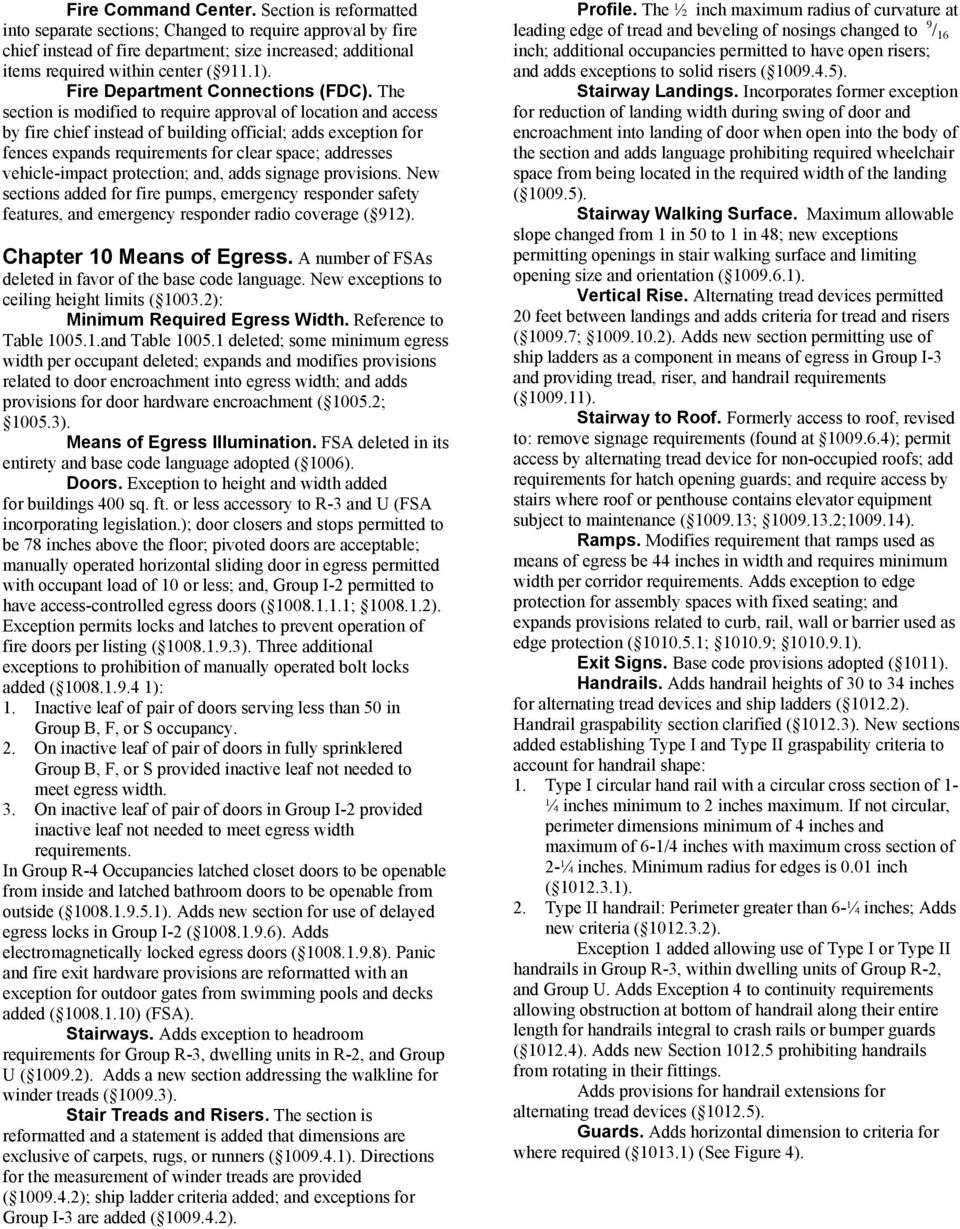
5 Figure 4 Clarifies guard height requirements where seating is at edge of walking surface ( ) (See Figure 5). Figure 5 New section on glazing as guards or portion thereof incorporates and expands provisions formerly at Section ( ). Modifies height reduction criteria to apply to guards at open sides of stairs in Groups R-3 and R-2 ( , Exception 1). Adds exception for alternating tread devices and ship ladders permitting height of 30 to 34 inches where top rail also serves as a handrail ( , Exception 4). Changes the height at which openings allowing the passage of a 4 inch sphere are permitted from 34 inches to the required guard height ( ). Changes height from which opening will prohibit the passage of an 8 inch sphere from 34 to 42 inches to a 4-3/8 inch sphere from 36 to 42 inches ( , Exception 1). Exit Access. Group I-2. Exceptions 2 through 5 for suites deleted and addressed in new Section ( ). Suites in patient sleeping areas addressed at new Sections through Adopts base code language deleting increased common path of egress travel in Group M ( Exception 1). Exits and Exit Access Doorways. Adds Exception to Item 1 in sprinklered buildings permitting one means of egress for Group R-2 and R-3 where occupant load is 20 or less. Requires each occupancy in mixed use to comply with requirements for the occupancy ( ). Exit Access Travel Distance. Section relocates and rewrites travel distance limitations formerly at Section 1020 ( ). Deletes increased travel distance for automatic smoke and heat roof vents ( ). New row added to Table for Group I-1 to without sprinkler system is not permitted. Corridors. Width provisions modified to apply to areas and to add gurney traffic ( Exception 5). Adds new section prohibiting obstruction of the required width of corridors ( ). Expands increase in length of dead end corridor for fire sprinklers per from 20 feet to 50 feet in Groups B, E, F, I-1, M, R-1, R-2,R-4, S Groups B and F to and U (formerly B and F) ( ). New exception to prohibition of corridors serving as conduit for air movement within health care facilities where corridor is not primary source of supply or return air to the room ( ). Egress Balconies. Adds new Sections relocating balcony provisions of former Section without change ( 1019). Single Exits. Reformats single exit provisions and puts them in one location (formerly ) ( ). Exit Enclosures. Provisions expanded to require enclosures to have fire-resistance rating not less than the floor assembly penetrated, but no more than 2 hours ( ). Statement added specifying exit enclosure to lead directly to exterior of building or to exit passageway leading to exterior of building ( ). Deletes exception for stairways that are not a required means of egress element that comply with Section (Note: Provisions at 708.2, Exception 7 may be applied for stairways that are not part of required means of egress.) Excepts means of egress stairways from balconies, galleries, or press boxes from enclosure ( ). Adds new section specifically requiring exit enclosure to terminate at exit discharge or public way ( ). Adds exception permitting exit enclosure to terminate at an exit passageway terminating at exit discharge or public way ( ). Adds new section addressing extension of exit enclosure by an exit passageway: 1. Requires exit enclosure to be separated from exit passageway by a fire barrier equivalent to rating required for enclosure. 2. Doorway from enclosure to passageway required to be a fire door assembly complying with Section Openings in fire barrier, other than fire door, and penetrations prohibited except as permitted in Section ( ). Combines provisions for stair identification and tactile signage formerly found throughout code into one location ( ). Requirements for identification of stairs in exit enclosures applied to ramps ( ). Adds specific requirements for signage ( ). Note: In addition to Section , a Florida Specific Amendment addressing stair identification and tactile signage is found at Section Smokeproof Enclosures. Relocates provisions of requiring fire barrier with fire door to separate smokeproof enclosure or pressurized stairways from exit passageway ( ). Exception to requirement for fire barrier added provided the exit passageway is protected and pressurized in the same manner as smokeproof enclosure ( , Exception 3). Luminous Egress Path Markings. New section applicable to high-rise buildings of Groups A, B, E, I, M, and R-1 ( 1024).

6 Horizontal Exits. Adds horizontal assembly to elements permitted to provide separation from remainder of building ( ). Exit Discharge ( ). Adds provision limiting combination of exceptions to requirement for exits to discharge directly to building exterior to 50 percent of the number and capacity of required exits. Adds exception for requirement to discharge directly to building exterior for horizontal exits. Foyers and Lobbies ( ). Deletes provision for separating waiting areas with substantial permanent partitions or by fixed rigid railings not less than 42 inches (1067 mm) high. Interior Balcony and Gallery Means of Egress ( ). Adds press boxes to elements subject to requirements for interior balcony and gallery means of egress ( ). Adds press boxes and sports facilities to exceptions for stairways from enclosure requirements for interior balconies and galleries ( ). Handrails ( ). Adds Exception 3 for handrail extensions at top and bottom of aisle stairs and aisle ramp runs to permit crossovers within aisles. RESIDENTIAL R302.1 Fire Resistant Construction. R302.1 Exterior Walls. Reformatted and locates all exterior wall location and fire-resistant construction provisions in one section. Adds option to use UL 263 wherever fire testing by ASTM E 119 is required Walls of dwelling and accessory structures located on the same lot Excepts screen enclosure walls of insect screening with a maximum of 25 percent solid flexible finishes (FSA) Eliminates 25% opening limit for walls with FSD less than 3 feet (Table R302.1 (FSA) Requires compliance with Table R302.1 R302.2 Townhouses. Retains single wall of two hour fireresistance rated as separation option (FSA). R302.3 Two-Family Dwellings. Adds Exception 3 for screen enclosure walls (FSA). R302.4 Dwelling Unit Rated Penetration. Relocates all provisions from R317. R302.5 Dwelling/Garage Opening/Penetration protection. Relocates all provisions. R Dwelling/Garage Fire Separation. Adds new Table R302.6 openings per R R Foam Plastics. Provides reference to appropriate section. (R316). Reformats and relocates provisions from R315. R310.1 Emergency Escape and Rescue Openings. Adds habitable attics to spaces requiring emergency escape and rescue openings. R311.2 Egress Door. Changes egress door width from not less than 3 feet in width to a minimum clear width of 32 inches. Changes egress door height from 6 ft. 8 in. to 78 inches. Provides Exception to door height and width requirements for buildings 400 sq. ft. (FSA implementing legislation). Specifies door width and height measuring criteria. R Walkline. New section clarifying measurement of winder treads. R Stair Treads and Risers. Changes tread depth from 9 inches exclusive of nosing to 10 inches. R Profile. Requires 3/4 to 1-1/4 inch nosing on stairs with solid risers. R Exterior Wood/Plastic Composite Stair. Requires compliance with decay prevention of R R312.1 Guards Where Required. Adds horizontal dimension to criteria for where required. Permits guards serving as handrail to be 34 inches to 38 inches in height. R312.4 Exterior Wood/Plastic Composite Guards. Requires compliance decay provisions of R R313 Automatic Fire Sprinkler Systems. Reserved. R314 Smoke Alarms. R314.2 Smoke Detection Systems. Requires system to be monitored by approved supervising station and be maintained per NFPA 72. Provides exception to monitoring for smoke alarms. R Alterations, Repairs and Additions. Adds from requirement to provide smoke alarms for alterations, repairs, or additions involving plumbing or mechanical systems. R314.4 Power Source. Deletes exception permitting battery operated detectors in existing buildings. Adds Exception permitting battery operated detectors in building without commercial power. R315 Carbon Monoxide Alarms. New section for Base Code. Replaced by Florida Specific Amendment to implement legislation. R319.1 Address numbers. Adds criteria for number height and stroke. Expands to address where not visible from public way. Resources: Building Codes and Standards Office , International Code Council 888-ICC-SAFE, January 2012 i. Unless otherwise noted, all code citations are to the Florida Building Code, Building, (e.g ) except those preceded by an R, which are to the Florida Building Code, Residential (e.g. R311.2). All changes due to base code changes unless identified by FSA or Florida Specific Amendment. FBCB means Florida Building Code, Building; FBCR means Florida Building Code, Residential; FFPC means Florida Fire Prevention Code.
Design Options (Tradeoffs) Allowed by the 2012 Building Codes for Properties with Sprinkler Systems. April 2013
 Design Options (Tradeoffs) Allowed by the 2012 Building Codes for Properties with Sprinkler Systems April 2013 The National Multi Housing Council and the National Apartment Association (NMHC/NAA) have
Building Codes Update: The 2009 International Fire Code and the Apartment Industry
 ! Building Codes Update: The 2009 International Fire Code and the Apartment Industry Apartment operators and developers should be aware of organizational changes in the 2009 edition of the International
Florida Building Code 2004 SECTION 1009 STAIRWAYS AND HANDRAILS
 Florida Building Code 2004 SECTION 1009 STAIRWAYS AND HANDRAILS 1009.1 Stairway width. The width of stairways shall be determined as specified in Section 1005.1, but such width shall not be less than 44
New York City Department of Buildings
 The New NYC Building Code Chapter 10 Means of Egress New York City Department of Buildings Technical Affairs Fatma M. Amer, P.E. Copyright Materials This presentation is protected by US and International
COMMONLY USED RESIDENTIAL BUILDING CODES
 COMMONLY USED RESIDENTIAL BUILDING CODES INTERNATIONAL RESIDENTIAL CODE (2009) form revised 5/10 STAIRWAYS 46. LANDINGS. Section R311 IRC 2009 R311.7.5 Landings for stairways. There shall be a floor or
Certification: Building Plans Examiner. Exam ID: B3
 Certification: Building Plans Examiner Exam ID: B3 Scope: A Building Plans Examiner will be responsible for reviewing submitted plans to determine if they meet the requirements of the various Building
The replacement or modification of existing windows shall comply with the following requirements:
 City of La Habra Heights Building Division 1245 N. Hacienda Road La Habra Heights, CA 90631 Office: (562) 694-6302 ext. 228 Fax: (562) 690-5010 WINDOW REPLACEMENT 2010 CALIFORNIA RESIDENTIAL CODE (CRC)
MAJOR 2015 MN RESIDENTIAL CODE CHANGES Effective Date: January 24 th, 2015
 MAJOR 2015 MN RESIDENTIAL CODE CHANGES Effective Date: January 24 th, 2015 **Disclaimer: This document is to serve as informational purposes only. This is not a code book or a final interpretation of the
FIRE AND LIFE SAFETY REQUIREMENTS FOR EXISTING BUILDINGS
 CHAPTER 46 FIRE AND LIFE SAFETY REQUIREMENTS FOR EXISTING BUILDINGS SECTION 4601 GENERAL 4601.1 Scope. The provisions of this chapter shall apply to existing buildings constructed prior to a state building
MEANS OF EGRESS CHAPTER 10
 CHAPTER 10 MEANS OF EGRESS SECTION 1001 ADMINISTRATION 1001.1 General. Buildings or portions thereof shall be provided with a means of egress system as required by this chapter. The provisions of this
2012 IBC & 2012 NFPA 101 Significant Means of Egress Changes. Questions. 1004.1 Design Occupant Load. 1005 - Means of Egress Capacity Determination
 2012 IBC & 2012 NFPA 101 Significant Means of Egress Changes Clay Aler, P.E. Principal [email protected] Andrew M. Schneider, P.E. Senior Fire Protection Engineer [email protected] Questions Submit
http://www.iccsafe.org/
 Sections R311 and R312 from the 2006 International Residential Code These sections of Chapter 3 of the 2006 International Residential Code for One and Two Family Dwellings (R311 and R312) including the
NFPA 101 2012 SELECT SIGNIFICANT CHANGES
 NFPA 101 2012 SELECT SIGNIFICANT CHANGES William E. Koffel, P.E., FSFPE President Koffel Associates, Inc. www.koffel.com [email protected] Expertly Engineering Safety From Fire INTRODUCTION NFPA 101 is
MINNESOTA STATE DEPARTMENT OF PUBLIC SAFETY
 MINNESOTA STATE DEPARTMENT OF PUBLIC SAFETY State Fire Marshal Division 444 Cedar Street, Suite 145, St. Paul, Minnesota 55101-5145 Phone: 651/201-7200 FAX: 651/215-0525 TTY: 651/282/6555 Internet: http://www.fire.state.mn.us
Area of Rescue Assistance Communication System ADA Code Applicable excerpts:
 Area of Rescue Assistance Communication System ADA Code Applicable excerpts: CONTENTS (Guidelines and Definitions) Page 1 Area of Rescue Assistance Requirements Page 2 Emergency Communication Equipment
Educational. Educational-Existing 1/28/2014. OCCUPANT LOADS [no change] Application. Application
![Educational. Educational-Existing 1/28/2014. OCCUPANT LOADS [no change] Application. Application](/thumbs/24/2939000.jpg "Educational. Educational-Existing 1/28/2014. OCCUPANT LOADS [no change] Application. Application") February 2014 Code Requirements and Inspections in Educational Occupancies Presented By: Barry W. Rickert Douglas M. Schanne Fire Marshal Training Program Supervisor Office of Education & Data Management
February 2014 Code Requirements and Inspections in Educational Occupancies Presented By: Barry W. Rickert Douglas M. Schanne Fire Marshal Training Program Supervisor Office of Education & Data Management
MEANS OF EGRESS CHAPTER 10
 CHAPTER 10 MEANS OF EGRESS SECTION BC 1001 ADMINISTRATION 1001.1 General. Buildings or portions thereof shall be provided with a means of egress system as required by this chapter. The provisions of this
FIRE-RESISTANCE-RATED CONSTRUCTION
 CHAPTER 7 FIRE-RESISTANCE-RATED CONSTRUCTION SECTION 70 GENERAL 70. Scope. The provisions of this chapter shall govern the materials and assemblies used for structural fire resistance and fire-resistance-rated
Building Code Clarifications - 7. Fire Resistance
 Building Code Clarifications - 7. Fire Resistance 7.1 (15-12-030) Use of combustibles in Type III construction roof assemblies Code Section (15-12-030) Use of Combustibles was revised on May 17, 2000,
FIRE-RESISTANCE-RATED CONSTRUCTION
 CHAPTER 7 FIRE-RESISTANCE-RATED CONSTRUCTION SECTION 70 GENERAL 70. Scope. The provisions of this chapter shall govern the materials and assemblies used for structural fire resistance and fire-resistance-rated
Adult Family Home (AFH) LOCAL BUILDING INSPECTION CHECKLIST Code References: 2012 IRC Section R325 (WAC 51-51) APPLICATION NUMBER:
 Adult Family Home (AFH) LOCAL BUILDING INSPECTION CHECKLIST Code References: 2012 IRC Section R325 (WAC 51-51) APPLICATION NUMBER: SECTIONS 1, 2, 3, AND 4 MUST BE COMPLETED BY APPLICANT BEFORE INSPECTION
BUILDING PERMIT SPECIFICATIONS
 BUILDING PERMIT SPECIFICATIONS The below noted requirements are based upon La Plata County Building Code. These specifications are not intended as a complete set of requirements, but are intended to provide
MEANS OF EGRESS CHAPTER 10
 CHAPTER 10 MEANS OF EGRESS SECTION 1001 ADMINISTRATION 1001.1 General. Buildings or portions thereof shall be provided with a means of egress system as required by this chapter. The provisions of this
Florida Advanced Building Code Course# FLBC11
 Florida Advanced Building Code Course# FLBC11 EZpdh.com All Rights Reserved CHAPTER 1 Administration: Significant Changes Chapter 1 is now split into two parts: Part 1 is Scope and Application, Part 2
REVEWED BY: Ross Rogien B.O/P.R. ADDITIONAL REVIEW(S) REQ.-FIRE DEPT Y/N
 PLAN REVIEW FOR: PROJECT NAME: OWNER: ARCH/DESIGNER: ADDRESS: Ph/Fx: Plans Dated: E-mail: Sealed By: Estimated Project Cost - $ REVEWED BY: Ross Rogien B.O/P.R. ADDITIONAL REVIEW(S) REQ.-FIRE DEPT Y/N
A ROAD MAP FOR YOUR CODE, SMOKE BARRIER & SMOKE PARTITION REQUIREMENTS
 A ROAD MAP FOR YOUR CODE, SMOKE BARRIER & SMOKE PARTITION REQUIREMENTS International Code Council National Fire Protection Association Underwriters Laboratories Inc. 5203 Leesburg Pike, Suite 600 1 Batterymarch
MEANS OF EGRESS CHAPTER 10
 CHAPTER 10 MEANS OF EGRESS SECTION 1001 ADMINISTRATION 1001.1 General. Buildings or portions thereof shall be provided with a means of egress system as required by this chapter. The provisions of this
BUILDING INSPECTORS INSPECTION FORM FOR CHILD CARE CENTERS
 DCD-0304 Identification # Rev. 9/08 County Date of Inspection NAME OF OPERATION BUILDING INSPECTORS INSPECTION FORM FOR CHILD CARE CENTERS ADDRESS TELEPHONE: CITY STATE ZIP BUILDING INSPECTORS CERTIFICATE
Errata has been identified as follows:
 2009 IFC Performing Commercial Fire Inspections Inventory Number: 1424S09 Second Printing; July 2014 Changes HAVE been made- Third Printing: September 2014 Errata has been identified as follows: 1. Page
Walking and Working Surface Checklist:
 Walking and Working Surfaces Purpose: This information is presented to improve the level of safety in our operations, and to inform you that we will comply with the OSHA Standard 29 CFR 1910.23. Responsibility:
MEANS OF EGRESS CHAPTER 10
 CHAPTER 10 MEANS OF EGRESS SECTION 1001 ADMINISTRATION 1001.1 General. Buildings or portions thereof shall be provided with a means of egress system as required by this chapter. The provisions of this
Healthcare Engineering. Code Summary Report
 American Society for Healthcare Engineering Code Summary Report CODE SUMMARY HEALTH CARE NEW BUILDINGS This code summary is based on the following codes: 2000 Edition NFPA 101, The Life Safety Code (LSC),
NC Rehab Code Case Study Cheerwine Building January 17, 2002; rev 4/12/02
 NC Rehab Code Case Study Cheerwine Building January 17, 2002; rev 4/12/02 PART A: Project Data and Classification 1. Project name & location Renovation of the Cheerwine Building, 322 East Council St.,
Ontario s 2012 Building Code Division B, Part 9 (Ontario Regulation 332/12)
 Ontario s 2012 Building Code Division B, Part 9 (Ontario Regulation 332/12) Notice: This e-learning module is intended for general information purposes only. It only highlights certain provisions of the
We hope these Frequently Asked Questions will be of use both to municipal officials and fire inspectors.
 September 14, 2012 Dear AMM Member: Please see the attached Fire Code Frequently Asked Questions. This document was compiled by the Office of the Fire Commissioner at the AMM s request to help clarify
CHAPTER 10 MEANS OF EGRESS. User Note: See Preface page iv ("marginal markings" for Chapter 10 reorganization information.)
 CHAPTER 10 MEANS OF EGRESS User Note: See Preface page iv ("marginal markings" for Chapter 10 reorganization information.) SECTION 1001 GENERAL 1001.1 Scope. Buildings or portions thereof shall be provided
FIRE AND SMOKE PROTECTION FEATURES
 CHAPTER 7 FIRE AND SMOKE PROTECTION FEATURES SECTION 70 GENERAL 70. Scope. The provisions of this chapter shall govern the materials, systems and assemblies used for structural fire resistance and fire-resistance-rated
5-8.1.4* Any required illumination shall be arranged so that the failure of any single lighting unit shall not leave any area in darkness.
 NFPA 101 Life Safety Code Section 5-8 Illumination of Means of Egress 5-8.1 General. 5-8.1* Illumination of means of egress shall be provided in accordance with this section for every building and structure
General Fire Code Requirements Within Commercial Tenant Spaces
 FIRE DEPARTMENT in cooperation with Scope: General Fire Code Requirements Within Commercial Tenant Spaces This handout is designed to assist owners, architects, contractors and others in understanding
SPECIAL RESIDENCE (ASSISTED SELF-PRESERVATION) OCCUPANCIES (Adopted by the State of Oregon)
 SPECIAL RESIDENCE (ASSISTED SELF-PRESERVATION) OCCUPANCIES (Adopted by the State of Oregon) SECTION SR101 GENERAL SR101.1 General. Group SR occupancies shall comply with the provisions of this appendix
RESIDENTIAL PLUMBING ALTERATIONS PERMIT REQUIREMENTS
 RESIDENTIAL PLUMBING ALTERATIONS PERMIT REQUIREMENTS The following guidelines are intended to assist with the permit acquisition process with regard to Plumbing Alterations. Not all information, or additional
HCD DSA OSHPD 1 2 1/AC AC SS SS/CC 1 2 3 4 2013 CALIFORNIA BUILDING CODE 199
 CALIFORNIA BUILDING CODE MATRIX ADOPTION TABLE CHAPTER 7 FIRE AND SMOKE PROTECTION FEATURES (Matrix Adoption Tables are non-regulatory, intended only as an aid to the user. See Chapter for state agency
FIRE AND SMOKE PROTECTION FEATURES
 CHAPTER 7 FIRE AND SMOKE PROTECTION FEATURES SECTION 70 GENERAL 70. Scope. The provisions of this chapter shall govern the materials, systems and assemblies used for structural fire resistance and fire-resistance-rated
I N T E R N A T I O N A L R E S I D E N T I A L CO D E
 Visual Interpretation Of The I N T E R N A T I O N A L R E S I D E N T I A L CO D E 2006 STAIR BUILDING CODE Portions of this document reproduce sections from the 2006 International Residential Code, International
Errata NFPA 1. Fire Code. 2015 Edition
 Errata NFPA 1 Fire Code 2015 Edition Reference: 2.2, Table 6.1.14.4.1(a) and (b), 13.3.1.6, 13.7.2.13.2.1, 14.11.3.3, 18.5.2, 18.5.3, 20.1.2, 20.1.5.12, 25.1.1, 25.3, 25.4, A.3.3.164.2, and A.13.3.2.9.1
CHAPTER 9 FIRE PROTECTION SYSTEMS
 CHAPTER 9 FIRE PROTECTION SYSTEMS SECTION 901 GENERAL 901.1 Scope. Provisions of this chapter shall govern the application, design, installation, testing and maintenance of automatic sprinklers, standpipes
Overview of Hotel Fire Safety Requirements
 Overview of Hotel Fire Safety Requirements in the Fire Code Susan Clarke, P.Eng. Office of the Fire Marshal - January 10, 2012 1 Agenda Regulation History - Hotels Fire Code Overview (Parts 1 to 8) Defined
Number of Sides Required to Have a Handrail
 Excerpt from 2012 B.C. Building Code HANDRAILS & GUARDS 9.8.7. Handrails 9.8.7.1. Required Handrails 1) Except as provided in Sentences (2) to (4), handrails shall be installed on stairs and ramps in accordance
MINNESOTA HEALTH CARE ENGINEERS IN ASSISTED LIVING FACILITIES
 MINNESOTA HEALTH CARE ENGINEERS FIRE/LIFE SAFETY IN ASSISTED LIVING FACILITIES September 13, 2012 MINNESOTA HEALTH CARE ENGINEERS FIRE/LIFE SAFETY IN ASSISTED LIVING FACILITIES WELCOME Exits Restrooms
FIRE SAFETY INSPECTION REPORT
 FIRE SAFETY INSPECTION REPORT SINCERE KNIT GARMENTS LTD UNIT-1 EAST ISDAIR, CHANDMARI, FATULLAH OTHER FACTORIES: FAKIR KNIT LTD. July 20, 2014 Page 2 SUMMARY was surveyed for fire safety on 7/20/2014 by
GENERAL + MEANS OF ESCAPE (Part One) By Mdm Eng Yew Hoon (SIA)
 GENERAL + MEANS OF ESCAPE (Part One) By Mdm Eng Yew Hoon (SIA) Chapter 1 : Definitions clause 1.2.10 : circulation space OLD CLAUSE A space mainly used as means of access between a room or protected shaft
New Ontario Building Code Requirements for Mid-rise Wood Frame Buildings
 New Ontario Building Code Requirements for Mid-rise Wood Frame Buildings Note: This information addresses complex issues in a summary fashion. Consideration should be given to the official version of the
How To Make A House Safe
 1 RESIDENTIAL Screen Enclosures Orange County Residential Code Compliance Alternative design method for screen enclosures R301.2.1.1.3 PLAN REVIEW Engineered plans must state that the Alternative Design
This handout is a guide only and does not contain all of the requirements of the Minnesota State Building Code or city ordinances.
 Basement Finishing Guide Community Development Department Building Inspections Division 5200 85 th Avenue North / Brooklyn Park, MN 55443 Phone: (763) 488-6379 / Fax: (763) 493-8171 6/15 www.brooklynpark.org
General Safety & Health Standards Published by the Division of Building Safety In Cooperation with the Idaho Industrial Commission
 General Safety & Health Standards Published by the Division of Building Safety In Cooperation with the Idaho Industrial Commission Local Fire Alarm 064. FIRE ALARM SYSTEMS 01. Scope 02. Definitions 03.
9.8.1.1. General (1) This Section applies to the design and construction of interior and exterior stairs, steps, ramps, railings and guards.
 Section 9.8. Stairs, Ramps, Handrails and Guards 9.8.1. Application 9.8.1.1. General (1) This Section applies to the design and construction of interior and exterior stairs, steps, ramps, railings and
Residential Decks. Planning and Development Services Department
 Building Safety Division 8500 Santa Fe Drive Overland Park, KS 66212 (913) 895-6225 Fax (913) 895-5016 Email: [email protected] Planning and Development Services Department Residential Decks
OCFRD TENT STANDARD 6000. This Standard operates under the authority of Orange County, Florida Ordinance and State Statutes.
 1. Authority Orange County Fire Rescue Department Tents & Membrane Structures Office of The Fire Marshall - 109 E. Church Street, Lower Level - Orlando, Florida 32801-3319 Phone: 407-836-0004 Fax: 407-836-8310
Dennis Fire Department Fire Prevention Mark Dellner Fire Chief
 Dennis Fire Department Fire Prevention Mark Dellner Fire Chief FIRE SAFETY INSPECTION GUIDELINES FOR COMMERCIAL PROPERTIES (MA Fire Prevention Regulations 527 CMR, MGL Chapter 148) FIRE PREVENTION CHECKLIST-
2007 ICC FINAL ACTION AGENDA
 907.2.1.1 System initiation in Group A occupancies with an occupant load of 1,000 or more. Activation of the fire alarm in Group A occupancies with an occupant load of 1,000 or more shall initiate a signal
Ch. 58 DIVISION D-O 34 CHAPTER 58. DIVISION D-O ORDINARY COMMERCIAL, INDUSTRIAL, OFFICE OCCUPANCY GROUP CONSTRUCTION TYPE MAXIMUM STORY HEIGHT
 Ch. 58 DIVISION D-O 34 CHAPTER 58. DIVISION D-O ORDINARY COMMERCIAL, INDUSTRIAL, OFFICE Sec. 58.1. Division D-O occupancies. 58.2. Separation and mixed occupancy. OCCUPANCY GROUP CONSTRUCTION TYPE MAXIMUM
FIRE AND LIFE SAFETY REQUIREMENTS FOR CONVENTIONS, TRADE SHOWS AND EXHIBITS November 2011
 FIRE AND LIFE SAFETY REQUIREMENTS FOR CONVENTIONS, TRADE SHOWS AND EXHIBITS November 2011 COLORADO SPRINGS FIRE DEPARTMENT Division of the Fire Marshal If you have any questions or comments regarding the
WINDOW AND DOOR REPLACEMENT REQUIREMENTS
 WINDOW AND DOOR REPLACEMENT REQUIREMENTS Should you have any questions after reading the following information, please call the Building Inspection Department at 651-439-4439 to discuss the topics of concern.
Required Certification Documentation. Contractor's installation certification for range hood fire suppression systems.
 OFFICE OF UNIVERSIT BUILDING OFFICIAL PROJECT/CONSTRUCTION MAGER: Sample Manager Required Aboveground only Required Certification Documentation Contractor s material and test certifications for both above
FIRE AND LIFE SAFETY REQUIREMENTS FOR CONVENTIONS, TRADE SHOWS AND EXHIBITS
 FIRE AND LIFE SAFETY REQUIREMENTS FOR CONVENTIONS, TRADE SHOWS AND EXHIBITS November 2011, Updated March 2012 COLORADO SPRINGS FIRE DEPARTMENT Division of the Fire Marshal If you have any questions or
City of Riverside Building & Safety Division Phone: (951) 826-5697 www.riversideca.gov
 City of Riverside Building & Safety Division Phone: (951) 826-5697 www.riversideca.gov BUILDING CODE REQUIREMENTS FOR CHILD DAY CARE The purpose of this document is to provide the user with a basic level
2012 CODES SIGNIFICANT CHANGES 2012 IBC
 2012 CODES SIGNIFICANT CHANGES 2012 IBC 1. Section 303.4 added language that includes commercial kitchens which are associated with restaurants, cafeterias, and similar dining facilities to be classified
Health Care Facilities
 Health Care Facilities CHAPTER 25 Joseph M. Jardin A large Illinois hospital undergoing a sprinkler retrofit quickly discovered the benefits of upgrading its system when sprinklers confined a fire caused
MINIMUM STANDARDS FOR HIGH-RISE BUILDINGS
 CHAPTER 93 MINIMUM STANDARDS FOR HIGH-RISE BUILDINGS Note: Chapter 93 is entirely Seattle amendments to the International Fire Code and is not underlined. Point of Information The requirements of this
FIRE PROTECTION IN THE 2008 NEW YORK CITY BUILDING CODE
 FIRE PROTECTION IN THE 2008 NEW YORK CITY BUILDING CODE New York Society of Architects 24 January 2008 Presented by Joseph Razza, PE Rolf Jensen & Associates, Inc. John Lee, RA NYC Department of Buildings
Vestibule Case Study. Vestibule Requirement Intent [2003 IECC, 2006 IECC, 2003 IBC, 2006 IBC, 90.1-2001, 90.1-2004]
![Vestibule Case Study. Vestibule Requirement Intent [2003 IECC, 2006 IECC, 2003 IBC, 2006 IBC, 90.1-2001, 90.1-2004]](/thumbs/24/2939769.jpg "Vestibule Case Study. Vestibule Requirement Intent [2003 IECC, 2006 IECC, 2003 IBC, 2006 IBC, 90.1-2001, 90.1-2004]") Vestibule Case Study [2003 IECC, 2006 IECC, 2003 IBC, 2006 IBC, 90.1-2001, 90.1-2004] Vestibule Requirement Intent Page 1 of 14 The primary intent behind the requirement for a vestibule is to reduce infiltration
Vestibule Case Study [2003 IECC, 2006 IECC, 2003 IBC, 2006 IBC, 90.1-2001, 90.1-2004] Vestibule Requirement Intent Page 1 of 14 The primary intent behind the requirement for a vestibule is to reduce infiltration
Page 4 of 17. Committee Input NFPA 101 Coordinate Smoke detector versus smoke alarm terminology.
 Page 1 of 17 Page 2 of 17 Committee Input NFPA 101 Coordinate Smoke detector versus smoke alarm terminology. CODE PARAGRAPH WITH SUGGESTED CHANGES: 6.4.6.1.2 Residents should be rated as response probable
Code Requirements for Existing Buildings
 Code Requirements for Existing Buildings Kevin S. Hastings, P.E., LEED AP R. W. Sullivan, Inc. 529 Main St., Suite 203 Charlestown, MA (617) 523-8227 www.rwsullivan.com R.W. Sullivan Engineering (RWS)
Life Safety Code Enabling References
 SUPPLEMENT 4 Life Safety Code Enabling References Editor s Note: Supplement 4 provides users of NFPA 72, National Fire Alarm and Signaling Code, with a summary of requirements from NFPA 101, Life Safety
Name Of Occupancy Date. Yes No Describe
 FIRE PREVENTION INSPECTION CHECKLIST For Class A Occupancy (For Assembly Buildings, Bars, Restaurants, Gyms, Churches, Arenas, Theatres or wherever people gather) Name Of Occupancy Date Physical Address
M E M O R A N D U M. To: Partnership for Safer Buildings Date: 21 March 2003
 M E M O R A N D U M To: Partnership for Safer Buildings Date: 21 March 2003 From: Codes Assessment Subcommittee Walter Smittle III, Chairman Re: Building Code Fire Safety Concerns: NFPA 5000, Building
Current as of 11/10/08 1 of 1
 BEST PRACTICES STANDARDS FOR SCHOOLS UNDER CONSTRUCTION OR BEING PLANNED FOR CONSTRUCTION I. Site Layout A. School buildings shall be provided with a securable perimeter. A securable perimeter means that
*It is unlawful to occupy or use any project for which a permit was issued without first receiving final inspection approval from this department.
 Department of Permitting Services 255 Rockville Pike, 2nd Floor Rockville, MD 20850-4166 Phone: 311 in Montgomery County or (240) 777-0311 Fax (240)-777-6262 http://www.montgomerycountymd.gov/permittingservices
The Commonwealth of Massachusetts Executive Office of Public Safety Department of Fire Services
 MITT ROMNEY GOVERNOR KERRY HEALEY LT. GOVERNOR EDWARD A. FLYNN SECRETARY The Commonwealth of Massachusetts Executive Office of Public Safety Department of Fire Services P.O. Box 1025 State Road Stow, Massachusetts
Excerpts from the Canadian National Building Code (NBC)
 Excerpts from the Canadian National Building Code (NBC) Reproduced here with Permission of the Copyright Owner, the National Research Council of Canada, Institute for Research in Construction. For more
COMMERCIAL COOKING HOODS, VENTILATION & FIRE SUPPRESSION SYSTEM GUIDELINES AND PROCEDURES
 COMMERCIAL COOKING HOODS, VENTILATION & FIRE SUPPRESSION SYSTEM GUIDELINES AND PROCEDURES These guidelines are to be used for ALL commercial cooking hoods, ventilation systems and related fire suppression
STATE BUILDING CODE 2005 CONNECTICUT SUPPLEMENT 2009 AMENDMENT
 STATE BUILDING CODE 2005 CONNECTICUT SUPPLEMENT 2009 AMENDMENT Sec. 29-252-1d. State Building Code 2009 Amendment to the 2005 Connecticut Supplement The 2003 International Building Code, 2003 International
CHILD CARE CENTER INFORMATION SHEET
 CHILD CARE CENTER INFORMATION SHEET SECTION 1 INTRODUCTION This fire safety information sheet is based on the 2007 Minnesota State Fire Code (MSFC) and the 2007 Minnesota State Building Code (MSBC). It
Indiana Building Rehabilitation Standard
 Rule 8. Indiana Building Rehabilitation Standard 675 IAC 12-8-1 Definitions Sec. 1. The following definitions apply throughout this rule: (1) "Building code" means the Indiana Building Code under 675 IAC
NFPA 101 2015 20 Frequently Asked Questions
 February 2015 NFPA 101 2015 20 Frequently Asked Questions By Ron Coté, P.E. Ask an NFPA Expert The Technical Questions Service is free with your NFPA Membership. Our Technical Questions Service provides
New Ambulatory Health Care Occupancies
 NFPA 101 Substantiation: The changes proposed to NFPA 101 Chapter 20, New Ambulatory Health Care Occupancies, make the chapter a stand-alone set of requirements that do not reference the use of the provisions
Preparation for 2015 Residential Code Changes Discussion with Local Builders and Designers
 City of Duluth Preparation for 2015 Residential Code Changes Discussion with Local Builders and Designers Thank you for taking the time to join us today. We know you are busy and your time is valuable.
KITCHEN AND BATH REMODELING BUILDING PERMIT REQUIREMENTS
 St. Louis County Department of Public Works Division of Code Enforcement KITCHEN AND BATH REMODELING BUILDING PERMIT REQUIREMENTS This guideline is intended to provide the homeowner/contractor with the
The New Life Safety Chapter What It Applies to and How Organizations Can Comply with It
 The New Life Safety Chapter What It Applies to and How Organizations Can Comply with It The Joint Commission requires health care organizations to comply with the Life Safety Code * to help ensure fire
- 5 - Table1. Maximum Compartment Volumes
 - 5 - Part II - SPECIFIC REQUIREMENTS 5. Compartmentation 5.1 Every building should be divided into compartments by walls and floors to inhibit the spread of fire. 5.2 Compartment walls, compartment floors,
EAST STROUDSBURG BOROUGH RESIDENTIAL RENTAL INSPECTION CHECK LIST
 DATE TIME EAST STROUDSBURG BOROUGH RESIDENTIAL RENTAL INSPECTION CHECK LIST INSPECTOR: LICENSE # ADDRESS: PROPERTY OWNER: SINGLE: DOUBLE: MULTI-UNIT # OF UNITS POINT OF INSPECTION Sanitation IPMC 302.1
Building Department John Fiedler Construction Official Ext. 211. SAMPLE GUIDE FOR 1&2 FAMILY DWELLING BASEMENTS Rev 4-3-2014
 TOWNSHIP OF HILLSBOROUGH COUNTY OF SOMERSET Hillsborough Township Municipal Complex The Peter J. Biondi Building 379 South Branch Road Hillsborough, NJ 08844 P: (908) 369-4313 F: (908) 369-3954 Building
Single Family Residential Basement Finish
 How to Use This Guide Building Guide Pottawattamie County Planning & Development Department Building & Safety Division Single Family Residential Basement Finish Provide two (2) sets of plans and complete
Schedule B to By-law 33-2009
 Amended by By-law 8-2016 Note: This consolidation is prepared for convenience only. For accurate reference the original by-laws should be reviewed. Floor Area Calculation Floor area shall: Schedule B to
BOROUGH OF NATIONAL PARK APPLICATION FOR A CERTIFICATE OF OCCUPANCY FOR CHANGE OF OCCUPANCY ADDRESS OF PROPERTY FOR INSPECTION CURRENT OWNER
 BOROUGH OF NATIONAL PARK APPLICATION FOR A CERTIFICATE OF OCCUPANCY FOR CHANGE OF OCCUPANCY ADDRESS OF PROPERTY FOR INSPECTION # BLOCK LOT VACANT YES NO CURRENT OWNER NAME ADDRESS TELEPHONE # PROSPECTIVE
Duchesne County Department of Building Safety
 Duchesne County Department of Building Safety 734 North Center St., P.O. Box 317 Duchesne, Utah 84021-0317 Phone (435) 738-1153 Karl D. Mott Building Official BUILDING PERMIT PROCESS DOCUMENTS TO BE SUBMITTED
www.maurerarchitecture.com
 Design Guidelines, Historic Districts and Codes as Downtown Development Tools The NC Rehab Code and Its Benefits for Older Buildings North Carolina Main Street Conference January 25-27, 2012 History of
CAL FIRE/San Luis Obispo County Fire Fire Prevention Bureau
 CAL FIRE/San Luis Obispo County Fire Fire Prevention Bureau g GUIDELINE FOR SAFETY REQUIREMENTS FOR HAUNTED HOUSES PURPOSE This guide is intended to provide safety standards and regulations for the construction
SECTION 903 AUTOMATIC SPRINKLER SYSTEMS
 Page 25 ABOUT CODE CORNER CCFS would like to remind you to check with your local Authority Having Jurisdiction (AHJ) for questions and opinions concerning your local Fire and Building Codes. The information
2012 Changes of the International Building Code Compared to the National Fire Protection Association- 101
 2012 Changes of the International Building Code Compared to the National Fire Protection Association- 101 For the Florida Building Commission And the Fire Code Advisory Council Introduction The scope of