
Perron vector Optimization applied to search engines
|
|
|
- Helena Christine Walker
- 10 years ago
- Views:
Transcription
1 Perron vector Optimization applied to search engines Olivier Fercoq INRIA Saclay and CMAP Ecole Polytechnique May 18, 2011

2 Web page ranking The core of search engines Semantic rankings (keywords) Hyperlink based rankings: - PageRank [Brin and Page, 1998] - HITS [Kleinberg, 1998] - Salsa [Lempel and Moran, 2000], HOTS [Tomlin, 2003] Webmasters want to be on top of the list
![Page, 1998] - HITS [Kleinberg, 1998] - Salsa [Lempel and](/docs-images/56/7616210/images/page_2.jpg "Moran, 2000], HOTS [Tomlin, 2003] Webmasters want to be on top")
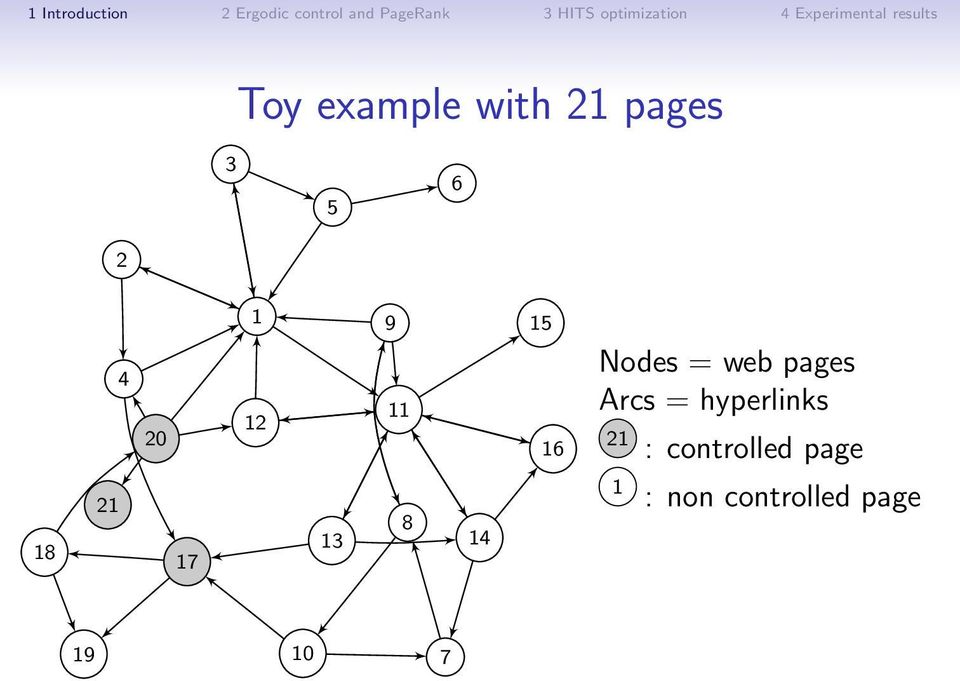
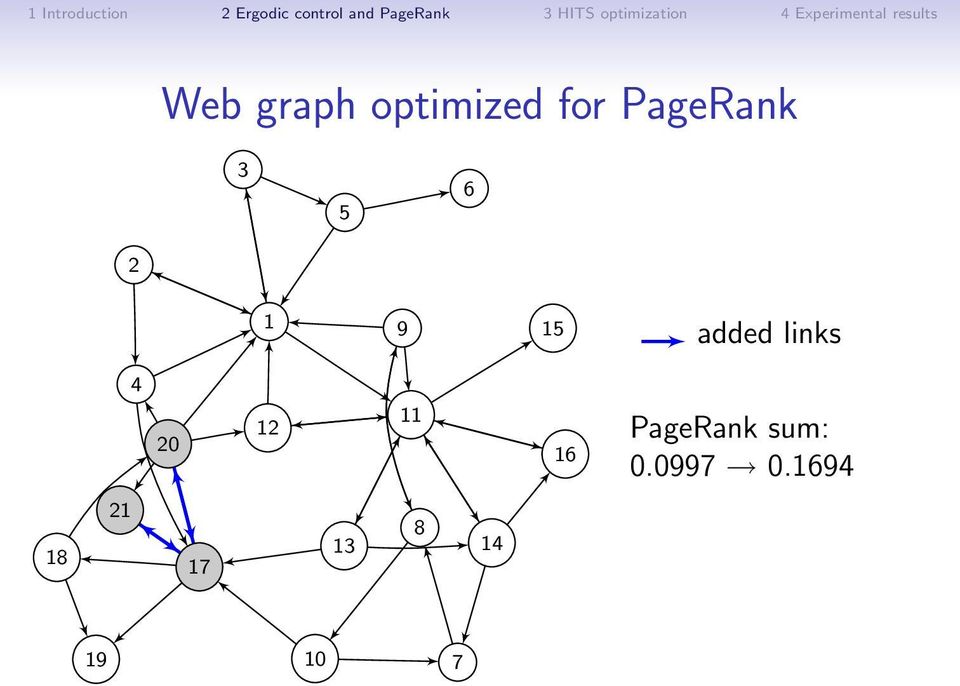
3 Toy example with 21 pages Nodes = web pages Arcs = hyperlinks 21 : controlled page : non controlled page
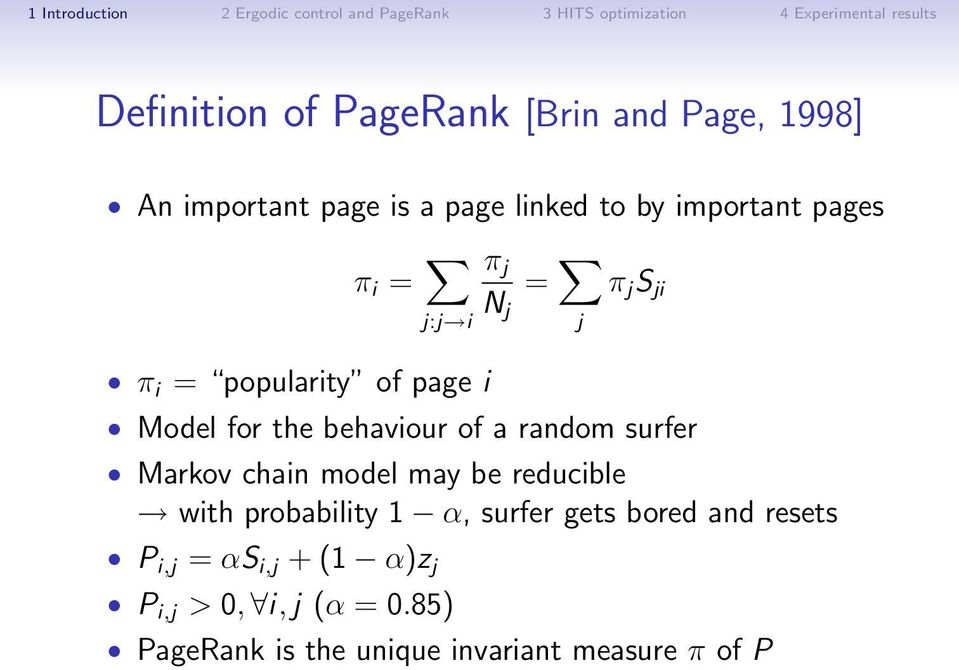
4 Definition of PageRank [Brin and Page, 1998] An important page is a page linked to by important pages π i = j:j i π i = popularity of page i π j N j = j π j S ji Model for the behaviour of a random surfer Markov chain model may be reducible with probability 1 α, surfer gets bored and resets P i,j = αs i,j + (1 α)z j P i,j > 0, i, j (α = 0.85) PageRank is the unique invariant measure π of P
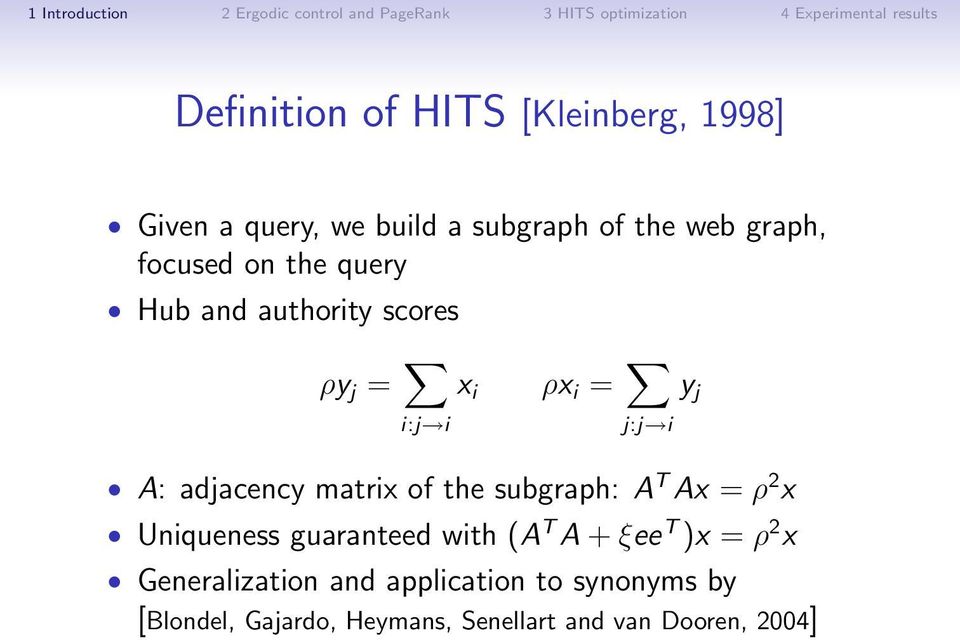
5 Definition of HITS [Kleinberg, 1998] Given a query, we build a subgraph of the web graph, focused on the query Hub and authority scores ρy j = i:j i x i ρx i = j:j i A: adjacency matrix of the subgraph: A T Ax = ρ 2 x Uniqueness guaranteed with (A T A + ξee T )x = ρ 2 x Generalization and application to synonyms by [Blondel, Gajardo, Heymans, Senellart and van Dooren, 2004] y j
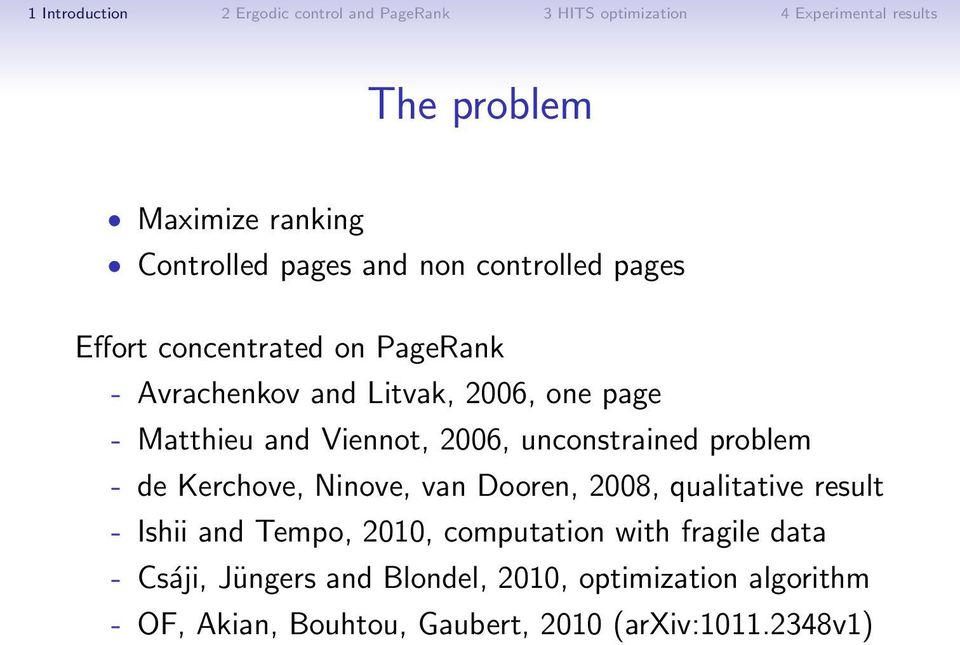
6 The problem Maximize ranking Controlled pages and non controlled pages Effort concentrated on PageRank - Avrachenkov and Litvak, 2006, one page - Matthieu and Viennot, 2006, unconstrained problem - de Kerchove, Ninove, van Dooren, 2008, qualitative result - Ishii and Tempo, 2010, computation with fragile data - Csáji, Jüngers and Blondel, 2010, optimization algorithm - OF, Akian, Bouhtou, Gaubert, 2010 (arxiv: v1)
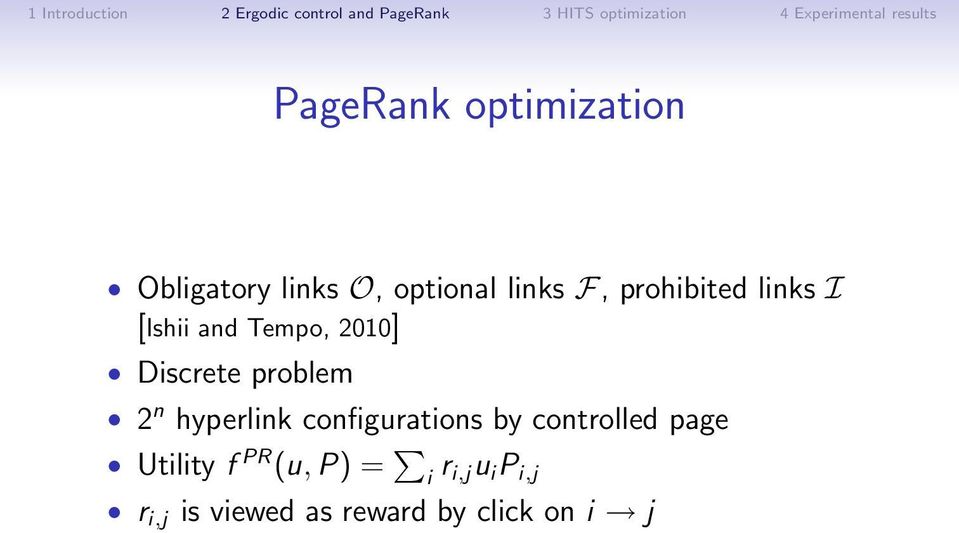
7 PageRank optimization Obligatory links O, optional links F, prohibited links I [Ishii and Tempo, 2010] Discrete problem 2 n hyperlink configurations by controlled page Utility f PR (u, P) = i r i,ju i P i,j r i,j is viewed as reward by click on i j
8 Admissible transition matrices (PageRank) Theorem (OF, Akian, Bouhtou, Gaubert ) The convex hull of the set of admissible transition probabilities is either a simplex or a polyhedron defined by: j I i, j O i \ {j 0 }, j F i, x j = (1 α)z j x j = x j0 (1 α)z j x j x j0 j [n] x j = 1 Discrete problem equivalent to a continuous problem [Csáji, Jüngers and Blondel, 2010]: graph rewriting
![by: j I i, j O i \ {j 0 }, j F i, x j = (1 α)z j x j = x j0 (1 α)z j x j x j0 j [n] x j = 1](/docs-images/56/7616210/images/page_8.jpg "Discrete problem equivalent to a continuous problem [Csáji, Jüngers and Blondel, 2010]: graph")
9 Proposition Reduction to ergodic control The PageRank Optimization problem is equivalent to the ergodic control problem: 1 max lim inf (ν t) t 0 T + T E( T 1 r X t,x t+1 ) t=0 ν t P Xt, t 0 P(X t+1 = j X t = i, ν t = p) = p j, i, j [n], p P i, t 0 where ν t is a function of the history (X 0, ν 0,..., X t 1, ν t 1, X t ) Corollary PageRank optimization problem with local constraints is solvable in polynomial time
![i, ν t = p) = p j, i, j [n], p P i, t 0 where ν t is a function of the history (X 0, ν 0,.](/docs-images/56/7616210/images/page_9.jpg ".., X t 1, ν t 1, X t ) Corollary PageRank optimization problem with local constraints is solvable in")
10 Resolution by Dynamic Programming The ergodic dynamic programming equation w i + ψ = max ν P i ν(r i, + w), i [n] (1) has a solution (w, ψ) R n R. The constant ψ is unique and is the value of the ergodic control problem. An optimal strategy is obtained by selecting for each state i a maximizing ν P i.

11 Resolution by Dynamic Programming The ergodic dynamic programming equation w i + ψ = max ν P i ν(r i, + w), i [n] (1) has a solution (w, ψ) R n R. The constant ψ is unique and is the value of the ergodic control problem. An optimal strategy is obtained by selecting for each state i a maximizing ν P i. The unique solution of the discounted equation w i = max αν(r i, +w)+(1 α)zr i,, i [n] (2) ν : αν+(1 α)z P i is solution of (1) with ψ = (1 α)zw The fixed point scheme for (2) has contracting factor α independent of the dimension

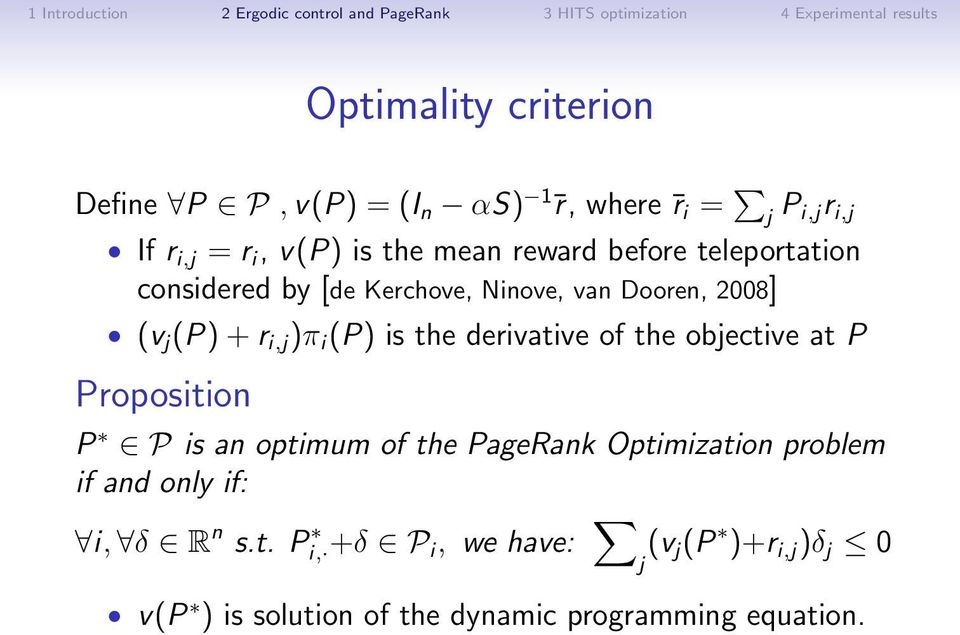
12 Optimality criterion Define P P, v(p) = (I n αs) 1 r, where r i = j P i,jr i,j If r i,j = r i, v(p) is the mean reward before teleportation considered by [de Kerchove, Ninove, van Dooren, 2008] (v j (P) + r i,j )π i (P) is the derivative of the objective at P Proposition P P is an optimum of the PageRank Optimization problem if and only if: i, δ R n s.t. Pi, +δ P i, we have: (v j(p )+r i,j )δ j 0 j v(p ) is solution of the dynamic programming equation.
13 Existence of a master page From the optimality criterion, we get: Theorem (OF, Akian, Bouhtou, Gaubert) If i, r i,j = r i, there is a page to which all controlled pages should link. [de Kerchove, Ninove and van Dooren, 2008]: similar result with less flexible constraints

14 Web graph optimized for PageRank added links PageRank sum:
15 HITS optimization A choice of optional links gives an adjacency matrix A Authority vector: ρu = (A T A + ξee T )u = h H (A)u f H (u) = i r iui 2, i u2 i = 1 HITS optimization on weighted graphs: still nonconvex We abandon global optimality But efficient and scalable computation

16 Perron vector Optimization Problem We study the following Perron vector Optimization Problem: max f (u(m)) M h(c) h : R m R n n + and f : R n + R are differentiable u : R n n + R n + is the function that to an irreducible matrix associates its normalized Perron vector C convex, h(c) a set of nonnegative irreducible matrices

17 NP-hardness Consider the following problems with entries a linear function A and a vector b: (P1) min ρ(m) (P2) min f (u(m)) A(M) b, M 0 A(M) b, M 0 Proposition The problems (P1) and (P2) are NP-hard problems. Proof LMP, proved NP-hard by Matsui, reduces to (P1) and (P2) (LMP) min x 1 x 2 M = x Ax b, x x 2 0

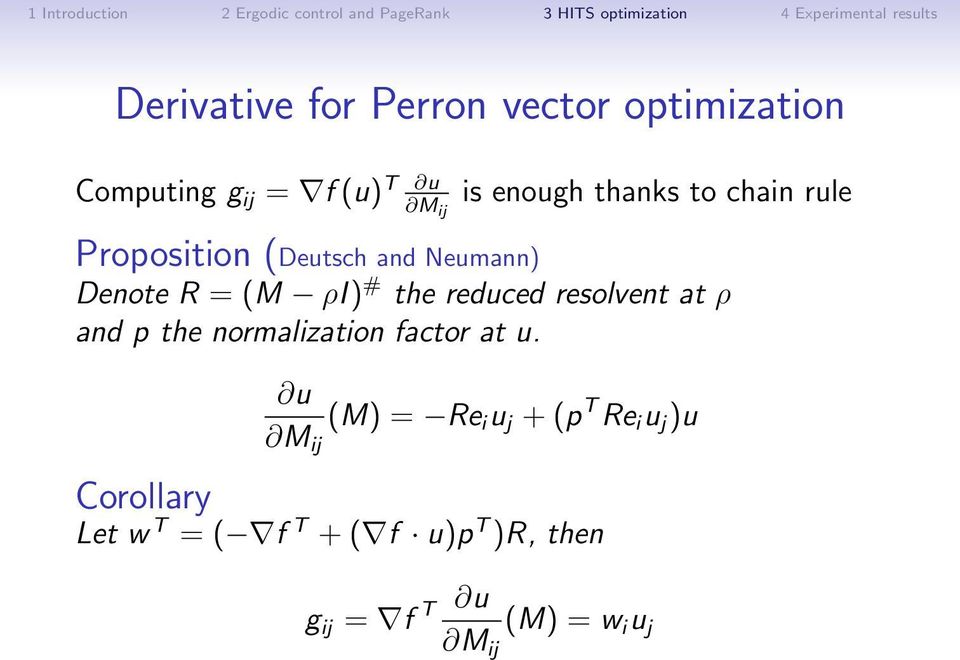
18 Derivative for Perron vector optimization Computing g ij = f (u) T u M ij is enough thanks to chain rule Proposition (Deutsch and Neumann) Denote R = (M ρi ) # the reduced resolvent at ρ and p the normalization factor at u. u M ij (M) = Re i u j + (p T Re i u j )u Corollary Let w T = ( f T + ( f u)p T )R, then g ij = f T u M ij (M) = w i u j
19 Iterative scheme for the derivative Proposition Let M be a primitive matrix with Perron vectors u and v. We denote M = 1 ρ M, P = uv and z = 1 ρ ( f T + ( f u)p T ) Then the fix point scheme defined by k N, w k+1 = (z + w k M)(I P) converges in geometric speed to w = ( f T + ( f u)p T )(M ρi ) #

20 Descent algorithm First order descent method Criterion to go to next gradient step before convergence of power iterations Computation of value and derivative all together: u k+1 = Mu k N(Mu k ) v k+1 = v km v k Mu k+1 z k = 1 ρ k ( f (u k ) T + ( f (u k ) u k )p T k ) w k+1 = (z k + 1 ρ k w k M)(I u k+1 v k+1 )

21 Coupling power and gradient iterations α = α 0 M = M α α αβ Matrix building M α Function evaluation M f α > f σ α δ2? f α f σ α δ2
22 Coupling power and gradient iterations α = α 0 M = M α α αβ Matrix building M α Power iteration M f α > f σ α δ2? otherwise fα f σ α δ2
23 Convergence Proposition Power + gradient algorithm converges to a stationary point. Efficiency depends on the quality of the bounds in the Armijo test For HITS, f = f (u k ) r u u k r u k 2 u u k 2 f = f (u k ) + r u u k r u k 2 u u k 2 f f (u) f
24 Bounds Lemma M nonnegative, symmetric matrix, Mu = ρu u 0 > 0, u 0 = 1, u 1 = Mu0, a = (max i Mu 0 u u 1 2 u 1 u 0 2 Proof uses [Collatz, 1942]: M 0, u > 0 min i (Mu) i u i (Mu 0 ) i u i 0 ) 2 Mu 0 2 Mu 0 2 σ 2 2 ( σ2 ρ ) 2 (1 σ 2 ρ ) 2 13a 2 ρ(m) max i (Mu) i u i
25 Web graph optimized for HITS added internal links added external links HITS authority sum:
26 Experimental results A fragment of the real web graph with 1,500 pages (nodes) and 18,398 hyperlinks (arcs) controlled web site has 49 pages PageRank HITS authority Method Dynamic programming Gradient algorithm Initial value Value with clique Final value Execution time 1.27 s 1600 s Sequential Matlab code on an Intel Xeon CPU at 2.98 Ghz

27 Numerical experiment for HITS optimization 10,725 descent iterations, 10,776 matrix buildings, 1,737,677 power iterations, 0.21 reached in 150 iterations
28 Conclusion PageRank: - Global optimality, discrete solution - Very fast and scalable algorithm - Qualitative results on the optimal solutions HITS authority: - No global optimality result - No qualitative results on the optimal solutions - Non discrete local optimal solutions - Efficient and scalable descent algorithm Application in population dynamics with Billy, Clairambault, Gaubert and Lepoutre
Search engines: ranking algorithms
 Search engines: ranking algorithms Gianna M. Del Corso Dipartimento di Informatica, Università di Pisa, Italy ESP, 25 Marzo 2015 1 Statistics 2 Search Engines Ranking Algorithms HITS Web Analytics Estimated
2.3 Convex Constrained Optimization Problems
 42 CHAPTER 2. FUNDAMENTAL CONCEPTS IN CONVEX OPTIMIZATION Theorem 15 Let f : R n R and h : R R. Consider g(x) = h(f(x)) for all x R n. The function g is convex if either of the following two conditions
Big Data Technology Motivating NoSQL Databases: Computing Page Importance Metrics at Crawl Time
 Big Data Technology Motivating NoSQL Databases: Computing Page Importance Metrics at Crawl Time Edward Bortnikov & Ronny Lempel Yahoo! Labs, Haifa Class Outline Link-based page importance measures Why
Modern Optimization Methods for Big Data Problems MATH11146 The University of Edinburgh
 Modern Optimization Methods for Big Data Problems MATH11146 The University of Edinburgh Peter Richtárik Week 3 Randomized Coordinate Descent With Arbitrary Sampling January 27, 2016 1 / 30 The Problem
CHAPTER 9. Integer Programming
 CHAPTER 9 Integer Programming An integer linear program (ILP) is, by definition, a linear program with the additional constraint that all variables take integer values: (9.1) max c T x s t Ax b and x integral
Mathematical finance and linear programming (optimization)
 Mathematical finance and linear programming (optimization) Geir Dahl September 15, 2009 1 Introduction The purpose of this short note is to explain how linear programming (LP) (=linear optimization) may
DATA ANALYSIS II. Matrix Algorithms
 DATA ANALYSIS II Matrix Algorithms Similarity Matrix Given a dataset D = {x i }, i=1,..,n consisting of n points in R d, let A denote the n n symmetric similarity matrix between the points, given as where
Part 1: Link Analysis & Page Rank
 Chapter 8: Graph Data Part 1: Link Analysis & Page Rank Based on Leskovec, Rajaraman, Ullman 214: Mining of Massive Datasets 1 Exam on the 5th of February, 216, 14. to 16. If you wish to attend, please
Introduction to Markov Chain Monte Carlo
 Introduction to Markov Chain Monte Carlo Monte Carlo: sample from a distribution to estimate the distribution to compute max, mean Markov Chain Monte Carlo: sampling using local information Generic problem
(Quasi-)Newton methods
 (Quasi-)Newton methods 1 Introduction 1.1 Newton method Newton method is a method to find the zeros of a differentiable non-linear function g, x such that g(x) = 0, where g : R n R n. Given a starting
5.1 Bipartite Matching
 CS787: Advanced Algorithms Lecture 5: Applications of Network Flow In the last lecture, we looked at the problem of finding the maximum flow in a graph, and how it can be efficiently solved using the Ford-Fulkerson
Big Data - Lecture 1 Optimization reminders
 Big Data - Lecture 1 Optimization reminders S. Gadat Toulouse, Octobre 2014 Big Data - Lecture 1 Optimization reminders S. Gadat Toulouse, Octobre 2014 Schedule Introduction Major issues Examples Mathematics
Computing a Nearest Correlation Matrix with Factor Structure
 Computing a Nearest Correlation Matrix with Factor Structure Nick Higham School of Mathematics The University of Manchester [email protected] http://www.ma.man.ac.uk/~higham/ Joint work with Rüdiger
Linear Programming I
 Linear Programming I November 30, 2003 1 Introduction In the VCR/guns/nuclear bombs/napkins/star wars/professors/butter/mice problem, the benevolent dictator, Bigus Piguinus, of south Antarctica penguins
LECTURE 4. Last time: Lecture outline
 LECTURE 4 Last time: Types of convergence Weak Law of Large Numbers Strong Law of Large Numbers Asymptotic Equipartition Property Lecture outline Stochastic processes Markov chains Entropy rate Random
An interval linear programming contractor
 An interval linear programming contractor Introduction Milan Hladík Abstract. We consider linear programming with interval data. One of the most challenging problems in this topic is to determine or tight
A Network Flow Approach in Cloud Computing
 1 A Network Flow Approach in Cloud Computing Soheil Feizi, Amy Zhang, Muriel Médard RLE at MIT Abstract In this paper, by using network flow principles, we propose algorithms to address various challenges
Monte Carlo methods in PageRank computation: When one iteration is sufficient
 Monte Carlo methods in PageRank computation: When one iteration is sufficient K.Avrachenkov, N. Litvak, D. Nemirovsky, N. Osipova Abstract PageRank is one of the principle criteria according to which Google
Lecture 15 An Arithmetic Circuit Lowerbound and Flows in Graphs
 CSE599s: Extremal Combinatorics November 21, 2011 Lecture 15 An Arithmetic Circuit Lowerbound and Flows in Graphs Lecturer: Anup Rao 1 An Arithmetic Circuit Lower Bound An arithmetic circuit is just like
3. Linear Programming and Polyhedral Combinatorics
 Massachusetts Institute of Technology Handout 6 18.433: Combinatorial Optimization February 20th, 2009 Michel X. Goemans 3. Linear Programming and Polyhedral Combinatorics Summary of what was seen in the
arxiv:1201.3120v3 [math.na] 1 Oct 2012
![arxiv:1201.3120v3 [math.na] 1 Oct 2012](/thumbs/27/11686935.jpg "arxiv:1201.3120v3 [math.na] 1 Oct 2012") RANKING HUBS AND AUTHORITIES USING MATRIX FUNCTIONS MICHELE BENZI, ERNESTO ESTRADA, AND CHRISTINE KLYMKO arxiv:1201.3120v3 [math.na] 1 Oct 2012 Abstract. The notions of subgraph centrality and communicability,
RANKING HUBS AND AUTHORITIES USING MATRIX FUNCTIONS MICHELE BENZI, ERNESTO ESTRADA, AND CHRISTINE KLYMKO arxiv:1201.3120v3 [math.na] 1 Oct 2012 Abstract. The notions of subgraph centrality and communicability,
The world s largest matrix computation. (This chapter is out of date and needs a major overhaul.)
 Chapter 7 Google PageRank The world s largest matrix computation. (This chapter is out of date and needs a major overhaul.) One of the reasons why Google TM is such an effective search engine is the PageRank
FUZZY CLUSTERING ANALYSIS OF DATA MINING: APPLICATION TO AN ACCIDENT MINING SYSTEM
 International Journal of Innovative Computing, Information and Control ICIC International c 0 ISSN 34-48 Volume 8, Number 8, August 0 pp. 4 FUZZY CLUSTERING ANALYSIS OF DATA MINING: APPLICATION TO AN ACCIDENT
Practical Graph Mining with R. 5. Link Analysis
 Practical Graph Mining with R 5. Link Analysis Outline Link Analysis Concepts Metrics for Analyzing Networks PageRank HITS Link Prediction 2 Link Analysis Concepts Link A relationship between two entities
Solving polynomial least squares problems via semidefinite programming relaxations
 Solving polynomial least squares problems via semidefinite programming relaxations Sunyoung Kim and Masakazu Kojima August 2007, revised in November, 2007 Abstract. A polynomial optimization problem whose
Transportation Polytopes: a Twenty year Update
 Transportation Polytopes: a Twenty year Update Jesús Antonio De Loera University of California, Davis Based on various papers joint with R. Hemmecke, E.Kim, F. Liu, U. Rothblum, F. Santos, S. Onn, R. Yoshida,
Recovery of primal solutions from dual subgradient methods for mixed binary linear programming; a branch-and-bound approach
 MASTER S THESIS Recovery of primal solutions from dual subgradient methods for mixed binary linear programming; a branch-and-bound approach PAULINE ALDENVIK MIRJAM SCHIERSCHER Department of Mathematical
1. (First passage/hitting times/gambler s ruin problem:) Suppose that X has a discrete state space and let i be a fixed state. Let
 Copyright c 2009 by Karl Sigman 1 Stopping Times 1.1 Stopping Times: Definition Given a stochastic process X = {X n : n 0}, a random time τ is a discrete random variable on the same probability space as
Random graphs with a given degree sequence
 Sourav Chatterjee (NYU) Persi Diaconis (Stanford) Allan Sly (Microsoft) Let G be an undirected simple graph on n vertices. Let d 1,..., d n be the degrees of the vertices of G arranged in descending order.
Nonlinear Programming Methods.S2 Quadratic Programming
 Nonlinear Programming Methods.S2 Quadratic Programming Operations Research Models and Methods Paul A. Jensen and Jonathan F. Bard A linearly constrained optimization problem with a quadratic objective
SPECTRAL POLYNOMIAL ALGORITHMS FOR COMPUTING BI-DIAGONAL REPRESENTATIONS FOR PHASE TYPE DISTRIBUTIONS AND MATRIX-EXPONENTIAL DISTRIBUTIONS
 Stochastic Models, 22:289 317, 2006 Copyright Taylor & Francis Group, LLC ISSN: 1532-6349 print/1532-4214 online DOI: 10.1080/15326340600649045 SPECTRAL POLYNOMIAL ALGORITHMS FOR COMPUTING BI-DIAGONAL
Definition 11.1. Given a graph G on n vertices, we define the following quantities:
 Lecture 11 The Lovász ϑ Function 11.1 Perfect graphs We begin with some background on perfect graphs. graphs. First, we define some quantities on Definition 11.1. Given a graph G on n vertices, we define
Can linear programs solve NP-hard problems?
 Can linear programs solve NP-hard problems? p. 1/9 Can linear programs solve NP-hard problems? Ronald de Wolf Linear programs Can linear programs solve NP-hard problems? p. 2/9 Can linear programs solve
Approximation Algorithms
 Approximation Algorithms or: How I Learned to Stop Worrying and Deal with NP-Completeness Ong Jit Sheng, Jonathan (A0073924B) March, 2012 Overview Key Results (I) General techniques: Greedy algorithms
The Steepest Descent Algorithm for Unconstrained Optimization and a Bisection Line-search Method
 The Steepest Descent Algorithm for Unconstrained Optimization and a Bisection Line-search Method Robert M. Freund February, 004 004 Massachusetts Institute of Technology. 1 1 The Algorithm The problem
4.6 Linear Programming duality
 4.6 Linear Programming duality To any minimization (maximization) LP we can associate a closely related maximization (minimization) LP. Different spaces and objective functions but in general same optimal
Asking Hard Graph Questions. Paul Burkhardt. February 3, 2014
 Beyond Watson: Predictive Analytics and Big Data U.S. National Security Agency Research Directorate - R6 Technical Report February 3, 2014 300 years before Watson there was Euler! The first (Jeopardy!)
THE $25,000,000,000 EIGENVECTOR THE LINEAR ALGEBRA BEHIND GOOGLE
 THE $5,,, EIGENVECTOR THE LINEAR ALGEBRA BEHIND GOOGLE KURT BRYAN AND TANYA LEISE Abstract. Google s success derives in large part from its PageRank algorithm, which ranks the importance of webpages according
IEOR 6711: Stochastic Models, I Fall 2012, Professor Whitt, Final Exam SOLUTIONS
 IEOR 6711: Stochastic Models, I Fall 2012, Professor Whitt, Final Exam SOLUTIONS There are four questions, each with several parts. 1. Customers Coming to an Automatic Teller Machine (ATM) (30 points)
Linear Programming. Widget Factory Example. Linear Programming: Standard Form. Widget Factory Example: Continued.
 Linear Programming Widget Factory Example Learning Goals. Introduce Linear Programming Problems. Widget Example, Graphical Solution. Basic Theory:, Vertices, Existence of Solutions. Equivalent formulations.
! Solve problem to optimality. ! Solve problem in poly-time. ! Solve arbitrary instances of the problem. #-approximation algorithm.
 Approximation Algorithms 11 Approximation Algorithms Q Suppose I need to solve an NP-hard problem What should I do? A Theory says you're unlikely to find a poly-time algorithm Must sacrifice one of three
t := maxγ ν subject to ν {0,1,2,...} and f(x c +γ ν d) f(x c )+cγ ν f (x c ;d).
 1. Line Search Methods Let f : R n R be given and suppose that x c is our current best estimate of a solution to P min x R nf(x). A standard method for improving the estimate x c is to choose a direction
(67902) Topics in Theory and Complexity Nov 2, 2006. Lecture 7
 (67902) Topics in Theory and Complexity Nov 2, 2006 Lecturer: Irit Dinur Lecture 7 Scribe: Rani Lekach 1 Lecture overview This Lecture consists of two parts In the first part we will refresh the definition
Inner Product Spaces
 Math 571 Inner Product Spaces 1. Preliminaries An inner product space is a vector space V along with a function, called an inner product which associates each pair of vectors u, v with a scalar u, v, and
SMOOTHING APPROXIMATIONS FOR TWO CLASSES OF CONVEX EIGENVALUE OPTIMIZATION PROBLEMS YU QI. (B.Sc.(Hons.), BUAA)
 SMOOTHING APPROXIMATIONS FOR TWO CLASSES OF CONVEX EIGENVALUE OPTIMIZATION PROBLEMS YU QI (B.Sc.(Hons.), BUAA) A THESIS SUBMITTED FOR THE DEGREE OF MASTER OF SCIENCE DEPARTMENT OF MATHEMATICS NATIONAL
Scheduling Shop Scheduling. Tim Nieberg
 Scheduling Shop Scheduling Tim Nieberg Shop models: General Introduction Remark: Consider non preemptive problems with regular objectives Notation Shop Problems: m machines, n jobs 1,..., n operations
Discussion on the paper Hypotheses testing by convex optimization by A. Goldenschluger, A. Juditsky and A. Nemirovski.
 Discussion on the paper Hypotheses testing by convex optimization by A. Goldenschluger, A. Juditsky and A. Nemirovski. Fabienne Comte, Celine Duval, Valentine Genon-Catalot To cite this version: Fabienne
The Mathematics Behind Google s PageRank
 The Mathematics Behind Google s PageRank Ilse Ipsen Department of Mathematics North Carolina State University Raleigh, USA Joint work with Rebecca Wills Man p.1 Two Factors Determine where Google displays
1 Introduction. Linear Programming. Questions. A general optimization problem is of the form: choose x to. max f(x) subject to x S. where.
 Introduction Linear Programming Neil Laws TT 00 A general optimization problem is of the form: choose x to maximise f(x) subject to x S where x = (x,..., x n ) T, f : R n R is the objective function, S
TD(0) Leads to Better Policies than Approximate Value Iteration
 TD(0) Leads to Better Policies than Approximate Value Iteration Benjamin Van Roy Management Science and Engineering and Electrical Engineering Stanford University Stanford, CA 94305 [email protected] Abstract
Minkowski Sum of Polytopes Defined by Their Vertices
 Minkowski Sum of Polytopes Defined by Their Vertices Vincent Delos, Denis Teissandier To cite this version: Vincent Delos, Denis Teissandier. Minkowski Sum of Polytopes Defined by Their Vertices. Journal
Master s Theory Exam Spring 2006
 Spring 2006 This exam contains 7 questions. You should attempt them all. Each question is divided into parts to help lead you through the material. You should attempt to complete as much of each problem
Lecture 3. Linear Programming. 3B1B Optimization Michaelmas 2015 A. Zisserman. Extreme solutions. Simplex method. Interior point method
 Lecture 3 3B1B Optimization Michaelmas 2015 A. Zisserman Linear Programming Extreme solutions Simplex method Interior point method Integer programming and relaxation The Optimization Tree Linear Programming
Statistical Machine Learning
 Statistical Machine Learning UoC Stats 37700, Winter quarter Lecture 4: classical linear and quadratic discriminants. 1 / 25 Linear separation For two classes in R d : simple idea: separate the classes
Chapter 11. 11.1 Load Balancing. Approximation Algorithms. Load Balancing. Load Balancing on 2 Machines. Load Balancing: Greedy Scheduling
 Approximation Algorithms Chapter Approximation Algorithms Q. Suppose I need to solve an NP-hard problem. What should I do? A. Theory says you're unlikely to find a poly-time algorithm. Must sacrifice one
Large-Sample Learning of Bayesian Networks is NP-Hard
 Journal of Machine Learning Research 5 (2004) 1287 1330 Submitted 3/04; Published 10/04 Large-Sample Learning of Bayesian Networks is NP-Hard David Maxwell Chickering David Heckerman Christopher Meek Microsoft
Proximal mapping via network optimization
 L. Vandenberghe EE236C (Spring 23-4) Proximal mapping via network optimization minimum cut and maximum flow problems parametric minimum cut problem application to proximal mapping Introduction this lecture:
Random access protocols for channel access. Markov chains and their stability. Laurent Massoulié.
 Random access protocols for channel access Markov chains and their stability [email protected] Aloha: the first random access protocol for channel access [Abramson, Hawaii 70] Goal: allow machines
Linear Programming Notes V Problem Transformations
 Linear Programming Notes V Problem Transformations 1 Introduction Any linear programming problem can be rewritten in either of two standard forms. In the first form, the objective is to maximize, the material
Binary Image Reconstruction
 A network flow algorithm for reconstructing binary images from discrete X-rays Kees Joost Batenburg Leiden University and CWI, The Netherlands [email protected] Abstract We present a new algorithm
SEQUENCES OF MAXIMAL DEGREE VERTICES IN GRAPHS. Nickolay Khadzhiivanov, Nedyalko Nenov
 Serdica Math. J. 30 (2004), 95 102 SEQUENCES OF MAXIMAL DEGREE VERTICES IN GRAPHS Nickolay Khadzhiivanov, Nedyalko Nenov Communicated by V. Drensky Abstract. Let Γ(M) where M V (G) be the set of all vertices
NP-Hardness Results Related to PPAD
 NP-Hardness Results Related to PPAD Chuangyin Dang Dept. of Manufacturing Engineering & Engineering Management City University of Hong Kong Kowloon, Hong Kong SAR, China E-Mail: [email protected] Yinyu
Adaptive Online Gradient Descent
 Adaptive Online Gradient Descent Peter L Bartlett Division of Computer Science Department of Statistics UC Berkeley Berkeley, CA 94709 bartlett@csberkeleyedu Elad Hazan IBM Almaden Research Center 650
GenOpt (R) Generic Optimization Program User Manual Version 3.0.0β1
 (R) User Manual Environmental Energy Technologies Division Berkeley, CA 94720 http://simulationresearch.lbl.gov Michael Wetter [email protected] February 20, 2009 Notice: This work was supported by the U.S.
Practical Guide to the Simplex Method of Linear Programming
 Practical Guide to the Simplex Method of Linear Programming Marcel Oliver Revised: April, 0 The basic steps of the simplex algorithm Step : Write the linear programming problem in standard form Linear
Optimization Modeling for Mining Engineers
 Optimization Modeling for Mining Engineers Alexandra M. Newman Division of Economics and Business Slide 1 Colorado School of Mines Seminar Outline Linear Programming Integer Linear Programming Slide 2
Continuity of the Perron Root
 Linear and Multilinear Algebra http://dx.doi.org/10.1080/03081087.2014.934233 ArXiv: 1407.7564 (http://arxiv.org/abs/1407.7564) Continuity of the Perron Root Carl D. Meyer Department of Mathematics, North
17.3.1 Follow the Perturbed Leader
 CS787: Advanced Algorithms Topic: Online Learning Presenters: David He, Chris Hopman 17.3.1 Follow the Perturbed Leader 17.3.1.1 Prediction Problem Recall the prediction problem that we discussed in class.
IEOR 4404 Homework #2 Intro OR: Deterministic Models February 14, 2011 Prof. Jay Sethuraman Page 1 of 5. Homework #2
 IEOR 4404 Homework # Intro OR: Deterministic Models February 14, 011 Prof. Jay Sethuraman Page 1 of 5 Homework #.1 (a) What is the optimal solution of this problem? Let us consider that x 1, x and x 3
Parallelism and Cloud Computing
 Parallelism and Cloud Computing Kai Shen Parallel Computing Parallel computing: Process sub tasks simultaneously so that work can be completed faster. For instances: divide the work of matrix multiplication
On Integer Additive Set-Indexers of Graphs
 On Integer Additive Set-Indexers of Graphs arxiv:1312.7672v4 [math.co] 2 Mar 2014 N K Sudev and K A Germina Abstract A set-indexer of a graph G is an injective set-valued function f : V (G) 2 X such that
Scheduling a sequence of tasks with general completion costs
 Scheduling a sequence of tasks with general completion costs Francis Sourd CNRS-LIP6 4, place Jussieu 75252 Paris Cedex 05, France [email protected] Abstract Scheduling a sequence of tasks in the acceptation
The Perron-Frobenius theorem.
 Chapter 9 The Perron-Frobenius theorem. The theorem we will discuss in this chapter (to be stated below) about matrices with non-negative entries, was proved, for matrices with strictly positive entries,
LECTURE: INTRO TO LINEAR PROGRAMMING AND THE SIMPLEX METHOD, KEVIN ROSS MARCH 31, 2005
 LECTURE: INTRO TO LINEAR PROGRAMMING AND THE SIMPLEX METHOD, KEVIN ROSS MARCH 31, 2005 DAVID L. BERNICK [email protected] 1. Overview Typical Linear Programming problems Standard form and converting
Notes V General Equilibrium: Positive Theory. 1 Walrasian Equilibrium and Excess Demand
 Notes V General Equilibrium: Positive Theory In this lecture we go on considering a general equilibrium model of a private ownership economy. In contrast to the Notes IV, we focus on positive issues such
Solving Method for a Class of Bilevel Linear Programming based on Genetic Algorithms
 Solving Method for a Class of Bilevel Linear Programming based on Genetic Algorithms G. Wang, Z. Wan and X. Wang Abstract The paper studies and designs an genetic algorithm (GA) of the bilevel linear programming
Computer Graphics. Geometric Modeling. Page 1. Copyright Gotsman, Elber, Barequet, Karni, Sheffer Computer Science - Technion. An Example.
 An Example 2 3 4 Outline Objective: Develop methods and algorithms to mathematically model shape of real world objects Categories: Wire-Frame Representation Object is represented as as a set of points
Probabilistic Models for Big Data. Alex Davies and Roger Frigola University of Cambridge 13th February 2014
 Probabilistic Models for Big Data Alex Davies and Roger Frigola University of Cambridge 13th February 2014 The State of Big Data Why probabilistic models for Big Data? 1. If you don t have to worry about
Lecture 6: Logistic Regression
 Lecture 6: CS 194-10, Fall 2011 Laurent El Ghaoui EECS Department UC Berkeley September 13, 2011 Outline Outline Classification task Data : X = [x 1,..., x m]: a n m matrix of data points in R n. y { 1,
Applications to Data Smoothing and Image Processing I
 Applications to Data Smoothing and Image Processing I MA 348 Kurt Bryan Signals and Images Let t denote time and consider a signal a(t) on some time interval, say t. We ll assume that the signal a(t) is
! Solve problem to optimality. ! Solve problem in poly-time. ! Solve arbitrary instances of the problem. !-approximation algorithm.
 Approximation Algorithms Chapter Approximation Algorithms Q Suppose I need to solve an NP-hard problem What should I do? A Theory says you're unlikely to find a poly-time algorithm Must sacrifice one of
Actually Doing It! 6. Prove that the regular unit cube (say 1cm=unit) of sufficiently high dimension can fit inside it the whole city of New York.
 1: 1. Compute a random 4-dimensional polytope P as the convex hull of 10 random points using rand sphere(4,10). Run VISUAL to see a Schlegel diagram. How many 3-dimensional polytopes do you see? How many
Equilibria and Dynamics of. Supply Chain Network Competition with Information Asymmetry. and Minimum Quality Standards
 Equilibria and Dynamics of Supply Chain Network Competition with Information Asymmetry in Quality and Minimum Quality Standards Anna Nagurney John F. Smith Memorial Professor and Dong (Michelle) Li Doctoral
Algorithm Design and Analysis
 Algorithm Design and Analysis LECTURE 27 Approximation Algorithms Load Balancing Weighted Vertex Cover Reminder: Fill out SRTEs online Don t forget to click submit Sofya Raskhodnikova 12/6/2011 S. Raskhodnikova;
Weakly Secure Network Coding
 Weakly Secure Network Coding Kapil Bhattad, Student Member, IEEE and Krishna R. Narayanan, Member, IEEE Department of Electrical Engineering, Texas A&M University, College Station, USA Abstract In this
Mathematics Course 111: Algebra I Part IV: Vector Spaces
 Mathematics Course 111: Algebra I Part IV: Vector Spaces D. R. Wilkins Academic Year 1996-7 9 Vector Spaces A vector space over some field K is an algebraic structure consisting of a set V on which are
International Doctoral School Algorithmic Decision Theory: MCDA and MOO
 International Doctoral School Algorithmic Decision Theory: MCDA and MOO Lecture 2: Multiobjective Linear Programming Department of Engineering Science, The University of Auckland, New Zealand Laboratoire
APPM4720/5720: Fast algorithms for big data. Gunnar Martinsson The University of Colorado at Boulder
 APPM4720/5720: Fast algorithms for big data Gunnar Martinsson The University of Colorado at Boulder Course objectives: The purpose of this course is to teach efficient algorithms for processing very large
ELA http://math.technion.ac.il/iic/ela
 SIGN PATTERNS THAT ALLOW EVENTUAL POSITIVITY ABRAHAM BERMAN, MINERVA CATRAL, LUZ M. DEALBA, ABED ELHASHASH, FRANK J. HALL, LESLIE HOGBEN, IN-JAE KIM, D. D. OLESKY, PABLO TARAZAGA, MICHAEL J. TSATSOMEROS,