
Mathematical finance and linear programming (optimization)
|
|
|
- Laurence Farmer
- 9 years ago
- Views:
Transcription
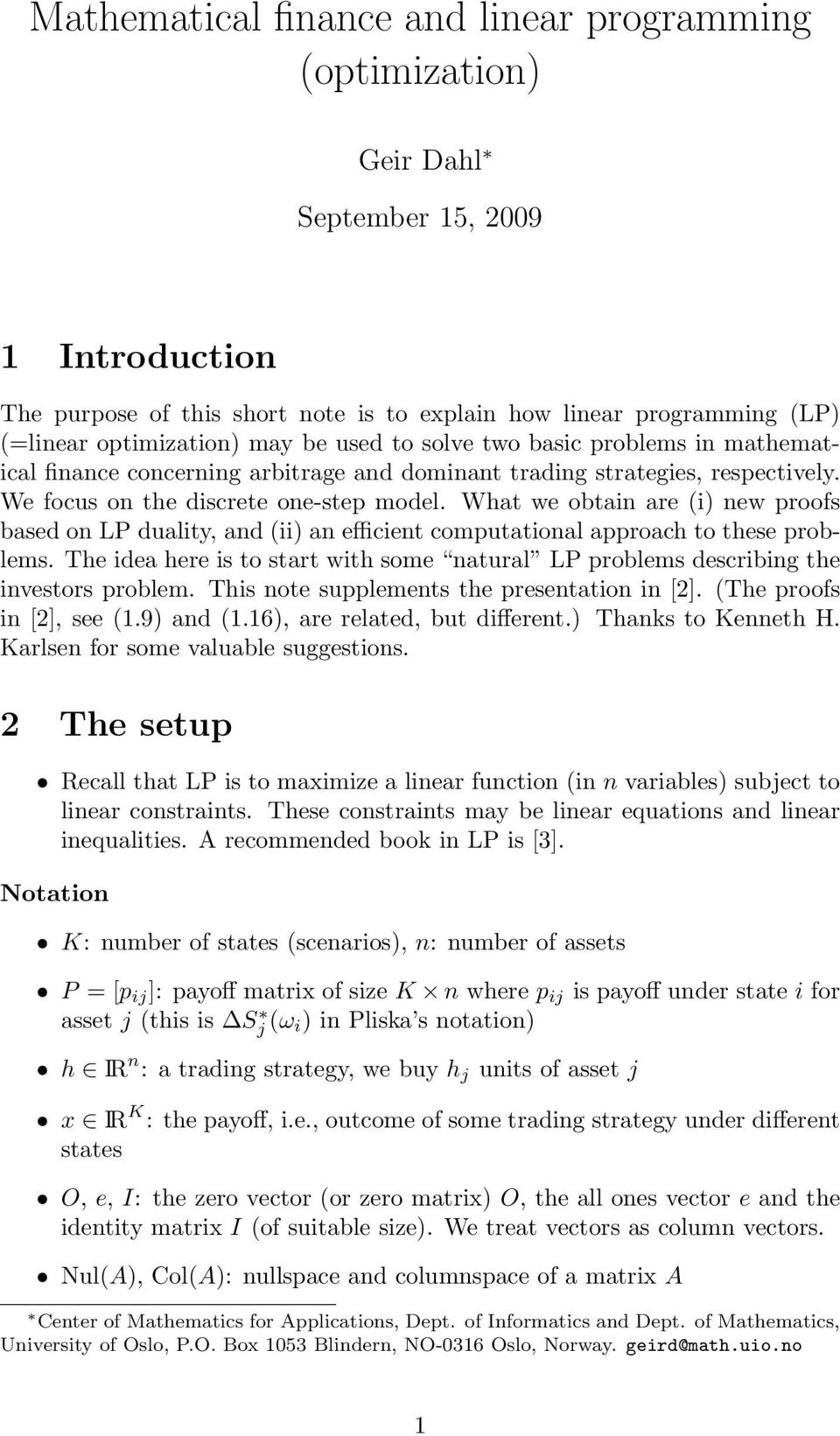
1 Mathematical finance and linear programming (optimization) Geir Dahl September 15, Introduction The purpose of this short note is to explain how linear programming (LP) (=linear optimization) may be used to solve two basic problems in mathematical finance concerning arbitrage and dominant trading strategies, respectively. We focus on the discrete one-step model. What we obtain are (i) new proofs based on LP duality, and (ii) an efficient computational approach to these problems. The idea here is to start with some natural LP problems describing the investors problem. This note supplements the presentation in [2]. (The proofs in [2], see (1.9) and (1.16), are related, but different.) Thanks to Kenneth H. Karlsen for some valuable suggestions. 2 The setup Recall that LP is to maximize a linear function (in n variables) subject to linear constraints. These constraints may be linear equations and linear inequalities. A recommended book in LP is [3]. Notation K: number of states (scenarios), n: number of assets P =[p ij ]: payoff matrix of size K n where p ij is payoff under state i for asset j (this is S j (ω i) in Pliska s notation) h IR n : a trading strategy, we buy h j units of asset j x IR K : the payoff, i.e., outcome of some trading strategy under different states, e, I: the zero vector (or zero matrix), the all ones vector e and the identity matrix I (of suitable size). We treat vectors as column vectors. Nul(A), Col(A): nullspace and columnspace of a matrix A Center of Mathematics for Applications, Dept. of Informatics and Dept. of Mathematics, University of slo, P.. Box 1053 Blindern, N-0316 slo, Norway. [email protected] 1
2 3 Warming up: a crash course in LP The LP duality theorem (see [1], [3]) says in general that ( ) max{c T x : Ax b} = min{b T y : A T y = c, y } where A is a matrix, b, c are vectors (of suitable dimension) and means componentwise inequality (holds for all components). We call the maximization problem the primal problem and the minimization problem is the dual problem. Actually, for the equality ( ) to hold one needs only assume that the primal problem is feasible; this means that there is an x satisfying Ax b. Then there are only two possibilities: (i) the maximum is finite: then both problems have an optimal solution, and the corresponding optimal values are equal (ii) the maximum (actually, supremum) is, and then the dual has no feasible solution (i.e., no y satisfies A T y = c, y ). Note the special case where b = : then the function to be minimized in the dual is constant equal to 0. Thus, the problem is simply to determine if there are any feasible solutions to the dual. This special case will be useful below. 4 The results A risk-neutral probability measure is a vector y with positive components that sum to 1 such that the dot product of y and each column of P is zero (meaning that expected payoff of each asset is zero). The first LP model: find an arbitrage Consider the LP problem max subject to K i=1 x i x = Ph x Here x = Ph relates payoff x and trading strategy h; the linear equation says that x is a linear combination of the columns in P. The nonnegativity of x is very desirable: we will not loose money under any state. The objective (goal) is to maximize the sum of the payoffs, where we sum over all states. It should be a reasonable goal and can (if you like) be given a probabilistic interpretation. The main point is that it reflects that we look for positive payoffs for at least one scenario, i.e., an arbitrage possibility. So: an arbitrage exists if and only if the optimal value of the LP problem (1) is positive. Since LP problems can be solved very fast using different algorithms (e.g. the simplex algorithm), we can find an arbitrage, or prove that it does not exist, efficiently, even if K and n are very large. For instance, even with some thousands of assets and several hundreds of states it should only take a couple of seconds to solve the problem assuming you have a good LP code. Moreover, we may obtain an important theoretical result from this LP viewpoint. (1) 2

3 Theorem 1 (The arbitrage theorem) There is no arbitrage if and only if there is a risk-neutral probability measure. Proof. We prove the arbitrage theorem by applying duality theory to our LP above, and doing some matrix calculations for partitioned matrices. You may check that the LP problem (1) may be written in the form of the primal problem in ( ) as follows: [ ] T [ ] h max { : P I [ ] P I h } e x x I Here we used that Ph = x is equivalent to Ph x, Ph+ x. The dual of this problem (confer ( )) is min { T y 1 y 2 y 3 : [ P T P T I I I ] y 1 y 2 y 3 [ = e ],y 1,y 2,y 3 } Note that the objective function is simply 0! By using the substitution y = y 2 y 1, z = y 3 the dual problem becomes min {0 :P T y =, y = z + e, z }. Check this! This problem has a feasible solution y if and only if there is a vector y Nul(P T ) = Col(P ) such that y e. This, again, must be equivalent to the existence of an y Nul(P T ) with y i > 0(i K) and i y i = 1; this follows by suitable scaling of y. Summing up, we have verified that the following statements are equivalent: there is no arbitrage the optimal value in the LP problem (1) is zero there is a strictly positive vector y Nul(P T ) with i y i = 1; this is precisely a risk-neutral probability measure. So the proof is complete. We now turn to the second theorem; it concerns dominant trading strategies. The second LP model: find a dominant trading strategy This problem is very similar to (1) but it contains an extra variable ɛ IR: max subject to ɛ x = Ph x ɛe The final constraints means that x j ɛ for each j n, and the goal is to find a trading strategy which maximizes the minimum outcome (the optimal ɛ)! Note that (2) has feasible solutions (e.g., the zero vector). (2) 3
![You may check that the LP problem (1) may be written in the form of the primal problem in ( ) as follows: [ ] T [ ] h max { : P I [ ] P I h } e x x I Here we used that Ph = x is equivalent to Ph x,](/docs-images/46/21298629/images/page_3.jpg "Ph+ x. The dual of this problem (confer ( )) is min { T y 1 y 2 y 3 : [ P T P T I I I ] y 1 y 2 y 3 [ = e ],y 1,y 2,y 3 } Note that the objective function is simply 0!")
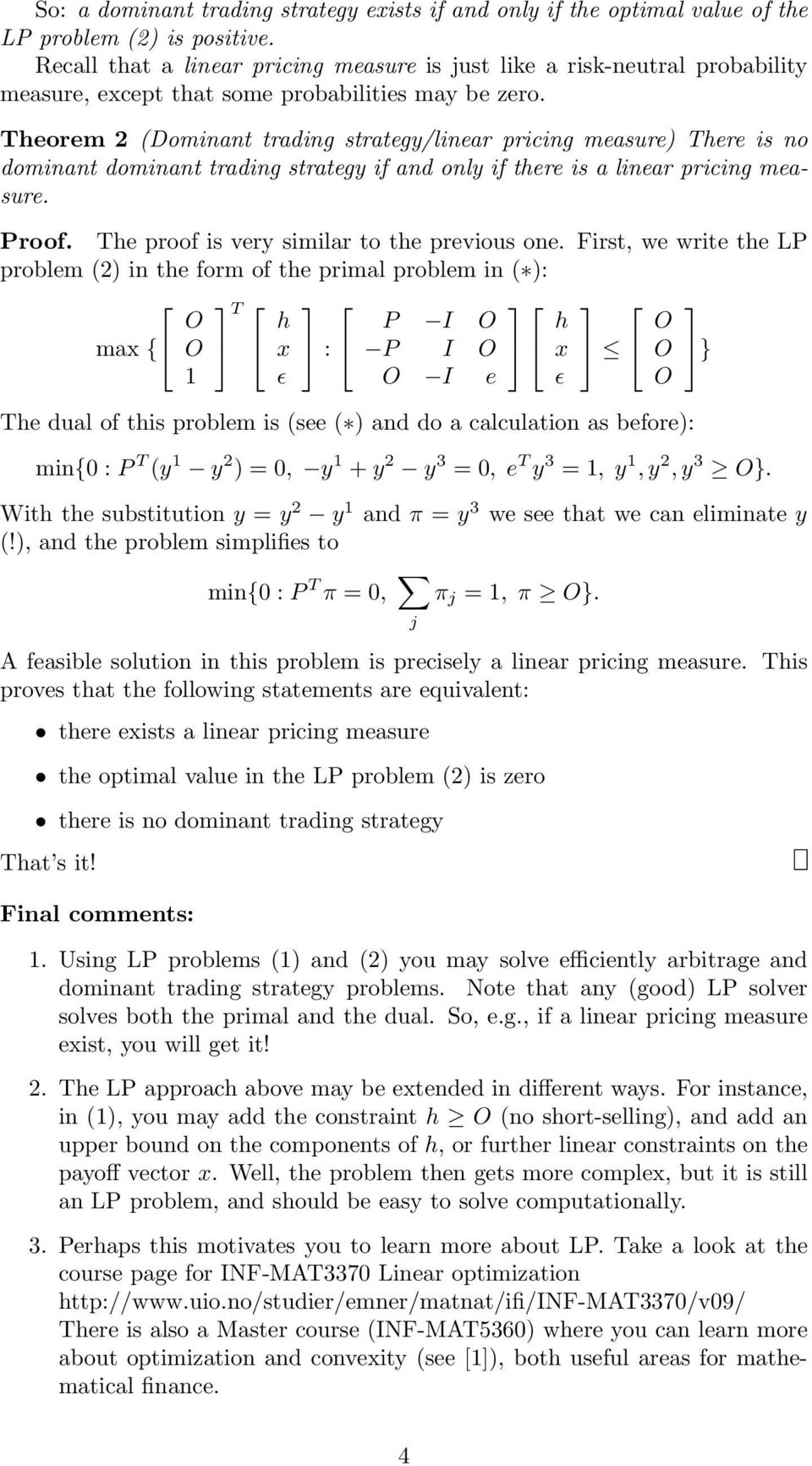
4 So: a dominant trading strategy exists if and only if the optimal value of the LP problem (2) is positive. Recall that a linear pricing measure is just like a risk-neutral probability measure, except that some probabilities may be zero. Theorem 2 (Dominant trading strategy/linear pricing measure) There is no dominant dominant trading strategy if and only if there is a linear pricing measure. Proof. The proof is very similar to the previous one. First, we write the LP problem (2) in the form of the primal problem in ( ): T h P I h max { x : P I x } 1 ɛ I e ɛ The dual of this problem is (see ( ) and do a calculation as before): min{0 :P T (y 1 y 2 )=0, y 1 + y 2 y 3 =0,e T y 3 =1,y 1,y 2,y 3 }. With the substitution y = y 2 y 1 and π = y 3 we see that we can eliminate y (!), and the problem simplifies to min{0 :P T π =0, j π j =1,π }. A feasible solution in this problem is precisely a linear pricing measure. This proves that the following statements are equivalent: there exists a linear pricing measure the optimal value in the LP problem (2) is zero there is no dominant trading strategy That s it! Final comments: 1. Using LP problems (1) and (2) you may solve efficiently arbitrage and dominant trading strategy problems. Note that any (good) LP solver solves both the primal and the dual. So, e.g., if a linear pricing measure exist, you will get it! 2. The LP approach above may be extended in different ways. For instance, in (1), you may add the constraint h (no short-selling), and add an upper bound on the components of h, or further linear constraints on the payoff vector x. Well, the problem then gets more complex, but it is still an LP problem, and should be easy to solve computationally. 3. Perhaps this motivates you to learn more about LP. Take a look at the course page for INF-MAT3370 Linear optimization There is also a Master course (INF-MAT5360) where you can learn more about optimization and convexity (see [1]), both useful areas for mathematical finance. 4
5 References [1] G. Dahl. An Introduction to Convexity. Lecture notes, University of slo, 2009 (may be downloaded from [2] S.R. Pliska. Introduction to Mathematical Finance: Discrete Time Models. Blackwell Publishers, [3] R. Vanderbei. Linear programming: foundations and extensions. Springer, Third edition,
![no/geird/) [2] S.R. Pliska. Introduction to Mathematical Finance: Discrete Time Models.](/docs-images/46/21298629/images/page_5.jpg "Blackwell Publishers, 1997. [3] R. Vanderbei.")
4.6 Linear Programming duality
 4.6 Linear Programming duality To any minimization (maximization) LP we can associate a closely related maximization (minimization) LP. Different spaces and objective functions but in general same optimal
1 Solving LPs: The Simplex Algorithm of George Dantzig
 Solving LPs: The Simplex Algorithm of George Dantzig. Simplex Pivoting: Dictionary Format We illustrate a general solution procedure, called the simplex algorithm, by implementing it on a very simple example.
Linear Programming Notes V Problem Transformations
 Linear Programming Notes V Problem Transformations 1 Introduction Any linear programming problem can be rewritten in either of two standard forms. In the first form, the objective is to maximize, the material
Practical Guide to the Simplex Method of Linear Programming
 Practical Guide to the Simplex Method of Linear Programming Marcel Oliver Revised: April, 0 The basic steps of the simplex algorithm Step : Write the linear programming problem in standard form Linear
1 Introduction. Linear Programming. Questions. A general optimization problem is of the form: choose x to. max f(x) subject to x S. where.
 Introduction Linear Programming Neil Laws TT 00 A general optimization problem is of the form: choose x to maximise f(x) subject to x S where x = (x,..., x n ) T, f : R n R is the objective function, S
LECTURE 5: DUALITY AND SENSITIVITY ANALYSIS. 1. Dual linear program 2. Duality theory 3. Sensitivity analysis 4. Dual simplex method
 LECTURE 5: DUALITY AND SENSITIVITY ANALYSIS 1. Dual linear program 2. Duality theory 3. Sensitivity analysis 4. Dual simplex method Introduction to dual linear program Given a constraint matrix A, right
What is Linear Programming?
 Chapter 1 What is Linear Programming? An optimization problem usually has three essential ingredients: a variable vector x consisting of a set of unknowns to be determined, an objective function of x to
Proximal mapping via network optimization
 L. Vandenberghe EE236C (Spring 23-4) Proximal mapping via network optimization minimum cut and maximum flow problems parametric minimum cut problem application to proximal mapping Introduction this lecture:
Linear Programming: Chapter 11 Game Theory
 Linear Programming: Chapter 11 Game Theory Robert J. Vanderbei October 17, 2007 Operations Research and Financial Engineering Princeton University Princeton, NJ 08544 http://www.princeton.edu/ rvdb Rock-Paper-Scissors
EXCEL SOLVER TUTORIAL
 ENGR62/MS&E111 Autumn 2003 2004 Prof. Ben Van Roy October 1, 2003 EXCEL SOLVER TUTORIAL This tutorial will introduce you to some essential features of Excel and its plug-in, Solver, that we will be using
Linear Programming. March 14, 2014
 Linear Programming March 1, 01 Parts of this introduction to linear programming were adapted from Chapter 9 of Introduction to Algorithms, Second Edition, by Cormen, Leiserson, Rivest and Stein [1]. 1
Inner Product Spaces
 Math 571 Inner Product Spaces 1. Preliminaries An inner product space is a vector space V along with a function, called an inner product which associates each pair of vectors u, v with a scalar u, v, and
Linear Programming for Optimization. Mark A. Schulze, Ph.D. Perceptive Scientific Instruments, Inc.
 1. Introduction Linear Programming for Optimization Mark A. Schulze, Ph.D. Perceptive Scientific Instruments, Inc. 1.1 Definition Linear programming is the name of a branch of applied mathematics that
IEOR 4404 Homework #2 Intro OR: Deterministic Models February 14, 2011 Prof. Jay Sethuraman Page 1 of 5. Homework #2
 IEOR 4404 Homework # Intro OR: Deterministic Models February 14, 011 Prof. Jay Sethuraman Page 1 of 5 Homework #.1 (a) What is the optimal solution of this problem? Let us consider that x 1, x and x 3
Linear Programming I
 Linear Programming I November 30, 2003 1 Introduction In the VCR/guns/nuclear bombs/napkins/star wars/professors/butter/mice problem, the benevolent dictator, Bigus Piguinus, of south Antarctica penguins
2.3 Convex Constrained Optimization Problems
 42 CHAPTER 2. FUNDAMENTAL CONCEPTS IN CONVEX OPTIMIZATION Theorem 15 Let f : R n R and h : R R. Consider g(x) = h(f(x)) for all x R n. The function g is convex if either of the following two conditions
3. Linear Programming and Polyhedral Combinatorics
 Massachusetts Institute of Technology Handout 6 18.433: Combinatorial Optimization February 20th, 2009 Michel X. Goemans 3. Linear Programming and Polyhedral Combinatorics Summary of what was seen in the
Notes on Determinant
 ENGG2012B Advanced Engineering Mathematics Notes on Determinant Lecturer: Kenneth Shum Lecture 9-18/02/2013 The determinant of a system of linear equations determines whether the solution is unique, without
Introduction to Linear Programming (LP) Mathematical Programming (MP) Concept
 Introduction to Linear Programming (LP) Mathematical Programming Concept LP Concept Standard Form Assumptions Consequences of Assumptions Solution Approach Solution Methods Typical Formulations Massachusetts
International Doctoral School Algorithmic Decision Theory: MCDA and MOO
 International Doctoral School Algorithmic Decision Theory: MCDA and MOO Lecture 2: Multiobjective Linear Programming Department of Engineering Science, The University of Auckland, New Zealand Laboratoire
Numerical methods for American options
 Lecture 9 Numerical methods for American options Lecture Notes by Andrzej Palczewski Computational Finance p. 1 American options The holder of an American option has the right to exercise it at any moment
Two-Stage Stochastic Linear Programs
 Two-Stage Stochastic Linear Programs Operations Research Anthony Papavasiliou 1 / 27 Two-Stage Stochastic Linear Programs 1 Short Reviews Probability Spaces and Random Variables Convex Analysis 2 Deterministic
Lecture 5 Principal Minors and the Hessian
 Lecture 5 Principal Minors and the Hessian Eivind Eriksen BI Norwegian School of Management Department of Economics October 01, 2010 Eivind Eriksen (BI Dept of Economics) Lecture 5 Principal Minors and
Nonlinear Programming Methods.S2 Quadratic Programming
 Nonlinear Programming Methods.S2 Quadratic Programming Operations Research Models and Methods Paul A. Jensen and Jonathan F. Bard A linearly constrained optimization problem with a quadratic objective
Linear Programming in Matrix Form
 Linear Programming in Matrix Form Appendix B We first introduce matrix concepts in linear programming by developing a variation of the simplex method called the revised simplex method. This algorithm,
Solving Systems of Linear Equations
 LECTURE 5 Solving Systems of Linear Equations Recall that we introduced the notion of matrices as a way of standardizing the expression of systems of linear equations In today s lecture I shall show how
6.207/14.15: Networks Lecture 15: Repeated Games and Cooperation
 6.207/14.15: Networks Lecture 15: Repeated Games and Cooperation Daron Acemoglu and Asu Ozdaglar MIT November 2, 2009 1 Introduction Outline The problem of cooperation Finitely-repeated prisoner s dilemma
Linear Programming. Widget Factory Example. Linear Programming: Standard Form. Widget Factory Example: Continued.
 Linear Programming Widget Factory Example Learning Goals. Introduce Linear Programming Problems. Widget Example, Graphical Solution. Basic Theory:, Vertices, Existence of Solutions. Equivalent formulations.
Modern Optimization Methods for Big Data Problems MATH11146 The University of Edinburgh
 Modern Optimization Methods for Big Data Problems MATH11146 The University of Edinburgh Peter Richtárik Week 3 Randomized Coordinate Descent With Arbitrary Sampling January 27, 2016 1 / 30 The Problem
Duality in General Programs. Ryan Tibshirani Convex Optimization 10-725/36-725
 Duality in General Programs Ryan Tibshirani Convex Optimization 10-725/36-725 1 Last time: duality in linear programs Given c R n, A R m n, b R m, G R r n, h R r : min x R n c T x max u R m, v R r b T
An interval linear programming contractor
 An interval linear programming contractor Introduction Milan Hladík Abstract. We consider linear programming with interval data. One of the most challenging problems in this topic is to determine or tight
Lecture 2: August 29. Linear Programming (part I)
 10-725: Convex Optimization Fall 2013 Lecture 2: August 29 Lecturer: Barnabás Póczos Scribes: Samrachana Adhikari, Mattia Ciollaro, Fabrizio Lecci Note: LaTeX template courtesy of UC Berkeley EECS dept.
Optimization in R n Introduction
 Optimization in R n Introduction Rudi Pendavingh Eindhoven Technical University Optimization in R n, lecture Rudi Pendavingh (TUE) Optimization in R n Introduction ORN / 4 Some optimization problems designing
Lecture 3. Linear Programming. 3B1B Optimization Michaelmas 2015 A. Zisserman. Extreme solutions. Simplex method. Interior point method
 Lecture 3 3B1B Optimization Michaelmas 2015 A. Zisserman Linear Programming Extreme solutions Simplex method Interior point method Integer programming and relaxation The Optimization Tree Linear Programming
26 Linear Programming
 The greatest flood has the soonest ebb; the sorest tempest the most sudden calm; the hottest love the coldest end; and from the deepest desire oftentimes ensues the deadliest hate. Th extremes of glory
24. The Branch and Bound Method
 24. The Branch and Bound Method It has serious practical consequences if it is known that a combinatorial problem is NP-complete. Then one can conclude according to the present state of science that no
NOTES ON LINEAR TRANSFORMATIONS
 NOTES ON LINEAR TRANSFORMATIONS Definition 1. Let V and W be vector spaces. A function T : V W is a linear transformation from V to W if the following two properties hold. i T v + v = T v + T v for all
160 CHAPTER 4. VECTOR SPACES
 160 CHAPTER 4. VECTOR SPACES 4. Rank and Nullity In this section, we look at relationships between the row space, column space, null space of a matrix and its transpose. We will derive fundamental results
Advanced Lecture on Mathematical Science and Information Science I. Optimization in Finance
 Advanced Lecture on Mathematical Science and Information Science I Optimization in Finance Reha H. Tütüncü Visiting Associate Professor Dept. of Mathematical and Computing Sciences Tokyo Institute of Technology
Continued Fractions and the Euclidean Algorithm
 Continued Fractions and the Euclidean Algorithm Lecture notes prepared for MATH 326, Spring 997 Department of Mathematics and Statistics University at Albany William F Hammond Table of Contents Introduction
Duality of linear conic problems
 Duality of linear conic problems Alexander Shapiro and Arkadi Nemirovski Abstract It is well known that the optimal values of a linear programming problem and its dual are equal to each other if at least
Linear Programming. April 12, 2005
 Linear Programming April 1, 005 Parts of this were adapted from Chapter 9 of i Introduction to Algorithms (Second Edition) /i by Cormen, Leiserson, Rivest and Stein. 1 What is linear programming? The first
LECTURE: INTRO TO LINEAR PROGRAMMING AND THE SIMPLEX METHOD, KEVIN ROSS MARCH 31, 2005
 LECTURE: INTRO TO LINEAR PROGRAMMING AND THE SIMPLEX METHOD, KEVIN ROSS MARCH 31, 2005 DAVID L. BERNICK [email protected] 1. Overview Typical Linear Programming problems Standard form and converting
1 Review of Least Squares Solutions to Overdetermined Systems
 cs4: introduction to numerical analysis /9/0 Lecture 7: Rectangular Systems and Numerical Integration Instructor: Professor Amos Ron Scribes: Mark Cowlishaw, Nathanael Fillmore Review of Least Squares
K 1 < K 2 = P (K 1 ) P (K 2 ) (6) This holds for both American and European Options.
 Slope and Convexity Restrictions and How to implement Arbitrage Opportunities 1 These notes will show how to implement arbitrage opportunities when either the slope or the convexity restriction is violated.
Systems of Linear Equations
 Systems of Linear Equations Beifang Chen Systems of linear equations Linear systems A linear equation in variables x, x,, x n is an equation of the form a x + a x + + a n x n = b, where a, a,, a n and
1.2 Solving a System of Linear Equations
 1.. SOLVING A SYSTEM OF LINEAR EQUATIONS 1. Solving a System of Linear Equations 1..1 Simple Systems - Basic De nitions As noticed above, the general form of a linear system of m equations in n variables
Convex Programming Tools for Disjunctive Programs
 Convex Programming Tools for Disjunctive Programs João Soares, Departamento de Matemática, Universidade de Coimbra, Portugal Abstract A Disjunctive Program (DP) is a mathematical program whose feasible
Duality in Linear Programming
 Duality in Linear Programming 4 In the preceding chapter on sensitivity analysis, we saw that the shadow-price interpretation of the optimal simplex multipliers is a very useful concept. First, these shadow
This exposition of linear programming
 Linear Programming and the Simplex Method David Gale This exposition of linear programming and the simplex method is intended as a companion piece to the article in this issue on the life and work of George
1 Norms and Vector Spaces
 008.10.07.01 1 Norms and Vector Spaces Suppose we have a complex vector space V. A norm is a function f : V R which satisfies (i) f(x) 0 for all x V (ii) f(x + y) f(x) + f(y) for all x,y V (iii) f(λx)
Chapter 6. Linear Programming: The Simplex Method. Introduction to the Big M Method. Section 4 Maximization and Minimization with Problem Constraints
 Chapter 6 Linear Programming: The Simplex Method Introduction to the Big M Method In this section, we will present a generalized version of the simplex method that t will solve both maximization i and
THE FUNDAMENTAL THEOREM OF ARBITRAGE PRICING
 THE FUNDAMENTAL THEOREM OF ARBITRAGE PRICING 1. Introduction The Black-Scholes theory, which is the main subject of this course and its sequel, is based on the Efficient Market Hypothesis, that arbitrages
ALMOST COMMON PRIORS 1. INTRODUCTION
 ALMOST COMMON PRIORS ZIV HELLMAN ABSTRACT. What happens when priors are not common? We introduce a measure for how far a type space is from having a common prior, which we term prior distance. If a type
THE DIMENSION OF A VECTOR SPACE
 THE DIMENSION OF A VECTOR SPACE KEITH CONRAD This handout is a supplementary discussion leading up to the definition of dimension and some of its basic properties. Let V be a vector space over a field
Solving Linear Programs
 Solving Linear Programs 2 In this chapter, we present a systematic procedure for solving linear programs. This procedure, called the simplex method, proceeds by moving from one feasible solution to another,
Lecture 3: Finding integer solutions to systems of linear equations
 Lecture 3: Finding integer solutions to systems of linear equations Algorithmic Number Theory (Fall 2014) Rutgers University Swastik Kopparty Scribe: Abhishek Bhrushundi 1 Overview The goal of this lecture
7 Gaussian Elimination and LU Factorization
 7 Gaussian Elimination and LU Factorization In this final section on matrix factorization methods for solving Ax = b we want to take a closer look at Gaussian elimination (probably the best known method
Recovery of primal solutions from dual subgradient methods for mixed binary linear programming; a branch-and-bound approach
 MASTER S THESIS Recovery of primal solutions from dual subgradient methods for mixed binary linear programming; a branch-and-bound approach PAULINE ALDENVIK MIRJAM SCHIERSCHER Department of Mathematical
A Branch and Bound Algorithm for Solving the Binary Bi-level Linear Programming Problem
 A Branch and Bound Algorithm for Solving the Binary Bi-level Linear Programming Problem John Karlof and Peter Hocking Mathematics and Statistics Department University of North Carolina Wilmington Wilmington,
MATH 551 - APPLIED MATRIX THEORY
 MATH 55 - APPLIED MATRIX THEORY FINAL TEST: SAMPLE with SOLUTIONS (25 points NAME: PROBLEM (3 points A web of 5 pages is described by a directed graph whose matrix is given by A Do the following ( points
Inner product. Definition of inner product
 Math 20F Linear Algebra Lecture 25 1 Inner product Review: Definition of inner product. Slide 1 Norm and distance. Orthogonal vectors. Orthogonal complement. Orthogonal basis. Definition of inner product
Linear Algebra Notes for Marsden and Tromba Vector Calculus
 Linear Algebra Notes for Marsden and Tromba Vector Calculus n-dimensional Euclidean Space and Matrices Definition of n space As was learned in Math b, a point in Euclidean three space can be thought of
6. Cholesky factorization
 6. Cholesky factorization EE103 (Fall 2011-12) triangular matrices forward and backward substitution the Cholesky factorization solving Ax = b with A positive definite inverse of a positive definite matrix
Chapter 4. Duality. 4.1 A Graphical Example
 Chapter 4 Duality Given any linear program, there is another related linear program called the dual. In this chapter, we will develop an understanding of the dual linear program. This understanding translates
Math 215 HW #6 Solutions
 Math 5 HW #6 Solutions Problem 34 Show that x y is orthogonal to x + y if and only if x = y Proof First, suppose x y is orthogonal to x + y Then since x, y = y, x In other words, = x y, x + y = (x y) T
Question 2: How do you solve a matrix equation using the matrix inverse?
 Question : How do you solve a matrix equation using the matrix inverse? In the previous question, we wrote systems of equations as a matrix equation AX B. In this format, the matrix A contains the coefficients
Can linear programs solve NP-hard problems?
 Can linear programs solve NP-hard problems? p. 1/9 Can linear programs solve NP-hard problems? Ronald de Wolf Linear programs Can linear programs solve NP-hard problems? p. 2/9 Can linear programs solve
Several Views of Support Vector Machines
 Several Views of Support Vector Machines Ryan M. Rifkin Honda Research Institute USA, Inc. Human Intention Understanding Group 2007 Tikhonov Regularization We are considering algorithms of the form min
Support Vector Machines with Clustering for Training with Very Large Datasets
 Support Vector Machines with Clustering for Training with Very Large Datasets Theodoros Evgeniou Technology Management INSEAD Bd de Constance, Fontainebleau 77300, France [email protected] Massimiliano
Equilibrium computation: Part 1
 Equilibrium computation: Part 1 Nicola Gatti 1 Troels Bjerre Sorensen 2 1 Politecnico di Milano, Italy 2 Duke University, USA Nicola Gatti and Troels Bjerre Sørensen ( Politecnico di Milano, Italy, Equilibrium
Some representability and duality results for convex mixed-integer programs.
 Some representability and duality results for convex mixed-integer programs. Santanu S. Dey Joint work with Diego Morán and Juan Pablo Vielma December 17, 2012. Introduction About Motivation Mixed integer
MATH 304 Linear Algebra Lecture 18: Rank and nullity of a matrix.
 MATH 304 Linear Algebra Lecture 18: Rank and nullity of a matrix. Nullspace Let A = (a ij ) be an m n matrix. Definition. The nullspace of the matrix A, denoted N(A), is the set of all n-dimensional column
Linear Algebra Notes
 Linear Algebra Notes Chapter 19 KERNEL AND IMAGE OF A MATRIX Take an n m matrix a 11 a 12 a 1m a 21 a 22 a 2m a n1 a n2 a nm and think of it as a function A : R m R n The kernel of A is defined as Note
Online Adwords Allocation
 Online Adwords Allocation Shoshana Neuburger May 6, 2009 1 Overview Many search engines auction the advertising space alongside search results. When Google interviewed Amin Saberi in 2004, their advertisement
BANACH AND HILBERT SPACE REVIEW
 BANACH AND HILBET SPACE EVIEW CHISTOPHE HEIL These notes will briefly review some basic concepts related to the theory of Banach and Hilbert spaces. We are not trying to give a complete development, but
Definition and Properties of the Production Function: Lecture
 Definition and Properties of the Production Function: Lecture II August 25, 2011 Definition and : Lecture A Brief Brush with Duality Cobb-Douglas Cost Minimization Lagrangian for the Cobb-Douglas Solution
Transportation Polytopes: a Twenty year Update
 Transportation Polytopes: a Twenty year Update Jesús Antonio De Loera University of California, Davis Based on various papers joint with R. Hemmecke, E.Kim, F. Liu, U. Rothblum, F. Santos, S. Onn, R. Yoshida,
MATH10212 Linear Algebra. Systems of Linear Equations. Definition. An n-dimensional vector is a row or a column of n numbers (or letters): a 1.
 MATH10212 Linear Algebra Textbook: D. Poole, Linear Algebra: A Modern Introduction. Thompson, 2006. ISBN 0-534-40596-7. Systems of Linear Equations Definition. An n-dimensional vector is a row or a column
10.2 ITERATIVE METHODS FOR SOLVING LINEAR SYSTEMS. The Jacobi Method
 578 CHAPTER 1 NUMERICAL METHODS 1. ITERATIVE METHODS FOR SOLVING LINEAR SYSTEMS As a numerical technique, Gaussian elimination is rather unusual because it is direct. That is, a solution is obtained after
! Solve problem to optimality. ! Solve problem in poly-time. ! Solve arbitrary instances of the problem. #-approximation algorithm.
 Approximation Algorithms 11 Approximation Algorithms Q Suppose I need to solve an NP-hard problem What should I do? A Theory says you're unlikely to find a poly-time algorithm Must sacrifice one of three
MA107 Precalculus Algebra Exam 2 Review Solutions
 MA107 Precalculus Algebra Exam 2 Review Solutions February 24, 2008 1. The following demand equation models the number of units sold, x, of a product as a function of price, p. x = 4p + 200 a. Please write
CHAPTER 9. Integer Programming
 CHAPTER 9 Integer Programming An integer linear program (ILP) is, by definition, a linear program with the additional constraint that all variables take integer values: (9.1) max c T x s t Ax b and x integral
. P. 4.3 Basic feasible solutions and vertices of polyhedra. x 1. x 2
 4. Basic feasible solutions and vertices of polyhedra Due to the fundamental theorem of Linear Programming, to solve any LP it suffices to consider the vertices (finitely many) of the polyhedron P of the
3. Evaluate the objective function at each vertex. Put the vertices into a table: Vertex P=3x+2y (0, 0) 0 min (0, 5) 10 (15, 0) 45 (12, 2) 40 Max
 SOLUTION OF LINEAR PROGRAMMING PROBLEMS THEOREM 1 If a linear programming problem has a solution, then it must occur at a vertex, or corner point, of the feasible set, S, associated with the problem. Furthermore,
FRACTIONAL COLORINGS AND THE MYCIELSKI GRAPHS
 FRACTIONAL COLORINGS AND THE MYCIELSKI GRAPHS By G. Tony Jacobs Under the Direction of Dr. John S. Caughman A math 501 project submitted in partial fulfillment of the requirements for the degree of Master
Sensitivity Analysis 3.1 AN EXAMPLE FOR ANALYSIS
 Sensitivity Analysis 3 We have already been introduced to sensitivity analysis in Chapter via the geometry of a simple example. We saw that the values of the decision variables and those of the slack and
Row Echelon Form and Reduced Row Echelon Form
 These notes closely follow the presentation of the material given in David C Lay s textbook Linear Algebra and its Applications (3rd edition) These notes are intended primarily for in-class presentation
Arrangements And Duality
 Arrangements And Duality 3.1 Introduction 3 Point configurations are tbe most basic structure we study in computational geometry. But what about configurations of more complicated shapes? For example,
A short note on American option prices
 A short note on American option Filip Lindskog April 27, 2012 1 The set-up An American call option with strike price K written on some stock gives the holder the right to buy a share of the stock (exercise
MATRIX ALGEBRA AND SYSTEMS OF EQUATIONS. + + x 2. x n. a 11 a 12 a 1n b 1 a 21 a 22 a 2n b 2 a 31 a 32 a 3n b 3. a m1 a m2 a mn b m
 MATRIX ALGEBRA AND SYSTEMS OF EQUATIONS 1. SYSTEMS OF EQUATIONS AND MATRICES 1.1. Representation of a linear system. The general system of m equations in n unknowns can be written a 11 x 1 + a 12 x 2 +
LS.6 Solution Matrices
 LS.6 Solution Matrices In the literature, solutions to linear systems often are expressed using square matrices rather than vectors. You need to get used to the terminology. As before, we state the definitions
Solutions to Math 51 First Exam January 29, 2015
 Solutions to Math 5 First Exam January 29, 25. ( points) (a) Complete the following sentence: A set of vectors {v,..., v k } is defined to be linearly dependent if (2 points) there exist c,... c k R, not
3. INNER PRODUCT SPACES
 . INNER PRODUCT SPACES.. Definition So far we have studied abstract vector spaces. These are a generalisation of the geometric spaces R and R. But these have more structure than just that of a vector space.
Module1. x 1000. y 800.
 Module1 1 Welcome to the first module of the course. It is indeed an exciting event to share with you the subject that has lot to offer both from theoretical side and practical aspects. To begin with,
Largest Fixed-Aspect, Axis-Aligned Rectangle
 Largest Fixed-Aspect, Axis-Aligned Rectangle David Eberly Geometric Tools, LLC http://www.geometrictools.com/ Copyright c 1998-2016. All Rights Reserved. Created: February 21, 2004 Last Modified: February
Linear Programming: Theory and Applications
 Linear Programming: Theory and Applications Catherine Lewis May 11, 2008 1 Contents 1 Introduction to Linear Programming 3 1.1 What is a linear program?...................... 3 1.2 Assumptions.............................
Linearly Independent Sets and Linearly Dependent Sets
 These notes closely follow the presentation of the material given in David C. Lay s textbook Linear Algebra and its Applications (3rd edition). These notes are intended primarily for in-class presentation
5.1 Bipartite Matching
 CS787: Advanced Algorithms Lecture 5: Applications of Network Flow In the last lecture, we looked at the problem of finding the maximum flow in a graph, and how it can be efficiently solved using the Ford-Fulkerson
A numerically adaptive implementation of the simplex method
 A numerically adaptive implementation of the simplex method József Smidla, Péter Tar, István Maros Department of Computer Science and Systems Technology University of Pannonia 17th of December 2014. 1