
Giorgio Zucco. Inside Csound. Giancarlo Zedde
|
|
|
- Nigel Henderson
- 10 years ago
- Views:
Transcription
1

2

3 Giorgio Zucco Inside Csound Giancarlo Zedde

4 Giorgio Zucco, Inside Csound Cover picture: Eduard Arancio eduardarancioweb English translation by Amedeo Casella 2014 Giancarlo Zedde Giancarlo Zedde Via Duchessa Iolanda 12, Torino www. zedde. com Csound is an open source software Copyright 1986, 1992 by the Massachusetts Institute of Technology. All rights reserved. Developed by Barry L. Vercoe at the Experimental Music Studio, Media Laboratory, M.I.T., Cambridge, Massachusetts, with partial support from the System Development Foundation and from National Science Foundation Grant. ISBN GZ0126

5 I dream of instruments obedient to my thought and which with their contribution of a whole new world of unsuspected sounds, will lend themselves to the exigencies of my inner rhythm. Edgar Varese,

6

7 Index Foreword 11 To whom is this book addressed to? 13 Preface 15 Installation 18 Chapter 1 Programming language overview 1.1 Csound modules, opcode definition Integrated environments, editor A brief overview of WinXound Hello world Programming elements 33 Chapter 2 First steps, orchestra, score 2.1 Amplitude, frequency dbfs Fundamental waveforms Disk rendering P-fields Methods for events management 48 Chapter 3 Main techniques 3.1 Signal generators: introduction Envelopes, glissandi Conversions Vibrato and tremolo techniques Spatialization with Csound Macro use Randomness Generative processes Gen: overview 92 Chapter 4 Csound: MIDI and Osc 4.1 Introduction to MIDI-opcodes Virtual MIDI keyboard A first MIDI synth MIDI controller Read MIDI files Microtonal scales 109 7

8 4.7 Complex events generation Csound and OSC 116 Chapter 5 Graphical User Interfaces (Fltk, Max/Msp) 5.1 The Fltk Library Fltk panel Fltabs knobs, sliders, buttons, counter, Joysticks Automations, MIDI control Snapshots Graphics library with QuteCsound Csound~ and Max/Msp CsoundForLive Cabbage and Vst development 150 Chapter 6 Additive and subtractive synthesis 6.1 Sound synthesis: introduction Additive synthesis Buzz oscillator Modal additive synthesis Subtractive synthesis, filters overview Statevar Moog filter Formants filter Equalizer 191 Chapter 7 Modulation techniques 7.1 Ring modulator AM synthesis (amplitude modulation) FM synthesis (frequency modulation) PM Synthesis (phase modulation) Waveshape 218 Chapter 8 Sample Playback 8.1 loscil diskin Loop player SoundFont 235 8

9 Chapter 9 Granular synthesis 9.1 Basic grain Midi granular grain grain syncgrain, syncloop partikkel granular synthesizer Vocal synthesis 263 Chapter 10 Physical models 10.1 Waveguide The resonator STK library Modal synthesis Scanned synthesis 282 Chapter 11 Spectral Processing 11.1 Phase vocoder Time stretching, pitch shifting Morphing Harmonizer Spectral blur Spectral filter Spectral delay 305 Chapter 12 Signal processors 12.1 Delay Lines Reverbs Chorus Flanger Phaser Routing Live electronics 326 Chapter 13U.D.O opcodes 13.1 Hipersaw U.D.O U.D.O. Chorus Chowning, Risset Libraries Vocal synthesis library 346 9

10 New syntax in Csound6 354 Appendix 357 Csound opcodes list 357 Csound in the web 366 Index of technical terms 367 Thanks

11 Foreword by Richard Boulanger Without compare, Giorgio Zucco is one of the finest Csounders in the entire world. He is a supreme master of the highest degree. He is a true sound designer - a title and skill that is in fact, quite rare in this gigantic music industry filled were samplers, and remixers, and mashup-artists. Giorgio Zucco has golden ears and over the years he has produced an amazing collection of exquisite Csound instruments to prove it. I am quite confident that he could tame any machine and make her sing the sweatest lovesongs; but what he has done, is to dedicate his life to the creation of some of the most beautiful, elegant, powerful, engaging, evolving, mysterious, rawcous, raw, intense and tender musical timbres ever to be created in Csound. Csound is deep and rich and arguably the world s most powerful software synthesizer and signal processor. And Csound is free... but there is a price. You have to know what you are doing. You have to know how sound works ; you have to know how synthesis algorithms work ; you have to know how DSP algorithms work ; you have to know how psychoacoustics of music and acoustics and perception works. Giorgio Zucco has mastered all of these disciplines and translated that mastery into this incredibly important text - a book that opens his huge treasure chest of Csound riches to the next generation of electronic and computer musicians. I have learned so much from Giorgio s work, and I have been a huge fan of his for years. In fact, I have showcased his instruments in all of my classes and featured his instruments in all of my concerts. And I am not the only one, my dear friend and mentor, Max Mathews, the father of computer music, was a huge fan of Giorgio Zucco too.max especially loved and used Giorgio s Scanned Synthesis and Pierce Scale instruments! We both did and I still do (Max s 80th Birthday 2007). Csound today is experiencing a Renaissance. Today, the Csound engine and code is running as an external in Max/MSP and PD; as an instrument and effect in Ableton Live; as a softsynth and signal processor app on the Android and the Apple ipad; and as an Audio Unit and VST plugin in virtuall every DAW on the market! Csound has been born again, and the dawn of the Italian Renaissance of Computer Music is heralded by Giorgio Zucco and his new book. Giorgio s Sintesi digitale del suono will light the way and inspire for years to come. 11

12 I look forward to it s translation into many languages, and to a long life in the minds and music of the next generation of innovators that he will inspire through it. Giorgio Zucco is a rare sonic master who, through this brilliant and inspiring book, has shared many of his hard-earned secrets and extraordinary audio treasures with the world. Dr. Richard Boulanger, Ph.D. Professor of Electronic Production and Design Professional Writing and Music Technology Division Berklee College of Music 1140 Boylston Street Boston, MA

13 To whom is this book addressed to? Inside Csound is mainly aimed to all the musicians who love music and technology. It is not a purely theoretical text, but it s a practical programming manual suited either to the aspiring sound designer or the musician with an academic background. The book offers a step by step exploration of what is truly a sound factory. Concepts and techniques presented in this book have, perhaps, the ambition to start always from a practical application in a real music context and not only technical. Although Csound found through the years many applications also in the field of scientific research, I believe that its nature as its origins is that of applications in the music and art field. Csound it s a tool to make music, we could even consider it a true and real musical instrument, a specific instrument to make computer music, namely the extraordinary alchemy that fuses music composition and informatics. The fundamental idea that brought to the birth of this text is linked to the history of Csound. It is more than ten years since the publication of two texts that I consider the Bible of Csound: Csound book (Boulanger, MIT Press, 2000) and Il suono virtuale (Bianchini, Cipriani, ConTempoNet). The present text doesn t want to take the place of what is the seminal literature of computer music, however tries to focalize on a fundamental aspect, specifically informatics that shouldn t be underestimate. For many years, too often Csound was thought as a tool only suited to prerecorded synthesis, a point of view that, if today doesn t appear as wrong, is at least mean for several reasons. As for many programming languages, Csound too evolved during the years, not only it increased extraordinarily the number of opcodes, but many creative ways were opened, new programming patterns, new esthetic and technical goals. There are very many musicians, sound designers, simple amateurs, graduates in Electronics at the Conservatoire of Music, who probably don t know that many of their instruments, maybe written ten years ago, today could be rewritten and optimized with less line codes, could be converted in tools for the real time, could become plugins for audio/ Midi sequencers, or could be played on their own tablet! This is the reason which a new text in Csound could today find the right place: the intention to tell by many practical examples the incredible potential and novelty of what is likely the most important and powerful language for synthesis of sound. Nowadays we can talk of a new real and true renaissance, as Richard Boulanger says. How to approach the text? Is it fundamental to follow step by step starting from the first chapter? For beginners the answer is of course affirmative. However, also for the musicians that come from a more traditional academic background it s advisable to read and try all the material up to the fourth chapter, this, in order not to miss some 13

14 ways of programming considered as standard for this language. The book is divided in two wide sections. Section one: from chapter 1 to chapter 5 we find all that belongs to basic syntax, from the use of editors in the process of compilation, to the introduction of Midi opcodes and the construction of gui. Chapter 3, in particular is the widest and offers a vast panoramic of the main programming techniques in Csound, control and generation of events. Section two: from chapter 6 to chapter 13 we tackle diverse techniques of synthesis from the oldest to the newest. The chapters have many examples that show the construction of different techniques using control in real time, graphic interfaces and music applications. The author is grateful for any suggestion sent to the address: [email protected] Files in.cds format of each chapter can be requested free of charge to the Editor: www. zedde.com 14

15 Preface We are in the pocket recording studios era... in which it s possible to emulate (with stunning realism and quality), machines such as Neve, SSL, Trident, Harrison banks, easily on our laptops. The modern convolution plugins, or physical models, can reach the warmth and features of a Distressor compressor to one-twentieth of the original machine cost. And speaking about sampling? The oboe sample with his 100 kb size, running on the glorious 12 bit Akai S900, today has his own graphical interface, it s 24 bit sampled in every possible articulation, and with three different microphones positions. And what about synthesis? The power of modern CPUs allows music software houses to produce increasingly sophisticated software synthesizers, here below is the presentation of a famous Vst (no name is given): Semi-modular synthesizer offering an endless amount of sound possibilities New combinations of multiple synthesis and sampling techniques Amazing improvement implemented in the new interface 1200 presets Amazing effects, and wave morphing control 16 macro control freely assignable and a new section for the ADSR modulation, to have an easy and complete control of sound Chance to divide the envelope into a maximum of 68 breakpoint Advanced function for surround managing for each channel...and then: Ability to open endless instances of the plugin. With a modern quad core CPU it s possible to easily handle instances of a very complex plugin, all in real time of course. Despite such prodigies, detractors of synthesis languages ask always the same question: It really makes sense dedicating to a programming language now old, which requires computer skills, working in deferred time with a long learning curve, in which to create a 4 seconds sine wave, several minutes of code writing, debugging, compiling and final render are needed? Predictable answer... but let s start with making the necessary clarifications regarding 15

16 some inaccuracies that circulate around this synthesis language. To be a computer expert is not mandatory to learn Csound! Its syntax, overcome the natural difficulties of the starting approach, it s relatively simple. Building a Csound instrument requires a mindset closer to the concept of modular synthesis, each Csound object (not quite all...) has an input and an output. Who experienced with traditional programming languages such as Java, for example, certainly recalls complex concepts such as classes, inheritance and polymorphism, methods, and much more. You will not find anything like this in programming Csound (for the moment at least). Csound allows real time operations from every point of view, you can build your own synthesizer and play it in real time with your master keyboard, checking every parameter of the sound using knobs, sliders, ribbon controller of your own MIDI controller. Csound can also process external signals in realtime. Despite in this subject, current standards are still Max / MSP, Pd and Super Collider, it s a field with significant potential still to be explored. Csound offers a perfect timing and low latency for live performance, thanks to the ability to interface with any audio converter using external drivers such as ASIO. Csound is available for all platforms (Mac, Linux, pc, tablet). From the educational point of view, in addition to official publications, there is a very extensive documentation on the web as well as several libraries, compositions, tutorials for different techniques. Recent Csound versions offer the opportunity to build graphical user interfaces, reaching a level of interactivity very similar in Max / MSP, the graphics library used is called Fltk (Fast Light Toolkit, mostly used on Linux platforms). These opcodes were introduced for the first time by the researcher musician Gabriel Maldonado in the CsoundAV version (which, among other things, also incorporated OpenGL 3D graphics). However, recent improvements of this language are gradually bringing developers to prefer other methods of graphics construction, such as integration with Max / MSP, Pure Data and the latest Cabbage. Csound does not get old... it doesn t follow vogues... It s not born with specific musical purposes. It s an instrument suitable for both the electro-acoustic composer of classical nature, and the Djs - examples of applications in genres as electronic house, techno, minimal, industrial, glitch, are not rare. Csound is maintained and updated by an international staff of the highest level, in this very moment the developers will probably be filling out a new release. Csound can be used as synthesis engine for other languages such as Max / MSP and 16

17 Open Music, with these two graphical environments it s possible to control Csound via MIDI, generate scores, do some algorithmic composition, develop plugins for Ableton Live, and more!...i forgot... among this... it s free... Giorgio Zucco Turin, June

18 Installation First of all let s download the latest Csound version from net/, and let s choose the version suitable for our machine. Installation is very simple, the executable contain the complete package including the compiler, a lot of educational material with various example files (including the famous piece Trapped in Convert by Richard Boulanger that can be a fresh star to check the sound possibilities of this language), an editor (to write and compile Csound sources) called qutecsound, and other.dll files containing new opcodes. Notes for the Windows version: in the installation package for Windows (version 5.1 to latest versions the problem could be solved the next release), there may be a small bug (generally on 64-bit systems) with the python25.dll file. During the synthesis process the Csound compiler may generate an error message indicating this file is missing. To solve this problem you need to install the Python programming environment from the site If the problem persists, it s better to manually copy the python25.dll file in the system32 folder. 18

19 Installation on Osx: unpack the.dmg file, launch the.pkg file and the compiler installation begins with his libraries. Finally copy qutecsound editor icon in the Applications folder. Notes for qutecsound (Windows, Mac): it s better to use an up-to-date qutecsound version (in latest versions it s called CsoundQt) from Andrea Cabrera s site: There is also a distribution for Linux, but it s not covered in this text. Please note that for advanced users, it s possible to download the Csound source package (it s open source) and compile it using appropriate development tools. For more info, you should read the official manual: 19

20

21 Chapter 1 Programming language overview 1.1 Csound modules, opcode definition 1.2 Integrated environments, editor 1.3 A brief overview of WinXound 1.4 Hello world 1.5 Programming elements 21
22 Giorgio Zucco, Inside Csound Csound modules, opcode definition How a Csound program is structured? Imagine a header with formal statements (a header is an opening name declaration for a precise task, a process closure instruction, and the behavior over time of a determinate process (for example the duration). To achieve this Csound uses particular english keywords, unit generators, opcodes (operation codes). opcodes are code blocks written in C language, defining a precise function inside the program (mathematical calculations, generation of a simple sine wave or a complex synthesis technique, integration of a whole algorithm for a particular signal processing and so on). Imagine the procedure to bake a cake (!?!?)...,to know the type of ingredients we need and the way to combine them. To get the final result (yes... a cake), our last concern is to know how each ingredient is produced! To create a sound in Csound, the sound designer should know the theory of a synthesis technique, and he should use the right opcodes to get the sound. The latest version of Csound is the 6.02, since the first version by Barry Vercoe (1985) a lot of changes has been introduced, in comparison to previous versions, more deferred (working with orchestra and score separated, with render on disk). Latest versions offer a variety of tools for real time, creation of graphical user interfaces, streaming of any type of audio file, perfect integration with any audio or MIDI and much more. Csound 6.02 introduces the following features: PortAudio with ASIO driver support (which ensures low latency for real time). Portmidi to control Csound with any MIDI controller on the market. Fltk (fast light toolkit) graphics library for objects such as sliders, knobs, buttons, joysticks, etc.. FluidSynth, module consists of various opcodes for file management in soundfont format. Python opcodes to initialize the Python language interpreter from an orchestra. OSC opcodes: OSC (Open Sound Control) is an electronic protocol alternative to MIDI thet allows data exchange between electronic musical instruments or computers at very high speed, but currently not supported yet by the most of music hardware on the market. ATS, Loris, PVS: are new generation opcodes for the analysis and re-synthesis also in real time. STK opcodes (Perry Cook s original Synthesis Toolkit in C++): open source library for physical modeling synthesis.
23 Chapter 1 1 Programming language overview CsoundAPI: Application Programming Interface, Csound API allow the use of this powerful synthesis engine inside different programming languages (Java, Lisp, C + +, Python, Lua), one of the main exploration fields is Vst plug-in format programming. 1.2 Integrated environments, editor The current version of Csound6 contains an excellent editor called qutecsound (now called Csoundqt) included in the installation package. Qutecsound offers all the typical features of a modern Csound editor and much more: Colored Syntax Tools to optimize and speedup analysis and re-synthesis techniques Widget creation (objects for graphical user interfaces) Instant access to the syntax of all the opcodes Tutorials for the main techniques There are many other editors for this language, some of these have not been maintained or updated over the years (typical problem related to the world of open source softwares), while others have become standards for many csounders around the globe. The following list is only indicative and does not take into account historical editors no longer supported, it s worth mentioning: Winxound by Stefano Bonetti: is my favorite editor, incredibly stable and effective from every point of view! available for all platforms. Blue by Steven Yi, is a system that recall the interface of a multi-track sequencer, offers several tools for composition and score control, available for all platforms. Cabel an experimental version similar to graphic systems as Max, Open Music, Pure Data, the latest version was released in 2006 and we have no information on further developments. Cabbage by Rory Walsh, it s a tool for building standalone graphical environments and Vst. In the fifth chapter of the book we will talk about this extraordinary tool. 23
24 Giorgio Zucco, Inside Csound 1.3 A brief overview of WinXound A very good editor developed and continuously updated by Stefano Bonetti. Initially implemented only for Windows and now also available for Mac and Linux, is an optimized version to work with Csound5 (may be incompatible with older versions), and offers the following features:; write and edit CSound, Python and Lua files (csd, orc, sco, py, lua) with colored syntax; working with Csound, CsoundAV (G. Maldonado version), CSoundAC (experimental version for algorithmic composition by Michael Gogins), Python and Lua compilers; allows interfacing with other editor (as QuteCsound); offers very practical tools for analysis and re-synthesis techniques, in which is 24
25 Chapter 1 1 Programming language overview possible importing an audio file (wav, aiff) and creating Csound files for future re-synthesis works; integrates the official Csound manual which can be accessed immediately and directly during code writing; imports and automatically converts separate.orc and.sco files into a.csd file numbered lines, it s very important when the compiler throws a markers syntax error; integrates a collection of Udo opcodes, not contained in the official version of Csound, not compiled but written directly in Csound language (the final chapter of the book will treat this programming technique). From the menu File Settings it s possible to configure the editor in great detail, for example, we can associate an external audio editing software (such as the open source Audacity or Ocenaudio), we can specify the CsoundAV directory for analysis and re-synthesis operations (Menu Tools Csound Analysis) and select a folder that contains our samples or where we want Csound writes analysis files. Initial Configuration: Windows: From the menu File Settings Compiler Settings, you will find the voice Csound Compiler Default Flags, these are the startup settings for Csound commands for file rendering, by default are: -B displays asciidisplay It s recommend to not modify it, the flag-b4096 is the hardware memory buffer; by using good external sound cards (firewire or usb) it s possible to reduce latency for real time by lowering this value. It s recommended to keep these settings using the bult-in sound card. Mac: menu-winxound-preferences-compiler, use as flags: -b4000 B4000 g Notes: the asciidisplay flag could generate a crash with examples that use the Fltk libraby, in case of error remove this flag. In later chapters we will see how to customize these command lines. One possible line to read an audio file in real time would be: -odac1 -b4000 B4000 g The number 1 of odac flag (or devaudio) activates a port on the sound card, it s possible to specify a number between 0 and Pointing to a wrong number Csound throws an error and provides a list of audio devices scanning the computer, so it s possible to find out the correct number. You can also write -o separated by dac, -o dac. 25
26 Giorgio Zucco, Inside Csound In most of the examples of the book, odac flag will be used, followed by a number (audio port of the hardware device) indicated in the.csd file in this way: <CsOptions> -odac1 </CsOptions> -odac allows real time rendering, it means that we can listen to an instantly created file without waiting for the render on the hard disk. The odac flag is a Csound default setting. If we did syntax errors, the compiler will warn us indicating the type of error: new alloc for instr 1: a1 oscili.kk kamp kfreq 10 0 B 0.000Score finished in csoundperform(). inactive allocs returned to freespace end of score. overall amps: overall samples out of range: 0 1 errors in performance Elapsed time at end of performance: real: 0.122s, CPU: 0.122s sample blks of 64-bit floats written to dac Compiler End Compiler Info/Warnings/Errors: INIT ERROR in instr 1: Invalid ftable no note deleted. i1 had 1 init errors During the exploration of the various synthesis techniques and audio processing, we will see many flags for disk rendering, to enable MIDI ports, etc. For a complete list of command lines in Csound consult: Notes Csound versions after 5.14, may present some problems with examples that use the graphics library Fltk, in case of error messages (both on Mac and Windows) it can be necessary adding the following flags in the options: <CsOptions> --old-parser -d </CsOptions> About the default flag in Winxound (on Windows): -B displays asciidisplay I have noticed some problems related to the use of Fltk, in these cases it s recommended to keep the setting: -B
27 Chapter 1 1 Programming language overview The use of modern editors as Csoundqt and Winxound, now represent a must in order to optimize the work of writing and compiling effectively. For more adventurous users it s also possible to write the text file using a text editor (for example TextEdit on Mac) and start Csound compiler through Dos (on Windows) or Terminal (OSX). An example of a compilation from the terminal on OSX: $ /usr/local/bin/csound -d -A -v Test.csd -o/users/user/ CsoundExample/Test.aif As we see it s not very intuitive and practical using the command line (where we can see the the compiler path, the files to run and the final audio file). The use of this system, however, becomes essential to control Csound from custom environments, for example, to interact with other languages with controlling purposes. 1.4 Hello world Hello World is the simplest program to begin studying any programming language. A Hello World program in Java, for example, once compiled returns to the command prompt the message...hello world. Our Hello world with Csound will of course be a sound (although it s also possible with Csound text printing on a window, for example, to display the result of a mathematical calculation, to monitor the signal level, etc.), which allows to begin understanding Csound key features. On Windows or Mac, open the WinXound editor, as a new file format we choose the Csd (Unified File Format, introdotto nella versione di Csound 3.50; this format was introduced for the first time by Michael Gogins in AXCsound). The practicality of a file with the.csd extension is having the two constituent elements of a Csound program in a single file: Notes Modern integrated environments mentioned (as Winxound) are optimized for.csd files writing and reading, of course it s possible to open and edit files or Csound examples made for previous versions, which will then be divided in two separate files (.orc and.sco). If we try to open an old file taken from the immense web archive, or from historical texts such as Virtual Sound (Bianchini-Bob) or Csound book (Boulanger), the program will open the two files directly in the modern.csd format. Structure of a Csound program: orchestra: program block containing the synthesis algorithm (or signal processing, etc.). An orchestra can contain a single instrument (for example an emulation of a plucked string, a synthesizer for frequency modulation, a filtered white noise generator, an effect bank, etc..), or a multiple instruments set. Each Csound instrument is defined within the following syntax: 27
28 Giorgio Zucco, Inside Csound instr 1 algorithm description it s also possible to indicate the instrument name with a string: instr Risset_Bell algorithm description we can combine several instruments inside the orchestra: instr 1 algorithm instr 2 algorithm instr 3 algorithm Let s see an example of Csound instrument, a simple oscillator: instr 1 ;(or: instr oscillator) kamp =.8 kfreq = 440 ifunc = 1 audio poscil kamp,kfreq,ifunc out audio score: it s a sort of electronic score in which the events are defined in time and they are relative to instruments written in an orchestra. A Csound score can be complex in accordance with the number of instrument control parameters, or it can be incredibly simple in case of a live performance, in that case the function of the score will be only related to the performance duration itself. A score example with five control parameters: ;p1 p2 p3 p4 p5 (csound ignore the code after the ; ) i i i i i i
29 Chapter 1 1 Programming language overview or using a word as instrument name: i guitar i guitar i guitar i guitar i guitar i guitar a score can of course control several instruments at the same time (imagine an orchestral score): i guitar i bell i snare i guitar i noise i bell and in case of a live performance? what about real time control of sound parameters? maybe with an external MIDI controller? it will be enough givin the live event duration only: f this brief statement indicates that a given sound process will remain active for a hour. In the earliest versions of this language was necessary writing your own code on two separate files with the extension.orc (orchestra) and.sco (score). The.csd format, for its usability has finally become the standard since many years. Let s analyze the skeleton of a.csd file: <CsoundSynthesizer> <CsOptions> ;this space is dedicated to Csound flags, flags are commands with which you can ask the compiler to perform many tasks, such as: writing files to disk, compiling in real time, communicating with your audio or MIDI hardware and much more; </CsOptions> <CsInstruments> ;this space is called Orchestra, is the program block in which defining instruments, for example: instr 1 ;we created an intrument called 1 ;in this space we will define the instrument features ;closure instruction for instrument 1 instr 2 29
30 Giorgio Zucco, Inside Csound instr ;we can use any number or build several instruments </CsInstruments> <CsScore> ;in this space we will write the Csound score, is a score to define temporal events in connection with instruments created in the orchestra, it will be possible to say, for example, how many seconds a certain instrument will play, when it starts to play in terms of seconds and much more. </CsScore> </CsoundSynthesizer> You may have noticed the use of semicolons in file comments, so you can comment the code of a csound file because the compiler will skip all that is written after the semicolon. To do longer comments without having t o constantly use ; symbol we can delimit the text within a / *... * / block, for example: /*...here we can write a comment without length or lines limits... */ From the point of view of learning any programming language, it s fairly common and recommended practice to comment code lines. This serves both to the beginner who took his first steps and the experienced programmer who want to put his hand on previously written programs without forgetting the meaning of certain passages. Come back to our program skeleton and insert the following code lines: <CsoundSynthesizer> <CsOptions> </CsOptions> <CsInstruments> sr = kr = 4410 ksmps = 10 nchnls = 1 instr 1 asound rand out asound </CsInstruments> <CsScore> i </CsScore> </CsoundSynthesizer> Esempio Cap1.1_hello world.csd
31 Chapter 1 1 Programming language overview Now save the just written file with WinXound, (File-Save as), under the voice Tools we find the Compile command, if we have not made any syntax errors Csound will start the real time compilation process, if all went well you should be able to hear 10 seconds of white noise. Notes: during the file compilation Csound does not take into account letters spacing, a statement such as: asound rand needs a space between words because they are three different arguments (variable, opcode, opcode parameter), but it s irrelevant the size of this space. Examples such as these who follow do not generate error and return the same result: asound rand asound rand other examples of how to use spacing concern score writing, the following two snippets are identical: i or: i Observe written code lines in detail, for first we see the Csound Header, it s a very important part of programming in which we define for example the sample rate and the number of channels, however, in this simple example file header is not mandatory because it represents default values. If we were at lower control rate instead, an eight-channel audio system or a higher sample rate, header changes will be indispensable. ;Header sr = ;44100 sample rate kr = 4410 ;control rate ksmps = 10 ;sr/kr ratio; sets the number of samples in a control period. nchnls = 1 ;number of channels, mono in this case instr 1 ;define an instrument 1 asound rand In this code fragment we create a white noise generator with amplitude 10000, what is asound? is it a Csound command? absolutely not, asound is the audio type variable name that we called sound, from what we know that it s an audio signal generator? just by the first letter a. In Csound there are different types of variables: a : all variables of audio type begin with that letter, after the letter a you can add any word or number, such as a1, a2, a77, a99, asound, anoise, etc. 31
32 Giorgio Zucco, Inside Csound i : are initialization variables, it will be discussed speaking of waveforms; k : control variables, are variables that don t generate audio but define behaviors of something like a sound generator. This may be a variable controlling the amplitude enve- lope of a given sound, or the one controlling the cutoff frequency of a filter. g : global variables, must be declared in the orchestra before instruments construction, these variables can be accessed by all the instruments of the orchestra. Now come back to our code fragment: asound rand So we defined the variable asound, now move to rand, it s an opcode that generates random numbers in a given range. By using this opcode as the audio signal we get white noise, often used in subtractive synthesis for its complex sound density; out asound out is an opcode that connects the sound generated by csound to our sound device, there are many opcodes to control the output sound, out is the simplest(a single mono channel), csound also offers multichannel audio management, four channels setting, eight channels setting and 5.1 systems. The final statement closes the program block called instr 1 at this point we have to tell csound how to operate this just created sound: <CsScore> ;p1 p2 p3 i </CsScore> </CsoundSynthesizer> What are p1, p2, p3? They are Csound pfields, they indicate the parameters of a particular sound, a Csound instrument can have numerous pfields (imagine a sound score where we have to define attack, duration, amplitude, frequency, pan and much more), the basic parameters of a sound are the first three pfileds: p1: instrument name, such as i1 will refer to the orchestra instrument instr 1 p2: attack, which indicates when (in terms of seconds or milliseconds) this instrument will sound, indicating p2 = 0 Csound will play the sound at the instant zero; p3: duration, indicates the duration in seconds, the statement of our example: i is asking the compiler to play instr 1 (our white noise) for 10 seconds with instant attack. We saw a first simple example of sound synthesis in Csound, try changing the file you just created in the following way: 32
33 Chapter 1 1 Programming language overview change the amplitude value of rand (be careful... do not put values as impossible values such as dozens of zeros...); change the duration of this sound try to create several instances of instr 1 with various time intervals. 1.5 Programming elements In the short example Hello world we met some elements and basic concepts of programming: constant: fixed value that remains unchanged while the program is running variable: is used to hold data that vary over time during the execution of the program algorithm: description of the logic according to which a program processes data to perform a certain task. How variables with numeric values can be processed? For example, with simple mathematical operations. In Csound there is a large opcodes list to do arithmetic operations. Let s see a simple program where two variables are used for mathematical operations: Example Cap1.2_mathematics <CsoundSynthesizer> <CsOptions> </CsOptions> <CsInstruments> instr 1 ivara = 8 ;variables declaration ivarb = 4 iaddition = ivara+ivarb isubtraction = ivara-ivarb idivision = ivara/ivarb imultiplication = ivara*ivarb isina = sin(ivara) icosa = cos(ivara) irnd = rnd(ivara) isqrt = sqrt(ivarb) iespress = (((ivara+ivarb)/2)*cos(ivara*ivarb))/ ivarb+sqrt(ivara) ;prints to the console, print also accepts multiple arguments (print var1, var2, var3,etc... print iaddition print isubtraction print idivision 33
34 Giorgio Zucco, Inside Csound print irnd print imultiplication print isina print icosa print isqrt print iespress </CsInstruments> <CsScore> i </CsScore> </CsoundSynthesizer> program prints on Csound console the following output SECTION 1: new alloc for instr 1: instr 1: iaddition = instr 1: isubtraction = instr 1: idivision = instr 1: irnd = instr 1: imultiplication = instr 1: isina = instr 1: icosa = instr 1: isqrt = instr 1: iespress = Compiler End Another typical aspect of a programming language is conditionals, substantially a condition is defined: if the condition is True the program executes a defined statement (or a process starts, etc.), if the condition is False the program ignore the statement and goes to the next line. The block if-then : if declare conditions then..statements endif <CsoundSynthesizer> <CsOptions> </CsOptions> <CsInstruments> Example Cap1.3_if-then sr = kr = 4410 ksmps = 10 nchnls = 1 34
35 Chapter 1 1 Programming language overview instr 1 ivara = 5 ;variables declaration ivarb = 4 if ivara > ivarb then ;if A is greater than B play 440Hz a1 oscil 10000,440,1 elseif ivara < ivarb then ;if A is less than B play 220Hz a1 oscil 10000,220,1 endif out a1 </CsInstruments> <CsScore> f i </CsScore </CsoundSynthesizer> 35
36
37 Chapter 2 First steps, orchestra, score 2.1 Amplitude, frequency 2.2 0dbfs 2.3 Fundamental waveforms 2.4 Disk rendering 2.5 P-fields 2.6 Methods for events management 37
38 Giorgio Zucco, Inside Csound Amplitude, frequency To generate white noise (plotted in the previous example), the orchestra used a rand opcode controlled by a single Amplitude parameter. asignal rand ;(10000 = amplitude value) As can be easily guessed in Csound many other opcodes exist, and their number of parameters varies according to the complexity of the object itself. We will now consider one of the most important Csound opcode, the opcode oscil. Take a look at the syntax in detail: asig oscil iamp,ifreq,ifn How to read the syntax? If we take a look at the official Csound user handbook, we know that we can describe the opcode oscil as a sound module to generate a waveform (but we will see later that it holds many uses, for example the construction of control signals); its parameters are, in order: amplitude, frequency and function number. A possible example of an orchestra: instr 1 ; instrument name asound oscil 10000,220,1 ; asound variable out asound ; asound out bus (mono) ; end line We have just created an instrument that can generate a waveform with amplitude and frequency of 220 Hz. Which waveform is this? Is the opcode oscil related to a particular type of waveform? From the informations we gather from our instr 1 we are not able yet to understand if the synthesis process will determine a square wave, a sawtooth wave, a triangular one or something else. At this point we introduce one of the main features of this programming language: functions (used in Csound not only to generate waveforms). Observing the third parameter of our opcode: asound oscil 10000,220,1 the last parameter, with the value of 1 is related to a function, in this case this value refers to a particular type of waveform that can be found in the score: f a full example: <CsoundSynthesizer> <CsOptions> </CsOptions> <CsInstruments> ; f1 generates a simple sine wave
39 Chapter. 2 First steps, orchestra, score sr = kr = 4410 ksmps = 10 nchnls = 1 instr 1 asound oscil 10000,220,1 out asound </CsInstruments> <CsScore> f i </CsScore> </CsoundSynthesizer> In this first introductory section we used oscil to generate a waveform, this choice has mainly historical reasons. Classic examples of this language as the immense Csound catalog (an instruments catalog related to the text Csound book) use this historical Csound opcode included since the earliest versions. There are many implementations of this opcode but the standard choice is the high-precision poscil. In the section of Canonical Manual named Basic Oscillators different types can be found: simple oscillator (like oscil) linear interpolation oscillator (the name ends with letter i ) cubic interpolation oscillator (the name ends with number 3 ) oscillator bank (oscbnk) poscil is similar to oscil but offers more precise control over frequency, working with long wavetables (functions) and very low frequency values with extreme precision, examples in this book will be based entirely on this opcode. poscil also accepts negative values for the frequency, this aspect makes it very suitable for AM and FM synthesis (discussed in later chapters) and allows to work with tables that are not based on the exponentiation of dbfs One of the simplest methods to manage the amplitude level of a Csound file is the 0dbfs opcode, corresponding to the greater amplitude value in digital audio before clipping. 0dbfs = (bipolar range of values for a 16 bit or a 16 bit AD/DA codec audio file) 39
40 Giorgio Zucco, Inside Csound This opcode can be declared in the header: sr = kr = 4410 ksmps = 10 nchnls = 1 0dbfs = 1 in this way amplitude values in a range between 0 e 1 can be assigned. In later chapters this opcode will be used. Notes If, for example, we set 0dbfs = 20 we obtain a range between 0.0 and 20, and so on, outside of this range (0 to 20) we naturally get a distortion effect. Be careful to control the amplitude of your instruments to save your speakers (in addition to your precious ears) <CsoundSynthesizer> <CsOptions> </CsOptions> <CsInstruments> sr = kr = 4410 ksmps = 10 nchnls = 1 0dbfs = 1 Example Chap 2.1 instr 1 asound poscil.5,220,1 out asound </CsInstruments> <CsScore> f i1 0 4 </CsScore> </CsoundSynthesizer> Let s try to synthesize the sound for listening to it, as in the previous example we save our files, in WinXound choose Tools from the menu and click on Compile (or click on the green button similar to a play button), if all goes well we will be able to listen to four seconds of a sinusoid with a frequency of 220 hz. We have thus introduced a major new element of Csound called function (f ), let s observe observe in detail the structure of our function: 40
41 Chapter. 3 Main techniques Example Chap. 3.22_Generative3 <CsoundSynthesizer> <CsOptions> </CsOptions> <CsInstruments> sr = kr = 4410 ksmps = 10 nchnls = 1 0dbfs = 1 instr 1 ;control instrument for instr 2, instr 3 indx = 1 ;(indx = indx + incr, indx < inumber trigger the loop) incr = 1 inumber = 200 ;number of iterations instrument1 = 2 ;instrument number (p1) instrument2 = 3 ;instrument number (p1) iamp =.6 ;oscillator amplitude ifreq1 = 1000 ;frequency1 ifreq2 = 20 ;frequency2 idelay = 0 ;attack (p2) idur =.1 ;event duration (p3) sequence: ;starts the loop ifreq1 = ifreq1 5 ;generates a descg scale (increase = 5) ifreq2 = ifreq2 + 5 ;generates an ascendant scale (increase = 5) idelay = idelay +.1 ;time interval between events event_i i,instrument1,idelay,idur,iamp,ifreq1;scales with different attack event_i i,instrument2,idelay+.1,idur,iamp,ifreq2 loop_lt indx,incr,inumber,sequence ;generates sequence instr 2 ;generator controlled by instr 1 a1 poscil p4/2,p5,1 kenv linseg 0,0.02,1,p3-0.05,1,0.02,0,0.01,0 out a1*kenv instr 3 ;generator controlled by instr 1 a1 pluck p4/2,p5,p5*2,0,1 kenv linseg 0,0.02,1,p3-0.05,1,0.02,0,0.01,0 out a1*kenv </CsInstruments> <CsScore> 89
42 Giorgio Zucco, Inside Csound f i </CsScore> </CsoundSynthesizer> Now another example with loop_lt, the result is a random melody (based on a scale with a defined pitch) in continuous time variation 90 Example Chap.3.23_neverg_melody <CsoundSynthesizer> <CsOptions> </CsOptions> <CsInstruments> sr = kr = 4410 ksmps = 10 nchnls = 2 0dbfs = 1 gifn ftgen 1,0,1024,10,1 gifn ftgen 2,0,1024,10,1,1 gifn ftgen 3,0,1024,10,1,0,1 gifn ftgen 4,0,1024,10,1,0,0,1 gifn ftgen 5,0,1024,10,1,0,0,0,1 instr 1 indx = 1 incr = 1 iattack = 0 loop: idur = rnd(1) iattack = iattack+idur event_i i,2,iattack,idur loop_lt indx,incr,1000,loop instr 2 iscale = 200 ;pitches table kmelody = rnd(15) ;choose a note from the table kpitch table kmelody+1,iscale ;reads the note function kamp = rnd(1) ;generates random amplitude values ifn = rnd(4) ;choose a different waveform for each event a1 poscil.1+kamp,cpspch(kpitch),ifn+1 ;oscillator aenv line.7,p3,0 ;amplitude anvelope krndpan = rnd(1) ;random values for pan al,ar pan2 a1,krndpan ;random panning outs al*aenv,ar*aenv ;enveloped stereo output
43 Chapter. 3 Main techniques </CsInstruments> <CsScore> f i </CsScore> </CsoundSynthesizer> Finally we use the loop technique to generate a high number of sine waves, it s a simple example of additive synthesis in which melodies are randomly generated at different speeds. Example Chap. 3.24_200oscil <CsoundSynthesizer> <CsOptions> </CsOptions> <CsInstruments> sr = kr = 4410 ksmps = 10 nchnls = 2 0dbfs = 1 seed 0 ;global random, generates a new random value every time a file is played instr 1 instrument = 2 inum=1 loop: iamp random.1,.6 ;amplitude values ifreq random 100,12000 ;frequency values inumber = p4 ;number of oscillators irate random.1,20 ;melody speed event_i i,instrument, 0, p3,iamp/(p4*.3),ifreq,irate loop_lt inum,1,inumber,loop instr 2 ;additive synthesis generator kfreq randomh 60, p5, p6 ;random melody a1 poscil p4, kfreq,1 ;generates an oscillator bank kpan randomi 0,1,4 al,ar pan2 a1,kpan kenv linseg 0,0.02,1,p3-0.05,1,0.02,0,0.01,0 ;declick envelope 91
44 Chapter. 3 Main techniques </CsInstruments> <CsScore> f f f f i s i s i s i s </CsInstruments> <CsScore> There are different ways to define a function in Csound as well as the classic one inside the score. For example, you can define a table directly in the orchestra as in the following example: <CsoundSynthesizer> <CsOptions> </CsOptions> <CsInstruments> sr = kr = 4410 ksmps = 10 nchnls = 1 0dbfs = 1 gisine ftgen 1,0,16384,10,1 instr 1 a1 poscil 1,220,gisine out a1 </CsInstruments> <CsScore> i </CsScore> </CsoundSynthesizer> Or by defining the table inside an instrument using the opcode ftgenonce, the latter case can greatly help in terms of clarity of the code. Consider, however, that a function inserted into an instrument is not global, but is read only by the instrument that contains it. 95
45 Giorgio Zucco, Inside Csound A possible use: <CsoundSynthesizer> <CsOptions> </CsOptions> <CsInstruments> sr = kr = 4410 ksmps = 10 nchnls = 1 0dbfs = 1 instr 1 gisine ftgenonce 1,0, 16384,10,1 a1 poscil 1,220,gisine out a1 </CsInstruments> <CsScore> i </CsScore> </CsoundSynthesizer> The table gisine that uses the opcode ftgenonce can be read only by the instrument.. 96
46 Chapter 4 Csound: MIDI and Osc 4.1 Introduction to MIDI-opcodes 4.2 Virtual MIDI keyboard 4.3 A first MIDI synth 4.4 MIDI controller 4.5 Read MIDI files 4.6 Microtonal scales 4.7 Complex events generation 4.8 Csound and OSC 97
47 Giorgio Zucco, Inside Csound 4.1 Introduction to MIDI-opcodes One of the main reasons that often kept aspiring electronic musicians away from Csound has always been interactivity. For several reasons Csound isn t a language suitable for real time purposes. The first problem was the computing power that did not allow the compilation and listening in real time, especially with very complex orchestras and synthesis. The historical 1992 Csound version (Barry Vercoe) introduced for the first time the MIDI opcodes to enable the communication with the outside world via the MIDI protocol, but unfortunately, at that time, the only machines capable of carrying out such a huge calculation amount were some expensive workstations. With the gradual increase of the computing power of personal computers and with the addition of several new opcodes and flags to manage the real-time, over the last decade has become an interactive instrument. One of the keys was the release of Direct Csound by Gabriel Maldonado (June 1998). It was an enhanced version for live performance and synchronized with the Csound version In January 2002, the project was named CsoundAV whose last release was in 2005 (synced to the Csound version 4.23 with graphical interfaces suppport, OpenGL for graphics and numerous other innovations). The power of these versions is the chance to interface directly with your audio converter (Motu, Rme, Apogee, Focusrite, etc..) Using, for example, (in the case of Windows machines) Asio drivers to reduce latency during live performances. The recent standard Csound versions (from 5 onwards) integrate almost all the opcodes of CsoundAV (except for OpenGL) and it s to this version we refer to in book examples - for portability and to take advantage of future features of this language, since the wonderful CsoundAV project is no longer evolving. What does concretely mean using Csound in real time? The only limit is the imagination of course, we can control the sound synthesis parameters by moving the mouse with the virtual sliders, or by using an external MIDI controller. We can enable or disable specific functions, process an audio file in real time, saving on the hard disk the audio file of our live performances in any format even multichannel, we can process a signal picked up by a microphone and then make the perfect integration between acoustic instruments and electronic world. The list of Csound MIDI opcodes is very large and includes, among many others, the following characteristics: send pitch, velocity, aftertouch, pitch bend, MIDI channel number, program change, etc.. define alternative tuning systems (like microtones) receive external MIDI controller data of any kind write Csound orchestras with interoperability between MIDI and score send messages to 98
48 Chapter 4 Csound: MIDI and Osc 4.2 Virtual MIDI keyboard One of the most practical tools for managing the virtual controller MIDI data is introduced in Csound version 5.07 Steven Yi. It s a virtual MIDI keyboard with total MIDI channels control, program change and slider fully configurable, the virtual MIDI keyboard is available in both Csound5 distributions for PC and Mac. Run the following program from winxound: <CsoundSynthesizer> <CsOptions> -+rtmidi=virtual M0 </CsOptions> <CsInstruments> instr 1 ;instrument design... </CsInstruments> <CsScore> i </CsScore> </CsoundSynthesizer> Our virtual controller appears: Example Chap. 4.1_virtual MIDI keyboard 99
49 Giorgio Zucco, Inside Csound Let s now analyze the short script:: <CsOptions> -+rtmidi=virtual M0 The Csound flags have to be written between theese tags (CsOptions), - + = virtual rtmidi activates the virtual MIDI keyboard, the flag -M activates the MIDI input port (In this case number 0 refers to the the virtual keyboard, but if you have other controllers: such the MIDI ports of your sound card or other connected usb MIDI controller, you will need to set a different number, for example-m1-m2, etc.).. </CsOptions> to display the virtual keyboard Csound requires the writing of at least one code block with its tool (in our case it s an empty instrument), although our instrument will not produce any kind of sound we still have to activate it from the score for any period of time (p3) in order to activate the virtual MIDI controller. <CsScore> i ;instrument 1 active for 1 hour. </CsScore> A first MIDI synth The first practical example to control Csound via MIDI will be the modification of one of the previous chapters examples, we will build a synthesis instrument whose frequency will be controlled in real time by MIDI events (in this case, the keys of the virtual keyboard), to do this we will use a special opcode cpsmidi. Example Chap. 4.2_oscilMIDI_A <CsoundSynthesizer> <CsOptions> -odac -+rtmidi=virtual M0 </CsOptions> <CsInstruments> sr = kr = 4410 ksmps = 10 nchnls = 1 0dbfs = 1 instr 1 iamp ampmidi.6 ifreq cpsmidi ifunc = rnd(8) a1 poscil iamp,ifreq,ifunc+1
50 Chapter 4 Csound: MIDI and Osc kdeclick linsegr 0,.1,1,.3,.5,.2,0 out a1*kdeclick </CsInstruments> <CsScore> f f f f f f f f f i ;performance duration </CsScore> </CsoundSynthesizer> Please note: we used as envelope a variant of linseg that suits MIDI performance, linsegr The code line a1 oscili iamp, ifreq, ifunc +1 is controlled in amplitude and frequency by two new opcodes ampmidi (which contains velocity values) and cpsmidi (MIDI note number converted in hertz) that return amplitude and frequency. The third parameter of poscil ifunc is controlled by a random number generator in order to generate a waveform always different in each MIDI event. Finally we applied a simple envelope declick. to the audio output. It can be easily noticed that the approach from the musical composition point of view has changed dramatically, our score is no longer defined according to fixed pa rameters, it becomes interactive. In this way it s possible to play Csound as a standard commercial hardware or software synthesizer. Our score in this case will check only the duration of the MIDI performance. Now let s see a variant of the previous example in which you can extend, over the release, the duration of a played note. The variable kbend defines the range of the pitchband function of a MIDI master keyboard (pitch = ifreq + kbend). <CsoundSynthesizer> <CsOptions> -odac -+rtmidi=virtual M0 </CsOptions> <CsInstruments> sr = kr = 4410 Example Chap. 4.2_oscilMIDI_B 101
51 Giorgio Zucco, Inside Csound ksmps = 10 nchnls = 1 0dbfs = 1 instr 1 kbend pchbend -1,1 iamp ampmidi.3 ifreq cpsmidi ifunc = rnd(8) a1 poscil iamp,ifreq+kbend,ifunc+1 irel = 2 ;note duration kdeclick linsegr 1,1,0,irel,0 out a1*kdeclick </CsInstruments> <CsScore> f f f f f f f f f i </CsScore> </CsoundSynthesizer> An alternative technique to control MIDI is MIDI of inter-op command line flags. These flags replace ampmidi and cpsmidi opcodes, allowing you to control in real time an instrument created for the control via score. Therefore, the command line will become: <CsoundSynthesizer> <CsOptions> -+rtmidi=virtual midi-key-cps=5 midi-velocity-amp=4 M0 </CsOptions> <CsInstruments> line that represents the following control statements: cps=5: indicates parameter p5 (same function as cpsmidi) amp=4: indicates parameter p4 (same function as ampmidi) 102
52 Chapter 4 Csound: MIDI and Osc Example Chap. 4.2_oscilMIDI_C <CsoundSynthesizer> <CsOptions> -+rtmidi=virtual midi-key-cps=5 midi-velocity-amp=4 M0 </CsOptions> <CsInstruments> sr = kr = 4410 ksmps = 10 nchnls = 1 0dbfs = 1 instr 1 ifunc = rnd(8) a1 poscil p4,p5,ifunc+1 kenv madsr.2,.8,.5,.2 out a1*kenv </CsInstruments> <CsScore> f f f f f f f f f f </CsScore> </CsoundSynthesizer> You can also specify a MIDI channel number for a specific instrument, for example it may be useful to change the MIDI channel from your master keyboard to play a different instrument. To do this we use massign: massign ichnl, insnum massign ichnl, insname The second opcode allows you to use a name for the instrument to be activated, before instruments declaration in the orchestra massign must be entered as a constant, ie: 103
53 Giorgio Zucco, Inside Csound <CsoundSynthesizer> <CsOptions> -odac -+rtmidi=virtual M0 </CsOptions> <CsInstruments> sr = kr = 4410 ksmps = 10 nchnls = 1 massign 1,1 ;assigns midi channel 1 to instr 1 massign 2,2 ;assigns midi channel 2 to instr 2 instr 1 instr MIDI controller In the next example we introduce the use of particular opcode suitable to send data via a MIDI controller number and MIDI channel preset. It is ctrl7 (of which there are extended versions as ctrl14 and ctrl21), in our example this opcode will be associated with a virtual MIDI slider, here is the ctrl7 syntax: kdest ctrl7 ichan, ictlno, kmin, kmax ichan: MIDI channel number (1-16) ictlno: MIDI controller number (0-127) kmin, kmax: values range ctrl7 can be our virtual controller or any external hardware controller. To use one of the many MIDI controllers on the market it s sufficient to indicate the flag-m number the MIDI in port number of another controller. How do we know the exact number with which our machine displays various MIDI ports? We try to give a very high number to the flag-m, for example,-m88, thereby Csound will return an error because certainly, on our computer, we do not have 88 MIDI controllers! However, you can display in the console window precise informations about MIDI devices installed on your machine (this system can also be used for the flag-odac that manages audio devices) and then we will select the correct external MIDI controller number. 104
54 Chapter 4 Csound: MIDI and Osc Example Chap. 4.3_ctrl7 <CsoundSynthesizer> <CsOptions> -+rtmidi=virtual M0 </CsOptions> <CsInstruments> sr = kr = 4410 ksmps = 10 nchnls = 1 0dbfs = 1 ;midi channel set to 1 for each controller instr 1 kamp ctrl7 1,1,0,1 ;range between 0 and 0.7 maximum instrument value kfreq1 ctrl7 1,2,20,2000 ;controller 2 with range kfreq2 ctrl7 1,3,20,2000 ;controller 3 with range kfreq3 ctrl7 1,4,20,2000 ;// kfreq4 ctrl7 1,5,20,2000 ;// kfreq5 ctrl7 1,6,20,2000 ;// kfreq6 ctrl7 1,7,20,2000 kfreq7 ctrl7 1,8,20,2000 kfreq8 ctrl7 1,9,20,2000 kfreq9 ctrl7 1,10,20,2000 a1 poscil kamp,kfreq1,1 ;kamp e kfreq managed by MIDI controller a2 poscil kamp,kfreq2,1 a3 poscil kamp,kfreq3,1 a4 poscil kamp,kfreq4,1 a5 poscil kamp,kfreq5,1 a6 poscil kamp,kfreq6,1 a7 poscil kamp,kfreq7,1 a8 poscil kamp,kfreq8,1 a9 poscil kamp,kfreq9,1 asum sum a1,a2,a3,a4,a5,a6,a7,a8,a9 ;sums audio variable aout asum/9 </CsInstruments> <CsScore> f i ;instrument 1 turned on for one hour 105
55 Giorgio Zucco, Inside Csound </CsScore> </CsoundSynthesizer> In this example of additive synthesis, we created an instrument with simple sine waves. The variable kamp controls the overall amplitude of the instrument (slider 1), the frequencies will be controlled by the slider of the virtual keyboard (slider controller number from 2-10). As you can see the creative possibilities are endless. We try to build an instrument with amplitude, frequency, vibrato and auto-pan speed controlled in real time by MIDI virtual sliders <CsoundSynthesizer> <CsOptions> -odac -+rtmidi=virtual M0 </CsOptions> <CsInstruments> sr = kr = 4410 ksmps = 10 nchnls = 2 0dbfs = 1 instr 1 Example Chap. 4.4_vibratoMIDI ;canale midi = 1 ;slider 1 = vco oscillator amplitude ;slider 2 = vco oscillator frequency ;slider 3 = vibrato amplitude ;slider 4 = vibrato frequncy ;slider 5 = autopan rate 106
56 Chapter 4 Csound: MIDI and Osc kamp ctrl7 1,1,0,.6 ;amplitude range kfreq ctrl7 1,2,20,2000 ;oscillator frequency kampvib ctrl7 1,3,1,20 ;vibrato amplitude kfreqvib ctrl7 1,4,.1,20 ;vibrato frequency kvib poscil kampvib,kfreqvib,1 ;vibrato a1 poscil kamp,kfreq+kvib,1 ;audio variables krate ctrl7 1,5,.1,3 ;controls autopan speed kautopan poscil.5,krate,1 ;autopan aleft = a1 * (1-kautopan) ;Pan Left aright = a1 * kautopan ;Pan Right outs aleft, aright </CsInstruments> <CsScore> f i ;instrument one turned on for one hour </CsScore> </CsoundSynthesizer> 4.5 Read MIDI files MIDI opcodes as well as receiving MIDI data from external controllers can even import and read MIDI files. Csound provides the-f flag to read a MIDI file: <CsOptions> -odac M0 F filename </CsOptions> With this command, we are enabling an audio port (ODAC) and a MIDI input (-M), the line of code following the name of the file that Csound will play in real time. With recent versions you can also manage multi-channel MIDI files. In this example, the MIDI file will be in the same folder as the. Csd, but we can also specify any directory. With what timbre our MIDI files will play? This will of course depend on chosen synthesis method. The next example will use an emulation of plucked string (pluck). We will also see an example of hard disk recording with which Csound write a stereo audio file of our MIDI performance. 107
57 Giorgio Zucco, Inside Csound 108 Example Chap. 4.5_MIDIfile to disk <CsoundSynthesizer> <CsOptions> -F Violin.mid </CsOptions> <CsInstruments> sr = kr = 4410 ksmps = 10 nchnls = 2 0dbfs = 1 #define FILENAME # sample.wav # gaout1,gaout2 init 0 massign 1,1 instr 1 iamp ampmidi.6 ifreq cpsmidi a1 pluck iamp,ifreq/2,220,0,1 kdeclick linsegr 0,.1,1,.3,.5,.2,0 outs a1*kdeclick,a1*kdeclick vincr gaout1,a1*kdeclick vincr gaout2,a1*kdeclick instr 2 fout $FILENANE,4,gaout1,gaout2 clear gaout1,gaout2 </CsInstruments> <CsScore> i i </CsScore> </CsoundSynthesizer> We analyze some important fragments of this example, we have created an instrument 1 (plucked string) with amplitude and frequency controlled via MIDI. The second instrument acts as hard disk recorder and runs a rendering on disk of the MIDI performance (in the case of reading a MIDI file). We see the use of variables outside the instrument block: they are global variables (must start with g ) accessible from all instruments of the orchestra. Instr 1 uses the opcode vincr to sum two
58 Chapter 4 Csound: MIDI and Osc signals. What are the two signals in this example? This is the variable a1 (pluck) added to the global variable. vincr gaout1,a1 vincr gaout2,a1 now the signal recorded in vincr goes to instr 2: fout $FILENAME,4,gaout1,gaout2 Opcode fout writes an audio file on our hard drives and the number 4 indicates the selected file type, fout offers plenty of choice. Let s deepen the Canonical Reference: 0 32-bit floating point samples without header (binary PCM multichannel file) 1 16-bit integers without header(binary PCM multichannel file) 2 16-bit integers with a header. The header type depends on the render (-o) format. For example, if the user chooses the AIFF format (using the A flag), the header format will be AIFF type. 3 u-law samples with a header (see iformat=2) bit integers with a header (see iformat=2) bit integers with a header (see iformat=2) bit floats with a header (see iformat=2). 7 8-bit unsigned integers with a header (see iformat=2) bit integers with a header (see iformat=2) bit floats with a header (see iformat=2). Finally we find the opcode clear that serves to avoid cumulative effects rescaling global variables to the value of zero (corresponding to the statement gaout = 0). 4.6 Microtonal scales We introduce an important opcode with which you can define alternative tuning systems. In the previous examples we used the opcode cpsmidi (MIDI note number converted in hertz) to control the synthesis methods through a MIDI keyboard. Suppose we want to divide the octave of our master keyboard using, for example, quarter tones, so smaller intervals than tones and semitones belonging to Western culture. With Csound you can write unusual tuning systems using the opcode cpstmid, its syntax: icps cpstmid ifn ifn is linked to a table where we define the interval relations of our micro-tonal scale. How cpsmidi also cpstmid was created to receive data from MIDI instruments. To define the micro-tonal scale is necessary to indicate some initial parameters such as the number of notes in the scale, its base frequency, etc.., In order: numgrades: number of scale notes; 109
59 Giorgio Zucco, Inside Csound interval: scale range, for example 2 to indicate an octave; basefreq: base frequency of the scale in Hz; basekeymidi: MIDI note associated to the base frequency; After the four fundamental parameters, you can define the individual interval ratios. Here is an example of a simple table for a traditional scale of 12 equal semitones: f etc We see a complete example of real time synthesis with the use of microtonal scales, the tables that define the systems of alternative scales have been for convenience written in the orchestra using the ftgen opcode (that allows functions definition inside the orchestra). In order we can find the following scales: Standard tuning, Quarter tones, Decatonic, Pythagorean, Third tones, Detuned, Harmonic, Chinese, Major Triad, Fibonacci, Pentatonic, Bohlen-Pierce, Bharata tuning, Indian shruti, Wendy Carlos Alpha. <CsoundSynthesizer> <CsOptions> -+rtmidi=virtual M0 </CsOptions> <CsInstruments> sr = kr = 4410 ksmps = 10 nchnls = 2 0dbfs = 1 #include tuning.h ;101 Standard tuning ;102 Quarter tones ;103 Decatonic ;104 Pythagorean ;105 Third tones ;106 Detuned ;107 Harmonic ;108 Chinese ;109 Major Triad ;110 Fibonacci ;111 Pentatonic ;112 Bohlen-Pierce ;113 Bharata tuning ;114 Indian shruti ;115 Wendy Carlos Alpha 110 Example Chap. 4.6_ microtonal
60 Chapter 4 Csound: MIDI and Osc ;instrument 1 instr 1 iamp ampmidi.6 ifreq cpstmid 112 ;table number referring to the microtonal scale a1 pluck iamp,ifreq,220,0,1 kenv linsegr 0,.1,1,1,.1,.1,0 outs a1*kenv,a1*kenv </CsInstruments> <CsScore> f f </CsScore> </CsoundSynthesizer> 4.7 Complex events generation In the Generative Processes section of the third chapter we introduced some techniques based on an insrument that controls another one. Imagine to apply this concept to a MIDI performance, for example to build an FX processor with MIDI delay lines, or generate a list of MIDI data triggered by the master keyboard. A first approach may be using the opcode event_i: let s build a control structure composed of several instances of this opcode. Each instance will have the same attack value but with a smooth pitch transition for each event. The result will then be given by the sum of several instances of the same note but with variations in pitch, similarly to the result produced by a signal processor commonly called chorus. Example Chap. 4.7_MIDI_chorus <CsoundSynthesizer> <CsOptions> -+rtmidi=virtual M0 ;activates the midi virtual keyboard </CsOptions> <CsInstruments> sr = kr = 4410 ksmps = 10 nchnls = 2 0dbfs = 1 massign 1,1 ;assigns midi channel 1 to instr 1 instr 1 giamp ampmidi.2 111
61 Giorgio Zucco, Inside Csound idur = 2 ;events duration gifreq cpsmidie idelay = 0 ;attack instrument = 2 ;instrument to be controlled ;several instr 2 instances with transposition event_i i,instrument,idelay,idur,giamp,gifreq event_i i,instrument,idelay,idur,giamp,gifreq+2 event_i i,instrument,idelay,idur,giamp,gifreq+4 event_i i,instrument,idelay,idur,giamp,gifreq+6 event_i i,instrument,idelay,idur,giamp,gifreq+8 event_i i,instrument,idelay,idur,giamp,gifreq+10 event_i i,instrument,idelay,idur,giamp,gifreq-2 event_i i,instrument,idelay,idur,giamp,gifreq-4 event_i i,instrument,idelay,idur,giamp,gifreq-6 event_i i,instrument,idelay,idur,giamp,gifreq-8 event_i i,instrument,idelay,idur,giamp,gifreq-10 instr 2 ;plucked string a1 pluck p4,p5,i(gifreq),0,1 irel = 2 kenv mxadsr 0.01,.8,.4,1 outs a1*kenv,a1*kenv </CsInstruments> <CsScore> f </CsScore> </CsoundSynthesizer> In this instrument we have the variable:: gifreq 112 cpsmidi whose value increases or decreases each control instance for the instrument 2 (gifreq +2, gifreq +3, +4 gifreq, etc..). The sum of the various events (with the same attack value) creates a sort of jarring effect, precisely due to pitch variations indicated as constant in the instrument 1. With this simple approach we can experience a great number of live performance. Let s try for example to indicate different attack values for each control instance, or imagine to control different instruments. The instrument that follows introduces a variation of the previous instrument. This time, the component of pitch transpose is randomly generated for each trigger of the instrument. The same procedure will be used to control random parameter attack, In this way we build a sort of MIDI delay with a different result at each event.
62 Chapter 4 Csound: MIDI and Osc Example Chap. 4.8_MIDI_delay <CsoundSynthesizer> <CsOptions> -+rtmidi=virtual M0 </CsOptions> <CsInstruments> sr = kr = 4410 ksmps = 10 nchnls = 2 0dbfs = 1 massign 1,1 gifn ftgen 1,0,1024,10,1 instr 1 giamp ampmidi.2 gifreq cpsmidi ;base pitch idur = 2 ;events duration ;random pitch (positive and negative between -10 and 10) idevpitch1 = gifreq+birnd(10) idevpitch2 = gifreq+birnd(10) idevpitch3 = gifreq+birnd(10) idevpitch4 = gifreq+birnd(10) idevpitch5 = gifreq+birnd(10) idevpitch6 = gifreq+birnd(10) idevpitch7 = gifreq+birnd(10) ;random delay (range between 0 e 1) idelay1 = 0 idelay2 = rnd(1) idelay3 = rnd(1) idelay4 = rnd(1) idelay5 = rnd(1) idelay6 = rnd(1) idelay7 = rnd(1) idelay8 = rnd(1) instrument = 2 ;controls instrument 2 ;various instances of instr 2 with transpositions and different attack values event_i event_i event_i event_i event_i i,instrument,idelay1,idur,giamp,gifreq i,instrument,idelay2,idur,giamp,idevpitch1 i,instrument,idelay3,idur,giamp,idevpitch2 i,instrument,idelay4,idur,giamp,idevpitch3 i,instrument,idelay5,idur,giamp,idevpitch4 113
63 Giorgio Zucco, Inside Csound event_i event_i event_i instr 2 i,instrument,idelay6,idur,giamp,idevpitch5 i,instrument,idelay7,idur,giamp,idevpitch6 i,instrument,idelay8,idur,giamp,idevpitch7 ;plucked string a1 pluck p4,p5,i(gifreq),0,1 irel = 2 kenv mxadsr 0.01,.8,.4,1 outs a1*kenv,a1*kenv </CsInstruments> <CsScore> f </CsScore> </CsoundSynthesizer> We introduce one last example with some parameters controllable in real time. Using the loop technique in Csound, with a few lines of code, we can create a large number of events (the only limit is obviously the computing power of our machine). The following example generates a complex rhythmic sequence with three control parameters for real time associated with three sliders: slider 1: pitch transpose of each event slider 2: delay time (delay) slider 3: random delay amount (to generate micro rallentandi or accelerandi). This time we will write a single code line using the opcode event_i event_i i,instrument, idelay, idur, giamp, gifreq, inumber, iselect The parameter inumber will control the instance number of this statement with a loop: loop: ;the section to reiterate begins gifreq = gifreq*iratio ;pitch controlled by slider 1 idelay = idelay+itime+rnd(irndtime) ;delay controlled by slider 2 and 3 iselect = 1 ;oscillator selection from instr 2 event_i i,instrument,idelay,idur,giamp,gifreq,inumber,iselect loop_le inum,1,inumber,loop ;repeats the process for 20 instances(inumber) 114
64 Chapter 4 Csound: MIDI and Osc Example Chap. 4.9_Hiperpluck <CsoundSynthesizer> <CsOptions> -+rtmidi=virtual M0 </CsOptions> <CsInstruments> sr = kr = 4410 ksmps = 10 nchnls = 2 0dbfs = 1 instr 1 giamp ampmidi 1 ;midi control gifreq cpsmidi instrument = 2 ;controlled instrument inum=1 ;to activate the loop section idelay = 0 inumber = 20 ;number of events to be generated idur = 2 ;event duration iratio ctrl7 1,1,1,1.2 ;pitch transpose itime ctrl7 1,2,.001,.1 ;delay between an event and its next irndtime ctrl7 1,3,.001,.1 ;randomly controls delay time loop: ;trigger the loop section gifreq = gifreq*iratio ;pitch controlled by slider 1 idelay = idelay+itime+rnd(irndtime) ;delay controlled by slider 2 and 3 iselect = 1 ;oscillator selection from instr 2 event_i i,instrument,idelay,idur,giamp,gifreq,inumber,iselect loop_le inum,1,inumber,loop ;repeats the process for 20 instances(inumber) instr 2 kselect = p7 ;oscillator selection (pluck, poscil) if kselect = 1 then a1 pluck p4/p6, p5, 1000, 0, 1 elseif kselect = 2 then a1 poscil p4/p6, p5, 1 endif kenv adsr 0.001,.4,.5,.1 ;envelope outs a1*kenv,a1*kenv 115
65 Giorgio Zucco, Inside Csound </CsInstruments> <CsScore> f i </CsScore> </CsoundSynthesizer> 4.8 Csound and OSC OSC protocol (Open sound control) is a communication system between electronic instruments, much more recent of MIDI system, was developed at CNMAT by Adrian Freed and Matt Wright. It s a transmission protocol in which data passes through a network (TCP / IP, Internet, etc.)., The advantage over the MIDI system concerns, among other things, the largest number of data exchange (1024 messages) and lower latency. However, we don t necessarily think of OSC in reference (or as a substitute) to the MIDI protocol, since this is still a valid and stable system to exchange data between electronic devices. A typical performance with electronic instruments that communicate via OSC uses wireless controller, and new generation control systems (eg, tablet pc) without using cables for the connection between instruments. This opens up vast possibilities of research in the multimedia filed. Imagine the control of a synthesis engine by a motion sensor applied on the body of an actor / dancer. In the latest release of Csound were introduced various types of opcodes for the control via OSC. The applications in the hardware world ranging from the use of tablet pcs up to games controllers like the Nintendo Wii remote controller. The following example will use the following opcodes: ihandle OSCinit iport kans OSClisten ihandle,idest,itype[,xdata1,xdata2, ] let s see a typical Csound architecture that uses OSC protocol:: ;port number for the communication between Csound and an external device giosc1 OSCinit 5000 instr 1 kslider init 0 ;starting value k1 OSClisten giosc1, /1/fader1, i,kslider ;control slider a1 oscili iamp,kslider,
66 Chapter 4 Csound: MIDI and Osc The next example will be based on communication system between Csound and a mobile control device such as Iphone, Ipad. With such devices (as well as alternative devices based on Android operating system) is possible to build a custom OSC controller, using software tools like Touch Osc ( For first you install on your computer Touch Osc Editor and create a new project: The display panel is a graphical environment for drawing custom control interfaces, Touch Osc contains several widgets such as sliders, buttons, joysticks, etc.. We choose a simple slider clicking the right mouse button (select Fader V or Fader H). In the panel on the right we can write the identifying name of the graphic object, which will be associated with the Csound control instrument. In this case the object Fader will take the default name: /1/fader1 Csound orchestra will communicate with the control interface as follows: k1 OSClisten giosc1, /1/fader1, i,kslider In the range field we put the minimum and the maximum values. 117
67 Giorgio Zucco, Inside Csound An example: let s open the file foscili.touchosc from Touch Osc editor to activate the sg process to the mobile device via the Sync function. Let s then open Touch Osc from your mobile device. In the main panel there s the fileld Connections, open the OSC item and write the IP number of the computer on which Csound is running. Let s modify the following settings in the opened window : host : computer IP(example ) enabled OK port Outgoing 5000 (number of the communication port) port incoming 0 (default) 118
68 Chapter 4 Csound: MIDI and Osc Let s close the window and go back to the main panel to the Layout item. Let s select the first item in the list, Add. Touch Osc will make a small scan of connected devices (Found Host ()), selecting the name of your computer (remember the editor in Sync mode), you can import the file to foscili.touchosc inside our device. At this point let s activate our custom controller imported from the Layout list, if all goes well you should see on the mobile device the controller previously designed with the editor. Let s analyze the following Csound file, Cap.4.7_foscili_OSC and let s try to send data via Touch Osc, the synthesis type chosen as example is the frequency modulation technique, which will be discussed in later chapters. <CsoundSynthesizer> <CsOptions> </CsOptions> <CsInstruments> sr = kr = 4410 ksmps = 10 nchnls = 1 0dbfs = 1 Example Chap. 4.7_foscili_OSC giosc1 OSCinit 5000 ;Touch OSC communication port instr 1 kcar init 0 ;variables initialisation kmod init 0 kindx init 0 kamp init 0 k1 OSClisten giosc1, /1/fader1, I,kcar k2 OSClisten giosc1, /1/fader2, I,kmod k3 OSClisten giosc1, /1/fader3, I,kindx a1 foscili.6,1,kcar,kmod,kindx,1 out a1 </CsInstruments> <CsScore> f i ;intrument active for one hour </CsScore> </CsoundSynthesizer> 119
69 Giorgio Zucco, Inside Csound We made a simple communication system based on OSC. Softwares as TouchOSC allow the creation of control instruments, peculiar and customizable overcoming the obvious limitations of commercial hardware controllers, born with specific characteristics and so limited. 120
70 Chapter 5 Graphical User Interfaces (Fltk, Max/Msp) 5.1 The Fltk Library 5.2 Fltk panel 5.3 Fltabs 5.4 Knobs, sliders, buttons, counter, Joysticks 5.5 Automations, MIDI control 5.6 Snapshots 5.7 Graphics library with QuteCsound 5.8 Csound~ and Max/Msp 5.9 CsoundForLive 5.10 Cabbage and Vst development 121
71 Giorgio Zucco, Inside Csound 5.1 The Fltk Library In this section we will introduce the techniques for building GUIs (Graphical User Interfaces) to make our interactive virtual instruments, Csound5 integrates a specific library of graphic objects called Fltk (Fast Light Tool Kit), this is a library fast, powerful, multi-platform with a relatively simple syntax. With this library, we can build graphic tools to control synthesizers, samplers and signal processors. Fltk is a Csound integrated library that contains a high number of opcodes, and allows the creation of a single.csd file that integrates graphics and synthesis engine. This choice is certainly a good solution from the code portability point of view, however, it must be clear that this type of choice, over the years, has not satisfied a part of Csound programmers. Recent trends (not to be considered as standard choices) and programming modes, prefer the separation of Csound code from graphics management, such as with the use of specific tools like CsoundQt, Cabbage or languages such as Max / MSP, Java, etc. Therefore, the discussion in a comprehensive way of graphic components in Csound is a very complex matter in continuous development that makes it difficult, if not impossible, for a full discussion. Fast Light Tool Kit is mainly divided in Containers and Valuators: Containers: Panels Scroll areas Pack Tabs Groups Valuators: Sliders Knobs Rollers Text fields Joysticks Counters Let s see the skeleton of a csd file to understand the basic rules of graphic objects: each Fltk opcode has to be inserted after the initial header. You can not use Fltk inside an instrument. <CsoundSynthesizer> <CsOptions> </CsOptions> <CsInstruments> Flpanel Text field,iwidth,iheight,ix,iy FlpanelEnd Flrun ;initializes the graphic thread instr 1 122
72 Chapter. 5 Graphical User Interfaces (Fltk, Max/Msp) ;code block for instument 1. </CsInstruments> <CsScore> f ;real time performance duration </CsScore> </CsoundSynthesizer> What we see is the basic structure to build a window inside a Csound instrument. Flpanel FlpanelEnd delimit the container. You can initialize several containers then define the size and the coordinates in the space. Defined containers shall start with the graphic engine Flrun. As we have seen in the section relating to the MIDI, also in this case the task of the score is to hold the instance of our instrument on (f0 3600). 5.2 Fltk panel Let s see a pratical Flpanel example to draw two windows of the same size and with different colors. The Flpanel syntax: Flpanel testo,iwidth,iheight[, ix][, iy][, iborder][, ikbdcapture][, iclose] The basic parameters are the first four (sizes and coordinates), the other parameters are optional: iborder: it s possible to choose the border thickness (from 0 to 7). Ikbdcapture: capture keyboard events, with value = 0 disables the function iclose: set to value = 1 prevents the window from closing using the close button, a very important function especially when working with many windows. To modify the window color we use the opcode: Flcolor ired,igreen,iblue Flcolor sets primary colors in RGB values (it s recommended to consult a table to set different RGB colors).. Example Chap. 5.1_Flpanel <CsoundSynthesizer> <CsOptions> </CsOptions> <CsInstruments> iwidth = 500 ;width iheight = 500 ;height ix = 50 ;x and y coordinates for space positioning 123
73 Giorgio Zucco, Inside Csound iy = 50 iborder = 5 ;black line border ikbdcapture = 0 ;disable events capture from keyboard iclose = 1 ;disable the window close button ;first window Flcolor 0,250,0 ;RGB window color Flpanel FLTK panel 1,iwidth,iheight,ix,iy,iborder,ikbdc apture,iclose FlpanelEnd ;second window Flcolor 110,180,210 Flpanel FLTK panel 2,iwidth,iheight,ix+520,iy,iborder,i kbdcapture,iclose FlpanelEnd Flrun ;initialize the graphic thread instr 1 ; </CsInstruments> <CsScore> f ;real time performance duration </CsScore> </CsoundSynthesizer> 124
74 Chapter. 5 Graphical User Interfaces (Fltk, Max/Msp) 5.3 Fltabs We now introduce the Fltabs opcode with which you can organize multiple windows within a single container (Flpanel). The various overlapping windows will be accessed via buttons, the structure to display two overlapping and accesible windows is represented by the following scheme:: Flpanel Multipanel,500,500,100,100 Fltabs itabswidth,itabsheight,ix,iy ;first window Flgroup Panel1,itabwidth,itabheight,ix,iy Flgroup_end ;second window Flgroup Panel2,itabwidth,itabheight,ix,iy Flgroup_end FltabsEnd FlpanelEnd Flrun Fltabs is a useful interface to view different areas that alternate in the same window (initially created by Flpanel), the opcode Flgroup describe the area within the main window. We observe that the entire structure is opened and closed by the code block between Flpanel and FlpanelEnd, now a complete example: Example Chap. 5.2_Multiwindows <CsoundSynthesizer> <CsOptions> </CsOptions> <CsInstruments> Flpanel Multiwindows,500,500,100,100 itabswidth = 500 itabsheight = 500 ix = 5 iy = 5 Fltabs itabswidth,itabsheight,ix,iy ;first window itab1width = 500 itab1height = 500 itab1x = 10 itab1y = 40 Flgroup Panel1,itab1width,itab1height,itab1x,itab1y Flgroup_end 125
75 Chapter 12 Signal processors instr 1 a1,a2 diskin2 drums_loop.aif,1,0,1 outs a1,a2 vincr gasig1,a1 vincr gasig2,a2 instr 2 ;reverb ksize randomi 0,1.5,20 kfilt randomi 100,(sr)/2,10 al,ar reverbsc gasig1,gasig2,ksize,kfilt fftin1 pvsanal al,1024,256,1024,1 ;phase vocoder analysis fftin2 pvsanal ar,1024,256,1024,1 kblurdepth1 randomi.1,.9,2 kblurdepth2 randomi.1,.9,5 fftblur1 pvsblur fftin1,kblurdepth1,1 ;random blur fftblur2 pvsblur fftin2,kblurdepth2,1 a1 pvsynth fftblur1 ;re-synthesis a2 pvsynth fftblur2 outs a1*.8,a2*.8 clear gasig1,gasig2 </CsInstruments> <CsScore> i i </CsScore> </CsoundSynthesizer> 12.3 Chorus In this part of the DSP chapter, we will examine some of the most important signal processings. The effect called chorus is a type of processing in which the signal is added to several instances of the same signal with slight variations caused by variable delay lines and with tonal variations. To create a chorus effect there is a specific opcode able to produce a variable delay in time, vdelay 317
76 Giorgio Zucco, Inside Csound ares vdelay asig,adel,imaxdel asig: input signal adel: delay in ms imaxdel: max delay value in ms A simple example of stereo chorus: there are eight variable delays (divided between left and right) with controls on depth and speed (similar to chorus pedals used by electric guitarists): Example Chap. 12.6_chorus <CsoundSynthesizer> <CsOptions> </CsOptions> <CsInstruments> sr = kr = 4410 ksmps = 10 nchnls = 2 0dbfs = 1 instr 1 a1 diskin2 guitar.wav,1,0,1 idepth = p4 ;dry/wet irate = p5 ;delay speed k1 randomi.01,idepth,irate adel1 vdelay a1,k1,1000 k2 randomi.01,idepth*0.1,irate*0.1 adel2 vdelay a1,k2,1000 k3 randomi.01,idepth*0.2,irate*0.2 adel3 vdelay a1,k3,1000 k4 randomi.01,idepth*0.3,irate*0.3 adel4 vdelay a1,k4,1000 k5 randomi.01,idepth*0.4,irate*0.4 adel5 vdelay a1,k5,1000 k6 randomi.01,idepth*0.5,irate*0.5 adel6 vdelay a1,k6,1000 k7 randomi.01,idepth*0.6,irate*0.6 adel7 vdelay a1,k7,1000 k8 randomi.01,idepth*0.7,irate*0.7 adel8 vdelay a1,k8,1000 aenv linseg 0, 0.02, 1, p3 0.05, 1, 0.02, 0, 0.01, 0 318
77 Chapter 12 Signal processors outs ((adel1+adel2+adel3+adel4)*aenv)*.3,((adel5+adel6+adel7 +adel8)*aenv)*.3 </CsInstruments> <CsScore> i s i s i s i s i s </CsScore> </CsoundSynthesizer> 12.4 Flanger The flanger technique has its origin in the analog world. It consisted in play two tapes of the same recorded material. While playing, one of the two tapes was pressed in some points generating variations in the reading speed. The other tape was mixed to the tape subjected to this treatment, obtaining this particular effect. Csound has his own effect called flanger: ares flanger asig,adel,kfeedback asig: input signal adel: delay in seconds kfeedback: feedback value (range between 0 and 1) An example of stereo flanger in which two delay lines are controlled by a low frequency oscillator. The control parameters relate to the density, the LFO speed rate and the amount of feedback. <CsoundSynthesizer> <CsOptions> </CsOptions> <CsInstruments> sr = kr = 4410 ksmps = 10 nchnls = 2 Example Chap. 12.7_flanger 319
78 Giorgio Zucco, Inside Csound 0dbfs = 1 instr 1 a1 vco2.2,55,0 ;sawtooth a2 vco2.2,220,0 asum sum a1,a2 idepth = p4 ;depht irate = p5 ;LFO speed rate adel1 poscil idepth/2000,irate/2000,1 adel2 poscil idepth/2000,irate/1000,1 kfeedback = p6 ;feedback aflang1 flanger asum,adel1,kfeedback aflang2 flanger asum,adel2,kfeedback outs (aflang1+asum)*.5,(aflang2+asum)*.5 ;original signal + effect </CsInstruments> <CsScore> f i s i s i s </CsScore> </CsoundSynthesizer> Another possible variant with four flanger instances, each one with random values for the delay parameter. <CsoundSynthesizer> <CsOptions> </CsOptions> <CsInstruments> sr = kr = 4410 ksmps = 10 nchnls = 2 0dbfs = 1 Example Chap. 12.8_flanger_quad 320
79 Chapter 13 U.D.O opcodes 13.1 Hipersaw U.D.O U.D.O. Chorus 13.3 Chowning, Risset Libraries 13.4 Vocal synthesis library 339
80 Giorgio Zucco, Inside Csound 13.1 Hipersaw U.D.O. UDO opcode technique allows to customize your own Csound modules. These opcodes are directly written in Csound language (not to be confused with standard opcodes in C language with which Csound is built). The unbelivable advantage of this technique is to enclose, encapsulate, reuse in a simple and immediate way, entire pieces of code. For example we may want to turn an instrument with a particular synthesis technique into an opcode, a piece of code capable of performing a complex mathematical calculation, a signal processor, etc.. Imagine a simple orchestra as the following one, we have a waveform inspired by the famous Roland s supersaw, substantially a 7 sawtooth waves bank, each one with his own pitch detune <CsoundSynthesizer> <CsOptions> </CsOptions> <CsInstruments> sr = ;kr = 4410 ksmps = 16 nchnls = 1 0dbfs = 1 instr 1 iamp = p4 kdetune = p6 krnd1 poscil kdetune,.1,1 krnd2 poscil kdetune,.2,1 krnd3 poscil kdetune,.3,1 krnd4 poscil kdetune,.4,1 krnd5 poscil kdetune,.5,1 Example Chap. 13.1_Hypersaw a1 vco2 iamp,p5,0 a2 vco2 iamp,p5+kdetune,0 a3 vco2 iamp,p5+(kdetune+krnd1)*.1,0 a4 vco2 iamp,p5+(kdetune+krnd2)*.1,0 a5 vco2 iamp,p5+(kdetune+krnd3)*.1,0 a6 vco2 iamp,p5+(kdetune+krnd4)*.1,0 a7 vco2 iamp,p5+(kdetune+krnd5)*.1,0 asum sum kcut = kreso = a1,a2,a3,a4,a5,a6,a7 p7 p8 340
81 Appendix Csound opcodes list The opcodes list (updated to 6.02 version).to get the list there is a spcific flag called -z. ATSadd ATSaddnz ATSbufread ATScross ATSinfo ATSinterpread ATSpartialtap ATSread ATSreadnz ATSsinnoi FLbox FLbutBank FLbutton FLcloseButton FLcolor FLcolor2 FLcount FLexecButton FLgetsnap FLgroup FLgroupEnd FLgroup_end FLhide FLhvsBox FLhvsBoxSetValue FLjoy FLkeyIn FLknob FLlabel FLloadsnap FLmouse FLpack FLpackEnd FLpack_end FLpanel FLpanelEnd FLpanel_end FLprintk FLprintk2 FLroller FLrun FLsavesnap FLscroll FLscrollEnd FLscroll_end FLsetAlign FLsetBox FLsetColor FLsetColor2 FLsetFont FLsetPosition FLsetSize FLsetSnapGroup FLsetText FLsetTextColor FLsetTextSize FLsetTextType FLsetVal FLsetVal_i FLsetVali FLsetsnap FLshow FLslidBnk FLslidBnk2 FLslidBnk2Set FLslidBnk2Setk FLslidBnkGetHandle FLslidBnkSet FLslidBnkSetk FLslider FLtabs FLtabsEnd FLtabs_end FLtext FLupdate FLvalue FLvkeybd FLvslidBnk FLvslidBnk2 FLxyin MixerClear MixerGetLevel MixerReceive MixerSend MixerSetLevel MixerSetLevel_i OSCinit OSClisten OSCrecv OSCsend STKBandedWG STKBeeThree STKBlowBotl STKBlowHole STKBowed STKBrass STKClarinet STKDrummer STKFMVoices STKFlute STKHevyMetl STKMandolin STKModalBar STKMoog STKPercFlut STKPlucked STKResonate STKRhodey STKSaxofony STKShakers STKSimple STKSitar STKStifKarp STKTubeBell STKVoicForm STKWhistle STKWurley a abs active add adsr adsyn 357
82 Thanks First of all, I have to thank the amazing Csound community, developers, musicians, sound designers such as John Ffitch, Victor Lazzarini, Andres Cabrera, Gabriel Maldonado (CsoundAV), Steven Yi (with its amazing Blue), Michael Gogins, Iain McCurdy Rory Walsh (and his amazing Cabbage), Stefano Bonetti (author of the famous Winxound editor) and many, many others. Without their immense research work this book would never seen the light! A special thanks to Dr. Richard Boulanger for encouragement, enthusiasm, and passione given in almost a decade. Finally, I thank the people who in one way or another supported me during this long process of writing, in particular Emanuela Arancio, Paola Bozzalla, Giancarlo Zedde, Amedeo Casella, Salvatore Livecchi, Alessandro Merlo, Antonello Mattana, Simone Offredo, Alessandro Rossini, Carlo Panebianco, Alessandro Biglione, Pierpaolo Barbano, Alessandro Di Paola, Davide Ficco, Gianluca Verlingieri, Giuseppe Elos, Mauro Bouvet, Stefano Bassanese, Valentino Zorino, Giuseppe Bordonaro, Eduard Arancio, Carlo Matti, Claudio Ribezzo. Special thanks to my parents. 371
83 Giorgio Zucco, Inside Csound Notes 372
84 Notes 373
85 Giorgio Zucco, Inside Csound 374
City of Dublin Education & Training Board. Programme Module for. Music Technology. Leading to. Level 5 FETAC. Music Technology 5N1640
 City of Dublin Education & Training Board Programme Module for Music Technology Leading to Level 5 FETAC Music Technology 5N1640 Music Technology 5N1640 1 Introduction This programme module may be delivered
Music technology. Draft GCE A level and AS subject content
 Music technology Draft GCE A level and AS subject content July 2015 Contents The content for music technology AS and A level 3 Introduction 3 Aims and objectives 3 Subject content 4 Recording and production
WAVES. MultiRack SETUP GUIDE V9.80
 WAVES MultiRack SETUP GUIDE V9.80 1 Table of Contents 1. Overview... 3 2. Basic Requirements... 3 3. Software... 4 4. Required Waves Licenses... 4 5. Installing MultiRack... 5 6. MultiRack Native... 6
Editor / Plug-In Editor Manual
 Editor / Plug-In Editor Manual E 3 Table of Contents Introduction................................................. Main features...................................................................... Please
GETTING STARTED WITH STUDIO ONE ARTIST
 GETTING STARTED WITH STUDIO ONE ARTIST 2009, PreSonus Audio Electronics, Inc. All Rights Reserved. TABLE OF CONTENTS Studio One Artist Features...3 System Requirements...4 Installation and Authorization...5
Sequential multi-effect sequencer
 Sequential multi-effect sequencer WHAT IS IT INTRODUCTION Sequential is a dynamic multi-effect that allows you to trigger different processing and synthesis algorithms in a rhythmical fashion. It features
Controllable Space Phaser. User Manual
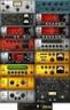 Controllable Space Phaser User Manual Overview Overview Fazortan is a phasing effect unit with two controlling LFOs. 1 Fazortan graphical interface We can distinguish two sections there: Configuration
Cubase Vs Logic Pro - Music Composition
 , pp. 39-48 http://dx.doi.org/10.14257/ijseia.2016.10.3.04 Integrating the Computer Systems and Applied Music Education - Focus on Sequencing Program- Tae-Seon Cho Dept. of Applied Music, Chungwoon University
Waves Trans-X. Software Audio Processor. User s Guide
 Waves Trans-X Software Audio Processor User s Guide Waves Trans-X software guide page 1 of 8 Chapter 1 Introduction and Overview The Waves Trans-X transient processor is a special breed of dynamics processor
User Guide FFFA001106. www.focusrite.com
 User Guide FFFA001106 www.focusrite.com TABLE OF CONTENTS OVERVIEW.... 3 Introduction...3 Features.................................................................... 3 Box Contents...3 System Requirements....4
Installing Your Software
 1 Installing Your Software This booklet is designed to get you up and running as quickly as possible with Logic Studio. The following is covered: Â About the Logic Studio Box on page 2. Â About Onscreen
AALTO QUICKSTART version 1.0
 AALTO QUICKSTART version 1.0 Welcome to Aalto! This quickstart guide assumes that you are familiar with using softsynths in your DAW or other host program of choice. It explains how Aalto's dial objects
Midi Workshop. SAWStudio. From RML Labs. To order this product, or download a free demo, visit www.sawstudio.com
 SAWStudio Midi Workshop From RML Labs Welcome to the exciting new Midi WorkShop add-on for SAWStudio! The Midi WorkShop requires SAWStudio, SAWStudioLite, or SAWStudioBasic as a host. The Midi WorkShop
Using the US-122 with GigaStudio and Cubasis
 Using the US-122 with GigaStudio and Cubasis To use the US-122 with the supplied GigaStudio 24 and Cubasis applications together on Windows, you will need to carry out the following steps after installing
Where to Find the Highest Audio Engineer Salary. How Education and Training can affect the Audio Engineer Salary
 Where to Find the Highest Audio Engineer Salary The audio engineer salary will vary and be mostly based on the level of experience of the engineer. Other factors will include level of education, number
Voltage. Oscillator. Voltage. Oscillator
 fpa 147 Week 6 Synthesis Basics In the early 1960s, inventors & entrepreneurs (Robert Moog, Don Buchla, Harold Bode, etc.) began assembling various modules into a single chassis, coupled with a user interface
Live Recording with M7CL or PM5D Via EtherSound. Using Steinberg Cubase 4 or Nuendo 4
 Live Recording with M7CL or PM5D Via EtherSound Using Steinberg Cubase 4 or Nuendo 4 Summary: This guide will show how quick and easy it is to achieve a high quality, live multi-track recording using a
Audacity 1.2.4 Sound Editing Software
 Audacity 1.2.4 Sound Editing Software Developed by Paul Waite Davis School District This is not an official training handout of the Educational Technology Center, Davis School District Possibilities...
Basics. Mbox 2. Version 7.0
 Basics Mbox 2 Version 7.0 Copyright 2005 Digidesign, a division of Avid Technology, Inc. All rights reserved. This guide may not be duplicated in whole or in part without the express written consent of
MANCHESTER MIDI SCHOOL MUSIC PRODUCTION AND AUDIO ENGINEERING DIPLOMA COURSE INFORMATION PACK 15 MONTHS MIDISCHOOL.COM
 DIPLOMA 15 MONTHS MIDISCHOOL.COM INTRODUCTION Course Name: Duration: Incorporates: Music Production and Audio Engineering Diploma 15 Months 5 modules JUMP STRAIGHT TO: About the course tutor What you will
Raritan Valley Community College Academic Course Outline MUSC 190 - DIGITAL MUSIC COMPOSITION I
 Raritan Valley Community College Academic Course Outline I. Basic Course Information MUSC 190 - DIGITAL MUSIC COMPOSITION I A. Course Number and Title: MUSC 190: DIGITAL MUSIC COMPOSITION I B. New or Modified
WAVES JJP STRINGS & KEYS User Guide
 WAVES JJP STRINGS & KEYS TABLE OF CONTENTS CHAPTER 1 INTRODUCTION...3 1.1 WELCOME...3 1.2 PRODUCT OVERVIEW...3 1.3 COMPONENTS...4 1.4 A FEW WORDS FROM JJP...4 CHAPTER 2 QUICKSTART GUIDE...5 CHAPTER 3 CONTROLS,
EUROPEAN COMPUTER DRIVING LICENCE. Multimedia Audio Editing. Syllabus
 EUROPEAN COMPUTER DRIVING LICENCE Multimedia Audio Editing Syllabus Purpose This document details the syllabus for ECDL Multimedia Module 1 Audio Editing. The syllabus describes, through learning outcomes,
Soundcraft Signature MTK Recording Guide
 Soundcraft Signature MTK Recording Guide S O U N D C R A F T S I G N AT U R E M T K R E C O R D I N G G U I D E 2 Table of Contents USB Overview... 04 Installing the Drivers (PC Only)... 04 Finding the
MIDIKeyz User Manual (Build 1.0) MIDIKeyz is under the umbrella of MIDIculous. All rights reserved 2009
 MIDIKeyz User Manual (Build 1.0) MIDIKeyz is under the umbrella of MIDIculous. All rights reserved 2009 Overview Thank you for purchasing one of the most dynamic virtual MIDI keyboard programs ever created.
Sound Engineering and Music Technology
 The Further Education and Training Awards Council (FETAC) was set up as a statutory body on 11 June 2001 by the Minister for Education and Science. Under the Qualifications (Education & Training) Act,
PART 1. Using USB Mixer with a Computer
 PART 1. Using USB Mixer with a Computer Universal Serial Bus Mixers The USB mixer is equipped with either one or two USB ports that allow you to play and record audio directly from your computer! Just
Recording and Editing Audio with Audacity
 1 Recording and Editing Audio with Audacity http://audacity.sourceforge.net/ Audacity is free, open source software for recording and editing sounds. It is available for Mac OS X, Microsoft Windows, Linux,
GETTING STARTED GUIDE
 GETTING STARTED GUIDE CONTENTS Introduction... 1 Impulse Features... 2 Box Contents... 2 About this Guide... 2 Minimum System Requirements... 2 Connecting the Impulse... 3 Impulse Basic Operation... 3
Recording Supervisor Manual Presence Software
 Presence Software Version 9.2 Date: 09/2014 2 Contents... 3 1. Introduction... 4 2. Installation and configuration... 5 3. Presence Recording architectures Operating modes... 5 Integrated... with Presence
The IRCAM Musical Workstation: A Prototyping and Production Tool for Real-Time Computer Music
 The IRCAM Musical Workstation: A Prototyping and Production Tool for Real-Time Computer Music Cort Lippe, Zack Settel, Miller Puckette and Eric Lindemann IRCAM, 31 Rue St. Merri, 75004 Paris, France During
Original brief explanation
 Original brief explanation I installed the Shoutcast server onto a desktop and made some minor configuration changes, such as setting the passwords and the maximum number of listeners. This was quite easy
BlazeVideo HDTV Player v6.0r User s Manual. Table of Contents
 BlazeVideo HDTV Player v6.0r User s Manual Table of Contents Ⅰ. Overview... 2 1.1 Introduction... 2 1.2 Features... 2 1.3 System Requirements... 2 Ⅱ. Appearance & Menus... 4 Ⅲ. Operation Guide... 7 3.1
2.0 AUDIO RECORDING INTERFACE
 24-Bit/96kHz USB 2.0 AUDIO RECORDING INTERFACE USER MANUAL 1 of 13 Contents: 1. Instruction 03 2. Key Features 03 3. Front Panel 03 4. Rear Panel 04 5. Minimum System Requirements 04 6. Installation Process
How to use the Inspired Acoustics Surround Customizer with Hauptwerk 4
 How to use the Inspired Acoustics Surround Customizer with Hauptwerk 4 Dr. Sven Rakers http://www.rakers.de/midi The Adjustable version of Inspired Acoustics organs are delivered with a VSTi plug-in, the
Cello_Titan. A piece for electric cello and maxmsp Or a piece for Ulrich Maiß. Written by KTToeplitz. In 2005 Duration is around 8-10 minutes
 Cello_Titan A piece for electric cello and maxmsp Or a piece for Ulrich Maiß. Written by KTToeplitz. In 2005 Duration is around 8-10 minutes THE PATCH The bottom of the patch is for the "utilitarian" things:
Developing Csound Plugins with Cabbage
 CSOUND CONFERENCE 2011 Developing Csound Plugins with Cabbage Rory Walsh rorywalsh AT ear.ie Introduction In an industry dominated by commercial and closed-source software, audio plugins represent a rare
Live Recording with AuviTran AV3rd-ES100 & Network ASIO Streamer
 Live Recording with AuviTran AV3rd-ES100 & Network ASIO Streamer Using Steinberg Nuendo 5. 1 Summary: This guide shows how quick and easy it is to achieve a high quality, live multitrack recording using
Building a Simulink model for real-time analysis V1.15.00. Copyright g.tec medical engineering GmbH
 g.tec medical engineering GmbH Sierningstrasse 14, A-4521 Schiedlberg Austria - Europe Tel.: (43)-7251-22240-0 Fax: (43)-7251-22240-39 [email protected], http://www.gtec.at Building a Simulink model for real-time
Recording audio from your computer.
 Recording audio from your computer. Subject Descriptors: Audacity Application (Version): Audacity 1.2, Macintosh OSX, Windows XP-Vista Task Description: This lesson will demonstrate how to record any audio
Wireless In-Ear Audio Monitor
 University of Nebraska - Lincoln Computer Engineering Senior Design Project Wireless In-Ear Audio Monitor Team Stonehenge: Erin Bartholomew Paul Bauer Nate Lowry Sabina Manandhar May 4, 2010 Contents 1
Live Recording with M7CL-48ES & AuviTran Network ASIO Streamer. Using Steinberg Cubase 5 or Nuendo 5.
 & AuviTran Network ASIO Streamer Using Steinberg Cubase 5 or Nuendo 5. Summary: This guide shows how quick and easy it is to achieve a high quality, live multitrack recording using Yamaha M7CL-48ES, stage-boxes
Tutorial. Part One -----Class1, 02/05/2015
 2.1.1 Tutorial Part One -----Class1, 02/05/2015 Download Audacity and LAME Encoder Audacity is an open source cross-platform (It can be used in Windows, Macs, and Linux) audio editor. You can download
Nord Stage 2 OS Version 1.30 Release Notes 1
 Nord Stage 2 OS Version 1.30 Release Notes 1 Nord Stage 2 OS Version 1.30 Release Notes The 1.30 Stage 2 OS update contains several bug fixes and some functionality improvements. Internal Instrument levels
Cristina Bachmann, Heiko Bischoff, Christina Kaboth, Insa Mingers, Sabine Pfeifer, Kevin Quarshie, Benjamin Schütte This PDF provides improved access
 English Cristina Bachmann, Heiko Bischoff, Christina Kaboth, Insa Mingers, Sabine Pfeifer, Kevin Quarshie, Benjamin Schütte This PDF provides improved access for vision-impaired users. Please note that
USER GUIDE ENGLISH ( 3 6 )
 USER GUIDE ENGLISH ( 3 6 ) GUÍA DEL USUARIO ESPAÑOL ( 7 10 ) GUIDE D'UTILISATION FRANÇAIS ( 11 14 ) GUIDA PER L'USO ITALIANO ( 15 18 ) BENUTZERHANDBUCH DEUTSCH ( 19 22 ) USER GUIDE (ENGLISH) Box Contents
microgranny 2.0 manual draft
 microgranny 2.0 manual draft Introduction microgranny 2.0 (further only microgranny) is a monophonic granular sampler with MIDI input and 8-bit audio input. It has 6 big buttons, each of which plays a
OMEGA STUDIO SOFTWARE INSTALLATION GUIDE
 OMEGA STUDIO SOFTWARE INSTALLATION GUIDE USB Device Drivers, Cubase LE Setup, and Pantheon Reverb Plug-in for Windows XP Cubase LE Setup and Pantheon Reverb Plug-in for Mac OS X Congratulations on your
Tutorial Use Ableton Live for a live set
 Intellinoise Studio Intelligent Audio Conception www.intellinoise.com www.electrypnose.com Tutorial Use Ableton Live for a live set Material needed : - Ableton Live - Some finished tracks 1. Introduction
Table of contents. Quick Start... 1. Basic operation... 4. Creating your own sounds...12. Items in the screen... 6. Performing...
 1 Table of contents ii Quick Start... 1 Step 1 Listen to the sound of the effect programs...1 Step 2 Play back a song and cancel the guitar part...2 Step 3 Perform along with the song...3 Basic operation...
www.tracktion.com Tracktion 4 Quick Start Guide
 QUICK START GUIDE www.tracktion.com Part No. 900201 Rev. A 01/2013 2013 Tracktion Software Corporation. All Rights Reserved. All brand names mentioned are trademarks or registered trademarks of their respective
US-122L/US-144 Release Notes
 US-122L/US-144 Release Notes Updates Always ensure that you are running the latest driver software and US-122L or US-144 firmware by visiting TASCAM s web site (http://www.tascam.com). Important Notice
MANCHESTER MIDI SCHOOL MUSIC PRODUCTION - AUDIO ENGINEERING - MUSIC BUSINESS COURSE INFORMATION PACK 18 MONTHS MIDISCHOOL.COM
 18 MONTHS MIDISCHOOL.COM INTRODUCTION Course Name: Duration: Incorporates: Music Production, Audio Engineering & Music Business Diploma 18 Months 8 modules JUMP STRAIGHT TO: About the course tutor What
Call Recorder Oygo Manual. Version 1.001.11
 Call Recorder Oygo Manual Version 1.001.11 Contents 1 Introduction...4 2 Getting started...5 2.1 Hardware installation...5 2.2 Software installation...6 2.2.1 Software configuration... 7 3 Options menu...8
USER GUIDE ENGLISH ( 3 6 )
 USER GUIDE ENGLISH ( 3 6 ) GUÍA DEL USUARIO ESPAÑOL ( 7 10 ) GUIDE D'UTILISATION FRANÇAIS ( 11 14 ) GUIDA PER L'USO ITALIANO ( 15 18 ) BENUTZERHANDBUCH DEUTSCH ( 19 22 ) USER GUIDE (ENGLISH) Box Contents
Final Report. Hybrid Synth by Synthesize Me. Members: Jamie Madaris Jack Nanney
 Final Report Hybrid Synth by Synthesize Me Members: Jamie Madaris Jack Nanney Project Abstract Our Senior Design project is a Digitally-Controlled Analog Synthesizer. The synthesizer consists of both digital
Note: To use the following three applications, first start up Data Manager and then use Data Manager button operations to start them up.
 This software lets you create WK-3000/WK-3200/WK-3500/WK-3700/CTK-691 and CTK-900 (keyboard) data on your computer and exchange such data between the computer and keyboard. Data Manager Transfer keyboard
Logic Pro 9. TDM Guide
 Logic Pro 9 TDM Guide Copyright 2009 Apple Inc. All rights reserved. Your rights to the software are governed by the accompanying software license agreement. The owner or authorized user of a valid copy
Little LFO. Little LFO. User Manual. by Little IO Co.
 1 Little LFO User Manual Little LFO by Little IO Co. 2 Contents Overview Oscillator Status Switch Status Light Oscillator Label Volume and Envelope Volume Envelope Attack (ATT) Decay (DEC) Sustain (SUS)
Version 5. Getting Started
 Version 5 Getting Started Getting Started Manual by Fredrik Hylvander and Anders Nordmark The information in this document is subject to change without notice and does not represent a commitment on the
GAME SYSTEM MANUAL PITTSBURGH MODULAR SYNTHESIZERS
 GAME SYSTEM MANUAL PITTSBURGH MODULAR SYNTHESIZERS Chaotic and CV Sequencing Arcade Packed with six unique multi-mode sequencers and a fully voltage controllable user interface, the Game System is deep!
Graham s Guide to Synthesizers (part 1) Analogue Synthesis
 Graham s Guide to Synthesizers (part ) Analogue Synthesis Synthesizers were originally developed to imitate or synthesise the sounds of acoustic instruments electronically. Early synthesizers used analogue
13 Managing Devices. Your computer is an assembly of many components from different manufacturers. LESSON OBJECTIVES
 LESSON 13 Managing Devices OBJECTIVES After completing this lesson, you will be able to: 1. Open System Properties. 2. Use Device Manager. 3. Understand hardware profiles. 4. Set performance options. Estimated
D i g i g r a m. sound card range. Professional stereo and multichannel sound cards. Installation and set-up
 D i g i g r a m VX sound card range Professional stereo and multichannel sound cards Table of contents VX Cards General information...4 Supported cards...4 System requirements...4 MacIntosh...4 System
EE289 Lab Fall 2009. LAB 4. Ambient Noise Reduction. 1 Introduction. 2 Simulation in Matlab Simulink
 EE289 Lab Fall 2009 LAB 4. Ambient Noise Reduction 1 Introduction Noise canceling devices reduce unwanted ambient noise (acoustic noise) by means of active noise control. Among these devices are noise-canceling
Audio-Technica AT-LP60-USB, AT-LP120-USB, AT-LP240-USB & AT-LP1240-USB Turntables. Software Guide
 Audio-Technica AT-LP60-USB, AT-LP120-USB, AT-LP240-USB & AT-LP1240-USB Turntables Software Guide Audio-Technica USB Turntables Contents A note about software... 2 System requirements... 2 Installing Audacity
Outline. hardware components programming environments. installing Python executing Python code. decimal and binary notations running Sage
 Outline 1 Computer Architecture hardware components programming environments 2 Getting Started with Python installing Python executing Python code 3 Number Systems decimal and binary notations running
itelecenter Virtual PBX Extension User Guide
 itelecenter Virtual PBX Extension User Guide Version 13 October 2011 COANetwork 2011 itelecenter Virtual PBX Extension User s Manual A Virtual PBX Extension can be set up for you by your itelecenter Administrator.
For HOME and BROADCASTER versions the options are kept simple for quick configuration.
 TABLE OF CONTENTS INTRODUCTION 3 HOME and BROADCASTER VERSION SETUPS 3 CONFIGURATION OPTIONS DEFINED 4 BASIC (QUICK) CONFIGURATIONS 5 HEADPHONES 5 EXTERNAL MIXERS 8 MICROPHONE 11 LINE INPUTS 12 ADVANCED
DSD Native DAC Setup Guide
 CHANNEL D Pure Music DSD Native DAC Setup Guide Release 1.0 Copyright 2012 Channel D www.channel-d.com CHANNEL D Pure Music DSD Native DAC Setup Guide These instructions outline the setup steps required
Greenwich Public Schools Electronic Music Curriculum 9-12
 Greenwich Public Schools Electronic Music Curriculum 9-12 Overview Electronic Music courses at the high school are elective music courses. The Electronic Music Units of Instruction include four strands
Mbox Basics Guide. Version 6.7 for LE Systems on Windows XP or Mac OS X. Digidesign
 Mbox Basics Guide Version 6.7 for LE Systems on Windows XP or Mac OS X Digidesign 2001 Junipero Serra Boulevard Daly City, CA 94014-3886 USA tel: 650 731 6300 fax: 650 731 6399 Technical Support (USA)
Max Fundamentals. Juan P Bello
 Max Fundamentals Juan P Bello Max Max is a high-level graphic programming language, written in C It provides an interactive programming environment with extensive libraries of pre-compiled and pre-tested
AUDACITY SOUND EDITOR SOFTWARE A USER GUIDE FOR AUDIO-VISUAL WORKERS
 AUDACITY SOUND EDITOR SOFTWARE A USER GUIDE FOR AUDIO-VISUAL WORKERS Prepared by Peter Appleton Copyright 2008 All illustrations in this guide were created using Audacity v1.2.6 Version 0.5 Page 1 of 18
IF-FW/DM @# Release Notes
 IF-FW/DM @# Release Notes Updates Always ensure that you are running the latest driver software and IF-FW/DMmkII firmware by visiting TASCAM s web site at http://www.tascam.com. How to Update Windows driver
The Connacht Education and Training Alliance. Programme Module for. Sound Engineering and Production. leading to. Level 5 FETAC
 (Consisting of: City of Galway VEC, County Galway VEC, County Leitrim VEC, County Mayo VEC, County Roscommon VEC and County Sligo VEC) Programme Module for Sound Engineering and Production leading to Level
MV-8800 Production Studio
 ÂØÒňΠWorkshop MV-8800 Production Studio Using the MV-8800 with an External Sequencer 2007 Roland Corporation U.S. All rights reserved. No part of this publication may be reproduced in any form without
Co-designed by TASCAM and
 Page 1 of 6 FW-1884 Control Surface and Audio/MIDI Interface Up to 18 simultaneous inputs Comprehensive mixing, automation, editing and navigation tools for DAWs Eight 100mm motorized touchsensitive channel
AI Audio 2 (SoundMAX High Definition Audio utility)
 AI Audio 2 (SoundMAX High Definition Audio utility) The ADI High Definition Audio CODEC provides 8-channel audio capability through the SoundMAX audio utility with AudioESP software to deliver the ultimate
USING THE RECORDING KIT By [email protected] Version: 23 January 2015
 USING THE RECORDING KIT By [email protected] Version: 23 January 2015 This document is a short introduction on how to use the recording kit. Reading thru this document will save you valuable time and
Message from the Development Team. Contents. Message from the Development Team..2. Panel Controls and Terminals...3. Using the UR22mkII...
 EN Contents Contents Message from the Development Team..2 Panel Controls and Terminals...3 Front Panel...3 Rear Panel...5 Software...7 Using the UR22mkII...10 Connections...10 Configuring Audio Driver
Music Theory: Explanation and Basic Principles
 Music Theory: Explanation and Basic Principles Musical Scales Musical scales have developed in all cultures throughout the world to provide a basis for music to be played on instruments or sung by the
Digital Audio Workstations
 Digital Audio Workstations As personal computers evolved, their ability to perform the necessary amount of data storage and transfer to allow real-time data acquisition made them an attractive platform
Programming in Access VBA
 PART I Programming in Access VBA In this part, you will learn all about how Visual Basic for Applications (VBA) works for Access 2010. A number of new VBA features have been incorporated into the 2010
Software version 1.1 Document version 1.0
 Software version 1.1 Document version 1.0 1 RDNET PROTOCOL OVERVIEW... 2 1.1 Network description... 2 1.2 Connection topology... 2 2 SOFTWARE BASIC OPERATIONS... 3 2.1 Main View elements... 3 2.2 Scanning
Getting Started with a blank desk...3. Understanding the Rear Panel and Top Connectors...3. Understanding the Front Panel...5
 2nd Edition Table of contents Getting Started with a blank desk...3 Understanding the Rear Panel and Top Connectors...3 Understanding the Front Panel...5 Controlling Channel Faders...6 Changing INPUT PATCH...7
Chord Limited. Mojo Dac Headphone Amplifier OPERATING INSTRUCTIONS
 Chord Limited Mojo Dac Headphone Amplifier OPERATING INSTRUCTIONS -!1 - Cleaning and care instructions: Mojo requires no special care other than common sense. Spray window cleaner (clear type) may be used
How to Start Making Music in Pro Tools
 How to Start Making Music in Pro Tools Read this guide if you are new to Pro Tools or are just starting out making your own music. Inside, you ll find quick examples of how to record, compose, mix, and
Soft Call Recorder v3 Manual Version 2.007 08
 Soft Call Recorder v3 Manual Version 2.007 08 Soft Call Recorder Manual Vidicode 2008 1 2 Soft Call Recorder Manual Vidicode 2008 Contents 1 Introduction... 5 2 Getting started...... 7 2.1 Software installation...7
QUICK SETUP GUIDE SETUP FOR ICONNEX SOUNDCARD AND AUDACITY RECORDING SOFTWARE
 QUICK SETUP GUIDE SETUP FOR ICONNEX SOUNDCARD AND AUDACITY RECORDING SOFTWARE SETUP GUIDE Congratulations on your purchase of the ikey Audio iconnex soundcard. This guide will help you setup the iconnex
PSR-S950 DIGITAL KEYBOARDS
 The PSR-S950 arranger keyboard effectively blurs the line between digital and acoustic sound, and the result will alter your musical perceptions forever. We recorded pro musicians to achieve authentic
Hosted Voice Business Group Administrator Quick Start Guide
 Hosted Voice Business Group Administrator Quick Start Guide 2 Get Started with EarthLink! This easy-to-use guide consists of a series of brief instructions designed to help you configure your new service.
Introducing the Adafruit Bluefruit LE Sniffer
 Introducing the Adafruit Bluefruit LE Sniffer Created by Kevin Townsend Last updated on 2015-06-25 08:40:07 AM EDT Guide Contents Guide Contents Introduction FTDI Driver Requirements Using the Sniffer
Software Sequencing Basics
 October 12, 1998 software sequencing basics Software Sequencing Basics Supplemental Notes Roland gear is often used in conjunction with a variety of software sequencer programs. The purpose of this document
M a n u a l O R C H E S T R A L T O O L S. C O M. 2011 by OrchestralTools Schwarzer & Mantik GbR
 M a n u a l O R C H E S T R A L T O O L S. C O M 2011 by OrchestralTools Schwarzer & Mantik GbR About Symphonic Sphere (SSP) When dreams transform into possibilities There are some nice orchestrational
Software Audio Processor. Users Guide
 Waves R360 Surround Reverb Software Audio Processor Users Guide Waves R360 software guide page 1 of 8 Introduction Introducing the Waves 360 Surround Reverb. This Software audio processor is dedicated
DIGITAL MUSIC DAY 1 WHAT IS SOUND? ANALOG AND DIGITAL EARLY RECORDING WAX FOR YOUR EARS ROUND BUT FLAT WIRE AND TAPE PURE SOUND
 DIGITAL MUSIC DAY 1 WHAT IS SOUND? 1. Making a sound playing a musical instrument, moves the surrounding the instrument. 2. Making a sound sends out air which hit your ears. 3. Waves of changing air pressure