
Installing Network Operating System S10 Minitower, S10 Desktop, S10XL Hot Plug Servers
|
|
|
- Herbert Burke
- 10 years ago
- Views:
Transcription
1 Installing Network Operating System S10 Minitower, S10 Desktop, S10XL Hot Plug Servers BST /96
2 The product described in this book is a licensed product of NCR Corporation. All brand and product names appearing in this manual are registered trademarks or trademarks of their respective holders. It is the policy of NCR Corporation (NCR) to improve products as new technology, components, software, and firmware become available. NCR, therefore, reserves the right to change specifications without prior notice. All features, functions, and operations described herein may not be marketed by NCR in all parts of the world. In some instances, photographs are of equipment prototypes. Therefore, before using this document, consult with your NCR representative or NCR office for information that is applicable and current. To maintain the quality of our publications, we need your comments on the accuracy, clarity, organization, and value of this book. Address correspondence to: NCR Corporation Integrated Information 3325 Platt Springs Road West Columbia, SC Copyright 1996 By NCR Corporation Dayton, Ohio U.S.A. All Rights Reserved

3 Contents Chapter 1 Setup Overview Overview Documentation Needed for Setup Where to Start Chapter 2 BIOS Setup Overview BIOS System Setup Procedure PCI Adapters Configuration Procedure Chapter 3 EISA Configuration Utility Chapter 4 Adaptec BIOS SCSISelect Utility Chapter 5 Installing MP-RAS Overview EISA Configuration Procedure Overview Adaptec BIOS SCSISelect Procedure Overview Installation Overview Rebooting the Server and Installing the Operating System Performing a Default Installation Turning the System Off Performing Additional Administrative Tasks Installing Network Operating System i

4 Contents Chapter 6 Installing Microsoft Windows NT Server Overview Pre-Load Installation No Pre-Loaded Installation Installing Windows NT Server Chapter 7 Installing NetWare Overview Installation Overview Rebooting the Server and Creating a Primary DOS Partition Loading the Controller s Drivers Installing NetWare Chapter 8 Installing SCO UNIX Overview Installation Overview Rebooting the Server and Installing the Operating System SCO Release 3: Installing SMP SCO Release 3: Installing the Multiprocessing Driver SCO Release 3: Installing TCP/IP Communications SCO Release 5: Installing SMP SCO Release 5: Installing TCP/IP Communications Chapter 9 Installing UnixWare Overview Installation Overview Rebooting the Server and Installing the Operating System ii Installing Network Operating System
5 Contents Chapter 10 Installing OS/2 Overview Installation Overview Rebooting the Server and Installing the Operating System Installing Network Operating System iii
6 Contents iv Installing Network Operating System

7 Preface Preface About This Book This book provides detailed instructions about the installation and configuration of ready-to-run network operating systems on your server. The installation information included in this manual is current as of the date of publication. If you have problems installing, more recent installation information may be available through the NCR Faxback Line at (803) Who Should Read This Book This book should be used by persons familiar with the server and the specific operating systems included herein. Releases Included in This Book This book includes installation information for the following network operating systems: NCR UNIX SVR4 MP-RAS Windows NT Server 3.51 NetWare SCO UNIX SCO Open Server Release 5 SCO Open Server Release 3.0 UnixWare OS/2 Installing Network Operating System i
8 Preface How This Manual is Organized This manual is divided into the following chapters: Chapter One the Road Map ; outlines the entire setup and configuration process, including procedure and reference information Chapter Two describes the BIOS Setup procedure. Chapter Three describes the EISA Configuration Utility procedure. Chapter Four describes the Adaptec BIOS SCSISelect Utility procedure. Chapter Five describes the installation and configuration of MP-RAS Chapter Six describes the installation and configuration of Windows NT Server Chapter Seven describes the installation and configuration of NetWare Chapter Eight describes the installation and configuration of SCO UNIX Chapter Nine describes the installation and configuration of UnixWare Chapter Ten describes the installation and configuration of OS/2 Conventions Used in This Book The following conventions are used in this book: [F1] A letter, number, symbol, or word enclosed in [] represents a key on your keyboard. For ii Installing Network Operating System

9 Preface example, the instruction press [F1] means press the key labeled F1 on your keyboard. [Enter] [x] + [y] Note Warning Caution Can be referred to as Return or Carriage Return. All of the terms are interchangeable. Two or three key names, separated by plus signs, indicate multiple-key entries. For example, [Control] + [Alt] + [Delete] means hold down [Control] and [Alt] and press [Delete]. Pivotal information and may be used to emphasize a recommended sequence of steps. Indicates a hazard that can cause personal injury or equipment damage if the hazard is not avoided. Indicates a hazard that might cause personal injury, damage to hardware, or software if the hazard is not avoided. Related Publications For additional information, refer to the following books: User Guide for your server NCR S10 Minitower (BST ) NCR S10 Desktop (BST ) NCR S10XL Hot Plug (BST ) Installing Network Operating System iii
![For example, [Control] + [Alt] + [Delete] means hold down [Control] and [Alt] and press [Delete]. Pivotal information and may be used to emphasize a recommended sequence of steps.](/docs-images/42/6967906/images/page_9.jpg "Indicates a hazard that can cause personal injury or equipment damage if the hazard is not avoided.")
10 Preface Server Manager Module Installation for Entry Level Servers (ST ) Operating system documentation Also, the NCR Faxback Line at (803) may contain more recent information. iv Installing Network Operating System

11 Setup Overview Overview Overview Thank you for selecting an NCR server. This book is designed to get you started installing and configuring your system. The following information is included: A summary of the setup process BIOS Setup procedure EISA Configuration Utility procedure Adaptec BIOS SCSISelect Utility procedure MP-RAS installation and configuration information Windows NT Server installation and configuration information NetWare installation and configuration information SCO UNIX installation and configuration information UNIXWare installation and configuration information OS/2 installation and configuration information Installing Network Operating System 1-1

12 Setup Overview Documentation Needed for Setup Documentation Needed for Setup You should have the following information to perform the setup: User Guide for your system Quick Hardware Installation brochure Drive, peripheral, CPU board, and adapter documentation Network operating system documentation This book 1-2 Installing Network Operating System

13 Setup Overview Where to Start Where to Start After you have installed the hardware, follow these steps to install a network operating system on your system. Step What to Do How to Do It Where to Find Information 1 Confirm CMOS Use the BIOS Setup Chapter 2 settings procedure 2 Confirm the system settings 3 Confirm the adapter settings Use the EISA Configuration Utility Use the Adaptec BIOS SCSISelect Utility procedure Chapter 3 Chapter 4 Then, follow Step 4 below for the network operating system you are installing. 4 Install NCR UNIX SVR4 MP-RAS Follow the instructions provided Chapter 5 4 Install Microsoft Windows NT Server 3.51 Follow the instructions provided Chapter 6 4 Install NetWare Follow the instructions provided Chapter 7 4 Install SCO UNIX SCO Open Server Release 5 or SCO Open Server Release 3.0 Follow the instructions provided Chapter 8 Installing Network Operating System 1-3
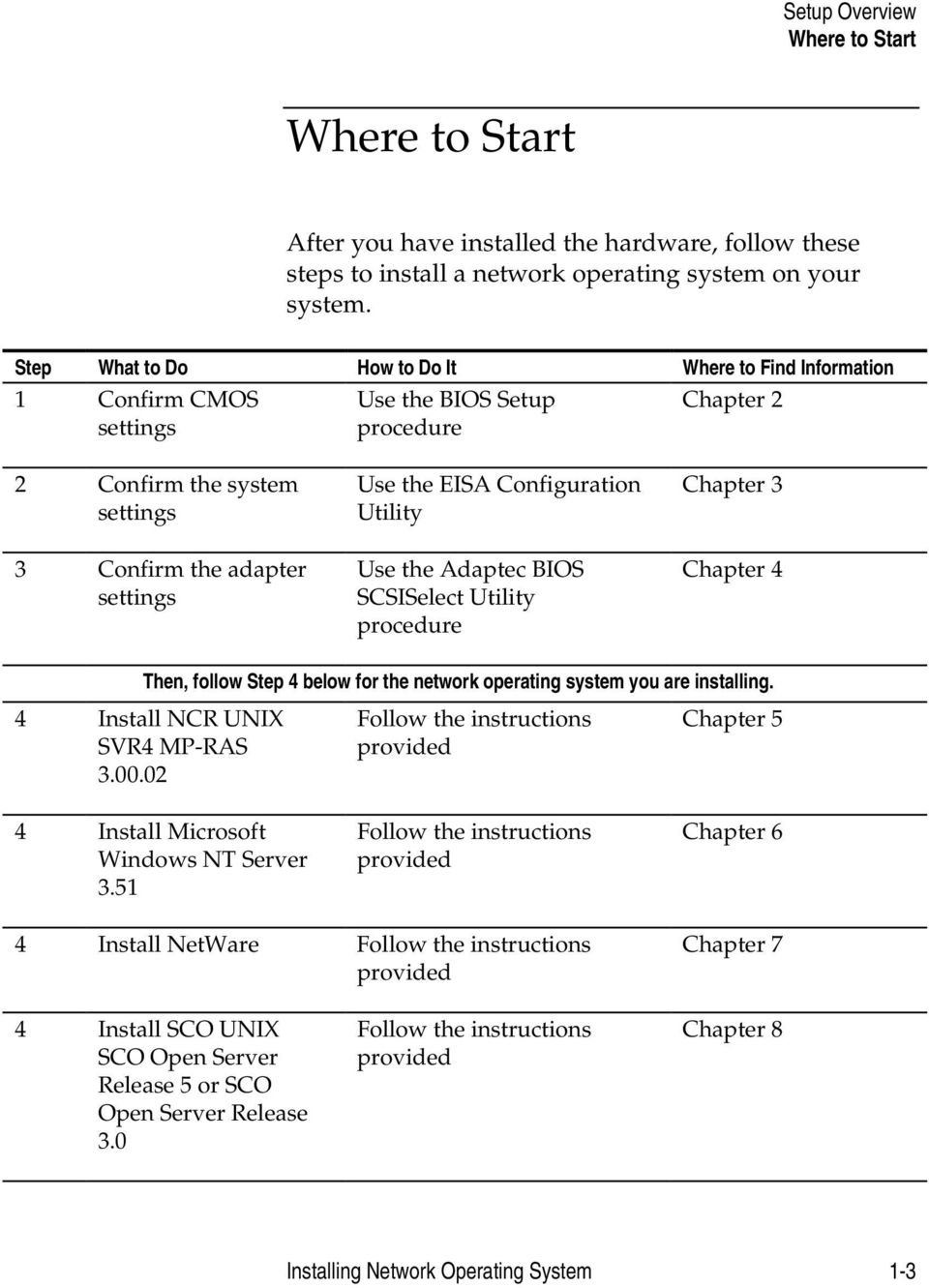
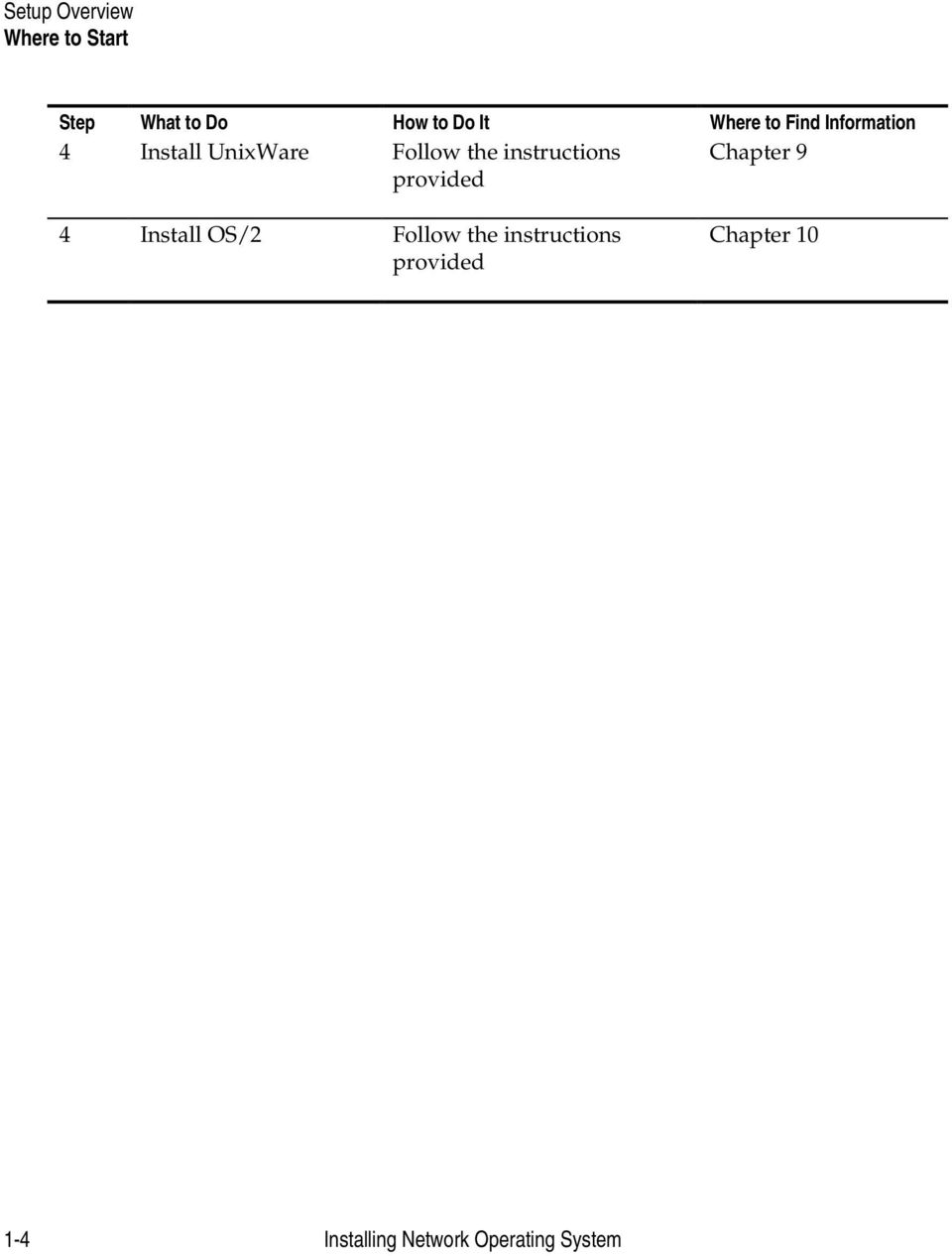
14 Setup Overview Where to Start Step What to Do How to Do It Where to Find Information 4 Install UnixWare Follow the instructions Chapter 9 provided 4 Install OS/2 Follow the instructions provided Chapter Installing Network Operating System
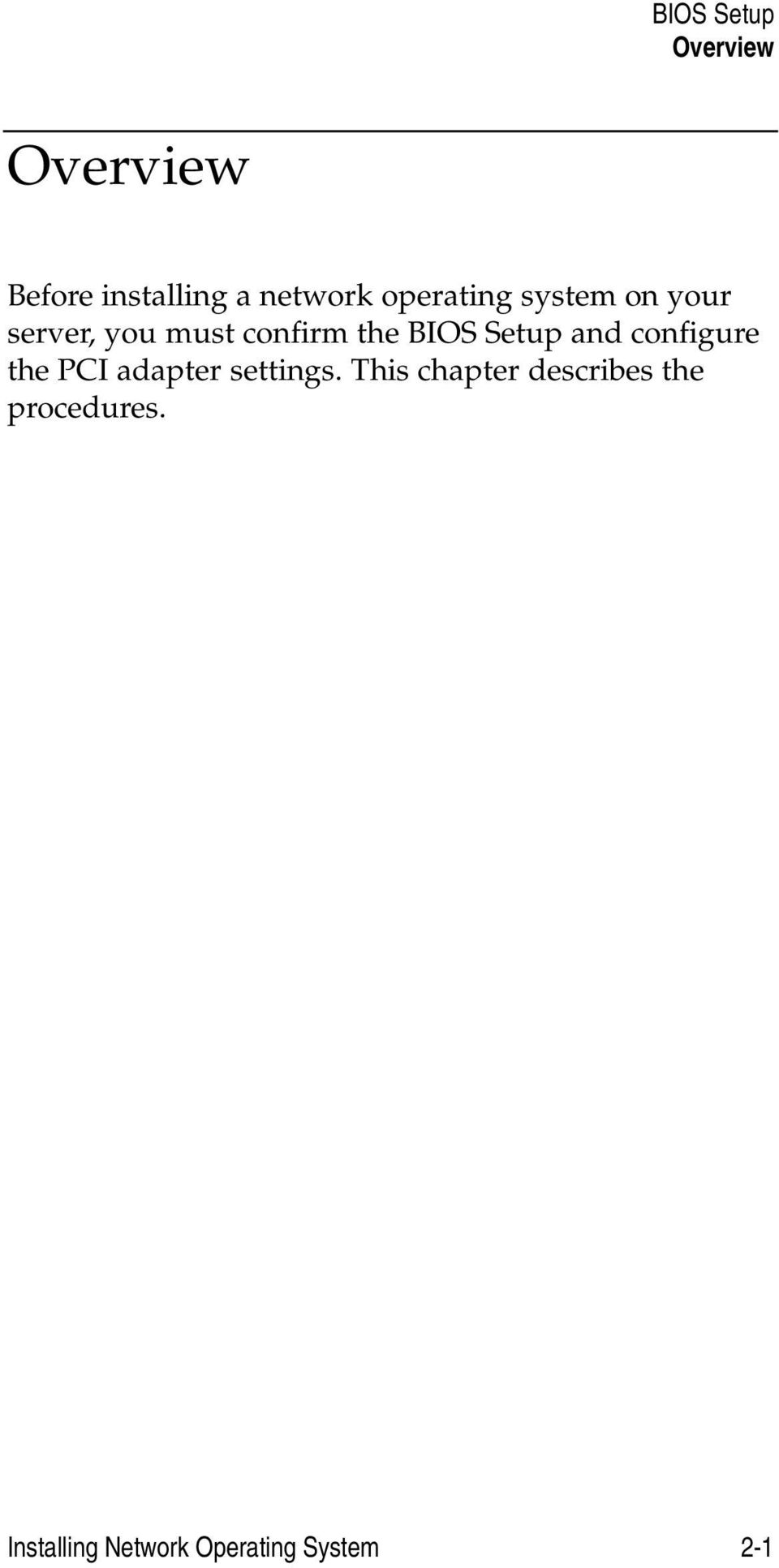
15 BIOS Setup Overview Overview Before installing a network operating system on your server, you must confirm the BIOS Setup and configure the PCI adapter settings. This chapter describes the procedures. Installing Network Operating System 2-1
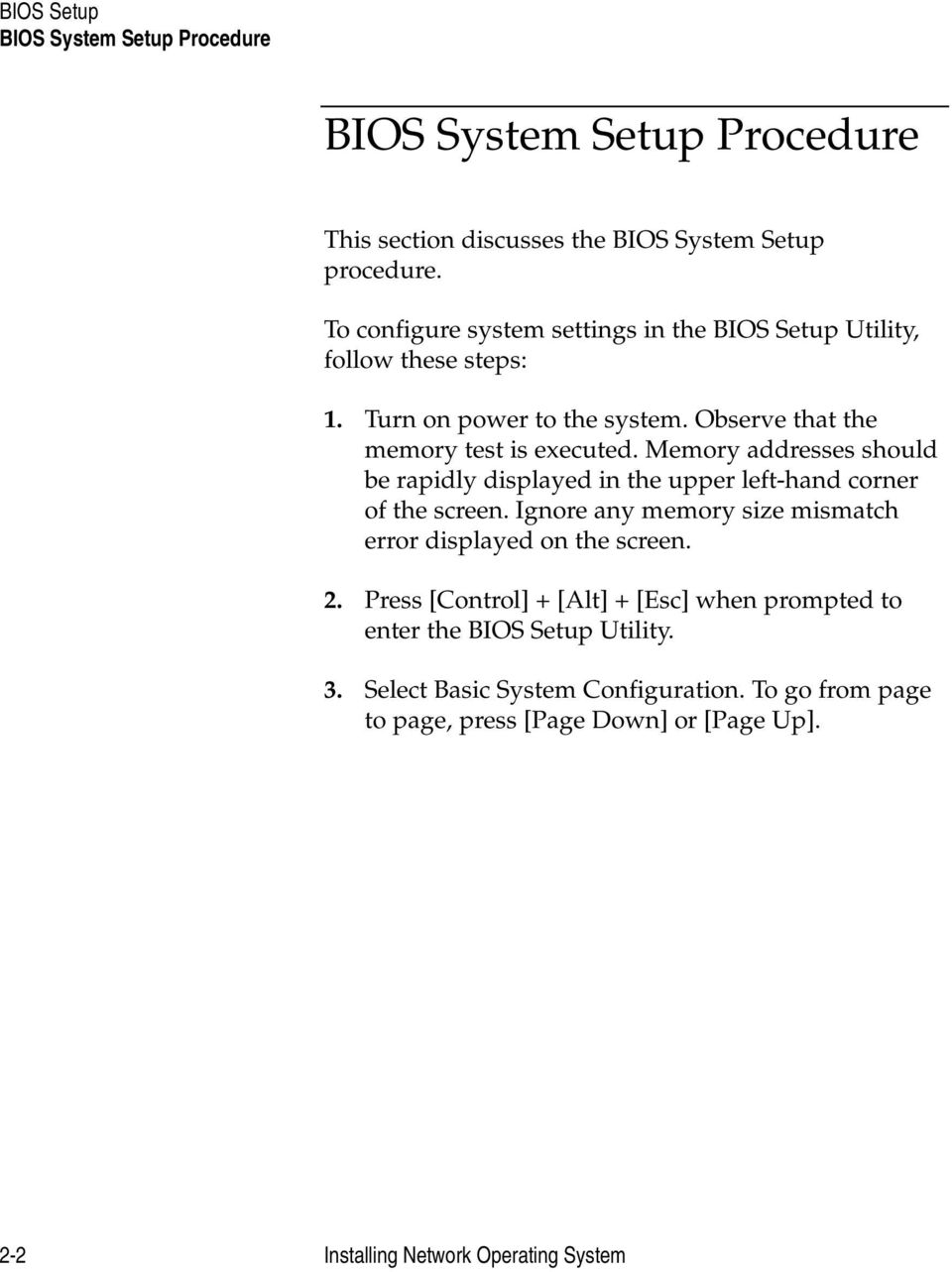
16 BIOS Setup BIOS System Setup Procedure BIOS System Setup Procedure This section discusses the BIOS System Setup procedure. To configure system settings in the BIOS Setup Utility, follow these steps: 1. Turn on power to the system. Observe that the memory test is executed. Memory addresses should be rapidly displayed in the upper left-hand corner of the screen. Ignore any memory size mismatch error displayed on the screen. 2. Press [Control] + [Alt] + [Esc] when prompted to enter the BIOS Setup Utility. 3. Select Basic System Configuration. To go from page to page, press [Page Down] or [Page Up]. 2-2 Installing Network Operating System
17 BIOS Setup BIOS System Setup Procedure 4. Go to Page 2 and set parameters as follows (in the order indicated): Hard Disk Block Mode Advanced PIO Mode Hard Disk Size > 504 MB Hard Disk 32-Bit Access Auto Configuration Mode Fast Boot Mode Num Lock After Boot Memory Test [Disabled] [Disabled] [Disabled] [Disabled] [Disabled] [Disabled] [Enabled] [Enabled] 5. Return to Page 1, and set parameters as follows: Diskette Drive A Diskette Drive B Fixed Disk 0 ( 0 MB) Fixed Disk 1 ( 0 MB) [1.44 MB 3.5-inch] [None] [None] [None] 6. Press [Esc] to return to the main menu in BIOS Setup. 7. Select Advanced System Configuration. Page 1 - Verify that the parameters are set as follows: C0000h - C7FFFh (Video BIOS) C8000h - CFFFFh D0000h - D7FFFh D8000h - DFFFFh Internal Cache (CPU Cache) External Cache Cache Scheme [Enabled] [Disabled] [Disabled] [Disabled] [Enabled] [Enabled] [Write Back] Installing Network Operating System 2-3
![Lock After Boot Memory Test [Disabled] [Disabled] [Disabled] [Disabled] [Disabled] [Disabled] [Enabled] [Enabled] 5.](/docs-images/42/6967906/images/page_17.jpg "Return to Page 1, and set parameters as follows: Diskette Drive A Diskette Drive B Fixed Disk 0 ( 0 MB) Fixed Disk 1 ( 0 MB) [1.44 MB 3.5-inch] [None] [None] [None] 6.")
18 BIOS Setup BIOS System Setup Procedure Caution: Do not select Write Through for the Cache Scheme. Selecting Write Through for the Cache Scheme renders the system unusable. System Memory Parity Memory at 15 MB-16 MB Res for E0000h - FFFFFh (System BIOS) C0000h - C7FFFh (Video BIOS) For Dual Processor Boards: Page 2 - Set the parameters as follows: Guaranteed Access Time Mode Highest Priority Device for PCI Arb [Enabled] [System] Use [Cacheable] [Cacheable] [Enabled] [Rotation] 8. Press [Esc] to return to the main menu in the BIOS Setup. 9. Select System Security. On Page 1, set the parameters as follows: Disk Drive Control Diskette Drive [Normal] Fixed Disk Drive [Normal] System Boot Drive [Drive A Then C] On Board Communication Ports Serial Port 1 Base Address [3F8h] Serial Port 2 Base Address [2F8h] Parallel Port Base Address [Parallel 1 (3BCh)] Operation Mode [Stndrd PP (SPP)] Mode EPP Version Selection [1.7] Setup Password Power On Password [None] [None] 2-4 Installing Network Operating System
![Mode Highest Priority Device for PCI Arb [Enabled] [System] Use [Cacheable] [Cacheable] [Enabled] [Rotation] 8. Press [Esc] to return to the main menu in the BIOS Setup. 9. Select System Security.](/docs-images/42/6967906/images/page_18.jpg "On Page 1, set the parameters as follows: Disk Drive Control Diskette Drive [Normal] Fixed Disk Drive [Normal] System Boot Drive [Drive A Then C] On Board Communication Ports Serial Port 1 Base")
19 BIOS Setup BIOS System Setup Procedure 10. Press [Esc] to return to the main menu in the BIOS Setup. Installing Network Operating System 2-5
![Press [Esc] to return to the main](/docs-images/42/6967906/images/page_19.jpg "menu in the BIOS Setup.")
20 BIOS Setup PCI Adapters Configuration Procedure PCI Adapters Configuration Procedure To configure PCI adapters, follow these steps: 1. Select PCI System Configuration from the main menu in BIOS Setup. PCI System Configuration Page 1/1 PCI IRQ Setting [Manual] PCISlot1 PCISlot2 PCISlot3 On Board SCSI INTA [--] [--] [--] [--] INTB [--] [--] [--] [--] INTC [--] [--] [--] [--] INTD [--] [--] [--] [--] VGA Palette Snoop On Board SCSI AIC-7870 Boot Device [Disabled] [Enabled] [Enabled] = Move Highlight Bar, = Change setting, PgDn/PgUp = Move Screen, F1 = Help, Esc = Exit 2. Use the up and down arrow keys to select the PCI slot number. Use the right and left arrow keys to change the IRQ Level for INTA Pin settings. Available IRQ settings are 3, 4,5, 7, 9, 10, 11, 14, and Installing Network Operating System
![VGA Palette Snoop On Board SCSI AIC-7870 Boot Device [Disabled] [Enabled] [Enabled] = Move Highlight Bar, = Change setting, PgDn/PgUp = Move Screen, F1 = Help, Esc = Exit 2.](/docs-images/42/6967906/images/page_20.jpg "Use the up and down arrow keys to select the PCI slot number. Use the right and left arrow keys to change the IRQ Level for INTA Pin settings.")
21 BIOS Setup PCI Adapters Configuration Procedure To make IRQ 3 available for selection, you must disable Serial Port 2 in the System Security menu. To make IRQ 4 available for selection, you must disable Serial Port 1 in the System Security menu. To make IRQ 7 available for selection, you must disable Parallel Port 1 in the System Security menu. Note: See Appendix C in your system User Guide for settings for sample configurations. 3. After you have made your settings, press [Esc] to return to the main menu in the BIOS Setup. 4. Press [Esc] again. Select Yes to save your system and PCI adapter settings and to reboot the system. Installing Network Operating System 2-7
22 BIOS Setup PCI Adapters Configuration Procedure 2-8 Installing Network Operating System
23 EISA Configuration Utility Overview Overview Before installing a network operating system on your server, you must configure the server, using the EISA Configuration Utility (ECU). This chapter describes the procedure. Installing Network Operating System 3-1
24 EISA Configuration Utility EISA Configuration Procedure EISA Configuration Procedure To configure memory and other baseboard settings, follow these steps: 1. If you have any EISA adapters in the system, copy the CFG files for each adapter onto your EISA Configuration Utility diskette before you begin. 2. Insert the EISA Configuration Utility in the diskette drive. Observe that the EISA Configuration Utility boots properly. 3. Select M5 from the Advanced Configuration menu. Note: Refer to Chapter 5 of the system User Guide for instructions on configuring the memory correctly. The PCI Adapter IRQ values entered below do not set the IRQ level for PCI Adapters. PCI Adapter IRQ settings are set in the BIOS Setup Utility. You enter the IRQ settings in the EISA Configuration Utility so that the EISA Configuration Utility does not assign IRQ values to EISA Adapters that have already been used for PCI Adapters. Make sure the parallel port and serial ports are configured the same way as in the BIOS Setup Utility. 4. Configure system memory as follows: 3-2 Installing Network Operating System
25 EISA Configuration Utility EISA Configuration Procedure System Memory Function Base System Memory [640 K Base Mem] 4-16 MB Ext Memory [16 MB Ext MB Ext Memory Mem...] [Ctrl-R to add...] 5. Configure the remainder of the baseboard options as follows: PCI Devices IRQ assignment On board 7870 SCSI [Disabled] controller PCI Slot 1 [Disabled]* PCI Slot 2 [Disabled]* PCI Slot 3 [Disabled]* System BIOS Type [E, F Segment...] Peripheral Device Status Mouse Port [Enabled] Keyboard Port [Enabled] Floppy Disk Controller [Enabled] IDE HDD Interface [Disabled] Parallel Port [Enabled as LPT1...] Serial Port 1 [Enabled as Serial 1...] Serial Port 2 [Enabled as Serial 2...] System Setting Special System Ports [Enabled] EISA Reserved Device [Enabled] *Note: If a PCI adapter is configured in the system, change Disabled to the IRQ level for the PCI adapter installed in the slot. 6. Exit and save the configuration. Installing Network Operating System 3-3
26 EISA Configuration Utility EISA Configuration Procedure 3-4 Installing Network Operating System
27 Adaptec BIOS SCSISelect Utility Overview Overview Before installing a network operating system on your server, you must confirm the adapter settings, using the Adaptec BIOS SCSISelect Utility. This chapter describes the procedure. Installing Network Operating System 4-1
28 Adaptec BIOS SCSISelect Utility Adaptec BIOS SCSISelect Procedure Adaptec BIOS SCSISelect Procedure To configure the SCSI adapters and drivers, if connected to an Adaptec SCSI adapter, follow these steps: 1. Press [Control] + [A] when the following displays: Adaptec AIC-7870 BIOS v1.2 <<Press hot key for SCSI Select (TM) Utility>> (Refer to the Adaptec SCSI documentation for additional information about these settings). 2. Select SCSI Disk Utilities. Observe that all the SCSI devices are displayed with correct information. If a low-level format on the hard disk drive is needed, perform it now. Usually it is not needed. 3. Select Configure/View Host Adapter Settings and set the parameters as follows: SCSI Bus Interface Definitions Host Adapter SCSI ID [7] SCSI Parity Checking [Enabled] Host Adapter SCSI Term [Low ON/High ON] Boot Device Options: Boot Target ID [0] Boot LUN Number [0] 4. Select SCSI Device Configuration and set the parameters as follows: 4-2 Installing Network Operating System
29 Adaptec BIOS SCSISelect Utility Adaptec BIOS SCSISelect Procedure SCSI Device ID (tab to desired device) Initiate Sync Negotiation [yes] Maximum Sync Transfer Rate [20] Enable Disconnection [yes] Initiate Wide Negotiation [yes] Send Start Unit Command [yes] 5. Press [Enter] to return to previous menu. 6. Select Advanced Configuration Options and set the parameters as follows: Host Adapter BIOS (Config Util...) Support Removable Disks... Extended BIOS Translation... Display <CTRL-A> Message During BIOS Initialization... Multiple LUN Support BIOS Support for More than 2... [Enabled] [Boot Only] [Enabled] [Enabled] [Disabled] [Enabled] 7. Press [Enter] to return to previous menu. 8. Press [Esc] until prompted to save configuration. Save the configuration and the system reboots. Installing Network Operating System 4-3
30 Adaptec BIOS SCSISelect Utility Adaptec BIOS SCSISelect Procedure 4-4 Installing Network Operating System
31 Installing MP-RAS Overview Overview After you have setup the system and configured it, you are ready to install the operating system. This chapter discusses installing NCR UNIX SVR4 MP-RAS on your server. Note: The procedure described in this chapter is a default installation. All options are not included. For the complete installation process, refer to Installing NCR UNIX SVR4 MP-RAS, Rel Contact your NCR sales representative for information on ordering this book. Ask for publication BST Installing Network Operating System 5-1
32 Installing MP-RAS Installation Overview Installation Overview To install MP-RAS on your server, follow these steps: Confirm the hardware setup Confirm CMOS configuration - See Chapter 2 Configure the server using the EISA Configuration Utility (ECU) - See Chapter 3 Configure adapter settings using the Adaptec BIOS SCSISelect Utility - See Chapter 4 Reboot the system and install the operating system 5-2 Installing Network Operating System
33 Installing MP-RAS Rebooting the Server and Installing the Operating System Rebooting the Server and Installing the Operating System When installing NCR UNIX SVR4 MP-RAS , you may perform a default or interactive installation, using either tape or CD-ROM installation media. Using CD-ROM installation media is the preferred method. If you are installing MP-RAS using tape media, refer to Installing NCR UNIX SVR4 MP-RAS, Release 3.0 guide. Default Installation Overview Default installation is the quickest and easiest way to install the software. The installation software uses default values to automatically partition, slice, and create file systems on your root disk, and then installs a standard set of packages. The slices are determined according to the amount of space needed to install the packages. Once the system is installed, you may add additional packages and configure other disks. For default installations, follow these steps: 1. Boot from the installation media (Boot flex #1 and #2). 2. Select the type of installation (default or interactive). 3. Enter the system name. Installing Network Operating System 5-3
34 Installing MP-RAS Rebooting the Server and Installing the Operating System 4. Set the date and time. 5. Select the install media device. 6. Specify the secondary disks. 7. Install licenses (CD-ROM install only). 8. Reboot the system. Additional administrative tasks may also be performed. Note: On the drive being installed, a log (/var/spool /install/log.install) is kept of all events during the installation process. If the initial installation fails, you may boot using the maintenance disks, mount the drive on which the installation failed, and read the LOG.INSTALL file in the /var/spool/install directory. Restarting the Installation If the installation process is interrupted (canceled) at any time during the performance of the installation procedures discussed in the following sections, you can restart it by using one of the following methods: If you accidentally remove Boot flex #2 or Boot flex #3 before the installation completes, you must restart by rebooting the system from Boot flex #1. If you interrupt (cancel) the installation, you may restart the process by pressing [Control] + [D]. 5-4 Installing Network Operating System
35 Installing MP-RAS Performing a Default Installation Performing a Default Installation The following sections outline the default installation procedure. Booting from the Installation Media To install the NCR UNIX SVR4 MP-RAS operating system software, you must boot the system from Boot flex #1. Follow these steps: 1. Insert Boot flex #1 in the flex disk drive. 2. This step depends on the current operating state of the system. If the system is powered down, turn on the monitor and the main unit, and go to Step 4. If the machine is currently up and running, you must perform an orderly shutdown of the operating system. Go to Step Perform an orderly shutdown by logging in as root and entering the following command from the / (root) directory: # shutdown -y -i6 -gx (where x=number of seconds to wait until shutdown) As the system performs its shutdown procedure, a series of messages displays. This may take awhile. Installing Network Operating System 5-5
36 Installing MP-RAS Performing a Default Installation 4. During the UNIX system boot process, the following message displays: Please insert Boot flex #2 and press ENTER > 5. Remove Boot flex #1. Insert Boot flex #2 and press [Enter]. A series of messages displays. If a message similar to following displays, go to Step 6. Otherwise, go to Step 7. Remote Console has been detected. Terminal type is set to vt100. Do you wish to change it to AT386? (n)/y > 6. If you want to change the terminal type, type y and press [Enter]. If you do not want to change the terminal type, press [Enter]. 7. When you are prompted by the system, remove the Boot flex #2 from the flex drive now. The following menu displays: Select one of the following: 1. Perform Installation 2. Perform System Maintenance 3. Perform System Restore (OA/BASE only) 4. Perform Micro Channel Configuration Type selection number, then press ENTER >. 8. When the menu displays, type 1, and press [Enter]. 9. Continue with the next section, Selecting the Type of Installation. 5-6 Installing Network Operating System
37 Installing MP-RAS Performing a Default Installation Selecting the Type of Installation The following menu displays to let you select the type of installation you want to perform. CAUTION: A new installation of the UNIX System will destroy all files currently on the system. Select one of the following 1. Interactive Installation 2. Installation using System Defaults 3. Help 4. Cancel Installation Type selection number, then press ENTER >. Note: If you select Cancel Installation and then wish to continue, press [Control] + [D] to restart the installation selection process. Warning If, in addition to the UNIX operating system, another operating system, such as MS-DOS, is also on the disk, selecting Installation using System Defaults destroys that operating system. Selecting Interactive Installation permits you to install UNIX in a partition and save the other operating system in its own partition. 1. To perform a default installation, type 2 and press [Enter]. 2. Continue with the next section in this chapter, Entering the System Name, Date, and Time. Entering the System Name, Date, and Time After you select the type of installation, the following messages display: ## Please enter a System Name for this system. ## This will set the node name and the system name. ## This name will be used for uucp(1) and networking. Enter System name: > Installing Network Operating System 5-7
38 Installing MP-RAS Performing a Default Installation 1. Enter a system name. After you enter the system name, a message similar to following appears. Current date and time is: Fri Jan 13 13:11:31 EST 1995 Do you wish to change it y/(n) [default = n] > Caution You must be sure the date is correct. If you install the software with an incorrect date, installation may not complete successfully and may terminate. 2. If the current date and time is not correct, type y and enter the new date when you are requested to do so. If the current date and time is correct, press [Enter]. Selecting the Install Media Device After you set the date and time, a series of messages displays. 1. If your system has more than one type of installation device, a message similar to the following displays. Go to Step 2. These are the Install Media drives equipped in the system. 1: SCSI CD-ROM Disk - /dev/rdsk/c100t2d0s0 2: SCSI Tape Drive - /dev/rmt/c100t3d0s0 Type the number of the Install Media device that you are using, and press ENTER 2. Type the number of the Install Media device that you are using, and press [Enter]. A message similar to the following displays. 5-8 Installing Network Operating System
39 Installing MP-RAS Performing a Default Installation Please insert the Unix System V Release 4.0 Installation media into the tape drive, /dev/rmt/c100t3d0s0 and press ENTER 3. Insert the installation media ( Core CD-ROM) into the appropriate device, and press [Enter]. If you insert the media in the wrong device, a message prompts you to insert it in the correct device. Do not remove the media until installation is complete. 4. Continue with the next section, Specifying the Secondary Disk. Specifying the Secondary Disk The system automatically selects your root disk. You may, however, change the secondary disk location. You may select /usr, /var, and dump space for the secondary disk. 1. The following message displays: Default secondary disk is /dev/rdsk/c100t1d0s0 CAUTION: Selecting the secondary disk will DESTROY all the data on that disk. Would you like to change it? (y)/n> 2. If you want to change the secondary disk, enter y and press [Enter]. Go to Step 3. If you do not want to change the secondary disk, enter n and press [Enter]. Go to the Installing Licenses section. 3. The following message displays: Installing Network Operating System 5-9
40 Installing MP-RAS Performing a Default Installation Root Disk: /dev/rdsk/c100t0d0s0 These are the other hard disks available in the system 0: No SECONDARY DISK SELECTION 1: 2047 Megabyte SCSI Disk /dev/rdsk/c100t1d0s0 2: 4095 Megabyte SCSI Disk /dev/rdsk/c110t4d0s0 To select a SECONDARY (non-root) disk, type the disk number and press ENTER. Note: The above list may vary depending on the disks installed in your system. This list includes all the disks installed in your computer. 4. Enter the number of the Secondary Disk you want to use and press [Enter]. Go to the next section, Installing Licenses. Installing Licenses If you are installing via CD-ROM, the following menu displays. This menu allows you to select the source of any software licenses that you are installing. INSTALL LICENSES METHODS: 1. Flex - Install license(s) from the NCR license flex. 2. File - Install license(s) from a readable ascii file. 3. Manual - Type in the license by hand. Select Method to Install License(s) (v) View Licenses Installed on Machine (x) Exit Notes on Installing Licenses You are accessing packages from an NCR licensed media. You should have received with your media shipment a license flex containing the licenses for the products purchased. Select option 1 to copy the licenses from the flex to the machine. Select from the flex the licensed products that are to be installed on this machine. These licenses are then copied to the machine for future use. Alternatively, you can install licenses from a file accessible to this machine or 5-10 Installing Network Operating System
41 Installing MP-RAS Performing a Default Installation enter one in manually. If you do not have the required licenses, contact your support person. The options for the Install License menu are shown in the following table. Option Flex File Manual View Licenses Installed on Machine Exit Meaning Select this is the option usually when initially installing NCR UNIX on your system. Licenses for a fresh install are usually contained on a flex diskette. Select this option when your licenses are contained in a readable ascii file, such as when a license file has been ed to you from the NCR support organization. Select this option when the NCR support organization has provided you, probably via telephone, with a character string that is to be used as a license. Select this option to view a list of licenses that are already installed on the machine. Select this option to exit the screen. 1. Type 1 to install licenses from your license diskette. A screen similar to the following displays. NCR UNIX SVR4 MP- RAS 3.0 LICENSE INSTALLATION FACILITY FLEX INSTALLATION OF LICENSE Please Insert License Flex Press <Enter> when Ready Installing Network Operating System 5-11
42 Installing MP-RAS Performing a Default Installation 2. Insert the license flex into the flex disk drive, and press [Enter]. A screen similar to the following displays a list of licenses that are available on the license flex. Install License - Selection Following Licenses Found LPID F user32 F scde F C/SFOE more (License 1 of 9) Description=1-32 users (a) Add (u) Unselect (q) Quit/Abort (A) Add all(u) Unselect all (x) Save+Exit 3. Press the down arrow to see more licenses. Select each license that you want to install by using the up and down arrows to point to the license, and press a. To select all licenses, press A. 4. When you are finished selecting licenses, press x to save your selections and exit this screen. The previous menu shown displays again. 5. If you are finished selecting licenses to install, type x to exit the Installing Licenses screen. 6. Remove the license flex when prompted. No further user interaction is required Installing Network Operating System
43 Installing MP-RAS Turning the System Off Turning the System Off Never turn the system off without performing an orderly shutdown. Use the following procedure to perform an orderly shutdown: Note: This procedure is not part of the installation. You are not required to turn your system off at this point. This information is to be used later, whenever you need to turn your system off. 1. Log in as root and enter the following command from the / (root) directory: # shutdown -y -i0 -gx (where x=number of seconds to wait until shutdown) 2. When the system displays the following message, turn the power switch off: # Shutdown complete # You may reboot the system now. Note: The first time you try to log in after the reboot, you are asked to set the root password. Installing Network Operating System 5-13
44 Installing MP-RAS Performing Additional Administrative Tasks Performing Additional Administrative Tasks After you have completed the installation, you may need to perform some or all of the following administrative tasks to make your system fully operational: Log in to the system administrator menus Set a password for the sysadm login Set the date, time, and time zone Set system name and network node name Add disk, tape, tty or SCSI printer devices to your system Install additional software Add terminals to your system Add printers to your system Add classes of printers Add users Add groups of users Performing a system backup Turn on and check peripherals Some of these tasks cannot be performed until after you have installed specific software package(s). For example, you should not add printers or classes of printers until you have installed lp Installing Network Operating System
45 Installing Microsoft Windows NT Server Overview Overview This chapter discusses installing Microsoft Windows NT Server 3.51 on your server. The first part of the chapter discusses what you need to do to your system if Microsoft Windows NT Server was pre-loaded at the factory. The second part of the chapter discusses the procedure for installing Microsoft Windows NT Server on your system if it was not pre-loaded at the factory. Installing Network Operating System 6-1
46 Installing Microsoft Windows NT Server Pre-Load Installation Pre-Load Installation If your system was pre-loaded at the factory with Microsoft Windows NT Server, you need to complete the installation of the system by providing several sitespecific configuration items. This section discusses completing the pre-loaded installation of Microsoft Windows NT on your server. To complete the pre-load installation, follow these steps: Starting the Pre-Load Installation 1. Make sure that both the mouse and the keyboard are plugged into the appropriate receptacles in the back of the system. 2. Make sure your system is connected to the network onto which it will be installed. Before continuing, make sure you have the following information: The name of your domain The unique name of this system Whether this system will be the Primary Domain Controller (PDC) or a Backup Domain Controller (BDC) 3. Remove the yellow CAUTION label from the front of the system, and open the diskette access door. 4. Power on the system by pressing the power button on the front panel or inside the diskette access door. The system begins its POST tests and prepares for completion of the Windows NT installation. 6-2 Installing Network Operating System
47 Installing Microsoft Windows NT Server Pre-Load Installation Entering the Setup Routine for NCR Server Manager 1. After the POST tests have completed, and several Windows NT screens have briefly flashed by, enter the setup routine for NCR Server Manager. Depending on the version of NCR Server Manager loaded on your server, you may be asked about the type of system you are installing. Answer the questions appropriately for your system and site configuration. 2. You are prompted for your name and company name. Complete the information and press CONTINUE. You are given the opportunity to change these entries. When the entries are correct, click CONTINUE. 3. Specify this system s unique name. Type in the name, and click CONTINUE. Do not include any spaces or backward slashes in the system name. You are given the opportunity to change the name you have selected. When your entry is correct, click CONTINUE. 4. The installation procedure prepares to configure the network on your system, and copies the required files to the disk. Installing Network Operating System 6-3
48 Installing Microsoft Windows NT Server Pre-Load Installation 5. If no network card is found, you are asked whether the installation procedure should automatically detect the network interface card (NIC), or whether you want to install the Microsoft Remote Access Service (MSRAS) on the system. In this case, you may be prompted for the full path for the Windows NT installation files. Select the default directory, which will be similar to C:\$WIN_NT$.~ls\. Press CONTINUE to accept the default. Completing the Pre- Load Installation 1. The installation procedure copies the files for the remainder of the Windows NT Server installation from the temporary installation directory into the Windows NT home directory. 2. Select the domain that the system will join. If this system is to be the Primary Domain Controller of a new domain, you need to select the appropriate button, and complete the name of the domain. If it is to become a Backup Domain Controller, you need to select the appropriate button, complete the name of the domain, and the name and password of an administrator on the domain. When you have completed your selections, click OK to continue. 3. Icons and program groups are created for your Windows NT installation. 4. You are prompted to set the time, date and time zone on the system. When you are satisfied that the time is correct, click OK. After a short time, your system reboots. 6-4 Installing Network Operating System
49 Installing Microsoft Windows NT Server Pre-Load Installation 5. After the system has booted to the signon screen, you need to sign on, using the administrator signon name and password created earlier. 6. After signon, you are prompted to select the video driver configuration, including the resolution, number of colors, and scan rate. 7. After you have selected the desired parameters, select TEST to make sure the video displays the resolution correctly. 8. To complete the test, follow the prompts on the screen. When you are certain that the selections are correct, click OK to configure the video driver. Your system configuration is saved. The pre-loaded installation of Windows NT Server is now complete. Installing Network Operating System 6-5
50 Installing Microsoft Windows NT Server No Pre-Loaded Installation No Pre-Loaded Installation If Windows NT Server was not pre-loaded on your server at the factory, use this section to prepare your system and install the software. To install Windows NT Server 3.51 on your server, follow these steps: Confirm the hardware setup Confirm CMOS configuration - See Chapter 2 Configure the server using the EISA Configuration Utility (ECU) - See Chapter 3 Configure adapter settings using the Adaptec BIOS SCSISelect Utility - See Chapter 4 Install Windows NT Server 6-6 Installing Network Operating System
51 Installing Microsoft Windows NT Server Installing Windows NT Server 3.51 Installing Windows NT Server 3.51 To install Windows NT Server 3.51, follow these steps: 1. Insert the Windows NT Server Setup Boot Disk into the flex disk drive. Power on the system. 2. You are next prompted to insert the Windows NT Server Setup Disk 2. Insert the disk and press [Enter]. Entering Windows Setup 1. Setup gives you the option to setup Windows now. To setup Windows now, press [Enter]. 2. You are prompted to select whether you want to perform an Express Setup or a Custom Setup. Press [Enter] to select an Express Setup. 3. Your system is inspected to determine which network cards and device controllers are installed. If the cards are not auto-detected, you are given the opportunity to manually add them. Some drivers may not be auto-detected. In the middle of this process, you are prompted to insert the Windows NT Server Setup Disk 3. Insert the disk, and press [Enter]. 4. You are informed which SCSI host adapter cards have been detected by the NT setup procedure. Installing Network Operating System 6-7
52 Installing Microsoft Windows NT Server Installing Windows NT Server 3.51 If the cards are not auto-detected, you are given the opportunity to manually add them. Some drivers may not be auto-detected. Included in the list should be the Adaptec 294X/AIC 78XX (PCI) adapter. This adapter is embedded in the main system board of the server. Any additional adapters which are installed on your system should also be listed. Press [Enter] to accept this list of devices. 5. Next, NT setup asks whether you want to install from the CD-ROM, or from the 3.5-inch flex drive. Insert the Windows NT Server installation CD into the CD-ROM drive and press [Enter]. Preparing the Hard Disk Caution Caution 1. You may receive a message indicating that the setup procedure has determined that your hard disk is new or has been erased. If you are certain that there is no valuable data on the disk, press [C] to continue. All of the data which was formerly on the disk will be erased when you select this option. If you do not want to erase the disk, you may exit the installation by pressing [F3]. Regardless of which drive you choose to install Windows NT to, certain files are placed on the first disk drive on the top plane (the disk drive with the lowest SCSI ID, referred to as C:, in order to allow the operating system to boot properly. We recommend that you install Windows NT on the first disk drive (C:), or that you do not remove the first disk drive while the system is operating, especially during system startup. 6-8 Installing Network Operating System
53 Installing Microsoft Windows NT Server Installing Windows NT Server Next, you are prompted to select the area of the disk on which you want to install Windows NT Server. 3. If you want to partition an area of unpartitioned disk space, press [C], and fill in the size of the partition to be created. If you want to use the entire unpartitioned space, simply press [Enter]. 4. Next, select the file system you want to use. If the disk was previously formatted as FAT, you may be given the option to convert it to NTFS. Otherwise, you are given the option to format the disk as FAT or NTFS, or to retain the existing file structures. Select the option you prefer, and press [Enter]. 5. Setup formats the partition as you have instructed. This may take anywhere from a few minutes to a few hours, depending upon the size of the partition, and the type of disk and controller in your system. 6. After the formatting is complete, you are prompted for the name of the directory where Windows NT Server will be installed. Enter the name of the directory, and press [Enter]. 7. Files are copied onto your hard disk from the installation CD-ROM. Upon completion, you are informed that the current portion of setup has completed successfully, and that you should remove any flex disk and press [Enter]. Warning Contrary to the instructions on the screen, WAIT several minutes before pressing [Enter]. If you do not wait, the server s caching disk controller may not have enough time to complete all writing operations, and your system disk may not be installed correctly. Installing Network Operating System 6-9
54 Installing Microsoft Windows NT Server Installing Windows NT Server Your system reboots, and you are automatically taken into Windows NT Server. Completing User and Server Information Continue the installation by completing user and server specific information: 1. You are prompted for your name and company name. Complete the information and click CONTINUE. You are given the opportunity to change these entries next. When the entries are correct, click CONTINUE. 2. You are prompted for the Microsoft Product ID. Complete the number, and click CONTINUE. Again, you are given the opportunity to change the entry. When it is correct, click CONTINUE. 3. You are asked to select whether this system is to be a Domain Controller, or a Server. Select the appropriate button, and click CONTINUE. 4. You must next select whether your server software license has been purchased on a Per Server or a Per Seat basis. Click on the appropriate box, enter the total number of licenses purchased, and click OK. 5. Next, you will be asked to verify that you have read and that you understand the licensing agreement, and that you agree to abide by it. Click the box next to the sentence which begins I Agree, and then click OK. 6. Next, you are asked to specify this system s unique name. Type in the name, and click CONTINUE Installing Network Operating System
55 Installing Microsoft Windows NT Server Installing Windows NT Server 3.51 Caution Do not include any spaces or backward slashes in the system name. 7. You are given the opportunity to change the name you have selected. When your entry is correct, click CONTINUE. 8. You are asked to select the language for the system. This also determines the initial settings for currency, date, time, etc. Select the language to be used, and click CONTINUE. 9. You can set up a printer on this system. If you want to set up a printer, select the name of the printer, the printer driver to use, and the port to be printed to, and click CONTINUE. If you do not wish to set up a printer at this time, click CANCEL. 10. You will next be asked to specify the network interface card for the system. The installation procedure will ask you if you would like to have it auto-detect the cards present, or if you would like to specify the cards manually. Select the option you prefer, and follow the prompts provided to specify your installed network card. Selecting Network Protocols Continue the installation by selecting network protocols: 1. The Windows NT Server installation procedure prepares your available choices for network protocols. You may choose any of the protocol transports listed: NWLink (IPX/SPX), TCP/IP, or NetBEUI. When you have clicked on the checkboxes of all protocols you want to install, click CONTINUE. Installing Network Operating System 6-11
56 Installing Microsoft Windows NT Server Installing Windows NT Server The services you selected begin to install. You are prompted to select the frame type for the IPX/SPX protocol. You may select Automatic or Manual Frame type detection. If you select Manual detection, you may select from among the frame types shown. When you have finished, click OK. 3. Next, you are asked to configure the parameters for the TCP/IP transport. Your network administrator should be able to give you the information you need to configure this service. You may choose to enable Dynamic Host Configuration Protocol, if this system is to be connected to a DHCP server. If not, you need to enter the appropriate IP Address and Subnet Mask for this system, and the Default Gateway if routing outside of your local subnet. You may also choose to enter the IP addresses of your primary and secondary WINS server. When you have finished, click OK. 4. If you do not fill in a WINS address in the preceding screen, you will get a message such as the one below. If you see such a message, click YES to continue. At least one of the adapter cards has an empty Primary WINS address Installing Network Operating System
57 Installing Microsoft Windows NT Server Installing Windows NT Server Installation of the network components continues. If you indicated earlier that you want this system to be a Domain Controller, you are asked to decide if this system is to be a Primary Domain Controller or a Backup Domain Controller. In either case, you need to complete the domain name. Caution Do not include spaces or backward slashes in the domain name. When you have finished, click OK. If you previously indicated that you want this system to be a Server, you are prompted to indicate the name of the domain or workgroup this system will join. Providing Additional Setup Information Continue the installation by providing the following information: 1. The installation process sets up program groups and icons for your system. You are prompted to enter the name and password for your Administrator. You need to enter the password twice. When you have finished, click CONTINUE. If the password is left blank, you are prompted to confirm. 2. You are prompted to enter the name and password for your initial user. You need to enter the password twice. When you have finished, click CONTINUE. If the password is left blank, you are prompted to confirm that No Password is what you want. 3. The installation program prompts you to enter your current date, time, and time zone. After each item has been entered, click OK. Installing Network Operating System 6-13
58 Installing Microsoft Windows NT Server Installing Windows NT Server You may be prompted to identify various executable files which are installed on your disk which the installation procedure could not positively identify. These may include MS-DOS applications or other files. Select the appropriate option for each, and click OK. 5. You are shown the video adapter which has been detected by the installation process. Click OK to confirm the selection. 6. You are prompted to select the video driver configuration, including the resolution, number of colors, and scan rate. After you have selected the desired parameters, click TEST to make sure the video displays the resolution correctly. Follow the prompts on the screen to complete the test. When you are certain that the selections are correct, click OK to configure the video driver. Your system s configuration is saved. 7. You are asked whether you want to create an Emergency Repair Disk. We strongly recommend creating an Emergency Repair Disk. 8. Click YES to create an Emergency Repair Disk. You are prompted to insert a blank high-density diskette into the drive. Click OK when you have inserted the diskette. The disk is formatted, and appropriate files are copied to it Installing Network Operating System
59 Installing Microsoft Windows NT Server Installing Windows NT Server 3.51 Completing the Installation Warning To complete the installation, follow these steps: 1. You are informed that the Windows NT installation is complete. Contrary to the instructions on the screen, WAIT several minutes before clicking REBOOT. If you do not wait, the server s caching disk controller may not have enough time to complete all writing operations, and your system disk may not be installed correctly. 2. The system reboots, and if you selected the NTFS file system for any volume on your system, the file system is automatically converted to NTFS at this time. The installation of Windows NT Server is now complete. Installing Network Operating System 6-15
60 Installing Microsoft Windows NT Server Installing Windows NT Server Installing Network Operating System
61 Installing NetWare Overview Overview After you have setup the system and configured it, you are ready to install the operating system. This chapter discusses installing NetWare on your server. Installing Network Operating System 7-1
62 Installing NetWare Installation Overview Installation Overview To install NetWare on your server, follow these steps: Confirm hardware setup Confirm CMOS configuration - See Chapter 2 Configure the server using the EISA Configuration Utility (ECU) - See Chapter 3 Configure adapter settings using the Adaptec BIOS SCSISelect Utility - See Chapter 4 Reboot the system and create a primary DOS partition Load the controller s drivers Install the NetWare software 7-2 Installing Network Operating System
63 Installing NetWare Rebooting the Server and Creating a Primary DOS Partition Rebooting the Server and Creating a Primary DOS Partition To reboot the server, and create a primary DOS partition, follow these steps: 1. Insert the DOS boot diskette into Drive A. 2. Reboot the server. 3. To create a primary DOS partition: Using the FDISK program from the DOS diskette, install a 15 MB PRIMARY DOS partition on the existing hard drive and make it active. Your machine will then reboot. If storing more than the normal amount of driver and executable files on the local drive (C:, for example), you may need a larger DOS partition. 4. Using the FORMAT program from the DOS diskette, use the following syntax to make the C: partition bootable: FORMAT C: /S /U /V:NW41SERVER [use any 11-character label] After the system begins its boot process, remove the diskette. Installing Network Operating System 7-3
64 Installing NetWare Rebooting the Server and Creating a Primary DOS Partition 5. Reboot to test system files. NetWare does not use any external memory management or software caching. Ensure no HIMEM, EMM386, or SMARTDRV lines exist in any CONFIG.SYS or AUTOEXEC.BAT file. 6. Insert your NetWare 4.1 CD-ROM into the drive label-up. Keep your NetWare 4.1 License diskette close by, because it will be read by your flex drive during Install. 7. You may wish to install a DOS subdirectory to enable use of certain DOS utilities without diskette. You are asked later if you want to automatically start the NetWare file server initialization upon boot (creation of an AUTOEXEC.BAT file). Editing this file later requires some type of utility program, such as the DOS EDIT program. Note: If duplexing, repeat the boot steps 3-7 for the second hard disk. 7-4 Installing Network Operating System
65 Installing NetWare Loading the Controller s Drivers Loading the Controller s Drivers In NetWare, you must install from CD-ROM. Load your controller s CD-ROM drivers into a CONFIG.SYS file according to the controller s instructions. You must also copy your DOS version s MSCDEX.EXE into a C:\DOS (for example) subdirectory. Using an Adaptec Controller If using an ADAPTEC controller, follow these steps: 1. Insert the Adaptec EZ-SCSI for DOS/Windows diskette into Drive A and follow the instructions on the label for syntax. In most cases, type DOSINST and press [Enter]. Your MSCDEX file is located in the C:\DOS subdirectory. By default, your CD-ROM drive letter is drive D. This Adaptec EZ-SCSI process should copy the appropriate files and place two lines in your CONFIG.SYS and one line in your AUTOEXEC.BAT file as follows: CONFIG.SYS file: DEVICE=C:\SCSI\ASPI8DOS.SYS /D DEVICE=C:\SCSI\ASPICD.SYS /D:ASPICD0 AUTOEXEC.BAT file: C:\SCSI\MSCDEX.EXE /D:ASPICD0 /M:12 Installing Network Operating System 7-5
66 Installing NetWare Loading the Controller s Drivers 2. You must also install the following lines in your CONFIG.SYS file as a prerequisite for DOS CD-ROM access: files=12 buffers=15 3. Reboot to load the CD-ROM drivers. 4. Test the CD-ROM drive by inserting a CD into the drive, accessing it with the DOS letter assigned, and performing a directory listing. Note: You may also install NetWare from CD- ROM by using the.dsk drivers and mounting the CD as a NetWare volume. If using the CD-ROM drive only to install NetWare, we recommend using the DOS-level drivers. If you plan to use the CD-ROM as a volume later in your network, you may load those different NetWare drivers at that time. Loading CD-ROM as a NetWare Volume 1. If loading multiple AIC-7870.DSU drivers, load ASPICD directly after the.dsu slot load (LOAD AIC 7870 Slot=X) for the HBA slot controlling the CD-ROM. 2. To load your CD-ROM as a NetWare Volume, at the server system prompt {:}, type the following: :LOAD AIC7870 Slot=129 :LOAD AIC7870 Slot=130 :LOAD ASPICD :LOAD CDROM :CD MOUNT volumename 7-6 Installing Network Operating System
67 Installing NetWare Installing NetWare Installing NetWare During the installation processes, you are asked many hardware-specific questions. Most of these can be answered by choosing the default (highlighted) option, but in some cases specific information is required. Note: Know your hardware before attempting this installation. To install NetWare, follow these steps: 1. At the CD-ROM drive letter prompt (D:, for example), type INSTALL. 2. At the Select the type of installation desired screen, choose NetWare Server Installation and press [Enter]. 3. At the Choose the product you want to install, screen choose NetWare 4.1 and press [Enter]. 4. At the Select the type of installation you are performing screen, choose Simple Installation of NetWare 4.1 and press [Enter]. 5. At the Specify the server name screen, enter a short descriptive alphanumeric title and press [Enter]. 6. File copying begins. The Copying File: X message displays, the SERVER.EXE loads, and it begins Scanning for available drivers... Installing Network Operating System 7-7
68 Installing NetWare Installing NetWare Choosing Drivers 1. This last process is looking for SCSI controller drivers to enable use of the hard disk(s) and other storage devices attached to that SCSI channel. 2. At the Choose the Server Drivers - Disk Driver, screen, press [Insert] as the current driver shipping with NetWare 4.1 is outdated. Insert the Adaptec Netware Drive diskette into the flex drive. Change directories to a:\netware\v4.xx. Choose AIC7870.DSK and press [Enter]. The listings are always in alphabetical order so you may have to scroll up or down using the arrow keys. 3. At the Driver AIC7870 Parameter Actions, screen, choose Select/Modify driver parameters and press [Enter]. You must enter your Slot # [the bus slot where the EISA /PCI controller card is located, in the case of the S10, the embedded SCSI controller is listed as slot #26], use the down arrow to Save the parameters and continue, and press [Enter]. 4. At the Do you want to select an additional Disk driver? screen, choose No and press [Enter]. The Scanning for available drivers... message displays. This process is looking for the network interface card (.LAN) drivers. 5. At the Choose the Server Drivers - Network Drivers screen, press [Insert] because the SMC 8432 BTA driver on the Install CD does not load correctly. You are then instructed to load the driver diskette into Drive A. 7-8 Installing Network Operating System
69 Installing NetWare Installing NetWare 6. Insert the SMC driver diskette that came with your system and press [Enter]. After scanning the diskette you will see the following displayed and highlighted. SMCPWR.LAN Standard Microsystems PCI Ethernet/Fast Ethernet C ontroller 7. Press [Enter] to choose and load this driver. The Copying file SMCPWR.LAN... message displays. 8. At the Do you want to select an additional Network driver? screen, choose No and press [Enter]. 9. At the Choose the Server Drivers - Summary, Driver Actions screens, choose Continue installation and press [Enter]. Switching to the System Console Screen 1. At the Control will be switched to the system console screen... screen, press [Enter]. You are taken to the : console prompt. 2. Your.LAN driver loads and asks for a verification of the slot number. If correctly listed, press [Enter] to load the driver. 3. When prompted to Insert disk MAIN SERVER LICENSE, insert your red-labeled user authorization diskette into Drive A, and press [Enter]. Installing Network Operating System 7-9
70 Installing NetWare Installing NetWare 4. NetWare attempts to mount the CD-ROM as a volume. This process may take longer than the allotted 20 seconds and fail. Follow the on-screen procedures and go to the system console screen (or press [Alt] + [Esc]). Within several seconds, the CD- ROM mounts correctly and file copying begins. This copying may last up to 15 minutes or longer, depending on the speed of your CPU and SCSI channel. 5. The installation and configuration of your drive partitions and volumes is AUTOMATIC under the simple installation and partitions ALL the remaining disk space as the NetWare volume, SYS. 6. If an existing NetWare partition exists, you are asked whether to Delete existing non-bootable disk partitions?. Enter [Y] for Yes and press [Enter] to continue. 7. A File copy... percentage bar displays on the screen. 8. You are instructed to Please wait... and several files are copied to the hard disk. Upon completion, an information screen displays your Directory tree name, Directory context, and Administrator name. Write this information down for safe-keeping. Press [Enter] to continue. 9. A File Copy Status (Main Copy) screen and percentage completed graphic bar displays. 10. At the Other Installation Actions screen, choose Continue installation and press [Enter] Installing Network Operating System
71 Installing NetWare Installing NetWare Completing the Installation 1. At the Complete screen, press [Enter] to exit to the system console screen and the : prompt. 2. At the : prompt, type LOAD INSTALL and press [Enter]. 3. At the Installation Options screen, highlight NCF files options and press [Enter]. Highlight Edit AUTOEXEC.NCF and press [Enter]. The 4.1 install defaults your frame type to Ethernet_ If your topology requires a different type or additional type support (such as Ethernet_802.3, Ethernet_II or Ethernet_SNAP, etc.), change the line which loads your SMCPWR.LAN driver to read: LOAD SMCPWR SLOT=? FRAME=???? NAME=SMCPWR_1_E8 3 or add additional LOAD statements to load more frame types. If attaching this server to existing wiring, you must also edit the NET= entry on the BIND statement to mirror the existing network segment number. Sample AUTOEXEC.NCF File A typical AUTOEXEC.NCF file might appear as follows: set Time Zone = EST5EDT set Daylight Savings Time Offset = 1:00:00 set Start Of Daylight Savings Time = (APRIL SUNDAY FIRST 2:00:00 AM) set End Of Daylight Savings Time = (OCTOBER SUNDAY LAST 2:00:00 AM) set Default Time Server Type = SINGLE set Bindery Context = O=NCR file server name NCR_41 Installing Network Operating System 7-11
72 Installing NetWare Installing NetWare ipx internal net 2F24147B LOAD SMCPWR SLOT=16 AUTODETECT LINE_SPEED=10 FRAME=ethernet_802.3 NAME=SMCPWR_1_E83 BIND IPX SMCPWR_1_E83 NET=ABCDDCBA mount all 5. Press [F10] to save any changes. 6. At the Installation Options screen, highlight NCF files options and press [Enter]. Highlight Edit STARTUP.NCF and press [Enter]. Familiarize yourself with the contents of the file in the event of catastrophic failure and/or corruption of the file. 7. Press [Esc] three times to exit. 8. At the : prompt, type DOWN and press [Enter] to end the server processes and dismount all drives. Be sure no users are logged in before bringing the server down. 9. At the : prompt, type EXIT and press [Enter] to exit to the DOS prompt. 10. Reboot the server and watch the boot up process for any errors. Note: If you did not add the SERVER.EXE load to your AUTOEXEC.BAT file, you must manually add a line to this file. In a default installation, the SERVER.EXE file is found in the C:\NWSERVER subdirectory Installing Network Operating System
73 Installing SCO UNIX Overview Overview After you have setup the system and configured it, you are ready to install the operating system. This chapter discusses installing the following operating system software on your server: SCO UNIX SCO Open Server Release 5 SCO Open Server Release 3.0 Installing Network Operating System 8-1
74 Installing SCO UNIX Installation Overview Installation Overview To install SCO UNIX on your server, follow these steps: Confirm the hardware setup Confirm CMOS configuration - See Chapter 2 Configure the server using the EISA Configuration Utility (ECU) - See Chapter 3 Configure adapter settings using the Adaptec BIOS SCSISelect Utility - See Chapter 4 Reboot the system and install the operating system SCO Release 3: Install SMP SCO Release 3: Install the multiprocessing driver SCO Release 3: Install TCP/IP communications SCO Release 5: Install SMP SCO Release 5: Install TCP/IP communications 8-2 Installing Network Operating System
75 Installing SCO UNIX Rebooting the Server and Installing the Operating System Rebooting the Server and Installing the Operating System To reboot the server, follow these steps: 1. Insert the N1 diskette into the system, and boot the server. 2. For SCO Release 5, at the BOOT: prompt, press [Enter]. 3. For SCO Release 3, at the BOOT: prompt, enter link. Then, at the What packages? prompt, enter alad for the AIC-7870 Adapter, or mdac for the Mylex Adapter. 4. For SCO Release 3, insert the proper BTLD diskette when prompted. The correct BTLD is supplied from Mylex or Adaptec. The Adaptec alad driver is also available on the SCO Advanced Hardware Supplement 3.4 diskette, but not the Mylex driver (at this time). Observe the system message that the BTLD was successfully loaded before going to the next step. 5. Insert the N2 (file system) diskette when prompted. 6. Reinsert the N1 diskette when prompted. 7. Select Keyboard type. Installing Network Operating System 8-3
76 Installing SCO UNIX Rebooting the Server and Installing the Operating System 8. Enter the serial number and activation key code using the exact syntax on the yellow tag. Entering Setup Information 1. At the Installation Setup screen, select Overwrite (entire primary hard drive). 2. At the Software Setup screen, enter a unique name or use scosysv, which is the default for the system name. The default selection for Domain Name is normally okay. 3. At the Software Setup screen, choose Traditional Security. 4. At the Hardware Setup screen, the Installation Media is SCSI CD-ROM. For SCO Open System software release 3.0, you must have the CD-ROM on host adapter 0 and SCSI ID At the Hardware Setup screen, choose Hi-Resolution Keyboard Mouse. You must provide the correct information for your particular monitor in the Video selection. For most newer network adapters, you need to choose Deferred for the Network option. 6. At the Filesystem Setup screen, customize to your particular needs except for Swap Space. As a rule, swap space=2 X Total RAM Inserting the CD-ROM 1. Insert the CD-ROM when promoted. 2. Normally select all addition service components. 3. For SCO Release 3, reinsert the BTLD diskette and verify choice. CD-ROM file extraction begins -- (20 min. plus...). 8-4 Installing Network Operating System
77 Installing SCO UNIX Rebooting the Server and Installing the Operating System 4. Assign the root password and verify. Inserting the Supplement Volume Diskette 1. For SCO Release 3, insert the Supplement Volume diskette. You are asked for this diskette twice. 2. For SCO Release 3, at the Packages? prompt, choose mdac or alad. Installation automatically generates subdirectories and files. After all copying/extraction is complete, a new kernel is built. Installation is now complete. Rebooting the System 1. Reboot and watch for any errors. 2. Login as root (administrator) and test the system. 3. Press [Control] + [Alt] + [F1] for login prompt on the main console screen. 4. Motif GUI is the default startup screen in multi-user mode. Press [Control] + [Alt] + [F2] to return to Motif GUI screen. Installing Network Operating System 8-5
78 Installing SCO UNIX SCO Release 3: Installing SMP SCO Release 3: Installing SMP To install SMP, follow these steps: 1. Enter Maintenance Mode (Press [Enter] on boot, init 1 or shutdown -i). 2. Begin an Install (/etc/custom, install or sysadmsh, System, Software, Install). 3. Choose A NEW PRODUCT. 4. Choose ENTIRE PRODUCT. 5. Choose Continue twice. 6. Press [Enter]. 7. Type the Serial Number and SMP Activation key code EXACTLY as they appear on the license. 8. When the Calculate new values? prompt displays, enter YES. 9. When the Create new kernel? prompt displays, enter YES. 10. Exit and reboot (INIT 6). You MUST now install the Multiprocessing Driver. 8-6 Installing Network Operating System
79 Installing SCO UNIX SCO Release 3: Installing the Multiprocessing Driver SCO Release 3: Installing the Multiprocessing Driver To install the multiprocessing driver, follow these steps: 1. Enter Maintenance Mode ([Enter] on boot, init 1 or shutdown -i). 2. Begin an Install (/etc/custom, install or sysadmsh, System, Software, Install). 3. Choose A NEW PRODUCT. 4. Choose PACKAGES and press [Enter]. 5. Choose APIC from the list, (not NCR). The...Extracting files... message displays. 6. When the Install? prompt displays, enter YES. 7. When the Relink? prompt displays, enter YES. 8. When the Do you want this kernel to boot by default? prompt displays, enter YES. 9. When the Do you want kernel environment rebuilt? prompt displays, enter YES. Installing Network Operating System 8-7
80 Installing SCO UNIX SCO Release 3: Installing the Multiprocessing Driver 10. Exit and reboot (Init 6). 11. At the prompt, type mpstat to check processing statistics and ensure both are listed. 8-8 Installing Network Operating System
81 Installing SCO UNIX SCO Release 3: Installing TCP/IP Communications SCO Release 3: Installing TCP/IP Communications Always defer Network Installation, because there may not be a driver listed within the SCO UNIX Installation for the NIC configured in the unit. Use the latest SCO UNIX drivers for your SCSI controller and NIC. To install TCP/IP, follow these steps: 1. Enter Maintenance Mode ([Enter] on boot; init 1 or shutdown -i). 2. Begin an Install (/etc/custom, install or sysadmsh, System, Software, Install). 3. Choose A NEW PRODUCT. 4. Choose PACKAGES. Inserting the Latest SMC Driver Diskette 1. Insert the latest SMC driver diskette and press CONTINUE. 2. The Select packages from which to choose files and press <Return> message displays. Select the following: SMC 8432, 8434 and 9332 Ethernet driver v1.0.2a Installing Network Operating System 8-9
82 Installing SCO UNIX SCO Release 3: Installing TCP/IP Communications 3. When the Insert the requested volume and press <Return> to continue the installation message is displayed, press [Return]. Observe that the SMC driver is installed correctly, then exit. 4. At the # prompt, type netconfig. 5. Choose 1. Add a chain. Sco_tcp->lo0 is a loopback test and cannot be used for active IP connections. For the SMC, an entry similar to the following is listed if installed: sco_tcp->smpw0 smpw0 smpw SMC8432, 8434 and 9332 Ethernet Adapter, board 0 6. Choose your specific driver from the list and enter the corresponding number at the prompt. If your driver is not listed, you must complete the previous steps first. 7. When the Add chain SCO_TCP->smpw0? prompt displays, enter YES. 8. Enter the correct internet address (IP) for this interface ( , for example). Completing the Installation 1. Use the default subnet mask for your chosen IP Class, or choose the one that matches your network. 2. Use the defaults. 3. At the Verify? prompt, enter YES Installing Network Operating System
83 Installing SCO UNIX SCO Release 3: Installing TCP/IP Communications 4. Enter a Local host name:, such as scosysv. The Adding host name... (to the /etc/hosts file) message displays. 5. At the Host ttys? prompt, use the defaults. 6. The TCP configuration is complete. Back at the beginning, sco_tcp->smpw0 should now be listed. 7. At the Relink kernel now? prompt, enter YES. 8. At the Boot by default? prompt, enter YES. 9. Type init 6 to shutdown and reboot; watch for errors. Installing Network Operating System 8-11
84 Installing SCO UNIX SCO Release 5: Installing SMP SCO Release 5: Installing SMP To install SMP, follow these steps: 1. Insert the install CD in the CD-ROM drive. 2. Enter Maintenance Mode (Press [Enter] on boot, init 1 or shutdown -i1). 3. Type /etc/custom and press [Enter]. 4. Select Software and then Install New. 5. At the What host to install from? prompt, press [Enter]. 6. When asked to select media device, press the down arrow key until the SCSI CD-ROM drive is highlighted. 7. Press [Enter] twice. The Copying files message will display briefly. 8. When the Select Product to Install menu appears, use the down arrow key to scroll down and highlight SCO Symmetrical Multiprocessing Support. 9. Press [Enter] twice to select Full. 10. Enter the license information when prompted Installing Network Operating System
85 Installing SCO UNIX SCO Release 5: Installing SMP 11. A message will be displayed saying that an additional processor has been found. Press [Enter]. 12. When asked if you have additional CPUs, press [Enter] to select No. 13. Press [Return] to continue. 14. After the software is installed, choose Host and Exit. 15. Shutdown and reboot the system for the changes to take effect. Installing Network Operating System 8-13
86 Installing SCO UNIX SCO Release 5: Installing TCP/IP Communications SCO Release 5: Installing TCP/IP Communications To install TCP/IP, follow these steps: 1. Enter Maintenance Mode (Press [Enter] on boot, init 1 or shutdown -i1). 2. Type /etc/custom and press [Enter]. 3. Select Software and then Install New. 4. At the What host to install from? prompt, press [Enter]. Inserting the SMC SuperDisk 1. When asked to insert the media and select the media device, insert the SMC SuperDisk for SCO UNIX into the flex drive. Make sure the Media Device is set for Floppy Disk Drive 0. Press the down arrow key to get the choices for the media devices. 2. Observe the message, Installing: SMC-SCO LLI 3.4 Super Disk (version 1.1.3a). 3. At the Do you want a FULL or PARTIAL installation? prompt, select FULL. 4. Ignore all error messages. 5. After the SMC software drivers are installed, return to the UNIX prompt Installing Network Operating System
87 Installing SCO UNIX SCO Release 5: Installing TCP/IP Communications Completing the Installation 1. At the # prompt type netconfig. 2. Select Hardware and Add New LAN Adapter. 3. Select smpw SMC 8432, 8434 and 9332 Ethernet Adapter, board Select Add Protocol. Observe the following: Select one networking product to be added to: smpw SMC8432, 8434 and 9332 Ethernet Adapter, board 0 HW smpw SMC 8432, 8434 and 9332 Ethernet Adapter, board 0 * - SCOTCP/IP - SCOIPX/SPX 5. Select the desired protocol, and press [Enter]. 6. If TCP/IP is selected, configure the TCP/IP settings. 7. After the desired protocol is successfully added, observe the following if TCP/IP was selected (IPX/SPX may be slightly different): Current networking configuration: HW SCO TCP/IP Loopback driver SCO TCP/IP - SCO NFS Runtime System HW smpw SMC 8432, 8434 and 9332 Ethernet Adapter, Board 0 SCO TCP/IP - SCO NFS Runtime System 8. Relink the kernel and reboot for these changes to take effect. Installing Network Operating System 8-15
88 Installing SCO UNIX SCO Release 5: Installing TCP/IP Communications 8-16 Installing Network Operating System
89 Installing UnixWare Overview Overview After you have setup the system and configured it, you are ready to install the operating system. This chapter discusses installing UnixWare on your server. Installing Network Operating System 9-1
90 Installing UnixWare Installation Overview Installation Overview To install UnixWare on your server, follow these steps: Confirm the hardware setup Confirm CMOS configuration - See Chapter 2 Configure the server using the EISA Configuration Utility (ECU) - See Chapter 3 Configure adapter settings using the Adaptec BIOS SCSISelect Utility - See Chapter 4 Reboot the system and install the operating system 9-2 Installing Network Operating System
91 Installing UnixWare Rebooting the Server and Installing the Operating System Rebooting the Server and Installing the Operating System To reboot the server, follow these steps: 1. Insert the UnixWare Application Server 2.01 Install Diskette 1 of 1 diskette into the system, and boot the server. 2. The Booting UnixWare message displays, followed by the red Novell trademark. 3. At the blue Welcome screen, press [Enter]. 4. At the Keyboard Type screen, press [Enter] to select the default which is US (ASCII), or enter the appropriate keyboard type. Inserting the Host Bus Adapter (HBA) Driver 1. Insert the Adaptec AIC-7800 SCSI Manager for UnixWare 2.0 diskette at the Install Host Bus Adapter Drivers screen and press [Enter]. 2. The Please wait, Loading from diskette... message displays. 3. If using another HBA, you are prompted to enter that additional driver diskette at the Install Another HBA Diskette prompt. Choose Continue Installation with the arrow keys, and press [Enter]. Installing Network Operating System 9-3
92 Installing UnixWare Rebooting the Server and Installing the Operating System 4. Skip the Device Configuration Utility (DCU) advanced options as it is not required for the onboard Adaptec. 5. The Please wait while the system hardware drivers are loaded message displays. Selecting the Installation Method 1. At the Select Installation Method prompt, choose Install from CD-ROM (the default), and press [Enter]. 2. At the verification screen, choose Yes, continue the installation, and press [Enter]. 3. At the Destructive Installation prompt, you choose how much disk space for UnixWare to use. Select Use the ENTIRE DISK for UnixWare 2.01 (Erases ALL Partitions), and press [Enter]. 4. At the System Node Name: prompt, enter a short, descriptive name and press [Enter]. Press [F1] for help. 5. At the Date and Time prompt, verify all entries and press [F10] to Apply. 6. At the verification screen, press [Enter]. 7. At the Install Menu prompt, choose Accept ALL Settings and Install Now, and press [Enter]. 9-4 Installing Network Operating System
93 Installing UnixWare Rebooting the Server and Installing the Operating System Observing Screen Messages You briefly see the Loading... message followed by the Checking the Primary Hard Disk message. Then you see a graph with an increasing completion which displays as a bar moving from left to right. This process takes some time. When the process is complete, you see Making File Systems and Installing Software messages, followed by another bar graph showing Installation Progress. Reinserting the Host Bus Adapter (HBA) Driver 1. When prompted to reinsert the HBA diskette you used earlier, do so and press [Enter]. The Setting up UnixWare message displays. Please wait. The Building the Operating System message displays. Please wait. 2. At the UnixWare 2.01 installation is complete prompt, remove any diskette and CD. Rebooting the System 1. Press [Enter] to reboot and restart UnixWare. 2. The Installing drivers for the Network Card(s) message displays. Please wait. 3. At the Inet Setup Values from System Files prompt, enter any values where necessary (IP, DNS info, etc.) and press [F10] to continue. 4. At the Language Supplement Installation prompt, enter the country information (left arrow to select United States ) and Apply. Please wait. 5. At the Mouse Selection prompt, select 3. PS/2- compatible Mouse, and press [Enter]. Installing Network Operating System 9-5
94 Installing UnixWare Rebooting the Server and Installing the Operating System 6. At the Select number of mouse buttons prompt, press the Right Arrow to select 3 (or leave 2 if shipped with Microsoft mouse). Apply, and press [Enter]. 7. Press [Enter] to start the mouse test. Follow the onscreen instructions to test. 8. At the Owner s Account prompt, enter a name and login ID. Cursor or TAB to Apply, and press [Enter]. Entering a Password and Completing the Installation 1. Press [Enter] at the Password screen. Enter the password and reenter it for verification. 2. At the information screen, press [Enter] to continue. 3. Enter password, and press [Enter]. 4. Press [Enter] to continue. 5. The system is coming up message displays. 9-6 Installing Network Operating System
95 Installing OS/2 Overview Overview After you have setup the system and configured it, you are ready to install the operating system. This chapter discusses installing OS/2 on your server. Installing Network Operating System 10-1
96 Installing OS/2 Installation Overview Installation Overview To install OS/2 on your server: Confirm the hardware setup Confirm CMOS configuration - See Chapter 2 Configure the server using the EISA Configuration Utility (ECU) - See Chapter 3 Configure adapter settings using the Adaptec BIOS SCSISelect Utility - See Chapter 4 Reboot the system and install the operating system 10-2 Installing Network Operating System
97 Installing OS/2 Rebooting the Server and Installing the Operating System Rebooting the Server and Installing the Operating System To reboot the server, follow these steps: 1. At the Welcome screen, press [Enter]. 2. At the Note to Current Users of OS/2 2.0 screen, press [Enter]. 3. At the Introduction screen, press [Enter]. 4. At the Preparing the Hard Drive screen, choose 1. Accept predefined installation partition, and press [Enter]. 5. When prompted, remove the diskette, insert the IBM OS/2 Installation Diskette, and press [Enter]. Inserting Diskette 1 1. When prompted, remove the Installation Diskette and insert Diskette 1. Press [Enter]. 2. At the Welcome screen, press [Enter]. 3. At the Note to current users of OS/2 2.0 screen, press [Enter]. 4. At the Introduction screen, press [Enter]. 5. At the Installation Drive Selection screen, choose 1. Accept the Drive, and press [Enter]. Installing Network Operating System 10-3
98 Installing OS/2 Rebooting the Server and Installing the Operating System 6. At the Select File System screen, choose 1. High Performance File System, and press [Enter]. Completing the Installation 1. Wait for the format to complete, then remove the diskette and press [Enter]. 2. At the next window, choose Install All Features, and click OK. 3. At the System Configuration window, verify contents and click OK. 4. When the list of printers appears, choose your printer, if any, and click OK. 5. At the System Configuration screen, click OK. 6. At the Advanced Options screen, click OK. 7. At the Configure WIN-OS/2 Desktop screen, choose Install Standard WIN-OS/2 Desktop, and click OK. 8. At the Advanced Options screen, click OK. 9. At the Complete screen, click OK. Editing CONFIG.SYS and Rebooting 1. After completing the installation, you must edit the CONFIG.SYS file on your bootable fixed disk drive and again add the following line(s) (as appropriate) to the file: BASEDEV=AIC7870.ADD BASEDEV=DAC960.ADD 10-4 Installing Network Operating System
99 Installing OS/2 Rebooting the Server and Installing the Operating System 2. If using the Mylex controller you must remark out the following line: BASEDEV=IBMINT13.I13 3. Verify that the install copied the files from your boot flex diskette to the fixed disk. If the file(s) were not copied, you must copy the files manually. Without the addition of the line(s), your CD-ROM will cease to function. 4. Reboot and watch the screen for any errors. If errors display, write them down if possible. Installing Network Operating System 10-5
100 Installing OS/2 Rebooting the Server and Installing the Operating System 10-6 Installing Network Operating System
101 Index A Advanced PIO mode AFlash BIOS... i, Air flow... See Ventilation Auto-configuration mode B Baseboard , Battery BIOS setup... i, 1-1, C Cache , 4-1, 4-14 CMOS , B-3 Communication settings CPU... i, 2-2, 3-1, 4-1, D Date and time Default settings Disk drive control Diskette drives DMA , 5-5 Documentation Dual-channel configuration... D-7 D-8 E ECC memory EISA adapters EISA Configuration Utility... i, 1-2, Error messages... ii, B-1 B-4 ESD precautions NCR S10XL Hot Plug Server User Guide Index-1
102 Index Fast boot mode 4-12 F Fast boot mode Fixed drive types H Hard disk block mode Hard disk size Hard drive 32-bit access Help Hot plug backplane... ii, D-1 D-15 I IDE disk drives , ISA adapters , 5-16 J M Jumpers Math coprocessor Memory , 4-9, 4-11, N P Num Lock Parallel port Parity memory Passwords PCI adapters , 2-12, , 4-1, 4-17 Positioning the system Power supply... I, A-1 A-4 R Rear panel Resource conflicts Index-2 NCR S10XL Hot Plug Server User Guide
103 Index Video display 4-9 S SCSI , 4-18, D-1, D-5 D-8 Security Serial ports , Shadow RAM SIMMs Single-channel configuration... D-5 D-6 System battery... B-3 B-5 V Ventilation VGA palette snoop Video display NCR S10XL Hot Plug Server User Guide Index-3
104 Index Video display 4-9 Index-4 NCR S10XL Hot Plug Server User Guide
SCSI device drivers are provided for the following operating systems: Microsoft Windows NT Server 4.0 Novell NetWare 5.1
 This section describes how to install and configure the Dell small computer system interface (SCSI) device drivers included with your Dell PowerEdge 1400 computer system. These device drivers are designed
INTRODUCTION INSTALLING THE SCSI CARD 2940UW PRO
 2940UWPro-ig.qxd 12/21/98 9:55 AM Page 1 INTRODUCTION With the SCSI Card 2940UW Pro, you can connect up to 15 SCSI devices to any IBM-compatible computer with PCI expansion slots. This installation guide
Microsoft BackOffice Small Business Server 4.5 Installation Instructions for Compaq Prosignia and ProLiant Servers
 Integration Note October 2000 Prepared by OS Integration Engineering Compaq Computer Corporation Contents Introduction...3 Requirements...3 Minimum Requirements...4 Required Information...5 Additional
Onboard-RAID. Onboard-RAID supports striping (RAID 0), mirroring (RAID 1), striping/mirroring (RAID 0+1), or spanning (JBOD) operation, respectively.
 1. Introduction Onboard-RAID IEI s Onboard-RAID is designed with Promise IDE RAID controller to provide a cost-effective, high performance RAID that adds performance and/or reliability to systems using
How to install the RTL8029 PCI Adapter Boot Rom for Windows95
 How to install the RTL8029 PCI Adapter Boot Rom for Windows95 0.0 Preview 1.0 Installing the Remoteboot Service on the Server 1.1 Installing Windows 95 for Windows 95 Clients Add DLC and NetBEUI Protocol,
UltraBac Documentation. UBDR Gold. Administrator Guide UBDR Gold v8.0
 UltraBac Documentation UBDR Gold Bare Metal Disaster Recovery Administrator Guide UBDR Gold v8.0 UBDR Administrator Guide UBDR Gold v8.0 The software described in this guide is furnished under a license
How to Install Microsoft Windows Server 2008 R2 in VMware ESXi
 How to Install Microsoft Windows Server 2008 R2 in VMware ESXi I am not responsible for your actions or their outcomes, in any way, while reading and/or implementing this tutorial. I will not provide support
Promise FastTrak 100-Lite RAID Controller
 Promise FastTrak 100-Lite RAID Controller User s Manual Version 1.3, November 9, 2001 Copyright Copyright by Promise Technology, Inc. ( Promise ), XP. No part of this manual may be reproduced or transmitted
1. Requirements for Network Installation on 840D
 Content 1. Requirements for Network Installation on 840D... 1 2. Installing the Network... 2 2.1. Enable IRQ 11 for the 3C509 ISA network card in BIOS... 2 2.2. Configuring the 3COM Etherlink III COMBO
SATA+Ultra ATA RAID CONTROLLER RC212. User Manual
 SATA+Ultra ATA RAID CONTROLLER RC212 Contents Feature and benefits Package contents System requirement Magic Switch introduction and jumper setting Hardware installation Important message for user RAID
HP ProLiant ML110 Server Network Operating System Installation Guide
 HP ProLiant ML110 Server Network Operating System Installation Guide January 2004 (First Edition) Part Number 344-535-001 Regulatory Model Number HSTNS-3100 2004 Hewlett-Packard Development Company, L.P.
Installing the Microsoft Network Driver Interface
 Installing the Microsoft Network Driver Interface Overview This guide explains how to install the PictureTel Live200 Microsoft Network Driver Interface (NDIS) software you have downloaded from PictureTel's
CyberGuard 5.2 Installation Guide
 CyberGuard 5.2 Installation Guide IN001-070 December 2003 Copyright 2003 by CyberGuard Corporation. All rights reserved. This publication or any part thereof may not be reproduced for any reason in any
H ARDWARE C ONSIDERATIONS
 H ARDWARE C ONSIDERATIONS for Sidewinder 5 firewall software Dell Precision 530 This document provides information on specific system hardware required for running Sidewinder firewall software on a Dell
4 Backing Up and Restoring System Software
 4 Backing Up and Restoring System Software In this Chapter... Planning a Backup Strategy, 4-3 Preparing for Disaster Recovery, 4-4 Creating Boot Recovery Diskettes, 4-5 Making a Full Backup Tape, 4-8 Restoring
Supermicro SCSI Manual
 Supermicro SCSI Manual Including: Adaptec EZ-SCSI Quick Reference Adaptec 7800 Family Manager Set v3.x 1.0 The information in this manual has been carefully reviewed and is believed to be accurate. The
Cautions When Using BitLocker Drive Encryption on PRIMERGY
 Cautions When Using BitLocker Drive Encryption on PRIMERGY July 2008 Fujitsu Limited Table of Contents Preface...3 1 Recovery mode...4 2 Changes in hardware configurations...5 3 Prior to hardware maintenance
Guest PC. for Mac OS X. User Guide. Version 1.6. Copyright 1996-2005 Lismore Software Systems, Ltd. All rights reserved.
 Guest PC for Mac OS X Version 1.6 User Guide Copyright 1996-2005 Lismore Software Systems, Ltd. All rights reserved. Table of Contents About Guest PC... 1 About your Virtual Computer... 1 Creating a Virtual
Using RAID Admin and Disk Utility
 Using RAID Admin and Disk Utility Xserve RAID Includes instructions for creating RAID arrays and monitoring Xserve RAID systems K Apple Computer, Inc. 2003 Apple Computer, Inc. All rights reserved. Under
SiS964/SiS180 SATA w/ RAID User s Manual. Quick User s Guide. Version 0.3
 SiS964/SiS180 SATA w/ RAID User s Manual Quick User s Guide Version 0.3 Edition December 2003 Copyright 2003 Silicon Integrated Systems Corp. Trademarks SiS is a registered trademark of Silicon Integrated
Acer erecovery Management
 1 Acer erecovery Management Developed by Acer's software team, Acer erecovery Management is a tool that provides you with an easy, reliable and safe means of restoring your computer to its factory default
HP Factory-Installed Operating System Software for Microsoft Windows Small Business Server 2003 R2 User Guide
 HP Factory-Installed Operating System Software for Microsoft Windows Small Business Server 2003 R2 User Guide Part Number 371502-004 October 2007 (Fourth Edition) Copyright 2004, 2007 Hewlett-Packard Development
English. Configuring SATA Hard Drive(s)
 Configuring SATA Hard Drive(s) To configure SATA hard drive(s), follow the steps below: (1) Install SATA hard drive(s) in your system. (2) Configure SATA controller mode and boot sequence in BIOS Setup.
Computer Setup (F10) Utility Guide Evo Desktop Family Evo Workstation Family
 b Computer Setup (F10) Utility Guide Evo Desktop Family Evo Workstation Family Document Part Number: 215867-004 May 2002 This guide provides instructions on how to use Computer Setup. This tool is used
SiS964 RAID. User s Manual. Edition. Trademarks V1.0 P/N: 91-187-U49-M2-0E
 SiS964 RAID User s Manual Edition V1.0 P/N: 91-187-U49-M2-0E Trademarks All brand or product names mentioned are trademarks or registered trademarks of their respective holders. CONTENTS Introduction...
Windows 2003 Server Installation Guide
 Windows 2003 Server Installation Guide Revision 2.0 April 14, 2011 Licenses This manual is the exclusive property of Prometric, Inc. This manual is licensed for use with restrictions to authorized centers
M5281/M5283. Serial ATA and Parallel ATA Host Controller. RAID BIOS/Driver/Utility Manual
 Serial ATA and Parallel ATA Host Controller Rev. 0.96 December 03, 2003 Copyright 2003 ULi Electronics Inc. All rights reserved. COPYRIGHT NOTICE All information in this document is considered ULi Electronics
How To Set Up A Raid On A Hard Disk Drive On A Sasa S964 (Sasa) (Sasa) (Ios) (Tos) And Sas964 S9 64 (Sata) (
 SiS964/SiS180 SATA w/ RAID User s Manual Quick User s Guide Version 0.3 Edition December 2003 Copyright 2003 Silicon Integrated Systems Corp. Trademarks SiS is a registered trademark of Silicon Integrated
Secure Perfect RAID Recovery Instructions
 Secure Perfect RAID Recovery Instructions Contents Overview Dell PowerEdge 2500 RAID Level 1 Recovery Instructions Overview NOTE If you possess a previous version of this document, you may notice changes
Network Storage Link
 A Division of Cisco Systems, Inc. WIRED Network Storage Link for USB 2.0 Disk Drives User Guide Model No. NSLU2 Copyright and Trademarks Specifications are subject to change without notice. Linksys is
DATA PROJECTOR XJ-A135/XJ-A145/XJ-A235/ XJ-A245
 DATA PROJECTOR XJ-A135/XJ-A145/XJ-A235/ XJ-A245 E Data Projector Wireless Function Guide Be sure to read the precautions in the User s Guide (Basic Operations) that comes with the Data Projector. Be sure
HOUR 3. Installing Windows Server 2003
 HOUR 3 Installing Windows Server 2003 In this hour, we discuss the different types of Windows Server 2003 installations, such as upgrading an existing server or making a clean install on a server that
Reborn Card NET. User s Manual
 Reborn Card NET User s Manual Table of Contents Notice Before Installation:... 2 System Requirements... 3 1. First Installation... 4 2. Hardware Setup... 4 3. Express Installation... 6 4. How to setup
IBM Rapid Restore PC powered by Xpoint - v2.02 (build 6015a)
 IBM Rapid Restore PC powered by Xpoint - v2.02 (build 6015a) User s Reference Guide Internal IBM Use Only This document only applies to the software version listed above and information provided may not
Windows Sever 2008: 32Bit For ADC Device Server and File Server Implementations Release: 9-February-2012 Rebrand: 30-April-2014
 Windows Sever 2008: 32Bit For ADC Device Server and File Server Implementations Release: 9-February-2012 Rebrand: 30-April-2014 Publication Information 2014 Imagine Communications Corp. Proprietary and
drive atapi User s Guide Operating Your Zip Drive Zip Tips Iomega Tools Software Special Information for Windows NT, Windows 95, and Windows/DOS
 drive TM atapi 100 User s Guide Operating Your Zip Drive Zip Tips Iomega Tools Software Special Information for Windows NT, Windows 95, and Windows/DOS User s Guide Operating Your Zip Drive... 3 Zip Tips...
Print Server. Quick Installation Guide
 Print Server Quick Installation Guide Table of Contents INTRODUCTION... 1 INSTALL THE HARWARE... 2 INSTALL UTILITIES FOR WINDOWS 95/98... 3 CONFIGURE THE PRINT SERVER... 4 Network environment without file
Areas Covered. Chapter 1 Features (Overview/Note) Chapter 2 How to Use WebBIOS. Chapter 3 Installing Global Array Manager (GAM)
 PRIMERGY RX300 S2 Onboard SCSI RAID User s Guide Areas Covered Chapter 1 Features (Overview/Note) This chapter explains the overview of the disk array and features of the SCSI array controller. Chapter
HP Server tc2120 Network Operating System Installation Guide
 HP Server tc2120 Network Operating System Installation Guide For: Microsoft Windows 2000 Server and SP3 Microsoft Windows 2000 Server and Microsoft Small Business Server 2000 Microsoft Windows 2003 Server
Operating System Installation Guidelines
 Operating System Installation Guidelines The following document guides you step-by-step through the process of installing the operating systems so they are properly configured for boot camp. The document
Appendix B Lab Setup Guide
 JWCL031_appB_467-475.indd Page 467 5/12/08 11:02:46 PM user-s158 Appendix B Lab Setup Guide The Windows Server 2008 Applications Infrastructure Configuration title of the Microsoft Official Academic Course
A+ Guide to Software: Managing, Maintaining, and Troubleshooting, 5e. Chapter 3 Installing Windows
 : Managing, Maintaining, and Troubleshooting, 5e Chapter 3 Installing Windows Objectives How to plan a Windows installation How to install Windows Vista How to install Windows XP How to install Windows
Corsair Flash Voyager USB 2.0 Flash Drive UFD Utility User s Manual
 Corsair Flash Voyager USB 2.0 Flash Drive UFD Utility User s Manual Contents For AP v2.10.0.0 Release For Windows 98/ME/2000/XP Version 1.1B (08/27/2004) Contents...1 Introduction...1 Features & Specifications...2
Service Bulletin [2014 02]
![Service Bulletin [2014 02]](/thumbs/27/10792456.jpg "Service Bulletin [2014 02]") How do you know if you have a PanelView Plus or a Panelview Plus 6? The quickest way is to look at the type of memory slot the unit has on the back. If it accepts and SD Card, it s a PanelView Plus 6.
How do you know if you have a PanelView Plus or a Panelview Plus 6? The quickest way is to look at the type of memory slot the unit has on the back. If it accepts and SD Card, it s a PanelView Plus 6.
Chapter 3 Software Installation
 Software Installation Chapter 3 Software Installation This chapter provides information on how to install the CyberSerial PCI s drivers and utilities for the following operating systems: Windows 95/98
Moxa Device Manager 2.0 User s Guide
 First Edition, March 2009 www.moxa.com/product 2009 Moxa Inc. All rights reserved. Reproduction without permission is prohibited. Moxa Device Manager 2.0 User Guide The software described in this manual
DATA PROJECTOR XJ-A146/XJ-A246/XJ-A256
 DATA PROJECTOR XJ-A146/XJ-A246/XJ-A256 E Data Projector Wireless Function Guide Be sure to read the precautions in the Setup Guide that comes with the Data Projector. Be sure to keep all user documentation
How To Use 1Bay 1Bay From Awn.Net On A Pc Or Mac Or Ipad (For Pc Or Ipa) With A Network Box (For Mac) With An Ipad Or Ipod (For Ipad) With The
 1-bay NAS User Guide INDEX Index... 1 Log in... 2 Basic - Quick Setup... 3 Wizard... 3 Add User... 6 Add Group... 7 Add Share... 9 Control Panel... 11 Control Panel - User and groups... 12 Group Management...
2.5" XTreme Files OS & Data Backup/Restore User Manual Please read the Instruction manual before using the XTreme Files (X Series) 1.
 2.5" XTreme Files OS & Data Backup/Restore User Manual Please read the Instruction manual before using the XTreme Files (X Series) 1. The suggested interface for your computer is USB2.0 to have better
AMD RAID Installation Guide
 AMD RAID Installation Guide 1. AMD BIOS RAID Installation Guide.. 2 1.1 Introduction to RAID.. 2 1.2 RAID Configurations Precautions 3 1.3 Installing Windows 8 / 8 64-bit / 7 / 7 64-bit / Vista TM / Vista
Configuring Virtual Blades
 CHAPTER 14 This chapter describes how to configure virtual blades, which are computer emulators that reside in a WAE or WAVE device. A virtual blade allows you to allocate WAE system resources for use
Reboot the ExtraHop System and Test Hardware with the Rescue USB Flash Drive
 Reboot the ExtraHop System and Test Hardware with the Rescue USB Flash Drive This guide explains how to create and use a Rescue USB flash drive to reinstall and recover the ExtraHop system. When booting
CROSSPOINTE AT SABLE SUITE 150 3102 CHERRY PALM DRIVE TAMPA, FL 33619 UNITED STATES OF AMERICA TEL: (813) 621-8001 FAX:
 Network setup using MS Network Client 3.0 for DOS. You should have the MS Client install disks 1 and 2, available on the installation CD for Windows NT/2000 server, and the DOS driver disk supplied with
XTreme Files OS & Data Backup/Restore User Manual Please read the Instruction manual before using the XTreme Files (F Series) 1.
 XTreme Files OS & Data Backup/Restore User Manual Please read the Instruction manual before using the XTreme Files (F Series) 1. The suggested interface for your computer is USB2.0 to have better speed
Serial ATA RAID PCI. User's Manual
 Serial ATA RAID PCI User's Manual Chapter 1 Introduction Table of Contents 1-1 Features and Benefits. 1 1-2 System Requirements. 1 Chapter 2 RAID Arrays 2-1 RAID Overview.. 2 2-1.1 RAID 0 (striping)...
SYNERGY CONFIGURATION SOFTWARE AND HARDWARE SETUP V 2.2 11/02
 SYNERGY CONFIGURATION SOFTWARE AND HARDWARE SETUP V 2.2 11/02 CONTENTS: SECTION 1: WIN 95/98...2 INSTALL SYNERGY CONFIGURATION SOFTWARE...2 INSTALL NIC PCI CARD AND DRIVER FOR WIN 95/98/ME...2 RECORD SETTINGS
Operating Instructions
 Operating Instructions (For Setting Up) Digital Imaging Systems Installation Overview Model No. DP-8060 / 8045 / 8035 Table of Contents Setting Your Machine Installation Overview General Installation Overview...
Configuring and Using AMT on TS140 and TS440
 Configuring and Using AMT on TS140 and TS440 Lenovo ThinkServer TS Series Servers Lenovo Enterprise Product Group Version 1.0 September 17, 2013 2013 Lenovo. All rights reserved. LENOVO PROVIDES THIS PUBLICATION
SiS 180 S-ATA User s Manual. Quick User s Guide. Version 0.1
 SiS 180 S-ATA User s Manual Quick User s Guide Version 0.1 Edition April 2003 Copyright Trademarks SiS is a registered trademark of Silicon Integrated Systems Corp. All brand or product names mentioned
Chapter 2 Array Configuration [SATA Setup Utility] This chapter explains array configurations using this array controller.
![Chapter 2 Array Configuration [SATA Setup Utility] This chapter explains array configurations using this array controller.](/thumbs/21/1077848.jpg "Chapter 2 Array Configuration [SATA Setup Utility] This chapter explains array configurations using this array controller.") Embedded MegaRAID SATA User's Guide Areas Covered Before Reading This Manual This section explains the notes for your safety and conventions used in this manual. Chapter 1 Overview This chapter introduces
Embedded MegaRAID SATA User's Guide Areas Covered Before Reading This Manual This section explains the notes for your safety and conventions used in this manual. Chapter 1 Overview This chapter introduces
Connecting the DG-102S VoIP Gateway to your network
 Contents of Package: DG-102S VoIP Station Gateway Power adapter CD-ROM, including User s Manual Quick Install Guide Requirements: RS-232 Console Cable Two RJ-45 CAT-5 Straight-Through Cables For more information
Windows 2000 Security Configuration Guide
 Windows 2000 Security Configuration Guide Version 1.0 October 4, 2002 Prepared For: Microsoft Corporation Corporate Headquarters One Microsoft Way Redmond, WA 98052-6399 Prepared By: Science Applications
APPENDIX I Basic Windows NT Server 4.0 Installation and Configuration
 Basic Windows NT Server 4.0 Installation and Configuration Windows NT 4.0 (English version) Installation The first step of the installation is to install the English Windows NT Server 4.0 to the file server
Iomega Home Media Network Hard Drive
 Page 1 of 75 Iomega Home Media Network Hard Drive Iomega, the stylized "i" logo, and all Iomega brand blocks are either registered trademarks or trademarks of Iomega Corporation in the United States and/or
SATA1.5G/ATA133 RAID Controller Card RC215 User Manual
 SATA1.5G/ATA133 RAID Controller Card RC215 Features and Benefits Compliant with Serial ATA 1.0 specification Compliant with PCI Specification, revision 2.2 Provides three independent channels to connect
TECHNICAL BULLETIN. Configuring Wireless Settings in an i-stat 1 Wireless Analyzer
 i-stat TECHNICAL BULLETIN Configuring Wireless Settings in an i-stat 1 Wireless Analyzer Before configuring wireless settings, please enable the wireless functionality by referring to the Technical Bulletin
Installing a fresh version of Windows 95b
 What you will need Page 2 Summary of what will be involved Page 3 Configuring the BIOS to boot from A: Page 4 Partitioning and formatting the hard disk Partitioning the hard disk (FDISK) Page 5 Formatting
NEC Express5800 Series MegaRAID Storage Manager User's Guide - Windows Edition -
 NEC Express5800 Series MegaRAID Storage Manager User's Guide - Windows Edition - 7th Edition 12-2006 808-882425-676-G Preface The User's Guide explains the utility MegaRAID Storage Manager to be used for
Chapter 5: Fundamental Operating Systems
 Chapter 5: Fundamental Operating Systems IT Essentials: PC Hardware and Software v4.1 Chapter5 2007-2010 Cisco Systems, Inc. All rights reserved. Cisco Public 1 Chapter 5 Objectives 5.1 Explain the purpose
Installing Windows XP Professional
 CHAPTER 3 Installing Windows XP Professional After completing this chapter, you will be able to: Plan for an installation of Windows XP Professional. Use a CD to perform an attended installation of Windows
ZENworks 11 Support Pack 4 Full Disk Encryption Agent Reference. May 2016
 ZENworks 11 Support Pack 4 Full Disk Encryption Agent Reference May 2016 Legal Notice For information about legal notices, trademarks, disclaimers, warranties, export and other use restrictions, U.S. Government
Apple Server Diagnostics User Guide. For Version 3X10⁶
 Apple Server Diagnostics User Guide For Version 3X10⁶ KKApple Inc. 2009 Apple Inc. All rights reserved. Under the copyright laws, this manual may not be copied, in whole or in part, without the written
How To Install And Configure Windows Server 2003 On A Student Computer
 Course: WIN310 Student Lab Setup Guide Microsoft Windows Server 2003 Network Infrastructure (70-291) ISBN: 0-470-06887-6 STUDENT COMPUTER SETUP Hardware Requirements All hardware must be on the Microsoft
Sample of Hardware Equipment Acceptance Form
 Sample of Hardware Equipment Acceptance Form Acceptance Plan: (File Server) (Form P1) Server System Unit Item & Serial No. : Result : Pass / Fail Power-On Self (POST) to be conducted Power on the server
Course: WIN310. Student Lab Setup Guide. Summer 2010. Microsoft Windows Server 2003 Network Infrastructure (70-291)
 Course: WIN310 Student Lab Setup Guide Summer 2010 Microsoft Windows Server 2003 Network Infrastructure (70-291) ISBN: 0-470-06887-6 Published by Wiley & Sons 1 STUDENT COMPUTER SETUP Hardware Requirements
EPSON Scan Server & EPSON TWAIN Pro Network
 EPSON Scan Server & EPSON TWAIN Pro Network EPSON Scan Server & EPSON TWAIN Pro Network SCANNER UTILITY PROGRAMS All rights reserved. No part of this publication may be reproduced, stored in a retrieval
TheFinancialEdge. Conversion Guide
 TheFinancialEdge Conversion Guide 102313 2013 Blackbaud, Inc. This publication, or any part thereof, may not be reproduced or transmitted in any form or by any means, electronic, or mechanical, including
3.5 EXTERNAL NETWORK HDD. User s Manual
 3.5 EXTERNAL NETWORK HDD User s Manual Table of Content Before You Use Key Features H/W Installation Illustration of Product LED Definition NETWORK HDD Assembly Setup the Network HDD Home Disk Utility
Instructions for installing Microsoft Windows Small Business Server 2003 R2 on HP ProLiant servers
 Instructions for installing Microsoft Windows Small Business Server 2003 R2 on HP ProLiant servers integration note Abstract... 2 Installation requirements checklists... 3 HP ProLiant server checklist...
Backup & Disaster Recovery Appliance User Guide
 Built on the Intel Hybrid Cloud Platform Backup & Disaster Recovery Appliance User Guide Order Number: G68664-001 Rev 1.0 June 22, 2012 Contents Registering the BDR Appliance... 4 Step 1: Register the
Windows Peer-to-Peer Network Configuration Guide
 Windows Peer-to-Peer Network Configuration Guide Windows Peer-to-Peer Network Configuration Guide for CCC Pathways Copyright 2008 by CCC Information Services Inc. All rights reserved. No part of this publication
Computer Setup (F10) Utility Guide Business PCs
 Computer Setup (F10) Utility Guide Business PCs Copyright 2007 Hewlett-Packard Development Company, L.P. The information contained herein is subject to change without notice. Microsoft, Windows, and Windows
Phoenix SecureCore TM Setup Utility
 Phoenix SecureCore TM Setup Utility Important information: We continually strive to bring you the latest and proven features and technologies. As part of our drive to continually improve our products modifications
Ultra ATA 133 RAID PCI Pro
 Ultra ATA 133 RAID PCI Pro 1-1 Introduction Quick Installation Guide This ultra high-speed dual channel Ultra ATA/133 RAID controller is designed to support RAID 0, 1, 0+1 and JBOD. RAID configurations
Chapter 5 - Ethernet Setup
 Chapter 5 - Ethernet Setup Chapter Overview Introduction... 5-3 EtherTalk Network Configuration... 5-3 Select the EtherTalk Phase 2 Driver...5-3 Change the EtherTalk Zone Name...5-4 Novell NetWare Configuration...
How To Set Up Your Motherboard With A Power Supply And Power Supply On A Microtower 2.2 (Ios) With A Hard Disk Drive On A Mini Usb 2.3 (I386) With An External Hard Disk (I2)
 4-1-4 Configuring SATA Hard Drive(s) To configure SATA hard drive(s), follow the steps below: (1) Install SATA hard drive(s) in your system. (2) Configure SATA controller mode and boot sequence in BIOS
Deploying Windows Streaming Media Servers NLB Cluster and metasan
 Deploying Windows Streaming Media Servers NLB Cluster and metasan Introduction...................................................... 2 Objectives.......................................................
Windows Domain Network Configuration Guide
 Windows Domain Network Configuration Guide Windows Domain Network Configuration Guide for CCC Pathways Copyright 2008 by CCC Information Services Inc. All rights reserved. No part of this publication may
STATISTICA VERSION 9 STATISTICA ENTERPRISE INSTALLATION INSTRUCTIONS FOR USE WITH TERMINAL SERVER
 Notes: STATISTICA VERSION 9 STATISTICA ENTERPRISE INSTALLATION INSTRUCTIONS FOR USE WITH TERMINAL SERVER 1. These instructions focus on installation on Windows Terminal Server (WTS), but are applicable
HP Compaq Thin Client Imaging Tool HP Compaq Thin Client t5000 Series
 thin clients april 2003 instructions. HP Compaq Thin Client Imaging Tool HP Compaq Thin Client t5000 Series Table Of Contents Table Of Contents... 1 Abstract... 2 Introduction... 2 System Requirements...
Section 5: Installing the Print Driver
 Section 5: Installing the Print Driver In This Section Print Driver Installation for USB Connection Using the Ethernet Connection and a Crossover Cable Print Driver: The Epilog print driver is the software
Operating System Installation Guide
 Operating System Installation Guide This guide provides instructions on the following: Installing the Windows Server 2008 operating systems on page 1 Installing the Windows Small Business Server 2011 operating
Trend Micro Incorporated reserves the right to make changes to this document and to the products described herein without notice.
 Trend Micro Incorporated reserves the right to make changes to this document and to the products described herein without notice. Before installing and using the software, please review the readme files,
Setup and Configuration Guide for Pathways Mobile Estimating
 Setup and Configuration Guide for Pathways Mobile Estimating Setup and Configuration Guide for Pathways Mobile Estimating Copyright 2008 by CCC Information Services Inc. All rights reserved. No part of
VT8237 SATA RAID User Manual
 VT8237 SATA RAID User Manual Enter BIOS Configuration Utility When the system powers on, the following information will appear on screen. Press the Tab key to enter BIOS configuration utility. 39 VIA Technologies,Inc.VIA
Ultra Thin Client TC-401 TC-402. Users s Guide
 Ultra Thin Client TC-401 TC-402 Users s Guide CONTENT 1. OVERVIEW... 3 1.1 HARDWARE SPECIFICATION... 3 1.2 SOFTWARE OVERVIEW... 4 1.3 HARDWARE OVERVIEW...5 1.4 NETWORK CONNECTION... 7 2. INSTALLING THE
AccXES Account Management Tool Administrator s Guide Version 10.0
 AccXES Account Management Tool Administrator s Guide Version 10.0 701P41531 May 2004 Trademark Acknowledgments XEROX, AccXES, The Document Company, and the identifying product names and numbers herein