
Chapter 7 Substructure Design General Substructure Considerations Foundation Design Process
|
|
|
- Samantha Webb
- 10 years ago
- Views:
Transcription
1 Chapter 7 Contents Chapter 7 Substructure Design General Substructure Considerations Foundation Design Process Foundation Design Limit States Seismic Design Substructure and Foundation Loads Concrete Class for Substructure Foundation Seals Foundation Modeling for Seismic Loads General Substructure Elastic Dynamic Analysis Procedure ridge Model Section Properties ridge Model Verification Deep Foundation Modeling Methods Lateral Analysis of Piles and Shafts Spread Footing Modeling Column Design Preliminary Plan Stage General Column Criteria Column Design Flowchart Evaluation of Slenderness Effects Slenderness Effects Moment Magnification Method Second-Order Analysis Shear Design Column Silos Column Reinforcement Reinforcing ar Material Longitudinal Reinforcement Ratio Longitudinal Splices Longitudinal Development Transverse Reinforcement Column Hinges Reduced Column Fixity Abutment Design and Details General Embankment at Abutments Abutment Loading Temporary Construction Load Cases Abutment earings and Girder Stops Abutment Expansion Joints Open Joint Details Construction Joints Abutment Wall Design Drainage and ackfilling Abutments Supported y Mechanically-Stabilized Earth Walls WSDOT ridge Design Manual M Page 7-i

2 Contents 7.6 Wing/Curtain Wall at Abutments Traffic arrier Loads Wingwall Design Wingwall Detailing Footing Design General Footing Criteria Loads and Load Factors Geotechnical Report Summary Spread Footing Design Pile-Supported Footing Design Shafts Axial Resistance Structural Design and Detailing Piles and Piling Pile Types Single Pile Axial Resistance lock Failure Pile Uplift Pile Spacing Structural Design and Detailing of CIP Concrete Piles Pile Splices Pile Lateral Design attered Piles Pile Tip Elevations and Quantities Plan Pile Resistance Concrete-Filled Tubes Scope Design Requirements CFT-to-Cap Connections RCFT-to-Column Connections Partially-filled CFT Construction Requirements Notation References Appendix 7.3-A1-1 Appendix 7.4-A1 Appendix 7-1 Appendix 7-2 Appendix 7-3 Column Silo Cover A1-1 Noncontact Lap Splice Length Column to Shaft Connections A1-1 Linear Spring Calculation Method II (Technique I) Non-Linear Springs Method III Pile Footing Matrix Example Method II (Technique I) Page 7-ii WSDOT ridge Design Manual M
3 Chapter 7 Substructure Design 7.1 General Substructure Considerations Note that in the following guidelines where reference is made to AASHTO LRFD, the item can be found in the current AASHTO LRFD ridge Design Specifications. And for any reference to AASHTO Seismic, the item can be found in the current AASHTO Guide Specifications for LRFD Seismic ridge Design Foundation Design Process A flowchart is provided in which illustrates the overall design process utilized by the WSDOT ridge and Structures Office to accomplish an LRFD foundation design. Note this process is also outlined in the Geotechnical Design Manual M 46-3 (GDM) in Section 8.2. The ridge and Structures Office (O), the Geotechnical ranch (G) and the Hydraulics ranch (H) have been abbreviated. The steps in the flowchart are defined as follows: A. Scoping Level Design This phase of the design process involves the region requesting initial bridge options and costs for a future project. Depending on the complexity of the project, this phase could include a Type, Size and Location (TS&L) Report. This design step may result in informal communication between the O and the G and/or H with the request for preliminary information and recommendations. The level of communication will depend on the available information provided by the region and the complexity of the project. The type of information that may be received from the G and H are as follows: Anticipated soil site conditions. Maximum embankment slopes. Possible foundation types and geotechnical hazards such as liquefaction. Scour potential for piers if a water crossing. Potential for future migration of a stream or river crossing. In general, these recommendations rely on existing site data. Site borings may not be available and test holes are drilled later. The G provides enough information to select potential foundation types for an initial scoping level or TS&L level plan and estimate.. Develop Site Data and Preliminary ridge Plan In the second phase, the O obtains site data from the region (see Section 2.2) and develops the preliminary bridge plan. The preliminary pier locations determine soil boring locations at this time. The G and/or the H may require the following information to continue their preliminary design. Structure type and magnitude of settlement the structure can tolerate (both total and differential). At abutments Approximate maximum top of foundation elevation. WSDOT ridge Design Manual M Page 7.1-1
4 Substructure Design Chapter 7 At interior piers The initial size, shape and number of columns and how they are configured with the foundation (e.g., whether a single foundation element supports each column, or one foundation element supports multiple columns) At water crossings Pier scour depth, if known, and any potential for migration of the water crossing in the future. Typically, the G and the O should coordinate pursuing this information with the H. Any known structural constraints that affect the foundation type, size, or location. Any known constraints that affect the soil resistance (utilities, construction staging, excavation, shoring, and falsework). C. Preliminary Foundation Design The third phase is a request by the O for a preliminary foundation memorandum. The G memo will provide preliminary soil data required for structural analysis and modeling. This includes any subsurface conditions and the preliminary subsurface profile. The concurrent geotechnical work at this stage includes: Completion of detailed boring logs and laboratory test data. Development of foundation type, soil capacity, and foundation depth. Development of static/seismic soil properties and ground acceleration. Recommendations for constructability issues. The O may also request the H to provide preliminary scour design recommendations if the structure is located over a water crossing. D. Structural Analysis and Modeling In the fourth phase, the O performs a structural analysis of the superstructure and substructure using a bridge model and preliminary soil parameters. Through this modeling, the designer determines loads and sizes for the foundation based on the controlling LRFD limit states. Structural and geotechnical design continues to investigate constructability and construction staging issues during this phase. In order to produce a final geotechnical report, the O provides the following structural feedback to the geotechnical engineer: Foundation loads for service, strength, and extreme limit states. Foundation size/diameter and depth required to meet structural design. Foundation details that could affect the geotechnical design of the foundations. Foundation layout plan. Assumed scour depths for each limit state (if applicable) For water crossings, the O also provides the information listed above to the hydraulics engineer to verify initial scour and hydraulics recommendations are still suitable for the site. (See Chapter 2 for examples of pile design data sheets that shall be filled out and submitted to the geotechnical engineer at the early stage of design.) Page WSDOT ridge Design Manual M

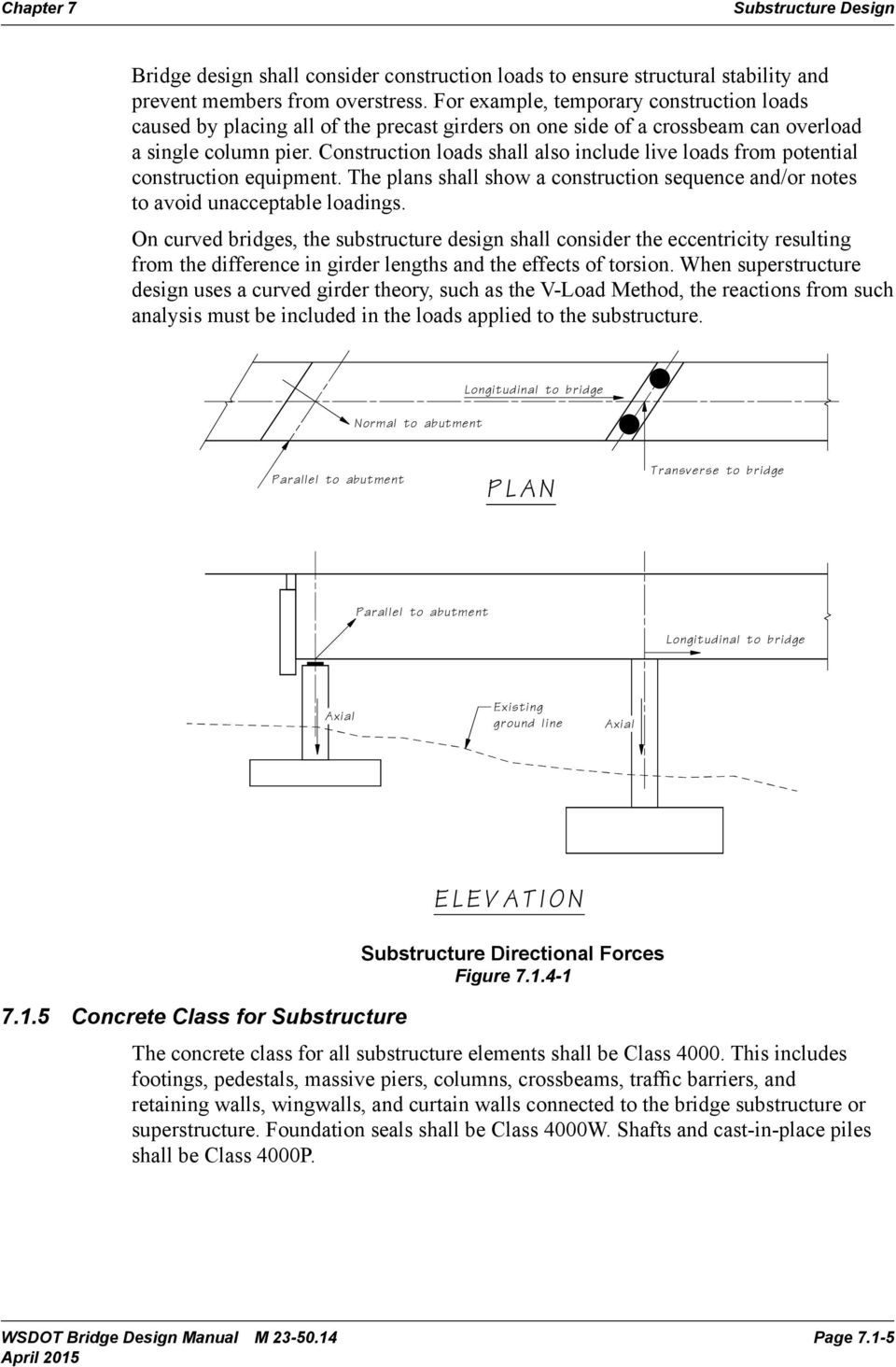
5 Chapter 7 Substructure Design E. Final Foundation Design The last phase completes the geotechnical report and allows the final structural design to begin. The preliminary geotechnical assumptions are checked and recommendations are modified, if necessary. The final report is complete to a PS&E format since the project contract will contain referenced information in the geotechnical report, such as: All geotechnical data obtained at the site (boring logs, subsurface profiles, and laboratory test data). All final foundation recommendations. Final constructability and staging recommendations. The designer reviews the final report for new information and confirms the preliminary assumptions. With the foundation design complete, the final bridge structural design and detailing process continues to prepare the bridge plans. Following final structural design, the structural designer shall follow up with the geotechnical designer to ensure that the design is within the limits of the geotechnical report Foundation Design Limit States The controlling limit states for WSDOT projects for substructure design are described as follows: Strength I Relating to the normal vehicular use Strength III Relating to the bridge exposed to wind Strength V Relating to the normal vehicular use and wind Extreme-Event I Relating to earthquake Service I Relating to normal operational use and wind Seismic Design The seismic design of all substructures shall be in accordance with the AASHTO Seismic Specifications except as noted otherwise Substructure and Foundation Loads Figure below provides a common basis of understanding for load location and orientations for substructure design. This figure also shows elevations required for abutment and substructure design. Note that for shaft and some pile foundation designs, the shaft or pile may form the column as well as the foundation element. Spread footings usually have a design orientation normal to the footing. Since bridge loads are longitudinal and transverse, skewed superstructure loads are converted (using vector components) to normal and parallel footing loads. Deep foundation analysis usually has a normal/parallel orientation to the pier in order to simplify group effects. Substructure elements are to carry all of the loads specified in AASHTO Seismic and LRFD specs. Selecting the controlling load conditions requires good judgment to minimize design time. All anticipated dead load (DC) conditions shall be accounted for during a substructure design. Sidesway effect shall be included where it tends to increase stresses. For live loads (LL), the dynamic allowance (IM) shall be applied in accordance with AASHTO LRFD and is not included in the design of buried elements of the substructure. Portions of the abutments in contact with the soil are considered buried elements. WSDOT ridge Design Manual M Page 7.1-3

6 Substructure Design Chapter 7 Overall Design Process for LRFD Foundation Design Figure Page WSDOT ridge Design Manual M

7 Chapter 7 Substructure Design ridge design shall consider construction loads to ensure structural stability and prevent members from overstress. For example, temporary construction loads caused by placing all of the precast girders on one side of a crossbeam can overload a single column pier. Construction loads shall also include live loads from potential construction equipment. The plans shall show a construction sequence and/or notes to avoid unacceptable loadings. On curved bridges, the substructure design shall consider the eccentricity resulting from the difference in girder lengths and the effects of torsion. When superstructure design uses a curved girder theory, such as the V-Load Method, the reactions from such analysis must be included in the loads applied to the substructure Concrete Class for Substructure Substructure Directional Forces Figure The concrete class for all substructure elements shall be Class 4. This includes footings, pedestals, massive piers, columns, crossbeams, traffic barriers, and retaining walls, wingwalls, and curtain walls connected to the bridge substructure or superstructure. Foundation seals shall be Class 4W. Shafts and cast-in-place piles shall be Class 4P. WSDOT ridge Design Manual M Page 7.1-5
8 Substructure Design Chapter Foundation Seals A concrete seal within the confines of a cofferdam permits construction of a pier footing and column in the dry. This type of underwater construction is practical to a water depth of approximately 5 feet. Seal concrete is placed underwater with the use of a tremie. A tremie is a long pipe that extends to the bottom of the excavation and permits a head to be maintained on the concrete during placement. After the concrete has been placed and has obtained sufficient strength, the water within the cofferdam is removed. In Figure , some of the factors that must be considered in designing a seal are illustrated. Figure A. General Seal Criteria The normal high water elevation is defined as the highest water surface elevation that may normally be expected to occur during a given time period. This elevation, on the hydraulics data sheet, is obtained from discussions with local residents or by observance of high water marks at the site. The normal high water is not related to any flood condition. 1. Seal Vent Elevation The Hydraulics ranch recommends a seal vent elevation in accordance with the following criteria. a. Construction Time Period Not Known If the time period of the footing construction is not known, the vent elevation reflects the normal high water elevation that might occur at any time during the year. b. Construction Time Period Known If the time period of the footing construction can be anticipated, the vent elevation reflects the normal high water elevation that might occur during this time period. (If the anticipated time period of construction is later changed, the Hydraulics ranch shall be notified and appropriate changes made in the design.) Page WSDOT ridge Design Manual M

9 Chapter 7 Substructure Design 2. Scour Depth The Hydraulics ranch determines the depth of the anticipated scour. The bottom of footing, or bottom of seal if used, shall be no higher than the scour depth elevation. After preliminary footing and seal thicknesses have been determined, the bridge designer shall review the anticipated scour elevation with the Hydraulics ranch to ensure that excessive depths are not used. 3. Foundation Elevation Recommended in Geotechnical Report ased on the results obtained from test borings at the site, the geotechnical engineer determines a foundation elevation, bearing capacity and settlement criteria. If other factors control, such as scour or footing cover, the final footing elevation shall be adjusted as required. 4. Unusual Conditions Unusual site conditions such as rock formations or deep foundations require special considerations in order to obtain the most optimum design. The proposed foundation design/construction shall be discussed with both the Geotechnical ranch and the Hydraulics ranch prior to final plan preparation.. Spread Footing Seals The Geotechnical ranch will generally recommend whether a foundation seal may or may not be required for construction. earing loads are the column moments applied at the base of the footing and vertical load applied at the bottom of the seal. The seal is sized for the soil bearing capacity. Overturning stability need only be checked at the base of the pier footing. 1. When a Seal is Required During Construction If the footing can be raised without violating cover requirements, the bottom of the seal elevation shall be the lower of the scour elevation or the foundation elevation as recommended by the geotechnical engineer. The bottom of the seal may be lower than the scour elevation or foundation elevation due to cover requirements. Spread footing final design shall include the dead load weight of the seal. 2. When a Seal May Not e Required for Construction oth methods of construction are detailed in the plans when it is not clear if a seal is required for construction. The plans must detail a footing with a seal and an alternate without a seal. The plan quantities are based on the footing designed with a seal. If the alternate footing elevation is different from the footing with seal, it is also necessary to note on the plans the required changes in rebar such as length of column bars, increased number of ties, etc. Note that this requires the use of either General Special Provision (GSP) 2361.G6 or 2362.G6. WSDOT ridge Design Manual M Page 7.1-7

10 Substructure Design Chapter 7 C. Pile Footing Seals The top of footing, or pedestal, is set by the footing cover requirements. The bottom of seal elevation is based on the stream scour elevation determined by the Hydraulics ranch. A preliminary analysis is made using the estimated footing and seal weight, and the column moments and vertical load at the base of the footing to determine the number of piles and spacing. The seal size shall be 1 - larger than the footing all around. If the seal is omitted during construction, the bottom of footing shall be set at the scour elevation and an alternate design is made. In general seal design requires determining a thickness such that the seal weight plus any additional resistance provided by the bond stress between the seal concrete and any piling is greater than the buoyant force (determined by the head of water above the seal). If the bond stress between the seal concrete and the piling is used to determine the seal thickness, the uplift capacity of the piles must be checked against the loads applied to them as a result of the bond stress. The bond between seal concrete and piles is typically assumed to be 1 psi. The minimum seal thickness is 1-6. Page WSDOT ridge Design Manual M

11 Chapter 7 Substructure Design 7.2 Foundation Modeling for Seismic Loads General ridge modeling for seismic events shall be in accordance with requirements of the AASHTO Seismic Section 5, Analytical Models and Procedures. The following guidance is for elastic dynamic analysis. Refer to AASHTO Seismic 5.4 for other dynamic analysis procedures Substructure Elastic Dynamic Analysis Procedure The following is a general description of the iterative process used in an elastic dynamic analysis. Note: An elastic dynamic analysis is needed to determine the displacement demand, D. The substructure elements are first designed using Strength, Service or Extreme II limit state load cases prior to performing the dynamic analysis. 1. uild a Finite Element Model (FEM) to determine initial structure response (EQ+DL). Assume that foundation springs are located at the bottom of the column. A good initial assumption for fixity conditions of deep foundations (shafts or piles) is to add 1 to the column length in stiff soils and 15 to the column in soft soils. Use multi-mode response spectrum analysis to generate initial displacements. 2. Determine foundation springs using results from the seismic analysis in the longitudinal and transverse directions. Note: The load combinations specified in AASHTO Seismic 4.4 shall NOT be used in this analysis. 3. For spread footing foundations, the FEM will include foundation springs calculated based on the footing size as calculated in Section of this manual. No iteration is required unless the footing size changes. Note: For Site Classes A and the AASHTO Seismic Specification allows spread footings to be modeled as rigid or fixed. 4. For deep foundation analysis, the FEM and the soil response program must agree or converge on soil/structure lateral response. In other words, the moment, shear, deflection, and rotation of the two programs should be within 1 percent. More iteration will provide convergence much less than 1 percent. The iteration process to converge is as follows: a. Apply the initial FEM loads (moment and shear) to a p-y type soil response program such as LPILE (including LPILE, LPILE-SHAFT and LPILE-GROUP). b. Calculate foundation spring values for the FEM. Note: The load combinations specified in AASHTO Seismic 4.4 shall not be used to determine foundation springs. c. Re-run the seismic analysis using the foundation springs calculated from the soil response program. The structural response will change. Check to insure the FEM results (M, V, Δ, θ, and spring values) in the transverse and longitudinal direction are within 1 percent of the previous run. This check verifies the linear spring, or soil response (calculated by the FEM) is close to the predicted nonlinear soil behavior (calculated by the soil response program). If the results of the FEM and the soil response program differ by more than 1 percent, WSDOT ridge Design Manual M Page 7.2-1

12 Substructure Design Chapter 7 recalculate springs and repeat steps (a) thru (c) until the two programs converge to within 1 percent. Special note for single column/single shaft configuration: The seismic design philosophy requires a plastic hinge in the substructure elements above ground (preferably in the columns). Designers should note the magnitude of shear and moment at the top of the shaft, if the column zero moment is close to a shaft head foundation spring, the FEM and soil response program will not converge and plastic hinging might be below grade. Throughout the iteration process it is important to note that any set of springs developed are only applicable to the loading that was used to develop them (due to the inelastic behavior of the soil in the foundation program). This can be a problem when the forces used to develop the springs are from a seismic analysis that combines modal forces using a method such as the Complete Quadratic Combination (CQC) or other method. The forces that result from this combination are typically dominated by a single mode (in each direction as shown by mass participation). This results in the development of springs and forces that are relatively accurate for that structure. If the force combination (CQC or otherwise) is not dominated by one mode shape (in the same direction), the springs and forces that are developed during the above iteration process may not be accurate. LPILE may be used for a pile group-supported footing. Pile or shaft foundation group effects for lateral loading shall be taken as recommended in the project geotechnical report. The liquefaction option in LPILE shall not be used (the liquefaction option shall be disabled). The Liquefied Sand soil type shall not be used in LPILE ridge Model Section Properties In general, gross section properties may be assumed for all FEM members, except concrete columns. A. Cracked Properties for Columns Effective section properties shall be in accordance with the AASHTO Seismic Section Shaft Properties The shaft concrete strength and construction methods lead to significant variation in shaft stiffness described as follows. For a stiff substructure response: 1. Use 1.5 ƒ c to calculate the modulus of elasticity. Since aged concrete will generally reach a compressive strength of at least 6 ksi when using a design strength of 4 ksi, the factor of 1.5 is a reasonable estimate for an increase in stiffness. 2. Use I g based on the maximum oversized shaft diameter allowed by Standard Specifications Section When permanent casing is specified, increase shaft I g using the transformed area of a ¾ thick casing. Since the contractor will determine the thickness of the casing, ¾ is a conservative estimate for design. Page WSDOT ridge Design Manual M

13 Chapter 7 Substructure Design For a soft substructure response: 1. Use.85 ƒ c to calculate the modulus of elasticity. Since the quality of shaft concrete can be suspect when placed in water, the factor of.85 is an estimate for a decrease in stiffness. 2. Use I g based on the nominal shaft diameter. Alternatively, I e may be used when it is reflective of the actual load effects in the shaft. 3. When permanent casing is specified, increase I using the transformed area of a ⅜ thick casing. Since the contractor will determine the thickness of the casing, ⅜ is a minimum estimated thickness for design. C. Cast-in-Place Pile Properties For a stiff substructure response: 1. Use 1.5 ƒ c to calculate the modulus of elasticity. Since aged concrete will generally reach a compressive strength of at least 6 ksi when using a design strength of 4 ksi, the factor of 1.5 is a reasonable estimate for an increase in stiffness. 2. Use the pile I g plus the transformed casing moment of inertia ( ) Where: n = E 1 3 s /E c Use a steel casing thickness of ¼ for piles less than 14 in diameter, ⅜ for piles 14 to 18 in diameter, and ½ for larger piles. Note: These casing thicknesses are to be used for analysis only, the contractor is responsible for selecting the casing thickness required to drive the piles For a soft substructure response: 1. Use ƒ c to calculate the modulus of elasticity. 2. Use pile I g, neglecting casing properties ridge Model Verification As with any FEM, the designer should review the foundation behavior to ensure the foundation springs correctly imitate the known boundary conditions and soil properties. Watch out for mismatch of units. All finite element models must have dead load static reactions verified and boundary conditions checked for errors. The static dead loads (DL) must be compared with hand calculations or another program s results. For example, span member end moment at the supports can be released at 1 3 the piers to determine simple span reactions. Then hand calculated simple span DL or PGsuper DL and LL is used to verify the model Crossbeam behavior must be checked 1 to ensure the superstructure DL is correctly distributing to substructure elements. A 3D bridge line model concentrates the superstructure mass and stresses to a point in the crossbeam. Generally, interior columns will have a much higher loading than the exterior columns. To improve the model, crossbeam I g should be increased to provide the statically correct column A 11 WSDOT ridge Design Manual M Page

14 Substructure Design Chapter 7 DL reactions. This may require increasing I g by about 1 times. Many times this is not visible graphically and should be verified by checking numerical output. Note that most finite element programs have the capability of assigning constraints to the crossbeam and superstructure to eliminate the need for increasing the I g of the crossbeam. Seismic analysis may also be verified by hand calculations. Hand calculated fundamental mode shape reactions will be approximate; but will ensure design forces are of the same magnitude. Designers should note that additional mass might have to be added to the bridge FEM for seismic analysis. For example, traffic barrier mass and crossbeam mass beyond the last column at piers may contribute significant weight to a two-lane or ramp structure Deep Foundation Modeling Methods A designer must assume a foundation support condition that best represents the foundation behavior. Deep foundation elements attempt to imitate the non-linear lateral behavior of several soil layers interacting with the deep foundation. The bridge FEM then uses the stiffness of the element to predict the seismic structural response. Models using linear elements that are not based on non-linear soil-structure interaction are generally considered inaccurate for soil response/element stress and are not acceptable. There are three methods used to model deep foundations (FHWA Report No. 1P-87-6). Of these three methods the ridge and Structures Office prefers Method II for the majority of bridges. A. Method I Equivalent Cantilever Column This method assumes a point of fixity some depth below the bottom of the column to model the stiffness of the foundation element. This shall only be used for a preliminary model of the substructure response in SDC C and D.. Method II Equivalent ase Springs This method models deep foundations by using a {6x6} matrix. There are two techniques used to generate the stiffness coefficients for the foundation matrix. The equivalent stiffness coefficients assessed are valid only at the given level of loading. Any changes of the shaft-head loads or conditions will require a new run for the program to determine the new values of the equivalent stiffness coefficients. These equivalent stiffness coefficients account for the nonlinear response of shaft materials and soil resistance. Technique I The matrix is generated, using superposition, to reproduce the non-linear behavior of the soil and foundation at the maximum loading. With Technique I, 1 terms are produced, 4 of these terms are cross couples. Soil response programs analyze the non linear soil response. The results are then used to determine the equivalent base springs. See Appendix 7-1 for more information. Technique II The equivalent stiffness matrix generated using this technique uses only the diagonal elements (no cross coupling stiffnesses). This technique is recommended to construct the foundation stiffness matrix (equivalent base springs). Page WSDOT ridge Design Manual M

15 Chapter 7 Substructure Design In Technique II the cross couple effects are internally accounted for as each stiffness element and displacement is a function of the given Lateral load (P) and Moment (M). Technique II uses the total response (D t(p,m) q t(p,m) ) to determine displacement and equivalent soil stiffness, maintaining a nonlinear analysis. Technique I requires superposition by adding the individual responses due to the lateral load and moment to determine displacement and soil stiffness. Using superposition to combine two nonlinear responses results in errors in displacement and stiffness for the total response as seen in the Figure As illustrated, the total response due to lateral load (P) and moment (M) does not necessarily equal the sum of the individual responses. C. Method III Non-Linear Soil Springs This method attaches non-linear springs along the length of deep foundation members in a FEM model. See Appendix 7-2 for more information. This method has the advantage of solving the superstructure and substructure seismic response simultaneously. The soil springs must be nonlinear PY curves and represent the soil/structure interaction. This cannot be done during response spectrum analysis with some FEM programs. D. Spring Location (Method II) The preferred location for a foundation spring is at the bottom of the column. This includes the column mass in the seismic analysis. For design, the column forces are provided by the FEM and the soil response program provides the foundation forces. Springs may be located at the top of the column. However, the seismic analysis will not include the mass of the columns. The advantage of this location is the soil/structure analysis includes both the column and foundation design forces. Limitations on the Technique I (Superposition Technique) Figure WSDOT ridge Design Manual M Page 7.2-5

16 Substructure Design Chapter 7 Designers should be careful to match the geometry of the FEM and soil response program. If the location of the foundation springs (or node) in the FEM does not match the location input to the soil response program, the two programs will not converge correctly. E. oundary Conditions (Method II) To calculate spring coefficients, the designer must first identify the predicted shape, or direction of loading, of the foundation member where the spring is located in the bridge model. This will determine if one or a combination of two boundary conditions apply for the transverse and longitudinal directions of a support. A fixed head boundary condition occurs when the foundation element is in double curvature where translation without rotation is the dominant behavior. Stated in other terms, the shear causes deflection in the opposite direction of applied moment. This is a common assumption applied to both directions of a rectangular pile group in a pile supported footing. A free head boundary condition is when the foundation element is in single curvature where translation and rotation is the dominant behavior. Stated in other terms, the shear causes deflection in the same direction as the applied moment. Most large diameter shaft designs will have a single curvature below ground line and require a free head assumption. The classic example of single curvature is a single column on a single shaft. In the transverse direction, this will act like a flagpole in the wind, or free head. What is not so obvious is the same shaft will also have single curvature in the longitudinal direction (below the ground line), even though the column exhibits some double curvature behavior. Likewise, in the transverse direction of multi-column piers, the columns will have double curvature (frame action). The shafts will generally have single curvature below grade and the free head boundary condition applies. The boundary condition for large shafts with springs placed at the ground line will be free head in most cases. The key to determine the correct boundary condition is to resolve the correct sign of the moment and shear at the top of the shaft (or point of interest for the spring location). Since multi-mode results are always positive (CQC), this can be worked out by observing the seismic moment and shear diagrams for the structure. If the sign convention is still unclear, apply a unit load in a separate static FEM run to establish sign convention at the point of interest. The correct boundary condition is critical to the seismic response analysis. For any type of soil and a given foundation loading, a fixed boundary condition will generally provide soil springs four to five times stiffer than a free head boundary condition. Page WSDOT ridge Design Manual M

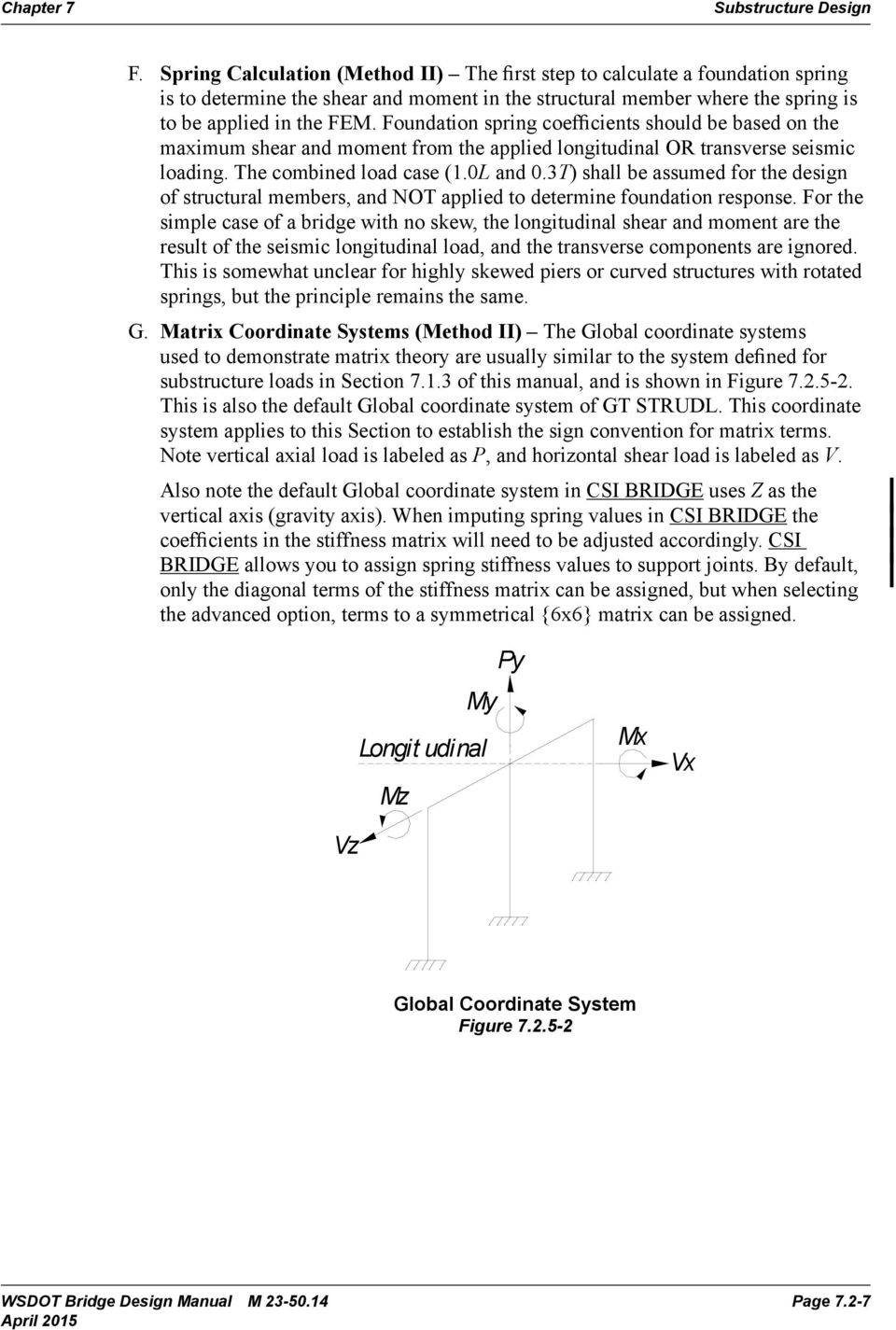
17 Chapter 7 Substructure Design F. Spring Calculation (Method II) The first step to calculate a foundation spring is to determine the shear and moment in the structural member where the spring is to be applied in the FEM. Foundation spring coefficients should be based on the maximum shear and moment from the applied longitudinal OR transverse seismic loading. The combined load case (1.L and.3t) shall be assumed for the design of structural members, and NOT applied to determine foundation response. For the simple case of a bridge with no skew, the longitudinal shear and moment are the result of the seismic longitudinal load, and the transverse components are ignored. This is somewhat unclear for highly skewed piers or curved structures with rotated springs, but the principle remains the same. G. Matrix Coordinate Systems (Method II) The Global coordinate systems used to demonstrate matrix theory are usually similar to the system defined for substructure loads in Section of this manual, and is shown in Figure This is also the default Global coordinate system of GT STRUDL. This coordinate system applies to this Section to establish the sign convention for matrix terms. Note vertical axial load is labeled as P, and horizontal shear load is labeled as V. Also note the default Global coordinate system in CSI RIDGE uses Z as the vertical axis (gravity axis). When imputing spring values in CSI RIDGE the coefficients in the stiffness matrix will need to be adjusted accordingly. CSI RIDGE allows you to assign spring stiffness values to support joints. y default, only the diagonal terms of the stiffness matrix can be assigned, but when selecting the advanced option, terms to a symmetrical {6x6} matrix can be assigned. Py My Longit udinal Mz Vz Mx Vx Global Coordinate System Figure WSDOT ridge Design Manual M Page 7.2-7
18 Substructure Design Chapter 7 H. Matrix Coefficient Definitions (Method II) The stiffness matrix containing the spring values and using the standard coordinate system is shown in Figure (Note that cross-couple terms generated using Technique I are omitted). For a description of the matrix generated using Technique I see Appendix 7-1. The coefficients in the stiffness matrix are generally referred to using several different terms. Coefficients, spring or spring value are equivalent terms. Lateral springs are springs that resist lateral forces. Vertical springs resist vertical forces. Vx Py Vz Mx My Mz Vx K11 Py K22 Vz K33 Mx K44 My K55 Mz K66 Disp. Δx Δy Δz θx θy θz = Force Vx Py Vz Mx My Mz Standard Global Matrix Figure Where the linear spring constants or K values are defined as follows, using the Global Coordinates: K11 = Longitudinal Lateral Stiffness (kip/in) K22 = Vertical or Axial Stiffness (kip/in) K33 = Transverse Lateral Stiffness (kip/in) K44 = Transverse ending or Moment Stiffness (kip-in/rad) K55 = Torsional Stiffness (kip-in/rad) K66 = Longitudinal ending or Moment Stiffness (kip-in/rad) The linear lateral spring constants along the diagonal represent a point on a non-linear soil/structure response curve. The springs are only accurate for the applied loading and less accurate for other loadings. This is considered acceptable for Strength and Extreme Event design. For calculation of spring constants for Technique I see Appendix 7-1. I. Group Effects When a foundation analysis uses Lpile or an analysis using PY relationships, group effects will require the geotechnical properties to be reduced before the spring values are calculated. The geotechnical report will provide transverse and longitudinal multipliers that are applied to the PY curves. This will reduce the pile resistance in a linear fashion. The reduction factors for lateral resistance due to the interaction of deep foundation members is provided in the Geotechnical Design Manual M 46-3, Section J. Shaft Caps and Pile Footings Where pile supported footings or shaft caps are entirely below grade, their passive resistance should be utilized. In areas prone to scour or lateral spreading, their passive resistance should be neglected. Page WSDOT ridge Design Manual M

19 Chapter 7 Substructure Design Lateral Analysis of Piles and Shafts Determination of Tip Elevations Lateral analysis of piles and shafts involves determination of a shaft or pile tip location sufficient to resist lateral loads in both orthogonal directions. In many cases, the shaft or pile tip depth required to resist lateral loads may be deeper than that required for bearing or uplift. However, a good starting point for a tip elevation is the depth required for bearing or uplift. Another good rule-of-thumb starting point for shaft tips is an embedment depth of 6 diameters (6D) to 8 diameters (8D). Refer also to the geotechnical report minimum tip elevations provided by the geotechnical engineer. A parametric study or analysis should be performed to evaluate the sensitivity of the depth of the shaft or pile to the displacement of the structure (i.e. the displacement of the shaft or pile head) in order to determine the depth required for stable, proportionate lateral response of the structure. Determination of shaft or pile tip location requires engineering judgment, and consideration should be given to the type of soil, the confidence in the soil data (proximity of soil borings) and the potential variability in the soil profile. Arbitrarily deepening shaft or pile tips may be conservative but can also have significant impact on constructability and cost. The following is a suggested approach for determining appropriate shaft or pile tip elevations that are located in soils. Other considerations will need to be considered when shaft or pile tips are located in rock, such as the strength of the rock. This approach is based on the displacement demand seismic design procedures specified in the AASHTO Seismic Specifications. 1. Size columns and determine column reinforcement requirements for Strength and Service load cases. 2. Determine the column plastic over-strength moment and shear at the base of the column using the axial dead load and expected column material properties. A program such as XTRACT or CSI RIDGE may be used to help compute these capacities. The plastic moments and shears are good initial loads to apply to a soil response program. In some cases, Strength or other Extreme event loads may be a more appropriate load to apply in the lateral analysis. For example, in eastern Washington seismic demands are relatively low and elastic seismic or Strength demands may control. 3. Perform lateral analysis using the appropriate soil data from the Geotechnical report for the given shaft or pile location. If final soil data is not yet available, consult with the Geotechnical engineer for preliminary values to use for the site. Note: Early in the lateral analysis it is wise to obtain moment and shear demands in the shaft or pile and check that reasonable reinforcing ratios can be used to resist the demands. If not, consider resizing the foundation elements and restart the lateral analysis. WSDOT ridge Design Manual M Page 7.2-9

20 Substructure Design Chapter 7 4. Develop a plot of embedment depth of shaft or pile versus lateral deflection of the top of shaft or pile. The minimum depth, or starting point, shall be the depth required for bearing or uplift or as specified by the geotechnical report. An example plot of an 8 diameter shaft is shown in Figure and illustrates the sensitivity of the lateral deflections versus embedment depth. Notice that at tip depths of approximately 5 (roughly 6D) the shaft head deflections begin to increase substantially with small reductions in embedment depth. The plot also clearly illustrates that tip embedment below 7 has no impact on the shaft head lateral deflection. 5. From the plot of embedment depth versus lateral deflection, choose the appropriate tip elevation. In the example plot in Figure , the engineer should consider a tip elevation to the left of the dashed vertical line drawn in the Figure. The final tip elevation would depend on the confidence in the soil data and the tolerance of the structural design displacement. For example, if the site is prone to variability in soil layers, the engineer should consider deepening the tip; say 1 to 3 diameters, to ensure that embedment into the desired soil layer is achieved. The tip elevation would also depend on the acceptable lateral displacement of the structure. To assess the potential variability in the soil layers, the geotechnical engineer assigned to the project should be consulted. Shaft Tip Elevation vs Shaft Head Deflection 1 Shaft Head Deflection (in) Ground Elev. 2 3 Shaft Tip Embedment (ft) Shaft Tip Elevation vs Shaft Head Deflection Figure Page WSDOT ridge Design Manual M

21 Chapter 7 Substructure Design 6. With the selected tip elevation, review the deflected shape of the shaft or pile, which can be plotted in LPILE. Examples are shown in Figure Depending on the size and stiffness of the shaft or pile and the soil properties, a variety of deflected shapes are possible, ranging from a rigid body (fence post) type shape to a long slender deflected shape with 2 or more inflection points. Review the tip deflections to ensure they are reasonable, particularly with rigid body type deflected shapes. Any of the shapes in the Figure may be acceptable, but again it will depend on the lateral deflection the structure can tolerate. The engineer will also need to consider whether liquefiable soils are present and/ or if the shaft or pile is within a zone where significant scour can occur. In this case the analysis needs to be bracketed to envelope various scenarios. It is likely that a liquefiable or scour condition case may control deflection. In general, the WSDOT policy is to not include scour with Extreme Event I load combinations. In other words, full seismic demands or the plastic over-strength moment and shear, are generally not applied to the shaft or pile in a scoured condition. However, in some cases a portion of the anticipated scour will need to be included with the Extreme Event I load combination limit states. When scour is considered with the Extreme Event I limit state, the soil resistance up to a maximum of 25 percent of the scour depth for the design flood event (1 year) shall be deducted from the lateral analysis of the pile or shaft. In all cases where scour conditions are anticipated at the bridge site or specific pier locations, the geotechnical engineer and the Hydraulics ranch shall be consulted to help determine if scour conditions should be included with Extreme Event I limit states. If liquefaction can occur, the bridge shall be analyzed using both the static and liquefied soil conditions. The analysis using the liquefied soils would typically yield the maximum bridge deflections and will likely control the required tip elevation, whereas the static soil conditions may control for strength design of the shaft or pile. Lateral spreading is a special case of liquefied soils, in which lateral movement of the soil occurs adjacent to a shaft or pile located on or near a slope. Refer to the Geotechnical Design Manual M 46-3 for discussion on lateral spreading. Lateral loads will need to be applied to the shaft or pile to account for lateral movement of the soil. There is much debate as to the timing of the lateral movement of the soil and whether horizontal loads from lateral spread should be combined with maximum seismic inertia loads from the structure. Most coupled analyses are 2D, and do not take credit for lateral flow around shafts, which can be quite conservative. The AASHTO Seismic Spec. permits these loads to be uncoupled; however, the geotechnical engineer shall be consulted for recommendations on the magnitude and combination of loads. See Geotechnical Design Manual M 46-3 Sections and for additional guidance on combining loads when lateral spreading can occur. WSDOT ridge Design Manual M Page
22 Substructure Design Chapter 7 Depth (ft) Depth (ft) Depth (ft) Various Shaft Deflected Shapes Figure Figure Various Shaft Deflected Shapes Page WSDOT ridge Design Manual M
23 Chapter 7 Substructure Design Pile and Shaft Design for Lateral Loads The previous section provides guidelines for establishing tip elevations for shafts and piles. Sensitivity analyses that incorporate both foundation and superstructure kinematics are often required to identify the soil conditions and loadings that will control the tip, especially if liquefied or scoured soil conditions are present. Several conditions will also need to be analyzed when designing the reinforcement for shafts and piles to ensure the controlling case is identified. All applicable strength, service and extreme load cases shall be applied to each condition. A list of these conditions includes, but is not limited to the following: 1. Static soil properties with both stiff and soft shaft or pile properties. Refer to Sections 7.2.3() and 7.2.3(C) for guidelines on computing stiff and soft shaft or pile properties. 2. Dynamic or degraded soil properties with both stiff and soft shaft or pile properties. 3. Liquefied soil properties with both stiff and soft shaft or pile properties. a. When lateral spreading is possible, an additional loading condition will need to be analyzed. The geotechnical engineer shall be consulted for guidance on the magnitude of seismic load to be applied in conjunction with lateral spreading loads. See Geotechnical Design Manual M 46-3 Sections and for additional guidance on combining loads when lateral spreading can occur. 4. Scour condition with stiff and soft shaft or pile properties. The scour condition is typically not combined with Extreme Event I load combinations, however the designer shall consult with the Hydraulics ranch and geotechnical engineer for recommendations on load combinations. If scour is considered with the Extreme Event I limit state, the analysis should be conducted assuming that the soil in the upper 25 percent of the estimated scour depth for the design (1 year) scour event has been removed to determine the available soil resistance for the analysis of the pile or shaft. Note: Often, the highest acceleration the bridge sees is in the first cycles of the earthquake, and degradation and/or liquefaction of the soil tends to occur toward the middle or end of the earthquake. Therefore, early in the earthquake, loads are high, soil-structure stiffness is high, and deflections are low. Later in the earthquake, the soil-structure stiffness is lower and deflections higher. This phenomenon is normally addressed by bracketing the analyses as discussed above. However, in some cases a site specific procedure may be required to develop a site specific design response spectrum. A site specific procedure may result in a reduced design response spectrum when compared to the general method specified in the AASHTO Seismic 3.4. Section 3.4 requires the use of spectral response parameters determined using USGA/AASHTO Seismic Hazard Maps. The AASHTO Seismic Spec. limits the reduced site specific response spectrum to two-thirds of what is produced using the general method. Refer to the Geotechnical Design Manual M 46-3 Chapter 6 for further discussion and consult the geotechnical engineer for guidance. Refer to Section 7.8 Shafts and Chapter 4 for additional guidance/requirements on design and detailing of shafts and Section 7.9 Piles and Piling and Chapter 4 for additional guidance/requirements on design and detailing of piles. WSDOT ridge Design Manual M Page
24 Substructure Design Chapter Spread Footing Modeling For a first trial footing configuration, Strength column moments or column plastic hinging moments may be applied to generate footing dimensions. Soil spring constants are developed using the footing plan area, thickness, embedment depth, Poisson s ratio ν, and shear modulus G. The Geotechnical ranch will provide the appropriate Poisson s ratio and shear modulus. Spring constants for shallow rectangular footings are obtained using the following equations developed for rectangular footings. This method for calculating footing springs is referenced in ASCE 41-6, Section (Note: ASCE 41-6 was developed from FEMA 356.) Orient axes such that L >. If L = use x-axis equations for both x-axis and y-axis. Figure Where: K = β K sur K = Translation or rotational spring K sur = Stiffness of foundation at surface, see Table β = Correction factor for embedment, see Table Page WSDOT ridge Design Manual M
25 Chapter 7 Orient axes such that. If use x-axis equations for both x-axis and y-axis. Orient axes such that L >. If L = Figure use x-axis equations for both x-axis Substructure and y-axis. Design Figure Degree of Freedom Degree of Freedom Translation along x-axis Translation along x-axis Translation along y-axis Translation along y-axis Translation along z-axis Translation along z-axis Rocking about Rocking x-axis about x-axis Rocking about Rocking y-axis about y-axis Torsion about Torsion z-axis about z-axis K sur Ksur G L v G L L v G L v 3 G L v G L v L G Formatted Tab Formatted Tab Stiffness of Foundation at Surface Stiffness of Table Foundation at SurfaceCoefficients Stiffness of Foundation FigureTable at SurfaceCoefficients FigureTable Where: d = Height of effective sidewall contact (may be less than total foundation height if the foundation is exposed). h = Depth to centroid of effective sidewall contact. Figure WSDOT ridge Design Manual M Page
26 Substructure Design Chapter 7 Page WSDOT ridge Design Manual M Degree of Freedom β Translation along x-axis h = Depth to centroid of effective sidewall contact. Figure Degree of Freedom β Translation along x-axis L L hd D Translation along y-axis L L hd L D Translation along z-axis L L d L D Rocking about x-axis L D d d d Rocking about y-axis D d L d L d Torsion about z-axis d L Correction Factor for Embedment Table Translation along y-axis h = Depth to centroid of effective sidewall contact. Figure Degree of Freedom β Translation along x-axis L L hd D Translation along y-axis L L hd L D Translation along z-axis L L d L D Rocking about x-axis L D d d d Rocking about y-axis D d L d L d Torsion about z-axis d L Correction Factor for Embedment Table Translation along z-axis h = Depth to centroid of effective sidewall contact. Figure Degree of Freedom β Translation along x-axis L L hd D Translation along y-axis L L hd L D Translation along z-axis L L d L D Rocking about x-axis L D d d d Rocking about y-axis D d L d L d Torsion about z-axis d L Correction Factor for Embedment Table Rocking about x-axis total foundation height if the foundation is exposed). h = Depth to centroid of effective sidewall contact. Figure Degree of Freedom β Translation along x-axis L L hd D Translation along y-axis L L hd L D Translation along z-axis L L d L D Rocking about x-axis L D d d d Rocking about y-axis D d L d L d Torsion about z-axis d L Correction Factor for Embedment Table Rocking about y-axis total foundation height if the foundation is exposed). h = Depth to centroid of effective sidewall contact. Figure Degree of Freedom β Translation along x-axis L L hd D Translation along y-axis L L hd L D Translation along z-axis L L d L D Rocking about x-axis L D d d d Rocking about y-axis D d L d L d Torsion about z-axis d L Correction Factor for Embedment Table Torsion about z-axis total foundation height if the foundation is exposed). h = Depth to centroid of effective sidewall contact. Figure Degree of Freedom β Translation along x-axis L L hd D Translation along y-axis L L hd L D Translation along z-axis L L d L D Rocking about x-axis L D d d d Rocking about y-axis D d L d L d Torsion about z-axis d L Correction Factor for Embedment Table Correction Factor for Embedment Table
27 Chapter 7 Substructure Design 7.3 Column Design Preliminary Plan Stage The preliminary plan stage determines the initial column size, column spacing, and bridge span length based on a preliminary analysis. Columns are spaced to give maximum structural benefit except where aesthetic considerations dictate otherwise. Piers normally are spaced to meet the geometric and aesthetic requirements of the site and to give maximum economy for the total structure. Good preliminary engineering judgment results in maximum economy for the total structure. The designer may make changes after the preliminary plan stage. The Design Unit Manager will need to review all changes, and if the changes are more than minor dimension adjustments, the ridge Project Support Engineer and the State ridge and Structures Architect will also need to be involved in the review. Tall piers spaced farther apart aesthetically justify longer spans. Difficult and expensive foundation conditions will also justify longer spans. Span lengths may change in the design stage if substantial structural improvement and/or cost savings can be realized. The designer should discuss the possibilities of span lengths or skew with the Design Unit Manager as soon as possible. Changes in pier spacing at this stage can have significant negative impacts to the geotechnical investigation. Column spacing should minimize column dead load moments. Multiple columns are better suited for handling lateral loads due to wind and/or earthquake. The designer may alter column size or spacing for structural reasons or change from a single-column pier to a multicolumn pier General Column Criteria Columns should be designed so that construction is as simple and repetitious as possible. The diameter of circular columns should be a multiple of one foot, however increments of 6 inches may be appropriate in some cases. Rectangular sections shall have lengths and widths that are multiples of 3 inches. Long rectangular columns are often tapered to reduce the amount of column reinforcement required for strength. Tapers should be linear for ease of construction. Understanding the effects on long columns due to applied loads is fundamental in their design. Loads applied to the columns consist of reactions from loads applied to the superstructure and loads applied directly to the columns. For long columns, it may be advantageous to reduce the amount of reinforcement as the applied loads decrease along the column. In these cases, load combinations need to be generated at the locations where the reinforcement is reduced. A. Construction Joints ridge plans shall show column construction joints at the top of footing or pedestal and at the bottom of crossbeam. Optional construction joints with roughened surfaces should be provided at approximately 3-foot vertical spacing.. Modes of Failure A column subject to axial load and moment can fail in several modes. A short column can fail due to crushing of the concrete or to failure of the tensile reinforcement. A long column can fail due to elastic buckling even though, in the initial stages, stresses are well within the normal allowable range. WSDOT ridge Design Manual M Page 7.3-1
28 Substructure Design Chapter 7 Long column failure is normally a combination of stability and strength failure that might occur in the following sequence: 1. Axial load is applied to the column. 2. ending moments are applied to the column, causing an eccentric deflection. 3. Axial loads act eccentrically to the new column center line producing P-D moments which add directly to the applied moments. 4. P-D moments increase the deflection of the column and lead to more eccentricity and moments. 5. The P-D analysis must prove the column loading and deflection converges to a state where column stresses are acceptable. Otherwise, the column is not stable and failure can be catastrophic. Refer to AASHTO Seismic for discussion on P-D effects and when they shall be considered in the design. In most cases P-D effects can be neglected. Unlike building columns, bridge columns are required to resist lateral loads through bending and shear. As a result, these columns may be required to resist relatively large applied moments while carrying nominal axial loads. In addition, columns are often shaped for appearance. This results in complicating the analysis problem with non-prismatic sections Column Design Flowchart Evaluation of Slenderness Effects illustrates the basic steps in the column design process for evaluating the effects of slenderness on columns and methods for computing magnification of moments on columns. Page WSDOT ridge Design Manual M
29 Chapter 7 Substructure Design Column Design Flowchart for Non-Seismic Design Figure WSDOT ridge Design Manual M Page 7.3-3
30 Substructure Design Chapter Slenderness Effects This section supplements and clarifies AASHTO LRFD specifications. The goal of a slenderness analysis is to estimate the additional bending moments in the columns that are developed due to axial loads acting upon a deflected structure. Two primary analysis methods exist: the moment magnifier method and the second-order analysis. The designer must decide which method to use based upon the slenderness ratio (kl u /r) of the column(s). Method 1: Allowed if kl u /r < 1. Section discusses the approximate moment magnifier method that is generally more conservative and easier to apply. Method 2: Recommended by AASHTO LRFD for all situations and is mandatory for kl u /r > 1. Section discusses a second-order structural analysis that accounts directly for the axial forces and can lead to significant economy in the final structure. In general, tall thin columns and piles above ground (pile bents) are considered unbraced and larger short columns are considered braced. A. raced or Unbraced Columns In a member with loads applied at the joints, any significant deflection sideways indicated the member is unbraced. The usual practice is to consider the pier columns as unbraced in the transverse direction. The superstructure engages girder stops at the abutment and resists lateral sidesway due to axial loads. However, pier lateral deflections are significant and are considered unbraced. Short spanned bridges may be an exception. Most bridge designs provide longitudinal expansion bearings at the end piers. Intermediate columns are considered unbraced because they must resist the longitudinal loading. The only time a column is braced in the longitudinal direction is when a framed bracing member does not let the column displace more than L/15. L is the total column length. In this case, the bracing member must be designed to take all of the horizontal forces Moment Magnification Method The moment magnification method is described in AASHTO LRFD The following information is required. Column geometry and properties: E, I, L u, and k. All Strength loads obtained from conventional elastic analyses using appropriate stiffness and fixity assumptions and column under strength factor (f). Computations of effective length factors, k, and buckling loads, Pc, are not required for a second-order analysis, though they may be helpful in establishing the need for such an analysis. In general, if magnification factors computed using the AASHTO LRFD specifications are found to exceed about 1.4, then a second-order analysis may yield substantial benefits. Page WSDOT ridge Design Manual M
31 Chapter 7 Substructure Design Second-Order Analysis A second-order analysis that includes the influence of axial loads on the deflected structure is required under certain circumstances, and may be advisable in others. It can lead to substantial economy in the final design of many structures. The designer should discuss the situation with the Design Unit Manager before proceeding with the analysis. The ACI uilding Code (ACI 318-8), should be consulted when carrying out a second-order analysis. For columns framed together, the entire frame should be analyzed as a unit. Analyzing individual columns result in overly conservative designs for some columns and nonconservative results for others. This is a result of redistribution of the lateral loads in response to the reduced stiffness of the compression members. For example, in a bridge with long, flexible columns and with short, stiff columns both integrally connected to a continuous superstructure, the stiff columns will tend to take a larger proportion of the lateral loading as additional sidesway under axial loads occurs. A. Design Methods for a Second-Order Analysis The preferred method for performing a second-order analysis of an entire frame or isolated single columns is to use a nonlinear finite element program, such as GTSTRUDL, with appropriate stiffness and restraint assumptions. The factored group loads are applied to the frame, including the self-weight of the columns. The model is then analyzed using the nonlinear option available in GTSTRUDL. The final design moments are obtained directly from the analysis. PD moments are added to the applied moments using an iterative process until stability is reached. The deflections should converge within 5 percent of the total deflection. Analysis must include the effect of the column weight; therefore, the axial dead load must be adjusted as follows: ( ). Applying Factored Loads For a second-order analysis, loads are applied to the structure and the analysis results in member forces and deflections. It must be recognized that a second-order analysis is non-linear and the commonly assumed principle of superposition may not be applicable. The loads applied to the structure should be the entire set of factored loads for the load group under consideration. The analysis must be repeated for each group load of interest. The problem is complicated by the fact that it is often difficult to predict in advance which load groups will govern For certain loadings, column moments are sensitive to the stiffness assumptions used in the analysis. For example, loads developed as a result of thermal deformations within a structure may change significantly with changes in column, beam, and foundation stiffness. Accordingly, upper and lower bounds on the stiffness should be determined and the analysis repeated using both sets to verify the governing load has been identified WSDOT ridge Design Manual M Page
32 Substructure Design Chapter Shear Design Column Silos C. Member Properties As with a conventional linear elastic frame analysis, various assumptions and simplifications must be made concerning member stiffness, connectivity, and foundation restraint. Care must be taken to use conservative values for the slenderness analysis. Reinforcement, cracking, load duration, and their variation along the members are difficult to model while foundation restraint will be modeled using soil springs. Shear design should follow the Simplified Procedure for Nonprestressed Sections in AASHTO LRFD Column silos are an acceptable technique to satisfy the balanced stiffness and frame geometry requirements of Section and the AASHTO Seismic Specifications. Due to the construction and inspection complications of column silos, designers are encouraged to meet balanced stiffness and frame geometry requirements by the other methods suggested in Section of the AASHTO Seismic Specifications prior to use of column silos. A. General Design and Detailing Requirements 1. Column silo plans, specifications, and estimates shall be included in the Contract Documents. 2. Column silos shall be designed to resist lateral earth and hydrostatic pressure, including live load surcharge if applicable, for a 75-year minimum service life. 3. Column silos are not permitted for in-water locations such as in rivers and lakes. 4. Clearance between the column and the column silo shall be adequate for column lateral displacement demands, construction and post-earthquake inspection, but shall not be less than A 6 minimum clearance shall be provided from the top of column silo to ground level. 6. Maximum depth of column silos shall not exceed 15 feet. 7. Column silos shall be watertight when located below the highest expected groundwater elevation. Silo covers need not be liquidtight. 8. Column silos shall be positively attached to the foundation element. Page WSDOT ridge Design Manual M
33 Chapter 7 Substructure Design. Column Silos Formed From Extending Shaft Casing Designers shall determine a minimum steel casing thickness sufficient to resist lateral loads and shall provide it in the Contract Documents. This thickness shall include a sacrificial steel area as recommended in AASHTO LRFD Specification Section C1.7.5 for corrosion resistance. The actual steel casing size and materials shall be determined by the Contractor as delineated in Standard Specifications Section 6-19 and Appropriate detailing, as shown in Figure , shall be provided. The designer shall check that the minimum column-to-silo horizontal clearance is provided even if the permanent casing is constructed with a smaller diameter slip casing. C. Column Silos Formed by Other Methods Column silos formed by other methods, such as corrugated metal pipes, may be considered if the general requirements above are satisfied. D. Column Silo Covers and Access Hatches A column silo cover, including access hatches, shall be specified in the Contract Plans as shown in Appendix 7.3-A1-1. Column silo covers and access hatches shall be painted in accordance with Standard Specifications Section 6-7.3(9). Column silo covers shall be protected from vehicular loading. Column silo covers shall be capable of sliding on top of the column silo and shall not restrain column lateral displacement demands. Obstructions to the column silo cover sliding such as barriers or inclined slopes are not allowed adjacent to the column silo where they may interfere with column lateral displacement demands. Column silo covers and tops of column silos shall be level. Sufficient access hatches shall be provided in the column silo cover so that all surfaces of the column and the column silo can be inspected. Access hatches shall include a minimum clear opening of 1 - x 1 - to accommodate the lowering of pumping and inspection equipment into the column silo. Access hatches for direct personnel access shall have a minimum clear opening of 2 - square. Column silo covers shall be designed to be removable by maintenance and inspection personnel. Public access into the column silo shall be prevented. WSDOT ridge Design Manual M Page 7.3-7
34 Substructure Design Chapter 7 Column Silo on Shaft Foundation Figure Page WSDOT ridge Design Manual M
35 Chapter 7 Substructure Design 7.4 Column Reinforcement Reinforcing ar Material Steel reinforcing bars for all bridge substructure elements (precast and cast-in-place) shall be in accordance with Longitudinal Reinforcement Ratio The reinforcement ratio is the steel area divided by the gross area of the section (A s / A g ). The maximum reinforcement ratio shall be.4 in SDCs A,, C and D. The minimum reinforcement ratio shall be.7 for SDC A,, and C and shall be.1 for SDC D. For bridges in SDC A, if oversized columns are used for architectural reasons, the minimum reinforcement ratio of the gross section may be reduced to.5, provided all loads can be carried on a reduced section with similar shape and the reinforcement ratio of the reduced section is equal to or greater than.1 and.133ƒ c /ƒ y. The column dimensions are to be reduced by the same ratio to obtain the similar shape Longitudinal Splices In general, no splices are allowed when the required length of longitudinal reinforcement is less than the conventional mill length (typically 6-feet). Splicing of longitudinal reinforcement shall be outside the plastic hinge regions. ut in SDC A, splices need only be located a minimum of 1.5 times the column diameter from the top and bottom of the column. The bridge plans shall clearly identify the limits of the permissible splice zone. Figure shows standard column reinforcement details. For bridges in SDC s A and, no lap splices shall be used for #14 or #18 bars. Either lap or mechanical splices may be used for #11 bars and smaller. Lap splices shall be detailed as Class splices. The smaller bars in the splice determine the length of lap splice required. When space is limited, #11 bars and smaller can use welded splices, an approved mechanical butt splice, or the upper bars can be bent inward (deformed by double bending) to lie inside and parallel to the lower bars. The spacing of the transverse reinforcement over the length of a lap splice shall not exceed 4-inches or one-quarter of the minimum member dimension. For bridge in SDC s C and D, bars shall be spliced using mechanical splices meeting the requirements of Standard Specifications Section 6-2.3(24)F. Splices shall be staggered. The distance between splices of adjacent bars shall be greater than the maximum of 2 bar diameters or 24-inches. WSDOT ridge Design Manual M Page 7.4-1
36 Substructure Design Chapter 7 Column Splice and Plastic Hinge Region Details Figure Page WSDOT ridge Design Manual M
37 Chapter 7 Substructure Design Longitudinal Development A. Crossbeams Development of longitudinal reinforcement shall be in accordance with AASHTO Seismic and Column longitudinal reinforcement shall be extended into crossbeams as close as parctically possible to the opposite face of the crossbeam (below the bridge deck reinforcement). For precast prestressed concrete girder bridges in SDC A and with fixed diaphragms at intermediate piers, column longitudinal reinforcement may be terminated at top of lower crossbeam, provided that adequate transfer of column forces is provided. For precast prestressed concrete girder bridges in SDC C and D with two-stage fixed diaphragms at intermediate piers, all column longitudinal reinforcement should extend to the top of the cast-in-place concrete diaphragm (upper crossbeam) above the lower crossbeam. Careful attention should be given that column reinforcement does not interfere with extended strands projecting from the end of the prestressed concrete girders. In case of interference, column longitudinal reinforcement obstructing the extended strands may be terminated at top of the lower crossbeam, and shall be replaced with equivalent full-height stirrups extending from the lower to upper crossbeam within the effective width as shown in Figure All stirrups within the effective zone, based on an approximate strut-and-tie model, may be used for this purpose. The effective zone shall be taken as column diameter plus depth of lower crossbeam provided that straight column bars are adequately developed into the lower crossbeam. The effective zone may be increased to the column diameter plus two times depth of lower crossbeam if headed bars are used for column longitudinal reinforcement. If the depth of lower crossbeam is less than 1.25 times the tension development length required for column reinforcement, headed bars shall be used. Heads on column bars terminated in the lower crossbeam are preferable from a structural perspective. However, extra care in detailing during design and extra care in placement of the column reinforcement during construction is required. Typically the heads on the column bars will be placed below the lower crossbeam top mat of reinforcement. Headed reinforcement shall conform to the requirements of ASTM 97 Class HA. Transverse column reinforcement only needs to extend to the top of the lower crossbeam just below the top longitudinal steel. However, when the joint shear principal tension is less than.11 f c, minimum cross tie reinforcement shall be placed acting across the upper cross beam in accordance with the AASHTO Seismic The minimum cross tie reinforcement shall provide at least as much confining pressure at yield as the column spiral can provide at yield. This pressure may be calculated assuming hydrostatic conditions. If the joint shear principal tension exceeds.11 f c, then additional joint reinforcement as outlined by AASHTO Seismic shall be provided. With the exception of J-bars, the additional reinforcement shall be placed in the upper and lower crossbeam. The cross tie reinforcement may be placed with a lap splice in the center of the joint. WSDOT ridge Design Manual M Page 7.4-3
38 Substructure Design Chapter 7 Large columns or columns with high longitudinal reinforcement ratios may result in closely spaced stirrups with little clear space left for proper concrete consolidation outside the reinforcement. In such cases, either hanger reinforcement comprised of larger bars with headed anchors may be used in the effective zone shown in Figure or supplemental stirrups may be placed beyond the effective zone. Hanger reinforcement in the effective zone is preferred. The designer is encouraged to include interference detail/plan views of the crossbeam reinforcement in relation to the column steel in the contract drawings. Suggested plans include the views at the lower stage crossbeam top reinforcement and the upper crossbeam top reinforcement.. Footings Longitudinal reinforcement at the bottom of a column should extend into the footing and rest on the bottom mat of footing reinforcement with standard 9 hooks. In addition, development of longitudinal reinforcement shall be in accordance with AASHTO Seismic and AASHTO LRFD Headed bars may be used for longitudinal reinforcement at the bottom of columns. The head shall be placed at least 3-inches below the footing bottom mat reinforcement. This may require the footing to be locally thickened in the region of the column to provide cover for the bottom of the headed bars. The head of the rebar placed below the footing bottom reinforcement mat shall not contribute to the compressive capacity of the rebar. Page WSDOT ridge Design Manual M
39 Chapter 7 Substructure Design Longitudinal Development Into Crossbeams Figure WSDOT ridge Design Manual M Page 7.4-5
40 Substructure Design Chapter 7 C. Shafts Column longitudinal reinforcement in shafts is typically straight. Embedment shall be a minimum length equal to l ns = l s + s (per TRAC Report WA- RD titled Noncontact Lap Splices in ridge Column-Shaft Connections ). Where: l s = the larger of 1.7 l ac or 1.7 l d l ac = development length from the AASHTO Seismic for the column longitudinal reinforcement. l d = tension development length from AASHTO LRFD Section for the column longitudinal reinforcement. s = distance between the shaft and column longitudinal reinforcement The requirements of the AASHTO Seismic for development length of column bars extended into oversized pile shafts for SDC C and D shall not be used. The factor of 1.7 used in determining l s represents a Class C lap splice modification factor from previous versions of AASHTO LRFD. Although the concept of a Class C splice is no longer applicable, the factor is still necessary to match the recommendations of TRAC Report WA-RD The modification factor in that allows l d to be decreased by the ratio of (A s required)/(a s provided), shall not be used. Using this modification factor would imply that the reinforcement does not need to yield to carry the ultimate design load. This may be true in other areas. However, our shaft/column connections are designed to form a plastic hinge, and therefore the reinforcement shall have adequate development length to allow the bars to yield. See Figure for an example of longitudinal development into shafts. Page WSDOT ridge Design Manual M
41 Chapter 7 Substructure Design SHAFT COLUMN S l ns CONSTRUCTION JOINT W/ ROUGHENED SURFACE Longitudinal Development Into Shafts Figure WSDOT ridge Design Manual M Page 7.4-7
42 Substructure Design Chapter Transverse Reinforcement A. General All transverse reinforcement in columns shall be deformed. Although allowed in the AASHTO LRFD Specification, plain bars or plain wire may not be used for transverse reinforcement. Columns in SDC A may use spirals, circular hoops, or rectangular hoops and crossties. Spirals are the preferred confinement reinforcement and shall be used whenever a #6 spiral is sufficient to satisfy demands. When demands require reinforcement bars greater than #6, circular hoops of #7 through #9 may be used. undled spirals shall not be used for columns or shafts. Also, mixing of spirals and hoops within the same column is not permitted by the AASHTO Seismic Specifications. Figure and show transverse reinforcement details for rectangular columns in high and low seismic zones, respectively. Columns in SDCs C and D shall use hoop reinforcement. Hoop reinforcement shall be circular where possible, although rectangular hoops with ties may be used when large, odd shaped column sections are required. Where the column diameter is 3-feet or less, the WSDOT Steel Specialist shall be contacted regarding the constructability of smaller diameter welded hoops. When rectangular hoops with ties are used, consideration shall be given to column constructability. Such considerations can include, but are not limited to a minimum of 2-6 by 3 - open rectangle to allow access for the tremie tube and construction workers for concrete placement, in-form access hatches, and/or external vibrating. A larger gap between transverse reinforcement should be provided at the top of columns to allow space for the crossbeam longitudinal reinforcement to pass. In SDC s C & D, the gap shall not exceed the maximum spacing for lateral reinforcement in plastic hinge regions specified in AASHTO Seismic This can be of particular concern in bridge decks with large superelevation cross slopes. Page WSDOT ridge Design Manual M
43 Chapter 7 Substructure Design Constant and Tapered Rectangular Column Section SDCs C and D Figure WSDOT ridge Design Manual M Page 7.4-9
44 Substructure Design Chapter 7 Constant and Tapered Rectangular Column Section SDCs A and Figure Page WSDOT ridge Design Manual M
45 Chapter 7 Substructure Design. Spiral Splices and Hoops Welded laps shall be used for splicing and terminating spirals and shall conform to the details shown in Figure Only single sided welds shall be used, which is the preferred method in construction. Spirals or buttwelded hoops are required for plastic hinge zones of columns. Lap spliced hoops are not permitted in columns in any region. Although hooked lap splices are structurally acceptable, and permissible by AASHTO LRFD Specification for spirals or circular hoops, they shall not be allowed due to construction challenges. While placing concrete, tremies get caught in the protruding hooks, making accessibility to all areas and its withdrawal cumbersome. It is also extremely difficult to bend the hooks through the column cage into the core of the column. When welded hoops are used, the plans shall show a staggered pattern around the perimeter of the column so that no two adjacent welded splices are located at the same location. Also, where interlocking hoops are used in rectangular or noncircular columns, the splices shall be located in the column interior. Circular hoops for columns shall be shop fabricated using a manual direct butt weld or resistance butt weld. Currently, a ridge Special Provision has been developed to cover the fabrication requirements of hoops for columns and shafts, which may eventually be included in the Standard Specifications. Manual direct butt welded hoops require radiographic nondestructive examination (RT), which may result in this option being cost prohibitive at large quantities. Columns with circular hoop reinforcement shall have a minimum 2" concrete cover to the hoops to accommodate resistance butt weld weld flash that can extend up to ½" from the bar surface. Field welded lap splices and termination welds of spirals of any size bar are not permitted in the plastic hinge region including a zone extending 2 - into the connected member and should be clearly designated on the contract plans. If spirals are welded while in place around longitudinal steel reinforcement, there is a chance that an arc can occur between the spiral and longitudinal bar. The arc can create a notch that can act as a stress riser and may cause premature failure of the longitudinal bar when stressed beyond yield. ecause high strains in the longitudinal reinforcement can penetrate into the connected member, welding is restricted in the first 2 - of the connected member as well. It would acceptable to field weld lap splices of spirals off to the side of the column and then slide into place over the longitudinal reinforcement. WSDOT ridge Design Manual M Page
46 Substructure Design Chapter 7 Welded Spiral Splice and utt Splice Details Figure Page WSDOT ridge Design Manual M
47 Chapter 7 Substructure Design Column Hinges Column hinges of the type shown in Figure were built on past WSDOT bridges. Typically they were used above a crossbeam or wall 1 pier. These types of hinges are suitable when widening an existing bridge crossbeam or wall pier with this type of detail The area of the hinge bars in square inches 3 is as follows: Where: P u is the factored axial load V u is the factored shear load F y is the reinforcing yield strength (6 ksi) q is the angle of the hinge bar to the vertical The development length required for the hinge bars is 1.25 l d. All applicable modification factors for development length in AASHTO LRFD may be used when calculating l d. Tie and spiral spacing shall conform to AASHTO LRFD confinement and shear requirements. Ties and spirals shall not be spaced more than 12 (6 if longitudinal bars are bundled). Premolded 1 joint filler should be used to assure the required rotational capacity. There should also be a shear key at the hinge bar location When the hinge reinforcement is bent, additional confinement reinforcing may be necessary to take the horizontal component from the bent hinge bars. The maximum spacing of confinement reinforcing for the hinge is the smaller of that required above and the following: Where: A v, V s, and d are as defined in AASHTO Article Notations 1 h is the distance from the hinge to where the bend begins ( ) ( ) Continue this spacing one-quarter of the column width (in the plane perpendicular to the hinge) 1 past the bend in the hinge bars A A WSDOT ridge Design Manual M Page
48 Substructure Design Chapter 7 Hinge Details Figure Page WSDOT ridge Design Manual M
49 Chapter 7 Substructure Design Reduced Column Fixity Reduced column fixity uses a reduced column section to decrease overstrength plastic demands into the foundation. The conceptual detail for reduced column base fixity is shown below for a spread footing foundation. This concept could be used for shaft and pile supported foundations also. Traditional column designs are preferred over this detail, but this may be used if it is determined that traditional details will not satisfy the design code requirements due to architectural, balanced stiffness, or other project specific requirements. The reduction at the base of the column shall be designed as described below and detailed as shown in Figure Similar checks will be required if the reduced section were placed at the crossbeam, along with any additional checks required for those sections. One such additional check 1 is joint shear in the crossbeam based on the overstrength plastic capacity of the reduced column section. The design and detail at the top of columns, 1 for architectural flares, is similar. 3 A. Inner Concrete Column 1. Longitudinal Reinforcement a. The longitudinal inner column reinforcement shall extend a distance of L ns into the column and shall be set on top of bottom mat reinforcement of foundation with standard 9 hooks ( ) Where: L s = The larger of 1.7 L ac or 1.7 L d (for Class C lap splice) L ac = Development length of bar from the AASHTO Seismic L d = Tension development length from AASHTO LRFD (Note: All applicable modification factors for L d may be used except for the reduction specified in Section for As required/as provided) sc = Distance from longitudinal reinforcement of outer column to inner column. L p = Analytical Plastic Hinge Length defined in the AASHTO Seismic b. The longitudinal reinforcing in the inner column shall meet all the design checks in the AASHTO Seismic and AASHTO LRFD Specifications. Some specific checks of the inner 1 column (inner core) will be addressed as follows: (1) A shear friction check shall be met using the larger of the overstrength plastic shear (Vpo) or the ultimate shear demand from strength load A 11 cases at the hinge location. The area of longitudinal inner column reinforcement, A st, in excess of that required in the tensile zone for flexural resistance (usually taken as ½ the total longitudinal bars) may be used for the required shear friction reinforcement, A vf. (2) The flexural capacity of the A inner column shall be designed to resist the strength load cases and meet cracking criteria of the service load cases. Special consideration shall be given to construction staging load cases where the column stability depends on completion of portions of the superstructure WSDOT ridge Design Manual M Page
50 Substructure Design Chapter 7 (3) The axial capacity of the inner column shall meet the demands of strength load cases assuming the outer concrete has cracked and spalled off. The gross area, A g, shall be the area contained inside the spiral reinforcement. (4) The inner core shall be designed and detailed to meet all applicable requirements of AASHTO Seismic Section Transverse Reinforcement a. The portion of the transverse reinforcement for the inner core, inside the larger column dimension (above the foundation), shall meet all the requirements of the AASHTO Seismic and AASHTO LRFD Specification. The demand shall be based on the larger of the overstrength plastic shear demand (Vpo) of the inner column or the ultimate shear demand from strength load cases at the hinge location. The transverse reinforcement shall be extended to the top of the longitudinal reinforcement for the inner column (L ns ). b. The portion of transverse reinforcement for the inner core, in the foundation, shall meet the minimum requirements of the AASHTO Seismic 8.8.8, for compression members, based on the dimensions of the inner column. This reinforcement shall be extended to the bend radius of the of the longitudinal inner column reinforcement for footings or as required for column-shaft connections. c. A gap in the inner column transverse reinforcement shall be sized to allow the foundation top mat reinforcement and foundation concrete to be placed prior to setting the upper portion of the transverse inner column reinforcement. This gap shall be limited to 5 ; a larger gap will require the WSDOT ridge Design Engineer s approval. The spiral reinforcement above the footing shall be placed within 1 of the top of footing to reduce the required gap size. The WSDOT Spiral termination details will be required at each end of this gap, the top of the upper transverse reinforcement, but not the bottom of the lower transverse reinforcement with spread footings. 3. Analytical Plastic Hinge Region a. The analytical plastic hinge length of the reduced column section shall be based on horizontally isolated flared reinforced concrete columns, using equation of the AASHTO Seismic Specifications. b. The end of the column which does not have a reduced column section shall be based on Equation of the AASHTO Seismic Specifications. Page WSDOT ridge Design Manual M
51 Chapter 7 Substructure Design. Outer Concrete Column 1. The WSDOT ridge and Structures Office normal practices and procedures shall be met for the column design, with the following exceptions: a. The end with the reduced column shall be detailed to meet the seismic requirements of a plastic hinge region. This will ensure that if a plastic hinge mechanism is transferred into the large column shape, it will be detailed to develop such hinge. The plastic shear this section shall be required to resist shall be the same as that of the inner column section. b. The WSDOT spiral termination detail shall be placed in the large column at the reduced section end, in addition to other required locations. c. In addition to the plastic hinge region requirements at the reduced column end, the outer column spiral reinforcement shall meet the requirements of the WSDOT Noncontact Lap Splices in ridge Column-Shaft Connections. The k factor shall be taken as.5 if the column axial load, after moment distribution, is greater than.1ƒ c A g and taken as 1. if the column axial load is in tension. A g shall be taken as the larger column section. Linear interpolation may be used between these two values. 2. The column end without the reduced column section shall be designed with WSDOT practices for a traditional column, but shall account for the reduced overstrength plastic shear, applied over the length of the column, from the overstrength plastic capacities at each column end. Pinned Column ase Reduced Column Fixity at ase Figure WSDOT ridge Design Manual M Page
52 Substructure Design Chapter 7 C. Gap in Concrete at Reduced Column Section 1. This gap shall be minimized, but not less than 2. It shall also be designed to accommodate the larger of 1.5 times the calculated service, strength or extreme elastic rotation or the plastic rotation from a pushover analysis times the distance from the center of the column to the extreme edge of the column. The gap shall be constructed with a material sufficiently strong to support the wet concrete condition. The final material must also meet the requirements described below. If a material can meet both conditions, then it can be left in place after construction, otherwise the construction material must be removed and either cover the gap or fill the gap with a material that meets the following: a. The material in the gap must keep soil or debris out of the gap for the life of the structure, especially if the gap is to be buried under fill at the foundation and inspections will be difficult/impossible. b. The gap shall be sized to accommodate 1.5 times the rotations from service, strength and extreme load cases. In no loading condition shall the edge of the larger column section cause a compressive load on the footing. If a filler material is used in this gap which can transfer compressive forces once it has compressed a certain distance, then the gap shall be increased to account for this compressive distance of the filler material. Open Gap Detail Figure Page WSDOT ridge Design Manual M
53 Chapter 7 Substructure Design 7.5 Abutment Design and Details General A. Abutment Types There are five abutment types described in the following section that have been used by the ridge and Structures Office. Conventional stub and cantilever abutments on spread footings, piles, or shafts are the preferred abutment type for WSDOT bridges. The representative types are intended for guidance only and may be varied to suit the requirements of the bridge being designed. Significant measures may be required to accommodate bridge security and deter inappropriate access to the bridge abutment areas. Designs may include steel security fences or concrete curtain walls. Configuring the land form at the abutment or increasing the stem wall height to deter access may also be considered. Coordinate with the State ridge and Structures Architect during final design where required. 1. Stub Abutments Stub abutments are short abutments where the distance from the girder seat to top of footing is less than approximately 4 feet, see. The footing and wall can be considered as a continuous inverted T-beam. The analysis of this type abutment shall include investigation into both bending and shear stresses parallel to centerline of bearing. If the superstructure is relatively deep, earth pressure combined with longitudinal forces from the superstructure may become significant. Stub "L" Abutment Figure Stub Abutment WSDOT ridge Design Manual M Page 7.5-1
54 Substructure Design Chapter 7 2. Cantilever Abutments If the height of the wall from the bearing seat down to the bottom of the footing exceeds the clear distance between the girder bearings, the assumed 45 lines of influence from the girder reactions will overlap, and the dead load and live load from the superstructure can be assumed equally distributed over the abutment width. The design may then be carried out on a per-foot basis. The primary structural action takes place normal to the abutment, and the bending moment effect parallel to the abutment may be neglected in most cases. The wall is assumed to be a cantilever member fixed at the top of the footing and subjected to axial, shear, and bending loads see Figure Cantilever "L" Abutment Cantilever Abutment Figure Spill-Through Abutments The analysis of this type of abutment is similar to that of an intermediate pier, see Figure The crossbeam shall be investigated for vertical loading as well as earth pressure and longitudinal effects transmitted from the superstructure. Columns shall be investigated for vertical loads combined with horizontal forces acting transversely and longitudinally. For earth pressure acting on rectangular columns, assume an effective column width equal to 1.5 times the actual column width. Short, stiff columns may require a hinge at the top or bottom to relieve excessive longitudinal moments. Spill-Through Abutment Figure Page WSDOT ridge Design Manual M
55 Chapter 7 Substructure Design 4. Rigid Frame Abutments Abutments that are part of a rigid frame are generically shown in Figure At-Rest earth pressures (EH) will apply to these structures. The abutment design should include the live load impact factor from the superstructure. However, impact shall not be included in the footing design. The rigid frame itself should be considered restrained against sidesway for live load only. AASHTO LRFD Chapter 12 addresses loading and analysis of rigid frames that are buried (box culverts). Rigid Frame Abutment Figure ent-type Abutments An abutment that includes a bent cap supported on columns or extended piles or shafts is shown in Figure For structural reasons it may be required to construct a complete wall behind a bridge abutment prior to bridge construction. ent-type abutments may be used where the abutment requires protection from lateral and vertical loads and settlement. This configuration shall only be used with the approval of the WSDOT ridge Design Engineer. It shall not be used where initial construction cost is the only determining incentive. A bridge approach slab shall span a maximum of 6 - between the back of pavement seat and the face of the approach embankment wall. The approach slab shall be designed as a beam pinned at the back of pavement seat. The approach slab shall support traffic live loads and traffic barrier reactions. The approach embankment wall shall support the vertical live load surcharge. The approach slab shall not transfer loads to the approach embankment wall facing. An enclosing fascia wall is required to prohibit unwanted access with associated public health, maintenance staff safety, and law enforcement problems. The design shall include a concrete fascia enclosing the columns and void. The fascia shall have bridge inspection access. The access door shall be a minimum 3-6 square with the sill located 2-6 above finished grade. Contact the State ridge and Structures Architect for configuration and concrete surface treatments. WSDOT ridge Design Manual M Page 7.5-3
56 Substructure Design Chapter 7 ent-type Abutment Figure Abutments Supported by Mechanically Stabilized Earth Walls ridge abutments may be supported on mechanically-stabilized earth (MSE) walls. Refer to Section for specific requirements Embankment at Abutments The minimum clearances for the embankment at the front face of abutments shall be as indicated on Standard Plans A-5.1. through A At the ends of the abutment, the fill may be contained with wing walls or in the case of concrete structures, placed against the exterior girders. The presence of a horizontal landform shelf beneath the superstructure at the abutment face may constitute an attractive nuisance. Limiting access to superstructure, by increasing the stem wall height, may also be required. Where required coordinate with the State ridge and Structures Architect for bridge security issues. Page WSDOT ridge Design Manual M
57 Chapter 7 Substructure Design Abutment Loading In general, bridge abutment loading shall be in accordance with AASHTO LRFD Chapter 3 and 11. The following simplifications and assumptions may be applied to the abutment design. See Section for a force diagram of typical loads as they are applied to an abutment spread footing. A. Dead Load - DC Approach slab dead load reaction taken as 2 kips/foot of wall applied at the pavement seat.. Live Load - LL Live load impact does not apply to the abutment. ridge approach slab live load reaction (without IM) applied at the pavement seat may be assumed to be 4.5 kips per foot of wall for HL-93 loading, see Section 1.6 of this manual for bridge approach slab design assumptions. Abutment footing live loads may be reduced (by approximately one axle) if one design truck is placed at the bridge abutment with a bridge approach slab. Adding the pavement seat reaction to the bearing reaction duplicates the axle load from two different design truck configurations. If bridge approach slabs are not to be constructed in the project (e.g. bride approach slab details are not included in the bridge sheets of the Plans) a live load surcharge (LS) applies. C. Earth Pressure - EH, EV Active earth pressure (EH) and the unit weight of backfill on the heel and toe (EV) will be provided in a geotechnical report. The toe fill shall be included in the analysis for overturning if it adds to overturning. Passive earth pressure resistance (EH) in front of a footing may not be dependable due to potential for erosion, scour, or future excavation. Passive earth pressure may be considered for stability at the strength limit state only below the depth that is not likely to be disturbed over the structure s life. The Geotechnical ranch should be contacted to determine if passive resistance may be considered. The top two feet of passive earth pressure should be ignored. D. Earthquake Load - EQ Seismic superstructure loads shall be transmitted to the substructure through bearings, girder stops or restrainers. As an alternative, the superstructure may be rigidly attached to the substructure. The Extreme Event I load factor for all EQ induced loads shall be 1.. For bearing pressure and wall stability checks, the seismic inertial force of the abutment, P IR, shall be combined with the seismic lateral earth pressure force, P AE, as described in AASHTO LRFD For structural design of the abutment, the seismic inertial force, P IR, shall be combined with the seismic lateral earth pressure force, P AE, as described in AASHTO LRFD for stability checks. The inertial force shall include the inertia of the concrete, but need not include the inertia of the soil above the heel. WSDOT ridge Design Manual M Page 7.5-5
58 Substructure Design Chapter 7 E. earing Forces - TU For strength design, the bearing shear forces shall be based on ½ of the annual temperature range. This force is applied in the direction that causes the worst case loading. For extreme event load cases, calculate the maximum friction force (when the bearing slips) and apply in the direction that causes the worst case loading. Abutment on SE Wall or Geosynthetic Wall Figure Page WSDOT ridge Design Manual M
59 Chapter 7 Substructure Design Temporary Construction Load Cases A. Superstructure uilt after ackfill at Abutment If the superstructure is to be built after the backfill is placed at the abutments, the resulting temporary loading would be the maximum horizontal force with the minimum vertical force. During the abutment design, a load case shall be considered to check the stability and sliding of abutments after placing backfill but prior to superstructure placement. This load case is intended as a check for a temporary construction stage, and not meant to be a controlling load case that would govern the final design of the abutment and footing. This loading will generally determine the tensile reinforcement in the top of the footing heel. If this load case check is found to be satisfactory, a note shall be added to the general notes in the contract plans and the contactor will not be required to make a submittal requesting approval for early backfill placement. This load case shall include a 2 - deep soil surcharge for the backfill placement equipment (LS) as covered by the Standard Specifications Section 2-3.3(14)I.. Wingwall Overturning It is usually advantageous in sizing the footing to release the falsework from under the wing walls after some portion of the superstructure load is applied to the abutment. A note can cover this item, when applicable, in the sequence of construction on the plans Abutment earings and Girder Stops All structures shall be provided with some means of restraint against lateral displacement at the abutments due to temperature, shrinkage, wind, earth pressure, and earthquake loads, etc. Such restraints may be in the form of concrete girder stops with vertical elastomeric pads, concrete hinges, or bearings restrained against movement. All prestressed girder bridges in Western Washington (within and west of the Cascade mountain range) shall have girder stops between all girders at abutments and intermediate expansion piers. This policy is based on fact that the February 28, 21 Nisqually earthquake caused significant damage to girder stops at bridges where girder stops were not provided between all girders. In cases where girder stops were cast prior to placement of girders and the 3 grout pads were placed after setting the girders, the 3 grout pads were severely damaged and displaced from their original position. A. Abutment earings Longitudinal forces from the superstructure are normally transferred to the abutments through the bearings. The calculated longitudinal movement shall be used to determine the shear force developed by the bearing pads. The shear modulus of Neoprene at 7 F (21 C) shall be used for determining the shear force. However, the force transmitted through a bearing pad shall be limited to that which causes the bearing pad to slip. Normally, the maximum percentage of the vertical load reaction transferred in shear is assumed to be 6 percent for PTFE sliding bearings and 2 percent for elastomeric bearing pads. For semi-integral abutments, the horizontal earth pressure acting on the end diaphragm is transferred through the bearings. WSDOT ridge Design Manual M Page 7.5-7
60 Substructure Design Chapter 7 When the force transmitted through the bearing pads is very large, the designer should consider increasing the bearing pad thickness, using PTFE sliding bearings and/or utilizing the flexibility of the abutment as a means of reducing the horizontal design force. When the flexibility of the abutment is considered, it is intended that a simple approximation of the abutment deformation be made. For semi-integral abutments with overhanging end diaphragms at the Extreme Event, the designer shall consider that longitudinal force may be transmitted through the end diaphragm. If the gap provided is less than the longitudinal displacement demand, assume the end diaphragm is in contact with abutment wall. In this case, the bearing force shall not be added to seismic earth pressure force.. earing Seats The bearing seats shall be wide enough to accommodate the size of the bearings used with a minimum edge dimension of 3 and satisfy the requirements of LRFD Section On L abutments, the bearing seat shall be sloped away from the bearings to prevent ponding at the bearings. The superelevation and profile grade of the structure should be considered for drainage protection. Normally, a ¼ drop across the width of the bearing seat is sufficient. C. Transverse Girder Stops Transverse girder stops are required for all abutments in order to transfer lateral loads from the superstructure to the abutment. Abutments shall normally be considered as part of the Earthquake Resisting System (ERS). Girder stops shall be full width between girder flanges except to accommodate bearing replacement requirements as specified in Chapter 9. The girder stop shall be designed to resist loads at the Extreme Limit State for the earthquake loading, Strength loads (wind etc.) and any transverse earth pressure from skewed abutments, etc. Girder stops are designed using shear friction theory and the shear strength resistance factor shall be φ s =.9. The possibility of torsion combined with horizontal shear when the load does not pass through the centroid of the girder stop shall also be investigated. In cases where the WSDOT ridge Design Engineer permits use of ERS #3 described in Section of this manual, which includes a fusing mechanism between the superstructure and substructure, the following requirements shall be followed: The abutment shall not be included in the ERS system, the girder stops shall be designed to fuse, and the shear strength resistance factor shall be φ s = 1.. If a girder stop fusing mechanism is used on a pile supported abutment, the combined overstrength capacity of the girder stops per AASHTO Seismic 4.14 shall be less than the combined plastic shear capacity of the piles. The detail shown in Figure may be used for prestressed girder bridges. Prestressed girders shall be placed in their final position before girder stops are cast to eliminate alignment conflicts between the girders and girder stops. Elastomeric girder stop pads shall run the full length of the girder stop. All girder stops shall provide ⅛ clearance between the prestressed girder flange and the elastomeric girder stop pad. For skewed bridges with semi-integral or end type A diaphragms, the designer shall evaluate the effects of earth pressure forces on the elastomeric girder stop pads. These pads transfer the skew component of the earth pressure to the abutment Page WSDOT ridge Design Manual M
61 Chapter 7 Substructure Design without restricting the movement of the superstructure in the direction parallel to centerline. The performance of elastomeric girder stop pads shall be investigated at Service Limit State. In some cases bearing assemblies containing sliding surfaces may be necessary to accommodate large superstructure movements. Girder Stop Details Figure Abutment Expansion Joints The compressibility of abutment expansion joints shall be considered in the design of the abutment when temperature, shrinkage, and earthquake forces may increase the design load. For structures without abutment expansion joints, the earth pressure against the end diaphragm is transmitted through the superstructure Open Joint Details Vertical expansion joints extending from the top of footings to the top of the abutment are usually required between abutments and adjacent retaining walls to handle anticipated movements. The expansion joint is normally filled with premolded joint filler which is not water tight. There may be circumstances when this joint must be water tight; ⅛ butyl rubber may be used to cover the joint. The open joint in the barrier shall contain a compression seal to create a watertight joint. Figure shows typical details that may be used. Aesthetic considerations may require that vertical expansion joints between abutments and retaining walls be omitted. This is generally possible if the retaining wall is less than 6 feet long. WSDOT ridge Design Manual M Page 7.5-9
62 Substructure Design Chapter 7 The footing beneath the joint may be monolithic or cast with a construction joint. In addition, dowel bars may be located across the footing joint parallel to the wall elements to guard against differential settlement or deflection. On semi-integral abutments with overhanging end diaphragms, the open joints must be protected from the fill spilling through the joint. Normally butyl rubber is used to seal the openings. See the end diaphragm details in the Appendices of Chapter 5 for details Construction Joints To simplify construction, vertical construction joints are often necessary, particularly between the abutment and adjacent wing walls. Construction joints should also be provided between the footing and the stem of the wall. Shear keys shall be provided at construction joints between the footing and the stem, at vertical construction joints or at any construction joint that requires shear transfer. The Standard Specifications cover the size and placement of shear keys. The location of such joints shall be detailed on the plans. Construction joints with roughened surface can be used at locations (except where needed for shear transfer) to simplify construction. These should be shown on the plans and labeled Construction Joint With Roughened Surface. When construction joints are located within the face of the abutment wall, a pour strip or an architectural reveal should be used for a clean appearance. Details should be shown in the plans Abutment Wall Design When the primary structural action is parallel to the superstructure or normal to the abutment face, the wall shall be treated as a column subjected to combined axial load and bending moment. Compressive reinforcement need not be included in the design of cantilever walls, but the possibility of bending moment in the direction of the span as well as towards the backfill shall be considered. A portion of the vertical bars may be cut off where they are no longer needed for stress. A. General In general, horizontal reinforcement should be placed outside of vertical reinforcement to facilitate easier placement of reinforcement.. Temperature and Shrinkage Reinforcement AASHTO LRFD shall be followed for providing the minimum temperature and shrinkage steel near surfaces of concrete exposed to daily temperature changes and in structural mass concrete. On abutments that are longer than 6, consideration should be given to have vertical construction joints to minimize shrinkage cracks. C. Cross Ties The minimum cross tie reinforcement in abutment walls, except stub abutments, shall be #4 tie bars with 135 hooks, spaced at approximately 2 - maximum center-to-center vertically and horizontally, see Figure Page WSDOT ridge Design Manual M
63 Chapter 7 Substructure Design Open Joint Details etween Abutment and Retaining Walls Figure WSDOT ridge Design Manual M Page
64 Substructure Design Chapter 7 Cross Tie Details Figure Page WSDOT ridge Design Manual M
65 Chapter 7 Substructure Design Drainage and ackfilling 3 diameter weep holes shall be provided in all bridge abutment walls. These shall be located 6 above the finish ground line at about 12 on center. In cases where the vertical distance between the top of the footing and the finish groundline is greater than 1, additional weep holes shall be provided 6 above the top of the footing. No weep holes are necessary in cantilever wing walls where a wall footing is not used. The details for gravel backfill for wall, underdrain pipe and backfill for drain shall be indicated on the plans. The gravel backfill for wall shall be provided behind all bridge abutments. The underdrain pipe and gravel backfill for drain shall be provided behind all bridge abutments except abutments on fills with a stem wall height of 5 or less. When retaining walls with footings are attached to the abutment, a blockout may be required for the underdrain pipe outfall. Cooperation between ridge and Structures Office and the Design PE Office as to the drainage requirements is needed to guarantee proper blockout locations. Underdrain pipe and gravel backfill for drain are not necessary behind cantilever wing walls. A 3 thickness of gravel backfill for wall behind the cantilever wing walls shall be shown in the plans. The backfill for wall, underdrain pipe and gravel backfill for drain are not included in bridge quantities, the size of the underdrain pipe should not be shown on the bridge plans, as this is a Design PE Office design item and is subject to change during the design phase. Figure illustrates backfill details. WSDOT ridge Design Manual M Page
66 Substructure Design Chapter 7 Drainage and ackfill Details Figure Page WSDOT ridge Design Manual M
67 Chapter 7 Substructure Design Abutments Supported y Mechanically-Stabilized Earth Walls ridge abutments may be supported on mechanically-stabilize earth (MSE) walls, including geosynthetic retaining walls (with and without structural facing), structural earth walls and reinforced soil. Abutments supported on these walls shall be designed in accordance with the requirements of this manual and the following documents (listed in order of importance): 1. WSDOT Geotechnical Design Manual M 46-3 (see Section ). 2. AASHTO LRFD ridge Design Specifications. 3. Design and Construction of Mechanically Stabilized Earth Walls and Reinforced Soil Slopes, Volume I and II, FHWA-NHI-1-24, FHWA-NHI ridges with MSE supported abutments shall be designed as one of two types described below, and shall satisfy the associated design requirements. A. Single-span bridges with precast slab superstructures supported directly on reinforced soil These bridges shall conform to the following requirements: 1. Walls supporting abutments shall be special designed wall systems, and shall be one of two types: a. Geosynthetic walls with a stacked dry-cast modular concrete block facing. The top 3 rows of dry-cast modular concrete blocks shall be grouted with #4 rebar. See Figure b. Geosynthetic and structural earth walls with full-height concrete facing. See Figure The span length shall not exceed 6 feet. 3. The superstructure shall include a 5 thick C.I.P. composite topping. 4. The end of the precast superstructure shall be at least 4 ft. from the face of the MSE wall. Minimum seat width requirements shall be provided on the reinforced soil bearing area. 5. A foam board detail shall be used to create a 1 ft. horizontal buffer between the bearing area and the wall facing. 6. The vertical gap between the top of wall facing and the bottom of superstructure shall be 4 or 2% of the abutment height, whichever is greater. 7. Prestressing strands in the zone bearing on reinforced soil shall have a minimum concrete cover of 2. Transverse reinforcing steel within this zone shall have a minimum concrete cover of 1½. All prestressing strand shall be removed to a 2 depth from the end of the slab. The voids shall be patched with epoxy grout. 8. Where voided slab superstructures are used, the slab section shall be solid from the end of the slab to at least 1 ft. in front of the fascia. WSDOT ridge Design Manual M Page
68 Substructure Design Chapter 7 9. The abutment shall be designed for a bearing pressure at service loads not to exceed 2. TSF and a factored load at strength and extreme limit states not to exceed 3.5 TSF. The bearing pressure may be increased to 3. TSF at service loads and 4.5 TSF at strength and extreme limit states if a vertical settlement monitoring program is conducted in accordance with WSDOT GDM Section ridge approach slabs may be omitted. PRECAST VOIDED OR SLA SUPERSTRUCTURE 1'-" MIN. 4'-" MIN. SURFACING GEOTEXTILE FOR UNDERGROUND DRAINAGE, LOW SURVIVAILITY, CLASS A PER STD. SPECIFICATION SECTION (1) WITH 1 FT. MIN. HORIZONTAL OVERLAP (ONLY NEEDED IF GEOGRID IS USED FOR REINFORCEMENT). 8"x12" PRECAST CONCRETE EAM, FULL WIDTH OF SLA. JOINT FILLER COMPRESSILE FOAM LOCK (PROVIDE MIN. 4 IN. THICKNESS) #4 REAR, GROUTED IN PLACE 5'-" MIN. RIDGE APPROACH SOIL REINFORCEMENT (MIN. LENGTH 12 FT. OR TO ACK OF PRIMARY REINFORCEMENT, WHICHEVER IS GREATER, AND VERTICAL SPACING OF 8 IN.) EARING ED REINFORCEMENT(MAX. VERTICAL SPACING OF 8 IN., MIN. LENGTH OF 2 FT. EYOND SLA) IF VERTICAL SPACING OF PRIMARY REINFORCEMENT IS GREATER THAN 12 IN. DRY-CAST CONCRETE MODULAR LOCK FACING. SECONDARY REINFORCEMENT (MAX. VERTICAL SPACING OF 8 IN., MIN. LENGTH OF 4 FT. EHIND FACING WALL), IF PRIMARY REINFORCEMENT SPACING IS GREATER THAN 12 IN. 1'-4" MAX. (TYP.) PRIMARY REINFORCEMENT MINIMUM LENGTH EQUAL TO WALL ASE WIDTH, AND EXTENDING TO AT LEAST 2'-" IN FRONT OF WALL FACE. REINFORCED SOIL FOUNDATION, ENCAPSULATED WITH GEOTEXTILE (PER STD. SPECIFICATION (1) - CONSTRUCTION GEOTEXTILE FOR SOIL STAILIZATION), MIN. 2 FT. THICK WITH A MIN. OF 2 GEOSYNTHETIC REINFORCEMENT LAYERS AS SHOWN. Reinforced Soil Abutment with Dry-Cast Modular lock Facing Figure Page WSDOT ridge Design Manual M
69 Chapter 7 Substructure Design PRECAST VOIDED OR SLA SUPERSTRUCTURE 1'-" MIN. 4'-" MIN. SURFACING 8"x12" PRECAST CONCRETE EAM, FULL WIDTH OF SLA. JOINT FILLER COMPRESSILE FOAM LOCK (PROVIDE MIN. 4 IN. THICKNESS) 5'-" MIN. RIDGE APPROACH SOIL REINFORCEMENT (MIN. LENGTH 12 FT. OR TO ACK OF PRIMARY REINFORCEMENT, WHICHEVER IS GREATER, AND VERTICAL SPACING OF 8 IN.) EARING ED REINFORCEMENT(MAX. VERTICAL SPACING OF 12 IN.) PRECAST OR CIP CONCRETE FACING GEOTEXTILE FOR UNDERGROUND DRAINAGE, LOW SURVIVAILITY, CLASS A PER STD. SPECIFICATION SECTION (1) WITH 1 FT. MIN. HORIZONTAL OVERLAP (ONLY NEEDED IF GEOGRID IS USED FOR REINFORCEMENT). 1'-4" MAX. (TYP.) PRIMARY REINFORCEMENT CONCRETE LEVELING PAD Reinforced Reinforced Soil Soil Abutment with with Full-Height Full-Height Concrete Facing Concrete Facing Figure ridges with spread footing abutments supported by a geosynthetic wall or SE wall These bridges shall conform to the following requirements, see Figure : 1. Walls shall be 3 feet or less in total height, which includes the retained soil height up to the bottom of the embedded spread footing. 2. For SE walls, the front edge of the bridge footing shall be placed 4 ft. minimum from the back face of the fascia panel. For geosynthetic retaining walls with a wrapped face, the front edge of the bridge footing shall be placed 2 ft. minimum from the back face of the fascia panel. 3. The abutment footing shall be covered by at least 6 inch of soil for frost protection. 4. The superstructure of continuous span bridges shall be designed for differential settlement between piers. 5. Abutment spread footings shall be designed for bearing pressure at service loads not to exceed 2. TSF and factored load at strength and extreme limit states not to exceed 3.5 TSF. The bearing pressure may be increased to 3. TSF at service loads and 4.5 TSF at strength and extreme limit states if a vertical settlement monitoring program is conducted in accordance with WSDOT GDM section WSDOT ridge Design Manual M Page
70 Substructure Design Chapter 7 6. Walls supporting bridge abutments shall be special designed wall systems. Walls supporting permanent bridges shall have precast or C.I.P concrete fascia panels. Walls supporting temporary bridges may use dry-cast modular concrete block or welded wire facing. 7. Concrete slope protection shall be provided. Fall protection shall be provided in accordance with Design Manual M 22-1 Section 73. Deviations from the design requirements require approval from the State ridge Design Engineer and the State Geotechnical Engineer. Page WSDOT ridge Design Manual M
71 Chapter 7 Substructure Design Spread Footing on SE Wall or Geosynthetic Wall Figure WSDOT ridge Design Manual M Page
72 Substructure Design Chapter 7 Page WSDOT ridge Design Manual M
73 Chapter 7 Substructure Design 7.6 Wing/Curtain Wall at Abutments Particular attention should be given to the horizontal reinforcing steel required at fixed corners between abutment and wing/curtain walls. Since wall deflections are zero near the abutment, curtain walls and cantilever wing walls shall assume an at-rest soil pressure. This increased loading can normally be reduced to an Active soil pressure at a distance (from the corner), equal to the average height of the wall under design. At this distance, the wall deflections are assumed large enough to allow the active state soil pressures to be developed. For the typical abutment, wingwall moments may be assumed to distribute stress to the outer 1 portion of the abutment wall. See Geotechnical Design Manual M 46 3 Section , Active, Passive, and At-Rest Pressures Traffic arrier Loads Wingwall Design Traffic barriers shall be rigidly attached to a bridge approach slab that is cantilevered over the top of a wing/curtain wall or Structural Earth wall. The barrier collision load is applied directly to the bridge approach slab. The yield line theory as specified in AASHTO LRFD A13.3 is primarily for traffic barrier on bridge deck slabs and may not be applicable to traffic barrier on less rigid supports, such as retaining walls. The following wingwall design items should be addressed in the Plans. A. For strength design of wingwalls, vertical loads and moments may be distributed over 1 of the abutment wall and footing.. Footing thickness shall be not less than 1-6. C. Exterior girder top flanges should be located (at the least) inside the curb line at the end pier. D. For skewed bridges, modify the details on the traffic barrier and approach slab sheet so the expansion joint detailing agree. List appropriate manufacturers and model numbers for the expansion joint system. Generally, a 1 expansion joint with a 1 open joint in the barrier is shown in the plans, unless the bridge expansion joint design dictates otherwise Wingwall Detailing All wingwall reinforcement should be a vertical grid and not follow a tapered bottom of wall. This allows for the steel to be placed in two layers that fits better with abutment reinforcing. WSDOT ridge Design Manual M Page 7.6-1
74 Substructure Design Chapter 7 Page WSDOT ridge Design Manual M
75 Chapter 7 Substructure Design 7.7 Footing Design General Footing Criteria The provisions given in this section pertain to both spread footings and pile supported footings. A. Minimum Cover and Footing Depth The geotechnical report may specify a minimum footing depth in order to ensure adequate bearing pressure. Stream crossings may require additional cover depth as protection against scour. The HQ Hydraulic Section shall be consulted on this matter. Footings set too low result in large increases in cost. The end slope on the bridge approach fill is usually set at the preliminary plan stage but affects the depth of footings placed in the fill. illustrates footing criteria when setting footing elevations. Footings supported on SE walls or geosynthetic walls shall have a minimum of 6 of cover for frost protection. Guidelines for Footing Cover and Depth Figure WSDOT ridge Design Manual M Page 7.7-1
76 Substructure Design Chapter 7. Pedestals A pedestal is sometimes used as an extension of the footing in order to provide additional depth for shear near the column. Its purpose is to provide adequate structural depth while saving concrete. For proportions of pedestals, see Figure Since additional forming is required to construct pedestals, careful thought must be given to the tradeoff between the cost of the extra forming involved and the cost of additional footing concrete. Also, additional foundation depth may be needed for footing cover. Whenever a pedestal is used, the plans shall note that a construction joint will be permitted between the pedestal and the footing. This construction joint should be indicated as a construction joint with roughened surface Loads and Load Factors Pedestal Dimensions Figure The following Table is a general application of minimum and maximum load factors as they apply to a generic footing design. Footing design must select the maximum or minimum Load Factors for various modes of failure for the Strength and Extreme Event Limit States. The dead load includes the load due to structural components and non-structural attachments (DC), and the dead load of wearing surfaces and utilities (DW). The live load (LL) does not include vehicular dynamic load allowance (IM). Designers are to note, if column design uses magnified moments, then footing design must use magnified column moments. Sliding and Overturning, e o earing Stress (e c, s v ) LL min = DC min, DW min for resisting forces, DC max, DW max for causing forces, LL max DC max, DW max for causing forces DC min, DW min for resisting forces EV min EH max LS EV max EH max LS Load Factors Table Page WSDOT ridge Design Manual M
77 Chapter 7 Substructure Design Geotechnical Report Summary The Geotechnical ranch will evaluate overall bridge site stability. Slope stability normally applies to steep embankments at the abutment. If stability is in question, a maximum service limit state load will be specified in the report. ridge design will determine the maximum total service load applied to the embankment. The total load must be less than the load specified in the geotechnical report. ased on the foundations required in the Preliminary Plan and structural information available at this stage, the Report provides the following geotechnical engineering results. For all design limit states, the total factored footing load must be less than the factored resistance. A. Plan Detailing The bridge plans shall include the nominal bearing resistance in the General Notes as shown in Figure This information is included in the Plans for future reference by the ridge and Structures Office. Nominal earing Resistance of the Spread Footings Shall e Taken As, In KSF: Pier No. Service-I Limit State Strength Limit States Extreme Event Limit States 1 ==== ==== ==== 2 ==== ==== ==== Figure earing Resistance - Service, Strength, and Extreme Event Limit States The nominal bearing resistance (q n ) may be increased or reduced based on previous experience for the given soils. The geotechnical report will contain the following information: Nominal bearing resistance (q n ) for anticipated effective footing widths, which is the same for the strength and extreme event limit states. Service bearing resistance (q ser ) and amount of assumed settlement. Resistance factors for strength and extreme event limit states (f b ). Embedment depth requirements or footing elevations to obtain the recommended q n. Spread footings supported on SE walls or geosynthetic walls shall be designed with nominal bearing resistances not to exceed 6. ksf at service limit states and 9. ksf at strength and extreme event limit states. A vertical settlement monitoring program shall be conducted where nominal bearing resistance exceeds 4. ksf at service limit states or 7. ksf at strength or extreme event limit states. See GDM Section for additional requirements. C. Sliding Resistance - Strength and Extreme Event Limit States The geotechnical report will contain the following information to determine earth loads and the factored sliding resistance (R R = fr n ) Resistance factors for strength and extreme event limit states (f τ, f ep ) If passive earth pressure (R ep ) is reliably mobilized on a footing: f f or S u and s v, and the depth of soil in front of footing that may be considered to provide passive resistance. WSDOT ridge Design Manual M Page 7.7-3
78 Substructure Design Chapter 7 D. Foundation Springs - Extreme Event Limit States When a structural evaluation of soil response is required for a bridge analysis, the Geotechnical ranch will determine foundation soil/rock shear modulus and Poisson s ratio (G and µ). These values will typically be determined for shear strain levels of 2 to.2 percent, which are typical strain levels for large magnitude earthquakes Spread Footing Design The following section is oriented toward abutment spread footing design. Spread footing designs for intermediate piers or other applications use the same concepts with the appropriate structural analysis. Structural designers should complete all design checks before consulting with the geotechnical engineer about any design problem. There may be several problem criteria that should be addressed in the solution. A. Abutment Spread Footing Force Diagram Figures and diagram the forces that act on abutment footings. Each limit state design check will require calculation of a reaction (R) and the location (X o ) or eccentricity (e o ). The ultimate soil passive resistance (Q ep ) at the toe is determined by the geotechnical engineer and is project specific. Superstructure Forces DC, LL, EQ (super. & appr. slab) Super. earing Forces (Parallel to abut.) Super. earing Forces (Normal to Abutment) H Substructure Forces H/3 P AE LS EH a EVheel DC abut P IR EVtoe D R í R ep ì v /2 e X O POINT "O" R Footing Cantilever (End Diaphragm) Abutment Force Diagram Figure Page WSDOT ridge Design Manual M
79 Chapter 7 Substructure Design DC, LL (Appr. Slab ) DC, LL, EQ (superstructure) Superstructure Forces (Parallel to abut.) H Substructure Forces P AE LS EH a EV heel DC abut Superstructure Forces (Normal to Abutment) P IR EV toe D H/3 R T R ep ì v POINT "O" /2 e X O ALL SOIL PRESSURE RESULTANTS SHALL E APPLIED AT THE CENTROIDS OF THE DIAGRAMS OF PRESSURE ACTING ON THE AUTMENT. R Footing L-Abutment Force Diagram Figure WSDOT ridge Design Manual M Page 7.7-5
80 Substructure Design Chapter 7. earing Stress For geotechnical and structural footings design, the bearing stress calculation assumes a uniform bearing pressure distribution. For footing designs on rock, the bearing stress is based on a triangular or trapezoidal bearing pressure distribution. The procedure to calculate bearing stress is summarized in the following outline. See Abutment Spread Footing Force Diagrams for typical loads and eccentricity. Step 1: Calculate the Resultant force (R str ), location (Xo str ) and eccentricity for Strength (e str ). Xo str = (factored moments about the footing base)/(factored vertical loads) Step 2A: For Footings on Soil: Calculate the maximum soil stress (s str ) based on a uniform pressure distribution. Note that this calculation method applies in both directions for biaxially loaded footings. See AASHTO LRFD for guidance on biaxial loading. The maximum footing pressure on soil with a uniform distribution is: s str = R/ = R/2Xo = R/(-2e), where is the effective footing width. Step 2: For Footings on Rock: If the reaction is outside the middle ⅓ of the base, use a triangular distribution. s str max = 2R/3 Xo, where R is the factored limit state reaction. If the reaction is within the middle ⅓ of the base, use a trapezoidal distribution. s str max = R/ (1+ 6 e/) In addition, WSDOT limits the maximum stress (P/A) applied to rock due to vertical loads only. This is because the rock stiffness approaches infinity relative to the footing concrete. The maximum width of uniform stress is limited to C+2D as shown in Figure Step 3: Compare the factored bearing stress (s str ) to the factored bearing resistance (fb c q n ) of the soil or rock. The factored bearing stress must be less than or equal to the factored bearing resistance. s str fb c q n Step 4: Repeat steps 1 thru 3 for the Extreme Event limit state. Calculate Xo ext, e ext, and s ext using Extreme Event factors and compare the factored stress to the factored bearing (f b q n ). Page WSDOT ridge Design Manual M
81 Chapter 7 Substructure Design Footings on Rock Figure C. Failure y Sliding The factored sliding resistance (Q R ) is comprised of a frictional component (φ τ Q τ ) and the Geotechnical ranch may allow a passive earth pressure component (f ep Q ep ). The designer shall calculate Q R based on the soil properties specified in the geotechnical report The frictional component acts along the base of the footing, and the passive component acts on the vertical face of a buried footing element. The factored sliding resistance shall be greater than or equal to the factored horizontal applied loads The Strength Limit State f τ and f ep are provided in the geotechnical report or AASHTO LRFD The Extreme Event Limit State Q τ and f ep are generally equal to 1.. Where: Q τ = (R) tan d tan d = Coefficient of friction between the footing base and the soil tan d = tan f for cast-in-place concrete against soil tan d = (.8)tan f for precast concrete R = Vertical force Minimum Strength and Extreme Event factors are used to calculate R 1 3 f = angle of internal friction for soil D. Overturning Stability Calculate the locations of the 1 overturning reaction (R) for strength and extreme event limit states. Minimum load factors are applied to forces and moments resisting overturning. Maximum load factors are applied to forces and moments causing overturning. Note that for footings subjected to biaxial loading, the following eccentricity requirements apply in both directions A 11 See AASHTO LRFD (Strength Limit State) and (Extreme Event Limit State) for the appropriate requirements for the location of the overturning reaction (R) A WSDOT ridge Design Manual M Page
82 Substructure Design Chapter 7 E. Footing Settlement The service limit state bearing resistance (q ser ) will be a settlement-limited value, typically 1. earing Stress = s ser < fq ser = Factored nominal bearing Where, q ser is the unfactored service limit state bearing resistance and f is the service resistance factor. In general, the resistance factor (f) shall be equal to 1.. For immediate settlement (not time dependent), both permanent dead load and live load should be considered for sizing footings for the service limit state. For longterm settlement (on clays), only the permanent dead loads should be considered. If the structural analysis yields a bearing stress (s ser ) greater than the bearing resistance, then the footing must be re-evaluated. The first step would be to increase the footing size to meet bearing resistance. If this leads to a solution, recheck layout criteria and inform the geotechnical engineer the footing size has increased. If the footing size cannot be increased, consult the geotechnical engineer for other solutions. F. Concrete Design Footing design shall be in accordance with AASHTO LRFD for footings and the general concrete design of AASHTO LRFD Chapter 5. The following Figure illustrates the modes of failure checked in the footing concrete design. Figure Footing Thickness and Shear The minimum footing thickness shall be 1 -. The minimum plan dimension shall be 4 -. Footing thickness may be governed by the development length of the column dowels, or by concrete shear requirements (with or without reinforcement). If concrete shear governs the thickness, it is the engineer s judgment, based on economics, as to whether to use a thick footing unreinforced for shear or a thinner footing with shear reinforcement. Generally, shear reinforcement should be avoided but not at excessive cost in concrete, excavation, and shoring requirements. Where stirrups are required, place the first stirrup at d/2 from the face of the column or pedestal. For large footings, consider discontinuing the stirrups at the point where vu = vc. 2. Footing Force Distribution The maximum internal forces in the footing shall be determined based on a triangular or trapezoidal bearing pressure distribution, see AASHTO LRFD Page WSDOT ridge Design Manual M
83 Chapter 7 Substructure Design 3. Vertical Reinforcement (Column or Wall) Vertical reinforcement shall be developed into the footing to adequately transfer loads to the footing. Vertical rebar shall be bent 9 and extend to the top of the bottom mat of footing reinforcement. This facilitates placement and minimizes footing thickness. ars in tension shall be developed using 1.25 Ld. ars in compression shall develop a length of 1.25 Ld, prior to the bend. Where bars are not fully stressed, lengths may be reduced in proportion, but shall not be less than ¾ Ld. The concrete strength used to compute development length of the bar in the footing shall be the strength of the concrete in the footing. The concrete strength to be used to compute the section strength at the interface between footing and a column concrete shall be that of the column concrete. This is allowed because of the confinement effect of the wider footing. 4. ottom Reinforcement Concrete design shall be in accordance with AASHTO LRFD Specifications. Reinforcement shall not be less than #6 bars at 12 centers to account for uneven soil conditions and shrinkage stresses. 5. Top Reinforcement Top reinforcement shall be used in any case where tension forces in the top of the footing are developed. Where columns and bearing walls are connected to the superstructure, sufficient reinforcement shall be provided in the tops of footings to carry the weight of the footing and overburden assuming zero pressure under the footing. This is the uplift earthquake condition described under Superstructure Loads. This assumes that the strength of the connection to the superstructure will carry such load. Where the connection to the superstructure will not support the weight of the substructure and overburden, the strength of the connection may be used as the limiting value for determining top reinforcement. For these conditions, the AASHTO LRFD requirement for minimum percentage of reinforcement will be waived. Regardless of whether or not the columns and bearing walls are connected to the superstructure, a mat of reinforcement shall normally be provided at the tops of footings. On short stub abutment walls (4 from girder seat to top of footing), these bars may be omitted. In this case, any tension at the top of the footing, due to the weight of the small overburden, must be taken by the concrete in tension. Top reinforcement for column or wall footings designed for two-way action shall not be less than #6 bars at 12 centers, in each direction while top reinforcement for bearing wall footings designed for one-way action shall not be less than #5 bars at 12 centers in each direction. 6. Shrinkage and Temperature Reinforcement For footings greater than 3 feet thick, temperature and shrinkage reinforcing shall be provided on the side faces in accordance with LRFD WSDOT ridge Design Manual M Page 7.7-9
84 Substructure Design Chapter Pile-Supported Footing Design The minimum footing thickness shall be 2 -. The minimum plan dimension shall be 4 -. Footing thickness may be governed by the development length of the column dowels, or by concrete shear requirements. The use of strut and tie modeling is recommended for the design of all pile caps and pile footings. Figure identifies the modes of failure that should be investigated for general pile cap/footing design. Pile Footing Modes of Failure Figure Page WSDOT ridge Design Manual M
85 Chapter 7 Substructure Design A. Pile Embedment, Clearance, and Rebar Mat Location All piles shall have an embedment in the concrete sufficient to resist moment, shear, and axial loads. The steel casing for cast-in-place concrete piles with reinforcing extending into footings shall be embedded a minimum of 6. The clearance for the bottom mat of footing reinforcement shall be 1½ between the reinforcing and the top of the casing for CIP pile footings. See Figure for the minimum pile clearance to the edge of footing. Pile Embedment and Reinforcing Placement Figure Concrete Design In determining the proportion of pile load to be used for calculation of shear stress on the footing, any pile with its center 6 or more outside the critical section shall be taken as fully acting on that section. Any pile with its center 6 or more inside the critical section shall be taken as not acting for that section. For locations in between, the pile load acting shall be proportioned between these two extremes. The critical section shall be taken as the effective shear depth (d v ) as defined in AASHTO LRFD The distance from the column/wall face to the allowable construction centerline of pile (design location plus or minus the tolerance) shall be used to determine the design moment of the footing. The strut and tie design method should be used where appropriate. WSDOT ridge Design Manual M Page
86 Substructure Design Chapter 7 Page WSDOT ridge Design Manual M
87 Chapter 7 Substructure Design 7.8 Shafts Axial Resistance The factored axial resistance of the shaft (R) is generally composed of two parts: the nominal end bearing (R p ) and the nominal skin friction (R s ). The general formula is as follows, where φ is the limit state resistance factor. R = j p R p + j s R s ( ) The total factored shaft loading must be less than the factored axial resistance. R p and R s are treated as independent quantities although research has shown that the end bearing and skin friction resistance have some interdependence. R p and R s shown as a function of depth will be stated in the geotechnical report for the bridge. End bearing resistance, R p, is typically provided by the Geotechnical ranch as a net value. Thus, the effective weight of the shaft can be reduced by the total weight of the excavated soil when examining compressive loads and resistances. The designer shall consider all applicable factored load combination limit states and shaft resistances when determining shaft axial capacity and demand and shaft tip elevations. For some shaft designs, liquefiable soils, scour conditions and/ or downdrag forces may need to be considered. Determining which limit states to include these conditions or forces can be complex. The Hydraulics ranch and the geotechnical engineer shall be consulted to ensure overly and/or under conservative load combinations and resistances are not being considered. Open and frequent communication is essential during design. Although the AASHTO LRFD Specifications include water loads, WA, in Extreme Event I limit states, in most cases the loss of soil resistance due to scour conditions is not combined with Extreme Event I load combinations. The probability of a design earthquake occurring in the presence of the maximum scour event is low. However, in some instances it is appropriate to include some scour effects. When scour is included with Extreme Event I load combinations, the skin resistance of the soil, up to a maximum of 25 percent of the scour depth for the design flood (l year event), shall be deducted from the resistance of the shaft. The loss of skin resistance for the full scour depth for the design flood shall be considered when checking axial capacity of the shaft for all strength and service limit states. The loss of skin resistance for the full scour depth of the check flood (5 year event) shall be considered when checking the axial capacity of the shaft for Extreme Event II limit states. It should be noted that scour does not produce a load effect on the structure but changes the geometry of the bridge pier and available soil resistance so that effects of other loads are amplified. The engineer may also need to consider scour effects on piers that are currently outside of the ordinary high water zones due to potential migration of rivers or streams during flood events. The Hydraulics ranch will provide guidance for these rare cases. Downdrag forces may also need to be considered in some designs. Downdrag forces are most often caused by the placement of fill adjacent to shafts, which causes consolidation and settlement of underlying soils. This situation is applicable to service and strength limit states. Downdrag forces can also be caused by liquefaction-induced settlement caused by a seismic event. Pore water pressure builds up in liquefiable soils during ground shaking. And as pore water pressure dissipates, the soil layer(s) may WSDOT ridge Design Manual M Page 7.8-1
88 Substructure Design Chapter 7 settle, causing downdrag forces on the shaft to develop. These liquefaction induced downdrag forces are only considered in the Extreme Event I limit state. However, downdrag induced by consolidation settlement is never combined with downdrag forces induced by liquefaction, but are only considered separately in their applicable limit states. The downdrag is treated as a load applied to the shaft foundations. The settling soil, whether it is caused by consolidation under soil stresses (caused, for example, by the placement of fill), or caused by liquefaction, creates a downward acting shear force on the foundations. This shear force is essentially the skin friction acting on the shaft, but reversed in direction by the settlement. This means that the skin friction along the length of the shaft within the zone of soil that is contributing to downdrag is no longer available for resisting downward axial forces and must not be included with the soil resistance available to resist the total downward axial (i.e., compression) loads acting on the foundation. In general, the geotechnical engineer will provide shaft soil resistance plots as a function of depth that includes skin friction along the full length of the shaft. Therefore, when using those plots to estimate the shaft foundation depth required to resist the axial compressive foundation loads, this skin friction lost due to downdrag must be subtracted from the resistance indicated in the geotechnical shaft resistance plots, and the downdrag load per shaft must be added to the other axial compression loads acting on the shaft. Similarly, if scour is an issue that must be considered in the design of the foundation, with regard to axial resistance (both in compression and in uplift), the skin friction lost due to removal of the soil within the scour depth must be subtracted from the shaft axial resistance plots provided by the geotechnical engineer. If there is any doubt as to whether or not this skin friction lost must be subtracted from the shaft resistance plots, it is important to contact the geotechnical engineer for clarification on this issue. Note that if both scour and downdrag forces must be considered, it is likely that the downdrag forces will be reduced by the scour. This needs to be considered when considering combination of these two conditions, and assistance from the geotechnical engineer should be obtained. The Geotechnical Design Manual M 46-3, Chapters 6, 8, and 23, should be consulted for additional explanation regarding these issues. Following is a summary of potential load combination limit states that shall be checked if scour effects, liquefiable soils and/or downdrag forces are included in the design. The geotechnical report will provide the appropriate resistance factors to use with each limit state. A. Condition Embankment downdrag from fill or the presence of compressible material below the foundations; no liquefaction. Checks: 1. Include embankment induced downdrag loads with all Strength and Service Limit States. Do not include with Extreme Limit States. Use maximum load factor unless checking an uplift case, where the minimum shall be used. Subtract the skin friction lost within the downdrag zone from the shaft axial resistance plots provided by the geotechnical engineer. Page WSDOT ridge Design Manual M
89 Chapter 7 Substructure Design. Condition Liquefiable soils with post-earthquake downdrag forces. No embankment downdrag. Note: If embankment downdrag is present, it shall not be included with liquefaction-induced downdrag therefore it would not be included in Check 3 below. Checks: 1. Extreme Event I Limit State Use static soil resistances (no loss of resistance due to liquefaction) and no downdrag forces. Use a live load factor of Extreme Event I Limit State Use reduced soil resistance due to liquefaction and no downdrag forces. Use a live load factor of.5. The soils in the liquefied zone will not provide the static skin friction resistance but will in most cases have a reduced resistance that will be provided by the geotechnical engineer. 3. Extreme Event I Limit State Post liquefaction. Include downdrag forces, a live load factor of.5 and a reduced post-liquefaction soil resistance provided by the geotechnical engineer. Do not include seismic inertia forces from the structure since it is a post earthquake check. There will be no skin resistance in the post earthquake liquefied zone. Therefore, subtract the skin friction lost within the downdrag zone from the shaft axial resistance plots provided by the geotechnical engineer. C. Condition Scour from design flood (1 year events) and check floods (5 year events.) The shaft shall be designed so that shaft penetration below the scour of the applicable flood event provides enough axial resistance to satisfy demands. Since in general the geotechnical engineer will provide shaft resistance plots that include the skin friction within the scour zone, the skin friction lost will need to be subtracted from the axial resistance plots provided to determine the shaft resistance acting below the scour depth. A special case would include scour with Extreme Event I limit states without liquefiable soils and downdrag. It is overly conservative to include liquefied soil induced downdrag and scour with the Extreme Event I limit states. The Hydraulics ranch and the geotechnical engineer will need to be consulted for this special case. Checks: 1. Service and Strength Limit States Subtract the skin friction lost within the scour depth (i.e., 1 percent of the scour depth for the 1 year design flood) from the shaft axial resistance plots provided by the geotechnical engineer, to estimate the shaft depth required to resist all service and strength limit demands. 2. Extreme Event II Limit State Subtract the skin friction lost within the scour depth (i.e., 1 percent of the scour depth for the 5 year check flood event) from the shaft axial resistance plots provided by the geotechnical engineer, to estimate the shaft depth required to resist all Extreme Event II limit demands. Use a live load factor of.5. Do not include ice load, IC, vessel collision force, CV, and vehicular collision force, CT. WSDOT ridge Design Manual M Page 7.8-3
90 Substructure Design Chapter 7 3. Extreme Event II Limit State Subtract the skin friction lost within the scour depth (in this case only 5 percent of the scour depth for the 5 year check flood event) from the shaft axial resistance plots provided by the geotechnical engineer, to estimate the shaft depth required to resist all Extreme Event II limit demands. Use a live load factor of.5. In this case, include ice load, IC, vessel collision force, CV, and vehicular collision force, CT. 4. Extreme Event I Limit State (special case - no liquefaction) Subtract the skin friction lost within the scour depth (i.e., in this case 25 percent of the scour depth for the 1 year design flood) from the shaft axial resistance plots provided by the geotechnical engineer, to estimate the shaft depth required to resist the Extreme Event I limit state demands. The bridge plans shall include the end bearing and skin friction nominal shaft resistance for the service, strength, and extreme event limit states in the General Notes, as shown in Figure The nominal shaft resistances presented in Figure are not factored by resistance factors. The Nominal Shaft Resistance shall be taken as, in kips: Service-I Limit State Pier No. Skin Friction Resistance End earing Resistance 1 ==== ==== 2 ==== ==== Strength Limit State Pier No. Skin Friction Resistance End earing Resistance 1 ==== ==== 2 ==== ==== Extreme Event-I Limit State Pier No. Skin Friction Resistance End earing Resistance 1 ==== ==== 2 ==== ==== Figure Page WSDOT ridge Design Manual M
91 Chapter 7 Substructure Design Axial Resistance Group Reduction Factors The group reduction factors for axial resistance of shafts for the strength and extreme event limit states shall be taken as shown in Table unless otherwise specified by the geotechnical engineer. These reduction factors presume that good shaft installation practices are used to minimize or eliminate the relaxation of the soil between shafts and caving. If this cannot be adequately controlled due to difficult soils conditions or for other constructability reasons, lower group reduction factors shall be used as recommended by the geotechnical engineer of record. Alternatively, steps could be required during and/or after shaft construction to restore the soil to its original condition. The geotechnical engineer will provide these recommendations, which could include but is not limited to, pressure grouting of the tip, grouting along side of the shaft or full length casing. Soil Type Cohesionless (Sands, gravels, etc.) Cohesive (Clays, clayey sands, and glacially overridden, well-graded soils such as glacial till) Shaft Group Configuration Shaft Centerto-Center Spacing Group Reduction factor, η Special Conditions Single row 2D.9 2.5D.95 3D or more 1. Multiple row 2.5D*.67 3D.8 4D or more 1. Single and 2D or more 1. multiple rows Single and multiple rows Single or multiple rows *Minimum spacing for multiple row configurations. Shaft group cap in intimate contact with ground consisting of medium-dense or denser soil 2D or more Full depth casing is used and augering ahead of the casing is not allowed, or pressure grouting is used along the shaft sides to restore lateral stress losses caused by shaft installation, and the shaft tip is pressure grouted 1. 2D or more 1. Group Reduction Factors for Axial Resistance of Shafts Table These group reduction factors apply to both strength and extreme event limit states. For the service limit state the influence of the group on settlement as shall be determined from the AASHTO LRFD Specifications and the Geotechnical Design Manual M WSDOT ridge Design Manual M Page 7.8-5
92 Substructure Design Chapter Structural Design and Detailing Standard Specifications Section 6-19 should be reviewed as part of the design of shafts. The structural design of shafts is similar to column design. The following guidelines shall be followed: A. For shaft foundation supporting columns in any SDC, Shafts shall be designed to resist the 1.25 times the plastic overstrength of the column above. Where elastic design methods are approved in SDC C or D, the shaft may be designed to resist 1.2 times the elastic seismic forces at the demand displacement.. Concrete Class 4P shall be specified for the entire length of the shaft for wet or dry conditions of placement. C. When shafts are constructed in water, the concrete specified for the casing shoring seal shall be Class 4W. D. The assumed concrete compressive strength shall be.85ƒ c for structural design of shafts. Most shafts in the State are constructed with the wet method using slurries to stabilize caving soils. A reduction in concrete strength is used to account for the unknown shaft concrete quality that results. E. The presence of permanent steel casing shall be taken into account in the shaft design (i.e. for stiffness, and etc.), but the structural capacity of permanent steel casing shall not be considered for structural design of shafts. F. Cover requirements vary depending on the shaft diameter and shall be as specified below: Diameter less than or equal to 3 - = 3 Diameter greater than 3 - and less than 5 - = 4 Diameter greater than or equal to 5 - = 6 Standard Specifications Section 6-19 lists exceptions to these cover requirements when permanent slip casings are used in column splice zones. G. In general, shaft reinforcing shall be detailed to minimize congestion, facilitate concrete placement by tremie, and maximize consolidation of concrete. H. The clear spacing between spirals and hoops shall not be less than 6 or more than 9, with the following exception. The clear spacing between spirals or hoops may be reduced in the splice zone in single column/single shaft connections because shaft concrete may be vibrated in this area, negating the need for larger openings to facilitate good flow of concrete through the reinforcing cage. I. The volumetric ratio and spacing requirements of the AASHTO Seismic Specifications for confinement need not be met. The top of shafts in typical WSDOT single column/single shaft connections remains elastic under seismic loads due to the larger shaft diameter (as compared to the column). Therefore this requirement does not need to be met. Page WSDOT ridge Design Manual M
93 Chapter 7 Substructure Design J. Shaft transverse reinforcement may be constructed as hoops or spirals. Spiral reinforcement is preferred for shaft transverse reinforcement. However, if #6 spirals at 6 (excluding the exception in H) clear do not satisfy the shear design, circular hoops may be used. Circular hoops in shafts up to #9 bars may be lap spliced using the details as shown in Figure Note: Welded lap splices for spirals are currently acceptable under the AWS D1.4 up to bar size #6. Recent testing has been performed by WSDOT for bar sizes #7 through #9. All tests achieved full tensile capacity (including 125 percent of yield strength.) Therefore, #7 through #9 welded lap spliced hoops are acceptable to use provided they are not located in possible plastic hinge regions. Circular hoops may also be fabricated using a manual direct butt weld, resistance butt weld, or mechanical coupler. Weld splicing of hoops for shafts shall be completed prior to assembly of the shaft steel reinforcing cage. Refer to Section of this manual for additional discussion on circular hoops. Mechanical couplers may be considered provided cover and clearance requirements are accounted for in the shaft details. When welded hoops or mechanical couplers are used, the plans shall show a staggered pattern around the perimeter of the shaft so that no two adjacent welded splices or couplers are located at the same location. WSDOT ridge Design Manual M Page 7.8-7
94 Substructure Design Chapter 7 Typical Shaft Details Figure Page WSDOT ridge Design Manual M
95 Chapter Substructure Design K. In single column/single shaft configurations, the spacing of the shaft transverse reinforcement in the splice zone shall meet the requirements of the following equation, which comes from the TRAC Report titled, NONCONTACT LAP SPLICES IN RIDGE COLUMN-SHAFT CONNECTIONS : ( ) Where: S max = Spacing of transverse shaft reinforcement A sh = Area of shaft spiral or transverse reinforcement bar f ytr = Yield strength of shaft transverse reinforcement l s = Standard splice length of the column reinforcement, per AASHTO LRFD. A l = Total area of longitudinal column reinforcement 1 3 f ul = Specified minimum tensile strength of column longitudinal reinforcement (ksi), 9 ksi for A615 and 8 ksi for A76 k = Factor representing the ratio of column tensile reinforcement to total column 1 reinforcement at the nominal resistance. In the upper half of the splice zone, k = 1.. In the lower half of the splice zone, this ratio could be determined from the column moment-curvature analysis using computer programs XTRACT or CSiridge. To simplify this process, k =.5 could safely be used in most applications A 11 The additional lateral reinforcement in the upper half of the oversized pile shafts is required to control cracking in this region. The volumetric ratio of transverse reinforcement throughout the splice zone shall not be less that that provided by a #6 spiral with a 6 pitch A L. Longitudinal reinforcement shall be provided for the full length of shafts. The minimum longitudinal reinforcement in the splice zone of single column/single shaft connections shall be the larger of.75 percent A g of the shaft or 1.% A g of the attached column. The minimum longitudinal reinforcement beyond the splice zone shall be.75% A g of the shaft. The minimum longitudinal reinforcement in shafts without single column/single shaft connections shall be.75% A g of the shaft M. The clear spacing between longitudinal reinforcement shall not be less than or more than 9. If a shaft design is unable to meet this minimum requirement, a larger diameter shaft shall be considered. Where 3-bar bundles are used, the designer shall consider that possibility that the contractor may prefer to construct the cage with two of the three bars located towards the center of the shaft. This may have a constructability advantage, but it would imply a lower flexural capacity of the shaft. N. Longitudinal reinforcing in shafts should be straight with no hooks to facilitate concrete placement and removal of casing. If hooks are necessary to develop moment at the top of a shaft (in a shaft cap situation) the hooks should be turned toward the center of the shaft while leaving enough opening to allow concrete placement with a tremie. WSDOT ridge Design Manual M Page 7.8-9
96 Substructure Design Chapter 7 O. Locations of longitudinal splices shall be shown in the contract plans. Mechanical splices shall be placed in low stress regions and staggered 2 - minimum. P. Use of two concentric circular rebar cages shall be avoided. Q. Resistance factors for Strength Limit States shall be per the latest AASHTO LRFD Specifications. Resistance factors for Extreme Event Limit States shall be per the latest AASHTO Seismic Specifications. The resistance factor for shear shall conform to the AASHTO LRFD Specifications. R. The axial load along the shaft varies due to the side friction. It is considered conservative, however, to design the shaft for the full axial load plus the maximum moment. The entire shaft normally is then reinforced for this axial load and moment. S. Access tubes for Crosshole Sonic Log (CSL) testing shall be provided in all shafts. One tube shall be furnished and installed for each foot of shaft diameter, rounded to the nearest whole number, and shown in the plans. The number of access tubes for shaft diameters specified as X feet 6 inches shall be rounded up to the next higher whole number. The access tubes shall be placed around the shaft, inside the spiral or hoop reinforcement and three inches clear of the vertical reinforcement, at a uniform spacing measured along the circle passing through the centers of the access tubes. If the vertical reinforcement is not bundled and each bar is not more than one inch in diameter, the access tubes shall be placed two inches clear of the vertical reinforcement. If these minimums cannot be met due to close spacing of the vertical reinforcement, then access tubes shall be bundled with the vertical reinforcement. T. Shafts shall be specified in English dimensions and shall be specified in sizes that do not preclude any drilling method. Shafts shall be specified in whole foot increments except as allowed here. The tolerances in Standard Specifications Section 6-19 accommodate metric casing sizes and/or oversized English casing sizes. Oversized English casings are often used so that tooling for drilling the shafts, which are the nominal English diameter, will fit inside the casing. There are a few exceptions, which will be discussed below. See Table for casing sizes and tolerances. Page WSDOT ridge Design Manual M
97 Chapter 7 Substructure Design Column A Column Column C Column D Column E Column F Column G Column H Nominal (Outside) English Casing Diameter *Maximum Increase in Casing Inside Diameter *Maximum Decrease in Casing Inside Diameter Maximum English Casing Diameter Nominal (Outside) Metric Casing Diameter Feet Inches Inches Inches Inches Meters Feet Inches # ## # ** ** # *Check Standard Specifications Section **Construction tolerances would allow either 1.2 or 1.5 meter casing to be used. # Designer shall check that undersize shaft meets the design demands. ## Exception to typical construction tolerance of 6. Table As seen in Table , construction tolerances shown in Column C allow shaft diameters to be increased up to 12 for shafts 5 - diameter or less and increased up to 6 for shafts greater than 5 - in diameter. In most cases these construction tolerances allow either metric or English casings to be used for installation of the shafts. There are a few exceptions to these typical tolerances. These exceptions are as follows: Diameter Shafts The tolerances in Columns C and D of Table allow either an oversized 4.92 diameter shaft or an undersized 3.94 shaft to be constructed. The reinforcement cage shall be sized to provide a minimum of 3 of cover to the undersized diameter. WSDOT ridge Design Manual M Page
98 Substructure Design Chapter Diameter Shafts The tolerances in Columns C and D of Table allow either an oversized 6. diameter shaft or an undersized 4.92 diameter shaft to be constructed. The reinforcement cage shall be sized to provide a minimum of 4 of cover to the undersized diameter Diameter Shafts Maximum oversize tolerance of 6 ¾ is allowed Diameter Shafts The tolerances in Columns C and D of Table allow either an oversized 1.5 diameter shaft or an undersized 9.84 diameter shaft to be constructed. The reinforcement cage shall be sized to provide a minimum of 4 of cover to the undersized diameter. For all shaft diameters, the designer should bracket the design so that all possible shaft diameters, when considering the construction tolerances, will satisfy the design demands. The minimum shaft diameter (nominal or undersized) shall be used for design of the flexural and shear reinforcement. The nominal English shaft diameter shall be specified on the plans. When requesting shaft capacity charts from the geotechnical engineer, the designer should request charts for the nominal English shaft diameter. U. Shafts supporting a single column shall be sized to allow for construction tolerances, as illustrated in Figure Figure Page WSDOT ridge Design Manual M
99 Chapter 7 Substructure Design The shaft diameter shall be based on the maximum column diameter allowed by the following equation, Maximum Column Diameter = Shaft Diameter 2*(Shaft Concrete Cover) 2*(Shaft Horizontal Construction Tolerance) 2*(Shaft Cage Thickness) The shaft horizontal construction tolerance and shaft concrete cover shall conform to Standard Specifications Section If the column diameter used in design is larger than the maximum allowed for a given shaft size, as defined by the equation above, a larger shaft diameter shall be used. The shaft diameter specified here should not be confused with the desirable casing shoring diameter discussed below. V. Casing shoring shall be provided for all shafts below grade or waterline. However, casing shoring requirements are different for shafts in shallow excavations and deep excavations. Shafts in deep excavations require a larger diameter casing shoring to allow access to the top of the shaft for column form placement and removal. The top of shafts in shallow excavations (approximately 4 or less) can be accessed from the ground line above, by reaching in or by glory-holing, and therefore do not require larger diameter casing shoring. See Figure Figure WSDOT ridge Design Manual M Page
100 Substructure Design Chapter 7 W. Changes in shaft diameters due to construction tolerances shall not result in a reinforcing steel cage diameter different from the diameter shown in the plans (plan shaft diameter minus concrete cover). For example, metric casing diameters used in lieu of English casing diameters shall only result in an increase in concrete cover, except as noted below for single column/single shaft connections requiring slip casings. There are also exceptions for 4 -, 5 -, and 1 - diameter shafts, see Table X. Rotator and Oscillator drilling methods typically use a slip casing for permanent casing in single column/single shaft connections, as shown in Figure '-" Ø Shaft Constructed With The Oscillator Method Figure The use of the slip casing typically requires a modification to the reinforcing cage diameter. This should be considered during the structural design of the shaft. The slip casing also results in less concrete cover than the area of the shaft below the slip casing. See Table for expected reinforcing cage diameters and clear cover. Shafts shall be designed such that the reduced concrete cover is acceptable in this area because the casing is permanent. A minimum of 3 of concrete cover is achievable in this area for shafts 4 - diameter and larger and 1½ of cover for shafts less than 4 -. These concrete cover requirements shall be kept as a minimum requirement. The reduction in strength (compared to the area below the slip casing) associated with the reduced shaft diameter that results from the slip casing is bounded within the shaft analysis and design methods prescribed here and elsewhere. Therefore the reduction in strength in this area can be ignored. Y. Reinforcing bar centralizers shall be detailed in the plans as shown in Figure Page WSDOT ridge Design Manual M
101 Chapter 7 Substructure Design Nominal (Outside) Metric Casing Diameter Maximum (Outside) Reinf. Cage Diameter to Accommodate Metric Casing 1 Inside Diameter of Metric Casing 2 Nominal (Outside) Metric Slip Casing Diameter 3 Cage Cage Clearance Clearance elow at Slip Slip Casing Casing 4 Meters Feet Inches Feet Inches Inches Feet Meters Inches Inches Notes: 1. Provided by Malcolm Drilling. Assumes minimum of 5 clearance to inside of oscillator casing on 4 and larger and uses 3 of clearance on smaller than 4 (1.2 meters). 2. Provided by Malcolm Drilling. 3. Provided by Malcolm Drilling. Slip casing is 3 smaller than inside diameter of temporary casing from 1.2 meters to 3 meters. 1 meter on down is 2 smaller in diameter. 4. Slip casing is typically ⅜ to ½ thick (provided by Malcolm Drilling). Cage clearance assumes ½ thick casing. Table Centralizer Detail Figure WSDOT ridge Design Manual M Page
102 Substructure Design Chapter 7 Page WSDOT ridge Design Manual M
103 Chapter 7 Substructure Design 7.9 Piles and Piling Pile Types This section describes the piling used by the ridge and Structures Office and their applications. In general, piles should not be used where spread footings can be used. However, where heavy scour conditions may occur, pile foundations should be considered in lieu of spread footings. Also, where large amounts of excavation may be necessary to place a spread footing, pile support may be more economical. A. Cast-in-place Concrete Piles Cast-in-place (CIP) concrete piles utilize driven steel pipe casings, which are then filled with reinforcing steel and concrete. The bottom of the casing is typically capped with a suitable flat plate for driving. However, the Geotechnical ranch may specify special tips when difficult driving is expected. The Geotechnical ranch will determine the minimum wall thickness of the steel pipe casings based on driving conditions. However, the Standard Specifications require the contractor to provide a wall thickness that will prevent damage during driving.. Precast, Prestressed Concrete Piles Precast, prestressed concrete piles are octagonal, or square in cross-section and are prestressed to allow longer handling lengths and resist driving stresses. Standard Plans are available for these types of piles. C. Steel H Piles Steel piles have been used where there are hard layers that must be penetrated in order to reach an adequate point bearing stratum. Steel stress is generally limited to 9. ksi (working stress) on the tip. H piling can act efficiently as friction piling due to its large surface area. Do not use steel H piling where the soil consists of only moderately dense material. In such conditions, it may be difficult to develop the friction capacity of the H piles and excessive pile length may result. D. Timber Piles Timber piles may be untreated or treated. Untreated piles are used only for temporary applications or where the entire pile will be permanently below the water line. Where composite piles are used, the splice must be located below the permanent water table. If doubt exists as to the location of the permanent water table, treated timber piles shall be used. Where dense material exists, consideration should be given to allowing jetting (with loss of uplift capacity), use of shoes, or use of other pile types. E. Steel Sheet Piles Steel sheet piles are typically used for cofferdams and shoring and cribbing, but are usually not made a part of permanent construction. CIP concrete piles consisting of steel casing filled with reinforcing steel and concrete are the preferred type of piling for WSDOT s permanent bridges. Other pile types such as precast, prestressed concrete piles, steel H piles, timber piles, auger cast piles, and steel pipe piles shall not be used for WSDOT permanent bridge structures. These types of piles may be used for temporary bridges and other non-bridge applications subject to approval by the State Geotechnical Engineer and the State ridge Design Engineer. WSDOT ridge Design Manual M Page 7.9-1
104 Substructure Design Chapter 7 Micropiles shall not be used for new bridge foundations. This type of pile may be used for foundation strengthening of existing bridges, temporary bridges and other non-bridge applications subject to approval by the State Geotechnical Engineer and the State ridge Design Engineer. attered piles shall not be used for bridge foundations to resist lateral loads. The above limitations apply to all WSDOT bridges including mega projects and design-build contracts. The above policy on pile types is the outcome of lengthy discussions and meetings between the bridge design, construction and geotechnical engineers. These limitations are to ensure improved durability, design and construction for WSDOT pile foundations. In seismic applications there is a need for bi-directional demands. Steel H piles have proven to have little bending capacity for the purposes of resisting seismic load while circular CIP piles provide consistent capacities in all directions. Also, CIP pile casing is generally available 1 in a full range of casing diameters. CIP piles are easily inspected after driving to ensure the quality of the finished pile prior to placing reinforcing 1 steel and concrete. All bending strength is supplied by elements 3 other than the casing in accordance with WSDOT ridge Design Manual policy. Precast, prestressed concrete piles, and timber piles are difficult to splice and for establishing moment connections into the pile cap. Micropiles have little bending capacity for the purposes of resisting lateral loads in seismic applications Single Pile Axial Resistance The geotechnical report will provide the nominal axial resistance (R n ) and resistance factor (f) for pile design. The factored pile load (P U pile ) must be less than the factored resistance, fr n, specified in the geotechnical report Pile axial loading (P U pile ) due to loads applied to a pile cap are determined as follows: ( ) Where: M U group = Factored moment applied to the pile group. This includes eccentric LL, DC, centrifugal force (CE), etc. Generally, the dynamic load allowance (IM) does not apply. 1 3 C = Distance from the centroid of the pile group to the center of the pile under consideration I group = Moment of inertia of 1 the pile group N = Number of piles in the pile group P U pile group = Factored axial load to the pile group DD = Downdrag force specified in the geotechnical report γ = Load factor specified in the geotechnical report A A Page WSDOT ridge Design Manual M
105 Chapter 7 Substructure Design lock Failure Pile Uplift Pile Spacing Pile selfweight is typically neglected. As shown above, downdrag forces are treated as load to the pile when designing for axial capacity. However, it should not be included in the structural analysis of the bridge. See Section Axial Resistance of shafts for discussion on load combinations when considering liquefaction, scour and on downdrag effects. These guidelines are also applicable to piles. For the strength and extreme event limit states, if the soil is characterized as cohesive, the pile group capacity shall also be checked for the potential for a block failure, as described in AASHTO LRFD This check requires interaction between the designer and the geotechnical engineer. The check is performed by the geotechnical engineer based on loads provided by the designer. If a block failure appears likely, the pile group size shall be increased so that a block failure is prevented. Piles may be designed for uplift if specified in the geotechnical report. In general, pile construction methods that require preboring, jetting, or spudding will reduce uplift capacity. Pile spacing determination is typically determined collaboratively with the geotechnical engineer. The Geotechnical Design Manual M 46-3 specifies a minimum center-to-center spacing of 3 or 2.5 pile diameters. However, center-to-center spacings of less than 2.5 pile diameters may be considered on a case-by-case basis Structural Design and Detailing of CIP Concrete Piles The structural design and detailing of CIP Concrete piles is similar to column design with the following guidelines: A. Class 4P Concrete shall be specified for CIP concrete piles. The top 1 of concrete in the pile is to be vibrated. Use 1. ƒ c for the structural design.. For structural design, the reinforcement alone shall be designed to resist the total moment throughout the length of pile without considering strength of the steel casing. The minimum reinforcement shall be.75 percent A g for SDC, C, and D and shall be provided for the full length of the pile unless approved by the WSDOT ridge Design Engineer. Minimum clearance between longitudinal bars shall meet the requirements in Appendix 5.1-A2. C. If the pile to footing/cap connection is not a plastic hinge zone longitudinal reinforcement need only extend above the pile into the footing/cap a distance equal to 1. l d (tension). If the pile to footing/cap connection is a plastic hinge zone longitudinal reinforcement shall extend above the pile into the footing/cap a distance equal to 1.25 l d. WSDOT ridge Design Manual M Page 7.9-3
106 Substructure Design Chapter Pile Splices D. Since the diameter of the concrete portion of the pile is dependent on the steel casing thickness, the as-built diameter will not be known during design (since the casing thickness is determined by the contractor). As such, a casing thickness must be assumed for design. The structural engineer should work closely with the geotechnical engineer to determine a suitable casing thickness to assume based on expected driving conditions. A pile drivability analysis may be required for this. Otherwise, the following can typically be assumed: ¼ for piles less than 14 in diameter ⅜ for piles 14 to 18 in diameter ½ for larger piles E. Steel casing for 24 diameter and smaller CIP piling should be designated by nominal diameter rather than inside diameter. Standard Specifications Section requires steel casings to meet ASTM A252 Grade 2, which is purchased by nominal diameter (outside diameter) and wall thickness. A pile thickness should not be stated in the plans. As stated previously, the Standard Specifications require the contractor to determine the pile casing thickness required for driving. F. Transverse spiral reinforcement shall be designed to resist the maximum shear in the pile. Avoid a spiral pitch of less than 3. The minimum spiral shall be a #4 bar at 9 pitch. If the pile to footing/cap connection is not a plastic hinge zone the volumetric requirements of AASHTO LRFD need not be met. G. Resistance factors for Strength Limit States shall be per the latest AASHTO LRFD Specifications. Resistance factors for Extreme Event Limit States shall be per the latest AASHTO Seismic Specifications. H. Piles are typically assumed to be continuously supported. Normally, the soil surrounding a foundation element provides sufficient bracing against a buckling failure. Piles that are driven through very weak soils should be designed for reduced lateral support, using information from the Geotechnical ranch as appropriate. AASHTO LRFD may be used to estimate the column length for buckling. Piles driven through firm material normally can be considered fully supported for column action (buckling not critical) below the ground. I. The axial load along the pile varies due to side friction. It is considered conservative, however, to design the pile for the full axial load plus the maximum moment. The entire pile is then typically reinforced for this axial load and moment. J. In all cases of uplift, the connection between the pile and the footing must be carefully designed and detailed. The bond between the pile and the seal may be considered as contributing to the uplift resistance. This bond value shall be limited to 1 psi. The pile must be adequate to carry tension throughout its length. For example, a timber pile with a splice sleeve could not be used. Pile splices shall be avoided where possible. If splices may be required in timber piling, a splice shall be detailed on the plans. Splices between treated and untreated timber shall always be located below the permanent water line. Concrete pile splices shall have the same strength as unspliced piles. Page WSDOT ridge Design Manual M
107 Chapter 7 Substructure Design Pile Lateral Design attered Piles The strength limit state for lateral resistance is only structural, though the determination of pile fixity is the result of soil-structure interaction. A failure of the soil does not occur; the soil will continue to displace at constant or slightly increasing resistance. Failure occurs when the pile reaches the structural limit state and this limit state is reached, in the general case, when the nominal combined bending, shear, and axial resistance is reached. Piles resist horizontal forces by a combination of internal strength and the passive pressure resistance of the surrounding soil. The capacity of the pile to carry horizontal loads should be investigated using a soil/structural analysis. For more information on modeling individual piles or pile groups, see Section 7.2, Foundation Modeling and Section Lateral Analysis of Piles and Shafts. As stated previously, battered piles shall not be used to resist lateral loads for new bridge foundations. Where battered piles are used, the maximum batter shall be 4½:12. Piles with batters in excess of this become very difficult to drive and the bearing values become difficult to predict. Ensure that battered piling do not intersect piling from adjacent footings within the maximum length of the piles Pile Tip Elevations and Quantities Pile length quantities provided to PS&E are based on the estimated tip elevation given in the geotechnical report or the depth required for design whichever is greater. If the estimated tip elevation given in the geotechnical report is greater than the design tip elevation, overdriving the pile will be required. The geotechnical engineer shall be contacted to evaluate driving conditions. ridge Special Provision SP5311D5. F6 is required in the Special Provisions to alert the contractor of the additional effort needed to drive these piles. Minimum pile tip elevations provided in the geotechnical report may need to be adjusted to lower elevations depending on the results of the lateral, axial, and uplift analysis. This would become the minimum pile tip elevation requirement for the contract specifications. If adjustment in the minimum tip elevations is necessary, or if the pile diameter needed is different than what was assumed for the geotechnical report, the Geotechnical ranch MUST be informed so that pile drivability can be re evaluated. Note that lateral loading and uplift requirements may influence (possibly increase) the number of piles required in the group if the capacity available at a reasonable minimum tip elevation is not adequate. This will depend on the soil conditions and the loading requirements. For example, if the upper soil is very soft or will liquefy, making the minimum tip elevation deeper is unlikely to improve the lateral response of the piles enough to be adequate. Adding more piles to the group or using a larger pile diameter to increase the pile stiffness may be the only solution. WSDOT ridge Design Manual M Page 7.9-5
108 Substructure Design Chapter Plan Pile Resistance The ridge Plan General Notes shall list the Ultimate earing Capacity (Nominal Driving Resistance, R ndr ) in tons. This information is used by the contractor to determine the pile casing thickness and size the hammer to drive the piles. The resistance for several piers may be presented in a table as shown in Figure If overdriving the piles is required to reach the minimum tip elevation, the estimated amount of overdriving (tons) shall be specified in the Special Provisions with SP5311D5.F6. THE PILES SHALL E DRIVEN TO AN ULTIMATE EARING CAPACITY AS FOLLOWS: PIER NO. ULTIMATE EARING CAPACITY (TONS) 1 ==== 4 ==== Figure The total factored pile axial loading must be less than fr n for the pile design. Designers should note that the driving resistance might be greater than the design loading for liquefied soil conditions. This is not an overdriving condition. This is due to the resistance liquefied soils being ignored for design, but included in the driving criteria to place the piles. Page WSDOT ridge Design Manual M
109 Chapter 7 Substructure Design 7.1 Concrete-Filled Tubes Scope This section shall be taken to supersede AASHTO LRFD and AASHTO Seismic requirements for concrete-filled tubes (or pipes). The use of concrete-filled tubes (CFT) and reinforced concrete-filled tubes (RCFT) for bridge foundations requires approval from the WSDOT ridge Design Engineer. CFT and RCFT shall not be used for bridge columns including extended-pile columns, and they shall not be utilized as the ductile elements of an earthquake resisting system. CFT and RCFT have been shown to offer strength and stiffness beyond a conventional reinforced concrete (RC) member. And recent research has shown that CFT members can sustain large cyclic drifts with minimal damage. The design methods herein regarding concrete-filled tubes are largely based on study, testing and recommendations compiled by the University of Washington (UW). RCFT offers limited resistance beyond that achieved with CFT (while potentially adding cost and complexity), so RCFT is recommended only as a transition between CFT and RC members. The concrete for CFT members tested at the UW was a low-shrinkage, selfconsolidating concrete. The nominal concrete strengths were 6 ksi and 1 ksi. This represents structural concrete with a minimum specified strength of 4 ksi, and an expected strength 25% to 5% larger. Prior research has not evaluated the shear strength of RCFT. Though shear research is ongoing. The shear resistance of the steel will invariably be larger than the shear resistance of the concrete alone unless the D/t ratio of the tube is extremely large (approaching 2). Prior CALTRANS and ARMY research programs studied two types of fully restrained connections for CFT pier to foundation connections. One of those two connections is readily usable as a CFT-to-cap connection. An annular ring is attached to the top of the CFT, and it is partially embedded into the pile cap. This anchored connection resists flexural loading from the pile through strutting action to the bottom of the pile cap (resulting from the portion of tube of the CFT that is in tension) and the top of the pile cap (resulting from the portion of tube of the CFT column that in compression). The tests show this connection is both simple to construct and fully effective in transferring flexure. The current ACI procedure (ACI ) was recommended by the UW as a conservative approach to design against punching shear in this type of connection. Transition connections between RC shafts and CFT shafts have not been tested, but considerable analysis has been performed at the UW. Models have been developed to predict the strength of RCFT members, and this RCFT behavior may be used to provide increased strength over a significant length of the pile relative to conventional RC construction. Overstrength factors for capacity design of adjacent members and joint shear design at connections were not addressed in the research. WSDOT ridge Design Manual M Page 7.1-1
110 Substructure Design Chapter Design Requirements A. Materials 1. The concrete for CFT and RCFT shall be class 4P. A reduced compressive design strength of.85f c shall be used for wet placed concrete. Low shrinkage concrete shall be required to ensure the concrete does not shrink relative to the steel tube. 2. Steel tubes shall conform to one of the following: i. API 5L Grade X42 or X52 for longitudinal seam welded or helical (spiral) seam submerged-arc welded tube ii. ASTM A 252 Grade 2 or 3 for longitudinal seam welded or helical (spiral) seam submerged-arc welded tube iii. ASTM A 572 or ASTM A 588 for longitudinal seam welded tube 3. For capacity protected members at the extreme event limit state, expected material properties may be used to determine the expected nominal moment capacity. The expected yield strength, F ye, for steel tubes shall be taken as 1.1F y.. Limit States For strength limit states, the resistance factors for axial load effects on CFT shall be taken per AASHTO LRFD for tension- and compressioncontrolled reinforced concrete sections. The resistance factor for shear shall be taken as.85. For extreme event limit states, resistance factors shall be taken as 1.. C. General Dimensions The minimum tube wall thickness shall not be taken less than 3/8 inch at the time of installation. To develop the full plastic capacity of CFT or RCFT members, it is necessary to ensure that local buckling does not occur prior to development of the strength of the tube. Therefore the following D/t limits are recommended: 1. For members subjected primarily to flexural loading: DD tt.22 EE FF yy ( ) DD DD 2. For members EE EE ( ) tt FF yy ( ) tt FF yy subjected primarily to axial loading: DD EEII.15 eeeeee = EE EE tt ss II SS + CC EE cc II ( ) FF yy cc ( ) AA ss ( ) ( ) Where CC EEII =.15 + PP eeeeee D is = the EE ss IIoutside SS + + CC EE cc.9 ( ) PP AA ss +AA diameter II cc cc of ( ) the tube (in.), and t is the wall thickness of the tube (in.). CC =.15 + PP nn (yy) = ππ PP PP + AA θθ rr 2 ii 2 ss.9 ( ) yyyy.95ff AA ss +AA cc cc 4θθθθrr mmff yy ( ) PP MM nn (yy) = cc(rr 2 ii yy 2 ) cc3 3.95ff cc + 4cccc rr 2 nn (yy) = ππ θθ rr 2 ii 2 yyyy.95ff cc 4θθθθrr mmff yy ( ) FF rr yy ( ) ii cc MM= nn (yy) rr ii cccccccc = cc(rr 2 ii yy 2 ) cc3 3.95ff ( ) cc + 4cccc rr 2 mm FF rr yy ii ( ) cc θθ = rrssssss 1 ( yy ii cccccccc ) rr mm ( ) ( ) rr θθ = mm ssssss rr tt ( yy ) rr 2 mm ( ) ( ) rr PP mm nn (yy) = rr tt = ππ θθ rr 2 ii 2 ( ) 2 yyyy.95ff cc 4θθθθrr mmff yy tt bb rr bbbb 4θθ bb FF yyyy + (ππ 2θθ bb ).95ff cc (7.1.2 Page WSDOT ridge Design Manual M MM nn (yy) = cc(rr 2 ii yy 2 ) cc3 3.95ff cc + 4cccc rr 2 mm 2 2 cc 3 rr 2 mm PP nn (yy) = ππ θθ rr 2 ii 2 yyyy.95ff cc 4θθθθrr mmff yy tt FF bb rr rr yy + bbbb 4θθ 4tt bb rr bb FF bbbb cc yyyy + (ππ 2θθ bb (FF yyyy.95ff bb ).95ff ii cc ) cc (7.1.2 (7.1.2
111 Chapter 7 Substructure Design D. Stiffness The effective stiffness, EI eff, of circular CFT, as defined in Eq DD 3, shall.22 be EE used to evaluate deflections, ( ) tt FF yy deformations, buckling resistance, and moment magnification. The effective stiffness factor, C, is defined in Equation DD EE ( ) tt FF yy EEII eeeeee = EE ss II SS + CC EE cc II cc ( ) ( ) AA ss CC =.15 + PP +.9 ( ) PP AA ss +AA cc P PP θθ yyyy nn (yy) = ππ θθ rr 2 ii 2 yyyy.95ff is the nominal compressive resistance cc 4θθθθrr without mmff yy moment, P is the ( ) factored axial load effect, and A s is the combined area of the steel tube and steel reinforcing. cc(rr MM nn (yy) = cc(rr 2 ii yy 2 ) cc3 3.95ff cc + 4cccc rr 2 mm E. Flexure and Axial Resistance The flexural rr ii strength FF yy of CFT and ( ) RCFT members may cc = be rr ii cccccccc determined using the plastic ( ) stress distribution method. The appropriate limit state stresses and geometry is shown in Figure θθ = ssssss 1 ( yy ) ( ) Solutions for rr mm the interaction diagrams can be developed using parametric equations for rr P(y) mm = rr and tt M(y) where y is the ( ) distance from the centroid to the neutral axis. A 2 positive value of P is a net compressive force. M and y are positive with the sign convention PP θθ yyyy 4θθ nn (yy) = shown ππ θθ rr in 2 ii 2 Figure yyyy ff cc 4θθθθrr The parameter mmff yy tt bb rr bbbb y 4θθ varies bb FF yyyy between + (ππ 2θθ plus bb ).95ff and cc minus r ( ) i, where r i is the radius of the concrete core. 2 MM cc(rr nn (yy) = cc(rr 2 ii yy 2 ) cc3 3.95ff cc + 4cccc rr mm Stress is assumed to be plastically developed rrover FF yy + ii the 4ttfollowing bb rr bbbb cc bb (FF yyyy regions.95ff of cc the ) ( ) section: cc bb = rr bb ccccccθθ bb ( ) A θθ bb = cc = ssssss 1 area ( yy of concrete effective in compression ) ( ) A sc = area rr bbbb of the steel tube in compression A st tt bb = nnaa = area of the steel tube in tension bb A ( ) bc 2ππrr= bbbb area of the internal steel reinforcing in compression A bt = area of the internal steel reinforcing in tension VV nn = VV ss +.5VV cc ( ) ww 1.47FF uutt ( ) FF eeeeee ( ) DD 2 ll ee oo + DDDDFF uu DD oo 4 6ff 6ff 2 cccc ( ) h = DD2 + 25CC mmmmmm DD 4 ff ff cccc 2 ( ) CC mmmmmm = CC cc + CC ss ( ) dd ff h + ll ee ( ) dd ee DD oo Plastic 2 ee (7.1. Stress 3-6) Distribution Method Figure ss ll ee 2.5 ( ) WSDOT ridge Design Manual M Page 7.1-3
112 Substructure Design Chapter 7 Alternatively, a strain-compatibility analysis can be performed with appropriate plastic stress-strain relationships. 1. CFT Interaction A parametric solution for the nominal interaction diagram can be developed using Figure and Equations through Figure b also shows normalized interaction curves for various D/t ratios. DDDD DD DDDD EE tttt.22 EEEE tt.22 FF EEEE FFFF yy yy yy ( ) ( ) tttt FFFF yy yy DDDD DD EE DDDD tttt.15 EEEE tt.15 FF EEEE FF yy ( ) FF yy yy ( ) tttt FFFF yy yy EEII EEII eeeeee eeeeee EEEE EE ss II SS cc II cc Plastic ssss IIII SS SS CC EE Stress cccc IIII cc cc ( ) EEII eeeeee = EE ssss IIII SS SS + CC EE cccc IIII cc cc Distribution ( ) for CFT CC PP AA Figure ss CC PP AA ss CC.15 PP PPPP AA ss PP AAAA ss ss cccc.9 ( ) CC CC =.15 + PPPP + AA AAAA ssss ss +AA cc.9 ( ) PPPP AAAA ss ss +AA cccc PPPP PP nn ππ θθ rr ii yyyy cc nn ππ θθ rr yy ( ) ii yyyy cc nn (yy) ππ θθ rr yy ii yyyy.95ff cc 4θθθθrr mmff yy ( ) PP nn ππ θθ rr ii yyyy nn (yy) = ππ θθ rr 2 ii 2 yyyy.95ff cccc 4θθθθrr mmff yy yy ( ) nn cc(rr ii yy cc3 cc rr mm MM nn cc(rr ii yy cc3 FF rr yy cc rr mm MM nn (yy) cc(rr ii yy cc3 FF rr ii yy ( ).95ff cc 4cccc rr mm FF rr ii yy ( ) nn cc(rr ii yy cc3 ii cc rr MM mm nn (yy) = cc(rr 2 ii yy 2 ) cc3 3.95ff cc + 4cccc rr mm 2 FF rrrr yy yy ( ) iiii cc cc cc rrrr ii rr ii cccccccc ii cccccccc ( ) ( ) cc cc = rrrr iiii cccccccc ( ) θθ θθ θθ ssssss ssssss 1 1 ( yyyy yy rrrr mm mm ( ) θθ θθ = ssssss 1 ( rr yyyy mm ) ( ) ( ) rrrr rr mm rr tt mm rr tt mm rr tt rrrr mm mm 2 ( ) rrrr mm rr tt mm = rr tt ( ) ( ) 2 PPPP PP nn ππ θθ rr ii yyyy cc yy bb rr 4θθ bb FF bb cc nn ππ θθ rr ii yyyy cc yy bb rr 4θθ bb FF yyyy bb cc nn (yy) ππ θθ rr ii yyyy.95ff cc 4θθθθrr mmff yy tt bb rr bbbb 4θθ bb FF yyyy (ππ 2θθ bb ).95ff PP cc (7.1.2 nn ππ θθ rr ii yyyy cc yy bb rr 4θθ bb bb nn (yy) = ππ θθ rr 2 ii 2 yyyy.95ff cc 4θθθθrr mmff yy tt bb rr bbbb 4θθ bb FF yyyy + (ππ 2θθ bb ).95ff cccc (7.1.2 Page WSDOT ridge Design Manual M ss ll ee ss ll ee ss ll ee ( ) ssss llll eeee 2.5 ( ) nn cc(rr ii yy cc3 cc rr mm MM FF rr yy bb rr cc bb ii cc nn cc(rr ii yy cc3 cc rr mm MM FF rr yy bb rr cc bb yyyy ii cc nn (yy) cc(rr ii yy cc3.95ff cc 4cccc rr mm FF rr yy 4tt bb rr bbbb cc bb (FF yyyy.95ff ii cc (7.1.2 nn cc(rr ii yy cc3 cc rr MM mm rr yy bb rr cc bb nn (yy) = cc(rr 2 ii yy 2 ) cc3 3.95ff cc + 4cccc rr mm 2 FF rr yy + 4tt bb rr bbbb cc bb (FF yyyy.95ff ii cc ii cc ) (7.1.2 cccc bb cc bb bb rrrr bb rr bb ccccccθθ bb ccccccθθ bb bb bb ( ) cccc bb bb = rrrr bbbb ccccccθθ bb bb ( ) θθθθ θθ bb yy bb yy bb ssssss 1 yy rrrr rr bbbb bbbb ( ) θθθθ bb yy bb = ssssss 1 ( yy ) ( ) tt bb bb tt bb rrrr bbbb bbbb bb tt bb nnaa bb 2ππrr 2ππrr bbbb bbbb ( ) tttt bb bb bb = nnaa bb ( ) 2ππrr bbbb bbbb VVVV nn VV nn nn VVVV ss VV ss ss.5vv.5vv cc cc cc ( ) VV nn nn = VV ss ss +.5VV cc cc ( ) ww ww 1.47FF uutt FFFF FF eeeeee eeeeee ( ) ww 1.47FF uutt ( ) FFFF eeeeee eeeeee DD DD 2 DD ll ee oo ll ee oo ll ee oo ll DDDD 2 ll ee oo ee oo h DD2 DD2 DD2 h = DD2 DD2 uu DD oo DDDDFF uuuu DD oo DD oo + DDDDFF 6ff 6ff 6ff uuuu DDDD oooo 4 cccc cccc cccc 6ff 6ff 2 cccc cccc DD 25CC mmmmmm DD ff ff cccc cccc DD + 25CC mmmmmm ff cccc DD DD 4 ff ff cccc cccc 2 ( ) ( ) ( ) ( ) CCCC CC mmmmmm mmmmmm CCCC CC cc cc cc CCCC CC ss ss ss ( ) CCCC mmmmmm = CCCC cc cc + CCCC ss ss ( ) dddd dd ffff ff h llll ee ll ee ee ( ) dddd ffff h + llll ee ee ( ) dd ee DD oo dd ee DD oo dd ee DD oo ee 1.75ll ee ee ( ) dddd ee DD oo ee DD oo ll 2 ee ee ( )
113 Chapter 7 Substructure Design 2. RCFT Interaction A parametric solution for the nominal interaction DD DD.22 EE diagram can be developed ( ) using Figure and Equations DDtt.22 FF EE yy tt ( ) FF.22 EE yy yy through The internal steel reinforcing is idealized as a thin ring. DD.15 EE yy ( ) tt FF yy DD ( ) DDtt.15 FF EE yy tt ( ) FF.15 EE yy yy ( ) tt FF EEII eeeeee EE yy ss ss II SS SS CC EE cc cc II II cc cc ( ) EEII eeeeee EE ss II SS CC EE cc II cc ( ) EEII CC eeeeee = EE ss II SS.15 PP PP + CC EE AA AA cc II ss cc ( ) ss.9 ( ) CC.15 PP PP AA AA ss AA ss +AA ss cc PP AA ss.9 ( ) CC =.15 + PP ss +AA cc PP ππ nn (yy) ππ cc + AA ss ss cc.9 ( ) PP θθ θθ AA rrrr ss +AA ii ii cc yyyy yyyy.95ff cc cc 4θθθθrr mmff mmff yy yy ( ) PP nn (yy) ππ θθ ii yyyy.95ff cc 4θθθθrr mmff yy ( ) PP θθ yyyy nn (yy) = ππ θθ rr 2 ii 2 yyyy.95ff cc(rr ii yy cc3 3.95ff cc 4cccc rr 2 MM mm nn (yy) cc(rr ii yy cc3 cc 4θθθθrr mmff yy ( ).95ff cc 4cccc rr 2 mm FF rr yy FF rr yy ( ) ( ) MM nn (yy) cc(rr ii yy cc3 ii ii.95ff cc 4cccc rr 2 mm FF rr yy ( ) cc(rr cc3 mm MM nn (yy) = cc(rr 2 ii yy 2 ) cc3 cc rr iiii cccccccc ii 3.95ff cc ( ) + 4cccc rr 2 mm ii FF rr yy ( ) ii cc rr ii cccccccc ( ) cc = rr θθ ssssss ii cccccccc 1 yyyy ( ) ( ) θθ ssssss 1 rrrr yy mm mm Plastic ( ) θθ = ssssss 1 ( rr yy mm Stress Distribution for RCFT Figure rr tt mm rr tt mm ) ( ) ( ) rr mm rr tt rr mm ( ) rr mm = rr tt ( ) 2 PP θθ rr ii yyyy cc mmff yy tt bb rr bbbb 4θθ bb FF yyyy + (ππ 2θθ bb nn (yy) ππ θθ rr cc ( ) ii yyyy.95ff cc 4θθθθrr mmff yy tt bb rr bbbb 4θθ bb FF yyyy (ππ 2θθ bb ).95ff PP cc ( ) nn (yy) ππ θθ rr ii yyyy.95ff cc 4θθθθrr mmff yy tt bb rr bbbb 4θθ bb FF yyyy (ππ 2θθ bb ).95ff PP cc ( ) θθ yyyy 4θθ cc(rr ii yy cc3 3 cc 4cccc rr 2 mm MM FF rr yy + 4tt bb rr bbbb cc bb (FF yyyy.95ff ii cc ) nn (yy) cc(rr ii yy cc3.95ff cc 4cccc rr nn (yy) = ππ θθ rr 2 ii 2 yyyy.95ff cc 4θθθθrr mmff yy tt 2 bb rr bbbb 4θθ bb FF yyyy + (ππ 2θθ bb ).95ff mm FF rr yy 4tt bb rr bbbb cc bb (FF yyyy.95ff MM cc ( ) ii cc ( ) ( ) nn (yy) cc(rr ii yy cc3.95ff cc 4cccc rr 2 mm FF rr yy 4tt bb rr bbbb cc bb (FF yyyy.95ff ii cc ( ) cc(rr cc3 mm MM cc bb rr bb ccccccθθ bb bb ( ) ii nn (yy) = cc(rr 2 ii yy 2 ) cc3 3.95ff cc + 4cccc rr 2 mm FF rr yy + 4tt bb rr bbbb cc bb (FF yyyy.95ff ii cc ) ( ) cc bb rr bb ccccccθθ bb ( ) θθ yy ( ) cc bb = rr bb ssssss bb ccccccθθ 1 bb yy ( ) rrrr bbbb ( ) θθ bb ssssss 1 yy bbbb ( ) θθ bb nnaa rr bb = ssssss 1 ( yy bbbb bb tt bb nnaa bbbb ) ( ) ( ) bb 2ππrr 2ππrr bbbb ( ) tt bb nnaa rr bbbb bb bbbb ( ) 2ππrr tt bbbb bb = nnaa VV nn VV ss cc nn VV bbbb ( ) 2ππrr ( ) bbbb ss.5vv cc ( ) VV nn VV 1.47FF ss.5vv cc ( ) The VV nn = associated uutt ww 1.47FF VV ss uutt +.5VV variables cc are defined ( ) ( ) as: eeeeee ( ) ww 1.47FF uutt eeeeee ( ) ww r 1.47FF FF eeeeee = uutt radius to the outside DD eeeeee ( ) of the steel tube (in) FF 2 ll ee r eeeeee oo DDDDFF uu DD oo DD 2 i = ( ) ll ee oo radius DDDDFF to the 6ff uu 2 DD inside of the steel tube (in) oo DD 2 ( ) ll ee r oo DDDDFF 6ff uu cccc DD oo ( ) m DD= oo 2 6ff uu oo ll ee oo + radius DDDDFF to the uu DD center of the steel tube (in) oo r bm = 4 radius 6ff ccccto the DD2 25CC 6ff 2 center of ( ) the internal reinforcing bars (in) cccc t = wall thickness cccc mmmmmm DD of the tube (in) ( ) t DD2 4 25CC mmmmmm ff cccc 2 DD b ( ) DD2 = 25CC wall thickness mmmmmm ff cccc DD of a notional steel ring equivalent to the internal reinforcement (in) ( ) DD2 ff CC mmmmmm CC cc mmmmmm h = c DD2 = CC cccc + 25CC one mmmmmm half ss ff cccc the DD chord length ( ) ( ) of the tube in compression (in) CC mmmmmm c 4 ff CC cc CC cccc 2 b = one half the chord length ss ( ) of a notional steel ring equivalent to the internal CC dd mmmmmm ff CC ll cc CC ss ee ( ) ( ) reinforcement in compression (in) dd CC mmmmmm ff = CC cc ll + CC ss ee ( ) ( ) θ = angle used to define c (rad.) dd ff ee DD oo ll 1.75ll ee ( ) dd ff h 2 ee 3-6) dd ee DD + θ oo b ll ee 1.75ll = angle used to define ( ) c b (rad.) θ b shall be taken as π/2 if y/r b is greater ss ll ee ( ) dd ee DD oo 1.75ll ee ee ( ) oo dd ee DD than 1 and θ oo + ( ) 2.5 ss ll 1.75ll b shall be taken as -π/2 if y/r b is less than -1. A 2 b = area ee of a typical steel bar comprising 3-6) the internal reinforcement (in 2 ) ee n ( ) ss 2.5 ll ee ( ) 2.5 = number of internal steel reinforcing bars ee ss ll ee ( ) 2.5 WSDOT ridge Design Manual M Page 7.1-5
114 EEII eeeeee = EE ss II SS + CC EE cc II cc ( ) AA ss CC =.15 + PP +.9 ( ) PP AA ss +AA cc Substructure Design Chapter 7 PP nn (yy) = ππ θθ rr 2 ii 2 yyyy.95ff cc 4θθθθrr mmff yy ( ) The requirements of AASHTO Seismic for piles with permanent steel casing MM nn (yy) shall = cc(rr be 2 ii applied yy 2 ) to cc3 RCFT. Accordingly, the extent of longitudinal reinforcement may be reduced 3.95ff cc to only + the 4cccc rr 2 mm FF rr yy ( ) upper ii portion of the member as needed cc = rr ii cccccccc to provide the required ( ) resistance of the member. For θθ = CFT ssssss 1 and ( yy RCFT, ) the area of ( ) rr mm the steel casing shall be included in the determination of the longitudinal reinforcement ratio. For RCFT, the minimum required rr mm = rr longitudinal tt reinforcement ( ) 2 ratio may be reduced to.5. A. Stability PP nn (yy) = Considerations ππ for Unbraced of Partially-braced Members Piles and shafts are typically θθ rr 2 ii 2 yyyy.95ff cc assumed to be 4θθθθrr mmff yy tt bb rr bbbb 4θθ bb FF yyyy + (ππ 2θθ bb ).95ff cc continually braced by the surrounding (7.1.2 soil. MM Therefore they are not normally subject to P- effects or other secondary nn (yy) = cc(rr 2 ii yy 2 ) cc3 effects. However, it is recognized 3.95ff cc that + special 4cccc rr 2 mm FF rr yy + 4tt bb rr bbbb cc bb (FF yyyy.95ff ii cc circumstances such as scour, soil ) (7.1.2 liquefaction, cc bb = rr bb ccccccθθ bb or other conditions ( ) may leave piles and shafts subject to less than full bracing. In these circumstances, it may be necessary to consider stability θθ effects. bb = ssssss 1 ( yy ) ( ) rr bbbb nnaa bb. Shear tt bb = Resistance The shear resistance ( ) of CFT and RCFT shall be taken as: 2ππrr bbbb VV nn = VV ss +.5VV cc ( ) ( ) ww 1.47FF uutt Where: FF eeeeee ( ) V s = DD 2 ll ee oo nominal DDDDFF shear uu DD resistance of the circular steel tube alone, oo excluding stability ( ) 4 6ff 2 =.58*Fcccc y *(.5*A g ) V c = nominal shear resistance of the concrete alone h = DD2 = + 25CC.316*2* (f mmmmmm DD c )*A c if P ( ) u is compressive. 4 ff cccc 2 A g (in 2 ) is the area of the steel tube. The resistance factor for shear shall be CC mmmmmm taken = CCas cc +.85 CC ss at strength limit states ( ) and 1. at extreme event limit states. C. dd ff Corrosion h + ll ee The design wall thickness ( ) for tubes shall be reduced for corrosion over dd ee DD a oo 75-year 1.75ll minimum design life. Corrosion rates are specified below, except that 2 the design ee thickness loss due (7.1. to corrosion 3-6) shall not be taken to be less than 1/16 inch. ss ll ee ( ) 2.5 Soil embedded zone (undisturbed soil):.1 inch per year Soil embedded zone (fill or disturbed natural soils):.3 inch per year Immersed Zone (fresh water):.2 inch per year Immersed Zone (salt water):.4 inch per year Scour Zone (salt water):.5 inch per year The corrosion rates are taken from July 28 CALTRANS memo to Designers 3-1 and FHWA NHI-5-42 Design and Construction of Driven Pile Foundations. Page WSDOT ridge Design Manual M
115 Chapter 7 Substructure Design CFT-to-Cap Connections CFT-to-cap connections shall be designed as fully-restrained connections capable of resisting all load effects. The preferred connection to a concrete cap includes an annular ring at the top of the embedded tube. The connection design involves: A. Design of the annular ring. Determination of the embedment depth C. A punching shear evaluation in the cap D. General design of the cap for flexure and shear A. Annular Ring An annular ring shall be welded to the end of the tube to provide anchorage and stress distribution, as shown in Figure The ring shall be made of a steel of the same thickness and grade as the steel tube. The ring shall extend outside the tube a distance of 16t and shall extend inside the tube a distance of 8t, where t is the thickness of the tube. DD tt.22 EE FF yy ( ) DD tt.15 EE FF yy ( ) EEII eeeeee = EE ss II SS + CC EE cc II cc ( ) AA ss CC =.15 + PP +.9 ( ) PP AA ss +AA cc PP nn (yy) = ππ 2 θθ rr ii 2 yyyy.95ff cc 4θθθθrr mmff yy ( ) MM nn (yy) = cc(rr 2 ii yy 2 ) cc3 3.95ff cc + 4cccc rr 2 mm FF rr yy ( ) ii cc = rr ii cccccccc ( ) θθ = ssssss 1 ( yy ) rr mm ( ) rr mm = rr tt 2 ( ) PP nn (yy) = ππ 2 θθ rr ii 2 yyyy.95ff cc 4θθθθrr mmff yy tt bb rr bbbb 4θθ bb FF yyyy + (ππ 2θθ bb ).95ff cc ( ) MM nn (yy) = cc(rr 2 ii yy 2 ) cc3 3.95ff cc + 4cccc rr 2 mm FF rr yy + 4tt bb rr bbbb cc bb (FF yyyy.95ff ii cc ) ( ) Cone Pullout Mechanism for Cap Connections cc bb = rr bb ccccccθθ bb ( ) Figure The θθ bb = ring ssssssshall 1 ( yy be ) welded to the ( ) rr bbbb tube with complete joint penetration (CJP) welds or fillet welds on both the inside and outside of the tube. The fillet welds must be capable tt bb = nnaa bb of developing the full tensile ( ) 2ππrr bbbb capacity of the tube. For this purpose, the minimum VV size, w, of the fillet welds shall be taken as: nn = VV ss +.5VV cc ( ) ww 1.47FF uutt FF eeeeee ( ) ( ) ll ee DD oo DDDDFF uu 6ff cccc DD oo 2 ( ) h = DD2 ( ) WSDOT ridge Design Manual + 25CC mmmmmm M DD 4 ff cccc 2 Page CC mmmmmm = CC cc + CC ss ( )
116 Substructure Design Chapter 7 Where F u is the specified minimum tensile strength of the tube steel (ksi), and F exx is the classification strength of the weld metal (ksi). Typical CFT weld details are shown in Figure Figure The ring shall be welded to the tube with complete joint penetration (CJP) welds or fillet welds on both the inside and outside of the tube. The fillet welds must be capable of developing the full tensile capacity of the tube. For this purpose, the minimum size, w, of the fillet welds shall be taken as: ( ) Where F u is the specified minimum tensile strength of the tube steel (ksi), and F exx is the classification strength of the weld metal (ksi). Typical CFT weld details are shown in Figure Annular Ring Weld Detail Figure Annular Ring Weld Detail Figure Embedment The The tube tube and the and annular the annular ring shall ring be shall embedded embedded into the pile into cap the with pile adequate cap embedment with adequate depth to embedment ensure ductile depth behavior to ensure of the ductile connection. behavior The of minimum the connection. embedment length, l e, shall The be minimum taken as: embedment length, l e, shall be taken as: 2 DDDD oooo llll eeee = DDDDDDDDFFFF uuuu DDDD oooo ffff 2 ( ) ( ) cccccccc Where f' cf (ksi) is the specified 28-day compressive strength of the cap, D o is the outside diameter of the annular ring as shown in Figure Where f' cf (ksi) is the specified 28-day compressive strength of the cap, D o is the outside diameter of the annular ring as shown in Figure C. Punching Shear The pile cap shall have adequate concrete depth, h, above the steel tube to preclude punching through the pile cap. The value of h shall be greater than or equal to 32 times the thickness of the steel casing, and shall also satisfy: h + llll eeee DDDD oooo CCCC mmmmmmmmmmmm ffff cccccccc DDDD 2 ( ) Page WSDOT ridge Design Manual M
117 Chapter 7 PP nn cc (yy) = rr= ii cccccccc θθ rr ( ) 2 ii yyyy.95ff cc 4θθθθrr mm FF yy (7 θθ bb = ssssss 1 ( yy ( ) θθ = ssssss 1 rr( yy bbbb ) ( ) MM rr nn (yy) = cc(rr 2 Substructure Design Where f' cf (ksi) is the specified 28-day tt bb compressive = nnaa ii mm yy 2 ) cc3 bb rr strength of the cap, D o is ( ) mm 2ππrr = rr bbbb tt 3.95ff cc + 4cccc rr 2 mm FF rr yy (7 ii the ( ) outside diameter of the annular ring as shown in Figure cc = rr ii cccccccc 2 ( ) C. Punching Shear The pile cap VV nn shall = VVhave +.5VV adequate cc concrete ( ) depth, h, above the C. Punching Shear The pile cap shall θθ have PP= adequate concrete depth, h, above the steel tube to preclude steel punching tube to through preclude the pile punching cap. The value through nn (yy) ssssss 1 = ( yy ππ ) of h shall the be pile θθ greater cap. rr than The or equal value to 32 of times h shall the thickness be greater ww 1.47FF uutt 2 ii 2 yyyy ( ).95ff cc 4θθθθrr mmff yy tt bb rr bbbb 4θθ bb FF yyyy + rr mm ( ) of than the or steel equal casing, to 32 and times shall also the satisfy: thickness FF eeeeee of the steel casing, and shall also satisfy: MM nn (yy) = cc(rr 2 ii yy 2 ) cc3 2 lldddd oooo h + llll eeee CCCC DD 2 ee oo mmmmmmmmmmmm DDDD + DDDDFF uu DD 3.95ff cc + 4cccc rr 2 rr mm = rr tt ( ) mm 2 FF rr yy + 4tt bb rr bbbb cc bb (FF yyyy ii oo ( ) PP nn cc(yy) bb = rr4 bb ccccccθθ ππ 6ff bb θθ 2 cccc 2 rr ( ) 2 ii 2 yyyy.95ff cc 4θθθθrr mmff ( ) yy tt bb rr bbbb 4θθ bb FF yyyy + (ππ ffff cccccccc θθ bb = ssssss 1 ( yy ) ( ) MM Where the total compressive force h = of DD2 4 the + couple, 25CC rr nn (yy) = cc(rr 2 ii bbbb mmmmmm yy 2 ) ff cccc C DD cc3 max 2, shall be ( ) taken as: tt bb = nnaa 3.95ff cc + 4cccc rr 2 mm FF rr yy + 4tt bb rr bbbb cc bb (FF yyyy ii bb cc ( ) bb = rr bb 2ππrr ccccccθθ bbbb bb ( ) Where the total compressive force CC mmmmmm of the = CCcouple, cc + CC ss C max, shall be taken as: ( ) ( ) θθ VV nn = VV ss +.5VV cc ( ) dd ( ) ff bb = ssssss 1 ( yy ) ( ) h + ll ee ( ) C c and C s are the compression forces in the concrete and the steel due to the combined bending and axial dd ee load DD ww 1.47FF rr bbbb uutt ( ) tt ooas + computed 1.75ll FF bb = nnaa bb eeeeee by the PSDM 2 ee (7.1. ( ) for the 3-6) most extreme 2ππrr bbbb load effect. ss ll ll DD 2 VV ee oo ee ( ) D. Pile Cap Reinforcement The pile 2.5cap 4 should + DDDDFF uu DD oo nn = VV ss +.5VV cc ( ) ( ) 6ff follow 2 cccc conventional design practice and must be adequate to ww sustain 1.47FF uutt the foundation design ( ) FF eeeeee loads. However, the concrete cap thickness shall be h = large enough to preclude punching shear and DD2 cone pullout of the CFT piles. The minimum + 25CC mmmmmm DD DD 2 ( ) 4 ff concrete cccc 2 ll ee oo + DDDDFF uu DD oo cap thickness, ( ) d f, shall be 4 taken as: 6ff CC mmmmmm = CC cc + CC 2 cccc ss ( ) dd ff h + ll ee ( ) ( ) h = DD2 + 25CC mmmmmm DD ( ) dd ee DD oo The edge distance from center-of-tube + 4 to 1.75ll ff cccc 2 the 2 ee edge of the cap shall (7.1. be 3-6) large enough to accommodate concrete struts CC mmmmmm oriented = CC cc + CC6 ss degrees from the ( ) vertical originating at ss ll ee the base of the ring. The minimum dd edge distance, d ( ) ff h + ll ee e, shall be ( ) taken as: 2.5 dd ee DD oo ll ee ( ) ( ) ss ll ee CFT shall be adequately spaced to avoid intersecting concrete ( ) struts. 2.5 The cap shall be designed to resist all flexural load effects. The flexural reinforcement in both directions shall be spaced uniformly across the length and width of the cap, but the bottom mat of flexural reinforcement will be interrupted by the concrete tube. The interrupted bars shall be provided, but they shall not be relied on to contribute to the flexural resistance of the cap. Figure shows the configuration of the longitudinal reinforcing where it conflicts with the steel tube. Standard 9 hooks shall be used. Reinforcement Detail at Cap Connection Figure WSDOT ridge Design Manual M Page 7.1-9
118 bb rr bbbb tt Substructure Design bb = nnaa bb ( ) 2ππrr bbbb Chapter 7 VV nn = VV ss +.5VV cc ( ) The cap shall be designed to resist ww all 1.47FF shear uutt load effects. Note that ( ) the minimum FF required embedment results in an average eeeeee shear stress in the critical area surrounding the tube of 6 f c (psi). Assuming DD 2 the concrete is capable of resisting a ll shear stress of approximately 2 f ee oo c, vertical + DDDDFF uu DD oo ( ) 4 6ff reinforcement 2 will be required to resist cccc an average shear stress of approximately 4 f c. Additional requirements for shear demand resulting from other load combinations must also be considered. h = DD2 + 25CC mmmmmm DD ( ) 4 ff Additionally, vertical ties shall be provided within cccc 2 the anchorage regions such that at least two vertical ties intersect CC mmmmmm the = CCpull-out cc + ss cone depicted in ( ) Figure on each side of the CFT subject ddto shear. Therefore vertical ties shall be placed in the ff h + ll ee ( ) region within 1.5l e of the outside of the tube, and shall be placed at a maximum spacing s, taken as: dd ee DD oo ll 2 ee ( ) RCFT-to-Column Connections ss ll ee 2.5 ( ) ( ) Direct RCFT-to-column connections shall be designed as fully-restrained connections capable of resisting all load effects. The recommended RCFT shaft to reinforced concrete column connection is shown in Figure All column reinforcement shall be extended into the RCFT shaft for a length greater than or equal to the length required for noncontact lap splices between columns and shafts. The contribution of steel casing to the structural resistance of RCFT s varies from zero at the end of the tube to fully composite at the end of the transition zone. The transition zone length may be taken as 1.D. The use of slip casing in determining the resistance for RFCT shafts is not permitted. Page WSDOT ridge Design Manual M
119 Chapter 7 Substructure Design Partially-filled CFT RCFT-to-Column Connection Figure The use of partially-filled steel tubes for bridge foundations requires the approval of the WSDOT ridge Design Engineer, and will only be used where conventional CFT members are grossly uneconomical or unconstructible. Design zones of partially filled steel piles and shafts are shown in Figure Longitudinal and transverse reinforcement shall extend to at least the first point of zero moment along the member under the peak loading condition. Crosshole sonic log (CSL) testing shall be performed in accordance with Standard Specifications Section (9). CSL tubes shall extend to the bottom of concrete. Corrosion losses shall be considered on each exposed surface of the steel tube. WSDOT ridge Design Manual M Page
120 Substructure Design Chapter Construction Requirements Partially-filled CFT Figure For CFT with tubes installed open-ended, the insides of the tube shall be cleaned with an appropriate tool to remove all adhering soil and other material. Welding for ASTM A 252 pipe shall conform to AWS D1.1/D1.1M, latest edition, Structural Welding Code, except that all weld filler metal shall be low hydrogen material selected from Table 4.1 in AASHTO/AWS D1.5M/D1.5:21 ridge Welding Code. All seams and splices shall be complete penetration welds. Welding and joint geometry for the seam shall be qualified in accordance with AWS D1.1/D1.1M, latest edition, Structural Welding Code. The Contractor may submit documentation of prior qualification to the Engineer to satisfy this requirement. For the fabrication of helical (spiral) seam submerged-arc welded pipe piles, the maximum radial offset of strip/plate edges shall be 1/8 inch. The offset shall be transitioned with a taper weld and the slope shall not be less than a 1-to-2.5 taper. The weld reinforcement shall not be greater than 3/16 inches and misalignment of weld beads shall not exceed 1/8 inch. Page WSDOT ridge Design Manual M
121 Chapter 7 Substructure Design If spirally welded pipe piles are allowed, skelp splices shall be located at least 1 - away from the annular ring. Nondestructive evaluation (NDE) requirements for field welded splices shall be identified on the plans. The location of splices and NDE requirements shall be divided into 3 possible zones as determined by the Engineer: 1. No splices permitted highly stressed areas 2. Splices permitted with 1% UT and visual inspection moderately stressed areas 3. Splices permitted with 1% visual inspection low stressed areas Notation A b = area of a single bar for the internal reinforcement (in 2 ) A c = net cross-sectional area of the concrete (in 2 ) A g = cross-sectional area of the steel tube (in 2 ) A s = cross-sectional area of the steel tube and the longitudinal internal steel reinforcement (in 2 ) c = one half the chord length of the tube in compression (in) c b = one half the chord length of a notional steel ring equivalent to the internal reinforcement in compression (in) D = outside diameter of the tube (in.) D o = outside diameter of the annular ring (in.) d b = nominal diameter of a reinforcing bar (in) d e = minimum edge distance from center of CFT to edge of cap (in) d f = depth of cap (in) E c = elastic modulus of concrete (ksi) EI eff = effective composite flexural cross-sectional stiffness of CFT or RCFT (k-in 2 ) E s = elastic modulus of steel (ksi) F exx = classification strength of weld metal (ksi) F u = specified minimum tensile strength of steel (ksi) F y = specified minimum yield strength of steel (ksi) F yb = specified minimum yield strength of reinforcing bars used for internal reinforcement (ksi) f c = minimum specified 28-day compressive strength of concrete (ksi) f' cf = minimum specified 28-day compressive strength of concrete in a cap or footing (psi) h = cap depth above the CFT required to resist punching shear in a cap (in) I c = uncracked moment of inertial of the concrete about the centroidal axis (in 4 ) I s = moment of inertia of the steel tube and the longitudinal internal steel reinforcement about the centroidal axis (in 4 ) l e = Required embedment length for CFT embedded in a concrete cap (in) M(y) = nominal moment resistance as a function of the parameter y (kip-in) M o = plastic moment resistance of members without axial load (kip-in) n = number of equally spaced longitudinal internal steel reinforcement P(y) = nominal compressive resistance as function of the parameter y (kips) P u = factored axial load acting on member (kip) P o = compressive resistance of a member without consideration of flexure (kips) r = radius to the outside of the steel tube (in) WSDOT ridge Design Manual M Page
122 Substructure Design Chapter 7 r bm = radius to the center of the internal reinforcing bars (in) r i = radius to the inside of the steel tube (in) r m = radius to the center of the steel tube (in) s = maximum spacing of shear reinforcing in pullout cone region (in) t = wall thickness of the tube (in) t b = wall thickness of a notional steel ring equivalent to the internal reinforcement (in) V n = nominal shear resistance (kip) w = fillet weld size (in) y = parameter representing the distance from the centroid to the neutral axis of a CFT θ s = horizontal angle used to define c (rad.) θ b = horizontal angle used to define c b (rad.) Page WSDOT ridge Design Manual M
123 Chapter 7 Substructure Design 7.99 References 1. AASHTO (211) "AASHTO Guide Specification for LRFD Seismic ridge Design," American Association of State Highway and Transportation Officials, Washington, D.C. 2. ACI (211) uilding Code Requirements for Structural Concrete and Commentary, American Concrete Institute, Farmington Hills, MI. 3. AISC (21) Specifications for Structural Steel uildings ANSI/AISC Standard 36-1, American Institute of Steel Construction, Chicago, IL. 4. AISI. American Iron and Steel Institute. 5. Caltrans. (28). Memo to Designers 3-1 Deep Foundations, California Department of Transportation, Sacrameto, CA. 6. Hannigan, P. J., Goble, G.G., Likins, G.E., and Rausche, F. (26). Design and Construction of Driven Pile Foundation, FHWA NHI-5-42, Federal Highway Administration, U.S. Department of Transportation, Washington, D.C., Vol. I. 7. Roeder, C.W, Lehman, D.E.(212) Initial Investigation of Reinforced Concretefilled Tubes for use in ridge Foundations, Report No. WA-RD 776.1, Washington State Transportation Center (TRAC), University of Washington, Seattle, WA. 8. Roeder, C.W., Lehman, D.E., and ishop, E. (21) Strength and Stiffness of Circular Concrete-filled Tubes," ASCE, Journal of Structural Engineering, Vol 136, No 12, pgs, , Reston, VA. 9. Roeder, C.W, Lehman, D.E., and Thody, R. (29) "Composite Action in CFT Components and Connections," AISC, Engineering Journal, Chicago, IL. WSDOT ridge Design Manual M Page
124 Substructure Design Chapter 7 Page WSDOT ridge Design Manual M
125 Appendix 7.3-A1-1 Column Silo Cover
126
127 Appendix 7.4-A1 Appendix 7.4-A1 Noncontact Lap Splice Length Column to to Shaft Connections Column Diameter (ft) 3'-" 3'-6" 4'-" 4'-6" 5'-" 5'-6" 6'-" Shaft Diameter (ft) Column Longitudinal ar Size #6 #7 #8 #9 #1 #11 #14 #18 asic Lap Splice Length, L s (in) Minimum Noncontact Lap Splice Length, L ns = L s + s 5.5 * 4'-6" 5'-" 5'-6" 6'-6" 7'-" 7'-6" 8'-6" 11'-" 6. 5'-" 5'-6" 6'-" 6'-6" 7'-" 7'-6" 9'-" 11'-" 6.5 5'-" 5'-6" 6'-" 7'-" 7'-6" 8'-" 9'-" 11'-6" 7. 5'-6" 6'-" 6'-6" 7'-" 7'-6" 8'-" 9'-6" 11'-6" 8. 6'-" 6'-6" 7'-" 7'-6" 8'-" 8'-6" 1'-" 12'-" 6. * 4'-6" 5'-" 5'-6" 6'-6" 7'-" 7'-6" 8'-6" 11'-" 6.5 5'-" 5'-6" 6'-" 6'-6" 7'-" 7'-6" 9'-" 11'-" 7. 5'-" 5'-6" 6'-" 7'-" 7'-6" 8'-" 9'-" 11'-6" 8. 5'-6" 6'-" 6'-6" 7'-6" 8'-" 8'-6" 9'-6" 12'-" 9. 6'-" 6'-6" 7'-" 8'-" 8'-6" 9'-" 1'-" 12'-6" 6.5 * 4'-6" 5'-" 5'-6" 6'-6" 7'-" 7'-6" 8'-6" 11'-" 7. 5'-" 5'-6" 6'-" 6'-6" 7'-" 7'-6" 9'-" 11'-" 8. 5'-6" 6'-" 6'-6" 7'-" 7'-6" 8'-" 9'-6" 11'-6" 9. 6'-" 6'-6" 7'-" 7'-6" 8'-" 8'-6" 1'-" 12'-" 9.5 6'-" 6'-6" 7'-" 8'-" 8'-6" 9'-" 1'-" 12'-6" 7. * 4'-6" 5'-" 5'-6" 6'-6" 7'-" 7'-6" 8'-6" 11'-" 8. 5'-" 5'-6" 6'-" 7'-" 7'-6" 8'-" 9'-" 11'-6" 9. 5'-6" 6'-" 6'-6" 7'-6" 8'-" 8'-6" 9'-6" 12'-" 9.5 6'-" 6'-6" 7'-" 7'-6" 8'-" 8'-6" 1'-" 12'-" 1. 6'-" 6'-6" 7'-" 8'-" 8'-6" 9'-" 1'-" 12'-6" 8. * 5'-" 5'-6" 6'-" 6'-6" 7'-" 7'-6" 9'-" 11'-" 9. 5'-6" 6'-" 6'-6" 7'-" 7'-6" 8'-" 9'-6" 11'-6" 9.5 5'-6" 6'-" 6'-6" 7'-6" 8'-" 8'-6" 9'-6" 12'-" 1. 6'-" 6'-6" 7'-" 7'-6" 8'-" 8'-6" 1'-" 12'-" 11. 6'-6" 7'-" 7'-6" 8'-" 8'-6" 9'-" 1'-6" 12'-6" 8. * 4'-6" 5'-" 5'-6" 6'-6" 7'-" 7'-6" 8'-6" 11'-" 9. 5'-" 5'-6" 6'-" 7'-" 7'-6" 8'-" 9'-" 11'-6" 9.5 5'-6" 6'-" 6'-6" 7'-" 7'-6" 8'-" 9'-6" 11'-6" 1. 5'-6" 6'-" 6'-6" 7'-6" 8'-" 8'-6" 9'-6" 12'-" 11. 6'-" 6'-6" 7'-" 8'-" 8'-6" 9'-" 1'-" 12'-6" 9. * 5'-" 5'-6" 6'-" 6'-6" 7'-" 7'-6" 9'-" 11'-" 9.5 5'-" 5'-6" 6'-" 7'-" 7'-6" 8'-" 9'-" 11'-6" 1. 5'-6" 6'-" 6'-6" 7'-" 7'-6" 8'-" 9'-6" 11'-6" 11. 6'-" 6'-6" 7'-" 7'-6" 8'-" 8'-6" 1'-" 12'-" 12. 6'-6" 7'-" 7'-6" 8'-" 8'-6" 9'-" 1'-6" 12'-6" (Continued on following page) WSDOT ridge Design Manual M Page 7.4-A1-1
128 Noncontact Lap Splice Length Column to Shaft Connections Substructure Design Chapter 7 Appendix 7.4-A1 Column Diameter (ft) 6'-6" 7'-" 7'-6" 8'-" 8'-6" Shaft Diameter (ft) Column Longitudinal ar Size #6 #7 #8 #9 #1 #11 #14 #18 asic Lap Splice Length, L s (in) Minimum Noncontact Lap Splice Length, L ns = L s + s 9. * 4'-" 4'-6" 5'-" 6'-" 6'-6" 7'-" 8'-" 1'-6" 9.5 4'-6" 5'-" 5'-6" 6'-" 6'-6" 7'-" 8'-6" 1'-6" 1. 4'-6" 5'-" 5'-6" 6'-6" 7'-" 7'-6" 8'-6" 11'-" 11. 5'-" 5'-6" 6'-" 7'-" 7'-6" 8'-" 9'-" 11'-6" 12. 5'-6" 6'-" 6'-6" 7'-6" 8'-" 8'-6" 9'-6" 12'-" 9.5 * 4'-" 4'-6" 5'-" 6'-" 6'-6" 7'-" 8'-" 1'-6" 1. 4'-6" 5'-" 5'-6" 6'-" 6'-6" 7'-" 8'-6" 1'-6" 11. 5'-" 5'-6" 6'-" 6'-6" 7'-" 7'-6" 9'-" 11'-" 12. 5'-6" 6'-" 6'-6" 7'-" 7'-6" 8'-" 9'-6" 11'-6" 1. * 4'-" 4'-6" 5'-" 6'-" 6'-6" 7'-" 8'-" 1'-6" 11. 4'-6" 5'-" 5'-6" 6'-6" 7'-" 7'-6" 8'-6" 11'-" 12. 5'-" 5'-6" 6'-" 7'-" 7'-6" 8'-" 9'-" 11'-6" 11. * 4'-6" 5'-" 5'-6" 6'-" 6'-6" 7'-" 8'-6" 1'-6" 12. 5'-" 5'-6" 6'-" 6'-6" 7'-" 7'-6" 9'-" 11'-" 11. * 4'-" 4'-6" 5'-" 6'-" 6'-6" 7'-" 8'-" 1'-6" 12. 4'-6" 5'-" 5'-6" 6'-6" 7'-" 7'-6" 8'-6" 11'-" Notes: 1. All values based on normal weight concrete with f' c = 4. ksi. 2. The basic splice length, L s, is based on 1.7 times the tension development length L d. L d is calculated per Section of the AASHTO LRFD ridge Design Specifications 7th Edition, 215 Interim Revisions. The 1.7 (Class C lap splice) factor was maintained for the basic splice length calculations to be consistent with the original TRAC research for noncontact lap splices. This table does not apply when column longitudinal bars are bundled. 3. Development lengths are based on uncoated deformed bars. For epoxy coated bars add.2*l s or.5*l s to L ns depending on column bar spacing and clear cover. See AASHTO for spacing and cover requirements. 4. The clearance between the column and shaft reinforcement, s, is based on an out-to-out dimension of the cages. Concrete cover to the column reinforcing is 2", and concrete cover to the shaft reinforcing is per Std. Spec (5)C. Also, s has been increased by the allowable shaft construction tolerances in Std. Spec (1)A. If an oversized cage is used in conjunction with an oversize casing, s may need to be increased further. 5. The reinforcement confinement factor, λ rc, is assumed to be.4 for all cases and is based on the assumption that the column reinforcement is well confined with column transverse reinforcement, shaft transverse reinforcement, and in most cases a permanent shaft casing. 6. All noncontact splice lengths have been rounded up to the nearest 6". * Minimum common shaft diameter for specified column diameter to meet minimum clearance and construction tolerances. Page 7.4-A1-2 WSDOT ridge Design Manual M
129 Linear Spring Calculation Appendix 7-1 Method II (Technique I) Method II (Technique I) - Matrix Coefficient Definitions The stiffness matrix, shown in, containing the spring values and using the standard coordinate system is shown in Figure The sign of all the terms must be determined based on the sign convention. Py My Longit udinal Mz Vz Mx Vx Global Coordinate System Figure Vx Py Vz Mx My Mz Vx K11 K61 Py K 22 Vz K33 K 43 Mx K34 K 44 My K55 Mz K16 K66 Disp. Δx Δy Δz θx θy θz = Force Vx Py Vz Mx My Mz Standard Global Matrix Figure Where the linear spring constants or K values are defined as follows using the Global Coordinates: K11 = +V x(app) /+Δ x = Longitudinal Lateral Stiffness (kip/in) K22 = AE/L = Vertical or Axial Stiffness (k/in) K33 = -V z(app) /-Δ z = Transverse Lateral Stiffness (k/in) K44 = +M x(app) /+θ x = Transverse ending or Moment Stiffness (kip-in/rad) K55 = JG/L = Torsional Stiffness (kip-in/rad) K66 = +M z(app) /+θ z = Longitudinal ending or Moment Stiffness (kip-in/rad) K34 = -V z(ind) /+θ x = Transverse Lateral Cross-couple term (kip/rad) K16 = +V x(ind) /+θ z = Longitudinal Lateral Cross-couple term (kip/rad) K43 = +M x(ind) /-Δ z = Transverse Moment Cross-couple term (kip-in/in) K61 = +M z(ind) /+Δ x = Longitudinal Moment Cross-couple term (kip-in/in) WSDOT ridge Design Manual M Page 7-1-1
130 Substructure Design Chapter 7 Fixed Head vs. Free Head Spring Calculations Fixed Head If the shear and moment are creating deflection in OPPOSING directions where the spring is located, a fixed head boundary condition is required to model the loaded foundation in a finite element model. See Figure for the fixed head coordinate system assumed in the following spring calculations. Since applying load to a fixed end results in no reaction, a soil/structure interaction analysis will generally analyze the shear and moment simultaneously as a free head. Using the soil response results, a cross couple correction term will be required in a FEM to produce the induced moment in the element modeling the fixed head condition. If accurate stresses in fixed head element are not required, the cross couple term may be omitted. There are two ways to model fixed head pile group. The most common method for a column footing is to use a group spring to model a group of piles or shafts as one set of springs. This method uses six linear springs to represent the foundation behavior. Lateral loads resisted by Cross-couples terms do not apply and individual pile loads must be calculated from the FEM results. The second method would be to model the individual piles. This is more helpful for analyzing local stresses in the foundation cap element and for each pile. Cross-couple terms may be included and individual pile loads are generated in the FEM. Z Long. Y + + Mz( app) + Vx( ind) x +Mz( i nd) + Vx( app) X Z Y - z +Mx( app) +Mz( ind) Trans. -Vz( ind) -Vz( app) X + Oz r ot. + Ox r ot. LONGITUDINAL SPRINGS TRANSVERSE SPRINGS Fixed Head Coordinate System Figure Page WSDOT ridge Design Manual M
131 Chapter 7 Substructure Design Free Head Linear Spring Calculation If the shear and Method moment II are (Technique creating deflection I) in the SAME direction where the spring is located, a free head boundary condition is required to model the loaded foundation in a finite element model. If a free head boundary condition is assumed ue I) - Matrix Coefficient Method Definitions II (Technique II) described in Section of this manual must be used. e Head Spring Calculations Vertical Springs (K22) 22) Vertical spring constants can be calculated from the following three assumptions. See stants can be calculated from the following three assumptions. See Figure and the following definitions. REF: Seismic Design of Highway ridges the following definitions. REF: Page 6-3, Seismic Design of Workshop Manual, Pub. No. FHWA-IP-81-2, Jan Workshop Manual, Pub. No. FHWA-IP-81-2, Jan ional area (in²) A = Cross-sectional area (in ² ) 1 3 E = Young s modulus (ksi) odulus (ksi) L = Length of pile (in) F = Fraction of pile embedded pile (in) pile embedded s: Pile Stress Figure 7--1.e Pile Stress Figure nearly varying skin friction: AE, with F = 1. (fully embedded), Point earing K 22 Piles: = 3 L L onstant skin friction: Friction Piles with linearly varying skin friction: AE K 22 = L Friction Piles with constant skin 1 friction: A A A G = 33.4E A J = Torsional Moment of Inertia A L = Length of Pile A WSDOT ridge Design Manual 11 M Page , with F = 1., (fully embedded), L (K55) gram calculates acceptable torsional spring values for shafts and undation springs. In general, torsional spring constants for based on the strength of the pile. The statics equation for torsional below. JG = where, L 1 & K33)
132 Substructure Design Chapter Torsional Springs (K55) The DFSAP program calculates acceptable torsional spring 1 values for shafts and may 3 be used for foundation springs. In general, torsional spring constants for individual piles are based on the strength of the pile. The statics equation 1 for torsional resistance is given below Where: A 11 G =.4E J = Torsional moment of inertia L = Length of pile Lateral Springs (K11 & K33) A A fixed head lateral spring can be found 1 by applying the shear and axial load in a soil response program with the rotation at the top equal to zero and finding the lateral deflection that results. The spring value 1 is the applied shear divided by the resulting deflection A A A Rotational Springs (K44 & K66) Ideally a fixed head boundary condition would result in no rotation. Therefore K44 & A K66 would be infinitely A 11 stiff. In A the past, 11 the fixed head rotational springs where found by applying the moment and axial load in a soil response program with the translation 11 at the top 1 equal to zero and 1 finding the rotation that results. The spring value is the applied moment divided by the resulting rotation A A Cross-Couple Springs (K16, K34, K43 & K61) Fixed Head Cross-couple springs will not be symmetric for non-linear modeling foundation modeling. Since finite element programs will use matrix multiplication to generate reactions, doing the math is the easy way to show the effect of cross-couple terms Note that K16 and K34 terms will have opposite signs Page WSDOT ridge Design Manual M
133 Chapter Substructure Design Vx Py Vz Mx My Mz Disp. Force Vx K K16 Δx Vx A Py K 22 3 Δy Py A Vz K33 K34 Δz = Vz Mx K 43 K 44 θx Mx My K55 θy My A Mz K K66 θz Mz A The longitudinal reactions are: The transverse reactions are: For a true fixed head boundary condition (translation only) in the X and Z directions, there will be no rotation about the X and Z axis. θ x and θ z will be zero (or approach zero). This means the K34 and K16 cross-couple terms will not affect the shear reactions. Likewise, the K66 and K44 rotational terms zero out and do not affect the moment reaction. This leaves the K61 and K43 cross-couple terms to generate induced moments based on the deflections in 1 the X and Z directions. Designers 3 should 1 note, the cross-couple moments are applied to a fixed footing element and are resisted axially by the piles. This affects the local stress in the footing and axial loading 1 of the pile much more than the column moment and shear, which is usually the primary focus for design K11 and K66 (or K33 and A 11 K44) alone do not predict the shape or reaction of the foundation element. The cross-couple term K16 (or K34) will add a shear force to correct A the applied 11 moment deflection Modeling real life features may be somewhat different than the theoretically true fixed condition The 33top of a column at the superstructure A or some pile and shaft applications may have opposing shear and moment, however the moment may be much less than A the theoretical induced free head moment value. In other words, there may be significant rotations that need to be accounted for in the spring modeling. Designers need to be aware of this situation and use engineering judgment. The FEM would have rotations about the X and Z axis. θ x and θ z will NOT be zero and both the crosscouples terms and rotational springs may significantly 33 affect the 3 analysis The spring value for the lateral cross-couple term is the induced shear divided by the associated rotation The spring value for the moment cross-couple term is the induced shear divided by the associated rotation WSDOT ridge Design Manual M Page 7-1-5
134 Substructure Design Chapter 7 Page WSDOT ridge Design Manual M
135 Appendix 7-2 Appendix 7--2 Non-Linear Springs Method III Non-Linear Springs Method III Method III Method Non-Linear III Non-Linear Springs Springs A A finite finite element element model model may may use use non-linear non-linear springs springs based based on on PY PY curves curves to represent to represent foundation foundation response response as as shown shown in in PY Figure curves 7--2.a. graph the PY relationship curves graph between the relationship the lateral soil between resistance the and lateral the soil associated resistance deflection and the of associated the soil. Generally, deflection of P stands the soil. for Generally, a force P stands per unit for length a force (of per pile) unit such length as (of kips pile) per such inch. as Y is kips the per corresponding inch. Y is the horizontal deflection corresponding (of pile) horizontal in units such deflection as inches. (of pile) in units such as inches. Pile Model using a Set of Non-linear PY Curves Pile Model Using a Figure Set of 7--2.a Non-linear PY Curves Figure Node placement for springs should attempt to imitate the soil layers. Generally, the Node upper placement 1/3 of the for pile springs stiff should soils has attempt the most to imitate significant the soil contribution layers. Generally, to the lateral the upper soil ⅓ reaction. of the pile Springs stiff in soils this region has the should most significant be spaced contribution at most 3 feet to apart. the lateral Spacing of soil 2.5 reaction. feet has Springs demonstrated in this results region within should 1% be spaced of Lpile at most output 3 feet moment apart. and Spacing shear. of Springs 2.5 feet for has the demonstrated lower 2/3 of results the pile within can transition 1% of Lpile to a output much larger moment spacing. and shear. Stiff Springs foundations for the in lower weak ⅔ soils of the will pile transfer can transition loads much to a deeper much larger in the spacing. soil and Stiff more springs foundations would be sensible. in weak soils will transfer loads much deeper in the soil and more springs would be sensible. Transverse and longitudinal springs must include group reduction factors to analyze Transverse the structure/soil and longitudinal response. springs Soil properties must include are modified group reduction in Lpile factors account to analyze for Group the Effects. structure/soil Lpile then response. generates Soil properties PY curves are based modified on the in modified Lpile to soil account properties for Group and Effects. desired Lpile depths. then See generates DM Section PY curves based for Group on the Effects. modified soil properties and desired FEM depths. programs See will Section accept non-linear of this springs manual in for a Group Force (F) Effects. vs. Deflection (L) format. FEM P values programs in a PY will curve accept must non-linear be multiplied springs by in the a Force pile length (F) vs. associated Deflection with (L) format. the P values spring in the a PY FEM. curve This must converts be multiplied a P value by the in Force/Length pile length associated units to Force. with the This spring in cannot the FEM. be done This converts during dynamic a P value analysis in Force/Length with some units FEM to programs Force. This (including cannot be done GTStrudl). during dynamic analysis with some FEM programs (including GTStrudl). WSDOT ridge Design Manual M Page 7-2-1
136 Substructure Design Chapter 7 Soil Modulus - E S Soil Modulus is defined as the force per length (of a pile) associated with a soil deflection. As shown in Figure 7-2-2, E S is a slope on the PY curve or P/Y. E S is a secant modulus since the PY relationship is nonlinear and the modulus is a constant. The units are F/L per L or F/L 2, such as kips per square inch. dix 7--2 Subgrade Modulus - k S Non-Linear Springs A closely related term is the Subgrade Modulus Method (or Modulus III of Subgrade Reaction) provided in a geotechnical report. This is defined as the soil pressure associated with il Modulus - E a soil deflection. The units are F/L 2 per L or F/L 3, such as kips per cubic inch. S il Modulus is defined as the force per length (of a e) associated with a soil deflection. As shown in ure 7--2.b, E S is a slope on the PY curve or P/Y. is a secant modulus since the PY relationship is nlinear and the modulus is a constant. The units are per L or F/L 2, such as kips per square inch. bgrade Modulus - k S closely related term is the Subgrade Modulus (or odulus of Subgrade Reaction) provided in a otechnical Report. This is defined as the soil pressure ociated with a soil deflection. The units are F/L 2 per or F/L 3, such as kips per cubic inch. Secant Modulus Illustration Secant Modulus Figure 7--2.b Illustration Figure Page WSDOT ridge Design Manual M
137 Pile Footing Matrix Appendix 7-3 Example Method II (Technique I) Method II (Technique I) Pile Footing Matrix Example A matrix with cross-couple terms is a valid method to model pile supported footings. The analysis assumes the piles will behave similar to a column fixed at the bottom (in the soil) with lateral translation only at the top (no rotation). This requires Fixed Head oundary Condition to calculate spring values. The Lpile program will solve for non-linear soil results for individual piles. See Group Effects in Section of this manual to reduce the soil properties of a pile in a group in both the transverse and longitudinal directions. This sample matrix calculates a foundation spring for an individual pile. If a pile group has a large number of piles, the GPILE computer program is available to generate a spring matrix for the group. The program also computes individual pile loads and deflections from input loads. The output will contain a SEISA {6 x 6} stiffness matrix. GTStrudl or SAP matrices have the same coefficients with a different axis orientation for the pile group. The pile spring requires eight pile stiffness terms for a matrix as discussed in Appendix 7-1. The following sample calculations discuss the lateral, longitudinal, and cross-couple spring coefficients for a GTStrudl local coordinate system. See Appendix 7-1 for axial and torsion springs. The maximum FEM transverse and longitudinal seismic loads (Vy, Mz, Vz, My and axial Px) provide two loads cases for analysis in Lpile. The Lpile results of these two load cases will be used to calculate lateral, longitudinal, and cross-couple spring coefficients. This sample calculation assumes there are no group effects. Only the longitudinal direction will be calculated, the transverse direction will be similar. A standard global coordinate system is assumed for the bridge. This sample will also assume a GTStrudl element is used to provide the foundation spring, which requires a different local axis coordinate system to input matrix terms, as shown in Figure When the coordinate system changes, the sign convention of shear and moment also will change. This will be expressed in a 6x6 matrix by changing the location of the spring values and in sign of any cross-couple terms. WSDOT ridge Design Manual M Page 7-3-1
138 The maximum FEM transverse and longitudinal seismic loads (Vy, Mz, Vz, My and axial Px) provide two loads cases for analysis in Lpile. The Lpile results of these two load cases will be used to calculate lateral, longitudinal, and cross-couple spring coefficients. Substructure Design Chapter 7 This sample calculation assumes there are no group effects. Only the longitudinal direction will be calculated, the transverse direction will be similar. A standard global coordinate system is assumed for the bridge. This sample will also assume a GTStrudl element is used to provide the foundation spring, which requires a different local axis coordinate system to input matrix terms, as shown in Figure a. When the coordinate system changes, the sign convention of shear and moment also will change. This will be expressed in a 6x6 matrix by changing the location of the spring values and in sign of any cross-couple terms. Vy Vz Z My Mx Mz Y Px GLOAL AXIS Longi t udi nal Local Axis X Mat rix Locat ion Gr ound Line End St r udl Shaf t El ement St ar t GTStrudl Local Axis Coordinate System The locations of GTStrudl matrix terms are shown in Figure The displacements are local and this requires the spring coefficients to be moved to produce the correct local reactions. The X axis is the new vertical direction. The Y axis is the new longitudinal direction. The spring coefficient definitions and notation remains the same as defined in Appendix 7-1. Note the shift in diagonal terms and locations of the cross-couple terms. Px Vy Vz Mx My Mz Px K22 Vy K11 K61 Vz K33 K43 Mx K55 My K34 K44 Mz K16 K66 Disp. Δx Δy Δz θx θy θz GTStrudl Matrix in Local Coordinate System Figure Force Px Vy Vz Mx My Mz Where the linear spring constants or K values are defined as follows (see Figure for direction and sign convention): K11 = -V y(app) /-Δ y = Longitudinal Lateral Stiffness (kip/in) K22 = AE/L = Vertical or Axial Stiffness (k/in) K33 = -V z(app) /-Δ z = Transverse Lateral Stiffness (k/in) K44 = -M y(app) /-θ y = Transverse ending or Moment Stiffness (kip-in/rad) K55 = JG/L = Torsional Stiffness (kip-in/rad) K66 = M z(app) /θ z = Longitudinal ending or Moment Stiffness (kip-in/rad) K34 = -V z(ind) /-θ y = Transverse Lateral Cross-couple term (kip/rad) K16 = -V y(ind) /+θ z = Longitudinal Lateral Cross-couple term (kip/rad) K43 = -M y(ind) /-Δ z = Longitudinal Moment Cross-couple term (kip-in/in) K61 = +M z(ind) /-Δ y = Transverse Moment Cross-couple term (kip-in/in) Page WSDOT ridge Design Manual M
139 Chapter 7 Substructure Design Z Y X +Mz( app) -Vy( i nd) y +Mz( ind) -Vy( app) Long. Z Y Tr ans. X - z -My( app) -My( ind) -Vz( ind) -Vz( app) + Oz r ot. -Oy r ot. LONGITUDINAL SPRINGS TRANSVERSE SPRINGS GTStrudl Local Coordinate System Figure Results from GTStrudl (local coordinate system) P x = 5, lbs (axial load) V y = -6, lbs (shear along longitudinal axis) V z = -4, lbs (shear along transverse axis) M y = -2,23, lb-in (moment about longitudinal axis) M z = 3,35, lb-in (moment about transverse axis) Load Case 1 - Longitudinal Direction Load Case 1 applies the lateral load (V y ) and axial load (P x ), and restrains the top against rotation (slope = rad). Input to Lpile: oundary condition code = 2 Lateral load at the pile head = -6. lbs Slope at the pile head =. in/in Axial load at the pile head = 5. lbs Output from Lpile: X (in) Deflection Δ y (in) Moment M z(ind) (lbs-in) Shear V y(app) (lbs) Slope (Rad.) E WSDOT ridge Design Manual M Page 7-3-3
140 Substructure Design Chapter 7 Load Case 2 - Longitudinal Direction Load case 2 applies the moment load (M z ) and axial load (P x ), and restrains the top against deflection (deflection = rad). Input to Lpile: oundary condition code = 4 Deflection at the pile head =. in Moment at the pile head = 3.35E+6 in-lbs Axial load at the pile head = 5. lbs Output from Lpile: X (in) Deflection (in) Moment M z(ind) (lbs-in) Shear V y(ind) (lbs) Slope θ z (Rad.) E Springs Constants Longitudinal Direction K11 = -V y(app) /-Δ y = -6 kip/ in = 442 kip/in K66 = M z(app) /θ z = 3,35 kip-in/.1192 rad = 2,81,43 kip-in/rad K16 = -V y(ind) /+θ z = -33 kip/.1192 rad = -27,685 kip/rad K61 = +M z(ind) /-Δ y = 3,761 kip-in/ in = -27,73 kip-in/in Px Vy Vz Mx My Mz Px K22 Vy kip 442 in kip in 27,73 in Vz K33 K43 Mx K55 My K34 K44 Mz 27,685 kip rad kip in 2,81,43 rad Disp. Δx Δy Δz θx θy θz Force Px Vy Vz Mx My Mz Page WSDOT ridge Design Manual M
Outline MICROPILES SUBJECT TO LATERAL LOADING. Dr. Jesús Gómez, P.E.
 MICROPILES SUBJECT TO LATERAL LOADING Dr. Jesús Gómez, P.E. Micropile Design and Construction Seminar Las Vegas, NV April 3-4, 2008 Outline When are micropiles subject to lateral load? How do we analyze
National Council of Examiners for Engineering and Surveying. Principles and Practice of Engineering Structural Examination
 Structural Effective Beginning with the April 2011 The structural engineering exam is a breadth and exam examination offered in two components on successive days. The 8-hour Vertical Forces (Gravity/Other)
FOUNDATION DESIGN. Instructional Materials Complementing FEMA 451, Design Examples
 FOUNDATION DESIGN Proportioning elements for: Transfer of seismic forces Strength and stiffness Shallow and deep foundations Elastic and plastic analysis Foundation Design 14-1 Load Path and Transfer to
METHOD OF STATEMENT FOR STATIC LOADING TEST
 Compression Test, METHOD OF STATEMENT FOR STATIC LOADING TEST Tension Test and Lateral Test According to the American Standards ASTM D1143 07, ASTM D3689 07, ASTM D3966 07 and Euro Codes EC7 Table of Contents
Safe & Sound Bridge Terminology
 Safe & Sound Bridge Terminology Abutment A retaining wall supporting the ends of a bridge, and, in general, retaining or supporting the approach embankment. Approach The part of the bridge that carries
4B-2. 2. The stiffness of the floor and roof diaphragms. 3. The relative flexural and shear stiffness of the shear walls and of connections.
 Shear Walls Buildings that use shear walls as the lateral force-resisting system can be designed to provide a safe, serviceable, and economical solution for wind and earthquake resistance. Shear walls
Overhang Bracket Loading. Deck Issues: Design Perspective
 Deck Issues: Design Perspective Overhang Bracket Loading Deck overhangs and screed rails are generally supported on cantilever brackets during the deck pour These brackets produce an overturning couple
Optimum proportions for the design of suspension bridge
 Journal of Civil Engineering (IEB), 34 (1) (26) 1-14 Optimum proportions for the design of suspension bridge Tanvir Manzur and Alamgir Habib Department of Civil Engineering Bangladesh University of Engineering
vulcanhammer.net This document downloaded from
 This document downloaded from vulcanhammer.net since 1997, your source for engineering information for the deep foundation and marine construction industries, and the historical site for Vulcan Iron Works
Structural Axial, Shear and Bending Moments
 Structural Axial, Shear and Bending Moments Positive Internal Forces Acting Recall from mechanics of materials that the internal forces P (generic axial), V (shear) and M (moment) represent resultants
Structural Performance of Highway Bridges under Given Foundation Settlements
 ASEE 2014 Zone I Conference, April 3-5, 2014, University of Bridgeport, Bridgeport, CT, USA. Structural Performance of Highway Bridges under Given Foundation Settlements Zhan Su*; Qian Wang, PhD, PE, Assistant
Micropiles Reduce Costs and Schedule for Merchant RR Bridge Rehabilitation
 Micropiles Reduce Costs and Schedule for Merchant RR Bridge Rehabilitation Jeff R. Hill, P.E. Hayward Baker Inc. 111 W. Port Plaza Drive Suite 600 St. Louis, MO 63146 314-542-3040 [email protected]
Lymon C. Reese & Associates LCR&A Consulting Services Tests of Piles Under Axial Load
 Lymon C. Reese & Associates LCR&A Consulting Services Tests of Piles Under Axial Load Nature of Services The company has a long history of performance of tests of piles and pile groups under a variety
STRUCTURES. 1.1. Excavation and backfill for structures should conform to the topic EXCAVATION AND BACKFILL.
 STRUCTURES 1. General. Critical structures may impact the integrity of a flood control project in several manners such as the excavation for construction of the structure, the type of foundation, backfill
SEISMIC UPGRADE OF OAK STREET BRIDGE WITH GFRP
 13 th World Conference on Earthquake Engineering Vancouver, B.C., Canada August 1-6, 2004 Paper No. 3279 SEISMIC UPGRADE OF OAK STREET BRIDGE WITH GFRP Yuming DING 1, Bruce HAMERSLEY 2 SUMMARY Vancouver
Design of reinforced concrete columns. Type of columns. Failure of reinforced concrete columns. Short column. Long column
 Design of reinforced concrete columns Type of columns Failure of reinforced concrete columns Short column Column fails in concrete crushed and bursting. Outward pressure break horizontal ties and bend
SEISMIC RETROFIT DESIGN CRITERIA
 SEISMIC RETROFIT DESIGN CRITERIA British Columbia Ministry of Transportation June 30, 2005 Prepared by: Recommended by: Approved by: Don Kennedy, P.Eng., Associated Engineering (BC) Sharlie Huffman, P.
Challenging Skew: Higgins Road Steel I-Girder Bridge over I-90 OTEC 2015 - October 27, 2015 Session 26
 2014 HDR Architecture, 2014 2014 HDR, HDR, Inc., all all rights reserved. Challenging Skew: Higgins Road Steel I-Girder Bridge over I-90 OTEC 2015 - October 27, 2015 Session 26 Brandon Chavel, PhD, P.E.,
ETABS. Integrated Building Design Software. Concrete Shear Wall Design Manual. Computers and Structures, Inc. Berkeley, California, USA
 ETABS Integrated Building Design Software Concrete Shear Wall Design Manual Computers and Structures, Inc. Berkeley, California, USA Version 8 January 2002 Copyright The computer program ETABS and all
BRIDGE RESTORATION AND LANDSLIDE CORRECTION USING STRUCTURAL PIER AND GRADE BEAM
 BRIDGE RESTORATION AND LANDSLIDE CORRECTION USING STRUCTURAL PIER AND GRADE BEAM Swaminathan Srinivasan, P.E., M.ASCE H.C. Nutting/Terracon David Tomley, P.E., M.ASCE KZF Design Delivering Success for
Table of Contents 16.1 GENERAL... 16.1-1. 16.1.1 Overview... 16.1-1 16.1.2 Responsibilities... 16.1-1
 Table of Contents Section Page 16.1 GENERAL... 16.1-1 16.1.1 Overview... 16.1-1 16.1.2 Responsibilities... 16.1-1 16.1.2.1 Geotechnical Section/Bridge Bureau Coordination... 16.1-1 16.1.2.2 Geotechnical
Draft Table of Contents. Building Code Requirements for Structural Concrete and Commentary ACI 318-14
 Draft Table of Contents Building Code Requirements for Structural Concrete and Commentary ACI 318-14 BUILDING CODE REQUIREMENTS FOR STRUCTURAL CONCRETE (ACI 318 14) Chapter 1 General 1.1 Scope of ACI 318
EFFECTS ON NUMBER OF CABLES FOR MODAL ANALYSIS OF CABLE-STAYED BRIDGES
 EFFECTS ON NUMBER OF CABLES FOR MODAL ANALYSIS OF CABLE-STAYED BRIDGES Yang-Cheng Wang Associate Professor & Chairman Department of Civil Engineering Chinese Military Academy Feng-Shan 83000,Taiwan Republic
SAMPLE GUIDE SPECIFICATIONS FOR OSTERBERG CELL LOAD TESTING OF DEEP FOUNDATIONS
 Page 1 of 9 SAMPLE GUIDE SPECIFICATIONS FOR OSTERBERG CELL LOAD TESTING OF DEEP FOUNDATIONS 1. GENERAL REQUIREMENTS 1. Description of Work: This work consists of furnishing all materials, equipment and
FEBRUARY 2014 LRFD BRIDGE DESIGN 4-1
 FEBRUARY 2014 LRFD BRIDGE DESIGN 4-1 4. STRUCTURAL ANALYSIS AND EVALUATION The analysis of bridges and structures is a mixture of science and engineering judgment. In most cases, use simple models with
How to Design Helical Piles per the 2009 International Building Code
 ABSTRACT How to Design Helical Piles per the 2009 International Building Code by Darin Willis, P.E. 1 Helical piles and anchors have been used in construction applications for more than 150 years. The
REINFORCED CONCRETE. Reinforced Concrete Design. A Fundamental Approach - Fifth Edition. Walls are generally used to provide lateral support for:
 HANDOUT REINFORCED CONCRETE Reinforced Concrete Design A Fundamental Approach - Fifth Edition RETAINING WALLS Fifth Edition A. J. Clark School of Engineering Department of Civil and Environmental Engineering
SUPPLEMENTAL TECHNICAL SPECIFICATIONS BI-DIRECTIONAL STATIC LOAD TESTING OF DRILLED SHAFTS
 July 14, 2015 1.0 GENERAL BI-DIRECTIONAL STATIC LOAD TESTING OF DRILLED SHAFTS This work shall consist of furnishing all materials, equipment, labor, and incidentals necessary for conducting bi-directional
bi directional loading). Prototype ten story
 NEESR SG: Behavior, Analysis and Design of Complex Wall Systems The laboratory testing presented here was conducted as part of a larger effort that employed laboratory testing and numerical simulation
APPENDIX H DESIGN CRITERIA FOR NCHRP 12-79 PROJECT NEW BRIDGE DESIGNS
 APPENDIX H DESIGN CRITERIA FOR NCHRP 12-79 PROJECT NEW BRIDGE DESIGNS This appendix summarizes the criteria applied for the design of new hypothetical bridges considered in NCHRP 12-79 s Task 7 parametric
How to Design and Build a Fence/G traverse Bridge or Graffiti Project
 Outline Project Location Project Description Project History Site Constraints Geotechnical Investigation & Soil Profile Foundation Design Process Photos Project Location Project Limits: The Grand River
DESIGN SPECIFICATIONS FOR HIGHWAY BRIDGES PART V SEISMIC DESIGN
 DESIGN SPECIFICATIONS FOR HIGHWAY BRIDGES PART V SEISMIC DESIGN MARCH 2002 CONTENTS Chapter 1 General... 1 1.1 Scope... 1 1.2 Definition of Terms... 1 Chapter 2 Basic Principles for Seismic Design... 4
PDCA Driven-Pile Terms and Definitions
 PDCA Driven-Pile Terms and Definitions This document is available for free download at piledrivers.org. Preferred terms are descriptively defined. Potentially synonymous (but not preferred) terms are identified
Engineering for Stability in Bridge Construction: A New Manual and Training Course by FHWA/NHI
 Engineering for Stability in Bridge Construction: A New Manual and Training Course by FHWA/NHI AASHTO SCOBS T-14 Meeting Saratoga Springs, NY April 20, 2015 Brian Kozy, PhD, P.E. Federal Highway Administration
USE OF MICROPILES IN TEXAS BRIDGES. by John G. Delphia, P.E. TxDOT Bridge Division Geotechnical Branch
 USE OF MICROPILES IN TEXAS BRIDGES by John G. Delphia, P.E. TxDOT Bridge Division Geotechnical Branch DEFINITION OF A MICROPILE A micropile is a small diameter (typically less than 12 in.), drilled and
ALLOWABLE LOADS ON A SINGLE PILE
 C H A P T E R 5 ALLOWABLE LOADS ON A SINGLE PILE Section I. BASICS 5-1. Considerations. For safe, economical pile foundations in military construction, it is necessary to determine the allowable load capacity
Comprehensive Design Example 2: Foundations for Bulk Storage Facility
 Comprehensive Design Example 2: Foundations for Bulk Storage Facility Problem The project consists of building several dry product storage silos near an existing rail siding in an open field presently
Technical Notes 3B - Brick Masonry Section Properties May 1993
 Technical Notes 3B - Brick Masonry Section Properties May 1993 Abstract: This Technical Notes is a design aid for the Building Code Requirements for Masonry Structures (ACI 530/ASCE 5/TMS 402-92) and Specifications
In-situ Load Testing to Evaluate New Repair Techniques
 In-situ Load Testing to Evaluate New Repair Techniques W.J. Gold 1 and A. Nanni 2 1 Assistant Research Engineer, Univ. of Missouri Rolla, Dept. of Civil Engineering 2 V&M Jones Professor, Univ. of Missouri
Reinforced Concrete Design
 FALL 2013 C C Reinforced Concrete Design CIVL 4135 ii 1 Chapter 1. Introduction 1.1. Reading Assignment Chapter 1 Sections 1.1 through 1.8 of text. 1.2. Introduction In the design and analysis of reinforced
ASSESSMENT AND PROPOSED STRUCTURAL REPAIR STRATEGIES FOR BRIDGE PIERS IN TAIWAN DAMAGED BY THE JI-JI EARTHQUAKE ABSTRACT
 ASSESSMENT AND PROPOSED STRUCTURAL REPAIR STRATEGIES FOR BRIDGE PIERS IN TAIWAN DAMAGED BY THE JI-JI EARTHQUAKE Pei-Chang Huang 1, Graduate Research Assistant / MS Candidate Yao T. Hsu 2, Ph.D., PE, Associate
2015 ODOT Bridge Design Conference May 12, 2014. DeJong Rd Bridge High- Seismic Zone Case Study: Bridge Rehab vs. Replacement.
 2015 ODOT Bridge Design Conference May 12, 2014 DeJong Rd Bridge High- Seismic Zone Case Study: Bridge Rehab vs. Replacement Mary Ann Triska 2015 HDR, all rights reserved. Presentation Outline Project
SECTION 5 ANALYSIS OF CONTINUOUS SPANS DEVELOPED BY THE PTI EDC-130 EDUCATION COMMITTEE LEAD AUTHOR: BRYAN ALLRED
 SECTION 5 ANALYSIS OF CONTINUOUS SPANS DEVELOPED BY THE PTI EDC-130 EDUCATION COMMITTEE LEAD AUTHOR: BRYAN ALLRED NOTE: MOMENT DIAGRAM CONVENTION In PT design, it is preferable to draw moment diagrams
ETABS. Integrated Building Design Software. Concrete Frame Design Manual. Computers and Structures, Inc. Berkeley, California, USA
 ETABS Integrated Building Design Software Concrete Frame Design Manual Computers and Structures, Inc. Berkeley, California, USA Version 8 January 2002 Copyright The computer program ETABS and all associated
How To Model A Shallow Foundation
 Finite Element Analysis of Elastic Settlement of Spreadfootings Founded in Soil Jae H. Chung, Ph.D. Bid Bridge Software Institute t University of Florida, Gainesville, FL, USA Content 1. Background 2.
CONTRACT SPECIFICATIONS - SEISMIC ISOLATION BEARINGS
 CONTRACT SPECIFICATIONS - SEISMIC ISOLATION BEARINGS 1.0 DESIGN 1.1 Scope of Work 1.1.1 This work shall consist of furnishing Isolation Bearings and installing Isolation Bearing Assemblies at the locations
SECTION 1 GENERAL REQUIREMENTS
 Page 1 of 6 SECTION 1 GENERAL REQUIREMENTS 1. SCOPE OF WORK: The work to be performed under the provisions of these documents and the contract based thereon includes furnishing all labor, equipment, materials,
SEISMIC DESIGN. Various building codes consider the following categories for the analysis and design for earthquake loading:
 SEISMIC DESIGN Various building codes consider the following categories for the analysis and design for earthquake loading: 1. Seismic Performance Category (SPC), varies from A to E, depending on how the
Reinforced Concrete Slab Design Using the Empirical Method
 Reinforced Concrete Slab Design Using the Empirical Method BridgeSight Solutions for the AASHTO LRFD Bridge Design Specifications BridgeSight Software TM Creators of effective and reliable solutions for
ITEM #0702770 OSTERBERG CELL LOAD TESTING OF DRILLED SHAFT
 ITEM #0702770 OSTERBERG CELL LOAD TESTING OF DRILLED SHAFT Description: This work shall consist of furnishing all materials, equipment and labor necessary for conducting an Osterberg Cell (O-Cell) Load
Session 5D: Benefits of Live Load Testing and Finite Element Modeling in Rating Bridges
 Session 5D: Benefits of Live Load Testing and Finite Element Modeling in Rating Bridges Douglas R. Heath P.E., Structural Engineer Corey Richard P.E., Project Manager AECOM Overview Bridge Testing/Rating
Long-term serviceability of the structure Minimal maintenance requirements Economical construction Improved aesthetics and safety considerations
 Design Step 7.1 INTEGRAL ABUTMENT DESIGN General considerations and common practices Integral abutments are used to eliminate expansion joints at the end of a bridge. They often result in Jointless Bridges
PILE FOUNDATIONS FM 5-134
 C H A P T E R 6 PILE FOUNDATIONS Section I. GROUP BEHAVIOR 6-1. Group action. Piles are most effective when combined in groups or clusters. Combining piles in a group complicates analysis since the characteristics
Settlement of Precast Culverts Under High Fills; The Influence of Construction Sequence and Structural Effects of Longitudinal Strains
 Settlement of Precast Culverts Under High Fills; The Influence of Construction Sequence and Structural Effects of Longitudinal Strains Doug Jenkins 1, Chris Lawson 2 1 Interactive Design Services, 2 Reinforced
Approximate Analysis of Statically Indeterminate Structures
 Approximate Analysis of Statically Indeterminate Structures Every successful structure must be capable of reaching stable equilibrium under its applied loads, regardless of structural behavior. Exact analysis
Detailing of Reinforcment in Concrete Structures
 Chapter 8 Detailing of Reinforcment in Concrete Structures 8.1 Scope Provisions of Sec. 8.1 and 8.2 of Chapter 8 shall apply for detailing of reinforcement in reinforced concrete members, in general. For
EGYPTIAN CODES FOR DESIGN AND CONSTRUCTION OF BUILDINGS
 in the Euro-Mediterranean Area EGYPTIAN CODES FOR DESIGN AND CONSTRUCTION OF BUILDINGS By Prof. Amr Ezzat Salama Chairman of Housing, Building National Center Cairo, Egypt Former Minister of High Education
DISTRIBUTION OF LOADSON PILE GROUPS
 C H A P T E R 7 DISTRIBUTION OF LOADSON PILE GROUPS Section I. DESIGN LOADS 7-1. Basic design. The load carried by an individual pile or group of piles in a foundation depends upon the structure concerned
High Strain Dynamic Load Testing of Drilled Shafts
 Supplemental Technical Specification for High Strain Dynamic Load Testing of Drilled Shafts SCDOT Designation: SC-M-712 (9/15) September 3, 2015 1.0 GENERAL This work shall consist of performing high-strain
LEGACY REPORT ER-5110. www.icc-es.org. ICC Evaluation Service, Inc. Reissued November 1, 2003. Legacy report on the 1997 Uniform Building Code
 LEGACY REPORT Reissued November 1, 2003 ICC Evaluation Service, Inc. www.icc-es.org Business/Regional Office # 5360 Workman Mill Road, Whittier, California 90601 # (562) 699-0543 Regional Office # 900
Laterally Loaded Piles
 Laterally Loaded Piles 1 Soil Response Modelled by p-y Curves In order to properly analyze a laterally loaded pile foundation in soil/rock, a nonlinear relationship needs to be applied that provides soil
SMIP05 Seminar Proceedings VISUALIZATION OF NONLINEAR SEISMIC BEHAVIOR OF THE INTERSTATE 5/14 NORTH CONNECTOR BRIDGE. Robert K.
 VISUALIZATION OF NONLINEAR SEISMIC BEHAVIOR OF THE INTERSTATE 5/14 NORTH CONNECTOR BRIDGE Robert K. Dowell Department of Civil and Environmental Engineering San Diego State University Abstract This paper
Numerical Analysis of the Moving Formwork Bracket Stress during Construction of a Curved Continuous Box Girder Bridge with Variable Width
 Modern Applied Science; Vol. 9, No. 6; 2015 ISSN 1913-1844 E-ISSN 1913-1852 Published by Canadian Center of Science and Education Numerical Analysis of the Moving Formwork Bracket Stress during Construction
SEISMIC DESIGN OF HIGHWAY BRIDGES
 Journal of Japan Association for Earthquake Engineering, Vol.4, No.3 (Special Issue), 2004 SEISMIC DESIGN OF HIGHWAY BRIDGES Kazuhiko KAWASHIMA 1 and Shigeki UNJOH 2 1 Member of JAEE, Professor, Department
Specification for Structures to be Built in Disaster Areas
 Ministry of Public Works and Settlement Government of Republic of Turkey Specification for Structures to be Built in Disaster Areas PART III - EARTHQUAKE DISASTER PREVENTION (Chapter 5 through Chapter
Stability. Security. Integrity.
 Stability. Security. Integrity. PN #MBHPT Foundation Supportworks provides quality helical pile systems for both new construction and retrofit applications. 288 Helical Pile System About Foundation Supportworks
IH-635 MANAGED LANES PROJECT, SEG. 3.2
 IH-635 MANAGED LANES PROJECT, SEG. 3.2 Location: Dallas, Texas Owner: Texas Department of Transportation Client: Ferrovial Agroman Construction Cost: $1 Billion Construction Completion Date: December,
Worked Example 2 (Version 1) Design of concrete cantilever retaining walls to resist earthquake loading for residential sites
 Worked Example 2 (Version 1) Design of concrete cantilever retaining walls to resist earthquake loading for residential sites Worked example to accompany MBIE Guidance on the seismic design of retaining
Concrete Frame Design Manual
 Concrete Frame Design Manual Turkish TS 500-2000 with Turkish Seismic Code 2007 For SAP2000 ISO SAP093011M26 Rev. 0 Version 15 Berkeley, California, USA October 2011 COPYRIGHT Copyright Computers and Structures,
Chapter 3 DESIGN AND CONSTRUCTION FEATURES IMPORTANT TO SEISMIC PERFORMANCE
 Chapter 3 DESIGN AND CONSTRUCTION FEATURES IMPORTANT TO SEISMIC PERFORMANCE To satisfy the performance goals of the NEHRP Recommended Seismic Provisions, a number of characteristics are important to the
Seismic Risk Prioritization of RC Public Buildings
 Seismic Risk Prioritization of RC Public Buildings In Turkey H. Sucuoğlu & A. Yakut Middle East Technical University, Ankara, Turkey J. Kubin & A. Özmen Prota Inc, Ankara, Turkey SUMMARY Over the past
Design of Bridges. Introduction. 3 rd to 4 th July 2012. Lecture for SPIN Training at the University of Dar es Salaam
 Design of Bridges Introduction 3 rd to 4 th July 2012 1 FUNCTION OF A BRIDGE To connect two communities which are separated by streams, river, valley, or gorge, etc. 2 EVOLUTION OF BRIDGES 1. Log Bridge
Designed and Engineered to Perform
 History EARTH CONTACT PRODUCTS, L.L.C., is a family owned company, based in Olathe, Kansas. This company was built upon Don May s U.S. Patented fourth-generation Steel Piering System that has led to the
Step 11 Static Load Testing
 Step 11 Static Load Testing Test loading is the most definitive method of determining load capacity of a pile. Testing a pile to failure provides valuable information to the design engineer and is recommended
A transverse strip of the deck is assumed to support the truck axle loads. Shear and fatigue of the reinforcement need not be investigated.
 Design Step 4 Design Step 4.1 DECK SLAB DESIGN In addition to designing the deck for dead and live loads at the strength limit state, the AASHTO-LRFD specifications require checking the deck for vehicular
REPAIR AND STRENGTHENING OF HISTORICAL CONCRETE BRIDGE OVER VENTA RIVER IN LATVIA
 1 REPAIR AND STRENGTHENING OF HISTORICAL CONCRETE BRIDGE OVER VENTA RIVER IN LATVIA Verners Straupe, M.sc.eng., Rudolfs Gruberts, dipl. eng. JS Celuprojekts, Murjanu St. 7a, Riga, LV 1024, Latvia e-mail:
INTRODUCTION TO BEAMS
 CHAPTER Structural Steel Design LRFD Method INTRODUCTION TO BEAMS Third Edition A. J. Clark School of Engineering Department of Civil and Environmental Engineering Part II Structural Steel Design and Analysis
How To Calculate Tunnel Longitudinal Structure
 Calculation and Analysis of Tunnel Longitudinal Structure under Effect of Uneven Settlement of Weak Layer 1,2 Li Zhong, 2Chen Si-yang, 3Yan Pei-wu, 1Zhu Yan-peng School of Civil Engineering, Lanzhou University
Load and Resistance Factor Geotechnical Design Code Development in Canada. by Gordon A. Fenton Dalhousie University, Halifax, Canada
 Load and Resistance Factor Geotechnical Design Code Development in Canada by Gordon A. Fenton Dalhousie University, Halifax, Canada 1 Overview 1. Past: Where we ve been allowable stress design partial
Finite Element Formulation for Beams - Handout 2 -
 Finite Element Formulation for Beams - Handout 2 - Dr Fehmi Cirak (fc286@) Completed Version Review of Euler-Bernoulli Beam Physical beam model midline Beam domain in three-dimensions Midline, also called
ENCE 4610 Foundation Analysis and Design
 This image cannot currently be displayed. ENCE 4610 Foundation Analysis and Design Shallow Foundations Total and Differential Settlement Schmertmann s Method This image cannot currently be displayed. Strength
The unit costs are based on the trend line of the 3 low bids for the average quantity.
 Page 1 of 8 COST ESTIMATE GENERAL INSTRUCTIONS The unit costs are based on the trend line of the 3 low bids for the average quantity. Apply the Unit Costs to ordinary structures. Unit Costs should generally
Design of Steel Structures Prof. S.R.Satish Kumar and Prof. A.R.Santha Kumar. Fig. 7.21 some of the trusses that are used in steel bridges
 7.7 Truss bridges Fig. 7.21 some of the trusses that are used in steel bridges Truss Girders, lattice girders or open web girders are efficient and economical structural systems, since the members experience
Engineered, Time-Tested Foundation Repairs for Settlement in Residential and Light Commercial Structures. The Leading Edge.
 TM TM Engineered, Time-Tested Foundation Repairs for Settlement in Residential and Light Commercial Structures. SM The Leading Edge. 10 One Major Causes of foundation settlement or more conditions may
Basics of Reinforced Concrete Design
 Basics of Reinforced Concrete Design Presented by: Ronald Thornton, P.E. Define several terms related to reinforced concrete design Learn the basic theory behind structural analysis and reinforced concrete
Chapter 6 ROOF-CEILING SYSTEMS
 Chapter 6 ROOF-CEILING SYSTEMS Woodframe roof-ceiling systems are the focus of this chapter. Cold-formed steel framing for a roof-ceiling system also is permitted by the IRC but will not be discussed;
Quality Control and Quality Assurance Guide
 Quality Control and Quality Assurance Guide Bridge Division, Design Section October 2013 Table of Contents Chapter 1 About this Guide... 3 Chapter 2 Goals and Objectives... 5 Chapter 3 Participants...
Performance-based Evaluation of the Seismic Response of Bridges with Foundations Designed to Uplift
 Performance-based Evaluation of the Seismic Response of Bridges with Foundations Designed to Uplift Marios Panagiotou Assistant Professor, University of California, Berkeley Acknowledgments Pacific Earthquake
EVALUATION OF SEISMIC RESPONSE - FACULTY OF LAND RECLAMATION AND ENVIRONMENTAL ENGINEERING -BUCHAREST
 EVALUATION OF SEISMIC RESPONSE - FACULTY OF LAND RECLAMATION AND ENVIRONMENTAL ENGINEERING -BUCHAREST Abstract Camelia SLAVE University of Agronomic Sciences and Veterinary Medicine of Bucharest, 59 Marasti
Statics of Structural Supports
 Statics of Structural Supports TYPES OF FORCES External Forces actions of other bodies on the structure under consideration. Internal Forces forces and couples exerted on a member or portion of the structure
CH. 2 LOADS ON BUILDINGS
 CH. 2 LOADS ON BUILDINGS GRAVITY LOADS Dead loads Vertical loads due to weight of building and any permanent equipment Dead loads of structural elements cannot be readily determined b/c weight depends
The Impact of Market Demands on Residential Post-Tensioned Foundation Design: An Ethical Dilemma
 The Impact of Market Demands on Residential Post-Tensioned Foundation Design: An Ethical Dilemma Bart B. Barrett, B.S., P.E.1 Kerry S. Lee, M.B.A., P.E., M. ASCE2 Erik L. Nelson, Ph.D., P.E., M. ASCE3
Dead load (kentledge) A structure over the test pile. Ground anchorage either by tension piles or ground anchors. Bi-directional (Osterberg-cell)
 Introduction Fugro LOADTEST Overview STATIC LOAD TESTING O-cell Bi-directional testing State of the art Dr Melvin England Fugro LOADTEST Static load tests Previous/existing technology Developments O-cell
Foundations 65 5 FOUNDATIONS. by Richard Chylinski, FAIA and Timothy P. McCormick, P.E. Seismic Retrofit Training
 Foundations 65 5 FOUNDATIONS by Richard Chylinski, FAIA and Timothy P. McCormick, P.E. 66 Foundations Foundations 67 FOUNDATIONS Let's assume that the retrofit has been done correctly from the roofline
US 51 Ohio River Bridge Engineering and Environmental Study
 US 51 Ohio River Bridge Engineering and Environmental Study ITEM NOS. 1-100.00 & 1-1140.00 Prepared by: Michael Baker Jr., Inc. 9750 Ormsby Station Rd Louisville, KY 40223 August 16, 2013 Table of Contents
Tutorial for Assignment #2 Gantry Crane Analysis By ANSYS (Mechanical APDL) V.13.0
 Tutorial for Assignment #2 Gantry Crane Analysis By ANSYS (Mechanical APDL) V.13.0 1 Problem Description Design a gantry crane meeting the geometry presented in Figure 1 on page #325 of the course textbook
Prepared For San Francisco Community College District 33 Gough Street San Francisco, California 94103. Prepared By
 Project Structural Conditions Survey and Seismic Vulnerability Assessment For SFCC Civic Center Campus 750 Eddy Street San Francisco, California 94109 Prepared For San Francisco Community College District