
How To Find Out How Much Cloud Fraction Is Underestimated
|
|
|
- Lucinda Letitia Palmer
- 5 years ago
- Views:
Transcription
1 Parameterizing the difference in cloud fraction defined by area and by volume as observed with radar and lidar MALCOLM E. BROOKS 1 2, ROBIN J. HOGAN, AND ANTHONY J. ILLINGWORTH Department of Meteorology, University of Reading, United Kingdom Revised Version, submitted to Journal of Atmospheric Science, Nov 24; 1 Present affiliation: Met Office, Exeter, UK. 2 Corresponding author address: Met Office, FitzRoy Road, Exeter, EX1 3PB, United Kingdom. [email protected].

2 ABSTRACT Most current General Circulation Models (GCMs) calculate radiative fluxes through partially cloudy grid-boxes by weighting clear and cloudy fluxes by the fractional area of cloud cover (C a ), but most GCM cloud schemes calculate cloud fraction as the volume of the grid-box which is filled with cloud (C v ). In this paper one year of cloud radar and lidar observations from Chilbolton, Southern England, are used to examine this discrepancy. With a vertical resolution of 3 m it is found that, on average, C a is 2% greater than C v and with a vertical resolution of 1 km C a is greater than C v by a factor of two. The difference is around a factor of two larger for liquid water clouds than for ice clouds, and also increases with wind shear. Using C a rather than C v, calculated on an operational model grid, increases the mean total cloud cover from 53% to 63%, so is of similar importance to the cloud overlap assumption. A simple parameterization, C a = [ 1 + e ( ( f ) C 1 v 1 )] 1, is proposed to correct for this underestimate based on the observation that the observed relationship between the mean C a and C v is symmetric about the line C a = 1 C v. The parameter f, is a simple function of the horizontal (H) and vertical (V ) grid-box dimensions, where for ice clouds f =.88V.7696 H.2254 and for liquid clouds f =.1635V.6694 H Implementing this simple parameterization, which excludes the effect of wind shear, on an independent six month dataset of cloud radar and lidar observations, accounts the mean underestimate of C a for all of horizontal and vertical resolutions considered to within 3% of the observed C a, and reduces the RMS error for each individual box from typically 1% to approximately 3%. Small biases remain for both weakly and strongly sheared cases, but this is significantly reduced by incorporating a simple shear dependence in the calculation of the parameter f, which also slightly improves the overall performance of the parameterization for all of the resolutions considered. 1

3 1. Introduction Uncertainty in the representation of clouds in General Circulation Models (GCMs) is one of the major causes of the broad spread of predicted future climate change (Mitchell (2), Stocker (21)), mostly via the impact on radiative heat fluxes and the resultant cloud-climate feedbacks. Many climate and weather forecasting GCMs use two variables to represent the cloud properties in each grid-box. Typically one represents the fraction of the grid-box which contains cloud and the other represents the mean mass concentration of condensate across the grid-box. In such models it is usually assumed that the cloudy area of a grid-box fills the entire grid-box in the vertical, so making C a equal to C v. For real clouds, as illustrated in Fig. 1, C a will always be greater than or equal to C v, and we can expect this difference to increase with the vertical dimension of the grid-box. Most schemes for deriving the cloud fraction yield C v which is more easily related to the mass of condensate. For example in the ECMWF cloud scheme of Tiedtke (1993), and the Met Office Unified Model (Wilson and Ballard (1999), Smith (199)), large scale cloud fraction is defined to be the proportion of the humidity distribution across the gridbox which exceeds saturation, so providing information only about C v. However C a is more appropriate for calculating the radiative effect of cloud (Stephens (1984), Edwards and Slingo (1996)) and for representing the development of precipitation and its evaporation more realistically (Jakob and Klein (1999)). At present most GCMs calculate only C v, and this discrepancy may go some way to explaining discrepancies between the observed and modelled radiative fluxes discussed by Webb et al. (21). The only previous reference to the distinction between C a and C v appears to be that in Del Genio et al. (1996) which gives C a = C 2/3 v by assuming that cloud within a grid-box takes the form of a regular cube, which does not fill the grid-box in the vertical. However when considering real clouds it is apparent that they are not regular cubes, and the real reason that C a and C v differ is that clouds have irregular geometries both in the horizontal 2

4 and vertical, on scales much smaller than the grid-box. It is also worthy of note that the difference between C a and C v is not dealt with by the cloud overlap assumptions used in the models, as these describe the arrangement of cloud between different grid-boxes in the vertical (see Morcrette and Fouquart (1986), Tian and Curry (1989)). In contrast the difference between C a and C v is more a representation of sub-grid cloud geometry, and the combination of the parameterization detailed in this paper with a realistic overlap assumption such as Hogan and Illingworth (2), would enable an unbiased total cloud cover to be determined from a profile of individual C v values. In this paper we use radar and lidar to directly measure the values of C a and C v that would be simulated in a model, and develop a parameterization to enable models to determine C a from C v as a function of grid-box size, cloud phase and wind shear. The ability of radar and lidar to measure the profile of cloud occurrence with high resolution was demonstrated by Mace et al. (1998), Clothiaux et al. (2) and Hogan et al. (21). Indeed Hogan et al. (21) compared three months of observed C v with the values held in the ECMWF model and found that although the model simulated the frequency of cloud occurrence well, the amount of cloud when present was overestimated above 6 km and underestimated below 6 km. The underestimate below 6 km would become even more severe if observed C a were compared with the values of C v currently used within such GCMs for the partitioning of radiative fluxes. In section 2 of this paper we outline the observational methods used to derive values of C a and C v, for comparison in section 3. In section 4 a parameterization is developed for use within a GCM to obtain the C a for cloud from the currently held C v, which is evaluated in section 5. 3
5 2. Observational methods and data The primary observations are made from the 94 GHz Galileo cloud radar and Vaisala CT75K lidar ceilometer, at Chilbolton, Southern England. At this site stratiform and frontal cloud are predominantly observed. The radar and lidar are vertically pointing and operated near-continuously from 1 May 1999 until 26 May 2. Examples of the radar and lidar observations for 9 May 1999 are shown in Fig. 2(a) and 2(b). a. 94 GHz Cloud Radar The 94GHz cloud radar records vertical profiles of reflectivity factor (Z), with a vertical resolution of 6m, averaged over a 3 second time period and is particularly sensitive to larger cloud particles. The cloud radar was calibrated by comparison with the Chilbolton 3GHz weather radar in drizzle, where the droplets are small enough to Rayleigh scatter at both 3 and 94GHz whereas larger hydrometeors will Mie scatter at 94GHz. The 3GHz weather radar at Chilbolton was absolutely calibrated using the redundancy of the polarisation parameters in heavy rain (Goddard et al. (1994), Hogan et al. (23a)). Heavy rainfall results in significant attenuation of the 94GHz signal, and so all occasions when the rainfall rate exceeds.5mmhr 1, as measured by a rapid response drop counting rain gauge, were excluded from the analysis. b. Lidar Ceilometer To compliment the radar observations a 95nm Vaisala CT75K lidar ceilometer was used. This records profiles of lidar backscatter (β), which is approximately proportional to particle diameter to the second power. In comparison to the Z returned from a radar, the lidar return is much more sensitive to high concentrations of small droplets, so it is therefore able to distinguish the liquid cloud base from any precipitation falling from the cloud, as well as detect the cloud base of even thin liquid water clouds which may be 4
6 undetectable by the radar alone. The disadvantage of the lidar instrument is that the lidar beam is rapidly attenuated by the presence of any liquid water clouds, so producing lidar information only at or slightly above cloud base. c. Model fields The model wind and temperature data used in this study were taken from daily operational ECMWF forecasts and Met Office operational mesoscale forecasts. The data were extracted for the model grid-box closest to Chilbolton and a long time series was created by concatenating consecutive model forecasts, taken daily at 12 to 36 hours after the analysis time (termed T+12 to T+36) for the ECMWF and every 6 hours at T+4 to T+1 for the Met Office. During the period of this study the ECMWF spectral model used T L 319 truncation, corresponding to a horizontal resolution of around 6 km, and 25 model levels below 15 km. The UM operated with a horizontal resolution of.11 by.11 which is equivalent to approximately 11 km, and 32 model levels below 15 km. d. Defining Cloud Fraction To derive the cloud fraction from the radar and lidar observations, the radar and lidar data are analysed in grid-boxes, which contain a large number of the radar pixels, of height 6m and a time of 3s, corresponding to the sampling of the instrument. The radar and lidar returns from each pixel are then analysed and each pixel is determined as either cloudy or cloud free, producing a cloud mask. C v is then simply the fraction of the pixels within the grid-box which are deemed to be cloudy, while C a is the fraction of the area of the grid-box which contains cloud when viewed from above or below. In order to determine whether an individual pixel is cloudy, we adopt the methodology of Hogan et al. (21). A radar return is determined to be from cloud when it is located 5
7 either above the freezing level (defined as the height at which the model wet bulb temperature is C), or above the lidar cloud base. This excludes any rain or drizzle falling from the base of the cloud, or insects below cloud base, but retains the ice. Mittermaier and Illingworth (23) compared the freezing levels in the operational Met Office and ECMWF models and found them to be in close agreement with the radar observations. Thin, non-precipitating liquid water clouds are also observed by the lidar which the radar may not be able to detect. The bases of these clouds are clearly indicated by high values of β (> sr 1 m 1 ) observed by the lidar, and are included in the cloud mask with an assumed thickness of 18m (3 radar pixels). Clouds thicker than this typically develop sufficient drizzle droplets to become observable by the radar. The resultant array of cloudy or non-cloudy pixels, hereafter referred to as the cloud mask and is shown in Fig. 2(c), forms a time-height section of cloud at the radar s high temporal (3 second) and spatial (6m) resolution, from which C a and C v are calculated as described above. The example cloud fractions shown in Fig. 2 are estimated over an hour with a vertical resolution of 72m, and so are based on 144 individually cloudy or non-cloudy radar pixels. Although the cloud mask is a two dimensional slice, given sufficient samples it is believed to be representative of the three dimensional cloud field. To investigate the degree of difference between cloud fraction by volume and cloud fraction by area, C a and C v were calculated from the cloud masks on a variety of regular grids, with time intervals of 1, 2, 6, 18, 36 minutes and 12, 36, 72, 18 and 144 m in the vertical. The time averaging periods are converted to horizontal resolutions using the ECMWF wind speeds, and on average the selected time intervals are equivalent to horizontal resolutions of approximately 1, 2, 65, 2, 39 km. Initially only odd numbered months will be analysed, so that the even numbered months can be used as an independent dataset upon which to test the emerging parameterization. 6
8 3. Evaluating cloud fraction by area and volume To gauge the significance of the difference between C a and C v, Fig. 3 shows the mean underestimate of C a by C v as function of vertical dimension of the grid-box, for a variety of horizontal resolutions, for all events in the odd numbered months in the year long data set. It is significant that the mean underestimate is all but independent of the horizontal gridbox dimension (H), and strongly dependent on the model vertical grid-box dimension (V ). This property is based on an average of 6 months of radar and lidar observations. Examining a single month s data shows similar results, but with rather more noise. For a typical numerical weather prediction (NWP) model, vertical resolution is currently of the order of 5m to 1m in the mid-troposphere, which corresponds to an underestimate of C a by C v of 3-5%. This underestimate is reduced with the vertical grid-box dimension, but even with a vertical resolution of 12m, which is a typical vertical resolution of an NWP model within the boundary layer, C v is still a 7% underestimate of the observed C a. This would indicate that to eliminate the problem solely through increasing vertical resolution will require vertical resolutions throughout the troposphere which may take many decades to be achievable in operational NWP or climate prediction models. Now that the significance of the underestimate of C a by C v has been evaluated, we will examine this bias in more detail. In doing so it is necessary to examine only partially cloudy grid-boxes, where < C v < 1, as by definition, C a and C v are equal for either fully clear or cloudy grid-boxes. Fig. 4 shows the mean underestimate of C a by C v for partially cloudy grid-boxes with V and H. When looking only at partially cloudy grid-boxes, the effect of increasing V is still apparent, but the mean underestimate decreases as H increases. This is due to the subdivision of a given cloud field producing more grid-boxes which are either completely clear or completely cloudy, in which C a and C v are equal. In the remaining partially cloudy 7
9 grid-boxes, the underestimate of C a by C v is correspondingly greater. When averaging over all grid-boxes, as in Fig. 3, these two effects of varying H cancel out, but in developing a relationship between C v and C a we must examine only partially cloudy grid-boxes, where the effect of varying H is significant. With a view to examining the physical processes which lead to the generation of this bias, in Fig. 5 the ECMWF model outputs were used to classify each grid-box according to temperature (T ) and vertical wind shear (s), which was derived by examining the vector change in the horizontal wind velocity with height. This approach has been successfully used by Hogan and Illingworth (23) when examining ice fall streaks and cloud inhomogeneities and is an approach often used in GCMs themselves. For example it is an intrinsic part of the calculation of turbulent fluxes, and the local Richardson number used in the cloud and boundary layer schemes in the Met Office Unified Model (Smith (199) and Martin et al. (2)). In this analysis it is assumed that within a grid-box with T < 15 C, only a very small proportion of any cloud is still in liquid phase, so is classified as ice cloud. These temperature boundaries are selected to remove the majority of the mixed phase clouds (Hogan et al. (23b), Hogan et al. (24)), clouds with a temperature between C and -15 C are ignored. Fig. 5 demonstrates that the mean underestimate of C a by C v is most significant for liquid water cloud and increases with wind shear. This arises because liquid water clouds typically form in thinner layers than ice clouds; Mace et al. (1997) found that mean cirrus thickness is 1.6 km whereas for stratocumulus and supercooled altocumulus clouds, 1-2 m is typical, so liquid water clouds are less likely less likely to fill a grid-box in the vertical. As an investigation of the sensitivity of these results to the assumed thickness of those liquid water clouds detected only by lidar, this thickness was raised from 18m to 36m. The effect of this was to reduce the observed underestimate of C a by C v by only a fraction 8
10 of a percent at the resolutions considered above. The only reported parameterization for obtaining C a is that of Del Genio et al. (1996) which uses C v to mimic C a by raising it to the power 2. Given the resolution dependence 3 of the observed underestimate of C a by C v it is to be expected that the Del Genio et al. (1996) correction will also be highly resolution dependent. Fig. 6 shows the mean bias in C v against the observed C a after correction by the Del Genio et al. (1996) method, as a percentage of the mean C a. For the larger vertical resolutions there is still a significant underestimate in C a of up to 4%, although this is a reduction from almost 6% for unmodified C v in Fig. 3. As the vertical grid separation decreases, so the Del Genio et al. (1996) becomes an overestimate of C a by up to 4%. There is hence a need to seek a more appropriate parametric from relating C v and C a. 4. Parameterizing cloud fraction by area In Section 3 we examined the underestimate of C a by the use of C v and found that, for partially cloudy grid-boxes, the underestimate increased with vertical grid separation (V), and decreased with horizontal grid separation (H). Also this underestimate was more significant for liquid water clouds than for ice, and increased with wind shear. In this section we aim to produce a simple parameterization which captures these observed trends. In order to determine an appropriate functional form for a parameterization of C a from C v, we will consider the observed relationship between the two cloud properties. Fig. 7 shows scatterplots of C a versus C v for two example resolutions. Note that only a specific range of horizontal grid-box dimensions are shown. The discretization of the C a values in Fig. 7(a) is due to the smaller sample size when averaging over a smaller period of time. Overlaid are the mean values C a and C v in bins of C v, which a successful parameterization should be able to reproduce. One possible parameterization would be based on the Del Genio et al. (1996) param- 9
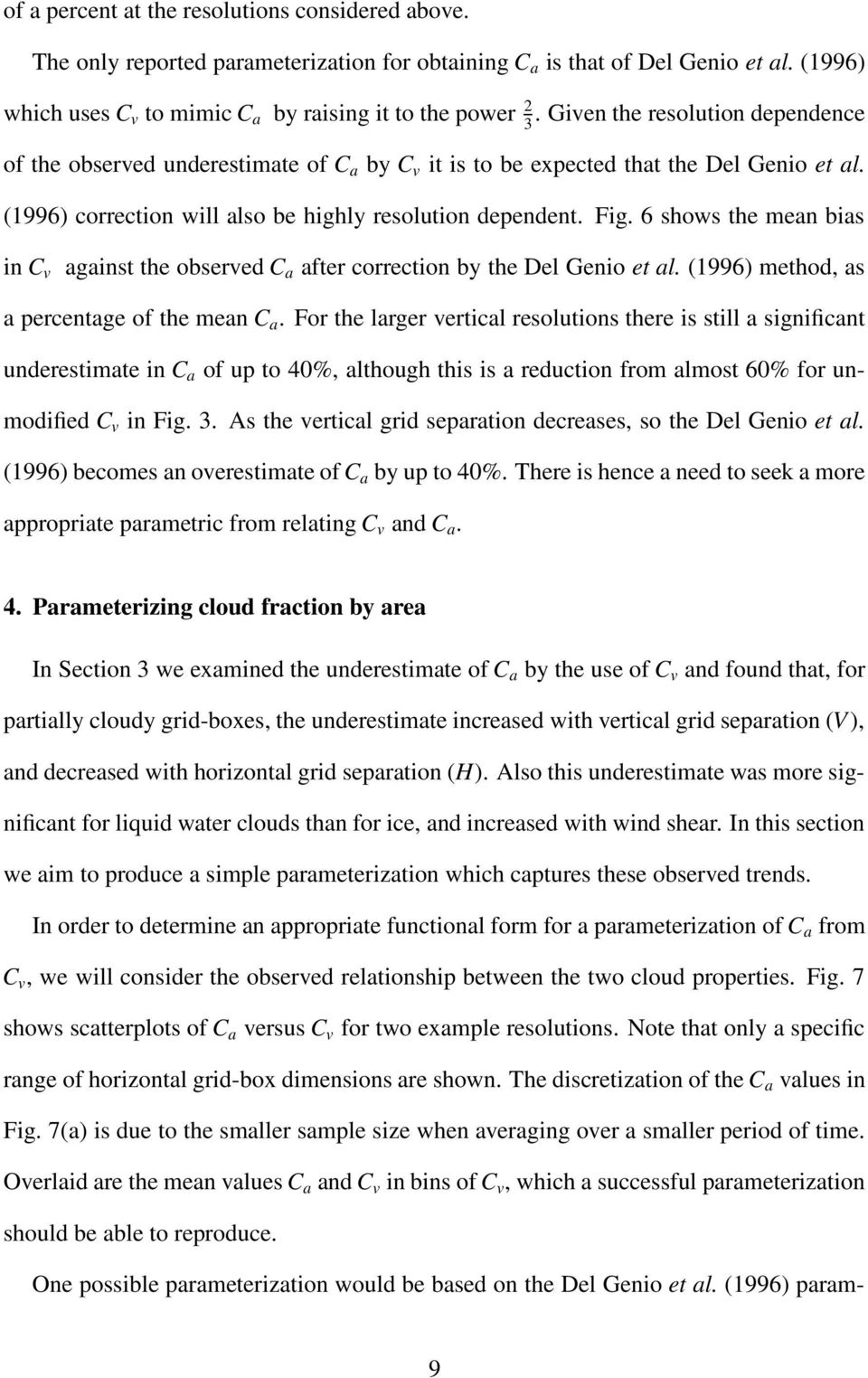
11 eterization, but with the exponent of C v allowed to vary, which we will refer to as the power law parameterization, as shown in equation (1): C a = C v D (1) A second possible parameterization is formulated based on the observation that the line produced by the mean C a versus C v in Fig. 7 is roughly symmetrical on reflection in the line C a = 1 C v. One suitable equation for such a relationship is given in equation (2), and will be referred to as the symmetric parameterization: C a = [ 1 + e ( f ) ( C v 1 1 )] 1 (2) Where the f parameter controls, for f >, the extent to which C a is greater than C v, with f = giving C a = C v, as shown in Fig. 8. The solid lines overplotted in Fig. 7 show the relationship between C v and C a using equation (1) and the value of D that best fits observed mean values of C a in the bins of C v, in terms of least squares. Similarly the dashed lines show the relationship between C a and C v, using equation (2) with a value of f that best fits the mean values of C a in the C v bins. For cases where C v is small (less than.2 and.3 in the examples presented), C a produced by the power law parameterization is significantly overpredicted to the extent that for a C v of.5, C a predicted by (1) is approximately double the mean observed value of C a. Conversely, for higher values of C v C a is underestimated by the power law parameterization. Neither of these problems are evident when comparing the symmetric parameterization. Although only two example resolutions have been shown here, the problems with the power law (solid lines) are apparent in all of the resolutions examined. If the value of D in equation (1) is selected by minimising the RMS error against the raw data points, rather than the mean values of C a and C v in C v bins, then the value of D is altered to reflect the distribution of C v, to the extent that the overestimate of low cloud fractions 1
![One suitable equation for such a relationship is given in equation (2), and will be referred to as the symmetric parameterization: C a = [ 1 + e ( f ) ( C v 1 1 )] 1 (2) Where the f parameter](/docs-images/45/6394021/images/page_11.jpg "controls, for f >, the extent to which C a is greater than C v, with f = giving C a = C v, as shown in Fig. 8. The solid lines overplotted in Fig.")
12 is slightly reduced, at the expense of drastically increasing the underestimate of C a for larger C v. We therefore conclude that the symmetric parameterization, given in equation (2) best describes the mean dependence of C a on C v, and we will continue in this section to develop this parameterization further. In order to determine the appropriate values of f, the cloud fraction data were reanalysed, splitting the observed values of C a and C v according to their vertical (V ) and horizontal (H) grid sizes, where the ECMWF wind speed, at the specific time and height, was used determine the actual horizontal distance which a given averaging period represents. The variability of wind speeds with height is such that the number distribution of cases with a given H will vary with height, but the variability of the wind speed with time ensures that all H bins examined are well populated at all heights. Such an approach significantly improves the fits of f with H compared to using a single wind speed with height to convert to a horizontal distance. The resultant variation of f with H and V is shown in Fig. 9. It is apparent from Fig. 9 that f increases with V, and decreases with H, which is consistent with the relationship between the mean underestimate of C a by C v, and H and V shown in Fig. 4. In order to determine the exact relationship between f and the model resolution we assume that as V tends to zero, or H tends to infinity, so C a will tend to C v, and therefore f tend to zero. We therefore assume that f may be given in (3), where A, α and β are parameters to be fitted to the observations. f = AV α H β (3) Based on the observation in Section 3 that the underestimate of C a by C v was greater for liquid water clouds than for ice, the coefficients in equation (3) need to be determined separately. In order to determine the appropriate values for the coefficients in (3), α and β were allowed to vary, iteratively selecting the pair of values for which (3) gave the best 11
13 fit to the observed values of f, in terms of least squares. The results of this analysis are shown in Fig. 1, where the analysis has been performed separately for ice and liquid water clouds, using the model temperature (T ) profiles as in Fig. 5. Given the dependence of C a C v, with wind shear (s) observed in Fig. 5, a logical extension to this work is to categorise clouds by wind shear as well as by cloud phase. For simplicity we assume that as wind shear varies, equation (3) still applies and that α and β remain constant while we allow A to vary. The analysis shown in Fig. 1 was repeated for a number of wind shear bins; within each wind shear bin a shear-dependent value of A was computed as the gradient of f with V α H β. The variation of the mean observed A(s) with wind shear is shown in Fig. 11(a), and in order to represent this data, we define the limit of A(s) as s tends to zero (A(s = )). For the purposes of fitting a power law, Fig. 11(b) shows the variation of A(s) A ( s = ) against wind shear on logarithmic axis, and the resultant power laws are overplotted on Fig. 11(b) and (b). Therefore the f parameter in equation (2) can be parameterized as follows, with all terms in the equations in SI units. We propose that A can be determined either with or without a wind shear dependence as appropriate to the user requirements. for ice clouds : f = A ice V.7679 H.2254 (4) ignoring wind shear : A ice =.88 (5) and with shear : A ice (s) = s.315 (6) for liquid clouds : f = A liq V.6694 H.1882 (7) ignoring wind shear : A liq =.1635 (8) and with shear : A liq (s) = s.5112 (9) 12

14 With this parameterization, the correction of C v to C a is increased with wind shear for both ice and liquid water cloud. However, ice cloud is less sensitive to wind shear, both in that the overall effect of wind shear is less, and that the shear term reaches an almost asymptotic value at lower wind shears than for liquid cloud (consistent with Fig. 5). One physical explanation for this would be that the liquid water cloud droplets fall more slowly than ice particles so that a given wind shear gives a larger difference in horizontal transport for the more slowly falling particles. 5. Evaluation of the C v to C a parameterizations In order to evaluate the parameterizations given above, a test period consisting of the even numbered months over the period 1st May th May 2, was examined analysed to produce an independent dataset of cloud fractions, C a and C v, using the same time and height resolutions as used in Sections 3 and 4, and converting time to H using the ECMWF wind speed. The values of C v were corrected using the symmetric parameterization, (2), and values of f obtained by first ignoring and then including the effects of wind shear and compared to the observed C a. Figure 12 shows, for an example resolution of 65 km by 72 m, a scatterplot of C a and C v and the mean relationship between C a and C v as observed and predicted by the symmetric parameterization, (2), obtaining f both with and without wind shear. It is clear that the use of C v to represent C a leads to a significant underestimate in C a for partially cloudy grid-boxes, and that averaging over a long period both methods of obtaining f give mean values of C a which are in good agreement with the observed C a across the full range of C v. Tables 1, 2 and 3 give the mean bias and RMS error in the prediction of C a by C v during the test period, for uncorrected C v, and C v corrected both without and with wind shear information, respectively. These statistics are reweighted to give equal weight to each grid 13
15 resolution examined. For the uncorrected C v, the mean bias is considerable, with the mean C a during this period, and range of resolutions, is.126, and the mean C v.79, which corresponds to an underestimate of.46, or 37% of the mean C a. This is consistent with the mean underestimate from the odd numbered months as in Fig. 3. Ice cloud exhibits a less significant bias between C a and C v than liquid water cloud, with an underestimate of 27% compared to 48% respectively. Both methods of correcting C v (Tables 2, 3) give good results, with the mean bias in C a predicted from C v being less than.2% of the mean C a, for both ice and liquid clouds. In more detail, when correcting without wind shear, using (4, 5, 7, 8) shown in Table 2, the parameterization performs well for all resolutions considered with remaining biases varying between +3% where H is less than 2 km, to a bias of 3% for grid-boxes with H between 2 km and 1 km. although remain biases of +5.7% in instances of low wind shear, and 9.% for high wind shear. These are much less than the biases in the uncorrected C v of 33% and 46% respectively. Correcting C v using phase and wind shear (Table 3) performs well at all the vertical and horizontal resolutions examined, reducing underestimates ranging from 15% to 5% to an underestimate of 2.7% in the very worst case. All of the resolutions considered show improved performance compared to excluding wind shear effects. Clouds in conditions of negligible wind shear exhibit a less significant bias than clouds in a more sheared environment, and when correcting C v with wind shear the parameterization accounts for this effect. Both parameterizations reduce the RMS errors of the corrected C v by a factor of 2-3, relative to the uncorrected C v, but are still significant. This is to be expected given that the scheme provides an average correction to account for the random arrangement of cloud within the grid-box, however by introducing the ability to both over and underestimate C a the bias is all but eliminated. The inclusion of the effect of wind shear reduces the 14

16 RMS error by 2% (i.e. from 35 to 33%) relative to the parameterization which excludes the effect of wind shear. Combined with the 15% variation in the bias of the no shear parameterization between high and low wind shear environments and the small improvements across the range of resolutions when wind shear effects are included, this indicates that including the effect of wind shear gives a discernable improvement to the performance of the parameterization, although the effect is small relative to magnitude of the correction that is being applied. In order to quantify the impact of the C a parameterization with a realistic GCM resolution, the radar and lidar data were analysed as described in Section 2 to obtain C a and C v on the same grid as the Met Office mesoscale model outputs in the vertical and where the time averaging period was determined as the time taken to advect a 12 km grid-box using the model wind speed. This is opposite approach to averaging for a set period of time and using the model winds to calculate H, which is the approach adopted in the previous sections (in practice the results from the two approaches are indistinguishable). The observed mean profile of C v is shown in Fig. 13 and is broadly comparable with those output by Met Office mesoscale model, although a detailed evaluation of the differences between the observed cloud fractions and the model outputs is beyond the scope of this paper. Also shown is the mean profile of the observed C v and the C a produced by correcting the observed C v using equation 2, with the f parameter determined using appropriate values of H and V, and values of wind shear taken directly from the model winds. The mean profiles of C a are approximately 3% higher than the mean profile of C v, which is consistent with Fig. 3, while the profile of parameterized C a agrees with the observed mean C a to within 2% at all heights. There is no noticeable difference between the parameterization with and without wind shear when examining averages over long periods of time. Lastly we calculate the total cloud cover from the profiles of C a and C v, by applying 15
17 the most commonly commonly used maximum-random overlap assumption as defined in Geleyn and Hollingsworth (1979). The mean total cloud cover is found to be 53% when C v is used, and 63% when using C a (observed or parameterized). This increase is comparable to the 11% increase found by Morcrette and Jakob (2) when changing from the maximum to the random overlap assumption in the ECMWF model, which in terms of global mean radiative fluxes at the top of the atmosphere reduced the absorbed short wave radiation by 3.3 Wm 2 and the outgoing long wave radiation by 8.3 Wm Conclusions A quasi-continuous dataset of radar reflectivity and lidar backscatter over Chilbolton, Southern England, has been used to produce a climatology of cloud fractions, at a variety of horizontal and vertical resolutions appropriate for comparison with GCMs. By calculating cloud fractions by area and by volume on regular grid, a systematic underestimate has been found in which cloud fractions calculated by volume (C v ) are always lower than the corresponding cloud fraction by area (C a ), which is of more interest in the calculation of fluxes of radiation and precipitation. For example at typical model vertical grid-box spacings of 5 m to 1 m, we observe that C a is underestimated by C v by 3-5%. This is caused by the stratification of cloud layers occurring with vertical scales which cannot be fully resolved at these resolutions, and by a degree of randomness with which cloud forms, so spreading cloud in the horizontal, rather than filling a grid box in the vertical. The underestimate of C a by C v has been shown to be approximately twice as large for liquid water clouds than for ice and this underestimate also increases with wind shear. In the interest of expressing this effect in a manner which is easily applicable to most GCM cloud schemes, a parameterization has been developed which gives a correction to the C v, for frontal/stratiform cloud. This parameterization is based on the observation that the mean relationship between C a versus C v is roughly symmetric about the line 16
18 C a = 1 C v, and varies with the horizontal and vertical grid-box dimensions (H and V respectively), cloud phase, and to a lesser extent, wind shear. This approach performed better than the formulation of Del Genio et al. (1996), where C a = C v 2 3, even when the exponent was allowed to vary. The resultant parameterizations, both excluding and including the effect of wind shear, have been tested against an independent dataset of Chilbolton radar and lidar data, and were found to give good agreement across the range C v. On average both correction schemes were found to reduce the mean underestimate of C a by C v from 37% (at the range of horizontal and vertical resolutions used) to a mean bias of less than.2% both with and without the use of wind shear information. The parameterizations cope with the variation in this underestimate with grid-box resolution, as well as phase. However when wind shear is ignored, the parameterization produces a variation of approximately 15% of the mean C a, between the low and high wind shear environments. When wind shear is included this variation is accounted for, and the overall performance of the parameterization is improved, although this effect is small relative to the magnitude of the correction that is applied. When examining cloud fractions on a grid equivalent to that of the Met Office Mesoscale model outputs, the mean profile of C a is well captured by the parameterization. When using C a rather than C v, the mean total cloudiness of the column is increased from 53% to 63%. We would therefore expect the implementation of this parameterization of C a would have significant radiative impacts, although the issue is complicated by the representation of the inhomogeneity of water content which could accompany a C a parameterization. Before applying the findings of this study it would be useful to study the sub-grid geometry statistics from cloud observed in other locations, since the properties of convective cloud may differ significantly from the properties of stratiform and frontal cloud predom- 17
19 inantly observed at Chilbolton, although we would expect C a to be much closer to C v for upright convective clouds. Acknowledgemts. We would like to thank the Radio Communications Research Unit at the Rutherford Appleton Laboratory for providing the 94 GHz Galileo radar and lidar ceilometer data. This research received funding from the European Union CloudNET project (grant EVK2-CT-2-65) and NERC grant NER/T/S/1999/15. We are also grateful to Pete Clark and Richard Forbes at the Met Office for their help and for providing the Unified Model output and to Christian Jakob for providing the ECMWF model data. The first author was also supported by an NERC studentship. REFERENCES Clothiaux, E. E., Ackerman, T. P., Mace, G. G., Moran, K. P., Marchand, R. T., Miller, M. A., and Martner, B. E. (2). Objective determination of cloud heights and radar reflectivities using a combination of active remote sensors at the ARM CART sites. J. Appl. Meteor., 39(5), Del Genio, A. D., Yao, M.-S., Kovari, W., and Lo, K. K. (1996). A prognostic cloud water parameterization for global climate models. J. Climate, 9, Edwards, J. M. and Slingo, A. (1996). Studies with a flexible new radiation code. I: Choosing a configuration for a large scale model. Quart. J. Roy. Meteor. Soc., 122, Geleyn, J. F. and Hollingsworth, A. (1979). An economical analytical method for the computation of the interaction between scattering and line absorbtion of radiation. Contrib. Atmos. Phys., 52, Goddard, J. W. F., Tan, J., and Thurai, M. (1994). Technique for calibration of meteorological radars using differential phase. Electronics Letters, 31(2), Hogan, R. J. and Illingworth, A. J. (2). Deriving cloud overlap statistics from radar 18

20 observations. Quart. J. Roy. Meteor. Soc., 126, Hogan, R. J. and Illingworth, A. J. (23). Parameterizing ice cloud inhomogeneities using cloud radar data. J. Atmos. Sci., 6(5), Hogan, R. J., Jakob, C., and Illingworth, A. J. (21). Comparison of ECMWF winter season cloud fraction with radar derived values. J. Appl. Meteor., 4, Hogan, R. J., Bouniol, D., Ladd, D. N., O Connor, E. J., and Illingworth, A. J. (23a). Absolute calibration of 94/95-GHz radars using rain. J. Atmos. Oceanic Technol., 2(4), Hogan, R. J., Illingworth, A. J., Poiares Baptista, J. P. V., and O Connor., E. J. (23b). Characteristics of mixed-phase clouds: Part II: A climatology from ground-based lidar. Quart. J. Roy. Meteor. Soc., 129, Hogan, R. J., Behera, M. D., O Connor, E. J., and Illingworth, A. J. (24). Estimating the global distribution of supercooled liquid water clouds using spaceborne lidar. Geophys. Res. Lett., 32. Jakob, C. and Klein, S. A. (1999). The role of varying cloud fraction in the parameterization of microphysical processes in the ECMWF model. Quart. J. Roy. Meteor. Soc., 125, Mace, G. G., Ackerman, T. P., Clothiaux, E. E., and Albrecht, B. A. (1997). A study of composite cirrus morphology using data from a 94-GHz radar and correlations with temperature and large-scale vertical motion. J. Geophys. Res., 12(D12), Mace, G. G., Jakob, C., and Moran, K. P. (1998). Validation of hydrometeor occurrence predicted by the ECMWF model using millimeter wave radar data. Geophys. Res. Lett., 25(1), Martin, G. M., Bush, M. R., Brown, A. R., Lock, A. P., and Smith, R. N. B. (2). A new boundary layer mixing scheme. Part II: Tests in climate and mesoscale models. 19
21 Monthly Weather Review, 128, Mitchell, J. F. B. (2). Modelling cloud-climate feedbacks in predictions of humaninduced climate change. World Climate Research Program. Workshop on Cloud Processes and Cloud Feedbacks in Large-scale models., WCRP-11(WMO/TD-No. 993). Mittermaier, M. P. and Illingworth, A. J. (23). Comparison of model-derived and radarobserved freezing level heights: Implications for vertical reflectivity profile correction schemes. Quart. J. Roy. Meteor. Soc., 129, Morcrette, J. and Fouquart, Y. (1986). The overlapping of cloud layers in a short wave radiation parameterization. J. Atmos. Sci., 43(4), Morcrette, J.-J. and Jakob, C. (2). The response of the ecmwf model to changes in the cloud overlap assumption. Monthly Weather Review, 128(6), Smith, R. N. B. (199). A scheme for predicting layer clouds and their water content in a general circulation model. Quart. J. Roy. Meteor. Soc., 116, Stephens, G. L. (1984). Review: The paramerization of radiation for numerical weather prediction and climate models. Monthly Weather Review, 112, Stocker, T. F. (21). Physical Climate Processes and Feedbacks, in IPCC, Climate Change 21: The Scientific Basis. Cambridge University Press, Cambridge. Tian, L. and Curry, J. A. (1989). Cloud overlap statistics. J. Geophys. Res., 94(D7), Tiedtke, M. (1993). Representation of clouds in large-scale models. Monthly Weather Review, 121, Webb, M., Senior, C., Bony, S., and Morcrette, J. (21). Combining ERBE and ISCCP data to assess clouds in teh hadley centre, ECMWF and LMD atmospheric climate models. Climate Dynamics, 17, Wilson, D. R. and Ballard, S. P. (1999). A microphysically based precipitation scheme for the UK Meterorological Office Unified Model. Quart. J. Roy. Meteor. Soc., 125, 2
22
23 Figure captions FIG. 1 Schematic of a distribution of cloud within a 3D grid-box, where the cloud fraction by volume (C v ) is 1 2, but the cloud fraction by area (C a) is 2 3. FIG. 2 Time-height sections of: (a) 94GHz radar reflectivity, (b) lidar backscatter coefficient, and (c) the corresponding cloud mask with the model wet-bulb o C isotherm superposed. In this example cloud fractions by (d) volume and (e) area are calculated for a grid-box with 72m vertical resolution, and a temporal resolution of 1 hour (roughly equivalent to 65 km horizontal resolution, based on the annual mean tropospheric wind speed of 18 m s 1 ). FIG. 3 Mean underestimate of C a by the use of C v, as a percentage of the observed mean C a, against vertical grid dimension, for radar and lidar observations analysed for the presence of cloud and gridded at various different horizontal resolutions. The analysis includes all events, both cloudy and non-cloudy, observed at Chilbolton in odd numbered months between 1 May 1999 and 26 May 2. Note the insensitivity of the underestimate to the horizontal resolution. FIG. 4 Mean underestimate of C a by the use of C v, with vertical and horizontal grid dimension. The analysis includes only partially cloudy events, in odd numbered months between 1 May 1999 and 26 May 2. FIG. 5 Mean underestimate of C a by the use of C v, varying with wind shear and temperature for grid-boxes approximately 65 km in the horizontal, with differing vertical dimension. The analysis includes only partially cloudy events, in odd numbered months between 1 May 1999 and 26 May 2. 22
24 FIG. 6 Mean underestimate of C a by the observed C v, corrected as described in Del Genio et al. (1996), as a percentage of the observed mean C a, against vertical grid dimension, for Chilbolton cloud masks gridded at various different horizontal resolutions. The analysis includes all events, both cloudy and noncloudy, observed in odd numbered months between 1 May 1999 and 26 May 2. FIG. 7 Scatterplots of cloud fractional area (C a ) versus volume (C v ), as observed by radar and lidar observations. Overlaid are the mean values of C a and C v in bins of C v (the circles), and the results of two possible parameterizations that are discussed in the text. FIG. 8 A demonstration of the relationship between C a and C v proposed in equation (2), for varying values of f, as labelled. FIG. 9 Variation of the parameter f in equation (2) which best fits the observed relationship between C a and C v, averaged over bins of C v, as a function of horizontal and vertical resolution. The analysis uses observations from the Chilbolton radar and lidar in odd numbered months between 1 May 1999 and 26 May 2. FIG. 1 Variation of the parameter f, in (2) which best fits the observed variation of mean C a with C v, against V α H β, where α and β are the parameter pair which gives the best fit of the observed f, in a least squares sense. The analysis uses observations from the Chilbolton radar and lidar in odd numbered months between 1 May 1999 and 26 May 2, which are characterised as containing ice or liquid clouds using the model temperature profiles. 23
25 FIG. 11 Variation of the parameter A in equation (3) with wind shear. The analysis uses observations from the Chilbolton radar and lidar in odd numbered months between 1 May 1999 and 26 May 2, which are characterised using the model profiles as containing ice or liquid clouds by temperature, and subdivided into bins of wind shear, determined as the change in the horizontal wind velocity with height. FIG. 12 Scatterplots of C a versus C v, as observed by radar and lidar, during the even numbered months between 1 May 1999 and 26 May 2. Overlaid are the mean values, in bins of C v, of the observed C a and C v corrected to represent C a using the symmetric parameterization (2), with f found both without wind shear (4, 5, 7, 8) and with wind shear (4, 6, 7, 9). FIG. 13 Profiles of mean cloud fraction produced by averaging the observed occurrence of cloud on the radar and lidar grid on to the grid of Met Office mesoscale model. Profiles shown are the mean observed C v and C a, and the mean profile of C a calculated from the observed C v using equation (2). 24
26 C = 2 / a 3 C 1 v = / 2 FIG. 1: Schematic of a distribution of cloud within a 3D grid-box, where the cloud fraction by volume (C v ) is 1 2, but the cloud fraction by area (C a) is
27 Height (km) 9 May (a) Radar reflectivity factor Height (km) Z (dbz) 12 (b) Lidar backscatter coefficient e 3 1e 4 1e 5 Height (km) 12 (c) Cloud mask Height (km) (d) Cloud fraction by volume β (m sr ) 1.5 Height (km) C 12 (e) Cloud fraction by area Time (hours), 9th May C F IG. 2: Time-height sections of: (a) 94GHz radar reflectivity, (b) lidar backscatter coefficient, and (c) the corresponding cloud mask with the model wet-bulb o C isotherm superposed. In this example cloud fractions by (d) volume and (e) area are calculated for a grid-box with 72m vertical resolution, and a temporal resolution of 1 hour (roughly equivalent to 65 km horizontal resolution, based on the annual mean tropospheric wind speed of 18 m s 1 ). 26
28 6 5 ~1 km ~2 km ~65 km ~2 km ~39 km Mean underestimate (%) Vertical grid separation, m FIG. 3: Mean underestimate of C a by the use of C v, as a percentage of the observed mean C a, against vertical grid dimension, for radar and lidar observations analysed for the presence of cloud and gridded at various different horizontal resolutions. The analysis includes all events, both cloudy and non-cloudy, observed at Chilbolton in odd numbered months between 1 May 1999 and 26 May 2. Note the insensitivity of the underestimate to the horizontal resolution. 27
29 Mean underestimate, for partially cloudy grid boxes ~1 km ~2 km ~65 km ~2 km ~39 km Vertical grid separation, m Mean underestimate, for partially cloudy grid boxes Horizontal grid separation, km 12 m 36 m 72 m 18 m 144 m FIG. 4: Mean underestimate of C a by the use of C v, with vertical and horizontal grid dimension. The analysis includes only partially cloudy events, in odd numbered months between 1 May 1999 and 26 May 2. 28
30 Wind shear (ms 1 km 1 ) Mean underestimate V = 12 m T < 15 o C T > o C Wind shear (ms 1 km 1 ) Mean underestimate.6 V = 72 m T < 15 o C T > o C Wind shear (ms 1 km 1 ) Mean underestimate V = 36 m T < 15 o C T > o C Wind shear (ms 1 km 1 ) Mean underestimate.6 V = 18 m T < 15 o C T > o C FIG. 5: Mean underestimate of C a by the use of C v, varying with wind shear and temperature for grid-boxes approximately 65 km in the horizontal, with differing vertical dimension. The analysis includes only partially cloudy events, in odd numbered months between 1 May 1999 and 26 May 2. 29
31 4 3 2 ~1 km ~2 km ~65 km ~2 km ~39 km 1 Mean Bias (%) Vertical grid separation, m FIG. 6: Mean underestimate of C a by the observed C v, corrected as described in Del Genio et al. (1996), as a percentage of the observed mean C a, against vertical grid dimension, for Chilbolton cloud masks gridded at various different horizontal resolutions. The analysis includes all events, both cloudy and non-cloudy, observed in odd numbered months between 1 May 1999 and 26 May 2. 3
32 Resolution: 9 to 11 km, by 36 m 1 (a) Resolution: 55 to 65 km, by 18 m 1 (b) C a.5 C a Mean C a in bins of C v C a = C v.42 C v C a (f = 1.45).2.1 Mean C a in bins of C v C a = C v.299 C v C a (f = 1.928) C v C v FIG. 7: Scatterplots of cloud fractional area (C a ) versus volume (C v ), as observed by radar and lidar observations. Overlaid are the mean values of C a and C v in bins of C v (the circles), and the results of two possible parameterizations that are discussed in the text. 31
33 C a C v FIG. 8: A demonstration of the relationship between C a and C v proposed in equation (2), for varying values of f, as labelled. 32
34 Vertical grid separation, m Horizontal grid separation, km FIG. 9: Variation of the parameter f in equation (2) which best fits the observed relationship between C a and C v, averaged over bins of C v, as a function of horizontal and vertical resolution. The analysis uses observations from the Chilbolton radar and lidar in odd numbered months between 1 May 1999 and 26 May 2. 33
35 f α ice =.7679, β ice =.2254, α liquid =.6694, β liquid =.1882 Ice water cloud Liquid water cloud V α H β FIG. 1: Variation of the parameter f, in (2) which best fits the observed variation of mean C a with C v, against V α H β, where α and β are the parameter pair which gives the best fit of the observed f, in a least squares sense. The analysis uses observations from the Chilbolton radar and lidar in odd numbered months between 1 May 1999 and 26 May 2, which are characterised as containing ice or liquid clouds using the model temperature profiles. 34
36 .2 (a) Ice water cloud Liquid water cloud.5 (b) Ice water cloud Liquid water cloud 1 A(s) (m (α β) ).15.1 log 1 (A(s) A(s=)) wind shear (s 1 ) x log 1 (wind shear) FIG. 11: Variation of the parameter A in equation (3) with wind shear. The analysis uses observations from the Chilbolton radar and lidar in odd numbered months between 1 May 1999 and 26 May 2, which are characterised using the model profiles as containing ice or liquid clouds by temperature, and subdivided into bins of wind shear, determined as the change in the horizontal wind velocity with height. 35
37 Resolution: 55 to 65 km, by 72 m Mean C a Observed C v Observed C a C v C a (no shear) C v C a (with shear) FIG. 12: Scatterplots of C a versus C v, as observed by radar and lidar, during the even numbered months between 1 May 1999 and 26 May 2. Overlaid are the mean values, in bins of C v, of the observed C a and C v corrected to represent C a using the symmetric parameterization (2), with f found both without wind shear (4, 5, 7, 8) and with wind shear (4, 6, 7, 9). 36
38 14 12 Observed Cv Observed Ca Cv Ca 1 Height (km) Mean cloud fraction FIG. 13: Profiles of mean cloud fraction produced by averaging the observed occurrence of cloud on the radar and lidar grid on to the grid of Met Office mesoscale model. Profiles shown are the mean observed C v and C a, and the mean profile of C a calculated from the observed C v using equation (2). 37
39 List of Tables 1 Biases (both absolute, and in terms of the percentage of mean C a ), and RMS errors, in the representation of C a by C v. The analysis is based on Cloud masks of radar and lidar data over Chilbolton during even numbered months between 1 May 1999 and 26 May Biases (both absolute, and in terms of the percentage of mean C a ), and RMS errors, in the representation of C a by C v after correction using using the symmetric parameterization (2), with f found without wind shear (4, 5, 7, 8). The analysis is based on Cloud masks of radar and lidar data over Chilbolton during even numbered months between 1 May 1999 and 26 May Biases (both absolute, and in terms of the percentage of mean C a ), and RMS errors, in the representation of C a by C v after correction using using the symmetric parameterization (2), with f found including the effect of wind shear (4, 6, 7, 9). The analysis is based on Cloud masks of radar and lidar data over Chilbolton during even numbered months between 1 May 1999 and 26 May
40 C v (uncorrected) Bias RMS error All events -.46 (-37%) ±.139 (±11%) H < 2 km -.61 (-47%) ±.178 (±136%) 2 km < H < 1 km -.45 (-39%) ±.139 (±12%) H > 2 km -.26 (-27%) ±.71 (±74%) V < 5 m -.14 (-15%) ±.59 (±63%) V > 1 m -.78 (-5%) ±.19 (±121%) T < 15 C -.25 (-27%) ±.87 (±93%) T > C -.13 (-48%) ±.226 (±15%) s <.5 m s 1 km (-33%) ±.19 (±12%) s > 3 m s 1 km (-46%) ±.198 (±114%) TABLE 1: Biases (both absolute, and in terms of the percentage of mean C a ), and RMS errors, in the representation of C a by C v. The analysis is based on Cloud masks of radar and lidar data over Chilbolton during even numbered months between 1 May 1999 and 26 May 2. 39
41 C v C a (no shear) Bias RMS error All events 1.3x1 4 (.1%) ±.58 (±35%) H < 2 km.39 (2.9%) ±.65 (±3%) 2 km < H < 1 km -.34 (-2.9%) ±.56 (±18%) H > 2 km 2.5x1 4 (.3%) ±.34 (±3.5%) V < 5 m -.12 (1.3%) ±.35 (±26%) V > 1 m 6.5x1 4 (.4%) ±.74 (±14%) T < 15 C 1.3x1 4 (.1%) ±.37 (±25%) T > C 1.6x1 4 (.1%) ±.9 (±18%) s <.5 m s 1 km 1.61 (5.7%) ±.52 (±19%) s > 3 m s 1 km (-9.%) ±.86 (±11%) TABLE 2: Biases (both absolute, and in terms of the percentage of mean C a ), and RMS errors, in the representation of C a by C v after correction using using the symmetric parameterization (2), with f found without wind shear (4, 5, 7, 8). The analysis is based on Cloud masks of radar and lidar data over Chilbolton during even numbered months between 1 May 1999 and 26 May 2. 4
42 C v C a (with shear) Bias RMS error All events -2.6x1 4 (-.2%) ±.55 (±33%) H < 2 km.17 (1.3%) ±.62 (±28%) 2 km < H < 1 km -.31 (-2.7%) ±.55 (±17%) H > 2 km 2.x1 4 (.2%) ±.34 (±3.3%) V < 5 m 5.8x1 4 (.6%) ±.32 (±24%) V > 1 m -3.1x1 5 (-.%) ±.72 (±13%) T < 15 C -7.6x1 5 (-.1%) ±.37 (±25%) T > C -.1 (-.5%) ±.89 (±17%) s <.5 m s 1 km 1 1.8x1 4 (.2%) ±.47 (±17%) s > 3 m s 1 km (-2.3%) ±.81 (±11%) TABLE 3: Biases (both absolute, and in terms of the percentage of mean C a ), and RMS errors, in the representation of C a by C v after correction using using the symmetric parameterization (2), with f found including the effect of wind shear (4, 6, 7, 9). The analysis is based on Cloud masks of radar and lidar data over Chilbolton during even numbered months between 1 May 1999 and 26 May 2. 41
How To Find Out How Much Cloud Fraction Is Underestimated
 2248 J O U R N A L O F T H E A T M O S P H E R I C S C I E N C E S VOLUME 62 Parameterizing the Difference in Cloud Fraction Defined by Area and by Volume as Observed with Radar and Lidar MALCOLM E. BROOKS,*
Towards an NWP-testbed
 Towards an NWP-testbed Ewan O Connor and Robin Hogan University of Reading, UK Overview Cloud schemes in NWP models are basically the same as in climate models, but easier to evaluate using ARM because:
Parameterization of Cumulus Convective Cloud Systems in Mesoscale Forecast Models
 DISTRIBUTION STATEMENT A. Approved for public release; distribution is unlimited. Parameterization of Cumulus Convective Cloud Systems in Mesoscale Forecast Models Yefim L. Kogan Cooperative Institute
Since launch in April of 2006, CloudSat has provided
 A Multipurpose Radar Simulation Package: QuickBeam BY J. M. HAYNES, R. T. MARCHAND, Z. LUO, A. BODAS-SALCEDO, AND G. L. STEPHENS Since launch in April of 2006, CloudSat has provided the first near-global
Assessing Cloud Spatial and Vertical Distribution with Infrared Cloud Analyzer
 Assessing Cloud Spatial and Vertical Distribution with Infrared Cloud Analyzer I. Genkova and C. N. Long Pacific Northwest National Laboratory Richland, Washington T. Besnard ATMOS SARL Le Mans, France
Developing Continuous SCM/CRM Forcing Using NWP Products Constrained by ARM Observations
 Developing Continuous SCM/CRM Forcing Using NWP Products Constrained by ARM Observations S. C. Xie, R. T. Cederwall, and J. J. Yio Lawrence Livermore National Laboratory Livermore, California M. H. Zhang
Using Cloud-Resolving Model Simulations of Deep Convection to Inform Cloud Parameterizations in Large-Scale Models
 Using Cloud-Resolving Model Simulations of Deep Convection to Inform Cloud Parameterizations in Large-Scale Models S. A. Klein National Oceanic and Atmospheric Administration Geophysical Fluid Dynamics
MICROPHYSICS COMPLEXITY EFFECTS ON STORM EVOLUTION AND ELECTRIFICATION
 MICROPHYSICS COMPLEXITY EFFECTS ON STORM EVOLUTION AND ELECTRIFICATION Blake J. Allen National Weather Center Research Experience For Undergraduates, Norman, Oklahoma and Pittsburg State University, Pittsburg,
ABSTRACT INTRODUCTION
 Observing Fog And Low Cloud With A Combination Of 78GHz Cloud Radar And Laser Met Office: Darren Lyth 1, John Nash. Rutherford Appleton Laboratory: M.Oldfield ABSTRACT Results from two demonstration tests
Sub-grid cloud parametrization issues in Met Office Unified Model
 Sub-grid cloud parametrization issues in Met Office Unified Model Cyril Morcrette Workshop on Parametrization of clouds and precipitation across model resolutions, ECMWF, Reading, November 2012 Table of
Long-term Observations of the Convective Boundary Layer (CBL) and Shallow cumulus Clouds using Cloud Radar at the SGP ARM Climate Research Facility
 Long-term Observations of the Convective Boundary Layer (CBL) and Shallow cumulus Clouds using Cloud Radar at the SGP ARM Climate Research Facility Arunchandra S. Chandra Pavlos Kollias Department of Atmospheric
TOPIC: CLOUD CLASSIFICATION
 INDIAN INSTITUTE OF TECHNOLOGY, DELHI DEPARTMENT OF ATMOSPHERIC SCIENCE ASL720: Satellite Meteorology and Remote Sensing TERM PAPER TOPIC: CLOUD CLASSIFICATION Group Members: Anil Kumar (2010ME10649) Mayank
Cloud Oxygen Pressure Algorithm for POLDER-2
 Cloud Oxygen ressure Algorithm for OLDER-2 1/7 Cloud Oxygen ressure Algorithm for OLDER-2 Aim of the : Determination of cloud gen pressure from arent pressure by removing the contribution. Date of the
GCMs with Implicit and Explicit cloudrain processes for simulation of extreme precipitation frequency
 GCMs with Implicit and Explicit cloudrain processes for simulation of extreme precipitation frequency In Sik Kang Seoul National University Young Min Yang (UH) and Wei Kuo Tao (GSFC) Content 1. Conventional
How To Model An Ac Cloud
 Development of an Elevated Mixed Layer Model for Parameterizing Altocumulus Cloud Layers S. Liu and S. K. Krueger Department of Meteorology University of Utah, Salt Lake City, Utah Introduction Altocumulus
Mixed-phase layer clouds
 Mixed-phase layer clouds Chris Westbrook and Andrew Barrett Thanks to Anthony Illingworth, Robin Hogan, Andrew Heymsfield and all at the Chilbolton Observatory What is a mixed-phase cloud? Cloud below
Turbulent mixing in clouds latent heat and cloud microphysics effects
 Turbulent mixing in clouds latent heat and cloud microphysics effects Szymon P. Malinowski1*, Mirosław Andrejczuk2, Wojciech W. Grabowski3, Piotr Korczyk4, Tomasz A. Kowalewski4 and Piotr K. Smolarkiewicz3
Frank and Charles Cohen Department of Meteorology The Pennsylvania State University University Park, PA, 16801 -U.S.A.
 376 THE SIMULATION OF TROPICAL CONVECTIVE SYSTEMS William M. Frank and Charles Cohen Department of Meteorology The Pennsylvania State University University Park, PA, 16801 -U.S.A. ABSTRACT IN NUMERICAL
What the Heck are Low-Cloud Feedbacks? Takanobu Yamaguchi Rachel R. McCrary Anna B. Harper
 What the Heck are Low-Cloud Feedbacks? Takanobu Yamaguchi Rachel R. McCrary Anna B. Harper IPCC Cloud feedbacks remain the largest source of uncertainty. Roadmap 1. Low cloud primer 2. Radiation and low
Remote Sensing of Clouds from Polarization
 Remote Sensing of Clouds from Polarization What polarization can tell us about clouds... and what not? J. Riedi Laboratoire d'optique Atmosphérique University of Science and Technology Lille / CNRS FRANCE
Assessing the performance of a prognostic and a diagnostic cloud scheme using single column model simulations of TWP ICE
 Quarterly Journal of the Royal Meteorological Society Q. J. R. Meteorol. Soc. 138: 734 754, April 2012 A Assessing the performance of a prognostic and a diagnostic cloud scheme using single column model
Surface-Based Remote Sensing of the Aerosol Indirect Effect at Southern Great Plains
 Surface-Based Remote Sensing of the Aerosol Indirect Effect at Southern Great Plains G. Feingold and W. L. Eberhard National Oceanic and Atmospheric Administration Environmental Technology Laboratory Boulder,
Evalua&ng Downdra/ Parameteriza&ons with High Resolu&on CRM Data
 Evalua&ng Downdra/ Parameteriza&ons with High Resolu&on CRM Data Kate Thayer-Calder and Dave Randall Colorado State University October 24, 2012 NOAA's 37th Climate Diagnostics and Prediction Workshop Convective
Cloud Thickness Estimation from GOES-8 Satellite Data Over the ARM-SGP Site
 Cloud Thickness Estimation from GOES-8 Satellite Data Over the ARM-SGP Site V. Chakrapani, D. R. Doelling, and A. D. Rapp Analytical Services and Materials, Inc. Hampton, Virginia P. Minnis National Aeronautics
Evaluation of the Effect of Upper-Level Cirrus Clouds on Satellite Retrievals of Low-Level Cloud Droplet Effective Radius
 Evaluation of the Effect of Upper-Level Cirrus Clouds on Satellite Retrievals of Low-Level Cloud Droplet Effective Radius F.-L. Chang and Z. Li Earth System Science Interdisciplinary Center University
Virtual Met Mast verification report:
 Virtual Met Mast verification report: June 2013 1 Authors: Alasdair Skea Karen Walter Dr Clive Wilson Leo Hume-Wright 2 Table of contents Executive summary... 4 1. Introduction... 6 2. Verification process...
E- modeling Of The Arctic Cloud System
 GEOPHYSICAL RESEARCH LETTERS, VOL. 32, L18801, doi:10.1029/2005gl023614, 2005 Possible roles of ice nucleation mode and ice nuclei depletion in the extended lifetime of Arctic mixed-phase clouds Hugh Morrison,
All-sky assimilation of microwave imager observations sensitive to water vapour, cloud and rain
 All-sky assimilation of microwave imager observations sensitive to water vapour, cloud and rain A.J. Geer, P. Bauer, P. Lopez and D. Salmond European Centre for Medium-Range Weather Forecasts, Reading,
A new positive cloud feedback?
 A new positive cloud feedback? Bjorn Stevens Max-Planck-Institut für Meteorologie KlimaCampus, Hamburg (Based on joint work with Louise Nuijens and Malte Rieck) Slide 1/31 Prehistory [W]ater vapor, confessedly
Technical note on MISR Cloud-Top-Height Optical-depth (CTH-OD) joint histogram product
 Technical note on MISR Cloud-Top-Height Optical-depth (CTH-OD) joint histogram product 1. Intend of this document and POC 1.a) General purpose The MISR CTH-OD product contains 2D histograms (joint distributions)
Titelmasterformat durch Klicken. bearbeiten
 Evaluation of a Fully Coupled Atmospheric Hydrological Modeling System for the Sissili Watershed in the West African Sudanian Savannah Titelmasterformat durch Klicken June, 11, 2014 1 st European Fully
Large Eddy Simulation (LES) & Cloud Resolving Model (CRM) Françoise Guichard and Fleur Couvreux
 Large Eddy Simulation (LES) & Cloud Resolving Model (CRM) Françoise Guichard and Fleur Couvreux Cloud-resolving modelling : perspectives Improvement of models, new ways of using them, renewed views And
Heikki Turtiainen *, Pauli Nylander and Pekka Puura Vaisala Oyj, Helsinki, Finland. Risto Hölttä Vaisala Inc, Boulder, Colorado
 4.1 A NEW HIGH ACCURACY, LOW MAINTENANCE ALL WEATHER PRECIPITATION GAUGE FOR METEOROLOGICAL, HYDROLOGICAL AND CLIMATOLOGICAL APPLICATIONS Heikki Turtiainen *, Pauli Nylander and Pekka Puura Vaisala Oyj,
Application of Numerical Weather Prediction Models for Drought Monitoring. Gregor Gregorič Jožef Roškar Environmental Agency of Slovenia
 Application of Numerical Weather Prediction Models for Drought Monitoring Gregor Gregorič Jožef Roškar Environmental Agency of Slovenia Contents 1. Introduction 2. Numerical Weather Prediction Models -
A SURVEY OF CLOUD COVER OVER MĂGURELE, ROMANIA, USING CEILOMETER AND SATELLITE DATA
 Romanian Reports in Physics, Vol. 66, No. 3, P. 812 822, 2014 ATMOSPHERE PHYSICS A SURVEY OF CLOUD COVER OVER MĂGURELE, ROMANIA, USING CEILOMETER AND SATELLITE DATA S. STEFAN, I. UNGUREANU, C. GRIGORAS
Observed Cloud Cover Trends and Global Climate Change. Joel Norris Scripps Institution of Oceanography
 Observed Cloud Cover Trends and Global Climate Change Joel Norris Scripps Institution of Oceanography Increasing Global Temperature from www.giss.nasa.gov Increasing Greenhouse Gases from ess.geology.ufl.edu
Comparison of the Vertical Velocity used to Calculate the Cloud Droplet Number Concentration in a Cloud-Resolving and a Global Climate Model
 Comparison of the Vertical Velocity used to Calculate the Cloud Droplet Number Concentration in a Cloud-Resolving and a Global Climate Model H. Guo, J. E. Penner, M. Herzog, and X. Liu Department of Atmospheric,
Evaluating GCM clouds using instrument simulators
 Evaluating GCM clouds using instrument simulators University of Washington September 24, 2009 Why do we care about evaluation of clouds in GCMs? General Circulation Models (GCMs) project future climate
Simulation of low clouds from the CAM and the regional WRF with multiple nested resolutions
 Click Here for Full Article GEOPHYSICAL RESEARCH LETTERS, VOL. 36, L08813, doi:10.1029/2008gl037088, 2009 Simulation of low clouds from the CAM and the regional WRF with multiple nested resolutions Wuyin
Unified Cloud and Mixing Parameterizations of the Marine Boundary Layer: EDMF and PDF-based cloud approaches
 DISTRIBUTION STATEMENT A. Approved for public release; distribution is unlimited. Unified Cloud and Mixing Parameterizations of the Marine Boundary Layer: EDMF and PDF-based cloud approaches Joao Teixeira
Cloud-Resolving Simulations of Convection during DYNAMO
 Cloud-Resolving Simulations of Convection during DYNAMO Matthew A. Janiga and Chidong Zhang University of Miami, RSMAS 2013 Fall ASR Workshop Outline Overview of observations. Methodology. Simulation results.
Diurnal Cycle: Cloud Base Height clear sky
 Diurnal Cycle: Cloud Base Height clear sky Helsinki CNN I Madrid, 16 Dezember 2002 1 Cabauw Geesthacht Cabauw Geesthacht Helsinki Helsinki Petersburg Potsdam Petersburg Potsdam CNN I CNN II Madrid, 16
ASSESSMENT OF THE CAPABILITY OF WRF MODEL TO ESTIMATE CLOUDS AT DIFFERENT TEMPORAL AND SPATIAL SCALES
 16TH WRF USER WORKSHOP, BOULDER, JUNE 2015 ASSESSMENT OF THE CAPABILITY OF WRF MODEL TO ESTIMATE CLOUDS AT DIFFERENT TEMPORAL AND SPATIAL SCALES Clara Arbizu-Barrena, David Pozo-Vázquez, José A. Ruiz-Arias,
Impact of microphysics on cloud-system resolving model simulations of deep convection and SpCAM
 Impact of microphysics on cloud-system resolving model simulations of deep convection and SpCAM Hugh Morrison and Wojciech Grabowski NCAR* (MMM Division, NESL) Marat Khairoutdinov Stony Brook University
Profiles of Low-Level Stratus Cloud Microphysics Deduced from Ground-Based Measurements
 42 JOURNAL OF ATMOSPHERIC AND OCEANIC TECHNOLOGY VOLUME 20 Profiles of Low-Level Stratus Cloud Microphysics Deduced from Ground-Based Measurements XIQUAN DONG* AND GERALD G. MACE Meteorology Department,
The Effect of Droplet Size Distribution on the Determination of Cloud Droplet Effective Radius
 Eleventh ARM Science Team Meeting Proceedings, Atlanta, Georgia, March 9-, The Effect of Droplet Size Distribution on the Determination of Cloud Droplet Effective Radius F.-L. Chang and Z. Li ESSIC/Department
Trimodal cloudiness and tropical stable layers in simulations of radiative convective equilibrium
 GEOPHYSICAL RESEARCH LETTERS, VOL. 35, L08802, doi:10.1029/2007gl033029, 2008 Trimodal cloudiness and tropical stable layers in simulations of radiative convective equilibrium D. J. Posselt, 1 S. C. van
REMOTE SENSING OF CLOUD-AEROSOL RADIATIVE EFFECTS FROM SATELLITE DATA: A CASE STUDY OVER THE SOUTH OF PORTUGAL
 REMOTE SENSING OF CLOUD-AEROSOL RADIATIVE EFFECTS FROM SATELLITE DATA: A CASE STUDY OVER THE SOUTH OF PORTUGAL D. Santos (1), M. J. Costa (1,2), D. Bortoli (1,3) and A. M. Silva (1,2) (1) Évora Geophysics
THE MORPHOLOGY AND PROCESSES OF A DEEP, MULTI-LAYERED ARCTIC CLOUD SYSTEM
 THE MORPHOLOGY AND PROCESSES OF A DEEP, MULTI-LAYERED ARCTIC CLOUD SYSTEM M. Rambukkange 1, J. Verlinde 1, P. Kollias 2,and E. Luke 3 1 Penn State University, University Park, PA 2 McGill University, Montreal,
An economical scale-aware parameterization for representing subgrid-scale clouds and turbulence in cloud-resolving models and global models
 An economical scale-aware parameterization for representing subgrid-scale clouds and turbulence in cloud-resolving models and global models Steven Krueger1 and Peter Bogenschutz2 1University of Utah, 2National
Near Real Time Blended Surface Winds
 Near Real Time Blended Surface Winds I. Summary To enhance the spatial and temporal resolutions of surface wind, the remotely sensed retrievals are blended to the operational ECMWF wind analyses over the
Interactive comment on Total cloud cover from satellite observations and climate models by P. Probst et al.
 Interactive comment on Total cloud cover from satellite observations and climate models by P. Probst et al. Anonymous Referee #1 (Received and published: 20 October 2010) The paper compares CMIP3 model
A comparison of simulated cloud radar output from the multiscale modeling framework global climate model with CloudSat cloud radar observations
 Click Here for Full Article JOURNAL OF GEOPHYSICAL RESEARCH, VOL. 114,, doi:10.1029/2008jd009790, 2009 A comparison of simulated cloud radar output from the multiscale modeling framework global climate
Calibration of the MASS time constant by simulation
 Calibration of the MASS time constant by simulation A. Tokovinin Version 1.1. July 29, 2009 file: prj/atm/mass/theory/doc/timeconstnew.tex 1 Introduction The adaptive optics atmospheric time constant τ
Harvard wet deposition scheme for GMI
 1 Harvard wet deposition scheme for GMI by D.J. Jacob, H. Liu,.Mari, and R.M. Yantosca Harvard University Atmospheric hemistry Modeling Group Februrary 2000 revised: March 2000 (with many useful comments
Clouds and the Energy Cycle
 August 1999 NF-207 The Earth Science Enterprise Series These articles discuss Earth's many dynamic processes and their interactions Clouds and the Energy Cycle he study of clouds, where they occur, and
The information in this report is provided in good faith and is believed to be correct, but the Met. Office can accept no responsibility for any
 Virtual Met Mast Version 1 Methodology and Verification January 2010 The information in this report is provided in good faith and is believed to be correct, but the Met. Office can accept no responsibility
Cloud verification: a review of methodologies and recent developments
 Cloud verification: a review of methodologies and recent developments Anna Ghelli ECMWF Slide 1 Thanks to: Maike Ahlgrimm Martin Kohler, Richard Forbes Slide 1 Outline Cloud properties Data availability
Description of zero-buoyancy entraining plume model
 Influence of entrainment on the thermal stratification in simulations of radiative-convective equilibrium Supplementary information Martin S. Singh & Paul A. O Gorman S1 CRM simulations Here we give more
Climate Models: Uncertainties due to Clouds. Joel Norris Assistant Professor of Climate and Atmospheric Sciences Scripps Institution of Oceanography
 Climate Models: Uncertainties due to Clouds Joel Norris Assistant Professor of Climate and Atmospheric Sciences Scripps Institution of Oceanography Global mean radiative forcing of the climate system for
SPOOKIE: The Selected Process On/Off Klima Intercomparison Experiment
 SPOOKIE: The Selected Process On/Off Klima Intercomparison Experiment Mark Webb, Adrian Lock (Met Office), Sandrine Bony (IPSL), Chris Bretherton (UW), Tsuyoshi Koshiro, Hideaki Kawai (MRI), Thorsten Mauritsen
Cloud Profiling at the Lindenberg Observatory
 Cloud Profiling at the Lindenberg Observatory Ulrich Görsdorf DWD, Cloud Profiling with a Ka-Band radar at the Lindenberg Observatory Ulrich Görsdorf DWD, MIRA 35.5 GHz (8 mm) Radar (Ka-Band) Coherent
Continental and Marine Low-level Cloud Processes and Properties (ARM SGP and AZORES) Xiquan Dong University of North Dakota
 Continental and Marine Low-level Cloud Processes and Properties (ARM SGP and AZORES) Xiquan Dong University of North Dakota Outline 1) Statistical results from SGP and AZORES 2) Challenge and Difficult
A Review on the Uses of Cloud-(System-)Resolving Models
 A Review on the Uses of Cloud-(System-)Resolving Models Jeffrey D. Duda Since their advent into the meteorological modeling world, cloud-(system)-resolving models (CRMs or CSRMs) have become very important
Measurement of the effect of biomass burning aerosol on inhibition of cloud formation over the Amazon
 Supporting Online Material for Koren et al. Measurement of the effect of biomass burning aerosol on inhibition of cloud formation over the Amazon 1. MODIS new cloud detection algorithm The operational
IMPACT OF DRIZZLE AND 3D CLOUD STRUCTURE ON REMOTE SENSING OF CLOUD EFFECTIVE RADIUS
 IMPACT OF DRIZZLE AND 3D CLOUD STRUCTURE ON REMOTE SENSING OF CLOUD EFFECTIVE RADIUS Tobias Zinner 1, Gala Wind 2, Steven Platnick 2, Andy Ackerman 3 1 Deutsches Zentrum für Luft- und Raumfahrt (DLR) Oberpfaffenhofen,
Diurnal Cycle of Convection at the ARM SGP Site: Role of Large-Scale Forcing, Surface Fluxes, and Convective Inhibition
 Thirteenth ARM Science Team Meeting Proceedings, Broomfield, Colorado, March 31-April 4, 23 Diurnal Cycle of Convection at the ARM SGP Site: Role of Large-Scale Forcing, Surface Fluxes, and Convective
Sensitivity of Surface Cloud Radiative Forcing to Arctic Cloud Properties
 Sensitivity of Surface Cloud Radiative Forcing to Arctic Cloud Properties J. M. Intrieri National Oceanic and Atmospheric Administration Environmental Technology Laboratory Boulder, Colorado M. D. Shupe
Convective Vertical Velocities in GFDL AM3, Cloud Resolving Models, and Radar Retrievals
 Convective Vertical Velocities in GFDL AM3, Cloud Resolving Models, and Radar Retrievals Leo Donner and Will Cooke GFDL/NOAA, Princeton University DOE ASR Meeting, Potomac, MD, 10-13 March 2013 Motivation
Physical properties of mesoscale high-level cloud systems in relation to their atmospheric environment deduced from Sounders
 Physical properties of mesoscale high-level cloud systems in relation to their atmospheric environment deduced from Sounders Claudia Stubenrauch, Sofia Protopapadaki, Artem Feofilov, Theodore Nicolas &
Development of an Integrated Data Product for Hawaii Climate
 Development of an Integrated Data Product for Hawaii Climate Jan Hafner, Shang-Ping Xie (PI)(IPRC/SOEST U. of Hawaii) Yi-Leng Chen (Co-I) (Meteorology Dept. Univ. of Hawaii) contribution Georgette Holmes
Analysis of Cloud Variability and Sampling Errors in Surface and Satellite Measurements
 Analysis of Cloud Variability and Sampling Errors in Surface and Satellite Measurements Z. Li, M. C. Cribb, and F.-L. Chang Earth System Science Interdisciplinary Center University of Maryland College
Weather Radar Basics
 Weather Radar Basics RADAR: Radio Detection And Ranging Developed during World War II as a method to detect the presence of ships and aircraft (the military considered weather targets as noise) Since WW
Fundamentals of Climate Change (PCC 587): Water Vapor
 Fundamentals of Climate Change (PCC 587): Water Vapor DARGAN M. W. FRIERSON UNIVERSITY OF WASHINGTON, DEPARTMENT OF ATMOSPHERIC SCIENCES DAY 2: 9/30/13 Water Water is a remarkable molecule Water vapor
Solar Energy Forecasting Using Numerical Weather Prediction (NWP) Models. Patrick Mathiesen, Sanyo Fellow, UCSD Jan Kleissl, UCSD
 Solar Energy Forecasting Using Numerical Weather Prediction (NWP) Models Patrick Mathiesen, Sanyo Fellow, UCSD Jan Kleissl, UCSD Solar Radiation Reaching the Surface Incoming solar radiation can be reflected,