
Middle School Mathematics
|
|
|
- Evan Williams
- 10 years ago
- Views:
Transcription
1 The Praxis Study Companion Middle School Mathematics

2 Welcome to the Praxis Study Companion Welcome to The Praxis Study Companion Prepare to Show What You Know You have been working to acquire the knowledge and skills you need for your teaching career. Now you are ready to demonstrate your abilities by taking a Praxis test. Using The Praxis Series Study Companion is a smart way to prepare for the test so you can do your best on test day. This guide can help keep you on track and make the most efficient use of your study time. The Study Companion contains practical information and helpful tools, including: An overview of the Praxis tests Specific information on the Praxis test you are taking A template study plan Study topics Practice questions and explanations of correct answers Test-taking tips and strategies Frequently asked questions Links to more detailed information So where should you start? Begin by reviewing this guide in its entirety and note those sections that you need to revisit. Then you can create your own personalized study plan and schedule based on your individual needs and how much time you have before test day. Keep in mind that study habits are individual. There are many different ways to successfully prepare for your test. Some people study better on their own, while others prefer a group dynamic. You may have more energy early in the day, but another test taker may concentrate better in the evening. So use this guide to develop the approach that works best for you. Your teaching career begins with preparation. Good luck! Know What to Expect Which tests should I take? Each state or agency that uses the Praxis tests sets its own requirements for which test or tests you must take for the teaching area you wish to pursue. Before you register for a test, confirm your state or agency s testing requirements at How are the Praxis tests given? Praxis tests are given on computer. Other formats are available for test takers approved for accommodations (see page 41). The Praxis Study Companion 2

3 Welcome to the Praxis Study Companion What should I expect when taking the test on computer? When taking the test on computer, you can expect to be asked to provide proper identification at the test center. Once admitted, you will be given the opportunity to learn how the computer interface works (how to answer questions, how to skip questions, how to go back to questions you skipped, etc.) before the testing time begins. Watch the What to Expect on Test Day video to see what the experience is like. Where and when are the Praxis tests offered? You can select the test center that is most convenient for you. The Praxis tests are administered through an international network of test centers, which includes Prometric Testing Centers, some universities, and other locations throughout the world. Testing schedules may differ, so see the Praxis Web site for more detailed test registration information at www. ets.org/praxis/register. The Praxis Study Companion 3

4 Table of Contents Table of Contents The Praxis Study Companion guides you through the steps to success 1. Learn About Your Test...5 Learn about the specific test you will be taking 2. Familiarize Yourself with Test Questions Become comfortable with the types of questions you ll find on the Praxis tests 3. Practice with Sample Test Questions Answer practice questions and find explanations for correct answers 4. Determine Your Strategy for Success Set clear goals and deadlines so your test preparation is focused and efficient 5. Develop Your Study Plan Develop a personalized study plan and schedule 6. Study Topics Detailed study topics with questions for discussion 7. Review Smart Tips for Success Follow test-taking tips developed by experts 8. Check on Testing Accommodations See if you qualify for accommodations that may make it easier to take the Praxis test 9. Do Your Best on Test Day Get ready for test day so you will be calm and confident 10. Understand Your Scores Understand how tests are scored and how to interpret your test scores Appendix: Other Questions You May Have The Praxis Study Companion 4

5 Step 1: Learn About Your Test 1. Learn About Your Test Learn about the specific test you will be taking Middle School Mathematics (5169) Test Name Test Code 5169 Time Number of Questions Format Test Delivery II I Test at a Glance Middle School Mathematics 2 hours 55 selected-response and numeric-entry questions Selected-response and numeric entry; on-screen graphing calculator provided Computer delivered Approximate Approximate Content Categories Number of Percentage of Questions Examination I. Arithmetic and Algebra 34 62% II. Geometry and Data 21 38% About This Test The Middle School Mathematics test is designed to certify examinees as teachers of middle school mathematics. Examinees have typically completed a bachelor s program with an emphasis in mathematics education, mathematics, or education. Course work will have included many of the following topics: theory of arithmetic, foundations of mathematics, geometry for elementary and middle school teachers, algebra for elementary and middle school teachers, the big ideas of calculus, data and their uses, elementary discrete mathematics, elementary probability and statistics, history of mathematics, mathematics appreciation, and the use of technology in mathematics education. The examinee will be required to understand and work with mathematical concepts, to reason mathematically, to make conjectures, to see patterns, and to justify statements using informal logical arguments. Additionally, the examinee will be expected to solve problems by integrating knowledge from different areas of mathematics, to use various representations of concepts, to solve problems that have several solution paths, and to develop mathematical models and use them to solve real-world problems. The test is not designed to be aligned with any particular school mathematics curriculum, but it is intended to be consistent with the recommendations of national studies on mathematics education such as Principles and Standards for School Mathematics (2000), by the National Council of Teachers of Mathematics (NCTM), Program Standards for the Initial Preparation of Middle Grades Mathematics Teachers (2012), by the National Council for Accreditation of Teacher Education (NCATE), and Common Core State Standards for Mathematics (2012). This test may contain some questions that will not count toward your score. The Praxis Study Companion 5

6 Step 1: Learn About Your Test On-Screen Graphing Calculator An on-screen graphing calculator is provided for the computer-delivered test. Please consult the Praxis Calculator Use web page ( praxis/test_day/policies/calculators/) for further information and for a link to download the calculator and view tutorials on using the calculator. You are expected to know how and when to use the calculator since it will be helpful for some questions. The calculator is available as a free download for a 30- day trial period. You are expected to become familiar with its functionality before taking the test. The calculator may be used to perform calculations (e.g., exponents, roots, trigonometric values, logarithms), to graph and analyze functions, to find numerical solutions to equations, and to generate a table of values for a function. Using Your Calculator Take time to download the trial version of the calculator. View the tutorials on the website. Practice with the calculator so that you are comfortable using it on the test. There are only some questions on the test for which a calculator is helpful or necessary. First, decide how you will solve a problem, then determine if you need a calculator. For many questions, there is more than one way to solve the problem. Don t use the calculator if you don t need to; you may waste time. Read the question carefully so that you know what you are being asked to do. Sometimes a result from the calculator is NOT the final answer. If an answer you get is not one of the choices in the question, it may be that you didn t answer the question being asked. Read the question again. It might also be that you rounded at an intermediate step in solving the problem. Think about how you are going to solve the question before using the calculator. You may only need the calculator in the final step or two. Don t use it more than necessary. Check the calculator modes (degree versus radian, floating decimal versus scientific notation) to see that these are correct for the question being asked. Make sure that you know how to perform the basic arithmetic operations and calculations (e.g., exponents, roots, trigonometric values, logarithms). Your test may involve questions that require you to do some of the following: graph functions and analyze the graphs, find zeros of functions, find points of intersection of graphs of functions, find minima/ maxima of functions, find numerical solutions to equations, and generate a table of values for a function. Sometimes answer choices are rounded, so the answer that you get might not match the answer choices in the question. Since the answer choices are rounded, plugging the choices into the question might not produce an exact answer. Don t round any intermediate calculations. For example, if the calculator produces a result for the first step of a solution, keep the result in the calculator and use it for the second step. If you round the result from the first step and the answer choices are close to each other, you might choose the incorrect answer. The Praxis Study Companion 6

7 Step 1: Learn About Your Test Test Specifications Test specifications describe the knowledge and skills measured by the test. Study topics to help you prepare to answer test questions can be found on page 31. I. Arithmetic and Algebra A. Numbers and Operations 1. Understands operations and properties of the real number system a. solve problems using addition, subtraction, multiplication, and division of rational numbers b. apply the order of operations c. determine whether the properties hold (e.g., commutative, associative, distributive) for given operations on a number system d. compare, classify, and order real numbers e. perform operations involving exponents, including negative exponents f. simplify and approximate radicals g. represent and compare very large and very small numbers (e.g., scientific notation) 2. Understands the relationships among fractions, decimals, and percents a. convert among fractions, decimals, and percents b. represent fractions, decimals, and percents using various models 3. Knows how to use ratio reasoning to solve problems a. apply the concept of a ratio and use ratio language and notation to describe a relationship between two quantities b. compute unit rates c. use ratio reasoning to convert rates d. solve problems involving scale factors 4. Knows how to use proportional relationships to solve real-world problems a. recognize and represent proportional and inversely proportional relationships between two quantities b. use proportional relationships to solve multistep ratio and percent problems 5. Knows how to use basic concepts of number theory (e.g., divisibility, prime factorization, multiples) to solve problems a. recognize relationships involving prime and composite numbers b. solve problems involving odd or even numbers c. solve problems involving factors, multiples, and divisibility 6. Knows a variety of strategies to determine the reasonableness of results a. recognize the reasonableness of results within the context of a given problem b. test the reasonableness of results using estimation c. estimate absolute and relative error in the numerical answer to a problem B. Algebra 1. Knows how to evaluate and manipulate algebraic expressions, equations, and formulas a. perform arithmetic operations on polynomials b. manipulate and perform arithmetic operations on problems involving rational expressions c. evaluate, manipulate, and compare algebraic expressions involving radicals and exponents, including negative exponents d. use variables to construct and solve equations in real-world contexts e. translate verbal relationships into algebraic equations or expressions 2. Knows how to recognize and represent linear relationships algebraically a. determine the equation of a line b. recognize and use the basic forms of linear equations 3. Knows how to solve linear equations and inequalities a. solve one-variable linear equations and inequalities algebraically and represent solutions on a number line The Praxis Study Companion 7
8 Step 1: Learn About Your Test 4. Knows how to represent and solve nonlinear equations and inequalities a. solve one-variable nonlinear equations and inequalities (e.g., absolute value, quadratic) algebraically and represent solutions on a number line 5. Knows how to represent and solve systems of equations and inequalities a. represent and solve systems of linear equations and inequalities with two variables algebraically and graphically 6. Knows how to recognize and represent simple sequences or patterns (e.g., arithmetic, geometric) a. evaluate, extend, or algebraically represent rules that involve number patterns b. describe or extend patterns involving shapes or figures c. explore patterns in order to make conjectures, predictions, or generalizations C. Functions and Their Graphs 1. Knows how to identify, define, and evaluate functions a. know function notation b. decide whether a given set of conditions represents a function c. evaluate functions for given values (algebraically, graphically, tabular) 2. Knows how to determine and interpret the domain and the range of a function numerically, graphically, and algebraically a. determine the domain and range of a given table of values b. determine the domain and range from a given graph of a function c. determine the domain and range of a given function d. interpret domain and range in real-world settings II. 3. Understands basic characteristics of linear functions (e.g., slope, intercepts) a. determine the slope of a given linear function b. interpret slope as a constant rate of change c. determine the x- and y-intercepts of a given linear function d. interpret the x- and y-intercepts of a given linear function 4. Understands the relationships among functions, tables, and graphs a. determine and interpret the x- and y-intercepts of any given function b. select an equation that best represents a graph (e.g., linear, quadratic, absolute value, simple exponential) c. determine the graphical properties and sketch a graph given an equation of a linear, quadratic, absolute value, or simple exponential function 5. Knows how to analyze and represent functions that model given information a. develop a model (e.g., graph, equation, table) of a given set of conditions b. evaluate whether a particular mathematical model (e.g., graph, equation, table) can be used to describe a given set of conditions Geometry and Data A. Geometry and Measurement 1. Knows how to solve problems involving perimeter, area, surface area, and volume a. calculate and interpret perimeter and area of geometric shapes b. calculate and interpret surface area and volume of geometric shapes c. use two-dimensional representations of three-dimensional objects to visualize and solve problems 2. Understands the concepts of similarity and congruence a. use similarity and congruence to solve problems with two-dimensional and threedimensional figures The Praxis Study Companion 8
9 Step 1: Learn About Your Test 3. Understands properties of lines (e.g., parallel, perpendicular, intersecting) and angles a. solve problems involving parallel, perpendicular, and intersecting lines b. apply angle relationships (e.g., supplementary, vertical, alternate interior) to solve problems 4. Understands properties of triangles a. solve problems that involve sides (e.g., Pythagorean theorem) and angles b. solve problems that involve medians, midpoints, and altitudes c. solve problems involving special triangles (e.g., isosceles, equilateral, right) 5. Understands properties of quadrilaterals (e.g., rectangle, rhombus, trapezoid) and other polygons a. know geometric properties of various quadrilaterals (e.g., parallelogram, trapezoid) b. know relationships among quadrilaterals c. solve problems involving angles and diagonals d. solve problems involving polygons with more than four sides 6. Understands properties of circles a. solve problems involving circumference and area of a circle b. solve problems involving diameter or radius of a circle c. solve basic problems involving central angles, tangents, arcs, and sectors 7. Knows how to interpret geometric relationships in the xy-plane (e.g., transformations, distance, midpoint) a. use coordinate geometry to represent and examine the properties of geometric shapes (e.g., Pythagorean theorem, area of rectangle) b. determine the distance between two points c. determine the midpoint of a line segment given its endpoints d. interpret and solve problems involving transformations 8. Understands systems of measurement (e.g., metric, customary) a. solve measurement and estimation problems involving time, length, temperature, volume, and mass in both U.S. customary and metric systems, where appropriate b. convert units within each system 9. Is familiar with how geometric constructions are made a. identify formal geometric constructions made with a variety of tools and methods (e.g., copying a segment, bisecting an angle, constructing parallel and perpendicular lines) B. Probability, Statistics, and Discrete Mathematics 1. Knows how to interpret and analyze data presented in various forms a. analyze and interpret various displays of data (e.g., box plots, histograms, scatter plots, stem-and-leaf plots) b. draw conclusions based on graphical displays (e.g., misleading representation of data, line of best fit, interpolation) 2. Knows how to represent data in various forms a. construct circle graphs, bar graphs, line graphs, histograms, scatter plots, double bar graphs, double line graphs, stem-andleaf plots, box plots, and line plots/dot plots b. choose an appropriate graph based on data 3. Knows how to develop, use, and evaluate probability models a. use counting techniques, including the counting principle, to answer questions involving a finite sample space b. solve probability problems involving independent and dependent events c. solve problems using geometric probability The Praxis Study Companion 9

10 Step 1: Learn About Your Test 4. Understands concepts associated with measures of central tendency and dispersion (spread) a. solve for the mean and weighted average of a given set of data b. determine and interpret mean, median, and mode in a variety of problems c. determine and interpret common features of a data set (e.g., range and outliers) d. choose an appropriate measure of central tendency to represent a given data set 5. Knows how to model and solve problems using simple diagrams, flowcharts, or algorithms a. construct, use, and interpret simple diagrams (e.g., Venn diagrams, flowcharts) to solve problems b. apply a given algorithm to solve a problem Types of Questions The test will contain several types of questions: Selected-reponse questions select one answer choice These are selected-reponse questions that ask you to select only one answer choice from a list of four choices. Selected-reponse questions select one or more answer choices These are selected-reponse questions that ask you to select one or more answer choices from a list of choices. A question may or may not specify the number of choices to select. These questions are marked with square boxes besides the answer choices, not circles or ovals. Numeric entry questions These questions ask you to enter your answer as an integer or a decimal in a single answer box or to enter it as a fraction in two separate boxes one for the numerator and one for the denominator. In the computer-based test, use the computer mouse and keyboard to enter your answer. Drag-and-drop questions These questions ask you to pair up given phrases or expressions by dragging (with your computer mouse) phrases from one location and matching them up with given phrases or expressions in another location. Table grid questions These questions refer to a table in which statements appear in the first column. For each statement, select the correct properties by checkmarking the appropriate cell(s) in the table. Make sure that you know how to perform the basic arithmetic operations and calculations (e.g., exponents, roots, trigonometric values, logarithms). Your test may involve questions that require you to do some of the following: graph functions and analyze the graphs, find zeros of functions, find points of intersection of graphs of functions, find minima/maxima of functions, find numerical solutions to equations, and generate a table of values for a function. The Praxis Study Companion 10

11 Step 2: Familiarize Yourself with Test Questions 2. Familiarize Yourself with Test Questions Become comfortable with the types of questions you ll find on the Praxis tests The Praxis Series assessments include a variety of question types: constructed response (for which you write a response of your own); selected response, for which you select one or more answers from a list of choices or make another kind of selection (e.g., by clicking on a sentence in a text or by clicking on part of a graphic); and numeric entry, for which you enter a numeric value in an answer field. You may be familiar with these question formats from taking other standardized tests. If not, familiarize yourself with them so you don t spend time during the test figuring out how to answer them. Understanding Computer-Delivered Questions Questions on computer-delivered tests are interactive in the sense that you answer by selecting an option or entering text on the screen. If you see a format you are not familiar with, read the directions carefully. The directions always give clear instructions on how you are expected to respond. For most questions, you respond by clicking an oval to select a single answer from a list of options. However, interactive question types may also ask you to respond by: Clicking more than one oval to select answers from a list of options. Typing in an entry box. When the answer is a number, you may be asked to enter a numerical answer. Some questions may have more than one place to enter a response. Clicking check boxes. You may be asked to click check boxes instead of an oval when more than one choice within a set of answers can be selected. Clicking parts of a graphic. In some questions, you will select your answers by clicking on a location (or locations) on a graphic such as a map or chart, as opposed to choosing your answer from a list. Clicking on sentences. In questions with reading passages, you may be asked to choose your answers by clicking on a sentence (or sentences) within the reading passage. Dragging and dropping answer choices into targets on the screen. You may be asked to select answers from a list of options and drag your answers to the appropriate location in a table, paragraph of text or graphic. Selecting options from a drop-down menu. You may be asked to choose answers by selecting options from a drop-down menu (e.g., to complete a sentence). Remember that with every question you will get clear instructions. Perhaps the best way to understand computer-delivered questions is to view the Computer-delivered Testing Demonstration on the Praxis Web site to learn how a computer-delivered test works and see examples of some types of questions you may encounter. The Praxis Study Companion 11
12 Step 2: Familiarize Yourself with Test Questions Understanding Selected-Response Questions Many selected-response questions begin with the phrase which of the following. Take a look at this example: Which of the following is a flavor made from beans? (A) Strawberry (B) Cherry (C) Vanilla (D) Mint How would you answer this question? All of the answer choices are flavors. Your job is to decide which of the flavors is the one made from beans. Try following these steps to select the correct answer. 1) Limit your answer to the choices given. You may know that chocolate and coffee are also flavors made from beans, but they are not listed. Rather than thinking of other possible answers, focus only on the choices given ( which of the following ). 2) Eliminate incorrect answers. You may know that strawberry and cherry flavors are made from fruit and that mint flavor is made from a plant. That leaves vanilla as the only possible answer. 3) Verify your answer. You can substitute vanilla for the phrase which of the following and turn the question into this statement: Vanilla is a flavor made from beans. This will help you be sure that your answer is correct. If you re still uncertain, try substituting the other choices to see if they make sense. You may want to use this technique as you answer selected-response questions on the practice tests. Try a more challenging example The vanilla bean question is pretty straightforward, but you ll find that more challenging questions have a similar structure. For example: Entries in outlines are generally arranged according to which of the following relationships of ideas? (A) Literal and inferential (B) Concrete and abstract (C) Linear and recursive (D) Main and subordinate You ll notice that this example also contains the phrase which of the following. This phrase helps you determine that your answer will be a relationship of ideas from the choices provided. You are supposed to find the choice that describes how entries, or ideas, in outlines are related. Sometimes it helps to put the question in your own words. Here, you could paraphrase the question in this way: How are outlines usually organized? Since the ideas in outlines usually appear as main ideas and subordinate ideas, the answer is (D). The Praxis Study Companion 12

13 Step 2: Familiarize Yourself with Test Questions QUICK TIP: Don t be intimidated by words you may not understand. It might be easy to be thrown by words like recursive or inferential. Read carefully to understand the question and look for an answer that fits. An outline is something you are probably familiar with and expect to teach to your students. So slow down, and use what you know. Watch out for selected-response questions containing NOT, LEAST, and EXCEPT This type of question asks you to select the choice that does not fit. You must be very careful because it is easy to forget that you are selecting the negative. This question type is used in situations in which there are several good solutions or ways to approach something, but also a clearly wrong way. How to approach questions about graphs, tables, or reading passages When answering questions about graphs, tables, or reading passages, provide only the information that the questions ask for. In the case of a map or graph, you might want to read the questions first, and then look at the map or graph. In the case of a long reading passage, you might want to go ahead and read the passage first, noting places you think are important, and then answer the questions. Again, the important thing is to be sure you answer the questions as they refer to the material presented. So read the questions carefully. How to approach unfamiliar formats New question formats are developed from time to time to find new ways of assessing knowledge. Tests may include audio and video components, such as a movie clip or animation, instead of a map or reading passage. Other tests may allow you to zoom in on details in a graphic or picture. Tests may also include interactive questions. These questions take advantage of technology to assess knowledge and skills in ways that standard selected-response questions cannot. If you see a format you are not familiar with, read the directions carefully. The directions always give clear instructions on how you are expected to respond. QUICK TIP: Don t make the questions more difficult than they are. Don t read for hidden meanings or tricks. There are no trick questions on Praxis tests. They are intended to be serious, straightforward tests of your knowledge. Understanding Constructed-Response Questions Constructed-response questions require you to demonstrate your knowledge in a subject area by creating your own response to particular topics. Essays and short-answer questions are types of constructed-response questions. For example, an essay question might present you with a topic and ask you to discuss the extent to which you agree or disagree with the opinion stated. You must support your position with specific reasons and examples from your own experience, observations, or reading. Take a look at a few sample essay topics: Celebrities have a tremendous influence on the young, and for that reason, they have a responsibility to act as role models. We are constantly bombarded by advertisements on television and radio, in newspapers and magazines, on highway signs, and the sides of buses. They have become too pervasive. It s time to put limits on advertising. Advances in computer technology have made the classroom unnecessary, since students and teachers are able to communicate with one another from computer terminals at home or at work. The Praxis Study Companion 13

14 Step 2: Familiarize Yourself with Test Questions Keep these things in mind when you respond to a constructed-response question 1) Answer the question accurately. Analyze what each part of the question is asking you to do. If the question asks you to describe or discuss, you should provide more than just a list. 2) Answer the question completely. If a question asks you to do three distinct things in your response, you should cover all three things for the best score. Otherwise, no matter how well you write, you will not be awarded full credit. 3) Answer the question that is asked. Do not change the question or challenge the basis of the question. You will receive no credit or a low score if you answer another question or if you state, for example, that there is no possible answer. 4) Give a thorough and detailed response. You must demonstrate that you have a thorough understanding of the subject matter. However, your response should be straightforward and not filled with unnecessary information. 5) Reread your response. Check that you have written what you thought you wrote. Be sure not to leave sentences unfinished or omit clarifying information. QUICK TIP: You may find that it helps to take notes on scratch paper so that you don t miss any details. Then you ll be sure to have all the information you need to answer the question. For tests that have constructed-response questions, more detailed information can be found on page 5. The Praxis Study Companion 14
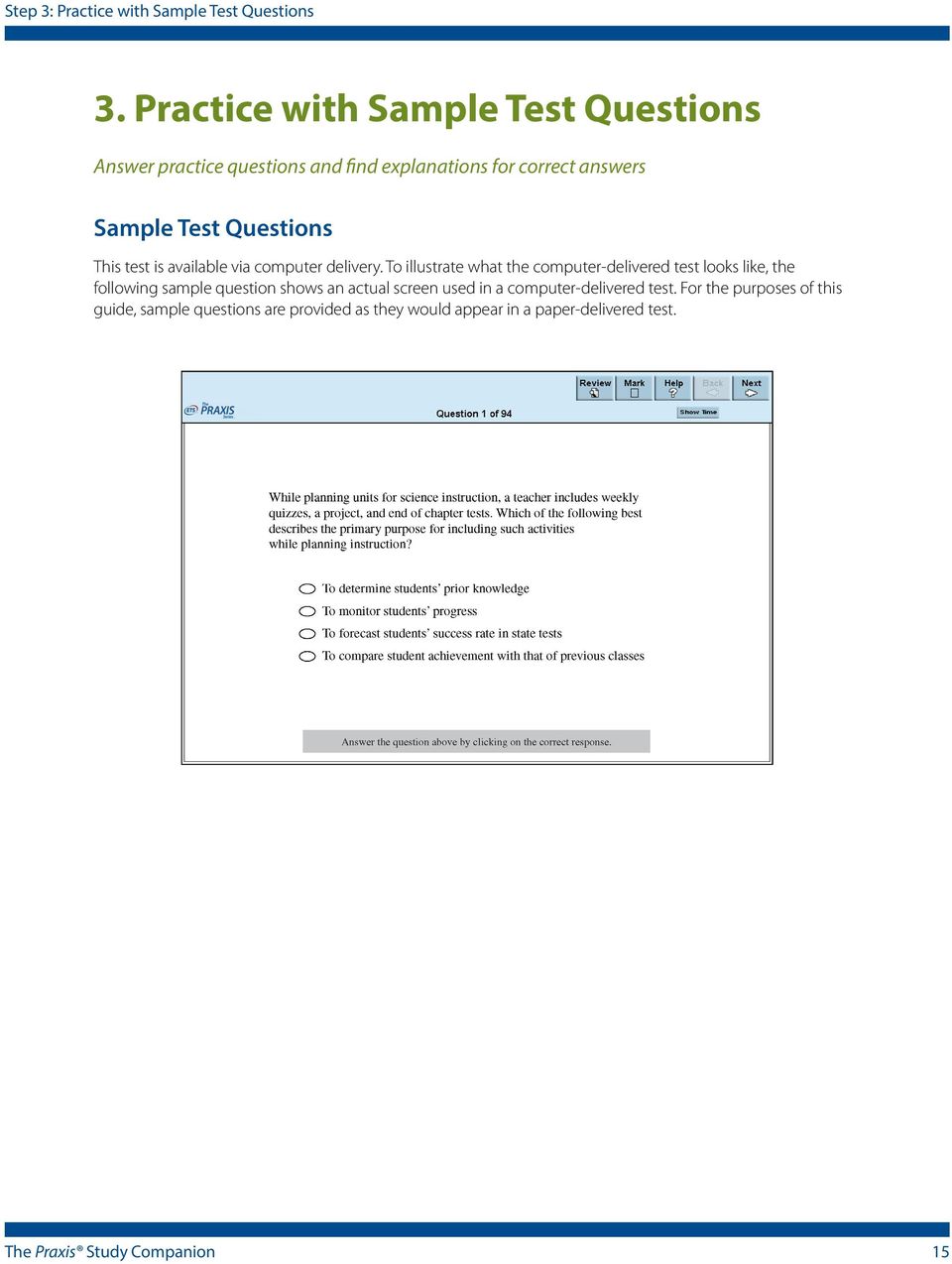
15 Step 3: Practice with Sample Test Questions 3. Practice with Sample Test Questions Answer practice questions and find explanations for correct answers Sample Test Questions This test is available via computer delivery. To illustrate what the computer-delivered test looks like, the following sample question shows an actual screen used in a computer-delivered test. For the purposes of this guide, sample questions are provided as they would appear in a paper-delivered test. The Praxis Study Companion 15
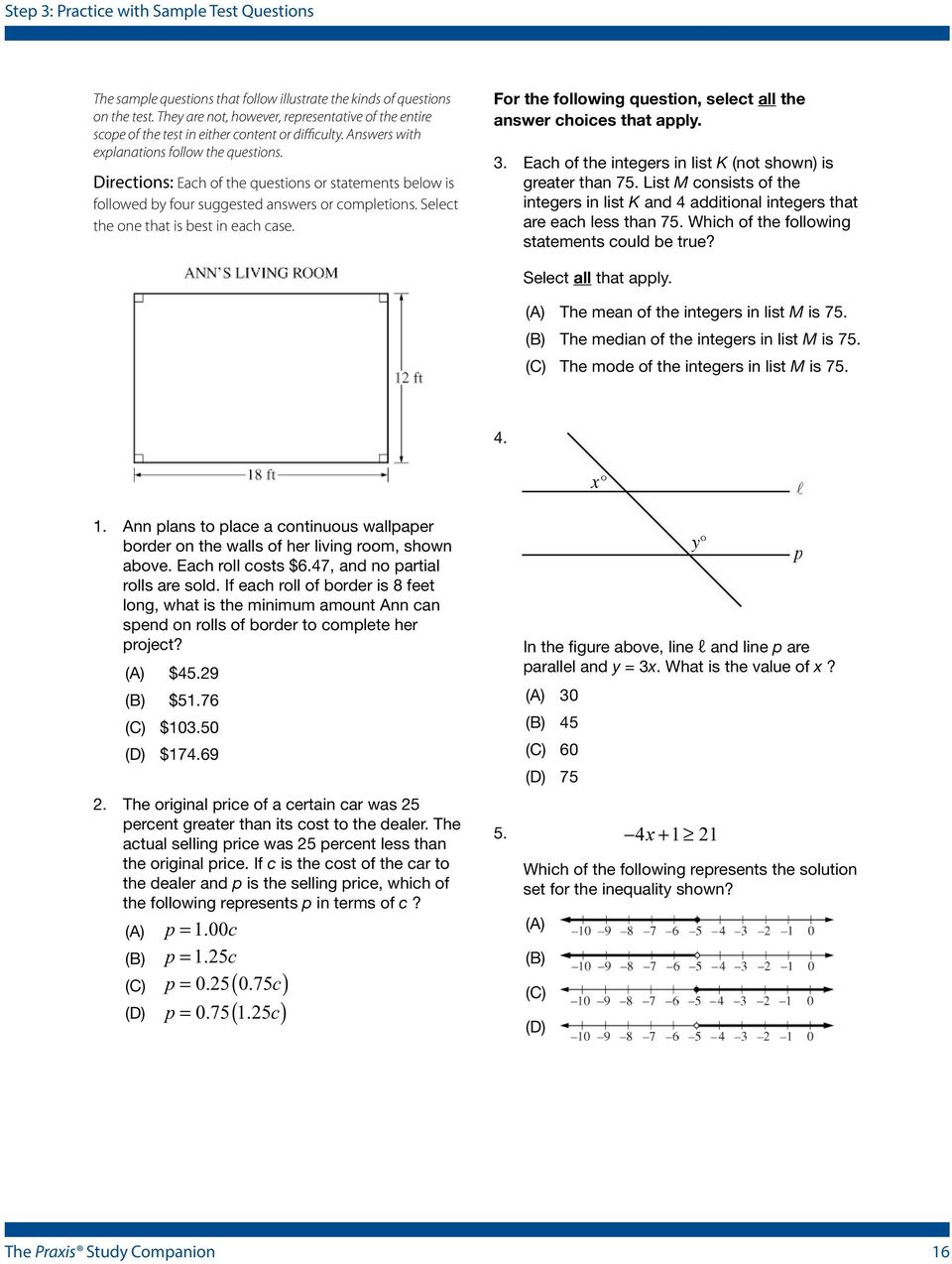
16 Step 3: Practice with Sample Test Questions The sample questions that follow illustrate the kinds of questions on the test. They are not, however, representative of the entire scope of the test in either content or difficulty. Answers with explanations follow the questions. Directions: Each of the questions or statements below is followed by four suggested answers or completions. Select the one that is best in each case. For the following question, select all the answer choices that apply. 3. Each of the integers in list K (not shown) is greater than 75. List M consists of the integers in list K and 4 additional integers that are each less than 75. Which of the following statements could be true? Select all that apply. (A) The mean of the integers in list M is 75. (B) The median of the integers in list M is 75. (C) The mode of the integers in list M is Ann plans to place a continuous wallpaper border on the walls of her living room, shown above. Each roll costs $6.47, and no partial rolls are sold. If each roll of border is 8 feet long, what is the minimum amount Ann can spend on rolls of border to complete her project? (A) $45.29 (B) $51.76 (C) $ (D) $ The original price of a certain car was 25 percent greater than its cost to the dealer. The actual selling price was 25 percent less than the original price. If c is the cost of the car to the dealer and p is the selling price, which of the following represents p in terms of c? (A) p = 100. c (B) p = 125. c (C) p = (. c) (D) p c = ( ) In the figure above, line l and line p are parallel and y = 3x. What is the value of x? (A) 30 (B) 45 (C) 60 (D) x Which of the following represents the solution set for the inequality shown? (A) (B) (C) (D) The Praxis Study Companion 16
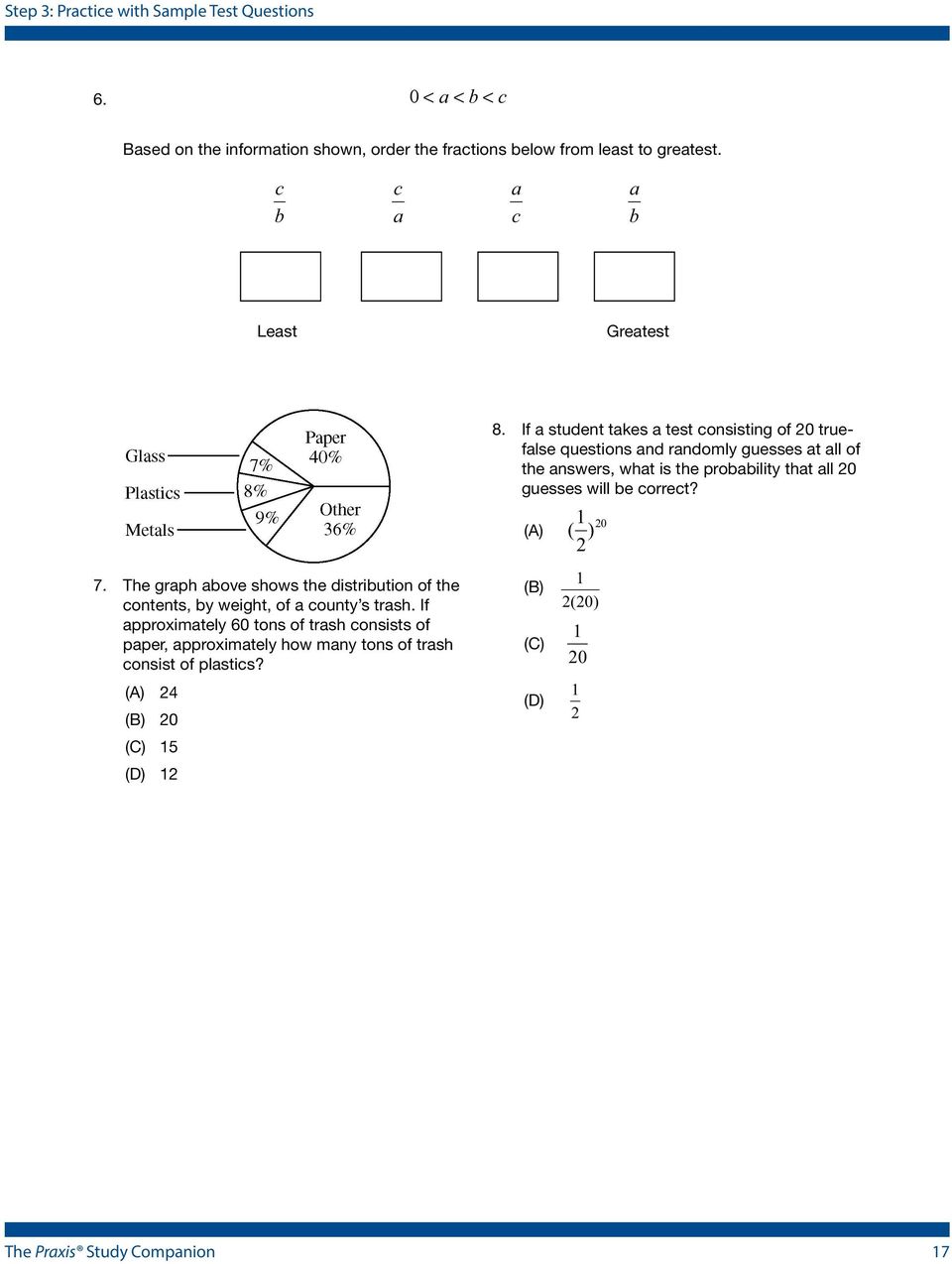
17 Step 3: Practice with Sample Test Questions 6. 0 < a< b< c Based on the information shown, order the fractions below from least to greatest. c b c a a c a b Least Greatest 7. The graph above shows the distribution of the contents, by weight, of a county s trash. If approximately 60 tons of trash consists of paper, approximately how many tons of trash consist of plastics? (A) 24 (B) 20 (C) 15 (D) If a student takes a test consisting of 20 truefalse questions and randomly guesses at all of the answers, what is the probability that all 20 guesses will be correct? 1 (A) ( ) 2 20 (B) ( ) (C) (D) The Praxis Study Companion 17
18 Step 3: Practice with Sample Test Questions 9. 3x+ 2y = 8 For each of the following equations, indicate whether the graph of the equation in the xy-plane will never intersect with, intersect once with, or coincide with the graph of the equation above. Equation The graphs of the equations will never intersect The graphs of the equations will intersect once The graphs of the equations will coincide 12x 8y = 32 9x+ 4y = 64 6x+ 4y = 16 18x+ 12y = Which of the following graphs in the xy-plane represents the graph of a function? (A) (B) (C) (D) The Praxis Study Companion 18

19 Step 3: Practice with Sample Test Questions 13. The graph of linear function f passes through the points ( 311, ) and ( 7, 4). What is the slope of the graph of f? Give your answer as a fraction. 11. The graph of the quadratic equation y = ax 2 + c is shown in the xy-plane. If a and c are integers, what are the values of a and c? a = c = 12. In triangle ABC shown, AB = 21, AD = 15, DE =12, and AB is parallel to DE. What is the value of AC? (A) 20.0 (B) 23.6 (C) 31.8 (D) 35.0 The Praxis Study Companion 19

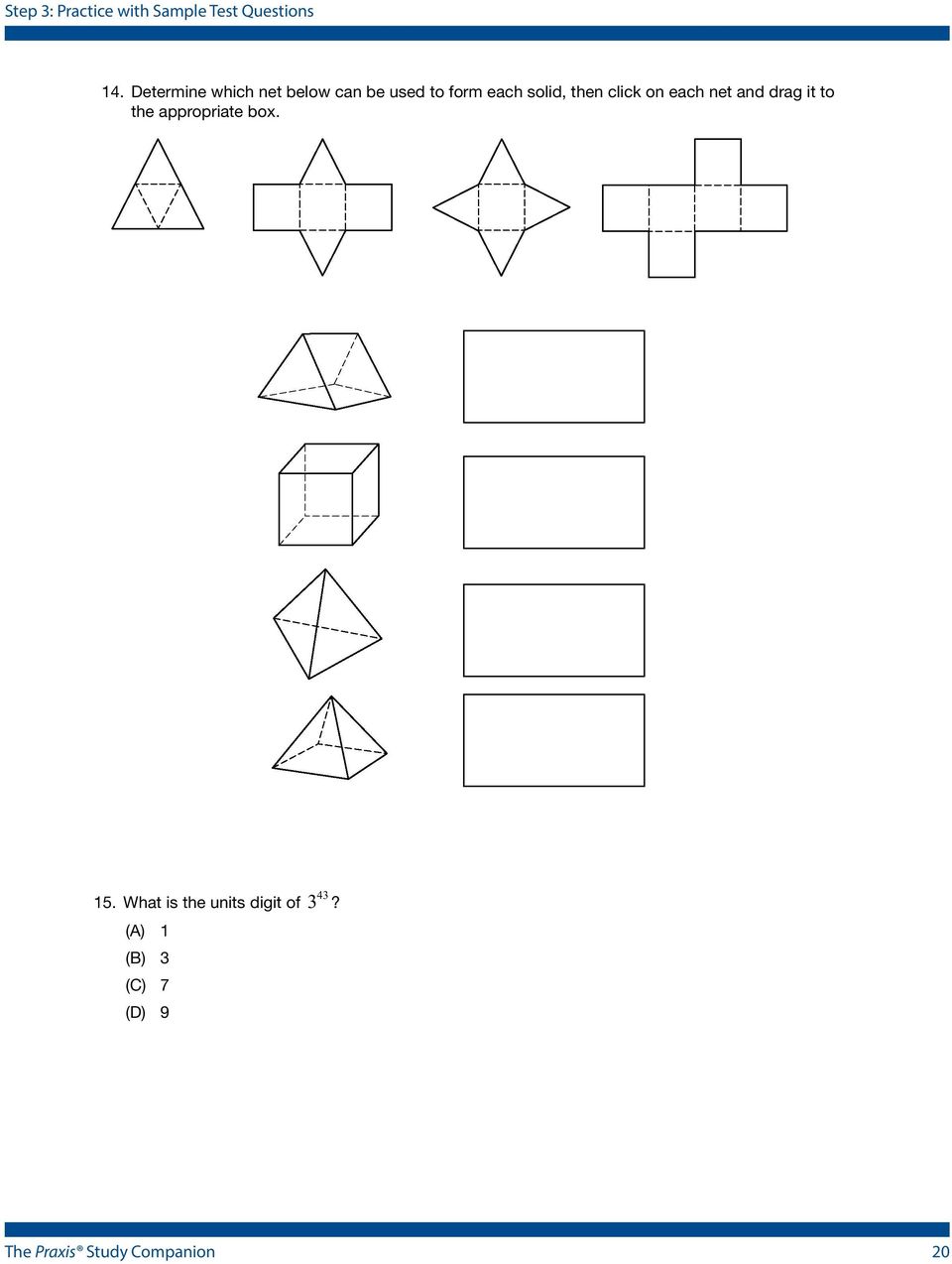
20 Step 3: Practice with Sample Test Questions 14. Determine which net below can be used to form each solid, then click on each net and drag it to the appropriate box. 15. What is the units digit of 3 43? (A) 1 (B) 3 (C) 7 (D) 9 The Praxis Study Companion 20
21 Step 3: Practice with Sample Test Questions Answers to Sample Questions 1. (B) is correct. The minimum length of wallpaper border needed to decorate the room is equal to the perimeter of Ann s living room. The perimeter is the sum of the lengths of the four walls of the room, or = 60 feet. The number of rolls of border needed is determined by dividing the perimeter by the length of each roll of border, and 60 feet = feet Therefore, Ann needs a minimum of 7.5 rolls, and since no partial rolls are sold, she must buy 8 rolls. The cost of 8 rolls of the border is found by multiplying the cost of each roll, $6.47, by the number of rolls needed, so the final answer is $ = $ (D) is correct. This question asks you to apply your knowledge of percent increase or decrease to determine a selling price based on the cost of a car to the dealer, c. Since the original price of the car was 25 percent greater than the cost to the dealer, the original price was c c = 1.25c. Since the selling price was 25 percent less than this amount, only 75 percent of this amount was paid and, therefore, the selling price of the car, p, is equal to 0.75(1.25c). 3. (A) and (B) are correct. If list K consists of the integers 76, 77, 78, and 79, and list M consists of the integers 71, 72, 73, 74, 76, 77, 78, and 79, then the mean of the integers in list M is 75. Since an example where the mean of the integers in list M is 75 can be created, the statement in (A) could be true. In addition, the median of the integers in list M is also 75 in this example, which means that the statement in (B) could be true. However, because all of the integers in list M are either greater than 75 or less than 75, 75 cannot be the mode of those integers, so the statement in (C) cannot be true. 4. (B) is correct. The properties of angles associated with parallel and transversal lines can be used to show that the angle with measure x degrees and the angle with measure y degrees are supplementary angles. Recall that the sum of the measures of supplementary angles is 180. That is, x+ y =180. It is given that y = 3 x. Substituting for y, you get 4x = 180. Hence, x = (A) is correct. To determine which option represents the solution set for the inequality, subtract 1 from each side of the inequality and then divide each side of the inequality by 4. Remember that when multiplying or dividing both sides of an inequality by a negative number, the direction of the inequality symbol needs to be reversed. Thus, the equivalent inequality is x 5. The option that represents the set of all real numbers less than or equal to 5 is (A). 6. The correct order, from least to greatest, is a c, a b, c b, and c. Since a is the least of the 3 positive a numbers, the fractions with a numerator of a will have values less than 1. As the number of parts that a quantity is divided into increases, the size of each of those parts decreases, and since c is greater than b, a a < <1. Then, since c is the greatest of the 3 positive c b numbers, the fractions with a numerator of c will have values greater than 1, and since b is greater than a, c c 1< < b a. 7. (D) is correct. One of the ways to solve the problem is to use the information about the trash that consists of paper to find the total weight of the county s trash, and then use this information to find how many tons of the trash consist of plastics. The problem states that 60 tons of the trash consists of paper, and the graph shows that this amount equals 40% of the total, so 60 = 04. ( total weight of trash ), and the total weight of trash is 60 = 150 tons. Then, the weight of 04. trash that consists of plastics equals 8% of 150 tons, or ( 008. )( 150 ), which equals 12 tons. Alternatively, the problem can be solved using the fact that the ratio of plastics to paper in the trash is the same, whether the two amounts are given as percents or in tons. This gives tons of plastics the proportion = 8 % tons of paper 40% or tons of plastics 8 =, and when the proportion is solved the same answer of 12 tons is obtained. The Praxis Study Companion 21
22 Step 3: Practice with Sample Test Questions 8. (A) is correct. The probability that the student guesses any one answer correctly is 1, and, since the 2 student is randomly guessing, the guesses are independent events, so 1 needs to be multiplied by 2 itself 20 times. Thus, the probability of guessing all 20 1 answers correctly is ( ) To answer this question, remember that if each term of the equation 3x+ 2y = 8 can be multiplied by the same constant to give the corresponding terms in the equation in the table, then the graphs of the equations will coincide. If the x term and the y term of the equation 3x+ 2y = 8 can be multiplied by the same constant to give the corresponding terms in the equation in the table, but this is not true for the constant term, then the lines are parallel, so the graphs of the equations will never intersect. In any other case, the graphs of the equations will intersect once. For 12x 8y = 32, since each term of 3x+ 2y = 8 can be multiplied by 4 to give 12x 8y = 32, the graphs of the equations will coincide. For 9x+ 4y = 64, since 3 3x = 9x but 3 2y 4y, the graphs of the equations will intersect once. For 6x+ 4y = 16, since 2 3x = 6x but 2 2y 4y, the graphs of the equations will intersect once. Finally, for 18x+ 12y = 48, since 6 3x = 18x and 6 2y = 12y but , the lines are parallel, and the graphs of the equations will never intersect. 10. (A) is correct. The vertical line test can be used to see whether a graph in the xy-plane represents the graph of a function. The test consists of taking a vertical line and moving it across the graph in the xy-plane. If the vertical line touches the graph at only one point across the entire graph, then that graph is the graph of a function. As you move left to right over the graph in (A), a vertical line would only contact the graph at a single point across the entire graph, thus it is the graph of a function. As you move left to right over the graph in (B), a vertical line would touch at two points over most of the graph, hence it is not a function. (C) is not a function for the same reason that (B) is not a function. (D) is not a function because of the vertical part of the graph to the right of the y-axis. 11. The correct answer is a = 2 and c = 5. Since the graph of the equation intersects the y-axis at the point (, 0 5), the value of c must be 5. Then, one method to find the value of a is to substitute the coordinates from another point on the graph into the equation and solve for a. Using the point ( 2, 3 ) and the fact that c = 5, it can be determined that 2 3= a ( 2 ) 5, so 4a 5= 3. To solve this equation for a, add 5 to both sides of the equation, and then divide both sides of the equation by 4, which leads to the answer a = (D) is correct. Since AB is parallel to DE, triangle ABC is similar to triangle DEC, which means the ratios of the lengths of corresponding sides of the two triangles are equal. Since AC = AD + DC and the lengths of AB, AD, and DE are given, the proportion AC AB = can first be used to find the DC DE value of DC, which can then be used to find the value of AC. Substituting into the proportion gives 15 + DC 21 =. Therefore, DC 12 12( 15 + DC) = 21DC DC = 21DC 180 = 9DC DC = 20. Then, since AC = AD + DC, it can be determined that AC = The correct answer is 3. The slope of a linear 2 function can be found by substituting into the formula y2 y1 m =, where m is the slope and ( x1, y1) x2 x1 and ( x2, y2) are two points on the linear function. Substituting the given points into the formula gives m = 4 11 ( ) = 15 3 =. Please note that the negative sign can be entered in either box, and you do not need to simplify the fraction to receive credit for the correct answer. The Praxis Study Companion 22
23 Step 3: Practice with Sample Test Questions 14. The first solid and the second net both consist of 2 triangles and 3 rectangles, so the second net can be used to form the first solid. The second solid and the fourth net both consist of 6 rectangles, so the fourth net can be used to form the second solid. The third solid and the first net both consist of 4 triangles, so the first net can be used to form the third solid. Finally, the fourth solid and the third net both consist of 4 triangles and 1 rectangle, so the third net can be used to form the fourth solid. 15. (C) is correct. To solve this problem, the sequence of powers 3 n in relation to the exponent n needs to be examined. n n Units Digit Note that the units digit of 3 4 is 1, which is equal to the units digit of 3 0, and then the sequence of units digits repeats itself in sets of four, with the following pattern (where k is some positive integer): If n is of the form n If n is of the form n If n is of the form n If n is of the form n = 4 k, the units digit of 3 n is 1. = 4k+ 1, the units digit of 3 n is 3. = 4k+ 2, the units digit of 3 n is 9. = 4k+ 3, the units digit of 3 n is 7. In the problem, the value of the exponent is 43, and since 43 = , the units digit of 3 43 is the same as the units digit of 3 3, which is 7. The Praxis Study Companion 23
24 Step 4: Determine Your Strategy for Success 4. Determine Your Strategy for Success Set clear goals and deadlines so your test preparation is focused and efficient Effective Praxis test preparation doesn t just happen. You ll want to set clear goals and deadlines for yourself along the way. Otherwise, you may not feel ready and confident on test day. A helpful resource is the Strategies for Success video, which includes tips for preparing and studying, along with tips for reducing test anxiety. 1) Learn what the test covers. You may have heard that there are several different versions of the same test. It s true. You may take one version of the test and your friend may take a different version a few months later. Each test has different questions covering the same subject area, but both versions of the test measure the same skills and content knowledge. You ll find specific information on the test you re taking on page 5, which outlines the content categories that the test measures and what percentage of the test covers each topic. Visit testprep for information on other Praxis tests. 2) Assess how well you know the content. Research shows that test takers tend to overestimate their preparedness this is why some test takers assume they did well and then find out they did not pass. The Praxis tests are demanding enough to require serious review of likely content, and the longer you ve been away from the content, the more preparation you will most likely need. If it has been longer than a few months since you ve studied your content area, make a concerted effort to prepare. 3) Collect study materials. Gathering and organizing your materials for review are critical steps in preparing for the Praxis tests. Consider the following reference sources as you plan your study: Did you take a course in which the content area was covered? If yes, do you still have your books or your notes? Does your local library have a high school-level textbook in this area? Does your college library have a good introductory college-level textbook in this area? Practice materials are available for purchase for many Praxis tests at Test preparation materials include sample questions and answers with explanations. 4) Plan and organize your time. You can begin to plan and organize your time while you are still collecting materials. Allow yourself plenty of review time to avoid cramming new material at the end. Here are a few tips: Choose a test date far enough in the future to leave you plenty of preparation time. Test dates can be found at Work backward from that date to figure out how much time you will need for review. Set a realistic schedule and stick to it. The Praxis Study Companion 24
25 Step 4: Determine Your Strategy for Success 5) Practice explaining the key concepts. Praxis tests with constructed-response questions assess your ability to explain material effectively. As a teacher, you ll need to be able to explain concepts and processes to students in a clear, understandable way. What are the major concepts you will be required to teach? Can you explain them in your own words accurately, completely, and clearly? Practice explaining these concepts to test your ability to effectively explain what you know. 6) Understand how questions will be scored. Scoring information can be found on page 44. 7) Develop a study plan. A study plan provides a road map to prepare for the Praxis tests. It can help you understand what skills and knowledge are covered on the test and where to focus your attention. Use the study plan template on page 29 to organize your efforts. And most important get started! Would a Study Group Work for You? Using this guide as part of a study group People who have a lot of studying to do sometimes find it helpful to form a study group with others who are working toward the same goal. Study groups give members opportunities to ask questions and get detailed answers. In a group, some members usually have a better understanding of certain topics, while others in the group may be better at other topics. As members take turns explaining concepts to one another, everyone builds self-confidence. If the group encounters a question that none of the members can answer well, the group can go to a teacher or other expert and get answers efficiently. Because study groups schedule regular meetings, members study in a more disciplined fashion. They also gain emotional support. The group should be large enough so that multiple people can contribute different kinds of knowledge, but small enough so that it stays focused. Often, three to six members is a good size. Here are some ways to use this guide as part of a study group: Plan the group s study program. Parts of the study plan template, beginning on page 29, can help to structure your group s study program. By filling out the first five columns and sharing the worksheets, everyone will learn more about your group s mix of abilities and about the resources, such as textbooks, that members can share with the group. In the sixth column ( Dates I will study the content ), you can create an overall schedule for your group s study program. Plan individual group sessions. At the end of each session, the group should decide what specific topics will be covered at the next meeting and who will present each topic. Use the topic headings and subheadings in the Test at a Glance table on page 5 to select topics, and then select practice questions, beginning on page 15. Prepare your presentation for the group. When it s your to turn present, prepare something that is more than a lecture. Write two or three original questions to pose to the group. Practicing writing actual questions can help you better understand the topics covered on the test as well as the types of questions you will encounter on the test. It will also give other members of the group extra practice at answering questions. The Praxis Study Companion 25
26 Step 4: Determine Your Strategy for Success Take a practice test together. The idea of a practice test is to simulate an actual administration of the test, so scheduling a test session with the group will add to the realism and may also help boost everyone s confidence. Remember, complete the practice test using only the time that will be allotted for that test on your administration day. Learn from the results of the practice test. Review the results of the practice test, including the number of questions answered correctly in each content category. For tests that contain constructedresponse questions, look at the Sample Test Questions section, which also contain sample responses to those questions and shows how they were scored. Then try to follow the same guidelines that the test scorers use. Be as critical as you can. You re not doing your study partner(s) any favors by letting them get away with an answer that does not cover all parts of the question adequately. Be specific. Write comments that are as detailed as the comments about the sample responses. Indicate where and how your study partner(s) are doing an inadequate job of answering the question. Writing notes in the margins of the answer sheet may also help. Be supportive. Include comments that point out what your study partner(s) got right. Then plan one or more study sessions based on aspects of the questions on which group members performed poorly. For example, each group member might be responsible for rewriting one paragraph of a response in which someone else did an inadequate job. Whether you decide to study alone or with a group, remember that the best way to prepare is to have an organized plan. The plan should set goals based on specific topics and skills that you need to learn, and it should commit you to a realistic set of deadlines for meeting those goals. Then you need to discipline yourself to stick with your plan and accomplish your goals on schedule. The Praxis Study Companion 26
27 Step 5: Develop Your Study Plan 5. Develop Your Study Plan Develop a personalized study plan and schedule Planning your study time is important because it will help ensure that you review all content areas covered on the test. Use the sample study plan below as a guide. It shows a plan for the Core Academic Skills for Educators: Reading test. Following that is a study plan template that you can fill out to create your own plan. Use the Learn about Your Test and Test Specifications information beginning on page 5 to help complete it. Use this worksheet to: 1. Define Content Areas: List the most important content areas for your test as defined in chapter Determine Strengths and Weaknesses: Identify your strengths and weaknesses in each content area. 3. Identify Resources: Identify the books, courses, and other resources you plan to use for each content area. 4. Study: Create and commit to a schedule that provides for regular study periods. Praxis Test Name (Test Code): Core Academic Skills for Educators: Reading (5712) Test Date: 9/15/15 Content covered Description of content How well do I know the content? (scale 1 5) What resources do I have/need for the content? Where can I find the resources I need? Dates I will study the content Date completed Key Ideas and Details Close reading Draw inferences and implications from the directly stated content of a reading selection 3 Middle school English textbook College library, middle school teacher 7/15/15 7/15/15 Determining Ideas Identify summaries or paraphrases of the main idea or primary purpose of a reading selection 3 Middle school English textbook College library, middle school teacher 7/17/15 7/17/15 Determining Ideas Identify summaries or paraphrases of the supporting ideas and specific details in a reading selection 3 Middle and high school English textbook College library, middle and high school teachers 7/20/15 7/21/15 Craft, Structure, and Language Skills Interpreting tone Determine the author s attitude toward material discussed in a reading selection 4 Middle and high school English textbook College library, middle and high school teachers 7/25/15 7/26/15 Analysis of structure Identify key transition words and phrases in a reading selection and how they are used 3 Middle and high school English textbook, dictionary College library, middle and high school teachers 7/25/15 7/27/15 Analysis of structure Identify how a reading selection is organized in terms of cause/effect, compare/contrast, problem/solution, etc. 5 High school textbook, college course notes College library, course notes, high school teacher, college professor 8/1/15 8/1/15 Author s purpose Determine the role that an idea, reference, or piece of information plays in an author s discussion or argument 5 High school textbook, college course notes College library, course notes, high school teacher, college professor 8/1/15 8/1/15 (continued on next page) The Praxis Study Companion 27
28 Step 5: Develop Your Study Plan Content covered Description of content How well do I know the content? (scale 1 5) What resources do I have/need for the content? Where can I find the resources I need? Dates I will study the content Date completed Language in different contexts Determine whether information presented in a reading selection is presented as fact or opinion 4 High school textbook, college course notes College library, course notes, high school teacher, college professor 8/1/15 8/1/15 Contextual meaning Identify the meanings of words as they are used in the context of a reading selection 2 High school textbook, college course notes College library, course notes, high school teacher, college professor 8/1/15 8/1/15 Figurative Language Understand figurative language and nuances in word meanings 2 High school textbook, college course notes College library, course notes, high school teacher, college professor 8/8/15 8/8/15 Vocabulary range Understand a range of words and phrases sufficient for reading at the college and career readiness level 2 High school textbook, college course notes College library, course notes, high school teacher, college professor 8/15/15 8/17/15 Integration of Knowledge and Ideas Diverse media and formats Analyze content presented in diverse media and formats, including visually and quantitatively, as well as in words 2 High school textbook, college course notes College library, course notes, high school teacher, college professor 8/22/15 8/24/15 Evaluation of arguments Identify the relationship among ideas presented in a reading selection 4 High school textbook, college course notes College library, course notes, high school teacher, college professor 8/24/15 8/24/15 Evaluation of arguments Determine whether evidence strengthens, weakens, or is relevant to the arguments in a reading selection 3 High school textbook, college course notes College library, course notes, high school teacher, college professor 8/27/15 8/27/15 Evaluation of arguments Determine the logical assumptions upon which an argument or conclusion is based 5 High school textbook, college course notes College library, course notes, high school teacher, college professor 8/28/15 8/30/15 Evaluation of arguments Draw conclusions from material presented in a reading selection 5 High school textbook, college course notes College library, course notes, high school teacher, college professor 8/30/15 8/31/15 Comparison of texts Recognize or predict ideas or situations that are extensions of or similar to what has been presented in a reading selection 4 High school textbook, college course notes College library, course notes, high school teacher, college professor 9/3/15 9/4/15 Comparison of texts Apply ideas presented in a reading selection to other situations 2 High school textbook, college course notes College library, course notes, high school teacher, college professor 9/5/15 9/6/15 The Praxis Study Companion 28
29 Step 5: Develop Your Study Plan My Study Plan Use this worksheet to: 1. Define Content Areas: List the most important content areas for your test as defined in chapter Determine Strengths and Weaknesses: Identify your strengths and weaknesses in each content area. 3. Identify Resources: Identify the books, courses, and other resources you plan to use for each content area. 4. Study: Create and commit to a schedule that provides for regular study periods. Praxis Test Name (Test Code): Test Date: Content covered Description of content How well do I know the content? (scale 1 5) What resources do I have/need for this content? Where can I find the resources I need? Dates I will study this content Date completed (continued on next page) The Praxis Study Companion 29
30 Step 5: Develop Your Study Plan Content covered Description of content How well do I know the content? (scale 1 5) What resources do I have/need for the content? Where can I find the resources I need? Dates I will study the content Date completed The Praxis Study Companion 30
31 Step 6: Study Topics 6. Study Topics Detailed study topics with questions for discussion Using the Study Topics That Follow The English Language Arts: Content and Analysis test is designed to measure the knowledge and skills necessary for a beginning teacher. This chapter is intended to help you organize your preparation for the test and to give you a clear indication of the depth and breadth of the knowledge required for success on the test. Virtually all accredited programs address the topics covered by the test; however, you are not expected to be an expert on all aspects of the topics that follow. You are likely to find that the topics below are covered by most introductory textbooks. Consult materials and resources, including lecture and laboratory notes, from all your coursework. You should be able to match up specific topics and subtopics with what you have covered in your courses. Try not to be overwhelmed by the volume and scope of content knowledge in this guide. Although a specific term may not seem familiar as you see it here, you might find you can understand it when applied to a real-life situation. Many of the items on the actual test will provide you with a context to apply to these topics or terms. Discussion Areas Interspersed throughout the study topics are discussion areas, presented as open-ended questions or statements. These discussion areas are intended to help test your knowledge of fundamental concepts and your ability to apply those concepts to situations in the classroom or the real world. Most of the areas require you to combine several pieces of knowledge to formulate an integrated understanding and response. If you spend time on these areas, you will gain increased understanding and facility with the subject matter covered on the test. You may want to discuss these areas and your answers with a teacher or mentor. Note that this study companion does not provide answers for the discussion area questions, but thinking about the answers to them will help improve your understanding of fundamental concepts and will probably help you answer a broad range of questions on the test. The Praxis Study Companion 31
32 Step 6: Study Topics Study Topics The Middle School Mathematics test is designed to measure the knowledge and skills necessary for a beginning teacher. This chapter is intended to help you organize your preparation for the test and to give you a clear indication of the depth and breadth of the knowledge required for success on the test. Virtually all accredited programs address the topics covered by the test; however, you are not expected to be an expert on all aspects of the topics that follow. You are likely to find that the topics below are covered by most introductory textbooks. Consult materials and resources, including lecture and laboratory notes, from all your coursework. You should be able to match up specific topics and subtopics with what you have covered in your courses. Try not to be overwhelmed by the volume and scope of content knowledge in this guide. Although a specific term may not seem familiar as you see it here, you might find you can understand it when applied to a real-life situation. Many of the items on the actual test will provide you with a context to apply to these topics or terms. Discussion Areas Interspersed throughout the study topics are discussion areas, presented as open-ended questions or statements. These discussion areas are intended to help test your knowledge of fundamental concepts and your ability to apply those concepts to situations in the classroom or the real world. Most of the areas require you to combine several pieces of knowledge to formulate an integrated understanding and response. If you spend time on these areas, you will gain increased understanding and facility with the subject matter covered on the test. You may want to discuss these areas and your answers with a teacher or mentor. Note that this study companion does not provide answers for the discussion area questions, but thinking about the answers to them will help improve your understanding of fundamental concepts and will probably help you answer a broad range of questions on the test. I. Arithmetic and Algebra A. Numbers and Operations 1. Understands operations and properties of the real number system a. solve problems using addition, subtraction, multiplication, and division of rational numbers b. apply the order of operations c. determine whether the properties hold (e.g., commutative, associative, distributive) for given operations on a number system d. compare, classify, and order real numbers e. perform operations involving exponents, including negative exponents f. simplify and approximate radicals g. represent and compare very large and very small numbers (e.g., scientific notation) Discussion areas Be able to correctly solve problems involving some or all basic operations regardless of the order of presentation of the operations. For example, do you know that x 6 8 = 17? Can you describe common mistakes students make in applying the order of operations? Do you know what order of operations your calculator uses? Do you know what assumptions about the order of operations are included in the spreadsheet application you use? Be able to identify examples of appropriate uses of the closure, commutative, associative, and distributive properties of the operations of the real number system. Be able to identify and determine the additive and multiplicative inverses of a number. Can you give examples of when you might use additive or multiplicative inverses? Be able to simplify expressions of the form x 8 ( 3 )( 3 ),,. 5 x 2 The Praxis Study Companion 32
33 Step 6: Study Topics Can you describe real-life scenarios that are best modeled using expressions containing powers and roots? Be able to classify such numbers as: 2, 4, 4i, 5, 9 + 8i. Can you explain the difference between a rational and an irrational number? 2. Understands the relationships among fractions, decimals, and percents a. convert among fractions, decimals, and percents b. represent fractions, decimals, and percents using various models 3. Knows how to use ratio reasoning to solve problems a. apply the concept of a ratio and use ratio language and notation to describe a relationship between two quantities b. compute unit rates c. use ratio reasoning to convert rates d. solve problems involving scale factors 4. Knows how to use proportional relationships to solve real-world problems a. recognize and represent proportional and inversely proportional relationships between two quantities b. use proportional relationships to solve multistep ratio and percent problems 5. Knows how to use basic concepts of number theory (e.g., divisibility, prime factorization, multiples) to solve problems a. recognize relationships involving prime and composite numbers b. solve problems involving odd or even numbers c. solve problems involving factors, multiples, and divisibility 6. Knows a variety of strategies to determine the reasonableness of results a. recognize the reasonableness of results within the context of a given problem b. test the reasonableness of results using estimation c. estimate absolute and relative error in the numerical answer to a problem Discussion areas Be able to recognize and use multiple representations of fractions, decimals, percents, and integers. Can you give examples of when different representations would be useful in developing deeper understanding of mathematical concepts? Be able to apply the concepts of prime or composite numbers, even or odd numbers, factors, multiples, and divisibility. Can you describe, for each of these concepts, a real-world context in which you would use this concept? Be able to use ratios, proportions, and percents, as appropriate, to solve real-world problems. Can you describe the difference between a ratio and a proportion? Can you describe several real-world applications of proportional reasoning? Can you recognize different representations of fractional percents (less than 1 percent)? of percents greater than 100 percent? Can you describe the common difficulties middle school students have in learning to calculate and use percents less than 1 percent and percents greater than 100 percent? Can you calculate percent change and percent of percents? Can you describe at least one common mistake middle school students often make when calculating percent change? B. Algebra 1. Knows how to evaluate and manipulate algebraic expressions, equations, and formulas a. perform arithmetic operations on polynomials b. manipulate and perform arithmetic operations on problems involving rational expressions The Praxis Study Companion 33
34 Step 6: Study Topics c. evaluate, manipulate, and compare algebraic expressions involving radicals and exponents, including negative exponents d. use variables to construct and solve equations in real-world contexts e. translate verbal relationships into algebraic equations or expressions 2. Knows how to recognize and represent linear relationships algebraically a. determine the equation of a line b. recognize and use the basic forms of linear equations 3. Knows how to solve linear equations and inequalities a. solve one-variable linear equations and inequalities algebraically and represent solutions on a number line 4. Knows how to represent and solve nonlinear equations and inequalities a. solve one-variable nonlinear equations and inequalities (e.g., absolute value, quadratic) algebraically and represent solutions on a number line 5. Knows how to represent and solve systems of equations and inequalities a. represent and solve systems of linear equations and inequalities with two variables algebraically and graphically 6. Knows how to recognize and represent simple sequences or patterns (e.g., arithmetic, geometric) a. evaluate, extend, or algebraically represent rules that involve number patterns b. describe or extend patterns involving shapes or figures c. explore patterns in order to make conjectures, predictions, or generalizations Discussion areas Can you demonstrate the similarities between arithmetic operations with real numbers and the corresponding operations with algebraic (symbolic) representations? Are you able to add, subtract, multiply, and divide polynomials? Can you explain how the FOIL method of multiplying two binomials is an example of the distributive property of multiplication over addition? Can you add, subtract, multiply, 6 and x divide algebraic fractions such as or 5x 30 2 c + 5c? 2 c + 12c+ 35 Can you simplify 2 b 3 ab 2? 9a 4 2 Can you give other representations of x 3, 5 5? 2 x, x 2, and x Do you recall that ( x ) = ( x) = 3? x Can you translate verbal expressions and relationships into algebraic expressions or equations? Can you solve equations such as 2x + 4 = 12 and 2x 5 = 3x+ 4? Can you solve inequalities such as 3 x + 4 > 15? Can you graph the solution to an equation or inequality in one variable on a number line? Can you describe the graph of the solution of an inequality in two variables (in the xyplane, for example)? Can you describe, in words, what it means to be the algebraic solution of a system of linear equations? Can you describe, in words, what it means to be the graphical solution of a system of linear equations? Can you identify quadratic equations that can be by solved by factoring? Can you use the quadratic formula to solve quadratic equations? Can you graphically solve quadratic equations? Can you use a calculator to solve quadratic equations? The Praxis Study Companion 34
35 Step 6: Study Topics C. Functions and Their Graphs 1. Knows how to identify, define, and evaluate functions a. know function notation b. decide whether a given set of conditions represents a function c. evaluate functions for given values (algebraically, graphically, tabular) 2. Knows how to determine and interpret the domain and the range of a function numerically, graphically, and algebraically a. determine the domain and range of a given table of values b. determine the domain and range from a given graph of a function c. determine the domain and range of a given function d. interpret domain and range in real-world settings 3. Understands basic characteristics of linear functions (e.g., slope, intercepts) a. determine the slope of a given linear function b. interpret slope as a constant rate of change c. determine the x- and y-intercepts of a given linear function d. interpret the x- and y-intercepts of a given linear function 4. Understands the relationships among functions, tables, and graphs a. determine and interpret the x- and y-intercepts of any given function b. select an equation that best represents a graph (e.g., linear, quadratic, absolute value, simple exponential) c. determine the graphical properties and sketch a graph given an equation of a linear, quadratic, absolute value, or simple exponential function 5. Knows how to analyze and represent functions that model given information a. develop a model (e.g., graph, equation, table) of a given set of conditions b. evaluate whether a particular mathematical model (e.g., graph, equation, table) can be used to describe a given set of conditions Discussion areas Be able to identify the graph of a function by performing the vertical line test. Can you explain why y = x 2 is the graph of a function of x, while x = y 2 is not the graph of a function of x? Can you give an algebraic definition of a function? Can you decide if a given set of conditions determines a function? Can you explain why (1, 2), (2, 0), ( 1, 2), (1, 3) is not a function, but (1, 1), (3, 5), (4, 10), (5, 12) is a function? Be able to find the domain (x-values) and range (y-values) of a function without necessarily knowing the definitions. Can you determine the equation of a line, given any two points on the line? Can you determine the equation of a line, given the slope of the line and one point on the line? Can you determine the equation of a line if you are given the x- and y-intercepts? Can you explain the concept of slope using tables, graphs, and linear equations? Given the graph of a line, a parabola, a step function, an absolute value function, or an exponential function, be able to select the equation that best represents the graph. Given a linear, quadratic, or exponential equation, be able to describe some important characteristics of the graph of the equation. Given a linear equation, can you identify the slope and the intercepts of the graph of the line? The Praxis Study Companion 35
36 Step 6: Study Topics II. Given a quadratic equation of the form y = ax 2 + bx+ c, can you describe the shape of the graph of the equation? Can you explain what characteristic of the graph is determined by whether the coefficient a is positive or negative? Can you describe the shape of the graph of a step function? Can you describe and sketch the graph of the function y = x? Can you identify the intervals of increase and decrease of a function? Can you identify the axis of symmetry of the graph of a quadratic function? Can you identify the roots of a quadratic equation from its graph? Given one representation (algebraic, numeric, geometric, or verbal) of a contextualized situation, be able to provide other representations or models of the situation. Can you identify the maximum or minimum of the graph of a parabola? Can you think of a real-life situation that has a maximum or minimum that could be modeled by a quadratic equation? Can you describe a physical situation that is best modeled by a chart or table? By a linear equation? By a quadratic equation? By an exponential equation? Can you give a real-life context in which the graph of a step function would be helpful? Geometry and Data A. Geometry and Measurement 1. Knows how to solve problems involving perimeter, area, surface area, and volume a. calculate and interpret perimeter and area of geometric shapes b. calculate and interpret surface area and volume of geometric shapes c. use two-dimensional representations of three-dimensional objects to visualize and solve problems 2. Understands the concepts of similarity and congruence a. use similarity and congruence to solve problems with two-dimensional and three-dimensional figures 3. Understands properties of lines (e.g., parallel, perpendicular, intersecting) and angles a. solve problems involving parallel, perpendicular, and intersecting lines b. apply angle relationships (e.g., supplementary, vertical, alternate interior) to solve problems 4. Understands properties of triangles a. solve problems that involve sides (e.g., Pythagorean theorem) and angles b. solve problems that involve medians, midpoints, and altitudes c. solve problems involving special triangles (e.g., isosceles, equilateral, right) 5. Understands properties of quadrilaterals (e.g., rectangle, rhombus, trapezoid) and other polygons a. know geometric properties of various quadrilaterals (e.g., parallelogram, trapezoid) b. know relationships among quadrilaterals c. solve problems involving angles and diagonals d. solve problems involving polygons with more than four sides 6. Understands properties of circles a. solve problems involving circumference and area of a circle b. solve problems involving diameter or radius of a circle c. solve basic problems involving central angles, tangents, arcs, and sectors The Praxis Study Companion 36
37 Step 6: Study Topics 7. Knows how to interpret geometric relationships in the xy-plane (e.g., transformations, distance, midpoint) a. use coordinate geometry to represent and examine the properties of geometric shapes (e.g., Pythagorean theorem, area of rectangle) b. determine the distance between two points c. determine the midpoint of a line segment given its endpoints d. interpret and solve problems involving transformations 8. Understands systems of measurement (e.g., metric, customary) a. solve measurement and estimation problems involving time, length, temperature, volume, and mass in both U.S. customary and metric systems, where appropriate b. convert units within each system 9. Is familiar with how geometric constructions are made a. identify formal geometric constructions made with a variety of tools and methods (e.g., copying a segment, bisecting an angle, constructing parallel and perpendicular lines) Discussion areas Be able to solve measurement problems in context by using estimation. Use provided conversion factors and/or provided formulas to solve measurement problems. Be able to convert centimeters to meters, inches to feet, and hours to seconds. Be able to compute and apply basic formulas for deriving perimeter, area, surface area, and volume for various shapes, including finding the area of a square when its perimeter is given. Can you describe some real-life applications that involve finding perimeter, area, surface area, or volume? Be able to find a missing length of a side of a right triangle given the lengths of the other two sides. Be able to find missing lengths of sides or missing angles of equilateral and isosceles triangles. Do you recall the triangle inequality property that describes the relationship among the sides of a triangle? Can you describe classes of triangles that are determined by the angles, such as right, obtuse, and acute triangles? Can you describe classes of triangles that are determined by the sides, such as scalene, isosceles, and equilateral? Do you know how to define the medians and the altitudes of a triangle? Be able to identify the essential characteristics of a square, rectangle, parallelogram, rhombus, and trapezoid, and recognize distinctions among these quadrilaterals. Be able to apply properties of circles including those involving inscribed angles, central angles, chords, radii, tangents, secants, arcs, and sectors. Can you identify radii, tangents, secants, arcs, and sectors of a circle? Can you define inscribed and central angles of a circle? Do you recall the relationships between the measures of these angles and of their intercepted arcs? Be able to find the distance between any two points. Be able to find the coordinates of the midpoint of a line segment. Be able to translate, reflect, rotate, and dilate figures. Can you describe how to bisect an angle or construct a perpendicular? Do you recall that corresponding sides of similar figures are proportional? The Praxis Study Companion 37
38 Step 6: Study Topics B. Probability, Statistics, and Discrete Mathematics 1. Knows how to interpret and analyze data presented in various forms a. analyze and interpret various displays of data (e.g., box plots, histograms, scatter plots, stem-and-leaf plots) b. draw conclusions based on graphical displays (e.g., misleading representation of data, line of best fit, interpolation) 2. Knows how to represent data in various forms a. construct circle graphs, bar graphs, line graphs, histograms, scatter plots, double bar graphs, double line graphs, stem-andleaf plots, box plots, and line plots/dot plots b. choose an appropriate graph based on data 3. Knows how to develop, use, and evaluate probability models a. use counting techniques, including the counting principle, to answer questions involving a finite sample space b. solve probability problems involving independent and dependent events c. solve problems using geometric probability 4. Understands concepts associated with measures of central tendency and dispersion (spread) a. solve for the mean and weighted average of a given set of data b. determine and interpret mean, median, and mode in a variety of problems c. determine and interpret common features of a data set (e.g., range and outliers) d. choose an appropriate measure of central tendency to represent a given data set 5. Knows how to model and solve problems using simple diagrams, flowcharts, or algorithms a. construct, use, and interpret simple diagrams (e.g., Venn diagrams, flowcharts) to solve problems b. apply a given algorithm to solve a problem Discussion areas Be able to understand and present data in various forms including tables, charts, histograms, line graphs, bar graphs, double bar graphs, double line graphs, circle graphs, scatter plots, stem-and-leaf plots, line plots, and box plots. Be able to decide which form of representation is appropriate for different purposes and explain why it is appropriate. Can you describe two problems that can be solved using counting methods: one in which order is important (permutations) and one in which it is not (combinations)? Can you identify all possible outcomes from tossing a pair of number cubes? Be able to solve problems by actually counting individual outcomes or by using counting techniques. Be able to solve problems involving independent and dependent trials. Be able to solve problems involving geometric probability. Be able to find and interpret common measures of central tendency including arithmetic mean, weighted mean, sample mean, median, and mode. Be able to know which measure of central tendency is most meaningful to use in a given situation. Be able to find and interpret common measures of dispersion such as range, spread of data, and outliers. Be able to use data presented in various forms to draw conclusions from data, to make predictions, and to calculate statistical characteristics such as mean, mode, median, and range. Can you create a Venn diagram given a description of the union and intersection of sets? Can you describe some real-life problems, which could be readily solved using sets and/or Venn diagrams? The Praxis Study Companion 38
39 Step 7: Review Smart Tips for Success 7. Review Smart Tips for Success Follow test-taking tips developed by experts Learn from the experts. Take advantage of the following answers to questions you may have and practical tips to help you navigate the Praxis test and make the best use of your time. Should I Guess? Yes. Your score is based on the number of questions you answer correctly, with no penalty or subtraction for an incorrect answer. When you don t know the answer to a question, try to eliminate any obviously wrong answers and then guess at the correct one. Try to pace yourself so that you have enough time to carefully consider every question. Can I answer the questions in any order? You can answer the questions in order or skip questions and come back to them later. If you skip a question, you can also mark it so that you can remember to return and answer it later. Remember that questions left unanswered are treated the same as questions answered incorrectly, so it is to your advantage to answer every question. Are there trick questions on the test? No. There are no hidden meanings or trick questions. All of the questions on the test ask about subject matter knowledge in a straightforward manner. Are there answer patterns on the test? No. You might have heard this myth: the answers on tests follow patterns. Another myth is that there will never be more than two questions in a row with the correct answer in the same position among the choices. Neither myth is true. Select the answer you think is correct based on your knowledge of the subject. Can I write on the scratch paper I am given? Yes. You can work out problems on the scratch paper, make notes to yourself, or write anything at all. Your scratch paper will be destroyed after you are finished with it, so use it in any way that is helpful to you. But make sure to select or enter your answers on the computer. Smart Tips for Taking the Test 1. Skip the questions you find extremely difficult. Rather than trying to answer these on your first pass through the test, you may want to leave them blank and mark them so that you can return to them later. Pay attention to the time as you answer the rest of the questions on the test, and try to finish with 10 or 15 minutes remaining so that you can go back over the questions you left blank. Even if you don t know the answer the second time you read the questions, see if you can narrow down the possible answers, and then guess. Your score is based on the number of right answers, so it is to your advantage to answer every question. The Praxis Study Companion 39
40 Step 7: Review Smart Tips for Success 2. Keep track of the time. The on-screen clock will tell you how much time you have left. You will probably have plenty of time to answer all of the questions, but if you find yourself becoming bogged down, you might decide to move on and come back to any unanswered questions later. 3. Read all of the possible answers before selecting one. For questions that require you to select more than one answer, or to make another kind of selection, consider the most likely answers given what the question is asking. Then reread the question to be sure the answer(s) you have given really answer the question. Remember, a question that contains a phrase such as Which of the following does NOT is asking for the one answer that is NOT a correct statement or conclusion. 4. Check your answers. If you have extra time left over at the end of the test, look over each question and make sure that you have answered it as you intended. Many test takers make careless mistakes that they could have corrected if they had checked their answers. 5. Don t worry about your score when you are taking the test. No one is expected to answer all of the questions correctly. Your score on this test is not analogous to your score on the GRE or other tests. It doesn t matter on the Praxis tests whether you score very high or barely pass. If you meet the minimum passing scores for your state and you meet the state s other requirements for obtaining a teaching license, you will receive a license. In other words, what matters is meeting the minimum passing score. You can find passing scores for all states that use The Praxis Series tests at or on the Web site of the state for which you are seeking certification/licensure. 6. Use your energy to take the test, not to get frustrated by it. Getting frustrated only increases stress and decreases the likelihood that you will do your best. Highly qualified educators and test development professionals, all with backgrounds in teaching, worked diligently to make the test a fair and valid measure of your knowledge and skills. Your state painstakingly reviewed the test before adopting it as a licensure requirement. The best thing to do is concentrate on answering the questions. The Praxis Study Companion 40
41 Step 8: Check on Testing Accommodations 8. Check on Testing Accommodations See if you qualify for accommodations that may make it easier to take the Praxis test What if English is not my primary language? Praxis tests are given only in English. If your primary language is not English (PLNE), you may be eligible for extended testing time. For more details, visit What if I have a disability or other health-related need? The following accommodations are available for Praxis test takers who meet the Americans with Disabilities Act (ADA) Amendments Act disability requirements: Extended testing time Additional rest breaks Separate testing room Writer/recorder of answers Test reader Sign language interpreter for spoken directions only Perkins Brailler Braille slate and stylus Printed copy of spoken directions Oral interpreter Audio test Braille test Large print test book Large print answer sheet Listening section omitted For more information on these accommodations, visit Note: Test takers who have health-related needs requiring them to bring equipment, beverages, or snacks into the testing room or to take extra or extended breaks must request these accommodations by following the procedures described in the Bulletin Supplement for Test Takers with Disabilities or Health-Related Needs (PDF), which can be found at disabilities_health_needs.pdf. You can find additional information on available resources for test takers with disabilities or health-related needs at The Praxis Study Companion 41
42 Step 9: Do Your Best on Test Day 9. Do Your Best on Test Day Get ready for test day so you will be calm and confident You followed your study plan. You prepared for the test. Now it s time to prepare for test day. Plan to end your review a day or two before the actual test date so you avoid cramming. Take a dry run to the test center so you re sure of the route, traffic conditions, and parking. Most of all, you want to eliminate any unexpected factors that could distract you from your ultimate goal passing the Praxis test! On the day of the test, you should: be well rested wear comfortable clothes and dress in layers eat before you take the test bring an acceptable and valid photo identification with you b ring a pen or pencil to use on the scratch paper you are given bring an approved calculator only if one is specifically permitted for the test you are taking (see Calculator Use, at be prepared to stand in line to check in or to wait while other test takers check in You can t control the testing situation, but you can control yourself. Stay calm. The supervisors are well trained and make every effort to provide uniform testing conditions, but don t let it bother you if the test doesn t start exactly on time. You will have the allotted amount of time once it does start. You can think of preparing for this test as training for an athletic event. Once you ve trained, prepared, and rested, give it everything you ve got. What items am I restricted from bringing into the test center? You cannot bring into the test center personal items such as: handbags, knapsacks, or briefcases water bottles or canned or bottled beverages study materials, books, or notes pens, pencils, scrap paper, or calculators, unless specifically permitted for the test you are taking (see Calculator Use, at any electronic, photographic, recording, or listening devices Personal items are not allowed in the testing room and will not be available to you during the test or during breaks. You may also be asked to empty your pockets. At some centers, you will be assigned a space to store your belongings, such as handbags and study materials. Some centers do not have secure storage space available, so please plan accordingly. Test centers assume no responsibility for your personal items. The Praxis Study Companion 42
43 Step 9: Do Your Best on Test Day If you have health-related needs requiring you to bring equipment, beverages or snacks into the testing room or to take extra or extended breaks, you need to request accommodations in advance. Procedures for requesting accommodations are described in the Bulletin Supplement for Test Takers with Disabilities or Health-related Needs (PDF). Note: All cell phones, smart phones (e.g., Android devices, iphones, etc.), and other electronic, photographic, recording, or listening devices are strictly prohibited from the test center. If you are seen with such a device, you will be dismissed from the test, your test scores will be canceled, and you will forfeit your test fees. If you are seen using such a device, the device will be confiscated and inspected. For more information on what you can bring to the test center, visit Are You Ready? Complete this checklist to determine whether you are ready to take your test. Do you know the testing requirements for the license or certification you are seeking in the state(s) where you plan to teach? Have you followed all of the test registration procedures? Do you know the topics that will be covered in each test you plan to take? Have you reviewed any textbooks, class notes, and course readings that relate to the topics covered? Do you know how long the test will take and the number of questions it contains? Have you considered how you will pace your work? Are you familiar with the types of questions for your test? Are you familiar with the recommended test-taking strategies? Have you practiced by working through the practice questions in this study companion or in a study guide or practice test? If constructed-response questions are part of your test, do you understand the scoring criteria for these questions? If you are repeating a Praxis test, have you analyzed your previous score report to determine areas where additional study and test preparation could be useful? If you answered yes to the questions above, your preparation has paid off. Now take the Praxis test, do your best, pass it and begin your teaching career! The Praxis Study Companion 43
44 Step 10: Understand Your Scores 10. Understand Your Scores Understand how tests are scored and how to interpret your test scores Of course, passing the Praxis test is important to you so you need to understand what your scores mean and what your state requirements are. What are the score requirements for my state? States, institutions, and associations that require the tests set their own passing scores. Visit for the most up-to-date information. If I move to another state, will my new state accept my scores? The Praxis Series tests are part of a national testing program, meaning that they are required in many states for licensure. The advantage of a national program is that if you move to another state that also requires Praxis tests, you can transfer your scores. Each state has specific test requirements and passing scores, which you can find at How do I know whether I passed the test? Your score report will include information on passing scores for the states you identified as recipients of your test results. If you test in a state with automatic score reporting, you will also receive passing score information for that state. A list of states and their passing scores for each test are available online at What your Praxis scores mean You received your score report. Now what does it mean? It s important to interpret your score report correctly and to know what to do if you have questions about your scores. Visit to see a sample score report. To access Understanding Your Praxis Scores, a document that provides additional information on how to read your score report, visit Put your scores in perspective Your score report indicates: Your score and whether you passed The range of possible scores The raw points available in each content category The range of the middle 50 percent of scores on the test If you have taken the same test or other tests in The Praxis Series over the last 10 years, your score report also lists the highest score you earned on each test taken. The Praxis Study Companion 44
45 Step 10: Understand Your Scores Content category scores and score interpretation Question on the Praxis tests are categorized by content. To help you in future study or in preparing to retake the test, your score report shows how many raw points you earned in each content category. Compare your raw points earned with the maximum points you could have earned ( raw points available ). The greater the difference, the greater the opportunity to improve your score by further study. Score scale changes E T S updates Praxis tests on a regular basis to ensure they accurately measure the knowledge and skills that are required for licensure. When tests are updated, the meaning of the score scale may change, so requirements may vary between the new and previous versions. All scores for previous, discontinued tests are valid and reportable for 10 years, provided that your state or licensing agency still accepts them. These resources may also help you interpret your scores: Understanding Your Praxis Scores (PDF), found at The Praxis Series Passing Scores (PDF), found at State requirements, found at The Praxis Study Companion 45
46 Appendix: Other Questions You May Have Appendix: Other Questions You May Have Here is some supplemental information that can give you a better understanding of the Praxis tests. What do the Praxis tests measure? The Praxis tests measure the specific knowledge and skills that beginning teachers need. The tests do not measure an individual s disposition toward teaching or potential for success, nor do they measure your actual teaching ability. The assessments are designed to be comprehensive and inclusive but are limited to what can be covered in a finite number of questions and question types. Teaching requires many complex skills that are typically measured in other ways, including classroom observation, video recordings, and portfolios. Ranging from Agriculture to World Languages, there are more than 80 Praxis tests, which contain selectedresponse questions or constructed-response questions, or a combination of both. Who takes the tests and why? Some colleges and universities use the Praxis Core Academic Skills for Educators tests (Reading, Writing, and Mathematics) to evaluate individuals for entry into teacher education programs. The assessments are generally taken early in your college career. Many states also require Core Academic Skills test scores as part of their teacher licensing process. Individuals entering the teaching profession take the Praxis content and pedagogy tests as part of the teacher licensing and certification process required by many states. In addition, some professional associations and organizations require Praxis II tests for professional licensing. Do all states require these tests? The Praxis Series tests are currently required for teacher licensure in approximately 40 states and United States territories. These tests are also used by several professional licensing agencies and by several hundred colleges and universities. Teacher candidates can test in one state and submit their scores in any other state that requires Praxis testing for licensure. You can find details at What is licensure/certification? Licensure in any area medicine, law, architecture, accounting, cosmetology is an assurance to the public that the person holding the license possesses sufficient knowledge and skills to perform important occupational activities safely and effectively. In the case of teacher licensing, a license tells the public that the individual has met predefined competency standards for beginning teaching practice. Because a license makes such a serious claim about its holder, licensure tests are usually quite demanding. In some fields, licensure tests have more than one part and last for more than one day. Candidates for licensure in all fields plan intensive study as part of their professional preparation. Some join study groups, others study alone. But preparing to take a licensure test is, in all cases, a professional activity. Because a licensure exam surveys a broad body of knowledge, preparing for a licensure exam takes planning, discipline, and sustained effort. Why does my state require The Praxis Series tests? Your state chose The Praxis Series tests because they assess the breadth and depth of content called the domain that your state wants its teachers to possess before they begin to teach. The level of content knowledge, reflected in the passing score, is based on recommendations of panels of teachers and teacher The Praxis Study Companion 46
47 Appendix: Other Questions You May Have educators in each subject area. The state licensing agency and, in some states, the state legislature ratify the passing scores that have been recommended by panels of teachers. How were the tests developed? E T S consulted with practicing teachers and teacher educators around the country during every step of The Praxis Series test development process. First, E T S asked them which knowledge and skills a beginning teacher needs to be effective. Their responses were then ranked in order of importance and reviewed by hundreds of teachers. After the results were analyzed and consensus was reached, guidelines, or specifications, for the selectedresponse and constructed-response tests were developed by teachers and teacher educators. Following these guidelines, teachers and professional test developers created test questions that met content requirements and E T S Standards for Quality and Fairness.* When your state adopted the research-based Praxis tests, local panels of teachers and teacher educators evaluated each question for its relevance to beginning teachers in your state. During this validity study, the panel also provided a passing-score recommendation based on how many of the test questions a beginning teacher in your state would be able to answer correctly. Your state s licensing agency determined the final passing-score requirement. E T S follows well-established industry procedures and standards designed to ensure that the tests measure what they are intended to measure. When you pass the Praxis tests your state requires, you are proving that you have the knowledge and skills you need to begin your teaching career. How are the tests updated to ensure the content remains current? Praxis tests are reviewed regularly. During the first phase of review, E T S conducts an analysis of relevant state and association standards and of the current test content. State licensure titles and the results of relevant job analyses are also considered. Revised test questions are then produced following the standard test development methodology. National advisory committees may also be convened to review and revise existing test specifications and to evaluate test forms for alignment with the specifications. How long will it take to receive my scores? Scores for tests that do not include constructed response questions are available on screen immediately after the test. Scores for tests that contain constructed-response questions or essays aren t available immediately after the test because of the scoring process involved. Official score reports are available to you and your designated score recipients approximately two to three weeks after the test date for tests delivered continuously, or two to three weeks after the testing window closes for other tests. See the test dates and deadlines calendar at www. ets.org/praxis/register/centers_dates for exact score reporting dates. Can I access my scores on the Web? All test takers can access their test scores via My Praxis Account free of charge for one year from the posting date. This online access replaces the mailing of a paper score report. The process is easy simply log into My Praxis Account at and click on your score report. If you do not already have a Praxis account, you must create one to view your scores. Note: You must create a Praxis account to access your scores, even if you registered by mail or phone. * E T S Standards for Quality and Fairness (2003, Princeton, NJ) are consistent with the Standards for Educational and Psychological Testing, industry standards issued jointly by the American Educational Research Association, the American Psychological Association, and the National Council on Measurement in Education (1999, Washington, DC). The Praxis Study Companion 47
48 Your teaching career is worth preparing for, so start today! Let the Praxis Study Companion guide you. To search for the Praxis test prep resources that meet your specific needs, visit: To purchase official test prep made by the creators of the Praxis tests, visit the E T S Store: Copyright 2015 by Educational Testing Service. All rights reserved. E T S, the E T S logo, LISTENING. LEARNING. LEADING., GRE, PRAXIS, and THE PRAXIS SERIES are registered trademarks of Educational Testing Service (E T S). All other trademarks are property of their respective owners.
Core Academic Skills for Educators: Mathematics
 The Praxis Study Companion Core Academic Skills for Educators: Mathematics 5732 www.ets.org/praxis Welcome to the Praxis Study Companion Welcome to The Praxis Study Companion Prepare to Show What You Know
Educational Leadership: Administration and Supervision
 The Praxis TM Study Companion Educational Leadership: Administration and Supervision 0411/5411 www.ets.org/praxis Welcome to The Praxis Study Companion Welcome to The Praxis Study Companion Prepare to
Mathematics: Content Knowledge
 The Praxis Study Companion Mathematics: Content Knowledge 5161 www.ets.org/praxis Welcome to the Praxis Study Companion Welcome to the Praxis Study Companion Prepare to Show What You Know You have been
CAMI Education linked to CAPS: Mathematics
 - 1 - TOPIC 1.1 Whole numbers _CAPS curriculum TERM 1 CONTENT Mental calculations Revise: Multiplication of whole numbers to at least 12 12 Ordering and comparing whole numbers Revise prime numbers to
Big Ideas in Mathematics
 Big Ideas in Mathematics which are important to all mathematics learning. (Adapted from the NCTM Curriculum Focal Points, 2006) The Mathematics Big Ideas are organized using the PA Mathematics Standards
MATH 0110 Developmental Math Skills Review, 1 Credit, 3 hours lab
 MATH 0110 Developmental Math Skills Review, 1 Credit, 3 hours lab MATH 0110 is established to accommodate students desiring non-course based remediation in developmental mathematics. This structure will
Prentice Hall: Middle School Math, Course 1 2002 Correlated to: New York Mathematics Learning Standards (Intermediate)
 New York Mathematics Learning Standards (Intermediate) Mathematical Reasoning Key Idea: Students use MATHEMATICAL REASONING to analyze mathematical situations, make conjectures, gather evidence, and construct
Higher Education Math Placement
 Higher Education Math Placement Placement Assessment Problem Types 1. Whole Numbers, Fractions, and Decimals 1.1 Operations with Whole Numbers Addition with carry Subtraction with borrowing Multiplication
Math 0980 Chapter Objectives. Chapter 1: Introduction to Algebra: The Integers.
 Math 0980 Chapter Objectives Chapter 1: Introduction to Algebra: The Integers. 1. Identify the place value of a digit. 2. Write a number in words or digits. 3. Write positive and negative numbers used
NEW MEXICO Grade 6 MATHEMATICS STANDARDS
 PROCESS STANDARDS To help New Mexico students achieve the Content Standards enumerated below, teachers are encouraged to base instruction on the following Process Standards: Problem Solving Build new mathematical
Functional Math II. Information CourseTitle. Types of Instruction
 Functional Math II Course Outcome Summary Riverdale School District Information CourseTitle Functional Math II Credits 0 Contact Hours 135 Instructional Area Middle School Instructional Level 8th Grade
Algebra 1 2008. Academic Content Standards Grade Eight and Grade Nine Ohio. Grade Eight. Number, Number Sense and Operations Standard
 Academic Content Standards Grade Eight and Grade Nine Ohio Algebra 1 2008 Grade Eight STANDARDS Number, Number Sense and Operations Standard Number and Number Systems 1. Use scientific notation to express
Algebra I Credit Recovery
 Algebra I Credit Recovery COURSE DESCRIPTION: The purpose of this course is to allow the student to gain mastery in working with and evaluating mathematical expressions, equations, graphs, and other topics,
School Leaders Licensure Assessment
 The SLS TM Study Companion School Leaders Licensure Assessment 6011 www.ets.org/sls Welcome to the SLS Study Companion Welcome to The School Leadership Series Study Companion Prepare to Show What You Know
Curriculum Map by Block Geometry Mapping for Math Block Testing 2007-2008. August 20 to August 24 Review concepts from previous grades.
 Curriculum Map by Geometry Mapping for Math Testing 2007-2008 Pre- s 1 August 20 to August 24 Review concepts from previous grades. August 27 to September 28 (Assessment to be completed by September 28)
of surface, 569-571, 576-577, 578-581 of triangle, 548 Associative Property of addition, 12, 331 of multiplication, 18, 433
 Absolute Value and arithmetic, 730-733 defined, 730 Acute angle, 477 Acute triangle, 497 Addend, 12 Addition associative property of, (see Commutative Property) carrying in, 11, 92 commutative property
Pre-Algebra 2008. Academic Content Standards Grade Eight Ohio. Number, Number Sense and Operations Standard. Number and Number Systems
 Academic Content Standards Grade Eight Ohio Pre-Algebra 2008 STANDARDS Number, Number Sense and Operations Standard Number and Number Systems 1. Use scientific notation to express large numbers and small
MATH 095, College Prep Mathematics: Unit Coverage Pre-algebra topics (arithmetic skills) offered through BSE (Basic Skills Education)
 MATH 095, College Prep Mathematics: Unit Coverage Pre-algebra topics (arithmetic skills) offered through BSE (Basic Skills Education) Accurately add, subtract, multiply, and divide whole numbers, integers,
KEANSBURG SCHOOL DISTRICT KEANSBURG HIGH SCHOOL Mathematics Department. HSPA 10 Curriculum. September 2007
 KEANSBURG HIGH SCHOOL Mathematics Department HSPA 10 Curriculum September 2007 Written by: Karen Egan Mathematics Supervisor: Ann Gagliardi 7 days Sample and Display Data (Chapter 1 pp. 4-47) Surveys and
Current Standard: Mathematical Concepts and Applications Shape, Space, and Measurement- Primary
 Shape, Space, and Measurement- Primary A student shall apply concepts of shape, space, and measurement to solve problems involving two- and three-dimensional shapes by demonstrating an understanding of:
Glencoe. correlated to SOUTH CAROLINA MATH CURRICULUM STANDARDS GRADE 6 3-3, 5-8 8-4, 8-7 1-6, 4-9
 Glencoe correlated to SOUTH CAROLINA MATH CURRICULUM STANDARDS GRADE 6 STANDARDS 6-8 Number and Operations (NO) Standard I. Understand numbers, ways of representing numbers, relationships among numbers,
Math Placement Test Study Guide. 2. The test consists entirely of multiple choice questions, each with five choices.
 Math Placement Test Study Guide General Characteristics of the Test 1. All items are to be completed by all students. The items are roughly ordered from elementary to advanced. The expectation is that
Tennessee Mathematics Standards 2009-2010 Implementation. Grade Six Mathematics. Standard 1 Mathematical Processes
 Tennessee Mathematics Standards 2009-2010 Implementation Grade Six Mathematics Standard 1 Mathematical Processes GLE 0606.1.1 Use mathematical language, symbols, and definitions while developing mathematical
NEW YORK STATE TEACHER CERTIFICATION EXAMINATIONS
 NEW YORK STATE TEACHER CERTIFICATION EXAMINATIONS TEST DESIGN AND FRAMEWORK September 2014 Authorized for Distribution by the New York State Education Department This test design and framework document
Algebra 1 Course Information
 Course Information Course Description: Students will study patterns, relations, and functions, and focus on the use of mathematical models to understand and analyze quantitative relationships. Through
Prentice Hall Algebra 2 2011 Correlated to: Colorado P-12 Academic Standards for High School Mathematics, Adopted 12/2009
 Content Area: Mathematics Grade Level Expectations: High School Standard: Number Sense, Properties, and Operations Understand the structure and properties of our number system. At their most basic level
096 Professional Readiness Examination (Mathematics)
 096 Professional Readiness Examination (Mathematics) Effective after October 1, 2013 MI-SG-FLD096M-02 TABLE OF CONTENTS PART 1: General Information About the MTTC Program and Test Preparation OVERVIEW
GACE. Study Companion Early Childhood Education Assessment. For the most up-to-date information, visit the ETS GACE website at gace.ets.org.
 GACE Study Companion Early Childhood Education Assessment For the most up-to-date information, visit the ETS GACE website at gace.ets.org. Copyright 2015 by Educational Testing Service. All rights reserved.
GRADES 7, 8, AND 9 BIG IDEAS
 Table 1: Strand A: BIG IDEAS: MATH: NUMBER Introduce perfect squares, square roots, and all applications Introduce rational numbers (positive and negative) Introduce the meaning of negative exponents for
Chapter 111. Texas Essential Knowledge and Skills for Mathematics. Subchapter B. Middle School
 Middle School 111.B. Chapter 111. Texas Essential Knowledge and Skills for Mathematics Subchapter B. Middle School Statutory Authority: The provisions of this Subchapter B issued under the Texas Education
In mathematics, there are four attainment targets: using and applying mathematics; number and algebra; shape, space and measures, and handling data.
 MATHEMATICS: THE LEVEL DESCRIPTIONS In mathematics, there are four attainment targets: using and applying mathematics; number and algebra; shape, space and measures, and handling data. Attainment target
Number Sense and Operations
 Number Sense and Operations representing as they: 6.N.1 6.N.2 6.N.3 6.N.4 6.N.5 6.N.6 6.N.7 6.N.8 6.N.9 6.N.10 6.N.11 6.N.12 6.N.13. 6.N.14 6.N.15 Demonstrate an understanding of positive integer exponents
Prentice Hall Connected Mathematics 2, 7th Grade Units 2009
 Prentice Hall Connected Mathematics 2, 7th Grade Units 2009 Grade 7 C O R R E L A T E D T O from March 2009 Grade 7 Problem Solving Build new mathematical knowledge through problem solving. Solve problems
http://www.aleks.com Access Code: RVAE4-EGKVN Financial Aid Code: 6A9DB-DEE3B-74F51-57304
 MATH 1340.04 College Algebra Location: MAGC 2.202 Meeting day(s): TR 7:45a 9:00a, Instructor Information Name: Virgil Pierce Email: [email protected] Phone: 665.3535 Teaching Assistant Name: Indalecio
Grade 6 Mathematics Assessment. Eligible Texas Essential Knowledge and Skills
 Grade 6 Mathematics Assessment Eligible Texas Essential Knowledge and Skills STAAR Grade 6 Mathematics Assessment Mathematical Process Standards These student expectations will not be listed under a separate
Business Education: Content Knowledge
 The Praxis TM Study Companion Business Education: Content Knowledge 0101/5101 www.ets.org/praxis Welcome to The Praxis Study Companion Welcome to The Praxis Study Companion Prepare to Show What You Know
Common Core Unit Summary Grades 6 to 8
 Common Core Unit Summary Grades 6 to 8 Grade 8: Unit 1: Congruence and Similarity- 8G1-8G5 rotations reflections and translations,( RRT=congruence) understand congruence of 2 d figures after RRT Dilations
Polynomial Operations and Factoring
 Algebra 1, Quarter 4, Unit 4.1 Polynomial Operations and Factoring Overview Number of instructional days: 15 (1 day = 45 60 minutes) Content to be learned Identify terms, coefficients, and degree of polynomials.
MATHS LEVEL DESCRIPTORS
 MATHS LEVEL DESCRIPTORS Number Level 3 Understand the place value of numbers up to thousands. Order numbers up to 9999. Round numbers to the nearest 10 or 100. Understand the number line below zero, and
Algebra and Geometry Review (61 topics, no due date)
 Course Name: Math 112 Credit Exam LA Tech University Course Code: ALEKS Course: Trigonometry Instructor: Course Dates: Course Content: 159 topics Algebra and Geometry Review (61 topics, no due date) Properties
The Australian Curriculum Mathematics
 The Australian Curriculum Mathematics Mathematics ACARA The Australian Curriculum Number Algebra Number place value Fractions decimals Real numbers Foundation Year Year 1 Year 2 Year 3 Year 4 Year 5 Year
Thnkwell s Homeschool Precalculus Course Lesson Plan: 36 weeks
 Thnkwell s Homeschool Precalculus Course Lesson Plan: 36 weeks Welcome to Thinkwell s Homeschool Precalculus! We re thrilled that you ve decided to make us part of your homeschool curriculum. This lesson
Indiana State Core Curriculum Standards updated 2009 Algebra I
 Indiana State Core Curriculum Standards updated 2009 Algebra I Strand Description Boardworks High School Algebra presentations Operations With Real Numbers Linear Equations and A1.1 Students simplify and
Mathematics Georgia Performance Standards
 Mathematics Georgia Performance Standards K-12 Mathematics Introduction The Georgia Mathematics Curriculum focuses on actively engaging the students in the development of mathematical understanding by
Welcome to Math 7 Accelerated Courses (Preparation for Algebra in 8 th grade)
 Welcome to Math 7 Accelerated Courses (Preparation for Algebra in 8 th grade) Teacher: School Phone: Email: Kim Schnakenberg 402-443- 3101 [email protected] Course Descriptions: Both Concept and Application
Illinois State Standards Alignments Grades Three through Eleven
 Illinois State Standards Alignments Grades Three through Eleven Trademark of Renaissance Learning, Inc., and its subsidiaries, registered, common law, or pending registration in the United States and other
YOU CAN COUNT ON NUMBER LINES
 Key Idea 2 Number and Numeration: Students use number sense and numeration to develop an understanding of multiple uses of numbers in the real world, the use of numbers to communicate mathematically, and
Florida Math for College Readiness
 Core Florida Math for College Readiness Florida Math for College Readiness provides a fourth-year math curriculum focused on developing the mastery of skills identified as critical to postsecondary readiness
Florida Math 0028. Correlation of the ALEKS course Florida Math 0028 to the Florida Mathematics Competencies - Upper
 Florida Math 0028 Correlation of the ALEKS course Florida Math 0028 to the Florida Mathematics Competencies - Upper Exponents & Polynomials MDECU1: Applies the order of operations to evaluate algebraic
Prentice Hall Mathematics: Course 1 2008 Correlated to: Arizona Academic Standards for Mathematics (Grades 6)
 PO 1. Express fractions as ratios, comparing two whole numbers (e.g., ¾ is equivalent to 3:4 and 3 to 4). Strand 1: Number Sense and Operations Every student should understand and use all concepts and
Mathematics. What to expect Resources Study Strategies Helpful Preparation Tips Problem Solving Strategies and Hints Test taking strategies
 Mathematics Before reading this section, make sure you have read the appropriate description of the mathematics section test (computerized or paper) to understand what is expected of you in the mathematics
Anchorage School District/Alaska Sr. High Math Performance Standards Algebra
 Anchorage School District/Alaska Sr. High Math Performance Standards Algebra Algebra 1 2008 STANDARDS PERFORMANCE STANDARDS A1:1 Number Sense.1 Classify numbers as Real, Irrational, Rational, Integer,
Academic Standards for Mathematics
 Academic Standards for Grades Pre K High School Pennsylvania Department of Education INTRODUCTION The Pennsylvania Core Standards in in grades PreK 5 lay a solid foundation in whole numbers, addition,
Prentice Hall Mathematics, Algebra 1 2009
 Prentice Hall Mathematics, Algebra 1 2009 Grades 9-12 C O R R E L A T E D T O Grades 9-12 Prentice Hall Mathematics, Algebra 1 Program Organization Prentice Hall Mathematics supports student comprehension
What to Expect on the Compass
 What to Expect on the Compass What is the Compass? COMPASS is a set of untimed computer adaptive tests created by the American College Test (ACT) Program. Because COMPASS tests are "computer adaptive,"
Standards and progression point examples
 Mathematics Progressing towards Foundation Progression Point 0.5 At 0.5, a student progressing towards the standard at Foundation may, for example: connect number names and numerals with sets of up to
GACE. Study Companion Middle Grades Language Arts Assessment. For the most up-to-date information, visit the ETS GACE website at gace.ets.org.
 GACE Study Companion Middle Grades Language Arts Assessment For the most up-to-date information, visit the ETS GACE website at gace.ets.org. Copyright 2013 by Educational Testing Service. All rights reserved.
ModuMath Basic Math Basic Math 1.1 - Naming Whole Numbers Basic Math 1.2 - The Number Line Basic Math 1.3 - Addition of Whole Numbers, Part I
 ModuMath Basic Math Basic Math 1.1 - Naming Whole Numbers 1) Read whole numbers. 2) Write whole numbers in words. 3) Change whole numbers stated in words into decimal numeral form. 4) Write numerals in
Scope and Sequence KA KB 1A 1B 2A 2B 3A 3B 4A 4B 5A 5B 6A 6B
 Scope and Sequence Earlybird Kindergarten, Standards Edition Primary Mathematics, Standards Edition Copyright 2008 [SingaporeMath.com Inc.] The check mark indicates where the topic is first introduced
MATH BOOK OF PROBLEMS SERIES. New from Pearson Custom Publishing!
 MATH BOOK OF PROBLEMS SERIES New from Pearson Custom Publishing! The Math Book of Problems Series is a database of math problems for the following courses: Pre-algebra Algebra Pre-calculus Calculus Statistics
Biggar High School Mathematics Department. National 5 Learning Intentions & Success Criteria: Assessing My Progress
 Biggar High School Mathematics Department National 5 Learning Intentions & Success Criteria: Assessing My Progress Expressions & Formulae Topic Learning Intention Success Criteria I understand this Approximation
Geometry Course Summary Department: Math. Semester 1
 Geometry Course Summary Department: Math Semester 1 Learning Objective #1 Geometry Basics Targets to Meet Learning Objective #1 Use inductive reasoning to make conclusions about mathematical patterns Give
NOT AN OFFICIAL SCORE REPORT. Summary of Results
 From SAT TEST MARCH 8, 214 Summary of Results Page 1 of 1 Congratulations on taking the SAT Reasoning Test! You re showing colleges that you are serious about getting an education. The SAT is one indicator
Algebra I. In this technological age, mathematics is more important than ever. When students
 In this technological age, mathematics is more important than ever. When students leave school, they are more and more likely to use mathematics in their work and everyday lives operating computer equipment,
Consumer Math 15 INDEPENDENT LEAR NING S INC E 1975. Consumer Math
 Consumer Math 15 INDEPENDENT LEAR NING S INC E 1975 Consumer Math Consumer Math ENROLLED STUDENTS ONLY This course is designed for the student who is challenged by abstract forms of higher This math. course
1. Mathematics Content/Alignment with the Standards Correlation to California Algebra Readiness Standards
 PROGRAM DESCRIPTION The goal of Prentice Hall Connecting to Algebra is to fully prepare students for success in Algebra 1 by thoroughly covering the Algebra Readiness standards outlined by the California
Week 1 Chapter 1: Fundamentals of Geometry. Week 2 Chapter 1: Fundamentals of Geometry. Week 3 Chapter 1: Fundamentals of Geometry Chapter 1 Test
 Thinkwell s Homeschool Geometry Course Lesson Plan: 34 weeks Welcome to Thinkwell s Homeschool Geometry! We re thrilled that you ve decided to make us part of your homeschool curriculum. This lesson plan
Math Review. for the Quantitative Reasoning Measure of the GRE revised General Test
 Math Review for the Quantitative Reasoning Measure of the GRE revised General Test www.ets.org Overview This Math Review will familiarize you with the mathematical skills and concepts that are important
Bridging Documents for Mathematics
 Bridging Documents for Mathematics 5 th /6 th Class, Primary Junior Cycle, Post-Primary Primary Post-Primary Card # Strand(s): Number, Measure Number (Strand 3) 2-5 Strand: Shape and Space Geometry and
Measurement with Ratios
 Grade 6 Mathematics, Quarter 2, Unit 2.1 Measurement with Ratios Overview Number of instructional days: 15 (1 day = 45 minutes) Content to be learned Use ratio reasoning to solve real-world and mathematical
Florida Math 0018. Correlation of the ALEKS course Florida Math 0018 to the Florida Mathematics Competencies - Lower
 Florida Math 0018 Correlation of the ALEKS course Florida Math 0018 to the Florida Mathematics Competencies - Lower Whole Numbers MDECL1: Perform operations on whole numbers (with applications, including
GACE. Study Companion School Counseling Assessment. For the most up-to-date information, visit the ETS GACE website at gace.ets.org.
 GACE Study Companion School Counseling Assessment For the most up-to-date information, visit the ETS GACE website at gace.ets.org. Copyright 2013 by Educational Testing Service. All rights reserved. ETS
CORRELATED TO THE SOUTH CAROLINA COLLEGE AND CAREER-READY FOUNDATIONS IN ALGEBRA
 We Can Early Learning Curriculum PreK Grades 8 12 INSIDE ALGEBRA, GRADES 8 12 CORRELATED TO THE SOUTH CAROLINA COLLEGE AND CAREER-READY FOUNDATIONS IN ALGEBRA April 2016 www.voyagersopris.com Mathematical
PCHS ALGEBRA PLACEMENT TEST
 MATHEMATICS Students must pass all math courses with a C or better to advance to the next math level. Only classes passed with a C or better will count towards meeting college entrance requirements. If
Ministry of Education. The Ontario Curriculum. Mathematics. Mathematics Transfer Course, Grade 9, Applied to Academic
 Ministry of Education The Ontario Curriculum Mathematics Mathematics Transfer Course, Grade 9, Applied to Academic 2 0 0 6 Contents Introduction....................................................... 2
Grade 5 Math Content 1
 Grade 5 Math Content 1 Number and Operations: Whole Numbers Multiplication and Division In Grade 5, students consolidate their understanding of the computational strategies they use for multiplication.
LESSON 4 Missing Numbers in Multiplication Missing Numbers in Division LESSON 5 Order of Operations, Part 1 LESSON 6 Fractional Parts LESSON 7 Lines,
 Saxon Math 7/6 Class Description: Saxon mathematics is based on the principle of developing math skills incrementally and reviewing past skills daily. It also incorporates regular and cumulative assessments.
McDougal Littell California:
 McDougal Littell California: Pre-Algebra Algebra 1 correlated to the California Math Content s Grades 7 8 McDougal Littell California Pre-Algebra Components: Pupil Edition (PE), Teacher s Edition (TE),
WORK SCHEDULE: MATHEMATICS 2007
 , K WORK SCHEDULE: MATHEMATICS 00 GRADE MODULE TERM... LO NUMBERS, OPERATIONS AND RELATIONSHIPS able to recognise, represent numbers and their relationships, and to count, estimate, calculate and check
Assessment Anchors and Eligible Content
 M07.A-N The Number System M07.A-N.1 M07.A-N.1.1 DESCRIPTOR Assessment Anchors and Eligible Content Aligned to the Grade 7 Pennsylvania Core Standards Reporting Category Apply and extend previous understandings
CRLS Mathematics Department Algebra I Curriculum Map/Pacing Guide
 Curriculum Map/Pacing Guide page 1 of 14 Quarter I start (CP & HN) 170 96 Unit 1: Number Sense and Operations 24 11 Totals Always Include 2 blocks for Review & Test Operating with Real Numbers: How are
Prentice Hall Mathematics Courses 1-3 Common Core Edition 2013
 A Correlation of Prentice Hall Mathematics Courses 1-3 Common Core Edition 2013 to the Topics & Lessons of Pearson A Correlation of Courses 1, 2 and 3, Common Core Introduction This document demonstrates
FOREWORD. Executive Secretary
 FOREWORD The Botswana Examinations Council is pleased to authorise the publication of the revised assessment procedures for the Junior Certificate Examination programme. According to the Revised National
Mathematics Scope and Sequence, K-8
 Standard 1: Number and Operation Goal 1.1: Understands and uses numbers (number sense) Mathematics Scope and Sequence, K-8 Grade Counting Read, Write, Order, Compare Place Value Money Number Theory K Count
Senior Phase Grade 8 Today Planning Pack MATHEMATICS
 M780636110236 Senior Phase Grade 8 Today Planning Pack MATHEMATICS Contents: Work Schedule: Page Grade 8 2 Lesson Plans: Grade 8 4 Rubrics: Rubric 1: Recognising, classifying and representing numbers...22
A Second Course in Mathematics Concepts for Elementary Teachers: Theory, Problems, and Solutions
 A Second Course in Mathematics Concepts for Elementary Teachers: Theory, Problems, and Solutions Marcel B. Finan Arkansas Tech University c All Rights Reserved First Draft February 8, 2006 1 Contents 25
Algebra I Vocabulary Cards
 Algebra I Vocabulary Cards Table of Contents Expressions and Operations Natural Numbers Whole Numbers Integers Rational Numbers Irrational Numbers Real Numbers Absolute Value Order of Operations Expression
BookTOC.txt. 1. Functions, Graphs, and Models. Algebra Toolbox. Sets. The Real Numbers. Inequalities and Intervals on the Real Number Line
 College Algebra in Context with Applications for the Managerial, Life, and Social Sciences, 3rd Edition Ronald J. Harshbarger, University of South Carolina - Beaufort Lisa S. Yocco, Georgia Southern University
Course Outlines. 1. Name of the Course: Algebra I (Standard, College Prep, Honors) Course Description: ALGEBRA I STANDARD (1 Credit)
 Course Outlines 1. Name of the Course: Algebra I (Standard, College Prep, Honors) Course Description: ALGEBRA I STANDARD (1 Credit) This course will cover Algebra I concepts such as algebra as a language,
Answer Key for California State Standards: Algebra I
 Algebra I: Symbolic reasoning and calculations with symbols are central in algebra. Through the study of algebra, a student develops an understanding of the symbolic language of mathematics and the sciences.
Such As Statements, Kindergarten Grade 8
 Such As Statements, Kindergarten Grade 8 This document contains the such as statements that were included in the review committees final recommendations for revisions to the mathematics Texas Essential
For example, estimate the population of the United States as 3 times 10⁸ and the
 CCSS: Mathematics The Number System CCSS: Grade 8 8.NS.A. Know that there are numbers that are not rational, and approximate them by rational numbers. 8.NS.A.1. Understand informally that every number
Prerequisites: TSI Math Complete and high school Algebra II and geometry or MATH 0303.
 Course Syllabus Math 1314 College Algebra Revision Date: 8-21-15 Catalog Description: In-depth study and applications of polynomial, rational, radical, exponential and logarithmic functions, and systems
EVERY DAY COUNTS CALENDAR MATH 2005 correlated to
 EVERY DAY COUNTS CALENDAR MATH 2005 correlated to Illinois Mathematics Assessment Framework Grades 3-5 E D U C A T I O N G R O U P A Houghton Mifflin Company YOUR ILLINOIS GREAT SOURCE REPRESENTATIVES:
Everyday Mathematics CCSS EDITION CCSS EDITION. Content Strand: Number and Numeration
 CCSS EDITION Overview of -6 Grade-Level Goals CCSS EDITION Content Strand: Number and Numeration Program Goal: Understand the Meanings, Uses, and Representations of Numbers Content Thread: Rote Counting