
YOU CAN COUNT ON NUMBER LINES
|
|
|
- Gervase Fox
- 10 years ago
- Views:
Transcription
1 Key Idea 2 Number and Numeration: Students use number sense and numeration to develop an understanding of multiple uses of numbers in the real world, the use of numbers to communicate mathematically, and the use of numbers in the development of mathematical ideas. Overview: Students begin developing number sense by counting, recognizing, and ordering whole numbers. Students relate counting to grouping and place value. Numeration expands to understanding, ordering, and comparing fractions and decimals. Intermediate students represent and use numbers in a variety of forms (integers, fractions, decimals, percents, exponents, expanded and scientific notation). Students learn to apply ratios, proportions, and percents, and develop an understanding of rational and irrational numbers. Commencement-level students apply the properties of real numbers to various subsets of numbers and gain proficiency at recognizing the hierarchy of the complex number system. * * * * * YOU CAN COUNT ON NUMBER LINES Description: The number line is an excellent tool for developing numerical understanding and making connections across number systems. Through the use of number lines, students can visually represent the relationships among whole numbers, integers, rational numbers, and irrational numbers. This representation gives each number a unique point on the line and a distance from zero depicting its magnitude and direction. Students use number lines to display operations, equivalents, and solutions. Key Idea 2 - Number and Numeration 17

2 18 Key Idea 2 - Number and Numeration

3 Elementary Performance Indicators Students will: Use whole numbers and fractions to identify locations, quantify groups of objects, and measure distances. Use concrete materials to model numbers and number relationships for whole numbers, fractions, and decimals. Recognize the order of whole numbers and commonly used fractions and decimals. PreK K 1. Number recognition: Call out a number and have children move to or place a counter on the number line. 2. Concept of between: Stand or place your counter on the number between 6 and Concepts of after, before, and following: Go to the number that follows the number Concept of greater than or less than: Stand on a number greater than 4. Move to the number that is 2 more than Awareness of ordinal number names from first to tenth: Move to the fourth spot on the number line. NOTE: Teachers may use large number lines on the floor or wall, or individual number lines on student desks. Students should develop the skills to construct their own number lines. Grades Compare and order whole numbers: Students show values of whole numbers by locating numbers up to 999 on number lines. 2. Justify answers: Students estimate the value of a position on the number line by using number sense and mathematical reasoning (see Activity Sheet 1). 3. Round numbers: Students locate numbers on a number line to visually see the concept of rounding to the nearest 10 or Skip count: Students use number lines to skip count forward and backward by 2 s, 3 s, 5 s and 10 s. 5. Fractions: Students fold number lines to begin to develop the concept of fractions such as 1 or A number line from 0 to 10 folded in half shows that 5 is 1 of 10. Students use number lines to 2 understand that fractional parts of a whole number are equal. 6. Operations: Students use number lines to show the concepts of addition and subtraction. For = 7, stand on the 3 and walk 4 steps forward to the 7; for 7 4 = 3, put your counter on the 7 and move it back 4 steps. 7. Construct number lines: Students begin to construct number lines, paying special attention to the concept of equal intervals. Construct a number line from 20 to 40. Write the numbers 37 and 23 in their appropriate places on this number line. Key Idea 2 - Number and Numeration 19

4 Grades 3 4 Whole Numbers: 1. Students locate and order numbers to 1,000,000 on number lines. 2. Given a location on a number line, students estimate the number it represents. 3. Students use the number line to visually round numbers to the nearest 10, 100, 1000, etc. Fractions and Decimals: 1. Have students locate and label fractions and decimals on number lines to visualize the concept that there are numbers between whole numbers. 2. Have students use number lines to estimate whether a fraction or decimal is closer to 0 or Have students locate and label eighths on a number line to show concept of equal parts. 4. Have students fold a number line from 0 to 1 into fourths and label the parts. By folding again, into eighths, and labeling, the students visualize equivalent fractions of 1 and , 2 and 8, etc. 5. Have students locate and label fractions with denominators of 2, 3, 4, 5, 6, 8, 10, and 12 on a number line to order and compare fractions. 6. Have students compare fractions by estimating whether a fraction is more or less than 1 2 (see Activity Sheet 2). Operations: 1. Have students use the number line to see that multiplication is repeated addition. Negative Numbers: 1. Have students use a thermometer as a number line that contains both positive and negative numbers. 2. Have students use a number line to demonstrate that 5 7 = 2. Measurement: 1. Have students observe that both the standard ruler and the meterstick are finite number lines. 20 Key Idea 2 - Number and Numeration

5 Intermediate Performance Indicators Students will: Understand, represent and use numbers in a variety of equivalent forms (integer, fraction, decimal, percent, exponential, and expanded notation). Understand and apply ratios, proportions, and percents. Develop an understanding of number theory (primes, factors, and multiples). Recognize order relations for decimals, integers, and rational numbers. Grades Compare and order numbers: Have students estimate a number on the number line and explain their reasoning Have students draw a number line representing 0 to one million. Have students locate and label 165,000 on the number line and explain their reasoning. 2. Concept of equivalent fractions: Have students locate and label whole numbers, proper and improper fractions, decimals, and exponents on a number line (see Activity Sheet 3). 3. Have students develop an understanding that chronological timelines are a form of number lines. * * * * * Have students use the number line to add and subtract integers = +2 Grades Have students use a number line to locate and label positive and negative integers, rational numbers, irrational numbers, square roots, and numbers written in scientific notation , 2.6 x 10⁻¹, 3,, 1 2. Have students use a double number line to understand the relationship between the Fahrenheit and Celsius scales (see Activity Sheet 4). 3. Have students use a number line to visually represent division of mixed numbers and fractions. If 4 divided by 2 means, How many 2 s are in 4, then 4 divided by 1 2 means, How many halves are in 4 (see Activity Sheet 5) Have students show the density property by finding numbers between any two given numbers. For example, a number between 33/5and /5 could be 7 7/10 because 7 7/10 is between 6 6/10 and 8/ Have students use a number line to find the midpoint of a line segment. a. Find the midpoint of line segment CD. b. If P is an endpoint of a line segment and X is the midpoint, find the other endpoint C P Q R S X D Y Z M Key Idea 2 - Number and Numeration 21

6 22 Key Idea 2 - Number and Numeration

7 Commencement Performance Indicators Students will: Understand and use rational and irrational numbers. Recognize the order of real numbers. Apply the properties of real numbers to various subsets of numbers. Math A 1. Have students review the meaning of =,, >,, <, and and graphically represent solutions to equations and inequalities (see Activity Sheet 6, Part 1, Items 1 6). Have students find the algebraic solutions for multistep linear inequalities and graph the solutions on the number lines provided. Students may use any number in their solution set to check their answer (see Activity Sheet 6, Part 2). 2. Have students review their solutions for quadratic equations of the form x 2 = 4, in which the solutions are both ± 2 (see Activity Sheet 6, Part 1, Items 7 and 8). 3. Have students find solutions for quadratic equations of the form x 2 = 2 (in which the solutions are both ± 2 ) and x 2 = 3 (in which the solutions are both ± 3 ). Have students use a calculator to find a decimal approximation for their solutions. 4. Have students find the exact location of ± 2 and ± 3 on the number line by construction. Have students explain how they could use their knowledge of special right triangles to perform this task (see Activity Sheet 7). Math B 1. Have students solve simple quadratic inequalities algebraically. Example: x 2 > 4 which has solutions of x > 2 or x < 2 Example: x 2 < 9 which has solutions of x > 3 and x < 3 or 3 < x < 3. Next, have students represent their solutions graphically. 2. Have students solve algebraically quadratic inequalities that require factorization. Example: x 2 5x 6 > 0 which has solutions of x < 1 or x > 6. Example: x 2 6x + 8 < 0 which has solutions of x > 2 and x < 4 or 2 < x < 4. Next, have students represent their solutions graphically (see Activity Sheet 8). 3. Have students solve absolute value inequalities algebraically and represent their solutions graphically. Example: 2x + 3 < 11 which has solutions of x < 4 and x > 7 or 7 < x < 4. Example: 2x 5 1 which has solutions of x 3 or x 2. Key Idea 2 - Number and Numeration 23

8 24 Key Idea 2 - Number and Numeration

9 Activity Sheet 1 POP THE BALLOONS Your task is to pop the balloons with the arrow by going through the hole in the number line. Estimate a number that could represent the opening on this vertical number line. Write the number on the arrow On the lines below, describe in words how you chose your number to pop the balloons. Key Idea 2 - Number and Numeration 25

10 26 Key Idea 2 - Number and Numeration

11 Activity Sheet 2 COMPARING FRACTIONS Label 4 on the number line above and explain why you placed it there. 8 Is 6 greater than 1 or less than 1? How do you know? Label the following fractions on the number line above: 10, 6, 4, Describe in words how you placed these fractions. Key Idea 2 - Number and Numeration 27

12 28 Key Idea 2 - Number and Numeration

13 Activity Sheet 3 NUMBER CHALLENGE Locate 1 and 2 on this number line. Place the numbers below in the appropriate places on the number line. Some numbers are equivalent and will have to be put in the same place Key Idea 2 - Number and Numeration 29

14 30 Key Idea 2 - Number and Numeration

15 Activity Sheet 4 DOUBLE STANDARDS We can use a double number line to understand the relationship between the Fahrenheit and Celsius scales. Celsius Fahrenheit Water freezes at 0 C and boils at 100 C. Water freezes at 32 F and boils at 212 F The difference between the boiling and freezing points on the Celsius scale is 100 degrees; the difference on the Fahrenheit scale is 180 degrees. The ratio of C to F is 100:180 or 5:9. When we change from F to C, we subtract 32 from the Fahrenheit temperature and then take 5 of it. 9 To change from C to F, we take 9 of the Celsius temperature and add Label the intervals on the thermometer above in degrees for both Fahrenheit and Celsius temperatures. 2. Find the Fahrenheit temperature when the Celsius temperature is Normal body temperature in F is What would normal body temperature be in C? 4. When the Celsius scale indicates a temperature of 10, what does the Fahrenheit scale read? Describe the procedure you used to arrive at your solution. Key Idea 2 - Number and Numeration 31

16 32 Key Idea 2 - Number and Numeration

17 Activity Sheet 5 THE GREAT DIVIDE Tom has 4 3 feet of wire that he has to cut into 1 foot pieces for his technology project. How many foot pieces will he be able to make? How much wire will he have left over? You can use a number line to solve the problem. Represent 4 3 feet on a number line. Use loops to indicate the number of 1 4 foot pieces that fit in 43 feet Verify that Tom can make 9 pieces of wire. How much wire will Tom have left over? Explain how you got your answer. 1. Use a number line to divide: Verify your answer by using the division algorithm. 2. Use a number line to solve. How many stuffed animals can be made from 31 4 yards of material if each animal requires 3 of a yard? 4 Key Idea 2 - Number and Numeration 33

18 34 Key Idea 2 - Number and Numeration

19 Activity Sheet 6 PART 1: GRAPH SOLUTIONS TO INEQUALITIES AND EQUATIONS Graph the solutions to each inequality. 1. x 4 2. x > x < 3 4. x 2 5. x < 2 or x < x 4 Solve each equation and graph the solution set on the number line: 7. x 2 = 9 8. x 2 = 16 Something to think about: Can you think of a way to solve the equations x 2 = 2 or x 2 = 3 and graph the solutions on a number line? Explain your reasoning. Key Idea 2 - Number and Numeration 35

20 Activity Sheet 6 PART 2: SOLVE EACH INEQUALITY AND GRAPH THE SOLUTIONS 1. 2x x > x + 7 < x x < 2x x < x Key Idea 2 - Number and Numeration

21 Activity Sheet 7 SPECIAL RIGHT TRIANGLES Use your knowledge of constructions and special right triangles to locate ± 2 and ± 3 on the number line. 1. Locate ± 2 on the number line. (Hint: Think of an isosceles right triangle.) Locate ± 3 on the number line. (Hint: Think of a triangle.) Key Idea 2 - Number and Numeration 37
22 Teacher Notes 1. Locate ± 2 on the number line. (Hint: Think of an isosceles right triangle.) 1. Label point A at 0 and point B at Mark off a segment equal to BC on 2. Construct AP AB at A either side of point A 3. Measure AB and mark off AC AB on AP 6. These points are ± 2 4. BC = 2 2. Locate ± 3 on the number line. (Hint: Think of a triangle.) 1. Label point A at 0 and point B at Draw BC 2. Construct AP AB at A 6. BC = 2 AB and AC = 3 3. Construct a 60 angle at B by constructing 7. Mark off a segment equal to AC an equilateral triangle on either side of the point 0 4. Label the point at which AP and AB intersect C 8. These points are ± 3 38 Key Idea 2 - Number and Numeration
23 Activity Sheet 8 GRAPHING QUADRATIC INEQUALITIES Solve each quadratic inequality and graph the solutions. 1. x 2 8x x 2 x 12 > 0 3. x 2 + 5x 6 < 0 4. x 2 + 7x x 2 + x 6 < 0 6. x 2 10x x 2 + x 30 0 Key Idea 2 - Number and Numeration 39
24 40 Key Idea 2 - Number and Numeration
Florida Math 0018. Correlation of the ALEKS course Florida Math 0018 to the Florida Mathematics Competencies - Lower
 Florida Math 0018 Correlation of the ALEKS course Florida Math 0018 to the Florida Mathematics Competencies - Lower Whole Numbers MDECL1: Perform operations on whole numbers (with applications, including
Prentice Hall: Middle School Math, Course 1 2002 Correlated to: New York Mathematics Learning Standards (Intermediate)
 New York Mathematics Learning Standards (Intermediate) Mathematical Reasoning Key Idea: Students use MATHEMATICAL REASONING to analyze mathematical situations, make conjectures, gather evidence, and construct
MATH 90 CHAPTER 1 Name:.
 MATH 90 CHAPTER 1 Name:. 1.1 Introduction to Algebra Need To Know What are Algebraic Expressions? Translating Expressions Equations What is Algebra? They say the only thing that stays the same is change.
How do you compare numbers? On a number line, larger numbers are to the right and smaller numbers are to the left.
 The verbal answers to all of the following questions should be memorized before completion of pre-algebra. Answers that are not memorized will hinder your ability to succeed in algebra 1. Number Basics
Math Review. for the Quantitative Reasoning Measure of the GRE revised General Test
 Math Review for the Quantitative Reasoning Measure of the GRE revised General Test www.ets.org Overview This Math Review will familiarize you with the mathematical skills and concepts that are important
Higher Education Math Placement
 Higher Education Math Placement Placement Assessment Problem Types 1. Whole Numbers, Fractions, and Decimals 1.1 Operations with Whole Numbers Addition with carry Subtraction with borrowing Multiplication
NEW MEXICO Grade 6 MATHEMATICS STANDARDS
 PROCESS STANDARDS To help New Mexico students achieve the Content Standards enumerated below, teachers are encouraged to base instruction on the following Process Standards: Problem Solving Build new mathematical
Copy in your notebook: Add an example of each term with the symbols used in algebra 2 if there are any.
 Algebra 2 - Chapter Prerequisites Vocabulary Copy in your notebook: Add an example of each term with the symbols used in algebra 2 if there are any. P1 p. 1 1. counting(natural) numbers - {1,2,3,4,...}
Academic Standards for Mathematics
 Academic Standards for Grades Pre K High School Pennsylvania Department of Education INTRODUCTION The Pennsylvania Core Standards in in grades PreK 5 lay a solid foundation in whole numbers, addition,
MATHS LEVEL DESCRIPTORS
 MATHS LEVEL DESCRIPTORS Number Level 3 Understand the place value of numbers up to thousands. Order numbers up to 9999. Round numbers to the nearest 10 or 100. Understand the number line below zero, and
Such As Statements, Kindergarten Grade 8
 Such As Statements, Kindergarten Grade 8 This document contains the such as statements that were included in the review committees final recommendations for revisions to the mathematics Texas Essential
Algebra 1 Course Title
 Algebra 1 Course Title Course- wide 1. What patterns and methods are being used? Course- wide 1. Students will be adept at solving and graphing linear and quadratic equations 2. Students will be adept
MATH 0110 Developmental Math Skills Review, 1 Credit, 3 hours lab
 MATH 0110 Developmental Math Skills Review, 1 Credit, 3 hours lab MATH 0110 is established to accommodate students desiring non-course based remediation in developmental mathematics. This structure will
Algebra and Geometry Review (61 topics, no due date)
 Course Name: Math 112 Credit Exam LA Tech University Course Code: ALEKS Course: Trigonometry Instructor: Course Dates: Course Content: 159 topics Algebra and Geometry Review (61 topics, no due date) Properties
Math Placement Test Study Guide. 2. The test consists entirely of multiple choice questions, each with five choices.
 Math Placement Test Study Guide General Characteristics of the Test 1. All items are to be completed by all students. The items are roughly ordered from elementary to advanced. The expectation is that
Algebra 1 Course Information
 Course Information Course Description: Students will study patterns, relations, and functions, and focus on the use of mathematical models to understand and analyze quantitative relationships. Through
A Second Course in Mathematics Concepts for Elementary Teachers: Theory, Problems, and Solutions
 A Second Course in Mathematics Concepts for Elementary Teachers: Theory, Problems, and Solutions Marcel B. Finan Arkansas Tech University c All Rights Reserved First Draft February 8, 2006 1 Contents 25
Math 0980 Chapter Objectives. Chapter 1: Introduction to Algebra: The Integers.
 Math 0980 Chapter Objectives Chapter 1: Introduction to Algebra: The Integers. 1. Identify the place value of a digit. 2. Write a number in words or digits. 3. Write positive and negative numbers used
PCHS ALGEBRA PLACEMENT TEST
 MATHEMATICS Students must pass all math courses with a C or better to advance to the next math level. Only classes passed with a C or better will count towards meeting college entrance requirements. If
Algebra I Credit Recovery
 Algebra I Credit Recovery COURSE DESCRIPTION: The purpose of this course is to allow the student to gain mastery in working with and evaluating mathematical expressions, equations, graphs, and other topics,
Indicator 2: Use a variety of algebraic concepts and methods to solve equations and inequalities.
 3 rd Grade Math Learning Targets Algebra: Indicator 1: Use procedures to transform algebraic expressions. 3.A.1.1. Students are able to explain the relationship between repeated addition and multiplication.
Prentice Hall Connected Mathematics 2, 7th Grade Units 2009
 Prentice Hall Connected Mathematics 2, 7th Grade Units 2009 Grade 7 C O R R E L A T E D T O from March 2009 Grade 7 Problem Solving Build new mathematical knowledge through problem solving. Solve problems
Florida Math 0028. Correlation of the ALEKS course Florida Math 0028 to the Florida Mathematics Competencies - Upper
 Florida Math 0028 Correlation of the ALEKS course Florida Math 0028 to the Florida Mathematics Competencies - Upper Exponents & Polynomials MDECU1: Applies the order of operations to evaluate algebraic
Florida Algebra 1 End-of-Course Assessment Item Bank, Polk County School District
 Benchmark: MA.912.A.2.3; Describe the concept of a function, use function notation, determine whether a given relation is a function, and link equations to functions. Also assesses MA.912.A.2.13; Solve
Pre-Algebra 2008. Academic Content Standards Grade Eight Ohio. Number, Number Sense and Operations Standard. Number and Number Systems
 Academic Content Standards Grade Eight Ohio Pre-Algebra 2008 STANDARDS Number, Number Sense and Operations Standard Number and Number Systems 1. Use scientific notation to express large numbers and small
Everyday Mathematics CCSS EDITION CCSS EDITION. Content Strand: Number and Numeration
 CCSS EDITION Overview of -6 Grade-Level Goals CCSS EDITION Content Strand: Number and Numeration Program Goal: Understand the Meanings, Uses, and Representations of Numbers Content Thread: Rote Counting
Algebra 1 2008. Academic Content Standards Grade Eight and Grade Nine Ohio. Grade Eight. Number, Number Sense and Operations Standard
 Academic Content Standards Grade Eight and Grade Nine Ohio Algebra 1 2008 Grade Eight STANDARDS Number, Number Sense and Operations Standard Number and Number Systems 1. Use scientific notation to express
Tennessee Mathematics Standards 2009-2010 Implementation. Grade Six Mathematics. Standard 1 Mathematical Processes
 Tennessee Mathematics Standards 2009-2010 Implementation Grade Six Mathematics Standard 1 Mathematical Processes GLE 0606.1.1 Use mathematical language, symbols, and definitions while developing mathematical
Everyday Mathematics GOALS
 Copyright Wright Group/McGraw-Hill GOALS The following tables list the Grade-Level Goals organized by Content Strand and Program Goal. Content Strand: NUMBER AND NUMERATION Program Goal: Understand the
Number Sense and Operations
 Number Sense and Operations representing as they: 6.N.1 6.N.2 6.N.3 6.N.4 6.N.5 6.N.6 6.N.7 6.N.8 6.N.9 6.N.10 6.N.11 6.N.12 6.N.13. 6.N.14 6.N.15 Demonstrate an understanding of positive integer exponents
Anchorage School District/Alaska Sr. High Math Performance Standards Algebra
 Anchorage School District/Alaska Sr. High Math Performance Standards Algebra Algebra 1 2008 STANDARDS PERFORMANCE STANDARDS A1:1 Number Sense.1 Classify numbers as Real, Irrational, Rational, Integer,
Answer Key for California State Standards: Algebra I
 Algebra I: Symbolic reasoning and calculations with symbols are central in algebra. Through the study of algebra, a student develops an understanding of the symbolic language of mathematics and the sciences.
Algebra I. In this technological age, mathematics is more important than ever. When students
 In this technological age, mathematics is more important than ever. When students leave school, they are more and more likely to use mathematics in their work and everyday lives operating computer equipment,
ModuMath Basic Math Basic Math 1.1 - Naming Whole Numbers Basic Math 1.2 - The Number Line Basic Math 1.3 - Addition of Whole Numbers, Part I
 ModuMath Basic Math Basic Math 1.1 - Naming Whole Numbers 1) Read whole numbers. 2) Write whole numbers in words. 3) Change whole numbers stated in words into decimal numeral form. 4) Write numerals in
MATH 095, College Prep Mathematics: Unit Coverage Pre-algebra topics (arithmetic skills) offered through BSE (Basic Skills Education)
 MATH 095, College Prep Mathematics: Unit Coverage Pre-algebra topics (arithmetic skills) offered through BSE (Basic Skills Education) Accurately add, subtract, multiply, and divide whole numbers, integers,
PRIMARY CONTENT MODULE Algebra I -Linear Equations & Inequalities T-71. Applications. F = mc + b.
 PRIMARY CONTENT MODULE Algebra I -Linear Equations & Inequalities T-71 Applications The formula y = mx + b sometimes appears with different symbols. For example, instead of x, we could use the letter C.
CORRELATED TO THE SOUTH CAROLINA COLLEGE AND CAREER-READY FOUNDATIONS IN ALGEBRA
 We Can Early Learning Curriculum PreK Grades 8 12 INSIDE ALGEBRA, GRADES 8 12 CORRELATED TO THE SOUTH CAROLINA COLLEGE AND CAREER-READY FOUNDATIONS IN ALGEBRA April 2016 www.voyagersopris.com Mathematical
numerical place value additional topics rounding off numbers power of numbers negative numbers addition with materials fundamentals
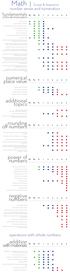 Math Scope & Sequence fundamentals number sense and numeration of the decimal system Count to 10 by units Associate number to numeral (1-10) KN 1 KN 1 KN 2 KN 2 Identify odd and even numbers/numerals and
Big Ideas in Mathematics
 Big Ideas in Mathematics which are important to all mathematics learning. (Adapted from the NCTM Curriculum Focal Points, 2006) The Mathematics Big Ideas are organized using the PA Mathematics Standards
Florida Math for College Readiness
 Core Florida Math for College Readiness Florida Math for College Readiness provides a fourth-year math curriculum focused on developing the mastery of skills identified as critical to postsecondary readiness
Graphic Organizers SAMPLES
 This document is designed to assist North Carolina educators in effective instruction of the new Common Core State and/or North Carolina Essential Standards (Standard Course of Study) in order to increase
Mathematics Online Instructional Materials Correlation to the 2009 Algebra I Standards of Learning and Curriculum Framework
 Provider York County School Division Course Syllabus URL http://yorkcountyschools.org/virtuallearning/coursecatalog.aspx Course Title Algebra I AB Last Updated 2010 - A.1 The student will represent verbal
Current Standard: Mathematical Concepts and Applications Shape, Space, and Measurement- Primary
 Shape, Space, and Measurement- Primary A student shall apply concepts of shape, space, and measurement to solve problems involving two- and three-dimensional shapes by demonstrating an understanding of:
LAKE ELSINORE UNIFIED SCHOOL DISTRICT
 LAKE ELSINORE UNIFIED SCHOOL DISTRICT Title: PLATO Algebra 1-Semester 2 Grade Level: 10-12 Department: Mathematics Credit: 5 Prerequisite: Letter grade of F and/or N/C in Algebra 1, Semester 2 Course Description:
Common Core Unit Summary Grades 6 to 8
 Common Core Unit Summary Grades 6 to 8 Grade 8: Unit 1: Congruence and Similarity- 8G1-8G5 rotations reflections and translations,( RRT=congruence) understand congruence of 2 d figures after RRT Dilations
Polynomial Operations and Factoring
 Algebra 1, Quarter 4, Unit 4.1 Polynomial Operations and Factoring Overview Number of instructional days: 15 (1 day = 45 60 minutes) Content to be learned Identify terms, coefficients, and degree of polynomials.
What are the place values to the left of the decimal point and their associated powers of ten?
 The verbal answers to all of the following questions should be memorized before completion of algebra. Answers that are not memorized will hinder your ability to succeed in geometry and algebra. (Everything
Transition To College Mathematics
 Transition To College Mathematics In Support of Kentucky s College and Career Readiness Program Northern Kentucky University Kentucky Online Testing (KYOTE) Group Steve Newman Mike Waters Janis Broering
SQUARES AND SQUARE ROOTS
 1. Squares and Square Roots SQUARES AND SQUARE ROOTS In this lesson, students link the geometric concepts of side length and area of a square to the algebra concepts of squares and square roots of numbers.
Math at a Glance for April
 Audience: School Leaders, Regional Teams Math at a Glance for April The Math at a Glance tool has been developed to support school leaders and region teams as they look for evidence of alignment to Common
Vocabulary Words and Definitions for Algebra
 Name: Period: Vocabulary Words and s for Algebra Absolute Value Additive Inverse Algebraic Expression Ascending Order Associative Property Axis of Symmetry Base Binomial Coefficient Combine Like Terms
Mathematics Common Core Sample Questions
 New York State Testing Program Mathematics Common Core Sample Questions Grade The materials contained herein are intended for use by New York State teachers. Permission is hereby granted to teachers and
Integer Operations. Overview. Grade 7 Mathematics, Quarter 1, Unit 1.1. Number of Instructional Days: 15 (1 day = 45 minutes) Essential Questions
 Grade 7 Mathematics, Quarter 1, Unit 1.1 Integer Operations Overview Number of Instructional Days: 15 (1 day = 45 minutes) Content to Be Learned Describe situations in which opposites combine to make zero.
CAMI Education linked to CAPS: Mathematics
 - 1 - TOPIC 1.1 Whole numbers _CAPS curriculum TERM 1 CONTENT Mental calculations Revise: Multiplication of whole numbers to at least 12 12 Ordering and comparing whole numbers Revise prime numbers to
NCTM Curriculum Focal Points for Grade 5. Everyday Mathematics, Grade 5
 NCTM Curriculum Focal Points and, Grade 5 NCTM Curriculum Focal Points for Grade 5 Number and Operations and Algebra: Developing an understanding of and fluency with division of whole numbers Students
GRADES 7, 8, AND 9 BIG IDEAS
 Table 1: Strand A: BIG IDEAS: MATH: NUMBER Introduce perfect squares, square roots, and all applications Introduce rational numbers (positive and negative) Introduce the meaning of negative exponents for
Math 0306 Final Exam Review
 Math 006 Final Exam Review Problem Section Answers Whole Numbers 1. According to the 1990 census, the population of Nebraska is 1,8,8, the population of Nevada is 1,01,8, the population of New Hampshire
Math Placement Test Sample Problems PRE-ALGEBRA
 Math Placement Test Sample Problems The Math Placement Test is an untimed, multiple-choice, computer-based test. The test is composed of four sections: pre-algebra, algebra, college algebra, and trigonometry.
Biggar High School Mathematics Department. National 5 Learning Intentions & Success Criteria: Assessing My Progress
 Biggar High School Mathematics Department National 5 Learning Intentions & Success Criteria: Assessing My Progress Expressions & Formulae Topic Learning Intention Success Criteria I understand this Approximation
Quick Reference ebook
 This file is distributed FREE OF CHARGE by the publisher Quick Reference Handbooks and the author. Quick Reference ebook Click on Contents or Index in the left panel to locate a topic. The math facts listed
Welcome to Math 7 Accelerated Courses (Preparation for Algebra in 8 th grade)
 Welcome to Math 7 Accelerated Courses (Preparation for Algebra in 8 th grade) Teacher: School Phone: Email: Kim Schnakenberg 402-443- 3101 [email protected] Course Descriptions: Both Concept and Application
Solve addition and subtraction word problems, and add and subtract within 10, e.g., by using objects or drawings to represent the problem.
 Solve addition and subtraction word problems, and add and subtract within 10, e.g., by using objects or drawings to represent the problem. Solve word problems that call for addition of three whole numbers
CRLS Mathematics Department Algebra I Curriculum Map/Pacing Guide
 Curriculum Map/Pacing Guide page 1 of 14 Quarter I start (CP & HN) 170 96 Unit 1: Number Sense and Operations 24 11 Totals Always Include 2 blocks for Review & Test Operating with Real Numbers: How are
Mathematics Scope and Sequence, K-8
 Standard 1: Number and Operation Goal 1.1: Understands and uses numbers (number sense) Mathematics Scope and Sequence, K-8 Grade Counting Read, Write, Order, Compare Place Value Money Number Theory K Count
Designer: Nathan Kimball. Stage 1 Desired Results
 Interpolation Subject: Science, math Grade: 6-8 Time: 4 minutes Topic: Reading Graphs Designer: Nathan Kimball Stage 1 Desired Results Lesson Overview: In this activity students work with the direct linear
Scope and Sequence KA KB 1A 1B 2A 2B 3A 3B 4A 4B 5A 5B 6A 6B
 Scope and Sequence Earlybird Kindergarten, Standards Edition Primary Mathematics, Standards Edition Copyright 2008 [SingaporeMath.com Inc.] The check mark indicates where the topic is first introduced
Performance Level Descriptors Grade 6 Mathematics
 Performance Level Descriptors Grade 6 Mathematics Multiplying and Dividing with Fractions 6.NS.1-2 Grade 6 Math : Sub-Claim A The student solves problems involving the Major Content for grade/course with
7.2 Quadratic Equations
 476 CHAPTER 7 Graphs, Equations, and Inequalities 7. Quadratic Equations Now Work the Are You Prepared? problems on page 48. OBJECTIVES 1 Solve Quadratic Equations by Factoring (p. 476) Solve Quadratic
McDougal Littell California:
 McDougal Littell California: Pre-Algebra Algebra 1 correlated to the California Math Content s Grades 7 8 McDougal Littell California Pre-Algebra Components: Pupil Edition (PE), Teacher s Edition (TE),
ISAT Mathematics Performance Definitions Grade 4
 ISAT Mathematics Performance Definitions Grade 4 EXCEEDS STANDARDS Fourth-grade students whose measured performance exceeds standards are able to identify, read, write, represent, and model whole numbers
BookTOC.txt. 1. Functions, Graphs, and Models. Algebra Toolbox. Sets. The Real Numbers. Inequalities and Intervals on the Real Number Line
 College Algebra in Context with Applications for the Managerial, Life, and Social Sciences, 3rd Edition Ronald J. Harshbarger, University of South Carolina - Beaufort Lisa S. Yocco, Georgia Southern University
Solving Quadratic Equations
 9.3 Solving Quadratic Equations by Using the Quadratic Formula 9.3 OBJECTIVES 1. Solve a quadratic equation by using the quadratic formula 2. Determine the nature of the solutions of a quadratic equation
Grade 6 Mathematics Assessment. Eligible Texas Essential Knowledge and Skills
 Grade 6 Mathematics Assessment Eligible Texas Essential Knowledge and Skills STAAR Grade 6 Mathematics Assessment Mathematical Process Standards These student expectations will not be listed under a separate
Lyman Memorial High School. Pre-Calculus Prerequisite Packet. Name:
 Lyman Memorial High School Pre-Calculus Prerequisite Packet Name: Dear Pre-Calculus Students, Within this packet you will find mathematical concepts and skills covered in Algebra I, II and Geometry. These
LESSON 4 Missing Numbers in Multiplication Missing Numbers in Division LESSON 5 Order of Operations, Part 1 LESSON 6 Fractional Parts LESSON 7 Lines,
 Saxon Math 7/6 Class Description: Saxon mathematics is based on the principle of developing math skills incrementally and reviewing past skills daily. It also incorporates regular and cumulative assessments.
Precalculus Orientation and FAQ
 Precalculus Orientation and FAQ MATH 1011 (Precalculus) is a four hour 3 credit course that prepares a student for Calculus. Topics covered include linear, quadratic, polynomial, rational, exponential,
Sequence of Mathematics Courses
 Sequence of ematics Courses Where do I begin? Associates Degree and Non-transferable Courses (For math course below pre-algebra, see the Learning Skills section of the catalog) MATH M09 PRE-ALGEBRA 3 UNITS
Multiplication and Division Properties of Radicals. b 1. 2. a Division property of radicals. 1 n ab 1ab2 1 n a 1 n b 1 n 1 n a 1 n b
 488 Chapter 7 Radicals and Complex Numbers Objectives 1. Multiplication and Division Properties of Radicals 2. Simplifying Radicals by Using the Multiplication Property of Radicals 3. Simplifying Radicals
Prentice Hall Algebra 2 2011 Correlated to: Colorado P-12 Academic Standards for High School Mathematics, Adopted 12/2009
 Content Area: Mathematics Grade Level Expectations: High School Standard: Number Sense, Properties, and Operations Understand the structure and properties of our number system. At their most basic level
A Year-long Pathway to Complete MATH 1111: College Algebra
 A Year-long Pathway to Complete MATH 1111: College Algebra A year-long path to complete MATH 1111 will consist of 1-2 Learning Support (LS) classes and MATH 1111. The first semester will consist of the
Free Pre-Algebra Lesson 55! page 1
 Free Pre-Algebra Lesson 55! page 1 Lesson 55 Perimeter Problems with Related Variables Take your skill at word problems to a new level in this section. All the problems are the same type, so that you can
Charlesworth School Year Group Maths Targets
 Charlesworth School Year Group Maths Targets Year One Maths Target Sheet Key Statement KS1 Maths Targets (Expected) These skills must be secure to move beyond expected. I can compare, describe and solve
Extra Credit Assignment Lesson plan. The following assignment is optional and can be completed to receive up to 5 points on a previously taken exam.
 Extra Credit Assignment Lesson plan The following assignment is optional and can be completed to receive up to 5 points on a previously taken exam. The extra credit assignment is to create a typed up lesson
DRAFT. New York State Testing Program Grade 8 Common Core Mathematics Test. Released Questions with Annotations
 DRAFT New York State Testing Program Grade 8 Common Core Mathematics Test Released Questions with Annotations August 2014 Developed and published under contract with the New York State Education Department
Illinois State Standards Alignments Grades Three through Eleven
 Illinois State Standards Alignments Grades Three through Eleven Trademark of Renaissance Learning, Inc., and its subsidiaries, registered, common law, or pending registration in the United States and other
G r a d e 1 0 I n t r o d u c t i o n t o A p p l i e d a n d P r e - C a l c u l u s M a t h e m a t i c s ( 2 0 S ) Final Practice Exam
 G r a d e 1 0 I n t r o d u c t i o n t o A p p l i e d a n d P r e - C a l c u l u s M a t h e m a t i c s ( 2 0 S ) Final Practice Exam G r a d e 1 0 I n t r o d u c t i o n t o A p p l i e d a n d
Tennessee Department of Education
 Tennessee Department of Education Task: Pool Patio Problem Algebra I A hotel is remodeling their grounds and plans to improve the area around a 20 foot by 40 foot rectangular pool. The owner wants to use
Friday, January 29, 2016 9:15 a.m. to 12:15 p.m., only
 ALGEBRA /TRIGONOMETRY The University of the State of New York REGENTS HIGH SCHOOL EXAMINATION ALGEBRA /TRIGONOMETRY Friday, January 9, 016 9:15 a.m. to 1:15 p.m., only Student Name: School Name: The possession
Algebra I Vocabulary Cards
 Algebra I Vocabulary Cards Table of Contents Expressions and Operations Natural Numbers Whole Numbers Integers Rational Numbers Irrational Numbers Real Numbers Absolute Value Order of Operations Expression
North Carolina Math 2
 Standards for Mathematical Practice 1. Make sense of problems and persevere in solving them. 2. Reason abstractly and quantitatively 3. Construct viable arguments and critique the reasoning of others 4.
of surface, 569-571, 576-577, 578-581 of triangle, 548 Associative Property of addition, 12, 331 of multiplication, 18, 433
 Absolute Value and arithmetic, 730-733 defined, 730 Acute angle, 477 Acute triangle, 497 Addend, 12 Addition associative property of, (see Commutative Property) carrying in, 11, 92 commutative property
How To Complete The College Readiness Math Mooc
 College Readiness Math MOOC Instructor Information: Dr. Jennifer Kosiak, [email protected] General email: [email protected] Mathematics Department, University of Wisconsin- La Crosse Description: The
Grade 6 Mathematics Performance Level Descriptors
 Limited Grade 6 Mathematics Performance Level Descriptors A student performing at the Limited Level demonstrates a minimal command of Ohio s Learning Standards for Grade 6 Mathematics. A student at this
Definition 8.1 Two inequalities are equivalent if they have the same solution set. Add or Subtract the same value on both sides of the inequality.
 8 Inequalities Concepts: Equivalent Inequalities Linear and Nonlinear Inequalities Absolute Value Inequalities (Sections 4.6 and 1.1) 8.1 Equivalent Inequalities Definition 8.1 Two inequalities are equivalent
Method To Solve Linear, Polynomial, or Absolute Value Inequalities:
 Solving Inequalities An inequality is the result of replacing the = sign in an equation with ,, or. For example, 3x 2 < 7 is a linear inequality. We call it linear because if the < were replaced with
COMPETENCY TEST SAMPLE TEST. A scientific, non-graphing calculator is required for this test. C = pd or. A = pr 2. A = 1 2 bh
 BASIC MATHEMATICS COMPETENCY TEST SAMPLE TEST 2004 A scientific, non-graphing calculator is required for this test. The following formulas may be used on this test: Circumference of a circle: C = pd or
The program also provides supplemental modules on topics in geometry and probability and statistics.
 Algebra 1 Course Overview Students develop algebraic fluency by learning the skills needed to solve equations and perform important manipulations with numbers, variables, equations, and inequalities. Students
EVERY DAY COUNTS CALENDAR MATH 2005 correlated to
 EVERY DAY COUNTS CALENDAR MATH 2005 correlated to Illinois Mathematics Assessment Framework Grades 3-5 E D U C A T I O N G R O U P A Houghton Mifflin Company YOUR ILLINOIS GREAT SOURCE REPRESENTATIVES:
Review of Basic Algebraic Concepts
 Section. Sets of Numbers and Interval Notation Review of Basic Algebraic Concepts. Sets of Numbers and Interval Notation. Operations on Real Numbers. Simplifying Expressions. Linear Equations in One Variable.