
docs.hortonworks.com
|
|
|
- Kory Shelton
- 10 years ago
- Views:
Transcription
1 docs.hortonworks.com
2 : Security Administration Tools Guide Copyright Hortonworks, Inc. Some rights reserved. The, powered by Apache Hadoop, is a massively scalable and 100% open source platform for storing, processing and analyzing large volumes of data. It is designed to deal with data from many sources and formats in a very quick, easy and cost-effective manner. The Hortonworks Data Platform consists of the essential set of Apache Hadoop projects including MapReduce, Hadoop Distributed File System (HDFS), HCatalog, Pig, Hive, HBase, Zookeeper and Ambari. Hortonworks is the major contributor of code and patches to many of these projects. These projects have been integrated and tested as part of the release process and installation and configuration tools have also been included. Unlike other providers of platforms built using Apache Hadoop, Hortonworks contributes 100% of our code back to the Apache Software Foundation. The is Apache-licensed and completely open source. We sell only expert technical support, training and partner-enablement services. All of our technology is, and will remain free and open source. Please visit the page for more information on Hortonworks technology. For more information on Hortonworks services, please visit either the Support or Training page. Feel free to Contact Us directly to discuss your specific needs. Except where otherwise noted, this document is licensed under Creative Commons Attribution ShareAlike 3.0 License. ii
3 Table of Contents 1. HDP Security Administration Overview HDP Security Administration Architecture Performance Guidelines Download HDP Security Administration Tool Installers Install the HDP Security Administration Server Prerequisites System Requirements Software Requirements Database Requirements Determine Authentication Method for Web UI Install the HDP Security Administration Server Installation Set Up Run the HDP Security Administration Installation Script Change the Default Password Setting Up the User and Group Agent Set up the User and Group Agent Installation Set Up for Unix Authentication and User/Group Synchronization Installation Set Up for LDAP Service User/Group Synchronization Run the Agent Installation Script Verify User/Group Synchronizer Configure Repositories and Install Security Agents Add HDFS Repositories Add a HDFS Repository Add Hive Repositories Create a Hive Repository Install the Hive Agent on the HiveServer2 Host Configure Hive in Ambari Environments Verify that Agent is Connected Add HBase Repositories Configure Hbase Properties Create a HBase Repository Installation Set Up Run the Agent Installation Script Restart the HBase Service Verify that Agent is Connected Test HBase Access and Auditing Change Repository Configuration Remove a Repository Configuration Configure Policies Policy Overview Add a Policy Remove a Policy Disable a Policy Enable/Disable Audit Logging Audit Troubleshoot Agent and Server Connections Test HDP Security Administration Server URL iii

4 7.2. Test Remote Connection to MySQL Uninstall Security Agent iv

5 List of Tables 1.1. Server and Agent Ports MySQL Database Install Parameters HDP Security Administration Server URL Parameters Required Settings (for future enhancements) HDP Security Administration Web UI Local Authentication Parameter External Unix System Users Authentication Parameters External LDAP Service Authentication Parameters Unix Authentication and User/Group Sync Installation Parameters LDAP User/Group Sync Installation Parameters Policy Manager Repository Details Repository HDFS Required HDFS Agent Install Parameters Hive Repository Details Hive Agent Install Parameters Custom hive-site.xml Properties Custom hbase-site.xml Parameters HBase Parameter Values Custom hive-site.xml Properties HBase Repository Details HBase Configuration Hive Agent Install Parameters Policy Details Policy Details v

6 1. HDP Security Administration Overview The HDP Security Administration provides the following security for Hadoop clusters: Authorization: Restricts access to explicit data as follows: Fine-grained access control for HDFS, Hive, and Hbase Role-based policies Component-level enforcement Audit: Track and report on the following items in a central location: Detailed access auditing for HDFS, Hive and Hbase Admin action auditing Centralized Security Policies: UI to centrally manage security policies Delegated administration Automated policy synchronization 1.1. HDP Security Administration Architecture An HDP Security Administration deployment contains the following components: HDP Security Administration server: A central location to manage all security policies for Hadoop clusters, including access control, auditing, and reporting. It also provides 1
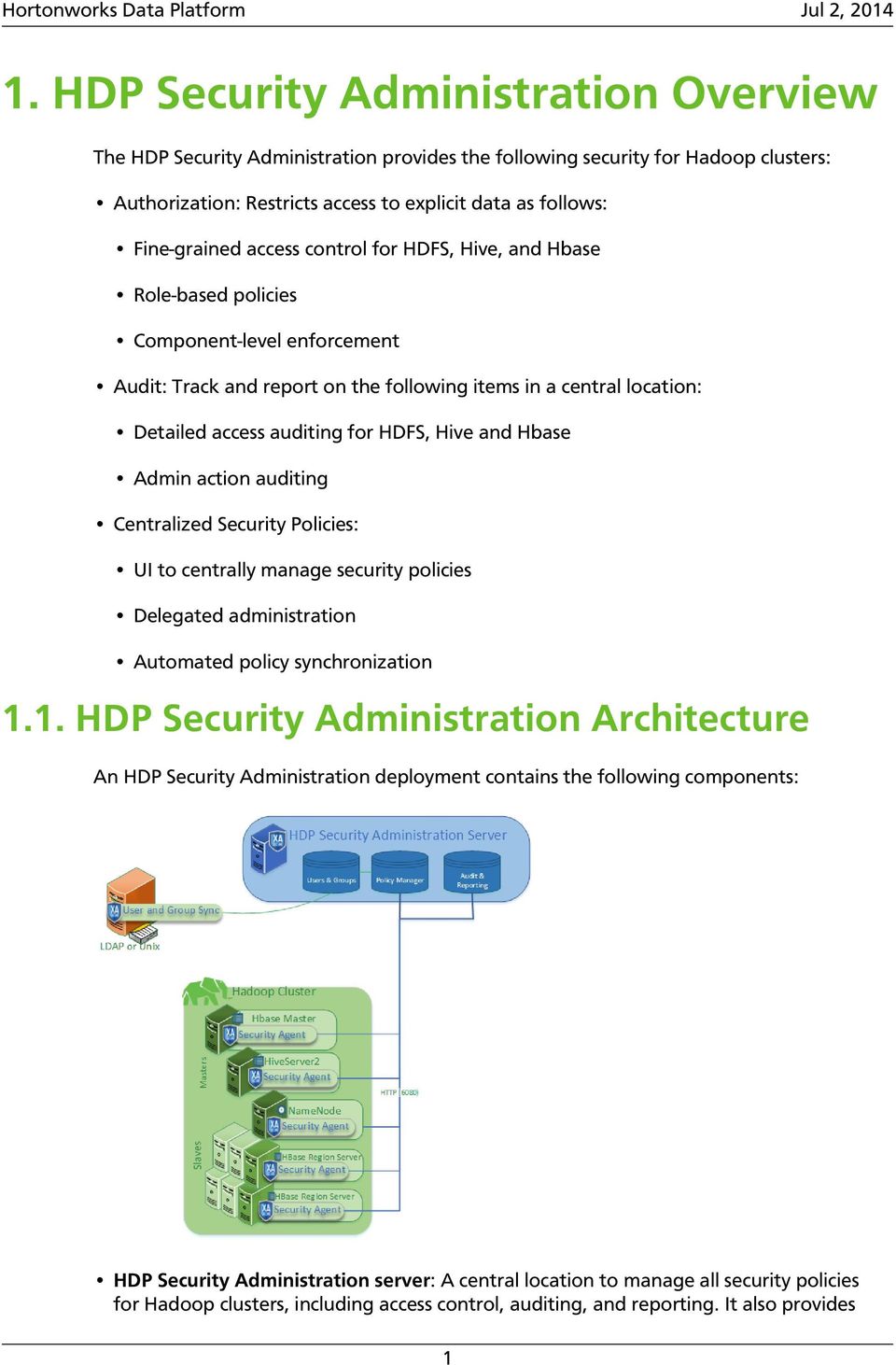
7 delegated administration features to enable administration of policies for specific data to other users and groups. User and Group Synchronizer: Synchronizes user and group information between a UNIX server and the HDP Security Administration server. Allows the Unix system users on the host where the agent is installed to sign in to the Web UI with the same credentials as the local host. Security Agent for HDFS: Enforces the HDFS access control based on the policies managed on the HDP Security Administration server and provides audit and reporting HDFS activity. Security Agent for Hive: Enforces Hive (HiveServer2) access control based on the policies managed on the HDP Security Administration server and provides audit and reporting for Hive activity. Security Agent for HBase: Enforces HBase access control (via Hive2 service) based on the policies managed on the HDP Security Administration server and provides audit and reporting for HBase activity. The following table shows the ports used by the HDP Security Administration tools: HDP Security Administrator, 6080* (HTTP), 3060 (JDBC/MySQL) 389/636 (LDAP/LDAPS) - Optional 5151 (Unix Authentication Service) Optional All Agents (HDFS, HBase and Hive),, 6080 (HTTP/ HDP Security Administrator) User Synchronization Service, 5151** - Optional, 6080 (HTTP/ HDP Security Administrator) Table 1.1. Server and Agent Ports Component Listening Port Connection to Port HDP Security Administration server 6080a (HTTP) 3060 (JDBC/MySQL) All Agents (HDFS, HBase and Hive) 6080* (HTTP) User and Group Synchronization Agent 5151b(Optional for remote Unix) 3060 (JDBC/MySQL) MySQL 3306c 3306 a Ensure agent hosts can connect to the HDP SA server on port Make sure HDP Security Administration server can connect to port 5151 on the server were Unix Synchronization Service is installed. c HDP Security Administrator server and agent servers should be able to connect to port 3306 on the server MySQL is installed. The agents insert the audit logs directly into the database b 1.2. Performance Guidelines Policy Enforcement: Security Agents run within the process of NameNode, HiveServer2 and HBase Region Servers. It adds negligible overhead to the existing policy check and enforcement. The Security Agents can handle more than 50 simultaneous requests within less than 1.5 milliseconds. 2

8 Recommendation: Limit the number of policies by grouping resources together and also where possible using wild cards or recursive options. Audits (log uploads to the server) : The Security Agent logs all access logs centrally to RDBMS. When MySQL is installed on a dedicated server with 4 Cores and 16 GB RAM, XASecure can handle up to 6500 logs/second with 375 concurrent requests. XASecure has inbuilt mechanism to log the event asynchronously without affecting the runtime performance of the cluster. If there is a sudden surge of event logs, XASecure will automatically buffer the logs and do deferred writing to database. If the surge of access requests lasts for longer period, then XASecure will throttle itself by discarding excess logs. Recommendation: For high-end systems, it is recommend that the database is properly tuned for memory caching and disk IO. It is also recommended to appropriately partition the database and archive historical data on regular intervals Download HDP Security Administration Tool Installers The HDP Security Administration Suite is available to download from Hortonworks Add-ons page. Download the components, as follows: HDP Security Administration server: Required for all deployments. UX-UserGroup Synchronizer: Optional. Provides Web UI authentication and automatically imports users and groups for policies. Security Agent for Hive: Only required if you are managing access or auditing HiveServer2. Security Agent for Hadoop: Only required if you are managing access or auditing HDFS. Security Agent for HBase: Only required if you are managing access or auditing HBase. 3

9 2. Install the HDP Security Administration Server Install the HDP Security Administration on a Linux Server with at least 2 GB memory available for the HDP Security Administration web application. You can install the HDP Security Administration on a shared web application host. When in a test environment, you can also install the server on a node within the Hadoop cluster, such as the NameNode Prerequisites Before installing, ensure that you have met the following prerequisites:: Hardware meets the minimum requirements, see System Requirements Oracle Java JDK 7 is installed, see Software Requirements MySQL Server and the root account credentials (that is the % user id and password), see Database Requirements Root access to the hosts where you will be installing HDP Security Administration and/or the agents Download the JBDC driver for MySQL System Requirements Install the HDP Security Administration server on a Linux Server that has the following: Linux Host with at least 2 GB memory available for HDP Security Administration Web application Operating System: CentOS/RedHat, Ubuntu, or SuSe 2 GB of memory 10 GB disk space for HDP Security Administration logs Hadoop cluster (HDP) 2.1 or higher Note You can use a shared host for the HDP Security Administration server Software Requirements The HDP Security Administration server requires: MySQL Server (hosted on the same system) or MySQL Client installed on the HDP Security Administration host. Oracle Java JDK version 7.x MySQL connector (JDBC driver) 4

10 The Security Agents require: MySQL connector (JDBC driver) Database Requirements The HDP Security Administration supports MySQL Server to store Policy, Auditing, and User data. Installing HDP Security Administration requires the MySQL server hostname and root account credentials. The HDP Security Administration installation script creates the database and the db user automatically using the information you specify in the properties file. After the installation of HDP Security Administration server, the MySQL database administrator must grant permission to the database user to access and write remotely from the NameNode, HiveServer2, and HBase Regional Servers hosts Determine Authentication Method for Web UI During the installation process, you will set up the authentication method for to the HDP Security Administration Web UI. The Web UI supports the following authentication methods: Local HDP Security Administration Web UI user database: Users and their credentials are stored in the HDP Security Administration database, and managed manually in the interface. External LDAP (supported services are OpenLDAP or AD): Users authenticate against an external LDAP service and their permission is determined by their group membership. Requires configuration during installation of the HDP Security Administration tools. External Unix Server: Users authenticate against an external Unix system using their credentials for that remote Unix system. Typically this is a server within the Hadoop cluster. This also requires configuration during both the installation of the HDP Security Administration tools and the installation of the Users and Groups Synchronizer Agent on the remote Unix System Install the HDP Security Administration Server Install the HDP Security Administration server on a Linux host with at least 2 GB memory available for the Web application and at least 10 GB of diskspace for HDP Security Administration logs. Note You can install the HDP Security Administration on a shared web application host. Before installing ensure that the following prerequisites have been met, see Prerequisites Installation Set Up Perform the following steps on the HDP Security Administration host. 5

11 1. Log on to the host as root. 2. Copy the installation file and extract as follows: a. Create a temporary directory, such as /tmp/xasecure: mkdir /tmp/xasecure b. Move the installation package to the temporary directory. c. Move the MySQL Connector Jar file to the temporary directory. Download the JAR from here. d. Extract the contents: tar xvf $xasecureinstallation.tar e. Go to the directory where you extracted the installation files: cd /tmp/xasecure/xasecure-$name-$build-version 3. Open the install.properties file for editing. 4. Define the parameters for the MySQL database setup: Table 2.1. MySQL Database Install Parameters Parameter Value Description MYSQL_BIN mysql Specify the command to invoke MySQL. For example, mysql. This command is used by the script to invoke MySQL and connect to the database server. MYSQL_CONNECTOR_JAR $path-to-mysql-connector Specify the absolute path on the local host to the JDBC driver for MySQL including filename.a For example, /tmp/xasecure/mysqlconnector-java.jar db_root_password $root-password The password for the root MySQL account. Used by the installation script to create the HDP SA database and database user. db_host $mysql-host Host name of the system running MySQL server. db_user $xadbuser Specify a name for the user account that the installer creates and is then used to write to the database. db_name $dbname Specify a name for the database that Installer creates during installation. db_password $dbpassword Specify a password for the $xadbuser account created by the installer during installation. audit_db_name $auditdb Specify a name for the audit database created by the installer during installation. audit_db_user $auditdbuser Specify a name for the audit database account created by the installer during installation. 6
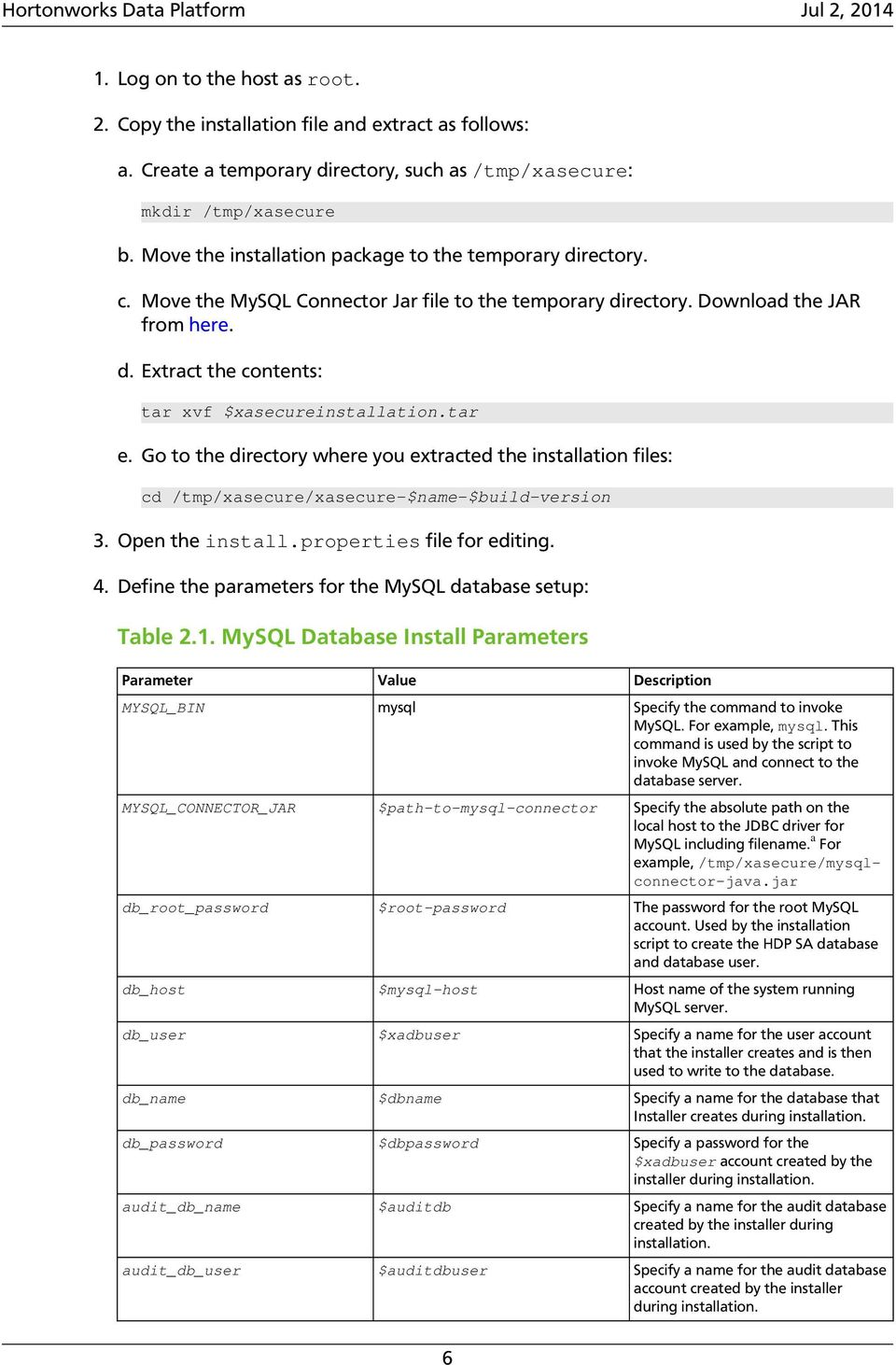
12 Parameter Value Description audit_db_password $auditdbupw Specify the password for the audit database account that the installer sets during installation. a Download the JAR from here. During installation, the script logs into the database, creates the HDP Security database named in the properties file, adds the user specified, and loads the MySQL tables. Warning DO NOT create the HDP Security database beforehand. If the database you specify already exists the HDP Security Administration tables are not added. 5. Define the HDP Security Administration Server URL, which is used Security Agents and users accessing the interface for Policies and Auditing: Table 2.2. HDP Security Administration Server URL Parameters Parameter Value Description policymgr_external_url $url Specify the full URL to access the HDP Security Administration Web UI. For example, policymgr_http_enabled $true-or-false Specify true to allow access to the HDP Security Administration Interface on HTTP or specify false to only allow HTTPS access to the interface. 6. In the JAVA_HOME parameter specify the path to the directory that contains the Java bin, for example: JAVA CONFIG - BEGIN Java Home path JAVA_HOME='/usr/lib/jvm/jre openjdk.x86_64' JAVA CONFIG - END Use the following parameters and values in all configurations: Table 2.3. Required Settings (for future enhancements) Parameter Value Description unix_user xasecure Parameter and value required in all configurations. unix_group xasecure Parameter and value required in all configurations. 8. Use one of the following sets of parameters to define the Authentication for the HDP Security Administration Web UI: 7

13 Web UI administrators that are manually defined in the HDP Security Administration Web UI: Table 2.4. HDP Security Administration Web UI Local Authentication Parameter Parameter Value Description remoteloginenabled false Specify false to manage users in the HDP Security Administration Web UI. Web UI administrators authenticated against an external Unix Server: Table 2.5. External Unix System Users Authentication Parameters Parameter Value Description authentication_method UNIX Specify UNIX to allow users to sign in to the HDP Security Administration Web UI using their credentials from an external Unix Server. remoteloginenabled true Specify true to enabled remote login. authservicehostname $usersync-hostname Specify the remote Unix host namea authserviceport $port Listening port of the Unix host where the UX-UserGroup Synchronizer will be installed, the default port is a Requires installation of the UX-UserGroup Synchronizer. Note Requires installation of the User and Group Synchronizer Agent on the remote Unix Server. The following is an example allowing HDP Sandbox users to access HDP Security Administration Web UI: UNIX User CONFIG unix_user=xasecure unix_group=xasecure UNIX User CONFIG - END UNIX authentication service for Policy Manager PolicyManager can authenticate using UNIX username/password The UNIX server specified here as authservicehostname needs to be installed with xasecure-unix-ugsync package. Once the service is installed on authservicehostname, the UNIX username/ password from the host <authservicehostname> can be used to login into policy manager 8

14 ** The installation of xasecure-unix-ugsync package can be installed after the policymanager installation is finished. LDAP ACTIVE_DIRECTORY UNIX NONE authentication_method=unix remoteloginenabled=true authservicehostname=sandbox authserviceport=5151 Web UI administrators authenticated against an external LDAP (either OpenLDAP or Active Directory service): Table 2.6. External LDAP Service Authentication Parameters Parameter Value Description authentication_method LDAP Specify LDAP to allow users to sign in to the HDP Security Administration Web UI using their credentials from an external LDAP service. remoteloginenabled true Specify true to enabled remote login. authservicehostname $usersync-hostname Specify the LDAP service host name or IP address.a authserviceport $port Listening port of the LDAP service, default port is 389. a Requires installation of the UX-UserGroup Synchronizer. The following is an example of the configuration parameters for OpenLDAP installed on HDP Sandbox: UNIX User CONFIG unix_user=xasecure unix_group=xasecure UNIX User CONFIG - END UNIX authentication service for Policy Manager PolicyManager can authenticate using UNIX username/password The UNIX server specified here as authservicehostname needs to be installed with xasecure-unix-ugsync package. Once the service is installed on authservicehostname, the UNIX username/ password from the host <authservicehostname> can be used to login into policy manager ** The installation of xasecure-unix-ugsync package can be installed after the policymanager installation is finished. LDAP ACTIVE_DIRECTORY UNIX NONE authentication_method=ldap remoteloginenabled=true authservicehostname=sandbox authserviceport=389 9

15 9. Save the install.properties file. The following example shows the HDP Security Administration server install.properties for a system that does not allow remote login of Web UI administrators: This file provides list of deployment variables for the Policy Manager Web Application MYSQL CONFIG - BEGIN The executable path to be used to invoke command-line MYSQL MYSQL_BIN='mysql' Location of mysql client library (please check the location of the jar file) MYSQL_CONNECTOR_JAR=/usr/share/java/mysql-connector-java.jar MYSQL password for the MYSQL root user-id ************************************************************************** ** If the password is left empty or not-defined here, ** it will be prompted to enter the password during installation process ************************************************************************** db_root_password=hadoop db_host=localhost MySQL UserId used for the XASecure schema db_name=xasecure db_user=xaadmin db_password=hadoop MySQL UserId for storing auditlog infromation * audit_db can be same as the XASecure schema db * audit_db must exists in the same ${db_host} as xaserver database ${db_name} * audit_user must be a different user than db_user (as audit user has access to only audit tables) audit_db_name=xasecure audit_db_user=xalogger audit_db_password=hadoop MYSQL CONFIG - END PolicyManager CONFIG
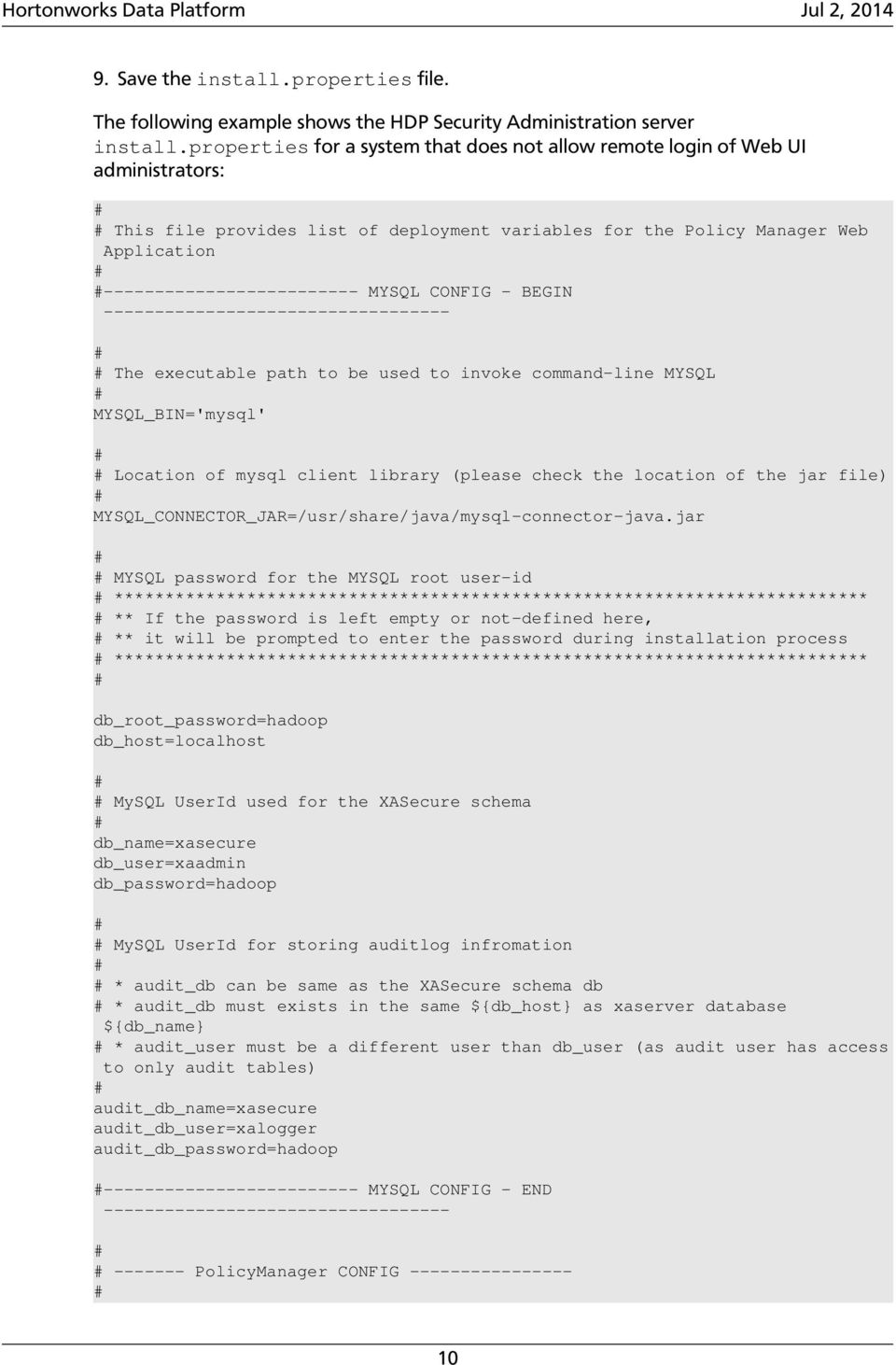
16 policymgr_external_url= policymgr_http_enabled=true PolicyManager CONFIG - END UNIX authentication service for Policy Manager PolicyManager can authenticate using UNIX username/password The UNIX server specified here as authservicehostname needs to be installed with xasecure-unix-ugsync package. Once the service is installed on authservicehostname, the UNIX username/ password from the host <authservicehostname> can be used to login into Policy Manager ** The installation of xasecure-unix-ugsync package can be installed after the policymanager installation is finished. remoteloginenabled=false authservicehostname= authserviceport= DO NOT MODIFY ANY VARIABLES BELOW --- These deployment variables are not to be modified unless you understand the full impact of the changes app_home=$pwd/app war_file=${pwd}/war/xa_portal.war TMPFILE=$PWD/.fi_tmp LOGFILE=$PWD/logfile LOGFILES="$LOGFILE" JAVA_BIN='java' JAVA_VERSION_REQUIRED='1.7' JAVA_ORACLE='Java(TM) SE Runtime Environment' db_create_user_file=${pwd}/db/create_dev_user.sql db_core_file=${pwd}/db/xa_core_db.sql db_assert_file=${pwd}/db/reset_asset.sql Run the HDP Security Administration Installation Script After configuring the install.properties file, install the HDP Security Administration server as root: 11
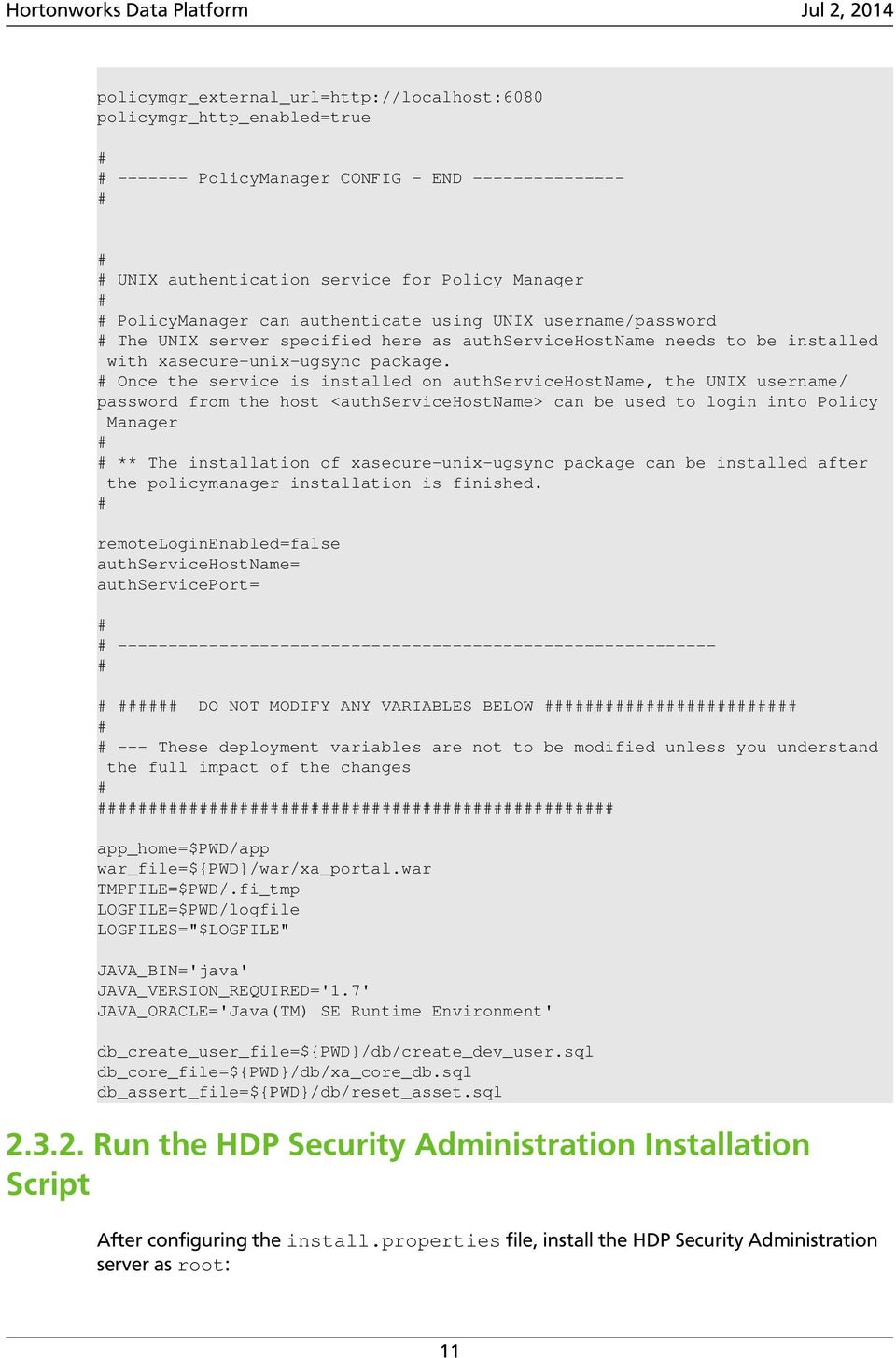
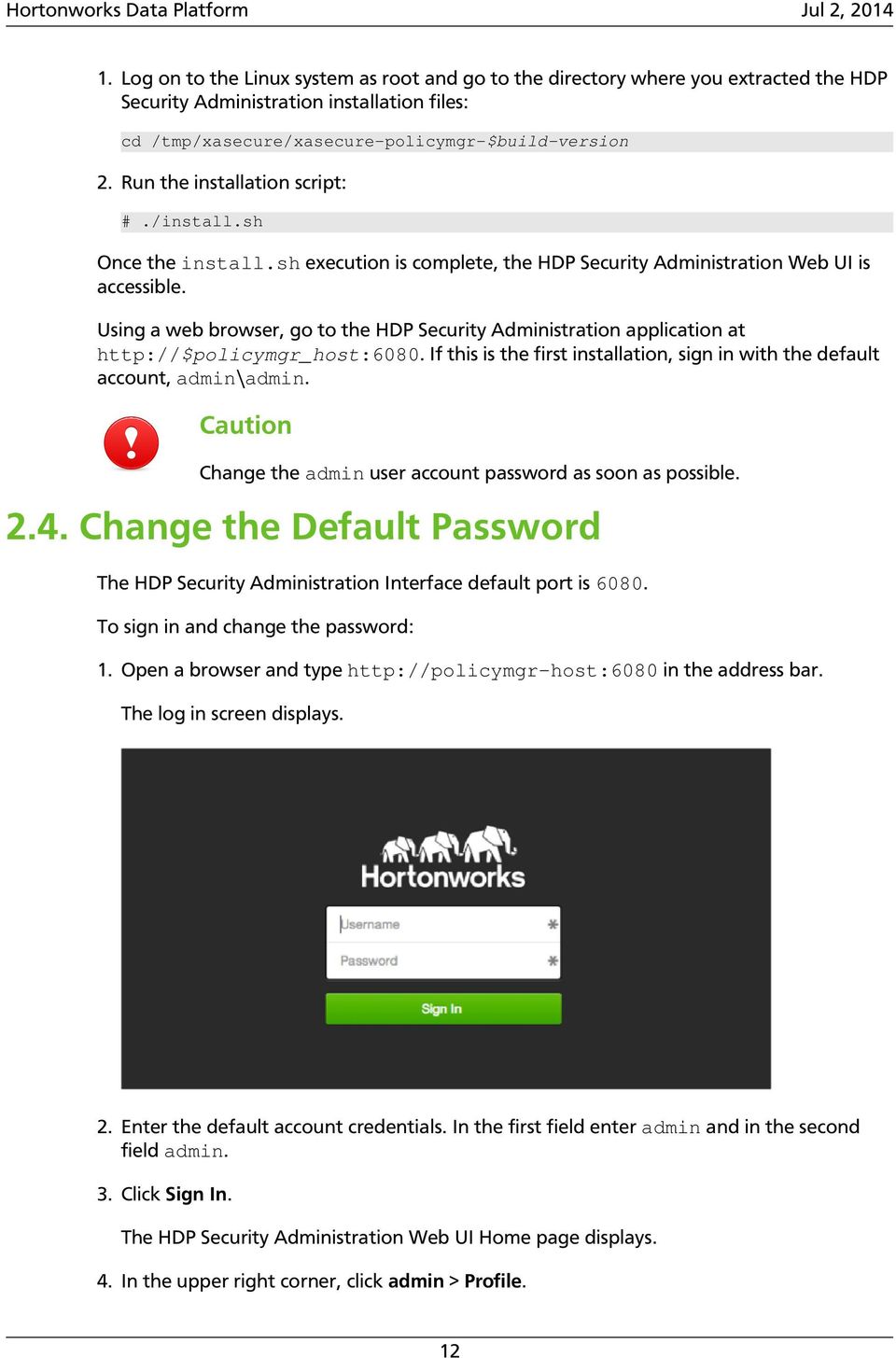
17 1. Log on to the Linux system as root and go to the directory where you extracted the HDP Security Administration installation files: cd /tmp/xasecure/xasecure-policymgr-$build-version 2. Run the installation script:./install.sh Once the install.sh execution is complete, the HDP Security Administration Web UI is accessible. Using a web browser, go to the HDP Security Administration application at If this is the first installation, sign in with the default account, admin\admin. Caution Change the admin user account password as soon as possible Change the Default Password The HDP Security Administration Interface default port is To sign in and change the password: 1. Open a browser and type in the address bar. The log in screen displays. 2. Enter the default account credentials. In the first field enter admin and in the second field admin. 3. Click Sign In. The HDP Security Administration Web UI Home page displays. 4. In the upper right corner, click admin > Profile. 12
18 The Basic Info tab displays. Tip Information on the admin profile cannot be changed. 5. Go the Password tab, type the old password and the new one to change the password. 6. Click Save. Log out and then back in using the new password. 13

19 3. Setting Up the User and Group Agent The HDP Security Administration tools have two types of users: Web UI administrators: Users who require access to the Web UI to manage Hadoop cluster Policies and Audit and Report on Hadoop cluster activity. The user and group synchronizer is required when authenticating Web UI Administrators against an external Unix Server. Hadoop cluster users: Users who require access to the Hadoop cluster data and therefore are named in ACL Policies created on the HDP Security Administrator Web UI. Use the User and Group Agent to synchronize accounts to use in policies from an external source such as a Unix Server or LDAP Service. Tip HDP Security Administration tools can be used to monitor Hadoop cluster activity without restricting access to data in HDFS, Hive, or HBase repositories. By default, when a Hadoop cluster repository is added to the HDP Security Administration, the repository the default setting allows all access Set up the User and Group Agent Install the Unix User and Group Synchronizer (uxugsync) component after installing the HDP Security Administration server, see Install the HDP Security Administration Server. This component synchronizes users and groups from an external Unix host or LDAP service to the HDP Security Administration server. This agent is required when allowing remote authentication of Web UI administrators with a Unix System. UX-UserGroup Synchronizer provides the following functionality: User and group data for creating policies Authentication for HDP Security Administration accounts using the same credentials as the external host where the synchronizer is installed Note Before installing the UX-UserGroup Synchronizer verify that Java 7 JRE or JDK is installed by running the following command: java -version The user and group agent is not required when authenticating users against an external LDAP service Installation Set Up for Unix Authentication and User/ Group Synchronization To synchronize user and groups and/or allow users from a remote Unix system to log into the Web UI perform the following steps on the remote Unix host: 14

20 1. Log on to the host as root. 2. Copy the installation files to the target host and extract the files: a. Create a temporary directory, such as /tmp/xasecure: mkdir /tmp/xasecure b. Move the installation package into the temporary directory along with the MySQL Connector Jar. c. Extract the contents: tar xvf $xasecureinstallation.tar d. Go to the directory where you extracted the installation files: cd /tmp/xasecure/xasecure-$name-$build-version 3. Open the install.properties file for editing. 4. Set the UNIX remote authentication and user/group synchronization parameters: Table 3.1. Unix Authentication and User/Group Sync Installation Parameters Parameter Value Description POLICY_MGR_URL $URL Complete URL including protocol and port to the HDP Security Administration server. For example, MIN_UNIX_USER_ID_TO_SYNC $integer Specify the minimum user ID level to synchronize with HDP Security Administration. Typically system users are created with IDs lower than For example, 1000 SYNC_INTERVAL $minutes Specify the interval in minutes, the default when no value is set is 360. SYNC_SOURCE unix Specify unix to allow remote authentication and user/group synchronization for users and groups on the host system. Example install.properties file for HDP Security Administration Server configured for UNIX authentication and UNIX user and group synchronization: The following URL should be the base URL for connecting to the policy manager web application For example: POLICY_MGR_URL = POLICY_MGR_URL = Minumum Unix User-id to start SYNC. This should avoid creating UNIX system-level users in the Policy Manager 15

21 MIN_UNIX_USER_ID_TO_SYNC = 1000 sync interval in minutes user, groups would be synced again at the end of each sync interval defaults to 5min if SYNC_SOURCE is unix defaults to 360min if SYNC_SOURCE is ldap SYNC_INTERVAL = sync source, only unix and ldap are supported at present defaults to unix SYNC_SOURCE = unix 5. Save the install.properties file Installation Set Up for LDAP Service User/Group Synchronization When synchronizing users from an LDAP service the agent can be installed on the HDP Security Administration server. Note The LDAP configuration in the User and Group Synchronizer Agent is only used for synchronization. Authentication is configured during the installation of the HDP Security Administration Server, To synchronize user and groups from an LDAP service: 1. Log on to the host as root. 2. Copy the installation files to the target host and extract the files: a. Create a temporary directory, such as /tmp/xasecure: mkdir /tmp/xasecure b. Move the installation package into the temporary directory along with the MySQL Connector Jar. c. Extract the contents: tar xvf $xasecureinstallation.tar d. Go to the directory where you extracted the installation files: cd /tmp/xasecure/xasecure-$name-$build-version 3. Open the install.properties file for editing. 4. Configure the LDAP user and group synchronization parameters: Table 3.2. LDAP User/Group Sync Installation Parameters Parameter Value Description POLICY_MGR_URL $URL Complete URL including protocol and port to the HDP Security 16
22 Parameter Value Description Administration server. For example, MIN_UNIX_USER_ID_TO_SYNC $integer Specify the minimum user ID level to synchronize with HDP Security Administration. Typically system users are created with IDs lower than For example, 1000 SYNC_INTERVAL $minutes Specify the interval in minutes, the default when no value is set is 360. SYNC_SOURCE ldap Specify unix to allow remote authentication and user/group synchronization for users and groups on the host system. SYNC_LDAP_URL $URL Specify the full URL to the LDAP service, including port number. For example, ldap://ldaphost:389.a SYNC_LDAP_BIND_DN $userdn Specify the user DN for the LDAP account to the LDAP service. SYNC_LDAP_BIND_PASSWORD $password Specify the password for the LDAP account. SYNC_LDAP_USER_SEARCH_BASE $BaseDN Specify the base DN for the user and groups search. SYNC_LDAP_USER_SEARCH_SCOPE base, one or sub Specify the search type (base, one or sub) for the search. SYNC_LDAP_USER_OBJECT_CLASS $class Specify the ObjectClass for users and groups to sync. For example, person.b SYNC_LDAP_USER_SEARCH_FILTER $filter Specify the value to filter the search results on for synchronization. For example, dept=engineer. SYNC_LDAP_USER_NAME_ATTRIBUTE $attribute Specify the attribute to return as the user or group name. This is the value synchronized. a Only Active Directory and OpenLDAP are supported. The default is person. b Example install.properties file for HDP Security Administration Server configured for LDAP authentication and LDAP user and group synchronization: The following URL should be the base URL for connecting to the policy manager web application For example: POLICY_MGR_URL = POLICY_MGR_URL = Minumum Unix User-id to start SYNC. This should avoid creating UNIX system-level users in the Policy Manager MIN_UNIX_USER_ID_TO_SYNC = 1000 sync interval in minutes user, groups would be synced again at the end of each sync interval 17
23 defaults to 5min if SYNC_SOURCE is unix defaults to 360min if SYNC_SOURCE is ldap SYNC_INTERVAL = sync source, only unix and ldap are supported at present defaults to unix SYNC_SOURCE = ldap The following properties are relevant only if SYNC_SOURCE = ldap URL of source ldap a sample value would be: ldap://ldap.example.com:389 Must specify a value if SYNC_SOURCE is ldap SYNC_LDAP_URL = ldap://sandbox:389 ldap bind dn used to connect to ldap and query for users and groups a sample value would be cn=admin,ou=users,dc=hadoop,dc=apache,dc-org Must specify a value if SYNC_SOURCE is ldap SYNC_LDAP_BIND_DN = cn=admin,ou=users,dc=hadoop,dc=apache,dc-org ldap bind password for the bind dn specified above please ensure read access to this file is limited to root, to protect the password Must specify a value if SYNC_SOURCE is ldap unless anonymous search is allowed by the directory on users and group SYNC_LDAP_BIND_PASSWORD = search base for users sample value would be ou=users,dc=hadoop,dc=apache,dc=org SYNC_LDAP_USER_SEARCH_BASE = ou=users,dc=hadoop,dc=apache,dc=org search scope for the users, only base, one and sub are supported values please customize the value to suit your deployment default value: sub SYNC_LDAP_USER_SEARCH_SCOPE = sub objectclass to identify user entries please customize the value to suit your deployment default value: person SYNC_LDAP_USER_OBJECT_CLASS = person optional additional filter constraining the users selected for syncing a sample value would be (dept=eng) please customize the value to suit your deployment default value is empty SYNC_LDAP_USER_SEARCH_FILTER = attribute from user entry that would be treated as user name please customize the value to suit your deployment default value: cn SYNC_LDAP_USER_NAME_ATTRIBUTE = cn 5. Save the install.properties file. 18
24 Run the Agent Installation Script After configuring the install.properties file, install the agent as root: 1. Log on to the Linux system as root and go to the directory where you extracted the installation files: cd /tmp/xasecure/xasecure-$name-$build-version 2. Run the agent installation script:./install.sh 3.2. Verify User/Group Synchronizer Once the synchronizer is installed, user and group information displays on the User/Group tab in the HDP Security Administration interface. To verify that the user and groups uploaded: 1. Sign in to the Web UI. 2. Click Users/Groups. The Users tab displays. If the agent is not online, no user or group data displays. 19
25 4. Configure Repositories and Install Security Agents HDP Security Administration tools allow you to audit activity and enforce access policies for up to ten different Hadoop clusters. Access Policies and Audited events are created and stored in the HDP Security Administration server and pushed to Security Agents installed on Hadoop cluster nodes. The Security Agents integrate with data services in the Hadoop cluster to enforce access policies and audit activity. The agents are installed on cluster nodes as follows: HDFS Security Agent is installed on the NameNode host and in HA (High Availability) clusters also on the stand-by NN. Hive Security Agent is installed on the HiveServer2 host. HBase Security Agents are installed on each HBase Regional Server host Add HDFS Repositories The HDFS repository contains access policies for the Hadoop cluster HDFS. The Security Agent integrates with the NameNode service on the NameNode host. The agent enforces the policy's configured in the HDP Security Administration Web UI and sends HDFS audit information to the portal where it can be viewed and reported on from a central location. Warning In Ambari managed environments additional configuration is required. Ensure that you carefully follow the steps outlined in the Configure Hadoop Agent to run in Ambari Environments Add a HDFS Repository Add HDFS repositories after the Hadoop environment is fully operational. During the initial set up of the repository, Hortonworks recommends testing the connection from the HDP Security Administration Web UI to the NameNode to ensure that the agent will be able to connect to the server after installation is complete Create a HDFS Repository Before installing the agent on the NameNode, create a HDFS Repository as follows: 1. Sign in to the HDP Security Administration Web UI and click Policy Manager. 20
26 2. Next to HDFS, click the + (plus symbol). The Create Repository page displays. 21
27 3. Complete the Repository Details: Table 4.1. Policy Manager Repository Details Label Value Description Repository Name $name Specify a unique name for the repository, you will need to specify the same repository name in the agent installation properties. For example, clustername_hdfs. Description $description-of-repo Enter a description up to 150 characters. Active Status Enabled or Disabled Enable or disable policy enforcement for the repository. Repository type HDFS, Hive, or HBase Select the type of repository, HDFS. User name $user Specify a user name on the remote system with permission to establish the connection, for example hdfs. Password $password Specify the password of the user account for connection. 4. Complete the security settings for the Hadoop cluster, the settings must match the values specified in the core-site.xml file as follows: Table 4.2. Repository HDFS Required Label Value Description fs.default.name $hdfs-url HDFS URL, should match the setting in the Hadoop core-site.xml file. For example, hdfs:// sandbox.hortonworks.com:8020 hadoop.security.authorization true or false Specify the same setting found in the core-site.xml. hadoop.security.authentication simple or kerberos Specify the type indicated in the core-site.xml. hadoop.security.auth_to_local $usermapping Must match the setting in the coresite.xml file. For example: RULE:[2: $1@$0]([rn]m@.*)s/.*/yarn/ RULE:[2:$1@$0](jhs@.*)s/.*/ mapred/ RULE:[2:$1@$0] ([nd]n@.*)s/.*/hdfs/ RULE: [2:$1@$0](hm@.*)s/.*/hbase/ RULE:[2:$1@$0](rs@.*)s/.*/ hbase/ DEFAULT dfs.datanode.kerberos.principal $dn-principal Specify the Kerberos DataNode principal name. dfs.namenode.kerberos.principal $nn-principal Specify the Kerberos NameNode principal name. dfs.secondary.namenode.kerberos.principal $secondary-nnprincipal Specify the Kerberos Secondary NN principal name. Common Name For Certificate $cert-name Specify the name of the certificate. 5. Click Test Connection. If the server can connect to HDFS, the connection successful message displays. If the connection fails, go to the troubleshooting appendix. 22
28 6. After making a successful connection, click Save Install the HDFS Agent on NameNode Install the agent on the NameNode Host as root (or sudo privileges). In HA Hadoop clusters, you must also install an agent on the Secondary NN Installation Set Up Perform the following steps on the Hadoop NameNode host. 1. Log on to the host as root. 2. Create a temporary directory, such as /tmp/xasecure: mkdir /tmp/xasecure 3. Move the package into the temporary directory along with the MySQL Connector Jar. 4. Extract the contents: tar xvf $xasecureinstallation.tar 5. Go to the directory where you extracted the installation files: cd /tmp/xasecure/xasecure-$name-$build-version 6. Open the install.properties file for editing. 7. Change the following parameters for your environment: Table 4.3. HDFS Agent Install Parameters Parameter Value Description POLICY_MGR_URL $url Specify the full URL to access the Policy Manager Web UI. For example, MYSQL_CONNECTOR_JAR $path-to-mysql-connector Absolute path on the local host to the JDBC driver for mysql including filename.a For example, /tmp/ xasecure/ REPOSITORY_NAME $Policy-Manager-Repo-Name Name of the HDFS Repository in the Policy Manager that this agent connects to after installation. XAAUDIT.DB.HOSTNAME $XAsecure-db-host Specify the host name of the MySQL database. XAAUDIT.DB.DATABASE_NAME $auditdb Specify the audit database name that matches the audit_db_name specified during the web application server installation. XAAUDIT.DB.USER_NAME $auditdbuser Specify the audit database name that matches the audit_db_user specified during the web application server installation XAAUDIT.DB.PASSWORD $auditdbupw Specify the audit database name that matches the audit_db_password specified during the web application server installation. a Download the JAR from here. 23
29 8. Save the install.properties file Example HDFS Agent Installation Properties The following is an example of the Hadoop Agent install.properties file with the MySQL database co-located on the XASecure host: Location of Policy Manager URL Example: POLICY_MGR_URL= POLICY_MGR_URL= Location of mysql client library (please check the location of the jar file) MYSQL_CONNECTOR_JAR=/usr/share/java/mysql-connector-java.jar This is the repository name created within policy manager Example: REPOSITORY_NAME=hadoopdev REPOSITORY_NAME=sandbox AUDIT DB Configuration This information should match with the one you specified during the PolicyManager Installation Example: XAAUDIT.DB.HOSTNAME=localhost XAAUDIT.DB.DATABASE_NAME=xasecure XAAUDIT.DB.USER_NAME=xalogger XAAUDIT.DB.PASSWORD= XAAUDIT.DB.HOSTNAME=xasecure-host XAAUDIT.DB.DATABASE_NAME=xaaudit XAAUDIT.DB.USER_NAME=xaaudit XAAUDIT.DB.PASSWORD=password SSL Client Certificate Information Example: SSL_KEYSTORE_FILE_PATH=/etc/xasecure/conf/xasecure-hadoop-client.jks SSL_KEYSTORE_PASSWORD=clientdb01 SSL_TRUSTSTORE_FILE_PATH=/etc/xasecure/conf/xasecure-truststore.jks SSL_TRUSTSTORE_PASSWORD=changeit 24
30 IF YOU DO NOT DEFINE SSL parameters, the installation script will automatically generate necessary key(s) and assign appropriate values ONLY If you want to assign manually, please uncomment the following variables and assign appropriate values. SSL_KEYSTORE_FILE_PATH= SSL_KEYSTORE_PASSWORD= SSL_TRUSTSTORE_FILE_PATH= SSL_TRUSTSTORE_PASSWORD= Run the Agent Installation Script After configuring the install.properties file, install the agent as root: 1. Log on to the Linux system as root and go to the directory where you extracted the installation files: cd /tmp/xasecure/xasecure-$name-$build-version 2. Run the agent installation script:./install.sh Verify that Agent is Connected Connected Agents display in the HDP Security Administration Web UI. Note Agents may not appear in the list until after the first event occurs in the repository. To verify that the agent is connected to the server: 1. Log in to the interface using the admin account. 2. Click Audit > Agent Configure HDFS Agent to run in Ambari Environments On Hadoop clusters managed by Ambari, change the default HDFS settings to allow the agent to enforce policies and report auditing events. Additionally, Ambari uses its own startup scripts to start and stop the NameNode server. Therefore, modify the Hadoop configuration script to include the Security Agent with a NameNode restart. To configure HDFS properties and NameNode startup scripts: 1. Update HDFS properties from the Ambari Web Interface as follows: a. On the Dashboard, click HDFS. The HDFS Service page displays. b. Go to the Configs tab. c. In Filter, type dfs.permissions.enabled and press enter. 25
31 The results display. This property is located under Advanced. d. Expand Advanced, then change dfs.permissions.enabled to true. e. In Filter, type hadoop.security.authorization and press enter. Under the already expanded Advanced option, the parameter displays. f. Change hadoop.security.authorization to true. g. Scroll to the bottom of the page and click Save. 26
32 At the top of the page, a message displays indicating the services that need to be restarted. Warning Do not restart the services until after you perform the next step. 2. Change the Hadoop configuration script to start the Security Agent with the NameNode service: a. In the Ambari Administrator Portal, click HDFS and then NameNode. The NameNode Hosts page displays. b. Click Host Actions and choose Turn on Maintenance Mode. Wait for the cluster to enter maintenance mode. c. SSH to the NameNode as the root user. d. Open the hadoop-config.sh script for editing and go to the end of the file. For example: vi /usr/lib/hadoop/libexec/hadoop-config.sh e. At the end of the file paste the following statement: if [ -f then ${HADOOP_CONF_DIR}/xasecure-hadoop-env.sh ]. ${HADOOP_CONF_DIR}/xasecure-hadoop-env.sh fi 27
33 This adds the Security Agent for Hadoop to the start script for Hadoop. f. Save the changes. 3. In the Ambari Administrative Portal, click Services > Service Actions > Restart All. Wait for the services to completely restart. 4. Click Services > Service Actions > Turn off Maintenance Mode. It may take several minutes for the process to complete. After confirming all the services restart as expected, perform a few simple HDFS comments such as browsing the file system from Hue Restart NameNode In non-ambari Environments The HDFS Agent is integrated with the NameNode Service. Before your changes can take effect you must restart the NameNode service. 1. On the NameNode host machine, execute the following command: su -l hdfs -c "/usr/lib/hadoop/sbin/hadoop-daemon.sh stop namenode" Ensure that the NameNode Service stops completely. 2. On the NameNode host machine, execute the following command: su -l hdfs -c "/usr/lib/hadoop/sbin/hadoop-daemon.sh start namenode" Ensure that the NameNode Service starts correctly. 28
34 Test HDFS Configuration After completing the setup of the HDFS Repository and agent, perform a few simple tests to ensure that the agent is auditing and reporting events to the HDP Security Administration Web UI. By default, the repository allows all access and has auditing enabled. 1. Log into the Hadoop cluster. 2. Type the following command to display a list of items at the root folder of HDFS: hadoop fs -ls / Found 6 items drwxrwxrwx - yarn drwxr-xr-x - hdfs drwxr-xr-x - mapred drwxr-xr-x - hdfs drwxrwxrwx - hdfs drwxr-xr-x - hdfs hadoop hdfs hdfs hdfs hdfs hdfs :21 07:23 07:16 07:16 15:05 07:21 /app-logs /apps /mapred /mr-history /tmp /user 3. Sign in to the Web UI and click Audit. The Big Data page displays a list of events for the configured Repositories. 4. Click Search > Repository Type > HDFS. The list filters as you make selections Add Hive Repositories HDP Security Administration tools support access control and auditing for Hive repositories in Hadoop clusters Create a Hive Repository Before installing the agent on the HiveServer2 host set up a repository in the Policy Manager. Important For Hive connection information, see HiveServer2 Clients, JDBC. To create a Hive Repository: 1. Sign in to the HDP Security Administrator Web UI as an administrator. 2. Click Policy Manager. The Manage Repository page displays. 29
35 3. Next to Hive, click the green plus symbol. The Create Repository page displays. 4. Complete the required settings with the following information: Table 4.4. Hive Repository Details Label Value Description Repository Name $name Specify a unique name for the repository, you will need to specify the repository name in the 30
36 Label Value Description agent installation properties. For example, clustername_hive. Description $description-of-repo Enter a description up to 150 characters. Active Status Enabled or Disabled Enable or disable policy enforcement for the repository. Repository type HDFS, Hive, or HBase Select the type of repository, Hive. User name $user Specify a user name on the remote system with permission to establish the connection with the hive, for example hive. Password $password Specify the password of the user account for connection. jdbc.driverclassname $classname Specify the full classname of the driver used for Hive connections. The default HiveServer2 classname is org.apache.hive.jdbc.hivedriver. jdbc.url $jdbc:hive2://hiveserverhost:port/db Specify the complete connection URL, including port (default port is 10000) and database name. For example on sandbox, jdbc:hive2://sandbox:10000/. 5. Click Test Connection. If the server can establish a connection with HiveServer using the information you provided a success message displays. 6. After the connection is successful, click Save Install the Hive Agent on the HiveServer2 Host After creating the Hive Repository in the Policy Manager, install the agent on the HiveServer2 host Installation Set Up Perform the following steps on the HiveServer2 host. 1. Log on to the host as root. 2. Create a temporary directory, such as /tmp/xasecure: mkdir /tmp/xasecure 3. Move the package into the temporary directory along with the MySQL Connector Jar. 4. Extract the contents: tar xvf $xasecureinstallation.tar 5. Go to the directory where you extracted the installation files: cd /tmp/xasecure/xasecure-$name-$build-version 6. Open the install.properties file for editing. 7. Change the following parameters for your environment: 31
37 Table 4.5. Hive Agent Install Parameters Parameter Value Description POLICY_MGR_URL $url Specify the full URL to access the Policy Manager Web UI. For example, MYSQL_CONNECTOR_JAR $path-to-mysql-connector Absolute path on the local host to the JDBC driver for mysql including filename.a For example, /tmp/ xasecure/ REPOSITORY_NAME $Policy-Manager-Repo-Name Name of the HDFS Repository in the Policy Manager that this agent connects to after installation. XAAUDIT.DB.HOSTNAME $XAsecure-db-host Specify the host name of the MySQL database. XAAUDIT.DB.DATABASE_NAME $auditdb Specify the audit database name that matches the audit_db_name specified during installation. XAAUDIT.DB.USER_NAME $auditdbuser Specify the audit database name that matches the audit_db_user specified during installation XAAUDIT.DB.PASSWORD $auditdbupw Specify the audit database name that matches the audit_db_password specified during installation a Download the JAR from here. 8. Save the install.properties file Run the Agent Installation Script After configuring the install.properties file, install the agent as root: 1. Log on to the Linux system as root and go to the directory where you extracted the installation files: cd /tmp/xasecure/xasecure-$name-$build-version 2. Run the agent installation script:./install.sh Restart the Hive Service After installing the agent in an environment that does NOT have Ambari, manually restart the Hive services as follows: 1. Stop Hive. Execute this command on the Hive Metastore and Hive Server2 host machine. ps aux awk '{print $1,$2}' grep hive awk '{print $2}' xargs kill >/ dev/null 2>&1 2. Start Hive Metastore. On the Hive Metastore host machine, execute the following command: su - hive -c "env HADOOP_HOME=/usr JAVA_HOME=/usr/jdk64/jdk1.6.0_31 /tmp/ startmetastore.sh /var/log/hive/hive.out /var/log/hive/hive.log /var/run/ hive/hive.pid /etc/hive/conf.server" 32
38 where, $HIVE_LOG_DIR is the directory where Hive server logs are stored. For example, /var/logs/hive. 3. Start HiveServer2. On the Hive Server2 host machine, execute the following command: su - hive -c "env JAVA_HOME=/usr/jdk64/jdk1.6.0_31 /tmp/starthiveserver2. sh /var/log/hive/hive-server2.out /var/log/hive/hive-server2.log /var/run/ hive/hive-server.pid /etc/hive/conf.server" where $HIVE_LOG_DIR is the directory where Hive server logs are stored. For example, /var/logs/hive Configure Hive in Ambari Environments Follow the configuration steps in environments where Hive is managed by the Ambari Server: Modify the Ambari Hive Startup Script Configure Hive Modify the Ambari Hive Startup Script Remove the HiveServer configuration string from the Ambari Hive startup script. Note Ambari starts and stops the HiveServer2 using a built in script. In order to start and stop HiveServer2 with the integrated Security Agent, you must comment out the HiveServer configuration string. 1. Log into the Ambari Server Linux host using the Ambari account. 2. Open the Ambari Hive startup script for editing: cd /var/lib/ambari-server/resources/stacks/hdp/2.0.6/services/hive/package/ templates vi starthiveserver2.sh.j2 3. Comment out the following line by prepending a at the beginning of the line as follows: HIVE_SERVER2_OPTS="${HIVE_SERVER2_OPTS} hiveconf hive. security.authenticator.manager=org.apache.hadoop.hive.ql.security. SessionStateUserAuthenticator -hiveconf hive.security.authorization. manager=org.apache.hadoop.hive.ql.security.authorization.plugin.sqlstd. SQLStdHiveAuthorizerFactory" 4. Restart the Ambari Server from the command line as follows: su -l ambari -c "/etc/init.d/ambari-server stop" su -l ambari -c "/etc/init.d/ambari-server start" 5. On each node in the cluster, restart the Ambari Agents: 33
39 su -l ambari -c "/etc/init.d/ambari-agent stop" su -l ambari -c "/etc/init.d/ambari-agent start" After the Ambari Server and Agents finish rebooting, update the Hive Configuration with the required settings Configure Hive After changing the Ambari Hive startup script and restarting the Ambari Server from the command line, perform the following steps to configure Hive server for agent integration. 1. Log into the Ambari Web UI, and click Hive > Config. Note To find a property, type the name in the Filter field and press enter; if the parameter exists, it is returned under the common or advanced list. Click the arrow key to expand the lists to see the settings. 2. Update the following properties from the Ambari Default Value to the required values: Property name: hive.security.authorization.manager change from org.apache.hadoop.hive.ql.security.authorization.storagebasedauthorizationp to org.apache.hadoop.hive.ql.security.authorization.storagebasedauthorizationp Proterty name: hive.security.authorization.enabled change from false to true 3. Filter for the hive.exec.pre.hooks property. Add the HDP Security hook after the existing value by inserting a comma followed by com.xasecure.authorization.hive.hooks.xasecurehivepreexecuterunhook. For example, if the existing value is org.apache.hadoop.hive.ql.hooks.atshook the new value with the HDP Security hook is: org.apache.hadoop.hive.ql.hooks.atshook,com.xasecure.authorization.hive. hooks.xasecurehivepreexecuterunhook 4. Search for the hive.exec.post.hooks property. Add the HDP Security hook after the existing value by inserting a comma followed by com.xasecure.authorization.hive.hooks.xasecurehivepostexecuterunhook. For example if the existing value is org.apache.hadoop.hive.ql.hooks.atshook the new value with the HDP Security hook is: org.apache.hadoop.hive.ql.hooks.atshook,com.xasecure.authorization.hive. hooks.xasecurehivepostexecuterunhook 5. Expand Custom hive-site.xml, and add the following properties: 34
40 Table 4.6. Custom hive-site.xml Properties Key Value hive.semantic.analyzer.hook com.xasecure.authorization.hive.hooks.xasecuresemanticanalyzerhook hive.server2.custom.authentication.class com.xasecure.authentication.hive.loginnameauthenticator hive.conf.restricted.list hive.exec.driver.run.hooks, hive.server2.authentication, hive.metastore.pre.event.listeners, hive.security.authorization.enabled,hive.security.authorization.manager, hive.semantic.analyzer.hook, hive.exec.post.hooks Note For each property, click Add Property, enter Key and Value shown in the table above, then click Add. 6. After all the properties have been updated and added, scroll to the bottom and click Save. The settings display under Custom hive-site.xml. When properties change, the affected services must be restarted. A Restart option displays. 7. Click Restart > Restart all Verify that Agent is Connected Connected Agents display in the HDP Security Administration Web UI. Note Agents may not appear in the list until after the first event occurs in the repository. To verify that the agent is connected to the server: 1. Log in to the interface using the admin account. 35
41 2. Click Audit > Agent Add HBase Repositories HBase agents integrate with the HBase Regional Server. You must add an agent and ensure the configuration settings are the same on each Regional Server in the cluster Configure Hbase Properties HDP Security Administration requires that the following properties are set in the hbasesite.xml. Configure these properties and restart Hbase before creating a repository in the Policy Manager. Table 4.7. Custom hbase-site.xml Parameters Key Value hbase.security.authorization true hbase.coprocessor.master.classes com.xasecure.authorization.hbase.xasecureauthorizationcoprocessor hbase.coprocessor.region.classes com.xasecure.authorization.hbase.xasecureauthorizationcoprocessor hbase.rpc.engine org.apache.hadoop.hbase.ipc.securerpcengine hbase.rpc.protection PRIVACY Update and Add Properties with Ambari Use these instructions to update the Hbase properties in the Ambari UI. 1. Log into the Ambari Web UI, and click HBase > Config. Note To find a parameter, type the parameter name in the Filter field and press enter; if the parameter exists, it is returned under list. Click the arrow key to expand the lists and see the parameter settings. 2. Update the following properties from the Ambari Default Value to the HDP Security required values: Table 4.8. HBase Parameter Values HBase Property Ambari Default Value hbase.security.authorizationfalse HDP Security Required Value true 3. Expand Custom hbase-site.xml, and add the following properties: Table 4.9. Custom hive-site.xml Properties Key Value hbase.coprocessor.master.classes com.xasecure.authorization.hbase.xasecureauthorizationcoprocessor hbase.coprocessor.region.classes com.xasecure.authorization.hbase.xasecureauthorizationcoprocessor 36
42 Key Value hbase.rpc.protection PRIVACY Note For each property, click Add Property, enter Key and Value shown in the table above, then click Add. 4. After all the properties have been updated or added, click Save. The Custom hbase-site.xml properties display. When properties change, the affected services must be restarted. A Restart option displays. 5. Click Restart > Restart all Create a HBase Repository Before installing the agent on the HBase Regional Servers, create an HBase Repository as follows: 1. Sign in to the HDP Security Administration Web UI. 2. Click Policy Manager. The Manage Repository page displays. 37
43 3. Next to HBase, click the + (plus symbol). The Create Repository page displays. 4. Complete the Repository Details with the following information: Table HBase Repository Details Label Value Description Repository Name $name Specify a unique name for the repository, you will need to specify the same repository name in the agent installation properties. For example, clustername_hbase. Description $description-of-repo Enter a description up to 150 characters. Active Status Enabled or Disabled Enable or disable policy enforcement for the repository. Repository type HDFS, Hive, or HBase Select the type of repository, HBase. User name $user Specify a user name on the remote system with permission to establish the connection, for example hbase. Password $password Specify the password of the user account for connection. 5. Complete the HBase Configuration: 38
44 The settings must match the values specified in the core-site.xml and hbasesite.xml file as follows: Table HBase Configuration Label Value Description fs.default.name $hdfs-url HDFS URL, should match the setting in the Hadoop core-site.xml file. For example, hdfs:// sandbox.hortonworks.com:8020 hadoop.security.authorization true Specify the same setting found in the core-site.xml. If this field is false, then 39
45 Label Value Description change to true in core-site before you continue. hadoop.security.authentication simple or kerberos Specify the type indicated in the core-site.xml. hadoop.security.auth_to_local $usermapping Must match the setting in the coresite.xml file. For example: RULE:[2: mapred/ RULE: hbase/ DEFAULT dfs.datanode.kerberos.principal $dn-principal Specify the Kerberos DataNode principal name. dfs.namenode.kerberos.principal $nn-principal Specify the Kerberos NameNode principal name. dfs.secondary.namenode.kerberos.principal $secondary-nn-principal Specify the Kerberos Secondary NN principal name. hbase.master.kerberos.principal $hbase-principal Specify the Kerberos principal for the HBase Master. hbase.rpc.engine org.apache.hadoop.hbase.ipc.securerpcengine Setting must match the hbasesite.xml setting for this property. hbase.rpc.protection PRIVACY Specify the XASecure setting that matches your hbase-site.xml. hbase.security.authentication simple Setting must match the hbasesite.xml setting for this property. hbase.zoopkeeper.property.clientport 2181 Setting must match the hbasesite.xml setting for this property. hbase.zookeeper.quorom Setting must match the hbasesite.xml setting for this property. zookeeper.znode.parent /hbase Setting must match the hbasesite.xml setting for this property. Common Name For Certificate $cert-name Specify the name of the certificate. Note The blank fields are optional. 6. Click Test Connection. If the server can connect to HBase, the connection successful message displays. HDP Security Administration server connects to HBase and lists the tables. Hortonworks recommends creating the repository and installing the agent after HBase contains data. If HBase connection fails (and tables exist), go to the troubleshooting appendix. 7. After making a successful connection, click Save. The repository is created with an open access Policy, that is auditing is enabled and all users are allowed to access the resources. Complete the installation of the agent and do a few simple access test before configuring policies to ensure that the solution is working properly. 40
46 Installation Set Up Perform the following steps on the HBase Regional Server host. Use same installation properties file on all HBase regional hosts. 1. Log on to the host as root. 2. Create a temporary directory, such as /tmp/xasecure: mkdir /tmp/xasecure 3. Move the package into the temporary directory along with the MySQL Connector Jar. 4. Extract the contents: tar xvf $xasecureinstallation.tar 5. Go to the directory where you extracted the installation files: cd /tmp/xasecure/xasecure-$name-$build-version 6. Open the install.properties file for editing. 7. Change the following parameters for your environment: Table Hive Agent Install Parameters Parameter Value Description POLICY_MGR_URL $url Specify the full URL to access the Policy Manager Web UI. For example, MYSQL_CONNECTOR_JAR $path-to-mysql-connector Absolute path on the local host to the JDBC driver for mysql including filename.a For example, /tmp/ xasecure/ REPOSITORY_NAME $Policy-Manager-Repo-Name Name of the HDFS Repository in the Policy Manager that this agent connects to after installation. XAAUDIT.DB.HOSTNAME $XAsecure-db-host Specify the host name of the MySQL database. XAAUDIT.DB.DATABASE_NAME $auditdb Specify the audit database name that matches the audit_db_name specified during installation. XAAUDIT.DB.USER_NAME $auditdbuser Specify the audit database name that matches the audit_db_user specified during installation. XAAUDIT.DB.PASSWORD $auditdbupw Specify the audit database name that matches the audit_db_password specified during installation. a Download the JAR from here. 8. Save the install.properties file. The following is an example of the HBase install.properties: Location of Policy Manager URL 41
47 Example: POLICY_MGR_URL= POLICY_MGR_URL= Location of mysql client library (please check the location of the jar file) MYSQL_CONNECTOR_JAR=/usr/share/java/mysql-connector-java.jar This is the repository name created within policy manager Example: REPOSITORY_NAME=hbasedev REPOSITORY_NAME=sandbox_2_hbase AUDIT DB Configuration This information should match with the one you specified during the PolicyManager Installation Example: XAAUDIT.DB.HOSTNAME=localhost XAAUDIT.DB.DATABASE_NAME=xasecure XAAUDIT.DB.USER_NAME=xalogger XAAUDIT.DB.PASSWORD= XAAUDIT.DB.HOSTNAME=xasecure XAAUDIT.DB.DATABASE_NAME=xasecure XAAUDIT.DB.USER_NAME=xasecure XAAUDIT.DB.PASSWORD=hadoop SSL Client Certificate Information Example: SSL_KEYSTORE_FILE_PATH=/etc/xasecure/conf/xasecure-hadoop-client.jks SSL_KEYSTORE_PASSWORD=clientdb01 SSL_TRUSTSTORE_FILE_PATH=/etc/xasecure/conf/xasecure-truststore.jks SSL_TRUSTSTORE_PASSWORD=changeit IF YOU DO NOT DEFINE SSL parameters, the installation script will automatically generate necessary key(s) and assign appropriate values ONLY If you want to assign manually, please uncomment the following variables and assign appropriate values Run the Agent Installation Script After configuring the install.properties file, install the agent as root: 42
48 1. Log on to the Linux system as root and go to the directory where you extracted the installation files: cd /tmp/xasecure/xasecure-$name-$build-version 2. Run the agent installation script:./install.sh Restart the HBase Service Changes to the properties require a restart of the HBase services. To restart HBase: 1. Execute this command on the HBase Master host machine: su -l hbase -c "/usr/lib/hbase/bin/hbase-daemon.sh --config /etc/hbase/conf stop master; sleep 25" 2. Execute this command on all RegionServers: su -l hbase -c "/usr/lib/hbase/bin/hbase-daemon.sh --config /etc/hbase/conf stop regionserver" 3. Execute this command on the HBase Master host machine: su -l hbase -c "/usr/lib/hbase/bin/hbase-daemon.sh --config /etc/hbase/conf start master; sleep 25" 4. Execute this command on all RegionServers: su -l hbase -c "/usr/lib/hbase/bin/hbase-daemon.sh --config /etc/hbase/conf start regionserver" Verify that Agent is Connected Connected Agents display in the HDP Security Administration Web UI. Note Agents may not appear in the list until after the first event occurs in the repository. To verify that the agent is connected to the server: 1. Log in to the interface using the admin account. 2. Click Audit > Agent Test HBase Access and Auditing After the repository is set up and you have verified that the agent is connected to the server, perform a few basic HBase test as outlined below: 1. Open a browser and go to 43
49 2. Click on the Hue Shell icon in the navigation pane. 3. Click HBase Shell. The prompt displays. hbase(main):001:0> 4. At the prompt type list. hbase(main):001:0> list list TABLE SLF4J: Class path contains multiple SLF4J bindings. SLF4J: Found binding in [jar:file:/usr/lib/hadoop/lib/slf4j-log4j jar!/org/slf4j/impl/staticloggerbinder.class] SLF4J: Found binding in [jar:file:/usr/lib/zookeeper/lib/slf4j-log4j jar!/org/slf4j/impl/StaticLoggerBinder.class] SLF4J: See for an explanation. ambarismoketest test 2 row(s) in seconds => ["ambarismoketest", "test"] The XASecure HBase agent reports the activity to the server. Note If the HBase command fails with the following Zookeeper error, restart HBase with the root user account from the command line and retest. ERROR: Can't get master address from ZooKeeper; znode data == null 5. Sign in to the Web UI and click Audit. The Big Data page displays a list of events for the configured Repositories. 6. Click Search > Repository Type > HBase. The list filters as you make selections Change Repository Configuration You can edit repository details, including the configuration properties using the edit icon next to a repository name. To change the settings: 1. Sign in to the HDP Security Administration Web UI. 2. Click Policy Manager. The Repository Details page displays. 44
50 3. Click the Edit icon next to the Repository name. The Repository Details page displays. 4. Change the settings and click Save. Note Changing the repository name does not break the link between the agent and the repository. The name is updated on the corresponding Audit and Reporting pages Remove a Repository Configuration Deleting a repository only hides it from the Administration Web UI and does not completely remove it from the system. To remove a repository: 1. Sign in to the HDP Security Administration Web UI. 2. Click Policy Manager. The Repository Details page displays. 3. Next to the repository name, click the Trash icon. 45
51 5. Configure Policies The Policy Manager is accessible from the main menu bar. The home page shows a list of tools supported by HDP Security Administration server. Clicking a particular repository name opens toward the Policy list for the repository Policy Overview Policies limit access to Hive and HBase repositories to White Listing users, that is once a repository is created and the agent installed, only users who have been granted permission can access the resources. The Security Agent intercepts requests to the resource and checks the user against the policies of the repository and determines if the user matches any rules that grant them access to the resource. If no rules explicitly grant access, the following occurs: HDFS: The request is passed through and the user can access the resource if permitted to do so by the HDFS local policies. Hive and HBase : The request is rejected Add a Policy Policies define who can access which resources within a Repository. Policies can only be written for known Users and Groups, that is users and groups that have already been defined in the HDP Security Administration Web UI, either by the User and Groups Synchronizer or manually entered. To add a Policy: 1. Click Policy Manager > Repository Name > Add New Policy. The Create Policy page displays. 2. Complete the Policy Details: Table 5.1. Policy Details Field Description HDFS: Resource Path or Hive/HBase Tables and Columns For HDFS, enter a comma separated list of paths for the policy. For example, /apps/tez/qa,/apps/tez/ 46
52 Field Description production. For Hive and HBase, start typing the table name and select the tables you want to add. In the path, you can use regular expression to match multiple directory (or table/column/column family names), for example, /apps/tez/qa* matches all subdirectories of /apps/tez that being with 'qa'. Description Enter text that describes the policy, only visible from the Policy Manager UI. Recursive Select Yes to grant permission to all subdirectories of the specified path. Audit Logging Select Yes to log activity to the directory to the Audit and Reporting facility of the HDP Security Administration tools. 3. Complete the User and Group Details: Table 5.2. Policy Details Field Description Group Permission Click the + sign to select a group from the Users and Groups list. If the group is not listed, it must be added to the server that the User and Group Synchronizer polls for accounts. If the user or group was recently added, it will appear after the next sync_interval. User Permission Click the + sign to select a user from the Users and Groups list. If the user is not listed, it must be added to the server that the User and Group Synchronizer polls for accounts. If the user or group was recently added, it will appear after the next sync_interval. Policy Status Select Enabled to enforce the Policy, or Disabled to keep a copy of the Policy without enforcing it. 4. Click Save Remove a Policy Removing a policy from the Web UI, removes the policy from both the HDP Security Administration server and the corresponding agent on the Repository host. To remove a Policy: 1. Click Policy Manager > Repository Name. The Policy list displays. 2. Click the trash icon at the end of the row. The policy change synchronizes within a few seconds with the agent and is removed from both the server and the agent Disable a Policy Disabling a policy in the Web UI, removes the policy from the corresponding agent on the Repository host. 47
53 To remove a Policy: 1. Click Policy Manager > Repository Name. The Policy list displays. 2. Click the Edit icon near the end of the row. 3. Change the Policy Status to Disabled. 4. Click Save. The policy change synchronizes within a few seconds with the agent and is removed from both the server and the agent Enable/Disable Audit Logging You can disable only auditing (and leave the policy active). When auditing is disabled, repository activity is no longer recorded by the HDP Security Administration tools. Hadoop cluster logging still occurs and is available in the configuration locations. To disable auditing: 1. Click Policy Manager > Repository Name. The Policy list displays. 2. Click the Edit icon near the end of the row. 3. Change the Audit Logging to off. 4. Click Save. The policy change synchronizes within a few seconds with the agent tops uploading activity data to the server. 48
54 6. Audit The HDP Secure Administration tools provide audit logs for activity on the Hadoop cluster repositories as well as in the Administration Web UI. The activity data is separated into the following tabs: Big Data: Provides Repository activity data for all Policies that have Audit set to On. The default repository Policy is configured to log all user activity within the Repository. This default policy does not contain user and group access rules. Admin: Contains all events for the HDP Security Administration Web UI, including Repository, Policy Manager, Log in, etc. Login Sessions: Contain all log events to the configured Repositories. Agents: Shows the upload history of the Security Agents. 49
55 7. Troubleshoot Agent and Server Connections Verify connectivity between the agent host and HDP Security Administration server Test HDP Security Administration Server URL In order to connect to the HDP Security Administration server, both the HTTP (default 6080) and to uploads/pulls information using the repository named in the connection URL. Use telnet to test the connection: 1. Check the URL for the portal in the agent configuration file, xasecure-$servicename-security.xml. This file is located in the configuration directory of the Hadoop service (/etc/$servicename/conf). For example: more /etc/hbase/conf/xasecure-hbase-security.xml... <property> <name>xasecure.hbase.policymgr.url</name> <value> value> <description> Location where XASecure Role Based Authorization Info is located. </description> </property> Telnet to the HTTP port from the agent host to the HDP Security Administration server: telnet policymgr 6080 Trying Connected to policymgr. Escape character is '^]'. Note If either of the connections fail, then check your firewall and SELinux settings. 3. If you are able to connect, verify the repository name matches on the server and agent: a. Sign in to the HDP Security Administration Web UI. b. Click Policy Manager > Manage Repository. The name of the repository in the UI must match the name shown at the end of the xasecure.hbase.policymgr.url. For example, this agent sends information to the HBase repository named sandbox_2_hbase: 50
56 <value> value> 7.2. Test Remote Connection to MySQL The Security Agents connect directly to the HDP Security Administration database. Using the connection information you provided in the install.properties file, manually verify that the mysql database is accessible: 1. Log into the agent host as root. 2. Open the install.properties file and find the connection information, for example: XAAUDIT.DB.HOSTNAME=poliymgr XAAUDIT.DB.DATABASE_NAME=xasecure XAAUDIT.DB.USER_NAME=xasecure XAAUDIT.DB.PASSWORD=hadoop 3. Telnet to the MySQL port from the agent host to the HDP Security Administration host: telnet policymgr 3306 Trying Connected to policymgr. Escape character is '^]'. 4. Using the same information, connect to the MySQL database from the command line: mysql -u$xaaudit.db.user_name -p$xaaudit.db.password -h$xaaudit.db. HOSTNAME $XAAUDIT.DB.DATABASE_NAME For example: mysql -uxasecure -phadoop -hpolicymgr xasecure Reading table information for completion of table and column names You can turn off this feature to get a quicker startup with -A Welcome to the MySQL monitor. Commands end with ; or \g. Your MySQL connection id is 4069 Server version: Source distribution Copyright (c) 2000, 2013, Oracle and/or its affiliates. All rights reserved. Oracle is a registered trademark of Oracle Corporation and/or its affiliates. Other names may be trademarks of their respective owners. Type 'help;' or '\h' for help. Type '\c' to clear the current input statement. If the connection is rejected, verify MySQL user name and password as well as the permissions for the user to connect remotely Uninstall Security Agent The same basic un-install steps apply to all Security Agents. 51
57 To un-install an XAAgent: 1. Login to the host as the root user. 2. Go to the /etc/xasecure directory for the type of agent you are uninstalling, that is either hdfs, hive or hbase: cd /etc/xasecure/$type 3. Run the uninstaller script:./uninstall.sh The agent is removed from the system. If the /etc/xasecure for the agent type does not exist, the agent can also be uninstalled using the installation package. Use the following steps to uninstall Security Agent: 1. Copy the install tar file to a temporary directory on the host (for example, /tmp/ xasecure). 2. Expand the tar file in to the temporary directory and go to that directory: cd /tmp/xasecure tar xvf xasecure$name-$buildversion.tar 3. Run the un-install script in as follows:./uninstall.sh 52
docs.hortonworks.com
 docs.hortonworks.com Hortonworks Data Platform: Administering Ambari Copyright 2012-2015 Hortonworks, Inc. Some rights reserved. The Hortonworks Data Platform, powered by Apache Hadoop, is a massively
Using The Hortonworks Virtual Sandbox
 Using The Hortonworks Virtual Sandbox Powered By Apache Hadoop This work by Hortonworks, Inc. is licensed under a Creative Commons Attribution- ShareAlike3.0 Unported License. Legal Notice Copyright 2012
How to Install and Configure EBF15328 for MapR 4.0.1 or 4.0.2 with MapReduce v1
 How to Install and Configure EBF15328 for MapR 4.0.1 or 4.0.2 with MapReduce v1 1993-2015 Informatica Corporation. No part of this document may be reproduced or transmitted in any form, by any means (electronic,
Integrating SAP BusinessObjects with Hadoop. Using a multi-node Hadoop Cluster
 Integrating SAP BusinessObjects with Hadoop Using a multi-node Hadoop Cluster May 17, 2013 SAP BO HADOOP INTEGRATION Contents 1. Installing a Single Node Hadoop Server... 2 2. Configuring a Multi-Node
docs.hortonworks.com
 docs.hortonworks.com Hortonworks Data Platform: Configuring Kafka for Kerberos Over Ambari Copyright 2012-2015 Hortonworks, Inc. Some rights reserved. The Hortonworks Data Platform, powered by Apache Hadoop,
Big Data Operations Guide for Cloudera Manager v5.x Hadoop
 Big Data Operations Guide for Cloudera Manager v5.x Hadoop Logging into the Enterprise Cloudera Manager 1. On the server where you have installed 'Cloudera Manager', make sure that the server is running,
docs.hortonworks.com
 docs.hortonworks.com : Ambari Views Guide Copyright 2012-2015 Hortonworks, Inc. All rights reserved. The, powered by Apache Hadoop, is a massively scalable and 100% open source platform for storing, processing
Apache Hadoop 2.0 Installation and Single Node Cluster Configuration on Ubuntu A guide to install and setup Single-Node Apache Hadoop 2.
 EDUREKA Apache Hadoop 2.0 Installation and Single Node Cluster Configuration on Ubuntu A guide to install and setup Single-Node Apache Hadoop 2.0 Cluster edureka! 11/12/2013 A guide to Install and Configure
Architecting the Future of Big Data
 Hive ODBC Driver User Guide Revised: July 22, 2014 2012-2014 Hortonworks Inc. All Rights Reserved. Parts of this Program and Documentation include proprietary software and content that is copyrighted and
Automated Process Center Installation and Configuration Guide for UNIX
 Automated Process Center Installation and Configuration Guide for UNIX Table of Contents Introduction... 1 Lombardi product components... 1 Lombardi architecture... 1 Lombardi installation options... 4
DocuShare Installation Guide
 DocuShare Installation Guide Publication date: February 2011 This document supports DocuShare Release 6.6.1 Prepared by: Xerox Corporation DocuShare Business Unit 3400 Hillview Avenue Palo Alto, California
CycleServer Grid Engine Support Install Guide. version 1.25
 CycleServer Grid Engine Support Install Guide version 1.25 Contents CycleServer Grid Engine Guide 1 Administration 1 Requirements 1 Installation 1 Monitoring Additional OGS/SGE/etc Clusters 3 Monitoring
Department of Veterans Affairs VistA Integration Adapter Release 1.0.5.0 Enhancement Manual
 Department of Veterans Affairs VistA Integration Adapter Release 1.0.5.0 Enhancement Manual Version 1.1 September 2014 Revision History Date Version Description Author 09/28/2014 1.0 Updates associated
PUBLIC Installation: SAP Mobile Platform Server for Linux
 SAP Mobile Platform 3.0 SP11 Document Version: 1.0 2016-06-09 PUBLIC Content 1.... 4 2 Planning the Landscape....5 2.1 Installation Worksheets....6 3 Installing SAP Mobile Platform Server....9 3.1 Acquiring
OnCommand Performance Manager 1.1
 OnCommand Performance Manager 1.1 Installation and Setup Guide For Red Hat Enterprise Linux NetApp, Inc. 495 East Java Drive Sunnyvale, CA 94089 U.S. Telephone: +1 (408) 822-6000 Fax: +1 (408) 822-4501
Centrify Identity and Access Management for Cloudera
 Centrify Identity and Access Management for Cloudera Integration Guide Abstract Centrify Server Suite is an enterprise-class solution that secures Cloudera Enterprise Data Hub leveraging an organization
Configuring MailArchiva with Insight Server
 Copyright 2009 Bynari Inc., All rights reserved. No part of this publication may be reproduced or transmitted in any form or by any means, electronic or mechanical, including photocopy, recording, or any
How To Set Up A Backupassist For An Raspberry Netbook With A Data Host On A Nsync Server On A Usb 2 (Qnap) On A Netbook (Qnet) On An Usb 2 On A Cdnap (
 WHITEPAPER BackupAssist Version 5.1 www.backupassist.com Cortex I.T. Labs 2001-2008 2 Contents Introduction... 3 Hardware Setup Instructions... 3 QNAP TS-409... 3 Netgear ReadyNas NV+... 5 Drobo rev1...
VERSION 9.02 INSTALLATION GUIDE. www.pacifictimesheet.com
 VERSION 9.02 INSTALLATION GUIDE www.pacifictimesheet.com PACIFIC TIMESHEET INSTALLATION GUIDE INTRODUCTION... 4 BUNDLED SOFTWARE... 4 LICENSE KEY... 4 SYSTEM REQUIREMENTS... 5 INSTALLING PACIFIC TIMESHEET
System Administration Training Guide. S100 Installation and Site Management
 System Administration Training Guide S100 Installation and Site Management Table of contents System Requirements for Acumatica ERP 4.2... 5 Learning Objects:... 5 Web Browser... 5 Server Software... 5
User's Guide. Product Version: 2.5.0 Publication Date: 7/25/2011
 User's Guide Product Version: 2.5.0 Publication Date: 7/25/2011 Copyright 2009-2011, LINOMA SOFTWARE LINOMA SOFTWARE is a division of LINOMA GROUP, Inc. Contents GoAnywhere Services Welcome 6 Getting Started
Spectrum Scale HDFS Transparency Guide
 Spectrum Scale Guide Spectrum Scale BDA 2016-1-5 Contents 1. Overview... 3 2. Supported Spectrum Scale storage mode... 4 2.1. Local Storage mode... 4 2.2. Shared Storage Mode... 4 3. Hadoop cluster planning...
docs.hortonworks.com
 docs.hortonworks.com Hortonworks Data Platform : Automated Install with Ambari Copyright 2012-2015 Hortonworks, Inc. Some rights reserved. The Hortonworks Data Platform, powered by Apache Hadoop, is a
DocuShare Installation Guide
 DocuShare Installation Guide Publication date: May 2009 This document supports DocuShare Release 6.5/DocuShare CPX Release 6.5 Prepared by: Xerox Corporation DocuShare Business Unit 3400 Hillview Avenue
IBM WebSphere Application Server Version 7.0
 IBM WebSphere Application Server Version 7.0 Centralized Installation Manager for IBM WebSphere Application Server Network Deployment Version 7.0 Note: Before using this information, be sure to read the
http://docs.trendmicro.com
 Trend Micro Incorporated reserves the right to make changes to this document and to the products described herein without notice. Before installing and using the product, please review the readme files,
Cloudera Manager Training: Hands-On Exercises
 201408 Cloudera Manager Training: Hands-On Exercises General Notes... 2 In- Class Preparation: Accessing Your Cluster... 3 Self- Study Preparation: Creating Your Cluster... 4 Hands- On Exercise: Working
F-Secure Messaging Security Gateway. Deployment Guide
 F-Secure Messaging Security Gateway Deployment Guide TOC F-Secure Messaging Security Gateway Contents Chapter 1: Deploying F-Secure Messaging Security Gateway...3 1.1 The typical product deployment model...4
Kony MobileFabric. Sync Windows Installation Manual - WebSphere. On-Premises. Release 6.5. Document Relevance and Accuracy
 Kony MobileFabric Sync Windows Installation Manual - WebSphere On-Premises Release 6.5 Document Relevance and Accuracy This document is considered relevant to the Release stated on this title page and
Configuration Guide. BES12 Cloud
 Configuration Guide BES12 Cloud Published: 2016-04-08 SWD-20160408113328879 Contents About this guide... 6 Getting started... 7 Configuring BES12 for the first time...7 Administrator permissions you need
VMware Identity Manager Connector Installation and Configuration
 VMware Identity Manager Connector Installation and Configuration VMware Identity Manager This document supports the version of each product listed and supports all subsequent versions until the document
VMware vsphere Big Data Extensions Administrator's and User's Guide
 VMware vsphere Big Data Extensions Administrator's and User's Guide vsphere Big Data Extensions 1.0 This document supports the version of each product listed and supports all subsequent versions until
Oracle Fusion Middleware 11gR2: Forms, and Reports (11.1.2.0.0) Certification with SUSE Linux Enterprise Server 11 SP2 (GM) x86_64
 Oracle Fusion Middleware 11gR2: Forms, and Reports (11.1.2.0.0) Certification with SUSE Linux Enterprise Server 11 SP2 (GM) x86_64 http://www.suse.com 1 Table of Contents Introduction...3 Hardware and
Centrify Server Suite 2015.1 For MapR 4.1 Hadoop With Multiple Clusters in Active Directory
 Centrify Server Suite 2015.1 For MapR 4.1 Hadoop With Multiple Clusters in Active Directory v1.1 2015 CENTRIFY CORPORATION. ALL RIGHTS RESERVED. 1 Contents General Information 3 Centrify Server Suite for
WhatsUp Gold v16.1 Installation and Configuration Guide
 WhatsUp Gold v16.1 Installation and Configuration Guide Contents Installing and Configuring Ipswitch WhatsUp Gold v16.1 using WhatsUp Setup Installing WhatsUp Gold using WhatsUp Setup... 1 Security guidelines
vcenter Chargeback User s Guide
 vcenter Chargeback 1.6 This document supports the version of each product listed and supports all subsequent versions until the document is replaced by a new edition. To check for more recent editions
Kognitio Technote Kognitio v8.x Hadoop Connector Setup
 Kognitio Technote Kognitio v8.x Hadoop Connector Setup For External Release Kognitio Document No Authors Reviewed By Authorised By Document Version Stuart Watt Date Table Of Contents Document Control...
SAS Data Loader 2.1 for Hadoop
 SAS Data Loader 2.1 for Hadoop Installation and Configuration Guide SAS Documentation The correct bibliographic citation for this manual is as follows: SAS Institute Inc. 2014. SAS Data Loader 2.1: Installation
Apache Sentry. Prasad Mujumdar [email protected] [email protected]
 Apache Sentry Prasad Mujumdar [email protected] [email protected] Agenda Various aspects of data security Apache Sentry for authorization Key concepts of Apache Sentry Sentry features Sentry architecture
Witango Application Server 6. Installation Guide for OS X
 Witango Application Server 6 Installation Guide for OS X January 2011 Tronics Software LLC 503 Mountain Ave. Gillette, NJ 07933 USA Telephone: (570) 647 4370 Email: [email protected] Web: www.witango.com
Red Hat Enterprise Linux OpenStack Platform 7 OpenStack Data Processing
 Red Hat Enterprise Linux OpenStack Platform 7 OpenStack Data Processing Manually provisioning and scaling Hadoop clusters in Red Hat OpenStack OpenStack Documentation Team Red Hat Enterprise Linux OpenStack
Introduction to Big data. Why Big data? Case Studies. Introduction to Hadoop. Understanding Features of Hadoop. Hadoop Architecture.
 Big Data Hadoop Administration and Developer Course This course is designed to understand and implement the concepts of Big data and Hadoop. This will cover right from setting up Hadoop environment in
NSi Mobile Installation Guide. Version 6.2
 NSi Mobile Installation Guide Version 6.2 Revision History Version Date 1.0 October 2, 2012 2.0 September 18, 2013 2 CONTENTS TABLE OF CONTENTS PREFACE... 5 Purpose of this Document... 5 Version Compatibility...
Install BA Server with Your Own BA Repository
 Install BA Server with Your Own BA Repository This document supports Pentaho Business Analytics Suite 5.0 GA and Pentaho Data Integration 5.0 GA, documentation revision February 3, 2014, copyright 2014
DEPLOYING EMC DOCUMENTUM BUSINESS ACTIVITY MONITOR SERVER ON IBM WEBSPHERE APPLICATION SERVER CLUSTER
 White Paper DEPLOYING EMC DOCUMENTUM BUSINESS ACTIVITY MONITOR SERVER ON IBM WEBSPHERE APPLICATION SERVER CLUSTER Abstract This white paper describes the process of deploying EMC Documentum Business Activity
New Features... 1 Installation... 3 Upgrade Changes... 3 Fixed Limitations... 4 Known Limitations... 5 Informatica Global Customer Support...
 Informatica Corporation B2B Data Exchange Version 9.5.0 Release Notes June 2012 Copyright (c) 2006-2012 Informatica Corporation. All rights reserved. Contents New Features... 1 Installation... 3 Upgrade
Lucid Key Server v2 Installation Documentation. www.lucidcentral.org
 Lucid Key Server v2 Installation Documentation Contents System Requirements...2 Web Server...3 Database Server...3 Java...3 Tomcat...3 Installation files...3 Creating the Database...3 Step 1: Create the
http://docs.trendmicro.com
 Trend Micro Incorporated reserves the right to make changes to this document and to the products described herein without notice. Before installing and using the product, please review the readme files,
WebSphere Business Monitor V7.0: Clustering Single cluster deployment environment pattern
 Copyright IBM Corporation 2010 All rights reserved WebSphere Business Monitor V7.0: Clustering Single cluster deployment environment pattern What this exercise is about... 2 Exercise requirements... 2
Secure Messaging Server Console... 2
 Secure Messaging Server Console... 2 Upgrading your PEN Server Console:... 2 Server Console Installation Guide... 2 Prerequisites:... 2 General preparation:... 2 Installing the Server Console... 2 Activating
WhatsUp Gold v16.3 Installation and Configuration Guide
 WhatsUp Gold v16.3 Installation and Configuration Guide Contents Installing and Configuring WhatsUp Gold using WhatsUp Setup Installation Overview... 1 Overview... 1 Security considerations... 2 Standard
NS DISCOVER 4.0 ADMINISTRATOR S GUIDE. July, 2015. Version 4.0
 NS DISCOVER 4.0 ADMINISTRATOR S GUIDE July, 2015 Version 4.0 TABLE OF CONTENTS 1 General Information... 4 1.1 Objective... 4 1.2 New 4.0 Features Improvements... 4 1.3 Migrating from 3.x to 4.x... 5 2
1. Product Information
 ORIXCLOUD BACKUP CLIENT USER MANUAL LINUX 1. Product Information Product: Orixcloud Backup Client for Linux Version: 4.1.7 1.1 System Requirements Linux (RedHat, SuSE, Debian and Debian based systems such
Cloudera Backup and Disaster Recovery
 Cloudera Backup and Disaster Recovery Important Note: Cloudera Manager 4 and CDH 4 have reached End of Maintenance (EOM) on August 9, 2015. Cloudera will not support or provide patches for any of the Cloudera
Online Backup Client User Manual Linux
 Online Backup Client User Manual Linux 1. Product Information Product: Online Backup Client for Linux Version: 4.1.7 1.1 System Requirements Operating System Linux (RedHat, SuSE, Debian and Debian based
Sophos Mobile Control Installation guide. Product version: 3.6
 Sophos Mobile Control Installation guide Product version: 3.6 Document date: November 2013 Contents 1 Introduction...3 2 The Sophos Mobile Control server...5 3 Set up Sophos Mobile Control...11 4 External
TIBCO ActiveMatrix BusinessWorks Process Monitor Server. Installation
 TIBCO ActiveMatrix BusinessWorks Process Monitor Server Installation Software Release 2.1.2 Published: May 2013 Important Information SOME TIBCO SOFTWARE EMBEDS OR BUNDLES OTHER TIBCO SOFTWARE. USE OF
JAMF Software Server Installation and Configuration Guide for Linux. Version 9.2
 JAMF Software Server Installation and Configuration Guide for Linux Version 9.2 JAMF Software, LLC 2013 JAMF Software, LLC. All rights reserved. JAMF Software has made all efforts to ensure that this guide
Tableau Spark SQL Setup Instructions
 Tableau Spark SQL Setup Instructions 1. Prerequisites 2. Configuring Hive 3. Configuring Spark & Hive 4. Starting the Spark Service and the Spark Thrift Server 5. Connecting Tableau to Spark SQL 5A. Install
Introduction to Mobile Access Gateway Installation
 Introduction to Mobile Access Gateway Installation This document describes the installation process for the Mobile Access Gateway (MAG), which is an enterprise integration component that provides a secure
HDFS Users Guide. Table of contents
 Table of contents 1 Purpose...2 2 Overview...2 3 Prerequisites...3 4 Web Interface...3 5 Shell Commands... 3 5.1 DFSAdmin Command...4 6 Secondary NameNode...4 7 Checkpoint Node...5 8 Backup Node...6 9
Sophos Mobile Control Installation guide. Product version: 3
 Sophos Mobile Control Installation guide Product version: 3 Document date: January 2013 Contents 1 Introduction...3 2 The Sophos Mobile Control server...4 3 Set up Sophos Mobile Control...16 4 External
QuickStart Guide for Managing Computers. Version 9.2
 QuickStart Guide for Managing Computers Version 9.2 JAMF Software, LLC 2013 JAMF Software, LLC. All rights reserved. JAMF Software has made all efforts to ensure that this guide is accurate. JAMF Software
IIS, FTP Server and Windows
 IIS, FTP Server and Windows The Objective: To setup, configure and test FTP server. Requirement: Any version of the Windows 2000 Server. FTP Windows s component. Internet Information Services, IIS. Steps:
Configuration Worksheets for Oracle WebCenter Ensemble 10.3
 Configuration Worksheets for Oracle WebCenter Ensemble 10.3 This document contains worksheets for installing and configuring Oracle WebCenter Ensemble 10.3. Print this document and use it to gather the
H2O on Hadoop. September 30, 2014. www.0xdata.com
 H2O on Hadoop September 30, 2014 www.0xdata.com H2O on Hadoop Introduction H2O is the open source math & machine learning engine for big data that brings distribution and parallelism to powerful algorithms
WEB2CS INSTALLATION GUIDE
 WEB2CS INSTALLATION GUIDE FOR XANDMAIL XandMail 32, rue de Cambrai 75019 PARIS - FRANCE Tel : +33 (0)1 40 388 700 - http://www.xandmail.com TABLE OF CONTENTS 1. INSTALLING WEB2CS 3 1.1. RETRIEVING THE
Fuse ESB Enterprise Installation Guide
 Fuse ESB Enterprise Installation Guide Version 7.1 December 2012 Integration Everywhere Installation Guide Version 7.1 Updated: 08 Jan 2014 Copyright 2012 Red Hat, Inc. and/or its affiliates. Trademark
Configuring Sponsor Authentication
 CHAPTER 4 Sponsors are the people who use Cisco NAC Guest Server to create guest accounts. Sponsor authentication authenticates sponsor users to the Sponsor interface of the Guest Server. There are five
Sophos Mobile Control Installation guide. Product version: 3.5
 Sophos Mobile Control Installation guide Product version: 3.5 Document date: July 2013 Contents 1 Introduction...3 2 The Sophos Mobile Control server...4 3 Set up Sophos Mobile Control...10 4 External
Synchronizer Installation
 Synchronizer Installation Synchronizer Installation Synchronizer Installation This document provides instructions for installing Synchronizer. Synchronizer performs all the administrative tasks for XenClient
Upgrading Your Web Server from ClientBase Browser Version 2.0 or Above to Version 2.1.1
 Upgrading Your Web Server from ClientBase Browser Version 2.0 or Above to Version 2.1.1 Introduction Successful ClientBase Browser usage depends on proper hardware, setup and installation. This section
OCS Virtual image. User guide. Version: 1.3.1 Viking Edition
 OCS Virtual image User guide Version: 1.3.1 Viking Edition Publication date: 30/12/2012 Table of Contents 1. Introduction... 2 2. The OCS virtualized environment composition... 2 3. What do you need?...
JAMF Software Server Installation and Configuration Guide for OS X. Version 9.2
 JAMF Software Server Installation and Configuration Guide for OS X Version 9.2 JAMF Software, LLC 2013 JAMF Software, LLC. All rights reserved. JAMF Software has made all efforts to ensure that this guide
Active Directory Service. Integration Parameters and Implementation
 Active Directory Service Integration s and Implementation Revised January, 2014 Table of Contents Overview... 3 Getting Started... 3 Migrating Your Users... 7 Manually Adding or Editing Users with the
Web Sites, Virtual Machines, Service Management Portal and Service Management API Beta Installation Guide
 Web Sites, Virtual Machines, Service Management Portal and Service Management API Beta Installation Guide Contents Introduction... 2 Environment Topology... 2 Virtual Machines / System Requirements...
Active Directory Management. Agent Deployment Guide
 Active Directory Management Agent Deployment Guide Document Revision Date: April 26, 2013 Active Directory Management Deployment Guide i Contents System Requirements... 1 Hardware Requirements... 2 Agent
Tutorial: Using HortonWorks Sandbox 2.3 on Amazon Web Services
 Tutorial: Using HortonWorks Sandbox 2.3 on Amazon Web Services Sayed Hadi Hashemi Last update: August 28, 2015 1 Overview Welcome Before diving into Cloud Applications, we need to set up the environment
Lifecycle Manager Installation and Configuration Guide
 Lifecycle Manager Installation and Configuration Guide vcenter Lifecycle Manager 1.2 This document supports the version of each product listed and supports all subsequent versions until the document is
Online Backup Client User Manual
 Online Backup Client User Manual Software version 3.21 For Linux distributions January 2011 Version 2.0 Disclaimer This document is compiled with the greatest possible care. However, errors might have
18.2 user guide No Magic, Inc. 2015
 18.2 user guide No Magic, Inc. 2015 All material contained here in is considered proprietary information owned by No Magic, Inc. and is not to be shared, copied, or reproduced by any means. All information
JAMF Software Server Installation and Configuration Guide for OS X. Version 9.0
 JAMF Software Server Installation and Configuration Guide for OS X Version 9.0 JAMF Software, LLC 2013 JAMF Software, LLC. All rights reserved. JAMF Software has made all efforts to ensure that this guide
RecoveryVault Express Client User Manual
 For Linux distributions Software version 4.1.7 Version 2.0 Disclaimer This document is compiled with the greatest possible care. However, errors might have been introduced caused by human mistakes or by
Installing and Configuring vcloud Connector
 Installing and Configuring vcloud Connector vcloud Connector 2.7.0 This document supports the version of each product listed and supports all subsequent versions until the document is replaced by a new
Revolution R Enterprise 7 Hadoop Configuration Guide
 Revolution R Enterprise 7 Hadoop Configuration Guide The correct bibliographic citation for this manual is as follows: Revolution Analytics, Inc. 2014. Revolution R Enterprise 7 Hadoop Configuration Guide.
CommandCenter Secure Gateway
 CommandCenter Secure Gateway Quick Setup Guide for CC-SG Virtual Appliance and lmadmin License Server Management This Quick Setup Guide explains how to install and configure the CommandCenter Secure Gateway.
Install and Config For IBM BPM 8.5.5
 PERFICIENT Install and Config For IBM BPM 8.5.5 Install and Configure of BPM v8.5.5 Technical Architect: Chuck Misuraca Change History Table 1: Document Change History Document Revision & Date First Draft
Simba XMLA Provider for Oracle OLAP 2.0. Linux Administration Guide. Simba Technologies Inc. April 23, 2013
 Simba XMLA Provider for Oracle OLAP 2.0 April 23, 2013 Simba Technologies Inc. Copyright 2013 Simba Technologies Inc. All Rights Reserved. Information in this document is subject to change without notice.
How To Login To The Mft Internet Server (Mft) On A Pc Or Macbook Or Macintosh (Macintosh) With A Password Protected (Macbook) Or Ipad (Macro) (For Macintosh) (Macros
 TIBCO MFT Internet Server User Guide Software Release 7.2.4 October 2014 Important Information SOME TIBCO SOFTWARE EMBEDS OR BUNDLES OTHER TIBCO SOFTWARE. USE OF SUCH EMBEDDED OR BUNDLED TIBCO SOFTWARE
Querying Databases Using the DB Query and JDBC Query Nodes
 Querying Databases Using the DB Query and JDBC Query Nodes Lavastorm Desktop Professional supports acquiring data from a variety of databases including SQL Server, Oracle, Teradata, MS Access and MySQL.
MassTransit 6.0 Enterprise Web Configuration for Macintosh OS 10.5 Server
 MassTransit 6.0 Enterprise Web Configuration for Macintosh OS 10.5 Server November 6, 2008 Group Logic, Inc. 1100 North Glebe Road, Suite 800 Arlington, VA 22201 Phone: 703-528-1555 Fax: 703-528-3296 E-mail:
StreamServe Persuasion SP4
 StreamServe Persuasion SP4 Installation Guide Rev B StreamServe Persuasion SP4 Installation Guide Rev B 2001-2009 STREAMSERVE, INC. ALL RIGHTS RESERVED United States patent #7,127,520 No part of this document
Architecting the Future of Big Data
 Hive ODBC Driver User Guide Revised: July 22, 2013 2012-2013 Hortonworks Inc. All Rights Reserved. Parts of this Program and Documentation include proprietary software and content that is copyrighted and
Important Notice. (c) 2010-2013 Cloudera, Inc. All rights reserved.
 Hue 2 User Guide Important Notice (c) 2010-2013 Cloudera, Inc. All rights reserved. Cloudera, the Cloudera logo, Cloudera Impala, and any other product or service names or slogans contained in this document
docs.hortonworks.com
 docs.hortonworks.com : Ambari User's Guide Copyright 2012-2015 Hortonworks, Inc. Some rights reserved. The, powered by Apache Hadoop, is a massively scalable and 100% open source platform for storing,
Hadoop Basics with InfoSphere BigInsights
 An IBM Proof of Technology Hadoop Basics with InfoSphere BigInsights Part: 1 Exploring Hadoop Distributed File System An IBM Proof of Technology Catalog Number Copyright IBM Corporation, 2013 US Government
docs.hortonworks.com
 docs.hortonworks.com Hortonworks Data Platform : Reference Copyright 2012-2014 Hortonworks, Inc. Some rights reserved. The Hortonworks Data Platform, powered by Apache Hadoop, is a massively scalable and
OneLogin Integration User Guide
 OneLogin Integration User Guide Table of Contents OneLogin Account Setup... 2 Create Account with OneLogin... 2 Setup Application with OneLogin... 2 Setup Required in OneLogin: SSO and AD Connector...
DS License Server. Installation and Configuration Guide. 3DEXPERIENCE R2014x
 DS License Server Installation and Configuration Guide 3DEXPERIENCE R2014x Contains JAVA SE RUNTIME ENVIRONMENT (JRE) VERSION 7 Contains IBM(R) 64-bit SDK for AIX(TM), Java(TM) Technology Edition, Version
Business Objects BI Server Installation Guide - Linux
 Business Objects BI Server Installation Guide - Linux Business Objects BI Server Linux Patents Trademarks Copyright Third-party contributors Business Objects owns the following U.S. patents, which may