
PUBLIC Installation: SAP Mobile Platform Server for Linux
|
|
|
- Darleen White
- 9 years ago
- Views:
Transcription
1 SAP Mobile Platform 3.0 SP11 Document Version: PUBLIC

2 Content Planning the Landscape Installation Worksheets Installing SAP Mobile Platform Server Acquiring the Installer Using an External Database Setting Up an External SAP HANA Database Setting Up an External SAP ASE Database Setting Up an External SAP SQL Anywhere Database Setting Up an External DB2 Database Setting Up an External Oracle Database Setting Up an External Microsoft SQL Server Database Preparing for Installation Running the Installer Verifying the Installation Adding Cluster Nodes Preparing for Installation Running the Installer Verifying the Installation Uninstalling Preparing to Uninstall Running the Uninstaller Removing an External Production Database Troubleshooting Quick Fixes to Simple Problems OSGI Bundle Exception on Initial Server Start-Up Server Fails to Start After Enabling Mobiliser Features Server Cannot Start on Newer Version of Windows Server Node Does Not Join the Cluster Uninstalling Does Not Clean Database Issues Requiring Root Cause Analysis Server Node Does Not Start Cannot Access Management Cockpit SAP SE or an SAP affiliate company. All rights reserved. Content

3 6.3 Issues Requiring Product Support Creating an Incident on SAP Service Marketplace Product Support Engagement Requirements System Deployment Reference Port Number Reference HTTP/HTTPS Port Number Reference TCP Port Number Reference Installation Directories Daemon Reference Starting and Stopping SAP Mobile Platform Server on Linux Starting and Stopping Management Cockpit on Linux Content 2016 SAP SE or an SAP affiliate company. All rights reserved. 3

4 1 Installation: SAP Mobile Platform Server for Linux Implement your SAP Mobile Platform landscape design by installing as many SAP Mobile Platform Server instances as needed, and optionally, MBO Runtime components. Before you install anything, design your SAP Mobile Platform landscape, select an installation scenario, and complete the installation worksheets. Caution Always install SAP Mobile Platform behind your firewall, but never in the DMZ, which is accessible from the public Internet. That way, if a cyber attack breaches the DMZ, your installation will be safe. For a single-server development installation, run the SAP Mobile Platform Server SP11 installer on the host system; the installer sets up the internal SAP SQL Anywhere database during the server installation. For cluster installations and production systems, install an external database first, then install SAP Mobile Platform Server on a host system and connect to the external database. You can install only one SAP Mobile Platform Server instance per host system. To add cluster nodes, use the same SAP Mobile Platform Server SP11 installer on additional host systems, and connect to the same external database. Thoroughly test your SAP Mobile Platform Server installations with the external database before the system goes live SAP SE or an SAP affiliate company. All rights reserved.

5 2 Planning the Landscape Successfully installing SAP Mobile Platform requires a considerable amount of planning, a number of strategic decisions, and many specific pieces of information about the technical environment. Prerequisites Navigate to SAP Help Portal, select SAP Mobile Platform Server 3.0 SP11 Landscape Information, and read Landscape Design and Planning. Before installing the server on the first node, make sure the port numbers you plan to use are available on all nodes. All nodes in a cluster must use the same communication port numbers for the same purposes. Procedure Complete the installation worksheet for your chosen landscape design. Record the environment information you will need during installation. The worksheet is organized in the same order in which the installer asks you to provide information. See Installation Worksheets. Next Steps Installing SAP Mobile Platform Server [page 9]. Related Information Installation Worksheets [page 6] Planning the Landscape 2016 SAP SE or an SAP affiliate company. All rights reserved. 5

6 2.1 Installation Worksheets Before you install SAP Mobile Platform as either a single server or a cluster member, record the information you need to work through the installation process. Host Information The name of the server on which SAP Mobile Platform Server 3.0 SP11 will be installed. Installation Directory Default C:\SAP\MobilePlatform3. Custom enter installation location. Installation Type If you are installing SAP Mobile Platform in a cluster, select Production installation. Developer installation install SAP Mobile Platform Server as a single-server developer system that uses the SAP SQL Anywhere embedded database. Production installation install an SAP Mobile Platform Server production system. Database Server Configuration If you are installing the second or subsequent server in a cluster, specify the same database settings that the first server uses to connect to the database. SAP SQL Anywhere the embedded SQL Anywhere database is supported only for developer installations. Use another database that is already installed production installations must use an external database: SAP HANA SAP Adaptive Server Enterprise SAP SQL Anywhere SAP SE or an SAP affiliate company. All rights reserved. Planning the Landscape
7 DB2 Microsoft SQL Server If you are using an Oracle database, ask your database administrator which Oracle option to select and what value to supply for the Service or the SID. Oracle (Service) Oracle (SID) Database server parameters: Host name fully-qualified domain name or static IP address of the database server. Port number listening port of the database server. Login default value is gomobile. Password default value is secret. Database name default value is smp3. The default values gomobile, secret, and smp3 are set by a script that you run before installation. To use custom values instead, modify the *.DDL file before you run the script. See Using an External Database for your database type. Path to JDBC driver for Microsoft SQL Server or Oracle, the fully-qualified path must include the JAR name of either the SQL Server JDBC driver or the type 4 Oracle driver, respectively. Administrator Credentials Administrator user name Administrator password These credentials are used by the SAP Mobile Platform administrator to access Management Cockpit and perform system administration functions. Keystore Password The password to access the keystore, where certificates and private keys are stored. Planning the Landscape 2016 SAP SE or an SAP affiliate company. All rights reserved. 7
8 Communication Ports Cluster installations require that all nodes use the same port numbers for the same purposes. You specify the port numbers when you install the first server in the cluster. Verify that all the port numbers you plan to use are available on all nodes where you will install SAP Mobile Platform. HTTP default value is HTTPS default vaue is HTTPS mutual SSL port default value is HTTPS admin port default value is These ports are used by SAP Mobile Platform to communicate using the HTTP protocol between various internal components. For example, the HTTPS admin port is used to communicate with Management Cockpit. Windows Account Information The SAP Mobile Platform Server Windows service runs under the Windows account as the smpserviceuser user; you cannot change this user. If the account already exists, you must enter the current password. Select whether to start the service automatically each time Windows starts. (Optional) MBO Runtime Installer Information If you plan to install MBO Runtime Server on the same host as SAP Mobile Platform, select to launch the MBO Runtime installer and enter the full path to its.zip file, including the file name. Related Information Using an External Database [page 10] Planning the Landscape [page 5] SAP SE or an SAP affiliate company. All rights reserved. Planning the Landscape
9 3 Installing SAP Mobile Platform Server Install SAP Mobile Platform Server and connect to an existing external production database to establish this as the first server in a cluster installation, or to deploy a low-volume single-server production system that does not require load balancing or failover. To create a single-server development environment that cannot be upgraded to a cluster, connect to an internal development database. 1. Acquiring the Installer [page 9] The SAP Mobile Platform Server installer image is available as physical media and as a Web download. 2. Using an External Database [page 10] To use an external database in a production installation, install and set up the database before running the SAP Mobile Platform Server installer. 3. Preparing for Installation [page 32] Verify that the host on which you are installing SAP Mobile Platform is ready for you to begin the installation. 4. Running the Installer [page 33] Edit the SilentInstall_Linux.txt file to set installation options, then run the installation script. 5. Verifying the Installation [page 36] Check for errors in the installation logs, then verify that you can start the SAP Mobile Platform Server and log in to Management Cockpit. 3.1 Acquiring the Installer The SAP Mobile Platform Server installer image is available as physical media and as a Web download. Context Either insert the physical installation media, or follow the steps below to download the software. Procedure 1. Navigate to the SAP Software Download Center 2. Agree to the terms and log in to the Web site. 3. Under Software Downloads, click Support Packages and Patches. 4. Click Alphabetical list of products, then select M. 5. Click SAP MOBILE PLATFORM RUNTIME 3.0. Installing SAP Mobile Platform Server 2016 SAP SE or an SAP affiliate company. All rights reserved. 9
10 6. Select the product for your operating system. 7. Download the package for the SAP Mobile Platform Server SP11 installer. 8. Extract the entire contents of the installer.zip file to a temporary directory on a local disk on the target host. Use a short path, preferably a folder directly below the root directory, such as C:\temp. The path can include only ASCII alphanumeric characters, underscores, hyphens, and periods; in cannot include two consecutive period characters. 9. To install or upgrade the MBO Runtime component, follow the steps above to download the MBO Runtime 3.0 SP11 installer.zip file. Task overview: Installing SAP Mobile Platform Server [page 9] Next task: Using an External Database [page 10] 3.2 Using an External Database To use an external database in a production installation, install and set up the database before running the SAP Mobile Platform Server installer. Context The SAP Mobile Platform database stores metadata data about the data that passes through the SAP Mobile Platform system including information about native and hybrid applications, execution requests between client and server, back-end notification requests, and usage statistics. You can view this data in Management Cockpit, where you manage and monitor applications. You do not need to encrypt this data. Use an external database for a production installation: SAP HANA, SAP ASE, SAP SQL Anywhere, DB2, Oracle, or Microsoft SQL Server. Install the database before you install SAP Mobile Platform Server, using the instructions for the database type you are using. In a development installation, the default SAP SQL Anywhere database that is included with SAP Mobile Platform requires no separate installation or setup. To use the default database, skip this section and continue with Running the Installer [page 33]. Setting Up an External SAP HANA Database [page 11] Install SAP HANA on the same network where you will be installing SAP Mobile Platform. Setting Up an External SAP ASE Database [page 13] Install SAP Adaptive Server Enterprise (SAP ASE), then modify and run a setup script to configure it to work with SAP Mobile Platform. Setting Up an External SAP SQL Anywhere Database [page 18] Install SAP SQL Anywhere version 16.0 or later, and configure it to work with SAP Mobile Platform. Setting Up an External DB2 Database [page 21] SAP SE or an SAP affiliate company. All rights reserved. Installing SAP Mobile Platform Server

11 Install DB2, then modify and run a setup script to configure it to work with SAP Mobile Platform. Setting Up an External Oracle Database [page 24] Install Oracle, then modify and run a setup script to configure it to work with SAP Mobile Platform, and download the Oracle JDBC driver. Setting Up an External Microsoft SQL Server Database [page 28] Install Microsoft SQL Server, then modify and run a setup script to configure it to work with SAP Mobile Platform. Task overview: Installing SAP Mobile Platform Server [page 9] Previous task: Acquiring the Installer [page 9] Next task: Preparing for Installation [page 32] Related Information Installation Worksheets [page 6] Setting Up an External SAP HANA Database Install SAP HANA on the same network where you will be installing SAP Mobile Platform. Procedure 1. Verify that SAP Mobile Platform supports the version of SAP HANA you are planning to use. a. Go to the SAP Product Availability Matrix (PAM) Search for SAP Mobile Platform 3.0 (search box in the upper-right corner), and select either SAP Mobile Platform 3.0 or SAP Mobile Platform SDK 3.0. Access to the PAM requires an SAP Service Marketplace login: b. Under the Essentials heading in the upper-right corner, click Open in New Window to open the Support Matrices PowerPoint file. c. Click through to the SAP for persistence databases supported by SAP Mobile Platform Install SAP HANA anywhere on the same network where you will be installing SAP Mobile Platform. Consult with your company's database administrator, or have the database administrator perform the installation for you. Installing SAP Mobile Platform Server 2016 SAP SE or an SAP affiliate company. All rights reserved. 11
![Setting Up an External Microsoft SQL Server Database [page 28] Install Microsoft SQL Server, then modify and run a setup script to configure it to work with SAP Mobile Platform.](/docs-images/41/18179389/images/page_11.jpg "Task overview: Installing SAP Mobile Platform Server [page 9] Previous task: Acquiring the Installer [page 9] Next task: Preparing for Installation [page 32] Related Information Installation")
12 There is no 001_SMP3_drop_and_create_user.DDL script to run to prepare SAP HANA to work with SAP Mobile Platform. Simply enter the host name, port number, user name, and password when prompted by the installer. 3. (Optional) Configure your SAP HANA database to support Mobiliser. See Configuring SAP HANA to Support Mobiliser [page 12]. 4. (Optional) Create a customized HANA database schema for the database user, <dbusername>: drop schema <schemaname> cascade; create schema <schemaname> owned by <dbusername>; Configuring SAP HANA to Support Mobiliser To support Mobiliser applications with SAP HANA on your SAP Mobile Platform Server, make SAP HANAspecific changes to the dbmaintain script and execute it. Procedure 1. Edit the dbmaintain script. a. Make a backup copy of <installer_root>/db_tools/db/hdb/smp3/sql/ dbmaintain.properties.hana. b. Use a text editor to open <installer_root>/db_tools/db/hdb/smp3/sql/ dbmaintain.properties.hana. c. Edit this line: database.url=jdbc:sap//{host}:{port}/ Make these replacements, including the braces ("{" and "}"): {HOST} with the host name for your database {PORT} with the port number for your database (DBNAME} with the default schema name for the HANA database (the SAP HANA user name that installed the SAP Mobile Platform database), or the customized schema name for the HANA database if you changed the default d. Save and close the file. 2. Run the dbmaintain scripts against your database. Use Java 8 to run the Java commands described here: either the Java instance that is installed with SAP Mobile Platform Server, or another available instance SAP SE or an SAP affiliate company. All rights reserved. Installing SAP Mobile Platform Server
![See Configuring SAP HANA to Support Mobiliser [page 12]. 4.](/docs-images/41/18179389/images/page_12.jpg "(Optional) Create a customized HANA database schema for the database user, <dbusername>: drop schema <schemaname> cascade; create schema <schemaname> owned by <dbusername>; 3.2.1.")
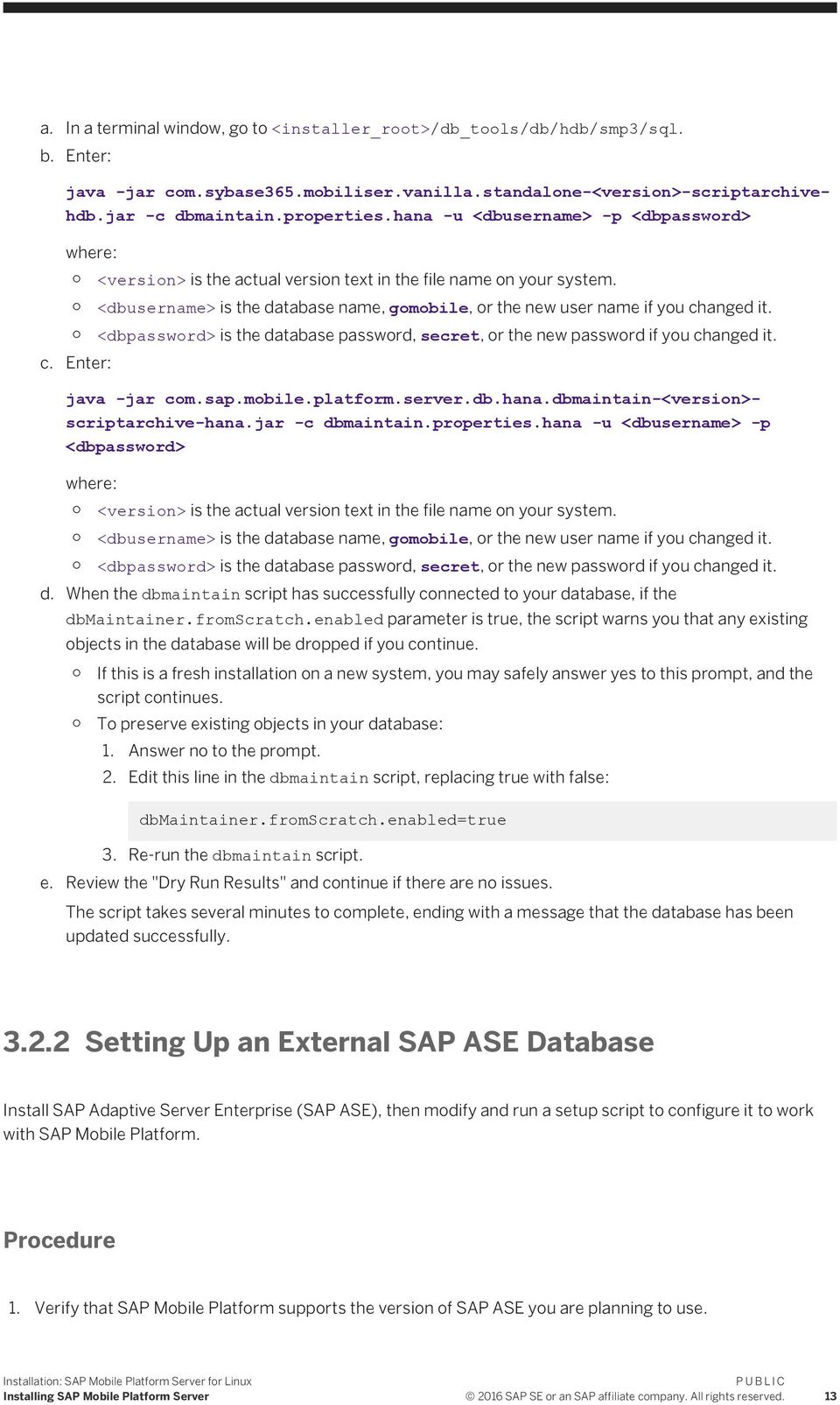
13 a. In a terminal window, go to <installer_root>/db_tools/db/hdb/smp3/sql. b. Enter: java -jar com.sybase365.mobiliser.vanilla.standalone-<version>-scriptarchivehdb.jar -c dbmaintain.properties.hana -u <dbusername> -p <dbpassword> where: c. Enter: <version> is the actual version text in the file name on your system. <dbusername> is the database name, gomobile, or the new user name if you changed it. <dbpassword> is the database password, secret, or the new password if you changed it. java -jar com.sap.mobile.platform.server.db.hana.dbmaintain-<version>scriptarchive-hana.jar -c dbmaintain.properties.hana -u <dbusername> -p <dbpassword> where: <version> is the actual version text in the file name on your system. <dbusername> is the database name, gomobile, or the new user name if you changed it. <dbpassword> is the database password, secret, or the new password if you changed it. d. When the dbmaintain script has successfully connected to your database, if the dbmaintainer.fromscratch.enabled parameter is true, the script warns you that any existing objects in the database will be dropped if you continue. If this is a fresh installation on a new system, you may safely answer yes to this prompt, and the script continues. To preserve existing objects in your database: 1. Answer no to the prompt. 2. Edit this line in the dbmaintain script, replacing true with false: dbmaintainer.fromscratch.enabled=true 3. Re-run the dbmaintain script. e. Review the "Dry Run Results" and continue if there are no issues. The script takes several minutes to complete, ending with a message that the database has been updated successfully Setting Up an External SAP ASE Database Install SAP Adaptive Server Enterprise (SAP ASE), then modify and run a setup script to configure it to work with SAP Mobile Platform. Procedure 1. Verify that SAP Mobile Platform supports the version of SAP ASE you are planning to use. Installing SAP Mobile Platform Server 2016 SAP SE or an SAP affiliate company. All rights reserved. 13
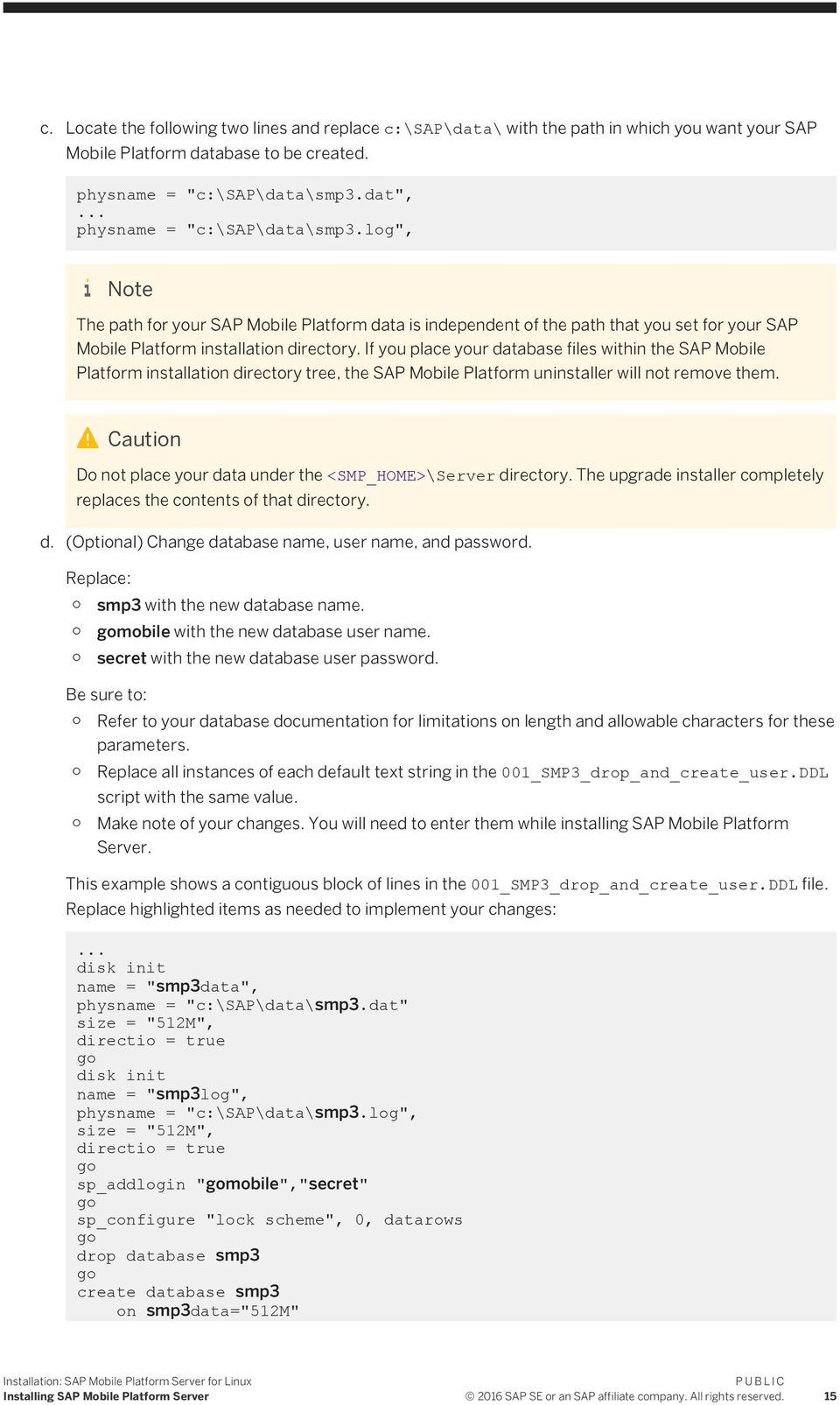
14 a. Go to the SAP Product Availability Matrix (PAM) Search for SAP Mobile Platform 3.0 (search box in the upper-right corner), and select either SAP Mobile Platform 3.0 or SAP Mobile Platform SDK 3.0. Access to the PAM requires an SAP Service Marketplace login: b. Under the Essentials heading in the upper-right corner, click Open in New Window to open the Support Matrices PowerPoint file. c. Click through to the SAP for persistence databases supported by SAP Mobile Platform Install SAP ASE anywhere on the same network where you will be installing SAP Mobile Platform. Consult with your company's database administrator, or have the database administrator perform the installation for you. If you are not sure what values to specify when you install or configure your database, start by setting Page size to 16 KB. Record the values for these parameters: Host name the host system on which the database software is installed. Login the admin login for the database software. Port number the port number the database software uses. 3. If you installed SAP ASE on a different server from the one where you will install SAP Mobile Platform Server, copy the db_tools directory, including all subdirectories, from the SAP Mobile Platform Server installer image to a temporary location on the database server. In the steps below, <installer_root> refers to the directory into which you copied db_tools. 4. Edit the 001_SMP3_drop_and_create_user.DDL script: a. Use a text editor to open the <installer_root>/db_tools/db/ase/smp3/sql/ 001_SMP3_drop_and_create_user.DDL file. b. To increase database size, change all instances of "256M" to "512M". Replace highlighted instances of 256M below with 512M: disk init name = "smp3data", physname = "c:\sap\data\smp3.dat", size = "256M", directio = true go disk init name = "smp3log", physname = "c:\sap\data\smp3.log", size = "256M", directio = true go... create database smp3 on smp3data="256m" log on smp3log="256m" go SAP SE or an SAP affiliate company. All rights reserved. Installing SAP Mobile Platform Server

15 c. Locate the following two lines and replace c:\sap\data\ with the path in which you want your SAP Mobile Platform database to be created. physname = "c:\sap\data\smp3.dat",... physname = "c:\sap\data\smp3.log", The path for your SAP Mobile Platform data is independent of the path that you set for your SAP Mobile Platform installation directory. If you place your database files within the SAP Mobile Platform installation directory tree, the SAP Mobile Platform uninstaller will not remove them. Caution Do not place your data under the <SMP_HOME>\Server directory. The upgrade installer completely replaces the contents of that directory. d. (Optional) Change database name, user name, and password. Replace: smp3 with the new database name. gomobile with the new database user name. secret with the new database user password. Be sure to: Refer to your database documentation for limitations on length and allowable characters for these parameters. Replace all instances of each default text string in the 001_SMP3_drop_and_create_user.DDL script with the same value. Make note of your changes. You will need to enter them while installing SAP Mobile Platform Server. This example shows a contiguous block of lines in the 001_SMP3_drop_and_create_user.DDL file. Replace highlighted items as needed to implement your changes:... disk init name = "smp3data", physname = "c:\sap\data\smp3.dat" size = "512M", directio = true go disk init name = "smp3log", physname = "c:\sap\data\smp3.log", size = "512M", directio = true go sp_addlogin "gomobile","secret" go sp_configure "lock scheme", 0, datarows go drop database smp3 go create database smp3 on smp3data="512m" Installing SAP Mobile Platform Server 2016 SAP SE or an SAP affiliate company. All rights reserved. 15
16 log on smp3log="512m" go exec sp_dboption 'smp3', 'select into/bulkcopy/pllsort', true go sp_configure 'enable functionality group', 1 go use smp3 go checkpoint go sp_adduser gomobile go grant all to gomobile go Save and close the file. 6. Run the 001_SMP3_drop_and_create_user.DDL script. a. In a terminal window in the SAP Mobile Platform installer image, navigate to: b. Run: <installer_root>/db_tools/db/ase/smp3/sql isql -S<servername> -U<username> -P<password> -i 001_SMP3_drop_and_create_user.DDL where: <servername> is the server where SAP ASE is installed. <username> is an admin user, such as sa. <password> is the password for <username>. 7. Make sure the database resources number of connections, available space, permissions, and threads, plus any other parameters that you would tune to support a major application can support SAP Mobile Platform. For example, make a minimum of 25 database connections available for SAP Mobile Platform Server. 8. Configure the database to increment in size automatically as additional disk space is needed. See the ASE documentation for details. If the database ever exceeds the allocated size, SAP Mobile Platform Server cannot start. If you set a high logging level for database transactions, closely monitor the database size relative to available disk space. 9. (Optional) Configure your SAP ASE database to support Mobiliser. See Configuring ASE to Support Mobiliser [page 17] SAP SE or an SAP affiliate company. All rights reserved. Installing SAP Mobile Platform Server

17 Configuring ASE to Support Mobiliser To support Mobiliser applications with SAP Adaptive Server Enterprise (SAP ASE) on your SAP Mobile Platform Server, make SAP ASE-specific changes to the dbmaintain script and execute it. Procedure 1. Edit the dbmaintain script. a. Make a backup copy of <installer_root>/db_tools/db/ase/smp3/sql/ dbmaintain.properties.ase. b. Use a text editor to open <installer_root>/db_tools/db/ase/smp3/sql/ dbmaintain.properties.ase. c. Edit this line: database.url=jdbc:sybase:tds:{host}:{port}/{dbname} {HOST} with the host name for your database {PORT} with the port number for your database (DBNAME} with smp3, or if you changed it, the new database name d. Save and close the file. 2. Run the dbmaintain scripts against your database. Use Java 8 to run the Java commands described here: either the Java instance that is installed with SAP Mobile Platform Server, or another available instance. a. In a terminal window, go to <installer_root>/db_tools/db/ase/smp3/sql. b. Enter: java -jar com.sybase365.mobiliser.vanilla.standalone-<version>-scriptarchivease.jar -c dbmaintain.properties.ase -u <dbusername> -p <dbpassword> where: c. Enter: <version> is the actual version text in the file name on your system. <dbusername> is the database name, gomobile, or the new user name if you changed it. <dbpassword> is the database password, secret, or the new password if you changed it. java -jar com.sap.mobile.platform.server.db.ase.dbmaintain-<version>scriptarchive-ase.jar -c dbmaintain.properties.ase -u <dbusername> -p <dbpassword> where: <version> is the actual version text in the file name on your system. <dbusername> is the database name, gomobile, or the new user name if you changed it. Installing SAP Mobile Platform Server 2016 SAP SE or an SAP affiliate company. All rights reserved. 17

18 <dbpassword> is the database password, secret, or the new password if you changed it. d. Respond to the Are you sure you want to continue? prompt. When the dbmaintain script has successfully connected to your database, if the dbmaintainer.fromscratch.enabled parameter is true, the script warns you that any existing objects in the database will be dropped if you continue. If this is a fresh installation on a new system, you may safely answer yes to this prompt, and the script continues. To preserve existing objects in your database: 1. Answer no to the prompt. 2. Edit this line in the dbmaintain script, replacing true with false: dbmaintainer.fromscratch.enabled=true 3. Re-run the dbmaintain script. e. Review the "Dry Run Results" and continue if there are no issues. The script takes several minutes to complete, ending with the message The database has been updated successfully Setting Up an External SAP SQL Anywhere Database Install SAP SQL Anywhere version 16.0 or later, and configure it to work with SAP Mobile Platform. Procedure 1. Verify that SAP Mobile Platform supports the version of SQL Anywhere you are planning to use. a. Go to the SAP Product Availability Matrix (PAM) Search for SAP Mobile Platform 3.0 (search box in the upper-right corner), and select either SAP Mobile Platform 3.0 or SAP Mobile Platform SDK 3.0. Access to the PAM requires an SAP Service Marketplace login: b. Under the Essentials heading in the upper-right corner, click Open in New Window to open the Support Matrices PowerPoint file. c. Click through to the SAP for persistence databases supported by SAP Mobile Platform Install SQL Anywhere on the same network where you will be installing SAP Mobile Platform. Consult with your company's database administrator, or have the database administrator perform the installation for you. Record the values for these parameters: Host name the host system on which the database software is installed. Login the admin login for the database software SAP SE or an SAP affiliate company. All rights reserved. Installing SAP Mobile Platform Server

19 Port number the port number the database software uses. 3. Navigate to the bin subdirectory of your SQL Anywhere installation. 4. Initialize the database by running:./dbinit -b -z UTF8 -zn UTF8 -ze UTF8 -p 8192 <dbname>.db where <dbname> is the full path and file name of the SQL Anywhere database. 5. Using Sybase Central or a third-party tool, create a new database for SAP Mobile Platform: a. Connect to the database with the default credentials, username = dba; password = sql. b. Execute the following SQL statements: CREATE USER <username> IDENTIFIED BY <password> FORCE PASSWORD CHANGE OFF; grant all,dba to <username>; update spt_mda set querytype = 4, query = '0' where mdinfo = 'SET_READONLY_FALSE'; update spt_mda set querytype = 4, query = '0' where mdinfo = 'SET_READONLY_TRUE'; update spt_mda set querytype = 4, query = '0' where mdinfo = 'SET_CATALOG'; SET OPTION non_keywords = 'PRECISION, MESSAGE'; 6. (Optional) Configure your database to support Mobiliser. See Configuring SQL Anywhere to Support Mobiliser [page 19] Configuring SQL Anywhere to Support Mobiliser Configure SQL Anywhere to support Mobiliser applications in SAP Mobile Platform by updating and executing the dbmaintain script. Procedure 1. Edit the dbmaintain script. a. Make a backup copy of <installer_root>/db_tools/db/sa/smp3/sql/ dbmaintain.properties.sqlanywhere. b. Use a text editor to open <installer_root>/db_tools/db/sa/smp3/sql/ dbmaintain.properties.sqlanywhere. c. Edit this line: database.url=jdbc:sybase:tds:{host}:{port}/{dbname} {HOST} with the host name for your database {PORT} with the port number for your database (DBNAME} with smp3, or if you changed it, the new database name d. Save and close the file. 2. Run the dbmaintain script. Installing SAP Mobile Platform Server 2016 SAP SE or an SAP affiliate company. All rights reserved. 19

20 Use Java 8 to run the Java commands described here: either the Java instance that is installed with SAP Mobile Platform Server, or another available instance. a. In a terminal window, go to <installer_root>/db_tools/db/sa/sql, and run: java -jar com.sybase365.mobiliser.vanilla.standalone-<version>-scriptarchiveanywhere.jar -c dbmaintain.properties.sqlanywhere -u <dbusername> -p <dbpassword> where: b. Enter: c. Run: <version> is the actual version text in the file name on your system. <dbusername> is the database name, gomobile, or the new user name if you changed it. <dbpassword> is the database password, secret, or the new password if you changed it. java -jar com.sap.mobile.platform.server.db.sa.dbmaintain- <version>scriptarchive-anywhere.jar -c dbmaintain.properties.sqlanywhere -u <dbusername> -p <dbpassword> where: <version> is the actual version text in the file name on your system. <dbusername> is the database name, gomobile, or the new user name if you changed it. <dbpassword> is the database password, secret, or the new password if you changed it. d. Respond to the Are you sure you want to continue? prompt. If this is a fresh installation on a new system, you may safely answer yes to this prompt, and the script continues. Otherwise, if the value of the dbmaintainer.fromscratch.enabled parameter is true, the script warns you that any existing objects in the database will be dropped if you continue. To preserve existing objects in your database: 1. Answer no to the prompt. 2. Edit this line in the dbmaintain script, and change true to false: dbmaintainer.fromscratch.enabled=true 3. Re-run the dbmaintain script. e. Review the "Dry Run Results" and continue if there are no issues. After several minutes, you should see the messge The database has been updated successfully SAP SE or an SAP affiliate company. All rights reserved. Installing SAP Mobile Platform Server

21 3.2.4 Setting Up an External DB2 Database Install DB2, then modify and run a setup script to configure it to work with SAP Mobile Platform. Procedure 1. Verify that SAP Mobile Platform supports the version of DB2 you are planning to use. a. Go to the SAP Product Availability Matrix (PAM) Search for SAP Mobile Platform 3.0 (search box in the upper-right corner), and select either SAP Mobile Platform 3.0 or SAP Mobile Platform SDK 3.0. Access to the PAM requires an SAP Service Marketplace login: b. Under the Essentials heading in the upper-right corner, click Open in New Window to open the Support Matrices PowerPoint file. c. Click through to the SAP for persistence databases supported by SAP Mobile Platform Install DB2 anywhere on the same network where you will be installing SAP Mobile Platform. Consult with your company's database administrator, or have the database administrator perform the installation for you. Record the values for these parameters: Host name the host system on which the database software is installed. Login the admin login for the database software. Port number the port number the database software uses. 3. If you installed DB2 on a server other than the one on which you will install SAP Mobile Platform Server, copy the db_tools directory, including all subdirectories, from the SAP Mobile Platform Server installer image to a temporary location on the database server. In the steps below, <installer_root> refers to the directory into which you copied db_tools. 4. (Optional) Change database name and user name. a. Use a text editor to open the <installer_root>/db_tools/db/db2/smp3/sql/ 001_SMP3_drop_and_create_user.DDL file. b. Change default values for database name and user name. Replace: smp3 with the new database name. gomobile with the new database user name. Be sure to: Refer to your database documentation for limitations on length and allowable characters for these parameters. Replace all instances of each default text string in the 001_SMP3_drop_and_create_user.DDL script with the same value. Make note of the changes you make. You will need to enter the changed values during SAP Mobile Platform Server installation. Installing SAP Mobile Platform Server 2016 SAP SE or an SAP affiliate company. All rights reserved. 21
22 The example below shows a contiguous block of the 001_SMP3_drop_and_create_user.DDL file for DB2. Replace highlighted items as needed to implement your changes.... CREATE DATABASE smp3 AUTOMATIC STORAGE YES USINGCODESET UTF-8 TERRITORY US COLLATE USING SYSTEM PAGESIZE 32 K; CONNECT TO smp3; CREATE SCHEMA gomobile AUTHORIZATION gomobile; CREATE ROLE SY365_OBJOWNER; GRANT CREATEIN ON SCHEMA smp3 TO SY365_OBJOWNER; GRANT SY365_OBJOWNER TO USER gomobile;... You create the DB2 user name and set the password at the operating system level and, by convention, DB2 uses the same name for the schema. The default 001_SMP3_drop_and_create_user.DDL file assumes that "gomobile" is the user name created for DB2. c. Save and close the file. 5. Run the 001_SMP3_drop_and_create_user.DDL script. a. In a terminal window, navigate to: b. Run: <installer_root>/db_tools/db/db2/smp3/sql db2 -tvsf 001_SMP3_drop_and_create_user.DDL 6. Make sure the database resources number of connections, available space, permissions, and threads, plus any other parameters that you would tune to support a major application can support SAP Mobile Platform. For example, make a minimum of 25 database connections available for SAP Mobile Platform Server. 7. Increase the database logfile size. Open the database command line interface and execute this command: UPDATE DATABASE CONFIGURATION FOR <db_name> USING LOGFILESIZE where <db_name> is either the default name, smp3, or the new database name that you supplied above. 8. (Optional) Configure your DB2 database to support Mobiliser. See Configuring DB2 to Support Mobiliser [page 23] SAP SE or an SAP affiliate company. All rights reserved. Installing SAP Mobile Platform Server
23 Configuring DB2 to Support Mobiliser To support Mobiliser applications with DB2 on your SAP Mobile Platform Server, make DB2-specific changes to the dbmaintain script and execute it. Context Use Java 8 to run the Java commands described here: either the Java instance that is installed with SAP Mobile Platform Server, or another available instance. Procedure 1. Edit the dbmaintain script. a. Make a backup copy of <installer_root>/db_tools/db/db2/smp3/sql/ dbmaintain.properties.db2. b. Use a text editor to open <installer_root>/db_tools/db/db2/smp3/sql/ dbmaintain.properties.db2. c. Edit this line: database.url=jdbc:db2://{host}:{port}/{dbname} {HOST} with the host name for your database {PORT} with the port number for your database (DBNAME} with smp3, or if you changed it, the new database name d. Save and close the file. 2. Run the dbmaintain scripts against your database. a. In a terminal window, go to <installer_root>/db_tools/db/db2/smp3/sql. b. Enter: java -jar com.sybase365.mobiliser.vanilla.standalone-<version>-scriptarchivedb2.jar -c dbmaintain.properties.db2 -u <dbusername> -p <dbpassword> where: c. Enter: <version> is the actual version text in the file name on your system. <dbusername> is the database name, gomobile, or the new user name if you changed it. <dbpassword> is the database password, secret, or the new password if you changed it. java -jar com.sap.mobile.platform.server.db.db2.dbmaintain-<version>scriptarchive-db2.jar -c dbmaintain.properties.db2 -u <dbusername> -p <dbpassword> Installing SAP Mobile Platform Server 2016 SAP SE or an SAP affiliate company. All rights reserved. 23
24 where: <version> is the actual version text in the file name on your system. <dbusername> is the database name, gomobile, or the new user name if you changed it. <dbpassword> is the database password, secret, or the new password if you changed it. d. Respond to the Are you sure you want to continue? prompt. When the dbmaintain script has successfully connected to your database, if the dbmaintainer.fromscratch.enabled parameter is true, the script warns you that any existing objects in the database will be dropped if you continue. If this is a fresh installation on a new system, you may safely answer yes to this prompt, and the script continues. To preserve existing objects in your database: 1. Answer no to the prompt. 2. Edit this line in the dbmaintain script, replacing true with false: dbmaintainer.fromscratch.enabled=true 3. Re-run the dbmaintain script. e. Review the "Dry Run Results" and continue if there are no issues. After several minutes, you should see the message The database has been updated successfully Setting Up an External Oracle Database Install Oracle, then modify and run a setup script to configure it to work with SAP Mobile Platform, and download the Oracle JDBC driver. Procedure 1. Verify that SAP Mobile Platform supports the version of Oracle you are planning to use. a. Go to the SAP Product Availability Matrix (PAM) Search for SAP Mobile Platform 3.0 (search box in the upper-right corner), and select either SAP Mobile Platform 3.0 or SAP Mobile Platform SDK 3.0. Access to the PAM requires an SAP Service Marketplace login: b. Under the Essentials heading in the upper-right corner, click Open in New Window to open the Support Matrices PowerPoint file. c. Click through to the SAP for persistence databases supported by SAP Mobile Platform Install Oracle anywhere on the same network where you will be installing SAP Mobile Platform. Consult with your company's database administrator, or have the database administrator perform the installation for you SAP SE or an SAP affiliate company. All rights reserved. Installing SAP Mobile Platform Server
25 Record the values for these parameters: Host name the host system on which the database software is installed. Login the admin login for the database software. Port number the port number the database software uses. 3. If you installed Oracle on a server other than the one on which you will install SAP Mobile Platform Server, copy the db_tools directory, including all subdirectories, from the SAP Mobile Platform Server installer image to a temporary location on the database server. In the steps below, <installer_root> refers to the directory into which you copied db_tools. 4. Edit the 001_SMP3_drop_and_create_user.DDL script. a. In a terminal window, navigate to: <installer_root>/db_tools/db/oracle/smp3/sql b. Use a text editor to open 001_SMP3_drop_and_create_user.DDL, and enter EXIT; as the last line in the file. c. Change user name and password. Replace: GOMOBILE with the new database user name. SECRET with the new database user password. Be sure to: Refer to your database documentation for limitations on length and allowable characters for these parameters. Replace all instances of each default text string in the 001_SMP3_drop_and_create_user.DDL script with the same value. Make note of the changes you make. You will need to enter the changed values during SAP Mobile Platform Server installation. This example shows a contiguous block of the 001_SMP3_drop_and_create_user.DDL file for Oracle. Replace highlighted items as needed to implement your changes.... DROP USER GOMOBILE CASCADE; CREATE USER GOMOBILE IDENTIFIED BY SECRET DEFAULT TABLESPACE USERS TEMPORARY TABLESPACE TEMP PROFILE DEFAULT ACCOUNT UNLOCK; GRANT SY365_OBJOWNER TO GOMOBILE; GRANT CREATE SESSION TO GOMOBILE; GRANT CONNECT TO GOMOBILE; ALTER USER GOMOBILE DEFAULT ROLE ALL; ALTER USER GOMOBILE QUOTA UNLIMITED ON USERS; Oracle does not define a database name as such, and by convention uses the same name for the user and the schema. The SAP Mobile Platform Server installer needs either the Oracle service name or SID to connect to your Oracle database. d. Save and close the 001_SMP3_drop_and_create_user.DDL file. Installing SAP Mobile Platform Server 2016 SAP SE or an SAP affiliate company. All rights reserved. 25
26 e. Run: > smp3.log where: <servername> is the server on which Oracle is installed. <username> is an admin user, such as sa. <password> is the password for <username>. In most cases, the user that the script is dropping does not exist, so the following error message is normal: DROP USER GOMOBILE CASCADE * ERROR at line 1:ORA-01918: user 'GOMOBILE' does not exist 5. Make sure the database resources number of connections, available space, permissions, and threads, plus any other parameters that you would tune to support a major application can support SAP Mobile Platform. For example, make a minimum of 25 database connections available for SAP Mobile Platform Server. 6. Download the JDBC driver from oracle.com for the version of Oracle you are using. The installer prompts for the path to this driver. 7. (Optional) Configure your Oracle database to support Mobiliser. See Configuring Oracle to Support Mobiliser [page 26] Configuring Oracle to Support Mobiliser To support Mobiliser applications with Oracle on your SAP Mobile Platform Server, make Oracle-specific changes to the dbmaintain script and execute it. Procedure 1. Edit the dbmaintain script. a. Make a backup copy of <installer_root>/db_tools/db/oracle/smp3/sql/ dbmaintain.properties.oracle-<xxx>. Where <xxx> is either sid or svc, depending on the connection mode set during Oracle installation. b. Use a text editor to open <installer_root>/db_tools/db/oracle/smp3/sql/ dbmaintain.properties.oracle-<xxx>. c. Enter the location of the JDBC driver that was downloaded for use with SAP Mobile Platform Server. Locate this line, and enter the JDBC driver location after the equal sign: database.driverlocation= d. Replace terms in braces with appropriate values for your system. {HOST} with the host name for your database {PORT} with the port number for your database SAP SE or an SAP affiliate company. All rights reserved. Installing SAP Mobile Platform Server
27 (DBNAME} with smp3, or if you changed it, the new database name e. Save and close the file. 2. Run the dbmaintain script against your database. Use Java 8 to run the Java commands described here: either the Java instance that is installed with SAP Mobile Platform Server, or another available instance. a. In a terminal window, go to <installer_root>/db_tools/db/oracle/smp3/sql. b. Run: java -jar com.sybase365.mobiliser.vanilla.standalone-<version>-scriptarchiveoracle.jar -c dbmaintain.properties.oracle-<xxx> -u <dbusername> -p <dbpassword> where: c. Run: <version> is the actual version text in the file name on your system. <xxx> is either sid or svc, depending on the connection mode set during Oracle installation. <dbusername> is the database name, gomobile, or if you changed it from the default, the new name. <dbpassword> is the database password, secret, or if you changed it from the default, the new password. java -jar com.sap.mobile.platform.server.db.oracle.dbmaintain-<version>scriptarchive-oracle.jar -c dbmaintain.properties.oracle-<xxx> -u <dbusername> -p <dbpassword> where: <version> is the actual version text in the file name on your system. <xxx> is either sid or svc, depending on the connection mode set during Oracle installation. <dbusername> is the database name, gomobile, or if you changed it from the default, the new name. <dbpassword> is the database password, secret, or if you changed it from the default, the new password. d. When the dbmaintain script has successfully connected to your database, if the dbmaintainer.fromscratch.enabled parameter is true, the script warns you that any existing objects in the database will be dropped if you continue. If this is a fresh installation on a new system, you may safely answer yes to this prompt, and the script continues. To preserve existing objects in your database: 1. Answer no to the prompt. 2. Edit this line in the dbmaintain script, replacing true with false: dbmaintainer.fromscratch.enabled=true 3. Re-run the dbmaintain script. e. Review the "Dry Run Results" and continue if there are no issues. Installing SAP Mobile Platform Server 2016 SAP SE or an SAP affiliate company. All rights reserved. 27
28 After several minutes, you should see the message The database has been updated successfully Setting Up an External Microsoft SQL Server Database Install Microsoft SQL Server, then modify and run a setup script to configure it to work with SAP Mobile Platform. Procedure 1. Verify that SAP Mobile Platform supports the version of SQL Server you are planning to use. a. Go to the SAP Product Availability Matrix (PAM) Search for SAP Mobile Platform 3.0 (search box in the upper-right corner), and select either SAP Mobile Platform 3.0 or SAP Mobile Platform SDK 3.0. Access to the PAM requires an SAP Service Marketplace login: b. Under the Essentials heading in the upper-right corner, click Open in New Window to open the Support Matrices PowerPoint file. c. Click through to the SAP for persistence databases supported by SAP Mobile Platform Install SQL Server anywhere on the same network where you will be installing SAP Mobile Platform. Consult with your company's database administrator, or have the database administrator perform the installation for you. For SAP Mobile Platform 3.0 SP09 and earlier, see SAP Record the values of these parameters: Host name the host system on which the database software is installed. Login the admin login for the database software. Port number the port number the database software uses. 3. In Microsoft SQL Server Management Studio, under Server Properties, set Server Authentication to SQL Server and Windows Authentication Mode. 4. If you installed SQL Server on a server other than the one on which you will install SAP Mobile Platform Server, copy the db_tools directory, including all subdirectories, from the SAP Mobile Platform Server installer image to a temporary location on the database server. In the steps below, <installer_root> refers to the directory into which you copied db_tools. 5. Edit the 001_SMP3_drop_and_create_user.DDL script: a. Use a text editor to open the <installer_root>/db_tools/db/sqlserver/smp3/sql/ 001_SMP3_drop_and_create_user.DDL file SAP SE or an SAP affiliate company. All rights reserved. Installing SAP Mobile Platform Server
29 b. (Optional) Change database name, user name, and password. Replace: smp3 with the new database name. gomobile with the new database user name. secret with the new database user password. Be sure to: Refer to your database documentation for limitations on length and allowable characters for these parameters. Replace all instances of each default text string in the 001_SMP3_drop_and_create_user.DDL script with the same value. Make note of the changes you make. You will need to enter the changed values during SAP Mobile Platform Server installation. This example shows a contiguous block of the 001_SMP3_drop_and_create_user.DDL file for SQL Server. Replace highlighted items as needed to implement your changes. USE master GO CREATE DATABASE smp3 GO CREATE LOGIN gomobile WITH PASSWORD = 'secret', CHECK_EXPIRATION=OFF, CHECK_POLICY=OFF go use smp3 go CREATE SCHEMA [gomobile] GO CREATE USER [gomobile] FOR LOGIN [gomobile] WITH DEFAULT_SCHEMA=[gomobile] GO /**** add role ****/ USE [smp3] GO EXEC sp_addrolemember N'db_owner', N'gomobile' GO 6. Save and close the file. 7. Run the 001_SMP3_drop_and_create_user.DDL script. a. In a terminal window, navigate to <installer_root>\db_tools\db\sqlserver\smp3\sql, where <installer_root> is the SAP Mobile Platform installation root directory. b. Run: sqlcmd -S<servername> -U<username> -P<password> - i001_smp3_drop_and_create_user.ddl where: <servername> is the server where SQL Server is installed, optionally including a protocol, instance name, and port number in this format: [<protocol>:]<servername>[\<instancename>][,<port>]. <username> is an admin user, such as sa. <password> is the password for <username>. Installing SAP Mobile Platform Server 2016 SAP SE or an SAP affiliate company. All rights reserved. 29
30 8. Make sure the database resources number of connections, available space, permissions, and threads, plus any other parameters that you would tune to support a major application can support SAP Mobile Platform. For example, make a minimum of 25 database connections available for SAP Mobile Platform Server. 9. Configure the database so that it increments in size automatically as additional disk space is needed. Refer to the SQL Server documentation for details. If the database ever exceeds the allocated size, SAP Mobile Platform Server cannot start. If you set a high logging level for database transactions, closely monitor the database size relative to available disk space. 10. (Optional) Configure your SQL Server database to support Mobiliser. See Configuring Microsoft SQL Server to Support Mobiliser [page 30] Configuring Microsoft SQL Server to Support Mobiliser To support Mobiliser applications with SQL Server on your SAP Mobile Platform Server, make SQL Serverspecific changes to the dbmaintain script and execute it. Procedure 1. Edit the dbmaintain script. a. Make a backup copy of <installer_root>/db_tools/db/sqlserver/smp3/sql/ dbmaintain.properties.mssql. b. Use a text editor to open <installer_root>/db_tools/db/sqlserver/smp3/sql/ dbmaintain.properties.mssql. c. Enter the location of the JDBC driver that was downloaded for use with SAP Mobile Platform Server. Locate this line, and enter the JDBC driver location after the equal sign: database.driverlocation= d. Edit this line: database.url=jdbc:sqlserver://{host}:{port};databasename={dbname}; {HOST} with the host name for your database {PORT} with the port number for your database (DBNAME} with smp3, or if you changed it, the new database name e. Save and close the file. 2. Run the dbmaintain scripts against your database SAP SE or an SAP affiliate company. All rights reserved. Installing SAP Mobile Platform Server
31 Use Java 8 to run the Java commands described here: either the Java instance that is installed with SAP Mobile Platform Server, or another available instance. a. In a terminal window, go to <installer_root>/db_tools/db/sqlserver/smp3/sql. b. Run: java -jar com.sybase365.mobiliser.vanilla.standalone-<version>-scriptarchivesqlserver.jar -c dbmaintain.properties.mssql -u <dbusername> -p <dbpassword> where: c. Run: <version> is the actual version text in the file name on your system. <dbusername> is the database name, gomobile, or the new user name if you changed it. <dbpassword> is the database password, secret, or the new password if you changed it. java -jar com.sap.mobile.platform.server.db.sqlserver.dbmaintain-<version>scriptarchive-sqlserver.jar -c dbmaintain.properties.mssql -u <dbusername> -p <dbpassword> where: <version> is the actual version text in the file name on your system. <dbusername> is the database name, gomobile, or the new user name if you changed it. <dbpassword> is the database password, secret, or the new password if you changed it. d. When the dbmaintain script has successfully connected to your database, if the dbmaintainer.fromscratch.enabled parameter is true, the script warns you that any existing objects in the database will be dropped if you continue. If this is a fresh installation on a new system, you may safely answer yes to this prompt, and the script continues. To preserve existing objects in your database: 1. Answer no to the prompt. 2. Edit this line in the dbmaintain script, replacing true with false: dbmaintainer.fromscratch.enabled=true 3. Re-run the dbmaintain script. e. Review the "Dry Run Results" and continue if there are no issues. After several minutes, you should see the message The database has been updated successfully. Installing SAP Mobile Platform Server 2016 SAP SE or an SAP affiliate company. All rights reserved. 31
32 3.3 Preparing for Installation Verify that the host on which you are installing SAP Mobile Platform is ready for you to begin the installation. Procedure 1. Verify that the installation host meets minimum system requirements for all SAP Mobile Platform components you are installing. See the SAP Product Availability Matrix (PAM) Search for SAP Mobile Platform 3.0 (search box in the upper-right corner), and select either SAP Mobile Platform 3.0 or SAP Mobile Platform SDK 3.0. Access to the PAM requires an SAP Service Marketplace login: Additional hardware and software requirements for SAP Mobile Platform Server are documented in these SAP s: SAP provides information about minimum hardware and software requirements for: Web browsers for Management Cockpit JDK Reverse proxies Afaria Introscope LDAP servers Virtual machines. SAP provides information about back-end requirements. If you using a Microsoft SQL Server external database, see SAP Verify that you have Administrator privileges on the installation target host. 3. Shut down all Sybase and SAP software and processes, and associated third-party processes that are running on the installation host. 4. To accommodate SAP Mobile Platform internal communications, you may need to reconfigure intrusion detection/prevention systems (either hardware- or software-based). See Intrusion Detection and Protection Requirements in Landscape Planning and Design. Task overview: Installing SAP Mobile Platform Server [page 9] Previous task: Using an External Database [page 10] Next task: Running the Installer [page 33] SAP SE or an SAP affiliate company. All rights reserved. Installing SAP Mobile Platform Server
33 3.4 Running the Installer Edit the SilentInstall_Linux.txt file to set installation options, then run the installation script. Procedure 1. Open a terminal window. 2. Go to the root directory of your installer image. 3. Use a text editor to open the SilentInstall_Linux.txt file. 4. Make changes as needed to customize installation options. There are three changes you must make: Change AgreeToSAPLicense from false to true in the line below, to indicate your acceptance of the end user license agreement: -V AgreeToSAPLicense="false" Uncomment AdminPassword in the line below, and assign a non-null value: #-V AdminPassword="" Uncomment keystorepassword in the line below, and assign a non-null value: #-V KeystorePassword="" For both the admin password and the keystore password, only alphabetic and numeric characters, spaces, periods, colons, dashes, and hyphens are allowed. If you installed a custom database and want to install SAP Mobile Platform to work with it, set the parameters as indicated in the table below. Other parameters you can change are documented in comments in the SilentInstall_Linux.txt file. If a line begins with a "#", remove it to enable the parameter. Explanation -V developerinstall="true" The default is true, which specifies a developer installation, with no options, using the embedded SQL Anywhere database. Change to false to enable a production installation, which allows you to set all other parameters, including a custom database. Installing SAP Mobile Platform Server 2016 SAP SE or an SAP affiliate company. All rights reserved. 33
34 Explanation If you set this property to false, you must also set the productioninstall property to true. -V productioninstall="false" The default is false, which specifies a developer installation, with no options, using the embedded SQL Anywhere database. Change to true to enable a production installation, which allows you to set all other parameters, including a custom database. If you set this property to true, you must also set the developerinstall property to false. -V sqlaembeddeddb="true" The default is true; the default database is SQL Anywhere. Set to false to select another database. -V existdb="false" The default is false, which disables selecting a database other than SQL Anywhere. Set to true to select another database. -V existdbtype="<database>" The database you installed to use with SAP Mobile Platform: hana ase db2 oracle-sid or oracle-svc mssql -V dbhostname="<database_host_n ame>" -V dbportnumber="<database_port> " The name of the host on which you installed the database to use with SAP Mobile Platform. The port number your database uses. -V dblogin="gomobile" The admin user name, either "gomobile" or the new name if you changed it from the default. -V dbpassword="secret" The admin password, either "secret" or the new password if you changed it from the default. For SAP ASE, if the database is set up without a password (with blank password), leave this property commented. -V dbdbname="smp3" The database name, either "smp3" or the new name if you changed it from the default SAP SE or an SAP affiliate company. All rights reserved. Installing SAP Mobile Platform Server
35 Explanation For an Oracle database, dbdbname is either the service name or the SID, depending on how you access Oracle. -V ignorepingerror="false" The default value "false" stops the installer if it cannot successfully ping your database using the specified values. SAP recommends that you keep the default value. Caution If this option is true and the database ping fails, the installation completes, but the server will not start. -V jdbcdriver="<jdbc_path>" (Microsoft SQL Server or Oracle) The path to the JDBC driver that corresponds to the value of existdbtype: For mssql, set to the location of the Microsoft SQL Server JDBC driver. For oracle-sid or oracle-svc, set to the location of the Oracle JDBC driver, either ojdbc6.jar or ojdbc6_g.jar. To change the installation directory, uncomment the line below and replace <Home directory> with a valid path to the installation directory: #-P installlocation="<home directory>/sap/mobileplatform3" The total length of the path must be 38 characters or less. If you uncomment this line without changing <Home directory>, the installation fails. 5. Save and close the SilentInstall_Linux.txt file. 6. Launch the installer: sh SilentInstall_Linux.sh The installer displays an Initializing wizard... message while it verifies the integrity of the installer image. The installer displays progress messages as it completes each step of the installation. Watch for this message when the installer completes: Installation Successful. Task overview: Installing SAP Mobile Platform Server [page 9] Previous task: Preparing for Installation [page 32] Next task: Verifying the Installation [page 36] Installing SAP Mobile Platform Server 2016 SAP SE or an SAP affiliate company. All rights reserved. 35
36 3.5 Verifying the Installation Check for errors in the installation logs, then verify that you can start the SAP Mobile Platform Server and log in to Management Cockpit. Procedure 1. Check the installation log at <SMP_HOME>/InstallLogs/SMPInstall<timestamp>.log. <SMP_HOME> is the installation location you specified (the default is <$HOME>/SAP/MobilePlatform3/). A quick way to do this is: grep -i error SMP*log 2. Verify that you can start SAP Mobile Platform Server. a. Open a terminal window. b. Go to <SMP_HOME>/Server/. c. Run go.sh. Server start-up is complete when you see this message The SMP server has initialized and is ready. When you run go.sh, stderr is redirected to the server_daemon.log file; stdout is not redirected. For troubleshooting, you can run go.sh -clean to clear the OSGi cache before starting the server. 3. Verify that you can log in to Management Cockpit. In a browser on any computer on the network, enter: In a browser on the system where SAP Mobile Platform Server is installed, enter: Next Steps Use the Upgrade: SAP Mobile Platform Server for Linux for the support package to upgrade your SAP Mobile Platform installation. Task overview: Installing SAP Mobile Platform Server [page 9] Previous task: Running the Installer [page 33] SAP SE or an SAP affiliate company. All rights reserved. Installing SAP Mobile Platform Server
37 4 Adding Cluster Nodes After installing a production SAP Mobile Platform Server on one system, you can use the same installer to add nodes to create a cluster in which all servers use the same external database. Context All nodes you add to a cluster must use the same communication port numbers as the first server that was installed in the cluster. These port numbers must be available on each cluster node where you install SAP Mobile Platform Server. 1. Preparing for Installation [page 37] Ensure that the host on which you are installing SAP Mobile Platform is ready for you to begin the installation. 2. Running the Installer [page 38] To add nodes to a cluster formed around the first production SAP Mobile Platform Server you installed, run the installer for each additional node. 3. Verifying the Installation [page 39] Check for errors in the installation logs, then verify that you can start the server and log in to Management Cockpit. 4.1 Preparing for Installation Ensure that the host on which you are installing SAP Mobile Platform is ready for you to begin the installation. Procedure 1. Install the first SAP Mobile Platform Server, and connect to an external production database. See Installing SAP Mobile Platform Server [page 9]. 2. Verify that the first server is fully started by connecting to Management Cockpit. 3. Verify that the installation target host meets minimum system requirements for all SAP Mobile Platform components you are installing. Adding Cluster Nodes 2016 SAP SE or an SAP affiliate company. All rights reserved. 37
38 See the SAP Product Availability Matrix (PAM) Search for SAP Mobile Platform 3.0 (search box in the upper-right corner), and select either SAP Mobile Platform 3.0 or SAP Mobile Platform SDK 3.0. Access to the PAM requires an SAP Service Marketplace login: 4. Verify that you have Administrator privileges on the installation target host. 5. Shut down all Sybase and SAP software and processes, and associated third-party processes that are running on the installation host. 6. To accommodate SAP Mobile Platform internal communications, you may need to reconfigure intrusion detection/prevention systems (either hardware- or software-based). See Intrusion Detection and Protection Requirements in Landscape Design and Integration. Task overview: Adding Cluster Nodes [page 37] Next task: Running the Installer [page 38] 4.2 Running the Installer To add nodes to a cluster formed around the first production SAP Mobile Platform Server you installed, run the installer for each additional node. Prerequisites Use the SilentInstall_Linux.txt file that was used in the first SAP Mobile Platform Server 3.0 SP11 installation, or be able to specify the same values when you edit that file for the cluster node installation. You must match exactly the settings from that first installation in each additional cluster node installation. Procedure 1. Open a terminal window. 2. Go to the root directory of your installer image. 3. Use a text editor to open the SilentInstall_Linux.txt file. If you have the SilentInstall_Linux.txt file used in the original single-server installation, you can use that same file to install each additional cluster node, instead of make changes to the file, as described in the next step SAP SE or an SAP affiliate company. All rights reserved. Adding Cluster Nodes
39 4. Make changes as needed to match the SilentInstall_Linux.txt file used in the first server installation. 5. Save and close the SilentInstall_Linux.txt file. 6. Launch the installer: sh SilentInstall_Linux.sh The installer displays an Initializing wizard message while it verifies the integrity of the installation image. The installer displays progress messages as it completes each step of the installation. Watch for this message when the installer completes: Installation Successful. Task overview: Adding Cluster Nodes [page 37] Previous task: Preparing for Installation [page 37] Next task: Verifying the Installation [page 39] 4.3 Verifying the Installation Check for errors in the installation logs, then verify that you can start the server and log in to Management Cockpit. Procedure 1. Check the latest installation log at <SMP_HOME>/InstallLogs/SMPInstall<date-time>.log. <SMP_HOME> is the installation location you specified in the initial 3.0 installation (the default is < $HOME>/SAP/MobilePlatform3/). A quick way to do this is: grep -i error SMP*log 2. Verify that you can start SAP Mobile Platform Server. a. Open a terminal window. b. Go to <SMP_HOME>/Server/. c. Execute sh go.sh. Server start-up is complete when you see this message: The SMP server has initialized and is ready. Adding Cluster Nodes 2016 SAP SE or an SAP affiliate company. All rights reserved. 39
40 3. Verify that you can log in to Management Cockpit. In a browser on any computer on the network, enter: In a browser on the system where SAP Mobile Platform Server is installed, enter: 4. Verify that this server has been added to the cluster. a. Use a text editor to open <SMP_HOME>/Server/log/<hostname>-smp-server.log> file. b. Search for "current addresses" to locate this text: Current Addresses in cluster: <nodes>. Addresses previously in cluster: <#> The value of <nodes> in this line should be the number of SAP Mobile Platform Server installations you have now performed that should be part of the cluster: The first server you add to the cluster is node number 2. The second server you add to the cluster is node number 3, and so on. If you look in the log for the first server you installed, you see that the node number is 1. Next Steps To install additional nodes in a cluster, repeat this procedure, beginning with Adding Cluster Nodes [page 37], until you have installed all cluster nodes. If this was the last node in your cluster, continue with Postinstallation Landscape Setup in Administrator. Task overview: Adding Cluster Nodes [page 37] Previous task: Running the Installer [page 38] SAP SE or an SAP affiliate company. All rights reserved. Adding Cluster Nodes
41 5 Uninstalling Uninstall each SAP Mobile Platform Server instance before reinstalling it. You can uninstall the server nodes in any order. 1. Preparing to Uninstall [page 41] Ensure that the host from which you are uninstalling SAP Mobile Platform Server is ready for the uninstallation. 2. Running the Uninstaller [page 42] Run a shell script to uninstall SAP Mobile Platform server components. 3. Removing an External Production Database [page 43] After uninstalling all SAP Mobile Platform Server nodes, you can archive the data in the production database and remove the database. 5.1 Preparing to Uninstall Ensure that the host from which you are uninstalling SAP Mobile Platform Server is ready for the uninstallation. Context If you have been using an external production database, uninstalling SAP Mobile Platform Server leaves the external database intact. If you have been using the default embedded database in a development installation, uninstalling SAP Mobile Platform Server deletes the database. Procedure 1. While SAP Mobile Platform Server is running, first uninstall any other SAP products that require SAP Mobile Platform, such as SAP Mobile Sales for SAP CRM. 2. Shut down all SAP software and processes, and associated third-party processes that are running on the host. 3. Move or copy any user-created files and log files you want to keep from the SAP Mobile Platform Server installation directories to another location. Uninstalling 2016 SAP SE or an SAP affiliate company. All rights reserved. 41
42 If you have been using the default database in a development installation and you plan to reinstall SAP Mobile Platform Server, preserve data by backing up the SAP Mobile Platform Server databases. After SAP Mobile Platform Server stops, use operating system commands to copy the entire directory structure from <SMP_HOME>/Server/db/sa/smp3/ to a backup location. 4. Prevent backups from interfering, by either excluding the existing SAP Mobile Platform Server installation directory from backup processes or temporarily disabling them. 5. Prevent virus scans from interfering, by either excluding the existing SAP Mobile Platform Server installation directory from virus scans or temporarily disabling them. Task overview: Uninstalling [page 41] Next task: Running the Uninstaller [page 42] 5.2 Running the Uninstaller Run a shell script to uninstall SAP Mobile Platform server components. Procedure 1. Open a terminal window. 2. Go to <SMP_HOME>. 3. Launch the uninstaller: sh SilentUninstall_Linux.sh 4. When you see the message that SAP Mobile Platform was successfully uninstalled, enter exit to close the terminal window. 5. Delete any folders and files remaining in the SAP Mobile Platform Server installation directory. Task overview: Uninstalling [page 41] Previous task: Preparing to Uninstall [page 41] Next task: Removing an External Production Database [page 43] SAP SE or an SAP affiliate company. All rights reserved. Uninstalling
43 5.3 Removing an External Production Database After uninstalling all SAP Mobile Platform Server nodes, you can archive the data in the production database and remove the database. Procedure 1. Verify that all nodes in the SAP Mobile Platform have been uninstalled. 2. Archive any data you want to retain. 3. To delete the SAP Mobile Platform database tables, run the appropriate command for your database. Database Command SQL Anywhere Stop the remote SA server, and delete the smp3.db and smp3.log files. To reuse the remote SA, re-create the smp3 database by running: ${SMPServer}\db\sa\sql\001_SMP3_drop_and_create_user.DDL SAP HANA Drop the schema for SAP Mobile Platform, using either HANA Studio or the DROP SCHEMA command. The default schema name is the SAP HANA user name that installed the SAP Mobile Platform database in SAP HANA. SAP ASE At an isql prompt, enter: drop database smp3; If you changed the default database name, replace smp3 with the new name. DB2 At a DB2 prompt, enter: drop schema gomobile; If you changed the default database user name, replace gomobile with the new name. Microsoft SQL Using SQL Server Management Studio, as a user with the "sa" role, connect to the SQL Server, and enter: drop database smp3; If you changed the default database name, replace smp3 with the new name. Oracle At a SQL*Plus prompt, enter: drop user gomobile cascade; Uninstalling 2016 SAP SE or an SAP affiliate company. All rights reserved. 43
44 Database Command If you changed the default database user name, replace gomobile with the new name. Task overview: Uninstalling [page 41] Previous task: Running the Uninstaller [page 42] SAP SE or an SAP affiliate company. All rights reserved. Uninstalling
45 6 Troubleshooting Review information about common problems that arise during the SAP Mobile Platform Runtime installation process. For information about contacting SAP Technical Support, see Issues Requiring Product Support [page 55]. 6.1 Quick Fixes to Simple Problems Quick fixes are usually common, single-cause problems that you can solve with minimal overhead or additional support. OSGI Bundle Exception on Initial Server Start-Up [page 45] Server Fails to Start After Enabling Mobiliser Features [page 46] Server Cannot Start on Newer Version of Windows [page 46] Server Node Does Not Join the Cluster [page 47] Uninstalling Does Not Clean Database [page 48] OSGI Bundle Exception on Initial Server Start-Up Problem On initial start-up of the server after installation, the following error appears in the server log: ERROR org.osgi.framework.bundleexception: State change in progress for bundle "reference:file:webapps/sapui5/" by thread "fs-watcher". Workaround No workaround is required: the server starts normally and server functions are not affected. This error does not appear in the log on subsequent restarts. Troubleshooting 2016 SAP SE or an SAP affiliate company. All rights reserved. 45
46 6.1.2 Server Fails to Start After Enabling Mobiliser Features Problem If you perform tasks in this sequence, SAP Mobile Platform Server does not restart after you configure Mobiliser to work with the external database: 1. Set up an external database, skipping the procedure to configure that database to work with Mobiliser. 2. Install SAP Mobile Platform Server, connecting to that external database. 3. Enable Mobiliser-related features from Management Cockpit, using Settings Features & Components. At this point, SAP Mobile Platform Server cannot restart, because the Mobiliser tables are not installed if you skip that option in step 1. Workaround If SAP Mobile Platform Server is working with an external database that has not been configured to work with Mobiliser, follow this procedure to enable Mobiliser: 1. Go to the computer on which the external database is installed. 2. Get the installer image for the version of SAP Mobile Platform Server that you used to configure the external database before you installed SAP Mobile Platform. If the installer image is still on that computer, you can use that. Otherwise, see Acquiring the Installer [page 9]. 3. Under Using an External Database [page 10], perform all the tasks in the Configuring <DBtype> to Support Mobiliser topic for your external database. 4. If your external database has multiple instances to provide failover capability, perform the steps above on each database instance. 5. Stop and restart SAP Mobile Platform Server, on each server node in a cluster Server Cannot Start on Newer Version of Windows Problem On certain newer versions of Windows, the SAP Mobile Platform Server fails to start SAP SE or an SAP affiliate company. All rights reserved. Troubleshooting
47 Solution This may indicate that the org.osgi.framework.os.name=win32 entry is missing from the config.ini file. To fix: 1. Navigate to: <SMP_HOME>. 2. Open config.ini in a text editor, and search for the following line: org.osgi.framework.os.name=win32 3. If the line does not exist, add it and save the file. 4. Restart SAP Mobile Platform Server Server Node Does Not Join the Cluster Problem While viewing the server log on a working node in the cluster, you see that the number of current addresses in the cluster is incorrect. For example, after adding a second node, the log says the number of current addresses in the cluster is 1: Cluster node channel name: 'SERVERNAME-27525(bind_addr= :55450)' SMP Cluster: Current Addresses in cluster: 1. Addresses previously in cluster: 0 You can view the log in Management Cockpit connected to a working node, or in <SMP_HOME>\Server\log on the file system of a working node. Assess and Correct Assess the root cause and take the appropriate corrective action. Root Cause Assessment Correction The node cannot be reached using the IPv4 network interface, which is the default for SAP Mobile Platform Server. The node can be reached using IPv6 instead of IPv4. In <SMP_HOME>\Server\configuration \com.sap.mobile.platform.server.launcher \fixed-sys.properties, remove the following line: -Djava.net.preferIPv4Stack=true Troubleshooting 2016 SAP SE or an SAP affiliate company. All rights reserved. 47
48 Root Cause Assessment Correction You must delete this line; you cannot simply comment it out. SAP Mobile Platform Server is bound to an IP address that is not routed to a node in the cluster. The address that SAP Mobile Platform Server is bound to is shown in the log (bind_addr). In some situations, such as when the node is connected to two or more networks that do not allow routing, you must specify the IP address that the cluster should bind to. In <SMP_HOME>\Server\configuration \com.sap.mobile.platform.server.launcher \fixed-sys.properties, remove the following line: java.net.preferipv4stack=true On each node in the cluster: 1. Update props.ini. 2. Restart the server for the changes to take effect Uninstalling Does Not Clean Database Problem If you uninstall one or more instances of SAP Mobile Platform from a cluster, information about the uninstalled cluster members remains in the database. Workaround If you uninstall one node from a cluster, an administrator can manually delete its data from the database. If you uninstall all the cluster nodes, an administrator must either: Delete all the tables in the schema to free the database, or Create a new schema SAP SE or an SAP affiliate company. All rights reserved. Troubleshooting
49 6.2 Issues Requiring Root Cause Analysis Problems that have multiple solutions may require you to investigate an identified incident, problem, concern, or nonconformity. Try to analyze the fundamental or underlying causes of the issue, so you can correct them and prevent their reoccurrence Server Node Does Not Start Problem After installing or upgrading a node in the cluster, one or more server nodes do not start. Assess and Correct Assess the root cause and take the appropriate corrective action. Root Cause Assessment Correction The version of the server node is incompatible with the rest of the cluster. The server node did not connect to the database. The server node key does not match the key used for the rest of the cluster. On a server node that is not starting, review the <SMP_HOME>\Server\log\osgi.log for the following message: The version of this server node (<version number>) is not compatible with the cluster you are attempting to connect to. It must be one of [<compatible version numbers>]. On a server node that is not starting, review the <SMP_HOME>\Server\log\osgi.log for the following message: Failed to connect to the database on startup. The following error was returned: <error message>. On a server node that is not starting, review the <SMP_HOME>\Server\log\osgi.log for the following message: Upgrade the server node to a compatible version, then start the server. Verify that the database is running and the server node can connect to it. The error message may provide more specific information about the source of the problem, such as a network outage. You can use the database logs to determine database-specific errors. Uninstall SAP Mobile Platform Server from the node, then reinstall it. Troubleshooting 2016 SAP SE or an SAP affiliate company. All rights reserved. 49
50 Root Cause Assessment Correction This problem may occur when you install a second node before the first node has been started. The key of this server node does not match the cluster you are attempting to connect to it Cannot Access Management Cockpit After successfully installing SAP Mobile Platform Server, you cannot access Management Cockpit in a browser window. Detect [page 50] After installing SAP Mobile Platform Server, when you try to access Management Cockpit, your Web browser displays an error message. Assess [page 51] You may not be able to access Management Cockpit if the server is not started, the URL is incorrect, or the browser is not supported. Server Not Started [page 53] If your assessment confirms this root cause, start the server. Incorrect Management Cockpit URL [page 54] If your assessment confirms this root cause, correct the URL used to access Management Cockpit. Incorrect Browser Proxy Settings [page 54] If your assessment confirms this root cause, correct the browser proxy settings. Incorrect Browser Version [page 55] If your assessment confirms this root cause, install a supported browser Detect After installing SAP Mobile Platform Server, when you try to access Management Cockpit, your Web browser displays an error message. Problem Overview The error message varies, depending on the browser you are using and the underlying cause: SAP SE or an SAP affiliate company. All rights reserved. Troubleshooting
51 Environment this can occur with SAP Mobile Platform Server installed on any supported operating system, when attempting to access Management Cockpit remotely or from the same system where the server is installed. Notable symptoms the admin ID and password prompt never appear. Triage characteristics use severity and complexity characteristics to determine the IT resources you may need to assign to fix this problem. Table 1: Triage Characteristics Attribute Severity Complexity Classification High. Major system administration functions are unavailable. Simple to assess and to resolve. Next: Assess the issue to determine the root cause Assess You may not be able to access Management Cockpit if the server is not started, the URL is incorrect, or the browser is not supported. Root Cause Diagnostic Assessment Check the most likely causes first. You may have to resolve more than one root cause. Table 2: Diagnostic Assessment and Correction Summary Root Cause Assessment Correction (Likely) SAP Mobile Platform Server is not started. Verify that the go.sh script is running by using top, or ps, or another command. If server is not started, see Server Not Started [page 53]. If server is started, assess the next root cause. Troubleshooting 2016 SAP SE or an SAP affiliate company. All rights reserved. 51
52 Root Cause Assessment Correction (Possible) Management Cockpit URL is incorrect. 1. Log in to the desktop of the computer where SAP Mobile Platform Server is installed. 2. Copy this URL into a text editor: 3. Get the computer name. In a terminal window, enter: If the URLs are different, see Incorrect Management Cockpit URL [page 54]. If not, assess the next root cause. uname n Copy the full computer name to the clipboard. 4. In the text editor, paste the computer name from the clipboard, replacing localhost in that URL 5. Immediately after the computer name you just pasted, type a period, followed by the rest of the network address for the computer. For example, if the computer name is myserver and the rest of the networkaddress for the computer is myco.com, after replacing localhost in the URL in the text editor, you would have myserver.myco.com:<port>/admin, the correct URL to access Management Cockpit from any computer on your network. 6. Open the SilentInstall_Linux.txt file, find the line with the serveradminhttpsportnumber parameter, and record its value. 7. Locate the line with the serveradminhttpsportnumber parameter, and record its value. 8. Open the SMPInstall<timestamp>.log file, and search for a message indicating that the installer used a different port number for serveradminhttpsportnumber. If you see that the installer used a different port number, record that number and ignore the port number set in the SilentInstall_Linux.txt file. 9. In the text editor, paste the port number you recorded from the clipboard, replacing port in that URL. For example, if the port number you recorded is 8083, pasting that into the URL changes it to myserver.myco.com:8083/admin, the correct URL to access Management Cockpit from any computer on your network. 10. Compare the URL you have created in the text editor with the URL you were using to access Management Cockpit SAP SE or an SAP affiliate company. All rights reserved. Troubleshooting
53 Root Cause Assessment Correction (Possible) Browser version is not supported. (Possible) Browser proxy settings prevent access. See pam.html for the correct browser versions. If your browser version is not listed, it is not supported. Even if your browser does not display an error message indicating that proxy settings are blocking access to the Management Cockpit URL, check with your company's IT support to determine whether browser proxy settings need to be changed. If the browser version you are using is not supported, see Incorrect Browser Version [page 55]. If the browser version is supported, assess the next root cause. If your company's IT support determines that your browser proxy settings are preventing access, see Incorrect Browser Proxy Settings [page 54]. (Unknown) None of the root causes have been validated. Check other knowledge and support assets on SAP Service Marketplace. If no other causes are documented by Product Support, collect the data and outcomes of this assessment. Assistance required. Create a help ticket with Product Support on SAP Service Marketplace Server Not Started If your assessment confirms this root cause, start the server. Correct 1. Log in to the desktop of the computer where SAP Mobile Platform Server is installed. 2. Start the server: Open a terminal window, navigate to <SMP_HOME>/Server/, and run go.sh. To run the server in the background, run go.sh --background. The server has not fully started until you see the message: The SMP server has initialized and is ready. When you run go.sh, stderr is redirected to the server_daemon.log file; stdout is not redirected. For troubleshooting, you can run go.sh -clean to clear the OSGi cache before starting the server. Validate 1. Try again to access Management Cockpit. 2. If the login screen for Management Cockpit still does not appear, assess the next root cause. Troubleshooting 2016 SAP SE or an SAP affiliate company. All rights reserved. 53
54 Incorrect Management Cockpit URL If your assessment confirms this root cause, correct the URL used to access Management Cockpit. Correct 1. Select and copy the URL you created in the text editor. 2. Paste the URL into your browser, and press Enter. Validate If the login screen for Management Cockpit still does not appear, assess the next root cause Incorrect Browser Proxy Settings If your assessment confirms this root cause, correct the browser proxy settings. Correct 1. Consult with your company's IT support to determine the correct browser proxy settings. 2. Change browser proxy settings to match settings provided by your company's IT support.. Validate 1. Retry accessing Management Cockpit. 2. If the login screen for Management Cockpit still does not appear, assess the next root cause SAP SE or an SAP affiliate company. All rights reserved. Troubleshooting
55 Incorrect Browser Version If your assessment confirms this root cause, install a supported browser. Correct 1. Select a supported browser version from those listed in 2. Download that browser version from the vendor's Web site and install it on the computer from which you want to access Management Cockpit. Validate 1. Retry accessing Management Cockpit. 2. If the login screen for Management Cockpit still does not appear, assess the next root cause. 6.3 Issues Requiring Product Support Your SAP support ID gives you access to enterprise-level incident support as part of your support plan on SAP Service Marketplace. Product Support can help you resolve new undocumented incidents with software installation, start-up, and overall use, as well as provide diagnostic and troubleshooting assistance for known problems with a new or undocumented cause Creating an Incident on SAP Service Marketplace If you cannot resolve problems with the troubleshooting documentation for SAP Mobile Platform, go to SAP Service Marketplace for additional help. Use SAP Service Marketplace to create an incident message for Product Support. Keywords from this message return related articles from the Knowledge Base. Before you submit a message, review these articles to see if they resolve your problem. 1. Go to 2. Create a message using the wizard. You must know the component ID for SAP Mobile Platform to return the correct scope of Knowledge Base Articles and to correctly route the message to Product Support. On-premise installations of SAP Troubleshooting 2016 SAP SE or an SAP affiliate company. All rights reserved. 55
56 Mobile Platform use a different ID than cloud instances. See Knowledge Base Article How to Choose a Component for SAP Mobile Platform 3.x in Service Marketplace. 3. Once the message is processed, you receive an notification of the solution Product Support Engagement Requirements If you use SAP Service Marketplace to engage with Product Support, you must meet certain requirements. Service Marketplace Case Creation Requirements Be prepared to provide: A valid installation number for SAP Mobile Platform A valid service contract with SAP A valid system ID (S-User ID) An enabled NetViewer connection. SAP Mobile Platform Incident Requirements Configure all logs to an appropriate level for your issue. Product Support requires details from one or more of the system logs. Capture these basic incident details to help Product Support analyze the problem, and determine any next steps: Environment summary: product version, back end, client type (device and OS), proxy connections. These details help isolate component that is causing the failure. If you have an architecture diagram, share it with SAP. Problem description: what were the actions preceded the incident. Capture all details that allow Product Support to reproduce the issue. Locate the server version in the SMP_HOME\Server\version.properties file SAP SE or an SAP affiliate company. All rights reserved. Troubleshooting
57 7 System Deployment Reference Reference information that supports SAP Mobile Platform system deployment tasks. 7.1 Port Number Reference Components of SAP Mobile Platform rely on communication ports for interprocess coordination, data transfer, and administrative access. SAP Mobile Platform Server uses default port numbers for various purposes. Users may specify different port numbers during installation. If a default port number, or a user-specified port number is unavailable when the SAP Mobile Platform Server runs, the next higher port number that is available is used. HTTP/HTTPS Port Number Reference [page 57] HTTP and HTTPS ports, default assignments, and protocols. TCP Port Number Reference [page 58] Transmission Control Protocol (TCP) ports, default values, and their assignments HTTP/HTTPS Port Number Reference HTTP and HTTPS ports, default assignments, and protocols. Table 3: Default HTTP/HTTPS Ports Type Default Protocol Where Configured Client communications, unsecured 8080 HTTP In Management Cockpit, select Connectors Settings Setting: HTTP Client Connector, Port Client communications with one-way SSL authentication 8081 (secure) HTTPS In Management Cockpit, select Connectors Settings Setting: HTTPS Client Connector, Port Client communications with mutual SSL authentication 8082 (secure) HTTPS In Management Cockpit, select Connectors Settings Setting: Mutual SSL Authentication Client Connector, Port System Deployment Reference 2016 SAP SE or an SAP affiliate company. All rights reserved. 57
58 Type Default Protocol Where Configured Administration port, Management Cockpit, and Kapsel command line interface (CLI) communications with one-way SSL authentication 8083 (secure) HTTPS In Management Cockpit, select Settings Connectors Setting: HTTPS Admin Connector, Port Keystore certificates are used for SSL authentication of SAP Mobile Platform Server communication ports TCP Port Number Reference Transmission Control Protocol (TCP) ports, default values, and their assignments. Table 4: Default TCP Ports Type Default Protocol Where Configured JMX 1717 TCP File: <SMP_HOME>\Server\config_master \com.sap.ljs.commandline.parameters \ljs.properties Setting: jmxremote.port=1717 File: <SMP_HOME>\Server\config_master\ com.sap.mobile.platform.server.foundation.securi ty.jmx \com.sap.mobile.platform.server.foundation.secur ity.jmx.properties Settings: jmxport=1717 serviceurl=service:jmx:rmi:// :1717/ jndi/rmi:// :1717/jmxrmi SAP SE or an SAP affiliate company. All rights reserved. System Deployment Reference
59 Type Default Protocol Where Configured SAP SQL Anywhere 2639 TCP Setting: -x tcpip(port=2639);localonly=yes) database (only when used as the SAP Mobile Platform Server database) (localhost only) If you change the port number, you must also update the connection-pool <port> values in these files: <SMP_HOME>\config_master\connection_data \connection.properties update this line: javax.persistence.jdbc.url=jdbc:sybase:t ds:localhost:<port>/?servicename=smp3 <SMP_HOME>\config_master \com.sybase365.mobiliser.framework.persiste nce.jdbc.bonecp.pool\pool.properties update this line: jdbcurl=jdbc:sybase:tds:localhost:<port> /smp3 OSGi console 2401 (localhost only) TCP File: <SMP_HOME>\Server\props.ini Setting: -console localhost:2401 Mobiliser TCP 8088 TCP File: <SMP_HOME>\Server\config_master\ com.sybase365.mobiliser.framework.gateway.tcp/ com.sybase365.mobiliser.framework.gateway.tcp.pr operties Setting: port= Installation Directories File organization of your SAP Mobile Platform Server installation. The table below shows the top-level directories created under <SMP_HOME> when you install SAP Mobile Platform Server. <SMP_HOME> is the installation location you specified (the default is <$HOME>/SAP/ MobilePlatform3/). Table 5: SAP Mobile Platform Installation Subdirectories Directory _smpjvm Description JVM used by the uninstaller System Deployment Reference 2016 SAP SE or an SAP affiliate company. All rights reserved. 59
60 Directory InstallLogs sapjvm_8 Server ThirdParty Uninstaller Uninstaller/Server Util Description Log files created each time the SAP Mobile Platform Server installer is used. Use these logs to troubleshoot installer issues. SAP Java virtual machine files used by SAP Mobile Platform Server SAP Mobile Platform Server components License terms of third-party components included in SAP Mobile Platform Uninstallers for SAP Mobile Platform Server components SAP Mobile Platform Server uninstaller Utilities used by the SAP Mobile Platform Server installer 7.3 Daemon Reference Daemons are installed on the SAP Mobile Platform Server host to manage and coordinate component processes. Table 6: Service daemon.sh Description Top-level SAP Mobile Platform Server process. Coordinates other processes that handle interactions with back-end services, supports messaging and synchronization service to mobile clients, and provides SAP Mobile Platform system management facilities. 7.4 Starting and Stopping SAP Mobile Platform Server on Linux Start and stop SAP Mobile Platform Server on Linux through a terminal window. If you are using a custom database with SAP Mobile Platform, starting and stopping SAP Mobile Platform Server has no effect on the database. Only the default SAP SQL Anywhere database is automatically stopped and started in sync with SAP Mobile Platform Server SAP SE or an SAP affiliate company. All rights reserved. System Deployment Reference
61 Starting SAP Mobile Platform Server You must manually start SAP Mobile Platform Server each time you restart the host system. Open a terminal window, navigate to <SMP_HOME>/Server/, and run go.sh. To run the server in the background, run go.sh --background. The server has not fully started until you see the message: The SMP server has initialized and is ready. When you run go.sh, stderr is redirected to the server_daemon.log file; stdout is not redirected. For troubleshooting, you can run go.sh -clean to clear the OSGi cache before starting the server. Stopping SAP Mobile Platform Server 1. Open a terminal window. 2. Go to <SMP_HOME>/Server/. 3. Execute stop.sh. 7.5 Starting and Stopping Management Cockpit on Linux Start and stop Management Cockpit through a browser window. SAP Mobile Platform Server must be started before you can start Management Cockpit. Starting Management Cockpit Use either of these methods: In a browser on any computer on the network, enter: In a browser on the system where SAP Mobile Platform Server is installed, enter: In a clustered server environment, you must perform some Management Cockpit activities on each node in the cluster. Connect to each node through a browser, using the host name and port for the node to which you want to connect. System Deployment Reference 2016 SAP SE or an SAP affiliate company. All rights reserved. 61
62 Stopping Management Cockpit To stop Management Cockpit, click the Logout icon in the upper-right corner SAP SE or an SAP affiliate company. All rights reserved. System Deployment Reference
63 Important Disclaimers and Legal Information Coding Samples Any software coding and/or code lines / strings ("Code") included in this documentation are only examples and are not intended to be used in a productive system environment. The Code is only intended to better explain and visualize the syntax and phrasing rules of certain coding. SAP does not warrant the correctness and completeness of the Code given herein, and SAP shall not be liable for errors or damages caused by the usage of the Code, unless damages were caused by SAP intentionally or by SAP's gross negligence. Accessibility The information contained in the SAP documentation represents SAP's current view of accessibility criteria as of the date of publication; it is in no way intended to be a binding guideline on how to ensure accessibility of software products. SAP in particular disclaims any liability in relation to this document. This disclaimer, however, does not apply in cases of wilful misconduct or gross negligence of SAP. Furthermore, this document does not result in any direct or indirect contractual obligations of SAP. Gender-Neutral Language As far as possible, SAP documentation is gender neutral. Depending on the context, the reader is addressed directly with "you", or a gender-neutral noun (such as "sales person" or "working days") is used. If when referring to members of both sexes, however, the third-person singular cannot be avoided or a gender-neutral noun does not exist, SAP reserves the right to use the masculine form of the noun and pronoun. This is to ensure that the documentation remains comprehensible. Internet Hyperlinks The SAP documentation may contain hyperlinks to the Internet. These hyperlinks are intended to serve as a hint about where to find related information. SAP does not warrant the availability and correctness of this related information or the ability of this information to serve a particular purpose. SAP shall not be liable for any damages caused by the use of related information unless damages have been caused by SAP's gross negligence or willful misconduct. All links are categorized for transparency (see: Important Disclaimers and Legal Information 2016 SAP SE or an SAP affiliate company. All rights reserved. 63
64 go.sap.com/registration/ contact.html 2016 SAP SE or an SAP affiliate company. All rights reserved. No part of this publication may be reproduced or transmitted in any form or for any purpose without the express permission of SAP SE or an SAP affiliate company. The information contained herein may be changed without prior notice. Some software products marketed by SAP SE and its distributors contain proprietary software components of other software vendors. National product specifications may vary. These materials are provided by SAP SE or an SAP affiliate company for informational purposes only, without representation or warranty of any kind, and SAP or its affiliated companies shall not be liable for errors or omissions with respect to the materials. The only warranties for SAP or SAP affiliate company products and services are those that are set forth in the express warranty statements accompanying such products and services, if any. Nothing herein should be construed as constituting an additional warranty. SAP and other SAP products and services mentioned herein as well as their respective logos are trademarks or registered trademarks of SAP SE (or an SAP affiliate company) in Germany and other countries. All other product and service names mentioned are the trademarks of their respective companies. Please see index.epx for additional trademark information and notices.
Installation: SAP Mobile Platform Server for Windows SAP Mobile Platform 3.0
 Installation: SAP Mobile Platform Server for Windows SAP Mobile Platform 3.0 Windows DOCUMENT ID: DC01998-01-0300-02 LAST REVISED: February 2014 Copyright 2014 by SAP AG or an SAP affiliate company. All
PUBLIC Installation: SAP Mobile Platform Server for Linux
 SAP Mobile Platform 3.0 SP03 Document Version: 1.0-2014-04-24 PUBLIC Installation: SAP Mobile Platform Server for Linux Table of Contents 1.... 4 2 Planning the Landscape....5 3 Installing SAP Mobile Platform
Configuring an Alternative Database for SAS Web Infrastructure Platform Services
 Configuration Guide Configuring an Alternative Database for SAS Web Infrastructure Platform Services By default, SAS Web Infrastructure Platform Services is configured to use SAS Framework Data Server.
Upgrade Guide BES12. Version 12.1
 Upgrade Guide BES12 Version 12.1 Published: 2015-02-25 SWD-20150413111718083 Contents Supported upgrade environments...4 Upgrading from BES12 version 12.0 to BES12 version 12.1...5 Preupgrade tasks...5
Upgrade: SAP Mobile Platform Server for Windows SAP Mobile Platform 3.0 SP02
 Upgrade: SAP Mobile Platform Server for Windows SAP Mobile Platform 3.0 SP02 Windows DOCUMENT ID: DC80003-01-0302-01 LAST REVISED: February 2014 Copyright 2014 by SAP AG or an SAP affiliate company. All
Landscape Design and Integration. SAP Mobile Platform 3.0 SP02
 Landscape Design and Integration SAP Mobile Platform 3.0 SP02 DOCUMENT ID: DC01916-01-0302-01 LAST REVISED: February 2014 Copyright 2014 by SAP AG or an SAP affiliate company. All rights reserved. No part
SAP Crystal Server Document Version: 2013 SP7 2015-11-24. SAP Crystal Server Installation Guide for Windows
 SAP Crystal Server Document Version: 2013 SP7 2015-11-24 SAP Crystal Server Installation Guide for Windows Content 1 Document History....4 2 Introduction.... 5 2.1 About this Document....5 2.2 Purpose....5
enicq 5 System Administrator s Guide
 Vermont Oxford Network enicq 5 Documentation enicq 5 System Administrator s Guide Release 2.0 Published November 2014 2014 Vermont Oxford Network. All Rights Reserved. enicq 5 System Administrator s Guide
Embarcadero Performance Center 2.7 Installation Guide
 Embarcadero Performance Center 2.7 Installation Guide Copyright 1994-2009 Embarcadero Technologies, Inc. Embarcadero Technologies, Inc. 100 California Street, 12th Floor San Francisco, CA 94111 U.S.A.
NovaBACKUP xsp Version 15.0 Upgrade Guide
 NovaBACKUP xsp Version 15.0 Upgrade Guide NovaStor / November 2013 2013 NovaStor, all rights reserved. All trademarks are the property of their respective owners. Features and specifications are subject
SAP Crystal Server Document Version: 2016 2015-11-12. SAP Crystal Server Installation Guide for Windows
 SAP Crystal Server Document Version: 2016 2015-11-12 SAP Crystal Server Installation Guide for Windows Content 1 Document History....5 2 Introduction.... 7 2.1 About this Document....7 2.2 Purpose....7
Install BA Server with Your Own BA Repository
 Install BA Server with Your Own BA Repository This document supports Pentaho Business Analytics Suite 5.0 GA and Pentaho Data Integration 5.0 GA, documentation revision February 3, 2014, copyright 2014
Business Intelligence Platform Installation Guide for Windows
 SAP BusinessObjects Business Intelligence platform Document Version: 4.1 Support Package 3-2014-03-25 Business Intelligence Platform Installation Guide for Windows Table of Contents 1 Document History....5
LAE 5.1. Windows Server Installation Guide. Version 1.0
 LAE 5.1 Windows Server Installation Guide Copyright THE CONTENTS OF THIS DOCUMENT ARE THE COPYRIGHT OF LIMITED. ALL RIGHTS RESERVED. THIS DOCUMENT OR PARTS THEREOF MAY NOT BE REPRODUCED IN ANY FORM WITHOUT
BlackBerry Enterprise Service 10. Version: 10.2. Configuration Guide
 BlackBerry Enterprise Service 10 Version: 10.2 Configuration Guide Published: 2015-02-27 SWD-20150227164548686 Contents 1 Introduction...7 About this guide...8 What is BlackBerry Enterprise Service 10?...9
Automated Process Center Installation and Configuration Guide for UNIX
 Automated Process Center Installation and Configuration Guide for UNIX Table of Contents Introduction... 1 Lombardi product components... 1 Lombardi architecture... 1 Lombardi installation options... 4
Secret Server Installation Windows 8 / 8.1 and Windows Server 2012 / R2
 Secret Server Installation Windows 8 / 8.1 and Windows Server 2012 / R2 Table of Contents Table of Contents... 1 I. Introduction... 3 A. ASP.NET Website... 3 B. SQL Server Database... 3 C. Administrative
Laptop Backup - Administrator Guide (Windows)
 Laptop Backup - Administrator Guide (Windows) Page 1 of 86 Page 2 of 86 Laptop Backup - Administrator Guide (Windows) TABLE OF CONTENTS OVERVIEW PREPARE COMMCELL SETUP FIREWALL USING PROXY SETUP FIREWALL
StreamServe Persuasion SP4
 StreamServe Persuasion SP4 Installation Guide Rev B StreamServe Persuasion SP4 Installation Guide Rev B 2001-2009 STREAMSERVE, INC. ALL RIGHTS RESERVED United States patent #7,127,520 No part of this document
Installation & Configuration Guide
 Installation & Configuration Guide Bluebeam Studio Enterprise ( Software ) 2014 Bluebeam Software, Inc. All Rights Reserved. Patents Pending in the U.S. and/or other countries. Bluebeam and Revu are trademarks
CA Workload Automation Agent for Databases
 CA Workload Automation Agent for Databases Implementation Guide r11.3.4 This Documentation, which includes embedded help systems and electronically distributed materials, (hereinafter referred to as the
WhatsUp Gold v16.3 Installation and Configuration Guide
 WhatsUp Gold v16.3 Installation and Configuration Guide Contents Installing and Configuring WhatsUp Gold using WhatsUp Setup Installation Overview... 1 Overview... 1 Security considerations... 2 Standard
Moving the TRITON Reporting Databases
 Moving the TRITON Reporting Databases Topic 50530 Web, Data, and Email Security Versions 7.7.x, 7.8.x Updated 06-Nov-2013 If you need to move your Microsoft SQL Server database to a new location (directory,
PROJECTIONS SUITE. Database Setup Utility (and Prerequisites) Installation and General Instructions. v0.9 draft prepared by David Weinstein
 PROJECTIONS SUITE Database Setup Utility (and Prerequisites) Installation and General Instructions v0.9 draft prepared by David Weinstein Introduction These are the instructions for installing, updating,
Setting up SQL Translation Framework OBE for Database 12cR1
 Setting up SQL Translation Framework OBE for Database 12cR1 Overview Purpose This tutorial shows you how to use have an environment ready to demo the new Oracle Database 12c feature, SQL Translation Framework,
c360 Portal Installation Guide
 c360 Portal Installation Guide Microsoft Dynamics CRM 2011 compatible c360 Solutions, Inc. www.c360.com [email protected] Table of Contents c360 Portal Installation Guide... 1 Table of Contents... 2 Overview
Oracle EXAM - 1Z0-102. Oracle Weblogic Server 11g: System Administration I. Buy Full Product. http://www.examskey.com/1z0-102.html
 Oracle EXAM - 1Z0-102 Oracle Weblogic Server 11g: System Administration I Buy Full Product http://www.examskey.com/1z0-102.html Examskey Oracle 1Z0-102 exam demo product is here for you to test the quality
Oracle Fusion Middleware
 Oracle Fusion Middleware Installation Guide for Oracle Data Integrator 11g Release 1 (11.1.1) E16453-02 April 2011 Oracle Fusion Middleware Installation Guide for Oracle Data Integrator 11g Release 1 (11.1.1)
Migrating MSDE to Microsoft SQL 2008 R2 Express
 How To Updated: 11/11/2011 2011 Shelby Systems, Inc. All Rights Reserved Other brand and product names are trademarks or registered trademarks of the respective holders. If you are still on MSDE 2000,
How To Create An Easybelle History Database On A Microsoft Powerbook 2.5.2 (Windows)
 Introduction EASYLABEL 6 has several new features for saving the history of label formats. This history can include information about when label formats were edited and printed. In order to save this history,
MIGRATING TO AVALANCHE 5.0 WITH MS SQL SERVER
 MIGRATING TO AVALANCHE 5.0 WITH MS SQL SERVER This document provides instructions for migrating to Avalanche 5.0 from an installation of Avalanche MC 4.6 or newer using MS SQL Server 2005. You can continue
Installation Guide for Pulse on Windows Server 2008R2
 MadCap Software Installation Guide for Pulse on Windows Server 2008R2 Pulse Copyright 2014 MadCap Software. All rights reserved. Information in this document is subject to change without notice. The software
TIBCO Spotfire Server Migration. Migration Manual
 TIBCO Spotfire Server Migration Migration Manual Revision date: 26 October 2012 Important Information SOME TIBCO SOFTWARE EMBEDS OR BUNDLES OTHER TIBCO SOFTWARE. USE OF SUCH EMBEDDED OR BUNDLED TIBCO SOFTWARE
Database Configuration Guide
 Entrust IdentityGuard 8.1 Database Configuration Guide Document issue: 1.0 Date of Issue: June 2006 Copyright 2006 Entrust. All rights reserved. Entrust is a trademark or a registered trademark of Entrust,
Veritas Cluster Server Database Agent for Microsoft SQL Configuration Guide
 Veritas Cluster Server Database Agent for Microsoft SQL Configuration Guide Windows 2000, Windows Server 2003 5.0 11293743 Veritas Cluster Server Database Agent for Microsoft SQL Configuration Guide Copyright
Verax Service Desk Installation Guide for UNIX and Windows
 Verax Service Desk Installation Guide for UNIX and Windows March 2015 Version 1.8.7 and higher Verax Service Desk Installation Guide 2 Contact Information: E-mail: [email protected] Internet: http://www.veraxsystems.com/
Installation and Setup Guide 5.6.3
 Installation and Setup Guide 5.6.3 2012 Quest Software, Inc. ALL RIGHTS RESERVED. This guide contains proprietary information protected by copyright. The software described in this guide is furnished under
Install SQL Server 2014 Express Edition
 How To Install SQL Server 2014 Express Edition Updated: 2/4/2016 2016 Shelby Systems, Inc. All Rights Reserved Other brand and product names are trademarks or registered trademarks of the respective holders.
Installation Guide. Release 3.1
 Installation Guide Release 3.1 Publication number: 613P10303; September 2003 Copyright 2002-2003 Xerox Corporation. All Rights Reserverved. Xerox, The Document Company, the digital X and DocuShare are
Administration Guide for SAP HANA Smart Data Integration and SAP HANA Smart Data Quality
 PUBLIC SAP HANA Platform SPS 12 Document Version: 1.0 2016-05-11 Administration Guide for SAP HANA Smart Data Integration and SAP HANA Smart Data Content 1 Getting Started....8 1.1 Open a Support Connection....8
WhatsUp Gold v16.1 Installation and Configuration Guide
 WhatsUp Gold v16.1 Installation and Configuration Guide Contents Installing and Configuring Ipswitch WhatsUp Gold v16.1 using WhatsUp Setup Installing WhatsUp Gold using WhatsUp Setup... 1 Security guidelines
IBM Security QRadar Vulnerability Manager Version 7.2.1. User Guide
 IBM Security QRadar Vulnerability Manager Version 7.2.1 User Guide Note Before using this information and the product that it supports, read the information in Notices on page 61. Copyright IBM Corporation
Content Server Installation Guide
 Content Server Installation Guide Version 5.3 SP3 July 2006 Copyright 1994-2006 EMC Corporation. All rights reserved. Table of Contents Preface... 11 Chapter 1 Server Installation Quick Start... 13 Installing
IBM Campaign Version-independent Integration with IBM Engage Version 1 Release 3 April 8, 2016. Integration Guide IBM
 IBM Campaign Version-independent Integration with IBM Engage Version 1 Release 3 April 8, 2016 Integration Guide IBM Note Before using this information and the product it supports, read the information
DocuShare Installation Guide
 DocuShare Installation Guide Publication date: February 2011 This document supports DocuShare Release 6.6.1 Prepared by: Xerox Corporation DocuShare Business Unit 3400 Hillview Avenue Palo Alto, California
StruxureWare Power Monitoring 7.0.1
 StruxureWare Power Monitoring 7.0.1 Installation Guide 7EN02-0308-01 07/2012 Contents Safety information 5 Introduction 7 Summary of topics in this guide 7 Supported operating systems and SQL Server editions
Secure Messaging Server Console... 2
 Secure Messaging Server Console... 2 Upgrading your PEN Server Console:... 2 Server Console Installation Guide... 2 Prerequisites:... 2 General preparation:... 2 Installing the Server Console... 2 Activating
Migrating to vcloud Automation Center 6.1
 Migrating to vcloud Automation Center 6.1 vcloud Automation Center 6.1 This document supports the version of each product listed and supports all subsequent versions until the document is replaced by a
Installation Guide for Pulse on Windows Server 2012
 MadCap Software Installation Guide for Pulse on Windows Server 2012 Pulse Copyright 2014 MadCap Software. All rights reserved. Information in this document is subject to change without notice. The software
Cisco Process Orchestrator 3.2.1 Installation Guide
 Cisco Process Orchestrator 3.2.1 Installation Guide Release 3.2.1 Published: February 11, 2016 Cisco Systems, Inc. www.cisco.com CiscoSans Cisco Process Orchestrator 3.2.1 Installation Guide THE SPECIFICATIONS
Reconfiguring VMware vsphere Update Manager
 Reconfiguring VMware vsphere Update Manager vsphere Update Manager 6.0 This document supports the version of each product listed and supports all subsequent versions until the document is replaced by a
vsphere Upgrade vsphere 6.0 EN-001721-03
 vsphere 6.0 This document supports the version of each product listed and supports all subsequent versions until the document is replaced by a new edition. To check for more recent editions of this document,
Setting up the Oracle Warehouse Builder Project. Topics. Overview. Purpose
 Setting up the Oracle Warehouse Builder Project Purpose In this tutorial, you setup and configure the project environment for Oracle Warehouse Builder 10g Release 2. You create a Warehouse Builder repository
Enterprise Manager. Version 6.2. Installation Guide
 Enterprise Manager Version 6.2 Installation Guide Enterprise Manager 6.2 Installation Guide Document Number 680-028-014 Revision Date Description A August 2012 Initial release to support version 6.2.1
IBM FileNet Image Services
 IBM FileNet Image Services Version 4.1 Microsoft Cluster Server Installation and Upgrade Procedures for Windows Server GC31-5531-01 IBM FileNet Image Services Version 4.1 Microsoft Cluster Server Installation
Documentum Business Process Analyzer and Business Activity Monitor Installation Guide for JBoss
 Documentum Business Process Analyzer and Business Activity Monitor Installation Guide for JBoss Version 5.3 SP5 May, 2007 Copyright 1994-2007 EMC Corporation. All rights reserved. Table of Contents Preface...
WhatsUp Gold v16.2 Database Migration and Management Guide
 WhatsUp Gold v16.2 Database Migration and Management Guide Contents CHAPTER 1 How to use this guide CHAPTER 2 Migrating the WhatsUp Gold Microsoft SQL Server 2008 R2 Express Edition database to Microsoft
CoCreate Manager Server Installation Guide. CoCreate Manager Server Installation Guide 1
 CoCreate Manager Server Installation Guide CoCreate Manager Server Installation Guide 1 CoCreate Manager Server Installation Guide 2 Table Of Contents 1. CoCreate Manager Server 2008 4 1.1. Installation
Instant Chime for IBM Sametime For IBM Websphere and IBM DB2 Installation Guide
 Instant Chime for IBM Sametime For IBM Websphere and IBM DB2 Installation Guide Fall 2014 Page 1 Copyright and Disclaimer This document, as well as the software described in it, is furnished under license
NSi Mobile Installation Guide. Version 6.2
 NSi Mobile Installation Guide Version 6.2 Revision History Version Date 1.0 October 2, 2012 2.0 September 18, 2013 2 CONTENTS TABLE OF CONTENTS PREFACE... 5 Purpose of this Document... 5 Version Compatibility...
Installation Guide. SAP Control Center 3.3
 Installation Guide SAP Control Center 3.3 DOCUMENT ID: DC01002-01-0330-01 LAST REVISED: November 2013 Copyright 2013 by SAP AG or an SAP affiliate company. All rights reserved. No part of this publication
IGEL Universal Management. Installation Guide
 IGEL Universal Management Installation Guide Important Information Copyright This publication is protected under international copyright laws, with all rights reserved. No part of this manual, including
F-Secure Messaging Security Gateway. Deployment Guide
 F-Secure Messaging Security Gateway Deployment Guide TOC F-Secure Messaging Security Gateway Contents Chapter 1: Deploying F-Secure Messaging Security Gateway...3 1.1 The typical product deployment model...4
Kaseya Server Instal ation User Guide June 6, 2008
 Kaseya Server Installation User Guide June 6, 2008 About Kaseya Kaseya is a global provider of IT automation software for IT Solution Providers and Public and Private Sector IT organizations. Kaseya's
Tutorial: BlackBerry Object API Application Development. Sybase Unwired Platform 2.2 SP04
 Tutorial: BlackBerry Object API Application Development Sybase Unwired Platform 2.2 SP04 DOCUMENT ID: DC01214-01-0224-01 LAST REVISED: May 2013 Copyright 2013 by Sybase, Inc. All rights reserved. This
Deltek Costpoint 7.1.1. New Installation Guide for Microsoft SQL Server
 Deltek Costpoint 7.1.1 New Installation Guide for Microsoft SQL Server March 28, 2016 While Deltek has attempted to verify that the information in this document is accurate and complete, some typographical
WhatsUp Gold v16.1 Database Migration and Management Guide Learn how to migrate a WhatsUp Gold database from Microsoft SQL Server 2008 R2 Express
 WhatsUp Gold v16.1 Database Migration and Management Guide Learn how to migrate a WhatsUp Gold database from Microsoft SQL Server 2008 R2 Express Edition to Microsoft SQL Server 2005, 2008, or 2008 R2
DocuShare Installation Guide
 DocuShare Installation Guide Publication date: May 2009 This document supports DocuShare Release 6.5/DocuShare CPX Release 6.5 Prepared by: Xerox Corporation DocuShare Business Unit 3400 Hillview Avenue
Installation and Configuration Guide. Sybase Mobile Sales for SAP CRM 1.1
 Installation and Configuration Guide Sybase Mobile Sales for SAP CRM 1.1 DOCUMENT ID: DC01180-01-0110-01 LAST REVISED: August 2010 Copyright 2010 by Sybase, Inc. All rights reserved. This publication pertains
TSM for Windows Installation Instructions: Download the latest TSM Client Using the following link:
 TSM for Windows Installation Instructions: Download the latest TSM Client Using the following link: ftp://ftp.software.ibm.com/storage/tivoli-storagemanagement/maintenance/client/v6r2/windows/x32/v623/
Interworks. Interworks Cloud Platform Installation Guide
 Interworks Interworks Cloud Platform Installation Guide Published: March, 2014 This document contains information proprietary to Interworks and its receipt or possession does not convey any rights to reproduce,
vcenter Chargeback User s Guide
 vcenter Chargeback 1.6 This document supports the version of each product listed and supports all subsequent versions until the document is replaced by a new edition. To check for more recent editions
ServiceDesk 7.1 Installation and Upgrade. ServiceDesk 7.1 Installation and Upgrade - Using Domain Service Credentials A Step by Step Guide
 ServiceDesk 7.1 Installation and Upgrade - Using Domain Service Credentials A Step by Step Guide Contents ServiceDesk 7.1 Installation and Upgrade - Using Domain Service Credentials A Step by Step Guide...
TANDBERG MANAGEMENT SUITE 10.0
 TANDBERG MANAGEMENT SUITE 10.0 Installation Manual Getting Started D12786 Rev.16 This document is not to be reproduced in whole or in part without permission in writing from: Contents INTRODUCTION 3 REQUIREMENTS
CA Configuration Automation
 CA Configuration Automation Implementation Guide r12.8 This Documentation, which includes embedded help systems and electronically distributed materials, (hereinafter referred to as the Documentation )
Setup and configuration for Intelicode. SQL Server Express
 Setup and configuration for Intelicode SQL Server Express Due to overwhelming demand and the increased load on support, we are providing a complete SQL Server installation walkthrough document. SQL Server
WhatsUp Gold v16.2 MSP Edition Deployment Guide This guide provides information about installing and configuring WhatsUp Gold MSP Edition to central
 WhatsUp Gold v16.2 MSP Edition Deployment Guide This guide provides information about installing and configuring WhatsUp Gold MSP Edition to central and remote sites. Contents Table of Contents Using WhatsUp
Microsoft Corporation. Project Server 2010 Installation Guide
 Microsoft Corporation Project Server 2010 Installation Guide Office Asia Team 11/4/2010 Table of Contents 1. Prepare the Server... 2 1.1 Install KB979917 on Windows Server... 2 1.2 Creating users and groups
Business Intelligence Platform Installation Guide for Windows
 SAP BusinessObjects Business Intelligence platform Document Version: 4.2 Support Package 01 2015-12-10 Business Intelligence Platform Installation Guide for Windows Content 1 Document History....5 2 Introduction....
SQL Server 2008 R2 Express Edition Installation Guide
 Hardware, Software & System Requirements for SQL Server 2008 R2 Express Edition To get the overview of SQL Server 2008 R2 Express Edition, click here. Please refer links given below for all the details
Administrator. SAP Mobile Platform 3.0 SP02
 Administrator SAP Mobile Platform 3.0 SP02 DOCUMENT ID: DC01994-01-0302-01 LAST REVISED: February 2014 Copyright 2014 by SAP AG or an SAP affiliate company. All rights reserved. No part of this publication
http://docs.trendmicro.com
 Trend Micro Incorporated reserves the right to make changes to this document and to the products described herein without notice. Before installing and using the product, please review the readme files,
VERSION 9.02 INSTALLATION GUIDE. www.pacifictimesheet.com
 VERSION 9.02 INSTALLATION GUIDE www.pacifictimesheet.com PACIFIC TIMESHEET INSTALLATION GUIDE INTRODUCTION... 4 BUNDLED SOFTWARE... 4 LICENSE KEY... 4 SYSTEM REQUIREMENTS... 5 INSTALLING PACIFIC TIMESHEET
Oracle WebLogic Server
 Oracle WebLogic Server Creating WebLogic Domains Using the Configuration Wizard 10g Release 3 (10.3) November 2008 Oracle WebLogic Server Oracle Workshop for WebLogic Oracle WebLogic Portal Oracle WebLogic
Microsoft SQL Server Security Best Practices
 Microsoft SQL Server Security Best Practices This white paper contains administrative and operational best practices that should be performed from a security perspective when using Microsoft SQL Server.
StreamServe Persuasion SP5 Control Center
 StreamServe Persuasion SP5 Control Center User Guide Rev C StreamServe Persuasion SP5 Control Center User Guide Rev C OPEN TEXT CORPORATION ALL RIGHTS RESERVED United States and other international patents
Installing, Uninstalling, and Upgrading Service Monitor
 CHAPTER 2 Installing, Uninstalling, and Upgrading Service Monitor This section contains the following topics: Preparing to Install Service Monitor, page 2-1 Installing Cisco Unified Service Monitor, page
Wharf T&T Cloud Backup Service User & Installation Guide
 Wharf T&T Cloud Backup Service User & Installation Guide Version 1.6 Feb 2013 Table of contents BEFORE YOU INSTALL 3 Page Section 1. Installation of Client Software 5 Section 2. Account Activation 8 Section
Management Center. Installation and Upgrade Guide. Version 8 FR4
 Management Center Installation and Upgrade Guide Version 8 FR4 APPSENSE MANAGEMENT CENTER INSTALLATION AND UPGRADE GUIDE ii AppSense Limited, 2012 All rights reserved. part of this document may be produced
Identikey Server Windows Installation Guide 3.1
 Identikey Server Windows Installation Guide 3.1 Disclaimer of Warranties and Limitations of Liabilities Disclaimer of Warranties and Limitations of Liabilities The Product is provided on an 'as is' basis,
Secret Server Installation Windows Server 2008 R2
 Table of Contents Introduction... 2 ASP.NET Website... 2 SQL Server Database... 2 Administrative Access... 2 Prerequisites... 2 System Requirements Overview... 2 Additional Recommendations... 3 Beginning
Team Foundation Server 2010, Visual Studio Ultimate 2010, Team Build 2010, & Lab Management Beta 2 Installation Guide
 Page 1 of 243 Team Foundation Server 2010, Visual Studio Ultimate 2010, Team Build 2010, & Lab Management Beta 2 Installation Guide (This is an alpha version of Benjamin Day Consulting, Inc. s installation
Contents About the Contract Management Post Installation Administrator's Guide... 5 Viewing and Modifying Contract Management Settings...
 Post Installation Guide for Primavera Contract Management 14.1 July 2014 Contents About the Contract Management Post Installation Administrator's Guide... 5 Viewing and Modifying Contract Management Settings...
WhatsUp Gold v16.2 Installation and Configuration Guide
 WhatsUp Gold v16.2 Installation and Configuration Guide Contents Installing and Configuring Ipswitch WhatsUp Gold v16.2 using WhatsUp Setup Installing WhatsUp Gold using WhatsUp Setup... 1 Security guidelines
STATISTICA VERSION 12 STATISTICA ENTERPRISE SMALL BUSINESS INSTALLATION INSTRUCTIONS
 STATISTICA VERSION 12 STATISTICA ENTERPRISE SMALL BUSINESS INSTALLATION INSTRUCTIONS Notes 1. The installation of STATISTICA Enterprise Small Business entails two parts: a) a server installation, and b)
Install MS SQL Server 2012 Express Edition
 Install MS SQL Server 2012 Express Edition Sohodox now works with SQL Server Express Edition. Earlier versions of Sohodox created and used a MS Access based database for storing indexing data and other
Setting Up SSL on IIS6 for MEGA Advisor
 Setting Up SSL on IIS6 for MEGA Advisor Revised: July 5, 2012 Created: February 1, 2008 Author: Melinda BODROGI CONTENTS Contents... 2 Principle... 3 Requirements... 4 Install the certification authority
Using Microsoft Windows Authentication for Microsoft SQL Server Connections in Data Archive
 Using Microsoft Windows Authentication for Microsoft SQL Server Connections in Data Archive 2014 Informatica Corporation. No part of this document may be reproduced or transmitted in any form, by any means
Business Intelligence Platform Installation Guide for Windows
 SAP BusinessObjects Business Intelligence platform Document Version: 4.1 Support Package 6 2015-07-20 Business Intelligence Platform Installation Guide for Windows Content 1 Document History....5 2 Introduction....