
How To Login To The Mft Internet Server (Mft) On A Pc Or Macbook Or Macintosh (Macintosh) With A Password Protected (Macbook) Or Ipad (Macro) (For Macintosh) (Macros
|
|
|
- Shavonne Dorsey
- 5 years ago
- Views:
Transcription
1 TIBCO MFT Internet Server User Guide Software Release October 2014
2 Important Information SOME TIBCO SOFTWARE EMBEDS OR BUNDLES OTHER TIBCO SOFTWARE. USE OF SUCH EMBEDDED OR BUNDLED TIBCO SOFTWARE IS SOLELY TO ENABLE THE FUNCTIONALITY (OR PROVIDE LIMITED ADD-ON FUNCTIONALITY) OF THE LICENSED TIBCO SOFTWARE. THE EMBEDDED OR BUNDLED SOFTWARE IS NOT LICENSED TO BE USED OR ACCESSED BY ANY OTHER TIBCO SOFTWARE OR FOR ANY OTHER PURPOSE. USE OF TIBCO SOFTWARE AND THIS DOCUMENT IS SUBJECT TO THE TERMS AND CONDITIONS OF A LICENSE AGREEMENT FOUND IN EITHER A SEPARATELY EXECUTED SOFTWARE LICENSE AGREEMENT, OR, IF THERE IS NO SUCH SEPARATE AGREEMENT, THE CLICKWRAP END USER LICENSE AGREEMENT WHICH IS DISPLAYED DURING DOWNLOAD OR INSTALLATION OF THE SOFTWARE OR IF THERE IS NO SUCH SOFTWARE LICENSE AGREEMENT OR CLICKWRAP END USER LICENSE AGREEMENT, THE LICENSE(S) LOCATED IN THE LICENSE FILE(S) OF THE SOFTWARE. USE OF THIS DOCUMENT IS SUBJECT TO THOSE TERMS AND CONDITIONS, AND YOUR USE HEREOF SHALL CONSTITUTE ACCEPTANCE OF AND AN AGREEMENT TO BE BOUND BY THE SAME. This document contains confidential information that is subject to U.S. and international copyright laws and treaties. No part of this document may be reproduced in any form without the written authorization of TIBCO Software Inc. TIBCO, The Power of Now, TIBCO Managed File Transfer, TIBCO Managed File Transfer Internet Server, TIBCO Managed File Transfer Command Center, TIBCO Managed File Transfer Internet Server, TIBCO Managed File Transfer Platform Server, TIBCO Managed File Transfer Platform Server Agent, and Slingshot are either registered trademarks or trademarks of TIBCO Software Inc. or its subsidiaries in the United States and/or other countries. EJB, Java EE, J2EE, and all Java-based trademarks and logos are trademarks or registered trademarks of Sun Microsystems, Inc. in the U.S. and other countries. All other product and company names and marks mentioned in this document are the property of their respective owners and are mentioned for identification purposes only. THIS SOFTWARE MAY BE AVAILABLE ON MULTIPLE OPERATING SYSTEMS. HOWEVER, NOT ALL OPERATING SYSTEM PLATFORMS FOR A SPECIFIC SOFTWARE VERSION ARE RELEASED AT THE SAME TIME. THIS DOCUMENT IS PROVIDED AS IS WITHOUT WARRANTY OF ANY KIND, EITHER EXPRESS OR IMPLIED, INCLUDING, BUT NOT LIMITED TO, THE IMPLIED WARRANTIES OF MERCHANTABILITY, FITNESS FOR A PARTICULAR PURPOSE, OR NON-INFRINGEMENT. THIS DOCUMENT COULD INCLUDE TECHNICAL INACCURACIES OR TYPOGRAPHICAL ERRORS. CHANGES ARE PERIODICALLY ADDED TO THE INFORMATION HEREIN; THESE CHANGES WILL BE INCORPORATED IN NEW EDITIONS OF THIS DOCUMENT. TIBCO SOFTWARE INC. MAY MAKE IMPROVEMENTS AND/OR CHANGES IN THE PRODUCT(S) AND/OR THE PROGRAM(S) DESCRIBED IN THIS DOCUMENT AT ANY TIME. THE CONTENTS OF THIS DOCUMENT MAY BE MODIFIED AND/OR QUALIFIED, DIRECTLY OR INDIRECTLY, BY OTHER DOCUMENTATION WHICH ACCOMPANIES THIS SOFTWARE, INCLUDING BUT NOT LIMITED TO ANY RELEASE NOTES AND "READ ME" FILES. TIBCO Managed File Transfer Internet Server with RocketStream Accelerator is entitled TIBCO Managed File Transfer Internet Server in certain other product documentation and in user interfaces of the product. Copyright TIBCO Software Inc. ALL RIGHTS RESERVED. TIBCO Software Inc. Confidential Information TIBCO welcomes your comments on this publication. Please address your comments to: TIBCO Software Inc. 200 Garden City Plaza Garden City, New York USA Web site: Technical Support [email protected] Technical Support Call Centers: North and South America: or ( TACS) EMEA (Europe, Middle East, Africa): +44 (0) Australia: or Asia: When you send information to TIBCO, you grant TIBCO a non-exclusive right to use or distribute the information in any way TIBCO believes appropriate without incurring any obligation to you. Copyright TIBCO Software Inc All Rights Reserved. 2

3 Table of Contents 1 Administrator Browser Configuration Accessing MFT Internet Server Administrator Browser Transfers Add Transfer Add From Existing Transfer Manage Transfers OnDemand Add OnDemand Site Users Add User Available Rights Manage Users Transfer Groups Add Group Manage Groups Departments Add Department Manage Departments Servers Add Server Manage Servers Selection Criteria Results Table Server Credentials Add Server Credentials Manage Server Credentials Administration System Configuration Global Settings Password Reset Global Password Rules Transfer Settings Local Settings Global Lockout Rules Global PGP Settings Global FTP Settings Global SSH Settings Global HTTPS Settings Transfer Servers AS2 Server FTP Server Platform Server SSH Server Keys AS2 System Keys FTP Public Keys FTP System Keys PGP Public Keys PGP System Keys SSH Public Keys SSH System Keys HTTPS Public Keys Trusted Certificates Activity Copyright TIBCO Software Inc All Rights Reserved.

4 Active Users Internet Checkpoints License Add License Key Manage License Keys Host Information Authenticators Add Authenticator Manage Authenticators LDAP Sync Manual Sync Scheduled Sync Automatic Sync Lockout Lockout Management Reports Audits Search Audits Delete Audits Audit Search Filters Diagnostics Statistics Help Delegated Administration Administrative Functions and Rules Active Users Audits Search Audits Delete Audits Departments Add Department Manage Department Diagnostics FTP Server Configuration Groups Add Group Manage Groups Internet Checkpoints Internet Transfers Add Internet Transfer Add From Existing Transfer Manage Transfers License Server Add Server Update Server Server Credentials Add Server Credentials Manage Server Credential Credentials Statistics System Configuration Users Add User Add From Existing User Manage User Extended Features Internet Server Command Line Utility Executing Internet Server File Transfer as a Post Processing Action Configuring the target MFT Internet Server system Copyright TIBCO Software Inc All Rights Reserved. 4
5 3.1.3 Configuring Windows environment Configuring UNIX environment Template Users Applet Wrapper Prerequisite Get Directory File List How to Use The Applet Wrapper Directory Transfers Directory Transfers using the Thin Client Directory Download Directory Upload Directory Transfers using Platform Command Line Utility Processing for a Download Directory Processing for an Upload Directory Processing Configuring the MFT Internet Server product for support Transfers Added to the System File Transfer Completion Templates File Availability Template Transfer Completion Templates File Tokens FTP Proxy Description FTP Server Examples Multi-Language Support Changing the DB Userid or Password Sample JMS XML JMS XML Schema and XML files Using JMS XML files ID Information and Field Lengths ID Details Field Lengths Index Copyright TIBCO Software Inc All Rights Reserved.
6 1 1 Administrator Browser Configuration This section describes how to use the Administrator Web Pages to configure MFT Internet Server for use. 1.1 Accessing MFT Internet Server Administrator Browser Once MFT is installed and configured, it is time to access the MFT Internet Server Administrator web pages. To login use the following URL substituting the areas of the URL with your install configurations: Application Server Default Port Embedded Server 443 When you are prompted for a userid/password use the Administrator defaults: admin/admin The MFT Internet Server main web page is similar to the following: Copyright TIBCO Software Inc All Rights Reserved. 6

7 1.2 Transfers The Transfers web page is where all transfer definitions are defined to the MFT Internet Server Add Transfer When a transfer user signs on to the MFT Internet Server using various clients, the transfers that will be displayed will depend on what was defined under Add Transfers. This section will allow the administrator to add and manage transfer definitions. Please refer to the on line Help screen for a detailed description for each field available to be configured on this web page. Navigation: Transfers > Add Transfer This page enables the administrative user to add transfers to the system. The administrative user must have the AdministratorRight or UpdateTransferDefinitionRight in order to add an internet transfer definition. 7 Copyright TIBCO Software Inc All Rights Reserved.
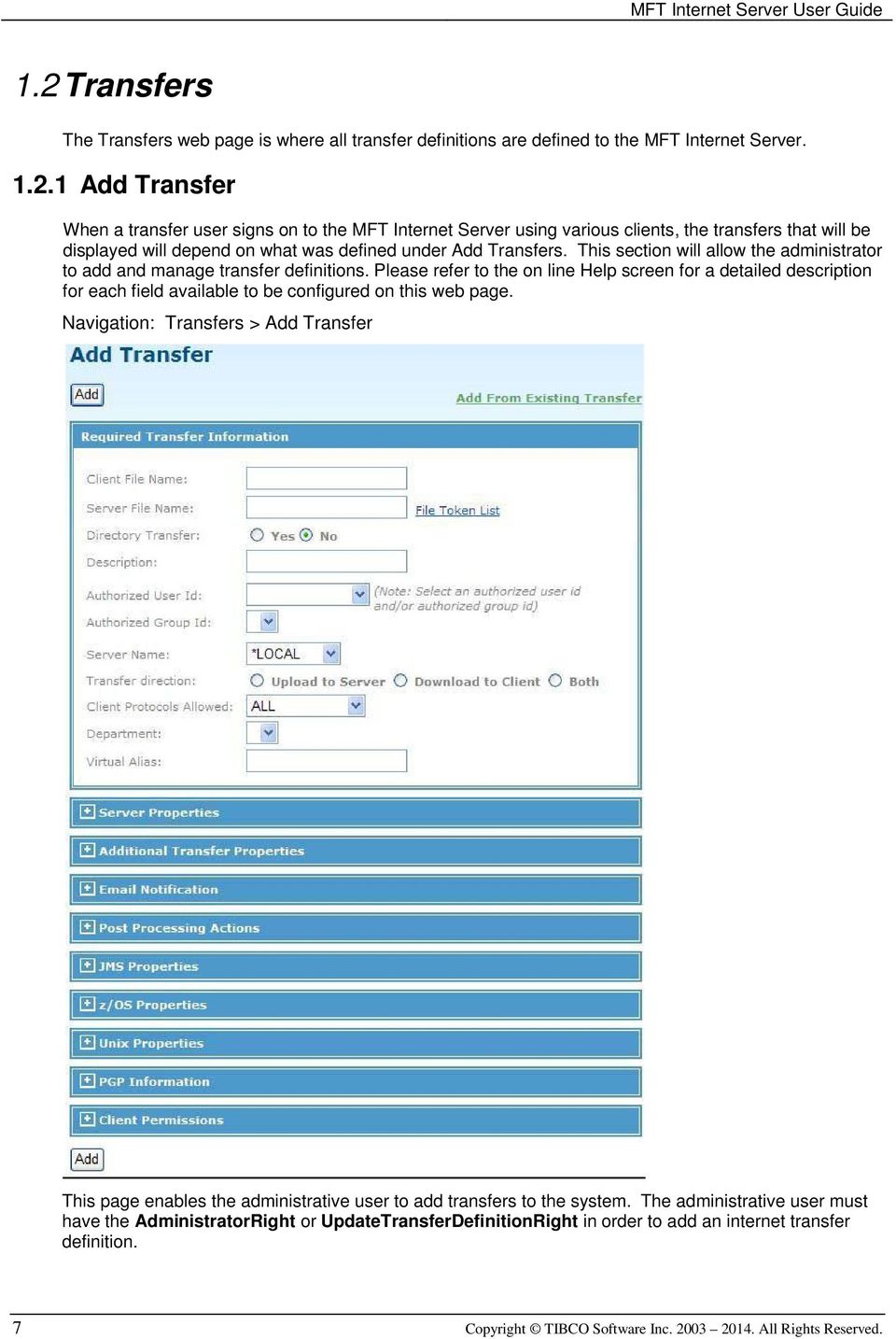
8 There are ten sections on the Add Transfer page: Required Transfer Information Defines the most important parameters needed to create an transfer record. Server Properties Defines parameters specific to the Server Name selected in the Required Information section. Additional Transfer Properties This box is broken up into sub-boxes Transfer description, Data Properties, Accessibility, Checkpoint Properties and Diagnostics. Note: Checkpoint Restart is not supported when using PGP encryption or transfer to/from an AS2 server and should be set to No. Copyright TIBCO Software Inc All Rights Reserved. 8

9 Notification Allows MFT Internet Server to send notification to one or more users. Post Processing Actions Allows you to perform up to four actions to be completed by the Server when a file transfer request has completed. 9 Copyright TIBCO Software Inc All Rights Reserved.

10 JMS Properties Used for file transfer conducted between a JMS server and MFTIS. z/os Properties Used only when creating a file on the z/os system through an Upload operation. You use these parameters to define information about the file to be created. Copyright TIBCO Software Inc All Rights Reserved. 10

11 Unix Properties Used only when creating a file on a Unix system through an Upload operation. PGP Information Defines the PGP Information that can be associated with a Transfer. Client Permissions Defines the permissions that are allowed when conducting this transfer using an FTP, SSH or Desktop Client. Note: Allow Client Transfer Mode can be used for FTP file transfers to other FTP server or the MFT FTP server (*LOCAL). When setting the Allow Delete or Allow Rename the Server Platform must be be defined to the correct Operating System in the Server Definition for proper functionality Add From Existing Transfer Navigation: Transfers > Add Transfer This link allows the administrative user to copy a Transfer definition to create a new one without having to enter all the Transfer information again. Click on the Add From Existing Transfer link and a listing of existing Transfers will be displayed. Click on the File Id to copy the definition. The new definitions will not contain the Authorized User Id or Authorized Group Id. For a Transfer that also uses Server Properties, the Server User Id and Server User Password will also be blank. User Id and Password type information will have to be entered for each new Transfer defined. 11 Copyright TIBCO Software Inc All Rights Reserved.

12 1.2.2 Manage Transfers The user must have AdministratorRight or UpdateTransferDefinitionRight in order to manage Internet Transfer definitions. Please refer to the on line Help screen for a detailed description for each field available to be configured on this web page. Navigation: Transfers > Manage Transfer This will take you to a page containing a section for Selection Criteria and a list of the first 100 defined Transfers. If there are more than 100 Transfers defined, click on List Next 100 > to access the next 100 Transfer definitions. Use the Back button to see the previous definitions. A listing of particular Transfers can be obtained by either choosing the link List Transfers by Users or entering the search criteria for any combination of the following: File Id, Server File Name, Description, Authorized User Id, Authorized Group Id, Server Name and Department. A percent sign (%) may be used as a wildcard character. Selecting the List Transfer by Users link will give you a list of users. Click on the User Id link for a listing of Transfer definitions for that particular user. From the Manage Transfers panel, Transfer definitions can also be updated or deleted. To update a definition, click on the File Id of the Transfer definition that you would like to change. Once the changes are made, click on the Update button to update the definition. To delete a Transfer definition, select the check box next to the Transfer that you wish to delete and click on the Delete button at the bottom of the panel. Multiple Transfer definitions may be deleted at one time. If you want to refresh the Manage Transfers list, you can use the Navigation box on the left portion of the screen and click on Manage Transfers OnDemand When you want to allow end users that are using the MFT Desktop Client (must be version 7.1 or higher) to directly connect to a remote FTP, SSH, or Platform Server you would configure those servers details here. The users or departments you authorize to connect to these servers will have an added menu item displayed in their MFT Desktop Client File menu called Site Manager. Please see the MFT Desktop Client User Guide for more information about Site Manager. Only users with the AdministratorRight or UpdateOnDemandRight can add or manage the OnDemand Sites to MFTIS. Note: This is a licensed feature. You must be licensed to be able to use OnDemand Sites Add OnDemand Site Navigation: Transfers > OnDemand > Add OnDemand Site Copyright TIBCO Software Inc All Rights Reserved. 12
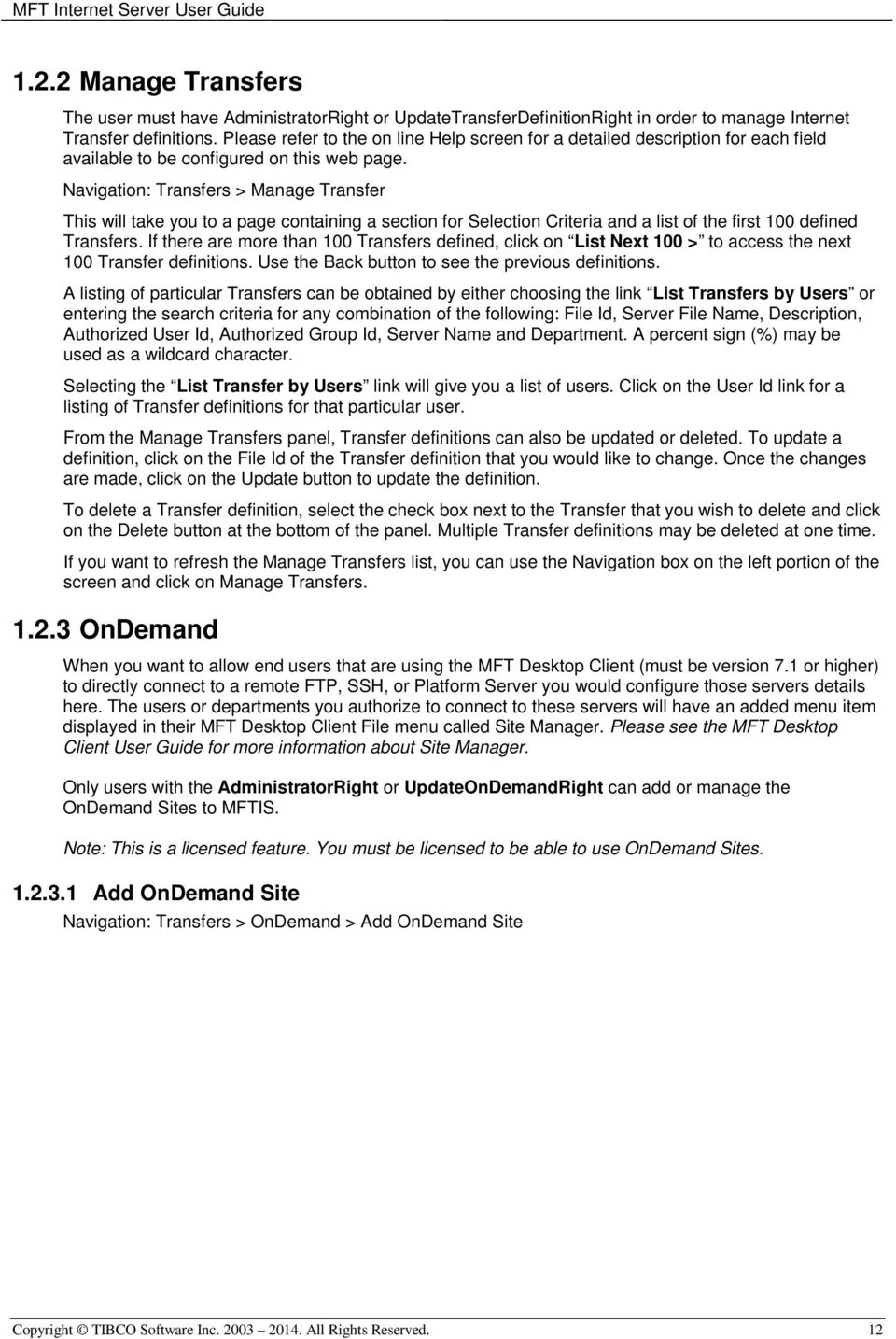
13 By default there are no users defined to the OnDemand Site settings. Users must be granted the OnDemandTransferRight before they will appear in the User Ids lists. Note: By highlighting All Users will allow all users with the OnDemandTransferRight to connect to this server. Please see the online help for a detailed description about each field. 13 Copyright TIBCO Software Inc All Rights Reserved.
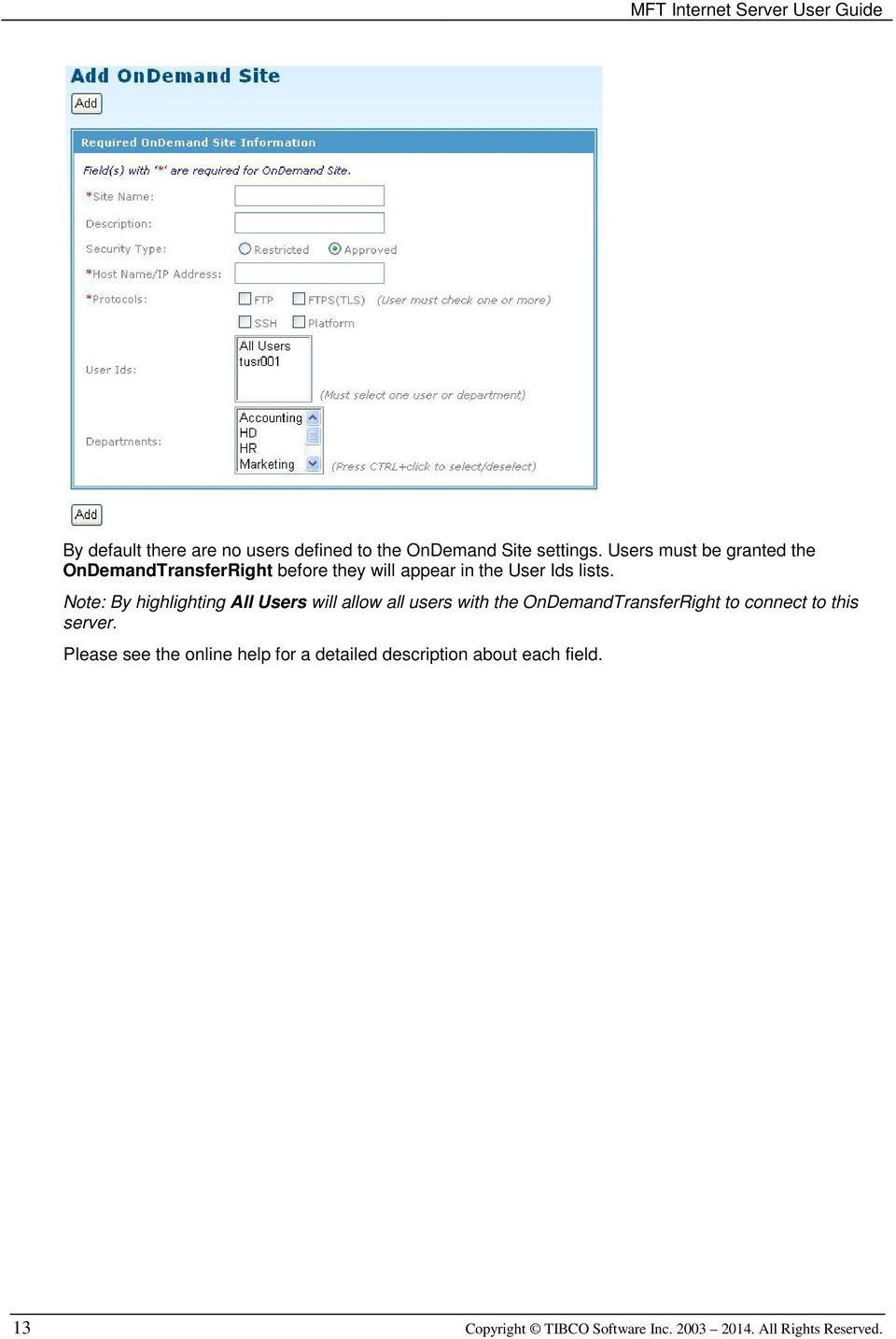
14 1.3 Users The Users section defines and manages Users, Transfer Groups and Departments. Please refer to the on line Help screen for a detailed description for each field available to be configured on this web page Add User Navigation: Users > Add User In order for users to be able to use MFT Internet Server to transfer files, their User Ids must be added to the MFT Internet Server database. The administrative user must have the AdministratorRight or UpdateTransferUserRight in order to add a User. Copyright TIBCO Software Inc All Rights Reserved. 14
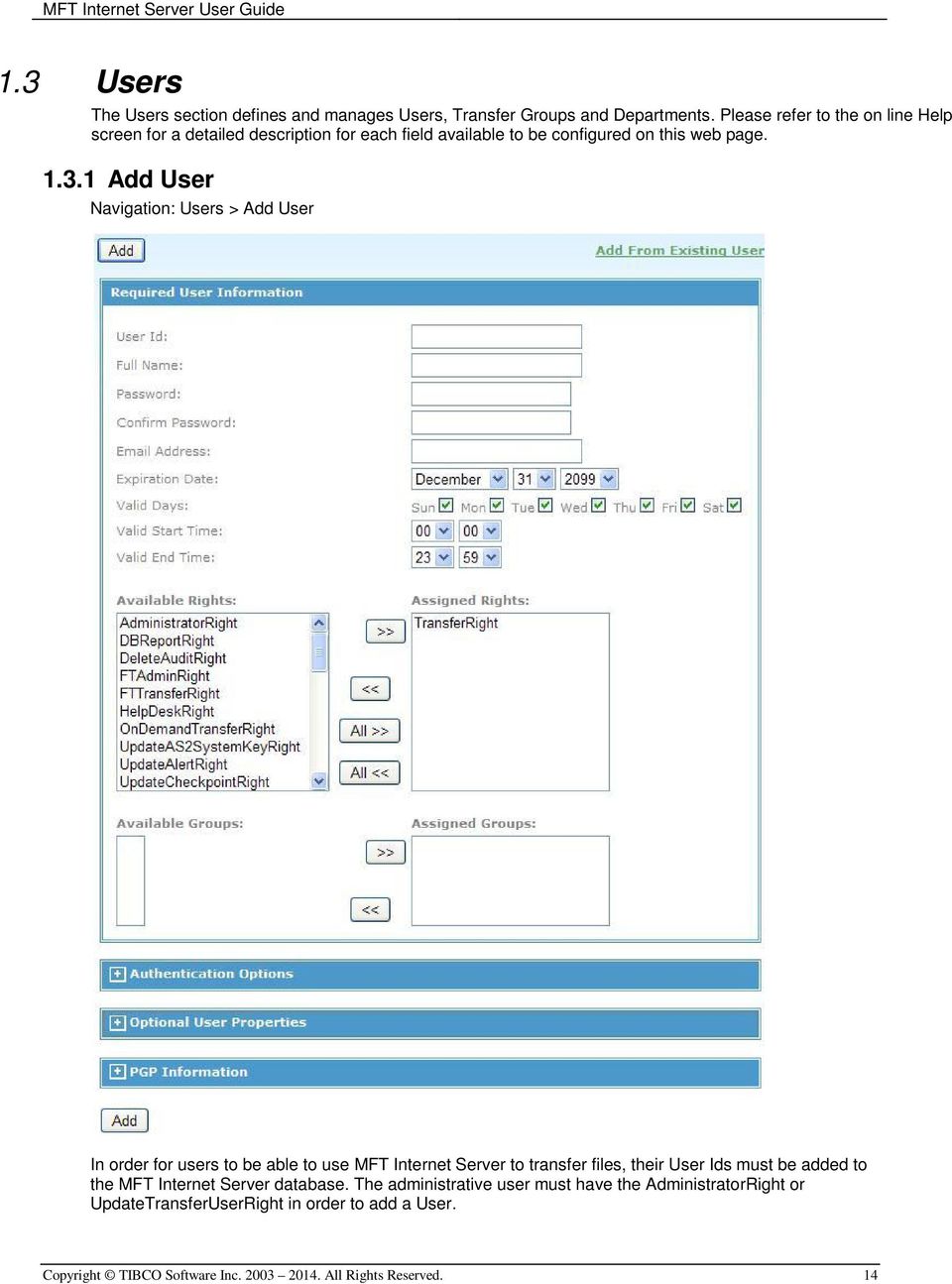
15 At the top of the web page you will see the link Add From Existing User Part of the MFT Internet Server installation process adds 5 Template Users automatically to the database. By clicking on the Add From Existing User link a listing of those pre-existing users will be displayed. Simply click on one of the User Ids to copy the pre-existing user s definition to a new user definition. The new user definition will have the same Available Rights and contain the same Optional User Properties of the User Id that was selected. The only thing left to do is to create a unique User Id, add the user s Full Name, and create a Password for him/her. Click Add when you are finished to have the new user added to the database. You may edit any of the pre-existing user definitions before clicking on the Add button if you wish. As new user definitions are added more template user definitions are available to choose from. Below is a list of the default Template Users with their assigned rights: Template User ID ArchiveUser AuditorUser Collector HelpDeskUser TransferUser admin Rights Assigned (No Rights Assigned) ViewAlertRight ViewAuditRight ViewGroupRight ViewServerCredentialRight ViewServerRight ViewTransferDefinitionRight ViewUserRight (No Rights Assigned) HelpDeskRight UpdateSessionRight ViewAlertRight ViewAuditRight ViewUserRight TransferRight AdministratorRight TransferRight A Collector and ArchiveUser Id s are also added by default. These ids are used to create Server Credentials for a Server(s) that will also have the collection and archive option turned on. There are no rights given to these ids. If you do not wish to use any of the Template User definitions available to you a new user definition can be created manually. The Add User page is divided into the following two sections: Required User Information Defines the fields that are required to create a User record. 15 Copyright TIBCO Software Inc All Rights Reserved.
16 Authentication Options Defines a users client authentication method for FTP, SSH, and HTTPS client connections. These settings will override the global settings found in the System Configurations. Use the Certificate DN when Trusted Certificates are being added in the Administration > Keys > Trusted Certificates > Add Trusted Certificates web page. Optional User Properties Defines a variety of parameters that are not required. Copyright TIBCO Software Inc All Rights Reserved. 16
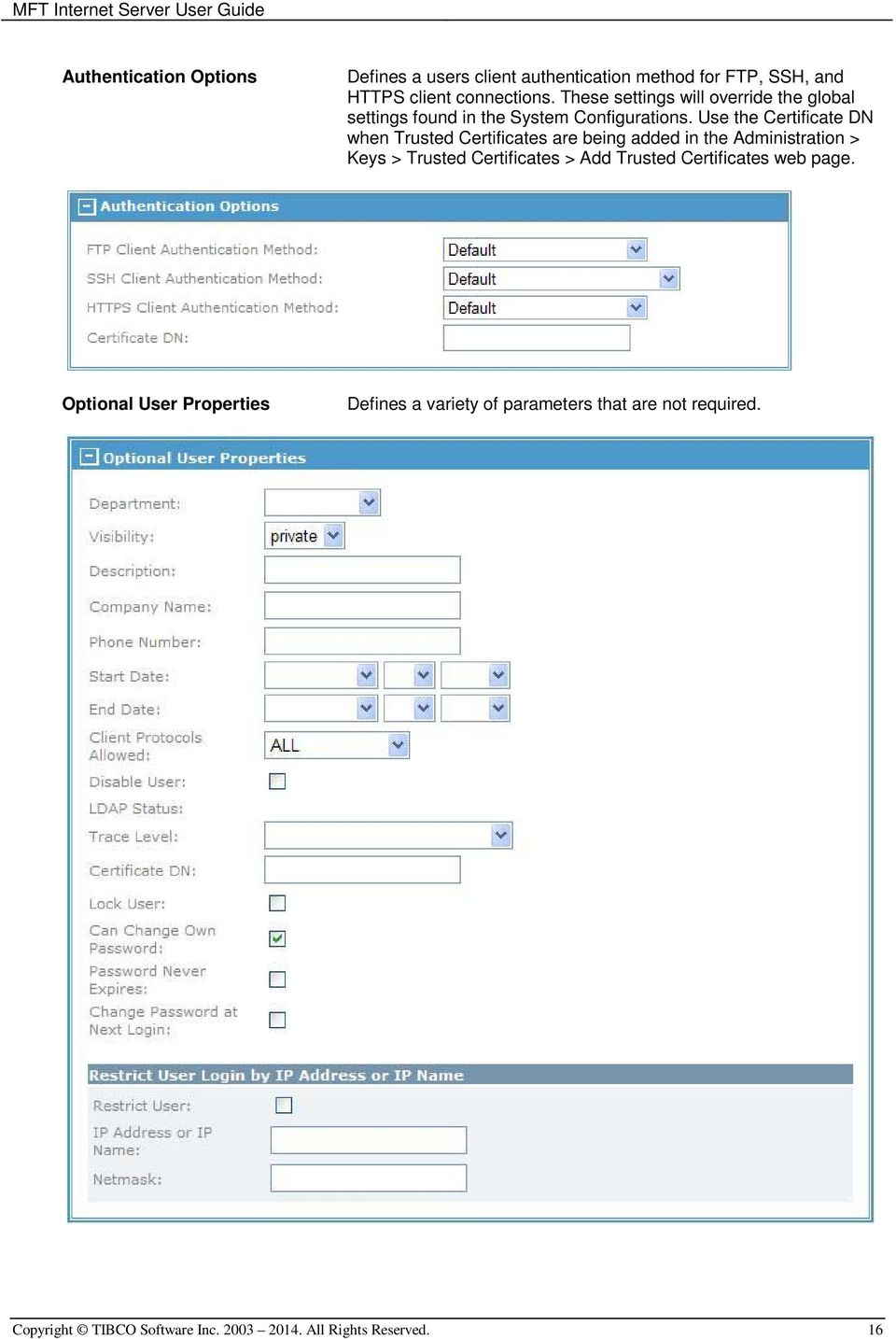
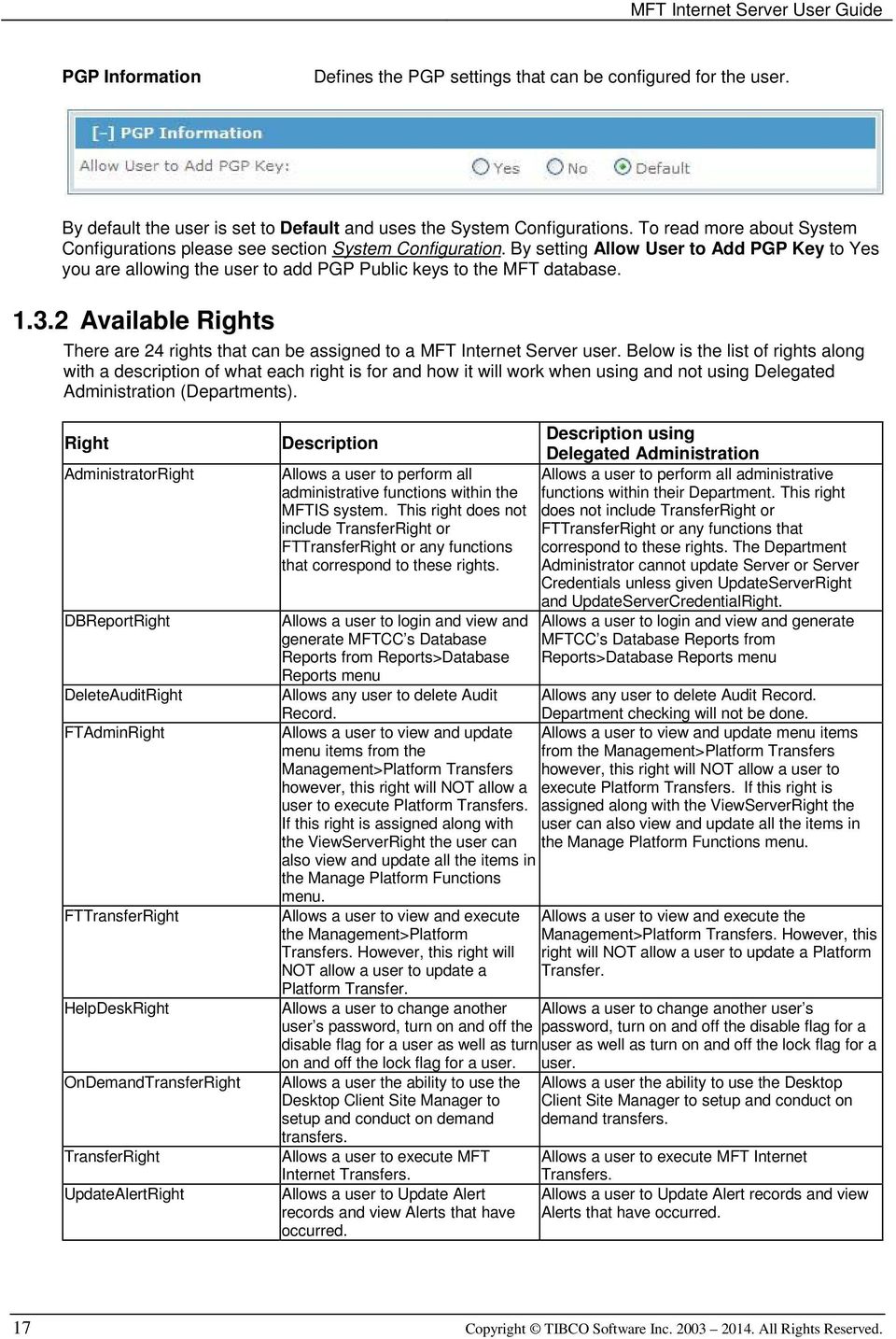
17 PGP Information Defines the PGP settings that can be configured for the user. By default the user is set to Default and uses the System Configurations. To read more about System Configurations please see section System Configuration. By setting Allow User to Add PGP Key to Yes you are allowing the user to add PGP Public keys to the MFT database Available Rights There are 24 rights that can be assigned to a MFT Internet Server user. Below is the list of rights along with a description of what each right is for and how it will work when using and not using Delegated Administration (Departments). Right AdministratorRight DBReportRight DeleteAuditRight FTAdminRight FTTransferRight HelpDeskRight OnDemandTransferRight TransferRight UpdateAlertRight Description Allows a user to perform all administrative functions within the MFTIS system. This right does not include TransferRight or FTTransferRight or any functions that correspond to these rights. Allows a user to login and view and generate MFTCC s Database Reports from Reports>Database Reports menu Allows any user to delete Audit Record. Description using Delegated Administration Allows a user to perform all administrative functions within their Department. This right does not include TransferRight or FTTransferRight or any functions that correspond to these rights. The Department Administrator cannot update Server or Server Credentials unless given UpdateServerRight and UpdateServerCredentialRight. Allows a user to login and view and generate MFTCC s Database Reports from Reports>Database Reports menu Allows any user to delete Audit Record. Department checking will not be done. Allows a user to view and update Allows a user to view and update menu items menu items from the from the Management>Platform Transfers Management>Platform Transfers however, this right will NOT allow a user to however, this right will NOT allow a execute Platform Transfers. If this right is user to execute Platform Transfers. assigned along with the ViewServerRight the If this right is assigned along with user can also view and update all the items in the ViewServerRight the user can the Manage Platform Functions menu. also view and update all the items in the Manage Platform Functions menu. Allows a user to view and execute the Management>Platform Transfers. However, this right will NOT allow a user to update a Platform Transfer. Allows a user to view and execute the Management>Platform Transfers. However, this right will NOT allow a user to update a Platform Transfer. Allows a user to change another Allows a user to change another user s user s password, turn on and off the password, turn on and off the disable flag for a disable flag for a user as well as turn user as well as turn on and off the lock flag for a on and off the lock flag for a user. user. Allows a user the ability to use the Allows a user the ability to use the Desktop Desktop Client Site Manager to Client Site Manager to setup and conduct on setup and conduct on demand demand transfers. transfers. Allows a user to execute MFT Allows a user to execute MFT Internet Internet Transfers. Transfers. Allows a user to Update Alert records and view Alerts that have occurred. Allows a user to Update Alert records and view Alerts that have occurred. 17 Copyright TIBCO Software Inc All Rights Reserved.
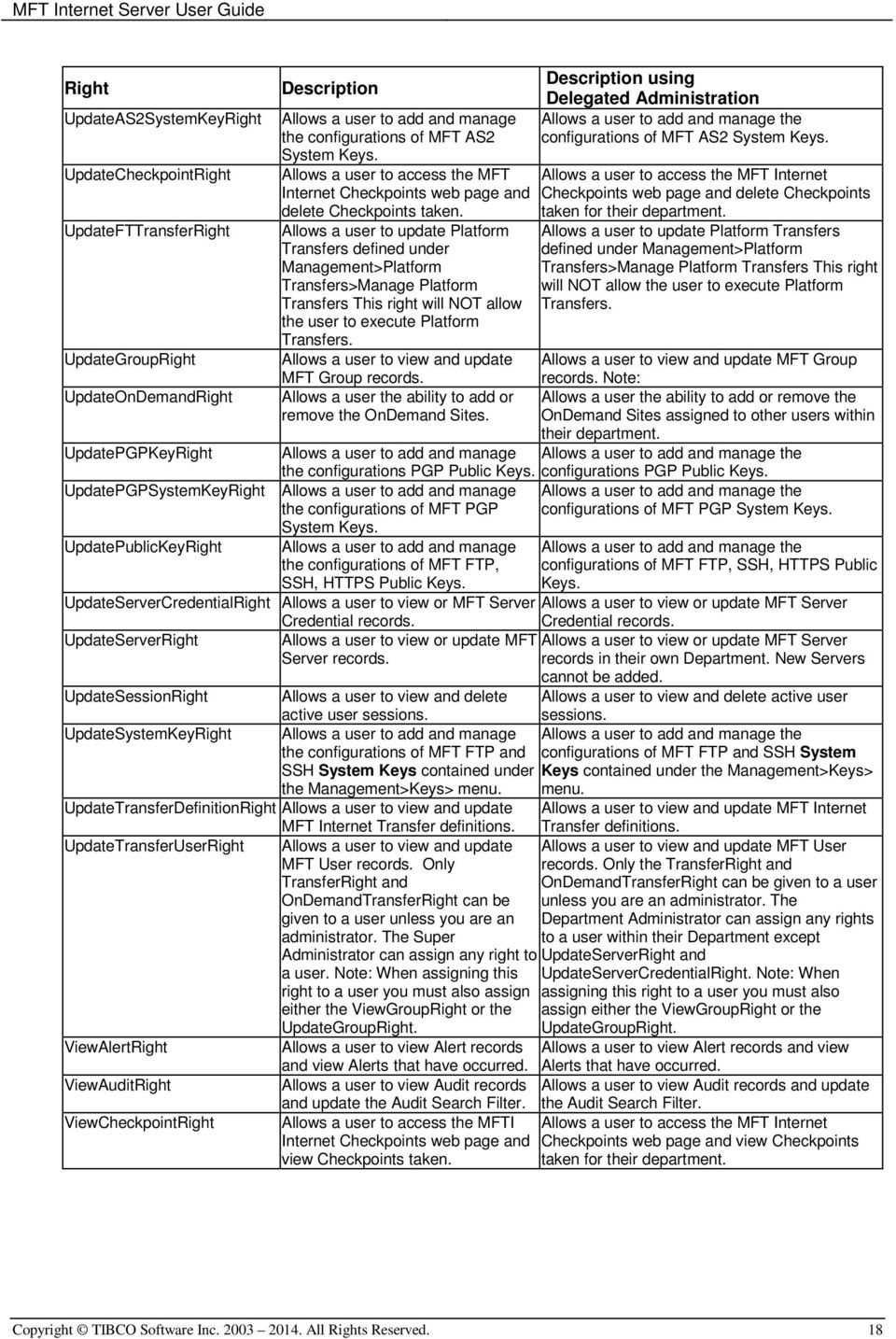
18 Right UpdateAS2SystemKeyRight UpdateCheckpointRight UpdateFTTransferRight UpdateGroupRight UpdateOnDemandRight UpdatePGPKeyRight UpdatePGPSystemKeyRight UpdatePublicKeyRight Description Allows a user to add and manage the configurations of MFT AS2 System Keys. Description using Delegated Administration Allows a user to add and manage the configurations of MFT AS2 System Keys. Allows a user to access the MFT Allows a user to access the MFT Internet Internet Checkpoints web page and Checkpoints web page and delete Checkpoints delete Checkpoints taken. taken for their department. Allows a user to update Platform Transfers defined under Management>Platform Transfers>Manage Platform Transfers This right will NOT allow the user to execute Platform Transfers. Allows a user to view and update MFT Group records. Allows a user the ability to add or remove the OnDemand Sites. Allows a user to update Platform Transfers defined under Management>Platform Transfers>Manage Platform Transfers This right will NOT allow the user to execute Platform Transfers. Allows a user to view and update MFT Group records. Note: Allows a user the ability to add or remove the OnDemand Sites assigned to other users within their department. Allows a user to add and manage Allows a user to add and manage the the configurations PGP Public Keys. configurations PGP Public Keys. Allows a user to add and manage Allows a user to add and manage the the configurations of MFT PGP configurations of MFT PGP System Keys. System Keys. Allows a user to add and manage the configurations of MFT FTP, SSH, HTTPS Public Keys. Allows a user to add and manage the configurations of MFT FTP, SSH, HTTPS Public Keys. Allows a user to view or update MFT Server Credential records. UpdateServerCredentialRight Allows a user to view or MFT Server Credential records. UpdateServerRight Allows a user to view or update MFT Allows a user to view or update MFT Server Server records. records in their own Department. New Servers cannot be added. UpdateSessionRight Allows a user to view and delete Allows a user to view and delete active user active user sessions. sessions. UpdateSystemKeyRight Allows a user to add and manage Allows a user to add and manage the the configurations of MFT FTP and configurations of MFT FTP and SSH System SSH System Keys contained under Keys contained under the Management>Keys> the Management>Keys> menu. menu. UpdateTransferDefinitionRight Allows a user to view and update MFT Internet Transfer definitions. UpdateTransferUserRight Allows a user to view and update MFT User records. Only TransferRight and OnDemandTransferRight can be given to a user unless you are an administrator. The Super ViewAlertRight ViewAuditRight ViewCheckpointRight Administrator can assign any right to a user. Note: When assigning this right to a user you must also assign either the ViewGroupRight or the UpdateGroupRight. Allows a user to view and update MFT Internet Transfer definitions. Allows a user to view and update MFT User records. Only the TransferRight and OnDemandTransferRight can be given to a user unless you are an administrator. The Department Administrator can assign any rights to a user within their Department except UpdateServerRight and UpdateServerCredentialRight. Note: When assigning this right to a user you must also assign either the ViewGroupRight or the UpdateGroupRight. Allows a user to view Alert records and view Alerts that have occurred. Allows a user to view Alert records and view Alerts that have occurred. Allows a user to view Audit records Allows a user to view Audit records and update and update the Audit Search Filter. the Audit Search Filter. Allows a user to access the MFTI Allows a user to access the MFT Internet Internet Checkpoints web page and Checkpoints web page and view Checkpoints view Checkpoints taken. taken for their department. Copyright TIBCO Software Inc All Rights Reserved. 18
19 Right ViewFTTransferRight ViewGroupRight ViewOnDemandRight ViewPGPKeyRight ViewPublicKeyRight ViewServerCredentialRight ViewServerRight ViewSessionRight ViewTransferDefinitionRight ViewUserRight Description Allows a user to view Platform Transfers defined under Management>Platform Transfers>Manage Platform Transfers This right will NOT allow the user to add, update, or execute Platform Transfers. Allows a user to view MFT Group records. Allows a user to view MFT OnDemand Site records. Allows a user to view PGP Public Keys. Allows a user to view MFT FTP, SSH, HTTPS Public Keys. Allows a user to view MFT Server Profile records. Allows a user to view MFT Server records. Allows a user to view active user sessions. Allows a user to view MFT Internet Transfer records. Allows a user to view MFT User records and the Rights associated with those users. Description using Delegated Administration Allows a user to view Platform Transfers defined under Management>Platform Transfers>Manage Platform Transfers within their Department. This right will NOT allow the user to add, update, or execute Platform Transfers. Allows a user to view MFT Group records. Allows a user to view MFT OnDemand Site records. Allows a user to view PGP Public Keys. Allows a user to view MFT FTP, SSH, HTTPS Public Keys. Allows a user to view MFTIS Server Profile records. Allows a user to view MFT Server records. Allows a user to view active user sessions. Allows a user to view MFT Internet Transfer records. Allows a user to view MFT User records and the Rights associated with those users. 19 Copyright TIBCO Software Inc All Rights Reserved.

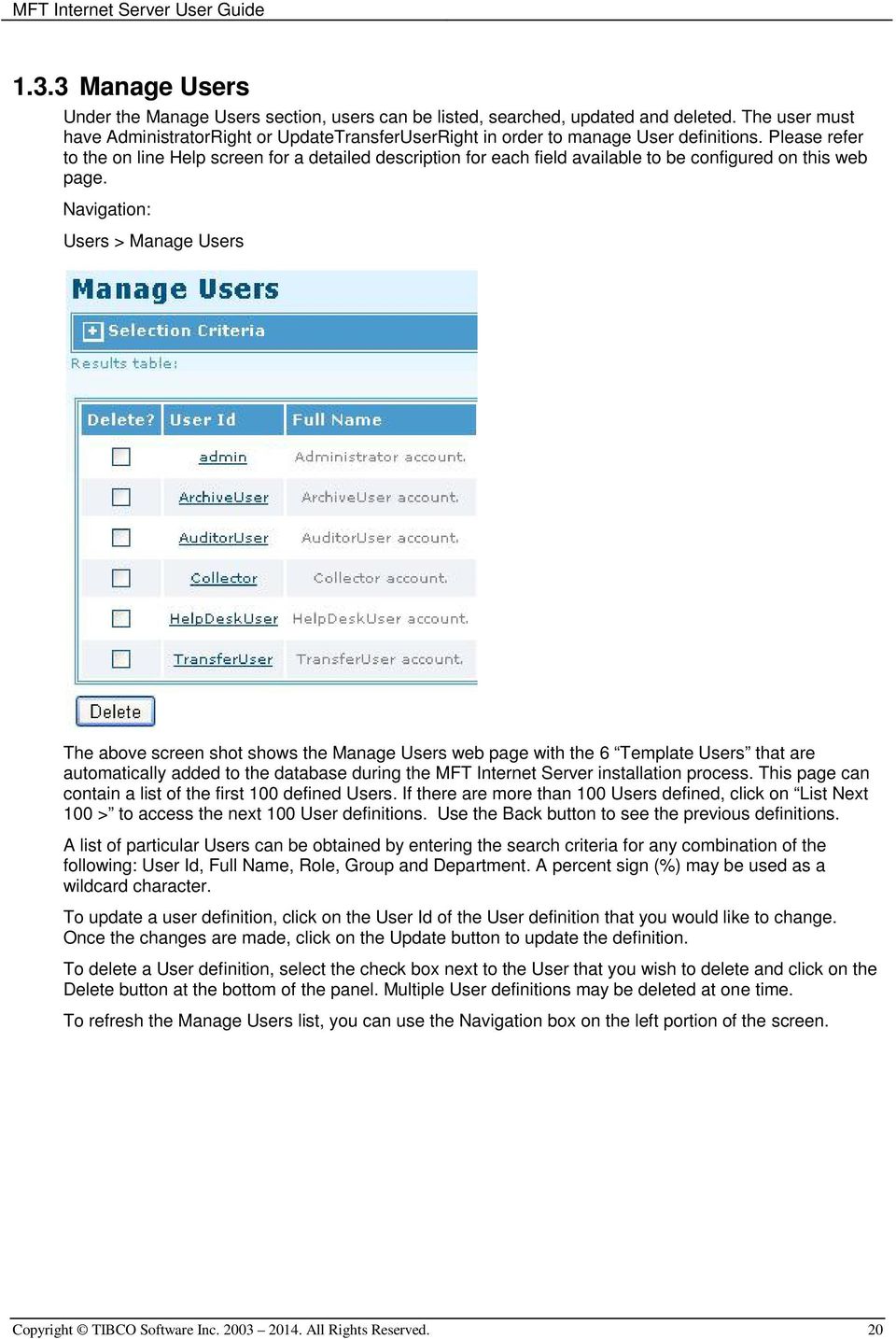
20 1.3.3 Manage Users Under the Manage Users section, users can be listed, searched, updated and deleted. The user must have AdministratorRight or UpdateTransferUserRight in order to manage User definitions. Please refer to the on line Help screen for a detailed description for each field available to be configured on this web page. Navigation: Users > Manage Users The above screen shot shows the Manage Users web page with the 6 Template Users that are automatically added to the database during the MFT Internet Server installation process. This page can contain a list of the first 100 defined Users. If there are more than 100 Users defined, click on List Next 100 > to access the next 100 User definitions. Use the Back button to see the previous definitions. A list of particular Users can be obtained by entering the search criteria for any combination of the following: User Id, Full Name, Role, Group and Department. A percent sign (%) may be used as a wildcard character. To update a user definition, click on the User Id of the User definition that you would like to change. Once the changes are made, click on the Update button to update the definition. To delete a User definition, select the check box next to the User that you wish to delete and click on the Delete button at the bottom of the panel. Multiple User definitions may be deleted at one time. To refresh the Manage Users list, you can use the Navigation box on the left portion of the screen. Copyright TIBCO Software Inc All Rights Reserved. 20
21 1.3.4 Transfer Groups To display the Transfer Group information page, click on Users and Transfer Groups. The following panel will be displayed. Please refer to the on line Help screen for a detailed description for each field available to be configured on this web page Add Group Navigation: Users > Transfer Groups > Add Group This page enables the administrative user to add new Groups to the system. The administrative user must have the AdministratorRight or UpdateGroupRight in order to add a Group. There are two sections on the Add Groups page: Required Group Information Defines fields that must be entered to create a Group. Assign Users to Group Defines which users will be in the defined Group. 21 Copyright TIBCO Software Inc All Rights Reserved.
22 Manage Groups Navigation: Users > Transfer Groups > Manage Groups Above is an example of 3 groups that had been created and can be managed from the Manage Groups page. The page will contain a list of the first 100 defined Groups. If there are more than 100 Groups defined, click on List Next 100 > to access the next 100 Group definitions. Use the Back button to see the previous definitions. From the Manage Groups panel, Group definitions can be updated or deleted. To update a definition, click on the Group Id of the Group definition that you would like to change. Once the changes are made, click on the Update button to update the definition. To delete a Group definition, select the check box next to the Group that you wish to delete and click on the Delete button at the bottom of the panel. Multiple Group definitions may be deleted at one time. If you want to refresh the Manage Groups list, you can use the Navigation box on the left portion of the screen. The administrative user must have AdministratorRight or UpdateGroupRight in order to manage Group definitions. Copyright TIBCO Software Inc All Rights Reserved. 22
23 1.3.5 Departments To display the Department information page, click on Users and Departments. The following panel will be displayed. Please refer to the on line Help screen for a detailed description for each field available to be configured on this web page. For more information as to how departments should be utilized, please refer to the chapter on Delegated Administration Add Department Navigation: Users > Departments > Add Department Departments can only be added by an administrator who has access to the entire MFT Internet Server system. This administrator has no department and is known as a Super Administrator. This page enables the Super Administrator to add new departments to the system. This feature is used for Delegated Administration. The only section on the page is the Required Department Information which defines fields that must be entered to create a Department. 23 Copyright TIBCO Software Inc All Rights Reserved.
24 Manage Departments Navigation: Users > Departments > Manage Departments Above is an example of 3 departments that have been created and can be managed from the Manage Departments page. The page will contain a list of the first 100 defined Departments. If there are more than 100 Departments defined, click on List Next 100 > to access the next 100 Department definitions. Use the Back button to see the previous definitions. From the Manage Departments panel, Department definitions can be updated or deleted. To update a definition, click on the Department Name of the Department definition that you would like to change. Once the changes are made, click on the Update button to update the definition. To delete a Department definition, select the check box next to the Department that you wish to delete and click on the Delete button at the bottom of the panel. Multiple Department definitions may be deleted at one time. If you want to refresh the Manage Departments list, you can use the Navigation box on the left portion of the screen. The administrative user must have AdministratorRight in order to manage Department definitions. Copyright TIBCO Software Inc All Rights Reserved. 24
25 1.4 Servers Server Definitions contain the information that MFT Internet Server needs to communicate with the following server types: The Server definition defines how the supported client s can gain access to a file. Please refer to the on line Help screen for a detailed description for each field available to be configured on this web page Add Server This page enables an administrative user to add remote Servers to the MFT Platform Server system. The administrative user must have the AdministratorRight or UpdateServerRight in order to add a Server. Navigation: Servers > Add Server The Add Server page is divided into the following eleven sections: Required Server Information Platform Server Options Defines the required parameters needed to create a Server record. Defines Server options that are used only when the Server Type is defined as Platform Server. 25 Copyright TIBCO Software Inc All Rights Reserved.
26 FTP Options Defines Server options that are used only when the Server Type is defined as FTP. Note: At this time IBM i Series FTP Servers are not supported. SSH Options Defines the SSH System Key to be used with this server and if zlib compression should be used when transferring data to this SSH server. AS2 Options Defines Server options that are used only when the Server Type is defined as AS2. Note: Local AS2 ID should be set to the same Local AS2 ID defined in the MFTIS Configure AS2 Server web page settings. When using Streaming Mode to send files to remote AS2 servers they must be configured for HTTP Chunking Support. If the remote AS2 server is another MFTIS server no configuration changes are needed as MFTIS is configured for HTTP chunking. Checkpoint Restart is not supported for transfer to/from an AS2 server and should not be enabled in a transfer definition defined for an AS2 Server. Copyright TIBCO Software Inc All Rights Reserved. 26
27 Internet Server Options When a Server being defined as a Server Type of Internet Server the Internet Server context would be defined in this section. You must indicate if the port being defined for the Internet Server is a Secure port or not. Server Options This window is used to predefine a default path that file uploads and downloads would use. This can be very helpful when defining transfer definitions. For example the path could be defined here and in the transfer definition the Adminitrator could define file name tokens without defining a path in the Server File Name field. Note: This field cannot be overridden. 27 Copyright TIBCO Software Inc All Rights Reserved.
28 Server Credentials Defines a default User Id and Password to be used for this server. These credentials are used for transfers as well as Platform Server audit collection purposes (See the Collection Service section of this manual for more information about collecting Platform Server audits.) Note: These credentials can be overridden for transfers from a transfer definition or a Platform Server transfer definition. Additional Server Properties Defines parameters specific for this server, such as department, description and trace level. See the online help for more information on the fields in this section. Management Options This window contains two sections. The Check Server Status allows MFTCC and MFTIS to monitor if there is a good connection using the port defined for the server being added to the system (Status Service must be configured to use this service.) The other section is used if the Server Type is Platform Server. When you want to collect Platform Server audit records the Manage Platform Server box must be enabled. Then set the Collect Platform Server History, Collection Interval, and the Collect History fields. You will be told you need to restart the Collection Service if you have it running already. To read more about collecting audit logs from a Platform Server please read the Collection Service section of this manual. If the Administrator will be managing DNI (Directory Named Initiation) from MFTCC the DNI port, DNI user id, and password must be defined. MFTCC and MFTIS both distribute the DNI perl programs, templates and instruction manual within the dni.tar file located in the following installation directory: <MFT_Install>\distribution\dni. To extract the files from the dni.tar use the following command from your command prompt: tar xvf dni.tar Copyright TIBCO Software Inc All Rights Reserved. 28
29 PGP Information If the server being defined will be used to conduct file transfers with PGP encrypted files you would define the PGP keys that will be used to encrypt (file Uploads) or decrypt (file Downloads) files. The PGP Keys can either be generated by MFTIS or imported into the system by the Administrator through the MFTIS Administrator web pages or by an end user through the Thin Client. To read more about the Thin Client see the MFT Internet Server Thin Client Manage Servers The Manage Servers page allows you to list, update, and delete, Servers defined to the system. A user must have AdministratorRight or UpdateServerRight in order to manage Server definitions. Below is an example list of 5 Servers (*LOCAL is set by default) that had been added to MFT Internet Server. They can be managed from the Manage Servers page. It also gives you the capability to search the Server database to limit the number of Server definitions displayed. Please refer to the on line Help screen for a detailed description for each field available to be configured on this web page. 29 Copyright TIBCO Software Inc All Rights Reserved.
30 Selection Criteria When the Selection Criteria section is expanded by clicking on the plus sign (+) you will see the available fields a search can be conducted with. This box allows you to selectively search the Server record database to limit the number of records that are displayed in the Results table. The % character is used as a wildcard character to simplify the search. If multiple fields have search criteria defined, the search criteria must match on all defined fields before a record will be returned. When you have completed the Search Criteria, click on Search to perform the search and create the Results table Results Table The Results table will display all the servers you have defined in the system. If you click on the Server Name of an entry in the table, a detail page will be displayed that allows you to update the entry if you are authorized. To delete a Server definition, select the check box next to the Server that you wish to delete and click on the Delete button at the bottom of the panel. Multiple Server definitions may be deleted at one time. If you want to refresh the Manage Servers list, you can use the Navigation box on the left portion of the screen. Copyright TIBCO Software Inc All Rights Reserved. 30
31 1.4.3 Server Credentials In order to Add Server Credentials or Manage Server Credentials the user must have the AdministratorRight or UpdateServerCredentialRight. Please refer to the on line Help screen for a detailed description for each field available to be configured on this web page Add Server Credentials Navigation: Servers > Server Credentials > Add Server Credential There are two sections on the Add Server Credentials page: Required Server Credential Information Windows Properties Defines the most important parameters needed to create a Server Credential record. Defines a Windows domain for the Server Credentials being added. Server Credential are checked in the following order: 1) User Id 2) Group If the user is not found in any defined Server Credentials then the Server Credentials defined in the Server definition will be used. Upon the login the remote MFT Platform Server authentication validates that the Remote User Id is: 1) The Administrator 2) Part of the Local Administrators group 3) Part of the cfadmin or cfbrowse group depending on the action being attempted. 31 Copyright TIBCO Software Inc All Rights Reserved.
32 Manage Server Credentials The user must have AdministratorRight or UpdateServerCredentialRight in order to manage Server Credential definitions. Please refer to the on line Help screen for a detailed description for each field available to be configured on this web page. Navigation: Servers > Server Credentials > Manage Server Credentials Above is an example of 3 user credentials that had been added at an earlier date and can be managed from the Manage Server Credentials page. The page will contain a list of the first 100 defined Server Credentials. If there are more than 100 Server Credentials defined, click on List Next 100 > to access the next 100 Server Credential definitions. Use the Back button to see the previous definitions. A listing of particular Server Credentials can be obtained by entering the search criteria for any combination of the following: Id Type, Id Name, Node Name, Remote User Id and Remote User Windows Domain. A percent sign (%) may be used as a wildcard character. From the Manage Transfers panel, Server Credential definitions can also be updated or deleted. To update a definition, click on the Id Type of the Server Credential definition that you would like to change. Once the changes are made, click on the Update button to update the definition. To delete a Server Credential definition, select the check box next to the Server Credential that you wish to delete and click on the Delete button at the bottom of the panel. Multiple Server Credential definitions may be deleted at one time. If you want to refresh the Manage Server Credential list, you can use the Navigation box on the left portion of the screen. Click on Manage Server Credentials. Copyright TIBCO Software Inc All Rights Reserved. 32
33 1.5 Administration Under Administration you will apply your MFT Internet Server license key, review the various Active sessions, configure FTP and SSH Server parameters, as well as set Alerts, and global defaults for MFT Internet Server. Please refer to the on line Help screen for a detailed description for each field available to be configured on this web page. 33 Copyright TIBCO Software Inc All Rights Reserved.
34 1.5.1 System Configuration The System Configuration page sets default values for the MFT Internet Server. Please refer to the on line Help screen for a detailed description for each field available to be configured on this web page. This page is broken up into ten sections, Global Settings, Password Reset, Global Password Rules, Transfer Settings, Local Settings, Global Lockout Rules, Global PGP Settings, Global FTP Settings, Global SSH Settings, and Global HTTPS Settings. (You could see a Remote Settings section if your environment is configured with multiple Internet Servers or Internet Servers pointing to the same database.) Global Settings This section allows an Administrator to define settings common to all MFT Internet Servers. (See above). Note: Global Success and Failed transfer notifications do not apply to AS2 transfers. Copyright TIBCO Software Inc All Rights Reserved. 34
35 Password Reset This section is used to define whether to allow users to reset their forgotten passwords. When an end user requests help accessing their account from the MFTIS login web page and clicks on the Reset Password link they will be prompted to type in and submit their address associated with their account. ( Server Information must be configured under System Configurations for this feature and an address defined in the end users account.) They will receive an with a link to reset their password. The password requests sent to end users will expire based on the minutes defined in the Password Reset Expiration field. The default value is 30 minutes. A value of 0 will result in the password request never expiring. Maximum value allowed is 1440 minutes Global Password Rules In this section the Administrator can configure Global rules for changing and expiring passwords. Note: These password rules would only apply to Internet Server users. Any LDAP Sync users passwords would be controlled by LDAP. 35 Copyright TIBCO Software Inc All Rights Reserved.
36 The default Internet Server hashing algorithm used to securely store passwords is SHA-1. Customers may optionally use the stronger SHA-256 hashing algorithm for additionally security for stored passwords using the following steps: a. Stop Internet Server. b. Navigate to the <MFT_Install>/server/webapps/cfcc/WEB-INF/ directory c. Open the web.xml file using any available text editor. d. Search for the PasswordHashNew parameter: <context-param> <param-name>passwordhashnew</param-name> <param-value>sha-1</param-value> </context-param> e. Change SHA-1 to SHA-256. f. Save the file before exiting and restart Internet Server. Warning: When changing between SHA-1 and SHA-256 algorithms all previous password history will be lost Transfer Settings Use the Transfer Settings options to limit which files are transferred based on defined regular expression (REGEX) rules Local Settings This section displays unique settings for the individual MFT Internet Server that are defined during the installation. Copyright TIBCO Software Inc All Rights Reserved. 36
37 Global Lockout Rules The Global Lockout Rules apply to the entire system. By setting any of the fields in the Login Failure Attempts section will require a Lock Action to be enabled. The Administrator can set either one or both Lock Actions to Yes. Note: The Send Alert Lock Action requires the Alert Address field found by expanding the Global Settings window on the System Configurations web page to be configured. The Failure Retention Period time set will be reset upon a successful login for user accounts. For instance if the Login Failure Attempts for a User is set to 3 attempts and a user fails to login twice but on the third attempt is successful the failed attempts will be reset to zero. This will also occur upon the Lock Duration time being reached. This means if a user is locked out of the system and the Lock Duration time has passed the failed attempts will be reset to zero. However, this action will not occur for a System or IP Retention Period. To clear the attempts for these actions requires a lockout release for the System or IP Address by a Super Admin account that has been configured with a restricted IP Address to login. These user accounts are never locked out of the system. See the Lockout Management section in this manual for more details about releasing lock outs. 37 Copyright TIBCO Software Inc All Rights Reserved.
38 Note: Some care should be given when setting the Login Failure Attempts for the System. An acceptable number should be based on the amount of users that can access the system. The value is reached by the accumulation of User and IP failed login attempts that are being retained. A very simple example of a system lockout occurring is if the Login Failure Attempts for Users is set to 3 and System is set to 7 the entire system will be locked when the seventh failed attempt has occurred. (Note: The default Failure Retention Period for User accounts is 120 minutes.) Based on the above settings all it would take is three users to fail to access the system in a 120 minute time frame due to attempting to login with bad passwords causing the failed login attempts being retained to reach the count of 7 and the system will be locked Global PGP Settings This section displays the Global PGP settings that will be used by the MFT Server Global FTP Settings This section displays the Global FTP settings that will be used by the MFT Server. Note: The global FTP Client Authentication Method can be overridden by expanding the Authentication Options window in a User s definition. Copyright TIBCO Software Inc All Rights Reserved. 38
39 Global SSH Settings This section displays the Global SSH settings that will be used by the MFT Server. Note: The global SSH Client Authentication Method settings can be overridden by expanding the Authentication Options window in a User s definition Global HTTPS Settings This section displays the Global HTTPS settings that will be used by the MFT Server. Note: The global HTTPS Client Authentication Method can be overridden by expanding the Authentication Options window in a User s definition. 39 Copyright TIBCO Software Inc All Rights Reserved.
40 1.5.2 Transfer Servers MFT Internet Server comes with an internal AS2 Server, an FTP Server, a Platform Server, and an SSH Server AS2 Server The Configure AS2 Server and AS2 Server Status pages allow an administrator to configure, start, stop and check the status of the AS2 Server. The administrative user must have the AdministratorRight in order to configure and start or stop the AS2 Server. Please refer to the on line Help screen for a detailed description for each field available to be configured on this web page Configure AS2 Server Before the AS2 Server can be started it must first be enabled and configured. First change the Enabled field to read Yes. Next both the Receive URL and Async Response URL need to be edited. Both URL s are created from information taken during the installation of MFT Internet Server and need to be edited with the correct HTTP protocol information and port. Next change the port to communicate from your internet browser to your web server using a non-ssl port number, most commonly this would be 80 but your environment might be configured differently. If your AS2 server protocol requires a Proxy server you will need to configure the Proxy Information section. If not, this may be skipped. You can also define a Default AS2 Server ID that would be used for incoming transfer being done with the MFT Internet Server AS2 Server or you may leave this field blank and fill it in later when setting up a Server definition. If this field is configured it can also be overridden in the Server definition. Once your changes are completed click on the Update button to accept them. Note: There will be a configurable box for each Internet Server that shares the database. Within each box is an Update button. When you press this button, the definition changes for the Internet Server defined for this box only. Navigation: Administration > Transfer Servers > AS2 Server > Configure AS2 Server Copyright TIBCO Software Inc All Rights Reserved. 40
41 AS2 Server Status The AS2 Server Status allows you to see the current status of the AS2 Server. To view the status of the server click on the Server Status button. Navigation: Administration > Transfer Servers > AS2 Server > AS2 Server Status FTP Server MFT is setup with a configurable FTP/FTPS Server. This page allows you to configure both the FTP Server and the FTP SSL Server settings. The administrative user must have the AdministratorRight in order to configure and start or stop the FTP Server Configure FTP Server Before the MFT FTP Server can be started it must be enabled. By default the FTP Server is disabled. When the server is configured, click the Update button to save the settings. Any fields updated on the page will require the FTP Service to be restarted. See the next section named FTP Server Status for information regarding stopping and starting the service. Please refer to the on line Help screen for a detailed description for each field available to be configured on this web page. Note: There will be a configurable box for each Internet Server that shares the database. Within each box is an Update button. When you press this button, the definition changes for the Internet Server defined for this box only. Note: It is a good idea to set the External IP Address parameter (as well as the "Use External IP Address" parameter) to the correct value since the IP Address defined on some UNIX systems defaults to Navigation: Administration > Transfer Servers > FTP Server > Configure FTP Server 41 Copyright TIBCO Software Inc All Rights Reserved.
42 Note: By default MFT Internet Server will request a TLS connection; however if the client does not support TLS, an SSL V3.0 connection can be negotiated. If your environment requires TLS connections, you must use a FIPS approved JAVA and put your MFTIS instance in FIPS mode FTP Server Status This page informs the user about the status of the FTP/FTPS Server on both secure (990) and nonsecure (21) ports along with the number of active sessions on those ports. The buttons will enable the user to start and stop FTP server and refresh current server status information. Navigation: Administration > Transfer Servers > FTP Server > FTP Server Status Platform Server The Platform Server for MFT allows clients running MFT Platform Server on various platforms to send and receive files directly to MFT. The administrative user must have the AdministratorRight in order to configure, start or stop the Platform Server Configure Platform Server Before the Platform Server can be started it must be enabled. By default the Platform Server is not enabled. The admin would navigate to the Configure Platform Server web page and change Enable to read Yes and either keep or edit the default port of There will be a configurable box for each MFTIS Server that is in the environment. Within each box is an Update button, when you press this button, the definition changes for this Internet Server Platform server only. Once this is complete you would navigate to the Platform Server Status web page and start each Platform Server you have configured. Please refer to the on line Help screen for a detailed description for each field available to be configured on this web page. Note: There will be a configurable box for each Internet Server that shares the database. Within each box is an Update button. When you press this button, the definition changes for the Internet Server defined for this box only. Navigation: Administration > Transfer Servers > Platform Server > Configure Platform Server Copyright TIBCO Software Inc All Rights Reserved. 42
43 Platform Server Status The Platform Server Status allows you to see the current status of the Internet Server Platform Servers. Note that there is a box for each defined Internet Server. To view the status of the server click on the Server Status button. Navigation: Administration > Transfer Servers > Platform Server > Platform Server Status SSH Server The Configure SSH Server and SSH Server Status pages allow an administrator to configure, start, stop and check the status of the MFT SSH Server. The administrative user must have the AdministratorRight in order to configure and start or stop the SSH Server Configure SSH Server Before the MFT Platform Server Internet Server SSH server can be started it must first be configured and enabled. There will be a configurable box for each Internet Server that has been defined. Within each box is an Update button, when you press this button the definition changes for the Internet Server defined by this box only. Two types of SSH keystores are supported: DSA and RSA. By default Internet Server comes with a working DSA keystore (Primary Keystore) that will work and all the admin has to do is set the Enabled field to read Yes. You should only update the keystore if you want to create a keystore specifically for your installation. Please refer to the on line Help screen for a detailed description for each field available to be configured on this web page. Navigation: Administration > Transfer Servers > SSH Server > Configure SSH Server 43 Copyright TIBCO Software Inc All Rights Reserved.
44 Note: Any changes to your Welcome Message will require the SSH Server to be restarted. Please see the next section for those instructions SSH Server Status The SSH Server Status allows you to see the current status of the Internet Server SSH Servers. Note that there is a box for each defined Internet Server as well as allow the administrator to Stop and start the SSH Servers. These boxes contain the status information about the SSH server on that Internet Server. Navigation: Administration > Transfer Servers > SSH Server > SSH Server Status Note: SSH zero byte file transfers are not supported at this time and will error out. Copyright TIBCO Software Inc All Rights Reserved. 44
45 1.5.3 Keys MFT Internet Server can store FTP, PGP, SSH, HTTPS Public Keys, and Trusted Certificates as well as create and store AS2, FTP, PGP and SSH System Keys (a.k.a Secret or Private Key), in the database. A Super Administrator (user that has AdministratorRight and not a member of a department) can Add and Manage all keys in the system. Using special user rights the administration can be assigned to different users to assist with this responsibility. The table below lists the rights and gives a brief description: User Right UpdateAS2SystemKeyRight UpdatePGPKeyRight UpdatePGPSystemKeyRight UpdatePublicKeyRight UpdateSystemKeyRight Description Allows a user to Create/Manage AS2 System Keys Allows a user to Add/Manage PGP Public Keys Allows a user to Create/Manage PGP System Keys Allows a user to Add/Manage FTP, SSH, HTTPS Public Keys, and Trusted Certificates Allows a user to Create/Manage FTP and SSH System Keys AS2 System Keys Create AS2 Keys Navigation: Administration > Keys > AS2 System Keys > Create AS2 Key Below is an Example of an AS2 System Key being created: Fill in the necessary parameters and click on the Create Key button to create the AS2 System Key. 45 Copyright TIBCO Software Inc All Rights Reserved.
46 Import AS2 Keys The Import AS2 System Key page allows you to import an AS2 System Key from a PKCS12 file or from a JAVA keystore (JKS file). Navigation: Administration > Keys > AS2 System Keys > Import AS2 Key Fill in the necessary parameters and click on the Import Key button to create the AS2 System Key.<MFT_Install> Manage AS2 Keys This screen shows the AS2 keys available. You may have one AS2 key or there may be several. From this screen an administrator can delete keys. Navigation: Administration > Keys > AS2 System Keys > Manage AS2 Keys By clicking on one of the links under Description of a particular key you will see the detailed information about the key, below see the information as a result of clicking on AS22048SystemKey from the above screenshot: Copyright TIBCO Software Inc All Rights Reserved. 46
47 The Admin can either make this AS2 key the new default key or they can disable the key FTP Public Keys The FTP Public keys are associated with a MFT User or MFT Server definition Add FTP Public Keys Navigation: Administration > Keys > FTP Public Keys > Add FTP Keys When you have entered data in all of the fields, press the Continue button to add the public key. Note: You cannot add a Public Key for a User or Server that already has a Public Key associated with it. Use the Manage FTP Keys web page to update or replace a key for a user or server Manage FTP Keys Under the Manage FTP Keys section, FTP Public keys are listed. Please refer to the on line Help screen for a detailed description for each field available to be configured on this web page. Navigation: Administration > Keys > FTP Public Keys > Manage FTP Keys 47 Copyright TIBCO Software Inc All Rights Reserved.
48 The above screen shot shows the Manage FTP Public Keys web page with 4keys that have been added to the database prior for this example. This page can contain a list of the first 100 defined FTP keys. If there are more than 100 FTP Public keys defined, click on List Next 100 > to access the next 100 key definitions. Use the Back button to see the previous definitions. A list of keys can be obtained by entering the search criteria for any combination of the following: User Keys/Server Keys, Enabled/Disabled keys, or simply by putting in the name of the particular FTP public key you want to see. A percent sign (%) may be used as a wildcard character. To update a key definition, click on the Key Type of the FTP Public Key definition that you would like to change. Once the changes are made, click on the Update button to update the definition. To delete a key definition, select the check box next to the key that you wish to delete and click on the Delete button at the bottom of the panel. Multiple key definitions may be deleted at one time. To refresh the Manage FTP Public Keys list, you can use the Navigation box on the left portion of the screen FTP System Keys Create FTP System Keys Navigation: Administration > Keys > FTP System Keys > Create FTP Key When the necessary parameters are defined, the user should click on the Continue button to add the FTP System Key to the MFT database Import FTP System Key The Import FTP System Key page allows you to import an FTP System Key from a JAVA keystore (JKS file). Navigation: Administration > Keys > FTP System Keys > Import FTP Key Copyright TIBCO Software Inc All Rights Reserved. 48
49 Fill in the necessary parameters and click on the Import Key button to create the FTP System Key Manage FTP System Keys This screen shows the FTP System Keys available. From this screen an administrator can delete keys by placing a check in the box under the Delete column next to the key they want to delete and clicking on the Delete button. They will be asked to confirm the deletion. Navigation: Administration > Keys > FTP System Keys > Manage FTP Keys By clicking on the Description of a particular key it will allow the administrator to see the detailed information about the key, below is the information that is displayed as a result of clicking on MFTFTP1024Sha512SystemKey from the above screen shot (All 3 sections have been expanded): 49 Copyright TIBCO Software Inc All Rights Reserved.
50 From this web page the administrator can disable the key, he can Display/Replace the FTP Public key by pasting a new FTP Public key in the box provided, or he may export the system key to a.jks file type. If only a file name is provided for the exported file the default location the file will be written is <MFTIS_Install>/cfcc/ftp/tmp PGP Public Keys The PGP Public keys are associated with a MFT User or MFT Server definition Add PGP Public Keys Navigation: Administration > Keys > PGP Public Keys > Add PGP Keys Copyright TIBCO Software Inc All Rights Reserved. 50
51 When you have entered data in all of the fields, press the Continue button to add the public key. Note: You cannot add a Public Key for a User or Server that already has a Public Key associated with it. Use the Manage PGP Keys web page to update or replace a key for a user or server Manage PGP Public Keys This screen shows the PGP Public Keys available. From this screen the administrator can delete keys by placing a check in the box under the Delete column next to the key they want to delete and clicking on the Delete button. They will be asked to confirm the deletion. Navigation: Management > Keys > PGP Public Keys > Manage PGP Keys By clicking on the Key Type of a particular key would allow the Administrator to see the detailed information about the key, below is the information that is displayed as a result of clicking on User for tuser001from the above screen shot: 51 Copyright TIBCO Software Inc All Rights Reserved.
52 The administrator can either disable the key or he can expand the Display/Replace PGP Public key section to paste a new PGP Public key in for this user PGP System Keys Create PGP System Keys Navigation: Administration > Keys > PGP System Keys > Create PGP Keys When the necessary parameters are defined, the user should click on the Continue button to add the PGP System Key to the MFT database. Copyright TIBCO Software Inc All Rights Reserved. 52
53 SSH Public Keys The SSH Public keys are associated with a MFT User or MFT Server definition Add SSH Public Keys Navigation: Administration > Keys > SSH Public Keys > Add SSH Keys When you have entered data in all of the fields, press the Continue button to add the public key. Note: You cannot add a Public Key for a User or Server that already has a Public Key associated with it. Use the Manage SSH Keys web page to update or replace a key for a user or server SSH System Keys Create SSH System Keys Navigation: Administration > Keys > SSH System Keys > Create SSH Key 53 Copyright TIBCO Software Inc All Rights Reserved.
54 When you have entered data in all of the fields, press the Continue button to add the public key. Note: You cannot add a Public Key for a User or Server that already has a Public Key associated with it. Use the Manage SSH Keys web page to update or replace a key for a user or server. When the necessary parameters are defined, the user should click on the Continue button to add the SSH System Key to the MFT database Import SSH System Keys Navigation: Administration > Keys > SSH System Keys > Import SSH Keys Copyright TIBCO Software Inc All Rights Reserved. 54
55 Manage SSH System Keys This screen shows the SSH Public Keys available. From this screen the administrator can delete keys by placing a check in the box under the Delete column next to the key they want to delete and clicking on the Delete button. They will be asked to confirm the deletion. Navigation: Management > Keys > SSH Public Keys > Manage SSH Keys Clicking on the Description of a particular key would allow the Administrator to see the detailed information about the key, below is the information that is displayed as a result of clicking on one of the Description links from the above screen shot: The administrator can either disable the key or he can expand the Display/Replace SSH Public key section to paste a new SSH Public key in for this user HTTPS Public Keys The HTTPS Public keys are associated with user accounts Add HTTPS Public Key Navigation: Administration > Keys > HTTPS Public Keys > Add HTTPS Key 55 Copyright TIBCO Software Inc All Rights Reserved.
56 Select a User from the drop down list that will be linked to this certificate. Select whether the certificate will be enabled or disabled at this time. Paste the Base64 version of the certificate into the space prvided. Be sure to include the BEGIN and END statements as in the example below: -----BEGIN CERTIFICATE HTTPS key information......https key information END CERTIFICATE----- When you have completed adding all the data needed click on the Continue button. You will be presented with an Add HTTPS Public Key Confirmation page, click the Continue button to add the certificate. Note: One certificate is associated with one user account at a time. To replace a certificate used by a user account navaigate to the Manage HTTPS Keys web page Manage HTTPS Keys This screen shows the HTTPS Public Keys available. From this screen the administrator can delete keys by placing a check in the box under the Delete column next to the key they want to delete and clicking on the Delete button. They will be asked to confirm the deletion. Navigation: Administration > Keys > HTTPS Public Keys > Manage HTTPS Keys Copyright TIBCO Software Inc All Rights Reserved. 56
57 Click the link under Key Type to display the Update HTTPS Public Key page. You can use this page to view key information and to replace the X.509 Certificate for this user. By expanding the Display/Replace HTTPS Public Key or X.509 Certificate box you can paste a new Key or Certificate Trusted Certificates Trusted Certificates are a more flexible way to define X.509 certificates for both SFTP(SSH) and FTPS transfers. Typically a CA (Certificate Authority) Certificates will be added as a Trusted Certificate(s) to MFTIS. When Certificate Authentication is turned on for your MFTIS SSH Server through the Management>System Servers>SSH Server>Configure SSH Server web page and an SSL negotiation is performed any certificate signed by the Trusted Certificate will be accepted. Then the Distinguished Name of the certificate will be matched against the Certificate DN in the User s definition to associate the certificate with a user. Note: If you want to monitor a CRL for revoked certificates. You would need to save the CRL list in to <MFT_Install>\<context>\ftp\crl directory. Then navigate to Management>System Configurations and expand the Global Settings box. Here you would set the Certificate CRL Processing. All Outgoing CRL Processing is for Server certificate authentication. Incoming is for either User or Server authentication. Validation of certificates is done: Incoming: If a certificate is assigned to a user/server the Trusted Certificate is not checked. In addition MFTIS will check: 1. If the certificate is enabled 2. Check the CRL if Certificate CRL Processing is enabled. If no certificate is found assigned to a user/server then the Trusted Certificates will be used for validation, performing the following tasks: 1. Verify the certificate is signed by one of the Trusted Certificates in the MFTIS database 2. Check the CRL if Certificate CRL Processing is enabled. 3. Validate the DN extracted from the certificate against the Certificate DN parameter found in the User s definition. 57 Copyright TIBCO Software Inc All Rights Reserved.
58 Add Trusted Certificates Navigation: Administration > Keys > Trusted Certificates > Add Trusted Certificate When you have entered data in all of the fields, press the Continue button. You will be presented with an Add Trusted Certificate Confirmation page, click the Continue button to add the certificate. Once you have added the Trusted Certificate to the system and you have signed certificates generated by that Trusted Certificate for an end user defined in MFT you will want to navigate to the user s configurations and fill in the Certificate DN for that user Manage Trusted Certificates This screen shows the Trusted Certificates available. From this screen the administrator can delete certificates by placing a check in the box under the Delete column next to the certificate they want to delete and clicking on the Delete button. They will be asked to confirm the deletion. Navigation: Administration > Keys > Trusted Certificates > Manage Trusted Certificate When you click on the Certificate Type of a certificate listed it will allow you to see the detailed information about that certificate. From the details page a certificate can be disabled/enabled and displayed by expanding the Display Trusted Certificate window. Copyright TIBCO Software Inc All Rights Reserved. 58
59 1.5.4 Activity To view the active sessions and checkpoints, select Management and Activity. The administrative user must have the AdministratorRight or UpdateSessionRight in order to view the sessions Active Users Navigation: Administration > Activity > Active Users This page displays all the active sessions in the system. In our example above you can see the admin s session currently running. To delete a user s session, select the check box next to the session that you wish to delete and click on the Delete button at the bottom of the panel. Multiple sessions may be deleted at one time Internet Checkpoints The Internet Checkpoints list contains checkpoints for all transfers done using Platform Server, the Internet Transfer Client, and the Desktop Client. The user must have AdministratorRight in order to manage Checkpoints. Navigation: Administration > Activity > Internet Checkpoints This will take you to a page containing a section for Selection Criteria and a list of the first 100 Checkpoints. If there are more than 100 Checkpoints, click on List Next 100 > to access the next 100 Checkpoints. Use the Back button to see the previous Checkpoints. A listing of particular Checkpoints can be obtained by entering the search criteria for any combination of the following: File Id, User Id, Client File Name, Node Name, Server File Name, Transaction Id and Proxy Transaction Id. A percent sign (%) may be used as a wildcard character. To delete a Checkpoint, select the check box next to the Checkpoint that you wish to delete and click on the Delete button at the bottom of the panel. Multiple Checkpoints may be deleted at one time. 59 Copyright TIBCO Software Inc All Rights Reserved.
60 1.5.5 License The administrative user must have the AdministratorRight in order to add or manage the license keys Add License Key Navigation: Administration > License > Add License Key Manage License Keys Navigation: Administration > License > Manage License Keys This will take you to a page containing a list of all the keys that have been applied to MFT Internet Server. To delete a License Key from the Manage License Keys panel select the check box next to the License Key that you wish to delete and click on the Delete button at the bottom of the panel. Multiple License Keys may be deleted at one time. Note: If both Command Center and Internet Server are installed and sharing a database both license keys can be applied from the Command Center Administrator, Add License Key web page. To obtain the Host Name information for the Internet Server, navigate to the Reports > Diagnostics web page and expand the Internet Server diagnostics information. The server name will be displayed in the License Keys section Host Information Selecting Management, License and Host Information will take you to the Host Information page. Navigation: Administration > License > Host Information This will display the MFT Internet Server Host Name. Copyright TIBCO Software Inc All Rights Reserved. 60
61 1.5.6 Authenticators MFT Users can be added to the MFT database manually, through the Java Command Line Utility, and by authenticating to an LDAP server such as Active Directory. MFT provides easy integration with LDAP servers which is configured from the MFT Internet Server Add Authenticartor web page and tested from the Manage Authenticator web page. By default the LDAP user s Login id, Full Name, Address (optional), and Telephone Number (optional) are pulled into the MFT Internet Server database. In addition to controlling user s details being pulled from the LDAP server the Administrator can optionally setup what MFT Internet Server rights are assigned to those LDAP users. To add and manage LDAP authenticators a user must have the MFTIS AdministratorRight assigned to them in the system. To allow MFTIS to Authenticate and Synchronize with an LDAP server you must have the following items on the LDAP server configured: 1. You must know the Host information such as the IP and Port of the LDAP server(s) you will be authenticating to. 2. You must know the Bind User DN and Password. 3. You must have a container such as an OU, or group which contains the specific users to be sync d with the MFT database; for example OU=MFT Users would contain all users which will sync with MFT. (See Figure 2 below.) 4. You must know the User Base DN and Group Base DN where the Sync Group is located. Note: When using non-ad servers; groups must contain the object class groupofuniquenames, and users must contain the object class inetorgperson. Example Active Directory setup: Figure 2 61 Copyright TIBCO Software Inc All Rights Reserved.
62 Figure Add Authenticator In order to synchronize the MFT database through LDAP, you must configure an LDAP authenticator. On the Add Authenticator page you will see the Authenticator Properties form. The first section that needs to be configured is Authenticator. Figure 4 Note: It is recommended to use a short name for the Authenticator. When LDAP user ids are synchronized they will be represented in the MFT Database in the format of xxxxx-userid where xxxxx is the Authenticator Name. End users will not need this portion of the userid to login to the system. Example: John Doe (jdoe) would login with jdoe and not AD162-jdoe. The table below defines the parameters for the section. Parameter Name Type Enabled Definition This is the unique name of the LDAP Authenticator in MFT and is used as the prefix to the user id followed by a dash when it is pulled in from the LDAP server. Ex. LDAPServer-john.doe Warning: This field cannot be modified later. The type of directory where LDAP is pulling the user and role credentials from such as Active Directory, edirectory, Sun Directory Server, Tivoli, and others. Enables or Disables this LDAP Authenticator. If this box is disabled all users connected to this LDAP server will no longer be able to connect to the MFT server. Disabled users will lose TransferRight and show LDAP status as Inactive on the User Properties page in MFTCC or MFTIS. The next section is LDAP Connectivity which defines the parameters necessary to connect to the directory server and pull in the user and role information for synchronizing. Copyright TIBCO Software Inc All Rights Reserved. 62
63 Figure 5 Parameter Host Name/IP Address Bind User DN Bind Password Confirm Password Port Use SSL Definition Host Name or IP Address of the LDAP server. The distinguished name (DN) required for authenticating to the LDAP Server. The password associated with the defined Bind User. Confirmation for the password associated with the defined Bind User. The default LDAP port used by the LDAP server. The default for Non-SSL requests is 389 and port 636 for SSL. If the LDAP server you are connecting to is using SSL you must enable this option. The next section which needs to be configured is the LDAP Search. This section defines the location of the sync group and the users which will be synced into the MFT Database. The examples below demonstrate different configurations an Administrator may setup to search for LDAP users (Refer to Figures 2 and 3 as references.) Example 1: The following example will result in 10 Active Directory users being added to the MFT database (Refer to Figure 2. Users are in orange text boxes): Figure 6 Example 2: The following example will result in 2 Active Directory users being added to the MFT database (Refer to Figure 2. Accounting Properties window shows 2 users in the Accounting group): Figure 7 63 Copyright TIBCO Software Inc All Rights Reserved.
64 Example 3: If you would prefer to use search filters we can accomplish the same results as in the above example using this setup (Refer to Figure 2. Accounting Properties window shows 2 users in the Accounting group): Figure 8 Below are some examples of search filters that could be used when searching for users becomes more detailed: Filter to sync multiple Security Groups in a single authenticator: ( (&(objectclass=user)(memberof=cn=accounting,ou=user Groups,ou=MFT Users,dc=QA,dc=com))(&(objectClass=user)(memberOf=cn=Finance,ou=User Groups,ou=MFT Users,dc=QA,dc=com))) Filter to sync all users with mail accounts: (&(objectclass=user)(mail=*)) Parameter User Base DN Sync Group DN Search Filter Search Scope Definition The base in the directory tree where users are defined. The levels searched below this base depend on the Search Scope parameter The fully qualified name of the container on the directory server which will be used to associate the users with MFT. Only users who are inside this container will be synchronized with the Database. The LDAP Search Filter allows you to be more selective of the user objects returned during an LDAP search; it can be used instead of, or in addition to the Sync Group DN. Syncing unnecessary LDAP objects with the MFT Server can be avoided when using an appropriate search filter. For example to sync all users from Active Directory with mail accounts the filter string would be: (&(objectclass=user)(mail=*)) If you do not wish to use a specified filter to search for users you should change the value to read (objectclass=user) Contact your directory server administrator for more details on constructing LDAP Search Filters. The directory levels below the Base DN that LDAP will search. SUBTREE_SCOPE - defines that all levels below the Base DN will be searched. This is the default value and should be used by most users. ONELEVEL_SCOPE - defines that only the level defined by the Base DN will be searched. OBJECT_SCOPE - defines that only the object defined by the Base DN and the Search Filter will be searched. The next section is the LDAP attributes, these are the fields that LDAP reads from the directory datastore server in order to pull in the correct information. The predefined values in this section should be confirmed with the directory server administrator. In most cases no changes are necessary. The last section on the Add Authenticator page is Right Management. Here you can enable the rights you want to be managed using the LDAP server. MFTCC or MFTIS users can be assigned Copyright TIBCO Software Inc All Rights Reserved. 64
65 various rights which allow them different capabilities. The most popular of these rights is the TransferRight; without this right assigned to a user, they cannot perform file transfers. Some LDAP environments may want to control which users are assigned this right and other rights from the LDAP server. Once the right is enabled for management through the LDAP server it cannot be granted or un-granted from MFTCC or MFTIS. A group with the name which is specified on the LDAP Group Name field must exist on the directory server and the users granted this right must be members of the group. The configuration shown here means that any users added from the Active Directory's TransferRight group (Jane Smith and John Doe in the example above) will being given the FileXpress TransferRight when they are added to the database. (Refer to Figure 3. Users are pulled from the TransferRight group): Figure 9 Parameter Right Group Base DN Enable Right Name LDAP Group Name Definition The location in the directory tree of the OU which contains the MFT Rights When the Enable box is checked, that right will be managed on the defined LDAP server. The right as it is recognized by MFT. The name of the group on the LDAP server which will be associated with the right in MFT, this can be the same as the Right Name or be specified as a different group name. The LDAP Group Name specified in the field should match the group name on the directory server. Once the configurations have been completed click the Add button and the authenticator will be added to the system. You can now run a test to verify your configurations will connect successfully and pull the correct users into the database. To test your configurations navigate to Administration > Authenticators > Manage Authenticators (Figure 10 shows our example setup) Manage Authenticators From the Manage Authenticators panel, authenticators can be updated, deleted, or tested. To update an Authenticator s configurations, click on the Authenticator Name link to open the Update Authenticator web page. Once the changes are made, click on the Update button to save the changes. To delete an Authenticator, select the check box next to the Authenticator Name that you wish to delete and click on the Delete button at the bottom of the panel. Multiple Authenticators may be deleted at one time. 65 Copyright TIBCO Software Inc All Rights Reserved.
66 To test an Authenticator connection, click on the Test link of the Authenticator Name that you would like to test the connection for. (Figure 10 continues with our example setup): Figure 10 Click on the link to verify connection settings and returned results with MFT Internet Server. Figure 11 below shows 2 users will be synchronized with the MFT Database along with the TransferRight assignment (Refer to Figures 2 through 9 as a reference): Figure 11 Now that our test was successful it is possible to synchronize users and rights from the directory server through LDAP. If no rights are enabled for the authenticator, the users will be added to the MFT database without any rights when the LDAP sync is performed. It is then the responsibility of the MFT Administrator to assign rights to the users through the MFT Internet Server Administration web pages. The next section describes the process of synchronizing with the LDAP Authenticator. Copyright TIBCO Software Inc All Rights Reserved. 66
67 1.5.7 LDAP Sync In order to populate the MFT database with LDAP users you would Sync MFT Internet Server with an LDAP server. To bind to the LDAP server you would setup an Authenticator by navigating to the Administration > Authenticators > Add Authenticator web page. Refer to the Add Authenticator section for more information. Once the Authenticator is configured and tested you can run an LDAP Sync. By default, synchronization to the MFT Internet Server database will pull in the directory user s Login Id, Full Name, and Address for those contained in the LDAP sync group, as well as any rights assigned to the user if Rights Management is enabled on the authenticator. To synchronize LDAP Authenticators a user must have the MFTIS AdministratorRight assigned to them in the system. Synchronization is performed three different ways: 1) Manual Sync: A manual sync can be done by the Administrator by going to the LDAP Sync web page to sync a single user or all LDAP users. 2) Scheduled Sync: A scheduled sync can be done once a day by setting up the options found in the LDAP Settings section found by navigating to Administration > System Configurations and expanding the Global Settings box. By default this is disabled. If you have a MFT Command Center and MFT Internet Server sharing the same database the sync can be configured to be performed by either server. 3) Automatic Sync: This sychronixation occurs when an LDAP user logs into the MFTIS system and authenticates against the LDAP server. Note: If for any reason a user fails to be synchronized, you can find further information on the cause by reading the ldap_sync_report_messages-mft-xxxx-xx-xx.txt report that is located in <MFT_Install>\logs\message directory where xxxx-xx-xx represents the date the synchronization took place Manual Sync In this case, synchronization is manually executed by a Super Administrator. In order to synchronize, log into MFTCC or MFTIS Administration and navigate to: Administration > LDAP Sync. This form gives two options for synchronizing. The administrator can sync a single user or all users across all active authenticators. (Figures 12 and 13 demonstrate synchronizing 2 users from our Authenticator configured in Figures 2 through 11.) Figure Copyright TIBCO Software Inc All Rights Reserved.
68 Figure 13 Sync User: To synchronize a particular user, select the Sync User option, type in the user id you wish to sync with in the UserId field and then click the Sync button. Sync All Users: To synchronize all users, select Sync All Users and click the Sync button. All the users found in the sync groups across all active authenticators will be synchronized with the MFT Database. The total amount of LDAP users and rights (if enabled) synchronized will be displayed at the top of the screen. Note If an error occurs for one user, the Sync will continue on to the next user. Once you have synchronized the LDAP users the Administrator can navigate to Users > Manage Users web page where they will see the new LDAP users added to the system. Figure 13 below shows our two LDAP users added to the system (Refer to Figures 2 through 12 as references): Figure 14 Note: When LDAP user ids are synchronized they will be represented in the MFT Database in the format of xxxxx-userid where xxxxx is the Authenticator Name. End users will not need this portion of the userid to login to the system. Example: John Doe (jdoe) would login with jdoe and not AD162-jdoe. The new users synchronized can now login to MFT using several different userid options. Let s look at John Doe from our example in Figure 14 he can login using the following user ids: jdoe QA\jdoe (This is using the LDAP domain) Note: If an end user has the same LDAP user id in multiple domains that will be synchronized the end user needs to always login with the specific domain\userid they want to connect with Scheduled Sync To setup up LDAP Sychronization to be done daily navigate to Administration > System Configurations and expanding the Global Settings box. Look for the section labeled LDAP Settings as seen below: Figure 15 Copyright TIBCO Software Inc All Rights Reserved. 68
69 Click on the Sync Server Host Name drop down box. By default this is set to Disabled. Choose the server from the drop down box you want to perform the synchronization to be done by clicking on the name. If you do not have multiple MFT Command Centers or MFT Internet Servers sharing the database you will only see one server listed in the drop down menu. Next set the Sync Server Start Time. Click the Update button when you are done to save you configurations Automatic Sync An automatic sync occurs every time an LDAP user logs in to the MFT Internet Server system and authenticates against the LDAP server. This ensures any updates to an end users account has come across to the MFT database at the time of login. 69 Copyright TIBCO Software Inc All Rights Reserved.
70 1.5.8 Lockout The MFT user account must have the AdministratorRight in order to Release Locks for Users, IP Addresses and the System. When a lock out will occur is configured in the Global Lockout Rules section of the System Configurations web page Lockout Management From the Lockout Management web page an Administrator can release a lock that has been placed on a User(s), an IP Address(es), or the System. To release a lock on a single user account, type their MFT user id in the User id field and click on the Release Locks button. If a lock is in place for that user id a message will be displayed the user account has been released. The same will occur if you release a single IP Address. You can release more than one user or IP Address by typing them in separated by a semi colon as seen in out example below: ; If all the locks need to be released select either, All User Ids, All IP Addresses, or All Locks and click the Release Locks button. Note: Validation is not performed on the User Id(s) or IP Addresses entered. Note: Restarting the webserver will clear all locks. Navigation: Administration > Lockout > Lockout Management Copyright TIBCO Software Inc All Rights Reserved. 70
71 1.6 Reports The Reports section contains information for Auditing, Alert History, Diagnostics, Server Statistics and Database Reports. 71 Copyright TIBCO Software Inc All Rights Reserved.
72 1.6.1 Audits The various Audits web pages allow an Administrator to search, delete, and save specific search criteria in a filter for audit records generated by MFT Internet Server audit logs Search Audits The Search Audits page allows you to search for completed MFT Internet Server transfers. By default you will see the first 100 audit records for the present day displayed within the Results box. If there are more than 100 audit records, click on List Next 100 > to access the next 100 audit records. If you would like to conduct a more detailed search through the audit records expand the Selection Criteria box to display multiple fields that can be used to produce a more detailed search of the audit records contained in the database. You can use a single field or a combination of fields to further define the results you can receive. A percent sign (%) may be used as a wildcard character in all the fields. To view all the details of an audit record click on the Audit Id to view the complete Audit Details regarding that particular transaction. The Internet Server transfer records are written and saved in the database when MFT Internet Server transfers are conducted. Platform Server Manual Poll (Command Center Only: To run a Platform Server Manual Poll on a remote Platform Server it must have a server definition under Servers in MFT Command Center with a Server Type of Platform Server. This server definition must have the Manage Platform Server selection box enabled under the Management Options expandable configuration box (this is the only option needed to be set at this time for this process). In addition to the server definition being defined you also must have your Collection Service configured and running to collect the audit logs from that Platform Server. Using the Manual Poll search will cause the collector to go out and pull the audit log from the Platform Server in real time and bring it forward for you to view now Delete Audits Audit records contained in the database can be deleted when necessary. To delete audit records an MFT Internet Server user can have either the AdministratorRight or DeleteAuditRight in order to delete audit records. To delete audit records, select a Date or Number of Days as well as the Audit Type, and then click on the Delete button at the bottom of the panel Audit Search Filters While an Administrator can use the Search Audits web page Selection Criteria box to define exactly what audits he wants to view they would have to do this every time they went to the Search Audit web page. The Audit Search Filters allows an Administrator to define the search criteria he wants and then save it to be used over and over again. To add or manage audit search filters the user must have either the AdministratorRight assigned to them. Please refer to the on line Help screen for detailed descriptions for each field available to be configured on the Add Audit Search Filter and Manage Audit Search Filters web pages Add Audit Search Filter The Add Audit Search Filter page allows you to pre-define the selection criteria used to display MFT Internet Server and Platform Server audit records. The Audit Search Filter Selection Criteria box allows you to define filters to limit the number of audit records that will be displayed. Once the Selection Criteria is complete, press Add to Add the entry to the Audit Search Filter. To execute an Audit Filter, navigate to the Reports > Audits > Search Audits web page and select the filter from the Retrieve pre-selected filter drop down box within the Selection Criteria box. Copyright TIBCO Software Inc All Rights Reserved. 72
73 Manage Audit Search Filter When you need to update a Audit Search Filter you have saved in the system you would go to the Manage Audit Search Filters web page. This page will list the first 100 defined Audit Search Filters saved in the database. If there are more than 100 Audit Filters click on List Next 100 > to access the next 100 audit filter definitions. Use the Back button to see the previous definitions. To update an Audit Filter definition, click on the Search Audit Id of the definition that you would like to change. Make the necessary changes and click the Update button. To delete an Audit Filter definition, click on the empty box under the Delete column next to the Search Audit Id that you wish to delete in order to select it for deletion then click the Delete button at the bottom of the panel. Multiple Audit Filters may be deleted at one time. 73 Copyright TIBCO Software Inc All Rights Reserved.
74 1.6.2 Diagnostics The Diagnostics page displays information that assists TIBCO Technical Support in solving issues with the Command Center and Internet Server. Note that on the left side of the page, under the heading Diagnostics is the link Save to File. This allows you to save the page image to a file. By clicking on Save to File the Browser download page will be displayed asking whether you want to Open the file or Save it to disk. Select Save to Disk to save the file to disk. The exact page format and the location of the file are dependent on the WEB browser that you are using. The Diagnostics page is broken up into the following sections: Version Information Shows information about the Internet Server Version and Build, as well as the J2EE server type and version. Install Paths Shows the path where the Internet Server was installed. Database Info Shows how many connections to the database are present. License Keys Shows the License Key information. JVM Settings Shows the details for the J Virtual Machine Memory. JVM System Properties Displays information about the JAVA Virtual Machine. Web.xml Context Parameters Contains information located in the Web.xml file. File Information Shows the path and date/time of files located in the MFT Internet Server/Internet Server Context (cfcc) as well as important JAVA files. Copyright TIBCO Software Inc All Rights Reserved. 74
75 1.6.3 Statistics Navigation: Reports > Statistics The Statistics web page displays daily, weekly and monthly transfer byte counts and more. Below is a list of the various statistics available: 1.7 Help Eachweb page displays a Help icon,. Click on the icon to display more detail information regarding the web page and the fields provided. 75 Copyright TIBCO Software Inc All Rights Reserved.
76
77 2 2 Delegated Administration Delegated Administration offers a MFT Internet Server administrator the ability to divide the system into smaller units which can be managed independently of one another. This sub division of the system offers greater security and eases of burden of administration on a single administrator. It allows businesses to create a system based on their organizational structure. Internal divisions of a corporation and external partners can be given autonomous control over the management of their users and transfers. These smaller units, called Departments, can have one or more administrators assigned to manage them. The Department Administrator s domain is over the Users, Groups, Transfers, Servers and Audit records assigned to the Department. They cannot administer anything else in the system. The existing system rights, such as UpdateTransferDefinitionRight, can also be applied to a Department Administrator thus offering a finer granularity of administrative control. Administrators who are not assigned to a Department are considered Super Administrators who can manage the entire system. While Department Administrators can only manage one Department, Super Administrators have access to all Departments in the system. They are the only ones who can administer License Keys, Servers, System Configuration, FTP server configuration and Checkpoints. They are also the only ones who can add Departments and change the Department to which a User, Group, Transfer or Server is assigned. An administrator can further limit the access to his Users, Groups and Servers through the use of Visibility. This Visibility allows Departments to interact with each other without giving up administrative control. When applied to Users, Groups and Servers, Visibility allows Departments to expose or hide these items from each other. This is achieved by setting the Visibility to public or private. For example, the Sales Department can create a transfer and give authorization for that transfer to a public user in the Accounting Department. The administrative control of the transfer still belongs to the Sales Department that created it but the ability to transfer the file is given to a user in the Accounting Department. The Sales Department can in no way alter the attributes of the user from the Accounting Department. If this Accounting User had been private, the Sales Department could not give him authorization to transfer the file. In this case the user is effectively hidden from other Departments. This design allows existing customers to keep their system as it is and gives new customers the option not to use these features. In these cases all administrators are Super Administrators and Transfer Users, Groups, Servers and Audit records are not assigned to any Department. The system functions with respect to administration as it did in versions prior to version 2.2 of SIFT. 2.1 Administrative Functions and Rules This section will list the tasks that administrators can perform and how Departments and Visibility affect those tasks. The tasks are grouped by administrative item. A description is given of what the task does when performed by a Department Administrator and what it does when performed by a Super Administrator. 77 Copyright TIBCO Software Inc All Rights Reserved.
78 2.1.1 Active Users A user with UpdateSessionRight can delete and view active users. A user with ViewSessionRight can only view active users. Department Administrator Super Administrator A Department Administrator with ViewSessionRight can only view active users in their department. A Department Administrator with UpdateSessionRight can delete and view active users in their department. Can view or delete any active user Audits Audits records will be assigned to the department from which the corresponding transfer definition is assigned. Audit records do not have a visibility associated with them. An audit record can only belong to one department in the system. A Department Administrator can only view the audit records assigned to his department. The exception to this rule occurs when the Department Administrator does searches on audit records. Please reference the Search Audit section below for details. A user with ViewAuditRight can perform audit searches Search Audits Department Administrator Super Administrator Searches for and displays audit records that have been assigned to this administrator s department. When performing a search based on User ID, Group ID or Server name only those that have been assigned to this department can be used as search criteria. The Department Administrator will only be able to view the audit records of file transfers assigned to his department, except in the case when a search is done based on a specific Transfer User Id or a specific Audit ID. Doing a search on a specific Transfer User ID will return all audit records for that User no matter which department the transfer is assigned to. In the same way, doing a search on a specific Audit ID will return the audit record for the transfer no matter which department the transfer is assigned to. This extended search capability is provided as a convenience for Department Administrators. Searches for and displays all audit records in the system Delete Audits Department Administrator Super Administrator Cannot delete any audit records in the system with only the AdministratorRight. This can only be performed if the DeleteAuditRight is given. In this case, department checking will not be done. Delete any audit record in the system Departments The department administrative tasks can only be performed by a Super Administrator. The Department Administrator can only manage the users assigned to his own department Add Department Department Administrator Super Administrator Cannot perform this task. Adds a Department to the system Manage Department Department Administrator Super Administrator Cannot perform this task. Can list, update and delete all Departments in the system. Copyright TIBCO Software Inc All Rights Reserved. 78
79 2.1.4 Diagnostics Only a Super Administrator can perform this task FTP Server Configuration Only a Super Administrator can perform these tasks Groups Groups can be assigned to a specific department and they can have a public or private visibility. Granting a group private visibility means that public Users from all departments and the private users from its own department can be added to it, but this Group ID will not be seen by the administrators from other departments. This group can be set as the Authorized Group Id in a File Transfer definition that is assigned to this department. This group can also be used as the Group ID value in a User Profile definition for public and private Nodes in this specific department. Granting a group public visibility means that this group can do what a private group can do plus this Group ID will be seen and available to all Department Administrators in the system. This group can have public Users from other departments added to it, and the group can be set as the Authorized Group Id in a File Transfer definition that is assigned to other departments. The group can be used as the Group ID parameter value in a User Profile definition created for public Nodes assigned to other departments. Group IDs must be unique throughout the system, thus Groups in different departments cannot have the same Group ID. A group can only belong to one department in the system. A Department Administrator can see Groups assigned to his Department as well as Groups from other Departments that have a Visibility of public. If a Super Administrator updates a Group originally created by the Department Administrator, then only the information that the Department Administrator has access to can be used. Otherwise, an error will occur. UpdateGroupRight enables a user to add, update, delete and view Groups. ViewGroupRight enables a user to view Groups Add Group Department Administrator Super Administrator Creates a group, which is assigned to this administrator s department. The group s visibility can be set to public or private. Creates a group whose department can be set to any department in the system or to none at all. The group s visibility can be set to public or private. A group that is not assigned to a department gains no special properties but can only be administered by a Super Administrator Manage Groups Department Administrator Super Administrator Can update and delete any Groups that have been assigned to this administrator s Department. The Department Administrator cannot see or change the Department parameter that a Group has been initially assigned to. Only the Super Administrator can do this. The Visibility of the Group can be changed to public or private by the Department Administrator. Can list, update and delete any Group in the system. The Department that this Group has been assigned to can be changed to any Department in the system or to none at all. The Visibility of the Group can be changed to public or private. Care should be taken when changing the Visibility of a Group since it may include or exclude Users when this change is made. 79 Copyright TIBCO Software Inc All Rights Reserved.
80 2.1.7 Internet Checkpoints Only a Super Administrator can perform this task Internet Transfers Internet Transfers can be assigned to Departments. A transfer can be assigned to only one Department in the system. The administrator can choose not to assign a Department to the transfer, but this offers no special properties to the transfer. If a Transfer has not been assigned to a particular Department, then it can only be administered by a Super Administrator. Transfers do not have a Visibility associated with them. Department Administrators cannot access or view another Department s transfers. When a User with Transfer Rights logs in to perform a transfer, they will see all the transfers that they are authorized to access, regardless of the Departments to which the transfers have been assigned. A Department Administrator can see Users, Groups and Servers assigned to his Department as well as Users, Groups and Servers from other Departments that have a Visibility of public. If a Super Administrator updates a Transfer definition originally created by the Department Administrator, then only the information that the Department Administrator has access to can be used. Otherwise, an error will occur. Only the Super Administrator can change the Department that a Transfer has been assigned to. Care should be taken when changing the Department on a Transfer definition. The User and Group Visibility need to be considered. UpdateTransferDefinitionRight enables a user to add, update, delete and view Internet Transfers. ViewTransferDefinitionRight enables a user to view an Internet Transfer definition Add Internet Transfer Department Administrator Super Administrator Creates a transfer that is assigned to this administrator s department. When selecting the Authorized User Id, Group Id, or server only users assigned to the same department can be used, as well as users, groups, or servers from other departments with public visibility. Creates a file whose Department can be set to any Department in the system or set to blank. When selecting the Authorized User Id, Group Id, or Server it can be any user, group, or server assigned to the Department chosen or any public user, group or server from another Department in the system Add From Existing Transfer Department Administrator Super Administrator Creates a new transfer that is assigned to the administrator s department. The new transfer can only be created from a pre-existing transfer from the same department. When selecting the Authorized User Id, Authorized Group Id, or Server Name, only users, groups, or servers which are assigned to this department; as well as users, groups, or servers from other departments with public visibility can be used. Creates a transfer whose Department can be set to any Department in the system or set to blank. The new transfer definition can only be created from a pre-existing transfer definition. When selecting the Authorized User Id, Authorized Group Id or Server Name it can be any user, group, or server assigned to the chosen Department or any public user, group, or server from another Department Manage Transfers Department Administrator Can list, update and delete Internet Transfers that are assigned to the administrator s department. When selecting the Authorized User Id, Authorized Group ID, or Server only the users, group, or servers assigned to the same department can be used; as well as users, groups, or servers from other departments with public visibility. The department parameter cannot be changed and therefore will not be displayed on the Update Transfer page. Only the Super Copyright TIBCO Software Inc All Rights Reserved. 80
81 Super Administrator Administrator can change the department a transfer has been assigned to. Can list, update and delete any Internet Transfer Definition in the system. When updating the Authorized User Id, Group Id, or Server parameter, only Users ID s, Group Ids, or Servers assigned to the Department that owns the Transfer or Users, Groups, or Servers from other Departments with public Visibility can be used as the new value. Please keep in mind that a Super Administrator will see all information in the pull-down menus, but he must comply with the rules stated above for the Department Administrator or an error will occur. Only the Super Administrator can change the Department that a file has been assigned to. Care should be taken when changing the Department on a Transfer definition. The User and Group Visibility need to be considered License The Department Administrator cannot administer license keys. The Super Administrator will be the only one who can perform this task Server Servers can be assigned to Departments and they can have a public or private Visibility. The Super Administrator will be the only one who can perform the tasks of creating and configuring Servers and assigning them to the particular Departments. The Department Administrator cannot administer Servers, but can list all Servers assigned to his Department and public Servers assigned to other Departments. Assigning private Visibility to a Server means that it can be set as the Server for a file transfer for a particular Department. The Servers can be associated with this Server for public and private Users or Groups in this Department. Assigning public Visibility to a Server means that in addition to the features granted by private Visibility the Server can also be set as the Server Name value in a file transfer assigned to another Department. Public Visibility also means that a Server can be associated with this Server for public Users and Groups belonging to another Department. A Server can only belong to one Department in the system. The administrator can choose not to assign the Server to a Department, but this offers no special properties to the Server. UpdateServerRight enables a user to add, update, delete and view Servers. ViewServerRight enables a user to view a Server Add Server Department Administrator Super Administrator Cannot perform this task Creates a Server whose Department can be set to any Department in the system or set to none. A Server that is not assigned to a Department has no special properties Update Server Department Administrator Super Administrator Cannot perform this task Can update and delete all Servers in the system. The Department that the Server has been assigned to can be changed to any Department in the system or to none. 81 Copyright TIBCO Software Inc All Rights Reserved.
82 Server Credentials Administrative tasks associated with Severs Credentials can be limited by the Rights that are assigned (or not assigned) to a user. The Department Administrator cannot administer Server Credentials unless they are given UpdateServerCredentialRight. Otherwise, the Super Administrator will be the only one who can perform these tasks. Users and Groups associated with Server Credentials can only be mapped to Servers that are assigned to their Departments or public Servers in other Departments. A private User or Group in a Department can never be mapped to a Server that is not assigned to that User or Group s Department. ViewServerCredentialRight enables a user to view Credentials Add Server Credentials Department Administrator Super Administrator Cannot perform this task unless specifically given UpdateServerCredentialRight. Adds a Server Credential to the system. Users and Groups can only be mapped to Nodes that are assigned to their Departments or public Nodes in other Departments Manage Server Credential Credentials Department Administrator Super Administrator Can list, update and delete Server Credentials if they are given the proper Rights. In addition to AdministratorRight, administrative users must also be given UpdateServerCredentialRight in order to perform this function. Can list, update and delete any Server Credential definition in the system Statistics Only a Super Administrator can perform this task System Configuration Only a Super Administrator can perform these tasks Users Users can be assigned to Departments and they can have a public or private Visibility. Granting a user private Visibility means he can be added to public and private Groups that have been assigned to his Department, he can be set as the authorized user of Transfer definitions that have been assigned to his Department and he can have a Server Credential created for public and private Servers assigned to his Department. Granting a user public Visibility means he can do what a private user can do and can be added to a public Group assigned to another Department, set as the authorized user of a Transfer definition that is assigned to another Department and he can also have a Server Credential created for a public Server assigned to another Department. User ids must be unique throughout the system, thus users in different Departments cannot have the same user id. A user can belong to only one Department in the system. UpdateTransferUserRight enables a user to update users who have only TransferRight. ViewUserRight enables a user to view users. Copyright TIBCO Software Inc All Rights Reserved. 82
83 Add User Department Administrator Super Administrator Can create Users with TransferRight (default) who are automatically assigned to the administrator s Department. The Department Administrator can also create Users who are assigned to the administrator s Department and who can have any one of the system administrative rights within the Department. This means a Department Administrator cannot create a Super Administrator, but he can create another administrator for his Department. The User s Visibility can be set to public or private. Setting Visibility to public will make this User visible and available for all other Department Administrators in the system. Same as the Department Administrator but the User can be assigned to any Department in the system or to none at all. A Super Administrator can create Super Administrators and Department Administrators, as well as Users with any available rights. If a User is not assigned to a Department the User gains no special properties. This means that the User can only be administered by a Super Administrator Add From Existing User Department Administrator Super Administrator Using this feature the Department Administrator can create a new User who is automatically assigned to this administrator s Department. The new User can be created only from a pre-existing User from this Department. The new User will automatically be given Rights depending on the User that is being used as a template. However, a Department Administrator cannot give the new user any Rights that he does not have. For example, a Department Administrator who only has AdministratorRight cannot assign UpdateServerCredentialRight to a new user. Using this feature, the Super Administrator can create a User who can be assigned to any Department in the system or to no Department at all. The new user can only be created from any pre-existing user in the system and will be given all the Rights that the existing user possesses Manage User Department Administrator Super Administrator Can update Users who have been assigned to this administrator s Department. The Department that the user has been assigned to cannot be changed to another Department by this Department Administrator. Only the Super Administrator can assign the User to another Department. Visibility of the user can be changed to public or private by the Department Administrator Can list, update and delete all Users in the system. The Department that the User has been assigned to can be changed to any Department in the system or to none at all. Visibility of the user can be changed to public or private. 83 Copyright TIBCO Software Inc All Rights Reserved.
84
85 3 3 Extended Features MFT Internet Server has several extended features such as directory transfers, notification, file token substitution, multiple language support, LDAP support, FTP and SSH support, and using the Administrator and Internet Server Command Line Utilities. Note: This section does not go into detail about how to run the Administrator or Internet Server Command Line Utility locally. It only goes into detail about how to execute the Administrator Command Line Utility via an MFT Platform Server transfer request. Likewise, this section does not go into detail about how to install and configure the Administrator Command Line Utility. See the Command Line Utilities Guide for more information about configuring the Administrator Command Line Utility. 3.1 Internet Server Command Line Utility Executing Internet Server File Transfer as a Post Processing Action The Add Transfer section of this manual contains a section called Post Processing Actions (PPA). These will allow you to perform up to four actions to be completed by the responding Server when a file transfer request has completed. You can use this function to execute an MFT Internet Server Command Line Client command as a Post Processing Action (PPA). Note: For more information about the Internet Server Command Line Utility please see the MFT Internet Server Command Line Utilities Guide. The advantage of doing this is that you can perform a file transfer and then execute for instance, a file transfer command line utility command within a single step. 1. The Internet Server Command Line Client Utility must be installed and configured on the system(s) where the file transfer runs. When using PPA to initiate an MFT Internet Server Command Line Utility command or any command for that matter, it is a good idea to get the command running successfully in batch mode first. For this example first use the file transfer command for the Internet Server Command Line Client Utility to ensure 85 Copyright TIBCO Software Inc All Rights Reserved.
86 that the request executes successfully. Once the command is running successfully you can add it as a PPA request. For this example, let s say you want to upload a file to the Internet Server. Once that file transfer request completes you want to launch a script that uses the command line utility to send that file to another MFT server. You would first make sure your Internet Server command ran successfully from a batch job by testing it out. Here is an example (File name is UploadScript.cmd): cd InternetCommandLine call setutilcp java cfcc.cfinternet a:processfile Description:UploadToAIX Now I will add my script to a Post Processing Action in my MFT Internet Server transfer definition: Now each time this transfer request is run this PPA will start upon the success of the file transferring successfully Configuring the target MFT Internet Server system MFT Internet Server comes with a script that will work when a user issues Aministrator Command Line Utility commands. When you want to execute the Aministrator Command Line Utility command as part of a file transfer request, then you must create a new script that is tailored for the environment that you are running. The next sections show how the scripts can be generated for the Windows and UNIX environments Configuring Windows environment When the Administrator Command Line Utility client (CFAdmin) is installed on a Windows computer, a file called cfcc.bat is created. The example shown below uses a copy of the cfcc.bat file called cfccmf.bat. It is the base program with some additional parameters set in it. e: cd cfcc\mftadmincl set PATH=%PATH%;c:\program files\java\j2re1.4.2_04\bin; ; call setutilcp java cfcc.cfadmin t:%1.xml %2 %3 %4 %5 %6 %7 %8 %9 The above script performs the following functions: 1. It sets the drive to the drive where the cfccmf.bat file is located. In this case, the cfccmf.bat file is located on the E: drive. 2. It sets the directory to the directory where the cfccmf.bat file is located. In this case, the cfccmf.bat file is located in the cfcc\mftadmincl directory. 3. It sets the PATH to include the Java JRE (Java Runtime Environment). If the correct JRE is already included in the PATH, then this step can be skipped. 4. It calls the setutilcp.bat file included with the Aministrator Command Line Utility. This file sets up environment variables needed by Java to execute. 5. The last statement is the actual Java command that executes the Aministrator Command Line Utility. Note that the Aministrator Command Line Utility is named CFAdmin. Note that even on Windows, the Java program name (CFAdmin) is case sensitive. The first parameter (t:%1.xml) shows that the Copyright TIBCO Software Inc All Rights Reserved. 86
87 first parameter entered should be the name of the XML template file without the.xml suffix. Parameters %2 through %9 give you the ability to override up to 8 parameters defined in the template XML file Configuring UNIX environment When the CFAdmin client is installed on a UNIX computer, a file called cfcc.sh is created. The example shown below uses a copy of the cfcc.sh file called cfccmf.sh. It is the base program with some additional parameters set in it. #!/usr/bin/ksh cd /cfcc # Set the PATH to include the Java JRE export PATH=./:/usr/AppServer/java/bin:$PATH # Set the Java environment variables (copied from setutilcp.sh) export CLASSPATH=.:ClientCommon.jar:axis-ant.jar:axis.jar:commons-discovery.jar:commonslogging.jar:jaxrpc.jar:log4j ja r:saaj.jar:wsdl4j.jar:trace.jar:cfadmin.jar:jcert.jar:jnet.jar:jsse.jar:xalan.jar:xercesimpl.jar: xmlparserapis.jar # Execute the Java CFAdmin java cfcc.cfadmin t:$1.xml $2 $3 $4 $5 $6 $7 $8 $9 The above script performs the following functions: 1. The first line (#!/usr/bin/ksh) is required and tells the UNIX system to use the korn shell to execute this procedure. 2. It then sets the directory to the directory where the cfccmf.sh file is located. In this case, the cfccmf.sh file is located in the /cfcc directory. 3. The export PATH statement updates the PATH to include the JRE (Java Runtime Environment) executables. If the default PATH includes this directory then this step is not needed. 4. The export CLASSPATH statement was copied from the setutilcp.sh script. This sets up the Java environment variables. Although it looks like four lines of data, it is actually one long statement. 5. The last statement is the actual Java command that executes the Administrator Command Line Utility. Note that the Administrator Command Line Utility is named CFAdmin. The Java program name (CFAdmin) is case sensitive. The first parameter (t:%1.xml) shows that the first parameter entered should be the name of the XML template file without the.xml suffix. Parameters %2 through %9 give you the ability to override up to 8 parameters defined in the template XML file Template Users The following users are automatically added as template users to the database during the MFT Internet Server installation process. Other users can then be added based on these templates by using the Add From Existing User link. Any Rights assigned to a template user will also be copied to a new user. User ID admin HelpDeskUser TransferUser AuditorUser Rights Assigned AdministratorRight TransferRight HelpDeskRight UpdateSessionRight ViewAlertRight ViewAuditRight ViewUserRight TransferRight ViewAlertRight ViewAuditRight ViewGroupRight ViewServerCredentialRight ViewServerRight ViewTransferDefinitionRight ViewUserRight A Collector Id is also added by default. This id is used to create a Server Credential for a Server that will also have the collection option turned on. There are no rights given to the Collector id. 87 Copyright TIBCO Software Inc All Rights Reserved.
88 3.1.6 Applet Wrapper Prerequisite Before you can use the applet wrapper to transfer a file, users should understand the following concept and working flow used by MFT Internet Server. Any concepts not explained here should be defined in other part of the manual. Note: The definitions/explanations given here might be different that those defined in other parts of this documentation. The definitions/explanations here are for developers to understand the internal working flow of MFT Internet Server for transferring a file so that they can use MFT Command Center SOAP calls to get the necessary information about a file, then use this applet wrapper to transfer a file. File Record A file record is a record in the MFT Internet Server database that represents a file. You can view all properties of a file using the web interface or the command line utility (file transfer utility reveals less information than the admin utility). The important properties for file transfer are: FileId The File id property must be used to set fileid value of the applet wrapper. SendRecvFlag This is a flag which indicates the transfer direction. The transferdirection of the applet wrapper must be set according to this value. S SEND ; R RECEIVE. CompressType This is a flag which is used to indicate if the transfer is compressed. The compression of the applet wrapper must be set according to this value. 0 NO ; 1 YES. ChkptRestartFlag This is a flag which indicates if checkpoint restart is turned on for the transfer. The restarttransfer of the applet wrapper must be set according to this value. 0 NO, 1 YES. ChkptInterval This property specifies the checkpoint interval in seconds. The checkpointinterval of the applet wrapper must be set according to this value. The value in file record is minutes. If set per that value, must convert minutes to seconds by multiplying by 60. DirectoryTransfer A flag to indicate if the transfer is a directory transfer. 1 is directory transfer; 0 is not. The applet wrapper acts differently for a directory transfer. The following sections contain more details on directory transfers. Directory Transfer MFT Internet Server can transfer a whole directory to or from the server. Inside the implementation, MFT Internet Server can transfer one file at a time to fulfill the directory transfer. Before any file transfer, the user must know if the transfer if a file transfer or a directory transfer by selecting DirectoryTransfer in the file record. If it is a file transfer, just set necessary parameters of the applet wrapper (see the section of Class Parameters) and do the transfer. If it is a directory transfer, it is divided into two (2) situations: Directory upload Set the localfilename of the applet wrapper and transfer each file in the directory same as a normal file transfer. Directory download Set the serverfilename of the applet wrapper and download each file in the server s directory. The server file name is file name specified by the server for each file under its directory. Copyright TIBCO Software Inc All Rights Reserved. 88
89 Get Directory File List To get server file names for directory download, in file record for directory download, the method getdirectoryfilelist() of the file record will return FTClient.DirectoryElementList[], an array of FTClient.DirectoryElementList, which will represent the structure of the directory to be downloaded. The user should parse the structure to get the entire list of server file names. Structure of FTClient.DirectoryElementList Major part of source code of this class (extracted from FTClient.jar file) is listed below: package FTClient; public class DirectoryElementList implements java.io.serializable { private java.lang.string elementname; private java.lang.string elementtype; private FTClient.DirectoryElementList[] subdirectorylist; public DirectoryElementList() { } public java.lang.string getelementname() { return elementname; } public void setelementname(java.lang.string elementname) { this.elementname = elementname; } public java.lang.string getelementtype() { return elementtype; } public void setelementtype(java.lang.string elementtype) { this.elementtype = elementtype; } public FTClient.DirectoryElementList[] getsubdirectorylist() { return subdirectorylist; } public void setsubdirectorylist(ftclient.directoryelementlist[] subdirectorylist) { this.subdirectorylist = subdirectorylist; } } If the elementtype of F, it is the leaf node, the elementname is one server file name. If the elementtype is D, then, it is a sub directory, users should go into the directory, maybe recursively, to find file name How to Use The Applet Wrapper MFT Internet Server uses a Java applet to transfer files. For ease of use, MFT Internet Server provides a wrapper class, SIFTSingleFileTransfer, to wrap the details of how to use the applet. Users can create an instance of the class, set necessary parameters and then transfer a file. The class makes one file transfer at a time. Users need to exam the file record - for example, via soap calls - to get necessary information about a file in order to set some parameters of the applet wrapper. Class Parameters Before transferring a file, the following parameters must be set using set methods: "filetransferservleturl" - URL used to contact the file transfer servlet, for example, The user must set this parameter before doing a transfer. 89 Copyright TIBCO Software Inc All Rights Reserved.
90 "transferdirection" - this parameter should be set to "SEND" if the applet is sending and "RECEIVE" if the applet is receiving. Default is RECEIVE. This value must be set based on the value in the file record. "fileid" - file ID representing the transfer record to be transferred. This value must be the same as what is in the file record. "localfilename" - path and name of local file to be transferred. The user must set this value. "serverfilename" - Name of server file to be downloaded for a directory transfer. Only to be used when receiving a file from a directory file record. Must set this parameter for directory download. "sessionid" - id of the current session. Must set this id. Got the value from previous SOAP call of getsession(). "compression" - "YES" if compression is used, "NO" if it is not. Default is YES. Must set this value based on the value in the file record. "tracelevel" - level of trace to use. This parameter is optional. "user id" - User id to be used in an HTTP request requiring BASIC authentication. This is a required parameter. "password" - Password to be used in an HTTP request requiring BASIC authentication. This is a required parameter. "restarttransfer" - "YES" if transfer is to be restarted, else "NO". Default is NO. This parameter is optional. If set, must be based on the value in the file record. "checkpointinterval" - Number of seconds between checkpoints. This is a required parameter if restarttransfer is set. "synchronize" - "YES" if multiple instantiated applets are to wait to perform transfer one at a time, "NO" if all applets are to perform the transfer at the earliest chance. Default is YES. This parameter is optional. After set necessary parameters, call transfersinglefile() method to transfer the file. Get Result The class provides following information for the transfer: "returncode" - return code from applet "bytestransfered" - bytes transferred "compressedbyte" - compressed bytes transferred "returnmsg" - return message from server Classpath The SIFTSingleFileTransfer class is in NonGUIApplet_ jar file, which will be in the directory after installing Internet command line utility. Put the NonGUIApplet_ jar file in your classpath when compiling and running your application Example 1: Upload a file to server import com.tibco.cfcc.filetransferapplet.nongui.*; //create an instance and set parameters SIFTSingleFileTransfer xfr = new SIFTSingleFileTransfer(); xfr.setfiletransferservleturl( location of file transfer servlet ); xfr.settransferdirection( SEND ); // it is an upload file per file record xfr.setfileid( file id ); // the file id in the file record xfr.setsessionid( session id ); // the current session id from server xfr.setcompression( YES or NO ); // depending value in file record xfr.setuser id( user who initiates the transfer ); xfr.setpassword( user s password ); //transfer the file xfr. transfersinglefile(); //get result int rc=xfr.getreturncode(); Copyright TIBCO Software Inc All Rights Reserved. 90
91 long bytes=xfr.getbytestransfered(); long cbytes=xfr.getcompressedbyte(); String msg=xfr.getreturnmsg(); Example 2: Download one file from server s directory import com.tibco.cfcc.filetransferapplet.nongui.*; //create an instance and set parameters same as example 1, except xfr.settransferdirection( RECEIVE ); // it is a download file per file record xfr.setserverfilename( file name to be downloaded ); //only for directory download //transfer the file same as example 1 //get result same as example Directory Transfers MFT Internet Server has the ability to transfer directories and subdirectories using one Transfer definition. This section will describe how to use the directory transfer definition in the web pages as well as in the Internet Transfer command line. Please be careful when defining directory transfers due to the way that uploads and downloads are handled vary. When adding a Transfer definition, there is a parameter called Directory Transfer. This radio button should be chosen if you wish to define a directory transfer. File tokens can be used, but only in the Server File Name (and only for Uploads). Please refer to the Add File section of this document for details on adding an Internet Transfer definition to MFT Internet Server Directory Transfers using the Thin Client To do a directory transfer, the user would sign on to MFT Internet Server. This will bring the user directly into the Transfers page. The following page will be displayed. This is the same page that is displayed for a file transfer. A red Browse folder icon indicates a directory transfer. A white Browse file icon indicates that this is a single file transfer Directory Download In order to download a directory, click the Browse button displaying a red folder icon next to the Local File Name. The left side of the panel displays a list of directories where the files may be downloaded. Check the directory where you would like the files downloaded. 91 Copyright TIBCO Software Inc All Rights Reserved.
92 The right side of the panel shows the files available on the MFT Internet Server. The Server file names cannot be changed. However, you can pick and choose which files you would like to download. Click on the Select All button to download all the files listed. Click the OK button. This will bring you back to the Thin Client. You should see the number of files selected to download as in the screenshot below. Click on the Download button to initiate the directory transfer Directory Upload In order to do an upload of a directory, click the Browse button displaying the red folder icon next to the Local File Name. The left side of the panel displays a list of directories and files to select to be uploaded. The right side of the panel will be blank. Copyright TIBCO Software Inc All Rights Reserved. 92
93 Click the OK button. This will bring you back to the Thin Client. The directory transfer that you browsed will now show the number of files selected. Click on the Upload button to initiate the directory transfer. 93 Copyright TIBCO Software Inc All Rights Reserved.
94 3.2.2 Directory Transfers using Platform Command Line Utility Executing a directory transfer on the command line will work the same way as doing a single file transfer, except there are extra commands that will need to be used. An entire directory or just one file can be transferred using a directory definition. The following Internet parameters will be used in the same manner as a regular file transfer: ListAllFiles ListDownloadFiles ListFile ListUploadFiles ProcessAllFiles ProcessDownloadFiles ProcessFile ProcessUploadFiles There are two additional parameters that need to be used: SubDir For Directory uploads, should MFT Internet Server scan subdirectories for files to transfer. For Directory downloads, should MFT Internet Server process data in MFT Internet Server subdirectories. When No is specified, MFT Internet Server will process files only in the defined directory. When Yes is defined, MFT Internet Server will process files in SubDirectories as well as in the defined directory. This parameter is valid only for MFT Internet Server files defined with the directory flag. It is ignored for all other requests. This parameter is supported on all List and Process calls. FileName This parameter is used only on Directory Download requests. It allows the user to define a single server file name to download. It is allowed only on ListFile and ProcessFile calls Processing for a Download Directory LocalFileName points to a directory or a File Name FileName points to the MFT Internet Server File Name SubDir defines whether we will process files in subdirectories. When FileName is defined, it means that you want to process only a single file. If FileName does not point to a valid MFT Internet Server file name then the request will fail. If LocalFileName is not defined, then MFT Internet Server will store the file in the directory pointed to by the MFT Internet Server ClientFileName. If LocalFileName points to a file, then the file will be saved to that file name. If LocalFileName points to a directory, then the file will be saved to that directory using the name defined by the FileName parameter. If LocalFileName is not defined as either a file or directory, then we will assume it to be a file name. If the fully qualified file name is invalid, then the request will fail; we will not create the directory in this case. When FileName is not defined, it means that you want to process the contents of the directory. If LocalFileName is not defined, then MFT Internet Server will store the files in the directory pointed to by the MFT Internet Server ClientFileName. If LocalFileName points to a directory, then the files will be saved to that directory using the names of the server files. If LocalFileName does not point to a directory, then we should display an error. MFT Internet Server will not create the high level directory; it must exist. If the SubDir parameter indicates that we will process directories, then we should create any subdirectories within the directory pointed to by the LocalFileName (or ClientFileName if not defined) Processing for an Upload Directory LocalFileName points to a directory or a File Name SubDir defines whether we will be scanning subdirectories for files. Copyright TIBCO Software Inc All Rights Reserved. 94
95 When LocalFileName points to a file, then MFT Internet Server will transmit that file only. When LocalFileName points to a directory, then MFT Internet Server will transmit all files within the directory Processing There are several situations where notification occurs: 1. When a file is added to the system, can be sent to all users configured to perform transfer of the file. For example, if you define a single user to access the file, an can be sent to that user. If you define a Group to access the file, then s can be sent to all users within the group. 2. When a file transfer completes either successfully or unsuccessfully. can be sent to different addresses based on whether the transfer was successful or unsuccessful. For example, you can send an to the Accounting Department when a transfer is successful, and to the Help Desk when a transfer fails. can also be sent for Internet transfers as well as Platform transfers and can have multiple recipient addresses separated by coma. 3. can be sent as an Alert Action. When certain trigger criteria are met an can be sent to one or several recipients. An example of such criteria would be Internet or Platform transfers, transfers to or from a particular MFT Internet Server, uploads, downloads, sends, receives, transfer success or transfer failure. 4. can also be sent for Platform to Platform transfers. They will be sent via the initiating MFT Platform Server system and will not use the templates defined in Command Center. MFT Internet Server can be configured to change the look and feel so that the s are in any format that the customer wants. MFT Internet Server templates are built using XML. They are simply files on the MFT Internet Server and can be changed using any text editor. There is no restriction to the number of templates that you can define. They can be customized for individual users and companies. MFT Internet Server provides four different templates that will be discussed later in this section. In order to implement the capability, you must configure the system to tell MFT Internet Server when s must be sent. The configuration for each situation where s are sent will now be discussed Configuring the MFT Internet Server product for support In order to support sending s, you must configure the MFT Internet Server parameters under System Configuration on the MFT Internet Server Administrator web page. This is done under Administration > System Configuration. This will bring you to the System Configuration page. There are six fields that are used to define the parameters necessary to add support. Only one of the parameters is required. The parameters are: Admin User Id This is an optional field. It is only required when the server requires a user id and password. It defines the Administrator user id for the server. Admin User Pwd This is an optional field. It is only required when the server requires a user id and password for authentication. It defines the Administrator password for the server. Transfer Failure Template This is an optional field. It defines the default value for the Failure Template. This template can be overridden by the Failure Template defined on the Internet Transfer definition. If a template is defined here, instead of on the Internet Transfer definition, then this template will be used. This field should be defined if you only have a single template to be used for all unsuccessful transfers. If this field is not defined, the default failure template will be used: cfcc\ template\ -failure-template.xml. If the template is in the MFT Internet Server 95 Copyright TIBCO Software Inc All Rights Reserved.
96 -template directory you can enter the file name. Otherwise, you must enter the fully qualified file name including the path. Host Name This parameter is required if you are going to make use of the features. It defines the name of the system; for example, server.company.com. Although this field could contain an IP Address, it typically contains the IP Name of the server at your site. If this field is not defined, then MFT Internet Server support is disabled. Host Port This is an optional field. If this field is not defined, the default Host Port of 25 is used. This field should only be used when the Host Port does not use the default value of 25. Transfer Success Template This is an optional field. It defines the default value for the Success Template. This template can be overridden by the Success Template defined on the Internet Transfer definition. If a template is defined here, instead of on the Internet Transfer definition, then this template will be used. This field should be defined if you only have a single template to be used for all successful transfers. If this field is not defined, the default success template will be used: cfcc\ template\ -success-template.xml. If the template is in the MFT Internet Server -template directory you can enter the file name. Otherwise, you must enter the fully qualified file name including the path Transfers Added to the System When you want to send an to users to notify them that a transfer is available for them to execute, you must perform the following steps: 1. Define the address within the MFT Internet Server user record for the user associated with the Transfer request. If no address is defined in the user record, then no file notification will be sent to that user. 2. When a transfer record is added for a user or group of users, the File Notification Template field must point to a valid template file name. The name must exactly match the name of the template file. When processing an template, MFT Internet Server will first look in the MFT Internet Server /cfcc.war/ -template directory for the -template file specified. If you do not specify a fully qualified name, then the templates must be stored in this default directory. If for some reason, you want to store the -template files in a different directory, then you would have to define the fully qualified -template file name in the File Notification Template parameter. Note that all users authorized to perform the transfer that have notification addresses defined will receive notifications that the file is ready to be transferred File Transfer Completion You can configure MFT Internet Server to send notification messages to authorized users upon transfer completion. Note that you can send transfer completion messages on success and/or failure. You can send the success and failure s to different addresses. In order to use this support, the Success Template and Failure Template parameters must be defined and the target addresses must be defined. Here are the steps that you need to take to implement Transfer Completion notification: 1. Define the template files. They can be defined in either the MFT Internet Server System Configuration menu or in the MFT Internet Server Internet Transfer menu. Note that if the template is defined in both places, the MFT Internet Server Internet Transfer definition overrides the MFT Internet Server System Configuration definition. Copyright TIBCO Software Inc All Rights Reserved. 96
97 2. Define the target addresses. file completion support is enabled by entering the target address in the MFT Internet Server Internet Transfer definition Success Recipient and/or Failure Recipient fields under the Notification section. You can send the notifications to several different addresses (separated by commas). Likewise, you can choose to send notification on success but not on failure, or vice versa. Once the configuration parameters are defined, you can run a transfer. If the transfer is successful, the will go to the address of the user defined by the Success Recipient field. Note that Completion is sent only if the file transfer was actually started. If an error occurs prior to the transfer starting, no will be sent Templates There are three different types of MFT Internet Server notification templates: 1. File Availability 2. File Transfer Completion 3. Alert The three types of templates are configured differently, and used different XML DTD files. It is important to note that although you can change format of the Template XML files, the DTD files should NOT be updated by the customer. There are references in the XML files to the DTD files defined. The DTD files should be located in the same directory as the -template XML files. If you move the XML files (for example, they are not located in the MFT Internet Server -template directory), then the DTD files should be copied from the -template directory into the directory where the XML files are located. Since the DTD files should not be changed, the format of the DTD files will not be discussed. Both of the template types have tokens that can be used to add parameters associated with the file transfer into the . The tokens are defined using the following format: <token name= transferdirection /> The above example defines the use of the transferdirection token that will have a value of either UPLOAD or DOWNLOAD. The tokens will be discussed along with the other information allowed in the template. The XML templates are formatted in such as way that it is easy to change the look of the . Because of this however, only the sections of the template that are subject to change will be discussed File Availability Template Below is a copy of the File Availability Template that ships with the MFT Internet Server software. This template is named: -notification-template.xml and is placed by default in the MFT Internet Server -template directory. <?xml version="1.0"?> <!DOCTYPE file-notification- SYSTEM "file-notification- .dtd"> <!-- Sample file notification template --> <file-notification- > <sender> <address>[email protected]</address> </sender> <subject>mft Internet Server File Availability Notification</subject> <message> FileID: <token name="fileid"/> Transfer Direction: <token name="transferdirection"/> Client File Name: <token name="clientfilename"/> Description: <token name="description"/> Available Date: <token name="availabledate"/> Expiration Date: <token name="expirationdate"/> 97 Copyright TIBCO Software Inc All Rights Reserved.
98 To access this file, click on the following URL: name="fileid"/> To check for all available files, click on the following URL: This has been created by: MFT Internet Server (TM) by TIBCO </message> </file-notification- > Each line of interest will now be discussed. <!DOCTYPE file-notification- SYSTEM "file-notification- .dtd"> This line defines the DTD file associated with the XML file. The user should insure that this file exists in the same directory as the template. If the DTD file is not in the same directory as the template, processing will not work. <sender> This line defines the name of the sender. The default is sender name is This name can be changed to any appropriate address. When the user receives an , the data entered here will be shown as the Sender (or From). Note that some systems require this to be a valid address. <subject>mft Internet Server File Availability Notification</subject> This defines the information that will be shown in the Subject field of the . FileID: <token name="fileid"/> Transfer Direction: <token name="transferdirection"/> Client File Name: <token name="clientfilename"/> Description: <token name="description"/> Available Date: <token name="availabledate"/> Expiration Date: <token name="expirationdate"/> These fields define information from the transfer definition that was added. When a token is included in the field, the information from the Internet Transfer definition is substituted for the token. To access this file, click on the following URL: name= "fileid"/> These fields define the URL that can be used by an authorized user or group of users to access the file that has been made available to transfer. If the users click on the URL, they will be brought directly to the screen where they can access the file. Note that the MFT Internet Server administrator must change the field host:port to point to their MFT Internet Server. If you build your own user interface, you could insert the URL to your page here as well. To check for all available files, click on the following URL: These fields define the URL that can be used to access all transfer definitions that are available for the user. If the users click on the URL, they will be brought directly to the screen where they can start the MFT Internet Server file transfer applet. Note that the MFT Internet Server administrator must change Copyright TIBCO Software Inc All Rights Reserved. 98
99 the field host:port to point to their MFT Internet Server. If you build your own user interface, you could insert the URL to your page here as well Tokens Supported in the File Availability Template As discussed earlier, the format of a token is: <token name= xxxxxxxxxx /> where "xxxxxxxxx" defines the name of the token. The following tokens are supported in the File Availability template: fileid clientfilename serverfilename description availabledate expirationdate transferdirection This is typically used in the URL to define the file name that has just been made available. This defines the name that has been defined for the file on the client side. This defines the name that has been defined for the file on the server side. This information is not usually displayed on the users screen. If the notification message is sent to a user, then we suggest not adding this field to the file availability template. If this is sent to an internal user, you can include this token in the . This defines the description that was defined for the file in the transfer record. This is an important field for the client since it can describe the contents of the file to be sent or received. This defines the date that the file will be made available to transfer. This defines the date that the file will expire and be no longer valid for transfer. Defines whether the transfer will be an Upload (client MFT Internet Server) or a Download (client MFT Internet Server) Transfer Completion Templates Below is a copy of the Transfer Completion Templates that ship with the MFT Internet Server software. There are two file transfer completion templates that ship with the MFT Internet Server product: one for successful transfers and one for unsuccessful transfers. The names of the files are: transfer-success- -template.xml transfer-failure- -template.xml Both files are located by default in the MFT Internet Server -template directory. Since the two templates are essentially the same except for some comments indicating the Success or Failure of the transfer, only the Success template will be shown and discussed here. <?xml version="1.0"?> <!DOCTYPE transfer-notification- SYSTEM "transfer-notification- .dtd"> <!-- Sample transfer-notification- --> <transfer-notification- > <sender> <address><token name=" sender"/></address> </sender> <!-- <recipient> <address><token name="recipient address"/></address> </recipient> 99 Copyright TIBCO Software Inc All Rights Reserved.
100 --> <subject>file Transfer Success Notification</subject> <message> File Transferred Successfully!! User: <token name="user id"/> Transfer Direction: <token name="transferdirection"/> Client File Name: <token name="clientfilename"/> To Server: <token name="node"/> Server File Name: <token name="serverfilename"/> Start Time: <token name="starttime"/> End Time: <token name="endtime"/> Byte Count: <token name="bytecount"/> Transfer Status: <token name="transferstatusmsg"/> Audit ID: <token name="auditid"/> Client IP: <token name="clientip"/> </message> </transfer-notification- > Each line of interest will now be discussed. <!DOCTYPE transfer-notification- SYSTEM "transfer-notification- .dtd"> This line defines the DTD file associated with the XML file. The user should insure that this file exists in the same directory as the template. If the DTD file is not in the same directory as the template, processing will not work. <sender> <address><token name=" sender"/></address> This line defines the name of the sender. The default sender address used is defined on the System Configuration web page in the Global Settings section in the field labeled, Sender Address. This address can be changed to any appropriate Address. When the user receives an from MFT, the data entered here will be shown as the Sender (or From). <recipient> <address><token name="recipient address"/></address> This code is currently commented out. It defines the default recipient. If you define an address in a transfer definition Success Recipient field this user will receive an when a transfer is conducted successfully. If no address is defined here none will be sent. If you would like to send an to a specific party you can uncomment the line, by removing the XML comments, <! from the top line and -- > from the last line. Then in place of the token, <token name="recipient address"/>, you would add a recipients address, such as, [email protected]. One reason you may want to do this would be so a specific user would get all the s when a transfer fails. This could be a technical support user in your company. To do this you would set the users id in the transfer-failure- template.xml. That way, any requests that fail would send an to that user. <subject>file Transfer Success Notification</subject> This defines the information that will be shown in the Subject field of the . In this case it indicates that the file was successfully transferred. File Transferred Successfully!! This is a comment that indicates the file has been transferred successfully. You can insert other comments or instructions here as well. User: <token name="user id"/> Transfer Direction: <token name="transferdirection"/> Client File Name: <token name="clientfilename"/> To Server: <token name="node"/> Copyright TIBCO Software Inc All Rights Reserved. 100
101 Server File Name: <token name="serverfilename"/> Start Time: <token name="starttime"/> End Time: <token name="endtime"/> Byte Count: <token name="bytecount"/> Transfer Status: <token name="transferstatusmsg"/> Audit ID: <token name="auditid"/> These fields define information from the definition record of the file that was transferred. When a token is included in the field, the information from the Transfer definition and Audit records are substituted for the token Tokens Supported in the Transfer Completion Template As discussed earlier, the format of a token is: <token name= xxxxxxxxxx /> where xxxxxxxxx defines the name of the token. The following tokens are supported in the Transfer Completion template: auditid bytecount clientfilename endtime fileid node proxystatusmsg serverfilename sessionid starttime transferdirection transferstatus transferstatusmsg userid This defines the audit record number associated with the file transfer request. This can be used in a URL to point to the audit record for the file that was transferred. If done correctly, you can branch directly to the Audit record for this file transfer request. It is more likely that this would be included on the Failure template than the Success Template. This defines the number of bytes that were transmitted during the transfer. In a successful transfer, this should match the size of the file. In an unsuccessful transfer, this number does not necessarily match the number of bytes that were transferred. It defines the number of bytes that were sent or received before an error was detected. This defines the name that has been defined for the file on the client side. This defines the time when the file transfer request completed This is typically used in the URL to define the record Id of the file that was transferred. This defines the target Server associated with the file transfer. This defines the last error message associated with the file transfer request. This is usually a better indication of the actual reason that caused a file transfer failure. This defines the name that has been defined for the file on the server side. This is also the name of the file on the target Server. This defines the sessionid used for the file transfer. This is for information purposes only. This defines the time when the file transfer request was started. This defines whether the transfer will be an Upload (client MFT Internet Server) or a Download (client MFT Internet Server). This defines the transfer status. It will say either SUCCESS or FAILURE. This defines the last message associated with the file transfer request. This is often a generic message that indicates that the transfer failed. This defines the user id associated with the file transfer. 101 Copyright TIBCO Software Inc All Rights Reserved.
102 3.4 File Tokens MFT Internet Server supports the use of file tokens in the server file name. When creating a file record in the MFT Internet Server database you can use any of the supported file tokens in the name. When this file is transferred the tokens will be translated to a new value within the file name. Tokens use the following format within the file name: #(token) For the complete list if tokens available click on the File Token List link next to the Server File Name field of the Add Transfer web page. Copyright TIBCO Software Inc All Rights Reserved. 102
103 3.5 FTP Proxy MFT Internet Server no longer requires any third party software to send to a remote system that is something other than the MFT Internet Server. MFT Internet Server has been enhanced with the capability to proxy MFT Internet Server file transfers to FTP servers. This will convert HTTP data to FTP protocol in order to send data to an FTP Server. This will enable a MFT Internet Server Client to access data on many computers (nodes) within a customer site. Since almost all organizations have access to an FTP or Secure FTP server, this will also allow MFT Internet Server to push files to the client FTP Servers Description The FTP Proxy component of MFT Internet Server allows file data to be proxied to and from servers that are not running a MFT Platform Server Responder. The following diagram shows a high level overview of the FTP Proxy component, and how it coexists with MFT Internet Server. The FTP Proxy component provides functionality similar to the MFT Platform Server proxy component: File data to be transferred to/from the client does not have to reside on the MFT Internet Server. File data to be transferred to/from the client does not have to reside in the DMZ. File data is proxied using the FTP 959 specification. File data can be proxied to any machine running an FTP Server. File data can be proxied securely using an SSL connection to the FTP server. Directory proxies are supported, but subdirectories are not supported. (Subdirectories are supported under a MFT Platform Server directory proxy.) To Configure MFT Internet Server to proxy to an FTP proxy: Create a Node with the following parameters: o Node Name Name of Node o IP Name IP Name/Address of the FTP Server o IP Port Port number that the FTP Server is listening for connections. o Node Type FTP o Server Type operating system of the FTP Server (or operating system that the FTP Server is emulating) o Data Connection Type This option should be configured if the FTP Proxy is having trouble transferring though a firewall. PORT FTP Proxy listens for the data portion of an FTP transaction. (Default) PASV - FTP Server listens for the data portion of an FTP transaction. o Connection Security Type Enables encryption when proxying to an FTP Server. None No encryption is used. Explicit SSL The FTP proxy connects to the FTP Server s unsecured port and then negotiates an SSL connection. 103 Copyright TIBCO Software Inc All Rights Reserved.
104 Implicit SSL The FTP proxy makes an SSL connection to the FTP Server s secure port. Create a File record and specify the newly created Node for the Node Name parameter. 3.6 FTP Server MFT Internet Server allows files to be transferred between the end user s local file system and the MFT Internet Server using FTP as the transfer protocol. This allows a MFT Internet Server end user to use virtually any FTP client to transfer files with MFT Internet Server. MFT Internet Server FTP Server Features: RFC 959 Compliance RFC 2228 Compliance for FTP over SSL (Explicit SSL Support) Implicit SSL Support When a user connects to the MFT Internet Server FTP Server, MFT Internet Server creates a Virtual Directory Structure (VDS) of files the user is allowed to transfer files through FTP. A user s VDS, maps MFT Internet Server Transfer definitions for that particular user to a directory structure more familiar to FTP users. MFT Internet Server supports the following types of file definitions for VDS creation: Transfer definitions for directory download Transfer definitions for single file download Transfer definitions for directory upload Note: MFT Internet Server file definitions for single file upload are not supported by the MFT Internet Server FTP Server and are ignored. A MFT Internet Server Transfer definition is mapped to the user s VDS through the file definition s Virtual Alias parameter. The interpretation of the Virtual Alias parameter varies according to the file definitions transfer type. For instance, if the Virtual Alias parameter for a directory download file definition is set to /files, all files (and sub-directories) represented by that particular file definition are mapped to the /files directory in the user s VDS. The user would logon to the FTP server and change to the files directory to see those files. If the Virtual Alias parameter for a single transfer file definition is set to /data.txt, the file definition is represented as /data.txt in the user s VDS. The user would see the file as data.txt in their root directory. The Virtual Alias parameter for a directory upload file definition maps to a directory in the user s VDS to which files can be uploaded. Under this scenario a directory download file definition should also be created whose Virtual Alias matches the directory upload file definition Virtual Alias. This allows end users to upload and download from a directory in their VDS. Copyright TIBCO Software Inc All Rights Reserved. 104
105 3.6.1 Examples These examples show Client File Name, Server File Name and Virtual Alias parameters and how they are resolved during FTP transaction. Let s assume that there is a directory called c:\test1 (Client File Name) on the client s side containing files file1.txt and file2.txt. The client will perform an FTP Upload (put) and an FTP Download (get) to and from the MFT Internet Server FTP Server on There is a directory called c:\test2 on the MFT Internet Server (Server File Name) that contains files file3.txt and file4.txt. The transfer will be done using a user id of user1. Two File Definitions should be created for user1 in order to perform these FTP transactions, one for Upload and one for Download. As stated earlier, both files should point to the same c:\test2 directory on the Server side where the files will be transferred to and from. Also, this directory must be assigned the same Virtual Alias parameter value in both the Upload and the Download File Definitions. For this example, the Virtual Alias will be /FtpFiles. Step1. User user1 performs an FTP login from the client side c:\test1 directory onto MFT Internet Server FTP Server on He will see the Welcome! message configured on the MFT Internet Server. C:\test1>ftp Connected to TIBCO Corp. MFT Internet Server FTP Server (v. 6.0) 220 This is MFT Internet Server 6.0 on Welcome! User ( :(none)): user1 331 Password required for user1 Password: ************ 230 Logon OK. Proceed. Step 2. User user1 is able to see the list of files available for the Upload and Download transactions according to File Definitions: ftp> dir drwx user11 user1 0 Oct 13 09:56 FtpFiles d-wx user11 user1 0 Oct 13 09:56 FA dr-x user11 user1 0 Oct 13 09:56 FA FTPFiles directory is an Virtual Alias parameter value which corresponds to the c:\test2 Server directory. Note: Files named FA and FA are examples of an error condition. They are shown here as an example of what the user may see when no Virtual Alias parameter is configured. They are the actual File IDs which user user1 will see if no Virtual Alias parameter was configured for Upload (FA ) or Download (FA ) file definitions. We will use the correct configuration: FtpFiles for our example of the FTP transaction flow. 105 Copyright TIBCO Software Inc All Rights Reserved.
106 Step 3. User user1 performs listing of /FtpFiles directory in order to see the files available for transfer: ftp> cd FtpFiles ftp> dir 150 Opening data connection for file list. -rwx user11 user Oct 06 14:25 file3.txt -rwx user11 user Oct 06 14:42 file4.txt Step 4. User user1 performs an Upload (put) of the file file1.txt from his current c:\test1 directory on the client side to the /FtpFiles directory on the Server side and then checks that the file was uploaded by listing the /FtpFile directory again: ftp> put file1.txt 200 PORT command successful. 150 Opening data connection for FtpFiles 226 Transfer successful. AuditID=A ftp: bytes sent in 0.00Seconds Kbytes/sec. ftp> dir -rwx user11 user Oct 13 09:57 file1.txt -rwx user11 user Oct 06 14:25 file3.txt -rwx user11 user Oct 06 14:42 file4.txt Step 5. User user1 performs Download (get) of the file3.txt down to the client side: ftp> get file3.txt 150 Opening data connection for file file3.txt (79005) 226 Transfer successful. AuditID=A ftp: bytes received in 0.88Seconds 90.29Kbytes/sec. 3.7 Multi-Language Support MFT Internet Server supports multiple languages for MFT Internet Server s various File Transfer clients. This feature allows text on the web pages, as well as messages that are to be displayed to the end-user, to be displayed in various languages. All messages and text that are displayed to the end-user using the MFT file transfer screens will be displayed in the language preferred by that end-user. The MFT Internet Server administration screens will not support multiple languages and will be shown in English. All dates and times that are displayed to the end-user performing the file transfer will be displayed in the format preferred by that end user s region (according to language). The MFT Internet Server administration screens are to be provided in U.S. format only. Copyright TIBCO Software Inc All Rights Reserved. 106
107 File transfer end-user messages consist of text produced by the following MFT Internet Server components: o File transfer applets - includes the Thin Client file transfer applet as well as the File Browse applet. o File transfer web pages - includes the web pages that support the Thin Client applet. o File Transfer Web Service - includes all error messages that are returned by the File Transfer Web Service. o File Transfer Servlet - includes all success and error messages that are returned by the File Transfer Servlet. o File Transfer Utility - includes all success and error messages that are produced by this utility. Trace messages produced by these components will remain in English. File transfer end users will communicate their preferred language to MFT Internet Server by configuring their browser and local operating system to request information in their preferred language. Note: Language preference is usually done automatically when working on an international version of Windows or can be controlled manually by setting the language preference in the browser. If the end user s preferred language is not one supported by MFT Internet Server, then all messages and text will be in English. MFT Internet Server supports the following languages: o English o French o Italian o Portuguese o Spanish Multiple language support will be performed on the machine that produces the text to be translated. In other words, language translation for JSPs and Servlets will occur on the MFT Internet Server, while language translation for applets and the File Transfer Utility will occur on the client machine. 3.8 Changing the DB Userid or Password If you need to define a new database user id and/or a database password to be used when a connection is made to the CFCC database, you must follow the following three steps. MFT Internet Server provides a utility called dbsettings to assist you with this process. This utility enables you to update the DBUser and/or DBPass fields defined in your web server s web.xml. The utility will save the DB password in an encrypted format if desired. To use this utility, navigate to the following MFTIS installation directory: <MFT_Install>\distribution\util\dbsettings Run the script dbsettings.bat for Windows (dbsettings.sh for UNIX installations) Example output is as follows: * The dbsettings program allows you to configure your * database settings contained in the application's * web.xml file as well as encrypt the database user's * password contained in this xml file. * * To make any changes to the web.xml file you will need * to provide the full path to the web.xml file. Some * examples are displayed for your convenience. * To edit your database settings choose option 1 from * the main menu and you will be given the choice to: * update your database driver, update the database URL * used to make a connection to the database server, update * the database userid, or to update the database password * which can be stored in encrypted or clear text format. * * Any changes made will be saved upon exiting the program * by choosing option 2. At that time you will be asked if you * want to save your changes. **************************************************************************** 107 Copyright TIBCO Software Inc All Rights Reserved.
108 Enter the full path to the application's web.xml file. (Such as the example belo w) C:\MFT\server\webapps\cfcc\WEB-INF : C:\MFT\server\webapps\cfcc\WEB-INF Please select one of the following options: =========================================== 1. Update Database settings 2. Exit 1 Current Database Settings in web.xml ==================================== 1. Driver: oracle.jdbc.driver.oracledriver 2. URL: jdbc:oracle:thin:@ :1521:orcl 3. User ID: QA_USER 4. DB Password: ****** Encrypted? Yes 5. Back to Main Menu Enter the number of the setting you wish to change. :3 Enter the database user ID (Current [QA_71]) :DBUSERID Current Database Settings in web.xml ==================================== 1. Driver: oracle.jdbc.driver.oracledriver 2. URL: jdbc:oracle:thin:@ :1521:orcl 3. User ID: QA_USER 4. DB Password: ****** Encrypted? Yes 5. Back to Main Menu Enter the number of the setting you wish to change. :5 Do you wish to encrypt the password? y or n. (Default [y]) : y Do you wish to save your changes? y or n. (Default [n]) : y C:\MFT\server\webapps\cfcc\WEB-INF\web.xml updated successfully You must start and stop the server in order for changes to take affect. Once you change the user id you should choose option 4 to change the password for that user id. You would save the changes and encrypt the password if you would like. Note: For installations using an MSSQL database that will be using Windows Authentication you must add the domain parameter with the domain name to the end of the database URL. To do this you would choose option 2 and enter the new database URL, i.e., jdbc:jtds:sqlserver:// :1433/mft67;domain=domainname. This concludes updating the DB Userid and Password for MFT to connect with. Copyright TIBCO Software Inc All Rights Reserved. 108
109 5 4 Sample JMS XML This section describes the sample JMS XML Schema files (files ending with the extension.xsd) included with MFTCC and MFTIS. We provide nine XML Schema files and 3 accompanying XML sample files. To view any of the XML Schema or XML files it is recommended to use a text editor such as Notepad or NotePad JMS XML Schema and XML files All JMS sample files can be found in the following installation directory: <MFT_Install>/server/webapps/<context>/example/JMS. XSD files (These files define the rules that must be followed when creating XML files and therefore should not be updated): XML Schema File Name AuditRequest.xsd AuditResponse.xsd ManageConfigResponse.xsd ManageRequest.xsd Description Defines the format of the parameters necessary to initiate an Audit Search of the MFT Database. The Audit request will search the MFT database for transfers that match the defined Audit Search filters. Defines the format of the Audit Response. The Audit Response displays the results completed transfers. This xsd is used for multiple responses and returns an array of 0 or more Audit records. For Audit Search, it will return a record for each transfer that matches the Audit Search filters. For other requests, it will return only one record. The Audit Response is written in response to the following Command Center and Internet Server functions: : Alert : Audit Request : Transfer Notification : Transfer Request Internet Server : Transfer Request Platform Server Defines the xml data that is returned when a ManageRequest is initiated and the Request Type is ManageConfigRequest. This response xml maps the MFT JMS configuration parameters. Defines the format of the parameters necessary to initiate a Management Request. This request is used internally to extract configuration information from the 109 Copyright TIBCO Software Inc All Rights Reserved.
110 MFT Internet Server. Three Request types are allowed: : ManageConfigRequest Returns the JMS configuration parameters : ManageServerRequest Returns a list of MFT Servers defined to Internet Server : ManageServerTransfers Returns a list of pre-defined Transfers ManageServerResponse.xsd ManageTransferResponse.xsd ManageTransferResponseIS.xsd TransferRequestInternetServer.xsd Note that the ManageServerRequest will return a different list of servers based on the request JMSType set: ManageServerRequest return all Servers defined with a Server Type of Platform Server ManageServerRequestIS return all Servers defined with a Server Type of Internet Server Defines the xml data that is returned when a ManageRequest is initiated and the Request Type is ManageServerRequest. There are two types of responses that can be returned, based on the JMSType setting of the ManageServerRequest. : Request JSMType= ManageServerRequest. Returns the name of all Platform Servers defined to MFT Internet Server. : Request JSMType= ManageServerRequestIS. Returns the name of all Internet Servers defined to MFT Internet Server. Defines the xml data that is returned when a ManageRequest is initiated, the Request Type is ManageTransferRequest and the request JMSType is ManageTransferRequest. This response returns all Platform Servers Transfers defined to MFT Internet Server. Defines the xml data that is returned when a ManageRequest is initiated, the Request Type is ManageTransferRequestIS and the request JMSType is ManageTransferRequestIS. This response returns the all Internet Servers Transfers defined to MFT Internet Server that the user defined in the ManageRequest is authorized to access. Defines the format of the parameters required to initiate an Internet Server Transfer. Internet Server transfers can only be initiated through JMS. Internet Server transfers can perform the following actions: : Read a JMS queue and send the data to a remote destination : Read a local file and send the data to a remote destination : Read data from a remote destination and Copyright TIBCO Software Inc All Rights Reserved. 110
111 write data to a JMS Queue : Read data from a remote destination and write data to a local file TransferRequestPlatformServer.xsd Note that two JMS records can be returned for this request: : Immediate Response indicates whether the request has been accepted and submitted to the Internet Server for processing. This response does not have an xsd because no xml is returned with this response. All data is returned in the JMS header. : Audit Response is written when a request has been accepted and the TransferStatusCheck parameter is set to Yes. Defines the format of the parameters required to initiate a Platform Server Transfer. This is sometimes called a 3 rd party transfer. Internet Server picks up the data from the JMS Queue and initiates a transfer to Platform Server A to transfer a file to/from platform Server B. Note that two JMS records can be returned for this request: : Immediate Response indicates whether the request has been accepted and submitted to the Platform Server for processing. This response does not have an xsd because no xml data is returned with this response. All data is returned in the JMS header. : Audit Response is written when a request has been accepted and the TransferStatusCheck parameter is set to Yes. XML files: These files define the parameters necessary to perform a JMS function. We suggest that you copy these files to a new folder when you want to update them in order to keep the original files in their original state. Sample XML File Name AuditRequest.xml TransferRequestInternetServer.xml TransferRequestPlatformServer.xml (For MFT Command Center requests only) Description Defines sample xml data to perform an Audit Request. Defines sample xml data to initiate an Internet Server Transfer. Defines sample xml data to initiate a Platform Server Transfer. Each sample xml file has a corresponding xsd file. Refer to the xsd associated with the xml for the rules that define allowable values in the xml file. 4.2 Using JMS XML files Each.xml file has a corresponding.xsd file. We have provided three sample xml files as seen in the list above. When you want to create an accompanying.xml file for one of the.xsd Schema files refer to the element details within the.xsd. 111 Copyright TIBCO Software Inc All Rights Reserved.
112 5 ID Information and Field Lengths 6 This section is to provide you with ID Information of how a transfer is identified as well as the lengths of various fields in the MFT database. 5.1 ID Details MFT Platform Server Internet Server assigns Ids to various functions. All the Ids have the same format except for the length of the sequential number given at the end. The Id can be broken up into the following components: Byte Description 1 Source of the Id: A = MFT Platform Server Internet Audit C = MFT Platform Server Platform Audit E = Alert Audit Id F = Transfer definition Id I = Initiator Audit record L = Alert Id N = Node Id P = Platform Server User Profile and Responder Profile definitions R = Responder Audit record S = Audit Search Filter definition T = Platform Server Transfer definition 2-5 Date in the format MDDY 1 January 2 February 3 March 4 April 5 May 6 June 7 July 8 August 9 September A October B November C December 6-12 Sequential number between 0 to The sequential number at the end of the Id will only be five digits for the Initiator or Responder platform transfers. All the other Ids will contain a seven digit number. Copyright TIBCO Software Inc All Rights Reserved. 112
113 5.2 Field Lengths Field (Web Page) Advance Notice of Expiring Passwords (System Configuration) 2 Size Alert Description (Add Alerts) 256 Alert Description (Search Alerts) 256 Alert Address (System Configurations) 255 Alert Id (Search Alert) 12 Alias (Import FTP System Key) 64 Alias (Import SSH System Key) 64 Allocation Directory (Management Add/Execute Platform Transfer) 8 Allocation Directory (Platform Transfer) 8 Alloc Primary (Add Transfer) 8 Alloc Primary (Management Add/Execute Platform Transfer) 8 Alloc Primary (Platform Transfer) 8 Alloc Secondary (Add Transfer) 8 Alloc Secondary (Management Add/Execute Platform Transfer) 8 Alloc Secondary (Platform Transfer) 8 Async Response URL (Configure AS2 Server) 255 Audit Id (Add Audit Search) 12 Audit Id (Search Audits) 12 Block Size (Add Transfer) 5 Block Size (Management Add/Execute Platform Transfer) 5 Block Size (Platform Transfer) 5 Certificate DN (Add User) 256 Check Interval (Configure Server Status) 5 Client File Name (Add Alert) 256 Client File Name (Add Audit Search) 256 Client File Name (Add Transfer) 256 Client File Name (Internet Checkpoints) 256 Client File Name (Search Alerts) 256 Client File Name (Search Audits) (same for both) 256 Client Id (Configure JMS Service) 64 Collect History (Add Server) 4 Collection Interval (Add Server) 9 Comment (Add Alert) 64 Comment (Add Alert: JMS) 255 Common Name (Create AS2 Keys) 64 Common Name (Create FTP System Key) 64 Common Name (Create SSH System Key) 64 Community Name (Add Alert) 256 Company Name (Add User) 64 Context (System Configuration) 32 Country (Create AS2 Keys) 2 Country (Create FTP System Key) 2 Country (Create SSH System Key) 2 Data (Add Transfer) (all 4 PPA data fields) 256 Data (Management Add/Execute Platform Transfer) (all 4 PPA data fields) 256 Data (Platform Transfer) (all 4 PPA data fields) 256 Data Class (Add Transfer) Copyright TIBCO Software Inc All Rights Reserved.
114 Field (Web Page) Size Data Class (Management Add/Execute Platform Transfer) 8 Data Class (Platform Transfer) 8 Default Collection Interval (System Configuration) 9 Default Domain (Management Add Platform Node) 256 Default Local Trans Table (Add Server) 256 Default Password (Add Server) 32 Default Remote Trans Table (Add Server) 256 Default Server User Id (Add Transfer) 20 Default Server User Password (Add Transfer) 32 Default Server Windows Domain (Add Transfer) 256 Default User (Add Server) 32 Default Windows Domain (Add Server) 256 Department 64 Department Name (Add Department) 256 Description (Add Audit Search) 256 Description (Add FTP System Keys) 256 Description (Add Group) 64 Description (Add OnDemand Site) 64 Description (Add PGP System Keys) 256 Description (Add Server) 256 Description (Add Server Credentials) 256 Description (Add User) 64 Description (Add Transfer) 256 Description (Management - Add Platform Node) 256 Description (Management Add/Execute Platform Transfer) 256 Description (Management Add Platform Responder Profile) 256 Description (Management Add Platform User Profile) 256 Description (Create AS2 Keys) 256 Description (Create FTP System Key) 256 Description (Create SSH System Key) 256 Description (Import AS2 Keys) 256 Description (Import FTP System Key) 256 Description (Import SSH System Key) 256 Description (Search Alerts) 256 Description (System Configurations) 256 Distinguished Name (Import AS2 Keys) 256 DNI Management Password (Add Server) 32 DNI Management Port (Add Server) 32 DNI Management User Id (Add Server) 32 Effective Password (Management Add Platform Responder Profile) 256 Effective User Id (Management Add Platform Responder Profile) 256 Elapsed Time (Add Alerts) 9 Address (Add User) Address (Configure Status Service) 100 Admin User Id (System Configuration) 64 Admin User Password (System Configuration) 64 Failure Template (Add Transfer) 256 Failure Template (System Configuration) 256 Host Name (System Configuration) 64 Host Port (System Configuration) 5 recipients when user adds key (System Configuration) 256 Success Template (Add Transfer) 256 Success Template (System Configuration) 256 Template (System Configuration) 64 Template File (Add Alert) 256 Copyright TIBCO Software Inc All Rights Reserved. 114
115 Field (Web Page) Size Embedded Word List File Name (System Configuration) 255 End Notification Message Type (Configure JMS Service) 64 Enforce Password History (System Configuration) 2 Enter the PGP Public Key in the box below (Add PGP Public Keys) 2GB Enter the PGP Public Key in the box below (Add PGP System Keys) 2GB Enter the PGP Secret Key in the box below (Add PGP System Keys) 2GB Enterprise Object Id (Add Alert) 256 Excluded Word List File Name (System Configuration) 255 Expiration Days (Management Add/Execute Platform Transfer) 256 Expiration Days (Platform Transfer) 256 External IP Address (Add Server) 16 Failure Recipient (Add Transfer) 255 Failure Recipient (Management Add/Execute Platform Transfer) 64 Failure Recipient (Platform Transfer) 64 File Notification Template (Add Transfer) 256 From Date and Time (Reports - Add Audit Search Filter) 10/4 From Date and Time (Search Alerts) 10/4 From Date and Time (Search Audits) (same for both) 10/4 Virtual Alias (Add Transfer) 1024 Full Class Name (Add Alert) 256 Full Name (Add User) 256 Full Path of Command to Execute (Add Alert) 256 Group Id (Add Group) 64 Host Name/IP Address (Add OnDemand Site) 64 Incoming Password (Management Add Platform Responder Profile) 256 Incoming User Id (Management Add Platform Responder Profile) 256 Initiator File Name (Platform Transfer) 256 Initiator File Name (Management Add/Execute Platform Transfer) 256 Initiator Password (Management Add/Execute Platform Transfer) 64 Initiator Password (Platform Transfer) 64 Initiator User Id (Management Add/Execute Platform Transfer) 64 Initiator User Id (Management Add Platform User Profile) 256 Initiator User Id (Platform Transfer) 64 Initiator User Id (Add Platform User Profile) 256 IP Address (System Configurations) 64 IP Address (es) (Lockout Management) 1024 IP Address or IP Name (Add User) 64 IP Name 64 IP Name (Add Server) 80 IP Port (Add Server) 5 IP Port (Configure FTP Server) 5 IP Port (Configure Platform Server) 5 IP Port (Configure SSH Server) 5 IP Port (System Configuration) 5 JKS File Name (Import SSH System Key) 256 JMS Context Factory 255 JMS Server URL 64 Key Id (Manage PGP Public Keys) 64 Keystore (Configure FTP Server) 1024 Keystore Password (Configure FTP Server) 32 Keyword Password (Configure SSH Server) (same for both) 32 License Key (Add License Key) 56 LRECL (Add Transfer) 5 Local AS2 ID (Add Server) 128 Local AS2 ID (Configure AS2 Server) Copyright TIBCO Software Inc All Rights Reserved.
116 Field (Web Page) Size Local Conversion Table (Management - Add Platform Node) 256 Local Transaction Id (Add Audit Search) 10 Local Transaction Id (Search Audits) (same for both) 10 Local Translation Table (Add Transfer) 256 Local Translation Table (Management Add/Execute Platform Transfer) 256 Local Translation Table (Platform Transfer) 256 Locale (Create AS2 Keys) 64 Locale (Create FTP System Key) 64 Locale (Create SSH System Key) 64 Management Queue Name (Configure JMS Service) 512 Max Initiators (Management - Add Platform Node) 3 Max Responders (Management - Add Platform Node) 3 Max Tries (Management Add/Execute Platform Transfer) 8 Max Tries (Platform Transfer) 8 Maximum Days Between Password Changes (System Configuration) 3 Maximum Password Length (System Configuration) 2 Message (Add Alert) 256 Message Object Id (Add Alert) 256 Mgt Class (Add Transfer) 8 Mgt Class (Management Add/Execute Platform Transfer) 8 Mgt Class (Platform Transfer) 8 Minimum Days Between Password Changes (System Configuration) 3 Minimum Password Length (System Configuration) 2 Name (Manage PGP Public Keys) 64 Netmask (Add User) 64 Node Name (Reports Add Audit Search Filter) 32 Node Name (Management Add Platform Node) 32 Node Name (Management Add Platform Responder Profile) 32 Node Name (Management Add Platform User Profile) 32 Node Name (Search Audits) (same for both) 32 Number of Days (Reports Add Audit Search Filter) 3 Number of Days (Search Alerts) 3 Number of Days (Search Audits) (same for both) 3 Node Name (Internet Checkpoints) 256 Organization (Create AS2 Keys) 64 Organization (Create FTP System Key) 64 Organization (Create SSH System Key) 64 Organization Unit (Create AS2 Keys) 64 Organization Unit (Create FTP System Key) 64 Organization Unit (Create SSH System Key) 64 Optional Keystore (Configure SSH Server) 1024 Parameters (Add Alert) (same for both) 256 Partner AS2 ID (Add Server) 128 Password (Add User) 32 Password (Configure JMS Service) 64 Password (Create AS2 System Key) 112 Password (Create FTP System Key) 112 Password (Import AS2 Key) 112 Password (Import FTP System Key) 112 Password (Import SSH System Key) 112 Pass Phrase (Create PGP System Keys) 112 Phone Number (Add User) 64 Platform Server Node Name (Add Alerts) 256 Platform Server Node Name (Search Alerts) 32 Primary Keystore (Configure SSH Server) 1024 Copyright TIBCO Software Inc All Rights Reserved. 116
117 Field (Web Page) Size Private Key Alias (Configure SSH Server) (same for both) 32 Process Name (Add Alert) 8 Process Name (Add Transfer) 8 Process Name (Reports Add Audit Search Filter) 8 Process Name (Management Add/Execute Platform Transfer) 8 Process Name (Platform Transfer) 8 Process Name (Search Alerts) 64 Process Name (Search Audits) 8 Proxy Host (Configure AS2 Server) 128 Proxy Password (Configure AS2 Server) 64 Proxy Port (Configure AS2 Server) 5 Proxy Transaction Id (Internet Checkpoints) 32 Proxy User Id (Configure AS2 Server) 64 Queue Connection Factory (Configure JMS Service) 64 Queue Name (Configure JMS Service) (same for both) 64 Receive URL (Configure AS2 Server) 255 Recipient (To) (Add Alert) 256 Refresh Interval 9 Remote Conversion Table (Management - Add Platform Node) 256 Remote Translation Table (Add Transfer) 256 Remote Translation Table (Management Add/Execute Platform Transfer) 256 Remote Translation Table (Platform Transfer) 256 Remote User Id (Add Server Credential) 32 Remote User Id 32 Remote User Password (Add Server Credential) 32 Remote User Windows Domain (Add Server Credential) 256 Request Type (Configure JMS Service) (same for all) 64 Required Number of Numeric Characters (System Configuration) 2 Required Number of Special Characters (System Configuration) 2 Required Number of Unique Characters (System Configuration) 2 Responder File Name (Platform Transfer) 256 Responder File Name (Management Add/Execute Platform Transfer) 256 Responder Host Name (Management Add Platform Node) 256 Responder Host Name (Management Add/Execute Platform Transfer) 256 Responder Host Name (Platform Transfer) 256 Responder IP Port (Management Add Platform Node) 256 Responder Password (Management Add/Execute Platform Transfer) 64 Responder Password (Platform Transfer) 64 Responder Password (Add Platform User Profile) 64 Responder Port Number (Management Add/Execute Platform Transfer) 5 Responder User Id (Management Add/Execute Platform Transfer) 64 Responder User Id (Management Add Platform User Profile) 256 Responder User Id (Platform Transfer) 64 Response Type (Configure JMS Service) (same for all) 64 Restrict Download REGEX (System Configuration) 2GB Restrict Upload REGEX (System Configuration) 2GB Server File Name (Add Alert) 256 Server File Name (Add Transfer) 256 Server File Name (Reports - Add Audit Search Filter) 256 Server File Name (Import AS2 Keys) 256 Server File Name (Import FTP System Key) 256 Server File Name (Internet Checkpoints) 256 Server File Name (Search Audits) 256 Server File Name Prefix 256 Server Name (Add License) Copyright TIBCO Software Inc All Rights Reserved.
118 Field (Web Page) Size Server Name (Add Server) 64 Server Name (Reports - Add Audit Search Filter) 64 Server Name (Search Alerts) 64 Server Name (Search Audits) 64 Site Name (Add OnDemand Site) 64 SNMP Agent IP (Add Alert) 80 SNMP Server IP (Add Alert) 80 Socket Timeout (Configure Platform Server) 5 Specific Trap Id (Add Alert) 5 SSL Port (Configure FTP Server) 5 Start Notification Message Type (Configure JMS Service) 64 State (Create AS2 Keys) 2 State (Create FTP System Key) 2 State (Create SSH System Key) 2 Storage Class (Add Transfer) 8 Storage Class (Management Add/Execute Platform Transfer) 8 Storage Class (Platform Transfer) 8 Success Recipient (Add Transfer) 255 Success Recipient (Management Add/Execute Platform Transfer) 64 Success Recipient (Platform Transfer) 64 Template File for Additional Criteria (Add Alert) 256 Timeout (Add Server) 5 To Date and Time (Reports Add Audit Search Filter) 10/4 To Date and Time (Search Alerts) 10/4 To Date and Time (Search Audits) (same for both) 10/4 Topic Connection Factory (Configure JMS Service) 64 Topic Name (Configure JMS Service) (same for both) 64 Transaction Id (Internet Checkpoints) 256 Transfer Description (Add Alert) 256 Transfer Description (Search Alerts) 256 Transfer Id (Internet Checkpoints) 12 Transfer User Id (Add Alert) 64 Transfer User Id (Audit Search) 32 Transfer User Id (Reports Add Audit Search Filter) 32 Transfer User Id (Search Alerts) 32 Transfer User Id (Search Audits) (same for both) 32 Trap Port (Add Alert) 5 Type (Add Alert) 64 Unit (Add Transfer) 8 Unit (Management Add/Execute Platform Transfer) 8 Unit (Platform Transfer) 8 Unix File Permissions (Add Transfer) 3 Unix File Permissions (Management Add/Execute Platform Transfer) 3 Unix File Permissions (Platform Transfer) 3 User Id (Add User) 64 User Id (Internet Checkpoints) 32 User Id (LDAP Sync) 64 User Data (Add Transfer) 25 User Data (Reports Add Audit Search Filter) 25 User Data (Management Add/Execute Platform Transfer) 25 User Data (Platform Transfer) 25 User Data (Search Audits) 25 User Name (Configure JMS Service) 64 Copyright TIBCO Software Inc All Rights Reserved. 118
119 Field (Web Page) Size Volume (Add Transfer) 6 Volume (Management Add/Execute Platform Transfer) 6 Volume (Platform Transfer) 6 Welcome Message (Configure FTP Server) Copyright TIBCO Software Inc All Rights Reserved.
120 Index Active Users, 58, 76 Activity, 58 Administrator, 6, 16, 17, 22, 75, 76, 77, 78, 79, 80, 81, 83, 84, 85, 93 Alerts, 16, 17, 39, 41, 64 Audits, 71, 76 CFAdmin, 84, 85 CFInternet, 88, 92 changing, 77, 78, 79 Collection, 44, 45, 46, 47, 48, 49, 51, 52, 54, 55 Command, 76, 77, 78, 79, 80, 83, 84, 85, 92, 93 command line, 86, 88, 89, 92 Command Line, 76, 77, 78, 79, 80, 83, 84, 85, 92 Command Line Utility, 76, 77, 78, 79, 80, 83, 84, 85 Configure FTP Server, 39, 40, 41, 42 Department, 11, 16, 17, 19, 22, 23, 47, 75, 76, 77, 78, 79, 80, 81, 93 Departments, 13, 22, 23 Diagnostics, 70, 73 Directory Transfer, 86, 89, 92 Download, 89, 90, 91, 92, 97, 99, 104, 105 , 9, 93, 94, 95 FTP Server, 32, 39, 40, 41, 42, 43, 77, 102, 103, 104 Groups, 13, 20, 21, 75, 77, 78, 79, 80 Host Information, 59 Internet Checkpoint, 58 Internet Transfers, 7, 16, 78 key, 11, 32, 59, 60 License Key, 11, 59, 61, 64, 67, 68, 69, 75 logging, 85 Management, 11, 32, 39, 40, 41, 42, 43, 44, 45, 46, 47, 48, 49, 50, 51, 52, 53, 54, 55, 57, 58, 59, 69, 93 options, 24, 25 parameters, 8, 15, 16, 24, 27, 28, 30, 32, 84, 85, 86, 87, 88, 89, 92, 93, 94, 95, 102, 104 Parameters, 85, 86, 87 password, 16, 88, 93 Password, 11, 88, 104 Platform Server, 24 Platform Transfers, 16, 17, 18 Port, 6, 94, 102 protocol, 102, 103 Recv, 86 Reports, 70, 74 Send, 86 Server Credentials, 16, 27, 30, 31, 80 Servers, 17, 24, 29, 30, 31, 75, 78, 79, 80, 102 SSL, 102, 103 Statistics, 70, 74 System Configuration, 33, 75, 80, 93, 94 Thin Client, 90, 91, 106 Transaction, 58, 100 transfer, 7, 9, 13, 71, 74, 75, 76, 78, 79, 83, 84, 86, 87, 88, 89, 90, 91, 92, 93, 94, 95, 96, 97, 98, 99, 100, 103, 104, 105, 106, 112 Transfer, 7, 8, 11, 13, 16, 17, 18, 20, 21, 75, 76, 77, 78, 79, 80, 86, 89, 92, 93, 94, 95, 96, 97, 98, 99, 103, 105, 106, 109, 112 Transfers, 7, 11, 13, 16, 17, 18, 31, 78, 89, 90, 94 Upload, 88, 89, 92, 97, 99, 104 URL, 87, 96, 97, 99 User ID, 14, 76, 85 Users, 11, 13, 19, 20, 21, 22, 23, 46, 47, 58, 75, 76, 77, 78, 79, 80, 81, 85, 87 WebSphere, 85 Windows, 30, 31, 84, 106 XML, 85, 93, 95, 96, 98 z/os, 9 Copyright TIBCO Software Inc All Rights Reserved. 120
How To Use Libap With A Libap Server With A Mft Command Center And Internet Server
 MFT Command Center/Internet Server LDAP Integration Guide Ver sio n 7.1.1 September 7, 2011 Documentation Information MFT LDAP Integration Guide Important Information SOME TIBCO SOFTWARE EMBEDS OR BUNDLES
fåíéêåéí=péêîéê=^çãáåáëíê~íçêûë=dìáçé
 fåíéêåéí=péêîéê=^çãáåáëíê~íçêûë=dìáçé Internet Server FileXpress Internet Server Administrator s Guide Version 7.2.1 Version 7.2.2 Created on 29 May, 2014 2014 Attachmate Corporation and its licensors.
TIBCO Slingshot User Guide
 TIBCO Slingshot User Guide v1.8.1 Copyright 2008-2010 TIBCO Software Inc. ALL RIGHTS RESERVED. Page 1 September 2, 2011 Documentation Information Slingshot Outlook Plug-in Important Information SOME TIBCO
Admin Quick Start Guide
 Getting Started TIBCO Slingshot Admin Quick Start Guide v1.8.1 1. September 2, 2011 Configuring Slingshot Important Information SOME TIBCO SOFTWARE EMBEDS OR BUNDLES OTHER TIBCO SOFTWARE. USE OF SUCH EMBEDDED
MFT Platform Server for Windows
 MFT Platform Server for Windows Release Notes Version 7.1 2010 Proginet Corporation September 28, 2011 Important Information SOME TIBCO SOFTWARE EMBEDS OR BUNDLES OTHER TIBCO SOFTWARE. USE OF SUCH EMBEDDED
TIBCO MFT Platform Server for IBM i User Guide. Software Release 7.1.0 April 2013
 TIBCO MFT Platform Server for IBM i User Guide Software Release 7.1.0 April 2013 Important Information SOME TIBCO SOFTWARE EMBEDS OR BUNDLES OTHER TIBCO SOFTWARE. USE OF SUCH EMBEDDED OR BUNDLED TIBCO
TIBCO ActiveMatrix BusinessWorks Plug-in for TIBCO Managed File Transfer Software Installation
 TIBCO ActiveMatrix BusinessWorks Plug-in for TIBCO Managed File Transfer Software Installation Software Release 6.0 November 2015 Two-Second Advantage 2 Important Information SOME TIBCO SOFTWARE EMBEDS
TIBCO Spotfire Web Player 6.0. Installation and Configuration Manual
 TIBCO Spotfire Web Player 6.0 Installation and Configuration Manual Revision date: 12 November 2013 Important Information SOME TIBCO SOFTWARE EMBEDS OR BUNDLES OTHER TIBCO SOFTWARE. USE OF SUCH EMBEDDED
TIBCO Administrator User s Guide. Software Release 5.7.1 March 2012
 TIBCO Administrator User s Guide Software Release 5.7.1 March 2012 Important Information SOME TIBCO SOFTWARE EMBEDS OR BUNDLES OTHER TIBCO SOFTWARE. USE OF SUCH EMBEDDED OR BUNDLED TIBCO SOFTWARE IS SOLELY
TIBCO Spotfire Automation Services 6.5. Installation and Deployment Manual
 TIBCO Spotfire Automation Services 6.5 Installation and Deployment Manual Revision date: 17 April 2014 Important Information SOME TIBCO SOFTWARE EMBEDS OR BUNDLES OTHER TIBCO SOFTWARE. USE OF SUCH EMBEDDED
TIBCO Hawk SNMP Adapter Installation
 TIBCO Hawk SNMP Adapter Installation Software Release 4.9.0 November 2012 Two-Second Advantage Important Information SOME TIBCO SOFTWARE EMBEDS OR BUNDLES OTHER TIBCO SOFTWARE. USE OF SUCH EMBEDDED OR
TIBCO Foresight Operational Monitor
 TIBCO Foresight Operational Monitor Operational Monitor User s Guide Software Release 5.1.0 November 2015 Two-Second Advantage Important Information SOME TIBCO SOFTWARE EMBEDS OR BUNDLES OTHER TIBCO SOFTWARE.
TIBCO Silver Fabric Continuity User s Guide
 TIBCO Silver Fabric Continuity User s Guide Software Release 1.0 November 2014 Two-Second Advantage Important Information SOME TIBCO SOFTWARE EMBEDS OR BUNDLES OTHER TIBCO SOFTWARE. USE OF SUCH EMBEDDED
TIBCO Spotfire Metrics Prerequisites and Installation
 TIBCO Spotfire Metrics Prerequisites and Installation Software Release 6.0 November 2013 Two-Second Advantage 2 Important Information SOME TIBCO SOFTWARE EMBEDS OR BUNDLES OTHER TIBCO SOFTWARE. USE OF
TIBCO Enterprise Administrator Release Notes
 TIBCO Enterprise Administrator Release Notes Software Release 2.2.0 March 2015 Two-Second Advantage 2 Important SOME TIBCO SOFTWARE EMBEDS OR BUNDLES OTHER TIBCO SOFTWARE. USE OF SUCH EMBEDDED OR BUNDLED
TIBCO Spotfire Automation Services 6.5. User s Manual
 TIBCO Spotfire Automation Services 6.5 User s Manual Revision date: 17 April 2014 Important Information SOME TIBCO SOFTWARE EMBEDS OR BUNDLES OTHER TIBCO SOFTWARE. USE OF SUCH EMBEDDED OR BUNDLED TIBCO
TIBCO Managed File Transfer Platform Server for UNIX Release Notes
 TIBCO Managed File Transfer Platform Server for UNIX Release Notes Software Release 7.2.0 November 2015 Two-Second Advantage 2 Important Information SOME TIBCO SOFTWARE EMBEDS OR BUNDLES OTHER TIBCO SOFTWARE.
TIBCO Fulfillment Provisioning Session Layer for FTP Installation
 TIBCO Fulfillment Provisioning Session Layer for FTP Installation Software Release 3.8.1 August 2015 Important Information SOME TIBCO SOFTWARE EMBEDS OR BUNDLES OTHER TIBCO SOFTWARE. USE OF SUCH EMBEDDED
TIBCO ActiveMatrix BusinessWorks Plug-in for Microsoft SharePoint Release Notes
 TIBCO ActiveMatrix BusinessWorks Plug-in for Microsoft SharePoint Release Notes Software Release 6.0.0 May 2014 Two-Second Advantage 2 Important Information SOME TIBCO SOFTWARE EMBEDS OR BUNDLES OTHER
User's Guide. Product Version: 2.5.0 Publication Date: 7/25/2011
 User's Guide Product Version: 2.5.0 Publication Date: 7/25/2011 Copyright 2009-2011, LINOMA SOFTWARE LINOMA SOFTWARE is a division of LINOMA GROUP, Inc. Contents GoAnywhere Services Welcome 6 Getting Started
TIBCO MFT Platform Server for Windows User Guide. Software Release 7.1.1 March 2012
 TIBCO MFT Platform Server for Windows User Guide Software Release 7.1.1 March 2012 Important Information MFT Platform Server for Windows Important Information SOME TIBCO SOFTWARE EMBEDS OR BUNDLES OTHER
TIBCO ActiveMatrix BPM SOA Development Tutorials
 TIBCO ActiveMatrix BPM SOA Development Tutorials Software Release 3.0 May 2014 Two-Second Advantage 2 Important Information SOME TIBCO SOFTWARE EMBEDS OR BUNDLES OTHER TIBCO SOFTWARE. USE OF SUCH EMBEDDED
TIBCO Foresight EDISIM
 TIBCO Foresight EDISIM Introduction to EDISIM Software Release 6.11.0 July 2012 TIBCO provides the two-second advantage Important Information SOME TIBCO SOFTWARE EMBEDS OR BUNDLES OTHER TIBCO SOFTWARE.
TIBCO Spotfire Metrics Modeler User s Guide. Software Release 6.0 November 2013
 TIBCO Spotfire Metrics Modeler User s Guide Software Release 6.0 November 2013 Important Information SOME TIBCO SOFTWARE EMBEDS OR BUNDLES OTHER TIBCO SOFTWARE. USE OF SUCH EMBEDDED OR BUNDLED TIBCO SOFTWARE
TIBCO NimbusTM. Office Integration Server. Software Release 9.5.2 October 2015
 TIBCO NimbusTM Office Integration Server Software Release 9.5.2 October 2015 Important Information SOME TIBCO SOFTWARE EMBEDS OR BUNDLES OTHER TIBCO SOFTWARE. USE OF SUCH EMBEDDED OR BUNDLED TIBCO SOFTWARE
TIBCO Spotfire Automation Services Installation and Configuration
 TIBCO Spotfire Automation Services Installation and Configuration Software Release 7.0 February 2015 Updated March 2015 Two-Second Advantage 2 Important Information SOME TIBCO SOFTWARE EMBEDS OR BUNDLES
TIBCO Runtime Agent Domain Utility User s Guide Software Release 5.8.0 November 2012
 TIBCO Runtime Agent Domain Utility User s Guide Software Release 5.8.0 November 2012 Important Information SOME TIBCO SOFTWARE EMBEDS OR BUNDLES OTHER TIBCO SOFTWARE. USE OF SUCH EMBEDDED OR BUNDLED TIBCO
CA Nimsoft Service Desk
 CA Nimsoft Service Desk Single Sign-On Configuration Guide 6.2.6 This Documentation, which includes embedded help systems and electronically distributed materials, (hereinafter referred to as the Documentation
TIBCO NimbusTM. Classic Web Server Branding. Software Release 9.5.2 October 2015
 TIBCO NimbusTM Classic Web Server Branding Software Release 9.5.2 October 2015 Important Information SOME TIBCO SOFTWARE EMBEDS OR BUNDLES OTHER TIBCO SOFTWARE. USE OF SUCH EMBEDDED OR BUNDLED TIBCO SOFTWARE
F-Secure Messaging Security Gateway. Deployment Guide
 F-Secure Messaging Security Gateway Deployment Guide TOC F-Secure Messaging Security Gateway Contents Chapter 1: Deploying F-Secure Messaging Security Gateway...3 1.1 The typical product deployment model...4
TIBCO Spotfire Server Migration. Migration Manual
 TIBCO Spotfire Server Migration Migration Manual Revision date: 26 October 2012 Important Information SOME TIBCO SOFTWARE EMBEDS OR BUNDLES OTHER TIBCO SOFTWARE. USE OF SUCH EMBEDDED OR BUNDLED TIBCO SOFTWARE
SonicWALL SSL VPN 3.5: Virtual Assist
 SonicWALL SSL VPN 3.5: Virtual Assist Document Scope This document describes how to use the SonicWALL Virtual Assist add-on for SonicWALL SSL VPN security appliances. This document contains the following
TIBCO Spotfire Statistics Services Installation and Administration Guide. Software Release 5.0 November 2012
 TIBCO Spotfire Statistics Services Installation and Administration Guide Software Release 5.0 November 2012 Important Information SOME TIBCO SOFTWARE EMBEDS OR BUNDLES OTHER TIBCO SOFTWARE. USE OF SUCH
How To Use The Microsoft Platform Server On Windows 7.2.2 (Windows) And Windows 7 (Windows 7) (Windows 8) (For Windows) (Powerbook) (Amd64) (Operations) (Orchestra
 MFT Platform Server for Windows User Guide Version 7.1 September 28, 2011 Important Information MFT Platform Server for Windows Important Information SOME TIBCO SOFTWARE EMBEDS OR BUNDLES OTHER TIBCO SOFTWARE.
TIBCO ActiveMatrix BusinessWorks Plug-in for sftp Release Notes
 TIBCO ActiveMatrix BusinessWorks Plug-in for sftp Release Notes Software Release 1.0.0 June 2013 Two-Second Advantage Important Information SOME TIBCO SOFTWARE EMBEDS OR BUNDLES OTHER TIBCO SOFTWARE. USE
TIBCO ActiveMatrix BPM - Integration with Content Management Systems
 TIBCO ActiveMatrix BPM - Integration with Content Management Systems Software Release 3.0 May 2014 Two-Second Advantage 2 Important Information SOME TIBCO SOFTWARE EMBEDS OR BUNDLES OTHER TIBCO SOFTWARE.
CA Performance Center
 CA Performance Center Single Sign-On User Guide 2.4 This Documentation, which includes embedded help systems and electronically distributed materials, (hereinafter referred to as the Documentation ) is
Embedded Document Accounting Solution (edas) for Cost Recovery. Administrator's Guide
 Embedded Document Accounting Solution (edas) for Cost Recovery Administrator's Guide September 2013 www.lexmark.com Contents 2 Contents Overview...4 Getting started...5 Understanding installation requirements...5
TSM for Windows Installation Instructions: Download the latest TSM Client Using the following link:
 TSM for Windows Installation Instructions: Download the latest TSM Client Using the following link: ftp://ftp.software.ibm.com/storage/tivoli-storagemanagement/maintenance/client/v6r2/windows/x32/v623/
CaseWare Time. CaseWare Cloud Integration Guide. For Time 2015 and CaseWare Cloud
 CaseWare Time CaseWare Cloud Integration Guide For Time 2015 and CaseWare Cloud Copyright and Trademark Notice Copyright. 2015 CaseWare International Inc. ( CWI ). All Rights Reserved. Use, duplication,
TIBCO BusinessConnect Trading Partner Administration. Software Release 6.0 November 2011
 TIBCO BusinessConnect Trading Partner Administration Software Release 6.0 November 2011 Important Information SOME TIBCO SOFTWARE EMBEDS OR BUNDLES OTHER TIBCO SOFTWARE. USE OF SUCH EMBEDDED OR BUNDLED
TIBCO ActiveMatrix BusinessWorks Process Monitor Server. Installation
 TIBCO ActiveMatrix BusinessWorks Process Monitor Server Installation Software Release 2.1.2 Published: May 2013 Important Information SOME TIBCO SOFTWARE EMBEDS OR BUNDLES OTHER TIBCO SOFTWARE. USE OF
TIBCO Runtime Agent Authentication API User s Guide. Software Release 5.8.0 November 2012
 TIBCO Runtime Agent Authentication API User s Guide Software Release 5.8.0 November 2012 Important Information SOME TIBCO SOFTWARE EMBEDS OR BUNDLES OTHER TIBCO SOFTWARE. USE OF SUCH EMBEDDED OR BUNDLED
TIBCO ActiveMatrix BPM Integration with Content Management Systems Software Release 2.2.0 September 2013
 TIBCO ActiveMatrix BPM Integration with Content Management Systems Software Release 2.2.0 September 2013 Two-Second Advantage Important Information SOME TIBCO SOFTWARE EMBEDS OR BUNDLES OTHER TIBCO SOFTWARE.
IBM Campaign Version-independent Integration with IBM Engage Version 1 Release 3 April 8, 2016. Integration Guide IBM
 IBM Campaign Version-independent Integration with IBM Engage Version 1 Release 3 April 8, 2016 Integration Guide IBM Note Before using this information and the product it supports, read the information
CA Spectrum and CA Service Desk
 CA Spectrum and CA Service Desk Integration Guide CA Spectrum 9.4 / CA Service Desk r12 and later This Documentation, which includes embedded help systems and electronically distributed materials, (hereinafter
Omniquad Exchange Archiving
 Omniquad Exchange Archiving Deployment and Administrator Guide Manual version 3.1.2 Revision Date: 20 May 2013 Copyright 2012 Omniquad Ltd. All rights reserved. Omniquad Ltd Crown House 72 Hammersmith
Working With Your FTP Site
 Working With Your FTP Site Welcome to your FTP Site! The UnlimitedFTP (UFTP) software will allow you to run from any web page using Netscape, Internet Explorer, Opera, Mozilla or Safari browsers. It can
Installing and Configuring DB2 10, WebSphere Application Server v8 & Maximo Asset Management
 IBM Tivoli Software Maximo Asset Management Installing and Configuring DB2 10, WebSphere Application Server v8 & Maximo Asset Management Document version 1.0 Rick McGovern Staff Software Engineer IBM Maximo
Installation Guide ARGUS Symphony 1.6 and Business App Toolkit. 6/13/2014 2014 ARGUS Software, Inc.
 ARGUS Symphony 1.6 and Business App Toolkit 6/13/2014 2014 ARGUS Software, Inc. Installation Guide for ARGUS Symphony 1.600.0 6/13/2014 Published by: ARGUS Software, Inc. 3050 Post Oak Boulevard Suite
eg Enterprise v5.2 Clariion SAN storage system eg Enterprise v5.6
 EMC Configuring Clariion and SAN and Monitoring Monitoring storage an system EMC an eg Enterprise v5.2 Clariion SAN storage system eg Enterprise v5.6 Restricted Rights Legend The information contained
TIBCO FTL Installation
 TIBCO FTL Installation Software Release 4.3 November 2015 Two-Second Advantage 2 Important Information SOME TIBCO SOFTWARE EMBEDS OR BUNDLES OTHER TIBCO SOFTWARE. USE OF SUCH EMBEDDED OR BUNDLED TIBCO
By the Citrix Publications Department. Citrix Systems, Inc.
 Licensing: The License Management Console By the Citrix Publications Department Citrix Systems, Inc. Notice The information in this publication is subject to change without notice. THIS PUBLICATION IS
CA Nimsoft Unified Management Portal
 CA Nimsoft Unified Management Portal HTTPS Implementation Guide 7.6 Document Revision History Document Version Date Changes 1.0 June 2014 Initial version for UMP 7.6. CA Nimsoft Monitor Copyright Notice
Symantec Backup Exec 2010 R2. Quick Installation Guide
 Symantec Backup Exec 2010 R2 Quick Installation Guide 20047221 The software described in this book is furnished under a license agreement and may be used only in accordance with the terms of the agreement.
LifeSize Control Installation Guide
 LifeSize Control Installation Guide April 2005 Part Number 132-00001-001, Version 1.0 Copyright Notice Copyright 2005 LifeSize Communications. All rights reserved. LifeSize Communications has made every
WebSpy Vantage Ultimate 2.2 Web Module Administrators Guide
 WebSpy Vantage Ultimate 2.2 Web Module Administrators Guide This document is intended to help you get started using WebSpy Vantage Ultimate and the Web Module. For more detailed information, please see
NETWRIX USER ACTIVITY VIDEO REPORTER
 NETWRIX USER ACTIVITY VIDEO REPORTER ADMINISTRATOR S GUIDE Product Version: 1.0 January 2013. Legal Notice The information in this publication is furnished for information use only, and does not constitute
IIS, FTP Server and Windows
 IIS, FTP Server and Windows The Objective: To setup, configure and test FTP server. Requirement: Any version of the Windows 2000 Server. FTP Windows s component. Internet Information Services, IIS. Steps:
TIBCO ActiveMatrix BusinessWorks Plug-in for Microsoft SharePoint User s Guide
 TIBCO ActiveMatrix BusinessWorks Plug-in for Microsoft SharePoint User s Guide Software Release 1.0 Feburary 2013 Two-Second Advantage Important Information SOME TIBCO SOFTWARE EMBEDS OR BUNDLES OTHER
Synchronization Agent Configuration Guide
 SafeNet Authentication Service Synchronization Agent Configuration Guide 1 Document Information Document Part Number 007-012476-001, Revision A Release Date July 2014 Trademarks All intellectual property
Application Note. Gemalto s SA Server and OpenLDAP
 Application Note Gemalto s SA Server and OpenLDAP ii Preface All information herein is either public information or is the property of and owned solely by Gemalto NV. and/or its subsidiaries who shall
Contents Notice to Users
 Web Remote Access Contents Web Remote Access Overview... 1 Setting Up Web Remote Access... 2 Editing Web Remote Access Settings... 5 Web Remote Access Log... 7 Accessing Your Home Network Using Web Remote
RoomWizard Synchronization Software Manual Installation Instructions
 2 RoomWizard Synchronization Software Manual Installation Instructions Table of Contents Exchange Server Configuration... 4 RoomWizard Synchronization Software Installation and Configuration... 5 System
TIBCO LogLogic PCI Compliance Suite Release Notes
 TIBCO LogLogic PCI Compliance Suite Release Notes Software Release 3.7.0 August 2014 Two-Second Advantage Important Information SOME TIBCO SOFTWARE EMBEDS OR BUNDLES OTHER TIBCO SOFTWARE. USE OF SUCH EMBEDDED
User Management Guide
 AlienVault Unified Security Management (USM) 4.x-5.x User Management Guide USM v4.x-5.x User Management Guide, rev 1 Copyright 2015 AlienVault, Inc. All rights reserved. The AlienVault Logo, AlienVault,
TIBCO Reward 15.3.0 Release Notes August 2015
 TIBCO Reward 15.3.0 Release Notes August 2015 2 TOC Contents Important Information...3 Preface...4 TIBCO Reward Related Documentation...5 Typographical Conventions...6 TIBCO Resources...8 How to Join TIBCOmmunity...8
TIBCO BusinessConnect Plug-in for SSH Server Release Notes. Software Release 1.0.0 May 2012
 TIBCO BusinessConnect Plug-in for SSH Server Release Notes Software Release 1.0.0 May 2012 SOME TIBCO SOFTWARE EMBEDS OR BUNDLES OTHER TIBCO SOFTWARE. USE OF SUCH EMBEDDED OR BUNDLED TIBCO SOFTWARE IS
BMC Remedy Integration Guide 7.6.04
 BMC Remedy Integration Guide 7.6.04 2015 Bomgar Corporation. All rights reserved worldwide. BOMGAR and the BOMGAR logo are trademarks of Bomgar Corporation; other trademarks shown are the property of their
TIBCO Rendezvous Network Server Glossary
 TIBCO Rendezvous Network Server Glossary Software Release 1.1 March 2015 Two-Second Advantage 2 Important Information SOME TIBCO SOFTWARE EMBEDS OR BUNDLES OTHER TIBCO SOFTWARE. USE OF SUCH EMBEDDED OR
Web Remote Access. User Guide
 Web Remote Access User Guide Notice to Users 2005 2Wire, Inc. All rights reserved. This manual in whole or in part, may not be reproduced, translated, or reduced to any machine-readable form without prior
Configuring and Monitoring SiteMinder Policy Servers
 Configuring and Monitoring SiteMinder Policy Servers eg Enterprise v5.6 Restricted Rights Legend The information contained in this document is confidential and subject to change without notice. No part
Quick Scan Features Setup Guide. Scan to E-mail Setup. See also: System Administration Guide: Contains details about E-mail setup.
 Quick Scan Features Setup Guide XE3024EN0-2 This guide includes instructions for: Scan to E-mail Setup on page 1 Scan to Mailbox Setup on page 6 Network Scanning Setup on page 9 Scan to PC Setup on page
VMware vcenter Operations Manager Enterprise Administration Guide
 VMware vcenter Operations Manager Enterprise Administration Guide vcenter Operations Manager Enterprise 5.0 This document supports the version of each product listed and supports all subsequent versions
ez Agent Administrator s Guide
 ez Agent Administrator s Guide Copyright This document is protected by the United States copyright laws, and is proprietary to Zscaler Inc. Copying, reproducing, integrating, translating, modifying, enhancing,
Using Internet or Windows Explorer to Upload Your Site
 Using Internet or Windows Explorer to Upload Your Site This article briefly describes what an FTP client is and how to use Internet Explorer or Windows Explorer to upload your Web site to your hosting
Configuring and Monitoring Citrix Branch Repeater
 Configuring and Monitoring Citrix Branch Repeater eg Enterprise v5.6 Restricted Rights Legend The information contained in this document is confidential and subject to change without notice. No part of
DESLock+ Basic Setup Guide Version 1.20, rev: June 9th 2014
 DESLock+ Basic Setup Guide Version 1.20, rev: June 9th 2014 Contents Overview... 2 System requirements:... 2 Before installing... 3 Download and installation... 3 Configure DESLock+ Enterprise Server...
TIBCO Spotfire Server Deployment and Administration
 TIBCO Spotfire Server Deployment and Administration Software Release 6.0 November 2013 Two-Second Advantage 2 Important Information SOME TIBCO SOFTWARE EMBEDS OR BUNDLES OTHER TIBCO SOFTWARE. USE OF SUCH
TIBCO ActiveMatrix BusinessWorks Plug-in for Big Data Release Notes
 TIBCO ActiveMatrix BusinessWorks Plug-in for Big Data Release Notes Software Release 6.1.0 August 2015 Two-Second Advantage 2 Important Information SOME TIBCO SOFTWARE EMBEDS OR BUNDLES OTHER TIBCO SOFTWARE.
TIBCO LogLogic ITIL and ITSM Compliance Suite Release Notes
 TIBCO LogLogic ITIL and ITSM Compliance Suite Release Notes Software Release 3.7.0 August 2014 Two-Second Advantage Important Information SOME TIBCO SOFTWARE EMBEDS OR BUNDLES OTHER TIBCO SOFTWARE. USE
Host Access Management and Security Server
 Host Access Management and Security Server Evaluation Guide Host Access Management and Security Server Evaluation Guide 12.2 Copyrights and Notices Copyright 2015 Attachmate Corporation. All rights reserved.
Weston Public Schools Virtual Desktop Access Instructions
 Instructions for connecting to the Weston Schools Virtual Desktop Environment Notes: You will have to have administrator permission on your computer in order to install a VMWare Client application which
Portal Administration. Administrator Guide
 Portal Administration Administrator Guide Portal Administration Guide Documentation version: 1.0 Legal Notice Legal Notice Copyright 2013 Symantec Corporation. All rights reserved. Symantec, the Symantec
Sharp Remote Device Manager (SRDM) Server Software Setup Guide
 Sharp Remote Device Manager (SRDM) Server Software Setup Guide This Guide explains how to install the software which is required in order to use Sharp Remote Device Manager (SRDM). SRDM is a web-based
Configuration Guide. BES12 Cloud
 Configuration Guide BES12 Cloud Published: 2016-04-08 SWD-20160408113328879 Contents About this guide... 6 Getting started... 7 Configuring BES12 for the first time...7 Administrator permissions you need
Symantec Backup Exec TM 11d for Windows Servers. Quick Installation Guide
 Symantec Backup Exec TM 11d for Windows Servers Quick Installation Guide September 2006 Symantec Legal Notice Copyright 2006 Symantec Corporation. All rights reserved. Symantec, Backup Exec, and the Symantec
IBM Campaign and IBM Silverpop Engage Version 1 Release 2 August 31, 2015. Integration Guide IBM
 IBM Campaign and IBM Silverpop Engage Version 1 Release 2 August 31, 2015 Integration Guide IBM Note Before using this information and the product it supports, read the information in Notices on page 93.
WhatsUp Gold v16.2 Installation and Configuration Guide
 WhatsUp Gold v16.2 Installation and Configuration Guide Contents Installing and Configuring Ipswitch WhatsUp Gold v16.2 using WhatsUp Setup Installing WhatsUp Gold using WhatsUp Setup... 1 Security guidelines
VMware vcenter Operations Manager Administration Guide
 VMware vcenter Operations Manager Administration Guide Custom User Interface vcenter Operations Manager 5.6 This document supports the version of each product listed and supports all subsequent versions
RSA Authentication Manager 7.1 Security Best Practices Guide. Version 2
 RSA Authentication Manager 7.1 Security Best Practices Guide Version 2 Contact Information Go to the RSA corporate web site for regional Customer Support telephone and fax numbers: www.rsa.com. Trademarks
CA Clarity Project & Portfolio Manager
 CA Clarity Project & Portfolio Manager Using CA Clarity PPM with Open Workbench and Microsoft Project v12.1.0 This documentation and any related computer software help programs (hereinafter referred to
TIBCO Rendezvous Administration. Software Release 8.3.0 July 2010
 TIBCO Rendezvous Administration Software Release 8.3.0 July 2010 Important Information SOME TIBCO SOFTWARE EMBEDS OR BUNDLES OTHER TIBCO SOFTWARE. USE OF SUCH EMBEDDED OR BUNDLED TIBCO SOFTWARE IS SOLELY
How To Set Up A Backupassist For An Raspberry Netbook With A Data Host On A Nsync Server On A Usb 2 (Qnap) On A Netbook (Qnet) On An Usb 2 On A Cdnap (
 WHITEPAPER BackupAssist Version 5.1 www.backupassist.com Cortex I.T. Labs 2001-2008 2 Contents Introduction... 3 Hardware Setup Instructions... 3 QNAP TS-409... 3 Netgear ReadyNas NV+... 5 Drobo rev1...
TIBCO ActiveMatrix BPM Single Sign-On
 TIBCO ActiveMatrix BPM Single Sign-On Software Release 4.0 November 2015 Two-Second Advantage 2 Important Information SOME TIBCO SOFTWARE EMBEDS OR BUNDLES OTHER TIBCO SOFTWARE. USE OF SUCH EMBEDDED OR
NSi Mobile Installation Guide. Version 6.2
 NSi Mobile Installation Guide Version 6.2 Revision History Version Date 1.0 October 2, 2012 2.0 September 18, 2013 2 CONTENTS TABLE OF CONTENTS PREFACE... 5 Purpose of this Document... 5 Version Compatibility...
1. If there is a temporary SSL certificate in your /ServerRoot/ssl/certs/ directory, move or delete it. 2. Run the following command:
 C2Net Stronghold Cisco Adaptive Security Appliance (ASA) 5500 Cobalt RaQ4/XTR F5 BIG IP (version 9) F5 BIG IP (pre-version 9) F5 FirePass VPS HSphere Web Server IBM HTTP Server Java-based web server (generic)
DameWare Server. Administrator Guide
 DameWare Server Administrator Guide About DameWare Contact Information Team Contact Information Sales 1.866.270.1449 General Support Technical Support Customer Service User Forums http://www.dameware.com/customers.aspx
StreamServe Persuasion SP5 Control Center
 StreamServe Persuasion SP5 Control Center User Guide Rev C StreamServe Persuasion SP5 Control Center User Guide Rev C OPEN TEXT CORPORATION ALL RIGHTS RESERVED United States and other international patents