
Chapter1 General Introduction Function Features Front Panel Rear Panel Keypad Function Annunciators
|
|
|
- Audra Hunt
- 10 years ago
- Views:
Transcription
1 Chapter1 General Introduction Function Features Front Panel Rear Panel Keypad Function Annunciators Menu Main Menu Mode Selection and Parameter Setting Menu Transient Operation Menu List Operation Menu Display Messages Remote Programming...9 Chapter2 Functions and Features Local and Remote Control Main Functions: Basic Test Functions Constant Current Mode Setting Ranges Immediate Current Level Triggered Current Level Transient Current Level Software Current Limit Constant Voltage Mode (CV) Setting Ranges Immediate Voltage Level Triggered Voltage Level Transient Voltage Level Constant Resistance Mode (CR) Setting Ranges Immediate Resistance Level Triggered Resistance Level Transient Resistance Level Constant Power Mode (CP) Setting Ranges Immediate Power Level Triggered Power Level Transient Operation Continuous Transient Operation Pulsed Transient Operation Toggled Transient Mode List Operation Battery Discharge Operation Short Circuit Operation

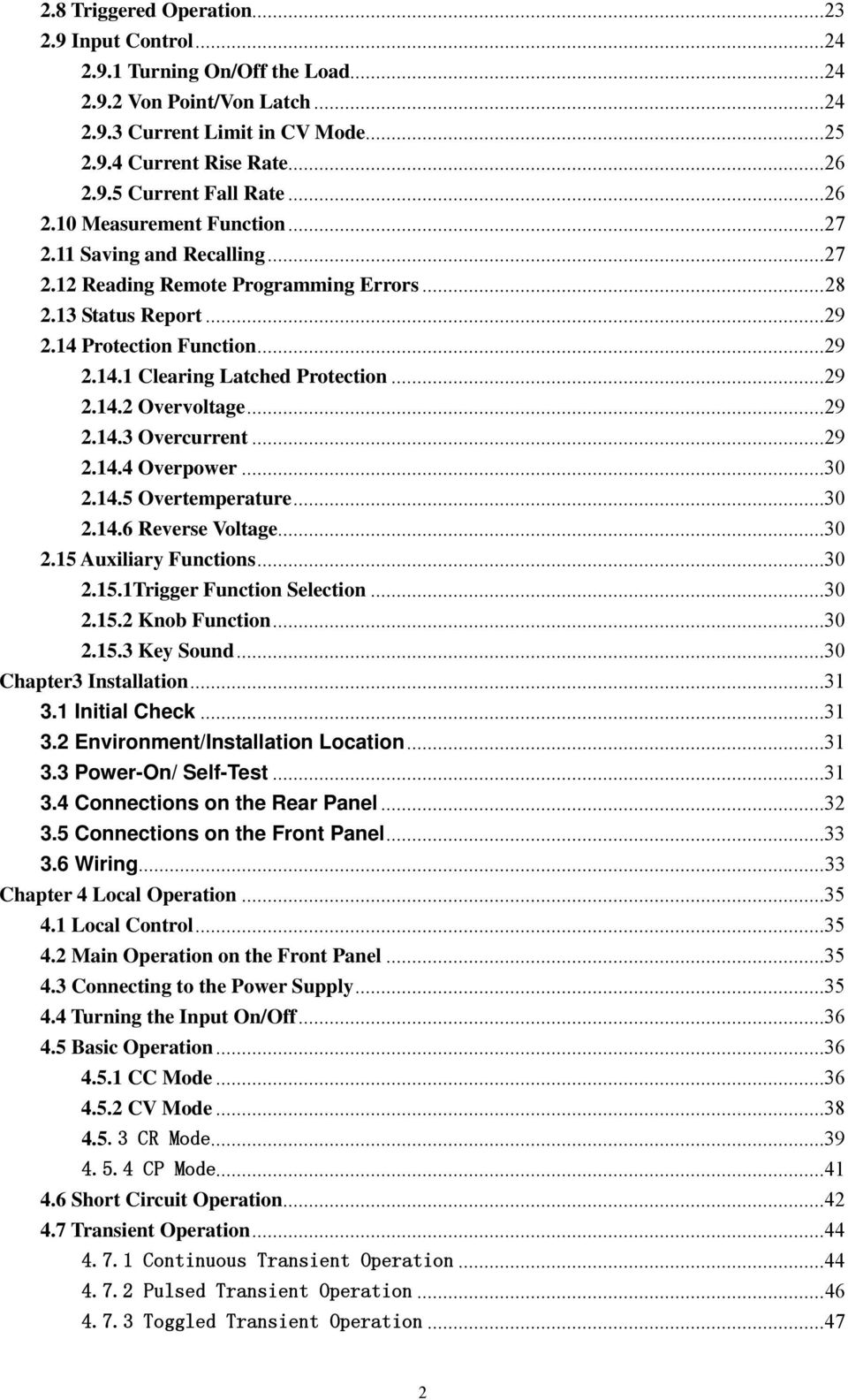
2 2.8 Triggered Operation Input Control Turning On/Off the Load Von Point/Von Latch Current Limit in CV Mode Current Rise Rate Current Fall Rate Measurement Function Saving and Recalling Reading Remote Programming Errors Status Report Protection Function Clearing Latched Protection Overvoltage Overcurrent Overpower Overtemperature Reverse Voltage Auxiliary Functions Trigger Function Selection Knob Function Key Sound...30 Chapter3 Installation Initial Check Environment/Installation Location Power-On/ Self-Test Connections on the Rear Panel Connections on the Front Panel Wiring...33 Chapter 4 Local Operation Local Control Main Operation on the Front Panel Connecting to the Power Supply Turning the Input On/Off Basic Operation CC Mode CV Mode CR Mode CP Mode Short Circuit Operation Transient Operation Continuous Transient Operation Pulsed Transient Operation Toggled Transient Operation
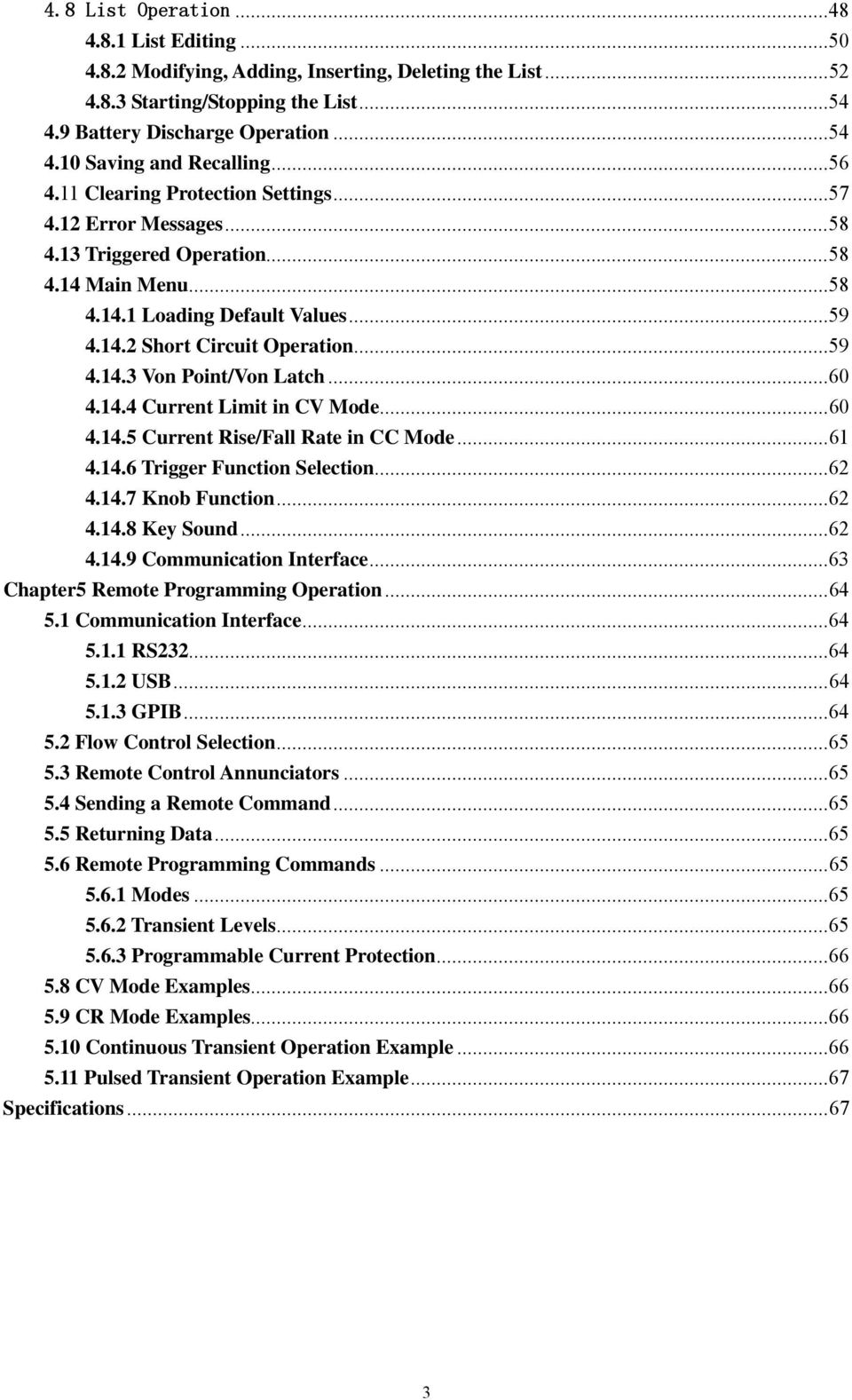
3 4.8 List Operation List Editing Modifying, Adding, Inserting, Deleting the List Starting/Stopping the List Battery Discharge Operation Saving and Recalling Clearing Protection Settings Error Messages Triggered Operation Main Menu Loading Default Values Short Circuit Operation Von Point/Von Latch Current Limit in CV Mode Current Rise/Fall Rate in CC Mode Trigger Function Selection Knob Function Key Sound Communication Interface...63 Chapter5 Remote Programming Operation Communication Interface RS USB GPIB Flow Control Selection Remote Control Annunciators Sending a Remote Command Returning Data Remote Programming Commands Modes Transient Levels Programmable Current Protection CV Mode Examples CR Mode Examples Continuous Transient Operation Example Pulsed Transient Operation Example...67 Specifications
4 Chapter1 General Introduction ARRAY 372x Series programmable electronic load, as a new generation of product developed by ARRAY Electronic Co., Ltd., is designed with high performance. It provides you powerful test function, user-friendly HMI, as well as RS232, USB, GPIB interfaces to support SCPI and Labview. 372x Series is widely used in scientific research and production fields such as aerospace, shipbuilding, automotive electronics, solar cell, and fuel cell. All electronic load and load appear in this manual refer to ARRAY 372x Series Electronic Load if there is no special explanation. 1.1 Function Features Main functions and features of ARRAY372x Series: 4 basic test functions: CC,CV, CR, and CP; 8 basic operating modes: CCL, CCH, CV, CRL, CRM, CRH, CPV, CPC; The 24 bits A/D and 17 bits D/A converters incorporated, provide this equipment with greatly enhanced setting and measurement resolution. 100kHz D/A conversion rate fully improves high-speed performance; Minimum operating voltage is less than 0.6V at the load s full rated current (3720/3721). With optional low-voltage testing devices, the maximum current can be achieved even though the input voltage is 0V. This is especially suitable for fuel cell, solar cell and other new energy test applications; Perfect protection assures high reliability in the most complicated test environments; Innovative design of CPV and CPC modes effectively improves the practicability of CP mode; Circuit improvement greatly enhances the dynamic response of CR mode and widens the application scope of that mode; High-speed transient operation with a maximum test frequency of 50kHz: Powerful sequential test function; with a minimum step time of 10us; and a maximum step time of 10000s. Cyclic numbers can be adjusted freely and a sequence can be chained to another sequence to achieve even more complex test procedures; The input binding posts with their innovative design are especially suitable for large current testing; Provides short-circuit test, battery discharge test and other auxiliary functions; A high-efficiency, intelligent cooling system can effectively reduce system temperature and enhance power density; Automatic ON/OFF function simplifies test operation; Knobs and digital keypad makes the operation more convenient; Save/recall function can save multiple groups of general settings; Supports SCPI (Standard Commands for Programmable Instrumentation) and Labview, and provides necessary PC software; 1

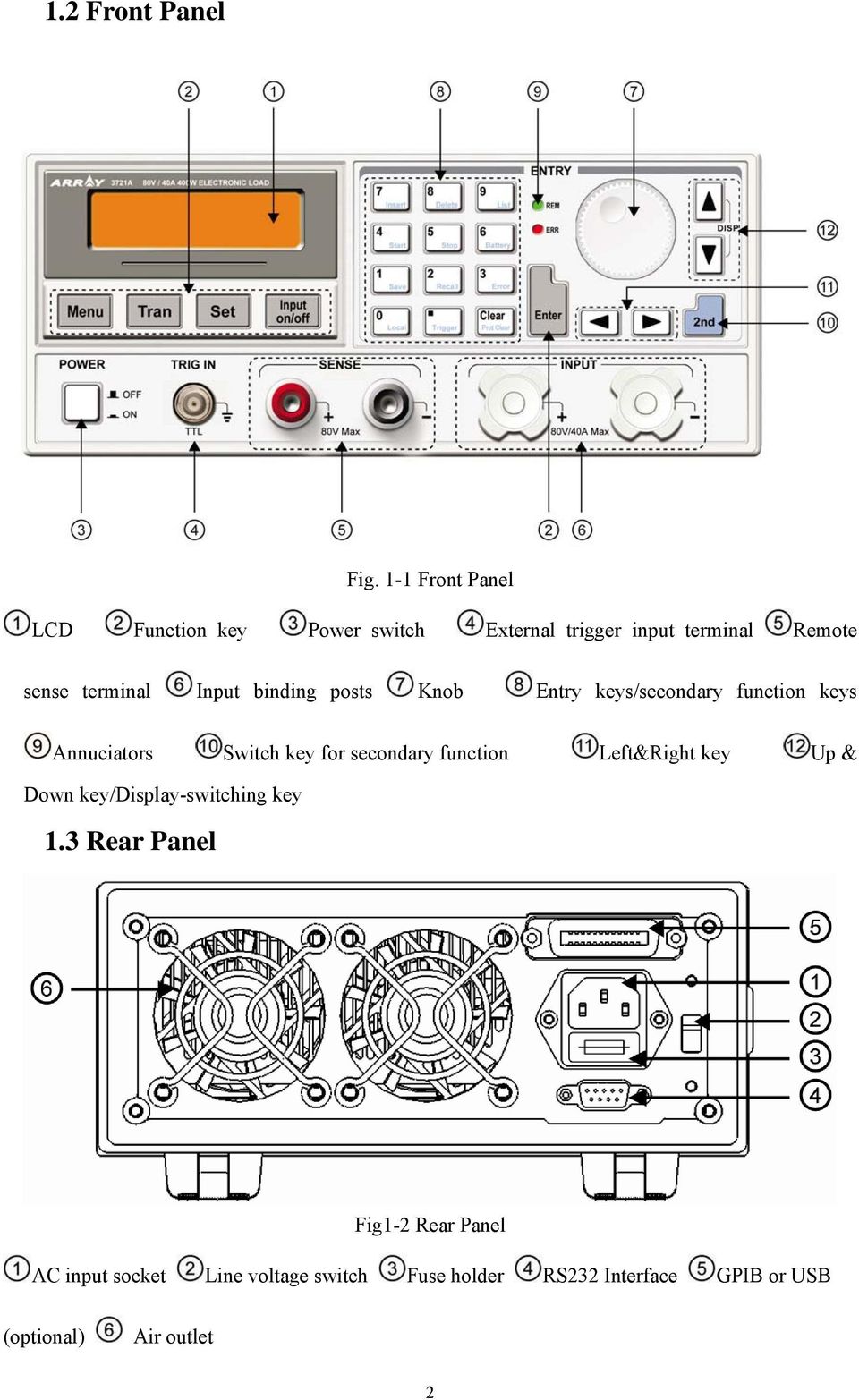
5 1.2 Front Panel Fig. 1-1 Front Panel LCD Function key Power switch External trigger input terminal Remote sense terminal Input binding posts Knob Entry keys/secondary function keys Annuciators Switch key for secondary function Left&Right key Up & Down key/display-switching key 1.3 Rear Panel Fig1-2 Rear Panel AC input socket Line voltage switch Fuse holder RS232 Interface GPIB or USB (optional) Air outlet 2
6 1.4 Keypad Function There are three groups of keypads on the front panel: the Function Keys, the Entry Keys, which composite with secondary functions, and the Direction Keys. The secondary functions of the Entry Keys are printed in blue. To use the secondary function, please press key first, then press the relevant key. List 1-1 Description for Keys 0/Local key 1/Save key 2/Recall key 3/Error code display key 4/List start key 5/List stop key 6/Battery discharge operation key 7/Insert key 8/Delete key 9/ List operation key Decimal point/trigger key Clear or exit /Clear protection Main Menu Transient operation menu Set key Input on/off Confirm key Left key 3

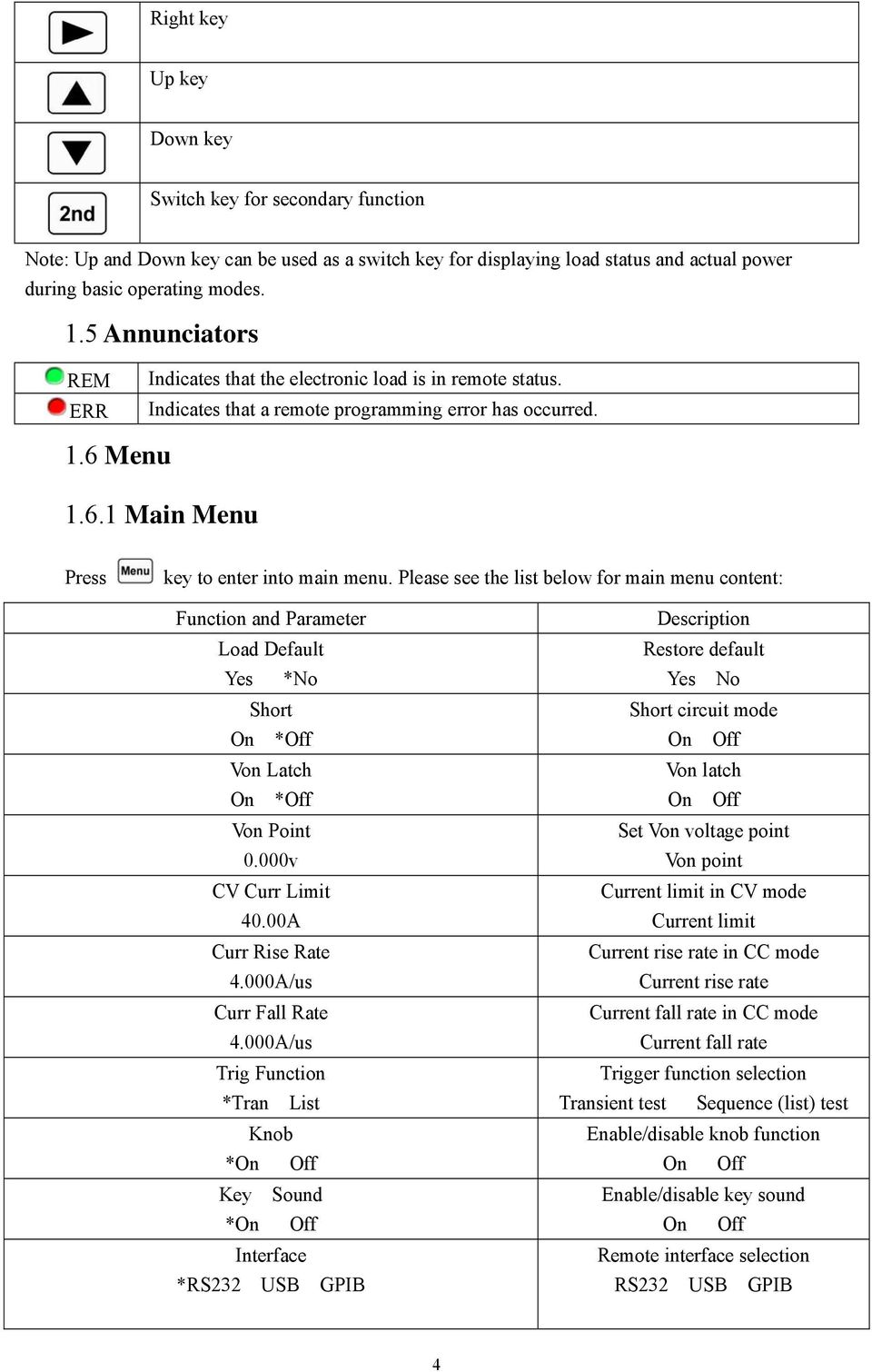
7 Right key Up key Down key Switch key for secondary function Note: Up and Down key can be used as a switch key for displaying load status and actual power during basic operating modes. 1.5 Annunciators REM ERR Indicates that the electronic load is in remote status. Indicates that a remote programming error has occurred. 1.6 Menu Main Menu Press key to enter into main menu. Please see the list below for main menu content: Function and Parameter Load Default Yes *No Short On *Off Von Latch On *Off Von Point 0.000v CV Curr Limit 40.00A Curr Rise Rate 4.000A/us Curr Fall Rate 4.000A/us Trig Function *Tran List Knob *On Off Key Sound *On Off Interface *RS232 USB GPIB Description Restore default Yes No Short circuit mode On Off Von latch On Off Set Von voltage point Von point Current limit in CV mode Current limit Current rise rate in CC mode Current rise rate Current fall rate in CC mode Current fall rate Trigger function selection Transient test Sequence (list) test Enable/disable knob function On Off Enable/disable key sound On Off Remote interface selection RS232 USB GPIB 4
8 RS232 Interface Baud Rate * Baud rate setting Parity Check *None Even Odd Parity check setting None Even Odd Data Bit *8 7 Data bits length 8bits 7bits Stop Bit *1 2 Stop bit length 1bit 2bits Flow Control *On Off Enable/disable Flow control On Off USB Interface USB selection GPIB Interface GPIB Address 5 GPIB address Address value Note: Except knob, key sound and interface configurations, the other parameters in main menu will not be saved when the load is turned off. If it is needed to save the parameters, please use key + key or *sav command. When the load is turned on next time, the saved parameters in location 0 will be recalled automatically Mode Selection and Parameter Setting Menu Press key to enter into mode selection and parameter setting menu, which is shown as below: Function and Parameter MODE:CCL CURR: 0.000A MODE:CCH CURR: 0.000A MODE:CV VOLT: 80.00V MODE:CRL RES: 2.000Ω MODE:CRM RES: Ω MODE:CRH RES: Ω MODE:CPV POWR: 0.000W MODE:CPC POWR: 0.000W Description Constant current low range Immediate current level Constant current high range Immediate current level Constant voltage mode Immediate voltage level Constant resistance low range Immediate resistance level Constant resistance medium range Immediate resistance level Constant resistance high range Immediate resistance level Constant power-voltage source mode Immediate power level Constant power-current source mode Immediate power level 5

9 1.6.3 Transient Operation Menu Press key in desired mode to enable its transient operation, and press key to enter into transient setting menu, which is shown as below: Function Description Example LevelL Transient low level 1.000A LevelH Transient high level 2.000A TimeL Time for transient low level ms TimeH Time for transient high level ms TimeR Time for transient rising edge 0.01ms TimeF Time for transient falling edge 0.01ms MODE Continuous (Cont) Pulse (Puls) Toggle Cont (Togg) Note: Transient operation may be used in CC, CV, and CR modes List Operation Menu Press key + key to enter into the list operation menu, which is shown as below: Function Description No. Select sequence (list) number (0-6) Memo Sequence memo (10 characters) Data: <New/Edit> Create a new or edit an existing sequence Count Cycle times( ) Chain: Off Sequence number to be chained with (0-6,off) Press and keys in list operation menu to select Data: <New/Edit>, and select New or Edit with the knob or and keys. Then press key to enter into sequence data editing status, which is shown as below: Function s CCH 5.000A Description Sequence (List) number Time Mode Set value 1.7 Display Messages 6

10 1 CC Mode: The first line shows measured voltage and current levels. The second line shows current set level, CC mode (CCH indicates constant current high range; CCL indicates constant current low range) and input status of the load: (ON, OFF). 2 CV Mode: The first line shows measured voltage and current levels. The second line shows voltage set level, CV mode, and input status of the load: (ON, OFF). 3 CR Mode: The first line shows measured voltage and current levels. The second line shows resistance level, CR mode (CRL indicates constant resistance low range; CRM indicates constant resistance medium range; and CRH indicates constant resistance high range) and input status of the load: (ON, OFF). 4 CP Mode: 7

11 The first line shows measured voltage and current levels. The second line shows power set level, CP mode (CPC indicates constant power-current source mode; CPV indicates constant power-voltage source mode), and input status of the load: (ON, OFF). 5 Transient Operation: The first line shows measured voltage and current levels. The second line shows set level, transient operation mode (tcch indicates high current mode transient operaion; tccl indicates low current mode transient operaion; tcv indicates constant voltage mode transient operaion; tcrl indicates low resistance mode transient operaion; tcrm indicate medium resistance mode transient operaion and tcrh indicates high resistance mode transient operaion. t indicates transient operation), and input status of the load: (ON, OFF). 6 List Operation: The first line shows measured voltage and current levels. The second line shows set level, sequence operation mode (LCCH indicates high current mode list operaion; LCCL indicates low current mode list operaion; LCVindicates constant voltage mode list operation; LCRL indicates low resistance mode list operaion; LCRM indicate medium resistance mode list operaion and LCRH indicates high resistance mode list operaion. L indicates list test; and input status of the load: (ON, OFF). 7 Battery Discharge Operation: The first line shows measured voltage and current levels. The second line shows battery capacity and discharge time. 8 Short Circuit Operation: 8

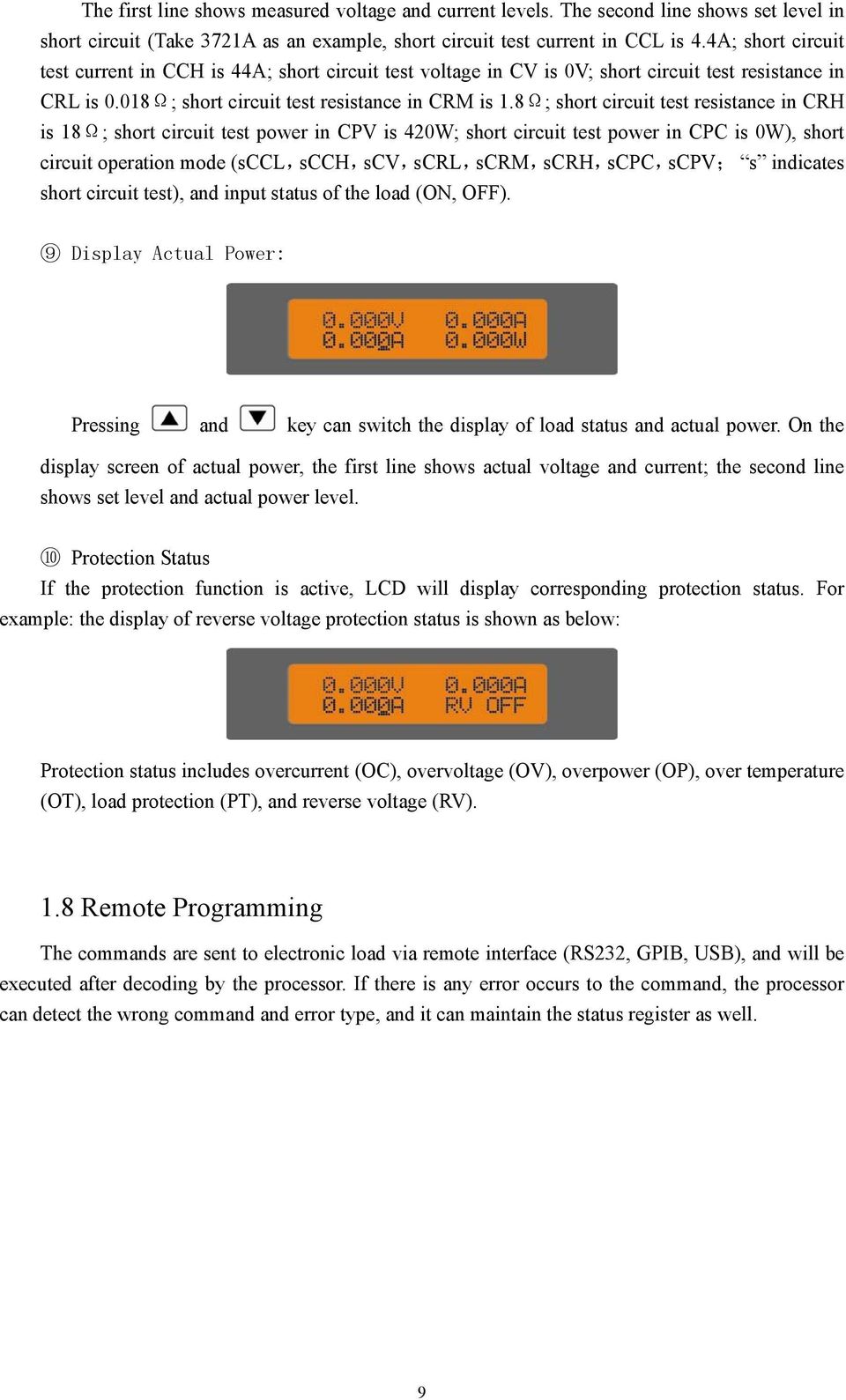
12 The first line shows measured voltage and current levels. The second line shows set level in short circuit (Take 3721A as an example, short circuit test current in CCL is 4.4A; short circuit test current in CCH is 44A; short circuit test voltage in CV is 0V; short circuit test resistance in CRL is 0.018Ω; short circuit test resistance in CRM is 1.8Ω; short circuit test resistance in CRH is 18Ω; short circuit test power in CPV is 420W; short circuit test power in CPC is 0W), short circuit operation mode (sccl,scch,scv,scrl,scrm,scrh,scpc,scpv; s indicates short circuit test), and input status of the load (ON, OFF). 9 Display Actual Power: Pressing and key can switch the display of load status and actual power. On the display screen of actual power, the first line shows actual voltage and current; the second line shows set level and actual power level. 10 Protection Status If the protection function is active, LCD will display corresponding protection status. For example: the display of reverse voltage protection status is shown as below: Protection status includes overcurrent (OC), overvoltage (OV), overpower (OP), over temperature (OT), load protection (PT), and reverse voltage (RV). 1.8 Remote Programming The commands are sent to electronic load via remote interface (RS232, GPIB, USB), and will be executed after decoding by the processor. If there is any error occurs to the command, the processor can detect the wrong command and error type, and it can maintain the status register as well. 9
13 Chapter2 Functions and Features The functions and features of electronic load will be described in this chapter, which helps you to know ARRAY 372x Series better. 2.1 Local and Remote Control ARRAY 372x Series electronic load can be controlled via the keypad and knobs in the front panel, or by remote controller via remote interface. If it is needed to control the load via the front panel, the load has to stay in local control status. Local (front panel) control is in effect immediately after power is applied. The REM annunciator is turned on,and remote control goes into effect as soon as the load receives a SYSTem:REMote command via RS232, USB or GPIB. Under remote control status, all operations on front panel keypad and knobs become invalid (except key + key ). All operations on electronic load are controlled by remote controller. The electronic load will return to local control and REM remote control annunciator is turned off after receiving the return command( SYSTem:LOCal). Or you can return the electronic load to local control by pressing key + key Details of local operation are covered in Chapter 4 Local Operation and fundamentals of remote programming are given in Chapter 5 Remote Operation. Complete SCPI programming details are given in the ARRAY 372x Series Electronic Load SCPI Programming Guide. 2.2 Main Functions: CC(constant current) Mode: CCL, CCH CV(constant voltage) Mode: CV CR(constant resistance) Mode: CRL, CRM, CRH CP(constant power) Mode: CPV, CPC Transient Operation: Tran List Operation: LIST Battery Discharge Operation: BATTERY Short Circuit Operation (Short) 10
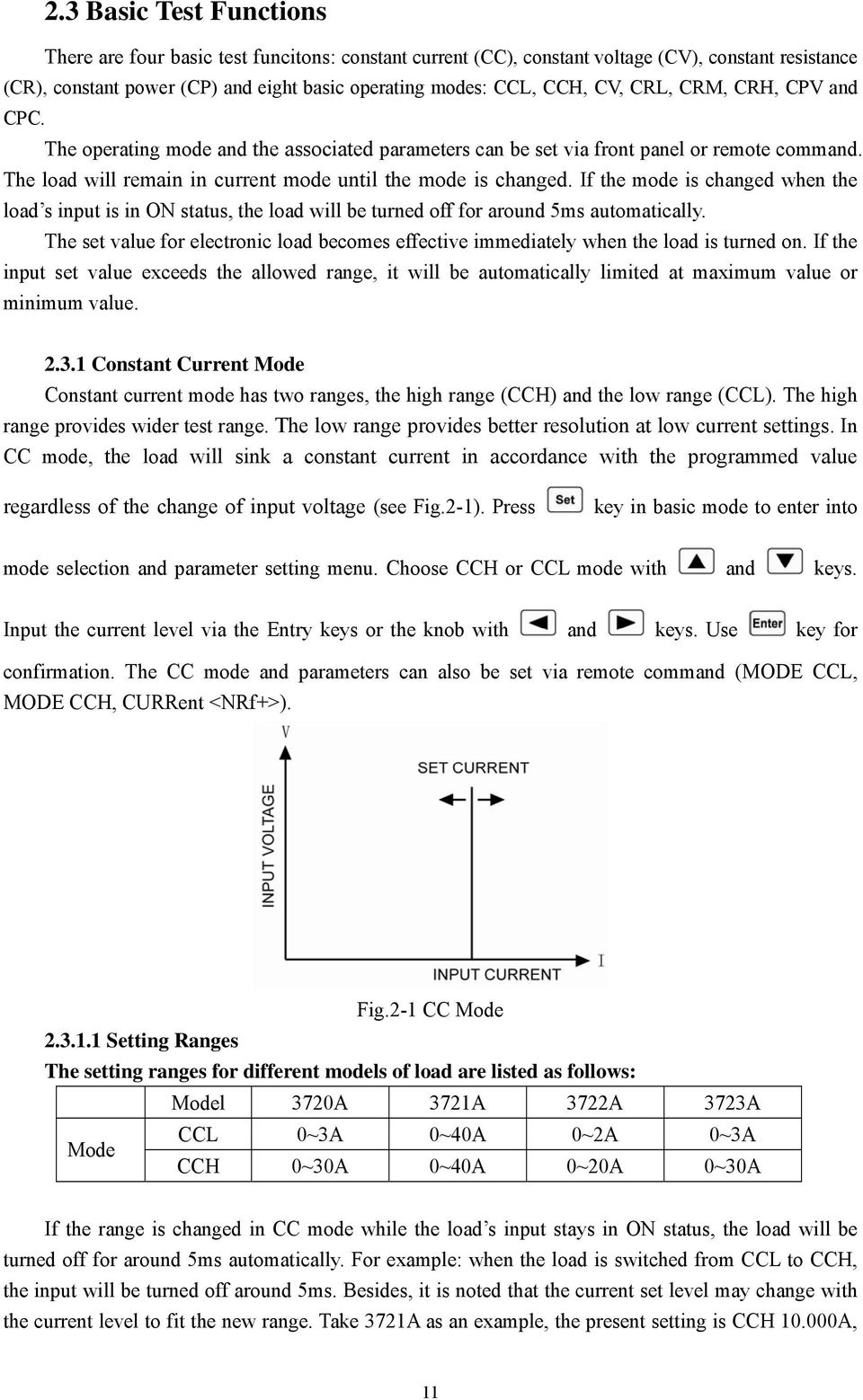
14 2.3 Basic Test Functions There are four basic test funcitons: constant current (CC), constant voltage (CV), constant resistance (CR), constant power (CP) and eight basic operating modes: CCL, CCH, CV, CRL, CRM, CRH, CPV and CPC. The operating mode and the associated parameters can be set via front panel or remote command. The load will remain in current mode until the mode is changed. If the mode is changed when the load s input is in ON status, the load will be turned off for around 5ms automatically. The set value for electronic load becomes effective immediately when the load is turned on. If the input set value exceeds the allowed range, it will be automatically limited at maximum value or minimum value Constant Current Mode Constant current mode has two ranges, the high range (CCH) and the low range (CCL). The high range provides wider test range. The low range provides better resolution at low current settings. In CC mode, the load will sink a constant current in accordance with the programmed value regardless of the change of input voltage (see Fig.2-1). Press key in basic mode to enter into mode selection and parameter setting menu. Choose CCH or CCL mode with and keys. Input the current level via the Entry keys or the knob with and keys. Use key for confirmation. The CC mode and parameters can also be set via remote command (MODE CCL, MODE CCH, CURRent <NRf+>). Fig.2-1 CC Mode Setting Ranges The setting ranges for different models of load are listed as follows: Model 3720A 3721A 3722A 3723A CCL 0~3A 0~40A 0~2A 0~3A Mode CCH 0~30A 0~40A 0~20A 0~30A If the range is changed in CC mode while the load s input stays in ON status, the load will be turned off for around 5ms automatically. For example: when the load is switched from CCL to CCH, the input will be turned off around 5ms. Besides, it is noted that the current set level may change with the current level to fit the new range. Take 3721A as an example, the present setting is CCH A, 11
15 when the load is switched from CCH to CCL, the current set level will change to the maximum level A for CCL Immediate Current Level The immediate current level refers to the current set value in CC mode, which can be programmed via mode selection and parameter setting menu, or via remote command (CRRRent <NRf+>). The immediate current level can also be modified directly with left/right keys ( ) and the knob Triggered Current Level The triggered current level refers to the preset current value, which can become immediate current level automatically when a trigger is received. If the CC mode and the input are enabled, the input will be updated immediately when a trigger occurs. If the CC mode is not active, this current level will have no effect on the input until the CC mode becomes active. The triggered current level only can be set via remote command (CURRent:TRIGgered <NRf+>). Once a current level is triggered, subsequent triggers will become invalid until another (CURRent:TRIGgered <NRf+>) command is received. The trigger operation will be described in later chapter. The status register of the electronic load can keep track of pending triggers and other operating conditions, which will be described in details in the ARRAY 372x Series Electronic Load SCPI Programming Guide Transient Current Level The load will switch between the transient high current level (LevelH) and transient low current level (LevelL) when the transient operation is enabled. The transient current level can be set in transient operation menu from the front panel, or via remote command (CURRent:HIGH <NRf+>, CURRent:LOW <NRf+>) Software Current Limit The electronic load allows the user to set a current limit (the current range is the same as that in CCH mode ) via remote command. The load will be turned off with beeping alarms if the current limit is exceeded beyond a programmable time delay ( s). Please note that the software current limit is in effect for any mode of operation. Remote commands are listed as follows: CURRent:PROTection <NRf+> CURRent:PROTection:DELay <NRf+> Constant Voltage Mode (CV) In CV mode, the load will attempt to sink enough current to control the source voltage to the programmed constant value regardless of the change of input current. (see Fig.2-2). Press key in basic mode to enter into mode selection and parameter setting menu. Choose CV mode with and keys. Input the voltage value via the Entry keys or the knob with and keys. Use 12
16 key for confirmation. The CV mode and parameters can also be set via remote command (MODE CV, VOLTage <NRf+>). Fig.2-2 CV Mode Setting Ranges The voltage setting ranges for different models of load are listed as follows: Model 3720A 3721A 3722A 3723A Voltage 0~80V 0~80V 0~200V 0~200V Immediate Voltage Level The immediate voltage level refers to the voltage set value in CV mode, which can be set via mode selection and parameter setting menu, or via remote command (VOLTage <NRf+>). The immediate current level can also be modified directly with left/right keys ( ) and the knob in CV mode Triggered Voltage Level The triggered voltage level refers to the preset voltage value, which can become immediate voltage level automatically when a trigger is received. If the CV mode and the input are enabled, the input will be updated immediately when a trigger occurs. If the CV mode is not active, this voltage level will have no effect on the input until the CV mode is active. The triggered voltage level only can be set via remote command (VOLTage:TRIGgered <NRf+>). Once a voltage level is triggered, subsequent triggers will become invalid until another (VOLTage:TRIGgered <NRf+>) command is received. The trigger operation will be described in later chapter. The status register of the electronic load can keep track of pending triggers and other operating conditions. which will be described in details in the ARRAY 372x Series Electronic Load SCPI Programming Guide Transient Voltage Level The load will switch between the transient high voltage level (LevelH) and transient low voltage level (LevelL) when the transient operation is enabled. The transient voltage level can be set in transient operation menu from the front panel, or via remote command (VOLTage:HIGH <NRf+>, VOLTage:LOW<NRf+>) Constant Resistance Mode (CR) 13

17 Constant resistance mode has three ranges: the low range (CRL), the medium range (CRM), and the high range (CRH). In CR mode, the load is equivalent to a constant resistance and will sink a current linearly proportional to the input voltage in accordance with the programmed resistance to make I=U/R (see Fig.2-3). Press key in basic mode to enter into mode selection and parameter setting menu. Choose CR mode with and keys. Input the resistance value via the Entry keys or the knob with and keys. Use key for confirmation. The CR mode and parameters can also be set via remote command (MODE CRL, MODE CRM, MODE CRH, RESistance <NRf+>). Fig.2-3 CR Mode Setting Ranges The setting ranges for different models of load are listed as follows: Model 3720A 3721A 3722A 3723A CRL 0.02~2Ω 0.02~2Ω ~6.66Ω ~6.66Ω Mode CRM 2~200Ω 2~200Ω 6.66~666Ω 6.66~666Ω CRH 20~2000Ω 20~2000Ω 66.6~6660Ω 66.6~6660Ω If the range is changed in CR mode while the load s input stays in ON status, the load will be turned off for around 5ms automatically. For example: when the load is switched from CRL to CRH, the input will be turned off around 5ms. Besides, it is noted that the resistance set level may change with the resistance range to fit the new range. Take 3721A for example, the present setting is CRM Ω, when the load is switched from CRM to CRL, the resistance set level will change to the maximum level Ωfor CRL Immediate Resistance Level The immediate resistance level refers to the resistance set value in CR mode, which can be set via mode selection and parameter setting menu, or via remote command (RESistance <NRf+>). The immediate resistance level can also be modified directly with left/right keys ( ) and the knob in CR mode Triggered Resistance Level 14

18 The triggered resistance level refers to the preset resistance value, which can become immediate resistance level automatically when a trigger is received. If the CR mode and the input are enabled, the input will be updated immediately when a trigger occurs. If the CR mode is not active, this resistance level will have no effect on the input until the CR mode becomes active. The triggered resistance level only can be set via remote command (RESistance:TRIGgered <NRf+>). Once a resistance level is triggered, subsequent triggers will become invalid until another (RESistance:TRIGgered <NRf+>) command is received. The trigger operation will be described in later chapter. The status register of the electronic load can keep track of pending triggers and other operating conditions, which will be described in details in the ARRAY 372x Series Electronic Load SCPI Programming Guide Transient Resistance Level The load will switch between the transient high resistance level (LevelH) and transient low resistance level (LevelL) when the transient operation is enabled. The transient resistance level can be set in transient operation menu from the front panel, or via remote command (RESistance:HIGH<NRf+>, RESistance:LOW <NRf+>) Constant Power Mode (CP) There are two sorts of constant power modes, the Constant Power-Voltage Source mode (CPV) and the Constant Power-Current Source mode (CPC). The CPV mode is applied to voltage source test, and the CPC mode is applied to current source test. In CP mode, the load consumes the constant power in accordance with the programmed value regardless of the changes of external current and voltage (see Fig.2-4). Press key to enter into mode selection and parameter setting menu. Choose CPV or CPC mode with and keys. Input the power value via Entry keys or the knob with and keys. Use key for confirmation. The CP mode and parameters can also be set via remote command (MODE CPV, MODE CPC, POWer <NRf+>). Fig.2-4 CP Mode Figure 2~5 are the current-voltage curves for several common power supplies. The constant power curve is a hyperbola in the first quadrant. The constant power curve usually intersects with current-voltage curve at two points (the CPV point and the CPC point) when the power of the external power supply is larger than the set power. At the CPV point, the power supply shows the feature of 15

19 voltage source: the output power will be increased with increasing current; at the CPC point, the power supply shows the feature of current source: the output power will be increased with increasing voltage. Array 372x series electronic load can be set at any one of intersection points to operate by the user. Fig. 2-5 Current-voltage Curve for Normal Power Supply As adopting advanced slope detection method, Array 372x Series electronic load only need to test a part of the current-voltage curve to know whether the two curves (constant power curve and current-voltage curve) intersect. Therefore, when the set power is larger than the actual power, the external power supply will not be short-circuited by the load for the insufficient power. When the load detects that the power of the external power supply is insufficient, it will try to find constant power point automatically till the set power is met Setting Ranges The setting ranges for different models of load are listed as follows: Model 3720A 3721A 3722A 3723A Power 0~250W 0~400W 0~200W 0~350W Immediate Power Level The immediate power level refers to the power set value in CP mode, which can be set via mode selection and parameter setting menu, or via remote command (POWer <NRf+>). The immediate resistance level can also be modified directly with left/right keys ( ) and the knob Triggered Power Level The triggered power level refers to the preset power value, which can become immediate power level automatically when a trigger is received. If the CP mode and the input are enabled, the input will be updated immediately when a trigger occurs. If the CP mode is not active, this power level will have no effect on the input until the CP mode becomes active. The triggered power level only can be set via remote command (POWer:TRIGgered <NRf+>).Once a power level is triggered, subsequent triggers will become invalid until another (POWer:TRIGgered <NRf+>) command is received. The trigger operaion will be described in later chapter. The status register of the electronic load can keep track of pending triggers and other 16

20 operating conditions, which will be described in details in the ARRAY 372x Series Electronic Load SCPI Programming Guide. 2.4 Transient Operation When the transient operation is enabled, the load periodically switch between two levels (LevelH and LevelL), which can be applied to test the dynamic characteristics of the power supply. The transient operation can be executed in the CC, CV and CR modes, and has three operating statuses: Continuous, Pulsed, and Toggled. Please make sure the List Operation has been disabled before enabling transient operation. The parameters associated with transient operation are: low level (LevelL), high level (LevelH), low level time (TimeL), high level time (TimeH), time for rising edge (TimeR), time for falling edge (TimeF), and operating mode. Transient high/low level and corresponding CC, CV and CR modes share the same setting ranges. The range for high/low level time is 0 ~ ms; the range for rising/falling edge time is 10us ~ ms; the time resolution is 10us, and the maximum test frequency is 50kHz. Transient test can be turned on and off via key at the front panel or via remote command (TRANsient ON/OFF). Before you turn on transient test, you should set the load to the operating mode that needs transient test. Note: In transient test, the Von point and current limit should be taken into consideration, which may cause the shut down of the input, thus interrupt the transient test Continuous Transient Operation In continuous operation, the load periodically switches between high/low levels. The relevant parameters such as low level (LevelL), high level (LevelH), low level time (TimeL), high level time (TimeH), time for rising edge (TimeR), time for falling edge (TimeF), and continuous transient operation can be set through transient operation menu or via remote command (CURRent:LLEVel <NRf+>, CURRent:HLEVel <NRf+>, VOLTage:LLEVel <NRf+>, VOLTage:HLEVel <NRf+>, RESistance:LLEVel <NRf+>, RESistance:HLEVel <NRf+>, TRANsient:LTIMe <NRf+>, TRANsient:HTIMe <NRf+>, TRANsient:RTIMe <NRf+>, TRANsient:FTIMe <NRf+>, TRANsient:MODE CONTinuous). For example: assume that the CCH range is active, and the input is in OFF status, then the transient parameters should be set as follows: Press key to enter into transient operation; Press key to open transient operation menu; Set the following parameters in transient operation menu: LevelL: 5.000A LevelH : A TimeL : 0.50ms TimeH : 0.50ms 17

21 TimeR : TimeF : Mode : Then press 0.20ms 0.20ms Cont key to turn on the input; Or via remote command to set: SCPI Command Description TRAN ON Enables transient operation CURR:LOW 5 Sets transient current low level to 5A CURR:HLGH 10 Sets transient current high level to 10A TRAN:LTIM 500us Sets transient low level time to 500us TRAN:HTIM 500us Sets transient high level time to 500us TRAN:RTIM 200us Sets the time for transient rising edge to 200us TRAN:FTIM 200us Sets the time for transient falling edge to 200us TRAN:MODE CONT Selects continuous operation INPUT ON Turns on the input Figure 2-6 shows the current waveform of the load: the load s input current reaches the transient high level (10A) after 200us duration of rising edge, and remains at 10A for 500us. Then after 200us duration of falling edge, the input current reaches the transient low level (5A), and remains at 5A for 500us. Repeat it in cycles. Fig. 2-6 Continuous Transient Operation Pulsed Transient Operation The trigger function is required for pulsed transient operation. When there is no trigger occurs, the load remains at the transient low level. After a trigger has been received, a pulse with three stages, namely rising edge, transient high level, and falling edge, will appear, then the load returns to the transient low level again. The associated parameters such as transient low level (LevelL), transient high level (LevelH), high level time (TimeH), time for rising edge (TimeR), time for falling edge (TimeF), and pulsed transient mode can be set through transient operation menu or via remote command (CURRent:LOW <NRf+>, CURRent:HIGH <NRf+>, VOLTage:LOW <NRf+>, VOLTage:HIGH <NRf+>, RESistance:LOW <NRf+>, RESistance:HIGH <NRf+>, TRANsient:HTIMe <NRf+>, TRANsient:RTIMe <NRf+>, TRANsient:FTIMe <NRf+>, TRANsient:MODE PULSe, TRANsient ON OFF). 18
22 In order to get a pulse, an explicit trigger is required. The trigger can be an external trigger signal received via the TRIG input on the front panel, pressing the key + key, or,the remote command (*TRG/.TRIGger). The trigger becomes effective only when the load remains at transient low level. Each trigger leads to one pulse. In the duration of rising edge, transient high level, and falling edge, any trigger will be ignored. For example: assume that the CCH range is active, and the input is in OFF status, then the transient parameters should be set as follows: Press key to enter into transient operation; Press key to open transient operation menu; Set the following parameters in transient operation menu: LevelL : 5.000A LevelH : A TimeL : 0.50ms TimeH : 0.50ms TimeR : 0.10ms TimeF : 0.10ms Mode : Puls Then press key to turn on the input; Or via remote command to set: SCPI Command Description TRIG:SOUR EXT Selects the external trigger input TRAN ON Enables transient operation CURR:LOW 5 Sets transient current low level to 5A CURR:HIGH 10 Sets transient current high level to 10A TRAN:HTIM 500us Sets transient high level time to 500us TRAN:RTIM 100us Sets the time for transient rising edge to 100us TRAN:FTIM 200us Sets the time for transient falling edge to 200us TRAN:MODE PULS Sets pulse trigger operating mode INPUT ON Turns on the input Get the trigger by receiving an external trigger signal. Figure 2-7 shows the current waveform of the load before it is triggered and after it has been triggered respectively: the electronic load starts its operation at the transient low level (5A) when the input is turned on. For each trigger, the load current reaches the high level (10A) after 100us duration of rising edge, and remains at 10A for 500us. Then after 200us duration of falling edge, the current returns to the transient low level (5A). 19
23 Fig. 2-7 Pulsed Transient Operation Toggled Transient Mode The trigger function is required for toggled transient operation. When there is no trigger occurs, the load remains at a transient level. After a trigger has been received, a toggle operation will be executed, and another transient level will be reached after the duration of rising edge or falling edge. The associated parameters such as transient low level (LevelL), transient high level (LevelH), time for rising edge (TimeR), time for falling edge (TimeF), and toggled transient mode can be set through transient operation menu or via remote command (CURRent:LOW <NRf+>, CURRent:HIGH <NRf+>, VOLTage:LOW <NRf+>, VOLTage:HIGH <NRf+>, RESistance:LOW <NRf+>, RESistance:HIGH <NRf+>, TRANsient:RTIMe <NRf+>, TRANsient:FTIMe <NRf+>, TRANsient:MODE TOGGle, TRANsient ON OFF). The trigger can be an external trigger signal received via the TRIG input on the front panel, pressing the key + key, or the remote command ( *TRG/TRIGger). For example: assume that the CCH range is active, and the input is in OFF status, then the transient parameters should be set as follows: Press key to enter into transient operation; Press key to open transient operation menu; Set the following parameters in transient operation menu: LevelL: 5.000A LevelH : A TimeL : 0.50ms TimeH : 0.50ms TimeR : 0.10ms TimeF : 0.20ms Mode : Togg Then press key to turn on the input; Or via remote command to set: SCPI Command Description TRIG:SOUR EXT Selects the external trigger input TRAN ON Enables transient operation CURR:LOW 5 Sets transient current low level to 5A CURR:HIGH 10 Sets transient current high level to 10A 20
24 TRAN:RTIM 100us TRAN:FTIM 200us TRAN:MODE TOGG INPUT ON Sets the time for transient rising edge to 100us Sets the time for transient falling edge to 200us Selects toggled operating mode Turns on the input Get the trigger by receiving an external trigger signal. Figure 2-8 shows the current waveform of the load before it is triggered and after it has been triggered respectively: the electronic load starts its operation at the transient low level (5A) when the input is turned on. For the first trigger, the load current reaches and remains at the high level (10A) after 100us duration of rising edge. When the second trigger is received, the load current will reach and remain at the low level (5A) after 200us duration of falling edge. Each trigger leads to one toggle operation. Fig. 2-8 Toggled Transient Operation 2.5 List Operation Besides Transient operation, the electronic load provides more flexible list operation, which can make the load operate according to the preset sequence. The list operation allows you to program a series of sequence steps, and the operation mode, the load values, the duration time for each step can be set. The sequence operation can be executed in the CC, CV, and CR modes. The minimum duration for each step is 10us, and the maximum one is s (around hours). The list operation allows to be executed cyclically, and the cycle times can be set; the different list can be chained so that when one list has been executed, the another chained list will be enabled, which further perfects the capability of the list test to implement more complicated test task. Each list can contain 50 steps at most, and the load can store 7 lists. The associated parameters of list operation can be edited and set through list operation menu or via remote command. The load provides convenient list editing function. When the user is operating input/edit sequence step, it is easy to check the previous and subsequent steps, and it is allowed to be edited, inserted, and deleted immediately, which simplifies the list input operation effectively. The set value of each step will be automatically saved when exiting from step edit menu, and the other list parameters will be saved immediately after been edited. The list operation also can be implemented via the remote command. Please make sure the transient operation has been disabled before enabling list operation. In list operation, if the operation mode for next step is different from the present step, the load will automatically have a 5ms-delay after the present step is over to avoid the probable current surge. The load s input will be turned off during this 5ms-delay. Figure 2-9 is a list running diagram for 5 steps. See Chapter 4 for detailed information about programming lists from the front panel. 21
25 Fig. 2-9 List Operation Note: In list operation, the Von point and current limit level should be taken into consideration, which may cause the shut down of the input, thus interrupt the list operation. 2.6 Battery Discharge Operation The electronic load adopts constant current discharge to test battery capacity. The discharge current and cut-off voltage can be self-defined. When the battery voltage decreases to the cut-off voltage, the battery discharge test will stop automatically. The test procedure is shown as figure The load can real-time display battery voltage, discharge current, discharge time, and discharge capacity during the test. The maximum battery discharge time is 99hours 99minutes 99 seconds, and the maximum battery capacity for different models is listed as follows: Model 3720A 3721A 3722A 3723A Capacity 3000Ah 4000Ah 2000Ah 3000Ah. Fig Voltage/Current Curve Chart in Battery Discharge Operation 22
26 2.7 Short Circuit Operation The electronic load can simulate a short circuit to test the protection performance of the tested device. The short circuit operation can be enabled and disabled by setting in the main menu, or via the remote command (INPut:SHORt ON/OFF). The other set values will not be changed when the short circuit operation is enabled. The short-circuit value depends on the present operating mode of the load, and the short-circuit value for each model is shown as follows: Model 3720A 3721A 3722A 3723A CCL 3.3A 4.4A 2.2A 3.3A CCH 33A 44A 22A 33A CV 0V 0V 0V 0V Mode CRL 0.018Ω 0.018Ω 0.06Ω 0.06Ω CRM 1.8Ω 1.8Ω 6Ω 6Ω CRH 18Ω 18Ω 60Ω 60Ω CPV 270W 420W 220W 370W CPC 0W 0W 0W 0W Note: in short circuit operation, the Von point and current limit level should be taken into consideration, which may cause the shut down of the input, thus interrupt the short circuit operation. 2.8 Triggered Operation The triggered operation is mainly used to make the load keep synchronized with other test equipments or events. Array 372x Series electronic load provides various triggering modes, which can be applied to the following occasions: Triggering a preset level Transfer all pending preset levels to the immediate levels. For the presently active mode, the new level will appear at the input at once if the input is turned on. For the modes which are not presently active, the preset levels will not take effect at the input until the corresponding mode becomes active. Triggering a transient pulse Gernerate a transient pulse in accordance with the preset transient parameters, when pulsed transient operation is active. Triggering a transient toggle Switch the input between the transient low level and transient high level in accordance with the preset transient parameters, when the toggled transient operation is active. Triggering a list test Enable the present list test when the list operation is active. Three triggering methods are available for remote control: GPIB <GET> signal, the *TRG and TRIGger commands. The External trigger input terminal and key + key on the front panel of the load can be used to trigger as well. 23
27 The load has three triggering modes: BUS, EXTernal, and HOLD. The BUS mode: the trigger source is GPIB <GET> signal, or *TRG command. The EXTernal mode: Choose the External trigger input terminal or key + key on the front panel as the trigger source. The input signal at the External trigger input terminal is TTL, the falling edge (signal) is triggered.. The HOLD mode: Use TRIGger:IMMediate command as the trigger source. At this time, all other triggering methods including *TRG become invalid. Note: The TRIGger:IMMediate command can be used in all three triggering modes. The triggering modes can be selected via the remote command only (TRIGger:SOURce BUS; TRIGger:SOURce EXTernal; TRIGger:SOURce HOLD). 2.9 Input Control Turning On/Off the Load The input can be turned on/off by pressing key, or via the remote command (INPUT ON/OFF). If the load s input stays in OFF status, press key to turn on the input; if the load s input stays in ON status, press key to turn off the input. Turning the input on/off (zero current) does not affect the programmed settings. In local control, if the input is turned on, the load status can not be switched directly among the basic modes, transient operation, list operation, battery discharge operation, etc. The load can be switched from one operation status to another operation status only when the input is turned off Von Point/Von Latch When the external input voltage is less than the Von Point, the load will not be enabled even though the input has been turned on. The load will be enabled till the external input voltage reaches or exceeds the Von Point. Von Latch is used to latch the active status of the load. If the Von Latch function is enabled, once the input voltage reaches Von Point, the input will be turned on, and stay in ON status regardless of the changes from the external input voltage, even though the input voltage is less than the Von point. Please see figure 2-11;if the Von Latch function is disabled, once the input voltage reaches Von Point, the input will be turned on automatically, and once the input voltage is less than the Von Point, the input will be automatically turned off. Please see figure The automatical turning on /off of the input can be implemented via setting the Von Point and Von Latch, which simplifies test operation greatly. The Von Voltage can be set in main menu, or via the remote command (INPut:LATCh:VOLTage <NRf+>). The Von Latch can be set in main menu, or via the remote command (INPut:LATCh ON OFF). 24
28 Fig Von Latch Is Enabled Fig Von Latch Is Disabled Note: If the load is unable to operate normally, please check the setting of Von Point Current Limit in CV Mode The CV Curr Limit is used to limit the maximum input current in CV mode. If the voltage is still larger than the set level while the current limit has been reached, the load will switch to the CC mode. Please see figure The input will not be turned off in the CV current limit, which is different from the software current limit. The CV Curr Limit can be set in main menu, or via the remote command ( INPut:LIMit:CURRent <NRf+>). 25
29 Fig.2-13 CV Curr Limit Current Rise Rate The Current Rise Rate is used to set the current rise rate in CC mode. It can be set in main menu, or via the remote command (CURRent:RISE:RATE <NRf+>). If the current rise rate is 0.1A/us, and the current set level is 20A, then the current rise rate is shown as below when the input is turned on: Fig.2-14 Current Rise Rate Note: The Current Rise Rate can be effective only in CCH and CCL, and the actual rise rate is one tenth of the set level in CCL Current Fall Rate The Current Fall Rate is used to set the current fall rate in CC mode. It can be set in main menu, or via the remote command (CURRent:FALL:RATE <NRf+>). If the current fall rate is 0.1A/us, and the current set level is 20A, then the current rise rate is shown as below when the input is turned off: 26
30 Fig.2-15 Current Fall Rate Note: The Curr Fall Rate can be effective only in CCH and CCL mode, and the actual rise rate is one tenth of the set level in CCL Measurement Function The electronic load has measurement system with high resolution. The input current level and voltage level can be measured in real time. The input power level and resistance level can be computed with the input voltage level and current level. Each measured value can be checked through LCD display or via the remote command (MEASure:VOLTage?, MEASure:CURRent?, MEASure:RESistance?, MEASure:POWer?) Saving and Recalling The electronic load is provided with an EEPROM memory, which can save various parameters, such as modes, input status, current, voltage, resistance, transient settings, limits, etc. 372x Series electronic load can save 10 groups of parameters. All parameters relevant to saving and recalling operation are listed in List 2-1 (Take 3721A as an example.). List 2-1 Function Effect Default Input Input status Off Mode Operation mode CCH Current level Immediate current level 0A Current rise rate Current rise rate 4A/us Current fall rate Current fall rate 4A/us Current Hlevel Transient current high 0A level Current Llevel Transient current low level 0A *Current protection level Current limit 40A *Current protection delay Current protection delay 60s *Current protection State Enable/disable current off protection Voltage level Immediate voltage level 80v CV current limit Current limit in CV mode 40A Voltage Hlevel Transient high voltage 80v level Voltage Llevel Transient voltage low level 80v Resistance level Immediate resistance level 2000Ω Resistance Hlevel Transient high resistance 2000Ω high level Resistance Llevel Transient resistance low 2000Ω level Power level Immediate power level 0W 27
31 Transient operation Transient test off Transient mode Transient mode continuous Transient Htime Time for transient high 0ms level Transient Ltime Time for transient low 0ms level Transient Rtime Time for transient rising 0.01ms edge Transient Ftime Time for transient falling 0.01ms edge Trigger Function Trigger function selection Tran *Trigger source Trigger source external Battery Mode Battery discharge off operation Battery mini voltage Battery minimum 0V termination voltage Battery discharge current Battery discharge current 0A Voltage on Von point for the load 0V Voltage on Latch Latch the Von point Off * indicates it only can be programmed in the remote control. The 10 groups of parameters stored in Location 0~9 can be saved and recalled by pressing key + key and key + key, or via the remote command (*SAV < NRl > and *RCL < NRl >). The parameter saved in Location 0 will be recalled automatically every time the load is turned on Reading Remote Programming Errors The Err annunciator will be turned on when remote programming errors occur. The error codes are shown as followings: -lxx Command errors -2xx Execution errors -3xx Device-specific errors -4xx Query errors Remote programming errors can be checked by pressing key after pressing key on the front panel. The remote command (SYSTem:ERRor?) can reads back the error codes and error messages when it is in remote control. All errors are saved in one error queue. The errors in this error queue are read in the order in which they occurred. At most 20 error messages can be saved in the error queue. If the errors exceed 20, the last error in the error queue will be replaced with -350, Too many errors. The load will not save any additional error message, unless you clear or read errors from the queue. Once the error message is read, it will be cleared in the error queue. 28
32 2.13 Status Report The electronic load incorporates a status reporting register. Various status conditions of the load can be reported by querying the status register. The user can make sure which event has been reported through setting the enable register, which will be introduced in details in "ARRAY 372x Series Electronic Load SCPI Programming Guide" Protection Function The electronic load is equipped with the following protection functions: Overvoltage(OV) Overcurrent(OC) Overpower(OP) Overtemperature(OT) Reverse Voltage(RV) Once any of the above protection function is active, the corresponding status bit in the status will be set; the input will be turned off with beeps; the detected conditions will be displayed; the load will enter into the latched protection status, and will not respond to other commands except some specific operations. For example: if an overtemperature conditions has been detected, the input will be turned off with beeps, and OT will be shown in the lower right corner of the display. The load will have no response to other operations Clearing Latched Protection When the load enters into the latched protection status, it will have no response to other commands. The load will return to the normal operation only when the latched protection has been reset via pressing key + key or the remote command (INPut:PROTection:CLEar). Of course, the condition that cause the latched protection must be removed, or it will be latched again as soon as it is reset. In addition, when the software overcurrent protection is enabled, if the overcurrent time does not exceed the specified protection time, the load will display PT to indicate, but the input will not be turned off. At this time, you can reset the overcurrent time with key + key or the remote command (INPut:PROTection:CLEar) Overvoltage The overvoltage protection level is set at a predetermined voltage, which cannot be changed by the user. When the input voltage exceeds this predetermined voltage, the overvoltage protection will be enabled, and the input is turned off with OV displayed, meanwhile, the OV and VF status register bits are set, and will remain set until they are reset and overvoltage condition is removed Overcurrent The electronic load allows the user to define a current protection limit. When the defined current limit is exceeded, the overcurrent timer starts timing, and the display will show PT to indicate protection status, but the input will not be turned off immediately. When the specified delay time is 29
33 reached, the overcurrent protection will be enabled and the input is turned off with OC displayed, meanwhile, the OC and PS status register bits are set, and will remain set until they are reset and overcurrent condition is removed. The current protection limit function can only be set via the remote command. SCIP Command Description CURRent:PROTection:STATe ON/OFF Turns on/off the current protection limit function CURRent:PROTection<NRf+> Sets the current limit level CURRent:PROTection:DELay < NRf+> Sets the delay time to turn off the input Overpower The electronic load includes both hardware and software overpower protection functions. Once the input power exceeds the maximum rated power, the hardware power-limit circuit will be enabled immediately to limit the input power within the allowed range, in the meantime, the load will compute the present actual power. No matter the hardware power-limit circuit is enabled, or use software to compute, the overpower protection will become active as long as the overpower time exceeds the specified limit. When the overpower protection is enabled, the input will be turned off with OP displayed, meanwhile, the OP and PS status register bits are set, and will remain set until they are reset and overpower condition is removed Overtemperature If the internal temperature of the load exceeds safe limits, the overtemperature protection will be enabled; the input will be turned off with OT displayed, in the meantime, the OT and PS status register bits are set, and will remain set until they are reset and overtemperature condition is removed. You must wait until the load cools down to the normal temperature before you can reset the latched protection. The fans in the load will help to cool the load as quickly as possible Reverse Voltage When reverse voltage is applied, the reverse voltage protection will be enabled; the input will be turned off with RV displayed, in the meantime, the RV and VF status register bits are set, and will remain set until they are reset and reverse voltage is removed Auxiliary Functions Trigger Function Selection The Trigger Function in main menu is used to select the trigger object. Selecting Tran is used to trigger transient operation, and selecting List is used to trigger sequence (list) operation Knob Function The Knob in main menu is used to enable/disable the knob function. Select On to enable the knob function, and select Off to disable Key Sound The Key Sound in main menu is used to control the key sound. Select On to activate the key sound and select Off to forbid. 30
34 Chapter3 Installation 3.1 Initial Check When you receive the load, please check it for any obvious damage that may have occurred during shipment. Keep the original packing materials in case the load has to be returned to ARRAY in the future. Please confirm that there are no broken keys or knobs, that the cabinet and panel surfaces are free of dents or scratches, and that the display is not scratched or cracked. 3.2 Environment/Installation Location The load can operate at its full power within the temperature range of 0 C to 40 C, and at derated power from 40 C to 50 C, or the overtemperature protection will be caused. Place the load in a location with good ventilation, and keep a distance from electromagnetic interference. Do not place the load in the flammable atmosphere. Your load must be installed in a location that allows sufficient space at the sides and rear of the load for adequate air circulation. The fans cool the load by drawing in air through the sides and exhausting it out from the back. The rubber bumpers must be removed for rack mounting. 3.3 Power-On/ Self-Test A power-on self-test can inspect the basic operations of the load to assure you that the load is operational. First, before the load is switched on, check AC power-line voltage to verify the power-line voltage selected by 110V/220V Toggle Key on the rear panel is in accordance with the proper voltage in your local place. Connect the power-line cord and a power-on self-test occurs automatically when you turn on the load. If the load detects an error during power-on self-test, the error messages will be displayed as shown below: Error Error Messages Codes 601 LCD self-test error 603 System ADC test failed 607 Rundown too noisy 608 Keypad self-test error 609 EEPROM checksum failed 630 Temperature test failed If there is no error is detected, the LCD will show CCH, the initial display, and the input will be turned off. If the parameters was modified previously and saved in location 0, the load will recall these modified parameters automatically. After around 20 minutes warm-up of the load, the following test can be executed: Connect the output of a power supply to the load s input with correct polarity to execute 31
35 CCH 5A and CV 5V operations. If the load works normally, it will draw 5A or set input voltage to 5V within the allowed tolerance. 3.4 Connections on the Rear Panel The rear panel of 372x Series electronic load is shown as fig. 3-1, which mainly includes AC input part and communication interface part. The AC input part includes AC input socket, Fuse holder, and Line voltage switch; the interface part includes RS-232 interface and the interface for optional GPIB or USB. Fig. 3-1 AC input: AC power-line cord must be appropriate for your local standard. The specifications of the fuse: 250V 315mA. Line voltage switch can select 110V or 220V. The selected voltage should be in accordance with the proper voltage in your local place. Communication Interfaces: RS-232 Interface: The load provides a RS-232 interface, which is a standard DB9 pin connector using DTR and DSR to execute flow control. The pin assignment is shown below: Pin Input/Output Description 1 - Not used 2 Input RXD Receive data 3 Output TXD Transmit data 4 Output DTR Data terminal ready 5 Common GND Ground 6 Input DSR Data set ready 7 - Not used 8 - Not used 9 - Not used The interface parameters can be set in the MENU, and you can use SCPI language for programming to realize the communication with the load. GPIB Interface: The load provides a GPIB interface, and you can set its address to any value between 0 and 30 in MENU. When multiple GPIB devices are connected, each device on the GPIB 32
36 interface must have a unique address that is not be used by the devices on other interfaces. The address is set to 05 when the load is shipped from the factory. USB Interface: The load provides a USB interface. You need to install the software provided by the factory in PC to realize communication with the load. USB and GPIB interfaces occupy the same expansion slot on the rear panel, so only one type interface can be chosen to install at the same time, meanwhile, only one type interface can be used by the load to communicate with external devices. 3.5 Connections on the Front Panel The terminals of 372x Series electronic load on the front panel include input terminals (INPUT+, INPUT-), remote sense terminals (SENSE +, SENSE -), and an external trigger input terminal. See Fig Fig.3-2 Input Connections Input connections are made to two binding posts (INPUT+, INPUT-) on the front panel. The maximum wire diameter is 6mm. In order to enhance the test accuracy, and reduce the test error when executing large current test, it would be better to use thicker wire. Remote Sense Terminals Remote sensing is made to two terminals (SENSE+, and SENSE-). It compensates for the voltage drop caused by the power supply and input wire resistance to achieve greater accuracy. 372x Series electronic load can detect remote voltage inputs automatically, so there is no need to modify the parameter settings or change the hardware wiring when using remote sensing. External Trigger Input Terminal The external trigger input terminal on the front panel is a BNC connector, in which the middle part is the input+, and the outer casing is the input-. It receives 5V TTL-compatible falling-edge trigger signals. In order to get a reliabale trigger, the duration time of low level should be longer than 10us. 3.6 Wiring Sense Connections As the influence of connected power and the conductor resistance of the load, the voltage at the input terminals will be lower than output voltage when the current flows across the load, When greater accuracy of voltage test is needed, it is necessary to connect Sense input, 33
37 and the load will switch to Sense status automatically. The relevant wiring is shown as fig.3-3. Fig.3-3 Parallel Connections Figure 3-4 illustrates how two or more loads can be paralleled in CC mode when high power or large current is needed. Fig
38 Chapter 4 Local Operation The local operation of the load has been briefly introduced in Chapter 2. In this chapter, it will be explained in details with examples. 4.1 Local Control If it is needed to control the load from the front panel, the load must stay in the local control status. The load enters into local control status once it is powered on, and preset parameters saved in EEPROM location 0 will be recalled automatically. Under remote control status, all operations on front panel keypad and knobs become invalid (except key + key). When the load receives a remote command (SYST:REM) via RS232 or GPIB, the remote control goes into effect and REM annunciator is turned on. Under remote control status, all operations on electronic load are controlled by remote controller. The electronic load will return to local control after receiving the return command (SYST:LOCal). Or you can return the electronic load to local control by pressing key + key. 4.2 Main Operation on the Front Panel Connecting to the Power Supply Turning the Input On/Off CC Mode CV Mode CR Mode CP Mode Short Circuit Operation Continuous Transient Operation Pulsed Transient Operation Toggled Transient Operation List Operation Battery Discharge Operation Saving and Recalling Parameters Clear Protection Settings Error Messages Triggered Operation Main Menu 4.3 Connecting to the Power Supply 35
39 Connect the positive pole of the power supply to the INPUT + terminal, and connect the negative pole of the power supply to the INPUT - terminal. If the input is connected reversely, the RV protection status of the load will become effective. In this case, disconnect the power supply from the load and then make the correct connections. After the power supply is correctly connected to the load, press key + key to clear the RV protection status or restart the load. The relevant details will be described in Clearing Protection Settings. 4.4 Turning the Input On/Off Press key to turn on or turn off the input. 4.5 Basic Operation The operating procedures for basic tests are shown below: 1. Press key to enter into mode selection and parameter setting menu. 2. Use, keys to select one operating mode. 3. Use Entry keys, or use the knob together with, keys to input set value. key may be used to clear the values entered at present, or exit mode selection and parameter setting menu.. 4. Press key to confirm and exit mode selection and parameter setting menu 5. Press key to turn on the load s input CC Mode Constant current mode has two ranges, the high range (CCH) and the low range (CCL). Example 1: Take 3721A as an example, in CV mode, set the load to CCH, the current to 5.12A,,and turn on the load. The operating procedures are shown below: Procedures Operation Descriptions Display Press key to enter into the mode selection and 1 parameter setting menu (e.g: the load is in CV mode). 2 Use or key to select CCH. Use Entry keys, or use the knob together with 3, keys to input the current value to MODE: CV CURR: A MODE: CCH CURR: 0.000A MODE: CCH CURR: 5.120A 4 Press key to confirm and exit mode selection and parameter setting menu V 0.000A 5.120A CCH OFF 36
40 5 Press key to turn on the load V 5.120A 5.120A CCH ON 6 Use, key to check the current power value A 0.000W For the above operating procedures, the corresponding SCPI commands should be: MODE CCH ;Sets the mode CURR 5.1 ;Sets the current value INP ON ;Turns on the load Example 2: Current setting is 5.8A in CCH, input is on. Solution 1: Procedures Operation Descriptions Display 1 2 Press key to enter into the mode selection and parameter setting menu. Use Entry keys, or use the knob together with, keys to input the current value to 5.8. MODE: CCH CURR: 5.120A MODE: CCH CURR: 5.800A Press key to confirm and exit the mode 3 selection and parameter setting menu. 4 Press key to turn on the load V 5.800A 5.800A CCH ON 5.800A CCH ON Solution 2: Procedures Operation Descriptions Display 1 Move the cursor to the hundredths with key A CCH OFF Rotate the knob to set the hundredths to 0. 2 (Rotating the knob will change the set value immediately. And when the load is powered on, the 5.100A CCH OFF new set value will become valid at the input terminal at once.) 3 Move the cursor to the tenths with key V 5.100A 5.100A CCH ON Rotate the knob to set the tenths to 8. 4 (Rotating the knob will change the set value 5.000V 5.800A immediately. And when the load is powered on, the 5.800A CCH ON new sett value will become valid in the input terminal at once.) 37
41 5 Press key to turn on the load A CCH ON For the above operating procedures, the corresponding SCPI commands should be: MODE CCH ;Sets the mode CURR 5.8 ;Sets the current value INP ON ;Turns on the load Note: In CCH status or CCL status, CCH /CCL will be shown respectively in the lower right corner of the display CV Mode Example 1: Take 3721A as an example, set the load to CV mode and the voltage value to 50V in CCH. Then turn on the load, and check the present power value. The operating procedures are shown below: Procedures Operation Descriptions Display 1 MODE:CCH Press key to enter into the mode selection and CURR: 3.800A parameter setting menu. 2 Use key to select CV mode. 3 Use Entry keys or use the knob together with, keys to input the voltage value to 50. MODE:CV VOLT: V MODE:CV VOLT: V Press key to confirm and exit the mode selection and parameter setting menu. Press key to turn on the load. Check the present power value with, keys V CV OFF V CV ON V 0.000W For the above operating procedures, the corresponding SCPI commands should be: MODE CV ;Sets the mode VOLT 50 ;Sets the voltage value INP ON ;Turns on the load Example 2: Set the voltage value to 60V in CV mode. Turn on the load, and there are two ways to set the voltage value. Solution 1: Procedures Operation Descriptions Display 1 MODE:CV Press key to enter into the mode selection and CURR: V parameter setting menu. 38
42 2 3 4 Use Entry keys or use the knob together with, keys to input the voltage value to 60. Press key to confirm and exit the mode selection and parameter setting menu. Press key to turn on the load. MODE:CV VOLT: V V CV OFF V CV ON Solution 2: Procedures Operation Descriptions Display 1 Move the cursor to the tens with key V CV ON 2 Rotate the knob to set the tens to 6. (Rotating the knob will change the set value V CV OFF immediately.. The set value will become effective at input at once when the load is turned on.) 3 Press key to turn on the load V CV ON For the above operating procedures, the corresponding SCPI commands should be: MODE CV ;Sets the mode VOLT 60 ;Sets the voltage value INP ON ;Turns on the load Note: CV will be shown in the lower right corner of the display when the load is in CV mode CR Mode CR Mode includes constant resistance low range (CRL), constant resistance medium range (CRM), and constant resistance high range (CRH). Example 1: Take 3721A as an example, set the load to CRL and set the resistance value to 1.5Ωin CV mode. Turn on the load, and check the present power value. The operating procedures are shown below: Procedures Operation Descriptions Display 1 MODE:CV Press key to enter into the mode selection and CURR: V parameter setting menu. 2 3 Use key to select CRL. Use Entry keys or use the knob together with, keys to input the resistance value to 1.5. MODE: CRL RES : Ω MODE: CRL RES : Ω 39
43 4 5 6 Press key to confirm and exit the mode selection and parameter setting menu. Press key to turn on the load. Check the present power value with, Ω CRL OFF Ω CRL ON Ω 0.000W For the above operating procedures, the corresponding SCPI commands should be: MODE CRL ;Sets the mode RES 1.5 ;Sets the resistance value INP ON ;Turns on the load Example 2: Set the resistance value to 1.8Ωin CRL. Turn on the load, and there are two ways to set the resistance value. Solution 1: Procedures Operation Descriptions Display 1 MODE: CRL Press key to enter into the mode selection and RES : Ω parameter setting menu. 2 MODE: CRL Use Entry keys or use the knob together with, RES : Ω keys to input the resistance value to Press key to confirm and exit the mode selection and parameter setting menu. Press key to turn on the load Ω CRL OFF Ω CRL ON Solution 2: Procedures Operation Descriptions Display 1 Move the cursor to the tenths with key Ω CRL OFF 2 Rotate the knob to set the tenths to 8. (Rotating the knob will change the set value Ω CRL OFF immediately. The set value will become effective at input at once when the load is turned on.) 3 Press key to turn on the load Ω CRL ON For the above operating procedures, the corresponding SCPI commands should be: MODE CRL ;Sets the mode RES 1.8 ;Sets the resistance value INP ON ;Turns on the load 40
44 Note: CRH /CRM/CRL will be shown respectively in the lower right corner of the display when the load is in CRH status, CRM status or CCL status CP Mode CP Mode includes constant power-current source mode (CPV) and constant power-voltage source mode (CPC). Example 1: Take 3721A as an example, set the load to CPV and set the power value to 100W in CRL. Turn on the load, and check the present power value. The operating procedures are shown below: Procedures Operation Descriptions Display 1 MODE: CRL Press key to enter into the mode selection and RES: Ω parameter setting menu Use key to select CPV. Use Entry keys or use the knob together with, Press keys to input the power value to 100. key to confirm and exit the mode selection and parameter setting menu. Press key to turn on the load. MODE: CPV POWR: 0.000W MODE: CPV POWR: W W CPV OFF W CPV ON 6 Check the present power value with, W 0.000W For the above operating procedures, the corresponding SCPI commands should be: MODE CPV ;Sets the mode POW 100 ;Sets the power value INP ON ;Turns on the load Example 2: Set the power value to 200W in CPV mode. Turn on the load, and there are two ways to set the power value. Solution 1: Procedures Operation Descriptions Display 1 MODE: CPV Press key to enter into the mode selection and POWR: W parameter setting menu. 2 MODE: CPV Use Entry keys or use the knob together with, POWR: W keys to input the power value to
45 3 4 Pres key to confirm and exit the mode selection and parameter setting menu. Press key to turn on the load W CPV OFF W CPV ON Solution 2: Procedures Operation Descriptions Display 1 Move the cursor to the hundredths with key W CPV OFF 2 Rotate the knob to set the hundredths to 2. (Rotating the knob will change the set value W CPV OFF immediately. The set value will become effective at input at once when the load is turned on.) 3 Press key to turn on the load W CPV ON For the above operating procedures, the corresponding SCPI commands should be: MODE CPV ;Sets the mode POW 200 ;Sets the power value INP ON ;Turns on the load Note: CPV /CPC will be shown respectively in the lower right corner of the display when the load is in CPV or CPC mode. 4.6 Short Circuit Operation The operating procedures for short circuit operation are shown below: 1. Press key to enter into main menu, and select Short (short circuit) item with key. 2. Use key or knob to set On, and press key to confirm. 3. Press key to exit the main menu. The display shows s to indicate in the basic test mode. 4. Press key to enter into the mode selection and parameter setting menu; use, keys to select one basic operating mode; press key to confirm and exit the mode selection and parameter setting menu. 5. Press key to turn on the load. Example 1: The load was in CV mode previously and it is turned off. Set the load to short circuit in CCH status. Turn on the load to execute short circuit operation. 42
46 Procedures Operation Descriptions Display 1 Short: Press key to enter into main menu, and select Short On *Off (short circuit) item with key Use key or knob to set On, and press key to confirm. Press key to exit the main menu. The display shows s to indicate in CV mode. Press key to enter into the mode selection and parameter setting menu; use key to select CCH; press key to confirm and exit the mode selection and parameter setting menu. Press key to turn on the load. Short: *On Off 0.000V scv OFF A scch OFF A scch ON For the above operating procedures, the corresponding SCPI commands should be: INP:SHOR ON ; Sets the load to short circuit operation MODE CCH ; Sets the mode INP ON ; Turns on the load Example 2: Based on the last example, exit the short circuit operation, and turn off the load. Procedures Operation Descriptions Display 1 Short: Press key to enter into main menu, and select Short *On Off (short circuit) item with key Use key or knob to set Off, and press key to confirm. Press key to exit the main menu. On the display, s disappears in CCH status. Press key to turn off the load. Short: On *Off 0.000A CCH ON 0.000A CCH OFF For the above operating procedures, the corresponding SCPI commands should be: INP:SHOR OFF ;Sets the load to exit the short circuit operation INP OFF ;Turns on the load 43
47 4.7 Transient Operation The operating procedures for transient operation are shown below: 1. Press key to enter into the mode selection and parameter setting menu; use, keys to select one basic operating mode; press key to confirm and exit the mode selection and parameter setting menu. 2. Press key to enter into transient operation. The display shows t to indicate in the basic test mode. 3. Press key to enter into the transient operation menu. 4. Use, keys to select the parameter. 5. Use Entry keys or use the knob together with, keys to set values for LevelL, LevelH, TimeL, TimeH, TimeR, and TimeF. Use, keys or knob to set Mode value. 6. Press key to exit the transient operation menu. 7. Press key to turn on the load. 8. If it is the pulsed transient operation or the toggled transient operation, one trigger occurs when pressing key + key or the signal at the trigger input terminal (TRIG IN) is low level Continuous Transient Operation Example 1: Take 3721A as an example, set the load voltage value to periodically switch between 1V and 5V; set the time for rising edge (TimeR) to 10ms; set high level time (TimeH) to 200ms; set time for falling edge (TimeF) to 20ms; set low level time (TimeL) to 400ms, and the load is in continuous transient operation. The operating procedures are shown as below: Procedures Operation Descriptions Display 1 Press key to enter into the mode selection and parameter 0.000V CV OFF setting menu; use, keys to select CV mode; press key to confirm and exit the mode selection and parameter 2 setting menu. Press key to enter into transient operation. The display shows t to indicate in CV mode V tcv OFF 44
48 3 4 Press key to enter into the transient operation menu. Use Entry keys or use the knob together with, keys LevelL:80.000V LevelH:80.000V LevelL:1.000V LevelH:80.000V to set LevelL to 1, and press key to confirm. 5 Use Entry keys or use the knob together with, keys TimeL :530.00ms TimeH :500.00ms to set LevelH to 5, and press key to confirm. 6 Use Entry keys or use the knob together with, keys TimeL :400.00ms TimeH :500.00ms to set TimeL to 400ms, and press key to confirm. 7 Use Entry keys or use the knob together with, keys TimeR: ms TimeF: ms to set TimeH to 200ms, and press key to confirm. The 8 menu will show the next item automatically. Use Entry keys or use the knob together with, keys TimeR: 10.00ms TimeF: ms to set TimeR to 10ms, and press key to confirm. 9 Use Entry keys or use the knob together with, keys Mode: Cont to set TimeF to 20ms, and press key to confirm. 10 Use, keys or knob to set Mode value to Cont, and Mode: Cont press key to confirm. 11 Press key to exit the transient operation menu V tcv OFF 12 Press key to turn on the load V tcv ON 5.000V tcv ON For the above operating procedures, the corresponding SCPI commands should be: MODE CV ;Sets the mode TRAN ON ;Enables the transient operation VOLT:LOW 1 ;Sets a value to low level VOLT:HIGH 5 ;Sets a value to high level 45
49 TRAN:LTIME 400ms ;Sets a value to low level time TRAN:HTIME 200ms ;Sets a value to high level time TRAN:RTIME 10ms ;Sets a value to time for rising edge TRAN:FTIMR 20ms ;Sets a value to time for falling edge TRAN:MODE CONT ;Selects continuous transient operation INP ON ;Turns on the load Pulsed Transient Operation Example 1: Assume that the load is in external triggering mode, set the load current value to periodically switch between 1A and 5A; set the time for rising edge (TimeR) to10ms; set high level time (TimeH) to 200ms; set time for falling edge (TimeF) to 10ms; the load is in pulsed transient operation, and a trigger occurs at this time. Procedures Operation Descriptions Display 1 Press key to enter into the mode selection and parameter 0.000A CCH OFF setting menu; use, keys to select CCH mode; press key to confirm and exit the mode selection and parameter setting menu. Press key to enter into transient operation. The display shows t to indicate in CCH status. Press key to enter into the transient operation menu. Use Entry keys or use the knob together with, keys 0.500A tcch OFF LevelL: 0.500A LevelH:1.000A LevelL: 1.000A LevelH: 1.000A to set LevelL to 1, and press key to confirm. 5 Use Entry keys or use the knob together with, keys TimeL:400.00ms TimeH:400.00ms to set LevelH to 5, and press key to confirm. 6 Press key to select TimeH; use Entry keys or use the TimeR:10.00ms TimeF:20.00ms knob together with, keys to set TimeH to 200ms, and press key to confirm. 7 TimeR:10.00ms Use Entry keys or use the knob together with, keys TimeF:20.00ms to set TimeR to 10ms, and press key to confirm. 46
50 8 Use Entry keys or use the knob together with, keys Mode: Cont to set TimeF to 10ms, and press key to confirm. 9 Use, keys or knob to set Mode value to pulse, and Mode: Puls press key to confirm. 10 Press key to exit the transient operation menu A tcch OFF 11 Press key to turn on the load A tcch ON 12 One trigger occurs when pressing + key or the signal 5.000A tcch ON at the trigger input terminal (TRIG IN) is low level. For the above operating procedures, the corresponding SCPI commands should be: MODE CCH ;Sets the mode TRAN ON ;Enables the transient operation CURR:LOW 1 ;Sets a value to low level CURR:HIGH 5 ;Sets a value to high level TRAN:HTIME 200ms ;Sets a value to high level time TRAN:RTIME 10us ;Sets a value to time for rising edge TRAN:FTIME 10us ;Sets a value to time for falling edge TRAN:MODE PULS ;Selects pulsed transient operation INP ON ;Turns on the load Trig ; One trigger occurs Toggled Transient Operation Example 1: Assume that the load is in external triggering mode, set the load resistance value to periodically switch between 200Ωand 500Ω; set the time for rising edge (TimeR) to 10ms; set time for falling edge (TimeF) to 10ms; the load is in toggled transient operation, and a trigger occurs at this time. Procedures Operation Descriptions Display 1 Press key to enter into the mode selection and parameter Ω CRH OFF setting menu; use, keys to select CRH mode; press key to confirm and exit the mode selection and parameter 2 setting menu. Press key to enter into transient operation. The display shows t to indicate in CRH status Ω tcrh OFF 47
51 3 4 Press key to enter into the transient operation menu.. Use Entry keys or use the knob together with, keys LevelL:2000.0Ω LevelH:2000.0Ω LevelL:200.00Ω LevelH:2000.0Ω to set LevelL to 200, and press key to confirm. 5 Use Entry keys or use the knob together with, keys TimeL:400.00ms TimeH:200.00ms to set LevelH to 500, and press key to confirm. 6 Press key to select TimeR; use Entry keys or use the TimeR:10.00ms TimeF:10.00ms knob together with, keys to set TimeR to 10ms, and press key to confirm.. 7 Use Entry keys or use the knob together with, keys Mode: Puls to set TimeF to 10ms, and press key to confirm. 8 Use, keys or knob to set Mode value to Togg, and Mode: Togg press key to confirm V A Press key to exit the transient operation menu Ω tcrh OFF V A Press key to turn on the load Ω tcrh ON V A One trigger occurs when pressing + key or the signal Ω tcrh ON at the trigger input terminal (TRIG IN) is low level. For the above operating procedures, the corresponding SCPI commands should be: MODE CRH ;Sets the mode TRAN ON ;Enables the transient operation RES:LOW 200 ;Sets a value to low level RES:HIGH 500 ;Sets a value to high level TRAN:RTIME 10us ;Sets a value to time for rising edge TRAN:FTIME 10us ;Sets a value to time for falling edge TRAN:MODE TOGG ;Selects toggled operation INP ON ;Turns on the load Trig ; One trigger occurs 4.8 List Operation 48
52 The operating procedures for sequence operation are shown below: 1. Press key + key to enter into list operation menu. 2. Use Entry keys or the knob to select list number (No.), and press key to confirm. 3. Use key to select list memo (Memo). 4. Use knob and, keys to edit memo (max. 10 characters). 5. Use key to select sequence data (Data:<New/Edit>). Use, keys or knob to select New or Edit operation, and press key to confirm. 6. Select New operation, and press to enter list data clear screen. Use or knob to select Yes, and press to confirm. Now list data will be cleared and the load will enter the step edit screen. Use or knob to select No, then press key to confirm and return to the list operation menu. 7. Select Edit, then press to enter step edit screen. 8. Use, to select parameters. 9. Use Entry keys or use the knob together with, keys to input set value; or use the knob/ key to select one operating mode, and press key to confirm. After setting the third parameter, press key to confirm and enter into the next step. 10. If it is needed to modify one step, use, keys to select this step. The setting operations for this step are the same as the operating procedure If it is needed to add one step to the last step, use key to select the new step. The setting operations for this new step are the same as the operating procedure If it is needed to insert one step above an edited step, use, keys to select this edited step. The LCD display doesn`t flash at this time, and press key + key to insert a new step. The setting operations for this new step are the same as the operating procedure If it is needed to delete an edited step, use, keys to select this step. The 49
53 LCD display will stop flashing, and press key + key to delete. If there is only one step exists, it will exit the step edit screen. 14. Press key to exit step edit screen, and save the sequence data in EEPROM assigned by the sequence number. 15. Use key to select the cycle times (Count); use Entry keys or the knob together with, keys to input set value. Press key to confirm and save the cycle times (Count) in EEPROM assigned by the sequence number. 16. Use key to select Chain ; use Entry keys (the Chain is OFF when the Entry key exceeds 6) or the knob to input the set value. Press key to confirm. 17. Press key to exit sequence operation menu. 18. Press key + key to activate sequence operation. 19. Press key + key to stop sequence operation. After sequence editing, the operating procedures for enabling and disabling sequence operation are shown as below: 1. Press key + key to enter sequence operation menu. 2. Use Entry keys or the knob to select list number (No.), and press key to confirm. 3. Press key to exit sequence operation menu. 4. Press key + key to activate sequence operation. 5. Press key + key to stop sequence operation List Editing Example 1: Edit a new sequence. The sequence number is 0; the sequence Memo is Test Power; the sequence steps: step1: CCL, 1A, 1S; step2: CCH, 2A, 1S; step3: CV, 1V, 1S; step4: CRL, 1Ω,1S; step5: CRH, 200Ω,1S; the cycle times (Count) for sequence operation is 5; disabling the sequence chain; starting sequence operation; stopping sequence operation. Procedures Operation Descriptions Display 1 No.: 0 Press key + key to enter into sequence operation Memo: menu. 50
54 2 Use Entry keys or the knob to set the sequence number (No.) to 0, and press key to confirm (recall the sequence in No.: 0 Memo: EEPROM assigned by the sequence number). 3 No.: 0 Use key to select sequence memo (Memo). Memo:_ 4 Rotate the knob to select the letter T. No.: 0 Memo:T 5 No.: 0 Use key to move the cursor to the right. Memo:T_ 6 Rotate the knob to select the letter e. No.: 0 Memo:Te 7 Set Memo to Test Power according to step5 and setp6 No.: 0 Memo: Test Power operations. Press key to confirm. 8 Use key to select Data:<New/Edit>. 9 Use key or knob to select New, and press key to confirm. 10 Use key or knob to select Yes, and press key to confirm. The data is cleared and step edit screen appears. 11 Edit the step1: CCL, 1A, 1S. The time set value in the upper right corner of the display flashes. Use Entry keys or the knob Data:<New/Edit> Count: 1 Clear Data: Yes *No s CCH 0.000A s CCH 0.000A together with, keys to input time to 1s, and press key to confirm. 12 The basic mode showed in lower left corner of the display flashes. Use the knob or key to select operating mode to s CCL 0.000A CCL, and press key to confirm. 13 The set value in the lower right corner of the display flashes. Use Entry keys or the knob together with, keys to s CCL A input the current value to 1A. Press key to confirm and enter into the next operation. 14 Repeat the procedures 11 through 13 to set the rest four steps. 15 The five sequence steps have been edited, and there is no need to edit the step6. Press key to exit step edit screen and s CRH Ω 51
55 16 save the sequence data in EEPROM assigned by the sequence number. Data:<New/Edit> Use key to select Count ; use Entry keys or the knob Count: 5 17 together with, keys to input 5. Press key to confirm and save the Count value in EEPROM assigned by the sequence number. Use key to select Chain ; use Entry keys (the Chain is OFF when the Entry key exceeds 6) or the knob to input Chain:Off Off. Press key to confirm and save the Chain value in the EEPROM assigned by the sequence number. Press key to exit sequence operation menu. Press key + key to activate sequence operation. Press key + key to stop sequence operation A CCH OFF 0.000V A 1.000A LCCL ON 0.000A CCH OFF For the above operating procedures, the corresponding SCPI commands should be: LIST: NUMB 0 ;Recalls the number 0 sequence LIST:MEMO Test Power ;Sequence memo is Test Power LIST: ADD CCL,1A,1S LIST: ADD CCH,2A,1S LIST: ADD CV,1V,1S LIST: ADD CRL,1Ω,1S LIST: ADD CRH,200Ω,1S ;The above 5 commands are sequence steps LIST:COUNT 5 ;Cycle times for this sequence LIST:CHA OFF ;Disables the chained sequence LIST ON ;Activates sequence operation LIST OFF ;Stops sequence operation Modifying, Adding, Inserting, Deleting the List Exampel 1: Based on the example1 in section, the step 1 modify the time to 2s. Add CCH, 5A, 1S to the last step. Insert CRL, 1Ω,10S at step3. Delete step2. The sequence is chained to itself to realize the continuous execution. Steps Operation Descriptions Display Step1 No.: 0 Press key + key to enter into sequence operation Memo: Test Power menu. Step2 Data:<New/Edit> Use key to select Data:<New/Edit>. Count: 5 52
56 Step3 Step4 Step5 Use key or knob to select Edit, and press key to confirm and enter step edit screen. Use key to select time parameter, and the time set value flashes. Use Entry keys or the knob together with, keys to input s CCL A s CCL A s CCL A the time to 2s, and press key to confirm. Step6 Step7 Step8 Use key to select the last new step (Step6). Add a new step: CCH, 5A, 1S. The set value in the upper right corner of the display flashes. Use Entry keys or the knob together with, keys to input time to 1s, and press key to confirm. The basic mode showed in lower left corner of the display flashes. Use the knob or key to select operating mode to CCH, and s CRH Ω s CRH Ω s CCH 0.000A press key to confirm. Step9 Step10 Step11 Step12 Step13 Step14 Step15 Step16 The set value in the lower right corner of the display flashes. Use Entry keys or the knob together with, keys to input the current value to 5A. Press key to confirm and enter into the next operation. Use key to select the step3. Press key + key to insert a new step at step3. Insert a new step: CRL, 1Ω, 10S at step3. The setting operations for this new step are the same as the operating procedures7 to 9. Use key to select the step2. Press key + key to delete the step2. Press key to exit step edit screen and save the sequence data in EEPROM assigned by the sequence number. Use key to select Chain s CCH 5.000A s CCH 0.000A s CV 1.000V s CV 0.000V s CRL Ω s CCH 2.000A s CRL Ω Data:<New/Edit> Count: 5 Chain: Off Step17 Use Entry keys or the knob to input 0 (it is chained to itself to Chain: 0 53
57 realize continuous execution). Press key to confirm and save the Chain value in EEPROM assigned by the sequence number. Step18 Press key to exit sequence operation menu A CCH OFF For the above operating procedures, the corresponding SCPI commands should be: LIST:NUMB 0 ;Recalls the number 0 sequence LIST:EDIT 1,CCL,1A,2S ;Modifies the time of Step1 to 2S LIST:ADD CCH,5A,1S ;Add CCH,5A, 1S to the last step LIST:INS 3,CRL, 1Ω,10S ;Inserts the third step LIST:DEL 2 ;Deletes the second step LIST:CHA 0 ;Chians itself LSIT:SAVE ;Saves list LIST ON ;Enables list operation LIST OFF ;Disables list operation Starting/Stopping the List Example 1: Start the No.0 sequence, and stop the active sequence operation. Steps Operation Descriptions Display Step1 No.: 1 Press key + key to enter into sequence operation menu. Memo: Step2 Use Entry keys or knob to set the sequence number (No.) to 0, and No.: 0 Memo: Test Power press key to confirm (recall the sequence in EEPROM Step3 Step4 Step5 assigned by the sequence number). Press key to exit sequence operation menu. Press key + key to activate sequence operation. Press key + key to stop sequence operation A CCH OFF 0.000V A A LCCL ON 0.000A CCH OFF For the above steps, the corresponding SCPI commands should be: LIST: NUMB 0 ;Recalls the number 0 sequence LIST ON ;Starts sequence operation LIST OFF ;Stops sequence operation 4.9 Battery Discharge Operation Battery discharge operation diagram: 54
58 The operating procedures for battery discharge operation are shown below: 1. Press key to turn off the load, and connect the tested battery correctly. 2. Press key + key to enter into battery discharge operation screen. 3. Press key to enter into battery discharge parameters edit screen. Use, keys to select the parameter. Use Entry keys or the knob together with, keys to input termination voltage value and discharge current value. Press key to confirm. 4. Press key to exit the battery discharge parameters edit screen. 5. Press key to turn on the load, and start battery discharge operation. 6. Press key to turn off the load, and stop battery discharge operation. 7. Press key to clear the discharged time and discharged capacity of the battery. 8. Press key + key to exit the battery discharge operation. Example 1: Enter into the battery discharge operation; set the termination voltage to 15V, and the discharge current to 3A; turn on the load, and start the battery discharge operation; turn off the load and stop the battery discharge operation; clear the discharged time and discharged capacity of the battery; exit the battery discharge operation. Steps Operation Descriptions Display Step1 2 Press key to turn off the load, and connect the tested battery 0.000A CCH OFF correctly. Step2 2 Press key + key to enter into battery discharge 0.000AH 00:00:00 operation screen. Step3 MinVolt:0.000V Press key to enter into battery discharge parameters edit DisCurr:2.000A screen. Use Entry keys or the knob together with, keys 55
59 to input termination voltage to 15V. Press key to confirm. Step4 MinVolt:15.000V Use Entry keys or the knob together with, keys to input DisCurr:3.000A discharge current to 3A. Press key to confirm. Step5 Step6 Step7 Step8 Step9 Press key to exit the battery discharge parameters edit screen. Press key to turn on the load, and start battery discharge operation. Press key to turn off the load, and stop battery discharge operation. Press key to clear the discharged time and discharged capacity of the battery. Press key + key to exit the battery discharge operation AH 00:00: V 3.000A 0.000AH 00:00: AH 00:00: AH 00:00: A CCH OFF For the above operating procedures, the corresponding SCPI commands should be: INP OFF ;Turns off the load BATT ON ;Activates the battery discharge operation screen BATT:TERM:VOLT 15V ;Sets termination voltage to 15V BATT:CURR 3A ;Sets discharge current to 3A INP ON ;Turns on the load, and start battery discharge operation INP OFF ;Turns off the load, and stop battery discharge operation BATT OFF ;Exits the battery discharge operation 4.10 Saving and Recalling The operating procedures for saving and recalling operation are shown below: 1. Press key + key to enter into the saving menu, or press key + key to enter into the recalling menu. 2. Press Entry keys or the knob to select saving or recalling position. 3. Press key to confirm and exit the saving or recalling menu. If the saving is selected, the values of List 2-1 parameters will be saved in the specified location in EEPROM; if the recalling is selected, the values of List 2-1 parameters should be the values saved in specified location in EEPROM. Example 1: Set the mode to CCL; set the current value to 2A; turn on the load; save the settings in Location 0 in EEPROM; the next time the load is turned on, these settings will become the power-on settings. Procedures Operation Descriptions Display 56
60 1 Set the mode to CCL; set the current value to 2A; turn on the load ( please refer to for detailed operations) A CCL ON 2 Save File Press key + key to enter into the saving menu. No. 1 3 Press Entry keys or the knob to select the Location 0 for saving. Save File No. 0 4 Press key to confirm and exit the load saving menu A CCL ON For the above operating procedures, the corresponding SCPI commands should be: MODE CCH ;Sets the load to CCH status CURR 2 ;Sets the current value to 2A INP ON ;Turns on the loas *SAV 0 ;Saves the present settings in Location 0 in EEPROM Example 2: Based on the above example, set the mode to CV; set the voltage value to 40V; turn off the load; recall the values saved in Location 0 in EEPROM. The detailed operations are shown below: Procedures Operation Descriptions Display 1 Set the mode to CV; set the voltage value to 40V; turn off the load (please refer to section for detailed operations). 2 Press key + key to enter into the recalling menu V CV OFF Recall File: No. 0 3 Press Entry keys or the knob to select the recalled Location 0. Recall File: No. 0 4 Press key to confirm and return A CCL ON For the above operating procedures, the corresponding SCPI commands should be: MODE CV ;Sets the CV mode VOLT 40 ;Sets the voltage value to 40V INP OFF ;Turns off the load *RCL 0 ;Recalls the values saved in location 0 in EEPROM 4.11 Clearing Protection Settings The operating procedures for clear protection settings are shown below: 1. Eliminate the reason that causes the protection status. 2. Press key + key. Example 1: Clear RV protection of the load. The detailed operations are shown below: Procedures Operation Descriptions Display 1 Connect the power supply to the load again V A A RV OFF V A Press key + key A CCL OFF For the above operating procedures, the corresponding SCPI commands should be: 57
61 INP:PROT:CLE ;Clears the protection status 4.12 Error Messages When an error occurs to the load, the operating procedures are shown below: 1. Press key + key to display the error messages. Example 1: When a wrong command is sent, the ERR annunciator will turn red. Check the error message. The detailed operations are shown below: Procedures Operation Descriptions Display 1 Press key + key to display the error message. ERROR If there are still erros that have not been examined, repeat the first operation. 3 If all errors have been checked, the EER annunciator will be turned NO ERROR off. If repeat the first operation right now, display will shows NO ERROR. For the above operating procedures, the corresponding SCPI commands should be: SYST:ERR? ;Queries the error code and error messages 4.13 Triggered Operation When the triggering mode is EXTernal, the triggered operations are shown below: 1. Set pending trigger function (please see 2.8 section for detailed introduction). 2. Press key + key or trigger terminal (TRIG IN) to receive TTL falling edge, and a trigger occurs. Example 1: Select List for the trigger function to trigger a sequence operation. The sequence is the one mentioned in Example 1 in section. The detailed operations are shown below: Steps Operation Descriptions Step1 Select List in main menu for the trigger function (please see for detailed introduction). Step2 Press key + key or trigger terminal (TRIG IN) to receive TTL falling edge. The load`s input will change accordingly when the sequence parameters are changed. Pressing key + key has the same effect as pressing key + key at this time. For the above operating procedures, the corresponding SCPI commands should be: TRIG:FUNC LIST ;Selects LIST for trigger function TRIG ;A trigger occurs 4.14 Main Menu The operating procedures for the main menu are shown below: 58
62 1. Press key to enter into the main menu. 2. Use, keys to select the menu item. 3. Use the knob or, keys to select the parameter; or use Entry keys or the knob together with keys to input set value. Press key to exit the parameter modification or exit the main menu. 4. Press key to confirm. 5. Press key to exit the main menu Loading Default Values Example: Load the default values. The detailed operations are shown below: Procedures Operation Descriptions Display 1 Load Default: Press key to enter into the main menu. Yes *No 2 Load Default: Use the knob or key to select the parameter Yes. Press *Yes No key to confirm. 3 Press key to exit the main menu Short Circuit Operation Example: Short circuit operation in CV mode. The detailed operations are shown below: Procedures Operation Descriptions Display 1 Load Default: Press key to enter into the main menu. Yes *No 2 Short Use key to select the menu item Short ; use the knob or *On Off key to select the parameter On. Press key to confirm. 3 Press key to exit the main menu. 4 Press key to enter into the mode selection and parameter 0.000V scv OFF 5 setting menu; use, keys to select CV mode. Press key to confirm and exit the mode selection and parameter setting menu. Press key to turn on the load V scv ON 59
63 For the above operating procedures, the corresponding SCPI commands should be: INP:SHORT ON ;Sets the load to short circuit MODE CV ;Sets the mode INP ON ;Turns on the load Von Point/Von Latch Example: Set the Von Latch to Off; set Von Point to 1V; turn on the load; This example implements the automatic turning on/off of the load`s input, which simplifies the test operations greatly. The detailed operations are shown below: Procedures Operation Descriptions Display 1 Load Default: Press key to enter into the main menu. Yes *No 2 Von Latch: Use key to select the menu item Von Latch ; use the knob *On Off or key to select the parameter Off. Press key to confirm. 3 Use key to select the menu item Von Point ; use Entry keys Von Point: 1.000V or the knob together with, keys to input the voltage value. Press key to confirm. 4 Press key to exit the main menu. 5 Press key to turn on the load. For the above steps, the corresponding SCPI commands should be: INP: LATC OFF ;Disables the Von Latch INP: LATC:VOLT 1 ;Sets the Von voltage point to 1V INP ON ;Turns on the load 0.000A CCH OFF 0.000A CCH ON Current Limit in CV Mode Example: Set the load to CV mode; set the voltage value to 2V; set the current limit value in CV mode (CV Curr Limit) to 20A; turn on the load. The detailed operations are shown below: Procedures Operation Descriptions Display step1 Set the load to CV mode, and set the voltage value to 2V (please see section for detailed operations) 2.000V CV OFF Step2 Load Default: Press key to enter into the main menu. Yes *No Step3 CV Curr Limit: Use key to select the menu item CV Curr Limit ; use Entry A 60
64 keys or the knob together with, keys to input the current limit value to 20A. Press key to confirm. Step4 Press key to exit the main menu A CCH OFF Step5 Press key to turn on the load A CCH ON For the above operating procedures, the corresponding SCPI commands should be: MODE CV ;Sets the mode VOLT 2 ;Sets the current value to 2V INP:LIM:CURR 20A ;Sets the current limit value to 20A in CV mode INP ON ;Turns on the load Current Rise/Fall Rate in CC Mode Example: Set the load to CCH mode, set the current value to 2A; set the current rise rate (Curr Rise Rate) in CC mode to 0.002A/us; set the current fall rate (Curr Fall Rate) in CC mode to 0.005A/us; turn on the load; turn off the load. The detailed operations are shown below: Procedures Operation Descriptions Display 1 Set the load to CCH mode, and set the current value to 2A A CCH OFF 2 Load Default: Press key to enter into the main menu. Yes *No 3 Curr Rise Rate: Use key to select the menu item Curr Rise Rate ; use Entry 0.002A/us keys or the knob together with, keys to input the current value to 0.002A/us. Press key to confirm. 4 Use key to select the menu item Curr Fall Rate ; use Entry Curr Fall Rate: 0.005A/us keys or the knob together with, keys to input the current value to 0.005A/us. Press key to confirm. 5 Press key to exit the main menu A CCH OFF 6 Press key to turn on the load A CCH ON 7 Press key to turn off the load A CCH OFF For the above operating procedures, the corresponding SCPI commands should be: MODE CCH ;Sets the mode CURR 2 ;Sets the current value to 2A 61
65 CURR:RISE:RATE ;Sets the current rise rate in CC mode to 0.002A/us CURR:FALL:RATE ;Sets the current fall rate in CC mode to 0.005A/us INP ON ;Turns on the load INP OFF ;Turns off the load Trigger Function Selection Example: Select Tran in trigger function selection (Trig Function). Procedures Operation Descriptions Display 1 Load Default: Press key to enter into the main menu. Yes *No 2 Trig Function: Use key to select the menu item Trig Function ; use the *Tran List knob or key to select the parameter Tran. Press key to confirm. 3 Press key to exit the main menu A CCH OFF For the above operating procedures, the corresponding SCPI commands should be: TRIG:FUNC TRAN ;Selects transient operation (TRAN) for trigger function Knob Function Example: Enable the knob function. Procedures Operation Descriptions Display 1 Load Default: Press key to enter into the main menu. Yes *No 2 Knob: Use key to select the menu item Knob ; use the knob or *On Off key to select the parameter On. Press key to confirm. 3 Press key to exit the main menu A CCH OFF Key Sound Example: Enable the key sound. Procedures Operation Descriptions Display 1 Load Default: Press key to enter into the main menu. Yes *No 2 Key Sound: Use key to select the menu item Key Sound ; use the knob *On Off or key to select the parameter On. Press key to confirm. 3 Press key to exit the main menu A CCH OFF 62
66 Communication Interface Example 1: Select RS232 interface; set the baut rate to 9600; set parity check to None; set data bit to 8; set stop bit to 2; enable the flow control. Steps Operation Descriptions Display Step1 Load Default: Press key to enter into the main menu. Yes *No Step2 Interface: Use key to select the menu item Interface ; use the knob or *RS232 USB GPIB key to select the parameter RS232. Press key to confirm. Step3 Use key to select the menu item Baud Rate ; use the knob Baud Rate: * Step4 Step5 or, keys to select the parameter Press key to confirm. Use key to select the menu item Parity Check ; use the knob or key to select the parameter None. Press key to confirm. Use key to select the menu item Data Bit ; use the knob or Parity Check: *None Even Odd Data Bit: *8 7 key to select the parameter 8. Press key to confirm. Step6 Use key to select the menu item Stop Bit ; use the knob or Stop Bit: 1 *2 key to select the parameter 2. Press key to confirm. Step7 Use key to select the menu item Flow Control ; use the Flow Control: *On Off knob or key to select the parameter On. Press key to confirm. Step8 Press key to exit the main menu A CCH OFF Example 2: Select GPIB interface, set the address to 18. Steps Operation Descriptions Display Step1 Load Default: Press key to enter into the main menu. Yes *No Step2 Interface: Use key to select the menu item Interface ; use the knob or RS232 USB *GPIB 63
67 key to select the parameter GPIB. Press key to confirm. Step3 Use key to select the menu item GPIB Address ; use Entry GPIB Address: 18 keys or the knob together with, keys to select the parameter 18. Press key to confirm. Step4 Press key to exit the main menu A CCH OFF Chapter5 Remote Programming Operation ARRAY 372x Series Electronic Load supports both local operation and remote control. The previous chapter has introduced how to use the front panel keys and knobs to operate on the load. This chapter will introduce you to how to program the load from the remote controller. The similarities between local and remote programming will become apparent as you read this chapter. The intent of this chapter is to help users quickly become familiar with remote programming operations. Programming examples given in this chapter use the SCPI commands in their simpliest form. Please refer to the ARRAY 372x Series Electronic Load SCPI Programming Guide for detailed introduction of all SCPI commands. 5.1 Communication Interface RS232 RS232 interface is standard. Use the cable shipped with the load to connect the load to a computer correctly. Select RS232 interface in the MENU, and set the baud rate, parity, data bit, stop bit, and flow control parameters to be used. Set the same parameters in the software on the computer, and input the right SCPI command to operate the load USB USB interface is optional. It can be used only when the load has installed USB communication module and the relevant driver has installed on the computer. Use USB cable to connect the load to a computer correctly. Select the USB interface in the MENU and input the right SCPI command to operate the load GPIB GPIB is optional. It can be used only when the load has installed GPIB communication module and the relevant driver has installed on the computer. Use GPIB cable to connect the load to a computer correctly. Select the GPIB interface in the MENU, and set GPIB address. Each instrument you connect to the GPIB interface has a unique address assigned to it. Input the right SCPI command 64
68 to operate the load. 5.2 Flow Control Selection When RS232 interface is used, the flow control can be enabled or disabled. The load provides two options: ON and OFF. ON: enabling the flow control; OFF: disabling the flow control. When OFF is selected for flow control, the lower baut rate should be set to ensure normal communication. 5.3 Remote Control Annunciators There is a REM annunciator on the front panel of the load. When the load receives the remote command (SYSTem:REMote) via RS232 or GPIB interface, the REM annunnciator turns on. And the load enters remote control status. In this status, all operations on the load are controlled by the remote controller; the front panel keypad and knob has no effect (except key + key). The REM remote control annunciator turns off and the load returns to the local control after receiving the command to return to local control (e.g. SYSTem:LOCal). Or you can return the load to local control from remote control by pressing key + key. 5.4 Sending a Remote Command You can use the computer to set operation mode and operation parameters remotely for the load. 5.5 Returning Data The load can return the values of parameter settings, input voltage and current, as well as input power to computer. It can also return information relating to the internal operation and module identification. For example: the query command ( MEAS:CURR? ) asks the load to return the actual current at the Input binding posts. Please refer to ARRAY 372x Series Electronic Load SCPI Programming Guide for detailed information on using query commands. The load stores the response to the query in an output buffer which will hold the information until it is read by the computer or is replaced with new information. 5.6 Remote Programming Commands The SCPI commands have many optional key words for the programmer. Getting familiar with those key words will help you to know the programming better. Most of the commands have a query syntax which allows the present parameter settings to be returned to the controller. Please refer to ARRAY 372x Series Electronic Load SCPI Programming Guide for details. The load` s major functions can be programmed with a relatively few number of these commands. The following points are important to remember when you are remotely programming CC, CR, CV, and CP values Modes The CC, CR, CV, and CP values can be programmed whether or not the associated mode is active. If the input is turned on, all of the applicable values will take effect at the input when the associated mode is selected Transient Levels 65
69 The transient CC, CV, or CR level must be set to a higher level than the respective low level, or the transient operation will be disabled Programmable Current Protection When programmable current protection is enabled, and the programmed current limit and time delay are exceeded, the load` s input will be turned off. 5.7 CC Mode Examples This example sets the current level to 0.5A, and then reads back the actual current value. 1 "INP OFF" ;Turns off the load` s input 2 "MODE CCL" ;Selects the CCL mode 3 "CURR 0.5" ;Sets current level to 0.5A 4 "INP ON" ;Turns on the load`s input 5 "MEAS:CURR?" ;Measures the actual input current 5.8 CV Mode Examples This example presets the trigger voltage to 5V, and selects the external trigger source. l "INP OFF" ;Turns off the load`s input 2 "MODE CV" ;Selects the CV mode 3 "VOLT:TRIG 5 ;Presets the trigger voltage to 5V 4 "TRIG:SOUR EXT" ;Selects the external input as the trigger source 5"INP ON" ;Turns on the load`s input In this example, when the external trigger signal is received, the input voltage will be set to 5V. 5.9 CR Mode Examples This example sets the current protection limit to 3A, sets the time delay to 10s, programs the resistance level to 10Ω, and reads back the computed power. l. "INP OFF" ;Turns off the load`s input 2. "MODE CRM" ;Selects the CRM mode 3. "CURR:PROT 3" ;Sets the current protection limit to 3A 4. "CURR:PROT:DEL 10" ;Sets the current protection dealy time to 10 seconds 5. "CURR:PROT:STAT ON" ; Activates the current protection 6 "RES 10" ;Sets resistance level to 10Ω 7. "INP ON" ;Turns on the load`s input 8. "MEAS:POW?" ;Measures the input power level 5.10 Continuous Transient Operation Example This example sets CV transient high/low levels, times for transient rising/falling edge, high/low level times, and parameters for transient operation. 1 "INP OFF" ;Turns off the load` s input 2 "MODE CV" ;Selects the CV mode 3 "VOLT:LOW 0.5" ;Sets the transient low level to 0.5V 4 "VOLT:HIGH 1" ;Sets the transient high level to 1V 5 "TRAN:LTIM 200us" ;Sets transient low level time to 200us 66
70 6 "TRAN:HTIM 300us" ;Sets transient high level time to 300us 7 "TRAN:RTIM 10us" ;Sets the time for transient rising edge to 10us 8 "TRAN:FTIM 20us" ;Sets the time for transient falling edge to 20us 9 "TRAN:MODE CONT " ;Selects the continuous transient operation 10 "TRAN ON" ;Activates the transient operation 11 "INP ON" ;Turns on the load` s input 5.11 Pulsed Transient Operation Example This example selects CV pulsed transient operation, selects the bus as the trigger source, and programs a pulse width of 1 millisecond. 1 "INP OFF" ;Turns off the load` s input 2 "MODE CV" ;Selects the CV mode 3 "TRIG:SOUR BUS" ;Selects the bus as the trigger source 4 "VOLT LOW 0.5" ;Sets the transient low level to 0.5V 5 "VOLT:HIGH 1" ;Sets the transient high level to 1V 6 "TRAN:HTIM 1ms" ;Sets transient high level time to 1ms 7 "TRAN:RTIM 10us" ;Sets the time for transient rising edge to 10us 8 "TRAN:FTIM 10us" ;Sets the time for transient falling edge to 10us 9 "TRAN:MODE PULSE " ;Selects the pulsed transient operation 10 "TRAN ON" ;Activates the transient operation 11 "INP ON" ;Turns on the load` s input 12 "*TRG" ;*TRG command generates a 1millisecond high-level pulse at the load`s input Specifications (The warm-up time is 30 minutes. Specifications indicate warranted performance in the 25 C ± 5 C region of the total temperature range.) Model 3720A 3721A Input Ratings Current Voltage Power *1 Input Characteristics 0~30A 0~80V 250W at 40ºC 0~40A 0~80V 400W at 40ºC 67
71 Input Characteristics Minimum Operation Full Scale Current Constant Current Mode Low Range Resolution Accuracy 0.6V 0.6V 0~3A 0.1mA 0.1%+5mA 0~4A 0.1mA 0.1%+5mA High Range Resolution Accuracy Constant Voltage Mode Range Resolution Accuracy Constant Resistance Mode Low Range Resolution 0~30A 1mA 0.1%+10mA 0~80V 1mV 0.1%+10mV 0.02~2Ω 0.1mΩ 0.5%+12mΩ 0~40A 1mA 0.1%+10mA 0~80V 1mV 0.1%+10mV 0.02~2Ω 0.1mΩ 0.5%+12mΩ Middle Range Resolution 2~200Ω 8.6uS *2 0.3%+1.25mS 2~200Ω 8.6uS 0.3%+1.25mS High Range Resolution Constant Power Mode 100W Accuracy Current Measurement 20~2000Ω 0.96uS 0.3%+0.625mS 0~250W 1mW 10mW 0.2%+600mW 20~2000Ω 0.96uS 0.3%+0.625mS 0~400W 1mW 10mW 0.2%+600mW 68
72 Low Range Resolution Accuracy 0~3A 0.1mA 0.05%+4mA 0~4A 0.1mA 0.05%+4mA High Range Resolution Accuracy 0~30A 1mA 0.05%+8mA 0~40A 1mA 0.05%+8mA Voltage Measurement Range Resolution Accuracy Power Measurement 100W Accuracy Current Slew Rates Range CCH CCL *3 0~80V 1mV 0.1%+8mV 0~250W 1mW 10mW 0.1%+600mW 1mA/us~3A/us 100uA/us~300mA/us 0~80V 1mV 0.1%+8mV 0~400W 1mW 10mW 0.1%+600mW 1mA/us~4A/us 100uA/us~400mA/us Resolution 1mA/us 1mA/us Accuracy *4 3% + 10us 3% + 10us Transient Operation Transient Mode Continuous, Pulse, Toggled Continuous, Pulse, Toggled Frequency Range *5 0.38Hz~50kHz 0.38Hz~50kHz High/Low Time Resolution Accuracy 0~655.35ms 10us 0.2%+10us 0~655.35ms 10us 0.2%+10us Rising/Falling Time Resolution Accuracy List Characteristics Step Time Resolution Accuracy 10us~655.35ms 10us 0.2%+10us 10us~100000s 10us 0.2%+10us 10us~655.35ms 10us 0.2%+10us 10us~100000s 10us 0.2%+10us Number of Steps 1~50 1~50 Cycle 1~ ~65535 Store Capacity 7 lists 7 lists Expanded Functions Chain Chain 69
73 Battery Discharge Discharge Time Resolution Accuracy Battery Capacity Resolution Accuracy 1s~100h 1s 0.2%+1s 1mAh~3000Ah 1mAh 0.3%+0.01Ah 1s~100h 1s 0.2%+1s 1mAh~4000Ah 1mAh 0.3%+0.01Ah Short Circuit CCL Mode CCH Mode CV Mode CRL Mode CRM Mode CRH Mode CPV Mode CPC Mode Maximum Slew Rate Current Voltage 3.3A 33A 0V 0.018Ω 1.8Ω 18Ω 270W 0W 4.4A 44A 0V 0.018Ω 1.8Ω 18Ω 420W 0W 3A/us 4A/us 0.6V/us 0.6V/us Programmable Open Circuit 20kΩ 20kΩ Trigger Input Trigger Level Trigger Pulse Width Maximum DC Input Current Voltage TTL falling edge 10us 33A 84V TTL falling edge 10us 44A 84V Protection Features OV, OC,OP, OT, RV OV, OC,OP, OT, RV Reverse Current Capacity Input OFF Input ON 25A 40A 30A 50A Ripple and Noise Current(rms/p-p) Voltage(rms) Environmental Conditions Temperature Relative Humidity 3mA/30mA 5mV 3mA/30mA 5mV 0~50ºC 0~50ºC 85% 85% Remote Interface *6 RS232, GPIB, USB RS232, GPIB, USB Programming Language SCPI SCPI AC Input 70
74 Voltage AC110V or AC220V±15% AC110V or AC220V±15% Frequency 48 to 63Hz 48 to 63Hz Net Weight 5.8kg 5.8kg Model 3722A 3723A Input Ratings Current Voltage Power *1 0~20A 0~200V 200W at 40ºC 0~30A 0~200V 350W at 40ºC Input Characteristics Input Characteristics Minimum Operation Full Scale Current Constant Current Mode Low Range Resolution Accuracy 1.2V 1.2V 0~2A 0.1mA 0.1%+5mA 0~3A 0.1mA 0.1%+5mA High Range Resolution Accuracy Constant Voltage Mode Range Resolution Accuracy Constant Resistance Mode Low Range Resolution 0~20A 1mA 0.1%+10mA 0~200V 2mV 0.1%+25mV ~6.66Ω 0.1mΩ 0.5%+40mΩ 0~30A 1mA 0.1%+10mA 0~200V 2mV 0.1%+25mV ~6.66Ω 0.1mΩ 0.5%+40mΩ Middle Range Resolution 6.66~666Ω 2.6uS 0.3%+375uS 6.66~666Ω 2.6uS 0.3%+375uS 71
75 High Range Resolution Constant Power Mode 100W Accuracy Current Measurement Low Range Resolution Accuracy 66.6~6660Ω 0.29uS 0.3%+188uS 0~200W 1mW 10mW 0.2%+600mW 0~2A 0.1mA 0.05%+4mA 66.6~6660Ω 0.29uS 0.3%+188uS 0~350W 1mW 10mW 0.2%+600mW 0~3A 0.1mA 0.05%+4mA High Range Resolution Accuracy 0~20A 1mA 0.05%+8mA 0~30A 1mA 0.05%+8mA Voltage Measurement Range Resolution Accuracy Power Measurement 100W Accuracy Current Slew Rates Range CCH CCL *3 0~200V 1mV 0.1%+50mV 0~200W 1mW 10mW 0.1%+600mW 1mA/us~2A/us 100uA/us~200mA/us 0~200V 1mV 0.1%+50mV 0~350W 1mW 10mW 0.1%+600mW 1mA/us~3A/us 100uA/us~300mA/us Resolution 1mA/us 1mA/us Accuracy *4 3% + 10us 3% + 10us Transient Operation Transient Mode Continuous, Pulse, Toggled Continuous, Pulse, Toggled Frequency Range *5 0.38Hz~50kHz 0.38Hz~50kHz High/Low Time Resolution Accuracy 0~655.35ms 10us 0.2%+10us 0~655.35ms 10us 0.2%+10us 72
76 Rising/Falling Time Resolution Accuracy List Characteristics Step Time Resolution Accuracy 10us~655.35ms 10us 0.2%+10us 10us~100000s 10us 0.2%+10us 10us~655.35ms 10us 0.2%+10us 10us~100000s 10us 0.2%+10us Number of Steps 1~50 1~50 Cycle 1~ ~65535 Store Capacity 7 lists 7 lists Expanded Functions Chain Chain Battery Discharge Discharge Time Resolution Accuracy Battery Capacity Resolution Accuracy 1s~100h 1s 0.2%+1s 1mAh~2000Ah 1mAh 0.3%+0.01Ah 1s~100h 1s 0.2%+1s 1mAh~3000Ah 1mAh 0.3%+0.01Ah Short Circuit CCL Mode CCH Mode CV Mode CRL Mode CRM Mode CRH Mode CPV Mode CPC Mode 2.2A 22A 0V 0.06Ω 6Ω 60Ω 220W 0W 3.3A 33A 0V 0.06Ω 6Ω 60Ω 370W 0W Maximum Slew Rate Current Voltage 2A/us 0.6V/us 3A/us 0.6V/us Programmable Open Circuit 20kΩ 20kΩ Trigger Input Trigger Level Trigger Pulse Width Maximum DC Input Current Voltage TTL falling edge 10us 22A 210V TTL falling edge 10us 33A 210V Protection Features OV, OC,OP, OT, RV OV, OC,OP, OT, RV 73
77 Reverse Current Capacity Input OFF Input ON Ripple and Noise Current(rms/p-p) Voltage(rms) Environmental Conditions Temperature Relative Humidity 25A 35A 3mA/30mA 5mV 25A 40A 3mA/30mA 5mV 0~50ºC 0~50ºC 85% 85% Remote Interface *6 RS232, GPIB, USB RS232, GPIB, USB Programming Language SCPI SCPI AC Input Voltage AC110V or AC220V±15% AC110V or AC220V±15% Frequency 48 to 63Hz 48 to 63Hz Net Weight 5.8kg 5.8kg *1. Maximum continuous power available is derated linearly from 100% of maximum at 40ºC, to 75% of maximum at 50 ºC. *2. Conductance (S) = 1 / Resistance (Ω). The siemens is the SI derived unit of conductance, and the symbol is "S". *3. The set level is 10 times larger than the slew rate in CCL mode. *4. The actual transition time is defined as the time required for the input to change from 10% to 90% or from 90% to 10% of the programmed excursion. *5. Transient frequency depends on the time for high/low level and rising/falling edge. *6. Full remote control via RS232 with optional GPIB and USB. 74
User s Manual. Programmable DC Electronic Load. 372x series
 User s Manual Programmable DC Electronic Load 372x series 1 Chapter1 General Introduction 1 1.1 Function Features... 1 1.2 Front Panel... 2 1.3 Rear Panel... 2 1.4 Keypad Function... 3 1.5 Annunciators...
KONSTANTER SPL Series Programmable DC Electronic Load
 Operating Instructions KONSTANTER SPL Series Programmable DC Electronic Load 3-349-702-03 2/11.14 Table of Contents Page Table of Contents Page Safety Instructions 3 1 General Introduction... 4 1.1 Function
KONSTANTER SPL 250-30 / SPL 400-40 Programmable Electronic Load
 3-349-701-03 1/1.13 4 operating modes: constant current, constant voltage, constant load, constant power High speed sequence and transient measurement, short-circuit proof, battery discharging and other
DC Electronic Loads 8500 series
 Data Sheet DC Electronic Loads 8500 series 2400W 600 W - 1200 W 300 W Versatile & Economical DC Electronic Loads The 8500 series Programmable DC Electronic Loads can be used for testing and evaluating
High Power Programmable DC Power Supplies PVS Series
 Data Sheet High Power Programmable DC Power Supplies The PVS10005, PVS60085, and PVS60085MR programmable DC power supplies offer clean output power up to 5.1 kw, excellent regulation, and fast transient
1.44 kw Programmable DC Power Supplies XLN Series
 Data sheet 1.44 kw Programmable DC Power Supplies XLN Series New Family of High Density System Power Supplies The B&K Precision XLN series are compact, programmable, single-output DC power supplies, suitable
Multi-Range Programmable DC Power Supplies 9115 Series
 Data Sheet 1200 W Multi-Range DC Power Supplies Features & Benefits Any 9115 series model can replace several supplies on your bench or in your rack. Unlike conventional supplies with fixed output ratings,
Multi-Range Programmable DC Power Supplies 9115 Series
 Data Sheet Multi-Range Programmable DC Power Supplies 1200 W / 3000 W Multi-Range DC Power Supplies Features & Benefits Any model can replace several supplies on your bench or in your rack. Unlike conventional
SL Series AC and DC Electronic Loads
 SL Series AC and DC Electronic Loads Applications AC & DC Power Supply Testing Rechargeable batteries and chargers Fuel cell test - cells and stacks PFC circuit test Pulsed LED Test and Burn-in Laser Diode
How To Use An Hm804X Series Of Power Supplies
 value-instruments.com Power Supply All-Rounder for Lab and Test Field data sheet parameters, as well as an impressive variety of effortless features. Despite this large array of features, the instruments
HCS-3300/3302/3304 USB Remote Programmable Laboratory Grade Switching Mode Power Supply
 1. INTRODUCTION HCS-3300/3302/3304 USB Remote Programmable Laboratory Grade Switching Mode Power Supply User Manual This family of efficient, upgraded SMPS with small form factor, auto cross over CV CC,
EPM2000 LabVIEW Building Applications Instructions
 EPM2000 LabVIEW Building Applications Instructions Copyright (C) 2000 Molectron Detector, Incorporated Introduction The EPM2000 LabVIEW VI library is a collection of 57 configuration VIs that allow the
PROGRAMMABLE DC ELECTRONIC LOAD MODEL 6310A SERIES MODEL 6310A SERIES. Programmable DC Electronic Load. Key Features:
 Programmable DC Electronic Load MODEL 6310A SERES Key Features: PROGRAMMABLE DC ELECTRONC LOAD MODEL 6310A SERES The Chroma 6310A series Programmable DC programmable parameters include: slew rate, Electronic
ViewPower. User s Manual. Management Software for Uninterruptible Power Supply Systems
 ViewPower User s Manual Management Software for Uninterruptible Power Supply Systems Table of Contents 1. ViewPower Overview... 2 1.1. Introduction...2 1.2. Structure...2 1.3. Applications...2 1.4. Features...2
User s Information Guide R1A
 HSC505-R Home Security Controller - User Manual Release R1a Pi HSC505 and Pi HSC505R Home Security Controller User s Information Guide R1A Page 1 QD Dynamics (Pty) Ltd reserves the right to make changes
IDS X-Series User Manual 700-398-01D Issued July 2012
 1 2 Contents 1. Introduction to the IDS X-Series Panels... 7 2. Before Operating Your Alarm System... 7 3. Understanding the Keypad LEDs... 8 3.1 Viewing Data on an LED Keypad... 12 3.1.1 LED Status Indicators...
Daker DK 1, 2, 3 kva. Manuel d installation Installation manual. Part. LE05334AC-07/13-01 GF
 Daker DK 1, 2, 3 kva Manuel d installation Installation manual Part. LE05334AC-07/13-01 GF Daker DK 1, 2, 3 kva Index 1 Introduction 24 2 Conditions of use 24 3 LCD Panel 25 4 Installation 28 5 UPS communicator
LEN s.r.l. Via S. Andrea di Rovereto 33 c.s. 16043 CHIAVARI (GE) Tel. +39 0185 318444 - Fax +39 0185 472835 mailto: [email protected] url: http//www.len.
 MA511 General Index 1 INTRODUCTION... 3 1.1 HARDWARE FEATURES:... 4 2 INTERFACE... 5 2.1 KEYBOARD... 6 2.2 POWER ON... 7 2.3 POWER OFF... 7 2.4 DETECTOR CONNECTION... 7 2.5 DETECTOR SUBSTITUTION...7 3
Firmware version: 1.10 Issue: 7 AUTODIALER GD30.2. Instruction Manual
 Firmware version: 1.10 Issue: 7 AUTODIALER GD30.2 Instruction Manual Firmware version: 2.0.1 Issue: 0.6 Version of the GPRS transmitters configurator: 1.3.6.3 Date of issue: 07.03.2012 TABLE OF CONTENTS
Agilent E3633A and E3634A DC Power Supplies
 Service Guide Part Number: E3634-90010 Seventh Edition, April 21, 2014 Copyright Agilent Technologies, Inc. 1998 2014 All Rights Reserved. Agilent E3633A and E3634A DC Power Supplies Agilent Technologies
M 140i. Multifunction Calibrator. Operation Manual
 M 140i Multifunction Calibrator Operation Manual M-140i Multifunction Calibrator MEATEST, s.r.o. 2 Operation Manual v33 MEATEST, s.r.o. M-140i Multifunction Calibrator Content Operation Manual... 1 Basic
Model 3390 Arbitrary Waveform Generator
 www.keithley.com Model 3390 Arbitrary Waveform Generator User s Manual 3390-900-01 Rev. C / January 2009 A G R E A T E R M E A S U R E O F C O N F I D E N C E WARRANTY Keithley Instruments, Inc. warrants
Galleon 6-10K Online UPS. Voltronic Power Technology Corporation
 Galleon 6-10K Online UPS Voltronic Power Technology Corporation Features Galleon online UPS series delivers optimal power quality, provides superior power management, resolves utility power protection
GSM HOME SECURITY SYSTEM
 Cell /Mobile phone home security system GSM HOME SECURITY SYSTEM Model : GSM-120 TABLE OF CONTENTS 1. FEATURES... 1 2. APPLICATION... 2 3. SPECIFICATIONS... 3 4. FRONT PANEL & LAYOUT DESCRIPTION...6 5.
LS1024B / LS2024B/ LS3024B. Solar Charge Controller USER MANUAL
 EPSOLAR LS1024B / LS2024B/ LS3024B Solar Charge Controller USER MANUAL Thank you very much for selecting our product! This manual offers important information and suggestions with respect to installation,
APSYN420A/B Specification 1.24. 0.65-20.0 GHz Low Phase Noise Synthesizer
 APSYN420A/B Specification 1.24 0.65-20.0 GHz Low Phase Noise Synthesizer 1 Introduction The APSYN420 is a wideband low phase-noise synthesizer operating from 0.65 to 20 GHz. The nominal output power is
2. Terminal arrangement. Default (PV display) (SV display) Communication protocol selection Selects the Communication protocol. Modbus ASCII mode:
 COMMUNICATION INSTRUCTION MANUAL TEMPERATURE CONTROLLER KT4, KT8 and KT9 No.KTC1E6 2009.05 To prevent accidents arising from the misuse of this controller, please ensure the operator receives this manual.
DC Electronic Load Applications and Examples
 DC Electronic Load Applications and Examples Application Note V 3032009 22820 Savi Ranch Parkway Yorba Linda CA, 92887-4610 www.bkprecision.com Table of Contents INTRODUCTION...3 Overview of software examples...3
Software Manual RS232 Laser Merge Module. Document # SU-256521-09 Rev A
 Laser Merge Module Document # SU-256521-09 Rev A The information presented in this document is proprietary to Spectral Applied Research Inc. and cannot be used for any purpose other than that for which
LTM-1338B. Plus Communications Manual
 LTM-1338B Plus Communications Manual 2000. Best Power, Necedah, Wisconsin All rights reserved. Best Power The System Setup option from the Main Menu on the front panel is passwordprotected. The default
SNMP Web card. User s Manual. Management Software for Uninterruptible Power Supply Systems
 SNMP Web card User s Manual Management Software for Uninterruptible Power Supply Systems Table of Contents 1. Overview... 3 1.1 Introduction... 3 1.2 Features... 3 1.3 Overlook... 3 1.4 Installation and
User Manual WatchPower
 User Manual WatchPower Management Software for Inverter Table of Contents 1. WatchPower Overview... 1 1.1. Introduction... 1 1.2. Features... 1 2. WatchPower Install and Uninstall... 1 2.1. System Requirement...
HP 33120A Function Generator / Arbitrary Waveform Generator
 User s Guide Part Number 33120-90005 August 1997 For Safety information, Warranties, and Regulatory information, see the pages behind the Index. Copyright Hewlett-Packard Company 1994, 1997 All Rights
Multi-Protocol decoder 76 400
 Multi-Protocol decoder 76 For locomotives with DC motors on digital layouts operating in the DCC- and Motorola data format. Features Regulated multi-protocol decoder for DCC and Motorola Suitable for DC
SPECIAL CONTROL BUTTON FUNCTIONS
 Operating Guide 1 2 3 CONTENTS Page No. OPERATING YOUR ALARM 5 General Information 5 Arming the Alarm 5 Disarming the Alarm 6 Arming in Stay Mode 7 Disarming Stay Mode 8 Bypassing Zones 8 Manual Panic,
Manual. EN Appendix. Blue Solar PWM Pro setup and monitoring software
 Manual EN Appendix Blue Solar PWM Pro setup and monitoring software EN Appendix Contents 1. Region and language settings 2 2. Download the software 2 3. UnRAR the software 2 4. Install the software 3
INSTALLATION MANUAL PC2525. Version 1.1
 INSTALLATION MANUAL PC2525 Version 1.1 TABLE OF CONTENTS FEATURES 1 SPECIFICATIONS 1 INSTALLATION 2 Mounting the Panel... 2 Mounting the Keypad... 2 Auxiliary Power Connection... 2 Bell/Siren Connection...
FLOW CALCULATOR INSTRUCTION MANUAL MESURES BAMOPHOX 759 26-06-2007 759 M1 02 E MES FLOW CALCULATOR 759-02/1
 BAMOPHOX 759 E - M FLOW CALCULATOR INSTRUCTION MANUAL MESURES 22, Rue de la Voie des Bans - Z.I. de la Gare - 95100 ARGENTEUIL Tél : (33) 01 30 25 83 20 - Web : www.bamo.fr Fax : (33) 01 34 10 16 05 -
Multi-Protocol decoder 76 200 with Load regulation
 Multi-Protocol decoder 76 2 with Load regulation For locomotives with universal motors on digital layouts operating in the DCC and Motorola data format. Features 76 2 Load regulated multi-protocol decoder
DCS Series 1 kw, 1.2 kw, & 3 kw
 DCS Series 1 kw, 1.2 kw, & 3 kw AVAILABLE WITH LXI STANDARD COMPLIANT ETHERNET Applications Automotive Electronics Rackmount ATE System Battery Charging DCS Series DCS Series: 1 kw, 1.2 kw, & 3 kw DCS
AC-115 Compact Networked Single Door Controller. Installation and User Manual
 AC-115 Compact Networked Single Controller Installation and User Manual December 2007 Table of Contents Table of Contents 1. Introduction...5 1.1 Key Features... 6 1.2 Technical Specifications... 7 2.
Control/Communicator Installation Manual
 DAS NETWORX NX-8 Control/Communicator Installation Manual Page General Description... 2 Ordering Information... 2 Option Definitions... 2 Programming the LED Code Pads... 4 Programming the NX-8... 8 Types
CruzPro VAF110. AC Volts, Amps, Frequency, kw Monitor
 CruzPro VAF110 AC Volts, Amps, Frequency, kw Monitor Table of Contents Introduction............................ 3 Specifications........................... 4 Installation..............................5
3522-50/3532-50 LCR HiTESTER Components measuring instruments
 Improved with Faster Measurement! 3522-50/3532-50 LCR HiTESTER Components measuring instruments 2001 Improved 3522-50 / 3532-50 further shortens line tact time with its high-speed measuring power High
S4000TH HART. HART Communication Manual
 HART Communication Manual The information and technical data disclosed in this document may be used and disseminated only for the purposes and to the extent specifically authorized in writing by General
FireSeeker Fire Alarm Control Panel Model FS-250 Programming Manual
 FireSeeker Fire Alarm Control Panel Model FS-250 Programming Manual P/N 315-049403-1 Siemens Building Technologies Fire Safety Table Of Contents Introduction...1 The Access levels...1 User Level...1 Maintenance
Match. GE Digital Energy. Uninterruptible Power Supply 500-1500 VA. Technology for the Digital World. Match UPS. GE Digital Energy.
 Match Uninterruptible Power Supply 500-1500 VA Manufactured by: General Electric Company Telephone +41 (0)91 / 850 51 51 CH 6595 Riazzino (Locarno) Fax +41 (0)91 / 850 51 44 Switzerland Website www.gedigitalenergy.com
TECHNICAL SPECIFICATIONS FOR 1.5 KVA ONLINE UPS
 Capacity Technology Inverter Technology Noise Level Operating Temperature Humidity Harmonic Distortion Total DC bus voltage Battery recharge time (After Complete discharge) to 100% charge Crest Factor
!"#$%&"'()**+),-+)).( /'0%1##1%&"'(21'$1#( ISSUE 1.40
 !"#$%&"'()**+),-+)).( /'0%1##1%&"'(21'$1#( ISSUE 1.40 MA8XXI 34&0(5167(410(877'(&'9#$:7:(;"
IMS-640 VoIP Intercom Master Station Operating Instructions
 IMS-64 VoIP Intercom Master Station Operating Instructions MicroComm DXL MicroComm DXL IMS-64 VoIP Intercom Master Station Operating Instructions November, 29 Printed in Canada 29 Harding Instruments MN-DXL-IMS-64-Pv1
ALARM ANNUNCIATOR ME - 3010 INSTRUCTION MANUAL
 ALARM ANNUNCIATOR ME - 3010 INSTRUCTION MANUAL INTRODUCTION... 2.. TECHNICAL DATA... 3 ACCESSORIES... 5. INSTALLATION... 7 OPERATION... 12. TECHNICAL INFORMATION... 13 MAINTENANCE... 14. CONFIGURATIONS...
Site Master S251B Antenna and Cable Analyzer
 Site Master S251B Antenna and Cable Analyzer Programming Manual Hand-Held Tester For Antennas, Transmission Lines And Other RF Components WARRANTY The Anritsu product(s) listed on the title page is (are)
ENGINEERING SPECIFICATIONS SENSAPHONE IMS-4000
 ENGINEERING SPECIFICATIONS SENSAPHONE IMS-4000 I. General A. Summary The monitoring system shall be an expandable, self-contained microprocessor-controlled IMS-4000 Host unit (hereafter referred to as
How to read this guide
 How to read this guide The following shows the symbols used in this Quick start guide with descriptions and examples. Symbol Description Example P oint Reference Caution [ ] This symbol explains information
OPENUPS. 6-30V Intelligent Uninterruptible Power Supply. Installation Guide. Version 1.0f P/N OPENUPS-06
 OPENUPS 6-30V Intelligent Uninterruptible Power Supply Installation Guide Version 1.0f P/N OPENUPS-06 Before you start Please take a moment and read this manual before you install the OPENUPS. Often times,
V16 Pro - What s New?
 V16 Pro - What s New? Welcome to the V16 Pro. If you re an experienced V16+ and WinScript user, the V16 Pro and WinScript Live will seem like old friends. In fact, the new V16 is designed to be plug compatible
[F/T] [5] [KHz] [AMP] [3] [V] 4 ) To set DC offset to -2.5V press the following keys [OFS] [+/-] [2] [.] [5] [V]
![[F/T] [5] [KHz] [AMP] [3] [V] 4 ) To set DC offset to -2.5V press the following keys [OFS] [+/-] [2] [.] [5] [V]](/thumbs/40/20623504.jpg "[F/T] [5] [KHz] [AMP] [3] [V] 4 ) To set DC offset to -2.5V press the following keys [OFS] [+/-] [2] [.] [5] [V]") FG085 minidds Function Generator Manual of Operation Applicable Models: 08501, 08501K, 08502K, 08503, 08503K Applicable Firmware Version: 1 ) 113-08501-100 or later (for U5) 2 ) 113-08502-030 or later
FG085 minidds Function Generator Manual of Operation Applicable Models: 08501, 08501K, 08502K, 08503, 08503K Applicable Firmware Version: 1 ) 113-08501-100 or later (for U5) 2 ) 113-08502-030 or later
WA Manager Alarming System Management Software Windows 98, NT, XP, 2000 User Guide
 WA Manager Alarming System Management Software Windows 98, NT, XP, 2000 User Guide Version 2.1, 4/2010 Disclaimer While every effort has been made to ensure that the information in this guide is accurate
DVB-T 730. User s Manual
 EPG Program Reservation There are 10 program timers to bring up reminder for a reserved program. 20 seconds before the start of the reserved program, a pop-up window will remind viewer. If no further instruction,
Power Electronics Testings
 Power Electronics Testings PV Inverter Test Solution www.chromaate.com Turnkey Test & Automation Solution Provider w w w.chromaate.com A PV system is an energy system which directly converts energy from
Product Description Full Voltage Starting Electric Fire Pump Controllers FTA1000
 Product Description Full Voltage Starting Electric Fire Pump Controllers FTA1000 Description Firetrol FTA1000 Full Voltage Fire Pump Controllers are intended for use with electric motor driven fi re pumps
High Power Programmable DC Power Supply
 Model: PVS10005, PVS60085, PVS60085MR High Power Programmable DC Power Supply USER MANUAL Safety Summary The following safety precautions apply to both operating and maintenance personnel and must be followed
Inwall 4 Input / 4 Output Module
 Inwall 4 Input / 4 Output Module IO44C02KNX Product Handbook Product: Inwall 4 Input / 4 Output Module Order Code: IO44C02KNX 1/27 INDEX 1. General Introduction... 3 2. Technical data... 3 2.1 Wiring Diagram...
User Manual V1.0 2014 SDM220MODBUS. Single-Phase Two Module DIN rail Meters
 SDM220MODBUS Single-Phase Two Module DIN rail Meters Measures kwh, Kvarh, KW, Kvar, KVA, PF, Hz, dmd, V, A, etc. Di-directional measurement IMP & EXP Two pulse outputs RS485 Modbus Din rail mounting 36mm
DS1621 Digital Thermometer and Thermostat
 Digital Thermometer and Thermostat www.dalsemi.com FEATURES Temperature measurements require no external components Measures temperatures from 55 C to +125 C in 0.5 C increments. Fahrenheit equivalent
Simplify Data Acquisition with a Built-in LXI Web Server
 M E A S U R E M E N T T I P S Volume 9, Number 3 Simplify Data Acquisition with a Built-in LXI Web Server Snapshot: Make temperature measurements quickly and easily There are many applications in which
Model 6220 DC Current Source Model 6221 AC and DC Current Source
 www.keithley.com Model 6220 DC Current Source Model 6221 AC and DC Current Source User s Manual 622x-900-01 Rev. B / June 2005 A G R E A T E R M E A S U R E O F C O N F I D E N C E WARRANTY Keithley Instruments,
Elite 8D/Lite Version 8 Zone Controller. Arrowhead Alarm Products Ltd. Operating Guide. Proudly Designed and Manufactured in New Zealand
 Elite 8D/Lite Version 8 Zone Controller 8 Arrowhead Alarm Products Ltd Operating Guide 1 Proudly Designed and Manufactured in New Zealand 2 CONTENTS Page No. INTRODUCTION 4 About your Alarm 4 OPERATING
APPLICATION NOTE # Using Sage SMOS for VoIP Testing, IP Phone to IP Phone TABLE OF CONTENTS
 Product: 930A L3 Communications Test Set 935AT Communications Test Set APPLICATION NOTE # Using Sage SMOS for VoIP Testing, IP Phone to IP Phone TABLE OF CONTENTS Introduction... 2 Configuring 935AT #1
Inwall Room Temperature Unit
 Inwall Room Temperature Unit TM11B01KNX TM11B11KNX TM11B21KNX Product Handbook Product: Inwall Room Temperature Unit Order Code: TM11B01KNX TM11B11KNX TM11B21KNX Application Program ETS: TM11B_1KNX Inwall
NTE2053 Integrated Circuit 8 Bit MPU Compatible A/D Converter
 NTE2053 Integrated Circuit 8 Bit MPU Compatible A/D Converter Description: The NTE2053 is a CMOS 8 bit successive approximation Analog to Digital converter in a 20 Lead DIP type package which uses a differential
Chapter 9 N.C. C. N.O. Single-Pole Double-Throw
 rather than providing multiple choices. The sensor modules used may only be suitable for use with the matching controller so it is wise to read the specifications to make sure the unit suits your application.
-Helping to make your life betterwww.person-to-person.net
 Household Telephone Management System Built on Interceptor ID Technology Owner/Operation Manual Telephone Management System- Model P2P101 Call Receiver - Model P2P301 (Receiver may be sold separately)
LCD -based Intelligent Burglar Alarm System. User Guide. Ver 2.0
 LCD -based Intelligent Burglar Alarm System User Guide Ver 2.0 Table of Content 1. Introduction... 2 1.1 General Description... 3 1.2 System Features... 3 2. Anatomy of the LCD-based Intelligence Burglar
ABB i-bus EIB / KNX Analogue Input AE/S 4.2
 Product Manual ABB i-bus EIB / KNX Analogue Input AE/S 4.2 Intelligent Installation Systems This manual describes the functionality of Analogue Input AE/S 4.2. Subject to changes and errors excepted. Exclusion
AUTOMATIC TRANSFER SWITCH CONTROL UNIT OPERATOR S MANUAL
 ATS-220 AUTOMATIC TRANSFER SWITCH CONTROL UNIT OPERATOR S MANUAL For Use in 208 to 240 Volts Single and 3 Phase ATS Systems With 110Volt AC or DC Control Motors and selenoids 4501 NW 27 ave Miami FL 33142
1.1 The 7493 consists of 4 flip-flops with J-K inputs unconnected. In a TTL chip, unconnected inputs
 CALIFORNIA STATE UNIVERSITY LOS ANGELES Department of Electrical and Computer Engineering EE-246 Digital Logic Lab EXPERIMENT 1 COUNTERS AND WAVEFORMS Text: Mano, Digital Design, 3rd & 4th Editions, Sec.
Destiny 4100. Destiny 4100. Owners Manual
 Destiny 4100 Destiny 4100 Owners Manual TABLE OF CONTENTS INTRODUCTION Control Panel...3 Detection Devices...3 Telephone Keypads...3 GLOSSARY... 4-5 LOCAL PHONE ACCESS Using Your Telephones As Keypads...6
Solution 862 Operators Manual. Issue 1.00
 Solution 862 Operators Manual Issue 1.00 Solution 862 Operators Manual Copyright 1998 by Electronics Design and Manufacturing Pty Limited, SYDNEY, AUSTRALIA Document Part Number MA406O Document Issue
been built in for recall of the stored settings at any time. For automated testing, the save and recall functions can save a great deal of time.
 Programmable DC Electronic Load MODEL 63200A SERIES KEY FEATURES PROGRAMMABLE DC ELECTRONIC LOAD MODEL 63200A SERIES The 63200A series high power DC electronic loads are designed for testing a wide range
User s Guide. Agilent Technologies N5181A/82A MXG Signal Generators. Manufacturing Part Number: N5180-90003 Printed in USA September 2006
 User s Guide Agilent Technologies N5181A/82A MXG Signal Generators This guide applies to the following signal generator models: N5181A MXG Analog Signal Generator N5182A MXG Vector Signal Generator Because
9452/9453 Installation and User Guide
 9452/9453 Installation and User Guide Compatible Equipment 9425 Remote Keypad 9040 Internal Sounder 660 Speech Communicator 8440 4-Channel Minicom 496330 Issue 1 1 of 10 9452/3 Introduction The 9452 and
CONTENTS 4. HOW TO UNSET THE PANEL...7
 Pi-8 USER MANUAL CONTENTS 1. THE KEYPAD AND ITS OPERATION...3 1.1 DESCRIPTION OF THE KEYPAD LEDS... 3 1.1.1 READY LED (RED)...3 1.1.2 TAMPER LED (RED)...3 1.1.3 POWER LED (GREEN)...3 1.1.4 CIRCUIT LEDs
GSM Home Alarm System User Manual. http://www.usmartbuy.com
 GSM Home Alarm System User Manual http://www.usmartbuy.com 1 1. Factory default Normally, all sensors in the big box have been coded (learnt) to the control host Operation Password: 0000 Long-Distance
Using your LED Plus keypad
 Using your LED Plus keypad System 238 System 2316 System 238i System 2316i Part Number 5-051-372-00 Rev B Thank you for purchasing this C&K alarm system Your system is one of the most powerful and advanced
HyperAccess Access Control System
 Control System We manufacture, an advanced PC based access control solution that will give you control over who has access to your building. With you can control access on hundreds of doors for up to 10,000
Plena Voice Alarm System. Software Manual Configuration Software
 Plena Voice Alarm System en Software Manual Configuration Software Plena Voice Alarm System Software Manual Table of Contents en 3 Table of Contents Table of Contents...3 1. Introduction...7 1.1 Purpose...7
LIFT CONTROL SYSTEMS CATALOGUE 2007
 LIFT CONTROL SYSTEMS CATALOGUE 2007 All Your Needs For Elevators INDEX 1. Lift Control Cards... 3 2. Speed Control Units... 7 3. Emergency Rescue Cards... 8 4. Lift Control Panels... 10 5. Photocells...
Industrial Automation Training Academy. PLC, HMI & Drives Training Programs Duration: 6 Months (180 ~ 240 Hours)
 nfi Industrial Automation Training Academy Presents PLC, HMI & Drives Training Programs Duration: 6 Months (180 ~ 240 Hours) For: Electronics & Communication Engineering Electrical Engineering Instrumentation
Accenta/Optima. User Guide. Servicing Organisation (Installer) name: Telephone Number: Date of Installation: Account Number: Honeywell Security
 Accenta/Optima User Guide ZONE 1 2 3 4 5 6 7 8 9 Chime Omit Prog PA 0 1 2 3 4 5 6 7 8 9 CHIME OMIT RESET PROG SET Accenta + TA PA DAY POWER PA! " # $ % & 0 1 2 3 5 6 7 8 Chime Omit Reset Prog 4 9 Set PA
GSM AD05 Slave GSM Auto Dialer- Instruction Manual
 GSM AD05 Slave GSM Auto Dialer- Instruction Manual Please read these instructions before you start the installation Features LCD display Programmable 9 x 32 digit phone numbers for each trigger. 10 second
MANUAL PC1000R [email protected]
 MANUAL PC1000R [email protected] Features The APart PC1000R is a professional multisource CD/USB/SD card music player, equipped with balanced and unbalanced analog outputs, coaxial and optical digital
500r+ Installation and User Guide
 500r+ Installation and User Guide Compatible Equipment 502rUK-50 Watch/Pendant PA. 509rUK-50 Smoke Detector 515rUK-00 10 metre passive infra red movement detector. 525rUK-00 Remote Set/Unset (Full and
Accurate Measurement of the Mains Electricity Frequency
 Accurate Measurement of the Mains Electricity Frequency Dogan Ibrahim Near East University, Faculty of Engineering, Lefkosa, TRNC [email protected] Abstract The frequency of the mains electricity supply
BIODEX ADDENDUM BIODEX EMG/ANALOG SIGNAL ACCESS CONFIGURATION UTILITY SOFTWARE FOR SYSTEM 3 REVISION 2 AND SYSTEM 4 DYNAMOMETERS
 ADDENDUM BIODEX EMG/ANALOG SIGNAL ACCESS CONFIGURATION UTILITY SOFTWARE FOR SYSTEM 3 REVISION 2 AND SYSTEM 4 DYNAMOMETERS 830-000 835-000 840-000 850-000 BIODEX Biodex Medical Systems, Inc. 20 Ramsey Road,
Accenta/Optima. Engineer s Manual. Honeywell Security. 8SP399A - Accenta mini panel with remote LCD keypad and communicator outputs.
 Reset Chime Omit Prog Set Power PA Day ZONE PA PA Accenta/Optima Engineer s Manual Power Gen" ACCENTA! " # $ % & Zones Power Attack Tamper Day 0 1 2 3 5 6 7 8 Chime Omit Reset Prog 4 9 Set Accenta/! mini
T Sentry 4 Multi-Point Digital Alarm Instruction Manual
 T Sentry 4 Multi-Point Digital Alarm Instruction Manual Introduction The T Sentry4 (TS4) is a microprocessor-based temperature monitoring and alarm device with user programmable high-low alarm setpoints
HOMEWORKS. RS-232 Protocol. Data Protocol for Communicating with Lutron's HOMEWORKS System
 HOMEWORKS TM HOMEWORKS TM RS-3 Protocol Data Protocol for Communicating with Lutron's HOMEWORKS System HomeWorks RS-3 Protocol Overview HARDWARE OVERVIEW 3 wire RS-3C protocol 9 pin female D type connector