
NDT METHODS MAGNETIC PARTICLE INSPECTION SCANNING AUGER MICROPROBE
|
|
|
- Melvyn Ward
- 10 years ago
- Views:
Transcription
1 NDT GUIDE TO NONDESTRUCTIVE TESTING This IBM z10 microproceesor chip is the type of product that must be inspected via nondestructive testing methods. Image courtesy IBM. COMPARISON OF NDT METHODS MAGNETIC PARTICLE INSPECTION SCANNING AUGER MICROPROBE

2 GE Sensing & Inspection Technologies Choose your color Get better views with the new Phasec 3 series of eddy current flaw detectors than you thought possible from such compact devices. Adjust the multiple color schemes on a Phasec 3 landscape screen to optimize your view and differentiate your data. Take a Phasec 3 anywhere. It s light enough for single-hand operation, but ruggedly designed for use in difficult environments. The long-life battery will see you through hours of inspections. And when you get back to your computer, the Phasec 3 s integrated USB connection and easy-to-use software makes fast work of your data exchange. Visit to find more about the new Phasec 3 series.

3 Overview of Nondestructive Testing NDT Nondestructive Testing (NDT) and inspection techniques tive tests. Ultrasonic and X-ray methods account for about for detecting and evaluating flaws (irregularities or discontinuities) or leaks in engineering systems are re- methods for only about 2%. Table 1 is a simplified breakdown another third, eddy current testing about 10%, and all other viewed in this article. of the complexity and relative requirements of the five most frequently Of the many different NDT techniques, liquid penetrant and magnetic particle testing account for about half of all nondestruc- used NDT techniques. Table 2 compares common NDT methods. Table 1 Relative cost and other characteristics of various NDT methods Important Test method considerations Ultrasonics X-ray Eddy current Magnetic particle Liquid penetrant Capital cost Medium to high High Low to medium Medium Low Consumable cost Very low High Low Medium Medium Time of results Immediate Delayed Immediate Short delay Short delay Effect of geometry Important Important Important Not too important Not too important Access problems Important Important Important Important Important Type of defect Internal Most External External Surface breaking Relative sensitivity High Medium High Low Low Formal record Expensive Standard Expensive Unusual Unusual Operator skill High High Medium Low Low Operator training Important Important Important Important Training needs High High Medium Low Low Portability of equipment High Low High to medium High to medium High Dependent on material Very Quite Very Magnetic only Little composition Ability to automate Good Fair Good Fair Fair Capabilities Thickness gaging: some Thickness Thickness gaging; Defects only Defects only composition testing gaging grade sorting Table 2 Comparison of various NDT methods Method Characteristics detected Advantages Limitations Example of use Ultrasonics Changes in acoustic impedance Can penetrate thick materials; Normally requires coupling Adhesive assemblies caused by cracks, nonbonds, excellent for crack detection; to material either by contact for bond integrity; inclusions, or interfaces can be automated to surface or immersion in laminations; hydrogen a fluid such as water. Surface cracking needs to be smooth. Radiography Changes in density from voids, Can be used to inspect wide Radiation safety requires Pipeline welds for inclusions, material variations; range of materials and precautions; expensive; penetration, inclusions, placement of internal parts thicknesses; versatile; film detection of cracks can be and voids; internal provides record of inspection difficult unless perpendicular defects in castings to x-ray film. Visual optical Surface characteristics such Often convenient; can be Can be applied only to Paper, wood, or metal as finish, scratches, cracks, automated surfaces, through surface for surface finish and or color; strain in transparent openings, or to transparent uniformity materials; corrosion material Eddy current Changes in electrical Readily automated; Limited to electrically Heat exchanger tubes conductivity caused by moderate cost conducting materials; for wall thinning and material variations, cracks, limited penetration depth cracks voids, or inclusions Liquid Surface openings due to cracks, Inexpensive, easy to use, Flaw must be open to surface. Turbine blades for surface penetrant porosity, seams, or folds readily portable, sensitive to Not useful on porous materials cracks or porosity; small surface flaws or rough surfaces grinding cracks Magnetic Leakage magnetic flux caused Inexpensive or moderate cost, Limited to ferromagnetic Railroad wheels for particles by surface or near-surface sensitive both to surface and material; surface preparation cracks; large castings cracks, voids, inclusions, or near- surface flaws and post-inspection material or geometry changes demagnetization may be required ADVANCED MATERIALS & PROCESSES/JUNE

4 NDT Magnetic Particle Inspection Magnetic particle inspection locates surface and subsurface discontinuities in ferromagnetic materials. M agnetic-particle inspection is based on the fact that when a ferromagnetic material is magnetized, discontinuities that lie in a direction generally transverse to the direction of the magnetic field cause a leakage field to form at and above the surface. The presence of the leakage field, and therefore the presence of the discontinuity, is detected by finely divided ferromagnetic particles applied over the surface. Some of the particles are gathered and held by the leakage field. The magnetically held particles form an outline of the discontinuity and generally indicate its location, size, shape, and extent. Magnetic particles are applied over a surface either as dry particles, or as wet particles in a liquid carrier such as water or oil. The magnetic-particle method is a sensitive means to locate small, shallow surface cracks. Those large enough to be seen by the naked eye can produce an indication, but very wide cracks do not produce a particle pattern if the surface opening is too wide for the particles to bridge. Discontinuities that do not actually break through the surface also are indicated in many instances within certain limitations. Fine, sharp discontinuities close to the surface (a long stringer of nonmetallic inclusions, for example) can produce an indication. However, indications of deeper discontinuities are less distinct. Magnetic limitations The operator must be aware of certain limitations of magneticparticle inspection. For example, thin coatings of paint and nonmagnetic coverings, such as plating, adversely affect sensitivity. Other limitations: Workpiece material must be ferromagnetic. The direction of the magnetic field must intercept the principal plane of the discontinuity at right angles for best results. This could require two or more sequential inspections with different magnetizations. Demagnetization following inspection often is necessary. Postcleaning to remove remnants of magnetic particles and carrying solutions on the surface could be required after testing and demagnetization. Inspection of very large parts could require very large current. Local heating and burning of finished parts and surfaces at the points of electrical contact is possible if care is not taken. Experience and skill are required to interpret the significance of magnetic-particle indications. Horseshoe magnet Magnetic material (a ) Horseshoe magnet Magnetic particles Magnetic material (b) Fig. 1 (a) Horseshoe magnet with a bar of magnetic material across poles forms a closed, ringlike assembly, which will not attract magnetic particles. (b) Ringlike magnet assembly with an air gap, to which magnetic particles are attracted. Magnetic fields Horsehoe magnet: When a magnetic material is placed across the poles of a horseshoe magnet having square ends (forming a closed or ring like assembly), the magnetic lines of force flow from the north pole through the magnetic material to the south pole (see Fig. 1a). Magnetic lines of force flow preferentially through magnetic material rather than through nonmagnetic material or air. The magnetic lines of force are enclosed within the ringlike assembly because no external poles exist, and iron filings or magnetic particles dusted over the assembly are not attracted to the magnet even though lines of magnetic force are flowing through it. If one end of the magnet is not square, leaving an air gap between the magnet end and the magnetic material, the poles still attract magnetic materials. Magnetic particles cling to the poles and bridge the gap between them, as shown in Fig. 1b. A radial crack in a round magnetized piece creates north and south magnetic poles at the edges of the crack. Magnetic particles are attracted to the poles created by such a crack, forming an indication of the discontinuity. The magnetic fields at cracks and other physical and magnetic discontinuities in the surface are called leakage fields. The strength of a leakage field determines the number of magnetic particles that will gather to form indications; strong indications are formed at strong fields, and vice versa. The density of the magnetic field determines its strength and is partly governed by the shape, size, and material of the part being inspected. Bar magnet: A straight piece of magnetized material (bar magnet) has a pole at each end. Magnetic lines of force flow through the bar from the south pole to the north pole. Because the magnetic lines of force within the bar magnet run the length of the bar, it is said to be longitudinally magnetized or to contain a longitudinal field. If a bar magnet is broken into two pieces, a leakage field with 42 ADVANCED MATERIALS & PROCESSES/JUNE 2008

5 We raised the resolution bar so high no other system even comes close. Only Dynamix HR delivers a record-shattering 62-megapixel image. When it comes to image quality, Fujifilm has no competition. Our Dynamix HR is the only system on the market that offers truly square pixels at.002 inches. That s twice the resolution of our previous system the same one that was already the image quality champion. Here s another incredible feat: even though the Dynamix HR is a 50-micron reader, its read and erase cycle time is an unbelievably fast 97 seconds. Plus it s surprisingly compact. And, as with all Fujifilm products, you ll get the kind of performance and technical support our NDT customers have come to expect from the industry leader. So call Fujifilm today at You ll flip when you see it for yourself FUJIFILM Medical Systems USA, Inc.

6 (a) (b) (c) Fig. 2 Leakage fields between two pieces of a broken bar magnet (a) with magnet pieces apart, and (b) with magnet pieces together (simulating a flaw). (c) Leakage field at a crack in a bar magnet. north and south poles is created between the pieces, as shown in Fig. 2a. The field exists even if the fracture surfaces are brought together (see Fig. 2b). If the magnet is cracked but not broken completely into two pieces, a similar result occurs. A north and a south pole form at opposite edges of the crack, just as though the break were complete (see Fig. 2c). It is this field that attracts the iron particles that outline the crack. The strength of the poles is different from that of the completely broken pieces; it is a function of the crack depth and the width of the air gap at the surface. Circular magnetic field: Electric current passing through any straight conductor such as a wire or bar creates a circular magnetic field around the conductor. The passage of current through a ferromagnetic conductor induces a magnetic field in both the conductor and surrounding space. A part magnetized in this manner is said to have a circular field or to be circularly magnetized, as shown in Fig. 3a. Longitudinal magnetization: Electric current also can create a longitudinal magnetic field in magnetic materials. When current is passed through a coil of one or more turns, a magnetic field is established lengthwise, or longitudinally, within the coil, as shown in Fig. 3b. The nature and direction of the field around the conductor that forms the turns of the coil produce longitudinal magnetization. Magnetic flux direction To form an indication, the magnetic field must approach a discontinuity at a sufficiently large angle to cause the magnetic lines of force to leave the part and return after bridging the discontinuity. An intersection approaching 90 degrees produces the best results. For this reason, discontinuity direction, size, and shape are important. The direction of the magnetic field, and the strength of the field in the area of the discontinuity also are important for optimum results. Figure 4a illustrates a condition in which the current is passed through the part, causing formation of a circular field. Under normal circumstances, there would be no indication of the presence of a discontinuity such as one designated A in Fig. 4a because it is regular in shape and lies in a direction parallel to that of the magnetic field. A discontinuity having an irregular shape and predominantly parallel to the magnetic field, B, has a good chance to form a weak indication. Where the predominant direction of the discontinuity is at a 45 degree angle to the magnetic field, such as at C, D, and E, the conditions are more favorable for detection regardless of the shape of the discontinuity. Discontinuities whose predominant directions, regardless of shape, are at a 90 degree angle to the magnetic field ( F, G, and H ) produce the most pronounced indications. Figure 4b shows a bar that has been longitudinally magnetized. Discontinuities L, M, and N, which are at about 45 degrees to the magnetic field, would produce detectable indications, as they would in a circular field. Discontinuities J and K would display pronounced indications, but discontinuities P, Q, and R would probably not be detected. Magnetization methods In magnetic-particle inspection, the magnetic particles can be applied to the part while the magnetizing current is flowing, a technique known as the "continuous method. When the magnetic particles are applied after the current has ceased to flow, depending largely on the magnetization retention (residual magnetism), it is called the "residual method." If residual magnetism does not provide a leakage field strong enough to produce readable indications when magnetic particles are applied to the surface, the part must be continuously magnetized during application of particles. Consequently, the residual method can be used only on materials that retain sufficient magnetism, usually harder materials. The continuous method is the only method used on low-carbon steels and iron, which retain little residual magnetism, having little or no retentivity. For more information: This information is from the ASM Handbooks Online, Volume 17, Nondestructive Evaluation and Quality Control > Magnetic Particle Inspection. Magnetizing current Magnetic field Magnetizing current Discontinuity A Magnetic field B C D E F (a ) Workpiece Magnetic field Magnetizing coil Magnetizing current (a ) Workpiece Magnetizing current Discontinuity J Magnetic field K L M N P G H (b) Workpiece Fig. 3 Magnetized bars showing directions of magnetic field: (a) Circular. (b) Longitudinal. Q Magnetizing R (b ) Workpiece coil Fig. 4 Effect of direction of magnetic field or flux flow on detectability of discontinuities having various orientations. See text for discussion. (a) Circular magnetization. (b) Longitudinal magnetization. 44 ADVANCED MATERIALS & PROCESSES/JUNE 2008

7 NDT Scanning Auger Microprobe Auger electron spectroscopy involves precise measurements of the number of emitted secondary electrons as a function of kinetic energy. K.H. Eckelmeyer* Sandia National Laboratories Albuquerque, New Mexico The scanning Auger microprobe (SAM)is basically a scanning electron microscope (SEM) with two additional features: An Auger electron detector replaces the X-ray detector. The Auger detector measures the energies of Auger electrons emitted from the sample. These characteristic energies enable identification of the elements in the first few atomic layers of the surface. The concentrations of each element can also be determined from the number of electrons detected at each characteristic energy. All elements except hydrogen and helium can be identified and analyzed in this way. An in situ ion milling capability provides for gradual removal of surface layers, thereby permitting depth profiling of elemental compositions within about one micron of the surface. Typical capabilities These capabilities make the SAM well suited for the following types of applications: Identification and mapping of light elements (atomic numbers 3 to 9) that are difficult to detect via SEM or electron probe microanalysis (EPMA). Elemental characterization of surface contaminants. Depth profiling of elemental compositions within about one micron of the surface. This is especially applicable for microelectronics. Secondary electron imaging of surface topography: 10 nm (same as SEM). Auger electron characterization of elemental chemistry: 10 to 20 nm; sampling depth is about one millimeter. Threshold sensitivity: 0.5%. Precision of quantitative analyses: 10% relative or 0.5% absolute, whichever is greater. Limitations Cannot detect hydrogen or helium. Quantitative analyses are typically lower in quality than those of EPMA. Samples up to 2.5 cm diameter and 0.5 cm thick can be ac- *Fellow of ASM International commodated by most SAMs; larger samples can be accommodated by instruments designed for this purpose. Provisions must be made for charge to bleed off. Ideal samples are electrically conductive and must be free of fingerprints, oils, and other high vapor pressure materials. Flat samples are preferred, but rough samples can also be accommodated. Operating principles As noted above, the scanning Auger microprobe is essentially an SEM to which an Auger electron detector and an ion miller have been added, Fig. 1. An electron beam is produced and focused to a small spot on the sample surface. This spot can be rastered across an operator-defined area of the surface or stopped and moved to a particular location of interest. The beam penetrates the sample and interacts with the atoms in the Cylindrical mirror Electron multiplier Electron gun first 1 micron, exciting atoms and producing secondary electrons, exactly as in the scanning electron microscope. A secondary electron detector provides the capability to image the surface and locate areas of particular interest, as in a scanning electron microscope. However, the primary tool for chemical analysis is the Auger electron detector. Auger electrons are produced whenever incident radiation photons, electrons, ions, or neutral atoms interacts with an atom with an energy exceeding that necessary to remove an inner-shell electron (K, L, M,...) from the atom. This interaction, or scattering process, leaves the atom in an excited state with a core hole, that is, a missing inner-shell electron. These excited atoms are unstable, and de-excitation occurs immediately, resulting in the emission of an X-ray or an electron termed an Auger electron. Figure 2 illustrates this process with incident X-rays. When the X-ray is absorbed by an inner-shell electron, the electron is emitted from the atom and is termed a photoelectron. The resulting atom with a K electron missing is unstable, and de-excitation occurs immediately, resulting in emission of an X-ray or Auger electron. An Auger electron is an electron from one of the outer shells -V Sample Fig. 1 Schematic of a scanning Auger microprobe. ADVANCED MATERIALS & PROCESSES/JUNE

8 Incident photon E K K L M L M Photoelectron E pe = E - K Auger electron E xray = K - L E ae = K - L - M Fig. 2 Comparison of production of X-rays and Auger electrons. dn(e)/de O Ag Ag Ag N(E) x 10 N(E) Electron energy, ev Fig. 3 Electron energy distribution from silver sample. Differentiated signal most clearly reveals the peak corresponding to Auger electrons that were produced very near the surface and exited the sample prior to interacting with other atoms. dn/de, arbitrary units (b) Be S Electron energy, ev that is ejected from the atom with kinetic energy equal to the energy released by the relaxation event, minus the energy required to remove the Auger electron from its orbit (Fig. 2). Because both energies associated with the relaxation events and the binding energies of the outer shell electrons provide characteristic fingerprints for each element, so do their differences, the energies of Auger electrons. Hence, the energies of Auger electrons can also be detected and used to identify which elements are in the portion of the sample being excited by the incident electron beam. These characteristic Auger electrons typically have energies of tens to thousands of electron volts. The tendency for excited atoms to relax by Auger electron production versus X- ray photon emission increases with decreasing atomic number. Elements with atomic numbers less than 7 produce few characteristic X-rays but many Auger electrons (except for hydrogen and helium). As a result, SAM is commonly used for microstructural detection and quantification of such elements. Higher atomic number elements, however, produce more X-rays, so these elements are typically detected and quantified using SEM or EPMA. Although for analysis of the first few atomic layers, SAM provides elemental analyses corresponding to this very near surface region. Although Auger electrons are generated throughout the beam-sample interaction 20 m (a) (b) (c) dn/de, arbitrary units (c) Ti C Ti Ti Electron energy, ev (d) (a) Fig. 4 Scanning Auger identification of elements, including some of low atomic number, present in several phases in a copper-beryllium alloy. (a) Secondary electron image showing inclusions. (b-e) Auger spectra from the indicated microstructural features. (b) The long rod-shaped precipitate (point 1) is a beryllium sulfide. (c) The small round precipitate (point 2) is a titanium carbide. (d) The small irregular precipitate (point 3) is also a titanium carbide. (e) The large blocky angular precipitate (point 4) is a beryllium carbide. dn/de, arbitrary units (d) dn/de, arbitrary units (e) C Ti Ti Electron energy, ev Be Ti O C Electron energy, ev (e) Fig. 5 Scanning Auger mapping of elements, including some of low atomic number, in a foreign particle on an integrated circuit. Note also the ability to distinguish between elemental silicon and silicon oxide due to bonding effects on Auger energies. (a) Secondary electron image of particle. (be) Auger maps showing locations of silicon oxide, elemental silicon, oxygen, and aluminum, respectively. 46 ADVANCED MATERIALS & PROCESSES/JUNE 2008

9 volume, most of these dissipate some or all of their characteristic energies by interacting with the electrons belonging to other atoms in the sample. The only Auger electrons that escape the sample with their original characteristic energies are those generated within a few atom layers of the sample s surface. If the energies of all emitted electrons are detected and analyzed, then a graph similar to Fig. 3 is obtained. The lowest energy range is dominated by secondary electrons, the highest energy range is dominated by backscattered electrons, and the mid-energy range is dominated by Auger electrons, nearly all of which have had their characteristic energies reduced by interactions with the sample. But if Fig. 3 is examined closely, small signals can be found at particular energies. These represent the characteristic energies of the undisturbed Auger electrons that were generated by atoms at the surface or within a few atomic distances below the surface. present in particular features of interest. Low atomic number elements that cannot be detected by SEM and EPMA are readily detected in Auger spectra. Figure 4 provides an example of the use of Auger electrons to detect low atomic number elements with high spatial resolution. Alternatively, the detector can be set to the energy associated with a particular element or compound of interest and the electron beam rastered over the surface, resulting in a map indicating the areas of high concentration of this material (Fig. 5). For more information: This article is from the online Desk Edition of the ASM Metals Handbook > Surface Analysis > Scanning Auger Microprobe (SAM). Energy measurement The energies of the emitted electrons are usually measured by a cylindrical mirror that has a variable negative potential applied to it, as shown in Fig. 1. As electrons enter the inlet aperture and pass though the analyzer chamber, the negative bias on the wall of the chamber repels them and causes them to travel in curved paths. The curvature of this path varies inversely with the kinetic energy of each electron; the paths of electrons with low kinetic energy are more easily deflected than those paths of electrons with high kinetic energy. This information provides a means of measuring the energy distribution of the electrons emitted from the sample. An electron detector is mounted near the exit aperture of the cylindrical mirror, and the negative bias applied to the mirror is gradually increased. The numbers of electrons entering the detector is counted as a function of mirror bias. This information enables the energy distribution of the electrons to be plotted. The portion of the signal corresponding to the undisturbed Auger electrons is very small compared with the signal resulting from backscattered and Auger electrons whose energies have been reduced by interactions within the sample. This situation is typically overcome by differentiating the signal and plotting dn/de versus E, as shown in Fig. 3. Because the Auger electrons typically originate in the outer electron shells, their energies are somewhat affected by bonding between atoms. These small energy shifts, which can frequently be discriminated by the energy analyzer, provide the ability to determine some information about the elements to which the atoms of interest are bonded. Scanning Auger microprobe results are often presented as secondary electron images with accompanying Auger electron spectra identifying the elements 2008 Thermo Fisher Scientific Inc. All trademarks are the property of Thermo Fisher Scientific Inc. and its subsidiaries. All rights reserved. Fast, nondestructive material analysis with NITON XL3 Series XRF analyzers. Thermo Scientific NITON XRF analyzers continue to lead the handheld alloy analysis field with technology that responds directly to the industry s need for material analysis. The NITON XL3 800 Series brings the latest in a series of cutting-edge, rugged, dependable tools with improved ergonomics, speed, and performance. Moving science forward NITON XL3 Series Alloy Analyzers ADVANCED MATERIALS & PROCESSES/JUNE

10 Attend the premier microscopy meeting of the year! Scientists and technologists worldwide who use microscopes and microbeams to analyze samples with high spatial resolution will be convening in Albuquerque, NM for a diverse and comprehensive scientific program in both the physical and life sciences. Scientific symposia, tutorials and educational sessions reflect emerging topics in microscopy and microanalysis: Biofilms Biofuels Flow Cytometry Helium ion microscopy Metallographic Techniques Nanostructures and Nanomaterials Nuclear materials Stem cells Ultrafast microscopy Join your international colleagues for a collaborative meeting that will reflect the state-of-the-art in microscopy and microanalysis! Go to for registration, exhibits and hotel information. Contact [email protected] for more information. Pre-Meeting Congress Sponsor Society

h e l p s y o u C O N T R O L
 contamination analysis for compound semiconductors ANALYTICAL SERVICES B u r i e d d e f e c t s, E v a n s A n a l y t i c a l g r o u p h e l p s y o u C O N T R O L C O N T A M I N A T I O N Contamination
Reach Higher with Inspection Academy GE s Inspection Technologies Global Knowledge Center. www.geinspectionacademy.com
 Reach Higher with Inspection Academy GE s Inspection Technologies Global Knowledge Center www.geinspectionacademy.com Sharing knowledge. Shaping technology. At GE, we know the value of investing in your
NON DESTRUCTIVE TESTING & ASNT WELD INSPECTION & AWS
 NON DESTRUCTIVE TESTING & ASNT WELD INSPECTION & AWS What is ASNT? What is ASNT? The American Society for Nondestructive Testing, Inc. What is ASNT? ASNT is the world's largest technical society for nondestructive
NON-DESTRUCTIVE TESTING OF PIPELINES. L. Annila. Abstract
 NON-DESTRUCTIVE TESTING OF PIPELINES L. Annila Abstract This paper shall present different, contemporarily available non-destructive testing (NDT) methods of pipelines and compare them to each other from
Advancements in High Frequency, High Resolution Acoustic Micro Imaging for Thin Silicon Applications
 Advancements in High Frequency, High Resolution Acoustic Micro Imaging for Thin Silicon Applications Janet E. Semmens Sonoscan, Inc. 2149 E. Pratt Boulevard Elk Grove Village, IL 60007 USA Phone: (847)
Experimental Study on Non Destructive Testing Techniques (NDTT)
 Experimental Study on Non Destructive Testing Techniques (NDTT) G.Lalitha 1, K.Bala Showry 2 1 G.Lalitha Assistant Prof, Civil Engineering, BVRIT, TS, India 2 Dr.K.Bala Showry Professor, Mechanical Engineering,
Electron Microscopy 3. SEM. Image formation, detection, resolution, signal to noise ratio, interaction volume, contrasts
 Electron Microscopy 3. SEM Image formation, detection, resolution, signal to noise ratio, interaction volume, contrasts 3-1 SEM is easy! Just focus and shoot "Photo"!!! Please comment this picture... Any
11. NONDESTRUCTIVE TESTING
 11. NONDESTRUCTIVE TESTING Nondestructive testing includes magnetic particle testing (MT), Liquid Dye Penetrant testing (PT), Radiographic Testing (RT) and Ultrasonic Testing (UT). The purpose of nondestructive
Ultrasonic Wave Propagation Review
 Ultrasonic Wave Propagation Review Presented by: Sami El-Ali 1 1. Introduction Ultrasonic refers to any study or application of sound waves that are higher frequency than the human audible range. Ultrasonic
Lapping and Polishing Basics
 Lapping and Polishing Basics Applications Laboratory Report 54 Lapping and Polishing 1.0: Introduction Lapping and polishing is a process by which material is precisely removed from a workpiece (or specimen)
Secondary Ion Mass Spectrometry
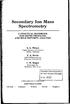 Secondary Ion Mass Spectrometry A PRACTICAL HANDBOOK FOR DEPTH PROFILING AND BULK IMPURITY ANALYSIS R. G. Wilson Hughes Research Laboratories Malibu, California F. A. Stevie AT&T Bell Laboratories Allentown,
for boilers From selecting the best NDT technique to monitoring inspection quality
 Non-destructive testing for boilers From selecting the best NDT technique to monitoring inspection quality > Ensuring safe and efficient operation > Optimizing maintenance > Maximizing availability > Avoiding
Vacuum Evaporation Recap
 Sputtering Vacuum Evaporation Recap Use high temperatures at high vacuum to evaporate (eject) atoms or molecules off a material surface. Use ballistic flow to transport them to a substrate and deposit.
PIPELINE INSPECTION UTILIZING ULTRASOUND TECHNOLOGY: ON THE ISSUE OF RESOLUTION By, M. Beller, NDT Systems & Services AG, Stutensee, Germany
 ABSTRACT: PIPELINE INSPECTION UTILIZING ULTRASOUND TECHNOLOGY: ON THE ISSUE OF RESOLUTION By, M. Beller, NDT Systems & Services AG, Stutensee, Germany Today, in-line inspection tools are used routinely
TITANIUM FABRICATION CORP.
 TITANIUM FABRICATION CORP. Titanium, Zirconium, and Tantalum Clad Construction General Considerations In many applications, particularly for large pressure vessels designed for high temperature and pressure,
The Basics of Scanning Electron Microscopy
 The Basics of Scanning Electron Microscopy The small scanning electron microscope is easy to use because almost every variable is pre-set: the acceleration voltage is always 15kV, it has only a single
THERMO NORAN SYSTEM SIX ENERGY DISPERSIVE X- RAY SPECTROMETER. Insert Nickname Here. Operating Instructions
 THERMO NORAN SYSTEM SIX ENERGY DISPERSIVE X- RAY SPECTROMETER Insert Nickname Here Operating Instructions Table of Contents 1 INTRODUCTION Safety 1 Samples 1 2 BACKGROUND Background Information 3 References
Evaluating Surface Roughness of Si Following Selected Lapping and Polishing Processes
 Applications Laboratory Report 86 Evaluating Surface Roughness of Si Following Selected Processes Purpose polishing of samples is a common application and required for a variety of manufacturing and research
Structural Integrity Analysis
 Structural Integrity Analysis 1. STRESS CONCENTRATION Igor Kokcharov 1.1 STRESSES AND CONCENTRATORS 1.1.1 Stress An applied external force F causes inner forces in the carrying structure. Inner forces
Inspection Methods Overview and Comparison
 Inspection of Metals Understanding the Basics Copyright 2013 ASM International F.C. Campbell, editor All rights reserved www.asminternational.org CHAPTER 1 Inspection Methods Overview and Comparison INSPECTION
View of ΣIGMA TM (Ref. 1)
 Overview of the FESEM system 1. Electron optical column 2. Specimen chamber 3. EDS detector [Electron Dispersive Spectroscopy] 4. Monitors 5. BSD (Back scatter detector) 6. Personal Computer 7. ON/STANDBY/OFF
Reliable Flaw Detection. Fast Inspection Times. High quality non-destructive testing services tailored for all your needs. www.tuv.
 INDUSTRIAL SERVICES - NON-DESTRUCTIVE TESTING Reliable Flaw Detection. Fast Inspection Times. High quality non-destructive testing services tailored for all your needs. www.tuv.com/ndt The reliability
Scanning Electron Microscopy Services for Pharmaceutical Manufacturers
 Scanning Electron Microscopy Services for Pharmaceutical Manufacturers Author: Gary Brake, Marketing Manager Date: August 1, 2013 Analytical Testing Laboratory www.atl.semtechsolutions.com Scanning Electron
Use the BET (after Brunauer, Emmett and Teller) equation is used to give specific surface area from the adsorption
 Number of moles of N 2 in 0.129dm 3 = 0.129/22.4 = 5.76 X 10⁻³ moles of N 2 gas Module 8 : Surface Chemistry Objectives Lecture 37 : Surface Characterization Techniques After studying this lecture, you
DIRECT CURRENT GENERATORS
 DIRECT CURRENT GENERATORS Revision 12:50 14 Nov 05 INTRODUCTION A generator is a machine that converts mechanical energy into electrical energy by using the principle of magnetic induction. This principle
An Investigationof Non Destructive Testing of Pressure Vessel
 An Investigationof Non Destructive Testing of Pressure Vessel Mohd Abdul Wahed 1, Mohammed Farhan 2 1,2 Assistant Professor, Departmentof MechanicaL Engineering, Nsakcet,AP-500024 Abstract--Non-Destructive
Theory of Heating by Induction
 CHAPTER 2 Theory of Heating by Induction INDUCTION HEATING was first noted when it was found that heat was produced in transformer and motor windings, as mentioned in the Chapter Heat Treating of Metal
In the previous presentation, we discussed how x-rays were discovered and how they are generated at the atomic level. Today we will begin the
 In the previous presentation, we discussed how x-rays were discovered and how they are generated at the atomic level. Today we will begin the discussion on the major components of the x-ray machine. Today
NEW TECHNIQUE FOR RESIDUAL STRESS MEASUREMENT NDT
 NEW TECHNIQUE FOR RESIDUAL STRESS MEASUREMENT NDT E. Curto. p.i. Ennio Curto Via E. di Velo,84 36100 Vicenza Tel. 0444-511819 E-mail [email protected] Key words: NDE Residual stress. New technique
Emerging NDE Technology for Aging Aircraft Large Area Scanning To Small High Resolution Systems Maintenance Planning Tools
 Emerging NDE Technology for Aging Aircraft Large Area Scanning To Small High Resolution Systems Maintenance Planning Tools David G. Moore 505.844.7095 Dennis P. Roach 505.844.6078 Sandia National Laboratories
BGA - Ball Grid Array Inspection Workshop. Bob Willis leadfreesoldering.com
 BGA - Ball Grid Array Inspection Workshop Bob Willis leadfreesoldering.com Mixed Technology Assembly Processes Adhesive Dispensing Component Placement Adhesive Curing Turn Boar Over Conventional Insertion
2 Absorbing Solar Energy
 2 Absorbing Solar Energy 2.1 Air Mass and the Solar Spectrum Now that we have introduced the solar cell, it is time to introduce the source of the energy the sun. The sun has many properties that could
Information about the T9 beam line and experimental facilities
 Information about the T9 beam line and experimental facilities The incoming proton beam from the PS accelerator impinges on the North target and thus produces the particles for the T9 beam line. The collisions
Unmatched Metal Hardness Testing
 Unmatched Metal Hardness Testing The Equostat 3 hardness tester can be connected both to the portable Equotip 3 platform and directly to a PC, with graphic user guidance Hardness Measurements made easy
Basic Concepts of X-ray X Fluorescence by Miguel Santiago, Scientific Instrumentation Specialist
 Basic Concepts of X-ray X Fluorescence by Miguel Santiago, Scientific Instrumentation Specialist University of Puerto Rico Mayagüez Campus Department of Geology X-ray / Microanalysis Laboratory F - 304
PHYS 222 Spring 2012 Final Exam. Closed books, notes, etc. No electronic device except a calculator.
 PHYS 222 Spring 2012 Final Exam Closed books, notes, etc. No electronic device except a calculator. NAME: (all questions with equal weight) 1. If the distance between two point charges is tripled, the
Microscopy and Nanoindentation. Combining Orientation Imaging. to investigate localized. deformation behaviour. Felix Reinauer
 Combining Orientation Imaging Microscopy and Nanoindentation to investigate localized deformation behaviour Felix Reinauer René de Kloe Matt Nowell Introduction Anisotropy in crystalline materials Presentation
PHYSICAL METHODS, INSTRUMENTS AND MEASUREMENTS Vol. III - Surface Characterization - Marie-Geneviève Barthés-Labrousse
 SURFACE CHARACTERIZATION Marie-Geneviève Centre d Etudes de Chimie Métallurgique, CNRS, Vitry-sur-Seine, France Keywords: Surface Analysis, Surface imaging, Surface composition, Surface chemical analysis,
Nanometer-scale imaging and metrology, nano-fabrication with the Orion Helium Ion Microscope
 [email protected] Nanometer-scale imaging and metrology, nano-fabrication with the Orion Helium Ion Microscope Bin Ming, András E. Vladár and Michael T. Postek National Institute of Standards and Technology
A Remote Plasma Sputter Process for High Rate Web Coating of Low Temperature Plastic Film with High Quality Thin Film Metals and Insulators
 A Remote Plasma Sputter Process for High Rate Web Coating of Low Temperature Plastic Film with High Quality Thin Film Metals and Insulators Dr Peter Hockley and Professor Mike Thwaites, Plasma Quest Limited
bulk 5. Surface Analysis Why surface Analysis? Introduction Methods: XPS, AES, RBS
 5. Surface Analysis Introduction Methods: XPS, AES, RBS Autumn 2011 Experimental Methods in Physics Marco Cantoni Why surface Analysis? Bulk: structural function Electrical/thermal conduction Volume increases
CHAPTER 13 LOAD HOOKS
 CHAPTER 13 LOAD HOOKS This chapter provides safety standards for the inspection, testing, and maintenance of load hooks installed on cranes or hoists and implements the requirements of ASME B30.10, Chapter
Micro-CT for SEM Non-destructive Measurement and Volume Visualization of Specimens Internal Microstructure in SEM Micro-CT Innovation with Integrity
 Micro-CT for SEM Non-destructive Measurement and Volume Visualization of Specimens Internal Microstructure in SEM Innovation with Integrity Micro-CT 3D Microscopy Using Micro-CT for SEM Micro-CT for SEM
NDT 2010 Conference Topics
 NDT 2010 Conference Topics Session 2B (2) Novel Techniques Chairman Dr R A Smith 14.30 A new and novel inspection system for Titanium billets Authors - Harshad V. Patel, Xiaoming Jian, Simon Woods, Ian
Adapter Catalog MOBILE METAL ANALYZER. SPECTRO isort and SPECTROTEST
 Adapter Catalog MOBILE METAL ANALYZER SPECTRO isort and SPECTROTEST Testing Adapters for Mobile Metal Analyzers A full range of metal analyzer products for onsite metal analysis tasks SPECTRO isort SPECTROTEST
Acoustic GHz-Microscopy: Potential, Challenges and Applications
 Acoustic GHz-Microscopy: Potential, Challenges and Applications A Joint Development of PVA TePLa Analytical Systems GmbH and Fraunhofer IWM-Halle Dr. Sebastian Brand (Ph.D.) Fraunhofer CAM Fraunhofer Institute
Science Standard Articulated by Grade Level Strand 5: Physical Science
 Concept 1: Properties of Objects and Materials Classify objects and materials by their observable properties. Kindergarten Grade 1 Grade 2 Grade 3 Grade 4 PO 1. Identify the following observable properties
AS COMPETITION PAPER 2008
 AS COMPETITION PAPER 28 Name School Town & County Total Mark/5 Time Allowed: One hour Attempt as many questions as you can. Write your answers on this question paper. Marks allocated for each question
Improved predictive modeling of white LEDs with accurate luminescence simulation and practical inputs
 Improved predictive modeling of white LEDs with accurate luminescence simulation and practical inputs TracePro Opto-Mechanical Design Software s Fluorescence Property Utility TracePro s Fluorescence Property
Pipeline External Corrosion Analysis Using a 3D Laser Scanner
 Pipeline Technology Conference 2013 Pipeline External Corrosion Analysis Using a 3D Laser Scanner Pierre-Hugues ALLARD, Charles MONY Creaform, www.creaform3d.com 5825 rue St-Georges, Lévis (QC), Canada,
Chapter 8. Low energy ion scattering study of Fe 4 N on Cu(100)
 Low energy ion scattering study of 4 on Cu(1) Chapter 8. Low energy ion scattering study of 4 on Cu(1) 8.1. Introduction For a better understanding of the reconstructed 4 surfaces one would like to know
Introduction to Standards and Nondestructive Testing of Industrial Materials
 This sample chapter is for review purposes only. Copyright The Goodheart-Willcox Co., Inc. All rights reserved. KEY CONCEPTS 17 Introduction to Standards and Nondestructive Testing of Industrial Materials
X-ray Production. Target Interactions. Principles of Imaging Science I (RAD119) X-ray Production & Emission
 Principles of Imaging Science I (RAD119) X-ray Production & Emission X-ray Production X-rays are produced inside the x-ray tube when high energy projectile electrons from the filament interact with the
EDS system. CRF Oxford Instruments INCA CRF EDAX Genesis EVEX- NanoAnalysis Table top system
 EDS system Most common X-Ray measurement system in the SEM lab. Major elements (10 wt% or greater) identified in ~10 secs. Minor elements identifiable in ~100 secs. Rapid qualitative and accurate quantitative
MOOG. MACHINING SUPPLIER WORKMANSHIP STANDARDS Issue: 1-APRIL- 2007
 INTRODUCTION Supported by valued suppliers, Moog has developed a reputation for quality, performance and delivery that has helped it to become a leading supplier of highly sophisticated control systems.
WJM Technologies excellence in material joining
 Girish P. Kelkar, Ph.D. (562) 743-7576 [email protected] www.welding-consultant.com Weld Cracks An Engineer s Worst Nightmare There are a variety of physical defects such as undercut, insufficient
Health Care for Pipelines From Cradle to Grave
 Health Care for Pipelines From Cradle to Grave By Jim Costain, GE Inspection Technologies Assuring the mechanical integrity of piping systems, whether they be in exploration, transmission, or process plants
APPLICATION OF X-RAY COMPUTED TOMOGRAPHY IN SILICON SOLAR CELLS
 APPLICATION OF X-RAY COMPUTED TOMOGRAPHY IN SILICON SOLAR CELLS V.A. Popovich 1, W. Verwaal 2, M. Janssen 1, I. J. Bennett 3, I.M.Richardson 1, 1. Delft University of Technology, Department of Materials
Amptek Application Note XRF-1: XRF Spectra and Spectra Analysis Software By R.Redus, Chief Scientist, Amptek Inc, 2008.
 Amptek Application Note XRF-1: XRF Spectra and Spectra Analysis Software By R.Redus, Chief Scientist, Amptek Inc, 2008. X-Ray Fluorescence (XRF) is a very simple analytical technique: X-rays excite atoms
Lecture 6 Scanning Tunneling Microscopy (STM) General components of STM; Tunneling current; Feedback system; Tip --- the probe.
 Lecture 6 Scanning Tunneling Microscopy (STM) General components of STM; Tunneling current; Feedback system; Tip --- the probe. Brief Overview of STM Inventors of STM The Nobel Prize in Physics 1986 Nobel
Technical Notes NDT 001 Specific Requirements for Non- Destructive Testing Laboratories
 ACCREDITATION SCHEME FOR LABORATORIES Technical Notes NDT 001 Specific Requirements for Non- Destructive Testing Laboratories Technical Notes NDT 001, Apr 14 The SAC Accreditation Programme is managed
Nondestructive Testing: Why, When, What and How?
 : Why, When, What and How? Executive Summary Non-destructive testing (NDT) relates to the examination of materials for flaws without harming the object being tested. As an industrial test method, NDT provides
Fundamentals of Extrusion
 CHAPTER1 Fundamentals of Extrusion The first chapter of this book discusses the fundamentals of extrusion technology, including extrusion principles, processes, mechanics, and variables and their effects
UNCLASSIFIED INNOVATIVE CONCEPTS FOR PERFORMANCE EVALUATION & QUALITY ASSURANCE OF CERAMIC TILE ARMOR SYSTEMS (U)
 INNOVATIVE CONCEPTS FOR PERFORMANCE EVALUATION & QUALITY ASSURANCE OF CERAMIC TILE ARMOR SYSTEMS (U) Peter A Russell, Michelle Dubas and Michael Reynolds O Gara-Hess & Eisenhardt Armoring Company Fairfield,
Encoders for Linear Motors in the Electronics Industry
 Technical Information Encoders for Linear Motors in the Electronics Industry The semiconductor industry and automation technology increasingly require more precise and faster machines in order to satisfy
Project 2B Building a Solar Cell (2): Solar Cell Performance
 April. 15, 2010 Due April. 29, 2010 Project 2B Building a Solar Cell (2): Solar Cell Performance Objective: In this project we are going to experimentally measure the I-V characteristics, energy conversion
NDT Procedure for Liquid Penetrant Inspection TRINITY NDT. An ISO 9001:2008 Certified Company
 NDT Procedure for Liquid Penetrant Inspection A Nondestructive testing (NDT) Procedure suitable for General Liquid/Dye Penetrant Inspections. This is a sample LPT procedure and may be required to be modified
Tutorial 4.6 Gamma Spectrum Analysis
 Tutorial 4.6 Gamma Spectrum Analysis Slide 1. Gamma Spectrum Analysis In this module, we will apply the concepts that were discussed in Tutorial 4.1, Interactions of Radiation with Matter. Slide 2. Learning
Tubing Data. Contents. Tubing Selection. Tubing Handling. Tubing Material. Tubing Outside Diameter Hardness. Tubing Wall Thickness
 www.swagelok.com Tubing Data Contents Tubing Selection... 1 Tubing Handling.... 1 Gas Service... 2 Tubing Installation.... 2 Suggested Allowable Working Pressure Tables Carbon Steel Tubing... 3 Stainless
INFRARED MONITORING OF 110 GHz GYROTRON WINDOWS AT DIII D
 GA A23981 INFRARED MONITORING OF 110 GHz GYROTRON WINDOWS AT DIII D by Y. GORELOV, J. LOHR, R.W. CALLIS, and D. PONCE MAY 2002 DISCLAIMER This report was prepared as an account of work sponsored by an
Manufacturing Tooling Cutting Tool Design. Elements of Machining. Chip Formation. Nageswara Rao Posinasetti
 Manufacturing Tooling Cutting Tool Design Nageswara Rao Posinasetti Elements of Machining Cutting tool Tool holding Guiding device Work piece Machine tool January 29, 2008 Nageswara Rao Posinasetti 2 Chip
Eðlisfræði 2, vor 2007
 [ Assignment View ] [ Pri Eðlisfræði 2, vor 2007 28. Sources of Magnetic Field Assignment is due at 2:00am on Wednesday, March 7, 2007 Credit for problems submitted late will decrease to 0% after the deadline
Scanning Acoustic Microscopy Training
 Scanning Acoustic Microscopy Training This presentation and images are copyrighted by Sonix, Inc. They may not be copied, reproduced, modified, published, uploaded, posted, transmitted, or distributed
Quality assurance of flex circuits in the SCT barrel hybrid production
 Quality assurance of flex circuits in the SCT barrel hybrid production ATLAS Project Document No. Institute Document No. Created: dd/mm/yy Modified: dd/mm/yy Page: 1 of 11 DRAFT Quality assurance of flex
Measurement of Charge-to-Mass (e/m) Ratio for the Electron
 Measurement of Charge-to-Mass (e/m) Ratio for the Electron Experiment objectives: measure the ratio of the electron charge-to-mass ratio e/m by studying the electron trajectories in a uniform magnetic
Nondestructive Testing and Evaluation of Steel Bridges
 Abstract Nondestructive Testing and Evaluation of Steel Bridges James Bader ENCE 710 Spring 2008 Nondestructive evaluation (NDE) is a means of evaluating structural components without damaging them. It
Atomic Force Microscope and Magnetic Force Microscope Background Information
 Atomic Force Microscope and Magnetic Force Microscope Background Information Lego Building Instructions There are several places to find the building instructions for building the Lego models of atomic
Phased-Array ROWA-SPA: High-performance testing machine for combined, 100-percent automated testing of square and round bars
 11th European Conference on Non-Destructive Testing (ECNDT 2014), October 6-10, 2014, Prague, Czech Republic Phased-Array ROWA-SPA: High-performance testing machine for combined, 100-percent automated
X-ray diffraction techniques for thin films
 X-ray diffraction techniques for thin films Rigaku Corporation Application Laboratory Takayuki Konya 1 Today s contents (PM) Introduction X-ray diffraction method Out-of-Plane In-Plane Pole figure Reciprocal
BARE PCB INSPECTION BY MEAN OF ECT TECHNIQUE WITH SPIN-VALVE GMR SENSOR
 BARE PCB INSPECTION BY MEAN OF ECT TECHNIQUE WITH SPIN-VALVE GMR SENSOR K. Chomsuwan 1, S. Yamada 1, M. Iwahara 1, H. Wakiwaka 2, T. Taniguchi 3, and S. Shoji 4 1 Kanazawa University, Kanazawa, Japan;
proper way. Therefore operator training and certification is key in every inspection program to ensure compliance and improve quality and integrity.
 SGS NDT Training & Examination Centre Professional Services for Your Safety and Reputation ABOUT NON DESTRUCTIVE TESTING (NDT) About NDT NDT plays a key role in assessing conformity and reliability of
Good Boards = Results
 Section 2: Printed Circuit Board Fabrication & Solderability Good Boards = Results Board fabrication is one aspect of the electronics production industry that SMT assembly engineers often know little about.
Non-destructive testing for plant life assessment
 Non-destructive testing for plant life assessment VIENNA, 2005 TRAINING COURSE SERIES26 TRAINING COURSE SERIES No. 26 Non-destructive testing for plant life assessment INTERNATIONAL ATOMIC ENERGY AGENCY,
EXPERIMENTAL AND NUMERICAL ANALYSIS OF THE COLLAR PRODUCTION ON THE PIERCED FLAT SHEET METAL USING LASER FORMING PROCESS
 JOURNAL OF CURRENT RESEARCH IN SCIENCE (ISSN 2322-5009) CODEN (USA): JCRSDJ 2014, Vol. 2, No. 2, pp:277-284 Available at www.jcrs010.com ORIGINAL ARTICLE EXPERIMENTAL AND NUMERICAL ANALYSIS OF THE COLLAR
NON-DESTRUCTIVE TESTING OF DUPLEX STAINLESS STEEL
 NON-DESTRUCTIVE TESTING OF DUPLEX STAINLESS STEEL AUTHORS: Keith Doughten, District Manager, Magnetic Analysis Corporation, ASNT NDT Level III ET, UT David Bauer, Marketing and Training Manager, Magnetic
Cathode Ray Tube. Introduction. Functional principle
 Introduction The Cathode Ray Tube or Braun s Tube was invented by the German physicist Karl Ferdinand Braun in 897 and is today used in computer monitors, TV sets and oscilloscope tubes. The path of the
P R E A M B L E. Facilitated workshop problems for class discussion (1.5 hours)
 INSURANCE SCAM OPTICS - LABORATORY INVESTIGATION P R E A M B L E The original form of the problem is an Experimental Group Research Project, undertaken by students organised into small groups working as
Crevice Corrosion on Stainless Steel Propeller Shafts
 Crevice Corrosion on Stainless Steel Propeller Shafts A Quick Summary: What is it? How to Prevent it. How to Repair it. Stainless steel propeller shafts and running gear are subject to pitting & crevice
How to Build a Printed Circuit Board. Advanced Circuits Inc 2004
 How to Build a Printed Circuit Board 1 This presentation is a work in progress. As methods and processes change it will be updated accordingly. It is intended only as an introduction to the production
Failure Analysis: Nondestructive Testing Methods Daniel H. Herring - The Herring Group Inc., Elmhurst, Ill.
 Failure Analysis: Nondestructive Testing Methods Daniel H. Herring - The Herring Group Inc., Elmhurst, Ill. Many defect-testing techniques exist and it may not be clear why one is used over the other.
Silicon Drift Detector Product Brochure Update 2013
 Silicon Drift Detector Product Brochure Update 2013 Content Classic Silicon Drift Detector High Resolution Silicon Drift Detector Multielement Silicon Detector Extra Large Detector Series July 2013 About
Non-Destructive Testing
 Non-Destructive Testing Bureau Veritas is one of the largest Testing, Inspection and Certification service providers in the world. First established in 1828, Bureau Veritas now spans the globe with a network
Quality Control on Aerospace Components Using Handheld X-ray Fluorescence (XRF)
 International Workshop SMART MATERIALS, STRUCTURES & NDT in AEROSPACE Conference NDT in Canada 2011 2-4 November 2011, Montreal, Quebec, Canada Quality Control on Aerospace Components Using Handheld X-ray
Direction of current flow through conductor. Fig. 1 Magnetic field generated by current flow
 ingle Conductor Cable Copper heathed Cable heath Currents ingle conductor cables present certain application considerations that do not arise in multiconductor cable installations. These considerations
Ultrasonic Technique and Device for Residual Stress Measurement
 Ultrasonic Technique and Device for Residual Stress Measurement Y. Kudryavtsev, J. Kleiman Integrity Testing Laboratory Inc. 80 Esna Park Drive, Units 7-9, Markham, Ontario, L3R 2R7 Canada [email protected]
Usage of Carbon Nanotubes in Scanning Probe Microscopes as Probe. Keywords: Carbon Nanotube, Scanning Probe Microscope
 International Journal of Arts and Sciences 3(1): 18-26 (2009) CD-ROM. ISSN: 1944-6934 InternationalJournal.org Usage of Carbon Nanotubes in Scanning Probe Microscopes as Probe Bedri Onur Kucukyildirim,
Mass production, R&D Failure analysis. Fault site pin-pointing (EM, OBIRCH, FIB, etc. ) Bottleneck Physical science analysis (SEM, TEM, Auger, etc.
 Failure Analysis System for Submicron Semiconductor Devices 68 Failure Analysis System for Submicron Semiconductor Devices Munetoshi Fukui Yasuhiro Mitsui, Ph. D. Yasuhiko Nara Fumiko Yano, Ph. D. Takashi
Experiment #5: Qualitative Absorption Spectroscopy
 Experiment #5: Qualitative Absorption Spectroscopy One of the most important areas in the field of analytical chemistry is that of spectroscopy. In general terms, spectroscopy deals with the interactions
NDT Procedure for Liquid Penetrant Inspection
 NDT Procedure for Liquid Penetrant Inspection A Nondestructive testing (NDT) Procedure suitable for General Liquid/Dye Penetrant Inspections. This is a sample LPT procedure and may be required to be modified
1. The diagram below represents magnetic lines of force within a region of space.
 1. The diagram below represents magnetic lines of force within a region of space. 4. In which diagram below is the magnetic flux density at point P greatest? (1) (3) (2) (4) The magnetic field is strongest