
DVR User Guide rev1.2
|
|
|
- Suzan Theresa Lloyd
- 10 years ago
- Views:
Transcription
1 DVR User Guide rev1.2
2

3 Contents In This Issue:...ii Front Panel Indicators and Controls...1 DVR Front Panel Numeric/Alpha Key Controls...2 IR Remote Control...3 IR Remote Control Setup and Configuration...3 USB Mouse Control...4 Start Up...4 Record Status Bar...5 Alarm Status Bar...5 Menu Descriptions...6 Menu Operation...6 Main Menu Description...6 System Setup...7 Main Menu...8 Programming Users and Passwords...8 Add a User...9 Select User Permissions...10 User Rights Description...10 Delete Users...11 Display Menu...12 Image Menu...14 Recording Menu...21 Manual Recording...25 Playback...26 SmartSearch (Motion History)...29 Event Playback...30 Network Menu...31 Alarm Menu...36 Exception Menu...40 PTZ Menu...41 RS232 Menu...46 Preview Menu...47 Transact(ion) Menu...48 Utilities Menu...51 Tools...52 Restore Para(meters)...54 Upgrade...54 Hard Disk Management...55 Stop AlmOut...56 Reboot...56 Power Off...56 View Log...56 System Information...58 DVR Rear Panel Connections...59 Index E rev1.2 ( ) 2008 CSG Security Inc. / Sécurité CSG Inc. i
4 Disclaimer This document contains proprietary information of CSG Security Inc. / Sécurité CSG Inc., and may not be reproduced in any form or disclosed to any third party without written approval of a duly authorized representative of CSG Security Inc./Sécurité CSG Inc. All products are warranted against defects in workmanship or materials (details available upon request). Installers are responsible for knowing and complying with any local regulatory fire and building codes. In the interests of improving quality and design, the right to amend specifications without given prior notice is reserved. Do Not Alter Components: Altering units, or removing components without written consent by the manufacturer may void warranties and/or cause the specific device to no longer meet local regulatory requirements. Copyrights and Trademarks All other trademarks are acknowledged as the property of their respective owners. Copyright CSG Security Inc. / Sécurité CSG Inc. All rights reserved. In This Issue: Rev1.2 NVeDVR User Guide Refer to the Table of Contents or Index for the following updates: Turning on PTZ Cruise Control, AUTO Pan and Start Sequence from the DVR front panel controls. NTP (Network Time Protocol) selection added to the Network section. ii NVeDVR User Guide E rev1.2
5 EN Statement: This is a class A product. In a domestic environment this product may cause radio interference in which case the user may be required to take adequate measures. ICES003 Statement: This Class A digital apparatus complies with Canadian ICES-003. Cet appareil numérique de la classe A est conforme à la norme NMB-003 du Canada. FCC Statement This device complies with Part 15 of the FCC Rules. Operation is subject to the following two conditions: (1) this device may not cause harmful interference, and (2) this device must accept any interference received, including interference that may cause undesired operation. NOTE: This equipment has been tested and found to comply with the limits for a Class A digital device, pursuant to Part 15 of the FCC Rules. These limits are designed to provide reasonable protection against harmful interference when the equipment is operated in a commercial environment. This equipment generates, uses, and can radiate radio frequency energy and, if not installed and used in accordance with the instruction manual, may cause harmful interference to radio communications. Operation of this equipment in a residential area is likely to cause harmful interference in which case the user will be required to correct the interference at his own expense. CAUTION: Changes or modifications not expressly approved by UTC Fire & Security (UTCFS) or one of the UTCFS member companies may void the user s authority to operate this product. This device is intended for use in professional security environments by trained personnel. There are NO user serviceable parts in this device. Any service required must be undertaken by trained personnel. If the unit arrives in an obviously damaged condition, do not attempt to power or use the unit. Contact your sales representative to arrange a replacement. Use the power cord supplied with the unit to connect to AC power supply. The circuit supplying the unit must have branch protection in accordance with the appropriate governing electrical regulations. Only connect the unit to a properly grounded receptacle. If a suitable, grounded, power supply receptacle is not available contact a qualified electrician to have one installed E rev1.2 NVeDVR User Guide iii
6

7 Welcome For further information, refer to E, DVR Installation Guide and E, DVR PC Software User Guide

8

9 Front Panel Indicators and Controls Index Name Description 1 Camera Indicator Lights READY IR ALARM MODEM HDD LINK Tx/Rx POWER F1 F2 Blue = recording, Red = network transmission, Purple = recording and network transmission. Blue = DVR is ready. Blue = IR remote control is programmed. Red = alarm Blue = modem connection and dial-up successful Flashing red = reading or writing HDD Blue = network connection is OK Flashing Blue = data is being transmitted over the network. Blue =Unit Power On or Red = Stand-by. LIGHT in PTZ control. AUX in PTZ control. 3 Input switch (number, lower case, upper case and symbol). IRIS+ in PTZ control. Preview F3 Mode: hide or display channel status bar. F4 IRIS in PTZ control 4 PTZ Control Enter into Pan, Tilt, Zoom camera operation. FOCUS + in PTZ control. 2 Activity Lights E rev1.2 NVeDVR User Guide 1

10 Front Panel Indicators and Controls cont. Index Name Description 5 EDIT In camera preview mode cycles through various camera inputs based on the current display mode. Deletes current cursor character. ZOOM+ in PTZ control. Select or to enable or disable menu selections. Opens an Editing field. 6 ENTER Menu confirmation. Press ENTER to accept changes or to enable/disable a parameter. Pause playback. Press Enter to turn on DVR when it is in Stand-By Power from being Powered Off in the Utilities Menu. Navigation Control In Menu: use the left, right arrow keys to make a selection, use the up, down arrows to edit selections. In PTZ: direction controls. Playback speed control. Switch the display to the menu. Wiper control in PTZ mode. Press and hold for 5 MENU 7 seconds to stop key stroke tones. ESCAPE Cancel and back to parent menu or cancel changes while editing a field. 8 RECORD Manual record. FOCUS in PTZ mode (adjust preset). 9 PLAY Local Playback. Event Playback screen. ZOOM in PTZ mode PREV Single or Multi screen preview switch. Switch menu mode into preview. In PTZ Mode: this button acts as SHOT and is used to select a preset PTZ value (i.e., Pressing SHOT and then 001 would send the PTZ camera to Preset #1). 10 SPOT/ PTZ Cruise Control, AUTO Pan, Start Sequence Numerical Keys The SPOT button alternates control between the MAIN monitor and the AUX monitor. Connect an AUX monitor and turn on the Status Bar. A check-mark will display on the Main monitor (lower right corner) and an X on the AUX monitor. Press SPOT and the checkmark and X should switch showing that the AUX monitor is now the primary output. Note that the AUX monitor will not display the OSD menu. With PTZ Control enabled: Press the SPOT button and then the number 1 button to start Cruise control of the selected PTZ camera. Press the PTZ button to stop. With PTZ Control enabled: Press the SPOT button and then the number 2 button to begin an AUTO pan of the selected PTZ camera. Press the PTZ button to stop. With PTZ Control enabled: Press the SPOT button and then the number 3 button to start the Start Sequence of the selected PTZ camera. Press the PTZ button to stop. Keys for Numeric/Alpha entries. DVR Front Panel Numeric/Alpha Key Controls The numeric keys used on the front panel and remote control are the same as a mouse control provides when the mouse is left clicked. Press the F3 key to change the numeric/alpha method to Number, Uppercase Letter, Lowercase Letter and Symbol When in alpha (letter) mode, upper or lowercase, pressing the number key repeatedly will move the selection through the letter choices (abc) 3(def) 4(ghi) 5(jkl) 6(mno) 7(pqrs) 8(tuv) 9(wxyz) When in the symbol mode, pressing the 0 (zero) key increments through the following pages: Key: Page 1 [spacebar]. [period], [comma]? [question]! [exclamation] : [colon] Page 2 ; [semi-colon] - [dash] + [plus] # [pound] * [asterisk] ( [open para] Page 3 ) [close para] / [forward slash] [apostrophe] [quotes] _ [ at sign] Page 4 & [ampersand] $ [dollar] \ [back slash] < [arrow left] > [arrow right] = [equals] 2 NVeDVR User Guide E rev1.2

11 IR Remote Control All actions on the front panel can also be done on the remote control. Index Name Description IR Remote Control Setup and Configuration 1 POWER Turn device on/off 2 DEV Enable/Disable IR remote control 3 Numeric Keys Same as numeric keys of front panel 4 EDIT Same as EDIT key of front panel 5 A Same as F3 key of front panel 6 REC Same as REC key of front panel 7 PLAY Same as PLAY key of front panel 8 INFO Same as INFO key of front panel 9 VOIP Same as [Main/Aux] key of front panel 10 MENU Same as MENU key of front panel 11 PREV Same as PREV key of front panel 12 Direction Keys ENTER Same as direction keys and enter key of front panel 13 PTZ Same as PTZ key of front panel 14 ESC Same as ESC key of front panel 15 Reserved Not Used 16 F1 Same as F1 key of front panel 17 Lens control in PTZ mode IRIS, FOCUS ZOOM for lens control 18 F2 Same as F2 key of front panel Loading the batteries into the Remote Control 1. Remove the battery cover. 2. Insert the batteries. Make sure the polarity (+ and ) of the batteries is correct. 3. Replace the battery cover. Using the IR controller 1. Press DEV. 2. Input the DVR Device ID (The default is 88). NOTE: Refer to the Display Menu section to program the Device ID. 3. Press ENTER. The STATUS lamp on the DVR front panel will turn on. The Remote Control is now ready to be used with the DVR. Turn off the IR Remote Control While the Remote Control status LED is on, press DEV. The STATUS LED will turn off. The Remote Control will no longer control the DVR. Trouble Shooting the Remote Control If the Remote Control does not function correctly; Ensure the batteries are installed correctly. Replace the batteries with new ones. Reprogram the Device ID into the Remote Control E rev1.2 NVeDVR User Guide 3
![EDIT key of front panel 5 A Same as F3 key of front panel 6 REC Same as REC key of front panel 7 PLAY Same as PLAY key of front panel 8 INFO Same as INFO key of front panel 9 VOIP Same as [Main/Aux]](/docs-images/42/4833724/images/page_11.jpg "key of front panel 10 MENU Same as MENU key of front panel 11 PREV Same as PREV key of front panel 12 Direction Keys ENTER Same as direction keys and enter key of front panel 13 PTZ Same as PTZ key")
12 USB Mouse Control Plug a USB mouse into the USB connection on the DVR s rear panel. A mouse will duplicate any of the front panel control selections described in this guide. The front panel control described to operate the screen selection can be operated by the mouse by clicking on the selection with the mouse pointer. Left click to select or edit. Right click to cancel or exit (or display menu in live view) A mouse wheel can be used to change cursor location in the edit field or cycle through e.g. days, months, years. Right click the mouse in the Camera Views screen for the Main Menu: Single Camera View Multiple Camera Preview Next Preview PTZ Control Play Event Play Manual Record Close Status Switch Vout (Spot button) Clicking on the password log-in box will display a keyboard selection box. Selections can be made with the mouse pointer to enter characters in the password box etc abc 3def 4ghi EDIT 5jkl 6mno 7pqrs 8tuv 9wxyz F3 Start Up With a monitor connected to the DVR, plug in the DVR to an AC mains supply and switch on the power switch beside the electrical power plug on the DVR s back panel. The DVR will enter into Preview Mode after it starts up. When the Preview Mode screen first opens, a bar with pictures of hard drives will display at the top of the screen. The hard drive that is enabled will appear with a check mark. In this case, hard drive number 3 is present. 4 NVeDVR User Guide E rev1.2

13 The Preview Mode screen displays the date, time, camera name, camera status icon and the camera s image, if the camera is connected and operational. Press the F3 key on the DVR Front Panel Controls or A on the remote control to display or hide the camera status bar. It is off by default. When this bar is visible, it will cover the camera name. Status icons displayed at the bottom of the screen represent the condition of each camera connected to the DVR. In this case there are 16 circles and each one represents cameras 1 16 on this 16 camera DVR, starting from the left. The circles change colors to represent the condition of each connected camera. When a working camera is connected to a channel, the corresponding status circle will switch back and forth from Record to Alarm Status to display dual conditions. Record Status Bar Circle Color White Status Description No video signal. Yellow Pink Green Blue Red Video input. Manual recording. Real time recording. Motion detect recording. External alarm recording. Alarm Status Bar Circle Color Status Description White Video signal lost. Yellow Pink Green Blue Red View tampering alarm. Motion and External alarm. No alarm. Motion alarm. External alarm E rev1.2 NVeDVR User Guide 5

14 Menu Descriptions Menu Operation Press MENU on the DVR controls or remote control, right click a mouse, to enter into the DVR main menu. Select a Username and enter the corresponding password. Notes: You must input a user name and password. The default user name is admin and the default password is WARNING: It is extremely important that default Usernames and default Passwords are changed at the time of installation as a security precaution. Main Menu Description Example: A square surrounds the selected menu icon. The selection square can be moved from one icon to another by using the arrow buttons:,, and. When the desired icon is highlighted, press ENTER to access the secondary menu. Example: highlight the Image icon, press ENTER to access the secondary menu as follows: Example: Perform the same procedure by using a mouse to point and click on the desired icon. Left click on the icon to open the secondary menu. Each menu contains different selections to program the DVR with. The selections are highlighted as the menu is navigated. Navigate through the menus by using the left, right, up and down arrow keys on the DVR or remote control. Use a mouse to make selections. The following are the different types of menu items: 6 NVeDVR User Guide E rev1.2
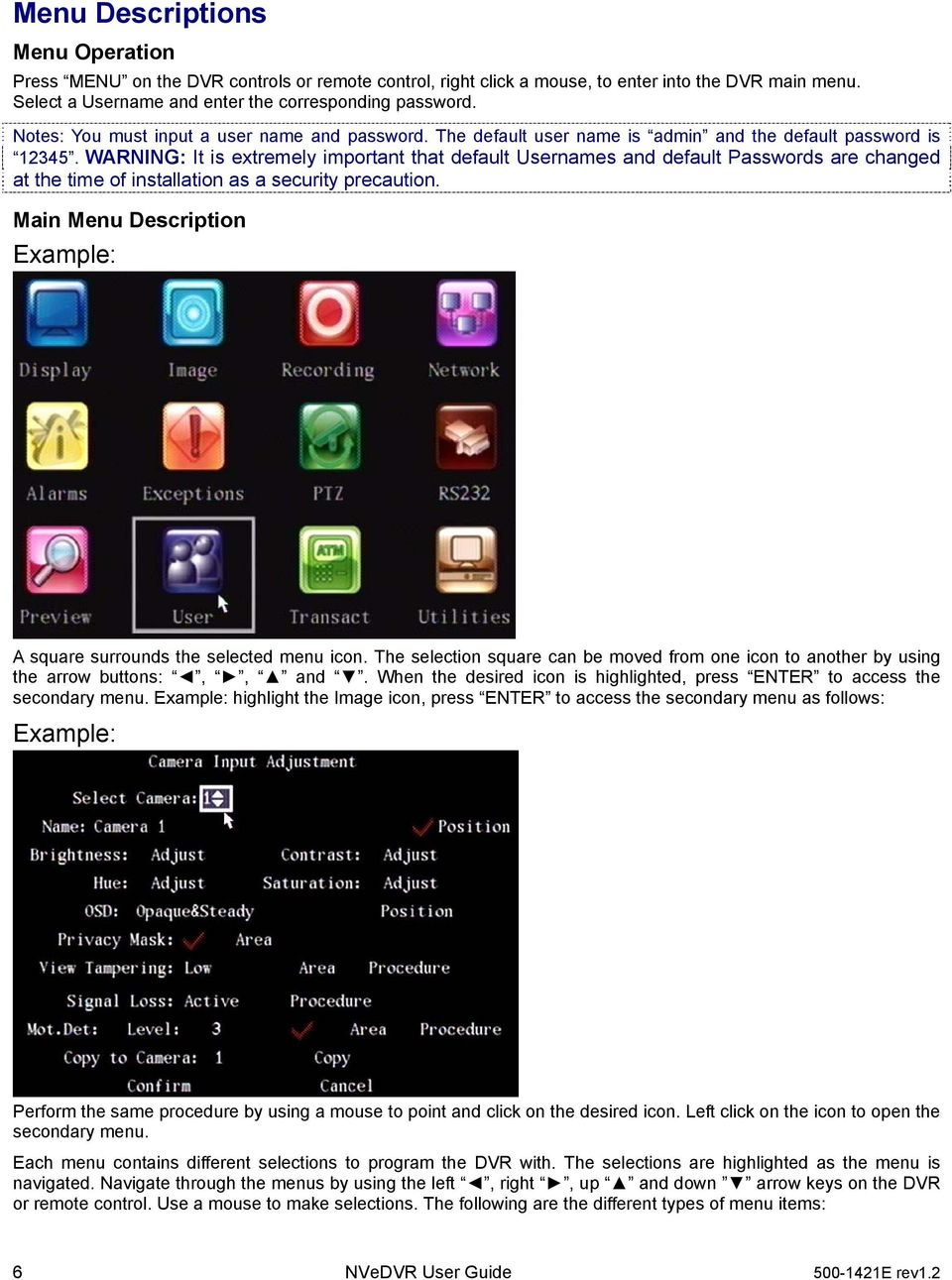
15 Check Box Provides 2 options: means enable and x means disable. Use the ENTER or EDIT keys on the DVR or remote control or a mouse to left click on them and switch between them. List Box List boxes provide more than 2 options. However, only one of them can be selected. Press the Edit key, use the and arrow keys on the DVR or remote control or a mouse to select the option and press the Enter key. Example: to the right of Select Camera, there is a list box to select one of the cameras and choose functions for it in the same menu. Edit Box Input characters. Press EDIT to enter into edit mode and input characters by using the number keypad on the DVR or remote control or left click a mouse to select from an on screen keypad. The number keypad buttons represent different characters depending on the input mode: Press F3 on the DVR controls or left clicked mouse menu or A on the remote control to select number, upper case, lower case or symbols. Use and to move the cursor. Use EDIT to delete the character in front of the cursor. Press ENTER or ESC to exit edit mode. Button Text Do a special function or enter into the next sub-menu. Example: press the Procedure button to enter into the Procedure sub-menu. Press Confirm to save the selections made and return to the parent menu. Press Cancel to cancel any changes and return to the parent menu. A grayed out button can only be operated after it is enabled. How to exit menu mode Press ESC until you are returned to the Preview Mode screen. System Setup Logging In The first time you log into the DVR menu system, you must log in as an Administrator. The default user name is admin and the default password is WARNING: It is extremely important that default Usernames and default Passwords are changed at the time of installation as a security precaution. 1. Press the Menu button to produce the login box on the screen. 2. Select a user (default: admin). 3. Move the cursor to the Pass: field. 4. Enter your password. (default: 12345) 5. Press Enter to accept the password and advance the cursor to the Confirm button E rev1.2 NVeDVR User Guide 7
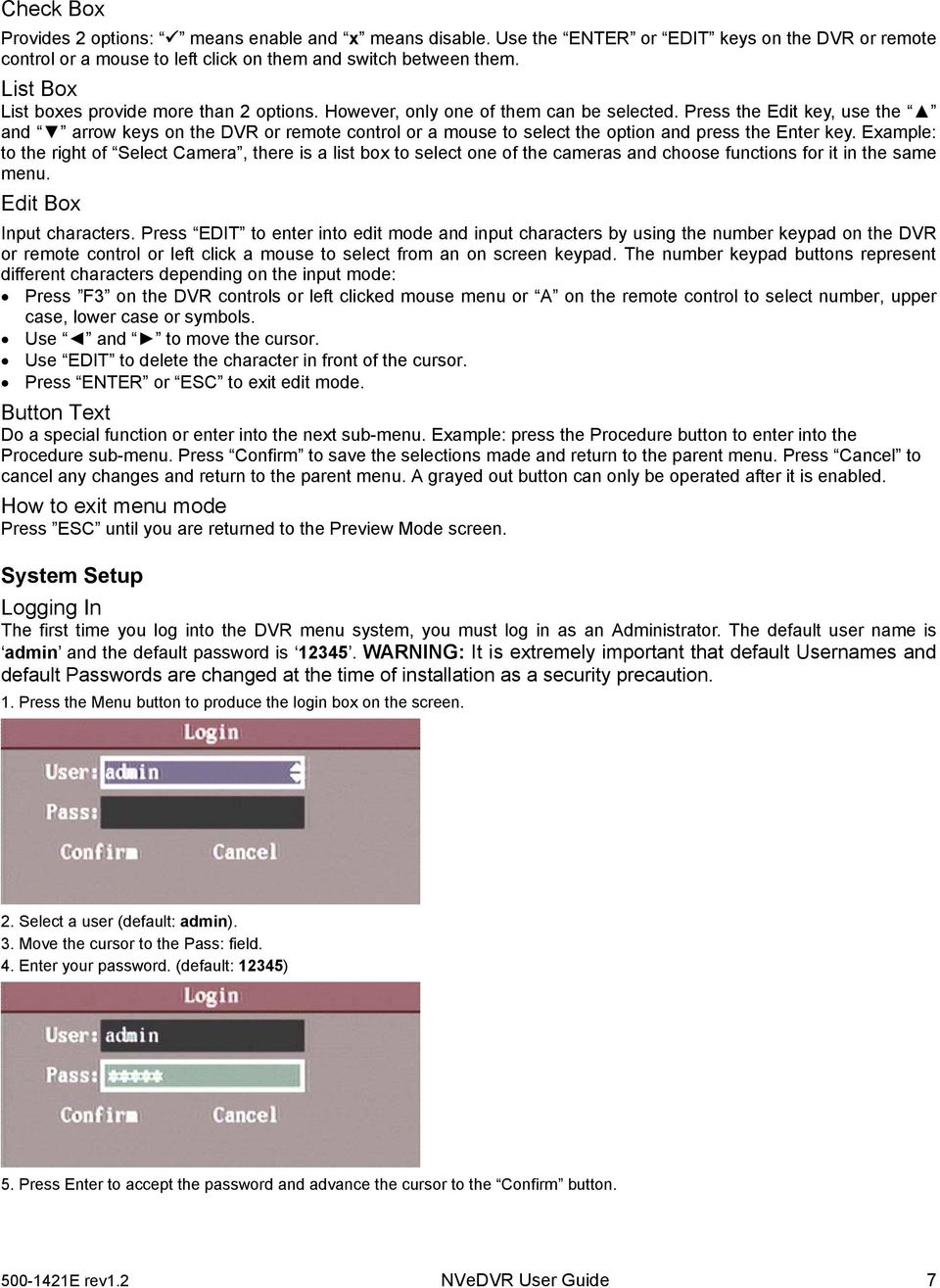
16 6. Press Enter on the DVR or remote control or left click a mouse on it to confirm your input and enter into the Main Menu. Main Menu Programming Users and Passwords A maximum of 16 users can be assigned with various abilities and permissions. 1. From the main menu, navigate to the User submenu. 2. Press ENTER on the DVR or remote control or left click a mouse to select it and display the User submenu. 3. From this menu users can be added or deleted, changed or enter passwords and select user permissions. 8 NVeDVR User Guide E rev1.2

17 Add a User Default Usernames: admin operator investigator Default Passwords (all permissions) (Limited Permissions: PTZ Control and Local Play all channels only.) (Limited Permissions: PTZ and Local Output Control, Local Play all channels only) WARNING: It is extremely important that default Usernames and default Passwords are changed at the time of installation as a security precaution. 1. Move the cursor to Add and press ENTER. 2. Press F3 on the DVR controls or left clicked mouse menu or A on the remote control to change the number keypad to the desired function. (I.e. Number, Uppercase, Lowercase or Symbol). 3. Set the first username character with the number keypad. The cursor will flash and then go solid indicating the character has been accepted and the DVR is ready for the next character. 4. After the username finished, press ENTER. The password for any user can be set or changed while logged in as an Administrator. 1. Select the user you would like to set or modify the password for. 2. Press ENTER E rev1.2 NVeDVR User Guide 9

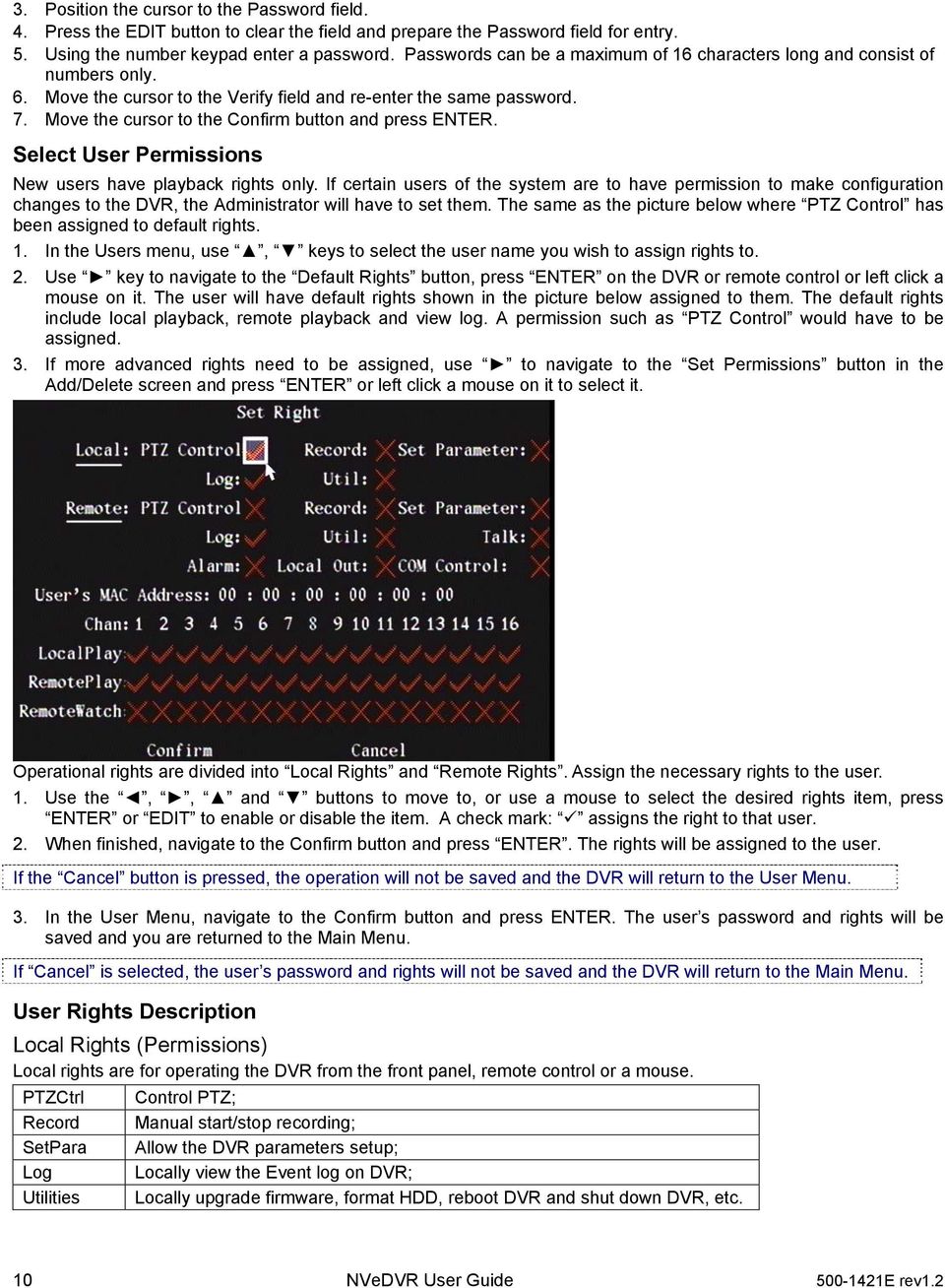
18 3. Position the cursor to the Password field. 4. Press the EDIT button to clear the field and prepare the Password field for entry. 5. Using the number keypad enter a password. Passwords can be a maximum of 16 characters long and consist of numbers only. 6. Move the cursor to the Verify field and re-enter the same password. 7. Move the cursor to the Confirm button and press ENTER. Select User Permissions New users have playback rights only. If certain users of the system are to have permission to make configuration changes to the DVR, the Administrator will have to set them. The same as the picture below where PTZ Control has been assigned to default rights. 1. In the Users menu, use, keys to select the user name you wish to assign rights to. 2. Use key to navigate to the Default Rights button, press ENTER on the DVR or remote control or left click a mouse on it. The user will have default rights shown in the picture below assigned to them. The default rights include local playback, remote playback and view log. A permission such as PTZ Control would have to be assigned. 3. If more advanced rights need to be assigned, use to navigate to the Set Permissions button in the Add/Delete screen and press ENTER or left click a mouse on it to select it. Operational rights are divided into Local Rights and Remote Rights. Assign the necessary rights to the user. 1. Use the,, and buttons to move to, or use a mouse to select the desired rights item, press ENTER or EDIT to enable or disable the item. A check mark: assigns the right to that user. 2. When finished, navigate to the Confirm button and press ENTER. The rights will be assigned to the user. If the Cancel button is pressed, the operation will not be saved and the DVR will return to the User Menu. 3. In the User Menu, navigate to the Confirm button and press ENTER. The user s password and rights will be saved and you are returned to the Main Menu. If Cancel is selected, the user s password and rights will not be saved and the DVR will return to the Main Menu. User Rights Description Local Rights (Permissions) Local rights are for operating the DVR from the front panel, remote control or a mouse. PTZCtrl Control PTZ; Record Manual start/stop recording; SetPara Allow the DVR parameters setup; Log Locally view the Event log on DVR; Utilities Locally upgrade firmware, format HDD, reboot DVR and shut down DVR, etc. 10 NVeDVR User Guide E rev1.2
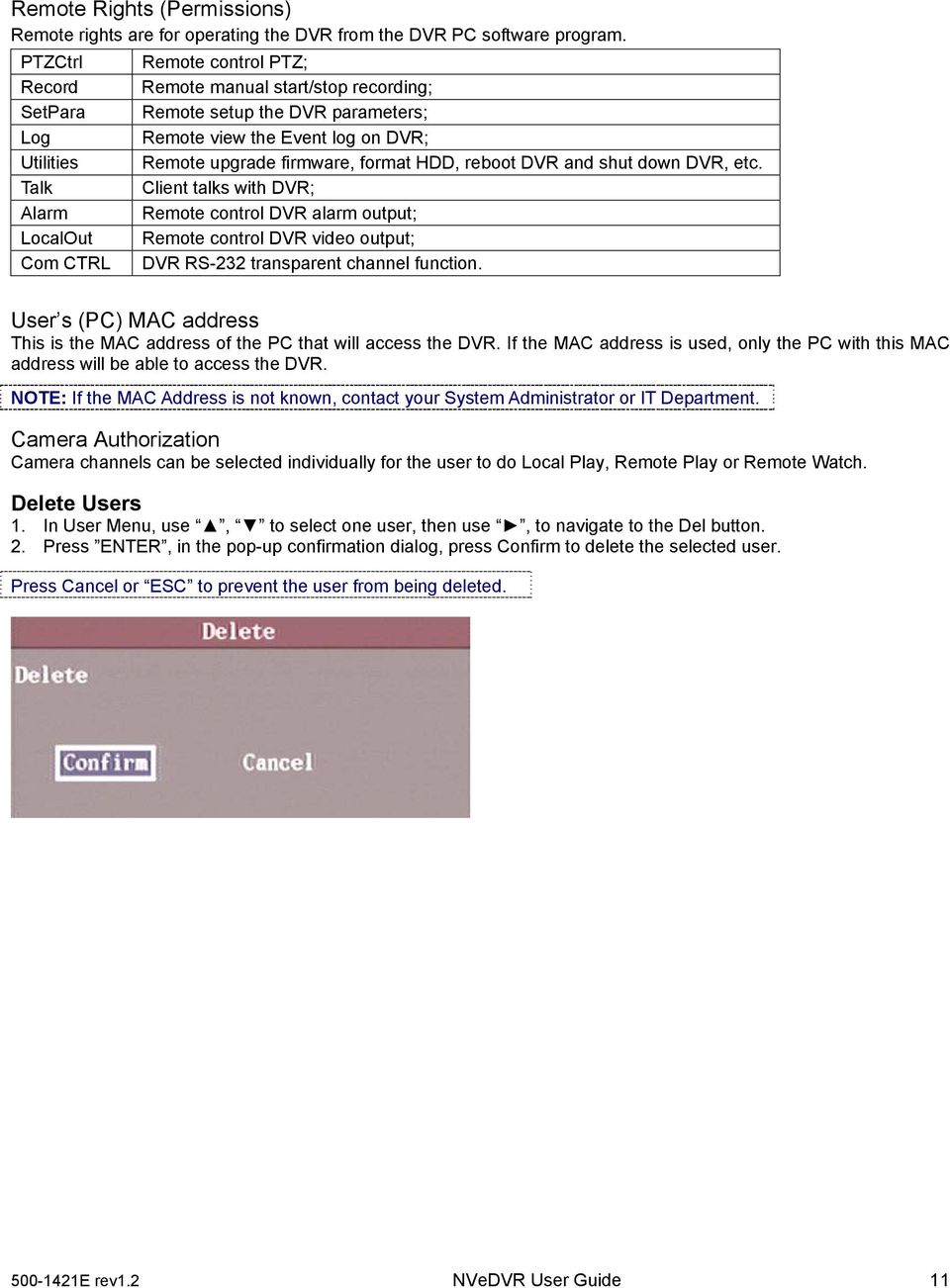
19 Remote Rights (Permissions) Remote rights are for operating the DVR from the DVR PC software program. PTZCtrl Record SetPara Log Utilities Talk Alarm LocalOut Com CTRL Remote control PTZ; Remote manual start/stop recording; Remote setup the DVR parameters; Remote view the Event log on DVR; Remote upgrade firmware, format HDD, reboot DVR and shut down DVR, etc. Client talks with DVR; Remote control DVR alarm output; Remote control DVR video output; DVR RS-232 transparent channel function. User s (PC) MAC address This is the MAC address of the PC that will access the DVR. If the MAC address is used, only the PC with this MAC address will be able to access the DVR. NOTE: If the MAC Address is not known, contact your System Administrator or IT Department. Camera Authorization Camera channels can be selected individually for the user to do Local Play, Remote Play or Remote Watch. Delete Users 1. In User Menu, use, to select one user, then use, to navigate to the Del button. 2. Press ENTER, in the pop-up confirmation dialog, press Confirm to delete the selected user. Press Cancel or ESC to prevent the user from being deleted E rev1.2 NVeDVR User Guide 11
20 Display Menu The Display Menu enables global system selections affecting the video output, menu display and date and time. Language Select: English, French, Spanish. Unit Name Assign the DVR a unique name. The default unit name is DVR. 1. Highlight the Unit Name edit box. 2. Press EDIT on the DVR controls or the remote control or the left clicked mouse menu. Press F3 on the DVR controls or left clicked mouse menu or A on the remote control to select the desired keypad functions (Uppercase, Lowercase, Numbers or Symbols). 3. Use the DVR or remote control keypad or mouse menu to enter the Unit Name. 4. Press ENTER on the DVR controls, remote control or mouse menu when finished. Device ID The Device ID is used to identify the DVR to the IR Remote Control. Set this number from 01 to 255. Set the Device ID of the IR Remote Control to the same number. If there are multiple DVR s in a room, the remote control will control all units with the same Device ID. The default is Highlight the Device ID field and press the Edit key. 2. Use, to change the Device ID. 3. Press ENTER. Enable Password A password is required by default to access the Main Menu. A indicates a password is required and a x indicates that no password is required. Highlight the Require Password field and press ENTER or EDIT. Screen Saver Set this selection to determine the timeout which controls how long the system menus are displayed after the last user activity on the front panel/on-screen display/mouse. Available options are NEVER, 1 Min, 2 Min, 5 Min, 10 Min, 20 Min, or 30 Min. 1. Highlight the Screen Saver field. 2. Use, to cycle through the available options. 12 NVeDVR User Guide E rev1.2
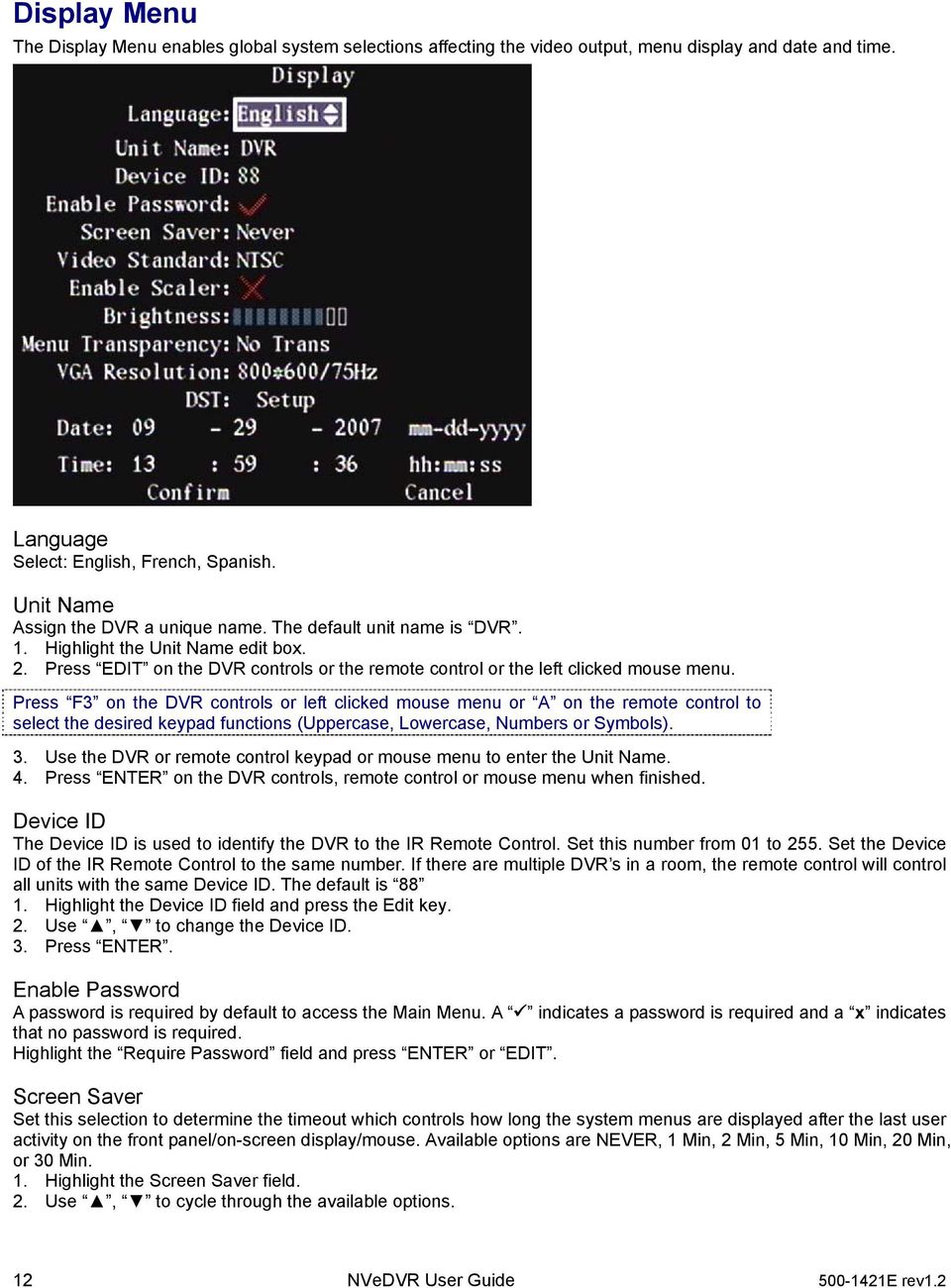
21 Video Standard (Default: NTSC, PAL is optional) There is one VOUT BNC connector at the rear panel of the DVR. It is used to connect an analog monitor and supports PAL or NTSC video output. The video output standard can be modified to match the video signal required by the analog monitor. There is also a VAUX BNC connector that a Spot monitor can be connected to for video preview and playback. The VAUX connector is not available on the VeDVR1004 DVR. 1. Highlight the Video Standard field. 2. Use, to change from NTSC to PAL. Enable Scaler Turn this feature on when connecting a CRT Monitor to the DVR video out connectors. This feature will scale down the menu displays so they will not appear cut off on this type of monitor. Brightness Control the brightness of the VOUT port of the DVR. 1. Highlight the Brightness field. 2. Use, to increase or decrease the brightness. Menu Transparency (NOTE: Only available on 4 channel DVRs. Not available on 8 or 16 channel DVRs) Choose from 1:3, 1:1, or 3:1 or No Transparency to determine the visibility of the Setup Menu with the Preview Mode screen. 1. Highlight Menu Transparency. 2. Use, to set the desired menu visibility. VGA Resolution A standard VGA connection is located at the rear of the DVR. Define the VGA resolution output. The available options are 800*600/75Hz, 1024*768/60Hz and 800*600/60Hz. Use, to make the selection. DST: (Daylight Savings Time) Set a date range for Daylight Savings Time. Highlight Setup at the DST menu item. Press ENTER. The DST Setup menu is displayed. NOTE: When DST is enabled the Date/Time stamp which is imprinted on each recorded image will include either (W ) for winter time or (S) for summer time. Enable DST 1. Press ENTER while the Enable DST: selection is highlighted. The x will change to a. 2. Navigate to the From month. 3. Use, to select the starting month. 4. Use to move to the week of the month selection. 5. Select from 1 st, 2 nd, 3 rd, 4 th or last. 6. Use to move to the day of the week selection. 7. Select which day of the week DST will start. 8. Use to move to the starting time. 9. Set the starting time from 00:00 to 23:00 hours. 10. Repeat this procedure to setup the DST To selections E rev1.2 NVeDVR User Guide 13
22 11. Press Confirm to save the settings. DST Bias The DST Bias setting allows fall back and spring forward offsets other than the typical 60min to be configured. Example: in some regions of the world, the clock is adjusted by 30min instead of 60min. DST bias can not be configured using the Remote Station software as of version of the software. Date This is the system date. Using the, and the, the system date can be set. The format is mm-dd-yyy. Time Using the, and the, set the system time. The format is hh:mm:ss. When any or all of the Display Menu selections are completed, Confirm must be pressed to save your changes. Pressing Cancel will not save the changes. Image Menu Set the display properties for each camera, including display status, position and format. Select Camera Use the, to select the camera to set display properties for. Camera Name Define a name for each camera. NOTE: the camera s name cannot be copied. 1. Select one camera. 2. Highlight the Name edit box. 3. Press EDIT. 4. Press F3 on the DVR controls or or left click the mouse menu or A on the remote control for F3, to change the number keypad to the desired function. (I.e. Number, Uppercase, Lowercase or Symbol). 5. Use the number keypad to type the camera name in. 6. The camera name can be a maximum of 32 characters. 7. Press ENTER to save the name and exit edit status. Select the On Screen Camera Name Position To prevent the camera name from being displayed, disable the check box beside the camera name edit box. NOTE: When the camera name is not displayed, it is not recorded on a video. The disabled symbol is x. If the check box is enabled, the camera name can be entered. The Camera Name Position can be copied to any other camera. 1. Enable the check box on the right side of the camera name. 2. Highlight the Position button. 3. Press ENTER to enter into the camera name position adjustment screen. 14 NVeDVR User Guide E rev1.2
23 4. Use the,, and arrow keys to move the camera name position around on the screen. 5. When the position is chosen, press ENTER. 6. The Image Menu will return. Brightness, Contrast, Hue and Saturation Control the video characteristics of the selected camera. 1. Highlight the Adjust button on the right side of Brightness, Contrast, Saturation or Hue. 2. Press ENTER. An adjustment slide bar that corresponds to the specific setting will appear with the resulting camera image. 3. Use the up, down arrows on the, to adjust. A preview video image will be changed in real time. 4. When the real time video image is satisfactory, press ENTER to return to the Image Setup menu. OSD (On Screen Display) The date and time can be displayed while viewing any camera on the monitor. There are several display modes: No Display Opaque&Steady Opaque&Flashing Transparent&Steady Transparent&Flashing. 1. Highlight OSD. 2. Use, to select the desired setting. Determine the position of the OSD. 1. Highlight the Position button on the right side of OSD and press ENTER. 2. The OSD position setup screen will display. This screen shows the current camera live preview with a grid overlaid on top. There are 22x15 small panes for the NTSC format (default) 22x18 for a PAL format, and the OSD position is in red. Use,, and keys to move the OSD position. Privacy Mask Sensitive areas in a camera s view can be masked or covered up as needed. These areas will not be previewed or recorded. Enable the check box beside Privacy Mask. Press EDIT to change the selection to or left click a mouse. Highlight the Area button on the right side of the mask check box. Press ENTER or click on the Area button with a mouse to enter into the mask selection area. In the mask selection area, there is one small yellow pane on the upper left corner. The screen is divided into 22x15 panes for the NTSC format (default), 22x18 panes for the PAL format. 1. Use,, and to move the yellow pane to the beginning position of the area to be masked. Or, rest the mouse pointer on the yellow pane. Left click the mouse and drag the area for the mask to the right and down from the start point. 2. Press EDIT. The yellow pane will turn to red. 3. Use,, and to extend the red pane. 4. Once the mask area is set, press EDIT E rev1.2 NVeDVR User Guide 15
24 5. Press ESC to cancel the mask area. The maximum mask area size is 8x8 panes and the minimum size is one pane. A maximum of 4 mask areas can be set. 6. Press ENTER to return to the Image Menu. Press F3 on the DVR controls or right clicked mouse menu or A on a remote control to clear all the mask areas. View Tampering The DVR can generate an alarm if an attempt to block a camera is made. Use, on the DVR controls or remote control to select the sensitivity for the View Tampering selection. The sensitivity options are: Off, Low, Normal, High Selecting Low, Normal or High will activate the Area Setup and Procedure Setup buttons. 1. Highlight the Area button and press ENTER. 2. Use,, and to move the yellow pane to the desired start position. Or drag the area with a mouse. 3. Press EDIT. The yellow pane will turn to red. 4. Use,, and to extend the red pane. This red area is the mask area. This red area is the mask area. WARNING: The masked area must not cover a section of the screen from its left side to its right side or from the bottom of the screen to the top. Section off the area with space around it. 5. Once the mask area is set, press EDIT or right click for mouse selections: confirm, cancel, clear. 6. Press ESC to cancel the mask area. 7. After the area is setup, press ENTER to return Image Menu. Press ESC to abort. NOTE: Press F3 on the DVR controls or A on a remote control or right click for the mouse menu to clear the view tampering area. Only one view tampering area can be setup for each camera. The view tampering area cannot be copied. If the schedule is modified, the DVR must be re-booted to activate the changes. Highlight the Procedure button and press ENTER to enter into the View Tampering Response menu: Alarm in Schedule Setup a schedule to determine when the View Tampering Alarm will be activated. Ensure that adequate time periods are set to avoid missing possible occurrences. When a View Tampering Alarm occurs within the defined schedule, the DVR will respond with one or more of the selectable Control Methods. A maximum of 4 periods can be setup for each day of the week. The schedule of one day can be copied to another. NOTE: Time periods in one day cannot be repeated. 1. If a View Tampering Alarm has occurred during the defined schedule, the DVR will respond based on the procedure selections. One or more selections include: On Screen Warning Audible Warning Upload to Center (send exception information to the central host PC) 16 NVeDVR User Guide E rev1.2
25 Trigger Alarm Output. Send Notify RSE 2. Use, and EDIT on the DVR controls, remote control or left click a mouse to enable or disable each option. x is disable and is enable. 3. Press the Confirm button to save the selections and return to the Image menu. Pressing cancel will not save the changes and will return to the Image menu. Signal Loss If there is a problem with the video camera or cable, the video image is lost. If the video loss alarm is enabled, the DVR will generate an alarm. 1. Highlight the list box on the right side of the Video Loss selection and press EDIT on the DVR controls, the remote control or left click with a mouse. 2. Use, to select the response option: Ignore or Active and highlight the Procedure button on the right. 3. Press ENTER to open the Video Signal Loss Response selection screen: Alarm in Schedule Setup a schedule to determine when the Video Signal Loss Alarm will be activated. Ensure that adequate time periods are set to avoid missing possible occurrences. When a Video Loss Alarm occurs within the defined schedule, the DVR will respond with one or more of the selectable Control Methods. A maximum of 4 periods can be setup for each day of the week. The schedule of one day can be copied to another. NOTE: Time periods in one day cannot be repeated. 1. When a Video Loss Alarm has occurred during the defined schedule, the DVR will respond based on the procedure selections. One or more selections include: On Screen Warning Audible Warning Upload to Center (send exception information to central host PC) Turn on Alarm Output. Send Notify RSE 2. Use, and EDIT on the DVR controls, remote control or left click a mouse to enable or disable each option. x is disable and is enable. 3. Press the Confirm button to save the selections and return to the Image menu. Pressing cancel will not save the changes and will return to the Image menu E rev1.2 NVeDVR User Guide 17
26 Motion Detection Level The DVR can be set to perform certain actions based on motion detected in designated areas. 1. On the right side of the Motion Det. Level item, there is a list box. It is the motion detection sensitivity. There are 6 options, from 0 (the lowest) to 5 (the highest). Use, on the DVR control, remote control or left click a mouse to select the sensitivity level. If a low sensitivity such as 0 is selected, the DVR will respond to major motion detected. If a high sensitivity such as 5 is selected, the DVR will respond to minor motion detected. 2. Use the key to move to enable the Motion Detection function. 3. Press EDIT to change the x to and enable the feature. 4. This will turn on the Area and Procedure selection buttons for Motion Detection. Motion Area Setup: 1. The motion areas must be defined so the DVR will respond to motion detected in those areas. Highlight the Area button to the right of the Mot. Det: enable symbol in the Camera Input Adjustment screen. 2. Press ENTER, the Motion Area Selection Screen will display. When the Motion Detection Area is first opened, it is defaulted to the entire viewing area being enabled for motion detection. The screen is divided into 22x15 panes for the NTSC format (default), 22x18 panes for the PAL format. There is one yellow square in the upper left corner. 1. Use,, and on the DVR controls or remote control to move the yellow square to the beginning position of the area to be masked. 2. Press EDIT. The yellow square will turn to blue. 3. Use,, and to extend the blue square to cover a larger area. This blue area will not detect motion. 4. Rest a mouse pointer on the yellow square. Left click on the yellow square and drag the square to the right and down to cover the desired area with blue squares. This blue area in the image will not detect motion. 18 NVeDVR User Guide E rev1.2
27 5. Once the mask area is selected, press EDIT to confirm the selection. 6. Press ESC to cancel the mask area and return to the Image Menu. 7. Right click for the mouse menu and selections: Confirm, Cancel, Clear, Full (select the full screen). Press PTZ to set the entire screen as the motion area. Multiple motion areas may be defined. Press F3 on the DVR controls or right clicked mouse menu or A on a remote control to remove all defined motion areas. After one motion area is setup, press EDIT, the yellow square will appear again. Repeat the above procedure to setup another motion area. Clear the Motion Area 1. Move the yellow square to the beginning position of the motion area to be cleared. 2. Press EDIT, the yellow square turns into a red square. 3. Use, to enlarge or shrink the red area. 4. Press Enter to save the selection and return to the Image Menu. Press ESC to cancel the selection. Optionally, once the Area Motion screen is opened, the entire area can be converted from full coverage to none by right clicking a mouse and pressing clear or F3 on the DVR controls or A on a remote control. Then use the yellow square to select areas for motion coverage E rev1.2 NVeDVR User Guide 19
28 Motion Alarm Control 1. Highlight the Procedure button to the right of the Mot(ion) Det(ection) Area button in the Camera Input Adjustment sceen. 2. Press ENTER to display the Motion Alarm Control menu. Motion Alarm Record Channel Setup When a motion alarm has occurred, the related camera(s) can be turned on to start recording. In the Motion Alarm Control menu, select one or more camera record channels. Use ENTER or EDIT to enable the channel. The x changes to to enable the function. NOTE: Recording must be enabled and the Recording Type must be set to Motion Detection, Motion & Alarm or Motion or Alarm in order for the cameras to start recording when motion is detected. Alarm in Schedule Setup a schedule to determine when the Motion Alarm will be activated. Ensure that adequate time periods are set to avoid missing possible occurrences. When a Motion Alarm occurs within the defined schedule, the DVR will respond with one or more of the selectable Control Methods. A maximum of 4 periods can be setup for each day of the week. The schedule of one day can be copied to another. 20 NVeDVR User Guide E rev1.2
29 NOTE: Time periods in one day cannot be repeated. 1. When a Motion Alarm has occurred during the defined schedule, the DVR will respond based on the procedure selections. One or more selections include: On Screen Warning Audible Warning Upload to Main PC (send exception information to the central host PC) Turn on Alarm Output. Send Notify RSE 2. Use, and EDIT on the DVR controls, remote control or left click a mouse to enable or disable each option. x is disable and is enable. NOTE: If On Screen Warning is enabled, when a motion alarm occurs and the DVR is in preview mode, the DVR will show the related camera. If more than one camera is activated, the DVR will display them one after another depending on the Display Delay time set in the Preview Menu. When the motion alarm is cleared, the DVR will return to the normal Preview Mode screen. 3. Press the Confirm button to save the selections and return to the Image menu. Pressing cancel will not save the changes and will return to the Image menu. This procedure can be repeated to setup motion detection for other cameras. These selections for one camera can be copied to any of the other cameras. In Copy to camera: enter another camera number and press Copy NOTE: The Motion alarm area can not be copied. If disabling the motion alarm area and motion alarm procedure, set the Mot.(ion) Det:(ection) Level to disabled or x. Recording Menu Select the Recording Icon from the main menu. To make selections in this screen, 1. Use the,, and arrow buttons on the DVR controls or remote control or mouse pointer to high light the screen selections. 2. Press EDIT to change a selection 3. Use, to change the selection. Left click the mouse to change the selection. 4. Press Enter to save the selection and return to the Image Menu. 5. After making changes, press Confirm to save the changes or cancel to not save the changes. If Hard Drive is Full Overwrite: When all HDDs in the DVR are full, the DVR will overwrite the earliest recorded files and continue recording E rev1.2 NVeDVR User Guide 21
30 Stop Recording: When all HDDs in the DVR are full, the DVR will interpret it as a Hard Disk Full exception. Duration Days: Enter the number of days before the DVR Stops Recording and generates an alert that it has stopped recording or Overwrites files. WARNING: Ensure that the days before files are deleted is adequate e.g. enter 30, 60, 90 days. Files will be deleted if there is a short number of days e.g. 7 days. SATA1 Disk FOR: Select if the first hard drive connection should be for Backup or Record. Default is Back-up to an external device using the E-Sata connector on the back of the DVR. Select Camera: Select the camera number connected to the DVR to make recording selections for. Record Para(meters): Pressing the selections on the right of this name will display the video selections for each of the following recording types: Cont. HQ (Continuous High Quality), Cont LQ (Continuous Low Quality), Event (alarm condition). The selections for each recording type are displayed on this Recording Channel Configuration screen. The recording types are assignments for cameras used in the Enable Rec:(ord)/Schedule screen that is a selection in the lower area of this Recording Channel Configuration screen. The recording type: Event represents all the alarm types e.g. Motion Detection, Alarm, Motion or Alarm, Motion and Alarm Camera Name: The camera name for the camera number displays. This name is defined in the Image Menu. Stream Type Audio & Video Use to record audio and video. Video Use to record video only. NOTE: If Audio recording is disabled, the Remote Station software will still receive live audio from the DVR. Resolution The clearness of the image can be improved with a higher resolution selection. The resolution options are: NTSC at 30 fps: 176*120(QCIF), 352*240(CIF), 704*240(2CIF), 528*320(DCIF), 704*480(4CIF). PAL at 25 fps: 176*144(QCIF), 352*288(CIF), 704*288(2CIF), 528*384(DCIF), 704*576(4CIF); default selection: 2CIF For the NVEC series DVRs: all channels support QCIF, CIF resolutions. Can support 4CIF (4 fps), DCIF (6 fps), 2CIF (8 fps). For the NVEF series DVRs: all channels support all resolutions. Bit Rate Type Variable The DVR will adjust the actual bit rate according to the video movement. When there is reduced movement, the DVR will use a low bit rate. When there is a high level of movement, the DVR will use a high bit rate. In this condition, the DVR can save hard disk usage and network bandwidth. Fixed The DVR will use the fixed bit rate to compress the image. The bit rate size is defined in the Max Bit Rate option. In this condition, the recorded file size and network bandwidth required can be calculated. Max Bit Rate In Variable Bit Rate mode, if the video input has a high level of movement, the max bit rate must be limited. The max bit rate has the following options (bps): 384K (default selection), 32K, 48K, 64K, 80K, 96K, 128K, 160K, 192K, 224K, 256K, 320K, 384K, 448K, 512K, 640K, 768K, 896K, 1M, 1.25M, 1.5M, 1.75M, 2M and By User ( custom entry). 22 NVeDVR User Guide E rev1.2
31 The max bit rate selection is related to the resolution. Selecting a high resolution requires a high bite rate. For CIF resolution, the typical max bit rate is 384K-768Kbps. For DCIF resolution, the typical bit rate is 512K-1Mbps. For 4CIF resolution, the typical bit rate is 1.25Mbps-1.75Mbps. Select the proper max bit rate required for the camera, background and image quality. Image Quality In Variable Bit Rate mode, the image quality is defined. There are 6 options: Higher (default selection), Highest, Lowest, Low, Average, High. NOTE: A High image quality needs a high bit rate size. Frame Rate Frame per second. Options are: 8 (default selection), 10, 12, 15, 16, 18, 20, 22, 30(Ntsc)/25(Pal), 1/16, 1/8, 1/4, 1/2, 1, 2, 4, 6. Enable Recording Create a Schedule when recording will occur. Enable the record feature. Change the x to a check mark. Press the Schedule button. All Day Recording selections: 1. Use ENTER or EDIT to enable the recording function and change the x to a check mark:. 2. Press the Schedule button to open the recording schedule menu. 3. Use the arrow keys, on the DVR controls or remote control or left click a mouse pointer to select a day of the week. 4. Highlight the check box on the right side of the All Day item, press ENTER or EDIT to enable. x to disable and to enable. 5. Highlight the Rec Type selection. Only one Record Type can be selected in all day recording. NOTE: Only one Record Type can be selected in All Day recording. The Recording Type options are: Cont HQ (Continuous High Quality): default selection. Cont LQ (Continuous Low Quality) Cont HQ or IEvt (Event) Cont LQ or IEvt Mot(ion) Det(ection) Alarm Mot(ion) or Alm (Alarm) Mot&Alm (Motion and Alarm) Command (ATM Command from Serial Port. Refer to the Transaction Menu) Copy to: Select a day of the week or All Days to copy the current selections to and press Copy E rev1.2 NVeDVR User Guide 23
32 Scheduled Recording 1. In the Recording Channel Configuration of the Recording Menu, use ENTER or EDIT to enable the recording function and change the to a check mark:. 2. Press the Schedule button to open the recording schedule menu. 3. Use the arrow keys, on the DVR controls or remote control or left click a mouse pointer to select a day of the week. 4. Highlight the check box on the right side of the All Day selection and ensure it is an x to disable that function. x to disable and to enable. When the All Day selection is disabled, the Period selections will be enabled. 5. There are 4 time periods for one day, and each time period can select a different record type. Input start time and stop time for each time period, and select the Record Type for each period. The Record Type options are the same as the previous All Day Recording selection options: Cont HQ (Continuous High Quality): default selection. Cont LQ (Continuous Low Quality) Cont HQIEvt (Event) Cont LQIEvt Mot(ion) Det(ection) Alarm Mot(ion)IAlm (Alarm) Mot&Alm Command Ensure that adequate time periods are set to avoid missing possible occurrences. NOTE: The time periods in one day cannot be repeated. Copy to: Select another day of the week to copy the current day of the week selections to and press Copy. Notes: If the record type is Mot(ion) Det(ection) or other related motion types, Motion Detection must be enabled in the Camera Input Adjustment of the Image Menu in order to turn Motion recording on. If the record type is Alarm or other related alarm types, responding to an alarm must be enabled in the Alarm Menu in order to turn Alarm recording on. Time periods are between 00:00 24:00. Press the Confirm button to save all changes and return to the Recording Menu. 24 NVeDVR User Guide E rev1.2
33 Recording Menu, Recording Channel Configurations cont. PreRecord Time (Enable Rec(ord) must be checked ) When motion detection recording or external alarm recording is enabled, a prerecord time can be defined. The options are: 5 Seconds (default selection), 10 Seconds, 15 Seconds, 20 Seconds, 25 Seconds, 30 Seconds, Max PreRecord, No PreRecord, MaxPreRecord saves all data in the PreRecord buffer. The PreRecord time is related to the bit rate. A lower bit rate, allows for a longer PreRecord time. If the bit rate (Max bit rate) is very low, and the PreRecord Time is set to 5 Seconds, the actual prerecord time may be more than 5 seconds. If the bit rate is high, and the PreRecord Time is set to 30 Seconds, the actual prerecord time may be less than 30 seconds. Post Record Time (Enable Rec(ord) must be checked ) Once an external alarm or motion alarm has stopped, the DVR will continue to record for the amount of time set in this selection. The options are: 5 Seconds (default selection), 10 Seconds, 30 Seconds, 1 Minute, 2 Minutes, 5 Minutes and 10 Minutes. Copy to Camera Select another camera to copy the current selections to and press Copy. Press Confirm to save changes or Cancel to not save changes and return to the Main Menu. Manual Recording Requirements to Enable Manual Recording: 1. A user who attempts to turn cameras on in Manual Recording must have the Record permission enabled in their Permission selections in the User Menu. 2. The DVR must have an operational, formatted hard drive connected to it in order to Manually Record. Check the hard disk status in the Utilities Menu to confirm this. Manual Recording Procedure 1. In preview mode, press the REC button on the DVR, the remote control or click on it from the on screen menu by right clicking a mouse. 2. Enter a name and password in the log on box that appears on screen. Enter Manual Record with out having to log in by pressing the REC button when in the Main Menu. 3. The Manual Record screen lists the camera channels, their status and the option to turn their recording on or off. Status This symbol indicates that the camera is idle. If it is Green, the camera is recording. This includes real time recording, alarm recording and motion detection recording. Start/Stop Recording 1. Use the DVR face plate or remote control navigation buttons or a mouse pointer to select a x and click or press Enter. 2. The x will change to a check mark and recording will begin. Re-press a check mark to stop recording E rev1.2 NVeDVR User Guide 25
34 3. Press Start All for all cameras to record or Stop All for them all to end recording. NOTE: If scheduled recording has been set up but the user is currently recording manually, when a channel is stopped or, all channels are stopped, the status light will change briefly to the x and then back to Green. This means that the DVR has resumed scheduled recording. Press Stop again to completely stop recording. Press the ESC Escape key to exit the Manual Record screen or right click a mouse. Playback 1. In preview mode, press the PLAY button on the DVR, the remote control or right-click a mouse to open the menu and them left-click on Play. 2. Enter a name and password in the log on box that appears on screen. Enter Playback with out having to log in by pressing the PLAY button when in the Main Menu. 3. The Playback screen will appear with various options: 4. Chan: Select a main camera channel to play back files it recorded. 5. Second: If the DVR only supports 1 channel playback, a second channel can not be selected. If it does feature a second channel, then both channels can be played at the same time. Select a second camera channel to play back with the main selected channel. NOTE: F-series DVRs support 2-channel playback. C-series DVRs do not. 6. Rec Type: Recording Type. Select: All, Continuous, Motion Detect, Alarm or Manual. 7. Time: Enter the Date and Time range for the events search. Use numeric keys to input the date and time. 8. Card Number: The DVR can obtain numeric information using RS-232 or a network port. This information is received from an ATM or POS machine etc. The DVR can overlay this information on the real time image and record. This information can be used to search the recorded files and play them back. Use the numeric keys to input the text number. 9. Search: Search for the matched recorded files and display them in the list box. A notification box will appear If there is no match. WARNING: In the Recording Menu, ensure that the days before files are deleted is adequate e.g. enter 30, 60, 90 days. Files will be deleted if there is a short number of days e.g. 7 days. 10. Play: Playback the recorded stream directly based on the date and time range. 26 NVeDVR User Guide E rev1.2
35 11. Page Number: The file list box will display a maximum of 8 files. If the matching files are more than 8, select a page number to list additional files. 500 pages holding 4000 files can be searched for at one time. Enter a page number using the numeric keys or the up/down arrow, keys. 12. File List Box: Will display the matching files. The file number, its start time and length (size). 13. Save Device: The Backup sources that can be selected to save the files or clips are: USB Disc, USB HD, USB CD/DVDRW, SATA CDRW/DVDRW SATA HD (External HDD on the ESATA rear connector). 14. Backup: Begin copying the files. 15. Backup Today: Backup all files that occurred during the present day. Refer to the list of compatible back up media in the DVD Writer disks information in the Utilities/Hard Disk Management menu section of this manual. Play Back Selections 1. Search and Playback File: In the play back screen, select the main channel, second channel (2 channel playback), record type, time section. High light the Search button and press the ENTER key. The DVR will search and list the matched files. To begin playback on a file, after the search is complete, use the direction arrows to navigate to the list and then use up and down to select the file. Press the Enter button to start playback. Pressing the Play On-Screen Display button will begin playback from the first file in the list, like the behavior described in the next section. NOTE: If using the mouse, double clicking on a file will select it and start playback. A single-click will turn on the Select checkmark. 2. Sel: The Select checkmark is used to mark files for export. 3. Playback by Time: In the play back screen, select the main channel, second channel (2-ch playback), file type and date and time selection. Highlight the Play button with the arrow buttons and press ENTER or click on it with the mouse pointer. The DVR will begin playback based on the date and time selection. 4. Search by Card No and Playback file: In the play back screen, select the main channel, second channel (2-ch playback), file type, change the card No. search option from an to a check mark and enter the card number. Highlight the Search button with the arrow buttons and press ENTER or click on Search with the mouse pointer. The DVR will search and list the matching files E rev1.2 NVeDVR User Guide 27
36 Video Player Playback Operation Two Channel Play Back example: At the bottom of the image(s) when a mouse is connected to the DVR, there are controls and information for the File Video Player. Using the DVR controls or remote control: (refer to the Front Panel Indicators and Controls and IR Remote Control sections) Display/Hide the controls/information bar: press MENU. Turn sound ON/OFF: press PLAY. Adjust play progress: (Reverse), (Forward) in a % amount. Adjust play speed: Normal speed is 1x. Press to increase the play speed (2x, 4x, 8x and MAX). Press to decrease the play speed (1/2x, 1/4x, 1/8x and Single Frame-by-Frame ) PLAY/PAUSE: Press ENTER to pause/continue playback. If the view is played frame by frame, press (Reverse) or (Forward) to play one frame at a time. Copy segment: press EDIT. Press EDIT to stop copying. Press ESC to confirm. Exit: ESC. Playback switch: When in 2 channel playback, press PREV to switch between main channel and second channel and back to 2 channel. When in Playback pressing the button at a 30 second interval from the beginning will begin playing the clip from its beginning again. Pressing the left arrow any where in the clip will reverse the clip at 30 second intervals until it returns to the beginning. Pressing the button a second time 30 seconds into a clip will transfer the view to a prior clip in the results list or back to the results list if this was the first clip played or only clip in the list. When in Playback pressing the button at a 30 second interval from the ending will move the clip to its end and stop. Pressing the right arrow less than 30 seconds from the ending will have no effect. The file will continue playing until it reaches its end. Pressing the right arrow any where in the clip will move the clip at 30 second intervals until it reaches the end. Pressing the button a second time 30 seconds into a clip the file goes to the end of the file briefly and then begins playing the next file/clip from the results list or back to the results list if this was the last clip played or only clip in the list. When in a single camera playback, press another camera number that recorded at the same time to view that camera s view. Press the previous camera s number to return it. Enter single digits for a 4 or 8 channel DVR. Enter a 0 before single digit camera channels on a 16 channel DVR. NOTE: When attempting to go backwards or forwards at 30 second intervals in playback while viewing a file with a time/dst (Daylight Savings Time) change, it is only possible to speed up or slow down. The 30 second interval backwards function is not available and attempting to move forwards at 30 second intervals will proceed to the very end of the file. 28 NVeDVR User Guide E rev1.2
37 Using the Mouse control buttons: Refer to the split screen picture above. Left click the mouse on a button. Button Description Reverse PLAY progress. Goes back 30 seconds in time does not start rewinding the video. Will go back to beginning of file if less than 30 seconds into playback. If pressed again it will begin 1 playback of the previous search result in the results list. Also used to go backwards in Frame-by- Frame mode. 2 Decrease the play speed (1/2x, 1/4x, 1/8x and Single Frame-by-Frame ) 3 PLAY/PAUSE 4 Increase the play speed (2x, 4x, 8x and MAX) Forward PLAY progress by 30 seconds. Will also go to next file in the search results list if already 5 at the end of playback of the current file. Also used to go forwards in Frame-by Frame mode. 6 Turn sound ON/OFF. 7 Copy single or multiple segments. Right click when copying is finished to confirm. 8 Hide the controls/information bar. Right click the mouse to Display the bar or Exit the Player. When in 2 channel playback, left click the mouse on either image to just show that image or left Playback Switch click the single image to go back to 2 channel viewing again. SmartSearch (Motion History) SmartSearch acts the same as Motion History in the DVR s PC Software. The purpose of the SmartSearch feature is to find occurrences of motion inside video that has already been recorded. This is particularly useful if the DVR is configured for continuous recording. In contrast, the Motion Detection feature is designed to detect motion as it occurs, i.e. in real-time, and then trigger one or more of the possible actions. In the Playback screen, select the desired Camera, date/time and Recording Type search filter criteria in the same manner as a regular search. SmartSearch can find motion in any type of recording. Select the Smart Search button. Select the area in which the SmartSearch function should look for motion. On the DVR faceplate or remote control, use the arrow buttons to move the cursor, EDIT to start marking the area. Using mouse control, drag a square. Only a single area can be selected. You may select the entire image as the area, or just a small portion of the image. Example: to track occurrences of unauthorized personnel entering a restricted area, draw a rectangle around that area E rev1.2 NVeDVR User Guide 29
38 Select the desired sensitivity between 1 and 5. Press F3 on the DVR controls or A on a remote control, then the number. For mouse control, right click and select a number. A sensitivity value of 5 will find occurrences of subtle motion where as a sensitivity value of 1 will only find occurrences of significant motion inside the selected are. If in doubt, select the highest sensitivity of 5 to make sure the search does not miss anything. Initiate the search. On the DVR faceplate or remote control, press the PTZ button. For mouse control, right click and select Smart Search from the popup menu. The search results are displayed inside the results list area of the regular Search & Playback screen. The search results can then be navigated, played and selected for export in the same manner as results from a regular search. As with regular search, the number of results that can be displayed in the list is limited to A warning message will pop up if more search results are generated. In this case, try to narrow the date/time range if possible, or split the search into two parts, each with a smaller range. The resulting clips start a few seconds prior to the occurrence of motion and end a few seconds after the motion stops. This means that if there is continuous motion inside the selected search area, the resulting clips can be as long as the maximum clip length of 128MB. SmartSearch will find any type of motion, regardless of what caused the motion. Example: SmartSearch will find motion generated by People, Vehicles and Animals. SmartSearch may also find motion that is a result of weather, example: camera vibration. Exit Playback In the playback screen, press the ESC key to return to preview mode. In the playback screen, press the MENU key to enter the main menu, press the REC key to enter into manual recording and press the PTZ key to enter into the PTZ control mode. Event Playback Event Playback provides quick access to event-triggered video recordings from all cameras. On this screen it is possible to view a list of event clips from all cameras. On the regular playback screen, a specific camera must be chosen. 1. Right click a mouse in the Preview Screen and select Event Play from the menu. Press the PLAY button on the DVR or remote control twice to open this screen. NOTE 1: Press PLAY again to open the regular Play Back screen. NOTE 2: While inside the playback screen or the event playback screen, using the mouse scroll wheel will toggle between the two different screens, provided that the mouse cursor is not located on top of a field that can be modified using the scroll wheel. 2. Use the,, and arrow buttons on the DVR controls or remote control or mouse pointer to high light the screen selections. 3. Press EDIT to change a selection 30 NVeDVR User Guide E rev1.2
39 4. Use, to change the selection. Left click the mouse to change the selection. 5. Press Enter to use the selection. Event Playback Selections: Camera. Select All cameras or individual cameras. Event. Select All Events, Alarm only or Mot(ion) Det(ection). Enter a date and time range for the events of interest. Search. Press Search to view the files available for the date and time range. Page No. Displays the number of pages with all files found. File Results Area. Displays the Camera number and Time. Sel is Selected files. Double click on the selected file to view it in the Playback area. Event detail. At the bottom of the Playback area. Displays the file s type of event and its file size. Save Device. Where to Save the file to. Backup. Backup the file. Network Menu The DVR supports TCP, UDP, RTP, and multicast protocols. Remote access to the DVR is provided by 10/100 baset Ethernet network connection, PP0E broadband or PSTN narrow band dialup. To remotely access the DVR, the network selections must be made here. Highlight the Network icon in the Main Menu and press ENTER at the DVR controls, remote control or left click with a mouse to open the configuration screen. To make selections in this screen, 1. Use the,, and arrow buttons on the DVR controls or remote control or mouse pointer to high light the screen selections. 2. Press EDIT to change a selection 3. Use, to change the selection. Left click the mouse to change the selection. 4. Press ENTER to save a selection and return to the Image Menu. 5. After making changes, press Confirm to save the changes or Cancel to not save the changes. NIC type The default is 10M/100M Auto, the other options are: 10M Half-Dup 10M Full-Dup 100M Half-Dup 100M Full-Dup IP Address This IP address must not conflict with other IP addresses on the network. If there is a DHCP server on the network, set the IP to , save and reboot the DVR. During the reboot process, the DVR will search for the DHCP server E rev1.2 NVeDVR User Guide 31
40 and receive a dynamic IP address. This item will display the dynamic IP address. If the DVR uses PPPoE or dialup, this selection will display the dynamic internet IP address. Mac Address The MAC address is permanently assigned and the value can not be changed. Port Network access port number, must be greater than Default is Mask This is the Subnet Mask. Gateway The Gateway IP is used to communicate to different network segments. DNS Address If the DVR uses PPPoE and is assigned a dynamic IP address, set the DNS IP with a fixed Internet IP. The DVR will send information e.g. the DVR s name, DVR s serial number and the DVR s current IP to that fixed IP address. The fixed Internet IP is the DNS IP. The DNS server with this fixed Internet IP can receive DVR information and is used to resolve the DVR s dynamic IP. This DNS is not a standard Domain Name Server. You can use the provided SDK to develop this DNS software. MCastIP (Multicast IP) This is one D-class IP address, between to If multicast is not used, this address is not necessary. Some routers will prohibit multicast to prevent network disturbances. Multicast When Multicast is enabled, multiple live viewing connections to a camera from different client PCs count as a single network connection. This allows more live viewing clients (Remote Station software) to be connected to a DVR without problems. Multicast uses the UDP protocol and works only if the network to which the DVR and the Remote Station software are connected supports Multicast. Multicast traffic will not pass through routers and gateways, unless the local network administrator has configured these devices specifically so that multicast traffic can pass through them. Because of this, Multicast is not enabled in the Remote Station software by default. Remote Host IP and Port (central PC) If an alarm or exception occurs, the DVR will send information to this host IP. The central PC with this IP can receive alarm and exception information from the DVR. The provided SDK is used to develop the central PC software. HttpPort This port is for an IE browser. The default value is 80. It can be modified. PPPoE The DVR supports PPPoE dail-up function. Example: Use PPPoE function 1. Enter into the Network menu. 2. Select NIC type. 3. Input port number. In the port edit box, use numeric keys to input port number. The port number must be more than Input DNS IP. Input one fixed Internet IP address where the IP analyst software (IPServer) is running. 5. Input PPPoE parameters. Use ENTER or EDIT key to enable PPPoE function (set PPPoE flag as ). Input PPPoE username, password and verify password that your ISP provided. 6. Save parameters. In Network menu, press Confirm to save parameters. 7. Reboot the DVR to activate the new settings. During the reboot process, the DVR will start dialup using the PPPoE function. If the DVR dialup to the internet is successful, the DVR will display the dynamic internet IP address in Network menu. User, Pass Enter a user name and password for Network communications. Verify the password by re-entering it. 32 NVeDVR User Guide E rev1.2
41 NOTE: The subject and body text of s sent by the DVR is in English regardless of the selected DVR language. To make selections in the Notification screen: 1. Use the,, and arrow buttons on the DVR controls or remote control or mouse pointer to high light the screen selections. 2. Press EDIT to change a selection 3. Use, to change the selection. Left click the mouse to change the selection. 4. Press ENTER to save a selection and return to the Image Menu. 5. After making changes, press Confirm to save the changes or Cancel to not save the changes. Authentication: check to enable User and Password by changing the to a check mark. Enter User and Password Enter Sender Name and Address Enter Server Enter Mail receiver Enter Name 1 and Address 1 Select Attachment and Interval (JPEG) JPEG Attachments The function has an option to attach JPEG images to s that contain camera-specific event information (i.e. signal loss, motion, view tampering). There is a limit of how many JPEG images can be ed at the same time. When multiple s with attached JPEGs are sent simultaneously, a limit of 4 s will contain the attachments. The time between JPEGs can be configured. However, the pre-alarm (pre-recording time) JPEG will not always be exactly XX seconds prior to the alarm JPEG. Depending on the current bit rate, the DVR may not have video from XX seconds ago in its buffer, and therefore the function can not provide a pre-alarm image from XX seconds prior to the event. When the DVR is playing back video locally, the pre-alarm JPEG image can not be obtained and the will only contain 2 attached JPEG images instead of 3. The same can happen for other reasons (i.e. DVR was too busy at the time) in about 10% of the cases, i.e. 1 out of 10 s will have 2 instead of 3 attachments. Press Confirm to save changes or Cancel not to save changes and return to the previous menu. Telnet For manufacturer s purposes only E rev1.2 NVeDVR User Guide 33
42 RSE (Remote Service Environment) To make selections in the RSE screen: 1. Use the,, and arrow buttons on the DVR controls or remote control or mouse pointer to high light the screen selections. 2. Press EDIT to change a selection 3. Use, to change the selection. Left click the mouse to change the selection. 4. Press ENTER to save a selection and return to the Image Menu. 5. After making changes, press Confirm to save the changes or Cancel to not save the changes. Enable RSE by changing the to a check mark. Enter the RSE Server IP/Port Enter the proxy IP/Port Enter the Poll Rate Select the Comm(unication) Sequence: IP Only. PSTN Only. Enter the RSE User(name), Pass(word), Phone Number. Press Confirm to save changes or Cancel not to save changes and return to the previous menu. 34 NVeDVR User Guide E rev1.2
43 NTP (Network Time Protocol) This is the Network Time Protocol option that will automatically synchronize the system time for the DVR or multiple DVRs with a dependable source such as a specific time server that can be contacted to supply the correct time. To make selections in the SNTP screen: 1. Use the,, and arrow buttons on the DVR controls or remote control or mouse pointer to high light the screen selections. 2. Press EDIT to change a selection 3. Use, to change the selection. Left click the mouse to change the selection. 4. Press ENTER to save a selection and return to the Image Menu. 5. After making changes, press Confirm to save the changes or Cancel to not save the changes. Enable SNTP by changing the to a check mark. Enter a Time zone: GMT (Greenwich Mean Time). Time zones relate in the number of hours/minutes behind or ahead of the GMT as a central point. Eastern time is 5 hours behind the GMT which would be its Time Zone. Select the plus (+) sign and use the up/down arrows to make it minus ( ) to indicate a time zone behind the GMT or leave it a (+) sign to indicate a time zone ahead of the GMT. Select the hours and minutes for the time zone. Enter the synchronization interval in Minutes for when the DVR will synchronize its time with the time server. Enter the SNTP Host. This is the Server address that the DVR will contact for the time update. Enter the SNTP Port. This is the Server Port number. Check the box for Notification on Update Failure if an should be sent when an update fails. Ensure the DVR Notification option is enabled and configured to send s. Press Confirm to save changes or Cancel not to save changes and return to the previous menu E rev1.2 NVeDVR User Guide 35
44 Alarm Menu Program the DVR alarm inputs. Highlight the Alarm icon in the Main Menu and press ENTER at the DVR controls, remote control or left click with a mouse to open the configuration screen. To make selections in this screen, 1. Use the,, and arrow buttons on the DVR controls or remote control or mouse pointer to high light the screen selections. 2. Press EDIT to change a selection 3. Use, to change the selection. Left click the mouse to change the selection. 4. Press ENTER to save a selection and return to the Image Menu. 5. After making changes, press Confirm to save the changes or Cancel to not save the changes. Select Alarm In Select an alarm input. Alarm Type Normally Open (N.O.) or Normally Closed (N.C.). Alarm Response There are two selections for Alarm Response: Ignore or Active. If the Active option is selected, the Procedure and PTZ Response buttons are enabled on the right side. Alarm Procedure Highlight the Procedure button and press ENTER at the DVR controls, remote control or left click with a mouse. 36 NVeDVR User Guide E rev1.2
45 Record Camera Select the channels to record for each alarm input. Use the ENTER or EDIT key on the DVR controls or remote control or left click with a mouse to enable record channel. x means disable and means enable. NOTE: Recording must be enabled in the Recording Menu and the Recording Type must be set to: MotionIAlarm or Motion & Alarm in the Recording Menu, Recording Channel Configuration, Enable Record, Schedule for the cameras to start recording when an alarm occurs. Alarm in Schedule Setup a schedule to determine when the Motion Alarm will be activated. Ensure that adequate time periods are set to avoid missing possible occurrences. When a Motion Alarm occurs within the defined schedule, the DVR will respond with one or more of the selectable Control Methods. A maximum of 4 periods can be setup for each day of the week. The schedule of one day can be copied to another. NOTE: Time periods in one day cannot be repeated. 1. When a Motion Alarm has occurred during the defined schedule, the DVR will respond based on the procedure selections. One or more selections include: On Screen Warning Audible Warning Upload to Main PC (send exception information to the central host PC) Turn on Alarm Output. Send Notify RSE 2. Use, and EDIT on the DVR controls, remote control or left click a mouse to enable or disable each option. x is disable and is enable. NOTE: If On Screen Warning is enabled, when a motion alarm occurs and the DVR is in preview mode, the DVR will show the related camera. If more than one camera is activated, the DVR will display them one after the other every 10 seconds. When the motion alarm is cleared, the DVR will return to the normal Preview Mode screen. 3. Press the Confirm button to save the selections and return to the Image menu. Pressing cancel will not save the changes and will return to the Image menu E rev1.2 NVeDVR User Guide 37
46 PTZ Response Highlight the PTZ Response button. Press ENTER at the DVR controls, remote control or left click a mouse to open the PTZ related response menu: Select Camera Select a PTZ camera connected to the DVR. Enable Preset Change the selection to to enable preset. Preset In the Preset number selection box, choose one Preset number that has been configured. Refer to the PTZ Menu for more information. Enable Sequence Change the selection to to enable Sequence. Sequence No: In the Sequence number selection box, choose one Sequence number that has been configured. Refer to the PTZ Menu for more information. Enable Cruise Change the selection to to enable Sequence. Refer to the PTZ Menu for more information. Press the Confirm button to save and return to the Alarms Menu. Press the Cancel button or ESC to prevent the changes from being saved and return the Alarms Menu. NOTE: Confirm that the PTZ camera being used supports Preset, Sequence and Cruise functions. One external alarm input can turn on multiple PTZ cameras by the PTZ Response selections. Copy to Alarm In Select another alarm input to copy the current alarm input selections to and press Copy. Alarm Out Select one of the DVR alarm Outputs. Time: (output delay after alarm) The amount of time the alarm output will continue after the alarm has cleared. The time options are: 5 Seconds (default selection) 10 Seconds 30 Seconds 1 Minute 38 NVeDVR User Guide E rev1.2
47 2 Minutes 5 Minutes 10 Minutes Manual Stop Notes: If the Manual Stop option is selected, the alarm output will not stop until the Stop AlmOut (Stop alarm output) button is pressed in the Utilities menu. The alarm output time includes the alarm input time and the Output Delay after Alarm time. Output Alarm Time Schedule A schedule is defined to control when an alarm output will turn on. Select the Schedule button on the right side of the Alarm Out Time, press ENTER on the DVR controls or remote control or left click a mouse to display the Schedule menu for the associated output: Define the Alarm Output Schedule This schedule is set the same as the previous Schedule for recording in the Recording Menu. 4 time periods can be defined for one day and 7 days for one week. Ensure that adequate time periods are set to avoid missing possible occurrences. Copy to: Select another day of the week to copy the current day of the week selections to and press Copy. Press Confirm to save changes or Cancel not to save changes and return to the previous menu E rev1.2 NVeDVR User Guide 39
48 Exception Menu Exceptions are conditions the DVR can respond to in different ways Highlight the Exception icon in the Main Menu and press ENTER at the DVR controls, remote control or left click with a mouse to open the configuration screen. To make selections in this screen, 1. Use the,, and arrow buttons on the DVR controls or remote control or mouse pointer to high light the screen selections. 2. Press EDIT to change a selection 3. Use, to change the selection. Left click the mouse to change the selection. 4. Press ENTER to save a selection and return to the Image Menu. 5. After making changes, press Confirm to save the changes or Cancel to not save the changes. Exception: Select from the following exceptions. Hard Disk Full Hard Disk Error Network Failure Illegal Access NTSC/PAL Mismatch Hardware Changed IP Address Conflict Control Method: Use ENTER or EDIT at the DVR controls or remote control or left mouse click to enable the following selections by changing the x to a check mark:. Audible Warning: Turn DVR alert tone on or off. Upload To Main PC: Send exception information to central host PC. Trigger Alarm Output: Turn on a DVR output. Select any or all of the displayed output numbers. Send notification. Notify RSE: Contact Remote Service Environment Press Confirm to save changes or Cancel not to save changes and return to the Main Menu. 40 NVeDVR User Guide E rev1.2
49 PTZ Menu A single RS-485 port on the rear panel of the DVR is used for PTZ control. RS-485 selections can be made to match the PTZ protocol. Highlight the PTZ icon in the Main Menu and press ENTER at the DVR controls, remote control or left click with a mouse to open the configuration screen. To make selections in this screen, 1. Use the,, and arrow buttons on the DVR controls or remote control or mouse pointer to high light the screen selections. 2. Press EDIT to change a selection 3. Use, to change the selection. Left click the mouse to change the selection. 4. Press ENTER to save a selection and return to the Image Menu. 5. After making changes, press Confirm to save the changes or Cancel to not save the changes. Select Camera Select the camera number that a PTZ camera is connected to and configure it as follows: RS-485 Selections: (must be the same as the PTZ Protocol) Baud Rate: 2400 (default selection), 4800, 9600, 19200, 38400, 57600, 76800, 115.2k, 50, 75, 110, 150, 300, 600, Data Bits: 8 bit (default selection), 5, 6, 7. Stop Bits: 1 bit (default selection), 2. Parity: No Parity (default selection), Odd, Even. Flow Ctrl (Control): None (default selection), Software, Hardware E rev1.2 NVeDVR User Guide 41
50 Protocol: (PTZ camera brands) Select from one of the supported PTZ protocols: Pelco-D (default) TLHHX-2000 Tc Pelco P ADR8060 TECHYIN LCU VCOM VC-2000 BBV Tc Pelco D EVI-D30 WEIHAN DennarDome NetStreamer RM110 AUTO-M DEMO-SPEED LG Phillips SAE/YAAN KC3360S AUTO-H DM-PELCO-D D-MAX Sample Samsung ACES ANTEN ST832 Panasonic PLD Kalatel-312 ALSON CHANGLIN LC-D2104 KTD-348 Parco CELOTEX INV3609HD DeltaDome HUNTER infinova HY TLPelco-p Howell XYM-12 A01 PIH-7625 NAIJIE CAT_KING DH_CC440 YouLi YH_06 TX_CONTROL_232 LiLin SP9096X VCL_SPEED_DOME LinLin-820 M_PANEL ST_2C160 Pelco-p M_MV2050 TIANDI DM DynaColor SAE_QUICK TWHC HD600 RED_APPLE USNT JC-4116 NK08G KALLATENVD2200PS Pelco-d WX NOTE: In the DVR PTZ menu, if the Pelco-P protocol is selected, when the PTZ address is configured, offset the PTZ address by +/ 1 from the Camera ID. Example: the Camera ID is 2, set the DVR PTZ address to 3 or 1. PTZ Addr:(ess) Enter the PTZ camera address. PTZ Preset NOTE: Ensure the PTZ camera supports preset functions before beginning. Program the PTZ camera s position, zoom, focus and iris. 1. Highlight the Setup button on the right side of the Preset: selection. 2. Press ENTER on the DVR controls, remote control or left click a mouse to display the preset configuration menu. 128 presets can be created. 3. Input the preset number (1-128) in the Preset box. 4. Press the Adjust button to open the PTZ control screen. 42 NVeDVR User Guide E rev1.2
51 5. In the PTZ control screen, use the direction keys on the DVR control or remote control to adjust the PTZ position. Use the IRIS+, IRIS, FOCUS+, FOCUS, ZOOM+, ZOOM buttons to adjust the iris, focus and zoom. 6. When completed, press ENTER to return to the Set Preset screen. 7. For mouse control, there is a control panel in the upper right corner of the PTZ control screen. The top 2 symbols represent the IRIS+ on the left, IRIS on the right adjustment controls. The next 2 symbols down are for the FOCUS+ on the left, FOCUS on the right adjustment controls. The next 2 down are the ZOOM+ on the left, ZOOM on the right adjustment controls. Rest the mouse pointer on any of these symbols and press and hold the left mouse button to make adjustments: increase: +, decrease:. Below these symbols is the direction control. Rest the mouse pointer and left click and hold on any of these directions to maneuver the PTZ camera. 8. When completed, right click the mouse to return to the Set Preset screen. 9. Press the Save button to save the preset number and its adjustments. 10. Repeat this procedure to configure other preset numbers. 11. After all preset numbers are configured and Saved, press the Return button to return to the PTZ menu. Delete a PTZ Preset In the Preset menu, enter a preset number in the Preset: box and press the Delete button. After deleting, press Return E rev1.2 NVeDVR User Guide 43
52 PTZ Sequence NOTE: Ensure the PTZ camera supports the sequence function before beginning. Sequence is composed of several cruise points. Each cruise point includes one preset number, dwell time and dwell speed. 16 sequences can be created. 1. Highlight the Setup button on the right side of the Sequence No: selection. 2. Press ENTER on the DVR controls, remote control or left click a mouse to display the Sequence configuration menu. 3. Input the sequence number (1-16) in the Sequence No. box. 4. Use the arrow direction keys on the DVR controls or remote control or mouse pointer to navigate around the screen to the various selections. 5. When at a desired selection, press EDIT or left click on the selection for a mouse menu to enter the following: Cruise Point: Each Sequence is comprised of a Cruise Point number. Enter a Cruise Point number. Preset: Enter a Preset number from the previous Preset section. Dwell Time: Dwell time is the time remaining at that preset number. Enter the Dwell Time. Dwell Speed: Dwell speed is the speed that the PTZ is moved to that preset number. Enter a Dwell Speed. 6. When these selections have been made, press the Add button to the right of them to add one cruise point. 7. Press the Confirm button to save the cruise point into the sequence. 8. After programming the sequence, press the StartSeq button to start and check the current sequence. 9. Press the StopSeq button to stop checking the sequence. Del(ete) Cruise Point In the Sequence menu, enter a Cruise Point number in the Cruise Point: box and press the Delete button. After deleting, press Return. 44 NVeDVR User Guide E rev1.2
53 PTZ Cruise NOTE: Ensure the PTZ camera supports the cruise function before beginning. Cruise refers to remembering the track of the PTZ movement. 1. Highlight the Setup button on the right side of the Cruise selection. 2. Press ENTER on the DVR controls, remote control or left click a mouse to display the Cruise configuration menu. In the PTZ menu, press the Setup button on the right side of the Cruise item. 3. Press the RecCruise button. 4. This will access the PTZ control interface. Start controlling the PTZ with the direction keys. Press ENTER to save the operation track and return to the Cruise setup menu. 5. Press the StartCruise button to repeat the PTZ track until pressing the StopSeq button to stop it. 6. Press the Return button to return to the PTZ menu. Press Confirm to save changes or Cancel not to save changes and return to the Main Menu. Copy to: In the PTZ programming screen, the configurations for one PTZ camera can be copied to another. In the Select Camera: box at the top of the screen, enter a PTZ camera number whose configurations are needed for another PTZ camera connected to the DVR. In the Copy to Camera box at the bottom of the screen, enter the camera number to copy the selections to and press Copy. For PTZ DVR front panel controls, refer to the Front Panel Indicators and Controls section. For PTZ mouse control, right click the mouse in the camera preview screen and select PTZ Control from the on screen menu. This PTZ control screen is the same as the one displayed when the Adjust selection is used in the Set Preset screen of the PTZ menu E rev1.2 NVeDVR User Guide 45
54 RS232 Menu A single RS-232 serial port is on the rear panel of the DVR for PC communications. Highlight the PTZ icon in the Main Menu and press ENTER at the DVR controls, remote control or left click with a mouse to open the configuration screen. To make selections in this screen, 1. Use the,, and arrow buttons on the DVR controls or remote control or mouse pointer to high light the screen selections. 2. Press EDIT to change a selection 3. Use, to change the selection. Left click the mouse to change the selection. 4. Press ENTER to save a selection and return to the Image Menu. 5. After making changes, press Confirm to save the changes or Cancel not to save the changes. Baud Rate: 9600 (default selection), 19200, 38400, 57600, 76800, 115.2k, 50, 75, 110, 150, 300, 600, 1200, 2400, Data Bits: 8 bit (default selection), 5, 6, 7. Stop Bits: 1 bit (default selection), 2. Parity: No Parity (default selection), Odd, Even. Flow Ctrl: (Control) None (default selection), Software, Hardware. Mode: (uses for RS232 connection) Console: (default selection) Connect to a PC serial port. HyperTerminal or NetTerm can be used to control the DVR. Transparent Channel: Connect to a serial device. The remote PC can control a serial device through the network. PPP: Connect to a Modem. This setup uses PSTN to transfer the video image. PPP (When the above Mode selection is PPP ) Active: (default selection) The DVR will dial-up through PSTN. Passive: The DVR will wait for dialup. Callback (When the Mode selection is PPP ) By Dialer (default selection) Preset Tel: This function is not available. Remote IP This field is available when the Mode is PPP. 46 NVeDVR User Guide E rev1.2
55 This is the IP of the remote PC that will connect to the DVR through PSTN. Local IP This field is available when the Mode is set to PPP. This is the IP of the DVR. Mask This field is available when the Mode is set to PPP. The Remote IP and the Local IP are in the same sub net. Username, Password and Verify password These fields are available when the Mode is set to PPP. They are used for login when the remote PC dials-up through PSTN. Phone This field is available when the Mode is set to PPP and PPP is set to Active. It is the phone number of the Remote PC. modeminit Not used Press Confirm to save changes or Cancel not to save changes and return to the Main Menu. Preview Menu Customize the regular DVR screen view referred to as Preview Mode Highlight the Preview icon in the Main Menu and press ENTER at the DVR controls, remote control or left click with a mouse to open the configuration screen. To make selections in this screen, 1. Use the,, and arrow buttons on the DVR controls or remote control or mouse pointer to high light the screen selections. 2. Press EDIT to change a selection 3. Use, to change the selection. Left click the mouse to change the selection. 4. Press ENTER to save a selection and return to the Image Menu. 5. After making changes, press Confirm to save the changes or Cancel to not save the changes E rev1.2 NVeDVR User Guide 47
56 Select Out: Select the Main Channel (default selection) or Auxiliary Channel. Enable both if an AUX monitor will be used. Preview Mode For 1 channel, select the 1 screen option. For 4 channels, select the 1 or 4 screen option. For more than 4 but less than 9 channels, select the 1, 4 or 9 screen options. For 16 channels, select the 1, 4, 9, 12, or 16 screen options. Switch Time: The image preview switch time. Selections: Never (default selection), 5, 10, 20, 30, 60, 120, 300 seconds. If Never is selected, the preview image will not be switched automatically. Example: for a 16 channel DVR, if a 4 Screen preview mode and 20 second Switch Time is selected, the DVR will cycle through the display 4 channels at a time every 20 seconds. Audio Preview If the audio preview is enabled with a check mark, the DVR will play the audio of the channel viewed. Alarm Aux(iliary) Out: Select: Main Chan(nel) (default selection), Aux(iliary) Chan(nel). Display Delay: Delay before switching between on screen display camera views. Select: 10 (default selection), 1, 2, 3, 4, 5, 6, 7, 8, 9 seconds. Layout: Customize the DVR preview screen to display an assigned order of the channel camera images. In the Preview screen there is a square frame that can be divided into several image squares. If a 4 screen Preview Mode is selected, this frame will automatically divide itself into 4 squares. Each square represents one camera image and each square is numbered in a sequential order. Use the navigation arrow buttons,, and on the DVR controls, remote control or use the mouse pointer to highlight any of the squares to change their number sequence. Press EDIT to convert the up, down arrow buttons to increase or decrease the number order in each square or enter a number using the keypad. When the number selection in the square is complete, press ENTER to save the change. Repeat this procedure for each square. Left click a mouse on each square to change the square s number order. If the number sequence is cycled through to an x, that square will not display an image. There is a number bar under the main square frame to display the preview order of all the DVR camera channels. Press Confirm to save changes. After the camera preview order has been defined, exit from the menus to view the Preview Mode screen and check the layout. NOTE: If an inactive camera is left with a number in a square and not an x, NO VIDEO will appear on screen if a camera is not connected to that input. Transact(ion) Menu Each DVR can support 1 ATM machine. The DVR can actively obtain or passively receive a credit card number from an ATM machine connected through a network or the serial port. The credit card number can be overlaid onto the live video, recorded and played back. The following description indicates how to proceed with relevant configurations according to different links to the ATM machine. Highlight the Transaction icon in the Main Menu and press ENTER at the DVR controls, remote control or left click with a mouse to open the configuration screen. To make selections in this screen, 1. Use the,, and arrow buttons on the DVR controls or remote control or mouse pointer to high light the screen selections. 2. Press EDIT to change a selection 3. Use, to change the selection. Left click the mouse to change the selection. 4. Press ENTER to save a selection and return to the Image Menu. 5. After making changes, press Confirm to save the changes or Cancel not to save the changes. 48 NVeDVR User Guide E rev1.2
57 In the Transaction Information screen, there are 4 types of text capture options: Obtain By: Network Search (default selection) Obtain the transaction information such as credit card number actively through the network. NOTE: Refer to the DVR Installation Guide for the Network Connection diagram. The following is the corresponding selection menu: Configure the following information: ATM IP: The IP address of the ATM machine on the network. Frame ID: Start & end position, length and the content of data message. Enter the Offset, Length and Value. Card No. Length Info: Start, end position and length of a credit card number. Enter the Offset and Length. Card Number Info: Start, end position and length of a transaction type. Enter the Offset and Length. Operation Type: Transaction type and code. Enter the Offset and Length When the ATM machine is sending the transaction information to the bank center, the DVR will capture the data package through the network, and analyze the data according to the format. The DVR will overlay the corresponding text on live video. Type: Select the type of banking transaction: Selections: Query (default selection), Withdraw, Deposit, Modify Password, Transfer. Code: ATM specific manufacturer and/or individual ATM operation code. Press Confirm to save changes or Cancel not to save the changes and return to the Main Menu E rev1.2 NVeDVR User Guide 49
58 Obtain By: Network Receive The DVR receives data sent by the ATM machine through a network. This is possible when the DVR listen port is enabled. Configure the following information: Local Port: (default selection). Enter the applicable port value. The software that is used in the ATM machine based on this DVR s protocol must be used. The software will send the transaction information directly to the DVR. The DVR will receive, analyze and overlay the text on live video. Press Confirm to save changes or Cancel not to save the changes and return to the Main Menu. Obtain By: String from Serial Port ATM Type: Select the ATM machine brand from the following available: NCR (default) OLIVETTI IBM GDYT CHENTONG TAILITE NXS Diebold FUJITSU BULL Mini-Banl NANTIAN DRS918 WINCOR-NIXDORF HITACHI YIHUA GUANGLI XIAOXING KALATEL SIEMENS SMI LIDE EASTCOM YUYIN NCR_2 Press Confirm to save changes or Cancel not to save the changes and return to the Main Menu. NOTE: Transparent Channel must be selected in the RS-232 menu for this operation. Software must be used in the ATM machine to send the credit card number and transaction code to the DVR through the RS-232 port. Acquire the ATM communication specifications for transmitting data. 50 NVeDVR User Guide E rev1.2
59 Obtain By: ATM CMD from Serial Port NOTE: Transparent Channel must be selected in the RS-232 menu for this operation. Software must be used in the ATM machine and a command must be sent to the DVR through the RS-232 port based on the manufacturer s communication protocol. Press Confirm to save changes or Cancel not to save the changes and return to the Main Menu. Utilities Menu There are several selections in the Utilities secondary menu to assist with operation of the DVR. High light the Utilities icon in the Main Menu and press ENTER at the DVR controls, remote control or left click with a mouse to open the configuration screen E rev1.2 NVeDVR User Guide 51
60 To make selections in the Utility screen, 1. Use the,, and arrow buttons on the DVR controls or remote control or use a mouse pointer to high light icons in the Utilities menu screen. Press ENTER to open a Utility icon s contents. 2. Press EDIT to change a selection 3. Use the,, and arrow buttons on the DVR controls or remote control or use a mouse pointer to navigate the executable selections. 4. Follow the on screen instructions in the screens 5. Press ENTER or left click a mouse to execute a selection Tools Selections: Import/export of configurations with USB. View the Hard Disk Drive Change Information. Para(meters) In/Out (Import/Export) This operates only with USB flash drives and not other forms of USB storage Files for import must have a.conf extension The config file import screen will display only the first 10.conf files found on the USB flash drive. Exporting a file is however still possible even if 10 or more.conf files are already on the flash drive. For import,.conf files with names longer than 40 characters are not supported and are not displayed in the list 52 NVeDVR User Guide E rev1.2
61 Only files that were exported from the same type of DVR should be imported (e.g. files exported on a 4 channel 2000/F DVR should only be imported on the same or another 4 channel 2000/F DVR, etc.) The names of exported configuration files contain the DVR serial number and the timestamp. This means that a second export operation will not overwrite a configuration file previously exported from the same DVR since the timestamp will be different. Configuration files exported via the OSD (on screen display) can later be imported into a DVR using the Remote Station software. Similarly, configuration backup files created by the Remote Station software can be copied to a USB flash drive and imported into a DVR via the OSD menu. The content of the files is encrypted. It is not possible to open the file and determine what the values are for specific configuration parameters. WARNING: Importing a configuration file will change all configuration parameters except certain network configuration parameters. This means that if the passwords inside the configuration file are not known, it will not be possible to access the DVR after the DVR is rebooted. HDDCInfo When the HDD Change Info(rmation) button is pressed, viewing the Hard Disk Drive Change Information will appear as follows: This information is not available in the Remote Station software. The purpose of this function is to act as an alert of unexpected changes to the DVR s HDD configuration. This function will detect the following: 1. Removal of a disk 2. Addition of a disk 3. Replacement of a disk 4. Moving of a disk from one SATA port to another SATA port this will show in the OSD (on screen display) screen as two changes, i.e. one removal and one addition of a disk Hard Disk Drive changes are detected on DVR bootup, and the configured notification actions (e.g. send , notify RSE, etc.) are taken. This function does not detect changes to the CD/DVD writer configuration, i.e. addition or removal of the CD/DVD writer is not detected. No history is maintained if the DVR is rebooted again, then the current HDD configuration becomes the normal condition. 1. With a DVR that contains a single HDD on port SATA3. 2. Power down the DVR. 3. Add a Hard Disk to port SATA4. 4. Power up the DVR. 5. A HDD change is detected and the configured notification actions are taken; OSD screen shows that a disk was added to SATA4. 6. Power down the DVR. 7. Power up the DVR. 8. No HDD change detected, because the HDD which was added in step 3 is now expected to be part of the DVR s HDD configuration. 9. Power down the DVR. 10. Remove the disk from SATA Power up the DVR. 12. A HDD change is detected and the configured notification actions are taken; OSD screen shows that a disk was removed from SATA E rev1.2 NVeDVR User Guide 53
62 Restore Para(meters) Restore factory settings to the DVR. The IP address, gateway and port number will not be restored. Upgrade Use this function to upgrade the firmware. The Firmware language must match the DVR language settings. Press the Upgrade icon in the pop-up dialog. Select either FTP or USB Update Mode. FTP Mode FTP Server s IP Address Input the FTP server s IP address and press ENTER or right click the mouse menu. The DVR will connect to the FTP server through the network and download the firmware file. USB Mode Connect a USB flash drive to the single DVR USB mouse connector on the DVR back panel. The firmware file must be in the root directory. The DVR will find the new firmware file and install it. 54 NVeDVR User Guide E rev1.2
63 Hard Disk Management Select HD: Select a hard drive connected to the DVR to check its status. Check HDD work status Capacity, Free space, Idle (stand by) or not, Normal status or not. Format HDD Before formatting, stop all recording. Time required to format a 250GB Seagate SV35 drive is 7 minutes. Time required to format a 750GB Seagate SV35 drive is 37 minutes. The default DVR hard drive connections are: Hard Drive Connection Device 1 Back-up to an external device. E-Sata connector on the back of the DVR. 2 Panasonic SATA DVD Writer. Compatible 8 cm DVD discs: Ritek DVD-R, Mitsubishi CD-R, Sony DVD-R, Banana DVD-R, (Plasmon CD-R ok when the file is 40M maximum). (Haomuren CD-R ok when the disk is written to once and the size is 40M maximum). Compatible 12 cm DVD discs: Hickwall DVD-R, Sony DVD-R, Mitsubishi DVD-R, Plasmon CD-R, Hickwall DVD+R. NOTES: DVD-RW media is not supported DVD+RW media is not supported Once started, writing to DVD/CD can not be cancelled. All others Hard Disk Drives E rev1.2 NVeDVR User Guide 55
64 Stop AlmOut Clear an alarm condition manually. NOTE: Manually silencing an audible warning using the OSD (on screen display) Menu/Utilities/Stop AlmOut completely disables audible warnings until the user re-enables audible warnings. To re-enable audible warnings, select Stop AlmOut a second time. If at this point any alarm conditions are still active with audible warning as one of their notification options, then those conditions must first clear before audible warnings can be re-enabled. Reboot Restart the DVR. Power Off Shut down the DVR. NOTE: Press the ENTER button to re-start the DVR. View Log View the event log recorded on the DVR HDD. To view the log based on the default options, press ENTER. The DVR will list all of the matched information. Optionally, select options to search (By Type, By Date, By Type&Time). By Type Type is divided into Major Type and Minor Type. Major Type includes Operation, Alarm, Exception and All. The Minor Types become active for certain Major Types. Major Types Operation Alarm Exception All Minor Types Power On, Shut Down, Abnormal Shut, Local Login, Local Logout, Local Config, Local File Play, Local Time Play, Local Start Record, Local Stop Record, Local PTZ, Local Set Time, Local Upgrade, Net Login, Net Logout, Net Start Record, Net Stop Record, Net Start Transparent Channel, Net Stop Transparent Channel, Net Get Parameter, Net Config, Net get Status, Net Alert On, Net Alert Off, Net Reboot, BiComStart (Start Voice Talk), BiComStop (Stop Voice Talk), Net Upgrade, Net File Play, Net Time Play, Net PTZ External Alarm In, External Alarm Out, Motion Detect Start, Motion Detect Stop, View Tamper Start, View Tamper Stop Video Signal Loss, Illegal Access, Hard Disk Error, Hard Disk Full, Hardware Changed. Inactive Press the MoreInfo(rmation) button for more search information. 56 NVeDVR User Guide E rev1.2
65 Press the MoreInfo(rmation) button again for more search information E rev1.2 NVeDVR User Guide 57
66 System Information Press the System Info icon to view the DVR system information: 58 NVeDVR User Guide E rev1.2
67 DVR Rear Panel Connections NVEF04, 4 Channel DVR with Video/Audio Aux, NVEC04, 4 Channel DVR without Video/Audio Aux Video Inputs Audio Inputs VOUT AOUT Not Available on NVEC04 model VAUX AAUX LINE IN USB 4 VGA KEYBOARD RS232 UTP 9 Alarm Outputs ESATA 1G2 GGG SW1RS-485 T TRR 12 (+)( ) (+)( ) ON Alarm Inputs 1234GG Electrical power cord input Electrical power ON/OFF switch NVEC08/NVEF08, 8 Channel DVR, NVEC16/NVEF16, 16 Channel DVR Not Available on 8 Channel Models Video Inputs Audio Inputs AUX VOUT 1 1 AOUT VOUT AOUT LINE IN VGA RS232 ETHERNET USB RS-485 GG ESATA (+) T TRR KB Alarm Outputs ( )(+)( ) (+)( ) OG 1 G 2G 3 G 4 G SW1 12 Alarm Inputs ON G G Electrical power cord input Electrical power ON/OFF switch Detail Connection/Model Description 1 Video Input Standard BNC Audio Input Standard BNC 2 Main Video Output Connect CCTV monitor, output video and OSD menus. Main Audio Output Local audio output. 3 Auxiliary Video Output Spot monitor for video preview and playback. (NOTE: Not available on NVEC04) Auxiliary Audio Output Spot monitor for audio preview and playback. (NOTE: Not available on NVEC04) 4 Line In Audio line input for voice talk. 5 USB Interface USB Mass Storage Device, USB HDD, USB CD-R/W, USB DVD, USB Mouse. 6 VGA Input VGA display. Optional Connect a DS-1000KI keyboard with PTZ joystick to e.g. left RJ45 connector. Keyboard Interconnect with another DVR using the RJ45 connector on the right. NVEC04 RS-232 Connect RS-232 devices. and NVEF04 UTP Connect network devices. 10/100baseT Ethernet. Network 7 Interface NVEC08/ NVEF08 and NVEC16/ NVEF16 RS-232 Ethernet Connect RS-232 devices. Connect network devices. 10/100baseT Ethernet. 8 E-SATA Connect an external hard drive. 9 SW1 Switch 1. RS-485 terminal resistor switch. Termination resistor for PTZ control line. Default is OFF. The resistor is 120 Ohm E rev1.2 NVeDVR User Guide 59
68 DVR Rear Panel Connections cont. Detail Connection/Model Description RS-485 PTZ connection. Using T+/T to connect PTZ. NVEC04 and NVEF04 Alarm Outputs Alarm 2 relay outputs. Use G connection to the right of each output as the output s common connection. 4 alarm sensor inputs. Use G connection on alarm block as common. Inputs 10 RS-485 PTZ connection. Using T+/T to connect PTZ NVEC08/ Optional Using K+/B for DS-1000KI keyboard with PTZ joystick and interconnect to Keyboard another DVR. NVEF08 and Alarm 4 relay outputs NVEC16/ Outputs NVEF16 Alarm 16 alarm sensor inputs. Use the G connections on the alarm block as Inputs common. 11 GND Ground 12 Electrical VAC Electrical input. Electrical power ON/OFF switch. 60 NVeDVR User Guide E rev1.2
69 Index A Key, Remote Control... 3 Alarm Response Alarm Status Bar... 5 Alarm Type ATM IP ATM Transaction Network Sniff Authorization for Cameras AUTO Pan PTZ front panel control... 2 Auxiliary Channel Bit Rate Maximum Bit Rate Type Brightness Brightness, Contrast, Hue and Saturation Button Text... 7 Camera Name Camera Name Position Check Box... 7 CRT Monitor Cruise Control PTZ front panel control... 2 Date Daylight Savings Time Device ID... 3, 12 DNS Address DST Bias DVD Writer disks to use/notes Edit Box Enable Record Frame Rate FTP Mode Gateway Hard Disk Drive Defaults Hard Disk Drive Formatting Hard Disk Drive Work Status Hard Disk Selection HttpPort If Hard Drive is Full Image Quality IP Address Keyboard On Screen... 4 List Box... 7 Log, View By Type Logging In... 7 Main Channel Manual Recording Requirements Menu Transparency Motion Alarm Procedures Motion Alarm Record Channel Setup Motion Alarm Schedule... 20, 37 Motion Area Cancel Motion Area Setup Motion Detection Level Multicast IP NIC Type NTP NTSC OSD (On Screen Display) Output Alarm Time Schedule Output Delay after Alarm PAL Password Defaults... 7 PC MAC Address Port Number Post Record Time PPPoE...32 PreRecord Time...25 Preview Mode Audio Preview...48 Preview Mode Image Switch Time...48 Preview Mode Layout...48 Privacy Mask...15 PTZ Address...42 PTZ Alarm Enable Cruise...38 PTZ Alarm Enable Sequence...38 PTZ Alarm Monitoring...38 PTZ Delete Cruise Point...44 PTZ Enable Alarm Preset...38 PTZ Preset...42 PTZ Preset Delete...43 PTZ Protocol (PTZ camera brands)...42 PTZ RS-485 Parameters...41 PTZ Sequence Setup...44 Record Camera...37 Record Status Bar...5 Recording All Day...23 Remote Control ON/OFF...3 Remote Host IP and Port (central PC...32 Resolution...22 RS-232 Callback Mode...46 RS-232 Local IP...47 RS-232 Mode...46 RS-232 Parameters...46 RS-232 Phone Number...47 RS-232 PPP Mode...46 RS-232 Remote Mode...46 RS-232 Sub Net Mask...47 RS-232 username/password...47 RSE...34 Scaler...13 Scheduled Recording...24 Screen Saver...12 Signal Loss...17 Start Sequence PTZ front panel control...2 Stream Type...22 Subnet Mask...32 Telnet...33 Time...14 Unit Name...12 Upgrade FTP Server...54 Upgrade USB Mode...54 VGA Resolution...13 Video Standard...13 View Tampering E rev1.2 NVeDVR User Guide 61
70
User s Manual of DVR DVS Remote Client Software V 4.0.1
 User s Manual of DVR DVS Remote Client Software V 4.0.1 Index Version description...4 1 Introduction...8 2 Software Install, Uninstall and use...9 2.1 Install remote client software ver4.0.1...9 2.2 Uninstall
DS-7204HVI-S Series Net DVR User Manual (V2.0)
 DS-7204HVI-S Series Net DVR User Manual (V2.0) Thank you for purchasing Hikvision Net DVR. This manual applies to DS-7204HVI-S Series Net DVR. Please read it carefully for the better use of the product.
User Manual of Web Client
 User Manual of Web Client 1 Index Chapter 1 Software Installation... 3 Chapter 2 Begin to Use... 5 2.1 Login and Exit... 5 2.2 Preview Interface Instruction... 6 2.3 Preview Image... 7 Chapter 3 Playback...
NVMS-1200. User Manual
 NVMS-1200 User Manual Contents 1 Software Introduction... 1 1.1 Summary... 1 1.2 Install and Uninstall... 1 1.2.1 Install the Software... 1 2 Login Software... 3 2.1 Login... 3 2.2 Control Panel Instruction...
Stand Alone Type. Digital Video Recorder USER S MANUAL. (Real time recording 8 & 16 CH DVR) Revision Date : 2010. 6. 30.
 Stand Alone Type Digital Video Recorder USER S MANUAL (Real time recording 8 & 16 CH DVR) Revision Date : 2010. 6. 30. INDEX 1. Front Panel - - - - - - - - - - - - - - - - - - - - - - - - - - - - - - -
BlackHawk for MAC Software User Guide
 BlackHawk for MAC Software User Guide Products: BLK-DH2 Series and BLK-HD Series DVRs Please read this manual before using your software, and always follow the instructions for safety and proper use. Save
User Manual V1.0. Remote Software
 User Manual V1.0 Notice: The information in this manual was current when published. The manufacturer reserves the right to revise and improve its products. All specifications are therefore subject to change
Multi-Site 4200. Remote Viewing Software. User Guide
 Multi-Site 4200 Remote Viewing Software User Guide Document 800-12064V1 Rev A 09/2012 User Guide Revisions Issue Date Revisions A 07/2012 New document. V1 Rev A 09/2012 Updated the description of the
Amcrest 960H DVR Quick Start Guide
 Amcrest 960H DVR Quick Start Guide Welcome Thank you for purchasing our Amcrest 960H DVR! This quick start guide will help you become familiar with our DVR in a very short time. Before installation and
VMS A1 Client Software. User Manual (V2.0)
 VMS A1 Client Software User Manual (V2.0) Contents Chapter 1 Overview...4 1.1 Description...4 1.2 Running Environment...4 1.3 Function Modules...5 Chapter 2 Live View...7 2.1 User Registration and Login...7
HRG4, HRG8, HRG16 Performance DVRs Getting Started Guide
 HRG4, HRG8, HRG16 Performance DVRs Getting Started Guide Document 800-12006V2 Rev A 07/2012 This document describes the installation and operation procedures for the following Performance Series Honeywell
GV-Keyboard. User's Manual V2.0
 GV-Keyboard User's Manual V2.0 Before attempting to connect or operate this product, please read these instructions carefully and save this manual for future use. 2007 GeoVision, Inc. All rights reserved.
User Manual ivms-4200 Client Software. Version 1.02
 User Manual ivms-4200 Client Software Version 1.02 TABLE OF CONTENTS Chapter 1. Overview... 3 Chapter 2. Starting ivms-4200... 3 2.1 User Registration... 3 2.2 Wizard for Importing Device... 3 2.3 User
MAC CMS User Manual 1
 1 TABLE OF CONTENTS Chapter 1. Overview... 4 Chapter 2. Starting CMS Client... 4 2.1 User Registration... 4 2.2 Wizard for Importing Device... 4 2.3 User Login... 9 2.4 Control Panel and Main Menu Bar
NVMS - 1000 USER MANUAL. Version 2.1.0
 NVMS - 1000 USER MANUAL Version 2.1.0 Contents 1 Software Introduction... 1 1.1 Summary... 1 1.2 Operation Environment... 1 1.3 Install and Uninstall... 2 1.3.1 Install the Software... 2 1.3.2 Uninstall
1. Central Monitoring System Software
 1. Central Monitoring System Software 1-1. General information CMS program is an application with which users not only watch and control remote DVRs, but also receive video/audio data or alarm signals
1. Central Monitoring System Software
 1. Central Monitoring System Software 1-1. General information CMS program is an application with which users not only watch and control remote DVRs, but also receive video/audio data or alarm signals
ACS CLIENT SOFTWARE USER MANUAL
 ACS CLIENT SOFTWARE USER MANUAL 1 ACS USER GUIDE 1.1 System Requirement Recommended System Requirement OS CPU VGA RAM HDD WindowXP, Vista Pentium 4, 2Ghz 1024*768, 64MB 24bit color graphic card 1GB 20MB
ivms-4200 Client Software User Manual Version 1.02
 ivms-4200 Client Software User Manual Version 1.02 Contents Chapter 1. Overview... 3 1.1 Description... 3 1.2 Running Environment... 3 Chapter 2. Starting ivms-4200... 4 2.1 User Registration... 4 2.2
CDVS-7000 Series Remote Software Users Guide
 CDVS-7000 Series Remote Software Users Guide Crest Electronics, Inc. Version 12.1005 Remote Surveillance Program The remote surveillance program enables users of the Crest 7000 series DVRs to connect remotely
Quick Start Guide. Plug n Play NVR DS-7604NI-E1/4P DS-7608NI-E2/8P. www.hikvision.com/en/us
 Quick Start Guide Plug n Play NVR DS-7604NI-E1/4P DS-7608NI-E2/8P Note: For more information refer to the complete User Manual located on the CD-ROM OVERVIEW 1. Overview 2. Main Menu Layout 3. Formatting
DVR-4TL/8TL/16TL Setup Guide
 Package Content DVR-4TL/8TL/16TL Setup Guide Inspect the DVR s packaging. Make sure that the DVR-4TL/8TL/16TL is packed properly. Remove all items from the box and make sure it contains the following items.
EV-1000 Series DVR. Quick Operation Guide. Version 1.0.0
 EV-1000 Series DVR Quick Operation Guide Version 1.0.0 Thank you for purchasing our product. If there is any question or request, please do not hesitate to contact dealer. This manual is applicable to
Quick Start Guide NVR DS-7104NI-SL/W NVR. www.hikvision.com. First Choice For Security Professionals
 Quick Start Guide NVR DS-7104NI-SL/W NVR NOTE: For more detailed information, refer to the User s Manual on the CD-ROM. You must use your PC or MAC to access the files. www.hikvision.com Quick Start 1.
ALI-NVR3004P, ALI-NVR3008P Embedded Network Video Recorder Quick Setup Guide
 ALI-NVR3004P, ALI-NVR3008P Embedded Network Video Recorder Quick Setup Guide This quick setup guide provides instructions to initially setup and use your new network video recorder. For additional information
Network Video Recorder Quick Operation Guide
 Network Video Recorder Quick Operation Guide UD.6L0202B1283A01 TABLE OF CONTENTS NVR Pre-Installation... 2 NVR Installation... 2 Hard Disk Installation... 2 Front Panel... 4 Rear Panel... 5 Specifications...
DS-7208&7216HVI-S Series Embedded Net DVR USER S MANUAL
 DS-7208&7216HVI-S Series Embedded Net DVR USER S MANUAL Hikvision Network Digital Video Recorder User Guide Copyright 2010, Hikvision, Ltd. All rights reserved. This document may not be copied in whole
How To Set Up Flir Cloud Client For Pc Or Mac Or Mac (For Pc Or Ipad) On A Pc Or Pc Or Mouse (For Mac) On An Iphone Or Ipa) On Pc Or Tv (For Ipa
 Instruction Manual FLIR Cloud Services Client Instruction Manual FLIR Cloud Services Client #LX400018; r. 2.0/14567/14568; en-us iii Table of contents 1 Setting up FLIR Cloud Client for PC or Mac...1
Manual Client Management Software HDR50-CMS
 Manual Client Management Software HDR50-CMS HDR50-CMS (Client Management Software) A-1. Install HDR50-CMS for Windows PC HDR50-CMS is a program for communication between DVR and PC to control signal and
A quick user guide for your LX Apollo DVR
 A quick user guide for your LX Apollo DVR The LX Apollo series of DVR s is designed specially for the security and surveillance field and is an outstanding digital surveillance product. It has an embedded
DS-7200HWI-SH/A Series DVR. Technical Specification
 DS-7200HWI-SH/A Series DVR Technical Specification Notices The information in this documentation is subject to change without notice and does not represent any commitment on behalf of HIKVISION. HIKVISION
DVS Net (Integration)
 DVS Net (Integration) Installation and User s Guide Ver 11.10.x Digital Video Security System Digital Video Recorder www.tuniss.com PLEASE CALL TUNISS COMPUTER AT: 650-401-6138 FOR ANY QUASTIONS REGARDING
DS-7208/DS-7216HVI-S DVR USER S MANUAL
 DS-7208/DS-7216HVI-S DVR USER S MANUAL Hikvision Network Digital Video Recorder User Guide Copyright 2009, Hikvision, Ltd. All rights reserved. This document may not be copied in whole or in part or otherwise
LOREX CLIENT Remote Software 4.0
 LOREX CLIENT Remote Software 4.0 Instruction Manual English Version 2.0 MODEL: L20WD800 Series www.lorexcctv.com Copyright 2008 LOREX Technology Inc. Table of Contents Table of Contents Software Installation...
1. Central Monitoring System Software
 1. Central Monitoring System Software 1-1. General information CMS program is an application with which users not only watch and control remote DVRs, but also receive video/audio data or alarm signals
Network Video Recorder Quick Operation Guide
 Network Video Recorder Quick Operation Guide UD.6L0202B1119A01 Thank you for purchasing our product. If there is any question or request, please do not hesitate to contact dealer. This manual is applicable
Network Video Recorder. Operation Manual
 Network Video Recorder Operation Manual Content 1 Product Description... 1 1.1 Product Overview... 1 1.2 Specification... 1 2 Product Structure Introduction... 2 2.1 Back Interface... 2 2.2 Front Panel...
CMS-DH CENTRAL MANAGEMENT SOFTWARE
 CMS-DH CENTRAL MANAGEMENT SOFTWARE CMS-DH is a central management software that allows you to view and manage up to 300 DH200 series DVRs. System Requirements Your system must meet the system requirements
QSD2316L DVR User s Manual
 QSD2316L DVR User s Manual H.264-200 FPS /240 FPS 16-channel digital video recorder All rights reserved Rev 062408 QSD2316L DVR User s Manual CAUTION Please read this user manual carefully to ensure that
aseries DVR04/DVR08 DIGITAL VIDEO RECORDER Quick Operations Guide
 aseries DVR04/DVR08 DIGITAL VIDEO RECORDER Quick Operations Guide UD.7L0202B1365B01 Thank you for purchasing our product. If there is any question or request, please do not hesitate to contact dealer.
Appendix A. CMS(Client Management Software)
 Appendix A. CMS(Client Management Software) A-1. Install CMS for Windows PC CMS is a program for communication between DVR and PC to control signal and video. Insert the enclosed CD, and go to CD-ROM Drive
H.264 Dual Stream Network DVR 16 Channel CIF@480fps & D1@120fps Digital Video Recorder USER MANUAL. Model #: QT426 www.q-see.com
 H.264 Dual Stream Network DVR 16 Channel CIF@480fps & D1@120fps Digital Video Recorder USER MANUAL Model #: QT426 www.q-see.com Rev 5/27/2010 CONTACT US Please contact a Q-See support representative first
MDMS Multiple Device Monitor System v1.0 User Manual
 MDMS Multiple Device Monitor System v1.0 User Manual Copyright 2014 All rights reserved. No part of this document may be reproduced, republished, or retransmitted in any form or by any means whatsoever,
Digital Sentry DS ControlPoint
 O P E R A T I O N Digital Sentry DS ControlPoint C3674M-I (5/11) 2 C3674M-I (5/11) C3674M-I (5/11) 3 Contents Description...........................................................................................................
Network Video Recorder
 Network Video Recorder XC-4CH-NVR-1TB and XC-8CH-NVR-2TB Username: admin Password: 12345 Quick Operation Guide XC-4CH-NVR-1TB and XC-8CH-NVR-2TB quick guide TABLE OF CONTENTS NVR Pre-Installation... 2
Content. Chapter1 Start up and Main interface 2
 Content Chapter1 Start up and Main interface 2 1.1 Start up 2 1.2 Main interface 3 1.2.1 Interface description 3 1.2.2 Local setup 6 1.2.3 Local search 6 1.2.4 Remote setup 6 1.2.5 Remote search 6 1.2.6
Client Software-4000(V2.00.02) User Manual
 Client Software-4000(V2.00.02) User Manual Index Chapter 1 Welcome to Client Software-4000 (V2.0)... 1 1.1 Overview... 1 1.2 Computer Disposition Request... 1 1.3 Convention... 1 Chapter 2 Install & Uninstall...
Remote Client Program... 3. Web Client... 39
 Remote Client / Web Client USER MANUAL T Series Digital Video Recorder Remote Client Program... 3 Remote Client Program Installation... 4 Remote Client... 6 Main Window... 6 Site Registration... 7 Group
VFS24/32HDIP. Public Display IP Monitor User Manual
 VFS24/32HDIP Public Display IP Monitor User Manual 2 Contents Before You Begin...4 Side Panel Control buttons...6 Connections...7 OSD Function...7 LCD monitor Mounting Guide...9 Getting started... 10 Power
ivms-4200 Intelligent Video Management System Quick Start Guide
 ivms-4200 Intelligent Video Management System Quick Start Guide Notices The information in this documentation is subject to change without notice and does not represent any commitment on behalf of HIKVISION.
Contents. 1.2 Software Installation... 1
 Software Manual Contents 1 Software Installation... 1 1.1 Overview...1 1.2 Software Installation... 1 2 Introduction To Basic Function...5 2.1 Login System... 5 2.2 CMS Operating Interface...5 2.2.1 Operating
Access to remote DVR from IE USER S MANUAL CONTENT
 Access to remote DVR from IE CONTENT... 2 Preface... 2 1. Introduction... 2 2. System requirement and executing environment... 2 2.1. Supported operating System:... 2 2.2. Hardware requirement (recommend):...
DVR4C Remote Viewer Operation Manual Table of Contents EN 3 1. OVERVIEW...5 1.1 MINIMUM PC REQUIREMENTS...5 2. INSTALLING THE PROGRAM...
 DVR4x4RemoteViewer.book Page 3 Tuesday, February 15, 2005 9:19 AM DVR4C Remote Viewer Operation Manual Table of Contents EN 3 1. OVERVIEW...5 1.1 MINIMUM PC REQUIREMENTS...5 2. INSTALLING THE PROGRAM...5
Quick Start Guide. Hybrid DVR DS-90xxHFI-ST, DS-90xxHWI-ST Series. NVR DS-96xxNI-ST/RT Series. Plug n Play NVR DS-77xxNI-SP Series
 Quick Start Guide Hybrid DVR DS-90xxHFI-ST, DS-90xxHWI-ST Series NVR DS-96xxNI-ST/RT Series Plug n Play NVR DS-77xxNI-SP Series Note: For more information refer to the complete User Manual located on the
MJPEG Camera Client User Manual
 MJPEG Camera Client User Manual CONTENTS User Manual 1 WELCOME... 3 1.1Features... 3 1.2Installation Requirements... 3 1.3 Software Installation... 3 2 Software Operation... 5 2.1 Tab bar... 6 2.2 Device
HRG App for Android Devices. User Guide
 HRG App for Android Devices User Guide Document 800-12218 Rev A 07/2012 Revisions Issue Date Revisions A 07/2012 New document. Contents 3 Contents 1 1 Introduction...............................................
RASplus (Remote Administration System)
 RASplus (Remote Administration System) Digital Video Recorder Software User Guide Document 900.0857 Rev 1.01 Revisions Issue Date Revisions 1.00 New document. 1.01 Minor changes. Rev 1.01 ii Document 900.0857
idisplay v.2.0 User Guide
 idisplay v.2.0 User Guide 2013 i3 International Inc. The contents of this user manual are protected under copyright and computer program laws. www.i3international.com 1.866.840.0004 CANADA 780 Birchmount
ImagineWorldClient Client Management Software. User s Manual. (Revision-2)
 ImagineWorldClient Client Management Software User s Manual (Revision-2) (888) 379-2666 US Toll Free (905) 336-9665 Phone (905) 336-9662 Fax www.videotransmitters.com 1 Contents 1. CMS SOFTWARE FEATURES...4
SMS Remote Software User Manual. Pro Series & Contender Series DVRs
 SMS Remote Software User Manual Pro Series & Contender Series DVRs Table of Contents Chapter 1 Overview 1 1.1 In This Manual 1 1.2 Overview 1 1.3 SMS Features 1 1.4 Product Information 1 1.5 System Requirements
NetClient software user manual
 NetClient software user manual 1-1. General information Net Client is an application which provides users not only viewing and controling remote DVRs, but also receiving realtime event data or alarm signals
IPCam Client User Manual For X10 IP Camera models XX34A, XX36A, XX39A, XX40A
 IPCam Client User Manual For X10 IP Camera models XX34A, XX36A, XX39A, XX40A Contents 1. INSTALLATION... 3 2. SOFTWARE OPERATION... 5 2.1. Login... 5 2.2. For Multi-windows... 6 2.3. System Settings...
The new Alien Digital Video Recorder Operations Manual. Model DSD105
 The new Alien Digital Video Recorder Operations Manual Model DSD105 4 Channel Real Time DVR Networkable Mobile Phone Monitoring Version 2.0 Table of Contents Page Welcome 4 Important Safeguards and Warnings
SMS (Server Management Software) Digital Video Recorder. User s Manual
 SMS (Server Management Software) Digital Video Recorder User s Manual Contents 1 - Introduction 2 1.1 About this manual 2 1.2 Configuration 2 1.3 SMS Functions 2 1.4 Product Information 2 1.5 System Requirements
CX Series. Video Recording Server. Quick Start Guide CX784 / CX788 / CX7816. Version 1.05.00
 CX Series Video Recording Server CX784 / CX788 / CX7816 Quick Start Guide Version 1.05.00 Contents 1.Introduction...1 1.1.Packages Contents...1 1.2.Hardware Features...2 1.3.Functional Features...4 1.4.Hard
ivms 4000(V2.0) User Manual
 ivms 4000(V2.0) User Manual Table of Contents Chapter 1 Welcome to ivms 4000 (V2.0)...4 1.1 Overview...4 1.2 Computer Disposition Request...4 1.3 Convention...4 Chapter 2 Install & Uninstall...5 2.1 Install
user s manual MultiViewer Network Software For Novus Digital Multiplexers series NV-DVR900 / NV-DVR1600
 user s manual MultiViewer Network Software For Novus Digital Multiplexers series NV-DVR900 / NV-DVR1600 TABLE OF CONTENTS 1. FOREWORD...3 1.1 Main characteristics...3 1.2 PC Hardware & Software Requirements...4
Multi Client (Integration)
 Multi Client (Integration) Installation and User s Guide Ver 12.10.x *All contents of this document may change without prior notice. INDEX 1. Index 01 2. Introduction 02 3. Installation 03 4. Using Multi
DS-7608NI-S Series NVR. Technical Manual
 DS-7608NI-S Series NVR Technical Manual Notices The information in this documentation is subject to change without notice and does not represent any commitment on behalf of HIKVISION. HIKVISION disclaims
HDMI or Component Standalone Capture Device 1080p
 HDMI or Component Standalone Capture Device 1080p USB2HDCAPS *actual product may vary from photos DE: Bedienungsanleitung - de.startech.com FR: Guide de l'utilisateur - fr.startech.com ES: Guía del usuario
Network Video Monitor Software
 Network Video Monitor Software V1.0.0.0 Operation menu Chapter 1 Product Overview 1.1 Performance instruction Network video monitoring software is a centralized management tool for I8 protocol surveillance
ivms-4500(android) Mobile Client Software User Manual (V1.0)
 ivms-4500(android) Mobile Client Software User Manual (V1.0) Thank you for purchasing our product. This manual applies to ivms-4500 (Android) mobile client software, please read it carefully for the better
ENR-2000 Series. User s Manual. For V4.00.02 Firmware 2014/01/29
 ENR-2000 Series User s Manual For V4.00.02 Firmware 2014/01/29 Legal Notice Disclaimer The information contained in this document is intended for general information purposes. ACTi Corporation shall not
Quick Start Guide. DVR DS-7200HWI-SH Series DVR. www.hikvision.com. First Choice For Security Professionals
 Quick Start Guide DVR DS-7300HWI-SH Series DVR DS-7200HWI-SH Series DVR NOTE: For more detailed information, refer to the User s Manual on the CD-ROM. You must use your PC or MAC to access the files. www.hikvision.com
DS-1100KI Network Keyboard User Manual V 1.0
 DS-1100KI Network Keyboard User Manual V 1.0 Preventive and Cautionary Tips Before connecting and operating your keyboard, please be advised of the following tips: Ensure unit is placed in a well-ventilated,
DIGICLIENT 8.0 Remote Agent Software
 DIGICLIENT 8.0 Remote Agent Software MODEL: D17800 Series Instruction Manual English Version 1.0 Copyright 2007 Digimerge Technologies Inc Table of Contents Table of Contents About the DigiClient 8.0...
Network Video Recorder. Quick Start Guide XC-16CH-NVR-4TB. Username: admin. Password: 12345. XC-16CH-NVR-4TB quick guide
 Network Video Recorder XC-16CH-NVR-4TB Username: admin Password: 12345 Quick Start Guide XC-16CH-NVR-4TB quick guide TABLE OF CONTENTS NVR Pre-Installation... 2 NVR Installation... 2 Hard Disk Installation...
How To Use A Number Videophone
 Digital Phone Service IRIS 3000 Videophone User Manual Contents 1. YOUR ACN VIDEOPHONE...4 1-1. Videophone components... 4 1-2. Safety instructions... 5 1-3. Getting to know your Videophone... 6 1-4. Installing
HDCVI Series DVR Quick Start Guide
 HDCVI Series DVR Quick Start Guide Version 1.1.0 Welcome Thank you for purchasing our HDCVI DVR! This quick start guide will help you become familiar with our HDCVI DVR in a very short time. Before installation
Quick user guide for the Vista Quantum 960H range of DVRs, models included
 Quantum 960H DVR range Quick User guide Quick user guide for the Vista Quantum 960H range of DVRs, models included QX960H08-xxx QX960H16-xxx QP960H04-xxx QP960H08-xxx QP960H16-xxx Full manual found on
Central Management System (CMS) USER MANUAL
 Central Management System (CMS) USER MANUAL LEGAL INFORMATION Reproduction, transfer, distribution or storage of part or all of the contents in this document in any form without the prior written permission
Rapid Eye. System Administrator Guide. Multi-Media Digital Video Recorder. Document 800-02953V4 Rev A 03/10
 Rapid Eye Multi-Media Digital Video Recorder System Administrator Guide Document 800-02953V4 Rev A 03/10 System Administrator Guide Revisions Issue Date Revisions A 01/09 New preliminary document based
ivms-4500(iphone) Mobile Client Software User Manual (V1.0)
 ivms-4500(iphone) Mobile Client Software User Manual (V1.0) Thank you for purchasing our product. This manual applies to ivms-4500 (iphone) mobile client software, please read it carefully for the better
ivms-4500(windows Mobile) Mobile Client Software User Manual Version 1.0
 ivms-4500(windows Mobile) Mobile Client Software User Manual Version 1.0 Thank you for purchasing our product. This manual applies to ivms-4500 (Windows Mobile) mobile client software, please read it carefully
C n o t n e t n e t n s
 Preface Thank you for choosing our product, for a better understanding of the product, we recommend you read the instruction and safety information before use. Notice: This user manual is an operation
Instruction for IE network monitor
 Instruction for IE network monitor This system features a built-in browser-based software that allows you to access your system remotely over your local area network (LAN) or over the Internet (WAN) using
Central Management Software CV3-M1024
 Table of Contents Chapter 1. User Interface Overview...5 Chapter 2. Installation...6 2.1 Beginning Installation...6 2.2 Starting the CMS software...10 2.3 Starting it from the Start menu...10 2.4 Starting
ivms-4200 Client Software User Manual (V2.0.0)
 ivms-4200 Client Software User Manual (V2.0.0) UD.6L0201D1034A01 Contents Chapter 1 Overview... 3 1.1 Description... 3 1.2 Running Environment... 3 1.3 Function Modules... 3 1.4 Updates Instruction...
How To Use The Workstation Program On A Pc Or Mac Or Macbook Or Macintosh (Aero) With A Computer Or Ipa (A2) With An Ipa Or Ipad (A3) With The Powerpoint 2.
 Mirasys NVR 6.1 User s Guide CONTENTS Contents... 2 Before you start... 3 Introduction... 6 Logging in... 9 User interface... 13 Navigator... 16 Cameras... 25 Video outputs... 41 Digital outputs... 46
Professional Surveillance System User s Manual
 Professional Surveillance System User s Manual Version 4.06 Table of Contents 1 OVERVIEW AND ENVIRONMENT... 1 1.1 Overview... 1 1.2 Environment... 1 2 INSTALLATION AND UPGRADE... 2 2.1 Installation...
COMSPHERE 6700 SERIES NETWORK MANAGEMENT SYSTEM
 COMSPHERE 6700 SERIES NETWORK MANAGEMENT SYSTEM SECURITY MANAGER FEATURE SUPPLEMENT Document No. 6700-A2-GB41-30 February 1998 Copyright 1998 Paradyne Corporation. All rights reserved. Printed in U.S.A.
SEC-PCC10 SEC-PCC20 SEC-PCC30 PCI SECURITY CARD
 SEC-PCC10 SEC-PCC20 SEC-PCC30 PCI SECURITY CARD ADVANCED ENGLISH MANUAL 0 Installation 1. Turn off the PC s power and unplug the power cable. 2. Open the PC s cover and plug the capture card into an empty
DS-7300HWI-SH Series. DS-7200HWI-SH Series DVR USER S MANUAL. Version 2.2.2
 DS-7300HWI-SH Series DS-7200HWI-SH Series DVR USER S MANUAL Version 2.2.2 Hikvision Network Digital Video Recorder User s Manual This manual, as well as the software described in it, is furnished under
Professional Surveillance System User s Manual
 Professional Surveillance System User s Manual \ 1 Content Welcome...4 1 Feature...5 2 Installation...6 2.1 Environment...6 2.2 Installation...6 2.3 Un-installation...8 3 Main Window...9 3.1 Interface...9
DS-7600NI-SE/P Series NVR USER S MANUAL Version 2.3.9
 DS-7600NI-SE/P Series NVR USER S MANUAL Version 2.3.9 1 Hikvision Network Video Recorder User s Manual This manual, as well as the software described in it, is furnished under license and may be used or
Avigilon Control Center Web Client User Guide
 Avigilon Control Center Web Client User Guide Version: 4.12 Enterprise OLH-WEBCLIENT-E-E-Rev2 Copyright 2013 Avigilon. All rights reserved. The information presented is subject to change without notice.
WV-NS202A. Network Operating Instructions. Network Camera. Model No.
 Network Camera Network Operating Instructions Model No. WV-NS202A LOCK OPEN Before attempting to connect or operate this product, please read these instructions carefully and save this manual for future
DS-7600NI-SE/P Series NVR. Technical Specification
 DS-7600NI-SE/P Series NVR Technical Specification Notices The information in this documentation is subject to change without notice and does not represent any commitment on behalf of HIKVISION. HIKVISION
SMS (Server Management Software) Digital Video Recorder. User s Manual
 SMS (Server Management Software) Digital Video Recorder User s Manual 1 Table of Contents Chapter 1 Overview.....03 1.1 In This Manual..03 1.2 Overview 03 1.3 SMS Features...03 1.4 Product Information..03
ivms-4200 Client Software Quick Start Guide
 ivms-4200 Client Software Quick Start Guide Notices The information in this documentation is subject to change without notice and does not represent any commitment on behalf of HIKVISION. HIKVISION disclaims