
Linksys Business Series Network Storage System
|
|
|
- Joshua Cain
- 10 years ago
- Views:
Transcription

1 Linksys Business Series Network Storage System Getting Started Guide GETTING STARTED GUIDE Linksys Business Series Network Storage System Models NSS4000 and NSS6000 Series

2 Copyright , Cisco Systems, Inc. Specifications are subject to change without notice. Linksys, the Cisco Systems logo, the Linksys Logo, and the Linksys One logo are registered trademarks of Cisco Systems, Inc. All other trademarks mentioned in this document are the property of their respective owners.

3 Contents Linksys Business Series Network Storage System Administrator Guide Contents 1: Introduction Benefits 3 About this Guide... 3 Recommended Installation Sequence 4 2: Part A: Set up the Hardware Step 1: Install the Disk Drives 7 Approved Vendor List for Drives 9 Step 2: Install the Ethernet Links 9 Step 3: Install the Power 10 NSS-supported UPS Product Families 11 3: Part B: Configure the Network Storage System (NSS) Step 1: Access the NSS when there is no DHCP Server Present on your Network 14 Step 2: Log into the Configuration Interface 15 Option A: Linksys One Environment Login Steps 15 Option B: Standalone Environment Login Steps 17 Step 3: Configure the Timing Settings 18 Step 4: Create a RAID Array 19 Step 5: Create a Volume 21 Step 6: Virtualize Storage within your Network 23 Exporting Storage to your Network 23 Creating Virtualized Storage 24 Step 7: Configure the NSS Network Identification 25 Step 8: Configure the User/Group Ranges and Home Directory Location 28 Step 9: Create any Locally Defined Users and Groups 29 Creating a User Profile 29 Creating a Group 31 Step 10: Create a Share 32 Adding a DFS Shared Folder 35 Restrictions using Microsoft DFS from the NSS 38 Step 11: Create a Snapshot for a Volume 38 Step 12: Create a Scheduled Backup for a Share 40 Step 13: Complete the Configuration 42 Step 14: Save the Current Configuration 43 4: Part C: Instruct Your Users How to Access the NSS Storage. 45 Windows Users: Accessing the NSS Storage using CIFS/SMB 45 Windows Users: Accessing the NSS Storage through FTP 46 UNIX/Linux Users: Accessing Storage through NFS 46 UNIX/Linux Users: Accessing Storage through FTP 47 Contents 1

4 Contents Linksys Business Series Network Storage System Administrator Guide Mac Users: Accessing Storage through CIFS/SMB 47 Mac Users: Accessing Storage through FTP 48 5: LEDs & Buttons Power LED (Front Panel) 49 System LED (Front Panel) 50 Reset Button (Front Panel) 50 LAN LEDs (Front Panel) 51 Hard Disk Drive LEDs (Front Panel) 51 USB LED (Front Panel) 52 UPS LED (Back Panel) 52 Linksys One Contact Information 53 2 Contents

5 Introduction Getting Started Guide 1 Thank you for choosing the Linksys Business Series Network Storage System (NSS). Administering a network can be a difficult job. Finding low-cost ways to simplify your datamanagement tasks means that you have more resources to dedicate elsewhere. The NSS is a Network Attached Storage (NAS) unit that appears as a native file server for the various clients within your network, including Windows, Apple Macintosh, UNIX, and Linux platforms. The biggest benefit to your users is that they can now access data that might be stored across different physical platforms as simply as if it were on their own computers. The NSS provides a single repository that is completely dedicated to storage, ensuring the integrity, reliability, and accessibility of your data for a relatively low cost. The NSS lets you install up to four physical disk drives as well as virtualize your storage into one or more logical, redundant storage units or RAID arrays. The NSS uses the most common file-based protocols such as NFS, CIFS, and FTP for file sharing. Benefits The NSS offers the following main advantages to your business: Cross-platform File Sharing: Share files easily and inexpensively across heterogeneous platforms over a cost-effective Ethernet and IP network. Easy Installation and Administration: With a basic understanding of networking, the NSS is easily configured, managed, and made available to all of your networked users. Data Consolidation: Centralize data to reduce management costs and maximize your investment in existing hardware. This also means better data security. About this Guide... The Getting Started Guide contains the step-by-step details for getting your NSS up and running for the first time---from hooking up the hardware to doing the basic configuration steps to get the NSS running. Users are shown how to log into the NSS to access storage. 1: Introduction 3
6 1 Getting Sarted Guide Recommended Installation Sequence Follow the NSS installation steps to set up and configure the device. They provide out-of-the-box instructions. You can find detailed instructions for each step in the remaining sections of this guide. Part A: Set up the hardware: - Step 1: Install the disk drives. Skip this step if you have an NSS4100 or NSS6100 as they are already equipped with disk drives. - Step 2: Connect the Ethernet cable(s). - Step 3: Connect the power. Part B: Configure the NSS: - Step 1: Configure the Network Settings IF a DHCP server is not present. (If there is a DHCP server, skip this step.) - Step 2: Log into the Configuration Interface - Step 3: Configure the Time setting (options include NTP or manual). - Step 4: Configure the RAID(s). You can choose to skip this step if you have an NSS4100 or NSS6100 as it is preconfigured with a RAID5 array. - Step 5: Create the volume(s). - Step 6: If you have multiple NSS units (one of which is a NSS6000 series unit), and you want to virtualize your storage, set up the export/import of the virtualized RAID arrays. - Step 7: Set up the User and Group ID ranges and the users home directory location (this enables the import of groups/users from Domain Controllers and to create local users and groups). - Step 8: Configure the Network Domain Identification (NT4, Active Directory, NIS, etc.) to join the NSS to a domain. - Step 9: Add any locally defined groups or users. (Optional) - Step 10: Create share(s) and enable access to these shares (i.e., CIFS, NFS, FTP). You can also define the DFS access. - Step 11: If you have an NSS6000 series unit, configure the volume snapshots. (Optional) - Step 12: Configure the share backups. (Optional) 4 1: Introduction Recommended Installation Sequence

7 Getting Started Guide 1 - Step 13: Go through the rest of the configuration options to set up quotas, edit groups, set up and SNMP alerts, and so on. For more detailed information, refer to the Online Help from the Configuration Manager, or the Linksys Business Series Network Storage System Administrator Guide available from the Linksys website at - Step 14: After you configure the NSS, save a copy of the configuration file to a location on the NSS and to a USB key. Part C: Instruct your users how to access the NSS. 1: Introduction Recommended Installation Sequence 5

8 1 Getting Sarted Guide 6 1: Introduction Recommended Installation Sequence
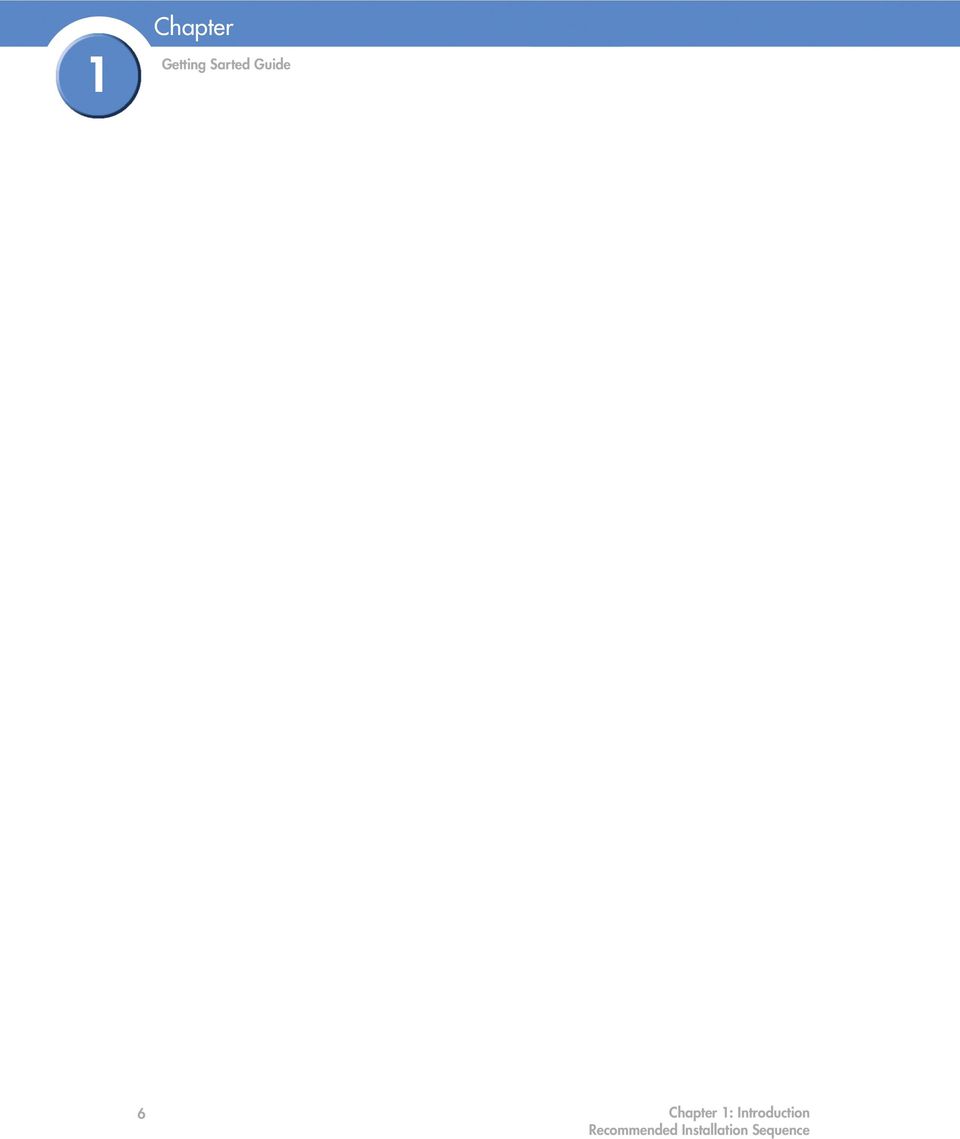

9 Part A: Set up the Hardware Getting Started Guide 2 This chapter provides details for installing the NSS hardware. The installation is broken down into the following steps: 1. Step 1: Install the Disk Drives: If your NSS does not have disk drives already installed, follow the steps in this section to insert disk drives into the NSS chassis. 2. Step 2: Connect the Ethernet Cable(s): Connect up to two Ethernet links from the NSS to your network. 3. Step 3: Connect the Power: Ensure you have connected the power cable from the NSS to the applicable power source (UPS or mains). Step 1: Install the Disk Drives After you remove the NSS from the packaging, you are ready to set up the hardware. For the NSS6100 or NSS4100, skip this step and go to Step 2 to install the Ethernet cable(s). 2: Setting up the Hardware Step 1: Install the Disk Drives 7

10 2 Getting Sarted Guide To install the disk drives into the NSS: 1. Remove a disk tray from the front of the NSS chassis by pushing in the tab on the front of the tray. (There is no recommended order of which tray to remove first.) The disk drives are numbered from 1 to 4 (left to right) in the front of the chassis. 2. Position the disk drive into a disk tray. 3. Using a Phillips screwdriver, either screw in two screws on each side of the disk tray to the disk drive, or screw in the four screws on the bottom of the disk tray to the disk drive. 4. Apply even pressure to the both corners of the tray while you insert the tray fully into position in the chassis. 5. When the disk drive is inserted all the way in, close the latch on the disk drive tray. 6. Repeat steps 1 to 5 for each disk drive you want to install. 8 2: Setting up the Hardware Step 1: Install the Disk Drives

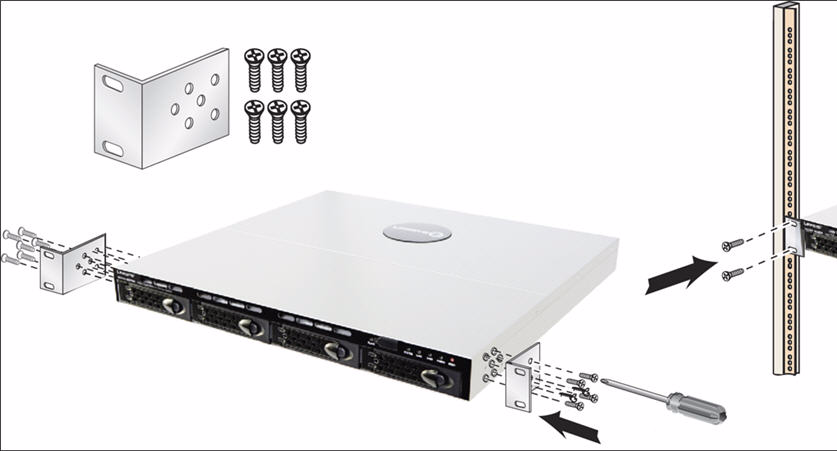
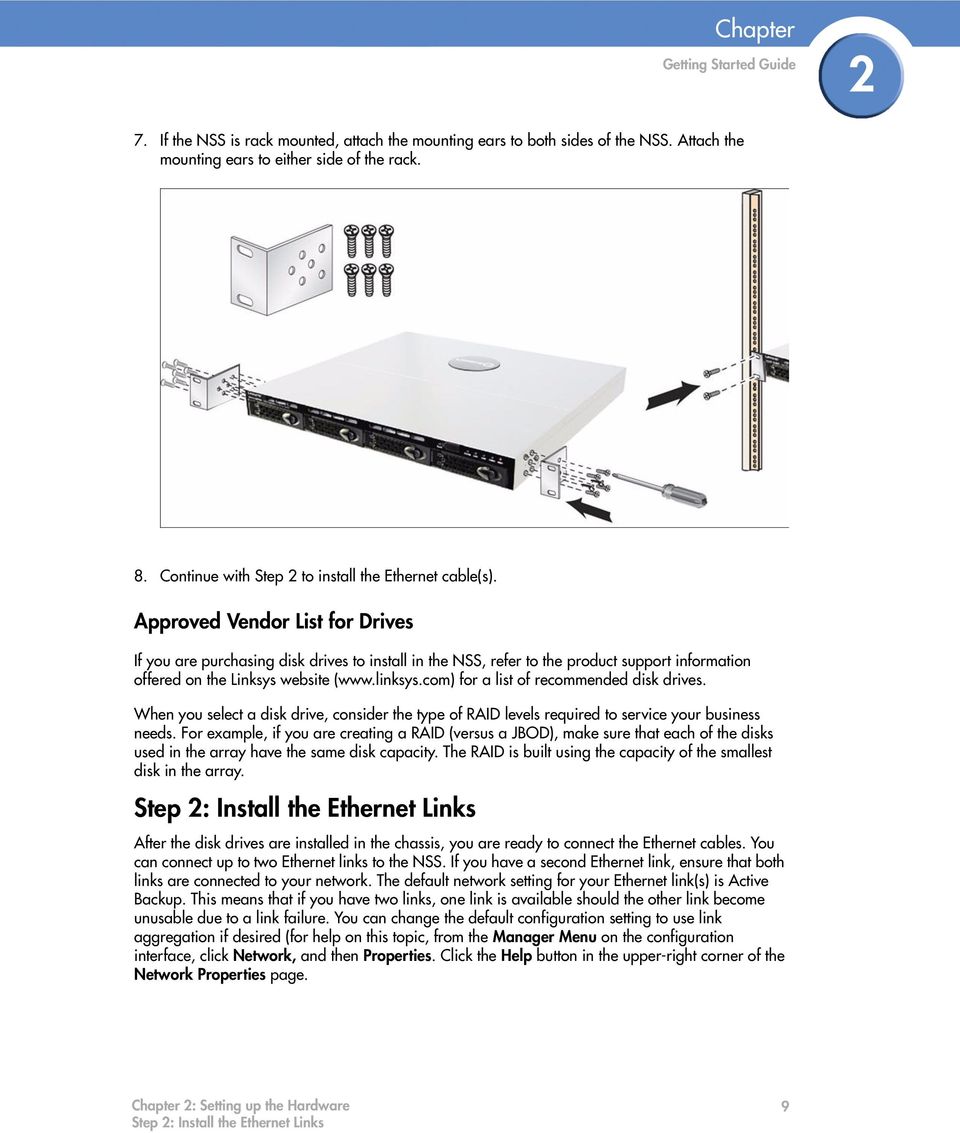
11 Getting Started Guide 2 7. If the NSS is rack mounted, attach the mounting ears to both sides of the NSS. Attach the mounting ears to either side of the rack. 8. Continue with Step 2 to install the Ethernet cable(s). Approved Vendor List for Drives If you are purchasing disk drives to install in the NSS, refer to the product support information offered on the Linksys website ( for a list of recommended disk drives. When you select a disk drive, consider the type of RAID levels required to service your business needs. For example, if you are creating a RAID (versus a JBOD), make sure that each of the disks used in the array have the same disk capacity. The RAID is built using the capacity of the smallest disk in the array. Step 2: Install the Ethernet Links After the disk drives are installed in the chassis, you are ready to connect the Ethernet cables. You can connect up to two Ethernet links to the NSS. If you have a second Ethernet link, ensure that both links are connected to your network. The default network setting for your Ethernet link(s) is Active Backup. This means that if you have two links, one link is available should the other link become unusable due to a link failure. You can change the default configuration setting to use link aggregation if desired (for help on this topic, from the Manager Menu on the configuration interface, click Network, and then Properties. Click the Help button in the upper-right corner of the Network Properties page. 2: Setting up the Hardware Step 2: Install the Ethernet Links 9
12 2 Getting Sarted Guide NOTE: If you are hotplugging an Ethernet cable to the NSS after the initial installation, ensure you wait 15 seconds between the time you unplug the cable and plug it back in. Within 10 seconds the newly connected link should appear with the correct IP and link rate in the configuration interface. To connect the Ethernet cable(s) to the NSS: 1. Install the Ethernet cable to the Ethernet port at the back of the NSS chassis. If you have a second Ethernet cable, connect it to the second Ethernet port. 2. Connect the Ethernet cable to your network. If you are connecting the NSS within the Linksys One environment, connect the cable to the ports on the SVR series router. Make sure all the connections are secure! You are now ready to continue with Step 3 to install the power. Step 3: Install the Power After you connect the Ethernet cable(s), you are ready to power up the NSS. There are several possible power configurations. We should suggest that a UPS or RPSU be used since a sudden loss of power can cause RAID corruption and possible data loss. The following procedure provides details for each of these options. To connect the power to the NSS: 1. Depending on your power configuration, do one of the following: UPS: Connect the power cable to the Power port on the NSS and to an available port on the UPS. You then need to connect the USB signal cable from the UPS to the UPS port on the NSS. For more information about choosing a UPS, refer to the list of supported UPS product families. Mains: Connect the power cable to the Power port on the NSS and to the mains power. 2. If you have an RPSU, connect the RPSU cable to the RPS port on the NSS and to an available port on the RPSU. For more details about your RPSU device, refer to the RPSU documentation. 3. Make sure the Power LED on the front of the NSS chassis is on. Congratulations! You have successfully set up the NSS hardware. You are now ready to configure the NSS for your unique business storage needs. 10 2: Setting up the Hardware Step 3: Install the Power
13 Getting Started Guide 2 NSS-supported UPS Product Families The NSS supports the following UPS product families: APC Back-UPS Pro USB APC Back-UPS RS USB APC Back-UPS USB APC Back-UPS LS USB APC Back-UPS ES/CyberFort 350 APC Smart-UPS USB 2: Setting up the Hardware Step 3: Install the Power 11

14 2 Getting Sarted Guide 12 2: Setting up the Hardware Step 3: Install the Power

15 Getting Started Guide Part B: Configure the Network Storage System (NSS) 3 There are a variety of ways to configure the NSS, depending on your specific storage needs and your unique networking environment. This section covers the steps you need to follow to get the NSS configured so that you can start using its storage. For a more detailed description of the configuration options available, refer to the topics in the pdf version of the Linksys Business Series Network Storage System Administrator Guide available from the Linksys website ( or from the Online Help available from the Help menu on the NSS configuration interface. You can display page-specific help by clicking the Help button (question mark) in the upper-right corner of any configuration page. Go through the steps in this section (in the recommended order) to configure the NSS. Step 1 Access the NSS when a DHCP server is not present: If a DHCP server is not present when you install the NSS, follow the details in this step to manually configure the network settings so that you can access the Configuration Interface. (If a DHCP server is installed, skip this step.) Step 2 Log into the NSS Configuration Interface: Log into the Configuration Interface as an administrator. Step 3 Set up or Verify the Time: You can set up the NSS timing using NTP or as a manual setting. Step 4 Configure a RAID Array: Before you can create a volume, you must configure at least one RAID array. Note: If you have an NSS4100 or NSS6100 a RAID5 is preconfigured. You can skip this step. Step 5 Create a Volume(s): After you create a RAID array and before you can set up your local users and shares, you must create at least one volume. Step 6 Virtualize your Storage: If you have multiple NSS units (one of which is a NSS6000 series unit), and you want to virtualize your storage, set up the export/import of the virtualized RAID arrays. If you are not using virtualized storage, skip this step. Step 7 Set up the User and Group ID Ranges & the Users Home Directory Location: Enable the import of groups and users from Domain Controllers on your network. Set up the home directory location for any users created locally. Step 8 Configure the Network Domain Identification: Set up the network identity of the NSS, including the hostname and domain membership. 3: Configuring the Network Storage System (NSS) 13

16 3 Getting Sarted Guide Step 9 Add any Locally Defined Users and Groups: You can create and maintain a list of users and groups from the NSS. Step 10 Create Shares: After you create a volume, you can create the shares and set up access privileges to those shares for the users and groups. You can also define the DFS access. Step 11 Create the Volume Snapshots: If you have an NSS6000 series unit, you can configure snapshots for each volume. Step 12 Set up the Share Backups: Set up a backup to run at a regular interval for the configured shares. Step 13 Complete the Configuration: Go through the rest of the configuration options to set up quotas, edit groups, set up and SNMP alerts, and so on. For detailed information, refer to the Online Help from the Configuration Manager, or the Linksys Business Series Network Storage System Administrator Guide available from the Linksys website ( Step 14 Save a Copy of the Configuration: After you configure the NSS, save a copy of the configuration to a location on the NSS and to a USB key. Step 1: Access the NSS when there is no DHCP Server Present on your Network This step depends on whether there is a DHCP server on the network to which you are connecting the NSS (this could be the router). The NSS ships with a default configuration such that its network interfaces are DHCP configured. For your computer to communicate with the NSS when no DHCP server is present, you must manually configure the computer s network settings. NOTE: The configuration for your computer is only temporary. After you initially open the configuration interface, you can configure the static IP address for the NSS accordingly and then restore your computer s network settings to their previous values. For help setting the IP configuration on the NSS, refer to the online help available with the NSS configuration interface. 14 3: Configuring the Network Storage System (NSS) Step 1: Access the NSS when there is no DHCP Server Present on your Network
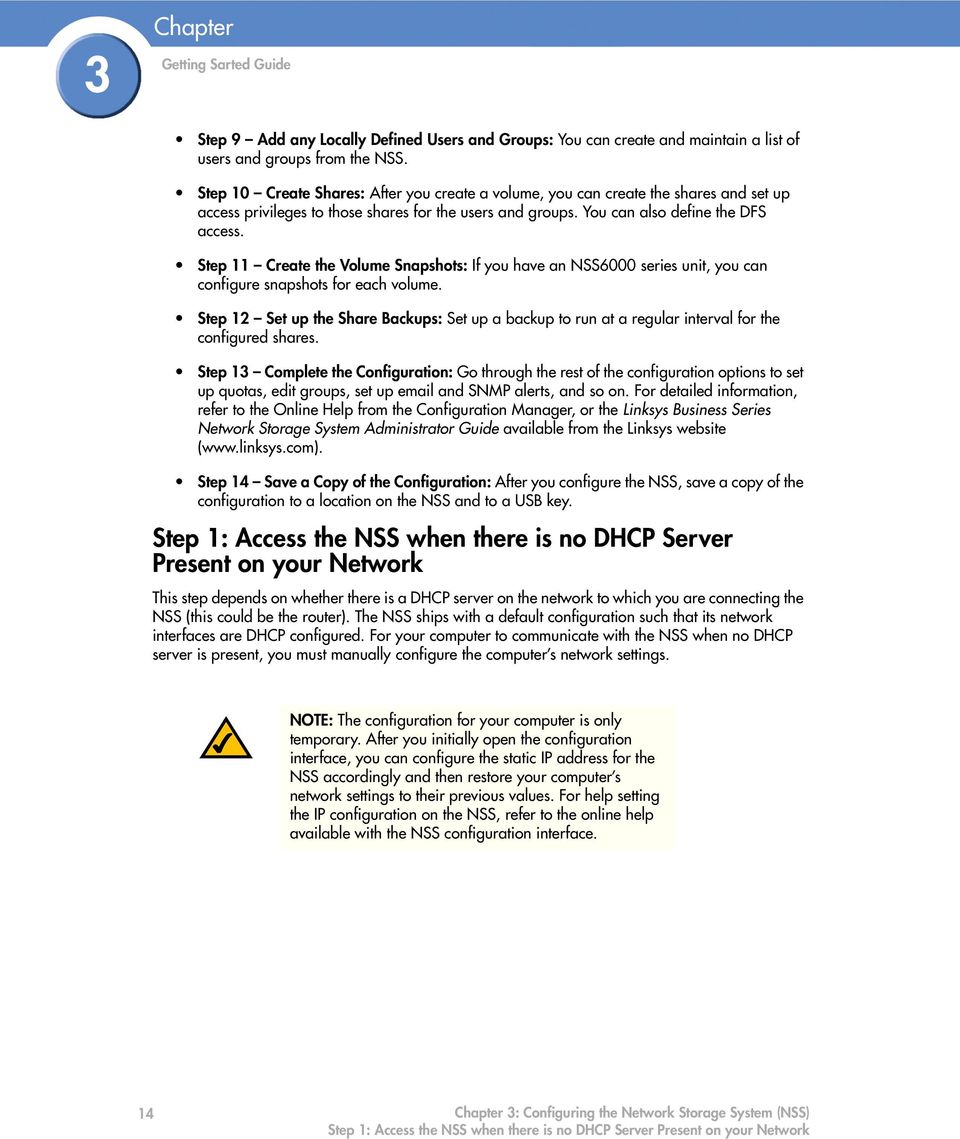
17 Getting Started Guide 3 To set up your computer to communicate with the NSS: 1. Set your computer s network settings to the following: IP Address: x.y (where x and y can be any number between 1 and 254). For example, Subnet Mast (Netmask): After you configure your computer, you can log into the NSS configuration interface. You can configure the NSS network IP settings as required. Step 2: Log into the Configuration Interface This step depends on whether your NSS is set up within the Linksys One environment or if it is in a standalone environment. The only differences to note in terms of the configuration steps is that the log in steps are different and that if you are logging into the Linksys One environment, the configuration pages appear within the Linksys One window (window-in-window). There is no difference in the actual details within the configuration pages. Option A: Linksys One Environment Login Steps To log into the configuration interface when the NSS is installed in a Linksys One Environment: 1. Login to the SVR. 2. Click the L1 Devices tab. The NSS appears in the list of devices. Note that you can change your administrator password and the NSS hostname from this window. 3. Click Show Details. 3: Configuring the Network Storage System (NSS) 15

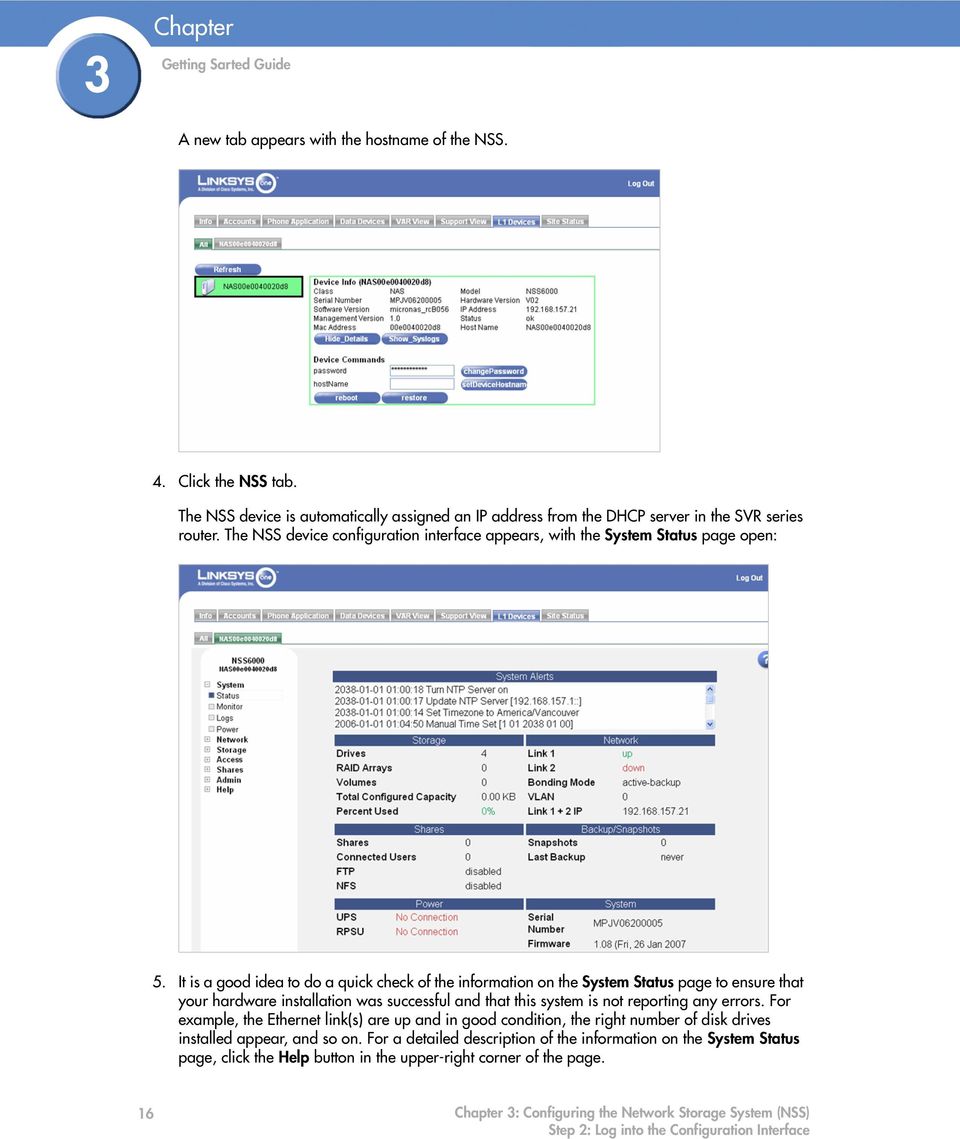
18 3 Getting Sarted Guide A new tab appears with the hostname of the NSS. 4. Click the NSS tab. The NSS device is automatically assigned an IP address from the DHCP server in the SVR series router. The NSS device configuration interface appears, with the System Status page open: 5. It is a good idea to do a quick check of the information on the System Status page to ensure that your hardware installation was successful and that this system is not reporting any errors. For example, the Ethernet link(s) are up and in good condition, the right number of disk drives installed appear, and so on. For a detailed description of the information on the System Status page, click the Help button in the upper-right corner of the page. 16 3: Configuring the Network Storage System (NSS) Step 2: Log into the Configuration Interface
19 Getting Started Guide 3 Option B: Standalone Environment Login Steps To log into the configuration interface: 1. If you are logging into the NSS for the first time, write down the MAC address located on the sticker attached to the bottom of the chassis. You need the MAC address as this is part of the default hostname. Otherwise, skip this step. 2. There are a variety of ways to display the NSS Login window. Open the Web browser on your computer: In the Address field, enter address> (For example, Browse for the NSS from the My Network Places window. Select the NSS to a network drive from a mapped network drive. The NSS Login window appears: 3. Enter the administrator login information. When you first log into the configuration interface or if you reset the factory defaults, both the username and password are set to admin. 4. Click OK. 3: Configuring the Network Storage System (NSS) 17

20 3 Getting Sarted Guide The NSS configuration interface appears, with the System Status page open: 5. It is a good idea to do a quick check of the information on the System Status page to ensure that your hardware installation was successful and that this system is not reporting any errors. For example, the Ethernet link(s) are up and in good condition, the right number of disk drives installed appear, and so on. For a detailed description of the information on the System Status page, click the Help button in the upper-right corner. Step 3: Configure the Timing Settings If you are installing the NSS within the Linksys One environment, the NSS time is automatically set via the Linksys NTP server. When you first configure the NSS, ensure that the NSS has successfully synchronized the time with the NTP server. When the NSS is synchronizing with the NTP time server, the Synchronizing time with NTP server message appears and the Update button is grayed out. After the synchronization is complete, you can manually refresh the page by reselecting the NTP Configuration page from the Manager Menu. If the synchronization failed, the following occurs: An error message stating Could not synchronize with NTP server(s) appears in the NTP Configuration page. The system alert message Could not synchronize with NTP server(s) appears in the System Status page. If the SNMP traps are configured, an SNMP trap message is sent. 18 3: Configuring the Network Storage System (NSS) Step 3: Configure the Timing Settings

21 Getting Started Guide 3 To configure the time settings for the NSS: 1. From the Manager Menu, click Admin Time. The NTP Configuration page appears. 2. To use an NTP server to maintain the NSS time, click Automatically (via NTP). To assign the time manually, skip to step If your DHCP server is configured to provide NTP settings, select Assign automatically via DHCP. If not, manually configure the NTP settings. In the NTP Server fields, enter the IP address or hostname for the NTP servers you wish to synchronize. Note that the settings in these fields are also used as a fallback if you chose to get NTP settings from your DHCP server. The NTP servers can be located on your network or can be public NTP servers located on the Internet. Skip to step Click Manually. 5. Enter the date and time in the Date and Time fields. 6. Select your time zone from the Time Zone drop-down menu. 7. Click Update. Step 4: Create a RAID Array After you install the physical disks, you can create the RAID arrays. Before you create a RAID array, either for the first time, or when you are rebuilding it as a result of failed disks in the array, it is a good idea to set the Rebuild Priority to determine how you want to allocate the system resources for the rebuild. 3: Configuring the Network Storage System (NSS) 19
22 3 Getting Sarted Guide NOTE: When adding disks to an array, we recommend you use the same model of disk with the same capacity. With the exception of a JBOD, RAIDs are configured to use the maximum of the smallest disk capacity in the array for each additional disk in the array. For example, if you install two, 250 GB disks and one 500 GB disk in a RAID0 array, the total capacity is only 750 GB. It takes approximately 1.6GB/min (NSS4000) and 2.6GB/min (NSS6000) to build a RAID5 array. To create an array: 1. From the Manager Menu, click Storage RAID. The RAID page appears: 2. The available disks appear in the New RAID Device table. Select each disk that you want to include in the array. 20 3: Configuring the Network Storage System (NSS) Step 4: Create a RAID Array
23 Getting Started Guide 3 3. From the RAID Level drop-down menu, click the RAID level of the RAID array you want to create. 4. Click Add. The RAID creation can take some time to complete (depending on the size of the disks and the selected RAID level). You can monitor the progress of the RAID build from the Storage Status page. When the build is finished, the array appears in the RAID Arrays table. The disks used in the array are no longer available for creating additional arrays. Step 5: Create a Volume After you define at least one RAID array, you can create a volume. You need to create at least one volume before you can create users, groups, or shares. To create a volume: 1. From the Manager Menu, click Storage Volumes. The Storage Volumes page appears. 2. From the New Volume area, set up the following fields: Array: Click the drop-down menu to select the array on which you want to create the volume. Name: Enter the name you want to give the volume. The volume name must consist of at least one alphanumeric character, must begin with a letter, but cannot contain any spaces. 3: Configuring the Network Storage System (NSS) 21

24 3 Getting Sarted Guide Size: Enter the size for the volume, and then select the unit from the drop-down menu. The final size of the shared volume is less than the size you enter in this field due to filesystem overhead. The minimum volume size is 32 MB. Volume sizes are rounded down to the nearest 32 MB increment. NOTE: Once the volume is created, you can expand the volume but you cannot reduce its size. To encrypt the volume, select Encrypted. To create an unencrypted volume, go to step 6. NOTE: You can encrypt the volume only when the volume is first created. After a volume is created, you cannot change whether it is encrypted or unencrypted. File transfer performance to encrypted volumes is generally lower than to non-encrypted volumes. 3. Enter a password in the Password field using a minimum of eight alphanumeric characters. The password must consist of at least three of the following: lower-case character, upper-case character, number (0-9), or a special character (such as #@*&^). The password must be entered to unlock an encrypted volume when the NSS is started up following a power interruption, shutdown, or rebooted, or, if the volume was manually locked through the NSS configuration interface. CAUTION: Because you need the password to decrypt a locked volume, keep a secure backup of the password to ensure that it is accessible when required. There is no way to unlock the volume without the password. (If the password is forgotten, the only way to retrieve the password is if the password was saved in a configuration file. See 7, Working With the Administrator Options, in the Linksys Business Series Network Storage System Administrator Guide for help on this.) 4. Re-enter the password in the Confirm Password field. 5. Click Add. 22 3: Configuring the Network Storage System (NSS) Step 5: Create a Volume
25 Getting Started Guide 3 Step 6: Virtualize Storage within your Network The NSS virtualization feature lets you create storage physically located on other network NSS units into one logical storage unit. The recommended network configuration for using virtualization is to use an NSS6000 series to operate as the master storage device (the slave devices can either be NSS6000 series, NSS4000 series, or NSS2000 series devices). This configuration setup means that you can export storage (must be an unused disk drive or configured array) from a slave NSS and then import the storage into the master NSS. The supported RAID level for virtualized storage is JBOD (although the JBOD can consist of concatenated exported arrays). NOTE: After you configure a virtual RAID, you cannot migrate the disks used for that RAID to another NSS. You also cannot export storage from a device that uses imported storage. Exporting Storage to your Network To export storage to the network: 1. Log into the configuration interface for the device from which you are exporting storage. 2. From the Manager Menu, click Storage Virtualization. 3: Configuring the Network Storage System (NSS) 23
26 3 Getting Sarted Guide The Storage Virtualization page appears. 3. From the Export a device area, select each device that you want to export from the list of available devices. 4. From the Link field, select the physical link that you want to use to export the storage. 5. Click Export. The selected disk(s) disappear from the available list of arrays and appear in the Currently Exported Storage table at the top of the page. Follow the steps to create a JBOD from virtualized storage to use the exported storage. Creating Virtualized Storage To create a JBOD with exported disks: 1. Log in to the configuration interface from the master unit. 2. From the Manager Menu, click Storage RAID. 24 3: Configuring the Network Storage System (NSS) Step 6: Virtualize Storage within your Network
27 Getting Started Guide 3 The RAID page appears. Exported disks from other NSS units in the network appear in the New RAID Device table. 3. From the New RAID Device table, click the disks or arrays that you want to include in the JBOD. 4. Select JBOD as the RAID level. 5. Click Add. The JBOD appears in the RAID Arrays listing. You can now create volumes from the virtualized JBOD. Step 7: Configure the NSS Network Identification To configure the NSS network identity: 1. From the Manager Menu, click Network Identification. 3: Configuring the Network Storage System (NSS) 25
28 3 Getting Sarted Guide The Network Identification page appears. 2. In the Hostname field, enter the name you want to use for the NSS. Note any special naming restrictions or conventions enforced by the domain(s) into which the NSS is being joined. Caution: If you change the hostname, any current CIFS connections to shares on the NSS are disconnected. 3. To assign the hostname for the NSS using the DHCP server, select Assign automatically via DHCP. If the DHCP server is not available or if it is not configured to supply a hostname, the NSS hostname is assigned using the information entered in the Hostname field. 4. In the Description field, enter the textual description for the NSS as you want it to appear in the file manager window for your users. 26 3: Configuring the Network Storage System (NSS) Step 7: Configure the NSS Network Identification
29 Getting Started Guide 3 5. Select the type of network into which you are making the NSS a member from the following options: Workgroup: Make the NSS part of a peer-to-peer network. NTv4 Domain: Make the NSS a part of a pre-windows 2000 domain. If you select this option, set up the following fields: - NTv4 Domain: Enter the domain name. - Domain Controller: Enter the hostname or IP address of the domain controller. - Username: Enter the username of an account that has administrator privileges for this domain. Note: The username cannot contain the % character. - Password: Enter the password for the administrator account. This password is cleared each time you click Update. You must re-enter the password each time you edit the fields on this page to ensure the rejoin of the domain is successful. Member of Active Directory domain: Make the NSS part of an Active Directory (ADS) domain. If you select this option, set up the following fields: - Active Directory Domain: Enter the domain name. Note that you might have to use the DNS fully qualified domain name. For example, domain.com versus just domain. - Domain Controller: Enter the hostname or IP address of the domain controller. - Kerberos Realm: Enter the name of your Kerberos realm. If you are not sure what to enter here, enter the domain name. In most standard Windows domain installations, this is the correct value. Note that you might have to use the fully qualified domain name for the Kerberos Realm fields. For example, domain.com versus just domain. - Username: Enter the username of an account that has administrator privileges for this domain. Note: The username cannot contain the % character. - Password: Enter the password for the administrator account. This password is cleared each time you click Update. You must re-enter the domain password each time you edit fields on this page to ensure the rejoin of the domain is successful. 6. Click Update. If you configured the NSS to join a domain, when you click Update, the domain join occurs. The NSS configuration interface displays the status of the domain join (that is, successful or not successful).note: If you are joined to a domain and make changes to the fields on this page, make sure you re-enter the domain password as the NSS automatically rejoins the domain when you click Update. 3: Configuring the Network Storage System (NSS) 27
30 3 Getting Sarted Guide Step 8: Configure the User/Group Ranges and Home Directory Location To avoid conflicts between your user and group IDs, it is important to set up the ranges for the various types of users and groups (i.e., local, NIS domain, and Windows domain). The ID range should be set up before you create any local users or join a NIS, NTv4, or ADS domain as you should not change the range after the domain has been joined. In addition to setting the ID ranges, you also need to define which volume you are using to store your users home directories. To set up the ID ranges and home directory location: 1. From the Manager Menu, click Access Options. The User/Group Settings page appears. 2. Set up the following ID Ranges: Local Users and Groups ID Range: This ID range applies to any users or groups created from the NSS configuration interface. When you create a user or group, the ID assigned is in this range. Make sure the range you set does not conflict with the NIS or Windows domain ranges. NIS Domain Users and Groups ID Range: This ID range should match the range of IDs defined in your NIS domain and not conflict with the local or Windows ID range. Set this range before you join the NSS to the NIS domain. Windows Domain Users and Groups ID Range: This ID range must be at least 10,000 in size. Users and groups from your NTv4 and ADS domain are mapped to local user or group IDs within this range. It is important to set this range before you join the NTv4 or ADS domain. After you join the NTv4 or ADS domain, the ID range should not change. 3. Set the volume that you want to assign as the home directory location for your users via the Home Directory Location field. 4. Click Update. 28 3: Configuring the Network Storage System (NSS) Step 8: Configure the User/Group Ranges and Home Directory Location
31 Getting Started Guide 3 Step 9: Create any Locally Defined Users and Groups You can create, view, and maintain the list of users who can access the NSS. The Configured Users page displays the Configured Users table. This table lists each defined user whether the user was created locally via the NSS configuration interface or imported from an NTv4, Active Directory, or NIS domain. Note that users not created locally via the NSS are read-only. Once a user profile is created, you cannot rename the username. To rename an existing user profile, delete the user profile and then create a new one. User profiles are maintained by the administrator. Users cannot make changes to their passwords. Groups are an easy way to manage users with the same storage needs and privileges. A group consists of one or more users. You can add or remove users from a group at any time. The user's primary group (the group to which quota charges for storage usage are applied) is set up in the Primary Group field of the user's profile. A group called nasusers is automatically created when you first install the NSS. This group is the default primary group when you create new users. Creating a User Profile Depending on your network setup, you might administer users and groups locally or via the domain controller. The NSS configuration interface gives you read-only access to users and groups provided by NTv4, Active Directory, or NIS domains. You can also create and manage local users from the NSS configuration interface. Before you can create a user profile, you must configure the volume you want to use as the home directory location for your users on the Access Options page (from the Manager Menu, click Access Options). To add a local user: 1. From the Manager Menu, click Access Users. The Configured Users page appears. Users created from the NSS configuration interface and provided by the ADS, NTv4, or NIS domain appear in the Configured Users table. 2. Click Add to create a user. 3: Configuring the Network Storage System (NSS) 29
32 3 Getting Sarted Guide The New User page appears. 3. In the Username field, type the username. The name must be made up of alphanumeric characters (that is, a-z, 0-9), any case, to a maximum of 32 characters. This field is required. 4. Select the group you want to assign as the user s primary group from the Primary Group field. If there are no groups configured, the only available choice is the default group nasusers. This field is required. NOTE: Although you can assign the user to multiple groups (through the Add Group or Edit Group page), the primary group is the group against which quota charges for the user s storage usage are made and is the group that defines the group ownership for all files created by the user. The primary group applies to users set up locally on the NSS. A domain user s primary group is set up from the domain and is not derived from the Primary Group field in the NSS user profile. 5. Assign a password by entering any valid (ASCII table) characters in the Password field. The password is required. To verify the password, re-enter it in the Confirm Password field. NOTE: All password changes to end-user accounts set up through the NSS configuration pages must be made by the administrator. 6. To record the user s full name, enter it in the Real Name field. This field is optional. Note that you cannot enter the / character in this field. 30 3: Configuring the Network Storage System (NSS) Step 9: Create any Locally Defined Users and Groups
33 Getting Started Guide 3 7. To record the user s address, enter it in the Address field. This field is optional. 8. Click OK to create the user and exit the New User page. Click Apply to create the user and then add another new user. Creating a Group Groups let you specify the share access privileges for a set of users. After you create a group, you can define the group s access privileges on a per-share basis. You can add or remove users to and from the group at any time. Note that users are assigned a primary group within their user profile. When users create a file, the group ownership is automatically set to their primary group. The storage usage is charged to their primary group for the purposes of volume quota accounting. Group membership, other than the primary group, is defined in either the Add Group or Edit Group page and is used only to control access to shares and files. NOTE: You cannot grant security privileges to a group for a CIFS share through ACL. To create a group: 1. From the Manager Menu, click Access Groups. The Configured Groups page appears. 2. Click Add. 3: Configuring the Network Storage System (NSS) 31
34 3 Getting Sarted Guide The New Group page appears. 3. In the Group Name field, type the name you want to assign to the group. The name can only contain lower-case alphanumeric characters and underscores (i.e., a-z, 0-9, _) to a maximum of 32 characters. 4. Move the users you want to assign to the group from the Users Available list to the Users in Group list. Note that a user can be assigned to multiple groups. (The single angled bracket < or > moves the selection in the direction of the bracket. The double angled bracket << or >> moves the entire list in the direction of the bracket.) 5. Click OK to save the current group and display the Configured Groups page. Click Apply to save the current group and remain in the New Group page to add another group. Step 10: Create a Share After you define at least one volume, you can create the shares that can be accessed by your users when they log into the NSS. There is a limit of 21 users and groups (the combined total) that you can assign access privileges to a share. If you have a number of users that exceeds the limitation, assign the applicable users to a group or groups and then assign the group to the share. There is no limit to the number of users that you can assign to an individual group. NOTE: You cannot create a share on a locked volume. If the volume is locked, go to the Volume page, and unlock the volume. To add a share: 1. From the Manager Menu, click Shares Shares. 2. Click Create Share. 32 3: Configuring the Network Storage System (NSS) Step 10: Create a Share
35 Getting Started Guide 3 The New Share page appears. 3. In the Share field, enter a name for the share. 4. From the Location field, select the volume on which you want to configure the share. 5. Add a description or comment about the share in the Comment field. This comment appears when you browse the NSS from My Network Places (as the tooltip when you hover over the share, or if you select the Details viewing mode). This field is optional. 6. Click the Share Attributes options to configure the share as public and if public, read-only. (These settings are optional.) Public: Enable all users to access the share. To make an NFS share world readable/writable, select this checkbox, and ensure the Read-Only checkbox is also deselected. To make an NFS share world readable, select this checkbox, and ensure the Read-Only checkbox is also selected. Read-Only: If the share is configured as a public share, allow the users read-only access to the share. Users can access and view the share but cannot write to the share. (For NFS shares, refer to the information stated in the Public field.) 3: Configuring the Network Storage System (NSS) 33
36 3 Getting Sarted Guide DFS Root: Set the share to be a Microsoft DFS root. NOTE: The share must be set as a DFS root when it is created. You cannot set it as a DFS root after it is created or revert a DFS root share to be a regular share. When you set this option, the CIFS Default File Creation Attributes and Protocol checkboxes are greyed out as they are not relevant. Follow the steps in 6, Adding a DFS Shared Folder, in the Linksys Business Series Network Storage System Administrator Guide to add shared folder links to the root. 7. Set the Allow users to delete or rename other users files and folders field as required. This field determines whether users who are assigned to a share can delete or rename files or folders within that share that they do not own. It is important to consider interoperability with applications such as MS Word 2007 and Photoshop. For example, if this field is not selected and you gave a user write permissions to a file and that user tried to open, edit, and save the file, the save would fail due to the fact that Word sets up a temporary file and then attempts to delete it and replace it with the new version. Not all applications work this way. It is important to consider the applications used by your users to determine how you want to set this field. Select this field: By selecting this field, users with write permissions can rename or delete files or folders within the assigned share even though they are not the owners of the files or folders. Deselect this field: Users cannot rename or delete a file or folder within the assigned share unless they are the owners of the file or folder. NOTE: Any subfolders created via CIFS behave according to the current setting of the Allow users to delete or rename other users files or folders field. If a subfolder is created via NFS or FTP, it behaves as though this field is selected until this field is changed. These subfolders then behave according to the current setting. 8. Set up the defaults for how file permissions are set when a file is created using CIFS via the following CIFS File Creation Attributes checkboxes: Group Readable: Members of the group assigned to the file have read permission. The group is assigned during file creation. For files created via NFS, the owner can manually set the group permissions when the file is created and can edit them at a later time. For files created via CIFS, the group is automatically assigned as the owner s default group. This group cannot be edited at a later time. Group Writable: Members of the group assigned to the file have write permission. The group is assigned during file creation. For files created via NFS, the owner can manually set the group permissions when the file is created and can edit them at a later time. For files create via CIFS, the group is automatically assigned as the owner s default group. This group cannot be edited at a later time. 34 3: Configuring the Network Storage System (NSS) Step 10: Create a Share
37 Getting Started Guide 3 Everyone Readable: All authenticated users can view the file. Everyone Writable: All authenticated users have write permission to the file. 9. From the Protocol field, click the checkboxes to select the protocols that can be used to access the share: CIFS: Enable CIFS access to the share. NFS: Enable NFS access to the share. (Note: To allow NFS access to the share, the NSS must also be configured to allow NFS access.) FTP: Enable FTP access to the share. (Note: To allow FTP access to the share, the NSS must also be configured to allow FTP access.) 10. To assign users access to the share, move the users into one of the following boxes. (The single angled bracket < or > moves the selection in the direction of the bracket. The double angled bracket << or >> moves the entire list in the direction of the bracket.) NOTE: Setting individual user and group permissions on NFS shares only works when joined to an NIS domain. Read-Only Users: These users have read-only access to the share. Read-Write Users: These users have full read-write access to the share. 11. To assign a group access to the share, move the users into one of the following boxes. (The single angled bracket < or > moves the selection in the direction of the bracket. The double angled bracket << or >> moves the entire list in the direction of the bracket.) Read-Only Groups: These groups have read-only access to the share. Read-Write Groups: These groups have full read-write access to the share. 12. Click OK. Adding a DFS Shared Folder Microsoft DFS lets users within your network easily access data stored on multiple remote computers. Through DFS, your users can view and access shares through a familiar, unified folder hierarchy, even when those resources are located on different servers. The NSS can act as a DFS root or leaf. When acting as a root, the share on the NSS contains subfolders that link to the various shares on remote systems, referred to as DFS shared folders. When you create a DFS shared folder from a share, note that the user must have privileges set up to access that share on the remote system. After the user accesses the DFS shared folder through the NSS DFS root share, the user s rights to the DFS shared folder are those assigned to the corresponding target share on the remote system. To add a DFS root directory to a share on the NSS: 1. From the Manager Menu, click Shares Shares. 3: Configuring the Network Storage System (NSS) 35
38 3 Getting Sarted Guide The File Shares page appears. 2. Click Edit for the share to which you want to add a folder. The Edit Share page appears. 3. Click Add Shared Folder. 36 3: Configuring the Network Storage System (NSS) Step 10: Create a Share
39 Getting Started Guide 3 The Add Folder page appears. 4. Select one of the following: Add a Folder to DFS: Select this option to create a single DFS shared folder. Fill in the following fields from the Add DFS Shared Folder table: - Link Name: This is the name of the link that appears as a folder within the share. When users click this link, they are redirected to the target share on the remote server. Enter any name of up to 255 characters. - Server Name: Enter the name of the remote server on which the target share is located. - Share: Enter the name of the target share. Import an Entire Remote Server: Select this option to automatically create links for all shares on the remote server. Fill in the following fields from the Import Remote Server table: - Server Name: Enter the name of the remote server. - Username: Enter the username of the account with access to the server. - Password: Enter the password for the above account. 5. If you are adding a folder to DFS, click OK. If you are importing a remote server, click Import. NOTE: Make sure you review the restrictions and recommendations for using Microsoft DFS from the NSS. 3: Configuring the Network Storage System (NSS) 37
40 3 Getting Sarted Guide Restrictions using Microsoft DFS from the NSS To use DFS folders from the NSS, it is important to understand the limitations or restrictions involved and how to best configure your system: User Credentials must be Recognized by the Remote Server: Re-direction to a remote fileserver is only successful if the current user credentials (i.e., the user s NSS username and password) are recognized by the remote server. Microsoft DFS (MSDFS) operates optimally if the PC-user s login username and password are recognized as valid on all file servers being accessed. Otherwise, an authentication error occurs and the user may not be able to reauthenticate with different user credentials. As a workaround in a non-domain (workgroup) environment, pre-map a file-share to each file server that needs special user credentials (other than the logged-in username and password). In this case, the MSDFS redirect proceeds smoothly because the PC-client already has an established session with the target file-server. When the user s login is different on the DFS leaf than the DFS root, they can pre-login to the leaf. When they then login to the root, they can access the linked DFS share. Windows Operating System Version: MSDFS is not supported by Windows 98 clients. Windows Clients must be Restarted: After you set up a DFS root, any Windows clients that were connected must be restarted. Step 11: Create a Snapshot for a Volume As part of your backup strategy, you can configure the NSS6000 series NAS to capture snapshots of the data stored on a volume. You can define a snapshot to occur at various frequencies (such as hourly, daily, weekly, and so on). Individual snapshots are overwritten by the subsequent snapshot for the same interval. For example, if you set up an hourly snapshot, the 10:00 a.m. snapshot is replaced by the 11:00 a.m. snapshot (and so on). You can also configure multiple snapshots for the same volume. For example, you might set up an hourly snapshot, another snapshot to occur every four hours, and a daily snapshot. Each of these three snapshots is maintained separately and is only overwritten by the subsequent snapshot of its own frequency type. The snapshot(s) reside in the reserve area allocated for each snapshot. When a snapshot is created, the end user can access it by logging into the NSS with their username and password. Each snapshot appears as a copy of the share accessible by the end user. The snapshot reserve is the amount of space that you want to allocate on the array to the snapshot. Once set, this space is not available for other storage use. The recommended amount of a reserve is generally between 10 to 20% of the total volume size. Note that if the period of time between 38 3: Configuring the Network Storage System (NSS) Step 11: Create a Snapshot for a Volume
41 Getting Started Guide 3 snapshots is greater, the amount of the reserve should be greater. Or, if there is a heavy amount of activity on the volume, set a higher reserve. NOTE: This feature is only available on NSS6000 series NAS units. To create a snapshot for a volume: 1. From the Manager Menu, click Storage Snapshots. The Storage Snapshots page appears. 2. From the New Snapshot table, click the volume for which you are creating the snapshot. 3. Depending on the frequency, use the first part of the Every field to enter a unit of time. Tab to the second part of the Every field, and then click the snapshot frequency (that is, hours or days). For example, set the first part of the field to 7, and the second part to Days to take a snapshot once every week. 4. Use the At: fields to set up the timing for the snapshot. For example, if the frequency is set to Days, set the hour and minute of the day at which you want the snapshot to be taken. Note: When entering the hour, use the 24-hour clock. For example, 3 p.m. should be entered as 15:00. When the frequency is set to Hours, you can only edit the minutes part of the At: field. 3: Configuring the Network Storage System (NSS) 39
42 3 Getting Sarted Guide 5. In the Reserve Size field, enter the amount of space that you want to allocate to the snapshot, and then select the unit from the drop-down menu. This space becomes unavailable for any other storage on the array. Note that you must enter a minimum of 32 MB in this field. NOTE: The snapshot is built at the array level. The Volume column currently shows the amount of space left on the array on which the volume is located. To calculate the reserve size, refer to the applicable volume size as listed on the Volume page. 6. Click Add to save the snapshot. Clicking Add saves the first snapshot. Each subsequent snapshot occurs based on the defined schedule. The snapshot details appear in the Currently Active Snapshots area at the top of the page. Step 12: Create a Scheduled Backup for a Share You can quickly configure a backup to run at a scheduled time interval for a share or group of shares. The backup can be saved to a remote CIFS server or to another share on the NSS. To set up a scheduled backup: 1. From the Manager Menu, click Shares Backup. 2. Click Schedule Backup. 40 3: Configuring the Network Storage System (NSS) Step 12: Create a Scheduled Backup for a Share
43 Getting Started Guide 3 The Scheduled Backups page appears. 3. Move the shares you want to include in the backup from the Available Shares list to the Shares to Backup list. (The single angled bracket < or > moves the selection in the direction of the bracket. The double angled bracket << or >> moves the entire list in the direction of the bracket.) 4. Click one of the following to determine the destination for the backup: Remote CIFS Filer: To save the backup on a remote CIFS server, click this option and then configure the hostname of the remote server, the remote share, as well as the login credentials to that share. Local File System: Select the share on which you want to store the backup. 5. To create a compressed backup, check Compress backup image. Note: Compressed backup images are smaller than non-compressed images but take longer to create. 6. Click Next. 3: Configuring the Network Storage System (NSS) 41
44 3 Getting Sarted Guide The Select Backup Schedule page appears. 7. Select the backup frequency as one of the following: Daily: Select each day on which you want the backup to occur. Weekly: Select the day of the week on which you want the backup to occur. Monthly: Select the day of the month on which you want the backup to occur. Make sure you select a day that is 28 or less. If you select the 29th, 30th or 31st day, the backup does not run during months that do not contain that day. 8. In the Run Backup at field, set up the specific time (hour:minute) at which time the backup occurs. When setting the hour, use the 24-hour clock. 9. To set up a backup that backs up just the changes made to the share since the last backup, click Incremental Backups. Leave it unchecked to take a full backup of the share each time the backup is run. 10. Click OK. Step 13: Complete the Configuration There are a number of configuration options not listed in this guide (for example, you can set up Alerts, SNMP alerts, VLANs, and so on). You can find the full details in the Administrator Guide which you can access either through the Online Help. The Online Help is part of the Configuration Manager or you can download the pdf version of the Administrator Guide from the Linksys website ( 42 3: Configuring the Network Storage System (NSS) Step 13: Complete the Configuration
45 Getting Started Guide 3 Step 14: Save the Current Configuration You can save a copy of the NSS configuration that can be used should you need to restore the settings at a later time. When you save the configuration file, it saves a date-stamped version of the current configuration settings to the specified volume on the NSS. You can choose to save the current configuration settings to a specified volume on the NSS or you can save the file to a USB flash device inserted into the AUX-1 port. NOTE: If you restore a configuration file that was saved in an older version of the NSS firmware than the current version, check the settings after you restore the file to ensure they were updated correctly. To save the current configuration: 1. If you are saving the configuration file to a USB flash device, insert a USB flash device into the AUX-1 port on the NSS chassis. 2. From the Manager Menu, click Admin Configuration. The Configuration Manager page appears. 3. Select the location where the backup is saved from the Stored Configuration Location dropdown menu. To save the configuration file to a USB flash device, select the AUX-1port as the location. You can then copy the configuration file from the USB flash device to another location on your network. 4. Click Update. 5. Click Save to save the configuration settings. If the configuration file does not successfully save to the specified volume, check the volume to ensure that it is not locked. 3: Configuring the Network Storage System (NSS) 43
46 3 Getting Sarted Guide 6. If you saved the file to the USB flash device, display the Storage Status page. 7. Click Unmount. NOTE: Removing the USB flash device in a mounted state means that you risk causing file or filesystem corruption. 8. When the AUX-1 LED on the front of the chassis is off, you can safely remove the unmounted USB flash device from the AUX-1 port. 44 3: Configuring the Network Storage System (NSS) Step 14: Save the Current Configuration
47 Part C: Instruct Your Users How to Access the NSS Storage Getting Started Guide 4 End users, using a Windows, UNIX, Linux, or Mac computer can easily access NSS storage. Once the end user logs into the NSS using their username and password, the shares to which the end user has read or read-write privileges appear. The NSS supports three file-sharing protocols: CIFS, NFS, and FTP. The steps to access the NSS storage depend on which file-sharing protocol the end user chooses to use: CIFS, NFS, or FTP as well as the end user s operating system. Windows Users: Accessing the NSS Storage using CIFS/SMB Windows users who have a user profile set up can access any shares to which they have privileges on the NSS storage using CIFS/SMB. To access the NSS storage using CIFS/SMB: 1. There are a variety of ways to access the NSS: From the My Computer window, type \\<hostname> or \\<IP address> in the Address bar. (Where the <hostname> refers to your NSS hostname and <IP address> refers to your NSS IP address. For example, \\NAS ab or \\ ) Browse for the NSS from the My Network Places window. Map the NSS to a network drive. The Login window appears. 2. If your user profile is set up locally (that is, through the NSS configuration interface), in the User name field, enter the following: <NSS hostname>\<username>. If your user profile is set up through the domain, you do not need to enter the NSS hostname before your user name. (Just enter your user name and then your password.) 3. Click OK. The Windows Explorer window opens with a directory listing of the available shares. 4. Depending on your privileges to the share, you can begin using the NSS storage. 4: Accessing Network Storage Windows Users: Accessing the NSS Storage using 45
48 4 Getting Sarted Guide Windows Users: Accessing the NSS Storage through FTP Windows users who have a user profile set up can access any shares to which they have privileges on the NSS storage using CIFS/SMB or FTP. To access the NSS storage using FTP: NOTE: Before your end users can access the shares on the NSS using FTP, the NSS must have FTP access enabled and the individual share must be set up to allow FTP access. 1. From your FTP client application, connect to the NSS. Enter the IP address or hostname of the NSS. For more information about using your FTP client application, refer to its documentation. 2. Enter your DOMAINNAME\username and password when prompted by your FTP client. When your FTP client has logged in, a list of accessible shares appears as individual directories. 3. Depending on your privileges to the share, you can begin using the NSS storage. UNIX/Linux Users: Accessing Storage through NFS UNIX and Linux users can access shares on the NSS via NFS. Due to the way that the NSS implements NFS file access privileges, only NFSv3 is supported. In order for NFS access privileges to work correctly, you must have the NSS joined to an NIS domain. NOTE: You must have root privileges to your client system to create an NFS mount. 1. Log into the client system as root. 2. Create a mount point directory for the mount if you do not already have one (e.g., mkdir /mnt/nas_share1). 3. Mount the NFS share by typing mount -t nfs -o nfsvers=3 <IP address/hostname>:<mount point path on NSS> <mount point path on client>. The mount point path on the NSS appears in the Shares page. 4. Log out of the root account. 5. Log into the user account on the client system. You should now have access to the share via the mount point directory on your client. You have the privileges to the share as are defined for the NSS. 46 4: Accessing Network Storage Windows Users: Accessing the NSS Storage through FTP
49 Getting Started Guide 4 UNIX/Linux Users: Accessing Storage through FTP UNIX and Linux users who have a user profile set up can access any shares to which they have privileges on the NSS storage using NFS or FTP. To access the NSS storage using FTP: 1. Open your FTP client application. 2. Enter the NSS hostname/ip address. 3. Enter any other required settings. If using FPS, ensure that the client is set to use Explicit FTPS. For more help using the FTP client, refer to the FTP client documentation. 4. Enter your DOMAINNAME\username and password when prompted by the FTP client. 5. Depending on your privileges to the share, you can begin using the NSS storage. Mac Users: Accessing Storage through CIFS/SMB Mac users who have a user profile can access any shares to which they have privileges on the NSS storage using CIFS/SMB. To access the NSS storage via CIFS/SMB: 1. From the Finder s Go menu, click Connect to Server. 2. Enter smb://<hostname or IP address of the NSS>/<sharename>. (Where the information in the brackets is meant to be replaced with the applicable information. Do not type the brackets.) Click the + sign to save the NSS address to the Favorite Servers list so that the next time you log in you just need to select the address from the list. 3. Click Connect. NOTE: Before your end users can access the shares on the NSS using FTP, the NSS network filters must be set up to allow FTP access. The individual share must be also be set up to allow FTP access. 4. When the Login window appears, enter your username and password. If your user profile is set up locally (that is, through the NSS configuration interface and not through the ADS or NTv4 domain), you need to enter the following: <NSS hostname>\<user name>. 5. Depending on your privileges to the share, you can begin using the NSS storage. 4: Accessing Network Storage UNIX/Linux Users: Accessing Storage through FTP 47
50 4 Getting Sarted Guide Mac Users: Accessing Storage through FTP Mac users who have a user profile can access any shares to which they have privileges on the NSS storage using FTP. To access the NSS storage using FTP: 1. Open your FTP client application. 2. Click Connect. NOTE: Before your end users can access the shares on the NSS using FTP, the NSS must have FTP access enabled and the individual share must be set up to allow FTP access. 3. From your FTP client application, connect to the NSS. Enter the IP address or hostname of the NSS. For more information about using your FTP client application, refer to its documentation. 4. Enter your DOMAINNAME\username and password when prompted by your FTP client. When your FTP client has logged in, a list of accessible shares appears as individual directories. 5. Depending on your privileges to the share, you can begin using the NSS storage. 48 4: Accessing Network Storage Mac Users: Accessing Storage through FTP
51 LEDs & Buttons Getting Started Guide 5 The LEDs on the front and back of the NSS chassis help you troubleshoot a variety of conditions on the NSS---from normal operating conditions, alerts, to serious error conditions. The Reset button lets you restore the network defaults in situations where you can no longer log into the configuration interface. Power LED (Front Panel) The Power LED can be in any of the following states, depending on the current state of the NSS: Solid Yellow: The NSS is powered on and the boot loader is currently running. The boot loader runs for approximately 10 seconds at the beginning of the startup of the NSS, after which the LED goes to a blinking green. This condition also occurs if the upgrade of firmware process fails (although in this case, the LED remains in a solid yellow condition until the user clicks OK from the System Details page following an unsuccessful upload. After the user clicks OK, the system reboots using the current version of the firmware.) Blinking Yellow: The network configuration factory defaults are being reset. When resetting the network defaults, hold down the Reset button until you see the Power LED flash yellow rapidly. Solid Green: The NSS is powered up and finished booting. Blinking Green: The NSS is either booting up or shutting down. Alternating Yellow & Green: The firmware update is currently in progress. Off: The NSS is either disconnected from a power source or has finished the shutdown process and can be safely disconnected from a power source. 5: LEDs 49
52 5 Getting Sarted Guide System LED (Front Panel) The System LED can be in any of the following conditions, depending on the current type of system error on the NSS: Solid Yellow: The administrator needs to look into the exact error condition through the configuration interface as one of the following has occurred: - A volume is more than 90% full. - A disk drive has failed or is about to fail. - A fan has stalled. - The system temperature is above the maximum threshold. - The temperature of a disk drive is above the maximum threshold. - A voltage rail is above or below specification. - The NSS is running on UPS due to a mains power failure. - The NSS is running on RPSU due to an internal power supply failure. Solid Red: There is a critical system failure. The upgrade of the firmware was not successful for any of the following reasons: - The firmware being loaded is not compatible with the NSS platform. - The firmware image is corrupt. - The firmware image is a previous version to the one currently installed. Downgrades are not supported. Off: There are no system-related problems. Reset Button (Front Panel) The Reset button lets you restore the network setting system defaults or reset the box. To restore the network setting system defaults: You need to do this if the configuration interface becomes inaccessible. To reset the network setting system defaults, shut down the NSS, power it off, hold down the Reset button, and then power up the NSS. When you see the Power LED blink yellow rapidly, release the Reset button. The network settings are restored to factory defaults. To reset the box: Press and hold the Reset button while the system is running until the Power LED begins to blink green. Release the Reset button. 50 5: LEDs
53 Getting Started Guide 5 LAN LEDs (Front Panel) Solid Green: The LAN link is up and running at 1000 link speed, but is currently idle. Blinking Green: The LAN link is up and running at 1000 link speed and is currently active. The LED flickers off with activity. Solid Yellow: The LAN link is up and running at 10/100 link speed, but is currently idle. Blinking Yellow: The LAN link is up and running at 10/100 link speed and is currently active. The LED flickers off with activity. Off: No LAN link is detected. Hard Disk Drive LEDs (Front Panel) The LEDs associated with each of the installed disk drives indicate disk-drive activity, an error condition, and locate state. The various states of the green LED indicates the drive activity: Solid Green: The disk drive is configured but is currently idle. Flicker Green: The disk drive is configured, active, and not rebuilding. Flickers off with activity. Blinking Green: The disk drive is configured and a RAID array is currently rebuilding to the disk drive. Off: The disk drive is not configured (not part of a RAID or JBOD array and not exported). The various states of the red LED indicate that the disk drive is in an error condition: Solid Red: The disk drive is in a failed state. Blinking Red: The disk drive is predicated to fail (via S.M.A.R.T.). We recommend that you replace the disk drive to avoid the loss of data. Off: The drive is OK. The various states of the white LED indicate that there is a locate request currently on the disk drive: Blinking White: There is a locate request currently on the disk drive (from the Storage Status page on the configuration interface). NOTE: There can only be one locate request set for a disk drive at one time. Off: The disk drive is not marked by a locate request. 5: LEDs 51
54 5 Getting Sarted Guide USB LED (Front Panel) Solid Green: The USB hard/flash drive is connected and is not safe to remove. Blinking Green: The USB hard/flash drive is connected and is being mounted or unmounted. Off: There is either no USB hard/flash drive connected to the NSS, or, if connected, the USB hard/flash drive is safe to remove. UPS LED (Back Panel) Off: There is either no UPS attached to the NSS or the UPS function has been disabled in the System Power page in the configuration interface. On: A UPS is attached to the NSS and the UPS function is enabled in the System Power page in the configuration interface. 52 5: LEDs
55 Network Storage System (NSS) Getting Started Guide Support Contact Information Appendix A Linksys One Contact Information Visit Linksys online for information on the latest products and product updates at: Can't find information about a product you want to buy on the web? Do you want to know more about networking with Linksys One products? For pre-sales product questions call: If you experience problems with any Linksys One product at any time, contact your Value Added Reseller (VAR). If you are a VAR, contact Linksys Technical Support: For customers outside the U.S., you can find technical support contact information for your location by going to and choosing your country. Appendix A Linksys One Contact Information 53
How To Use 1Bay 1Bay From Awn.Net On A Pc Or Mac Or Ipad (For Pc Or Ipa) With A Network Box (For Mac) With An Ipad Or Ipod (For Ipad) With The
 1-bay NAS User Guide INDEX Index... 1 Log in... 2 Basic - Quick Setup... 3 Wizard... 3 Add User... 6 Add Group... 7 Add Share... 9 Control Panel... 11 Control Panel - User and groups... 12 Group Management...
Network Storage System with 2 Bays
 USER GUIDE Network Storage System with 2 Bays Model: NAS200 About This Guide About This Guide Icon Descriptions While reading through the User Guide you may see various icons that call attention to specific
ReadyNAS Setup Manual
 ReadyNAS Setup Manual NETGEAR, Inc. 4500 Great America Parkway Santa Clara, CA 95054 USA October 2007 208-10163-01 v1.0 2007 by NETGEAR, Inc. All rights reserved. Trademarks NETGEAR, the NETGEAR logo,
BlackArmor NAS 110 User Guide
 BlackArmor NAS 110 User Guide BlackArmor NAS 110 User Guide 2010 Seagate Technology LLC. All rights reserved. Seagate, Seagate Technology, the Wave logo, and FreeAgent are trademarks or registered trademarks
Quick Start Guide. NSS322 Smart Storage. Package Contents. Cisco Small Business
 Quick Start Guide Cisco Small Business NSS322 Smart Storage Package Contents Smart Storage Power Adapter Quick Start Guide Ethernet Cable (2) Disk Tray Screws (2 Packs) Inline Switch Module HDD Sequence
READYNAS INSTANT STORAGE. Quick Installation Guide
 READYNAS INSTANT STORAGE Quick Installation Guide Table of Contents Step 1 Connect to FrontView Setup Wizard 3 Installing RAIDar on Windows 3 Installing RAIDar on Mac OS X 3 Installing RAIDar on Linux
Quick Start Guide. NSS324 and NSS326 Smart Storage. Package Contents. Cisco Small Business
 Quick Start Guide Cisco Small Business NSS324 and NSS326 Smart Storage Package Contents Smart Storage Power Cord Quick Start Guide Ethernet Cable (2) Disk Tray Screws (2 Packs) Inline Switch Module HDD
Open Source and License Source Information
 BlackArmor NAS 220 BlackArmor NAS 220 User Guide 2010 Seagate Technology LLC. All rights reserved. Seagate, Seagate Technology, the Wave logo, and FreeAgent are trademarks or registered trademarks of Seagate
External Storage 200 Series. User s Manual
 External Storage 200 Series User s Manual Version 1.2 00P3DS200ZSEA2 Table of Contents User s Manual 1. Overview...3 2. Key Features...3 3. Rear Connectors...4 4. Setup the External Storage 200...4 5.
Iomega Home Media Network Hard Drive
 Page 1 of 75 Iomega Home Media Network Hard Drive Iomega, the stylized "i" logo, and all Iomega brand blocks are either registered trademarks or trademarks of Iomega Corporation in the United States and/or
NNAS-D5 Quick Installation Guide
 NNAS-D5 Quick Installation Guide NOTE: By default, LAN0 (eth0) is set to DHCP. If a DHCP server is available or detected, LAN0 will be assigned a DHCP IP address. If a DHCP server is not available, LAN0
ReadyNAS Duo Setup Manual
 ReadyNAS Duo Setup Manual NETGEAR, Inc. 4500 Great America Parkway Santa Clara, CA 95054 USA February 2008 208-10215-01 v1.0 2008 by NETGEAR, Inc. All rights reserved. Trademarks NETGEAR, the NETGEAR logo,
BlackArmor NAS 440/420 User Guide
 BlackArmor NAS 440/420 User Guide BlackArmor NAS 440/420 User Guide 2010 Seagate Technology LLC. All rights reserved. Seagate, Seagate Technology, the Wave logo, and FreeAgent are trademarks or registered
Dual HD Giganet NAS Enclosure User s Manual
 Before you begin Dual HD Giganet NAS Enclosure User s Manual 1. If you purchased the Dual HD Giganet NAS enclosure (indicated as The NAS hereafter) to share your file or media with other computers, you
How To Set Up An Ipa Ez On A Pc Or Mac Or Macbook Or Ipa Or Ipamorade
 Iomega EZ Media and Backup Center User Guide Table of Contents Setting up Your Device... 1 Setup Overview... 1 Set up My Iomega StorCenter If It's Not Discovered... 2 Discovering with Iomega Storage Manager...
Lenovo Online Data Backup User Guide Version 1.8.14
 Lenovo Online Data Backup User Guide Version 1.8.14 Contents Chapter 1: Installing Lenovo Online Data Backup...5 Downloading the Lenovo Online Data Backup Client...5 Installing the Lenovo Online Data
WHICH INTERFACE: USB OR ETHERNET?... 3 CONNECTING NAS DRIVE USING USB...
 Revision 1.2 INTRODUCTION... 1 CONTROLS, CONNECTORS AND INDICATORS... 1 Front Panel Area... 1 Rear Panel Area... 2 ABOUT THE HARD DISK... 2 LOCATING NAS DRIVE ON YOUR DESK... 3 WHICH INTERFACE: USB OR
Storage Sync for Hyper-V. Installation Guide for Microsoft Hyper-V
 Installation Guide for Microsoft Hyper-V Egnyte Inc. 1890 N. Shoreline Blvd. Mountain View, CA 94043, USA Phone: 877-7EGNYTE (877-734-6983) www.egnyte.com 2013 by Egnyte Inc. All rights reserved. Revised
4-Drive-Bay Advanced Gigabit Network RAID Storage System Chassis
 Cisco NSS6000 4-Bay Advanced Gigabit Storage System Chassis and Cisco NSS6100 4-Bay Advanced Gigabit Storage System - 1.0TB RAID Cisco Small Business Network Storage System 4-Drive-Bay Advanced Gigabit
SkyIPCam 250W Wireless Network Camera. Model # AIC250W. User s Manual
 SkyIPCam 250W Wireless Network Camera Model # AIC250W User s Manual Ver. 1B Table of Contents 1. Introduction... 4 2. Getting Started... 5 3. Installing the Setup Wizard... 6 4. Gathering Information...
3.5 EXTERNAL NETWORK HDD. User s Manual
 3.5 EXTERNAL NETWORK HDD User s Manual Table of Content Before You Use Key Features H/W Installation Illustration of Product LED Definition NETWORK HDD Assembly Setup the Network HDD Home Disk Utility
Step-by-Step Setup Guide Wireless File Transmitter FTP Mode
 EOS Step-by-Step Setup Guide Wireless File Transmitter FTP Mode Ad Hoc Setup Windows XP 2012 Canon U.S.A., Inc. All Rights Reserved. Reproduction in whole or in part without permission is prohibited. 1
Network Storage Link
 A Division of Cisco Systems, Inc. WIRED Network Storage Link for USB 2.0 Disk Drives User Guide Model No. NSLU2 Copyright and Trademarks Specifications are subject to change without notice. Linksys is
Gigabyte Management Console User s Guide (For ASPEED AST 2400 Chipset)
 Gigabyte Management Console User s Guide (For ASPEED AST 2400 Chipset) Version: 1.4 Table of Contents Using Your Gigabyte Management Console... 3 Gigabyte Management Console Key Features and Functions...
Table of Contents. D-Link DNS-346 USER S MANUAL
 Table of Contents Table of Contents... 2 Product Overview... 3 About this User s Guide... 3 Introduction... 3 Package Contents... 4 System Requirements... 4 Features... 5 Hardware Overview... 6 Front Panel...
Introduction... 3 Features... 3 Minimum Requirements... 3 Package Contents... 3 Understand your storage server... 4 Back Panel... 4 Front Panel...
 Introduction... 3 Features... 3 Minimum Requirements... 3 Package Contents... 3 Understand your storage server... 4 Back Panel... 4 Front Panel... 5 Getting started... 7 Chapter 1... 14 Status... 14 Chapter
Testing and Restoring the Nasuni Filer in a Disaster Recovery Scenario
 Testing and Restoring the Nasuni Filer in a Disaster Recovery Scenario Version 7.0 July 2015 2015 Nasuni Corporation All Rights Reserved Document Information Testing Disaster Recovery Version 7.0 July
CLICK HERE TO ACCESS AN UP-TO-DATE ONLINE VERSION
 CLOUDBOX USER MANUAL CLICK HERE TO ACCESS AN UP-TO-DATE ONLINE VERSION of this document. Online User Manuals feature easy navigation, expandable illustrations, and search capability. 1 INTRODUCTION The
ReadyNAS for Home RAIDiator 5.3
 ReadyNAS for Home RAIDiator 5.3 Software Manual Models: Duo v2 NV+ v2 350 East Plumeria Drive San Jose, CA 95134 USA November 2011 202-10896-01 2011 NETGEAR, Inc. All rights reserved. No part of this publication
Testing and Restoring the Nasuni Filer in a Disaster Recovery Scenario
 Testing and Restoring the Nasuni Filer in a Disaster Recovery Scenario Version 7.2 November 2015 Last modified: November 3, 2015 2015 Nasuni Corporation All Rights Reserved Document Information Testing
Iomega ix2-dl Users Guide D31593401
 Iomega ix2-dl Users Guide D31593401 Table of Contents Setting up Your Device... 1 Setup Overview... 1 Set up My Iomega StorCenter If It's Not Discovered... 2 Discovering with Iomega Storage Manager...
Setting Up Your FTP Server
 Requirements:! A computer dedicated to FTP server only! Linksys router! TCP/IP internet connection Steps: Getting Started Configure Static IP on the FTP Server Computer: Setting Up Your FTP Server 1. This
Backup & Disaster Recovery Appliance User Guide
 Built on the Intel Hybrid Cloud Platform Backup & Disaster Recovery Appliance User Guide Order Number: G68664-001 Rev 1.0 June 22, 2012 Contents Registering the BDR Appliance... 4 Step 1: Register the
Gigabyte Content Management System Console User s Guide. Version: 0.1
 Gigabyte Content Management System Console User s Guide Version: 0.1 Table of Contents Using Your Gigabyte Content Management System Console... 2 Gigabyte Content Management System Key Features and Functions...
Extreme Control Center, NAC, and Purview Virtual Appliance Installation Guide
 Extreme Control Center, NAC, and Purview Virtual Appliance Installation Guide 9034968 Published April 2016 Copyright 2016 All rights reserved. Legal Notice Extreme Networks, Inc. reserves the right to
Installing Operating Systems
 CHAPTER 6 The unattended operating system installation function helps you install the Microsoft Windows and RedHat Linux operating system families. UCS-SCU has integrated device drivers including RAID
Barracuda Link Balancer Administrator s Guide
 Barracuda Link Balancer Administrator s Guide Version 1.0 Barracuda Networks Inc. 3175 S. Winchester Blvd. Campbell, CA 95008 http://www.barracuda.com Copyright Notice Copyright 2008, Barracuda Networks
Vantage RADIUS 50. Quick Start Guide Version 1.0 3/2005
 Vantage RADIUS 50 Quick Start Guide Version 1.0 3/2005 1 Introducing Vantage RADIUS 50 The Vantage RADIUS (Remote Authentication Dial-In User Service) 50 (referred to in this guide as Vantage RADIUS)
Dual Bay Home Media Store. User Manual
 Dual Bay Home Media Store User Manual CH3HNAS2 V1.0 CONTENTS Chapter 1: Home Page... 3 Setup Wizard... 3 Settings... 3 User Management... 3 Download Station... 3 Online User Manual... 3 Support... 3 Chapter
RSA Security Analytics. S4 Broker Setup Guide
 RSA Security Analytics S4 Broker Setup Guide Copyright 2010-2013 RSA, the Security Division of EMC. All rights reserved. Trademarks RSA, the RSA Logo and EMC are either registered trademarks or trademarks
How To Set Up A Backupassist For An Raspberry Netbook With A Data Host On A Nsync Server On A Usb 2 (Qnap) On A Netbook (Qnet) On An Usb 2 On A Cdnap (
 WHITEPAPER BackupAssist Version 5.1 www.backupassist.com Cortex I.T. Labs 2001-2008 2 Contents Introduction... 3 Hardware Setup Instructions... 3 QNAP TS-409... 3 Netgear ReadyNas NV+... 5 Drobo rev1...
ReadyNAS RAIDiator 4.1
 ReadyNAS RAIDiator 4.1 Software Manual Models: Duo NV+ 1100 350 East Plumeria Drive San Jose, CA 95134 USA November 2011 202-10926-01 2011 NETGEAR, Inc. All rights reserved No part of this publication
CONFIGURING ACTIVE DIRECTORY IN LIFELINE
 White Paper CONFIGURING ACTIVE DIRECTORY IN LIFELINE CONTENTS Introduction 1 Audience 1 Terminology 1 Test Environment 2 Joining a Lenovo network storage device to an AD domain 3 Importing Domain Users
Spector 360 Deployment Guide. Version 7
 Spector 360 Deployment Guide Version 7 December 11, 2009 Table of Contents Deployment Guide...1 Spector 360 DeploymentGuide... 1 Installing Spector 360... 3 Installing Spector 360 Servers (Details)...
Installing, Uninstalling, and Upgrading Service Monitor
 CHAPTER 2 Installing, Uninstalling, and Upgrading Service Monitor This section contains the following topics: Preparing to Install Service Monitor, page 2-1 Installing Cisco Unified Service Monitor, page
Network Storage Server. User s Manual
 Network Storage Server User s Manual Introduction... 3 Features... 3 Minimum Requirements... 3 Package Contents... 3 Understand your Storage Server... 5 Back Panel... 5 Front Panel... 6 Getting started...
NAS HARD DRIVE ENCLOSURE USER MANUAL. S T O R E n S H A R E MUSIC DATA PHOTO MOVIE
 NAS HARD DRIVE ENCLOSURE USER MANUAL S T O R E n S H A R E MUSIC DATA PHOTO MOVIE w w w. v a n t e c u s a. c o m Package Contents: NexStar LX External 3.5 HDD NAS Enclosure: User Manual NexStar LX External
FileMaker Server 8. Administrator s Guide
 FileMaker Server 8 Administrator s Guide 1994-2005 FileMaker, Inc. All Rights Reserved. FileMaker, Inc. 5201 Patrick Henry Drive Santa Clara, California 95054 FileMaker is a trademark of FileMaker, Inc.,
Chapter 6 Using Network Monitoring Tools
 Chapter 6 Using Network Monitoring Tools This chapter describes how to use the maintenance features of your Wireless-G Router Model WGR614v9. You can access these features by selecting the items under
Parallels Plesk Panel
 Parallels Plesk Panel Copyright Notice Parallels Holdings, Ltd. c/o Parallels International GMbH Vordergasse 49 CH8200 Schaffhausen Switzerland Phone: +41 526320 411 Fax: +41 52672 2010 Copyright 1999-2011
Spector 360 Deployment Guide. Version 7.3 January 3, 2012
 Spector 360 Deployment Guide Version 7.3 January 3, 2012 Table of Contents Deploy to All Computers... 48 Step 1: Deploy the Servers... 5 Recorder Requirements... 52 Requirements... 5 Control Center Server
SmartFiler Backup Appliance User Guide 2.0
 SmartFiler Backup Appliance User Guide 2.0 SmartFiler Backup Appliance User Guide 1 Table of Contents Overview... 5 Solution Overview... 5 SmartFiler Backup Appliance Overview... 5 Getting Started... 7
Thank for choosing the Dominion KX III, the industry's highest performance enterprise-class, secure, digital KVM (Keyboard, Video, Mouse) switch.
 QS Rule Dominion KX III Quick Setup Guide Thank for choosing the Dominion KX III, the industry's highest performance enterprise-class, secure, digital KVM (Keyboard, Video, Mouse) switch. This Quick Setup
c. Securely insert the Ethernet cable from your cable or DSL modem into the Internet port (B) on the WGT634U. Broadband modem
 Start Here Follow these instructions to set up your router. Verify That Basic Requirements Are Met Assure that the following requirements are met: You have your broadband Internet service settings handy.
Virtual Web Appliance Setup Guide
 Virtual Web Appliance Setup Guide 2 Sophos Installing a Virtual Appliance Installing a Virtual Appliance This guide describes the procedures for installing a Virtual Web Appliance. If you are installing
Management Software. Web Browser User s Guide AT-S106. For the AT-GS950/48 Gigabit Ethernet Smart Switch. Version 1.0.0. 613-001339 Rev.
 Management Software AT-S106 Web Browser User s Guide For the AT-GS950/48 Gigabit Ethernet Smart Switch Version 1.0.0 613-001339 Rev. A Copyright 2010 Allied Telesis, Inc. All rights reserved. No part of
ReadyNAS OS 6.1 Software Manual
 Software Manual Models: ReadyNAS 102 ReadyNAS 104 ReadyNAS 312 ReadyNAS 314 ReadyNAS 316 ReadyNAS 516 ReadyNAS 2120 ReadyNAS 3220 ReadyNAS 4220 EDA 500 September 2013 202-11207-04 350 East Plumeria Drive
Quick Start Guide NVR DS-7104NI-SL/W NVR. www.hikvision.com. First Choice For Security Professionals
 Quick Start Guide NVR DS-7104NI-SL/W NVR NOTE: For more detailed information, refer to the User s Manual on the CD-ROM. You must use your PC or MAC to access the files. www.hikvision.com Quick Start 1.
How To Backup In Cisco Uk Central And Cisco Cusd (Cisco) Cusm (Custodian) (Cusd) (Uk) (Usd).Com) (Ucs) (Cyse
 This chapter includes the following sections: Backup and Import in Cisco UCS Central, page 1 Backing up and Restoring Cisco UCS Central, page 4 Backing up and Restoring Cisco UCS Domains, page 8 Import
NAS Series Network Hard Disk Drive Array Operation Manual
 the easy-to-use NAS-Solution NAS Series Network Hard Disk Drive Array Operation Manual easyraid NAS EN-311GR Important Notice Dear Customers Thank you for choosing easyraid NAS. After you unpack the box
User Manual Version 4.0.0.5. User Manual A20 / A50 / A100 / A250 / A500 / A1000 / A2000 / A4000
 User Manual Version 4.0.0.5 User Manual A20 / A50 / A100 / A250 / A500 / A1000 / A2000 / A4000 I Endpoint Protector Appliance User Manual Table of Contents 1. Endpoint Protector Appliance Setup... 1 1.1.
User s Manual Ver. 2.3
 Office NAS 3.5 IDE/SATA Network Attached Storage Model # ANAS350 User s Manual Ver. 2.3 Table of Contents 1. Introduction... 3 1.1 Package Contents... 3 1.2 Features... 3 1.3 NAS Diagram... 4 2. Hard Drive
WD My Cloud EX4 Personal Cloud Storage Release Notes for Firmware 1.03.39
 WD My Cloud EX4 Personal Cloud Storage Release Notes for Firmware 1.03.39 These release notes provide information on the WD My Cloud EX4 personal cloud storage. Information on the firmware is provided
ReadyNAS for Home RAIDiator 5.3
 ReadyNAS for Home RAIDiator 5.3 Software Manual Models: Duo v2 NV+ v2 350 East Plumeria Drive San Jose, CA 95134 USA September 2012 202-10896-04 Support Thank you for choosing NETGEAR. To register your
Use QNAP NAS for Backup
 Use QNAP NAS for Backup BACKUP EXEC 12.5 WITH QNAP NAS Copyright 2010. QNAP Systems, Inc. All Rights Reserved. V1.0 Document revision history: Date Version Changes Apr 2010 1.0 Initial release Note: Information
Plesk 11 Manual. Fasthosts Customer Support
 Fasthosts Customer Support Plesk 11 Manual This guide covers everything you need to know in order to get started with the Parallels Plesk 11 control panel. Contents Introduction... 3 Before you begin...
Orion NAS 820SR Hardware User Manual. Version 1.0
 Orion NAS 820SR Hardware User Manual Version 1.0 NAS Series Network Hard Disk Drive Array Operation Manual Foreword About this manual Foreword The purpose of this manual is to assist users to understand
WhatsUp Gold v16.2 Installation and Configuration Guide
 WhatsUp Gold v16.2 Installation and Configuration Guide Contents Installing and Configuring Ipswitch WhatsUp Gold v16.2 using WhatsUp Setup Installing WhatsUp Gold using WhatsUp Setup... 1 Security guidelines
VMware Mirage Web Manager Guide
 Mirage 5.1 This document supports the version of each product listed and supports all subsequent versions until the document is replaced by a new edition. To check for more recent editions of this document,
Dominion KX II-101-V2
 Dominion KX II-101-V2 Quick Setup Guide Thank you for your purchase of the Dominion KX II-101-V2, the economical, full-featured, single-port digital KVM-over-IP device. For details on using the KX II-101-V2,
emerge 50P emerge 5000P
 emerge 50P emerge 5000P Initial Software Setup Guide May 2013 Linear LLC 1950 Camino Vida Roble Suite 150 Carlsbad, CA 92008 www.linearcorp.com Copyright Linear LLC. All rights reserved. This guide is
Networking Guide Redwood Manager 3.0 August 2013
 Networking Guide Redwood Manager 3.0 August 2013 Table of Contents 1 Introduction... 3 1.1 IP Addresses... 3 1.1.1 Static vs. DHCP... 3 1.2 Required Ports... 4 2 Adding the Redwood Engine to the Network...
Symantec Database Security and Audit 3100 Series Appliance. Getting Started Guide
 Symantec Database Security and Audit 3100 Series Appliance Getting Started Guide Symantec Database Security and Audit 3100 Series Getting Started Guide The software described in this book is furnished
WhatsUp Gold v16.1 Installation and Configuration Guide
 WhatsUp Gold v16.1 Installation and Configuration Guide Contents Installing and Configuring Ipswitch WhatsUp Gold v16.1 using WhatsUp Setup Installing WhatsUp Gold using WhatsUp Setup... 1 Security guidelines
IIS, FTP Server and Windows
 IIS, FTP Server and Windows The Objective: To setup, configure and test FTP server. Requirement: Any version of the Windows 2000 Server. FTP Windows s component. Internet Information Services, IIS. Steps:
USER MANUAL ShareCenter Pulse DNS-320 VERSION 1.0
 USER MANUAL ShareCenter Pulse DNS-320 VERSION 1.0 Document Created by Nick Schuster Table of Contents...2 Product Overview...4 Package Contents...4 System Requirements...4 Introduction...5 Features...5
Maintaining the Content Server
 CHAPTER 7 This chapter includes the following Content Server maintenance procedures: Backing Up the Content Server, page 7-1 Restoring Files, page 7-3 Upgrading the Content Server, page 7-5 Shutting Down
Getting Started With. Mac OS X Server. Includes installation and setup information for Mac OS X Server version 10.2
 Getting Started With Mac OS X Server Includes installation and setup information for Mac OS X Server version 10.2 K Apple Computer, Inc. 2002 Apple Computer, Inc. All rights reserved. Under the copyright
Instructions for Adding a MacOS 10.4.x Server to ASURITE for File Sharing. Installation Section
 Instructions for Adding a MacOS 10.4.x Server to ASURITE for File Sharing Installation Section Purpose: We are setting up a server in ASU s specific environment. Power on the Server Insert the CD Hold
Iomega StorCenter px12-400r User Guide D31621400
 Iomega StorCenter px12-400r User Guide D31621400 Table of Contents Setting up Your Device... 1 Setup Overview... 1 Set up My Iomega StorCenter If It's Not Discovered... 2 Discovering with Iomega Storage
Acronis Backup & Recovery for Mac. Acronis Backup & Recovery & Acronis ExtremeZ-IP REFERENCE ARCHITECTURE
 Acronis Backup & Recovery for Mac Acronis Backup & Recovery & Acronis ExtremeZ-IP This document describes the technical requirements and best practices for implementation of a disaster recovery solution
Chapter 6 Using Network Monitoring Tools
 Chapter 6 Using Network Monitoring Tools This chapter describes how to use the maintenance features of your RangeMax Wireless-N Gigabit Router WNR3500. You can access these features by selecting the items
Contents. Getting Started...1. Managing Your Drives...14. Backing Up & Restoring Folders...28. Synchronizing Folders...48. Managing Security...
 Contents Getting Started.....................................................1 Using the Formatting Tool........................................1 Preparing the Software Manually..................................4
Using RAID Admin and Disk Utility
 Using RAID Admin and Disk Utility Xserve RAID Includes instructions for creating RAID arrays and monitoring Xserve RAID systems K Apple Computer, Inc. 2003 Apple Computer, Inc. All rights reserved. Under
SILVER STORE 2-DRIVE NAS
 USER MANUAL SILVER STORE 2-DRIVE NAS NETWORK ATTACHED HARD DRIVE / 3.5" / RAID / GIGABIT LAN / USB 3.0 HOST Rev. 120 Dear user! Thank you very much for choosing the SilverStore 2-Drive NAS. The SilverStore
Online Help StruxureWare Data Center Expert
 Online Help StruxureWare Data Center Expert Version 7.2.1 What's New in StruxureWare Data Center Expert 7.2.x Learn more about the new features available in the StruxureWare Data Center Expert 7.2.x release.
DNS-312H Network Attached Storage
 This product can be set up using any current web browser, i.e., Internet Explorer 5x, and Netscape Navigator 4x or above. DNS-312H Network Attached Storage Before You Begin 1. If you purchased this storage
USER MANUAL. ShareCenter Pulse DNS-320 VERSION 2.0
 USER MANUAL ShareCenter Pulse DNS-320 VERSION 2.0 Table of Contents Product Overview... 1 Introduction... 1 Package Contents... 2 System Requirements... 2 Features... 3 Hardware Overview... 4 Front Panel...
RealPresence Platform Director
 RealPresence CloudAXIS Suite Administrators Guide Software 1.3.1 GETTING STARTED GUIDE Software 2.0 June 2015 3725-66012-001B RealPresence Platform Director Polycom, Inc. 1 RealPresence Platform Director
3.5 LAN HDD Enclosure User s Manual
 3.5 LAN HDD Enclosure User s Manual NOTE: 1. USB and LAN can t be used at the same time. 2. HDD should be formatted as FAT32. Please check Disk utility section in this manual. 3. For internet FTP usage,
Network Attached Storage User Manual
 http://www.icybox.de IB-NAS902 Network Attached Storage User Manual Content Content... 2 Introduction... 3 SMB... 3 FTP... 3 DHCP... 3 More than a NAS... 3 Package content... 4 Take a look at the IB-NAS902...
Savvius Insight Initial Configuration
 The configuration utility on Savvius Insight lets you configure device, network, and time settings. Additionally, if you are forwarding your data from Savvius Insight to a Splunk server, You can configure
Document Created by Nick Schuster
 Document Created by Nick Schuster Table of Contents...2 Product Overview...4 Package Contents...4 System Requirements...4 Introduction...5 Features...6 Hardware Overview...7 Front View...7 Rear Panel (Connections)...8
LinkStation Setup Manual www.buffalotech.com
 LinkStation Setup Manual www.buffalotech.com 35010969 ver.02 Contents Chapter 1 Setup...3 LinkNavigator Setup (LS-XHL, LS-CHL)... 3 LinkNavigator Setup (LS-WXL)... 5 LinkNavigator Setup (LS-WSXL)... 7
Step-by-Step Setup Guide Wireless File Transmitter FTP Mode
 EOS Step-by-Step Setup Guide Wireless File Transmitter FTP Mode Infrastructure & Ad Hoc Networks Mac OS X 10.5-10.6 2012 Canon U.S.A., Inc. All Rights Reserved. Reproduction in whole or in part without
Operating System Installation Guide
 Operating System Installation Guide This guide provides instructions on the following: Installing the Windows Server 2008 operating systems on page 1 Installing the Windows Small Business Server 2011 operating
Using Cisco UC320W with Windows Small Business Server
 Using Cisco UC320W with Windows Small Business Server This application note explains how to deploy the Cisco UC320W in a Windows Small Business Server environment. Contents This document includes the following
Single-bay NAS Server
 Single-bay NAS Server NAS-1100 User s Manual Copyright (C) 2004 PLANET Technology Corp. All rights reserved. The products and programs described in this User s Manual are licensed products of PLANET Technology,
actinas Cube RDX FAQ
 actinas Cube RDX FAQ 2011-05-31 www.actidata.com actinas Cube RDX FAQ - 1 - May 31, 2011 Overview of actinas Cube Storage Structure Software RAID: 1. Physical Disk Drives The HDDs 2. RAID Is a group of