
Teacher Annotated Edition. Biology. Consultant Douglas Fisher, Ph.D.
|
|
|
- Merilyn Holt
- 10 years ago
- Views:
Transcription
1 Teacher Annotated Edition Biology Consultant Douglas Fisher, Ph.D.

2 About the Consultant Douglas Fisher, Ph.D. is a Professor in the Department of Teacher Education at San Diego State University. He is the recipient of an International Reading Association Celebrate Literacy Award, as well as a Christa McAuliffe Award for Excellence in Teacher Education. He has published numerous articles on reading and literacy, differentiated instruction, and curriculum design as well as books, such as Improving Adolescent Literacy: Strategies at Work and Responsive Curriculum Design in Secondary Schools: Meeting the Diverse Needs of Students. He has taught a variety of courses in SDSU s teacher credentialing program as well as graduate-level courses on English language development and literacy. He also has taught classes in English, writing, and literacy development to secondary school students. Copyright by the McGraw-Hill Companies, Inc. All rights reserved. Except as permitted under the United States Copyright Act, no part of this publication may be reproduced or distributed in any form or by any means, or stored in a database or retrieval system, without the prior written permission of the publisher. Send all inquiries to: Glencoe/McGraw-Hill 8787 Orion Place Columbus, OH ISBN-13: ISBN-10: Printed in the United States of America

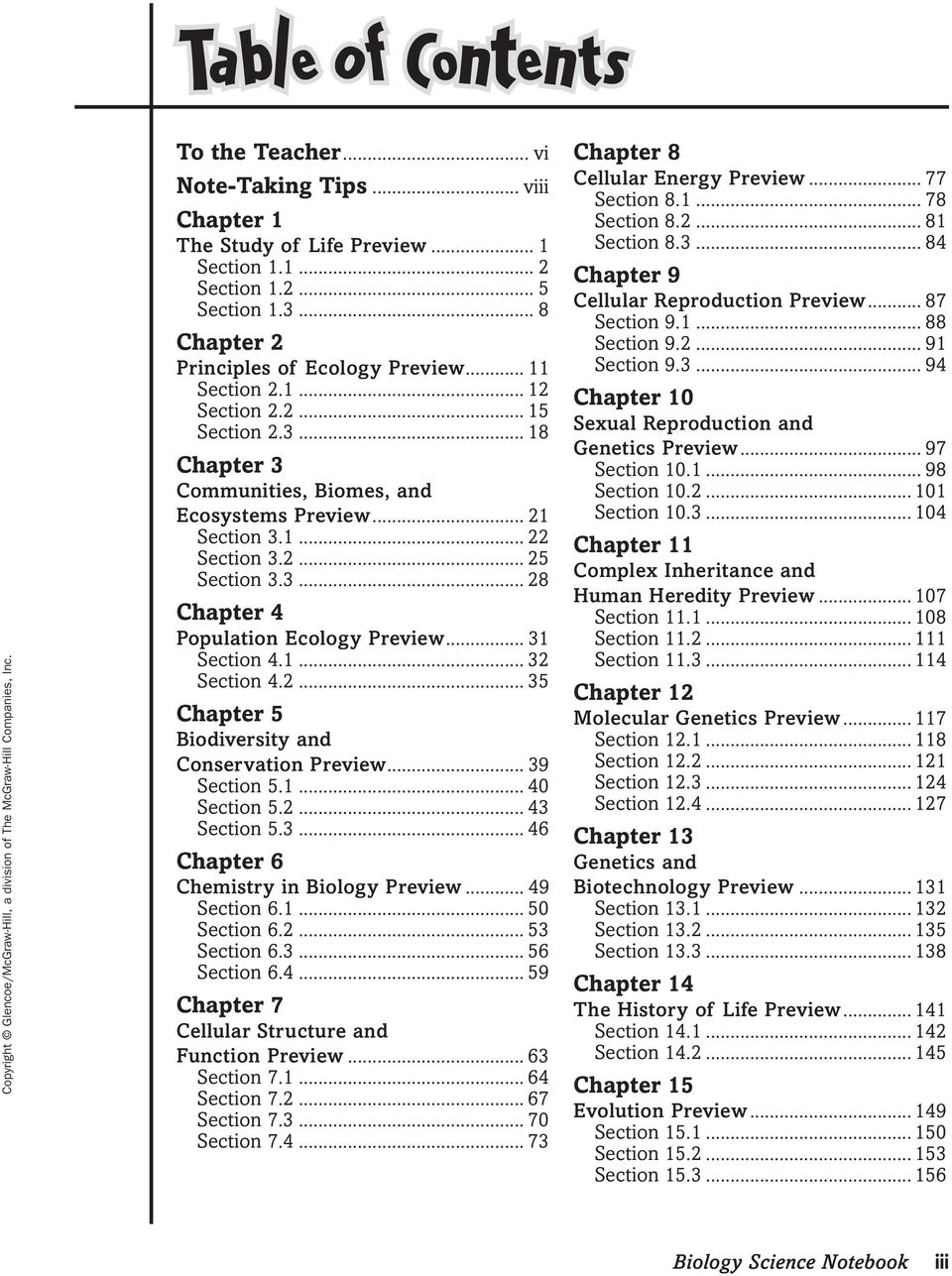
3 To the Teacher... vi Note-Taking Tips... viii Chapter 1 The Study of Life Preview... 1 Section Section Section Chapter 2 Principles of Ecology Preview Section Section Section Chapter 3 Communities, Biomes, and Ecosystems Preview Section Section Section Chapter 4 Population Ecology Preview Section Section Chapter 5 Biodiversity and Conservation Preview Section Section Section Chapter 6 Chemistry in Biology Preview Section Section Section Section Chapter 7 Cellular Structure and Function Preview Section Section Section Section Chapter 8 Cellular Energy Preview Section Section Section Chapter 9 Cellular Reproduction Preview Section Section Section Chapter 10 Sexual Reproduction and Genetics Preview Section Section Section Chapter 11 Complex Inheritance and Human Heredity Preview Section Section Section Chapter 12 Molecular Genetics Preview Section Section Section Section Chapter 13 Genetics and Biotechnology Preview Section Section Section Chapter 14 The History of Life Preview Section Section Chapter 15 Evolution Preview Section Section Section Biology Science Notebook iii
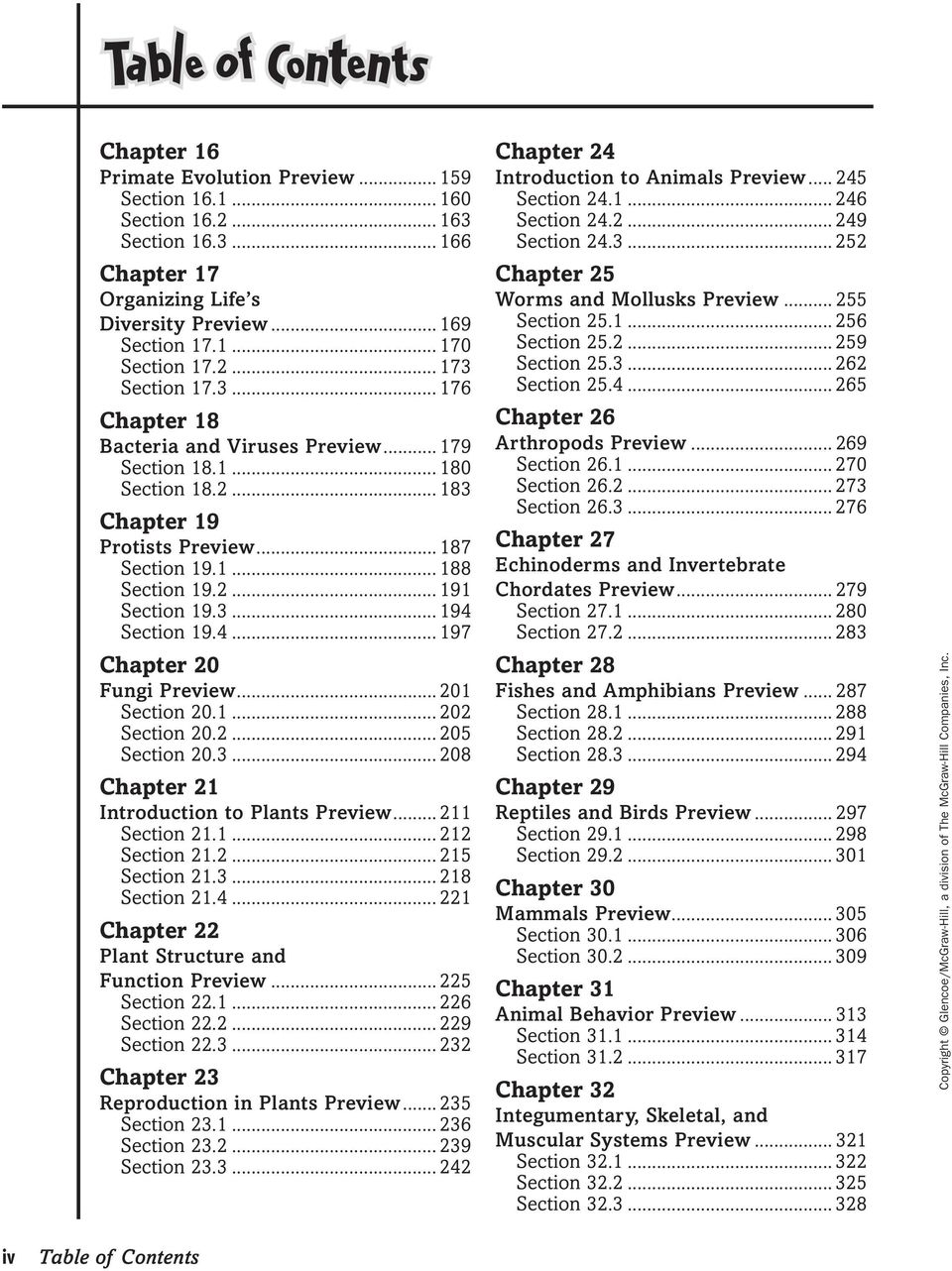
4 Chapter 16 Primate Evolution Preview Section Section Section Chapter 17 Organizing Life s Diversity Preview Section Section Section Chapter 18 Bacteria and Viruses Preview Section Section Chapter 19 Protists Preview Section Section Section Section Chapter 20 Fungi Preview Section Section Section Chapter 21 Introduction to Plants Preview Section Section Section Section Chapter 22 Plant Structure and Function Preview Section Section Section Chapter 23 Reproduction in Plants Preview Section Section Section Chapter 24 Introduction to Animals Preview Section Section Section Chapter 25 Worms and Mollusks Preview Section Section Section Section Chapter 26 Arthropods Preview Section Section Section Chapter 27 Echinoderms and Invertebrate Chordates Preview Section Section Chapter 28 Fishes and Amphibians Preview Section Section Section Chapter 29 Reptiles and Birds Preview Section Section Chapter 30 Mammals Preview Section Section Chapter 31 Animal Behavior Preview Section Section Chapter 32 Integumentary, Skeletal, and Muscular Systems Preview Section Section Section iv Table of Contents
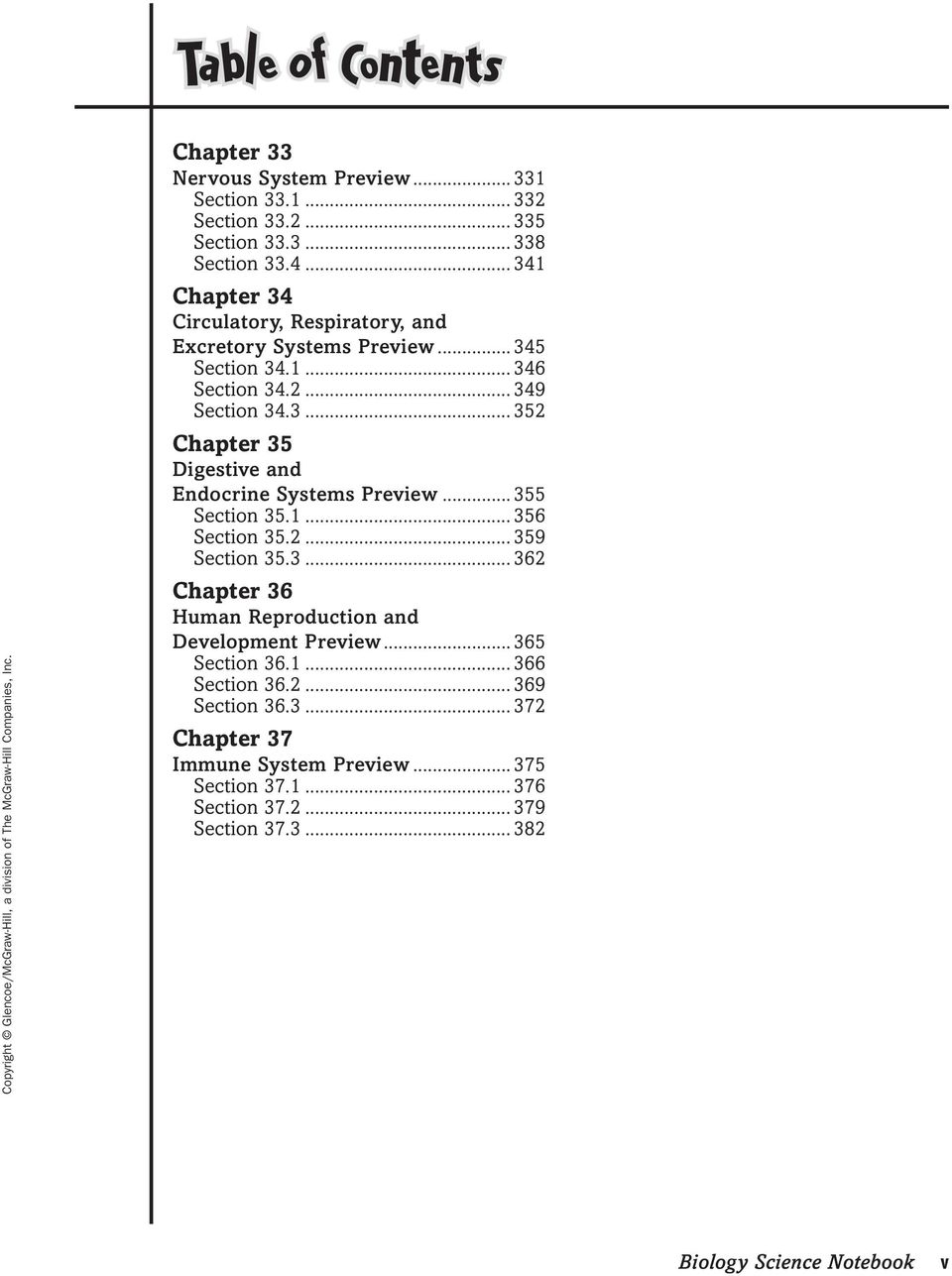
5 Chapter 33 Nervous System Preview Section Section Section Section Chapter 34 Circulatory, Respiratory, and Excretory Systems Preview Section Section Section Chapter 35 Digestive and Endocrine Systems Preview Section Section Section Chapter 36 Human Reproduction and Development Preview Section Section Section Chapter 37 Immune System Preview Section Section Section Biology Science Notebook v
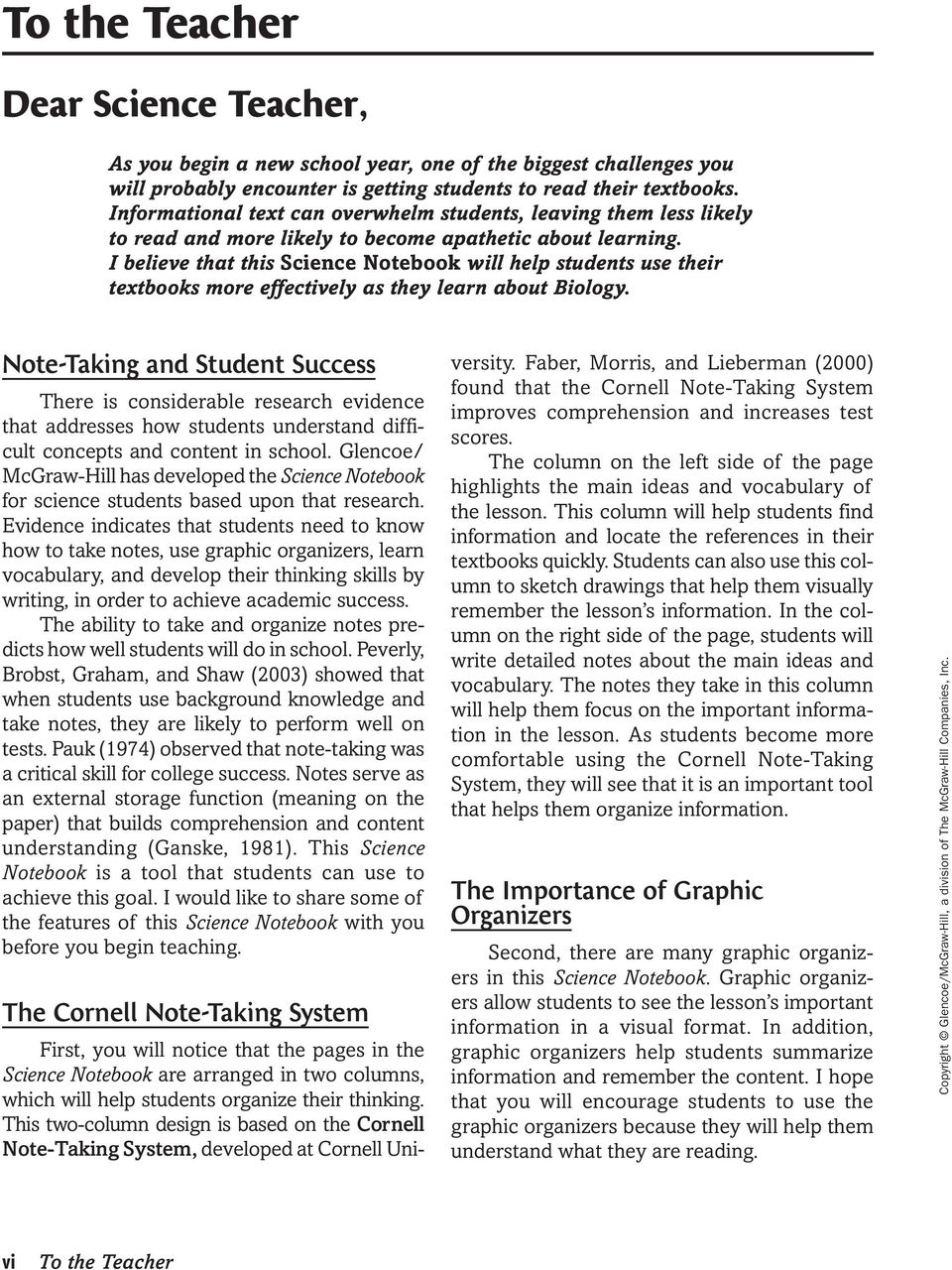
6 To the Teacher Dear Science Teacher, As you begin a new school year, one of the biggest challenges you will probably encounter is getting students to read their textbooks. Informational text can overwhelm students, leaving them less likely to read and more likely to become apathetic about learning. I believe that this Science Notebook will help students use their textbooks more effectively as they learn about Biology. Note-Taking and Student Success There is considerable research evidence that addresses how students understand difficult concepts and content in school. Glencoe/ McGraw-Hill has developed the Science Notebook for science students based upon that research. Evidence indicates that students need to know how to take notes, use graphic organizers, learn vocabulary, and develop their thinking skills by writing, in order to achieve academic success. The ability to take and organize notes predicts how well students will do in school. Peverly, Brobst, Graham, and Shaw (2003) showed that when students use background knowledge and take notes, they are likely to perform well on tests. Pauk (1974) observed that note-taking was a critical skill for college success. Notes serve as an external storage function (meaning on the paper) that builds comprehension and content understanding (Ganske, 1981). This Science Notebook is a tool that students can use to achieve this goal. I would like to share some of the features of this Science Notebook with you before you begin teaching. The Cornell Note-Taking System First, you will notice that the pages in the Science Notebook are arranged in two columns, which will help students organize their thinking. This two-column design is based on the Cornell Note-Taking System, developed at Cornell University. Faber, Morris, and Lieberman (2000) found that the Cornell Note-Taking System improves comprehension and increases test scores. The column on the left side of the page highlights the main ideas and vocabulary of the lesson. This column will help students find information and locate the references in their textbooks quickly. Students can also use this column to sketch drawings that help them visually remember the lesson s information. In the column on the right side of the page, students will write detailed notes about the main ideas and vocabulary. The notes they take in this column will help them focus on the important information in the lesson. As students become more comfortable using the Cornell Note-Taking System, they will see that it is an important tool that helps them organize information. The Importance of Graphic Organizers Second, there are many graphic organizers in this Science Notebook. Graphic organizers allow students to see the lesson s important information in a visual format. In addition, graphic organizers help students summarize information and remember the content. I hope that you will encourage students to use the graphic organizers because they will help them understand what they are reading. vi To the Teacher
7 Research-Based Development Third, you will notice that vocabulary is introduced and practiced throughout the Science Notebook. When students know the meaning of the words used to discuss information, they are able to understand that information better. Also, students are more likely to be successful in school when they have vocabulary knowledge. When researchers study successful students, they find that as students acquire vocabulary knowledge, their ability to learn improves (Martino and Hoffman, 2002). The Science Notebook focuses on learning words that are very specific to understanding the content of the textbook. The Science Notebook also highlights general academic words that students need to know so that they can understand any textbook. These vocabulary words are based on the Academic Word List (AWL) developed by Averil Coxhead. The AWL includes the most common 570 words found in academic texts, excluding the 2,000 general English words such as the, in, and that. Research indicates that students who master the words on Coxhead s list score significantly higher on standardized tests. References Writing Prompts and Note-Taking Finally, there are a number of writing exercises included in this Science Notebook. Writing is a useful tool that helps students understand the information that is being presented. Writing helps them to assess what they have learned. You will see that many of the writing exercises require students to practice the skills of good readers. Good readers make connections between their lives and the text and predict what will happen next in the reading. They question the information and the author of the text, clarify information and ideas, and visualize what the text is saying. Good readers also summarize the information that is presented and make inferences or draw conclusions about the facts and ideas. I wish you well as you begin another school year. This Science Notebook is designed to help students understand the information in your Biology class. The guide will be a valuable tool that will also provide students with skills that they can use throughout their lives. I hope you have a successful school year. Sincerely, Douglas Fisher Faber, J. E., Morris, J. D., and Lieberman, M. G. (2000). The effect of note taking on ninth grade students comprehension. Reading Psychology, 21, Ganske, L. (1981). Note-taking: A significant and integral part of learning environments. Educational Communication and Technology: A Journal of Theory, Research, and Development, 29, Martino, N. L., and Hoffman, P. R. (2002). An investigation of reading and language abilities of college freshmen. Journal of Research in Reading, 25, Pauk, W. (1974). How to Study in College. Boston: Houghton Mifflin. Peverly, S. T., Brobst, K. E., Graham, M., Shaw, R. (2003). College adults are not good at self-regulation: A study on the relationship of self-regulation, note taking, and test taking. Journal of Educational Psychology, 95, Van Leeuwe, J., and Aarnoutse, C. (1998). Relation between reading comprehension, vocabulary, reading pleasure, and reading frequency. Educational Research and Evaluation, 4, Biology Science Notebook vii
8 Note-Taking Tips Your notes are a reminder of what you learned in class. Taking good notes can help you succeed in science. The following tips will help you take better classroom notes. Before class, ask what your teacher will be discussing in class. Review mentally what you already know about the concept. Be an active listener. Focus on what your teacher is saying. Listen for important concepts. Pay attention to words, examples, and/or diagrams your teacher emphasizes. Write your notes as clear and concise as possible. The following symbols and abbreviations may be helpful in your note-taking. Word or Phrase Symbol or Abbreviation Word or Phrase Symbol or Abbreviation for example e.g. and + such as i.e. approximately with w/ therefore without w/o versus vs Use a symbol such as a star (Í) or an asterisk (*) to emphasis important concepts. Place a question mark (?) next to anything that you do not understand. Ask questions and participate in class discussion. Draw and label pictures or diagrams to help clarify a concept. When working out an example, write what you are doing to solve the problem next to each step. Be sure to use your own words. Review your notes as soon as possible after class. During this time, organize and summarize new concepts and clarify misunderstandings. Note-Taking Don ts Don t write every word. Concentrate on the main ideas and concepts. Don t use someone else s notes because they may not make sense. Don t doodle. It distracts you from listening actively. Don t lose focus or you will become lost in your note-taking. viii Note-Taking Tips

9 The Study of Life Before You Read Use the What I Know column to list the things you know about biology. Then list the questions you have about biology in the What I Want to Find Out column. Accept all reasonable responses. K W L What I Know What I Want to Find Out What I Learned Science Journal Animals, plants, and even bacteria and viruses are considered living things. But what do we mean when we say that an organism is a living thing? In the space below, describe two characteristics that are common to all living things. Accept all reasonable responses. The Study of Life 1

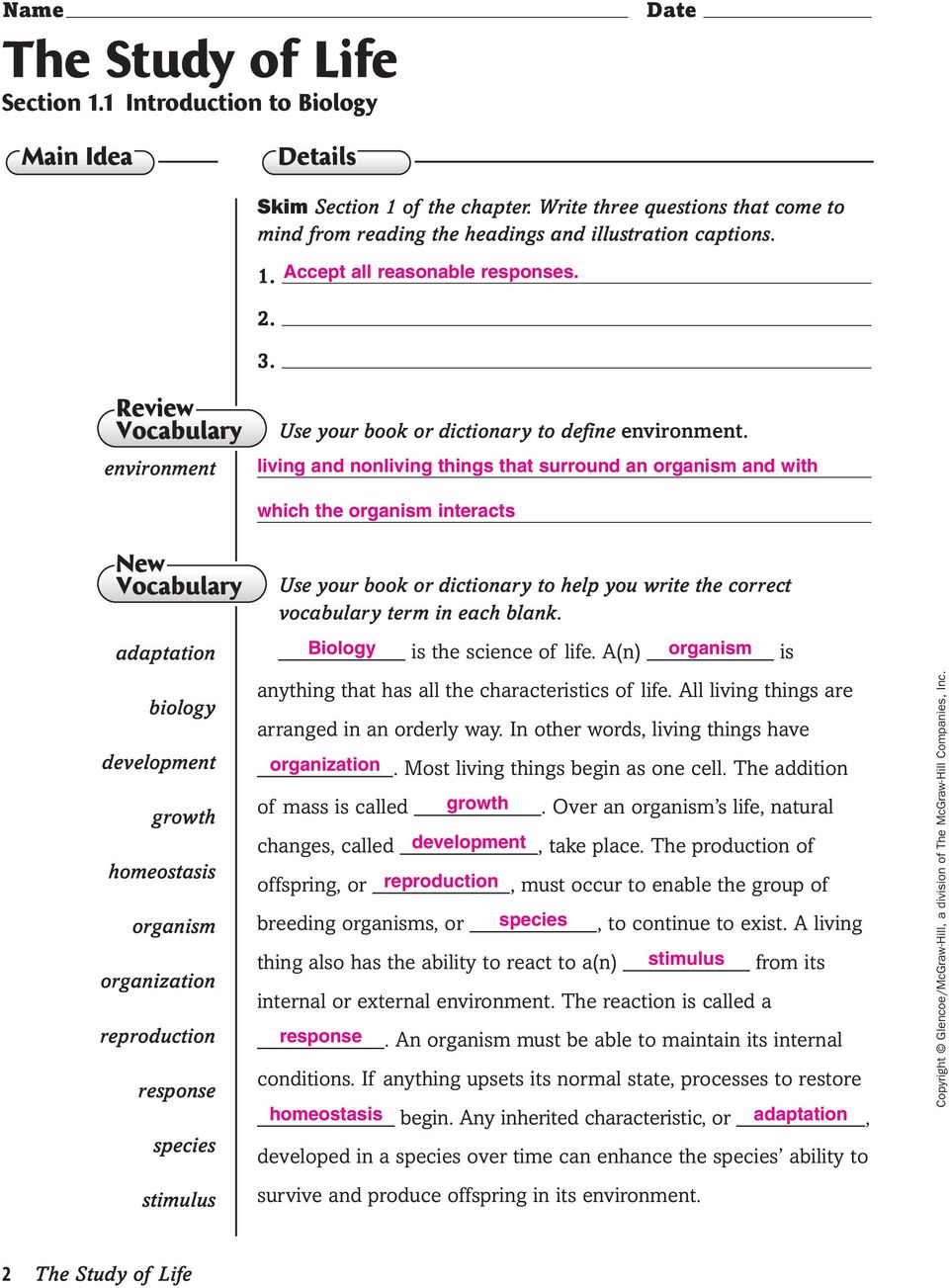
10 The Study of Life Section 1.1 Introduction to Biology Skim Section 1 of the chapter. Write three questions that come to mind from reading the headings and illustration captions. 1. Accept all reasonable responses Review environment Use your book or dictionary to define environment. living and nonliving things that surround an organism and with which the organism interacts New adaptation biology development growth homeostasis organism organization reproduction response species stimulus Use your book or dictionary to help you write the correct vocabulary term in each blank. Biology is the science of life. A(n) organism is anything that has all the characteristics of life. All living things are arranged in an orderly way. In other words, living things have organization. Most living things begin as one cell. The addition of mass is called growth. Over an organism s life, natural changes, called development, take place. The production of offspring, or reproduction, must occur to enable the group of breeding organisms, or species, to continue to exist. A living thing also has the ability to react to a(n) stimulus from its internal or external environment. The reaction is called a response. An organism must be able to maintain its internal conditions. If anything upsets its normal state, processes to restore homeostasis begin. Any inherited characteristic, or adaptation, developed in a species over time can enhance the species ability to survive and produce offspring in its environment. 2 The Study of Life
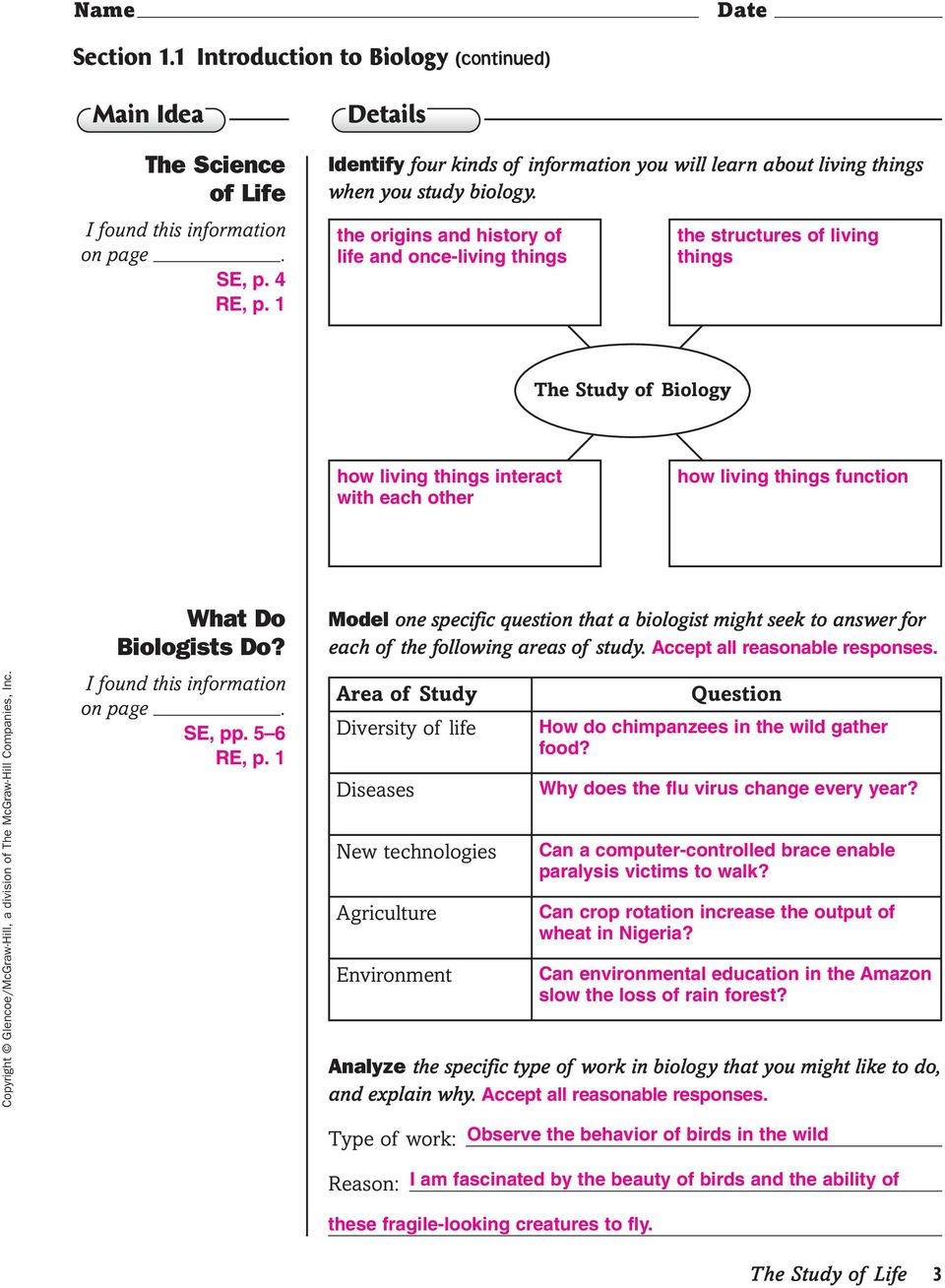
11 Section 1.1 Introduction to Biology (continued) The Science of Life SE, p. 4 RE, p. 1 Identify four kinds of information you will learn about living things when you study biology. the origins and history of life and once-living things the structures of living things The Study of Biology how living things interact with each other how living things function What Do Biologists Do? SE, pp. 5 6 RE, p. 1 Model one specific question that a biologist might seek to answer for each of the following areas of study. Accept all reasonable responses. Area of Study Diversity of life Diseases New technologies Agriculture Environment Question How do chimpanzees in the wild gather food? Why does the flu virus change every year? Can a computer-controlled brace enable paralysis victims to walk? Can crop rotation increase the output of wheat in Nigeria? Can environmental education in the Amazon slow the loss of rain forest? Analyze the specific type of work in biology that you might like to do, and explain why. Accept all reasonable responses. Type of work: Observe the behavior of birds in the wild Reason: I am fascinated by the beauty of birds and the ability of these fragile-looking creatures to fly. The Study of Life 3
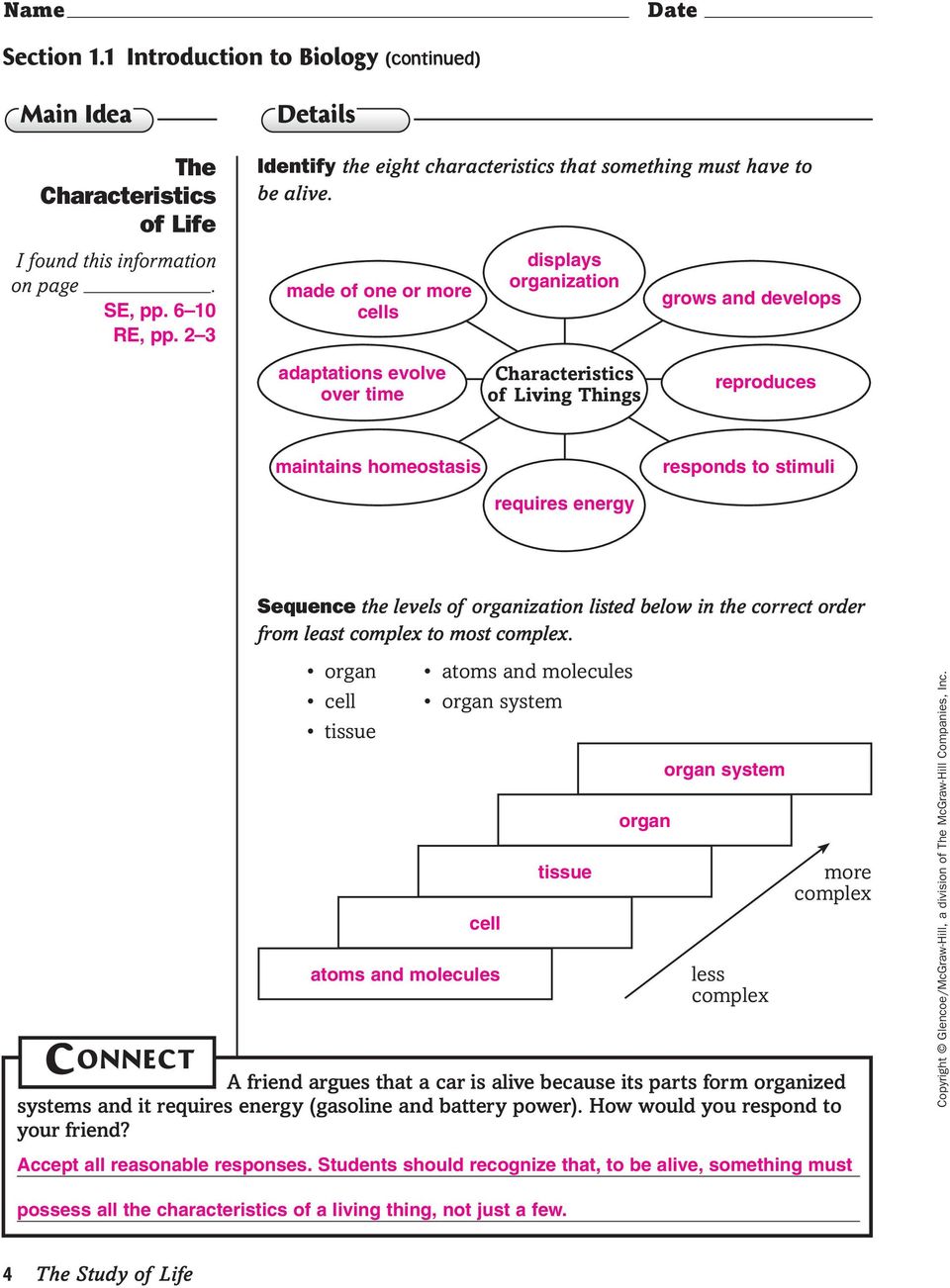
12 Section 1.1 Introduction to Biology (continued) The Characteristics of Life SE, pp RE, pp. 2 3 Identify the eight characteristics that something must have to be alive. made of one or more cells displays organization grows and develops adaptations evolve over time Characteristics of Living Things reproduces maintains homeostasis requires energy responds to stimuli CONNECT Sequence the levels of organization listed below in the correct order from least complex to most complex. organ cell tissue atoms and molecules organ system cell atoms and molecules tissue organ organ system less complex more complex A friend argues that a car is alive because its parts form organized systems and it requires energy (gasoline and battery power). How would you respond to your friend? Accept all reasonable responses. Students should recognize that, to be alive, something must possess all the characteristics of a living thing, not just a few. 4 The Study of Life
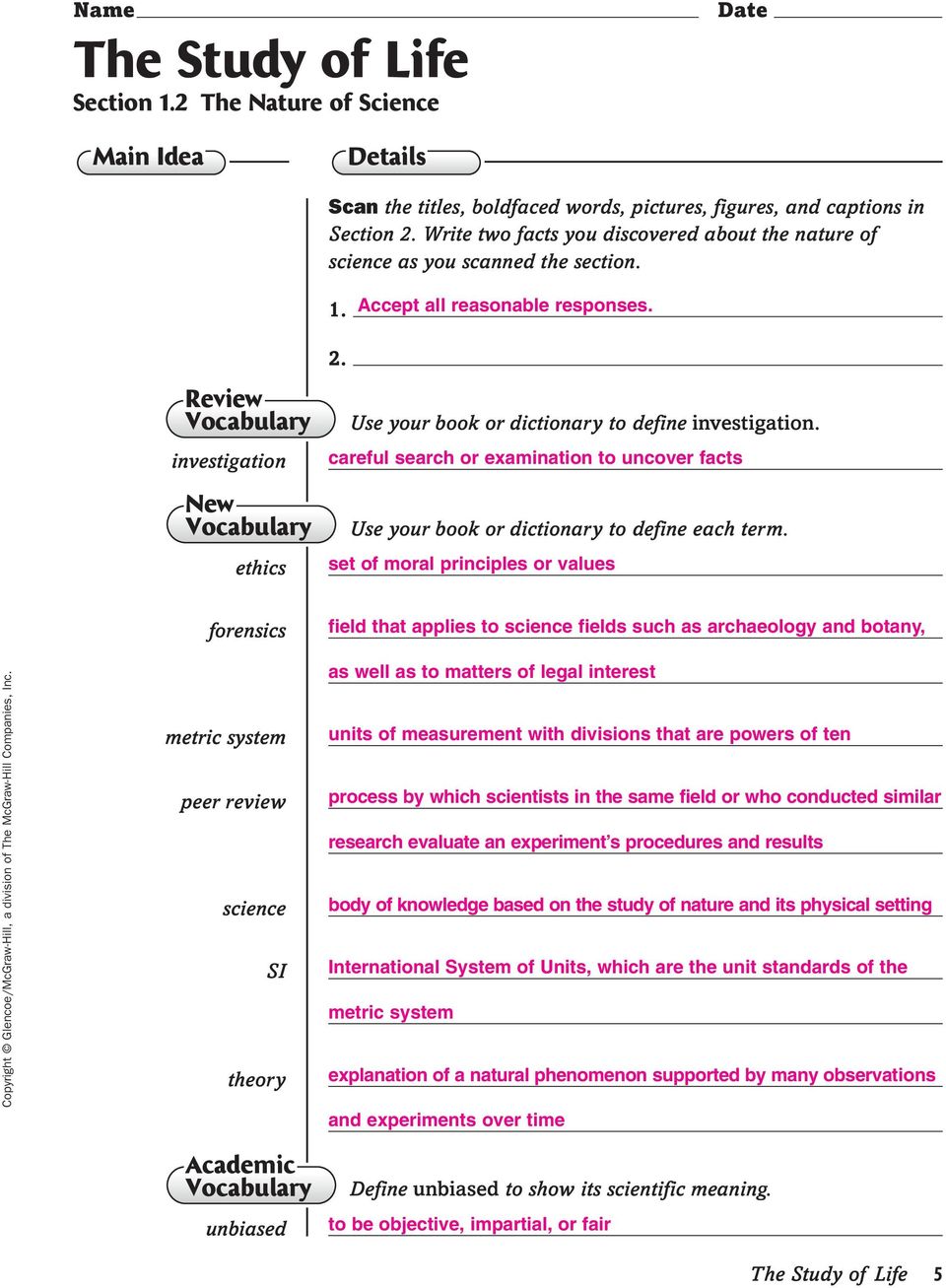
13 The Study of Life Section 1.2 The Nature of Science Scan the titles, boldfaced words, pictures, figures, and captions in Section 2. Write two facts you discovered about the nature of science as you scanned the section. 1. Accept all reasonable responses. Review investigation New ethics 2. Use your book or dictionary to define investigation. careful search or examination to uncover facts Use your book or dictionary to define each term. set of moral principles or values forensics field that applies to science fields such as archaeology and botany, metric system peer review science SI theory as well as to matters of legal interest units of measurement with divisions that are powers of ten process by which scientists in the same field or who conducted similar research evaluate an experiment s procedures and results body of knowledge based on the study of nature and its physical setting International System of Units, which are the unit standards of the metric system explanation of a natural phenomenon supported by many observations and experiments over time Academic unbiased Define unbiased to show its scientific meaning. to be objective, impartial, or fair The Study of Life 5
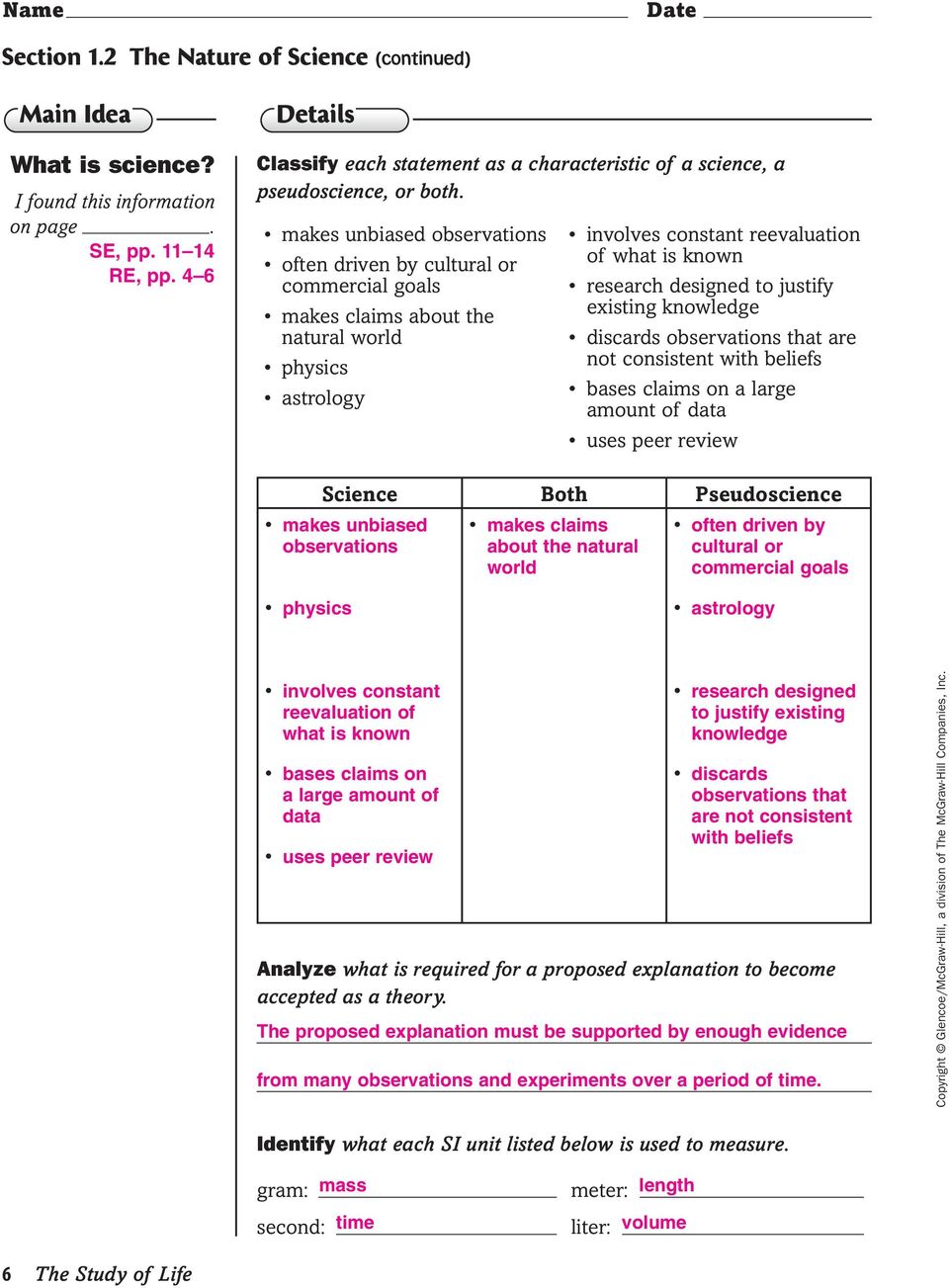
14 Section 1.2 The Nature of Science (continued) What is science? SE, pp RE, pp. 4 6 Classify each statement as a characteristic of a science, a pseudoscience, or both. makes unbiased observations often driven by cultural or commercial goals makes claims about the natural world physics astrology involves constant reevaluation of what is known research designed to justify existing knowledge discards observations that are not consistent with beliefs bases claims on a large amount of data uses peer review Science Both Pseudoscience makes unbiased observations physics makes claims about the natural world often driven by cultural or commercial goals astrology involves constant reevaluation of what is known bases claims on a large amount of data uses peer review research designed to justify existing knowledge discards observations that are not consistent with beliefs Analyze what is required for a proposed explanation to become accepted as a theory. The proposed explanation must be supported by enough evidence from many observations and experiments over a period of time. Identify what each SI unit listed below is used to measure. gram: mass second: time meter: length liter: volume 6 The Study of Life
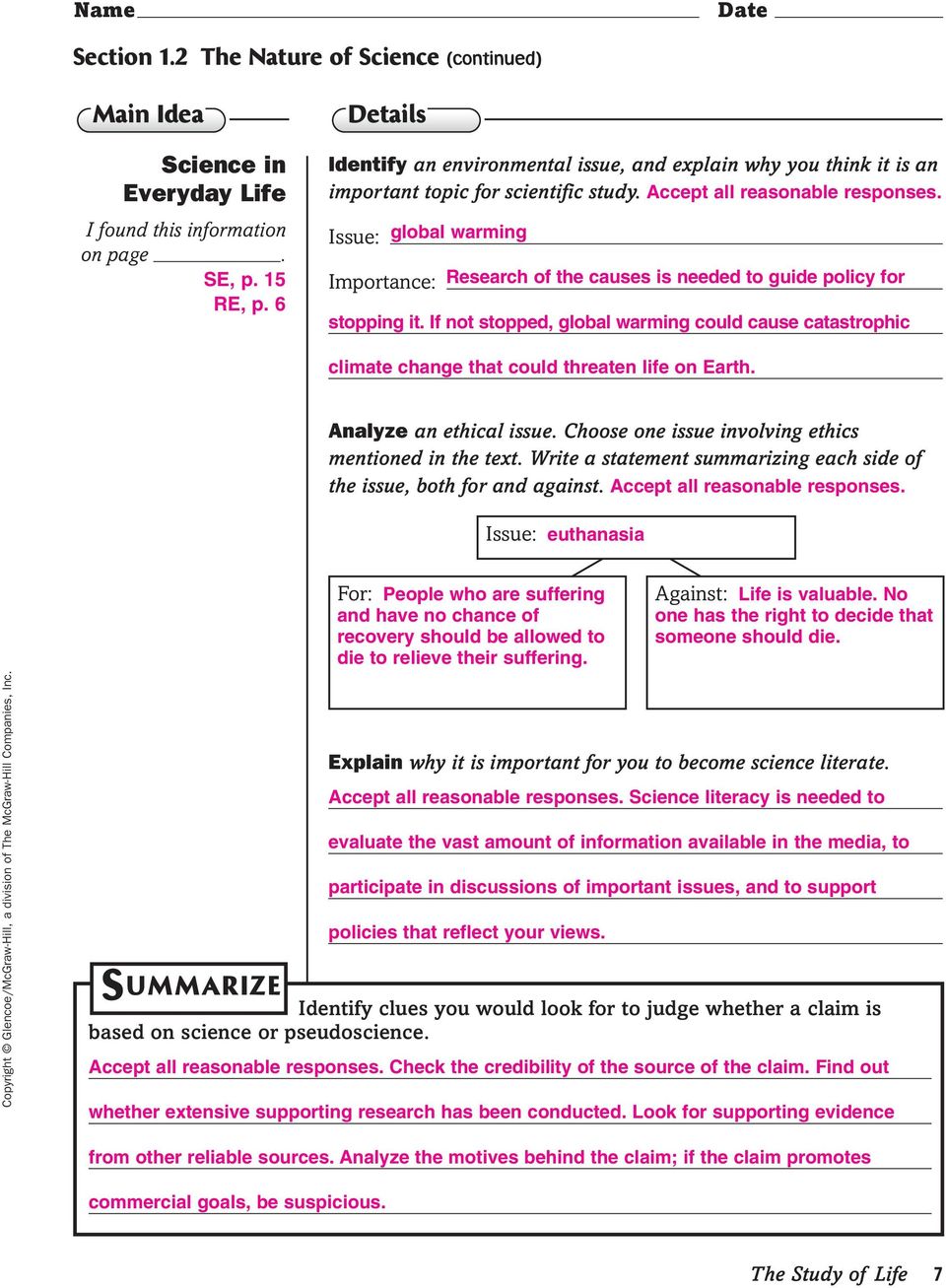
15 Section 1.2 The Nature of Science (continued) Science in Everyday Life SE, p. 15 RE, p. 6 Identify an environmental issue, and explain why you think it is an important topic for scientific study. Accept all reasonable responses. Issue: Importance: global warming Research of the causes is needed to guide policy for stopping it. If not stopped, global warming could cause catastrophic climate change that could threaten life on Earth. Analyze an ethical issue. Choose one issue involving ethics mentioned in the text. Write a statement summarizing each side of the issue, both for and against. Accept all reasonable responses. Issue: euthanasia SUMMARIZE For: People who are suffering and have no chance of recovery should be allowed to die to relieve their suffering. Against: Life is valuable. No one has the right to decide that someone should die. Explain why it is important for you to become science literate. Accept all reasonable responses. Science literacy is needed to evaluate the vast amount of information available in the media, to participate in discussions of important issues, and to support policies that reflect your views. Identify clues you would look for to judge whether a claim is based on science or pseudoscience. Accept all reasonable responses. Check the credibility of the source of the claim. Find out whether extensive supporting research has been conducted. Look for supporting evidence from other reliable sources. Analyze the motives behind the claim; if the claim promotes commercial goals, be suspicious. The Study of Life 7
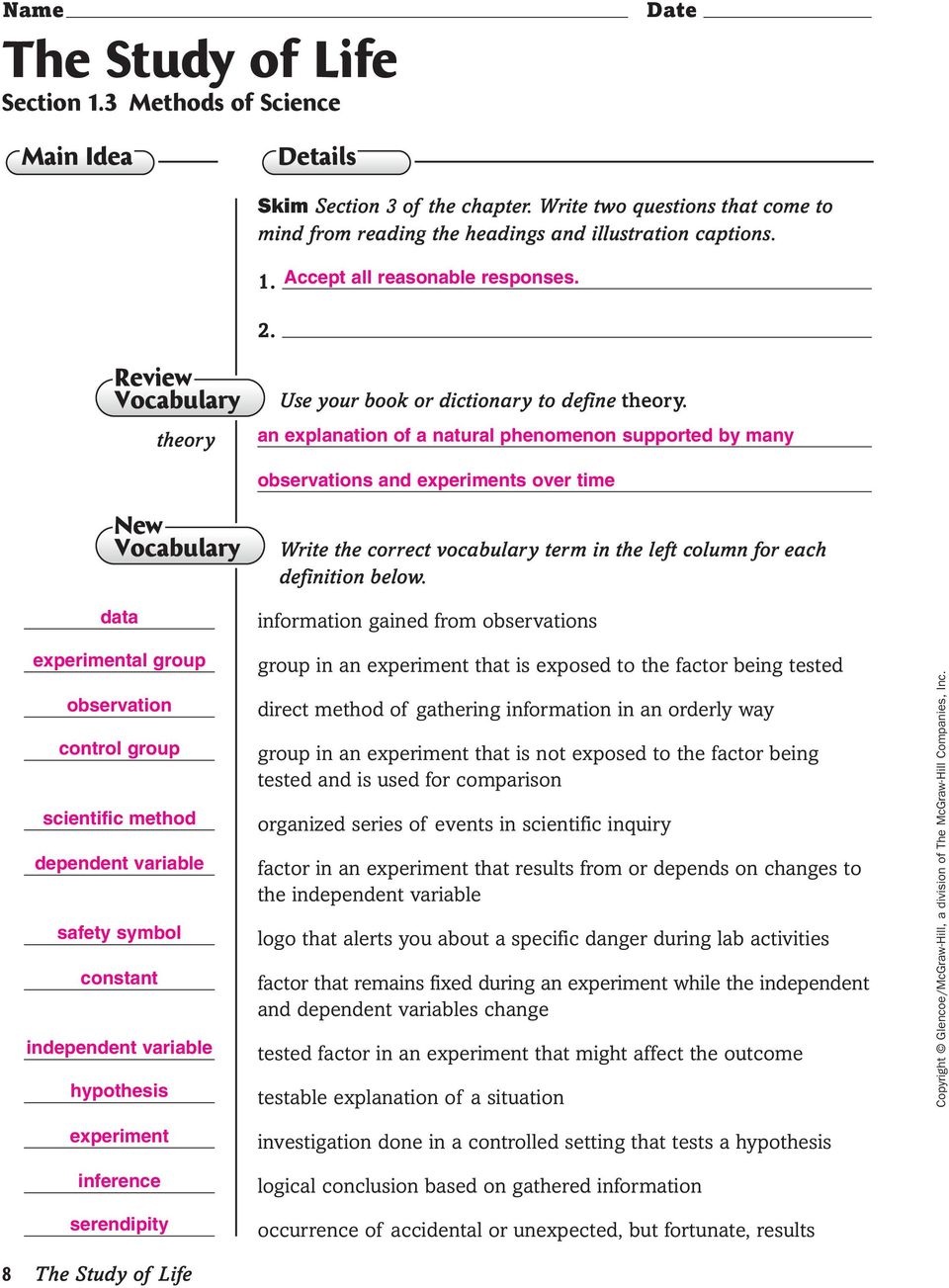
16 The Study of Life Section 1.3 Methods of Science Skim Section 3 of the chapter. Write two questions that come to mind from reading the headings and illustration captions. 1. Accept all reasonable responses. 2. Review theory Use your book or dictionary to define theory. an explanation of a natural phenomenon supported by many observations and experiments over time New data Write the correct vocabulary term in the left column for each definition below. information gained from observations experimental group observation control group scientific method dependent variable safety symbol constant independent variable hypothesis group in an experiment that is exposed to the factor being tested direct method of gathering information in an orderly way group in an experiment that is not exposed to the factor being tested and is used for comparison organized series of events in scientific inquiry factor in an experiment that results from or depends on changes to the independent variable logo that alerts you about a specific danger during lab activities factor that remains fixed during an experiment while the independent and dependent variables change tested factor in an experiment that might affect the outcome testable explanation of a situation experiment inference serendipity 8 The Study of Life investigation done in a controlled setting that tests a hypothesis logical conclusion based on gathered information occurrence of accidental or unexpected, but fortunate, results
17 Section 1.3 Methods of Science (continued) Ask a Question SE, p. 16 RE, p. 7 Sequence the basic steps in scientific methods by completing the flowchart. Observe and identify a problem to solve. Form a hypothesis. Design and conduct an experiment. Compare actual results to expected results. Draw a conclusion about whether the hypothesis was supported. Repeat the experiment or test an alternative hypothesis. Form a Hypothesis SE, p. 18 RE, p. 8 Collect the Data SE, pp RE, pp. 8 9 Analyze the relationship between a hypothesis and a theory. Accept all reasonable responses. A theory is a hypothesis that is supported by enough evidence from many investigations to be considered valid by the scientific community. Identify the parts of the experiment described in the table below. Experiment: A biologist gives a new kind of food to a group of dogs and compares the weight gain of these dogs over time to a group of similar dogs that do not receive the new food. Experimental group: the dogs that receive the new food Control group: the dogs that do not receive the new food Independent variable: the new kind of food Dependent variable: weight gain The Study of Life 9

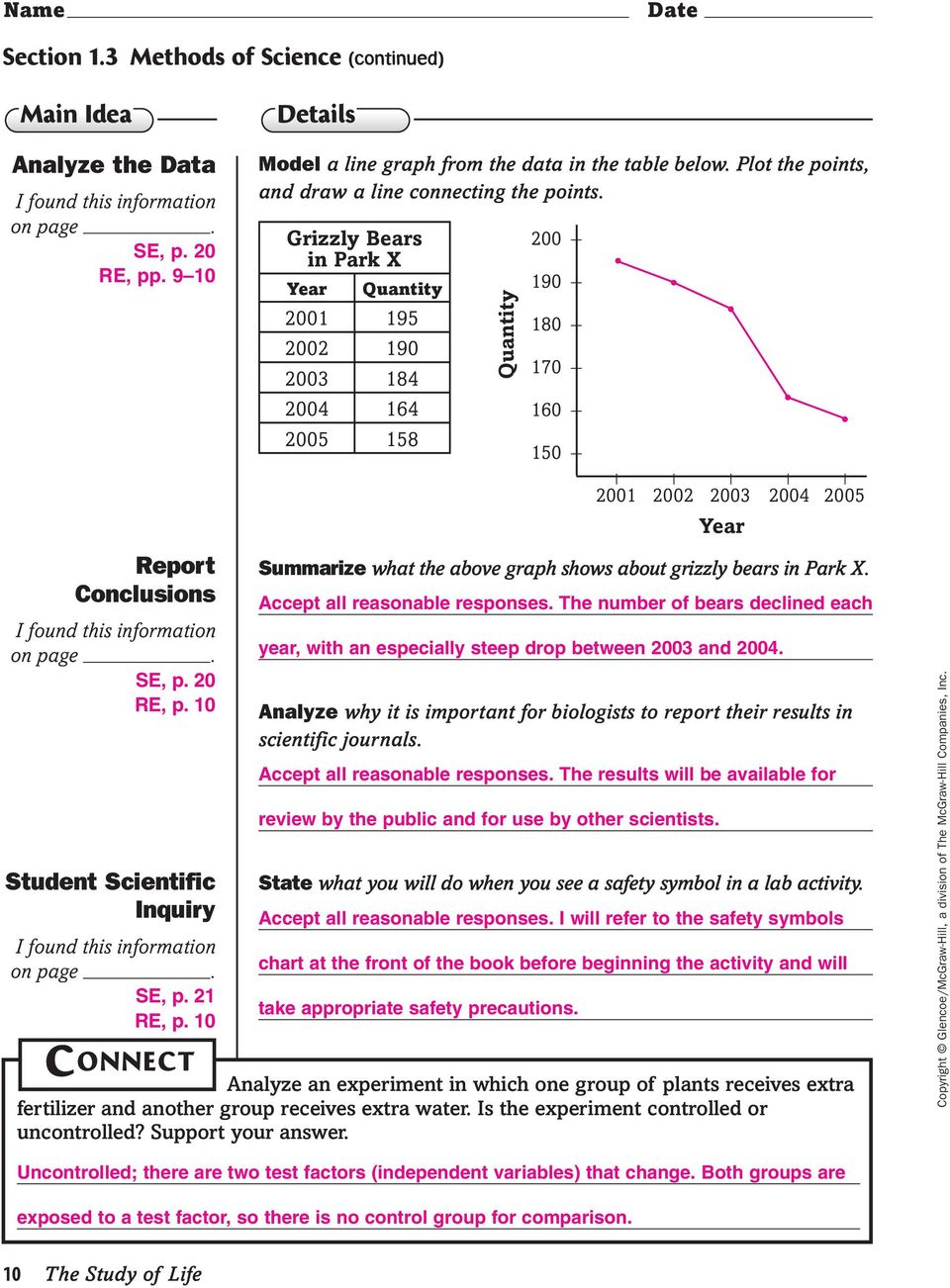
18 Section 1.3 Methods of Science (continued) Analyze the Data SE, p. 20 RE, pp Model a line graph from the data in the table below. Plot the points, and draw a line connecting the points. Grizzly Bears in Park X Year Quantity Quantity Report Conclusions SE, p. 20 RE, p. 10 Student Scientific Inquiry SE, p. 21 RE, p. 10 CONNECT Summarize what the above graph shows about grizzly bears in Park X. Accept all reasonable responses. The number of bears declined each year, with an especially steep drop between 2003 and Analyze why it is important for biologists to report their results in scientific journals. Accept all reasonable responses. The results will be available for review by the public and for use by other scientists. State what you will do when you see a safety symbol in a lab activity. Accept all reasonable responses. I will refer to the safety symbols chart at the front of the book before beginning the activity and will take appropriate safety precautions Year Analyze an experiment in which one group of plants receives extra fertilizer and another group receives extra water. Is the experiment controlled or uncontrolled? Support your answer. Uncontrolled; there are two test factors (independent variables) that change. Both groups are exposed to a test factor, so there is no control group for comparison. 10 The Study of Life
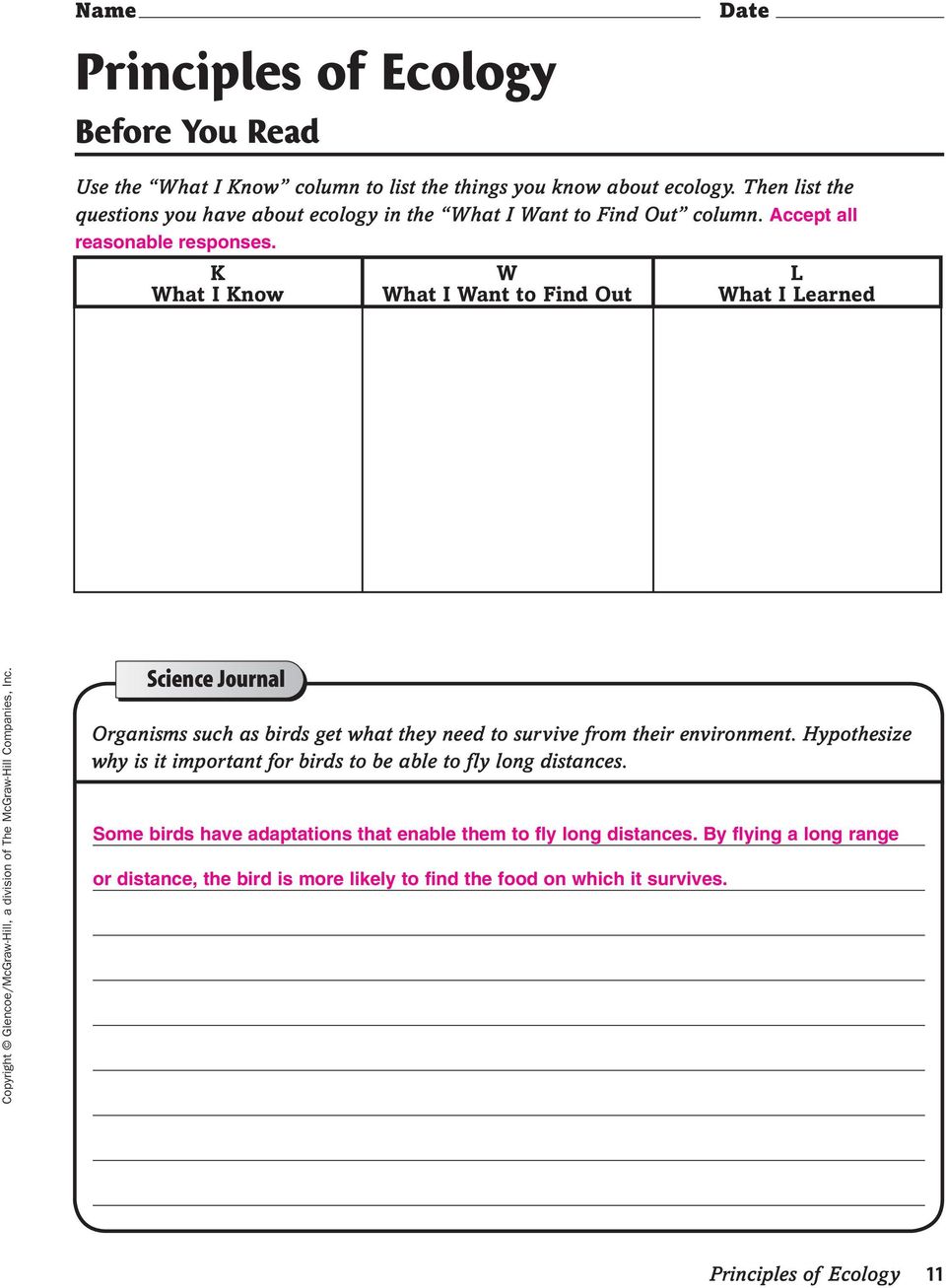
19 Principles of Ecology Before You Read Use the What I Know column to list the things you know about ecology. Then list the questions you have about ecology in the What I Want to Find Out column. Accept all reasonable responses. K W L What I Know What I Want to Find Out What I Learned Science Journal Organisms such as birds get what they need to survive from their environment. Hypothesize why is it important for birds to be able to fly long distances. Some birds have adaptations that enable them to fly long distances. By flying a long range or distance, the bird is more likely to find the food on which it survives. Principles of Ecology 11
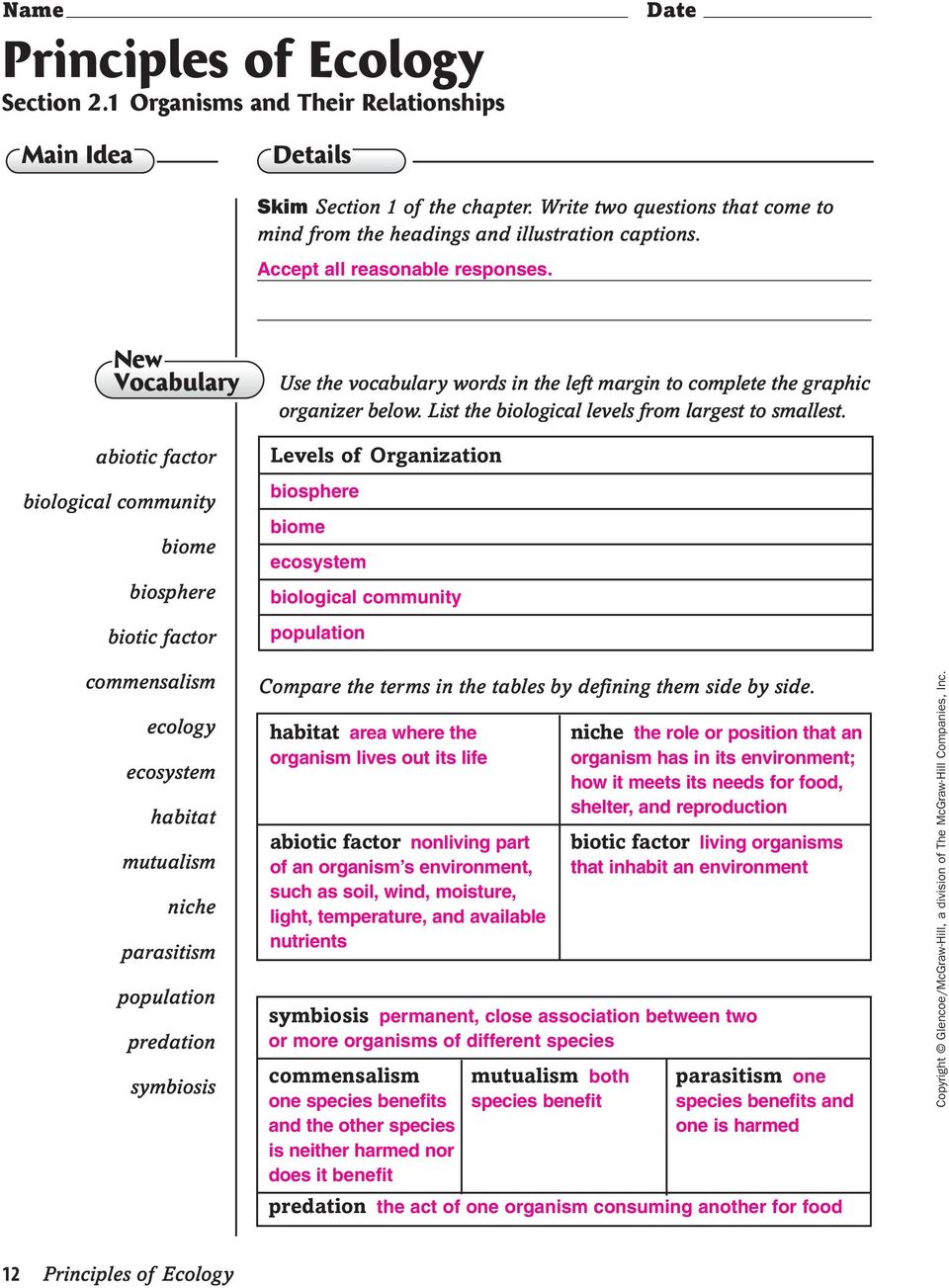
20 Principles of Ecology Section 2.1 Organisms and Their Relationships Skim Section 1 of the chapter. Write two questions that come to mind from the headings and illustration captions. Accept all reasonable responses. New abiotic factor biological community biome biosphere biotic factor Use the vocabulary words in the left margin to complete the graphic organizer below. List the biological levels from largest to smallest. Levels of Organization biosphere biome ecosystem biological community population commensalism ecology ecosystem habitat mutualism niche parasitism population predation symbiosis Compare the terms in the tables by defining them side by side. habitat area where the organism lives out its life abiotic factor nonliving part of an organism s environment, such as soil, wind, moisture, light, temperature, and available nutrients niche the role or position that an organism has in its environment; how it meets its needs for food, shelter, and reproduction biotic factor living organisms that inhabit an environment symbiosis permanent, close association between two or more organisms of different species commensalism mutualism both parasitism one one species benefits species benefit species benefits and and the other species one is harmed is neither harmed nor does it benefit predation the act of one organism consuming another for food 12 Principles of Ecology
21 Section 2.1 Organisms and Their Relationship (continued) Ecology SE, pp RE, p. 11 Create a journal entry. Imagine that you are an ecologist. Choose one plant or animal in nature and write three relationships of that organism in its environment. Journal Entry Organism 1. Encourage students to demonstrate thoughtfulness and list the organism s relationship with food sources, with predators and prey, and with nonliving parts of the environment The Biosphere SE, pp RE, p. 12 Levels of Organization SE, p. 36 RE, p. 13 Sequence the abiotic and biotic factors. Write abiotic or biotic in each square. 1. lack of rainfall abiotic 4. rivers dry up abiotic Identify each level of organization that is described. population communities organism ecosystem biome 2. dry soil abiotic 5. animals do not reproduce biotic a group of organisms of all the same species interacting populations an individual living thing made of cells 3. certain plants die biotic 6. the population of a species diminishes biotic all the different populations in a community a large group of organisms that share the same climate and have similar types of communities Principles of Ecology 13
22 Section 2.1 Organisms and Their Relationships (continued) Ecosystem Interactions SE, p. 38 RE, p. 14 Model a community with several organisms. Show two organisms occupying the same niche. Below your sketch, explain why those two organisms cannot usually occupy the same niche for long. Two organisms cannot occupy the same niche for long because they compete for the same resources. Eventually, one species will outcompete the other. Community Interactions SE, pp RE, pp SUMMARIZE Rephrase mutualism, commensalism, and parasitism in your own words. Provide an example of each term. 1. mutualism: Certain types of bacteria in our intestines help digest our food. 2. commensalism: Lichen grows on tree branches. 3. parasitism: A lamprey eel feeds on the blood of another fish. Bacteria live inside our bodies. Analyze helpful, neutral, and harmful things that bacteria do while living in our bodies. Incorporate the terms parasitism, mutualism, habitat, and niche in your discussion. Accept all reasonable responses. While helpful bacteria use our body as their habitat, they occupy the niche and keep harmful bacteria out. The helpful bacteria can benefit us by keeping invaders at bay or by eating harmful substances, which is a mutualistic relationship. Harmful bacteria can act as parasites by eating food we need, causing infections, or harming our bodily structures. 14 Principles of Ecology
23 Principles of Ecology Section 2.2 Flow of Energy in an Ecosystem Scan Section 2 of the chapter. Make a list of the ways in which organisms obtain energy. Accept all reasonable responses, such as using light energy, eating food, and breaking down dead organisms. Review energy Use your book or dictionary to define energy. Then name the ultimate source of energy for Earth. the ability to cause change; the Sun New autotroph biomass carnivore decomposer detritivore food chain food web herbivore heterotroph omnivore trophic level Academic foundation Use your book or dictionary to fill in vocabulary terms in this paragraph about food chains. In a food chain, matter and energy move from autotrophs to heterotrophs to decomposers. A food chain is made of many steps; each organism in the food chain represents a step called a trophic level. An herbivore is a heterotroph that eats only plants, whereas a carnivore preys on other heterotrophs. An omnivore eats both plants and animals. Nutrients are returned to the soil, air, and water by detritivores. A model that shows all the possible feeding relationships at each trophic level is called a food web. If you were a scientist and you wanted to determine the weight of living matter at a certain trophic level, you would measure the biomass. Define foundation to show its scientific meaning. a basis on which something stands or is supported Principles of Ecology 15
24 Section 2.2 Flow of Energy in an Ecosystem (continued) Energy in an Ecosystem SE, pp RE, pp Summarize three ways that organisms get energy, by completing the table. Type of Organism Other name(s) for this type Food comes from Autotrophs Heterotrophs Decomposers producers soil and the S un consumers, herbivores, carnivores, scavengers, omnivores 1. eating plants 2. eating animals 3. eating plants and animals no other name dead organisms Chemical reactions that occur Light energy and carbon dioxide are stored in energy-rich compounds. The organisms that are eaten are turned into energy and molecules for the consumer s body. Examples algae, plants bears, lions, deer fungi, bacteria Design your own three-step example of the flow of energy. Accept all reasonable responses. Classify each of the following organisms as an autotroph or a heterotroph. Put an A in front of those that are autotrophs and an H in front of those that are autotrophs. H 1. Alligator A 5. Moss A 9. Dandelion H 2. Squirrel H 6. Siberian tiger H 10. Rabbit A 3. Maple tree A 7. Daffodil A 11. Tomato H 4. Whale H 8. Rhinoceros H 12. Cockroach 16 Principles of Ecology
25 Section 2.2 Flow of Energy in an Ecosystem (continued) Models of Energy Flow SE, pp RE, pp Contrast a food chain with a food web. Food chains show how matter and energy move through an ecosystem. Food webs show all feeding relationships at each trophic level in a community. State three things that an ecological pyramid shows that food webs and food chains do not show. An ecological pyramid shows that energy decreases as you go up the trophic levels. There are more organisms in the lower trophic levels. An ecological pyramid also shows biomass consumption. Create a food web and name the organisms you include. Indicate each organism s trophic level. Accept all reasonable drawings. See SE page 43 for an example. SUMMARIZE Analyze the place in the food chain in which you participate. Use the vocabulary terms from this section that apply to you. Most students will indicate that they are the top level in their food webs. Strict vegetarians might indicate that they are heterotrophs and herbivores. Others will report that they are heterotrophs and omnivores. Principles of Ecology 17
26 Principles of Ecology Section 2.3 Cycling of Matter Scan the titles, boldfaced words, pictures, figures, and captions in Section 3. Write two facts you discovered about animals as you scanned the section. 1. Accept all reasonable responses. 2. Review cycle Use your book or dictionary to define cycle. Then give an example of a cycle. a series of events that occur in a regular repeating pattern; examples of cycles will vary New biogeochemical cycle denitrification matter nitrogen fixation Use your book or dictionary to define each vocabulary term. the exchange of matter through the biosphere, which involves living organisms, geological processes, and chemical processes a process in which some soil bacteria convert fixed nitrogen compounds back into nitrogen gas, which returns to the atmosphere anything that takes up space and has mass; provides the nutrients needed for organisms to function the process of capture and conversion of nitrogen into a form that is usable by plants nutrient a chemical substance that an organism must obtain from its environment to sustain life and to undergo life processes 18 Principles of Ecology
27 Section 2.3 Cycling of Matter (continued) Cycles in the Biosphere SE, pp RE, pp Create minimodels for each cycle of matter in nature. Use words or pictures to sketch a simple example for each type of cycle to show the movement of matter. Accept all reasonable models. A. The Water Cycle B. The Carbon Cycle Models should show water Models should show plants falling from clouds as using carbon dioxide to make precipitation, moving through sugars, animals eating the the earth and water table back sugars, respiration, and into lakes and oceans, and combustion putting carbon into evaporating again. Models may the air. Models may also show include tree transpiration. the long-term carbon cycle in which organic matter is buried and converted to fossil fuels. Carbon dioxide is released when fossil fuels are burned. C. The Nitrogen Cycle D. The Phosphorus Cycle Models should show bacteria (short-term and long-term) fixing nitrogen from the air into Short-term models should show the soil, plants using it, animals soil to plants to animals to eating plants and making the decay and back to soil. Longnitrogen into proteins. Animals term models should show make urine that goes into soil, rocks dissolving into the water die, and decay back into soil. table and precipitating back They may show bacteria putting onto the rocks. nitrogen from soil back into air. Principles of Ecology 19
28 Section 2.3 Cycling of Matter (continued) Describe each of the cycles in nature. Identify where each cycle is found, how organisms use them, and what key words relate to them. Where found Water underground, in the atmosphere, and on Earth s surface Carbon/ oxygen in all living things, in the atmosphere Nitrogen in the atmosphere; in plants Phosphorus cell compounds; in Earth s crust SUMMARIZE How used Key words in the cycle basis of life for all living things evaporating, water vapor, precipitation, transpiration to life processes; make up molecules such as carbon dioxide and sugar photosynthesis, cellular respiration, fossil fuel, calcium carbonate to produce proteins; in chemical fertilizers nitrogen fixation, nitrates, decomposers, ammonia, denitrification make up bones and teeth decomposers, weathering, erosion, phosphates Analyze current farming practices that are designed to make the best use of energy flow in ecosystems and cycles of matter. Accept all reasonable responses. Fertilizers replace nitrogen, phosphorus, and other minerals that are lost from the soil when vegetable matter is harvested and removed. Pesticides and herbicides try to stop insects from eating crops, and other plants from stealing the nutrients in the soil from the crop. Greenhouses are used to make the most of the Sun s energy. 20 Principles of Ecology
29 Communities, Biomes, and Ecosystems Before You Read Before you read the chapter, respond to these statements. Accept all reasonable responses. 1. Write an A if you agree with the statement. 2. Write a D if you disagree with the statement. Before You Read Communities, Biomes, and Ecosystems Once an ecosystem is established, its plant and animal species remain the same. Over time, a forest can develop from bare rock. Mountains are not a biome because climate, plants, and animals change with elevation. Most of Earth s freshwater is locked in ice. After You Read D A A A Science Journal Organisms in a community reflect the resources and climate of that community. Give some examples to illustrate this statement. Accept all reasonable responses. Communities, Biomes, and Ecosystems 21
30 Communities, Biomes, and Ecosystems Section 3.1 Community Ecology Skim Section 1 of the chapter. List three facts you discovered about ecosystems. 1. Accept all reasonable responses Review abiotic factor Use your book or dictionary to define abiotic factor. the nonliving part of an organism s environment New climax community community ecological succession limiting factor primary succession secondary succession tolerance Use the new vocabulary terms to complete the following sentences Your community includes the people, other animals, plants, bacteria, and fungi in your area. A limiting factor is any abiotic or biotic factor that restricts the numbers, reproduction, or distribution of organisms. The ability of any organism to survive when subjected to abiotic or biotic factors is its tolerance. Changing abiotic or biotic factors can trigger ecological succession the replacement of one community with another. Primary succession occurs when a community becomes established in an area of exposed rock without topsoil. Eventually, a stable, mature climax community can develop from bare rock. If a disturbance, such as fire, removes the community but not the soil, an orderly and predictable change called secondary succession restores the community over time. 22 Communities, Biomes, and Ecosystems
31 Section 3.1 Community Ecology (continued) Communities SE, pp RE, pp Predict how an unusually prolonged drought might affect a biological community. Accept all reasonable responses. Drought uncharacteristic of the ecosystem might cause some species of plants and animals to decline or become extinct in the area. Other organisms that feed on these plants and animals would also decline. Declining species would be replaced by species that are less sensitive to drought. Create a tolerance graph similar to the Tolerance of Steelhead Trout figure in your book. Title your graph Tolerance of Plant A. Label the zones. Then label the limits of each zone according to the facts about Plant A listed below. can live at an elevation between 1,000 and 2,000 m can live at an elevation between 5,000 and 6,000 m cannot live above 6,000 m grows best between 2,000 and 5,000 m cannot live below 1,000 m Accept all reasonable responses. Infer other abiotic factors that might limit the survival of Plant A. Accept all reasonable responses. Abiotic limiting factors might include temperature, amount of sunlight, and nutrients in the soil. Communities, Biomes, and Ecosystems 23
32 Section 3.1 Community Ecology (continued) Ecological Succession SE, pp RE, pp Contrast primary succession and secondary succession. Give an example of each. Accept all reasonable responses. Primary succession is the process of establishing a community in an area of exposed rock without topsoil. An example is a hardened lava flow. Secondary succession occurs after a community of organisms has been removed, but the soil remains. An example is a forest fire. Sequence the following steps in the primary succession of a forest by writing each step in the flowchart. perennial herbs and grasses lichens shade-tolerant trees bare rock shrubs and shade-intolerant trees small annual plants bare rock perennial herbs and grasses CONNECT lichens small annual plants shrubs and shadeintolerant trees shade-tolerant trees Suppose that a recent flood devastated a wildlife preserve in your area. Local leaders suggested organizing volunteers to plant trees in the damaged area. Evaluate your plan and support your reasoning. Accept all reasonable responses. Students may take either position as long as they support their position. Some students might argue that natural succession takes many years, and replanting could hasten the process. Other students might argue that ecosystems will naturally restore the species that thrive in these conditions. Planting trees before their natural succession could upset the balance by preventing other vegetation common to this ecosystem from taking hold. 24 Communities, Biomes, and Ecosystems
33 Communities, Biomes, and Ecosystems Section 3.2 Terrestrial Biomes Skim Section 2 of the chapter. Write two questions that come to mind from reading the headings and the illustration captions. 1. Accept all reasonable responses. Review biome New latitude 2. Use your book or dictionary to define biome. a large group of ecosystems that share the same climate and have similar types of plant communities Use your book or dictionary to define the following term. distance of any point on the surface of Earth north or south from the equator weather climate boreal forest desert grassland temperate forest tropical rain forest tropical savanna tropical seasonal forest tundra woodland Compare the terms in the tables by defining them side by side. weather: condition of the atmosphere at a specific place and time climate: average weather conditions in an area, including temperature and precipitation Describe the vegetation and growing conditions for each biome. tundra: treeless; cold temperatures; permafrost woodlands: woods and mixed shrubs; less annual rainfall than temperate forests tropical savanna: grasses and scattered trees; less precipitation than other tropical areas boreal forest: dense evergreen forest; warmer than tundra; no permafrost grassland: thick cover of grasses; fertile soil; underground stems and buds tropical seasonal forest: deciduous and evergreen trees; seasonal rainfall temperate forest: broadleaved deciduous trees; well-defined seasons desert: variety of sparse plants; dry tropical rain forest: canopy of tall, broadleaved trees with mosses and orchids; understory of shorter trees, shrubs, ferns, and creeping plants; warm and rainy year round Communities, Biomes, and Ecosystems 25
34 Section 3.2 Terrestrial Biomes (continued) Effects of Latitude and Climate SE, pp RE, pp Model the latitude lines, poles, equator, Tropic of Cancer, Tropic of Capricorn, and the Sun below. Labels should resemble those in Fig. 3.5 on text page 65. Major Land Biomes SE, pp RE, pp Analyze how latitude affects climate and why. Accept all reasonable responses. Sunlight strikes different areas of Earth at different angles. Direct sunlight provides more warmth than less direct sunlight. As a result, areas in more direct sunlight tend to be warmer than areas in less direct sunlight. Identify three factors other than latitude that affect climate. (any three) elevation, continental landmasses, ocean currents, prevailing winds, holes in ozone layer, global warming Sequence the boreal forest, temperate forest, and tundra in the diagram below. north pole tundra boreal forest north temperate forest south 26 Communities, Biomes, and Ecosystems
35 Section 3.2 Terrestrial Biomes (continued) Classify the land biome described by each characteristic below. Other Terrestrial Areas SE, pp RE, p. 29 CONNECT Analyze why the two land areas below are not true biomes. Mountains: depending on elevation. Polar regions: they lack exposed soil. Climate characteristics and plant and animal life vary They are ice masses and not true land areas because Compare and contrast a tundra to a desert. Include latitude, climate, and major biomes. Accept all reasonable responses. Characteristic most trees drop their leaves during the dry season annual rate of evaporation exceeds rate of precipitation open areas of trees and mixed shrubs along the west coasts of North and South America most diverse of all biomes, with a canopy and understory of vegetation grasses and scattered trees; receives less precipitation than other tropical areas thick cover of grasses with underground stems and buds that can survive fires dense evergreen forest; also called northern coniferous forest or taiga composed of broad-leaved deciduous trees; has four well-defined seasons treeless; has a layer of permanently frozen soil below the surface called permafrost Biome tropical seasonal forest desert temperate woodland tropical rain forest tropical savanna temperate grassland boreal forest temperate forest tundra Communities, Biomes, and Ecosystems 27
36 Communities, Biomes, and Ecosystems Section 3.3 Aquatic Ecosystems Scan the titles, boldfaced words, figures, and captions in Section 3. Write three facts you discovered about aquatic ecosystems. 1. Accept all reasonable responses Review salinity New profundal zone intertidal zone Use your book or dictionary to define salinity. a measure of the amount of salt in a body of water Write the correct term in the left column for each definition below. deepest areas of a large lake narrow band where the ocean meets land aphotic zone photic zone abyssal zone wetlands littoral zone estuary limnetic zone benthic zone area of the open ocean that is too deep for sunlight to penetrate area of the open ocean to a depth of about 200 m that is shallow enough for sunlight to penetrate deepest region of the ocean areas of land such as marshes, swamps, and bogs that are saturated with water and that support aquatic plants area of a lake or pond that is closest to shore ecosystem that is formed where a freshwater river or stream merges with the ocean open water area of a lake or pond that is well lit and dominated by plankton area of sand, silt, and dead organisms along the ocean floor sediment plankton material that is deposited by water, wind, or glaciers free-floating photosynthetic autotrophs that live in freshwater or marine ecosystems 28 Communities, Biomes, and Ecosystems
37 Section 3.3 Aquatic Ecosystems (continued) The Water on Earth SE, p. 74 RE, p. 30 Complete this paragraph about the distribution of water on the Earth. By far, salt water is the most common type of water on Earth. Of the 2.5 percent of freshwater on Earth, most is locked in the ice of glaciers. Most freshwater species live in lakes, ponds, rivers, streams, and wetlands that make up only 0.3 percent of all freshwater. The remaining freshwater is found in groundwater. Freshwater Ecosystems SE, pp RE, pp Analyze how the speed of water flow affects life in a river by writing more or less in the appropriate boxes in the figure. Fast-moving water Slow-moving water Compare the zones of lakes and ponds by completing the table below. Zone Location Example Species limnetic well-lit open water plankton, many species of area fishes profundal deepest areas of a large lake Accumulation of sediment and organic material less more Species that can live in these waters less more limited due to cold and reduced light and oxygen littoral closest to shore algae, rooted and floating plants, snails, insects, clams, crustaceans, fishes, amphibians Communities, Biomes, and Ecosystems 29
38 Section 3.3 Aquatic Ecosystems (continued) Transitional Aquatic Ecosystems SE, p. 78 RE, p. 32 Compare transitional aquatic ecosystems. Identify two types in the organizer below and describe the environments each type combines. Transitional Aquatic Ecosystems wetlands estuaries combine: land and water combine: freshwater and salt water Marine Ecosystems SE, pp RE, pp SUMMARIZE Identify the marine ecosystems. Write the name of the zone in each box in the figure below. shore intertidal zone 200 m benthic zone ocean floor photic zone aphotic zone abyssal zone extreme depth Analyze several adaptations that would help organisms survive in the intertidal zone. Accept all reasonable responses. Plants and animals would have to be able to withstand the currents of tides and waves. They would benefit from adaptations that enable them to cling to rocks or sand, such as suction cups, claws, or gluelike secretions. Organisms exposed at low tide would also have to be able to survive out of water for a period of time. The ability to burrow into the sand or breathe air would help organisms survive out of water. 30 Communities, Biomes, and Ecosystems
39 Population Ecology Before You Read Use the What I Know column to list the things you know about population biology. Then list the questions you have about population biology in the What I Want to Find Out column. Accept all reasonable responses. K W L What I Know What I Want to Find Out What I Learned Science Journal White-tailed deer have become so numerous in some areas of the United States that they are a nuisance. Why do you think these deer populations have grown so large? Accept all reasonable responses. Human land development has removed many deer predators and competitors that would have limited the deer populations naturally. The deer have been able to adapt to the changes in their environments, while many predator and competitor species could not. Population Ecology 31
40 Population Ecology Section 4.1 Population Dynamics Skim Section 1 of the chapter. Write three questions that come to mind from reading the headings and illustration captions. 1. Accept all reasonable responses Review population Use your book or dictionary to define population. the members of a single species that share the same geographic location at the same time New carrying capacity density-dependent factor density-independent factor dispersion emigration immigration population density population growth rate Academic fluctuate Compare the terms in the tables by defining them side by side. population density the number of organisms per unit area density-independent factor any factor in the environment that does not depend on the number of members in a population per unit area Define fluctuate to show its scientific meaning. dispersion pattern of spacing of a population within an area density-independent factor any factor in the environment that depends on the number of members in a population per unit area population growth rate speed at which a population grows emigration the number of individuals moving away from a population immigration the number of individuals moving into a population carrying capacity the maximum number of individuals in a species that an environment can support for the long term to change from high to low levels or from one thing to another in an unpredictable way 32 Population Ecology
41 Section 4.1 Population Dynamics (continued) Population Characteristics SE, pp RE, pp Identify each pattern of dispersion represented below. Random Uniform Clumped Random Uniform Clumped Analyze why populations are limited in their spatial distribution. Accept all reasonable responses. A species cannot expand into a new area if it cannot adapt to the biotic and abiotic factors there. Classify each limiting factor below as either density-independent or density-dependent by placing an X in the appropriate column. Factor Lava flow Number of predators Spread of disease Especially cold winter Toxic chemical spill into a stream Another species competing for the same resources Diverting a river for irrigation Fungus that attacks elm trees Density- Independent X X X X Density- Dependent Analyze how the expansion of housing developments in southern California might limit coyote populations in the area. Accept all reasonable responses. The developments reduce the land X X X X available for coyote habitat. They might also reduce the habitat for the coyotes prey animals, which would decrease the coyotes food supply. Less space and less food would limit the coyote populations. Population Ecology 33
42 Section 4.1 Population Dynamics (continued) Populationlimiting factors SE, pp RE, pp Identify four main factors in a population s growth rate. Factors in Population s Growth Rate birthrate or natality emigration death rate or mortality immigration Compare the general shapes of the curves of population growth graphs. Draw the appropriate graph. Label the lag phase, exponential growth phase, and carrying capacity. Below each graph, describe what the graph shows. Accept all reasonable responses. Exponential Population Growth Logistic Population Growth S UMMARIZE Graph should resemble the J-shape of the figure at the top of text page 97. The lag phase and exponential growth phase should be labeled. This graph shows how a population would grow if there were no limits placed on it by the environment. The population would grow slowly at first, and later would grow exponentially. Graph should resemble the S-shape of the figure at the bottom of text page 97. The lag phase, exponential growth phase, and carrying capacity should be labeled. This graph shows typical population growth. After exponential growth, limiting factors slow the growth until the population stops growing at its carrying capacity. Analyze whether humans are r-strategists or k-strategists. Explain why. Support your reasoning. Humans are k-strategists. Humans produce few offspring compared to other species. Human parents invest energy, resources, and time in caring for their offspring, increasing the chances that the young will survive to reproductive age. Humans also fit the profile of a k-strategist as a larger organism with a long life span. 34 Population Ecology
43 Population Ecology Section 4.2 Human Population Skim Section 2 of the chapter. Make a list of the ways in which human populations change. Accept all reasonable responses. Review carrying capacity Use your book or dictionary to define carrying capacity. the maximum number of individuals in a species that an New age structure demographic transition demography environment can support for the long term Use your book or dictionary to define each term. in a population, the number of males and females in each of three age groups: pre-reproductive stage, reproductive stage, and post-reproductive stage a change in a population from high birth and death rates to low birth and death rates the study of human population size, density, distribution, movement, and birth and death rates zero population growth (ZPG) situation in a population in which birthrate equals death rate Population Ecology 35
44 Section 4.2 Human Population (continued) Human Population Growth SE, pp RE, p. 40 Summarize two examples of events that could produce each of the following effects. Accept all reasonable responses. Effect: decline in world population growth Events that could produce this effect: world war Effect: increase in world population growth worldwide epidemic; Events that could produce this effect: new medicine reduces death rate; new farming method yields more food per acre Examine the graph below. Then complete the table that follows. Accept all reasonable responses Percent Increase in Human Population Percent increase Year Approximate Growth Rate (estimated) What are the main reasons for the expected trend in human population between now and 2050? diseases such as AIDS and voluntary population control 36 Population Ecology
45 Section 4.2 Human Population (continued) Trends in Human Population Growth SE, pp RE, pp Calculate the population growth rate for each fictitious country listed in the table below. Country Births per 1000 Deaths per 1000 Growth rate (percent) X Y Z Compare trends in industrialized nations and developing countries in terms of the following factors. Population growth rate: The population is growing at a faster rate in developing than in developed countries. Resource use by individuals: Individuals in industrialized nations use far more resources than individuals in developing countries. S UMMARIZE Identify three factors that could keep the human population from reaching its carrying capacity. 1. family planning 2. improvements in technology 3. limiting the amount of resources each person uses Imagine that medical science discovered a cure for all cancers. Analyze how this medical achievement might affect life on Earth. Accept all reasonable responses. The cure would probably decrease the death rate, resulting in rapid human population growth at first. Then other limiting factors would slow the exponential growth. Overcrowding would increase the spread of other diseases and of parasites. The food supply could not support the increased population, leading to starvation. Competition for resources between humans and other species might decimate animal and plant populations. Population Ecology 37
46 Tie It Together Create a demographic profile for an imaginary country by describing its population characteristics below. List the sources of your data. Accept all reasonable responses. Name of country: Geographic location: Is it classified as a developing country or as an industrialized nation? Population size: Population density: FURTHER INQUIRY Description of the population s spatial distribution across the country s land area: Birthrate: Death rate: Current population growth rate: Expected population growth rate in the next 10 to 20 years: General age structure: Major factors promoting population growth: Major factors limiting population growth: Data sources used: 38 Population Ecology
47 Biodiversity and Conservation Before You Read Before you read the chapter, respond to these statements. Accept all reasonable responses. 1. Write an A if you agree with the statement. 2. Write a D if you disagree with the statement. Before You Read Biodiversity and Conservation After You Read Biodiversity is the variety of ecosystems in the biosphere. D Genetic diversity tends to decrease over time in small pieces of habitat. Nonnative species can damage an ecosystem. The first national park was established in the United States in A A D Science Journal For many years the bald eagle was close to extinction but now lives and reproduces in the wild. Hypothesize how scientists used their knowledge of diversity to save the bald eagle. Accept all reasonable responses. Scientists studied the effects of the chemical DDT on the eagle; they understood its nesting habits; they cleaned up its feeding sites. Biodiversity and Conservation 39
48 Biodiversity and Conservation Section 5.1 Biodiversity Skim Section 1 of the chapter. Read the headings and the illustration captions. Write two questions that come to mind. 1. Accept all reasonable responses. 2. Review gene New biodiversity Use your book or dictionary to define gene. functional unit that controls the expression of inherited traits Use your book or dictionary to define each term. the variety of species in a particular area ecosystem diversity the variety of ecosystems present in the biosphere extinction genetic diversity species diversity Academic diverse the complete disappearance of a species when its last member dies the variety of genes present in a population the variety of different species in a biological community Define diverse to show its scientific meaning. made of different qualities 40 Biodiversity and Conservation
49 Section 5.1 Biodiversity (continued) What is Biodiversity? SE, pp RE, pp Compare and contrast the species biodiversity of different areas. Accept all reasonable responses. Rain Forest Corn Field Vegetable Tundra Garden Plants hundreds of one type of carrots, wild species of plant broccoli, corn, grasses, plants tomatoes, flowers weeds, sunflowers Animals hundreds of hundreds insects, polar species of of insects, moles, bears, birds, several toads seals, thousands birds or birds of species animals of insects Describe observable differences among the types of biodiversity using a forest ecosystem. Accept all reasonable responses. Type of Biodiversity Genetic diversity Species diversity Ecosystem diversity Example differences in the coat color of rabbits that live in the forest the number of tree species growing in the forest the forest ecosystem is one of many types of ecosystems in the biosphere Analyze how genetic diversity in a population of fishes in a stream can help the fishes resist disease. Accept all reasonable responses. The variety present in a population of fishes with high genetic diversity increases the chance that some of the fishes will be able to resist disease, survive, and reproduce. A population with a low level of diversity is less likely to survive and reproduce in the face of disease. Biodiversity and Conservation 41
50 Section 5.1 Biodiversity (continued) The Importance of Biodiversity Summarize why species should be preserved as a possible source of useful genes. SE, pp RE, pp Organisms that might have value include Agriculture wild relatives of crop plants. Medicine unknown plants and other organisms in remote regions. These organisms someday might be useful as a source of genes to give disease resistance to crop plants. a source of new medicines to treat human diseases. Identify resources and services that a healthy biosphere provides to people. Accept all reasonable responses. Resources 1. clean water 2. clean air 3. fertile soil Services 1. protection from floods 2. decomposition of wastes 3. protection from droughts SUMMARIZE 4. food 4. climate regulation Organize how humans are dependent on plants and animals by describing two ways that you use products of each. Accept all reasonable responses. Products of Animals Products of Plants eating meat wearing wool clothing breathing oxygen eating a salad, wearing cotton Explain how the health of the biosphere impacts the health of people. Accept all reasonable responses. A healthy biosphere has a high level of biodiversity. Biodiversity can lead to the possibility of new medicines to treat human diseases. A healthy biosphere is able to provide clean water and clean air that people need. Healthy ecosystems can protect people from extreme weather, floods, and droughts. 42 Biodiversity and Conservation
51 Biodiversity and Conservation Section 5.2 Threats to Biodiversity Scan the titles, boldfaced words, figures, and captions in Section 2. List three threats you discovered to biodiversity. 1. Accept all reasonable responses Review food web Use your book or dictionary to define food web. the interconnected food chains and pathways in which matter and New biological magnification edge effect eutrophication habitat fragmentation introduced species energy flow through a group of organisms Use your book or dictionary to define the following terms. the increased concentration of toxic substances in organisms at a high trophic level in the food chain different environmental conditions along an ecosystem s boundaries water pollution that occurs when substances rich in nitrogen and phosphorous flow into waterways the separation of an ecosystem into small pieces of land nonnative species that are transported to a new habitat overexploitation excessive use of a species, often leading to extinction Biodiversity and Conservation 43
52 Section 5.2 Threats to Biodiversity (continued) Extinction Rates SE, pp RE, pp Summarize extinction rates by completing the sentences below. Background extinction is slow and gradual. It is caused as ecosystems change by natural processes. A mass extinction is an event in which extinctions increase dramatically. Some scientists believe we are in a period of mass extinction today. Factors That Threaten Biodiversity SE, pp RE, pp Sequence the series of events describing how a habitat can be disrupted. The first one has been done for you. Owls that prey on small mammals decline. Deer eat most of the young trees in a forest. Squirrels and rabbits that live in and around trees decline. Deer that are prey for predators increase in number. Birds that eat the insects decline. Overhunting causes natural predators to disappear. Insects that live in the bark of trees decline. Overhunting causes natural predators to disappear. Deer that are prey for predators increase in number. Deer eat most of the young trees in a forest. Ferns, which deer do not eat, grow instead of trees. Insects that live in the bark of trees decline. Squirrels and rabbits that live in and around trees decline. Birds that eat the insects decline. Owls that prey on small mammals decline. 44 Biodiversity and Conservation
53 Section 5.2 Threats to Biodiversity (continued) Explain why carnivores are subject to biological magnification of substances like DDT and PCBs. DDT and PCBs are pollutants that accumulate in bodily tissues. These substances enter the food chain in low amounts. As one animal eats another, they accumulate in bodily tissues. Because carnivores eat animals that have the substances in their tissues, they accumulate high levels of DDT and PCBs in their own tissues. CONNECT Describe the effects of each change in habitat on species of animals. Accept all reasonable responses. Edge effects The organisms that live at the edge of a habitat are different from those that live in the middle of a habitat, due to different conditions. Introduced species Introduced species often destroy native species as they feed on them or disturb their habitat. Pollution Pollution in the air, water, and land can destroy soil and vegetation and make animals get sick and/or die. Habitat fragmentation The separation of habitats into small plots of land increases edge effects and causes loss of genetic diversity. Habitat loss Species might become extinct when habitat is destroyed. Imagine a habitat near you. Hypothesize what would happen to the ecosystem if one species died out. Support your reasoning with information from this section. Accept all reasonable responses. Students should describe several species of plants and animals and understand that as one species dies out, other species will be affected. Biodiversity and Conservation 45
54 Biodiversity and Conservation Section 5.3 Conserving Biodiversity Read the main idea of Section 3 of the chapter and look at the figures and captions in the section. Predict two ways that people are preserving biodiversity. 1. Accept all reasonable responses. 2. Review natural resources New biological augmentation bioremediation endemic nonrenewable resource renewable resource Use your book or dictionary to define natural resources. organisms and materials found in the biosphere Use your book or dictionary to define the following terms. the practice of adding essential materials to restore a degraded ecosystem a method of using living things, such as bacteria, plants, or fungi, to remove toxins from a polluted area native to one specific geographic area a natural resource that is present in limited amounts or requires a long period of time to be replaced a natural resource that is replaced by natural processes faster than it is consumed sustainable use philosophy that lets people use natural resources in a way that will benefit them and maintain the ecosystem 46 Biodiversity and Conservation
55 Section 5.3 Conserving Biodiversity (continued) Natural Resources SE, pp RE, pp Compare and contrast renewable and nonrenewable resources by writing characteristics of each in the Venn diagram. Accept all reasonable responses. Nonrenewable present in limited amounts or are replaced over long periods of time Both natural resources that come from the biosphere Renewable replaced by natural processes faster than they are consumed Protecting Biodiversity SE, pp RE, pp Choose the diagram that best represents a habitat corridor. Explain your choice. A. B. C. Accept all reasonable explanations. Students should note that the habitats must be completely separate, but have a connection between them. Summarize the purpose of a habitat corridor. Provide an example to support your response. Habitat corridors allow organisms to safely move among habitat fragments. Accept any reasonable example. Biodiversity and Conservation 47
56 Section 5.3 Conserving Biodiversity (continued) Restoring Ecosystems SE, pp RE, pp Organize the factors that impact how long it takes for an ecosystem to recover after a disaster. the size of the area affected Factors that affect ecosystem recovery the type of disturbance rate Explain the methods ecologists use to restore ecosystems. Method: bioremediation How it works: living things used to remove toxins from a polluted area Example: plants used to remove heavy metals from soil Method: biological augmentation How it works: natural predators are added to a degraded ecosystem Legally Protecting Biodiversity SE, p. 135 RE, p. 54 SUMMARIZE hot spots. Example: ladybugs added to control aphid populations Rephrase a law or treaty designed to protect biodiversity. Who or what: Endangered Species Act When: 1973 How: gives legal protection to species that are in danger of becoming extinct Analyze how sustainable use could preserve biodiversity in Hot spots are locations around the world with large numbers of species in danger of extinction. Hot spots comprise only 1.5 percent of Earth s land but have a high amount of biodiversity. Sustainable use would let people use the resources of these areas in a way that preserves biodiversity and long-term health of the ecosystems. 48 Biodiversity and Conservation
57 Chemistry in Biology Before You Read Before you read the chapter, respond to these statements. Accept all reasonable responses. 1. Write an A if you agree with the statement. 2. Write a D if you disagree with the statement. Before You Read Chemistry in Biology After You Read Atoms are the smallest particles in matter. D Chemical reactions occur constantly inside your body. About 70 percent of your body is water. Almost all molecules in living things contain the element carbon. A A A Science Journal Consider the characteristics of a living and a nonliving thing. Describe a few ways that the two are alike and a few ways that the two are different. Accept all reasonable responses. Chemistry in Biology 49
58 Chemistry in Biology Section 6.1 Atoms, Elements, and Compounds Scan the headings and boldfaced words in Section 1 of the chapter. Predict two things that you think might be discussed. 1. Accept all reasonable responses. 2. Review substance Use your book or dictionary to define substance. form of matter that has a uniform and unchanging composition New atom electron neutron nucleus proton compound covalent bond element ion ionic bond isotope molecule van der Waals force Compare the terms in the table by defining them side by side. atom building block of matter nucleus center of an atom that contains protons and neutrons proton positively charged particles that are located in the nucleus neutron particles with no charge that are located in the nucleus electron negatively charged particles that are located outside the nucleus Complete the paragraph below using the terms listed to the left. A substance that cannot be broken down into other substances is a(n) element. Carbon-14 is a(n) isotope. It has a different number of neutrons than other carbon atoms. A(n) compound forms when two or more elements combine. The chemical bond that holds the elements together is a(n) covalent bond when electrons are shared. A substance with this kind of bond is called a(n) molecule. An atom that has lost or gained one or more electrons becomes a(n) ion, which carries an electric charge. Two of these oppositely charged atoms can form an electrical attraction called a(n) ionic bond. An attraction between oppositely charged regions of molecules is called a(n) van der Waals force. 50 Chemistry in Biology
59 Section 6.1 Atoms, Elements, and Compounds (continued) Atoms SE, p. 148 RE, p. 55 Model an oxygen atom and label the parts. Note the type of electric charge for each part. Then complete the sentence that follows. Models should resemble the oxygen atom in the book. Accept all reasonable variations. Students should show a negative charge on the electrons, positive charge on the protons, and no charge on the neutrons. The overall charge of the oxygen atom is zero, because the atom has an equal number of positively charged protons and negatively charged electrons, and neutrons have no charge. Elements SE, pp RE, p. 56 Compounds SE, p. 151 RE, p. 56 Compare and contrast the characteristics of carbon-14 by completing the following sentences. Structurally, carbon-14 differs from other carbon atoms because it has a different number of neutrons than other carbon atoms. Carbon-14 is radioactive because its nucleus decays and breaks apart Knowing the half-life of carbon-14 enables scientists to calculate the age of an object. Identify four unique characteristics of compounds. always formed from a specific combination of elements in a fixed ratio Compounds cannot be broken down into simpler compounds or elements by physical means. chemically and physically different than the elements that comprise them can be broken down by chemical means Chemistry in Biology 51
60 Section 6.1 Atoms, Elements, and Compounds (continued) Chemical Bonds SE, pp RE, pp Label the following parts of the water molecule illustrated below. hydrogen atom(s) first energy level oxygen atom(s) second energy level covalent bonds p The covalent bonds occur where the electron pairs are shared. The first energy level is closest to the nucleus in the H and O atoms. The second level is the outer level on the O atom. p Water Molecule 8p 8n 0 Compare positively and negatively charged ions. van der Waals Forces SE, p. 155 RE, p. 58 CONNECT Atom becomes positively charged when it negatively charged when it gives away one or more electrons. accepts one or more electrons. Identify the type of substances held together by van der Waals forces. Include indicators of electric charges. Molecule region van der Waals Molecule + region A chemical compound in your toothpaste helps protect your teeth from decay. The formula for this compound is Na 2 PO 3 F. Use the periodic table in your book to identify each element in this compound. sodium, phosphorus, oxygen, fluorine 52 Chemistry in Biology
61 Chemistry in Biology Section 6.2 Chemical Reactions Skim Section 2 of the chapter. Write two facts that you discovered as you read the headings and illustration captions. 1. Accept all reasonable responses. 2. Review process New activation energy Use your book or dictionary to define process. series of steps or actions that produces an end product Use your book or dictionary to define each term. minimum amount of energy needed for reactants to form products in a chemical reaction active site location where a substrate binds on an enzyme catalyst chemical reaction enzyme product reactant substrate Academic coefficient substance that lowers the activation energy needed to start a chemical reaction process by which atoms or groups of atoms in substances are reorganized into different substances protein that speeds up a chemical reaction in a biological process substance formed during a chemical reaction starting substance in a chemical reaction reactant that binds to an enzyme Define coefficient to show its scientific meaning. number in front of a reactant or a product in a chemical equation Chemistry in Biology 53
62 Section 6.2 Chemical Reactions (continued) Reactants and Products SE, pp RE, pp Label the sides of the following equation as either products or reactants. reactants products { CH 4 + 2O 2 { CO 2 + 2H 2 O Calculate the number of atoms of each element in the chemical equation above. Record the information in the table below. Element Symbol Element Name Number of Atoms (reactant side) Number of Atoms (product side) C carbon 1 1 H hydrogen 4 4 O oxygen 4 4 Analyze the formula to check to see if it is balanced. Support your reasons. Energy of Reactions SE, pp RE, pp Each element has the same number of atoms on both sides of the equation. No mass has been lost or gained. Compare what happens to energy in exothermic and endothermic reactions by completing the diagram below. Exothermic Reaction During the reaction, energy is released in the form of heat or light. As a result, the energy of the Endothermic Reaction During the reaction, energy is absorbed As a result, the energy of the. product is lower than the energy of the reactants. product is higher than the energy of the reactants. 54 Chemistry in Biology
63 Section 6.2 Chemical Reactions (continued) Enzymes SE, pp RE, p. 61 Summarize key characteristics of an enzyme by completing the organizer below. Composed of: protein Purpose: speeds up rate of chemical reactions in biological processes Compounds Reusable? yes; does not get used up in a reaction Participates in how many different types of reactions? one Activity level affected by: ph, temperature, other substances Analyze how an enzyme works by completing the following paragraph. SUMMARIZE For a substrate to bind with a particular enzyme, the size and shape of the substrate must match that of the enzyme s active site. In the enzymesubstrate complex, chemical bonds in the reactants are broken and new bonds form. The results of the interaction between an enzyme and its substrates are products, which are released by the enzyme. Analyze the role of catalysts in chemical reactions. Accept all reasonable responses. Catalysts begin chemical reactions by lowering the activation energy needed to start the reaction. Some catalysts speed up reactions thousands of times. Without them, scientists would not have been able to synthesize new elements, conduct nuclear reactions, and so on. Chemistry in Biology 55
64 Chemistry in Biology Section 6.3 Water and Solutions Scan Section 3 of the chapter. Identify two facts you discovered about water. 1. Accept all reasonable responses. 2. Review physical property Use your book or dictionary to define physical property. characteristic of matter that can be observed or measured without changing the composition of the substance New base Write the correct vocabulary term in the left column for each definition below. substance that releases hydroxide ions when dissolved in water acid solvent buffer ph solute hydrogen bond polar molecule solution mixture substance that releases hydrogen ions when dissolved in water substance in which another substance is dissolved mixture that can react with an acid or a base to keep the ph within a particular range measure of concentration of hydrogen ions in a solution substance that is dissolved in a solvent weak interaction involving a hydrogen atom and a fluorine, oxygen, or nitrogen atom molecule that has oppositely charged regions mixture that has a uniform composition throughout combination of two or more substances in which each substance retains its individual characteristics and properties Academic suspend Define suspend to show its scientific meaning. to keep from falling or sinking 56 Chemistry in Biology
65 Section 6.3 Water and Solutions (continued) Water s Polarity SE, p. 161 RE, pp Analyze polarity by writing attract or repel to complete the diagram. + repel + + attract + + attract + Analyze reasons for water s polarity and the effect of polarity. Polarity of Water Reasons for polarity: Electrons are more strongly attracted to the oxygen nucleus than to the hydrogen nuclei, resulting in an unequal distribution of electrons. This, along with the molecule s bent shape, creates oppositely charged regions. Effects of polarity: Because oppositely charged regions attract, water molecules tend to form electrostatic bonds with other polar molecules and can readily form solutions. Identify the properties of water that allow it to help an organism maintain homeostasis. Property Universal solvent Adhesive Polar Cohesive Description Water can separate the ions in many compounds. Water will form hydrogen bonds with other surfaces. Capillary action is one result. Water has a slight positive charge on one side of the molecule and a slight negative charge on the other side. Water molecules are attracted to each other. Chemistry in Biology 57
66 Section 6.3 Water and Solutions (continued) Mixtures with Water SE, pp RE, pp Identify each of the following mixtures as either homogeneous or heterogeneous. Sand and sugar Salt and water Blood heterogeneous homogeneous heterogeneous For any homogeneous mixture above, identify the solvent and the solute. Solvent: water Solute: salt Construct a model of acidic solutions and basic solutions by placing each of the items below in the correct sequence on the scale. SUMMARIZE releases some hydrogen ions releases many hydrogen ions water releases many hydrogen ions Acidic solutions releases some hydrogen ions Water Analyze how water is important to life. releases some hydroxide ions releases many hydroxide ions releases some hydroxide ions Basic solutions releases many hydroxide ions Accept all reasonable responses. Organisms are composed mostly of water. Humans can survive only a few days without water. Water has the ability to form many solutions in the body, enabling life functions. Water is a good insulator for the body. Water s ability to form hydrogen bonds enables functions such as capillary action in plants. 58 Chemistry in Biology
67 Chemistry in Biology Section 6.4 The Building Blocks of Life Skim Section 4 of the chapter. Write two facts that you learned from reading the headings and illustration captions. 1. Accept all reasonable responses. 2. Review organic compound New amino acid Use your book or dictionary to define organic compound. carbon-based substance that is the basis of living matter Use your book or dictionary to define each term. component of protein that is a compound made of carbon, nitrogen, oxygen, hydrogen, and sometimes sulfur carbohydrate lipid macromolecule nucleic acid nucleotide polymer compound composed of carbon, hydrogen, and oxygen in a ratio of one oxygen and two hydrogen atoms for each carbon atom molecule made mostly of carbon and hydrogen that makes up the fats, oils, and waxes large molecule that is formed by joining smaller organic molecules complex macromolecule that stores and transmits genetic information repeating subunit of a nucleic acid molecule made from repeating units of identical or nearly identical compounds called monomers that are linked together by a series of covalent bonds protein compound made of small carbon compounds called amino acids Chemistry in Biology 59
68 Section 6.4 The Building Blocks of Life (continued) Organic Chemistry SE, p. 166 RE, p. 65 Contrast an organic compound to an inorganic compound. Any compound that contains carbon is organic. An inorganic compound is not carbon-based. Model a carbon atom, and label its parts. Then use a label to point out and briefly explain why carbon can form a variety of organic compounds. Models should resemble the carbon atom in the text, but with labels added for the nucleus, electrons, and first and second energy levels. It contains four electrons instead of the full eight, enabling covalent bonds to form chains of molecules. Macromolecules SE, pp RE, pp Compare the composition and functions of the four major groups of biological macromolecules by completing the table below. Group Composition Functions Proteins amino acids made of carbon, nitrogen, oxygen, transport substances; speed reactions; hydrogen, and sometimes provide structural sulfur support; provide hormones Nucleic acids Carbohydrates Lipids nucleotides made of carbon, nitrogen, oxygen, phosphorus, and hydrogen carbon, hydrogen, and oxygen in ratio of one oxygen and two hydrogen for each carbon mostly carbon and hydrogen store and communicate genetic information store energy; provide structural support store energy; provide steroids; waterproof coatings 60 Chemistry in Biology
69 Section 6.4 The Building Blocks of Life (continued) SE, pp RE, pp Evaluate the number of molecules of each element in the carbohydrate described by the formula below. (CH 2 O) 6 Carbon: 6 Hydrogen: 12 Oxygen: 6 Ratio of carbon, hydrogen, and oxygen: 1:2:1 Type of carbohydrate: monosaccharide/simple sugar Model the two general shapes of proteins named below. Student drawings should look similar to a folded sheet of paper. Student drawings should have a spiral appearance. Pleat Helix CONNECT Describe nucleic acids by filling in the following chart. Units that Make Up Nucleotides phosphate nitrogenous base ribose sugar Function of DNA: stores all the instructions for organisms to grow, reproduce, and adapt Function of RNA: uses the information stored in DNA to make proteins Identify two examples of foods that contain high amounts of each of the following macromolecules: carbohydrates, lipids, and proteins. If you need help, read food labels. Accept all reasonable responses. Carbohydrates are found in pasta, potatoes, and fruit. Lipids are found in animal fat and vegetable oil. Proteins are found in meat and beans. Chemistry in Biology 61
70 Tie It Together FURTHER INQUIRY You have read about chemical reactions. Now create a simple science review manual explaining how chemical reactions allow living things to grow and develop. Your review manual should be easy to read and contain basic information and specific examples. Include diagrams to illustrate the ideas. Use the space below to create an outline for your review manual. Accept all reasonable responses. 62 Chemistry in Biology
71 Cellular Structure and Function Before You Read Use the What I Know column to list the things you know about cells. Then list the questions you have about cells in the What I Want to Find Out column. Accept all reasonable responses. K W L What I Know What I Want to Find Out What I Learned Science Journal Imagine that you are small enough to fit inside a cell. Describe what you think you might observe while you are there. Accept all reasonable responses. Cellular Structure and Function 63
72 Cellular Structure and Function Section 7.1 Cell Discovery and Theory Skim Section 1 of the chapter. Write three questions that come to mind from reading the headings and the illustration captions. 1. Accept all reasonable responses. 2. Review organization New cell 3. Use your book or dictionary to define organization. orderly structure of cells in an organism Use your book or dictionary to define each term. basic unit of all living things cell theory theory that all organisms are made of one or more cells, which are eukaryotic cell nucleus organelle plasma membrane the basic units of life, and that all cells come from other cells cell with specialized structures, which include the nucleus and other organelles cell organelle that controls the cell s activities and contains DNA membrane-bound structure with special functions within eukaryotic cells boundary that helps control what enters and leaves a cell prokaryotic cell simple cell without specialized structures 64 Cellular Structure and Function
73 Section 7.1 Cell Discovery and Theory (continued) History of the Cell Theory SE, pp RE, pp Identify the three main ideas of the cell theory. Then write a short sentence for each one describing each idea. Accept all reasonable responses. All living things are made of one or more cells. Sample response: I have seen that an onion is made of cells, and I know an onion was alive because it was a plant. Cells are the basic units of structure and function in living things. Sample response: I know our muscles are made of muscle cells. I have seen that plants are made of plant cells. Microscope Technology SE, pp RE, pp All cells come from other cells. Sample response: We learned that living things only come from other living things. You cannot make a cell in a laboratory. Summarize information about electron microscopes using five or six bullet points. Accept all reasonable responses. Important points are listed below. Microscopes improved in the 1930s 1940s. Microscopes allowed scientists to magnify objects up to 500,000 times. They use a beam of electrons instead of a beam of light. Scanning (SEM) can show a cell s 3-D shape. Transmission (TEM) can help see inside a cell. Scanning tunneling electron microscope (STM) can show 3-D images of atoms. Cellular Structure and Function 65
74 Section 7.1 Cell Discovery and Theory (continued) Basic Cell Types SE, pp RE, p. 71 Compare and contrast eukaryotic and prokaryotic cells by putting the phrases in the Venn diagram. bacteria contain organelles have loose strands of DNA have a nucleus have membrane-bound organelles multicellular organisms unicellular organisms do not have membrane-bound organelles Eukaryotic Prokaryotic cells Both cells contain organelles have membranebound organelles multicellular organisms have a nucleus unicellular organisms have loose strands of DNA do not have membrane-bound organelles bacteria SUMMARIZE Model a eukaryotic cell. Label the parts of the cell. Accept all reasonable models. Students should include and label the plasma membrane, nucleus, and one or more organelles. Analyze how more sophisticated microscopes have allowed scientists to advance their knowledge of cells. Accept all reasonable responses. Increased magnification has enabled scientists to study cells in greater detail. Today s microscopes allow cell structures to be identified and studied. 66 Cellular Structure and Function
75 Cellular Structure and Function Section 7.2 The Plasma Membrane Scan the illustrations and captions in Section 2 of the chapter. List two facts you discovered about the plasma membrane. 1. Accept all reasonable responses. 2. Review ion Use your book or dictionary to define ion. atom or group of atoms with a positive or negative electrical charge New fluid mosaic model phospholipid bilayer selective permeability transport protein Use your book or dictionary to define each term. structural model of the plasma membrane where phospholipids and proteins float within the surface of the membrane large molecule with a glycerol backbone, two fatty acid chains, and a phosphate group process in which a membrane allows some molecules to pass through while keeping others out protein that moves needed substances or waste materials through the plasma membrane into or out of the cell Cellular Structure and Function 67
76 Section 7.2 The Plasma Membrane (continued) Function of the Plasma Membrane SE, p. 187 RE, p. 72 Analyze what would happen if the cell membrane were not selectively permeable. Support your response. Accept all reasonable analyses. Sample response: The cell might be destroyed because wastes could not leave and inappropriate molecules might enter the cell. Identify five ways that the membrane can deal with materials. keeping molecules out allowing molecules in at any time membrane deals with materials by allowing molecules in only at certain times allowing molecules in only in limited amounts expelling wastes from inside the cell Structure of the Plasma Membrane SE, pp RE, pp Model a phospholipid, and label its parts. Describe how the phospholipid functions to make up the fluid membrane. Accept all reasonable responses. The phosphate group forms the polar head of the molecule. It points outward to interact with the watery environment outside the cell. The nonpolar fatty acid tails point inward toward each other (since two layers make up each membrane) away from the water outside the cell. A barrier is created that is water-soluble on the outside but water-insoluble on the inside. Diagrams should resemble those on SE p Cellular Structure and Function
77 Section 7.2 The Plasma Membrane (continued) SE, pp RE, pp Model the plasma membrane. Label each part, and describe the function of that part in detail. Diagrams should clearly show and explain phospholipids, proteins, and cholesterol. phospholipids: polar phosphate heads allow membrane to interact with surface water; nonpolar tails are on inside of membrane and make it difficult for water-soluble particles to move through the membrane transport proteins: regulate what is allowed to enter and exit the cell through the membrane cholesterol: keeps phospholipids fluid, prevents them from sticking together receptors: transmit signals to the inside of cells SUMMARIZE Discuss how the terms fluid and mosaic describe the plasma membrane. Fluid: Mosaic: It is fluid because the phospholipids, proteins, and cholesterol float in the membrane. It is a mosaic because it has many parts. The proteins create patterns on the membrane s surface. Analyze the role of the plasma membrane in maintaining homeostasis in the cell. Accept all reasonable responses. As a selectively permeable barrier between the inside of the cell and the outside environment, the plasma membrane controls the amount of substances entering and leaving the cell and the timing of substance flow. Cellular Structure and Function 69
78 Cellular Structure and Function Section 7.3 Structures and Organelles Skim Section 3 of the chapter. Write two questions that come to mind from reading the headings and the illustration captions. 1. Accept all reasonable responses. Review enzyme 2. Use your book or dictionary to define enzyme. protein that speeds up the rate of a chemical reaction New cell wall centriole chloroplast cilium cytoplasm cytoskeleton endoplasmic reticulum flagellum Golgi apparatus lysosome mitochondrion nucleolus ribosome vacuole Write each term in the table under the heading that best describes it. Cell Structure (5) Related to Genetic Material (2) Food, Storage, and Waste (5) Energy (2) cell wall nucleolus cytoplasm chloroplast cilium cytoskeleton flagellum centriole ribosome endoplasmic reticulum Golgi apparatus lysosome vacuole mitochondrion Compare and contrast each pair of terms by defining them and noting their differences. Chloroplast Mitochondrion plant organelle that captures in plants and animals, converts light and converts it to a chemical energy to a form cells can use Vacuole storage compartment in a cell Centriole organelle that functions during cell division Cilium short, hairlike projection that aids in locomotion Flagellum long, hairlike projection that aids in locomotion 70 Cellular Structure and Function
79 Section 7.3 Structures and Organelles (continued) Cytoplasm and Cytoskeleton SE, pp RE, p. 75 Compare the cytoplasm and cytoskeleton by defining each in the boxes. Cytoplasm semifluid material inside the organelles or plasma membrane in which cell processes take place directly Cytoskeleton supporting network of long, thin protein fibers forming a framework for the cell and providing an anchor for organelles Cell Structures SE, pp RE, pp Identify the part of the cell that corresponds to each function described. nucleus nuclear envelope ribosome directs cell processes; contains the cell s DNA; stores information for cell growth, function, and reproduction double membrane that surrounds the nucleus helps manufacture proteins nucleolus endoplasmic reticulum Golgi apparatus vacuole lysosome centriole mitochondrion chloroplast cell wall produces ribosomes inside the nucleus site of ribosome attachment; can be smooth or rough modifies, sorts, and packages proteins for transport outside the cell membrane-bound storage area within the cell vesicle that contains substances that digest excess or worn-out organelles structure near the nucleus that functions during cell division converts fuel particles (sugars) into useable energy captures light energy and converts it to chemical energy through photosynthesis gives support to plant cells cilia and flagella projections that allow the cell to move or to move substances along the surface of the cell Cellular Structure and Function 71
80 Section 7.3 Structures and Organelles (continued) Comparing Cells SE, p. 200 RE, p. 79 Compare and contrast the cell parts found in the following categories. cell wall, chloroplast Plant Cells Animal/Protist Only Both Cells Only Plants and Animals cytoskeleton, endoplasmic reticulum, Golgi apparatus, mitochondrion, nucleus, plasma membrane, ribosome, vacuole centriole, cilia, flagella, lysosome Organelles at Work SE, p. 200 RE, p. 79 CONNECT of the cell. Sequence the steps that describe how proteins are made by completing the flowchart. RNA picks up information from DNA. RNA and ribosomes leave the nucleus. RNA and ribosomes work together to make proteins on the surface of the endoplasmic reticulum. Create and describe a unique model for the structure and function Accept all reasonable responses. Responses should mention specific cell parts and their role in the metaphor. 72 Cellular Structure and Function
81 Cellular Structure and Function Section 7.4 Cellular Transport Skim Section 4 of the chapter. Write two questions that come to mind from reading the headings and the illustration captions. 1. Accept all reasonable responses. Review homeostasis 2. Use your book or dictionary to define homeostasis. regulation of the internal environment to maintain conditions suitable for life New endocytosis Write the correct vocabulary term in the left column for each definition below. process by which the plasma membrane surrounds a substance outside the cell and moves it inside the cell active transport diffusion hypertonic solution isotonic solution exocytosis osmosis facilitated diffusion movement of substances from a region of lower concentration to a region of higher concentration net movement of particles from an area where there are many particles of the substance to an area where there are fewer solution that has a higher concentration of solutes in the cell solution in which the inside of the cell and the solution it is in have the same concentration of water and solutes process by which the plasma membrane surrounds a substance inside the cell and moves it outside the cell diffusion of water across a selectively permeable membrane form of transport that uses transport proteins to move other ions and small molecules across the plasma membrane dynamic equilibrium hypotonic solution condition in which there is continuous movement but no overall change in concentration solution that has a lower concentration of solutes in the cell Cellular Structure and Function 73
82 Section 7.4 Cellular Transport (continued) Diffusion SE, pp RE, pp Osmosis: Diffusion of Water SE, pp RE, pp Rephrase the process of diffusion in your own words, and give an example. Accept all reasonable responses. Summarize the relationship between water and the plasma membrane by completing the concept web below. water flows in and out of the membrane Water and the Plasma Membrane flow through helps create and maintain homeostasis osmosis is diffusion of water across the membrane homeostasis is regulation of the cell s internal environment Model a cell in a hypertonic, hypotonic, and isotonic solution. Underneath each model, summarize the effect of each solution on the cell. Accept all reasonable responses. Solutions Hypertonic Hypotonic Isotonic Pressure inside the cell decreases in a hypertonic solution. A cell swells when placed in a hypotonic solution. Cell shows no effect when placed in an isotonic solution. 74 Cellular Structure and Function
83 Section 7.4 Cellular Transport (continued) Active Transport and Transport of Large Particles SE, pp RE, p. 82 Classify and summarize the five ways particles move through the membrane. Make notes and sketches in the rectangle for each one. Accept all reasonable responses. simple diffusion cell uses no energy to move particles; they just diffuse through membrane Passive Transport facilitated diffusion transport proteins; assist passive transport active transport cell uses carrier proteins to help move particles; requires energy For the analogy, encourage creative and original thought that synthesizes the concepts at hand. CONNECT exocytosis requires energy, active transport; membrane capsule joins cell membrane and expels material Transport of Large Particles endocytosis requires energy, active transport; cell engulfs materials with a portion of the cell s plasma membrane and releases the contents within the cell Think of real-life movement between locations, and make analogies of the five different kinds of transport that occurs through the cell membrane. Explain how each type of transport works in your analogy. Accept all reasonable responses. Simple diffusion is like walking through an entryway of streamers; facilitated diffusion is like taking an escalator; active transport is like entering through a subway gate using a ticket; endocytosis is like receiving shipping; and exocytosis is like taking out the garbage. Cellular Structure and Function 75
84 Tie It Together SUMMARIZE Make a concept web to show the main ideas and important details in this chapter, and the relationships between the facts you learned. Hint: You might find it easier to list the facts or topics you want to include first, then decide how to connect them in the web. Accept all reasonable responses. 76 Cellular Structure and Function
85 Cellular Energy Before You Read Before you read the chapter, respond to these statements. Accept all reasonable responses. 1. Write an A if you agree with the statement. 2. Write a D if you disagree with the statement. Before You Read Cellular Energy After You Read Energy can be transformed, but it cannot be created or destroyed. A ATP is a molecule used by cells to store energy. Photosynthesis takes place inside the chloroplasts. Cellular respiration occurs in two stages: glycolysis and the Calvin cycle. A A D Science Journal How does energy get to cells? How do cells use energy? Write your own ideas. Accept all reasonable responses. Cellular Energy 77
86 Cellular Energy Section 8.1 How Organisms Obtain Energy Scan Section 1 of the chapter and make a list of three general ways in which cells use energy. 1. Accept all reasonable responses Review metabolism Use your book or dictionary to define metabolism. all the chemical reactions that occur within an organism New adenosine triphosphate cellular respiration energy metabolism photosynthesis Use your book or dictionary to define each vocabulary term. energy-storing molecule in cells, made of an adenosine molecule, a ribose sugar, and three phosphate groups catabolic pathway in which organic molecules are broken down to release energy the ability to do work all of the chemical reactions in a cell anabolic pathway in which light energy from the Sun is harvested as chemical energy for use by living things thermodynamics the study of how energy flows and is transformed in the universe 78 Cellular Energy
87 Section 8.1 How Organisms Obtain Energy (continued) Transformation of Energy SE, pp RE, pp Organize at least seven of your body s cell processes that require energy. Accept all reasonable responses. Energy in Cell Processes Metabolism SE, p. 220 RE, pp Compare the laws about how energy flows. Give an example of each. Defined Example First Law of Thermodynamics Energy is neither created nor destroyed, only transformed. Second Law of Thermodynamics The amount of entropy in a system is always increasing. Sequence the flow of energy from the Sun to heterotrophs. Plants and other autotrophs capture energy from the Sun. The body converts stored energy in food into chemical energy. Plants convert it to chemical energy. Some energy is changed to thermal energy as energy moves through food chain. Chemical energy is stored as food. Heterotrophs obtain this energy by eating other organisms. Cellular Energy 79
88 Section 8.1 How Organisms Obtain Energy (continued) Compare and contrast catabolic and anabolic pathways by writing characteristics of each in the Venn diagram. Catabolic Both Anabolic break down larger molecules into smaller molecules and release energy part of the metabolism of cells build up larger molecules from smaller ones and use energy ATP: The Unit of Cellular Energy SE, p. 221 RE, p. 85 SUMMARIZE from this section. Summarize ATP and ADP. ATP Explain how your body uses ATP, and list the three parts of the molecule. Adenosine triphosphate provides quick energy for cells when they need it. It is made of an adenosine molecule, a ribose sugar, and three phosphate groups. Design a concept map to show the three most important ideas Encourage students to choose concise but meaningful phrases for their maps. ADP Explain how ADP is made from ATP. Adenosine diphosphate is made when ATP loses a phosphate group. 80 Cellular Energy
89 Cellular Energy Section 8.2 Photosynthesis Scan Section 2 of the chapter. Write two questions that come to mind from reading the headings and the illustration captions. 1. Accept all reasonable responses. Review carbohydrate New Calvin cycle 2. Use your book or dictionary to define carbohydrate. an organic compound containing carbon, hydrogen, and oxygen Use your book or dictionary to define each vocabulary term. series of reactions during the light-independent phase of photosynthesis in which energy is stored in simple sugars granum a stack of thylakoid membranes on the inside of chloroplasts NADP+ pigments rubisco stroma thylakoid final electron-carrying molecule in light-dependent reactions; combines with electrons to form the energy-storage molecule NADPH molecules that absorb specific wavelengths of light an enzyme in the Calvin cycle that converts inorganic carbon molecules into organic molecules that can be used by the cell the fluid-filled space outside the grana; location of the light-independent reactions of photosynthesis flattened saclike membranes inside chloroplasts; location of the light-dependent reactions of photosynthesis Academic transport Define transport to show its scientific meaning. to carry something from one place to another Cellular Energy 81
90 Section 8.2 Photosynthesis (continued) Overview of Photosynthesis SE, p. 222 RE, p. 86 Summarize the functions of the light-dependent and lightindependent reactions by completing the sentences. Plants and other green organisms trap light energy from the Sun. The light-dependent reactions change light energy into the molecules ATP and NADPH. The Phase One: Light Reactions SE, pp RE, pp light-dependent reactions use ATP and NADPH to make glucose. The light-independent reactions produce simple sugars, which are then made into complex carbohydrates, such as starch, which stores energy in plants. Create a concept web to summarize what you know about chloroplasts and chlorophyll. Accept all reasonable responses. Analyze how leaves change color in the fall. Leaves break down chlorophyll, so other pigment colors become visible. contains pigments chloroplast part of plant leaf where lightdependent and light-independent reactions of photosynthesis take place Photosynthesis is a pigment which is a molecule that takes in specific wavelengths of light chlorophyll absorbs most wavelengths of sunlight except green; makes plants look green 82 Cellular Energy
91 Section 8.2 Photosynthesis (continued) Phase Two: The Calvin Cycle SE, p. 226 RE, p. 89 Model light-dependent reactions in a flow chart. Accept all reasonable responses. Compare light-dependent and light-independent reactions by putting each phrase into the correct part of the Venn diagram. forms stored energy occurs in the chloroplast makes NADPH occurs in the dark makes sugar uses Calvin cycle needs sunlight uses electron transport chain Alternative Pathways SE, p. 227 RE, p. 89 SUMMARIZE Light-Dependent Both Light-Independent needs sunlight, uses electron transport chain, makes NADPH Compare two alternative photosynthesis pathways. Identify plants that use each pathway. Pathway: C 4 pathway Description: carbon dioxide fixed in 4-carbon instead of 3-carbon compounds Plants that use this pathway: sugar cane and corn occurs in the chloroplast, forms stored energy occurs in the dark, uses Calvin cycle, makes sugar Pathway: CAM pathway Description: carbon dioxide enters leaves only at night Plants that use this pathway: cacti, orchids, and pineapple Explain the results of light-dependent and light-independent reactions. Accept all reasonable responses. Sunlight triggers light-dependent reactions, which produce ATP and NADPH molecules to produce sugars out of carbon dioxide and water. Cellular Energy 83
92 Cellular Energy Section 8.3 Cellular Respiration Scan the headings, illustrations, and captions in Section 3 of the chapter. Write three facts that you discover about cellular respiration. 1. Accept all reasonable responses Review cyanobacterium Use your book or dictionary to define cyanobacterium. a type of eubacterium that is a photosynthetic autotroph New Read the definitions below and write the correct vocabulary term in the blank. anaerobic process glycolysis aerobic Krebs cycle fermentation aerobic respiration metabolic process that does not require oxygen in cellular respiration, a series of anaerobic chemical reactions in the cytoplasm that break down glucose into pyruvic acid; forms a net profit of two ATP molecules metabolic processes that require oxygen in cellular respiration, a cycle of chemical reactions that break down glucose and produce ATP; energizes electron carriers that pass the energized electrons on to the electron transport chain a series of anaerobic reactions in the cytoplasm that regenerate NAD + for glycolysis and produce ATP; supplies energy for aerobic organisms when oxygen is low in cellular respiration, the processes that take place in the mitochondrion and require oxygen; includes the Krebs cycle and electron transport 84 Cellular Energy
93 Section 8.3 Cellular Respiration (continued) Overview of Cellular Respiration SE, p. 228 RE, p. 90 Glycolysis, Krebs Cycle, and Electron Transport SE, pp RE, pp Rephrase the function of cellular respiration in your own words. Write the equation that describes it. Function: harvest electrons from carbon compounds and use that energy to make QTP Compare and summarize the three stages of cellular respiration. Accept all reasonable responses. Glycolysis Krebs Cycle Electron Transport a series of chemical reactions that break down glucose Equation: C 6 H 12 O O 2 6 CO H 2 O + energy a series of chemical reactions that break down pyruvate from glycolysis ATP made from high-energy electrons and protons. takes place in takes place in takes place in Anaerobic Respiration SE, pp RE, p. 92 the cytoplasm of the cell produces two ATP molecules for every glucose molecule that is broken down the mitochondria produces one ATP and two CO 2 mitochondrial membrane provides energy for ATP production final electron acceptor is electron oxygen Sequence events that lead to fermentation in aerobic organisms. Cause: Cells can t get enough oxygen. Fermentation follows glycolysis. It replaces the Krebs cycle and electronic transport. Fermentation is needed to replenish the supply of NAD + for glycolysis. Cellular Energy 85
94 Section 8.3 Cellular Respiration (continued) Summarize a process of fermentation that is useful to humans. Alcoholic fermentation is a process used by some types of bacteria and yeast to make CO 2 and ethyl alcohol from pyruvic acid (which is made during glycolysis from glucose). This process is used to produce alcoholic beverages. Photosynthesis and Cellular Respiration SE, p. 233 RE, p. 98 Compare photosynthesis and respiration in a Venn diagram. Encourage students to make detailed notes. Accept all reasonable responses. Photosynthesis Respiration Both food is made; energy from the Sun is stored as sugar; CO 2 is used; O 2 is produced; needs light; occurs in chloroplasts use electron carriers and a cycle of chemical reactions to form ATP; electron transport takes place in membranes food is broken down; sugar energy is used; CO 2 and H 2 O are produced; O 2 is used; does not need light; occurs in all cells, both plant and animal SUMMARIZE Create a graphic organizer to compare aerobic and anaerobic processes. Accept all reasonable responses. 86 Cellular Energy
95 Cellular Reproduction Before You Read Use the "What I Know" column to list the things you know about how cells work. Then list the questions you have about how cells work in the "What I Want to Find Out" column. Accept all reasonable responses. K W L What I Know What I Want to Find Out What I Learned Science Journal New cells are created in your body every day. Write about the reasons your body might need new cells. Accept all reasonable responses. Cellular Reproduction 87
96 Cellular Reproduction Section 9.1 Cellular Growth Scan the titles, boldfaced words, pictures, figures, and captions in Section 1. Write three facts you discovered about cellular growth as you scanned the section. 1. Accept all reasonable responses Review carbohydrate Use your book or dictionary to define carbohydrate. an organic compound containing carbon, hydrogen, and oxygen, usually in a 1:2:1 ratio New cell cycle chromatin chromosome cytokinesis interphase mitosis Use your book or dictionary to define each term. the sequence of events by which cells grow and divide the relaxed form of DNA in the cell s nucleus structure in the nucleus that contains the genetic material the stage of the cell cycle in which the cytoplasm divides and a new cell is created the stage of the cell cycle during which the cell grows, carries out normal functions, and copies its DNA the stage of the cell cycle during which the nucleus and nuclear material divide 88 Cellular Reproduction
97 Section 9.1 Cellular Growth (continued) Cell Size Limitations SE, pp RE, pp Analyze movement of nutrients and wastes as cell size increases. Accept all reasonable responses. If a cell gets too large, transport of nutrients and wastes by diffusion slows down. Therefore, cells divide before they become too large. Describe how surface area-to-volume ratio relates to cell size by completing the sentence. As a cell grows larger, its volume increases more rapidly than its surface area, thus surface area-to-volume ratio decreases. The Cell Cycle SE, pp RE, pp Complete the diagram of the cell cycle. Describe the main events in each stage. Cell makes microtubules in preparation for cell division. G 2 Chromosomes to opposite poles of the cell. Nucleus divides. mitosis The Cell Cycle S G 1 Cytoplasm divides. Two daughter cells are formed. cytokinesis Cell replicates its DNA. Cell is growing and performing normal functions. Cellular Reproduction 89
98 Section 9.1 Cellular Growth (continued) SE, pp RE, pp Organize information about chromosomes in the concept web. Accept all reasonable responses. are the carriers of the genetic material that is copied and passed from generation to generation contain DNA For most of the cell s lifetime, they exist as chromatin. Chromosomes Just before cells divide, they appear as several short, stringy structures in the nucleus. Without the proper amount of DNA the cell cannot survive. Therefore, chromosomes must be accurately passed on to new cells. SUMMARIZE cell cycle. Identify four events that occur in a cell during interphase. 1. cell grows 3. cell duplicates chromosomes 2. cell carries on metabolism 4. cell prepares for division Analyze the relationship between cell size and the stages of the Cells must stay small to function properly. Cells use the cell cycle to stay small. Actively growing cells are in interphase. When a growing cell reaches its maximum size, it keeps itself small by entering mitosis and cytokinesis and dividing into two smaller daughter cells. 90 Cellular Reproduction
99 Cellular Reproduction Section 9.2 Mitosis and Cytokinesis Scan Section 2 of the chapter. From the headings and illustrations list the four stages of mitosis. 1. prophase 3. anaphase 2. metaphase 4. telophase Review life cycle Use your book or dictionary to define life cycle. the sequence growth and development stages that an organism goes through during its life New anaphase Use your book or dictionary to define the following terms. the third stage of mitosis, during which the centromeres separate and the chromatids are pulled apart centromere metaphase prophase sister chromatid spindle apparatus structure at the center of the chromosome to which the sister chromatids attach the second stage of mitosis, during which the sister chromatids line up along the equator of the cell the first stage of mitosis, during which the chromatid condenses into chromosomes structures in a chromosome containing identical copies of the DNA structure that helps move and organize the chromosomes during mitosis; made of spindle fibers, centrioles, and aster fibers telophase the final stage of mitosis, during which the chromosomes migrate to the poles of the cell and then decondense Cellular Reproduction 91
100 Section 9.2 Mitosis and Cytokinesis (continued) Mitosis SE, p. 248 RE, p. 96 The Stages of Mitosis SE, pp RE, pp Identify two functions of mitosis in animals. Function of mitosis in animals wound repair growth of organism to adult size Model the stages of mitosis and the process of cytokinesis. Draw and label a cell in each stage, name each stage, and describe what is happening. Accept all reasonable responses. Name of Phase Sketch of Cell Description prophase chromatin coils to form chromosomes metaphase chromosomes move to the center of the cell anaphase telophase cytokinesis centromeres split and sister chromatids are pulled to the opposite sides of the cell two new nuclei are formed and a double membrane begins to form between them cell s cytoplasm divides and separates into two new identical cells Summarize the similarities and differences of any two phases of mitosis. Accept all reasonable responses. 92 Cellular Reproduction
101 Section 9.2 Mitosis and Cytokinesis (continued) SE, pp RE, pp Summarize the function of each structure in mitosis. centromeres: part of chromosome to which spindle apparatus attaches microtubules: tube-like structures that shorten and pull the chromosomes to opposite poles of the cell motor proteins: help microtubules pull chromosomes to poles of the cell spindle apparatus: attaches to and moves the chromosomes Cytokinesis SE, p. 252 RE, p. 99 SUMMARIZE Compare and contrast cytokinesis in plant and animal cells. Cytokinesis in Plant Cells cell plate and new cell walls form between the daughter cells Both results in genetically identical daughter cells Cytokinesis in Animal Cells occurs by microfilaments constricting the dividing cell and pinching it into two daughter cells Create a concept map describing the stages of the cell cycle. Accept all reasonable responses. interphase cell cycle 1. prophase mitosis 2. metaphase cytokinesis 3. anaphase 4. telophase Cellular Reproduction 93
102 Cellular Reproduction Section 9.3 Cell Cycle Regulation Scan the illustrations and read the captions in Section 3 of the chapter. Write three facts you discovered about stem cells. 1. Accept all reasonable responses Review nucleotide New apoptosis Use your book or dictionary to define nucleotide. subunit that makes up RNA and DNA Use your book or dictionary to define the following term. process of programmed cell death cancer carcinogen cyclin cyclin-dependent kinase stem cell uncontrolled growth and division of cells; results from a failure of cell cycle regulation substance known to cause cancer protein that binds to cyclin-dependent kinases to regulate the activities of the cell cycle enzymes that are activated by cyclins and serve to regulate the activities of the cell cycle unspecialized cells that have the potential to develop into specialized cells 94 Cellular Reproduction
103 Section 9.3 Cell Cycle Regulation (continued) Normal Cell Cycle SE, pp RE, pp Summarize how cells regulate the cell cycle. Choose from the list of words to complete the paragraph. checkpoints cyclin-dependent kinases G 2 stage cyclin/cdk cytokinesis mitosis cyclins G 1 stage S stage Cells use cyclins and cyclin-dependent kinases to control the cell cycle. Different combinations of cyclin/cdk start the cell cycle at different checkpoints. The cell also uses cyclin/cdk to monitor the cycle for quality control. In G 1 stage, the cell checks the DNA for damage. If there is any damage, the cycle won t proceed to S stage. In mitosis, if the spindle apparatus is malfunctioning, the cycle won t proceed to cytokinesis. Abnormal Cell Cycle SE, pp RE, pp Sequence the causes and effects of cancer by completing the flow chart below. Cancer is the uncontrolled growth and division of cells. Cancer is the result of a failure in regulation of the cell cycle. Cells lose control when genes that regulate the cell cycle are damaged. Cancer cells cause damage by crowding out normal cells, leading to organ failure. Identify four environmental factors that cause cancer. 1. cigarette smoke 3. X rays 2. asbestos 4. ultraviolet radiation Cellular Reproduction 95
104 Section 9.3 Cell Cycle Regulation (continued) Apoptosis SE, p. 256 RE, p. 102 Summarize information about apoptosis. Apoptosis is a process of programmed cell death. Organisms use apoptosis to destroy cells that are no longer needed. Two processes that use apoptosis: 1. trees losing their leaves in autumn 2. development of hands and feet Stem Cells SE, pp RE, p. 102 Compare and contrast adult and embryonic stem cells by writing characteristics in the Venn diagram. Adult Both Embryonic CONNECT come from various tissues in the body; present from infancy through adulthood unspecialized cells that have the potential to become specialized cells formed after fertilization; will become specialized as embryo grows A classmate thinks that cancer and apoptosis are both harmful to organisms. Do you agree or disagree? Explain your reasoning. Accept all reasonable responses. Only cancer is harmful to an organism. Apoptosis is a normal process in which cells that are not needed by an organism die in a controlled process. 96 Cellular Reproduction
105 Sexual Reproduction and Genetics Before You Read Use the What I Know column to list the things you know about genetics. Then list the questions you have about genetics in the What I Want to Find Out column. Accept all reasonable responses. K W L What I Know What I Want to Find Out What I Learned Science Journal Genetics explains why you have inherited certain characteristics from your parents. Write about some characteristics that you have inherited from your own parents, or similarities in other families, animals, or plants that you think might have been inherited. Accept all reasonable responses. Sexual Reproduction and Genetics 97
106 Sexual Reproduction and Genetics Section 10.1 Meiosis Skim the headings and illustration captions in Section 1 of the chapter. Write three facts you discovered about meiosis as you scanned the section. 1. Accept all reasonable responses Review chromosome Use your book or dictionary to define chromosome. a cellular structure that contains DNA New diploid gamete gene haploid homologous chromosomes meiosis fertilization crossing over Use the terms in the left margin to complete the paragraph below. A segment of DNA on a chromosome that controls the production of a protein is called a gene. A diploid cell contains two copies of each chromosome. A sex cell, or gamete, is haploid, meaning it contains one copy of each chromosome. Homologous chromosomes are pairs of chromosomes, one from each parent. Describe three processes that occur during sexual reproduction. Accept all reasonable responses. Meiosis Fertilization Crossing Over What happens? cell division reduces chromosome number What is the product? four haploid cells two haploid sex cells, one from each parent combine a diploid fertilized egg segments of homologous chromosomes break and change places new combinations of genetic material on chromosomes 98 Sexual Reproduction and Genetics
107 Section 10.1 Meiosis (continued) Chromosomes and Chromosome Numbers SE, pp RE, pp Meiosis I, Meiosis II, and The Importance of Meiosis SE, pp RE, pp Identify three characteristics that are the same in each member of a pair of homologous chromosomes. Name one thing that is different. 1. length Same 2. centromere position 3. position of genes Different 1. exact version of each gene Compare and contrast the phases of Meiosis I and Meiosis II. Sketch each phase. Accept all reasonable responses. Sketches should be similar to those in the text. Meiosis I Prophase I Metaphase I Anaphase I Telophase I Description Sketch chromosomes condense and pair up, spindle forms spindle fiber attaches to centromere, pulls chromosomes to center of cell Meiosis II Prophase II Metaphase II Description Sketch chromosomes condense and spindle forms haploid number of chromosomes line up at center of cell chromosomes move apart from each other toward poles of cell Anaphase II sister chromatids are pulled apart each pole contains one member of a pair of homologous chromosomes, cell divides Telophase II nuclear membrane and nucleus reforms, cell divides into 4 haploid cells Analyze the chart above to determine the phase of meiosis when crossing over can occur. Mark a star on the correct phase. Students should place a star by Prophase I. Sexual Reproduction and Genetics 99
108 Section 10.1 Meiosis (continued) Sexual Reproduction v. Asexual Reproduction SE, p. 276 RE, p. 108 Compare meiosis and mitosis by filling in the chart below. Mitosis Meiosis Number of DNA replications 1 1 Number of cell divisions 1 2 Number of daughter cells 2 4 Chromosome number of daughter cells 2n n Organize information on how meiosis produces genetic variation. Meiosis produces random arrangement of chromosomes at equator crossing over SUMMARIZE Compare sexual reproduction and asexual reproduction by completing the paragraph with the terms below. sexual reproduction protists animals genes asexual reproduction mammals plants genetic diversity In asexual reproduction, an organism inherits its genetic material from a single parent. The new organism has the same genes as its parent. In sexual reproduction, an organism inherits genetic material from two different parents. Sexual reproduction increases genetic diversity, whereas asexual reproduction does not. Protists, simple animals, and most plants can reproduce sexually or asexually. Mammals only reproduce sexually. Explain how meiosis and fertilization produce genetic variation during sexual reproduction. Crossing over and random sorting of chromosomes during meiosis increase genetic variation. Fertilization increases genetic variation further by combining genetic material from two different individuals. 100 Sexual Reproduction and Genetics
109 Sexual Reproduction and Genetics Section 10.2 Mendelian Genetics Skim Section 1 of the chapter, and then write two questions that come to mind from reading the headings and illustration captions. 1. Accept all reasonable responses. 2. Review segregation Use your book or dictionary to define segregation. the separation of alleles that occurs during meiosis New allele genetics hybrid law of independent assortment law of segregation dominant genotype heterozygous homozygous Use terms in the left margin to complete the paragraph below. Genetics is the branch of biology that studies how traits are inherited. Hybrid offspring result from parents that have different forms of alleles for certain traits. Mendel s law of segregation states that every individual has two alleles of each gene and when gametes are produced, each gamete receives one of these alleles. Mendel s law of independent assortment states that genes for different traits are inherited independently of each other. Compare and contrast each pair of terms by defining them and/or noting their differences. Accept all reasonable responses. dominant trait an observed trait that masks the recessive form of a trait genotype the allele combination an organism contains recessive trait trait that can be observed if the dominant trait is not present phenotype the way an organism looks and behaves phenotype recessive homozygous an organism s genotype when two alleles for a trait are the same heterozygous an organism s genotype when two alleles for a trait are different Sexual Reproduction and Genetics 101
110 Section 10.2 Mendelian Genetics (continued) How Genetics Began SE, p. 277 RE, p. 109 Describe how a plant self-pollinates. A plant self-pollinates when its male and female gametes come from the same plant. Infer why Mendel used cross-pollination to study inheritance. Mendel cross-pollinated plants to create offspring that have traits of both plants. The Inheritance of Traits SE, pp RE, pp Analyze Mendel s experiment with green-seed and yellow-seed pea plants by completing this summary paragraph. Mendel used only true breeding lines, which consistently produced the same trait in the offspring. He controlled variables by studying one trait at a time. When he crossed a green-seed plant with a yellow-seed plant, the F 1 offspring were 100 percent yellow and 0 percent green. He allowed the F 1 plants to self-fertilize to produce F 2 plants. The F 2 plants were 75 percent yellow and 25 percent green. Mendel concluded that each trait has two forms, called alleles. Mendel called yellow seed color the dominant form and green seed color the recessive form of the trait. Compare genotypes and phenotypes for pea plants. Genotype Homozygous or Phenotype Heterozygous YY homozygous yellow seeds Yy heterozygous yellow seeds yy homozygous green seeds 102 Sexual Reproduction and Genetics
111 Section 10.2 Mendelian Genetics (continued) SE, pp RE, pp Punnett Squares and Probability SE, pp RE, p. 112 Demonstrate the law of independent assortment by listing the 4 alleles that are produced when a pea plant with the genotype RrYy produces gametes. 1. YR 2. Yr 3. yr 4. yr Complete the Punnett squares for height in the F 1 and F 2 generations. Tall plants (T) are dominant over short plants (t). Write the expected genotypes and the probability for each. F 1 F 2 T T T t t Tt Tt Tt 100% T TT Tt t Tt Tt t Tt tt TT 25% Tt 50% tt 25% SUMMARIZE Identify the genotypes within the Punnett square showing the dihybrid cross of seed color and seed texture. The first row has been done for you. Write the expected phenotypic ratio. YR yr Yr yr YR YYRR YyRR YYRr YyRr yr YyRR yyrr YyRr yyrr Yr YYRr YyRr YYrr Yyrr yr YyRr yyrr Yyrr yyrr Phenotypic ratio: 1 green wrinkled 9 yellow round : 3 green round : 3 yellow wrinkled : Discuss the effects of Mendel s two laws (segregation and independent assortment). Give an example. Accept all reasonable responses. The law of segregation states that every individual has two alleles of each gene and each gamete receives one of these alleles. The law of independent assortment states that genes for different traits are inherited independently. For example, when a pea plant with the genotype RrYy produces gametes, the alleles R and r will separate from each other and from the alleles Y and y. Sexual Reproduction and Genetics 103
112 Sexual Reproduction and Genetics Section 10.3 Gene Linkage and Polyploidy Scan the headings, boldfaced words, pictures, figures, and captions in Section 3. Read all section titles. Read all boldfaced words. Look at all pictures and read the captions. Look at all figures. Read all captions. Predict three things that you think will be discussed. 1. Accept all reasonable responses. 2. Review protein New genetic recombination polyploidy 3. Use your book or dictionary to define protein. the total nitrogenous material in plant and animal tissues Use your book or dictionary to define each term. new combinations of genes that result from crossing over and independent assortment the occurrence of one or more extra sets of all chromosomes in an organism 104 Sexual Reproduction and Genetics
113 Section 10.3 Gene Linkage and Polyploidy (continued) Genetic Recombination SE, p. 283 RE, p. 113 Calculate the number of chromosome combinations due to independent assortment by filling in the chart. Use the formula 2 n. The first one has been done for you. Species Chromosome Number (n) Possible Combinations Pea = 128 Housefly = 64 Cabbage = 512 Fruit fly = 16 Frog = 8192 Gene Linkage and Chromosome Maps SE, pp RE, p. 114 Summarize at least five pieces of information about genetic recombination by creating a concept map below. Accept all reasonable responses. crossing over during meiosis leads to genetic recombination which increases leads to independent assortment of chromosomes during meiosis genetic variation Sexual Reproduction and Genetics 105
114 Section 10.3 Gene Linkage and Polyploidy (continued) SE, pp RE, p. 114 Complete the paragraph about gene linkage. chromosomes farther inherited sequence crossing over individual genes linked Genes close together on the same chromosome are linked. Linked genes are usually inherited together. Chromosomes, not individual genes, follow Mendel s law of independent assortment. Linked genes might become separated, as a result of crossing over. Crossing over is more likely to happen if genes are farther apart on a chromosome. Analyze whether the gene linkage is an exception to, or an example of, Mendel s law of independent assortment. Use an example from your book. Gene linkage is an exception because genes that are located close to each other on the same chromosome usually travel together. Polyploidy SE, p. 285 RE, p. 114 SUMMARIZE Scientists studied the fruit fly to confirm this exception. Identify four species that show polyploidy. 1. earthworms 3. wheat 2. goldfish 4. sugar cane Compare and contrast gene linkage to polyploidy and how they do not follow all of Mendel s laws of inheritance. Gene Linkage Genes close together on the chromosome do not sort independently. Each trait is controlled by two alleles. Polyploidy Polyploid organisms have more than two sets of chromosomes. They have more than two alleles for each trait. 106 Sexual Reproduction and Genetics
115 Complex Inheritance and Human Heredity Before You Read Use the What I Know column to list the things you know about human heredity and genetics. Then list the questions you have about these topics in the What I Want to Find Out column. Accept all reasonable responses. K W L What I Know What I Want to Find Out What I Learned Science Journal Describe how you think a child s DNA is different from his or her mother s DNA and father s DNA. Accept all reasonable responses. Complex Inheritance and Human Heredity 107
116 Complex Inheritance and Human Heredity Section 11.1 Basic Patterns of Human Inheritance Skim and Scan Section 1 of the chapter. Use the checklist as a guide. Read all section titles. Read all boldfaced words. Read all tables and graphs. Look at all pictures and read the captions. Think about what you already know about patterns of heredity and human genetics. Write three facts you discovered about patterns of heredity and human genetics as you scanned the section. 1. Accept all reasonable responses. 2. Review genes New carrier pedigree 3. Use your book or dictionary to define genes. segments of DNA that control the production of proteins Use your book or dictionary to define each vocabulary term. an individual heterozygous for a recessive genetic disorder a diagram of genetic inheritance used by geneticists to trace genetic traits Explain why pedigrees are needed to identify the carriers of a recessive trait in a family. Pedigrees are necessary to find carriers because the recessive traits Academic decline are not readily apparent by looking at the phenotype. Define decline to show its scientific meaning. to gradually waste away; a downward slope 108 Complex Inheritance and Human Heredity
117 Section 11.1 Basic Patterns of Human Inheritance (continued) Recessive Genetic Disorders SE, pp RE, pp Write three facts about recessive heredity in the concept map. Accept all reasonable responses. Who: Dr. Garrod identified that alkaptoruria was a recessive genetic disorder. Simple Recessive Heredity What: Diseases caused by recessive mutations include cystic fibrosis, Tay-Sachs disease, and albinism. How: For an offspring to inherit a recessive trait, both parents must have the allele. Dominant Genetic Disorders SE, p. 298 RE, pp Identify two examples of dominant genetic disorders in humans. Accept all reasonable responses. Huntington's disease dominant genetic disorders There is no effective treatment. A pedigree analysis could help people better understand their own risks and the risks to their offspring. Huntington s disease The disease causes a breakdown in certain parts of achondroplasia Summarize the facts about Huntington s disease by completing the concept map below. the brain. The disease is caused by a rare dominant allele. The symptoms don t appear until a person is between the ages of 30 and 50. Complex Inheritance and Human Heredity 109
118 Section 11.1 Basic Patterns of Human Inheritance (continued) Pedigrees SE, p. 299 RE, p. 117 Summarize pedigree symbols by naming them and then drawing them in the right-hand column of the table. Sketches should resemble those in the book. male female Description of Symbol square circle Sketch of Symbol affected male affected female known heterozygotes parents and offspring siblings parents shaded square shaded circle half shaded symbol line down, from parent circles or squares on second row circle joined to square Analyzing Pedigrees SE, pp RE, p. 118 Evaluate the inheritance of achondroplasia shown in the pedigree. Parent with achondroplasia: the father Number of children with achondroplasia: one Genotype of the younger son: homozygous recessive CONNECT Create a pedigree diagram for an imaginary family. Pick a trait and designate it as dominant, then shade the boxes to show who has recessive genes, who has dominant genes, and who is likely heterozygous. Accept all reasonable responses. 110 Complex Inheritance and Human Heredity
119 Complex Inheritance and Human Heredity Section 11.2 Complex Patterns of Inheritance Skim Section 2 of the chapter. Write two questions that come to mind from reading the headings and illustration captions. 1. New gamete New autosomes codominance 2. Use your book or dictionary to define gamete. a mature sex cell with a haploid number of chromosomes Use your book or dictionary to define each term. any chromosomes that are not sex chromosomes inheritance pattern where phenotypes of both homozygote parents are produced in heterozygous offspring; both alleles are expressed epistasis incomplete dominance multiple alleles polygenic trait sex chromosomes interaction of alleles with one allele masking the effects of the other inheritance pattern where the phenotype of a heterozygote is intermediate between those of the two homozygotes; neither allele of the pair is dominant but combine and display a new trait presence of more than two alleles for a genetic trait inheritance pattern of a trait controlled by two or more genes; genes may be on the same or different chromosomes the chromosomes that determine the sex of an individual and carry sex-linked characteristics sex-linked traits traits controlled by genes located on sex chromosomes Complex Inheritance and Human Heredity 111
120 Section 11.2 Complex Patterns of Inheritance (continued) Incomplete Dominance SE, p. 302 RE, p. 119 Codominance SE, pp RE, pp Multiple Alleles SE, p. 304 RE, pp Analyze the ratios of offspring of the following snapdragon pairs. Hint: To write the genotypes, designate the dominant red allele as R and the recessive white allele as r. Parent Genotypes of Punnett Square Ratio of Flowers Parent Flowers Offspring red and RR rr R R 4 pink white r Rr Rr r Rr Rr pink and Rr rr R r 2 pink: 2 white white r Rr rr r Rr rr red and RR rr R R 2 red: 2 pink pink R RR RR r Rr Rr pink and Rr Rr R r 1 red: 2 pink: pink R RR Rr 1 white r Rr rr Predict the results if two people who are heterozygous for sicklecell anemia but lead normal lives have a child. The child might have no alleles for the disease, might be heterozygous, or might be homozygous for the disease. Identify the blood group that results from each combination of genotypes. The first one has been done for you. Possible Genotype Combinations A and A A and B A and O B and B B and O O and O Phenotypes A AB A B B O 112 Complex Inheritance and Human Heredity
121 Section 11.2 Complex Patterns of Inheritance (continued) Epistasis, Sex Determination, Dosage Compensation, Sex-Linked Traits, and Polygenic Traits SE, pp RE, pp Analyze the role of each item in inheritance. Give an example of a trait governed by each process. Epistasis Polygenic traits X-chromosome inactivation X-linked traits Role in Inheritance interaction where one allele masks another traits that arise from the interaction of multiple genes X chromosome stops working in female to balance gene dosage traits controlled by genes on the X chromosome Example coat color in Labrador retrievers skin color coat color in calico cats red-green color blindness Environmental Influences SE, p. 309 RE, p. 123 Twin Studies SE, p. 310 RE, p. 123 CONNECT Identify environmental influences that can affect phenotype. External factors 1. heat 2. sunlight 1. diet 2. exercise Behaviors Describe the use of twin studies in the study of genetics by completing the paragraph. Scientists use twin studies to distinguish between genetic and environmental influences on a trait. If a high percentage of identical twins but not fraternal twins express a trait, there is a strong chance that the trait is genetic. Think of some traits in people, plants, or animals. Describe one trait and tell whether you think the trait is a dominant/recessive, multiple allele, codominant, incompletely dominant, sex-linked, or polygenic trait. Explain your reasoning. Accept all reasonable responses. Eye color; some people have blue eyes, some have green, and some have brown. I think this is a multiple allele situation because there are many possible colors, and some colors seem dominant over others. Complex Inheritance and Human Heredity 113
122 Complex Inheritance and Human Heredity Section 11.3 Chromosomes and Human Heredity Organize Information Make a list of some physical characteristics that appear in your family members or friends. Try to determine how each trait is inherited by examining its inheritance pattern. Accept all reasonable responses. Review mitosis New nondisjunction Use your book or dictionary to define mitosis. a process in the nucleus of a dividing cell; made of prophase, metaphase, anaphase, and telophase Use your book or dictionary to define the following terms. cell division during which sister chromatids fail to separate properly telomere karyotype protective caps made of DNA and protein found at the end of chromosomes Define karyotype and describe its use. Then make a sketch of a human karyotype in the space below. chart of homologous chromosome pairs arranged according to size; used to pinpoint unusual chromosome numbers in cells Accept all reasonable responses. 114 Complex Inheritance and Human Heredity
123 Section 11.3 Chromosomes and Human Heredity (continued) Karyotype Studies SE, p. 311 RE, p. 124 Sequence how a scientist makes a karyotype. 1. Chromosomes are removed from a cell in metaphase. 2. The chromosomes are stained, revealing the banding patterns that mark each pair of homologous chromosomes. 3. The chromosomes are arranged in pairs by size. 4. a microscopic picture is taken. Compare and contrast karyotype studies and pedigrees by writing characteristics in the Venn diagram. Accept all reasonable responses. Telomeres SE, p. 311 RE, p. 125 Karyotypes a method for visualizing chromosomes; used to detect abnormalities in chromosome number Both used by geneticists to study genetic disorders Pedigrees a method for studying inheritance by following traits in a family Describe telomeres by completing the paragraph. Accept all reasonable sketches. Telomeres are made of DNA and protein. They are located at the ends of chromosomes. Their function is to protect the chromosomes. Complex Inheritance and Human Heredity 115
124 Section 11.3 Chromosomes and Human Heredity Nondisjunction SE, pp RE, pp Model a picture showing the ways that nondisjunction during meiosis can produce a sex cell with an extra copy of a chromosome. Sketches should be similar to parts of Figure and should show nondisjunction during meiosis I and meiosis II. Model a karyotype of a boy with Down s syndrome. The karyotype should show 22 pairs of autosomes and XY sex chromosomes. There should be 3 copies of chromosome 21. Fetal Testing SE, pp RE, p. 126 SUMMARIZE Summarize the following facts about fetal testing. how an abnormal number of chromosomes is identified A sample of cells is taken from an individual or fetus. four possible results of abnormal chromosome numbers embryo death, Down syndrome, Turner s syndrome, and Klinefelter s syndrome Analyze how nondisjunction during meiosis could lead to Klinefelter s syndrome. A person with Klinefelter s syndrome has two X chromosomes and one Y chromosome. Nondisjunction in meiosis I or meiosis II could produce an egg with two sex chromosomes (either XX or XY). Klinefelter s syndrome would result when an XX egg is fertilized with a sperm carrying a Y chromosome. 116 Complex Inheritance and Human Heredity
125 Molecular Genetics Before You Read Before you read the chapter, respond to these statements. Accept all reasonable responses. 1. Write an A if you agree with the statement. 2. Write a D if you disagree with the statement. Before You Read Molecular Genetics After You Read James Watson and Francis Crick discovered that DNA was the genetic material. D DNA replication is the same in prokaryotes and eukaryotes. Information in a cell flows from DNA to RNA to protein. A mutation is a permanent change in a cell s DNA. D A A Science Journal Ponies on the Shetland Islands in Scotland have short stature, thick hair, strength, and hardiness so they can thrive in their harsh environment. How do you think the DNA of their population has changed over time? Accept all reasonable responses. Molecular Genetics 117
126 Molecular Genetics Section 12.1 DNA: The Genetic Material Scan Section 1 of the chapter. Identify the results of three DNA experiments. 1. Accept all reasonable responses Review nucleic acid New double helix Use your book or dictionary to define nucleic acid. a biomolecule that stores cellular information in the form of a code Use your book or dictionary to define each term. In the box to the right, make a sketch to help you remember each term. shape of a DNA molecule nucleosome Academic transform consisting of two strands of nucleotides that are twisted into a coil and held together by the nitrogenous bases a structure found in chromosomes in which DNA is coiled around histone proteins Define transform to show its scientific meaning. to cause a change in type or kind 118 Molecular Genetics
127 Section 12.1 DNA: The Genetic Material (continued) Discovery of the Genetic Material SE, pp RE, pp Complete the table below about geneticists and their discoveries. Scientist Discovery Year Fredrick Griffith discovered a transforming factor that could change rough bacteria into smooth bacteria 1928 Oswald Avery Alfred Hershey and Martha Chase James Watson and Francis Crick identified DNA as the transforming factor proved that DNA was the genetic material in a virus discovered that the structure of DNA is a double helix DNA Structure SE, pp RE, pp Organize the characteristics of nucleotides by filling in the graphic organizer below. a five-carbon sugar In DNA it is deoxyribose and in RNA it is Characteristics of Nucleotides All nucleotides have a negative phosphate group one of four nitrogenous bases In DNA they are cytosine, guanine, adenine, and thymine and in RNA they are ribose cytosine, guanine, adenine, and uracil Molecular Genetics 119
128 Section 12.1 DNA: The Genetic Material (continued) SE, pp RE, pp Create a memory device to help you remember how the nitrogenous bases are always paired. Accept all reasonable responses that pair adenine with thymine and cytosine with guanine. Sample response: Aunt Tillie and Cousin Gus Analyze the DNA molecule by explaining how each word applies to the molecule. Use a sketch to back up your explanation in each case. Word and What It Means complementary: Nitrogenous bases are paired on the inside of the molecule. Sketch of Effect Accept all reasonable responses. helix: A helix is something twisted into a coil. Chromosome Structure SE, p. 332 RE, p. 131 SUMMARIZE Chargaff s rules. double (as in double helix ): DNA is made of two strands that are twisted into a coil. Synthesize and rephrase how a DNA strand that is 200 million bases long can fit inside a cell. A long strand of DNA is coiled around a beadlike group of histone proteins to form a nucleosome. The nucleosomes group together in fibers, then supercoil into a chromosome. State how Watson and Crick s DNA structure supported Chargaff s data showed that for any organism, the number of purine bases in DNA (A and G) always equals the number of pyrimidine bases (T and C). Watson and Crick s structure showed that A pairs with T and G pairs with C, therefore A = T and G = C. 120 Molecular Genetics
129 Molecular Genetics Section 12.2 Replication of DNA Scan Section 2 of the chapter. Write three questions that come to mind from reading the headings and the illustration captions. 1. Accept all reasonable responses Review template Use your book or dictionary to define template. a molecule of DNA that is a pattern for synthesis or a new DNA molecule New DNA polymerase Okazaki fragment semiconservative replication Use your book or dictionary to define the following terms. Then look through the section to find a sentence with each term. Write the sentence. Sentences will vary. enzyme that creates chemical bonds between nucleotides using a DNA strand as a template small segments of DNA made as DNA polymerase copies DNA 3' to 5' on the lagging strand method of DNA replication in which strands separate, serve as templates, and produce DNA molecules each containing one original strand and one new strand Molecular Genetics 121
130 Section 12.2 Replication of DNA (continued) Semiconservative Replication SE, pp RE, pp Describe semiconservative DNA replication. Model Semiconservative replication During replication, the parental strands separate and serve as templates The new DNA molecule is composed of one parental strand and one new strand Sequence and model each step in the replication of a DNA molecule. Write about what happens, and draw a DNA molecule going through each step. In the last box, describe and draw the products of replication. Accept all reasonable responses. A. The DNA unzips. B. Nucleotides in the cell attach to the unzipped chains (A to T and C to G). C. The molecule continues to D. Two new DNA molecules unzip, and nucleotides will be formed, each continue to match and join. containing one parental and one new strand. Analyze how a DNA molecule acts like a template. Complementary bases match up to the bases on the original strand, so the two new molecules are identical to the parent molecule. 122 Molecular Genetics
131 Section 12.2 Replication of DNA (continued) SE, pp RE, pp Complete the table below on the role of each protein in DNA replication. The first one has been done for you. Protein DNA helicase DNA ligase Stage of DNA Replication unwinding joining Activity unwinds and unzips the DNA links DNA sections after RNA primer is removed DNA polymerase base pairing, joining forms new strand by base pairing; removes RNA primer and fills in with DNA RNA primase unwinding adds on RNA primer to each DNA strand Comparing DNA Replication in Eukaryotes and Prokaryotes SE, p. 335 RE, p. 132 SUMMARIZE Singlestranded binding protein unwinding, base pairing keeps the strands separate during replication Contrast the differences between prokaryotic and eukaryotic DNA replication. Number of origins for DNA replication Where replication takes place in the cell Eukaryotes many nucleus Prokaryotes one cytoplasm Analyze how the activity of DNA polymerase is consistent with Watson and Crick s model of semiconservative replication. Watson and Crick predicted that DNA replication is semiconservative, meaning the parental strand serves as template for the daughter strand. DNA polymerase is the enzyme that creates the daughter strand using the parental DNA as a template. Molecular Genetics 123
132 Molecular Genetics Section 12.3 DNA, RNA, and Protein Scan the headings and boldfaced words for the section. Predict two things that you think might be discussed. 1. Accept all reasonable responses. 2. Review synthesis Use your book or dictionary to define synthesis. the composition or combination of parts to form a whole New transcription codon RNA intron translation messenger RNA exon transfer RNA RNA polymerase ribosomal RNA Write the correct term in the left column for each definition below. process in which RNA is synthesized from DNA a group of three nitrogenous bases in DNA or mrna that code for one amino acid nucleic acid made of ribose, phosphate, and one of four nitrogenous bases adenine, cytosine, guanine, or uracil intervening DNA sequences that are transcribed and then removed from the final mrna process by which mrna directs the synthesis of a protein long strands of RNA that are complementary to one strand of DNA protein coding sequences in DNA that are transcribed into mrna and translated into protein small RNA molecules that transport amino acids to the ribosome an enzyme that catalyzes the synthesis of mrna using DNA as a template RNA molecules that make up part of the ribosome 124 Molecular Genetics
133 Section 12.3 DNA, RNA, and Protein (continued) Central Dogma SE, pp RE, pp Compare and contrast RNA and DNA by writing at least five characteristics of their structure and composition in the Venn diagram. Accept all reasonable responses. RNA single strand; has ACUG for bases; uracil binds with adenine Both are nucleic acids; have sugars, but different ones DNA double strand; has ACTG for bases; thymine binds with adenine State the central dogma of biology. DNA codes for RNA directs the proteins synthesis of Compare the function of each type of RNA molecule by completing the table. Type of RNA mrna rrna trna Function carry genetic information from the nucleus to the cytoplasm to direct protein synthesis form part of the ribosome carry amino acids to the ribosome Sequence the steps in transcription of RNA. A portion of the DNA molecule unzips. The mrna strand is released and the DNA strands rejoin. RNA polymerase joins RNA nucleotides using the DNA strand as a template. The mrna leaves the nucleus and enters the cytoplasm. Molecular Genetics 125
134 Section 12.3 DNA, RNA, and Protein (continued) The Code, One Gene One Enzyme SE, pp RE, pp Identify four examples of codons and state the instructions they encode. 1. (GCU) alanine 2. (AAA) lysine 3. (AUG) methionine, tells the ribosome that this is the start of the amino acid chain 4. (UAA) stop, tells ribosome that this is the end of the amino acid chain Model the movement of trna molecules showing the translation process. Diagrams should show trna molecules moving to a ribosome while carrying amino acids. As each amino acid bonds, the trna moves away to bring another amino acid. DNA issues instructions State the updated version of Beadle and Tatum s hypothesis. One gene codes for one polypeptide. SUMMARIZE Create a flow chart to describe the formation of a protein. Describe the activities of DNA and the three types of RNA. Accept all reasonable responses. messenger RNA brings instructions from DNA to the cytoplasm ribosomal RNA binds to the mrna the rrna uses the instructions to assemble the amino acids in the right order transfer RNA delivers amino acids to the ribosome to be made into a protein 126 Molecular Genetics
135 Molecular Genetics Section 12.4 Gene Regulation and Mutation Scan the illustrations and tables in Section 3. Predict the effect of mutations on organisms. Accept all reasonable responses. Review prokaryote Use your book or dictionary to define prokaryote. simple organism that lacks membrane-bound organelles and DNA organized in chromosomes New gene regulation mutagen mutation operon Academic substitution Use your book or dictionary to define the following terms. the ability of an organism to control the expression of genes in response to the environment a substance, such as chemicals or radiation, that causes mutations a permanent change in the DNA sequence a section of prokaryotic DNA that contains the genes for the proteins in a metabolic pathway Define substitution and write a sentence to show its scientific meaning. the act of replacing one thing with another Molecular Genetics 127
136 Section 12.4 Gene Regulation and Mutation (continued) Prokaryote Gene Regulation SE, pp RE, pp Describe gene regulation in prokaryotes by using the terms below to complete the paragraph. E. coli metabolic pathway proteins environment operator repressor genes promoter RNA polymerase An operon is a cluster of genes in E. coli. These genes make proteins that work together in one metabolic pathway. An operon is able to respond to changes in the environment. The operator is a segment of DNA that acts as a switch for transcription, turning the operon on or off. When the operon is on, [RNA polymerase] binds to the promoter and transcribes the DNA. When the operon is off, a repressor blocks transcription. Compare and contrast the trp operon and the lac operon. Eukaryote Gene Regulation SE, pp RE, p. 141 Responds to the presence of Transcription is turned on when The repressor is active when When the operon is turned on, the cell can Trp Operon tryptophan no tryptophan is present tryptophan binds to it synthesize tryptophan Lac Operon allolactose allolactose is present no allolactose is bound to it digest lactose Analyze the ways eukaryotes control gene expression. Molecule Hox genes Nucleosomes Small interfering RNA Transcription factors Effect on Gene Expression determine the body plan of an organism by controlling gene expression during embryo development control gene expression by inhibiting transcription of DNA in chromosomes inhibit gene expression by binding to a protein that degrades specific mrna molecules in the cytoplasm regulate genes so that a gene is turned on at the right time and in the right amounts 128 Molecular Genetics
137 Section 12.4 Gene Regulation and Mutation (continued) Mutations SE, pp RE, pp Compare and contrast a point mutation and a frameshift mutation by defining each mutation and stating its consequence. Point mutation happens when there is a change in a single base pair in the DNA. consequence: One protein is changed. Frameshift mutation occurs when a single nitrogenous base is added or deleted from the whole DNA sequence. consequence: The whole sequence is changed. It is more harmful to an organism than a point mutation. Analyze each type of DNA mutation and its result. Sketch what each change might look like. Accept all reasonable responses. Mutation Result Sketch Missense mutation DNA codes for wrong amino acid SUMMARIZE Nonsense mutation stop codon replaces amino acid codon Chromosome rearrangement Chromosome deletion piece of chromosome is moved to different location piece of chromosome is lost Discuss why a mutagen can have longer-lasting effects in a sex cell than in a body cell. Mutagens cause mutations, or changes in the DNA sequence. In a body cell, the mutation might kill the cell, or it might be passed to daughter cells in the body. A mutation in a sex cell can be passed on to the organism s offspring, and all subsequent generations will carry the mutation. Molecular Genetics 129
138 Tie It Together SUMMARY Create a concept web to tie together what you learned in this chapter about molecular genetics. Hint: You might find it easier to first list the facts or topics you want to include, then decide how to connect them in the web. Accept all reasonable responses. 130 Molecular Genetics
139 Genetics and Biotechnology Before You Read Before you read the chapter, respond to these statements. Accept all reasonable responses. 1. Write an A if you agree with the statement. 2. Write an D if you disagree with the statement. Before You Read Genetics and Biotechnology After You Read Hybridization is a type of selective breeding. Genetic engineering is the process of breeding animals for desired traits. Polymerase chain reaction is a way to make millions of copies of a fragment of DNA. Scientists have determined the sequence of all human DNA. A D A A Science Journal Describe two examples of genetic technology that have affected your life or that you have read about in the news. Accept all reasonable responses. Genetics and Biotechnology 131
140 Genetics and Biotechnology Section 13.1 Applied Genetics Scan Section 1 of the chapter. Use the checklist as a guide. Read all section titles. Read all boldfaced words. Read all tables and graphs. Look at all pictures and read the captions. Write three facts you discovered about genetic technology. 1. Accept all reasonable responses. Review hybrid New inbreeding selective breeding test cross Use your book or dictionary to define hybrid. an organism whose parents have different forms of a trait Use your book or dictionary to define each term. Then look through the section to find a sentence with each term and write the sentence. Sentences will vary; important points are listed. mating between closely related individuals; ensures that offspring are homozygous for most traits, but also brings out harmful, recessive traits the process of breeding plants and animals for desired traits mating of an individual of unknown genotype with an individual of known genotype; can help determine the unknown genotype of the parent 132 Genetics and Biotechnology
141 Section 13.1 Applied Genetics (continued) Selective Breeding SE, pp RE, pp Summarize selective breeding by completing the prompts. Accept all reasonable responses. Goal: increase the frequency of desired traits or alleles in a population Example: breeds of dogs such as German shepherds and huskies The offspring of parents that have different forms of a trait: hybrids. Two different types of selective breeding: hybridization and inbreeding Analyze inbreeding and hybridization by identifying the effect, an advantage, and a disadvantage of each. Inbreeding advantage: helps eliminate undesired traits, and ensure desired traits advantage: organisms can be bred to have a certain combination of traits disadvantage: harmful recessive traits can be passed on Hybridization disadvantage: time-consuming and expensive effect: creates individuals who are homozygous for most traits effect: hybrid organism created by crossing parents with different traits Genetics and Biotechnology 133
142 Section 13.1 Applied Genetics (continued) Test Cross SE, p. 362 RE, pp Analyze the use of a test cross to determine the genotype of a yellow flower by completing the prompts. The first one has been done for you. The genotype of the white flower: yy Possible genotypes of the yellow flower: YY or Yy offspring if the yellow flower is heterozygous offspring if the yellow flower is homozygous Possible Phenotypes 50% white 50% yellow Possible Genotypes white: yy yellow: YY or Yy 100% yellow YY or Yy Create a Punnett Square that shows the result of each test cross. Heterozygous: Homozygous: y y y y CONNECT Y Yy Yy y yy yy Summarize how test crosses work by using the words genotype and phenotype to complete the sentence. In a test cross, the phenotype of the offspring can reveal the genotype of the parents. Y Yy Yy Y Yy Yy Selective breeding practices have been used since ancient times. Provide specific examples where selective breeding has resulted in plants or animals that are familiar to us today. Accept all reasonable responses. Clydesdale horses, Angus cattle, German shepherds, Saint Bernards, huskies, corn, beans, flowers 134 Genetics and Biotechnology
143 Genetics and Biotechnology Section 13.2 DNA Technology Scan Section 2 of the chapter. Write two questions that come to mind from reading the headings and illustration captions. 1. Accept all reasonable responses. Review DNA New genetic engineering genome 2. Use your book or dictionary to define DNA. the genetic material of living things; the structure is a complementary double helix Use your book or dictionary to define each term. method of manipulating DNA from one organism and inserting the DNA fragment into a host organism of the same or different species the total DNA present in the nucleus of each cell restriction enzyme gel electrophoresis recombinant DNA plasmid DNA ligase transformation cloning polymerase chain reaction bacterial enzyme that can cut foreign DNA at a specific nucleotide sequence a method of separating DNA fragments by size with the use of an electric current DNA made by recombining fragments of DNA from different sources small, circular, double-stranded DNA found in bacterial cells and used as a vector an enzyme that is used to join DNA fragments; used by the cell for DNA repair and replication a method for getting plasmid DNA into bacterial cells the process of creating a genetically identical copy of an organism or gene a technique for making millions of copies of a specific region of DNA transgenic organism organism that contains functional recombinant DNA from a different organism Genetics and Biotechnology 135
144 Section 13.2 DNA Technology (continued) Genetic Engineering SE, p. 363 RE, p. 146 Identify one transgenic organism from this chapter. Describe how it was created. Then use your imagination to think of another possible transgenic organism that could be made and identify the original organisms that could be used to make it. A glowing mosquito was created by putting GFP from a jellyfish into a mosquito. Accept all imagined transgenic organisms, for example, horses with wings (a horse and an eagle). DNA Tools SE, pp RE, pp Recombinant DNA Technology SE, pp RE, pp Complete the paragraph about DNA tools by using the words below. blunt ends Eco RI gel electrophoresis restriction enzymes sticky ends Scientists use restriction enzymes to cut DNA at specific sequences, and gel electrophoresis to separate fragments based on size. Some restriction enzymes create DNA with single-stranded, sticky ends. Eco RI is an example of this type of enzyme. The resulting DNA fragments can be joined with other DNA fragments that have complementary sticky ends. Other restriction enzymes create blunt ends fragment that has blunt ends., which can be joined to another DNA Compare the DNA tools and techniques used in genetic engineering. Genetic Engineering Application Make millions of copies of a region of DNA Determine the order of nucleotides Chemically join together two fragments of DNA Carry recombinant DNA into bacteria Produce large amounts of recombinant DNA Tool or Technique Used polymerase chain reaction DNA sequencing DNA ligase plasmid DNA cloning 136 Genetics and Biotechnology
145 Section 13.2 DNA Technology (continued) SE, p RE, pp Describe the functions of the components of PCR. thermocycler: cycles through hot and cool temperatures primers: starting points for DNA synthesis nucleotides: building blocks for new DNA strand DNA polymerase: copies the DNA; can withstand high heat Biotechnology SE, p RE, p. 151 Organize advances that have been made in transgenic organisms. Accept all reasonable responses. Area transgenic animals Examples goats that have been engineered to secrete antithrombin III, which is used to prevent blood clotting during surgery SUMMARIZE transgenic plants transgenic bacteria herbicide- and insecticide-resistant soybeans, corn and cotton bacteria engineered to clean up oil spills or to protect crops from frost damage Summarize the uses of genetic technology. Accept all reasonable responses. PCR is used to establish paternity, to identify victims and suspects in a crime, and to detect infectious diseases. Genetic technology has been used to create transgenic organisms for medicinal and agricultural uses. Genetics and Biotechnology 137
146 Genetics and Biotechnology Section 13.3 The Human Genome Scan Section 3 of the chapter. Use the checklist as a guide. Read all section titles. Read all boldfaced words. Look at all illustrations and read the captions. Write three facts you discovered as you scanned the section. 1. Accept all reasonable responses New bioinformatics Use your book or dictionary to define each term. the creation and maintenance of databases to handle large amounts DNA microarray haplotype pharmacogenomics single nucleotide polymorphism Academic sequence of biological data tiny microscope slides or silicon chips dotted with DNA fragments regions of the human genome containing linked variations the study of the effect of genetics on the body s response to drugs single nucleotide variations in human genomes; present in at least 1 percent of the human population Define sequence to show its scientific meaning. Write a sentence using sequence. a continuous series 138 Genetics and Biotechnology
147 Section 13.3 The Human Genome (continued) The Human Genome Project SE, pp RE, pp Sequence the steps in gene sequencing by writing the steps in order. DNA is cut with restriction enzymes to produce overlapping sequences. Fragments are cloned. Fragments are sequenced Fragments are put into order by matching overlapping sequences. Identifying Genes SE, p. 374 RE, p. 153 Organize three applications of DNA fingerprinting. DNA fingerprinting identify suspects or victims in a crime determine paternity identify soldiers killed in war Identify different ways to find genes in DNA sequences. Name the organisms for which each method is used. Method for identifying genes Scientists look for open reading frames, stretches of DNA that begin with a start codon, are followed by at least 100 codons, and end with a stop codon. Sophisticated computer algorithms are used to compare the DNA sequence under study to the genomes of other organisms. Organism bacteria, yeast humans, other complex organisms Genetics and Biotechnology 139
148 Section 13.3 The Human Genome (continued) Bioinformatics, DNA Microarrays, The Genome and Genetic Disorders, Genomics and Proteomics SE, pp RE, pp SUMMARIZE Organize the techniques that have arisen in the age of genomics. Give one benefit or application for each technique. The first one has been done for you. Description Technique Application or Benefit inserting recombinant DNA into human cells to treat diseases slides or chips used to analyze complex changes in gene expression an international effort to describe regions of linked variations in the human genome the study of how to manage large amounts of biological information the study of all of the DNA in the genome of an organism the study and cataloging of an organism s proteins the study of how to match a person s genetics to the drugs they are prescribed gene therapy DNA microarrays HapMap bioinformatics genomics proteomics pharmacogenomics might someday be used to cure genetic diseases large amount of information can be stored in a small space identify genes that cause disease in humans allows the study of gene evolution by comparing proteins from different organisms powerful method for determining the function of human genes development of new drugs to treat diabetes, obesity, artherosclerosis genetically-tailored drugs Discuss the applications of genetic technology that you think might affect your life in the future and the limitations you think there will be on DNA technology. Accept all reasonable responses. 140 Genetics and Biotechnology
149 The History of Life Before You Read Use the What I Know column to list the things you know about the history of life. Then list the questions you have about the history of life in the What I Want to Find Out column. Accept all reasonable responses. K W L What I Know What I Want to Find Out What I Learned Science Journal Think about early life on Earth. Describe the physical conditions that needed to be present in order for life to begin to form. Accept all reasonable responses. The History of Life 141
150 The History of Life Section 14.1 Fossil Evidence of Change Skim Section 1 of the chapter. Write two questions that come to mind from reading the headings and the illustration captions. 1. Accept all reasonable responses. 2. Review extinction Use your book or dictionary to define extinction. the death of all individuals of a species New Cambrian explosion era fossil geologic time scale half-life K-T boundary law of superposition paleontologist period plate tectonics radiometric dating relative dating Use the terms in the left column to complete the paragraph below. Scientists measure Earth s geological and biological events using the geologic time scale, which is divided into eras and periods. The Cambrian explosion is the name of a period of rapid change during which the ancestors of most animal groups emerged. A layer of soot found between rock layers worldwide, known as the K-T boundary, might indicate that a large meteorite collided with Earth. The theory of plate tectonics describes Earth s surface as large plates that move over Earth s thick, liquid interior. These plates are made up of various types of rocks. Paleontologists are scientists who study fossils. They determine the relative age of rocks using relative dating, which compares the sequence of rock layers. The law of superposition states that younger rock layers are deposited on top of older rock layers. Another method of determining the age of rocks is radiometric dating, which measures the decay of radioactive isotopes. The rate of decay can be measured using half-lives, the amount of time required for half of a radioactive isotope to decay. 142 The History of Life
151 Section 14.1 Fossil Evidence of Change (continued) Earth s Early History SE, pp RE, pp Sequence the organizer below by listing the order of events that led to the formation of life in the oceans. The last step has been done for you. 4.5 billion years ago, Earth formed as a molten planet. More than 4 billion years ago, Earth cooled and formed a solid crust with a molten interior. Volcanoes erupted, giving off gases and forming the early atmosphere. Clues in Rocks SE, pp RE, pp Identify three types of materials in which fossils are found. 1. sedimentary rock 2. ice 3. amber Compare relative and radiometric dating using the table below. Provide three facts for each type of dating. Accept all reasonable responses. Relative Dating Radiometric Dating 1. used with sedimentary rocks 1. measures rate of decay of radioactive isotopes 2. youngest rock on top of older rocks 2. gives accurate age of fossil 3. does not give exact age 3. cannot be used with of fossil sedimentary rocks; must date other rocks near sedimentary fossils The History of Life 143
152 Section 14.1 Fossil Evidence of Change (continued) The Geologic Time Scale SE, pp RE, pp SUMMARIZE Summarize the four eras of the geologic time scale using the table below. Geologic Era Precambrian Paleozoic Mesozoic Cenozoic Major Biological Events life began, eukaryotic cells evolved Cambrian explosion at beginning of Paleozoic, mass extinction at end mass extinction of dinosaurs, possibly caused by meteorite impact following extinction of dinosaurs, mammals diversify Organisms that Appeared unicellular life, eukaryotic cells, small marine animals fish, amphibians, early land plants, reptiles dinosaurs, small mammals, flowering plants, birds large mammals, humans Other Facts includes Earth s formation, almost 90% of Earth s entire history drastic changes in animal life occur continents shift dramatically most recent era Rephrase the current theory on the cause of the mass extinction at the end of the Mesozoic era. Accept all reasonable responses. Scientists propose that Earth was struck by a giant meteor, which caused a tremendous amount of dust to enter the atmosphere. This led to climate change. Species that could not adjust to the new climate disappeared. Discuss how palentologists use relative and radiometric dating to support the geologic timescale. Accept all reasonable responses. Paleontologists use relative dating to identify the age of rock layers. They use radiometric dating to accurately date fossils. Findings from both tools were helpful in structuring the geologic time scale and in determining the exact dates on the scale. 144 The History of Life
153 The History of Life Section 14.2 The Origin of Life Scan Section 2 of the chapter. Use the checklist as a guide. Read all section titles. Read all boldfaced words. Look at all pictures and read the captions. Think about what you already know about the history of life. Write three facts you discovered about the origin of life. 1. Accept all reasonable responses Review amino acid New endosymbiont theory spontaneous generation theory of biogenesis Academic mechanism Use your book or dictionary to define amino acid. Use the term in a sentence to show its scientific meaning. building block of proteins Use your book or dictionary to define each term. the idea that eukaryotic cells evolved from prokaryotes living symbiotically with other prokaryotes mistaken idea that life arises from nonlife idea that living things arise from other living things Define mechanism to show its scientific meaning. an instrument or process by which something is done or comes into being The History of Life 145
154 Section 14.2 The Origin of Life (continued) Origins: Early Ideas SE, pp RE, pp Create a cartoon that illustrates how Redi s experiment was used to disprove spontaneous generation. Cartoons will vary but should include at least two different jars. One jar should be open with a piece of meat on the bottom, and a second jar should be covered with a piece of meat on the bottom. Students should show that there are flies and, later, maggots on the meat that is uncovered. The flies can be shown circling around the covered jar of meat but no maggots or flies should be shown inside the covered jar. Compare spontaneous generation and biogenesis. Accept all reasonable responses. Spontaneous suggested that something alive could come from an object that is not alive Both ideas to explain how living things are formed Biogenesis idea that living things come only from other living things. Origins: Modern Ideas SE, pp RE, pp Model Oparin s primordial soup hypothesis for the formation of simple organic molecules by filling in the graphic organizer below. lightning UV light from the Sun started chemical reactions of gases in the early atmosphere small organic molecules formed Identify four requirements for life using the concept map below. simple organic molecules, the building blocks of life a way to synthesize proteins from amino acids Requirements for Life a coding system for replicating proteins a way to form cells from molecules 146 The History of Life
155 Section 14.2 The Origin of Life (continued) Cellular Evolution SE, pp RE, pp Sequence how oxygen accumulated in the atmosphere and the effect it had on life by completing the flowchart below. little oxygen in atmosphere; all living things are anaerobic photosynthetic organisms evolve and produce oxygen oxygen accumulates in atmosphere ozone layer forms first eukaryotic cells evolve Identify three properties that mitochondria and chloroplasts share with prokaryotes circular DNA similar ribosomes reproduce by fission SUMMARIZE scientists. Analyze the endosymbiont theory of the evolution of plant cells by completing the sequence chart. prokaryote ingested aerobic bacteria bacteria evolved into mitochondria prokaryotes ingested photosynthesizing bacteria cyanobacteria became chloroplasts Analyze how the four requirements for life were identified by Accept all reasonable responses. Orapin s hypothesis identified a way in which simple organic molecules may have formed. Clay is assumed by scientists to provide a framework for protein assembly. RNA might have been life s first coding system. Researchers are still working to identify the pathways that led to cell formation. The History of Life 147
156 Tie It Together SUMMARIZE Write an analogy to explain the difference between radiometric and relative dating. Develop a second analogy to explain the endosymbiont theory. Accept all reasonable responses. Analogy of dating methods used by palentologists: Analogy of endosymbiont theory: 148 The History of Life
157 Evolution Before You Read Use the What I Know column to list the things you know about evolution. Then list the questions you have about evolution in the What I Want to Find Out column. Accept all reasonable responses. K W L What I Know What I Want to Find Out What I Learned Science Journal Life has evolved slowly on Earth. Certain organisms evolved in response to changes in their environment. Describe an adaptation of an organism that you see around you. How has the organism become better suited to its environment as a result of this adaptation? Accept all reasonable responses. Evolution 149
158 Evolution Section 15.1 Darwin s Theory of Natural Selection Skim Section 1 of the chapter. Write three questions that come to mind from reading the headings and illustration captions. 1. Accept all reasonable responses Review selective breeding Use your book or dictionary to define selective breeding. process by which a breeder develops a plant or animal to have certain traits New artificial selection Use your book or dictionary to define each term. process of breeding organisms with specific traits to produce evolution natural selection offspring with the same traits; selective breeding change in a species over time occurs in nature when organisms with favorable variations survive, reproduce, and pass their variations to the next generation Write a short paragraph that uses at least two of the terms above. Accept all reasonable responses. 150 Evolution
159 Section 15.1 Darwin s Theory of Natural Selection (continued) Developing the Theory of Natural Selection SE, pp RE, pp Summarize three observations Darwin made in his research on the South American mainland marine fossils present in Andes mountains giant fossil versions of small, present-day animals earthquakes can move rocks great distances Identify three organisms from the Galápagos Islands and their distinguishing characteristics. Organism Mockingbirds Tortoises Variation different mockingbirds present on each island tortoises on each island have different shells Finches new species different from mainland species Analyze Darwin s hypothesis on the origin of Galápagos finches by filling in the flow chart. The first step has been done for you. Finches migrate from South America to the Galápagos islands. The finches adapt to the different conditions on the islands. Summarize three observations that Darwin made in his research with pigeons. 1. small variations in traits of individual pigeons Over time, the finches change into new species traits inherited by offspring traits promoted in offspring by selection and breeding Evolution 151
160 Section 15.1 Darwin s Theory of Natural Selection (continued) SE, pp RE, pp Identify the four principles of natural selection. 1. Organisms have more offspring than can survive. 2. Individuals in a population show variations. 3. These variations are inherited. 4. Variations that increase survival or reproductive success will be more common in the next generation. Summarize natural selection by completing the sentences below. The Origin of Species SE, p. 422 RE, p. 171 SUMMARIZE Natural Selection Sequence the events that led to the publication of Darwin s ideas. Darwin begins work on a book describing how new species evolve by natural selection. Organisms with favorable traits are able to reproduce and pass their traits on to their offspring, who then reproduce. Those without such favorable traits are more likely to die out before reproducing. In 1858, Darwin and Wallace present their findings on natural selection to the scientific community. In 1859, Darwin publishes a book titled On the Origin of Species by Means of Natural Selection Discuss Darwin s different observations that led him to propose the theory of natural selection. Accept all reasonable responses. Darwin observed that fossils he collected were distinct from. present-day organisms. He observed patterns among similar species living on the Galápagos islands. He observed the process of selective breeding in pigeons. 152 Evolution
161 Evolution Section 15.2 Evidence of Evolution Scan Section 2 of the chapter. List the lines of evidence that support Darwin s theory of evolution by natural selection. Accept all reasonable responses. Answers may include fossils, anatomy, embryology, biochemistry. Review fossil New analogous structures Use your book or dictionary to define fossil. remains of an organism or its activities Use your book or dictionary to define the following terms. structures with a similar function but different form and not arising from a common ancestor ancestral trait trait shared by species and common ancestors biogeography camouflage derived trait embryo fitness homologous structures mimicry study of the distribution of plants and animals on Earth adaptation in which a species blends in with its environment newly evolved traits not found in common ancestors early stage of development of a plant or animal count of offspring born to an individual with a trait compared to an individual without that trait anatomically similar structures with a common evolutionary origin adaptation in which one species resembles another species vestigial structure reduced form of a structure that is functional in other organisms Evolution 153
162 Section 15.2 Evidence of Evolution (continued) Support for Evolution SE, pp RE, pp Summarize the role that anatomy plays in teaching us about evolution by completing the table below. Structure What is it? Example Homologous structure structural features with common evolutionary origin forelimbs of humans, cats, and bats are similar Analogous structure body parts that are similar in function but evolved from a different ancestor birds and insects both have wings Vestigial structure body structure no longer serving a purpose wings of kiwis Embryo Identify ways scientists interpret relationships among species by completing the organizer below. Scientists combine data from earliest stage of growth and development of a plant or animal fossils anatomy embryology embryos of fishes, birds, reptiles, and mammals have structures that suggest they had common ancestors to interpret relationships among species. biochemistry geographic distribution 154 Evolution
163 Section 15.2 Evidence of Evolution (continued) Adaptation SE, pp RE, p. 175 Compare similarities and differences between adaptations and non-adaptations by writing yes or no in the table. Then give an example of an adaptation and a non-adaptation. Characteristics Adaptations Non-Adaptations inherited traits yes yes increase survival or yes no reproduction by-product arising from no yes other evolutionary changes Example: Accept all reasonable responses. Accept all reasonable responses. Apply Give examples of how animals use camouflage and mimicry in order to protect themselves. Use examples that are not given in your book. Accept all reasonable responses. SUMMARIZE evolution. Camouflage Structural Adaptations Analyze how antibiotics can lose their effectiveness over time. The bacteria can undergo physiological adaptations to keep them from being killed by various antibiotics. Mimicry Explain why fossils are important tools in understanding Accept all reasonable responses. Fossils teach us about the structure of organisms from the past. Fossils show species that are intermediate between other species. Fossils clarify the evolutionary relationships between species. Evolution 155
164 Evolution Section 15.3 Shaping Evolutionary Theory Scan Section 3 of the chapter. Write two facts that you discover. 1. Accept all reasonable responses. 2. Review allele Use your book or dictionary to define allele. alternate forms of a gene New Hardy-Weinberg Principle founder effect bottleneck prezygotic isolating mechanism genetic drift stabilizing selection postzygotic isolating mechanism directional selection disruptive selection Write the correct vocabulary term in the left column for each definition below. allele frequencies remain the same unless acted upon by a factor random evolution that occurs in a small, separate subpopulation process of a large population declining in number then rebounding to a large number again mechanism that operates before fertilization occurs change in the allele frequencies in a population by chance selection which removes organisms with extreme expressions of a trait mechanism that operates after fertilization occurs to ensure that resulting hybrid remains infertile selection which shifts a population toward an extreme trait selection which removes individuals with average traits sexual selection allopatric speciation sympatric speciation 156 Evolution change in a trait based on competition for mates speciation in the presence of a barrier speciation without any barriers
165 Section 15.3 Shaping Evolutionary Theory (continued) Mechanisms of Evolution Sequence the steps associated with genetic equilibrium by completing the graphic organizer below. SE, pp RE, pp Alleles make up a at a certain allelic frequency which, over time, results in gene pool genetic equilibrium. Identify three ways that genetic equilibrium can be disrupted genetic mutation genetic drift gene flow Reproductive Isolation SE, p. 437 RE, pp Contrast geographic isolation and reproductive isolation. Geographic isolation is when a new species develops after members of a population are separated by a physical boundary. Reproductive isolation occurs when organisms that used to mate and produce fertile offspring no longer can do so. Compare natural selection and sexual selection by completing the table. Species Changes Based on Increases Fitness? Natural selection the environment yes Sexual selection competition for a mate not always Evolution 157
166 Section 15.3 Shaping Evolutionary Theory (continued) Speciation SE, p. 438 RE, p. 158 Compare allopatric speciation and sympatric speciation by writing one fact in each segment of the Venn diagram below. Accept all reasonable responses. Physical barrier divides populations. Allopatric Sympatric Speciation Both Speciation Populations diverge into different species. Ancestor and new species live side by side during speciation. Speciation and Patterns of Evolution SE, pp RE, pp Label each model as representing divergent evolution or convergent evolution. Divergent evolution Species A Convergent evolution Species X Species Y SUMMARIZE Species B Species C share similar traits Summarize the current thoughts about the rate of speciation by completing the table below. Gradualism species originate through a gradual change of adaptations Punctuated Equilibrium speciation occurs rapidly, in bursts, followed by periods of stability List three possible patterns of evolution and an example of each. Accept all reasonable responses. adaptive radiation: more than 300 species of cichlid fishes that once lived in Lake Victoria; coevolution: a species of moth and a comet orchid; convergent evolution: mouse and marsupial mouse 158 Evolution
167 Primate Evolution Before You Read Use the What I Know column to list the things you know about the way primates evolved. Then list the questions you have about primate evolution in the What I Want to Find Out column. Accept all reasonable responses. K W L What I Know What I Want to Find Out What I Learned Science Journal The ability of an organism to adapt to its surroundings is needed for survival. Describe the adaptations you think were most important to the survival of primates in a variety of climates. Accept all reasonable responses. Primate Evolution 159
168 Primate Evolution Section 16.1 Primates Scan the title and main idea of Section 1. List two things that might be discussed in this section. 1. Accept all reasonable responses. 2. Review extinction New anthropoid Use your book or dictionary to define extinction. the condition of no longer existing Use your book or dictionary to define each term. humanlike primate that appears to be more closely related to presentday humans than it is to present-day chimpanzees and bonobos arboreal binocular vision diurnal hominin nocturnal opposable first digit prehensile tail Academic diverge 160 Primate Evolution tree-dwelling overlapping fields of vision active during the day humanlike primate active at night either a toe or a thumb that is set apart from other digits and can be brought across the palm or foot so that it touches or nearly touches the other digits tail that functions like a fifth limb Define diverge to show its scientific meaning. to become different in character or form
169 Section 16.1 Primates (continued) Characteristics of Primates SE, pp RE, pp Identify the benefits of the following primate characteristics. Accept all reasonable responses. Primate Characteristic Opposable first digit Binocular vision Benefits can grasp objects with a powerful grip enables greater depth perception Unspecialized teeth Flexible shoulders and hips Large, complex brain Low reproductive rate suitable for diverse diets enable easy movement through trees, walking on four limbs and some upright walking enhanced memory and coordination; problem-solving abilities; welldeveloped social skills; complex communication extended dependency period allows time to learn complex social interaction Primate Groups SE, p. 455 RE, p. 184 Strepsirrhines SE, pp RE, p. 185 Identify the primate groups in the diagram below. Wet-nosed : strepsirrhines Primate Groups anthropoids Dry-nosed : haplorhines Summarize a theory on why lemurs are found only on Madagascar and nearby islands. tarsiers Accept all reasonable responses. During the time lemurs evolved, Madagascar drifted away from the African mainland. Lemurs might have migrated there on rafts of leaves. There they evolved in reproductive isolation. Primate Evolution 161
170 Section 16.1 Primates (continued) Haplorhines SE, pp RE, pp Classify the subgroups of anthropoids by completing the diagram. New World Monkeys Anthropoids Apes Old World Monkeys Example: tamarins Example: baboons Lesser Apes Great Apes Hominins Example: humans Primate Evolution SE, pp RE, p. 188 SUMMARIZE Summarize primate evolution by completing the time line below. 85 mya: First primates appeared. 60 mya: Earliest primate fossils appeared; Altiatlasius. 50 mya: Anthropoids diverged from tarsiers mya: New World monkeys diverged from Old World monkey line. Analyze the theory that the rise of flowering trees had a great impact on primate evolution. Explain why. Accept all reasonable responses. Flowering trees provided new food sources, such as flowers and fruits, as well as new living environments. To take advantage of these new niche opportunities, primates evolved adaptations for an arboreal life. Adaptations included prehensile tails, long limbs, brachiation, and opposable digits. These adaptations facilitated movement and food gathering in the trees. 162 Primate Evolution
171 Primate Evolution Section 16.2 Hominoids to Hominins Scan the time line and other illustrations in Section 2 of the chapter. Write two questions that come to mind. 1. Accept all reasonable responses. 2. Review savanna Use your book or dictionary to define savanna. flat grassland of tropical or subtropical regions New australopithecine Use your book or dictionary to define each term. hominin group that lived in the east-central and southern part of Africa between 4.2 and 1 million years ago; first truly bipedal bipedal hominoid hominin ability to walk upright on two legs any nonmonkey anthropoid, including a human Place the first australopithecines and first hominoids in the general time line below. hominoids australopithecines about 25 mya about 4.2 mya Primate Evolution 163
172 Section 16.2 Hominoids to Hominins (continued) Hominoids SE, pp RE, pp Sequence hominoid divergence by placing the primates listed below in the proper location on the flowchart. gorillas gibbons chimpanzees and bonobos humans orangutans ancestral anthropoid gibbons orangutans humans chimpanzees and bonobos gorillas Hominins SE, pp RE, pp Describe why the Proconsul species was an important find for scientists. Accept all reasonable responses. Some of the oldest hominoid fossils are members of the genus Proconsul. Some scientists believe that Proconsul is a human ancestor. Label five adaptations for bipedalism on the skeleton. Labels should include descriptions such as the following: spine attaches at base of skull; S-shaped spine; arms shorter than legs; bowl-shaped pelvis; femur angled inward. 164 Primate Evolution
173 Section 16.2 Hominoids to Hominins (continued) SE, pp RE, pp Describe some potential advantages and disadvantages of bipedalism compared to quadrupedalism. Accept all reasonable responses. Disadvantages of bipedalism: individuals easier for predators to see; slower running speed; greater strain on hips and back; might require more energy Advantages of bipedalism: could travel longer distances to search for food; could spot food sources more easily; might reduce total area of body exposed to sunlight and increase area exposed to cooling winds; hands free to carry objects or for other purposes; could reach fruit on low branches Identify a key discovery by each of the following scientists. Then analyze how the discovery contributed to the debate about which adaptation evolved first: larger brain or bipedalism. CONNECT hominin fossils. Raymond Dart Donald Johanson Mary Leakey Discovery: Taung Discovery: Lucy baby Analysis: placement of the foramen magnum in the skull suggested that this small-brained australopithecine was bipedal Analysis: helped resolve the debate; Lucy s hip and knee joints showed that she was clearly bipedal Analyze why scientists have difficulty classifying many Discovery: fossilized australopithecine footprints Analysis: supplied further evidence that australopithecines were bipedal Accept all reasonable responses. Hominins followed mosaic evolution different body parts and behaviors evolved at different rates. As a result, early hominin fossils showed a patchwork of human and apelike traits. A variety of hominin species lived alongside human ancestors but were not direct human ancestors themselves. Primate Evolution 165
174 Primate Evolution Section 16.3 Human Ancestry Scan Section 3 of the chapter. Use the checklist as a guide. Read all section titles. Read all boldfaced words. Read all tables, figures, and graphs. Look at all pictures and read the captions. Write two facts you discovered as you scanned the section. 1. Accept all reasonable responses. 2. Review mitochondrion Use your book or dictionary to define mitochondrion. organelle found in eukaryotic cells containing genetic material New Cro-Magnon Homo Neanderthal and responsible for cellular energy Use your book or dictionary to define each term. first fully modern human group; expressed itself symbolically and artistically, developed sophisticated tools and weapons, was the first to fish, tailor clothing, and domesticate animals genus that includes living and extinct humans distinct human species that evolved exclusively in Europe and Asia about 200,000 years ago, likely from H. erectus or a Homo intermediary; larger and more heavily muscled than modern humans 166 Primate Evolution
175 Section 16.3 Human Ancestry (continued) The Homo Genus SE, pp RE, pp Identify the correct species from the list below for each of the following characteristics. H. habilis H. erectus H. heidelbergensis H. ergaster H. floresiensis H. neanderthalensis Characteristic Evidence suggests they cared for their sick and buried their dead More versatile than predecessors; adapted successfully to a variety of environments First undisputed member of the Homo genus Nicknamed The Hobbit because of its small size Larger and more heavily muscled than modern humans Believed to have had the first human nose (nostrils facing downward) Classification for various transitional fossils that display a mosaic of H. ergaster and H. sapiens traits Name means handy man because of association with primitive stone tools Probably evolved from H. erectus or a Homo intermediary First African Homo species to migrate in large numbers to Asia and Europe Serves as evidence that H. erectus or some other ancient hominin species remained on Earth until 12,000 years ago Homo Species H. neanderthalensis H. erectus H. habilis H. floresiensis H. neanderthalensis H. ergaster H. heidelbergensis H. habilis H. neanderthalensis H. ergaster H. floresiensis Identify a Homo species that scientists hypothesize to be a human ancestor, based on features shared with modern humans. Homo ergaster Identify a Homo species that scientists believe was not a human ancestor, based on DNA tests on fossil bones. Homo neanderthalensis Primate Evolution 167
176 Section 16.3 Human Ancestry (continued) Emergence of Modern Humans SE, pp RE, pp Rephrase two hypotheses proposed to explain the global dominance of modern humans. Multiregional evolution model: Modern humans evolved from several dispersed populations of early Homo species at the same time in different areas of the world. Modern races of humans arose in isolated populations by convergent evolution. Out of Africa hypothesis: Modern humans evolved only once, in Africa, and then migrated to all parts of the world, eventually displacing other hominins. Summarize a scientific study that supported the Out of Africa hypothesis by completing the paragraph. SUMMARIZE Africans have the most variation in mitochondrial DNA mitochondrial DNA changes very little over time mitochondrial DNA is inherited only from the mother the population with the most variation had the longest existence Because mitochondrial DNA changes very little over time, scientists reasoned that the population with the most variation had the longest existence. In studying the DNA of contemporary humans, scientists found that Africans have the most variation in mitochondrial DNA. Because mitochondrial DNA is inherited only from the mother, scientists concluded that H. sapiens emerged in Africa from a hypothetical Mitochondrial Eve. Contrast Homo sapiens to all other Homo species. Accept all reasonable responses. H. sapiens are more gracile with thinner skeletons, rounder skulls, smaller faces, and more prominent chins than all other Homo species. Their brains are larger than all except Neanderthals. They have developed complex language and culture. 168 Primate Evolution
177 Organizing Life s Diversity Before You Read Use the What I Know column to list the things you know about life s diversity. Then list the questions you have about diversity in the What I Want to Find Out column. Accept all reasonable responses. K W L What I Know What I Want to Find Out What I Learned Science Journal Consider several living organisms that you see around you. Describe some characteristics that biologists might use when trying to classify, or organize, them into similar species. Accept all reasonable responses. Organizing Life s Diversity 169
178 Organizing Life s Diversity Section 17.1 The History of Classification Scan Section 1 of the chapter. Write three questions that come to mind from reading the headings and the illustration captions. 1. Accept all reasonable responses Review morphology Use your book or dictionary to define morphology. the structure and form of an organism or one of its parts New binominal nomenclature class division domain family genus kingdom order phylum classification taxon Classify each term at the left as being part of Linnaeus two-word naming system or a taxonomic group. Linnaeus System binominal nomenclature genus Use your book to define each term. grouping of objects or information based on a set of criteria a named group of organisms class division family kingdom order phylum domain Taxonomic Group taxonomy a discipline of biology primarily concerned with identifying, naming, and classifying species based on natural relationships 170 Organizing Life s Diversity
179 Section 17.1 The History of Classification (continued) Early Systems of Classification SE, pp RE, pp Identify the parts of Linnaeus two-word naming system by completing the graphic organizer below. Binomial Nomenclature: first word identifies a second word is called the genus specific epithet which is a which often describes group of similar species a characteristic of an organism Distinguish the genus and specific name, or epithet, for the species name of modern humans. Homo sapiens genus specific epithet Taxonomic Categories SE, pp RE, pp Compare data in the table below to determine which two animals are most closely related. Support your reasoning. coyote and wolf; their classifications are identical down to the species level Classification of Selected Mammals Kingdom Animalia Animalia Animalia Animalia Phylum Chordata Chordata Chordata Chordata Class Mammalia Mammalia Mammalia Mammalia Order Cetacea Carnivora Carnivora Carnivora Family Mysticeti Felidae Canidae Canidae Genus Balenopora Felis Canis Canis Species B. physalis F. catus C. latrans C. lupus Common name Blue whale Domestic cat Coyote Wolf 2. Analyze at which level the blue whale diverges from the other animals on the table. at the order level Organizing Life s Diversity 171
180 Section 17.1 The History of Classification (continued) SE, pp RE, pp Organize the following taxa from most specific to least specific: family, genus, order, species. The first one has been done for you. order family genus species Analyze the figure of the taxonomic groups in your book. Then identify the domain, kingdom, phylum, and class for humans. Domain: Eukanya Kingdom: Animalia Phylum: Chordata Systematics Applications SE, p. 489 RE, p. 201 SUMMARIZE Class: Mammalia Summarize how a dichotomous key works. A dichotomous key is based on a series of choices between alternate characteristics. At each choice in the key, you identify a characteristic, such as color of stem red or green. If the answer is red, you follow the key to the next choice. At the end, you will know the scientific name of the organism. Explain why a name such as catfish is not a good scientific name. Analyze why scientific names are better. Accept all reasonable responses. Common names may describe a characteristic of an organism but be misleading. Catfish are not related to cats. Scientific names provide a specific way of classifying organisms that all biologists understand. 172 Organizing Life s Diversity
181 Organizing Life s Diversity Section 17.2 Modern Classification Scan the illustrations in Section 2 of the chapter and read the captions. Select one illustration and state why you think it will be important. Illustration: Accept all reasonable responses. Why it will be important: Review evolution New characters Use your book or dictionary to define evolution. the historical development of a regulated group of organisms Use your book or dictionary to define each term. inherited features that vary among species; can be morphological or biochemical cladistics cladogram molecular clock phylogeny Academic corresponding a method of analysis that reconstructs phylogenies a branching diagram that represents the proposed phylogeny or evolution of a species or group a model that uses comparisons of DNA sequences to estimate how long species have been evolving independently the evolutionary history of a species Define corresponding to show its scientific meaning. being similar or equivalent in character, quantity, origin, structure, or function Organizing Life s Diversity 173
182 Section 17.2 Modern Classification (continued) Determining Species SE, pp RE, pp Compare the four concepts that biologists have used or are using to classify organisms. Basis of Concept Classification Limitations Typological species concept physical characteristics does not account for variations in species or the fact that species change over time Biological species concept group of organisms that can interbreed and produce fertile offspring in a natural setting does not account for extinct species or species that reproduce asexually Evolutionary species concept Phylogenetic species concept groups that evolve independently from their ancestral population clusters of organisms that are distinct from other clusters and share a pattern of ancestry unknown evolutionary histories for some species unknown evolutionary histories for some species 174 Organizing Life s Diversity
183 Section 17.2 Modern Classification (continued) Characters SE, pp RE, pp Identify and give examples of the two types of characters in the concept map. Characters: Inherited features that vary among species Morphological Characters: Similar or analogous structures Biochemical Characters: Similarities in genetic material (DNA and RNA) Example: hollow spaces in leg bones of oviraptors and birds Example: feathers in oviraptors and birds Example: similar genetic makeup of broccoli, kale, and cauliflower Example: chromosome similarities among chimps, gorillas, and orangutangs Phylogenetic Reconstruction SE, pp RE, pp SUMMARIZE Describe cladograms by completing the paragraph. A cladogram is a branching diagram that represents the proposed phylogeny or evolution of a species or group. The groups used in cladograms are called clades. To develop a cladogram, derived characters are identified. Then the ancestry of various species is identified based on the presence or absence of the derived characters in the species. In making a cladogram, taxonomists assume that groups that share more derived characters have a more recent common ancestor. Describe a process scientists use to construct a cladogram that includes a new species of vascular plant that was recently discovered in the rainforest. Accept all reasonable responses. Scientists would identify derived characters and ancestral characters. They would place the new species close to other species that share the most derived characters. Organizing Life s Diversity 175
184 Organizing Life s Diversity Section 17.3 Domains and Kingdoms Scan Section 3 of the chapter. Use the checklist as a guide. Read all section titles. Read all boldfaced words. Read all tables and graphs. Look at all pictures and read the captions. Think about what you already know about groups of organisms. Write three facts you discovered as you scanned the section. 1. Accept all reasonable responses Review eukaryote New Archaea eubacteria fungus Use your book or dictionary to define eukaryote. an organism composed of one or more cells containing a nucleus and membrane-bound organelles Use your book or dictionary to define each term. a kingdom of prokaryotes whose cell walls do not contain peptidoglycan; sometimes called extremophiles a kingdom of prokaryotes whose cell walls contain peptidoglycan eukaryotic organisms that can be unicellular or multicellular and absorbs nutrients from organic materials in its environment; have cell walls that contain chitin protists eukaryotic organisms that can be unicellular, colonial, or multicellular; subclassified as algae, protozoans, and fungus-like 176 Organizing Life s Diversity
185 Section 17.3 Domains and Kingdoms (continued) Grouping Species SE, p. 499 RE, p. 208 Domain Bacteria SE, pp RE, pp Rephrase why the members formerly in the Kingdom Monera were separated into the two new domains Bacteria and Archaea. Biochemical studies showed that there were two different types of bacteria, so they were divided into two domains. Model the cell walls of eubacteria. Label the features of eubacteria. Accept all reasonable drawings. Domain Archaea SE, p. 500 RE, p. 209 Domain Eukarya SE, pp RE, pp Analyze why archaebacteria are sometimes called extremophiles. Archaebacteria are called extremophiles because they live in some of the most extreme environments on Earth, including boiling hot springs, salty lakes, thermal vents, and mud. Organize the kingdoms in the Domain Eukarya and describe their cell structure. List each kingdom s sources of energy and other important characteristics. Kingdom Eubacteria Archaebacteria Cell Structure strong cell walls have cell walls that are different from eubacteria Energy Sources heterotrophs, autotrophs, and chemosynthetic autotrophs, chemosynthetic, and photosynthetic Other Characteristics live in most habitats live in extreme environments Organizing Life s Diversity 177
186 Section 17.3 Domains and Kingdoms (continued) SE, pp RE, pp Kingdom Protists Cell Structure unicellular or multicellular Energy Sources autotrophs, heterotrophs Other Characteristics simple organ systems Fungi unicellular or multicellular heterotrophs stationary Plants have cell walls autotrophs stationary Animals no cell walls heterotrophs most able to move SUMMARIZE Model a diagram of the relationship between domains and kingdoms. Accept all reasonable responses. 178 Organizing Life s Diversity
187 Bacteria and Viruses Before You Read Before you read the chapter, respond to these statements. Accept all reasonable responses. 1. Write an A if you agree with the statement. 2. Write a D if you disagree with the statement. Before You Read Bacteria and Viruses After You Read Bacteria can live in a thermal vent on the ocean floor, where temperatures top A 80 C. If you have bacteria in your intestines, you will get sick. D Some viruses remain inactive for years inside human cells. Mad cow disease is caused by a protein. A A Science Journal Many viruses and bacteria can cause diseases in animals and plants. Write about a disease that you know of that is caused by a virus or a bacteria. Be sure to discuss how the disease is treated. Accept all reasonable responses. Bacteria and Viruses 179
188 Bacteria and Viruses Section 18.1 Bacteria Scan Section 1 of the chapter. Write two facts that you discovered as you scanned the section. 1. Accept all reasonable responses. 2. Review prokaryotic cell New bacteria Use your book or dictionary to define prokaryotic cell. cell that does not contain any membrane-bound organelles Use your book or dictionary to define each term. unicellular prokaryotic microorganisms binary fission capsule conjugation endospore nucleoid division of a cell into two genetically identical cells layer of secreted polysaccharides around a prokaryotic cell wall method of reproduction in which two prokaryotes attach to each other and exchange genetic information structure produced by some bacteria during harsh environmental conditions that contains genetic information and can germinate into a new bacterial cell when conditions improve area of a prokaryotic cell that holds the chromosome pilus submicroscopic, hairlike structure made of protein that is found on the outer surface of some bacteria 180 Bacteria and Viruses
189 Section 18.1 Bacteria (continued) Diversity of Prokaryotes SE, pp RE, pp Prokaryote Structure SE, p. 518 RE, pp Summarize three general environments where archaebacteria live, and give one example of each environment hot, acidic: sulfur hot springs, thermal vents, volcanoes high concentrations of salt: Great Salt Lake, Dead Sea oxygen-free: swamps, bogs, volcanic vents Model a prokaryotic cell and label its structures. Drawings should include all labels shown in Figure Accept all reasonable variations Identifying Prokaryotes SE, p. 519 RE, p. 215 Reproduction of Prokaryotes SE, p. 520 RE, pp Identify each bacterial shape below with its scientific name. Compare prokaryote reproduction by completing the table below. Reproduction Method Process Result Cocci Bacilli Spirilli/Spirochetes Binary Fission chromosome replicates, cell elongates, new plasma membrane and cell wall form and separate cell two genetically identical cells Conjugation two individuals use pili to attach to each other and exchange genetic material new gene combination Bacteria and Viruses 181
190 Section 18.1 Bacteria (continued) Metabolism of Prokaryotes SE, pp RE, pp Compare prokaryotes by describing how each group below obtains energy for cellular respiration. Saprotrophs: Photoautotrophs: Chemoautotrophs: decompose dead organisms or organic waste use light for photosynthesis use chemosynthesis to break down inorganic matter that contains nitrogen and sulfur Survival of Bacteria SE, pp RE, p. 217 Identify two bacterial survival mechanisms and describe the advantages of each mechanism. Mechanism Endospores Survival Advantages can survive extreme conditions that kill the bacteria; germinate when conditions improve Ecology of Bacteria SE, pp RE, p. 218 SUMMARIZE Mutations List five ways that bacteria are helpful to humans. Bacteria are helpful produce new gene forms and combinations; increase chances that some can survive environmental changes and repopulate decompose dead organisms and recycle nutrients nitrogen fixation normal flora protect against disease and produce vitamin K used in producing foods and vitamin pills used in producing antibiotics Assess whether bacteria are more harmful than helpful to humans. Defend your answer. Accept all reasonable responses. Bacteria are more helpful than harmful. Life would be impossible without bacteria because they produce the oxygen that is necessary for life. 182 Bacteria and Viruses
191 Bacteria and Viruses Section 18.2 Viruses and Prions Scan the table and time line in Section 2 of the chapter. Write three facts you discovered about viruses from these elements. 1. Accept all reasonable responses Review protein Use your book or dictionary to define protein. large, complex polymer composed of carbon, hydrogen, oxygen, nitrogen, and sometimes sulfur New capsid lysogenic cycle lytic cycle prion retrovirus virus Academic widespread Use the new vocabulary terms in the left column to complete the following paragraph. A virus is genetic material within a protein coat, but it has no organelles or other characteristics of life. The genetic material lies inside its capsid, or outer layer of protein. In the lytic cycle, viral genes instruct the host cell to make many copies of the viral RNA or DNA. Some viruses replicate in a lysogenic cycle, in which the viral DNA integrates into a host chromosome and lies dormant for some time. A retrovirus, such as the HIV virus, contains RNA instead of DNA. Mutation in the genes of a normal protein called a prion is responsible for diseases such as mad cow. Define widespread to show its scientific meaning. widely diffused or prevalent Bacteria and Viruses 183
192 Section 18.2 Viruses and Prions (continued) Viruses SE, pp RE, pp Model of one type of virus. Label its parts. Drawings should resemble one of the virus diagrams in Figure Viral Infection SE, pp RE, pp Synthesize why many viruses cannot pass from one species to another. The virus attaches to the host cell using specific receptors on the plasma membrane of the host. Different types of organisms have receptors for different types of viruses, limiting transmission between species. Label steps A, B, C, D, and E of a lytic cycle in the figure below. Use the following terms. Assembly Attachment Entry Lysis and Release Replication Nucleic acid Bacterial host cell Bacteriophage A E Attachment Bacterial DNA Lysis and Release B The host cell breaks open and releases new virus particles. Entry The bacteriophage injects its nucleic acid into the bacterial cell. D Assembly New virus particles are assembled. C Replication The host s metabolic machinery makes viral nucleic acid and proteins. 184 Bacteria and Viruses
193 Section 18.2 Viruses and Prions (continued) Sequence the steps of a lysogenic cycle. Viral DNA integrates into a chromosome of a host cell. There the viral genes remain dormant for months or years. Activation triggers the lytic cycle to begin. New viruses leave the cell by exocytosis or by bursting the cell. Retroviruses SE, p. 530 RE, pp Prions SE, p. 531 RE, p. 222 Evaluate and discuss the role of reverse transcriptase in the replication cycle of HIV. After HIV attaches to a cell and releases its RNA, the reverse transcriptase enzyme synthesizes DNA using the viral RNA as a template. Summarize information about prions by completing the table. What is a prion? a protein that normally exists in cells but can cause infection or disease How might humans contract a prion-caused disease? by eating beef from an infected cow What causes a prion to become harmful? It mutates. What is the result of prion infection? Prions infect nerve cells in the brain, causing them to burst. SUMMARIZE Conclude whether viruses that replicate by the lytic cycle or the lysogenic cycle are more dangerous. Explain your reasoning. Accept all reasonable responses. Bacteria and Viruses 185
194 Tie It Together Create a quiz to help you review key topics in this chapter. Write one question with its answer for each major topic listed below. Accept all reasonable responses. Make sure all answers are correct. Topic: Diversity of Prokaryotes SYNTHESIZE Topic: Metabolism of Prokaryotes Question: Question: Answer: Answer: Topic: Prokaryote Structure Question: Topic: Ecology of Bacteria Question: Answer: Answer: Topic: Identifying Prokaryotes Question: Answer: Topic: Reproduction of Prokaryotes Question: Answer: Topic: Survival of Bacteria Question: Answer: Topic: Viruses Question: Answer: Topic: Retroviruses Question: Answer: Topic: Prions Question: Answer: 186 Bacteria and Viruses
195 Protists Before You Read Before you read the chapter, respond to these statements. Accept all reasonable responses. 1. Write an A if you agree with the statement. 2. Write a D if you disagree with the statement. Before You Read Protists After You Read Protists are not animals, plants, or fungi. A Some amoebas have a hard covering like a shell. Protists cannot make their own food. A type of downy mildew was responsible for widespread starvation in 19th century Ireland. D D A Science Journal Protists are the base for most food chains in aquatic environments. Describe how protists might contribute to an important food source fish and other seafood. Accept all reasonable responses. Protists 187
196 Protists Section 19.1 Introduction to Protists Scan the table and pictures in Section 1 of the chapter. Read all captions. List three facts that you discovered about protists. 1. Accept all reasonable responses Review heterotroph Use your book or dictionary to define heterotroph. Then use the term in a sentence to show its scientific meaning. organism that cannot make its own food and must get its energy New microsporidium protozoan and nutrients from other organisms Use your book or dictionary to define each vocabulary term. Then use each term in a sentence. microscopic protozoan that lives in the guts of termites and produces enzymes that digest wood unicellular, heterotrophic, animal-like protist 188 Protists
197 Section 19.1 Introduction to Protists (continued) Protists SE, pp RE, pp Organize information about how protists are classified. All protists are eukaryotes Protists can be classified as: animal-like plantlike funguslike Analyze the characteristics that are used to classify protists. Type of Protist Characteristic Example Animal-like heterotrophic protozoans Plantlike photosynthetic algae Funguslike absorb nutrients from other organisms water mold List two characteristics that distinguish funguslike protists from fungi. distinguishing characteristics of funguslike protists centrioles composition of cell wall Protists 189
198 Section 19.1 Introduction to Protists (continued) SE, pp RE, pp Summarize the common habitats of protists by completing the graphic organizer. Accept all reasonable responses. decaying leaves damp soil streams guts of termites Common Protist Habitats oceans Identify two examples of mutualistic relationships between protists and other organisms. 1. protozoans produce enzymes that help termites digest wood 2. green algae living in the hair of sloths provides camouflauge Origin of Protists SE, p. 545 RE, p. 224 SUMMARIZE Summarize information about the origin of protists by completing the following paragraph. The theory of endosymbiosis suggests that mitochondria became part of protist cells early in the evolutionary process. Later in the evolutionary process, chloroplasts appeared in cells, and algae evolved as the only protists that could photosynthesize. Analyze why protists are difficult to classify and why the classification system is likely to change. Accept all reasonable responses. Protists are difficult to classify because they have characteristics of animals, plants, and fungi, yet they have key differences as well. Classifying by method of obtaining nutrition is convenient, but it ignores an organism s evolutionary history. As a result, the classification system will likely change as scientists learn more about the evolutionary history of protists. 190 Protists
199 Protists Section 19.2 Protozoans Animal-like Protists Scan Section 2 of the chapter. Use the checklist as a guide. Read all section titles. Read all boldfaced words. Look at all illustrations and read the captions. Think about what you already know about protists. Write two facts you discovered as you scanned the section. 1. Accept all reasonable responses. 2. Review hypotonic Use your book or dictionary to define hypotonic. concentration of dissolved substances is lower in the solution New contractile vacuole pellicle pseudopod test outside the cell than the concentration inside the cell Use your book or dictionary to define each vocabulary term. structure that collects the excess water from the cytoplasm and expels it from the cell membrane that covers a paramecium temporary extensions of cytoplasm, used for feeding and locomotion hard, porous covering similar to a shell that surrounds the plasma membrane of some types of amoebas trichocyst elongated, cylindrical body that can discharge a spinelike structure Protists 191
200 Section 19.2 Protozoans Animal-like Protists (continued) Ciliophora SE, pp RE, pp Model and label a paramecium and its parts in the space below. Label the following parts with a brief description of each part. anal pore cilia contractile vacuole ectoplasm gullet micronucleus macronucleus oral groove Student drawings may resemble Figure 19.6 on SE, p Accept all reasonable responses. Sarcodina SE, p. 550 RE, pp Organize facts about amoebas in the table below. Accept all reasonable responses. Phylum: Sarcodina Habitats: salt water, freshwater streams, muddy bottoms of ponds, damp moss and leaves, inside animal host Body structures: outer plasma membrane, inner ectoplasm membrane, cytoplasm, nucleus, food vacuoles, contractile vacuole Excretion method: through outer membranes by diffusion Feeding method: extend pseudopodia to envelop small organism, form a food vacuole where enzymes break down food Reproduction method: asexually by cell division; some form cysts during harsh environmental conditions 192 Protists
201 Section 19.2 Protozoans Animal-like Protists (continued) Apicomplexa SE, p. 551 RE, p. 228 Organize information about the members of the phylum Apicomplexa. also called Members of phylum Apicomplexa are sporozoans parasites because they produce obtaining nutrients from spores host organisms Zoomastigina SE, p. 552 RE, p. 228 SUMMARIZE Compare American and African sleeping sickness. Host insect: Passes to human from insect s: Can damage host s: American reduviid bug feces heart, liver, spleen African tsetse fly saliva nervous system Compare the habitats and methods of movement among the three phyla of protozoans. Accept all reasonable responses. Ciliates and sarcodines are found in aquatic environments. Some sarcodines and all sporozoans are parasites that live inside animal hosts. Ciliates move using cilia; and sarcodines move using pseudopods. Sporozoans have no method of movement. Protists 193
202 Protists Section 19.3 Algae Plantlike Protists Skim Section 3 of the chapter. Write three questions that come to mind from reading the headings and illustration captions. 1. Accept all reasonable responses. 2. Review chloroplasts Use your book or dictionary to define chloroplasts. chlorophyll-containing organelles found in the cells of green plants and some protists that capture light energy and convert it to chemical energy New alternation of generations bioluminescent colony Academic suspension Use your book or dictionary to define each vocabulary term. Then write a sentence for each term to show its scientific meaning. life cycle of algae that takes two generations one that reproduces sexually and one that reproduces asexually to complete a life cycle emit light group of cells that join together to form a close association Define suspension, then write a sentence to show its scientific meaning. mixture whose particles settle out over time and whose particles can be separated from the mixture by filtration 194 Protists
203 Section 19.3 Algae Plantlike Protists (continued) Characteristics of Algae SE, p. 553 RE, p. 229 Organize information about algae by completing the chart. Like plants: contain photosynthetic pigments that enable algae to produce food using energy from the Sun Algae Unlike plants: lack roots, leaves, and other structures typical of plants Function of secondary pigments: allow algae to absorb light energy in deep water Found in many colors because: secondary pigments reflect light at different wavelengths Diversity of Algae SE, pp RE, pp Sequence the asexual and sexual reproductive cycles of diatoms by writing the letter for each step in the correct box. a. fusion of gametes d. gametes released b. meiosis e. wall formation around cell c. mitosis f. zygote Asexual Reproduction Sexual Reproduction e c b d a f Compare the ways that euglenoids are like plants and like animals. Like plants 1. contain chlorophyll Euglenoids Like animals 1. lack cell wall 2. photosynthesize 2. can be heterotrophs Protists 195
204 Section 19.3 Algae Plantlike Protists (continued) Uses for Algae SE, pp RE, pp Summarize the common uses for algae. Algae types may be used more than once. Common Uses Used for filtering water supplies Used to stabilize syrups Used in the preparation of scientific gels Used as abrasives Used in salads Used to thicken puddings and shampoos Used to preserve canned meat and fish Type of Algae diatoms red and brown algae red algae diatoms green algae red algae red algae Life Cycle of Algae SE, p. 560 RE, p. 233 SUMMARIZE Summarize the alternation of generations. The haploid form of the algae, gametophyte, produces gametes. The gametes join to form a zygote. From the zygote, the diploid form of the algae will develop. The diploid form is called a sporophyte. Certain cells in the sporophyte undergo meiosis. These spores are haploid that develop into new gametophytes. Use the terms meiosis, fertilization, diploid, and haploid in a sentence that demonstrates your understanding of alternation of generations in green algae. Accept all reasonable responses. In meiosis haploid spores of green algae develop, and in fertilization they are combined to produce the diploid form. 196 Protists
205 Protists Section 19.4 Funguslike Protists Scan Section 4 of the chapter. Write three facts that you discovered about cellular and acellular slime molds. 1. Accept all reasonable responses Review cellulose Use your book or dictionary to define cellulose. glucose polymer that forms the cell walls of plants and some New acrasin plasmodium Academic phase funguslike protists Use your book or dictionary to define each vocabulary term. chemical given off by a starving cellular slime mold, signaling slime molds to congregate into a colony that functions like a single organism and eventually reproduces asexually mobile mass of cytoplasm that contains many diploid nuclei but no separate cells Define phase to show its scientific meaning. Then use the word in a sentence. particular state in a regular cycle of changes Protists 197
206 Section 19.4 Funguslike Protists (continued) Slime Molds SE, pp RE, pp Compare slime molds to fungi by completing the table below. Similarities in Slime Molds and Fungi Reproduce using: spores Feed on: decaying organic matter Absorb nutrients through: cell walls Contrast slime molds and fungi by completing the following sentence. The cell walls of fungi are composed of chitin, and cell walls in slime molds contain cellulose or celluloselike compounds. Compare and contrast acellular and cellular slime molds by using the following phrases to complete the Venn diagram. move and surround food like amoebas flagellated during part of life cycle most of life cycle spent as single, amoeba-like cells Acellular Slime Molds flagellated during part of life cycle mobile mass of cytoplasm with no separate cells form colonies when food is scarce mobile mass of cytoplasm with no separate cells make spores to reproduce Both make spores to reproduce move and surround food like amoebas Cellular Slime Molds form colonies when food is scarce most of life cycle spent as single, amoeba-like cells 198 Protists
207 Section 19.4 Funguslike Protists (continued) SE, pp RE, pp Analyze two ways in which the life cycles of acellular and cellular slime molds are similar and two ways in which they are different. Similarities in Life Cycle 1. Both form masses during parts of their life cycles. Differences in Life Cycle 1. Cellular slime forms amoeba-like cells that feed and grow before they colonize. 2. Both make spores to reproduce. 2. Acellular slime produces flagellated cells before becoming amoeba-like. Water Molds and Downy Mildew SE, pp RE, p. 236 Organize information about water molds and downy mildews by completing the table below. Habitat Source of nutrition Similarities to fungi Differences from fungi Water Molds and Downy Mildews in water or damp places from surrounding water or soil or from other organisms they envelop their food with a mass of threads; they break down the tissue and absorb nutrients through their cell walls their cell walls are made of cellulose and celluloselike compounds and they produce flagellated reproductive cells Protists 199
208 Tie It Together SUMMARIZE Malaria is a disease caused by sporozoans. It is spread by mosquitoes. Consider which would have a greater benefit developing a drug that would cure malaria or developing an insecticide that would kill all mosquitoes. List the possible advantages and disadvantages of each approach. Then make a conclusion about which choice would be better. Accept all reasonable responses. Malaria Drug Advantages Disadvantages Insecticide Advantages Conclusions Disadvantages 200 Protists
209 Fungi Before You Read Use the What I Know column to list the things you know about fungi. Then list the questions you have about fungi in the What I Want to Find Out column. Accept all reasonable responses. K W L What I Know What I Want to Find Out What I Learned Science Journal Fungi can be both helpful and harmful to humans. On the lines below, write two things that you already know about fungi. Accept all reasonable responses. Fungi 201
210 Fungi Section 20.1 Introduction to Fungi Scan the figures and read the figure captions in Section 1 of the chapter. Write two facts that you discovered about fungi. 1. Accept all reasonable responses. Review saprobe New chitin 2. Use your book or dictionary to define saprobe. organism that feeds on dead organisms or organic wastes Use your book or dictionary to define each term. strong, flexible polysaccharide found in the cell walls of all fungi and in the exoskeletons of insects and crustaceans fruiting body in fungi, the reproductive structure that grows above the ground haustoria hyphae mycelium septa sporangium in fungi, specialized hyphae that grow into a host s tissues and absorb their nutrients tubular filaments that are the basic structural units of multicellular fungi in fungi, netlike mass created by the hyphae as they grow at their tips and branch repeatedly cross-walls that divide the hyphae of a fungus into cells a sac or case in which spores are produced spore a reproductive haploid cell with a hard outer coat that develops into a new organism without the fusion of gametes 202 Fungi
211 Section 20.1 Introduction to Fungi (continued) Characteristics of Fungi/Major Features of Fungi SE, pp RE, pp Describe the kingdom Fungi. Kingdom Fungi Most are multicellular. Unicellular fungi are known as yeasts. List three features of fungi that distinguish them from plants. Features that distinguish fungi from plants cell walls made of chitin body structure made of tubular filaments cross-walls Nutrition in Fungi SE, p. 578 RE, pp Organize information about the structure of multicellular fungi by completing the graphic organizer. branch to form a network of filaments called a mycelium Hyphae have walls called septa that divide hyphae into cells Describe how fungi digest their food outside the body. Hyphae produce digestive enzymes that break down large organic molecules into smaller molecules. These small molecules are absorbed into the hyphae through their cell walls. form a reproductive structure called the fruiting body Fungi 203
212 Section 20.1 Introduction to Fungi (continued) Classify types of fungi by writing how each obtains food. Saprophytes feed on dead organic material Mutualists have cooperative relationship with another organism Parasites absorb nutrients from host cells Reproduction in Fungi SE, pp RE, p. 239 Distinguish the 3 forms of asexual reproduction in fungi in the boxes below. fragmentation Forms of asexual spore production reproduction budding Analyze three ways that reproduction by spores gives fungi an adaptive advantage. SUMMARIZE The sporangia protect the spores until they are ready to be released. Adaptive advantage of reproduction by spores A large number of spores are produced at one time. Spores are small, lightweight, and can be carried long distances by wind, water, and animals. Discuss why hyphae are an adaptive advantage in fungi. Accept all reasonable responses. Hyphae help fungi obtain sufficient nutrients by providing a large surface area for nutrients to be absorbed. 204 Fungi
213 Fungi Section 20.2 Diversity of Fungi Skim Section 2 of the chapter. Write two questions that come to mind from reading the headings and the illustration captions. 1. Accept all reasonable responses. 2. Review flagellated Use your book or dictionary to define flagellated. having long projections that propel organisms with a whiplike motion New stolons rhizoids gametangium conidiophores ascocarp ascus ascospores basidiocarp Write the correct vocabulary term in the left column for each definition below. in molds, hyphae that spread across the surface of food in molds, hyphae that penetrate food and absorb nutrients a mold reproductive structure that contains a haploid nucleus in sac fungi, hyphae that produce spores on their tips for asexual reproduction in sac fungi, a reproductive structure where a zygote forms during sexual reproduction in sac fungi, a saclike structure where spores develop during sexual reproduction spores produced by the ascus in sac fungi fruiting body of club fungi basidia basidiospores club-shaped hyphae that produce spores in club fungi spores produced in basidia during sexual reproduction of club fungi Fungi 205
214 Section 20.2 Diversity of Fungi (continued) Classification of Fungi SE, p. 582 RE, p. 240 Model a phylogenetic tree for fungi and label the major phyla. Drawings should resemble Figure 20.8, with all major phyla labeled. Chytrids SE, p. 582 RE, p. 240 Summarize the evidence supporting the initial classification of chytrids as protists and later reclassification as fungi. Chytrids are like protists. flagellated spores Chytrids are like fungi. similar protein and DNA sequences, chitin-containing cell walls Common Molds SE, p. 583 RE, pp Sequence how zygomecotes reproduce sexually, by completing the graphic organizer. One plus and one minus hyphae grow together and fuse. The resulting sporangium produces haploid spores that can grow into new mycelium. Each hyphae produces a gametangium, which contains a haploid nucleus. In favorable conditions, the zygospore germinates and undergoes meiosis. The haploid nuclei from each gametangium fuse to form a diploid zygote. The zygote develops a thick wall and becomes a dormant zygospore. 206 Fungi
215 Section 20.2 Diversity of Fungi (continued) Sac Fungi SE, pp RE, pp Organize information about where the spores of sac fungi form during reproduction. Asexual Reproduction Where Spores Form Sexual Reproduction externally, at the tips of the conidiophores in the ascus Club Fungi SE, pp RE, p. 243 Model a club fungi. Label the basidiocarp and the basidia. Accept all reasonable responses. Other Fungi SE, p. 586 RE, p. 243 SUMMARIZE Predict what might happen to the phylum Deuteromycota as scientists continue to study its species. Explain your reasoning. Accept all reasonable responses. Students might predict that the phylum might eventually be discontinued. As scientists learn more about how the species in this group reproduce, they might be able to reclassify the species into other phyla. Explain the adaptive advantages of zygospores that help ensure the survival of the species. Accept all reasonable responses. Zygospores have a thick wall that helps protect them. Their ability to remain dormant for months enables the next generation to germinate when growing conditions are favorable. Sexual reproduction through zygospores provides genetic diversity, helping zygomycetes survive in changing environments. Fungi 207
216 Fungi Section 20.3 Ecology of Fungi Scan Section 3 of the chapter. Use the checklist as a guide. Read all section titles. Read all boldfaced words. Read all tables. Look at all pictures and read the captions. Write two facts you discovered about the ecology of fungi. 1. Accept all reasonable responses. 2. Review cyanobacterium Use your book or dictionary to define cyanobacterium. a bacterium that is a photosynthetic autotroph New bioindicator lichen mycorrhiza Academic cooperate Use your book or dictionary to define each term. a living organism that is sensitive to changes in environmental conditions and is one of the first organisms to respond to changing conditions a symbiotic relationship between a fungus and a photosynthetic partner a symbiotic relationship between a specialized fungus and plant roots Define cooperate to show its scientific meaning. to work or act together toward a common end or purpose 208 Fungi
217 Section 20.3 Ecology of Fungi (continued) Fungi and Photosynthesizers SE, pp RE, pp Identify the symbiotic relationships formed by the partners in the graphic organizer. specialized fungus plant roots lichen mycorrhiza fungus green alga or cyanobacterium Complete the paragraph below to describe mycorrhizal relationships. Infection by a fungal partner helps orchid seeds to germinate. The fungal partner of a Eucalyptus tree absorbs minerals for the tree. The tree can absorb more water because the hyphae of the fungus increase the surface area of the tree s roots. In return, the fungus receives carbohydrates and amino acids from the tree. Analyze the benefits of lichens as... food for animals pioneers bioindicators Lichens are the main ground cover on the tundra, providing food for grazing animals. Caribou have a special enzyme for digesting lichens. Lichens help plants return to a devastated area by breaking down rocks to form soil and trapping soil and fixing nitrogen that plants need. Lichens are sensitive to air pollutants. Dying lichens are a warning sign that air pollution is rising in the area. Fungi 209
218 Section 20.3 Ecology of Fungi (continued) Fungi and Humans SE, pp RE, p. 246 Organize the beneficial effects of fungi in the table below. Role of Fungi as decomposers Benefits to Humans recycle nutrients; prevent dead organisms from littering the surface of Earth in medicine in foods in bioremediation penicillin; treat high blood pressure, bleeding, migraine headaches; promote contractions during childbirth; help bodies of transplant patients avoid rejecting new organ humans eat mushrooms and truffles; yeast used to make bread, beer, and wine; flavor cheeses and colas; used to make soy sauce used in environmental clean-up projects; decompose organic materials in pollutants, breaking them down into harmless substances SUMMARIZE Describe the harmful effects of fungi on each of the following. Plants kill American elm and American chestnut trees; spread quickly from tree to tree; damage some crops Compare and contrast mycorrhizae and lichens. Humans cause athlete s foot, ringworm, yeast infections, and oral thrush Accept all reasonable responses. Both involve symbiotic relationships between a fungus and another organism. A mycorrhizae is made up of a fungus and a plant, while a lichen is made up of a fungus and an algae or cyanobacteria. 210 Fungi
219 Introduction to Plants Before You Read Use the What I Know column to list the things you know about plants. Then list the questions you have about plants in the What I Want to Find Out column. Accept all reasonable responses. K W L What I Know What I Want to Find Out What I Learned Science Journal Plants are found in many different environments. Describe some of the plants with which you are familiar. Identify the environment in which each lives. Accept all reasonable responses. Introduction to Plants 211
220 Introduction to Plants Section 21.1 Plant Evolution and Adaptations Scan Section 1 of the chapter. Write two questions that come to mind from reading the headings and the illustration captions. 1. Accept all reasonable responses. 2. Review limiting factor Use your book or dictionary to define limiting factor. any abiotic or biotic factor that restricts the existence, numbers, reproduction, or distribution of organisms New Use your book or dictionary to define each term. nonvascular plant plants that do not have vascular tissues seed stomata vascular plant vascular tissue a plant organ of seed plants consisting of an embryo, a food supply, and a protective coat; protects the embryo from drying out openings in the outer cell layers of leaves that enable the exchange of gases even with the presence of a waxy cuticle plants that have vascular tissues; enables taller growth and survival on land tissues found in vascular plants composed of tubelike, elongated cells through which food, water, and other materials are transported throughout the plant; include xylem and phloem Academic Define dominant to show its scientific meaning. dominant 212 Introduction to Plants most immediately noticeable
221 Section 21.1 Plant Evolution and Adaptations (continued) Plant Evolution SE, p. 604 RE, pp Sequence the evolution of plants by placing the following information in the correct boxes below. algae at edges of seas adapted to life on land algae in oceans no plants simple plants appear no plants algae in oceans algae at edges of seas adapted to life on land simple plants appear 1 billion years ago 400 million years ago Identify the 6 characteristics of the present-day members of the algae and plant groups. cell walls with cellulose chlorophyll in photosynthesis Plant Adaptations to Land Environments SE, pp RE, pp a cell plate during cell division same types of enzymes in vesicle similar genes for ribosomal DNA store food in the form of starch Organize the plant organs by completing the table below. The first row has been filled in for you. cuticle leaf root stem Location Purpose Plant organ? on stems and leaves grows from stem bottom of stem middle of plant reduce water loss photosynthesis, gas exchange absorbs water and nutrients provides support for growth seed on plant protects embryo from drying no yes yes yes yes Introduction to Plants 213
222 Section 21.1 Plant Evolution and Adaptations (continued) Alternation of Generations SE, p. 607 RE, pp Compare the gametophyte generation and the sporophyte generation of plants. Accept all reasonable responses. Gametophyte Generation haploid produces sperm and eggs Sporophyte Generation diploid produced from the diploid zygote sperm and eggs form a diploid zygote multicellular microscopic in size produces spores usually dominant over the gametophyte generation Plant Classification SE, p. 609 RE, p. 250 SUMMARIZE Classify the following plant categories by writing an NV in front of nonvascular plants, an NS in front of seedless vascular plants, and a VS in front of vascular plants with seeds. VS cycadophytes NV anthocerophytes VS anthophytes NV bryophytes VS coniferophytes VS ginkgophytes NS pterophytes VS gnetophytes NV hepaticophytes NS lycophytes Contrast how the sperm reaches the egg differently in seed plants than in non-seed plants. Accept all reasonable responses. Seed plant s sperm can reach the egg without needing water. In non-seed plants the sperm need a film of water in order to reach the egg, and require a wetter environment. 214 Introduction to Plants
223 Introduction to Plants Section 21.2 Nonvascular Plants Scan Section 2 of the chapter. Use the checklist as a guide. Read all section titles. Read all boldfaced words. Read all tables and graphs. Look at all pictures and read the captions. Think about what you already know about the diversity of plants. Write three facts you discovered about the diversity of plants as you scanned the section. 1. Accept all reasonable responses. 2. Review symbiosis New thallose 3. Use your book or dictionary to define symbiosis. a relationship in which two organisms live together in a close association Use your book or dictionary to define the following term. a liverwort with a body resembling a fleshy, lobed structure Introduction to Plants 215
224 Section 21.2 Nonvascular Plants (continued) Diversity of Nonvascular Plants SE, pp RE, pp Analyze why nonvascular plants need to be near water. Nonvascular plants need water for life functions such as reproduction and photosynthesis. A steady supply of water is not available everywhere, so nonvascular plants need to be in moist habitats. Model and label an example of a sporophyte attached to a gametophyte. Sketches should resemble Figure 21.9 in the book, with sporophyte and gametophyte properly labeled. Compare characteristics of bryophytes, hepaticophytes, and anthocerophytes by completing the table below. Accept all reasonable responses. Description Environment Example Bryophyta Hepaticophyta Anthocerophyta small plants with leafy stems thallose body, shape of liverwort gametophyte looks like an animal s liver thallose body, shape of hornwort sporophyte looks like an animal s horn variety of habitats grown on damp soil, tropical jungles, and places with dense fog moist environments mosses, peat moss liverworts hornworts 216 Introduction to Plants
225 Section 21.2 Nonvascular Plants (continued) Organize the following terms with the correct definition below: sporophyte, gametophyte, thallus, and rhizoid. Term rhizoid thallus sporophyte gametophyte Definition colorless, multicellular structures found in nonvascular plants; used to help anchor the plants to the soil broad shape resembling a fleshy lobed leaf diploid generation; grow attached to gametophytes haploid generation; dominant generation Conclude how anthocerophytes became known as hornworts. The sporophyte of an anthocerophyte resembles the horn of an animal. Create a graphic organizer that models the possible common ancestry of nonvascular and vascular plants. Accept all reasonable responses. common ancestor; probably had alternating sporophyte and gametophyte generations, cellulose in cell walls, and chlorophyll nonvascular plants vascular plants SUMMARIZE Classify each group of nonvascular plants by naming one species of the group and one identifiable structure on that species. Accept all reasonable responses. Bryophytes Anthocerophytes Hepaticophytes Introduction to Plants 217
226 Introduction to Plants Section 21.3 Seedless Vascular Plants Predict the primary difference between the plants you read about in Section 2 of the chapter and the seedless vascular plants that you will read about in Section 3. Accept all reasonable responses. Students should recognize that vascular tissue is the main difference between the two plant groups. Review spore Use your book or dictionary to define spore. a reproductive haploid cell with a hard outer coat that can develop into a new organism without the fusion of gametes New epiphyte rhizome sorus sporangium strobilus Use your book or dictionary to define each term. a plant that lives anchored to an object or another plant thick, underground stem of a fern and other vascular plants; often functions as an organ for food storage clusters of sporangia usually found on the surface of fern fronds a structure in ferns that forms spores; a cluster of sporangia form a sorus compact cluster of spore-bearing leaves produced by some non-seed vascular plants 218 Introduction to Plants
227 Section 21.3 Seedless Vascular Plants (continued) Diversity of Seedless Vascular Plants Compare present-day club mosses with their ancestors and describe the structures found in present-day plants. SE, pp RE, pp Fossil Evidence were once tree-sized plants formed a large part of Paleozoic forests Present-day Plants usually less than 30 cm tall dominant sporophyte generation Club Mosses Structures roots that grow from base of stem Describe the structures and common locations of ferns and horsetails. Structures branched or unbranched stems small, scaly leaflike structures with vascular tissue Ferns roots produced from sporophyte; rhizome used to store food; photosynthetic fronds; sporangium where spores form Horsetails ribbed, hollow stems with strobili at tips, scalelike leaves, roots Locations moist or dry environments wet environments Introduction to Plants 219
228 Section 21.3 Seedless Vascular Plants (continued) Compare the 2 divisions of non-seed vascular plants by completing the table below. Lycophyta club moss or spike moss; sporophyte generation is dominant; sporophyte has roots, stems, and leaflike structures; a single vein of vascular tissue runs through each leaflike structure Pterophyta ferns and horsetails; become dormant when water is scarce; sporophyte generation has roots, stems, leaves, and rhizomes; the main stem is underground; first of vascular plants to have evolved leaves with veins of branching vascular tissue Identify each of the following plants or plant structures as lycophyte or pterophyte. Write L for lycophyte and P for pterophyte. L club moss L and P strobilus L spike moss L tropical tree fern P sorus L epiphyte P rhizome P frond P scouring rushes SUMMARIZE Model the two main groups of non-seed vascular plants. Label the important features of each group and give an example of each one. Accept all reasonable responses. 220 Introduction to Plants
229 Introduction to Plants Section 21.4 Vascular Seed Plants Scan the illustrations and read the captions. List two conclusions that you can draw about seeds and cones. 1. Accept all reasonable responses. 2. Review parasite Use your book or dictionary to define parasite. an organism that benefits at the expense of another organism New annual biennial cone cotyledon perennial Use your book or dictionary to define each term. anthophyte that lives for one year or less anthophyte that has a life span of two years reproductive structures of cycads and other gymnosperm plants; may be male or female structure of seed plant embryo that stores or absorbs food for the developing embryo able to live for several years and produce flowers and seed annually Introduction to Plants 221
230 Section 21.4 Vascular Seed Plants (continued) Diversity of Seed Plants SE, pp RE, pp Summarize the information about the divisions of seed plants by writing one or two sentences about division. Accept all reasonable responses. Division Cycadophyta: Plants with cones evolved before plants with flowers. Cycads have soft stems consisting mostly of storage tissue. They live in the tropics or in subtropical zones. Division Gnetophyta: Long-lived plants with unusual structural adaptations. Only one lives in the United States. Welwitschia takes moisture directly from fog, dew, or rain. Division Ginkgophyta: One living species, Ginkgo biloba, has fern-shaped leaves with male and female structures on separate plants. Division Coniferophyta: Cone-bearing plants with a wide range of sizes. Male and female cones grow on different branches. Leaves are adapted as waxy needles to survive cold, dry climates. Division Anthophyta: Flowering plants, also known as angiosperms, widely distributed, anthophytes make up 75 percent of the plant kingdom. They are adapted to a wide variety of environments. Identify the life span of each of the following types of plants and list one example of each. Annual: one growing season; tomatoes Biennial: two years; carrots Perennial: several years; roses 222 Introduction to Plants
231 Section 21.4 Vascular Seed Plants (continued) Compare the characteristics of the different divisions of seed plants by completing the table below. The first one has been done for you. Cycadophyta Ginkgophyta Reproduction Environment Examples males produce pollen grains from cones, pollen produce motile sperm males produce pollen grains from cones, pollen produce motile sperm tropics and subtropics male ginkgoes planted in cities they tolerate smog and pollution there are about 100 species today Ginkgo biloba CONNECT Suppose you want to plant a vegetable garden. Research the soil conditions and overall climate in your area. Then describe a plant that should be successful, and explain your reasoning. Accept all reasonable responses. Gnetophyta none given found in deserts or mountains of Asia, Africa, North America, Central or South America Coniferophyta Anthophyta reproductive structures produced in cones enclose seeds in a fruit found in many forest environments found in a variety of environments tropical climbing plants and shrub-like plants pine, fir, spruce, juniper, cedar, redwood, yew, larch fruit trees Introduction to Plants 223
232 Tie It Together FURTHER INQUIRY You have read about the three types of plants: nonvascular plants, non-seed vascular plants, and seed plants. Now create a quick identification guide to common plants in your area. Your plant guide should be easy to read, yet contain basic information about the reproduction, environment, general structure, and significant characteristics of each plant. Include one plant from each type. Remember that a good plant guide has well-labeled diagrams. When you are finished, share your plant guide with your class. Accept all reasonable responses. 224 Introduction to Plants
233 Plant Structure and Function Before You Read Use the What I Know column to list the things you know about plant structure and function. Then list the questions you have about plant structure and function in the What I Want to Find Out column. Accept all reasonable responses. K W L What I Know What I Want to Find Out What I Learned Science Journal Describe some plants that you eat. Then describe some products that you use that come from plants. Accept all reasonable responses. Plant Structure and Function 225
234 Plant Structure and Function Section 22.1 Plant Cells and Tissues Scan Section 1 of the chapter. Write two questions that come to mind from reading the headings and illustration captions. 1. Accept all reasonable responses. Review adaptation 2. Use your book or dictionary to define adaptation. inherited characteristic that results from response to an environmental factor New Classify each vocabulary word in the list to the left as being a plant cell or a plant tissue. Then give a short description. collenchyma cell companion cell cork cambium epidermis ground tissue guard cell meristem parenchyma cell phloem sclerenchyma cell sieve-tube member tracheid vascular cambium vessel element xylem Cells (8 terms) collenchyma: long plant cell with unevenly thickened walls companion cell: cell with nucleus that helps transport sugars and other organic compounds through sieve tubes guard cell: controls the opening and closing of the stomata parenchyma: most abundant type of plant cell; spherical cell with thin, flexible cell walls and a large central vacuole; important for storage and food production sclerenchyma: plant cell with rigid, thick walls; dies when mature, but still provides support sieve-tube member: tubular cell in phloem; lacks nucleus tracheid: tubular cell in the xylem that has tapered ends; has small openings for transport of water and minerals vessel element: hollow, tubular cell in the xylem Tissues (7 terms) cork cambium: lateral meristem that produces a tough protective covering for the surface of stems and roots epidermis: in plants, the outermost layer of flattened cells that covers and protects all parts of the plant ground tissue: plant tissue that is not meristemic, dermal, or vascular; has diverse functions, including photosynthesis, storage, and support meristem: region of actively dividing cells phloem: vascular plant tissue made of tubular cells joined end to end vascular cambium: lateral meristem that produces new xylem and phloem cells in the stems and roots xylem: vascular plant tissue composed of tubular cells 226 Plant Structure and Function
235 Section 22.1 Plant Cells and Tissues (continued) Plant Cells SE, pp RE, pp Point out three ways that plant cells differ from animal cells. Plant cells have a cell wall, a central vacuole, and can contain chloroplasts. Model a plant cell. Label the cell wall, central vacuole, and chloroplast. Accept all reasonable responses. The cell wall, central vacuole, and chloroplast should be accurately labeled. Plant Tissues SE, pp RE, pp Compare the three types of plant cells by completing the table below. Describe one characteristic and one function for each type of cell. Characteristic Function Parenchyma Collenchyma Sclerenchyma sphere-shaped cells that have thin, flexible walls used for storage and food production long cells with unevenly thickened cell walls provide strength and support for surrounding tissue Summarize the function of each of the following. epidermis: covers and protects the body of a plant stomata: control the exchange of gases guard cells: control the opening and closing of stomata thick and rigid cells that often die when they mature provide support for plant trichomes: reduce the evaporation of water from the plant Plant Structure and Function 227
236 Section 22.1 Plant Cells and Tissues (continued) SE, pp RE, pp Model a sketch of phloem tissue. Label the following parts. companion cell sieve plate sieve tube member Sketches should resemble SE Figure 22.7, and the three parts should be accurately labeled. Analyze ground tissue by completing the organizer below. Made up of: Functions include: sclerenchyma cells parenchyma cells collenchyma cells Ground Tissue photosynthesis storage support SUMMARIZE Model a plant. Include captions that explain the three types of cells as well as the four types of tissues. Accept all reasonable responses. 228 Plant Structure and Function
237 Plant Structure and Function Section 22.2 Roots, Stems, and Leaves Skim Section 2 of the chapter. For each structure below, list two functions. Accept all reasonable responses. Roots: Stems: Leaves: Review apical meristem Use your book or dictionary to define apical meristem. tissue at the tips of roots and stems that produce cells New pericycle endodermis palisade mesophyll transpiration root cap cortex petiole Write the correct term in the left column for each definition below. layer of cells just within the endodermis that gives rise to lateral roots single layer of cells that forms a waterproof seal around a root s vascular tissue column-shaped cells that contain many chloroplasts; most photosynthesis takes place here loss of water through stomata tough, protective layer of parenchyma cells that covers the tip of a root layer of ground tissue in the root that is involved in the transport of water stalk that joins the leaf blade to the stem spongy mesophyll layer of irregularly shaped, loosely packed cells through which oxygen, carbon dioxide, and water vapor move Plant Structure and Function 229
238 Section 22.2 Roots, Stems, and Leaves (continued) Roots SE, pp RE, pp Compare the two main types of root systems. Describe taproots and fibrous roots, then make a sketch of each type. Taproots Definition: single, thick structures with smaller branching roots Fibrous Roots Definition: have many small branching roots that grow from a central point Sketch: Accept all reasonable responses. Sketch: Accept all reasonable responses. Sequence the layers of cells of roots beginning with the outermost layer. 3 endodermis 1 epidermis 4 pericycle 2 cortex Stems SE, pp RE, pp Distinguish among the three stems that store food. A tuber is a swollen stem that has buds from which new plants grow. A corm is a short thickened stem surrounded by leaf scales. Rhizomes also store food. Summarize the information on stems in the blanks in the paragraph below. Stems vary in their size and strength. The main function of a plant s stem is support of the leaves and reproductive structures. They also transport water and dissolved substances throughout the plant. The annual growth of bundles of xylem and phloem in the stem can lead to the formation of growth rings that reveal the age of the plant. Some stems, such as tubers, bulbs, and corms, store food. 230 Plant Structure and Function
239 Section 22.2 Roots, Stems, and Leaves (continued) Leaves SE, pp RE, pp Compare the shapes of leaves. Give a brief description of a simple and a compound leaf, and provide one example of each. simple leaf: blade that is not divided; maple leaf compound leaf: blade that is divided into leaflets; walnut leaf Summarize the role of mesophyll by completing the organizer below. palisade mesophyll most photosynthesis takes place; cells receive maximum exposure to sunlight and have many chloroplasts Mesophyll two types of parenchyma cells SUMMARIZE their functions. Analyze two plants with leaves that have functions besides photosynthesis. Briefly describe these functions Accept all reasonable responses. Cacti spines help reduce water loss and provide protection from plant-eaters. Carnivorous plants have leaves that can trap insects or small animals. spongy mesophyll surrounded by air spaces that allow carbon dioxide, oxygen, and water vapor to flow freely Use an analogy to explain how plant structures are adapted to Plant Structure and Function 231
240 Plant Structure and Function Section 22.3 Plant Hormones and Responses Scan Section 3 of the chapter. Use the checklist as a guide. Read all section titles. Read all boldfaced words. Read all tables. Look at all pictures and read the captions. Write two facts you discovered about plant hormones. 1. Accept all reasonable responses. 2. Review active transport Use your book or dictionary to define active transport. the movement of materials across the plasma membrane against a New auxins cytokinins ethylene gibberellins nastic response concentration gradient; requires energy Use your book or dictionary to define each term. group of plant hormones that promote cell elongation group of hormones that stimulate mitosis and cell division plant hormone that promotes the ripening of fruit group of plant hormones that cause plants to grow taller by stimulating cell elongation responsive movement of a plant not dependent on the direction of the stimulus tropism growth response of a plant to an external stimulus 232 Plant Structure and Function
241 Section 22.3 Plant Hormones and Responses (continued) Plant Hormones SE, pp RE, pp Plant Responses SE, pp RE, p. 268 Compare four plant hormones by completing the table below. Hormone How This Another Hormone Characteristic Benefit of Regulates Growth of This Hormone This Hormone Auxin causes cells to produced in apical delays fruit lengthen or meristems formation and elongate keeps side branches from growing Gibberellin helps cells some dwarf plants increases the elongate do not produce rate at which these seeds begin to grow and buds develop Cytokinin stimulates the effects are plant cells production of enhanced by other would never proteins needed hormones divide for mitosis without it Ethylene causes cell walls is a gas made of speeds to weaken and carbon and ripening of soften hydrogen fruits Summarize the two types of tropisms in the organizer below. Tropism is a change in a plant s growth due to an external stimulus. The tropism is positive if the plant grows toward the stimulus. Plants respond to phototropism as they grow toward the light. The tropism is negative if the plant grows away from the stimulus. Stems respond to gravitropism as they grow against gravity away from the ground. Plant Structure and Function 233
242 Section 22.3 Plant Hormones and Responses (continued) SE, pp RE, p. 268 Compare tropism and nastic movement. Place each characteristic in the correct location in the Venn diagram below. does not involve growth involves growth involves plant response is reversible is not reversible response can be positive or negative Tropism involves growth is not reversible response can be positive or negative Both involves plant response Nastic Movement does not involve growth is reversible CONNECT Classify each of the following as an example of tropism or nastic movement. nastic movement Venus flytrap closes on an insect. tropism Sweet pea tendrils climb a fence. tropism Plant grows toward a lamp. nastic movement Mimosa pudica leaflets become limp when touched. tropism Plant roots grow into the soil. Farmers often use hormones to improve their crop yield. Describe a hormone that a farmer might use and how the hormone can help increase crop output. Accept all reasonable responses. Farmers use gibberellins to increase the formation of fruit. Farmers might pick unripe fruit and use ethylene to ripen it later. Farmers can use auxins to control the ripening of their fruits. 234 Plant Structure and Function
243 Reproduction in Plants Before You Read Use the What I Know column to list the things you know about plant reproduction. Then list the questions you have about reproduction in plants in the What I Want to Find Out column. Accept all reasonable responses. K W L What I Know What I Want to Find Out What I Learned Science Journal Explain how you think life on Earth would be affected if plants were to stop reproducing. Accept all reasonable responses. Reproduction in Plants 235
244 Reproduction in Plants Section 23.1 Introduction to Plant Reproduction Skim Section 1 of the chapter. Write two questions that come to mind from reading the headings and the illustration captions. 1. Accept all reasonable responses. 2. Review flagellated New chemotaxis Use your book or dictionary to define flagellated. having one or more flagella that propel a cell by whiplike motion Use your book or dictionary to define each term. movement of moss sperm through a film of water to the archegonia in response to chemicals produced by archegonia heterosporous megaspore micropyle microspore prothallus protonema in conifers, the production of two types of spores that develop into male or female gametophytes female spore formed by some plants; develops into a female gametophyte opening in the ovule through which the pollen tube enters male spore formed by some plants; develops into a male gametophyte tiny heart-shaped fern gametophyte that grows from spores; contains chloroplasts in mosses, a small green filament of haploid cells that develops from a spore; develops into the gametophyte vegetative reproduction type of asexual reproduction in plants where a new plant is produced from existing plant organs or parts of organs 236 Reproduction in Plants
245 Section 23.1 Introduction to Plant Reproduction (continued) Vegetative Reproduction SE, pp RE, p. 269 List three examples of vegetative reproduction. 1. Accept reasonable responses; the text refers to moss plants growing from fragments; liverworts reproducing from gemmae cups; 2. strawberries from stolons; potatoes from eyes; and various plants from tissue culture technique. 3. Alternation of Generations SE, p. 663 RE, p. 270 Moss Reproduction and Life Cycle SE, p. 664 RE, p. 271 Summarize the alternation of generations in the flowchart below. Use the words eggs, diploid zygote, and haploid gametophyte. sporophyte haploid gametophyte egg sperm diploid zygote embryo sporophyte Model the life cycle of mosses by completing the flowchart below. A haploid cell can germinate to form a If the spores land in a favorable environment, they can germinate and develop into a new plant. protonema. Cells in the sporophyte capsule undergo meiosis, producing haploid spores. If fertilization occurs, a diploid zygote forms. The zygote undergoes cell division to become the sporophyte. Reproduction in Plants 237
246 Section 23.1 Introduction to Plant Reproduction (continued) Fern Reproduction and Life Cycle SE, p. 665 RE, p. 272 Conifer Reproduction and Life Cycle SE, pp RE, p. 273 Sequence the life cycle of ferns by numbering the following steps in the order that they occur. The first and last steps have been done for you. 1 A spore develops to form a prothallus. 8 If pieces of the rhizome break off, new fern plants can develop from the pieces by vegetative reproduction. 4 If fertilization occurs, the resulting diploid zygote develops into a sporophyte. 6 The prothallus dies and decomposes as the sporophyte matures. 7 The mature fern consists of rhizomes from which roots and fronds grow. 3 Sperm released by antheridia swim to eggs in archegonia. 5 As soon as the sporophyte produces green fronds, it can carry on photosynthesis and live on its own. 2 The prothallus produces archegonia and antheridia on its surface. 9 The cycle continues when sporangia develop on the fronds, and spores are released. Compare female and male conifer cones in the table below. List two facts about each type of cone. Accept all reasonable responses. Female Cones larger than male cones; two ovules form on each scale; megaspores eventually become female gametophyte; depend on sporophyte for protection and nutrition Male Cones sporangia undergo meiosis to microspores; pollen grains transported on air currents SUMMARIZE Create a graphic organizer to compare the reproductive structure of mosses, ferns, and conifers. Accept all reasonable responses. 238 Reproduction in Plants
247 Reproduction in Plants Section 23.2 Flowers Skim Section 2 of the chapter. Write two facts you discover about flower organs or adaptations. 1. Accept all reasonable responses. 2. Review nocturnal New photoperiodism Use your book or dictionary to define nocturnal. active only at night Use your book or dictionary to define the following term. flowering plant response to differences in the length of night and day Classify each term as being a type of plant or a part of a plant. Write a brief definition of each term. day-neutral plant intermediate-day plant long-day plant petal pistil sepal short-day plant Type of Flowering Plant (4 terms) day-neutral plant: plant that flowers over a range in the number of daylight hours intermediate-day plant: plant that flowers as long as the number of hours of darkness is neither too great nor too few long-day plant: plant that flowers when the number of daylight hours is longer than its critical period short-day plant: plant that flowers when the number of daylight hours is shorter than its critical period Part of Flowering Plant (4 terms) petal: leaflike flower organ, usually brightly colored structure at the top of a stem pistil: female reproductive organ of a flower sepal: leaflike, usually green structure that encircles the top of a flower stem below the petals and protects the bud stamen: male reproductive organ of a flower consisting of an anther and a filament stamen Reproduction in Plants 239
248 Section 23.2 Flowers (continued) Flower Organs SE, pp RE, pp Compare the organs of a flower in the table below. Give the location and function for each organ. Organ Location Function Petal top of stem attracts pollinators; provides surface for insect pollinators to rest on Stamen inside flower; anther at top of filament male reproductive organ Sepal outermost part of flower protective covering for flower bud Pistil attached to stem inside flower female reproductive organ Model a complete flower and label the petals, sepals, stamen, and pistil. Sketches should resemble the one on SE p The four organs should be labeled appropriately. 240 Reproduction in Plants
249 Section 23.2 Flowers (continued) Flower Adaptations SE, pp RE, pp Identify the three types of pollination. Types of pollination animal pollination wind pollination self-pollination Compare the four types of plants based on their critical periods. Plant Type Flowering Season Characteristic Example Short-day plant winter, spring, or fall flower when the number of hours of darkness is greater than the critical period poinsettias, pansies, tulips, chrysanthemums Long-day plant Day-neutral plant Intermediateday plant summer any season any season flower when the number of hours darkness is less than the critical period flower over a range in the number of hours of darkness will flower if the number of hours of darkness is neither too great or too few lettuce, spinach, aster, coneflowers, potatoes roses, corn, cotton, buckwheat, tomatoes sugarcane, some grasses SUMMARIZE Collect a flower from your home or neighborhood. On a separate sheet of paper, draw a diagram of the plant and label the major parts. List its critical period, flower adaptations, and methods of pollination. Accept all reasonable responses. Reproduction in Plants 241
250 Reproduction in Plants Section 23.3 Flowering Plants Scan the illustrations, and read the captions in Section 3 of the chapter. List two facts you learn about seeds. 1. Accept all reasonable responses. 2. Review cytoskeleton New dormancy Use your book or dictionary to define cytoskeleton. the long, thin protein fibers that form a cell s framework Use your book or dictionary to define each term. period of inactivity in a mature seed prior to germination endosperm food storage tissue in an anthophyte seed that supports development of the growing embryo germination hypocotyl polar nuclei radicle seed coat beginning of the development of an embryo into a new plant portion of the stem nearest the seed in a young plant two nuclei in the sac of a flowering plant that become the triploid endosperm when joined with a sperm during double fertilization embryonic root of an anthophyte embryo; the first part of the young sporophyte to emerge during germination protective tissue around a seed, formed from outer layers of the ovule Academic Define compatible to show its scientific meaning. compatible 242 Reproduction in Plants capable of functioning together
251 Section 23.3 Flowering Plants (continued) Life Cycle SE, pp RE, pp Summarize the development of the female gametophyte by completing the flowchart below. ovary ovule produces four haploid megaspores One haploid nucleus Other haploid nucleus undergoes mitosis three times, producing eight haploid dies dies dies Six of the nuclei develop cell walls. nuclei. One of the six becomes the egg cell. The two remaining nuclei become the central cell of the female gametophyte. Compare how the two haploid nuclei are involved in fertilization. Tube Nucleus directs the growth of the pollen tube down through the pistil to the ovary Generative Nucleus divides by mitosis, producing two sperm nuclei, which move down the pollen tube to the microphyle Reproduction in Plants 243
252 Section 23.3 Flowering Plants (continued) Results of Reproduction SE, pp RE, pp Compare the characteristics of seeds and fruits in the table below. Structure Formation Benefit to Plant Seed contains an begins when ensures future embryo and a food fertilization generation supply covered by occurs; zygote a protective coat divides and develops into embryo plant; triploid central cell develops into endosperm; wall of ovule becomes seed coat Fruit includes the as seed forms, the protection of ripened ovary ovary becomes seeds, dispersal of a flower the fruit of seeds, ensures future generation Analyze the specific conditions that the following seeds need to germinate. some conifer and wildflower seeds: apple seeds: coconut seeds: must be exposed to fire need a period of freezing temperatures have to soak in salt water SUMMARIZE Create a flowchart to describe the life cycle of flowering plants. Accept all reasonable responses. 244 Reproduction in Plants
253 Introduction to Animals Before You Read Use the What I Know column to list the things you know about animals. Then list the questions you have about animals in the What I Want to Find Out column. Accept all reasonable responses. K W L What I Know What I Want to Find Out What I Learned Science Journal Describe at least three characteristics that distinguish animals from plants. Accept all reasonable responses. Introduction to Animals 245
254 Introduction to Animals Section 24.1 Animal Characteristics Scan the titles, boldfaced words, pictures, figures, and captions in Section 1 of the chapter. Write two facts you discovered about animals as you scanned the section. 1. Accept all reasonable responses. 2. Review protist Use your book or dictionary to define protist. diverse group of unicellular or multicellular eukaryotes that lack complex organ systems and live in moist environments New Compare the terms in the table by defining them side by side. blastula endoskeleton exoskeleton external fertilization gastrula hermaphrodite internal fertilization invertebrate vertebrate zygote ectoderm endoderm mesoderm vertebrate animal with an endoskeleton and a backbone endoskeleton internal skeleton internal fertilization sperm and egg combine inside the animal s body blastula fluid-filled ball of cells formed during early embryo development invertebrate animal without a backbone exoskeleton hard or tough outer covering that provides a framework of support external fertilization sperm and egg combine outside the animal s body gastrula two-cell-layer sac with an opening at one end, formed when blastula cells move inward during embryo development hermaphrodite produces both eggs and sperm in the same body zygote fertilized egg cell List the cell layers from the most interior to the most exterior. Identify the tissues that develop from each layer. Layers of Cells in the Gastrula ectoderm: nervous tissue and skin endoderm: digestive organs and lining of the digestive tract mesoderm: muscle tissue, circulatory system, excretory system, and, in some animals, respiratory system 246 Introduction to Animals
255 Section 24.1 Animal Characteristics (continued) General Animal Features and Feeding and Digestion SE, p. 692 RE, p. 283 Identify the following facts about animals. earliest true animals from which all others likely evolved choanoflagellates features that mark the branching points of the evolutionary tree adaptations in form way that animals differ from plants in obtaining food Plants make their own food from sunlight; animals get their food by eating organisms. Support SE, p. 693 RE, p. 283 Classify each animal below as having an endoskeleton or an exoskeleton. beetle exoskeleton horse endoskeleton shark endoskeleton cicada exoskeleton Habitats SE, p. 693 RE, p. 284 Animal Cell Structure and Movement SE, p. 694 RE, p. 284 Analyze each habitat below. Give an example of an adaptation that enables an animal to live in that habitat. Habitat Polar region Ocean Rain forest Adaptation Accept all reasonable responses. Summarize the important differences between animals and plants. Accept all reasonable responses. Introduction to Animals 247
256 Section 24.1 Animal Characteristics (continued) Reproduction SE, pp RE, pp Sequence the development of an animal from fertilization to birth by completing the following paragraph. During sexual reproduction, fertilization occurs when an egg cell is penetrated by a sperm cell, forming a zygote. After mitosis and cell division begin, the egg is called an embryo. The cells form a fluid-filled ball called a blastula. Some cells migrate inside, forming a cup-shaped structure called the gastrula, which has two cell layers. The layer on the outside is the ectoderm and will form the nerve tissue and skin. The inner layer is called the endoderm, which will form the animals s digestive tract lining and digestive organs. All animals retain the two embryonic cell layers throughout their lives, SUMMARIZE but others develop a third cell layer, the mesoderm, between the other layers. This layer forms the muscles and other systems of the body. Identify the tissue types into which each layer develops. Cell Layer Mesoderm Ectoderm Endoderm Forms These Tissues muscle, circulatory, excretory, sometimes respiratory skin, nerve digestive tract lining and organs Next to each prefix, write a vocabulary word from this section that uses this prefix. Then write what you think the prefix means. endo- endoskeleton or endoderm; inside exo- exoskeleton; outside meso- mesoderm; middle 248 Introduction to Animals
257 Introduction to Animals Section 24.2 Animal Body Plans Scan the figures and read the captions in Section 2 of the chapter. Write two facts that you discovered about animal body plans. 1. Accept all reasonable responses. Review phylogeny 2. Use your book or dictionary to define phylogeny. evolutionary history of a species based on comparative relationships of structures and comparisons of modern life-forms with fossils New Compare the terms within each table by writing their definitions. acoelomate anterior bilateral symmetry cephalization coelom deuterostome dorsal posterior protostome pseudocoelom radial symmetry symmetry ventral anterior head end of bilateral animals where sensory organs are often located posterior tail end of bilaterally symmetrical animals dorsal upper surface of bilaterally symmetrical animals ventral lower surface of bilaterally symmetrical animals cephalization body plan that tends to concentrate nervous tissue and sensory organs at the anterior end of the animal symmetry term describing the arrangement of an animal s body structures bilateral can be divided down the body s length into two similar right and left halves protostome animal with a mouth that develops from the opening in the gastrula coelom fluid-filled body cavity completely surrounded by mesoderm acoelomate an animal without a coelom radial can be divided along any plane, through a central axis, into roughly equal halves deuterostome animal whose mouth develops from cells other than those at the opening of the gastrula psuedocoelom fluid-filled body fluid-filled body with mesoderm Introduction to Animals 249
258 Section 24.2 Animal Body Plans (continued) Evolution of Animal Body Plans and Development of Tissues SE, pp RE, pp Symmetry SE, p. 700 RE, pp Model an evolutionary tree, and show what the trunk, branches, and branching points represent. Accept all reasonable responses. Analyze the evolutionary sequence by completing the sentences. The earliest animals had asymmetrical body plans, as do their modern descendants, such as sponges. Later, sea stars, hydras, and other animals appeared with radial symmetry. They were able to detect and capture prey coming from any direction. The last body plan to develop was bilateral symmetry with a head at the anterior end of the body and a tail at the posterior end of the body. Model a bilaterally symmetrical being. Then create characters showing asymmetry and radial symmetry. Use your imagination. List the number of arms, legs, eyes, etc., that each character has. Accept all reasonable responses. Bilateral Symmetry Radial Symmetry Asymmetry body parts: 2 eyes, body parts: body parts: 2 legs, 2 arms, 1 nose in center 250 Introduction to Animals
259 Section 24.2 Animal Body Plans (continued) Body Cavities SE, p. 701 RE, p. 288 Model each type of body cavity labeled below. Diagrams should resemble SE p Accept reasonable variations. Acoelomate Pseudocoelomate Coelomate Development in Coelomate Animals SE, p. 703 RE, p. 289 Segmentation SE, p. 703 RE, p. 289 SUMMARIZE Compare mouth development in the two major lines of coelomates. Protostomes Mouth develops from opening in gastrula. Coelomates Analyze two advantages of segmentation. Deuterostomes Anus develops from opening in gastrula; mouth develops from another part of gastrula. 1. animal can survive damage to one segment; other segments might be able to take over functions of damaged segment 2. movement more effective because segments can move independently Describe the general evolutionary trend of animal body parts. Explain your description. Accept all reasonable responses. The general trend is from simple to complex. Early animals lacked true tissues. As animals evolved, tissues developed. Tissues evolved into specialized tissues and organ systems. Introduction to Animals 251
260 Introduction to Animals Section 24.3 Sponges and Cnidarians Skim Section 3 of the chapter. Write two questions that come to mind from reading the headings and the illustration captions. 1. Accept all reasonable responses. 2. Review diploid New cnidocyte Use your book or dictionary to define diploid. cell with two of each kind of chromosome Use your book or dictionary to define each term. stinging cell filter feeder organism that gets its food by filtering small particles from water gastrovascular cavity medusa nematocyst nerve net polyp sessile Academic survive in cnidarians, large cavity where digestion takes place cnidarian body form in which the body is umbrella-shaped with tentacles that hang down capsule holding a coiled, threadlike tube containing poison and barbs nervous system of cnidarians that conducts impulses to and from all parts of the body cnidarian body form in which the body is tube-shaped with a mouth surrounded by tentacles organism that attaches to one place and stays there Define survive to show its scientific meaning. to remain alive 252 Introduction to Animals
261 Section 24.3 Sponges and Cnidarians (continued) Sponges SE, pp RE, pp Model a sponge. Use the figure in your book to help you. Label the six parts that are listed in the table below on your diagram. Then describe the function of each part in the table below. Diagrams should resemble the illustration on SE p Accept all reasonable responses. Sponges Body Part Osculum Epithelial-like cells Collar cells Pores Archaeocytes Function of Body Part water and wastes expelled through this mouthlike opening at the top of the sponge thin, flat cells that contract (and close pores) in response to touch or an irritating chemical cells that line the interior of the sponge; their agella whip back and forth to draw in water cells that surround pores and allow water (with food and oxygen) into the sponge s body carry nutrients to other cells, aid in reproduction, and produce spicule chemicals Spicules small, needlelike structures between cell layers that form the support structure Introduction to Animals 253
262 Section 24.3 Sponges and Cnidarians (continued) Cnidarians SE, pp RE, pp Compare a polyp with a medusa by filling in the table. Polyp Medusa Body shape tubelike umbrella (bell) Position of mouth top side underside Position of tentacles top side underside Model the complete life cycle of a jellyfish. Diagrams should resemble SE p Accept all reasonable responses. SUMMARIZE Compare cnidarians and sponges. Accept all reasonable responses. Both groups have one body opening and two cell layers, although cnidarian cell layers are organized into tissues. Cnidarians have radial symmetry, but sponges are asymmetrical. Most cnidarians have polyp and medusa stages in their life cycle. Most sponges have the same form throughout their life cycle. 254 Introduction to Animals
263 Worms and Mollusks Before You Read Use the What I Know column to list the things you know about worms and mollusks. Then list the questions you have about these organisms in the What I Want to Find Out column. Accept all reasonable responses. K W L What I Know What I Want to Find Out What I Learned Science Journal Even the simplest organism has a role in the ecological community. Hypothesize the role of mollusks in their ecosystems. Why would people need to know about worms? Accept all reasonable responses. Worms and Mollusks 255
264 Worms and Mollusks Section 25.1 Flatworms Scan the illustrations and read the captions in Section 1 of the chapter. List three characteristics of flatworms that you discovered. 1. Accept all reasonable responses Review acoelomate New flame cells Use your book or dictionary to define acoelomate. an animal that has no body cavity Use your book or dictionary to define each term. in flatworms, bubblelike cells lined with cilia that help move water and excretory substances out of the body ganglion pharynx proglottid regeneration scolex group of nerve cell bodies that coordinates incoming and outgoing nerve signals in flatworms in planarians, the tubelike, muscular organ that extends from the mouth; aids in feeding and digestion a section of a tapeworm that contains muscles, nerves, flame cells, and male and female reproductive organs replacement or regrowth of missing body parts knob-shaped head of a tapeworm, with hooks and suckers that attach to the intestinal lining of a host 256 Worms and Mollusks
265 Section 25.1 Flatworms (continued) Body Structure SE, pp RE, pp Summarize facts about flatworms in the table. Accept all reasonable responses. Size Range 1mm to several meters Preferred Environments freshwater, marine, moist land and inside living bodies Number of Species about 20,000 Adaptations for Movement of Free-living Flatworm cilia on undersides, mucous production Diet of a Free-living Flatworm dead or slow-moving organisms What Happens When Free-living Flatworms Are Damaged can regenerate, or grow new body parts Symmetry bilaterally symmetrical Adaptations for Parasitic Lifestyle hooks and suckers, reduced or no digestive system Model a flatworm. Label at least nine body parts. Diagrams should resemble SE p Accept all reasonable responses. Worms and Mollusks 257
266 Section 25.1 Flatworms (continued) Diversity of Flatworms SE. pp RE, p. 297 Identify the correct flatworm class for each characteristic below and write it in the appropriate box. Some characteristics may belong in more than one class. parasitic free-living scolex eyespots flukes auricles proglottids planaria Classes of Flatworms Trematodes Cestodes Turbellarians parasitic flukes parasitic scolex proglottids free-living eyespots auricles planaria Model the life cycle of a fluke. Diagrams should resemble SE p CONNECT can cause. Group Tapeworms Identify and describe a human disorder that tapeworms and flukes Human Disorder Caused infestation of intestines, can burrow through intestinal walls, entering blood and eventually muscle Flukes Schistosomiasis, fluke eggs clog blood vessels, causing swelling and eventual tissue damage 258 Worms and Mollusks
267 Worms and Mollusks Section 25.2 Roundworms and Rotifers Scan Section 2 of the chapter. Use the checklist as a guide. Read all the section titles. Read all boldfaced words. Look at all illustrations and read the captions. Think about what you already know about worms. Write three facts that you discovered about roundworms and rotifers. 1. Accept all reasonable responses. Review cilia New hydrostatic skeleton trichinosis Use your book or dictionary to define cilia. short, numerous projections that look like hairs Use your book or dictionary to define each term. Then write a sentence using the word to show its scientific meaning. fluid within a closed space that provides rigid support for muscles to work against a disease caused by the roundworm Trichinella that can be ingested in raw or undercooked pork, pork products, or wild game Worms and Mollusks 259
268 Section 25.2 Roundworms and Rotifers (continued) Body Structure of Roundworms SE. pp RE, pp Organize information about roundworms by filling in the chart below. Accept all reasonable responses. Phylum: Nematoda Symmetry: bilateral Habitats: everywhere from marine and freshwater habitats to land; some are parasites on plants and animals Body shape: cylindrical, unsegmented, tapered at both ends Food: some are predators on tiny invertebrates, others feed on decaying plant and animal matter, some feed on living hosts Digestive tract of free-living forms: one way, with food entering the mouth and wastes exiting through the anus at the other end Circulatory and respiratory organs: none, they depend on diffusion for moving nutrients and gases throughout the body Stimuli they can detect: touch and chemicals, some can detect differences between light and dark Reproduction method: sexual Analyze the movement of roundworms. Roundworm Movement Thrashing Movement Role of Pseudocoelom Type of fertilization: internal They have muscles that run the length of their bodies. As one muscle contracts, another relaxes, causing a thrashing movement. It acts as a hydrostatic skeleton. The fluid within the pseudocoelom provides rigid support for the muscles to work against. 260 Worms and Mollusks
269 Section 25.2 Roundworms and Rotifers (continued) Diversity of Roundworms SE, pp RE, pp Identify the roundworm that matches each description. Animal Description pinworm most common roundworm parasite in the U.S. hookworm enters the human body through bare feet Ascaris world s most common roundworm infection Trichinella carried by infected, undercooked pork nematode causes plant diseases filarial worm mosquito acts as intermediate host Identify a negative and a positive effect of nematodes on plants. Negative: By attaching themselves to plant roots, nematodes can cause the plants to sicken. Positive: If added to soil infected with crop pests, nematodes can Rotifers SE. p. 736 RE, p. 300 CONNECT control the spread of the pest insects. Analyze the cilia of rotifers by completing the graphic organizer below. Locations: 1. mouth 2. anterior end Cilia Uses: 1. movement 2. gather food Compare the digestive tracts of roundworms with those in freeliving flatworms. What does the comparison suggest about the probable evolutionary history of roundworms? Accept all reasonable responses. Free-living flatworms have a digestive tract with only one opening; wastes are ejected through the mouth. Roundworms have digestive tracts with two openings; wastes are ejected through the anus. The digestive tract of roundworms is more advanced, so roundworms probably appeared later than flatworms. Worms and Mollusks 261
270 Worms and Mollusks Section 25.3 Mollusks Skim Section 3 of the chapter. Write two questions that come to mind from reading the headings and illustration captions. 1. Accept all reasonable responses. 2. Review herbivore New closed circulatory system Use your book or dictionary to define herbivore. an organism that eats only plants Use your book or dictionary to define each term. system in which blood moves through the body enclosed entirely in blood vessels gills mantle nephridia open circulatory system radula respiratory structures on the mantle that consist of a system of filamentous projections; used to move water into and through mantle a membrane that surrounds the internal organs of a mollusk; in mollusks with shells, it secretes the shell organs that remove metabolic wastes from an animal s body system in which blood moves through vessels into open spaces around the body organs in the mouth of many mollusks, the rasping, tonguelike organ with rows of teeth; used to drill, scrape, or tear up food siphon a tube in octopuses and squids used to expel water taken into the mantle cavity 262 Worms and Mollusks
271 Section 25.3 Mollusks (continued) Body Structure SE, pp RE, pp Model a snail and a squid. Label the body parts of each. Diagrams should resemble SE p Accept all reasonable responses. List the snail and squid structures that differ. the snail s foot, the squid s tentacles, and the squid s reduced internal shell Distinguish two ways mollusks feed. Radula: a tonguelike organ with rows of teeth used to scrape, drill, and tear up food Filter feeders: draw in food from the water and strain it Compare the way mollusks reproduce in water and on land. in water: eggs and sperm are released at the same time and fertilization is external on land: many land mollusks are hermaphrodites and produce both sperm and eggs, and fertilization takes place within the animal Worms and Mollusks 263
272 Section 25.3 Mollusks (continued) Diversity of Mollusks, Ecology of Mollusks SE, pp RE, p. 304 Analyze the three classes of mollusks and the meaning of each class name. Provide at least three examples of each class. Gastropoda stomach-footed Mollusks Bivalvia two shells Cephalopoda head-footed Examples: periwinkles conches abalones Examples: clams oysters scallops Examples: octopus squid cuttlefish Classify each mollusk in the left column of the table. Place it in the proper class. CONNECT Class Gastropoda Bivalvia Gastropoda Cephalopoda Mollusk Characteristics has a single shell and a large foot under the body has no radula; has two shells connected with a ligament, and a large, muscular foot for digging in the sand is brightly colored and has a layer of mucus covering its body; has a large foot under the body and no shell has a radula and tentacles; has no shell; squirts ink at predators Compare mollusks excretory structures with those of two or more groups that evolved earlier. Accept all reasonable responses. Mollusks have nephridia, excretory structures that filter metabolic wastes from the coelom and remove the wastes from the body. Planarias have simpler structures called flame cells that move fluid along and eliminate water. A jellyfish has no excretory structures; water and salts move in and out of the body by osmosis. 264 Worms and Mollusks
273 Worms and Mollusks Section 25.4 Segmented Worms Skim Section 4 of the chapter. Write three facts that you discovered about segmented worms. 1. Accept all reasonable responses Review protostome Use your book or dictionary to define protostome. an animal with a mouth that develops from the opening in the gastrula New clitellum crop gizzard setae Academic convert Use your book or dictionary to define each term. a thickened band of segments that produces a cocoon from which young earthworms hatch part of the worm s digestive tract where food and soil taken in by the mouth are stored before passing on to the gizzard muscular sac containing hard particles that help grind soil and food before they pass into the intestine tiny bristles on each segment that push into the soil and anchor the worm during movement Define convert to show its scientific meaning. to change from one form to another Worms and Mollusks 265
274 Section 25.4 Segmented Worms (continued) Body Structure SE, pp RE, pp Summarize the characteristics of segmentation. Accept all reasonable responses. Segments separated by septa. Segments contain structures for digestion, excretion, and locomotion. Segmentation A segment s rigidity is created by fluid within the coelom. Sequence the process of digestion in an earthworm. Food and soil enter through the mouth. They pass through the pharynx into the crop, where they are stored. The soil and food pass to the gizzard, where they are ground. The ground materials pass into the intestine, where nutrients are absorbed. Undigested material passes out of the body through the anus. 266 Worms and Mollusks
275 Section 25.4 Segmented Worms (continued) Diversity of Annelids/Ecology of Annelids/ Evolution of Mollusks and Annelids SE, pp RE, pp Organize information about annelids. Identify two characteristics of each annelid. Then write the class to which they belong. Accept all reasonable responses. fanworms bristleworms well-developed sense organs, including eyes; many setae; parapodia leeches flattened bodies; no setae; front and rear suckers; saliva contains chemical anesthetic earthworms ingest soil to extract nutrients; aerate the soil Class: Polychaeta Class: Hirudinea Class: Oligochaeta SUMMARIZE Analyze two ways that each of these annelids benefit their ecosystem. Accept all reasonable responses. Earthworms Marine Polychaetes food for many animals aerate the soil convert organic debris on the ocean floor into carbon dioxide food for marine predators Sequence these developments in the evolution of annelids: body suckers, parapodia, clitella. From earliest to latest: parapodia, clitella, body suckers Compare the type of circulatory system found in annelids with that found in some mollusks. State the advantage of the annelid type. Accept all reasonable responses. Annelids have closed circulatory systems, with the blood entirely enclosed in blood vessels. Some mollusks also have open circulatory systems, in which the blood flows through vessels and in open spaces. A closed system provides a more efficient means for gas exchanges (oxygen and carbon dioxide) in the animal. Worms and Mollusks 267
276 Tie It Together Create a mini poster that highlights the diversity of worms. Accept all reasonable responses. SUMMARIZE 268 Worms and Mollusks
277 Arthropods Before You Read Before you read the chapter, respond to these statements. Accept all reasonable responses. 1. Write an A if you agree with the statement. 2. Write a D if you disagree with the statement. Before You Read Arthropods After You Read A lobster s hard covering cannot grow as the animal grows. A A spider begins digesting its food while the food is outside its body. When you try to swat a fly, it often escapes because it can sense changes in airflow. A newly hatched butterfly looks like an adult butterfly only smaller. A A D Science Journal Speculate about what would happen if cockroaches and other insects were to disappear. Accept all reasonable responses. Because of their importance in food webs, the impact of extinguishing insect species might be disastrous. Arthropods 269
278 Arthropods Section 26.1 Arthropod Characteristics Skim Section 1 of the chapter. Write two questions that come to mind from reading the headings and the illustration captions. 1. Accept all reasonable responses. Review ganglion New cephalothorax spiracle 2. Use your book or dictionary to define ganglion. a group of nerve cell bodies that coordinates messages Write the correct term in the left column for each definition below. body structure consisting of fused thorax and head regions opening from the tracheae or book lungs to the outside of an arthropod s body tracheal tube abdomen Malpighian tubule book lung molting thorax appendage mandible pheromone Academic transport tube that branches into smaller and smaller tubules to carry oxygen throughout the body body region of fused segments at the posterior end of an arthropod that contains digestive structures and reproductive organs in most arthropods, structure that removes cellular wastes from the blood and empties into the gut saclike pocket with highly folded walls for respiration in arthropods, process of shedding an exoskeleton middle body region, consisting of three fused main segments to which, in many arthropods, legs and wings are attached structure that grows and extends from an animal s body mouthpart in arthropods that can be adapted for biting and chewing chemical secreted by many animal species that influences the behavior of other animals of the same species Define transport to show its scientific meaning. to transfer from one place to another 270 Arthropods
279 Section 26.1 Arthropod Characteristics (continued) Arthropod Features SE, pp RE, pp Compare arthropods to annelids by listing characteristics below. Like annelids: segmented invertebrates, bilateral symmetry, coelomate body cavities, protostome development Arthropods Unlike annelids: exoskeletons, jointed appendages Identify the structures attached to or contained in the main body regions of arthropods. Anterior: head mouthparts, eyes, antennae Middle: thorax legs, wings Posterior: abdomen additional legs, digestive and reproductive structures What regions are fused in a cephalothorax? head and thorax Analyze the advantages and disadvantages of an exoskeleton. Advantages framework for support, protects soft body tissues, slows water loss in terrestrial animals, provides place for muscle attachment Disadvantages adds weight, limits body size, made of nonliving material so must be shed to allow room to grow Evaluate the role of the body functions below in the molting process. Fluid secreted by skin glands: softens and eventually cracks the old exoskeleton Increased blood circulation: puffs up the animal to make the new hardening exoskeleton larger for growing room Arthropods 271
280 Section 26.1 Arthropod Characteristics (continued) Body Structure of Arthropods SE, pp RE, pp Model three types of arthropod respiratory structures. Identify the habitat aquatic or terrestrial of the arthropods with that type of respiratory system. Label the spiracles. No spiracles should appear in the diagram of gills. Spiracles should appear and be labeled in the diagram of tracheal tubes. Spiracles should appear and be labeled in the diagram of book lungs. Structure: Gills Habitat: Aquatic Structure: Tracheal tubes Habitat: Terrestrial Structure: Book lungs Habitat: Terrestrial Rephrase one key fact about arthropods for each function below. SUMMARIZE Excretion: Malpighian tubules remove cellular wastes from the blood and help terrestrial arthropods preserve water balance. Chemical communication: Pheromones signal behaviors such as mating and feeding, and ants use them to create scent trails. Movement: Muscles attach to inner surface of exoskeleton and strength of contraction depends on nerve impulse rate. Identify three structures that arthropods use to respond to their environments. Explain how each structure is helpful to the arthropods. Accept all reasonable responses. Compound eyes enable arthropods to analyze landscape changes as they fly. Tympanums or the forelegs of crickets allow for quick responses to sound waves. Limbs attached to the inside of exoskeletons facilitate rapid movement. 272 Arthropods
281 Arthropods Section 26.2 Arthropod Diversity Scan Section 2 of the chapter. Use the checklist as a guide. Read all section titles. Read all boldfaced words. Read all tables, figures, graphs, and captions. Write two facts you discovered as you scanned the section. 1. Accept all reasonable responses. 2. Review sessile Use your book or dictionary to define sessile. an organism that is attached to and stays in one place New chelicera cheliped pedipalp spinneret Use your book or dictionary to define each term. arachnid mouthpart that is adapted to function as a fang or pincer and often is connected to a poison gland front leg of a crustacean that has a large claw adapted to catch and crush food arachnid appendage used to sense and hold prey; also used for reproduction in male spiders and as large pincers in scorpions structure located at the end of a spider s abdomen that spins secreted fluid protein into silk for web-building swimmeret crustacean appendage located behind the walking legs that is used as a flipper during swimming Arthropods 273
282 Section 26.2 Arthropod Diversity (continued) Arthropod Groups SE, p. 770 RE, p. 313 Compare the common characteristics of the major arthropod groups. Example: crab Arthropod Groups Example: fly Group: crustaceans Antennae: two pairs Eyes: two compound Body sections: two abdomen and cephalothorax Appendages: mandibles, five pairs of legs, swimmerets Group: insects and relatives Antennae: yes Eyes: compound and simple Body sections: three head, thorax, abdomen Appendages: three pairs of legs; two pairs of wings Crustaceans SE, p. 771 RE, p. 314 Example: wolf spider Group: spiders and relatives Antennae: none Body sections: two cephalothorax and abdomen Appendages: six pairs, jointed (chelicerae, pedipalps, four pairs of walking legs) Model a lobster and label its appendages. Sketches should resemble the figure on SE p Accept all reasonable variations. Students should include: antennae, eye, chelipeds, walking legs, and swimmerets. 274 Arthropods
283 Section 26.2 Arthropod Diversity (continued) Spiders and Their Relatives SE, pp RE, pp Distinguish the arachnid appendage for each description below. Names will be used more than once. Appendage spinnerets chelicerae pedipalps chelicerae spinnerets pedipalps Description create silk from fluid protein function as fangs or pincers used for sensing and holding prey often connected to a poison gland located at the end of a spider s abdomen large pincers on scorpions Analyze ways in which a spider uses the web it constructs. to capture prey to wrap prey until the spider is ready to feed Male spider deposits sperm. Female spider lays her eggs in a cocoon of spun silk. Conclude why the leaflike plates on the posterior appendages are important to a female horseshoe crab during reproduction. The posterior appendages are modified for digging. The female uses these appendages to dig a burrow into the sand to deposit her eggs. After sperm is added, she uses them again to cover the eggs with sand. SUMMARIZE Create a concept web that you can use to identify arthropods. Accept all reasonable responses. Arthropods 275
284 Arthropods Section 26.3 Insects and their Relatives Skim Section 3 of the chapter. Examine each illustration and read the caption. Write three facts that you learn about the structures of insects. 1. Accept all reasonable responses Review subphylum Use your book or dictionary to define subphylum. a category in biological classification that is below a phylum and New caste metamorphosis nymph pupa above a class Use your book or dictionary to define each term. group of individuals within a society that performs specific tasks series of major changes from a larval form to an adult form immature form of an insect that looks like a small adult without fully developed wings nonfeeding stage of metamorphosis in which the animal changes from the larval form into the adult form 276 Arthropods
285 Section 26.3 Insects and their Relatives (continued) Diversity of Insects SE, p. 775 RE, p. 316 Conclude how insects can live in many habitats. ability to fly and adapt small size for easy movement exoskeleton for protection and for keeping them from drying out capacity to produce large numbers of offspring External Features SE, p. 775 RE, p. 317 Model a cricket and label its external features. Drawings should resemble the figure on SE p Accept all reasonable variations. Body parts should be labeled. Insect Adaptations SE, pp RE, pp Sequence the stages in two types of metamorphosis by completing the flowcharts below. Identify each type of metamorphosis. Adult Egg Pupa Larva Adult Complete metamorphosis Egg Nymph Incomplete metamorphosis Molting Arthropods 277
286 Section 26.3 Insects and their Relatives (continued) SE, pp RE, pp Model the honeybee s waggle dance in the space below. Use labels to explain how the dance communicates where the food is. Sketches should resemble the figure on SE p Labels should indicate that the length of the straight line gives the distance to the food source. Also, the direction of the line relative to the vertical indicates the direction of the food relative to the Sun. Centipedes and Millipedes SE, p. 780 RE, p. 320 Evolution of Arthropods SE, p. 781 RE, p. 320 SUMMARIZE Accept all reasonable responses. Compare centipedes and millipedes by listing their characteristics in the Venn diagram. Centipedes move quickly one pair of jointed legs per segment poison claws predators Both live in moist places Millipedes walk slowly two pairs of appendages per abdominal segment one pair on thorax herbivorous Conclude in general how segmentation has evolved from ancestral arthropods to present-day arthropods. Ancestral arthropods tended to have a large number of identical segments. This segmentation evolved into more specialized appendages and fewer segments in present-day arthropods. Compare and contrast insect features to other arthropod groups. 278 Arthropods
287 Echinoderms and Invertebrate Chordates Before You Read Before you read the chapter, respond to these statements. Accept all reasonable responses. 1. Write an A if you agree with the statement. 2. Write a D if you disagree with the statement. Before You Read Echinoderms and Invertebrate Chordates A sea star can make its stomach come out of its mouth. Many echinoderms can regrow lost body parts. After You Read A A A lancelet s body organs are visible through its skin. A A tunicate is called a sea squirt because it is the smallest creature in the sea. D Science Journal Write what you know or stories you have heard about sea stars, sea urchins, and other spiny sea creatures. Accept all reasonable responses. Echinoderms and Invertebrate Chordates 279
288 Echinoderms and Invertebrate Chordates Section 27.1 Echinoderm Characteristics Skim Section 1 of the chapter. Write three questions that come to mind from reading the headings and illustration captions. 1. Accept all reasonable responses Review endoskeleton Use your book or dictionary to define endoskeleton. an internal skeleton that provides support and protection and can act as a brace for muscles to pull against New ampulla madreporite pedicellaria tube foot water-vascular system Academic aid Use your book or dictionary to define each term. muscular sac on a tube foot that contracts, forcing water into the tube foot strainerlike opening to the water-vascular system in echinoderms small pincer on the skin of echinoderms that aids in catching food and in removing foreign materials from the skin small, muscular, fluid-filled tube that ends in a suction-cuplike structure and is used in movement, food collection, and respiration system of fluid-filled, closed tubes that work together to enable echinoderms to move and get food Define aid to show its scientific meaning. to give assistance or to help 280 Echinoderms and Invertebrate Chordates
289 Section 27.1 Echinoderm Characteristics (continued) Echinoderms Are Deuterostomes SE, p. 792 RE, p. 321 Analyze the importance of deuterostome development. Accept all reasonable responses. The evolutionary tree branches at deterostomes, marking this development as a major transition in animal phylogeny. Only echinoderms and the chordates that evolved after echinoderms have this type of development. Body Structure SE, pp RE, pp Sequence the steps that occur in the water-vascular system to enable an echinoderm to move. Complete the flowchart by writing the letters of the scrambled steps in the proper boxes. C B F D A E The echinoderm moves. A. Water is forced into the tube foot. B. Water moves through the stone canal to the ring canal. C. Water is drawn into the madreporite. D. The muscles of the ampulla contract. E. With hydraulic suction, the tube foot attaches to a surface. F. Water moves to the radial canals. Identify the echinoderm that moves in the described way. Echinoderm sea urchin brittle star feather star Movement burrows into rocky areas using movable spines makes snakelike movements using tube feet and arms uses cirri to grasp soft sediments on the seafloor sea cucumber crawls using tube feet and body wall muscles Echinoderms and Invertebrate Chordates 281
290 Section 27.1 Echinoderm Characteristics (continued) Echinoderm Diversity SE, pp RE, pp Name the class of each echinoderm described below. Echinoderm Class Holothuroidea Echinoidea Ophiuroidea Asteroidea Concentricycloidea Crinoidea Characteristics cucumber shape; leathery covering; tentacles near mouth body encased in a test; burrows often five arms; arms regenerate; no suction cups on tube feet often five arms; tube feet used for feeding and movement no arms; tube feet located around a central disk sessile for some part of life List echinoderm strategies for coping with potential predators. sea stars: protected by spiny skin brittle stars: release an arm and regenerate it later Ecology of Echinoderms SE, p. 801 RE, p. 325 CONNECT sea urchins: sea cucumbers: protected by venomous spines and pedicellariae cast out some internal organs and regenerate them Analyze the effect of echinoderms on other organisms in the following situations. Activity as bioturbators: by stirring up sediment on ocean floor make nutrients available to other organisms Unexplained population explosions of crown-of-thorns sea stars: consume so many coral polyps that they destroy reefs Give an example of regeneration in humans. Then give an example of regeneration in echinoderms that is beyond the capability of humans. Accept all reasonable responses. Humans regenerate tissues to replace shed skin cells and repair broken bones. Humans cannot regenerate whole body parts like echinoderms can. 282 Echinoderms and Invertebrate Chordates
291 Echinoderms and Invertebrate Chordates Section 27.2 Invertebrate Chordates Scan the illustrations and read the captions in Section 2. Write two facts you discovered about invertebrate chordates. 1. Accept all reasonable responses. 2. Review deuterostome Use your book or dictionary to define deuterostome. animal whose mouth develops from cells other than those at the opening of the gastrula New chordate Use your book or dictionary to define each term. animal belonging to phylum Chordata that has four distinctive dorsal tubular nerve cord invertebrate chordate notochord pharyngeal pouch features a dorsal tubular nerve cord, a notochord, pharyngeal pouches, and a postanal tail at some point during development tube-shaped nerve cord located dorsal to the digestive organs member of phylum Chordata that has a dorsal tubular nerve cord, a notochord, pharyngeal pouches, a postanal tail, and possibly an ancestral thyroid gland but no backbone flexible, rodlike structure that extends the length of the body and is located just below the dorsal tubular nerve cord structure that occurs in pairs in all chordate embryos; connects the muscular tube that links the mouth cavity and the esophagus postanal tail structure used primarily for locomotion and is located behind the digestive system and anus Echinoderms and Invertebrate Chordates 283
292 Section 27.2 Invertebrate Chordates (continued) Invertebrate Chordate Features SE, pp RE, pp Identify the four distinctive features of chordates and their location on the animal. Describe how each feature benefits the animal. Feature Location Benefits notochord just below the dorsal tubular nerve cord and runs the length of the body enables body to bend, rather than shorten, during contraction of muscle segments; for first time enabled side-to-side, fishlike swimming motion postanal tail dorsal tubular nerve cord behind the digestive system and anus above the digestive organs can propel an animal with more powerful movements than the body structure of invertebrates without a postanal tail during development, anterior end becomes the brain and posterior end becomes the spinal cord Diversity of Invertebrate Chordates SE, pp RE, pp pharyngeal pouches connect the muscular tube that links the mouth cavity and esophagus Analyze the importance of an endostyle. evolved into gills in aquatic chordates; develop into structures such as tonsils and thymus gland in terrestrial chordates An endostyle represents an early form of thyroid gland. Describe the following features of lancelets. Phylum: Chordata Subphylum: Cephalochordata Skin: lacks color and scales; body structures visible through skin Feeding method: filter feeders; digestion in stomach-like structure Movement: segmented muscle blocks enable fishlike swimming Sensory structures: light receptors and small sensory tentacles near mouth Blood circulation: pumping action of blood vessels; no heart 284 Echinoderms and Invertebrate Chordates
293 Section 27.2 Invertebrate Chordates (continued) SE, pp RE, pp Model a tunicate. Label its parts. Identify its subphylum. Subphylum: Urochordata Drawings should resemble SE p Analyze why tunicates are called sea squirts. When threatened, tunicates can eject a stream of water through the excurrent siphon, possibly distracting the potential predator. Evolution of Echinoderms and Invertebrate Chordates SE, pp RE, p. 328 SUMMARIZE Identify key developments in the evolution of echinoderms and invertebrate chordates by completing the following paragraph. Probably echinoderms evolved from ancestors with bilateral symmetry because echinoderms have this kind of symmetry in the larval stage. Echinoderms develop radial symmetry in the adult stage. Deuterostome development links echinoderms to chordates. The key features of chordates shared by lancelets and tunicates show their close relationship, though tunicates have these features only as larvae. A key development in the evolution of chordates was the notochord, which provided support and a place for muscles to attach, leading to the first large animals. Why do lancelets excite the scientific community? Accept all reasonable responses. Fossil evidence and recent molecular data show that lancelets are one of the closest living relatives of vertebrates. Humans are more closely related to lancelets than to any other invertebrate. Echinoderms and Invertebrate Chordates 285
294 Tie It Together You plan to visit a large aquarium. You want to be able to identify specific echinoderms and invertebrate chordates among the many sea creatures on display. Create an identification guide by listing two observable features that distinguish each animal below. Features can be physical or behavioral. Accept all reasonable responses. Listed features must be observable. Sea Star: Brittle Star: generally five arms; clings to rocks with SYNTHESIZE moves by rowing with snakelike suckers on tube feet spiny skin movements of thin, flexible arms no suckers on tube feet Sea Urchin: body encased in test with spines Sand Dollar: body encased in test that reflects fivepart pattern of arms in sea stars burrows in rocky crevices burrows in sand Sea Lily: sessile flower-shaped body at top of long stalk Sea Cucumber: shaped like a cucumber outer body appears leathery Tunicate: small, saclike body with siphons Feather Star: long-branched arms radiating upward from central area sessile Lancelet: translucent, scaleless skin can see internal body structures through skin eel-like body about 5 cm long sessile; might live in masses 286 Echinoderms and Invertebrate Chordates
295 Fishes and Amphibians Before You Read Use the What I Know column to list the things you know about fishes and amphibians. Then list the questions you have about them in the What I Want to Find Out column. Accept all reasonable responses. K W L What I Know What I Want to Find Out What I Learned Science Journal Hypothesize what factors might be responsible for amphibian species becoming extinct. Accept all reasonable responses. Most biologists think amphibians are disappearing because the habitats of amphibians are becoming smaller or unusable; but pollution, temperature variations, and other factors have also been suspected. Fishes and Amphibians 287
296 Fishes and Amphibians Section 28.1 Fishes Skim Section 1 of the chapter. Write two questions that come to mind from reading the headings and the illustration captions. 1. Accept all reasonable responses. 2. Review notochord New lateral line system spawning Use your book or dictionary to define notochord. a flexible rodlike structure that extends the length of the body Write the correct term in the left column for each definition below. receptors that enable fishes to detect movement in the water and help keep them upright and balanced external fertilization in which male and female fishes release their gametes near each other in the water ventricle neural crest atrium scale swim bladder cartilage operculum nephron Academic precision chamber of the heart that pumps blood to the gills in vertebrates, group of cells that develop from the nerve cord and contribute to the development of other important features chamber of the heart that receives blood from the body small, flat, platelike structure near the skin surface of most fishes gas-filled space in bony fishes that allows a fish to control its depth tough, flexible material making up the skeletons or parts of skeletons of vertebrates movable flap that covers the gills and protects them filtering unit within the kidney that helps maintain the salt and water balance of the body and remove cellular waste Define these terms to show their scientific meaning. act of moving forward by means of a force that causes motion propulsion characterized by accurate action 288 Fishes and Amphibians
297 Section 28.1 Fishes (continued) Characteristics of Vertebrates SE, pp RE, pp Summarize information about two major characteristics of vertebrates. Formation Vertebral Column It replaces the notochord during embryonic development. Neural Crest As the nerve cord is forming in the embryo, a layer of ectoderm pinches off just before the tube closes. Functions It surrounds and protects the dorsal nerve. Important vertebrate features develop from it, including parts of the brain, skull, sense organs, pharyngeal pouches, nerve fibers and insulation, and glands. Characteristics of Fishes SE, pp RE, pp Model the flow of blood through the body of a fish by writing the following terms in the correct boxes in the flowchart. gills throughout body ventricle atrium Blood enters heart throughout body atrium gills Summarize the reproduction method of most fishes. ventricle Most fishes use an external fertilization process called spawning. Male and female fishes release gametes near each other in the water. Embryos feed on the yolk of the egg. Fishes and Amphibians 289
298 Section 28.1 Fishes (continued) SE, pp RE, pp Organize facts about characteristics of fishes. Accept all reasonable responses. Characteristic habitats Facts most aquatic environments, including the ocean floor and freezing waters of polar regions adaptive advantages of jaws benefits of paired fins four types of scales and their composition functions of gills functions of pyloric ceca enable fishes to prey on a larger range of animals, including fishes that are larger and more active; enable a biting defense reduce chance of rolling to the side; allow for better steering during swimming ctenoid and cycloid: bone; placoid: toothlike materials; ganoid: enamel and bone take in oxygen from water and give off carbon dioxide secrete enzymes for digestion and absorb nutrients into the bloodstream functions of nephrons sensory abilities process for controlling depth in water maintain salt and water balance in body and remove cellular waste from blood sense of smell can detect chemicals in the water; color vision; lateral line system to detect movement in the water fish sinks when gases diffuse out of swim bladder; fish rises when gases from the blood diffuse into the swim bladder CONNECT Design a graphic organizer to summarize the adaptations and functions of fish. Accept all reasonable responses. 290 Fishes and Amphibians
299 Fishes and Amphibians Section 28.2 Diversity of Today's Fishes Scan Section 2 of the chapter. Use the checklist as a guide. Read all headings. Read all boldfaced words. Read all diagrams. Look at all pictures and read the captions. Write three facts that you discovered about fishes. 1. Accept all reasonable responses. Review adaptive radiation New tetrapod Use your book or dictionary to define adaptive radiation. the process of evolution that produces many species from an ancestral species Use your book or dictionary to define the following term. four-footed animal with legs that have feet and toes that have joints; thought to have evolved from lobe-finned fishes Use tetrapod in a sentence describing its possible place in the evolution of fishes. Accept all reasonable responses. Fishes and Amphibians 291
300 Section 28.2 Diversity of Today's Fishes (continued) Classes of Fishes SE, pp RE, pp Classify fishes and provide an example in the organizer below. Fishes jawless Class: Myxini Class: Cephalaspidomorphi Examples: hagfishes Examples: lampreys cartilaginous Class: Chondrichthyes Examples: rays, sharks, skates Subclass: ray-finned fishes Examples: trout, salmon bony Class: Osteichthyes Subclass: lobe-finned fishes Examples: lungfishes Compare and contrast how each pair of fishes are alike and how they differ. Accept all reasonable responses. Hagfish and lamprey Alike: both lack jaws, scales, paired fins, and bony skeletons Different: lamprey is parasite; hagfish is not Great white shark and whale shark Alike: both have cartilaginous skeletons Different: great white is predator; whale shark is filter feeder Trout and lungfish Alike: both have bony skeleton Different: trout has ray fins; lungfish has lobes and joints 292 Fishes and Amphibians
301 Section 28.2 Diversity of Today's Fishes (continued) Evolution of Fishes SE, p. 832 RE, pp Sequence the evolution of fishes by writing the letter of the following features on the cladogram in the order in which they appeared. a. jaws, bony skeleton, primitive lung b. jaws, paired fins, bony plates covering body c. jaws, placoid scales, cartilaginous skeleton Jawless fishes Bony fishes Hagfishes Lampreys Ostracoderms Placoderms Chondrichthyes Ray-finned fishes Jawless, paired fins, bony head shields b c Lobe-finned fishes Jaws, bony skeleton, swim bladder a Tetrapods Limbs used for locomotion on land Jawless, no paired fins, cartilaginous skeleton Ecology of Fishes SE, p. 833 RE, p. 339 CONNECT Analyze the effects of human activities on fishes. Damming rivers in Pacific Northwest: interfere with migration of salmon to spawning areas; decline of salmon Polluting waterways: decline in number and diversity of fishes Describe ways in which humans can use water resources with less impact on aquatic ecosystems. Identify how an individual could support this effort. Accept all reasonable responses. The government can enforce standards that require businesses to reduce water pollutants. Dam builders can find ways to reduce the impact of a dam on fish ecology, such as providing a way for migrating salmon to get around the dam. Individuals can support these efforts by staying informed, voting for politicians who support conservation, and expressing disapproval to companies that pollute. Fishes and Amphibians 293
302 Fishes and Amphibians Section 28.3 Amphibians Skim Section 3 of the chapter. Name two characteristics of amphibians. 1. Accept all reasonable responses. 2. Review metamorphosis Use your book or dictionary to define metamorphosis. a series of developmental changes in the form or structure of New cloaca ectotherm nictitating membrane tympanic membrane Academic diversify an organism Use your book or dictionary to define each term. chamber that receives the digestive wastes, urinary waste, and eggs or sperm before they leave the body animal that cannot regulate its body temperature transparent eyelid that can move across the eye to protect it underwater and keep it from drying out on land eardrum of an amphibian; in frogs, a thin external membrane on each side of the head that hears high-pitched sounds Define and use diversify in a sentence to show its scientific meaning. to produce variety 294 Fishes and Amphibians
303 Section 28.3 Amphibians (continued) Evolution of Tetrapods Identify three adaptations that helped amphibians leave water for life on land. Accept all reasonable responses. SE, pp RE, pp skeletal and muscular systems, including limbs lungs for obtaining oxygen from air ears to sense sound waves traveling through air Characteristics of Amphibians SE, pp RE, pp Summarize the characteristics of amphibians. Accept all reasonable responses. Characteristics of Amphibians Feeding and digestion: adults predatory; digest in stomach and intestine; wastes collect in cloaca before exiting body Excretion: kidneys filter wastes from blood; aquatic amphibians excrete ammonia; land amphibians excrete urea Respiration: larvae exchange gases through gills and skin; adults breathe through lungs and skin Amphibian Diversity SE, pp RE, p. 343 Circulation: double-loop circulation; three chambered heart including two atria and one ventricle Brain and senses: forebrain detects odors; vision important; nictitating membrane protects eyes; tympanic membrane for hearing; ectotherms, so cannot regulate body temperature Reproduction: eggs laid and fertilized in water; embryo feeds on yolk; tadpoles change to adults through metamorphosis Create a concept map to show characteristics and examples of each order of amphibians. Accept all reasonable responses. Amphibians Order Anura Order Caudata Order Gymnophiona frogs, toads salamanders, newts caecilians lack tails; long legs for jumping; need water for reproduction; toads have poison-secreting gland for protection long, slim bodies with necks and tails; four legs; salamanders live near water; newts aquatic throughout life legless; wormlike; burrow in soil; feed on worms; skin covers eyes; internal fertilization; lay eggs near water Fishes and Amphibians 295
304 Section 28.3 Amphibians (continued) Evolution of Amphibians SE, p. 840 RE, p. 344 Identify the evolutionary adaptations that make the branching points for each amphibian group. Amphibian Group Rhipidistians Igthyostegans Tetrapods Caecilians Salamanders Frogs and toads Evolutionary Branching Points lobe-finned, nostril-like structures on top of mouth heavier leg bones, ankle and wrist joints, stronger muscles five toes on front and hind limbs legless most have four legs four legs, no tail Ecology of Amphibians SE, p. 841 RE, p. 344 SUMMARIZE Describe factors in the worldwide decline of amphibians and explain how each factor affects the ability of amphibians to survive. Local factors: habitat destruction, such as draining wetlands to build buildings; introduction of exotic species Effects: less water available for amphibian reproduction; exotic species compete with amphibians for food and space or might be predators of amphibians Global factors: global climate change, such as changes in temperature, length of dry season, soil moisture, and rainfall Effects: can kill amphibians or stress their bodies, making them more susceptible to disease Compare amphibians with fishes. List some important evolutionary advances seen in amphibians. Accept all reasonable responses. Amphibians have a double-loop circulatory system and a three-chambered heart. Fishes have a single loop and two chambers. Amphibians have lungs during part of their life cycle; fish breathe by using gills. Most amphibians have limbs. 296 Fishes and Amphibians
305 Reptiles and Birds Before You Read Before you read the chapter, respond to these statements. Accept all reasonable responses. 1. Write an A if you agree with the statement. 2. Write a D if you disagree with the statement. Before You Read Reptiles and Birds After You Read Snakes flick their tongue to smell odors. A Some scientists hypothesize that a meteorite crashed to Earth, causing extinction of the dinosaurs. All birds have feathers. All birds can fly. A A D Science Journal Think about the lives of fishes compared to the lives of reptiles and the lives of birds. What adaptations do birds and reptiles have to suit them to life on land and in the air? Accept all reasonable responses. Reptiles and Birds 297
306 Reptiles and Birds Section 29.1 Reptiles Skim Section 1 of the chapter. Read the headings and illustration captions. Write three questions that come to mind. 1. Accept all reasonable responses Review embryo Use your book or dictionary to define embryo. the earliest stage of development of plants and animals after an egg has been fertilized New amnion Use your book or dictionary to define each term. fluid-filled membrane that surrounds a developing embryo inside an amniotic egg carapace Jacobson s organ plastron Academic amniotic egg egg that is covered with a protective shell and has several internal membranes with fluids contained between the membranes dorsal part of a turtle s shell saclike structure on the roof of a snake s mouth that senses odors ventral part of a turtle s shell Define interpretation to show its scientific meaning. interpretation a particular adaptation or version of a work, method, or style 298 Reptiles and Birds
307 Section 29.1 Reptiles (continued) Characteristics of Reptiles SE, pp RE, pp Identify the adaptations reptiles made to survive on land. Needed for Life on Land protect embryo from drying out prevent excessive loss of water and minerals from the body exchange gases other than through skin Adaptation amniotic egg dry, scaly skin; cloaca that reabsorbs water from urine before excretion lungs with larger surface area and ability to inhale and exhale through muscular contraction crocodile s need for more oxygen delivered to cells to help move its large body snake s need to swallow prey larger than itself four-chambered heart loosely joined bones of the skull and jaw that can spread apart complex vision and muscle function move faster and bear more body weight larger optic lobes and cerebellum limbs rotated farther under the body; claws on toes Model a reptilian egg. Label the amnion, embryo, allantois, yolk sac, chorion, and shell. Diagrams should resemble SE p Accept all reasonable responses. Reptiles and Birds 299
308 Section 29.1 Reptiles (continued) Diversity of Modern Reptiles SE, pp RE, pp Contrast characteristics of each order in class Reptilia. Accept all reasonable responses. Squamata examples: snakes, lizards key features: lizards: long legs, claws, movable eyelids, and hinge joint on lower jaw, tympanic membranes; snakes: legless, shorter tails, movable lower jaw, lack movable eyelids and tympanic membranes Testudinata examples: turtles, tortoises key features: shell; vertebrae and ribs fused to inside of carapace; pull in heads and legs for protection; turtles aquatic; tortoises live on land Crocodilia examples: crocodiles, alligators key features: four-chambered heart, long snout, sharp teeth, powerful jaws; alligators: broad snout, upper jaw wider than lower jaw; crocodiles: jaws about same width, teeth visible when mouth closed Sphenodonta examples: tuataras key features: on islands near New Zealand; spiny crest down back; scaly third eye senses sunlight; two rows of teeth in upper jaw, one row in lower jaw Evolution of Reptiles SE, pp RE, p. 349 Ecology of Reptiles SE, p. 860 RE, p. 349 SUMMARIZE Identify each animal s ancestors as diapsids, anapsids, or synapsids. diapsids birds diapsids lizards synapsids mammals anapsids turtles Analyze how loss of a reptile species could upset the balance of an ecosystem. Accept all reasonable responses. Reptiles are both predator and prey. Removing a species could cause its prey to increase out of control. Also, predators that feed on the species would decline. Evaluate whether a meteorite crashing to Earth could have doomed the dinosaurs. Discuss the catastrophic effects of such a crash and adaptations needed to survive the event. Accept all reasonable responses. The dust cloud caused by the crash could have blocked the Sun, killing plants on which dinosaurs and their prey fed. Earth would have cooled rapidly. Dinosaurs might not have been able to adapt quickly enough to the colder climate to survive. 300 Reptiles and Birds
309 Reptiles and Birds Section 29.2 Birds Skim Section 2 of the chapter. Identify characteristics of birds that make them different from reptiles. Accept all reasonable responses. Present-day birds have feathers, bones with cavities of air, and beaks. Most species can fly. Birds are endotherms with a high metabolic rate. They lay hard-shelled eggs. Review terrestrial New air sac Use your book or dictionary to define terrestrial. living on or in land Use your book or dictionary to define each term. saclike structure located at the anterior and posterior of a bird s respiratory system contour feather down feather endotherm feather incubate preen gland type of feather that covers the body, wings, and tail of a bird soft feather located beneath contour feathers organism that generates its body heat internally by its own metabolism specialized outgrowth of the skin of birds that provides insulation and enables flight maintain favorable conditions for hatching gland located near the base of a bird s tail that secretes oil for waterproofing feathers sternum breastbone Reptiles and Birds 301
310 Section 29.2 Birds (continued) Characteristics of Birds SE, pp RE, pp Model a contour feather and a down feather. Label the structures. Write brief captions describing the characteristics or functions of each feather. Accept all reasonable responses. For each feather, students should label the shaft and barbs. Down feathers Contour feathers The caption for the down feather should note that the loose structure can trap air for insulation. The caption for the contour feather should note that the barbs are joined with hooks, and that preening rejoins separated barbs. Sequence the respiratory organs of a bird. Place the organs from the list below in the proper sequence. One organ appears more than once. Air enters and exits lungs posterior air sacs anterior air sacs lungs trachea anterior air sacs trachea lungs posterior air sacs Analyze how eye position reflects a bird s life habits. Accept all reasonable responses. Predatory birds need to focus both eyes on distant prey, so their eyes are in the front of their head. The eyes of grain-feeding birds are on the sides of their head, enabling them to detect predators in any direction. 302 Reptiles and Birds
311 Section 29.2 Birds (continued) Diversity of Modern Birds Identify the order and one member of the order for each distinguishing characteristic listed below. SE, pp RE, p. 353 Characteristic builds nests in cavities flipper-like wings; solid bones Order/Member Piciformes/woodpecker Sphenisciformes/penguin flightless; includes largest living birds Struthioniformes/ostrich sing; feet adapted for perching marine; tube-shaped nostrils long legs for wading nocturnal; large eyes; talons aquatic; round beak Passeriformes/blue jay Procellariiformes/albatross Ciconiiformes/heron Strigiformes/owl Anseriformes/duck Evolution of Birds Compare features of dinosaurs found in fossil records that are similar to features of present-day birds. SE, p. 868 RE, p. 354 Ecology of Birds SE, p. 869 RE, p. 354 SUMMARIZE One species of dinosaur had a coat of downy, featherlike fibers. Two others had feathers on their front appendages and tails. Archaeopteryx had asymmetrical feathers and a brain much like present-day birds. Another species had features for hovering flight. Analyze how birds are key to the survival of many plants. Birds disperse seeds. Seeds eaten or caught in feathers move with birds to new locations, where the seeds are eliminated after digestion or drop off feathers. Hummingbirds pollinate plants as they feed on nectar. Compare and contrast ectothermy and endothermy. Accept all reasonable responses. Endotherms can alter their metabolism to regulate their body temperature and produce a large amount of ATP to power complex movement. Ectotherms must regulate body temperature through behavior. Endotherms must eat large amounts of food to maintain their high metabolic rate. Ectotherms need less food energy. Reptiles and Birds 303
312 Tie It Together Create a profile of one bird and one reptile common to your area. Identify the animal s order and species. Sketch each animal and label characteristics that distinguish it from other birds or reptiles. Write a brief summary of its life habits from your research. Point out characteristics on the sketches that are adapted for the animal s life habits. Accept all reasonable responses. Reptile species: Order: SUMMARIZE Bird species: Order: 304 Reptiles and Birds
313 Mammals Before You Read Before you read the chapter, respond to these statements. Accept all reasonable responses. 1. Write an A if you agree with the statement. 2. Write a D if you disagree with the statement. Before You Read Mammals After You Read If an animal has hair, it is a mammal. A Mammals produce their body heat internally. A duck-billed platypus is not a true mammal because it lays eggs. The first mammals probably evolved from reptiles. A D A Science Journal Mammals are one of the most successful groups of animals on Earth. Think about a specific mammal and some of its characteristics. Write about how you think some of these characteristics help the mammal to survive and be successful. Accept all reasonable responses. Mammals 305
314 Mammals Section 30.1 Mammalian Characteristics Skim Section 1 of the chapter. Write two questions that come to mind from reading the headings and the illustration captions. 1. Accept all reasonable responses. 2. Review metabolic rate Use your book or dictionary to define metabolic rate. the rate at which all the chemical reactions that occur within an organism take place New mammary gland Write the correct vocabulary term in the left column for each definition below. produces and secretes milk that nourishes developing young diaphragm cerebral cortex cerebellum gland uterus placenta gestation Academic retain sheet of muscle located beneath the lungs that separates the chest cavity from the abdominal cavity; its contraction and relaxation allows air to move into and out of the lungs highly folded outer layer of the cerebrum; responsible for coordinating conscious activities, memory, and ability to learn part of the brain responsible for balance and coordinating movement group of cells that secretes fluid to be used elsewhere in the body saclike muscular organ in which embryos develop organ that provides food and oxygen to and removes waste from the developing young amount of time the young stay in the uterus until they are born Define retain to show its scientific meaning. to keep in possession or use 306 Mammals
315 Section 30.1 Mammalian Characteristics (continued) Hair and Mammary Glands SE, pp RE, pp Analyze the importance of hair by identifying the six functions of hair and giving an example of each function. Accept all reasonable responses. Functions insulation Examples a fox s fur traps body heat camouflage a tiger s stripes help it blend into its habitat sensory devices a seal uses its sensitive whiskers to track prey waterproofing a sea otter s hair keeps water from reaching the skin signaling a white-tailed deer raises its tail to show the white underside for others to follow Other Characteristics SE, pp RE, pp defense a porcupine s quills stab predators that touch it Organize mammalian characteristics by completing the concept map. hair high metabolic rate four-chambered heart Mammalian Characteristics mammary glands specialized teeth specialized digestive system diaphragm highly developed brain Mammals 307
316 Section 30.1 Mammalian Characteristics (continued) SE, pp RE, pp Classify each description below as a characteristic of insectivores, herbivores, carnivores, or omnivores. Classification herbivores Characteristic have longest digestive tract omnivores insectivores carnivores feed on both plants and animals have long, curved incisors to seize prey have long, sharp canines to pierce prey Sequence how the diaphragm works in respiration. Diaphragm flattens as it contracts. Chest cavity enlarges. Air flows into the lungs. Diaphragm relaxes, making the chest cavity smaller. Air is expelled from the lungs. Describe the functions of each type of gland listed below. Sweat glands: help maintain body temperature Mammary glands: produce and secrete milk to nourish developing young Scent glands: mark territory and attract a mate Oil glands: maintain quality of hair and skin SUMMARIZE Create a graphic organizer showing characteristics of mammals. The organizer should distinguish characteristics common to all mammals from characteristics common to only certain species. Accept all reasonable responses. 308 Mammals
317 Mammals Section 30.2 Diversity of Mammals Scan Section 2 of the chapter. Use the checklist as a guide. Read all section titles. Read all boldfaced words. Read all tables and graphs. Look at all illustrations and read the captions. Think about what you already know about mammals. Write two facts that you discovered about the subgroups of mammals. 1. Accept all reasonable responses. Review chromosome New marsupial monotreme placental mammal therapsid 2. Use your book or dictionary to define chromosome. cell structure that carries genetic material that is copied and passed from generation to generation of cells Use your book or dictionary to define the following terms. pouched mammal that has a short period of development in the uterus mammal that reproduces by laying eggs mammal that has a placenta and gives birth to young that do not need further development within a pouch extinct vertebrate with both mammalian and reptilian features, from which the first mammals probably arose Mammals 309
318 Section 30.2 Diversity of Mammals (continued) Mammal Classification SE, pp RE, pp Organize information about the three subclasses of mammals by completing the concept map below. Mammal Subclasses Placental mammals Marsupials Monotremes have a have a lay placenta pouch eggs Analyze characteristics of monotremes by identifying their mammal-like and reptilelike features. Monotremes Mammalian features: hair; mammary glands Reptilian features: lay eggs; bone structure of shoulder area; lower body temperature than most mammals; a mix of mammal-sized and reptile-sized chromosomes Compare and contrast the development of young in a placental mammal with the development of young in a marsupial. Accept all reasonable responses. Marsupial Placental Mammal The young develop for a short time in the uterus. Immediately after birth, the young crawl into the mother s pouch, where they continue to develop while receiving nourishment from the milk of the mother s mammary glands. The young receive food and oxygen from the placenta as they develop in the uterus. After birth, the young do not need further development within a pouch, but continue to nurse from their mother. 310 Mammals
319 Section 30.2 Diversity of Mammals (continued) SE, pp RE, pp Contrast orders of placental mammals. List characteristics that distinguish each order. Order Chiroptera Characteristics the only mammals that truly fly Xenarthra Carnivora Primates Artiodactyla Perissodactyla Cetacea have no teeth or simple, peglike teeth predators; teeth adapted for tearing flesh most developed brains of all mammals hoofed mammals with even number of toes hoofed mammals with odd number of toes front flippers and tail of fleshy flukes Evolution of Mammals SE, pp RE, pp SUMMARIZE Sequence the environmental developments that led to the expansion of mammalian diversity during the Cenozoic era. Dinosaurs disappeared at the end of the Mesozoic era. Flowering plants flourished, providing new sources of nutrition and new habitats. Mammals evolved to fill the new niches that became available. Describe what the mammals of Australia might be like today if the movement of Earth s plates had not separated Australia from other continents. Explain your reasoning. Accept all reasonable responses. Had the separation not occurred, marsupials might be rare or even extinct in Australia today, because placental mammals had adaptive advantages, such as limbs with greater functionality and a more complex cerebral cortex. In the protective isolation of Australia, marsupials could fill the niches occupied by placental mammals elsewhere in the world. Mammals 311
320 Tie It Together SYNTHESIZE Describe the ideal adaptations that would be needed by a mammal who lived in a high desert with broad temperature ranges, limited food and water, and predatory birds and reptiles. Identify the likely distinguishing characteristics in the areas of hair functions, teeth, senses, limb types, movement, and metabolic rate. Accept all reasonable responses. 312 Mammals
321 Animal Behavior Before You Read Use the What I Know column to list the things you know about animal behavior. Then list the questions you have about animal behavior in the What I Want to Find Out column. Accept all reasonable responses. K W L What I Know What I Want to Find Out What I Learned Science Journal Describe two behavior patterns in humans. Accept all reasonable responses. Animal Behavior 313
322 Animal Behavior Section 31.1 Basic Behaviors Scan the titles, boldfaced words, illustrations, and captions in Section 1. Write two facts you discovered about animal behavior. 1. Accept all reasonable responses. 2. Review natural selection Use your book or dictionary to define natural selection. process by which traits that result in the greatest number of offspring eventually become the most common traits in the population New behavior classical conditioning cognitive behavior fixed action pattern habituation imprinting innate behavior learned behavior operant conditioning Use the new vocabulary words to complete the paragraph below. Any way that an animal responds to a stimulus is behavior. Some behaviors, such as innate behavior, are genetically based. An animal that carries out a specific set of actions, in the same order, in response to a stimulus is exhibiting a fixed action pattern. Behavior that results from an interaction between genetically based behaviors and past experiences is learned behavior. An example is habituation, in which the response decreases after repeated exposure to a stimulus that has no positive or negative effects. An animal can learn to associate two different kinds of stimuli through classical conditioning. Learning through operant conditioning involves rewards and punishments. One type of permanent learning, called imprinting, occurs only within a specific time period. When an animal solves a problem, it is exhibiting cognitive behavior. Academic inanimate Define inanimate to show its scientific meaning. not having life; not alive 314 Animal Behavior
323 Section 31.1 Basic Behaviors (continued) Behavior SE, pp RE, pp Analyze the relationship of behavior and natural selection by completing the graphic organizer. Animals with giving them a traits competitive advantage over other animals without these are more likely to reproduce passing on their genes to future generations., Innate Behavior SE, p. 910 RE, p. 368 Complete the fixed action pattern by completing the diagram. Defined as specific set of actions carried out in the same sequence each time Learned Behavior SE, pp RE, pp Fixed action pattern Behavior based on Effect of removal of stimulus genes None; an animal would complete behavior without stimulus. Contrast learned behavior to innate behavior. Give an example of a behavior in response to a particular stimulus. Accept all reasonable responses. Innate behavior is influenced by genes alone. Learned behavior results from an interaction between genes and past experiences. An example of a learned behavior is studying in response to an upcoming test. Animal Behavior 315
324 Section 31.1 Basic Behaviors (continued) SE, pp RE, pp Organize information about the different kinds of learned behavior in the chart. Accept all reasonable responses. Learned Behavior Habituation Description lack of response after repeated exposure to a stimulus with no positive or negative effects Example a horse ignoring noisy cars that pass by its pasture Classical conditioning Operant conditioning learning to associate two different kinds of stimuli learning to associate a response to a stimulus with a reward or punishment a cat rushing to its food bowl at the sound of a can opener because its food is opened with a can opener learning to follow the rules when playing a sport to avoid a penalty SUMMARIZE Imprinting Cognitive behavior learning that can occur only within a specific time period in an animal s life and is permanent thinking, reasoning, and processing information to understand complex concepts and solve problems a duck following its mother because the mother was the first thing the duck saw after birth a chimpanzee using a stone to crack open nuts Animals respond to both internal and external stimuli. Give an example of a response to an internal stimulus and a response to an external stimulus. Accept all reasonable responses. Students might note that feelings of hunger are an internal stimulus that prompts them to go to the refrigerator to find something to eat. They might suggest that the external stimulus of a parent who promises a reward might motivate them to clean up their room. 316 Animal Behavior
325 Animal Behavior Section 31.2 Ecological Behaviors Skim Section 2 of the chapter. Write three questions that come to mind from reading the headings and illustration captions. 1. Accept all reasonable responses Review colony Use your book or dictionary to define colony. group of unicellular or multicellular organisms that live together in close association New agonistic behavior dominance hierarchy territorial behavior foraging behavior migratory behavior circadian rhythm language courting behavior Write the correct vocabulary term in the left column for each definition below. threatening or combative interaction between two individuals of the same species ranking within a group, in which a top-ranked animal gets access to resources without conflict from others in the group attempt to adopt and control a physical area over other animals of the same species finding and eating food moving long distances seasonally to new locations cycle that occurs daily auditory communication in which animals use vocal organs to produce groups of sounds that have shared meanings behavior designed to attract a mate nurturing behavior altruistic behavior parental care of offspring in early stages of development action that benefits another individual at a cost to the actor Animal Behavior 317
326 Section 31.2 Ecological Behaviors (continued) Types of Behaviors SE, pp RE, pp Analyze competitive behaviors by describing the survival benefits of each behavior. Behavior: agonistic behavior Survival benefit: gains control over resources, such as food or potential mates Competitive Behaviors Behavior: dominance hierarchy Survival benefit: reduces hostile behaviors within group, which would take time and energy away from survival activities such as finding food Behavior: territorial behavior Survival benefit: increases chances of obtaining adequate food, mates, and places to rear offspring Communication Behaviors SE, p. 920 RE, p. 373 Courting and Nurturing Behaviors SE, p. 921 RE, p Animal Behavior Contrast language with communication. Give an example of communication and an example of language. Accept all reasonable responses. Animals can communicate simple information, such as their location, with sounds, such as chirps, and with odors, such as through pheromones. Language, however, is the use of sounds to communicate complex information. For example, humans can communicate ideas through language. Infer why a peacock fans and shakes his large, colorful tail in the presence of a pea hen during mating season. Accept all reasonable responses. Often a female animal chooses to mate with a male that appears relatively larger and healthier than his rivals. Probably the peacock fans his tail to appear large, and the brightness of the colors and vigor of the shaking might attract attention and indicate his state of health.
327 Section 31.2 Ecological Behaviors (continued) Cooperative Behaviors SE, p. 922 RE, p. 374 Analyze why an animal might engage in altruistic behavior, even though the behavior does not promote its own reproductive success. Accept all reasonable responses. The theory of kin selection holds that altruistic behavior evolves because it increases the number of copies of a gene that is common to a population. As nonreproductive members work to feed and protect the reproductive members of the colony, they ensure that genes similar to their own will pass to future generations. Advantages and Disadvantages SE, p. 923 RE, p. 374 CONNECT Organize the costs and benefits for survival and reproductive success of the behaviors listed below. Accept all reasonable responses. Behavior Benefit Cost Geese fly south before winter in North America. Male lions fight to establish a territory. Hawk parents fly many kilometers daily to find food for their young. increases chances for survival by moving to an area where food and climate conditions are favorable promotes survival and reproductive success by controlling an area containing resources, such as food and mates offspring have increased chance of survival, ensuring the continuation of the parents genes moving long distances consumes energy and increases chances of predation fights to gain and defend a territory cost energy and can result in injury energy spent in caring for offspring can endanger the parents health and safety You have dominance hierarchies in your life similar to some animals. Although they function differently, some of the benefits are the same. Describe one of these hierarchies and its advantages. Accept all reasonable responses. There is a dominance hierarchy in my classroom. My teacher is dominant. He or she makes the classroom rules and leads the class in discussions. This makes the class flow more smoothly and be more organized so we can learn more. Animal Behavior 319
328 Tie It Together Observe animal behaviors and take notes. Select two behaviors you observe, and analyze them, using the forms below. Conduct further research, as needed, to complete your behavior report thoroughly. Accept all reasonable responses. Animal: Description of behavior: FURTHER INQUIRY Innate or learned? Type of behavior: Description of stimulus: Internal or external? Advantages of behavior for survival or reproductive success: Costs of behavior in terms of survival or reproductive success: Animal: Description of behavior: Innate or learned? Description of stimulus: Internal or external? Type of behavior: Advantages of behavior for survival or reproductive success: Costs of behavior in terms of survival or reproductive success: 320 Animal Behavior
329 Integumentary, Skeletal, and Muscular Systems Before You Read Before you read the chapter, respond to these statements. Accept all reasonable responses. 1. Write an A if you agree with the statement. 2. Write a D if you disagree with the statement. Before You Read Integumentary, Skeletal, and Muscular Systems Skin is an organ. After You Read A Use of a tanning bed will not put you at risk for skin cancer. All joints of the skeleton allow the bones to move. Some muscles in your body are not under your conscious control. D D A Science Journal Think about a sport you or someone you know plays. Describe how your skin, skeleton, and muscles help you play that sport. Accept all reasonable responses. Integumentary, Skeletal, and Muscular Systems 321
330 Integumentary, Skeletal, and Muscular Systems Section 32.1 The Integumentary System Scan Use the checklist below to preview Section 1 of the chapter. Read all section titles. Read all boldfaced words. Look at all pictures and read the captions. Think about what you already know about skin. Write two facts you discovered about skin as you scanned the section. 1. Accept all reasonable responses. Review integument New melanin sebaceous gland keratin hair follicle epidermis dermis Academic function 2. Use your book or dictionary to define integument. an enveloping layer of an organism Write the correct vocabulary term in the left column for each definition below. a pigment manufactured by cells in the inner layer of epidermis that protects from ultraviolet radiation structure that produces oil that lubricates skin and hair protein found in the outer layers of epidermal cells that waterproofs and protects the cells and tissues underneath narrow cavity in the dermis from which hair cells grow the outer superficial layer of skin the inner, thicker layer of skin Define function, then write a sentence to show its scientific meaning. action, purpose 322 Integumentary, Skeletal, and Muscular Systems
331 Section 32.1 The Integumentary System (continued) The Structure of Skin Analyze the four types of body tissues in the integumentary system, and give the function of each one. SE, pp RE, pp epithelial tissue; covers surfaces of the body connective tissue; provides support and protection muscle tissue; involved in body movement nerve tissue; body s communication network Classify each phrase as describing the dermis or epidermis. Write each phrase under the correct skin layer. consists of connective tissue has inner and outer portions contains dead cells that shed contains keratin contains melanin contains muscle fibers, nerve cells, sweat glands, and oil glands outer layer of skin inner, thicker portion of skin Dermis consists of connective tissue; contains muscle fibers, nerve cells, sweat glands, and oil glands; inner, thicker portion of skin Main Layers of Skin Epidermis has inner and outer portions; contains dead cells that shed; contains keratin; contains melanin; outer layer of skin Summarize the diagram of the integumentary system in your book. Accept all reasonable responses. Encourage students to describe how each part looks and the arrangement of the parts around each other. Integumentary, Skeletal, and Muscular Systems 323
332 Section 32.1 The Integumentary System (continued) Functions of the Integumentary System SE, pp RE, pp Organize information about the four functions of skin. senses pain, pressure, and temperature changes produces vitamin D Functions of Skin protects against microorganisms and ultraviolet rays regulates body temperature Damage to the Skin SE, pp RE, p. 377 Sequence the steps that occur during skin healing. The skin receives a cut that bleeds. A scab forms on the skin to close the wound. The skin receives a cut that bleeds. CONNECT Blood flows out of the wound and a clot forms. A scab forms on the skin to close the wound. Cells beneath the scab multiply and fill the wound. White blood cells move in to fight infection. Cells beneath the scab multiply and fill the wound. Blood flows out of the wound and a clot forms. White blood cells move in to fight infection. Your skin changes as you age. Describe some things you can do to protect your skin so that it can better protect your body. Accept all reasonable responses. I can wear sunscreen when I am out in sunlight or just not stay out in sunlight too long. I can avoid tanning beds. I can also use lotion to help my skin stay moisturized. I can eat a healthy diet and exercise. 324 Integumentary, Skeletal, and Muscular Systems
333 Integumentary, Skeletal, and Muscular Systems Section 32.2 The Skeletal System Skim Section 2 of the chapter. Write two questions that come to mind from reading the headings and the illustration captions. 1. Accept all reasonable responses. 2. Review cartilage Use your book or dictionary to define cartilage. tough, flexible connective tissue that forms the skeleton of embryos and later covers the surface of bones that move against each other in joints New compact bone Use your book or dictionary to define each term. dense and strong outer layer of all bones osteocyte spongy bone red bone marrow yellow bone marrow osteoblast ossification osteoclast living bone cell less dense bone with cavities containing bone marrow substance in bone that produces red and white blood cells and platelets substance in bone that consists of stored fat bone-forming cell formation of bone from osteoblasts cell that breaks down bone cells ligament tough band of connective tissue that attaches one bone to another Integumentary, Skeletal, and Muscular Systems 325
334 Section 32.2 The Skeletal System (continued) Structure of the Skeletal System SE, pp RE, pp Identify the two main divisions of the human skeleton and the bones each includes. Axial skeleton includes the skull, the vertebral column, the ribs, and the sternum. Appendicular skeleton includes the bones of the arms, hands, legs, feet, shoulders, and hips. Create a sketch of a bone. Show and label compact bone, spongy bone, and the location of osteons. Use the figure in your book to help you. Students should sketch a simple bone showing compact bone, spongy bone, and osteons in the area along the length of compact bone. Sketches may resemble those in the book. Accept all reasonable responses. Sequence the steps in the repair of fractured bone. The first step has been completed for you. Accept all reasonable responses. 1. Endorphins flood the area of injury. 4. Cartilage forms at the break. 2. The injured area swells. 5. Osteoblasts form spongy bone around the fracture. 3. Blood clot forms between broken ends. 6. Compact bone replaces spongy bone. 326 Integumentary, Skeletal, and Muscular Systems
335 Section 32.2 The Skeletal System (continued) Joints SE, pp RE, pp Classify each bone joint listed below as one or more of the following types: gliding hinge ball-and-socket suture pivot knee joint hinge skull bone joint suture elbow joint pivot, hinge shoulder joint ball-and-socket hip joint ball-and-socket ankle joint gliding wrist joint gliding vertebral joint gliding Function of the Skeletal System SE, p. 946 RE, p. 381 SUMMARIZE Complete the concept map about the skeletal system functions. Accept all reasonable responses. supports the body protects vital organs Skeletal System Functions manufactures blood cells and platelets Compare yellow bone marrow and red bone marrow. provides a place for muscle attachment stores minerals Red bone marrow is found in the femur, humerus, sternum, ribs, vertebrae, and pelvis. This marrow makes red blood cells, white blood cells, and platelets needed for clotting. Yellow bone marrow does not produce any blood cells. It is stored fat that can be used at times when the body needs it. Integumentary, Skeletal, and Muscular Systems 327
336 Integumentary, Skeletal, and Muscular Systems Section 32.3 The Muscular System Skim Section 3 of the chapter. Write two facts you discovered about muscles. 1. Accept all reasonable responses. 2. Review anaerobic New actin Use your book or dictionary to define anaerobic. chemical reactions that do not require the presence of oxygen Use your book or dictionary to define each term. protein filament that, along with myosin, makes up a myofibril cardiac muscle involuntary muscle present only in the heart involuntary muscle muscle that cannot be controlled consciously myofibril myosin sarcomere skeletal muscle smooth muscle tendon small unit of muscle fiber, made up of myosin and actin protein filament that, along with actin, makes up a myofibril the functional unit of a muscle and the part that contracts muscle attached to bone by tendons and when contracted, causes movement involuntary muscle that lines many hollow internal organs tough band of connective tissue that connects muscle to bone voluntary muscle muscle under conscious control 328 Integumentary, Skeletal, and Muscular Systems
337 Section 32.3 The Muscular System (continued) Three Types of Muscle SE, pp RE, pp Identify the three types of muscles. Classify each as voluntary or involuntary. 1. smooth muscle involuntary 2. cardiac muscle involuntary 3. skeletal muscle voluntary Distinguish between voluntary muscles and involuntary muscles. Voluntary muscles are muscles you have to think about moving. They contract under conscious control. Involuntary muscles are muscles that contract by themselves. You do not consciously control involuntary muscles. Model the structure and appearance of each type of muscle. Label the nucleus and striation if the muscle is striated. Next to each muscle, describe its function. Muscle Model Smooth Muscle Sketches might resemble Figure on page 948 of the SE. The muscle fiber and nucleus should be labeled. Cardiac Muscle The muscle fiber, nucleus, and striation should be labeled. Skeletal Muscle The muscle fiber, nucleus, and striation should be labeled. Muscle Function for example, moves food through the digestive tract allows heart to contract efficiently and rhythmically contraction causes movement Integumentary, Skeletal, and Muscular Systems 329
338 Section 32.3 The Muscular System (continued) Skeletal Muscle Contraction SE, pp RE, pp Analyze muscle tissue by completing the graphic organizer. Skeletal muscle is arranged in fibers made up of myofibrils containing protein filaments actin arranged in sections called sarcomeres myosin Summarize the sliding filament theory. Accept all reasonable responses. When a nerve impulse reaches the muscle to be moved, calcium is released into the myofibrils. Calcium causes myosin and actin to attach to each other, pulling the actin filaments toward the center of the sarcomere. This causes the muscle Skeletal Muscle Strength SE, pp RE, p. 384 CONNECT to shorten or contract. ATP is needed for this step. When the muscle relaxes, the filaments slide back. Contrast the abilities of slow-twitch and fast-twitch muscles. Slow-twitch contract more slowly than fasttwitch muscles, but have more endurance Fast-twitch fatigue easily, but provide great strength for rapid, short movements Contract your biceps muscle. Describe what you did to contract the muscle and which muscle is relaxed. Try the opposite and contract the muscle that was relaxed and describe what happens. Accept all reasonable responses. I contracted my biceps by bending my arm. The triceps was relaxed. Then I contracted my triceps by straightening my arm and the biceps muscle was relaxed. 330 Integumentary, Skeletal, and Muscular Systems
339 Nervous System Before You Read Use the What I Know column to list the things you know about the nervous system. Then list the questions you have about this system in the What I Want to Find Out column. Accept all reasonable responses. K W L What I Know What I Want to Find Out What I Learned Science Journal Think about a time you have been frightened. Describe how you felt and how your body responded. Accept all reasonable responses. Nervous System 331
340 Nervous System Section 33.1 Structure of the Nervous System Skim Section 1 of the chapter. Focus on the headings, subheadings, boldfaced words, and main ideas. Write two facts you discovered about the structure of the nervous system. 1. Accept all reasonable responses. 2. Review diffusion Use your book or dictionary to define diffusion. random movement of particles from an area of higher concentration to an area of lower concentration resulting in even distribution dendrite node action potential reflex arc threshold cell body neurotransmitter axon synapse New Write the correct vocabulary term in the left column for each definition below. region of a neuron that receives impulses from other neurons and conducts them to the cell body gap in the myelin sheath along the length of an axon nerve impulse nerve pathway that consists of a sensory neuron, an interneuron, and a motor neuron; the basic structure of the nervous system minimum stimulus to cause an action potential to be produced contains the nucleus of a neuron and many of the cell organelles chemical that diffuses across a synapse and binds to receptors on the dendrite of a neighboring cell region of a neuron that carries the nerve impulse from the cell body to other neurons and muscles small gap between the axon of one neuron and the dendrite of another neuron neuron specialized cell that helps you gather, interpret, and react to information about your environment 332 Nervous System
341 Section 33.1 Structure of the Nervous System (continued) Neurons SE, pp RE, pp Label the neuron. Include the axon, axon endings, cell body, dendrites, nucleus, and myelin sheath. Draw arrows to show the direction that impulses move through the neuron. Dendrite Myelin sheath Nucleus Axon Cell body Axon endings A Nerve Impulse SE, pp RE, pp Arrows should point from the dendrite to the cell body and away from the cell body through the axon. Analyze how the myelin sheath increases the speed at which impulses move. The myelin sheath keeps the ions from diffusing across the plasma membrane of the axon. This makes the ions move quickly down the axon until they find a gap in the sheath through which they can pass. This makes the impulses jump from gap to gap so they move faster. Evaluate how neurotransmitters move across synapses. Write one question and answer about the diagram above. Question: Answer: Accept all reasonable responses. Nervous System 333
342 Section 33.1 Structure of the Nervous System (continued) SE, pp RE, pp Sequence the steps in how a nerve impulse moves from one neuron to another neuron, by writing the numbers 1 to 5 in the squares to the left of the steps. 5 The neurotransmitter drifts across the synapse and binds to receptors on the dendrite of a neighboring neuron. 3 An electrical impulse is sent along an axon, jumping from node to node in axons covered with myelin. 1 The neuron is at rest, with more sodium ions outside the cell and more potassium ions inside the cell. SUMMARIZE 4 2 The impulse reaches the synapse, where channels again open. Vesicles fuse with the plasma membrane and release a neurotransmitter by exocytosis. The threshold for an action potential is reached at a dendrite, opening channels in the plasma membrane and causing a reversal in electrical charge. Give an example of an impulse that would be carried by a neuron with myelin and by a neuron without myelin. Accept all reasonable responses. A sharp pain would be carried by a neuron with myelin. A dull, throbbing pain would be carried by a neuron without myelin. 334 Nervous System
343 Nervous System Section 33.2 Organization of the Nervous System Skim Section 2 of the chapter, taking note of headings, illustrations, photos, and captions. Then identify two facts that drew your interest. Fact 1: Accept all reasonable responses. Fact 2: Review sensory New Use your book or dictionary to define sensory. conveying nerve impulses from the sense organs to the nerve centers Classify each term in the left column as being part of the nervous system or part of the brain. Write a brief definition of each term. autonomic nervous system cerebrum hypothalamus medulla oblongata parasympathetic nervous system pons somatic nervous system sympathetic nervous system Part of Nervous System (4 terms) autonomic nervous system: part of the peripheral nervous system that carries impulses from the central nervous system to the heart and other organs; involuntary parasympathetic nervous system: branch of the autonomic nervous system most active when the body is relaxed somatic nervous system: part of the peripheral nervous system that relays information from sensory receptors to the central nervous system and from the central nervous system to the skeletal muscles sympathetic nervous system: branch of the autonomic nervous system most active in times of emergency and stress Part of Brain (4 terms) cerebrum: largest part of the brain, responsible for thought processes involved with learning, memory, language, speech, voluntary body movement, and sensory perception hypothalamus: brain structure that regulates body temperature, thirst, appetite, water balance, blood pressure, sleep, aggression, fear, and sexual behavior medulla oblongata: part of the brain stem that helps control breathing rate, heart rate, and blood pressure pons: part of the brain stem that helps control breathing rate Nervous System 335
344 Section 33.2 Organization of the Nervous System (continued) The Central Nervous System SE, pp RE, pp Identify two body parts that make up the central nervous system. 1. brain 2. spinal cord Compare and contrast the central nervous system and the peripheral nervous system. The central nervous system coordinates all of the body s activities. The peripheral nervous system carries messages to and from the central nervous system. Organize the information about three main sections of the brain in the table below. Description Function Cerebrum divided into two halves that are connected by bundles of nerves; halves are called hemispheres controls all conscious activity, intelligence, memory, language, skeletal muscle, and senses Cerebellum located at the back of the brain controls balance, posture, and coordination Medulla Oblongata part of the brain stem controls involuntary activities such as breathing and heart rate 336 Nervous System
345 Section 33.2 Organization of the Nervous System (continued) The Peripheral Nervous System SE, pp RE, p. 391 Organize and summarize each division of the nervous system and its function. autonomic central parasympathetic peripheral somatic sympathetic Nervous System central: coordinates all the body s activities peripheral: carries messages to and from the CNS somatic: voluntary system that relays information between the skin, CNS, and skeletal muscles autonomic: involuntary system that carries impulses from the CNS to internal organs SUMMARIZE sympathetic: controls internal functions during times of stress parasympathetic: controls body s internal functions when the body is at rest Compare and contrast a voluntary response of the somatic nervous system and a reflex. Accept all reasonable responses. A voluntary response would be deciding to take a drink of hot cocoa. I would voluntarily control the muscles that moved my hand and arm to grasp and lift the cup and bring it to my mouth. If the cup of hot cocoa were too hot to grasp, I would pull my hand away as a reflex. It would happen without my brain even thinking about it. Nervous System 337
346 Nervous System Section 33.3 The Senses Skim Section 3 of the chapter. Write two questions that come to mind from reading the headings and illustration captions. 1. Accept all reasonable responses. 2. Review stimulus New cochlea Use your book or dictionary to define stimulus. anything in the internal or external environment that causes an organism to react Use your book or dictionary to define each term. snail-shaped structure in the inner ear containing fluid and hairs; produces electrical impulses that the brain interprets as sound lens retina rod semicircular canal taste bud Academic interpret structure of the eye that inverts an image, focuses it, and projects it onto the retina thin layer of tissue found at the back of the eye made up of light receptors and sensory neurons receptor cell in the retina that is adapted for vision in dim light; also helps detect shape and movement structure in the inner ear containing fluid and hairs that help the body maintain balance sensory receptor located on the tongue; involved in taste perception Define interpret to show its scientific meaning. to explain or tell the meaning of 338 Nervous System
347 Section 33.3 The Senses (continued) Taste and Smell SE, p. 973 RE, p. 392 Identify the sensory receptors in the mouth and nasal cavity. smell Sensory receptors taste Compare the steps in smelling and tasting. Write the steps for smelling on the left. Write the steps for tasting on the right. Some steps have been completed for you. Chemical molecules touch receptors in your nose. Chemicals dissolved in saliva contact your taste buds. Chemicals acting on the receptors initiate impulses in the olfactory nerve. The cells of taste buds are depolarized. Sight SE, p. 974 RE, p The olfactory nerve sends the impulses to the brain. Your brain interprets the signal as a particular taste or odor. Signals from your taste buds are sent to the cerebrum. Compare how rods and cones in your eyes help you to sense light. Rods adapted for vision in dim light help you detect shape and movement Both receptor cells in the eye Cones adapted for sharp vision in bright light help you detect color Nervous System 339
348 Section 33.3 The Senses (continued) Hearing and Balance and Touch SE, pp RE, pp Sequence the steps in how your sense of hearing works, by writing the numbers 1 to 5 in the squares to the left of the steps. 5 3 The hairs produce electric impulses that travel to the cerebrum, where they are interpreted as sound. The stapes causes the membrane of the oval window to move back and forth. 1 Sound waves enter your ear and travel down to the end of the ear canal. CONNECT 2 4 Sound waves strike the eardrum and cause it to vibrate. The vibrations pass to the bones in the middle ear. Fluid in the cochlea moves, causing the hair cells to bend. Identify three stimuli to which receptors in the dermis of the skin respond. 1. temperature 2. pressure 3. pain Predict how damage to the semicircular canals in the ears would affect balance. Support your reasoning. Accept all reasonable responses. If the semicircular canals were damaged, you would not be able to balance as well. The hairs in the semicircular canals are responsible for telling the brain if you are balanced. 340 Nervous System
349 Nervous System Section 33.4 Effects of Drugs Scan Section 3 of the chapter and identify two legal and two illegal drugs. Accept all reasonable responses. Legal Drugs Illegal Drugs Review threshold Use your book or dictionary to define threshold. the certain strength of a stimulus that causes an action potential to be generated New addiction Use your book or dictionary to define the following terms. psychological and/or physiological drug dependence depressant dopamine drug stimulant type of drug that lowers or depresses the activity of the nervous system neurotransmitter found in the brain that is involved with the control of body movement and feelings of pleasure or reward chemical substance that affects body function drug that increases the activity of the central and sympathetic nervous systems tolerance the body becomes less responsive to a drug and an individual needs larger or more frequent doses of the drug to achieve the same effect Nervous System 341
350 Section 33.4 Effects of Drugs (continued) How Drugs Work SE, pp RE, p. 395 Summarize four ways drugs can act on the body. increase the amount of neurotransmitter that is released into a synapse Ways Drugs Act on the Body imitate a neurotransmitter prevent a neurotransmitter from binding prevent a neurotransmitter from leaving a synapse Classes of Commonly Abused Drugs SE, pp RE, pp Compare the three main classes of commonly abused drugs. Identify each class, how it works in the body, and common examples. STIMULANTS HOW THEY WORK: increase alertness and physical activity EXAMPLES: nicotine, caffeine CLASSES OF COMMONLY ABUSED DRUGS DEPRESSANTS HOW THEY WORK: slow down the central nervous system EXAMPLES: alcohol, inhalants ILLEGAL DRUGS HOW THEY WORK: prevent dopamine reabsorption; bind to pleasure receptors EXAMPLES: cocaine, marijuana 342 Nervous System
351 Section 33.4 Effects of Drugs (continued) SE, pp RE, pp Analyze the short-term and long-term risks of smoking marijuana. Short-term risks: problems with memory and learning, loss of coordination, increased heart rate, anxiety, paranoia, panic attacks Long-term risks: lung cancer, emphysema Tolerance and Addiction SE, p. 981 RE, p. 398 CONNECT Identify the following scenarios as tolerance, physiological dependence, or psychological dependence. psychological dependence I just can t go to that party without having some alcohol. I need it to feel like I fit in. tolerance I used to take two painkillers a day, but lately I have to take three or four pills to get the same effect as before. physiological dependence When I try to go for a day without my caffeine, I get a terrible headache and nausea. Analyze why some stimulants are illegal and others are not. Accept all reasonable responses. Stimulants like amphetamines have a much greater effect on the nervous system than stimulants like caffeine. For example, amphetamines cause irregular heartbeat, chest pain, and paranoia. Caffeine causes increased alertness and mood swings. Its adverse effects are much less severe than amphetamines. Nervous System 343
352 Tie It Together You have read about the structures and functions of the human nervous system, as well as the effects of drugs on it. Create a mini poster that informs readers of the importance of the nervous system to the body's health. Accept all reasonable responses. 344 Nervous System
353 Circulatory, Respiratory, and Excretory Systems Before You Read Before you read the chapter, respond to these statements. Accept all reasonable responses. 1. Write an A if you agree with the statement. 2. Write a D if you disagree with the statement. Before You Read Circulatory, Respiratory, and Excretory Systems Your pulse rate is the number of times your heart beats each minute. After You Read A If you need a blood transfusion, the donated blood must be the same type as yours. Breathing and respiration are two names for the same process. D D The components of the excretory system are the lungs, skin, and kidneys. A Science Journal When you breathe in, oxygen enters your lungs. Describe what you understand about how oxygen from the air reaches the cells in your body. Accept all reasonable responses. Circulatory, Respiratory, and Excretory Systems 345
354 Circulatory, Respiratory, and Excretory Systems Section 34.1 Circulatory System Scan Section 1 of the chapter. Identify and list the functions of blood. Accept all reasonable responses. carrying oxygen and nutrients to cells removing cellular wastes carrying disease-fighting materials transporting chemical messengers forming clots regulating body temperature Review muscle contraction New arteries atherosclerosis capillaries heart pacemaker plasma platelets red blood cells valves veins white blood cells Use your book or dictionary to define muscle contraction. muscle cells or fibers shorten in response to stimuli Use the new vocabulary terms to complete the paragraph below. Large blood vessels called arteries carry oxygenated blood away from the heart. The blood flows into microscopic capillaries, where the blood exchanges oxygen and wastes with body cells. Then veins carry deoxygenated blood back to the heart. In these large vessels, flaps of tissue called valves prevent blood from flowing backward. The hollow, muscular heart pumps blood throughout the body. A pacemaker in the right atrium sends out signals that tell the heart muscle to contract. Over half of blood is made up of a clear, yellowish fluid called plasma. The function of red blood cells is to carry oxygen to all body cells. The white blood cells are the body s disease fighters. Cell fragments called platelets help to form blood clots at a wound site. Blood clots, fat deposits, or other materials can block the flow of blood through the arteries, resulting in a condition called atherosclerosis. 346 Circulatory, Respiratory, and Excretory Systems
355 Section 34.1 Circulatory System (continued) Functions of the Circulatory System SE, p. 992 RE, p. 399 Analyze how the circulatory system functions as the body s transport system. Accept all reasonable responses. The main job of the circulatory system is to carry oxygen and nutrients to the cells and remove waste products from the cells. In addition, the circulatory system transports disease-fighting materials and blood-clotting fragments and distributes heat through the body. Blood Vessels and The Heart SE, pp RE, pp Sequence the path blood takes through the human body by completing the flowchart below. Enters veins venule capillaries vena cavae right atrium right ventricle pulmonary artery tissue arterioles arteries aorta lungs left atrium left ventricle Circulatory, Respiratory, and Excretory Systems 347
356 Section 34.1 Circulatory System (continued) Blood Components SE, pp RE, p. 403 Identify the components of blood, and list the characteristics of each. Blood Component White blood cells Red blood cells Characteristics surround and kill invaders mostly made up of the protein hemoglobin; resemble pinched-in discs with no nuclei Plasma Platelets carries most of the carbon dioxide waste; transports glucose, fats, and chemical messengers releases chemicals that produce the protein fibrin Blood Types SE, pp RE, p. 404 Circulatory System Disorders SE, p. 999 RE, p. 404 SUMMARIZE Distinguish between blood type, by putting checks in the boxes to show which marker molecules and antibodies it contains. Blood Type Marker A Marker B Anti-A Antibody Anti-B Antibody A B AB O Compare heart attacks to strokes. Causes Effects Heart Attack blood does not reach heart muscle damage to heart or death Stroke blood clots in vessels supplying oxygen to brain ruptured blood vessels; internal bleeding; parts of brain die Create an analogy that explains the one way flow of blood through the circulatory system. Accept all reasonable responses. Students might suggest a racetrack analogy with the heart and lungs functioning as pitstops. 348 Circulatory, Respiratory, and Excretory Systems
357 Circulatory, Respiratory, and Excretory Systems Section 34.2 Respiratory System Skim Section 2 of the chapter. Read the headings and illustration captions. Write three questions that come to mind. 1. Accept all reasonable responses Review ATP Use your book or dictionary to define ATP. biological molecule that provides the body s cells with chemical energy New alveolus breathing bronchus external respiration internal respiration lung Use your book or dictionary to define each term. individual air sac at the end of a bronchiole where oxygen and carbon dioxide exchange occurs mechanical movement of air in and out of the lungs large tube that branches from the trachea and leads to the lungs exchange of gases between the atmosphere and the blood exchange of gases between the blood and the body s cells largest organ in the respiratory system and the location of gas exchange trachea long tube in the chest cavity; also called the windpipe Circulatory, Respiratory, and Excretory Systems 349
358 Section 34.2 Respiratory System (continued) The Importance of Respiration SE, p RE, p. 405 The Path of Air SE, p RE, p. 406 Contrast breathing and respiration. Accept all reasonable responses. Breathing is a mechanical process of moving air in and out of the lungs and helps external respiration to occur. Respiration is an exchange of gases, which occurs with both external respiration and internal respiration. Identify three structures that filter air as it enters through the nose on its way to the lungs hairs in the nose cilia that line the nasal passages and other respiratory tubes 3. mucous membranes beneath the cilia in the nasal passages Sequence the process of gas exchange by completing the sentences in the flow chart below. Air enters the lungs from the atmosphere through the process of breathing. Oxygen diffuses into capillaries through the alveoli and then into red blood cells. The blood carries the oxygen for release to the body s tissue cells. The blood transports the carbon dioxide waste to the lungs to be returned to the atmosphere. Meanwhile, carbon dioxide moves in the opposite direction, crossing capillary walls and diffusing into the alveoli. 350 Circulatory, Respiratory, and Excretory Systems
359 Section 34.2 Respiratory System (continued) Breathing SE, pp RE, p. 407 Model the lungs during inhalation and exhalation. Label and describe the position of the diaphragm during each process. Inhalation Diagrams may resemble Figure in the text. Accept all reasonable responses. Labels should clearly indicate that the diaphragm contracts during inhalation and relaxes during exhalation. Exhalation Respiratory Disorders SE, p RE, p. 407 SUMMARIZE Summarize each of the following common respiratory disorders. Respiratory Disorder Pneumonia Emphysema Lung cancer Asthma Bronchitis Pulmonary tuberculosis Description lung infection causing mucus buildup in alveoli breakdown of alveoli uncontrolled cell growth in lung tissue constriction of bronchioles infection of respiratory pathways infection of lungs by a specific bacterium Discuss the importance of respiration to the body. Accept all reasonable responses. Respiration allows the body's cells to receive oxygen and get rid of carbon dioxide. Circulatory, Respiratory, and Excretory Systems 351
360 Circulatory, Respiratory, and Excretory Systems Section 34.3 Excretory System Scan Section 3 of the chapter. Use the checklist as a guide. Read all section titles. Read all boldfaced words. Read all tables, figures, and graphs. Look at all pictures and read the captions. Think about what you already know about the excretory system. Write three facts you discovered as you scanned the section. 1. Accept all reasonable responses. Review ph New kidney urea Academic inhibit Use your book or dictionary to define ph. measure of acidity and alkalinity of a solution Use your book or dictionary to define each term. bean-shaped organ that filters out wastes, water, and salts from the blood nitrogenous waste product that is a component of urine Define inhibit to show its scientific meaning. to hold back, restrain, or block the action or function of something 352 Circulatory, Respiratory, and Excretory Systems
361 Section 34.3 Excretory System (continued) Parts of the Excretory System SE, p RE, p. 408 Describe three functions of the excretory system that help maintain homeostasis of the body removes metabolic wastes from the body regulates the amount of fluid and salts in the body maintains the ph of the blood Identify the main waste products secreted by the following components of the excretory system. lungs: carbon dioxide skin: water and salts The Kidneys SE, pp RE, pp Model the structure of a kidney, including a diagram of a nephron. Label each major component. Drawings should resemble the figure on SE p Accept all reasonable responses. Labels should include the glomerulus, Bowman's capule, renal vein, renal artery, and collecting tubule. Circulatory, Respiratory, and Excretory Systems 353
362 Section 34.3 Excretory System (continued) Kidney Disorders SE, p RE, p. 410 Summarize information about kidney disorders in the table below. Disorder Kidney infection Symptoms fever, chills, and mid- to low-back pain Common Causes bladder infection that spreads; obstructions in kidney Treatments antibiotics Nephritis Kidney stones blood in urine; swelling of body tissues; protein in urine pain large particles in bloodstream lodge in glomeruli, causing inflammation crystallized solids, such as calcium, form in kidney special diet; prescription drugs ultrasonic sound waves; surgery Kidney Treatments SE, p RE, p. 410 SUMMARIZE Contrast the two types of dialysis by explaining how they differ in the following areas. Filtering device: One method uses a machine to filter, and the other uses the membrane lining of the patient s abdomen. Frequency and duration of treatment: The machine method requires three sessions of three to four hours each week. The other method requires 30 to 40 minutes daily. Analyze the path wastes take from the kidney out of the body by making a list of the order of the structures through which wastes flow. 1. kidneys 5. renal tubule 2. renal artery 6. urethra 3. glomerulus 7. urinary bladder 4. Bowman s capsule 8. ureter 354 Circulatory, Respiratory, and Excretory Systems
363 Digestive and Endocrine Systems Before You Read Use the What I Know column to list the things you know about the digestive and endocrine systems. Then list the questions you have about these systems in the What I Want to Find Out column. Accept all reasonable responses. K W L What I Know What I Want to Find Out What I Learned Science Journal What can go wrong with your digestive and endocrine systems? Describe your own experience, that of someone you know, or items you have heard about in the media. Accept all reasonable responses. Digestive and Endocrine Systems 355
364 Digestive and Endocrine Systems Section 35.1 The Digestive System Skim Section 1 of the chapter. Write two questions that come to mind from reading the headings and the illustration captions. 1. Accept all reasonable responses. 2. Review nutrients Use your book or dictionary to define nutrients. vital components of foods that provide energy and materials for growth and for body functions New mechanical digestion Write the correct vocabulary term in the left column for each definition below. process that breaks food into smaller pieces by chewing and by the churning action of smooth muscles in the stomach and small intestine small intestine esophagus amylase villi pepsin liver chemical digestion longest part of the digestive tract, which connects the stomach and the large intestine and where digestion is completed muscular tube that connects the pharynx to the stomach enzyme found in saliva that begins chemical digestion by breaking down starches into sugars fingerlike structures in the small intestine through which chemical digestion is completed and most nutrients from food are absorbed enzyme in the stomach that helps digest proteins largest internal organ of the body; produces bile, which helps to break down fats action of digestive enzymes in breaking down large molecules of food into smaller molecules that can be absorbed by cells peristalsis large intestine rhythmic contraction of smooth muscles that moves food through the digestive tract end portion of the digestive tract, which includes the colon, rectum, and appendix 356 Digestive and Endocrine Systems
365 Section 35.1 The Digestive System (continued) Functions of the Digestive System SE, pp RE, pp Label the parts of the digestive system in the figure below. Epiglottis Esophagus Liver Gallbladder Large intestine Appendix Stomach Pancreas Small intestine Rectum Summarize how each organ below mechanically and chemically digests food. Organ Mechanical Digestion Chemical Digestion Mouth chewing breaks food amylase breaks down into smaller pieces starches into sugars Stomach Small intestine churning of the smooth muscles breaks food into smaller pieces smooth muscle contractions continue to break food into smaller pieces gastric glands secrete acid that aids the action of pepsin, which breaks down proteins concludes chemical digestion with help of pancreas, liver, and gallbladder Pancreas does not apply produces enzymes that digest carbohydrates, proteins, and fats; secretes alkaline fluid that aids enzyme action Liver does not apply produces bile, which helps break down fats Digestive and Endocrine Systems 357
366 Section 35.1 The Digestive System (continued) SE, pp RE, pp Sequence the path of food through the digestive tract by placing the terms from the following list in the proper order on the flowchart. mouth rectum anus stomach small intestine colon esophagus esophagus stomach small intestine anus rectum colon Analyze why a sandwich would progress through your digestive tract, even if you ate it while standing on your head. Accept all reasonable responses. Peristalsis, or the rhythmic contraction of smooth muscles that line the digestive tract, moves food through the system. Gravity is not required. C ONNECT Contrast the digestive functions of the small intestine with those of the large intestine. Accept all reasonable responses. Small Intestine digestion completed most nutrients absorbed Large Intestine eliminating indigestible wastes colon absorbs water from chyme converts it to feces for passage through the rectum elimination from the anus Describe how your body s ability to benefit from food would change if your small intestine did not have villi. Explain why. Accept all reasonable responses. Without villi, the body would obtain less benefit from the food ingested. Without villi, a person would have to consume more food because digestion would be less efficient. 358 Digestive and Endocrine Systems
367 Section 35.2 Nutrition Digestive and Endocrine Systems Scan Section 2 of the chapter. Use the checklist as a guide. Read all section titles. Read all boldfaced words. Read all tables, figures, and graphs. Look at all pictures and read the captions. Think about what you already know about nutrition. Write three facts you discovered as you scanned the section. 1. Accept all reasonable responses. Review amino acids New Calorie mineral nutrition Use your book or dictionary to define amino acids. basic building blocks of proteins Use your book or dictionary to define each term. unit used to measure the energy content of foods inorganic compound that is used by the body as building material and is involved with metabolic functions process by which a person takes in and uses food vitamin organic compound that is needed in small amounts for metabolic activities Digestive and Endocrine Systems 359
368 Section 35.2 Nutrition (continued) Calories SE, p RE, p. 414 Evaluate Assume that playing soccer requires 540 Calories per hour. On a particular day, you ate 2,000 Calories in food. You played soccer for 2.5 hours. Your body used 800 Calories in other activities. Did you use more energy than you consumed on this day? Show your work. Yes; you used (540 X 2.5 hours) = 2,150 Calories. You took in 2,000 Calories. You took in 150 fewer Calories than you used. Carbohydrates and Fats and Proteins SE, pp RE, p. 415 Food Pyramid SE, p RE, p. 416 Summarize information about carbohydrates, fats, and proteins by completing the table below. Break Down Into Importance to the Body Carbohydrates simple sugars provide energy for cells; cellulose helps food move through digestive tract Fats fatty acids and glycerol provide energy; building blocks for body; protect some internal organs; store and transport some vitamins Proteins amino acids cells assemble amino acids into proteins needed for body structures and functions Classify all the foods you ate yesterday in the appropriate food groups. Accept all reasonable responses. Grains Fruits Milk Vegetables Oils Meat and Beans 360 Digestive and Endocrine Systems
369 Section 35.2 Nutrition (continued) Vitamins and Minerals and Nutrition Labels SE, pp RE, p. 416 Examine the food label below, and complete the table below assuming you ate the contents of the entire container. NUTRITION FACTS Serving Size: 1 cup (237 g) Servings Per Container: 2 Amount Per Serving Calories 100 Calories from Fat 20 % Daily Value Total Fat 2 g 3% Saturated Fat 0.5 g 3% Cholesterol 20 mg 7% Sodium 960 mg 40% Total Carbohydrate 13 g 4% Dietary Fiber 1 g 5% Sugars 1 g Protein 9 g SUMMARIZE Calories Consumed Vitamin A 30% Vitamin C 0% Calcium 2% Iron 4% Grams of Saturated Fat Grams of Protein Percent of Daily Value of Calcium g 18 g 4% Typically men need more Calories per day than women, and teenagers need more Calories than adults. Analyze why Calorie needs differ between these groups. Accept all reasonable responses. Usually men are larger and have higher metabolic rates than women and would need more Calories to support their body mass and higher metabolic rate. Teenagers are still growing and need more Calories to support their growth. Also, teenagers tend to be more physically active than adults, and physical activity uses Calories. Digestive and Endocrine Systems 361
370 Digestive and Endocrine Systems Section 35.3 The Endocrine System Scan the titles, boldfaced words, figures, and captions in Section 3. Write two facts you discovered as you scanned the section. 1. Accept all reasonable responses. 2. Review homeostasis New hormone thyroxine Use your book or dictionary to define homeostasis. regulation of an organism s internal environment to maintain life Write the correct term in the left column for each definition below. acts on target cells and tissues to produce a specific response hormone that causes cells to have a higher rate of metabolism endocrine gland calcitonin parathyroid hormone aldosterone cortisol pituitary gland glucagon any gland that produces hormones, which are released into the bloodstream and distributed to body cells thyroid hormone that is partly responsible for the regulation of calcium, blood clotting, nerve function, and muscle contraction increases blood calcium by stimulating the bones to release calcium steroid hormone secreted by the adrenal glands that primarily affects the kidneys and is important for reabsorbing sodium steroid hormone secreted by the adrenal glands that raises blood glucose levels and also reduces inflammation secretes hormones that regulate many body functions as well as other endocrine glands pancreatic hormone that signals liver cells to convert glycogen to glucose and release the glucose into the blood insulin antidiuretic hormone pancreatic hormone that signals liver and muscle cells to accelerate the conversion of glucose to glycogen, which is stored in the liver hormone produced by the hypothalamus, regulates water balance 362 Digestive and Endocrine Systems
371 Section 35.3 The Endocrine System (continued) Action of Hormones SE, pp RE, p. 417 Contrast the action of steroid hormones and amino acid hormones. Accept all reasonable responses. Steroid Hormones cause target cells to initiate protein synthesis; soluble in lipids so can diffuse through plasma membrane of target cell; bind with receptors in cytoplasm; move together into nucleus; bind with DNA, activating specific genes Amino Acid Hormones cannot diffuse through plasma membrane, so bind with receptors on membrane of target cell; receptors activate enzyme inside, which initiates a biochemical pathway, resulting in desired response Negative Feedback SE, p RE, p. 418 Endocrine Glands and Their Hormones SE, pp RE, pp Sequence the steps in a portion of the negative feedback system. Steps in the regulation of calcium are written in scrambled order at right. Write the steps in the correct order in the boxes. Blood calcium drops too low. Parathyroid glands detect calcium deficiency. Parathyroid glands release more parathyroid hormone. Bones release more calcium. Kidneys excrete less calcium. Parathyroid glands detect calcium deficiency. Bones release more calcium. Blood calcium drops too low. Parathyroid glands release more parathyroid hormone. Kidneys excrete less calcium. Explain how the endocrine system functions as a communication system. Serves as messengers Produces messengers Receives the messages hormones endocrine glands target cells and tissues Digestive and Endocrine Systems 363
372 Section 35.3 The Endocrine System (continued) Links to the Endocrine/ Nervous System SE, p RE, p. 420 Compare the hormone functions of the glands listed below. Gland/ Location Pituitary Location: base of brain Hormones Produced Body Functions Regulated SUMMARIZE Create a concept map showing two pairs of hormones that work together and the effect of their cooperation on homeostasis. Accept all reasonable responses. parathyroid hormone Thyroid Location: throat Parathyroid Location: throat Pancreas Location: below stomach Adrenal Location: just above kidneys human growth hormone (hgh), among others thyroxine calcitonin parathyroid hormone insulin glucagon aldosterone cortisol Identify the key link in the diagram below. Nervous System calcitonin hypothalamus hgh regulates physical growth; others regulate many body functions and other endocrine glands causes cells to have a higher metabolic rate calcium levels in blood, blood clotting, nerve function, muscle contraction calcium levels lowers blood glucose levels raises blood glucose levels reabsorption of sodium raises blood glucose and reduces inflammation blood glucose balance Endocrine System blood calcium balance insulin glucagon 364 Digestive and Endocrine Systems
373 Human Reproduction and Development Before You Read Use the What I Know column to list the things you know about reproduction and development. Then list the questions you have about these topics in the What I Want to Find Out column. Accept all reasonable responses. K W L What I Know What I Want to Find Out What I Learned Science Journal As you have grown and developed since birth, you have gone through many changes. Write about some of the physical changes you have experienced since you were born. Accept all reasonable responses. Human Reproduction and Development 365
374 Human Reproduction and Development Section 36.1 Reproductive Systems Skim Section 1 of the chapter. Read the headings and illustration captions. Write three questions that come to mind. 1. Accept all reasonable responses Review hypothalamus Use your book or dictionary to define hypothalamus. portion of the brain that connects the endocrine and nervous systems and which controls the pituitary gland New Classify each vocabulary term. Give a brief description of each. One term fits in both categories. epididymis menstrual cycle oocyte oviduct polar body puberty semen seminiferous tubule urethra vas deferens Male Reproductive System epididymis: single coiled tube where sperm mature puberty: time when secondary sex characteristics develop semen: combination of sperm and fluids seminiferous tubule: tubule in each teste in which sperm develops urethra: tube that carries both semen and urine out of the body through the penis vas deferens: duct that carries sperm from the epididymis toward the ducts that will force the sperm out of the body Female Reproductive System menstrual cycle: changes in the female reproductive cycle each month oocyte: immature egg that develops into an ovum oviduct: tube that carries an egg from ovary to uterus polar body: is formed at the first and second meiotic divisions puberty: time when secondary sex characteristics develop 366 Human Reproduction and Development
375 Section 36.1 Reproductive Systems (continued) Human Male Reproductive System SE, pp RE, pp Model the structures of the male reproductive system below. Label the testes, epididymus, vas deferens, and urethra. Describe the function of each. Sketches should resemble SE p testes where sperm are produced; epididymus tube where sperm mature; vas deferens duct that carries sperm toward the ducts that will push them out of the body; urethra carries sperm out of body Human Female Reproductive System SE, p RE, p. 423 Create a diagram to show how the negative feedback system works to control FSH and LH in the male body. Accept all reasonable diagrams that show that as the levels of testosterone in the blood increase, the body decreases the production of FSH and LH. Increased sperm production also decreases the production of these. When the levels of testosterone drop, the body increases production of FSH and LH. Identify the three main functions of the female reproductive system. to produce eggs, to receive sperm, and to provide an environment in which a fertilized egg can develop Model the structures of the human female reproductive system below. Label the oviduct, cervix, ovary, and uterus. Describe the function of each. Sketches should resemble SE p ovary produces eggs; oviduct moves eggs to the uterus; uterus where a fetus develops; cervix lower end of the uterus that leads to the vagina; vagina leads to outside the female body Human Reproduction and Development 367
376 Section 36.1 Reproductive Systems (continued) Sex Cell Production Summarize the results of each meiotic division in the production of eggs. SE, p RE, p. 424 First Meiotic Division a polar body, which eventually disintegrates, and a cell that contains most of the cytoplasm and eventually becomes an egg Second Meiotic Division completed only if the egg is fertilized; polar body, which disintegrates, and the zygote The Menstrual Cycle Sequence the steps in the menstrual cycle. Describe the changes in hormones, the uterus, and the ovary at each stage. SE, pp RE, pp The Flow Phase Hormone Changes Level of FSH in blood begins to rise. 2. The Follicular Phase Hormone Changes Estrogen stimulates the repair of the endometrial lining; production of FSH and LH slows. Estrogen peaks causing sharp increase in release of LH. 3. The Luteal Phase Hormone Changes Progesterone and estrogen are produced. If egg not fertilized, release of FSH and LH blocked, hormone levels drop. Uterine Changes Endometrium is shed; uterine muscle contracts to help expel endometrium. Uterine Changes Endometrial cells undergo mitosis and uterine lining thickens. Uterine Changes If egg is not fertilized, lining sheds. If egg is fertilized, endometrium secretes fluid rich in nutrients. Ovary Changes A follicle in one ovary begins to mature; meiosis of the prophase I cells goes on. Ovary Changes Follicle ruptures and egg is released into oviduct. Ovary Changes Corpus luteum develops from ruptured follicle. If egg is not fertilized, corpus luteum breaks up. SUMMARIZE Draw a concept web that shows sex cell production in males and females. Accept all reasonable responses. 368 Human Reproduction and Development
377 Human Reproduction and Development Section 36.2 Human Development Before Birth Skim Section 2 of the chapter. Write two questions that come to mind from reading the heading and illustration captions. 1. Accept all reasonable responses. 2. Review lysosome New amniotic fluid Use your book or dictionary to define lysosome. organelle that contains digestive enzymes Use your book or dictionary to define each term. Then make a sketch of each to help you remember. liquid that protects, cushions, and insulates the embryo blastocyst morula Academic enable hollow ball of cells formed by the fifth day of pregnancy; attaches to the endometrium solid ball of cells at the point at which the zygote leaves the oviduct and enters the uterus Define enable to show its scientific meaning. Write a sentence using the term. to make able or feasible Human Reproduction and Development 369
378 Section 36.2 Human Development Before Birth (continued) Fertilization and Early Development SE, pp RE, pp Sequence the steps of fertilization of an egg and implantation of a blastocyst. The steps are written in scrambled order at right. Write the steps in the correct order in the boxes. 300 million to 500 million sperm are released in the female s vagina. The sperm that survive the acidic vagina swim through the vagina into the uterus. The zygote moves into the uterus and becomes a blastocyst. A few hundred sperm make it into the two oviducts. 300 million to 500 million sperm are released in the female s vagina. One sperm penetrates the egg, which changes the electrical charge of the egg s membrane so other sperm cannot enter. The nucleus of the sperm and the nucleus of the egg unite, forming a zygote. The zygote moves down the oviduct and begins to divide by mitosis. The zygote moves into the uterus and becomes a blastocyst. The nucleus of the sperm and the nucleus of the egg unite, forming a zygote. A few hundred sperm make it into the two oviducts. The zygote moves down the oviduct and begins to divide by mitosis. The blastocyst attaches to the uterine lining. The blastocyst attaches to the uterine lining. 370 Human Reproduction and Development
379 Section 36.2 Human Development Before Birth (continued) SE, pp RE, pp Model a placenta and umbilical cord attached to an embryo. Draw arrows to show the route oxygen and nutrients take from the mother s blood to the embryo and how wastes are removed. Accept all reasonable diagrams. See SE p Three Trimesters of Development SE, pp RE, pp Diagnosis in the Fetus SE, pp RE, p. 430 SUMMARIZE Compare development of an embryo into a fetus during each trimester. Describe the changes that occur. First Trimester Second Trimester Third Trimester organ systems form; fetus can move arms, legs, fingers, and toes, and make facial expressions period of marked growth; hair forms; eyes can open; fetus cannot maintain a constant body temperature and lungs not fully developed rapid growth; fat accumulates under the skin; rapid development of nerve cells in the brain Analyze one of the methods of diagnosis in the fetus and describe its benefits and risks. Accept all reasonable responses. The three methods discussed in the text are ultrasound, amniocentesis, and chorionic villi sampling. Use the analogy of plant growth to compare to the growth and development of a fetus over nine months. Accept all reasonable responses. A developing plant is similar to a fetus growing. The seed sprouts and the young plant begins to grow. This is similar to the first trimester growth of a fetus. The plant is developing new parts. In the second trimester, the plant makes its way above the surface of the soil. In the third trimester, the plant continues to grow and grow. Human Reproduction and Development 371
380 Human Reproduction and Development Section 36.3 Birth, Growth, and Aging Scan the illustrations and read the captions in Section 3 of the chapter. Predict two things you will read about birth and growth. 1. Accept all reasonable responses. 2. Review growth Use your book or dictionary to define growth. increase in the amount of living material and formation of new structures in an organism New adolescence Use your book or dictionary to define the following terms. major phase of development that begins with puberty and ends at adulthood adulthood dilation expulsion stage infancy labor placental stage phase of development that begins when physical development is complete opening of the cervix prior to giving birth phase of labor in which strong uterine contractions push the fetus out through the vagina first two years of life birthing process phase of labor after birth, during which the placenta detaches from the uterus and leaves the mother s body through the vagina 372 Human Reproduction and Development
381 Section 36.3 Birth, Growth, and Aging (continued) Birth SE, pp RE, p. 431 Identify and describe the three stages of birth in the graphic organizer below. Birth dilation: cervix expands due to uterine contractions placental stage: placenta and remains of embryonic membranes are pushed out of the mother s body expulsion: baby is pushed out of the mother s body Growth and Aging SE, pp RE, p. 432 Analyze the primary way the following hormones affect human growth. Hormone Human growth hormone Thyroxine Steroids Effect on Growth increases the rates of protein synthesis and breakdown of fats increases the overall metabolic rate activate certain genes that promote the formation of proteins, causing cell sizes to increase Human Reproduction and Development 373
382 Section 36.3 Birth, Growth, and Aging (continued) SE, pp RE, p. 432 Describe the changes that occur at each stage of growth and development. 1. Infancy Infancy describes the first two years of life. The child grows tremendously, increasing physical coordination and mental development. The infant s birth weight triples in the first year. Infants learn to control their legs and arms, roll over, sit, crawl, and walk. The child may begin to talk toward the end of this stage. 2. Childhood Childhood lasts from the end of infancy to adolescence. The child develops ability to reason and solve problems. 3. Adolescence Adolescence follows childhood and begins at puberty. Teenagers have growth spurts that can be surprisingly large. Adolescents gain their maximum height. By the time adulthood is reached, physical growth is complete. 4. Adulthood During adulthood, metabolism slows down, the skin begins to lose its elasticity, wrinkles appear, and hair begins to turn white. Disks between vertebrae compress, so people become shorter. Vision and hearing might diminish. SUMMARIZE Create a flowchart of the stages of human development from newborn to adulthood. Write the approximate age when an individual moves from one stage to the next. Accept all reasonable responses. 374 Human Reproduction and Development
383 The Immune System Before You Read Use the What I Know column to list the things you know about disease and immunity. Then list the questions you have about disease and immunity in the What I Want to Find Out column. Accept all reasonable responses. K W L What I Know What I Want to Find Out What I Learned Science Journal When you get a cold, your immune system fights it and you eventually feel better. Hypothesize how people with weakened immune systems might need to live their lives differently to stay healthy. Accept all reasonable responses. The Immune System 375
384 The Immune System Section 37.1 Infectious Diseases Skim Section 1 of the chapter and list three ways that diseases spread from person to person. 1. Accept all reasonable responses Review protozoan New antibiotic Use your book or dictionary to define protozoan. unicellular, heterotrophic, animal-like protist Use your book or dictionary to define each term. prescription drug containing a substance that can kill or inhibit the growth of other microorganisms endemic disease epidemic infectious disease Koch s postulates pandemic disease continually found in small amounts within the population large outbreak in an area that afflicts many people with the same disease disease that is caused when a pathogen is passed from one organism to another, disrupting homeostasis in the organism s body rules for demonstrating that an organism causes a disease epidemic that is widespread throughout a large region, such as a country, continent, or the entire globe pathogen cause of infectious disease reservoir for diseases, a source of the pathogen in the environment 376 The Immune System
385 Section 37.1 Infectious Diseases (continued) Pathogens Cause Infectious Disease SE, p RE, p. 433 Identify facts about harmful and helpful microorganisms. Five types of pathogens: 1. bacteria 2. viruses 3. protozoans 4. fungi 5. parasites Four places that helpful microorganisms live in your body: 1. intestinal tract 2. reproductive tract 3. skin 4. hair follicles Germ Theory and Koch s Experiments SE, pp RE, pp Spread of Disease SE, pp RE, pp Design the experimental steps you would use to identify the virus that caused bird flu in a flock of chickens using Koch s postulates. 1. Isolate the suspected pathogen in each diseased chicken. Three disease reservoirs: 1. animals 2. people 2. Grow the suspected pathogen in pure culture in artificial media in the laboratory. 3. Inject the suspected pathogen into a healthy chicken. Analyze how diseases spread. 3. inanimate objects, such as contaminated soil, water, or food 4. Isolate suspected pathogen from new host, grow it again, and see if characteristics are the same as original pathogen. Four main ways diseases are transmitted to humans: 1. direct contact 2. indirectly through the air 3. through vectors 4. indirectly through touching contaminated object The Immune System 377
386 Section 37.1 Infectious Diseases (continued) Symptoms of Disease SE, pp RE, p. 436 Disease Patterns SE, p RE, p. 437 Contrast how viruses and bacteria cause symptoms of disease. Viruses: multiply in cells; damage or kill the cells when they leave by exocytosis or by bursting the cells Bacteria: produce toxins that can be carried throughout the body in the bloodstream, damaging various parts of the body Compare endemic, epidemic, and pandemic disease by using different colors or patterns to represent each disease pattern. Add a key to explain your map. Accept all reasonable responses. Treating and Fighting Diseases SE, pp RE, p. 437 SUMMARIZE disease fighting. Analyze the relationship between natural selection and the increase in antibiotic-resistant bacteria. Accept all reasonable responses. Natural selection occurs when organisms with favorable variations survive, reproduce, and pass their variations to the next generation. Bacteria with a trait that enables them to survive a particular antibiotic will pass on this favorable trait. Bacteria reproduce quickly, resulting in increased numbers with resistance. Critique what people can do to help keep antibiotics effective in Accept all reasonable responses. People should use antibiotics only when necessary. This will keep them from being overused, which can lead to bacteria becoming resistant. 378 The Immune System
387 The Immune System Section 37.2 The Immune System Skim Section 2 of the chapter. Identify the system responsible for the body s specific immunity. the lymphatic system Review white blood cells Use your book or dictionary to define white blood cells. large, nucleated blood cells that play a major role in protecting the body from foreign substances and microorganisms New cytotoxic T cell Write the correct vocabulary term in the left column for each definition below. lymphocyte that destroys pathogens and releases cytokines memory cell antibody immunization interferon complement protein helper T cell long-living cell that is exposed to an antigen during the primary immune response and will respond rapidly if the body encounters the same pathogen later protein produced by B lymphocytes that specifically reacts to a foreign pathogen deliberate exposure of the body to an antigen so that a primary response and immune memory will develop protein secreted by virus-infected cells that binds to neighboring cells and stimulates these cells to produce antiviral proteins protein that enhances phagocytosis by helping the phagocytic cells bind better to pathogens, activating the phagocytes, and enhancing the destruction of the pathogen s membrane lymphocyte that activates antibody secretion in B cells and another type of T cell that aids in killing microorganisms lymphocyte B cell type of white blood cell that is produced in red bone marrow and plays a role in specific immunity antibody-producing cell that is present in all lymphatic tissues The Immune System 379
388 Section 37.2 The Immune System (continued) Nonspecific Immunity SE, pp RE, p Summarize nonspecific immune defenses by completing the table. Defense Skin Saliva, tears, and nasal secretions How it Works layer of dead skin cells forms barrier against invasion; bacteria living symbiotically on the skin produce acids that inhibit pathogens contain enzyme lysozyme that breaks down bacterial cell walls, killing these pathogens Mucus Stomach acid Phagocytosis blocks bacteria from sticking to inner epithelial cells; inner surfaces secrete extra mucus when infected, triggering coughing that helps move infected mucus out of the body hydrochloric acid in the stomach kills many microorganisms found in food phagocytes surround and internalize foreign microorganisms, and then release digestive enzymes that destroy the microorganisms Specific Immunity SE, p RE, pp The Immune System Interferon Inflammatory response virus-infected cells secrete interferon, which binds to neighboring cells and stimulates these cells to produce antiviral proteins chemicals released by invaders and body cells attract phagocytes, increase blood flow to area, and make blood vessels more permeable to allow white blood cells to escape; result is more white blood cells in the area Compare the functions of these organs of the lymphatic system. Lymph Nodes filter the lymph and remove foreign materials from the lymph Tonsils form protective ring between nasal and oral cavities, protecting against pathogens in nose and mouth Spleen stores blood and destroys damaged red blood cells; contains lymphatic tissue that responds to foreign substances in blood Thymus Gland helps activate T cells, which are produced in bone marrow but mature in the thymus gland
389 Section 37.2 The Immune System (continued) B Cell Response, T Cell Response SE, pp RE, pp Sequence B cell and T cell responses. Write the numbers 1 5 next to the activities below to show the order in which they occur. 2 A processed antigen is displayed on the membrane of the macrophage. 4 The activated helper T cell reproduces and attaches to a B cell or cytotoxic T cell. 1 A macrophage digests a pathogen. 5 The B cell begins to make antibodies and the cytotoxic T cell releases cytokines. 3 The macrophage binds with a helper T cell. Passive and Active Immunity SE, pp RE, p. 442 Immune System Failure SE, pp RE, p. 442 SUMMARIZE Contrast passive immunity and active immunity. Passive Immunity Both antibodies made by other people or animals are transferred into the body, such as by injection or through a mother s placenta or breast milk to her child reduce the likelihood of developing a disease Active Immunity exposure of immune system to disease antigens either through having an infectious disease or immunization Analyze why AIDS patients often die from a secondary infection caused by a different pathogen. Accept all reasonable responses. The HIV virus infects helper T cells, which produce viruses that infect other helper T cells. Eventually, loss of helper T cells makes AIDS patients susceptible to diseases. Classify AIDS as an endemic, an epidemic, or a pandemic disease. Explain your reasoning. Accept all reasonable responses. Students should recognize from Section 1 that AIDS is at least an epidemic and probably a pandemic. Infection is widespread over many nations and continents. An estimated 40 million people globally were living with HIV infection in The Immune System 381
390 The Immune System Section 37.3 Noninfectious Disorders Scan Section 3 of the chapter. Use the checklist as a guide. Read all section titles. Read all boldfaced words. Read all tables, figures, and graphs. Look at all pictures and read the captions. Think about what you already know about noninfectious disorders. Write three facts you discovered as you scanned the section. 1. Accept all reasonable responses Review cancer New anaphylactic shock metabolic disease Use your book or dictionary to define cancer. uncontrolled cell division that might be caused by environmental factors and/or changes in enzyme production in the cell cycle Write the correct vocabulary term in the left column for each definition below. severe allergic reaction to particular allergens, which causes a massive release of histamine; smooth muscles in the bronchioles contract, restricting air flow into and out of the lungs disease that results from an error in a biochemical pathway degenerative diseases allergy 382 The Immune System diseases that result when a part of the body wears out a response to environmental antigens
391 Section 37.3 Noninfectious Disorders (continued) Genetic Disorders, Degenerative Diseases, Metabolic Diseases, Cancer SE, pp RE, p Classify each noninfectious disorder according to whether it is caused strictly by a person s genes, or by genes combined with environmental factors. arteriosclerosis Down syndrome coronary artery disease hemophilia sickle cell anemia Type 1 diabetes leukemia albinism Causes of Noninfectious Disorders Genes Only Genes and Environmental Factors Down syndrome arteriosclerosis hemophilia sickle cell anemia coronary artery disease Type 1 diabetes albinism Evaluate ways that an individual can increase his or her chance of surviving one of the noninfectious diseases that are partly caused by environmental factors. Accept all reasonable responses. Identify the causes of noninfectious disorders. Noninfectious Disorders genetic disorders Causes inheritance of genes that do not function properly; also abnormal number of chromosomes degenerative diseases a part of the body wears out, sometimes due to aging and sometimes sooner than expected in a lifetime metabolic diseases error in a biochemical pathway cancer abnormal cell growth due to loss of the body s normal control over cell division The Immune System 383
392 Section 37.3 Noninfectious Disorders (continued) Inflammatory Diseases SE, pp RE, p. 444 Compare and contrast the pairs of disorders in the table below. Accept all reasonable responses. Inflammatory response to infectious disease and inflammatory disease: Inflammatory response to infectious disease enhances the overall immune response to infection. In inflammatory disease, the body produces an inflammatory response to a common substance. This response is not helpful to the body. Simple allergic reaction and anaphylactic shock: Both react to particular allergens by releasing histamine from white blood cells. In anaphylactic shock, however, the release is massive and the result is life threatening. Smooth muscles in the bronchioles contract, restricting air flow. In a simple allergic reaction, symptoms are less severe. Degenerative arthritis and rheumatoid arthritis: Rheumatoid arthritis is an autoimmune disorder. The body makes antibodies that attack its own proteins. Degenerative arthritis results from part of the body wearing out rather than from autoimmunity. Identify the parts of the body attacked by antibodies in each of the following autoimmune disorders. Rheumatic fever Lupus Rheumatoid arthritis valves of the heart cell nuclei joints SUMMARIZE Make a table of the types of noninfectous disorders, listing one cause and one example of each disorder. 384 The Immune System
Communities, Biomes, and Ecosystems
 Communities, Biomes, and Ecosystems Before You Read Before you read the chapter, respond to these statements. 1. Write an A if you agree with the statement. 2. Write a D if you disagree with the statement.
Chapter 3 Communities, Biomes, and Ecosystems
 Communities, Biomes, and Ecosystems Section 1: Community Ecology Section 2: Terrestrial Biomes Section 3: Aquatic Ecosystems Click on a lesson name to select. 3.1 Community Ecology Communities A biological
a. a population. c. an ecosystem. b. a community. d. a species.
 Name: practice test Score: 0 / 35 (0%) [12 subjective questions not graded] The Biosphere Practice Test Multiple Choice Identify the letter of the choice that best completes the statement or answers the
THE ECOSYSTEM - Biomes
 Biomes The Ecosystem - Biomes Side 2 THE ECOSYSTEM - Biomes By the end of this topic you should be able to:- SYLLABUS STATEMENT ASSESSMENT STATEMENT CHECK NOTES 2.4 BIOMES 2.4.1 Define the term biome.
Ecology Module B, Anchor 4
 Ecology Module B, Anchor 4 Key Concepts: - The biological influences on organisms are called biotic factors. The physical components of an ecosystem are called abiotic factors. - Primary producers are
Communities, Biomes, and Ecosystems
 Chapter Test A CHAPTER 3 Communities, Biomes, and Ecosystems Part A: Multiple Choice In the space at the left, write the letter of the term or phrase that best answers each question Part B: Matching 1
NOTE TO TEACHER: It is appropriate to introduce the mitochondria (where energy is made) as a major structure common to all cells.
 5.2.1 Recall the cell as the smallest unit of life and identify its major structures (including cell membrane, cytoplasm, nucleus, and vacuole). Taxonomy level: 1.1 and 1.2-A Remember Factual Knowledge
CCR Biology - Chapter 13 Practice Test - Summer 2012
 Name: Class: Date: CCR Biology - Chapter 13 Practice Test - Summer 2012 Multiple Choice Identify the choice that best completes the statement or answers the question. 1. A group of organisms of the same
Biomes An Overview of Ecology Biomes Freshwater Biomes
 Biomes An Overview of Ecology Ecology is the scientific study of the interactions between organisms and their environments. Ecology can be divided into four increasingly comprehensive levels: Organismal
Key Idea 2: Ecosystems
 Key Idea 2: Ecosystems Ecosystems An ecosystem is a living community of plants and animals sharing an environment with non-living elements such as climate and soil. An example of a small scale ecosystem
Which of the following can be determined based on this model? The atmosphere is the only reservoir on Earth that can store carbon in any form. A.
 Earth s Cycles 1. Models are often used to explain scientific knowledge or experimental results. A model of the carbon cycle is shown below. Which of the following can be determined based on this model?
Ecology 1 Star. 1. Missing from the diagram of this ecosystem are the
 Name: ate: 1. Missing from the diagram of this ecosystem are the 5. ase your answer(s) to the following question(s) on the diagram below and on your knowledge of biology.. biotic factors and decomposers.
Matter and Energy in Ecosystems
 Matter and Energy in Ecosystems The interactions that take place among biotic and abiotic factors lead to transfers of energy and matter. Every species has a particular role, or niche, in an ecosystem.
Biology Keystone (PA Core) Quiz Ecology - (BIO.B.4.1.1 ) Ecological Organization, (BIO.B.4.1.2 ) Ecosystem Characteristics, (BIO.B.4.2.
 Biology Keystone (PA Core) Quiz Ecology - (BIO.B.4.1.1 ) Ecological Organization, (BIO.B.4.1.2 ) Ecosystem Characteristics, (BIO.B.4.2.1 ) Energy Flow 1) Student Name: Teacher Name: Jared George Date:
2. The range of tolerance of an organism is used to define its aggressiveness in conflicts.
 hapter 3 test True/False Indicate whether the statement is true or false. 1. The main abiotic distinction between temperate grassland and tropical savanna is temperature, not rainfall. 2. The range of
2. What kind of energy is stored in food? A. chemical energy B. heat energy C. kinetic energy D. light energy
 Assessment Bank Matter and Energy in Living Things SC.8.L.18.4 1. What is energy? A. anything that takes up space B. anything that has mass C. the ability to conduct current D. the ability to do work 2.
STUDY GUIDE ECOLOGY. CHAPTER 21: Populations 1. An overview of ecology. Ecology is the study of interactions between organisms and their environment.
 STUDY GUIDE ECOLOGY CHAPTER 21: Populations 1. An overview of ecology. Ecology is the study of interactions between organisms and their environment. 2. A Hierarchy of interactions: cells tissues organs
Ecosystems. The two main ecosystem processes: Energy flow and Chemical cycling
 Ecosystems THE REALM OF ECOLOGY Biosphere An island ecosystem A desert spring ecosystem Biosphere Ecosystem Ecology: Interactions between the species in a given habitat and their physical environment.
Introduction to Ecology
 Introduction to Ecology Ecology is the scientific study of the interactions between living organisms and their environment. Scientists who study ecology are called ecologists. Because our planet has many
13.1. Principles of Ecology CHAPTER 13. Ecology is the study of the relationships among organisms and their environment.
 SECTION 13.1 KEY CONCEPT ECOLOGISTS STUDY RELATIONSHIPS Study Guide Ecology is the study of the relationships among organisms and their environment. VOCABULARY ecology community MAIN IDEA: Ecologists study
GRADE 6 SCIENCE. Demonstrate a respect for all forms of life and a growing appreciation for the beauty and diversity of God s world.
 GRADE 6 SCIENCE STRAND A Value and Attitudes Catholic Schools exist so that curriculum may be taught in the light of Gospel teachings. Teachers must reinforce Gospel truths and values so that students
4. Which choice below lists the biomes in order from lowest precipitation amounts to highest precipitation amounts?
 Ecosystems and Biomes 1. All of the living organisms in a forest plus their environment is an example of A. a biome. B. a community. C. a population. D. an ecosystem. 2. Which of the following best describes
Ecosystems and Food Webs
 Ecosystems and Food Webs How do AIS affect our lakes? Background Information All things on the planet both living and nonliving interact. An Ecosystem is defined as the set of elements, living and nonliving,
THE WATER CYCLE. Ecology
 THE WATER CYCLE Water is the most abundant substance in living things. The human body, for example, is composed of about 70% water, and jellyfish are 95% water. Water participates in many important biochemical
Energy Flow in the Pond Teacher s Guide February 2011
 Energy Flow in the Pond Teacher s Guide February 2011 Grades: 6, 7 & 8 Time: 3 hours With the pond as a model, students explore how energy that originates from the sun keeps changing shape and form as
Lesson Plan Two - Ecosystems
 Lesson Plan Two - Ecosystems Summary Students discuss what living things need to survive. They identify the abiotic and biotic components of an ecosystem and describe the roles and interactions of producers
AQUATIC ECOSYSTEMS & BIOMES
 AQUATIC ECOSYSTEMS & BIOMES A) Name three general types of aquatic ecosystems and describe the salinity for each. Give an example for each. 1) 2) 3) B) MATCHING In the space provided, write the letter
Use this diagram of a food web to answer questions 1 through 5.
 North arolina Testing Program EO iology Sample Items Goal 4 Use this diagram of a food web to answer questions 1 through 5. coyotes 3. If these organisms were arranged in a food pyramid, which organism
REVIEW UNIT 10: ECOLOGY SAMPLE QUESTIONS
 Period Date REVIEW UNIT 10: ECOLOGY SAMPLE QUESTIONS A. Sample Multiple Choice Questions Complete the multiple choice questions to review this unit. 1. All of the following are density-dependent factors
Scope and Sequence Interactive Science grades 6-8
 Science and Technology Chapter 1. What Is Science? 1. Science and the Natural World 2.Thinking Like a Scientist 3. Scientific Inquiry Scope and Sequence Interactive Science grades 6-8 Chapter 2. Science,
Principles of Ecology
 2 Principles of Ecology section 1 Organisms and Their Relationships Before You Read On the lines below, list the organisms that you have encountered today. You share the same environment with these organisms.
7 Energy Flow Through an Ecosystem investigation 2 c l a s s se s s i o n s
 7 Energy Flow Through an Ecosystem investigation 2 c l a s s se s s i o n s Overview Students create a food web of a kelp forest ecosystem with which they explore the flow of energy between ecosystem organisms.
Natural Resources. Air and Water Resources
 Natural Resources Key Concepts Why is it important to manage air and water resources wisely? How can individuals help manage air and water resources wisely? Air and Water Resources What do you think? Read
The concepts developed in this standard include the following: Oceans cover about 70% of the surface of the Earth.
 Name Date Grade 5 SOL 5.6 Review Oceans Made by SOLpass - www.solpass.org [email protected] Reproduction is permitted for SOLpass subscribers only. The concepts developed in this standard include
FOOD CHAINS, FOOD WEBS AND ECOLOGICAL PYRAMIDS
 FOOD CHAINS, FOOD WEBS AND ECOLOGICAL PYRAMIDS SECTION 1 In an ecosystem, plants capture the sun's energy and use it to convert inorganic compounds into energy-rich organic compounds. This process of using
PLANET EARTH: Seasonal Forests
 PLANET EARTH: Seasonal Forests Teacher s Guide Grade Level: 6-8 Running Time: 42 minutes Program Description Investigate temperate forests and find some of the most elusive creatures and welladapted plant
ENERGY FLOW THROUGH LIVING SYSTEMS
 reflect Enter the word domino as a search term on the Internet; you can fi nd some amazing domino runs. You can make your own by setting up a series of dominoes in a line. When you push the fi rst domino
5.1 Ecosystems, Energy, and Nutrients
 CHAPTER 5 ECOSYSTEMS 5.1 Ecosystems, Energy, and Nutrients Did anyone ever ask you the question: Where do you get your energy? Energy enters our world from the Sun but how does the Sun s energy become
CHAPTER 20 COMMUNITY ECOLOGY
 CHAPTER 20 COMMUNITY ECOLOGY MULTIPLE CHOICE 1. The relationship between a predator and its prey is best illustrated by a. a snake eating a bird. c. a lion eating a zebra. b. a fox eating a mouse. d. a
Biological Complexity
 Communities, Biomes, and Ecosystems Section 1: Community Ecology Section 2: Terrestrial Biomes Section 3: Aquatic Ecosystems Living organisms can be studied at different levels of complexity. From least
www.irishseedsavers.ie Natural surface water on earth includes lakes, ponds, streams, rivers, estuaries, seas and oceans.
 www.irishseedsavers.ie POND LIFE FACT SHEET Natural surface water on earth includes lakes, ponds, streams, rivers, estuaries, seas and oceans. A pond is a small body of fresh water shallow enough for sunlight
A CONTENT STANDARD IS NOT MET UNLESS APPLICABLE CHARACTERISTICS OF SCIENCE ARE ALSO ADDRESSED AT THE SAME TIME.
 Environmental Science Curriculum The Georgia Performance Standards are designed to provide students with the knowledge and skills for proficiency in science. The Project 2061 s Benchmarks for Science Literacy
The animals at higher levels are more competitive, so fewer animals survive. B.
 Energy Flow in Ecosystems 1. The diagram below shows an energy pyramid. Which of the following best explains why the number of organisms at each level decreases while moving up the energy pyramid? The
5 th Grade Science Vocabulary Words
 5 th Grade Science Vocabulary Words abiotic factor A nonliving part of an ecosystem. acceleration Change in velocity with respect to time. action The force one object applies to a second, as in Newton
Lesson 1. Objectives: ocus: Subjects:
 Lesson 1 The Web of Life Objectives: 1. Understand the concept of an ecosystem. 2. Understand the interdependence of members of an ecosystem. Subjects: 1. Ecology 2. Language 3. Art MATERIALS: Copies of
Plants, like all other living organisms have basic needs: a source of nutrition (food),
 LEARNING FROM LEAVES: A LOOK AT LEAF SIZE Grades 3 6 I. Introduction Plants, like all other living organisms have basic needs: a source of nutrition (food), water, space in which to live, air, and optimal
Energy Flow Through an Ecosystem. Food Chains, Food Webs, and Ecological Pyramids
 Energy Flow Through an Ecosystem Food Chains, Food Webs, and Ecological Pyramids What is Ecology? ECOLOGY is a branch of biology that studies ecosystems. Ecological Terminology Environment Ecology Biotic
Name Date Hour. Plants grow in layers. The canopy receives about 95% of the sunlight leaving little sun for the forest floor.
 Name Date Hour Directions: You are to complete the table by using your environmental text book and the example given here. You want to locate all the abiotic (non-living) and biotic (living) factors in
ECOSYSTEM 1. SOME IMPORTANT TERMS
 ECOSYSTEM 1. SOME IMPORTANT TERMS ECOSYSTEM:- A functional unit of nature where interactions of living organisms with physical environment takes place. STRATIFICATION:- Vertical distribution of different
The main source of energy in most ecosystems is sunlight.
 Energy in Ecosystems: Ecology: Part 2: Energy and Biomass The main source of energy in most ecosystems is sunlight. What is the amount of energy from the sun? 100 W/ft 2 The energy gets transferred through
AP Biology Unit I: Ecological Interactions
 AP Biology Unit I: Ecological Interactions Essential knowledge 1.C.1: Speciation and extinction have occurred throughout the Earth s history. Species extinction rates are rapid at times of ecological stress.
food webs reflect look out! what do you think?
 reflect Imagine for a moment that you stay after school one day to clean up the classroom. While cleaning, you move some plants away from the sunny windows. A week later, you remember to move the plants
Chapter 55: Ecosystems
 Name Period Overview: 1. What is an ecosystem? 2. Where does energy enter most ecosystems? How is it converted to chemical energy and then passed through the ecosystem? How is it lost? Remember this: energy
RUTHERFORD HIGH SCHOOL Rutherford, New Jersey COURSE OUTLINE ENVIRONMENTAL SCIENCE
 RUTHERFORD HIGH SCHOOL Rutherford, New Jersey COURSE OUTLINE ENVIRONMENTAL SCIENCE I. INTRODUCTION Environmental Science introduces students to a broad view of the biosphere and the physical parameters
Climate, Vegetation, and Landforms
 Climate, Vegetation, and Landforms Definitions Climate is the average weather of a place over many years Geographers discuss five broad types of climates Moderate, dry, tropical, continental, polar Vegetation:
3.1. Succession, Recovery, and Renewal in Natural Communities. A35 Starting Point. What Happens to a Vacant Lot?
 3.1 Succession, Recovery, and Renewal in Natural Communities Here is a summary of what you will learn in this section: Ecosystems change in predictable ways known as succession. Ecosystems can establish
STATE UNIVERSITY OF NEW YORK COLLEGE OF TECHNOLOGY CANTON, NEW YORK COURSE OUTLINE ESCI 101 - INTRODUCTION TO ENVIRONMENTAL SCIENCE
 STATE UNIVERSITY OF NEW YORK COLLEGE OF TECHNOLOGY CANTON, NEW YORK COURSE OUTLINE ESCI 101 - INTRODUCTION TO ENVIRONMENTAL SCIENCE Prepared By: Rajiv Narula, Ph.D. SCHOOL OF SCIENCE, HEALTH, AND CRIMINAL
Creating Chains and Webs to Model Ecological Relationships
 Creating Chains and Webs to Model Ecological Relationships Overview This hands-on activity supports the HHMI short film The Guide and the 2015 Holiday Lectures on Science: Patterns and Processes in Ecology.
Section 3: Trophic Structures
 Marine Conservation Science and Policy Service learning Program Trophic Structure refers to the way in which organisms utilize food resources and hence where energy transfer occurs within an ecosystem.
Life Science Study Guide. Environment Everything that surrounds and influences (has an effect on) an organism.
 Life Science Study Guide Environment Everything that surrounds and influences (has an effect on) an organism. Organism Any living thing, including plants and animals. Environmental Factor An environmental
Glencoe Science. Send all inquiries to: Glencoe/McGraw-Hill 8787 Orion Place Columbus, OH 43240-4027 ISBN-13: 978-0-07-874599-7 ISBN-10: 0-07-874599-3
 Glencoe Science Copyright by the McGraw-Hill Companies, Inc. All rights reserved. Permission is granted to reproduce the material contained herein on the condition that such materials be reproduced only
Lesson 7: The Principles of Ecology
 Lesson 7: The Principles of Ecology These brilliant red "feathers" are actually animals called tube worms. They live in an extreme environment on the deep ocean floor, thousands of meters below the water
8.2 - A Local Ecosystem:
 8.2 - A Local Ecosystem: 1. The distribution, diversity and numbers of plants and animals found in ecosystems are determined by biotic and abiotic factors: Distinguish between the abiotic and biotic factors
Climate Change: A Local Focus on a Global Issue Newfoundland and Labrador Curriculum Links 2010-2011
 Climate Change: A Local Focus on a Global Issue Newfoundland and Labrador Curriculum Links 2010-2011 HEALTH Kindergarten: Grade 1: Grade 2: Know that litter can spoil the environment. Grade 3: Grade 4:
2015 2016 Environmental Science Scope & Sequence
 2015 2016 Environmental Science Scope & Sequence The suggested time frames in this document are for a year long environmental science class with approximately 45 minute class periods. All of the material
Amherst County Public Schools. AP Environmental Science Curriculum Pacing Guide. College Board AP Environmental Science Site
 Amherst County Public Schools AP Environmental Science Curriculum Pacing Guide College Board AP Environmental Science Site REV: 8/12 1 st 9 weeks AP Objectives Energy Resources and Consumption A. Energy
6.4 Taigas and Tundras
 6.4 Taigas and Tundras In this section, you will learn about the largest and coldest biomes on Earth. The taiga is the largest land biome and the tundra is the coldest. The taiga The largest land biome
Pond Ecosystem Field Study MOLS
 This multi-week lab involves field studies comparing ecosystem-level ecology between 2 freshwater ponds in Marshfield Outdoor Learning Sanctuary. We will be investigating a correlation between weather
Section 5.1 Food chains and food webs
 Section 5.1 Food chains and food webs The ultimate source of energy in an ecosystem comes from sunlight This energy is converted to an organic form using photosynthesis which is then passed between organisms
CPO Science and the NGSS
 CPO Science and the NGSS It is no coincidence that the performance expectations in the Next Generation Science Standards (NGSS) are all action-based. The NGSS champion the idea that science content cannot
Science Standards of Learning for Virginia Public Schools Correlation with National Science Standards
 Standards of Learning for Virginia Public Schools Correlation with National Standards Key P = Pre-activity E = Extension activity C = Core activity S = Supplemental activity Standard Strands Finding Common
Unit: Plants & Animals (Grade 2)
 Unit: Plants & Animals (Grade 2) Content Area: Science Course(s): Science Time Period: 8 weeks Length: Weeks Status: Published Unit Overview Students will determine the life cycles of plants and animals
Communities and Biomes
 Name Date Class Communities and Biomes Section 3.1 Communities n your textbook, read about living in a community. Determine if the statement is true. f it is not, rewrite the italicized part to make it
Urban Ecology: Watersheds and Aquatic Ecology A BIOBUGS program
 NAME: Urban Ecology: Watersheds and Aquatic Ecology A BIOBUGS program Objective: To describe the health of the Muddy River in the Fens wetlands system of Boston by examining abiotic and biotic parameters.
Smart Science Lessons and Middle School Next Generation Science Standards
 Smart Science Lessons and Middle School Next Generation Science Standards You have chosen the right place to find great science learning and, beyond learning, how to think. The NGSS emphasize thinking
Essential Study Partner/ ESP: http://highered.mcgraw-hill.com/sites/0072970480/student_view0/essential_study_partner.html
 Course: Environmental Science Course Number: 2001340 Title: Environmental Science: A Study of Interrelationships, 10 th edition Authors: Enger, Smith Publisher: Glencoe/McGraw-Hill Copyright: 2006 Online
Pre-requisites: Successful completion of 4th grade science and the 4th grade science assessment.
 Throughout each unit, assessments are incorporated into lessons. These assessments are activities that occur within the context of each lesson providing the guidelines for assessing students' progress.
2. Fill in the blank. The of a cell is like a leader, directing and telling the different parts of the cell what to do.
 1. Plant and animal cells have some similarities as well as differences. What is one thing that plant and animal cells have in common? A. cell wall B. chlorophyll C. nucleus D. chloroplasts 2. Fill in
FOR TEACHERS ONLY. The University of the State of New York REGENTS HIGH SCHOOL EXAMINATION LIVING ENVIRONMENT
 FOR TEACHERS ONLY LE The University of the State of New York REGENTS HIGH SCHOOL EXAMINATION LIVING ENVIRONMENT Tuesday, June 21, 2011 9:15 a.m. to 12:15 p.m., only SCORING KEY AND RATING GUIDE Directions
1.2 The Biosphere and Energy
 1.2 The Biosphere and Energy All activities require a source of energy a fuel. For example, to sustain a campfire, you need to keep it supplied with wood. To reach a destination by car, you need to have
EXPLORING ECOSYSTEMS Lesson Plan
 EXPLORING ECOSYSTEMS Lesson Plan TARGET AUDIENCE Fourth through Seventh grade STANDARDS VA grades 4-6: Scientific Investigation, Reasoning, and Logic; Living Systems; Resources; Force, Motion and Energy;
CHAPTER 3. A is a certain number of individuals that make up an interbreeding, reproducing group within a given area.
 Review Question-1 Answer CHAPTER 3 Basic Needs of Living Things A is a certain number of individuals that make up an interbreeding, reproducing group within a given area. a. species b. population c. organism
Processes Within an Ecosystem
 Grade 7 Science, Quarter 1, Unit 1.1 Processes Within an Ecosystem Overview Number of instructional days: 23 (1 day = 50 minutes) Content to be learned Identify which biotic and abiotic factors affect
Unit 2 Resources Ecology
 Unit 2 Resources Ecology Chapter 2 Principles of Ecology Reinforcement and Study Guide Section 2.1 Organisms and Their Environment In your textbook, read about what ecology is and about aspects of ecological
Seventh Grade Science Content Standards and Objectives
 Seventh Grade Science Content Standards and Objectives Standard 2: Nature of Science Students will demonstrate an understanding of the history of science and the evolvement of scientific knowledge. SC.S.7.1
Deciduous Forest. Courtesy of Wayne Herron and Cindy Brady, U.S. Department of Agriculture Forest Service
 Deciduous Forest INTRODUCTION Temperate deciduous forests are found in middle latitudes with temperate climates. Deciduous means that the trees in this forest change with the seasons. In fall, the leaves
Web of Water. Teacher s Guide Webisode 1 Blue Ridge
 Web of Water Teacher s Guide Webisode 1 Blue Ridge Table of Contents About Blue Ridge.... 3 South Carolina Science Standards.. 4 Discussion Questions.. 10 Knowitall Resources....... 13 Credits..... 14
Grade Level Expectations for the Sunshine State Standards
 for the Sunshine State Standards FLORIDA DEPARTMENT OF EDUCATION http://www.myfloridaeducation.com/ The seventh grade student: The Nature of Matter uses a variety of measurements to describe the physical
3. Which relationship can correctly be inferred from the data presented in the graphs below?
 1. Recent evidence indicates that lakes in large areas of New York State are being affected by acid rain. The major effect of acid rain in the lakes is (1) an increase in game fish population levels (3)
DESCRIBING DESERT, TAIGA, AND TUNDRA BIOMES
 Lesson B5 1 DESCRIBING DESERT, TAIGA, AND TUNDRA BIOMES Unit B. Science and Technology in Wildlife Management Problem Area 5. Desert, Taiga, and Tundra Biomes National Academic Standard. NS.9-12.1 Science
Practice Questions 1: Evolution
 Practice Questions 1: Evolution 1. Which concept is best illustrated in the flowchart below? A. natural selection B. genetic manipulation C. dynamic equilibrium D. material cycles 2. The diagram below
This Performance Standards include four major components. They are
 Seventh Grade Science Curriculum Approved July 13, 2006 The Georgia Performance Standards are designed to provide students with the knowledge and skills for proficiency in science at the seventh grade
Introduction to Animals
 Introduction to Animals Unity and Diversity of Life Q: What characteristics and traits define animals? 25.1 What is an animal? WHAT I KNOW SAMPLE ANSWER: Animals are different from other living things
How To Plan A Buffer Zone
 Backyard Buffers Protecting Habitat and Water Quality What is a buffer? A buffer (also called a riparian buffer area or zone) is the strip of natural vegetation along the bank of a stream, lake or other
In this lesson, students will identify a local plant community and make a variety of
 MAKING COMMUNITY MEASUREMENTS: ABIOTIC FACTORS Grades 3 6 I. Introduction In this lesson, students will identify a local plant community and make a variety of measurements, preferably during two different
ECOSYSTEM RESPONSES. reflect
 reflect There is a saying, No man is an island, which means that people need one another in order to survive. Everyone on Earth is interconnected in some way. This is not only true of human beings, but
Unit I: Introduction To Scientific Processes
 Unit I: Introduction To Scientific Processes This unit is an introduction to the scientific process. This unit consists of a laboratory exercise where students go through the QPOE2 process step by step
1. Biodiversity & Distribution of Life
 National 5 Biology Unit 3 Life on Earth Summary notes 1. Biodiversity & Distribution of Life Perhaps the best place to start in this topic is with Biomes. Biomes are regions of our planet which have a
Food Web Crasher. An introduction to food chains and food webs
 Food Web Crasher An introduction to food chains and food webs Activity Students create a physical food web and watch what happens when an aquatic nuisance species is introduced into the ecosystem. Grade
Life in a Pond. Page 1 of 5. Grade Levels K-5
 Grade Levels Overview Observe a local pond or aquatic ecosystem, and study the wildlife that utilizes the pond/aquatic ecosystem for its habitat needs. Subject Areas Science, Language Arts & Art, Duration