
Name Chapter 1--Introduction to Accounting and Business Description Instructions Modify Add Question Here. True. False. True. False. True. False.
|
|
|
- Wilfrid McBride
- 10 years ago
- Views:
Transcription
1 Name Chapter 1--Introduction to Accounting and Business Description Instructions Modify Question 1 / 0 points Modify Remove Question The main objective of a not-for-profit business is not to make a profit. Question 2 / 0 points Modify Remove Question An example of an external user of accounting information is the federal government. Question 3 / 0 points Modify Remove Question A corporation is a business that is legally separate and distinct from its owners. Question 4 / 0 points Modify Remove Question About 90% of the businesses in the United States are organized as corporations. Question 5 / 0 points Modify Remove Question Primary users of accounting information are accountants. Question 6 / 0 points Modify Remove Question Accounting is thought to be the "language of business" because business information is communicated to users. Question 7 / 0 points Modify Remove Question The role of accounting is to provide many different users with financial information to make economic decisions. Question 8 / 0 points Modify Remove Question Proprietorships are owned by one owner and provide only services to their customers. Question 9 / 0 points Modify Remove Question Large corporations such as Wal-Mart, Coca-Cola, and Nike operate as manufacturing businesses. Question 10 / 0 points Modify Remove Question Only large companies such as Wal-Mart, JCP, General Motors, and the Bank of America can be organized as corporations. Question 11 / 0 points Modify Remove Question Accounting information users need reports about the economic activities and condition of businesses. Question 12 / 0 points Modify Remove Question Senior executives cannot be criminally prosecuted for the wrong doings they commit on behalf of the companies where they

2 work. Question 13 / 0 points Modify Remove Question The primary role of accounting is to determine the amount of taxes a business will be required to pay to taxing entities. Question 14 / 0 points Modify Remove Question Stakeholders use only accounting reports as the source of information to base all of their business decisions. Question 15 / 0 points Modify Remove Question Accounting reports are designed with the information needs of the users in mind. Question 16 / 0 points Modify Remove Question Public accountants are normally hired by companies and the Internal Revenue Service. Question 17 / 0 points Modify Remove Question Managerial accounting information is used by external and internal users equally. Question 18 / 0 points Modify Remove Question Financial accounting provides information to all users, while the main focus for managerial accounting is to provide information to the management. Question 19 / 0 points Modify Remove Question Proper ethical conduct implies that you only consider what's in your best interest. Question 20 / 0 points Modify Remove Question Some of the major fraudulent acts by senior executives started as what they considered to be small ethical lapses which grew out of control. Question 21 / 0 points Modify Remove Question CMA is an acronym that stands for Certified Manufacturing Accountant. Question 22 / 0 points Modify Remove Question A business is an organization that provides goods or services to their customers in exchange for money or other items of value. Question 23 / 0 points Modify Remove Question Managerial accounting is primarily concerned with the recording and reporting of economic data and activities of an entity for use by stockholders, creditors, governmental agencies, and the public.

3 Question 24 / 0 points Modify Remove Question The Financial Accounting Standards Board (FASB) is the authoritative body that has primary responsibility for developing accounting principles. Question 25 / 0 points Modify Remove Question The cost concept is the basis for entering the exchange price into the accounting records. Question 26 / 0 points Modify Remove Question Without the cost concept, accounting reports would become unstable and unreliable. Question 27 / 0 points Modify Remove Question The unit of measurement concept requires that economic data be recorded in a common unit of measurement. Question 28 / 0 points Modify Remove Question If a building is appraised for $85,000, offered for sale at $90,000, and a corporation pays $80,000 cash for it, the corporation would record the building at $85,000. Question 29 / 0 points Modify Remove Question GAAP stands for General Accepted Accounting Protocols. Question 30 / 0 points Modify Remove Question Generally accepted accounting principles regulate how and what financial information is reported by businesses. Question 31 / 0 points Modify Remove Question The accounting equation can be expressed as Assets - Liabilities = Stockholders Equity. Question 32 / 0 points Modify Remove Question The rights or claims to the assets of a business may be subdivided into rights of creditors and rights of stockholders. Question 33 / 0 points Modify Remove Question Stockholders rights to assets rank ahead of creditors' rights to assets. Question 34 / 0 points Modify Remove Question If the liabilities owed by a business total $300,000 and stockholders equity is equal to $300,000, then the assets also total $300,000. Question 35 / 0 points Modify Remove Question If total assets decreased by $30,000 during a specific period and stockholders equity decreased by $35,000 during the same period, the period's change in total liabilities was an $65,000 increase.

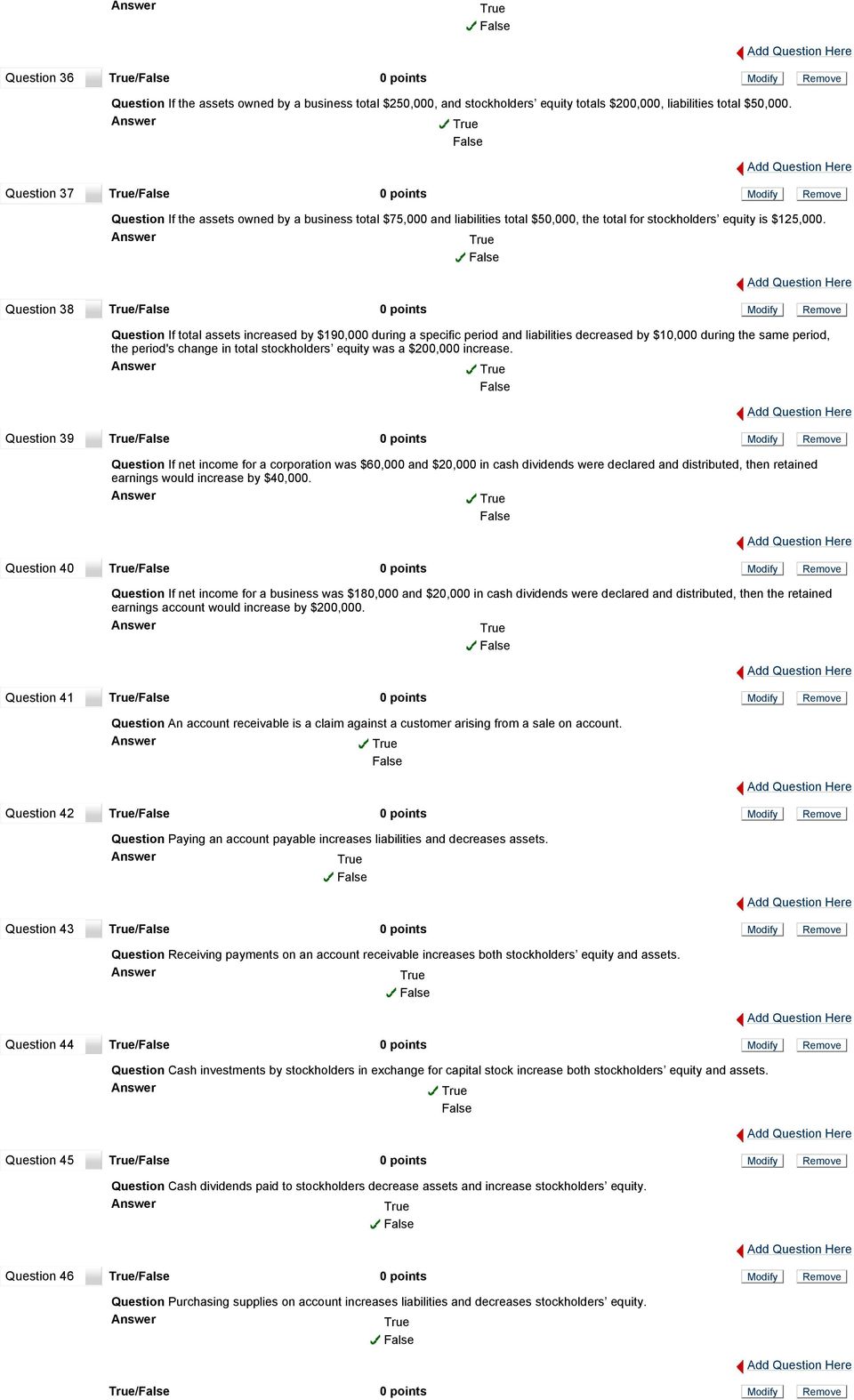
4 Question 36 / 0 points Modify Remove Question If the assets owned by a business total $250,000, and stockholders equity totals $200,000, liabilities total $50,000. Question 37 / 0 points Modify Remove Question If the assets owned by a business total $75,000 and liabilities total $50,000, the total for stockholders equity is $125,000. Question 38 / 0 points Modify Remove Question If total assets increased by $190,000 during a specific period and liabilities decreased by $10,000 during the same period, the period's change in total stockholders equity was a $200,000 increase. Question 39 / 0 points Modify Remove Question If net income for a corporation was $60,000 and $20,000 in cash dividends were declared and distributed, then retained earnings would increase by $40,000. Question 40 / 0 points Modify Remove Question If net income for a business was $180,000 and $20,000 in cash dividends were declared and distributed, then the retained earnings account would increase by $200,000. Question 41 / 0 points Modify Remove Question An account receivable is a claim against a customer arising from a sale on account. Question 42 / 0 points Modify Remove Question Paying an account payable increases liabilities and decreases assets. Question 43 / 0 points Modify Remove Question Receiving payments on an account receivable increases both stockholders equity and assets. Question 44 / 0 points Modify Remove Question Cash investments by stockholders in exchange for capital stock increase both stockholders equity and assets. Question 45 / 0 points Modify Remove Question Cash dividends paid to stockholders decrease assets and increase stockholders equity. Question 46 / 0 points Modify Remove Question Purchasing supplies on account increases liabilities and decreases stockholders equity. / 0 points Modify Remove
5 Question 47 Question Dividends represent assets or services used in the process of earning revenues. Question 48 / 0 points Modify Remove Question Receiving a bill or otherwise being notified that an amount is owed is not recorded until the amount is paid. Question 49 / 0 points Modify Remove Question Revenue is earned only when money is received. Question 50 / 0 points Modify Remove Question Expenses are expired costs of doing business. Question 51 / 0 points Modify Remove Question The excess of revenue over the expenses incurred in earning the revenue is called capital stock. Question 52 / 0 points Modify Remove Question Expenses increase Stockholders Equity. Question 53 / 0 points Modify Remove Question The excess of expenses over revenues is called net income. Question 54 / 0 points Modify Remove Question The principal financial statements for a corporation are the income statement, the retained earnings statement, and the balance sheet. Question 55 / 0 points Modify Remove Question A balance sheet is a list of the assets, liabilities, and stockholders equity of a business for a period of time. Question 56 / 0 points Modify Remove Question An income statement is a summary of the revenues and expenses of a business as of a specific date. Question 57 / 0 points Modify Remove Question A retained earnings statement is viewed as the connecting link between the income statement and the balance sheet. Question 58 / 0 points Modify Remove Question The statement of cash flows consists of an operating section, an income section, and an equity section.

6 Question 59 / 0 points Modify Remove Question All financial statements are identified by the name of the business, the title of the statement, and the date or period of time. Question 60 / 0 points Modify Remove Question The Balance Sheet represents the accounting equation. Question 61 / 0 points Modify Remove Question An example of a general-purpose financial statement would be a report about projected price increases related to transportation costs. Question 62 / 0 points Modify Remove Question No significant differences exist between the accounting standards issued by the FASB and the IASB. Question 63 / 0 points Modify Remove Question The Sarbanes-Oxley Act prohibits CPAs from providing nonaudit investment banking services. Question 64 / 0 points Modify Remove Question The main objective for all business is to maximize unrealized profits. Question 65 / 0 points Modify Remove Question The basic difference between manufacturing and merchandising companies is the completion level of the products they purchase for resale to customers. Question 66 / 0 points Modify Remove Question Net income and net profit do not mean the same thing. Question 67 Matching 0 points Modify Remove Question Match the following transactions with their effects to the accounting equation. Match Question Items Items C. - A. Received cash for services provided. A. Increase assets, increase liabilities B. - B. Received utility invoice to be paid next month. B. Increase liabilities, decrease stockholders equity C. - C. Two major stockholders deposit cash in the corporation s bank account in return for shares of stock in the company. C. Increase assets, increase stockholders equity E. - D. Paid part of an amount owed to a creditor. D. Increase assets, decrease assets D. - E. Paid cash for the purchase of a one year insurance policy. E. Decrease assets, decrease liabilities D. - F. Received payment from a customer for an invoice that was billed last month. F. Decrease assets, decrease stockholders equity F. - G. Paid cash to stockholders as dividends. C. - H. Provided a service to a customer on account. A. - I. Purchased supplies on credit. F. - J. Paid wages. Question 68 Multiple Choice 0 points Modify Remove Question Profit is the difference between assets and liabilities the incoming cash and outgoing cash

7 the assets purchased with cash spent by stockholders and the cash spent to operate the business the assets received for goods and services and the amounts used to provide the goods and services Question 69 Multiple Choice 0 points Modify Remove Question Most businesses in the United States are sole proprietorships partnerships corporations separate entities Question 70 Multiple Choice 0 points Modify Remove Question Which of the items below is not a business entity? entrepreneurship proprietorship partnership corporation Question 71 Multiple Choice 0 points Modify Remove Question An entity that is organized according to state or federal statutes and in which ownership is divided into shares of stock is a proprietorship corporation partnership governmental unit Question 72 Multiple Choice 0 points Modify Remove Question Financial reports are used by management creditors investors all are correct Question 73 Multiple Choice 0 points Modify Remove Question Which of the following descriptions best describes accounting? records economic data but does not communicate the data to users according to any specific rules is an information system that provides reports to users is of no use by individuals outside of the business is used only for filling out tax returns and for financial statements for various type of governmental reporting requirements Question 74 Multiple Choice 0 points Modify Remove Question Which of the following is not a step in providing accounting information to users? design the accounting information system prepare accounting surveys identify users record economic data Question 75 Multiple Choice 0 points Modify Remove Question Two common areas of accounting that respectively provide information to internal and external users are: forensic accounting and financial accounting managerial accounting and financial accounting managerial accounting and environmental accounting financial accounting and tax accounting systems Question 76 Multiple Choice 0 points Modify Remove Question Public accountants are normally Certified Public Accountants Forensic accountants Certified Internal Auditors Certified Management Accountants Question 77 Multiple Choice 0 points Modify Remove Question Which of the following is a specialized field of accounting? social accounting tax accounting environmental accounting all are correct

8 Question 78 Multiple Choice 0 points Modify Remove Question Which of the following is not true about a manufacturing business? Change inputs to products which are sold to their customers. Their primary goal is to maximize profits. Only large business can be considered a manufacturing business. All are true. Question 79 Multiple Choice 0 points Modify Remove Question Which of the following group of companies are all examples of a merchandising business? Delta Airlines, Marriott, Gap Gap, Amazon, NIKE GameStop, Sony, Dell GameStop, Best Buy, Gap Question 80 Multiple Choice 0 points Modify Remove Question Which of the following would not normally operate as a service business? Pet Groomers Restaurant Video Rentals Styling Salon Question 81 Multiple Choice 0 points Modify Remove Question Select the type of business that is most likely to obtain large amounts of resources by issuing stock. Partnership Corporation Proprietorship None are correct. Question 82 Multiple Choice 0 points Modify Remove Question Which of the following is true in regards to a Limited Liability Company? LLCs make up about 10% of business organizations in the United States. LLCs can be used as alternatives to partnerships. LLCs provide tax and liability advantages to the owners. All are correct. Question 83 Multiple Choice 0 points Modify Remove Question Stockholders in a corporation have an interest in the company because they provide incentives for the company to market their products. they are part of the Marketing Department that is responsible for promoting the products or services to increase the business profits. they help market their products to customers or find vendors to supply needed inputs. they provide major financing for the business. Question 84 Multiple Choice 0 points Modify Remove Question Which of the following groups are considered to be internal users of accounting information? Employees and customers Customers and vendors Employees and managers Government and banks Question 85 Multiple Choice 0 points Modify Remove Question The following are examples of external users of accounting information except: government customers creditors all of the above Question 86 Multiple Choice 0 points Modify Remove Question Due to various fraudulent business practices and accounting coverups in the early 2000 s, Congress enacted the Sarbanes- Oxley Act of The Act was responsible for establishing a new oversight board for public accountants called the Generally Accepted Accounting Practices for Public Accountants Board. Public Company Accounting Oversight Board. Congressional Accounting Oversight Board. None are correct.

9 Question 87 Multiple Choice 0 points Modify Remove Question Which of the following is the best description of accounting s role in business? Accounting provides stockholders with information regarding the market value of the company s stocks. Accounting provides information to managers to operate the business and to other users to make decisions regarding the economic condition of the company. Accounting provides creditors and banks with information regarding the credit risk rating of the company. Accounting is not responsible for providing any form of information to users. That is the role of the Information Systems Department. Question 88 Multiple Choice 0 points Modify Remove Question Managerial accountants would be responsible for providing the following information: Tax reports to government agencies. Profit reports to stockholders and management. Expansion of a product line report to management. Consumer reports to customers. Question 89 Multiple Choice 0 points Modify Remove Question Which of the following is not a certification for accountants? CIA CMA CISA All are true. Question 90 Multiple Choice 0 points Modify Remove Question Which of the following is not a characteristic of a corporation? Corporations are organized as a separate legal taxable entity. Ownership is divided into shares of stock. Corporations experience an ease in obtaining large amounts of resources by issuing stock. A corporation s resources are limited to their individual stockholders resources. Question 91 Multiple Choice 0 points Modify Remove Question Which of the following is not a role of accounting in business? To provide reports to users about the economic activities and conditions of a business. To personally guarantee loans of the business. To provide information to other users to determine the economic performance and condition of the business. To assess the various informational needs of users and design its accounting system to meet those needs. Question 92 Multiple Choice 0 points Modify Remove Question Which of the following are guidelines for behaving ethically? I.Identify the consequences of a decision and its effect on others. II.Consider your obligations and responsibilities to those affected by the decision. III.Identify your decision based on personal standards of honesty and fairness. I and II. II and III. I and III. I, II, and III. Question 93 Multiple Choice 0 points Modify Remove Question Which of the following not a requirement for obtaining a CPA certificate? Passing an examination prepared by the AICPA. Having experience in wordprocessing, electronic spreadsheets and databases. Acquiring college education in accounting. All of these are requirements for obtaining a CPA certificate. Question 94 Multiple Choice 0 points Modify Remove Question The initials GAAP stand for General Accounting Procedures Generally Accepted Plans Generally Accepted Accounting Principles Generally Accepted Accounting Practices Question 95 Multiple Choice 0 points Modify Remove Question Presently, the dominant body in the development of accounting principles is the American Institute of Certified Public Accountants (AICPA) American Accounting Association (AAA)

10 Financial Accounting Standards Board (FASB) Institute of Management Accountants (IMA) Question 96 Multiple Choice 0 points Modify Remove Question The business entity concept means that the stockholder is part of the business entity an entity is organized according to state or federal statutes an entity is organized according to the rules set by the FASB the entity is an individual economic unit for which data are recorded, analyzed, and reported Question 97 Multiple Choice 0 points Modify Remove Question For accounting purposes, the business entity should be considered separate from its owners if the entity is a corporation a proprietorship a partnership all of the above Question 98 Multiple Choice 0 points Modify Remove Question Darnell Company purchased $88,000 of computer equipment from Joseph Company. Darnell Company paid for the equipment using cash that had been obtained from the initial investment by Donnie Darnell. The transaction involving the computer equipment should be recorded on the accounting records of which of the following entities? Darnell Company and Darnell stockholders personal records Joseph Company and Darnell stockholders personal records Darnell Company and Joseph Company Joseph Company Question 99 Multiple Choice 0 points Modify Remove Question The objectivity principle requires that business transactions must be consistent with the objectives of the entity the Financial Accounting Standards Board must be fair and unbiased in its deliberations over new accounting standards accounting principles must meet the objectives of the Security and Exchange Commission amounts recorded in the financial statements must be based on independently verifiable evidence Question 100 Multiple Choice 0 points Modify Remove Question Recently, Crystal Cleaning Company, a small corporation, paid dividends of $18,000 to its stockholders and Crystal s major stockholder, Denzel Jones contributed $14,000, in his name, to Habitat for Humanity. The contribution of the $14,000 should be recorded on the accounting records of which of the following entities? Crystal Cleaning and Habitat for Humanity Denzel Jones' personal records and Habitat for Humanity Denzel Jones personal records and Crystal Cleaning Denzel Jones personal records, Crystal Cleaning, and Habitat for Humanity Question 101 Multiple Choice 0 points Modify Remove Question Equipment with an estimated market value of $55,000 is offered for sale at $75,000. The equipment is acquired for $20,000 in cash and a note payable of $40,000 due in 30 days. The amount used in the buyer's accounting records to record this acquisition is $55,000 $60,000 $20,000 $75,000 Question 102 Multiple Choice 0 points Modify Remove Question Which one of the following is the authoritative body having the primary responsibility for developing accounting principles? FASB IRS SEC AICPA Question 103 Multiple Choice 0 points Modify Remove Question Which of the following concepts relates to separating the reporting of business and personal economic transactions? Cost Concept Unit of Measure Concept Business Entity Concept Objectivity Concept Question 104 Multiple Choice 0 points Modify Remove Question Donner Company is selling a piece of land adjacent to their business. An appraisal reported the market value of the land to

11 be $120,000. The Focus Company initially offered to buy the land for $107,000. The companies settled on a purchase price of $115,000. On the same day, another piece of land on the same block sold for $122,000. Under the cost concept, what is the amount that will be used to record this transaction in the accounting records? $107,000 $115,000 $120,000 $122,000 Question 105 Multiple Choice 0 points Modify Remove Question Which of the following is not true of accounting principles? Financial accountants follow generally accepted accounting principles (GAAP). Following GAAP allows accounting information users to compare one company to another. A new accounting principle can be adopted with stockholders approval. The Financial Accounting Standards Board (FASB) has primary responsibility for developing accounting principles. Question 106 Multiple Choice 0 points Modify Remove Question Owned resources of a business are referred to as assets liabilities equities revenues Question 107 Multiple Choice 0 points Modify Remove Question Assets are always greater than liabilities. either cash or accounts receivables the same as expenses because they are acquired with cash financed by stockholders and/or creditors Question 108 Multiple Choice 0 points Modify Remove Question Debts owed by a business are referred to as accounts receivables equities stockholders equity liabilities Question 109 Multiple Choice 0 points Modify Remove Question The accounting equation may be expressed as Assets = Equities - Liabilities Assets + Liabilities = Stockholders Equity Assets = Revenues less Liabilities Assets - Liabilities = Stockholders Equity Question 110 Multiple Choice 0 points Modify Remove Question Which of the following is not an asset? Investments Cash Inventory Stockholders Equity Question 111 Multiple Choice 0 points Modify Remove Question The assets and liabilities of the company are $175,000 and $40,000, respectively. Stockholders equity should equal $215,000 $135,000 $175,000 $40,000 Question 112 Multiple Choice 0 points Modify Remove Question If total liabilities decreased by $55,000 during a period of time and stockholders equity increased by $60,000 during the same period, the amount and direction (increase or decrease) of the period's change in total assets is $115,000 increase $5,000 increase $5,000 decrease $115,000 decrease Question 113 Multiple Choice 0 points Modify Remove

12 Question Which of the following is not a true statement about the accounting equation and its elements? The accounting equation is Assets = Liabilities - Stockholders Equity. Assets are the resources a business possesses. Liabilities represent debts of a business. Examples of assets are cash, land, buildings, and equipment. Question 114 Multiple Choice 0 points Modify Remove Question Which of the following is not a business transaction? make a sales offer sell goods for cash receive cash for services to be rendered later pay for supplies Question 115 Multiple Choice 0 points Modify Remove Question A corporation paid $7,000 to a creditor in payment of an amount owed. The effect of the transaction on the accounting equation was to increase one asset, decrease another asset decrease an asset, decrease a liability increase an asset, increase a liability increase an asset, increase stockholders equity Question 116 Multiple Choice 0 points Modify Remove Question Earning revenue increases assets, increases stockholders equity. increases assets, decreases stockholders equity increases one asset, decreases another asset decreases assets, increases liabilities Question 117 Multiple Choice 0 points Modify Remove Question The monetary value charged to customers for the performance of services sold is called a(n) asset net income capital stock revenue Question 118 Multiple Choice 0 points Modify Remove Question Revenues are reported when a contract is signed cash is received from the customer work is begun on the job work is completed on the job Question 119 Multiple Choice 0 points Modify Remove Question Expenses are recorded when cash is paid for services rendered a bill is received in advance of services rendered services are rendered none are correct Question 120 Multiple Choice 0 points Modify Remove Question Goods purchased on account for future use in the business, such as supplies, are called prepaid liabilities revenues prepaid expenses liabilities Question 121 Multiple Choice 0 points Modify Remove Question The asset created by a business when it makes a sale on account is termed accounts payable prepaid expense unearned revenue accounts receivable Question 122 Multiple Choice 0 points Modify Remove Question The debt created by a business when it makes a purchase on account is referred to as an

13 account payable account receivable asset expense payable Question 123 Multiple Choice 0 points Modify Remove Question If total assets decreased by $88,000 during a period of time and stockholders equity increased by $65,000 during the same period, then the amount and direction (increase or decrease) of the period's change in total liabilities is $23,000 increase $88,000 decrease $153,000 increase $153,000 decrease Question 124 Multiple Choice 0 points Modify Remove Question Dividends to stockholders increase expenses increase stockholders equity increase cash decrease stockholders equity Question 125 Multiple Choice 0 points Modify Remove Question Stockholders equity is increased by cash revenue accounts receivable all are correct Question 126 Multiple Choice 0 points Modify Remove Question How does the purchase of supplies on account affect the accounting equation? assets increase; stockholders equity decreases assets increase; liabilities increase assets increase; liabilities decrease liabilities increase; stockholders equity decreases Question 127 Multiple Choice 0 points Modify Remove Question How does the rendering of services on account affect the accounting equation? assets increase; stockholders equity increases assets decrease; stockholders equity decrease assets increase; stockholders equity decreases liabilities increase; stockholders equity decreases Question 128 Multiple Choice 0 points Modify Remove Question How does paying a liability in cash affect the accounting equation? assets increase; liabilities decrease assets increase; liabilities increase assets decrease; liabilities decrease liabilities decrease; stockholders equity increases Question 129 Multiple Choice 0 points Modify Remove Question How do the declaration and payment of cash dividends by the company affect its accounting equation? assets decrease; stockholders equity decreases assets decrease; stockholders equity increases assets increase; liabilities decrease no effect on the assets, liabilities, or stockholders equity Question 130 Multiple Choice 0 points Modify Remove Question How does receiving a bill to be paid next month for services rendered affect the accounting equation? assets decrease; stockholders equity decreases assets increase; liabilities increase liabilities increase; stockholders equity increases liabilities increase; stockholders equity decreases Question 131 Multiple Choice 0 points Modify Remove Question How does the collection of cash from a customer who was previously put on account affect the accounting equation? assets decrease; stockholders equity decreases

14 assets increase; stockholders equity increases assets increase; assets decrease assets increase; liabilities increase Question 132 Multiple Choice 0 points Modify Remove Question How does the purchase of equipment by signing a note affect the accounting equation? assets increase; assets decrease assets increase; liabilities decrease assets increase; liabilities increase assets increase; stockholders equity increases Question 133 Multiple Choice 0 points Modify Remove Question Land, originally purchased for $20,000, is sold for $75,000 in cash. What is the effect of the sale on the accounting equation? assets increase $75,000; stockholders equity increases $75,000 assets increase $55,000; stockholders equity increases $55,000 assets increase $75,000; liabilities decrease $20,000; stockholders equity increases $55,000 assets increase $20,000; no change for liabilities; stockholders equity increases $75,000 Question 134 Multiple Choice 0 points Modify Remove Question The Austin Land Company sold land for $85,000 in cash. The land was originally purchased for $65,000, and at the time of the sale, $40,000 was still owed to Regions Bank on that purchase. After the sale, The Austin Land Company paid off the loan to Regions Bank. What is the effect of the sale and the payoff of the loan on the accounting equation? assets decrease $20,000; liabilities decrease $40,000; stockholders equity increases $20,000 assets increase $20,000; liabilities decrease $40,000; stockholders equity increases $20,000 assets decrease $25,000; liabilities decrease $40,000; stockholders equity increases $65,000 assets increase $45,000; liabilities decrease $40,000; stockholders equity increases $85,000 Question 135 Multiple Choice 0 points Modify Remove Question On July 1 of the current year, the assets and liabilities of Wong Industries, are as follows: Cash, $15,000; Accounts Receivable, $12,300; Supplies, $3,100; Land, $35,000; Accounts Payable, $8,700. What is the amount of stockholders equity as of July 1 of the current year? $32,100 $43,700 $56,700 $65,400 Question 136 Multiple Choice 0 points Modify Remove Question At of the end of its accounting period, December 31, 2009, Great Marks Company has assets of $940,000 and liabilities of $300,000. During 2010, Great Marks sold $65,000 of capital stock and declared and paid $45,000 in dividends. What is the amount of net income during 2010, assuming that as of December 31, 2010, assets were $995,000, and liabilities were $270,000? $ 65,000 $ 50,000 $105,000 $370,000 Question 137 Multiple Choice 0 points Modify Remove Question The total assets and the total liabilities of a business at the beginning and at the end of the year appear below. During the year, dividends were declared and paid in the amount of $60,000 and the company sold additional shares of capital stock amounting to $45,000. Assets Liabilities Beginning of year $305,000 $200,000 End of year 365, ,000 The amount of net income for the year was $45,000 $60,000 $75,000 $90,000 Question 138 Multiple Choice 0 points Modify Remove Question If beginning retained earnings was $70,000, ending retained earnings was $48,000, and cash dividends in the amount of $21,000 were declared and paid, the amount of net income or net loss was net income of $42,000 net income of $17,000 net loss of $22,000 net loss of $1,000 Question 139 Multiple Choice 0 points Modify Remove Question Transactions affecting stockholders equity include

15 shares of capital stock issued to stockholders and payment of liabilities shares of capital stock issued to stockholders, dividends declared and paid to stockholders, revenues, and expenses shares of capital stock issued to stockholders, revenues, expenses, and collection of accounts receivable shares of capital stock issued to stockholders, revenues, expenses, and purchase of supplies on account Question 140 Multiple Choice 0 points Modify Remove Question Clifford Moore deposits $15,000 in a bank account in the name of Star Tech, a computer programming business, in return for shares of stock. Star Tech s records would show: Increased Assets (Cash) and increased Liabilities (Accounts Payable) Increased Assets (Cash) and increased Stockholders Equity (Capital Stock) Increased Assets (Accounts Receivable) and decreased Liabilities (Accounts Payable) Increased Assets (Cash) and increased Assets (Accounts Receivable) Question 141 Multiple Choice 0 points Modify Remove Question Simpson Auto Body Repair purchased $20,000 of Machinery. The company paid $8,000 in cash at the time of the purchase and signed a promissory note for the remainder to be paid in four monthly installments. How will this transaction affect the accounting equation? Increase Assets (Machinery $20,000) and decrease Liabilities (Accounts Payable $20,000) Increase Total Assets by a net amount of $12,000 (increase Machinery $20,000 and decrease Cash $8,000) and increase Liabilities (Notes Payable $12,000) Increase Total Assets by a net amount of $20,000 (increase Machinery $12,000 and increase Cash $8,000) and decrease Liabilities (Accounts Payable $20,000) Increase Assets (Machinery $12,000) and increase Liabilities (Accounts Payable $12,000) Question 142 Multiple Choice 0 points Modify Remove Question Collins Landscape Company purchased various landscaping supplies on account to be used for landscape designs for their customers. How will this business transaction affect the accounting equation? Increase Assets (Supplies) and increase Liabilities (Accounts Payable) Increase Assets (Supplies) and decrease Assets (Cash) Increase Assets (Supplies) and decrease Stockholders Equity (Supplies Expense) Increase Stockholders Equity (Supplies Expense) and increase Liabilities (Accounts Payable) Question 143 Multiple Choice 0 points Modify Remove Question There are four transactions that affect Stockholders Equity. Which are the two transactions that increase Stockholders Equity? Recording revenues and expenses Recording expenses and payment of dividends Recording revenues and the issuance of capital stock Recording the issuance of capital stock and expenses Question 144 Multiple Choice 0 points Modify Remove Question There are four transactions that directly affect Stockholders Equity. Which are the two transactions that decrease Stockholders Equity? Expenses and dividends declared and paid to stockholders Revenues and expenses Revenues and capital stock issued to stockholders Expenses and capital stock issued to stockholders Question 145 Multiple Choice 0 points Modify Remove Question Gomez Service Company has received $7,500 in cash for services rendered. What affect does this transaction have on the accounting equation? Increase Assets (Cash) and decrease Stockholders Equity (Expenses) Increase Assets (Cash) and decrease Assets (Accounts Receivable) Increase Assets (Accounts Receivable) and increase Stockholders Equity (Fees Earned) Increase Assets (Cash) and increase Stockholders Equity (Fees Earned) Question 146 Multiple Choice 0 points Modify Remove Question Gomez Service Company paid their first installment on their Notes Payable in the amount of $2,000. How will this transaction affect the accounting equation? Increase Liabilities (Notes Payable) and decrease Assets (Cash) Decrease Assets (Cash) and decrease Stockholders Equity (Note Payable Expense) Decrease Assets (Cash) and decrease Assets (Notes Receivable) Decrease Assets (Cash) and decrease Liabilities (Notes Payable) Question 147 Multiple Choice 0 points Modify Remove Question Ramierez Company received their first electric bill in the amount of $60 which will be paid next month. How will this transaction affect the accounting equation? Increase Liabilities (Accounts Payable) and decrease Stockholders Equity (Utilities Expense) Increase Liabilities (Accounts Receivable) and decrease Stockholders Equity (Utilities Expense)

16 Decrease Assets (Cash) and decrease Liabilities (Accounts Payable) Decrease Assets (Cash) and decrease Stockholders Equity (Utilities Expense) Question 148 Multiple Choice 0 points Modify Remove Question Ramos Repair Company paid $750 in dividends to its stockholders. How does this transaction affect Ramos Repair Company s accounting equation? Increase Assets (Accounts Receivable) and decrease Assets (Cash) Decrease Assets (Cash) and decrease Stockholders Equity (Dividends) Decrease Assets (Cash) and decrease Liabilities (Accounts Payable) Increase Assets (Cash) and decrease Stockholders Equity (Dividends) Question 149 Multiple Choice 0 points Modify Remove Question Which of the following is not a business transaction? Erin receives stock in exchange for depositing $15,000 in a bank account in the name of Erin s Lawn Service. Erin s Lawn Service provided landscaping services to customers earning fees of $600. Erin s Lawn Service purchased hedge trimmers and agreed to pay the supplier next month. The major stockholder for Erin s Lawn Service pays her monthly personal credit card bill. Question 150 Multiple Choice 0 points Modify Remove Question The financial statement that presents a summary of the revenues and expenses of a business for a specific period of time, such as a month or year, is called a(n) prior period statement statement of cash flows income statement balance sheet Question 151 Multiple Choice 0 points Modify Remove Question All of the following are financial statement(s) of a proprietorship except: the retained earnings statement the statement of owner's equity the income statement the statement of cash flows Question 152 Multiple Choice 0 points Modify Remove Question Which of the following financial statements reports information as of a specific date? income statement retained earnings statement statement of cash flows balance sheet Question 153 Multiple Choice 0 points Modify Remove Question Four financial statements are usually prepared for a business. The statement of cash flows is usually prepared last. The retained earnings statement (RE), the balance sheet (B), and the income statement (I) are prepared in a certain order to obtain information needed for the next statement. In what order are these three statements prepared? I,RE, B B, I, RE RE, I, B B,RE, I Question 154 Multiple Choice 0 points Modify Remove Question Liabilities are reported on the income statement retained earnings statement statement of cash flows balance sheet Question 155 Multiple Choice 0 points Modify Remove Question Cash investments made by stockholders in exchange for capital stock in a business are reported on the statement of cash flows in the financing activities section investing activities section operating activities section supplemental statement Question 156 Multiple Choice 0 points Modify Remove Question The year-end balance of the retained earnings account appears in

17 both the retained earnings statement and the income statement only the retained earnings statement both the retained earnings statement and the balance sheet both the retained earnings statement and the statement of cash flows Question 157 Multiple Choice 0 points Modify Remove Question A financial statement user would determine if a company was profitable or not during a specific period of time by reviewing the Income Statement. the Balance Sheet. the Statement of Cash Flows. cannot be determined. Question 158 Multiple Choice 0 points Modify Remove Question If stockholders want to know how money flowed into and out of the company, what financial statement would they use? Income Statement Statement of Cash Flows Balance Sheet None are correct. Question 159 Multiple Choice 0 points Modify Remove Question The asset section of the Balance Sheet normally presents assets in alphabetical order. order of largest to smallest dollar amounts. in the order what will be converted into cash. no order. Question 160 Multiple Choice 0 points Modify Remove Question The statement of cash flows is separately in three major sections. They are as follows: Operating, Investing, and Financing Revenues, Expenses, and Net Income Assets, Liabilities, and Stockholders Equity Capital Stock, Dividends, and Income Question 161 Multiple Choice 0 points Modify Remove Question Which of the following is not a principle financial statement? Income Statement Statement of Resources Owned Statement of Cash Flows Balance Sheet Question 162 Multiple Choice 0 points Modify Remove Question Countries outside the U.S. use financial accounting standards issued by the: LLC SEC IASB GAAP Question 163 Multiple Choice 0 points Modify Remove Question All of the following statements regarding the ratio of liabilities to stockholders equity are true except: A ratio of 1 indicates that liabilities equal stockholders equity. Proprietorships can use this ratio but substitute total owner s equity for total stockholders equity. The higher this ratio is, the better able a business is to withstand poor business conditions and pay creditors. The lower this ratio is, the better able a business is to withstand poor business conditions and pay creditors. Question 164 Multiple Choice 0 points Modify Remove Question The unit of measure concept: is only used in the financial statements of manufacturing companies. is not important when applying the cost concept. requires that different units be used for assets and liabilities. requires that economic data be reported in yen in Japan or dollars in the U.S. Question 165 Essay 0 points Modify Remove Question Give the major disadvantage of disregarding the cost concept and constantly revaluing assets based on appraisals and opinions. Accounting reports would become unstable and unreliable.

18 Question 166 Essay 0 points Modify Remove Question On May 7, Carpet Barn Company offered to pay $95,000 for land that had a selling price of $110,000. On May 15, Carpet Barn accepted a counteroffer of $103,000. On June 5, the land was assessed at a value of $120,000 for property tax purposes. On December 10, Carpet Barn Company was offered $145,000 for the land by another company. At what value should the land be recorded in Carpet Barn Company s records? $103,000 Question 167 Essay 0 points Modify Remove Question At the end of its accounting period, December 31, 2009, Miller s Arcade has assets of $450,000 and liabilities of $125,000. Using the accounting equation, determine the following amounts: a) Stockholder s Equity as of December 31, b) Stockholder s Equity as of December 31, 2010, assuming that assets increased by $65,000 and liabilities increased by $35,000 during a) $450,000 = $125,000 + $325,000 b) ($450,000 + $65,000) = ($125,000 + $35,000) + $355,000 Question 168 Essay 0 points Modify Remove Question The following selected transactions were completed by Daniels Company during May: 1. Capital stock was issued for $55, Paid creditors on account $7, Billed customers for services on account, $2, Received cash from customers on accounts $8, Paid cash dividend, $2, Received the utility bill $160, to be paid next month. Indicate the effect of each transaction on the accounting equation: 1) By Account type - (A)assets, (L)liabilities, (SE)stockholders equity, (R)revenue, and (E)expense 2) Name of Account for the entry 3) The amount by of the transaction. 4) Indicate the specific item within the account equation element that is affected. Note: Each transaction has two entries Entry Acct Type Name of Acct Amount (1) (2) (3) Entry Amount Increase or Decrease (4) Acct Type (1) Name of Acct (2) Entry Amount (3) Entry Amount Increase or Decrease (4) Acct Type Name of Acct (1) Increase or Decrease (4) Acct Type Name of Acct (2) (3) (1) (2) (3) 1 A Cash 55,000 Incr SE Capital stock 55,000 Incr 2 A Cash 7,000 Decr L Payables 7,000 Decr 3 A Acct Rec 2,565 Incr R Fees Earned 2,565 Incr 4 A Cash 8,450 Incr A Acct Rec 8,450 Decr 5 A Cash 2,500 Decr SE Dividends 2,500 Incr 6 L Acct Pay 160 Incr E Util Exp 160 Incr Increase or Decrease (4) Question 169 Essay 0 points Modify Remove Question The assets and liabilities of Amos Moving Services at March 31, 2010, the end of the current year, and its revenue and expenses for the year are listed below. The Retained Earnings balance was $180,000 at April 1, 2009, the beginning of the current year. Accounts Payable $1,200 Miscellaneous Expense $230 Accounts Receivable $10,340 Office Expense $1,240 Cash $33,990 Supplies $1,670 Fees Earned $84,350 Wages Expense $23,550 Land $47,000 Dividends $16,570 Building $157,630 Capital Stock $25,000 Prepare an income statement for the current year ended March 31, Amos Moving Services Income Statement For the Year Ended March 31, 2010 Fees Earned $84,350 Expenses: Wages Expense $23,550 Office Expense 1,240 Miscellaneous Expense 230 Total Expenses 25,020 Net Income $59,330 Question 170 Essay 0 points Modify Remove Question The assets and liabilities of Amos Moving Services at March 31, 2010, the end of the current year, and its revenue and expenses for the year are listed below. The Retained Earnings balance was $180,000 at April 1, 2009, the beginning of the current

19 year. Accounts Payable $1,200 Miscellaneous Expense $230 Accounts Receivable $10,340 Office Expense $1,240 Cash $33,990 Supplies $1,670 Fees Earned $84,350 Wages Expense $23,550 Land $47,000 Dividends $16,570 Building $157,630 Capital Stock $25,000 Prepare a retained earnings statement for the current year ended March 31, Amos Moving Services Retained Earnings Statement For the Year Ended March 31, 2010 Retained earnings, April 1, 2009 $180,000 Net Income for the year 59,330 Less dividends 16,570 Increase in retained earnings 42,760 Retained earnings, March 31, 2010 $222,760 Question 171 Essay 0 points Modify Remove Question The assets and liabilities of Amos Moving Services at March 31, 2010, the end of the current year, and its revenue and expenses for the year are listed below. Retained earnings was $180,000 at April 1, 2009, the beginning of the current year. Accounts Payable $1,200 Miscellaneous Expense $230 Accounts Receivable $10,340 Office Expense $1,240 Cash $33,990 Building $157,630 Fees Earned $84,350 Wages Expense $23,550 Land $47,000 Dividends $16,570 Capital Stock $25,000 Prepare a balance sheet for the current year ended March 31, Amos Moving Services Balance Sheet March 31, 2010 Assets Liabilities Cash $33,990 Accounts Payable $ 1,200 Accounts Receivable 10,340 Land 47,000 Stockholders Equity Building 157,630 Capital Stock 25,000 Retained Earnings 222,760 Total Assets $248,960 Total liab and Stockholders Equity $248,960 Question 172 Essay 0 points Modify Remove Question A summary of cash flows for Amos Moving Services for the year ended March 31, 2010, is shown below. Cash receipts: Cash received from customers $83,990 Cash received from stockholders in exchange for stock 25,000 Cash payments: Cash paid for expenses $27,000 Cash paid for land 47,000 Cash paid for supplies 410 Dividends 5,000 The cash balance as of April 1, 2009 $40,600 Prepare a statement of cash flows for Amos Moving Services for the year ended March 31, Amos Moving Services Statement of Cash Flows For the Year Ended March 31, 2010 Cash flows from operating activities: Cash received from customers $83,990 Deduct cash payments for expenses/supplies (27,410) Net cash flows from operating expenses $56,580 Cash flows from investing activities: Cash paid for land (47,000) Cash from financing activities: Cash received from stockholders 25,000 Deduct cash dividends (5,000) Net cash flows from financing activities 20,000 Net increase in cash during year $ 29,580 Cash as of April 1, ,600 Cash as of March 31, 2010 $70,180 Question 173 Essay 0 points Modify Remove Question What information does the Income Statement give to business users? The Income Statement reports the revenues and expenses for a period of time. The result is either a Net Income or a Net Loss. Question 174 Essay 0 points Modify Remove Question What are the three sections of the Statement of Cash Flows? Operating Activities, Investing Activities, and the Financing Activities

20 Question 175 Essay 0 points Modify Remove Question Companies like Enron, WorldCom, and Tyco International, Ltd. have been caught in the midst of ethical lapses that led to fines, firings, and criminal and/or civil prosecution. List and briefly describe three factors that are responsible for what went wrong in these companies. The three factors are: (1) individual character, (2) firm culture, and (3) laws and enforcement. Individual character of honesty, integrity, and fairness in the face of pressure to hide the truth is an important factor possessed by an ethical businessperson. By their behavior and attitude, senior managers of a company set the firm culture. In firms like Enron, the senior managers created a culture of greed and indifference to the truth that flowed down to lower-level managers, who took shortcuts and lied to cover their financial frauds. The lack of laws and enforcement has been blamed as a contributing factor to financial reporting abuses. As a result, new laws such as the Sabanes-Oxley Act of 2002 (SOX) established a new oversight body for the accounting profession, known as the Public Company Accounting Oversight Board (PCAOB), which enhanced corporate accountability, financial disclosures, and independence. Question 176 Essay 0 points Modify Remove Question Explain internal and external users of accounting information by presenting the area of accounting that provides them with information. In your answers, also give an example of each type of user along with a report that each might use. Internal users of accounting information include managers and employees. The area of accounting that provides internal users with information is called managerial accounting or management accounting. An example of a report that might be used internally by managers or employees would be reports that include information about customers, prices and plans to expand the business. External users of accounting information include customers, creditors, banks, and the government. These users are not directly involved in managing or operating the business. Financial reports about the profitability of a company s operations is important to banks and creditors when deciding to lend money to the company or extend credit. Question 177 Essay 0 points Modify Remove Question Determine the missing amount X for each of the following: Assets Liabilities Stockholders Equity a. $85,700 $40,000 X b. X $66,570 $145,000 c. $57,900 X $34,000 a. $85,700-40,000 = $45,700 b. $66, ,000 = $211,570 c. $57,900-34,000 = $23,900 Question 178 Essay 0 points Modify Remove Question Use the accounting equation to answer each of the independent questions below: a. At the beginning of the year, Norton Company assets were $75,000 and its stockholders equity was $38,000. During the year, assets increased by $18,000 and liabilities increased by $4,000. What was the stockholders equity at the end of the year? b. At the beginning of the year, Turpin Industries had liabilities of $44,000 and stockholders equity of $66,000. If assets increased by $10,000 and liabilities decreased by $5,000, what was the stockholders equity at the end of the year? a. $75,000 -$38,000 = $37,000 beginning of year liabilities ($75, ,000) - ($37, ,000) = $52,000 end of year stockholders equity b. $44,000 + $66,000 = $110,000 beginning of year assets ($110, ,000) - ($44,000-5,000) = $81,000 end of year stockholders equity Question 179 Essay 0 points Modify Remove Question Krammer Company has liabilities equal to one fourth of the total assets. Krammer s stockholders equity is equal to $30,000. Using the accounting equation, what is the amount of liabilities for Krammer? Assets = Liabilities + Stockholders Equity 4x = x + $30,000 3x = $30,000 x = $10,000 in liabilities Question 180 Essay 0 points Modify Remove Question Bob Johnson is a stockholder with shares in Johnson s Carpet Cleaning Service. Bob purchased a personal automobile for $10,000 cash plus he took out a loan for $20,000 in his name. Describe how this transaction is related to the business entity concept. Under the business entity concept, economic data is limited to the direct activities of the business. The business is viewed as separate from its stockholder. Therefore, when Bob buys a personal automobile, it is not listed on the books of Johnson s Carpet Cleaning. In this case, the loan is a personal debt and not a liability of the company and the cash is from Bob s personal account and not the company s account. Question 181 Essay 0 points Modify Remove Question Shiny Kar Company had the following transactions. For each transaction, show the effect on the accounting equation by putting the amount and direction (plus, minus, or NC for no change) in each box of the table below. a. Shiny Kar declared and paid $500 in dividends to its stockholders. b. Shiny Kar Company sold 2 cars for a total of $55,000 on account. c. The cost of the cars sold in (b) above was $40,000. d. Shiny Kar received $35,000 payment for a car previously sold on account. e. Shiny Kar paid $450 for advertising. f. Shiny Kar purchased $150 of cleaning supplies on account. Assets Liabilities Stockholders Equity Assets Liabilities Stockholders Equity a. -$500 NC -$500 b. +$55,000 NC +$55,000

21 c. -$40,000 NC -$40,000 d. +$35,000 NC NC -$35,000 e. -$450 NC -$450 f. $150 $150 NC Question 182 Essay 0 points Modify Remove Question At the end of its accounting period, December 31, 2009, Martin Consultants has assets of $430,000 and liabilities of $205,000. Using the accounting equation and considering each case independently, determine the following: a. Total stockholders equity as of December 31, b. Total stockholders equity as of December 31, 2010, assuming that assets increased by $12,000 and liabilities increased by $15,000 in c. Total stockholders equity as of December 31, 2010, assuming that assets decreased by $8,000 and liabilities increased by $14,000 during a. $430, ,000 = $225,000 b. ($430, ,000) - ($205, ,000) = $222,000 c. ($430,000 - $8,000) - ($205, ,000) = $203,000 Question 183 Essay 0 points Modify Remove Question At the end of its accounting period, December 31, 2009, Hsu s Restaurant has assets of $575,000 and stockholders equity of $335,000. Using the accounting equation and considering each cased independently, determine the following amounts. a. Hsu s liabilities as of December 31, b. Hsu s liabilities as of December 31, 2010, assuming that assets increased by $56,000 and stockholders equity decreased by $32,000. c. Net income or net loss during 2010, assuming that as of December 31, 2010, assets were $592,000, liabilities were $450,000, and there were no additional issuances of capital stock or distribution of dividends. a. $575, ,000 = $240,000 b. ($575, ,000) - ($335,000-32,000) = $328,000 c. ($592, ,000) = $142,000 $335, ,000 = $193,000 net loss Question 184 Essay 0 points Modify Remove Question a. A company acquires a vacant lot for $83,000 and sells it for $127,000 in cash. What is the effect of the sale on the total amount of the company s (1) assets, (2) liabilities, and (3) stockholders equity? b. Assume that the company owes $52,000 on a loan for the land. After receiving the $127,000 cash in (a), the company pays the $52,000 owed. What is the effect of the payment on the total amount of the company s (1) assets, (2) liabilities, and (3) stockholders equity? a. (1) Total assets increased $44,000. (2) No change in liabilities. (3) Stockholders equity increased $44,000. b. (1) Total assets decreased $52,000. (2) Total liabilities decreased $52,000. (3) No change in stockholders equity. Question 185 Essay 0 points Modify Remove Question Match the following accounts to the financial statement where they can be found. (Hint: Some of the accounts can be found in more than one financial statement.) Account Financial Statements 1. Dividends A. Balance Sheet 2. Revenues B. Income Statement 3. Supplies C. Statement of Cash Flows 4. Land D. Retained Earnings Statement 5. Accounts Payable 6. Accounts Receivable 7. Operating Activities 8. Wages Expense 9. Net Income 10. Cash # Account 1. D Dividends 2. B Revenues 3. A Supplies 4. A Land 5. A Accounts Payable 6. A Accounts Receivable 7. C Operating Activities 8. B Wages Expense 9. B & D (If Indirect, also C.) Net Income 10. A & C Cash Question 186 Essay 0 points Modify Remove Question For each of the following companies, identify whether they are a service, merchandising, or manufacturing business. A. Dillards B. Time Warner Cable C. ebay.com
22 D. Blockbuster E. Applebee s F. Sylvania G. Circuit City H. Banana Republic I. H & R Block A. Merchandising B. Service C. Service D. Service E. Service / Manufacturing F. Manufacturing G. Merchandising H. Merchandising I. Service Question 187 Essay 0 points Modify Remove Question Identify each of the following as either internal or external users of accounting information. A. Payroll Manager B. Bank C. President s Secretary D. Internal Revenue Service E. Raw Material Vendors F. Social Security Administration G. Health Insurance Provider H. Managerial Accountant A. Internal B. External C. Internal D. External E. External F. External G. External H. Internal Question 188 Essay 0 points Modify Remove Question Determine the missing amount for each of the following: Assets Liabilities Stockholders Equity (a) $13,000 $16,000 $55,000 (b) $34,000 $39,000 $ 17,000 (c) (a)$29,000 (b)$21,000 (c)$22,000 Question 189 Essay 0 points Modify Remove Question Indicate whether each of the following represents an asset, liability, or stockholders equity: (a) accounts payable (b) wages expense (c) capital stock (d) accounts receivable (e) dividends (f) land (a) liability (b) stockholders equity (c) stockholders equity (d) asset (e) stockholders equity (f) asset Question 190 Essay 0 points Modify Remove Question Identify each of the following as an (1) increase in stockholders equity, or a (2) decrease in stockholders equity. (a) Fees Earned (b) Wages Expense (c) Declare and pay a dividend (d) Lawn Care Revenue (e) Capital Stock issued to stockholders (f) Supplies Expense (a)1 (b)2 (c)2 (d)1 (e)1 (f) 2 Question 191 Essay 0 points Modify Remove
23 Question Selected transactions completed by a proprietorship are described below. Indicate the effects of each transaction on assets, liabilities, and stockholders equity by inserting "+" for increase and "-" for decrease in the appropriate columns at the right. If appropriate, you may insert more than one symbol in a column. A L SE (a) Received cash from investor in exchange for capital stock (b) Purchased supplies on account (c) Paid rent for the current month (d) Received cash for services sold to customers (e) Returned some defective supplies purchased in (b) (f) Paid insurance premiums in advance (g) Paid cash to creditor for purchases in (b) (h) Charged customers for services sold on account (i) Paid cash to a customer as a refund for an overcharge (j) Received cash on account from customers (k) Declare and pay a cash dividend (l) Recorded the cost of supplies used during the year (m) Received invoice for electricity used (n) Paid wages (o) Purchased a truck for cash A L SE (a) + + (b) + + (c) - - (d) + + (e) - - (f) +,- (g) - - (h) + + (i) - - (j) +,- (k) - - (l) - - (m) + - (n) - - (o) +,- Question 192 Essay 0 points Modify Remove Question Schultz Tax Services, a tax preparation business had the following transactions during the month of June: Example: Received cash from D. Schultz in exchange for Capital Stock, $25, Received cash for providing accounting services, $3, Billed customers on account for providing services, $7, Paid advertising expense, $ Received cash from customers on account, $3, Declare and pay a dividend to investors, $1, Received telephone bill, $ Paid telephone bill, $220. Required: 1) In the table below, state the accounts affected by each transaction. 2) Indicate the effect on the accounting equation of each transaction. Assets = Liabilities + Stockholders Equity 1. Cash +25,000 Capital Stock +25, Assets = Liabilities + Stockholders Equity Ex Cash +25,000 Capital Stock +25, Cash + 3,000 Revenues + 3, A/R + 7,000 Revenues + 7, Cash -800 Expenses Cash + 3,800 A/R -3, Cash -1,500 Dividend -1, A/P Expenses Cash -220 A/P -220 Question 193 Essay 0 points Modify Remove Question From the following list of accounts taken from Lamar s accounting records, identify those that would appear on the Income Statement. (a) (b) (c) (d) (e) (f) (g) Rent Expense Land Capital Stock Fees Earned Dividend Wages Expense Investment (a), (d), (f) Question 194 Essay 0 points Modify Remove Question Identify which of the following accounts appear on a balance sheet. (a) Cash
24 (b) Fees Earned (c) Capital Stock (d) Wages Payable (e) Rent Expense (f) Prepaid Advertising (g) Land (h) Dividends (a), (c), (d), (f), (g) Question 195 Essay 0 points Modify Remove Question Indicate whether each of the following activities would be reported on the Statement of Cash Flows as an Operating Activity, an Investing Activity, a Financing Activity, or does not appear on the Cash Flow Statement. (a) Cash paid for building (b) Cash paid to suppliers (c) Cash paid for dividend to stockholders (d) Cash received from customers (e) Cash received from stockholders in exchange for stock (f) Cash received from the sale of a building (g) Borrowed cash from a bank (a) Investing (b) Operating (c) Financing (d) Operating (e) Financing (f) Investing (g) Financing Question 196 Essay 0 points Modify Remove Question For a & b, determine the amount of net income or net loss for the year. For c & d, determine the change in retained earnings during the year. (a) (b) (c) (d) Revenues for the year totaled $88,500 and expenses totaled $40,500. Stockholders invested $15,000 in the company in exchange for stock during the year. Revenues for the year totaled $175,000 and expenses totaled $220,500. The company paid dividends of $40,000 to investors during the year. Revenues for the year totaled $109,000 and expenses totaled $46,000. Stockholders invested $12,000 in exchange for stock and received $16,000 in dividends during the year. Revenues for Konner Co. totaled $223,800 and expenses totaled $221,300. Dividends of $35,000 were paid during the year. (a) $48,000 net income ($88,500 - $40,500) (b) $45,500 net loss ($175,000 - $220,500) (c) $47,000 ($109,000 - $46,000-16,000) (d) -$32,500 ($223,800 - $221,300-35,000) Question 197 Essay 0 points Modify Remove Question The total assets and total liabilities of Paul s Pools at the beginning and at the end of the current fiscal year are as follows: Jan. 1 Dec. 31 Total assets $280,000 $475,000 Total liabilities 205, ,000 (a) (b) (c) (d) Determine the amount of net income earned during the year. Stockholders did not invest any additional assets in the business during the year and received no dividends. Determine the amount of net income during the year. The assets and liabilities at the beginning and at the end of the year are unchanged from the amounts presented above. However, stockholders were paid $53,000 in dividends during the year (no additional capital stock was issued). Determine the amount of net income earned during the year. The assets and liabilities at the beginning and at the end of the year are unchanged from the amounts presented above. However, the company issued an additional $35,000 in capital stock during June of the current fiscal year (but there were no dividends). Determine the amount of net income earned during the year. The assets and liabilities at the beginning and at the end of the year are unchanged from the amounts presented above. However, the company issued an additional $12,000 in capital stock in August of the current fiscal year and distributed twelve monthly dividends of $1,500 each during the year. (a) Stockholders equity at end of year $345,000 Stockholders equity at beginning of year 75,000 Net income $270,000 (b) Increase in stockholders equity as in (a) $270,000 Add dividends 53,000 Net income $323,000 (c) Increase in stockholders equity as in (a) $270,000 Deduct additional capital stock issued 35,000 Net income $235,000 (d) Increase in stockholders equity as in (a) $270,000 Add dividends 18,000 $288,000 Deduct additional capital stock issued 12,000 Net income $276,000 Question 198 Essay 0 points Modify Remove Question Selected transaction data of a business for September are summarized below. Determine the following amounts for September: (a) total revenue, (b) total expenses, (c) net income. Service sales charged to customers on account during September $33,000 Cash received from cash customers for services performed in September 28,000 Cash received from customers on account during September: Services performed and charged to customers prior to September 13,000
25 Services performed and charged to customers during September 18,000 Expenses incurred prior to September and paid during September 6,500 Expenses incurred and paid in September 36,250 Expenses incurred in September but not paid in September 5,000 Expenses for supplies used and insurance (not included above) applicable to September 2,000 (a) $61,000 ($33,000 + $28,000) (b) $43,250 ($36,250 + $5,000 + $2,000) (c) $17,750 ($61,000 - $43,250) Question 199 Essay 0 points Modify Remove Question On March 1, 2009, the amount of retained earnings for Cook s Catering Company was $150,000. During March, $31,000 dividends were paid. The amounts of the various assets, liabilities, revenues, and expenses are as follows: Accounts payable $ 5,250 Accounts receivable 45,950 Cash 19,390 Fees earned 60,500 Insurance expense 1,275 Land 85,400 Miscellaneous expense 1,210 Prepaid insurance 3,000 Rent expense 9,000 Salary expense 20,300 Supplies 900 Supplies expense 525 Utilities expense 2,800 Capital Stock 5,000 Present, in good form, (a) an income statement for March, (b) retained earnings statement for March, and (c) a balance sheet as of March 31. (a) Cook s Catering Company Income Statement For the Month Ended March 31, 2009 Fees earned $60,500 Operating expenses: Salary expense $20,300 Rent expense 9,000 Utilities expense 2,800 Supplies expense 525 Insurance expense 1,275 Miscellaneous expense 1,210 Total operating expenses 35,110 Net income $25,390 (b) Cook s Catering Company Retained Earnings Statement For the Month Ended March 31, 2009 Retained Earnings, March 1, 2009 $150,000 Net income for the month $ 25,390 Less dividends 31,000 Decrease in Retained earnings 5,610 Retained Earnings, March 31, 2009 $144,390 (c) Cook s Catering Company Balance Sheet March 31, 2009 Assets Liabilities Cash $ 19,390 Accounts payable $ 5,250 Accounts receivable 45,950 Prepaid insurance 3,000 Stockholders Equity Supplies 900 Capital Stock Retained Earnings 5, ,390 Land 85,400 Total liabilities and Total assets $154,640 stockholders equity $154,640 Question 200 Essay 0 points Modify Remove Question Simpson Designers began operations on April 1, The financial statements for Simpson Designers are shown below for the month ended April 30, 2009 (the first month of operations). Determine the missing amounts for letters (a) through (o). Simpson Designers Income Statement For the Month Ended April 30, 2009 Fees earned $27,000 Operating expenses: Wages expense $5,250 Rent expense (a) Supplies expense 4,600 Utilities expense 400 Miscellaneous expense 1,250 Total operating expenses (b) Net income $ (c) Simpson Designers Retained Earnings Statement For the Month Ended April 30, 2009 Retained Earnings, April 1, 2009 $10,000 Net income for April 30, 2009 (d) Less dividends 6,000 Increase in retained earnings (e) Retained Earnings, April 30, 2009 $13,100
26 Simpson Designers Balance Sheet April 30, 2009 Assets Liabilities Cash $ (f) Accounts payable $ (h) Supplies 8,100 Stockholders Equity Land (g) Common Stock 10,000 Total assets $30,900 Retained Earnings (i) Total liabilities and stockholders equity Simpson Designers Statement of Cash Flows For the Month Ended April 30, 2009 Cash flows from operating activities: Cash received from customers $23,000 Deduct cash payments for expenses and payments to 4,200 creditors Net cash flow from operating activities $ 18,800 Cash flows from investing activities: Cash payments for acquisition of land (17,000) Cash flows from financing activities: Cash received from issuance of stock $ (k) Deduct cash dividend (l) Net cash flow from financing activities (m) Net cash flow and April 30, 2009 cash balance $ (n) Place your answers in the space provided below. Hint: Use the interrelationships among the financial statements to solve this problem. $(j) (a) (b) (c) (d) (e) (f) (g) (h) (i) (j) (k) (l) (m) (n) (a) $ 6,400 (b) $17,900 (c) $ 9,100 (d) $ 9,100 (e) $3,100 (f) $5,800 (g) $17,000 (h) $7,800 (i) $13,100 (j) $30,900 (k) $10,000 given (l) $ 6,000 (m) $4,000 (n) $5,800 Question 201 Essay 0 points Modify Remove Question CPA Associates, was organized on January 1, 2009, as a corporation. List the errors that you find in the following financial statements and prepare the corrected statements for the three months ended March 31, CPA Associates Income Statement For the Three Months Ended March 31, 2009 Fees earned $42,000 Operating expenses: Salary expense $9,735 Rent expense 5,200 Wages expense 3,950 Utilities expense 3,225 Miscellaneous expense 4,000 ing service expense 2,550 Supplies expense 4,000 Total operating expenses 28,000 Net income $14,000 CPA Associates Retained Earnings Statement March 31, 2009 Retained Earnings, January, 1, 2009 $ 0 Net income for the 3 months 14,000 Less dividends 5,000 Increase in retained earnings 9,000 Retained Earnings, March 31, 2009 $9,000 Balance Sheet For the Three Months Ended March 31, 2009 Assets Stockholders Equity Land $13,000 Capital Stock $20,000 Cash 10,860 Retained Earnings 9,000 Accounts payable 2,670 Liabilities Supplies 925 Accounts receivable 2,225 Total assets $33,225 Total liabilities and stockholders equity $33,225
27 Errors in the CPA Associates financial statements include the following: (1) Miscellaneous expense is incorrectly listed after utilities expense in the income statement. Miscellaneous expense should be listed as the last expense, regardless of the amount. (2) The operating expenses are incorrectly added. Instead of $28,000, the total should be $32,660. (3) Because operating expenses are incorrectly added, the net income is incorrect. It should be listed as $9,340. (4) The retained earnings statement should be for a period of time instead of a specific date. That is, the retained earnings statement should be reported "For the Three Months Ended March 31, 2009." (5) The amount of the stockholders equity is incorrect. It should be $24,340. (6) The name of the company is missing from the balance sheet heading. (7) The balance sheet should be as of "March 31, 2009," not "For the Three Months Ended March 31, 2009." (8) Cash, not Land, should be the first asset listed in the balance sheet. (9) Accounts Payable is incorrectly listed as an asset in the balance sheet. Accounts Payable should be listed as a liability. (10) Liabilities should be listed in the balance sheet ahead of stockholders equity. (11) Accounts Receivable is incorrectly listed as a liability in the balance sheet. Accounts Receivable should be listed as an asset. (12) The total assets and the total liabilities and stockholders equity do not foot. Correctly prepared financial statements for CPA Associates are shown below. CPA Associates Income Statement For the Three Months Ended March 31, 2009 Fees earned $42,000 Operating expenses: Salary expense $9,735 Rent expense 5,200 Wages expense 3,950 Utilities expense 3,225 ing service expense 2,550 Supplies expense 4,000 Miscellaneous expense 4,000 Total operating expenses 32,660 Net income $9,340 CPA Associates Retained Earnings Statement For the Three Months Ended March 31, 2009 Retained Earnings, January, 1, 2009 $ 0 Net income for three months 9,340 Less dividends 5,000 Increase in retained earnings 4,340 Retained Earnings, March 31, 2009 $4,340 CPA Associates Balance Sheet March 31, 2009 Assets Liabilities Cash $10,860 Accounts payable $ 2,670 Accounts receivable 2,225 Stockholders Equity Supplies 925 Capital Stock 20,000 Land 13,000 Retained Earnings 4,340 Total assets $27,010 Total liabilities and stockholders equity $27,010 Question 202 Essay 0 points Modify Remove Question Using the following accounts and their amounts, prepare in good format an Income Statement for Bright Futures Company, month ended August 31, 2009: Telephone Expense $1,150 Cash $3,000 Accounts Payable $1,540 Dividends $800 Fees Earned $15,700 Rent Expense $1,400 Supplies $140 Accounts Receivable $1,500 Computer Equipment $25,000 Retained Earnings, August 1, 2009 $14,320 Wages Expense $4,800 Utilities Expense $750 Notes Payable $2,400 Office Expense $420 Capital Stock $5,000 Bright Futures Company Income Statement For Month Ended August 31, 2009 Fees Earned $15,700 Expenses: Wages Expense $4,800 Rent Expense 1,400 Telephone Expense 1,150 Utilities Expense 750 Office Expense 420 Total Expenses 8,520 Net Income $ 7,180 Question 203 Essay 0 points Modify Remove Question Using the following accounts and their amounts, prepare in good format a Balance Sheet for Bright Futures Company, month ended August 31, 2009: Telephone Expense $1,150 Cash $3,000 Accounts Payable $1,540
28 Dividends $800 Fees Earned $15,700 Rent Expense $1,400 Supplies $140 Accounts Receivable $1,500 Computer Equipment $25,000 Retained Earnings, August 1, 2009 $14,320 Wages Expense $4,800 Utilities Expense $750 Notes Payable $2,400 Office Expense $420 Capital Stock $5,000 Bright Futures Company Balance Sheet August 31, 2009 Assets Cash $ 3,000 Accounts Receivable 1,500 Supplies 140 Computer Equipment 25,000 Total Assets $ 29,640 Total Liabilities and Stockholders Equity Liabilities: Accounts Payable $ 1,540 Notes Payable 2,400 Total Liabilities $ 3,940 Capital Stock 5,000 Retained Earnings 20,700 Total Liabilities and Stockholders Equity $ 29,640 Question 204 Essay 0 points Modify Remove Question Using the following accounts and their amounts, prepare in good format a Retained Earnings Statement for Bright Futures Company, month ended August 31, 2009: Telephone Expense $1,150 Cash $3,000 Accounts Payable $1,540 Dividends $800 Fees Earned $15,700 Rent Expense $1,400 Supplies $140 Accounts Receivable $1,500 Computer Equipment $25,000 Retained Earnings, August 1 $14,320 Wages Expense $4,800 Utilities Expense $750 Notes Payable $2,400 Office Expense $420 Capital Stock $5,000 Bright Futures Company Retained Earnings Statement For Month Ended August 31, 2009 Retained Earnings, August 1 $ 14,320 Net Income $7,180 Less: Dividends 800 Increase in Retained Earnings 6,380 Retained Earnings, August 31, 2009 $ 20,700 Question 205 Essay 0 points Modify Remove Question The account balances of Trendsetter Travel Services at December 31, 2009 are listed below: Accounts Payable $4,000 Retained Earnings, 1/1/09 $10,000 Accounts Receivable 6,000 Supplies 1,000 Cash 18,000 Taxes Expense 1,300 Computer Equip 21,000 Utilities Expense 8,000 Fees Earned 70,000 Wages Expense 25,000 Rent Expense 10,000 Supplies Expense 1,700 Capital Stock 8,000 Assuming that no dividends were paid, prepare an income statement, a retained earnings statement, and a balance sheet as of December 31, Trendsetter Travel Services Income Statement For the Year Ended December 31, 2009 Fees Earned $ 70,000 Operating Expenses: Wages Expense $ 25,000 Rent Expense 10,000 Utilities Expense 8,000 Supplies Expense 1,700 Taxes Expense 1,300 Total Operating Expenses $46,000 Net Income $24,000 Trendsetter Travel Services Retained Earnings Statement For the Year Ended December 31, 2009 Retained Earnings, 1/1/09 $10,000 Net Income for the year 24,000 Retained Earnings, 12/31/09 $34,000 Trendsetter Travel Services
29 Balance Sheet December 31, 2009 Assets Liabilities Cash $18,000 Accounts Receivable 6,000 Accounts Payable $4,000 Supplies 1,000 Computer Equipment 21,000 Stockholders Equity Total Assets $ 46,000 Capital Stock $ 8,000 Retained Earnings 34,000 Total Liabilities and Stockholders Equity $46,000
30 Name Chapter 2--Analyzing Transactions Description Instructions Modify Question 1 / 0 points Modify Remove Question Accounts are records of increases and decreases in individual financial statement items. Question 2 / 0 points Modify Remove Question A chart of accounts is a listing of accounts that make up the journal. Question 3 / 0 points Modify Remove Question The chart of accounts should be the same for each business. Question 4 / 0 points Modify Remove Question Accounts payable are accounts that you expect will be paid to you. Question 5 / 0 points Modify Remove Question Consuming goods and services in the process of generating revenues results in expenses. Question 6 / 0 points Modify Remove Question Prepaid expenses are an example of an expense. Question 7 / 0 points Modify Remove Question Unearned Revenues are an example of a liability. Question 8 / 0 points Modify Remove Question Dividends are an example of an expense. Question 9 / 0 points Modify Remove Question Accounts in the ledger are usually maintained in alphabetical order. Question 10 / 0 points Modify Remove Question Depending on the account title, the right side of the account is referred to as the credit side. Question 11 / 0 points Modify Remove Question To determine the balance in an account, always subtract credits from debits. Question 12 / 0 points Modify Remove Question Unless the transaction is compound, the dollar amount of the debits for each transaction is equal to the dollar amount of the
31 credits for that transaction, and thus the term double-entry bookkeeping. Question 13 / 0 points Modify Remove Question The double-entry accounting system records each transaction twice. Question 14 / 0 points Modify Remove Question The increase side of all accounts is the normal balance. Question 15 / 0 points Modify Remove Question Transactions are initially entered into a record called a journal. Question 16 / 0 points Modify Remove Question The process of recording a transaction in the journal is called journalizing. Question 17 / 0 points Modify Remove Question Journalizing is the process of entering amounts in the ledger. Question 18 / 0 points Modify Remove Question Transactions are listed in the journal chronologically. Question 19 / 0 points Modify Remove Question Journalizing transactions using the double-entry bookkeeping system will eliminate fraud. Question 20 / 0 points Modify Remove Question Liability accounts are increased by debits. Question 21 / 0 points Modify Remove Question Expense accounts are increased by credits. Question 22 / 0 points Modify Remove Question Revenue accounts are increased by credits. Question 23 / 0 points Modify Remove Question The normal balance of a capital stock account is a debit. Question 24 / 0 points Modify Remove
32 Question The normal balance of the dividend account is a debit. Question 25 / 0 points Modify Remove Question The normal balance of an expense account is a credit. Question 26 / 0 points Modify Remove Question The normal balance of revenue accounts is a credit. Question 27 / 0 points Modify Remove Question Dividends decrease stockholders equity and are listed on the income statement as a deduction from revenue. Question 28 / 0 points Modify Remove Question For a month's transactions for a typical medium-sized business, the salary expense account is likely to have only credit entries. Question 29 / 0 points Modify Remove Question For a month's transactions for a typical medium-sized business, the accounts payable account is likely to have only credit entries. Question 30 / 0 points Modify Remove Question When a business receives a bill from the utility company, no entry should be made until the invoice is paid. Question 31 / 0 points Modify Remove Question An account has three parts to it; a title, an increase side, and a decrease side. Question 32 / 0 points Modify Remove Question The T account got its name because it resembles the letter T. Question 33 / 0 points Modify Remove Question The right hand side of a T account is known as a debit and the left hand side is known as a credit. Question 34 / 0 points Modify Remove Question A debit is abbreviated as Db and a credit is abbreviated as Cr. Question 35 / 0 points Modify Remove Question Debiting the cash account, will increase the account.
33 Question 36 / 0 points Modify Remove Question A credit to the cash account will increase the account. Question 37 / 0 points Modify Remove Question The cash account will always be debited. Question 38 / 0 points Modify Remove Question The recording of cash receipts to the cash account will be done by debiting the account. Question 39 / 0 points Modify Remove Question The recording of cash payments to the cash account will be done by entering the amount as a credit. Question 40 / 0 points Modify Remove Question The balance of the account can be determined by adding all of the debits, adding all of the credits, and adding the amounts together. Question 41 / 0 points Modify Remove Question Stockholders equity is the stockholders right to the assets of the business. Question 42 / 0 points Modify Remove Question Liabilities are debts owed by the business entity. Question 43 / 0 points Modify Remove Question The accounts payable account is listed in the chart of accounts as an asset. Question 44 / 0 points Modify Remove Question A dividends account reflects the distribution of earnings to stockholders. Question 45 / 0 points Modify Remove Question Revenues is the difference between cash receipts and cash payments. Question 46 / 0 points Modify Remove Question Expenses are assets that no longer have a value to the company. Question 47 / 0 points Modify Remove Question Issuance of capital stock increases total stockholders equity.
34 Question 48 / 0 points Modify Remove Question The journal includes both debit and credit accounts for each transaction. Question 49 / 0 points Modify Remove Question A transaction that is recorded in the journal is called a journal entry. Question 50 / 0 points Modify Remove Question Assets are increased with debits and decrease with credits. Question 51 / 0 points Modify Remove Question Liabilities are increased with debits and decreased with credits. Question 52 / 0 points Modify Remove Question Debits will increase Unearned Revenues and Revenues. Question 53 / 0 points Modify Remove Question Recording a credit to all stockholders equity accounts will increase the account. Question 54 / 0 points Modify Remove Question Journal entries can have more than two accounts as long as the debits equal the credits. Question 55 / 0 points Modify Remove Question Normal balances are the side that increases the account balance. Question 56 / 0 points Modify Remove Question When a stockholder deposits cash in the bank account of a business and receives stock, the retained earnings account increases because revenue is being earned. Question 57 / 0 points Modify Remove Question When an accounts payable account is paid in cash, the stockholders equity in the business decreases. Question 58 / 0 points Modify Remove Question When an account receivable is collected in cash, the total assets of the business increase. Question 59 / 0 points Modify Remove Question The process of transferring the data from the journal to the ledger accounts is posting.
35 Question 60 / 0 points Modify Remove Question The post reference notation used in the ledger is the account number. Question 61 / 0 points Modify Remove Question The post reference notation used in the journal is the page number. Question 62 / 0 points Modify Remove Question A notation in the post reference column of the general journal indicates that the amount has been posted to the ledger. Question 63 / 0 points Modify Remove Question The order of the flow of accounting data is (1) record in the ledger, (2) record in the journal, (3) prepare the financial statements. Question 64 / 0 points Modify Remove Question The process of transferring the debits and credits from the journal entries to the accounts is known as updating the accounts. Question 65 / 0 points Modify Remove Question Journalizing eliminates fraud. Question 66 / 0 points Modify Remove Question Once journal entries are posted to accounts, each account will show a new balance after each entry. Question 67 / 0 points Modify Remove Question A group of related accounts that make up a complete unit is called a trial balance. Question 68 / 0 points Modify Remove Question A trial balance determines the accuracy of the numbers. Question 69 / 0 points Modify Remove Question Even when a trial balance is in balance, there may be errors in the individual accounts. Question 70 / 0 points Modify Remove Question The totals at the bottom of the trial balance and the totals at the bottom of the balance sheet both show equality and balancing, and therefore should be equal. Question 71 / 0 points Modify Remove Question A proof of the equality of debits and credits in the ledger at the end of an accounting period is called a balance sheet.
36 Question 72 / 0 points Modify Remove Question If the trial balance is in balance, it can be assumed that all journal entries were posted corrected and no errors were made. Question 73 / 0 points Modify Remove Question Posting a part of a transaction to the wrong account will cause the trial balance totals to be unequal. Question 74 / 0 points Modify Remove Question The erroneous arrangement of digits, such as writing $45 as $54, is called a slide. Question 75 / 0 points Modify Remove Question Journalizing a transaction with both the debit and the credit for $69 instead of $96 will cause the trial balance to be out of balance. Question 76 / 0 points Modify Remove Question Posting a transaction twice will cause the trial balance totals to be equal. Question 77 / 0 points Modify Remove Question The erroneous moving of an entire number one or more spaces to the right or left, such as writing $85 as $850, is called a transposition. Question 78 / 0 points Modify Remove Question The materiality concept implies that if an error is large enough or could effect the decisions of its users, a correction is absolutely necessary. Question 79 Matching 0 points Modify Remove Question Several types of errors can be made during the journalizing and posting process. Match the following with their best description. Match Question Items Items B. - A. Balance incorrectly computed. A. Trial balance preparation errors C. - B. Debit or credit posting omitted. B. Account balance errors C. - C. Wrong amount posted to an account. C. Posting errors A. - D. Column incorrectly added. B. - E. Balance entered in wrong column of account. A. - F. Amount incorrectly entered on trial balance. A. - G. Balance entered in wrong column or omitted. C. - H. Debit posted as credit, or vice versa. Question 80 Multiple Choice 0 points Modify Remove Question Accounts do not reflect money amounts are not used by entities that manufacture products are records of increases and decreases in individual financial statement items are only used by large entities with many transactions Question 81 Multiple Choice 0 points Modify Remove Question A group of related accounts that comprise a complete unit is called a journal liability ledger transaction
37 Question 82 Multiple Choice 0 points Modify Remove Question Accounts are classified in the ledger chronologically alphabetically in accordance with their appearance in the financial statements so that accounts used most often are listed first Question 83 Multiple Choice 0 points Modify Remove Question Revenue should be recognized when cash is received the service is performed the customer places an order the customer charges an order Question 84 Multiple Choice 0 points Modify Remove Question Which of the following accounts is a stockholders' equity account? Cash Accounts Payable Prepaid Insurance Capital Stock Question 85 Multiple Choice 0 points Modify Remove Question The gross increases in stockholders equity attributable to business activities are called assets liabilities revenues net income Question 86 Multiple Choice 0 points Modify Remove Question A chart of accounts is the same as a balance sheet usually a listing of accounts in alphabetical order usually a listing of accounts in financial statement order used in place of a ledger Question 87 Multiple Choice 0 points Modify Remove Question The debit side of an account depends on whether the account is an asset, liability or stockholders equity can be either side of the account depending on how the accountant set up the system is the right side of the account is the left side of the account Question 88 Multiple Choice 0 points Modify Remove Question An account is said to have a debit balance if the amount of the debits exceeds the amount of the credits there are more entries on the debit side than on the credit side its normal balance is debit without regard to the amounts or number of entries on the debit side the first entry of the accounting period was posted on the debit side Question 89 Multiple Choice 0 points Modify Remove Question Which statement(s) concerning cash is (are) true? cash will always have more debits than credits cash will never have a credit balance cash is increased by debiting all of the above Question 90 Multiple Choice 0 points Modify Remove Question A debit may signify a(n) decrease in asset accounts decrease in liability accounts increase in the capital stock account decrease in the dividends account Question 91 Multiple Choice 0 points Modify Remove
38 Question Which of the following types of accounts have a normal credit balance? assets and liabilities liabilities and expenses revenues and liabilities capital stock and dividends Question 92 Multiple Choice 0 points Modify Remove Question Which of the following groups of accounts have a normal debit balance? revenues, liabilities, capital stock capital stock, assets liabilities, expenses assets, expenses Question 93 Multiple Choice 0 points Modify Remove Question Which one of the statements below is not a purpose for the journal? to record debits and credits for a transaction to show a chronological order by date to show a complete transaction in one place to post net income Question 94 Multiple Choice 0 points Modify Remove Question A credit signifies a decrease in expense liabilities capital stock revenue Question 95 Multiple Choice 0 points Modify Remove Question A credit may signify a decrease in assets decrease in liabilities decrease in capital stock decrease in revenue Question 96 Multiple Choice 0 points Modify Remove Question A debit signifies a decrease in assets expenses dividends revenues Question 97 Multiple Choice 0 points Modify Remove Question Which of the following applications of the rules of debit and credit is true? decrease Prepaid Insurance with a credit and the normal balance is a credit increase Accounts Payable with a credit and the normal balance is a debit increase Supplies Expense with a debit and the normal balance is a debit decrease Cash with a debit and the normal balance is a credit Question 98 Multiple Choice 0 points Modify Remove Question Which of the following describes the classification and normal balance of the fees earned account? asset, credit liability, credit stockholders equity, debit revenue, credit Question 99 Multiple Choice 0 points Modify Remove Question The classification and normal balance of the accounts payable account is an asset with a credit balance a liability with a credit balance stockholders equity with a credit balance revenue with a credit balance Question 100 Multiple Choice 0 points Modify Remove Question The classification and normal balance of the dividend account is an expense with a credit balance
39 an expense with a debit balance a liability with a credit balance stockholders equity with a debit balance Question 101 Multiple Choice 0 points Modify Remove Question The classification and normal balance of the supplies expense account is a(n) asset with a debit balance asset with a credit balance expense with a debit balance liability with a credit balance Question 102 Multiple Choice 0 points Modify Remove Question In which of the following types of accounts are increases recorded by debits? assets, liabilities dividends, liabilities expenses, liabilities assets, expenses Question 103 Multiple Choice 0 points Modify Remove Question In which of the following types of accounts are increases recorded by credits? revenues, liabilities dividends, assets liabilities, dividends expenses, liabilities Question 104 Multiple Choice 0 points Modify Remove Question In which of the following types of accounts are decreases recorded by debits? assets revenues expenses dividends Question 105 Multiple Choice 0 points Modify Remove Question In which of the following types of accounts are decreases recorded by credits? liabilities capital stock dividends revenues Question 106 Multiple Choice 0 points Modify Remove Question A credit balance in which of the following accounts would indicate a likely error? Fees Earned Salary Expense Capital Stock Accounts Payable Question 107 Multiple Choice 0 points Modify Remove Question A debit balance in which of the following accounts would indicate a likely error? Salaries Expense Notes Payable Dividends Supplies Question 108 Multiple Choice 0 points Modify Remove Question Randomly listed below are the steps for preparing a trial balance: (1) Verify that the total of the Debit column equals the total of the Credit column. (2) List the accounts from the ledger and enter their debit or credit balance in the Debit or Credit column of the trial balance. (3) List the name of the company, the title of the trial balance, and the date the trial balance is prepared. (4) Total the Debit and Credit columns of the trial balance. What is the proper order of these steps? (3), (2), (4), (1) (2), (3), (4), (1) (3), (2), (1), (4) (4), (3), (2), (1)
40 Question 109 Multiple Choice 0 points Modify Remove Question Which of the following entries records the payment of an account payable? debit Cash; credit Accounts Payable debit Accounts Receivable; credit Cash debit Cash; credit Supplies Expense debit Accounts Payable; credit Cash Question 110 Multiple Choice 0 points Modify Remove Question Which of the following entries records a stockholder investment of $15,000 in exchange for stock? debit Capital Stock; credit Accounts Payable debit Cash; credit Capital Stock debit Retained Earnings credit Cash debit Cash; credit Dividends Question 111 Multiple Choice 0 points Modify Remove Question Which of the following entries records the receipt of a utility bill from the water company? debit Utilities Expense; credit Accounts Payable debit Utilities Payable; credit Accounts Receivable debit Accounts Payable; credit Cash debit Accounts Payable; credit Utilities Payable Question 112 Multiple Choice 0 points Modify Remove Question Which of the following entries records a payment of dividends to stockholders? debit Capital Stock; credit Cash debit Dividends; credit Cash debit Salaries Expense; credit Cash debit Capital Stock; credit Dividends Question 113 Multiple Choice 0 points Modify Remove Question Office supplies were sold by Ari s Alarm Service at cost to another repair shop, with cash received. Which of the following entries for Ari s Alarm Service records this transaction? Office Supplies, debit; Cash, credit Office Supplies, debit; Accounts Payable, credit Cash, debit; Office Supplies, credit Accounts Payable, debit; Office Supplies, credit Question 114 Multiple Choice 0 points Modify Remove Question Office supplies purchased by Ari s Alarm Service on account were returned. Which of the following entries for Ari s Alarm Service records this transaction? Cash, debit; Office Supplies, credit Office Supplies, debit; Accounts Receivable, credit Accounts Payable, debit; Office Supplies, credit Office Supplies, debit; Accounts Payable, credit Question 115 Multiple Choice 0 points Modify Remove Question Cash was paid by Ari s Alarm Service to creditors on account. Which of the following entries for Ari s Alarm Service records this transaction? Cash, debit; Capital Stock, credit Accounts Payable, debit; Cash, credit Accounts Receivable, debit; Cash, credit Accounts Payable, debit; Account Receivable, credit Question 116 Multiple Choice 0 points Modify Remove Question The process of initially recording a business transaction is called trial balancing posting journalizing balancing Question 117 Multiple Choice 0 points Modify Remove Question Which of the following entries records the acquisition of office supplies on account? Office Supplies, debit; Cash, credit Cash, debit; Office Supplies, credit Office Supplies, debit; Accounts Payable, credit Accounts Receivable, debit; Office Supplies, credit
41 Question 118 Multiple Choice 0 points Modify Remove Question Which of the following entries records the acquisition of equipment on account? Equipment, debit; Accounts Payable, credit Equipment, debit; Cash, credit Accounts Payable, debit; Equipment, credit Accounts Payable, debit; Notes Payable, credit Question 119 Multiple Choice 0 points Modify Remove Question Which of the following entries records the payment of rent for the current month? Cash, debit; Rent Expense, credit Rent Expense, debit; Cash, credit Rent Expense, debit; Accounts Receivable, credit Accounts Payable, debit; Rent Expense, credit Question 120 Multiple Choice 0 points Modify Remove Question Which of the following entries records the receipt of cash from patients on account? Accounts Payable, debit; Fees Earned, credit Accounts Receivable, debit; Fees Earned, credit Accounts Receivable, debit; Cash, credit Cash, debit; Accounts Receivable, credit Question 121 Multiple Choice 0 points Modify Remove Question Which of the following entries records the billing of patients for services performed? Accounts Receivable, debit; Fees Earned, credit Accounts Payable, debit; Cash, credit Fees Earned, debit; Accounts Receivable, credit Fees Earned, debit; Cash, credit Question 122 Multiple Choice 0 points Modify Remove Question Which of the following entries records the collection of cash from cash customers? Fees Earned, debit; Cash, credit Fees Earned, debit; Accounts Receivable, credit Cash, debit; Fees Earned, credit Accounts Receivable, debit; Fees Earned, credit Question 123 Multiple Choice 0 points Modify Remove Question Which of the following entries records the receipt of cash for two months' rent? The cash was received in advance of providing the service. Prepaid Rent, debit; Rent Revenue, credit. Cash, debit; Unearned Rent, credit. Cash, debit; Prepaid Rent, credit. Cash, debit; Rent Expense credit. Question 124 Multiple Choice 0 points Modify Remove Question A patient has a physical examination and asks the bookkeeper to mail the bill. The bookkeeper should make no entry until the cash is received Cash, debit; Accounts Receivable, credit Cash, debit; Fees Earned, credit Accounts Receivable, debit; Fees Earned, credit Question 125 Multiple Choice 0 points Modify Remove Question Proof that the dollar amount of the debits equals the dollar amount of the credits in the ledger means all of the information from the journal was correctly transferred to the ledger all accounts have their correct balances in the ledger only the journal is accurate; the ledger may be incorrect only that the debit dollar amounts equal the credit dollar amounts Question 126 Multiple Choice 0 points Modify Remove Question Which of the following is true about a T-Account? Left hand side of the T-Account is called a debit. Left hand side of the T-Accounts is called a credit Right hand side of the T-Account is called a debit None are true. Question 127 Multiple Choice 0 points Modify Remove
42 Question Which of the following abbreviations are correct? Debit Dr, Credit Cd Debit Db, Credit Cr Debit Db, Credit Cd Debit Dr, Credit Cr Question 128 Multiple Choice 0 points Modify Remove Question When amounts of a transaction are entered on the left side of an account, they are said to be credited summarized totaled debited Question 129 Multiple Choice 0 points Modify Remove Question When amounts of a transactions are entered in an account on the right hand side, they are said to be credited debited added subtracted Question 130 Multiple Choice 0 points Modify Remove Question Which side of the account increases a cash account? credit neither a debit or a credit debit either a debit or a credit Question 131 Multiple Choice 0 points Modify Remove Question A cash payment is recorded on the cash account as a neither a debit or a credit credit debit either a debit or a credit Question 132 Multiple Choice 0 points Modify Remove Question The balance of the account is determined by adding all of the debits to all of the credits. always subtracting the debits from the credits. always subtracting all of the credits from the debit. adding all of the debits, adding all of the credits, and then subtracting the smaller sum from the larger sum. Question 133 Multiple Choice 0 points Modify Remove Question A list of the accounts is called ledger chart of accounts T-Account Debit Question 134 Multiple Choice 0 points Modify Remove Question On the chart of accounts, the balance sheet accounts are normally listed in the following order liabilities, assets, stockholders equity assets, liabilities, stockholders equity stockholders equity, assets, liabilities assets, stockholders equity, liabilities Question 135 Multiple Choice 0 points Modify Remove Question In which order are the accounts listed in the chart of accounts? assets, expenses, liabilities, stockholders equity, revenues stockholders equity, assets, liabilities, revenues, expenses assets, liabilities, stockholders equity, revenues, expenses assets, liabilities, revenues, expenses, stockholders equity Question 136 Multiple Choice 0 points Modify Remove Question Which are the parts of the T account? title, date, total
43 date, debit side, credit side title, debit side, credit side title, debit side, total Question 137 Multiple Choice 0 points Modify Remove Question Which of the following is not a correct rule of debits and credits? assets, expenses and dividends are increased by debits assets are decreased by credits and have a normal debit balance liabilities, revenues and stockholders equity are increased by credits the normal balance for revenues and expenses is a credit Question 138 Multiple Choice 0 points Modify Remove Question Prarie Clinic purchased X-ray equipment for $4,000, paid $1,275 down, with the remainder to be paid later. The correct entry would be Equipment 1,275 Cash 1,275 Cash 1,275 Accounts Payable 2,725 Equipment 4,000 Equipment Expense 4,000 Accounts Payable 1,275 Cash 2,725 Equipment 4,000 Accounts Payable 2,725 Cash 1,275 Question 139 Multiple Choice 0 points Modify Remove Question The chart of accounts is designed to alphabetized the accounts to make reading easier for its financial statement users. analyze the accounts and organize them in order of dollar amount to simplify the accounting information for users. summarize the transactions and determine their ending balances. meet the information needs of a company and other financial statement users. Question 140 Multiple Choice 0 points Modify Remove Question Which of the following group of accounts are all assets? Cash, Accounts Payable, Buildings Accounts Receivable, Revenue, Cash Prepaid Expenses, Buildings, Patents Unearned Revenues, Prepaid Expenses, Cash Question 141 Multiple Choice 0 points Modify Remove Question Of the following, which statement is true about assets? Assets include physical and intangible assets. Assets include only physical assets. Assets are owned solely by stockholders of the company Assets are the result of selling products or services to customers. Question 142 Multiple Choice 0 points Modify Remove Question Which of the following is not considered to be a liability? Wages Payable Accounts Receivable Unearned Revenues Accounts Payable Question 143 Multiple Choice 0 points Modify Remove Question Which of the following statements is not true about liabilities? Liabilities are debts owed to outsiders. Account titles of liabilities often include the term payable. Cash received before services are performed are considered to be liabilities. Liabilities do not include wages owed to employees of the company. Question 144 Multiple Choice 0 points Modify Remove Question Stockholders equity will be reduced by all of the following accounts except: Revenues Expenses Dividends All are true.
44 Question 145 Multiple Choice 0 points Modify Remove Question Expenses can result from: increasing stockholders equity. consuming services. using up liabilities. all are true. Question 146 Multiple Choice 0 points Modify Remove Question The chart of accounts classify the accounts to make identification of the accounts easier. This is done by way of assigning a number to each account. The first number identifies the classification of the type of account. Which of the following indicates the use of this classification? 1-Assets, 2-Liabilities, 3-Stockholders Equity, 4-Expenses, 5-Revenues 1-Assets, 2-Liabilities, 3-Stockholders Equity, 4-Revenues, 5-Expenses 1-Assets, 2-Stockholders Equity, 3-Revenues, 4-Expenses, 5-Dividends 1-Stockholders Equity, 2-Dividends, 3-Revenues, 4-Expenses Question 147 Multiple Choice 0 points Modify Remove Question The is where a transaction can first be found on the accounting records. chart of accounts income statement balance sheet journal Question 148 Multiple Choice 0 points Modify Remove Question The process of recording a transaction in the journal is called recording journalizing posting summarizing Question 149 Multiple Choice 0 points Modify Remove Question Joshua Scott transferred cash from a personal bank account to an account to be used for the business in exchange for capital stock, $65,000. How would the journal entry for this transaction be entered in the journal? Cash 65,000 Capital Stock 65,000 Cash 65,000 Retained Earnings 65,000 Cash 65,000 Accounts Payable - Joshua Scott 65,000 Cash 65,000 Fees Earned 65,000 Question 150 Multiple Choice 0 points Modify Remove Question April 23 Cash 14,000 Fees 14,000 Earned The journal entry will: Increase Revenues and decrease Cash Increase Cash and decrease Revenues Increase Cash and increase Revenues Decrease Cash and decrease Revenues Question 151 Multiple Choice 0 points Modify Remove Question May 24 Land 53,000 Cash 53,000 Purchased land for business What effects does this journal entry have on the accounts? Increase to Cash and increase to Land Increase to Land and decrease to Cash Decrease to Cash and decrease to Land Increase to Cash and decrease to Land Question 152 Multiple Choice 0 points Modify Remove Question May 31 Supplies 120 Accounts 120
45 Payable???????????? What is the best explanation for this journal entry? Purchased supplies with cash Investment of supplies by stockholders Purchased supplies on account Paid accounts payable. Question 153 Multiple Choice 0 points Modify Remove Question March 10 Accounts Payable 3,300 Cash 3,300 Paid creditors on account What effect does this journal entry have on the accounts? Decrease accounts payable, increase cash Increase cash, decrease accounts payable Increase accounts payable, increase cash Decrease accounts payable, decrease cash Question 154 Multiple Choice 0 points Modify Remove Question Which of the following accounts would be increased with a credit? Land, Accounts Payable, Dividends Accounts Payable, Unearned revenue, Capital Stock Capital Stock, Accounts Receivable, Unearned Revenue Cash, Accounts Receivable, Capital Stock Question 155 Multiple Choice 0 points Modify Remove Question In accordance with the debit and credit rules, which of the following is true? Debits increase assets Credits increase assets Debits increase both assets and capital stock Credits increase both assets and liabilities. Question 156 Multiple Choice 0 points Modify Remove Question Which of the following accounts will not be increased with a debit? Unearned Revenues Land Accounts Receivable Cash Question 157 Multiple Choice 0 points Modify Remove Question Which of the following stockholders equity accounts follow the same debit and credit rules as liabilities? Expense accounts only Dividends only Revenues accounts only Expenses and Dividends Question 158 Multiple Choice 0 points Modify Remove Question July 2 Cash 1,340 Fees earned 1,340 Received fees from customers Recording this transaction will decrease cash and decrease revenues increase cash and increase revenues increase cash and decrease revenues increase revenues and decrease cash Question 159 Multiple Choice 0 points Modify Remove Question The payment for the monthly rent will require the following entry Debit Cash and Debit Rent Expense Credit Cash and Credit Rent Expense Debit Rent Expense and Credit Cash Credit Rent Expense and Debit Cash
46 Question 160 Multiple Choice 0 points Modify Remove Question Expenses follow the same debit and credit rules as Revenues Dividends Capital Stock Liabilities Question 161 Multiple Choice 0 points Modify Remove Question Net income will result when revenues (credits) > expenses (debits) revenues (debits) > expenses (credits) expenses (credits) < revenues (debits) revenues (credits) = expenses (debits) Question 162 Multiple Choice 0 points Modify Remove Question Which of the following will increase stockholders equity? Expenses > revenues Distribution of dividends Revenues > expenses Cash is received from customers on account. Question 163 Multiple Choice 0 points Modify Remove Question Which of the following situations increase stockholders equity? Supplies are purchased on account. Services are provided on account. Cash is received from customers. Utility bill will be paid next month. Question 164 Multiple Choice 0 points Modify Remove Question Which of the following group of accounts are increased with a debit? assets, liabilities, stockholders equity assets, dividends, expenses assets, revenues, expenses assets, liabilities, revenues Question 165 Multiple Choice 0 points Modify Remove Question Which of the following group of accounts increase with a credit? Capital stock, revenues, expenses Assets, capital stock, revenues Liabilities, capital stock, revenues None of these Question 166 Multiple Choice 0 points Modify Remove Question Which of the following is true regarding normal balances of accounts? All accounts have a normal debit balance. The normal balance of all accounts will have either a positive or negative balance. Accounts that have a normal debit balance will only have debit entries, never credit entries. The normal balance is the side of the account that increases the account. Question 167 Multiple Choice 0 points Modify Remove Question All of the following occur with a double-entry accounting system except: The accounting equation remains in balance. The sum of all debits is always equal to the sum of all credits in each journal entry. Each business transaction will have only two entries. Every transaction affects at least two accounts. Question 168 Multiple Choice 0 points Modify Remove Question March 6 Cash 375 Unearned Fees 375???????????? Received cash for services performed Received cash for services to be performed in the future. Paid cash in advance for services to be done. Paid cash for services to be performed.
47 Question 169 Multiple Choice 0 points Modify Remove Question April 14 Equipment 6,700 Cash 2,000 Note Payable 4,700???????????? Which is the best explanation for this journal entry? Purchased equipment, paid cash of $2,000, with the remainder to be paid in future payments. Purchased equipment, paid cash of $2,000, with the remainder to be received in the future. Purchased equipment, paid cash for the entire amount. Purchased equipment on credit. Question 170 Multiple Choice 0 points Modify Remove Question The process of rewriting the information from the journal into the ledger is called sliding transposing journalizing posting Question 171 Multiple Choice 0 points Modify Remove Question The verification that the total dollar amount of the debits equals the total dollar amount of the credits in the ledger is called a ledger trial balance account balance sheet Question 172 Multiple Choice 0 points Modify Remove Question The process of transferring the journal entries to the accounts is known as posting updating journalizing summarizing Question 173 Multiple Choice 0 points Modify Remove Question The posting process will include the transfer of the following information from the journal to the account. date, amount (debit or credit) date, amount (debit or credit), journal page number amount (debit or credit), account number date, amount (debit or credit) account number Question 174 Multiple Choice 0 points Modify Remove Question The post reference columns are used to trace transactions from the journal to the accounts. What will be posted on the post reference column of (a) the journal and (b) on the account? (a) the amount of the debit or credit (b) the journal page number (a) the journal page number (b) the date of the transaction (a) the journal page number, (b) the account number (a) the account number, (b) the journal page number Question 175 Multiple Choice 0 points Modify Remove Question Use the following information to answer questions The chart of account for the Corning Company includes some of the following accounts: Account Name Account Number Cash 11 Accounts Receivable 13 Prepaid Insurance 15 Accounts Payable 21 Unearned Revenue 24 Capital Stock 31 Dividends 32 Fees Earned 41 Salaries Expense 54 Rent Expense 56 On the journal page 3, the following transaction was found: Prepaid Insurance 1,530 Cash 1,530 What is the post reference that will be found on the cash account?
48 None Question 176 Multiple Choice 0 points Modify Remove Question Use the following information to answer questions The chart of account for the Corning Company includes some of the following accounts: Account Name Account Number Cash 11 Accounts Receivable 13 Prepaid Insurance 15 Accounts Payable 21 Unearned Revenue 24 Capital Stock 31 Dividends 32 Fees Earned 41 Salaries Expense 54 Rent Expense 56 On the journal page 3, the following transaction was found: Prepaid Insurance 1,530 Cash 1,530 What is the post reference that will be found on the Prepaid Insurance account? None Question 177 Multiple Choice 0 points Modify Remove Question Use the following information to answer questions The chart of account for the Corning Company includes some of the following accounts: Account Name Account Number Cash 11 Accounts Receivable 13 Prepaid Insurance 15 Accounts Payable 21 Unearned Revenue 24 Capital Stock 31 Dividends 32 Fees Earned 41 Salaries Expense 54 Rent Expense 56 On the journal page 3, the following transaction was found: Prepaid Insurance 1,530 Cash 1,530 What is the post reference that will be found on the journal entry? 15, Question 178 Multiple Choice 0 points Modify Remove Question The chart of account for the Miguel Company includes some of the following accounts: Account Name Account Number Cash 11 Accounts Receivable 13 Prepaid Insurance 15 Accounts Payable 21 Unearned Revenue 24 Capital Stock 31 Dividends 32 Fees Earned 41 Salaries Expense 54 Rent Expense 56 On the journal page 3, the following transaction was found: Cash 640 Fees Earned 640 What is the post reference that will be found on the journal entry?
49 , Question 179 Multiple Choice 0 points Modify Remove Question The chart of account for the Miguel Company includes some of the following accounts: Account Name Account Number Cash 11 Accounts Receivable 13 Prepaid Insurance 15 Accounts Payable 21 Unearned Revenue 24 Capital Stock 31 Dividends 32 Fees Earned 41 Salaries Expense 54 Rent Expense 56 On the journal page 5, the following transaction was found: Salaries Expense 525 Cash 525 What is the post reference that will be found on the Salaries Expense account? None Question 180 Multiple Choice 0 points Modify Remove Question The accounts in the ledger of Monroe Entertainment Co. are listed in alphabetical order. All accounts have normal balances. Accounts Payable 1,500 Fees Earned 3,000 Accounts Receivable 1,800 Insurance Expense 1,300 Investment 2,000 Land 3,000 Cash 2,600 Wages Expense 1,400 Dividends 1,200 Capital Stock 8,800 The total of all the assets is: $9,400 $9,000 $9,100 $9,800 Question 181 Multiple Choice 0 points Modify Remove Question A trial balance is prepared to prove that there were no errors made in recording transactions into the journal prove that no errors were made in posting to the ledger prove that each account balance is correct summarize the account balances to help prepare financial statements Question 182 Multiple Choice 0 points Modify Remove Question The accounts in the ledger of Monroe Entertainment Co. are listed in alphabetical order. All accounts have normal balances. Accounts Payable 1,500 Fees Earned 3,000 Accounts Receivable 1,800 Insurance Expense 1,300 Investment 2,000 Land 3,000 Cash 2,600 Wages Expense 1,400 Dividends 1,200 Capital Stock 8,800 Prepare a trial balance. The total of the debits is $13,300 $9,400 $9,100 $9,600 Question 183 Multiple Choice 0 points Modify Remove Question Of the following financial reports, which one is the one that will determine if the accounting equation is in balance? Journal entry Income statement Trial balance Account reconciliation Question 184 Multiple Choice 0 points Modify Remove Question An overpayment error was discovered in computing and paying the wages of a Jamison Tree Trimming employee. When
50 Jamison receives cash from the employee for the amount of the overpayment, which of the following entries will Jamison make? Cash, debit; Wages Expense, credit Wages Payable, debit; Wages Expense, credit Wages Expense, debit, Cash, credit Cash, debit; Wages Payable, credit Question 185 Multiple Choice 0 points Modify Remove Question If the two totals of a trial balance are not equal, it could be due to failure to record a transaction recording the same erroneous amount for both the debit and the credit parts of a transaction an error in determining the account balances, such as a balance being incorrectly computed recording the same transaction more than once Question 186 Multiple Choice 0 points Modify Remove Question When a transposition error is made on the trial balance, the difference between the debit and credit totals on the trial balance will be zero twice the amount of the transposition one-half the amount of the transposition divisible by 9 Question 187 Multiple Choice 0 points Modify Remove Question Which of the following errors, each considered individually, would cause the trial balance totals to be unequal? a transaction was not posted a payment of $67 for insurance was posted as a debit of $42 to Prepaid Insurance and a credit of $42 to Cash a payment of $1,311 to a creditor was posted as a debit of $3,111 to Accounts Payable and a debit of $311 to Accounts Receivable cash received from customers on account was posted as a debit of $680 to Cash and a credit of $680 to Accounts Payable Question 188 Multiple Choice 0 points Modify Remove Question Supplies purchased on account were incorrectly recorded as Office Equipment. The correcting entry would be Supplies, debit; Office Equipment, credit. Accounts Receivable, debit; Supplies, credit. Office Equipment, debit; Supplies Expense, credit. Supplies, debit; Accounts Payable, credit. Question 189 Multiple Choice 0 points Modify Remove Question Which of the following errors will cause the trial balance totals to be unequal? entering an incorrect amount on the trial balance failure to record a transaction or to post a transaction recording the same transaction more than once recording the same erroneous amount for both the debit and the credit parts of a transaction Question 190 Multiple Choice 0 points Modify Remove Question The trial balance is out of balance and the accountant suspects that a transposition or slide error has occurred. What will the accountant do to find the error? Determine the amount of the error and look for that amount on the trial balance. Determine the amount of the error and divide by two, then look for that amount on the trial balance. Determine the amount of the error and refer to the journal entries for that amount Determine the amount of the error and divide by nine. If the result is evenly divided, then this type of error is likely. Question 191 Multiple Choice 0 points Modify Remove Question Which of the following is not a short-cut in finding errors on the trial balance? Determine the difference between debits and credits and look for the amount. Determine the amount and change any account to make the trial balance correct. Determine the difference between debits and credits, divide the amount by 2, look for the amount. Determine the difference between debits and credits, divide the amount by 9, if it divides evenly, look for a transposition or slide error. Question 192 Multiple Choice 0 points Modify Remove Question All of the following statements regarding a horizontal analysis are true except: A horizontal analysis is used to compare an item in a current statement with the same item in prior statements. A horizontal analysis can be performed on a balance sheet and income statement, but not on a statement of cash flows. If Fees Earned in 2009 is $150,000 and Fees Earned in 2010 is $187,500, a horizontal analysis will indicate a 25% increase over this period. When two statement are compared in horizontal analysis, the earlier statement is used as the base for computing the amount and the percent of change.
51 Question 193 Essay 0 points Modify Remove Question The chart of accounts classify the accounts to make identification of the accounts easier. Discuss how companies set up their chart of accounts for use in their business A chart of accounts is set-up by assigning numbers to each of the accounts. The account number for assets will begin with (1), liabilities (2), stockholders equity (3), revenues (4), and expenses (5). Question 194 Essay 0 points Modify Remove Question On September 1st, Erika Company purchased land for $47,500 cash. Write the journal entry in the space below. Sep 1 Land 47,500 Cash 47,500 Purchased land for the company Question 195 Essay 0 points Modify Remove Question On October 10th, Nikle Company purchased supplies worth $2,750 on account. (a) Write the journal entry in the space below. (b) Nikle Company paid this bill on October 25th. Write the journal entry in the space below. (a) Oct 10 Supplies 2,750 Accounts Payable 2,750 Purchased supplies on account. (b) Oct 25 Accounts Payable 2,750 Cash 2,750 Paid for supplies on account. Question 196 Essay 0 points Modify Remove Question On October 17th Nikle Company purchased a building and a plot of land for $750,000. The building was valued at $500,000 while the land carried a value of $250,000. Nikle paid $300,000 down in cash and signed a notes payable for the balance. In the space below write the journal entry. Oct 17 Building 500,000 Land 250,000 Cash 300,000 Notes Payable 450,000 Purchased building and land with cash down payment Question 197 Essay 0 points Modify Remove Question On November 1st Nikle Company made a cash payment of $200,000 on a note payable that was generated in the purchase of a building and land plot. Write the journal entry for this payment in the space below. Nov 1 Notes Payable 200,000 Cash 200,000 Made payment on notes payable Question 198 Essay 0 points Modify Remove Question Damien Lawson invests $45,000 in a business in exchange for capital stock on January 7th. Journalize this transaction. Jan 7 Cash 45,000 Capital Stock 45,000 Question 199 Essay 0 points Modify Remove Question On January 8th, a stockholder transfers ownership of several pieces of office equipment a business in exchange for capital stock. When new, these items were worth $72,500. The fair market value of the equipment is $60,000. Journalize this transfer. January 8 Office Equipment 60,000 Capital Stock 60,000 While the stockholder may have paid $72,500 for this equipment some time in the past, it should be transferred into the company at fair market value (FMV), $60,000. Question 200 Essay 0 points Modify Remove Question On August 30th JumpStart pays numerous bills which include: Payment to the landlord for August rent - $950 Payment to the Gas & Electric Company for August s bill - $525 Payment of employee wages for the last half of August - $1,880 Payment of shopping center s parking lot cleaning fee - $275 Journalize these payments as one compound journal entry. Aug 30 Rent Expense 950 Utilities Expense 525 Wages Expense 1,880 Maintenance Expense 275 Cash 3,630 Question 201 Essay 0 points Modify Remove Question On October 30th, The Lawson Company distributed $3,330 in dividends to stockholders. Journalize this event. Oct 30 Dividends 3,330 Cash 3,330
52 Question 202 Essay 0 points Modify Remove Question Prepare a journal entry for the purchase of a truck on April 4 for $85,700, paying $15,000 cash and the remainder on account. April 4 Truck 85,700 Cash 15,000 Accounts Payable 70,700 Question 203 Essay 0 points Modify Remove Question Prepare a journal entry on October 12 for the fees earned on account, $14,600. Oct 12 Accounts Receivable 14,600 Fees Earned 14,600 Question 204 Essay 0 points Modify Remove Question Prepare a journal entry on March 27 for the payment of $8,000 of dividends to stockholders. Mar 27 Dividends 8,000 Cash 8,000 Question 205 Essay 0 points Modify Remove Question Ignoring closing entries, state for each account whether it is likely to have (a) debit entries only, (b) credit entries only, or (c) both debit and credit entries during the course of normal operations of a business. Also, indicate the normal balance of each account. 1. Fees Earned 4. Supplies 2. Utilities Expense 5. Cash 3. Accounts Payable 6. Accounts Receivable 1. Credit entries only, normal credit balance 2. Debit entries only, normal debit balance 3. Both debit and credit entries, normal credit balance 4. Both debit and credit entries, normal debit balance 5. Both debit and credit entries, normal debit balance 6. Both debit and credit entries, normal debit balance Question 206 Essay 0 points Modify Remove Question On June 1, the cash account balance was $75,880. During June, cash receipts totaled $305,000 and the June 30 balance was $96,750. Determine the cash payments made during June. 96,750 = 75, ,000 -? Cash payments = $284,130 Question 207 Essay 0 points Modify Remove Question For each of the following errors, considered individually, indicate whether the error would cause the trial balance totals to be unequal. If the error would cause the trial balance total to be unequal, indicate whether the debit or credit total is higher and by how much. A. Payment of a cash dividend of $6,800 was journalized and posted as a debit of $8,600 to Salaries Expense and a credit of $8,600 to Cash. B. A fee of $9,780 earned was debited to Accounts Receivable for $7,980 and credited to Fees Earned for $9,780. C. A payment of $3,000 to a creditor was posted as a credit of $3,000 to Accounts Payable and a credit of $3,000 to Cash. a. The totals are equal. b. The totals are unequal. The debit total would be $1,800 less than credit total. c. The totals are unequal. The credit total is higher by $6,000. Question 208 Essay 0 points Modify Remove Question The following errors took place in journalizing and posting transactions: A. A dividend payment of $5,000 was recorded as a debit to Office Expense and a credit to Cash. B. Accounts receivable payment for $7,800 was recorded as a debit to Cash and a credit to Fees Earned. Journalize the entries to correct the errors. Omit the explanations. a. Dividends 5,000 Office Expense 5,000 b. Fees Earned 7,800 Accounts Receivable 7,800 Question 209 Essay 0 points Modify Remove Question Discuss and describe how errors in accounts can be found. 1) through audit procedures. 2) by looking at the trial balance. 3) by chance. Question 210 Essay 0 points Modify Remove Question On November 30th, Damien Lawson is informed by his accountant that $550 of a transaction recording the purchase of office supplies was really office equipment. He has been asked to correct this journal entry. Write the journal entry to correct this situation. Nov 30 Office Equipment 550 Office Supplies 550
53 Question 211 Essay 0 points Modify Remove Question Journalize the entries to correct the following errors: (a) (b) A purchase of supplies for $200 on account was recorded and posted as a debit to Supplies for $500 and as a credit to Accounts Receivable for $500. A receipt of $4,000 from Fees Earned was recorded and posted as a debit to Fees Earned for $4,000 and a credit to Cash for $4,000. (a) Accounts Receivable 500 Supplies 500 Supplies 200 Accounts Payable 200 (b) Cash 8,000 Fees Earned 8,000 Question 212 Essay 0 points Modify Remove Question For the following, mark an D if the following account normally has a debit balance and mark a C if the following account normally has a credit balance. 1. Notes Payable 2. Mortgage Payable 3. Dividends 4. Accounts Receivable 5. Capital Stock 6. Rent Revenue 7. Unearned Income 8. Utility Expense 9. Automobiles 1.C 2.C 3.D 4.D 5.C 6.C 7.C 8.D 9.D Question 213 Essay 0 points Modify Remove Question On January 1, 2010, Cary Parsons established a catering service. Listed below are accounts to use for transactions (a) through (d), each identified by a number. Following this list are the transactions that occurred during the first month of operations. You are to indicate for each transaction the accounts that should be debited and credited by place the account number(s) in the appropriate box. 1. Cash 2. Accounts Receivable 3. Supplies 4. Prepaid Insurance 5. Equipment 6. Truck 7. Notes Payable 8. Accounts Payable 9. Capital Stock 10. Dividends 11. Fees Earned 12. Wages Expense 13. Rent Expense 14. Utilities Expense 15. Truck Expense 16. Miscellaneous Expense Transactions Account(s) Debited Account(s) Credited a. Cary transferred cash to an account to be used for the business and received stock. b. Paid rent for the period of January 3 to the end of the month. c. Purchased truck for $30,000 with a cash downpayment of $5,000 and the remainder on a note. d. Purchased equipment on account. Transactions Account(s) Debited Account(s) Credited a. 1 9 b c. 6 1,7 d. 5 8 Question 214 Essay 0 points Modify Remove Question On January 1, 2010, Cary Parsons established a catering service. Listed below are accounts to use for transactions (a) through (e), each identified by a number. Following this list are the transactions that occurred in Parsons first month of operation. You are to indicate for each transaction the accounts that should be debited and credited by place the account number(s) in the appropriate box. 1. Cash 2. Accounts Receivable 3. Supplies 4. Prepaid Insurance 5. Equipment 6. Truck 7. Notes Payable 8. Accounts Payable 9. Capital Stock
54 10. Dividends 11. Fees Earned 12. Wages Expense 13. Rent Expense 14. Utilities Expense 15. Truck Expense 16. Miscellaneous Expense 17. Insurance Expense Transactions Account(s) Debited Account(s) Credited a. Purchased supplies for cash. b. Paid the annual premiums on property and casualty insurance. c. Received cash for a job previously recorded on account. d. Paid a creditor a portion of the amount owed for equipment previously purchased on account. e. Received cash for a completed job. Transactions Account(s) Debited Account(s) Credited a. 3 1 b. 4 1 c. 1 2 d. 8 1 e Question 215 Essay 0 points Modify Remove Question On January 1, 2010, Cary Parsons established a catering service. Listed below are accounts to use for transactions (a) through (f), each identified by a number. Following this list are the transactions that occurred in Parsons first month of operation. You are to indicate for each transaction the accounts that should be debited and credited by place the account number(s) in the appropriate box. 1. Cash 2. Accounts Receivable 3. Supplies 4. Prepaid Insurance 5. Equipment 6. Truck 7. Notes Payable 8. Accounts Payable 9. Capital Stock 10. Dividends 11. Fees Earned 12. Wages Expense 13. Rent Expense 14. Utilities Expense 15. Truck Expense 16. Miscellaneous Expense 17. Insurance Expense Transactions Account(s) Debited Account(s) Credited a. Recorded jobs completed on account and sent invoices to customers. b. Received an invoice for truck expenses to be paid in February. c. Paid utilities expense d. Received cash from customers on account. e. Paid employee wages. f. Paid dividends to stockholders. Transactions Account(s) Debited Account(s) Credited a b c d. 1 2 e f Question 216 Essay 0 points Modify Remove Question Listed below are accounts to use for transactions (a) through (d), each identified by a number. Following this list are the transactions. You are to indicate for each transaction the accounts that should be debited and credited by place the account number(s) in the appropriate box. 1. Cash 2. Accounts Receivable 3. Office Supplies 4. Land 5. Interest Receivable 6. Building 7. Accumulated Depreciation - Building 8. Depreciation Expense - Building 9. Accounts Payable 10. Interest Payable 11. Insurance Payable 12. Utility Expense 13. Notes Payable 14. Capital Stock 15. Prepaid Insurance
55 16. Service Revenue 17. Retained Earnings 18. Insurance Expense 19. Utility Payable 20. Office Supplies Expense 21. Unearned Service Revenue 22. Dividends 23. Interest Expense Transactions Account(s) Debited Account(s) Credited a. Utility bill is received; payment will be made in 10 days. b. Paid the utility bill previously recorded in transaction (a). c. Bought a three year insurance policy and paid in full. d. Received $7,000 from a contract to perform accounting services over the next two years. Debit Credit a b c d Question 217 Essay 0 points Modify Remove Question Below is the unadjusted trial balance for Dawson Designs. REQUIRED: (1) Identify the errors in the following trial balance. All accounts have normal balances. (2) What should the correct balance be for this trial balance in both the debit and credit columns? Dawson Designs Unadjusted Trial Balance For the Month of January 2009 Debits Credits Cash 23,000 Accounts Receivable 49,700 Prepaid Insurance 11,300 Equipment 150,500 Accounts Payable 6,050 Salaries Payable 4,250 Capital Stock 110,000 Dividends 18,500 Service Revenue 236,600 Salary Expense 98,930 Miscellaneous Expense 4, , ,020 (1) a. The debit column is added incorrectly; the sum is actually $294,750. b. The date of the trial balance should be dated January 31, 2009, rather than For the Month of January c. The accounts receivable balance should be in the debit column. d. The accounts payable should be in the credit column. e. Dividends should be in the debit column. f. Miscellaneous Expense should be in the debit column. (2) Dawson Designs Unadjusted Trial Balance January 31, 2009 Debits Credits Cash 23,000 Accounts Receivable 49,700 Prepaid Insurance 11,300 Equipment 150,500 Accounts Payable 6,050 Salaries Payable 4,250 Capital Stock 110,000 Dividends 18,500 Service Revenue 236,600 Salary Expense 98,930 Miscellaneous Expense 4, , ,900 Question 218 Essay 0 points Modify Remove Question The following two situations are independent of each other. 1. On June 1, the cash account balance was $38,750. During June, cash payments totaled $239,140 and the June 30 balance was $42,175. Determine the cash receipts during June and show your calculation. 2. On March 1, the supplies account balance was $1,340. During March, supplies of $4,335 were purchased and $890 of supplies were on hand as of March 31. Determine the supplies expense for March and show your calculation. 1. $42,175 = $38,750 + Cash receipts - $239,140 Cash receipts = $242, $890 = $1,340 + $4,335 - Supplies Expense Supplies expense = $4,785 Question 219 Essay 0 points Modify Remove
56 Question On January 1, 2010, Cary Parsons established a catering service. Listed below are accounts she would like to open in the general ledger. List the accounts in the order in which they should appear in the ledger and propose a two digit account numbering scheme that is consistent with the rules of a proper chart of accounts. 1. Cash 2. Supplies 3. Equipment 4. Accounts Payable 5. Capital Stock 6. Wages Expense 7. Rent Expense 8. Truck 9. Utilities Expense 10. Dividends 11. Truck Expense 12. Prepaid Insurance 13. Fees Earned 14. Miscellaneous Expense 15. Insurance Expense 16. Notes Payable 17. Accounts Receivable 11 Cash 12 Accounts Receivable 13 Supplies 14 Prepaid Insurance 15 Equipment 16 Truck 21 Accounts Payable 22 Notes Payable 31 Capital Stock 32 Dividends 41 Fees Earned 51 Wages Expense 52 Rent Expense 53 Utilities Expense 54 Truck Expense 55 Miscellaneous Expense Question 220 Essay 0 points Modify Remove Question Organize the following accounts into the usual sequence of a chart of accounts. Miscellaneous Expense Accounts Payable Accounts Receivable Cash Capital Stock Fees Earned Prepaid Rent Salaries Expense Unearned Revenue Dividends Cash Accounts Receivable Prepaid Rent Accounts Payable Unearned Revenue Capital Stock Dividends Fees Earned Salaries Expense Miscellaneous Expense Question 221 Essay 0 points Modify Remove Question Selected accounts from the ledger of Garrison Company appear below. For each account, indicate the following: (a) In the first column at the right, indicate the nature of each account, using the following abbreviations: Asset - A Liability - L None of the above - N Revenue - R Expense - E (b) In the second column, indicate the increase side of each account by inserting Dr. or Cr. Account Type of Account Increase Side (1) Supplies (2) Notes Receivable (3) Fees Earned (4) Dividends (5) Accounts Payable (6) Salaries Expense (7) Capital Stock (8) Accounts Receivable (9) Equipment (10) Notes Payable Type of Account Increase Side (1) A Dr. (2) A Dr. (3) R Cr. (4) N Dr. (5) L Cr. (6) E Dr. (7) N Cr. (8) A Dr.
57 (9) A Dr. (10) L Cr. Question 222 Essay 0 points Modify Remove Question Calculate the following: (a) Determine the cash receipts for April based on the following data: Cash payments during April $45,500 Cash account balance, April 1 6,750 Cash account balance, April 30 10,000 (b) Determine the cash received from customers on account during April based on the following data: Accounts receivable account balance, April 1 $10,500 Accounts receivable account balance, April 30 7,250 Fees billed to customers during April 26,000 (a) $48,750 ($10,000 + $45,500 - $6,750) (b) $29,250 ($10,500 + $26,000 - $7,250) Question 223 Essay 0 points Modify Remove Question Increases and decreases in various types of accounts are listed below. In each case, indicate by "Dr." or "Cr." (a) whether the change in the account would be recorded as a debit or a credit and (b) whether the normal balance of the account is a debit or a credit. (a) (b) Recorded As Normal Balance (1) Increase in Capital Stock (2) Increase in Dividends (3) Decrease in Accounts Receivable (4) Increase in Note Payable (5) Increase in Accounts Payable (6) Decrease in Supplies (7) Decrease in Salaries Expense (8) Increase in Accounts Receivable (9) Increase in Cash (10) Decrease in Land (a) (b) (1) Cr. Cr. (2) Dr. Dr. (3) Cr. Dr. (4) Cr. Cr. (5) Cr. Cr. (6) Cr. Dr. (7) Cr. Dr. (8) Dr. Dr. (9) Dr. Dr. (10) Cr. Dr. Question 224 Essay 0 points Modify Remove Question Record the following selected transactions for April in a two-column journal, identifying each entry by letter: (a) Received $12,000 from stockholders in exchange for stock. (b) Purchased equipment for $25,000, paying $10,000 in cash and giving a note payable for the remainder. (c) Paid $1,800 for rent for April. (d) Purchased $9,800 of supplies on account. (e) Recorded $2,250 of fees earned on account. (f) Received $9,000 in cash for fees earned. (g) Paid $300 to creditors on account. (h) Paid wages of $1,650. (i) Received $1,190 from customers on account. (j) Recorded payment of dividends, $2,350. (a) Cash 12,000 Capital Stock 12,000 (b) Equipment 25,000 Cash 10,000 Notes Payable 15,000 (c) Rent Expense 1,800 Cash 1,800 (d) Supplies 9,800 Accounts Payable 9,800 (e) Accounts Receivable 2,250 Fees Earned 2,250 (f) Cash 9,000 Fees Earned 9,000 (g) Accounts Payable 300 Cash 300 (h) Wages Expense 1,650 Cash 1,650 (i) Cash 1,190 Accounts Receivable 1,190
58 (j) Dividends 2,350 Cash 2,350 Question 225 Essay 0 points Modify Remove Question All nine transactions for Dalton Survey Company for September, the first month of operations, are recorded in the following T accounts: Cash Capital Stock (1) 20,000 (3) 7,500 (1) 20,000 (7) 6,900 (5) 2,600 (9) 4,700 (6) 5,500 (8) 2,000 Accounts Receivable Dividends (4) 4,900 (9) 4,700 (8) 2,000 Supplies Fees Earned (3) 7,500 (4) 4,900 (7) 6,900 Equipment Operating Expense (2) 4,500 (6) 5,500 Accounts Payable (5) 2,600 (2) 4,500 Indicate the following for each debit and each credit: (a) (b) The type of account affected (asset, liability, capital stock, dividend, revenue, or expense). The effect on the account, using + for increase and - for decrease. Present your answers in the following form: Account Debited Accounted Credited Transaction Type Effect Type Effect Account Debited Accounted Credited Transaction Type Effect Type Effect (1) asset + capital stock + (2) asset + liability + (3) asset + asset - (4) asset + revenue + (5) liability - asset - (6) expense + asset - (7) asset + revenue + (8) dividend + asset - (9) asset + asset - Question 226 Essay 0 points Modify Remove Question On January 12th, JumpStart Co. purchased $870 in office supplies. (a) Journalize this transaction as if JumpStart paid cash. (b) (1) Journalize this transaction as if JumpStart placed it on account. (b) (2) On January 18th, JumpStart pays the amount due. Journalize this event. (a) Journalize this transaction as if JumpStart paid cash. Jan 12 Office Supplies 870 Cash 870 (b)(1) Journalize this transaction as if JumpStart placed it on account. Jan 12 Office Supplies 870 Accounts Payable 870 (b)(2) On January 18th, JumpStart pays the amount due. Journalize this event. Jan 18 Accounts Payable 870 Cash 870 Question 227 Essay 0 points Modify Remove Question On December 1st, JumpStart Company provides $2,800 in services to clients. (a) Journalize this event as if the clients had paid cash at the time the services were rendered. (b)(1) Journalize this event as if the clients had placed this on account. (b)(2) Assume that the clients paid $1,200 of the amount on account on December 30th. Journalize this transaction. (a) December 1 Cash 2,800 Fees Earned 2,800 (b)(1) December 1 Accounts Receivable 2,800 Fees Earned 2,800 (b)(2) December 30 Cash 1,200 Accounts Receivable 1,200 Question 228 Essay 0 points Modify Remove Question On November 10th, JumpStart Co. provides $2,900 in services to clients. At the time of service, the clients paid $600 in cash and put the balance on account. (a) Journalize this event.
59 (b) On November 20th, JumpStart Co. clients paid an additional $900 on their accounts due. Journalize this event. (c) Calculate the amount on accounts receivable on November 30th. (a) Nov 10 Cash 600 Accounts Receivable 2,300 Fees Earned 2,900 (b) Nov 20 Cash 900 Accounts Receivable 900 (c) Original invoice $2,900 Less cash paid upon completion 600 Original amount of accounts receivable remaining 2,300 Less Nov 20th payment 900 Accounts Receivable balance on Nov. 30 $1,400 Question 229 Essay 0 points Modify Remove Question Journalize the following selected transactions for April 2008 in a two-column journal. Journal entry explanations may be omitted. April 1Received cash from stockholder, Kevin Marks, in return for stock, $14,000. 2Received cash for providing accounting services, $9,500. 3Billed customers on account for providing services, $4,200. 4Paid advertising expense, $700. 5Received cash from customers on account, $2,500. 6Dividends paid, $1,010. 7Received telephone bill, $900. 8Paid telephone bill, $900. Date Description Post Ref Debit Credit Date Description Post Ref Debit Credit April 1 Cash 14,000 Capital Stock 14,000 April 2 Cash 9,500 Revenues 9,500 April 3 Accounts Receivable 4,200 Revenues 4,200 April 4 Advertising Expense 700 Cash 700 April 5 Cash 2,500 Accounts Receivable 2,500 April 6 Dividends 1,010 Cash 1,010 April 7 Telephone Expense 900 Accounts Payable 900 April 8 Accounts Payable 900 Cash 900 Question 230 Essay 0 points Modify Remove Question Analyze the following transactions as to their effect on the accounting equation. (a) (b) (c) (d) The company paid $725 to a vendor for supplies purchased previously on account. The company performed $850 of services and billed the customer. The company received a utility bill for $395 and will pay it next month. The company paid $145 in dividends.
60 (e) (f) The company paid $315 in salaries to its employees. The company collected $730 of cash from its customers on account. Some of the possible effects of a transaction on the accounting equation are listed below: (1) Asset, dr.; Asset, cr. (2) Asset, dr.; Capital Stock, cr. (3) Asset, dr.; Liability, cr. (4) Asset, dr.; Revenue, cr. (5) Liability, dr.; Assets, cr. (6) Dividends, dr.; Asset, cr. (7) Expense, dr.; Assets, cr. (8) Expense, dr.; Liability, cr. Put the appropriate letter next to each transaction. Transaction Effect on the accounting equation (a) 5 (b) 4 (c) 8 (d) 6 (e) 7 (f) 1 Question 231 Essay 0 points Modify Remove Question Set up T accounts for Cash; Accounts Receivable; Supplies; Accounts Payable; Capital Stock; Dividends; Professional Fees; and Operating Expenses. (a) (b) In the T accounts, record the following transactions of Potter Pool Services for June, 2009, identifying each entry by number: (1) Stockholders invested $12,500 cash in the business in return for stock. (2) Purchased supplies on account, $6,250. (3) Paid operating expenses, $5,500. (4) Billed clients for fees, $7,440. (5) Received cash from cash clients, $4,700. (6) Paid creditors on account, $1,400. (7) Received $3,100 from clients on account. (8) Paid $1,500 cash for dividends. Prepare a trial balance as of June 30, 2009 for Potter Pool Services. (c) Assuming that supplies expense (which has not been recorded) amounts to $1,500 for June, determine the following: (1) Net income for the month. (2) Stockholders equity as of June 30. (a) Cash Capital Stock (1) 12,500 (3) 5,500 (1) 12,500 (5) 4,700 (6) 1,400 (7) 3,100 (8) 1,500 Accounts Receivable Dividends (4) 7,440 (7) 3,100 (8) 1,500 Supplies Professional Fees (2) 6,250 (4) 7,440 (5) 4,700 Accounts Payable Operating Expenses (6) 1,400 (2) 6,250 (3) 5,500 (b) Potter Pool Services Trial Balance June 30, 2009 Cash 11,900 Accounts Receivable 4,340 Supplies 6,250 Accounts Payable 4,850 Capital Stock 12,500 Dividends 1,500 Professional Fees 12,140 Operating Expenses 5,500 29,490 29,490 (a) (1) $6,640 ($12,140 - $5,500) (b) (2) $17,640 ($12,500 + $6,640 - $1,500) Question 232 Essay 0 points Modify Remove Question Prepare a trial balance, listing the following accounts in proper sequence. The accounts (all normal balances) were taken from the ledger of Sophie Designs Co. on April 30, Accounts Payable $ 4,100 Rent Expense $11,500 Accounts Receivable 3,450 Salary Expense 14,000 Cash 7,375 Fees Earned 54,100 Capital Stock 17,800 Supplies 3,125 Dividends 15,500 Supplies Expense 1,700 Equipment 14,500 Utilities Expense 4,000 Miscellaneous Expense 850 Sophie Designs Trial Balance April 30, 2010
61 Cash 7,375 Accounts Receivable 3,450 Supplies 3,125 Equipment 14,500 Accounts Payable 4,100 Capital Stock 17,800 Dividends 15,500 Fees Earned 54,100 Salary Expense 14,000 Rent Expense 11,500 Utilities Expense 4,000 Supplies Expense 1,700 Miscellaneous Expense ,000 76,000 Question 233 Essay 0 points Modify Remove Question Use the following T-accounts to answer Problem 14. All nine transactions for Ralston Sports Co. for September, the first month of operations, are recorded in the following T accounts: Cash Capital Stock (1) 25,000 (3) 12,500 (1) 25,000 (7) 11,900 (5) 7,600 (9) 9,700 (6) 10,500 (8) 7,000 Accounts Receivable Dividends (4) 9,900 (9) 9,700 (8) 7,000 Supplies Fees Earned (3) 12,500 (4) 9,900 (7) 11,900 Equipment Operating Expense (2) 9,500 (6) 10,500 Accounts Payable (5) 7,600 (2) 9,500 Prepare a trial balance, listing the accounts in their proper order. Ralston Sports Company Trial Balance September 30, 2009 Cash 9,000 Accounts Receivable 200 Supplies 12,500 Equipment 9,500 Accounts Payable 1,900 Capital Stock 25,000 Dividends 7,000 Fees Earned 21,800 Operating Expense 10,500 48,700 48,700 Question 234 Essay 0 points Modify Remove Question (a) List the errors in the following trial balance. All accounts have normal balances. (b) What would be the new balance of the trial balance after errors are corrected? What would be the balance of Accounts Receivable? Winslow s Auto Body Trial Balance For Month Ending April 30, 2009 Cash 19,475 Accounts Receivable? Supplies 1,000 Equipment 15,000 Prepaid Insurance 500 Accounts Payable 2,500 Capital Stock 17,000 Dividends 1,000 Fees Earned 49,600 Salary Expense 14,500 Rent Expense 9,000 Utilities Expense 1,400 Supplies Expense 3,900 Miscellaneous Expense ,000 81,575 (a) (1) In the heading, the date should be April 30, 2009; not for a period of time. (2) The cash balance should be a debit. (3) Capital Stock should be a credit. (4) The supplies account should be a debit. (5) Prepaid Insurance should be a debit and follow Accounts Receivable. (6) Dividends should be a debit. (7) Rent Expense should be a debit. (8) The trial balance does not balance. (b) The new balance for credits would be accounts payable $2,500 + fees earned $49,600 + $17,000 for capital stock = $69,100. Accounts receivable would be $69,100 (total credits) - $66,025 (corrected debits) = $3,075
62 Question 235 Essay 0 points Modify Remove Question the following questions for each of the errors listed below, considered individually: (a) (b) (c) Did the error cause the trial balance totals to be unequal? What is the amount of the difference between the trial balance totals (where applicable)? Which of the trial balance totals, debit or credit, is the larger (where applicable)? Present your answers in columnar form, using the following headings: Error Totals Difference in Totals Larger of Totals (identifying number) (equal or unequal) (amount) (debit or credit) Errors: (1) A dividend payment of $3,000 cash to stockholders was recorded by a debit of $3,000 to Salary Expense and a credit of $3,000 to Cash. (2) A $650 purchase of supplies on account was recorded as a debit of $1,650 to Equipment and a credit of $1,650 to Accounts Payable. (3) A purchase of equipment for $3,450 on account was not recorded. (4) A $870 receipt on account was recorded as a $870 debit to Cash and a $780 credit to Accounts Receivable. (5) A payment of $1,530 cash on account was recorded only as a credit to Cash. (6) Cash sales of $8,500 were recorded as a credit of $8,500 to Cash and a credit of $8,500 to Fees Earned. (7) The debit to record a $4,000 cash receipt on account was posted twice; the credit was posted once. (8) The credit to record an $300 cash payment on account was posted twice; the debit was posted once. (9) The debit balance of $7,400 in Accounts Receivable was recorded in the trial balance as a debit of $7,200. Error Totals Difference in Totals Larger of Totals (1) equal (2) equal (3) equal (4) unequal $ 90 debit (5) unequal 1,530 credit (6) unequal 17,000 credit (7) unequal 4,000 debit (8) unequal 300 credit (9) unequal 200 credit
63 Name Chapter 3--The Adjusting Process Description Instructions Modify Question 1 / 0 points Modify Remove Question The system of accounting where revenues are recorded when they are earned and expenses are recorded when they are incurred is called the cash basis of accounting. Question 2 / 0 points Modify Remove Question The accrual basis of accounting requires revenue be recorded when cash is received from customers. Question 3 / 0 points Modify Remove Question Generally accepted accounting principles require accrual-basis accounting. Question 4 / 0 points Modify Remove Question The revenue recognition concept states that revenue should be recorded in the same period as the cash is received. Question 5 / 0 points Modify Remove Question The matching concept requires expenses be recorded in the same period that the related revenue is recorded. Question 6 / 0 points Modify Remove Question The financial statements measure precisely the financial condition and results of operations of a business. Question 7 / 0 points Modify Remove Question Prepaid Rent is a deferral. Question 8 / 0 points Modify Remove Question An example of a deferral is Unearned Rent. Question 9 / 0 points Modify Remove Question Accruals are needed when an unrecorded expense has been incurred or an unrecorded revenue has been earned. Question 10 / 0 points Modify Remove Question If the debit portion of an adjusting entry is to an asset account, then the credit portion must be to a liability account. Question 11 / 0 points Modify Remove Question Proper reporting of revenues and expenses in a period is due to the accounting period concept. Question 12 / 0 points Modify Remove
64 Question Revenue recognition concept requires that the reporting of revenue be included in the period when cash for the service is received. Question 13 / 0 points Modify Remove Question Revenues and expenses should be recorded in the same period in which they relate. Question 14 / 0 points Modify Remove Question The matching concept supports matching expenses with the related revenues. Question 15 / 0 points Modify Remove Question Even though GAAP requires the accrual basis of accounting, some businesses prefer using the cash basis of accounting. Question 16 / 0 points Modify Remove Question The updating of accounts is called the adjusting process. Question 17 / 0 points Modify Remove Question Adjusting entries are made at the beginning of an accounting period to adjust accounts on the balance sheet. Question 18 / 0 points Modify Remove Question Adjusting entries affect only expense and asset accounts. Question 19 / 0 points Modify Remove Question An adjusting entry would adjust revenue so it is reported when earned and not when cash is received. Question 20 / 0 points Modify Remove Question An adjusting entry would adjust an expense account so the expense is reported when incurred. Question 21 / 0 points Modify Remove Question An adjusting entry to accrue an incurred expense will affect total liabilities. Question 22 / 0 points Modify Remove Question The difference between deferred revenue and accrued revenue is that accrued revenue has been recorded and needs adjusting and deferred revenue has never been recorded. Question 23 / 0 points Modify Remove Question Deferrals are recorded transactions that delay the recognition of an expense or revenue.
65 Question 24 / 0 points Modify Remove Question Adjustments for accruals are needed to record a revenue that has been earned or an expense that has been incurred but not recorded. Question 25 / 0 points Modify Remove Question Unearned Revenue is a liability. Question 26 / 0 points Modify Remove Question The systematic allocation of land's cost to expense is called depreciation. Question 27 / 0 points Modify Remove Question The difference between the balance of a fixed asset account and the balance of its related accumulated depreciation account is termed the book value of the asset. Question 28 / 0 points Modify Remove Question The Accumulated Depreciation's account balance is the sum of depreciation expense recorded in past periods. Question 29 / 0 points Modify Remove Question Accumulated Depreciation accounts are liability accounts. Question 30 / 0 points Modify Remove Question Accumulated Depreciation is reported on the income sheet. Question 31 / 0 points Modify Remove Question A building was purchased for $30,000. Assuming annual depreciation of $1,500, the book value of the building one year later is $31,500. Question 32 / 0 points Modify Remove Question A contra asset account for Land will normally appear in the balance sheet. Question 33 / 0 points Modify Remove Question Depreciation Expense is reported on the balance sheet as an addition to the related asset. Question 34 / 0 points Modify Remove Question A company pays $24,000 for twelve month's rent on October 1. The adjusting entry on December 31 is debit Rent Expense, $8,000 and credit Prepaid Rent, $8,000. Question 35 / 0 points Modify Remove Question A company pays $360 for a yearly trade magazine on August 1. The adjusting entry on December 31 is debit Unearned Subscription Revenue, $150 and credit Subscription Revenue, $150.
66 Question 36 / 0 points Modify Remove Question A company depreciates its equipment $500 a year. The adjusting entry for December 31 is debit Depreciation Expense, $500 and credit Equipment, $500. Question 37 / 0 points Modify Remove Question A company pays an employee $3,000 for a five day work week, Monday - Friday. The adjusting entry on December 31, which is a Wednesday, is debit Wages Expense, $600 and credit Wages Payable, $600. Question 38 / 0 points Modify Remove Question A company pays $6,500 for two season tickets on September 1. If $2,500 is earned by December 31, the adjusting entry made at that time is debit Cash, $2,500 and credit Ticket Revenue, $2,500. Question 39 / 0 points Modify Remove Question A company does not realize that the last two day's revenue for the month was not recorded. The adjusting entry on December 31 is debit Accounts Receivable and credit Fees Earned. Question 40 / 0 points Modify Remove Question The balance in the prepaid insurance account before adjustment at the end of the year is $6,000. The amount of the journal entry required to record insurance expense will be $4,000 if the amount of unexpired insurance applicable to future periods is $2,000. Question 41 / 0 points Modify Remove Question The market value of a fixed asset is reflected in the Balance Sheet after the proper adjustment is made. Question 42 / 0 points Modify Remove Question If the adjustment for accrued salaries at the end of the period is inadvertently omitted, both liabilities and stockholders equity will be overstated for the period. Question 43 / 0 points Modify Remove Question If the adjustment to recognize expired insurance at the end of the period is inadvertently omitted, the assets at the end of the period will be understated. Question 44 / 0 points Modify Remove Question If the adjustment of the unearned rent account at the end of the period to recognize the amount of rent earned is inadvertently omitted, the net income for the period will be overstated. Question 45 / 0 points Modify Remove Question If the adjustment for depreciation for the year is inadvertently omitted, the assets on the balance sheet at the end of the period will be understated. Question 46 / 0 points Modify Remove Question Adjusting journal entries are dated on the last day of the period.
67 Question 47 / 0 points Modify Remove Question By ignoring and not posting the adjusting journal entries to the appropriate accounts, net income will always be overstated. Question 48 / 0 points Modify Remove Question The financial statements are prepared from the unadjusted trial balance. Question 49 / 0 points Modify Remove Question The heading of an adjusted trial balance contains the heading "For the Month Ended December 31, 2008." Question 50 Matching 0 points Modify Remove Question Match these type of accounts with the following business transactions. Match Question Items Items D. - A. Services provided by an attorney that have not been recorded. A. Prepaid expense A. - B. Paid for one year s insurance policy B. Accrued expense C. - C. Retainage received by the client for future legal representation. C. Unearned revenue B. - D. Annual property taxes that are paid at the end of the year D. Accrued revenue B. - E. Electric bill to be paid next month A. - F. Paid for a magazine subscription for the next 6 months C. - G. Received payment for a magazine subscription for the next 6 months D. - H. Provided tutoring for a student, invoice to be sent at the beginning of the next month to the parent for payment. Question 51 Multiple Choice 0 points Modify Remove Question The revenue recognition concept is in not in conflict with the cash method of accounting determines when revenue is credited to a revenue account states that revenue is not recorded until the cash is received controls all revenue reporting for the cash basis of accounting Question 52 Multiple Choice 0 points Modify Remove Question The matching concept addresses the relationship between the journal and the balance sheet determines whether the normal balance of an account is a debit or credit requires that the dollar amount of debits equal the dollar amount of credits on a trial balance determines that expenses related to revenue be reported at the same time the revenue is reported Question 53 Multiple Choice 0 points Modify Remove Question Using accrual accounting, revenue is recorded and reported only when cash is received without regard to when the services are rendered when the services are rendered without regard to when cash is received when cash is received at the time services are rendered if cash is received after the services are rendered Question 54 Multiple Choice 0 points Modify Remove Question Using accrual accounting, expenses are recorded and reported only when they are incurred, whether or not cash is paid when they are incurred and paid at the same time if they are paid before they are incurred if they are paid after they are incurred Question 55 Multiple Choice 0 points Modify Remove Question One of the accounting concepts upon which deferrals and accruals are based is matching
68 cost price-level adjustment conservatism Question 56 Multiple Choice 0 points Modify Remove Question If the effect of the debit portion of an adjusting entry is to increase the balance of an expense account, which of the following describes the effect of the credit portion of the entry? decreases the balance of an stockholders equity account increases the balance of a liability account increases the balance of an asset account decreases the balance of an expense account Question 57 Multiple Choice 0 points Modify Remove Question If the effect of the credit portion of an adjusting entry is to increase the balance of a liability account, which of the following describes the effect of the debit portion of the entry? increases the balance of a contra asset account increases the balance of an asset account decreases the balance of an stockholders equity account increases the balance of an expense account Question 58 Multiple Choice 0 points Modify Remove Question The primary difference between deferred and accrued expenses is that deferred expenses have been incurred and accrued expenses have not not been incurred and accrued expenses have been incurred been recorded and accrued expenses have not been incurred not been recorded and accrued expenses have been incurred Question 59 Multiple Choice 0 points Modify Remove Question Prior to the adjusting process, accrued expenses have not yet been incurred, paid, or recorded been incurred, not paid, but have been recorded been incurred, not paid, and not recorded been paid but have not yet been incurred Question 60 Multiple Choice 0 points Modify Remove Question Prior to the adjusting process, accrued revenue has been earned and cash received been earned and not recorded as revenue not been earned but recorded as revenue not been recorded as revenue but cash has been received Question 61 Multiple Choice 0 points Modify Remove Question Deferred expenses have not yet been recorded as expenses or paid been recorded as expenses and paid been incurred and paid not yet been recorded as expenses Question 62 Multiple Choice 0 points Modify Remove Question Deferred revenue is revenue that is earned and the cash has been received earned but the cash has not been received not earned and the cash has not been received not earned but the cash has been received Question 63 Multiple Choice 0 points Modify Remove Question Adjusting entries are the same as correcting entries needed to bring accounts up to date and match revenue and expense optional under generally accepted accounting principles rarely needed in large companies Question 64 Multiple Choice 0 points Modify Remove Question Adjusting entries affect at least one income statement account and one balance sheet account
69 revenue and the dividend account asset and one stockholders equity account revenue and one capital stock account Question 65 Multiple Choice 0 points Modify Remove Question The general term employed to indicate an expense that has not been paid and has not yet been recognized in the accounts by a routine entry is capital deferral accrual inventory Question 66 Multiple Choice 0 points Modify Remove Question Which of the following is not a characteristic of accrual basis of accounting? Revenues and expenses are reported in the period in which cash is received or paid Revenues are reported in the income statement in the period in which they are earned Supports the matching concept All are correct. Question 67 Multiple Choice 0 points Modify Remove Question Generally accepted accounting principles requires that companies use the of accounting. cash basis deferral basis accrual basis account basis Question 68 Multiple Choice 0 points Modify Remove Question Which of the following supports the accrual basis of accounting? revenue recognition concept cash concept matching concept revenue recognition and matching concepts Question 69 Multiple Choice 0 points Modify Remove Question The cash basis of accounting records revenues and expenses when the cash is exchanged while the accrual basis of accounting records revenues when they are earned and expenses when they are paid records revenues and expenses when they are incurred. records revenues when cash is received and expenses when they are incurred. records revenues and expenses when the company needs to apply for a loan. Question 70 Multiple Choice 0 points Modify Remove Question By matching revenues and expenses in the same period in which they incur net income or loss will always be underestimated. net income or loss will always be overestimated. net income or loss will be properly reported on the income statement net income or loss will not be determined. Question 71 Multiple Choice 0 points Modify Remove Question All adjusting entries always involve only income statement accounts. only balance sheet accounts. the cash account. at least one income statement account and one balance sheet account. Question 72 Multiple Choice 0 points Modify Remove Question Prepaid expenses are eventually expected to become expenses when their future economic value expires. become revenues when services are performed. become expenses in the period when they are paid. become revenues when the liability is no longer owed. Question 73 Multiple Choice 0 points Modify Remove Question Which of the following is considered to be unearned revenue? Concert tickets sold for tonight s performance.
70 Concert tickets sold yesterday on credit. Concert tickets that were not sold for the current performance. Concert tickets sold for next month s performance. Question 74 Multiple Choice 0 points Modify Remove Question Which of the following is an example of accrued revenue? Swimming pool cleaning that has been for three months in advance. Swimming pool cleaning that has been provided but has not been billed or paid. An agreement has been signed for swimming pool cleaning for the next three months. Swimming pool cleaning that has been provided and paid on the same day. Question 75 Multiple Choice 0 points Modify Remove Question Which of the following is considered to be an accrued expense? A computer technician has installed the latest software updates and was paid on the same day. A computer technician has been paid in advance to install software updates as they become available. A computer technician has just signed an agreement with you regarding pricing for future work. A computer technician has installed the latest software updates, but you have not received their invoice for payment. Question 76 Multiple Choice 0 points Modify Remove Question Which account would normally not require an adjusting entry? Wages Expense Accounts Receivable Accumulated Depreciation Capital Stock Question 77 Multiple Choice 0 points Modify Remove Question Which one of the accounts below would likely be included in an accrual adjusting entry? Insurance Expense Prepaid Rent Interest Expense Unearned Rent Question 78 Multiple Choice 0 points Modify Remove Question Which one of the following accounts below would likely be included in a deferral adjusting entry? Interest Revenue Unearned Revenue Salaries Payable Accounts Receivable Question 79 Multiple Choice 0 points Modify Remove Question The balance in the prepaid rent account before adjustment at the end of the year is $24,000, which represents four months' rent paid on December 1. The adjusting entry required on December 31 is debit Rent Expense, $6,000; credit Prepaid Rent, $6,000 debit Prepaid Rent, $18,000; credit Rent Expense, $6,000 debit Rent Expense, $18,000; credit Prepaid Rent, $6,000 debit Prepaid Rent, $6,000; credit Rent Expense, $6,000 Question 80 Multiple Choice 0 points Modify Remove Question The balance in the office supplies account on June 1 was $6,300, supplies purchased during June were $3,100, and the supplies on hand at June 30 were $2,500. The amount to be used for the appropriate adjusting entry is $3,700 $11,900 $5,700 $6,900 Question 81 Multiple Choice 0 points Modify Remove Question What is the proper adjusting entry at April 30, the end of the fiscal year, based on a prepaid insurance account balance before adjustment, $16,000, and unexpired amounts per analysis of policies, $6,000? debit Insurance Expense, $6,000; credit Prepaid Insurance, $6,000 debit Insurance Expense, $16,000; credit Prepaid Insurance, $16,000 debit Prepaid Insurance, $10,000; credit Insurance Expense, $10,000 debit Insurance Expense, $10,000; credit Prepaid Insurance, $10,000 Question 82 Multiple Choice 0 points Modify Remove Question The entry to adjust for the cost of supplies used during the accounting period is
71 Supplies Expense, debit; Supplies, credit Capital Stock, debit; Supplies, credit Accounts Payable, debit; Supplies, credit Supplies, debit; credit Capital Stock Question 83 Multiple Choice 0 points Modify Remove Question A business pays weekly salaries of $20,000 on Friday for a five-day week ending on that day. The adjusting entry necessary for the business at the end of the fiscal period ending on Tuesday is debit Salaries Payable, $8,000; credit Cash, $8,000 debit Salary Expense, $8,000; credit Salaries Receivable, $8,000 debit Salary Expense, $8,000; credit Salaries Payable, $8,000 debit Salaries Receivable, $8,000; credit Cash, $8,000 Question 84 Multiple Choice 0 points Modify Remove Question The balance in the prepaid insurance account before adjustment at the end of the year is $12,000. If the additional data for the adjusting entry is (1) "the amount of insurance expired during the year is $9,500," as compared to additional data stating (2) "the amount of unexpired insurance applicable to a future period is $2,500," for the adjusting entry: the debit and credit amount for (1) would be the same as (2) but the accounts would be different the accounts for (1) would be the same as the accounts for (2) but the amounts would be different the accounts and amounts would be the same for both (1) and (2) there is not enough information given to determine the correct accounts and amounts Question 85 Multiple Choice 0 points Modify Remove Question The difference between the balance of a fixed asset account and the related accumulated depreciation account is termed historical cost contra asset book value market value Question 86 Multiple Choice 0 points Modify Remove Question The adjusting entry to record the depreciation of equipment for the fiscal period is debit Depreciation Expense; credit Equipment debit Depreciation Expense; credit Accumulated Depreciation debit Accumulated Depreciation; credit Depreciation Expense debit Equipment; credit Depreciation Expense Question 87 Multiple Choice 0 points Modify Remove Question As time passes, fixed assets other than land lose their capacity to provide useful services. To account for this decrease in usefulness, the cost of fixed assets is systematically allocated to expense through a process called equipment allocation depreciation accumulation matching Question 88 Multiple Choice 0 points Modify Remove Question The entry to adjust the accounts for wages accrued at the end of the accounting period is Wages Payable, debit; Wages Income, credit Wages Income, debit; Wages Payable, credit Wages Payable, debit; Wages Expense, credit Wages Expense, debit; Wages Payable, credit Question 89 Multiple Choice 0 points Modify Remove Question The supplies account has a balance of $1,200 at the beginning of the year and was debited during the year for $2,300, representing the total of supplies purchased during the year. If $650 of supplies are on hand at the end of the year, the supplies expense to be reported on the income statement for the year is $650 $1,750 $4,150 $2,850 Question 90 Multiple Choice 0 points Modify Remove Question A company purchases a one-year insurance policy on June 1 for $1,260. The adjusting entry on December 31 is debit Insurance Expense, $630 and credit Prepaid Insurance, $630. debit Insurance Expense, $525 and credit Prepaid Insurance, $525. debit Insurance Expense, $735, and credit Prepaid Insurance, $735. debit Prepaid Insurance, $630, and credit Cash, $630.
72 Question 91 Multiple Choice 0 points Modify Remove Question If the prepaid rent account before adjustment at the end of the month has a debit balance of $2,800, representing a payment made on the first day of the month, and if the monthly rent was $700, the amount of prepaid rent that would appear on the balance sheet at the end of the month, after adjustment, is $2,100 $700 $3,500 $1,400 Question 92 Multiple Choice 0 points Modify Remove Question Depreciation Expense and Accumulated Depreciation are classified, respectively, as expense, contra asset asset, contra liability revenue, asset contra asset, expense Question 93 Multiple Choice 0 points Modify Remove Question The type of account and normal balance of Accumulated Depreciation is asset, credit asset, debit contra asset, credit contra asset, debit Question 94 Multiple Choice 0 points Modify Remove Question The type of account and normal balance of Unearned Rent is revenue, credit expense, debit liability, credit liability, debit Question 95 Multiple Choice 0 points Modify Remove Question Data for an adjusting entry described as "accrued wages, $2,020" means to debit Wages Expense and credit Wages Payable Wages Payable and credit Wages Expense Accounts Receivable and credit Wages Expense Dividends and credit Wages Payable Question 96 Multiple Choice 0 points Modify Remove Question Supplies are recorded as assets when purchased. Therefore, the credit to supplies in the adjusting entry is for the amount of supplies that are in the ending balance purchased used either used or remaining Question 97 Multiple Choice 0 points Modify Remove Question If there is a balance in the prepaid rent account after adjusting entries are made, it represents a(n) deferral accrual revenue liability Question 98 Multiple Choice 0 points Modify Remove Question If there is a balance in the unearned subscriptions account after adjusting entries are made, it represents a(n) deferral accrual dividend revenue Question 99 Multiple Choice 0 points Modify Remove Question The cost of office supplies to be used in future periods is ordinarily shown on the balance sheet as a(n) stockholders equity asset contra asset liability
73 Question 100 Multiple Choice 0 points Modify Remove Question Which of the following is an example of a prepaid expense? Supplies Accounts Receivable Unearned Subscriptions Unearned Fees Question 101 Multiple Choice 0 points Modify Remove Question The unexpired insurance at the end of the fiscal period represents an accrued asset an accrued liability an accrued expense a deferred expense Question 102 Multiple Choice 0 points Modify Remove Question Accrued revenues would appear on the balance sheet as assets liabilities stockholders equity prepaid expenses Question 103 Multiple Choice 0 points Modify Remove Question Prepaid advertising, representing payment for the next quarter, would be reported on the balance sheet as a(n) asset liability contra asset expense Question 104 Multiple Choice 0 points Modify Remove Question Unearned rent, representing rent for the next six months' occupancy, would be reported on the landlord's balance sheet as a (n) asset liability expense revenue Question 105 Multiple Choice 0 points Modify Remove Question Accrued expenses are ordinarily reported on the balance sheet as assets liabilities fixed assets prepaid expenses Question 106 Multiple Choice 0 points Modify Remove Question Fees receivable would appear on the balance sheet as a(n) asset liability fixed asset unearned revenue Question 107 Multiple Choice 0 points Modify Remove Question The general term employed to indicate a delay of the recognition of an expense already paid or of a revenue already received is depreciation deferral accrual inventory Question 108 Multiple Choice 0 points Modify Remove Question The adjusting entry for rent earned that is currently recorded in the unearned rent account is Unearned Rent, debit; Rent Revenue, credit Rent Revenue, debit; Unearned Rent, credit Unearned Rent, debit; Prepaid Rent, credit Rent Expense, debit; Unearned Rent, credit Multiple Choice 0 points Modify Remove
74 Question 109 Question Which of the following pairs of accounts could not appear in the same adjusting entry? Service Revenue and Unearned Revenue Interest Income and Interest Expense Rent Expense and Prepaid Rent Salaries Payable and Salaries Expense Question 110 Multiple Choice 0 points Modify Remove Question The unearned rent account has a balance of $36,000. If $4,000 of the $36,000 is unearned at the end of the accounting period, the amount of the adjusting entry is $4,000 $40,000 $32,000 $36,000 Question 111 Multiple Choice 0 points Modify Remove Question The following adjusting journal entry was found on page 4 of the journal. Select the best explanation for the entry. Unearned Revenue 3,800 Fees earned 3,800???????????????? Record payment of fees earned Record fees earned at the end of the month Record fees that have not been earned at the end of the month Record the payment of fees to be earned. Question 112 Multiple Choice 0 points Modify Remove Question The following adjusting journal entry was found on page 4 of the journal. Select the best explanation for the entry. Supplies Expense 420 Supplies 420???????????????? Adjust supplies inventory to actual Record purchase of supplies Adjust supplies expense Record sale of supplies Question 113 Multiple Choice 0 points Modify Remove Question The following adjusting journal entry was found on page 4 of the journal. Select the best explanation for the entry. Wages Expense 2,150 Wages Payable 2,150???????????????? Record the payment of wages Record wages to be paid this month Record wages paid in advance Record wages expense incurred and to be paid next month Question 114 Multiple Choice 0 points Modify Remove Question What effect will this adjustment have on the accounting records? Unearned Revenue 3,300 Fees earned 3,300 Increase net income Increase revenues reported for the period Decrease liabilities All are true. Question 115 Multiple Choice 0 points Modify Remove Question What effect will this adjusting journal entry have on the accounting records? Supplies Expense 267 Supplies 267 Increase income Decrease net income Decrease expenses Increase assets Question 116 Multiple Choice 0 points Modify Remove
75 Question What effect will the following adjusting journal entry have on the accounting records? Depreciation Expense 1,070 Accumulated Depreciation 1,070 Increase net income Increase revenues Decrease expenses Decrease net book value Question 117 Multiple Choice 0 points Modify Remove Question How will the following adjusting journal entry affect the accounting equation?. Unearned Subscriptions 11,500 Subscriptions earned 11,500 Increase assets, increase revenues Increase liabilities, increase revenues Decrease liabilities, increase revenues Decrease liabilities, decrease revenues Question 118 Multiple Choice 0 points Modify Remove Question Which of the following is not true regarding Depreciation? Depreciation allocates the cost of a fixed asset over its estimated life. Depreciation expense reflects the decrease in market value each year. Depreciation is an allocation not a valuation method. Depreciation expense does not measure changes in market value. Question 119 Multiple Choice 0 points Modify Remove Question The account type and normal balance of Prepaid Expense is revenue, credit expense, debit liability, credit asset, debit Question 120 Multiple Choice 0 points Modify Remove Question The account type and normal balance of Accumulated Depreciation is revenue, credit expense, debit asset, credit asset, debit Question 121 Multiple Choice 0 points Modify Remove Question Which of the following is an example of an accrued expense? Salary owed but not yet paid Fees received but not yet earned Supplies on hand A two-year premium paid on a fire insurance policy Question 122 Multiple Choice 0 points Modify Remove Question The net book value of a fixed asset is determined by Original cost less accumulated depreciation Original cost less depreciation expense Original cost less accumulated depreciation plus depreciation expense Original cost plus accumulated depreciation Question 123 Multiple Choice 0 points Modify Remove Question The balance in the supplies account, before adjustment at the end of the year is $725. The proper adjusting entry if the amount of supplies on hand at the end of the year is $300 would be debit Cash $300, credit Supplies $300 debit Supplies Expense $425, credit Supplies $425 debit Supplies Expense $300, credit Supplies $300 debit Supplies $425, credit Supplies Expense $425 Question 124 Multiple Choice 0 points Modify Remove Question The net income reported on the income statement is $85,000. However, adjusting entries have not been made at the end of the period for supplies expense of $2,200 and accrued salaries of $800. Net income, as corrected, is $84,200 $85,000
76 $82,800 $82,000 Question 125 Multiple Choice 0 points Modify Remove Question At the end of the fiscal year, the usual adjusting entry to Prepaid Insurance to record expired insurance was omitted. Which of the following statements is true? Total assets at the end of the year will be understated. Stockholders equity at the end of the year will be understated. Net income for the year will be overstated. Insurance Expense will be overstated. Question 126 Multiple Choice 0 points Modify Remove Question At the end of the fiscal year, the usual adjusting entry for depreciation on equipment was omitted. Which of the following statements is true? Total assets will be understated at the end of the current year. The balance sheet and income statement will be misstated but the retained earnings statement will be correct for the current year. Net income will be overstated for the current year. Total liabilities and total assets will be understated. Question 127 Multiple Choice 0 points Modify Remove Question At the end of the fiscal year, the usual adjusting entry for accrued salaries owed to employees was omitted. Which of the following statements is true? Salary Expense for the year was understated. The total of the liabilities at the end of the year was overstated. Net income for the year was understated. Stockholders equity at the end of the year was understated. Question 128 Multiple Choice 0 points Modify Remove Question The adjusting entry to adjust supplies was omitted at the end of the year. This would affect the income statements by having expenses understated and therefore net income overstated revenues understated and therefore net income understated expenses understated and therefore net income understated expenses overstated and therefore net income understated Question 129 Multiple Choice 0 points Modify Remove Question Which of the accounts below would appear on an adjusted trial balance but probably would not appear on the trial balance? Fees Earned Accounts Receivable Unearned Fees Depreciation Expense Question 130 Multiple Choice 0 points Modify Remove Question Which of the accounting steps in the accounting process below would be completed last? preparing the adjusted trial balance posting preparing the financial statements journalizing Question 131 Multiple Choice 0 points Modify Remove Question When is the adjusted trial balance prepared? Before adjusting journal entries are posted After adjusting journal entries are posted. After the adjusting journal entries are journalized Before the adjusting journal entries are journalized. Question 132 Multiple Choice 0 points Modify Remove Question What is the purpose of the adjusted trial balance? to verify that all of the adjusting entries have been posted to verify that the net income <loss> is correctly reported to verify that no adjusting journal entry has been omitted. to verify that the debits and credits balance Question 133 Multiple Choice 0 points Modify Remove Question All of the following statements regarding vertical analysis are true except:
77 Vertical analysis may be prepared for several periods to analyze changes in relationships over time. In a vertical analysis of a balance sheet, each asset item is stated as a percent of total assets. In a vertical analysis of an income statement, each item is stated as a percent of total expenses. Major differences between a company s vertical analysis and industry averages should be investigated. Question 134 Essay 0 points Modify Remove Question Explain the difference between accrual basis accounting and cash basis accounting. Accrual basis accounting reports revenues and expenses in the period in which the event happened regardless is cash was exchanged at the time. Cash basis accounting reports revenues and expenses when cash is received or paid. Question 135 Essay 0 points Modify Remove Question Indicate with a Yes or No whether or not each of the following accounts normally requires an adjusting entry. 1. Cash 2. Prepaid Expenses 3. Depreciation Expense 4. Accounts Payable 5. Accumulated Depreciation 6. Equipment 1. No 2. Yes 3. Yes 4. Yes 5. Yes 6. No Question 136 Essay 0 points Modify Remove Question Classify the following items as: (1) prepaid expense, (2) unearned revenue, (3) accrued expense, or (4) accrued revenue. a) Fees received but not yet earned. b) Fees earned but not yet received. c) Accumulated depreciation. d) Property tax accrual a) (2) unearned revenue b) (4) accrued revenue c) (1) prepaid expense d) (3) accrued expense Question 137 Essay 0 points Modify Remove Question Protonix Corp has a payroll of $6,000 for a five-day workweek. Its employees are paid each Friday for the five-day workweek. The adjusting entry on December 31, 2009 assuming the year ends on Thursday would be: Date Description Post Ref Debit Credit Date Description Post Ref Debit Credit 12/31/09 Wages Expense 4,800 Wages Payable 4,800 Question 138 Essay 0 points Modify Remove Question An insurance policy was purchased on June 1, 2009 for $1,500. At the end of the year, $438 was deemed expired. The adjusting entry on December 31, 2009 would be: Date Description Post Ref Debit Credit Date Description Post Ref Debit Credit 12/31/09 Insurance Expense 438 Prepaid Insurance 438 Question 139 Essay 0 points Modify Remove Question Depreciation on Office Equipment is $3,300. The adjusting entry on December 31, 2009 would be: Date Description Post Ref Debit Credit Date Description Post Debit Credit
78 Ref 12/31/09 Depreciation Expense 3,300 Accumulated Depreciation- Office Equipment 3,300 Question 140 Essay 0 points Modify Remove Question A one-year insurance policy was purchased on June 1, 2009 for $4,200. The adjusting entry on December 31, 2009 would be: Date Description Post Ref Debit Credit Date Description Post Ref Debit Credit 12/31/07 Insurance Expense 2,450 Prepaid Insurance 2,450 Question 141 Essay 0 points Modify Remove Question There was a $1,750 balance in the supplies account at the beginning of the period. During the period, the supplies account was increased by $3,500 for supplies purchased. At the end of the period before adjustment, $350 of supplies were on hand. Journalize the necessary adjusting entry. Supplies Expense 4,900 Supplies 4,900 Question 142 Essay 0 points Modify Remove Question On January 1, 2009, DogMart Corporation purchased a two-year liability insurance policy for $22,800, paying cash at the time of purchase. This value was recorded to Prepaid Insurance. In the space below write the adjusting entry for January 31, /31/09 Insurance Expense 950 Prepaid Insurance 950 Adjusting entry - Insurance exp ($22,800 / 24 months) Question 143 Essay 0 points Modify Remove Question DogMart Corporation records depreciation to Office Equipment and Production Equipment. Depreciation for the period ending December 31, 2009 are $1,400 for Office Equipment and $2,650 for Production Equipment. Record these declarations to separate expense and accumulated depreciation accounts for maximum detail. 12/31/09 Depreciation Expense - Office Equipment 1,400 Accumulated Depreciation - Office Equipment 1,400 12/31/09 Depreciation Expense - Production Equipment 2,650 Accumulated Depreciation - Production Equipment 2,650 By utilizing separate expense accounts greater analysis can be accomplished on the cost of production and the cost of general and administrative issues. Question 144 Essay 0 points Modify Remove Question On March 1, a business paid $3,600 for twelve month liability insurance policy. Then, on April 1 the same business entered into a two-year rental contract for equipment for $18,000. Determine the following amounts: (a) prepaid insurance as of March 31 (b) insurance expense for the month of April (c) prepaid equipment rental as of April 30 (d) equipment rent expense for the month of April (a) $3,300 (b) $300 (d) $17,250 (c) $750 Question 145 Essay 0 points Modify Remove Question On January 1, 2009, the company estimated its property tax to be $5,100 for the year (a) How much should the company accrue each month for property taxes? (b) What is the amount that the Property Tax Accrual account will have at the end of August 2009? (c) Prepare the adjusting journal entry for the month of September (a) $425 (b) $3,400 (c) Property Tax Expense 425 Property Tax Accrual 425 Record Property Tax Accrual for the month of September Question 146 Essay 0 points Modify Remove Question On January 1st, Power House Co. prepays the year s rent, $10,140 to its landlord. In the space below write the journal entry for the payment of the annual rent utilizing a asset account. Jan 1 Prepaid Rent 10,140 Cash 10,140
79 Prepaid annual rent and capitalized the value. Question 147 Essay 0 points Modify Remove Question Requirement: Make the journal entries for both of the following: (a) On December 1, 2009, $12,500 was received for a service contract to be performed from December 1, 2009 until April 30, (b) If the service work for this contract is performed evenly and on a regular basis throughout this period, make the adjusting journal entry as of December 31, /1/09 Cash 12,500 Unearned Fees 12,500 12/31/09 Unearned Fees 2,500 Fees Earned 2,500 (12,500 / 5 months = $2,500) Question 148 Essay 0 points Modify Remove Question On December 31, 2009 the accounts of Smart Choice Solutions show $1,385 in the Office Supplies account. An inspection of the supplies locker shows only $435 worth of supplies. Write the adjusting entry. 12/31/09 Office Supplies Expense 950 Office Supplies 950 Question 149 Essay 0 points Modify Remove Question Depreciation on equipment for the year is $900. (a) Record the journal entry if the company adjusts its account once a year. (b) Record the journal entry if the company adjusts its account on a monthly basis. (a) Depreciation Expense 900 Accumulated Depreciation-Equipment 2400 (b) Depreciation Expense 75 Accumulated Depreciation-Equipment 75 Question 150 Essay 0 points Modify Remove Question The company determines that the interest expense on a note payable for period ending December 31st is $775. This amount is payable on January 1st. Write the two journal entries associated with this information. Dec 31st Interest Expense 775 Interest Payable 775 Jan 1st Interest Payable 775 Cash 775 Question 151 Essay 0 points Modify Remove Question On January 2nd, Dog Mart prepaid $15,000 rent for the year. Write the adjusting entry for rent expense on January 31st in the space below. Jan 31 Rent Expense 1,250 Prepaid Rent 1,250 Adjusting entry - Rent - $15,000 / 12 months. Question 152 Essay 0 points Modify Remove Question The prepaid insurance account had a beginning balance of $6,600 and was debited for $2,300 of premiums paid during the year. Journalize the adjusting entry required at the end of the year assuming the amount of unexpired insurance related to future periods is $4,100. Insurance Expense 4,800 Prepaid Insurance 4,800 Insurance expired. Question 153 Essay 0 points Modify Remove Question The balance in the unearned fees account, before adjustment at the end of the year, is $10,250. Journalize the adjusting entry required if the amount of unearned fees at the end of the year is $3,125. Unearned Fees 7,125 Fees Earned 7,125 Question 154 Essay 0 points Modify Remove Question At the end of the current year, $3,700 fees have been earned but have not been billed to clients. Journalize the adjusting entry to record the accrued fees. Accounts Receivable 3,700 Fees Earned 3,700 Question 155 Essay 0 points Modify Remove Question Ski Master Company pays weekly salaries of $18,000 on Friday for a five-day week ending on that day. Journalize the necessary adjusting entry at the end of the accounting period, assuming that the period ends on Wednesday. Salaries Expense 10,800 Salaries Payable 10,800
80 Question 156 Essay 0 points Modify Remove Question The estimated amount of depreciation on equipment for the current year is $5,300. Journalize the adjusting entry to record the depreciation. Depreciation Expense 5,300 Accumulated Depreciation 5,300 Depreciation on equipment Question 157 Essay 0 points Modify Remove Question At January 31, the end of the first month of the year, the usual adjusting entry transferring expired insurance to an expense account is omitted. Which items will be incorrectly stated, because of the error, on (a) the income statement for January and (b) the balance sheet as of January 31? Also indicate whether the items in error will be overstated or understated. (a) Insurance expense (or expenses) will be understated. Net income will be overstated. (b) Prepaid insurance (or assets) will be overstated. Stockholders equity will be overstated. Question 158 Essay 0 points Modify Remove Question At the end of April, the first month of the year, the usual adjusting entry transferring rent earned to a revenue account from the unearned rent account was omitted. Indicate which items will be incorrectly stated, because of the error, on (a) the income statement for April and (b) the balance sheet as of April 30. Also indicate whether the items in error will be overstated or understated. (a) Rent revenue (or revenues) will be understated. Net income will be understated. (b) Stockholders equity at the end of the period will be understated. Unearned rent (or liabilities) will be overstated. Question 159 Essay 0 points Modify Remove Question Salaries of $6,400 are paid for a five-day week on Friday. The month ended on Thursday. Prepare the adjusting journal entry. Salaries Expense 5,120 Salaries Payable 5,120 Question 160 Essay 0 points Modify Remove Question Accrued salaries of $600 owed to employees for December 29, 30, and 31 are not taken into consideration in preparing the financial statements for the year ended December 31. Indicate which items will be erroneously stated, because of the error, on (a) the income statement for the year and (b) the balance sheet as of December 31. Also indicate whether the items in error will be overstated or understated. (a) Salary expense (or expenses) will be understated. Net income will be overstated. (b) Salaries payable (or liabilities) will be understated. Stockholders equity will be overstated. Question 161 Essay 0 points Modify Remove Question On January 1st, Great Designs Company had a debit balance of $1,450 in the Office Supplies account. During the month, Great Designs purchased $115 and $160 of office supplies and journalized them to the Office Supplies asset account upon purchasing. On January 31st, an inspection of the office supplies cabinet shows that only $350 of Office Supplies remains in the locker. Write the January 31st adjusting entry for Office Supplies in the space below. Jan 31 Office Supplies Expense 1,375 Office Supplies 1,375 Adjusting entry - Office Supplies Beginning balance $1,450 Plus purchases $ Available 1,725 Less ending balance 350 Period expense $1,375 Question 162 Essay 0 points Modify Remove Question For the year ending December 31, 2010, Nathan Clinical Supplies Co. mistakenly omitted adjusting entries for (1) $8,900 of unearned revenue that was earned, (2) earned revenue that was not billed of $10,200, and (3) accrued wages of $7,000. Indicate the combined effect of the errors on (a) revenues, (b) expenses, and (c) net income for (a) Revenues were understated by $19,100. (b) Expenses were understated by $7,000 (c) Net income was understated by $12,100. Question 163 Essay 0 points Modify Remove Question For each of the following errors, considered individually, indicate whether the error would cause the adjusted trial balance totals to be unequal. If the error would cause the adjusted trial balance total to be unequal, indicate whether the debit or credit total is higher and by how much. A) The adjustment for unearned fees of $3,260 was journalized as a debit to Accounts Payable for $3,260 and a credit to Fees earned of $3,260. B) The adjustment for supplies expense of $425 was journalized as a debit to Supplies Expense for $542 and a credit to Supplies for $425. A) The totals are equal even though the debit should have been made to Unearned Fees instead of Accounts Payable. B) The debit total exceeds the credit total by $117. Question 164 Essay 0 points Modify Remove Question Listed below are accounts to use for transactions (a) through (j), each identified by a number. Following this list are the transactions. You are to indicate for each transaction the accounts that should be debited and credited by place the account number(s) in the appropriate box.
81 1. Cash 2. Accounts Receivable 3. Office Supplies 4. Land 5. Interest Receivable 6. Building 7. Accumulated Depreciation - Building 8. Depreciation Expense Building 9. Accounts Payable 10. Interest Payable 11. Insurance Payable 12. Utility Expense 13. Notes Payable 14. Capital Stock 15. Prepaid Insurance 16. Service Revenue 17. Retained Earnings 18. Insurance Expense 19. Utility Payable 20. Office Supplies Expense 21. Unearned Service Revenue 22. Dividends 23. Interest Expense Transactions Account(s) Debited Account(s) Credited a. Utility bill is received; payment will be made in 10 days. b. Paid the utility bill previously recorded in transaction (a). c. Bought a three year insurance policy and paid in full. d. Made an entry to adjust for the expired portion of the insurance premium (for the policy mentioned in transaction (c). e. Received $7,000 from a contract to perform accounting services over the next two years. f. Made an entry to adjust for half of the services performed in (e). g. Purchased office supplies, paying part cash and charging the balance on account. h. Borrowed money from a bank and signed a note payable due in six months. i. Recorded one-month s accrued interest on the note payable in (h). j. Depreciation is recorded on office equipment. Debit Credit a b c d e f g. 3 1, 9 h i j. 8 7 Question 165 Essay 0 points Modify Remove Question Enroe Consulting is completing the accounting information processing at the end of its first fiscal year, December 31, The following trial balances are available. Accounts Unadjusted Trial Balance Adjusted Trial Balance Debits Credits Debits Credits Cash 13,000 13,000 Accounts Receivable 1,500 1,800 Prepaid Insurance Supplies 3,800 3,000 Machines 30,000 30,000 Accumulated Depreciation - 12,000 17,500 Machines Wages Payable 900 Unearned Revenue 6,700 6,500 Capital Stock 24,000 24,000 Dividends 4,800 4,800 Service Revenue 25,000 25,500 Wages Expense 14,000 14,900 Insurance Expense 400 Supplies Expense 800 Depreciation Expenses 5,500 67,700 67,700 74,400 74,400 A. Reconstruct the adjusting entries and give a brief explanation of each. B. What is the amount of net income? A. Accounts Receivable 300 Service Revenue 300 Accrued Fees. Insurance Expense 400
82 Prepaid Insurance 400 Expired Insurance. Supplies Expense 800 Supplies 800 Supplies used ($3,800-3,000). Depreciation Expense 5,500 Accumulated Depreciation 5,500 Depreciation expense. Wages Expense 900 Wages Payable 900 Accrued Wages. Unearned Revenue 200 Service Revenue 200 Revenue earned ($6,700-6,500). B. $25,500-14, ,500 = $3,900 Question 166 Essay 0 points Modify Remove Question Given the following account balances for Garry s Tree Service, prepare a trial balance. Cash $30,000 Supplies 1,000 Accounts Payable 8,000 Capital Stock 36,800 Wage Expense 2,000 Machinery 24,000 Wages Payable 3,600 Service Revenue 22,500 Rent Expense 10,000 Unearned Revenue 4,000 Accumulated Depreciation - Machinery 7,600 Prepaid Rent 12,200 Dividends 3,300 Accounts Debits Credits Cash $30,000 Supplies 1,000 Prepaid Rent 12,200 Machinery 24,000 Accumulated 7,600 Depreciation Accounts Payable 8,000 Wages Payable 3,600 Unearned Revenue 4,000 Capital Stock 36,800 Dividends 3,300 Service Revenue 22,500 Wage Expense 2,000 Rent Expense 10,000 $82,500 $82,500 Question 167 Essay 0 points Modify Remove Question List the four basic types of accounts that require adjusting entries and give an example of each. 1. Prepaid expenses or deferred expenses - Prepaid Insurance is a common example. 2. Unearned revenues or deferred revenues - An attorney s retainer is a common example. 3. Accrued revenues or accrued assets - Accrued Interest on a notes receivable is a common example. 4. Accrued expenses or accrued liabilities - Accrued Wages owed to employees at the end of a period is a common example. Question 168 Essay 0 points Modify Remove Question For the year ending June 30, 2010, Island Clinical Services mistakenly omitted adjusting entries for $1,200 of supplies that were used, (2) unearned revenue of $6,000 that was earned, and (3) insurance of $5,000 that expired. What is the combined effect of these errors on (a) revenues, (b) expenses, and (c) net income for the year ended June 30, 2010? (a) Revenues were understated by $6,000. (b) Expenses were understated by $6,200 ($1, ,000). (c) Net Income was overstated by $200 ($6,200-6,000). Question 169 Essay 0 points Modify Remove Question Indicate whether the following error would cause the adjusted trial balance totals to be unequal. If the error would cause the adjusted trial balance totals to be unequal, indicate whether the debit or credit total is higher and by how much. The entry for $560 of supplies used during the period was journalized as a debit to Supplies Expense of $560 and credit to Supplies of $650. The total will be unequal with a credit total higher by $90 ($ ). Question 170 Essay 0 points Modify Remove Question Indicate whether the following error would cause the adjusted trial balance totals to be unequal. If the error would cause the adjusted trial balance totals to be unequal, indicate whether the debit or credit total is higher and by how much. The adjustment for accrued wages of $1,170 for accrued fees earned was journalized as a debit to Accounts Receivable for $1,170 and a credit to Fees Earned for $1,107.
83 The total will be unequal with a debit total higher by $63 ($1,170-1,107). Question 171 Essay 0 points Modify Remove Question Under the accrual basis, some accounts in the ledger require updating. Discuss the three main reasons for this updating and give an example of each. 1. Some expenses are not recorded daily. For example the daily use of supplies would require many entries with small amounts. Also, managers usually do not need to know the amount of supplies on hand on a day-to-day basis. 2. Some revenues and expenses are incurred as time passes rather than as separate transactions. For example, rent received in advance (unearned rent) expires and becomes revenue with the passage of time. Likewise, prepaid insurance expires and becomes an expense with the passage of time. 3. Some revenues and expenses may be unrecorded. For example, a company may have provided services to customers that it has not billed or recorded at the end of the accounting period. Likewise, a company may not pay its employees until the next accounting period even though the employees have earned their wages in the current period. Question 172 Essay 0 points Modify Remove Question Explain the difference between A) Accrued revenues and unearned revenues. B) Accrued expenses and prepaid expenses. C) Give an example of each. A) Accrued revenues are services that have been provided but not yet billed and the cash payment for these services has not been received. Unearned revenues are payments have been received for services to be provided in the future. B) Accrued expenses are expenses that have incurred but have not been paid or recorded in the accounting records. Prepaid expenses are expenses that have been paid for and have economic benefits in future accounting periods. C) Accrued revenues - (Varied examples will be given by students) Unearned revenues - (Varied examples will be given by students) Accrued expenses - (Varied examples will be given by students) Prepaid expenses - (Varied examples will be given by students) Question 173 Essay 0 points Modify Remove Question For each of the following, journalize the necessary adjusting entry: (a) A business pays weekly salaries of $22,000 on Friday for a five-day week ending on that day. Journalize the necessary adjusting entry at the end of the fiscal period, assuming that the fiscal period ends (1) on Tuesday, (2) on Wednesday. (b) The balance in the prepaid insurance account before adjustment at the end of the year is $18,000. Journalize the adjusting entry required under each of the following alternatives: (1) the amount of insurance expired during the year is $5,300, (2) the amount of unexpired insurance applicable to a future period is $2,700. (c) On July 1 of the current year, a business pays $54,000 to the city for license taxes for the coming fiscal year. The same business is also required to pay an annual property tax at the end of the year. The estimated amount of the current year's property tax allocable to July is $4,800. (1) Journalize the two adjusting entries required to bring the accounts affected by the taxes up to date as of July 31. (2) What is the amount of tax expense for July? (d) The estimated depreciation on equipment for the year is $32,000. (a) (1) Salary Expense 8,800 Salaries Payable 8,800 (2) Salary Expense 13,200 Salaries Payable 13,200 (b) (1) Insurance Expense 5,300 Prepaid Insurance 5,300 (2) Insurance Expense 15,300 Prepaid Insurance 15,300 (c) (1) Taxes Expense 4,500 Prepaid License Taxes 4,500 Taxes Expense 4,800 Property Taxes Payable 4,800 (2) $9,300 ($4,500 + $4,800) (d) Depreciation Expense 32,000 Accumulated Depreciation - Equipment 32,000 Question 174 Essay 0 points Modify Remove Question On November 1st, clients of Great Designs Company prepaid $2,800 for services to be provided in the future at a rate of $70 per hour. (a) Journalize the receipt of this cash. (b) As of November 30th, Great Designs shows that 16 hours of services have been provided on this agreement. Journalize the recognition of this determination. (c) Determine the value of unearned fees obligation in hours and dollars. (a) Nov 1st Cash 2,800 Unearned Service Fees 2,800 (b) Nov 30th Unearned Service Fees 1,120 Service Fees 1,120 (c) The original prepaid fees - $2,800/ $70 per hour = 40 hours November service fees earned 1, hours Balance of unearned service fees $1, hours
84 Question 175 Essay 0 points Modify Remove Question For each of the following, journalize the adjusting entry on January 31st. (a) The company incurs a Payroll Payable of $645 per weekday of operations. The Mondays of January are the 3rd, the 10th, the 17th, the 24th, and the 31st. Paydays are every other Friday with paydays of January 7th & 21st and February 4th for the two weeks ending that date. The Friday, January 21st payday is complete and paid with no continuing forward payroll liability. Write the adjusting entry for January 31st in the space below: (b) (c) The company pays payroll obligations on February 4th. No reversing entries have been made. Record the payroll obligations of February and write the journal entry to pay payroll on February 4th in the space below: The company has fixed assets that scheduled depreciation is $39,600 annually. Write the adjusting entry to recognize the monthly depreciation for January in the space below: (d) The company s Office Supplies account shows a debit balance of $3,755. An inspection of the office supplies locker on January 31st reveals only $635 worth of supplies. Write the adjusting entry for Office Supplies in the space below: (a) Jan 31 Payroll Expense 3,870 Payroll Payable 3,870 Adjusting Entry - Payroll - $645 6 days Monday, January 24th through Friday January 28th - 5 days $645 = $3,225 Monday, January 31st - 1 day $645 = $645 Payroll Payable for January 24 through January 31 = $3,225 + $645 = $3,870 (b) Feb 4 Payroll Expense 2,580 Payroll Payable 3,870 Cash 6,450 Payroll paid on Feb 4 with Jan obligations (c) Jan 31 Depreciation Expense 3,300 Accumulated Depreciation 3,300 Adjusting Entry - Depreciation Annual depreciation $39,600 Months in a year 12 Monthly depreciation $3,300 (d) Jan 31 Office Supplies Expense 3,120 Office Supplies 3,120 Adjusting Entry Office Supplies Account debit balance $3,755 Less locker contents $635 Period expense $3,120 Question 176 Essay 0 points Modify Remove Question On December 15th, Great Designs Company contacts an independent contractor to help with a project. The contractor completes the project on December 29th and submits an invoice for $2,425 which requires payment on January 15th. (a) Write all of the journal entries necessary for this series of events. (b) Explain, briefly, why you wrote this/these journal entries. (a) Dec 29th Professional Services Expense 2,425 Accounts Payable 2,425 Jan 15th Accounts Payable 2,425 Cash 2,425 (b) The first journal entry is required to place the cost or expense of the independent contractor to the correct period for which the services were received. This journal entry created an expense in December s Income Statement and a liability on December s Balance Sheet. The second was to pay the contractor when the payment was due. This removed the liability by resolving it with a cash payment. This journal entry did not affect January s income statement. Question 177 Essay 0 points Modify Remove Question On November 15th, Great Designs Company purchases an advertising campaign for the month of December. Great Designs paid cash of $2,700 to attain the best pricing available. (a) Write all necessary journal entries for this situation through December 31st. (b) Explain, briefly, why you wrote this/these journal entries. (a) Nov 15th Prepaid Advertising 2,700 Cash 2,700 Dec 31st Advertising Expense 2,700 Prepaid Advertising 2,700 (b) Under the matching concept, charging the Advertising Expense account in November would have placed that cost into the wrong period since the campaign was to run in December. The correct journal entry creates an asset, Prepaid Advertising, for November. The December 31st entry recognizes the period expense and eliminates the prepaid asset. Question 178 Essay 0 points Modify Remove Question On January 2nd, Safe Boating Monthly receives a check for $48 from a subscriber that is purchasing a 12-month subscription. The January issue will be mailed on January 15th. Write the two January journal entries and (briefly) justify your use of dates. Jan 2nd Cash 48 Unearned Subscriptions 48 Jan 15th, date obligation is actually met or Jan 31st as an adjusting entry Unearned Subscriptions 4 Subscriptions Revenues 4 The second entry can be accomplished at one of two points - as a recurring, adjusting entry dated January 31st or on January 15th when the monthly obligation is made. Discipline must be exercised to preclude making an entry on January 15th and
85 January 31st. Question 179 Essay 0 points Modify Remove Question Journalize in a two column journal the adjusting entries required at December 31, Omit explanations. 1. Fees accrued but unbilled are $4, The supplies account balance on December 31 is $5,250. The supplies on hand are $1, Wages accrued but not paid are $3, Depreciation of office equipment is $2, Rent expired during year, $7,800. Date Description Post Ref Debit Credit Date Description Post Ref Debit Credit Dec 31 Accounts Receivable 4,500 Revenues 4,500 Dec 31 Supplies Expense 4,235 Supplies 4,235 Dec 31 Wages Expense 3,500 Wages Payable 3,500 Dec 31 Depreciation Expense 2,200 Accumulated Depreciation 2,200 Dec 31 Rent Expense 7,800 Prepaid Rent 7,800 Question 180 Essay 0 points Modify Remove Question Prepare the following adjustments in good journal entry format. (a) The beginning balance of the Supplies account was $245. During the month the company bought additional supplies in the amount of $735. At the end of the month a physical inventory showed $343 of unused supplies. (b) The company has a Note Payable in the amount of $17,000 at an APR of 12%. The note will be paid at the end of 6 months. The interest expense for the month needs to be recorded. (c) There are two employees at the North Park Store. One is a manager that gets paid on the 15th of every month for his work during the first part of the month and on the 1st of the following month for the second part of the month. His monthly salary is $3,500. The other employee is an administrative assistant who gets a week pay of $650. The last day of the month fell on Thursday. (d) The unearned revenue account shows a balance of $46,000. According to the manager 75% of that amount has been earned. (e) At the end of the month $5,700 of services had been performed but not yet billed. (a) Supplies Expense 637 Supplies 637 (b) Interest Expense 170 Interest Payable 170 (c) Wages and Salary Expense 2,270 Wages and Salary Payable 2,270 (($3,500 /2)+($650/5*4)) (d) Unearned Revenues 34,500 Fees Earned 34,500 ($46,000 * 75%) (e) Accounts Receivable 5,700 Fees Earned 5,700 Question 181 Essay 0 points Modify Remove Question At the end of the fiscal year, the following adjusting entries were omitted: (a) (b) No adjusting entry was made to transfer the $1,750 of prepaid insurance from the asset account to the expense account. No adjusting entry was made to record accrued fees of $525 for services provided to customers. Assuming that financial statements are prepared before the errors are discovered, indicate the effect of each error, considered individually, by inserting the dollar amount in the appropriate spaces. Insert "0" if the error does not affect the item. (1) Assets at December 31 would be (2) Liabilities at Dec. 31 would be Overstated Error (a) Understated Overstated Error (b) $ $ $ $ $ $ $ $ Understated
86 (3) Net income for the year would be $ $ $ $ (4) Stockholders equity at Dec. 31 would be $ $ $ $ Error (a) Error (b) Overstated Understated Overstated (1) Assets at December 31 would be Understated $1,750 $ -0- $ -0- $525 (2) Liabilities at Dec. 31 would be (3) Net income for the year would be $ -0- $ -0- $ -0- $ -0- $1,750 $ -0- $ -0- $525 (4) Stockholders equity at Dec. 31 would be $1,750 $ -0- $ -0- $525 Question 182 Essay 0 points Modify Remove Question On April 30, a business estimates depreciation on equipment used during the first year of operations to be $2,900. (a) Journalize the adjusting entry required as of April 30. (b) If the adjusting entry in (a) were omitted, which items would be erroneously stated on (1) the income statement for the year and (2) the balance sheet as of April 30? (a) Depreciation Expense 2,900 Accumulated Depreciation - Equipment 2,900 (b) (1) Depreciation Expense would be understated. Net income would be overstated. (2) Accumulated Depreciation would be understated, and total assets would be overstated. Stockholders equity would be overstated. Question 183 Essay 0 points Modify Remove Question Journalize the six entries that adjust the accounts at December 31. One of the accounts was affected by two different adjusting entries. Unadjusted Trial Balance Adjusted Trial Balance Cash 5,000 5,000 Accounts Receivable 32,000 32,600 Supplies 3, Prepaid Insurance 4,000 1,400 Equipment 11,000 11,000 Accumulated Depreciation 1,700 Wages Payable 2,000 Unearned Fees 8,900 3,500 Capital Stock 22,000 22,000 Fees Earned 69,000 75,000 Wages Expense 44,300 46,300 Supplies Expense 3,500 Insurance Expense 2,600 Depreciation Expense 1,700 Total 99,900 99, , ,200 Accounts Receivable 600 Fees Earned 600 Supplies Expense 3,500 Supplies 3,500 Insurance Expense 2,600 Prepaid Insurance 2,600 Depreciation Expense 1,700 Accumulated Depreciation 1,700 Unearned Fees 5,400 Fees Earned 5,400 Wages Expense 2,000 Wages Payable 2,000
87 Name Chapter 4--Completing the Accounting Cycle Description Instructions Modify Question 1 / 0 points Modify Remove Question After analyzing transactions, the next step would be to post the transactions in the ledger. Question 2 / 0 points Modify Remove Question The most important output of the accounting cycle is the financial statements. Question 3 / 0 points Modify Remove Question The work sheet is not considered a part of the formal accounting records. Question 4 / 0 points Modify Remove Question Cross-referencing is useful in assuring that the debits and credits are in balance. Question 5 / 0 points Modify Remove Question When accounts do not appear on the unadjusted trial balance but are needed to post adjustments, they are simply added to the account title column. Question 6 / 0 points Modify Remove Question Once the adjusted trial balance is in balance, the flow of accounts will now go into the financial statements. Question 7 / 0 points Modify Remove Question There is really no benefit in preparing financial statements in any particular order. Question 8 / 0 points Modify Remove Question Round tripping is a fraudulent scheme where business A artificially inflates revenue by lending money to customer B who uses that money to buy products from A. Question 9 / 0 points Modify Remove Question On the income statement, miscellaneous expenses are usually presented as the last item without regard to the dollar amount. Question 10 / 0 points Modify Remove Question The usual presentation of the retained earnings statement (1) Beginning retained earnings, (2) Net income or loss, (3) Dividends, (4) Capital Stock, (5) Ending retained earnings. Question 11 / 0 points Modify Remove Question The difference between a classified balance sheet and one that is not classified is that the classified one has subheadings.
88 Question 12 / 0 points Modify Remove Question Cash and other assets that may reasonably be expected to be realized in cash, sold, or consumed through the normal operations of a business, usually longer than one year, are called current assets. Question 13 / 0 points Modify Remove Question Prepaid Insurance is an example of a current asset. Question 14 / 0 points Modify Remove Question Land is an example of a plant asset. Question 15 / 0 points Modify Remove Question Liabilities that will be due within one year or less and that are to be paid out of current assets are called current liabilities. Question 16 / 0 points Modify Remove Question The amount of the net income for a period appears on both the income statement and the balance sheet for that period. Question 17 / 0 points Modify Remove Question Accrued taxes payable are generally reported on the balance sheet as a current liability. Question 18 / 0 points Modify Remove Question At the end of the fiscal period, prepaid expenses are reported on the Income Statement as expenses. Question 19 / 0 points Modify Remove Question Office Equipment is an example of a current asset account. Question 20 / 0 points Modify Remove Question Capital Stock and Unearned Revenue are reported in the stockholders equity section of the balance sheet. Question 21 / 0 points Modify Remove Question Deferred expenses that benefit a relatively short period of time are listed on the balance sheet as current assets. Question 22 / 0 points Modify Remove Question Unearned revenues that will be earned in a relatively short period of time are listed on the balance sheet as current assets. Question 23 / 0 points Modify Remove Question Accrued expenses are ordinarily listed on the balance sheet as current assets.
89 Question 24 / 0 points Modify Remove Question Accrued revenues are ordinarily listed on the balance sheet as current liabilities. Question 25 / 0 points Modify Remove Question The income statement is prepared from the adjusted trial balance or the income statement columns on the work sheet. Question 26 / 0 points Modify Remove Question Examples of temporary accounts are supplies and prepaid expenses which are in the ledger for just a short time before they expire. Question 27 / 0 points Modify Remove Question Accumulated Depreciation is a permanent account. Question 28 / 0 points Modify Remove Question The dividend account is a temporary account. Question 29 / 0 points Modify Remove Question The balance sheet accounts are referred to as real or permanent accounts. Question 30 / 0 points Modify Remove Question Journalizing and posting the adjustments and closing entries updates the ledger for the new accounting period. Question 31 / 0 points Modify Remove Question The income summary account is closed to the retained earnings account. Question 32 / 0 points Modify Remove Question The accumulated depreciation account is closed to the income summary account. Question 33 / 0 points Modify Remove Question The dividend account is closed to the income summary account. Question 34 / 0 points Modify Remove Question The trial balance prepared after all the closing entries have been posted is called a pre-closing trial balance. Question 35 / 0 points Modify Remove Question Entries required to close the balances of the temporary accounts at the end of the period are called final entries.
90 Question 36 / 0 points Modify Remove Question Journalizing and posting closing entries must be completed before financial statements can be prepared. Question 37 / 0 points Modify Remove Question During the closing process, some balance sheet accounts are closed and end the period with a zero balance. Question 38 / 0 points Modify Remove Question Closing entries are entered directly on to the work sheet. Question 39 / 0 points Modify Remove Question The post-closing trial balance will generally have fewer accounts than the trial balance. Question 40 / 0 points Modify Remove Question A post-closing trial balance contains only asset and liability accounts. Question 41 / 0 points Modify Remove Question A post-closing trial balance should be prepared before the financial statements are prepared. Question 42 / 0 points Modify Remove Question Assets, liabilities, and capital stock are real accounts and do not get closed at the end of the period. Question 43 / 0 points Modify Remove Question The income summary account is also known as the clearing account. Question 44 / 0 points Modify Remove Question All income statement accounts will be closed at the end of the period. Question 45 / 0 points Modify Remove Question Balance Sheet accounts are not considered real accounts. Question 46 / 0 points Modify Remove Question It is not necessary to post the closing entries to the general ledger. Question 47 / 0 points Modify Remove Question Once an account has been closed for the period, inserting a line in the balance columns zeros out the account, making it ready for the following period.
91 Question 48 / 0 points Modify Remove Question The last step of the accounting cycle is to prepare a post-closing trial balance. Question 49 / 0 points Modify Remove Question The accounting cycle begins with preparing an unadjusted trial balance. Question 50 / 0 points Modify Remove Question Financial statements should be prepared before the closing entries are journalized and posted. Question 51 / 0 points Modify Remove Question The unadjusted, adjusted, and final trial balances are prepared during the accounting cycle of a period. Question 52 / 0 points Modify Remove Question Any twelve-month accounting period adopted by a company is known as its fiscal year. Question 53 / 0 points Modify Remove Question A fiscal year that ends when business activities have reached their lowest point is called the natural business year. Question 54 / 0 points Modify Remove Question All companies must use a calendar year as their fiscal year. Question 55 / 0 points Modify Remove Question The majority of businesses end their fiscal year on December 31. Question 56 / 0 points Modify Remove Question The balances of the stockholders equity accounts from the Adjusted Trial Balance of the work sheet are extended to the Retained Earnings Statement columns. Question 57 / 0 points Modify Remove Question The work sheet is a working paper that accountants can use to summarize adjusting entries and the account balances for the financial statements. Question 58 / 0 points Modify Remove Question In a computerized accounting system, a work sheet may not be necessary because the software program automatically posts entries to the accounts and prepares financial statements. Question 59 / 0 points Modify Remove Question The trial balance may be listed on the work sheet instead of being prepared separately.
92 Question 60 / 0 points Modify Remove Question The totals of the Adjusted Trial Balance columns on a work sheet will always be the sum of the Trial Balance column totals and the Adjustments column totals. Question 61 / 0 points Modify Remove Question A work sheet heading is dated for a period of time. Question 62 / 0 points Modify Remove Question On the work sheet, the capital stock and dividend account balances are extended to the Balance Sheet columns. Question 63 / 0 points Modify Remove Question After the account balances have been extended from the Adjusted Trial Balance columns on the work sheet, the difference between the initial totals of the Balance Sheet debit and credit columns is Net Income or Net Loss. Question 64 / 0 points Modify Remove Question After Net Income or Loss is entered on the work sheet, the debit column total must equal the credit column total for the Balance Sheet pair of columns. Question 65 / 0 points Modify Remove Question A net loss is shown on the work sheet in the credit columns of both the Income Statement columns and the Balance Sheet columns. Question 66 / 0 points Modify Remove Question Net income is shown on the work sheet in the Income Statement debit column and the Balance Sheet credit column. Question 67 / 0 points Modify Remove Question If the totals of the Income Statement debit and credit columns of a work sheet are $27,000 and $29,000, respectively, after all account balances have been extended, the amount of the net loss is $2,000. Question 68 / 0 points Modify Remove Question The worksheet and the financial statements both require dollar signs. Question 69 / 0 points Modify Remove Question The balance in the retained earnings account on the worksheet will equal the amount presented in the balance sheet. Question 70 / 0 points Modify Remove Question Since the adjustments are entered on the work sheet, it is not necessary to record them in the journal or post them to the ledger.
93 Question 71 / 0 points Modify Remove Question The chart of accounts, the journal, and the ledger are essential parts of the accounting system. Question 72 / 0 points Modify Remove Question The closing process is sometimes referred to as closing the books. Question 73 / 0 points Modify Remove Question Accounts reported on the balance sheet that are carried forward from year to year are known as permanent accounts. Question 74 / 0 points Modify Remove Question Real accounts are not permanent accounts. Question 75 Matching 0 points Modify Remove Question Identify the following transactions as either: Match Question Items Items A. - A. Cash 450 A. Journal entries Fees Earned 450 C. - B. Income Summary 650 B. Adjusting journal entries Retained Earnings 650 A. - C. Utilities Expense 430 C. Closing journal entries Cash 430 B. - D. Wages Expense 870 Wages Payable 870 B. - E. Unearned revenue 985 Fees Earned 985 C. - F. Income Summary 597 Rent Expense 200 Supplies Expense 180 Utilities Expense 110 Miscellaneous Exp 107 A. - G. Dividends 215 Cash 215 D. - H. Accounts Receivable 325 Fees Earned 325 (Customer billed for services performed) D. Journal entry or adjusting entry Question 76 Multiple Choice 0 points Modify Remove Question In the accounting cycle, the last step is preparing the financial statements journalizing and posting the adjusting entries preparing a post-closing trial balance journalizing and posting the closing entries Question 77 Multiple Choice 0 points Modify Remove Question During the end-of-period processing which of the following best describes the logical order of this process Preparation of adjustments, adjusted trial balance, financial statements Preparation of Income Statement, adjusted trial balance, Balance Sheet Preparation of adjusted trial balance, cross-referencing, journalizing Preparation of adjustments, adjusted trial balance, posting Question 78 Multiple Choice 0 points Modify Remove Question What is the major difference between the Unadjusted Trial Balance and the Adjusted Trial Balance? The Adjusted Trial Balance will show the net income (loss) as an additional account. Both will need to be in balance in order to continue with the end-of-period processing The Adjusted Trial Balance includes the postings of the adjustments for the period in the balance of the accounts. The Unadjusted Trial Balance will be used to record the adjustments for the period. Question 79 Multiple Choice 0 points Modify Remove Question Once the adjusting entries are posted, the Adjusted Trial Balance is prepared to
94 verify that the debits and credits are in balance. verify that all of the adjustments were posted in the correct accounts. verify that the net income (loss) is correct for the period. verify the correct flow of accounts into the financial statements. Question 80 Multiple Choice 0 points Modify Remove Question After closing entries are posted, the ending balance of Retained Earnings on the retained statement should: agree with the retained earnings balance in the balance sheet. agree with the retained earnings balance in the statement of cash flows. agree with the retained earnings balance in the trial balance columns of the worksheet. be zero. Question 81 Multiple Choice 0 points Modify Remove Question Accumulated Depreciation appears on the balance sheet in the current assets section balance sheet in the property, plant and equipment section balance sheet in the long-term liabilities section income statement as an operating expense Question 82 Multiple Choice 0 points Modify Remove Question Notes Receivable due in 350 days appear on the balance sheet in the current assets section balance sheet in the fixed assets section balance sheet in the current liabilities section income statement as an expense Question 83 Multiple Choice 0 points Modify Remove Question Unearned Fees appear on the balance sheet in the current assets section balance sheet as a current liability balance sheet in the stockholders equity section income statement as revenue Question 84 Multiple Choice 0 points Modify Remove Question Which one of the fixed asset accounts listed below will not have a related contra asset account? Office Equipment Land Delivery Equipment Building Question 85 Multiple Choice 0 points Modify Remove Question Prepaid insurance is reported on the balance sheet as a current asset fixed asset current liability long-term liability Question 86 Multiple Choice 0 points Modify Remove Question The income statement is prepared from: the adjusted trial balance. the income statement columns of the work sheet. either the adjusted trial balance or the income statement columns of the work sheet. both the adjusted trial balance and the income statement columns of the work sheet. Question 87 Multiple Choice 0 points Modify Remove Question Round-tripping is when a selling company sells to a customer company with huge discounts. a selling company pretends to sell to a fictitious company with the intent of inflating revenues a selling company lends money to a customer company to increase assets. a selling company lends money to a customer company to be used to purchase goods from the selling company. Question 88 Multiple Choice 0 points Modify Remove Question The Retained Earnings Statement should be prepared before the income statement and after the balance sheet before the income statement and balance sheet
95 after the income statement and balance sheet after the income statement and before the balance sheet Question 89 Multiple Choice 0 points Modify Remove Question The income statement should be prepared before the retained earnings statement and balance sheet after the retained earnings statement and before the balance sheet after the retained earnings statement and balance sheet after the balance sheet and before the retained earnings statement Question 90 Multiple Choice 0 points Modify Remove Question When preparing the Retained Earnings Statement, the beginning balance should be followed by to arrive at the ending balance of retained earnings. capital stock plus net income (loss) investments less dividends net income (loss) less dividends investments plus net income (loss) less dividends Question 91 Multiple Choice 0 points Modify Remove Question Use the following information in the adjusted trial balance for Stockton Company to answer Questions Stockton Company Adjusted Trial Balance For the Year ended December 31, 2010 Cash $ 6,030 Accounts Receivable 2,100 Prepaid Expenses 700 Equipment 13,700 Accumulated Depreciation $ 1,100 Accounts Payable 1,900 Notes Payable 4,200 Capital Stock 12,940 Dividends 790 Fees Earned 8,750 Wages Expense 2,500 Rent Expense 1,960 Utilities Expense 775 Depreciation Expense 250 Miscellaneous Expense 85 Totals $28,890 $28,890 Determine the net income (loss) for the period. Net Income $2,390 Net Loss $790 Net Loss $5,570 Net Income $3,180 Question 92 Multiple Choice 0 points Modify Remove Question Use the following information in the adjusted trial balance for Stockton Company to answer Questions Stockton Company Adjusted Trial Balance For the Year ended December 31, 2010 Cash $ 6,030 Accounts Receivable 2,100 Prepaid Expenses 700 Equipment 13,700 Accumulated Depreciation $ 1,100 Accounts Payable 1,900 Notes Payable 4,200 Capital Stock 12,940 Dividends 790 Fees Earned 8,750 Wages Expense 2,500 Rent Expense 1,960 Utilities Expense 775 Depreciation Expense 250 Miscellaneous Expense 85 Totals $28,890 $28,890 Determine the stockholders equity ending balance for the period. $12,150 $15,330 $16,120 $12,940
96 Question 93 Multiple Choice 0 points Modify Remove Question Use the following information in the adjusted trial balance for Stockton Company to answer Questions Stockton Company Adjusted Trial Balance For the Year ended December 31, 2010 Cash $ 6,030 Accounts Receivable 2,100 Prepaid Expenses 700 Equipment 13,700 Accumulated Depreciation $ 1,100 Accounts Payable 1,900 Notes Payable 4,200 Capital Stock 12,940 Dividends 790 Fees Earned 8,750 Wages Expense 2,500 Rent Expense 1,960 Utilities Expense 775 Depreciation Expense 250 Miscellaneous Expense 85 Totals $28,890 $28,890 Determine total assets. $23,630 $15,330 $21,430 $22,530 Question 94 Multiple Choice 0 points Modify Remove Question Use the following information in the adjusted trial balance for Stockton Company to answer Questions Stockton Company Adjusted Trial Balance For the Year ended December 31, 2010 Cash $ 6,030 Accounts Receivable 2,100 Prepaid Expenses 700 Equipment 13,700 Accumulated Depreciation $ 1,100 Accounts Payable 1,900 Notes Payable 4,200 Capital Stock 12,940 Dividends 790 Fees Earned 8,750 Wages Expense 2,500 Rent Expense 1,960 Utilities Expense 775 Depreciation Expense 250 Miscellaneous Expense 85 Totals $28,890 $28,890 Determine the current assets. $22,530 $8,830 $21,430 $8,130 Question 95 Multiple Choice 0 points Modify Remove Question Use the following information in the adjusted trial balance for Stockton Company to answer Questions Stockton Company Adjusted Trial Balance For the Year ended December 31, 2010 Cash $ 6,030 Accounts Receivable 2,100 Prepaid Expenses 700 Equipment 13,700 Accumulated Depreciation $ 1,100 Accounts Payable 1,900 Notes Payable 4,200 Capital Stock 12,940 Dividends 790 Fees Earned 8,750 Wages Expense 2,500 Rent Expense 1,960 Utilities Expense 775
97 Depreciation Expense 250 Miscellaneous Expense 85 Totals $28,890 $28,890 Determine the total liabilities for the period. $1,900 $6,100 $4,200 $19,040 Question 96 Multiple Choice 0 points Modify Remove Question The Balance Sheet should be prepared before the income statement and the retained earnings statement before the income statement and after the retained earnings statement after the income statement and the retained earnings statement after the income statement and before the retained earnings statement Question 97 Multiple Choice 0 points Modify Remove Question The Retained Earnings Statement begins with the beginning balance of Retained Earnings plus Net Income (loss) less Dividends plus Net Income (loss) plus Investments plus Capital Stock less Dividends plus Dividends less Net Income (loss) Question 98 Multiple Choice 0 points Modify Remove Question The Income Statement will include the following accounts Revenues less Expenses (ordered largest to smallest amount) with Miscellaneous Expense listed last Revenues less Expenses (ordered smallest to largest amounts) with Miscellaneous Expense listed last Revenues less Expenses (ordered in alphabetical order) Revenues less Expenses (order is not important) Question 99 Multiple Choice 0 points Modify Remove Question The classified Balance Sheet will subsection the assets section as follows Current Assets and Other Assets Current Assets and Property, Plant, and Equipment Current Assets and Investment Revenue Other Assets and Property, Plant and Equipment Question 100 Multiple Choice 0 points Modify Remove Question The classified Balance Sheet will divide its Liabilities Section as the following subsections Current Liabilities and Long-Term Liabilities Current Liabilities and Other Liabilities Other Liabilities and Long-Term Liabilities Present Liabilities and Tomorrow s Liabilities Question 101 Multiple Choice 0 points Modify Remove Question Short-term liabilities are those liabilities that will be paid in less than one year are due to paid in 5 to 10 years are due to be paid in more than one year are liabilities owed to stockholders and will never be paid Question 102 Multiple Choice 0 points Modify Remove Question The stockholders equity is added to assets and the two are equal to liabilities added to liabilities and the two are equal to assets subtracted from liabilities and the net amount is equal to assets subtracted from stockholders equity and the net amount is equal to net income Question 103 Multiple Choice 0 points Modify Remove Question Balance sheet accounts represent amounts accumulated during a specific period of time are called real accounts have zero balances after the closing entries have been posted are equal to assets and liabilities
98 Question 104 Multiple Choice 0 points Modify Remove Question On which financial statement will Income Summary be shown? Retained Earnings Statement Balance Sheet Income Statement No financial statement Question 105 Multiple Choice 0 points Modify Remove Question Which of the following is not true about closing entries? There are four closing entries that update the retained earnings account. After the second closing entry, the income summary account is equal to the net income or (loss) for the period. All real accounts are closed at the end of the period. By closing nominal accounts at the end of the period to zero, it is possible to isolate next period s information correctly. Question 106 Multiple Choice 0 points Modify Remove Question The income summary account is also called the closing account the clearing account the nominal account the temporary account Question 107 Multiple Choice 0 points Modify Remove Question After posting the second closing entry to the income summary account, the balance will be equal to zero. stockholders equity. revenues for the period the net income or (loss) for the period. Question 108 Multiple Choice 0 points Modify Remove Question What is the last account that should be listed in the Post Closing Trial Balance? Income Summary Retained Earnings Cash Fees Earned Question 109 Multiple Choice 0 points Modify Remove Question Which of the following account groups are all considered nominal accounts? Cash, Fees Earned, Unearned Revenues Prepaid Expenses, Unearned Revenues, Fees Earned Capital Stock, Dividends, Income Summary Dividends, Fees Earned, Rent Expense Question 110 Multiple Choice 0 points Modify Remove Question There are four closing entries. The first one is to close the, the second one is to close the, the third one is to close the, and the last one is to close the. Revenues, expenses, income summary, dividends account Expenses, assets, income summary, capital stock Capital stock, dividends account, income summary, assets Dividends account, income summary, expenses, revenues Question 111 Multiple Choice 0 points Modify Remove Question All of the closing entries will adjust to update that account. the dividends account retained earnings the cash account the income summary account Question 112 Multiple Choice 0 points Modify Remove Question Closing entries need not be journalized if adjusting entries are prepared need not be posted if the financial statements are prepared from the work sheet are not needed if adjusting entries are prepared must be journalized and posted Question 113 Multiple Choice 0 points Modify Remove
99 Question Closing entries are dated in the journal as of the date they are actually journalized, although they are generally prepared after the end of the accounting period the last day of the accounting period, although they are actually journalized after the end of the accounting period the first day of the accounting period, although they are actually journalized after the end of the accounting period the first day of the subsequent accounting period Question 114 Multiple Choice 0 points Modify Remove Question Which of the accounts below would be closed by posting a debit to the account? Unearned Revenue Fees Earned Dividends Rent Expense Question 115 Multiple Choice 0 points Modify Remove Question Which of the following accounts should be closed to Income Summary at the end of the fiscal year? Supplies Expense Accumulated Depreciation Prepaid Insurance Unearned Rent Question 116 Multiple Choice 0 points Modify Remove Question Which of the following accounts will not be closed to Income Summary at the end of the fiscal year? Salaries Expense Fees Earned Unearned Rent Depreciation Expense Question 117 Multiple Choice 0 points Modify Remove Question Which of the following accounts will be closed to the Retained Earnings account at the end of the fiscal year? Rent Expense Fees Earned Income Summary Depreciation Expense Question 118 Multiple Choice 0 points Modify Remove Question The entry to close the appropriate insurance account at the end of the accounting period is debit Income Summary; credit Prepaid Insurance debit Prepaid Insurance; credit Income Summary debit Insurance Expense; credit Income Summary debit Income Summary; credit Insurance Expense Question 119 Multiple Choice 0 points Modify Remove Question Which of the following accounts ordinarily appears in the post-closing trial balance? Fees Earned Supplies Expense Dividends Unearned Rent Question 120 Multiple Choice 0 points Modify Remove Question The post-closing trial balance differs from the adjusted trial balance in that it does not take into account closing entries does not take into account adjusting entries does not include balance sheet accounts does not include income statement accounts Question 121 Multiple Choice 0 points Modify Remove Question The following accounts were taken from the Adjusted Trial Balance columns of the work sheet: Accumulated Depreciation $ 2,300 Fees Earned 14,700 Depreciation Expense 1,300 Insurance Expense 200 Prepaid Insurance 4,800 Supplies 900 Supplies Expenses 3,800 Net income for the period is $1,400
100 $9,400 $14,700 $7,100 Question 122 Multiple Choice 0 points Modify Remove Question A summary of selected ledger accounts appear below for Alberto s Plumbing Services for the 2009 calendar year end. Retained Earnings 12/31 8,500 1/1 6,500 12/31 18,500 Dividends 6/30 3,500 12/31 8,500 11/30 5,000 Income Summary 12/31 15,000 12/31 33,500 12/31 18,500 Net income for the period is $16,500 $33,500 $18,500 $15,000 Question 123 Multiple Choice 0 points Modify Remove Question Amir Designs purchased a one-year liability insurance policy on March 1st of this year for $5,400 and recorded it as a prepaid expense. Which of the following amounts would be recorded for insurance expense and prepaid insurance during the closing process at the end of Amir s first month of operations on March 31st? $5,400. $540. $450. $500. Question 124 Multiple Choice 0 points Modify Remove Question The journal entry to close the Fees Earned, $275, and Rent Revenue, $200, accounts on December 31st during the closing process would be: Dec 31 Fees Earned 275 Rent Revenue 200 Income Summary 475 Dec 31 Income Summary 475 Fees Earned 275 Rent Revenue 200 Dec 31 Revenues 475 Income Summary 475 Dec 31 Income Summary 475 Revenues 475 Question 125 Multiple Choice 0 points Modify Remove Question Use the following worksheet to answer Questions Finley Company Worksheet For the Year Ended December 31, 2010 Adjusted Trial Income Statement Balance Sheet Balance Account Title Debit Credit Debit Credit Debit Credit Cash 48,000 48,000 Accounts Receivable 18,000 18,000 Supplies 6,000 6,000 Equipment 57,000 57,000 Accumulated Depr- 18,000 18,000 Equip Accounts Payable 30,000 30,000 Wages Payable 6,000 6,000 Capital Stock 4,000 4,000 Retained Earnings 29,000 29,000 Dividends 3,000 3,000 Fees Earned 141, ,000 Wages Expense 63,000 63,000 Rent Expense 18,000 18,000 Depreciation Expense 15,000 15,000 Totals 228, ,000 96, , ,000 87,000 Net Income (Loss) 45,000 45, , , , ,000 The journal entry to close revenues would be: debit Income Summary $141,000, credit Fees Earned $141,000 debit Retained Earnings $141,000, credit Fees Earned $141,000
101 debit Fees Earned $141,000; credit Income Summary $141,000 credit Fees Earned $141,000; credit Capital Stock $141,000 Question 126 Multiple Choice 0 points Modify Remove Question Use the following worksheet to answer Questions Finley Company Worksheet For the Year Ended December 31, 2010 Adjusted Trial Income Statement Balance Sheet Balance Account Title Debit Credit Debit Credit Debit Credit Cash 48,000 48,000 Accounts Receivable 18,000 18,000 Supplies 6,000 6,000 Equipment 57,000 57,000 Accumulated Depr- 18,000 18,000 Equip Accounts Payable 30,000 30,000 Wages Payable 6,000 6,000 Capital Stock 4,000 4,000 Retained Earnings 29,000 29,000 Dividends 3,000 3,000 Fees Earned 141, ,000 Wages Expense 63,000 63,000 Rent Expense 18,000 18,000 Depreciation Expense 15,000 15,000 Totals 228, ,000 96, , ,000 87,000 Net Income (Loss) 45,000 45, , , , ,000 Based on the preceding trial balance, the entry to close expenses would be: Wages Expense 63,000 Rent Expense 18,000 Depreciation Expense 15,000 Income Summary 96,000 Expenses 96,000 Income Summary 96,000 Wages Expense 63,000 Rent Expense 18,000 Depreciation Expense 15,000 Retained Earnings 96,000 Income Summary 96,000 Wages Expense 63,000 Rent Expense 18,000 Depreciation Expense 15,000 Question 127 Multiple Choice 0 points Modify Remove Question Use the following worksheet to answer Questions Finley Company Worksheet For the Year Ended December 31, 2010 Adjusted Trial Income Statement Balance Sheet Balance Account Title Debit Credit Debit Credit Debit Credit Cash 48,000 48,000 Accounts Receivable 18,000 18,000 Supplies 6,000 6,000 Equipment 57,000 57,000 Accumulated Depr- 18,000 18,000 Equip Accounts Payable 30,000 30,000 Wages Payable 6,000 6,000 Capital Stock 4,000 4,000 Retained Earnings 29,000 29,000 Dividends 3,000 3,000 Fees Earned 141, ,000 Wages Expense 63,000 63,000 Rent Expense 18,000 18,000 Depreciation Expense 15,000 15,000 Totals 228, ,000 96, , ,000 87,000 Net Income (Loss) 45,000 45, , , , ,000 Based on the preceding trial balance, the entry to close income summary would be: debit Retained Earnings $45,000; credit Income Summary $45,000 debit Income Summary $141,000; credit Retained Earnings $141,000 debit Income Summary $45,000, credit Retained Earnings $45,000 debit Retained Earnings $9,000; credit Income Summary $9,000 Question 128 Multiple Choice 0 points Modify Remove
102 Question Use the following worksheet to answer Questions Finley Company Worksheet For the Year Ended December 31, 2010 Adjusted Trial Income Statement Balance Sheet Balance Account Title Debit Credit Debit Credit Debit Credit Cash 48,000 48,000 Accounts Receivable 18,000 18,000 Supplies 6,000 6,000 Equipment 57,000 57,000 Accumulated Depr- 18,000 18,000 Equip Accounts Payable 30,000 30,000 Wages Payable 6,000 6,000 Capital Stock 4,000 4,000 Retained Earnings 29,000 29,000 Dividends 3,000 3,000 Fees Earned 141, ,000 Wages Expense 63,000 63,000 Rent Expense 18,000 18,000 Depreciation Expense 15,000 15,000 Totals 228, ,000 96, , ,000 87,000 Net Income (Loss) 45,000 45, , , , ,000 Based on the preceding trial balance, the entry to close Dividends would be: debit Retained Earnings $3,000, credit Dividends $3,000 debit Retained Earnings $12,000, credit Dividends $12,000 debit Dividends $3,000; credit Retained Earnings $3,000 debit Dividends $12,000; credit Retained Earnings $12,000 Question 129 Multiple Choice 0 points Modify Remove Question Use the following worksheet to answer Questions Finley Company Worksheet For the Year Ended December 31, 2010 Adjusted Trial Income Statement Balance Sheet Balance Account Title Debit Credit Debit Credit Debit Credit Cash 48,000 48,000 Accounts Receivable 18,000 18,000 Supplies 6,000 6,000 Equipment 57,000 57,000 Accumulated Depr- 18,000 18,000 Equip Accounts Payable 30,000 30,000 Wages Payable 6,000 6,000 Capital Stock 4,000 4,000 Retained Earnings 29,000 29,000 Dividends 3,000 3,000 Fees Earned 141, ,000 Wages Expense 63,000 63,000 Rent Expense 18,000 18,000 Depreciation Expense 15,000 15,000 Totals 228, ,000 96, , ,000 87,000 Net Income (Loss) 45,000 45, , , , ,000 Based on the preceding trial balance, the ending balance in Retained Earnings is: $29,000 $71,000 $42,000 $77,000 Question 130 Multiple Choice 0 points Modify Remove Question The proper sequence for the steps in the accounting cycle is a follows analyze and record transactions, post transaction to the ledger, prepare a trial balance, prepare financial statements, journalize closing entries, analyze adjustment data and prepare adjusting entries prepare a trial balance, analyze adjustment data, prepare adjusting entries, prepare financial statements, journalize closing entries and post to the ledger, analyze and record transactions, post transactions to the ledger, analyze and record transactions, post transactions to the ledger, prepare a trial balance, analyze adjustment data, prepare adjusting entries, prepare financial statements, journalize closing entries and post to the ledger prepare financial statements, journalize closing entries and post to the ledger, analyze and record transactions, post transactions to the ledger, prepare a trial balance, analyze adjustment data, prepare adjusting entries, Question 131 Multiple Choice 0 points Modify Remove Question The following are steps to the accounting cycle. Of the following, which step should be done first? Closing entries are journalized and posted to the ledger.
103 Transactions are posted to the ledger. Adjusting entries are journalized and posted to the ledger. Financial statements are prepared. Question 132 Multiple Choice 0 points Modify Remove Question The following are steps in the accounting cycle. Of the following, which would be prepared last? An adjusted trial balance is prepared. Transactions are posted to the ledger. An unadjusted trial balance is prepared. Adjusting entries are journalized and posted to the ledger. Question 133 Multiple Choice 0 points Modify Remove Question The accounting cycle requires three trial balances be done. In what order should they be prepared? Post-closing, unadjusted, adjusted Unadjusted, post-closing, adjusted Unadjusted, adjusted, post-closing Post-closing, adjusted, unadjusted Question 134 Multiple Choice 0 points Modify Remove Question The fiscal year selected by companies is the same as the calendar year begins with the first day of the month and ends on the last day of the twelfth month must always begin on January 1. will change each year Question 135 Multiple Choice 0 points Modify Remove Question A fiscal year ordinarily begins on the first day of a month and ends on the last day of the following twelfth month for a business is determined by the federal government always begins on January 1 and ends on December 31 of the same year should end at the height of the business's annual operating cycle Question 136 Multiple Choice 0 points Modify Remove Question The natural business year is a fiscal year that ends when business activities are at its lowest point. is a calendar year that ends when business activities are at its lowest point. is a fiscal year that ends when business activities are at its highest point. is a calendar year that ends when business activities are at its highest point. Question 137 Multiple Choice 0 points Modify Remove Question The worksheet is an integral part of the accounting cycle eliminates the need to rewrite the financial statements is a working paper that is required is used to summarize account balances and adjustments for the financial statements Question 138 Multiple Choice 0 points Modify Remove Question Which one of the steps below is not aided by the preparation of the work sheet? preparing the adjusted trial balance posting to the general ledger preparing the financial statements preparing the closing entries Question 139 Multiple Choice 0 points Modify Remove Question A work sheet includes columns for adjusting entries closing entries reversing entries adjusting and closing entries Question 140 Multiple Choice 0 points Modify Remove Question When a work sheet is complete, the adjustment columns should have total credits greater than total debits if a net income was earned total debits greater than total credits if a net loss was incurred total debits greater than total credits if a net income was earned
104 total debits equal total credits Question 141 Multiple Choice 0 points Modify Remove Question The difference between the totals of the debit and credit columns of the Adjusted Trial Balance columns on a work sheet is the amount of net income or loss indicates there is an error on the work sheet is not unusual when preparing the work sheet is the net difference between revenue, expenses, and capital stock Question 142 Multiple Choice 0 points Modify Remove Question Net income appears on the work sheet in the debit column of the Balance Sheet columns debit column of the Adjustments columns debit column of the Income Statement columns credit column of the Income Statement columns Question 143 Multiple Choice 0 points Modify Remove Question A net loss appears on the work sheet in the debit column of the Balance Sheet columns credit column of the Balance Sheet columns debit column of the Income Statement columns credit column of the Adjustments columns Question 144 Multiple Choice 0 points Modify Remove Question After net income is entered on the work sheet, the Balance Sheet debit and credit columns must be the same amount as the total amount of the Income Statement debit and credit columns equal each other be the same amount as the total amount in the Adjusted Trial Balance debit and credit columns not be equal to each other and need not be the same total amounts as any other pair of columns on the work sheet Question 145 Multiple Choice 0 points Modify Remove Question Which of the statements below indicates that a company earned a net income for the period? The sum of the credits exceeds the sum of the debits in the Balance Sheet columns on the work sheet. The sum of the credits exceeds the sum of the debits in the Income Statement columns on the work sheet. The sum of the debits exceeds the sum of the credits in the Income Statement columns on the work sheet. Cash inflows exceeded cash outflows. Question 146 Multiple Choice 0 points Modify Remove Question Which of the items below would appear in the Income Statement columns of the work sheet? Equipment Unearned Fees Prepaid Expense Net Loss Question 147 Multiple Choice 0 points Modify Remove Question Which of the accounts below would not appear in the balance sheet columns of the worksheet? Dividends Rent Earned Unearned Revenue Prepaid Insurance Question 148 Multiple Choice 0 points Modify Remove Question Which of the accounts below would appear in the Balance Sheet columns of the work sheet? Service Revenue Prepaid Rent Supplies Expense None are correct Question 149 Multiple Choice 0 points Modify Remove Question The work sheet at the end of July has $5,350 in the Balance Sheet credit column for Accumulated Depreciation. The work sheet at the end of August has $6,700 in the Balance Sheet credit column for Accumulated Depreciation. What was the amount of the depreciation expense adjustment for the month of August? amount can not be determined $6,700 $5,350
105 $1,350 Question 150 Multiple Choice 0 points Modify Remove Question Which of the items below does not appear on the work sheet? adjusting entries the unadjusted trial balance closing entries the dividend account Question 151 Multiple Choice 0 points Modify Remove Question An indication that the work sheet columns are in balance and the work sheet is completed is the word "Total" is written at the bottom of each pair of columns each pair of columns is double underlined each pair of columns has the totals circled the final figures are written in ink Question 152 Multiple Choice 0 points Modify Remove Question After all of the account balances have been extended to the Balance Sheet columns of the work sheet, the totals of the debit and credit columns are $37,875 and $32,735, respectively. What is the amount of net income or net loss for the period? $5,140 net income $37,875 net loss $5,140 net loss $32,735 net income Question 153 Multiple Choice 0 points Modify Remove Question After all of the account balances have been extended to the Income Statement columns of the work sheet, the totals of the debit and credit columns are $77,500 and $85,300, respectively. What is the amount of the net income or net loss for the period? $7,800 net income $7,800 net loss $85,300 net income $77,500 net loss Question 154 Multiple Choice 0 points Modify Remove Question On September 1, the company pays rent for twelve months in advance and debits an asset account. At year end, the adjusting entry on the work sheet would increase an expense account decrease a liability account increase an asset account decrease an expense account Question 155 Multiple Choice 0 points Modify Remove Question On March 1, a company collects revenue in advance for the next twelve months and credits a liability account. The adjusting entry at year end on the work sheet would increase a liability account decrease an asset account decrease a revenue account decrease a liability account Question 156 Multiple Choice 0 points Modify Remove Question Which of the following is not an essential part of the accounting records? The journal The ledger The chart of accounts The work sheet Question 157 Multiple Choice 0 points Modify Remove Question After all of the account balances have been extended to the Balance Sheet columns of the work sheet, the totals of the debit and credit columns show debits of $36,678 and the credits of $41,101. This indicates that neither net income or loss can be calculated because it is found on the income statement the company has a net loss of $4,423 for the period the company has a net income of $4,423 for the period The amounts are out of balance and need to be corrected Question 158 Multiple Choice 0 points Modify Remove Question The income statement columns in the worksheet show that debits are equal to $55,800 and credits are $62,705. What does this information mean to the accountant?
106 Net income of $6,905 Net loss of $6,905 The accounts are out of balance, indicating an error has been made. The accounts have not been updated. Question 159 Essay 0 points Modify Remove Question The balances for the accounts listed below appear in the Adjusted Trial balance columns of the end-of-period spreadsheet (work sheet). Indicate whether each balance should be extended to (a) an Income Statement column or (b) a Balance Sheet column. 1. Retained Earnings 2. Dividends 3. Depreciation Expense 4. Accumulated Depreciation 5. Fees earned 6. Unearned Fees 7. Supplies 8. Supplies Expense 1. Balance sheet column 2. Balance sheet column 3. Income statement column 4. Balance sheet column 5. Income statement column 6. Balance sheet column 7. Balance sheet column 8. Income statement column Question 160 Essay 0 points Modify Remove Question The current year end-of-period spreadsheet (work sheet) for Jamal Company shows Balance Sheet columns with a debit total of $630,430 and a credit total of $614,210 before the amount for net income or net loss has been included. In preparing the income statement from the end-of-period spreadsheet (work sheet), what is the amount of net income or net loss? A net income of $16,220 Question 161 Essay 0 points Modify Remove Question On January 1, 2010, Crystal Pool Service Company had a retained earnings balance of $284,000. During the year Crystal issued additional capital stock amounting to $32,000 and paid $52,400 in dividends. For the year ended December 31, 2010, Crystal Pool Service Company reported a net income of $72,300. Prepare a retained earnings statement for the year ended December 31, Crystal Pool Service Compan6y Retained Earnings Statement For the Year Ended December 31, 2010 Retained Earnings, January 1, 2010 $284,000 Net Income $72,300 Less: Dividends 52,400 Increase in retained earnings 19,900 Retained Earnings, December 31, 2010 $303,900 Question 162 Essay 0 points Modify Remove Question The following accounts appear in an adjusted trial balance of Crystal Pool Service Company. Indicate whether each account would be reported in the (a) current asset, (b) property, plant, and equipment, (c) current liabilities, (d) long-term liability, or (e) stockholders equity section of the December 31, 2010, balance sheet of Crystal Pool Service Company. 1. Capital Stock 2. Accumulated Depreciation 3. Unearned Revenues 4. Mortgage Payable 5. Equipment 6. Notes Payable (due in 2012) 7. Cash 8. Accounts Receivable 1. (e) Stockholders equity 2. (b) Property, plant and equipment 3. (c) Current liabilities 4. (d) Long-term liabilities 5. (b) Property, plant and equipment 6. (d) Long-term liabilities 7. (a) Current assets 8. (a) Current assets Question 163 Essay 0 points Modify Remove Question Compare the differences between a balance sheet and a classified balance sheet. A classified balance sheet subsections assets as current assets and property, plant, and equipment. It also subsections liabilities as current liabilities and long-term liabilities, and stockholders equity. Question 164 Essay 0 points Modify Remove Question List and describe the purpose of the four closing entries. 1. Close revenues to income summary. 2. Close expenses to income summary. 3. Close income summary to retained earnings. 4. Close dividends account to retained earnings.
107 Question 165 Essay 0 points Modify Remove Question After the accounts have been adjusted at January 31, 2010, the end of the fiscal year, the following balances are taken from the ledger of Crystal Pool Service Company: Retained Earnings, January 1, 2010 $349,000 Dividends 5,000 Fees Earned 116,400 Wages Expense 29,000 Rent Expense 43,000 Supplies Expense 7,300 Miscellaneous Expense 1,750 Journalize the four entries required to close the accounts Jan 31Fees Earned 116,400 Income Summary 116,400 31Income Summary 81,050 Wages Expense 29,000 Rent Expense 43,000 Supplies Expense 7,300 Miscellaneous Expense 1,750 31Income Summary 35,350 Retained Earnings 35,350 31Retained Earnings 5,000 Dividends 5,000 Question 166 Essay 0 points Modify Remove Question Prior to adjustment at August 31, 2009, Salary Expense has a debit balance of $298,500. Salaries owed but not paid as of the same date total $2,700. Present the entries to record the following: (1) Accrued salaries as of August 31. (2) Closing of Salary Expense as of August 31. (1) Salary Expense 2,700 Salaries Payable 2,700 (2) Income Summary 301,200 Salary Expense 301,200 Question 167 Essay 0 points Modify Remove Question The following are all the steps in the accounting cycle. List them in the order in which they should be done. - Closing entries are journalized and posted to the ledger. - An unadjusted trial balance is prepared. - An optional end-of-period spreadsheet (work sheet) is prepared. - A post-closing trial balance is prepared. - Adjusting entries are journalized and posted to the ledger. - Transactions are analyzed and recorded in the journal. - Adjustment data are assembled and analyzed. - Financial statements are prepared. - An adjusted trial balance is prepared. - Transactions are posted to the ledger. 1. Transactions are analyzed and recorded in the journal. 2. Transactions are posted to the ledger. 3. An unadjusted trial balance is prepared. 4. Adjustment data are assembled and analyzed. 5. An optional end-of-period spreadsheet (work sheet) is prepared. 6. Adjusting entries are journalized and posted to the ledger. 7. An adjusted trial balance is prepared. 8. Financial statements are prepared. 9. Closing entries are journalized and posted to the ledger. 10. A post-closing trial balance is prepared. Question 168 Essay 0 points Modify Remove Question If working papers are not considered a part of the formal accounting records, then why are they used? Working papers are tools used by accountants to collect and summarize data for various analysis and reports. Question 169 Essay 0 points Modify Remove Question Explain how net income or loss is determined by using the work sheet. The difference between the debits and credits from the Income Statement columns are compared to the debits and credits from the Balance Sheet columns. They should be the same amounts but opposite from each other. If the debits are more than the credits on the income statement columns, signifying a net loss, then the credits should be higher than the debits on the balance sheet columns by the same amount. If the credits are more than the debits on the income statement columns, signifying a net income, then the debits should be higher than the credits on the balance sheet columns by the same amount. Question 170 Essay 0 points Modify Remove Question You have just accepted your first job out of college, which requires you to evaluate loan requests at Beach Front National Bank. The first loan request you receive is from Surfer Dude Supplies, a small company requesting $75,000. The General Manager has mailed you a trial balance (or Statement of Accounts) for its first year of operations ended December 31, REQUIRED: While you are willing to work with Surfer Dude Supplies, how would you explain to their General Manager that you need a
108 more complete set of financial statements from their accountant in order to evaluate the loan request?. A set of financial statements provides useful information concerning the economic condition of a company. For example, the balance sheet describes the financial condition of the company as of a given date and is useful in assessing the company s financial soundness and liquidity. The income statement describes the results of operations for a period and indicates the profitability of the company. The retained earnings statement describes the changes in retained earnings of the company for a period. Each of these statements is useful in evaluating whether to extend credit to the company. Question 171 Essay 0 points Modify Remove Question You have just accepted your first job out of college, which requires you to evaluate loan requests at Beach Front National Bank. The person training you at the bank, Jim Baker, uses a loan request received from Surfer Dude Supplies, a small company requesting $75,000. Jim tells the General Manager that all they consider before making a decision on the loan request is an accurate set of financial statements. Do you think this an accurate statement on the loan request process? What other considerations or information likely are part of the decision-making process by the bank? In general, the decision to extend a loan is based upon an assessment of the profitability and riskiness of the loan. Although the financial statements provide useful data for this purpose, other factors such as the following might also be significant: The due date and payment terms of the loan. Security for the loan. For example, what assets would be pledged in support of the loan. The answer to this will affect the riskiness of the loan. The intended use of the loan. For example, if the loan is to purchase real estate (possibly for a future building site), the real estate could be used as security for the loan. The projected profitability of the company. Question 172 Essay 0 points Modify Remove Question You have just accepted your first job out of college, which requires you to evaluate loan requests at Beach Front National Bank. The first loan request you receive is from Surfer Dude Enterprises, a small company requesting $75,000. The General Manager sent you the following trial balance (or Statement of Accounts) for the first year of operations ended December 31, What three accounts do you think should be relabeled for greater clarity? Surfer Dude Enterprises Statement of Accounts December 31, 2010 Cash 2,050 Billings Due from Others 15,070 Office Supplies 7,470 Trucks 26,370 Equipment 8,090 Amounts Owed to Others 2,850 Investments in Business 23,500 Service Revenues 73,650 Wages Expense 30,050 Rent Expense 7,330 Insurance Expense 2,400 Utilities Expenses 700 Miscellaneous Expenses , ,000 The following items should be relabeled for greater clarity: Billings Due from Others Accounts Receivable Amounts Owed to Others Accounts Payable Investments in Business Capital Stock Question 173 Essay 0 points Modify Remove Question You have just accepted your first job out of college, which requires you to evaluate loan requests at Beach Front National Bank. The first loan request you receive is from Surfer Dude Enterprises, a small company requesting $75,000. The General Manager sent you the following trial balance (or Statement of Accounts) for its first year of operations ended December 31, Which of the following accounts do you think might need to be adjusted before an accurate set of financial statements could be prepared? Surfer Dude Enterprises Statement of Accounts December 31, 2010 Cash 2,050 Billings Due from Others 15,070 Office Supplies 7,470 Trucks 26,370 Equipment 8,090 Amounts Owed to Others 2,850 Investments in Business 23,500 Service Revenues 73,650 Wages Expense 30,050 Rent Expense 7,330 Insurance Expense 2,400 Utilities Expense 700 Miscellaneous Expenses , ,000 The following adjustments might be necessary before an accurate set of financial statements could be prepared: No office supplies expense is shown. The office supplies account should be adjusted for the supplies used during the year. No depreciation expense is shown for the trucks or equipment accounts. An adjusting entry should be prepared for depreciation expense on each of these assets. An inquiry should be made as to whether any accrued expenses, such as wages or utilities, exist at the end of
109 the year. An inquiry should be made as to whether any prepaid expenses, such as rent or insurance, exist at the end of the year. An inquiry should be made as to whether any dividends were paid during the year. No dividend account is shown in the Statement of Accounts. Question 174 Essay 0 points Modify Remove Question Hakik Enterprises offers rug cleaning services to business clients. Below is the trial balance for Hakik Enterprises, which was prepared on the end of period spreadsheet (work sheet) for the year ended July 31, Hakik Enterprises End of Period Spreadsheet (Work Sheet) For the Year Ended July 31, 2010 Trial Balance Adjustments Adjusted Trial Balance Debit Credit Debit Credit Debit Credit Cash 36 Prepaid Insurance 12 Fees Receivable 56 Supplies 12 Equipment 60 Accum. Depreciation 12 Unearned Revenue 20 Accounts Payable 32 Wages Payable Capital Stock 84 Dividends 4 Service Revenue 80 Advertising Expense 28 Wage Expense 20 Insurance Expense Supplies Expense Depreciation Expense Totals REQUIRED: Enter the adjustment data in the work sheet for the transactions shown below and place the balances in the Adjusted Trial Balance columns. a) The equipment is estimated to last for 5 years with no salvage value. The asset will be depreciated evenly over its useful life. Please record one month s depreciation. b) Accrued Wages $2. c) Unused supplies on hand $8. d) Of the unearned revenue, 75% has been earned. e) Unexpired insurance remaining at the end of the month, $9. Hakik Enterprises End of Period Spreadsheet (Work Sheet) For the Year Ended July 31, 2010 Trial Balance Adjustments Adjusted Trial Balance Debit Credit Debit Credit Debit Credit Cash Prepaid Insurance 12 (e) 3 9 Fees Receivable Supplies 12 (c) 4 8 Equipment Accum. Depreciation 12 (a) 1 13 Unearned Revenue 20 (d) 15 5 Accounts Payable Wages Payable (b) 2 2 Capital Stock Dividends 4 4 Service Revenue 80 (d) Advertising Expense Wage Expense 20 (b) 2 22 Insurance Expense (e) 3 3 Supplies Expense (c) 4 4 Depreciation Expense (a) 1 1 Totals Question 175 Essay 0 points Modify Remove Question Hakik Enterprises offers rug cleaning services to business clients. Below are the adjustments data for the year ended July 31, REQUIRED: Using this information along with the spreadsheet below, record the adjusting entries in proper general journal form. Adjustments: a) The equipment is estimated to last for 5 years with no salvage value. The asset will be depreciated evenly over its useful life. Please record one month s depreciation. b) Accrued Wages $2. c) Unused supplies on hand $8. d) Of the unearned revenue, 75% has been earned. e) Unexpired insurance remaining at the end of the month, $9. Hakik Enterprises End of Period Spreadsheet (Work Sheet) For the Year Ended July 31, 2010 Trial Balance Adjustments Adjusted Trial Balance
110 Debit Credit Debit Credit Debit Credit Cash 36 Prepaid Insurance 12 Fees Receivable 56 Supplies 12 Equipment 60 Accum. Deprec. - Equip 12 Unearned Revenue 20 Accounts Payable 32 Wages Payable Capital Stock 84 Dividends 4 Service Revenue 80 Advertising Expense 28 Wage Expense 20 Insurance Expense Supplies Expense Depreciation Expense Totals DATE 2010 GENERAL JOURNAL Page 1 Description Post.Ref. Debit Credit Adjusting Entries (a) Depreciation Expense 1 Accum. Deprec. - Equipment 1 (b) Wage Expense 2 Wages Payable 2 (c) Supplies Expense 4 Supplies 4 (d) Unearned Revenue 15 Service Revenue 15 (e) Insurance Expense 3 Prepaid Insurance 3 Question 176 Essay 0 points Modify Remove Question Below is the adjusted trial balance at December 31, 2010 for Beachside Realty, a company that rents condominiums and furnishings. Debit Credit Cash $ 1,500 Accounts receivable 2,000 Interest receivable 100 Prepaid insurance 1,600 Notes receivable (long-term) 2,800 Equipment 15,000 Accumulated depreciation $7,000 Accounts payable 2,400 Accrued expenses payable 3,920 Income taxes payable 2,700 Unearned rent fees 500 Capital Stock 1,000 Retained Earnings 3,700 Dividends 2,000 Rent fees earned 36,000 Furniture rental revenue 1,200 Interest revenue 100 Wages expense 19,000 Depreciation expense 1,800 Utilities expense 320 Insurance expense 700 Maintenance expense 9,000 Income tax expense 2,700 Total $ 58,520 $ 58,520 Prepare the entry required to close the revenue accounts at the end of the period. Dec. 31 Rent fees earned 36,000 Furniture rental revenue 1,200 Interest revenue 100 Income Summary 37,300 Question 177 Essay 0 points Modify Remove Question Below is the adjusted trial balance at December 31, 2010 for Beachside Realty, a company that rents condominiums and furnishings. Debit Credit Cash $ 1,500 Accounts receivable 2,000
111 Interest receivable 100 Prepaid insurance 1,600 Notes receivable (long-term) 2,800 Equipment 15,000 Accumulated depreciation $7,000 Accounts payable 2,400 Accrued expenses payable 3,920 Income taxes payable 2,700 Unearned rent fees 500 Capital Stock 1,000 Retained Earnings 3,700 Dividends 2,000 Rent fees earned 36,000 Furniture rental revenue 1,200 Interest revenue 100 Wages expense 19,000 Depreciation expense 1,800 Utilities expense 320 Insurance expense 700 Maintenance expense 9,000 Income tax expense 2,700 $ 58,520 $ 58,520 Prepare the entry required to close the expense accounts at the end of the period. Dec 31 Income Summary 33,520 Wages expense 19,000 Depreciation expense 1,800 Utilities expense 320 Insurance expense 700 Maintenance expense 9,000 Income tax expense 2,700 Question 178 Essay 0 points Modify Remove Question Below is the adjusted trial balance at December 31, 2010 for Beachside Realty, a company that rents condominiums and furnishings. Debit Credit Cash $ 1,500 Accounts receivable 2,000 Interest receivable 100 Prepaid insurance 1,600 Notes receivable (long-term) 2,800 Equipment 15,000 Accumulated depreciation $7,000 Accounts payable 2,400 Accrued expenses payable 3,920 Income taxes payable 2,700 Unearned rent fees 500 Capital Stock 1,000 Retained Earnings 3,700 Dividends 2,000 Rent fees earned 36,000 Furniture rental revenue 1,200 Interest revenue 100 Wages expense 19,000 Depreciation expense 1,800 Utilities expense 320 Insurance expense 700 Maintenance expense 9,000 Income tax expense 2,700 $ 58,520 $ 58,520 Prepare the closing entry required to transfer the income or loss at the end of the period. Dec 31 Income Summary 3,780 Retained Earnings 3,780 Question 179 Essay 0 points Modify Remove Question Below is the adjusted trial balance at December 31, 2010 for Beachside Realty, a company that rents condominiums and furnishings. Debit Credit Cash $ 1,500 Accounts receivable 2,000 Interest receivable 100 Prepaid insurance 1,600 Notes receivable (long-term) 2,800 Equipment 15,000 Accumulated depreciation $7,000 Accounts payable 2,400 Accrued expenses payable 3,920 Income taxes payable 2,700 Unearned rent fees 500 Capital stock 1,000 Retained Earnings 3,700 Dividends 2,000
112 Rent fees earned 36,000 Furniture rental revenue 1,200 Interest revenue 100 Wages expense 19,000 Depreciation expense 1,800 Utilities expense 320 Insurance expense 700 Maintenance expense 9,000 Income tax expense 2,700 $ 58,520 $ 58,520 Prepare the entry required to close out the Dividends account at the end of the period. Dec 31 Retained Earnings 2,000 Dividends 2,000 Question 180 Essay 0 points Modify Remove Question Each of the following transactions for Morrison Company requires an adjusting entry, which if omitted, will overstate or understate assets, liabilities, stockholders equity, revenues, expenses, or net income. Indicate the amount and direction of the misstatement that would result if the end of period adjusting entry suggested by the transaction was omitted. Place your results in the table following the transactions and use (+) for overstate, (-) for understate, and (NE) for no effect. 1. Morrison purchased supplies on December 1 for $900. On December 31, $700 of supplies were on hand. 2. Prepaid insurance had a debit balance of $5,400 on December 1, which represented a prepayment for 3 years of insurance. 3. The unearned rent revenue account has a credit balance of $480 on December 1, which represents 3 months rent. Transaction Assets Liabilities Stockholders Equity Revenues Expenses Net Income Transaction Assets Liabilities Stockholders Revenues Expenses Net Income Equity NE +200 NE NE +150 NE NE NE -160 Question 181 Essay 0 points Modify Remove Question Each of the following transactions for Morrison Company requires an adjusting entry, which if omitted, will overstate or understate assets, liabilities, stockholders equity, revenues, expenses, or net income. Indicate the amount and direction of the misstatement that would result if the end of period adjusting entry suggested by the transaction was omitted. Place your results in the table following the transactions and use (+) for overstate, (-) for understate, and (NE) for no effect. 1. Depreciation for office furniture needs to be recorded for December. The annual depreciation amount is $1, Fees accrued at the end of December, but not recorded total $ Wages accrued but not paid at the end of December total $800. Transaction Assets Liabilities Stockholders Equity Revenues Expenses Net Income Transaction Assets Liabilities Stockholders Equity Revenues Expenses Net Income NE +120 NE NE NE NE NE Question 182 Essay 0 points Modify Remove Question Identify which of the following accounts should be closed to Income Summary at the end of the fiscal year. Record next to each account: a (Y) for YES, it should be closed to Income Summary; OR an (N) for NO, it would not be closed to Income Summary. 1. Utilities Payable 2. Utilities Expense 3. Supplies 4. Supplies Expense 5. Fees Earned 6. Unearned Fees 7. Accounts Receivable 8. Dividends 9. Capital Stock 10. Accumulated Depreciation - Equipment 11. Depreciation Expense - Equipment 12. Equipment 13. Prepaid Insurance 14. Insurance Expense 1. Utilities Payable N 2. Utilities Expense Y 3. Supplies N 4. Supplies Expense Y 5. Fees Earned Y 6. Unearned Fees N 7. Accounts Receivable N 8. Dividends N
113 9. Capital Stock N 10. Accumulated Depreciation - Equipment N 11. Depreciation Expense - Equipment Y 12. Equipment N 13. Prepaid Insurance N 14. Insurance Expense Y Question 183 Essay 0 points Modify Remove Question The balances for the accounts listed below appeared in the Adjusted Trial Balance columns of the work sheet. Indicate whether each balance should be extended to (a) the Income Statement columns or (b) the Balance Sheet columns. (1) Salaries Payable (7) Dividends (2) Fees Earned (8) Equipment (3) Accounts Payable (9) Accounts Receivable (4) Capital Stock (10) Accumulated Depreciation (5) Supplies Expense (11) Salary Expense (6) Unearned Rent (12) Depreciation Expense (a) Income statement: 2, 5, 11, 12 (b) Balance sheet: 1, 3, 4, 6, 7, 8, 9, 10 Question 184 Essay 0 points Modify Remove Question Indicate whether each of the following would be reported in the financial statements as a(n) (a) current asset, (b) current liability, (c) revenue, or (d) expense: (1) Supplies (5) Supplies Expense (2) Unearned Fees (6) Prepaid Insurance (3) Prepaid Advertising (7) Accounts Payable (4) Advertising Expense (8) Fees Earned (1) current asset (2) current liability (3) current asset (4) expense (5) expense (6) current asset (7) current liability (8) revenue Question 185 Essay 0 points Modify Remove Question The following accounts were taken from the Adjusted Trial Balance columns of the work sheet for April 30, 2009 for Finnegan Co.: Accumulated Depreciation $ 32,000 Fees Earned 78,000 Depreciation Expense 7,250 Rent Expense 34,000 Prepaid Insurance 6,000 Supplies 400 Supplies Expense 1,800 Prepare an income statement. Finnegan Co. Income Statement For the Year Ended April 30, 2009 Fees earned $78,000 Expenses: Rent expense $34,000 Depreciation expense 7,250 Supplies expense 1,800 Total expenses 43,050 Net income $34,950 Question 186 Essay 0 points Modify Remove Question The following revenue and expense account balances were taken from the Income Statement columns of the work sheet for Fraser Services Co. for December 31, 2009: Depreciation Expense $ 4,950 Insurance Expense 2,900 Miscellaneous Expense 1,200 Rent Expense 24,000 Service Revenue 92,500 Supplies Expense 3,150 Utilities Expense 5,000 Wages Expense 63,750 Prepare an income statement. Fraser Services Co. Income Statement For the Year Ended December 31, 2009 Service revenue $ 92,500 Operating expenses: Wages expense $63,750 Rent expense 24,000 Utilities expense 5,000 Depreciation expense 4,950 Supplies expense 3,150
114 Insurance expense 2,900 Miscellaneous expense 1,200 Total operating expenses 104,950 Net loss $ (12,450) Question 187 Essay 0 points Modify Remove Question The following data were taken from the Balance Sheet columns of the work sheet for April 30, 2009 for Mackenzie Company: Accumulated Depreciation-Trucks $42,400 Prepaid Rent 6,800 Supplies 850 Unearned Fees 5,010 Trucks 49,300 Cash 3,400 Capital Stock 2,300 Retained Earnings? Prepare a classified balance sheet. Mackenzie Company Balance Sheet April 30, 2009 Assets Liabilities Current assets: Cash $ 3,400 Current liabilities: Supplies 850 Unearned fees $ 5,010 Prepaid rent 6,800 Total current assets $ 11,050 Stockholders Equity Property, plant, and equipment: Capital Stock 2,300 Trucks $49,300 Retained Earnings 10,640 Less accum. depreciation 42,400 Total liabilities and stockholders equity $17,950 Total property, plant and equipment 6,900 Total assets $17,950 Question 188 Essay 0 points Modify Remove Question Indicate whether each of the following would be reported in the section of financial statements identified as (a) current asset, (b) property, plant, and equipment, (c) current liability, (d) revenue, or (e) expense: (1) Automobile (2) Accumulated depreciation (3) Rent expense (4) Fees earned (5) Salaries payable (6) Prepaid rent (7) Store supplies (8) Advertising expense (9) Unearned rent (1) property, plant, and equipment (2) property, plant, and equipment (3) expense (4) revenue (5) current liability (6) current asset (7) current asset (8) expense (9) current liability Question 189 Essay 0 points Modify Remove Question The following balance sheet contains errors. Brock Morton Services Co. Balance Sheet For the Year Ended December 31, 2009 Assets Liabilities Current assets: Current liabilities: Cash $ 7,170 Accounts receivable $ 10,000 Accounts payable 7,500 Accum. depr-building 12,525 Supplies 2,590 Accum. depr-equipment 7,340 Prepaid insurance 800 Net income 11,500 Land 24,000 Total current assets $ 42,060 Total liabilities $ 41,365 Stockholders Equity Property, plant, and equipment: Wages payable $ 1,500 Building $43,700 Capital Stock 88,645 Equipment 29,250 Total stockholders equity $ 90,145 Total property, plant, and equipment 72,950 Total liabilities and Total assets $131,510 stockholders equity $131,510 (a) List the errors in the balance sheet above and (b) prepare a corrected balance sheet. (a) (1) Date of statement should be "December 31, 2009" and not "For the Year Ended December 31, 2009." (2) Accounts payable should be a current liability. (3) Land should be a fixed asset and listed as Property, Plant and Equipment.
115 (4) Accumulated depreciation should be deducted from the related fixed asset in the Property Plant, and Equipment section. (5) An adding error was made in determining the amount of total assets. (6) Accounts receivable should be a current asset. (7) Net income would be reported on the income statement. (8) Wages payable should be a current liability. A corrected balance sheet would be as follows: Brock Morton Services Co. Balance Sheet December 31, 2009 Assets Current assets: Cash $ 7,170 Accounts receivable 10,000 Supplies 2,590 Prepaid insurance 800 Total current assets $20,560 Property, plant, and equipment: Land $24,000 Building $43,700 Less accum. depreciation 12,525 31,175 Equipment 29,250 Less accum. depreciation 7,340 21,910 Total property, plant, and equipment 77,085 Total assets $97,645 Liabilities Current liabilities: Accounts payable $7,500 Wages payable 1,500 Total liabilities $ 9,000 Stockholders Equity Capital Stock 88,645 Total liabilities and stockholders equity $97,645 Question 190 Essay 0 points Modify Remove Question The following is the adjusted trial balance for Nadia Company. Nadia Company Adjusted Trial Balance December 31, 2010 Cash 5,130 Accounts Receivable 3,300 Prepaid Expenses 550 Equipment 12,400 Accumulated Depreciation 2,200 Accounts Payable 700 Notes Payable - Due on June 30, ,000 Capital Stock 10,000 Retained Earnings, January 1, ,000 Dividends 700 Fees Earned 9,930 Wages Expense 2,450 Rent Expense 1,900 Utilities Expense 1,475 Depreciation Expense 1,150 Miscellaneous Expense 775 Totals 29,830 29,830 Prepare an Income Statement, Balance Sheet, and Retained Earnings Statement for the period ending December 31, Nadia Company Income Statement For Year Ended December 31, 2010 Fees Earned $9,930 Expenses: Wages Expense $2,450 Rent Expense 1,900 Utilities Expense 1,475 Depreciation Expense 1,150 Miscellaneous Expense 775 Total Expenses 7,750 Net Income $2,180 Nadia Company Retained Earnings Statement For Year Ended December 31, 2010 Retained Earnings, January 1, 2010 $3,000 Net Income 2,180 Sub-Total $5,180 Less Dividends 700 Retained Earnings, December 31, 2010 $4,480
116 Nadia Company Balance Sheet December 31, 2010 Assets Liabilities Current Assets Current Liabilities Cash $5,130 Accounts Payable $ 700 Accounts Receivable 3,300 Notes Payable 4,000 Prepaid Expenses 550 Total Liabilities $4,700 Total Current Assets $8,980 Property, Plant, & Equip.: Stockholders Equity Equipment $12,400 Capital Stock $10,000 Less: Accum Depre. 2,200 Retained Earnings 4,480 Total Prop., Plant, & Equip $10,200 Total Liabilities Total Assets $19,180 and Stockholders Equity $19,180 Question 191 Essay 0 points Modify Remove Question Prepare an income statement and a retained earnings statement for the month ended August 31, 2010, from the following T- Accounts of Marley Company. Prepaid Insurance Accounts Receivable. Unearned Revenues Wages Payable 1,100 5,400 1, Retained Earnings Dividends Income Summary Fees Earned 9,300 3,200 9,775 7,500 5,930 3,200 3,845 2,000 3,200 5, ,775 Wages Expense Rent Expense Insurance Expense Utilities Expense 2, ,625 Marley Company Income Statement For the Month Ended August 31, 2010 Fees Earned $9,775 Expenses: Wages Expense $2,625 Rent Expense 990 Insurance Expense 135 Utilities Expense 95 Total Expenses $3,845 Net Income $5,930 Marley Company Retained Earnings Statement For the Month Ended August 31, 2010 Retained Earnings, August 1, 2010 $9,300 Add: Net Income Month Ended August 31, 2010 $5,930 Less: Dividends 3,200 Increase in Retained Earnings 2,730 Retained Earnings, August 31, 2010 $12,030 Question 192 Essay 0 points Modify Remove Question Prepare an income statement and a retained earnings statement for the month ended September 30, 2010 from the T- accounts below of Carson Company. Prepaid Insurance Accounts Receivable. Unearned Revenues Wages Payable 1,400 1,600 1, Retained Earnings Dividends Income Summary Fees Earned 9,300 2,400 4,150 3, , , ,180 Wages Expense Rent Expense Insurance Expense Utilities Expense 3,200 1, , ,425
117 Carson Company Income Statement For the Month Ended September 30, 2010 Fees Earned $4,180 Expenses: Wages Expense $3,425 Rent Expense 1,130 Insurance Expense 80 Utilities Expense 125 Total Expenses $4,760 Net Loss $580 Carson Company Retained Earnings Statement For the Month Ended September 30, 2010 Retained Earnings, Sep. 1, 2010 $9,300 Less: Net Loss Month Ended September 30, 2010 $ 580 Dividends 2,400 Decrease in Retained Earnings 2,980 Retained Earnings, September 30, 2010 $6,320 Question 193 Essay 0 points Modify Remove Question Selected ledger accounts appear below for Fulton Surveying Services for Retained Earnings Dividends 12/31 15,000 1/1 20,000 3/31 12,000 12/31 15,000 12/31 45,000 12/22 3,000 Income Summary 12/31 19,000 12/31 64,000 12/31 45,000 Prepare a retained earnings statement. Fulton Surveying Services Retained Earnings Statement For the Year Ended December 31, 2009 Retained Earnings, 1/1/2009 $20,000 Net income $ 45,000 Less Dividends 15,000 Increase in Retained Earnings 30,000 Retained Earnings, 12/31/2009 $50,000 Question 194 Essay 0 points Modify Remove Question On the basis of the following data taken from the Adjusted Trial Balance columns of the work sheet for the year ended March 31 for Boles Athletic Company, journalize the four closing entries. Cash $ 30,000 Accounts Receivable 45,200 Supplies 5,000 Equipment 169,900 Accumulated Depreciation $ 32,000 Accounts Payable 12,500 Capital Stock 71,600 Dividends 47,000 Fees Earned 510,000 Salary Expense 244,500 Rent Expense 48,000 Depreciation Expense 25,000 Supplies Expense 9,500 Miscellaneous Expense 2,000 $626,100 $626,100 Mar. 31 Fees Earned 510,000 Income Summary 510, Income Summary 329,000 Salary Expense 244,500 Rent Expense 48,000 Depreciation Expense 25,000 Supplies Expense 9,500 Miscellaneous Expense 2, Income Summary 181,000 Retained Earnings 181, Retained Earnings 47,000 Dividends 47,000 Question 195 Essay 0 points Modify Remove Question After all adjustments have been made, but before the accounts have been closed, the following balances were taken from the ledger of Ramona s Designs: Accounts Payable $ 30,000 Rent Expense $ 31,400 Accounts Receivable 64,500 Salary Expense 46,000 Accumulated Depreciation 73,325 Salaries Payable 1,150
118 Cash 17,150 Service Revenue 191,000 Depreciation Expense 13,500 Supplies 1,500 Equipment 165,000 Supplies Expense 2,500 Insurance Expense 1,600 Capital Stock 99,950 Prepaid Insurance 6,275 Dividends 48,000 Journalize the entries to close the appropriate accounts. Service Revenue 191,000 Income Summary 191,000 Income Summary 95,000 Depreciation Expense 13,500 Insurance Expense 1,600 Rent Expense 31,400 Salary Expense 46,000 Supplies Expense 2,500 Income Summary 96,000 Retained Earnings 96,000 Retained Earnings 48,000 Dividends 48,000 Question 196 Essay 0 points Modify Remove Question On the basis of the following information taken from the Adjusted Trial Balance columns of the work sheet for the month ended September 30th, journalize the closing entries for Perez Roofing Company. Cash $22,500 Accounts Receivable 3,575 Office Supplies 2,850 Repair Parts 3,785 Machinery 17,750 Accumulated Depreciation 3,250 Accounts Payable 1,150 Notes Payable 6,500 Capital Stock 2,500 Dividends 1,750 Service Revenue 47,200 Wages Expense 4,840 Office Supplies Expense 1,275 Repair Parts Expense 925 Depreciation Expense 1,350 $60,600 $60,600 Sep 30 Service Revenue 47,200 Income Summary 47,200 Closing Entry - Service Revenue Sep 30 Income Summary 8,390 Wages Expense 4,840 Office Supplies Expense 1,275 Repair Parts Expense 925 Depreciation Expense 1,350 Closing Entry - Expenses Sep 30 Income Summary 38,810 Retained Earnings 38,810 Closing Entry - Income Summary Sep 30 Retained Earnings 1,750 Dividends 1,750 Closing Entry - Dividends Question 197 Essay 0 points Modify Remove Question The following adjusted trial balance is the result of the adjustments made at the end of the month of March for Erik Martin Company. Utilize these adjusted values to perform the closing entries for Erik Martin Company. Cash $24,750 Accounts Receivable 5,750 Office Supplies 3,525 Store Supplies 4,785 Machinery 9,750 Accumulated Depreciation 2,150 Accounts Payable 3,550 Notes Payable 7,500 Capital Stock 19,725 Dividends 6,250 Service Revenue 36,500 Wages Expense 6,425 Office Supplies Expense 1,465 Store Supplies Expense 5,150 Depreciation Expense 1, 575 $69,425 $69,425 March 31 Service Revenue 36,500 Income Summary 36,500 Closing Entry - Service Revenue March 31 Income Summary 14,615 Wages Expense 6,425 Office Supplies Expense 1,465 Store Supplies Expense 5,150 Depreciation Expense 1,575 Closing Entry - Expenses March 31 Income Summary 21,885 Retained Earnings 21,885 Closing Entry - Income Summary
119 March 31 Retained Earnings 6,250 Dividends 6,250 Closing Entry - Dividends Question 198 Essay 0 points Modify Remove Question The following adjusted trial balance is the result of the adjustments made at the end of the month of July for Ladonna Douglas Company. Utilize these adjusted values to perform the closing entries for Ladonna Douglas Company. Cash $34,750 Accounts Receivable 9,750 Office Supplies 2,525 Store Supplies 4,785 Machinery 10,750 Accumulated Depreciation 2,150 Accounts Payable 14,300 Notes Payable 11,500 Capital Stock 53,725 Dividends 13,250 Service Revenue 41,500 Wages Expense 37,425 Rent Expense 3,000 Advertising Expense 2,750 Office Supplies Expense 1,465 Store Supplies Expense 2,150 Depreciation Expense 575 $123,175 $123,175 July 31 Service Revenue 41,500 Income Summary 41,500 Closing Entry - Service Revenue July 31 Income Summary 47,365 Wages Expense 37,425 Rent Expense 3,000 Advertising Expense 2,750 Office Supplies Expense 1,465 Store Supplies Expense 2,150 Depreciation Expense 575 Closing Entry - Expenses July 31 Retained Earnings 5,865 Income Summary 5,865 Closing Entry - Income Summary July 31 Retained Earnings 13,250 Dividends 13,250 Closing Entry - Dividends Question 199 Essay 0 points Modify Remove Question Marcus Enterprises just completed its first year of operations in Based on the following worksheet, prepare and income statement, retained earnings statement, and balance sheet for Marcus Enterprises. Marcus Enterprises Worksheet For the Year Ended December 31, 2010 Adjusted Trial Balance Income Statement Balance Sheet Account Title Debit Credit Debit Credit Debit Credit Cash 26,500 26,500 Accounts Receivable 7,000 7,000 Supplies 1,000 1,000 Equipment 18,500 18,500 Accumulated Depr-Equip 5,000 5,000 Accounts Payable 11,000 11,000 Wages Payable 1,000 1,000 Capital Stock 5,000 5,000 Retained Earnings, 1/1/10 3,000 3,000 Dividends 2,000 2,000 Fees Earned 59,500 59,500 Wages Expense 19,000 19,000 Rent Expense 7,000 7,000 Depreciation Expense 3,500 3,500 Totals 84,500 84,500 29,500 59,500 55,000 25,000 Net Income (Loss) 30,000 30,000 59,500 59,500 55,000 55,000 Marcus Enterprises Income Statement For the Year Ended December 31, 2010 Revenues Earned $ 59,500 Expenses: Wages Expense $ 19,000 Rent Expense 7,000 Depreciation Expense 3,500 Total Expenses 29,500 Net Income $ 30,000 Marcus Enterprises Retained Earnings Statement For the Year Ended December 31, 2010 Retained Earnings, January 1, 2010 $ 3,000 Net income for the Year Ended December 31, ,000 Less Dividends 2,000
120 Increase in Retained Earnings 28,000 Retained Earnings, December 31, 2010 $ 31,000 Marcus Enterprises Balance Sheet December 31, 2010 Assets Liabilities Current Assets: Current Liabilities Cash $26,500 Accounts Payable $ 11,000 Accounts Receivable 7,000 Wages Payable 1,000 Supplies 1,000 Total Liabilities $12,000 Total current assets $ 34,500 Property, Plant and Equipment Equipment $18,500 Stockholders Equity Less accum depr 5,000 Capital Stock 5,000 Total property, plant and Retained Earnings $31,000 equipment 13,500 Total Assets $48,000 Total Liabilities and $48,000 Stockholders Equity Question 200 Essay 0 points Modify Remove Question Prepare closing entries from the following work sheet. Lakendra Enterprises Worksheet For the Year Ended December 31, 2010 Adjusted Trial Income Balance Sheet Balance Statement Account Title Debit Credit Debit Credit Debit Credit Cash 26,500 26,500 Accounts Receivable 7,000 7,000 Supplies 1,000 1,000 Equipment 18,500 18,500 Accumulated Depr-Equip 5,000 5,000 Accounts Payable 11,000 11,000 Wages Payable 1,000 1,000 Capital Stock 3,000 3,000 Retained Earnings, 5,000 5,000 1/1/10 Dividends 2,000 2,000 Fees Earned 59,500 59,500 Wages Expense 19,000 19,000 Rent Expense 7,000 7,000 Depreciation Expense 3,500 3,500 Totals 84,500 84,500 29,500 59,500 55,000 25,000 Net Income (Loss) 30,000 30,000 59,500 59,500 55,000 55,000 Journal Date Description Post Ref Debit Credit Dec 31 Fees Earned 59,500 Income Summary 59,500 Dec 31 Income Summary 29,500 Wages Expense 19,000 Rent Expense 7,000 Depreciation Expense 3,500 Dec 31 Income Summary 30,000 Retained Earnings 30,000 Dec 31 Retained Earnings 2,000 Dividends 2,000 Question 201 Essay 0 points Modify Remove Question The following is the adjusted trial balance for Sandeep Company. Sandeep Company Adjusted Trial Balance December 31, 2010 Cash 8,130 Accounts Receivable 3,300 Prepaid Expenses 2,750 Equipment 10,400 Accumulated Depreciation 2,200 Accounts Payable 2,700 Notes Payable - Due on June 30, ,000 Capital Stock 10,000 Retained Earnings 1/1/10 1,200 Dividends 4,870 Fees Earned 36,600 Wages Expense 12,450 Rent Expense 4,900
121 Utilities Expense 3,475 Depreciation Expense 2,150 Miscellaneous Expense 1,275 Totals 53,700 53,700 Prepare closing entries and the post closing trial balance. Fees Earned 36,600 Income Summary 36,600 Income Summary 24,250 Wages Expense 12,450 Rent Expense 4,900 Utilities Expense 3,475 Depreciation Expense 2,150 Miscellaneous Expense 1,275 Income Summary 12,350 Retained Earnings 12,350 Retained Earnings 4,870 Dividends 4,870 Sandeep Company Post Closing Trial Balance December 31, 2010 Cash 8,130 Accounts Receivable 3,300 Prepaid Expenses 2,750 Equipment 10,400 Accumulated Depreciation 2,200 Accounts Payable 2,700 Notes Payable 1,000 Capital Stock 10,000 Retained Earnings 8,680 Total $24,580 $24,580 Question 202 Essay 0 points Modify Remove Question Reconstruct the adjusting and closing entries from the following T-Accounts. Prepaid Insurance Accounts Receivable. Unearned Revenues Wages Payable 1,200 6,000 1, , ,000 7, Retained Dividends Income Fees Earned Earnings Summary 12,280 2,100 9,935 8,000 2,100 2,100 4,655 1,500 10, , ,935 0 Wages Expense Rent Expense Insurance Expense Utilities Expense 2,600 1, , , Adjusting Entries: 1) Insurance Expense 200 Prepaid Insurance 200 2) Accounts Receivable 1,500 Fees Earned 1,500 3) Unearned Revenue 435 Fees Earned 435 4) Wages Expense 530 Wages Payable 530 Closing Entries: 1) Fees Earned 9,935 Income 9,935 Summary 2) Income Summary 4,655 Wages Expense 3,130 Rent Expense 1,145 Insurance Expense 200 Utilities Expense 180 3) Income Summary 5,280 Retained 5,280 Earnings 4) Retained Earnings 2,100 Dividends 2,100
122 Question 203 Essay 0 points Modify Remove Question Reconstruct adjusting and closing entries for the month ended September 30, 2010 from the T-accounts below. Prepaid Insurance Accounts Unearned Wages Payable Receivable. Revenues 1,350 1,250 1, ,220 1, Retained Earnings Dividends Income Summary Fees Earned 7,000 2,400 5,510 5, ,400 6, , ,020 5,510 Wages Expense Rent Expense Insurance Expense Utilities Expense 3,600 1, , , Adjusting Entries: 1) Insurance Expense 130 Prepaid Insurance 130 2) Accounts Receivable 275 Fees Earned 275 3) Unearned Revenue 235 Fees Earned 235 4) Wages Expense 385 Wages Payable 385 Closing Entries: 1) Fees Earned 5,510 Income Summary 5,510 2) Income Summary 6,090 Wages Expense 3,985 Rent Expense 1,880 Insurance Expense 130 Utilities Expense 95 3) Retained Earnings 580 Income Summary 580 4) Retained Earnings 2,400 Dividends 2,400 Question 204 Essay 0 points Modify Remove Question 1) Dana Bowen Company is completing its first year of operations on April 30, Reconstruct the entries for the year ended April 30, 2010 from the T-accounts below. Record them as follows: A - L Journal Entries M- R Adjusting Journal Entries 2) Balance and prepare the Income Statement, Retained Earnings Statement, and the Balance Sheet from the T-Accounts. 3) Prepare the four closing entries (S - V). 4) Prepare the Post-Closing Trial Balance. Cash Accounts Receivable Supplies Prepaid Insurance 6,500 1, , ,940 2, Equipment Accumulated Accounts Payable Wages Payable Depreciation 2, Unearned Revenues Capital Stock Retained Earnings Dividends 930 6, ,500 Income Summary Fees Earned Wages Expense Rent Expense , ,
123 Supplies Insurance Expense Depreciation Expense Miscellaneous Expense Expense ) Journal Entries: a) Cash 6,500 Capital Stock 6,500 b) Equipment 2,500 Capital Stock 2,500 c) Rent Expense 400 Cash 400 d) Cash 900 Fees Earned 900 e) Accounts Receivable 1,250 Fees Earned 1,250 f) Supplies 870 Accounts Payable 870 g) Wages Expense 420 Cash 420 h) Prepaid Insurance 1,940 Cash 1,940 i) Cash 2,500 Fees Earned 2,500 j) Miscellaneous Expense 50 Cash 50 k) Dividends 350 Cash 350 l) Cash 930 Unearned Revenue 930 Adjusting Entries: m) Supplies Expense 540 Supplies 540 n) Accounts Receivable 385 Fees Earned 385 o) Insurance Expense 725 Prepaid Insurance 725 p) Depreciation Expense 130 Accumulated Depreciation 130 q) Wages Expense 225 Wages Payable 225 r) Unearned Revenues 590 Fees Earned 590 2) Dana Bowen Company Income Statement For the Year Ended April 30, 2010 Fees Earned $5,625 Expenses: Wages Expense $645 Rent Expense 400 Supplies Expense 540 Insurance Expense 725 Depreciation Expense 130 Miscellaneous Expense 50 Total Expenses 2,490 Net Income $3,135 Dana Bowen Company Retained Earnings Statement For the Year Ended April 30, 2010 Retained Earnings, May 1, 2009 $0 Net Income for the Period $3,135 Less: Dividends 350 Increase in Retained Earnings 2,785 Retained Earnings, April 20, 2010 $2,785 Dana Bowen Company Balance Sheet April 30, 2010 Assets: Liabilities: Current Assets: Cash $7,670 Accounts Payable $870 Accounts Receivable 1,635 Wages Payable 225 Supplies 330 Unearned Revenues 340 Prepaid Insurance 1,215 Total Liabilities 1,435 Total Current Assets $10,850 Property, Plant, & Equipment Stockholders Equity Equipment $2,500 Less: Accum Deprec. 130 Capital Stock 9,000 2,370 Total Assets $13,220 Retained Earnings 2,785 Total Liabilities and Stockholders Equity $13,220
124 3) Closing Entries: s) Fees earned 5,625 Income Summary 5,625 t) Income Summary 2,490 Wages Expense 645 Rent Expense 400 Supplies Expense 540 Insurance Expense 725 Depreciation Expense 130 Miscellaneous Expense 50 u) Income Summary 3,135 Retained Earnings 3,135 v) Retained Earnings 350 Dividends 350 4) Dana Bowen Company Post-Closing Trial Balance For the Year Ended April 30, 2010 Cash $7,670 Accounts Receivable 1,635 Supplies 330 Prepaid Insurance 1,215 Equipment 2,500 Accumulated Depreciation $ 130 Accounts Payable 870 Wages Payable 225 Unearned Revenues 340 Capital Stock 9,000 Retained Earnings 2,785 Total $13,350 $13,350 Question 205 Essay 0 points Modify Remove Question The balances in the ledger of Good Landscape Services for its first month of operations ending January 31, Before adjustments, accounts are as follows: Cash $ 4,250 Capital Stock $20,375 Supplies 3,900 Dividends 3,425 Prepaid Insurance 8,400 Service Revenue 63,200 Equipment 41,750 Salary Expense 24,300 Accumulated Rent Expense 6,000 Depreciation 9,950 Miscellaneous Expense 1,500 Adjustment data are as follows: supplies on hand, January 31, $1,800; insurance expired for January, $1,100; depreciation on equipment for January, $2,500; salaries accrued, January 31, $1,650. (a) Prepare a ten-column work sheet for Good Landscape Services for January, (b) On the basis of the work sheet in (a), present the following in good order: (1) income statement, (2) retained earnings statement, and (3) balance sheet. (c) On the basis of the work sheet in (a), journalize the closing entries as of January 31, (a) Good Landscape Services Work Sheet For the Month Ended January 31, 2009 ) ) ) ) ) Adjustments Trial Balance Account Title Dr. Cr. Dr. Cr. ) Cash 4, ) Supplies 3, (a) 2,100 ) Prepaid Insurance 8, (b) 1,100 ) Equipment 41, ) Accumulated Depreciation... 9, (c) 2,500 ) Capital Stock... 20, ) Dividends 3, ) Service Revenue... 63, ) Salary Expense 24, (d) 1, ) Rent Expense 6, ) Miscellaneous Expense 1, ) 93,525 93,525 ) ) Supplies Expense (a) 2, ) Insurance Expense (b) 1, ) Depreciation Expense (c) 2, ) Salaries Payable d) 1,650 ) 7,350 7,350 ) Net Income ) ( ( Adjusted Trial Balance Income Statement Balance Sheet ( Dr. Cr. Dr. Cr. Dr. Cr. ( ( 4, , ( 1, , ( 7, , ( 41, , (... 12, ,450
125 (... 20, ,375 ( 3, , (... 63, , ( 25, , ( 6, , ( 1, , ( 2, , ( 1, , ( 2, , (... 1, ,650 ( 97,675 97,675 39,150 63,200 58,525 34,475 ( 24, ,050 ( 63,200 63,200 58,525 58,525 (b) (1) Good Landscape Services Income Statement For the Month Ended January 31, 2009 Service revenue $63,200 Operating expenses: Salary expense $25,950 Rent expense 6,000 Supplies expense 2,100 Insurance expense 1,100 Depreciation expense 2,500 Miscellaneous expense 1,500 Total operating expenses 39,150 Net income $24,050 (b) (2) Good Landscape Services Retained Earnings Statement For the Month Ended January 31, 2009 Retained Earnings, January 1, 2009 $0 Net income for the month $24,050 Less dividends 3,425 Increase in retained earnings 20,625 Retained Earnings, January 31, 2009 $20,625 (b) (3) Good Landscape Services Balance Sheet January 31, 2009 Assets Liabilities Current assets: Cash $ 4,250 Current liabilities: Supplies 1,800 Salaries payable $ 1,650 Prepaid insurance 7,300 Total current assets $13,350 Stockholders Equity Capital Stock $20,375 Retained Earnings 20,625 Property, plant, and equipment: Total liabilities and stockholders equity $42,650 Equipment... $41,750 Less accumulated depreciation 12,450 Total property, plant, and equipment 29,300 Total assets $42,650 (c) Closing Entries Jan. 31 Service Revenue 63,200 Income Summary 63, Income Summary 39,150 Salary Expense 25,950 Rent Expense 6,000 Miscellaneous Expense 1,500 Supplies Expense 2,100 Insurance Expense 1,100 Depreciation Expense 2, Income Summary 24,050 Retained Earnings 24, Retained Earnings 3,425 Dividends 3,425 Question 206 Essay 0 points Modify Remove Question Complete the following worksheet for Danilo Enterprises. Danilo Enterprises Worksheet For the Year Ended December 31, 2010 Adjusted Trial Balance Income Statement Balance Sheet Account Title Debit Credit Debit Credit Debit Credit Cash 14,500 Accounts Receivable 7,500 Supplies 500
126 Equipment 20,500 Accumulated Depr-Equip 15,000 Accounts Payable 9,500 Wages Payable 3,060 Capital Stock 13,240 Retained Earnings, 5,000 1/1/10 Dividends 1,000 Fees Earned 34,000 Wages Expense 18,000 Rent Expense 9,300 Depreciation Expense 8,500 Totals 79,800 79,800 Net Income (Loss) Danilo Enterprises Worksheet For the Year Ended December 31, 2010 Adjusted Trial Balance Income Statement Balance Sheet Account Title Debit Credit Debit Credit Debit Credit Cash 14,500 14,500 Accounts Receivable 7,500 7,500 Supplies Equipment 20,500 20,500 Accumulated Depr- 15,000 15,000 Equip Accounts Payable 9,500 9,500 Wages Payable 3,060 3,060 Capital Stock 13,240 13,240 Retained Earnings, 5,000 5,000 1/1/10 Dividends 1,000 1,000 Fees Earned 34,000 34,000 Wages Expense 18,000 18,000 Rent Expense 9,300 9,300 Depreciation Expense 8,500 8,500 Totals 79,800 79,800 35,800 34,000 44,000 45,800 Net Loss 1,800 1,800 35,800 35,800 45,800 45,800
127 Name Chapter 5--Accounting for Merchandising Businesses Description Instructions Modify Question 1 / 0 points Modify Remove Question One of the most important differences between a service business and a retail business is in what is sold. Question 2 / 0 points Modify Remove Question In a merchandise business, sales minus operating expenses equals net income. Question 3 / 0 points Modify Remove Question Cost of merchandise sold is the amount that the merchandising company pays for the merchandise it intends to sell. Question 4 / 0 points Modify Remove Question Service businesses provide services for income, while a merchandising business sells merchandise. Question 5 / 0 points Modify Remove Question In many retail businesses, inventory is the largest current asset. Question 6 / 0 points Modify Remove Question Under a periodic inventory system, the merchandise on hand at the end of the year is determined by a physical count of the inventory. Question 7 / 0 points Modify Remove Question In the periodic inventory system, purchases of merchandise for resale are debited to the Purchases account. Question 8 / 0 points Modify Remove Question Under the periodic inventory system, the cost of merchandise sold is equal to the beginning merchandise inventory plus the cost of merchandise purchased plus the ending merchandise inventory. Question 9 / 0 points Modify Remove Question In a perpetual inventory system, the Merchandise Inventory account is only used to reflect the beginning inventory. Question 10 / 0 points Modify Remove Question In a periodic inventory system, the cost of merchandise purchased includes the cost of freight-in. Question 11 / 0 points Modify Remove Question As we compare a merchandise business to a service business, the financial statement that changes the most is the Balance Sheet.
128 Question 12 / 0 points Modify Remove Question When a merchandising business is compared to a service business, the financial statement that is not affected by that change is the Retained Earnings Statement. Question 13 / 0 points Modify Remove Question The ending merchandise inventory for 2009 is the same as the beginning merchandise inventory for Question 14 / 0 points Modify Remove Question In a multi-step income statement the dollar amount for income from operations is always the same as net income. Question 15 / 0 points Modify Remove Question Net sales is equal to sales minus cost of merchandise sold. Question 16 / 0 points Modify Remove Question Gross profit minus selling expenses equals net income. Question 17 / 0 points Modify Remove Question The form of the balance sheet in which assets, liabilities, and stockholders equity are presented in a downward sequence is called the report form. Question 18 / 0 points Modify Remove Question On the income statement in the single-step form, the total of all expenses is deducted from the total of all revenues. Question 19 / 0 points Modify Remove Question The single-step income statement is easier to prepare, but a criticism of this format is that gross profit and income from operations are not readily available. Question 20 / 0 points Modify Remove Question Income that cannot be associated definitely with operations, such as a gain from the sale of a fixed asset, is listed as Other Income on the multiple-step income statement. Question 21 / 0 points Modify Remove Question Freight In is the amount paid by the company to deliver merchandise sold to a customer. Question 22 / 0 points Modify Remove Question In the Merchandising Income Statement, sales will be reduced by sales discounts and sales returns and allowances to arrive at net sales. Question 23 / 0 points Modify Remove Question Other income and expenses are items that are not related to the primary operating activity.
129 Question 24 / 0 points Modify Remove Question Freight-in is considered a cost of purchasing inventory. Question 25 / 0 points Modify Remove Question The cost of merchandise inventory is limited to the purchase price less any purchase discounts. Question 26 / 0 points Modify Remove Question As inventory is sold in many retail businesses, the largest expense is created. Question 27 / 0 points Modify Remove Question Under the perpetual inventory system, when a sale is made, both the retail and cost values are recorded. Question 28 / 0 points Modify Remove Question Under the perpetual inventory system, the cost of merchandise sold is recorded when sales are made. Question 29 / 0 points Modify Remove Question If payment is due by the end of the month in which the sale is made, the invoice terms are expressed as n/30. Question 30 / 0 points Modify Remove Question When merchandise that was sold is returned, a credit to sales returns and allowances is made. Question 31 / 0 points Modify Remove Question In a perpetual inventory system, when merchandise is returned to the seller, Cost of Merchandise Sold is one of the accounts debited to record the transaction. Question 32 / 0 points Modify Remove Question Sales Returns and Allowances is a contra-revenue account. Question 33 / 0 points Modify Remove Question Sales Discounts is a revenue account with a credit balance. Question 34 / 0 points Modify Remove Question Sales to customers who use bank credit cards, such as MasterCard and VISA, are generally treated as credit sales. Question 35 / 0 points Modify Remove Question Sales to customers who use nonbank credit cards, such as American Express, are generally treated as credit sales.
130 Question 36 / 0 points Modify Remove Question Retailers record all credit card sales as charge sales. Question 37 / 0 points Modify Remove Question The service fee that credit card companies charge retailers varies and is the primary reason why some businesses do not accept all credit cards. Question 38 / 0 points Modify Remove Question A seller may grant a buyer a reduction in selling price and this is called a sales allowance. Question 39 / 0 points Modify Remove Question The effect of a sales return and allowance is a reduction in sales revenue and a decrease in cash or accounts receivable. Question 40 / 0 points Modify Remove Question Merchandise Inventory normally has a debit balance. Question 41 / 0 points Modify Remove Question A buyer who acquires merchandise under credit terms of 1/10, n/30 has 30 days after the invoice date to take advantage of the cash discount. Question 42 / 0 points Modify Remove Question Discounts taken by the buyer for early payment of an invoice are credited to Cash Discounts by the buyer. Question 43 / 0 points Modify Remove Question In a perpetual inventory system, merchandise returned to vendors reduces the merchandise inventory account. Question 44 / 0 points Modify Remove Question Under the perpetual inventory system, a company purchases merchandise on terms 2/10, n/30. If payment is made within 10 days of the purchase, the entry to record the payment will include a credit to Cash and a credit to Purchase Discounts. Question 45 / 0 points Modify Remove Question Purchases of merchandise are typically credited to the merchandise inventory account under the perpetual inventory system. Question 46 / 0 points Modify Remove Question When the seller offers a sales discount, even if borrowing has to be done, it is generally advantageous for the buyer to pay within the discount period.
131 Question 47 / 0 points Modify Remove Question When a large quantity of merchandise is purchased, a reduction allowed on the sale price is called a trade discount. Question 48 / 0 points Modify Remove Question A deduction allowed to wholesalers and retailers from the price of merchandise listed in catalogs is called cash discounts. Question 49 / 0 points Modify Remove Question Sellers and buyers are required to record trade discounts. Question 50 / 0 points Modify Remove Question If the ownership of merchandise passes to the buyer when the seller delivers the merchandise for shipment, the terms are stated as FOB destination. Question 51 / 0 points Modify Remove Question A sale of $750 on account, subject to a sales tax of 6%, would be recorded as an account receivable of $750. Question 52 / 0 points Modify Remove Question When merchandise is sold for $600 plus 6% sales tax, the Sales account should be credited for $636. Question 53 / 0 points Modify Remove Question The abbreviation FOB stands for Free On Board. Question 54 / 0 points Modify Remove Question Merchandise is sold for $3,600, terms FOB destination, 2/10, n/30, with prepaid freight costs of $150. If $500 of the merchandise is returned prior to payment and the invoice is paid within the discount period, the amount of the sales discount is $65. Question 55 / 0 points Modify Remove Question If the buyer bears the freight costs related to a purchase, the terms are said to be FOB destination. Question 56 / 0 points Modify Remove Question When the terms of sale are FOB shipping point, the buyer should pay the freight charges. Question 57 / 0 points Modify Remove Question If merchandise costing $3,500, terms FOB destination, 2/10, n/30, with prepaid freight costs of $125, is paid within 10 days, the amount of the purchases discount is $70. Question 58 / 0 points Modify Remove Question The chart of accounts for a merchandise business would include an account called Delivery Expense.
132 Question 59 / 0 points Modify Remove Question There is no difference between the recording of cash sales and the recording of MasterCard or VISA sales. Question 60 / 0 points Modify Remove Question When companies use a perpetual inventory system, the recording of the purchase of inventory will include a debit to purchases. Question 61 / 0 points Modify Remove Question Most companies will not take a purchases discount, because 1% or 2% discounts are insignificant. Question 62 / 0 points Modify Remove Question The seller may prepay the freight costs even though the terms are FOB shipping point. Question 63 / 0 points Modify Remove Question The seller records the sales tax as part of the sales amount. Question 64 / 0 points Modify Remove Question The buyer will include the sales tax as part of the cost of merchandise purchased. Question 65 / 0 points Modify Remove Question A business using the perpetual inventory system, with its detailed subsidiary records, does not need to take a physical inventory. Question 66 / 0 points Modify Remove Question Title to merchandise shipped FOB shipping point passes to the buyer upon delivery of the merchandise to the buyer's place of business. Question 67 / 0 points Modify Remove Question Purchased goods in transit should be included in the ending inventory of the buyer if the goods were shipped FOB shipping point. Question 68 / 0 points Modify Remove Question Purchased goods in transit, shipped FOB destination, should be excluded from ending inventory of the buyer. Question 69 / 0 points Modify Remove Question If the perpetual inventory system is used, an account entitled Cost of Merchandise Sold is included in the general ledger. Question 70 / 0 points Modify Remove
133 Question The adjusting entry to record inventory shrinkage would generally include a debit to Cost of Merchandise Sold. Question 71 / 0 points Modify Remove Question Closing entries for a merchandising business are not similar to those for a service business. Question 72 / 0 points Modify Remove Question The ratio of net sales to assets measures how effectively a business is using its assets to generate sales. Question 73 / 0 points Modify Remove Question The accounts Purchases, Purchases Returns and Allowances, Purchases Discounts, and Freight In are found on the balance sheet. Question 74 / 0 points Modify Remove Question Under the periodic inventory system, freight charges paid when purchasing merchandise FOB shipping point are debited to Transportation In, Freight In, or a similarly titled account. Question 75 / 0 points Modify Remove Question The closing entries differ in the periodic inventory system in that there is no cost of merchandise sold account to be closed to Income Summary. Question 76 Multiple Choice 0 points Modify Remove Question Which one of the following is not a difference between a retail business and a service business? in what is sold the inclusion of gross profit in the income statement accounting equation merchandise inventory included in the balance sheet Question 77 Multiple Choice 0 points Modify Remove Question Net income plus operating expenses is equal to cost of merchandise sold cost of merchandise available for sale net sales gross profit Question 78 Multiple Choice 0 points Modify Remove Question Generally, the revenue account for a merchandising business is entitled Sales Net Sales Gross Sales Gross Profit Question 79 Multiple Choice 0 points Modify Remove Question What is the term applied to the excess of net revenue from sales over the cost of merchandise sold? gross profit income from operations net income gross sales Question 80 Multiple Choice 0 points Modify Remove Question The term "inventory" indicates merchandise held for sale in the normal course of business materials in the process of production or held for production
134 supplies both (a) and (b) Question 81 Multiple Choice 0 points Modify Remove Question A company using the periodic inventory system has the following account balances: Merchandise Inventory at the beginning of the year, $3,600; Freight-In, $650; Purchases, $10,700; Purchases Returns and Allowances, $1,950; Purchases Discounts, $330. The cost of merchandise purchased is equal to $12,670 $9,070 $8,420 $17,230 Question 82 Multiple Choice 0 points Modify Remove Question A company, using the periodic inventory system, has merchandise inventory costing $175 on hand at the beginning of the period. During the period, merchandise costing $635 is purchased. At year-end, merchandise inventory costing $160 is on hand. The cost of merchandise sold for the year is $970 $650 $300 $620 Question 83 Multiple Choice 0 points Modify Remove Question Expenses that are incurred directly or entirely in connection with the sale of merchandise are classified as selling expenses general expenses other expenses administrative expenses Question 84 Multiple Choice 0 points Modify Remove Question Office salaries, depreciation of office equipment, and office supplies are examples of what type of expense? selling expense miscellaneous expense administrative expense other expense Question 85 Multiple Choice 0 points Modify Remove Question The form of income statement that derives its name from the fact that the total of all expenses is deducted from the total of all revenues is called a multiple-step statement revenue statement report-form statement single-step statement Question 86 Multiple Choice 0 points Modify Remove Question Multiple-step income statements show gross profit but not income from operations neither gross profit nor income from operations both gross profit and income from operations income from operations but not gross profit Question 87 Multiple Choice 0 points Modify Remove Question When the three sections of a balance sheet are presented on a page in a downward sequence, it is called the account form comparative form horizontal form report form Question 88 Multiple Choice 0 points Modify Remove Question The retained earnings statement shows only net income, beginning and ending retained earnings only total assets, beginning and ending retained earnings only net income, beginning retained earnings, and dividends all the changes in the retained earnings as a result of net income, net loss, and dividends Question 89 Multiple Choice 0 points Modify Remove Question Merchandise inventory is classified on the balance sheet as a
135 Current Liability Current Asset Long-Term Asset Long-Term Liability Question 90 Multiple Choice 0 points Modify Remove Question Which account is not classified as a selling expense? Sales Salaries Freight-Out Sales Discounts Advertising Expense Question 91 Multiple Choice 0 points Modify Remove Question The primary difference between a periodic and perpetual inventory system is that a periodic system determines the inventory on hand only at the end of the accounting period periodic system keeps a record showing the inventory on hand at all times periodic system provides an easy means to determine inventory shrinkage periodic system records the cost of the sale on the date the sale is made Question 92 Multiple Choice 0 points Modify Remove Question The inventory system employing accounting records that continuously disclose the amount of inventory is called retail periodic physical perpetual Question 93 Multiple Choice 0 points Modify Remove Question When the perpetual inventory system is used, the inventory sold is shown on the income statement as cost of merchandise sold purchases purchases returns and allowances net purchases Question 94 Multiple Choice 0 points Modify Remove Question When comparing a retail business to a service business, the financial statement that changes the most is the Balance Sheet Income Statement Retained Earnings Statement Statement of Cash Flow Question 95 Multiple Choice 0 points Modify Remove Question When comparing a retail business to a service business, the financial statement that changes the least is the Balance Sheet Income Statement Retained Earnings Statement Statement of Cash Flow Question 96 Multiple Choice 0 points Modify Remove Question Gross profit is equal to: sales plus (sales discounts and sales returns and allowances) plus cost of merchandise sold sales plus sales returns and allowances less sales discounts less cost of merchandise sold sales plus sales discounts less sales returns and allowances less cost of merchandise sold sales less (sales discounts and sales returns and allowances) less cost of merchandise sold Question 97 Multiple Choice 0 points Modify Remove Question Using the following information, what is the amount of cost of merchandise sold? Purchases $32,000 Purchases discounts $960 Merchandise inventory 5,700 Merchandise inventory 6,370 September 1 September 30 Sales returns and 910 Sales 63,000 allowances Purchases returns and allowances 1,200 Freight In 1,040 26,900 20,530 30,210
136 28,130 Question 98 Multiple Choice 0 points Modify Remove Question Using the following information, what is the amount of gross profit? Purchases $32,000 Purchases discounts $960 Merchandise 5,700 Merchandise 6,370 inventory September 1 inventory September 30 Sales returns and 910 Sales 63,000 allowances Purchases returns and allowances 1,200 Freight In 1,040 34,870 31,880 27,460 62,090 Question 99 Multiple Choice 0 points Modify Remove Question Using the following information, what is the amount of net sales? Purchases $32,000 Purchases discounts $960 Merchandise inventory 5,700 Merchandise inventory 6,370 September 1 September 30 Sales returns and 910 Sales 63,000 allowances Purchases returns and allowances 1,200 Freight In 1,040 28,970 63,130 63,000 62,090 Question 100 Multiple Choice 0 points Modify Remove Question Using the following information, what is the amount of merchandise available for sale? Purchases $32,000 Purchases discounts $960 Merchandise inventory 5,700 Merchandise inventory 6,370 September 1 September 30 Sales returns and 910 Sales 63,000 allowances Purchases returns and allowances 1,200 Freight In 1,040 35,540 36,580 37,700 34,500 Question 101 Multiple Choice 0 points Modify Remove Question Where are selling and administrative expenses found on the multi-step income statement? before gross profit after sales and before gross profit after net income before expenses after gross profit Question 102 Multiple Choice 0 points Modify Remove Question Dorman Co. sold merchandise to Smith Co. on account, $18,000, terms 2/15, net 45. The cost of the merchandise sold is $15,500. Dorman Co. issued a credit memo for $1,750 for merchandise returned that originally cost $1,400. The Smith Co. paid the invoice within the discount period. What is amount of net sales from the above transactions? $16,250 $14,100 $15,925 $13,818 Question 103 Multiple Choice 0 points Modify Remove Question Using a perpetual inventory system, the entry to record the sale of merchandise on account includes a debit to Sales debit to Merchandise Inventory credit to Merchandise Inventory credit to Accounts Receivable Question 104 Multiple Choice 0 points Modify Remove
137 Question Which of the following accounts has a normal debit balance? Accounts Payable Sales Returns and Allowances Sales Interest Revenue Question 105 Multiple Choice 0 points Modify Remove Question Merchandise is ordered on June 13; the merchandise is shipped by the seller and the invoice is prepared, dated, and mailed by the seller on June 16; the merchandise is received by the buyer on June 18; the entry is made in the buyer's accounts on June 19. The credit period begins with what date? June 13 June 16 June 18 June 19 Question 106 Multiple Choice 0 points Modify Remove Question Using a perpetual inventory system, the entry to record the return from a customer of merchandise sold on account includes a credit to Sales Returns and Allowances debit to Merchandise Inventory credit to Merchandise Inventory debit to Cost of Merchandise Sold Question 107 Multiple Choice 0 points Modify Remove Question If merchandise sold on account is returned to the seller, the seller may inform the customer of the details by issuing a sales invoice purchase invoice credit memo debit memo Question 108 Multiple Choice 0 points Modify Remove Question The arrangements between buyer and seller as to when payments for merchandise are to be made are called credit terms net cash cash on demand gross cash Question 109 Multiple Choice 0 points Modify Remove Question In credit terms of 3/15, n/45, the "3" represents the number of days in the discount period full amount of the invoice number of days when the entire amount is due percent of the cash discount Question 110 Multiple Choice 0 points Modify Remove Question Merchandise with a sales price of $800 is sold on account with term 2/10, n/30. The journal entry to record the sale would include a debit to Cash for $800 Debit to Sales Discounts for $16 Credit to Sales for $800 Debit to Accounts Receivable for $784 Question 111 Multiple Choice 0 points Modify Remove Question Merchandise subject to terms 1/10, n/30, FOB shipping point, is sold on account to a customer for $25,000. The seller paid freight costs of $2,000 and issued a credit memo for $10,000 prior to payment. What is the amount of the cash discount allowable? $170 $150 $130 $250 Question 112 Multiple Choice 0 points Modify Remove Question Which of the following accounts has a normal credit balance? Sales Returns and Allowances Sales Merchandise Inventory Delivery Expense
138 Question 113 Multiple Choice 0 points Modify Remove Question The entry to record the return of merchandise from a customer would include a debit to Sales credit to Sales debit to Sales Returns and Allowances credit to Sales returns and Allowances Question 114 Multiple Choice 0 points Modify Remove Question Sales to customers who use bank credit cards such as MasterCard and Visa are usually recorded by a debit to Bank Credit Card Sales, debit to Credit Card Expense, and a credit to Sales debit to Cash and a credit to Sales debit to Cash, credit to Credit Card Expense, and a credit to Sales debit to Sales, debit to Credit Card Expense, and a credit to Cash Question 115 Multiple Choice 0 points Modify Remove Question Sales to customers who use bank credit cards, such as MasterCard and Visa, are generally treated as sales on account sales returns cash sales sales when the credit card company remits the cash Question 116 Multiple Choice 0 points Modify Remove Question When a buyer returns merchandise purchased for cash, the buyer may record the transaction using the following entry debit Merchandise Inventory; credit Cash debit Cash; credit Merchandise Inventory debit Cash; credit Sales Returns and Allowances debit Sales Returns and Allowances; credit Cash Question 117 Multiple Choice 0 points Modify Remove Question When merchandise is returned under the perpetual inventory system, the buyer would credit Merchandise Inventory Purchases Returns and Allowances Accounts Payable depending on the inventory system used. Question 118 Multiple Choice 0 points Modify Remove Question When purchases of merchandise are made for cash, the transaction may be recorded with the following entry debit Cash; credit Merchandise Inventory debit Merchandise Inventory; credit Cash debit Merchandise Inventory; credit Cash Discounts debit Merchandise Inventory; credit Purchases Question 119 Multiple Choice 0 points Modify Remove Question Using a perpetual inventory system, the entry to record the purchase of $30,000 of merchandise on account would include a debit to Sales debit to Merchandise Inventory credit to Merchandise Inventory credit to Sales Question 120 Multiple Choice 0 points Modify Remove Question Using a perpetual inventory system, the entry to record the return of merchandise purchased on account includes a debit to Cost of Merchandise Sold credit to Accounts Payable credit to Merchandise Inventory credit to Sales Question 121 Multiple Choice 0 points Modify Remove Question In recording the cost of merchandise sold for cash, based on data available from perpetual inventory records, the journal entry is debit Cost of Merchandise Sold; credit Sales debit Cost of Merchandise Sold; credit Merchandise Inventory debit Merchandise Inventory; credit Cost of Merchandise Sold debit Accounts Receivable; credit Merchandise Inventory Question 122 Multiple Choice 0 points Modify Remove
139 Question The amount of the total cash paid to the seller for merchandise purchased would normally include only the list price only the sales tax the list price plus the sales tax the list price less the sales tax Question 123 Multiple Choice 0 points Modify Remove Question A retailer purchases merchandise with a catalog list price of $15,000. The retailer receives a 30% trade discount and credit terms of 2/10, n/30. What amount should the retailer debit to the Merchandise Inventory account? $4,500 $10,500 $10,290 $14,700 Question 124 Multiple Choice 0 points Modify Remove Question A sales invoice included the following information: merchandise price, $5,000; freight, $900; terms 1/10, n/eom, FOB shipping point. Assuming that a credit for merchandise returned of $700 is granted prior to payment, that the freight is has already been prepaid by the seller, and that the invoice is paid within the discount period, what is the remaining amount of cash that should be received by the seller? $4,257 $4,300 $3,400 $4,950 Question 125 Multiple Choice 0 points Modify Remove Question Which of the following accounts usually has a debit balance? Purchase Discounts Sales tax Payable Allowance for Doubtful Accounts Freight-In Question 126 Multiple Choice 0 points Modify Remove Question Merchandise is sold for cash. The selling price of the merchandise is $3,000 and the sale is subject to a 7% state sales tax. The journal entry to record the sale would include A debit to Cash for $3,000. A credit to Sales for $3,210. A credit to Sales Tax Payable for $210. None of the above. Question 127 Multiple Choice 0 points Modify Remove Question If the buyer is to pay the freight costs of delivering merchandise, delivery terms are stated as FOB shipping point FOB destination FOB n/30 FOB buyer Question 128 Multiple Choice 0 points Modify Remove Question If the seller is to pay the freight costs of delivering merchandise, the delivery terms are stated as FOB shipping point FOB destination FOB n/30 FOB seller Question 129 Multiple Choice 0 points Modify Remove Question If title to merchandise purchases passes to the buyer when the goods are shipped from the seller, the terms are n/30 FOB shipping point FOB destination consigned Question 130 Multiple Choice 0 points Modify Remove Question Merchandise with an invoice price of $5,000 is purchased on September 2 subject to terms of 2/10, n/30, FOB destination. Freight costs paid by the seller totaled $200. What is the cost of the merchandise if paid on September 12, assuming the discount is taken? $5,200 $5,096 $4,704 $4,900
140 Question 131 Multiple Choice 0 points Modify Remove Question When goods are shipped FOB destination and the seller pays the freight charges, the buyer journalizes a reduction for the cost of the merchandise. journalizes a reimbursement to the seller. does not take a discount. makes no journal entry for the freight. Question 132 Multiple Choice 0 points Modify Remove Question Anthony Company sold Madison Company merchandise on account FOB shipping point, 2/10, net 30, for $20,000. Anthony prepaid the $300 shipping charge. Which of the following entries does Anthony make to record this sale? Accounts Receivable-Madison, debit $20,000; Sales, credit $20,000 Accounts Receivable-Madison, debit $20,000; Sales, credit $20,000, and Accounts Receivable-Madison, debit $300; Cash, credit $300 Accounts Receivable-Madison, debit $20,500; Sales, credit $20,500 Accounts Receivable-Madison, debit $20,000; Sales, credit $20,000, and Freight Out, debit $300; Cash, credit $300 Question 133 Multiple Choice 0 points Modify Remove Question Emma Co. sold Isabella Co. merchandise on account FOB shipping point, 2/10, net 30, for $25,000. Emma Co. prepaid the $500 shipping charge. Using the perpetual inventory method, which of the following entries will Isabella Co. make if Isabella Co. pays within the discount period? Accounts Payable-Emma Co., debit $25,000; Freight In, credit $500; Cash, credit $24,500 Accounts Payable-Emma Co., debit $25,500; Merchandise Inventory, credit $500; Cash, credit $25,000 Accounts Payable-Emma Co., debit $25,000; Freight In, debit $500; Cash, credit $25,500 Accounts Payable-Emma Co., debit $25,500; Merchandise Inventory, debit $500; Cash, credit $26,000 Question 134 Multiple Choice 0 points Modify Remove Question A chart of accounts for a merchandising business usually is the same as the chart of accounts for a service business usually requires more accounts than does the chart of accounts for a service business usually is standardized by the FASB for all merchandising businesses always uses a three-digit numbering system Question 135 Multiple Choice 0 points Modify Remove Question Cumberland Co. sells $1,200 of inventory to Hancock Co.for cash. Cumberland paid $850 for the merchandise. Under a perpetual inventory system, which of the following journal entry(ies) would be recorded? Cash 1,200 Dr, Merchandise Inventory 850 Cr Cash 1,200 Dr, Sales 1,200 Cr, Cost of Merchandise Sold 850 Dr, Merchandise Inventory 850 Cr. Cash 1,200 Dr, Sales 1,200 Cr Accounts Receivable 1,200 Dr, Sales 1,200 Cr, Cost of Merchandise Sold 850 Dr, Merchandise Inventory 850 Cr. Question 136 Multiple Choice 0 points Modify Remove Question Isaac Co. sells merchandise on credit to Sonar Co in the amount of $9,600. The invoice is dated on April 15 with terms of 1/15, net 45. What is the amount of the discount and up to what date must the invoice be paid in order for the buyer to take advantage of the discount? $80, April 30 $192, April 25 $96, April 30 $96, April 25 Question 137 Multiple Choice 0 points Modify Remove Question Isaac Co. sells merchandise on credit to Sonar Co in the amount of $9,600. The invoice is dated on April 15 with terms of 1/15, net 45. If Sonar Co. chooses not to take the discount, by when should the payment be made? April 30 May 30 May 15 April 25 Question 138 Multiple Choice 0 points Modify Remove Question Discounts taken by a buyer because of early payment are recorded on the seller s accounting records as Purchases discount Sales discount Trade discount Early payment discount Question 139 Multiple Choice 0 points Modify Remove Question Taking advantage of a 2/10, n/30 purchases discount is equal to a savings yearly rate of approximately
141 2% 24% 20% 36% Question 140 Multiple Choice 0 points Modify Remove Question Use the following information to answer questions $7,000 of merchandise inventory was ordered on September 2, $3,000 of this merchandise was received on September 5, On September 6, 2009, an invoice dated September 4, 2009, with terms of 3/10, net 30 for $3,250 which included a $250 prepaid freight cost, was received. 4. On September 10, 2009, $800 of the merchandise was returned to the seller. Based on the above information, what would be recorded as purchases discount if the invoice is paid within the discount period? $73.50 $90.00 $ $66.00 Question 141 Multiple Choice 0 points Modify Remove Question Use the following information to answer questions $7,000 of merchandise inventory was ordered on September 2, $3,000 of this merchandise was received on September 5, On September 6, 2009, an invoice dated September 4, 2009, with terms of 3/10, net 30 for $3,250 which included a $250 prepaid freight cost, was received. 4. On September 10, 2009, $800 of the merchandise was returned to the seller. Based on the above information, what would be recorded as the cash payment if the invoice is paid within the discount period? $2,200 $2,134 $2,450 $2,384 Question 142 Multiple Choice 0 points Modify Remove Question Use the following information to answer questions $7,000 of merchandise inventory was ordered on September 2, $3,000 of this merchandise was received on September 5, On September 6, 2009, an invoice dated September 4, 2009, with terms of 3/10, net 30 for $3,250 which included a $250 prepaid freight cost, was received. 4. On September 10, 2009, $800 of the merchandise was returned to the seller. Based on the above information, what would be recorded as net purchases amount after all of the transactions have been recorded? $2,200 $2,134 $2,450 $2,384 Question 143 Multiple Choice 0 points Modify Remove Question Use the following information to answer questions $7,000 of merchandise inventory was ordered on September 2, $3,000 of this merchandise was received on September 5, On September 6, 2009, an invoice dated September 4, 2009, with terms of 3/10, net 30 for $3,250 which included a $250 prepaid freight cost, was received. 4. On September 10, 2009, $800 of the merchandise was returned to the seller. Based on the above information, what would the journal entry for September 10, 2009 include? Debit to Merchandise Inventory $800 Debit to Purchases Returns $800 Credit to Merchandise Inventory $800 Credit to Accounts Payable $800 Question 144 Multiple Choice 0 points Modify Remove Question Use the following information to answer questions $7,000 of merchandise inventory was ordered on September 2, $3,000 of this merchandise was received on September 5, On September 6, 2009, an invoice dated September 4, 2009, with terms of 3/10, net 30 for $3,250 which included a $250 prepaid freight cost, was received. 4. On September 10, 2009, $800 of the merchandise was returned to the seller. Based on the above information, by what date does the invoice need to be paid in order to take the advantage of the discount? September 15, 2009
142 September 16, 2009 September 10, 2009 September 14, 2009 Question 145 Multiple Choice 0 points Modify Remove Question Use the following information to answer questions $7,000 of merchandise inventory was ordered on September 2, $3,000 of this merchandise was received on September 5, On September 6, 2009, an invoice dated September 4, 2009, with terms of 3/10, net 30 for $3,250 which included a $250 prepaid freight cost, was received. 4. On September 10, 2009, $800 of the merchandise was returned to the seller. Based on the above information, what would be the cash payment if the company decides to pay the invoice on September 30, 2009? $2,450 $2,384 $3,250 $3,000 Question 146 Multiple Choice 0 points Modify Remove Question Who pays the freight costs when the terms are FOB shipping point? the ultimate customer the buyer the seller either the seller or the buyer Question 147 Multiple Choice 0 points Modify Remove Question Who pays the freight cost when the terms are FOB destination? the seller the buyer the customer either the buyer or the seller Question 148 Multiple Choice 0 points Modify Remove Question A retailer purchases merchandise with a catalog list price of $15,000. The retailer receives a 15% trade discount and credit terms of 2/10, n/30. How much cash will be needed to pay this invoice within the discount period? $15,000 $14,700 $12,750 $12,495 Question 149 Multiple Choice 0 points Modify Remove Question Which of the following accounts, will only be found in the chart of accounts of a merchandising company? Sales Accounts Receivable Merchandise Inventory Accounts Payable Question 150 Multiple Choice 0 points Modify Remove Question Which of the following items would affect the cost of merchandise inventory acquired during the period? quantity discounts cash discounts freight-in all of the above Question 151 Multiple Choice 0 points Modify Remove Question If title to merchandise purchases passes to the buyer when the goods are delivered to the buyer, the terms are consigned n/30 FOB shipping point FOB destination Question 152 Multiple Choice 0 points Modify Remove Question If title to merchandise purchases passes to the buyer when the goods are shipped from the seller, the terms are n/30 FOB shipping point FOB destination
143 consigned Question 153 Multiple Choice 0 points Modify Remove Question If the merchandise costs $5,000, insurance in transit costs $250, tariff costs $75, processing the purchase order by the purchasing department costs $25, and the company receiving dock personnel cost $20, what is the total cost charged to the merchandise? $5,325 $5,370 $5,350 $5,000 Question 154 Multiple Choice 0 points Modify Remove Question Under the perpetual inventory system, all purchases of merchandise are debited to the account entitled Merchandise Inventory Cost of Merchandise Sold Cost of Merchandise Available for Sale Purchases Question 155 Multiple Choice 0 points Modify Remove Question When the perpetual inventory system is used, the inventory sold is debited to supplies expense cost of merchandise sold merchandise inventory sales Question 156 Multiple Choice 0 points Modify Remove Question Under a perpetual inventory system accounting records continuously disclose the amount of inventory increases in inventory resulting from purchases are debited to Purchases there is no need for a year-end physical count the purchase returns and allowances account is credited when goods are returned to vendors Question 157 Multiple Choice 0 points Modify Remove Question The proper journal entry to record the receipt of inventory purchased on account in a perpetual inventory system would be: Jan 1 Inventory Accounts Payable Jan 1 Office Supplies Accounts Payable Jan 1 Purchases Accounts Payable Jan 1 Purchases Accounts Receivable Question 158 Multiple Choice 0 points Modify Remove Question Which of the following items should not be included in the cost of ending merchandise inventory? units on consignment purchased units in transit, shipped FOB destination units on hand in the warehouse both (a) and (c) Question 159 Multiple Choice 0 points Modify Remove Question The Corbit Corp. sold merchandise for cash, $7,200. The cost of the merchandise sold was $3,950. The journal entry(s) to record this transaction would be Cash 7,200 Merchandise Inventory 7,200 Cost of Merchandise Sold 3,950 Sales 3,950 Cash 7,200 Sales 7,200 Cost of Merchandise Sold 3,950 Merchandise Inventory 3,950 Cash 7,200 Sales 7,200 Cost of Merchandise Sold 7,200 Merchandise Inventory 7,200 Cash 3,950 Sales 3,950 Cost of Merchandise Sold 3,950 Merchandise Inventory 3,950
144 Question 160 Multiple Choice 0 points Modify Remove Question Inventory shortage is recorded when merchandise is returned by a buyer. merchandise purchased from a seller is incomplete or short. merchandise is returned to a seller. there is a difference between a physical count of inventory and inventory records. Question 161 Multiple Choice 0 points Modify Remove Question Which account will be included in both service and merchandising companies closing entries? Sales Cost of Merchandise Sold Sales Discounts Sales Returns and Allowances Question 162 Multiple Choice 0 points Modify Remove Question What is the major difference between a periodic and perpetual inventory system? Under the periodic inventory system, the purchase of inventory will be debited to the Purchases account Under the periodic inventory system, no journal entry is recorded at the time of the sale of inventory. Under the periodic inventory system, all adjustments such as purchases returns and allowances and discounts are reconciled at the end of the month. All are correct. Question 163 Multiple Choice 0 points Modify Remove Question Which of the following accounts will not be found on the Cost of Merchandise Sold section on the Income Statement? Purchases Freight In Sales Returns and Allowances Merchandise Inventory Question 164 Multiple Choice 0 points Modify Remove Question Under the periodic inventory system, the journal entry to record the purchase of merchandise inventory will include a debit to Merchandise Inventory Purchases Accounts Payable Cost of Merchandise Purchased Question 165 Multiple Choice 0 points Modify Remove Question Under the periodic inventory system, the journal entry to record the cost of merchandise sold at the point of sale will include the following account No entry is made. Cost of merchandise sold Inventory Purchases sold Question 166 Multiple Choice 0 points Modify Remove Question Under a periodic inventory system, closing entries will include Dr. Sales, Purchases Returns and Allowances, Purchases Discounts Cr. Purchases, Sales Discounts, Sales Returns and Allowances Adjust Merchandise Inventory Account to match physical inventory All are correct Question 167 Multiple Choice 0 points Modify Remove Question The proper journal entry to record the receipt of inventory purchased on account in a periodic inventory system would be: Jan 1 Inventory Accounts Payable Jan 1 Office Supplies Accounts Payable Jan 1 Purchases Accounts Payable Jan 1 Purchases Accounts Receivable Question 168 Multiple Choice 0 points Modify Remove Question Which of the following accounts should be closed to Income Summary at the end of the fiscal year? Merchandise Inventory Accumulated Depreciation
145 Dividends Cost of Merchandise Sold Question 169 Essay 0 points Modify Remove Question Describe the major differences in preparing the financial statements for a service business and a merchandising business. Service Business Merchandising Business Income Statement: Income Statement Revenues Less: Operating Expenses Equals: Net Income Sales Less Cost of Merchandise Sold Equals: Gross Profit Less: Operating Expenses Equals: Net Income Balance Sheet: Balance Sheet: No Merchandise Inventory Account Includes Merchandise Inventory Account in the Current Assets Section Question 170 Essay 0 points Modify Remove Question During the current year, merchandise is sold for $ 86,000 cash and for $93,950 on account. The cost of the merchandise sold is $76,240. What is the amount of the gross profit? Total sales $179,950 less $76,240 = $103,710 gross profit. Question 171 Essay 0 points Modify Remove Question Abbey Co. sold merchandise to Gomez Co. on account, $35,000, terms 2/15, net 45. The cost of the merchandise sold is $24,500. Abbey Co. issued a credit memo for $3,600 for merchandise returned that originally cost $1,700. The Gomez Co. paid the invoice within the discount period. What is the amount of gross profit earned by Abbey Co. on the above transactions? $7,972 (Net Sales $35,000 - $3,600 - $628) - (Cost of Merchandise Sold $24,500 - $1,700) Question 172 Essay 0 points Modify Remove Question Based upon the following data, determine the cost of merchandise sold for August. Merchandise Inventory August 1 $ 75,560 Merchandise Inventory August 31 96,330 Purchases 373,880 Purchases Returns & Allowances 14,760 Purchases Discounts 10,900 Freight In 4,135 Cost of merchandise sold: Merchandise Inventory August 1 $75,560 Purchases $373,880 Less: Purchases Returns and $14,760 Allowances Purchases Discounts 10,900 25,660 Net Purchases $348,220 Add Freight In 4,135 Cost of merchandise purchased 352,355 Merchandise available for sale 427,915 Less merchandise inventory, August 31 96,330 Cost of merchandise sold $331,585 Question 173 Essay 0 points Modify Remove Question Journalize the following merchandise transactions: A. Sold merchandise on account, $10,700 with terms 2/10, net 30. The cost of the merchandise sold was $6,900. B. Received payment less the discount. A. Accounts Receivable 10,700 Sales 10,700 Cost of Merchandise Sold 6,900 Merchandise Inventory 6,900 B. Cash 10,486 Sales Discounts 214 Accounts Receivable 10,700 Question 174 Essay 0 points Modify Remove Question Travis Company purchased merchandise on account from a supplier for $7,500, terms 2/10, net 30. Travis returned $1,350 of the merchandise and received full credit. Travis Company paid for the merchandise within the discount period. Under a perpetual inventory system, record all of the journal entries required for the above transactions. a. Merchandise Inventory 7,500 Accounts Payable 7,500 b. Accounts Payable 1,350 Merchandise Inventory 1,350 c. Accounts Payable 6,150 Cash 6,027 Merchandise Inventory 123
146 Question 175 Essay 0 points Modify Remove Question On March 25, 2010, Patton Company sold merchandise on account,$4, The applicable sales tax percentage is 7.25%. Record the transaction. Date Description Journal Post Ref Debit Credit Journal Post Ref Date Description Debit Credit Mar. 25 Accounts Receivable 4, Sales 4, Sales Tax Payable Question 176 Essay 0 points Modify Remove Question On March 29th, customers who owe $10, for purchases made on Sonic Sales Company credit cards submit payments of $4, Journalize this event. Mar 29 Cash 4, Accounts Receivable 4, Question 177 Essay 0 points Modify Remove Question Determine the amount to be paid in full settlement of each invoice, assuming that credit for returns and allowances was received prior to payment and that all invoices were paid within the discount period. Merchandise Freight Paid by Seller Freight Terms Returns and Allowances a $8,200 $180 FOB Shipping Point, 1/10, $1,200 net 30 b $3,250 $65 FOB Destination, 2/10, net 45 $450 a. $7,110 b. $2,744 Question 178 Essay 0 points Modify Remove Question On March 4th, Micro Sales makes $4, in sales on bank credit cards which charge a 2.5% service charge and deposit the funds into Micro Sales bank accounts at the end of the business day. Journalize the sales and recognition of expense. Mar 4 Cash 4, Credit Card Expense Sales 4, The sales can be debited to cash since the deposit is at the end of the business day. Also, since the expense is easily determined - 2.5% of sales, that expense can be immediately identified and should be recorded. Question 179 Essay 0 points Modify Remove Question Sampson Co. sold merchandise to Batson Co. on account, $46,000, terms 2/15, net 45. The cost of the merchandise sold is $38,500. Sampson Co. issued a credit memo for $1,500 for merchandise returned that originally cost $950. The Batson Co. paid the invoice within the discount period. Prepare the entries that both Sampson and Batson Companies would record for the above. Sampson Company Journal Entries: Accounts Receivable 46,000 Sales 46,000 Cost of Merchandise Sold 38,500 Merchandise Inventory 38,500 Sales Returns and Allowances 1,500 Accounts Receivable 1,500 Merchandise Inventory 950 Cost of Merchandise Sold 950 Cash 43,610 Sales Discounts 890 Accounts Receivable 44,500 Batson Company Journal Entries: Merchandise Inventory 46,000 Accounts Payable 46,000 Accounts Payable 1,500 Merchandise Inventory 1,500 Accounts Payable 44,500 Cash 43,610 Merchandise Inventory 890 Question 180 Essay 0 points Modify Remove Question Maxi Company s perpetual inventory records indicate that $651,900 of merchandise should be on hand on October 31, The physical inventory indicates that $624,300 is actually on hand. Journalize the adjusting entry for the inventory shrinkage for
147 Maxi Company for the year ended October 31, Cost of Merchandise Sold 27,600 Merchandise Inventory 27,600 Question 181 Essay 0 points Modify Remove Question The records of Nevada Co. indicated that $420,000 of merchandise should be on hand on December 31, The physical inventory indicates that $370,000 of merchandise is actually on hand. Journalize the adjusting entry for the inventory shrinkage for the year ended December 31, Date Description Journal Post Ref Debit Credit Journal Post Ref Date Description Debit Credit Dec 31 Cost of Merchandise Sold 50,000 Merchandise Inventory 50,000 Question 182 Essay 0 points Modify Remove Question Selected accounts and amounts appear below. Journalize the closing entry, assuming a perpetual inventory system. Merchandise Inventory $ 45,500 Cost of Merchandise Sold 652,500 Income Summary 652,500 Cost of Merchandise Sold 652,500 Question 183 Essay 0 points Modify Remove Question Discuss the following statement: Operating cycles for all merchandising businesses are the same, with similar profit margins. Include an example(s) to illustrate your explanation. This is not true. While the operations of merchandising businesses generally all involve the purchase of merchandise (purchasing), the sale of products to customers (sales), and the receipt of cash from customers (collection), operating cycles may vary in length between merchandisers. This is due to the nature of the product they sell. Typically, businesses with longer operating cycles have higher profit margins on their products. A good example is a jewelry store that price their products 30-50% above cost, as opposed to the grocery store, who sometimes makes less than 5% profit margin. The grocery store depends on selling more products in a very short time span. Question 184 Essay 0 points Modify Remove Question Complete the following data taken from the condensed income statements for merchandising Companies A, B, & C. Company A Company B Company C Net income 315? 215 Sales? Gross Profit 430? 325 Operating Expenses? 125? Cost of merchandise sold ? Company A Company B Company C Net income Sales Gross Profit Operating Expenses Cost of merchandise sold OR Rearranged in the order of the income statement: Company A Company B Company C Sales Less Cost of merch. sold Gross Profit Less Operating Expenses Net income Question 185 Essay 0 points Modify Remove Question Complete the following data taken from the condensed income statements for merchandising Companies X, Y, & Z. Company X Company Y Company Z Net income or (loss) 220? (70) Sales? 1, Gross Profit 435? 465 Operating Expenses? 565? Cost of merchandise sold ? Company X Company Y Company Z Net income or (loss) 220 (25) (70) Sales 765 1, Gross Profit
148 Operating Expenses Cost of merchandise sold OR Rearranged in the order of the income statement: Company X Company Y Company Z Sales 765 1, Less Cost of merch. sold Gross Profit Less Operating Expenses Net income or (loss) 220 (25) (70) Question 186 Essay 0 points Modify Remove Question During the current year, merchandise is sold for $137,500 cash and $425,600 on account. The cost of the merchandise sold is $322,325. What is the amount of the gross profit? $240,775 ($137,500 + $425,600 $322,325) Question 187 Essay 0 points Modify Remove Question During the current year, merchandise is sold for $117,500 cash and $241,750 on account. The cost of the merchandise sold is $157,400. What is the amount of the gross profit? $201,850 ($117,500 + $241,750 $157,400) Question 188 Essay 0 points Modify Remove Question What is the normal balance of the following accounts? a. Sales Tax Payable b. Merchandise Inventory c. Shipping Expense d. Cost of Merchandise Sold e. Sales Returns and Allowance f. Sales Discounts g. Sales a. credit b. debit c. debit d. debit e. debit f. debit g. credit Question 189 Essay 0 points Modify Remove Question Using the following data taken from Hsu s Imports Inc., prepare the cost of merchandise sold section of the income statement for the year ended March 31, Merchandise inventory, April 1, 2009 $193,250 Merchandise inventory, March 31, ,100 Purchases 1,079,600 Purchases returns and allowances 51,200 Purchases discounts 18,500 Sales 1,860,000 Freight in 19,250 Cost of merchandise sold: Merchandise inventory, April 1, 2009 $193,250 Purchases $1,079,600 Less: Purchases returns and allowances $51,200 Purchases discounts 18,500 69,700 Net purchases $1,009,900 Add Freight in 19,250 Cost of merchandise purchased 1,029,150 Merchandise available for sale $1,222,400 Less merchandise inventory, March 31, 2010arch 31, ,100 Cost of merchandise sold $1,042,300 Question 190 Essay 0 points Modify Remove Question Using the following data taken from Hsu s Imports Inc., determine the gross profit to be reported on the income statement for the year ended March 31, Merchandise inventory, April 1, 2009 $193,250 Merchandise inventory, March 31, ,100 Purchases 1,079,600 Purchases returns and allowances 51,200 Purchases discounts 18,500 Sales 1,860,000 Freight in 19,250 Gross Profit = Sales - COMS = $1,860,000 $1,042,300* = $817,700 *Cost of merchandise sold: Merchandise inventory, April 1, 2009 $193,250 Purchases $1,079,600 Less: Purchases returns and allowances $51,200 Purchases discounts 18,500 69,700
149 Net purchases $1,009,900 Add Freight in 19,250 Cost of merchandise purchased 1,029,150 Merchandise available for sale $1,222,400 Less merchandise inventory, March 31, ,100 Cost of merchandise sold $1,042,300 Question 191 Essay 0 points Modify Remove Question Using the following data taken from Martinez Inc., prepare the cost of merchandise sold section of the income statement for the year ended May 31, Merchandise inventory, June 1, 2009 $393,250 Merchandise inventory, May 31, ,100 Purchases 1,579,600 Purchases returns and allowances 81,200 Purchases discounts 16,500 Sales 2,060,000 Freight in 59,250 Cost of merchandise sold: Merchandise inventory, June 1, 2009 $393,250 Purchases $1,579,600 Less: Purchases returns and allowances $81,200 Purchases discounts 16,500 97,700 Net purchases $1,481,900 Add Freight in 59,250 Cost of merchandise purchased 1,541,150 Merchandise available for sale $1,934,400 Less merchandise inventory, May 31, ,100 Cost of merchandise sold $1,554,300 Question 192 Essay 0 points Modify Remove Question Using the following data taken from Martinez Inc., determine the gross profit to be reported on the income statement for the year ended May 31, Merchandise inventory, June 1, 2009 $393,250 Merchandise inventory, May 31, ,100 Purchases 1,579,600 Purchases returns and allowances 81,200 Purchases discounts 16,500 Sales 2,060,000 Freight in 59,250 Gross profit = Sales - COMS = $2,060,000 $1,554,300* = $505,700 *Cost of merchandise sold: Merchandise inventory, June 1, 2009 $393,250 Purchases $1,579,600 Less: Purchases returns and allowances $81,200 Purchases discounts 16,500 97,700 Net purchases $1,481,900 Add Freight in 59,250 Cost of merchandise purchased 1,541,150 Merchandise available for sale $1,934,400 Less merchandise inventory, May 31, ,100 Cost of merchandise sold $1,554,300 Question 193 Essay 0 points Modify Remove Question Which of the following accounts would be included in the chart of accounts of a merchandising company using the: (a) periodic inventory system, (b) perpetual inventory system, or (c) both systems? (1) Purchases (2) Freight in (3) Sales Returns and Allowances (4) Delivery Expense (5) Purchases Returns and Allowances (1) a (2) a (3) c (4) c (5) a Question 194 Essay 0 points Modify Remove Question Which of the following accounts would be included in the chart of accounts of a merchandising company using the: (a) periodic inventory system, (b) perpetual inventory system, or (c) both systems? (1) Sales Discounts (2) Merchandise Inventory (3) Sales (4) Purchases Discounts (5) Cost of Merchandise Sold (1) c (2) c (3) c (4) a (5) b Question 195 Essay 0 points Modify Remove
150 Question Journalize the following transactions for Armour Inc. using both the periodic inventory system and the perpetual inventory system, presented in a side-by-side format shown at the end of this exercise. Oct.7 Sold merchandise on credit to Rondo Distributors, terms n/30, FOB destination, $1,200; the cost of the merchandise was $720. Oct. 8 Purchased merchandise, $10,000, terms FOB shipping point, 2/15, n/30, with prepaid freight charges of $525 added to the invoice. PERIODIC INVENTORY SYSTEM PERPETUAL INVENTORY SYSTEM SALES OF MERCHANDISE ON CREDIT Oct.7 Sold merchandise on credit to Rondo Distributors, terms n/30, FOB destination, $1,200; the cost of the merchandise was $720: PERIODIC INVENTORY SYSTEM PERPETUAL INVENTORY SYSTEM Oct. 7 Accounts Receivable 1,200 Accounts Receivable 1,200 Sales 1,200 Sales Purchase of Merchandise with DELIVERY COSTS Cost of Merchandise Sold 720 Merchandise Inventory 720 Oct. 8 Purchased merchandise, $10,000, terms FOB shipping point, 2/15, n/30, with prepaid freight charges of $525 added to the invoice. PERIODIC INVENTORY SYSTEM PERPETUAL INVENTORY SYSTEM Oct. 8 Purchases 10,000 Merchandise Inventory 10,525 Freight in 525 Accounts Payable 10,525 Accounts Payable 10,525 Question 196 Essay 0 points Modify Remove Question Journalize the following transactions for Dulcimer Inc. using both the periodic inventory system and the perpetual inventory system, presented in a side-by-side format shown at the end of this exercise. Oct. 9 Merchandise sold on October 7 accepted back from Rondo for full credit and returned to merchandise inventory, $300; the cost of the merchandise was $180. Nov. 5 Received payment in full of $900 from Rondo for sale of merchandise on Oct. 7. PERIODIC INVENTORY SYSTEM PERPETUAL INVENTORY SYSTEM RETURN OF MERCHANDISE SOLD Oct. 9 Merchandise sold on October 7 accepted back from Rondo for full credit and returned to merchandise inventory, $300; the cost of the merchandise was $180: PERIODIC INVENTORY SYSTEMIODIC INVENTORY SYSTEM PERPETUAL INVENTORY SYSTEM Oct. 9 Sales Returns & Allowances 300 Sales Returns & Allowances 300 Accounts Receivable 300 Accounts Receivable 300 RECEIPTS ON ACCOUNT Nov. 5 Received payment in full of $900 from Rondo for sale of merchandise on Oct. 7. Merchandise Inventory 180 Cost of Merchandise Sold 180 PERIODIC INVENTORY SYSTEM PERPETUAL INVENTORY SYSTEM Nov. 5 Cash 900 Cash 900 Accounts Receivable 900 Accounts Receivable 900 Question 197 Essay 0 points Modify Remove Question Journalize the following transactions for Donnell Inc. using both the periodic inventory system and the perpetual inventory system, presented in a side-by-side format shown at the end of this exercise. Oct. 5 Purchased $30,000 of merchandise from Rex on account, terms 2/10, n/30. Oct. 8 Returned merchandise purchased on account on Oct. 5 amounting to $500. Oct. 15 Paid for purchase of Oct. 5, less Oct. 8 return and purchase discount. PERIODIC INVENTORY SYSTEM PERPETUAL INVENTORY SYSTEM
151 Oct. 5 Purchased $30,000 of merchandise from Rex on account, terms 2/10, n/30. PERIODIC INVENTORY SYSTEM PERPETUAL INVENTORY SYSTEMPERPETUAL INVENTORY SYSTEM Oct. 5 Purchases 30,000 Merchandise Inventory 30,000 Accounts Payable 30,000 Accounts Payable 30,000 Oct. 8 Returned merchandise purchased on account on Oct. 5 amounting to $500. PERIODIC INVENTORY SYSTEM PERPETUAL INVENTORY SYSTEMPERPETUAL INVENTORY SYSTEM Oct. 8 Accounts Payable 500 Accounts Payable 500 Purchases Returns Merchandise Inventory 500 and Allowances 500 Oct. 15 Paid for purchase of Oct. 5, less Oct. 8 return and purchase discount. PERIODIC INVENTORY SYSTEM PERPETUAL INVENTORY SYSTEM Oct. 15 Accounts Payable 29,500 Accounts Payable 29,500 Cash 28,910 Cash 28,910 Purchases Discounts 590 Merchandise Inventory 590 Question 198 Essay 0 points Modify Remove Question The following data were extracted from the accounting records of Meridian Designs for the year ended March 31, Merchandise Inventory, April 1, 2009 $530,000 Merchandise Inventory, March 31, ,000 Purchases 230,000 Purchase Returns and Allowances 25,000 Purchase Discounts 10,000 Sales 820,000 Sales Returns 20,000 Freight In 3,000 Prepare the cost of merchandise sold section of the income statement for the year ended March 31, 2010, using the periodic method. Also determine gross profit. Meridian Designs Income Statement For the Year Ended March 31, 2010 Sales $820,000 Less: Sales returns 20,000 Net Sales $800,000 Cost of Merchandise Sold Merchandise inventory, April 1, ,000 Purchases 230,000 Less: Purchases returns and allowances $25,000 Purchase discounts 10,000 35,000 Net Purchases 195,000 Plus: Freight In 3,000 Cost of Merchandise Purchased 198,000 Merchandise available for sale 728,000 Less merchandise inventory, March 31, ,000 Cost of merchandise sold 403,000 Gross profit $397,000 Question 199 Essay 0 points Modify Remove Question The following data for the current year ended June 30 were extracted from the accounting records of Excel Co.: Cost of merchandise sold $195,000 Operating expenses 65,000 Sales 548,000 Prepare a multiple-step income statement for the year ended June 30, Excel Co. Income Statement For the Year Ended June 30, 2009 Sales $548,000 Cost of merchandise sold 195,000 Gross profit $353,000 Operating expenses 65,000 Net income $288,000 Question 200 Essay 0 points Modify Remove Question Selected data from the ledger of Morrison Co. after adjustment at September 30, 2010 the end of the fiscal year, are listed as follows: Accounts Receivable $ 39,120 Office Equipment $ 82,700
152 Accumulated Depreciation 60,540 Prepaid Insurance 4,680 Administrative Expenses 90,000 Note Payable 77,750 Retained Earnings 10/1/09 85,000 Salaries Payable 3,060 Cost of Merchandise Sold 550,000 Sales (net) 950,000 Dividends 65,000 Selling Expenses 102,000 Interest Revenue 10,000 Supplies 3,125 Prepare an income statement, using the single-step form, and a retained earnings statement. Morrison Co. Income Statement For the Year Ended September 30, 2010 Revenues: Net sales $950,000 Interest revenue 10,000 Total revenues $960,000 Expenses: Cost of merchandise sold $550,000 Selling expenses 102,000 Administrative expenses 90,000 Total expenses 742,000 Net income $ 218,000 Morrison Co. Retained Earnings Statement For the Year Ended September 30, 2010 Retained Earnings, October 1, 2009 $85,000 Net income for the year $218,000 Less dividends 65,000 Increase in retained earnings 153,000 Retained Earnings, September 30, 2010 $238,000 Question 201 Essay 0 points Modify Remove Question Prepare (a) a single-step income statement, (b) a retained earnings statement, and (c) a balance sheet in report form from the following data for Kooper Co., taken from the ledger after adjustment on December 31, 2009 the end of the fiscal year. Accounts Payable $ 97,200 Accounts Receivable 64,300 Accumulated Depreciation - Office Equipment 72,750 Accumulated Depreciation - Store Equipment 162,100 Administrative Expenses 56,500 Capital Stock 70,000 Retained Earnings 1/1/09 11,750 Cash 53,000 Cost of Merchandise Sold 121,700 Dividends 52,000 Interest Expense 12,000 Merchandise Inventory 93,250 Note Payable, Due ,000 Office Equipment 149,750 Prepaid Insurance 6,500 Rent Revenue 17,500 Salaries Payable 28,700 Sales (net) 365,500 Selling Expenses 41,500 Store Equipment 325,000 Supplies 4,000 (a) Kooper Co. Income Statement For the Year Ended December 31, 2009 Revenues: Net sales $365,500 Rent revenue 17,500 Total revenues $383,000 Expenses: Cost of merchandise sold $121,700 Selling expenses 41,500 Administrative expenses 56,500 Interest expense 12,000 Total expenses 231,700 Net income $ 151,300 (b) Kooper Co. Retained Earnings Statement For the Year Ended December 31, 2009 Retained Earnings, January 1, 2009 $11,750 Net income for year $151,300 Less dividends 52,000 Increase in retained earnings 99,300 Retained Earnings, December 31, 2009 $111,050 (c) Kooper Co. Balance Sheet December 31, 2009
153 Assets Current assets: Cash $53,000 Accounts receivable 64,300 Merchandise inventory 93,250 Prepaid insurance 6,500 Supplies 4,000 Total current assets $221,050 Property, plant, and equipment: Store equipment $325,000 Less Accumulated depreciation 162,100 $162,900 Office equipment $ 149,750 Less Accumulated depreciation 72,750 77,000 Total property, plant, and equipment 239,900 Total assets $460,950 Liabilities Current liabilities: Accounts payable $97,200 Salaries payable 28,700 Total current liabilities $ 125,900 Long-term liabilities: Note payable (due 2010) 154,000 Total liabilities $279,900 Stockholders Equity Capital Stock 70,000 Retained Earnings 111,050 Total liabilities and stockholders equity $460,950 Question 202 Essay 0 points Modify Remove Question Prepare a multiple-step income statement for Armour Co. from the following data for the year ended December 31, Sales, $905,000; cost of merchandise sold, $540,000; administrative expenses, $10,000; interest expense, $20,000; rent revenue, $25,000; sales returns and allowances, $35,000; selling expenses, $90,000. Armour Co. Income Statement For the Year Ended December 31, 2009 Revenue from sales: Sales $905,000 Less: Sales returns and allowances 35,000 Net sales $870,000 Cost of merchandise sold 540,000 Gross profit $330,000 Operating expenses: Selling expenses $90,000 Administrative expenses 10,000 Total operating expenses 100,000 Income from operations $230,000 Other income: Rent revenue $ 25,000 Other expense: Interest expense 20,000 5,000 Net income $235,000 Question 203 Essay 0 points Modify Remove Question Which of the following costs would be included in merchandise inventory? (a) Purchase price (b) Insurance in transit (c) Freight for delivery FOB shipping point (d) Repair due to negligence of receiving clerk (e) Receiving Department employee salary (f) Cost of processing purchase orders (a), (b), and (c) Question 204 Essay 0 points Modify Remove Question For each of the following, calculate the cost of inventory reported on the balance sheet. (a) (b) (c) The total merchandise on hand at the end of the year as determined by taking a physical inventory is $62,000. Of the $62,000, $8,000 is held on consignment. The total merchandise inventory counted at the end of the year was $63,000. Purchases for $6,000 are in transit under FOB shipping point terms. The total merchandise inventory counted at the end of the year was $75,000. Purchases for $5,000 are in transit under FOB destination terms. (a) $54,000 (b) $69,000 (c) $75,000 Question 205 Essay 0 points Modify Remove
154 Question Using the perpetual inventory system, journalize the entries for the following selected transactions: (a) Sold merchandise on account, for $12,000. The cost of the merchandise sold was $6,500. (b) Sold merchandise to customers who used MasterCard and VISA, $9,500. The cost of the merchandise sold was $5,300. (c) Sold merchandise to customers who used American Express, $2,900. The cost of the merchandise sold was $1,700. (d) Paid an invoice from First National Bank for $385, representing a service fee for processing MasterCard and VISA sales. (e) Received $4,325 from American Express Company after a $115 collection fee had been deducted. (a) Accounts Receivable 12,000 Sales 12,000 Cost of Merchandise Sold 6,500 Merchandise Inventory 6,500 (b) Cash 9,500 Sales 9,500 Cost of Merchandise Sold 5,300 Merchandise Inventory 5,300 (c) Accounts Receivable 2,900 Sales 2,900 Cost of Merchandise Sold 1,700 Merchandise Inventory 1,700 (d) Credit Card Expense 385 Cash 385 (e) Cash 4,325 Credit Card Expense 115 Accounts Receivable 4,440 Question 206 Essay 0 points Modify Remove Question Merchandise with a list price of $4,200 and costing $2,300 is sold on account, subject to the following terms: FOB destination, 2/10, n/30. The seller prepays the freight costs of $85 (debit Freight Out for the freight costs). Prior to payment for the goods, the seller issues a credit memo for $750 to the customer for merchandise costing $425 that is returned. The correct amount is received within the discount period. Record the foregoing transactions of the seller in the sequence indicated below. (a) (b) (c) (d) Sold the merchandise, recognizing the sale and cost of merchandise sold. Paid the freight charges. Issued the credit memo. Received payment from the customer. (a) Accounts Receivable 4,200 Sales 3,800 Cost of Merchandise Sold 2,300 Merchandise Inventory 2,300 (b) Freight Out 85 Cash 85 (c) Sales Returns and Allowances 750 Accounts Receivable 750 Merchandise Inventory 425 Cost of Merchandise Sold 425 (d) Cash 3,381 Sales Discounts 69 Accounts Receivable 3,450 Question 207 Essay 0 points Modify Remove Question Based on the information below, journalize the entries for the Seller and the Buyer. Both use a perpetual inventory system. (a) Seller sells Buyer on account merchandise costing $245 for $645, terms 2/10, net 30, FOB destination. The freight charge is $45. (b) Buyer returns as defective $145 worth of the $645 merchandise received. The seller's cost is $70. (c) Buyer pays within the discount period. (a) Seller Buyer Accounts Receivable 645 Merchandise Inventory 645 Sales 645 Accounts Payable 645 Cost of Merchandise Sold 245 Merchandise Inventory 245 NA Freight Out 45 NA Cash 45 (b) Sales Returns & Allow. 145 Accounts Payable 145 Accounts Receivable 145 Merchandise Inventory 145 Merchandise Inventory 70 Cost of Merchandise Sold 70 (c) Cash 490 Accounts Payable 500 Sales Discounts 10 Merchandise Inventory 10
155 Accounts Receivable 500 Cash 490 Question 208 Essay 0 points Modify Remove Question Details of a purchase invoice and related credit memo are summarized as follows: Invoice: Cost of merchandise listed on purchase invoice $6,500 Prepaid freight charge added to invoice 150 Terms, FOB shipping point, 1/10, n/eom Credit memo: Cost of merchandise returned $1,500 Assume that the credit memo was received prior to payment and that the invoice is paid within the discount period. Determine the following: (a) (b) (c) Amount of the cash discount allowed. Amount to be paid by the purchaser if the discount is taken. Cost of the merchandise to the purchaser if the discount is NOT taken. (a) $50 (b) $5,100 (c) $5,150 Question 209 Essay 0 points Modify Remove Question Conquest Company uses a perpetual inventory system. Conquest purchased $1,500 of merchandise on account and payment was made within the discount period. The credit terms were 2/10,n/30. Journalize Conquest s purchase and payment. (a) Merchandise Inventory 1,500 Accounts Payable 1,500 (b) Accounts Payable 1,500 Cash 1,470 Merchandise Inventory 30 Question 210 Essay 0 points Modify Remove Question Merchandise with a list price of $4,700 is purchased on account, terms FOB shipping point, 1/10, n/30. The seller prepaid freight costs of $100. Prior to payment, $1,400 of the merchandise is returned. The correct amount is paid within the discount period. Record the foregoing transactions of the buyer in the sequence indicated below, assuming a perpetual inventory system is used. (a) (b) (c) Purchased the merchandise. Recorded receipt of the credit memo for merchandise returned. Paid the amount owed. (a) Merchandise Inventory 4,700 Accounts Payable 4,700 (b) Accounts Payable 1,400 Merchandise Inventory 1,400 (c) Accounts Payable 3,300 Cash 3,267 Merchandise Inventory 33 Question 211 Essay 0 points Modify Remove Question Details of invoices for purchases of merchandise are as follows: Returns and Merchandise Freight Terms Allowances (a) $800 $45 FOB shipping point, 1/10, n/30 $200 (b) 4, FOB destination, n/ (c) 2, FOB shipping point, 2/10, n/ (d) 7, FOB destination, 1/10, n/30 Determine the amount to be paid in full settlement of each of the invoices, assuming that credit for returns and allowances was received prior to payment and that all invoices were paid within the discount period. (a) $639 ($800 - $200 - $6 + 45) (b) $3,800 ($4,600 - $800) (c) $1,819 ($2,400 - $600 - $36 + $55) (d) $7,425 ($7,500 - $75) Question 212 Essay 0 points Modify Remove Question Journalize the entries to record the following selected transactions: (a) (b) Sold $900 of merchandise on account, subject to 7% sales tax. The cost of the merchandise sold was $510. Paid $436 to the state sales tax department for taxes collected. (a) Accounts Receivable 963 Sales 900 Sales Tax Payable 63 Cost of Merchandise Sold 510 Merchandise Inventory 510 (b) Sales Tax Payable 436 Cash 436 Question 213 Essay 0 points Modify Remove Question Using the letter preceding each account, arrange the following selected accounts in the order they would normally appear in
156 a chart of accounts of a company that uses a multiple-step income statement. (a) Accounts Payable (b) Accounts Receivable (c) Merchandise Inventory (d) Miscellaneous Selling Expense (e) Sales Discounts (f) Interest Expense (g) Income Summary (h) Misc. Admin. Expense (i) Freight Out (j) Sales Returns and Allowances (b) (c) (a) (g) (j) (e) (i) (d) (h) (f) Question 214 Essay 0 points Modify Remove Question Gadget Palace is a retailer selling unique hardware. Gadget Palace uses perpetual inventory. Use a General Journal to journalize the following four transactions during the month of August: (a) On July 5th, Gadget Palace purchases inventory for sale from Turbo Tools for $11, with terms 2/10, n/30. (b) On July 6th, Gadget Palace pays Fast Truck Transport $75 for freight-in on the July 5th order. (c) Gadget Palace gets a credit memo from Turbo Tools for $ for damaged merchandise on July 8th. (d) On July 15th, Gadget Palace pays Turbo Tools the balance due. General Journal GJ Page 62 Date: Account Title Post Debit: Credit: Ref: General Journal GJ Page 62 Date: Account Title Post Debit: Credit: Ref: July 5 Merchandise Inventory 11, A/P - Turbo Tools 11, July 6 Merchandise Inventory Cash July 8 A/P - Turbo Tools Merchandise Inventory July 15 A/P - Turbo Tools 11, Cash 10, Merchandise Inventory Computation of payment: Purchase: $11, Less credit memo: Balance: 11, Discount - 2% of balance: Cash paid: $10, While inventory is debited for the value of freight-in, $75.00, this value is paid directly to the truck company and is not discounted. Question 215 Essay 0 points Modify Remove Question Marshall Supplies is a janitorial supply store. Marshall Supplies uses perpetual inventory. Use a General Journal to journalize the following four transactions during the month of July: (a) On July 4th, Marshall purchases inventory for sale from Tidy Wholesalers for $8, with terms 1/10, n/30. (b) On July 5 th, Marshall pays Express Transfer $45 for freight-in on the July 4th order. (c) On July 12 th, Marshall buys an additional $11,985 in inventory from Tidy Wholesalers with terms 1/10, n/30. (d) On July 22 nd, Marshall pays Tidy Wholesalers the balance due. General Journal GJ Page 63 Date: Account Title Post Debit: Credit: Ref:
157 General Journal GJ Page 63 Date: Account Title Post Debit: Credit: Ref: July 4 Merchandise Inventory 8, A/P - Tidy Wholesalers 8, July 5 Merchandise Inventory Cash July 12 Merchandise Inventory 11, A/P - Tidy Wholesalers 11, July 22 A/P - Tidy Wholesalers 20, Cash 20, Merchandise Inventory Computation of payment: Purchase July 4th: - Discount period expired $8, Purchase July 12th: $11, Discount - 1% of balance: Amount due on purchase 11, Cash paid: $20, While inventory is debited for the value of freight-in, $45.00, this value is paid directly to the truck company and is not discounted. Question 216 Essay 0 points Modify Remove Question Bargain Wholesalers sells pet supplies to retailers including Pet World Supplies. Bargain Wholesalers uses perpetual inventory. Use a General Journal to journalize the following three transactions during the month of May: (a) On May 4th, Bargain Wholesalers sells inventory to Pet World Supplies for $8, with terms 1/10, n/30. The cost of the merchandise is $5, (b) On May 12 th, Bargain Wholesalers sells an additional $10,985 in inventory to Pet World Supplies with terms 1/10, n/30. The cost of the merchandise is $6, (c) On May 23rd, Bargain Wholesalers receives a check from Pet World Supplies paying the balance due. General Journal GJ Page 85 Date: Account Title Post Debit: Credit: Ref: General Journal GJ Page 63 Date: Account Title Post Debit: Credit: Ref: May 4 A/R - Pet World Supplies 8, Sales 8, Cost of Merchandise Sold 5, Merchandise Inventory 5, May 12 A/R - Pet World Supplies 10, Sales 10, Cost of Merchandise Sold 6, Merchandise Inventory 6, May 23 Cash 19, Sales Discounts A/R - Pet World Supplies 19,235.00
158 Computation of payment: Sale on May 4th: - Discount period expired $8, Sale on May 12th: $10, Discount - 1% of balance: Amount due on May 12th sales 10, Cash paid: $19, Question 217 Essay 0 points Modify Remove Question On March 3rd, Blowout Sales makes $3, in cash sales of general merchandise which have a cost of $1, (a) Journalize the sale event. (b) Journal the cost of merchandise sold. (a) Mar 3rd Cash 3, Sales 3, (b) Mar 3rd Cost of Merchandise Sold 1, Merchandise Inventory 1, Question 218 Essay 0 points Modify Remove Question On March 5th, Blowout Sales makes $22, in sales on the company s own credit cards. The cost of merchandise sold are $16, Journalize the sales and recognition of the cost of merchandise sold. Mar 5 Accounts Receivable 22, Sales 22, Cost of Merchandise Sold 16, Merchandise Inventory 16, Question 219 Essay 0 points Modify Remove Question On March 15th Monroe Sales sells $9, on account to Garrison Brewer with terms of 2/10, n/30. The cost of merchandise sold was $6, (a) Journalize the sale and the recognition of the cost of the sale. (b) On March 20th a $ Credit Memo is given to Garrison Brewer due to merchandise that was damaged upon receipt. Journalize this event. The cost of the returned merchandise was $65. (c) On March 25th Garrison Brewer submits payment in full. Journalize this event. (a) Accounts Receivable - Garrison Brewer 9, Sales 9, Cost of Merchandise Sold 6, Merchandise Inventory 6, (b) Sales Returns and Allowances Accounts Receivable - Garrison Brewer Merchandise Inventory Cost of Merchandise Sold (c) Cash 9, Sales Discounts Accounts Receivable - Garrison Brewer 9, Original Invoice $9, Less Sales Returns and Allowances Adjusted Balance Due 9, Sales Discount Rate 2% Sales Discount Cash Due $9, Question 220 Essay 0 points Modify Remove Question Journalize the following transactions: July 3 Sold merchandise on account $3,750. The cost of the merchandise sold was $2,000. July 5 Issued credit memo for $1,050 for merchandise returned from sale on July 3rd. The cost of the merchandise returned was $610. July 12 Received check for the amount due for sale on July 3rd less return on July 5th. July 17 Sold merchandise for $7,000 plus 6% sales tax to cash customers. The cost of the merchandise sold was $3,830 Date Description Journal Post Ref Debit Credit
159 Journal Post Ref Date Description Debit Credit July 3 Accounts Receivable 3,750 Sales 3,750 Cost of Merchandise Sold 2,000 Merchandise Inventory 2,000 July 5 Sales Returns 1,050 Accounts Receivable 1,050 Merchandise Inventory 610 Cost of Merchandise Sold 610 July 12 Cash 2,700 Accounts Receivable 2,700 July 17 Cash 7,420 Sales 7,000 Sales Tax Payable 420 Cost of Merchandise Sold 3,830 Merchandise Inventory 3,830 Question 221 Essay 0 points Modify Remove Question Journalize the following transactions: May 5 Purchased merchandise from Archie Co., $7,000, terms FOB shipping point, 2/10, n/30. Prepaid freight costs of $100 were added to the invoice. May 12 Issued a debit memo to Archie Co., for $2,500 of merchandise returned from purchase on May 5th. May 14 Paid Archie Co. for invoice of May 5, less debit memo of May 12 and discount. Date Description Journal Post Ref Debit Credit Journal Date Description Post Ref Debit Credit May 5 Merchandise Inventory 7,000 Accounts Payable 7,000 Merchandise Inventory 100 Accounts Payable 100 May 12 Accounts Payable 2,500 Merchandise Inventory 2,500 May 14 Accounts Payable 4,600 Merchandise Inventory 90 Cash 4,510 Question 222 Essay 0 points Modify Remove Question Journalize the following transactions for both Abbott Co. (seller) and Dalton Co. (buyer).
160 July 3 Abbott Co.sold merchandise on account to Dalton Co., $5,000, terms FOB shipping point, net/eom. The cost of the merchandise sold was $2,300. July 5 Dalton Co. paid $335 freight charges on purchase from Abbott Co. July 9 Abbott Co. issued Dalton Co. a credit memo for merchandise returned, $2,000. The cost of the merchandise returned was $1,220. July 11 Abbott Co. received payment from Dalton Co. for purchase of July 3. Abbott Co. Dalton Co. Abbott Co. Dalton Co. Date Description Debit Credit Description Debit Credit July 3 Accounts Receivable 5,000 Merchandise Inventory 5,000 Sales 5,000 Accounts Payable 5,000 Cost of Merchandise Sold 2,300 Merch. Inventory 2,300 July 5 Merchandise Inventory 335 Cash 335 July 9 Sales Returns 2,000 Accounts Payable 2,000 Accounts Receivable 2,000 Merch. Inventory 2,000 Merchandise Inventory 1,220 Cost of Merch. Sold 1,220 July 11 Cash 3,000 Accounts Payable 3,000 Accounts Receivable 3,000 Cash 3,000 Question 223 Essay 0 points Modify Remove Question Construct a chart of accounts, assigning account numbers and arranging the accounts in balance sheet and income statement order ( 1 for assets, and so on). Each account number is three digits. Contra accounts should designated with a decimal of the account (100.1 for contra of account 100). Assets and liabilities should be in order of liquidity, expenses should be in alphabetical order. Accounts Payable Equipment Accounts Receivable Land Salaries Payable Accumulated Depr - Equip Merchandise Inventory Sales Advertising Expense Notes Payable Sales Discounts Capital Stock Office Supplies Sales Returns & Allowances Cash Prepaid Insurance Supplies Expense Cost of Merchandise Sold Rent Expense Freight Out Depreciation Expense - Equip Salaries Expense Unearned Revenue Dividends Utilities Expense Acct No. Description Acct. No. Description 100 Cash 302 Retained Earnings 103 Accounts Receivable 304 Dividends 105 Merchandise Inventory 400 Sales 107 Office Supplies Sales Discounts 110 Land Sales Returns & Allowances 120 Equipment 500 Advertising Expense Accumulated Depr - Equip 502 Cost of Merchandise Sold 200 Accounts Payable 504 Depreciation Expense 202 Salaries Payable 507 Salaries Expense 204 Unearned Revenue 509 Supplies Expense 207 Notes Payable 511 Freight Out 300 Capital Stock 513 Utilities Expense Question 224 Essay 0 points Modify Remove Question Journalize the following transactions for the Evans Company. 1. Sells merchandise for $645. Cost of merchandise sold $ Sells merchandise for $432 and accepts VISA as the form of payment. Cost of merchandise sold $ Sells merchandise on account for $670. Cost of merchandise sold $ Credit card fees paid for the month is $85. Journal P. 46 Date Description Debit Credit
161 Journal P. 46 Date Description Debit Credit 1) Cash 645 Sales 645 Cost of merchandise sold 375 Merchandise inventory 375 2) Cash 432 Sales 432 Cost of merchandise sold 195 Merchandise inventory 195 3) Accounts receivable 670 Sales 670 Cost of merchandise sold 438 Merchandise inventory 438 4) Credit card expense 85 Cash 85
162 Name Chapter 6--Inventories Description Instructions Modify Question 1 / 0 points Modify Remove Question One of the two internal control procedures over inventory is to properly report inventory on the financial statements. Question 2 / 0 points Modify Remove Question A detective internal control is designed to find an error or misstatement after it has occurred. Question 3 / 0 points Modify Remove Question A perpetual inventory system is an effective means of control over inventory. Question 4 / 0 points Modify Remove Question A subsidiary inventory ledger can be an aid in maintaining inventory levels at their proper levels. Question 5 / 0 points Modify Remove Question Safeguarding inventory and proper reporting of the inventory in the books are the reasons for controlling the inventory. Question 6 / 0 points Modify Remove Question Inventory controls start when the merchandise is shelved in the store area. Question 7 / 0 points Modify Remove Question The specific identification inventory method should be used when the inventory consists of identical, low cost units that are purchased and sold frequently. Question 8 / 0 points Modify Remove Question The selection of an inventory costing method has no significant impact on the financial statements. Question 9 / 0 points Modify Remove Question Of the three widely used inventory costing methods (FIFO, LIFO, and average), the LIFO method of costing inventory is based on the assumption that costs are charged against revenues in the reverse order in which they were incurred. Question 10 / 0 points Modify Remove Question When using the FIFO inventory costing method, the most recent costs are assigned to the cost of goods sold. Question 11 / 0 points Modify Remove Question FIFO is the inventory costing method that follows the physical flow of the goods. / 0 points Modify Remove
163 Question 12 Question If the perpetual inventory system is used and a physical count disclosed a shortage, the cost of merchandise sold should be debited and the merchandise inventory account credited. Question 13 / 0 points Modify Remove Question If the perpetual inventory system is used, the account entitled Merchandise Inventory is debited for purchases of merchandise. Question 14 / 0 points Modify Remove Question Under the periodic inventory system, the merchandise inventory account continuously discloses the amount of inventory on hand. Question 15 / 0 points Modify Remove Question Under the periodic inventory system, a physical inventory is taken to determine the cost of the inventory on hand and the cost of the merchandise sold. Question 16 / 0 points Modify Remove Question One difference between the periodic and the perpetual inventory systems is that under the perpetual method the purchases account is not used. Question 17 / 0 points Modify Remove Question The LIFO cost of ending inventory will always be the same for a periodic inventory system and a perpetual inventory system. Question 18 / 0 points Modify Remove Question During inflationary periods, the use of the FIFO method of costing inventory will result in a greater amount of net income than would result from the use of the LIFO cost method. Question 19 / 0 points Modify Remove Question During inflationary periods, the use of the FIFO method of costing inventory will yield an inventory amount for the balance sheet approximating the current replacement cost. Question 20 / 0 points Modify Remove Question During inflationary periods, the use of the LIFO method of costing inventory will result in a greater amount of net income than would result from the use of the FIFO method. Question 21 / 0 points Modify Remove Question During deflationary periods, the use of the LIFO method of costing inventory will result in a lower amount of current assets than would result from the use of the FIFO method. Question 22 / 0 points Modify Remove Question During inflationary periods, an advantage of the LIFO inventory cost method is that it matches more recent costs against current revenues.
164 Question 23 / 0 points Modify Remove Question In valuing damaged merchandise for inventory purposes, net realizable value is the estimated selling price less any direct costs. Question 24 / 0 points Modify Remove Question Unsold consigned merchandise should be included in the consignee's inventory. Question 25 / 0 points Modify Remove Question If ending inventory for the year is understated, net income for the year is overstated. Question 26 / 0 points Modify Remove Question If ending inventory for the year is overstated, stockholders equity reported on the balance sheet at the end of the year is understated. Question 27 / 0 points Modify Remove Question The lower of cost or market is a method of inventory valuation. Question 28 / 0 points Modify Remove Question "Market," as used in the phrase "lower of cost or market" for valuing inventory, refers to the price at which the inventory is being offered for sale by its owner. Question 29 / 0 points Modify Remove Question A consignor who has goods out on consignment with an agent should include the goods in ending inventory even though they are not in the possession of the consignor. Question 30 / 0 points Modify Remove Question The use of the lower-of-cost-or-market method of inventory valuation increases net income for the period in which the inventory replacement price declined. Question 31 / 0 points Modify Remove Question The lower-of-cost-or-market method of determining the value of ending inventory can be applied on an item by item, by major classification of inventory, or by the total inventory. Question 32 / 0 points Modify Remove Question When merchandise inventory is shown on the balance sheet, both the method of determining the cost of the inventory and the method of valuing the inventory should be shown. Question 33 / 0 points Modify Remove Question Most large companies will use only one inventory costing methods for all of its different segments. Question 34 / 0 points Modify Remove
165 Question Companies having inventory decreases due to lower of cost or market valuations will disclose the information to stockholders. Question 35 / 0 points Modify Remove Question In the retail inventory method, the cost to retail ratio is equal to the cost of goods sold divided by the retail price of the good sold. Question 36 / 0 points Modify Remove Question If the retail inventory method is used, inventory figures can be provided for interim statements without the necessity of taking a physical inventory. Question 37 / 0 points Modify Remove Question If a fire destroys the merchandise inventory, the gross profit method can be used to estimate the cost of merchandise destroyed. Question 38 / 0 points Modify Remove Question If a company uses the periodic inventory system to cost its inventory, the gross profit method is a method that can be used to check on theft when the actual inventory is taken by the company. Question 39 / 0 points Modify Remove Question Generally, the lower the number of days' sales in inventory, the better. Question 40 / 0 points Modify Remove Question One negative effect of carrying too much inventory is risk that customers will change their buying habits. Question 41 / 0 points Modify Remove Question Average inventory is computed by adding the inventory at the beginning of the period to the inventory at the end of the period and dividing by two. Question 42 Multiple Choice 0 points Modify Remove Question Under a perpetual inventory system, the amount of each type of merchandise on hand is available in the customer's ledger creditor's ledger inventory ledger merchandise inventory account Question 43 Multiple Choice 0 points Modify Remove Question Taking a physical count of inventory is not necessary when a periodic inventory system is used is a detective control has no internal control relevance is not necessary when a perpetual inventory system is used Question 44 Multiple Choice 0 points Modify Remove Question Control of inventory should begin as soon as the inventory is received. Which of the following internal control steps is not done to meet this goal? check the invoice to the receiving report check the invoice to the purchase order check the invoice with the person who specifically purchased the item
166 check the invoice extensions and totals Question 45 Multiple Choice 0 points Modify Remove Question Which of the following is not an example for safeguarding inventory? Storing inventory in restricted areas. Physical devices such as two-way mirrors, cameras, and alarms. Matching receiving documents, purchase orders, and vendor s invoice. Returning inventory that is defective or broken. Question 46 Multiple Choice 0 points Modify Remove Question Which of the following is not true about taking physical inventories? Large variances may require investigations and implementation of corrective actions. Physical inventories are taken when inventory levels are at their lowest. Physical inventories deter employee thefts and inventory misuses. Physical inventories are taken when inventory levels are at their highest. Question 47 Multiple Choice 0 points Modify Remove Question Which of the following inventory cost methods is appropriate for a business who has inventory with a relatively small number of unique items and a high cost per item? FIFO LIFO average specific identification Question 48 Multiple Choice 0 points Modify Remove Question The inventory method that considers the inventory to be composed of the units of merchandise acquired earliest is called first-in, first-out last-in, first-out average cost retail method Question 49 Multiple Choice 0 points Modify Remove Question When merchandise sold is assumed to be in the order in which the expenditures were made, the inventory method is called first-in, last-out last-in, first-out first-in, first-out average cost Question 50 Multiple Choice 0 points Modify Remove Question The two most widely used methods for determining the cost of inventory are FIFO and LIFO FIFO and average LIFO and average gross profit and average Question 51 Multiple Choice 0 points Modify Remove Question Under which method of cost flows is the inventory assumed to be composed of the most recent costs? average cost last-in, first-out first-in, first-out weighted average Question 52 Multiple Choice 0 points Modify Remove Question Under which method of inventory cost flows is the cost flow assumed to be in the reverse order in which the expenditures were made? weighted average last-in, first-out first-in, first-out average cost Question 53 Multiple Choice 0 points Modify Remove Question The inventory method that assigns the most recent costs to cost of good sold is FIFO LIFO average
167 specific identification Question 54 Multiple Choice 0 points Modify Remove Question Inventory costing methods place primary emphasis on assumptions about flow of goods flow of costs flow of goods or costs depending on the method flow of values Question 55 Multiple Choice 0 points Modify Remove Question The inventory costing method that reflects a cost flow that is in the order in which the costs were incurred and will report the most current prices in ending inventory is First in first out Specific identification Last in first out Average cost Question 56 Multiple Choice 0 points Modify Remove Question The inventory costing method that reflects the cost flow in the reverse order and will report the earliest costs in ending inventory is First in first out Last in first out Average cost Specific identification Question 57 Multiple Choice 0 points Modify Remove Question Which of the following companies would be more likely to use the specific identification inventory costing method? Gordon s Jewelers Lowe s Best Buy Wal-Mart Question 58 Multiple Choice 0 points Modify Remove Question Use the following information for Questions 17 & 18. The inventory data for an item for September are: Sep. 1 Inventory 20 units at $20 4 Sold 10 units 10 Purchased 30 units at $25 17 Sold 20 units 30 Purchased 10 units at $30 Using the perpetual system, costing by the first-in, first-out method, what is the cost of the merchandise inventory of 30 units on September 30? $800 $650 $750 $700 Question 59 Multiple Choice 0 points Modify Remove Question Use the following information for Questions 17 & 18. The inventory data for an item for September are: Sep. 1 Inventory 20 units at $20 4 Sold 10 units 10 Purchased 30 units at $25 17 Sold 20 units 30 Purchased 10 units at $30 Using the perpetual system, costing by the last-in, first-out method, what is the cost of the merchandise inventory of 30 units on September 30? $800 $650 $750 $700 Question 60 Multiple Choice 0 points Modify Remove Question Under a perpetual inventory system, when a shortage is discovered Merchandise Inventory is debited Cost of Merchandise Sold is credited Inventory Shortages is credited
168 Merchandise Inventory is credited Question 61 Multiple Choice 0 points Modify Remove Question In recording the cost of merchandise sold for cash, based on data available from perpetual inventory records, the journal entry is debit Cost of Merchandise Sold; credit Sales debit Cost of Merchandise Sold; credit Merchandise Inventory debit Merchandise Inventory; credit Cost of Merchandise Sold debit Accounts Receivable; credit Sales Question 62 Multiple Choice 0 points Modify Remove Question The inventory system employing accounting records that continuously disclose the amount of inventory is called retail periodic physical perpetual Question 63 Multiple Choice 0 points Modify Remove Question The inventory data for an item for September are: Sep. 1 Inventory 20 units at $19 4 Sold 10 units 10 Purchased 30 units at $20 17 Sold 20 units 30 Purchased 10 units at $21 Using the perpetual system, costing by the last-in, first-out method, what is the cost of the merchandise sold for September? $610 $600 $590 $580 Question 64 Multiple Choice 0 points Modify Remove Question Use the following information to answer Questions The Boxwood Company sells blankets for $60 each. The following was taken from the inventory records during May. Date Product Z Units Cost May 3 Purchase 5 $30 May 10 Sale 3 May 17 Purchase 10 $34 May 20 Sale 6 May 23 Sale 3 May 30 Purchase 10 $40 Assuming that the company uses the perpetual inventory system, determine the cost of merchandise sold for the sale of May 20 using the LIFO inventory cost method. $196 $204 $240 $124 Question 65 Multiple Choice 0 points Modify Remove Question Use the following information to answer Questions The Boxwood Company sells blankets for $60 each. The following was taken from the inventory records during May. Date Product Z Units Cost May 3 Purchase 5 $30 May 10 Sale 3 May 17 Purchase 10 $34 May 20 Sale 6 May 23 Sale 3 May 30 Purchase 10 $40 Assuming that the company uses the perpetual inventory system, determine the cost of merchandise sold for the sale of May 20 using the average inventory cost method. $250 $160 $200 $204 Question 66 Multiple Choice 0 points Modify Remove Question Use the following information to answer Questions The Boxwood Company sells blankets for $60 each. The following was taken from the inventory records during May.
169 Date Product Z Units Cost May 3 Purchase 5 $30 May 10 Sale 3 May 17 Purchase 10 $34 May 20 Sale 6 May 23 Sale 3 May 30 Purchase 10 $40 Assuming that the company uses the perpetual inventory system, determine the ending inventory for the month of May using the FIFO inventory cost method. $264 $502 $400 $790 Question 67 Multiple Choice 0 points Modify Remove Question Use the following information to answer Questions The Boxwood Company sells blankets for $60 each. The following was taken from the inventory records during May. Date Product Z Units Cost May 3 Purchase 5 $30 May 10 Sale 3 May 17 Purchase 10 $34 May 20 Sale 6 May 23 Sale 3 May 30 Purchase 10 $40 Assuming that the company uses the perpetual inventory system, determine the gross profit for the sale of May 23 using the FIFO inventory cost method. $78 $90 $102 $180 Question 68 Multiple Choice 0 points Modify Remove Question Use the following information to answer Questions The Boxwood Company sells blankets for $60 each. The following was taken from the inventory records during May. Date Product Z Units Cost May 3 Purchase 5 $30 May 10 Sale 3 May 17 Purchase 10 $34 May 20 Sale 6 May 23 Sale 3 May 30 Purchase 10 $40 Assuming that the company uses the perpetual inventory system, determine the ending inventory for the month of May the LIFO inventory cost method. $362 $548 $520 $494 Question 69 Multiple Choice 0 points Modify Remove Question Use the following information to answer Questions The Boxwood Company sells blankets for $60 each. The following was taken from the inventory records during May. Date Product Z Units Cost May 3 Purchase 5 $30 May 10 Sale 3 May 17 Purchase 10 $34 May 20 Sale 6 May 23 Sale 3 May 30 Purchase 10 $40 Assuming that the company uses the perpetual inventory system, determine the ending inventory for the month of May using the average inventory cost method. $502 $452 $500 $450 Question 70 Multiple Choice 0 points Modify Remove Question Beginning inventory, purchases and sales data for tennis rackets are as follows: Apr 3 Inventory 12 $45
170 11 Purchase 13 $47 14 Sale 18 units 21 Purchase 9 $60 25 Sale 10 units Assuming the business maintains a perpetual inventory system, calculate the cost of merchandise sold and ending inventory under First-in, first-out: cost of merchandise sold $1,151; ending inventory $180 cost of merchandise sold $180; ending inventory $1,151 cost of merchandise sold $1,331; ending inventory $360 cost of merchandise sold $360; ending inventory $1,331 Correct Feedback Cost of merchandise sold = $1,331 ( ) Ending Inventory = $360 (6 $60) Purchases Cost of Merchandise Sold Inventory Date Qty Unit Cost Total Cost Qty Unit Total Cost Qty Unit Total Cost Cost Cost Apr Apr Apr Apr Apr Incorrect Feedback Cost of merchandise sold = $1,331 ( ) Ending Inventory = $360 (6 $60) Purchases Cost of Merchandise Sold Inventory Date Qty Unit Cost Total Cost Qty Unit Total Cost Qty Unit Total Cost Cost Cost Apr Apr Apr Apr Apr Question 71 Multiple Choice 0 points Modify Remove Question Beginning inventory, purchases and sales data for tennis rackets are as follows: Apr 3 Inventory 12 $25 11 Purchase 13 $27 14 Sale 18 units 21 Purchase 9 $30 25 Sale 10 units Assuming the business maintains a perpetual inventory system, calculate the cost of merchandise sold and ending inventory under Last-in, first-out: cost of merchandise sold $771; ending inventory $150 cost of merchandise sold $120; ending inventory $621 cost of merchandise sold $621; ending inventory $145 cost of merchandise sold $150; ending inventory $771 Correct Feedback Cost of merchandise sold = $771 ( ) Ending Inventory = $150 (6 $25) Cost of Merchandise Sold Purchases Inventory Date Qty Unit Cost Total Cost Qty Unit Cost Total Cost Qty Unit Cost Total Cost Apr Apr Apr Apr Apr Incorrect Feedback Cost of merchandise sold = $771 ( ) Ending Inventory = $150 (6 $25) Cost of Merchandise Sold Purchases Inventory Date Qty Unit Cost Total Cost Qty Unit Cost Total Cost Qty Unit Cost Total Cost Apr Apr Apr Apr
171 Apr Question 72 Multiple Choice 0 points Modify Remove Question The following lots of a particular commodity were available for sale during the year Beginning inventory 10 units at $50 First purchase 25 units at $55 Second purchase 30 units at $60 Third purchase 15 units at $65 The firm uses the periodic system and there are 20 units of the commodity on hand at the end of the year. What is the amount of inventory at the end of the year according to the first-in, first-out method? $1,250 $1,150 $1,275 $1,050 Question 73 Multiple Choice 0 points Modify Remove Question The following lots of a particular commodity were available for sale during the year: Beginning inventory 10 units at $30 First purchase 25 units at $32 Second purchase 30 units at $34 Third purchase 10 units at $35 The firm uses the periodic system and there are 20 units of the commodity on hand at the end of the year. What is the amount of inventory at the end of the year according to the last-in, first-out method? $655 $620 $690 $659 Question 74 Multiple Choice 0 points Modify Remove Question The following lots of a particular commodity were available for sale during the year: Beginning inventory 5 units at $61 First purchase 15 units at $63 Second purchase 10 units at $74 Third purchase 10 units at $77 The firm uses the periodic system and there are 20 units of the commodity on hand at the end of the year. What is the amount of the inventory at the end of the year according to the average cost method? $1,380 $1,375 $1,510 $1,220 Question 75 Multiple Choice 0 points Modify Remove Question Under a periodic inventory system accounting records continuously disclose the amount of inventory a separate account for each type of merchandise is maintained in a subsidiary ledger a physical inventory is taken at the end of the period merchandise inventory is debited when goods are returned to vendors Question 76 Multiple Choice 0 points Modify Remove Question The following lots of a particular commodity were available for sale during the year: Beginning inventory 10 units at $55 First purchase 25 units at $65 Second purchase 30 units at $68 Third purchase 15 units at $70 The firm uses the periodic system and there are 20 units of the commodity on hand at the end of the year. What is the amount of the inventory at the end of the year according to the lower of cost or market, using the first-in, first-out method, if the current replacement cost is $68 a unit? $1,200 $1,100 $1,360 $1,390 Question 77 Multiple Choice 0 points Modify Remove Question During a period of consistently rising prices, the method of inventory that will result in reporting the greatest cost of merchandise sold is FIFO LIFO
172 average cost weighted average Question 78 Multiple Choice 0 points Modify Remove Question During times of rising prices, which of the following is not an accurate statement? Average costing will yield results that are between those of FIFO and LIFO. LIFO will result in a higher cost of goods sold than FIFO. FIFO will result in a higher net income than LIFO. LIFO will result in higher income taxes than FIFO. Question 79 Multiple Choice 0 points Modify Remove Question If merchandise inventory is being valued at cost and the price level is steadily rising, the method of costing that will yield the highest net income is periodic LIFO FIFO average Question 80 Multiple Choice 0 points Modify Remove Question If merchandise inventory is being valued at cost and the purchase price is steadily falling, which method of costing will yield the largest net income? average cost LIFO FIFO weighted average Question 81 Multiple Choice 0 points Modify Remove Question During a period of falling prices, which of the following inventory methods generally results in the lowest balance sheet amount for inventory. average method LIFO method FIFO method can not tell without more information Question 82 Multiple Choice 0 points Modify Remove Question Damaged merchandise that can be sold only at prices below cost should be valued at net realizable value LIFO FIFO average Question 83 Multiple Choice 0 points Modify Remove Question If a manufacturer ships merchandise to a retailer on consignment, the unsold merchandise should be included in the inventory of the consignee retailer manufacturer shipper Question 84 Multiple Choice 0 points Modify Remove Question Merchandise inventory at the end of the year was inadvertently overstated. Which of the following statements correctly states the effect of the error on net income, assets, and stockholders equity? net income is overstated, assets are overstated, stockholders equity is understated net income is overstated, assets are overstated, stockholders equity is overstated net income is understated, assets are understated, stockholders equity is understated net income is understated, assets are understated, stockholders equity is overstated Question 85 Multiple Choice 0 points Modify Remove Question Merchandise inventory at the end of the year was understated. Which of the following statements correctly states the effect of the error? net income is understated net income is overstated cost of merchandise sold is understated merchandise inventory reported on the balance sheet is overstated Question 86 Multiple Choice 0 points Modify Remove
173 Question Merchandise inventory at the end of the year is overstated. Which of the following statements correctly states the effect of the error? stockholders equity is overstated cost of merchandise sold is overstated gross profit is understated net income is understated Question 87 Multiple Choice 0 points Modify Remove Question If the cost of an item of inventory is $50 and the current replacement cost is $57, the amount included in inventory according to the lower of cost or market is $7 $50 $57 $107 Question 88 Multiple Choice 0 points Modify Remove Question Kristin s Boutiques has identified the following items for possible inclusion in its December 31, 2010 inventory. Which of the following would not be included in the year end inventory? Merchandise purchased FOB shipping point was picked up by the freight company but had still not arrived at Kristin s Boutique as of December 31, Kristin has in its warehouse merchandise on consignment from Abby Co. Kristin has sent merchandise to various retailers on a consignment basis Kristin has merchandise on hand which has been returned by customers because of wrong size. Question 89 Multiple Choice 0 points Modify Remove Question During the taking of its physical inventory on December 31, 2010, Barry s Bike Shop incorrectly counted its inventory as $270,000 instead of the correct amount of $190,000. The effect on the balance sheet and income statement would be as follows: assets overstated by $80,000;retained earnings understated by $80,000; net income statement understated by $80,000. assets overstated by $80,000;retained earnings understated by $80,000; no effect on the income statement. assets and retained earnings overstated by $80,000; net income overstated by $80,000;. assets and retained earnings overstated by $80,000; net income understated by $80,000. Question 90 Multiple Choice 0 points Modify Remove Question If a company mistakenly counts more items during a physical inventory than actually exist, how will the error affect their bottom line? No change to net income. Net income will be overstated Net income will be understated. Only gross profit will be affected. Question 91 Multiple Choice 0 points Modify Remove Question If a company mistakenly counts less items during a physical inventory than actually exist, how will the error affect the cost of merchandise sold? Understated Overstated Only inventory is affected. No change. Question 92 Multiple Choice 0 points Modify Remove Question The method of computing inventory that uses records of the selling prices of the merchandise is called retail method last-in, first-out first-in, first-out average cost Question 93 Multiple Choice 0 points Modify Remove Question On the basis of the following data, what is the estimated cost of the merchandise inventory on May 31 by the retail method? Cost Retail May 1 Merchandise Inventory $125,000 $166,667 May 1-31 Purchases (net) 235, ,333 May 1-31 Sales (net) 230,000 $250,000 $360,000 $172,500 $187,500 Question 94 Multiple Choice 0 points Modify Remove
174 Question If the estimated rate of gross profit is 30%, what is the estimated cost of the merchandise inventory on September 30, based on the following data? Sep. 1 Merchandise inventory $ 125,000 Sep Purchases (net) 300,000 Sep Sales (net) 150,000 $380,000 $320,000 $275,000 $105,000 Question 95 Multiple Choice 0 points Modify Remove Question Too much inventory on hand reduces solvency increases the cost to safeguard the assets increases the losses due to price declines all of the above Question 96 Multiple Choice 0 points Modify Remove Question Inventory turnover is computed by dividing average inventory by cost of merchandise sold measures the relationship between the volume of goods sold and amount of inventory carried increases the risk of loss from damaged merchandise is computed by dividing the beginning inventory plus the ending inventory by two Question 97 Multiple Choice 0 points Modify Remove Question The number of days' sales in inventory measures the length of time it takes to acquire, sell, and replace the inventory is computed by dividing the cost of merchandise sold by 365 measures the length of time it takes to sell the merchandise on credit and collect the account receivable is about the same for all industries Question 98 Multiple Choice 0 points Modify Remove Question A company will most likely use an estimated method of estimating inventory when the company decides not to do a physical inventory. a natural disaster has destroyed most of their inventory. the company has not kept up with their inventory records. trying to determine the amount of theft that has taken place. Question 99 Multiple Choice 0 points Modify Remove Question Garrison Company uses the retail method of inventory costing. They started the year with an inventory that had a retail cost of $45,000. During the year they purchased an inventory with a retail cost of $300,000. After performing a physical inventory, they calculated their inventory at $80,000. The mark up is 100% of cost. Determine the ending inventory at its estimated cost. $160,000 $80,000 $40,000 $45,000 Question 100 Essay 0 points Modify Remove Question List three different security measures taken by stores to safeguard inventory. s may vary. - Inventory should be stored in a warehouse or restricted area. - Physical devices such as two-way mirrors, cameras, security guards. - Inventory store under lock and key. - Sensors at each of the exits which are set off by alarm tags. Question 101 Essay 0 points Modify Remove Question The three identical units of Product Basic H are purchased during July, as shown below. Date Product Basic H Units Cost July 3 Purchase 1 $35 July 10 Purchase 1 $36 July 24 Purchase 1 $37 Total 3 $108 Average cost per unit $36 Assume one unit sells on July 28 for $45. Determine the gross profit, cost of merchandise sold, and ending inventory on July 31 using (a) first in first out, (b) last in last out, (c) average cost flow methods. Gross Profit Cost of Merchandise Sold Ending Inventory a) First in first out $45 - $35= $10 $35 $73
175 b) Last in first out $45 - $37= $8 $37 $71 c) Average $45 - $36= $9 $36 $72 Question 102 Essay 0 points Modify Remove Question Beginning inventory, purchases, and sales for Product - Weld TM are as follows: Sep. 1 Beginning Inventory 24 $10 Sep. 5 Sale 17 units Sep. 17 Purchase 10 $15 Sep. 30 Sale 8 units Assuming a perpetual inventory system and the first-in, first-out method, determine (a) the cost of the merchandise sold for the September 30 sale and (b) the inventory on September 30. a) Cost of merchandise sold: 7 10 = $ = $15 8 units $85 b) Inventory, September 30 9 $15 = $135 Question 103 Essay 0 points Modify Remove Question Beginning inventory, purchases, and sales for Product - Weld TM are as follows: Sep. 1 Beginning Inventory 24 $10 Sep. 5 Sale 17 units Sep. 17 Purchase 10 $15 Sep. 30 Sale 8 units Assuming a perpetual inventory system and the last-in, first-out method, determine (a) the cost of the merchandise sold for the September 30 sale and (b) the inventory on September 30. a) Cost of merchandise sold: 8 $15 = $120 b) Inventory September 7 $10 = $70 2 $15 = $30 9 units $100 Question 104 Essay 0 points Modify Remove Question The units of Manganese Plus available for sale during the year were as follows: Mar 1 Inventory 16 $30 June 16 Purchase 30 $35 Nov 28 Purchase 45 $39 There are 15 units of the product in the physical inventory at November 30. The periodic inventory system is used. Determine the inventory cost by (a) FIFO, (b) LIFO, and (c) average cost methods. FIFO: 15 $39 = $585 LIFO: 15 $30 = $450 Average: 15 $36.10 = $ Question 105 Essay 0 points Modify Remove Question The units of Manganese Plus available for sale during the year were as follows: Mar 1 Inventory 16 $30 June 16 Purchase 30 $35 Nov 28 Purchase 45 $39 There are 15 units of the product in the physical inventory at November 30. The periodic inventory system is used. Determine the difference in gross profit between the LIFO and FIFO inventory cost systems. FIFO Cost of Merchandise Sold = $2,700 LIFO Cost of Merchandise Sold = $2,835 Difference $ 135 Question 106 Essay 0 points Modify Remove Question Using the lower of cost or market, what should the total inventory value be for the following items: Item Quantity Unit cost price Unit market price Total cost price Total market price A 200 $15 $14.50 $3,000 $2,900 B 100 $14 $15.00 $1,400 $1,500 C 50 $17 $17.50 $850 $875 Item Quantity Unit cost price Unit market Total cost price Total market Lower of price price cost or market A 200 $15 $14.50 $3,000 $2,900 $2,900
176 B 100 $14 $15.00 $1,400 $1,500 $1,400 C 50 $17 $17.50 $850 $875 $850 $5,150 Question 107 Essay 0 points Modify Remove Question During the taking of its physical inventory on December 31, 2009, Gentry Supplies Company incorrectly counted its inventory as $245,000 instead of the correct amount of $254,000. Indicate the affect of the misstatement on Gentry Supplies Company s balance sheet and income statement for the year ended December 31, Amount of Misstatement Overstatement (Understatement) Balance Sheet: Merchandise inventory understated ($9,000) Current assets understated ($9,000) Total assets understated ($9,000) Stockholders equity understated ($9,000) Income Statement: Cost of merchandise sold overstated $9,000 Gross profit understated ($9,000) Net Income understated ($9,000) Question 108 Essay 0 points Modify Remove Question If, while taking a physical inventory, the company counts their inventory figures less than the actual amount. How will the error affect their bottom line? Net income will be understated. Question 109 Essay 0 points Modify Remove Question Gena Company uses the retail method of inventory costing. They started January 1, 2010, with an inventory that had a retail price of $35,000 and a cost of $17,500. During the year, the company purchased an inventory with a retail price of $300,000 and a cost of $156,700. If retail sales for 2010 were $200,000, present the following: a. Ratio of cost to retail price. b. Merchandise Inventory, December 31, 2010 at retail c. Merchandise Inventory, December 31, 2010 at estimated cost Cost Retail Merchandise Inventory, Jan. 1, 2010 $ 17,500 $ 35, Purchases 156, ,000 Merchandise available for sale $ 174,200 $ 335,000 $174,200 Ratio of cost to retail price: = 52% $335,000 Sales for ,000 Merchandise Inventory, Dec. 31, retail $135,000 Merchandise Inventory, Dec. 31, cost ($135,000 x 52%) $70,200 Question 110 Essay 0 points Modify Remove Question A business using the retail method of inventory costing determines that merchandise inventory at retail is $1,700,000. If the ratio of cost to retail price is 55%, what is the amount of inventory to be reported on the financial statements? $1,700,000*55% = $935,000 Question 111 Essay 0 points Modify Remove Question Based upon the following data estimate the cost of ending merchandise inventory: Sales (net) $2,500,000 Estimated gross profit rate 25% Beginning merchandise inventory $90,000 Purchases (net) $2,110,000 Merchandise available for sale $2,200,000 Merchandise available for sale $2,200,000 Less cost of merchandise sold ($2,500,000 * (100% - 25%) $1,875,000 Estimated ending merchandise inventory $ 325,000 Question 112 Essay 0 points Modify Remove Question The units of an item available for sale during the year were as follows: January 10 Inventory 27 $90 February 27 Purchase 54 $98 July 11 Purchase 63 $106 November 13 Purchase 36 $115 There are 50 units of the item in the physical inventory at December 31. The periodic inventory system is used. Determine the inventory cost by (a) the first-in, first-out method, (b) the last-in, first-out method, and (c) the average cost method. Show your work. a. $5,624 (36 units at $115 plus 14 units at $106) = $4,140 + $1,484 b. $4,684 (27 units at $90 plus 23 units at $98) = $2,430 + $2,254 c. $5,150 (50 units at $103; $18,540/180 units = $103) Cost of merchandise available for sale: 27units at $90 $2,430
177 54units at $98 5,292 63units at $106 6,678 36units at $115 4, units (at average cost of $103) $18,540 Question 113 Essay 0 points Modify Remove Question The units of an item available for sale during the year were as follows: January 11 Inventory 60 $145 February 27 Purchase 90 $150 November 21 Purchase 75 $154 There are 48 units of the item in the physical inventory at December 31. The periodic inventory system is used. Determine the inventory cost by (a) the first-in, first-out method, (b) the last-in, first-out method, and (c) the average cost method. Show your work. a. First-in, first-out (FIFO) method: $7,392 = (48 units $154) b. Last-in, first-out (LIFO) method: $6,960 = (48 units $145) c. Average cost method: $7,200 (48 units $150.00), where average cost = $ = $33,750/225 units Cost of merchandise available for sale: 60units at $145 $8,700 90units at $150 13,500 75units at $154 11, units (at average cost of $150) $33,750 Question 114 Essay 0 points Modify Remove Question On the basis of the following data, determine the value of the inventory at the lower of cost or market. Apply lower of cost or market to each inventory item. Show your work. Item Inventory Quantity Unit Cost Price Unit Market Price Product C 420 $6 $5 Product D A B C D E F G 1 Unit Unit Total 1 2 Inventory Cost Market Lower 2 3 Item Quantity Price Price Cost Market of C or M 3 4 Product C 420 $6 $5 $2,520 $2,100 $2, Product D ,440 5,180 4, Total $6,960 $7,280 $6,540 6 Question 115 Essay 0 points Modify Remove Question On the basis of the following data, determine the value of the inventory at the lower of cost or market. Apply lower of cost or market to each inventory item. Show your work. Item Inventory Quantity Unit Cost Price Unit Market Price Gear X 100 $33 $29 Gear Y A B C D E F G 1 Unit Unit Total 1 2 Inventory Cost Market Lower 2 3 Item Quantity Price Price Cost Market of C or M 3 4 Gear X 100 $33 $29 $3,300 $2,900 $2, Gear Y ,025 2,100 2, Total $5,325 $5,000 $4,925 6 Question 116 Essay 0 points Modify Remove Question Three identical units of Item Magnesium XP are purchased during May, as shown below. Item Magnesium XP Units Cost May 3 Purchase 1 $130 May 10 Purchase May 19 Purchase Total 3 $408 Average cost per unit $136 (= $408 / 3) Assume that one unit is sold on May 23 for $153. Determine the gross profit for May and ending inventory on May 31 using (a) FIFO, (b) LIFO, and (c) average cost methods. Gross Profit Ending Inventory a. First-in, first-out (FIFO) $23 ($153 $130) $278 ($136 + $142) b. Last-in, first-out (LIFO) $11 ($153 $142) $266 ($130 + $136) c. Average cost $17 ($153 $136) $272 ($136 2) Question 117 Essay 0 points Modify Remove Question Three identical units of Item Steele Plate are purchased during March, as shown below. Item Steele Plate Units Cost Mar. 3 Purchase 1 $800 Mar. 10 Purchase Mar. 19 Purchase Total 3 $2,520 Average cost per unit $840 (= $2,520 / 3)
178 Assume that one unit is sold on March 23 for $1,025. Determine the gross profit for March and ending inventory on March 31 using (a) FIFO, (b) LIFO, and (c) average cost methods. Gross Profit Ending Inventory a. First-in, first-out (FIFO) $225 ($1,025 $800) $1,720 ($840+ $880) b. Last-in, first-out (LIFO) $145 ($1,025 $880) $1,640($800 + $840) c. Average cost $185 ($1,025 $840) $1,680 ($840 2) Question 118 Essay 0 points Modify Remove Question Safeguarding inventory from damage or theft is a primary objective for the control of inventory. If you were running a clothing store, name three specific controls you would implement to guard inventory from theft. s may vary. Some of these include ink tags, alarm tags, bells that signal a customer is entering the area to try on clothing, or chains that hook through the sleeves of garment and are locked onto clothing racks. Question 119 Essay 0 points Modify Remove Question The following units of a particular item were available for sale during the year: Beginning inventory 150 $755 Sale 120 $925 First purchase 400 $785 Sale 200 $925 Second purchase 300 $805 Sale 290 $925 The firm uses the perpetual inventory system and there are 240 units of the item on hand at the end of the year. What is the total cost of ending inventory according to FIFO? $193,200 ($ units) Question 120 Essay 0 points Modify Remove Question The following units of a particular item were available for sale during the year: Beginning inventory 150 $755 Sale 120 $925 First purchase 400 $785 Sale 200 $925 Second purchase 300 $805 Sale 290 $925 The firm uses the perpetual inventory system and there are 240 units of the item on hand at the end of the year. What is the total cost of ending inventory according to LIFO? $187,700 [($ units) + ($ units) + ($ units)] = $22,650 + $157,000 + $8.050 Question 121 Essay 0 points Modify Remove Question The following data were taken from the annual reports of Jong Inc., a manufacturer of fireworks, and Hobson Inc., a manufacturer of computers. Jong, Inc. Hobson, Inc. Cost of Goods Sold $830,000 $11,540,000 Inventory, end of year $185, ,000 Inventory, beginning of year $235, ,000 (a) Determine the inventory turnover for Jong and Hobson, rounded to two decimal places. (b) Would you expect Jong s inventory turnover to be higher or lower than Hobson s? Why? a. Jong Inc.: 3.95 {$830,000/[($185,000 + $235,000)/2]} Apple: {$11,540,000/[($315,000 + $155,000)/2]} b. You would expect Jong s inventory turnover to be lower. Although Jong s business is seasonal in nature, with most of its revenue generated during the major holidays, much of its nonholiday inventory may turn over very slowly. Hobson, on the other hand, turns its inventory over very fast because it maintains a low inventory, which allows it to respond quickly to customer needs. Additionally, Hobson s computer products can quickly become obsolete, so it cannot risk building large inventories. Question 122 Essay 0 points Modify Remove Question List the internal control objectives illustrated by the following: (a) keeping the inventory storeroom locked (b) counting the inventory at the end of the accounting period and comparing it with the inventory ledger clerk's records (c) using subsidiary ledgers and a perpetual inventory system (a) safeguarding the inventory to prevent theft (b) separating responsibilities for related operations (c) properly reporting inventory in the financial statements Question 123 Essay 0 points Modify Remove Question The following data regarding purchases and sales of a commodity were taken from the related perpetual inventory account: June 1 Balance 25 units at $60 6 Sale 20 units 8 Purchase 20 units at $61 16 Sale 10 units
179 20 Purchase 20 units at $62 23 Sale 25 units 30 Purchase 15 units at $63 (a) Determine the cost of the inventory balance at June 30, using (1) the first-in, first-out method and (2) the last-in, first-out method. Identify the quantity, unit price, and total cost of each lot in the inventory. (b) Present the journal entry to record a shortage (shrinkage) of $75 discovered by the physical count on June 30. (a) (1) June units at $62 $ units at $ Total $1,565 (2) June 1 5 units at $60 $ units at $ units at $ Total $1,550 (b) Inventory Shrinkage (or Cost of Merchandise Sold) 75 Merchandise Inventory 75 Question 124 Essay 0 points Modify Remove Question Beginning inventory, purchases and sales data for hammers are as follows: Mar 3 Inventory 12 $25 11 Purchase 13 $27 14 Sale 18 units 21 Purchase 9 $30 25 Sale 10 units Assuming the business maintains a perpetual inventory system, calculate the cost of merchandise sold and ending inventory under the following assumptions: a. First-in, first-out b. Last-in, first-out a. Cost of merchandise sold = $741 ( ) Ending Inventory = $180 (6 $30) Cost of Merchandise Sold Purchases Inventory Date Qty Unit Cost Total Cost Qty Unit Cost Total Cost Qty Unit Cost Total Cost Mar Mar Mar Mar Mar b. Cost of merchandise sold = $771 ( ) Ending Inventory = $150 (6 $25) Cost of Merchandise Sold Purchases Inventory Date Qty Unit Cost Total Cost Qty Unit Cost Total Cost Qty Unit Cost Total Cost Mar Mar Mar Mar Mar Question 125 Essay 0 points Modify Remove Question The units of an item available for sale during the year were as follows: Jan. 1 Inventory 20 units at $45 Mar. 4 Purchase 10 units at $50 June 7 Purchase 30 units at $58 Nov. 15 Purchase 15 units at $65 There are 25 units of the item in the physical inventory at December 31. The periodic inventory system is used. Determine the inventory cost using the first-in, first-out costing method. $1,555 (15 units at $65 and 10 units at $58) Question 126 Essay 0 points Modify Remove Question The units of an item available for sale during the year were as follows: Jan. 1 Inventory 15 units at $25 Apr. 4 Purchase 10 units at $24 May. 20 Purchase 20 units at $28 Oct. 30 Purchase 18 units at $30 There are 19 units of the item in the physical inventory at December 31. The periodic inventory system is used. Determine the inventory cost by the last-in, first-out method. $471 (15 units at $25 and 4 units at $24)
180 Question 127 Essay 0 points Modify Remove Question The beginning inventory and purchases of an item for the period were as follows: Beginning inventory First purchase Second purchase Third purchase 6 units at $70 each 10 units at $75 each 18 units at $80 each 10 units at $85 each The company uses the periodic system, and there were 15 units in the inventory at the end of the period. Determine the cost of the 15 units in the inventory by each of the following methods, presenting details of your computations: (a) first-in, first-out; (b) last-in, first-out; (c) average cost. (a) 10 $85 $ $ Total $1,250 (b) 6 $70 $ $ Total $1,095 (c) Average unit cost = $ $3,460/44 15 $78.64 = $1, Question 128 Essay 0 points Modify Remove Question Beginning inventory, purchases and sales data for T-shirts are as follows: Apr 3 Inventory 24 $10 11 Purchase 26 $12 14 Sale 36 units 21 Purchase 18 $15 25 Sale 20 units Assuming the business maintains a periodic inventory system, calculate the cost of merchandise sold and ending inventory under the following assumptions: a. First-in, first-out b. Last-in, first-out a. Cost of Merchandise Sold = $ Ending Inventory = $180 (12 $15) Apr 3 Inventory $240 Apr 11 Purchase Apr 21 Purchase Available for Sale 68 $822 Apr 14 Sale $ Apr 25 Sale Cost of Merchandise Sold 56 $642 Ending Inventory $180 b. Cost of Merchandise Sold = $ Ending Inventory = $120 (12 $10) Apr 3 Inventory $240 Apr 11 Purchase Apr 21 Purchase Available for Sale 68 $822 Apr 14 Sale $ Apr 25 Sale Cost of Merchandise Sold 28 $702 Ending Inventory $120 Question 129 Essay 0 points Modify Remove Question Daytona Sales, which uses periodic inventory, has a beginning balance in men s shirts of 14 at $15.00 each. Daytona Sales purchases men s shirts in the order of: Mar 7th, 24 shirts at $15.10 each, Mar 12th, 24 shirts at $15.50 each, Mar 18th, 24 shirts at $16.00 each, and Mar 24th, 24 shirts at $16.25 each. Daytona s sales are in the order of: for the week ending March 7th, 6 at $30.00, for the week ending March 14th, 15 at $30.00, for the week ending March 21st, 12 at $30.00, For the week ending March 28th, 14 at $25.00, and for the partial week ending March 31st, 6 at $ (a) For the month of March, compute the quantity and value of inventory available for sale.
181 (b) For the month of March, compute the quantity and value of sales, assume that all sales are cash, journalize that value as of March 31st. (c) For the month of January, compute the cost of goods sold using LIFO and journalize that value as of January 31st. (a) For the month of March, compute the quantity and value of inventory available for sale. Beginning balance 14 shirts at $15.00 each = Mar 7th 24 shirts at $15.10 each = Mar 12th 24 shirts at $15.50 each = Mar 18th 24 shirts at $16.00 each = Mar 24th 24 shirts at $16.25 each = Cost of goods available for sale 110 shirts 1, (b) For the month of January, compute the quantity and value of sales, assume that all sales are cash, journalize that value as of January 31st. For the week ending Mar 7th 6 at $30.00 = $ For the week ending Mar 14th 15 at $30.00 = For the week ending Mar 21st 12 at $30.00 = For the week ending Mar 28th 14 at $25.00 = For the partial week ending Mar 31st 6 at $30.00 = Total of 53 men s shirts at a value of sales for March $1, Mar 31 Cash 1, Sales 1, (c) For the month of March, compute the cost of goods sold using LIFO and journalize that value as of March 31st. Total number of men s shirts available for sale = 110 Total number of men s shirts sold = 53 Total number of men s shirts remaining in inventory = 57 These 57 shirts are the first 57 shirts purchased - LIFO, Mar 24th 24 shirts at $16.25 each= Mar 18th 24 shirts at $16.00 each = Mar 12th 5 shirts at $15.50 each = Total of 53 shirts sold Cost of goods sold = $ Mar 31 Cost of Goods Sold Inventory Question 130 Essay 0 points Modify Remove Question The units of Product Green-2 available for sale during the year were as follows: Apr 1 Inventory 15 $30 Jun 16 Purchase 29 $33 Sep 28 Purchase 45 $35 There are 17 units of the product in the physical inventory at Sep 30. The periodic inventory system is used. Determine the cost of merchandise sold by (a) FIFO, (b) LIFO, and (c) average cost methods. FIFO 15 $30 = $ $33 = $ $35 = $980 Total $2,387 LIFO 45 $35 = $1, $33 = $891 Total $2,466 Average 72 $33.51 = $2, Question 131 Essay 0 points Modify Remove Question Basic inventory data for April 30 are presented below for a business that employs the lower of cost or market basis of inventory valuation. Unit Unit Total Cost Market Lower of Commodity Quantity Price Price Cost C or M A 40 $ 52 $ 55 B C D (a) (b) Complete the table. Determine the amount of reduction in the inventory at April 30 attributable to market decline. (a) Total Lower of Commodity Cost C or M A $2,080 $2,080 B 1,550 1,500 C 1,640 1,640 D 2,030 1,925 Total $7,300 $7,145 (b) $155 ($7,300 - $7,145)
182 Question 132 Essay 0 points Modify Remove Question Hampton Co. took a physical count of its inventory on December 31. In addition, it had to decide whether or not the following items should be added to this count. (a) (b) (c) (d) (e) (f) Merchandise on hand had been sold earlier in the year but had been returned by customers for various warranty repairs. Hampton Co. sent merchandise on a consignment basis on December 31 just prior to the physical count. On December 22, Hampton Co. ordered merchandise on FOB destination terms. The merchandise was shipped by the supplier on December 30 but had not been received by December 31. On December 27, Hampton Co. ordered merchandise on FOB shipping point terms. The merchandise was shipped on December 29 but had not been received by December 31. Merchandise sold FOB shipping point on December 31 was picked up by the freight company just before closing on December 31. Merchandise shipped to a customer FOB shipping point was picked up by the freight company on December 28 but had not arrived at its destination as of December 31. Indicate which items should be added to (answer: yes) and which items should not be added to (answer: no) the December 31 inventory count. (a) no (b) yes (c) no (d) yes (e) no (f) no Question 133 Essay 0 points Modify Remove Question On December 31st, Paramount Sales conducts a wall-to-wall inventory. The Merchandise Inventory account has a debit balance of $725,000. They determine that they have $139,500 in their inventory count. Cost of Goods sold indicate $576,000. There are two sheets at the service desk of interest. One sheet indicates the items removed from Merchandise Inventory for use within the store, these items should be part of the Store Supplies account. This sheet shows a value of $5,500. The other sheet shows known shrinkages identified during the period. This sheet shows $3,250. Neither of these sheets has been journalized. Identify the unknown, and previously unidentified shrinkage value. Journalize the transfer to Store Supplies and the recognition of all shrinkages (known and unknown). Calculation of unknown and previously unidentified shrinkage: Merchandise beginning balance $725,000 Less cost of goods sold 576, ,000 Less items transferred to store supplies 5, ,500 Less known shrinkage 3,250 Calculated ending balance 140,250 Actual inventory 139,500 Previously unidentified shrinkage $750 Transfer to office supplies: Dec 31 Office Supplies 5,500 Merchandise Inventory 5,500 Dec 31 Cost of Goods Sold (Shrinkage) 4,000 Merchandise Inventory 4,000 Question 134 Essay 0 points Modify Remove Question On the basis of the following data for Barker Industries as of December 31, 2010, determine the value of the inventory at the lower of cost or market. Also, show how the merchandise inventory would appear on the balance sheet (assume that the cost was determined by the FIFO method). Commodity Inventory Quantity Unit Cost Price Unit Market Price Size 4 9 $17 $19 Size Size Size Inventory valuation = $701 Commodity Inventory Quantity Unit Cost Price Unit Market Price Cost Market Lower of C or M Size 4 9 $17 $19 $153 $171 $153 Size Size Size $813 $731 $701 Baker Industries Balance Sheet December 31, 2010 Current assets: Assets Merchandise inventory - at lower of cost (first-in,first-out) or market $701 Question 135 Essay 0 points Modify Remove Question During August, the first month of the fiscal year, sales totaled $875,000 and the cost of merchandise available for sale totaled $700,000. Estimate the cost of the merchandise inventory as of August 31, based on an estimated gross profit rate of 45%. Merchandise available for sale in August $700,000 Sales in July $875,000 Less estimated gross profit ($875,000 45%) 393,750 Estimated cost of merchandise sold 481,250
183 Estimated merchandise inventory $218,250 Question 136 Essay 0 points Modify Remove Question Based on the following information: compute (a) Inventory turnover; (b) Average daily cost of merchandise sold; and (c) Number of days' sales in inventory. Use a 365-day year. (d) If an inventory turnover of 12 is average for the industry, how is this company doing? Item 12/31/09 Amount 12/31/10 Amount Cost of merchandise sold $172,900 $160,600 Inventory 18,000 12,000 (a) $160,600 $15,000 = times (b) $160, = $ (c) $12,000 $ = days (d) This company is fairly close to average, but is doing worse than the industry. Question 137 Essay 0 points Modify Remove Question On the basis of the following data, estimate the cost of the merchandise inventory at March 31 by the retail method: Cost Retail March 1 Merchandise Inventory $250,000 $350,000 March 1-31 Purchases (net) 850,000 1,650,000 March 1-31 Sales (net) 850,000 Estimated cost of merchandise inventory, March 31 = $687,500 Cost Retail March 1 Merchandise Inventory $250,000 $350,000 March 1-31 Purchases (net) 850,000 1,650,000 $1,100,000 $2,000,000 Ratio of cost to retail price: 55% (1,100,000/2,000,000) March 1-31 Sales (net) 850,000 Merchandise Inventory, March 31 at $1,150,000 retail Merchandise Inventory, March 31 at $632,500 est. cost ($1,150,000 55%) Question 138 Essay 0 points Modify Remove Question On the basis of the following data, determine the estimated cost of the inventory as of March 31 by the retail method, presenting details of the computation in good order. Cost Retail Mar. 1 Merchandise inventory $310,000 $550, Purchases (net) 307, , Sales (net) 400,000 Cost Retail Merchandise inventory, Mar. 1 $310,000 $550,000 Purchases in March (net) 307, ,000 Merchandise available for sale $617,250 $1,065,000 Ratio of cost to retail price: $617,250 $1,065,000 = 58% Sales in March (net) 400,000 Merchandise inventory, March 28, at retail price $665,000 Merchandise inventory, March 28, at estimated cost price ($665,000 58%) $385,700 Question 139 Essay 0 points Modify Remove Question The following data were taken from Bowman Inc Cost of Goods Sold $864,000 Inventory, end of year 68,000 Inventory, beginning of the year 82,000 Determine the inventory turnover ratio and the number of days sales in inventory for Bowman Inc. Round to two decimal places. Inventory turnover = Cost of merchandise sold / Average inventory Inventory turnover = 864,000 / ((68, ,000)/2) Inventory turnover = 864,000 / 75,000 Inventory turnover = Number of days sales in inventory = Inventory, end of year / Ave daily cost of merch sold Number of days sales in inventory = 68,000 / (864,000/365) Number of days sales in inventory = 68,000 / 2, Number of days sales in inventory = days
184 Name Chapter 7--Sarbanes-Oxley, Internal Control, and Cash Description Instructions Modify Question 1 / 0 points Modify Remove Question The Sarbanes-Oxley Act of 2002 was passed by Congress due to the public outcry after the financial scandals of the early 2000s. Question 2 / 0 points Modify Remove Question Sarbanes-Oxley s purpose is to improve financial reporting. Question 3 / 0 points Modify Remove Question There are two internal control objectives and they are to ensure accurate financial reports, and ensure compliance with applicable laws. Question 4 / 0 points Modify Remove Question Sarbanes-Oxley requires companies to maintain strong and effective internal controls and thus prevent fraud and misleading financial statements. Question 5 / 0 points Modify Remove Question The Sarbanes-Oxley Act requires that financial statements of all public companies report on management's conclusions about the effectiveness of the company's internal control procedures. Question 6 / 0 points Modify Remove Question The control environment in an internal control structure is the attitude and awareness of internal control by all employees. Question 7 / 0 points Modify Remove Question Separating the responsibilities for purchasing, receiving, and paying for equipment is an example of the control procedure: separating operations, custody of assets, and accounting. Question 8 / 0 points Modify Remove Question Internal control is enhanced by separating the control of a transaction from the record-keeping function. Question 9 / 0 points Modify Remove Question A backlog in recording transactions is an example of a warning sign from the accounting system. Question 10 / 0 points Modify Remove Question Money orders are considered cash. Question 11 / 0 points Modify Remove Question A customer's check received in settlement of an account receivable is considered cash.
185 Question 12 / 0 points Modify Remove Question Businesses who have several bank accounts, petty cash, and cash on hand, would maintain a separate ledger account for each type of cash. Question 13 / 0 points Modify Remove Question For strong internal control system over cash, it is important to have the duties related to cash receipts and cash payments divided among different employees. Question 14 / 0 points Modify Remove Question When a clerk enters a sale and the customer can see the amount displayed and is given a cash receipt, this is an example of a preventive control. Question 15 / 0 points Modify Remove Question If the balance in Cash Short and Over at the end of a period is a credit, it indicates that cash shortages have exceeded cash overages for the period. Question 16 / 0 points Modify Remove Question If the balance in Cash Short and Over at the end of a period is a credit, it should be reported as an "other income" item on the income statement. Question 17 / 0 points Modify Remove Question An example of good internal controls over cash payments is the taking of all cash discounts offered. Question 18 / 0 points Modify Remove Question A voucher is a form on which is recorded pertinent data about a liability and the particulars of its payment. Question 19 / 0 points Modify Remove Question When the voucher system is used, the amount due on each voucher represents the credit balance of an account payable if the voucher is in full payment to a creditor. Question 20 / 0 points Modify Remove Question A voucher system is an example of an internal control procedure over cash payments. Question 21 / 0 points Modify Remove Question A voucher is a written authorization to make a cash payment. Question 22 / 0 points Modify Remove Question A payment system that uses computerized electronic impulses to effect a cash transaction is called electronic funds transfer (EFT).
186 Question 23 / 0 points Modify Remove Question A remittance advice is the notification accompanying the check issued to a creditor that states the specific invoice being paid. Question 24 / 0 points Modify Remove Question The bank often informs the company of bank service charges by including a credit memo with the monthly bank statement. Question 25 / 0 points Modify Remove Question Bank customers are considered creditors of the bank so the bank shows their accounts with credit balances on the bank's records. Question 26 / 0 points Modify Remove Question Depositing all cash, checks, etc. in a bank and paying with checks is an internal control procedure over cash. Question 27 / 0 points Modify Remove Question For efficiency of operations and better control over cash, a company should maintain only one bank account. Question 28 / 0 points Modify Remove Question In preparing a bank reconciliation, the amount of deposits in transit is deducted from the balance per bank statement. Question 29 / 0 points Modify Remove Question In preparing a bank reconciliation, the amount of outstanding checks is added to the balance per bank statement. Question 30 / 0 points Modify Remove Question In preparing a bank reconciliation, the amount indicated by a debit memo for bank service charges is added to the balance per company's records. Question 31 / 0 points Modify Remove Question In preparing a bank reconciliation, the amount of a check omitted from the journal is added to the balance per company's records. Question 32 / 0 points Modify Remove Question A check for $342 was erroneously charged by the bank as $432. In order for the bank reconciliation to balance, you must add $90 to the bank statement balance. Question 33 / 0 points Modify Remove Question If an adjustment for an NSF check is made in a company s bank reconciliation, then the company must have written a bad check during the month. Question 34 / 0 points Modify Remove Question The amount of the "adjusted balance" appearing on the bank reconciliation as of a given date is the amount that is shown on
187 the balance sheet for that date. Question 35 / 0 points Modify Remove Question All bank memos reported on the bank reconciliation require entries in the company's accounts. Question 36 / 0 points Modify Remove Question The bank reconciliation is an important part of the system of internal controls. Question 37 / 0 points Modify Remove Question The main reason that the bank statement cash balance and the company's cash balance do not initially balance is due to timing differences. Question 38 / 0 points Modify Remove Question The bank reconciles its statement to the company's records. Question 39 / 0 points Modify Remove Question In preparing a bank reconciliation, the amount indicated by a credit memo for a note receivable collected by the bank is added to the balance per company's records. Question 40 / 0 points Modify Remove Question In preparing a bank reconciliation, the amount of an error indicating the recording of a check in the journal for an amount larger than the amount of the check is added to the balance per company's records. Question 41 / 0 points Modify Remove Question A check outstanding for two consecutive months will appear only on the first month's bank reconciliation. Question 42 / 0 points Modify Remove Question After a bank reconciliation is completed, adjusting entries are prepared for items in the balance per company's records as well as items in the balance per bank statement. Question 43 / 0 points Modify Remove Question A business who requires that all cash payments be made by check, can not use a petty cash system. Question 44 / 0 points Modify Remove Question In establishing a petty cash fund, a check is written for the amount of the fund and is recorded as a debit to Accounts Payable and a credit to Petty Cash. Question 45 / 0 points Modify Remove Question Expenditures from a petty cash fund are documented by a petty cash receipt.
188 Question 46 / 0 points Modify Remove Question The sum of the money on hand and petty cash receipts in a petty cash fund will always be equal to the balance in the Petty Cash account. Question 47 / 0 points Modify Remove Question When the petty cash fund is replenished, the petty cash account is credited for the total of all expenditures made since the fund was last replenished. Question 48 / 0 points Modify Remove Question Most companies who have several bank accounts, petty cash, and cash on hand, would list each separately on the balance sheet. Question 49 / 0 points Modify Remove Question A petty cash fund is used to pay relatively large amounts. Question 50 / 0 points Modify Remove Question The petty cash fund eliminates the need for a bank checking account. Question 51 / 0 points Modify Remove Question A compensating balance occurs when a bank may require a company to maintain a maximum cash balance. Question 52 / 0 points Modify Remove Question Cash equivalents are short -term investments that will be converted to cash within 120 days. Question 53 / 0 points Modify Remove Question Money market accounts, commercial paper, and United States Treasury Notes are examples of cash equivalents. Question 54 / 0 points Modify Remove Question The doomsday ratio includes both cash and cash equivalents in the numerator. Question 55 Multiple Choice 0 points Modify Remove Question Which one of the following below is not an element of internal control? risk assessment monitoring information and communication behavior analysis Question 56 Multiple Choice 0 points Modify Remove Question Which one of the following below is not a factor that influences a business's control environment? management's philosophy and operating style organizational structure proofs and security measurers
189 personnel policies Question 57 Multiple Choice 0 points Modify Remove Question When a firm uses internal auditors, it is adhering to which one of the following internal control elements? risk assessment monitoring proofs and security measures separating responsibilities for related operations Question 58 Multiple Choice 0 points Modify Remove Question The objectives of internal control are to control the internal organization of the accounting department personnel and equipment provide reasonable assurance that operations are managed to achieve goals, financial reports are accurate, and laws and regulations are complied with prevent fraud, and promote the social interest of the company provide control over "internal-use only" reports and employee internal conduct Question 59 Multiple Choice 0 points Modify Remove Question Which one of the following below reflects a weak internal control system? all employees are well supervised a single employee is responsible for comparing a receiving report to an invoice all employees must take their vacations a single employee is responsible for collecting and recording of cash Question 60 Multiple Choice 0 points Modify Remove Question Internal control does not consist of policies and procedures that protect assets from misuse aid management in directing operations toward achieving business goals guarantee the company will not go bankrupt ensure that business information is accurate Question 61 Multiple Choice 0 points Modify Remove Question A firm's internal control environment is not influenced by management's operating style organizational structure personnel policies monitoring policies Question 62 Multiple Choice 0 points Modify Remove Question An element of internal control is risk assessment journals subsidiary ledgers controlling accounts Question 63 Multiple Choice 0 points Modify Remove Question A necessary element of internal control is database systems design systems analysis information and communication Question 64 Multiple Choice 0 points Modify Remove Question In management's internal control report that is now required of all public companies, which of the following does not have a direct effect on a company's internal control system. internal auditors independent accountants Board of Director's audit committee Board of trustees Question 65 Multiple Choice 0 points Modify Remove Question Which of the following should not be considered cash by an accountant? money orders bank checking accounts postage stamps
190 travelers' checks Question 66 Multiple Choice 0 points Modify Remove Question The cash account in the company's ledger is a(n) asset with a debit balance asset with a credit balance liability with a debit balance liability with a credit balance Question 67 Multiple Choice 0 points Modify Remove Question The notification accompanying a check that indicates the specific invoice being paid is called a remittance advice voucher debit memo credit memo Question 68 Multiple Choice 0 points Modify Remove Question The debit balance in Cash Short and Over at the end of an accounting period is reported as an expense on the income statement income on the income statement an asset on the balance sheet a liability on the balance sheet Question 69 Multiple Choice 0 points Modify Remove Question An example of a preventive control is the use of a bank account separation of the Purchasing Department and Accounting Department personnel bonding employees who handle cash accepting payment in currency only Question 70 Multiple Choice 0 points Modify Remove Question Procedures designed to protect cash from theft and misuse from the time it is received until it can be deposited in a bank are called accounting controls cash controls preventive controls detective controls Question 71 Multiple Choice 0 points Modify Remove Question A special form on which is recorded pertinent data about a liability and the particulars of its payment is called a(n) invoice voucher debit memo remittance advice Question 72 Multiple Choice 0 points Modify Remove Question EFT means Efficient Funds Transfer can process certain cash transactions at less cost than by using the mail makes it easier to document purchase and sale transactions means Effective Funds Transfer Question 73 Multiple Choice 0 points Modify Remove Question A voucher is received from customers to explain the purpose of a payment is normally prepared in the Accounting Department system is used to control cash receipts system is an internal control procedure to verify that the assets in the ledger are the ones the company owns Question 74 Multiple Choice 0 points Modify Remove Question A voucher is usually supported by a supplier's invoice a purchase order a receiving report all of the above
191 Question 75 Multiple Choice 0 points Modify Remove Question Under the voucher system, every transaction is recorded at the time of requisitioning ordering incurring paying Question 76 Multiple Choice 0 points Modify Remove Question The reconciliation of the cash register tape with the cash in the register is an example of other controls. independent internal verification. establishment of responsibility. segregation of duties. Question 77 Multiple Choice 0 points Modify Remove Question Which of the following is not an internal control activity for cash? The number of persons who have access to cash should be limited. All cash receipts should be recorded promptly. The functions of record keeping and maintaining custody of cash should be combined. Surprise audits of cash on hand should be made occasionally. Question 78 Multiple Choice 0 points Modify Remove Question The term cash includes coins, currency (paper money), checks money orders, and money on deposit that is available for unrestricted withdrawal short-term receivables both a and b Question 79 Multiple Choice 0 points Modify Remove Question On the bank's accounting records, customers' accounts are normally shown as debit balances expenses an asset a liability Question 80 Multiple Choice 0 points Modify Remove Question Credit memos from the bank decrease a bank customer's account are used to show a bank service charge show that a company has deposited a customer's NSF check show the bank has collected a note receivable for the customer Question 81 Multiple Choice 0 points Modify Remove Question A bank statement is a credit reference letter written by the company's bank. lets a company know the financial position of the bank as of a certain date. is a bill from the bank for services rendered. shows the activity that increased or decreased the company's account balance. Question 82 Multiple Choice 0 points Modify Remove Question Which one of the following would not cause a bank to debit a company's account? Bank service charge Collection of a note receivable Checks marked NSF Wiring of funds to other locations Question 83 Multiple Choice 0 points Modify Remove Question There are three parties to a check. The drawer is a written document signed by the company is the one who signs the check ordering payment by the bank the bank on which the check is drawn
192 the party to whom payment is to be made Question 84 Multiple Choice 0 points Modify Remove Question A debit or credit memo describing entries in the company's bank account may be enclosed with the bank statement. An example of a credit memo is deposited checks returned for insufficient funds a promissory note left for collection a service charge notification that a customer's check for $375 was recorded by the company as $735 on the deposit ticket Question 85 Multiple Choice 0 points Modify Remove Question Following the completion of the bank reconciliation, an adjusting entry was made that debited cash and credited Interest Revenue. Therefore the bank reconciliation must have included an item that was deducted from the balance per company's records deducted from the balance per bank statement added to the balance per bank statement added to the balance per company's records Question 86 Multiple Choice 0 points Modify Remove Question A person authorized to write checks drawn on a checking account at a bank must sign and have on file with the bank a signature card deposit ticket checkbook bank card Question 87 Multiple Choice 0 points Modify Remove Question A check drawn by a company for $270 in payment of a liability was recorded in the journal as $720. This item would be included on the bank reconciliation as a(n) addition to the balance per the company's records addition to the balance per the bank statement deduction from the balance per the bank statement deduction from the balance per the company's records Question 88 Multiple Choice 0 points Modify Remove Question A check drawn by a company for $270 in payment of a liability was recorded in the journal as $720. What entry is required in the company's accounts? debit Accounts Payable; credit Cash debit Cash; credit Accounts Receivable debit Cash; credit Accounts Payable debit Accounts Receivable; credit Cash Question 89 Multiple Choice 0 points Modify Remove Question A bank reconciliation should be prepared periodically because the company's records and the bank's records are in agreement the bank has not recorded all of its transactions any differences between the company's records and the bank's records should be determined, and any errors made by either party should be discovered and corrected the bank must make sure that its records are correct Question 90 Multiple Choice 0 points Modify Remove Question The bank reconciliation should be prepared by an employee who records cash transactions is part of the internal control system is for information purposes only is sent to the bank for verification Question 91 Multiple Choice 0 points Modify Remove Question Journal entries based on the bank reconciliation are required in the company's accounts for outstanding checks deposits in transit bank errors book errors Question 92 Multiple Choice 0 points Modify Remove Question Accompanying the bank statement was a debit memo for bank service charges. On the bank reconciliation, the item is a deduction from the balance per company's records
193 an addition to the balance per bank statement a deduction from the balance per bank statement an addition to the balance per company's records Question 93 Multiple Choice 0 points Modify Remove Question Accompanying the bank statement was a debit memo for bank service charges. What entry is required in the company's accounts? debit Miscellaneous Administrative Expense; credit Cash debit Cash; credit Other Income debit Cash; credit Accounts Payable debit Accounts Payable; credit Cash Question 94 Multiple Choice 0 points Modify Remove Question A check drawn by a company in payment of a voucher for $635 was recorded in the journal as $365. This item would be included in the bank reconciliation as a(n) deduction from the balance per the company's records addition to the balance per the bank statement deduction from the balance per the bank statement addition to the balance per the company's records Question 95 Multiple Choice 0 points Modify Remove Question A check drawn by a company in payment of a voucher for $635 was recorded in the journal as $365. What entry is required in the company's accounts? debit Accounts Payable; credit Cash debit Cash; credit Accounts Receivable debit Cash; credit Accounts Payable debit Accounts Receivable; credit Cash Question 96 Multiple Choice 0 points Modify Remove Question Receipts from cash sales of $7,500 were recorded incorrectly in the cash receipts journal as $5,700. This item would be included on the bank reconciliation as a(n) deduction from the balance per company's records addition to the balance per bank statement deduction from the balance per bank statement addition to the balance per company's records Question 97 Multiple Choice 0 points Modify Remove Question Receipts from cash sales of $7,500 were recorded incorrectly in the cash receipts journal as $5,700. What entry is required in the company's accounts? debit Sales; credit Cash debit Cash; credit Accounts Receivable debit Cash; credit Sales debit Accounts Receivable; credit Cash Question 98 Multiple Choice 0 points Modify Remove Question Accompanying the bank statement was a credit memo for a short-term note collected by the bank for the company. This item is a(n) deduction from the balance per company's records addition to the balance per bank statement deduction from the balance per bank statement addition to the balance per company's records Question 99 Multiple Choice 0 points Modify Remove Question Accompanying the bank statement was a credit memo for a short-term note collected by the bank for the customer. What entry is required in the company's accounts? debit Notes Receivable; credit Cash debit Cash; credit Miscellaneous Income debit Cash; credit Notes Receivable debit Accounts Receivable; credit Cash Question 100 Multiple Choice 0 points Modify Remove Question The amount of deposits in transit is included on the bank statement as a(n) deduction from the balance per the company's books deduction from the balance per bank statement addition to the balance per bank statement addition to the balance per company books
194 Question 101 Multiple Choice 0 points Modify Remove Question The amount of the outstanding checks is included on the bank reconciliation as a(n) deduction from the balance per company's records addition to the balance per bank statement deduction from the balance per bank statement addition to the balance per company's records Question 102 Multiple Choice 0 points Modify Remove Question Which of the following items that appeared on the bank reconciliation did not require an adjusting entry? bank service charges deposits in transit NSF checks A check for $630, recorded in the check register for $360. Question 103 Multiple Choice 0 points Modify Remove Question What entry is required in the company's accounts to record outstanding checks? debit Accounts Receivable; credit Cash debit Cash; credit Accounts Receivable debit Cash; credit Accounts Payable none Question 104 Multiple Choice 0 points Modify Remove Question Accompanying the bank statement was a debit memo for an NSF check received from a customer. This item would be included on the bank reconciliation as a(n) deduction from the balance per company's records addition to the balance per bank statement deduction from the balance per bank statement addition to the balance per company's records Question 105 Multiple Choice 0 points Modify Remove Question Accompanying the bank statement was a debit memo for an NSF check received from a customer. What entry is required in the company's accounts? debit Other Income; credit Cash debit Cash; credit Other Income debit Cash; credit Accounts Receivable debit Accounts Receivable; credit Cash Question 106 Multiple Choice 0 points Modify Remove Question During the month, a company was informed that a check they had issued was accidentally destroyed. On the bank reconciliation, the company would deduct the amount from the balance per the company's records deduct the amount from the balance per the bank statement Add the amount to the balance per the bank statement Add the amount to the balance per the company's records Question 107 Multiple Choice 0 points Modify Remove Question The amount of cash to be reported on the balance sheet at June 30 is the total of the cash column in the cash receipts journal as of June 30 adjusted balance appearing in the bank reconciliation for June 30 total of the cash column in the cash payments journal as of June 30 balance as of June 30 on the bank statement Question 108 Multiple Choice 0 points Modify Remove Question Which of the following would be deducted from the balance per books on a bank reconciliation? Service charges Outstanding checks Deposits in transit Notes collected by the bank Question 109 Multiple Choice 0 points Modify Remove Question Which of the following would be added to the balance per books on a bank reconciliation? Service charges Outstanding checks Deposits in transit Notes collected by the bank
195 Question 110 Multiple Choice 0 points Modify Remove Question Which of the following would be subtracted from the balance per books on a bank reconciliation? Outstanding checks Deposits in transit Notes collected by the bank Service charges Question 111 Multiple Choice 0 points Modify Remove Question Which of the following would be subtracted from the balance per bank on a bank reconciliation? Outstanding checks Deposits in transit Notes collected by the bank Service charges Question 112 Multiple Choice 0 points Modify Remove Question A bank reconciliation should be prepared whenever the bank refuses to lend the company money. to explain any difference between the company's balance per books with the balance per bank. when an employee is suspected of fraud. by the person who is authorized to sign checks. Question 113 Multiple Choice 0 points Modify Remove Question Harris Company had checks outstanding totaling $15,400 on its May bank reconciliation. In June, Harris Company issued checks totaling $64,900. The June bank statement shows that $37,600 in checks cleared the bank in June. A check from one of Harris Company's customers in the amount of $300 was also returned marked "NSF." The amount of outstanding checks on Harris Company's June bank reconciliation should be $49,500. $53,000. $37,600. $42,700. Question 114 Multiple Choice 0 points Modify Remove Question Meredith Company gathered the following reconciling information in preparing its May bank reconciliation: Cash balance per books, 5/31 $2,500 Deposits in transit 150 Notes receivable and interest collected by bank 650 Bank charge for check printing 40 Outstanding checks 1,800 NSF check 140 The adjusted cash balance per books on May 31 is $2,970. $3,120. $5,280. $1,320. Question 115 Multiple Choice 0 points Modify Remove Question Derek Company gathered the following reconciling information in preparing its September bank reconciliation: Cash balance per books, 9/30 $2,750 Deposits in transit 200 Notes receivable and interest collected by bank 630 Bank charge for check printing 30 Outstanding checks 1,250 NSF check 190 The adjusted cash balance per books on September 30 is $5,050. $2,110. $3,160. $1,910. Question 116 Multiple Choice 0 points Modify Remove Question Jamison Company developed the following reconciling information in preparing its June bank reconciliation: Cash balance per bank, 6/30 $13,000 Note receivable collected by bank 4,000 Outstanding checks 7,000
196 Deposits-in-transit 2,500 Bank service charge 35 NSF 1,900 Using the above information, determine the cash balance per books (before adjustments) for the Jamison Company. $8,065 $10,565 $15,065 $6,435 Question 117 Multiple Choice 0 points Modify Remove Question Thompson Company developed the following reconciling information in preparing its October bank reconciliation: Cash balance per bank, 10/31 $17,000 Note receivable collected by bank 4,800 Outstanding checks 6,500 Deposits-in-transit 3,000 Bank service charge 50 NSF check 2,300 Using the above information, determine the cash balance per books (before adjustments) for the Thompson Company. $11,050 $19,450 $15,950 $11,150 Question 118 Multiple Choice 0 points Modify Remove Question A $150 petty cash fund has cash of $28 and receipts of $110. The journal entry to replenish the account would include a credit to Petty Cash for $82. debit to Cash for $110. debit to Cash Over and Short for $12. credit to Cash for $110 Question 119 Multiple Choice 0 points Modify Remove Question A $135 petty cash fund has cash of $44 and receipts of $93. The journal entry to replenish the account would include a credit to Petty Cash for $93. debit to Cash for $93. credit to Cash Over and Short for $2. credit to Cash for $49. Question 120 Multiple Choice 0 points Modify Remove Question Entries are made to the Petty Cash account when making payments out of the fund. recording shortages in the fund. replenishing the petty cash fund. establishing the fund. Question 121 Multiple Choice 0 points Modify Remove Question The type of account and normal balance of Petty Cash is a(n) revenue, credit asset, debit liability, credit expense, debit Question 122 Multiple Choice 0 points Modify Remove Question The debit recorded in the journal to reimburse the petty cash fund is to Petty Cash Accounts Receivable Cash various accounts for which the petty cash was disbursed Question 123 Multiple Choice 0 points Modify Remove Question A $100 petty cash fund contains $89 in petty cash receipts, and $7.50 in currency and coins. The journal entry to record the replenishment of the fund would include a credit to Petty Cash for $ credit to Cash for $89. debit to Cash Short and Over for $3.50. credit to Cash Short and Over for $3.50.
197 Question 124 Multiple Choice 0 points Modify Remove Question A $140 petty cash fund has cash of $18 and receipts of $120. The journal entry to replenish the account would include a credit to Cash for $120. Cash Over and Short for $2. Petty Cash for $122. Cash for $122. Question 125 Multiple Choice 0 points Modify Remove Question Cash equivalents include checks coins and currency money market accounts and commercial paper stocks and short-term bonds Question 126 Multiple Choice 0 points Modify Remove Question Cash equivalents are illegal in some states will be converted to cash within two years will be converted to cash within 90 days will be converted to cash within 120 days Question 127 Multiple Choice 0 points Modify Remove Question A minimum cash balance required by a bank is called cash in bank cash equivalent compensating balance EFT Question 128 Multiple Choice 0 points Modify Remove Question During 2009, Tempo Inc has monthly cash expenses of $120,000. On December 31, 2009, their cash balance is $1,860,000. The ratio of cash to monthly cash expenses is Question 129 Multiple Choice 0 points Modify Remove Question During a bank reconciliation process, Outstanding checks and deposits in transit are added to the bank statement balance. Outstanding checks are subtracted and deposits in transit are added to the bank statement balance. Outstanding checks and deposits in transit are subtracted from the bank statement balance. Outstanding checks are added and deposits in transit are subtracted to the bank statement balance. Question 130 Multiple Choice 0 points Modify Remove Question In the normal operation of business you receive a check from a customer and deposit it into your checking account. With your bank statement you are advised that this check for $425 is NSF. The bank also informs you that due to the amount of activity on your business account the monthly service charge is $45. During a bank reconciliation: subtract both values from balance according to bank. add both values from balance according to books. add both values from balance according to bank. subtract both values from balance according to books. Question 131 Multiple Choice 0 points Modify Remove Question Which of the following would not be included with the Cash and Equivalents on the Balance Sheet? Commercial Paper Short-Term Receivables Certificates of Deposit Money Market Mutual Funds Question 132 Essay 0 points Modify Remove Question Identify each of the following as relating to (a) the control environment, (b) risk assessment, or (c) control procedures. 1. Mandatory vacations 2. Personnel policies 3. Report of outside consultants on future market changes 1. (c) control procedures
198 2. (a) the control environment 3. (b) risk assessment Question 133 Essay 0 points Modify Remove Question Distinguish preventive controls from detective controls and give examples of each as they relate to cash. Preventive controls are to protect cash from theft and misuse. They are meant to prevent theft and misuse. Detective controls are to detect theft or misuse of cash. They are meant to detect a theft or misuse after it occurs. An example of preventive controls is the use of cash registers. An example of detective controls is the use of bank accounts and bank reconciliation. Question 134 Essay 0 points Modify Remove Question List the objectives of internal control and give an example of how each is implemented. Internal control provides reasonable assurance that (1) assets are safeguarded and used for business purposes (2) business information is accurate (3) employees comply with laws and regulations Examples are (1) duties are separated (2) duties are rotated (3) reports are submitted to management There are many other examples that would be correct. Question 135 Essay 0 points Modify Remove Question The following selected transactions relate to cash collections for a firm that maintains a $100 change fund at all times. Present entries to record the transactions for each of the two days of cash receipts from sales. (a) Actual cash in cash register, $4,512.36; cash receipts per cash register tally, $4, (b) Actual cash in cash register, $3,812.95; cash receipts per cash register tally, $3, (a) Cash 4, Cash Short and Over 0.71 Sales 4, (b) Cash 3, Cash Short and Over 0.79 Sales 3, Question 136 Essay 0 points Modify Remove Question Describe the features of a voucher system and list typical supporting documents for a voucher. A voucher system is used to control cash disbursements. For example, the voucher system should provide reasonable assurance that only authorized payments are made. Another example is that a voucher system should ensure that all cash discounts are taken. Specifically, a voucher system is a set of procedures for authorizing and recording liabilities and cash payments. It usually consists of vouchers, a file for unpaid vouchers and a file for paid vouchers. Typical supporting documents for a voucher are a supplier's invoice, a purchase order, and a receiving report. Question 137 Essay 0 points Modify Remove Question The actual cash received during the week ended June 7 for cash sales was $18,632, and the amount indicated by the cash register total was $18,628. Journalize the entry to record the cash receipts and cash sales. Journal Post Ref Date Description Debit Credit Journal Post Ref Date Description Debit Credit Jan 7 Cash 18,632 Sales 18,628 Cash Short and Over 4 Question 138 Essay 0 points Modify Remove Question List the principal advantage of Electronic Funds Transfers. Advantage: more efficient transfer and recording of cash among companies. Question 139 Essay 0 points Modify Remove Question Why would a bank require a company to maintain a compensating balance? Usually it is part of a loan agreement or line of credit. Question 140 Essay 0 points Modify Remove Question The following items may appear on a bank statement:
199 1. NSF check 2. EFT Deposit 3. Service charge 4. Bank correction of an error from recording a $300 check as $30. Indicate whether the item would appear as debit or credit memo on the bank statement and whether the item would increase or decrease the balance of your account. Use the following format: Appears on the Bank Statement as a Increases (Decreases) the a Debit or Credit Balance of the Company s Item No. Memo Bank Account Appears on the Bank Statement as a Increases (Decreases) the a Debit or Credit Balance of the Company s Item No. Memo Bank Account 1. Debit memo Decreases 2. Credit memo Increases 3. Debit memo Decreases 4. Debit memo Decreases Question 141 Essay 0 points Modify Remove Question Identify each of the following reconciling items as (a) an addition to the cash balance according to the bank statement, (b) deduction from the cash balance according to the bank statement, (c) an addition to the cash balance according to the company s records, or (d) a deduction from the cash balance according to the company s records. Assume that none of the transactions reported by bank debit and credit memos have been recorded by the company. Also, indicate by writing (Entry) those items that will require a journal entry in the company s accounts. 1. Deposits in transit. 2. Bank service charges. 3. NSF check. 4. Outstanding checks. 5. Check for $690 incorrectly recorded by the company as $ Check for $420 incorrectly recorded by the company as $ (a) an addition to the cash balance according to the bank statement 2. (d) a deduction from the cash balance according to the company s records (entry) 3. (d) a deduction from the cash balance according to the company s records (entry) 4. (b) deduction from the cash balance according to the bank statement 5. (c) an addition to the cash balance according to the company s records (entry) 6. (d) a deduction from the cash balance according to the company s records (entry) Question 142 Essay 0 points Modify Remove Question Using the following information, prepare a bank reconciliation for Young Co. for August 31, 2009: (a) The bank statement balance is $4,010 (b) The cash account balance is $4,207. (c) Outstanding checks amounted to $517. (d) Deposits in transit are $633. (e) The bank service charge is $45. (f) A check for $84 for supplies was recorded as $48 in the ledger. Young Co. Bank Reconciliation August 31, 2009 Cash balance according to bank statement $4,010 Add deposits in transit not recorded by bank 633 $4,643 Deduct outstanding checks 517 Adjusted balance $4,126 Cash balance according to company's records $4,207 Deduct: Bank service charge $ 45 Error in recording Adjusted balance $4,126 Question 143 Essay 0 points Modify Remove Question Journalize the entries to record the following: Mar 1 Established a petty cash fund of $450. Mar 31 The amount of cash in the petty cash fund is now $173. The fund is replenished based on the following receipts: office supplies, $145; selling expenses, $135. Record any discrepancy in the cash short and over account. Date Description Journal Post Ref Debit Credit Journal Post Ref Date Description Debit Credit Mar 1 Petty Cash 450 Cash 450
200 Mar 31 Office Supplies 145 Selling Expenses 135 Cash Short and Over 3 Cash 277 Question 144 Essay 0 points Modify Remove Question On April 2nd, Granger Sales decides to establish a $ Petty Cash Account to relieve the burden on Accounting. (a) Journalize this event. (b) On April 10th, the petty cash fund has receipts for mail and postage of $43.50, contributions and donations of $29.50, meals and entertainment of $38.25 and $13.55 in cash. Journalize the replenishment of the fund. (c) On April 11th, Granger Sales decides to increase petty cash to $ Journalize this event. (a) Apr 2 Petty Cash Cash (b) Apr 10 Mail and Postage Expense Contributions and Donations Expense Meals and Entertainment Expense Cash Over and Under 0.20 Cash (c) Apr 11 Petty Cash Cash Question 145 Essay 0 points Modify Remove Question (a) Where are cash equivalents disclosed in the financial statements? (b) List three examples of cash equivalents. (a) (b) Cash account on the balance sheet. Money market funds; notes of major corporations (commercial paper); United States Treasury Bills. Question 146 Essay 0 points Modify Remove Question Using the following information, prepare a bank reconciliation for Cole Co. for May 31, 2009: (a) The bank statement balance is $2,936. (b) The cash account balance is $3,194. (c) Outstanding checks amounted to $465. (d) Deposits in transit are $655. (e) The bank service charge is $50. (f) A check for $97 for supplies was recorded as $79 in the ledger. Cole Co. Bank Reconciliation May 31, 2009 Cash balance according to bank statement $2,936 Add deposits in transit not recorded by bank 655 $3,591 Deduct outstanding checks 465 Adjusted balance $3,126 Cash balance according to company's records $3,194 Deduct: Bank service charge $ 50 Error in recording Adjusted balance $3,126 Question 147 Essay 0 points Modify Remove Question Using the following information, prepare a bank reconciliation for Cole Co. for May 31, 2009: (a) The bank statement balance is $2,936. (b) The cash account balance is $3,194. (c) Outstanding checks amounted to $465. (d) Deposits in transit are $655. (e) The bank service charge is $50. (f) A check for $97 for supplies was recorded as $79 in the ledger. Based on your bank reconciliation for Cole Co. for May 31, 2009, record the appropriate journal entries that would be necessary. Miscellaneous Administrative Expense 50 Supplies 18 Cash 68 Question 148 Essay 0 points Modify Remove Question The bank statement for Gatlin Co. indicates a balance of $7,735 on June 30, After the journals for June had been posted, the cash account had a balance of $4,098. Prepare a bank reconciliation on the basis of the following reconciling items: (a) Cash sales of $742 had been erroneously recorded in the cash receipts journal as $724. (b) Deposits in transit not recorded by bank, $425. (c) Bank debit memo for service charges, $35. (d) Bank credit memo for note collected by bank, $2,475 including $75 interest.
201 (e) Bank debit memo for $256 NSF (not sufficient funds) check from Janice Smith, a customer. (f) Checks outstanding, $1,860. Gatlin Co. Bank Reconciliation June 30, 2009 Cash balance according to bank statement $7,735 Add deposits in transit not recorded by bank 425 $8,160 Deduct outstanding checks 1,860 Adjusted balance $6,300 Cash balance according to company's records $4,098 Add: Note collected by bank, including $75 interest $2,475 Error in recording cash sales of $742 as $ ,493 $6,591 Deduct: NSF check from Janice Smith $ 256 Bank service charges Adjusted balance $6,300 Question 149 Essay 0 points Modify Remove Question The bank statement for Gatlin Co. indicates a balance of $7,735 on June 30, After the journals for June had been posted, the cash account had a balance of $4,098. (a) Cash sales of $742 had been erroneously recorded in the cash receipts journal as $724. (b) Deposits in transit not recorded by bank, $425. (c) Bank debit memo for service charges, $35. (d) Bank credit memo for note collected by bank, $2,475 including $75 interest. (e) Bank debit memo for $256 NSF (not sufficient funds) check from Janice Smith, a customer. (f) Checks outstanding, $1,860. Based on your bank reconciliation for Gatlin Co. for June 30, 2009, record the appropriate journal entries that would be necessary. Cash 2,493 Notes Receivable 2,400 Interest Revenue 75 Sales 18 Accounts Receivable-Janice Smith 256 Miscellaneous Administrative Expense 35 Cash 291 Question 150 Essay 0 points Modify Remove Question The following procedures were recently implemented at the Health Station, Inc. For each procedure, indicate whether the internal control over cash represents (1) a strength or (2) a weakness. If it is a weakness, please explain why. (a) All mail is opened by the mail clerk, who forwards all cash remittances to the cashier. The cashier prepares a listing of the cash receipts and forwards a copy of the list to the accounts receivable clerk for recording in the accounts. (b) The accounts payable clerk prepares a voucher for each disbursement. The voucher along with the supporting documentation is forwarded to the treasurer s office for approval. (c) At the end of each day, any deposited cash receipts are placed in the bank s night depository. (d) The bank reconciliation is prepared by the cashier, who works under the supervision of the treasurer. a. This is a weakness. The mail clerk should prepare an initial listing of cash remittances before forwarding the cash receipts to the cashier. This establishes initial accountability for the cash receipts. The mail clerk should forward a copy of the listing of remittances to the accounts receivable clerk for recording in the accounts. b. This is a strength. c. This is a strength. d. This is a weakness. The bank reconciliation should be prepared by someone not involved with the handling or recording of cash. Question 151 Essay 0 points Modify Remove Question The following procedures were recently implemented at the Pampered Pets, Inc. For each procedure, indicate whether the internal control over cash represents (1) a strength or (2) a weakness. If it is a weakness, please explain why. (a) At the end of the day, cash register clerks are required to use their own funds to make up any cash shortages in their registers. (b) At the end of the day, an accounting clerk compares the duplicate copy of the daily cash deposit slip with the deposit receipt obtained from the bank. (c) After necessary approvals have been obtained for the payment of a voucher, the treasurer signs and mails the check. The treasurer then stamps the voucher and supporting documentation as paid and returns the voucher and supporting documentation to the accounts payable clerk for filing. (d) Along with the petty cash expense receipts for postage, office supplies, etc., several post-dated employee checks are in the petty cash fund. a. This is a weakness. Requiring cash register clerks to make up any cash shortages from their own funds gives the clerks an incentive to shortchange customers. That is, the clerks will want to make sure that they don t have a shortage at the end of the day. In addition, one might also assume that the clerks can keep any overages. This would again encourage clerks to shortchange customers. The shortchanging of customers will create customer complaints, etc. The best policy is to report any cash shortages or overages at the end of each day. If a clerk is consistently short or over, then corrective action (training, removal, etc.) could be taken. b. This is a strength.
202 c. This is a strength. d. This is a weakness. Employees should not be allowed to use the petty cash fund to cash personal checks. In any case, postdated checks should not be accepted. In effect, postdated checks represent a receivable from the employees. Question 152 Essay 0 points Modify Remove Question Farm Store, Inc. reported the following data in its December 31, 2009 annual report. Cash and cash equivalents $1,050,000 Negative cash flows from operations (420,000) Required: (1) What is the company s cash burn per month? (2) What is the company s ratio of cash to monthly cash expenses? (3) Interpret the ratio you computed in part 2. What are the implications for Farm Store, Inc. (1) $420,000 / 12 = $35,000 per month (2) $1,050,000 / 35,000 = 30 (3) The ratio computed in part 2 means that as of December 31, 2009, Farm Store, Inc.would run out of cash in 2 1/2 years unless it changes its operations, sells investments, or raises additional financing. Question 153 Essay 0 points Modify Remove Question You are trying to explain debit and credit memos that appear on bank statements and whether these will increase or decrease your company s bank account balance. Complete the following table to help your new staff understand. ITEM EFT payment Bank correction of an error due to posting another customer s check to your account Service Charge Note collected for our company NSF check Bank correction of an error recording a $250 deposit as $520 EFT deposit ITEM Debit or Credit Memo Debit or Credit Memo EFT payment Debit Decrease Bank correction of an error due to posting another customer s Credit Increase check to your account Service Charge Debit Decrease Note collected for our company Credit Increase NSF check Debit Decrease Bank correction of an error recording a $250 deposit as $520 Debit Decrease EFT deposit Credit Increase Increases or Decreases the Company s Bank Account Balance Increases or Decreases the Company s Bank Account Balance Question 154 Essay 0 points Modify Remove Question You began your new job as the accountant at Bolivar Industries during the month of December. During your first month, you found several interesting issues. 1) While looking through the invoices, you found Invoices 23-57, 60-95, and It appears that invoices 58, 59, 96, 97, and 98 are missing. 2) During the month, Clerk # 2 issued $300 in refunds as compared to Clerks #1, #3, and #4 who issued less than $30 each. 3) The daily cash receipts and bank deposits reconcile, except on Tuesdays during the month. 4) Business is generally brisk during the holiday season, but two weeks before Christmas there was a sudden increase in slow payments. REQUIRED: Part A: What kind of warning signs could be associated with these issues? Part B: What control could you put in place regarding cash refunds mentioned in Part A (2)? Part A: 1) Missing invoices or gaps in transaction numbers could mean that the invoices are being used for fraudulent transactions. 2) An unusually high number of refunds for Clerk #2 could mean that the individual is creating fictitious refunds and pocketing the cash. 3) The difference could mean that receipts are being pocketed before being deposited. Maybe there is a person responsible for making the deposits on Tuesdays that is the culprit. 4) A sudden increase in slow payments could mean that an employee is pocketing the payments. Part B: Surveillance cameras of customer service. A supervisor as a second authorizer on the refund authorization. Prohibit cash refunds and require exchanges of merchandise instead.
203 Employee training. Special alerts for critical dollar thresholds through company software. Require information about the original transaction to be part of the refund process. Question 155 Essay 0 points Modify Remove Question You began your new job as the accountant for Morton Company. You were surprised to find that the company had a $2,000 petty cash fund, which sits in the break room. The President of the company told you: Our petty cash system here works quite smoothly. Since everyone is honest here, everyone has access to the fund for incidentals that might pop up in the course of the business day. Most of these situations don t have any receipts tied to them, so I just put the money back in the fund when my secretary tells me that we have run out and debit the amount to Miscellaneous Expense. Required: (a) Should you implement some controls on petty cash? Why? (b) If so, what controls could be used for petty cash? a. Even though the President thinks the petty cash system works well, $2,000 is a tempting sum for theft. Even with only $2,000, if the fund is replenished frequently, a significant amount of cash could be stolen. For example, if the fund is replenished weekly, then $104,000 ($2, weeks) could be subject to theft. The issue of debiting the amount used to Miscellaneous Expense is a questionable practice that would typically be flagged by the independent auditor. b. Controls for petty cash include (1) designating one person who is responsible for the fund, (2) maintaining a written record of all payments, (3) requiring support (receipts) for payments from the fund, and (4) periodic review of the funds on hand and the payments by an independent person. Question 156 Essay 0 points Modify Remove Question Accompanying a bank statement for Marsh Land Properties is a credit memo for $15,475, representing the principal ($15,000) and interest ($475) on a note that had been collected by the bank. Marsh Land Properties had been notified by the bank at the time of collection, but had made no entries. Journalize the entry that should be made by Marsh Land to bring the accounting records up to date. Cash 15,475 Notes Receivable 15,000 Interest Revenue 475 Question 157 Essay 0 points Modify Remove Question Indicate whether the following items would be added or subtracted from the company s books or the bank statement during the construction of a bank reconciliation. 1. Outstanding checks A. Added to the company s books B. Subtracted from the company s books 2. Bank service charge C. Added to the bank s statement or records D. Subtracted from the bank s statement or records 3. Deposit in transit 4. NSF checks 5. EFT deposit from a customer 6. Charges for some other company s safe deposit box were posted to your account 7. A $1,000 note from one of your customers was collected by the bank 1. D 2. B 3. C 4. B 5. A 6. D 7. A Question 158 Essay 0 points Modify Remove Question For each of the following, explain whether the issue would require you to prepare a journal entry for your company, assuming any original entry is correct. If an entry is required, please include it as part of your answer. (1) The bank recorded your deposit as $75 rather than the actual amount of $175. (2) Two outstanding checks amounted to $280. (3) Company check number 538 for postage was recorded incorrectly by the company bookkeeper as $79 instead of $97. (4) The bank paid a check for $500 after the company had issued a stop payment and voided the check. (5) An EFT deposit was made by one of the company s customers, Atlas Design, for merchandise received. The sale had previously been recorded when shipped and was equal to the payment amount of $85. (1) If you recorded the deposit correctly in your company s books, then no additional journal entry is required. (2) Since your company has already recorded these checks correctly, no additional journal entry is required by your company. (3) A journal entry is required by the company to correct the books. In this case, the company would record: Postage Expense 18 Cash 18 (4) The bank is at fault here and no additional journal entry is required by the company. (5) Since the company has to be notified by the bank when direct deposits occur, the company will need to make a journal entry. This entry would be: Cash 85 Accounts Receivable - Atlas Design 85 Question 159 Essay 0 points Modify Remove Question The last custodian of the petty cash fund was hospitalized and you have been asked to take stock of the fund and replenish
204 it. When you receive the fund, it has $299 in cash and receipts as follows: Office supplies $295 Advertising 120 Transportation by Taxi 75 The petty cash fund was established to have $800 in it. Based on what you have found, what journal entry should be recorded to replenish the fund? Office Supplies 295 Advertising Expense 120 Transportation Expense 75 Cash Short and Over 11 Cash 501 Question 160 Essay 0 points Modify Remove Question The following data were gathered to use in reconciling the bank statement of Build-A-Lot: Balance per bank $14,355 Balance per company records 14,010 Bank service charges 80 Deposits in transit 4,100 NSF checks 775 Outstanding checks 5,300 Required: (1) What is the adjusted balance on the bank reconciliation? (2) Journalize any necessary entries for Build-A-Lot based on the bank reconciliation. (1) $13,155 as shown below. Bank section reconciliation: $14, ,100-5,300 = $13,155 Company section of reconciliation: $14, = $13,155 (2) Accounts Receivable 775 Miscellaneous Expense 80 Cash 855 Question 161 Essay 0 points Modify Remove Question List and define each of the five elements of internal control. (1) Control Environment. The control environment is the overall attitude of management and employees about the importance of internal controls. (2) Risk assessment. Risk assessment is the identification of risks faced by an organization so that management can take necessary actions to control them. (3) Control Procedures. The control procedures are the policies and procedures designed to provide reasonable assurance that the business goals are met and fraud is prevented. (4) Monitoring. Monitoring locates deficiencies in the internal control system and improves control effectiveness. (5) Information and Communication. Information and communication to management about the control environment, risk assessment, control procedures, and monitoring elements of internal control are needed by management to guide operations and ensure compliance with reporting, legal, and regulatory requirements. Question 162 Essay 0 points Modify Remove Question Two features of internal control are presented in the following sections. Each is followed by a list of four irregularities that occurred in processing data. Identify the one irregularity from each list that would be discovered or prevented by the feature of internal control described. (a) The sum of the balances of the accounts in the customers ledger is compared at the end of each month with the balance of the accounts receivable account in the general ledger by a person who has no responsibility for maintaining either the general ledger or the customers ledger. (1) Five hours of services were rendered but the customer was only billed for four hours. (2) A cash receipt of $750 was recorded correctly in the accounts receivable controlling account but was posted to the customers ledger as $75. (3) A bill for services rendered to Cole Co. was erroneously posted to the account of Coleman Co. in the customers ledger. (4) No entry was made in the accounting records for services rendered to a customer. (b) Both cash and credit charges for services rendered are recorded on prenumbered invoices. At the end of the day, all invoices are accounted for before the duplicate copies of the invoices are routed to the accounting department for entry into the accounts and the cash is sent to the cashier's department for deposit. (1) Some charge customers complained that the monthly statements of account did not add all amounts correctly. (2) Some clerks used incorrect hourly rates in preparing invoices. (3) Some clerks destroyed duplicate copies of cash invoices and misappropriated the cash. (4) Some charge customers complained that the monthly statement of account did not indicate credits for payments made. (a) (2) (b) (3) Question 163 Essay 0 points Modify Remove Question Roper Electronics received its bank statement for the month of August with an ending balance of $11,740. Roper determined that check #613 for $155 and check #601 for $420 were both outstanding. Also, a $6,900 deposit for August 30th was in transit as of the end of the month. Northern Regional Bank also collected a $5,000 notes receivable on August 1st that was issued March 1st at 12% annual interest. No interest revenue has been accrued on this note and Northern Regional Bank charged a $35 fee for the collection service.the company s morning reports resulted in a bank service charge of $20 and a customer check for $68 was returned
205 with the statement marked NSF. The ending balance of the Roper cash account is $12,938. Complete a bank/account reconciliation and write any necessary journal entries for the reconciliation. Bank balance August 31: $11,740 Add deposits in transit 6,900 Less outstanding checks (575) Adjusted balance - bank: $18,065 Company balance August 31: $12,938 Add N/R 5,000 Interest Revenue 250 Less collection fee (35) 5,215 Less morning report fee (20) Less NSF check (68) Adjusted balance - company $18,065 Aug 31 Cash 5,215 Bank Service Charge Expense 35 Notes Receivable 5,000 Interest Revenue 250 Aug 31 Bank Service Charge Expense 20 Cash 20 Aug 31 Accounts Receivable 68 Cash 68 Question 164 Essay 0 points Modify Remove Question Green Valley Bank sent Comstock Industries their end of month bank statement for July. The end of month balance by the bank is $11,237. The statement shows that a deposit for $4,250 is in transit at the end of the statement period. The statement also revealed that checks for $87, $105, and $95 are outstanding. Green Valley collected a 90 day, 12% interest $4,000 note receivable charging $20 for the service. No interest has been accrued on the note. The bank charges a monthly account fee of $35. The end of month balance per company books is $11,135. Complete a bank/account reconciliation and write any necessary journal entries for the reconciliation. Bank balance July 31: 11,237 Add deposits in transit 4,250 Less outstanding checks (287) Adjusted balance - bank: 15,200 Company balance July 31: 11,135 Add N/R 4,000 Interest Revenue 120 Less collection fee (20) 4,100 Less bank service charge (35) Adjusted balance - company 15,200 Jul 31 Cash 4,100 Bank Service Charge Expense 20 Notes Receivable 4,000 Interest Revenue 120 Jul 31 Bank Service Charge Expense 35 Cash 35 Question 165 Essay 0 points Modify Remove Question The cash account for Santiago Co. on May 31, 2009 indicated a balance of $15,515. The March bank statement indicated an ending balance of $20,245. Comparing the bank statement, the canceled checks, and the accompanying memos with the records revealed the following reconciling items: a. Checks outstanding totaled $4,820. b. A deposit of $3,796 had been made too late to appear on the bank statement. c. A check for $1,233 returned with the statement had been incorrectly recorded as $233. The check was originally credited to accounts payable. d. The bank collected $5,541 on a note left for collection. e. Bank service charges for May amounted to $45. f. A check for $790 was returned by the bank because of insufficient funds. Prepare a bank reconciliation as of May 31, Journalize the necessary entries. Santiago Co. Bank Reconciliation May 31, 2009
206 Date Description Journal Post Ref Debit Credit Santiago Co. Bank Reconciliation May 31, 2009 Cash balance according to bank statement $20,245 Add: Deposits not recorded by bank 3,796 24,041 Deduct: Outstanding Checks 4,820 Adjusted balance $19,221 Cash balance according to company s records $15,515 Add: Proceeds of note collected by bank 5,541 21,056 Deduct: Error in recording check $1,000 Service Charges 45 Nonsufficient funds check 790 1,835 Adjusted balance $19,221 Journal Post Ref Date Description Debit Credit May 31 Cash 5,541 Note Receivable 5,541 Accounts Payable 1,000 Bank Charge Expense 45 Accounts Receivable 790 Cash 1,835 Question 166 Essay 0 points Modify Remove Question On April 3rd, Snappy Sales decides to establish a $ Petty Cash Account to relieve the burden on Accounting. (a) Journalize this event. (b) On April 11th, the petty cash fund has receipts for mail and postage of $32.75, contributions and donations of $25.25, meals and entertainment of $68.00 and $9.75 in cash. Journalize the replenishment of the fund. (c) On April 12th, Snappy Sales decides to increase petty cash to $ Journalize this event. (a) Apr 3 Petty Cash Cash (b) Apr 11 Mail and Postage Expense Contributions and Donations Expense Meals and Entertainment Expense Cash Over and Under 0.75 Cash (c) Apr 12 Petty Cash Cash Question 167 Essay 0 points Modify Remove Question Present entries to record the following transactions: (a) Established a petty cash fund of $235. (b) The petty cash fund now has a balance of $ Replenished the fund, based on the following disbursements as indicated by a summary of the petty cash receipts: office supplies expense, $74.50; miscellaneous administrative expense, $92.75; and miscellaneous selling expense, $ (c) Increased the petty cash fund to $300. (a) Petty Cash Cash (b) Office Supplies Expense 74.50
207 Miscellaneous Administrative Expense Miscellaneous Selling Expense Cash Short and Over 6.35 Cash (c) Petty Cash Cash Question 168 Essay 0 points Modify Remove Question On August 3rd, Sonar Sales decides to establish a $ Petty Cash Account to relieve the burden on Accounting. (a) Journalize this event. (b) On August 11th, the petty cash fund has receipts for mail and postage of $124.75, contributions and donations of $53.25, meals and entertainment of $63.85 and $32.75 in cash. Journalize the replenishment of the fund. (c) On August 12th, Sonar Sales decides to increase petty cash to $ Journalize this event. (a) Aug 3 Petty Cash Cash (b) Aug 11 Mail and Postage Expense Contributions and Donations Expense Meals and Entertainment Expense Cash Over and Under 0.40 Cash (c) Aug 12 Petty Cash Cash
208 Name Chapter 8--Receivables Description Instructions Modify Question 1 / 0 points Modify Remove Question Notes Receivable and Accounts Receivable can also be called trade receivables. Question 2 / 0 points Modify Remove Question Receivables from company officers and employees should be disclosed separately on the balance sheet. Question 3 / 0 points Modify Remove Question Receivables not currently collectible are reported in the investments section of the balance sheet. Question 4 / 0 points Modify Remove Question Trade receivables occur when two companies trade or exchange notes receivables. Question 5 / 0 points Modify Remove Question Other receivables include non trade receivables such as loans to company officers. Question 6 / 0 points Modify Remove Question Both Accounts Receivable and Notes Receivable represent claims that are expected to be collected in cash. Question 7 / 0 points Modify Remove Question When companies sell their receivables to other companies, the transaction is called factoring Question 8 / 0 points Modify Remove Question Of the two methods of accounting for uncollectible receivables, the allowance method provides in advance for uncollectible receivables. Question 9 / 0 points Modify Remove Question Generally accepted accounting principles do not normally allow the use of the direct write-off method of accounting for uncollectible accounts. Question 10 / 0 points Modify Remove Question The direct write-off method records Bad Debt Expense in the year the specific account receivable is determined to be uncollectible. Question 11 / 0 points Modify Remove Question Allowance for Doubtful Accounts is debited under the direct write-off method when an account is determined to be uncollectible.
209 Question 12 / 0 points Modify Remove Question Under the direct write-off method, no attempt is made to match Bad Debt Expense to Sales Revenue in the same accounting period. Question 13 / 0 points Modify Remove Question The difference between accounts receivable and its contra asset account is called net realizable value. Question 14 / 0 points Modify Remove Question The estimate based on sales method violates the matching principle. Question 15 / 0 points Modify Remove Question When the estimate based on analysis of receivables is used, income is reduced when a specific receivable is written off. Question 16 / 0 points Modify Remove Question When an account receivable that has been written off is subsequently collected, the account receivable is said to be reinstated. Question 17 / 0 points Modify Remove Question Although Allowance for Doubtful Accounts normally has a credit balance, it may have either a debit or a credit balance before adjusting entries are recorded at the end of the accounting period. Question 18 / 0 points Modify Remove Question At the end of a period, before the accounts are adjusted, Allowance for Doubtful Accounts has a credit balance of $250, and net sales on account for the period total $500,000. If uncollectible accounts expense is estimated at 1% of net sales on account, the current provision to be made for uncollectible accounts expense is $4,750. Question 19 / 0 points Modify Remove Question At the end of a period, before the accounts are adjusted, Allowance for Doubtful Accounts has a debit balance of $500, and net sales on account for the period total $800,000. If uncollectible accounts expense is estimated at 1% of net sales on account, the current provision to be made for uncollectible accounts expense is $8,500. Question 20 / 0 points Modify Remove Question Allowance for Doubtful Accounts is a liability account. Question 21 / 0 points Modify Remove Question At the end of a period, before the accounts are adjusted, Allowance for Doubtful Accounts has a debit balance of $2,000. If the estimate of uncollectible accounts determined by aging the receivables is $30,000, the current provision to be made for uncollectible accounts expense is $30,000. Question 22 / 0 points Modify Remove Question At the end of a period, before the accounts are adjusted, Allowance for Doubtful Accounts has a credit balance of $5,000. If
210 the estimate of uncollectible accounts determined by aging the receivables is $50,000, the current provision to be made for uncollectible accounts expense is $45,000. Question 23 / 0 points Modify Remove Question When using the estimate-based-on-sales method, the entry to record uncollectible accounts expense includes a credit to the Accounts Receivable account. Question 24 / 0 points Modify Remove Question When using the estimate based on analysis of receivables, the amount computed in the analysis is always the required amount that would be recorded in the adjusting entry. Question 25 / 0 points Modify Remove Question The Allowance for Doubtful Accounts is similar to Accumulated Depreciation in that the account represents the total of all accounts written-off since the beginning year. Question 26 / 0 points Modify Remove Question The equation for computing interest on an interest-bearing note is as follows: interest equals maturity value times interest rate times time. Question 27 / 0 points Modify Remove Question The due date of a 60-day note dated July 10 is September 10. Question 28 / 0 points Modify Remove Question The maturity value of a 12%, 60-day note for $5,000 is $5,600. Question 29 / 0 points Modify Remove Question The maturity value of a note receivable is always the same as its face value. Question 30 / 0 points Modify Remove Question The interest on a 6%, 60-day note for $5,000 is $300. Question 31 / 0 points Modify Remove Question The party promising to pay a note at maturity is the payee. Question 32 / 0 points Modify Remove Question If the maker of a note fails to pay the debt on the due date, the note is said to be dishonored. Question 33 / 0 points Modify Remove Question When a note is received from a customer on account, it is recorded by debiting Accounts Receivable and crediting Notes Receivable.
211 Question 34 / 0 points Modify Remove Question In computing the maturity date of a note, the date the note is issued is included but the due date is omitted. Question 35 / 0 points Modify Remove Question If a promissory note is dishonored, the payee should not record interest income. Question 36 / 0 points Modify Remove Question The receivables turnover ratio is computed by dividing total gross sales by the average net receivables during the year. Question 37 / 0 points Modify Remove Question The balance of the Allowance for Doubtful Accounts is added to Accounts Receivable on the balance sheet. Question 38 / 0 points Modify Remove Question The accounts receivable turnover measures the length of time in days it takes to collect a receivable. Question 39 / 0 points Modify Remove Question A 60-day, 12% note receivable for $20,000, dated May 20, is discounted at the bank on June 9 at 15%. The number of days in the discount period is 20. Question 40 / 0 points Modify Remove Question A 60-day, 12% note receivable for $20,000, dated May 20, is discounted at the bank on June 9 at 15%. The proceeds are $20,340. Question 41 / 0 points Modify Remove Question If the proceeds from discounting a note receivable are less than the face value of the note, Interest Expense will be debited for the excess of the proceeds over the face value. Question 42 / 0 points Modify Remove Question The discounting of a note receivable creates a contingent liability that continues in effect until the due date of the note. Question 43 / 0 points Modify Remove Question A note receivable can be sold to a financial institution to secure cash before the maturity date. This type of transaction is called discounting the note receivable. Question 44 / 0 points Modify Remove Question The amount of cash received for a discounted noted is called maturity value.
212 Question 45 / 0 points Modify Remove Question The proceeds received from discounting a note receivable at a bank are equal to the face value of the note less the discount charged by the bank. Question 46 / 0 points Modify Remove Question When a note is written to settle an open account, no entry is necessary. Question 47 Multiple Choice 0 points Modify Remove Question A note receivable due in 18 months is listed on the balance sheet under the caption long-term liabilities fixed assets current assets investments Question 48 Multiple Choice 0 points Modify Remove Question The receivable that is usually evidenced by a formal instrument of credit is a(n) trade receivable. note receivable. accounts receivable. income tax receivable. Question 49 Multiple Choice 0 points Modify Remove Question Which of the following receivables would not be classified as an "other receivable? Advance to an employee Interest receivable Refundable income tax Notes receivable Question 50 Multiple Choice 0 points Modify Remove Question Notes or accounts receivables that result from sales transactions are often called non-trade receivables. trade receivables. merchandise receivables. sales receivables. Question 51 Multiple Choice 0 points Modify Remove Question The term "receivables" includes all money claims against other entities. merchandise to be collected from individuals or companies. cash to be paid to creditors. cash to be paid to debtors. Question 52 Multiple Choice 0 points Modify Remove Question When does an account become uncollectible? when the debtor fails to pay an account according to a sales contract when the debtor fails to pay a note on the due date there is no general rule for when an account becomes uncollectible at the end of the fiscal year Question 53 Multiple Choice 0 points Modify Remove Question The two methods of accounting for uncollectible receivables are the allowance method and the equity method direct write-off method interest method cost method Question 54 Multiple Choice 0 points Modify Remove
213 Question The direct write-off method of accounting for uncollectible accounts emphasizes balance sheet relationships. is not generally accepted as a basis for estimating bad debts. emphasizes cash realizable value. emphasizes the matching of expenses with revenues. Question 55 Multiple Choice 0 points Modify Remove Question Under the direct write-off method of accounting for uncollectible accounts, Bad Debts Expense is debited at the end of each accounting period. when a credit sale is past due. whenever a pre-determined amount of credit sales have been made. when an account is determined to be worthless. Question 56 Multiple Choice 0 points Modify Remove Question An alternative name for Bad Debts Expense is Collection Expense. Credit Loss Expense. Uncollectible Accounts Expense. Deadbeat Expense. Question 57 Multiple Choice 0 points Modify Remove Question Two methods of accounting for uncollectible accounts are the direct write-off method and the allowance method. allowance method and the accrual method. allowance method and the net realizable method. direct write-off method and the accrual method. Question 58 Multiple Choice 0 points Modify Remove Question If the direct write-off method of accounting for uncollectible receivables is used, what general ledger account is debited to write off a customer's account as uncollectible? Uncollectible Accounts Payable Accounts Receivable Allowance for Doubtful Accounts Bad Debt Expense Question 59 Multiple Choice 0 points Modify Remove Question If the direct write-off method of accounting for uncollectible receivables is used, what general ledger account is credited to write off a customer's account as uncollectible? Uncollectible Accounts Expense Accounts Receivable Allowance for Doubtful Accounts Interest Expense Question 60 Multiple Choice 0 points Modify Remove Question One of the weaknesses of the direct write-off method is that it understates accounts receivable on the balance sheet violates the matching principle is too difficult to use for many companies is based on estimates Question 61 Multiple Choice 0 points Modify Remove Question The Lowery Co. uses the direct write-off method of accounting for uncollectible accounts receivable. The entry to write off an account that has been determined to be uncollectible would be as follows: debit Uncollectible Accounts Expense; credit Accounts Receivable debit Sales Returns and Allowance, credit Accounts Receivable debit Uncollectible Accounts Expense; credit Allowance for Doubtful Accounts debit Accounts Receivable, credit Uncollectible Accounts Expense Question 62 Multiple Choice 0 points Modify Remove Question Allowance for Doubtful Accounts has a credit balance of $500 at the end of the year (before adjustment), and uncollectible accounts expense is estimated at 3% of net sales. If net sales are $600,000, the amount of the adjusting entry to record the provision for doubtful accounts is $18,500 $17,500 $18,000
214 none of the above Question 63 Multiple Choice 0 points Modify Remove Question Under the allowance method, writing off an uncollectible account affects only income statement accounts. is not acceptable practice. affects only balance sheet accounts. affects both balance sheet and income statement accounts. Question 64 Multiple Choice 0 points Modify Remove Question An estimate based on an analysis of receivables shows that $790 of accounts receivables are uncollectible. The Allowance for Doubtful Accounts has a debit balance of $120. The adjusting entry at the end of the year will include a credit to Allowance for Doubtful Accounts in the amount of: $120 $790 $670 $910 Question 65 Multiple Choice 0 points Modify Remove Question If the allowance method of accounting for uncollectible receivables is used, what general ledger account is debited to write off a customer's account as uncollectible? Uncollectible Accounts Expense Allowance for Doubtful Accounts Accounts Receivable Interest Expense Question 66 Multiple Choice 0 points Modify Remove Question Allowance for Doubtful Accounts has a credit balance of $800 at the end of the year (before adjustment), and an analysis of accounts in the customers ledger indicates doubtful accounts of $16,000. Which of the following entries records the proper provision for doubtful accounts? debit Uncollectible Accounts Expense, $800; credit Allowance for Doubtful Accounts, $800 debit Uncollectible Accounts Expense, $15,200; credit Allowance for Doubtful Accounts, $15,200 debit Allowance for Doubtful Accounts, $800; credit Uncollectible Accounts Expense, $800 debit Allowance for Doubtful Accounts, $16,800; credit Uncollectible Accounts Expense, $16,800 Question 67 Multiple Choice 0 points Modify Remove Question Allowance for Doubtful Accounts has a debit balance of $500 at the end of the year (before adjustment), and uncollectible accounts expense is estimated at 4% of net sales. If net sales are $600,000, the amount of the adjusting entry to record the provision for doubtful accounts is $24,500 $23,500 $24,000 none of the above Question 68 Multiple Choice 0 points Modify Remove Question After the accounts are adjusted and closed at the end of the fiscal year, Accounts Receivable has a balance of $460,000 and Allowance for Doubtful Accounts has a balance of $30,000. What is the net realizable value of the accounts receivable? $30,000 $430,000 $460,000 $490,000 Question 69 Multiple Choice 0 points Modify Remove Question If the allowance method of accounting for uncollectible receivables is used, what general ledger account is credited to write off a customer's account as uncollectible? Uncollectible Accounts Expense Accounts Receivable Allowance for Doubtful Accounts Interest Expense Question 70 Multiple Choice 0 points Modify Remove Question Allowance for Doubtful Accounts is listed on the balance sheet under the caption stockholders equity investments fixed assets current assets
215 Question 71 Multiple Choice 0 points Modify Remove Question On the balance sheet, the amount shown for the Allowance for Doubtful Accounts is equal to the Uncollectible accounts expense for the year total of the accounts receivables written-off during the year total estimated uncollectible accounts as of the end of the year sum of all accounts that are past due. Question 72 Multiple Choice 0 points Modify Remove Question Allowance for Doubtful Accounts has a credit balance of $1,200 at the end of the year (before adjustment), and an analysis of customers' accounts indicates doubtful accounts of $13,900. Which of the following entries records the proper provision for doubtful accounts? debit Uncollectible Accounts Expense, $15,100; credit Allowance for Doubtful Accounts, $15,100 debit Allowance for Doubtful Accounts, $15,100; credit Uncollectible Accounts Expense, $15,100 debit Allowance for Doubtful Accounts, $12,700; credit Uncollectible Accounts Expense, $12,700 debit Uncollectible Accounts Expense, $12,700; credit Allowance for Doubtful Accounts, $12,700 Question 73 Multiple Choice 0 points Modify Remove Question Allowance for Doubtful Accounts has a credit balance of $1,400 at the end of the year (before adjustment), and an analysis of customers' accounts indicates doubtful accounts of $17,900. Which of the following entries records the proper provision for doubtful accounts? debit Allowance for Doubtful Accounts, $16,500; credit Uncollectible Accounts Expense, $16,500 debit Allowance for Doubtful Accounts, $19,300; credit Uncollectible Accounts Expense, $19,300 debit Uncollectible Accounts Expense, $19,300; credit Allowance for Doubtful Accounts, $19,300 debit Uncollectible Accounts Expense, $16,500; credit Allowance for Doubtful Accounts, $16,500 Question 74 Multiple Choice 0 points Modify Remove Question What is the type of account and normal balance of Allowance for Doubtful Accounts? Contra asset, credit Asset, debit Liability, credit Contra asset, debit Question 75 Multiple Choice 0 points Modify Remove Question A company uses the estimate of sales method to account for uncollectible accounts. When the firm writes off a specific customer's account receivable total current assets are reduced total expenses for the period are increased total current assets are reduced and total expenses are increased there is no effect on total current assets or total expenses Question 76 Multiple Choice 0 points Modify Remove Question An estimate based on an analysis of receivables shows that $780 of accounts receivables are uncollectible. The Allowance for Doubtful Accounts has a debit balance of $110. After preparing the adjusting entry at the end of the year, the balance in the Uncollectible Accounts Expense is $110 $780 $670 $890 Question 77 Multiple Choice 0 points Modify Remove Question Abbott Company uses the estimate of sales method of accounting for uncollectible accounts. Abbott estimates that 3% of all credit sales will be uncollectible. On January 1, 2009, the Allowance for Doubtful Accounts had a credit balance of $2,400. During 2009, Abbott wrote-off accounts receivable totaling $1,800 and made credit sales of $100,000. After the adjusting entry, the December 31, 2009, balance in the Uncollectible Accounts Expense would be $1,200 $3,000 $3,600 $7,200 Question 78 Multiple Choice 0 points Modify Remove Question The balance in Allowance for Doubtful Accounts must be carefully considered prior to the end of the year adjustment when applying which method? direct write-off method estimate based on sales estimate based on an analysis of receivables both (b) and (c) Question 79 Multiple Choice 0 points Modify Remove Question Dalton Company uses the estimate based on analysis of receivables to account for uncollectible accounts. The company
216 has determined that the Irish Company account is uncollectible. To write-off this account, Dalton should debit Uncollectible Accounts Expense and credit Accounts Receivable Uncollectible Accounts Expense and credit Allowance for Doubtful Accounts Allowance for Doubtful Accounts and credit Accounts Receivable Accounts receivable and credit Allowance for Doubtful Accounts Question 80 Multiple Choice 0 points Modify Remove Question Using the estimate based on sales method of accounting for uncollectible accounts, the entry to reinstate a specific receivable previously written off would include a credit to Bad Debt Expense credit to Accounts Receivable debit to Allowance for Doubtful Accounts debit to Accounts Receivable Question 81 Multiple Choice 0 points Modify Remove Question At the beginning of the year, the balance in the Allowance for Doubtful Accounts is a credit of $640. During the year, $350 of previously written-off accounts were reinstated and accounts totaling $410 are written-off as uncollectible. The end of the year balance in the Allowance for Doubtful Accounts should be $760 $410 $580 $700 Question 82 Multiple Choice 0 points Modify Remove Question Allowance for Doubtful Accounts has a debit balance of $800 at the end of the year (before adjustment), and an analysis of accounts in the customers ledger indicates doubtful accounts of $15,000. Which of the following entries records the proper provision for doubtful accounts? debit Uncollectible Accounts Expense, $800; credit Allowance for Doubtful Accounts, $800 debit Uncollectible Accounts Expense, $14,200; credit Allowance for Doubtful Accounts, $14,200 debit Allowance for Doubtful Accounts, $800; credit Uncollectible Accounts Expense, $800 debit Uncollectible Accounts Expense, $15,800; credit Allowance for Doubtful Accounts, $15,800 Question 83 Multiple Choice 0 points Modify Remove Question Allowance for Doubtful Accounts has a debit balance of $1,100 at the end of the year (before adjustment), and an analysis of customers' accounts indicates doubtful accounts of $12,900. Which of the following entries records the proper provision for doubtful accounts? debit Uncollectible Accounts Expense, $14,000; credit Allowance for Doubtful Accounts, $14,000 debit Allowance for Doubtful Accounts, $14,000; credit Uncollectible Accounts Expense, $14,000 debit Allowance for Doubtful Accounts, $11,800; credit Uncollectible Accounts Expense, $11,800 debit Uncollectible Accounts Expense, $11,800; credit Allowance for Doubtful Accounts, $11,800 Question 84 Multiple Choice 0 points Modify Remove Question Allowance for Doubtful Accounts has a credit balance of $1,500 at the end of the year (before adjustment), and an analysis of customers' accounts indicates doubtful accounts of $17,900. Which of the following entries records the proper provision for doubtful accounts? debit Allowance for Doubtful Accounts, $16,400; credit Uncollectible Accounts Expense, $16,400 debit Allowance for Doubtful Accounts, $19,400; credit Uncollectible Accounts Expense, $19,400 debit Uncollectible Accounts Expense, $19,400; credit Allowance for Doubtful Accounts, $19,400 debit Uncollectible Accounts Expense, $16,400; credit Allowance for Doubtful Accounts, $16,400 Question 85 Multiple Choice 0 points Modify Remove Question When the allowance method is used to account for uncollectible accounts, Bad Debts Expense is debited when a customer's account becomes past due. an account becomes bad and is written off. a sale is made. management estimates the amount of uncollectibles. Question 86 Multiple Choice 0 points Modify Remove Question The collection of an account that had been previously written off under the allowance method of accounting for uncollectibles will increase income in the period it is collected. will decrease income in the period it is collected. does not affect income in the period it is collected. requires a correcting entry for the period in which the account was written off. Question 87 Multiple Choice 0 points Modify Remove Question An aging of a company's accounts receivable indicates that $5,000 are estimated to be uncollectible. If Allowance for Doubtful Accounts
217 has a $1,200 credit balance, the adjustment to record bad debts for the period will require a debit to Allowance for Doubtful Accounts for $3,800. debit to Bad Debts Expense for $3,800. debit to Allowance for Doubtful Accounts for $5,000. credit to Allowance for Doubtful for $5,000. Question 88 Multiple Choice 0 points Modify Remove Question An aging of a company's accounts receivable indicates that $4,000 are estimated to be uncollectible. If Allowance for Doubtful Accounts has a $1,200 debit balance, the adjustment to record bad debts for the period will require a debit to Bad Debt Expense for $5,200. debit to Bad Debts Expense for $4,000. debit to Bad Debts Expense for $2,800. credit to Allowance for Doubtful Accounts for $5,000. Question 89 Multiple Choice 0 points Modify Remove Question An aging of a company's accounts receivable indicates that $2,000 are estimated to be uncollectible. If Allowance for Doubtful Accounts has a $200 credit balance, the adjustment to record bad debts for the period will require a debit to Bad Debt Expense for $2,200. debit to Bad Debts Expense for $2,000. debit to Bad Debts Expense for $1,800. credit to Allowance for Doubtful Accounts for $3,000. Question 90 Multiple Choice 0 points Modify Remove Question A debit balance in the Allowance for Doubtful Accounts is the normal balance for that account. indicates that actual bad debt write-offs have been less than what was estimated. cannot occur if the percentage of receivables method of estimating bad debts is used. indicates that actual bad debt write-offs have exceeded previous provisions for bad debts. Question 91 Multiple Choice 0 points Modify Remove Question To record estimated uncollectible accounts using the allowance method, the adjusting entry would be a debit to Bad Debts Expense and a credit to Allowance for Doubtful Accounts. debit to Accounts Receivable and a credit to Allowance for Doubtful Accounts. debit to Allowance for Doubtful Accounts and a credit to Accounts Receivable. debit to Loss on Credit Sales and a credit to Accounts Receivable. Question 92 Multiple Choice 0 points Modify Remove Question The balance in Allowance for Doubtful Accounts must be considered prior to end of period adjustment when using which of the following methods? Allowance method Direct write-off method Accrual method Net realizable method Question 93 Multiple Choice 0 points Modify Remove Question You have just received notice that a customer of yours with an Account Receivable balance of $100 has gone bankrupt and will not make any future payments. Assuming you use the allowance method, the entry you make is to debit Bad Debt Expense and credit Allowance for Doubtful Accounts. debit Bad Debt Expense and credit Accounts Receivable. debit Allowance for Doubtful Accounts and credit Accounts Receivable. debit Allowance for Doubtful Accounts and credit Bad Debt Expense. Question 94 Multiple Choice 0 points Modify Remove Question Tanning Company uses the percentage of receivables method for recording bad debts expense. The accounts receivable balance is $300,000 and credit sales are $1,000,000. An aging of accounts receivable shows that 5% will be uncollectible. What adjusting entry will Tanning Company make if the Allowance for Doubtful Accounts has a credit balance of $2,000 before adjustment? Bad Debts Expense 13,000 Allowance for Doubtful Accounts 13,000 Bad Debts Expense 15,000 Allowance for Doubtful Accounts 15,000 Bad Debts Expense 13,000 Accounts Receivable 13,000 Bad Debts Expense 15,000 Accounts Receivable 15,000
218 Question 95 Multiple Choice 0 points Modify Remove Question Under the allowance method, when a year-end adjustment is made for estimated uncollectible accounts Liabilities decrease. Net Income is unchanged. Total Assets are unchanged. Total Assets decrease. Question 96 Multiple Choice 0 points Modify Remove Question The amount of a promissory note is called the realizable value maturity value face value proceeds Question 97 Multiple Choice 0 points Modify Remove Question The amount of the promissory note plus the interest earned on the due date is called the realizable value maturity value face value net realizable value Question 98 Multiple Choice 0 points Modify Remove Question A 60-day, 10% note for $9,000, dated April 15, is received from a customer on account. The face value of the note is $9,850 $7,200 $9,900 $9,000 Question 99 Multiple Choice 0 points Modify Remove Question A 60-day, 12% note for $10,000, dated May 1, is received from a customer on account. The maturity value of the note is $10,000 $10,200 $200 $9,800 Question 100 Multiple Choice 0 points Modify Remove Question Interest on a note can be calculated without knowledge of the note's maturity date rate of interest notes duration principal amount Question 101 Multiple Choice 0 points Modify Remove Question On October 1, Black Company receives a 6% interest bearing note from Reese Company to settle a $20,000 account receivable. The note is due in six months. At December 31, Black should record interest revenue of $0 $100 $300 $600 Question 102 Multiple Choice 0 points Modify Remove Question If the maker of a promissory note fails to pay the note on the due date, the note is said to be displaced disallowed dishonored discounted Question 103 Multiple Choice 0 points Modify Remove Question The journal entry to record a note received from a customer to apply on account is debit Notes Receivable; credit Accounts Receivable debit Accounts Receivable; credit Notes Receivable debit Cash; credit Notes Receivable debit Notes Receivable; credit Notes Payable Question 104 Multiple Choice 0 points Modify Remove
219 Question A $6,000, 60-day, 12% note recorded on November 21 is not paid by the maker at maturity. The journal entry to recognize this event is debit Cash, $6,120; credit Notes Receivable, $6,120 debit Accounts Receivable, $6,120; credit Notes Receivable, $6,000; Credit Interest Receivable, $120 debit Notes Receivable, $6,060; credit Accounts Receivable, $6,060 debit Accounts Receivable, $6,120; credit Notes Receivable, $6,000; Credit Interest Revenue, $120 Question 105 Multiple Choice 0 points Modify Remove Question On November 1, Kim Company accepted a 3-month note receivable as payment for services provided to Hsu Company. The terms of the note were $10,000 face value and 6% interest. Kim Company closes its books at December 31 and does not use reversing entries. On February 1, the journal entry to record the collection of the note should include a credit to Notes Receivable for $10,150 Interest Receivable for $150 Interest Revenue for $150 Interest Revenue for $50 Question 106 Multiple Choice 0 points Modify Remove Question A note receivable or promissory note has the party to whom the money is due as the maker. is not a formal credit instrument. cannot be factored to another party. may be used to settle an accounts receivable. Question 107 Multiple Choice 0 points Modify Remove Question When a company receives an interest-bearing note receivable, it will debit Notes Receivable for the maturity value of the note. debit Notes Receivable for the face value of the note. credit Notes Receivable for the maturity value of the note. credit Notes Receivable for the face value of the note. Question 108 Multiple Choice 0 points Modify Remove Question Paper Company receives a $6,000, 3-month, 6% promissory note from Dame Company in settlement of an open accounts receivable. What entry will Paper Company make upon receiving the note? Notes Receivable 6,000 Accounts Receivable Dame Company 6,000 Notes Receivable 6,090 Accounts Receivable Dame Company 6,090 Notes Receivable 6,090 Accounts Receivable Dame Company 6,000 Interest Revenue 90 Notes Receivable 6,000 Interest Revenue 90 Accounts Receivable Dame Company 6,000 Interest Receivable 90 Question 109 Multiple Choice 0 points Modify Remove Question The maturity value of a $40,000, 9%, 40-day note receivable dated July 3 is $40,000. $40,400. $43,600. $44,000. Question 110 Multiple Choice 0 points Modify Remove Question Harper Company lends Hewell Company $40,000 on March 1, accepting a four-month, 6% interest note. Harper Company prepares financial statements on March 31. What adjusting entry should be made before the financial statements can be prepared? Cash 200 Interest Revenue 200 Interest Receivable 800 Interest Revenue 800 Interest Receivable 200 Interest Revenue 200 Note Receivable 40,000 Cash 40,000 Question 111 Multiple Choice 0 points Modify Remove Question Bright Co. holds Park Co. s $40,000, 120 day, 9% note. The entry made by Bright Co. when the note is collected, assuming no interest has previously been accrued is: Cash 40,000
220 Notes Receivable 40,000 Accounts Receivable 41,200 Notes Receivable 40,000 Interest Revenue 1,200 Cash 41,200 Notes Receivable 40,000 Interest Revenue 1,200 Accounts Receivable 41,200 Notes Revenue 40,000 Interest Revenue 1,200 Question 112 Multiple Choice 0 points Modify Remove Question Receivables are usually listed on the balance sheet after Cash in what order? Accounts Receivable, Notes Receivable, Interest Receivable Interest Receivable, Notes Receivable, Accounts Receivable Notes Receivable, Interest Receivable, Accounts Receivable Notes Receivable, Accounts Receivable, Interest Receivable Question 113 Multiple Choice 0 points Modify Remove Question Receivables are usually listed in order of the due date of the size alphabetically of liquidity Question 114 Multiple Choice 0 points Modify Remove Question Accounts Receivable Turnover measures how frequently during the year the accounts receivable are converted to cash the number of days outstanding the fair market value of accounts receivable the efficiency of the accounts payable function Question 115 Multiple Choice 0 points Modify Remove Question The number of days' sales in receivables is an estimate of the length of time the receivables have been outstanding measures the number of times the receivables turn over each year is Net Credit Sales divided by Average Receivables is not meaningful and therefore is not used Question 116 Multiple Choice 0 points Modify Remove Question In reference to a promissory note, another word for "discount" is maturity sale purchase interest Question 117 Multiple Choice 0 points Modify Remove Question The amount received by the endorser after discounting a note receivable at the bank is called the proceeds maturity value face value realizable value Question 118 Multiple Choice 0 points Modify Remove Question A 60-day, 12% note for $10,000, dated May 1, is received from a customer on account. If the note is discounted on May 21 at 15%, the proceeds are $170 $9,830 $10,000 $10,030 Question 119 Multiple Choice 0 points Modify Remove Question A 60-day, 12% note for $10,000, dated May 1, is received from a customer on account. If the note is discounted on June 10 at 15%, the proceeds are $10,115 $10,200 $10,000 $10,030
221 Question 120 Multiple Choice 0 points Modify Remove Question A 60-day, 12% note for $10,000, dated May 1, is received from a customer on account. If the note is discounted on May 21 at 15%, the amount of interest revenue or expense to be recorded by the payee of the note on May 21 is $30 interest expense $30 interest revenue $170 interest revenue $170 interest expense Question 121 Multiple Choice 0 points Modify Remove Question A 60-day, 12% note received from a customer for $50,000, dated May 15, is endorsed to the bank on May 25, and the bank discounts the note at 15%. If the note is dishonored by the maker and the bank charges a $20 protest fee, what is the amount payable to the bank on July 14? $51,000 $51,020 $56,020 $50,000 Question 122 Multiple Choice 0 points Modify Remove Question A 90-day, 12% note for $20,000, dated September 10, is received from a customer on account. If the note is discounted at 15% on October 10, the due date is December 9 December 10 December 11 December 8 Question 123 Multiple Choice 0 points Modify Remove Question A 90-day, 12% note for $20,000, dated April 10, is received from a customer on account. If the note is discounted at 15% on May 20, the days in the discount period are Question 124 Multiple Choice 0 points Modify Remove Question When comparing the direct write-off method and the allowance method of accounting for uncollectible accounts, a major difference is that the direct method uses a percentage of sales method to estimate uncollectible accounts. is used primarily by large companies with many receivables. is used primarily by small companies with few receivables. uses an allowance account. Question 125 Multiple Choice 0 points Modify Remove Question When comparing the direct write-off method and the allowance method of accounting for uncollectible accounts, which entry would not be found under the allowance method? Bad Debt Expense 500 Allowance for Doubtful Accounts 500 Bad Debt Expense 500 Accounts Receivable - Bob Smith 500 Cash 300 Allowance for Doubtful Accounts 200 Accounts Receivable - Bob Smith 500 Cash 500 Accounts Receivable - Bob Smith 500 Question 126 Multiple Choice 0 points Modify Remove Question When comparing the direct write-off method and the allowance method of accounting for uncollectible accounts, the entry to reinstate a previously written off accounts under the allowance method would include: A credit to Bad Debt Expense A debit to Bad Debt Expense A debit to Allowance for Doubtful Accounts A credit to Allowance for Doubtful Accounts Question 127 Essay 0 points Modify Remove Question Other than accounts receivable and notes receivable, name other receivables that might be included in the general ledger. Interest Receivable, Receivables from Officers or Employees, Taxes Receivable. Question 128 Essay 0 points Modify Remove Question If sales personnel are allowed to approve customer credit, how might the cost of approving poor credit risk be controlled?
222 Allow sales personnel to approve customer credit for only sales of small amounts. Question 129 Essay 0 points Modify Remove Question On March 31st the company determines that it needs to recognize $1,950 in uncollectible accounts expense based on an evaluation of accounts receivable. Journalize this recognition. Mar 31st Uncollectible Accounts Expense 1,950 Allowance for Doubtful Accounts 1,950 Question 130 Essay 0 points Modify Remove Question Journalize the following transaction using the direct write-off method of accounting for uncollectible receivables. June 10 Received $1,200 from Jim Dobbs and wrote off the remainder owed of $4,200. Oct. 11 Reinstated the account of Jim Dobbs and received $4,200 cash in full payment. June 10 Cash 1,200 Bad Debt Expense 4,200 Accounts Receivable-Jim Dobbs 5,400 Oct 11 Accounts Receivable-Jim Dobbs 4,200 Bad Debt Expense 4, Cash 4,200 Accounts Receivable-Jim Dobbs 4,200 Question 131 Essay 0 points Modify Remove Question Stephanie Roe utilizes the direct write-off method for accounts receivable. On September 15th it is notified by the attorneys for Jacob Marley that Jacob Marley is bankrupt and no cash is expected in the liquidation of Jacob Marley. Journalize the $675 shown as accounts receivable from Jacob Marley as a write-off. Sept 15th Bad Debt Expense 675 Accounts Receivable - Jacob Marley 675 Question 132 Essay 0 points Modify Remove Question The following journal entries illustrate the two methods of accounting for uncollectible receivables. Identify each. (a) Bad Debt Expense 450 Accounts Receivable-Billings 450 (b) Allowance for Doubtful Accounts 450 Accounts Receivable-Grover 450 (a) Direct Write-Off Method (b) Allowance Method Question 133 Essay 0 points Modify Remove Question Determine the amount to be added to Allowance for Doubtful Accounts in each of the following cases. Indicate the ending balance in each case. (a) (b) Credit balance of $300 in the allowance account just prior to adjustment. Analysis of accounts receivable indicates doubtful accounts of $8,500. Credit balance of $500 in the allowance account just prior to adjustment. Uncollectible accounts are estimated at 2% of sales, which totaled $1,000,000 for the year. (a) $8,200 and $8,500 (b) $20,000 and $20,500 Question 134 Essay 0 points Modify Remove Question Blowout Sales has gross sales of $1,525,000. Of these sales, $1,175,000 were on accounts receivable. During the year of 2009 there were sales returns and allowances and sales discounts on sales made on account of $55,000. Blowout Sales calculates that 5 1/2% of the period sales less sales returns and allowances and sales discounts will be uncollectible. Calculate the net realizable value of sales and write the journal entry to recognize the period expense of uncollectible accounts. Period credit sales $1,175,000 Less sales returns, allowances, and discounts 55,000 Net sales on account $1,120,000 Percentage estimate for uncollectibles 5 1/2% Amount calculated to be uncollectible $61,600 Dec 31, 2009 Bad Debt Expense 61,600 Allowance for Doubtful Accounts 61,600 Question 135 Essay 0 points Modify Remove Question Journalize the following transactions using the allowance method of accounting for uncollectible receivables. June 10 Received $1,100 from Jim Dobbs and wrote off the remainder owed of $4,000. Oct. 11 Reinstated the account of Jim Dobbs and received $4,000 cash in full payment. June 10 Cash 1,100 Allowance for Doubtful Accounts 4,000 Accounts Receivable-Jim Dobbs 5,100
223 Oct 11 Accounts Receivable-Jim Dobbs 4,000 Allowance for Doubtful Accounts 4, Cash 4,000 Accounts Receivable-Jim Dobbs 4,000 Question 136 Essay 0 points Modify Remove Question At the end of the current year, Accounts Receivable has a balance of $700,000; Allowance for Doubtful Accounts has a credit balance of $5,500; and net sales for the year total $3,500,000. Bad debt expense is estimated at 1/2 of 1% of net sales. Determine (a) the amount of the adjusting entry for uncollectible accounts; (b) the adjusted balances of Accounts Receivable, Allowance of Doubtful Accounts; and Bad Debt Expense; and (c) the net realizable value of accounts receivable. (a) $17,500 ($3,500, ) Adjusted Balance (b) Accounts Receivable $700,000 Allowance for Doubtful Accounts ($5,500 + $17,500) 23,000 Bad Debt Expense 17,500 (c) Net realizable value ( $700,000 - $23,000) $677,000 Question 137 Essay 0 points Modify Remove Question At the end of the current year, Accounts Receivable has a balance of $900,000; Allowance for Doubtful Accounts has a credit balance of $3,500; and net sales for the year total $4,000,000. Bad debt expense is estimated at 1/2 of 1% of net sales. Determine (a) the amount of the adjusting entry for uncollectible accounts; (b) the adjusted balances of Accounts Receivable, Allowance of Doubtful Accounts; and Bad Debt Expense; and (c) the net realizable value of accounts receivable. (a) $20,000 ($4,000, ) Adjusted Balance (b) Accounts Receivable $900,000 Allowance for Doubtful Accounts ($3,500 + $20,000) 23,500 Bad Debt Expense 20,000 (c) Net realizable value ( $900,000 - $23,500) $876,500 Question 138 Essay 0 points Modify Remove Question At the end of the current year, Accounts Receivable has a balance of $550,000; Allowance for Doubtful Accounts has a credit balance of $5,500; and net sales for the year total $2,500,000. Using the aging method, the balance of Allowance for Doubtful Accounts is estimated as $25,000. Determine (a) the amount of the adjusting entry for uncollectible accounts; (b) the adjusted balances of Accounts Receivable, Allowance of Doubtful Accounts; and Bad Debt Expense; and (c) the net realizable value of accounts receivable. (a) $19,500 ($25,000 -$5,500) Adjusted Balance (b) Accounts Receivable $550,000 Allowance for Doubtful Accounts ($5,500 + $19,500) 25,000 Bad Debt Expense 19,500 (c) Net realizable value ( $550,000 - $25,000) $525,000 Question 139 Essay 0 points Modify Remove Question At the end of the current year, Accounts Receivable has a balance of $600,000; Allowance for Doubtful Accounts has a credit balance of $3,500; and net sales for the year total $3,000,000. Bad debt expense is estimated at 1/2 of 1% of net sales. Determine (a) the amount of the adjusting entry for uncollectible accounts; (b) the adjusted balances of Accounts Receivable, Allowance of Doubtful Accounts; and Bad Debt Expense; and (c) the net realizable value of accounts receivable. (a) $15,000 ($3,000, ) Adjusted Balance (b) Accounts Receivable $600,000 Allowance for Doubtful Accounts ($3, ,000) 18,500 Bad Debt Expense 15,000 (c) Net realizable value ( $600,000 - $18,500) $581,500 Question 140 Essay 0 points Modify Remove Question At the end of the current year, Accounts Receivable has a balance of $850,000; Allowance for Doubtful Accounts has a credit balance of $3,500; and net sales for the year total $3,000,000. Using the aging method, the balance of Allowance for Doubtful Accounts is estimated to be $35,000. Determine (a) the amount of the adjusting entry for uncollectible accounts; (b) the adjusted balances of Accounts Receivable, Allowance of Doubtful Accounts; and Bad Debt Expense; and (c) the net realizable value of accounts receivable. (a) $31,500 ($35,000 -$3,500) Adjusted Balance (b) Accounts Receivable $850,000 Allowance for Doubtful Accounts ($3,500 + $31,500) 35,000 Bad Debt Expense 31,500 (c) Net realizable value ( $850,000 - $35,000) $815,000
224 Question 141 Essay 0 points Modify Remove Question Discount Mart utilizes the allowance for doubtful accounts method for accounts receivable that are deemed uncollectible. On December 12th, Discount Mart is notified by Chad Thomas that his company is submitting $550 in settlement of its $1,100 outstanding accounts receivable. Due to the owner s failing health the company is closing and it expects to make no further payments. Journalize this declaration. Dec 12th Cash 550 Allowance for Doubtful Accounts 550 Accounts Receivable - Chad Thomas 1,100 Question 142 Essay 0 points Modify Remove Question On June 30th the company has a credit balance of $27,275 in its allowance for doubtful accounts. An evaluation of accounts receivable indicates that the proper balance should be $30,025. Journalize this recognition. Jun 30th Bad Debt Expense 2,750 Allowance for Doubtful Accounts 2,750 Question 143 Essay 0 points Modify Remove Question Sunshine Service Center received a 120-day, 6% note for $40,000, dated April 12 from a customer on account. a. Determine the due date of the note. b. Determine the maturity value of the note. c. Journalize the entry to record the receipt of the payment of the note at maturity. a. August 10 determined as follows: April 18 days (30-12)days (30-12) May 31 days June 30 days July 31 days August 10 days Total 120 days b. $40,800 [$40,000 + ($40,000 x 6% x (120/360)] c. Aug. 10 Cash 40,800 Note Receivable 40,000 Interest Revenue 800 Question 144 Essay 0 points Modify Remove Question Calculate the following: (a) (b) If the interest on a note is $500, the interest rate is 6% and the time is 60 days, what is the principal? If the principal of a note is $60,000, the interest is $500 and the time is 60 days, what is the interest rate? (a) $50,000 ($ /60).06 (b) 5% ($500 $60,000) (360/60) = 5% Question 145 Essay 0 points Modify Remove Question Determine the due date and amount of interest due at maturity on the following notes: Origination Face Term Interest Maturity Interest Date Amount of Note Rate Date Amount (a) Mar 1 $6, days 9% (b) May 15 $9, days 8% (a) April 30; $90 = ($6,000.09) (60/360) (b) August 13; $180 = ($9,000.08) (90/360) Question 146 Essay 0 points Modify Remove Question Based on the following data and using a 365-day year, compute (a) the accounts receivable turnover and (b) the number of days' sales in receivables. The industry average is a collection period of once every 20 days, and the number of days' sales in receivables averages 25. (c) Comment on this situation. 12/31/07 Accounts Receivable, net $90,000 12/31/08 Accounts Receivable, net $70,000 For the year ended 12/31/07, net credit sales $1,050,000 For the year ended 12/31/08, net credit sales $1,200,000 (a) $1,200,000 [($90,000 + $70,000) 2] = 15 (b) $70,000 ($1,200, days) = days (c) This situation is better than the industry average. Question 147 Essay 0 points Modify Remove Question Journalize the following transactions using the direct write-off method of accounting for uncollectible receivables: Feb 20 Received $500 from Andrew Warren and wrote off the remainder owed of $2,500 as uncollectible. May 10 Reinstated the account of Andrew Warren and received $2,500 cash in full payment. Feb. 20 Cash 500 Bad Debt Expense 2,500 Accounts Receivable Andrew Warren 3,000 May 10 Accounts Receivable Andrew Warren 2,500 Bad Debt Expense 2, Cash 2,500
225 Accounts Receivable Andrew Warren 2,500 Question 148 Essay 0 points Modify Remove Question At the end of the current year, Accounts Receivable has a balance of $1,100,000; Allowance for Doubtful Accounts has a debit balance of $1,750; and net sales for the year total $8,500,000. Bad debt expense is estimated at 0.25 percent of net sales. REQUIRED: Determine (1) the amount of the adjusting entry for uncollectible accounts; (2) the adjusted balances of Accounts Receivable, Allowance for Doubtful Accounts and Bad Debt Expense; and (3) the net realizable value of accounts receivable. 1. $21,250 ($8,500, ) Adjusted Balance 2. Accounts Receivable $1,100,000 Allowance for Doubtful Accounts ($21,250 $1,750) 19,500 Bad Debt Expense 21, Net realizable value ($1,100,000 $19,500) $1,080,500 Question 149 Essay 0 points Modify Remove Question Blackwell Industries received a 120-day, 9% note for $150,000, dated August 13 from a customer on account. Required: 1. Determine the due date of the note. 2. Determine the maturity value of the note. 3. Journalize the entry to record the receipt of the payment of the note at maturity. 1. The due date for the note is December 11, determined as follows: August 18 days (31 13) September 30 days October 31 days November 30 days December 11 days Total 120 days 2. $154,500 [$150,000 + ($150,000 9% 120/360)] 3. Dec 11 Cash 154,500 Notes Receivable 150,000 Interest Revenue 4,500 Question 150 Essay 0 points Modify Remove Question As of December 31, 2009, Nichols Industries had $2,667 million of receivables involving various government contracts and $1,423 million of receivables involving major commercial customers, such as Wal-Mart and Home Depot. Should the company report these receivables separately in the financial statements or combine them into one overall accounts receivable amount? Explain. Accounts receivable from the U.S. government are significantly different from receivables from commercial retailers. Therefore, Nichols should report each type of receivable separately. One way to do this is to report the receivables together on the balance sheet, but disclose each receivable separately in a note to the financial statements. Question 151 Essay 0 points Modify Remove Question As of December 31, 2009, the Reel Change Company reported accounts and notes receivable of $460,000 and allowance for doubtful accounts of $96,600. As of December 31, 2009, Fabulous Futons reported accounts receivable of $8,872,000 and allowance for doubtful accounts of $133,080. Required: (1) Compute the percentage of the allowance for doubtful accounts to the accounts and notes receivable as of December 31, 2009 for Reel Change. (2) Compute the percentage of the allowance for doubtful accounts to the accounts receivable as of December 31, 2009, for Fabulous Futons. (3) Compare the two ratios computed in (1) and (2) and explain what your results mean. (1). Reel Change: 21.0% ($96,600 $460,000) (2). Fabulous Futons: 1.5% ($133,080 $8,872,000) (3). Reel Change is experiencing greater bad debt risk than Fabulous Futons. This may be due to Reel Changes difficulty in controlling the creditworthiness of customers that it does business with or this high risk may be inherent to the industry in which Reel Change operates. Also, it is possible that the customers that Reel Change deals with may have adequate creditworthiness but have become overextended. In contrast, Fabulous Futons seems to be in greater control of its extension of credit to customers who are more creditworthy and pay as their bills become due. Question 152 Essay 0 points Modify Remove Question Posner Company wrote off the following accounts receivable as uncollectible for the first year of its operations ending December 31, 2010: Customer Amount J. Jackson $10,000 L. Stanton 9,500 C. Barton 13,100 S. Fenton 2,400 Total $35,000 Required: (1) Journalize the write-offs for 2010 under the direct write-off method. (2) Journalize the write-offs for 2010 under the allowance method. Also, journalize the adjusting entry for uncollectible accounts. The company recorded $2,400,000 of credit sales during Based on past history and industry average, 1.50% of credit sales are expected to be uncollectible.
226 (3) How much higher or lower would Posner Company s 2010 net income have been under the direct write-off method than under the allowance method? (1) Bad Debt Expense 35,000 Accounts Receivable J. Jackson 10,000 Accounts Receivable L. Stanton 9,500 Accounts Receivable C. Barton 13,100 Accounts Receivable S. Fenton 2,400 (2) Allowance for Doubtful Accounts 35,000 Accounts Receivable J. Jackson 10,000 Accounts Receivable L. Stanton 9,500 Accounts Receivable C. Barton 13,100 Accounts Receivable S. Fenton 2,400 Bad Debt Expense 36,000 Allowance for Doubtful Accounts 36,000 Uncollectible accounts estimate. ($2,400, /2% = $36,000) (3) Net income would have been $1,000 higher in 2010 under the direct write-off method, because bad debt expense would have been $1,000 higher under the allowance method ($36,000 expense under the allowance method vs. $35,000 expense under the direct write-off method). Question 153 Essay 0 points Modify Remove Question Determine the due date and the amount of interest due at maturity on the following notes: Date of Note Face Amount Interest Rate Term of Note (1) October 1 $21,000 8% 60 days (2) August 30 9, days (3) May 30 12, days (4) March 6 15, days (5) May 23 9, days Due Date Interest (1) Nov. 30 $280 [$21, (60/360)] (2) Dec [$9, (120/360)] (3) Aug [$12, (90/360)] (4) May [$15, (60/360)] (5) July [$9, (60/360)] Question 154 Essay 0 points Modify Remove Question Journalize the following transactions of Upton Drugs: July 8 Oct. 6 Received a $180,000, 90-day 8% note dated July 8 from Miracle Chemical on account. The note is dishonored by Miracle Chemical. Nov. 5 Received the amount due on the dishonored note plus interest for 30 days at 10% on the total amount charged to Miracle Chemical on Oct. 6. July 8 Notes Receivable 180,000 Accounts Receivable Miracle Chemical Company 180,000 Oct. 6 Accounts Receivable Miracle Chemical Company 183,600 Notes Receivable 180,000 Interest Revenue 3,600 Nov. 5 Cash 185,130 Accounts Receivable Miracle Chemical Company 183,600 Interest Revenue 1,530* *$183, /360 = $1,530 Question 155 Essay 0 points Modify Remove Question Journalize the following transactions in the accounts of Zion Theater Productions: Mar. 1 Received a $80,000, 90-day, 8% note dated March 1 from Gimball Company on account. Apr. 1 Discounted the note at Southern Credit Association at 10%. May 30 The note is dishonored by Gimball Company; paid the bank the amount due on the note, plus a protest fee of $400. June 29 Received the amount due on the dishonored note plus interest for 30 days at 12% on the total amount charged to Gimball on May 30. Mar. 1 Notes Receivable 80,000 Accounts Receivable Gimball Company 80,000 Apr. 1 Cash 80,240* Notes Receivable 80,000 Interest Revenue 240 *Computations Maturity value $80,000 + ($80,000 8% 90/360) $81,600 Discount ($81,600 10% 60/360) 1,360 Proceeds $80,240 May 30 Accounts Receivable Gimball Company 82,000
227 Cash 82,000 June 29 Cash 82,820* Accounts Receivable Gimball Company 82,000 Interest Revenue 820 *$82,000 + ($82, /360) = $82,820 Question 156 Essay 0 points Modify Remove Question Journalize the following transactions in the accounts of Simmons Company: Mar 1 Received a $60,000, 60-day, 6% note dated March 1 from Bynum Company on account. Mar 18 Received a $25,000, 60-day, 9% note dated March 18 from Solo Company on account. Apr. 30 The note dated March 1 from Bynum Company is dishonored, and the customer s account is charged for the note, including interest. May 17 The note dated March 18 from Solo Company is dishonored, and the customer s account is charged for the note, including interest. July 29 Cash is received for the amount due on the dishonored note dated March 1 plus interest for 90 days at 8% on the total amount debited to Bynum Company on April 30. Aug. 23 Wrote off against the allowance account the amount charged to Solo Company on May 17 for the dishonored note dated March 18. Mar. 1 Notes Receivable 60,000 Accounts Receivable Bynum Co. 60, Notes Receivable 25,000 Accounts Receivable Solo Co. 25,000 Apr. 30 Accounts Receivable Bynum Co. 60,600 Notes Receivable 60,000 Interest Revenue 600* *($60,000 6% 60/360) May 17 Accounts Receivable Solo Co. 25,375 Notes Receivable 25,000 Interest Revenue 375* *($25,000 9% 60/360) July 29 Cash 61,812 Accounts Receivable Bynum Co. 60,600 Interest Revenue 1,212* *60, /360 = $1,212 Aug. 23 Allowance for Doubtful Accounts 25,375 Accounts Receivable Solo Co. 25,375 Question 157 Essay 0 points Modify Remove Question For a business that makes advance provision for uncollectible receivables (a) Journalize the entries to record the following: (1) Record the adjusting entry at December 31, the end of the fiscal year, to provide for doubtful accounts. The accounts receivable account has a balance of $800,000, and the contra asset account before adjustment has a debit balance of $600. Analysis of the receivables indicates doubtful accounts of $18,000. (2) In March of the following fiscal year, the $350 owed by Fronk Co. on account is written off as uncollectible. (3) Eight months later, $200 of the Fronk Co. account is reinstated and payment of that amount is received. (4) In October, $400 is received on the $600 owed by Dodger Co. and the remainder is written off as uncollectible. (b) (c) Based on the data in (a) (1) above, what is the net realizable value of the accounts receivable as reported on the balance sheet as of December 31? Assuming that the business had been following the direct write-off procedure in accounting for uncollectible receivables, journalize the entries to record the following: (1) Recorded the write-off of account of Fronk Co. [(a) (2) above]. (2) Reinstated account of Fronk Co. for $200 and recorded payment of that amount received [(a) (3) above]. (3) Recorded the receipt of $400 from Dodger Co. in (a) (4) above and wrote off the remainder owed as uncollectible. (a) (1) Uncollectible Accounts Expense 18,600 Allowance for Doubtful Accounts 18,600 (2) Allowance for Doubtful Accounts 350 Accounts Receivable-Fronk Co 350 (3) Accounts Receivable-Fronk Co 200 Allowance for Doubtful Accounts 200 Cash 200 Accounts Receivable-Fronk Co 200 (4) Cash 400 Allowance for Doubtful Accounts 200 Accounts Receivable-Dodger Co 600 (b) $782,000 ($800,000 - $18,000) (c) (1) Uncollectible Accounts Expense 350 Accounts Receivable-Fronk Co 350 (2) Accounts Receivable-Fronk Co 200 Uncollectible Accounts Expense 200 Cash 200 Accounts Receivable-Fronk Co 200 (3) Cash 400
228 Uncollectible Accounts Expense 200 Accounts Receivable-Dodger Co 600 Question 158 Essay 0 points Modify Remove Question The aging of Torme Designs shown below. Calculate the amount of each periodicity range that is deemed to be uncollectible. The Allowance for Doubtful Accounts carries a credit balance of $1, Write the adjusting entry for the end of the current year. Est Uncollectible Accts Age Interval: Balance: Percentage: Amount: Not past due 850, % 1~30 days past due: 47, % 31~60 days past due: 21, % 61~90 days past due: 11, % 91~180 days past due: 5, % 181~365 days past due: 2, % Over 365 days past due: 1, % Total: 939,210 Est Uncollectible Accts Age Interval: Balance: Percentage: Amount: Not past due 850, % 29, ~30 days past due: 47, % 2, ~60 days past due: 21, % 2, ~90 days past due: 11, % 2, ~180 days past due: 5, % 1, ~365 days past due: 2, % 1, Over 365 days past due: 1, % 1, Total: 939,210 40, Dec 31 Uncollectible Accounts Expense 39, Allowance for Doubtful Accounts 39, Calculation of expense: Amount of calculated uncollectible accounts $40, Less credit balance of account 1, Additional credit amount to establish calc d value $39, Question 159 Essay 0 points Modify Remove Question Mr. Potts issued a 90-day, 7% note for $200,000, dated February 3rd to Valley Co. on account. (Assume a 360-day year when calculating interest.) a. Determine the due date of the note. b. Determine the interest. c. Determine the maturity value of the note. d. Journalize the entry to record the issuance of the note by Potts on Feb. 3. e. Journalize the entry to record the receipt of payment of the note at maturity by Valley Co. a. May 4 Feb 4 - Feb days March 31 days April 30 days May 4 days 90 days b. Interest = Face Amount (or principal) Rate Time Interest = $200, /360 Interest = $3,500 c. Maturity Value = Face Amount + Interest Maturity Value = $200, ,500 Maturity Value = $203,500 d. Cash 200,000 Notes Payable 200,000 e. Cash 203,500 Notes Receivable 200,000 Interest Revenue 3,500 Question 160 Essay 0 points Modify Remove Question Lone Star Company received a 90-day, 6% note for $80,000, dated March 12 from a customer on account. (Assume a 360- day year when calculating interest.) a. Determine the due date of the note. b. Determine the maturity value of the note. c. Journalize the entry to record the receipt of the payment of the note at maturity. a. June 10 determined as follows: March 19 days (31-12) April 30 days May 31 days June 10 days Total 90 days b. $81,200 [$80,000 + ($80,000 x 6% x (90/360)] c. June 10 Cash 81,200 Note Receivable 80,000 Interest Revenue 1,200
229 Question 161 Essay 0 points Modify Remove Question Watson Company issued a 60-day, 8% note for $18,000, dated April 5, to Laker Company on account. (Assume a 360-day year when calculating interest.) (a) (b) (c) Determine the due date of the note. Determine the maturity value of the note. Journalize the entries to record the following: (1) receipt of the note by the payee, and (2) receipt by the payee of the amount due on the note at maturity. Round answers to the nearest $1. (a) June 4 (b) $18,240 (c) Note Receivable-Watson Co 18,000 Account Receivable-Watson Co 18,000 Cash 18,240 Note Receivable-Watson Co 18,000 Interest Revenue 240 Question 162 Essay 0 points Modify Remove Question On the basis of the following data related to assets due within one year for Webb Co., prepare a partial balance sheet in good form at December 31, Show total current assets. Cash $128,000 Notes receivable 50,000 Accounts receivable 275,000 Allowance for doubtful accounts 25,000 Interest receivable 1,000 Webb Co. Balance Sheet December 31, 2009 Assets Current assets: Cash $128,000 Notes receivable 50,000 Accounts receivable $275,000 Less allowance for doubtful accounts 25, ,000 Interest receivable 1,000 Total current assets $429,000 Question 163 Essay 0 points Modify Remove Question Journalize the following transactions (Assume a 360-day year when calculating interest.): Mar. 1 May 30 Received a 90-day, 10% note for $24,000, dated March 1, from Batson Co. on account. The note of March 1 was dishonored. Mar. 1 Notes Receivable 24,000 Accounts Receivable-Batson Co. 24,000 May. 30 Accounts Receivable-Batson Co. 24,600 Notes Receivable 24,000 Interest Revenue 600 Question 164 Essay 0 points Modify Remove Question The following are the current assets from Hanes Co. as of December 31, 2009: Accounts Receivable 42,000 Allowance for Doubtful Accounts 3,000 Cash 79,000 Interest Receivable 3,500 Merchandise Inventories 104,000 Notes Receivable 100,000 Prepare the current asset section of the balance sheet. Hanes Co. Balance Sheet December 31, 2009 Assets Current Assets: Cash $ 79,000 Notes Receivable 100,000 Accounts Receivable 42,000 Less allowance for doubtful 3,000 39,000 accounts Interest Receivable 3,500 Merchandise Inventory 104,000 Total Current Assets $ 325,500 Question 165 Essay 0 points Modify Remove Question For the fiscal years 2009 and 2010, Apple Co. reported the following:
230 Year Ended December 31, Net Sales $44,123,486 $34,124,961 Accounts Receivable 749, ,365 a. Compute the accounts receivable turnover for b. Compute the number of days sales in receivable at the end of a. Accounts receivable turnover = Net Sales / Average accounts receivable Accounts receivable turnover = 34,124,961 / ((749, ,365)/2) Accounts receivable turnover = b. Number of days sales in receivables = Accounts receivable, end of year/ave. daily sales Number of days sales in receivables = 719,365/(34,124,961/365 days) Number of days sales in receivables = 7.7 Question 166 Essay 0 points Modify Remove Question Journalize the following transactions: Mar. 1 Apr. 30 Apr. 30 May 10 Received a 60-day, 10% note for $24,000, dated today, from Turner Co. on account. Received amount due on note above. Received a 90-day, 10% note for $4,800, dated April 30, from Boxer Co. on account. Discounted the note dated April 30 at First Regional Bank at a discount rate of 10%. Mar. 1 Notes Receivable 24,000 Accounts Receivable-Turner Co 24,000 Apr. 30 Cash 24,400 Notes Receivable 24,000 Interest Revenue 400 Apr. 30 Notes Receivable 4,800 Accounts Receivable-Boxer Co. 4,800 May 10 Cash 4, Interest Revenue Notes Receivable 4, Question 167 Essay 0 points Modify Remove Question Afton Co. received a $10,000, 12%, 90-day note, dated October 1, from Winston Co. on account. On October 31, the note was discounted at the bank at 9%. Determine the items below and insert answers in the spaces provided. (a) Due date of note (b) Maturity value of note (c) Discount period days (d) Discount amount (e) Proceeds from discounting note (f) Interest (insert Revenue or Expense) (a) December 30 (b) $10,300 (c) 60 days (d) $ (e) $10, (f) Revenue $145.50
231 Name Chapter 9--Fixed Assets and Intangible Assets Description Instructions Modify Question 1 / 0 points Modify Remove Question Long-lived assets that are intangible in nature, used in the operations of the business, and not held for sale in the ordinary course of business are called fixed assets. Question 2 / 0 points Modify Remove Question The acquisition costs of property, plant, and equipment should include all normal, reasonable and necessary costs to get the asset in place and ready for use. Question 3 / 0 points Modify Remove Question When land is purchased to construct a new building, the cost of removing any structures on the land should be charged to the building account. Question 4 / 0 points Modify Remove Question Land acquired as a speculation is reported under Investments on the balance sheet. Question 5 / 0 points Modify Remove Question To a major resort, timeshare properties would be classified as property, plant and equipment. Question 6 / 0 points Modify Remove Question Standby equipment held for use in the event of a breakdown of regular equipment is reported as property, plant, and equipment on the balance sheet. Question 7 / 0 points Modify Remove Question The cost of repairing damage to a machine during installation is debited to a fixed asset account. Question 8 / 0 points Modify Remove Question During construction of a building, the cost of interest on a construction loan should be charged to an expense account. Question 9 / 0 points Modify Remove Question The cost of computer equipment does not include the consultant's fee to supervise installation of the equipment. Question 10 / 0 points Modify Remove Question When cities give land or buildings to a company to locate in the community, no entry is made since there is no cost to the company. Question 11 / 0 points Modify Remove Question Capital expenditures are costs of acquiring, constructing, adding, or replacing property, plant and equipment.
232 Question 12 / 0 points Modify Remove Question The cost of new equipment is called a revenue expenditure because it will help generate revenues in the future. Question 13 / 0 points Modify Remove Question Expenditures that increase operating efficiency or capacity for the remaining useful life of a fixed asset are betterments. Question 14 / 0 points Modify Remove Question The cost of replacing an engine in a truck is an example of ordinary maintenance. Question 15 / 0 points Modify Remove Question A capital lease is accounted for as if the asset has been purchased. Question 16 / 0 points Modify Remove Question An operating lease is accounted for as if the lessee has purchased the asset. Question 17 / 0 points Modify Remove Question An intangible asset is one that has a physical existence. Question 18 / 0 points Modify Remove Question A capitalized asset will appear on the balance sheet as a long term asset. Question 19 / 0 points Modify Remove Question Long lived assets held for sale are classified as fixed assets. Question 20 / 0 points Modify Remove Question Functional depreciation occurs when a fixed asset is no longer able to provide services at the level for which it was intended. Question 21 / 0 points Modify Remove Question The normal balance of the accumulated depreciation account is debit. Question 22 / 0 points Modify Remove Question As a company depreciates a piece of equipment, it cash flow goes up. Question 23 / 0 points Modify Remove Question All property, plant, and equipment assets are depreciated over time.
233 Question 24 / 0 points Modify Remove Question The book value of a fixed asset reported on the balance sheet represents its market value on that date. Question 25 / 0 points Modify Remove Question The depreciable cost of a building is the same as its acquisition cost. Question 26 / 0 points Modify Remove Question It is necessary for a company to use the same depreciation method for all of its depreciable assets. Question 27 / 0 points Modify Remove Question It is not necessary for a company to use the same depreciation method for financial statements and for determining income taxes. Question 28 / 0 points Modify Remove Question An estimate of the amount which an asset can be sold at the end of its useful life is called residual value. Question 29 / 0 points Modify Remove Question The units of production depreciation method matches expenses against revenue the best. Question 30 / 0 points Modify Remove Question Once the useful life of a depreciable asset has been estimated and the amount to be depreciated each year has been determined, the amounts can not be changed. Question 31 / 0 points Modify Remove Question Residual value is not incorporated in the initial calculations for double-declining-balance depreciation. Question 32 / 0 points Modify Remove Question The double-declining-balance method is an accelerated depreciation method. Question 33 / 0 points Modify Remove Question The double declining balance depreciation method calculates depreciation each year by taking twice the straight line rate times the book value of the asset at the beginning of each year. Question 34 / 0 points Modify Remove Question When minor errors occur in the estimates used in the determination of depreciation, the amounts recorded for depreciation expense in the past should be corrected. Question 35 / 0 points Modify Remove
234 Question The amount of depreciation expense for the first full year of use of a fixed asset costing $95,000, with an estimated residual value of $5,000 and a useful life of 5 years, is $19,000 by the straight-line method. Question 36 / 0 points Modify Remove Question The amount of depreciation expense for a fixed asset costing $95,000, with an estimated residual value of $5,000 and a useful life of 5 years or 20,000 operating hours, is $21,375 by the units-of-production method during a period when the asset was used for 4,500 hours. Question 37 / 0 points Modify Remove Question The amount of the depreciation expense for the second full year of use of a fixed asset costing $100,000, with an estimated residual value of $5,000 and a useful life of 4 years, is $25,000 by the declining-balance method at twice the straight-line rate. Question 38 / 0 points Modify Remove Question When depreciation estimates are revised, all years of the asset s life are affected. Question 39 / 0 points Modify Remove Question For income tax purposes most companies use an accelerated deprecation method called double declining balance. Question 40 / 0 points Modify Remove Question Assets may be grouped according to common traits and depreciated by using a single composite rate. Question 41 / 0 points Modify Remove Question Regardless of the depreciation method, the amount that will be depreciated during the life of the asset will be the same. Question 42 / 0 points Modify Remove Question Revising depreciation estimates does affect the amounts of depreciation expense recorded in past periods. Question 43 / 0 points Modify Remove Question Capital expenditures are costs that are charged to Stockholders' Equity accounts. Question 44 / 0 points Modify Remove Question Though a piece of equipment is still being used, the equipment should be removed from the accounts if it has been fully depreciated. Question 45 / 0 points Modify Remove Question If an asset has not been fully depreciated, depreciation should be recorded prior to removing it from service and the accounting records. Question 46 / 0 points Modify Remove Question When selling a piece of equipment for cash, a loss will result when the proceeds of the sale are less than the book value of the asset.
235 Question 47 / 0 points Modify Remove Question When a property, plant, and equipment asset is sold for cash, any gain or loss on the asset sold should be recorded. Question 48 / 0 points Modify Remove Question Ordinary gains from the sale of fixed assets should be reported in the other income section of the income statement. Question 49 / 0 points Modify Remove Question A gain can be realized when a fixed asset is discarded. Question 50 / 0 points Modify Remove Question When old equipment is traded in for a new equipment, the difference between the list price and the trade in allowance is called boot. Question 51 / 0 points Modify Remove Question When a plant asset is traded for another of similar asset, losses on the asset traded are not recognized. Question 52 / 0 points Modify Remove Question When exchanging equipment, if the trade-in allowance is greater than the book value a loss results. Question 53 / 0 points Modify Remove Question Since gains are not recognized in the exchange of similar assets, the cost basis of the new asset is equal to the book value of the old asset plus boot. Question 54 / 0 points Modify Remove Question If a fixed asset with a book value of $10,000 is traded for a similar fixed asset, and a trade-in allowance of $15,000 is granted by the seller, the buyer would report a gain on disposal of fixed assets of $5,000. Question 55 / 0 points Modify Remove Question The entry to record the disposal of fixed assets will include a credit to accumulated depreciation. Question 56 / 0 points Modify Remove Question Both the initial cost of the asset and the accumulated depreciation will be taken off the books with the disposal of the asset. Question 57 / 0 points Modify Remove Question Minerals removed from the earth are classified as intangible assets. / 0 points Modify Remove
236 Question 58 Question The method used to calculate the depletion of a natural resource is the straight line method. Question 59 / 0 points Modify Remove Question Intangible assets differ from property, plant and equipment assets in that they lack physical substance. Question 60 / 0 points Modify Remove Question The transfer to expense of the cost of intangible assets attributed to the passage of time or decline in usefulness is called amortization. Question 61 / 0 points Modify Remove Question The cost of a patent with a remaining legal life of 10 years and an estimated useful life of 7 years is amortized over 10 years. Question 62 / 0 points Modify Remove Question Costs associated with normal research and development activities should be treated as intangible assets. Question 63 / 0 points Modify Remove Question Patents are exclusive rights to manufacture, use, or sell a particular product or process. Question 64 / 0 points Modify Remove Question When a major corporation develops its own trademark and over time it becomes very valuable, the trademark may not be shown on their balance sheet due lack of a material cost. Question 65 / 0 points Modify Remove Question When a company establishes an outstanding reputation and has a competitive advantage because of it, the company should record goodwill on its financial statements. Question 66 / 0 points Modify Remove Question The difference between the balance in a fixed asset account and its related accumulated depreciation account is the asset's book value. Question 67 / 0 points Modify Remove Question The-sum-of-the-years'-digits method is the only depreciation method that does not consider the plant asset's estimated residual value in the depreciation equation. Question 68 / 0 points Modify Remove Question The amount of depreciation expense for the first full year of use of a fixed asset costing $65,000, with an estimated residual value of $5,000 and a useful life of 5 years, is $20,000 by the sum-of-the-years -digits method. Question 69 / 0 points Modify Remove Question When a seller allows a buyer an amount for old equipment that is traded in for new equipment of similar use, this amount is
237 known as boot. Question 70 / 0 points Modify Remove Question An exchange is said to have commercial substance if future cash flows remain the same as a result of the exchange. Question 71 Matching 0 points Modify Remove Question Classify each of the following as: Match Question Items Items C. - A. Overhauling an engine in a large truck. A. Ordinary Maintenance and Repairs A. - B. Exterior and interior painting B. Asset Improvements B. - C. Paving a new parking lot C. Extraordinary Repairs B. - D. New landscaping B. - E. Installing a new air conditioning system in an old building C. - F. Resurfacing a pool in an apartment building A. - G. Adding freon to an air conditioning system A. - H. Fixing damage due to a car accident Question 72 Matching 0 points Modify Remove Question Match the intangible assets with their proper classification Match Question Items Items B. - A. Rights to sell this book and make a profit A. Patent C. - B. McDonald s Golden Arches B. Copyright A. - C. A new kitchen gadget that can be profited by only one company C. Trademark D. - D. Location of a company D. Goodwill B. - E. I-Tunes Music D. - F. Reputation of a company C. - G. Nike Swoosh C. - H. Mickey Mouse Question 73 Multiple Choice 0 points Modify Remove Question A characteristic of a fixed asset is that it is intangible used in the operations of a business held for sale in the ordinary course of the business a long term investment Question 74 Multiple Choice 0 points Modify Remove Question Land acquired so it can be resold in the future is listed in the balance sheet as a(n) fixed asset current asset investment intangible asset Question 75 Multiple Choice 0 points Modify Remove Question Which of the following should be included in the acquisition cost of a piece of equipment? transportation costs installation costs testing costs prior to placing the equipment into production all are correct Question 76 Multiple Choice 0 points Modify Remove Question Which of the following is included in the cost of constructing a building? insurance costs during construction cost of paving parking lot cost of repairing vandalism damage during construction cost of removing the demolished building existing on the land when it was purchased Question 77 Multiple Choice 0 points Modify Remove Question Which of the following is included in the cost of land? cost of paving a parking lot brokerage commission outdoor parking lot lighting attached to the land
238 fences on the land Question 78 Multiple Choice 0 points Modify Remove Question Accumulated Depreciation is used to show the amount of cost expiration of intangibles is the same as Depreciation Expense is a contra asset account is used to show the amount of cost expiration of natural resources Question 79 Multiple Choice 0 points Modify Remove Question A building with an appraisal value of $147,000 is made available at an offer price of $152,000. The purchaser acquires the property for $35,000 in cash, a 90-day note payable for $45,000, and a mortgage amounting to $65,000. The cost basis recorded in the buyer's accounting records to recognize this purchase is $147,000 $152,000 $145,000 $110,000 Question 80 Multiple Choice 0 points Modify Remove Question A used machine with a purchase price of $77,000, requiring an overhaul costing $8,000, installation costs of $5,000, and special acquisition fees of $3,000, would have a cost basis of $93,000 $90,000 $82,000 $85,000 Question 81 Multiple Choice 0 points Modify Remove Question A new machine with a purchase price of $94,000, with transportation costs of $8,000, installation costs of $5,000, and special acquisition fees of $2,000, would have a cost basis of $ 99,000 $107,000 $102,000 $109,000 Question 82 Multiple Choice 0 points Modify Remove Question Expenditures that add to the utility of fixed assets for more than one accounting period are committed expenditures revenue expenditures current expenditures capital expenditures Question 83 Multiple Choice 0 points Modify Remove Question A capital expenditure results in a debit to an expense account a stockholders equity account a liability account an asset account Question 84 Multiple Choice 0 points Modify Remove Question Which of the following below is an example of a capital expenditure? cleaning the carpet in the front room tune-up for a company truck replacing an engine in a company car replacing all burned-out light bulbs in the factory Question 85 Multiple Choice 0 points Modify Remove Question In a lease contract, the party who legally owns the asset is the lessee lessor operator banker Question 86 Multiple Choice 0 points Modify Remove Question All leases are classified as either capital leases or long-term leases capital leases or operating leases
239 operating leases or current leases long-term leases or current leases Question 87 Multiple Choice 0 points Modify Remove Question The journal entry for recording an operating lease payment would be a memo entry only debit the fixed asset and credit Cash debit an expense and credit Cash debit a liability and credit Cash Question 88 Multiple Choice 0 points Modify Remove Question When determining whether to record an asset as a fixed asset, what two criteria must be met? Must be an investment and must be long lived. Must be long lived and must use the asset in a productive manner. Must be long lived and must be a tangible asset. Must be a tangible asset and must be an investment. Question 89 Multiple Choice 0 points Modify Remove Question Factors contributing to a decline in the usefulness of a fixed asset may be divided into the following two categories salvage and functional physical and functional residual and salvage functional and residual Question 90 Multiple Choice 0 points Modify Remove Question A fixed asset's estimated value at the time it is to be retired from service is called book value residual value market value carrying value Question 91 Multiple Choice 0 points Modify Remove Question All of the following below are needed for the calculation of straight-line depreciation except cost residual value estimated life units produced Question 92 Multiple Choice 0 points Modify Remove Question The method of determining depreciation that yields successive reductions in the periodic depreciation charge over the estimated life of the asset is units-of-production declining-balance straight-line time-valuation Question 93 Multiple Choice 0 points Modify Remove Question When the amount of use of a fixed asset varies from year to year, the method of determining depreciation expense that best matches allocation of cost with revenue is declining-balance straight-line units-of-production MACRS Question 94 Multiple Choice 0 points Modify Remove Question A machine with a cost of $80,000 has an estimated residual value of $5,000 and an estimated life of 5 years or 15,000 hours. It is to be depreciated by the units-of-production method. What is the amount of depreciation for the second full year, during which the machine was used 5,000 hours? $5,000 $25,000 $15,000 $26,667 Question 95 Multiple Choice 0 points Modify Remove Question Equipment with a cost of $130,000 has an estimated residual value of $10,000 and an estimated life of 5 years or 12,000 hours. It is to be depreciated by the straight-line method. What is the amount of depreciation for the first full year, during which the
240 equipment was used 3,300 hours? $24,000 $32,500 $33,000 $35,750 Question 96 Multiple Choice 0 points Modify Remove Question A machine with a cost of $75,000 has an estimated residual value of $5,000 and an estimated life of 4 years or 18,000 hours. What is the amount of depreciation for the second full year, using the double declining-balance method? $17,500 $37,500 $18,750 $16,667 Question 97 Multiple Choice 0 points Modify Remove Question The most widely used depreciation method is straight-line sum-of-the-years-digits declining-balance units-of-production Question 98 Multiple Choice 0 points Modify Remove Question Equipment with a cost of $160,000, an estimated residual value of $40,000, and an estimated life of 15 years was depreciated by the straight-line method for 4 years. Due to obsolescence, it was determined that the useful life should be shortened by 3 years and the residual value changed to zero. The depreciation expense for the current and future years is $11,636 $16,000 $11,000 $8,000 Question 99 Multiple Choice 0 points Modify Remove Question The depreciation method that does not use residual value in calculating the first year's depreciation expense is straight-line units-of-production double-declining-balance none of the above Question 100 Multiple Choice 0 points Modify Remove Question If a fixed asset, such as a computer, were purchased on January 1st for $3,750 with an estimated life of 3 years and a salvage or residual value of $150, the journal entry for monthly expense under straight-line depreciation is: (Note: EOM indicates the last day of each month.) EOM Depreciation Expense 100 Accumulated Depreciation 100 EOM Depreciation Expense 1,200 Accumulated Depreciation 1,200 EOM Accumulated Depreciation 1,200 Depreciation Expense 1,200 EOM Accumulated Depreciation 100 Depreciation Expense 100 Question 101 Multiple Choice 0 points Modify Remove Question The proper journal entry to purchase a computer on account to be utilized within the business would be: Jan 2 Office Supplies 1,350 Accounts Payable 1,350 Jan 2 Office Equipment 1,350 Accounts Payable 1,350 Jan 2 Office Supplies 1,350 Accounts Receivable 1,350 Jan 2 Office Equipment 1,350 Accounts Receivable 1,350 Question 102 Multiple Choice 0 points Modify Remove Question Residual value is also known as all of the following except scrap value trade in value salvage value net book value Question 103 Multiple Choice 0 points Modify Remove
241 Question The formula for depreciable cost is initial cost + residual value initial cost - residual value initial cost - accumulated depreciation depreciable cost = initial cost Question 104 Multiple Choice 0 points Modify Remove Question Expected useful life is calculated when the asset is sold. estimated at the time that the asset is placed in service. determined each year that the depreciation calculation is made. none of the answers are correct. Question 105 Multiple Choice 0 points Modify Remove Question The calculation for annual depreciation using the straight-line depreciation method is initial cost / estimated useful life depreciable cost / estimated useful life depreciable cost * estimated useful life initial cost * estimated useful life Question 106 Multiple Choice 0 points Modify Remove Question The calculation for annual depreciation using the units-of-production method is (initial cost/estimated output) * the actual yearly output (depreciable cost / yearly output) * estimated output depreciable cost / yearly output (depreciable cost / estimated output) * the actual yearly output Question 107 Multiple Choice 0 points Modify Remove Question Computer equipment was acquired at the beginning of the year at a cost of $65,000 that has an estimated residual value of $3,000 and an estimated useful life of 5 years. Determine the 2nd year s depreciation using straight-line depreciation. $26,000 $24,800 $12,400 $13,000 Question 108 Multiple Choice 0 points Modify Remove Question Which of the following is true? If using the double-declining-balance the total amount of depreciation expense during the life of the asset will be the highest. If using the units-of-production method, it is possible to depreciate more than the depreciable cost. If using the straight line method, the amount of depreciation expense during the first year is higher than that of the doubledeclining-balance. Regardless of the depreciation method, the amount of total depreciation expense during the life of the asset will be the same. Question 109 Multiple Choice 0 points Modify Remove Question An asset was purchased for $120,000 and originally estimated to have a useful life of 10 years with a residual value of $10,000. After two years of straight line depreciation, it was determined that the remaining useful life of the asset was only 4 years with a residual value of $2,000. Calculate this year s depreciation using the revised amounts and straight line method. $25,000 $11,000 $24,000 $24,500 Question 110 Multiple Choice 0 points Modify Remove Question A fixed asset with a cost of $52,000 and accumulated depreciation of $47,500 is traded for a similar asset priced at $60,000. Assuming a trade-in allowance of $5,000, the cost basis of the new asset is $54,000 $59,500 $60,000 $60,500 Question 111 Multiple Choice 0 points Modify Remove Question A fixed asset with a cost of $41,000 and accumulated depreciation of $36,000 is traded for a similar asset priced at $50,000. Assuming a trade-in allowance of $4,000, the cost basis of the new asset is $54,000 $45,000 $51,000
242 $50,000 Question 112 Multiple Choice 0 points Modify Remove Question A fixed asset with a cost of $41,000 and accumulated depreciation of $36,500 is traded for a similar asset priced at $60,000. Assuming a trade-in allowance of $3,000, the recognized loss on the trade is $3,000 $4,500 $ 500 $1,500 Question 113 Multiple Choice 0 points Modify Remove Question A fixed asset with a cost of $30,000 and accumulated depreciation of $28,500 is sold for $3,500. What is the amount of the gain or loss on disposal of the fixed asset? $2,000 loss $1,500 loss $3,500 gain $2,000 gain Question 114 Multiple Choice 0 points Modify Remove Question The Bacon Company acquired new machinery with a price of $15,200 by trading in similar old machinery and paying $12,700. The old machinery originally cost $9,000 and had accumulated depreciation of $5,000. In recording this transaction, Bacon Company should record the new machinery at $16,700 the new machinery at $12,700 a gain of $1,500 a loss of $1,500 Question 115 Multiple Choice 0 points Modify Remove Question When a company discards machinery that is fully depreciated, this transaction would be recorded with the following entry debit Accumulated Depreciation; credit Machinery debit Machinery; credit Accumulated Depreciation debit Cash; credit Accumulated Depreciation debit Depreciation Expense; credit Accumulated Depreciation Question 116 Multiple Choice 0 points Modify Remove Question When a company sells machinery at a price equal to its book value, this transaction would be recorded with an entry that would include the following: debit Cash and Accumulated Depreciation; credit Machinery debit Machinery; credit Cash and Accumulated Depreciation debit Cash and Machinery; credit Accumulated Depreciation debit Cash and Depreciation Expense; credit Accumulated Depreciation Question 117 Multiple Choice 0 points Modify Remove Question When a company exchanges machinery and receives a trade-in allowance greater than the book value, this transaction would be recorded with the following entry: debit Machinery and Accumulated Depreciation; credit Machinery, Cash, and Gain on Disposal debit Machinery and Accumulated Depreciation; credit Machinery and Cash debit Cash and Machinery; credit Accumulated Depreciation debit Cash and Machinery; credit Accumulated Depreciation and Machinery Question 118 Multiple Choice 0 points Modify Remove Question When a company exchanges machinery and receives a trade-in allowance less than the book value, this transaction would be recorded with the following entry: debit Machinery and Accumulated Depreciation; credit Machinery and Cash debit Cash and Machinery; credit Accumulated Depreciation debit Cash and Machinery; credit Accumulated Depreciation and Machinery debit Machinery, Accumulated Depreciation, and Loss on Disposal; credit Machinery and Cash Question 119 Multiple Choice 0 points Modify Remove Question On December 31, Strike Company has decided to discard one of its batting cages. The initial cost of the equipment was $215,000 with an accumulated depreciation of $185,000. Depreciation has been taken up to the end of the year. The following will be included in the entry to record the disposal. Accumulated Depreciation Dr. $215,000 Loss on Disposal of Asset $185,000 Equipment Cr. $215,000 Gain on Disposal of Asset $30,000 Multiple Choice 0 points Modify Remove
243 Question 120 Question On December 31, Strike Company has decided to sell one of its batting cages. The initial cost of the equipment was $215,000 with an accumulated depreciation of $185,000. Depreciation has been taken up to the end of the year. The company found a company that is willing to buy the equipment for $30,000. What is the amount of the gain or loss on this transaction? Gain of $30,000 Loss of $30,000 No gain or loss Cannot be determined Question 121 Multiple Choice 0 points Modify Remove Question On December 31, Strike Company has decided to sell one of its batting cages. The initial cost of the equipment was $215,000 with an accumulated depreciation of $185,000. Depreciation has been taken up to the end of the year. The company found a company that is willing to buy the equipment for $20,000. What is the amount of the gain or loss on this transaction? Gain of $20,000 Loss of $10,000 No gain or loss Cannot be determined Question 122 Multiple Choice 0 points Modify Remove Question On December 31, Strike Company has decided to sell one of its batting cages. The initial cost of the equipment was $215,000 with an accumulated depreciation of $185,000. Depreciation has been taken up to the end of the year. The company found a company that is willing to buy the equipment for $55,000. What is the amount of the gain or loss on this transaction? Cannot be determined No gain or loss Gain of $25,000 Gain of $55,000 Question 123 Multiple Choice 0 points Modify Remove Question On December 31, Strike Company has decided to trade-in one of its batting cages for another one that has a cost of $500,000. The seller of the batting cage is willing to allow a trade-in amount of $40,000. The initial cost of the old equipment was $225,000 with an accumulated depreciation of $195,000. Depreciation has been taken up to the end of the year. The difference will be paid in cash. What is the amount of the gain or loss on this transaction? The gain will not be recognized and will be added to the price of the old equipment. The gain will not be recognized and will be added to the price of the new equipment The gain will not be recognized and will be subtracted from the price of the old equipment The gain will not be recognized and will be subtracted from the price of the new equipment. Question 124 Multiple Choice 0 points Modify Remove Question On December 31, Strike Company has decided to trade-in one of its batting cages for another one that has a cost of $500,000. The seller of the batting cage is willing to allow a trade-in amount of $11,000. The initial cost of the old equipment was $215,000 with an accumulated depreciation of $185,000. Depreciation has been taken up to the end of the year. The difference will be paid in cash. What is the amount of the gain or loss on this transaction? Loss of $11,000 Gain of $11,000 Loss of $19,000 No loss or gain will be recorded. Question 125 Multiple Choice 0 points Modify Remove Question When a company replaces a component of property, plant and equipment, which statement below does not account for one of the steps to this process? book value of the replaced component is written off to depreciation expense the asset cost of the replaced component is credited any cost to remove the old component is charged to expense the identifiable direct costs associated with the new component are capitalized Question 126 Multiple Choice 0 points Modify Remove Question The accumulated depletion account is an expense account an intangible asset account reported on the income statement as other expense reported on the balance sheet as a deduction from the cost of the mineral deposit Question 127 Multiple Choice 0 points Modify Remove Question The process of transferring the cost of metal ores and other minerals removed from the earth to an expense account is called depletion deferral amortization depreciation Multiple Choice 0 points Modify Remove
244 Question 128 Question The Weber Company purchased a mining site for $500,000 on July 1, The company expects to mine ore for the next 10 years and anticipates that a total of 100,000 tons will be recovered. The estimated residual value of the property is $80,000. During 2009, the company extracted and sold 4,000 tons of ore. The depletion expense for 2009 is $10,500 $43,200 $16,800 $20,000 Question 129 Multiple Choice 0 points Modify Remove Question Expenditures for research and development are generally recorded as current operating expenses assets and amortized over their estimated useful life assets and amortized over 40 years current assets Question 130 Multiple Choice 0 points Modify Remove Question The term applied to the amount of cost to transfer to expense resulting from a decline in the utility of intangible assets is amortization depletion depreciation allocation Question 131 Multiple Choice 0 points Modify Remove Question Xtra Company purchased goodwill from Argus for $144,000. Argus had developed the goodwill over 6 years. How much would Xtra amortize the goodwill for its first year? $8,640 $24,000 Goodwill is not amortized. Not enough information. Question 132 Multiple Choice 0 points Modify Remove Question Which intangible assets are amortized over their useful life? trademarks goodwill patents all of the above Question 133 Multiple Choice 0 points Modify Remove Question The exclusive right to use a certain name or symbol is called a franchise patent trademark copyright Question 134 Multiple Choice 0 points Modify Remove Question Fixed assets are ordinarily presented in the balance sheet at current market values at replacement costs at cost less accumulated depreciation in a separate section along with intangible assets Question 135 Multiple Choice 0 points Modify Remove Question Machinery was purchased on January 1, 2009 for $51,000. The machinery has an estimated life of 7 years and an estimated salvage value of $9,000. Sum-of-the-years'-digits depreciation for 2010 would be $10,929 $6,000 $10,500 $9,000 Question 136 Essay 0 points Modify Remove Question What is the cost of the land, based upon the following data? Land purchase price $178,000 Broker's commission 15,000 Payment for the demolition and removal of existing building 5,000 Cash received from the sale of materials salvaged from the demolished building 2,000
245 $196,000 Question 137 Essay 0 points Modify Remove Question Comment on the validity of the following statements. "As an asset loses its ability to provide services, cash needs to be set aside to replace it. Depreciation accomplishes this goal." Depreciation is the periodic transfer of the cost of an asset to expense. Depreciation is a noncash expense. Depreciation does not accumulate cash for replacements. Question 138 Essay 0 points Modify Remove Question On April 15, Compton Co. paid $1,350 to upgrade a delivery truck and $45 for an oil change. Journalize the entries for the delivery truck and oil change expenditures. April 15 Delivery Truck 1,350 Cash 1, Repairs and maintenance Exp 45 Cash 45 Question 139 Essay 0 points Modify Remove Question Computer equipment was acquired at the beginning of the year at a cost of $45,000 that has an estimated residual value of $3,000 and an estimated useful life of 4 years. Determine the (a) depreciable cost, (b) straight-line rate, and (c) annual straight-line depreciation. (a) $42,000 (b) 25% (c) $10,500 Question 140 Essay 0 points Modify Remove Question In using this method, a double-declining balance rate is determined by doubling the straight-line rate. Assume that an asset has a useful life of 25 years, determine the rate to be used if using the double-declining balance method. 4% * 2 = 8% Question 141 Essay 0 points Modify Remove Question Copy equipment was acquired at the beginning of the year at a cost of $56,000 that has an estimated residual value of $8,000 and an estimated useful life of 5 years. It is estimated that the machine has an estimated 1,000,000 copies. This year 240,000 copies were made. Determine the (a) depreciable cost, (b) depreciation rate, and (c) the units-of-production depreciation for the year. (a) $48,000 (b) $0.048 per copy (c) $11,520 (240000*.048) Question 142 Essay 0 points Modify Remove Question A machine costing $57,000 with a 6-year life and $3,000 residual value was purchased January 2, Compute the yearly depreciation expense using straight-line depreciation. ($57,000 - $3,000) = $54,000 6 years = $9,000 per year Question 143 Essay 0 points Modify Remove Question A machine costing $85,000 with a 5-year life and $5,000 residual value was purchased January 2, Compute depreciation for each of the five years, using the declining-balance method at twice the straight-line rate. (1) Year 1 $85, = $34,000 (2) Year 2 $51, = $20,400 (3) Year 3 $30, = $12,240 (4) Year 4 $18, = $7,344 (5) Year 5 $11,016-5,000 = $6,016 Question 144 Essay 0 points Modify Remove Question Computer equipment was acquired at the beginning of the year at a cost of $63,000 that has an estimated residual value of $3,000 and an estimated useful life of 5 years. Determine the (a) depreciable cost (b) double-declining-balance rate, and (c) doubledeclining-balance depreciation for the first year. (a) $60,000 (b) 40% (c) $25,200 ($63,000 * 40%) Question 145 Essay 0 points Modify Remove Question An asset was purchased for $58,000 and originally estimated to have a useful life of 10 years with a residual value of $3,000. After two years of straight line depreciation, it was determined that the remaining useful life of the asset was only 2 years with a residual value of $2,000. Calculate this year s depreciation using the revised amounts and straight line method. a) Determine the amount of the annual depreciation for the first two years. b) Determine the book value at the end of the 2nd year. c) Determine the depreciation expense for each of the remaining years after revision. a) $5,500 b) $47,000 c) $22,500 Question 146 Essay 0 points Modify Remove
246 Question Equipment was acquired at the beginning of the year at a cost of $75,000. The equipment was depreciated using the straight-line method based upon an estimated useful life of 6 years and an estimated residual value of $7,500. a) What was the depreciation for the first year? b) Assuming the equipment was sold at the end of the second year for $59,000, determine the gain or loss on sale of the equipment. c) Journalize the entry to record the sale. a) $11,250 b) $6,500 Gain c) Cash 59,000 Accumulated Depreciation 22,500 Equipment 75,000 Gain on Sale of Asset 6,500 Question 147 Essay 0 points Modify Remove Question On the first day of the fiscal year, a new walk-in cooler with a list price of $52,000 was acquired in exchange for an old cooler and $42,000 cash. The old cooler had a cost $24,000 and accumulated depreciation of $17,000. a) Determine the cost of the new cooler for financial reporting purposes. b) Journalize the entry to record the exchange. a) List price $52,000 Trade In 10,000 NBV of old cooler. 7,000 Unrealized gain 3,000 Cost of new truck $49,000 b) Equipment (new) 49,000 Accum. Depreciation 17,000 Equipment 24,000 Cash 42,000 Question 148 Essay 0 points Modify Remove Question Solare Company acquired mineral rights for $60,000,000. The diamond deposit is estimated at 6,000,000 tons. During the current year, 2,300,000 were mined and sold. a. Determine the depletion rate. b. Determine the amount of depletion expense for the current year. c. Journalize the adjusting entry to recognize the depletion expense. a) $10 per ton b) $23,000,000 c) Dec 31 Depletion Expense 23,000,000 Accumulated Depletion 23,000,000 Depletion of mineral deposit Question 149 Essay 0 points Modify Remove Question Falcon Company acquired an adjacent lot to construct a new warehouse, paying $30,000 and giving a short-term note for $370,000. Legal fees paid were $11,425, delinquent taxes assessed were $12,000, and fees paid to remove an old building from the land were $18,500. Materials salvaged from the demolition of the building were sold for $4,500. A contractor was paid $910,000 to construct a new warehouse. Determine the cost of the land to be reported on the balance sheet and show your work. Initial cost of land ($30,000 + $370,000) $400,000 Plus: Legal fees 11,425 Delinquent taxes 12,000 Demolition of building 18,500 41,925 $441,925 Less: Salvage of materials 4,500 Cost of land $437,425 Question 150 Essay 0 points Modify Remove Question Convert each of the following estimates of useful life to a straight-line depreciation rate, stated as a percentage, assuming that the residual value of the fixed asset is to be ignored: (1) 2 years (2) 8 years (3) 10 years (4) 20 years (5) 25 years (6) 40 years (7) 50 years (1) 50% (1/2) (2) 12.5% (1/8) (3) 10% (1/10) (4) 5% (1/20) (5) 4% (1/25) (6) 2.5% (1/40) (7) 2% (1/50) Question 151 Essay 0 points Modify Remove Question Prior to adjustment at the end of the year, the balance in Trucks is $250,900 and the balance in Accumulated Depreciation- Trucks is $88,200. Details of the subsidiary ledger are as follows: Truck No. Cost Estimated Residual Value Estimated Useful Life Accumulated Depreciation at Beginning of Year Miles Operated During Year 1 $100,000 $13, , ,000
247 2 72,900 9, ,000 $60,000 25, ,000 3, ,000 8,050 45, ,000 13, ,000 20,150 40,000 Required: (1) Determine the depreciation rates per mile and the amount to be credited to the accumulated depreciation section of each of the subsidiary accounts for the miles operated during the current year. (2) Journalize the entry to record depreciation for the year. (1) Truck No. Rate per Mile Miles Operated Depreciation cents 30,000 $8, ,000 3,000* ,000 7, ,000 15,400 Total 34,975 *Mileage depreciation of $5,250 (21 cents 25,000) is limited to $3,000, which reduces the book value of the truck to $9,900, its residual value. (2) Depreciation Expense Trucks 34,975 Accumulated Depreciation Trucks 34,975 Question 152 Essay 0 points Modify Remove Question Champion Company purchased and installed carpet in its new general offices on March 30 for a total cost of $18,000. The carpet is estimated to have a 15-year useful life and no residual value. a. Prepare the journal entries necessary for recording the purchase of the new carpet. b. Record the December 31 adjusting entry for the partial-year depreciation expense for the carpet assuming that Champion Company uses the straight-line method. a. Mar. 30 Carpet 18,000 Cash 18,000 b. Dec. 31 Depreciation Expense 900 Accumulated Depreciation 900 Carpet depreciation [($18,000/15 years) 9/12]. Question 153 Essay 0 points Modify Remove Question Equipment acquired on January 2, 2009 at a cost of $273,500 has an estimated useful life of eight years and an estimated residual value of $35,500. Required: (1) What was the annual amount of depreciation for the years 2009, 2010, and 2011, assuming the straight-line method of depreciation is used? (2) What was the book value of the equipment on January 1, 2012? (3) Assuming that the equipment was sold on January 2, 2012, for $170,500, journalize the entry to record the sale. (4) Assuming that the equipment had been sold on January 2, 2012, for $189,000 instead of $168,500, journalize the entry to record the sale. (1) 2009 depreciation expense: $29,750 [($273,500 $35,500)/8] 2010 depreciation expense: $29, depreciation expense: $29,750 (2) $184,250 [$273,500 ($29,750 3)] (3) Cash 170,500 Accumulated Depreciation Equipment 89,250 Loss on Disposal of Fixed Assets 13,750 Equipment 273,500 (4) Cash 189,000 Accumulated Depreciation Equipment 89,250 Equipment 273,500 Gain on Disposal of Fixed Assets 4,750 Question 154 Essay 0 points Modify Remove Question Chasteen Company acquired mineral rights for $13,600,000. The mineral deposit is estimated at 80,000,000 tons. During the current year, 13,750,000 tons were mined and sold. Required: (1) Determine the amount of depletion expense for the current year. (2) Journalize the adjusting entry to recognize the depletion expense. (1) $13,600,000/80,000,000 tons = $0.17 depletion per ton 13,750,000 $0.17 = $2,337,500 depletion expense (2) Depletion Expense 2,337,500 Accumulated Depletion 2,337,500 Depletion of mineral deposit. Question 155 Essay 0 points Modify Remove Question Icon Company acquired patent rights on January 1, 2009 for $1,125,000. The patent has a useful life equal to its legal life of 15 years. On January 2, 2012, Icon successfully defended the patent in a lawsuit at a cost of $90,000.
248 Required: (1) Determine the patent amortization expense for the current year ended December 31, (2) Journalize the adjusting entry to recognize the amortization. (1) ($1,125,000/15) + ($90,000/12) = $82,500 total patent expense (2) Amortization Expense Patents 82,500 Patents 82,500 Amortized patent rights ($75,000 + $7,500). Question 156 Essay 0 points Modify Remove Question The following information was taken from a recent annual report of Harrison Company: Land and buildings $726 $361 Machinery, equipment, and internal-use software Office furniture and equipment Other fixed assets related to leases Accumulated depreciation and amortization Required: (1) Compute the book value of the fixed assets for the 2010 and 2009 and explain the differences, if any. (2) Would you normally expect the book value of fixed assets to increase or decrease during the year? (1) Property, Plant, and Equipment (in millions): Current Year Preceding Year Land and buildings $726 $361 Machinery, equipment, and internal-use software Office furniture and equipment Other fixed assets related to leases $2,175 $1,481 Less accumulated depreciation Book value $1,281 $837 A comparison of the book values of the current and preceding years indicates that they increased. A comparison of the total cost and accumulated depreciation reveals that Harrison purchased $694 million ($2,175 $1,481) of additional fixed assets, which was offset by the additional depreciation expense of $250 million ($894 $644) taken during the current year. (2) The book value of fixed assets should normally increase during the year. Although additional depreciation expense will reduce the book value, most companies invest in new assets in an amount that is at least equal to the depreciation expense. However, during periods of economic downturn, companies purchase fewer fixed assets, and the book value of their fixed assets may decline. Question 157 Essay 0 points Modify Remove Question The following are two independent situations. 1. A tractor acquired on January 4 at a cost of $75,000 has an estimated useful life of 20 year. Assuming that it will have no residual value, determine the depreciation for the tractor for each of the first two years, using the sum-of-the-years-digits depreciation method. Round to the nearest dollar. 2. A storage tank acquired at the beginning of fiscal year 2010 at a cost of $198,000, has an estimated residual value of $18,000 and an estimated useful life of eight years. Based on this information, determine the depreciation for the storage tank for each of the first two years using the sum-of-the-years-digits depreciation method. Round to the nearest dollar. 1. First year: 20/210 $75,000 = $7,143 Second year: 19/210 $75,000 = $6, : 8/36 ($198,000 $18,000) = $40, : 7/36 ($198,000 $18,000) = $35,000 Question 158 Essay 0 points Modify Remove Question On October 1, Sebastian Company acquired new equipment with a fair market value of $458,000. Sebastian received a trade-in allowance of $92,000 on the old equipment of a similar type and paid cash of $366,000. The following information about the old equipment is obtained from the account in the equipment ledger: Cost, $336,000; accumulated depreciation on December 31, the end of the preceding fiscal year, $220,000; annual depreciation, $20,000. Assuming the exchange has commercial substance, journalize the entries to record: (a) the current depreciation of the old equipment to the date of trade-in and (b) the exchange transaction on October 1. a. Depreciation Expense Equipment 15,000 Accumulated Depreciation Equipment 15,000 Equipment depreciation ($20,000 9/12). b. Accumulated Depreciation Equipment 235,000 Equipment 458,000 Loss on Exchange of Fixed Assets 9,000 Equipment 336,000 Cash 366,000 Question 159 Essay 0 points Modify Remove Question On December 31, Bowman Company estimated that goodwill of $80,000 was impaired. In addition, a patent with an estimated useful economic life of 10 years was acquired for $252,000 on June 1. Required: (1) Journalize the adjusting entry on December 31 for the impaired goodwill.
249 (2) Journalize the adjusting entry on December 31 for the amortization of the patent rights. (1) Dec 31 Loss from impaired Goodwill 80,000 Goodwill 80,000 (2) Dec 31 Amortization Expense - Patents 14,700 Patents 14,700 Amortized patent rights = [($252,000/10) (7/12)] = $14,700 Question 160 Essay 0 points Modify Remove Question Identify each of the following expenditures as chargeable to (a) Land, (b) Land Improvements, (c) Buildings, (d) Machinery and Equipment, or (e) other account. (1) Cost of paving parking area for employees and customers. (2) Insurance during construction of building. (3) Interest incurred on loan during construction of building. (4) Fee paid for installation of equipment. (5) Special foundation for new equipment acquired. (6) Insurance on new equipment while in transit. (7) Freight charges on new equipment. (8) Cost of repairing vandalism damage to equipment during installation. (9) Sales tax on new equipment. (10) Cost incurred in repairing damage resulting from installation of new equipment. (11) Cost of land fill for building site. (12) Cost of lubricating oil purchased for periodic oil changes for equipment. (13) Parking lot lighting. (14) Installing a fence around the parking lot. (15) Repainting the trim on a building. (16) Special assessment paid to city for extension of water main to property. (17) Cost of razing and removing the old building on property acquired for a building site. (18) Delinquent real estate taxes assumed by purchaser on property acquired for a building site. (19) Attorney's fee for title search. (20) Architect's fee for building plans and supervision of construction. (a) 11, 16, 17, 18, 19 (b) 1, 13, 14 (c) 2, 3, 20 (d) 4, 5, 6, 7, 9 (e) 8, 10, 12, 15 Question 161 Essay 0 points Modify Remove Question Identify the following as a Fixed Asset (FA), or Intangible Asset (IA), or Natural Resource (NR), or Neither (N) (a) computer (b) patent (c) oil reserve (d) goodwill (e) U. S. Treasury note (f) land used for employee parking (g) gold mine FA (a) (f) IA (b) (d) NR (c) (g) N (e) Question 162 Essay 0 points Modify Remove Question A number of major structural repairs completed at the beginning of the current fiscal year at a cost of $1,000,000 are expected to extend the life of a building 10 years beyond the original estimate. The original cost of the building was $6,552,000, and it has been depreciated by the straight-line method for 25 years. Estimated residual value is negligible and has been ignored. The related accumulated depreciation account after the depreciation adjustment at the end of the preceding fiscal year is $4,550,000. (a) (b) (c) (d) (e) (f) What has the amount of annual depreciation been in past years? What was the original life estimate of the building? To what account should the $1,000,000 be debited? What is the book value of the building after the extraordinary repairs have been made? What is the expected remaining life of the building after the extraordinary repairs have been made? What is the amount of straight-line depreciation for the current year, assuming that the repairs were completed at the very beginning of the current year? Round to the nearest dollar. (a) $182,000 ($4,550,000 25) (b) 36 years ($6,552,000 $182,000) (c) Accumulated Depreciation - Building (d) $3,002,000 ($6,552,000 + $1,000,000 - $4,550,000) (e) 21 years ( ) (f) $142,952 ($3,002,000 21) Question 163 Essay 0 points Modify Remove Question Journalize each of the following transactions: (a) (b) (c) A wing costing $1,250,000 was added to the building. A new mortgage was issued for the cost. Equipment was upgraded to increase its capacity to produce widgets. The upgrade cost of $13,000 was paid in cash. A major overhaul costing $7,000 on a machine increased the useful life by 2 years. The payment was made in cash. (a) Building 1,250,000 Mortgage Payable 1,250,000 (b) Equipment 13,000 Cash 13,000 (c) Accumulated Depreciation-Machinery 7,000
250 Cash 7,000 Question 164 Essay 0 points Modify Remove Question XYZ Co. incurred the following costs related to the office building used in operating its sports supply company: a. Replaced a broken window. b. Replaced the roof that had been on the building 23 years. c. Serviced all the air conditioners before summer started. d. Replaced the air conditioners with refrigerated air conditioners in the customer service areas. e. Added a warehouse to the back of the building. f. Repainted the interior walls. g. Installed window shutters on all windows. Classify each of the costs as a capital expenditure or a revenue expenditure. For those costs identified as capital expenditures, classify each as an additional or replacement component. a. Revenue expenditure b. Capital expenditure, replacement c. Revenue expenditure d. Capital expenditure, replacement e. Capital expenditure, additional f. Revenue expenditure g. Capital expenditure, additional Question 165 Essay 0 points Modify Remove Question Equipment purchased at the beginning of the fiscal year for $360,000 is expected to have a useful life of 5 years, or 14,000 operating hours, and a residual value of $10,000. Compute the depreciation for the first and second years of use by each of the following methods: (a) (b) (c) straight-line units-of-production (1,200 hours first year; 2,250 hours second year) declining-balance at twice the straight-line rate (Round the answer to the nearest dollar.) 1st Year (a) $70,000 ($360,000-10,000) = 350,000 5 (b) $30,000 ($360,000-10,000) = ($350,000 14,000 hours) = $25/hr 1,200 (c) $144,000 ($360,000.40) 2nd Year (a) $70,000 ($360,000-10,000) = 350,000 5 (b) $56,250 ($360,000-10,000) = ($350,000 14,000 hours) = $25/hr 2,250 (c) $86,400 ($360, ,000) = 216, Question 166 Essay 0 points Modify Remove Question Machinery is purchased on July 1 of the current fiscal year for $240,000. It is expected to have a useful life of 4 years, or 25,000 operating hours, and a residual value of $15,000. Compute the depreciation for the last six months of the current fiscal year ending December 31 by each of the following methods: (a) (b) (c) straight-line declining-balance at twice the straight-line rate units-of-production (used for 1,600 hours during the current year) (Round the answer to the nearest dollar.) (a) $28,125 = ($240,000-15,000) = 225,000 4 = 56,250 6/12 (b) $60,000 = ($240,000.50) = $120,000 6/12 (c) $14,400 = ($240,000-15,000) = ($225,000 25,000 hours) = $9.00 1,600 hours Question 167 Essay 0 points Modify Remove Question Determine the depreciation, for the year of acquisition and for the following year, of a fixed asset acquired on October 1 for $500,000, with an estimated life of 5 years, and residual value of $50,000, using (a) the declining-balance method at twice the straightline rate and (b) the straight-line method. Assume a fiscal year ending December 31. (a) Year of acquisition: $50,000 = (500,000.40) = 200,000 3/12) Following year: $180,000 = ($500,000-50,000) = 450, (b) Year of acquisition: $22,500 = ($500,000-50,000) = (450,000 5) = 90,000 3/12 Following year: $90,000 = ($500,000-50,000) = 450,000 5 Question 168 Essay 0 points Modify Remove Question Equipment costing $80,000 with a useful life of 10 years and a residual value of $8,000 has been depreciated for 6 years by the straight-line method. Assume a fiscal year ending December 31. (a) (b) What is the book value at the end of the fifth year of use? If early in the seventh year it is estimated that the remaining useful life is 5 years (instead of 4) and the residual value is still $8,000, what is the amount of depreciation for the seventh year? (a) $36,800 ($80,000 - (80,000-8,000 = 72,000/10 = 7,200 6 = 43,200 )) (b) $5,760 ($36,800-8,000) 5 Question 169 Essay 0 points Modify Remove Question Golden Sales has bought $135,000 in fixed assets on January 1st associated with sales equipment. The residual value of these assets is estimated at $10,000 after they service their 4 year service life. Golden Sales managers want to evaluate the options of depreciation. (a) Compute the annual straight-line depreciation and the provide the sample depreciation journal entry to be posted at the end of each of the years.
251 (b) Write the journal entries for each year of the service life for these assets with 200% declining balance method. (a) Acquisition cost $135,000 Less residual value 10,000 Depreciable value $125,000 Divided by service life 4 years Annual depreciation $31,250 Dec 31 Depreciation Expense Sales Equipment 31,250 Accumulated Depreciation - Sales Equipment 31,250 (b) 1st year: Acquisition cost - $135,000 50% = $67,500 first year depreciation 2nd year: ($135,000 - $67,500) 50% = $33,750 second year depreciation 3rd year: ($135,000-$67,500-$33,750) 50% = $16,875 third year depreciation 4th year: $135,000-$67,500-$33,750-16,875-$10,000 residual value = $6,875 fourth year depreciation 1st year, Dec 31 Depreciation Expense - Sales Equipment 67,500 Accumulated Depreciation - Sales Equipment 67,500 2nd year, Dec 31 Depreciation Expense - Sales Equipment 33,750 Accumulated Depreciation - Sales Equipment 33,750 3rd year, Dec 31 Depreciation Expense - Sales Equipment 16,875 Accumulated Depreciation - Sales Equipment 16,875 4th year, Dec 31 Depreciation Expense - Sales Equipment 6,875 Accumulated Depreciation - Sales Equipment 6,875 Note: The depreciable value is $10,000 and this value is taken into account the computation of the final year of depreciation. Question 170 Essay 0 points Modify Remove Question On July 1st, Harding Construction purchases a bulldozer for $330,000. The equipment has a 9 year life with a residual value of $15,000. Harding uses straight-line depreciation. (a) Calculate the depreciation expense and provide the journal entry for the first year ending December 31st. (b) Calculate the third year and provide the journal entry for the third year ending December 31st. (c) Calculate the last year s depreciation expense and provide the journal entry for the last year. Annual depreciation is: Acquisition cost $330,000 Less residual value 15,000 Depreciable amount 315,000 Divided by service life in years 9 Annual depreciation $35,000 (a) First year depreciation is $35,000 (6/12) = $17,500 (July through December) Dec 31st Depreciation Expense 17,500 Accumulated Depreciation 17,500 (b) Journal entry for the third year. (It is also the same for all years other than the first and last year): Dec 31st Depreciation Expense 35,000 Accumulated Depreciation 35,000 (c) Last year depreciation is $35,000 (6/12) = $17,500 (January through June) Dec 31st Depreciation Expense 17,500 Accumulated Depreciation 17,500 Question 171 Essay 0 points Modify Remove Question On July 1st, Hartford Construction purchases a bulldozer for $330,000. The equipment has a 9 year life with a residual value of $15,000. Hartford uses units-of-production method depreciation and the bulldozer is expected to yield 22,500 operating hours. (a) Calculate the depreciation expense per hour of operation. (b) The bulldozer is operated 1,250 hours in the first year, 2,755 hours in the second year, and 1,225 hours in the third year of operations. Journalize the depreciation expense for each year. (a) Hourly depreciation is: Acquisition cost $330,000 Less residual value 15,000 Depreciable amount 315,000 Service life in hours 22,500 Hourly depreciation $14 (b) First year - 1,250 hours $14 per hour = $17,500 1st year Depreciation Expense 17,500 Accumulated Depreciation 17,500 Second year - 2,755 hours $14 per hour = $38,570 2nd year Depreciation Expense 38,570 Accumulated Depreciation 38,570 Third year - 1,225 hours $14 per hour = $17,150 3rd year Depreciation Expense 17,150 Accumulated Depreciation 17,150 Question 172 Essay 0 points Modify Remove
252 Question Eagle Country Club has acquired a lot to construct a clubhouse. Eagle had the following costs related to the construction: Architects Fees $25,000 Construction Labor 80,000 Engineers Fees 15,000 Fences around building 9,000 Grading and leveling 10,000 Insurance costs incurred during construction 7,000 Interest on money borrowed for construction 5,000 Land 37,000 Building Materials 237,000 Sales Taxes 6,000 Trees and Shrubs 6,000 Determine the cost of the Club House to be reported on the balance sheet. Architects Fees $25,000 Construction Labor 80,000 Engineers Fees 15,000 Insurance costs incurred during construction 7,000 Interest on money borrowed for construction 5,000 Building Materials 237,000 Sales Taxes 6,000 Cost of Club House $375,000 Question 173 Essay 0 points Modify Remove Question A copy machine acquired with a cost of $1,410 has an estimated useful life of 4 years. It is also expected to have a useful operating life of 13,350 copies. Assuming that it will have a residual value of $75, determine the depreciation for the first year by the a. straight-line method b. declining-balance method c. production method (4,500 copies were made the first year) a. Straight-line depreciation = (cost-estimated residual value)/ estimated life Straight-line depreciation = (1,410-75)/4 Straight-line depreciation = $ per year b. Declining Balance Method = $705 Book Value at Depreciation Year Cost Beginning of Year Rate for Year 1 1,410 1,410 50%* 705 *Rate = (100%/Life) 2 Rate = (1/4) 2 Rate = 0.50 c. Units-of-production = (cost-residual value) / estimated copies Units-of-production = (1,410-75)/13,350 Units-of-production = $0.10 per copy First year depreciation = $ ($.10 4,500) Question 174 Essay 0 points Modify Remove Question A copy machine acquired on March 1, 2009 with a cost of $1,410 has an estimated useful life of 3 years. Assuming that it will have a residual value of $150, determine the depreciation for the first and second year by the straight-line method. Straight-line depreciation = (cost-estimated residual value)/ estimated life Straight-line depreciation = (705-75)/3 Straight-line depreciation = $420 per year First year = 350 (420 / 12months * 10) Second year = 420 Question 175 Essay 0 points Modify Remove Question A copy machine acquired on March 1, 2009 with a cost of $705 has an estimated useful life of 4 years. Assuming that it will have a residual value of $125, determine the depreciation for the first year by the declining-balance method. First year depreciation = $ [ x (10 /12)] Book Value at Depreciation Year Cost Beginning of Year Rate for Year %* *Rate = (100%/Life) 2 Rate = (1/4) 2 Rate = 0.50 Question 176 Essay 0 points Modify Remove Question Computer equipment (office equipment) purchased 6 1/2 years ago for $170,000, with an estimated life of 8 years and a residual value of $10,000, is now sold for $60,000 cash. (Appropriate entries for depreciation had been made for the first six years of use.) Journalize the following entries: (a) (b) (c) Record the depreciation for the one-half year prior to the sale, using the straight-line method. Record the sale of the equipment. Assuming that the equipment had been sold for $25,000 cash, prepare the entry for (b) above to record the sale. (a) Depreciation Expense-Office Equipment 10,000 Accumulated Depreciation-Office Equipment 10,000 (b) Cash 60,000 Accumulated Depreciation-Office Equipment 130,000 Office Equipment 170,000 Gain on Sale of Fixed Assets 20,000
253 (c) Cash 25,000 Accumulated Depreciation-Office Equipment 130,000 Loss on Disposal of Fixed Assets 15,000 Office Equipment 170,000 Question 177 Essay 0 points Modify Remove Question Machinery acquired at a cost of $80,000 and on which there is accumulated depreciation of $50,000 (including depreciation for the current year to date) is exchanged for similar machinery. For financial reporting purposes, present entries to record the disposition of the old machinery and the acquisition of new machinery under each of the following assumptions: (a) (b) Price of new, $115,000; trade-in allowance on old, $4,000; balance paid in cash. Price of new, $115,000; trade-in allowance on old, $34,000; balance paid in cash. (a) Accumulated Depreciation-Machinery 50,000 Machinery 115,000 Loss on Disposal of Fixed Assets 26,000 Machinery 80,000 Cash 111,000 (b) Accumulated Depreciation-Machinery 50,000 Machinery 111,000 Machinery 80,000 Cash 81,000 Question 178 Essay 0 points Modify Remove Question Equipment acquired at a cost of $126,000 and a book value of $42,000. Journalize the disposal of the equipment under the following independent assumptions. a. The equipment had no market value and was discarded. b. The equipment is sold for $54,000. c. The equipment is sold for $24,000. d. The equipment is traded-in for a similar asset. The list price of the new equipment is $63,000. Date Description Journal Post Ref Debit Credit Journal Post Ref Date Description Debit Credit a. Loss on Disposal of Fixed Asset 42,000 Accumulated Depreciation - Equip 84,000 Equipment 126,000 b. Cash 54,000 Accumulated Depreciation - Equip 84,000 Equipment 126,000 Gain on Disposal of Fixed Asset 12,000 c. Cash 24,000 Accumulated Depreciation - Equip 84,000 Loss on Disposal of Fixed Asset 18,000 Equipment 126,000 d. Equipment (new Equipment) 42,000 Accumulated Depreciation - Equip 84,000 Equipment (old equipment) 126,000 Question 179 Essay 0 points Modify Remove Question Prepare the following journal entries and calculations: (a) (b) (c) A patent that was acquired for $410,000 at the beginning of the current year expires in 15 years and is expected to have value for 4 years. Present the adjusting entry to amortize the patent for the current year. Mineral rights on an ore deposit estimated at 4,000,000 tons of ore were acquired for $2,800,000. Present the adjusting entry to record depletion for the current year, during which 350,000 tons of ore were removed. Legal costs incurred to defend the rights that a patent provided were $60,000. At the time the patent had been in existence
254 for 5 years. Determine the amount to be amortized for the current fiscal year. (a) Amortization Expense-Patents 102,500 Patents 102,500 ($410,000 4) (b) Depletion Expense 245,000 Accumulated Depletion 245,000 (350,000 $.70) (c) $4,000 ($60,000 15) Question 180 Essay 0 points Modify Remove Question Macon Co. acquired drilling rights for $7,500,000. The oil deposit is estimated at 37,500,000 gallons. During the current year, 3,000,000 gallons were drilled. Journalize the adjusting entry at December 31, 2009 to recognize the depletion expense. Date Description Journal Post Ref Debit Credit Journal Post Ref Date Description Debit Credit Dec 31 Depletion Expense 600,000* Accumulated Depletion 600,000 *Depletion rate = cost / estimated size Depletion rate = 7,500,000/37,500,000 Depletion rate =.2 Depletion expense = depletion rate quantity extracted Depletion expense =.2 3,000,000 Depletion expense = $600,000 Question 181 Essay 0 points Modify Remove Question On July 1, 2010, Howard Co. acquired patents rights for $40,000. The patent has a useful life of 8 years and a legal life of 15 years. Journalize the adjusting entry on December 31, 2010 to recognize the amortization. Date Description Journal Post Ref Debit Credit Journal Post Ref Date Description Debit Credit Dec 31 Amortization Expense 2,500 Patents 2,500 Question 182 Essay 0 points Modify Remove Question On December 31 it was estimated that goodwill of $65,000 was impaired. In addition, a patent with an estimated useful economic life of 10 years was acquired for $60,000 on July 1. a) Journalize the adjusting entry on December 31 for the impaired goodwill. b) Journalize the adjusting entry on December 31 for the amortization of the patent rights. a) Loss from Impaired Goodwill 65,000 Goodwill 65,000 b) Amortization Expense - Patents 3,000 Patents 3,000 Question 183 Essay 0 points Modify Remove Question Computer equipment was acquired at the beginning of the year at a cost of $66,000 that has an estimated residual value of $3,000 and an estimated useful life of 5 years. Determine the depreciation expense for the five years using the sum-of-the-years-digits depreciation method. Year 1 (63,000*5/15) 21,000 Year 2 (63,000*4/15) 16,800 Year 3 (63,000*3/15) 12,600 Year 4 (63,000*2/15) 8,400 Year 5 (63,000*1/15) 4,200
255 Name Chapter 10--Current Liabilities and Payroll Description Instructions Modify Question 1 / 0 points Modify Remove Question Receiving payment prior to delivering goods or services causes a current liability to be incurred. Question 2 / 0 points Modify Remove Question For a current liability to exist, the following two tests must be met. The liability must be due usually within a year and must be paid out of current assets. Question 3 / 0 points Modify Remove Question All long-term liabilities eventually become current liabilities. Question 4 / 0 points Modify Remove Question The borrower is the one who issues a note payable to a creditor. Question 5 / 0 points Modify Remove Question The payee of a note records it as a notes payable on its books. Question 6 / 0 points Modify Remove Question Interest expense is reported in the operating expense section of the income statement. Question 7 / 0 points Modify Remove Question A loan in which the lender deducts interest from the amount borrowed before the money is advanced to the borrower is called an interest bearing note. Question 8 / 0 points Modify Remove Question For an interest bearing note payable, the amount borrowed is equal to the face amount of the note. Question 9 / 0 points Modify Remove Question The amount of money a borrower receives from the lender is called discount rate. Question 10 / 0 points Modify Remove Question The proceeds of a discounted note are equal to the face value of the note. Question 11 / 0 points Modify Remove Question The discount on a note payable is charged to an account that has a normal credit balance. / 0 points Modify Remove
256 Question 12 Question The proceeds from discounting a $20,000, 60-day, note payable at 6% is $20,200. Question 13 / 0 points Modify Remove Question Amounts withheld from each employee for Social Security and Medicare varies by state. Question 14 / 0 points Modify Remove Question Form W-4 is a form used by employers to determine the amount of federal taxes to withhold from their employees. Question 15 / 0 points Modify Remove Question Form W-2 is called the Wage and Tax Statement. Question 16 / 0 points Modify Remove Question If, prior to the last weekly payroll period of the calendar year, the cumulative earnings for an employee are $98,800, earnings subject to social security tax are $100,000, and the tax rate is 6.0%, the employer's social security tax on the $2,000 gross earnings paid on the last day of the year is $120. Question 17 / 0 points Modify Remove Question An employee's take home pay is equal to gross pay less all voluntary deductions. Question 18 / 0 points Modify Remove Question Taxes deducted from an employee's earnings to finance social security and medicare benefits are called FICA taxes. Question 19 / 0 points Modify Remove Question Generally, all deductions made from an employee's gross pay are required by law. Question 20 / 0 points Modify Remove Question Payroll taxes are based on the employee's net pay. Question 21 / 0 points Modify Remove Question Most employers are required to withhold federal unemployment taxes from employee earnings. Question 22 / 0 points Modify Remove Question FICA tax is a payroll tax that is paid only by employers. Question 23 / 0 points Modify Remove Question Medicare taxes are withheld from an employee's pay only until the employee has earned a specific amount each year.
257 Question 24 / 0 points Modify Remove Question Medicare taxes are paid by both the employee and the employer. Question 25 / 0 points Modify Remove Question Federal unemployment taxes are paid by the employer and the employee. Question 26 / 0 points Modify Remove Question Federal unemployment compensation taxes that are collected by the federal government are not paid directly to the unemployed but are allocated among the states for use in state programs. Question 27 / 0 points Modify Remove Question Like many taxes deducted from employee earnings, federal income taxes is subject to a maximum amount per employee per year. Question 28 / 0 points Modify Remove Question Federal unemployment compensation tax becomes an employer's liability at the time the employee is paid. Question 29 / 0 points Modify Remove Question FICA tax becomes a liability to the federal government at the time an employee's payroll is prepared. Question 30 / 0 points Modify Remove Question Payroll taxes only include social security taxes and federal unemployment and state unemployment taxes. Question 31 / 0 points Modify Remove Question Federal income taxes withheld increase the employer's payroll tax expense. Question 32 / 0 points Modify Remove Question The use of a separate payroll bank account is not an advantageous control, because it creates more complexity in reconciliation functions for a company and invites theft. Question 33 / 0 points Modify Remove Question Employers are required to compute and report payroll taxes on a calendar-year basis, even if a different fiscal year is used for financial reporting and income tax purposes. Question 34 / 0 points Modify Remove Question Payroll taxes levied against employers become an employer liability at the time the employee wages are incurred. Question 35 / 0 points Modify Remove Question For paying their payroll, most employers use payroll checks drawn on a special bank account.
258 Question 36 / 0 points Modify Remove Question The payroll register is a multicolumn form used to assemble the data related for all employees. Question 37 / 0 points Modify Remove Question An employee's earnings record is maintained for each employee and provides a record of payroll taxes related to each employee's earnings. Question 38 / 0 points Modify Remove Question Internal controls for cash payments also apply to payrolls. Question 39 / 0 points Modify Remove Question While separation of duties may play a strong role in the internal control of inventory, it is not significant in controlling payroll. Question 40 / 0 points Modify Remove Question For proper matching of revenues and expenses, the estimated cost of fringe benefits must be recognized as an expense of the period during which the employee earns the benefits. Question 41 / 0 points Modify Remove Question Depending upon when an unfunded pension liability is to be paid, it will be classified on the balance sheet as either a longterm or a current liability. Question 42 / 0 points Modify Remove Question During the first year of operations, employees earned vacation pay of $35,000. The vacations will be taken during the second year. The vacation pay expense should be recorded in the second year as the vacations are taken by the employees. Question 43 / 0 points Modify Remove Question One of the more popular defined contribution plans is the 401k plan. Question 44 / 0 points Modify Remove Question A defined contribution plan promises employees a fixed annual pension benefit. Question 45 / 0 points Modify Remove Question In a defined benefits plan, the employer bears the investment risks in funding a future retirement income benefit. Question 46 / 0 points Modify Remove Question The accounting for defined benefit plans is usually very easy and straight forward.
259 Question 47 / 0 points Modify Remove Question During the first year of operations, a company granted warranties on its products. The estimated cost of the product warranty liability at the end of the year is $8,500. The product warranty expense of $8,500 should be recorded in the years the expenditures to repair the products covered by the warranty will be paid. Question 48 / 0 points Modify Remove Question Obligations that depend on past events and that are based on future possible events are contingent liabilities. Question 49 / 0 points Modify Remove Question In order to be a recorded contingent liability, the liability must be possible and easily estimated. Question 50 / 0 points Modify Remove Question The journal entry to record the cost of warranty repairs that were incurred during the current period, but related to sales made in prior years, includes a debit to Warranty Expense. Question 51 Multiple Choice 0 points Modify Remove Question Current liabilities are due, but not receivable for more than one year due, but not payable for more than one year due and receivable within one year due and payable within one year Question 52 Multiple Choice 0 points Modify Remove Question Notes may be issued when assets are purchased to creditor's to temporarily satisfy an account payable created earlier when borrowing money all of the above Question 53 Multiple Choice 0 points Modify Remove Question On June 8, Alton Co. issued an $80,000, 6%, 120-day note payable to Seller Co. What is the due date of the note? October 8 October 7 October 6 October 5 Question 54 Multiple Choice 0 points Modify Remove Question On June 8, Alton Co. issued an $90,000, 6%, 120-day note payable to Seller Co. What is the maturity value of the note? $90,450 $90,000 $91,800 $95,400 Question 55 Multiple Choice 0 points Modify Remove Question On July 8, Alton Co. issued an $80,000, 6%, 120-day note payable to Seller Co. Assume that the fiscal year of Alton Co. ends July 31. Using the 360-day year in your calculations, what is the amount of interest expense recognized by Alton in the current fiscal year? $1, $ $ $ Question 56 Multiple Choice 0 points Modify Remove Question On June 8, Alton Co. issued an $80,000, 6%, 120-day note payable to Seller Co. Assume that the fiscal year of Seller Co. ends June 30. Using the 360-day year in your calculations, what is the amount of interest revenue recognized by Seller in the following year? $1, $1,208.89
260 $1, $1, Question 57 Multiple Choice 0 points Modify Remove Question On June 8, Alton Co. issued an $80,000, 6%, 120-day note payable on an overdue account payable to Seller Co. Assume that the fiscal year of Alton Co. ends June 30. Which of the following relationships is true? Alton is the creditor and credits Accounts Receivable Seller is the creditor and debits Accounts Receivable Seller is the borrower and credits Accounts Payable Alton is the borrower and debits Accounts Payable Question 58 Multiple Choice 0 points Modify Remove Question A business borrowed $40,000 on March 1 of the current year by signing a 30-day, 9% interest bearing note. When the note is paid on March 31, the entry to record the payment should include a debit to Interest Payable $300 debit to Interest Expense $300 credit to Cash for $40,000 credit to Cash for $43,600 Question 59 Multiple Choice 0 points Modify Remove Question When a borrower receives the face amount of a discounted note less interest, this amount is known as: the note proceeds the note discount the note deferred interest the note principal Question 60 Multiple Choice 0 points Modify Remove Question The interest charged by the bank, at the rate of 9%, on a 90-day, discounted note payable for $100,000 is $9,000 $2,250 $750 $1,000 Question 61 Multiple Choice 0 points Modify Remove Question When a $40,000, 90-day, 9% interest-bearing note payable matures, total payment will amount to: $40,900 $43,600 $900 $3,600 Question 62 Multiple Choice 0 points Modify Remove Question Proceeds of $48,750 were received from discounting a $50,000, 90-day note at a bank. The discount rate used by the bank in computing the proceeds was 6.25% 10.00% 10.26% 9.75% Question 63 Multiple Choice 0 points Modify Remove Question Mobile Co. issued a $45,000, 60-day, discounted note to Guarantee Bank. The discount rate is 6%. At maturity, the borrower will pay: $45,450 $42,300 $45,000 $44,550 Question 64 Multiple Choice 0 points Modify Remove Question Chang Co. issued a $50,000, 120-day, discounted note to Guarantee Bank. The discount rate is 6%. The cash proceeds to Chang Co. are $49,750 $47,000 $49,000 $51,000 Question 65 Multiple Choice 0 points Modify Remove Question The journal entry a company uses to record the issuance of a note for the purpose of converting an existing account payable
261 would be debit Cash; credit Accounts Payable debit Accounts, Payable; credit Cash debit Cash; credit Notes Payable debit Accounts Payable; credit Notes Payable Question 66 Multiple Choice 0 points Modify Remove Question The journal entry a company uses to record the issuance of a note for the purpose of borrowing funds for the business is debit Accounts Payable; credit Notes Payable debit Cash; credit Notes Payable debit Notes Payable; credit Cash debit Cash and Interest Expense; credit Notes Payable Question 67 Multiple Choice 0 points Modify Remove Question The journal entry a company uses to record the issuance of a discounted note for the purpose of borrowing funds for the business is debit Cash and Interest Expense; credit Notes Payable debit Cash and Interest Payable; credit Notes Payable debit Accounts Payable; credit Notes Payable debit Notes Payable; credit Cash Question 68 Multiple Choice 0 points Modify Remove Question The journal entry a company uses to record the payment of a discounted note is debit Notes Payable and Interest Expense; credit Cash debit Notes Payable; credit Cash debit Cash; credit Notes Payable debit Accounts Payable; credit Cash Question 69 Multiple Choice 0 points Modify Remove Question The journal entry a company uses to record the payment of an ordinary note is debit Cash; credit Notes Payable debit Accounts Payable; credit Cash debit Notes Payable and Interest Expense; credit Cash debit Notes Payable and Interest Receivable; credit Cash Question 70 Multiple Choice 0 points Modify Remove Question A current liability is a debt that can reasonably expected to be paid between 6 months and 18 months. out of currently recognized revenues. within one year. out of cash currently on hand. Question 71 Multiple Choice 0 points Modify Remove Question Current liabilities are due and receivable within one year. but not receivable for more than one year. but not payable for more than one year. and payable within one year. Question 72 Multiple Choice 0 points Modify Remove Question Grayson Bank agrees to lend the Trust Company $100,000 on January 1. Trust Company signs a $100,000, 8%, 9-month note. The entry made by Trust Company on January 1 to record the proceeds and issuance of the note is Interest Expense 8,000 Cash 92,000 Notes Payable 100,000 Cash 100,000 Notes Payable 100,000 Cash 108,000 Interest Expense 8,000 Notes Payable 108,000 Notes Payable 100,000 Interest Payable 6,000 Cash 100,000 Interest Expense 6,000 Question 73 Multiple Choice 0 points Modify Remove
262 Question Grayson Bank agrees to lend the Trust Company $100,000 on January 1. Trust Company signs a $100,000, 9%, 9-month note. What is the adjusting entry required if Trust Company prepares financial statements on June 30? Interest Expense 9,000 Interest Payable 9,000 Interest Expense 4,500 Interest Payable 4,500 Interest Expense 6,750 Interest Payable 6,750 Interest Payable 4,500 Interest Expense 4,500 Question 74 Multiple Choice 0 points Modify Remove Question Grayson Bank agrees to lend the Trust Company $100,000 on January 1. Trust Company signs a $100,000, 12%, 9-month note. What entry will Trust Company make to pay off the note and interest at maturity assuming that interest has been accrued to September 30? Notes Payable 109,000 Cash 109,000 Notes Payable 100,000 Interest Payable 9,000 Cash 109,000 Interest Expense 9,000 Notes Payable 100,000 Cash 109,000 Interest Payable 12,000 Notes Payable 100,000 Cash 112,000 Question 75 Multiple Choice 0 points Modify Remove Question As interest is recorded on an interest-bearing note, the Interest Expense account is decreased; the Interest Payable account is increased. increased; the Interest Payable account is increased. increased; the Notes Payable account is decreased. increased; the Notes Payable account is increased. Question 76 Multiple Choice 0 points Modify Remove Question The journal entry to record the conversion of an $550 accounts payable on January 31 to a notes payable would be: Jan 31 Cash 550 Notes Payable 550 Jan 31 Notes Receivable 550 Notes Payable 550 Jan 31 Notes Payable 550 Cash 550 Jan 31 Accounts Payable 550 Notes Payable 550 Question 77 Multiple Choice 0 points Modify Remove Question On October 30, Seba Salon, Inc. issued a 90-day note with a face amount of $36,000 to Reyes Products, Inc for merchandise inventory. Determine the adjusting entry for Seba on December 31 assuming the note carries an interest rate of 8%. Interest Expense 720 Interest Payable 720 Interest Expense 496 Interest Payable 496 Interest Receivable 2,880 Interest Revenue 2,880 Interest Receivable 480 Interest Revenue 480 Question 78 Multiple Choice 0 points Modify Remove Question Current liabilities are: due and receivable within one year. due and to be paid out of current assets within one year. due, but not payable for more than one year. payable if a possible subsequent event occurs. Question 79 Multiple Choice 0 points Modify Remove Question Which of the following would most likely be classified as a current liability? Two-year notes payable. Bonds Payable. Mortgage payable. Unearned Rent. Question 80 Multiple Choice 0 points Modify Remove
263 Question When a $30,000, 90-day, 5% interest-bearing note payable matures, total payment will amount to: $31,500 $1,500 $30,375 $375 Question 81 Multiple Choice 0 points Modify Remove Question The current portion of long-term debt should be classified as a long-term liability. not be separated from the long-term portion of debt. be paid immediately. be reclassified as a current liability. Question 82 Multiple Choice 0 points Modify Remove Question On January 5, 2009, Garrett Company, a calendar-year company, issued $500,000 of notes payable, of which $100,000 is due on January 1 for each of the next five years. The proper balance sheet presentation on December 31, 2009, is Current Liabilities, $500,000. Current Liabilities, $100,000; Long-term Debt, $400,000. Long-term Debt, $500,000 Current Liabilities, $400,000; Long-term Debt, $100,000. Question 83 Multiple Choice 0 points Modify Remove Question On October 30, Seba Salon, Inc. issued a 90-day note with a face amount of $60,000 to Reyes Products, Inc. for merchandise inventory. Determine the proceeds of the note assuming the note is discounted at 8%. $55,200 $64,800 $58,800 $61,200 Question 84 Multiple Choice 0 points Modify Remove Question The total payroll of a business is usually significant for all the reasons below except employees are sensitive to payroll errors and irregularities payroll is subject to various federal and state regulations businesses find it difficult to develop and maintain good internal controls on the payroll system payroll and related payroll taxes have a significant effect on the net income of most businesses Question 85 Multiple Choice 0 points Modify Remove Question The amount of federal income taxes withheld from an employee's gross pay is recorded as a(n) payroll expense contra account asset liability Question 86 Multiple Choice 0 points Modify Remove Question Which statement below is not a determinate in calculating the amount of federal income taxes withheld from an individuals pay? filing status types of earnings gross pay number of exemptions Question 87 Multiple Choice 0 points Modify Remove Question Which of the following would be used to compute the federal income taxes to be withheld from an employee's earnings? FICA tax rate wage and tax statement FUTA tax rate wage bracket and withholding table Question 88 Multiple Choice 0 points Modify Remove Question Which of the following taxes would be deducted in determining an employee's net pay? FUTA taxes SUTA taxes FICA taxes all of the above Multiple Choice 0 points Modify Remove
264 Question 89 Question For which of the following taxes is there no ceiling on the amount of employee annual earnings subject to the tax? only Social Security tax only Medicare tax only unemployment compensation tax none of the above Question 90 Multiple Choice 0 points Modify Remove Question Most employers are required to withhold from employees which of the following employment taxes? FICA tax FICA tax, state and federal unemployment compensation tax only state unemployment compensation tax only federal unemployment compensation tax Question 91 Multiple Choice 0 points Modify Remove Question An employee receives an hourly rate of $40, with time and a half for all hours worked in excess of 40 during a week. Payroll data for the current week are as follows: hours worked, 46; federal income tax withheld, $350; cumulative earnings for year prior to current week, $99,700; social security tax rate, 6.0% on maximum of $100,000; and Medicare tax rate, 1.5% on all earnings. What is the gross pay for the employee? $ $1, $1, $1, Question 92 Multiple Choice 0 points Modify Remove Question An employee receives an hourly rate of $25, with time and a half for all hours worked in excess of 40 during a week. Payroll data for the current week are as follows: hours worked, 46 federal income tax withheld, $350; cumulative earnings for year prior to current week, $99,700; social security tax rate, 6.0% on maximum of $100,000; and Medicare tax rate, 1.5% on all earnings. What is the net amount to be paid the employee? $ $ $ $ Question 93 Multiple Choice 0 points Modify Remove Question Prior to the last weekly payroll period of the calendar year, the cumulative earnings of employees A and B are $99,350 and $91,000 respectively. Their earnings for the last completed payroll period of the year are $850 each. The amount of earnings subject to social security tax at 6% is $100,000. All earnings are subject to Medicare tax of 1.5%. Assuming that the payroll will be paid on December 29, what will be the employer's total FICA tax for this payroll period on the two salary amounts of $850 each? $ $ $ $0 Question 94 Multiple Choice 0 points Modify Remove Question The total earnings of an employee for a payroll period is referred to as take-home pay pay net of taxes net pay gross pay Question 95 Multiple Choice 0 points Modify Remove Question An employee receives an hourly rate of $30, with time and a half for all hours worked in excess of 40 during a week. Payroll data for the current week are as follows: hours worked, 46; federal income tax withheld, $300; cumulative earnings for year prior to current week, $90,700; social security tax rate, 6.0% on maximum of $100,000; and Medicare tax rate, 1.5% on all earnings. What is the net amount to be paid the employee? $1,470 $1, $1, $1, Question 96 Multiple Choice 0 points Modify Remove Question Payroll taxes levied against employees become liabilities the first of the following month at the time the payroll is paid when earned by the employee at the end of an accounting period Question 97 Multiple Choice 0 points Modify Remove
265 Question The following totals for the month of June were taken from the payroll register of Arcon Company: Salaries expense $14,000 Social security and Medicare Taxes withheld 975 Income Taxes withheld 2,600 Retirement Savings 1,000 The entry to record the payment of net pay would include a debit to Salaries Payable for $14,000 Debit to Salaries Payable for $9,425 Credit to Salaries Expense for $9,425 Credit to Salaries Payable for $9,425 Question 98 Multiple Choice 0 points Modify Remove Question Which of the following will have no effect on an employee s take-home pay? Social security tax Unemployment tax Marital status Number of exemptions claimed Question 99 Multiple Choice 0 points Modify Remove Question Which of the following are included in the employer's payroll taxes? SUTA taxes FUTA taxes FICA taxes all of the above Question 100 Multiple Choice 0 points Modify Remove Question Most employers are required to withhold from employees for both federal and state unemployment compensation only federal unemployment compensation tax only federal income tax only state unemployment compensation tax Question 101 Multiple Choice 0 points Modify Remove Question Each year there is a ceiling for the amount that is subject to all of the following except Social security tax Federal income tax federal unemployment tax state unemployment tax Question 102 Multiple Choice 0 points Modify Remove Question Moore Company has the following information for the pay period of December 15-31, 20xx. Gross payroll $18,000 Federal income tax withheld $4,000 Social security rate 6% Federal unemployment tax rate.8% Medicare rate 1.5% State unemployment tax rate 5.4% Salaries Payable would be recorded for $18,000 $12,950 $12,650 $11,534 Question 103 Multiple Choice 0 points Modify Remove Question Most employers are levied a tax on payrolls for sales tax medical insurance premiums federal unemployment compensation tax union dues Question 104 Multiple Choice 0 points Modify Remove Question Payroll entries are made with data from the wage and tax statement employee's earning record employer's quarterly federal tax return payroll register Question 105 Multiple Choice 0 points Modify Remove Question Which of the following forms is typically given to employees at the end of the calendar year so that employees can file their
266 individual income tax forms? Employment Withholding Allowance Certificate (W-4) Wage and Tax Statement (Form W-2) Employer's Quarterly Federal Tax Return (Form 941) 401k plans Question 106 Multiple Choice 0 points Modify Remove Question The employee earnings record would contain which column that the payroll register would probably not contain? deductions payment earnings cumulative earnings Question 107 Multiple Choice 0 points Modify Remove Question The detailed record indicating the data for each employee for each payroll period and the cumulative total earnings for each employee is called the payroll register payroll check employee's earnings record employer's earnings record Question 108 Multiple Choice 0 points Modify Remove Question An employee receives an hourly rate of $15, with time and a half for all hours worked in excess of 40 during the week. Payroll data for the current week are as follows: hours worked, 48; federal income tax withheld, $120; cumulative earnings for the year prior to this week, $24,500; Social security tax rate, 6% on maximum of $100,000; and Medicare tax rate, 1.5% on all earnings; state unemployment compensation tax, 3.4% on the first $7,000; federal unemployment compensation tax,.8% on the first $7,000. What is the net amount to be paid the employee? $ $ $ $ Question 109 Multiple Choice 0 points Modify Remove Question An employee receives an hourly rate of $15, with time and a half for all hours worked in excess of 40 during the week. Payroll data for the current week are as follows: hours worked, 48; federal income tax withheld, $120; cumulative earnings for the year prior to this week, $24,500; Social security tax rate, 6% on maximum of $100,000; and Medicare tax rate, 1.5% on all earnings; state unemployment compensation tax, 3.4% on the first $7,000; federal unemployment compensation tax,.8% on the first $7,000. What is the employer's payroll tax expense? $ $91.26 $58.50 $ Question 110 Multiple Choice 0 points Modify Remove Question The following totals for the month of June were taken from the payroll register of Arcon Company: Salaries expense $13,000 Social security and Medicare Taxes withheld 975 Income Taxes withheld 2,600 Retirement Savings 500 Salaries subject to federal and state unemployment 4,000 taxes of 6.2 percent The entry to record the accrual of employer s payroll taxes would include a debit to Payroll Taxes Expense for $1,223 credit to Social Security and Medicare Tax Payable for $1,950 debit to Payroll Taxes Expense for $248 Debit to Payroll Tax Expense for $975 Question 111 Multiple Choice 0 points Modify Remove Question Use the following information to answer the Questions 61 & 62. The following totals for the month of April were taken from the payroll register of Magnum Company. Salaries $12,000 FICA taxes withheld 550 Income taxes withheld 2,500 Medical insurance deductions 450 Federal Unemployment Taxes 32 State Unemployment Taxes 216 The journal entry to record the monthly payroll on April 30 would include a credit to Salaries Payable for $8,500. debit to Salaries Expense for $8,500. debit to Salaries Payable for $8,500. debit to Salaries Payable for $8,252.
267 Question 112 Multiple Choice 0 points Modify Remove Question Use the following information to answer the Questions 61 & 62. The following totals for the month of April were taken from the payroll register of Magnum Company. Salaries $12,000 FICA taxes withheld 550 Income taxes withheld 2,500 Medical insurance deductions 450 Federal Unemployment Taxes 32 State Unemployment Taxes 216 The entry to record accrual of employer s payroll taxes would include a debit to Payroll Tax Expense for $248. credit to FICA Taxes Payable for $1,100. credit to Payroll Tax Expense for $248. debit to Payroll Tax Expense for $798. Question 113 Multiple Choice 0 points Modify Remove Question The following totals for the month of April were taken from the payroll register of Magnum Company. Salaries $10,000 FICA taxes withheld 850 Income taxes withheld 2,000 Medical insurance deductions 450 Unemployment Taxes 420 The entry to record accrual of employer s payroll taxes would include a debit to Payroll Tax Expense for $1,270. credit to FICA Taxes Payable for $1,700. credit to Payroll Tax Expense for $420. debit to Payroll Tax Expense for $2,120. Question 114 Multiple Choice 0 points Modify Remove Question An employee receives an hourly rate of $15, with time and a half for all hours worked in excess of 40 during the week. Payroll data for the current week are as follows: hours worked, 46; federal income tax withheld, $110; cumulative earnings for the year prior to this week, $24,500; Social security tax rate, 6% on maximum of $100,000; and Medicare tax rate, 1.5% on all earnings; state unemployment compensation tax, 3.4% on the first $7,000; federal unemployment compensation tax,.8% on the first $7,000. What is the net amount to be paid the employee? $ $ $ $ Question 115 Multiple Choice 0 points Modify Remove Question An employee receives an hourly rate of $15, with time and a half for all hours worked in excess of 40 during the week. Payroll data for the current week are as follows: hours worked, 46; federal income tax withheld, $120; cumulative earnings for the year prior to this week, $5,500; Social security tax rate, 6% on maximum of $100,000; and Medicare tax rate, 1.5% on all earnings; state unemployment compensation tax, 3.4% on the first $7,000; federal unemployment compensation tax,.8% on the first $7,000. What is the employer's payroll tax expense? $55.13 $61.01 $86.00 $ Question 116 Multiple Choice 0 points Modify Remove Question The following totals for the month of June were taken from the payroll register of Young Company: Salaries expense $15,000 Social security and Medicare Taxes withheld 1,125 Income Taxes withheld 3,000 Retirement Savings 500 Salaries subject to federal and state unemployment taxes of 6.2 percent 4,000 The entry to record the accrual of employer s payroll taxes would include a debit to Payroll Taxes Expense for $2,498 credit to Social Security and Medicare Tax Payable for $2,250 debit to Payroll Taxes Expense for $1,373 Debit to Payroll Tax Expense for $1,125 Question 117 Multiple Choice 0 points Modify Remove Question Use the following information to answer the following questions. Jensen Company has the following information for the pay period of January 15-31, 20xx. Gross payroll $10,000 Federal income tax withheld $1,500 Social security rate 6% Federal unemployment tax rate.8% Medicare rate 1.5% State unemployment tax rate 5.4%
268 Salaries Payable would be recorded in the amount of: $8,500 $7,130 $7,670 $7,750 Question 118 Multiple Choice 0 points Modify Remove Question Use the following information to answer the following questions. Jensen Company has the following information for the pay period of January 15-31, 20xx. Gross payroll $10,000 Federal income tax withheld $1,500 Social security rate 6% Federal unemployment tax rate.8% Medicare rate 1.5% State unemployment tax rate 5.4% Assuming that all wages are subject to federal and state unemployment taxes, the Payroll Taxes Expense would be recorded as: $1,370 $750 $620 $2,870 Question 119 Multiple Choice 0 points Modify Remove Question Assume that social security taxes are payable at a 6% rate on the first $100,000 of earnings and medicare taxes are payable at a 1.5% rate with no maximum earnings, and that federal and state unemployment compensation taxes total 4.6% on the first $7,000 of earnings. If an employee, George Jones, earns $2,500 for the current week and Jones' year-to-date earnings before this week were $6,800, what is the total payroll taxes related to the current week? $ $ $ none of the above Question 120 Multiple Choice 0 points Modify Remove Question Which of the following is an example of a variable component of a payroll system? hours worked Medicare tax rate rate of pay Social security tax rate Question 121 Multiple Choice 0 points Modify Remove Question An aid in internal control over payrolls that indicates employee attendance is "clock card" voucher system payroll register employee's earnings record Question 122 Multiple Choice 0 points Modify Remove Question Which of the following is not an internal control procedure for payroll? employees observed clocking in and out payroll depends on a fired employee's supervisor to notify them when an employee has been fired payroll requires employees to show identification when picking up their paychecks changes in pay rates on a computerized system must be tested by someone independent of payroll Question 123 Multiple Choice 0 points Modify Remove Question A pension plan which requires the employer to make annual pension contributions, with no promise to employees regarding future pension payments, is termed funded unfunded defined benefit defined contribution Question 124 Multiple Choice 0 points Modify Remove Question During its first year of operations, a company granted employees vacation privileges and pension rights estimated at a cost of $21,500 and $15,000. The vacations are expected to be taken in the next year and the pension rights are expected to be paid in the future 5-30 years. What is the total cost of vacation pay and pension rights to be recognized in the first year? $15,000 $36,500 $6,500 $21,500
269 Question 125 Multiple Choice 0 points Modify Remove Question A pension plan which promises employees a fixed annual pension benefit, based on years of service and compensation, is called a(n) defined contribution plan defined benefit plan unfunded plan funded plan Question 126 Multiple Choice 0 points Modify Remove Question Vacation pay payable is reported on the balance sheet as current liability or long-term liability, depending upon when the vacations will be taken by employees current liability stockholders equity long-term liabilities Question 127 Multiple Choice 0 points Modify Remove Question An unfunded pension liability is reported on the balance sheet as current liability stockholders equity long-term liability current liability or long-term liability, depending upon when the pension liability is to be paid Question 128 Multiple Choice 0 points Modify Remove Question The journal entry a company uses to record accrued vacation privileges for its employees at the end of the year is debit Vacation Pay Expense; credit Vacation Pay Payable debit Vacation Pay Payable; credit Vacation Pay Expense debit Salary Expense; credit Cash debit Salary Expense; credit Salaries Payable Question 129 Multiple Choice 0 points Modify Remove Question The journal entry a company uses to record fully funded pension rights for its salaried employees at the end of the year is debit Salary Expense; credit Cash debit Pension Expense; credit Unfunded Pension Liability debit Pension Expense; credit Unfunded Pension Liability and Cash debit Pension Expense; credit Cash Question 130 Multiple Choice 0 points Modify Remove Question The journal entry a company uses to record partially funded pension rights for its salaried employees, at the end of the year is debit Salary Expense; credit Cash debit Pension Expense; credit Unfunded Pension Liability debit Pension Expense; credit Unfunded Pension Liability and Cash debit Pension Expense; credit Cash Question 131 Multiple Choice 0 points Modify Remove Question The journal entry a company uses to record pension rights that have not been funded for its salaried employees, at the end of the year is debit Salary Expense; credit Cash debit Pension Expense; credit Unfunded Pension Liability debit Pension Expense; credit Unfunded Pension Liability and Cash debit Pension Expense; credit Cash Question 132 Multiple Choice 0 points Modify Remove Question Zennia Company provides its employees with varying amount of vacation per year, depending on the length of employment. The estimated amount of the current year s vacation cost is $165,000. The journal entry to record the adjusting entry required on December 31, the end of the current year, to record the current month s accrued vacation pay is $165,000 $82,500 $0 $13,750 Question 133 Multiple Choice 0 points Modify Remove Question Quick assets include cash; cash equivalents, receivables, prepaid expenses, and inventory cash; cash equivalents, receivables, and prepaid expenses cash; cash equivalents, receivables, and inventory cash; cash equivalents, and receivables
270 Question 134 Multiple Choice 0 points Modify Remove Question Which of the following is the most desirable quick ratio? Question 135 Multiple Choice 0 points Modify Remove Question Another name for the quick ratio is quick cash ratio current ratio working capital ratio acid-test ratio Question 136 Multiple Choice 0 points Modify Remove Question Based on the following data, what is the acid-test ratio, rounded to one decimal point? Accounts payable $ 30,000 Accounts receivable 60,000 Accrued liabilities 5,000 Cash 30,000 Intangible assets 50,000 Inventory 69,000 Long-term investments 80,000 Long-term liabilities 100,000 Marketable securities 30,000 Fixed assets 670,000 Prepaid expenses 1, Question 137 Multiple Choice 0 points Modify Remove Question Research Company sells merchandise with a one year warranty. In 2009, sales consisted of 2,500 units. It is estimated that warranty repairs will average $10 per unit sold, and 30% of the repairs will be made in 2009 and 70% in In the 2009 income statement, Searches should show warranty expense of $25,000 $7,500 $17,500 $0 Question 138 Multiple Choice 0 points Modify Remove Question During September, Excom sold 100 radios for $50 each. Each radio cost Excom $30 to purchase, and carried a two-year warranty. If 5% typically need to be replaced over the warranty period and one is actually replaced during September, for what amount in September would Excom debit Product Warranty Expense? $50 $150 $30 $120 Question 139 Multiple Choice 0 points Modify Remove Question The Crafter Company had the following assets and liabilities as of December 31, 2009: ASSETS Cash $35,000 Accounts receivable 15,000 Inventory 30,000 Equipment 50,000 LIABILITIES Current portion of long-term debt 10,000 Accounts payable 2,000 Long-term debt 25,000 Determine the quick ratio for the end of the year (rounded to one decimal point) Question 140 Multiple Choice 0 points Modify Remove Question Elgin Company sells merchandise with a one year warranty. In 2009, sales consisted of 2,500 units. It is estimated that warranty repairs will average $10 per unit sold, and 30% of the repairs will be made in 2009 and 70% in In the 2009 income
271 statement, Elgin should show warranty expense of $7,500 $17,500 $25,000 $0 Question 141 Multiple Choice 0 points Modify Remove Question Elgin Company sells merchandise with a one year warranty. Sales consisted of 2,500 units in 2009 and 2,000 units in It is estimated that warranty repairs will average $10 per unit sold, and 30% of the repairs will be made in 2009 and 70% in 2010 for the 2009 sales. Similarly, 30% of repairs will be made in 2010 and 70% in 2011 for the 2010 sales. In the 2010 income statement, how much of the warranty expense shown will be due to 2009 sales? $7,500 $17,500 $25,000 $0 Question 142 Multiple Choice 0 points Modify Remove Question The cost of a product warranty should be included as an expense in the period the cash is collected for a product sold on account future period when the cost of repairing the product is paid period of the sale of the product future period when the product is repaired or replaced Question 143 Multiple Choice 0 points Modify Remove Question Power Company sells merchandise with a one year warranty. In 2009, sales consisted of 1,600 units. It is estimated that warranty repairs will average $10 per unit sold, and 30% of the repairs will be made in 2009 and 70% in In the 2009 income statement, Power should show warranty expense of $4,800 $11,200 $16,000 $0 Question 144 Multiple Choice 0 points Modify Remove Question During May, Blast sold 500 portable CD players for $50 each. Each CD player cost Blast $25 to purchase and carried a oneyear warranty. If 10 percent typically need to be replaced over the warranty period, what amount should Blast debit Product Warranty Expense for in May? $2,500 $1,250 $250 $1,000 Question 145 Multiple Choice 0 points Modify Remove Question During June, Blast sold 800 portable CD players for $50 each. Each CD player cost Blast $25 to purchase and carried a one-year warranty. If 10 percent typically need to be replaced over the warranty period, what amount should Blast debit Product Warranty Expense for in June? $4,000 $400 $2,000 $1,000 Question 146 Multiple Choice 0 points Modify Remove Question Estimating and recording product warranty expense in the period of the sale best follows which of the following accounting concepts? Cost concept Business entity concept Matching Concept Materiality concept Question 147 Multiple Choice 0 points Modify Remove Question The Crafter Company had the following assets and liabilities as of December 31, 2009: ASSETS Cash $28,000 Accounts receivable 15,000 Inventory 20,000 Equipment 50,000 LIABILITIES Current portion of long-term debt 10,000 Accounts payable 2,000 Long-term debt 25,000
272 Determine the quick ratio for the end of the year (rounded to one decimal point) Question 148 Multiple Choice 0 points Modify Remove Question The journal entry a company uses to record the estimated accrued product warranty liability is debit Product Warranty Expense; credit Product Warranty Payable debit Product Warranty Payable; credit Cash debit Product Warranty Expense; credit Cash debit Product Warranty Payable; credit Product Warranty Expense Question 149 Essay 0 points Modify Remove Question On January 2nd, Premier Sales borrows $13,500 cash on a note payable from Trusted Lenders with terms 90 days, 12%. Premier Sales and Trusted Lenders uses a 360-day year for interest calculations. Premier Sales makes adjusting entries at the end of each calendar quarter. Journalize the initiation of the loan, the recognition of interest expense for the quarter and the payment of the note on its due date. Jan 2 Cash 13,500 Notes Payable - Trusted Lenders 13,500 Mar 31 Interest Expense 396 Interest Payable 396 Apr 2 Notes Payable 13,500 Interest Payable 396 Interest Expense 9 Cash 13,905 March 31 Calculations: $13,500 x 12% x (88/360 days) = $396 April 2 Calculations: $13,500 x 12% x (2/360 days) = $9 Question 150 Essay 0 points Modify Remove Question On July 1st, Premier Sales borrows $25,000 cash 10%, 180-day note payable from Trusted Lenders. Premier Sales and Trusted Lenders uses a 360-day year for interest calculations. Premier Sales makes adjusting entries at the end of each calendar quarter. Journalize the initiation of the loan, the recognition of interest expense for the quarters and the payment of the note on its due date. Jul 1st Cash 25,000 Notes Payable - Trusted Lenders 25,000 Sep 30th Interest Expense 639 Interest Payable 639 Interest for the second quarter $25,000 10% (92/360 days) = $639 (rounded) Dec 31st Notes Payable 25,000 Interest Payable 639 Interest Expense 611 Cash 26,250 Interest for the second quarter $25,000 10% (88/360 days) = $611 (rounded) Question 151 Essay 0 points Modify Remove Question On January 2nd, Mobile Sales borrows $20,000 cash on a note payable from Ethical Lenders with terms 90 days, 9%. Mobile Sales and Ethical Lenders uses a 360-day year for interest calculations. Mobile Sales makes adjusting entries at the end of each calendar quarter. Journalize the initiation of the loan, the recognition of interest expense for the quarter and the payment of the note on its due date (round to the even dollar). Jan 2nd Cash 20,000 Notes Payable - Ethical Lenders 20,000 Mar 31st Interest Expense 440 Interest Payable 440 Apr 2nd Notes Payable - Ethical Lenders 20,000 Interest Payable 440 Interest Expense 10 Cash 20,450 March 31 calculations: $20,000 x 9% x (88/360 days) = $440 April 2 calculations: $20,000 x 9% x (2/360 days) = $10 Question 152 Essay 0 points Modify Remove Question A business issued a 120-day, 6% note for $10,000 to a creditor on account. The company uses a 360-day year for interest calculations. Journalize the entries to record (a) the issuance of the note and (b) the payment of the note at maturity, including interest. Ref Account Debit Credit
273 Ref Account Debit Credit a. Accounts Payable 10,000 Notes Payable 10,000 b. Notes Payable 10,000 Interest Expense 200* Cash 10,200 *$10,000 6% 120/360 = $200 Question 153 Essay 0 points Modify Remove Question On August 1, Batson Company issued a 60-day note with a face amount of $120,000 to Jergens Company for merchandise inventory. (Assume a 360-day year is used for interest calculations.) a. Determine the proceeds of the note assuming the note carries an interest rate of 6%. b. Determine the proceeds of the note assuming the note is discounted at 6%. a. $120,000 b. $118,800 $120,000 - ($120,000 6% 60/360) Question 154 Essay 0 points Modify Remove Question Dixon Sales has five sales employees which receive weekly paychecks. Each earns $10.25 per hour and each has worked 40 hours in the pay period. Each employee pays 12% of gross in Federal Income Tax, 3% in State Income Tax, 6% of gross in Social Security Tax, 1.5% of gross in Medicare Tax, and 1/2% in State Disability Insurance. Journalize the recognition of the pay period ending January 19th which will be paid to the employees January 26th. Jan 19 Sales Wages Expense 2, (5 employees 40 hours 10.25) Sales Wages Payable 1, Net to get this amount Federal Income Tax Payable ($2, %) State Income Tax Payable ($2, %) Social Security Tax Payable ($2, %) Medicare Tax Payable ($2, %) State Disability Insurance ($2, %) Question 155 Essay 0 points Modify Remove Question Journalize the following, assuming a 360-day year is used for interest calculations: Apr. 30 Issued a $150,000, 30-day, 6% note dated April 30 to Misner Co. on account. May 30 Paid Misner Co. the amount owed on the note dated April 30. Apr. 30 Accounts Payable-Misner Co 150,000 Notes Payable 150,000 May 30 Notes Payable 150,000 Interest Expense 750 Cash 150,750 Question 156 Essay 0 points Modify Remove Question Mobile Sales has five sales employees which receive weekly paychecks. Each earns $11.50 per hour and each has worked 40 hours in the pay period. Each employee pays 12% of gross in Federal Income Tax, 3% in State Income Tax, 6% of gross in Social Security Tax, 1.5% of gross in Medicare Tax, and 1/2% in State Disability Insurance. Journalize the recognition the pay period ending January 19th which will be paid to the employees January 26th. Jan 19 Sales Wages Expense 2, (5 employees 40 hours 11.50) Sales Wages Payable 1, Net to get this amount Federal Income Tax Payable ($2, %) State Income Tax Payable ($2, %) Social Security Tax Payable ($2, %) Medicare Tax Payable ($2, %) State Disability Insurance ($2, %) Question 157 Essay 0 points Modify Remove Question John Woods weekly gross earnings for the present week were $2,500. Woods has two exemptions. Using $80 value for each exemption, what is Woods federal income tax withholding? Single person (including head of household) If amount of wages The amount of income tax (after subtracting withholding is: withholding allowance) is: Not over $51 $0 Over-- But not over $51 -$ % -$51 $192 -$620...$14.10 plus 15% -$192 $620 -$1,409...$78.30 plus 25% -$620 $1,409 -$3,013...$ plus 28% -$1,409 $3,013 -$6,508...$ plus 33% -$3,013 $6,508...$1, plus 35% Total wage payment $2,500 Allowance per exemption $80 Multiplied by allowances claimed on W-4 2 $160 Amount subject to withholding $2,340
274 Base withholding from wage bracket above $ Plus: 28% of excess over $1, Federal income tax withholding $ Question 158 Essay 0 points Modify Remove Question Carmen Flores weekly gross earnings for the week ending Dec. 7th were $2,500, and her federal income tax withholding was $525. Prior to this week Flores had earned $99,000 for the year. Assuming the social security rate is 6% on the first $100,000 of annual earnings and Medicare is 1.5% of all earnings, what is Flores net pay? Total wage payment $2, Less: Federal income tax withholding Earnings subject to social security tax ($100,000 - $98,000) 1,000 Social security tax rate 6% Social security tax Medicare tax ($2, %) Net pay $1, Question 159 Essay 0 points Modify Remove Question The payroll register of Seaside Architecture Company indicates $970 of Social Security and $257 of Medicare tax withheld on total salaries of $16,500 for the period. Federal withholding for the period totaled $3,245. Provide the journal entry for the period s payroll. Salary Expense 16,500 Social Security Taxes Payable 970 Medicare Taxes Payable 257 Federal Withholding Taxes Payable 3,245 Salaries Payable 12,028 Question 160 Essay 0 points Modify Remove Question The payroll register of Seaside Architecture Company indicates $870 of Social Security and $217 of Medicare tax withheld on total salaries of $14,500 for the period. Assume earnings subject to state and federal unemployment compensation taxes are $5,250. at the federal rate of 0.8% and state rate of 5.4%. Provide the journal entry to record the payroll tax expense for the period. Payroll Tax Expense 1, Social Security Taxes Payable Medicare Taxes Payable State Unemployment Tax Payable * Federal Unemployment Tax Payable 42.00** * $5, % **$5, % Question 161 Essay 0 points Modify Remove Question Martin Services Company provides their employees vacation benefits and a defined contribution pension plan. Employees earned vacation pay of $43,000 for the period. The pension plan requires a contribution to the plan administrator equal to 9% of employee salaries. Salaries were $600,000 during the period. Provide the journal entry for (a.) the vacation pay and (b.) the pension benefit. a. Vacation Pay Expense 43,000 Vacation Pay Payable 43,000 b. Pension Expense 54,000 Cash 54,000 Question 162 Essay 0 points Modify Remove Question Ecco Company sold $150,000 of kitchen appliances during September under a 6 month warranty. The cost to repair defects under the warranty is estimated at 6% of the sales price. On October 15 a customer required a $200 part replacement, plus $85 labor under the warranty. Provide the journal entry for (a.) the estimated expense on September 30 and (b.) the October 15 warranty work. a. Product Warranty Expense 9,000* Product Warranty Payable 9,000 *$150,000 6% b. Product Warranty Payable 285 Supplies 200 Wages Payable 85 Question 163 Essay 0 points Modify Remove Question List five internal controls that relate directly to payroll. All of the cash payment controls. Proper written authorization of additions and deletions of employees. Proper written authorization of payroll rate changes. Independent testing of changes in computerized payrolls. Control of employee attendance records. Verification that employees are correctly recording their time and attendance. Blank payroll checks controlled and accounted for. Controlled access to check signing machine.
275 Separate payroll bank account. Question 164 Essay 0 points Modify Remove Question The payroll summary for December 31 for Waters Co. revealed total earnings of $80,000. Earnings subject to 6% social security tax were $50,000; earnings subject to 1.5% Medicare tax were $80,000; and earnings of $3,000 were subject to 4.3% state and 0.8% federal unemployment compensation tax. Journalize the entry to record the accrual of payroll taxes. Payroll Tax Expense 4,353 Social Security Tax Payable 3,000* Medicare Tax Payable 1,200** State Unemployment Compensation Tax Payable 129 Federal Unemployment Compensation Tax Payable 24 *6% $50,000 **1.5% $80,000 Question 165 Essay 0 points Modify Remove Question Florida Keys Construction installs swimming pools. They calculate that warranty obligations are 3% of gross sales. For the year just ending Florida Keys gross sales were $1,450,000. Due to previous quarter recognitions, the Warranty Liability account has a credit balance of $28,700. Determine the year s total warranty liability and journalize any necessary value to establish the year s liability at December 31st. Due to sales, $1,450,000, warranty liability is ($1,450,000 3%) $43,500. Since $28,700 has already been recognized, $14,800 (or $43,500 minus $28,700) must still be recognized. Dec 31st Warranty Expense 14,800 Warranty Payable 14,800 Question 166 Essay 0 points Modify Remove Question Aqua Construction installs swimming pools. They calculate that warranty obligations are 5% of gross sales. For the year just ending Aqua s gross sales were $1,500,000. Due to previous quarter recognitions, the Warranty Liability account has a credit balance of $48,700. Determine the year s total warranty liability and journalize any necessary value to establish the year s liability at December 31st. Due to sales, $1,500,000, warranty liability is ($1,500,000 5%) $75,000. Since $48,700 has already been recognized, ($75,000 - $48,700) $26,300 must still be recognized. Dec 31st Warranty Expense 26,300 Warranty Payable 26,300 Question 167 Essay 0 points Modify Remove Question Roseland Design issues a 90-day note for $700,000 to Cardinal Furnishings Company for merchandise inventory. Cardinal discounts the note at 8%. (Assume a 360-day year is used for interest calculations.) Required: (1) Journalize Roseland s entries to record: a. The issuance of the note. b. The payment of the note at maturity (2) Journalize Cardinal s entries to record: a. The receipt of the note. b. The receipt of the payment of the note at maturity. (1) a. Merchandise Inventory 686,000 Interest Expense 14,000* Notes Payable 700,000 b. Notes Payable 700,000 Cash 700,000 (2) a. Notes Receivable 700,000 Sales 686,000 Interest Revenue 14,000* b. Cash 700,000 Notes Receivable 700,000 *$700,000 8% 90/360 Question 168 Essay 0 points Modify Remove Question A borrower has two alternatives for a loan: (a) issue a $480,000, 60-day, 8% note or (2) issue a $480,000, 60-day note that the creditor discounts at 8%. (Assume a 360-day year is used for interest calculations.) Required: (1) Calculate the amount of the interest expense for each option. (2) Determine the proceeds received by the borrower in each situation. (3) Which alternative is more favorable to the borrower? Explain. (1) $480,000 8% 60/360 = $6,400 for each alternative. (2) (1) $480,000 simple-interest note: $480,000 proceeds (2) $480,000 discounted note: $480,000 $6,400 interest = $473,600 proceeds (2) Alternative (1) is more favorable to the borrower. This can be verified by comparing the effective interest rates for each loan as follows: Situation (1): 8% effective interest rate ($6, /60)/$480,000 = 8% Situation (2): 8.11% effective interest rate
276 ($6, /60)/$473,600 = 8.11% The effective interest rate is higher for the second loan because the creditor lent only $473,600 in return for $6,400 interest over 60 days. In the simple-interest loan, the creditor must lend $480,000 for 60 days to earn the same $6,400 interest. Question 169 Essay 0 points Modify Remove Question On June 30, Markus Company purchased land for $400,000 and a building for $600,000, paying $700,000 cash and issuing a 6% note for the balance, secured by a mortgage on the property. The terms of the note provide for 20 semiannual payments of $15,000 on the principal plus the interest accrued from the date of the preceding payment. Journalize the entry to record (a) the transaction on June 30, (b) the payment of the first installment on December 31, and (c) the payment of the second installment the following June 30. a. June 30 Building 600,000 Land 400,000 Note Payable 300,000 Cash 700,000 b. Dec. 31 Note Payable 15,000 Interest Expense ($300,000 6% 1/2) 9,000 Cash 24,000 c. June 30 Note Payable 15,000 Interest Expense ($285,000 6% 1/2) 8,550 Cash 23,550 Question 170 Essay 0 points Modify Remove Question An employee earns $40 per hour and 1.5 times that rate for all hours in excess of 40 hours per week. Assume that the employee worked 60 hours during the week, and that the gross pay prior to the current week totaled $58,000. Assume further that the social security tax rate was 7.0% (on earnings up to $100,000), the Medicare tax rate was 1.5%, and the federal income tax to be withheld was $614. Required: (1) Determine the gross pay for the week. (2) Determine the net pay for the week. (1) Regular pay (40 hrs. $40) $1, Overtime pay (20 hrs. $60) 1, Gross pay $2, (2) Gross pay $ 2, Less: Social security tax (7% $2,800) $ Medicare tax (1.5% $2,800) Federal withholding Net pay $1, Question 171 Essay 0 points Modify Remove Question According to a summary of the payroll of Scotland Company, $450,000 was subject to the 7.0% social security tax and $500,000 was subject to the 1.5% Medicare tax. Also, $15,000 was subject to state and federal unemployment taxes. Required: (1) Calculate the employer s payroll taxes using the following rates: State unemployment, 4.2%; Federal unemployment, 0.8%. (2) Journalize the entry to record the accrual of payroll taxes. (1) Social security tax (7% $450,000) $31,500 Medicare tax (1.5% $500,000) 7,500 State unemployment (4.2% $15,000) 630 Federal unemployment (0.8% $15,000) 120 $39,750 (2) Payroll Tax Expense 39,750 Social Security Tax Payable 31,500 Medicare Tax Payable 7,500 State Unemployment Tax Payable 630 Federal Unemployment Tax Payable 120 Question 172 Essay 0 points Modify Remove Question Townson Company had gross wages of $200,000 during the week ended December 10. The amount of wages subject to social security tax was $180,000, while the amount of wages subject to federal and state unemployment taxes was $24,000. Tax rates are as follows: Social security 6.0% Medicare 1.5% State unemployment 5.3% Federal unemployment 0.8% The total amount withheld from employee wages for federal taxes was $32,000. Required: (1) Journalize the entry to record the payroll for the week of December 10. (2) Journalize the entry to record the payroll tax expense incurred for the week of December 10. (1) Wages Expense 200,000 Social Security Tax Payable 10,800
277 Medicare Tax Payable 3,000 Employees Federal Income Tax Payable 32,000 Wages Payable 154,200 To record unfunded pension cost for the quarter. (2) Payroll Tax Expense 15,264 Social Security Tax Payable 10,800 Medicare Tax Payable 3,000 State Unemployment Tax Payable 1,272* Federal Unemployment Tax Payable 192** *5.3% $24,000 **0.8% $24,000 Question 173 Essay 0 points Modify Remove Question Below are two independent sets of transactions for Welcott Company: (1) Welcott provides its employees with varying amounts of vacation per year, depending on the length of employment. The estimated amount of the current year s vacation pay is $78,000. Journalize the adjusting entry required on January 31, the end of the first month of 2010, to record the accrued vacation pay. (2) Welcott maintains a defined contribution pension plan for its employees. The plan requires quarterly installments to be paid to the funding agent, Northern Trust, by the fifteenth of the month following the end of each quarter. Assuming that the pension cost is $119,600 for the quarter ended December 31, journalize entries to record (a) the accrued pension liability on December 31 and (b) the payment to the funding agent on January 15. (1) Vacation Pay Expense 6,500 Vacation Pay Payable 6,500 Vacation pay accrued for January, $78,000 1/12. (2) a. Dec. 31 Pension Expense 119,600 Unfunded Pension Liability 119,600 To record quarterly pension cost. b. Jan. 15 Unfunded Pension Liability 119,600 Cash 119,600 Question 174 Essay 0 points Modify Remove Question Lamar Industries warrants its products for one year. The estimated product warranty is 3% of sales. Assume that sales were $190,000 for June. In July, a customer received warranty repairs requiring $185 of parts and $50 of labor. Required: (1) Journalize the adjusting entry required at June 30, the end of the first month of the current year, to record the accrued product warranty. (2) Journalize the entry to record the warranty work provided in July. (1) Product Warranty Expense 5,700 Product Warranty Payable 5,700 To record warranty expense for June, 3% $190,000. (2) Product Warranty Payable 235 Supplies 185 Wages Payable 50 Question 175 Essay 0 points Modify Remove Question Several months ago, Jones Company experienced a spill of hazardous materials into the White River from one of its plants. As a result, the Environmental Protection Agency (EPA) fined the company $405,000. The company contested the fine. In addition, an employee is seeking $180,000 damages related to the spill. Finally, a homeowner has sued the company for $260,000. Although the homeowner lives 30 miles downstream from the plan, he believes that the spill has reduced his home s resale value by $260,000. Jones legal counsel believes the following will happen in relationship to these incidents: (a) (b) (c) (d) It is probable that the EPA fine will stand. An out-of-court-settlement for $165,000 has recently been reached with the employee, with the final papers to be signed next week. Counsel believes that the homeowner s case is much weaker and will be decided in favor of Jones Company. Other litigation related to the spill is possible, but the damage amounts are uncertain. Required: (1) Based on this information, journalize the contingent liabilities associated with the spill. Use the account Damage Awards and Fines to recognize the expense for the period. (2) Prepare any note disclosure related to the spill. (1) Damage Awards and Fines 570,000 EPA Fines Payable 405,000 Litigation Claims Payable 165,000 Note: The damage awards and fines would be disclosed on the income statement under Other expenses. (2) The company experienced a hazardous materials spill at one of its plants during the previous period. This spill has resulted in a number of lawsuits to which the company is a party. The Environmental Protection Agency (EPA) has fined the company $405,000, which the company is contesting in court. Although the company does not admit fault, legal counsel believes that the fine payment is probable. In addition, an employee has sued the company. A $165,000 out-of-court settlement has been reached with the employee. The EPA fine and out-of-court settlement have been recognized as an expense for the period. There is one other outstanding lawsuit related to this incident. Counsel does not believe that the lawsuit has merit. Other lawsuits and unknown liabilities may arise from this incident.
278 Question 176 Essay 0 points Modify Remove Question The current assets and current liabilities for Kolbie Company and Newton Company are shown as follows at the end of *These represent prepaid expenses and other nonquick current assets. Required: Kolbie Company ( in millions) For the Year ending December 31, 2010 (1) Determine the quick ratio for both companies. Round to two decimal places. Newton Company (in millions) For the Year ending December 31, 2010 Current Assets: Cash and cash equivalents $8,352 $8,546 Short-term investments 6, Accounts receivable 3,029 5,152 Inventories Other current assets* 2,195 2,829 Total current assets $19,956 $17,939 Current Liabilities: Accounts payable $4,970 $10,430 Accrued and other current liabilities 3,329 6,361 Total current liabilities $8,299 $16,791 (2) Interpret the quick ratio difference between the two companies. (1) Kolbie, Co. Newton Co. Quick Ratio Quick Ratio = Quick Assets / Current Liabilities Kolbie Co.: Quick Ratio = ($19, ,195) / $8,299 = 2.10 Newton Co.: Quick Ratio = ($17, ,829)/ $16,791 = 0.86 (2) It is clear that Kolbie s short-term liquidity is stronger than Newton s. Kolbie s quick ratio is 144% [( )/0.86] higher. Kolbie has a much stronger relative cash and short-term investment position than does Newton. Kolbie s cash and short-term investments are over 72% of total current assets (173% of current liabilities), compared to Newton s 52% of total current assets (55% of current liabilities). In addition, Newton s relative accounts payable position is larger than Kolbie s, indicating the possibility that Newton has longer supplier payment terms than does Kolbie. A quick ratio of 2.10 for Kolbie suggests ample flexibility to make strategic investments with its excess cash, while a quick ratio of 0.86 for Newton indicates an efficient but tight quick asset management policy. Question 177 Essay 0 points Modify Remove Question On October 1, Ramos Co. signed a $90,000, 60-day discounted note at the bank. The discount rate was 6%, and the note was paid on November 30. (Assume a 360-day year is used for interest calculations.) (a) Journalize the entries for October 1 and November 30. (b) Assume that Reynolds Co. signed a 6% note. Journalize the entries for October 1 and November 30. (c) Which of the two options is more favorable and why? (a) Oct. 1 Cash 89,100 Interest Expense 900 Notes Payable 90,000 Nov. 30 Notes Payable 90,000 Cash 90,000 (b) Oct. 1 Cash 90,000 Notes Payable 90,000 Nov. 30 Notes Payable 90,000 Interest Expense 900 Cash 90,900 (c) Option (b) is more favorable. The effective interest rate for option (a) is greater than 6%. (900 (360/60) = 5,400/89,100 = 6.06%) Question 178 Essay 0 points Modify Remove Question Journalize the following entries on the books of the borrower and creditor. Label accordingly. (Assume a 360-day year is used for interest calculations.) Jun. 1 Jun. 30 Aug. 29 Regis Co. purchased merchandise on account from Winthrop Co., $60,000, terms n/30. Regis Co. issued a 60-day, 5% note for $60,000 on account. Regis Co. paid the amount due. Regis Co. (Borrower) June 1 Merchandise Inventory 60,000 Accounts Payable 60, Accounts Payable 60,000 Notes Payable 60,000 Aug. 29 Notes Payable 60,000 Interest Expense 500 Cash 60,500
279 Winthrop Co. (Creditor) June 1 Accounts Receivable 60,000 Sales 60, Notes Receivable 60,000 Accounts Receivable 60,000 Aug. 29 Cash 60,500 Notes Receivable 60,000 Interest Revenue 500 Question 179 Essay 0 points Modify Remove Question Journalize the following entries on the books of Winston Co. for November 1, December 1, December 31, and March 1. (Assume a 360-day year is used for interest calculations.) Nov. 1 Dec. 1 Winston Co. purchased merchandise for $60,000 on account from Bagley Co., terms n/30. Winston Co. issued a 90-day, 5% note for $60,000 on account. Mar Accrued interest on the note. Winston Co. paid the amount due. Nov. 1 Merchandise Inventory 60,000 Accounts Payable 60,000 Dec. 1 Accounts Payable 60,000 Notes Payable 60, Interest Expense 250 Interest Payable 250 Mar. 1 Notes Payable 60,000 Interest Expense 500 Interest Payable 250 Cash 60,750 Question 180 Essay 0 points Modify Remove Question On June 30, Elite Co. bought equipment for $260,000, paying $50,000 cash and issuing a 5% note for the balance. The note is to be paid in five semiannual installments of $42,000 on the principal, with interest accruing from the date of the preceding payment. Journalize the entry to record (a) the transaction on June 30, (b) the payment of the first installment on December 31, and (c) the payment of the second installment the following June 30. (a) Jun. 30 Equipment 260,000 Notes Payable 210,000 Cash 50,000 (b) Dec. 31 Notes Payable 42,000 Interest Expense 5,250 Cash 47,250 (c) Jun. 30 Notes Payable 42,000 Interest Expense 4,200 Cash 46,200 Question 181 Essay 0 points Modify Remove Question The following information is for employee Ella Dodd for the week ended March 15. Total hours worked: 48 Rate: $15 per hour, with double time for all hours in excess of 40 Federal income tax withheld: $200 United Fund deduction: $50 Cumulative earnings prior to current week: $6,400 Tax rates: Social security: 6% on maximum earnings of $100,000. Medicare tax: 1.5% on all earnings; on both employer and employee State unemployment: 3.4% on maximum earnings of $7,000; on employer Federal unemployment: 0.8% on maximum earnings of $7,000; on employer (a) (b) Determine (1) total earnings, (2) total deductions, and (3) cash paid. Determine each of the employer's payroll taxes related to the earnings of Robert Ellis for the week ended March 15. (a) (1) 40 hours at $15 $ hours at $ $ (2) Deductions: Income tax $ United Fund deduction Social Security tax, 6% of $ Medicare tax, 1.5% of $ (3) Cash paid $ (b) Social security and Medicare taxes, 7.5% of $840 $63.00 State unemployment tax, 3.4% $ Federal unemployment tax, 0.8% $ Total $88.20 Question 182 Essay 0 points Modify Remove
280 Question The summary of the payroll for the monthly pay period ending July 15 indicated the following: Sales salaries $125,000 Federal income tax withheld 32,300 Office salaries 35,000 Medical insurance withheld 7,370 Social security tax withheld 10,200 Medicare tax withheld 2,550 Journalize the entries to record (a) the payroll and (b) the employer's payroll tax expense for the month. The state unemployment tax rate is 3.1%, and the federal unemployment tax rate is 0.8%. Only $25,000 of salaries are subject to unemployment taxes. (a) Sales Salaries Expense 125,000 Office Salaries Expense 35,000 Social Security Tax Payable 10,200 Medicare Tax Payable 2,550 Federal Income Tax Payable 32,300 Medical Insurance Payable 7,370 Salaries Payable 107,580 (b) Payroll Taxes Expense 13,725 Social Security Tax Payable 10,200 Medicare Tax Payable 2,550 State Unemployment Tax Payable 775 Federal Unemployment Tax Payable 200 Question 183 Essay 0 points Modify Remove Question Excel Products Inc. pays its employees semimonthly. The summary of the payroll for December 31 indicated the following: Salary expense $120,000 Federal income tax withheld 20,000 Of the payroll, $40,000 is subject to social security tax of 6%; $120,000 is subject to Medicare tax of 1.5%; $10,000 is subject to state unemployment tax of 4.3% and federal unemployment tax of 0.8%. Present the journal entries for payroll tax expense if the employees are paid (a) December 31 of the current year, (b) January 2 of the following year. (a) Social Security Tax, 6% on $40,000 $2,400 Medicare Tax, 1.5% on $120,000 1,800 State Unemployment, 4.3% on $10, Federal Unemployment,.8% on $10, Total Payroll Tax Expense $4,710 Payroll Tax Expense 4,710 Social Security Tax Payable 2,400 Medicare Tax Payable 1,800 State Unemployment Tax Payable 430 Federal Unemployment Tax Payable 80 (b) Social Security Tax, 6% on $120,000 $ 7,200 Medicare Tax, 1.5% on $120,000 1,800 State Unemployment Tax, 4.3% on $120,000 5,160 Federal Unemployment Tax,.8% on $120, Total Payroll Tax Expense $15,120 Payroll Tax Expense 15,120 Social Security Tax Payable 7,200 Medicare Tax Payable 1,800 State Unemployment Tax Payable 5,160 Federal Unemployment Tax Payable 960 Question 184 Essay 0 points Modify Remove Question Journalize the following transactions: Dec. 31 The accrued product warranty for the year is estimated to be 1.5% of net sales. Sales for the year totaled $8,000,000, and sales returns and allowances were $120, The accrued vacation pay for the year is estimated to be $55, Paid Reliable Insurance Co. $85,000 as fund trustee for the pension plan. The annual pension cost is $97,000. Dec. 31 Product Warranty Expense 118,200 Product Warranty Payable 118,200* *$7,880, = $118, Vacation Pay Expense 55,000 Vacation Pay Payable 55, Pension Expense 97,000 Cash 85,000 Unfunded Pension Liability 12,000 Question 185 Essay 0 points Modify Remove Question For Company A and Company B: (a) Calculate the quick ratio for each company. (b) Comment on which one is more able to meet current liabilities. Company A Company B Account Dr Cr Dr Cr
281 Cash $21 $ 25 Cash Equivalents 8 10 Notes Receivable 7 6 Accounts Receivable 6 7 Prepaid Expenses 5 5 Merchandise Inventory Fixed Assets Accumulated Depreciation- Fixed Assets $ 5 $ 25 Accounts Payable 26 8 Accrued Liabilities Mortgage Payable Stockholders Equity Total $81 $81 $116 $116 (a) Company A Quick ratio: $42 $39 = 1.08 Company B Quick ratio: $48 $27 = 1.78 (b) Company B would be more liquid.
282 Name Chapter 11--Corporations: Organization, Stock Transactions, and Dividends Description Instructions Modify Question 1 / 0 points Modify Remove Question Twenty percent of all businesses in the United States are corporations and they account for 80% of the total business dollars generated. Question 2 / 0 points Modify Remove Question The corporation was defined as a separate legal entity by Chief Justice Marshall during the twentieth century. Question 3 / 0 points Modify Remove Question A corporation is a separate entity for accounting purposes but not for legal purposes. Question 4 / 0 points Modify Remove Question The financial loss that each stockholder in a corporation can incur is usually limited to the amount invested by the stockholder. Question 5 / 0 points Modify Remove Question Under the Internal Revenue Code, corporations are required to pay federal income taxes. Question 6 / 0 points Modify Remove Question Double taxation is a disadvantage of a corporation because the same party has to pay taxes twice on the income. Question 7 / 0 points Modify Remove Question The initial owners of stock of a newly formed corporation are called directors. Question 8 / 0 points Modify Remove Question While some businesses have been granted charters under state laws, most businesses receive their charters under federal laws. Question 9 / 0 points Modify Remove Question By-laws are part of the business's charter or articles of incorporation. Question 10 / 0 points Modify Remove Question Organizational expenses are classified as intangible assets on the balance sheet. Question 11 / 0 points Modify Remove Question The two main sources of stockholders' equity are investments contributed by stockholders and net income retained in the business.
283 Question 12 / 0 points Modify Remove Question Retained earnings represents past net incomes less past dividends, therefore any balance in this account would be listed on the income statement. Question 13 / 0 points Modify Remove Question The balance in Retained Earnings at the end of the period is created by closing entries. Question 14 / 0 points Modify Remove Question The balance in Retained Earnings should be interpreted as representing surplus cash left over for dividends. Question 15 / 0 points Modify Remove Question A deficit in Retained Earnings is reported in the stockholders' equity section of the balance sheet. Question 16 / 0 points Modify Remove Question A corporation can be organized for the purpose of making a profit or it may be nonprofit. Question 17 / 0 points Modify Remove Question When no-par common stock with a stated value is issued for cash, the common stock account is credited for an amount equal to the cash proceeds. Question 18 / 0 points Modify Remove Question The par value of common stock must always be equal to its market value on the date the stock is issued. Question 19 / 0 points Modify Remove Question For accounting purposes, stated value is treated the same way as par value. Question 20 / 0 points Modify Remove Question The issuance of common stock affects both Paid-In Capital and Retained Earnings. Question 21 / 0 points Modify Remove Question The main source of paid-in-capital is from issuing stock. Question 22 / 0 points Modify Remove Question Some corporations have stopped issuing stock certificates to stockholders. Question 23 / 0 points Modify Remove Question The number of shares of outstanding stock is equal to the number of shares authorized minus the number of shares issued.
284 Question 24 / 0 points Modify Remove Question The amount of capital paid in by the stockholders of the corporation is called legal capital. Question 25 / 0 points Modify Remove Question If the dividend amount of preferred stock, $50 par value, is quoted as 8%, then the dividends per share would be $4. Question 26 / 0 points Modify Remove Question Although preferred stockholders have a greater chance of receiving a regular dividend, common stockholders have a greater chance of receiving large dividends. Question 27 / 0 points Modify Remove Question If 50,000 shares are authorized, 41,000 shares are issued, and 2,000 shares are reacquired, the number of outstanding shares is 43,000. Question 28 / 0 points Modify Remove Question Preferred stockholders must receive their current year dividends before the common stockholders can receive any dividends. Question 29 / 0 points Modify Remove Question If a corporation is liquidated, preferred stockholders are paid before the creditors and before the common stockholders. Question 30 / 0 points Modify Remove Question Paid-in capital may originate from real estate donated to the corporation. Question 31 / 0 points Modify Remove Question The par value of stock is an arbitrary per share amount defined in many states as legal capital. Question 32 / 0 points Modify Remove Question When common stock is issued in exchange for land, the land should be recorded in the accounts at the par amount of the stock issued. Question 33 / 0 points Modify Remove Question When a corporation issues stock at a premium, it reports the premium as an other income item on the income statement. Question 34 / 0 points Modify Remove Question When no-par value stock does not have a stated value, the entire proceeds from the issuance of the stock becomes legal capital in some states.
285 Question 35 / 0 points Modify Remove Question When no-par stock is issued, the Common Stock account is credited for the selling price of the stock issued. Question 36 / 0 points Modify Remove Question A large retained earnings account means that there is cash available to pay dividends. Question 37 / 0 points Modify Remove Question When the board of director's declares a cash or stock dividend, this action decreases Retained Earnings. Question 38 / 0 points Modify Remove Question If 20,000 shares are authorized, 15,000 shares are issued, and 500 shares are held as treasury stock, a cash dividend of $1 per share would amount to $15,000. Question 39 / 0 points Modify Remove Question Cash dividends are normally paid on shares of treasury stock. Question 40 / 0 points Modify Remove Question The declaration of a cash dividend decreases a corporation's stockholders equity and decreases its assets. Question 41 / 0 points Modify Remove Question One of the prerequisites to paying a cash dividend is sufficient retained earnings. Question 42 / 0 points Modify Remove Question Cash dividends become a liability to a corporation on the date of record. Question 43 / 0 points Modify Remove Question The declaration and issuance of a stock dividend does not affect the total amount of a corporation's assets, liabilities, or stockholders' equity. Question 44 / 0 points Modify Remove Question The declaration of a stock dividend decreases a corporation's stockholders' equity and increases its liabilities. Question 45 / 0 points Modify Remove Question Before a stock dividend can be declared or paid, there must be sufficient cash. Question 46 / 0 points Modify Remove Question The day on which the board of directors of the corporation distributes a dividend is called the declaration date.
286 Question 47 / 0 points Modify Remove Question The stock dividends distributable account is listed in the current liability section of the balance sheet. Question 48 / 0 points Modify Remove Question When a stock dividend is declared, it becomes a liability. Question 49 / 0 points Modify Remove Question A prior-period adjustment should be reported as an adjustment to the retained earnings balance at the beginning of the period in which the adjustment was made. Question 50 / 0 points Modify Remove Question A difference between estimated and actual warranty expense is considered an error and would be reported as a prior-period adjustment. Question 51 / 0 points Modify Remove Question Prior-period adjustments are common in current accounting because of the complexity of the financial reporting process. Question 52 / 0 points Modify Remove Question The amount of a corporation's retained earnings that has been restricted/appropriated should be reported in the notes to the financial statements. Question 53 / 0 points Modify Remove Question A restriction/appropriation of retained earnings establishes cash assets that are set aside for a specific purpose. Question 54 / 0 points Modify Remove Question A 10% stock dividend will increase the number of shares outstanding but the book value per share will decrease. Question 55 / 0 points Modify Remove Question The cost method of accounting for the purchase and sale of treasury stock is a commonly used method. Question 56 / 0 points Modify Remove Question Under the cost method, when treasury stock is purchased by the corporation, the par value and the price at which the stock was originally issued are important. Question 57 / 0 points Modify Remove Question If 100 shares of treasury stock were purchased for $50 per share and then sold at $60 per share, $1,000 of income is reported in the income statement.
287 Question 58 / 0 points Modify Remove Question The paid-in capital from sale of treasury stock account is debited if the sales price of the treasury stock sold is greater than its cost. Question 59 / 0 points Modify Remove Question A sale of treasury stock may result in a decrease in paid-in-capital. All decreases should be charged to the Paid-In-Capital from Sale of Treasury account. Question 60 / 0 points Modify Remove Question Treasury Stock is listed in the stockholders' equity section on the balance sheet. Question 61 / 0 points Modify Remove Question The cost of treasury stock is deducted from total paid-in capital and retained earnings in determining total stockholders equity. Question 62 / 0 points Modify Remove Question The journal entry to record the purchase of treasury stock will cause total stockholders equity to decrease by the amount of the cost of the treasury stock. Question 63 / 0 points Modify Remove Question The retained earnings statement may be combined with the income statement. Question 64 / 0 points Modify Remove Question If paid-in-capital in excess of par/preferred stock is $30,000, preferred stock is $200,000, paid-in-capital in excess of par/common stock is $20,000, common stock is $525,000, and retained earnings is $105,000 (deficit), the total stockholders' equity is $880,000. Question 65 / 0 points Modify Remove Question A corporation has 10,000 shares of $100 par value stock outstanding. If the corporation issues a 5-for-1 stock split, the number of shares outstanding after the split will be 40,000. Question 66 / 0 points Modify Remove Question The primary purpose of a stock split is to reduce the number of shares outstanding in order to encourage more investors to enter the market for the company's shares. Question 67 / 0 points Modify Remove Question Since a stock split changes information of a business, this transaction needs to be recorded as a journal entry. Question 68 / 0 points Modify Remove Question The reduction in the par or stated value of common stock, accompanied by the issuance of a proportionate number of additional shares, is called a stock split.
288 Question 69 / 0 points Modify Remove Question A corporation has 12,000 shares of $20 par value stock outstanding that has a current market value of $150. If the corporation issues a 4-for-1 stock split, the market value of the stock will fall to approximately $50. Question 70 / 0 points Modify Remove Question A stock split results in a transfer at market value from retained earnings to paid-in capital. Question 71 Multiple Choice 0 points Modify Remove Question Which of the following is not characteristic of a corporation? The financial loss that a stockholder may suffer from owning stock in a public company is limited. Cash dividends paid by a corporation are deductible as expenses by the corporation. A corporation can own property in its name. Corporations are required to file federal income tax returns. Question 72 Multiple Choice 0 points Modify Remove Question Characteristics of a corporation include shareholders who are mutual agents direct management by the shareholders (owners) its inability to own property shareholders who have limited liability Question 73 Multiple Choice 0 points Modify Remove Question One of the main disadvantages of the corporate form is the professional management double taxation of dividends charter corporation must issue stock Question 74 Multiple Choice 0 points Modify Remove Question A disadvantage of the corporate form of business entity is mutual agency for stockholders unlimited liability for stockholders corporations are subject to more governmental regulations the ease of transfer of ownership Question 75 Multiple Choice 0 points Modify Remove Question Under the corporate form of business organization ownership rights are easily transferred. a stockholder is personally liable for the debts of the corporation. stockholders acts can bind the corporation even though the stockholders have not been appointed as agents of the corporation. stockholders wishing to sell their corporation shares must get the approval of other stockholders. Question 76 Multiple Choice 0 points Modify Remove Question Those most responsible for the major policy decisions of a corporation are the management. board of directors. employees. stockholders. Question 77 Multiple Choice 0 points Modify Remove Question Which one of the following would not be considered an advantage of the corporate form of organization? Government regulation Separate legal existence Continuous life Limited liability of stockholders Question 78 Multiple Choice 0 points Modify Remove Question Which of the following is not true of a corporation?
289 It may enter into binding legal contracts in its own name. It may sue and be sued. The acts of its owners bind the corporation. It may buy, own, and sell property. Question 79 Multiple Choice 0 points Modify Remove Question The ability of a corporation to obtain capital is less than a partnership. about the same as a partnership. restricted because of the limited life of the corporation. enhanced because of limited liability and ease of share transferability. Question 80 Multiple Choice 0 points Modify Remove Question Which of the following statements concerning taxation is accurate? Corporations pay federal income taxes but not state income taxes. Corporations pay federal and state income taxes. Only the stockholders must pay taxes on corporate income. Corporations pay income taxes but their stockholders do not. Question 81 Multiple Choice 0 points Modify Remove Question The term deficit is used to refer to a debit balance in which of the following accounts of a corporation? Retained Earnings Treasury Stock Organizational Expenses Common Stock Question 82 Multiple Choice 0 points Modify Remove Question Stockholders' equity is usually equal to cash on hand includes paid-in capital and liabilities includes retained earnings and paid-in capital is shown on the income statement Question 83 Multiple Choice 0 points Modify Remove Question The two ways that a corporation can be classified by ownership are stock and non-stock. inside and outside. majority and minority. for profit or not-for-profit. Question 84 Multiple Choice 0 points Modify Remove Question The state charter allows a corporation to issue only a certain number of shares of each class of stock. This amount of stock is called treasury stock issued stock outstanding stock authorized stock Question 85 Multiple Choice 0 points Modify Remove Question Which of the following is not a right possessed by common stockholders of a corporation? the right to vote in the election of the board of directors the right to receive a minimum amount of dividends the right to sell their stock to anyone they choose the right to share in assets upon liquidation Question 86 Multiple Choice 0 points Modify Remove Question The charter of a corporation provides for the issuance of 100,000 shares of common stock. Assume that 45,000 shares were originally issued and 5,000 were subsequently reacquired. What is the number of shares outstanding? 5,000 45,000 40,000 50,000 Question 87 Multiple Choice 0 points Modify Remove
290 Question The par value per share of common stock represents the minimum selling price of the stock established by the articles of incorporation. the minimum amount the stockholder will receive when the corporation is liquidated an arbitrary amount established in the articles of incorporation the amount of dividends per share to be received each year Question 88 Multiple Choice 0 points Modify Remove Question The price at which a stock can be sold depends upon a number of factors. Which statement below is not one of those factors? the financial condition, earnings record, and dividend record of the corporation investor expectations of the corporation's earning power how high the par value general business and economic conditions and prospects Question 89 Multiple Choice 0 points Modify Remove Question Which of the following accounts below is reported in the paid-in capital/stockholders' equity section of the corporate balance sheet? Cash Stock Dividends Organizational Expenses Preferred Stock Question 90 Multiple Choice 0 points Modify Remove Question A corporation issues 1,500 shares of common stock for $ 32,000. The stock has a stated value of $10 per share. The journal entry to record the stock issuance would include a credit to Common Stock for $15,000 $32,000 $17,000 $2,000 Question 91 Multiple Choice 0 points Modify Remove Question The excess of issue price over par of common stock is termed a(n) discount income deficit premium Question 92 Multiple Choice 0 points Modify Remove Question The entry to record the issuance of 150 shares of $5 par common stock at par to an attorney in payment of legal fees for organizing the corporation includes a credit to Organizational Expenses Goodwill Common Stock Cash Question 93 Multiple Choice 0 points Modify Remove Question The entry to record the issuance of common stock at a price above par includes a debit to Organizational Expenses Common Stock Cash Paid-In Capital in Excess of Par-Common Stock Question 94 Multiple Choice 0 points Modify Remove Question When common stock is issued in exchange for a noncash asset, the transaction should be recorded at the par value of the stock issued the fair market value of the stock the fair market value of the asset acquired the fair market value of the asset acquired or the fair market value of the stock, whichever can be determined more objectively. Question 95 Multiple Choice 0 points Modify Remove Question Merritt Company acquired a building valued at $190,000 for property tax purposes in exchange for 12,000 shares of its $5 par common stock. The stock is widely traded and selling for $15 per share. At what amount should the building be recorded by Merritt Company? $60,000 $180,000 $190,000 $10,000
291 Question 96 Multiple Choice 0 points Modify Remove Question The charter of a corporation provides for the issuance of 100,000 shares of common stock. Assume that 60,000 shares were originally issued and 10,000 were subsequently reacquired. What is the number of shares outstanding? 40,000 70,000 50,000 60,000 Question 97 Multiple Choice 0 points Modify Remove Question Par value is the monetary value assigned per share in the corporate charter. represents what a share of stock is worth. represents the original selling price for a share of stock. is established for a share of stock after it is issued. Question 98 Multiple Choice 0 points Modify Remove Question The authorized stock of a corporation must be recorded in a formal accounting entry. only reflects the initial capital needs of the company. is indicated in its by-laws. is indicated in its charter. Question 99 Multiple Choice 0 points Modify Remove Question If Everly Company issues 1,000 shares of $5 par value common stock for $75,000, the account Common Stock will be credited for $75,000. Paid-in Capital in excess of Par Value will be credited for $5,000. Paid-in Capital in excess of Par Value will be credited for $70,000. Cash will be debited for $70,000. Question 100 Multiple Choice 0 points Modify Remove Question If common stock is issued for an amount greater than par value, the excess should be credited to Retained Earnings. Cash. Legal Capital. Paid-in Capital in Excess of Par Value. Question 101 Multiple Choice 0 points Modify Remove Question The Sneed Corporation issues 10,000 shares of $50 par value preferred stock for cash at $70 per share. The entry to record the transaction will consist of a debit to Cash for $700,000 and a credit or credits to Preferred Stock for $700,000. Preferred stock for $500,000 and Paid-in Capital in Excess of Par Value Preferred Stock for $200,000. Preferred Stock for $500,000 and Retained Earnings for $200,000. Paid-in Capital from Preferred Stock for $700,000. Question 102 Multiple Choice 0 points Modify Remove Question Alma Corp. issues 1,000 shares of $10 par value common stock at $16 per share. When the transaction is recorded, credits are made to: Common Stock $16,000. Common Stock $10,000 and Paid-in Capital in Excess of Par Value $6,000. Common Stock $10,000 and Paid-in Capital in Excess of Stated Value $6,000. Common Stock $10,000 and Retained Earnings $6,000. Question 103 Multiple Choice 0 points Modify Remove Question The journal entry to issue 1,000,000 shares of $6 par common stock for $8.00 per share on January 2nd would be: Jan 2 Cash 8,000,000 Common Stock 6,000,000 Paid-In Capital in Excess of Par - C/S 2,000,000 Jan 2 Cash 6,000,000 Common Stock 6,000,000 Jan 2 Cash 6,000,000 Paid-In Capital in Excess of Par - C/S 2,000,000 Common Stock 8,000,000 Jan 2 Cash 1,000,000 Common Stock 1, Question 104 Multiple Choice 0 points Modify Remove Question Nexis Corp. issues 1,000 shares of $15 par value common stock at $25 per share. When the transaction is recorded, credits
292 are made to: Common Stock $15,000 and Paid-in Capital in Excess of Par Value $10,000. Common Stock $25,000 and Retained Earnings $15,000. Common Stock $15,000 and Paid-in Capital in Excess of Stated Value $10,000. Common Stock $25,000. Question 105 Multiple Choice 0 points Modify Remove Question When Bayou Corporation was formed on January 1, 20xx, the corporate charter provided for 100,000 share of $10 par value common stock. The following transaction was among those engaged in by the corporation during its first month of operation: The corporation issued 9,000 shares of stock at a price of $23.00 per share. The entry to record the above transaction would include a debit to Cash for $90,000 credit to Common Stock for $207,000 credit to Paid in Capital in Excess of Par- for $117,000 debit to Common Stock for $90,000 Question 106 Multiple Choice 0 points Modify Remove Question On January 1, 20xx, Swenson Corporation had 40,000 shares of $10 par value common stock issued and outstanding. All 40,000 shares had been issued in a prior period at $20.00 per share. On February 1, 20xx, Swenson purchased 2,000 shares of treasury stock for $24 per share and later sold the treasury shares for $21 per share on March 1, 20xx. The journal entry to record the purchase of the treasury shares on February 1, 20xx, would include a credit to Treasury Stock for $48,000. debit to Treasury Stock for $48,000. debit to a loss account for $6,000 credit to a gain account for $6,000. Question 107 Multiple Choice 0 points Modify Remove Question On January 1, 20xx, Swenson Corporation had 40,000 shares of $10 par value common stock issued and outstanding. All 40,000 shares had been issued in a prior period at $20.00 per share. On February 1, 20xx, Swenson purchased 3,000 shares of treasury stock for $21 per share and later sold the treasury shares for $24 per share on March 1, 20xx. The journal entry to record the purchase of the treasury shares on February 1, 20xx, would include a credit to Treasury Stock for $63,000. debit to Treasury Stock for $63,000. debit to a loss account for $9,000 credit to a gain account for $9,000. Question 108 Multiple Choice 0 points Modify Remove Question The journal entry to issue 1,000,000 shares of $5 par common stock for $6.75 per share on January 2nd would be: Jan 2 Cash 6,750,000 Common Stock 5,000,000 Paid-In Capital in Excess of Par - C/S 1,750,000 Jan 2 Cash 5,000,000 Common Stock 5,000,000 Jan 2 Cash 5,000,000 Paid-In Capital in Excess of Par - C/S 1,750,000 Common Stock 6,750,000 Jan 2 Cash 1,000,000 Common Stock 1,000,000 Question 109 Multiple Choice 0 points Modify Remove Question The charter of a corporation provides for the issuance of 100,000 shares of common stock. Assume that 60,000 shares were originally issued and 5,000 were subsequently reacquired. What is the amount of cash dividends to be paid if a $1 per share dividend is declared? $60,000 $5,000 $100,000 $55,000 Question 110 Multiple Choice 0 points Modify Remove Question The charter of a corporation provides for the issuance of 100,000 shares of common stock. Assume that 45,000 shares were originally issued and 5,000 were subsequently reacquired. What is the amount of cash dividends to be paid if a $2 per share dividend is declared? $80,000 $10,000 $90,000 $100,000 Question 111 Multiple Choice 0 points Modify Remove Question The date on which a cash dividend becomes a binding legal obligation is on the
293 declaration date. date of record. payment date. last day of the fiscal year end. Question 112 Multiple Choice 0 points Modify Remove Question The cumulative effect of the declaration and payment of a cash dividend on a company s financial statements is to decrease total liabilities and stockholders equity. increase total expenses and total liabilities. increase total assets and stockholders equity. decrease total assets and stockholders equity. Question 113 Multiple Choice 0 points Modify Remove Question Which of the following is the appropriate general journal entry to record the declaration of a cash dividends? Retained earnings Cash Cash Dividends payable Cash Paid-in capital Cash Dividends payable Cash Dividends Cash Dividends Payable Question 114 Multiple Choice 0 points Modify Remove Question Miriah Inc. has 6,000 shares of 5%, $100 par value, cumulative preferred stock and 50,000 shares of $1 par value common stock outstanding at December 31, What is the annual dividend on the preferred stock? $50 per share $30,000 in total $300 in total $0.50 per share Question 115 Multiple Choice 0 points Modify Remove Question Which of the following is not a prerequisite to paying a cash dividend? formal action by the board of directors market value in excess of par value per share sufficient cash sufficient retained earnings Question 116 Multiple Choice 0 points Modify Remove Question The net effect to a corporation of the declaration and payment of a cash dividend is to decrease assets and decrease stockholders' equity decrease liabilities and decrease stockholders' equity increase stockholders' equity and decrease liabilities increase assets and increase stockholders' equity Question 117 Multiple Choice 0 points Modify Remove Question The liability for a dividend is recorded on which of the following dates? the date of record the date of payment the date of announcement the date of declaration Question 118 Multiple Choice 0 points Modify Remove Question When a stock dividend is declared, which of the following accounts is credited? Common Sock Dividend Payable Stock Dividends Distributable Retained Earnings Question 119 Multiple Choice 0 points Modify Remove Question Cash dividends are usually not paid on which of the following? class B common stock preferred stock treasury stock class A common stock
294 Question 120 Multiple Choice 0 points Modify Remove Question Treasury stock shares are shares held by the U.S. Treasury Department part of the total outstanding shares but not part of the total issued shares of a corporation unissued shares that are held by the treasurer of the corporation issued shares that are held by the treasurer of the corporation Question 121 Multiple Choice 0 points Modify Remove Question Which statement below is not a reason for a corporation to buy back its own stock? resale to employees bonus to employees for supporting the market price of the stock to increase the shares outstanding Question 122 Multiple Choice 0 points Modify Remove Question How is treasury stock shown on the balance sheet? as an asset as a decrease in stockholders' equity as an increase in stockholders' equity treasury stock is not shown on the balance sheet Question 123 Multiple Choice 0 points Modify Remove Question The excess of sales price of treasury stock over its cost should be credited to Treasury Stock Receivable Premium on Capital Stock Paid-In Capital from Sale of Treasury Stock Income from Sale of Treasury Stock Question 124 Multiple Choice 0 points Modify Remove Question What is the total stockholders' equity based on the following account balances? Common Stock $450,000 Paid-In Capital in Excess of Par 90,000 Retained Earnings 190,000 Treasury Stock 10,000 $740,000 $730,000 $720,000 $640,000 Question 125 Multiple Choice 0 points Modify Remove Question Treasury stock which was purchased for $3,000 is sold for $3,500. As a result of these two transactions combined income will be increased by $500 stockholders' equity will be increased by $3,500 stockholders' equity will be increased by $500 stockholders' equity will not change Question 126 Multiple Choice 0 points Modify Remove Question Treasury stock that had been purchased for $6,400 last month was reissued this month for $8,500. The journal entry to record the reissuance would include a credit to Treasury Stock for $8,500 Paid-In Capital from Treasury Stock for $8,500 Paid-In Capital in Excess of Par/Common for $2,100 Paid-In Capital from Treasury Stock for $2,100 Question 127 Multiple Choice 0 points Modify Remove Question A corporation purchased 1,000 shares of its $5 par common stock at $10 and subsequently sold 500 of the shares at $20. What is the amount of revenue realized from the sale? $0 $5,000 $2,500 $10,000 Question 128 Multiple Choice 0 points Modify Remove Question A corporation purchases 10,000 shares of its own $10 par common stock for $35 per share, recording it at cost. What will be the effect on total stockholders' equity? increase, $100,000 increase, $350,000
295 decrease, $100,000 decrease, $350,000 Question 129 Multiple Choice 0 points Modify Remove Question In which section of the balance sheet would Treasury Stock be reported? Fixed assets Long-term liabilities Stockholders' equity Intangible assets Question 130 Multiple Choice 0 points Modify Remove Question The excess of cost over sales price of treasury stock should be debited to Loss from Sale of Treasury Stock Organizational Expenses Gain from the sale of Treasury Stock Paid-In Capital from Sale of Treasury Stock Question 131 Multiple Choice 0 points Modify Remove Question In which section of the financial statements would Paid-In Capital from Sale of Treasury Stock be reported? other expense on income statement intangible asset on balance sheet stockholders' equity on balance sheet other income on income statement Question 132 Multiple Choice 0 points Modify Remove Question What is the total stockholders' equity based on the following data? Common Stock $800,000 Excess of Issue Price Over Par 375,000 Retained Earnings (deficit) 25,000 $1,100,000 $1,150,000 $1,175,000 $1,200,000 Question 133 Multiple Choice 0 points Modify Remove Question Which of the following is not classified as paid-in capital on the balance sheet? common stock common stock distributable donated capital treasury stock Question 134 Multiple Choice 0 points Modify Remove Question All of the following are normally found in a corporation's stockholders' equity section except Common Stock Paid-In Capital in Excess of Par Dividends in Arrears Retained Earnings Question 135 Multiple Choice 0 points Modify Remove Question Which of the following amounts should be disclosed in the stockholders' equity section of the balance sheet? the number of shares of common stock outstanding the number of shares of common stock issued the number of shares of common stock authorized all of the above Question 136 Multiple Choice 0 points Modify Remove Question Significant changes in stockholders' equity are reported in income statement retained earnings statement statement of stockholders' equity statement of cash flows Question 137 Multiple Choice 0 points Modify Remove Question Retained earnings is the same as contributed capital
296 cannot have a debit balance changes are summarized in the retained earnings statement over time will have a direct relationship with the amount of cash on hand if the corporation is profitable Question 138 Multiple Choice 0 points Modify Remove Question Which of the following would appear as a prior-period adjustment? loss resulting from the sale of fixed assets difference between the actual and estimated uncollectible accounts receivable error in the computation of depreciation expense in the preceding year loss from the restructuring of assets Question 139 Multiple Choice 0 points Modify Remove Question A restriction/appropriation of retained earnings decreases total assets increases total retained earnings decreases total retained earnings has no effect on total retained earnings Question 140 Multiple Choice 0 points Modify Remove Question Which of the following would result in a credit to retained earnings? a net loss for the period an understatement of an expense in a prior period a stock split an understatement of a revenue in the prior period Question 141 Multiple Choice 0 points Modify Remove Question The Dayton Corporation began the current year with a retained earnings balance of $25,000. During the year, the company corrected an error made in the prior year, which was a failure to record depreciation expense of $3,000 on equipment. Also, during the current year, the company earned net income of $12,000 and declared cash dividends of $5,000. Compute the year end retained earnings balance. $29,000 $35,000 $39,000 $45,000 Question 142 Multiple Choice 0 points Modify Remove Question What is the total stockholders' equity based on the following data? Common Stock $510,000 Excess of Issue Price Over Par 375,000 Retained Earnings (deficit) 50,000 $935,000 $885,000 $835,000 $560,000 Question 143 Multiple Choice 0 points Modify Remove Question Treasury stock should be reported in the financial statements of a corporation as a(n) investment. liability. deduction from total paid-in capital. deduction from total paid-in capital and retained earnings. Question 144 Multiple Choice 0 points Modify Remove Question The reduction of par or stated value of stock by issuance of a proportionate number of additional shares is termed a liquidating dividend stock split stock option preferred dividend Question 145 Multiple Choice 0 points Modify Remove Question A corporation has 40,000 shares of $25 par value stock outstanding. If the corporation issues a 3-for-1 stock split, the number of shares outstanding after the split will be 120,000 shares 40,000 shares 80,000 shares 13,333 shares
297 Question 146 Multiple Choice 0 points Modify Remove Question When a corporation completes a 3-for-1 stock split the ownership interest of current stockholders is decreased the market price per share of the stock is decreased the par value per share is decreased b and c Question 147 Multiple Choice 0 points Modify Remove Question A corporation has 50,000 shares of $28 par value stock outstanding that has a current market value of $150. If the corporation issues a 4-for-1 stock split, the market value of the stock will fall to approximately $7 $112 $37.50 $600 Question 148 Multiple Choice 0 points Modify Remove Question The primary purpose of a stock split is to increase paid-in capital reduce the market price of the stock per share increase the market price of the stock per share increase retained earnings Question 149 Multiple Choice 0 points Modify Remove Question A company with 100,000 authorized shares of $4 par common stock issued 40,000 shares at $8. Subsequently, the company declared a 2% stock dividend on a date when the market price was $11 a share. What is the amount transferred from the retained earnings account to paid-in capital accounts as a result of the stock dividend? $3,200 $6,400 $4,800 $8,800 Question 150 Multiple Choice 0 points Modify Remove Question A company with 100,000 authorized shares of $4 par common stock issued 50,000 shares at $9. Subsequently, the company declared a 2% stock dividend on a date when the market price was $10 a share. The effect of the declaration and issuance of the stock dividend is to decrease retained earnings, increase common stock, and increase paid-in capital increase retained earnings, decrease common stock, and decrease paid-in capital increase retained earnings, decrease common stock, and increase paid-in capital decrease retained earnings, increase common stock, and decrease paid-in capital Question 151 Multiple Choice 0 points Modify Remove Question The entry to record the issuance of stock certificates for a common stock dividend that had been declared would include a debit to Common Stock Paid-In Capital in Excess of Par-Common Stock Stock Dividends Distributable Cash Question 152 Multiple Choice 0 points Modify Remove Question A company with 100,000 authorized shares of $4 par common stock issued 40,000 shares at $8. Subsequently, the company declared a 4% stock dividend on a date when the market price was $12 a share. What is the amount transferred from the Retained Earnings account to Paid-in Capital accounts as a result of the stock dividend? $12,800 $19,200 $32,000 $48,800 Question 153 Multiple Choice 0 points Modify Remove Question Which of the following statements is not true about a 2-for-1 split? Par value per share is reduced to half of what it was before the split. Total contributed capital increases. The market price will probably decrease. A stockholder with ten shares before the split owns twenty shares after the split. Question 154 Multiple Choice 0 points Modify Remove Question A corporation has 50,000 shares of $25 par value stock outstanding that has a current market value of $150. If the corporation issues a 5-for-1 stock split, the market value of the stock will fall to approximately:
298 $25 no changed $5 $30 Question 155 Multiple Choice 0 points Modify Remove Question A corporation has 50,000 shares of $25 par value stock outstanding that has a current market value of $120. If the corporation issues a 5-for-1 stock split, the par value of the stock will be: $5 $60 unchanged $24 Question 156 Multiple Choice 0 points Modify Remove Question A corporation has 60,000 shares of $25 par value stock outstanding that has a current market value of $120. If the corporation issues a 5-for-1 stock split, the number of shares outstanding will be: 60,000 10, ,000 30,000 Question 157 Multiple Choice 0 points Modify Remove Question If the board of directors authorizes a $100,000 restriction of retained earnings for a future plant expansion, the effect of this action is to decrease total assets and total stockholders equity. reduce the amount of retained earnings available for dividend declarations. increase stockholders equity and to decrease total liabilities. decrease total retained earnings and increase total liabilities. Question 158 Essay 0 points Modify Remove Question A company had stock outstanding as follows during each of its first three years of operations: 2,500 shares of $10, $100 par, cumulative preferred stock and 50,000 shares of $10 par common stock. The amounts distributed as dividends are presented below. Determine the total and per share dividends for each class of stock for each year by completing the schedule. Preferred Common Year Dividends Total Per Share Total Per Share 1 $10, , ,000 Preferred Common Year Dividends Total Per Share Total Per Share 1 $10,000 $10,000 $ ,000 25, ,000 40, $20,000 $.40 Question 159 Essay 0 points Modify Remove Question On April 1, 10,000 shares of $5 par common stock were issued at $22, and on April 7, 5,000 shares of $50 par preferred stock were issued at $104. Journalize the entries for April 1 and 7. Apr. 1 Cash 220,000 Common Stock 50,000 Paid-In Capital in Excess of Par- Common Stock 170,000 7 Cash 520,000 Preferred Stock 250,000 Paid-In Capital in Excess of Par- Preferred Stock 270,000 Question 160 Essay 0 points Modify Remove Question On May 10, a company issued for cash 1,500 shares of no-par common stock (with a stated value of $2) at $14, and on May 15, it issued for cash 2,000 shares of $15 par preferred stock at $58. Journalize the entries for May 10 and 15, assuming that the common stock is to be credited with the stated value. May 10 Cash 21,000 Common Stock 3,000 Paid-In Capital in Excess of Stated Value-Common Stock 18, Cash 116,000 Preferred Stock 30,000 Paid-In Capital in Excess of Par- Preferred Stock 86,000 Question 161 Essay 0 points Modify Remove Question On February 1 of the current year, Motor, Inc. issued 500 shares of $2 par common stock to an attorney in return for preparing and filing the Articles of Incorporation. The value of the services is $8,500. Journalize this transaction. Feb. 1 Organizational Expenses 8,500 Common Stock 1,000
299 Paid-In Capital in Excess of Par - Common Stock 7,500 Question 162 Essay 0 points Modify Remove Question On April 10, a company acquired land in exchange for 1,000 shares of $20 par common stock with a current market price of $73. Journalize this transaction. Apr. 10 Land 73,000 Common Stock 20,000 Paid-In Capital in Excess of Par - Common Stock 53,000 Question 163 Essay 0 points Modify Remove Question Sabas Company has 30,000 shares of 1% preferred stock of $100 par and 100,000 shares of $50 par common stock. The following amounts were distributed as dividends: Year 1: $10,000 Year 2: 25,000 Year 3: 90,000 Determine the dividends per share for preferred and common stock for each year. Year 1 Year 2 Year 3 Amount distributed $10,000 $25,000 $90,000 Preferred dividend (30,000 shares) 10,000 25,000 30,000 Common dividend (100,000 shares) $ 0 $ 0 $60,000 Dividends per share: Preferred stock $.33 $.83 $1.00 Common stock Question 164 Essay 0 points Modify Remove Question Sabas Company has 40,000 shares of 1% preferred stock of $100 par and 100,000 shares of $50 par common stock. The following amounts were distributed as dividends: Year 1: $ 50,000 Year 2: 90,000 Year 3: 130,000 Determine the dividends per share for preferred and common stock for each year. Year 1 Year 2 Year 3 Amount distributed $50,000 $90,000 $130,000 Preferred dividend (40,000 shares) 40,000 40,000 40,000 Common dividend (100,000 shares) $10,000 $50,000 $90,000 Dividends per share: Preferred stock $1.00 $ Common stock Question 165 Essay 0 points Modify Remove Question A corporation, which had 18,000 shares of common stock outstanding, declared a 3-for-1 stock split. (a) What will be the number of shares outstanding after the split? (b) If the common stock had a market price of $240 per share before the stock split, what would be an approximate market price per share after the split? (c) Journalize the entry to record the stock split. (a) 54,000 shares (b) $80 per share (c) no entry Question 166 Essay 0 points Modify Remove Question On May 1, 10,000 shares of $10 par common stock were issued at $30, and on May 7, 5,000 shares of $50 par preferred stock were issued at $111. Journalize the entries for May 1 and May 7. May 1 Cash 300,000 Common Stock 100,000 Paid-In Capital in Excess of Par- Common Stock 200,000 7 Cash 555,000 Preferred Stock 250,000 Paid-In Capital in Excess of Par- Preferred Stock 305,000 Question 167 Essay 0 points Modify Remove Question The dates of importance in connection with a cash dividend of $65,000 on a corporation s common stock are January 15, February 15, and March 15. Journalize the entries required on each date. Jan. 15 Cash Dividends 65,000 Cash Dividends Payable 65,000 Feb. 15 No entry required Mar. 15 Cash Dividends Payable 65,000 Cash 65,000
300 Question 168 Essay 0 points Modify Remove Question Vincent Corporation has 100,000 share of $100 par common stock outstanding. On June 30, Vincent Corporation declared a 5% stock dividend to be issued July 30 to stockholders of record July 15. The market price of the stock was $132 a share on June 30. June 30 Stock Dividends (100,000 5% $120) 660,000 Stock Distributable (5,000 $100) 500,000 Paid-in Capital in Excess of Par Common Stock 160,000 Question 169 Essay 0 points Modify Remove Question A corporation purchased for cash 5,000 shares of its own $10 par common stock at $34 a share. In the following year, it sold 2,000 of the treasury shares at $38 a share for cash. (a) (b) Journalize the entries to record the purchase (treasury stock is recorded at cost). Journalize the entries to record the sale of the stock. (a) Treasury Stock 170,000 Cash 170,000 (b) Cash 76,000 Treasury Stock 68,000 Paid-In Capital from Sale of Treasury Stock 8,000 Question 170 Essay 0 points Modify Remove Question A corporation purchased for cash 5,000 shares of its own $10 par common stock at $26 a share. In the following year, it sold 2,000 of the treasury shares at $29 a share for cash. (a) (b) Journalize the entries to record the purchase (treasury stock is recorded at cost). Journalize the entries to record the sale of the stock. (a) Treasury Stock 130,000 Cash 130,000 (b) Cash 58,000 Treasury Stock 52,000 Paid-In Capital from Sale of Treasury Stock 6,000 Question 171 Essay 0 points Modify Remove Question On June 5, Belen Corporation reacquired 3,300 shares of it common stock at $45 per share. On July 15, Belen sold 2,000 of the reacquired shares at $48 per share. On August 30, Belen sold the remaining shares at $42 per share. Journalize the transactions of June 5, July 15, and August 30. June 5 Treasury Stock (3,300 $45) 148,500 Cash 148,500 July 15 Cash (2,000 $48) 96,000 Treasury Stock (2,000 $45) 90,000 Paid-in Capital from Sale of Treasury Stock {2,000 ($48-$45)] 6,000 August 30 Cash (1,300 $42) 54,600 Paid in Capital from Sale of Treasury Stock [1,300 ($45-$42)] 3,900 Treasury Stock (1,300 $45) 58,500 Question 172 Essay 0 points Modify Remove Question Using the following accounts and balances, prepare the Stockholders Equity section of the balance sheet. Fifty thousand shares of common stock are authorized, and 5,000 shares have been reacquired. Common Stock, $50 parommon Stock, $50 par $1,500,000 Paid-In Capital in Excess of Par 250,000 Paid in Capital from Sale of Treasury Stock 42,000 Retained Earnings 4,350,000 Treasury Stockeasury Stock 155,000 Stockholders Equity Paid-in capital Common stock, $50 par (50,000 shares authorized, 30,000 issued) $1,500,000 Paid-In Capital in Excess of Par 250,000 $1,750,000 Paid in Capital from Sale of Treasury Stock 42,000 Total paid-in capital $1,792,000 Retained earnings 4,350,000 Total $6,142,000 Deduct treasury stock (5,000 shares at cost) 155,000 Total stockholders equity $5,987,000 Question 173 Essay 0 points Modify Remove Question Morocco Inc. reported the following results for the year ending April 30, 2010: Retained earnings, May 1, 2009 $2,870,000 Net income 530,000 Cash Dividends declared 80,000 Stock dividends declared 220,000
301 Prepare a retained earnings statement for the fiscal year ended April 30, Morocco Inc. Retained Earnings Statement For the Year Ended April 30, 2010 Retained earnings, May 1, $2,870, Net income $530,000 Less dividends declared 300,000 Increase in retained earnings 230,000 Retained earnings, April 30, 2010 $3,100,000 Question 174 Essay 0 points Modify Remove Question Indicate whether the following actions would (+) increase, (-) decrease, or (0) not affect a company's total assets, liabilities, and stockholders' equity. Stockholders' Assets Liabilities Equity (1) Declaring a cash dividend (2) Paying the cash dividend declared in (1) (3) Declaring a stock dividend (4) Issuing stock certificates for the stock dividend declared in (3) Stockholders' Assets Liabilities Equity (1) Declaring a cash dividend (2) Paying the cash dividend declared in (1) (3) Declaring a stock dividend (4) Issuing stock certificates for the stock dividend declared in (3) Question 175 Essay 0 points Modify Remove Question Macy Company has 10,000 shares of 2% cumulative preferred stock of $50 par and 25,000 shares of $75 par common stock. The following amounts were distributed as dividends: Year 1 $30,000 Year 2 6,000 Year 3 80,000 Required: Determine the dividends per share for preferred and common stock for each year. Year 1 Year 2 Year 3 Amount distributed $30,000 $6,000 $80,000 Preferred dividend (10,000 shares) 10,000 6,000 14,000* Common dividend (25,000 shares) $ 20,000 $ 0 $66,000 *($4,000 + $10,000) Dividends per share: Preferred stock $1.00 $0.60 $1.40 Common stock $0.80 None $2.64 Question 176 Essay 0 points Modify Remove Question Future Sources, Inc. reported the following results for the year ending July 31, 2010: Retained earnings, August 1, 2009 $875,000 Net income 260,000 Cash dividends declared 120,000 Stock dividends declared 100,000 Prepare a retained earnings statement for the fiscal year ended July 31, Future Sources Inc. Retained Earnings Statement For the Year Ended July 31, 2010 Net income $260,000 Less dividends declared 220,000 Increase in retained earnings 40,000 Retained earnings, July 31, 2010 $ 915,000 Question 177 Essay 0 points Modify Remove Question Using the following information, prepare the Stockholders equity section of the balance sheet. Seventy thousand shares of common stock are authorized and 7,000 shares have been reacquired. Common Stock, $75 par $4,725,000 Paid-in Capital in Excess of Par 679,000 Paid-in Capital from Sale of Treasury Stock 25,200 Retained Earnings 2,032,800 Treasury Stock 600,000 Stockholders Equity Paid-in capital: Common stock, $75 par (70,000 shares authorized, 63,000 shares issued) $4,725,000
302 Paid-in Capital in Excess of Par 679,000 $ 5,404,000 Paid-in Capital from Sale of Treasury Stock 25,200 Total paid-in capital $ 5,429,200 Retained earnings 2,032,800 Total $ 7,462,000 Deduct treasury stock 600,000 Total stockholders equity $ 6,862,000 Question 178 Essay 0 points Modify Remove Question The following account balances appear on the balance sheet of Osgood Industries: Common Stock (300,000 shares authorized, $100 par, $10,000,000; Paid-in Capital in Excess of Par Common Stock, $2,000,000; Retained earnings, $45,000,000. The board of directors declared a 2% stock dividend when the market price of the stock was $135 a share. Osgood reported no income or loss for the current year. Required: (1) Journalize the entries to record a. the declaration of the dividend, capitalizing an amount equal to market value; and b. the issuance of the stock certificates. (2) Determine the following amounts before the stock dividend was declared: a. Total paid-in capital; b. Total retained earnings; and c. Total stockholders equity. (3) Determine the following amounts after the stock dividend was declared and closing entries were recorded at the end of the year: a. Total paid-in capital; b. Total retained earnings; and c. Total stockholders equity. (1) (a) Stock Dividends 270,000* Stock Dividends Distributable (2,000 $100) 200,000 Paid-In Capital in Excess of Par Common Stock 70,000 *[($10,000,000/$100) $135] 2% (b) Stock Dividends Distributable 200,000 Common Stock 200,000 (2) (a) $12,000,000 ($10,000,000 + $2,000,000) (b) $45,000,000 (c) $57,000,000 ($12,000,000 + $45,000,000) (3) (a) $12,270,000 ($12,000,000 + $270,000) (b) $44,730,000 ($45,000,000 $270,000) (c) $57,000,000 ($12,270,000 + $44,730,000) Question 179 Essay 0 points Modify Remove Question On March 4, of the current year, Barefoot Bay, Inc. reacquired 5,000 shares of its common stock at $89 per share. On August 7, Barefoot Bay sold 3,500 of the reacquired shares at $100 per share. The remaining 1,500 shares were sold at $88 per share on November 29. Required: (1) Journalize the transaction of March 4, August 7, and November 29. (2) What is the balance in Paid-in Capital from Sale of Treasury Stock on December 31, of the current year? (3) Why might Barefoot Bay Inc. have purchased the treasury stock? (1) Mar. 4 Treasury Stock 445,000 Cash 445,000 Aug. 7 Cash 350,000 Treasury Stock (3,500 $89) 311,500 Paid-In Capital from Sale of Treasury Stock 38,500 Nov. 29 Cash 132,000 Paid-In Capital from Sale of Treasury Stock 1,500 Treasury Stock (1,500 $89) 133,500 (2) $37,000 credit (3) Barefoot Bay may have purchased the stock to support the market price of the stock, to provide shares for resale to employees, or for reissuance to employees as a bonus according to stock purchase agreements. Question 180 Essay 0 points Modify Remove Question Marcos Company, which had 35,000 shares of common stock outstanding, declared a 4-for-1 stock split. Required: (1) What will be the number of shares outstanding after the split? (2) If the common stock had a market price of $280 per share before the stock split, what would be an approximate market price per share after the split? (1) 140,000 shares (35,000 4) (2) $70 per share ($280/4) Question 181 Essay 0 points Modify Remove Question Selected transactions completed by Breezeway Construction during the current fiscal year are as follows: February 3 Split the common stock 2 for 1 and reduced the par from $40 to $20 per share. After the split there were 250,000 common shares outstanding. April 10 Declared semiannual dividends of $1.50 on 18,000 shares of preferred stock and $0.08 on the common stock to stockholders of record on May 10, payable on June 9. June 9 Paid the cash dividends. October 10 Declared semiannual dividends of $1.50 on the preferred stock and $0.04 on the common stock (before the stock dividend). In addition, a 2% common stock dividend was declared on the common stock outstanding. The fair market value of the common stock is estimated at $36. December 9 Paid the cash dividends and issued the certificates for the common stock dividend.
303 Required: Journalize the transactions. Feb. 3 No entry required. The stockholders ledger would be revised to record the increased number of shares held by each stockholder. Apr. 10 Cash Dividends 47,000* Cash Dividends Payable 47,000 *[(18,000 shares $1.50) + (250,000 shares $0.08)] = $27,000 + $20,000 = $47,000 June 9 Cash Dividends Payable 47,000 Cash 47,000 Oct. 10 Cash Dividends 37,000* Cash Dividends Payable 37,000 *[(18,000 shares $1.50) + (250,000 shares $0.04)] = $27,000 + $10,000 = $37, Stock Dividends 180,000** Stock Dividends Distributable (5,000 $20) 100,000 Paid-In Capital in Excess of Par Common Stock 80,000 **(250,000 shares 2% $36) = $180,000 Dec. 9 Cash Dividends Payable 37,000 Cash 37,000 9 Stock Dividends Distributable 100,000 Common Stock 100,000 Question 182 Essay 0 points Modify Remove Question On February 13, Epperson Company issue for cash 75,000 shares of no-par common stock (with a stated value of $125) at $140. On September 9, Epperson issued at par 15,000 share of 1%, $60 par preferred stock at par for cash On November 23, Epperson issued for cash 8,000 shares of 1%, $60 par preferred stock at $70. Required: Journalize the entries to record the February 13, September 9 and November 23 transactions. Feb. 13 Cash (75,000 shares $140) 10,500,000 Common Stock 9,375,000 Paid-In Capital in Excess of Stated Value 1,125,000 [75,000 shares ($ )]. Sept. 9 Cash 900,000 Preferred Stock 900,000 (15,000 shares $60). Nov. 23 Cash 560,000 Preferred Stock 480,000 Paid-In Capital in Excess of Par 80,000 [8,000 shares ($70-60)]. Question 183 Essay 0 points Modify Remove Question Solar Company has 600,000 shares of $75 par common stock outstanding. On February 13, Solar declared a 3% stock dividend to be issued April 30 to stockholders of record on March 14. The market price of the stock was $90 per share on February 13. Required: Journalize the entries required on February 13, March 14, and April 30. Feb. 13 Stock Dividends (600,000 3% $90) 1,620,000 Stock Dividends Distributable (18,000 $75) 1,350,000 Paid-In Capital in Excess of Par Common Stock ($1,620,000 $1,350,000) 270,000 Mar. 14 No entry required. Apr. 30 Stock Dividends Distributable 1,350,000 Common Stock 1,350,000 Question 184 Essay 0 points Modify Remove Question On February 1, Marine Company reacquired 7,500 shares of its common stock at $30 per share. On March 15, Marine sold 4,500 of the reacquired shares at $34 per share. On June 2, Marine sold the remaining shares at $28 per share. Required: Journalize the transaction of February 1, March 15, and June 2. Feb. 1 Treasury Stock (7,500 $30) 225,000 Cash 225,000 Mar. 15 Cash (4,500 $34) 153,000 Treasury Stock (4,500 $30) 135,000 Paid-In Capital from Sale of Treasury Stock [4,500 ($34 $30)] 18,000 June 2 Cash (3,000 $28) 84,000 Paid-In Capital from Sale of Treasury Stock [3,000 ($30 $28)] 6,000 Treasury Stock (3,000 $30) 90,000
304 Question 185 Essay 0 points Modify Remove Question A corporation was organized on January 30 of the current year, with an authorization of 20,000 shares of $4 preferred stock, $12 par, and 100,000 shares of $3 par common stock. The following selected transactions were completed during the first year of operations: Jan. 30 Issued 15,000 shares of common stock at $23 per share for cash. 31 Issued 1,200 shares of common stock at par to an attorney in payment of legal fees for organizing the corporation. Feb. 24 Issued 20,000 shares of common stock in exchange for land, buildings, and equipment with fair market prices of $65,000 $120,000, and $45,000 respectively. Mar. 15 Issued 2,000 shares of preferred stock at $56 for cash. Jan. 30 Cash 345,000 Common Stock 45,000 Paid-In Capital in Excess of Par - Common Stock 300, Organizational Expense 3,600 Common Stock 3,600 Feb. 24 Land 65,000 Buildings 120,000 Equipment 45,000 Common Stock 60,000 Paid-In Capital in Excess of Par-Common Stock 170,000 Mar. 15 Cash 112,000 Preferred Stock 24,000 Paid-In Capital in Excess of Par-Preferred Stock 88,000 Question 186 Essay 0 points Modify Remove Question Present entries to record the following: (a) (b) Issued 1,000 shares of $15 par common stock at $54 for cash. Issued 1,400 shares of no-par common stock in exchange for equipment with a fair market price of $24,000. (c) Purchased 100 shares of treasury stock at $26. (d) Sold 100 shares of treasury stock purchased in (c) at $29. (a) Cash 54,000 Common Stock ($15 par) 15,000 Paid-In Capital in Excess of Par - Common Stock 39,000 (b) Equipment 24,000 Common Stock (no-par) 24,000 (c) Treasury Stock 2,600 Cash 2,600 (d) Cash 2,900 Treasury Stock 2,600 Paid-In Capital from Sale of Treasury Stock 300 Question 187 Essay 0 points Modify Remove Question On April 10, Maranda Corporation issued for cash 11,000 shares of no-par common stock at $25. On May 5, Maranda issued at par 1,000 shares of 4%, $50 par preferred stock for cash. On May 25, Maranda issued for cash 15,000 shares of 4%, $50 par preferred stock at $55. Journalize the entries to record the April 10, May 5, and May 25 transactions. April 10 Cash 275,000 Common Stock 275,000 (11,000 $25) May 5 Cash 50,000 Preferred Stock 50,000 (1,000 $50) May 25 Cash 825,000 Preferred Stock 750,000 Paid-in Capital in Excess of Par [15,000 ($55-50)] 75,000 Question 188 Essay 0 points Modify Remove Question Present entries to record the following: (a) (b) Issued 1,000 shares of $10 par common stock at $56 for cash. Issued 1,400 shares of common stock in exchange for equipment with a fair market price of $21,000. (c) Purchased 100 shares of treasury stock at $25. (d) Sold 100 shares of treasury stock at $30. (a) Cash 56,000 Common Stock 10,000 Paid-In Capital in Excess of Par - Common Stock 46,000
305 (b) Equipment 21,000 Common Stock 14,000 Paid-in Capital - Common Stock 7,000 (c) Treasury Stock 2,500 Cash 2,500 (d) Cash 3,000 Treasury Stock 2,500 Paid-In Capital from Sale of Treasury Stock 500 Question 189 Essay 0 points Modify Remove Question Present entries to record the following: (a) (b) Issued 1,000 shares of $10 par common stock at $59 for cash. Issued 1,400 shares of common stock in exchange for equipment with a fair market price of $60,000. (c) Purchased 100 shares of treasury stock at $32. (d) Sold 100 shares of treasury stock at $42. (a) Cash 59,000 Common Stock 10,000 Paid-In Capital in Excess of Par - Common Stock 49,000 (b) Equipment 60,000 Common Stock 14,000 Paid-in Capital in excess of Par - Common Stock 46,000 (c) Treasury Stock 3,200 Cash 3,200 (d) Cash 4,200 Treasury Stock 3,200 Paid-In Capital from Sale of Treasury Stock 1,000 Question 190 Essay 0 points Modify Remove Question Wonder Sales is authorized to issue 100,000 shares of $100 par, 2% preferred stock and 1,000,000 shares of $10 par common stock. (a) On January 2nd, Wonder Sales issues 5,000 shares of preferred stock for $107 per share and 65,000 shares of common stock at $10 per share. Journalize this issuance. (b) On January 25th, Wonder Sales issued 250 shares of preferred stock to a Morton Law Firm for settlement of an invoice for incorporation services. The invoice was for $36, Journalize this issuance. (c) On January 31st, Wonder Sales issues 500 shares of common stock to Setup Inc. for fixtures. The fixtures have a fair market value of $6, Journalize this issuance. (a) Jan 2nd Cash 1,185,000 Preferred Stock 500,000 Paid-in Capital in Excess of Par - P/S 35,000 Common Stock 650,000 (b) Jan 25th Organizational Expense 36,000 Preferred Stock 25,000 Paid-in Capital in Excess of Par - P/S 11,000 (c) Jan 31st Fixtures 6,500 Common Stock 5,000 Paid-in Capital in Excess of Par - C/S 1,500 Question 191 Essay 0 points Modify Remove Question Carmen Company a publicly traded company with preferred and common stock issued. As of January 1st, it had 50,000 shares of $100 par, 2% preferred stock outstanding and 250,000 shares of $10 par common stock outstanding. (a) On January 31st, the Board of Directors issues a requirement to purchase 5,000 shares of common stock at market price. The shares are purchased at a market price of $22 per share. Journalize the purchase utilizing the cost concept. (b) On March 15th, Carmen declares a dividend on preferred stock of $2.75 per share. The date of record is March 25th and the date of payment is March 31st. Journalize these events. (c) On December 1st, Carmen declares a cash dividend on common stock of $0.12 per share. The date of record is December 15th and the date of payment is December 21st. Journalize these events. (d) On December 27th the board orders that 2,500 shares of treasury stock be sold. The sale price is $25 per share. Journalize this event. (a) Jan 31st Treasury Stock - C/S 110,000 Cash 110,000 (b) Mar 15th Cash Dividends - P/S 137,500 Cash Dividends Payable 137,500
306 Mar 25th - date of record - no journal entry - ownership day Mar 31st Cash Dividends Payable 137,500 Cash 137,500 (c) Dec 1st Cash Dividends - C/S 29,400 Cash Dividends Payable 29,400 Note: While there are 250,000 shares of common stock issued, only 245,000 are outstanding due to the 5,000 shares of C/S held in treasury. Dec 15th - date of record - no journal entry - ownership day Dec 21st Cash Dividends Payable 29,400 Cash 29,400 (d) Dec 27th Cash 62,500 Treasury Stock - C/S 55,000 (2,500 $22) Paid-in Capital - T/S 7,500 (2,500 $3) Question 192 Essay 0 points Modify Remove Question A company has 10,000 shares of $10 par common stock outstanding. Present entries to record the following: (a) Purchased 1,000 shares of treasury stock at $12. The treasury stock is accounted for by the cost method. (b) Sold 500 shares of treasury stock at $15. (c) Purchased equipment for $75,000, paying $25,000 in cash and issuing 4,000 shares of common stock for the equipment. (d) Sold 500 shares of treasury stock at $11. (a) Treasury Stock 12,000 Cash 12,000 (b) Cash 7,500 Paid-In Capital from Sale of Treasury Stock [500 sh. ($15-12)] 1,500 Treasury Stock (500 sh. $12) 6,000 (c) Equipment 75,000 Cash 25,000 Common Stock 40,000 Paid-In Capital in Excess of Par - Common Stock 10,000 (d) Cash 5,500 Paid-In Capital from Sale of Treasury Stock 500 Treasury Stock 6,000 Question 193 Essay 0 points Modify Remove Question A company has 10,000 shares of $10 par common stock outstanding. Present entries to record the following: (a) Purchased 1,000 shares of treasury stock at $16. The treasury stock is accounted for by the cost method. (b) Sold 500 shares of treasury stock at $19. (c) Purchased equipment for $80,000, paying $25,000 in cash and issuing 4,000 shares of common stock for the equipment. (d) Sold 500 shares of treasury stock at $14. (a) Treasury Stock 16,000 Cash 16,000 (b) Cash 9,500 Paid-In Capital from Sale of Treasury Stock 1,500 Treasury Stock 8,000 (c) Equipment 80,000 Cash 25,000 Common Stock 40,000 Paid-In Capital in Excess of Par - Common Stock 15,000 (d) Cash 7,000 Paid-in Capital from Sale of Treasury Stock 1,000 Treasury Stock 8,000 Question 194 Essay 0 points Modify Remove Question Journalize the following selected transactions completed during the current fiscal year: Jan. 3 The board of directors reduced the par of common shares from $100 to $20. This action increased the number of outstanding shares to 400, Declared a dividend of $1.50 per share on the outstanding shares of common stock. Feb. 8 Paid the dividend declared on January 22. Sep. 1 Declared a 5% stock dividend on the common stock outstanding (the fair market value of the stock to be issued is $30). Oct. 1 Issued the certificates for the common stock dividend declared on September 1. Jan. 3 No entry required 22 Cash Dividends 600,000
307 Cash Dividends Payable 600,000 Feb. 8 Cash Dividends Payable 600,000 Cash 600,000 Sep. 1 Stock Dividends 600,000 Stock Dividends Distributable 400,000 Paid-In Capital in Excess of Par-Common Stock 200,000 Oct. 1 Stock Dividends Distributable 400,000 Common Stock 400,000 Question 195 Essay 0 points Modify Remove Question Present entries to record the following selected transactions completed during the current fiscal year: Feb. 1 The board of directors reduced the par of common shares from $100 to $20. This action increased the number of outstanding shares to 500, Purchased 25,000 shares of own stock at $44, recording the treasury stock at cost. May 1 Declared a dividend of $2.50 per share on the outstanding shares of common stock. 15 Paid the dividend declared on May 1. Oct. 19 Declared a 2% stock dividend on the common stock outstanding (the fair market value of the stock to be issued is $55). Nov. 12 Issued the certificates for the common stock dividend declared on October 19. Feb. 1 No entry required 11 Treasury Stock 1,100,000 Cash 1,100,000 May 1 Cash Dividends 1,187,500 Cash Dividends Payable 1,187, Cash Dividends Payable 1,187,500 Cash 1,187,500 Oct. 19 Stock Dividends 522,500 Stock Dividends Distributable 190,000 Paid-In Capital in Excess of Par-Common Stock 332,500 Nov. 12 Stock Dividends Distributable 190,000 Common Stock 190,000
308 Name Chapter 12--Long-Term Liabilities: Bonds and Notes Description Instructions Modify Question 1 / 0 points Modify Remove Question A bond is simply a form of an interest bearing note. Question 2 / 0 points Modify Remove Question Bondholders are creditors of the issuing corporation. Question 3 / 0 points Modify Remove Question Bonds of major corporations are traded on bond exchanges. Question 4 / 0 points Modify Remove Question Issuing bonds to finance a company's operations generally has a greater impact on earnings per share than issuing common stock. Question 5 / 0 points Modify Remove Question Bondholders claims on the assets of the corporation rank ahead of stockholders. Question 6 / 0 points Modify Remove Question A bond is usually divided into a number of individual bonds of $500 each. Question 7 / 0 points Modify Remove Question A secured bond is called a debenture bond and is backed only by the general creditworthiness of the corporation. Question 8 / 0 points Modify Remove Question If the bondholder has the right to exchange a bond for shares of common stock, the bond is called a convertible bond. Question 9 / 0 points Modify Remove Question The prices of bonds are quoted as a percentage of the bonds' market value. Question 10 / 0 points Modify Remove Question The face value of a term bond is payable at a single specific date in the future. Question 11 / 0 points Modify Remove Question When a corporation issues bonds, it executes a contract with the bondholders, known as a bond debenture. Question 12 / 0 points Modify Remove
309 Question The market rate of interest is affected by a variety of factors, including investors' assessment of current economic conditions. Question 13 / 0 points Modify Remove Question The concept of present value is that an amount of cash to be received at some date in the future is the equivalent of the same amount of cash held at an earlier date. Question 14 / 0 points Modify Remove Question The buyer determines how much to pay for the bonds by computing the present value of these future cash receipts using the contract rate of interest. Question 15 / 0 points Modify Remove Question When the market rate of interest is less than the contract rate for a bond, the bond will sell for a premium. Question 16 / 0 points Modify Remove Question Bonds are sold at face value when the contract rate is equal to the market rate of interest. Question 17 / 0 points Modify Remove Question The present value of the periodic bond interest payments is the value today of the amount of interest to be received at the at the end of each interest period. Question 18 / 0 points Modify Remove Question An equal stream of periodic payments is called an annuity. Question 19 / 0 points Modify Remove Question The present value of an annuity is the sum of the present values of each cash flow. Question 20 / 0 points Modify Remove Question The present value of $5,000 to be received in 4 years at a market rate of interest of 6% compounded annually is $3, Question 21 / 0 points Modify Remove Question If $500,000 of 10-year bonds, with interest payable semiannually, are sold for $494,040 based on (1) the present value of $500,000 due in 20 periods at 5% plus (2) the present value of twenty, $25,000 payments at 5%, the nominal or contract rate and the market rate of interest for the bonds are both 10%. Question 22 / 0 points Modify Remove Question The price of a bond is equal to the sum of the interest payments and the face amount of the bonds. Question 23 / 0 points Modify Remove Question One reason a dollar today is worth more than a dollar 1 year from today is the time value of money.
310 Question 24 / 0 points Modify Remove Question If the market rate of interest is 8% and a corporation's bonds bear interest at 7%, the bonds will sell at a premium. Question 25 / 0 points Modify Remove Question The total interest expense over the entire life of a bond is equal to the sum of the interest payments plus the total discount or minus the total premium related to the bond. Question 26 / 0 points Modify Remove Question Premium on bonds payable may be amortized by the straight-line method if the results obtained by its use do not materially differ from the results obtained by use of the interest method. Question 27 / 0 points Modify Remove Question If the straight-line method of amortization is used, the amount of unamortized premium on bonds payable will decrease as the bonds approach maturity. Question 28 / 0 points Modify Remove Question If the straight-line method of amortization of discount on bonds payable is used, the amount of yearly interest expense will increase as the bonds approach maturity. Question 29 / 0 points Modify Remove Question There are two methods of amortizing a bond discount or premium: the straight-line method and the double-declining-balance method. Question 30 / 0 points Modify Remove Question The effective-interest method of amortizing a bond discount or premium is the preferred method Question 31 / 0 points Modify Remove Question The amount of interest expense reported on the income statement will be more than the interest paid to bondholders if the bonds were originally sold at a discount. Question 32 / 0 points Modify Remove Question The amortization of a premium on bonds payable decreases bond interest expense. Question 33 / 0 points Modify Remove Question If the amount of a bond premium on an issued 11%, 4-year, $100,000 bond is $12,928, the semiannual straight-line amortization of the premium is $1,416. Question 34 / 0 points Modify Remove Question If the amount of a bond premium on an issued 11%, 4-year, $100,000 bond is $12,928, the annual interest expense is $5,500.
311 Question 35 / 0 points Modify Remove Question Zero-coupon bonds do not provide for interest payments. Question 36 / 0 points Modify Remove Question The issue price of zero-coupon bonds is the present value of their face amount. Question 37 / 0 points Modify Remove Question To determine the six month interest payment amount on a bond, you would take one-half of the market rate times the face value of the bond. Question 38 / 0 points Modify Remove Question Interest payments on 12% bonds with a face value of $20,000 and interest paid semiannually would be $2,400 every 6 months. Question 39 / 0 points Modify Remove Question Amortization is the allocation process of writing off bond premiums and discounts to interest expense over the life of the bond issue. Question 40 / 0 points Modify Remove Question If bonds are sold for a discount, the carrying value of the bonds is equal to the face value less the unamortized discount. Question 41 / 0 points Modify Remove Question The special fund that is set aside to provide for the payment of bonds at maturity is called a sinking fund. Question 42 / 0 points Modify Remove Question At 12/31/2009, the cash and securities held in a sinking fund to redeem bonds in 2011 are classified on the balance sheet as current assets. Question 43 / 0 points Modify Remove Question If sinking fund cash is used to purchase investments, those investments are reported on the balance sheet as marketable securities. Question 44 / 0 points Modify Remove Question Both callable and non-callable bonds can be purchased by the issuing corporation in the open market. Question 45 / 0 points Modify Remove Question There is a loss on redemption of bonds when bonds are redeemed above carrying value. Question 46 / 0 points Modify Remove
312 Question When a portion of a bond issue is redeemed, a related proportion of the unamortized premium or discount must be written off. Question 47 / 0 points Modify Remove Question A corporation often issues callable bonds to protect itself against significant declines in future interest rates. Question 48 / 0 points Modify Remove Question Callable bonds can be redeemed by the issuing corporation at the fair market price of the bonds. Question 49 / 0 points Modify Remove Question Only callable bonds can be purchased by the issuing corporation before maturity. Question 50 / 0 points Modify Remove Question Callable bonds are redeemable by the issuing corporation within the period of time and at the price stated in the bond indenture. Question 51 / 0 points Modify Remove Question The carrying amount of the bonds is defined as the face value of the bonds plus any unamortized discount or less any unamortized premium. Question 52 / 0 points Modify Remove Question If bonds of $1,000,000 with unamortized discount of $10,000 are redeemed at 98, the gain on redemption of bonds is $10,000. Question 53 / 0 points Modify Remove Question Gains and losses on the redemption of bonds are reported as other income or other expense on the income statement. Question 54 / 0 points Modify Remove Question Bonds may be purchased directly from the issuing corporation or through one of the bond exchanges. Question 55 / 0 points Modify Remove Question Bonds payable would be listed at their carrying value on the balance sheet. Question 56 / 0 points Modify Remove Question The unamortized Discount on Bonds Payable account is a contra-liability account. Question 57 / 0 points Modify Remove Question The balance in Premium on Bonds Payable should be reported as a deduction from Bonds Payable on the balance sheet.
313 Question 58 / 0 points Modify Remove Question The balance in a bond discount account should be reported on the balance sheet as a deduction from the related bonds payable. Question 59 / 0 points Modify Remove Question The higher the times interest earned ratio, the better the creditors protection. Question 60 / 0 points Modify Remove Question The times interest earned ratio is calculated by dividing Bonds Payable by Interest Expense. Question 61 / 0 points Modify Remove Question When the effective interest method of amortization is used, the amount of interest expense for a given period is calculated by multiplying the face rate of interest by the bond s carrying value at the beginning of the given period. Question 62 / 0 points Modify Remove Question The effective interest method produces a constant dollar amount of interest expense to be reported each interest period. Question 63 / 0 points Modify Remove Question When there are material differences between the results of using the straight-line method and using the effective interest method of amortization, the effective interest method should be used. Question 64 / 0 points Modify Remove Question An installment note is a debt that requires the borrower to make equal periodic payments to the lender for the term of the note. Question 65 / 0 points Modify Remove Question The interest portion of an installment note payment is computed by multiplying the interest rate by the carrying amount of the note at the end of the period. Question 66 Multiple Choice 0 points Modify Remove Question When a corporation issues bonds, the price that buyers are willing to pay for the bonds does not depend on which of the following below face value of the bonds market rate of interest periodic interest to be paid on the bonds denominations the bonds are sold Question 67 Multiple Choice 0 points Modify Remove Question A corporation would not be successfully trading on equity if it gathered funds by issuing common stock issuing preferred stock issuing notes issuing bonds Question 68 Multiple Choice 0 points Modify Remove Question One potential advantage of financing corporations through the use of bonds rather than common stock is the interest on bonds must be paid when due
314 the corporation must pay the bonds at maturity the interest expense is deductible for tax purposes by the corporation a higher earnings per share is guaranteed for existing common shareholders Question 69 Multiple Choice 0 points Modify Remove Question Which of the following is not an advantage of issuing bonds instead of common stock? Tax savings result Income to common shareholders may increase. Earnings per share on common stock may be lower. Stockholder control is not affected. Question 70 Multiple Choice 0 points Modify Remove Question A bond indenture is a contract between the corporation issuing the bonds and the underwriters selling the bonds the amount due at the maturity date of the bonds a contract between the corporation issuing the bonds and the bond trustee, who is acting on behalf of the bondholders. the amount for which the corporation can buy back the bonds prior to the maturity date Question 71 Multiple Choice 0 points Modify Remove Question Debenture bonds are bonds secured by specific assets of the issuing corporation bonds that have a single maturity date issued only by the federal government issued on the general credit of the corporation and do not pledge specific assets as collateral. Question 72 Multiple Choice 0 points Modify Remove Question When the corporation issuing the bonds has the right to repurchase the bonds prior to the maturity date for a specific price, the bonds are convertible bonds unsecured bonds debenture bonds callable bonds Question 73 Multiple Choice 0 points Modify Remove Question When the maturities of a bond issue are spread over several dates, the bonds are called serial bonds bearer bonds debenture bonds term bonds Question 74 Multiple Choice 0 points Modify Remove Question The market interest rate related to a bond is also called the stated interest rate effective interest rate contract interest rate straight-line rate Question 75 Multiple Choice 0 points Modify Remove Question If the market rate of interest is 8%, the price of 6% bonds paying interest semiannually with a face value of $100,000 will be Equal to $100,000 Greater than $100,000 Less than $100,000 Greater than or less than $100,000, depending on the maturity date of the bonds Question 76 Multiple Choice 0 points Modify Remove Question The present value of $40,000 to be received in one year, at 6% compounded annually, is (rounded to nearest dollar) $37,736 $42,400 $40,000 $2,400 Question 77 Multiple Choice 0 points Modify Remove Question The present value of $30,000 to be received in two years, at 12% compounded annually, is (rounded to nearest dollar) $23,916
315 $37,632 $23,700 $30,000 Question 78 Multiple Choice 0 points Modify Remove Question When the market rate of interest on bonds is higher than the contract rate, the bonds will sell at a premium their face value their maturity value a discount Question 79 Multiple Choice 0 points Modify Remove Question A corporation issues for cash $8,000,000 of 8%, 25-year bonds, interest payable semiannually. The amount received for the bonds will be present value of 50 semiannual interest payments of $320,000, plus present value of $8,000,000 to be repaid in 25 years present value of 25 annual interest payments of $640,000 present value of 25 annual interest payments of $640,000, plus present value of $8,000,000 to be repaid in 25 years present value of $8,000,000 to be repaid in 25 years, less present value of 50 semiannual interest payments of $320,000 Question 80 Multiple Choice 0 points Modify Remove Question The interest rate specified in the bond indenture is called the discount rate contract rate market rate effective rate Question 81 Multiple Choice 0 points Modify Remove Question An unsecured bond is the same as a debenture bond. zero coupon bond. term bond. bond indenture. Question 82 Multiple Choice 0 points Modify Remove Question A legal document that indicates the name of the issuer, the face value of the bond and such other data is called trading on the equity. convertible bond. a bond debenture. a bond certificate. Question 83 Multiple Choice 0 points Modify Remove Question Bonds that are subject to retirement at a stated dollar amount prior to maturity at the option of the issuer are called debentures callable bonds. early retirement bonds. options. Question 84 Multiple Choice 0 points Modify Remove Question The Marx Company issued $100,000 of 12% bonds on April 1, 2007 at face value. The bonds pay interest semiannually on January 1 and July 1. The bonds are dated January 1, 2007, and mature on January 1, The total interest expense related to these bonds for the year ended December 31, 2007 is $1,000 $3,000 $9,000 12,000 Question 85 Multiple Choice 0 points Modify Remove Question On January 1, 2007, the Horton Corporation issued 10% bonds with a face value of $200,000. The bonds are sold for $196,000. The bonds pay interest semiannually on June 30 and December 31 and the maturity date is December 31, Horton records straight-line amortization of the bond discount. The bond interest expense for the year ended December 31, 2007, is $19,800 $19,200 $20,800 $24,000
316 Question 86 Multiple Choice 0 points Modify Remove Question If $1,000,000 of 8% bonds are issued at 103 1/2, the amount of cash received from the sale is $1,080,000 $965,000 $1,000,000 $1,035,000 Question 87 Multiple Choice 0 points Modify Remove Question If $3,000,000 of 10% bonds are issued at 95, the amount of cash received from the sale is $3,300,000 $3,000,000 $3,150,000 $2,850,000 Question 88 Multiple Choice 0 points Modify Remove Question A corporation issues for cash $1,000,000 of 10%, 20-year bonds, interest payable annually, at a time when the market rate of interest is 12%. The straight-line method is adopted for the amortization of bond discount or premium. Which of the following statements is true? The amount of the annual interest expense is computed at 10% of the bond carrying amount at the beginning of the year. The amount of the annual interest expense gradually decreases over the life of the bonds. The amount of unamortized discount decreases from its balance at issuance date to a zero balance at maturity. The amount of unamortized premium decreases from its balance at issuance date to a zero balance at maturity. Question 89 Multiple Choice 0 points Modify Remove Question If the straight-line method of amortization of bond premium or discount is used, which of the following statements is true? Annual interest expense will increase over the life of the bonds with the amortization of bond premium. Annual interest expense will remain the same over the life of the bonds with the amortization of bond discount. Annual interest expense will decrease over the life of the bonds with the amortization of bond discount. Annual interest expense will increase over the life of the bonds with the amortization of bond discount. Question 90 Multiple Choice 0 points Modify Remove Question A corporation issues for cash $2,000,000 of 8%, 15-year bonds, interest payable annually, at a time when the market rate of interest is 7%. The straight-line method is adopted for the amortization of bond discount or premium. Which of the following statements is true? The carrying amount increases from its amount at issuance date to $2,000,000 at maturity. The carrying amount decreases from its amount at issuance date to $2,000,000 at maturity. The amount of annual interest paid to bondholders increases over the 15-year life of the bonds. The amount of annual interest expense decreases as the bonds approach maturity. Question 91 Multiple Choice 0 points Modify Remove Question A corporation issues for cash $15,000,000 of 8%, 30-year bonds, interest payable annually, at a time when the market rate of interest is 9%. The straight-line method is adopted for the amortization of bond discount or premium. Which of the following statements is true? The amount of annual interest paid to bondholders remains the same over the life of the bonds. The amount of annual interest expense decreases as the bonds approach maturity. The amount of annual interest paid to bondholders increases over the 30-year life of the bonds. The carrying amount decreases from its amount at issuance date to $15,000,000 at maturity. Question 92 Multiple Choice 0 points Modify Remove Question The entry to record the amortization of a premium on bonds payable on an interest payment date includes: debit Premium on Bonds Payable, credit Interest Revenue debit Interest Expense, credit Premium on Bond Payable debit Interest Expense, debit Premium on Bonds Payable, credit Cash debit Bonds Payable, credit Interest Expense Question 93 Multiple Choice 0 points Modify Remove Question The adjusting entry to record the amortization of a discount on bonds payable is debit Discount on Bonds Payable, credit Interest Expense debit Interest Expense, credit Discount on Bonds Payable debit Interest Expense, credit Cash debit Bonds Payable, credit Interest Expense Question 94 Multiple Choice 0 points Modify Remove Question When the market rate of interest was 12%, Halprin Corporation issued $1,000,000, 11%, 10-year bonds that pay interest annually. The selling price of this bond issue was $ 321,970 $1,000,000
317 $ 943,494 $621,524 Question 95 Multiple Choice 0 points Modify Remove Question When the market rate of interest was 11%, Munson Corporation issued $1,000,000, 12%, 8-year bonds that pay interest semiannually. The selling price of this bond issue was $1,052,310 $1, $1,000,000 $ 720,495 Question 96 Multiple Choice 0 points Modify Remove Question The journal entry a company records for the issuance of bonds when the contract rate and the market rate are the same is debit Bonds Payable, credit Cash debit Cash and Discount on Bonds Payable, credit Bonds Payable debit Cash, credit Premium on Bonds Payable and Bonds Payable debit Cash, credit Bonds Payable Question 97 Multiple Choice 0 points Modify Remove Question The journal entry a company records for the issuance of bonds when the contract rate is greater than the market rate would be debit Bonds Payable, credit Cash debit Cash and Discount on Bonds Payable, credit Bonds Payable debit Cash, credit Premium on Bonds Payable and Bonds Payable debit Cash, credit Bonds Payable Question 98 Multiple Choice 0 points Modify Remove Question The journal entry a company records for the issuance of bonds when the contract rate is less than the market rate would be debit Bonds Payable, credit Cash debit Cash and Discount on Bonds Payable, credit Bonds Payable debit Cash, credit Premium on Bonds Payable and Bonds Payable debit Cash, credit Bonds Payable Question 99 Multiple Choice 0 points Modify Remove Question When the market rate of interest was 11%, Valley Corporation issued $100,000, 8%, 10-year bonds that pay interest semiannually. Using the straight-line method, the amount of discount or premium to be amortized each interest period would be $4,000 $896 $17,926 $1,793 Question 100 Multiple Choice 0 points Modify Remove Question The journal entry a company records for the payment of interest, interest expense, and amortization of bond discount is debit Interest Expense, credit Cash and Discount on Bonds Payable debit Interest Expense, credit Cash debit Interest Expense and Discount on Bonds Payable, credit Cash debit Interest Expense, credit Interest Payable and Discount on Bonds Payable Question 101 Multiple Choice 0 points Modify Remove Question The journal entry a company records for the payment of interest, interest expense, and amortization of bond premium is debit Interest Expense, credit Cash and Premium on Bonds Payable debit Interest Expense, credit Cash debit Interest Expense and Premium on Bonds Payable, credit Cash debit Interest Expense, credit Interest Payable and Premium on Bonds Payable Question 102 Multiple Choice 0 points Modify Remove Question On January 1, 2007, the Baker Corporation issued 10% bonds with a face value of $50,000. The bonds are sold for $46,000. The bonds pay interest semiannually on June 30 and December 31 and the maturity date is December 31, Baker records straight-line amortization of the bond discount. The bond interest expense for the year ended December 31, 2007, is $4,000 $4,200 $5,400 $5,800 Question 103 Multiple Choice 0 points Modify Remove Question If $1,000,000 of 8% bonds are issued at 105, the amount of cash received from the sale is
318 $1,080,000 $950,000 $1,000,000 $1,050,000 Question 104 Multiple Choice 0 points Modify Remove Question If the market rate of interest is greater than the contractual rate of interest, bonds will sell at a premium. at face value. at a discount. only after the stated rate of interest is increased. Question 105 Multiple Choice 0 points Modify Remove Question The interest expense recorded on an interest payment date is increased only if the market rate of interest is less than the stated rate of interest on that date. by the amortization of premium on bonds payable. by the amortization of discount on bonds payable. only if the bonds were sold at face value. Question 106 Multiple Choice 0 points Modify Remove Question On January 1, 2009, $1,000,000, 5-year, 10% bonds, were issued for $960,000. Interest is paid semiannually on January 1 and July 1. If the issuing corporation uses the straight-line method to amortize discount on bonds payable, the semiannual amortization amount is $8,000. $6,000. $4,000 $5,000 Question 107 Multiple Choice 0 points Modify Remove Question If the market rate of interest is 10%, a $10,000, 12%, 10-year bond that pays interest semiannually would sell at an amount less than face value. equal to the face value. greater than face value. that cannot be determined. Question 108 Multiple Choice 0 points Modify Remove Question A corporation issues $100,000, 10%, 5-year bonds on January 1, 2009, for $104,200. Interest is paid semiannually on January 1 and July 1. If the corporation uses the straight-line method of amortization of bond premium, the amount of bond interest expense to be recognized on July 1, 2009, is $10,420. $5,420. $5,000. $4,580. Question 109 Multiple Choice 0 points Modify Remove Question If bonds are issued at a premium, the stated interest rate is higher than the market rate of interest. lower than the market rate of interest. too low to attract investors. adjusted to a higher rate of interest. Question 110 Multiple Choice 0 points Modify Remove Question The Victor Corporation issues 1,000, 10-year, 8%, $1,000 bonds dated January 1, 2009, at 96. The journal entry to record the issuance will show a debit to Cash of $1,000,000. credit to Discount on Bonds Payable for $40,000. credit to Bonds Payable for $960,000. debit to Cash for $960,000. Question 111 Multiple Choice 0 points Modify Remove Question The Miracle Corporation issues 1,000, 10-year, 8%, $1,000 bonds dated January 1, 2009, at 96. The journal entry to record the issuance will show a debit to Discount on Bonds Payable for $40,000. debit to Cash of $1,000,000.
319 credit to Bonds Payable for $960,000. credit to Cash for $960,000. Question 112 Multiple Choice 0 points Modify Remove Question The Reagan Corporation issues 1,000, 10-year, 8%, $1,000 bonds dated January 1, 2009, at 95. The journal entry to record the issuance will show a credit to Discount on Bonds Payable for $50,000. debit to Cash of $1,000,000. credit to Bonds Payable for $1,000,000. credit to Cash for $950,000. Question 113 Multiple Choice 0 points Modify Remove Question If bonds are issued at a discount, it means that the bondholder will receive effectively less interest than the contractual rate of interest. market interest rate is lower than the contractual interest rate. market interest rate is higher than the contractual interest rate. financial strength of the issuer is suspect. Question 114 Multiple Choice 0 points Modify Remove Question Selling the bonds at a premium has the effect of raising the effective interest rate above the stated interest rate. attracting investors that are willing to pay a lower rate of interest than on similar bonds. causing the total cost of borrowing to be higher than the bond interest paid. causing the total cost of borrowing to be lower than the bond interest paid. Question 115 Multiple Choice 0 points Modify Remove Question Bonds with a face amount $1,000,000, are sold at 106. The entry to record the issuance is Cash 1,000,000 Premium on Bonds Payable 60,000 Bonds Payable 1,060,000 Cash 1,060,000 Premium on Bonds Payable 60,000 Bonds Payable 1,000,000 Cash 1,060,000 Discount on Bonds Payable 60,000 Bonds Payable 1,000,000 Cash 1,060,000 Bonds Payable 1,060,000 Question 116 Multiple Choice 0 points Modify Remove Question Bonds with a face amount $1,000,000, are sold at 98. The entry to record the issuance is Cash 1,000,000 Premium on Bonds Payable 20,000 Bonds Payable 980,000 Cash 980,000 Premium on Bonds Payable 20,000 Bonds Payable 1,000,000 Cash 980,000 Discount on Bonds Payable 20,000 Bonds Payable 1,000,000 Cash 980,000 Bonds Payable 980,000 Question 117 Multiple Choice 0 points Modify Remove Question Sinking Fund Cash would be classified on the balance sheet as a current asset a fixed asset an intangible asset an investment Question 118 Multiple Choice 0 points Modify Remove Question Sinking Fund Investments would be classified on the balance sheet as a current asset a fixed asset an investment a deferred debit
320 Question 119 Multiple Choice 0 points Modify Remove Question The cash and securities comprising a sinking fund established to redeem bonds at maturity in 2015 should be classified on the balance sheet as fixed assets current assets intangible assets investments Question 120 Multiple Choice 0 points Modify Remove Question The bond indenture may provide that funds for the payment of bonds at maturity be accumulated over the life of the issue. The amounts set aside are kept separate from other assets in a special fund called a(n) enterprise fund sinking fund special assessments fund general fund Question 121 Multiple Choice 0 points Modify Remove Question Sinking Fund Income is reported in the income statement as income from operations extraordinary gain on sinking fund transactions other income Question 122 Multiple Choice 0 points Modify Remove Question If bonds payable are not callable, the issuing corporation cannot repurchase them before maturity can repurchase them in the open market must get special permission from the SEC to repurchase them is more likely to repurchase them if the interest rates increase Question 123 Multiple Choice 0 points Modify Remove Question When callable bonds are redeemed below carrying value Gain on Redemption of Bonds is credited Loss on Redemption of Bonds is debited Retained Earnings is credited Retained Earnings is debited Question 124 Multiple Choice 0 points Modify Remove Question Bonds Payable has a balance of $1,000,000 and Discount on Bonds Payable has a balance of $15,000. If the issuing corporation redeems the bonds at 97.5, what is the amount of gain or loss on redemption? $10,000 loss $25,000 loss $25,000 gain $10,000 gain Question 125 Multiple Choice 0 points Modify Remove Question Bonds Payable has a balance of $900,000 and Premium on Bonds Payable has a balance of $10,000. If the issuing corporation redeems the bonds at 103, what is the amount of gain or loss on redemption? $1,200 loss $1,200 gain $17,000 loss $17,000 gain Question 126 Multiple Choice 0 points Modify Remove Question A $300,000 bond was redeemed at 98 when the carrying value of the bond was $295,000. The entry to record the redemption would include a loss on bond redemption of $5,000. gain on bond redemption of $5,000. gain on bond redemption of $1,000. loss on bond redemption of $1,000. Question 127 Multiple Choice 0 points Modify Remove Question A $300,000 bond was redeemed at 103 when the carrying value of the bond was $315,000. The entry to record the redemption would include a loss on bond redemption of $6,000. gain on bond redemption of $6,000.
321 gain on bond redemption of $9,000. loss on bond redemption of $9,000. Question 128 Multiple Choice 0 points Modify Remove Question Bonds Payable has a balance of $1,000,000 and Discount on Bonds Payable has a balance of $15,500. If the issuing corporation redeems the bonds at 98.5, what is the amount of gain or loss on redemption? $500 loss $15,500 loss $15,500 gain $500 gain Question 129 Multiple Choice 0 points Modify Remove Question Bonds Payable has a balance of $1,000,000 and Premium on Bonds Payable has a balance of $7,000. If the issuing corporation redeems the bonds at 101, what is the amount of gain or loss on redemption? $3,000 loss $3,000 gain $7,000 loss $7,000 gain Question 130 Multiple Choice 0 points Modify Remove Question When the bonds are sold for more than their face value, the carrying value of the bonds is equal to face value face value plus the unamortized discount face value minus the unamortized premium face value plus the unamortized premium Question 131 Multiple Choice 0 points Modify Remove Question The balance in Discount on Bonds Payable should be reported on the balance sheet as an asset because it has a debit balance should be allocated to the remaining periods for the life of the bonds by the straight-line method, if the results obtained by that method materially differ from the results that would be obtained by the interest method would be added to the related bonds payable to determine the carrying amount of the bonds would be subtracted from the related bonds payable on the balance sheet Question 132 Multiple Choice 0 points Modify Remove Question The balance in Discount on Bonds Payable that is applicable to bonds due in 2015 would be reported on the balance sheet in the section entitled current liabilities long-term liabilities current assets intangible assets Question 133 Multiple Choice 0 points Modify Remove Question The balance in Premium on Bonds Payable should be reported on the balance sheet as a deduction from the related bonds payable should be allocated to the remaining periods for the life of the bonds by the straight-line method, if the results obtained by that method materially differ from the results that would be obtained by the interest method would be added to the related bonds payable on the balance sheet should be reported in the paid-in capital section of the balance sheet Question 134 Multiple Choice 0 points Modify Remove Question Debtors are interested in the times-interest-earned ratio because they want to know what rate of interest the corporation is paying have adequate protection against a potential drop in earnings jeopardizing their interest payments be sure their debt is backed by collateral know the tax effect of lending to a corporation Question 135 Multiple Choice 0 points Modify Remove Question Any unamortized premium should be reported on the balance sheet of the issuing corporation as a direct deduction from the face amount of the bonds in the liability section as paid-in capital a direct deduction from retained earnings an addition to the face amount of the bonds in the liability section Question 136 Multiple Choice 0 points Modify Remove Question Numbers of times interest charges earned is computed as
322 Income before income taxes plus Interest Expense divided by Interest Expense Income before income taxes less Interest Expense divided by Interest Expense Income before income taxes divided by Interest Expense Income before income taxes plus Interest Expense divided by Interest Revenue Question 137 Multiple Choice 0 points Modify Remove Question Balance sheet and income statement data indicate the following: Bonds payable, 8% (issued 1990, due 2015) $1,200,000 Preferred 8% stock, $100 par (no change during the year) 200,000 Common stock, $50 par (no change during the year) 1,000,000 Income before income tax for year 320,000 Income tax for year 80,000 Common dividends paid 60,000 Preferred dividends paid 16,000 Based on the data presented above, what is the number of times bond interest charges were earned (round to two decimal places)? Question 138 Multiple Choice 0 points Modify Remove Question Balance sheet and income statement data indicate the following: Bonds payable, 6% (issued 2000, due 2020) $1,200,000 Preferred 8% stock, $100 par (no change during the year) 200,000 Common stock, $50 par (no change during the year) 1,000,000 Income before income tax for year 340,000 Income tax for year 80,000 Common dividends paid 60,000 Preferred dividends paid 16,000 Based on the data presented above, what is the number of times bond interest charges were earned (round to two decimal places)? Question 139 Multiple Choice 0 points Modify Remove Question When the effective-interest method is used, the amortization of the bond premium increases interest expense each period decreases interest expense each period increases interest expense in some periods and decreases interest expense in other periods has no effect on the interest expense in any period Question 140 Multiple Choice 0 points Modify Remove Question The Merchant Company issued 10-year bonds on January 1, The 15% bonds have a face value of $100,000 and pay interest every January 1 and July 1. The bonds were sold for $117,205 based on the market interest rate of 12%. Merchant uses the effective-interest method to amortize bond discounts and premiums. On July 1, 2009, Merchant should record interest expense (round to the nearest dollar) of $7,032 $7,500 $8,790 $14,065 Question 141 Multiple Choice 0 points Modify Remove Question The Designer Company issued 10-year bonds on January 1, The 6% bonds have a face value of $800,000 and pay interest every January 1 and July 1. The bonds were sold for $690,960 based on the market interest rate of 8%. Designer uses the effective-interest method to amortize bond discounts and premiums. On July 1, 2009, Designer should record interest expense (round to the nearest dollar) of $27,638 $24,000 $48,000 $55,277 Question 142 Multiple Choice 0 points Modify Remove Question If a company borrows money from a bank as an installment note, the interest portion of each annual payment will: equal the interest rate on the note times the carrying amount of the note at the beginning of the period. remain constant over the term of the note. equal the interest rate on the note times the face amount. increase over the term of the note.
323 Question 143 Multiple Choice 0 points Modify Remove Question On the first day of the fiscal year, Hawthorne Company obtained a $ 88,000, seven-year, 5% installment note from Sea Side Bank. The note requires annual payments of $15,208, with the first payment occurring on the last day of the fiscal year. The first payment consists of interest of $4,400 and principal repayment of $10,808. The journal entry Hawthorne would record to make the first annual payment due on the note would include: a debit to Cash of $15,208 a credit to Notes Payable for $10,808 a debit to Interest Expense for $4,400 a debit to Notes Payable for $15,208 Question 144 Multiple Choice 0 points Modify Remove Question On January 1, 2010, Gemstone Company obtained a $280,000, 10-year, 11% installment note from Guarantee Bank. The note requires annual payments of $47,544, with the first payment occurring on the last day of the fiscal year. The first payment consists of interest of $30,800 and principal repayment of $16,744. The journal entry to record the payment of the first annual amount due on the note would include: a credit to cash of $16,744 a credit to Interest Payable of $30,800 a debit to Notes Payable of $16,744 a debit to Interest Expense of $47,544 Question 145 Multiple Choice 0 points Modify Remove Question On January 1, 2010, Gemstone Company obtained a $280,000, 10-year, 11% installment note from Guarantee Bank. The note requires annual payments of $47,544, with the first payment occurring on the last day of the fiscal year. The first payment consists of interest of $30,800 and principal repayment of $16,744. The journal entry to record the issuance of the installment notes for cash on January 1, 2010 would include: a debit to Interest Expense of $30,800 a credit to Interest Payable of $195,440 a credit to Notes Payable of $280,000 a debit to Notes Payable of $475,440 Question 146 Multiple Choice 0 points Modify Remove Question On January 1, 2010, Zero Company obtained a $52,000, four-year, 6.5% installment note from Regional Bank. The note requires annual payments consisting of principal and interest of $15,179, beginning on December 31, The December 31, 2010 carrying amount in the amortization table for this installment note will be equal to: $27,635 $40,201 $36,821 $48,620 Question 147 Multiple Choice 0 points Modify Remove Question On January 1, 2010, Zero Company obtained a $52,000, four-year, 6.5% installment note from Regional Bank. The note requires annual payments of $15,179, beginning on December 31, The December 31, 2011 carrying amount in the amortization table for this installment note will be equal to: $26,000 $27,635 $21,642 $28,402 Question 148 Multiple Choice 0 points Modify Remove Question On January 1, 2010, Zero Company obtained a $52,000, four-year, 6.5% installment note from Regional Bank. The note requires annual payments of $15,179, beginning on December 31, The December 31, 2012 carrying amount in the amortization table for this installment note will be equal to: $0 $13,000 $14,252 $16,603 Question 149 Multiple Choice 0 points Modify Remove Question An installment note payable for a principal amount of $48,000 at 6% interest requires Lawson Company to repay the principal and interest in equal annual payments of $11,395 beginning December 31, 2008, for each of the next five years. After the final payment, the carrying amount on the note will be $5,425 $8,975 $11,395 $0 Question 150 Essay 0 points Modify Remove Question Sorenson Co., is considering the following alternative plans for financing their company: Plan I Plan II
324 Issue 10% Bonds (at face) - $3,000,000 Issue $10 Common Stock $4,000,000 $1,000,000 Income tax is estimated at 40% of income. Determine the earnings per share of common stock under the two alternative financing plans, assuming income before bond interest and income tax is $1,000,000. Plan I Plan II Earnings Before bond interest and income tax $1,000,000 $1,000,000 Bond interest expense 0 300,000* Income before taxes $1,000,000 $ 700,000 Income tax 400,000** 280,000*** Net income $ 600,000 $ 420,000 Dividends on preferred stock 0 0 Earnings available for common stock $ 600,000 $ 420,000 Number of common shares 400, ,000 = $1.50 = $4.20 *$3,000,000 10% **$1,000,000 40% ***$ 700,000 40% Question 151 Essay 0 points Modify Remove Question Using the following table, what is the present value of $5,000 to be received 5 years, if the market rate is 7% compounded annually? Periods 5% 6% 7% 10% X = $5, = $3, Question 152 Essay 0 points Modify Remove Question Using the following table, what is the present value of $5,000 to be received 5 years, if the market rate is 10% compounded annually? Periods 5% 6% 7% 10% X = $5, = $3, Question 153 Essay 0 points Modify Remove Question Use the following tables to calculate the present value of a $20,000 7%, 5 year bond that pays $1,400 ($20,000 7%) interest annually, if the market rate of interest is 7% Present Value of $1 at Compound Interest Periods 5% 6% 7% 10% Present Value of Annuity of $1 at Compound Interest Periods 5% 6% 7% 10%
325 Present value of face value of $20,000 due in 5 years at 7% $14,260* compounded annually: $20, present value factor of $1 for 5 periods at 7%) Present value of 5 annual interest payments of $1,000 at 5% interest compounded annually: $1, (present value of annuity of $1 for 5 periods at 7%) 5,740* Total present value of bonds $20,000* *rounded Question 154 Essay 0 points Modify Remove Question On the first day of the fiscal year, a company issues a $1,000,000, 7%, 5 year bond that pays semi-annual interest of $35,000 ($1,000,000 7% 1/2), receiving cash of $884,171. Journalize the entry to record the issuance of the bonds. Cash 884,171 Discount on Bonds Payable 115,829 Bonds Payable 1,000,000 Question 155 Essay 0 points Modify Remove Question On the first day of the fiscal year, a company issues a $500,000, 8%, 10 year bond that pays semi-annual interest of $20,000 ($500,000 8% 1/2), receiving cash of $437,740. Journalize the entry to record the issuance of the bonds. Cash 437,740 Discount on Bonds Payable 62,260 Bonds Payable 500,000 Question 156 Essay 0 points Modify Remove Question On the first day of the fiscal year, a company issues a $1,000,000, 7%, 5 year bond that pays semi-annual interest of $35,000 ($1,000,000 7% 1/2), receiving cash of $884,171. Journalize the first interest payment and the amortization of the related bond discount using the straight-line method. Round answer to the nearest dollar. Interest expense 46,583 Discount on Bonds Payable 11,583 Cash 35,000 Question 157 Essay 0 points Modify Remove Question On the first day of the fiscal year, a company issues a $800,000, 6%, 5 year bond that pays semi-annual interest of $24,000 ($800,000 6% 1/2), receiving cash of $690,960. Journalize the entry to record the first interest payment and the amortization of the related bond discount using the straight-line method. Interest expense 34,904 Discount on Bonds Payable 10,904 Cash 24,000 Question 158 Essay 0 points Modify Remove Question On the first day of the fiscal year, a company issues a $500,000, 8%, 10 year bond that pays semi-annual interest of $20,000 ($500,000 8% 1/2), receiving cash of $530,000. Journalize the entry to record the issuance of the bonds. Cash 530,000 Premium on Bonds Payable 30,000 Bonds Payable 500,000 Question 159 Essay 0 points Modify Remove Question On the first day of the fiscal year, a company issues a $500,000, 8%, 10 year bond that pays semi-annual interest of $20,000 ($500,000 8% 1/2), receiving cash of $520,000. Journalize the entry to record the first interest payment and amortization of premium using the straight-line method. Interest Expense 19,000 Premium on Bond Payable 1,000 Cash 20,000 Question 160 Essay 0 points Modify Remove Question A $525,000 bond issue on which there is an unamortized discount of $40,000 is redeemed for $475,000. Journalize the redemption of the bonds. Bonds Payable 525,000 Discount on Bonds Payable 40,000 Gain on Redemption of Bonds 10,000 Cash 475,000 Question 161 Essay 0 points Modify Remove Question A $500,000 bond issue on which there is an unamortized discount of $35,000 is redeemed for $475,000. Journalize the redemption of the bonds. Bonds Payable 500,000 Loss on Redemption of Bonds 10,000 Discount on Bonds Payable 35,000 Cash 475,000
326 Question 162 Essay 0 points Modify Remove Question A $500,000 bond issue on which there is an unamortized discount of $20,000 is redeemed for $475,000. Journalize the redemption of the bonds. Bonds Payable 500,000 Gain on Redemption of Bonds 5,000 Discount on Bonds Payable 20,000 Cash 475,000 Question 163 Essay 0 points Modify Remove Question On January 1, 2010, Yeargan Company obtained an $88,000, seven year 5% installment note from Farmers Bank. The note requires annual payments of $15,208, with the first payment occurring on the last day of the fiscal year. The first payment consists of $4,400 interest and principal repayment of $10,808. Requirement: (1) Journalize the following entries: a. Issued the installment notes for cash on January 1, b. Paid the first annual payment on the note. (2) Determine the amount of bond interest expense for the first year. (1) a. Cash 88,000 Notes Payable 88,000 b. Interest Expense 4,400 Notes Payable 10,808 Cash 15,208 (2) Interest expense, $4,400 Question 164 Essay 0 points Modify Remove Question Jenson Co., is considering the following alternative plans for financing their company: Plan I Plan II Issue 10% Bonds (at face) - $2,000,000 Issue $10 Common Stock $3,000,000 $1,000,000 Income tax is estimated at 40% of income. Determine the earnings per share of common stock under the two alternative financing plans, assuming income before bond interest and income tax is $1,000,000. Plan I Plan II Earnings Before bond interest and income tax $1,000,000 $1,000,000 Bond interest expense 0 200,000* Balance $1,000,000 $ 800,000 Income tax 400,000** 320,000*** Net income $ 600,000 $ 480,000 Dividends on preferred stock 0 0 Earnings available for common stock $ 600,000 $ 480,000 Number of common shares 300, ,000 = $2.00 = $4.80 * $2,000,000 10% **$1,000,000 40% ***$ 800,000 40% Question 165 Essay 0 points Modify Remove Question Ulmer Company is considering the following alternative financing plans: Plan 1 Plan 2 Issue 8% bonds at face value $2,000,000 $1,000,000 Issue preferred $1 stock, $15 per share --- 1,500,000 Issue common stock, $10 par 2,000,000 1,500,000 Income tax is estimated at 35% of income. Required: Determine the earnings per share of common stock, assuming income before bond interest and income tax is $600,000. Plan 1 Plan 2 Earnings before bond interest and income tax $600,000 $600,000 Bond interest 160, ,000 3 Balance $440,000 $520,000 Income tax 154, ,000 4 Net income $286,000 $338,000 Dividends on preferred stock 0 100,000 Earnings available for common stock $286, ,000 Number of common shares 200, ,000 Earnings per share on common stock $ 1.43 $ $2,000,000 8% 2 $440,000 35% 3 $1,000,000 8% 4 $520,000 35%
327 Question 166 Essay 0 points Modify Remove Question Two companies are financed as follows: X Co. Y Co. Bonds payable, 9% issued at face $5,000,000 $3,000,000 Common stock, $20 par 3,000,000 3,000,000 Income tax is estimated at 40% of income. Determine for each company the earnings per share of common stock, assuming that the income before bond interest and income taxes is $1,500,000 each. X Co. Y Co. Earnings before interest and taxes $1,500,000 $1,500,000 Deduct interest on bonds 450, ,000 Income before income tax $1,050,000 $1,230,000 Deduct income tax 420, ,000 Net income $ 630,000 $ 738,000 Earnings per share on common stock $ 4.20 $ 4.92 Question 167 Essay 0 points Modify Remove Question (a) Prepare the journal entry to issue $200,000 bonds which sold for $195,000. (b) Prepare the journal entry to issue $200,000 bonds which sold for $204,000. (a) Cash 195,000 Discount on Bonds Payable 5,000 Bonds Payable 200,000 (b) Cash 204,000 Premium on Bonds Payable 4,000 Bonds Payable 200,000 Question 168 Essay 0 points Modify Remove Question Brubeck Co. issued $10,000,000 of 30-year, 8% bonds on May 1 of the current year, with interest payable on May 1 and November 1. The fiscal year of the company is the calendar year. Journalize the entries to record the following selected transactions for the current year: May 1 Nov. 1 Dec. 31 Issued the bonds for cash at their face amount. Paid the interest on the bonds. Recorded accrued interest for two months. May 1 Cash 10,000,000 Bonds Payable 10,000,000 Nov. 1 Interest Expense 400,000 Cash 400,000 Dec. 31 Interest Expense 133,333 Interest Payable 133,333 Question 169 Essay 0 points Modify Remove Question On the first day of the current fiscal year, $1,500,000 of 10-year, 8% bonds, with interest payable semiannually, were sold for $1,225,000. Present entries to record the following transactions for the current fiscal year: (a) (b) (c) Issuance of the bonds. First semiannual interest payment. Amortization of bond discount for the year, using the straight-line method of amortization. (a) Cash 1,225,000 Discount on Bonds Payable 275,000 Bonds Payable 1,500,000 (b) Interest Expense 60,000 Cash 60,000 (c) Interest Expense 27,500 Discount on Bonds Payable 27,500 Question 170 Essay 0 points Modify Remove Question On the first day of the current fiscal year, $2,000,000 of 10-year, 7% bonds, with interest payable annually, were sold for $2,125,000. Present entries to record the following transactions for the current fiscal year: (a) (b) (c) Issuance of the bonds. First annual interest payment. Amortization of bond premium for the year, using the straight-line method of amortization. (a) Cash 2,125,000 Premium on Bonds Payable 125,000 Bond Payable 2,000,000 (b) Interest Expense 140,000 Cash 140,000
328 (c) Premium on Bonds Payable 12,500 Interest Expense 12,500 Question 171 Essay 0 points Modify Remove Question On August 1, Clayton Co. issued $1,300,000 of 20-year, 9% bonds, dated August 1, for $1,225,000. Interest is payable semiannually on February 1 and August 1. Present the entries to record the following transactions for the current year: (a) (b) Issuance of the bonds. Accrual of interest and amortization of bond discount for the year, on December 31, using the straight-line method. (a) Cash 1,225,000 Discount on Bonds Payable 75,000 Bonds Payable 1,300,000 (b) Interest Expense 48,750 Interest Payable 48,750 Interest Expense 1, Discount on Bonds Payable 1, Question 172 Essay 0 points Modify Remove Question On the first day of the current fiscal year, $1,000,000 of 10-year, 7% bonds, with interest payable semiannually, were sold for $1,050,000. Present entries to record the following transactions for the current fiscal year: (a) (b) (c) Issuance of the bonds. First semiannual interest payment. Amortization of bond premium for the year, using the straight-line method of amortization. (a) Cash 1,050,000 Premium on Bonds Payable 50,000 Bonds Payable 1,000,000 (b) Interest Expense 35,000 Cash 35,000 (c) Premium on Bonds Payable 5,000 Interest Expense 5,000 Question 173 Essay 0 points Modify Remove Question Present entries to record the selected transactions described below: (a) Issued $3,250,000 of 10-year, 8% bonds at 97. (b) Amortized bond discount for a full year, using the straight-line method. (c) Called bonds at 98. The bonds were carried at $3,175,500 at the time of the redemption. (a) Cash 3,152,500 Discount on Bonds Payable 97,500 Bonds Payable 3,250,000 (b) Interest Expense 9,750 Discount on Bonds Payable 9,750 (c) Bonds Payable 3,250,000 Loss on Redemption of Bonds 9,500 Discount on Bonds Payable 74,500 Cash 3,185,000 Question 174 Essay 0 points Modify Remove Question A company issued $2,000,000 of 30-year, 8% callable bonds on April 1, 2008, with interest payable on April 1 and October 1. The fiscal year of the company is the calendar year. Journalize the entries to record the following selected transactions: 2008 Apr. 1 Oct. 1 Issued the bonds for cash at their face amount. Paid the interest on the bonds Oct. 1 Called the bond issue at 103, the rate provided in the bond indenture. (Omit entry for payment of interest.) 2008 Apr. 1 Cash 2,000,000 Bonds Payable 2,000,000 Oct. 1 Interest Expense 80,000 Cash 80, Oct. 1 Bonds Payable 2,000,000 Loss on Redemption of Bonds 60,000 Cash 2,060,000 Question 175 Essay 0 points Modify Remove
329 Question Dennis Corp. issued $2,500,000 of 20-year, 9% callable bonds on July 1, 2007, with interest payable on June 30 and December 31. The fiscal year of the company is the calendar year. Journalize the entries to record the following selected transactions: 2007 July 1 Dec. 31 Issued the bonds for cash at their face amount. Paid the interest on the bonds Dec. 31 Called the bond issue at 97, the rate provided in the bond indenture. (Omit entry for payment of interest.) 2007 July 1 Cash 2,500,000 Bonds Payable 2,500,000 Dec. 31 Interest Expense 112,500 Cash 112, Dec. 31 Bonds Payable 2,500,000 Gain on Redemption of Bonds 75,000 Cash 2,425,000 Question 176 Essay 0 points Modify Remove Question On June 30, 2009, Arlington Company issued $1,500,000 of 10-year, 8% bonds, dated June 30, for $1,540,000. Present entries to record the following transactions: Arlington Company (1) Issuance of bonds. (2) Payment of first semiannual interest on December 31, (3) Amortization by straight-line method of bond premium on December 31, (1) Cash 1,540,000 Premium on Bonds Payable 40,000 Bonds Payable 1,500,000 (2) Interest Expense 60,000 Cash 60,000 (3) Premium on Bonds Payable 2,000 Interest Expense 2,000 Question 177 Essay 0 points Modify Remove Question (a) Prepare the journal entry to issue $100,000 bonds which sold for $94,000. (b) Prepare the journal entry to issue $100,000 bonds which sold for $104,000. (a) Cash 94,000 Discount on Bonds Payable 6,000 Bonds Payable 100,000 (b) Cash 104,000 Premium on Bonds Payable 4,000 Bonds Payable 100,000 Question 178 Essay 0 points Modify Remove Question Indicate the section where each of the following items would be reported on the corporation balance sheet: Use the following abbreviations to report the relevant balance sheet section: CA = Current Assets I = Investments PPE = Property, Plant, and Equipment IA = Intangible Assets CL = Current Liabilities LTL = Long-Term Liabilities PIC = Paid-In Capital RE = Retained Earnings (a) Marketable securities (b) Bond sinking fund (c) Excess of issue price over par of common stock (d) Unamortized bond discount (on bonds due in 2010) (a) CA (b) I (c) PIC (d) LTL Question 179 Essay 0 points Modify Remove Question Balance sheet and income statement data indicate the following: Company A Company B Bonds payable, 8% (issued 1985, due 2009) $1,200,000 $ 900,000 Preferred 5% stock, $100 par (no change during year) 300, ,000 Common stock, $50 par (no change during year) 1,000,000 1,000,000 Income before income tax for year 495, ,000 Income tax for year 75,000 12,000
330 Common dividends paid 50,000 0 Preferred dividends paid 21,000 28,000 (a) (b) For each company, what is the number of times bond interest charges were earned (round to one decimal place)? Which company gives potential creditors the most protection? (a) Company A 6.2 Company B 2.8 (b) Company A offers potential creditors the most protection.
331 Name Chapter 13--Investments and Fair Value Accounting Description Instructions Modify Question 1 / 0 points Modify Remove Question As with other assets, the cost of a bond investment includes all costs related to the purchase. Question 2 / 0 points Modify Remove Question If the bonds are purchased between interest dates, the purchase price includes accrued interest since the last interest payment. Question 3 / 0 points Modify Remove Question When a bond is purchased for an investment, the premium or discount is normally not recorded. Question 4 / 0 points Modify Remove Question When bonds held as long-term investments are purchased at a price other than the face value, the premium or discount should be amortized over the remaining life of the bonds. Question 5 / 0 points Modify Remove Question The amount of interest paid when buying a bond as an investment should be credited to Interest Revenue. Question 6 / 0 points Modify Remove Question The amortization of discount on bonds purchased as a long-term investment increases the amount of the investment account. Question 7 / 0 points Modify Remove Question To record the amortization of a premium on a bond investment, Investment in Bonds would be debited and Interest Revenue would be credited. Question 8 / 0 points Modify Remove Question When long-term investments in bonds are sold before their maturity date, the seller would receive the sales price less commissions plus any accrued interest since the last interest payment date. Question 9 / 0 points Modify Remove Question If the proceeds from the sale of bonds held as a long-term investment exceed the carrying amount of the bonds, a gain is realized. Question 10 / 0 points Modify Remove Question Any gains or losses on the sale of long-term investments normally would be reported in the Other Income or Other Loss section of the income statement. Question 11 / 0 points Modify Remove Question Held-to-maturity securities maturing beyond a year are reported as noncurrent assets.
332 Question 12 / 0 points Modify Remove Question Bonds payable would be listed at their carrying value on the balance sheet. Question 13 / 0 points Modify Remove Question The fair market value of bond investments should be disclosed, either on the face of the financial statements or in an accompanying note. Question 14 / 0 points Modify Remove Question Investments in bonds that management intends to hold to maturity are called held-to-maturity securities. Question 15 / 0 points Modify Remove Question Investment in Bonds are reported on the balance sheet at lower of cost or market. Question 16 / 0 points Modify Remove Question Investment in Bonds is listed on the balance sheet after Bonds Payable. Question 17 / 0 points Modify Remove Question Comprehensive income is all changes in stockholders' equity during the period except those resulting from dividends and stockholders' investment. Question 18 / 0 points Modify Remove Question Comprehensive income is listed with unusual items on the income statement. Question 19 / 0 points Modify Remove Question Other comprehensive income transactions should be reported net of taxes. Question 20 / 0 points Modify Remove Question The cumulative effects of other comprehensive income items must be reported separately from retained earnings and paid-in capital, on the balance sheet, as accumulated other comprehensive income. Question 21 / 0 points Modify Remove Question Comprehensive income does not affect net income or retained earnings. Question 22 / 0 points Modify Remove Question The cumulative effects of other comprehensive income items is included in retained earnings, on the balance sheet, as accumulated other comprehensive income.
333 Question 23 / 0 points Modify Remove Question Comprehensive income affects net income and ultimately retained earnings. Question 24 / 0 points Modify Remove Question Although marketable securities may be retained for several years, they continue to be classified as temporary, provided they are readily marketable and can be sold for cash at any time. Question 25 / 0 points Modify Remove Question Available-for-sale securities are securities that management expects to sell in the future, but are not actively traded for profit. Question 26 / 0 points Modify Remove Question Temporary investments are recorded at their cost which would include broker's commissions. Question 27 / 0 points Modify Remove Question Temporary investments are reported on the balance sheet at cost. Question 28 / 0 points Modify Remove Question Any difference between the fair market values of the securities and their cost is a realized gain or loss. Question 29 / 0 points Modify Remove Question Unrealized gains and losses are reported as other comprehensive income items until the related securities are sold, then the gains and losses become realized and are included in determining net income. Question 30 / 0 points Modify Remove Question Investments in stocks that are expected to be held for the long term are listed in the stockholder's equity section of the balance sheet. Question 31 / 0 points Modify Remove Question Ordinarily, a corporation owning a significant portion of the voting stock of another corporation accounts for the investment using the equity method. Question 32 / 0 points Modify Remove Question The investor carrying an investment by the equity method records cash dividends received as an increase in the carrying amount of the investment. Question 33 / 0 points Modify Remove Question Under the equity method, a stock purchase is recorded at its original cost, but is not subsequently adjusted to fair market value. Question 34 / 0 points Modify Remove Question The equity method causes the investment account to mirror the proportional changes in book value of the investee.
334 Question 35 / 0 points Modify Remove Question Accounting for the sale of stock is the same for both short-term and long-term investments. Question 36 / 0 points Modify Remove Question The corporation owning all or a majority of the voting stock of another corporation is known as the parent company. Question 37 / 0 points Modify Remove Question The financial statements resulting from combining parent and subsidiary statements are called consolidated statements. Question 38 / 0 points Modify Remove Question It is not possible for one company to influence the operating policies of another company unless it owns more than 50% interest in that company. Question 39 / 0 points Modify Remove Question The equity method is usually more appropriate for accounting for investments where the purchaser does not have significant influence over the investee. Question 40 Multiple Choice 0 points Modify Remove Question One potential advantage of financing corporations through the use of bonds rather than common stock is the interest on bonds must be paid when due the corporation must pay the bonds at maturity the interest expense is deductible for tax purposes by the corporation a higher earnings per share is guaranteed for existing common shareholders Question 41 Multiple Choice 0 points Modify Remove Question A long-term investment in debt securities is carried at cost lower of cost or market equity market Question 42 Multiple Choice 0 points Modify Remove Question The amortization of discount on bonds purchased as a long-term investment decreases the amount of interest expense increases the amount of the investment account decreases the amount of the investment account increases the amount of interest expense Question 43 Multiple Choice 0 points Modify Remove Question The amortization of premium on bonds purchased as a long-term investment decreases the amount of interest expense increases the amount of the investment account decreases the amount of the investment account increases the amount of interest revenue Question 44 Multiple Choice 0 points Modify Remove Question On June 1, $400,000 of bonds were purchased as a long-term investment at 97.5 and $500 was paid as the brokerage commission. If the bonds bear interest at 12%, which is paid semiannually on January 1 and July 1, what is the total cost to be debited to the investment account? $400,000 $390,500
335 $400,500 $390,000 Question 45 Multiple Choice 0 points Modify Remove Question On June 1, $400,000 of bonds were purchased as a long-term investment at and $500 was paid as the brokerage commission. If the bonds bear interest at 12%, which is paid semiannually on January 1 and July 1, what is the total cost to be debited to the investment account? $400,000 $406,500 $405,500 $402,000 Question 46 Multiple Choice 0 points Modify Remove Question The account Investment in Bonds is reported at cost as a long-term liability along with the current portion reported as a current liability at cost as a long-term asset less Discount on Bond Investments or plus Premium on Bond Investments at cost as a long-term asset at fair market value because that is all that is required Question 47 Multiple Choice 0 points Modify Remove Question Which of the following would be considered an Other Comprehensive Income item? net income. extraordinary loss related to flood. gain on disposal of discontinued operations. unrealized loss on available-for-sale securities. Question 48 Multiple Choice 0 points Modify Remove Question Which of the following is not a part of comprehensive income? foreign currency items restructuring charges unrealized gains and losses pension liability adjustments Question 49 Multiple Choice 0 points Modify Remove Question Companies may report comprehensive income on each of the statements below except income statement separate statement of comprehensive income statement of stockholders equity retained earnings statement Question 50 Multiple Choice 0 points Modify Remove Question Which of the following investments below should be accounted for by using the cost method? temporary investments in stock long-term investments in stock where the investor does not have a significant influence over the investee long-term investments in stock where the investor does have significant influence over the investee temporary investments in stock and long-term investments in stock where the investor does not have a significant influence over the investee Question 51 Multiple Choice 0 points Modify Remove Question Which of the following statements below is not a reason a company may purchase another company's stock? earning a return on excess cash buoying up the other company's stock price gaining control of another company's operations developing or maintaining business relationships Question 52 Multiple Choice 0 points Modify Remove Question The cost method of accounting for investments requires the investment to be reported at its market value requires the investment to be reported at its original cost in the balance sheet requires the investment be increased by the reported net income of the investee requires the investment be decreased by the reported net income of the investee Question 53 Multiple Choice 0 points Modify Remove Question An investor purchased 500 shares of common stock, $25 par, for $21,750. Subsequently, 100 shares were sold for $49.50 per share. What is the amount of gain or loss on the sale?
336 $12,750 gain $600 gain $600 loss $9,250 loss Question 54 Multiple Choice 0 points Modify Remove Question During the current year, the Yankton Company purchased 200 shares of in the Sorros Company for $13,000 as a temporary investment. At the end of the year, the market value of the stock was $11,000. The Yankton Company's financial statements for the current year should show a loss of $2,000 on the income statement and temporary investments of $13,000 on the balance sheet no loss on the income statement and temporary investments of $13,000 on the balance sheet a gain of $2,000 on the income statement and temporary investments of $11,000 on the balance sheet a loss of $2,000 on the income statement and temporary investments of $11,000 on the balance sheet Question 55 Multiple Choice 0 points Modify Remove Question The account Unrealized Loss on Temporary Investments in Stock should be included in the Income statement Balance sheet as an addition to Temporary Investments in Stock Balance sheet as a deduction in Stockholders' Equity Statement of Retained Earnings Question 56 Multiple Choice 0 points Modify Remove Question The equity method of accounting for investments requires a year-end adjustment to revalue the stock to lower of cost or market requires the investment to be reported at its original cost requires the investment be increased by the reported net income of the investee requires the investment be decreased by the reported net income of the investee Question 57 Multiple Choice 0 points Modify Remove Question Armando Company owns 15,000 of the 50,000 shares of common stock outstanding of Tito Company and exercises a significant influence over its operating and financial policies. The investment should be accounted for by the equity method market method cost or market method cost method Question 58 Multiple Choice 0 points Modify Remove Question Under the equity method, the receipt of cash dividends on an investment in common stock of Vallerio Corporation is accounted for as a debit to Cash and a credit to Investment in Vallerio Retained Earnings Dividend Revenue Dividend Receivables Question 59 Multiple Choice 0 points Modify Remove Question Long-term investments are held for all of the listed reasons below except their income long-term gain potential influence over another business entity meet current cash needs Question 60 Multiple Choice 0 points Modify Remove Question The method of accounting for investments in equity securities in which the investor records its share of periodic net income of the investee is the cost method market method income method equity method Question 61 Multiple Choice 0 points Modify Remove Question When shares of stock held as an investment are sold, the difference between the proceeds and the carrying amount of the investment is recorded as a(n) prior period adjustment extraordinary gain or loss paid-in capital addition gain or loss
337 Question 62 Multiple Choice 0 points Modify Remove Question Temporary investments are recorded at cost but reported at fair market value recorded at cost and reported at cost recorded at cost but reported at lower of cost or fair market value recorded at fair market value and reported at fair market value Question 63 Multiple Choice 0 points Modify Remove Question Which one of the following items below would not affect the investor's income for the period? interest received on a temporary investment in bonds dividends received on a long-term investment in stock where the investor owns 10% of the investee's stock dividends received on a long-term investment in stock where the investor owns 30% of the investee's stock interest received on a long-term investment in bonds Question 64 Multiple Choice 0 points Modify Remove Question Wendell Company owns 28% of the common stock of Porter Company and accounts for the investment using the equity method. Assuming that Wendell Company purchased the stock several years ago, the balance in the investment account would be equal to the cost of the investment investment plus Wendell s share of Porter s net income earned since the investment was purchased investment plus the total amount of dividends Wendell has received from Porter since the investment was purchased investment plus Wendell s share of Porter s net income earned since the investment was purchased minus the total amount of dividends Wendell has received from Porter since the investment was purchased Question 65 Multiple Choice 0 points Modify Remove Question Blanton Corporation purchased 17% of the outstanding shares of common stock of Worton Corporation as a long-term investment. Subsequently, Worton Corporation reported net income and declared and paid cash dividends. What journal entry would Blanton Corporation use to record the purchase of Worton Corporation common stock? debit Investment in Worton Corporation; credit Cash debit Cash; credit Dividend Revenue debit Investment in Worton Corporation; credit Income of Worton Corporation debit Cash; credit Investment in Worton Corporation Question 66 Multiple Choice 0 points Modify Remove Question Blanton Corporation purchased 17% of the outstanding shares of common stock of Worton Corporation as a long-term investment. Subsequently, Worton Corporation reported net income and declared and paid cash dividends. What journal entry would Blanton Corporation use to record dividends from Worton Corporation? debit Investment in Worton Corporation; credit Cash debit Cash; credit Dividend Revenue debit Investment in Worton Corporation; credit Income of Worton Corporation debit Cash; credit Investment in Worton Corporation Question 67 Multiple Choice 0 points Modify Remove Question Blanton Corporation purchased 35% of the outstanding shares of common stock of Worton Corporation as a long-term investment. Subsequently, Worton Corporation reported net income and declared and paid cash dividends. What journal entry would Blanton Corporation use to record its share of the earnings of Worton Corporation? debit Investment in Worton Corporation Stock; credit Cash debit Cash; credit Dividend Revenue debit Investment in Worton Corporation; credit Income of Worton Corporation debit Cash; credit Investment in Worton Corporation Question 68 Multiple Choice 0 points Modify Remove Question Blanton Corporation purchased 35% of the outstanding shares of common stock of Worton Corporation as a long-term investment. Subsequently, Worton Corporation reported net income and declared and paid cash dividends. What journal entry would Blanton Corporation use to record the dividends it receives from Worton Corporation? debit Investment in Worton Corporation; credit Cash debit Cash; credit Dividend Revenue debit Investment in Worton Corporation; credit Income of Worton Corporation debit Cash; credit Investment in Worton Corporation Question 69 Multiple Choice 0 points Modify Remove Question Zach Company owns 40% of the voting stock of Tomas Corporation and uses the equity method in recording this investment. Tomas Corporation reported a $20,000 net loss. Zach Corporation's entry would include a Debit to the investment account for $20,000 Debit to the investment account for $8,000 Credit to the investment account for $8,000 Debit to a loss account for $8,000 Question 70 Multiple Choice 0 points Modify Remove
338 Question Parker Company owns 83% of the outstanding stock of Tadeo Company. Parker Company is referred to as the parent minority interest affiliate subsidiary Question 71 Multiple Choice 0 points Modify Remove Question Gale Company owns 87% of the outstanding stock of Leonardo Company. Leonardo Company is referred to as the parent minority interest affiliate subsidiary Question 72 Multiple Choice 0 points Modify Remove Question Financial statements in which financial data for two or more companies are combined as a single entity are called conventional statements consolidated statements audited statements constitutional statements Question 73 Multiple Choice 0 points Modify Remove Question In general, consolidated financial statements should be prepared when a corporation owns more than 20% of the common stock of another company when a corporation owns more than 50% of the common stock of another company only when a corporation owns 100% of the common stock of another company whenever the market value of the stock investment is significantly lower than its cost Question 74 Multiple Choice 0 points Modify Remove Question An investor purchased 500 shares of common stock, $25 par, for $21,750. Subsequently, 100 shares were sold for $47.50 per share. What is the amount of gain or loss on the sale? $4,350 gain $400 gain $400 loss $16,800 loss Question 75 Multiple Choice 0 points Modify Remove Question Ruben Company owns 83% of the outstanding stock of Evans Company. Evans Company is referred to as the parent minority interest affiliate subsidiary Question 76 Multiple Choice 0 points Modify Remove Question Goyo Company owns 87% of the outstanding stock of Luis company. Goyo Company is referred to as the parent minority interest affiliate subsidiary Question 77 Multiple Choice 0 points Modify Remove Question Jarvis Corporation makes an investment in 100 shares of Saxton Company's common stock. The stock is purchased for $40 a share plus brokerage fees of $300. The entry for the purchase is: Debt Investments 4,000 Cash 4,000 Stock Investments 4,300 Cash 4,300 Stock Investments 4,000 Brokerage Fee Expense 300 Cash 4,300 Stock Investments 4,000 Cash 4,000 Question 78 Multiple Choice 0 points Modify Remove Question For accounting purposes, the method used to account for investments in common stock is determined by the amount paid for the stock by the investor. whether the acquisition of the stock by the investor was "friendly" or "hostile." the extent of an investor's influence over the operating and financial affairs of the whether the stock has paid dividends in past years. investee.
339 Question 79 Multiple Choice 0 points Modify Remove Question When the cost method is used to account for an investment the carrying value of the investment is affected by the dividend distributions of the investee. the periodic net income of the investee. the earnings and dividend distributions of the investee. neither the earnings nor the dividends of the investee. Question 80 Multiple Choice 0 points Modify Remove Question The company whose stock is owned by the parent company is called the investor company. investee company. subsidiary company. sibling company. Question 81 Multiple Choice 0 points Modify Remove Question A company that owns more than 50% of the common stock of another company is known as the parent company. management company. subsidiary company. in-charge company. Question 82 Multiple Choice 0 points Modify Remove Question If one company owns more than 50% of the common stock of another company a a partnership exists. parent subsidiary relationship exists. the company whose stock is owned must be liquidated the cost method should be used to account for the investment. Question 83 Multiple Choice 0 points Modify Remove Question All of the following are factors contributing to the trend for regulators to adopt accounting principles using fair value concepts except: a greater percentage of total assets existing as receivables and securities. pressure on regulators to adopt an international set of accounting principles and standards. hybrid measurement methods within GAAP that conflict with each other. the ease of applying market values to assets and liabilities. Question 84 Multiple Choice 0 points Modify Remove Question All of the following are disadvantages of fair value use except: fair values may not be readily obtainable. fair values may cause more fluctuations as change occurs from period to period. comparability between companies may be impacted by different fair value measurement. fair values can only be used on balance sheet accounts. Question 85 Multiple Choice 0 points Modify Remove Question On January 1, 2010, Blanton Company s Valuation Allowance for Trading Investments account has a debit balance of $22,500. On December 31, 2010, the cost of the trading securities portfolio was $80,000. The fair value was $98,000. Which of the following would Blanton report? an Unrealized Loss on Trading Investments of $4,500. an Unrealized Gain on Trading Investments of $4,500. an Unrealized Gain on Trading Investments of $18,000. an Unrealized Loss on Trading Investments of $18,000. Question 86 Multiple Choice 0 points Modify Remove Question On April 1, 2010, Stanton Company purchased $50,000 of Harris Company s 12% bonds at 100 plus accrued interest of $2,000. On June 30, 2010, Stanton received its first semiannual interest. On February 1, 2011, Stanton sold $40,000 of the bonds at 103 plus accrued interest. The journal entry Stanton will record on April 1, 2010, will include: a credit to Interest Payable for $2,000. a debit to Investments - Harris Company for $52,000. a credit for Cash of $50,000. a debit to Investments - Harris Company for $50,000. Question 87 Multiple Choice 0 points Modify Remove Question Use the following information to answer questions On May 1, 2010, Stanton Company purchased $50,000 of Harris Company s 12% bonds at 100 plus accrued interest of $2,000. On June 30, 2010, Stanton received its first semiannual interest. On February 1, 2011, Stanton sold $40,000 of the bonds at 103 plus accrued interest.
340 The journal entry Stanton will record on June 30, 2010, will include: a credit to Interest Revenue for $2,000. a debit to Cash for $3,000. a debit to Cash for $2,000. a credit to Interest Receivable for $1,000. Question 88 Multiple Choice 0 points Modify Remove Question Use the following information to answer questions On May 1, 2010, Stanton Company purchased $50,000 of Harris Company s 12% bonds at 100 plus accrued interest of $2,000. On June 30, 2010, Stanton received its first semiannual interest. On February 1, 2011, Stanton sold $40,000 of the bonds at 103 plus accrued interest. The journal entry Stanton will record on February 1, 2011, will include: a credit to Interest Revenue for $1,200. a credit to Gain on Sale of Investments for $1,200. a debit to Cash for $41,200. a credit to Interest Receivable for $500. Question 89 Multiple Choice 0 points Modify Remove Question Use the following information to answer questions On May 1, 2010, Stanton Company purchased $50,000 of Harris Company s 12% bonds at 100 plus accrued interest of $2,000. On June 30, 2010, Stanton received its first semiannual interest. On February 1, 2011, Stanton sold $40,000 of the bonds at 103 plus accrued interest. What are the total proceeds from the February 1, 2011 sale? $42,000 $41,700 $40,600 $41,600 Question 90 Essay 0 points Modify Remove Question On October 1, 2009, Marcus Corporation purchased $20,000 of 6% bonds of Roberts Corporation, due in 8 1/4 years. The bonds were purchased at a price of $17,561 plus interest of $300 accrued from July 1, 2009, the date of the last semi-annual interest payments. Journalize the purchase of the bonds plus interest. Oct. 1 Investment in Roberts Corp. Bonds 17,561 Interest receivable 300 Cash 17,861 Question 91 Essay 0 points Modify Remove Question Journalize the entries to record the following selected bond investment transactions for Southwest Bank: (1) Purchased for cash $400,000 of Daytona Beach 5% bonds at 100 plus accrued interest of $4,500. (2) Received first semiannual interest. (3) Sold $250,000 of the bonds at 97 plus accrued interest of $1,800. a. Bond Investments Daytona Beach Bonds 400,000 Interest Receivable 4,500 Cash 404,500 b. Cash 10,000* Interest Receivable 4,500 Interest Revenue 5,500 *$400,000 5% (1/2) c. Cash 244,300* Loss on Sale of Investments 7,500 Interest Revenue 1,800 Bond Investments 250,000 *Sale proceeds ($250,000 97%) $242,500 Accrued interest 1,800 Total proceeds from sale $244,300 Question 92 Essay 0 points Modify Remove Question On February 12, 6,000 shares of Lucas Company are acquired at a price of $22 per share plus a $240 brokerage fee. On April 22, a $0.42-per-share dividend was received on the Lucas Company stock. On May 10, 4,000 shares of Lucas stock were sold for $28 per share less a $160 brokerage fee. Required: Prepare the journal entries for the original purchase, dividend and sale. Feb. 12 Investments Lucas Company 132,240* Cash 132,240 *(6,000 shares $22 per share) + $240 Apr. 22 Cash 2,520* Dividend Revenue 2,520
341 *$0.42 per share 6,000 shares May 10 Cash 111,840* Gain on Sale of Investments 23,680 Investments Lucas Company 88,160** *(4,000 shares $28) $160 **4,000 shares ($132,240/6,000 shares) Question 93 Essay 0 points Modify Remove Question On January 2, Todd Company acquired 40% of the outstanding stock of McGuire Company for $205,000. For the year ending, December 31, McGuire earned income of $48,000 and paid dividends of $14,000. Required: Prepare the entries for Todd Company for the purchase of the stock, share of McGuire income and dividends received from McGuire. Jan. 2 Investment in McGuire Company Stock 205,000 Cash 205,000 Dec. 31 Investment in McGuire Company Stock 19,200 Income of McGuire Company 19,200 Record 40% of McGuire Company income, 40% $48,000. Dec. 31 Cash 5,600* Investment in McGuire Company Stock 5,600 *40% $14,000 Question 94 Essay 0 points Modify Remove Question On January 1, 2010, Valuation Allowance for Trading Investment has a credit balance of $8,700. On December 31, 2010, the cost of trading securities portfolio was $52,400, and the fair value was $53,000. Required: Prepare the December 31, 2010, adjusting journal entry to record the unrealized gain or loss on trading investments Dec. 31 Valuation Allowance for Trading Investments 9,300* Unrealized Gain on Trading Investments 9,300 To record increase in fair value of trading investments. Valuation allowance for trading investments, January 1, 2010 $8,700 Cr. Trading investments at cost, December 31, 2010 $52,400 Trading investments at fair value, December 31, ,000 Valuation allowance for trading investments, December 31, Dr. *Adjustment $9,300 Dr. Question 95 Essay 0 points Modify Remove Question Journalize the entries to record the following selected equity investment transactions completed by Perry Company during 2010: February 2 Purchased for cash 900 shares of Dexter Co.stock for $54 per share plus a $450 brokerage commission. April 16 Received dividends of $0.25 per share on Dexter Co. stock. June 17 Purchased 600 shares of Dexter Co. stock for $65 per share plus a $300 brokerage commission. August 19 Sold 1,000 shares of Dexter Co. stock for $70 per share less a $500 brokerage commission. Perry assumes a first-in, first-out cost flow. November 14 Received dividends of $0.30 per share on Dexter Co. stock. Feb. 2 Investments Dexter Co. Stock 49,050* Cash 49,050 *(900 shares $54) + $450 Apr. 16 Cash 225* Dividend Revenue 225 *(900 shares $0.25) June 17 Investments Dexter Co. Stock 39,300* Cash 39,300 *(600 shares $65) + $300 Aug. 19 Cash 69,500* Gain on Sale of Investments 13,900 Investments Dexter Co. Stock 55,600** *(1,000 shares $70) $500 **900 shares purchased for $49, shares ($39,300/600 shares) 6,550 Total cost $55,600 Nov. 14 Cash 150* Dividend Revenue 150 *(500 shares $0.30) Question 96 Essay 0 points Modify Remove Question Skyline, Inc. purchased a portfolio of trading securities during The cost and fair value of this portfolio on December 31, 2010, was as follows: Name Number of Shares Total Cost Total Fair Value Alcon, Inc. 1,200 $16,000 $15,000
342 Easton Company ,000 21,500 Panther Company 300 9,000 9,200 Total $48,000 $45,700 On April 3, 2011, Skyline, Inc. purchased 500 shares of Christen, Inc. at $30 per share plus a $100 brokerage fee. On December 31, 2011, the trading security portfolio had the following cost and fair value: Name Number of Shares Total Cost Total Fair Value Alcon, Inc. 1,200 $16,000 $16,400 Christen, Inc ,100 17,500 Easton Company ,000 22,000 Panther Company 300 9,000 12,400 Total $63,100 68,300 Required: Provide the journal entries to record the following: (1) The adjustment of the trading security portfolio to fair value on December 31, (2) The April 3, 2011 purchase of Christen, Inc. stock. (3) The adjustment of the trading securities portfolio to fair value on December 31, a Dec. 31 b Apr. 3 Unrealized Loss on Trading Investments 2,300 Valuation Allowance for Trading Investments 2,300 To record decrease in fair value of trading investments, $45,700 $48,000. Trading Investments Christen, Inc. 15,100* Cash 15,100 *(500 shares $30 per share) + $100 c Dec. 31 Valuation Allowance for Trading Investments. 7,500* Unrealized Gain on Trading Investments. 7,500 To record increase in fair value of trading investments. Valuation allowance for trading investments, January 1, 2011 $2,300 Cr. Trading investments at cost, December 31, 2011 $63,100 Trading investments at fair value, December 31, ,300 Valuation allowance for trading investments, December 31, ,200 Dr. *Adjustment $7,500 Dr. Question 97 Essay 0 points Modify Remove Question The income statement for Hudson Company was as follows: Hudson Company Income Statement (selected items) For the year Ended December 31, 2010 Income from operations $345,000 Less unrealized loss from trading securities 23,000 Net income $322,000 The balance sheet dated December 31, 2009, showed a Retained Earnings balance of $823,000 and a debit balance in Valuation Allowance for Trading Investment of $68,000. The company paid $43,000 in dividends during Required: (1) Determine the December 31, 2010, Retained Earnings balance. (2) Determine the December 31, 2010, Valuation Allowance for Trading Investments balance. a. Retained earnings, December 31, 2009 $ 823,000 Plus net income 322,000 $1,145,000 Less dividends 43,000 Retained earnings, December 31, 2010 $1,102,000 b. Valuation allowance for trading investments, December 31, 2009 $68,000 Less unrealized loss from trading investments 23,000 Valuation allowance for trading investments, December 31, 2010 $45,000 Question 98 Essay 0 points Modify Remove Question During 2009, its first year of operations, Makala Company purchased two available-for-sale investments as follows: Security Shares Purchased Cost Oceanna Company 700 $29,000 Rockledge, Inc. 1,900 41,000 Assume that as of December 31, 2009, the Oceanna Company stock had a market value of $49 per share and Rockledge, Inc. stock had a market value of $20 per share. For the year ending December 31, 2009, Makala Company had a net income of $225,000. Required: (1) Prepare the Current Assets section of the balance sheet presentation for the available-for sale investments. (2) Prepare the Stockholders Equity section of the balance sheet to reflect the earnings and unrealized gain (loss) for the available-for-sale investments. a.
343 Makala COMPANY Balance Sheet (selected items) December 31, 2010 Assets Current assets: Available-for-sale investments, at cost $70,000 Plus valuation allowance for available-for-sale investments 2,300* $72,300 *Computation: Market: Oceanna Company.: 700 shares $49 $34,300 Rockledge, Inc.: 1,900 shares $20 38,000 Subtotal 72,300 Cost ($29,000 + $41,000) 70,000 Unrealized gain $ 2,300 b. Makala COMPANY Balance Sheet (selected items) December 31, 2010 Stockholders Equity Retained earnings $225,000 Unrealized gain (loss) on available-for-sale investments 2,300 Question 99 Essay 0 points Modify Remove Question On January 2, 2010, Parsons Company purchased $80,000, 10 year, 7% government bonds at 104, including the brokerage commission. January 2, is an interest payment date. Required: (1) Journalize the entry to record the bond purchase. (2) Journalize the entry to amortize the bond premium on December 31, (3) What is the relationship between the market rate of interest and the coupon rate on the bond investment acquisition date. a Jan. 2 Investments Government Bonds 83,200* Cash 83,200 *1.04 $80,000 b Dec. 31 Interest Revenue 320* Investments Government Bonds 320 To amortize premium on bond investment. Purchase price of bonds (1.04 $80,000) $ 83,200 Face amount of bonds 80,000 Premium on bond investment $ 3,200 *Premium amortization: $3,200/10 years = $320 c. The market rate of interest was less than the coupon rate of the bond, thus making the bond attractive to the buyer. This causes the bond price to increase, causing a premium. The amortization of the premium reduces the interest revenue earned on the bond through the adjusting journal entry shown in part (b). Ultimately, the buyer earns the market rate of interest, regardless of the coupon rate. Question 100 Essay 0 points Modify Remove Question Gerardo Company had a net income of $75,000, and other comprehensive income of $12,500 for On January 1, 2010, the Retained Earnings balance was $525,000 and the Accumulated Other Comprehensive Income balance was $55,000. Determine the (a) comprehensive income for 2010, (b) Retained Earnings balance on December 31, 2010, and (c) the Accumulated Other Comprehensive Income on December 31, (a) $87,500 = $75,000 + $12,500 (b) $600,000 = $525,000 + $75,000 (c) $67,500 = $55,000 + $12,500 Question 101 Essay 0 points Modify Remove Question Gerardo Company had a net income of $77,000, and other comprehensive income of $12,500 for On January 1, 2010, the Retained Earnings balance was $425,000 and the Accumulated Other Comprehensive Income balance was $52,000. Determine the (a) comprehensive income for 2010, (b) Retained Earnings balance on December 31, 2010, and (c) the Accumulated Other Comprehensive Income on December 31, (a) $89,500 = $77,000 + $12,500 (b) $502,000 = $425,000 + $77,000 (c) $64,500 = $52,000 + $12,500 Question 102 Essay 0 points Modify Remove Question On April 24, 2010, Algon Co. purchased 1,300 shares of Cameron, Inc., for $50 per share including the brokerage commission. The Cameron investment was classified as an available-for-sale security. On December 31, 2010, the fair value of Cameron, Inc., was $75 per share. The net income of Algon Co. was $80,000 for Prepare a statement of comprehensive income
344 for Algon Co. for the year ended December 31, Algon Co. Statement of Comprehensive Income For the Year Ended December 31, 2010 Net income $80,000 Other comprehensive income (loss): Unrealized gain on available-for-sale investments 32,500* Comprehensive income $112,500 *1,300 shares ($75 per share $50 per share) Question 103 Essay 0 points Modify Remove Question On December 31, 2009, Payton Co. had the following available-for-sale investment disclosure within the Current Assets section of the balance sheet: Available-for-sale investments (at cost) $115,000 Plus valuation allowance for available-for-sale investments 25,000 Available-for-sale investments (at fair value) $140,000 There were no purchases or sales of available-for-sale investments during On December 31, 2010, the fair value of the availablefor-sale investment portfolio was $105,000. The net income of Payton Co. was $155,000 for Prepare a statement of comprehensive income for Payton Co. for the year ended December 31, Payton Co. Statement of Comprehensive Income For the Year Ended December 31, 2010 Net income $155,000 Other comprehensive income (loss): Unrealized loss on available-for-sale investments (35,000)* Comprehensive income $120,000 *$140,000 $105,000 Question 104 Essay 0 points Modify Remove Question Ramiro Company purchased 40% of the outstanding stock of Marco Company on January 1, Marco reported net income of $80,000 and declared dividends of $20,000 during How much would Ramiro adjust their investment in Marco Company under the equity method? Ramiro s share of Marco s reported net income (40% $80,000) $32,000 Less: Ramiro s share of the Marco s dividend (40% $20,000) 8,000 Increase in the Investment in Marco Company Stock $24,000 Question 105 Essay 0 points Modify Remove Question Pepito Company purchased 40% of the outstanding stock of Reyes Company on January 1, Reyes reported net income of $75,000 and declared dividends of $20,000 during How much would Pepito adjust their investment in Reyes Company under the equity method? Pepito s share of Reyes reported net income (40% $75,000) $30,000 Less: Pepito s share of the Reyes dividend (40% $20,000) 8,000 Increase in the Investment in Reyes Company Stock $22,000 Question 106 Essay 0 points Modify Remove Question On March 1, 2010, Chase Inc. purchases $60,000 of 10-year, 8% bonds on their issuance date directly from Manus Corporation at $51,600 as a held-to-maturity investment. What entry would Chase record at its initial purchase of the bond investment? Investment - Manus Corporation 51,600 Cash 51,600 Question 107 Essay 0 points Modify Remove Question On March 1, 2010, Chase Inc. purchases $60,000 of 10-year, 8% bonds on their issuance date directly from Manus Corporation at $51,600 as a held-to-maturity investment. What entry would Chase record when receiving its semiannual interest on September 1? Cash 2,400 Interest Revenue 2,400 ($60,000 8% 1/2) Question 108 Essay 0 points Modify Remove Question On March 1, 2010, Chase Inc. purchases $60,000 of 10-year, 8% bonds on their issuance date directly from Manus Corporation at $51,600 as a held-to-maturity investment. What adjusting entry would Chase make to record accrued interest on December 31, 2010, assuming that interest is paid annually on February 28? Interest Receivable 4,000 Interest Revenue 4,000 ($60,000 8% 10/12) Question 109 Essay 0 points Modify Remove Question On March 1, 2010, Chase Inc. purchases $60,000 of 10-year, 8% bonds on their issuance date directly from Manus
345 Corporation at $51,600 as a held-to-maturity investment. What adjusting entry would Chase make to record amortization of discount on December 31, 2010, using the straight-line method? Investment - Manus Corporation Bonds 700 Interest Revenue 700 ($8,400/120) = $70 per month $70 10 = $700 Question 110 Essay 0 points Modify Remove Question On March 1, 2010, Chase Inc. purchases $60,000 of 10-year, 8% bonds on their issuance date directly from Manus Corporation at $51,600 as a held-to-maturity investment. What entry would Chase make to record the receipt of the maturity value of the bond on March 1, 2020? Cash 60,000 Investment - Manus Corporation Bonds 60,000 Question 111 Essay 0 points Modify Remove Question On January 1, 2010, Valuation Allowance for Available-for-Sale Investments has a credit balance of $10,500. On December 31, 2010, the cost of the available-for-sale securities was $48,700, and the fair value was $39,200. Prepare the adjusting entry to record the unrealized gain or loss for available-for-sale investments on December 31, Dec. 31 Valuation Allowance for Available-for-Sale Investments ,000* Unrealized Gain (Loss) on Available-for-Sale Investments ,000 To record increase in fair value of available-for-sale securities. Valuation allowance for available-for-sale investments, 1/1/ $10,500 Cr. Available-for-sale investments at cost, 12/31/ $48,700 Available-for-sale investments at fair value, 12/31/ ,200 Valuation allowance for available-for-sale investments, 12/31/10 $9,500 Cr. *Adjustment $1,000 Dr. Question 112 Essay 0 points Modify Remove Question On June 30, 2009, Airport Company issued $1,500,000 of 10-year, 8% bonds, dated June 30, for $1,540,000. The bonds were purchased by Paxton Co. on the issue date at the issue price. Present entries to record the following transactions: (a) Airport Company (1) Issuance of bonds. (2) Payment of first semiannual interest on December 31, (3) Amortization by straight-line method of bond premium on December 31, (b) Paxton Company (1) Purchase of bonds. (2) Receipt of first semiannual interest amount on December 31, (3) Amortization by straight-line method of bond premium on December 31, (a) (1) Cash 1,540,000 Premium on Bonds Payable 40,000 Bonds Payable 1,500,000 (2) Interest Expense 60,000 Cash 60,000 (3) Premium on Bonds Payable 2,000 Interest Expense 2,000 (b) (1) Investment in Airport Co. Bonds 1,540,000 Cash 1,540,000 (2) Cash 60,000 Interest Revenue 60,000 (3) Interest Revenue 2,000 Investment in Airport Co. Bonds 2,000 Question 113 Essay 0 points Modify Remove Question Journalize the entries to record the following selected transactions of Oliver Co.: (a) Purchased $100,000 of Kruse Co. 8% bonds at 102 plus accrued interest of $2,000. (b) Received first semiannual interest payment. (c) Amortized $40 on the bond investment at the end of the first year. (d) Sold the bonds at 97 plus accrued interest of $1,500. The bonds were carried at $101,500 at the time of the sale. (a) Investment in Kruse Co. Bonds 102,000 Interest Revenue 2,000 Cash 104,000 (b) Cash 4,000 Interest Revenue 4,000 (c) Interest Revenue 40 Investment in Kruse Co. Bonds 40 (d) Cash 98,500
346 Loss on Sale of Investments 4,500 Investment in Kruse Co. Bonds 101,500 Interest Revenue 1,500 Question 114 Essay 0 points Modify Remove Question Albright Company purchased as a long-term investment $500,000 of Benton Corporation 10-year, 9% bonds. Present entries to record the following selected transactions: (a) Purchased bonds for $475,000. (b) Amortized $1,800 of discount on bonds for the year. (c) Sold bonds at 98 plus accrued interest of $8,000. The broker deducted $400 for brokerage fees and taxes, remitting the balance. The bonds were carried at $489,000 at the time of the sale. (a) Investment in Benton Corporation Bonds 475,000 Cash 475,000 (b) Investment in Benton Corporation Bonds 1,800 Interest Revenue 1,800 (c) Cash 497,600 Interest Revenue 8,000 Investment in Benton Corp. Bonds 489,000 Gain on Sale of Investments 600 Question 115 Essay 0 points Modify Remove Question Prepare the journal entries for the following transactions for Batson Co. (a) Batson Co. purchased 1,200 shares of the total of 100,000 shares of Michael Corp. stock for $20.75 per share plus a $70 commission. (b) Michael s total earnings for the period are $84,000. (c) Michael paid a total of $40,000 in cash dividends. (a) Investment in Michael Corp. Stock 24,970 Cash 24,970 (b) No entry (c) Cash 480 Dividend Revenue 480 Question 116 Essay 0 points Modify Remove Question Prepare the journal entries for the following transactions for Morgan Co. (a) Morgan Co. purchased 23,000 shares of the total of 100,000 shares of Gordon Corp. stock for $10 per share plus a $400 commission. (b) Gordon Corp.'s total earnings for the period are $80,000. (c) Gordon Corp. paid a total of $45,000 in cash dividends. (a) Investment in Gordon Corp. Stock 230,400 Cash 230,400 (b) Investment in Gordon Corp. Stock 18,400 Income of Gordon Corp. 18,400 (c) Cash 10,350 Investment in Gordon Corp. Stock 10,350 Question 117 Essay 0 points Modify Remove Question Present entries to record the following selected transactions of Masterson Co. (a) Purchased 600 shares of the 100,000 shares outstanding $10 par common shares of Dankin Corporation for $5,100. (b) Purchased 3,500 shares of the 10,000 shares no par common shares of Ramon Co. for $45,700. The investment was accounted for by the equity method. (c) Received a cash dividend of $1 per share on the Dankin Corporation stock acquired in (a). (d) Received a cash dividend of $2 per share on the Ramon Co. stock acquired in (b). (e) Sold 100 shares of the Dankin Corporation shares acquired in (a) for $2,100. (f) Recorded the appropriate share of Ramon Company s net income of $50,000. The stock was acquired in (b). (a) Investment in Dankin Corporation Stock 5,100 Cash 5,100 (b) Investment in Ramon Co. Stock 45,700 Cash 45,700 (c) Cash 600 Dividend Revenue 600 (d) Cash 7,000 Investment in Ramon Co. Stock 7,000
347 (e) Cash 2,100 Investment in Dankin Corporation Stock 850 Gain on Sale of Investments 1,250 (f) Investment in Ramon Co. Stock 17,500 Income of Ramon Co. 17,500 Question 118 Essay 0 points Modify Remove Question Discuss some of the strategic purposes for companies to make long-term investments by purchasing a significant portion of the stock of another company. 1. Reduction of costs: The combined company administrative expenses can be reduced. For example, it is not necessary to have two chief executive officers (CEOs). 2. Replacement of management: The acquisition of another company s stock may allow for management to be replaced, leading to improved profits and operations. 3. Expansion: A company may purchase another company s stock if they have a complementary product, territory, or customer base. The new combined company may serve customers better than the original two companies. 4. Integration: A company may integrate operations by acquiring a supplier or customer. This may lead to a more stable or uninterrupted supply of resources or secured market for a company s products or services.
348 Name Chapter 14--Statement of Cash Flows Description Instructions Modify Question 1 / 0 points Modify Remove Question The statement of cash flows is not one of the basic financial statements. Question 2 / 0 points Modify Remove Question Cash, as the term is used for the statement of cash flows, could indicate either cash or cash equivalents. Question 3 / 0 points Modify Remove Question The statement of cash flows is an optional financial statement. Question 4 / 0 points Modify Remove Question The statement of cash flows shows the effects on cash of a company's operating, investing, and financing activities. Question 5 / 0 points Modify Remove Question The statement of cash flows reports a firm's major sources of cash receipts and major uses of cash payments for a period. Question 6 / 0 points Modify Remove Question Cash flows from operating activities, as part of the statement of cash flows, include cash transactions that enter into the determination of net income. Question 7 / 0 points Modify Remove Question To arrive at cash flows from operations, it is necessary to convert the income statement from an accrual basis to the cash basis of accounting. Question 8 / 0 points Modify Remove Question Cash flows from investing activities, as part of the statement of cash flows, include receipts from the sale of land. Question 9 / 0 points Modify Remove Question Cash flows from financing activities, as part of the statement of cash flows, include payments for dividends. Question 10 / 0 points Modify Remove Question Cash flows from investing activities, as part of the statement of cash flows, include payments for the purchase of treasury stock. Question 11 / 0 points Modify Remove Question Cash flows from investing activities, as part of the statement of cash flows, include receipts from the issuance of bonds payable.
349 Question 12 / 0 points Modify Remove Question There are two alternatives to reporting cash flows from operating activities in the statement of cash flows: (1) the direct method and (2) the indirect method. Question 13 / 0 points Modify Remove Question The direct method of preparing the operating activities section of the statement of cash flows reports major classes of gross cash receipts and gross cash payments. Question 14 / 0 points Modify Remove Question Under the direct method of reporting cash flows from operations, the major source of cash is cash received from customers. Question 15 / 0 points Modify Remove Question The main disadvantage of the direct method of reporting cash flows from operating activities is that the necessary data are often costly to accumulate. Question 16 / 0 points Modify Remove Question A major disadvantage of the indirect method of reporting cash flows from operating activities is that the difference between the net amount of cash flows from operating activities and net income is not emphasized. Question 17 / 0 points Modify Remove Question Cash outflows from financing activities include the payment of cash dividends, the acquisition of treasury stock, and the repayment of amounts borrowed. Question 18 / 0 points Modify Remove Question Cash flows from investing activities, as part of the statement of cash flows, include payments for the acquisition of fixed assets. Question 19 / 0 points Modify Remove Question The acquisition of land in exchange for common stock is an example of noncash investing and financing activity. Question 20 / 0 points Modify Remove Question If a business issued bonds payable in exchange for land, the transaction would be reported in a separate schedule on the statement of cash flows. Question 21 / 0 points Modify Remove Question A cash flow per share amount should be reported on the statement of cash flows. Question 22 / 0 points Modify Remove Question When analyzing noncash accounts, no order of analysis is required, but it is more efficient to start with Retained Earnings and proceed upward in the account listing.
350 Question 23 / 0 points Modify Remove Question Rarely would the cash flows from operating activities, as reported on the statement of cash flows, be the same as the net income reported on the income statement. Question 24 / 0 points Modify Remove Question Using the indirect method, if land costing $85,000 was sold for $145,000, the amount reported in the financing activities section of the statement of cash flows would be $85,000. Question 25 / 0 points Modify Remove Question If land costing $145,000 was sold for $205,000, the $60,000 gain on the sale would be added to net income in of the operating activities section of the statement of cash flows (prepared by the indirect method). Question 26 / 0 points Modify Remove Question In preparing the cash flows from operating activities section of the statement of cash flows by the indirect method, the net decrease in inventories from the beginning to the end of the period is added to net income for the period. Question 27 / 0 points Modify Remove Question In determining the cash flows from operating activities for the statement of cash flows by the indirect method, the depreciation expense for the period is added to the net income for the period. Question 28 / 0 points Modify Remove Question In preparing the cash flows from operating activities section of the statement of cash flows by the indirect method, the amortization of bond discount for the period is deducted from the net income for the period. Question 29 / 0 points Modify Remove Question If cash dividends of $135,000 were paid during the year and the company sold 1,000 shares of common stock at $30 per share, the statement of cash flows would report net cash flow from financing activities as $165,000. Question 30 / 0 points Modify Remove Question The declaration and issuance of a stock dividend would be reported in the financing activities section of the statement of cash flows. Question 31 / 0 points Modify Remove Question If 800 shares of $40 par common stock are sold for $43,000, the $43,000 would be reported in the cash flows from financing activities section of the statement of cash flows. Question 32 / 0 points Modify Remove Question If $475,000 of bonds payable are sold at 101, $475,000 would be reported in the cash flows from financing activities section of the statement of cash flows. Question 33 / 0 points Modify Remove Question Net income was $ 51,000 for the year. The accumulated depreciation balance increased by $14,000 over the year. There were no sales of fixed assets or changes in noncash current assets or liabilities. Under the indirect method, the cash flow from operations is $37,000
351 Question 34 / 0 points Modify Remove Question Net income for the year was $29,500. Accounts receivable increased $2,500, and accounts payable increased $5,400. Under the indirect method, the cash flow from operations is $32,400. Question 35 / 0 points Modify Remove Question A building with a cost of $153,000 and accumulated depreciation of $42,000 was sold for a $11,000 gain. When using the indirect method, the cash generated from this investing activity was $121,000. Question 36 / 0 points Modify Remove Question Under the indirect method, expenses that do not affect cash are added to net income in the operating activities section of the statement of cash flows. Question 37 / 0 points Modify Remove Question Cash paid to acquire treasury stock should be shown on the statement of cash flows from investing activities. Question 38 / 0 points Modify Remove Question Repayments of bonds would be shown as a cash outflow in the investing section of the statement of cash flows. Question 39 / 0 points Modify Remove Question Acquiring equipment by issuing a six-month note should be shown on the statement of cash flows under the investing activities section. Question 40 / 0 points Modify Remove Question In reporting cash flows from investing activities on the statement of cash flows, the cash inflows are usually reported first, followed by the cash outflows. Question 41 / 0 points Modify Remove Question Cash inflows and outflows are not netted in any activity section of the statement of cash flows but are separately disclosed to give the reader full information. Question 42 / 0 points Modify Remove Question The Investing and Financing sections for the indirect and direct statement of cash flows are the same for the same period of the same company. Question 43 / 0 points Modify Remove Question Under the direct method of preparing a Statement of Cash Flows, the gain on the sale of land is not adjusted or reported as part of cash flows from operating activities. Question 44 / 0 points Modify Remove Question The manner of reporting cash flows from investing and financing activities will be different under the direct method as compared to the indirect method.
352 Question 45 / 0 points Modify Remove Question Sales reported on the income statement were $372,000. The accounts receivable balance declined $4,500 over the year. The amount of cash received from customers was $367,500. Question 46 / 0 points Modify Remove Question To determine cash payments for merchandise for the cash flow statement using the direct method, a decrease in accounts payable is added to the cost of merchandise sold. Question 47 / 0 points Modify Remove Question To determine cash payments for operating expenses for the cash flow statement using the direct method, a decrease in prepaid expenses is added to operating expenses other than depreciation. Question 48 / 0 points Modify Remove Question To determine cash payments for operating expenses for the cash flow statement using the direct method, a decrease in accrued expenses is added to operating expenses other than depreciation. Question 49 / 0 points Modify Remove Question To determine cash payments for income tax for the cash flow statement using the direct method, an increase in income taxes payable is added to the income tax expense. Question 50 / 0 points Modify Remove Question Free cash flow is cash flow from operations, less cash used to purchase fixed assets to maintain productive capacity and cash used for dividends. Question 51 / 0 points Modify Remove Question Free cash flow is the measure of operating cash flow available for corporate purposes after providing sufficient fixed asset additions to maintain current productive capacity and dividends. Question 52 Multiple Choice 0 points Modify Remove Question Which of the following is not one of the four basic financial statements? balance sheet statement of cash flows statement of changes in financial position income statement Question 53 Multiple Choice 0 points Modify Remove Question Which of the following concepts of cash is not appropriate to use in preparing the statement of cash flows? cash cash and money market funds cash and cash equivalents cash and U.S. treasury bonds Question 54 Multiple Choice 0 points Modify Remove Question The statement of cash flows reports cash flows from operating activities total assets total changes in stockholders' equity changes in retained earnings
353 Question 55 Multiple Choice 0 points Modify Remove Question On the statement of cash flows, the cash flows from operating activities section would include receipts from the issuance of capital stock receipts from the sale of investments payments for the acquisition of investments cash receipts from sales activities Question 56 Multiple Choice 0 points Modify Remove Question Preferred stock issued in exchange for land would be reported in the statement of cash flows in the cash flows from financing activities section the cash flows from investing activities section a separate schedule the cash flows from operating activities section Question 57 Multiple Choice 0 points Modify Remove Question Cash paid to purchase long-term investments would be reported in the statement of cash flows in the cash flows from operating activities section the cash flows from financing activities section the cash flows from investing activities section a separate schedule Question 58 Multiple Choice 0 points Modify Remove Question Which of the following would not be found in a Schedule of Noncash Investing and Financing Activities, reported at the end of a Statement of Cash Flows? stock dividends declared bonds payable exchanged for capital stock purchase of treasury stock capital stock issued to acquire fixed assets Question 59 Multiple Choice 0 points Modify Remove Question Which of the following does not represent an outflow of cash and therefore would not be reported on the statement of cash flows as a use of cash? purchase of noncurrent assets purchase of treasury stock discarding an asset that had been fully depreciated payment of cash dividends Question 60 Multiple Choice 0 points Modify Remove Question Which of the following represents an inflow of cash and therefore would be reported on the statement of cash flows? appropriation of retained earnings acquisition of treasury stock declaration of stock dividends issuance of long-term debt Question 61 Multiple Choice 0 points Modify Remove Question A ten-year bond was issued at par for $250,000 cash. This transaction should be shown on a statement of cash flows under investing activities financing activities noncash investing and financing activities operating activities Question 62 Multiple Choice 0 points Modify Remove Question Cash paid for preferred stock dividends should be shown on the statement of cash flows under investing activities financing activities noncash investing and financing activities operating activities Question 63 Multiple Choice 0 points Modify Remove Question The last item on the statement of cash flows prior to the schedule of noncash investing and financing activities reports the increase or decrease in cash cash at the end of the year net cash flow from investing activities net cash flow from financing activities
354 Question 64 Multiple Choice 0 points Modify Remove Question Which of the following is a noncash investing and financing activity? payment of a cash dividend payment of a six-month note payable purchase of merchandise inventory on account issuance of common stock to acquire land Question 65 Multiple Choice 0 points Modify Remove Question Which of the following should be shown on a statement of cash flows under the financing activity section? the purchase of a long-term investment in the common stock of another company the payment of cash to retire a long-term note the proceeds from the sale of a building the issuance of a long-term note to acquire land Question 66 Multiple Choice 0 points Modify Remove Question A company purchases equipment for $32,000 cash. This transaction should be shown on the statement of cash flows under investing activities financing activities noncash investing and financing activities operating activities Question 67 Multiple Choice 0 points Modify Remove Question Cash flow per share is required to be reported on the balance sheet required to be reported on the income statement required to be reported on the statement of cash flows not required to be reported on any statement Question 68 Multiple Choice 0 points Modify Remove Question On the statement of cash flows prepared by the indirect method, the cash flows from operating activities section would include receipts from the sale of investments amortization of premium on bonds payable payments for cash dividends receipts from the issuance of capital stock Question 69 Multiple Choice 0 points Modify Remove Question The statement of cash flows may be used by management to assess the liquidity of the business assess the major policy decisions involving investments and financing determine dividend policy do all of the above Question 70 Multiple Choice 0 points Modify Remove Question Cash receipts received from the issuance of a mortgage notes payable would be classified as investing activities. operating activities. either financing or investing activities. financing activities. Question 71 Multiple Choice 0 points Modify Remove Question The order of presentation of activities on the statement of cash flows is operating, investing, and financing. operating, financing, and investing. financing, operating, and investing. financing, investing, and operating. Question 72 Multiple Choice 0 points Modify Remove Question Financing activities involve lending money. acquiring investments. issuing debt. acquiring long-lived assets.
355 Question 73 Multiple Choice 0 points Modify Remove Question Investing activities include collecting cash on loans made. obtaining cash from creditors. obtaining capital from stockholders. repaying money previously borrowed. Question 74 Multiple Choice 0 points Modify Remove Question Cash receipts from interest and dividends are classified as financing activities operating activities. investing activities. either financing or investing activities. Question 75 Multiple Choice 0 points Modify Remove Question Depreciation on factory equipment would be reported in the statement of cash flows prepared by the indirect method in the cash flows from financing activities section the cash flows from investing activities section a separate schedule the cash flows from operating activities section Question 76 Multiple Choice 0 points Modify Remove Question Which of the following should be added to net income in calculating net cash flow from operating activities using the indirect method? an increase in inventory a decrease in accounts payable preferred dividends declared and paid a decrease in accounts receivable Question 77 Multiple Choice 0 points Modify Remove Question Which of the following should be deducted from net income in calculating net cash flow from operating activities using the indirect method? depreciation expense amortization of premium on bonds payable a loss on the sale of equipment dividends declared and paid Question 78 Multiple Choice 0 points Modify Remove Question Which of the following below increases cash? depreciation expense acquisition of treasury stock borrowing money by issuing a six-month note the declaration of a cash dividend Question 79 Multiple Choice 0 points Modify Remove Question Which one of the following below would not be classified as an operating activity? interest expense income taxes payment of dividends selling expenses Question 80 Multiple Choice 0 points Modify Remove Question Which one of the following below should be added to net income in calculating net cash flow from operating activities using the indirect method? a gain on the sale of land a decrease in accounts payable an increase in accrued liabilities dividends paid on common stock Question 81 Multiple Choice 0 points Modify Remove Question On the statement of cash flows prepared by the indirect method, a $50,000 gain on the sale of investments would be deducted from net income in converting the net income reported on the income statement to cash flows from operating activities added to net income in converting the net income reported on the income statement to cash flows from operating
356 activities added to dividends declared in converting the dividends declared to the cash flows from financing activities related to dividends deducted from dividends declared in converting the dividends declared to the cash flows from financing activities related to dividends Question 82 Multiple Choice 0 points Modify Remove Question Accounts receivable arising from trade transactions amounted to $44,000 and $53,000 at the beginning and end of the year, respectively. Net income reported on the income statement for the year was $105,000. Exclusive of the effect of other adjustments, the cash flows from operating activities to be reported on the statement of cash flows prepared by the indirect method is $105,000 $114,000 $96,000 $158,000 Question 83 Multiple Choice 0 points Modify Remove Question The net income reported on the income statement for the current year was $275,000. Depreciation recorded on fixed assets and amortization of patents for the year were $40,000 and $9,000, respectively. Balances of current asset and current liability accounts at the end and at the beginning of the year are as follows: End Beginning Cash $ 50,000 $ 60,000 Accounts receivable 112, ,000 Inventories 105,000 93,000 Prepaid expenses 4,500 6,500 Accounts payable (merchandise creditors) 75,000 89,000 What is the amount of cash flows from operating activities reported on the statement of cash flows prepared by the indirect method? $198,000 $324,000 $352,000 $296,000 Question 84 Multiple Choice 0 points Modify Remove Question The following information is available from the current period financial statements: Net income $150,000 Depreciation expense 28,000 Increase in accounts receivable 16,000 Decrease in accounts payable 21,000 The net cash flow from operating activities using the indirect method is $141,000 $173,000 $117,000 $215,000 Question 85 Multiple Choice 0 points Modify Remove Question On the statement of cash flows, the cash flows from investing activities section would include receipts from the issuance of capital stock payments for dividends payments for retirement of bonds payable receipts from the sale of investments Question 86 Multiple Choice 0 points Modify Remove Question A building with a book value of $ 46,000 is sold for $51,000 cash Using the indirect method, this transaction should be shown on the statement of cash flows as follows: an increase of $46,000 from investing activities an increase of $51,000 from investing activities and a deduction from net income of $5,000 an increase of $51,000 from investing activities an increase of $46,000 from investing activities and an addition to net income of $5,000 Question 87 Multiple Choice 0 points Modify Remove Question Cash paid for equipment would be reported in the statement of cash flows in the cash flows from operating activities section the cash flows from financing activities section the cash flows from investing activities section a separate schedule Question 88 Multiple Choice 0 points Modify Remove Question If a gain of $9,000 is incurred in selling (for cash) office equipment having a book value of $55,000, the total amount reported in the cash flows from investing activities section of the statement of cash flows is $46,000
357 $9,000 $55,000 $64,000 Question 89 Multiple Choice 0 points Modify Remove Question Which of the following types of transactions would be reported as a cash flow from investing activity on the statement of cash flows? issuance of bonds payable issuance of capital stock purchase of treasury stock purchase of noncurrent assets Question 90 Multiple Choice 0 points Modify Remove Question Land costing $46,000 was sold for $79,000 cash. The gain on the sale was reported on the income statement as other income. On the statement of cash flows, what amount should be reported as an investing activity from the sale of land? $79,000 $46,000 $125,000 $33,000 Question 91 Multiple Choice 0 points Modify Remove Question Equipment with an original cost of $60,000 and accumulated depreciation of $20,000 was sold at a loss of $7,000. As a result of this transaction, cash would increase by $33,000 decrease by $7,000 increase by $40,000 decrease by $27,000 Question 92 Multiple Choice 0 points Modify Remove Question On the statement of cash flows, the cash flows from financing activities section would include receipts from the sale of investments payments for the acquisition of investments receipts from a note receivable receipts from the issuance of capital stock Question 93 Multiple Choice 0 points Modify Remove Question On the statement of cash flows, the cash flows from financing activities section would include all of the following except receipts from the sale of bonds payable payments for dividends payments for purchase of treasury stock payments of interest on bonds payable Question 94 Multiple Choice 0 points Modify Remove Question Cash dividends paid on capital stock would be reported in the statement of cash flows in the cash flows from financing activities section the cash flows from investing activities section a separate schedule the cash flows from operating activities section Question 95 Multiple Choice 0 points Modify Remove Question Cash dividends of $85,000 were declared during the year. Cash dividends payable were $10,000 and $15,000 at the beginning and end of the year, respectively. The amount of cash for the payment of dividends during the year is $90,000 $80,000 $95,000 $75,000 Question 96 Multiple Choice 0 points Modify Remove Question On the statement of cash flows, a $20,000 gain on the sale of fixed assets would be added to net income in converting the net income reported on the income statement to cash flows from operating activities deducted from net income in converting the net income reported on the income statement to cash flows from operating activities added to dividends declared in converting the dividends declared to the cash flows from financing activities related to dividends deducted from dividends declared in converting the dividends declared to the cash flows from financing activities related to dividends
358 Question 97 Multiple Choice 0 points Modify Remove Question A business issues 20-year bonds payable in exchange for preferred stock. This transaction would be reported on the statement of cash flows in a separate schedule the cash flows from financing activities section the cash flows from investing activities section the cash flows from operating activities section Question 98 Multiple Choice 0 points Modify Remove Question Land costing $88,000 was sold for $50,000 cash. The loss on the sale was reported on the income statement as other expense. On the statement of cash flows, what amount should be reported as an investing activity from the sale of land? $50,000 $88,000 $138,000 $38,000 Question 99 Multiple Choice 0 points Modify Remove Question The current period statement of cash flows includes the flowing: Cash balance at the beginning of the period $310,000 Cash provided by operating activities 185,000 Cash used in investing activities 43,000 Cash used in financing activities 97,000 The cash balance at the end of the period is $45,000 $635,000 $355,000 $125,000 Question 100 Multiple Choice 0 points Modify Remove Question Which of the following should be deducted from net income in calculating net cash flow from operating activities using the indirect method? a decrease in inventory a decrease in accounts payable preferred dividends declared and paid a decrease in accounts receivable Question 101 Multiple Choice 0 points Modify Remove Question Which of the following should be added to net income in calculating net cash flow from operating activities using the indirect method? depreciation expense an increase in inventory a gain on the sale of equipment dividends declared and paid Question 102 Multiple Choice 0 points Modify Remove Question The net income reported on the income statement for the current year was $250,000. Depreciation recorded on fixed assets and amortization of patents for the year were $40,000 and $9,000, respectively. Balances of current asset and current liability accounts at the end and at the beginning of the year are as follows: End Beginning Cash $ 50,000 $ 60,000 Accounts receivable 112, ,000 Inventories 105,000 93,000 Prepaid expenses 4,500 6,500 Accounts payable (merchandise creditors) 75,000 89,000 What is the amount of cash flows from operating activities reported on the statement of cash flows prepared by the indirect method? $271,000 $279,000 $327,000 $256,000 Question 103 Multiple Choice 0 points Modify Remove Question The following information is available from the current period financial statements: Net income $165,000 Depreciation expense 28,000 Increase in accounts receivable 16,000 Decrease in accounts payable 21,000 The net cash flow from operating activities using the indirect method is $230,000 $188,000
359 $198,000 $156,000 Question 104 Multiple Choice 0 points Modify Remove Question Cash dividends of $50,000 were declared during the year. Cash dividends payable were $10,000 and $20,000 at the beginning and end of the year, respectively. The amount of cash for the payment of dividends during the year is $40,000 $50,000 $70,000 $60,000 Question 105 Multiple Choice 0 points Modify Remove Question Accounts receivable arising from sales to customers amounted to $40,000 and $32,000 at the beginning and end of the year, respectively. Income reported on the income statement for the year was $110,000. Exclusive of the effect of other adjustments, the cash flows from operating activities to be reported on the statement of cash flows is $118,000. $110,000. $102,000. $150,000. Question 106 Multiple Choice 0 points Modify Remove Question Baxter Company reported a net loss of $13,000 for the year ended December 31, During the year, accounts receivable decreased $5,000, merchandise inventory increased $8,000, accounts payable increased by $10,000, and depreciation expense of $4,000 was recorded. During 2010, operating activities provided net cash of $8,000. provided net cash of $2,000. used net cash of $8,000. used net cash of $2,000. Question 107 Multiple Choice 0 points Modify Remove Question A company had net income of $252,000. Depreciation expense is $26,000. During the year, Accounts Receivable and Inventory increased $15,000 and $40,000, respectively. Prepaid Expenses and Accounts Payable decreased $2,000 and $4,000, respectively. There was also a loss on the sale of equipment of $3,000. How much cash was provided by operating activities? $217,000. $224,000. $284,000. $305,000. Question 108 Multiple Choice 0 points Modify Remove Question Discount Sales sells some used store fixtures. The acquisition cost of the fixtures is $12,500, the accumulated depreciation on these fixtures is $9,750 at the time of sale. The fixtures are sold for $4,500. The value of this transaction in the Investing section of the statement of cash flows is: $12,500 $4,500 $2,750 $1,750 Question 109 Multiple Choice 0 points Modify Remove Question Concerning the Indirect Statement of Cash Flows, select the correct statement. The management of a company would mostly utilize the Indirect Statement of Cash Flows as a management tool since it starts with Net Income from the Income Statement. The management of a company would not normally distribute the Indirect Statement of Cash Flows as a statement within its annual reports because it would most likely confuse the average reader. The management of a company would most likely distribute the Indirect Statement of Cash Flows as a statement within its annual reports because it starts with Net Income and ends in the current cash balance which increases reader confidence in the report. The management of a company would most likely distribute the Indirect Statement of Cash Flows as a statement within its annual reports because it does not present any relation to the other statements of the report, therefore it is least likely to confuse the reader. Question 110 Multiple Choice 0 points Modify Remove Question A corporation uses the Indirect Statement of Cash Flows. A fixed asset has been sold for $25,000 representing a gain of $3,750. The value in the Operations section regarding this event would be: $25,000 ($3,750) $28,750 $3,750 Question 111 Multiple Choice 0 points Modify Remove Question Accounts receivable arising from sales to customers amounted to $40,000 and $31,000 at the beginning and end of the year,
360 respectively. Income reported on the income statement for the year was $120,000. Exclusive of the effect of other adjustments, the cash flows from operating activities to be reported on the statement of cash flows is $120,000. $129,000. $151,000. $111,000. Question 112 Multiple Choice 0 points Modify Remove Question If accounts payable have increased during a period revenues on an accrual basis are less than revenues on a cash basis. expenses on an accrual basis are less than expenses on a cash basis. expenses on an accrual basis are the same as expenses on a cash basis. expenses on an accrual basis are greater than expenses on a cash basis. Question 113 Multiple Choice 0 points Modify Remove Question In calculating cash flows from operating activities using the indirect method, a gain on the sale of equipment is added to net income. deducted from net income. ignored because it does not affect cash. not reported on a statement of cash flows. Question 114 Multiple Choice 0 points Modify Remove Question Rogers Company reported net income of $35,000 for the year. During the year, accounts receivable increased by $7,000, accounts payable decreased by $3,000 and depreciation expense of $8,000 was recorded. Net cash provided by operating activities for the year is $53,000. $47,000. $33,000 $37,000. Question 115 Multiple Choice 0 points Modify Remove Question On the statement of cash flows, the cash flows from operating activities section would include receipts from the issuance of capital stock payment for interest on short-term notes payable payments for the acquisition of investments payments for cash dividends Question 116 Multiple Choice 0 points Modify Remove Question The cost of merchandise sold during the year was $50,000. Merchandise inventories were $12,500 and $10,500 at the beginning and end of the year, respectively. Accounts payable were $6,000 and $5,000 at the beginning and end of the year, respectively. Using the direct method of reporting cash flows from operating activities, cash payments for merchandise total $49,000 $47,000 $51,000 $53,000 Question 117 Multiple Choice 0 points Modify Remove Question Sales for the year were $600,000. Accounts receivable were $100,000 and $80,000 at the beginning and end of the year. Cash received from customers to be reported on the cash flow statement using the direct method is $700,000 $600,000 $580,000 $620,000 Question 118 Multiple Choice 0 points Modify Remove Question Operating expenses other than depreciation for the year were $400,000. Prepaid expenses increased by $17,000 and accrued expenses decreased by $30,000 during the year. Cash payments for operating expenses to be reported on the cash flow statement using the direct method would be $353,000 $413,000 $447,000 $383,000 Question 119 Multiple Choice 0 points Modify Remove Question Use the following selected account balances from the financial statements of the Washington Company to answer Questions 68 and 69: Accounts Receivable, Jan. 1 $13,000
361 Accounts Receivable, Dec. 31 9,000 Accounts Payable, Jan 1 4,000 Accounts payable Dec. 31 7,000 Merchandise Inventory, Jan 1 10,000 Merchandise Inventory, Dec 31 15,000 Sales 56,000 Cost of Goods Sold 31,000 The Washington Company uses the direct method to calculate net cash flow from operating activities. Cash collections from customers are $56,000 $52,000 $60,000 $45,000 Question 120 Multiple Choice 0 points Modify Remove Question Use the following selected account balances from the financial statements of the Washington Company to answer Questions 68 and 69: Accounts Receivable, Jan. 1 $13,000 Accounts Receivable, Dec. 31 9,000 Accounts Payable, Jan 1 4,000 Accounts payable Dec. 31 7,000 Merchandise Inventory, Jan 1 10,000 Merchandise Inventory, Dec 31 15,000 Sales 56,000 Cost of Goods Sold 31,000 The Washington Company uses the direct method to calculate net cash flow from operating activities. Cash paid to suppliers is $39,000 $33,000 $29,000 $23,000 Question 121 Multiple Choice 0 points Modify Remove Question Income tax was $400,000 for the year. Income tax payable was $30,000 and $40,000 at the beginning and end of the year. Cash payments for income tax reported on the cash flow statement using the direct method is $400,000 $390,000 $430,000 $440,000 Question 122 Multiple Choice 0 points Modify Remove Question Free cash flow is all cash in the bank cash from operations cash from financing, less cash used to purchase fixed assets to maintain productive capacity and cash used for dividends cash flow from operations, less cash used to purchase fixed assets to maintain productive capacity and cash used for dividends Question 123 Multiple Choice 0 points Modify Remove Question Free cash flow is cash from operations, less cash for dividends and cash for fixed assets needed to maintain productivity dividends and cash to redeem bonds payable fixed assets needed to maintain productivity dividends, cash for fixed assets needed to maintain productivity, and cash to redeem bonds payable Question 124 Multiple Choice 0 points Modify Remove Question The cost of merchandise sold during the year was $45,000. Merchandise inventories were $13,500 and $10,500 at the beginning and end of the year, respectively. Accounts payable were $7,000 and $5,000 at the beginning and end of the year, respectively. Using the direct method of reporting cash flows from operating activities, cash payments for merchandise total $46,000 $44,000 $50,000 $40,000 Question 125 Essay 0 points Modify Remove Question For each of the following, identify whether it would be disclosed as an operating, financing, or investing activity on the statement of cash flows under the indirect method. a. Receipt of dividends b. Payment of dividends c. Purchase of equipment d. Net income
362 e. Issuance of the company s common stock f. Amortization expense a. Operating b. Financing c. Investing d. Operating e. Financing f. Operating Question 126 Essay 0 points Modify Remove Question For each of the following, identify whether it would be disclosed as an operating, financing, or investing activity on the statement of cash flows under the indirect method. a. Purchased buildings b. Sold Patents c. Net income d. Issued Common Stock e. Paid cash dividends f. Depreciation expense a. Investing b. Investing c. Operating d. Financing e. Financing f. Operating Question 127 Essay 0 points Modify Remove Question For each of the following, identify whether it would be disclosed as an operating, financing, or investing activity on the statement of cash flows under the indirect method. a. Purchased treasury stock b. Dispose of equipment c. Net income d. Sold long-term investments e. Issued common stock f. Depreciation expense a. Financing b. Investing c. Operating d. Investing e. Financing f. Operating Question 128 Essay 0 points Modify Remove Question Each of the events below may have an effect on the statement of cash flows. Designate how the event should be reported within the statement of cash flows using the codes provided below. Codes may be used more than once, or not at all. Codes A. Investing activity; cash inflow B. Investing activity; cash outflow C. Financing activity; cash inflow D. Financing activity; cash outflow E. Operating activity; cash inflow F. Operating activity; cash outflow G. Noncash investing and financing activity Events 1.Paid the weekly payroll 2.Paid an account payable 3.Issued bonds payable for cash 4.Declared and paid a cash dividend 5.Paid cash for a new piece of equipment 6.Purchased treasury stock for cash 7.Paid cash for stock in another company 8.Received interest on a long-term bond investment 9.Received cash for sales 10.Sold a long-term stock investment for cash at book value F_ 1. F 2. C 3. D 4. B 5. D 6. B 7. E 8. E 9. A 10. Question 129 Essay 0 points Modify Remove Question Durrand Corporation s accumulated depreciation increased by $12,000, while patents decreased by $2,200 between
363 consecutive balance sheet dates. There were no purchases or sales of depreciable or intangible assets during the year. In addition, the income statement showed a gain of $2,500 from sale of land. Reconcile a net income of $45,000 to net cash flow from operating activities. Net income $45,000 Adjustments to reconcile net income to net cash from operating activities: Depreciation 12,000 Amortization 2,200 Gain from sale of land (2,500) Net cash flows from operating activities $56,700 Question 130 Essay 0 points Modify Remove Question Fortune Corporation s comparative balance sheet for current assets and liabilities was as follows: Dec. 31, 2009 Dec. 31, 2008 Accounts receivable 7,500 5,200 Inventory 11,500 16,000 Accounts payable 4,300 5,200 Dividends payable 4,000 3,000 Adjust net income of $65,000 for changes in operating assets and liabilities to arrive at cash flows from operating activities. Net income $65,000 Adjustments to reconcile net income to net cash from operating activities: Changes in current operating assets and liabilities: Increase in accounts receivable (2,300) Decrease in inventory 4,500 Decrease in accounts payable (900) Net cash flow from operating activities $66,300 Question 131 Essay 0 points Modify Remove Question Kennedy, Inc. reported the following data: Net income $118,000 Depreciation expense 15,000 Loss on disposal of equipment 10,000 Increase in accounts receivable 7,000 Decrease in accounts payable (2,000) Prepare the cash flows for operating activities under the indirect method as it would appear on the statement of cash flows. Cash flow from operating activities: Net income $118,000 Adjustments to reconcile net income to net cash from operating activities: Depreciation 15,000 Loss from disposal of equipment 10,000 Changes in current operating assets and liabilities: Increase in accounts receivable (7,000) Decrease in accounts payable (2,000) Net cash flow from operating activities $134,000 Question 132 Essay 0 points Modify Remove Question Lamar Corporation purchased land for $150,000. Later in the year the company sold land with a book value of $190,000 for $200,000. Show how the effects of these transactions are reported on the statement of cash flows. Adjustments to reconcile net income to net cash from operating activities: Gain on sale of land ($10,000) Cash flows from investing activities: Cash received for sale of land $200,000 Cash paid for purchase of land (150,000) Question 133 Essay 0 points Modify Remove Question Sales reported on the income statement were $340,000. The accounts receivable balance declined $17,000 over the year. Determine the amount of cash received from customers. Sales $340,000 Add decrease in accounts receivable 17,000 Cash received from customers $357,000 Question 134 Essay 0 points Modify Remove Question Cost of merchandise sold reported on the income statement was $155,000. The accounts payable balance increased $5,000, and the inventory balance increased by $11,000 over the year. Determine the amount of cash paid for merchandise? Cost of merchandise sold $155,000 Add increase in inventories 11,000 Deduct increase in accounts payable (5,000) Cash payments for merchandise 161,000 Question 135 Essay 0 points Modify Remove Question Sinclair Company s accumulated depreciation-equipment increased by $6,000, while patents decreased by $2,200 between balance sheet dates. There were no purchased or sales of depreciable or intangible assets during the year. In addition, the income statement showed a loss of $3,200 from the sale of investments. Required:
364 Reconcile a net income of $92,000 to net cash flow from operating activities. Net income $92,000 Adjustments to reconcile net income to net cash flow from operating activities: Depreciation 6,000 Amortization 2,200 Loss from sale of investments 3,200 Net cash flow from operating activities $103,400 Question 136 Essay 0 points Modify Remove Question Dorman Company reported the following data: Net income $225,000 Depreciation expense 25,000 Gain on disposal of equipment 20,500 Decrease in accounts receivable 14,000 Decrease in account payable 3,600 Prepare the Cash Flows from Operating Activities section of the statement of cash flows using the indirect method. Cash flows from operating activities: Net income $225,000 Adjustments to reconcile net income to net cash flow from operating activities: Depreciation 25,000 Gain on disposal of equipment (20,500) Changes in current operating assets and liabilities: Decrease in accounts receivable 14,000 Decrease in accounts payable (3,600) Net cash flow from operating activities $239,900 Question 137 Essay 0 points Modify Remove Question Identify which section the statement of cash flows (using the indirect method) would present information regarding the following activities: (Use O for operating, I for investing, or F for financing): a. Issued common stock b. Redeemed bonds c. Issued preferred stock d. Purchased patents e. Net income f. Paid cash dividends g. Purchased treasury stock h. Sold long-term investment. i. Sold equipment. j. Purchased buildings k. Issued bonds a. F b. F c. F d. I e. O f. F g. F h. I i. I j. I k. F Question 138 Essay 0 points Modify Remove Question The board of directors declared cash dividends total $152,0000 during The comparative balance sheet indicated dividends payable of $42,000 at the beginning of the year and $38,000 at the end of the year. What was the amount of cash payment to stockholders during the year? Dividends declared $152,000 Add decrease in dividends payable 4,000 Dividends paid to stockholders during the year $156,000 Question 139 Essay 0 points Modify Remove Question Selected data taken from the accounting records of Laser Inc. for the current year ended December 31, are as follows: Balance, December 31, Balance, January 1 Accrued expenses (operating expenses) $5,590 $6,110 Accounts payable (merchandise creditors) 41,730 46,020 Inventories 77,350 84,110 Prepaid expenses 3,250 3,900 During the current year, the cost of merchandise sold was $ , and the operating expenses other than depreciation were $78,000. The direct method is used for presenting the cash flows from operating activities on the statement of cash flows. Required: Determine the amount reported on the statement of cash flows for: (1) Cash payments for merchandise; and (2) Cash payments for operating expenses. (1) Cost of merchandise sold $448,500 Add decrease in accounts payable 4,290 $452,790 Deduct decrease in inventories (6,760) Cash payments for merchandise $446,030 (2) Operating expenses other than depreciation $ 78,000 Add decrease in accrued expenses 520 $ 78,520 Deduct decrease in prepaid expenses (650) Cash payments for operating expenses $ 77,870
365 Question 140 Essay 0 points Modify Remove Question The net income reported on the income statement for the current year was $210,000. Depreciation recorded on equipment and a building amount to $62,500 for the year. Balances of the current asset and current liabilities accounts at the beginning and end of the year are as follows: End of Year Beginning of Year Cash $56,000 $59,500 Accounts receivable (net) 71,000 73,400 Inventories 140, ,500 Prepaid expenses 7,800 8,400 Accounts payable (merchandise creditors) 62,600 66,400 Salaries payable 9,000 8,250 Required: (1) Prepare the Cash flows for Operating Activities section of the statement of cash flows, using the indirect method. (2) If the direct method had been used, would the net cash flow from operating activities have been the same? Explain. (1) Cash flows from operating activities: Net income $210,000 Adjustments to reconcile net income to net cash flow from operating activities: Depreciation 62,500 Changes in current operating assets and liabilities: Decrease in accounts receivable 2,400 Increase in inventories (13,500) Decrease in prepaid expenses 600 Decrease in accounts payable (3,800) Increase in salaries payable 750 Net cash flow from operating activities $258,950 (2) Yes. The amount of cash flows from operating activities reported on the statement of cash flows is not affected by the method of reporting such flows. Question 141 Essay 0 points Modify Remove Question The income statement disclosed the following items for 2009: Depreciation expense $36,000 Gain on disposal of equipment 21,000 Net income 317,500 Balances of the current assets and current liabilities accounts changed between December 31, 2008 and December 31, 2009, as follows: Increase in accounts receivable $5,600 Decrease in inventory 3,200 Decrease in prepaid insurance 1,200 Decrease in account payable 3,800 Increase in income taxes payable 1,200 Increase in dividends payable 850 Required: Prepare the Cash Flows for Operating Activities section of the statement of cash flows, using the indirect method. Cash flows from operating activities: Net income $317,500 Adjustments to reconcile net income to net cash flow from operating activities: Depreciation 36,000 Gain on disposal of equipment (21,000) Changes in current operating assets and liabilities: Increase in accounts receivable (5,600) Decrease in inventory 3,200 Decrease in prepaid insurance 1,200 Decrease in accounts payable (3,800) Increase in income taxes payable 1,200 Net cash flow from operating activities $328,700 Note: The change in dividends payable would be used to adjust the dividends declared in obtaining the cash paid for dividends in the Financing Activities section of the statement of cash flows. Question 142 Essay 0 points Modify Remove Question The follow are two independent items and corresponding transactions related to each: (1) An analysis of the general ledger accounts indicates that office equipment which cost $68,000 and on which accumulated depreciation totaled $22,500 on the date of sale was sold for $39,600 during the year. Using this information indicate the items to be reported on the statement of cash flows. (2) An analysis of the general ledger accounts indicates that delivery equipment, which cost $97,000 and on which accumulated depreciation totaled $42,100 on the date of sale, was sold for $47,500 during the year. Using this information, indicate the items to be reported on the statement of cash flows. (1) Cash flows from investing activities: Cash received from sale of equipment $39,600 [The loss on the sale, $5,900 ($39,600 proceeds from sale less $45,500 book value), would be added to net income in determining the cash flows from operating activities if the indirect method of reporting cash flows from operations is used.] (2) Cash flows from investing activities: Cash received from sale of equipment $47,500 [The loss on the sale, $7,400 ($47,500 proceeds from sale less $54,900 book value), would be added to net income in determining the cash flows from operating activities if the indirect method of reporting cash flows
366 from operations is used.] Question 143 Essay 0 points Modify Remove Question The cash flows from operating activities are reported by the direct method on the statement of cash flows. Determine the following: (1) If sales for the current year were $695,000 and accounts receivable decreased by $43,500 during the year, what was the amount of cash received from customers? (2) If income tax expense for the current year was $56,000 and income tax payable decreased by $5,200 during the year, what was the amount of cash payments of income tax? (1) Sales $695,000 Plus decrease in accounts receivable balance 43,500 Cash received from customers $738,500 (2) Income tax expense $ 56,000 Plus decrease in income tax payable 5,200 Cash payments for income tax $ 61,200 Question 144 Essay 0 points Modify Remove Question Master Designs Company has cash flows for operating activities of $300,000. Cash flows used for investments in property, plant, and equipment totaled $65,000, of which 70% of this investment was used to replace existing capacity. What is the free cash flow for Master Designs? Cash flows from operating activities $300,000 Less cash paid for maintaining property, plant, and equipment (45,500)* Free cash flow $ 254,500 *Property, plant, and equipment to maintain productive capacity: $65,000 70% = $45,500 Question 145 Essay 0 points Modify Remove Question Indicate the section (operating activities, investing activities, financing activities, or none) in which each of the following would be reported on the statement of cash flows prepared by the indirect method: (a) Gain on sale of fixed assets (b) Operating income (c) Retirement of long-term debt (d) Sale of capital stock (e) Distribution of stock dividends (f) Payment of cash dividends (g) Purchase of fixed assets (h) Sale of fixed assets (i) Receipt of interest revenue (j) Payment of interest expense (a) operating activities (b) operating activities (c) financing activities (d) financing activities (e) none (f) financing activities (g) investing activities (h) investing activities (i) operating activities (j) operating activities Question 146 Essay 0 points Modify Remove Question State the section(s) of the statement of cash flows prepared by the indirect method (operating activities, investing activities, financing activities, or not reported) and the amount that would be reported for each of the following transactions: (a) Received $145,000 from the sale of land costing $70,000. (b) Purchased investments for $50,000. (c) Declared $35,000 cash dividends on stock. $5,000 dividends were payable at the beginning of the year, and $6,000 were payable at the end of the year. (d) Acquired equipment for $32,000 cash. (e) Declared and issued 100 shares of $20 par common stock as a stock dividend, when the market price of the stock was $32 a share. (f) Recognized by an adjusting entry depreciation for the year, $48,000. (g) Issued 85,000 shares of $10 par common stock for $25 a share, receiving cash. (h) Issued $500,000 of 20-year, 10% bonds payable at 99. (i) Borrowed $43,000 from Regional Bank, issuing a 5-year, 8% note for that amount. (a) Investing activities, $145,000 ($75,000 gain on the sale would be deducted from net income in determining the cash flows from operating activities) (b) Investing activities, $50,000 (c) Financing activities, $34,000 (d) Investing activities, $32,000 (e) Not reported (f) Operating activities, $48,000 (addition to net income in determining cash flows from operating activities) (g) Financing activities, $2,125,000 (h) Financing activities, $495,000 (i) Financing activities, $43,000 Question 147 Essay 0 points Modify Remove Question Indicate whether each of the following would be added to or deducted from net income in determining net cash flow from operating activities by the indirect method: (a) (b) (c) (d) (e) Increase in prepaid expenses Amortization of patents Increase in salaries payable Gain on sale of fixed assets Decrease in accounts receivable
367 (f) Increase in notes receivable due in 60 days (g) Amortization of discount on bonds payable (h) Decrease in merchandise inventory (i) Depreciation of fixed assets (j) Loss on retirement of long-term debt (k) Decrease in accounts payable (l) Increase in notes payable due in 30 days (m) Amortization of premium on bonds payable (a) deducted (b) added (c) added (d) deducted (e) added (f) deducted (g) added (h) added (i) added (j) added (k) deducted (l) added (m) deducted Question 148 Essay 0 points Modify Remove Question On the basis of the details of the common stock account presented below, assemble in memorandum form the data needed to prepare a statement of cash flows, indicating the section of the statement in which the data would appear. Common Stock, $10 Par Balance Date Item Debit Credit Debit Credit 20-- Jan. 1 Balance, 50, ,000 shares Mar. 7 5,000 shares issued at , ,000 par for cash Sept. 20 1,000-share stock , ,000 dividend Dec. 10 1,000 shares issued at $20 for cash , ,000 Cash flows from financing activities: Cash received from sale of common stock $70,000 Question 149 Essay 0 points Modify Remove Question The net income reported on an income statement for the current year was $63,000. Depreciation recorded on fixed assets for the year was $24,000. Balances of the current asset and current liability accounts at the end and beginning of the year are listed below. Prepare the cash flows from operating activities section of a statement of cash flows using the indirect method. End Beginning Cash $65,000 $ 70,000 Accounts receivable (net) 70,000 57,000 Inventories 86, ,000 Prepaid expenses 4,000 4,500 Accounts payable (merchandise creditors) 51,000 58,000 Cash dividends payable 4,500 6,500 Salaries payable 6,000 7,500 Cash flows from operating activities: Net income, per income statement $63,000 Add: Depreciation $24,000 Decrease in inventories 16,000 Decrease in prepaid expenses ,500 $103,500 Deduct: Increase in accounts receivable (net) $13,000 Decrease in accounts payable 7,000 Decrease in salaries payable 1,500 (21,500) Net cash flow from operating activities $82,000 Question 150 Essay 0 points Modify Remove Question The board of directors declared cash dividends totaling $242,000 during the current year. The comparative balance sheet indicates dividends payable of $48,000 at the beginning of the year and $63,000 at the end of the year. What was the amount of cash payments to stockholders during the year? Dividends declared $242,000 Less increase in dividends payable (15,000) Dividends paid to stockholders during the year $227,000 Question 151 Essay 0 points Modify Remove Question An analysis of the general ledger accounts indicates that equipment, which had cost $148,000 and on which accumulated depreciation totaled $105,000 on the date of sale, was sold for $39,000 during the year. Using this information, indicate the items to be reported on the statement of cash flows. Cash flows from investing activities: Cash received from sale of equipment $39,000 (The loss on the sale, $4,000, would be added to net income in determining the cash flows from operating activities if the indirect method of reporting cash flows from operations is used.) Question 152 Essay 0 points Modify Remove
368 Question On the basis of the following data for Larson Co. for 2010 and the preceding year ended December 31, 2010, prepare a statement of cash flows. Use the indirect method of reporting cash flows from operating activities. Assume that equipment costing $125,000 was purchased for cash and equipment costing $85,000 with accumulated depreciation of $65,000 was sold for $15,000; that the stock was issued for cash; and that the only entries in the retained earnings account were net income of $51,000 and cash dividends declared of $13,000. Year Year Cash $100,000 $ 78,000 Accounts receivable (net) 78,000 85,000 Inventories 101,500 90,000 Equipment 410, ,000 Accumulated depreciation (150,000) (158,000) $539,500 $465,000 Accounts payable (merchandise creditors) $ 58,500 $ 55,000 Cash dividends payable 5,000 4,000 Common stock, $10 par 200, ,000 Paid-in capital in excess of par-- common stock 62,000 60,000 Retained earnings 214, ,000 $539,500 $465,000 Larson Co. Statement of Cash Flows For Year Ended December 31, 2010 Cash flows from operating activities: Net income, per income statement $ 51,000 Add: Depreciation $57,000 Decrease in accounts receivable 7,000 Increase in accounts payable 3,500 Loss on sale of equipment 5,000 72,500 $ 123,500 Deduct: Increase in inventories 11,500 Net cash flow from operating activities $112,000 Cash flows from investing activities: Cash from sale of equipment $ 15,000 Less: Cash paid for purchase of equipment (125,000) Net cash flow used for investing activities (110,000) Cash flows from financing activities: Cash received from sale of common stock $32,000 Less: Cash paid for dividends (12,000)* Net cash flow provided by financing activities 20,000 Increase in cash $ 22,000 Cash at the beginning of the year 78,000 Cash at the end of the year $100,000 *$13,000 + $4,000 - $5,000 = $12,000 Question 153 Essay 0 points Modify Remove Question The comparative balance sheet of Posner Company, for 2010 and the preceding year ended December 31, 2009, appears below in condensed form: Year Year Cash $ 53,000 $ 50,000 Accounts receivable (net) 37,000 48,000 Inventories 108, ,000 Investments... 70,000 Equipment 573, ,000 Accumulated depreciation-equipment (142,000) (176,000) $629,700 $542,000 Accounts payable $ 62,500 $ 43,800 Bonds payable, due ,000 Common stock, $10 par 325, ,000 Paid-in capital in excess of par-- common stock 80,000 55,000 Retained earnings 162,200 58,200 $629,700 $542,000 The income statement for the current year is as follows: Sales $625,700 Cost of merchandise sold 340,000 Gross profit $285,700 Operating expenses: Depreciation expense $26,000 Other operating expenses 68,000 94,000 Income from operations $191,700 Other income: Gain on sale of investment $ 4,000 Other expense: Interest expense 6,000 (2,000) Income before income tax $189,700 Income tax 60,700 Net income $129,000 Additional data for the current year are as follows: (a) Fully depreciated equipment costing $60,000 was scrapped, no salvage, and equipment was purchased for $183,200. (b) Bonds payable for $100,000 were retired by payment at their face amount. (c) 5,000 shares of common stock were issued at $13 for cash. (d) Cash dividends declared and paid, $25,000.
369 Prepare a statement of cash flows, using the indirect method of reporting cash flows from operating activities. Posner Company Statement of Cash Flows For the Year Ended December 31, 2010 Cash flows from operating activities: Net income, per income statement $129,000 Add: Depreciation $26,000 Decrease in accts. rec. 11,000 Increase in accts. pay. 18,700 55,700 $184,700 Deduct: Increase in inventories $ 8,500 Gain on sale of investments 4,000 (12,500) Net cash flow from operating activities 172,200 Cash flows from investing activities: Cash from sale of investments $ 74,000 Less: Cash paid for purchase of equipment (183,200) Net cash flow used for investing activities (109,200) Cash flows from financing activities: Cash from sale of common stock $ 65,000 Less: Cash paid to retire bonds payable $100,000 Cash paid for dividends 25,000 (125,000) Net cash flow used for financing activities (60,000) Increase in cash $ 3,000 Cash at the beginning of the year 50,000 Cash at the end of the year $ 53,000 Question 154 Essay 0 points Modify Remove Question The comparative balance sheet of Barry Company, for 2010 and the preceding year ended December 31, 2009, appears below in condensed form: Year Year Cash $ 72,000 $ 42,500 Accounts receivable (net) 61,000 70,200 Inventories 121, ,000 Investments ,000 Equipment 515, ,000 Accumulated depreciation-equipment (153,000) (175,000) $616,000 $567,700 Accounts payable $ 59,750 $ 47,250 Bonds payable, due ,000 Common stock, $20 par 375, ,000 Premium on common stock 50,000 25,000 Retained earnings 131,250 95,450 $616,000 $567,700 Additional data for the current year are as follows: (a) Net income, $75,800. (b) Depreciation reported on income statement, $38,000. (c) Fully depreciated equipment costing $60,000 was scrapped, no salvage, and equipment was purchased for $150,000. (d) Bonds payable for $75,000 were retired by payment at their face amount. (e) 2,500 shares of common stock were issued at $30 for cash. (f) Cash dividends declared and paid, $40,000. (g) Investments of $100,000 were sold for $125,000. Prepare a statement of cash flows using the indirect method. Barry Company Statement of Cash Flows For the Year Ended December 31, 2010 Cash flows from operating activities: Net income, per income statement $ 75,800 Add: Depreciation $38,000 Decrease in accts. rec. 9,200 Increase in accts. pay. 12,500 59,700 $135,500 Deduct: Increase in inventories $16,000 Gain on sale of investments 25,000 41,000 Net cash flow from operating activities $94,500 Cash flows from investing activities: Cash from sale of investments $125,000 Less: Cash paid for purchase of equipment (150,000) Net cash flow used for investing activities (25,000) Cash flows from financing activities: Cash from sale of common stock $ 75,000 Less: Cash paid to retire bonds payable $75,000 Cash paid for dividends 40,000 (115,000) Net cash flow used for financing activities (40,000) Increase in cash $29,500 Cash at the beginning of the year 42,500
370 Cash at the end of the year $72,000 Question 155 Essay 0 points Modify Remove Question The Dickinson Company reported net income of $155,000 for the current year. Depreciation recorded on buildings and equipment amounted to $65,000 for the year. Balances of the current asset and current liability accounts at the beginning and end of the year are as follows: End of Year Beginning of Year Cash $20,000 $15,000 Accounts receivable 19,000 32,000 Inventories 50,000 65,000 Accounts payable 12,000 18,000 Instructions Prepare the cash flows from the operating activities section of the statement of cash flows using the indirect method. Net income $155,000 Adjustments to reconcile net income to net cash provided by operating activities: Depreciation expense 65,000 Decrease in accounts receivable 13,000 Decrease in inventories 15,000 Decrease in accounts payable (6,000) Net cash provided by operating activities $242,000 Question 156 Essay 0 points Modify Remove Question The net income reported on an income statement for the current year was $58,000. Depreciation recorded on fixed assets for the year was $24,000. Balances of the current asset and current liability accounts at the end and beginning of the year are listed below. Prepare the cash flows from operating activities section of a statement of cash flows using the indirect method. End Beginning Cash $65,000 $ 70,000 Accounts receivable (net) 70,000 63,000 Inventories 85, ,000 Prepaid expenses 4,000 4,500 Accounts payable (merchandise creditors) 50,000 58,000 Cash dividends payable 4,500 6,500 Salaries payable 6,000 7,500 Cash flows from operating activities: Net income, per income statement $58,000 Add: Depreciation $24,000 Decrease in inventories 17,000 Decrease in prepaid expenses ,500 $99,500 Deduct: Increase in accounts receivable (net) $ 7,000 Decrease in accounts payable 8,000 Decrease in salaries payable 1,500 (16,500) Net cash flow from operating activities $83,000 Question 157 Essay 0 points Modify Remove Question On the basis of the following data for Grant Co. for 2010 and the preceding year ended December 31, 2009, prepare a statement of cash flows. Use the indirect method of reporting cash flows from operating activities. Assume that equipment costing $125,000 was purchased for cash and equipment costing $85,000 with accumulated depreciation of $65,000 was sold for $15,000; that the stock was issued for cash; and that the only entries in the retained earnings account were net income of $56,000 and cash dividends declared of $18,000. Year Year Cash $90,000 $ 78,000 Accounts receivable (net) 78,000 85,000 Inventories 106,500 90,000 Equipment 410, ,000 Accumulated depreciation (150,000) (158,000) $534,500 $465,000 Accounts payable (merchandise creditors) $ 53,500 $ 55,000 Cash dividends payable 5,000 4,000 Common stock, $10 par 200, ,000 Paid-in capital in excess of par-- common stock 62,000 60,000 Retained earnings 214, ,000 $534,500 $465,000 Grant Co. Statement of Cash Flows For Year Ended December 31, 2010 Cash flows from operating activities: Net income, per income statement $ 56,000 Add: Depreciation $57,000 Decrease in accounts receivable 7,000 Loss on sale of equipment 5,000 69,000 $125,000 Deduct: Increase in inventories 16,500 Decrease in accounts payable 1,500 (18,000) Net cash flow from operating activities $107,000
371 Cash flows from investing activities: Cash from sale of equipment $ 15,000 Less: Cash paid for purchase of equipment (125,000) Net cash flow used for investing activities (110,000) Cash flows from financing activities: Cash received from sale of common stock $32,000 Less: Cash paid for dividends (17,000)* Net cash flow provided by financing activities 15,000 Increase in cash $ 12,000 Cash at the beginning of the year 78,000 Cash at the end of the year $90,000 *$18,000 + $4,000 - $5,000 = $17,000 Question 158 Essay 0 points Modify Remove Question Balances of the current asset and current liability accounts at the end and beginning of the year are as follows: End Beginning Cash $ 62,000 $73,000 Accounts receivable (net) 75,000 60,000 Inventories 54,000 47,000 Accounts payable (merchandise creditors) 43,000 37,000 Salaries payable 2,800 3,800 Sales (on account) 210,000 Cost of merchandise sold 70,000 Operating expenses other than depreciation 67,000 Use the direct method to prepare the cash flows from operating activities section of a statement of cash flows. Cash flows from operating activities: Cash received from customers $195,000 Less: Cash payments for merchandise $71,000 Cash payments for operating expenses 68,000 (139,000) Net cash flow from operating activities $ 56,000 Question 159 Essay 0 points Modify Remove Question The comparative balance sheet of Colson Company, for 2010 and the preceding year ended December 31, 2009 appears below in condensed form: The income statement for the current year is as follows: Additional data for the current year are as follows: Prepare a statement of cash flows, using the direct method of reporting cash flows from operating activities. Colson Company Statement of Cash Flows For the Year Ended December 31, 2010 Year Year Cash $ 45,000 $ 53,500 Accounts receivable (net) 51,300 58,000 Inventories 147, ,000 Investments 0 60,000 Equipment 493, ,000 Accumulated depreciation-equipment (113,700) (128,000) $622,800 $553,500 Accounts payable $ 61,500 $ 42,600 Bonds payable, due ,000 Common stock, $10 par 250, ,000 Paid-in capital in excess of par-- common stock 75,000 50,000 Retained earnings 236, ,900 $622,800 $553,500 Sales $623,000 Cost of merchandise sold 348,500 Gross profit $274,500 Operating expenses: Depreciation expense $24,700 Other operating expenses 75, ,000 Income from operations $174,500 Other income: Gain on sale of investment $ 5,000 Other expense: Interest expense 12,000 (7,000) Income before income tax $167,500 Income tax 64,100 Net income $103,400 (a) Fully depreciated equipment costing $39,000 was scrapped, no salvage, and equipment was purchased for $157,000. (b) Bonds payable for $100,000 were retired by payment at their face amount. (c) 5,000 shares of common stock were issued at 15 for cash. (d) Cash dividends declared were paid $28,000. (e) All sales are on account. Cash flows from operating activities: Cash received from customers $629,700 Deduct: Cash payments for merchandise $341,800 Cash payments for operating expenses 75,300
372 Cash payments for interests 12,000 Cash payments for income taxes 64,100 (493,200) Net cash flow from operating activities $136,500 Cash flows from investing activities: Cash from sale of investments $ 65,000 Less cash paid for purchase of equipment (157,000) Net cash flow used for investing activities (92,000) Cash flows from financing activities: Cash received from sale of common stock $ 75,000 Less: Cash paid for dividends $ 28,000 Cash paid to retire bonds payable 100,000 (128,000) Net cash flow used for financing activities (53,000) Increase in cash $ (8,500) Cash at the beginning of the year 53,500 Cash at the end of the year $ 45,000 Question 160 Essay 0 points Modify Remove Question The cash flows from operating activities are reported by the direct method on the statement of cash flows. Determine the following: (a) (b) If sales for the current year were $475,000 and accounts receivable increased by $39,000 during the year, what was the amount of cash received from customers? If income tax for the current year was $39,000 and income tax payable decreased by $11,000 during the year, what was the amount of cash payments for income tax? (a) Sales $475,000 Less increase in accounts receivable (39,000) Cash received from customers $436,000 (b) Income tax $39,000 Add decrease in income taxes payable 11,000 Cash payments for income tax $50,000 Question 161 Essay 0 points Modify Remove Question Selected data for the current year ended December 31 are as follows: Balance Balance December 31 January 1 Accrued expenses (operating expenses) $29,500 $ 22,000 Accounts payable (merchandise creditors) 90, ,000 Inventories 42,500 68,000 Prepaid expenses 23,000 20,000 During the current year, the cost of merchandise sold was $620,000 and the operating expenses other than depreciation were $142,000. The direct method is used for presenting the cash flows from operating activities on the statement of cash flows. Determine the amount reported on the statement of cash flows for (a) cash payments for merchandise and (b) cash payments for operating expenses. (a) Cost of merchandise sold $620,000 Add decrease in accounts payable 45,000 $665,000 Deduct decrease in inventories (25,500) Cash payments for merchandise $639,500 (b) Operating expenses other than depreciation $142,000 Deduct increase in accrued expenses (7,500) $134,500 Add increase in prepaid expenses 3,000 Cash payments for operating expenses $137,500 Question 162 Essay 0 points Modify Remove Question Based on the following, what is free cash flow? Cash from Operations $155,000 Cash from Investing $(30,000) Cash from Financing $ 30,000 Operations includes $2,000 for depreciation. Investing includes the purchase of a replacement asset for $100,000 and the sale of the one used in production, which is now obsolete, for $70,000. Financing is made up of $70,000 of borrowing and $25,000 of dividends paid. $155,000 - $100,000 - $25,000 = $30,000 Question 163 Essay 0 points Modify Remove Question Balances of the current asset and current liability accounts at the end and beginning of the year are as follows: End Beginning Cash $ 67,000 $73,000 Accounts receivable (net) 73,000 60,000 Inventories 54,000 47,000 Accounts payable (merchandise creditors) 43,000 37,000 Salaries payable 2,800 3,800 Sales (on account) 210,000
373 Cost of merchandise sold 70,000 Operating expenses other than depreciation 67,000 Use the direct method to prepare the cash flows from operating activities section of a statement of cash flows. Cash flows from operating activities: Cash received from customers $197,000 Less: Cash payments for merchandise $71,000 Cash payments for operating expenses 68,000 (139,000) Net cash flow from operating activities $ 58,000
374 Name Chapter 15--Financial Statement Analysis Description Instructions Modify Question 1 / 0 points Modify Remove Question If comparative balance sheets indicate no liability for bonds payable on the preceding year and a liability of $330,000 on the current year, the increase of $330,000 can be stated as a 100% increase. Question 2 / 0 points Modify Remove Question Financial statements showing the current year's financial data in one column and preceding years' financial data in other columns are called horizontal statements. Question 3 / 0 points Modify Remove Question Comparable financial statements are designed to compare the financial statements of two or more corporations. Question 4 / 0 points Modify Remove Question The comparison of the financial data of a single company for two or more years is called horizontal analysis. Question 5 / 0 points Modify Remove Question Examining relationships among data in the company's financial statements can provide knowledge that can not be gained from just looking at individual items in the statements. Question 6 / 0 points Modify Remove Question In horizontal analysis, the current year is the base year. Question 7 / 0 points Modify Remove Question On a common-size income statement, all items are stated as a percent of total assets or equities at year-end. Question 8 / 0 points Modify Remove Question The percentage analysis of increases and decreases in corresponding items in comparative financial statements is referred to as horizontal analysis. Question 9 / 0 points Modify Remove Question Horizontal analysis may compare three or more statements and the earliest year could be used as the base year. Question 10 / 0 points Modify Remove Question A 15% change in sales will result in a 15% change in net income. Question 11 / 0 points Modify Remove Question A financial statement showing each item on the statement as a percentage of one key item on the statement is called common-sized financial statements.
375 Question 12 / 0 points Modify Remove Question The relationship of each asset item as a percent of total assets is an example of vertical analysis. Question 13 / 0 points Modify Remove Question Statements in which all items are expressed in relative terms are called common-size statements. Question 14 / 0 points Modify Remove Question The relationship of 115 to 100 can be expressed as 1.15, 1.15:1, or 115%. Question 15 / 0 points Modify Remove Question Vertical analysis refers to comparing the financial statements of a single company for several years. Question 16 / 0 points Modify Remove Question In a common size income statement, net sales are represented by 100%. Question 17 / 0 points Modify Remove Question In a common size income statement, each item is expressed as a percentage of net income. Question 18 / 0 points Modify Remove Question In the vertical analysis of a balance sheet, the base for current liabilities is total liabilities. Question 19 / 0 points Modify Remove Question Using vertical analysis of the income statement, a company's net income as a percentage of net sales is 15%; therefore, the cost of goods sold as a percentage of sales must be 85%. Question 20 / 0 points Modify Remove Question In the vertical analysis of an income statement, each item is generally stated as a percentage of total assets. Question 21 / 0 points Modify Remove Question Financial analysis is normally done only from period to period, on such values as sales from the first quarter to those of the second quarter rather than the change in cash or accounts receivable from the end of the first quarter to the end of the second quarter. Question 22 / 0 points Modify Remove Question Factors which reflect the ability of a business to pay its debts and earn a reasonable amount of income are referred to as solvency and profitability.
376 Question 23 / 0 points Modify Remove Question The excess of current assets over current liabilities is referred to as working capital. Question 24 / 0 points Modify Remove Question Dollar amounts of working capital are difficult to assess when comparing companies of different sizes or in comparing such amounts with industry figures. Question 25 / 0 points Modify Remove Question Using measures to assess a business's ability to pay its current liabilities is called current position analysis. Question 26 / 0 points Modify Remove Question The current ratio is sometimes called the bankers' ratio. Question 27 / 0 points Modify Remove Question Current position analysis indicates a company's ability to liquidate current liabilities. Question 28 / 0 points Modify Remove Question An advantage of the current ratio is that it considers the makeup of the current assets. Question 29 / 0 points Modify Remove Question If two companies have the same current ratio, their ability to pay short-term debt is the same. Question 30 / 0 points Modify Remove Question The ratio of the sum of cash, receivables, and marketable securities to current liabilities is referred to as the current ratio. Question 31 / 0 points Modify Remove Question A balance sheet shows cash, $75,000; marketable securities, $115,000; receivables, $150,000 and $222,500 of inventories. Current liabilities are $225,000. The current ratio is 2.5 to 1. Question 32 / 0 points Modify Remove Question If a firm has a current ratio of 2, the subsequent receipt of a 60-day note receivable on account will cause the ratio to decrease. Question 33 / 0 points Modify Remove Question If a firm has a quick ratio of 1, the subsequent payment of an account payable will cause the ratio to increase. Question 34 / 0 points Modify Remove Question Solvency analysis focuses on the ability of a business to pay its current and noncurrent liabilities.
377 Question 35 / 0 points Modify Remove Question If the accounts receivable turnover for the current year has decreased when compared with the ratio for the preceding year, there has been an acceleration in the collection of receivables. Question 36 / 0 points Modify Remove Question An increase in the accounts receivable turnover may be due to an improvement in the collection of receivables or to a change in the granting of credit and/or in collection practices. Question 37 / 0 points Modify Remove Question If the current credit terms are 2/10, n/30 for Jones Inc., an accounts receivable turnover of 3 for the current year would be considered normal. Question 38 / 0 points Modify Remove Question The number of days' sales in receivables is one means of expressing the relationship between credit sales and accounts receivable. Question 39 / 0 points Modify Remove Question Inventory turnover shows how many times the average inventory was sold during the year. Question 40 / 0 points Modify Remove Question A firm selling food should have higher inventory turnover rate than a firm selling office furniture. Question 41 / 0 points Modify Remove Question The number of days' sales in inventory is one means of expressing the relationship between the cost of goods sold and inventory. Question 42 / 0 points Modify Remove Question The number of days' sales in inventory is a rough measure of the length of time it takes to sell the inventory. Question 43 / 0 points Modify Remove Question Assuming that the quantities of inventory on hand during the current year were sufficient to meet all demands for sales, a decrease in the inventory turnover for the current year when compared with the turnover for the preceding year indicates an improvement in the management of inventory. Question 44 / 0 points Modify Remove Question The ratio of fixed assets to long-term liabilities can indicate the ability of the business to borrow additional funds on a longterm basis. Question 45 / 0 points Modify Remove Question An increase in the ratio of stockholders' equity to liabilities indicates an improvement in the margin of safety for creditors.
378 Question 46 / 0 points Modify Remove Question The higher the ratio of number of times interest charges earned, the lower the risk that interest payments will not be made if earnings decrease. Question 47 / 0 points Modify Remove Question In computing the ratio of net sales to assets, any long-term investments are excluded from total assets. Question 48 / 0 points Modify Remove Question The rate earned on total assets measures the profitability of total assets, without considering how the assets are financed. Question 49 / 0 points Modify Remove Question In computing the rate earned on total assets, interest expense is added to net income before dividing by total assets. Question 50 / 0 points Modify Remove Question The denominator of the rate of return on total assets ratio is the average total assets. Question 51 / 0 points Modify Remove Question When the rate of return on total assets ratio is greater than the rate of return on common stockholders' equity ratio, the management of the company has effectively used leverage. Question 52 / 0 points Modify Remove Question The tendency of the rate earned on stockholders' equity to vary disproportionately from the rate earned on total assets is referred to as solvency. Question 53 / 0 points Modify Remove Question The rate earned on total common stockholders' equity for most thriving businesses will be higher than the rate earned on total assets. Question 54 / 0 points Modify Remove Question A company is using the concept of leverage or trading on equity, when it borrows money from creditors in order to earn additional income in excess of the interest cost and thereby increases the rate of return to the common stockholders. Question 55 / 0 points Modify Remove Question If a company's rate of return on common stockholders' equity is greater than its rate of return on total assets, the company is effectively using leverage. Question 56 / 0 points Modify Remove Question If a company has issued only one class of stock, the earnings per share are determined by dividing net income plus interest expense by the number of shares outstanding.
379 Question 57 / 0 points Modify Remove Question The rate earned on current assets is one of the measures of solvency. Question 58 / 0 points Modify Remove Question The ratio of the market price per share of common stock on a specific date to the annual earnings per share is referred to as the price-earnings ratio. Question 59 / 0 points Modify Remove Question The dividend yield rate is equal to the dividends per share divided by the par value per share of common stock. Question 60 / 0 points Modify Remove Question Comparing dividends per share to earnings per share indicates the extent to which the corporation is retaining its earnings for use in operations. Question 61 / 0 points Modify Remove Question When you are interpreting financial ratios, it is useful to compare a company's ratios to some form of standard. Question 62 / 0 points Modify Remove Question Ratios and various other analytical measures are not a substitute for sound judgment, nor do they provide definitive guides for action. Question 63 / 0 points Modify Remove Question Interpreting financial analysis should be considered in light of conditions peculiar to the industry and the general economic conditions. Question 64 / 0 points Modify Remove Question A company can use comparisons of its financial data to the data of other companies and industry averages to evaluate its position. Question 65 / 0 points Modify Remove Question The effects of differences in accounting methods are of little importance when analyzing comparable data from competing businesses. Question 66 / 0 points Modify Remove Question Notes to the financial statements are generally not useful. Question 67 / 0 points Modify Remove Question The auditor's report is where the auditor certifies that the financial statements are correct and accurate. Question 68 / 0 points Modify Remove Question In a company's annual report, the section called management discussion and analysis provides critical information in
380 interpreting the financial statements and assessing the future of the company. Question 69 / 0 points Modify Remove Question An opinion stating that the financial statements present fairly the financial position, results of operations, and cash flows of the company is said to be a qualified opinion. Question 70 / 0 points Modify Remove Question A clean audit opinion is the same as a qualified audit opinion. Question 71 / 0 points Modify Remove Question Generally accepted accounting principles require that certain unusual items be reported on the income statement. These items can be classified into two categories. One such category is those items that affect the current period income statement. Question 72 / 0 points Modify Remove Question Unusual items affecting the current period s income statement consist of fixed assets and discontinued items. Question 73 / 0 points Modify Remove Question When a corporation discontinues a segment of its operations at a loss, the loss should be reported as a separate item after income from continuing operations on the income statement. Question 74 / 0 points Modify Remove Question An extraordinary item results from events that are significantly different from the typical or normal operating activities of the business. Question 75 / 0 points Modify Remove Question Gains and losses on the disposal of fixed assets are examples of extraordinary items. Question 76 / 0 points Modify Remove Question Changes in accounting principles could be the result of the FASB issuing a new accounting standard. Question 77 / 0 points Modify Remove Question Reporting unusual items separately on the income statement allows investors to isolate the effects of these items on income and cash flows. Question 78 / 0 points Modify Remove Question Those unusual items reported as deductions from income from continuing operations should be listed net of the related income tax. Question 79 / 0 points Modify Remove Question Unusual items affecting the prior period s income statement are common in accounting.
381 Question 80 / 0 points Modify Remove Question When a corporation discontinues a segment of its operations at a loss, the loss should be reported as a separate item before income from continuing operations on the income statement. Question 81 / 0 points Modify Remove Question Changes in accounting principles are caused by the FASB issuing a new accounting standard. Question 82 / 0 points Modify Remove Question An extraordinary loss of $300,000 that results in income tax savings of $90,000 should be reported as an extraordinary loss (net of tax) of $210,000 on the income statement. Question 83 / 0 points Modify Remove Question Unusual items affecting the prior period s income statement consist of errors and change in accounting principles. Question 84 / 0 points Modify Remove Question An example of an unusual item affecting the prior period s income statement is the correction of an error in the financial statements of a previous year. Question 85 / 0 points Modify Remove Question Earnings per share amounts are only required to be presented for income from continuing operations and net income on the face of the statement. Question 86 Multiple Choice 0 points Modify Remove Question The relationship of $275,000 to $125,000, expressed as a ratio, is 2.0 to to to to 1 Question 87 Multiple Choice 0 points Modify Remove Question If comparative balance sheets indicate no notes receivable on the preceding year and a $48,000 note receivable on the current year, the increase of $48,000 can be stated as 0% can be stated as 100% increase cannot be stated as a percentage can be stated as 500% increase Question 88 Multiple Choice 0 points Modify Remove Question Assume that Axle Company reported a net loss of $50,000 in 2009 and net income of $250,000 in The increase in net income of $300,000 can be stated as 0% can be stated as 100% increase cannot be stated as a percentage can be stated as 200% increase Question 89 Multiple Choice 0 points Modify Remove Question The percentage analysis of increases and decreases in individual items in comparative financial statements is called vertical analysis solvency analysis profitability analysis
382 horizontal analysis Question 90 Multiple Choice 0 points Modify Remove Question Which of the following below generally is the most useful in analyzing companies of different sizes comparative statements common-sized financial statements price-level accounting audit report Question 91 Multiple Choice 0 points Modify Remove Question The percent of fixed assets to total assets is an example of vertical analysis solvency analysis profitability analysis horizontal analysis Question 92 Multiple Choice 0 points Modify Remove Question What type of analysis is indicated by the following? Increase (Decrease*) Amount Percent Current assets $ 380,000$ 500,000$120,000* 24%* Fixed assets 1,680,000 1,500, ,000 12% vertical analysis horizontal analysis liquidity analysis common-size analysis Question 93 Multiple Choice 0 points Modify Remove Question An analysis in which all the components of an income statement are expressed as a percentage of net sales is called vertical analysis horizontal analysis liquidity analysis common-size analysis Question 94 Multiple Choice 0 points Modify Remove Question A balance sheet that displays only component percentages is called trend balance sheet comparative balance sheet condensed balance sheet common-sized balance sheet Question 95 Multiple Choice 0 points Modify Remove Question One reason that a common-size statement is a useful tool in financial analysis is that it enables the user to judge the relative potential of two companies of similar size in different industries. determine which companies in a single industry are of the same value. determine which companies in a single industry are of the same size. make a better comparison of two companies of different sizes in the same industry. Question 96 Multiple Choice 0 points Modify Remove Question Under which of the following cases may a percentage change be computed? There is no amount in the base year. There is a negative amount in the base year and a negative amount in the subsequent year. The trend of the amounts is decreasing but all amounts are positive. There is a negative amount in the base year and a positive amount in the subsequent year. Question 97 Multiple Choice 0 points Modify Remove Question Assume the following sales data for a company: , ,000 What is the percentage increase in sales from 2009 to 2010? 25% 66.7% 50% 150%
383 Question 98 Multiple Choice 0 points Modify Remove Question In a common size balance sheet the 100 percent figure is total property, plant and equipment. total current assets. total liabilities. total assets. Question 99 Multiple Choice 0 points Modify Remove Question In a common size income statement, the 100% figure is net cost of goods sold. net income. gross profit. net sales. Question 100 Multiple Choice 0 points Modify Remove Question Horizontal analysis is a technique for evaluating financial statement data for one period of time. over a period of time. on a certain date. as it may appear in the future. Question 101 Multiple Choice 0 points Modify Remove Question Horizontal analysis of comparative financial statements includes the development of common size statements calculation of liquidity ratios. calculation of dollar amount changes and percentage changes from the previous to the current year. evaluation of financial statement data Question 102 Multiple Choice 0 points Modify Remove Question In horizontal analysis each item is expressed as a percentage of the base year figure. retained earnings figure. total assets figure. net income figure. Question 103 Multiple Choice 0 points Modify Remove Question Assume the following sales data for a company: 2010 $1,017, ,000 What is the percentage increase in sales from 2009 to 2010? 100% 80% 180% 44.4% Question 104 Multiple Choice 0 points Modify Remove Question Vertical analysis is also known as perpendicular analysis. trend analysis. common size analysis straight-line analysis. Question 105 Multiple Choice 0 points Modify Remove Question In a common size financial statement, which of the following is given a percentage of 100 percent? Total liabilities Net income Costs of Goods Sold Total assets Question 106 Multiple Choice 0 points Modify Remove Question
384 In performing a vertical analysis, the base for cost of goods sold is total selling expenses. net sales. total expenses. total revenues. Question 107 Multiple Choice 0 points Modify Remove Question The ability of a business to pay its debts as they come due and to earn a reasonable amount of income is referred to as solvency and leverage solvency and profitability solvency and liquidity solvency and equity Question 108 Multiple Choice 0 points Modify Remove Question Which of the following is not an analysis used in assessing solvency? number of times interest charges are earned current position analysis ratio of net sales to assets inventory analysis Question 109 Multiple Choice 0 points Modify Remove Question Use the following information to answer Questions 24, 25, and 26. Accounts payable $ 30,000 Accounts receivable 65,000 Accrued liabilities 7,000 Cash 20,000 Intangible assets 40,000 Inventory 72,000 Long-term investments 100,000 Long-term liabilities 75,000 Marketable securities 36,000 Notes payable (short-term) 20,000 Property, plant, and equipment 625,000 Prepaid expenses 2,000 Based on the above data, what is the amount of quick assets? $163,000 $195,000 $121,000 $56,000 Question 110 Multiple Choice 0 points Modify Remove Question Use the following information to answer Questions 24, 25, and 26. Accounts payable $ 30,000 Accounts receivable 65,000 Accrued liabilities 7,000 Cash 20,000 Intangible assets 40,000 Inventory 72,000 Long-term investments 100,000 Long-term liabilities 75,000 Marketable securities 36,000 Notes payable (short-term) 20,000 Property, plant, and equipment 625,000 Prepaid expenses 2,000 Based on the above data, what is the amount of working capital? $238,000 $138,000 $178,000 $64,000 Question 111 Multiple Choice 0 points Modify Remove Question Use the following information to answer Questions 24, 25, and 26. Accounts payable $ 30,000 Accounts receivable 65,000 Accrued liabilities 7,000 Cash 20,000 Intangible assets 40,000 Inventory 72,000 Long-term investments 100,000 Long-term liabilities 75,000 Marketable securities 36,000 Notes payable (short-term) 20,000 Property, plant, and equipment 625,000 Prepaid expenses 2,000
385 Based on the above data, what is the quick ratio, rounded to one decimal point? Question 112 Multiple Choice 0 points Modify Remove Question A company with working capital of $500,000 and a current ratio of 2.5 pays a $85,000 short-term liability. The amount of working capital immediately after payment is $585,000 $415,000 $500,000 $85,000 Question 113 Multiple Choice 0 points Modify Remove Question Which of the following is a measure of the liquid position of a corporation? earnings per share inventory turnover current ratio number of times interest charges earned Question 114 Multiple Choice 0 points Modify Remove Question Which of the following is not included in the computation of the quick ratio? inventory marketable securities accounts receivable cash Question 115 Multiple Choice 0 points Modify Remove Question The numerator used to calculate accounts receivable turnover is total sales net credit sales accounts receivable at year-end average accounts receivable Question 116 Multiple Choice 0 points Modify Remove Question Based on the following data for the current year, what is the accounts receivable turnover? Net sales on account during year $500,000 Cost of merchandise sold during year 300,000 Accounts receivable, beginning of year 45,000 Accounts receivable, end of year 35,000 Inventory, beginning of year 90,000 Inventory, end of year 110, Question 117 Multiple Choice 0 points Modify Remove Question An acceleration in the collection of receivables will tend to cause the accounts receivable turnover to decrease remain the same either increase or decrease increase Question 118 Multiple Choice 0 points Modify Remove Question Based on the following data for the current year, what is the number of days' sales in accounts receivable? Net sales on account during year $584,000 Cost of merchandise sold during year 300,000 Accounts receivable, beginning of year 45,000 Accounts receivable, end of year 35,000 Inventory, beginning of year 90,000 Inventory, end of year 110,
386 Question 119 Multiple Choice 0 points Modify Remove Question Based on the following data for the current year, what is the inventory turnover? Net sales on account during year $500,000 Cost of merchandise sold during year 330,000 Accounts receivable, beginning of year 45,000 Accounts receivable, end of year 35,000 Inventory, beginning of year 90,000 Inventory, end of year 110, Question 120 Multiple Choice 0 points Modify Remove Question If inventory is excessive, which item below is not true? Solvency is reduced. The quick ratio is not affected. Ordering costs increase. Storage costs increase. Question 121 Multiple Choice 0 points Modify Remove Question Based on the following data for the current year, what is the number of days' sales in inventory? Net sales on account during year $1,204,500 Cost of merchandise sold during year 657,000 Accounts receivable, beginning of year 75,000 Accounts receivable, end of year 85,000 Inventory, beginning of year 81,600 Inventory, end of year 98, Question 122 Multiple Choice 0 points Modify Remove Question Which of the following ratios provides a solvency measure that shows the margin of safety of noteholders or bondholders and also gives an indication of the potential ability of the business to borrow additional funds on a long-term basis? ratio of fixed assets to long-term liabilities ratio of net sales to assets number of days' sales in receivables rate earned on stockholders' equity Question 123 Multiple Choice 0 points Modify Remove Question The number of times interest charges are earned is computed as net income plus interest charges, divided by interest charges income before income tax plus interest charges, divided by interest charges net income divided by interest charges income before income tax divided by interest charges Question 124 Multiple Choice 0 points Modify Remove Question Balance sheet and income statement data indicate the following: Bonds payable, 10% (issued 1988 due 2012) $1,000,000 Preferred 5% stock, $100 par (no change during year) 300,000 Common stock, $50 par (no change during year) 2,000,000 Income before income tax for year 350,000 Income tax for year 80,000 Common dividends paid 50,000 Preferred dividends paid 15,000 Based on the data presented above, what is the number of times bond interest charges were earned (round to one decimal point)? Question 125 Multiple Choice 0 points Modify Remove Question The current ratio is used to evaluate a company's liquidity and short-term debt paying ability. is a solvency measure that indicated the margin of safety of a noteholder or bondholder. calculated by dividing current liabilities by current assets. calculated by subtracting current liabilities from current assets.
387 Question 126 Multiple Choice 0 points Modify Remove Question A company with $60,000 in current assets and $40,000 in current liabilities pays a $1,000 current liability. As a result of this transaction, the current ratio and working capital will both decrease. both increase. increase and remain the same, respectively. remain the same and decrease, respectively Question 127 Multiple Choice 0 points Modify Remove Question Hsu Company reported the following on its income statement: Income before income taxes $420,000 Income tax expense 120,000 Net income $300,000 An analysis of the income statement revealed that interest expense was $80,000. Hsu Company's times interest earned was 8 times times times. 5 times. Question 128 Multiple Choice 0 points Modify Remove Question The following information pertains to Raleigh Company. Assume that all balance sheet amounts represent both average and ending balance figures. Assume that all sales were on credit. Assets Cash and short-term investments $ 40,000 Accounts receivable (net) 30,000 Inventory 25,000 Property, plant and equipment 215,000 Total Assets $310,000 Liabilities and Stockholders Equity Current liabilities $ 60,000 Long-term liabilities 95,000 Stockholders equity-common 155,000 Total Liabilities and stockholders equity $310,000 Income Statement Sales $ 90,000 Cost of goods sold 45,000 Gross margin 45,000 Operating expenses 20,000 Net income $ 25,000 Number of shares of common stock 6,000 Market price of common stock $20 What is the current ratio for this company? Question 129 Multiple Choice 0 points Modify Remove Question Use the following information to answer questions Accounts payable $ 30,000 Accounts receivable 65,000 Accrued liabilities 7,000 Cash 25,000 Intangible assets 40,000 Inventory 72,000 Long-term investments 100,000 Long-term liabilities 75,000 Marketable securities 36,000 Notes payable (short-term) 20,000 Property, plant, and equipment 625,000 Prepaid expenses 2,000 Based on the above data, what is the amount of quick assets? $198,000 $126,000 $90,000 $61,000 Question 130 Multiple Choice 0 points Modify Remove Question Use the following information to answer questions Accounts payable $ 30,000
388 Accounts receivable 65,000 Accrued liabilities 7,000 Cash 25,000 Intangible assets 40,000 Inventory 72,000 Long-term investments 100,000 Long-term liabilities 75,000 Marketable securities 36,000 Notes payable (short-term) 20,000 Property, plant, and equipment 625,000 Prepaid expenses 2,000 Based on the above data, what is the amount of working capital? $243,000 $143,000 $183,000 $69,000 Question 131 Multiple Choice 0 points Modify Remove Question Use the following information to answer questions Accounts payable $ 30,000 Accounts receivable 65,000 Accrued liabilities 7,000 Cash 25,000 Intangible assets 40,000 Inventory 72,000 Long-term investments 100,000 Long-term liabilities 75,000 Marketable securities 36,000 Notes payable (short-term) 20,000 Property, plant, and equipment 625,000 Prepaid expenses 2,000 Based on the above data, what is the quick ratio, rounded to one decimal point? Question 132 Multiple Choice 0 points Modify Remove Question The tendency of the rate earned on stockholders' equity to vary disproportionately from the rate earned on total assets is sometimes referred to as leverage solvency yield quick assets Question 133 Multiple Choice 0 points Modify Remove Question Use the following information for questions The balance sheets at the end of each of the first two years of operations indicate the following: Total current assets $600,000 $560,000 Total investments 60,000 40,000 Total property, plant, and equipment 900, ,000 Total current liabilities 125,000 80,000 Total long-term liabilities 350, ,000 Preferred 9% stock, $100 par 100, ,000 Common stock, $10 par 600, ,000 Paid-in capital in excess of par-common stock 60,000 60,000 Retained earnings 325, ,000 If net income is $115,000 and interest expense is $30,000 for 2010 what is the rate earned on total assets for 2010 (round percent to one decimal point)? 9.3% 10.1% 8.0% 7.4% Question 134 Multiple Choice 0 points Modify Remove Question Use the following information for questions The balance sheets at the end of each of the first two years of operations indicate the following: Total current assets $600,000 $560,000 Total investments 60,000 40,000 Total property, plant, and equipment 900, ,000 Total current liabilities 125,000 80,000 Total long-term liabilities 350, ,000
389 Preferred 9% stock, $100 par 100, ,000 Common stock, $10 par 600, ,000 Paid-in capital in excess of par-common stock 60,000 60,000 Retained earnings 325, ,000 If net income is $115,000 and interest expense is $30,000 for 2010, what is the rate earned on stockholders' equity for 2010 (round percent to one decimal point)? 10.6% 11.2% 12.4% 15.6% Question 135 Multiple Choice 0 points Modify Remove Question Use the following information for questions The balance sheets at the end of each of the first two years of operations indicate the following: Total current assets $600,000 $560,000 Total investments 60,000 40,000 Total property, plant, and equipment 900, ,000 Total current liabilities 125,000 80,000 Total long-term liabilities 350, ,000 Preferred 9% stock, $100 par 100, ,000 Common stock, $10 par 600, ,000 Paid-in capital in excess of par-common stock 60,000 60,000 Retained earnings 325, ,000 If net income is $115,000 and interest expense is $30,000 for 2010, what are the earnings per share on common stock for 2010, (round to two decimal places)? $1.92 $1.89 $1.77 $1.42 Question 136 Multiple Choice 0 points Modify Remove Question Use the following information for questions The balance sheets at the end of each of the first two years of operations indicate the following: Total current assets $600,000 $560,000 Total investments 60,000 40,000 Total property, plant, and equipment 900, ,000 Total current liabilities 125,000 80,000 Total long-term liabilities 350, ,000 Preferred 9% stock, $100 par 100, ,000 Common stock, $10 par 600, ,000 Paid-in capital in excess of par-common stock 60,000 60,000 Retained earnings 325, ,000 If net income is $115,000 and interest expense is $30,000 for 2010, and the market price is $30, What is the price-earnings ratio on common stock for (round to one decimal point)? Question 137 Multiple Choice 0 points Modify Remove Question The numerator of the rate earned on common stockholders' equity ratio is equal to net income net income minus preferred dividends income plus interest expense income minus interest expense Question 138 Multiple Choice 0 points Modify Remove Question The numerator of the rate earned on total assets ratio is equal to net income income before taxes income plus interest expense net income minus preferred dividends Question 139 Multiple Choice 0 points Modify Remove Question For most profitable companies, the rate earned on stockholders' equity will be less than the rate earned on total assets the rate earned on total liabilities and stockholders' equity the rate earned on sales
390 the rate earned on common stockholders' equity Question 140 Multiple Choice 0 points Modify Remove Question The following information is available for Gomez Company.: 2009 Market price per share of common stock $25.00 Earnings per share on common stock 1.25 Which of the following statements is correct? The price-earnings ratio is 20 and a share of common stock was selling for 20 times the amount of earnings per share at the end of The price-earnings ratio is 5.0% and a share of common stock was selling for 5.0% more than the amount of earnings per share at the end of The price-earnings ratio is 10 and a share of common stock was selling for 125 times the amount of earnings per share at the end of The market price per share and the earnings per share are not statistically related to each other. Question 141 Multiple Choice 0 points Modify Remove Question The following information is available for Dorman Co.: 2009 Dividends per share of common stock $ 1.40 Market price per share of common stock Which of the following statements is correct? The dividend yield is 8.0%, which is of interest to investors seeking an increase in market price of their stocks. The dividend yield is 8.0%, which is of special interest to investors seeking current returns on their investments. The dividend yield is 12.5%, which is of interest to bondholders. The dividend yield is 8.0 times the market price, which is important in solvency analysis. Question 142 Multiple Choice 0 points Modify Remove Question The particular analytical measures chosen to analyze a company may be influenced by all of the following except: industry type capital structure diversity of business operations product quality or service effectiveness Question 143 Multiple Choice 0 points Modify Remove Question The best way to study the relationship of the components within a financial statement is to prepare ratio analysis. common size statements. a trend analysis. profitability analysis. Question 144 Multiple Choice 0 points Modify Remove Question Which one of the following is not a characteristic generally evaluated in ratio analysis? Liquidity Profitability Solvency Marketability Question 145 Multiple Choice 0 points Modify Remove Question Short-term creditors are usually most interested in assessing marketability. profitability. operating results. solvency. Question 146 Multiple Choice 0 points Modify Remove Question A common measure of liquidity is ratio of net sales to assets. dividends per share of common stock. receivable turnover. profit margin. Question 147 Multiple Choice 0 points Modify Remove
391 Question Toledo Corporation had net income of $250,000 and paid dividends to common stockholders of $50,000 in The weighted average number of shares outstanding in 2009 was 50,000 shares. Toledo Corporation's common stock is selling for $50 per share on the New York Stock Exchange. Toledo Corporation's price-earnings ratio is 10 times. 5 times. 2 times. 8 times. Question 148 Multiple Choice 0 points Modify Remove Question A company that is leveraged is one that contains debt financing. contains equity financing. has a high current ratio. has a high earnings per share. Question 149 Multiple Choice 0 points Modify Remove Question Use the following information for questions The following information pertains to Carlton Company. Assume that all balance sheet amounts represent both average and ending balance figures. Assume that all sales were on credit. Assets Cash and short-term investments $ 40,000 Accounts receivable (net) 25,000 Inventory 20,000 Property, plant and equipment 210,000 Total Assets $295,000 Liabilities and Stockholders Equity Current liabilities 60,000 Long-term liabilities 85,000 Stockholders equity-common 150,000 Total Liabilities and stockholders equity $295,000 Income Statement Sales $ 85,000 Cost of goods sold 45,000 Gross margin 40,000 Operating expenses 20,000 Net income $ 20,000 Number of shares of common stock 6, Market price of common stock $20 Dividends per share 0.90 Cash provided by operations $30,000 What is the current ratio for this company? Round your answer to one decimal point Question 150 Multiple Choice 0 points Modify Remove Question Use the following information for questions The following information pertains to Carlton Company. Assume that all balance sheet amounts represent both average and ending balance figures. Assume that all sales were on credit. Assets Cash and short-term investments $ 40,000 Accounts receivable (net) 25,000 Inventory 20,000 Property, plant and equipment 210,000 Total Assets $295,000 Liabilities and Stockholders Equity Current liabilities 60,000 Long-term liabilities 85,000 Stockholders equity-common 150,000 Total Liabilities and stockholders equity $295,000 Income Statement Sales $ 85,000 Cost of goods sold 45,000 Gross margin 40,000 Operating expenses 20,000 Net income $ 20,000 Number of shares of common stock 6, Market price of common stock $20 Dividends per share 0.90 Cash provided by operations $30,000 What is the receivable turnover for this company? Round your answer to one decimal point. 3.4 times 2.8 times 2.0 times
392 3.0 times Question 151 Multiple Choice 0 points Modify Remove Question Use the following information for questions The following information pertains to Carlton Company. Assume that all balance sheet amounts represent both average and ending balance figures. Assume that all sales were on credit. Assets Cash and short-term investments $ 40,000 Accounts receivable (net) 25,000 Inventory 20,000 Property, plant and equipment 210,000 Total Assets $295,000 Liabilities and Stockholders Equity Current liabilities 60,000 Long-term liabilities 85,000 Stockholders equity-common 150,000 Total Liabilities and stockholders equity $295,000 Income Statement Sales $ 85,000 Cost of goods sold 45,000 Gross margin 40,000 Operating expenses 20,000 Net income $ 20,000 Number of shares of common stock 6, Market price of common stock $20 Dividends per share 0.90 Cash provided by operations $30,000 What is the inventory turnover for this company? Round your answer to one decimal point times 2.25 times 2.00 times 1.00 times Question 152 Multiple Choice 0 points Modify Remove Question Use the following information for questions The following information pertains to Carlton Company. Assume that all balance sheet amounts represent both average and ending balance figures. Assume that all sales were on credit. Assets Cash and short-term investments $ 40,000 Accounts receivable (net) 25,000 Inventory 20,000 Property, plant and equipment 210,000 Total Assets $295,000 Liabilities and Stockholders Equity Current liabilities 60,000 Long-term liabilities 85,000 Stockholders equity-common 150,000 Total Liabilities and stockholders equity $295,000 Income Statement Sales $ 85,000 Cost of goods sold 45,000 Gross margin 40,000 Operating expenses 20,000 Net income $ 20,000 Number of shares of common stock 6, Market price of common stock $20 Dividends per share 0.90 Cash provided by operations $30,000 What is the return on assets for this company? Round your answer to one decimal point. 11.5% 10.5% 26.7% 6.8% Question 153 Multiple Choice 0 points Modify Remove Question Use the following information for questions The following information pertains to Carlton Company. Assume that all balance sheet amounts represent both average and ending balance figures. Assume that all sales were on credit. Assets Cash and short-term investments $ 40,000 Accounts receivable (net) 25,000 Inventory 20,000 Property, plant and equipment 210,000 Total Assets $295,000 Liabilities and Stockholders Equity Current liabilities 60,000 Long-term liabilities 85,000 Stockholders equity-common 150,000 Total Liabilities and stockholders equity $295,000 Income Statement Sales $ 85,000
393 Cost of goods sold 45,000 Gross margin 40,000 Operating expenses 20,000 Net income $ 20,000 Number of shares of common stock 6, Market price of common stock $20 Dividends per share 0.90 Cash provided by operations $30,000 What is the profit margin for this company? Round your answer to one decimal point. 23.5% 18.75% 42.86% 15.0% Question 154 Multiple Choice 0 points Modify Remove Question Use the following information for questions The following information pertains to Carlton Company. Assume that all balance sheet amounts represent both average and ending balance figures. Assume that all sales were on credit. Assets Cash and short-term investments $ 40,000 Accounts receivable (net) 25,000 Inventory 20,000 Property, plant and equipment 210,000 Total Assets $295,000 Liabilities and Stockholders Equity Current liabilities 60,000 Long-term liabilities 85,000 Stockholders equity-common 150,000 Total Liabilities and stockholders equity $295,000 Income Statement Sales $ 85,000 Cost of goods sold 45,000 Gross margin 40,000 Operating expenses 20,000 Net income $ 20,000 Number of shares of common stock 6, Market price of common stock $20 Dividends per share 0.90 Cash provided by operations $30,000 What is the return on common stockholders equity for this company? Round your answer to one decimal point. 5.0% 13.3% 53.3% 23.3% Question 155 Multiple Choice 0 points Modify Remove Question Use the following information for questions The following information pertains to Carlton Company. Assume that all balance sheet amounts represent both average and ending balance figures. Assume that all sales were on credit. Assets Cash and short-term investments $ 40,000 Accounts receivable (net) 25,000 Inventory 20,000 Property, plant and equipment 210,000 Total Assets $295,000 Liabilities and Stockholders Equity Current liabilities 60,000 Long-term liabilities 85,000 Stockholders equity-common 150,000 Total Liabilities and stockholders equity $295,000 Income Statement Sales $ 85,000 Cost of goods sold 45,000 Gross margin 40,000 Operating expenses 20,000 Net income $ 20,000 Number of shares of common stock 6, Market price of common stock $20 Dividends per share 0.90 Cash provided by operations $30,000 What is the price earnings ratio for this company? Round your answer to one decimal point. 8.0 times 2.5 times 4.0 times 6.0 times Question 156 Multiple Choice 0 points Modify Remove Question The following information pertains to Raleigh Company. Assume that all balance sheet amounts represent both average and
394 ending balance figures. Assume that all sales were on credit. Assets Cash and short-term investments $ 40,000 Accounts receivable (net) 30,000 Inventory 25,000 Property, plant and equipment 215,000 Total Assets $310,000 Liabilities and Stockholders Equity Current liabilities 60,000 Long-term liabilities 95,000 Stockholders equity-common 155,000 Total Liabilities and stockholders equity $310,000 Income Statement Sales $ 90,000 Cost of goods sold 45,000 Gross margin 45,000 Operating expenses 20,000 Net income $ 25,000 Number of shares of common stock 6, Market price of common stock $40 Dividends per share 1.00 Cash provided by operations $40,000 What is the rate earned on total assets for this company? 8.1% 6.8% 10.5% 16.1% Question 157 Multiple Choice 0 points Modify Remove Question The following information pertains to Raleigh Company. Assume that all balance sheet amounts represent both average and ending balance figures. Assume that all sales were on credit. Assets Cash and short-term investments $ 40,000 Accounts receivable (net) 30,000 Inventory 25,000 Property, plant and equipment 215,000 Total Assets $310,000 Liabilities and Stockholders Equity Current liabilities 60,000 Long-term liabilities 95,000 Stockholders equity-common 155,000 Total Liabilities and stockholders equity $310,000 Income Statement Sales $ 90,000 Cost of goods sold 45,000 Gross margin 45,000 Operating expenses 20,000 Net income $ 25,000 Number of shares of common stock 6, Market price of common stock $40 Dividends per share 1.00 Cash provided by operations $40,000 What is the price earnings ratio for this company? 6.0 times 4.2 times 8.0 times 9.6 times Question 158 Multiple Choice 0 points Modify Remove Question The following information pertains to Raleigh Company. Assume that all balance sheet amounts represent both average and ending balance figures. Assume that all sales were on credit. Assets Cash and short-term investments $ 40,000 Accounts receivable (net) 30,000 Inventory 25,000 Property, plant and equipment 215,000 Total Assets $310,000 Liabilities and Stockholders Equity Current liabilities 60,000 Long-term liabilities 95,000 Stockholders equity-common 155,000 Total Liabilities and stockholders equity $310,000 Income Statement Sales $ 130,000 Cost of goods sold 45,000 Gross margin 95,000 Operating expenses 20,000 Net income $ 75,000 Number of shares of common stock 8, Market price of common stock $20 Dividends per share 1.00 Cash provided by operations $40,000 What is the earnings per share on common stock?
395 $9.38 $8.38 $1.00 $5.00 Question 159 Multiple Choice 0 points Modify Remove Question Percentage analyses, ratios, turnovers, and other measures of financial position and operating results are a substitute for sound judgment. useful analytical measures. enough information for analysis, industry information is not needed. unnecessary for analysis, but reaction is better. Question 160 Multiple Choice 0 points Modify Remove Question The following information pertains to Raleigh Company. Assume that all balance sheet amounts represent both average and ending balance figures. Assume that all sales were on credit. Assets Cash and short-term investments $ 40,000 Accounts receivable (net) 30,000 Inventory 25,000 Property, plant and equipment 280,000 Total Assets $375,000 Liabilities and Stockholders Equity Current liabilities 60,000 Long-term liabilities 95,000 Stockholders equity-common 220,000 Total Liabilities and stockholders equity $375,000 Income Statement Sales $ 90,000 Cost of goods sold 45,000 Gross margin 45,000 Operating expenses 10,000 Net income $ 35,000 Number of shares of common stock 6, Market price of common stock $20 Dividends per share 1.00 Cash provided by operations $40,000 What is the rate earned on stockholders equity? Round answer to a single decimal point. 9.3% 15.9% 24.0% 40.9% Question 161 Multiple Choice 0 points Modify Remove Question Corporate annual reports typically do not contain which of the following? management discussion and analysis SEC statement expressing an opinion accompanying foot notes auditor's report Question 162 Multiple Choice 0 points Modify Remove Question The independent auditor's report does which of the following? describes which financial statements are covered by the audit gives the auditor's opinion regarding the fairness of the financial statements summarizes what the auditor did states that the financial statements are truthful Question 163 Multiple Choice 0 points Modify Remove Question The purpose of an audit is to determine whether or not a company is a good investment. render an opinion on the fairness of the statements. determine whether or not a company complies with income tax regulations. determine whether or not a company is a good credit risk. Question 164 Multiple Choice 0 points Modify Remove Question Which of the following is required by the Sarbanes-Oxley Act of 2002? A price-earnings ratio. A report on internal control. A vertical analysis. A common-sized statement. Question 165 Multiple Choice 0 points Modify Remove
396 Question All of the following are typically included in the Management s Discussion and Analysis in annual reports except: explanations of any significant changes between the current and prior years financial statements. management s assessment of liquidity. journal entries. off-balance-sheet arrangements Question 166 Multiple Choice 0 points Modify Remove Question Which of the following should be reported net of the related income tax effect on the income statement? Sale of an inventory item at a loss Loss due to theft Loss due to a discontinued operations of the business Sale of a temporary investment at a loss Question 167 Multiple Choice 0 points Modify Remove Question Which of the following would appear as an extraordinary item on the income statement? loss resulting from the sale of fixed assets gain resulting from the disposal of a segment of the business loss from land condemned for public use liquidating dividend Question 168 Multiple Choice 0 points Modify Remove Question A loss on disposal of a segment would be reported in the income statement as a(n) administrative expense other expense deduction from income from continuing operations selling expense Question 169 Multiple Choice 0 points Modify Remove Question An extraordinary item results from a segment of the business being sold corporate income tax being paid a change from one accounting method to another acceptable accounting method a transaction or event that is unusual and occurs infrequently. Question 170 Multiple Choice 0 points Modify Remove Question Which of the following is considered an unusual item affecting the prior period s income statement? Fixed asset impairments Errors Extraordinary item Discontinued operations Question 171 Multiple Choice 0 points Modify Remove Question Which of the following is considered an unusual item affecting the prior period s income statement? Change in accounting principles Fixed asset impairments Extraordinary item Discontinued operations Question 172 Multiple Choice 0 points Modify Remove Question Which of the following should be classified as an extraordinary item on the income statement? Gain on a sale of a long term investment. Loss due to discontinued operations. Restructuring charges. Loss resulting from an infrequent natural disaster. Question 173 Multiple Choice 0 points Modify Remove Question A loss due to a discontinued operation should be reported in the income statement above income from continuing operations. without related tax affect. below income from continuing operations. as an operating expense. Question 174 Multiple Choice 0 points Modify Remove Question When a company changes from one acceptable accounting method to another, the change is reported in the statement of retained earnings, as a correction to the beginning balance.
397 in the income statement, below income from continuing operations. in the income statement, above income from continuing operations through a retroactive restatement of prior period earnings. Question 175 Multiple Choice 0 points Modify Remove Question Which of the following items should be classified as an extraordinary item on a corporate income statement? Gain on the retirement of a bond payable Gain from land condemned for public use Loss due to an discontinued operation Selling treasury stock for more than the company paid for it Question 176 Multiple Choice 0 points Modify Remove Question Which of the following items appear on the corporate income statement before Income from continuing operations? Cumulative effect of a change in accounting principle Income tax expense Extraordinary gain Loss on discontinued operations Question 177 Essay 0 points Modify Remove Question The Cash and Accounts Receivable for a company are provided below: Cash $75,000 $50,000 Accounts receivable (net) $76,800 $80,000 Based on this information, what is the amount and percentage of increase or decrease that would be shown in a balance sheet with horizontal analysis? Cash $25,000 increase ($75,000 - $50,000), or 50% Accounts Receivable $ 3,200 decrease ($80,000 - $76,800), or - 4% Question 178 Essay 0 points Modify Remove Question The Cash and Accounts Receivable for a company are provided below: Cash $62,400 $60,000 Accounts receivable (net) $44,000 $50,000 Based on this information, what is the amount and percentage of increase or decrease that would be shown in a balance sheet with horizontal analysis? Cash $2,400 increase ($62,400 - $60,000), or 4% Accounts Receivable $6,000 decrease($44,000 - $50,000), or - 12% Question 179 Essay 0 points Modify Remove Question Income statement information for Yvonne Company is provided below: Sales $150,000 Cost of goods sold 105,000 Gross profit $ 45,000 Prepare a common sized income statement for Yvonne Company. Amount Percentage Sales $150, % ($150,000 / $150,000) Cost of goods $ 105,000 70% (105,000 / $150,000) sold Gross profit $ 45,000 30% (45,000 / $150,000) Question 180 Essay 0 points Modify Remove Question Why would you or why wouldn t you compare an organization like Ford Motor Company to the local car dealer Johnson City Ford/Lincoln/Mercury in vertical and horizontal analysis? Ford Motor Company is an automobile manufacturer with many aspects within the overall company such as military sales, foundries, credit and financing operations, and its car sales are usually limited to resellers or large fleet purchasers. Johnson City Ford/Lincoln/Mercury is a local reseller that does not have the diverse operations of the Ford Motor Company. Most of its sales, which would include new and used vehicles, would be to ultimate consumers and to smaller fleet operations. Major revenues may come from repairs and upgrades of vehicles. Its credit department may actually be a representative of another organization specializing in automobile financing. While they both sell cars and contain the same name elements, they are not comparable. Question 181 Essay 0 points Modify Remove Question What is a major advantage of using percentages rather than dollar changes in doing horizontal and vertical analysis? When percentages are utilized rather than dollars, companies that are not the same size can be compared. If Carbondale Chemicals is a $10 billion per year net sales company and Heartland Chemicals is a $500 million per year net sales company, these two companies can still be compared by using percentages determined by the analysis. These companies can also be compared to industry standards to determine the difference between themselves and the generic average. Question 182 Essay 0 points Modify Remove Question The following items are reported on a company s balance sheet:
398 Cash $350,000 Marketable securities 50,000 Accounts receivable 200,000 Inventory 240,000 Accounts payable 300,000 Determine the (a) current ratio, and (b) quick ratio? Round your answer to one digit after the decimal place. (a) Current ratio = Current assets (cash, marketable securities, accounts receivable, and inventory) / current liabilities (accounts payable) Current ratio = ($350,000 + $50,000 + $200,000 + $240,000 / $300,000) Current ratio = 2.8 (b) Quick ratio = 2.0 ($350,000 + $50,000 + $200,000/$300,000) Question 183 Essay 0 points Modify Remove Question The following items are reported on a company s balance sheet: Cash $400,000 Marketable securities 50,000 Accounts receivable 150,000 Inventory 200,000 Accounts payable 250,000 Determine the (a) current ratio, and (b) quick ratio? Round your answer to one digit after the decimal place. (a) Current ratio = Current assets (cash, marketable securities, accounts receivable, and inventory) / current liabilities (accounts payable) Current ratio = ($400,000 + $50,000 + $150,000 + $200,000 / $250,000) Current ratio = 3.2 (b) Quick ratio = 2.4 ($400,000 + $50,000 + $150,000/$250,000) Question 184 Essay 0 points Modify Remove Question A Company reports the following: Net sales $720,000 Average accounts receivable (net) $ 45,000 Determine the (a) accounts receivable turnover, and (b) number of days sales in receivables? Round your answer to one digit after the decimal place. a. Accounts receivable turnover = Sales / Average accounts receivable Accounts receivable turnover = $720,000 / $45,000 Accounts receivable turnover = 16.0 b. Number of days sales in receivable = Average accounts receivable / Average daily sales Number of days sales in receivable = $45,000 / (720,000 / 365) Number of days sales in receivables = 22.8 Question 185 Essay 0 points Modify Remove Question A Company reports the following: Net sales $900,000 Average accounts receivable (net) $ 50,000 Determine the (a) accounts receivable turnover, and (b) number of days sales in receivables? Round your answer to one digit after the decimal place. a. Accounts receivable turnover = Sales / Average accounts receivable Accounts receivable turnover = $900,000 / $50,000 Accounts receivable turnover = 18.0 b. Number of days sales in receivable = Average accounts receivable / Average daily sales Number of days sales in receivable = $50,000 / (900,000 / 365) Number of days sales in receivables = 20.3 Question 186 Essay 0 points Modify Remove Question A company reports the following: Cost of goods sold $730,000 Average inventory $80,000 Determine the (a) inventory turnover, and (b) number of days sales in inventory? Round your answer to one digit after the decimal place. a. Inventory turnover = Cost of good sold / Average inventory Inventory turnover = $730,000 / $80,000 Inventory turnover = 9.1 b. Number of days sales in inventory = Average inventory / Average daily cost of goods sold Number of days sales in inventory = $80,000 / ($730,000 / 365) Number of days sales in inventory = 40 days Question 187 Essay 0 points Modify Remove Question The following information was taken from Slater Company s balance sheet: Fixed assets (net) $1,250,000 Long-term liabilities $500,000 Total liabilities $672,000
399 Total stockholders equity $1,680,000 Determine the company s (a) Ratio of fixed assets to long-term liabilities, and (b) ratio of liabilities to stockholders equity? Round your answer to one digit after the decimal place. (a) Ratio of fixed assets to long-term liabilities = Fixed assets / Long-term liabilities Ratio of fixed assets to long-term liabilities = $1,250,000 / $500,000 Ratio of fixed assets to long-term liabilities = 2.5 (b) Ratio of liabilities to total stockholders equity = Total liabilities / Total stockholders equity Ratio of liabilities to total stockholders equity = $672,000 / $1,680,000 Ratio of liabilities to total stockholders equity = 0.40 Question 188 Essay 0 points Modify Remove Question A company reports the following: Income before income tax $600,000 Interest expense $150,000 Determine the number of times interest charges are earned. Round your answer to one digit after the decimal place. Number of times interest charges are earned = (Income before income tax + interest expense) / interest expense Number of times interest charges are earned = ($600,000 + $150,000) / $150,000 Number of times interest charges are earned = 5 Question 189 Essay 0 points Modify Remove Question A company reports the following income statement and balance sheet information for the current year: Net income $ 180,000 Interest expense $ 20,000 Average total assets $2,000,000 Determine the rate earned on total assets. Round your answer to one digit after the decimal place. Rate earned on total assets = (Net income + interest expense) / Average total assets Rate earned on total assets = ($180,000 + $20,000) / $2,000,000 Rate earned on total assets = ($200,000 / $2,000,000 Rate earned on total assets = 10% Question 190 Essay 0 points Modify Remove Question A company reports the following: Net income $350,000 Preferred dividends $50,000 Average stockholders equity $1,000,000 Average common stockholders equity $800,000 Determine the (a) rate earned on stockholders equity, and (b) rate earned on common stockholders equity? Round your answer to one digit after the decimal place. a. Rate earned on stockholders equity = Net income / Average stockholders equity Rate earned on stockholders equity = $350,000 / $1,000,000 Rate earned on stockholders equity = 35.0% b. Rate earned on common stockholders equity = (Net income - preferred dividends) / Average common stockholders equity Rate earned on common stockholders equity = ($350,000 - $50,000) / $800,000 Rate earned on common stockholders equity = 37.5% Question 191 Essay 0 points Modify Remove Question A company reports the following: Net income $250,000 Preferred dividends $ 10,000 Shares of common stock outstanding 20,000 Market price per share of common stock $35.00 Determine the company s earnings per share on common stock. Earnings per share on common stock = (Net income - preferred dividends) / shares of common stock outstanding. Earnings per share = ($250,000 - $10,000) / 20,000 Earnings per share = $12.00 Question 192 Essay 0 points Modify Remove Question A company reports the following: Net income $270,000 Preferred dividends $ 10,000 Shares of common stock outstanding 20,000 Market price per share of common stock $36.40 Determine the company s price-earnings ratio. Round your answer to one digit after the decimal place. Price-earnings ratio = Market price per share of common stock / Earnings per share on common stock Earnings per share on common stock = (Net income - preferred dividends) / shares of common stock outstanding. Earnings per share = ($270,000 - $10,000) / 20,000 Earnings per share = $13.00 Price-earnings ratio = $36.40 / $13.00 Price-earnings ratio = 2.8 Essay 0 points Modify Remove
400 Question 193 Question A company reports the following: Net sales $2,400,000 Average total assets $1,500,000 Determine the ratio of net sales to total assets. Round your answer to one digit after the decimal place. Ratio of net sales to total assets = Net sales / Average total assets Ratio of net sales to total assets = $2,400,000 / 1,500,000 Ratio of net sales to total assets = 1.6 Question 194 Essay 0 points Modify Remove Question A company reports the following: Net sales $2,520,000 Average total assets $1,400,000 Determine the ratio of net sales to total assets. Round your answer to one digit after the decimal place. Ratio of net sales to total assets = Net sales / Average total assets Ratio of net sales to total assets = $2,520,000 / 1,400,000 Ratio of net sales to total assets = 1.8 Question 195 Essay 0 points Modify Remove Question Why would you compare or not compare Coca-Cola and Pepsi-Cola (PepsiCo) as companies to each other? Coca-Cola has maintained its focus on the beverage market with little distraction. Pepsi-Cola (PepsiCo) has diversified into the fast food market as well as beverages with such operations as Taco Bell, KFC, and Pizza Hut. While their carbonated soft drinks may be comparable, the direct comparison of the two companies is limited by their differences. Question 196 Essay 0 points Modify Remove Question Revenue and expense data for Tower Technologies are as follows: Sales $500,000 $440,000 Cost of goods sold 325, ,000 Selling expense 70,000 79,200 Administrative expenses 75,000 70,400 Income tax expense 25,000 26,400 Required: (1) Prepare an income statement in comparative form, stating each item for both 2010 and 2009 as a percent of sales. Round to one decimal place. (2) Comment on the significant changes disclosed by the comparative income statement. (1) Tower Technologies Comparative Income Statement For the Years Ended December 31, 2010 and Amount 2010 Percent 2009 Amount 2009 Percent Sales $500, % $440, % Cost of goods sold 325, , Gross profit $175, % $198, % Selling expenses 70, % 79, % Administrative operating 75, , expenses Total expenses $145, % $149, % Income from operations 30, % 48, % Income tax expense 25, , Net income 5, % $22, % (2) The vertical analysis indicates that the cost of goods sold as a percent of sales increased by 10 percentage points (65.0% 55.0%) between 2009 and However, the selling expenses improved by 4 percentage points. Thus, the net income as a percent of sales dropped by 6 percent. Question 197 Essay 0 points Modify Remove Question The following data were extracted from the income statement of Boston Solutions, Inc Sales $1,139,600 $1,192,320 Beginning inventories 80,000 64,000 Cost of goods sold 500, ,000 Ending inventories 72,000 80,000 Required: (1) Determine for each year: a. The inventory turnover; and b. The number of days sales in inventory. Round to nearest dollar and one decimal place. (2) What conclusions can be drawn from these data concerning the inventories? (1) (a) Inventory Turnover = Cost of Goods Sold / Average Inventory 2010: $ 500,800 (72, ,000)/ 2 = : $ 606,000 ($80, ,000)/2 = 8.4 (b) Number of Days Sales in Inventory = Average Inventory / Average Daily Cost of Goods Sold 2010: ($72, ,000)/2
401 $1,372 * = 55.4 days 2009: ($80, ,000)/2 $1,660 ** = 43.4 days * $1,372 = $500, days ** $1,660 = $606, days (2) The inventory position of the business has deteriorated. The inventory turnover has decreased, while the number of days sales in inventory has increased. The sales volume has declined faster than the inventory has declined, thus resulting in the deteriorating inventory position. Question 198 Essay 0 points Modify Remove Question The following selected data were taken from the financial statements of the Norway Group for December 31, 2010, 2009 and 2008: Dec. 31, 2010 Dec.31, 2009 Dec. 31, 2008 Total assets $3,000,000 $2,700,000 $2,400,000 Notes payable (10% interest) 1,000,000 1,000,000 1,000,000 Common stock 400, , ,000 Preferred $6 stock, $100 par (no 200, , ,000 change during year) Retained earnings 1,126, , ,000 The 2010 net income was $242,000 and the 2009 net income was $308,000. No dividends on common stock were declared between 2008 and Required: (1) Determine the rate earned on total assets, the rate earned on stockholders equity, and the rate earned on common stockholders equity for the years 2009 and Round to one decimal place. (2) What conclusion can be drawn from these data as to the company s profitability? (1) Rate Earned on Total Assets = (Net Income + Interest Expense ) / Average Total Assets 2010: ($242, ,000) / $2,850,000* = 12.0% 2009: ($308, ,000) /$2,550,000** = 16.0% *($3,000,000 + $2,700,000) 2 **($2,700,000 + $2,400,000) 2 Rate Earned on Stockholders Equity = Net Income / Average Stockholders Equity 2010: $242,000 / $1,611,000* = 15.0% 2009: $308,000 / $1,348,000** = 22.9% *($1,726,000 + $1,496,000) 2 **($1,496,000 + $1,200,000) 2 Rate Earned on Common Stockholders Equity = (Net Income - Preferred Dividends) / Average Common Stockholders Equity 2010: ($242,000-12,000) / $1,411,000* = 16.3% 2009: ($308,000-12,000) / $1,148,000** = 25.8% *($1,526,000 + $1,296,000) 2 **($1,296,000 + $1,000,000) 2 (2) The profitability ratios indicate that The Norway Group s profitability has deteriorated. Most of this change is from net income falling from $308,000 in 2009 to $242,000 in The cost of debt is 10%. Since the rate of return on assets exceeds this amount in either year, there is positive leverage from use of debt. However, this leverage is greater in 2009 because the rate of return on assets exceeds the cost of debt by a greater amount in Question 199 Essay 0 points Modify Remove Question The balance sheet for Fisher Company at the end of the current fiscal year indicated the following: Bonds payable, 10% (issued in 2000, due in 2020) $5,000,000 Preferred 10% stock, $100 par 1,000,000 Common stock, $10 par 2,000,000 Income before income tax was $1,500,000 and income taxes were $200,000, for the current year. Cash dividends paid on common stock during the current year totaled $150,000. The common stock was selling for $70 per share at the end of the year. Required: Determine each of the following: (1) Number of times bond interest charges are earned; (2) Number of times preferred dividends are earned; (3) Earnings per share on common stock; (4) Price-earnings ratio; (5) Dividends per share of common stock; and (6) Dividend yield. Round to one decimal place except earnings per share, which should be rounded to two decimal places. (1) Number of Times Bond Interest Charges Are Earned = (Income Before Tax + Interest Expense) / Interest Expense ($1,500,000 + $500,000) / $500,000 = 4.0 times (2) Number of Times Preferred Dividends Are Earned = Net Income / Preferred Dividends $1,300,000 /$100,000 = 13.0 times (3) Earnings per Share on Common Stock = (Net Income - Preferred Dividends) / Common Shares Outstanding ($1,300,000 - $100,000) / 200,000 shares = $6.00 (4) Price-Earnings Ratio = Market Price per Share / Earnings per Share $70 / $6.00 = 11.7 (5) Dividends per Share of Common Stock = Common Dividends / Common Shares Outstanding $150,000 / 200,000 shares = $0.75 (6) Dividend Yield = Common Dividend per Share / Share Price $0.75 / $70 = 1.1%
402 Question 200 Essay 0 points Modify Remove Question The following information was taken from the financial statement of Fox Resources for December 31, of the current fiscal year: Common stock, $20 par value (no change during the year) $5,000,000 Preferred 10% stock, $40 par (no change during the year) 2,000,000 The net income was $600,000 and the declared dividends on the common stock were $125,000 for the current year. The market price of the common stock is $20 per share. Required: For the common stock, determine: (1) The earnings per share; (2) The price-earnings ratio; (3) The dividends per share; and the dividend yield. Round to one decimal place except earnings per share, which should be rounded to two decimal places. (1) Earnings per Share = (Net Income - Preferred Dividends) / Common Shares Outstanding = ($600, ,000) / 250,000 shares = $1.60 (2) Price-Earnings Ratio = Market Price per Share / Earnings per share = $20.00 / 1.60 = 12.5 (3) Dividends per Share = Common Dividends / Common Shares Outstanding = $125,000 / 250,000 shares = $0.50 (4) Dividend Yield = Common Dividend per Share / Share Price = $0.50 / $20.00 = 2.5% Question 201 Essay 0 points Modify Remove Question The income reported on the income statement of Gallant Company was $2,500,000. There were 100,000 shares of $10 par common stock and 40,000 shares of $4 preferred stock outstanding throughout the current year. The income statement included two extraordinary items: a $500,000 gain from condemnation of land and a $200,000 loss arising from flood damage, both after applicable income tax. Required: Determine the per-share figures for common stock for: (1) Income before extraordinary items; and (2) Net income. (1) Earnings per share on income before extraordinary items: Net income $2,500,000 Less gain on condemnation (500,000) Plus loss from flood damage 200,000 Income before extraordinary items $2,200,000 Earnings Before Extraordinary Items per Share on Common Stock = (Income Before Extraordinary Items - Preferred Dividends) / Common Shares Outstanding = ($2,200, ,000) / 100,000 shares = $20.40 per share (2) Earnings per Share on Common Stock = (Net Income - Preferred Dividends) / Common Shares Outstanding = ($2,500, ,000) / 100,000 shares = $23.40 per share Question 202 Essay 0 points Modify Remove Question Bradenton Company reports the following for 2010: Income from continuing operations before income tax $500,000 Extraordinary property loss from hurricane $60,000* Loss from discontinued operations $90,000* Weighted average number of shares outstanding 40,000 Applicable tax rate 40% * Net of any tax effect Required: (1) Prepare a partial income statement for Bradenton Company beginning with income from continuing operations before income tax. (2) Calculate the earnings per common share for Bradenton, including per-share amount for unusual items. (1) Bradenton, Inc. Partial Income Statement For the Year Ended December 31, 2010 Income from continuing operations before income tax $500,000 Income tax expense 200,000 Income from continuing operations $300,000 Loss from discontinued operations 90,000 Income before extraordinary item $210,000 Extraordinary item: Loss due to hurricane 60,000 Net income $150,000 (2) Bradenton, Inc. Partial Income Statement For the Year Ended December 31, 2010 Earnings per common share: Income from continuing operations $ Loss from discontinued operations Income before extraordinary item $5.25 Extraordinary item: Loss due to hurricane Net income $ $7.50 = $300,000 40,000 2 $2.25 = $90,000 40,000 3 $1.50 = $60,000 40,000
403 Question 203 Essay 0 points Modify Remove Question For Garrison Corporation, the working capital at the end of the current year is $10,000 more than the working capital at the end of the preceding year, reported as follows: Current year Preceding year Current assets: Cash, marketable securities, and receivables $80,000 $84,000 Inventories 120,000 66,000 Total current assets $200,000 $150,000 Current liabilities 100,000 60,000 Working capital $100,000 $90,000 Required: Has the current position improved? Explain. The amount of working capital and the change in working capital are just two indicators of the strength of the current position. A comparison of the current ratio and the quick ratio, along with the amount of working capital, gives a better analysis of the current position. Such a comparison shows: Current Preceding Year Year Working capital $100,000 $90,000 Current ratio Quick ratio It is apparent that, although working capital has increased, the current ratio has fallen from 2.5 to 2.0, and the quick ratio has fallen from 1.4 to 0.8. Question 204 Essay 0 points Modify Remove Question Income statement information for Sharif Corporation is provided below: Sales $500,000 Gross profit 140,000 Net income 40,000 Required: Prepare a vertical analysis of the income statement for Sharif Corporation. Amount Percentage Sales $500, % ($500,000 $500,000) Gross profit 140, ($140,000 $500,000) Net income 40,000 8 ($40,000 $500,000) Question 205 Essay 0 points Modify Remove Question The following items are reported on a company s balance sheet: Cash $190,000 Marketable securities 150,000 Accounts receivable (net) 260,000 Inventory 300,000 Accounts Payable 600,000 Required: Determine (1) the current ratio and (2) the quick ratio. Round to one decimal place. (1) Current Ratio = Current Assets Current Liabilities Current Ratio = ($190,000 + $150,000 + $260,000 + $300,000) $600,000 Current Ratio = 1.5 (2) Quick Ratio = Quick Assets Current Liabilities Quick Ratio = ($190,000 + $150,000 + $260,000) $600,000 Quick Ratio = 1.0 Question 206 Essay 0 points Modify Remove Question Comparative information taken from the Carson Company financial statements is shown below: (a) Notes receivable $ 10,000 $ -0- (b) Accounts receivable 175, ,000 (c) Retained earnings 30,000 (40,000) (d) Sales 840, ,000 (e) Operating expenses 160, ,000 (f) Income taxes payable 28,000 20,000 Instructions Using horizontal analysis, show the percentage change from 2009 to 2010 with 2009 as the base year. (a) Base year is zero. Not possible to compute. (b) $35,000 $140,000 = 25% increase (c) Base year is negative. Not possible to compute. (d) $90,000 $750,000 = 12% increase (e) $40,000 $200,000 = 20% decrease (f) $8,000 $20,000 = 40% increase Question 207 Essay 0 points Modify Remove Question The following items were taken from the financial statements of Stanton, Inc., over a three-year period: Item Net Sales $360,000 $335,000 $300,000 Cost of Goods Sold 225, , ,000 Gross Profit $135,000 $130,000 $110,000
404 Compute the following for each of the above time periods. a. The amount and percentage change from 2009 to b. The amount and percentage change from 2008 to Item $ Percent $_ Percent_ Net Sales 25, , Cost of Goods Sold 20, , , , Question 208 Essay 0 points Modify Remove Question The comparative balance sheet of Ramos Company appears below: RAMOS COMPANY Comparative Balance Sheet December 31, 2009 Assets Current assets $ 440 $280 Plant assets Total assets $1,115 $800 Liabilities and stockholders' equity Current liabilities $ 280 $120 Long-term debt Common stock Retained earnings Total liabilities and stockholders' equity $1,115 $800 Instructions (a) Using horizontal analysis, show the percentage change for each balance sheet item using 2008 as a base year. (b) Using vertical analysis, prepare a common size comparative balance sheet. RAMOS COMPANY Comparative Balance Sheet December 31, (b) (b) (a) Percentage Assets Amount Percent Amount Percent Change Current assets $ % $280 35% 57% Plant assets % Total assets $1, % $ % 39% Liabilities and stockholders' equity Current liabilities $ % $120 15% 133% Long-term debt % Common stock % Retained earnings % Total liabilities and stockholders' equity $1, % $ % 39% Question 209 Essay 0 points Modify Remove Question Condensed data taken from the ledger of Joplin Company at December 31, 2010 and 2009, are as follows: Current assets $160,000 $130,000 Property, plant, and equipment 450, ,000 Intangible assets 20,700 30,000 Current liabilities 70,000 80,000 Long-term liabilities 210, ,000 Common stock 225, ,000 Retained earnings 125,700 80,000 Prepare a comparative balance sheet, with horizontal analysis, for December 31, 2010 and (Round percents to one decimal point.) Joplin Company Comparative Balance Sheet December 31, 2010 and 2009 Increase (Decrease) Amount Percent Assets Current assets $160,000 $130,000 $ 30, % Property, plant, and equipment 450, ,000 50, % Intangible assets 20,700 30,000 (9,300) (31.0%) Total assets $630,700 $560,000 $ 70, % Liabilities Current liabilities $ 70,000 $ 80,000 $ (10,000) (12.5%) Long-term liabilities 210, ,000 (40,000) (16.0%) Total liabilities $280,000 $330,000 $(50,000) (15.2%) Stockholders' Equity Common stock $225,000 $150,000 $ 75, % Retained earnings 125,700 80,000 45, % Total stockholders' equity $350,700 $230,000 $120, % Total liabilities and stockholders' equity $630,700 $560,000 $ 70, %
405 Question 210 Essay 0 points Modify Remove Question Revenue and expense data for Martinez Company are as follows: Administrative expenses $ 37,000 $ 20,000 Cost of goods sold 350, ,000 Income tax 40,000 32,000 Net sales 800, ,000 Selling expenses 150, ,000 (a) (b) (a) Prepare a comparative income statement, with vertical analysis, stating each item for both 2010 and 2009 as a percent of sales. Comment upon significant changes disclosed by the comparative income statement. Martinez Company Comparative Income Statement For Years Ended December 31, 2010 and Amount Percent Amount Percent Net sales $800, % $700, % Cost of goods sold 350, , Gross profit $450, % $380, % Selling expenses $150, % $110, % Administrative expenses 37, , Total operating expenses $187, % $130, % Income before income tax $263, % $250, % Income tax 40, , Net income $223, % $218, % (b) There was a 1.9% decrease in the cost of goods sold, and a 1.7% increase in administrative expenses. However, the more significant increase of 3.1% in selling expenses offset the 1.9% decrease in cost of goods sold and contributed greatly to the 3.2% decrease in net income. Question 211 Essay 0 points Modify Remove Question The following data are taken from the balance sheet at the end of the current year. Determine the (a) working capital, (b) current ratio, and (c) acid-test ratio. Present figures used in your computations. Round ratios to the nearest tenth. Accounts payable $245,000 Accounts receivable 210,000 Accrued liabilities 4,000 Cash 90,000 Income tax payable 10,000 Inventory 240,000 Marketable securities 350,000 Notes payable, short-term 85,000 Prepaid expenses 15,000 (a) Current assets ($905,000) - current liabilities ($344,000) = $561,000 (b) Current assets ($905,000) / current liabilities ($344,000) = 2.6 (c) Cash + marketable securities + accounts receivable ($650,000) / current liabilities ($344,000) = 1.9 Question 212 Essay 0 points Modify Remove Question The following data are taken from the financial statements: Current Preceding Year Year Net sales $3,600,000 $4,000,000 Cost of goods sold 2,000,000 2,700,000 Average monthly inventory 332, ,000 Inventory, end of year 372, ,000 (a) (b) Determine for each year (1) the inventory turnover and (2) the number of days' sales in inventory. Comment on the favorable and unfavorable trends revealed by the data. (a) Current Preceding Year Year (1) Cost of goods sold/average monthly inventory (2) End-of-year inventory/average daily cost of goods sold* *Average daily cost of good sold (COGS 365 days) $5,479 $7,397 (b) Net sales decreased while gross profit increased. The cost of goods sold as a percentage of sales decreased from 68% to 56%. The inventory turnover declined and the number of days' sales in inventory increased, which are unfavorable trends. Question 213 Essay 0 points Modify Remove Question The following data are taken from the financial statements: Current Preceding Year Year Average accounts receivable (net) $123,000 $ 95,000 Accounts receivable (net), end of year 129,012 87,516 Net sales on account 950, ,000 (a) Assuming that credit terms on all sales are n/45, determine for each year (1) the accounts receivable turnover and (2) the
406 (b) number of days' sales in receivables. Comment on any significant trends revealed by the data. (a) Current Preceding Year Year (1) Net sales on account/average accounts receivable (net) (2) Accounts receivable, end of year/ average daily sales on account (b) Although net sales increased during the current year, a favorable trend, several unfavorable trends are disclosed by the analysis. The accounts receivable turnover has declined from 8.68 in the preceding year to 7.72 in the current year. Based on credit terms of n/45, a turnover of less than 8 indicates that some receivables are not being collected within the 45-day period. Likewise, the number of days' sales in receivables indicates an unfavorable trend, increasing from at the end of the preceding year to at the end of the current year. Question 214 Essay 0 points Modify Remove Question From the following data, determine for the current year the (a) rate earned on total assets, (b) rate earned on stockholders' equity, (c) rate earned on common stockholders' equity, (d) earnings per share on common stock, (e) price-earnings ratio on common stock, and (f) dividend yield on common stock. Assume that the current market price per share of common stock is $25. (Present key figures used in your computations.) Current Preceding Year Year Current assets $ 745,000 $ 820,000 Property, plant, and equipment 1,510,000 1,400,000 Current liabilities (non-interest-bearing) 160, ,000 Long-term liabilities, 12% 400, ,000 Preferred 10% stock 250, ,000 Common stock, $25 par 1,200,000 1,200,000 Retained earnings: Beginning of year 240, ,000 Net income for year 95, ,000 Preferred dividends declared (25,000) (25,000) Common dividends declared (70,000) (60,000) (a) Net income ($ 95,000) + Interest expense ($48,000) = 6.4% ($2,255,000 + $2,220,000) Average total assets (b) Net income ($ 95,000) = 5.6% ($1,690,000 + $1,680,000) Average stockholders' equity (c) Net income ($95,000) - preferred dividends ($25,000) = 4.9% Average common ($1,440,000 + $1,430,000) stockholders' equity (d) Net income ($95,000) - preferred dividends ($25,000) = $1.46 Shares of common stock outstanding (48,000) (e) Market price per share of common stock ($25) = 17.1 Earnings per share of common stock ($1.46) (f) Dividends per share of common stock ($1.46) = 5.8% Market price per share of common stock ($25) Question 215 Essay 0 points Modify Remove Question The following information has been condensed from the December 31 balance sheets of Hanson Co.: Assets: Current assets $ 825,500 $ 674,300 Fixed assets (net) 1,473,600 1,275,300 Total assets $2,299,100 $1,949,600 Liabilities: Current liabilities $ 313,500 $ 309,600 Long-term liabilities 703, ,000 Total liabilities $1,016,500 $ 854,600 Stockholders' equity $1,282,600 $1,095,000 Total liabilities and stockholders' equity $2,299,100 $1,949,600 (a) Determine the ratio of fixed assets to long-term liabilities for 2010 and (b) Determine the ratio of liabilities to stockholders' equity for 2010 and (c) Comment on the year-to-year changes for both ratios. (a) Ratio of fixed assets to
407 long-term liabilities (b) Ratio of liabilities to stockholders' equity (c) There are fewer fixed assets on a proportionate basis to protect the interests of the long-term creditors. The interests of all the creditors in the total assets of the company, however, are rising slightly from year-to-year when compared to the shareholders' equity in those same assets. Question 216 Essay 0 points Modify Remove Question A company reports the following: Net income $275,000 Preferred dividends $5,000 Average stockholders equity $1,000,000 Average common stockholders equity $700,000 Determine the (a) rate earned on stockholders equity, and (b) rate earned on common stockholders equity? Round your answer to one digit after the decimal place. a. Rate earned on stockholders equity = Net income / Average stockholders equity Rate earned on stockholders equity = $275,000 / $1,000,000 Rate earned on stockholders equity = 27.5% b. Rate earned on common stockholders equity = (Net income - preferred dividends) / Average common stockholders equity Rate earned on common stockholders equity = ($275,000 - $5,000) / $700,000 Rate earned on common stockholders equity = 38.6% Question 217 Essay 0 points Modify Remove Question Selected data from the Carmen Company at year end are presented below: Total assets $2,000,000 Average total assets 2,200,000 Net income 250,000 Net sales 1,300,000 Average common stockholders' equity 1,000,000 Net cash provided by operating activities 275,000 Shares of common stock outstanding 10,000 Instructions Calculate the profitability ratios that can be computed from the above information. With the information provided, the profitability ratios that can be calculated are as follows: 1. Ratio of net sales to assets = Net sales Average total assets = $1,300,000 $2,200,000 = 59.1% 2. Rate earned on total assets= (Net income +Interest expense) Average total assets = $250, $2,200,000 = 11.4% 3. Rate earned on common stockholders' equity = $250,000-0 $1,000,000 = 25% 4. Earnings per share on common stock = $250,000 10,000 = $25 per share Question 218 Essay 0 points Modify Remove Question Prepare an Income Statement using the following data for Young Adventures for the current fiscal year ended December 31: Net Sales $21,500,000 Cost of Merchandise Sold 10,900,000 Operating Expenses 6,300,000 Losses from Asset Impairment 2,800,000 Income Tax Expense 500,000 Loss on Discontinued Operations 100,000 Net Loss on Extraordinary Item 125,000 Young Adventures Income Statement For the Year Ended December 31 Net Sales $21,500,000 Cost of Merchandise Sold 10,900,000 Gross Profit 10,600,000 Operating Expenses $6,300,000 Losses from Asset Impairment 2,800,000 9,100,000 Income from Continuing Operations $1,500,000 Before Income Tax Income Tax Expense 500,000 Income from Continuing Operations $1,000,000 Loss on Discontinued Operations 100,000 Income before Extraordinary Expense $900,000 Net Loss on Extraordinary Item 125,000 Net Income $775,000
408 Question 219 Essay 0 points Modify Remove Question From the following data for Norton Company for the current fiscal year ended December 31, prepare a multiple-step income statement. Show parenthetically earnings per share for the following: income from continuing operations, loss on discontinued operations (less applicable income tax), income before extraordinary item, extraordinary item (less applicable income tax), and net income. Common stock, $50 par $200,000 Cost of merchandise sold 342,000 Administrative expenses 48,250 Income tax (applicable to continuing operations) 142,000 Interest expense 3,750 Loss on discontinued operations, net of applicable tax of $2,700 5,400 Sales 865,000 Selling expenses 83,000 Uninsured flood loss, net of applicable income tax of $4,500 14,000 Norton Company Income Statement For Year Ended December 31, 2008 Sales $865,000 Cost of merchandise sold 342,000 Gross profit $523,000 Operating expenses: Selling expenses $ 83,000 Administrative expenses 48,250 Total operating expenses 131,250 Income from operations $391,750 Other expense: Interest expense 3,750 Income from continuing operations before income tax $388,000 Income tax expense 142,000 Income from continuing operations $246,000 Loss on discontinued operations, net of applicable income tax of $2,700 5,400 Income before extraordinary item $240,600 Extraordinary item: Uninsured flood loss, net of applicable income tax of $4,500 14,000 Net income $226,600 Earnings per common share: Income from continuing operations $61.50 Loss on discontinued operations 1.35 Income before extraordinary item $60.15 Extraordinary item: Uninsured flood loss 3.50 Net Income $56.65
Chapter 1. Introduction to Accounting and Business
 1 Chapter 1 Introduction to Accounting and Business Learning Objective 1 Describe the nature of a business, the role of accounting, and ethics in business. Nature of Business and Accounting A business
CHAPTER 14: THE ROLE OF ACCOUNTANTS AND ACCOUNTING INFORMATION
 CHAPTER 14: THE ROLE OF ACCOUNTANTS AND ACCOUNTING INFORMATION I. What Is Accounting and Who Uses Accounting Information? Accounting is a comprehensive system for collecting, analyzing, and communicating
CHAPTER 1 INTRODUCTION TO ACCOUNTING AND BUSINESS
 INTRODUCTION TO ACCOUNTING AND BUSINESS 1. Some users of accounting information include managers, employees, investors, creditors, customers, and the government. 2. The role of accounting is to provide
Exam 1 chapters 1-4 Needles 10ed
 Exam 1 chapters 1-4 Needles 10ed Multiple Choice Identify the choice that best completes the statement or answers the question. 1. Which of the following is the most appropriate definition of accounting?
Dr. M. D. Chase BA 201 Examination 1J
 Dr. M. D. Chase BA 201 Examination 1J Instructions: 1. Place your Name, Code Number of the Examination and the Examination Number on your Scantron form. Failure to follow these instructions will result
Financial Statements Tutorial
 Financial Statement Review: Financial Statements Tutorial There are four major financial statements used to communicate information to external users (creditors, investors, suppliers, etc.) - 1. Balance
Accounting Concepts and Procedures
 1 Accounting Concepts and Procedures MARTHA STEWART LIVING OMNIMEDIA, INC. CONSOLIDATED STATEMENTS OF OPERATIONS For the Years Ended December 31, 2003, 2002, and 2001 (in thousands except per share data)
Licensed to: Printed in Canada 2 3 4 5 15 14 13 12. Financial & Managerial Accounting, Using Excel for Success
 Licensed to: CengageBrain User This is an electronic version of the print textbook. Due to electronic rights restrictions, some third party content may be suppressed. Editorial review has deemed that any
Guide to Financial Statements Study Guide
 Guide to Financial Statements Study Guide Overview (Topic 1) Three major financial statements: The Income Statement The Balance Sheet The Cash Flow Statement Objectives: Explain the underlying equation
GBA 521 Midterm Review Dr. Markelevich
 GBA 521 Midterm Review Dr. Markelevich Multiple Choice (3 points for each question) Identify the letter of the choice that best completes the statement or answers the question. Wynn Corp. Wynn Corp. reported
ACCOUNTING IN ACTION CHAPTER 1... OVERVIEW SUMMARY OF STUDY OBJECTIVES
 CHAPTER 1.......................... ACCOUNTING IN ACTION OVERVIEW You and every other member of society depend on information to function efficiently and effectively. For example, people who invest in
CHAPTER 5 THE ACCOUNTING CYCLE: REPORTING FINANCIAL RESULTS
 CHAPTER 5 THE ACCOUNTING CYCLE: REPORTING FINANCIAL RESULTS OVERVIEW OF BRIEF EXERCISES, EXERCISES, PROBLEMS AND CRITICAL THINKING CASES Brief Exercises Topic Learning Objectives Skills B. Ex. 5.1 B. Ex.
7. Explain the basic assumptions and principles underlying financial statements.
 CHAPTER 1 Introduction to Financial Statements Study Objectives 1. Describe the primary forms of business organization. 2. Identify the users and uses of accounting information. 3. Explain the three principal
Essentials of Financial Statement Analysis
 Essentials of Financial Statement Analysis An Introduction to Financial Statement Analysis Gregory Mostyn, CPA Worthy and James Publishing www.worthyjames.com Essentials of Financial Statement Analysis
CHAE Review. Capital Leases & Forms of Business
 CHAE Review Financial Statements, Capital Leases & Forms of Business This is a complete review of the two volume text book, Certified Hospitality Accountant Executive Study Guide, as published by The Educational
The Basics of Accounting ACCT 201
 The Basics of Accounting ACCT 201 Content Accounting definition Accounting equation Accounting elements Asset, Liabilities, & Equity Transactions Accounts Receivable vs Accounts Payable Retained Earnings
Chapter 1 The Scope of Corporate Finance
 Chapter 1 The Scope of Corporate Finance MULTIPLE CHOICE 1. One of the tasks for financial managers when identifying projects that increase firm value is to identify those projects where a. marginal benefits
How To Understand The Financial Philosophy Of A Firm
 1. is concerned with the acquisition, financing, and management of assets with some overall goal in mind. A. Financial management B. Profit maximization C. Agency theory D. Social responsibility 2. Jensen
Chapter 21 The Statement of Cash Flows Revisited
 Chapter 21 The Statement of Cash Flows Revisited AACSB assurance of learning standards in accounting and business education require documentation of outcomes assessment. Although schools, departments,
E2-2: Identifying Financing, Investing and Operating Transactions?
 E2-2: Identifying Financing, Investing and Operating Transactions? Listed below are eight transactions. In each case, identify whether the transaction is an example of financing, investing or operating
In the event of a tie, the score on the last ten questions will be used as a tie-breaker.
 NEW YORK STATE ASSOCIATION FUTURE BUSINESS LEADERS OF AMERICA SPRING DISTRICT MEETING ACCOUNTING II 2010 TEST DIRECTIONS 1. Complete the information requested on the answer sheet. PRINT your name on the
Reporting and Analyzing Cash Flows QUESTIONS
 Chapter 12 Reporting and Analyzing Cash Flows QUESTIONS 1. The purpose of the cash flow statement is to report all major cash receipts (inflows) and cash payments (outflows) during a period. It helps users
Chapter Review Problems
 Chapter Review Problems Unit 17.1 Income statements 1. When revenues exceed expenses, is the result (a) net income or (b) net loss? (a) net income 2. Do income statements reflect profits of a business
Ipx!up!hfu!uif Dsfeju!zpv!Eftfswf
 Ipx!up!hfu!uif Dsfeju!zpv!Eftfswf Credit is the lifeblood of South Louisiana business, especially for the smaller firm. It helps the small business owner get started, obtain equipment, build inventory,
1 Money and income Currency currency notes (banknotes) coins cash bank deposits BrE: note or banknote; on paper AmE: bill
 1 A B Money and income Currency The money used in a country euros, dollars, yen, etc. is its currency. Money in notes (banknotes) and coins is called cash. Most money, however, consists of bank deposits:
STATEMENT OF CASH FLOWS AND WORKING CAPITAL ANALYSIS
 C H A P T E R 1 0 STATEMENT OF CASH FLOWS AND WORKING CAPITAL ANALYSIS I N T R O D U C T I O N Historically, profit-oriented businesses have used the accrual basis of accounting in which the income statement,
Study Guide - Final Exam Accounting I
 Study Guide - Final Exam Accounting I True/False Indicate whether the sentence or statement is true or false. 1. Entries in a sales journal affect account balances in both the accounts receivable ledger
CHAPTER 2 ACCOUNTING FOR TRANSACTIONS
 CHAPTER 2 ACCOUNTING FOR TRANSACTIONS Key Terms and Concepts to Know Double entry accounting: Debits and Credits Total debits must always equal total credits Accounting Books: Accounts General Journal
3,000 3,000 2,910 2,910 3,000 3,000 2,940 2,940
 1. David Company uses the gross method to record its credit purchases, and it uses the periodic inventory system. On July 21, 20D, the company purchased goods that had an invoice price of $ with terms
Mc Graw Hill Education
 Principles of Auditing & Other Assurance Services Twentieth Edition 0. Ray Whittington CIA, CMA, CPA DePaul University Kurt Pany CFE, CPA Arizona State University Mc Graw Hill Education Contents Preface
Lesson 1. Business, Accounting, and You ASSIGNMENT 1: INTRODUCTION TO ACCOUNTING. Why Study Accounting?
 Business, Accounting, and You Assignment 1 introduces three types of business and the entities used in creating these businesses. Generally Accepted Accounting Principles (GAAP) and International Financial
Glossary of Accounting Terms
 Glossary of Accounting Terms Account: A record that holds the results of financial transactions. Accountant's Equation: The equation that is the basis of the Balance Sheet: Assets = Liabilities + Owners'
Preparing Financial Statements
 Preparing Financial Statements Understanding financial statements is essential to the success of a small business. They can be used as a roadmap to steer you in the right direction and help you avoid costly
Chapter 01 Accounting: The Language of Business
 Chapter 01 Accounting: The Language of Business True / False Questions 1. The purpose of accounting is to provide financial information about an economic or social entity. 2. An accounting system is designed
Accounting 201 Comprehensive Practice Exam 2C Page 1
 Accounting 201 Comprehensive Practice Exam 2C Page 1 1. A business organized as a corporation a. is not a separate legal entity in most states. b. requires that stockholders be personally liable for the
9901_1. A. 74.19 days B. 151.21 days C. 138.46 days D. 121.07 days E. 84.76 days
 1. A stakeholder is: 9901_1 Student: A. a creditor to whom a firm currently owes money. B. any person who has voting rights based on stock ownership of a corporation. C. any person or entity other than
Chapter 002 Financial Statements, Taxes and Cash Flow
 Multiple Choice Questions 1. The financial statement summarizing the value of a firm's equity on a particular date is the: a. income statement. B. balance sheet. c. statement of cash flows. d. cash flow
UNIVERSITY OF WATERLOO School of Accounting and Finance
 UNIVERSITY OF WATERLOO School of Accounting and Finance AFM 101 Professor Duane Kennedy Mid-Term Examination Fall 2008 Date and Time: October 16, 2008, 7:15 8:45pm Pages: 16, including cover Name: Student
Consolidated Balance Sheets
 Consolidated Balance Sheets March 31 2015 2014 2015 Assets: Current assets Cash and cash equivalents 726,888 604,571 $ 6,057,400 Marketable securities 19,033 16,635 158,608 Notes and accounts receivable:
ACC 255 FINAL EXAM REVIEW PACKET (NEW MATERIAL)
 Page 1 ACC 255 FINAL EXAM REVIEW PACKET (NEW MATERIAL) Complete these sample exam problems/objective questions and check your answers with the solutions at the end of the review file and identify where
Assets, Liabilities, and Net Worth
 Assets, Liabilities, and Net Worth C H A P T E R 3 OVERVIEW Assets, liabilities, and net worth are part of the language of finance. As such, it is important to understand both their composition and how
Note that net income has no direct relationship to cash. This means that even though a business is producing net income, it may have no cash.
 Accounting 300A-1A Financial Statements and the Accounting Model Page 1 I FINANCIAL STATEMENTS and the ACCOUNTING MODEL A Review of Key Concepts and Terms: 1 Financial Accounting is the language of business
ACCRUAL BASIS ACCOUNTING
 CHART OF ACCOUNTS This chart of accounts is intended to give Career-Technical schools certified to operate in Virginia specific parameters for reporting financial information to SCHEV. It is recommended
MODULE 6 Financial Statements
 Introduction. 102 Projected Outcomes 103 Facilitators Notes. 104 What is Accounting. 104 The Accounting Equation.. 105 Accounting Terminology 106 Assets 106 Liabilities. 106 Owner s Equity, Partner s Equity,
STATEMENT OF CHANGES IN FINANCIAL POSITION
 Home Page - Statement of Changes in Financial Position STATEMENT OF CHANGES IN FINANCIAL POSITION by Dr. J. Herbert Smith/ACOA Chair Technology Management and Entrepreneurship Faculty of Engineering University
Accrual vs Deferral Accrual vs Cash Basis
 1 - Accrual vs Deferral Accrual vs Cash Basis - understanding debits and credits a transaction either increases or decreases the balance of accounts. increases and decreases in accounts are based on the
Basic Accounting. Supplement for Using Simply Accounting Version 8.0 for Windows by. M. Purbhoo and D. Purbhoo
 Basic Accounting Supplement for Using Simply Accounting Version 8.0 for Windows by M. Purbhoo and D. Purbhoo Basic Accounting Contents: Accounting Theory 3 Basic Accounting 3 Balance Sheet 3 Income Statement
Transaction Analysis SPOTLIGHT. 2 Chapter 40878 Page 53 09/25/07 jhr APPLE COMPUTER, INC.
 2 Chapter 40878 9/25/07 3:18 PM Page 53 2 Transaction Analysis 2 Chapter 40878 Page 53 09/25/07 jhr SPOTLIGHT APPLE COMPUTER, INC. How do you manage your music library? You may use Apple Computer s itunes,
SOLUTIONS TO BRIEF EXERCISES
 SOLUTIONS TO BRIEF EXERCISES B. Ex. 2.1 Walters Company's assets (machinery) will increase by $20,000. The company's liabilities will also increase by $20,000 to include the new obligation the company
BACKGROUND KNOWLEDGE for Teachers and Students
 Pathway: Business, Marketing, and Computer Education Lesson: BMM C6 4: Financial Statements and Reports Common Core State Standards for Mathematics: N.Q.2 Domain: Quantities Cluster: Reason quantitatively
Chapter 6 Statement of Cash Flows
 Chapter 6 Statement of Cash Flows The Statement of Cash Flows describes the cash inflows and outflows for the firm based upon three categories of activities. Operating Activities: Generally include transactions
COMPLETING THE ACCOUNTING CYCLE
 4 COMPLETING THE ACCOUNTING CYCLE objectives After studying this chapter, you should be able to: Review the seven basic steps of the accounting cycle. Prepare a work sheet. Prepare financial statements
Accounting II Second Semester Final
 Name: Class: Date: Accounting II Second Semester Final Multiple Choice Identify the letter of the choice that best completes the statement or answers the question. 1. Profit is the difference between:
MIDTERM EXAMINATION. [email protected]. Fall 2009
 MIDTERM EXAMINATION [email protected] Fall 2009 FIN621- Financial Statement Analysis Asslam O Alikum FIN621- Financial Statement Analysis (Session 3) solved by Afaaq n Shani Bhai with reference n numerical
SANYO TRADING COMPANY LIMITED. Financial Statements
 Financial Statements Year Ended September 30, 2014 English translation from original Japanese-language documents Balance Sheets As of September 30, 2014 ASSETS Current Assets Cash and deposits US$ 18,509,007
PROFESSOR S NAME ACC 255 FALL 2011 COVER SHEET FOR COMPREHENSIVE PROBLEM 2 (CHAPTERS 2, 5-8)
 COMPREHENSIVE PROBLEM 2 (CHAPTERS 2, 5-8) Page 137 NAME ANSWER KEY PROFESSOR S NAME SECTION SCORE ACC 255 FALL 2011 COVER SHEET FOR COMPREHENSIVE PROBLEM 2 (CHAPTERS 2, 5-8) INSTRUCTIONS: COMPLETE ALL
ACCOUNTING 105 CONCEPTS REVIEW
 ACCOUNTING 105 CONCEPTS REVIEW A note from the tutors: This handout is designed to help you review important information as you study for your cumulative final exam. While it does cover many important
The Accounting Process
 GAAP LITERATURE The Accounting Process Chapter 3 TRADITIONAL: Original pronouncements, issued by the FASB. SEPT. 2009 CHANGE: Codification issued by the FASB. DIFFERENCE: Codification is listed by topic
Introduction. 15.501/516 Accounting Spring 2004. Professor Sugata Roychowdhury Sloan School of Management Massachusetts Institute of Technology
 Introduction 15.501/516 Accounting Spring 2004 Professor Sugata Roychowdhury Sloan School of Management Massachusetts Institute of Technology Feb 4, 2004 1 Session 1: Agenda Administrative matters Discussion
Principles of Financial Accounting ACC-101-TE. TECEP Test Description
 Principles of Financial Accounting ACC-101-TE TECEP Test Description This TECEP is an introduction to the field of financial accounting. It covers the accounting cycle, merchandising concerns, and financial
Financial Information Statement for Businesses
 Financial Information Statement for Businesses How to Complete This Statement Enter the most current data available in all spaces. Write N/A in spaces that don t apply to you. The Taxation and Revenue
Statement of Cash Flows
 THE CONTENT AND VALUE OF THE STATEMENT OF CASH FLOWS The cash flow statement reconciles beginning and ending cash by presenting the cash receipts and cash disbursements of an enterprise for an accounting
PBL: Accounting for Professionals. Competency: Accounts Concepts, Principles, Terminology
 Competency: Accounts Concepts, Principles, Terminology 1. Identify and apply Generally Accepted Accounting Principles (GAAP). 2. Apply the steps in the Accounting cycle. 3. Post and analyze transactions
The Statement of Cash Flows Direct Method
 23 The Statement of Cash Flows Direct Method DEMONSTRATION PROBLEM The financial statements of Bolero Corporation follow. Copyright Houghton Mifflin Company. All rights reserved. 1 Bolero Corporation Income
Analyzing Cash Flows. April 2013
 Analyzing Cash Flows April 2013 Overview Introductions Importance of cash flow in underwriting decisions Key attributes to calculating cash flow Where to obtain information to calculate cash flows Considerations
14. Calculating Total Cash Flows.
 14. Calculating Total Cash Flows. Greene Co. shows the following information on its 2008 income statement: Sales = $138,000 Costs = $71,500 Other expenses = $4,100 Depreciation expense = $10,100 Interest
Illustrative Financial Statements Prepared Using the Financial Reporting Framework for Small- and Medium-Entities
 Illustrative Financial Statements Prepared Using the Financial Reporting Framework for Small- and Medium-Entities Illustrative Financial Statements This component of the toolkit contains sample financial
Supplement to CHAPTER 3 CLOSING ENTRIES AND THE WORK SHEET
 Supplement to CHAPTER 3 CLOSING ENTRIES AND THE WORK SHEET Answers to Review Questions 1. No, the work sheet cannot be used as a substitute for the financial statements. It is a tool used in preparing
Statement of Cash Flows: Reporting and Analysis
 Statement of Cash Flows: Reporting and Analysis Statement of Cash Flows: Reporting and Analysis Copyright 2014 by DELTACPE LLC All rights reserved. No part of this course may be reproduced in any form
COMPONENTS OF THE STATEMENT OF CASH FLOWS
 ILLUSTRATION 24-1 OPERATING, INVESTING, AND FINANCING ACTIVITIES COMPONENTS OF THE STATEMENT OF CASH FLOWS CASH FLOWS FROM OPERATING ACTIVITIES + Sales and Service Revenue Received Cost of Sales Paid Selling
What is a business plan?
 What is a business plan? A business plan is the presentation of an idea for a new business. When a person (or group) is planning to open a business, there is a great deal of research that must be done
Understanding Financial Statements. For Your Business
 Understanding Financial Statements For Your Business Disclaimer The information provided is for informational purposes only, does not constitute legal advice or create an attorney-client relationship,
Balance Sheet. 15.501/516 Accounting Spring 2004. Professor S.Roychowdhury. Sloan School of Management Massachusetts Institute of Technology
 Balance Sheet 15.501/516 Accounting Spring 2004 Professor S.Roychowdhury Sloan School of Management Massachusetts Institute of Technology Feb 09, 2003 1 Some residual administrative matters Access web
EXERCISES. The cash from operating activities detail is provided as follows for class discussion:
 EXERCISES Ex. 14 1 There were net additions, such as depreciation and amortization of intangible assets of $389 million, to the net loss reported on the income statement to convert the net loss from the
CH 23 STATEMENT OF CASH FLOWS SELF-STUDY QUESTIONS
 C H 2 3, P a g e 1 CH 23 STATEMENT OF CASH FLOWS SELF-STUDY QUESTIONS (note from Dr. N: I have deleted questions for you to omit, but did not renumber the remaining questions) 1. The primary purpose of
Chapter Twelve. Current Liabilities. Current Liabilities for Competing Companies
 Chapter Twelve Current Liabilities and Contingencies 1. Define current liabilities & identify common CL 2. Account for accruals 3. Account for deferrals 4. Account for compensated absences 5. How to report
MASTER BUDGET - EXAMPLE
 MASTER BUDGET - EXAMPLE Sales IN UNITS for the previous two months (of last quarter), as well as the sales forecast for next quarter are as follows: Sales Budget Units May sales (ACTUAL) 20 June sales
Accounting Is a Language. Financial Accounting: The Balance Sheet BALANCE SHEET. Accounting Information. Assets. Balance Sheet: Layout
 Accounting Is a Language Financial Accounting: The Balance Sheet Richard S. Barr Purpose: providing information Financial Statements Summarize accounting information Examples We need to know what the numbers
Atthapol Charoenkietkrai ACG2021 Section 2
 Atthapol Charoenkietkrai ACG2021 Section 2 Amazon has been in a good position for the last few years and still on a rise. The assets have increased, and the debt has decreased. The company has exponentially
Accounts payable Money which you owe to an individual or business for goods or services that have been received but not yet paid for.
 A Account A record of a business transaction. A contract arrangement, written or unwritten, to purchase and take delivery with payment to be made later as arranged. Accounts payable Money which you owe
CHAPTER 2 ACCOUNTING STATEMENTS, TAXES, AND CASH FLOW
 CHAPTER 2 ACCOUNTING STATEMENTS, TAXES, AND CASH FLOW Answers to Concepts Review and Critical Thinking Questions 1. True. Every asset can be converted to cash at some price. However, when we are referring
2 Transaction Analysis
 29366_06_ch2_p053-110 12/12/07 5:50 PM Page 53 2 Transaction Analysis SPOTLIGHT A P P L E C O M P U T E R, I N C. How do you manage your music library? You may use Apple Computer s itunes, which along
Internal Bank Loan Review Primary Officer: Prepared By: Date Prepared:
 Internal Bank Loan Review Primary Officer: Prepared By: Date Prepared: Loan Request Borrower: Business Information: Form: Organ Date: Type: Management: Ownership: Guarantors: Typically the owner of the
Glossary of Accounting Terms Peter Baskerville
 Glossary of Accounting Terms Peter Baskerville Account for or 'bring to account': An accounting phrase used to describe the recording of a financial transaction that is required under the generally accepted
Cash Flow Statement. Introduction. Introd. Contd. Chapter 4
 Cash Flow Statement Chapter 4 Introduction Management and other interested external parties have always recognized the need for a cash flow statement but it was never required until the FASB (Financial
Chapter 4. Completing the accounting cycle
 1 Chapter 4 Completing the accounting cycle 2 Learning objectives 1. Prepare an accounting worksheet and describe its purpose 2. Prepare a classified balance sheet and explain the major headings 3. Explain
Fundamentals of Financial Accounting
 Fundamentals of Financial Accounting CHAPTER I Accounting in action. What is accounting? Accounting is the recording of financial transactions plus storing, sorting, retrieving, summarizing, and presenting
UNIVERSITY OF WATERLOO School of Accounting and Finance
 UNIVERSITY OF WATERLOO School of Accounting and Finance AFM 101 Professor Shari Mann Professor Donna Psutka Professor Mindy Wolfe Mid-Term Examination Fall 2010 Date and Time: October 21, 2010, 6:30 8:00pm
Bookkeeping Tips & T Accounts Prepared by Accomp Services (www.accompservices.ca)
 Bookkeeping Tips & T Accounts Prepared by Accomp Services (www.accompservices.ca) Further valuable accounting and bookkeeping website resources are listed at the end of this document. A business is one
Accounts Payable are the total amounts your business owes its suppliers for goods and services purchased.
 Accounts Payable are the total amounts your business owes its suppliers for goods and services purchased. Accounts Receivable are the total amounts customers owe your business for goods or services sold
Analyzing Business Transactions
 Analyzing Business Transactions Chapter 2 www.southwest.com Rollin King and Herb Kelleher had a simple notion when they got into the airline business: If you get your passengers to their destinations when
Adjusting and Closing Entries
 Adjusting and Closing Entries Adjusting and Closing entries tend to be difficult to grasp at first. A reason for this might be due to the type of transactions requiring adjustment, which tend to be unfamiliar.
Midterm Fall 2012 Solution
 Midterm Fall 2012 Solution Instructions: 1) Answers for the multiple-choice questions must be recorded on the UW answer card. All other questions must be answered in the space provided on the examination