
CHAPTER 1 INTRODUCTION TO ACCOUNTING AND BUSINESS
|
|
|
- Shauna Owen
- 10 years ago
- Views:
Transcription
1 INTRODUCTION TO ACCOUNTING AND BUSINESS 1. Some users of accounting information include managers, employees, investors, creditors, customers, and the government. 2. The role of accounting is to provide information for managers to use in operating the business. In addition, accounting provides information to others to use in assessing the economic performance and condition of the business. 3. The corporate form allows the company to obtain large amounts of resources by issuing stock. For this reason, most companies that require large investments in property, plant, and equipment are organized as corporations. 4. No. The business entity concept limits the recording of economic data to transactions directly affecting the activities of the business. The payment of the interest of $4,500 is a personal transaction of Josh Reilly and should not be recorded by Dispatch Delivery Service. 5. The land should be recorded at its cost of $167,500 to Reliable Repair Service. This is consistent with the cost concept. 6. a. No. The offer of $2,000,000 and the increase in the assessed value should not be recognized in the accounting records. b. Cash would increase by $2,125,000, land would decrease by $900,000, and stockholders equity (retained earnings) would increase by $1,225, An account receivable is a claim against a customer for goods or services sold. An account payable is an amount owed to a creditor for goods or services purchased. Therefore, an account receivable in the records of the seller is an account payable in the records of the purchaser. 8. (b) The business realized net income of $91,000 ($679,000 $588,000). 9. (a) The business incurred a net loss of $75,000 ($640,000 $715,000). 10. (a) Net income or net loss (b) Retained earnings at the end of the period (c) Cash at the end of the period DISCUSSION QUESTIONS 1-1

2 PRACTICE EXERCISES PE 1 1A $345,000. Under the cost concept, the land should be recorded at the cost to Integrity Repair Service. PE 1 1B $437,500. Under the cost concept, the land should be recorded at the cost to Higgins Repair Service. PE 1 2A a. A = L + SE $942,000 = $584,000 + SE SE = $358,000 b. A = L + SE +$113,000 = +$44,000 + SE SE = +$69,000 SE on December 31, 2014 = $358,000 + $69,000 SE on December 31, 2014 = $427,000 PE 1 2B a. A = L + SE $395,000 = $97,000 + SE SE = $298,000 b. A = L + SE $65,000 = +$36,000 + SE SE = $101,000 SE on December 31, 2014 = $298,000 $101,000 SE on December 31, 2014 = $197,000 PE 1 3A (2) Asset (Cash) decreases by $3,750; Liability (Accounts Payable) decreases by $3,750. (3) Asset (Accounts Receivable) increases by $22,400; Revenue (Delivery Service Fees) increases by $22,400. (4) Asset (Cash) increases by $11,300; Asset (Accounts Receivable) decreases by $11,300. (5) Asset (Cash) decreases by $6,000; Stockholders Equity (Dividends) increases by $6,

3 PE 1 3B (2) Expense (Advertising Expense) increases by $4,850; Asset (Cash) decreases by $4,850. (3) Asset (Supplies) increases by $2,100; Liability (Accounts Payable) increases by $2,100. (4) Asset (Accounts Receivable) increases by $14,700; Revenue (Delivery Service Fees) increases by $14,700. (5) Asset (Cash) increases by $8,200; Asset (Accounts Receivable) decreases by $8,200. PE 1 4A SUNSET TRAVEL SERVICE Income Statement For the Year Ended April 30, 2014 Fees earned $1,673,000 Expenses: Wages expense $660,000 Office expense 488,000 Miscellaneous expense 34,000 Total expenses 1,182,000 Net income $ 491,000 PE 1 4B SENTINEL TRAVEL SERVICE Income Statement For the Year Ended August 31, 2014 Fees earned $750,000 Expenses: Wages expense $450,000 Office expense 295,000 Miscellaneous expense 12,000 Total expenses 757,000 Net loss $ (7,000) 1-3

4 PE 1 5A SUNSET TRAVEL SERVICE Retained Earnings Statement For the Year Ended April 30, 2014 Retained earnings, May 1, 2013 $250,000 Net income for the year $491,000 Less dividends 66,000 Increase in retained earnings 425,000 Retained earnings, April 30, 2014 $675,000 PE 1 5B SENTINEL TRAVEL SERVICE Retained Earnings Statement For the Year Ended August 31, 2014 Retained earnings, September 1, 2013 $300,000 Net loss for the year $ 7,000 Plus dividends 18,000 Decrease in retained earnings 25,000 Retained earnings, August 31, 2014 $275,000 PE 1 6A Assets SUNSET TRAVEL SERVICE Balance Sheet April 30, 2014 Liabilities Cash $274,000 Accounts payable $ 61,000 Accounts receivable 124,000 Supplies 13,000 Stockholders Equity Land 450,000 Capital stock $125,000 Retained earnings 675,000 Total stockholders equity 800,000 Total liabilities and Total assets $861,000 stockholders equity $861,

5 PE 1 6B Assets SENTINEL TRAVEL SERVICE Balance Sheet August 31, 2014 Liabilities Cash $ 45,400 Accounts payable $ 44,600 Accounts receivable 75,500 Supplies 4,700 Stockholders Equity Land 310,000 Capital stock $116,000 Retained earnings 275,000 Total stockholders equity 391,000 Total liabilities and Total assets $435,600 stockholders equity $435,600 PE 1 7A SUNSET TRAVEL SERVICE Statement of Cash Flows For the Year Ended April 30, 2014 Cash flows from operating activities: Cash received from customers $ 1,500,000 Deduct cash payments for operating expenses (1,215,000) Net cash flows from operating activities $ 285,000 Cash flows used for investing activities: Cash payments for purchase of land (240,000) Cash flows from financing activities: Cash received from issuing capital stock $ 75,000 Deduct cash dividends (66,000) Net cash flows from financing activities 9,000 Net increase in cash during year $ 54,000 Cash as of May 1, ,000 Cash as of April 30, 2014 $ 274,

6 PE 1 7B SENTINEL TRAVEL SERVICE Statement of Cash Flows For the Year Ended August 31, 2014 Cash flows from operating activities: Cash received from customers Deduct cash payments for operating expenses Net cash flows used for operating activities Cash flows used for investing activities: Cash payments for purchase of land Cash flows from financing activities: Cash received from issuing capital stock Deduct cash dividends Net cash flows from financing activities Net decrease in cash during year Cash as of September 1, 2013 Cash as of August 31, 2014 $ 734,000 (745,600) $ 36,000 (18,000) $(11,600) (50,000) 18,000 $(43,600) 89,000 $ 45,400 PE 1 8A a. Dec. 31, Dec. 31, Total liabilities $547,800 $518,000 Total stockholders equity $415,000 $370,000 Ratio of liabilities to stockholders equity 1.32 * 1.40 ** * $547,800 $415,000 ** $518,000 $370,000 b. Decreased PE 1 8B a. Dec. 31, Dec. 31, Total liabilities $4,085,000 $2,880,000 Total stockholders equity $4,300,000 $3,600,000 Ratio of liabilities to stockholders equity 0.95 * 0.80 ** * $4,085,000 $4,300,000 ** $2,880,000 $3,600,000 b. Increased 1-6

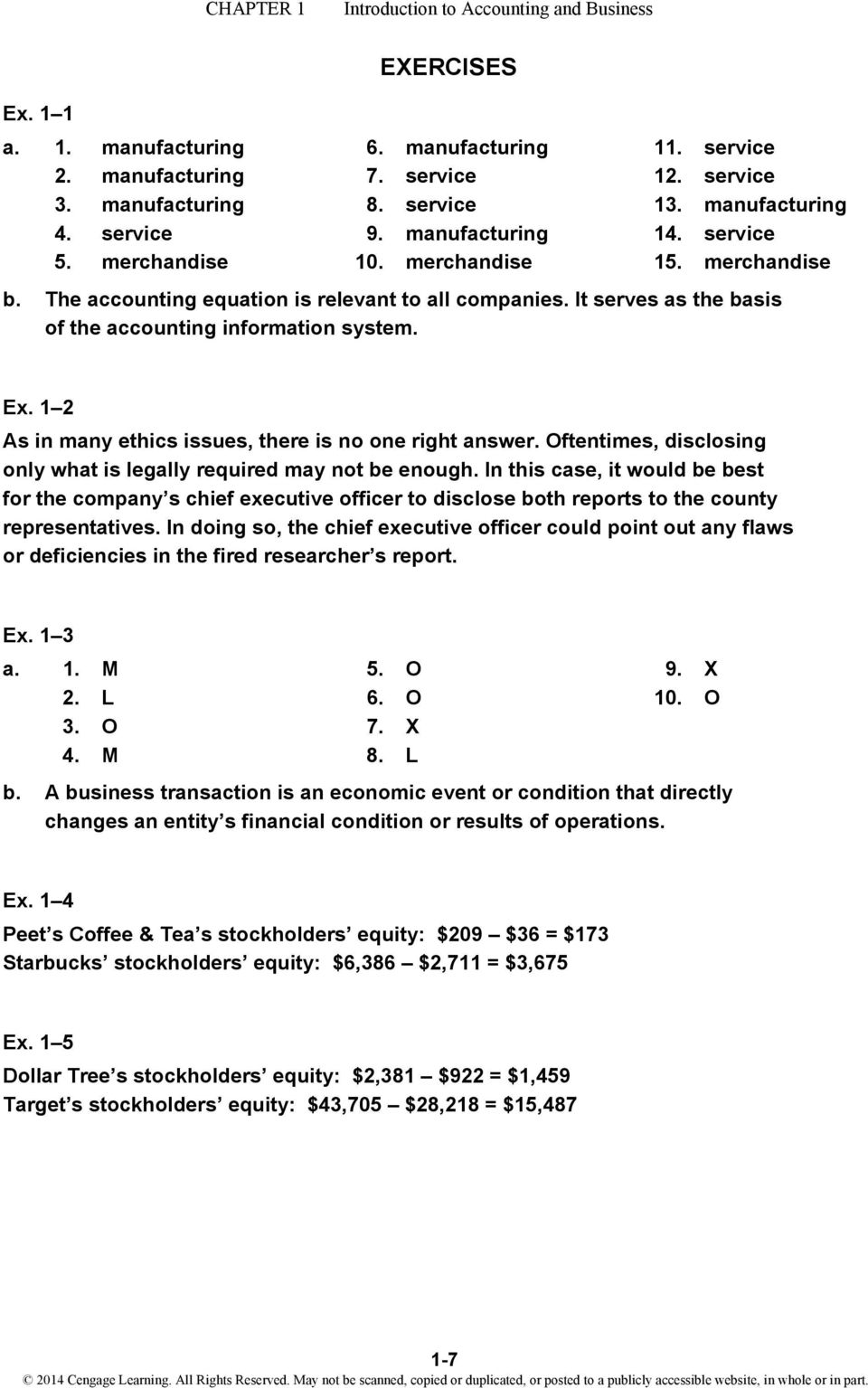
7 EXERCISES Ex. 1 1 a. 1. manufacturing 6. manufacturing 11. service 2. manufacturing 7. service 12. service 3. manufacturing 8. service 13. manufacturing 4. service 9. manufacturing 14. service 5. merchandise 10. merchandise 15. merchandise b. The accounting equation is relevant to all companies. It serves as the basis of the accounting information system. Ex. 1 2 As in many ethics issues, there is no one right answer. Oftentimes, disclosing only what is legally required may not be enough. In this case, it would be best for the company s chief executive officer to disclose both reports to the county representatives. In doing so, the chief executive officer could point out any flaws or deficiencies in the fired researcher s report. Ex. 1 3 a. 1. M 5. O 9. X 2. L 6. O 10. O 3. O 7. X 4. M 8. L b. A business transaction is an economic event or condition that directly changes an entity s financial condition or results of operations. Ex. 1 4 Peet s Coffee & Tea s stockholders equity: $209 $36 = $173 Starbucks stockholders equity: $6,386 $2,711 = $3,675 Ex. 1 5 Dollar Tree s stockholders equity: $2,381 $922 = $1,459 Target s stockholders equity: $43,705 $28,218 = $15,
8 Ex. 1 6 a. $456,100 ($118,000 + $338,100) b. $355,010 ($766,750 $411,740) c. $2,072,200 ($3,250,300 $1,178,100) Ex. 1 7 a. $775,000 ($1,250,000 $475,000) b. $890,000 ($775,000 + $225,000 $110,000) c. $385,000 ($775,000 $300,000 $90,000) d. $1,460,000 ($775,000 + $550,000 + $135,000) e. Net income: $350,000 ($1,500,000 $375,000 $775,000) Ex. 1 8 a. (2) liability b. (1) asset c. (3) stockholders equity (retained earnings; revenue) d. (1) asset e. (1) asset f. (3) stockholders equity (retained earnings; expense) Ex. 1 9 a. Increases assets and increases stockholders equity. b. Decreases assets and decreases stockholders equity. c. Increases assets and decreases assets. d. Increases assets and increases liabilities. e. Increases assets and increases stockholders equity. Ex a. (1) Total assets increased $260,000 ($440,000 $180,000). (2) No change in liabilities. (3) Stockholders equity increased $260,000. b. (1) Total assets decreased $69,000. (2) Total liabilities decreased $69,000. (3) No change in stockholders equity. c. No, it is false that a transaction always affects at least two elements (Assets, Liabilities, or Stockholders Equity) of the accounting equation. Some transactions affect only one element of the accounting equation. For example, purchasing supplies for cash only affects assets. 1-8

9 Ex (b) decrease 2. (a) increase 3. (b) decrease 4. (a) increase Ex c 6. c 2. a 7. d 3. e 8. a 4. e 9. e 5. c 10. e Ex a. (1) Provided catering services for cash, $33,000. (2) Purchase of land for cash, $20,000. (3) Payment of cash for expenses, $24,000. (4) Purchase of supplies on account, $1,000. (5) Paid cash dividends, $3,000. (6) Payment of cash to creditors, $6,000. (7) Recognition of cost of supplies used, $1,800. b. $20,000 ($10,000 $30,000) c. $4,200 ( $3,000 + $33,000 $25,800) d. $7,200 ($33,000 $25,800) e. $4,200 ($7,200 $3,000) Ex No. It would be incorrect to say that the business had incurred a net loss of $8,000. The excess of the dividends over the net income for the period is a decrease in the amount of stockholders equity (retained earnings) in the business. 1-9

10 Ex Juliet Stockholders equity at end of year ($1,125,000 $500,000) $625,000 Deduct stockholders equity at beginning of year ($600,000 $150,000) 450,000 Net income (increase in stockholders equity) $175,000 Kilo Increase in stockholders equity (as determined for Juliet) $175,000 Add dividends 55,000 Net income $230,000 Lima Increase in stockholders equity (as determined for Juliet) $175,000 Deduct additional issuance of capital stock 100,000 Net income $ 75,000 Mike Increase in stockholders equity (as determined for Juliet) $175,000 Deduct additional issuance of capital stock 100,000 $ 75,000 Add dividends 55,000 Net income $130,000 Ex Balance sheet items: 1, 2, 3, 5, 6, 10 Ex Income statement items: 4, 7, 8,

11 Ex a. INFRA-SYSTEMS COMPANY Retained Earnings Statement For the Month Ended November 30, 2014 Retained earnings, November 1, 2014 $400,000 Net income for November $275,000 Less dividends 40,000 Increase in retained earnings 235,000 Retained earnings, November 30, 2014 $635,000 b. The retained earnings statement is prepared before the November 30, 2014, balance sheet because retained earnings as of November 30, 2014, is needed for the balance sheet. Ex EXPLORATION SERVICES Income Statement For the Month Ended March 31, 2014 Fees earned $1,100,000 Expenses: Wages expense $715,000 Rent expense 80,000 Supplies expense 9,000 Miscellaneous expense 12,000 Total expenses 816,000 Net income $ 284,

12 Ex In each case, solve for a single unknown, using the following equation: Stockholders Equity (beginning) + Additional Issuance of Capital Stock Dividends + Revenues Expenses = Stockholders Equity (ending) Freeman Stockholders equity at end of year ($1,260,000 $330,000) $930,000 Stockholders equity at beginning of year ($900,000 $360,000) 540,000 Increase in stockholders equity $390,000 Deduct increase due to net income ($570,000 $240,000) 330,000 $ 60,000 Add dividends. 75,000 Additional issuance of capital stock (a) $135,000 Heyward Stockholders equity at end of year ($675,000 $220,000) $455,000 Stockholders equity at beginning of year ($490,000 $260,000) 230,000 Increase in stockholders equity $225,000 Add dividends. 32,000 $257,000 Deduct additional issuance of capital stock 150,000 Increase due to net income. $107,000 Add expenses. 128,000 Revenue. (b) $235,000 Jones Stockholders equity at end of year ($100,000 $80,000) $ 20,000 Stockholders equity at beginning of year ($115,000 $81,000) 34,000 Decrease in stockholders equity $ (14,000) Deduct decrease due to net loss ($115,000 $122,500) 7,500 $ (6,500) Deduct additional issuance of capital stock 10,000 Dividends from the business (c) $ (16,500) Ramirez Stockholders equity at end of year ($270,000 $136,000) $134,000 Add decrease due to net loss ($115,000 $128,000) 13,000 $147,000 Add dividends. 39,000 $186,000 Deduct additional issuance of capital stock 55,000 Stockholders equity at beginning of year $131,000 Add liabilities at beginning of year 120,000 Assets at beginning of year (d) $251,

13 Ex a. Assets EBONY INTERIORS Balance Sheet February 28, 2014 Liabilities Cash $ 320,000 Accounts payable $ 310,000 Accounts receivable 800,000 Supplies 30,000 Stockholders Equity Capital stock $200,000 Retained earnings* 640,000 Total stockholders equity 840,000 Total liabilities and Total assets $1,150,000 stockholders equity $1,150,000 *$640,000 = $320,000 + $800,000 + $30,000 $310,000 $200,000 Assets EBONY INTERIORS Balance Sheet March 31, 2014 Liabilities Cash $ 380,000 Accounts payable $ 400,000 Accounts receivable 960,000 Supplies 35,000 Stockholders Equity Capital stock $200,000 Retained earnings** 775,000 Total stockholders equity 975,000 Total liabilities and Total assets $1,375,000 stockholders equity $1,375,000 **$775,000 = $380,000 + $960,000 + $35,000 $400,000 $200,000 b. Stockholders equity, March 31 $975,000 Stockholders equity, February 28***. 840,000 Net income $135,000 ***$840,000 = $320,000 + $800,000 + $30,000 $310,000 c. Stockholders equity, March 31 $975,000 Stockholders equity, February ,000 Increase in stockholders equity $135,000 Add dividends 50,000 Net income $185,

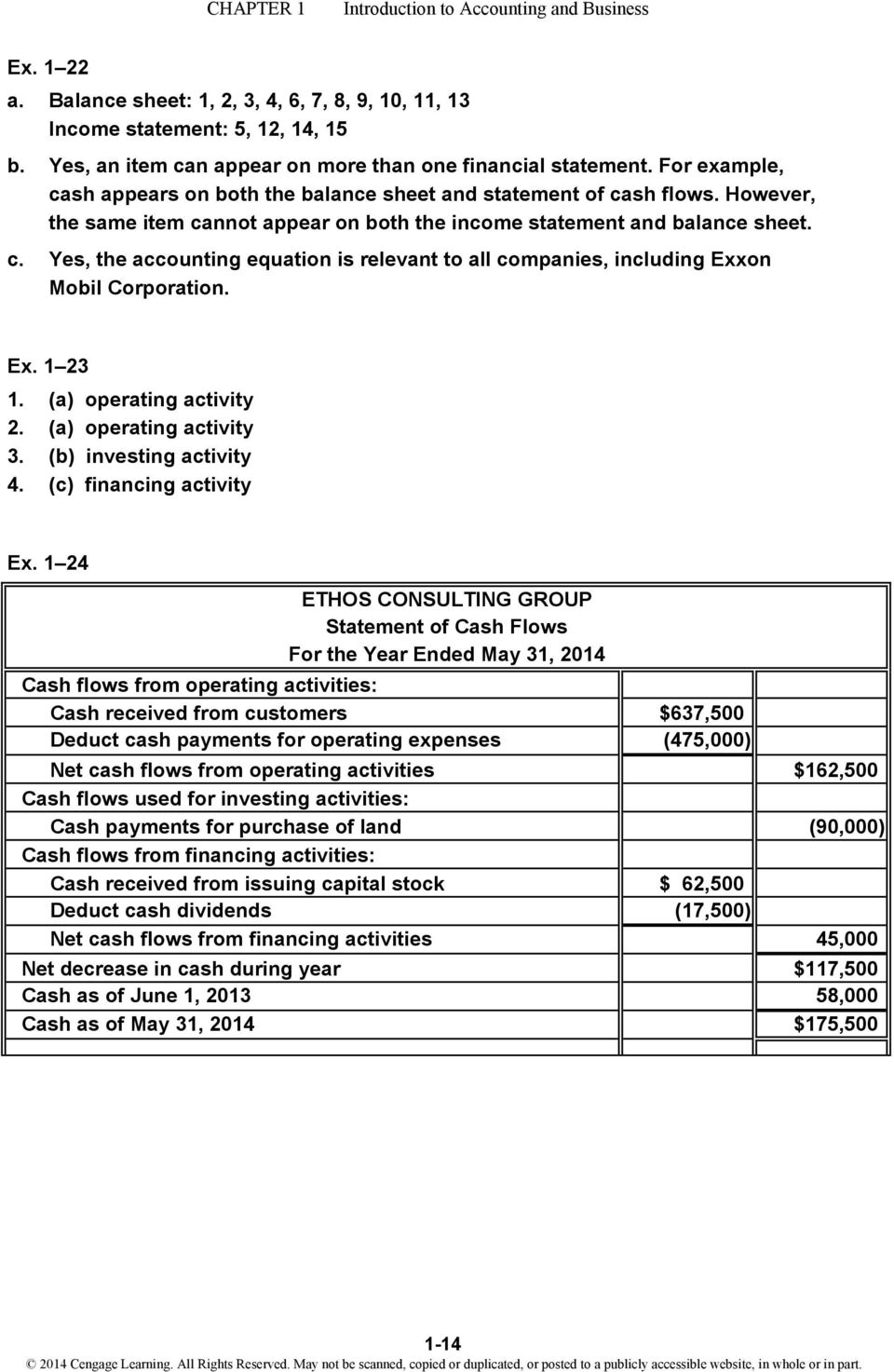
14 Ex a. Balance sheet: 1, 2, 3, 4, 6, 7, 8, 9, 10, 11, 13 Income statement: 5, 12, 14, 15 b. Yes, an item can appear on more than one financial statement. For example, cash appears on both the balance sheet and statement of cash flows. However, the same item cannot appear on both the income statement and balance sheet. c. Yes, the accounting equation is relevant to all companies, including Exxon Mobil Corporation. Ex (a) operating activity 2. (a) operating activity 3. (b) investing activity 4. (c) financing activity Ex ETHOS CONSULTING GROUP Statement of Cash Flows For the Year Ended May 31, 2014 Cash flows from operating activities: Cash received from customers Deduct cash payments for operating expenses Net cash flows from operating activities Cash flows used for investing activities: Cash payments for purchase of land Cash flows from financing activities: Cash received from issuing capital stock Deduct cash dividends Net cash flows from financing activities Net decrease in cash during year Cash as of June 1, 2013 Cash as of May 31, 2014 $637,500 (475,000) $ 62,500 (17,500) $162,500 (90,000) 45,000 $117,500 58,000 $175,
15 Ex All financial statements should contain the name of the business in their heading. The retained earnings statement is incorrectly headed as Omar Farah rather than We-Sell Realty. The heading of the balance sheet needs the name of the business. 2. The income statement and retained earnings statement cover a period of time and should be labeled For the Month Ended August 31, The year in the heading for the retained earnings statement should be 2014 rather than The balance sheet should be labeled August 31, 2014, rather than For the Month Ended August 31, In the income statement, the miscellaneous expense amount should be listed as the last expense. 6. In the income statement, the total expenses are incorrectly subtracted from the sales commissions, resulting in an incorrect net income amount. The correct net income should be $24,150. This also affects the retained earnings statement and the amount of retained earnings that appears on the balance sheet. 7. The additional issuance of capital stock of $15,000 should not be included in the retained earnings statement. Capital stock should be listed in the balance sheet as part of Stockholders' Equity. 8. In the retained earnings statement, the net income should be presented first. Dividends should then be subtracted from net income to yield a net increase in retained earnings. 9. Accounts payable should be listed as a liability on the balance sheet. 10. Accounts receivable and supplies should be listed as assets on the balance sheet. 11. The balance sheet assets should equal the sum of the liabilities and stockholders equity. 1-15

16 Ex (Concluded) Corrected financial statements appear as follows: WE-SELL REALTY Income Statement For the Month Ended August 31, 2014 Sales commissions $140,000 Expenses: Office salaries expense $87,000 Rent expense 18,000 Automobile expense 7,500 Supplies expense 1,150 Miscellaneous expense 2,200 Total expenses 115,850 Net income $ 24,150 WE-SELL REALTY Retained Earnings Statement For the Month Ended August 31, 2014 Retained earnings, August 1, 2014 $ 0 Net income for August $24,150 Less dividends during August 10,000 Increase in retained earnings 14,150 Retained earnings, August 31, 2014 $14,150 Assets WE-SELL REALTY Balance Sheet August 31, 2014 Liabilities Cash $ 8,900 Accounts payable $22,350 Accounts receivable 38,600 Supplies 4,000 Stockholders Equity Capital stock $15,000 Retained earnings 14,150 Total stockholders equity 29,150 Total liabilities and Total assets $51,500 stockholders equity $51,

17 Ex a. Year 2: $21,236 ($40,125 $18,889) Year 1: $21,484 ($40,877 $19,393) b. Year 2: 1.12 ($21,236 $18,889) Year 1: 1.11 ($21,484 $19,393) c. The ratio of liabilities to stockholders equity increased from 1.11 to 1.12 indicating a slight increase in risk for creditors from Year 1 to Year 2. Ex a. Year 2: $18,112 ($33,699 $15,587) Year 1: $19,069 ($33,005 $13,936) b. Year 2: 0.86 ($15,587 $18,112) Year 1: 0.73 ($13,936 $19,069) c. The risk for creditors has increased from 0.73 in Year 1 to 0.86 in Year 2. In both years, creditors have less at stake in Lowe s than do stockholders, since the ratio is less than 1. d. Lowe s ratio of liabilities to stockholders equity is less than 1. In comparison, The Home Depot s ratio of liabilities to stockholders equity is greater than 1 for Year 2 and Year 1. Thus, the creditors of The Home Depot are more at risk than are the creditors of Lowe s. 1-17

18 Prob. 1 1A 1. Assets = Liabilities + PROBLEMS Stockholders Equity Cash Accts. Accts. Capital Fees Rent Salaries Supplies Auto + Rec. + Supplies = Payable + Stock Dividends + Earned Expense Expense Expense Exp. (a) + 30, ,000 (b) + 1, ,200 Bal. 30,000 1,200 1,200 30,000 (c) + 7, ,200 Bal. 37,200 1,200 1,200 30,000 7,200 (d) 3,000 3,000 Bal. 34,200 1,200 1,200 30,000 7,200 3,000 (e) Bal. 33,450 1, ,000 7,200 3,000 (f) + 5, ,000 Bal. 33,450 5,000 1, ,000 12,200 3,000 (g) Bal. 32,550 5,000 1, ,000 12,200 3, (h) 1,800 1,800 Bal. 30,750 5,000 1, ,000 12,200 3,000 1, (i) Bal. 30,750 5, ,000 12,200 3,000 1, (j) 1,500 1,500 Bal. 29,250 5, ,000 1,500 12,200 3,000 1, Stockholders equity is the right of stockholders (owners) to the assets of the business. These rights are increased by issuances of capital stock and revenues and decreased by dividends and expenses. 3. $6,000 ($12,200 $3,000 $1,800 $500 $600 $300) 4. June s transactions increased retained earnings by $4,500 ($6,000 $1,500), which is June s net income of $6,000 less dividends of $1,500. Misc. Exp. 1-18

19 Prob. 1 2A 1. ORIENTAL TRAVEL AGENCY Income Statement For the Year Ended December 31, 2014 Fees earned $1,100,000 Expenses: Wages expense $490,000 Rent expense 150,000 Utilities expense 79,000 Supplies expense 14,000 Miscellaneous expense 7,000 Total expenses 740,000 Net income $ 360, ORIENTAL TRAVEL AGENCY Retained Earnings Statement For the Year Ended December 31, 2014 Retained earnings, January 1, 2014 $400,000 Net income for the year $360,000 Less dividends 25,000 Increase in retained earnings 335,000 Retained earnings, December 31, 2014 $735, Assets ORIENTAL TRAVEL AGENCY Balance Sheet December 31, 2014 Liabilities Cash $210,000 Accounts payable $115,000 Accounts receivable 370,000 Supplies 20,000 Land 300,000 Stockholders Equity Capital stock $ 50,000 Retained earnings 735,000 Total stockholders equity 785,000 Total liabilities and Total assets $900,000 stockholders equity $900, Retained earnings of $735,

20 Prob. 1 3A 1. RELIANCE FINANCIAL SERVICES Income Statement For the Month Ended July 31, 2014 Fees earned $144,500 Expenses: Salaries expense $55,000 Rent expense 33,000 Auto expense 16,000 Supplies expense 4,500 Miscellaneous expense 4,800 Total expenses 113,300 Net income $ 31, RELIANCE FINANCIAL SERVICES Retained Earnings Statement For the Month Ended July 31, 2014 Retained earnings, July 1, 2014 $ 0 Net income for July $31,200 Less dividends 15,000 Increase in retained earnings 16,200 Retained earnings, July 31, 2014 $16, Assets RELIANCE FINANCIAL SERVICES Balance Sheet July 31, 2014 Liabilities Cash $32,600 Accounts payable $ 3,400 Accounts receivable 34,500 Supplies 2,500 Stockholders Equity Capital stock $50,000 Retained earnings 16,200 Total stockholders equity 66,200 Total liabilities and Total assets $69,600 stockholders equity $69,

21 Prob. 1 3A (Concluded) 4. (Optional) RELIANCE FINANCIAL SERVICES Statement of Cash Flows For the Month Ended July 31, 2014 Cash flows from operating activities: Cash received from customers $110,000 Deduct cash payments for expenses and payments to creditors* (112,400) Net cash flows used for operating activities $ (2,400) Cash flows from investing activities 0 Cash flows from financing activities: Cash received from issuing capital stock $ 50,000 Deduct cash dividends (15,000) Net cash flows from financing activities 35,000 Net increase in cash and July 31, 2014, cash balance $ 32,600 * $3,600 + $33,000 + $20,800 + $55,000; these amounts are taken from the cash column shown in the problem. 1-21
22 Prob. 1 4A 1. Assets = Liabilities + Stockholders Equity Accts. Capital Sales Rent Salaries Auto Supplies Cash + Supplies = Payable + Stock Dividends + Comm. Exp. Exp. Exp. Exp. (a) + 18, ,000 (b) + 3, ,200 Bal. 18,000 3,200 3,200 18,000 (c) 1,800 1,800 Bal. 16,200 3,200 1,400 18,000 (d) + 36, ,750 Bal. 52,950 3,200 1,400 18,000 36,750 (e) 4,000 4,000 Bal. 48,950 3,200 1,400 18,000 36,750 4,000 (f) 3,000 3,000 Bal. 45,950 3,200 1,400 18,000 3,000 36,750 4,000 (g) 3,700 2,500 1,200 Bal. 42,250 3,200 1,400 18,000 3,000 36,750 4,000 2,500 1,200 (h) 3,750 3,750 Bal. 38,500 3,200 1,400 18,000 3,000 36,750 4,000 3,750 2,500 1,200 (i) 1,650 1,650 Bal. 38,500 1,550 1,400 18,000 3,000 36,750 4,000 3,750 2,500 1,650 1,200 Misc. Exp. 1-22
23 Prob. 1 4A (Concluded) 2. SUNRISE REALTY Income Statement For the Month Ended October 31, 2014 Sales commissions $36,750 Expenses: Rent expense $4,000 Salaries expense 3,750 Automobile expense 2,500 Supplies expense 1,650 Miscellaneous expense 1,200 Total expenses 13,100 Net income $23,650 SUNRISE REALTY Retained Earnings Statement For the Month Ended October 31, 2014 Retained earnings, October 1, 2014 $ 0 Net income for October $23,650 Less dividends 3,000 Increase in retained earnings 20,650 Retained earnings, October 31, 2014 $20,650 Assets SUNRISE REALTY Balance Sheet October 31, 2014 Liabilities Cash $38,500 Accounts payable $ 1,400 Supplies 1,550 Stockholders Equity Capital stock $18,000 Retained earnings 20,650 Total stockholders equity 38,650 Total liabilities and Total assets $40,050 stockholders equity $40,
24 Prob. 1 5A 1. Assets = Liabilities + Cash + Accounts Receivable + Supplies + Land = Accounts Payable + Capital Stock + Stockholders Equity Retained Earnings $45,000 + $93,000 + $7,000 + $75,000 = $40,000 + $60,000 + Retained Earnings $220,000 = $100,000 + Retained Earnings $120,000 = Retained Earnings 1-24
25 Prob. 1 5A (Continued) 2. Assets = Liabilities + Stockholders Equity Cash Accts. Accts. Capital Retained + Rec. + Supplies + Land = Payable + Stock + Earnings Dividends Bal. 45,000 93,000 7,000 75,000 40,000 60, ,000 0 (a) + 35, ,000 Bal. 80,000 93,000 7,000 75,000 40,000 95, ,000 0 (b) 50, ,000 Bal. 30,000 93,000 7, ,000 40,000 95, ,000 0 (c) + 32,125 Bal. 62,125 93,000 7, ,000 40,000 95, ,000 0 (d) 6,000 Bal. 56,125 93,000 7, ,000 40,000 95, ,000 0 (e) + 2, ,500 Bal. 56,125 93,000 9, ,000 42,500 95, ,000 0 (f) 22,800 22,800 Bal. 33,325 93,000 9, ,000 19,700 95, ,000 0 (g) + 84,750 Bal. 33, ,750 9, ,000 19,700 95, ,000 0 (h) + 29,500 Bal. 33, ,750 9, ,000 49,200 95, ,000 0 (i) 14,000 Bal. 19, ,750 9, ,000 49,200 95, ,000 0 (j) + 88,000 88,000 Bal. 107,325 89,750 9, ,000 49,200 95, ,000 0 (k) 3,600 Bal. 107,325 89,750 5, ,000 49,200 95, ,000 0 (l) 12,000 12,000 Bal. 95,325 89,750 5, ,000 49,200 95, ,000 12,
26 Prob. 1 5A (Continued) Stockholders Equity (Continued) Dry Dry Cleaning Cleaning Wages Rent Supplies Truck Utilities + Revenue Exp. Exp. Exp. Exp. Exp. Exp. Misc. Exp. Bal. (a) Bal. (b) Bal. (c) + 32,125 Bal. 32,125 (d) 6,000 Bal. 32,125 6,000 (e) Bal. 32,125 6,000 (f) Bal. 32,125 6,000 (g) + 84,750 Bal. 116,875 6,000 (h) 29,500 Bal. 116,875 29,500 6,000 (i) 7,500 2,500 1,300 2,700 Bal. 116,875 29,500 7,500 6,000 2,500 1,300 2,700 (j) Bal. 116,875 29,500 7,500 6,000 2,500 1,300 2,700 (k) 3,600 Bal. 116,875 29,500 7,500 6,000 3,600 2,500 1,300 2,700 (l) Bal. 116,875 29,500 7,500 6,000 3,600 2,500 1,300 2,
27 Prob. 1 5A (Continued) 3. D'LITE DRY CLEANERS Income Statement For the Month Ended July 31, 2014 Dry cleaning revenue $116,875 Expenses: Dry cleaning expense $29,500 Wages expense 7,500 Rent expense 6,000 Supplies expense 3,600 Truck expense 2,500 Utilities expense 1,300 Miscellaneous expense 2,700 Total expenses 53,100 Net income $ 63,775 D'LITE DRY CLEANERS Retained Earnings Statement For the Month Ended July 31, 2014 Retained earnings, July 1, 2014 $120,000 Net income for July $63,775 Less dividends 12,000 Increase in retained earnings 51,775 Retained earnings, July 31, 2014 $171,775 Assets D'LITE DRY CLEANERS Balance Sheet July 31, 2014 Liabilities Cash $ 95,325 Accounts payable $ 49,200 Accounts receivable 89,750 Supplies 5,900 Stockholders Equity Land 125,000 Capital stock $ 95,000 Retained earnings 171,775 Total stockholders equity 266,775 Total liabilities and Total assets $315,975 stockholders equity $315,
28 Prob. 1 5A (Concluded) 4. (Optional) D'LITE DRY CLEANERS Statement of Cash Flows For the Month Ended July 31, 2014 Cash flows from operating activities: Cash received from customers* $120,125 Deduct cash payments for expenses and payments to creditors** (42,800) Net cash flows from operating activities $ 77,325 Cash flows used for investing activities: Purchase of land (50,000) Cash flows from financing activities: Cash received from issuing capital stock $ 35,000 Deduct cash dividends (12,000) Net cash flows from financing activities 23,000 Net Increase in cash during July $ 50,325 Cash balance, July 1, ,000 Cash balance, July 31, 2014 $ 95,325 * $32,125 + $88,000; These amounts are taken from the cash column of the spreadsheet in Part 2. ** $6,000 + $22,800 + $14,000; These amounts are taken from the cash column of the spreadsheet in Part
29 Prob. 1 6A a. Fees earned, $750,000 ($275,000 + $475,000) b. Supplies expense, $30,000 ($475,000 $300,000 $100,000 $20,000 $25,000) c. Retained earnings, April 1, 2014, $0; Wolverine Realty was organized on April 1, d. Net income for April, $275,000 from income statement e. $150,000 ($275,000 $125,000) f. Retained earnings, April 30, 2014, $150,000 g. Total assets, $625,000 ($462,500 + $12,500 + $150,000) h. Retained earnings, $150,000; same as (f) i. Total stockholders equity, $525,000 ($375,000 + $150,000) j. Total liabilities and stockholders equity, $625,000 ($100,000 + $525,000) k. Cash received from customers, $750,000; this is the same as fees earned (a) since there are no accounts receivable. l. Net cash flows from operating activities, $362,500 ($750,000 $387,500) m. Cash payments for acquisition of land, ($150,000) n. Cash received from issuing capital stock, $375,000 o. Cash dividends, ($125,000) p. Net cash flows from financing activities, $250,000 ($375,000 $125,000) q. Net cash flow and April 30, 2014, cash balance, $462,500 ($362,500 $150,000 + $250,000); also the cash balance on the balance sheet. 1-29
30 Prob. 1 1B 1. Assets = Liabilities + Stockholders Equity Cash Accts. Accts. Capital Fees Rent Salaries Supplies Auto + Rec. + Supplies = Payable + Stock Dividends + Earned Expense Expense Expense Exp. (a) + 50, ,000 (b) + 4, ,000 Bal. 50,000 4,000 4,000 50,000 (c) 2,300 2,300 Bal. 47,700 4,000 1,700 50,000 (d) + 13, ,800 Bal. 61,500 4,000 1,700 50,000 13,800 (e) 5,000 5,000 Bal. 56,500 4,000 1,700 50,000 13,800 5,000 (f) 1,450 1, Bal. 55,050 4,000 1,700 50,000 13,800 5,000 1, (g) 2,500 2,500 Bal. 52,550 4,000 1,700 50,000 13,800 5,000 2,500 1, (h) 1,300 1,300 Bal. 52,550 2,700 1,700 50,000 13,800 5,000 2,500 1,300 1, (i) + 12, ,500 Bal. 52,550 12,500 2,700 1,700 50,000 26,300 5,000 2,500 1,300 1, (j) 3,900 3,900 Bal. 48,650 12,500 2,700 1,700 50,000 3,900 26,300 5,000 2,500 1,300 1, Stockholders equity is the right of stockholders (owners) to the assets of the business. These rights are increased by issuing capital stock and decreased by dividends and expenses. 3. $16,050 ($26,300 $5,000 $2,500 $1,300 $1,150 $300) 4. March s transactions increased retained earnings by $12,150 ($16,050 $3,900) which is the excess of March s net income of $16,050 over dividends of $3,900. Misc. Exp. 1-30
31 Prob. 1 2B 1. WILDERNESS TRAVEL SERVICE Income Statement For the Year Ended April 30, 2014 Fees earned $875,000 Expenses: Wages expense $525,000 Rent expense 75,000 Utilities expense 38,000 Supplies expense 12,000 Taxes expense 10,000 Miscellaneous expense 15,000 Total expenses 675,000 Net income $200, WILDERNESS TRAVEL SERVICE Retained Earnings Statement For the Year Ended April 30, 2014 Retained earnings, May 1, 2013 $145,000 Net income for the year $200,000 Less dividends 40,000 Increase in retained earnings 160,000 Retained earnings, April 30, 2014 $305, Assets WILDERNESS TRAVEL SERVICE Balance Sheet April 30, 2014 Liabilities Cash $146,000 Accounts payable $ 25,000 Accounts receivable 210,000 Supplies 9,000 Stockholders Equity Capital stock $ 35,000 Retained earnings 305,000 Total stockholders equity 340,000 Total liabilities and Total assets $365,000 stockholders equity $365, Net income of $200,
32 Prob. 1 3B 1. BRONCO CONSULTING Income Statement For the Month Ended August 31, 2014 Fees earned $125,000 Expenses: Salaries expense $58,000 Rent expense 27,000 Auto expense 15,500 Supplies expense 6,100 Miscellaneous expense 7,500 Total expenses 114,100 Net income $ 10, BRONCO CONSULTING Retained Earnings Statement For the Month Ended August 31, 2014 Retained earnings, August 1, 2014 $ 0 Net income for August $10,900 Less dividends 5,000 Increase in retained earnings 5,900 Retained earnings, August 31, 2014 $5, Assets BRONCO CONSULTING Balance Sheet August 31, 2014 Liabilities Cash $48,000 Accounts payable $ 3,000 Accounts receivable 33,000 Supplies 2,900 Stockholders Equity Capital stock $75,000 Retained earnings 5,900 Total stockholders equity 80,900 Total liabilities and Total assets $83,900 stockholders equity $83,
33 Prob. 1 3B (Concluded) 4. (Optional) BRONCO CONSULTING Statement of Cash Flows For the Month Ended August 31, 2014 Cash flows from operating activities: Cash received from customers $ 92,000 Deduct cash payments for expenses and payments to creditors* (114,000) Net cash flows used for operating activities $(22,000) Cash flows from investing activities 0 Cash flows from financing activities: Cash received from issuing capital stock $ 75,000 Deduct cash dividends (5,000) Net cash flows from financing activities 70,000 Net increase in cash and August 31, 2014, cash balance $ 48,000 * $27,000 + $6,000 + $23,000 + $58,000; These amounts are taken from the cash column shown in the problem. 1-33
34 Prob. 1 4B 1. Assets = Liabilities + Stockholders Equity Cash Accts. Capital Sales Rent Salaries Auto Supplies + Supplies = Payable + Stock Dividends + Comm. Exp. Exp. Exp. Exp. (a) + 24, ,000 (b) 3,600 3,600 Bal. 20,400 24,000 3,600 (c) 1,950 1, Bal. 18,450 24,000 3,600 1, (d) + 1, ,200 Bal. 18,450 1,200 1,200 24,000 3,600 1, (e) + 19, ,800 Bal. 38,250 1,200 1,200 24,000 19,800 3,600 1, (f) Bal. 37,500 1, ,000 19,800 3,600 1, (g) 2,500 2,500 Bal. 35,000 1, ,000 19,800 3,600 2,500 1, (h) 3,500 3,500 Bal. 31,500 1, ,000 3,500 19,800 3,600 2,500 1, (i) Bal. 31, ,000 3,500 19,800 3,600 2,500 1, Misc. Exp. 1-34
35 Prob. 1 4B (Concluded) 2. CUSTOM REALTY Income Statement For the Month Ended April 30, 2014 Sales commissions $19,800 Expenses: Rent expense $3,600 Salaries expense 2,500 Automobile expense 1,350 Supplies expense 900 Miscellaneous expense 600 Total expenses 8,950 Net income $10,850 CUSTOM REALTY Retained Earnings Statement For the Month Ended April 30, 2014 Retained earnings, April 1, 2014 $ 0 Net income for April $10,850 Less dividends 3,500 Increase in retained earnings 7,350 Retained earnings, April 30, 2014 $7,350 Assets CUSTOM REALTY Balance Sheet April 30, 2014 Liabilities Cash $31,500 Accounts payable $ 450 Supplies 300 Stockholders Equity Capital stock $24,000 Retained earnings 7,350 Total stockholders equity 31,350 Total liabilities and Total assets $31,800 stockholders equity $31,
36 Prob. 1 5B 1. Assets = Liabilities + Cash + Accounts Receivable + Supplies + Land = Accounts Payable + Capital Stock + Stockholders Equity Retained Earnings $39,000 + $80,000 + $11,000 + $50,000 = $31,500 + $50,000 + Retained Earnings $180,000 $98,500 = $81,500 + = Retained Earnings Retained Earnings 1-36
37 Prob. 1 5B (Continued) 2. Assets = Liabilities + Stockholders Equity Cash Accts. Accts. + Rec. + Supplies + Land = Payable + Capital Retained Stock + Earnings Dividends Bal. 39,000 80,000 11,000 50,000 31,500 50,000 98,500 0 (a) + 21, ,000 Bal. 60,000 80,000 11,000 50,000 31,500 71,000 98,500 0 (b) 35, ,000 Bal. 25,000 80,000 11,000 85,000 31,500 71,000 98,500 0 (c) 4,000 Bal. 21,000 80,000 11,000 85,000 31,500 71,000 98,500 0 (d) + 72,000 Bal. 21, ,000 11,000 85,000 31,500 71,000 98,500 0 (e) 20,000 20,000 Bal. 1, ,000 11,000 85,000 11,500 71,000 98,500 0 (f) + 8, ,000 Bal. 1, ,000 19,000 85,000 19,500 71,000 98,500 0 (g) + 38,000 Bal. 39, ,000 19,000 85,000 19,500 71,000 98,500 0 (h) + 77,000 77,000 Bal. 116,000 75,000 19,000 85,000 19,500 71,000 98,500 0 (i) + 29,450 Bal. 116,000 75,000 19,000 85,000 48,950 71,000 98,500 0 (j) 29,200 Bal. 86,800 75,000 19,000 85,000 48,950 71,000 98,500 0 (k) 7,200 Bal. 86,800 75,000 11,800 85,000 48,950 71,000 98,500 0 (l) 5,000 5,000 Bal. 81,800 75,000 11,800 85,000 48,950 71,000 98,500 5,
38 Prob. 1 5B (Continued) Stockholders Equity (Continued) Dry Dry Cleaning Cleaning Wages Supplies Rent Truck Utilities + Revenue Exp. Exp. Exp. Exp. Exp. Exp. Misc. Exp. Bal. (a) Bal. (b) Bal. (c) 4,000 Bal. 4,000 (d) + 72,000 Bal. 72,000 4,000 (e) Bal. 72,000 4,000 (f) Bal. 72,000 4,000 (g) + 38,000 Bal. 110,000 4,000 (h) Bal. 110,000 4,000 (i) 29,450 Bal. 110,000 29,450 4,000 (j) 24,000 2,100 1,800 1,300 Bal. 110,000 29,450 24,000 4,000 2,100 1,800 1,300 (k) 7,200 Bal. 110,000 29,450 24,000 7,200 4,000 2,100 1,800 1,300 (l) Bal. 110,000 29,450 24,000 7,200 4,000 2,100 1,800 1,
39 Prob. 1 5B (Continued) 3. BEV'S DRY CLEANERS Income Statement For the Month Ended November 30, 2014 Dry cleaning revenue $110,000 Expenses: Dry cleaning expense $29,450 Wages expense 24,000 Supplies expense 7,200 Rent expense 4,000 Truck expense 2,100 Utilities expense 1,800 Miscellaneous expense 1,300 Total expenses 69,850 Net income $ 40,150 BEV'S DRY CLEANERS Retained Earnings Statement For the Month Ended November 30, 2014 Retained earnings, November 1, 2014 $ 98,500 Net income for November $40,150 Less dividends 5,000 Increase in retained earnings 35,150 Retained earnings, November 30, 2014 $133,650 Assets BEV'S DRY CLEANERS Balance Sheet November 30, 2014 Liabilities Cash $ 81,800 Accounts payable $ 48,950 Accounts receivable 75,000 Supplies 11,800 Stockholders Equity Land 85,000 Capital stock $ 71,000 Retained earnings 133,650 Total stockholders equity 204,650 Total liabilities and Total assets $253,600 stockholders equity $253,
40 Prob. 1 5B (Concluded) 4. (Optional) BEV'S DRY CLEANERS Statement of Cash Flows For the Month Ended Novemer 30, 2014 Cash flows from operating activities: Cash received from customers* $115,000 Deduct cash payments for expenses and payments to creditors** (53,200) Net cash flows from operating activities $61,800 Cash flows used for investing activities: Purchase of land (35,000) Cash flows from financing activities: Cash received from issuing capital stock $ 21,000 Deduct cash dividends (5,000) Net cash flows from financing activities 16,000 Net increase in cash during November $42,800 Cash balance, November 1, ,000 Cash balance, November 30, 2014 $81,800 * $38,000 + $77,000 = $115,000; these amounts are taken from the cash column of the spreadsheet in Part 2. ** $4,000 + $20,000 + $29,200; these amounts are taken from the cash column of the spreadsheet in Part
41 Prob. 1 6B a. Wages expense, $203,200 ($288,000 $48,000 $17,600 $14,400 $4,800) b. Net income, $112,000 ($400,000 $288,000) c. Retained earnings, May 1, 2014, $0; Atlas Realty was organized on May 1, d. Net income for May, $112,000; from (b) e. Dividends, $64,000; from statement of cash flows. f. Increase in retained earnings, $48,000 ($112,000 $64,000) g. Retained earnings, May 31, 2014, $48,000 h. Land, $120,000; from statement of cash flows. i. Total assets, $256,000 ($123,200 + $12,800 + $120,000) j. Capital stock, $160,000; from statement of cash flows k. Retained earnings, $48,000; from retained earnings statement l. Total stockholders equity, $208,000 ($160,000 + $48,000) m. Total liabilities and stockholders equity, $256,000 ($48,000 + $208,000) n. Cash received from customers, $400,000; this is the same as fees earned since there are no accounts receivable. o. Net cash flows from operating activities, $147,200 ($400,000 $252,800) p. Net cash flows from financing activities, $96,000 ($160,000 $64,000) q. Net cash flows and May 31, 2014, cash balance, $123,200 ($147,200 $120,000 + $96,000); also, the cash balance on the balance sheet. 1-41
42 CONTINUING PROBLEM 1. Assets = Liabilities + Stockholders Equity Cash Accts. Accts. Capital + Rec. + Supplies = Payable + Stock Dividends + Fees Earned June 1 + 4, ,000 June 2 + 3, ,500 Bal. 7,500 4,000 3,500 June Bal. 6,700 4,000 3,500 June Bal. 6, ,000 3,500 June Bal. 6, ,000 3,500 June Bal. 5, ,000 3,500 June Bal. 5, ,000 3,500 June Bal. 5, ,000 3,500 June Bal. 5, ,000 3,800 June , ,000 Bal. 5,375 1, ,000 4,800 June Bal. 5,875 1, ,000 5,300 June Bal. 5,635 1, ,000 5,300 June Bal. 6,535 1, ,000 6,200 June Bal. 6,135 1, ,000 6,200 June Bal. 5,835 1, ,000 6,200 June Bal. 5,835 1, ,000 6,200 June Bal. 5,420 1, ,000 6,200 June 30 1,000 Bal. 4,420 1, ,000 6,200 June Bal. 3,920 1, , ,
43 Continuing Problem (Continued) Stockholders Equity (Continued) Office Equip. Advertising Music Rent Rent Wages Utilities Supplies Exp. Exp. Exp. Exp. Exp. Exp. Exp. Misc. Exp. June 1 June 2 Bal. June Bal. 800 June 4 Bal. 800 June Bal June Bal June Bal June 13 Bal June 16 Bal June 22 Bal June 25 Bal June Bal June 30 Bal June Bal June Bal June Bal June Bal June 30 1,000 Bal. 1, June 30 Bal. 1,
44 Continuing Problem (Concluded) 2. PS MUSIC Income Statement For the Month Ended June 30, 2014 Fees earned: $6,200 Expenses: Music expense $1,590 Office rent expense 800 Equipment rent expense 675 Advertising expense 500 Wages expense 400 Utilities expense 300 Supplies expense 180 Miscellaneous expense 415 Total expenses 4,860 Net income $1, PS MUSIC Retained Earnings Statement For the Month Ended June 30, 2014 Retained earnings, June 1, 2014 $ 0 Net income for June $1,340 Less dividends 500 Increase in retained earnings 840 Retained earnings, June 30, 2014 $ Assets PS MUSIC Balance Sheet June 30, 2014 Liabilities Cash $3,920 Accounts payable $ 250 Accounts receivable 1,000 Supplies 170 Stockholders Equity Capital stock $4,000 Retained earnings 840 Total stockholders equity 4,840 Total liabilities and Total assets $5,090 stockholders equity $5,
45 CP Acceptable professional conduct requires that Colleen Fernandez supply First Federal Bank with all the relevant financial statements necessary for the bank to make an informed decision. Therefore, Colleen should provide the complete set of financial statements. These can be supplemented with a discussion of the net loss in the past year or other data explaining why granting the loan is a good investment by the bank. 2. a. Owners are generally willing to provide bankers with information about the operating and financial condition of the business, such as the following: Operating Information: Description of business operations Results of past operations Preliminary results of current operations Plans for future operations Financial Condition: List of assets and liabilities (balance sheet) Estimated current values of assets Owner s personal investment in the business Owner s commitment to invest additional funds in the business Owners are normally reluctant to provide the following types of information to bankers: Proprietary Operating Information. Such information, which might hurt the business if it becomes known by competitors, might include special processes used by the business or future plans to expand operations into areas that are not currently served by a competitor. CASES & PROJECTS Personal Financial Information. Owners may have little choice here because banks often require owners of small businesses to pledge their personal assets as security for a business loan. Personal financial information requested by bankers often includes the owner s net worth, salary, and other income. In addition, bankers usually request information about factors that might affect the personal financial condition of the owner. For example, a pending divorce by the owner might significantly affect the owner s personal wealth. b. Bankers typically want as much information as possible about the ability of the business and the owner to repay the loan with interest. Examples of such information are described above. c. Both bankers and business owners share the common interest of the business doing well and being successful. If the business is successful, the bankers will receive their loan payments on time with interest, and the owners will increase their personal wealth. 1-45
46 CP 1 2 The difference in the two bank balances, $55,000 ($80,000 $25,000), may not be pure profit from an accounting perspective. To determine the accounting profit for the six-month period, the revenues for the period would need to be matched with the related expenses. The revenues minus the expenses would indicate whether the business generated net income (profit) or a net loss for the period. Using only the difference between the two bank account balances ignores such factors as amounts due from customers (receivables), liabilities (accounts payable) that need to be paid for wages or other operating expenses, additional investments made by Dr. Cousins in the business, and dividends that may have been paid during the period. Some businesses that have few, if any, receivables or payables may use a cash basis of accounting. The cash basis of accounting ignores receivables and payables because they are assumed to be insignificant in amount. However, even with the cash basis of accounting, additional investments during the period and any dividends paid during the period have to be considered in determining the net income (profit) or net loss for the period. 1-46
47 CP Assets = Liabilities + Owner s Equity Lisa Lisa Accts. Duncan, Duncan, Fees Salaries Rent Supplies Cash + Supplies = Payable + Capital Drawing + Earned Expense Expense Expense Misc. Exp. (a) (b) Bal (c) Bal (d) Bal (e) + 1, ,750 Bal. 2, , (f) Bal. 2, , (g) Bal. 1, , (h) Bal. 1, , (i) + 1, ,300 Bal. 2, , (j) Bal. 2, , (k) Bal. 2, ,
48 CP 1 3 (Continued) 2. SERVE-N-VOLLEY Income Statement For the Month Ended September 30, 2014 Fees earned: $3,650 Expenses: Salaries expense $800 Rent expense 525 Supplies expense 120 Miscellaneous expense 290 Total expenses 1,735 Net income $1, SERVE-N-VOLLEY Statement of Owner s Equity For the Month Ended September 30, 2014 Lisa Duncan, capital, September 1, 2014 $ 0 Investment on September 1, 2014 $ 950 Net income for September 1,915 $2,865 Less withdrawals 400 Increase in owner s equity 2,465 Lisa Duncan, capital, September 30, 2014 $2, Assets SERVE-N-VOLLEY Balance Sheet September 30, 2014 Liabilities Cash $2,435 Accounts payable $ 150 Supplies 180 Owner s Equity Lisa Duncan, capital 2,465 Total liabilities and Total assets $2,615 stockholders equity $2,
49 CP 1 3 (Concluded) 5. a. Serve-N-Volley would provide Lisa with $715 more income per month than working as a waitress. This amount is computed as follows: Net income of Serve-N-Volley, per month $1,915 Earnings as waitress, per month: 30 hours per week $10 per hour 4 weeks 1,200 Difference $ 715 b. Other factors that Lisa should consider before discussing a long-term arrangement with the Phoenix Tennis Club include the following: Lisa should consider whether the results of operations for September are indicative of what to expect each month. For example, Lisa should consider whether club members will continue to request lessons or use the ball machine during the fall months when interest in tennis may slacken. Lisa should evaluate whether the additional income of $715 per month from Serve-N-Volley is worth the risk being taken and the effort being expended. Lisa should also consider how much her investment in Serve-N-Volley could have earned if invested elsewhere. For example, if the initial investment of $950 had been invested to earn a rate of return of 6% per year, it would have earned $4.75 in September, or $57 for the year. Note to Instructors: Numerous other considerations could be mentioned by students, such as the ability of Lisa to withdraw cash from Serve-N-Volley for personal use. For example, some of her investment in Serve-N-Volley will be in the form of supplies (tennis balls, etc.), which are readily convertible to cash. The objective of this case is not to mention all possible considerations but to encourage students to begin thinking about the use of accounting information in making business decisions. 1-49
50 CP 1 4 Note to Instructors: The purpose of this activity is to familiarize students with the certification requirements and their online availability. You might use this as an opportunity to discuss the advantages and disadvantages of careers in public accounting (CPA), management accounting (CMA), and internal auditing (CIA). The following Web sites provide useful information (such as starting salaries, etc.) for students on careers in accounting: American Institute of Certified Public Accountants (AICPA) Institute of Certified Management Accountants (IMA) Institute of Internal Auditors (IIA) CP 1 5 First Second Third Year Year Year Net cash flows from operating activities negative positive positive Net cash flows from investing activities negative negative negative Net cash flows from financing activities positive positive positive Start-up companies normally experience negative net cash flows from operating activities; however, Amazon.com was able to generate positive net cash flows from operations by its second year. Start-up companies normally have negative net cash flows from investing activities as they build up their infrastructure through purchases of property, plant, and equipment. This was the case with Amazon.com for each of its first three years. Likewise, start-up companies normally have positive net cash flows from financing activities from raising capital. This was also the case for Amazon.com. Also, start-up companies normally have positive cash flows from financing activities activities from raising capital. 1-50
51 CP 1 6 As can be seen from the balance sheet data in the case, Enron was financed largely by debt as compared to equity. Specifically, Enron s stockholders equity represented only 17.5% ($11,470 $65,503) of Enron s total assets. The remainder of Enron s total assets, 82.5%, was financed by debt. When a company is financed largely by debt, it is said to be highly leveraged. In late 2001 and early 2002, allegations arose as to possible misstatements of Enron s financial statements. These allegations revolved around the use of special purpose entities (partnerships) and related party transactions. The use of special purpose entities allowed Enron to hide a significant amount of additional debt off its balance sheet. The result was that Enron s total assets were even more financed by debt than the balance sheet indicated. After the allegations of misstatements became public, Enron s stock rapidly declined and the company filed for bankruptcy. Subsequently, numerous lawsuits were filed against the company and its management. In addition, the Securities and Exchange Commission, the Justice Department, and Congress launched investigations into Enron. As a result, several of Enron s top executives faced criminal prosecution and were sentenced to prison. Note to Instructors: The role of the auditors and board of directors of Enron also might be discussed. Note, however, that these topics are not covered in Chapter 1 but in later chapters. 1-51
52
CHAPTER 2 ACCOUNTING FOR TRANSACTIONS
 CHAPTER 2 ACCOUNTING FOR TRANSACTIONS Key Terms and Concepts to Know Double entry accounting: Debits and Credits Total debits must always equal total credits Accounting Books: Accounts General Journal
Reporting and Analyzing Cash Flows QUESTIONS
 Chapter 12 Reporting and Analyzing Cash Flows QUESTIONS 1. The purpose of the cash flow statement is to report all major cash receipts (inflows) and cash payments (outflows) during a period. It helps users
CHAPTER 3 THE ADJUSTING PROCESS
 1. a. Under cash-basis accounting, revenues are reported in the period in which cash is received and expenses are reported in the period in which cash is paid. b. Under accrual-basis accounting, revenues
Chapter 1. Introduction to Accounting and Business
 1 Chapter 1 Introduction to Accounting and Business Learning Objective 1 Describe the nature of a business, the role of accounting, and ethics in business. Nature of Business and Accounting A business
CHAPTER 5 THE ACCOUNTING CYCLE: REPORTING FINANCIAL RESULTS
 CHAPTER 5 THE ACCOUNTING CYCLE: REPORTING FINANCIAL RESULTS OVERVIEW OF BRIEF EXERCISES, EXERCISES, PROBLEMS AND CRITICAL THINKING CASES Brief Exercises Topic Learning Objectives Skills B. Ex. 5.1 B. Ex.
Financial Statements Tutorial
 Financial Statement Review: Financial Statements Tutorial There are four major financial statements used to communicate information to external users (creditors, investors, suppliers, etc.) - 1. Balance
EXERCISES. The cash from operating activities detail is provided as follows for class discussion:
 EXERCISES Ex. 14 1 There were net additions, such as depreciation and amortization of intangible assets of $389 million, to the net loss reported on the income statement to convert the net loss from the
CHAPTER 3 Solutions MEASURING BUSINESS INCOME
 CHAPTER 3 Solutions MEASURING BUSINESS INCOME Chapter 3, SE 1. 1. 2. 3. 4. c b d a Chapter 3, SE 2. Dec. 31 Insurance Expense 800 Prepaid Insurance To record insurance expired during the year $460 + $1,040
Ipx!up!hfu!uif Dsfeju!zpv!Eftfswf
 Ipx!up!hfu!uif Dsfeju!zpv!Eftfswf Credit is the lifeblood of South Louisiana business, especially for the smaller firm. It helps the small business owner get started, obtain equipment, build inventory,
Chapter 21 The Statement of Cash Flows Revisited
 Chapter 21 The Statement of Cash Flows Revisited AACSB assurance of learning standards in accounting and business education require documentation of outcomes assessment. Although schools, departments,
Guide to Financial Statements Study Guide
 Guide to Financial Statements Study Guide Overview (Topic 1) Three major financial statements: The Income Statement The Balance Sheet The Cash Flow Statement Objectives: Explain the underlying equation
CH 23 STATEMENT OF CASH FLOWS SELF-STUDY QUESTIONS
 C H 2 3, P a g e 1 CH 23 STATEMENT OF CASH FLOWS SELF-STUDY QUESTIONS (note from Dr. N: I have deleted questions for you to omit, but did not renumber the remaining questions) 1. The primary purpose of
CHAPTER 5 ACCOUNTING FOR MERCHANDISING BUSINESSES
 1. Merchandising businesses acquire merchandise for resale to customers. It is the selling of merchandise, instead of a service, that makes the activities of a merchandising business different from the
SOLUTIONS TO BRIEF EXERCISES
 SOLUTIONS TO BRIEF EXERCISES B. Ex. 2.1 Walters Company's assets (machinery) will increase by $20,000. The company's liabilities will also increase by $20,000 to include the new obligation the company
The Basics of Accounting ACCT 201
 The Basics of Accounting ACCT 201 Content Accounting definition Accounting equation Accounting elements Asset, Liabilities, & Equity Transactions Accounts Receivable vs Accounts Payable Retained Earnings
Debit Cash. Journalizing Transactions. Problem 2-2b. Created 2009 By Michael Worthington Elizabeth City State University
 Journalizing Transactions Created 2009 By Michael Worthington Elizabeth City State University Lela Peterson transferred cash from a personal bank account to the account used for the business Entity states
MASTER BUDGET - EXAMPLE
 MASTER BUDGET - EXAMPLE Sales IN UNITS for the previous two months (of last quarter), as well as the sales forecast for next quarter are as follows: Sales Budget Units May sales (ACTUAL) 20 June sales
Exam 1 chapters 1-4 Needles 10ed
 Exam 1 chapters 1-4 Needles 10ed Multiple Choice Identify the choice that best completes the statement or answers the question. 1. Which of the following is the most appropriate definition of accounting?
The Accounting Equation & Transaction Analysis
 HOSP 1210 (Financial Acct) Learning Centre The Accounting Equation & Transaction Analysis Economic transactions must be classified into categories: assets, liabilities, and net worth. Assets (A) are resources
Statement of Cash Flow
 Management Accounting 337 Statement of Cash Flow Cash is obviously an important asset to all, both individually and in business. A shortage or lack of cash may mean an inability to purchase needed inventory
Basic Accounting. Supplement for Using Simply Accounting Version 8.0 for Windows by. M. Purbhoo and D. Purbhoo
 Basic Accounting Supplement for Using Simply Accounting Version 8.0 for Windows by M. Purbhoo and D. Purbhoo Basic Accounting Contents: Accounting Theory 3 Basic Accounting 3 Balance Sheet 3 Income Statement
Midterm Fall 2012 Solution
 Midterm Fall 2012 Solution Instructions: 1) Answers for the multiple-choice questions must be recorded on the UW answer card. All other questions must be answered in the space provided on the examination
Accounting Self Study Guide for Staff of Micro Finance Institutions
 Accounting Self Study Guide for Staff of Micro Finance Institutions LESSON 2 The Balance Sheet OBJECTIVES The purpose of this lesson is to introduce the Balance Sheet and explain its components: Assets,
CHAPTER 14: THE ROLE OF ACCOUNTANTS AND ACCOUNTING INFORMATION
 CHAPTER 14: THE ROLE OF ACCOUNTANTS AND ACCOUNTING INFORMATION I. What Is Accounting and Who Uses Accounting Information? Accounting is a comprehensive system for collecting, analyzing, and communicating
The Accounting Equation & Transaction Analysis
 HOSP 1860 (Financial Acct) Learning Centre The Accounting Equation & Transaction Analysis A business must always have a balance between what it owns and what it owes. This is shown by the basic accounting
ANSWERS TO QUESTIONS FOR GROUP LEARNING
 Accounting for a 5 Merchandising Business ANSWERS TO QUESTIONS FOR GROUP LEARNING Q5-1 A merchandising business has a major revenue reduction called cost of goods sold. The computation of cost of goods
Statement of Cash Flows
 THE CONTENT AND VALUE OF THE STATEMENT OF CASH FLOWS The cash flow statement reconciles beginning and ending cash by presenting the cash receipts and cash disbursements of an enterprise for an accounting
Name Chapter 1--Introduction to Accounting and Business Description Instructions Modify Add Question Here. True. False. True. False. True. False.
 Name Chapter 1--Introduction to Accounting and Business Description Instructions Modify Question 1 / 0 points Modify Remove Question The main objective of a not-for-profit business is not to make a profit.
The Statement of Cash Flows Direct Method
 23 The Statement of Cash Flows Direct Method DEMONSTRATION PROBLEM The financial statements of Bolero Corporation follow. Copyright Houghton Mifflin Company. All rights reserved. 1 Bolero Corporation Income
Report Description. Business Counts. Top 10 States (by Business Counts) Page 1 of 16
 5-Year County-Level Financial Profile Industry Report Architectural Services (SIC Code: 8712) in Prince George County, Maryland Sales Range: $500,000 - $999,999 Date: 11/07/08 Report Description This 5-Year
Statement of Cash Flows
 HOSP 2110 (Management Acct) Learning Centre Statement of Cash Flows The Statement of Cash Flows (or cash flow statement) is one of the main financial statements used by investors. It shows the cash generated
Course pack Accounting 202 Chapter 13: Cash Flow Statement
 Course pack Accounting 202 Chapter 13: Cash Flow Statement Value Chapter Included 13 Purpose of Cash Flow Understand Operating, Investing, Financing activities Prepare a Cash Flow Statement indirect only
Financial Statements
 Financial Statements The financial information forms the basis of financial planning, analysis & decision making for an organization or an individual. Financial information is needed to predict, compare
Statement of Change in Working Capital & Inflows/Outflows of Working Capital
 HOSP 2110 (Management Acct) Learning Centre Statement of Change in Working Capital & Inflows/Outflows of Working Capital The statement of changes in working capital shows the net change in working capital
COMPLETING THE ACCOUNTING CYCLE
 4 COMPLETING THE ACCOUNTING CYCLE objectives After studying this chapter, you should be able to: Review the seven basic steps of the accounting cycle. Prepare a work sheet. Prepare financial statements
EXERCISES. Does not normally require adjustment. Normally requires adjustment (AE).
 EXERCISES Ex. 3 1 1. Prepaid expense 2. Accrued revenue 3. Unearned revenue 4. Accrued expense 5. Unearned revenue 6. Prepaid expense 7. Accrued expense 8. Accrued expense Ex. 3 2 Account Accounts Receivable...
BACKGROUND KNOWLEDGE for Teachers and Students
 Pathway: Business, Marketing, and Computer Education Lesson: BMM C6 4: Financial Statements and Reports Common Core State Standards for Mathematics: N.Q.2 Domain: Quantities Cluster: Reason quantitatively
E2-2: Identifying Financing, Investing and Operating Transactions?
 E2-2: Identifying Financing, Investing and Operating Transactions? Listed below are eight transactions. In each case, identify whether the transaction is an example of financing, investing or operating
Sample Test for entrance into Acct 3110 and Acct 3310
 Sample Test for entrance into Acct 3110 and Acct 3310 1. Which of the following financial statements could properly have the following in the date line: For the Year Ended December 31, 2010"? a. Balance
Chapter 9 E-Commerce: Digital Markets, Digital Goods
 1 Chapter 9 E-Commerce: Digital Markets, Digital Goods LEARNING TRACK #: 2: BUILD BUSINESS PLAN There are lots of different ways to lay out a business plan. The sample
Understanding Basic Financial Statements
 Understanding Basic Financial Statements During the accounting cycle, the accounting system is used to track, organize and record the financial transactions of an organization. At the close of each period,
Balance Sheet. 15.501/516 Accounting Spring 2004. Professor S.Roychowdhury. Sloan School of Management Massachusetts Institute of Technology
 Balance Sheet 15.501/516 Accounting Spring 2004 Professor S.Roychowdhury Sloan School of Management Massachusetts Institute of Technology Feb 09, 2003 1 Some residual administrative matters Access web
Understanding Financial Statements. For Your Business
 Understanding Financial Statements For Your Business Disclaimer The information provided is for informational purposes only, does not constitute legal advice or create an attorney-client relationship,
Analyzing Business Transactions Using T Accounts
 pri639_ch03_053-088.qxd 9/7/3 4:54 PM Page 53 Analyzing Business Transactions Using T Accounts Chapter 3 When Alexander Graham Bell invented the telephone in 876, and gave birth to www.att.com the company
Chapter 14. 1 Copyright 2012 Pearson Education, Inc. Publishing as Prentice Hall.
 Chapter 14 1 Identify the purposes of the statement of cash flows Distinguish among operating, investing, and financing cash flows Prepare the statement of cash flows by the indirect method Identify noncash
Chapter 6 Statement of Cash Flows
 Chapter 6 Statement of Cash Flows The Statement of Cash Flows describes the cash inflows and outflows for the firm based upon three categories of activities. Operating Activities: Generally include transactions
STATEMENT OF CASH FLOWS AND WORKING CAPITAL ANALYSIS
 C H A P T E R 1 0 STATEMENT OF CASH FLOWS AND WORKING CAPITAL ANALYSIS I N T R O D U C T I O N Historically, profit-oriented businesses have used the accrual basis of accounting in which the income statement,
MIDTERM EXAMINATION. [email protected]. Fall 2009
 MIDTERM EXAMINATION [email protected] Fall 2009 FIN621- Financial Statement Analysis Asslam O Alikum FIN621- Financial Statement Analysis (Session 3) solved by Afaaq n Shani Bhai with reference n numerical
SOLUTIONS. Learning Goal 16
 Learning Goal 16: Prepare Closing Entries S1 Learning Goal 16 Multiple Choice 1. d 2. a 3. b 4. d Because drawing is closed directly into the capital account, not into income summary. 5. c 6. b This a
CHAPTER 23. Statement of Cash Flows 1, 2, 7, 8, 12 3, 4, 5, 6, 16, 17, 19 9, 20 4, 5, 9, 10, 11 10, 13, 15, 16. 7. Worksheet adjustments.
 CHAPTER 23 Statement of Cash Flows ASSIGNMENT CLASSIFICATION TABLE (BY TOPIC) Topics Questions Brief Exercises Exercises Problems Concepts for Analysis 1. Format, objectives purpose, and source of statement.
Chapter 002 Financial Statements, Taxes and Cash Flow
 Multiple Choice Questions 1. The financial statement summarizing the value of a firm's equity on a particular date is the: a. income statement. B. balance sheet. c. statement of cash flows. d. cash flow
GBA 521 Midterm Review Dr. Markelevich
 GBA 521 Midterm Review Dr. Markelevich Multiple Choice (3 points for each question) Identify the letter of the choice that best completes the statement or answers the question. Wynn Corp. Wynn Corp. reported
Chapter 4. Completing the accounting cycle
 1 Chapter 4 Completing the accounting cycle 2 Learning objectives 1. Prepare an accounting worksheet and describe its purpose 2. Prepare a classified balance sheet and explain the major headings 3. Explain
UNDERSTANDING FINANCIAL STATEMENTS
 UNDERSTANDING FINANCIAL STATEMENTS ITEM 8 It is important that the directors of any business, cooperative or otherwise, understand the financial statements of the business. Without a basic understanding
COMPONENTS OF THE STATEMENT OF CASH FLOWS
 ILLUSTRATION 24-1 OPERATING, INVESTING, AND FINANCING ACTIVITIES COMPONENTS OF THE STATEMENT OF CASH FLOWS CASH FLOWS FROM OPERATING ACTIVITIES + Sales and Service Revenue Received Cost of Sales Paid Selling
The Statement of Cash Flows
 CHAPTER The Statement of Cash Flows OBJECTIVES After careful study of this chapter, you will be able to: 1. Define operating, investing, and financing activities. 2. Know the categories of inflows and
1.1 MANAGERIAL ACCOUNTING
 MANAGERIAL ACCOUNTING NINTENDO OF AMERICA, INC. Nintendo of America, Inc., based in Redmond, WA, is a wholly-owned subsidiary of Nintendo Co., Ltd., of Kyoto, Japan. It manufactures and markets hardware
CHAPTER 9: ACCOUNTING
 CHAPTER 9: ACCOUNTING A. Business Vocabulary In Chapter 9, you'll encounter some terms that relate to accounting. Before you begin working with the chapter, browse through the pages and look for the bolded
7. Explain the basic assumptions and principles underlying financial statements.
 CHAPTER 1 Introduction to Financial Statements Study Objectives 1. Describe the primary forms of business organization. 2. Identify the users and uses of accounting information. 3. Explain the three principal
3,000 3,000 2,910 2,910 3,000 3,000 2,940 2,940
 1. David Company uses the gross method to record its credit purchases, and it uses the periodic inventory system. On July 21, 20D, the company purchased goods that had an invoice price of $ with terms
National Black Law Journal UCLA
 National Black Law Journal UCLA Peer Reviewed Title: An Introduction to Financial Statements for the Practicing Lawyer Journal Issue: National Black Law Journal, 4(1) Author: Edmonds, Thom Publication
What is a business plan?
 What is a business plan? A business plan is the presentation of an idea for a new business. When a person (or group) is planning to open a business, there is a great deal of research that must be done
Understanding A Firm s Financial Statements
 CHAPTER OUTLINE Spotlight: J&S Construction Company (http://www.jsconstruction.com) 1 The Lemonade Kids Financial statement (accounting statements) reports of a firm s financial performance and resources,
Accounts payable Money which you owe to an individual or business for goods or services that have been received but not yet paid for.
 A Account A record of a business transaction. A contract arrangement, written or unwritten, to purchase and take delivery with payment to be made later as arranged. Accounts payable Money which you owe
1. If the assets owned by a business total $100,000 and liabilities total $70,000, stockholders' equity totals $30,000.
 Rallis Page 1 Name: _ Date: 1. If the assets owned by a business total $100,000 and liabilities total $70,000, stockholders' equity totals $30,000. A) True B) False 2. If total liabilities decreased by
Accounting for Accruals and Deferrals
 CHAPTER 2 Accounting for Accruals and Deferrals LEARNING OBJECTIVES After you have mastered the material in this chapter, you will be able to: SECTION 1: SHOW HOW ACCRUALS AFFECT FINANCIAL STATEMENTS LO
Supplement to CHAPTER 3 CLOSING ENTRIES AND THE WORK SHEET
 Supplement to CHAPTER 3 CLOSING ENTRIES AND THE WORK SHEET Answers to Review Questions 1. No, the work sheet cannot be used as a substitute for the financial statements. It is a tool used in preparing
Section A: Questions On Fill In The Blanks
 Section A : 26 FILL IN THE BLANK Section B : 10 TRUE OR FALSE QUESTIONS Section C : 11 Multiple Choice Questions Section A: Questions Fill In The Blanks the right column please insert the items from which
2 Transaction Analysis
 29366_06_ch2_p053-110 12/12/07 5:50 PM Page 53 2 Transaction Analysis SPOTLIGHT A P P L E C O M P U T E R, I N C. How do you manage your music library? You may use Apple Computer s itunes, which along
Transaction Analysis SPOTLIGHT. 2 Chapter 40878 Page 53 09/25/07 jhr APPLE COMPUTER, INC.
 2 Chapter 40878 9/25/07 3:18 PM Page 53 2 Transaction Analysis 2 Chapter 40878 Page 53 09/25/07 jhr SPOTLIGHT APPLE COMPUTER, INC. How do you manage your music library? You may use Apple Computer s itunes,
Understanding Financial Statements: What do they say about your business?
 Understanding Financial Statements: What do they say about your business? This workbook is not designed to be your only guide to understanding financial statements. A much wider range of resources is available
Transforming Financial Statements into Management Tools
 Accounting Basics for Contractors: Transforming Financial Statements into Management Tools March 2, 2010 John Garofalo General Partner, John N. Garofalo & Associates [email protected]; 713-857-9701
Chapter 4 Adjustments, Financial Statements, and the Quality of Earnings
 Chapter 4 Adjustments, Financial Statements, and the Quality of Earnings ANSWERS TO QUESTIONS 1. Adjusting entries are made at the end of the accounting period to record all revenues and expenses that
ACC 255 FINAL EXAM REVIEW PACKET (NEW MATERIAL)
 Page 1 ACC 255 FINAL EXAM REVIEW PACKET (NEW MATERIAL) Complete these sample exam problems/objective questions and check your answers with the solutions at the end of the review file and identify where
Chapter Twelve. Current Liabilities. Current Liabilities for Competing Companies
 Chapter Twelve Current Liabilities and Contingencies 1. Define current liabilities & identify common CL 2. Account for accruals 3. Account for deferrals 4. Account for compensated absences 5. How to report
3 Accrual Accounting & Income
 29366_10_ch3_p125-196 12/12/07 5:50 PM Page 125 3 Accrual Accounting & Income SPOTLIGHT STARBUCKS CORPORATION Starbucks has changed coffee from a breakfast drink to an experience. The corporation began
Classifying assets, liabilities, and owner s equity
 Drill 1-D1 Classifying assets, liabilities, and owner s equity Classify each item listed below as an asset, liability, or owner s equity by placing a check mark in the Asset, Liability, or Owner s Equity
Financial Projections. Making sense of the money
 Financial Projections Making sense of the money The Burning Questions What are your capital needs? Projections How will you get that capital? Structure: Equity or debt? Ownership structure Up-front or
Note that net income has no direct relationship to cash. This means that even though a business is producing net income, it may have no cash.
 Accounting 300A-1A Financial Statements and the Accounting Model Page 1 I FINANCIAL STATEMENTS and the ACCOUNTING MODEL A Review of Key Concepts and Terms: 1 Financial Accounting is the language of business
Lesson 1. Business, Accounting, and You ASSIGNMENT 1: INTRODUCTION TO ACCOUNTING. Why Study Accounting?
 Business, Accounting, and You Assignment 1 introduces three types of business and the entities used in creating these businesses. Generally Accepted Accounting Principles (GAAP) and International Financial
Accounting 300A-10A The Operating Cycle: Worksheet/Closing Entries Page 1
 Accounting 3A-1A The Operating Cycle: Worksheet/Closing Entries Page 1 THE WORKSHEET and CLOSING ENTRIES I. Review of Key Concepts and Terms: A. The purpose of the worksheet 1. To show that the accounts
Chapter 13 Financial Statements and Closing Procedures
 Chapter 13 - Financial Statements and Closing Procedures Chapter 13 Financial Statements and Closing Procedures TEACHING OBJECTIVES 13-1) Prepare a classified income statement from the worksheet. 13-2)
ACCOUNTING 105 CONCEPTS REVIEW
 ACCOUNTING 105 CONCEPTS REVIEW A note from the tutors: This handout is designed to help you review important information as you study for your cumulative final exam. While it does cover many important
T-Account Approach to Preparing a Statement of Cash Flows Indirect Method
 266 Part 1 E M Foundations of Financial Accounting With these adjustments to the income statement, we can now present the operating activities section of the statement of cash flows using either the direct
Learning Objectives: Quick answer key: Question # Multiple Choice True/False. 14.1 Describe the important of accounting and financial information.
 0 Learning Objectives: 14.1 Describe the important of accounting and financial information. 14.2 Differentiate between managerial and financial accounting. 14.3 Identify the six steps of the accounting
Exercise 17-1 (15 minutes)
 Exercise 17-1 (15 minutes) 1. 2002 2001 Sales... 100.0% 100.0 % Less cost of goods sold... 63.2 60.0 Gross margin... 36.8 40.0 Selling expenses... 18.0 17.5 Administrative expenses... 13.6 14.6 Total expenses...
Reading Between the Bottom Lines
 #1 F I N A N C I A L S T A T E M E N T A N A L Y S I S Reading Between the Bottom Lines CPA... Imagine the possibilities! Intro Learning Activity Learning Objectives 1. Obtain a working knowledge of financial
Essentials of Financial Statement Analysis
 Essentials of Financial Statement Analysis An Introduction to Financial Statement Analysis Gregory Mostyn, CPA Worthy and James Publishing www.worthyjames.com Essentials of Financial Statement Analysis
Business Transactions and the Accounting Equation
 CHAPTER 3 Business Transactions and the Accounting Equation BEFORE YOU READ 1. 2. 3. 4. 5. 6. What You ll Learn Describe the relationship between property and financial claims. Explain the meaning of the
ACCOUNTING COMPETENCY EXAM SAMPLE EXAM. 2. The financial statement or statements that pertain to a stated period of time is (are) the:
 ACCOUNTING COMPETENCY EXAM SAMPLE EXAM 1. The accounting process does not include: a. interpreting d. observing b. reporting e. classifying c. purchasing 2. The financial statement or statements that pertain
Financial Statement Analysis: An Introduction
 Financial Statement Analysis: An Introduction 2014 Level I Financial Reporting and Analysis IFT Notes for the CFA exam Contents 1. Introduction... 3 2. Scope of Financial Statement Analysis... 3 3. Major
T Accounts, Debits and Credits, Trial Balance, and Financial Statements
 2 T Accounts, Debits and Credits, Trial Balance, and Financial Statements DEMONSTRATION PROBLEM maintains an office for the practice of veterinary medicine. The account balances as of September 1 are given
Completing the Accounting Cycle
 Chapter 9 Completing the Accounting Cycle ANSWERS TO SECTION 9.1 REVIEW QUESTIONS (text p. 307) The Adjustment Process 1. 2. 3. 4. 5. 6. 7. 8. 9. 10. 11. 12. 13. 14. 15. 16. 17. 218 Accounting 1 Student
6. Show all your workings. icpar
 CERTIFIED PUBLIC ACCOUNTANT FOUNDATION LEVEL 1 EXAMINATION F1.3: FINANCIAL ACCOUNTING MONDAY: 10 JUNE 2013 INSTRUCTIONS: 1. Time Allowed: 3 hours 15 minutes (15 minutes reading and 3 hours writing). 2.