
Transaction Analysis SPOTLIGHT. 2 Chapter Page 53 09/25/07 jhr APPLE COMPUTER, INC.
|
|
|
- Adrian Holmes
- 10 years ago
- Views:
Transcription
1 2 Chapter /25/07 3:18 PM Page 53 2 Transaction Analysis 2 Chapter Page 53 09/25/07 jhr SPOTLIGHT APPLE COMPUTER, INC. How do you manage your music library? You may use Apple Computer s itunes, which along with the company s ipods generates lots of income for the company. How does Apple determine the amount of its revenues, expenses, and net income? Like all other companies, Apple Computer has a comprehensive accounting system. Apple s income statement (statement of operations) is given at the start of this chapter. The income statement shows that during fiscal year 2006, Apple made over $19 billion of sales and earned net income of $2 billion. Where did those figures come from? In this chapter, we ll show you.
2 2 Chapter /25/07 3:18 PM Page Chapter 2 Transaction Analysis Apple Computer, Inc. Statement of Operations (Adapted) Fiscal Year Ended September 30, 2006 (In billions) 2006 Net sales... Cost of goods sold... Gross profit... Operating expenses: Research and development expense... Selling, general, and administrative expense... Total operating expenses... Operating income (loss)... Other income... Income before income taxes... Income tax expense... Net income... $ $ 2.0 Chapter 1 introduced the financial statements. Chapter 2 will show you how companies actually record the transactions that eventually become part of the financial statements. LEARNING OBJECTIVES 1 Analyze transactions 2 Understand how accounting works 3 Record transactions in the journal 4 Use a trial balance 5 Analyze transactions using only T-accounts 2 Chapter Page 54 09/25/07 jhr For more practice and review of accounting cycle concepts, use ACT, the Accounting Cycle Tutorial, online at Margin logos like this one, directing you to the appropriate ACT section and material, appear throughout Chapters 1, 2, and 3. When you enter the tutorial, you ll find three buttons on the opening page of each chapter module. Here s what the buttons mean: Tutorial gives you a review of the major concepts, Application gives you practice exercises, and Glossary reviews important terms. TRANSACTIONS Business activity is all about transactions. A transaction is any event that has a financial impact on the business and can be measured reliably. For example, Apple Computer pays programmers to create itunes software. Apple sells computers, borrows money, and repays the loan three separate transactions. But not all events qualify as transactions. itunes may be featured in Showtime Magazine and motivate you to buy an Apple ipod. The magazine article may create

3 2 Chapter /25/07 3:18 PM Page 55 The Account 55 lots of new business for Apple. But no transaction occurs until someone actually buys an Apple product. A transaction must occur before Apple records anything. Transactions provide objective information about the financial impact on a company. Every transaction has two sides: You give something, and You receive something In accounting we always record both sides of a transaction. And we must be able to measure the financial impact of the event on the business before recording it as a transaction. THE ACCOUNT As we saw in Chapter 1, the accounting equation expresses the basic relationships of accounting: 2 Chapter Page 55 09/25/07 jhr For each asset, each liability, and each element of stockholders equity, we use a record called the account. An account is the record of all the changes in a particular asset, liability, or stockholders equity during a period. The account is the basic summary device of accounting. Before launching into transaction analysis, let s review the accounts that a company such as Apple Computer uses. Assets Assets = Liabilities Stockholders (Owners ) Equity Assets are economic resources that provide a future benefit for a business. Most firms use the following asset accounts:. means money and any medium of exchange including bank account balances, paper currency, coins, certificates of deposit, and checks. Accounts Receivable. Apple Computer, like most other companies, sells its goods and services and receives a promise for future collection of cash. The Accounts Receivable account holds these amounts. Notes Receivable. Apple may receive a note receivable from a customer, who signed the note promising to pay Apple Computer. A note receivable is similar to an account receivable, but a note receivable is more binding because the customer signed the note. Notes receivable usually specify an interest rate. Inventory. Apple Computer s most important asset is its inventory the hardware and software Apple sells to customers. Other titles for this account include Merchandise and Merchandise Inventory. Prepaid Expenses. Apple Computer pays certain expenses in advance, such as insurance and rent. A prepaid expense is an asset because the payment provides a future benefit for the business. Prepaid Rent, Prepaid Insurance, and Supplies are prepaid expenses.
4 2 Chapter /25/07 3:18 PM Page Chapter 2 Transaction Analysis Land. The Land account shows the cost of the land Apple uses in its operations. Buildings. The costs of Apple s office building, manufacturing plant, and the like appear in the Buildings account. Equipment, Furniture, and Fixtures. Apple has a separate asset account for each type of equipment, for example, Manufacturing Equipment and Office Equipment. The Furniture and Fixtures account shows the cost of these assets, which are similar to equipment. Liabilities Recall that a liability is a debt. A payable is always a liability. The most common types of liabilities include: Accounts Payable. The Accounts Payable account is the direct opposite of Accounts Receivable. Apple s promise to pay a debt arising from a credit purchase of inventory or from a utility bill appears in the Accounts Payable account. Notes Payable. A note payable is the opposite of a note receivable. The Notes Payable account includes the amounts Apple must pay because Apple signed notes promising to pay a future amount. Notes payable, like notes receivable, also carry interest. Accrued Liabilities. An accrued liability is a liability for an expense you have not yet paid. Interest Payable and Salary Payable are accrued liability accounts for most companies. Income Tax Payable is another accrued liability. Stockholders (Owners ) Equity The owners claims to the assets of a corporation are called stockholders equity, shareholders equity, or simply owners equity. A corporation such as Apple Computer uses Common Stock, Retained Earnings, and Dividends accounts to record changes in the company s stockholders equity. In a proprietorship, there is a single capital account. For a partnership, each partner has a separate owner equity account. Common Stock. The Common Stock account shows the owners investment in the corporation. Apple Computer receives cash and issues common stock to its stockholders. A company s common stock is its most basic element of equity. All corporations have common stock. 2 Chapter Page 56 09/25/07 jhr STOP & think... Name two things that (1) increase Apple Computer s stockholders equity and (2) decrease Apple s stockholders equity. Answer: (1) Increases in equity: Sale of stock and net income (revenue greater than expenses). (2) Decreases in equity: Dividends and net loss (expenses greater than revenue).
5 2 Chapter /25/07 3:18 PM Page 57 Accounting for Business Transactions 57 Retained Earnings. The Retained Earnings account shows the cumulative net income earned by Apple Computer over the company s lifetime, minus its cumulative net losses and dividends. Dividends. After profitable operations, the board of directors of Apple Computer may (or may not) declare and pay a cash dividend. Dividends are optional; they are decided by the board of directors. The corporation may keep a separate account titled Dividends, which indicates a decrease in Retained Earnings. Revenues. The increase in stockholders equity from delivering goods or services to customers is called revenue. The company uses as many revenue accounts as needed. Apple Computer uses a Sales Revenue account for revenue earned by selling its products. Apple has a Service Revenue account for the revenue it earns by providing services to customers. A lawyer provides legal services for clients and also uses a Service Revenue account. A business that loans money to an outsider needs an Interest Revenue account. If the business rents a building to a tenant, the business needs a Rent Revenue account. 2 Chapter Page 57 09/25/07 jhr Expenses. The cost of operating a business is called expense. Expenses decrease stockholders equity, the opposite effect of revenues. A business needs a separate account for each type of expense, such as Cost of Goods Sold, Salary Expense, Rent Expense, Advertising Expense, Insurance Expense, Utilities Expense, and Income Tax Expense. Businesses strive to minimize expenses and thereby maximize net income. ACCOUNTING FOR BUSINESS TRANSACTIONS Example: Genie Car Wash, Inc. To illustrate the accounting for transactions, let s return to Genie Car Wash, Inc. In Chapter 1 s End-of-Chapter Problem, Van Gray opened Genie Car Wash, Inc., in April 20X9. We consider 11 events and analyze each in terms of its effect on Genie Car Wash. We begin by using the accounting equation. In the second half of the chapter, we record transactions using the journal and ledger of accounting. Transaction 1. Gray and a few friends invest $ to begin Genie Car Wash and the business issues common stock to the stockholders. The effect of this transaction on the accounting equation of Genie Car Wash, Inc., is a receipt of cash and issuance of common stock, as follows: OBJECTIVE 1Analyze transactions Assets Liabilities Stockholders Equity = Common Stock Type of Stockholders Equity Transaction (1) Issued stock Every transaction s net amount on the left side of the equation must equal the net amount on the right side. The first transaction increases both the cash and the common stock of the business. To the right of the transaction we write Issued stock to show the reason for the increase in stockholders equity.
6 2 Chapter /25/07 3:18 PM Page Chapter 2 Transaction Analysis Every transaction affects the financial statements of the business, and we can prepare financial statements after 1, 2, or any number of transactions. For example, Genie Car Wash could report the company s balance sheet after its first transaction, shown here. Genie Car Wash, INC Balance Sheet April 1, 20X9 Assets... $ None Liabilities Stockholders Equity Common stock... $ Total stockholders equity... Total liabilities and Total assets... $ stockholders equity... $ This balance sheet shows that the business holds cash of $ and owes no liabilities. The company s equity (ownership) is denoted as Common Stock on the balance sheet. A bank would look favorably on this balance sheet because the business has $ cash and no debt a strong financial position. As a practical matter, most entities report their financial statements at the end of the accounting period not after each transaction. But an accounting system can produce statements whenever managers need to know where the business stands. Transaction 2. Genie purchases land for a new location and pays cash of $40,000. The effect of this transaction on the accounting equation is: Assets Liabilities Land = Stockholders Equity Common Stock Type of Stockholders Equity Transaction 2 Chapter Page 58 09/25/07 jhr (1) Issued stock (2) 40,000 40,000 10,000 40,000 The purchase increases one asset (Land) and decreases another asset () by the same amount. After the transaction is completed, Genie has cash of $10,000, land of $40,000 and no liabilities. Stockholders equity is unchanged at $. Note that total assets must always equal total liabilities plus equity. Transaction 3. The business buys supplies on account, agreeing to pay $3,700 within 30 days. This transaction increases both the assets and the liabilities of the business. Its effect on the accounting equation follows.

7 2 Chapter /25/07 3:18 PM Page 59 Accounting for Business Transactions 59 Assets Liabilities Stockholders Equity Supplies Land Accounts Payable Common Stock 10,000 40,000 = (3) 3,700 3,700 10,000 3,700 40,000 3,700 53,700 53,700 The new asset is Supplies, and the liability is an Account Payable. Genie signs no formal promissory note, so the liability is an account payable, not a note payable. Transaction 4. Genie earns $7,000 of service revenue by providing services for customers. The business collects the cash. The effect on the accounting equation is an increase in the asset and an increase in Retained Earnings, as follows: 2 Chapter Page 59 09/25/07 jhr (4) 10,000 7,000 Assets Liabilities Supplies 3,700 Accounts Land Payable 40,000 17,000 3,700 40,000 3,700 = 3,700 Stockholders Equity Common Stock 60,700 60,700 Retained Earnings 7,000 Service revenue 7,000 To the right we record Service revenue to show where the $7,000 of increase in Retained Earnings came from. Transaction 5. Genie performs service on account, which means that Genie lets some customers pay later. Genie earns revenue but doesn t receive the cash immediately. In transaction 5, Genie cleans a fleet of UPS delivery trucks, and UPS promises to pay Genie $3,000 within 1 month. This promise is an account receivable an asset of Genie Car Wash. The transaction record follows. Type of Stockholders Equity Transaction (5) 17,000 Accounts Receivable 3,000 3,000 Assets Liabilities Accounts Supplies Land Payable 3,700 40,000 17,000 3,000 3,700 40,000 3,700 = 3,700 Stockholders Equity Common Stock 63,700 63,700 Retained Earnings 7,000 3,000 Service revenue 10,000 Type of Stockholders Equity Transaction

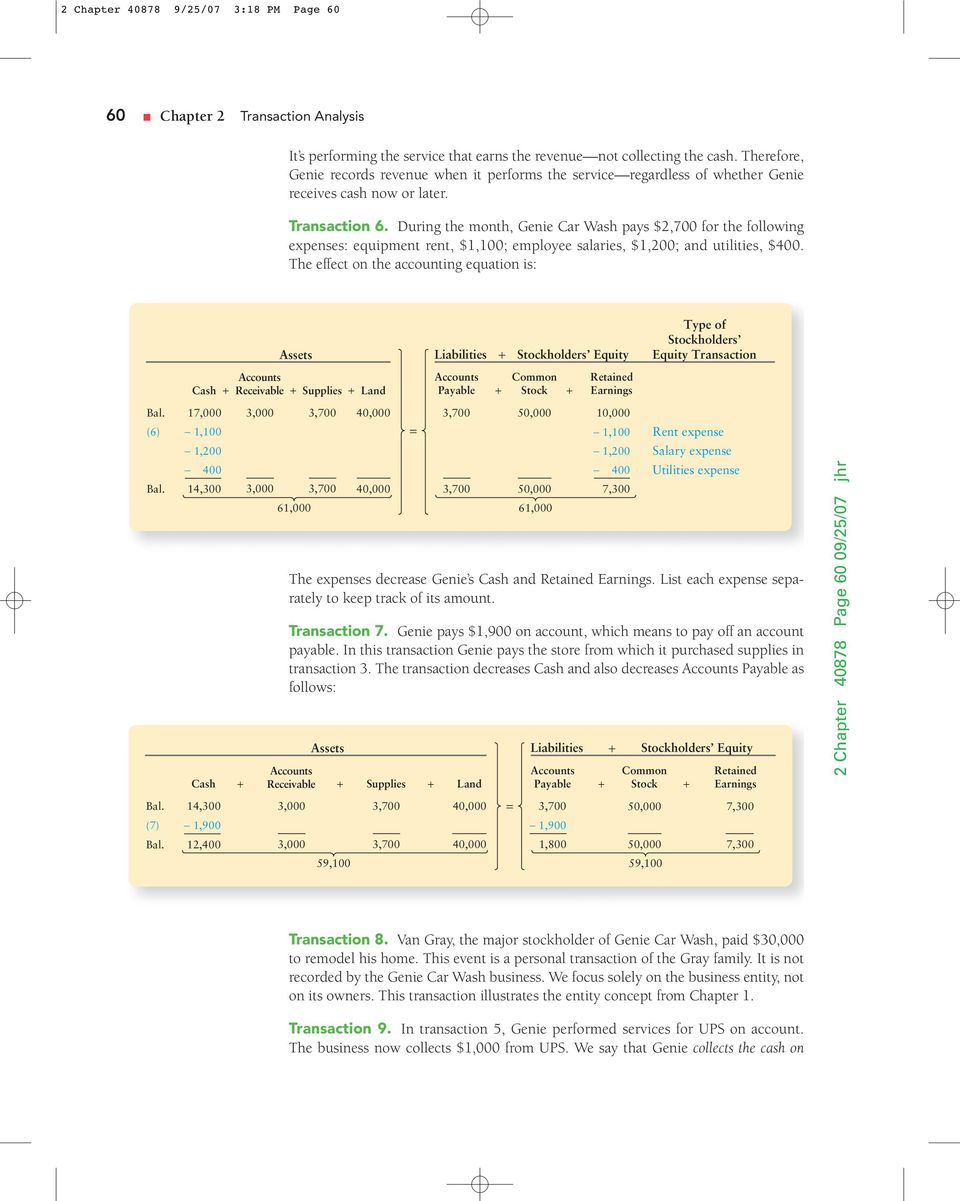
8 2 Chapter /25/07 3:18 PM Page Chapter 2 Transaction Analysis It s performing the service that earns the revenue not collecting the cash. Therefore, Genie records revenue when it performs the service regardless of whether Genie receives cash now or later. Transaction 6. During the month, Genie Car Wash pays $2,700 for the following expenses: equipment rent, $1,100; employee salaries, $1,200; and utilities, $400. The effect on the accounting equation is: Assets Liabilities Stockholders Equity Type of Stockholders Equity Transaction Accounts Receivable Supplies Accounts Land Payable Common Stock Retained Earnings (6) 3,000 3,700 40,000 14,300 3,000 3,700 40,000 3,700 (7) 17,000 1,100 1, ,300 1,900 = 3,700 61,000 61,000 10,000 1,100 1, ,300 Rent expense Salary expense Utilities expense The expenses decrease Genie s and Retained Earnings. List each expense separately to keep track of its amount. Transaction 7. Genie pays $1,900 on account, which means to pay off an account payable. In this transaction Genie pays the store from which it purchased supplies in transaction 3. The transaction decreases and also decreases Accounts Payable as follows: Accounts Receivable 3,000 Assets Liabilities Supplies 3,700 Accounts Land Payable 40,000 12,400 3,000 3,700 40,000 1,800 = 3,700 1,900 Stockholders Equity Common Stock 59,100 59,100 Retained Earnings 7,300 7,300 2 Chapter Page 60 09/25/07 jhr Transaction 8. Van Gray, the major stockholder of Genie Car Wash, paid $30,000 to remodel his home. This event is a personal transaction of the Gray family. It is not recorded by the Genie Car Wash business. We focus solely on the business entity, not on its owners. This transaction illustrates the entity concept from Chapter 1. Transaction 9. In transaction 5, Genie performed services for UPS on account. The business now collects $1,000 from UPS. We say that Genie collects the cash on
9 2 Chapter /25/07 3:18 PM Page 61 Accounting for Business Transactions 61 account, which means that Genie will record an increase in and a decrease in Accounts Receivable. This is not service revenue because Genie already recorded the revenue in transaction 5. The effect of collecting cash on account is: (9) 12,400 1,000 Accounts Receivable 3,000 1,000 Assets Liabilities Supplies 3,700 Accounts Land Payable 40,000 13,400 2,000 3,700 40,000 1,800 = 1,800 Stockholders Equity Common Stock 59,100 59,100 Retained Earnings 7,300 7,300 2 Chapter Page 61 09/25/07 jhr Transaction 10. Genie sells some land for $22,000, which is the same amount that Genie paid for the land. Genie receives $22,000 cash, and the effect on the accounting equation is: (10) 13,400 22,000 Accounts Receivable 2,000 Assets Liabilities Supplies 3,700 Accounts Land Payable 40,000 22,000 35,400 2,000 3,700 18,000 1,800 = 1,800 Stockholders Equity Common Stock 59,100 59,100 Note that the company did not sell all its land; Genie still owns $18,000 worth of land. Transaction 11. Genie Car Wash declares a dividend and pays the stockholders $2,100 cash. The effect on the accounting equation is: Retained Earnings 7,300 7,300 Assets Liabilities Stockholders Equity Type of Stockholders Equity Transaction Accounts Receivable Supplies Accounts Land Payable Common Stock Retained Earnings (11) 35,400 2,100 2,000 3,700 18,000 = 1,800 7,300 2,100 Dividends 33,300 2,000 3,700 18,000 1,800 5,200 57,000 57,000

10 2 Chapter /25/07 3:18 PM Page Chapter 2 Transaction Analysis The dividend decreases both the and the Retained Earnings of the business. But dividends are not an expense. Transactions and Financial Statements Exhibit 2-1 summarizes the 11 preceding transactions. Panel A gives the details of the transactions, and Panel B shows the transaction analysis. As you study the exhibit, note that every transaction maintains the equality: Assets = Liabilities Stockholders Equity Exhibit 2-1 provides the data for Genie Car Wash s financial statements: EXHIBIT 2-1 Transaction Analysis: Genie Car Wash, Inc. PANEL A Transaction Details (1) Received $ cash and issued stock to the owners (2) Paid $40,000 cash for land (3) Bought $3,700 of supplies on account (4) Received $7,000 cash from customers for service revenue earned (5) Performed services for a customer on account, $3,000 (6) Paid cash expenses: rent, $1,100; employee salary, $1,200; utilities, $400 PANEL B Transaction Analysis Statement of Flows Data (1) (2) (3) (4) (5) (6) (7) (9) (10) (11) Assets = Liabilities Stockholders Equity Accounts Receivable Accounts Supplies Land Payable 33,300 2,000 3,700 18,000 1,800 Common Stock 57,000 57,000 Retained Earnings 5,200 Type of Stockholders Equity Transaction Issued stock 40,000 7,000 1,100 1, ,000 40,000 3,700 3,700 1,900 1,900 1,000 1,000 22,000 22,000 2,100 Balance Sheet Data (7) Paid $1,900 on the account payable created in transaction 3 (8) Major stockholder paid personal funds to remodel home, not a transaction of the business (9) Received $1,000 on account (10) Sold land for cash at the land s cost of $22,000 (11) Declared and paid a dividend of $2,100 to the stockholders 7,000 Service revenue 3,000 Service revenue 1,100 Rent expense 1,200 Salary expense 400 Utilities expense 2,100 Dividends Income Statement Data Statement of Retained Earnings Data 2 Chapter Page 62 09/25/07 jhr

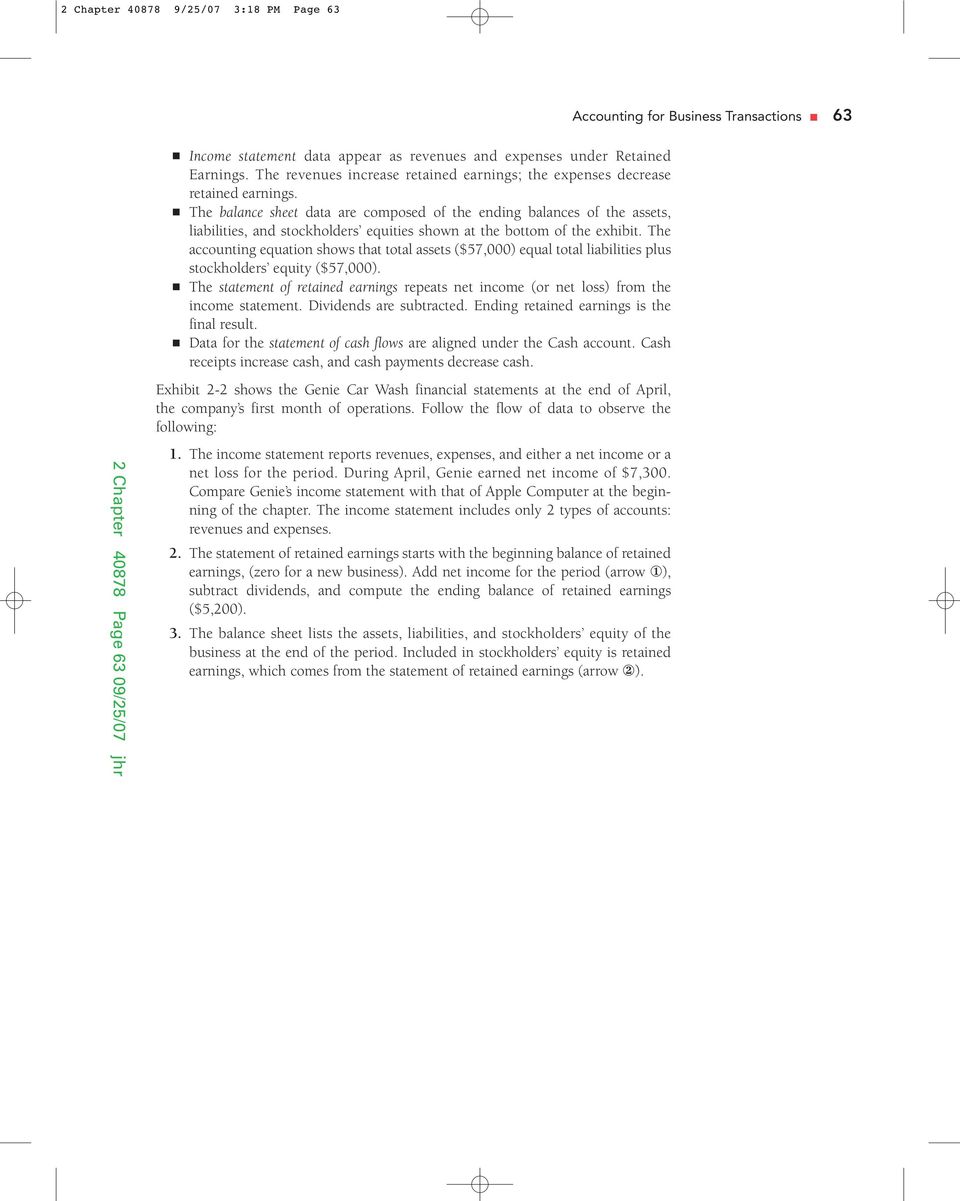
11 2 Chapter /25/07 3:18 PM Page 63 Accounting for Business Transactions 63 2 Chapter Page 63 09/25/07 jhr Income statement data appear as revenues and expenses under Retained Earnings. The revenues increase retained earnings; the expenses decrease retained earnings. The balance sheet data are composed of the ending balances of the assets, liabilities, and stockholders equities shown at the bottom of the exhibit. The accounting equation shows that total assets ($57,000) equal total liabilities plus stockholders equity ($57,000). The statement of retained earnings repeats net income (or net loss) from the income statement. Dividends are subtracted. Ending retained earnings is the final result. Data for the statement of cash flows are aligned under the account. receipts increase cash, and cash payments decrease cash. Exhibit 2-2 shows the Genie Car Wash financial statements at the end of April, the company s first month of operations. Follow the flow of data to observe the following: 1. The income statement reports revenues, expenses, and either a net income or a net loss for the period. During April, Genie earned net income of $7,300. Compare Genie s income statement with that of Apple Computer at the beginning of the chapter. The income statement includes only 2 types of accounts: revenues and expenses. 2. The statement of retained earnings starts with the beginning balance of retained earnings, (zero for a new business). Add net income for the period (arrow 1), subtract dividends, and compute the ending balance of retained earnings ($5,200). 3. The balance sheet lists the assets, liabilities, and stockholders equity of the business at the end of the period. Included in stockholders equity is retained earnings, which comes from the statement of retained earnings (arrow 2).
12 2 Chapter /25/07 3:18 PM Page Chapter 2 Transaction Analysis Let s put into practice what you have learned thus far. EXHIBIT 2-2 Financial Statements of Genie Car Wash, Inc. Genie Car Wash, Inc. Income Statement Month Ended April 30, 20X9 Revenues Service revenue ($7,000 $3,000)... $10,000 Expenses Salary expense... $1,200 Rent expense... 1,100 Utilities expense Total expenses... 2,700 Net income... $ 7,300 1 Assets... Accounts receivable... Supplies... Genie Car Wash, Inc. Statement of Retained Earnings Month Ended April 30, 20X9 Retained earnings, April 1, 20X9... Add: Net income for the month... Less: Dividends... Retained earnings, April 30, 20X9... Genie Car Wash, Inc. Balance Sheet April 30, 20X9 $33,300 2,000 3,700 $ 0 7,300 7,300 (2,100) $5,200 Liabilities Accounts payable... Stockholders Equity Common stock... $ 1, Chapter Page 64 09/25/07 jhr Land... 18,000 Retained earnings... 5,200 Total stockholders equity... 55,200 Total assets... Total liabilities and $57,000 stockholders equity... $57,000

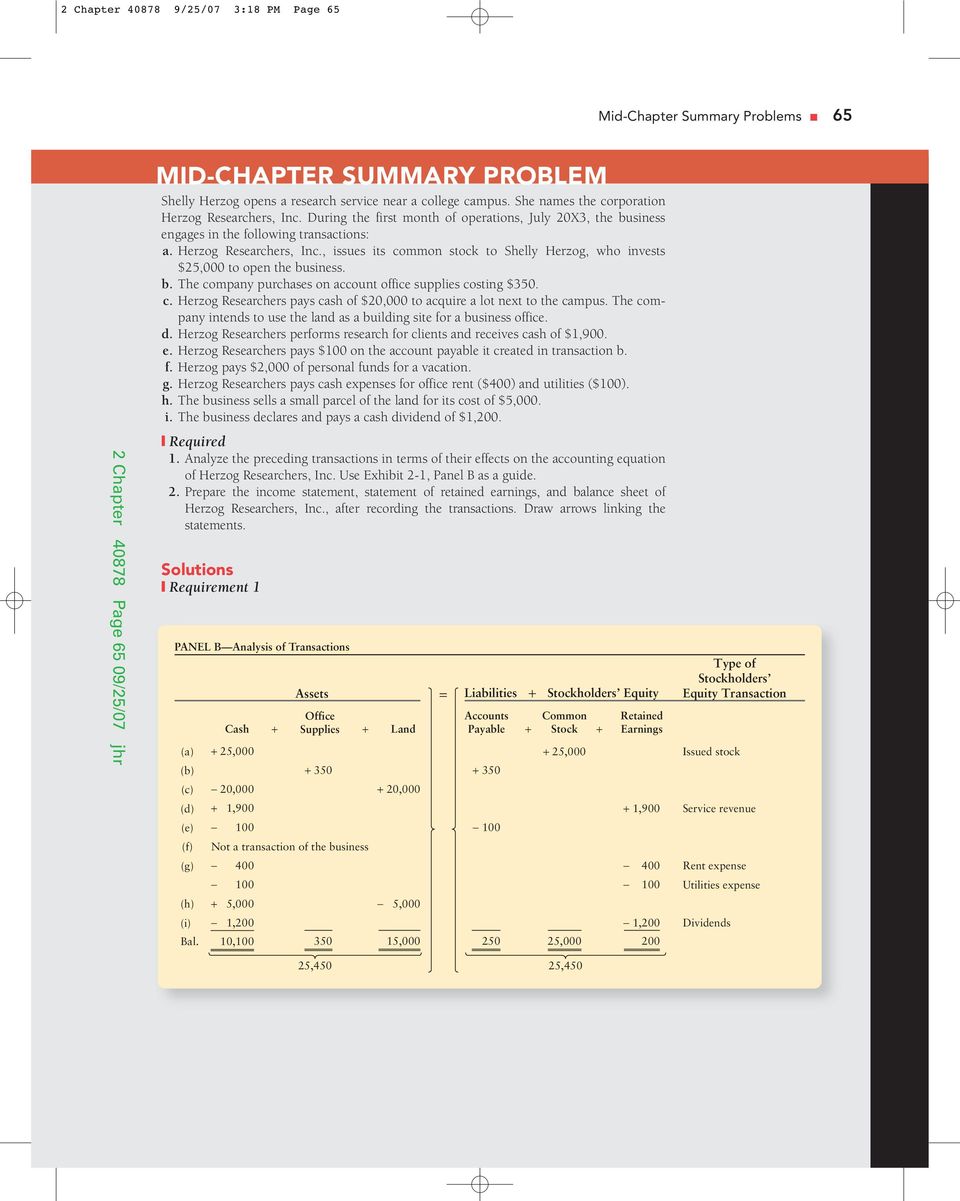
13 2 Chapter /25/07 3:18 PM Page 65 Mid-Chapter Summary Problems 65 2 Chapter Page 65 09/25/07 jhr MID-CHAPTER SUMMARY PROBLEM Shelly Herzog opens a research service near a college campus. She names the corporation Herzog Researchers, Inc. During the first month of operations, July 20X3, the business engages in the following transactions: a. Herzog Researchers, Inc., issues its common stock to Shelly Herzog, who invests $25,000 to open the business. b. The company purchases on account office supplies costing $350. c. Herzog Researchers pays cash of $20,000 to acquire a lot next to the campus. The company intends to use the land as a building site for a business office. d. Herzog Researchers performs research for clients and receives cash of $1,900. e. Herzog Researchers pays $100 on the account payable it created in transaction b. f. Herzog pays $2,000 of personal funds for a vacation. g. Herzog Researchers pays cash expenses for office rent ($400) and utilities ($100). h. The business sells a small parcel of the land for its cost of $5,000. i. The business declares and pays a cash dividend of $1, Analyze the preceding transactions in terms of their effects on the accounting equation of Herzog Researchers, Inc. Use Exhibit 2-1, Panel B as a guide. 2. Prepare the income statement, statement of retained earnings, and balance sheet of Herzog Researchers, Inc., after recording the transactions. Draw arrows linking the statements. Solutions Requirement 1 PANEL B Analysis of Transactions (a) (b) (c) (d) (e) (f) (g) (h) (i) Assets = Liabilities Office Supplies Accounts Land Payable 10, , Stockholders Equity Common Stock 25,000 Retained Earnings 200 Type of Stockholders Equity Transaction 25,000 25,000 Issued stock 20,000 1, Not a transaction of the business ,000 1, ,000 5, ,900 Service revenue 400 Rent expense 100 Utilities expense 1,200 Dividends 25,450 25,450
14 2 Chapter /25/07 3:18 PM Page Chapter 2 Transaction Analysis Herzog Researchers, Inc. Income Statement Month Ended July 31, 20X3 Revenues Service revenue... Expenses Rent expense... Utilities expense... Total expenses... Net income... $ $1, $1,400 Herzog Researchers, Inc. Statement of Retained Earnings Month Ended July 31, 20X3 Assets... Office supplies... Land... Total assets... Retained earnings, July 1, 20X3... Add: Net income for the month... Less: Dividends... Retained earnings, July 31, 20X3... $10, ,000 $25,450 Herzog Researchers, Inc. Balance Sheet July 31, 20X3 $ 0 1,400 1,400 (1,200) $ 200 Liabilities Accounts payable... Stockholders Equity Common stock... Retained earnings... Total stockholders equity... Total liabilities and stockholders equity... $ , ,200 $25,450 2 Chapter Page 66 09/25/07 jhr The analysis in the first half of this chapter can be used, but it is cumbersome. Apple Computer has hundreds of accounts and millions of transactions. The spreadsheet to account for Apple s transactions would be huge! In the second half of this chapter we discuss double-entry accounting as it is actually used in business.

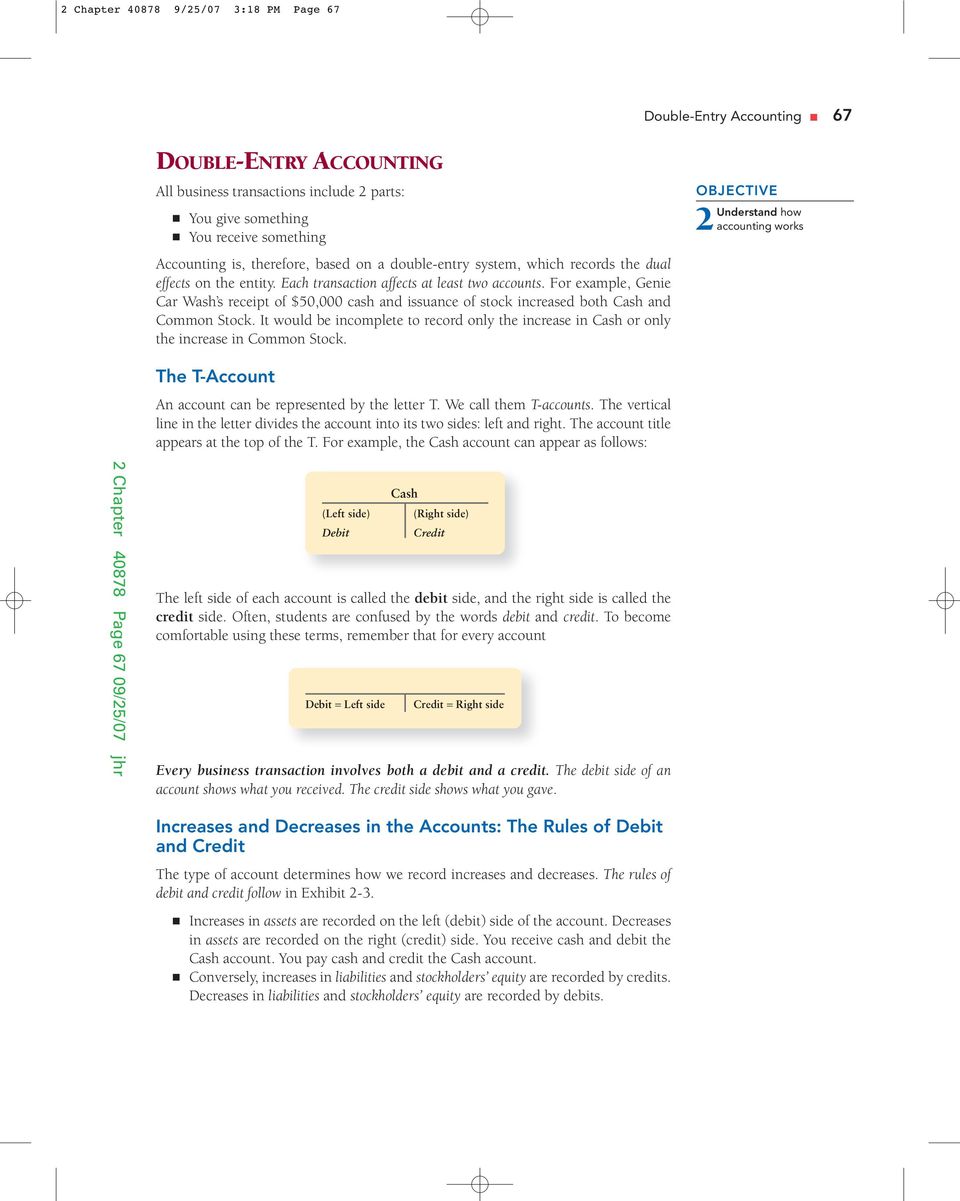
15 2 Chapter /25/07 3:18 PM Page 67 Double-Entry Accounting 67 DOUBLE-ENTRY ACCOUNTING All business transactions include 2 parts: You give something You receive something Accounting is, therefore, based on a double-entry system, which records the dual effects on the entity. Each transaction affects at least two accounts. For example, Genie Car Wash s receipt of $ cash and issuance of stock increased both and Common Stock. It would be incomplete to record only the increase in or only the increase in Common Stock. OBJECTIVE 2Understand how accounting works The T-Account An account can be represented by the letter T. We call them T-accounts. The vertical line in the letter divides the account into its two sides: left and right. The account title appears at the top of the T. For example, the account can appear as follows: 2 Chapter Page 67 09/25/07 jhr (Left side) Debit The left side of each account is called the debit side, and the right side is called the credit side. Often, students are confused by the words debit and credit. To become comfortable using these terms, remember that for every account Debit = Left side (Right side) Credit Credit = Right side Every business transaction involves both a debit and a credit. The debit side of an account shows what you received. The credit side shows what you gave. Increases and Decreases in the Accounts: The Rules of Debit and Credit The type of account determines how we record increases and decreases. The rules of debit and credit follow in Exhibit 2-3. Increases in assets are recorded on the left (debit) side of the account. Decreases in assets are recorded on the right (credit) side. You receive cash and debit the account. You pay cash and credit the account. Conversely, increases in liabilities and stockholders equity are recorded by credits. Decreases in liabilities and stockholders equity are recorded by debits.
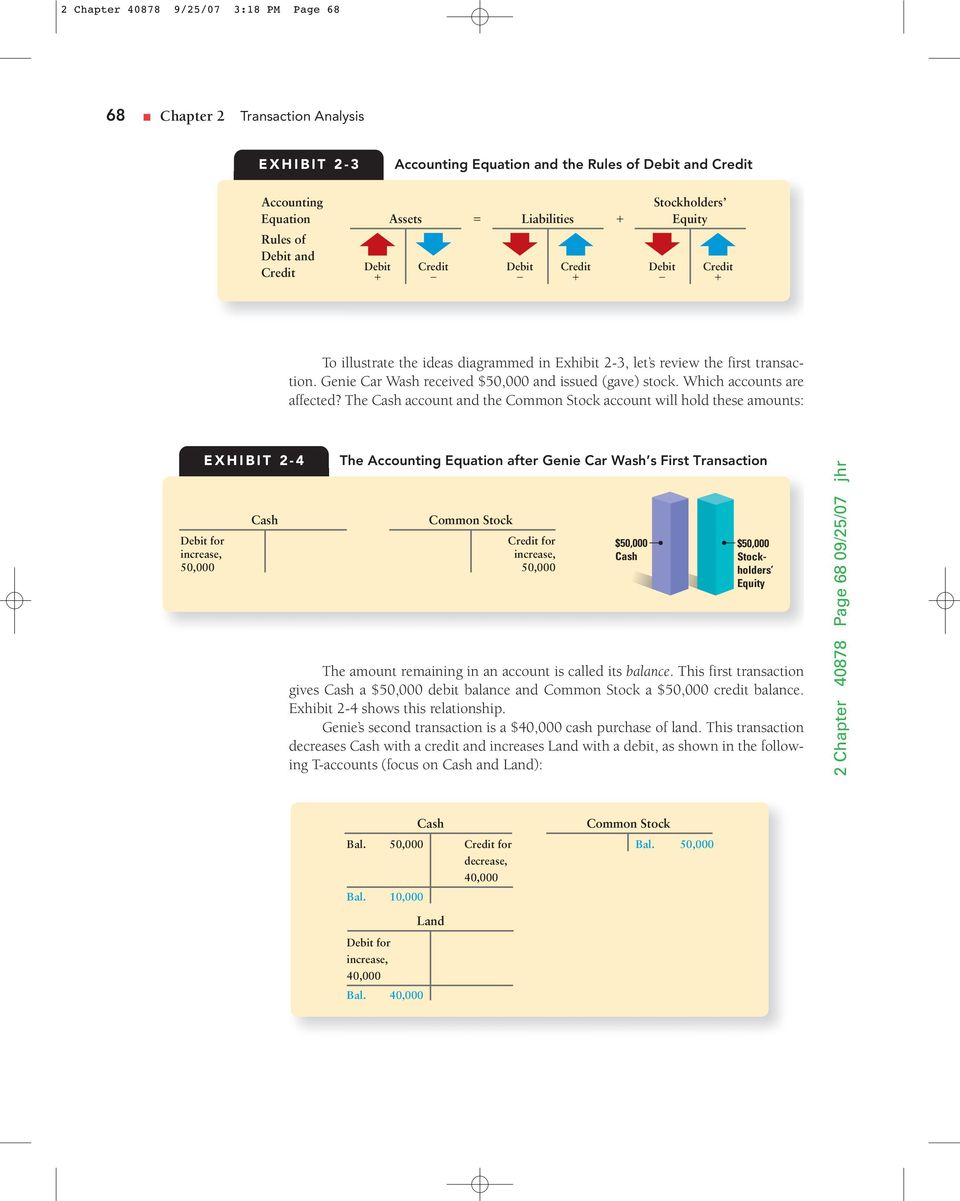
16 2 Chapter /25/07 3:18 PM Page Chapter 2 Transaction Analysis EXHIBIT 2-3 Accounting Equation and the Rules of Debit and Credit Accounting Equation Rules of Debit and Credit Debit Assets = Liabilities Credit Debit Credit Stockholders Equity Debit Credit To illustrate the ideas diagrammed in Exhibit 2-3, let s review the first transaction. Genie Car Wash received $ and issued (gave) stock. Which accounts are affected? The account and the Common Stock account will hold these amounts: Debit for increase, EXHIBIT 2-4 The Accounting Equation after Genie Car Wash s First Transaction Common Stock Credit for increase, $ $ Stockholders Equity The amount remaining in an account is called its balance. This first transaction gives a $ debit balance and Common Stock a $ credit balance. Exhibit 2-4 shows this relationship. Genie s second transaction is a $40,000 cash purchase of land. This transaction decreases with a credit and increases Land with a debit, as shown in the following T-accounts (focus on and Land): 2 Chapter Page 68 09/25/07 jhr Common Stock Credit for decrease, 40,000 10,000 Land Debit for increase, 40,000 40,000
17 2 Chapter /25/07 3:18 PM Page 69 After this transaction, has a $10,000 debit balance, Land has a debit balance of $40,000, and Common Stock has a $ credit balance, as shown in Exhibit 2-5. Double-Entry Accounting 69 EXHIBIT 2-5 The Accounting Equation after Genie Car Wash s First Two Transactions $10,000 $40,000 Land $ Stockholders Equity 2 Chapter Page 69 09/25/07 jhr Additional Stockholders Equity Accounts: Revenues and Expenses Stockholders equity also includes the two categories of income statement accounts, Revenues and Expenses: Revenues are increases in stockholders equity that result from delivering goods or services to customers. Expenses are decreases in stockholders equity due to the cost of operating the business. Therefore, the accounting equation may be expanded as shown in Exhibit 2-6. Revenues and expenses appear in parentheses because their net effect revenues minus expenses equals net income, which increases stockholders equity. If expenses exceed revenues, there is a net loss, which decreases stockholders equity. EXHIBIT 2-6 Liabilities Assets = Stockholders Equity Expansion of the Accounting Equation Common Stock Statement of Retained Earnings Income Statement Retained Dividends (Revenues Expenses) Earnings Common Stock Assets Liabilities Retained Earnings Dividends Statement of Retained Earnings Stockholders Equity Revenues Income Statement Expenses

18 2 Chapter /25/07 3:18 PM Page Chapter 2 Transaction Analysis We can now express the final form of the rules of debit and credit, as shown in Exhibit 2-7. You should not proceed until you have learned these rules. For example, you must remember that A debit increases an asset account. A credit decreases an asset. Liabilities and stockholders equity are the opposite. A credit increases a liability account. A debit decreases a liability. Dividends and Expense accounts are exceptions to the rule. Dividends and Expenses are equity accounts that are increased by a debit. Dividends and Expense accounts are negative (or contra) equity accounts. Revenues and Expenses are often treated as separate account categories because they appear on the income statement. Exhibit 2-7 shows Revenues and Expenses below the other equity accounts. EXHIBIT 2-7 OBJECTIVE 3Record transactions in the journal Final Form of the Rules of Debit and Credit ASSETS = LIABILITIES STOCKHOLDERS EQUITY Assets Debit Credit Debit Liabilities Credit Common Stock Debit Credit RECORDING TRANSACTIONS Retained Earnings Debit Debit Revenues Credit Credit Debit Debit Dividends Expenses Credit Credit Accountants use a chronological record of transactions called a journal. The journalizing process follows three steps: 1. Specify each account affected by the transaction and classify each account by type (asset, liability, stockholders equity, revenue, or expense). 2. Determine whether each account is increased or decreased by the transaction. Use the rules of debit and credit to increase or decrease each account. 3. Record the transaction in the journal, including a brief explanation. The debit side is entered on the left margin, and the credit side is indented to the right. Step 3 is also called making the journal entry or journalizing the transaction. Let s apply the steps to journalize the first transaction of Genie Car Wash. Step 1 The business receives cash and issues stock. and Common Stock are affected. is an asset, and Common Stock is equity. Step 2 Both and Common Stock increase. Debit to record an increase in this asset. Credit Common Stock to record an increase in this equity account. 2 Chapter Page 70 09/25/07 jhr

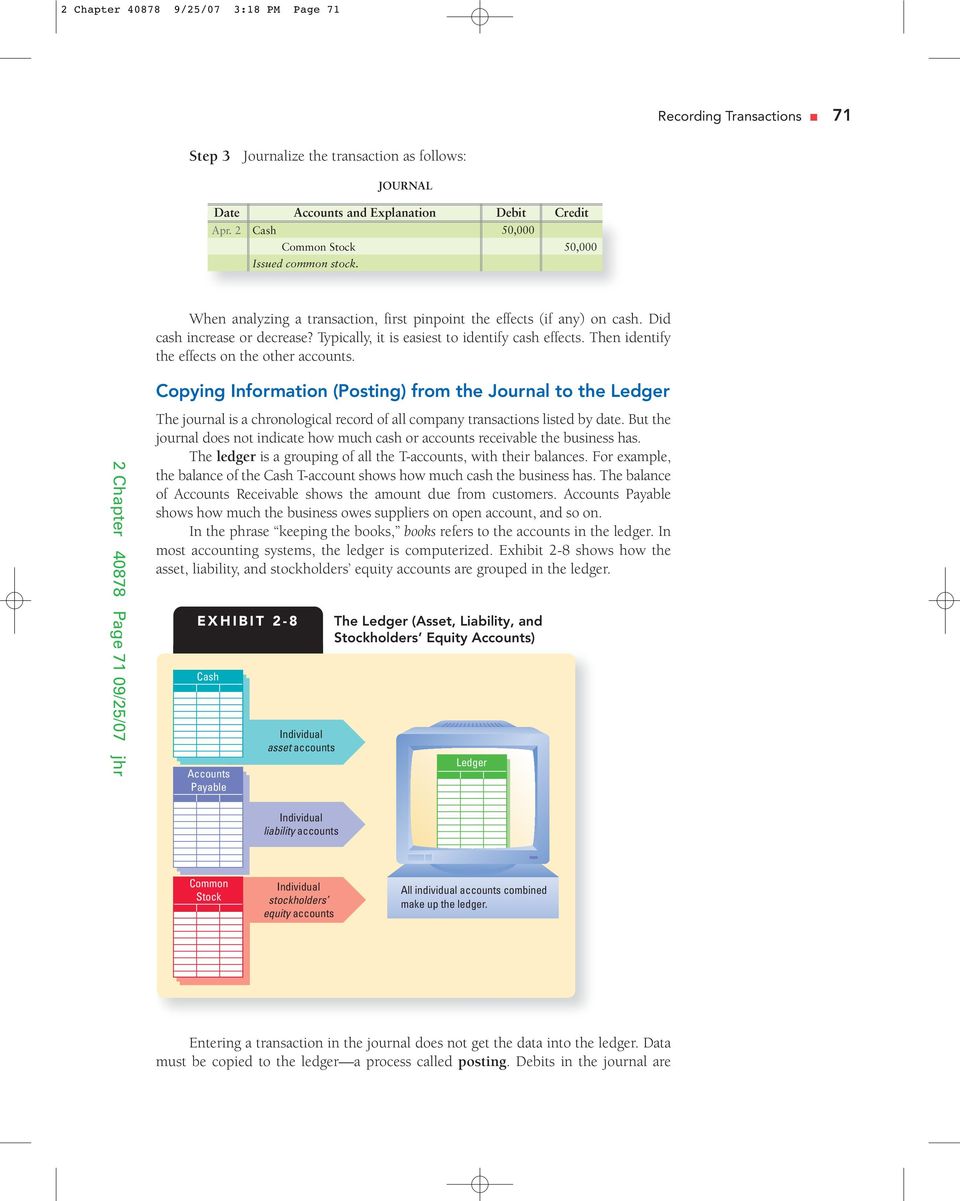
19 2 Chapter /25/07 3:18 PM Page 71 Recording Transactions 71 Step 3 Journalize the transaction as follows: JOURNAL Date Apr. 2 Accounts and Explanation Debit Credit Common Stock Issued common stock. When analyzing a transaction, first pinpoint the effects (if any) on cash. Did cash increase or decrease? Typically, it is easiest to identify cash effects. Then identify the effects on the other accounts. Copying Information (Posting) from the Journal to the Ledger 2 Chapter Page 71 09/25/07 jhr The journal is a chronological record of all company transactions listed by date. But the journal does not indicate how much cash or accounts receivable the business has. The ledger is a grouping of all the T-accounts, with their balances. For example, the balance of the T-account shows how much cash the business has. The balance of Accounts Receivable shows the amount due from customers. Accounts Payable shows how much the business owes suppliers on open account, and so on. In the phrase keeping the books, books refers to the accounts in the ledger. In most accounting systems, the ledger is computerized. Exhibit 2-8 shows how the asset, liability, and stockholders equity accounts are grouped in the ledger. EXHIBIT 2-8 Accounts Payable Individual asset accounts The Ledger (Asset, Liability, and Stockholders Equity Accounts) Ledger Individual liability accounts Common Stock Individual stockholders equity accounts All individual accounts combined make up the ledger. Entering a transaction in the journal does not get the data into the ledger. Data must be copied to the ledger a process called posting. Debits in the journal are
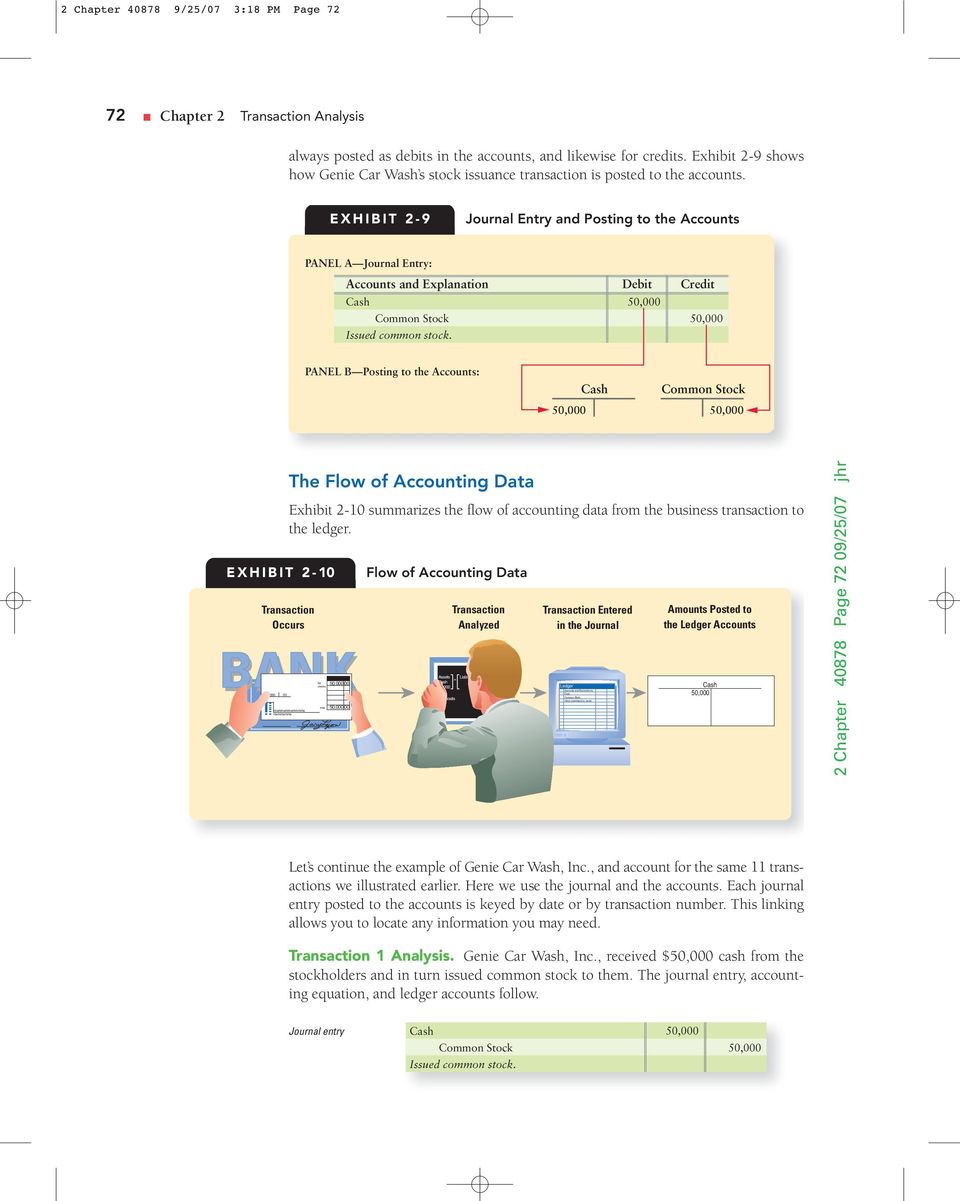
20 2 Chapter /25/07 3:18 PM Page Chapter 2 Transaction Analysis always posted as debits in the accounts, and likewise for credits. Exhibit 2-9 shows how Genie Car Wash s stock issuance transaction is posted to the accounts. EXHIBIT 2-9 Journal Entry and Posting to the Accounts PANEL A Journal Entry: Accounts and Explanation Debit Credit Common Stock Issued common stock. PANEL B Posting to the Accounts: Common Stock EXHIBIT 2-10 Transaction Occurs BANK The Flow of Accounting Data Exhibit 2-10 summarizes the flow of accounting data from the business transaction to the ledger. mxmmxmmxmmmmx mxmmxmmx list checks total Flow of Accounting Data Assets = Deposits Transaction Analyzed Liabilities Transaction Entered in the Journal Ledger Accounts and Explanations Common Stock Initial investment by owner Amounts Posted to the Ledger Accounts 2 Chapter Page 72 09/25/07 jhr Let s continue the example of Genie Car Wash, Inc., and account for the same 11 transactions we illustrated earlier. Here we use the journal and the accounts. Each journal entry posted to the accounts is keyed by date or by transaction number. This linking allows you to locate any information you may need. Transaction 1 Analysis. Genie Car Wash, Inc., received $ cash from the stockholders and in turn issued common stock to them. The journal entry, accounting equation, and ledger accounts follow. Journal entry Common Stock Issued common stock.
21 2 Chapter /25/07 3:18 PM Page 73 Recording Transactions 73 Assets = Liabilities Stockholders Equity Accounting equation = 0 Common Stock The ledger accounts (1) (1) Transaction 2 Analysis. The business paid $40,000 cash for land. The purchase decreased cash; therefore, credit. The purchase increased the asset land; to record this increase, debit Land. 2 Chapter Page 73 09/25/07 jhr Journal entry Land Paid cash for land. 40,000 Assets = Liabilities Stockholders Equity Accounting equation = ,000 The ledger accounts Journal entry (1) (2) 40,000 (2) 40,000 Supplies Accounts Payable Purchased office supplies on account. Land 3,700 40,000 Transaction 3 Analysis. The business purchased supplies for $3,700 on account payable. The purchase increased supplies, an asset, and Accounts Payable, a liability. 3,700 Assets = Liabilities Stockholders Equity Accounting equation 3,700 = 3,700 0 Supplies Accounts Payable The ledger accounts (3) 3,700 (3) 3,700 Transaction 4 Analysis. The business performed services for clients and received cash of $7,000. The transaction increased cash and service revenue. To record the revenue, credit Service Revenue.
22 2 Chapter /25/07 3:18 PM Page Chapter 2 Transaction Analysis Journal entry Service Revenue Performed services for cash. 7,000 7,000 Assets = Liabilities Stockholders Equity Revenues Accounting equation 7,000 = 0 7,000 Service Revenue The ledger accounts (1) (4) 7,000 (2) 40,000 (4) 7,000 Transaction 5 Analysis. Genie performed services for UPS on account. UPS did not pay immediately, so Genie billed UPS for $3,000. The transaction increased accounts receivable; therefore, debit Accounts Receivable. Service revenue also increased, so credit the Service Revenue account. Journal entry Accounting equation The ledger accounts Accounts Receivable Service Revenue Performed services on account. Assets = Liabilities 3,000 = 0 Accounts Receivable Stockholders Equity 3,000 Revenues 3,000 Service Revenue 3,000 (5) 3,000 (4) 7,000 (5) 3,000 2 Chapter Page 74 09/25/07 jhr Transaction 6 Analysis. The business paid $2,700 for the following expenses: equipment rent, $1,100; employee salary, $1,200; and utilities, $400. Credit for the sum of the expense amounts. The expenses increased, so debit each expense account separately. Journal entry Rent Expense Salary Expense Utilities Expense Paid expenses. 1,100 1, ,700
23 2 Chapter /25/07 3:18 PM Page 75 Recording Transactions 75 Assets = Liabilities Stockholders Equity Expenses Accounting equation 2,700 = 0 2,700 Rent Expense The ledger accounts (1) (4) 7,000 (2) (6) 40,000 2,700 (6) 1,100 Salary Expense (6) 1,200 (6) 400 Utilities Expense 2 Chapter Page 75 09/25/07 jhr Transaction 7 Analysis. The business paid $1,900 on the account payable created in transaction 3. Credit for the payment. The payment decreased a liability, so debit Accounts Payable. Journal entry Accounts Payable Paid cash on account. Assets = Liabilities Accounting equation 1,900 = 1, ,900 Stockholders Equity Accounts Payable The ledger accounts (1) (2) 40,000 (7) 1,900 (3) 3,700 (4) 7,000 (6) 2,700 (7) 1,900 1,900 Transaction 8 Analysis. Van Gray, the major stockholder of Genie Car Wash, remodeled his personal residence. This is not a transaction of the car-wash business, so the business does not record the transaction. Transaction 9 Analysis. The business collected $1,000 cash on account from the clients in transaction 5. increased so debit. The asset accounts receivable decreased; therefore, credit Accounts Receivable. Journal entry Accounts Receivable Collected cash on account. 1,000 1,000
24 2 Chapter /25/07 3:18 PM Page Chapter 2 Transaction Analysis Assets = Liabilities 1,000 Stockholders Equity Accounting equation 1,000 = 0 0 Accounts Receivable The ledger accounts (1) (2) 40,000 (5) 3,000 (9) 1,000 (4) 7,000 (6) 2,700 (9) 1,000 (7) 1,900 Transaction 10 Analysis. The business sold land for its cost of $22,000, receiving cash. The asset cash increased; debit. The asset land decreased; credit Land. Journal entry Land Sold land. Assets = Liabilities 22,000 22,000 Stockholders Equity Accounting equation 22,000 = 0 0 Land The ledger accounts (1) (4) (9) (10) 7,000 1,000 22,000 (2) (6) (7) 40,000 2,700 1,900 (2) 40,000 (10) 22,000 22,000 2 Chapter Page 76 09/25/07 jhr Transaction 11 Analysis. Genie Car Wash paid its stockholders cash dividends of $2,100. Credit for the payment. The transaction also decreased stockholders equity and requires a debit to an equity account. Therefore, debit Dividends. Journal entry Dividends Declared and paid dividends. 2,100 2,100 Assets = Liabilities Stockholders Equity Dividends Accounting equation 2,100 = 0 2,100
25 2 Chapter /25/07 3:18 PM Page 77 The Trial Balance 77 Dividends The ledger accounts (1) (4) (9) (10) 7,000 1,000 22,000 (2) (6) (7) (11) 40,000 2,700 1,900 2,100 (11) 2,100 2 Chapter Page 77 09/25/07 jhr Accounts After Posting to the Ledger Exhibit 2-11 shows the accounts after all transactions have been posted to the ledger. Group the accounts under assets, liabilities, and equity. Each account has a balance, denoted as, which is the difference between the account s total debits and its total credits. For example, the Accounts Payable s balance of $1,800 is the difference between the credit ($3,700) and the debit ($1,900). has a debit balance of $33,300. A horizontal line separates the transaction amounts from the account balance. If an account s debits exceed its total credits, that account has a debit balance, as for. If the sum of the credits is greater, the account has a credit balance, as for Accounts Payable. (1) (4) (9) (10) (5) (3) (2) EXHIBIT ,000 1,000 22,000 33,300 Genie Car Wash s Ledger Accounts After Posting Assets = Liabilities Stockholders Equity (2) (6) (7) (11) Accounts Receivable 3,000 2,000 Supplies 3,700 3,700 40,000 18,000 Land 40,000 2,700 1,900 2,100 (9) 1,000 (10) 22,000 Accounts Payable (7) 1,900 (3) 3,700 1,800 Common Stock (1) Revenue Service Revenue (4) (5) 7,000 3,000 10,000 (11) (6) (6) (6) Accounting Cycle Tutorial Application 1 Xpert Driving School Accounting Cycle Tutorial Application 2 Small Business Services Dividends 2,100 2,100 Expenses Rent Expense 1,100 1,100 Salary Expense 1,200 1,200 Utilities Expense THE TRIAL BALANCE A trial balance lists all accounts with their balances assets first, then liabilities and stockholders equity. The trial balance summarizes all the account balances for the financial statements and shows whether total debits equal total credits. A trial balance OBJECTIVE 4Use a trial balance
26 2 Chapter /25/07 3:18 PM Page Chapter 2 Transaction Analysis may be taken at any time, but the most common time is at the end of the period. Exhibit 2-12 is the trial balance of Genie Car Wash, Inc., after all transactions have been journalized and posted at the end of April. EXHIBIT 2-12 Trial Balance Accounting Cycle Tutorial Glossary Genie Car Wash, Inc. Trial Balance April 30, 20X9 Balance Account Title Debit Credit Accounting Cycle Tutorial Glossary Quiz... Accounts receivable... Supplies... Land... Accounts payable... Common stock... Dividends... Service revenue... Rent expense... Salary expense... Utilities expense... Total... $33,300 2,000 3,700 18,000 2,100 1,100 1, $61,800 $ 1,800 10,000 $61,800 Analyzing Accounts You can often tell what a company did by analyzing its accounts. This is a powerful tool for a manager who knows accounting. For example, if you know the beginning and ending balance of, and if you know total cash receipts, you can compute your total cash payments during the period. In our chapter example, suppose Genie Car Wash began May with cash of $1,000. During May Genie received cash of $8,000 and ended the month with a cash balance of $3,000. You can compute total cash payments by analyzing Genie s account as follows: 2 Chapter Page 78 09/25/07 jhr Beginning balance receipts Ending balance 1,000 8,000 3,000 payments x = 6,000 Or, if you know s beginning and ending balances and total payments, you can compute cash receipts during the period for any company!
27 2 Chapter /25/07 3:18 PM Page 79 The Trial Balance 79 You can compute either sales on account or cash collections on account by analyzing the Accounts Receivable account as follows (using assumed amounts): Accounts Receivable Beginning balance Sales on account Ending balance 6,000 10,000 5,000 Collections on account 11,000 Also, you can determine how much you paid on account by analyzing Accounts Payable as follows (using assumed amounts): Accounts Payable 2 Chapter Page 79 09/25/07 jhr Payments on account 4,000 Please master this powerful technique. It works for any company and for your own personal finances! You will find this tool very helpful when you become a manager. Correcting Accounting Errors Beginning balance Purchases on account Ending balance 9,000 6,000 11,000 Accounting errors can occur even in computerized systems. Input data may be wrong, or they may be entered twice or not at all. A debit may be entered as a credit, and vice versa. You can detect the reason or reasons behind many out-of-balance conditions by computing the difference between total debits and total credits. Then perform one or more of the following actions: 1. Search the records for a missing account. Trace each account back and forth from the journal to the ledger. A $200 transaction may have been recorded incorrectly in the journal or posted incorrectly to the ledger. Search the journal for a $200 transaction. 2. Divide the out-of-balance amount by 2. A debit treated as a credit, or vice versa, doubles the amount of error. Suppose Genie Car Wash added $300 to instead of subtracting $300. The out-of-balance amount is $600, and dividing by 2 identifies $300 as the amount of the transaction. Search the journal for the $300 transaction and trace to the account affected. 3. Divide the out-of-balance amount by 9. If the result is an integer (no decimals), the error may be a slide (writing $400 as $40).The accounts would be out of balance by $360 ($400 $40 = $360). Dividing $360 by 9 yields $40. Scan the trial balance in Exhibit 2-12 for an amount similar to $40. Utilities Expense (balance of $400) is the misstated account.
28 2 Chapter /25/07 3:18 PM Page Chapter 2 Transaction Analysis transposition (writing $2,100 as $1,200). The accounts would be out of balance by $900 ($2,100 $1,200 = $900). Dividing $900 by 9 yields $100. Trace all amounts on the trial balance back to the T-accounts. Dividends (balance of $2,100) is the misstated account. Chart of Accounts As you know, the ledger contains the accounts grouped under these headings: 1. Balance sheet accounts: Assets, Liabilities, and Stockholders Equity 2. Income statement accounts: Revenues and Expenses Organizations use a chart of accounts to list all their accounts and account numbers. Account numbers usually have 2 or more digits. Asset account numbers may begin with 1, liabilities with 2, stockholders equity with 3, revenues with 4, and expenses with 5. The second, third, and higher digits in an account number indicate the position of the individual account within the category. For example, may be account number 101, which is the first asset account. Accounts Payable may be number 201, the first liability. All accounts are numbered by using this system. Organizations with many accounts use lengthy account numbers. For example, the chart of accounts of Apple Computer may use 5-digit account numbers. The chart of accounts for Genie Car Wash appears in Exhibit The gap between account numbers 111 and 141 leaves room to add another category of receivables, for example, Notes Receivable, which may be numbered 121. EXHIBIT Accounts Receivable 141 Office Supplies 151 Office Furniture 191 Land Chart of Accounts Genie Car Wash, Inc. Balance Sheet Accounts Assets Liabilities Stockholders Equity 201 Accounts Payable 231 Notes Payable 301 Common Stock 311 Dividends 312 Retained Earnings 2 Chapter Page 80 09/25/07 jhr Income Statement Accounts (Part of Stockholders Equity) Revenues 401 Service Revenue Expenses 501 Rent Expense 502 Salary Expense 503 Utilities Expense Appendix D to this book gives two expanded charts of accounts that you will find helpful as you work through this course. The first chart lists the typical accounts that a service corporation, such as Genie Car Wash, would have after a period of growth. The second chart is for a merchandising corporation, one that sells a product instead of a service.
29 2 Chapter /25/07 3:18 PM Page 81 The Trial Balance 81 The Normal Balance of an Account An account s normal balance falls on the side of the account debit or credit where increases are recorded. The normal balance of assets is on the debit side, so assets are debit-balance accounts. Conversely, liabilities and stockholders equity usually have a credit balance, so these are credit-balance accounts. Exhibit 2-14 illustrates the normal balances of all the assets, liabilities, and stockholders equities, including revenues and expenses. EXHIBIT 2-14 Normal Balances of the Accounts 2 Chapter Page 81 09/25/07 jhr Assets Liabilities... Stockholders Equity overall... Common stock... Retained earnings... Dividends... Revenues... Expenses... As explained earlier, stockholders equity usually contains several accounts. Dividends and expenses carry debit balances because they represent decreases in stockholders equity. In total, the equity accounts show a normal credit balance. Account Formats Debit Debit Debit Credit Credit Credit Credit Credit So far we have illustrated accounts in a 2-column T-account format, with the debit column on the left and the credit column on the right. Another format has 4 amount columns, as illustrated for the account in Exhibit The first pair of amount columns are for the debit and credit amounts of individual transactions. The last two columns are for the account balance. This 4-column format keeps a running balance in the 2 right columns. Accounting Cycle Tutorial The Journal, the Ledger, and the Trial Balance EXHIBIT 2-15 Account in Four-Column Format Account: Account No. 101 Balance Date Item Debit Credit Debit Credit 20X9 Apr ,000 10,000
30 2 Chapter /25/07 3:18 PM Page Chapter 2 Transaction Analysis OBJECTIVE 5Analyze transactions using only T-accounts Analyzing Transactions Using Only T-Accounts Businesspeople must often make decisions without the benefit of a complete accounting system. For example, the managers of Apple Computer may consider borrowing $100,000 to buy equipment. To see how the two transactions [(a) borrowing cash and (b) buying equipment] affect Apple, the manager can go directly to T-accounts, as follows: T-accounts: (a) Note Payable 100,000 (a) 100,000 T-accounts: (a) 100,000 (b) 100,000 (b) 100,000 Equipment Note Payable (a) 100,000 This informal analysis shows immediately that Apple will add $100,000 of equipment and a $100,000 note payable. Assuming that Apple began with zero balances, the equipment and note payable transactions would result in the following balance sheet (date assumed for illustration only): Assets... Equipment... Total assets... $ 0 100,000 $100,000 Apple Computer, Inc. Balance Sheet September 12, 20X8 Liabilities Note payable... Stockholders Equity Total liabilities and stockholders equity... $100,000 0 $100,000 2 Chapter Page 82 09/25/07 jhr Accounting Cycle Tutorial Application Constanza Architect Companies don t actually keep records in this shortcut fashion. But a decision maker who needs information quickly may not have time to journalize, post to the accounts, take a trial balance, and prepare the financial statements. A manager who knows accounting can analyze the transaction and make the decision quickly. Now apply what you ve learned. Study the Decision Guidelines, which summarize the chapter.
31 2 Chapter /25/07 3:18 PM Page 83 Decision Guidelines 83 DECISION GUIDELINES HOW TO MEASURE RESULTS OF OPERATIONS AND FINANCIAL POSITION Any entrepreneur must determine whether the venture is profitable. To do this, he or she needs to know its results of operations and financial position. If Steve Jobs, who founded Apple Computer, Inc., wants to know whether the business is making money, the Guidelines that follow will help him. Decision Guidelines 2 Chapter Page 83 09/25/07 jhr Has a transaction occurred? Where to record the transaction? How to record an increase or decrease in the following accounts? Where to store all the information for each account? Where to list all the accounts and their balances? If the event affects the entity s financial position and can be reliably recorded Yes. If either condition is absent No. In the journal, the chronological record of transactions Rules of debit and credit: Assets... Liabilities... Stockholders equity... Revenues... Expenses... In the ledger, the book of accounts In the trial balance Increase Debit Debit Credit Credit Credit Decrease Credit Debit Debit Debit Credit Where to report the: Results of operations? Financial position? In the income statement (Revenues Expenses = Net income or net loss) In the balance sheet (Assets = Liabilities Stockholders equity)
32 2 Chapter /25/07 3:18 PM Page Chapter 2 End-of-Chapter Summary Problem END-OF-CHAPTER SUMMARY PROBLEM The trial balance of Calderon Service Center, Inc., on March 1, 20X3, lists the entity s assets, liabilities, and stockholders equity on that date. Balance Account Title Debit Credit... Accounts receivable... Accounts payable... Common stock... Retained earnings... Total... $26,000 4,500 $30,500 $ 2,000 10,000 18,500 $30,500 During March, the business completed the following transactions: a. Borrowed $45,000 from the bank, with Calderon signing a note payable in the name of the business. b. Paid cash of $40,000 to a real estate company to acquire land. c. Performed service for a customer and received cash of $5,000. d. Purchased supplies on credit, $300. e. Performed customer service and earned revenue on account, $2,600. f. Paid $1,200 on account. g. Paid the following cash expenses: salaries, $3,000; rent, $1,500; and interest, $400. h. Received $3,100 on account. i. Received a $200 utility bill that will be paid next week. j. Declared and paid dividend of $1, Open the following accounts, with the balances indicated, in the ledger of Calderon Service Center, Inc. Use the T-account format. Assets, $26,000; Accounts Receivable, $4,500; Supplies, no balance; Land, no balance Liabilities Accounts Payable, $2,000; Note Payable, no balance Stockholders Equity Common Stock, $10,000; Retained Earnings, $18,500; Dividends, no balance Revenues Service Revenue, no balance Expenses (none have balances) Salary Expense, Rent Expense, Interest Expense, Utilities Expense 2. Journalize the preceding transactions. Key journal entries by transaction letter. 3. Post to the ledger and show the balance in each account after all the transactions have been posted. 4. Prepare the trial balance of Calderon Service Center, Inc., at March 31, 20X3. 5. To determine the net income or net loss of the entity during the month of March, prepare the income statement for the month ended March 31, 20X3. List expenses in order from the largest to the smallest. 2 Chapter Page 84 09/25/07 jhr
33 2 Chapter /25/07 3:18 PM Page 85 End-of-Chapter Summary Problem 85 Answers Requirement 1 Assets = Liabilities Stockholders Equity Accounts Payable Common Stock Expenses 26,000 2,000 10,000 Salary Expense Accounts Receivable Note Payable Retained Earnings 4,500 18,500 Rent Expense Supplies Dividends Interest Expense Land Revenue 2 Chapter Page 85 09/25/07 jhr Requirement 2 Accounts and Explanation a.... Note Payable... Borrowed cash on note payable. b. Land Purchased land for cash. c.... Service Revenue... Performed service and received cash. d. Supplies... Accounts Payable... Purchased supplies on account. e. Accounts Receivable... Service Revenue... Performed service on account. f. Accounts Payable Paid on account. Debit 45,000 40,000 5, ,600 1,200 Credit 45,000 40,000 5, ,600 1,200 Service Revenue Utilities Expense Accounts and Explanation Debit g. Salary Expense... 3,000 Rent Expense... 1,500 Interest Expense Paid cash expenses. h.... 3,100 Accounts Receivable... Received on account. i. Utilities Expense Accounts Payable... Received utility bill. j. Dividends... 1, Declared and paid dividends. Credit 4,900 3, ,800
34 2 Chapter /25/07 3:18 PM Page Chapter 2 End-of-Chapter Summary Problem Requirement 3 Assets = Liabilities Stockholders Equity Accounts Payable Common Stock Expenses (a) (c) (h) (e) (d) (b) 26,000 45,000 5,000 3,100 31,200 Accounts Receivable 4,500 2,600 4,000 (b) (f) (g) (j) (h) Supplies ,000 40,000 Land 40,000 1,200 4,900 1,800 3,100 (f) 1,200 (d) (i) Note Payable (a) Requirement 4 2, ,300 45,000 45,000 (j) Account Title Revenue 10,000 Retained Earnings Dividends 1,800 1,800 18,500 Service Revenue (c) (e) 5,000 2,600 7,600 Calderon Service Center, Inc. Trial Balance March 31, 20X3... Accounts receivable... Supplies... Land... Accounts payable... Note payable... Common stock... Retained earnings... Dividends... Service revenue... Salary expense... Rent expense... Interest expense... Utilities expense... Total... Debit $31,200 4, ,000 1,800 3,000 1, $82,400 (g) (g) (g) (i) Balance Credit $ 1,300 45,000 10,000 18,500 Salary Expense 3,000 3,000 Rent Expense 1,500 1,500 Interest Expense Utilities Expense 7,600 $82, Chapter Page 86 09/25/07 jhr
35 2 Chapter /25/07 3:18 PM Page 87 Review transaction analysis 87 Requirement 5 Calderon Service Center, Inc. Income Statement Month Ended March 31, 20X3 Revenue Service revenue... $7,600 Expenses Salary expense... Rent expense... Interest expense... Utilities expense... Total expenses... Net income... $3,000 1, ,100 $2,500 2 Chapter Page 87 09/25/07 jhr REVIEW TRANSACTION ANALYSIS Quick Check (answers are given on page 110) 1. A debit entry to an account: a. increases liabilities c. increases assets b. increases stockholders equity d. both a and c 2. Which account types normally have a credit balance? a. liabilities c. expenses b. revenues d. both a and b 3. An attorney performs services of $800 for a client and receives $200 cash with the remainder on account. The journal entry for this transaction would: a. debit, credit Accounts Receivable, credit Service Revenue b. debit, debit Accounts Receivable, credit Service Revenue c. debit, credit Service Revenue d. debit, debit Service Revenue, credit Accounts Receivable 4. Accounts Payable had a normal beginning balance of $1,000. During the period, there were debit postings of $400 and credit postings of $600. What was the ending balance? a. $800 debit c. $1,200 debit b. $800 credit d. $1,200 credit 5. The list of all accounts with their balances is the: a. trial balance c. journal b. chart of accounts d. balance sheet 6. The basic summary device of accounting is the: a. ledger c. journal b. account d. trial balance
36 2 Chapter /25/07 3:18 PM Page Chapter 2 Transaction Analysis Accounting Vocabulary account (p. 55) The record of the changes that have occurred in a particular asset, liability, or stockholders equity during a period. The basic summary device of accounting. accrued liability (p. 56) A liability for an expense that has not yet been paid by the company. cash (p. 55) Money and any medium of exchange that a bank accepts at face value. chart of accounts (p. 80) List of a company s accounts and their account numbers. credit (p. 67) The right side of an account. debit (p. 67) The left side of an account. 7. The beginning balance was $5,000. At the end of the period, the balance was $6,000. If total cash paid out during the period was $24,000, the amount of cash receipts was: a. $23,000 c. $25,000 b. $13,000 d. $35, In a double-entry accounting system a. a debit entry is recorded on the left side of a T-account. b. half of all the accounts have a normal credit balance. c. liabilities, owners equity, and revenue accounts all have normal debit balances. d. both a and c are correct. 9. Which accounts appear on which financial statement? Balance sheet Income statement a., revenues, land Expenses, payables b. Receivables, land, payables Revenues, supplies c. Expenses, payables, cash Revenues, receivables, land d., receivables, payables Revenues, expenses 10. A doctor purchases medical supplies of $670 and pays $200 cash with the remainder on account. The journal entry for this transaction would be: a. Supplies c. Supplies Accounts Payable Accounts Receivable b. Supplies d. Supplies Accounts Payable Accounts Payable 11. Which is the correct sequence for recording transactions and preparing financial statements? a. Journal, ledger, trial balance, financial statements b. Ledger, trial balance, journal, financial statements c. Financial statements, trial balance, ledger, journal d. Ledger, journal, trial balance, financial statements 12. The error of posting $100 as $10 can be detected by a. Dividing the out-of-balance amount by 2. b. Totalling each account s balance in the ledger. c. Dividing the out-of-balance amount by 9. d. Examining the chart of accounts. journal (p. 70) The chronological accounting record of an entity s transactions. ledger (p. 71) The book of accounts and their balances. posting (p. 71) Copying amounts from the journal to the ledger. prepaid expense (p. 55) A category of miscellaneous assets that typically expire or get used up in the near future. Examples include Prepaid Rent, Prepaid Insurance, and Supplies. transaction (p. 54) Any event that has a financial impact on the business and can be measured reliably. trial balance (p. 77) A list of all the ledger accounts with their balances. 2 Chapter Page 88 09/25/07 jhr
37 2 Chapter /25/07 3:18 PM Page 89 Assess Your Progress 89 ASSESS YOUR PROGRESS Short Exercises S2-1 (Learning Objective 1: Explaining an asset versus an expense) Lou Ann Staas opened a software consulting firm that immediately paid $9,000 for a computer. Was Staas s payment an expense of the business? Explain your answer. (p ) S2-2 (Learning Objective 1: Analyzing the effects of transactions) Hourglass Software began with cash of $10,000. Hourglass then bought supplies for $2,000 on account. Separately, Hourglass paid $5,000 for a computer. Answer these questions. a. How much in total assets does Hourglass have? (p ) b. How much in liabilities does Hourglass owe? (p ) S2-3 (Learning Objective 1: Analyzing transactions) Sandy Lyle, MD, opened a medical practice. The business completed the following transactions: 2 Chapter Page 89 09/25/07 jhr June 1 Lyle invested $25,000 cash to start her medical practice. The business issued common stock to Lyle. 1 Purchased medical supplies on account totaling $9, Paid monthly office rent of $4, Recorded $8,000 revenue for service rendered to patients, received cash of $2,000, and sent bills to patients for the remainder. After these transactions, how much cash does the business have to work with? Use a T-account to show your answer. (pp ) S2-4 (Learning Objective 1: Analyzing transactions) Refer to Short Exercise S2-3. Which of the transactions of Sandy Lyle, MD, increased the total assets of the business? For each transaction, identify the asset that was increased. S2-5 (Learning Objective 2, 3: Recording transactions) After operating for several months, architect Paul Marciano completed the following transactions during the latter part of October: October 15 Borrowed $25,000 from the bank, signing a note payable. 22 Performed service for clients on account totaling $9, Received $6,000 cash on account from clients. 29 Received a utility bill of $600, an account payable that will be paid during May. 31 Paid monthly salary of $3,000 to employee. Journalize the transactions of Paul Marciano, Architect. Include an explanation with each journal entry. (pp ) S2-6 (Learning Objective 2, 3: Journalizing transactions; posting) Adam Lowry, Inc., purchased supplies on account for $5,000. Later Lowry paid $3,000 on account. 1. Journalize the two transactions on the books of Adam Lowry, Inc. Include an explanation for each transaction. (pp ) 2. Open a T-account for Accounts Payable and post to Accounts Payable. Compute the balance and denote it as (pp ) 3. How much does the Lowry business owe after both transactions? In which account does this amount appear? (pp )
38 2 Chapter /25/07 3:18 PM Page Chapter 2 Transaction Analysis S2-7 (Learning Objective 2, 3: Journalizing transactions; posting) Motion Unlimited performed service for a client who could not pay immediately. Motion expected to collect the $4,000 the following month. A month later, Motion received $2,500 cash from the client. 1. Record the two transactions on the books of Motion Unlimited. Include an explanation for each transaction. (pp ) 2. Open these T-accounts:, Accounts Receivable, and Service Revenue. Post to all three accounts. Compute each account balance and denote as (pp ) S2-8 (Learning Objective 4: Preparing and using a trial balance) Assume that Old Navy, reported the following summarized data at December 31, 20X8. Accounts appear in no particular order; dollar amounts are in millions. Other liabilities... $ Expenses Stockholders equity... 2 Revenues... $36 Other assets... 9 Accounts payable... 1 Prepare the trial balance of Old Navy at December 31, 20X8. List the accounts in their proper order, as on page 71. How much was Old Navy s net income or net loss? (p ) S2-9 (Learning Objective 4: Using a trial balance) Blackberry s trial balance follows. Blackberry, Inc. Trial Balance June 30, 20X6... Accounts receivable... Supplies... Equipment... Land... Accounts payable... Note payable... Common stock... Retained earnings... Service revenue... Salary expense... Rent expense... Utilities expense... Total... Debit $ 6,000 13,000 4,000 22,000 21,000 10,000 1,000 $127,000 Credit $ 19,000 20,000 10,000 8,000 70,000 $127,000 2 Chapter Page 90 09/25/07 jhr Compute these amounts for Blackberry: (p ) 1. Total assets 2. Total liabilities 3. Net income or net loss during June S2-10 (Learning Objective 4: Using a trial balance) Refer to Blackberry s trial balance in Short Exercise S2-9. The purpose of this exercise is to help you learn how to correct three common accounting errors. (p )
39 2 Chapter /25/07 3:18 PM Page 91 Assess Your Progress 91 2 Chapter Page 91 09/25/07 jhr Error 1. Slide. Suppose the trial balance lists Land as $5,000 instead of $. Recompute column totals, take the difference, and divide by 9. The result is an integer (no decimals), which suggests that the error is either a transposition or a slide. Error 2. Transposition. Assume the trial balance lists Accounts Receivable as $31,000 instead of $13,000. Recompute column totals, take the difference, and divide by 9. The result is an integer (no decimals), which suggests that the error is either a transposition or a slide. Error 3. Mislabelling an item. Assume that Blackberry accidentally listed Accounts Receivable as a credit balance instead of a debit. Recompute the trial balance totals for debits and credits. Then take the difference between total debits and total credits, and divide the difference by 2. You get back to the original amount of Accounts Receivable. S2-11 (Learning Objective 2: Using key accounting terms) Accounting has its own vocabulary and basic relationships. Match the accounting terms at left with the corresponding definition or meaning at right. (pp ) 1. Debit A. The cost of operating a business; a decrease in 2. Expense stockholders equity 3. Net income B. Always a liability 4. Ledger C. Revenues Expenses 5. Posting D. Grouping of accounts 6. Normal balance E. Assets Liabilities 7. Payable F. Record of transactions 8. Journal G. Always an asset 9. Receivable H. Left side of an account 10. Owners equity I. Side of an account where increases are recorded J. Copying data from the journal to the ledger S2-12 (Learning Objective 5: Analyzing transactions without a journal) Singapore Investments, Inc., began by issuing common stock for cash of $100,000. The company immediately purchased computer equipment on account for $60, Set up the following T-accounts of Singapore Investments, Inc.:, Computer Equipment, Accounts Payable, Common Stock. (p ) 2. Record the first two transactions of the business directly in the T-accounts without using a journal. (p ) 3. Show that total debits equal total credits. Exercises E2-13 (Learning Objective 1: Reporting on business activities) Assume J. Crew opened a store in St. Louis, starting with cash and common stock of $100,000. Monique Farris, the store manager, then signed a note payable to purchase land for $90,000 and a building for $120,000. Farris also paid $60,000 for equipment and $10,000 for supplies to use in the business. Suppose the home office of J. Crew requires a weekly report from store managers. Write Farris s memo to the home office to report on her purchases. Include the store s balance sheet as the final part of your memo. Prepare a T-account to compute the balance for. (pp , 63 64) E2-14 (Learning Objective 1: Business transactions and the accounting equation) Advanced Design specializes in imported clothing. During April, Advanced completed a series of transactions. For each of the following items, give an example of a transaction that has the described effect on the accounting equation of Advanced Design. (pp ) a. Increase one asset and decrease another asset. b. Decrease an asset and decrease owners equity. c. Decrease an asset and decrease a liability. d. Increase an asset and increase owners equity. e. Increase an asset and increase a liability.
40 2 Chapter /25/07 3:18 PM Page Chapter 2 Transaction Analysis E2-15 (Learning Objective 1: Transaction analysis) The following selected events were experienced by either Problem Solvers, Inc., a corporation, or Peter Fleming, the major stockholder. State whether each event (1) increased, (2) decreased, or (3) had no effect on the total assets of the business. Identify any specific asset affected. (pp ) a. Received $9,000 cash from customers on account. b. Fleming used personal funds to purchase a swimming pool for his home. c. Sold land and received cash of $60,000 (the land was carried on the company s books at $60,000). d. Borrowed $ from the bank. e. Made cash purchase of land for a building site, $85,000. f. Received $20,000 cash and issued stock to a stockholder. g. Paid $60,000 cash on accounts payable. h. Purchased equipment and signed a $100,000 promissory note in payment. i. Purchased merchandise inventory on account for $15,000. j. The business paid Fleming a cash dividend of $4,000. E2-16 (Learning Objective 1: Transaction analysis; accounting equation) Randolph Noble opened a medical practice specializing in surgery. During the first month of operation (August), the business, titled Randolph Noble, Professional Corporation (P.C.), experienced the following events: August Noble invested $ in the business, which in turn issued its common stock to him. The business paid cash for land costing $30,000. Noble plans to build an office building on the land. The business purchased medical supplies for $2,000 on account. Randolph Noble, P.C., officially opened for business. During the rest of the month, Noble treated patients and earned service revenue of $8,000, receiving cash for half the revenue earned. The business paid cash expenses: employee salaries, $1,400; office rent, $1,000; utilities, $300. The business sold supplies to another physician for the supplies cost of $500. The business borrowed $10,000, signing a note payable to the bank. The business paid $1,000 on account. 1. Analyze the effects of these events on the accounting equation of the medical practice of Randolph Noble, P.C. Use a format similar to that of Exhibit 2-1, Panel B, with headings for, Accounts Receivable, Medical Supplies, Land, Accounts Payable, Note Payable, Common Stock, and Retained Earnings. (pp ) 2. After completing the analysis, answer these questions about the business. a. How much are total assets? (p ) b. How much does the business expect to collect from patients? (p ) c. How much does the business owe in total? (p ) d. How much of the business s assets does Noble really own? ( e. How much net income or net loss did the business experience during its first month of operations? (p ) 2 Chapter Page 92 09/25/07 jhr E2-17 (Learning Objective 2, 3: Journalizing transactions) Refer to Exercise Record the transactions in the journal of Randolph Noble, P.C. List the transactions by date and give an explanation for each transaction. (pp )
41 2 Chapter /25/07 3:18 PM Page 93 Assess Your Progress 93 E2-18 (Learning Objective 2, 3: Journalizing transactions) Double Tree Cellular, Inc., completed the following transactions during April 20X6, its first month of operations: general ledger Apr Received $25,000 and issued common stock. Purchased $800 of office supplies on account. Paid $20,000 cash for land to use as a building site. Performed service for customers and received cash of $2,000. Paid $100 on accounts payable. Performed service for FedEx on account totaling $1,200. Collected $900 from FedEx on account. Paid the following expenses: salary, $1,000; rent, $500. Record the transactions in the journal of Double Tree Cellular, Inc. Key transactions by date and include an explanation for each entry, as illustrated in the chapter. (pp ) 2 Chapter Page 93 09/25/07 jhr E2-19 (Learning Objective 3, 4: Posting to the ledger and preparing and using a trial balance) Refer to Exercise After journalizing the transactions of Exercise 2-18, post the entries to the ledger, using T-accounts. Key transactions by date. Date the ending balance of each account April 30. (pp ) 2. Prepare the trial balance of Double Tree Cellular, Inc., at April 30, 20X6. (p ) 3. How much are total assets, total liabilities, and total stockholders equity on April 30? Use the accounting equation. (pp ) E2-20 (Learning Objective 2, 3: Journalizing transactions) The first 7 transactions of Yellow Pages Advertising, Inc., have been posted to the company s accounts as follows: (1) (2) (5) 20,000 7, (3) (6) (7) 8,000 8, (4) 1,000 Supplies (5) 100 (6) 8,000 Equipment (3) 31,000 general ledger Land Accounts Payable Note Payable Common Stock (7) 400 (4) 1,000 (2) (3) 7,000 23,000 (1) 20,000 Prepare the journal entries that served as the sources for the 7 transactions. Include an explanation for each entry. (pp ) As Yellow Pages moves into the next period, how much cash does the business have? (p ) How much does Yellow Pages owe in total liabilities? (p )
42 2 Chapter /25/07 3:18 PM Page Chapter 2 Transaction Analysis spreadsheet E2-21 (Learning Objective 4: Preparing and using a trial balance) The accounts of Custom Pool Service, Inc., follow with their normal balances at June 30, 20X6. The accounts are listed in no particular order. Account Balance Dividends... $ 6,000 Utilities expense... 1,400 Accounts receivable... 15,500 Delivery expense Retained earnings... 21,400 Salary expense... 8,000 Account Common stock... Accounts payable... Service revenue... Land... Note payable Balance $ 8,500 4,300 22,000 29,000 13,000 9, Prepare the company s trial balance at June 30, 20X6, listing accounts in proper sequence, as illustrated in the chapter. For example, Supplies comes before Land. List the expense with the largest balance first, the expense with the next largest balance second, and so on. (p ) 2. Prepare the financial statement for the month ended June 30, 20X6, that will tell the company the results of operations for the month. (p ) E2-22 (Learning Objective 4: Correcting errors in a trial balance) The trial balance of Haigood, Inc., at September 30, 20X3, does not balance:... $ 4,200 13,000 17, ,000 Accounts receivable... Inventory... Supplies... Land... Accounts payable... Common stock... Service revenue... Salary expense... Rent expense... Utilities expense... Total... 1, $93,000 $12,000 47,900 32,100 $92,000 2 Chapter Page 94 09/25/07 jhr The accounting records hold the following errors: a. Recorded a $1,000 cash revenue transaction by debiting Accounts Receivable. The credit entry was correct. b. Posted a $1,000 credit to Accounts Payable as $100. c. Did not record utilities expense or the related account payable in the amount of $200. d. Understated Common Stock by $1,100. e. Omitted Insurance Expense of $1,000, from the trial balance. Prepare the correct trial balance at September 30, 20X3, complete with a heading. Journal entries are not required. (p ) E2-23 (Learning Objective 5: Recording transactions without a journal) Set up the following T-accounts:, Accounts Receivable, Office Supplies, Office Furniture, Accounts Payable, Common Stock, Dividends, Service Revenue, Salary Expense, and Rent Expense. Record the following transactions directly in the T-accounts without using a journal. Use the letters to identify the transactions. (p )
43 2 Chapter /25/07 3:18 PM Page 95 Assess Your Progress 95 a. Linda English opened a law firm by investing $10,000 cash and office furniture valued at $5,000. Organized as a professional corporation, the business issued common stock to English. b. Paid monthly rent of $1,500. c. Purchased office supplies on account, $800. d. Paid employees salaries of $1,800. e. Paid $400 of the account payable created in transaction c. f. Performed legal service on account, $8,300. g. Declared and paid dividends of $2,000. E2-24 (Learning Objective 4: Preparing and using a trial balance) Refer to Exercise After recording the transactions in Exercise 2-23, prepare the trial balance of Linda English, Attorney, at May 31, 20X9. (p ) 2. How well did the business perform during its first month? Compute net income (or net loss) for the month. (p ) writing assignment 2 Chapter Page 95 09/25/07 jhr Serial Exercise Exercise 2-25 begins an accounting cycle that is completed in Chapter 3. E2-25 (Learning Objective 2, 3, 4: Recording transactions and preparing a trial balance) Lance Sedberry, Certified Public Accountant, operates as a professional corporation (P.C.). The business completed these transactions during the first part of January: Jan Set up T-accounts for, Accounts Receivable, Supplies, Equipment, Furniture, Accounts Payable, Common Stock, Dividends, Service Revenue, Rent Expense, Utilities Expense, and Salary Expense. (pp ) 2. Journalize the transactions. Explanations are not required. (pp ) 3. Post to the T-accounts. Key all items by date and denote an account balance on January 18 as (pp ) 4. Prepare a trial balance at January 18. In the Serial Exercise of Chapter 3, we add transactions for the remainder of January and will require a trial balance at January 31. (p ) Challenge Exercises Received $5,000 cash from Sedberry, and issued common stock to him. Paid monthly office rent, $500. Paid cash for a Dell computer, $3,000, with the computer expected to remain in service for 5 years. Purchased office furniture on account, $6,000, with the furniture projected to last for 5 years. Purchased supplies on account, $900. Performed tax service for a client and received cash for the full amount of $800. Paid utility expenses, $200. Performed consulting service for a client on account, $1,700. E2-26 (Learning Objective 5: Computing financial statement amounts) The manager of Dubois Furniture needs to compute the following amounts. a. Total cash paid during March. (p ) b. collections from customers during March. Analyze Accounts Receivable. (p ) c. paid on a note payable during March. Analyze Notes Payable. (p ) (continued) general ledger
44 2 Chapter /25/07 3:18 PM Page Chapter 2 Transaction Analysis Here are the additional data you need to analyze the accounts: Balance Additional Information Account Feb. 28 Mar. 31 for the Month of March $10,000 $ 5,000 receipts, $80, Accounts Receivable... 26,000 24,000 Sales on account, $ 3. Notes Payable... 13,000 21,000 New borrowing, $25,000 Prepare a T-account to compute each amount a through c. E2-27 (Learning Objective 1, 4: Analyzing transactions; using a trial balance) The trial balance of Loop 340, Inc., at December 31, 20X5, does not balance. 1. How much out of balance is the trial balance? Determine the out-of-balance amount. The error lies in the Accounts Receivable account. Add the out-of-balance amount to, or subtract it from, Accounts Receivable to determine the correct balance of Accounts Receivable. 2. After correcting Accounts Receivable, advise the top management of Loop 340, Inc., on the company s a. Total assets b. Total liabilities c. Net income or net loss for December. (p ) E2-28 (Learning Objective 1: Analyzing transactions) This question concerns the items and the amounts that 2 entities, Rogers Co., and Providence Hospital, should report in their financial statements. During June, Providence provided Rogers with medical exams for Rogers employees and sent a bill for $20,000. On July 7 Rogers sent a check to Providence for $15,000. Rogers began June with a cash balance of $25,000; Providence began with cash of $0.... $ 3,900 Common stock... $20,000 Accounts receivable... 7,200 Retained earnings... 7,300 Land... 34,000 Service revenue... 9,100 Accounts payable... 5,800 Salary expense... 3,400 Note payable... 5,000 Advertising expense For this situation, show everything that both Rogers and Providence will report on their June and July income statements and on their balance sheets at June 30 and July 31. Use the following format for your answer: (pp , 63 64) 2 Chapter Page 96 09/25/07 jhr Rogers: Income statement June July Balance sheet June 30 July 31 Providence: Income statement June July Balance sheet June 30 July 31 After showing what each company should report, briefly explain how Rogers and the Providence data relate to each other. Be specific. (Challenge)
45 2 Chapter /25/07 3:18 PM Page 97 Assess Your Progress 97 Quiz Test your understanding of transaction analysis by answering the following questions. Select the best choice from among the possible answers. Q2-29 An investment of cash into the business will (p ) a. Decrease total assets. c. Increase stockholders equity. b. Decrease total liabilities. d. Have no effect on total assets. Q2-30 Purchasing a computer on account will (p ) a. Increase total assets. c. Have no effect on stockholders equity. b. Increase total liabilities. d. All of the above. Q2-31 Performing a service on account will (p ) a. Increase total assets. b. Increase stockholders equity. c. Both a and b. d. Increase total liabilities. 2 Chapter Page 97 09/25/07 jhr Q2-32 Receiving cash from a customer on account will (p ) a. Have no effect on total assets. b. Increase total assets. c. Decrease liabilities. d. Increase stockholders equity. Q2-33 Purchasing computer equipment for cash will (p ) a. Increase both total assets and total liabilities. b. Decrease both total assets and stockholders equity. c. Decrease both total liabilities and stockholders equity. d. Have no effect on total assets, total liabilities, or stockholders equity. Q2-34 Purchasing a building for $100,000 by paying cash of $20,000 and signing a note payable for $80,000 will (p ) a. Increase both total assets and total liabilities by $100,000. b. Increase both total assets and total liabilities by $80,000. c. Decrease total assets and increase total liabilities by $20,000. d. Decrease both total assets and total liabilities by $20,000. Q2-35 What is the effect on total assets and stockholders equity of paying the electric bill as soon as it is received each month? (p ) Total assets Stockholders equity a. Decrease No effect b. No effect No effect c. Decrease Decrease d. No effect Decrease Q2-36 Which of the following transactions will increase an asset and increase a liability? (p ) a. Buying equipment on account. b. Purchasing office equipment for cash. c. Issuing stock. d. Payment of an account payable. Q2-37 Which of the following transactions will increase an asset and increase stockholders equity? (p ) a. Collecting cash from a customer on an account receivable. b. Performing a service on account for a customer. c. Borrowing money from a bank. d. Purchasing supplies on account.
46 2 Chapter /25/07 3:18 PM Page Chapter 2 Transaction Analysis Q2-38 Where do we first record a transaction? (p ) a. Ledger c. Account b. Trial balance d. Journal Q2-39 Which of the following is not an asset account? (pp , 63 64) a. Common Stock c. Service Revenue b. Salary Expense d. None of the above accounts is an asset. Q2-40 Which statement is false? (p ) a. Revenues are increased by credits. b. Assets are increased by debits. c. Dividends are increased by credits. d. Liabilities are decreased by debits. Q2-41 The journal entry to record the receipt of land and a building and issuance of common stock (p ) a. Debits Land and Building and credits Common Stock. b. Debits Land and credits Common Stock. c. Debits Common Stock and credits Land and Building. d. Debits Land, Building, and Common Stock. Q2-42 The journal entry to record the purchase of supplies on account (p ) a. Credits Supplies and debits. b. Debits Supplies and credits Accounts Payable. c. Debits Supplies Expense and credits Supplies. d. Credits Supplies and debits Accounts Payable. Q2-43 If the credit to record the purchase of supplies on account is not posted, (p ) a. Liabilities will be understated. b. Expenses will be overstated. c. Assets will be understated. d. Stockholders equity will be understated. Q2-44 The journal entry to record a payment on account will (p ) a. Debit Accounts Payable and credit Retained Earnings. b. Debit and credit Expenses. c. Debit Expenses and credit. d. Debit Accounts Payable and credit. Q2-45 If the credit to record the payment of an account payable is not posted, (p ) a. Liabilities will be understated. b. Expenses will be understated. c. will be overstated. d. will be understated. 2 Chapter Page 98 09/25/07 jhr Q2-46 Which statement is false? (p ) a. A trial balance lists all the accounts with their current balances. b. A trial balance is the same as a balance sheet. c. A trial balance can verify the equality of debits and credits. d. A trial balance can be taken at any time. Q2-47 A business s purchase of a $100,000 building with an $85,000 mortgage payable and issuance of $15,000 of common stock will (p ) a. Increase stockholders equity by $15,000. b. Increase assets by $15,000. c. Increase assets by $85,000. d. Increase stockholders equity by $100,000.
47 2 Chapter /25/07 3:18 PM Page 99 Assess Your Progress 99 Q2-48 Martex, Inc., a new company, completed these transactions. What will Martex s total assets equal? (p ) (1) Stockholders invested $ cash and inventory worth $25,000. (2) Sales on account, $12,000. a. $75,000 c. $63,000 b. $87,000 d. $62,000 Problems (Group A) Most of these A problems can be found online at These problems are algorithmically generated, allowing you endless practice. You ll receive immediate assessment and feedback as you complete each problem. 2 Chapter Page 99 09/25/07 jhr P2-49A (Learning Objective 1: Analyzing a trial balance) The trial balance of Amusement Specialties, Inc., follows. Amusement Specialties, Inc. Trial Balance December 31, 20X6... Accounts receivable... Prepaid expenses... Equipment... Building... Accounts payable... Note payable... Common stock... Retained earnings... Dividends... Service revenue... Rent expense... Advertising expense... Wage expense... Supplies expense... Total... $ 14,000 11,000 4, , ,000 22,000 14,000 3,000 32,000 7,000 $378,000 $ 30, , ,000 40,000 86,000 $378,000 Rhonda Ray, your best friend, is considering investing in Amusement Specialties. Rhonda seeks your advice in interpreting this information. Specifically, she asks how to use this trial balance to compute the company s total assets, total liabilities, and net income or net loss for the year. Write a short note to answer Rhonda s questions. In your note, state the amounts of Amusement Specialties total assets, total liabilities, and net income or net loss for the year. Also show how you computed each amount. (pp , 63 64)
48 2 Chapter /25/07 3:18 PM Page Chapter 2 Transaction Analysis P2-50A (Learning Objective 1: Analyzing transactions with the accounting equation and preparing the financial statements) The following amounts summarize the financial position of Ready Resources, Inc., on May 31, 20X8: Accounts Receivable Assets = Liabilities Supplies Stockholders Equity Accounts Common Land = Payable Stock Retained Earnings 1,200 1,500 12,000 8,000 4,000 2,700 general ledger During June 20X8, Ready Resources completed these transactions: a. The business received cash of $5,000 and issued common stock. b. Performed services for a customer and received cash of $6,700. c. Paid $5,000 on accounts payable. d. Purchased supplies on account, $1,000. e. Collected cash from a customer on account, $500. f. Consulted on the design of a computer system and billed the customer for services rendered, $2,400. g. Recorded the following business expenses for the month: (1) paid office rent $900; (2) paid advertising $300. h. Declared and paid a cash dividend of $1, Analyze the effects of the preceding transactions on the accounting equation of Ready Resources, Inc. Adapt the format of Exhibit 2-1, Panel B. (p. 62, 63) 2. Prepare the income statement of Ready Resources, Inc., for the month ended June 30, 20X8. List expenses in decreasing order by amount. (p ). 3. Prepare the entity s statement of retained earnings for the month ended June 30, 20X8. (p ) 4. Prepare the balance sheet of Ready Resources, Inc., at June 30, 20X8. (p ) P2-51A (Learning Objective 2, 3: Recording transactions, posting) This problem can be used in conjunction with Problem 2-50A. Refer to Problem 2-50A. 1. Journalize the transactions of Ready Resources, Inc. Explanations are not required. (pp ) 2. Set up the following T-accounts:, Accounts Receivable, Supplies, Land, Accounts Payable, Common Stock, Retained Earnings, Dividends, Service Revenue, Rent Expense, and Advertising Expense. Insert in each account its balance as given (example: $1,200). Post the transactions to the accounts. (pp ) 3. Compute the balance in each account. For each asset account, each liability account, and for Common Stock, compare its balance to the ending balance you obtained in Problem 2-50A. Are the amounts the same or different? (In Chapter 3, we complete the accounting process. There you will learn how the Retained Earnings, Dividends, Revenue, and Expense accounts work together in the processing of accounting information.) (pp ) P2-52A (Learning Objective 1, 2: Analyzing transactions with the accounting equation) Perry Real Estate Co. experienced the following events during the organizing phase and its first month of operations. Some of the events were personal for the stockholders and did not affect the business. Others were transactions of the business. 2 Chapter Page /25/07 jhr
49 2 Chapter /25/07 3:18 PM Page 101 Assess Your Progress Chapter Page /25/07 jhr Nov. 4 Gaylord Perry, the major stockholder of real estate company, received $ cash from an inheritance. 5 Perry deposited $ cash in a new business bank account titled Perry Real Estate Co. The business issued common stock to Perry. 6 The business paid $300 cash for letterhead stationery for the new office. 7 The business purchased office equipment. The company paid cash of $30,000 and agreed to pay the account payable for the remainder, $7,000, within 3 months. 10 Perry sold Dell stock, which he had owned for several years, receiving $75,000 cash from his personal stockbroker. 11 Perry deposited the $75,000 cash from sale of the Dell stock in his personal bank account. 12 A representative of a large company telephoned Perry and told him of the company s intention to transfer $10,000 of business to Perry. 18 Perry finished a real estate deal for a client and submitted his bill for services, $10,000. Perry expects to collect from this client within 2 weeks. 21 The business paid half its account payable for the equipment purchased on November The business paid office rent of $4, The business declared and paid a cash dividend of $2, Classify each of the preceding events as one of the following: (pp ) a. A business-related event but not a transaction to be recorded by Perry Real Estate Co. b. A personal transaction for a stockholder, not to be recorded by Perry Real Estate Co. c. A business transaction to be recorded by Perry Real Estate Co. 2. Analyze the effects of the preceding events on the accounting equation of Perry Real Estate Co. Use a format similar to that in Exhibit 2-1, Panel B. (p ) 3. Record the transactions of the business in its journal. Include an explanation for each entry. (pp ) P2-53A (Learning Objective 2, 3: Analyzing and recording transactions) During December, Barnett Auction Co. completed the following transactions: Dec. 1 Barnett received $10,000 cash and issued common stock to the stockholders. 5 Paid monthly rent, $1, Paid $5,000 cash and signed a $25,000 note payable to purchase land for an office site. 10 Purchased supplies on account, $1, Paid $600 on account. 22 Borrowed $15,000 from the bank for business use. Barnett signed a note payable to the bank in the name of the business. 31 Service revenues earned during the month included $6,000 cash and $5,000 on account. 31 Paid employees salaries ($2,000), advertising expense ($1,500), and utilities expense ($1,100). 31 Declared and paid a cash dividend of $4,000. general ledger (continued)
50 2 Chapter /25/07 3:18 PM Page Chapter 2 Transaction Analysis general ledger Barnett s business uses the following accounts:, Accounts Receivable, Supplies, Land, Accounts Payable, Notes Payable, Common Stock, Dividends, Service Revenue, Salary Expense, Advertising Expense, and Utilities Expense. 1. Journalize each transaction of Barnett Auction Co. Explanations are not required. (pp ) 2. Prepare T-accounts for, Accounts Payable, and Notes Payable. Post to these three accounts. (p. 76) 3. After these transactions, how much cash does the business have? How much in total liabilities does it owe? (pp ) P2-54A (Learning Objective 2, 3, 4: Journalizing transactions, posting, and preparing and using a trial balance) During the first month of operations, Double R Heating and Air Conditioning, Inc., completed the following transactions: general ledger Jan. 2 Double R received $30,000 cash and issued common stock to the stockholders. 3 Purchased supplies, $1,000, and equipment, $2,600, on account. 4 Performed service for a customer and received cash, $1, Paid cash to acquire land, $22, Performed service for a customer and billed the customer, $800. We expect to collect within 1 month. 16 Paid for the equipment purchased January 3 on account. 17 Paid the telephone bill, $ Received partial payment from customer on account, $ Paid the water and electricity bills, $ Received $1,800 cash for servicing the heating unit of a customer. 31 Paid employee salary, $1, Declared and paid dividends of $2,200. Set up the following T-accounts:, Accounts Receivable, Supplies, Equipment, Land, Accounts Payable, Common Stock, Dividends, Service Revenue, Salary Expense, and Utilities Expense. 1. Record each transaction in the journal, using the account titles given. Key each transaction by date. Explanations are not required. (pp ) 2. Post the transactions to the T-accounts, using transaction dates as posting references. Label the ending balance of each account, as shown in the chapter. (pp ) 3. Prepare the trial balance of Double R Heating and Air Conditioning, Inc., at January 31 of the current year. 4. The manager asks you how much in total resources the business has to work with, how much it owes, and whether January was profitable (and by how much). (p ) P2-55A (Learning Objective 3, 4: Recording transactions directly in T-accounts; preparing and using a trial balance) During the first month of operations (April 20X1), Music Services Corporation completed the following selected transactions: a. The business received cash of $25,000 and a building valued at $. The corporation issued common stock to the stockholders. b. Borrowed $ from the bank; signed a note payable. c. Paid $60,000 for music equipment. d. Purchased supplies on account, $1,000. e. Paid employees salaries, $1,300. f. Received $500 for service performed for customers. g. Performed service for customers on account, $1,800. h. Paid $600 of the account payable created in Transaction d. 2 Chapter Page /25/07 jhr
51 2 Chapter /25/07 3:18 PM Page 103 Assess Your Progress 103 i. Received a $500 bill for utility expense that will be paid in the near future. j. Received cash on account, $1,100. k. Paid the following cash expenses: (1) rent, $1,000; (2) advertising, $ Set up the following T-accounts:, Accounts Receivable, Supplies, Music Equipment, Building, Accounts Payable, Note Payable, Common Stock, Service Revenue, Salary Expense, Rent Expense, Advertising Expense, and Utilities Expense. (p ) 2. Record the foregoing transactions directly in the T-accounts without using a journal. Use the letters to identify the transactions. (p ) 3. Prepare the trial balance of Music Services Corporation at April 30, 20X1. (p. 73) (Group B) P2-56B (Learning Objective 1: Analyzing a trial balance) Your best friend is considering making an investment in Photometric Tailoring Co. She seeks your advice in interpreting the company s information. Specifically, she asks whether this trial balance provides the data to prepare a balance sheet and an income statement. writing assignment 2 Chapter Page /25/07 jhr Photometric Tailoring Co. Trial Balance December 31, 20X9... Accounts receivable... Prepaid expenses... Equipment... Accounts payable... Note payable... Common stock... Retained earnings... Service revenue... Salary expense... Rent expense... Supplies expense... Advertising expense... Total... $ 12,000 47,000 4, ,000 63,000 26,000 7,000 3,000 $398,000 $105,000 92,000 30,000 32, ,000 $398,000 Write a memo to answer your friend s questions. State which accounts go on the balance sheet and which accounts go on the income statement. In your menus, state the amount of net income that Photometric Tailoring earned in 20X9, and explain your computation. (pp , 63 64) P2-57B (Learning Objective 1: Analyzing transactions with the accounting equation and preparing the financial statements) Donald Healey operates and is the major stockholder of an interior design studio called DH Designers, Inc. The following amounts summarize the business on April 30, 20X1: Accounts Receivable Assets = Liabilities Supplies Stockholders Equity Accounts Common Land = Payable Stock Retained Earnings 1,700 2,200 24,100 5,400 (continued) 10,000 12,600
52 2 Chapter /25/07 3:18 PM Page Chapter 2 Transaction Analysis During May 20X1, the business completed these transactions: a. Healey received $30,000 as a gift and deposited the cash in the business bank account. The business issued common stock to Healey. b. Paid $1,400 on accounts payable. c. Performed services for a client and received cash of $4,100. d. Collected cash from a customer on account, $700. e. Purchased supplies on account, $800. f. Consulted on the interior design of a major office building and billed the client for services rendered, $5,000. g. Received cash of $1,700 and issued common stock to a stockholder. h. Recorded the following expenses for the month: (1) paid office rent $1,200; (2) paid advertising $600. i. Declared and paid a cash dividend of $2,000. general ledger 1. Analyze the effects of the preceding transactions on the accounting equation of DH Designers, Inc. Adapt the format of Exhibit 2-1, Panel B. (p ) 2. Prepare the income statement of DH Designers, Inc., for the month ended May 31, 20X1. List expenses in decreasing order by amount. (p ) 3. Prepare the statement of retained earnings of DH Designers, Inc., for the month ended May 31, 20X1. (p ) 4. Prepare the balance sheet of DH Designers, Inc., at May 31, 20X1. (p ) P2-58B (Learning Objective 2, 3: Recording transactions, posting) This problem can be used in conjunction with Problem 2-57B. Refer to Problem 2-57B. 1. Journalize the transactions of DH Designers, Inc. Explanations are not required. (pp ) 2. Set up the following T-accounts:, Accounts Receivable, Supplies, Land, Accounts Payable, Common Stock, Retained Earnings, Dividends, Service Revenue, Rent Expense, and Advertising Expense. Insert in each account its balance as given (example: $1,700). Post to the accounts. (p ) 3. Compute the balance in each account. For each asset account, each liability account, and for Common Stock, compare its balance to the ending balance you obtained in Problem 2-57B. Are the amounts the same or different? (In Chapter 3, we complete the accounting process. There you will learn how the Retained Earnings, Dividends, Revenue, and Expense accounts work together in the processing of accounting information.)(p ) P2-59B (Learning Objective 1, 2: Analyzing transactions with the accounting equation) Lane Kohler opened a law office, which he operates as a professional corporation. The name of the new entity is Lane Kohler, Attorney and Counselor, Professional Corporation (P.C.). Kohler experienced the following events during the organizing phase of his new business and its first month of operations. Some of the events were personal transactions of the stockholders and did not affect the law practice. Others were transactions that should be accounted for by the business. 2 Chapter Page /25/07 jhr
53 2 Chapter /25/07 3:18 PM Page 105 Assess Your Progress Chapter Page /25/07 jhr March Kohler sold 1,000 shares of YouTube stock and received $75,000 cash from his stockbroker. Kohler deposited in his personal bank account the $75,000 cash from sale of the YouTube stock. Kohler received $100,000 cash from his former partners in the law firm from which he resigned. Kohler deposited $ cash in a new business bank account titled Lane Kohler, Attorney and Counselor, P.C. The business issued common stock to Kohler. A representative of a large company telephoned Kohler and told him of the company s intention to transfer $15,000 of legal business to Kohler. The business paid $500 cash for letterhead stationery for the law office. The business purchased office furniture. Kohler paid cash of $10,000 and agreed to pay the account payable for the remainder, $9,500, within 3 months. Kohler finished court hearings on behalf of a client and submitted his bill for legal services, $3,000. He expected to collect from this client within 1 month. The business paid $5,000 of its account payable on the furniture purchased on March 9. The business paid office rent of $1,900. The business declared and paid a cash dividend of $1, Classify each of the preceding events as one of the following: (pp ) a. A personal transaction of a stockholder, not to be recorded by the business of Lane Kohler, Attorney and Counselor, P.C. b. A business transaction to be recorded by the business of Lane Kohler, Attorney and Counselor, P.C. c. A business-related event but not a transaction to be recorded by the business of Lane Kohler, Attorney and Counselor, P.C. 2. Analyze the effects of the preceding events on the accounting equation of the business of Lane Kohler, Attorney and Counselor, P.C. Use a format similar to Exhibit 2-1, Panel B. (p ) 3. Record the transactions of the business in its journal. Include an explanation for each entry. (pp ) P2-60B (Learning Objective 2, 3: Analyzing and recording transactions) Blanton Glass Etching, Inc., owns shops in outlet malls. The business completed the following transactions during June: general ledger June 1 Received cash of $25,000 and issued common stock to the stockholders. 2 Paid $10,000 cash and signed a $30,000 note payable to purchase land. 7 Received $15,000 cash from service revenue and deposited that amount in the bank. 10 Purchased supplies on account, $1, Paid employees salaries, $2,800, and rent on a shop, $1, Paid advertising expense, $1, Paid $800 on account. 17 Declared and paid a cash dividend of $3,000. (continued)
54 2 Chapter /25/07 3:18 PM Page Chapter 2 Transaction Analysis general ledger Blanton uses the following accounts:, Supplies, Land, Accounts Payable, Notes Payable, Common Stock, Dividends, Service Revenue, Salary Expense, Rent Expense, and Advertising Expense. 1. Journalize each transaction. Explanations are not required. (pp ) 2. Prepare T-accounts for, Accounts Payable, and Notes Payable. Post to these 3 accounts. 3. After these transactions, how much cash does the business have? How much does it owe in total liabilities? (pp ) P2-61B (Learning Objective 2, 3, 4: Journalizing transactions, posting, and preparing and using a trial balance) During the first month of operations, Barron Environmental Services, Inc., completed the following transactions: Sept. 3 Received $20,000 cash and issued common stock. 4 Purchased supplies, $800, and furniture, $1,800, on account. 6 Performed services for a client and received $5,000 cash. 7 Paid $15,000 cash to acquire land for an office site. 10 Worked for a client, billed the client, and received her promise to pay the $600 within 1 week. 14 Paid for the furniture purchased September 4 on account. 16 Paid the telephone bill, $ Received partial payment from client on account, $ Paid the water and electricity bills, $ Received $1,500 cash for helping a client meet environmental standards. 30 Paid secretary s salary, $1, Declared and paid dividends of $2,000. Set up the following T-accounts:, Accounts Receivable, Supplies, Furniture, Land, Accounts Payable, Common Stock, Dividends, Service Revenue, Salary Expense, and Utilities Expense. 1. Record each transaction in the journal, using the account titles given. Key each transaction by date. Explanations are not required. (pp ) 2. Post the transactions to the T-accounts, using transaction dates as posting references. Label the ending balance of each account, as shown in the chapter (pp ) 3. Prepare the trial balance of Barron Environmental Services, Inc., at September 30 of the current year. (p ) 4. Barron asks you how much in total resources the business has to work with, how much it owes, and whether September was profitable (and by how much). (p ) P2-62B (Learning Objective 3, 4: Recording transactions directly in T-accounts; preparing and using a trial balance) During the first month of operations (June 20X3), Walker Consulting Company completed the following selected transactions: a. Began the business with an investment of $20,000 cash and a building valued at $60,000. The corporation issued common stock to the stockholders. b. Borrowed $90,000 from the bank; signed a note payable. c. Purchased supplies on account for $1,300. d. Paid $35,000 for computer equipment. e. Paid employees salaries totaling $2,200. f. Performed consulting service on account for a client, $2, Chapter Page /25/07 jhr
55 2 Chapter /25/07 3:18 PM Page 107 Apply Your Knowledge 107 g. Paid $800 of the account payable created in transaction c. h. Received a $600 bill for advertising expense that will be paid in the near future. i. Performed service for clients and received $1,100 in cash. j. Received $1,200 cash on account. k. Paid the following cash expenses: (1) rent, $700; (2) utilities, $ Set up the following T-accounts:, Accounts Receivable, Supplies, Computer Equipment, Building, Accounts Payable, Note Payable, Common Stock, Service Revenue, Salary Expense, Advertising Expense, Rent Expense, and Utilities Expense. (p ) 2. Record each transaction directly in the T-accounts without using a journal. Use the letters to identify the transactions. (p ) 3. Prepare the trial balance of Walker Consulting Company, at June 30, 20X3. (p. 71) 2 Chapter Page /25/07 jhr APPLY YOUR KNOWLEDGE Decision Cases Case 1. (Learning Objective 4, 5: Recording transactions directly in T-accounts, preparing a trial balance, and measuring net income or loss) A friend named Jay Barlow has asked what effect certain transactions will have on his company. Time is short, so you cannot apply the detailed procedures of journalizing and posting. Instead, you must analyze the transactions without the use of a journal. Barlow will continue the business only if he can expect to earn monthly net income of $10,000. The following transactions occurred this month: a. Barlow deposited $10,000 cash in a business bank account, and the corporation issued common stock to him. b. Borrowed $5,000 cash from the bank and signed a note payable due within 1 year. c. Paid $300 cash for supplies. d. Purchased advertising in the local newspaper for cash, $800. e. Purchased office furniture on account, $4,400. f. Paid the following cash expenses for 1 month: employee salary, $1,700; office rent, $600. g. Earned revenue on account, $7,000. h. Earned revenue and received $2,500 cash. i. Collected cash from customers on account, $1,200. j. Paid on account, $1, Set up the following T-accounts:, Accounts Receivable, Supplies, Furniture, Accounts Payable, Notes Payable, Common Stock, Service Revenue, Salary Expense, Advertising Expense, and Rent Expense. (p ) 2. Record the transactions directly in the accounts without using a journal. Key each transaction by letter. (p ) 3. Prepare a trial balance for Barlow Networks, Inc., at the current date. List expenses with the largest amount first, the next largest amount second, and so on. (p ) 4. Compute the amount of net income or net loss for this first month of operations. Why or why not would you recommend that Barlow continue in business? (p )
56 2 Chapter /25/07 3:18 PM Page Chapter 2 Transaction Analysis Case 2. (Learning Objective 2: Correcting financial statements; deciding whether to expand a business) Sophia Loren opened an Italian restaurant. Business has been good, and Loren is considering expanding the restaurant. Loren, who knows little accounting, produced the following financial statements for Little Italy, Inc., at December 31, 20X1, end of the first month of operations: Little Italy, Inc. Income Statement Month Ended December 31, 20X1 Little Italy, Inc. Balance Sheet December 31, 20X1 Sales revenue... Common stock... Total revenue... Accounts payable... Advertising expense... Rent expense... Total expenses... Net income... $36,000 10,000 46,000 $ 8,000 5,000 6,000 19,000 $27,000 Assets... Cost of goods sold (expense)... Food inventory... Furniture... Total Assets... Liabilities None Owners Equity... $ 6,000 22,000 5,000 10,000 43,000 $43,000 In these financial statements all amounts are correct, except for Owners Equity. Loren heard that total assets should equal total liabilities plus owners equity, so she plugged in the amount of owners equity at $43,000 to make the balance sheet come out even. Sophia Loren has asked whether she should expand the restaurant. Her banker says Loren may be wise to expand if (a) net income for the first month reached $5,000 and (b) total assets are at least $25,000. It appears that the business has reached these milestones, but Loren doubts whether her financial statements tell the true story. She needs your help in making this decision. Prepare a corrected income statement and balance sheet. (Remember that Retained Earnings, which was omitted from the balance sheet, should equal net income for the first month; there were no dividends.) After preparing the statements, give Sophia Loren your recommendation as to whether she should expand the restaurant. (p ) Ethical Issues Issue 1. Scruffy Murphy is the president and principal stockholder of Scruffy s Bar & Grill, Inc. To expand, the business is applying for a $2 bank loan. To get the loan, Murphy is considering two options for beefing up the owners equity of the business: Option 1. Issue $100,000 of common stock for cash. A friend has been wanting to invest in the company. This may be the right time to extend the offer. Option 2. Transfer $100,000 of Murphy s personal land to the business, and issue common stock to Murphy. Then, after obtaining the loan, Murphy can transfer the land back to himself and zero out the common stock. Journalize the transactions required by each option. Which plan is ethical? Which is unethical and why? (pp.72 74) Issue 2. Community Charities has a standing agreement with Empire State Bank. The agreement allows Community Charities to overdraw its cash balance at the bank when donations are running low. In the past, Community Charities managed funds wisely and rarely used this privilege. Recently, however, Douglas Byrd has been named president of Community Charities. To expand operations, Byrd is acquiring equipment and spending a 2 Chapter Page /25/07 jhr
57 2 Chapter /25/07 3:18 PM Page 109 Apply Your Knowledge 109 lot for fund-raising. During Byrd s presidency, Community Charities has maintained a negative bank balance of about $3,000. What is the ethical issue in this situation? Do you approve or disapprove of Byrd s management of Community Charities and Empire State Bank s funds? Why? (Challenge) 2 Chapter Page /25/07 jhr Focus on Financials: YUM! Brands (Learning Objective 3, 4: Recording transactions and computing net income) Refer to YUM! Brands financial statements in Appendix A at the end of the book. Assume that YUM completed the following selected transactions during a. Made company sales (revenue) and collected cash of $8,365 million. b. Earned franchise and license fee revenue on account, $1,196 million. c. Purchased inventories, paying cash of $2,557 million. d. Incurred food and paper expense of $2,549 million. Credit the Inventories account. e. Paid operating and other expenses of $6,188 million. f. Collected cash on accounts and notes receivable, $1,212 million. g. Paid cash for other assets, $671 million. 1. Set up T-accounts for: (debit balance of $158 million); Accounts and Notes Receivable (debit balance of $236 million); Inventories (debit balance of $85 million); Other Assets ($0 balance); Company Sales (Revenue: $0 balance); Franchise and License Fee Revenue ($0 balance); Food and Paper Expense ($0 balance); Operating and Other Expenses ($0 balance). (pp ) 2. Journalize YUM s transactions a g. Explanations are not required. (pp ) 3. Post to the T-accounts, and compute the balance for each account. Key postings by transaction letters a g. (pp ) 4. For each of the following accounts, compare your computed balance to YUM s actual balance as shown on YUM s 2006 income statement or balance sheet in Appendix A. Your amounts should agree to the actual figures. (pp ) a. d. Company Sales (Revenue) b. Accounts and Notes Receivable e. Franchise and License Fee Revenue c. Inventories f. Food and Paper Expense 5. Use the relevant accounts from requirement 4 to prepare a summary income statement for YUM! Brands, Inc., for Compare the net income you computed to YUM s actual net income. The 2 amounts should be equal. (p. 23) Focus on Analysis: Pier 1 Imports (Learning Objective 1, 2: Analyzing a leading company s financial statements) Refer to the Pier 1 Imports financial statements in Appendix B at the end of the book. Suppose you are an investor considering buying Pier 1 stock. The following questions are important: Show amounts in millions and round to the nearest $1 million. 1. Explain whether Pier 1 had more sales revenue, or collected more cash from customers, during Combine Pier 1 s 2 receivable accounts, and then analyze total receivables to answer this question. (pp , Challenge). 2. A major concern of lenders, such as banks, is the amount of long-term debt a company owes. How much long-term debt does Pier 1 owe at the end of 2006? at the end of 2005? What must have happened to Pier 1 s long-term debt during 2006? (Challenge) 3. Investors are vitally interested in a company s sales and profits, and its trends of sales and profits over time. Consider Pier 1 s net sales and net income (net loss) during the period from 2004 through Compute the percentage increase or decrease in net sales and also in net income (net loss) from 2004 to Which item grew faster during this 2-year period, net sales or net income (net loss)? (Challenge)
58 2 Chapter /25/07 3:18 PM Page Chapter 2 Transaction Analysis Group Projects Project 1. You are promoting a rock concert in your area. Your purpose is to earn a profit, so you need to establish the formal structure of a business entity. Assume you organize as a corporation. 1. Make a detailed list of 10 factors you must consider as you establish the business. 2. Describe 10 of the items your business must arrange to promote and stage the rock concert. 3. Identify the transactions that your business can undertake to organize, promote, and stage the concert. Journalize the transactions, and post to the relevant T-accounts. Set up the accounts you need for your business ledger. Refer to the appendix at the end of book if needed. 4. Prepare the income statement, statement of retained earnings, and balance sheet immediately after the rock concert, that is, before you have had time to pay all the business bills and to collect all receivables. 5. Assume that you will continue to promote rock concerts if the venture is successful. If it is unsuccessful, you will terminate the business within 3 months after the concert. Discuss how to evaluate the success of your venture and how to decide whether to continue in business. Project 2. Contact a local business and arrange with the owner to learn what accounts the business uses. 1. Obtain a copy of the business s chart of accounts. 2. Prepare the company s financial statements for the most recent month, quarter, or year. You may use either made-up account balances or balances supplied by the owner. If the business has a large number of accounts within a category, combine related accounts and report a single amount on the financial statements. For example, the company may have several cash accounts. Combine all cash amounts and report a single amount on the balance sheet. You will probably encounter numerous accounts that you have not yet learned. Deal with these as best you can. The charts of accounts given in the appendix at the end of the book can be helpful. For Internet Exercises go to the Web site 2 Chapter Page /25/07 jhr Quick Check Answers 1. c 2. d 3. b 4. d 5. a 6. b 7. c 8. a 9. d 10. d 11. a 12. c
2 Transaction Analysis
 29366_06_ch2_p053-110 12/12/07 5:50 PM Page 53 2 Transaction Analysis SPOTLIGHT A P P L E C O M P U T E R, I N C. How do you manage your music library? You may use Apple Computer s itunes, which along
3 Accrual Accounting & Income
 29366_10_ch3_p125-196 12/12/07 5:50 PM Page 125 3 Accrual Accounting & Income SPOTLIGHT STARBUCKS CORPORATION Starbucks has changed coffee from a breakfast drink to an experience. The corporation began
Basic Accounting Principles
 Basic Accounting Principles Basic Accounting Model The basic accounting model represents the relationship between assets (what the company owns), liabilities (what the company owes), and owner s equity
SMART TOUCH LEARNING Balance Sheet May 31, 2013 $ 4,800. $ 48,700 Accounts receivable 2,600. 900 Inventory 30,500. 100 Supplies.
 3 The Adjusting Process Are these balances correctly showing everything the company OWNS? SMART TOUCH LEARNING ance Sheet May 31, 2013 Are these balances correctly showing everything the company OWES?
CHAPTER 2 REVIEW OF THE ACCOUNTING PROCESS. Lecture Outline
 CHAPTER 2 REVIEW OF THE ACCOUNTING PROCESS Overview Chapter 1 explained that the primary means of conveying financial information to investors, creditors, and other external users is through financial
How To Calculate A Trial Balance For A Company
 THE BASIC MODEL The accounting information system is designed to collect and organize data into information that is useful for stakeholders. The Accounting Equation The basic accounting equation is what
Bookkeeping Tips & T Accounts Prepared by Accomp Services (www.accompservices.ca)
 Bookkeeping Tips & T Accounts Prepared by Accomp Services (www.accompservices.ca) Further valuable accounting and bookkeeping website resources are listed at the end of this document. A business is one
Accounting 101 you don t have to be an accountant to run MYOB Your Daily Lives Cash vs. Accrual Accounting
 MYOB US, Inc. April 2002 Accounting 101 Like all small business owners, you went into business with a dream: to sell your unique product or services and make a living for you, your family, and your employees.
Accounting Basics. (Explanation)
 Accounting Basics (Explanation) Your AccountingCoach PRO membership includes lifetime access to all of our materials. Take a quick tour by visiting www.accountingcoach.com/quicktour. Introduction to Accounting
Debits and Credits CHAPTER
 3 CHAPTER Debits and Credits As you learned in the last chapter, accountants use the accounting equation to analyze a firm s transactions and determine the effects of those transactions on the firm s assets,
Chapter 2. Analyzing transactions
 1 Chapter 2 Analyzing transactions 2 Learning objectives 1. Explain the steps in the accounting cycle and each step s supporting documentation 2. Explain the purpose of source documents 3. Describe an
Accounting Notes. Cash - includes money and any medium of exchange that a bank accepts at face value
 Asset Accounts: Cash - includes money and any medium of exchange that a bank accepts at face value Accounts Receivable - a record of an oral or implied promise of future cash receipts in exchange for goods
STATEMENT OF CASH FLOWS AND WORKING CAPITAL ANALYSIS
 C H A P T E R 1 0 STATEMENT OF CASH FLOWS AND WORKING CAPITAL ANALYSIS I N T R O D U C T I O N Historically, profit-oriented businesses have used the accrual basis of accounting in which the income statement,
Analyzing Business Transactions Using T Accounts
 pri639_ch03_053-088.qxd 9/7/3 4:54 PM Page 53 Analyzing Business Transactions Using T Accounts Chapter 3 When Alexander Graham Bell invented the telephone in 876, and gave birth to www.att.com the company
Accrual Accounting and the Financial Statements
 Accrual Accounting and the Financial Statements 3 LEARNING OBJECTIVES SPOTLIGHT Le Château has been selling fashion apparel, footwear, and accessories in Canada for over 50 years. What started as a single,
Chapter Review Problems
 Chapter Review Problems Unit 17.1 Income statements 1. When revenues exceed expenses, is the result (a) net income or (b) net loss? (a) net income 2. Do income statements reflect profits of a business
Double Entry Accounting Workbook. Erin Lawlor
 Double Entry Accounting Workbook Erin Lawlor Double Entry Accounting Workbook Table of Contents Introduction... 2 Financial Statement Introduction... 3 Financial Transactions... 4 Debits and Credits...
Accounting Basics, Part 1
 Accounting Basics, Part 1 Accrual, Double-Entry Accounting, Debits & Credits, Chart of Accounts, Journals and, Ledger Part 1 What s Here Introduction Business Types Business Organization Professional Advice
CHAPTER 2 ACCOUNTING FOR TRANSACTIONS
 CHAPTER 2 ACCOUNTING FOR TRANSACTIONS Key Terms and Concepts to Know Double entry accounting: Debits and Credits Total debits must always equal total credits Accounting Books: Accounts General Journal
HERE'S A TIP. Double Entry Accounting. Debits and Credits
 Double Entry Accounting Because every business transaction affects at least two accounts, our accounting system is known as a double entry system. (You can refer to the company's chart of accounts to select
Learning Module 3 Journal Entries
 Learning Module 3 Journal Entries The Accounting Equation Balance Sheet Income Statement = + + - Assets Liabilities Owners' Equity Revenue Expenses Dr. Cr. Dr. Cr. Dr. Cr. Dr. Cr. Dr. Cr. Recording journal
Authored for ENMU Tutoring Services. By Jessica Huff
 By Jessica Huff The standard accounting equation is Assets=Liabilities + Stockholders Equity. Depending on which item someone is looking at will determine what the normal balance is. The normal balance
Financial Statements Tutorial
 Financial Statement Review: Financial Statements Tutorial There are four major financial statements used to communicate information to external users (creditors, investors, suppliers, etc.) - 1. Balance
Exam 1 chapters 1-4 Needles 10ed
 Exam 1 chapters 1-4 Needles 10ed Multiple Choice Identify the choice that best completes the statement or answers the question. 1. Which of the following is the most appropriate definition of accounting?
Chapter 6 Statement of Cash Flows
 Chapter 6 Statement of Cash Flows The Statement of Cash Flows describes the cash inflows and outflows for the firm based upon three categories of activities. Operating Activities: Generally include transactions
Chapter 14. 1 Copyright 2012 Pearson Education, Inc. Publishing as Prentice Hall.
 Chapter 14 1 Identify the purposes of the statement of cash flows Distinguish among operating, investing, and financing cash flows Prepare the statement of cash flows by the indirect method Identify noncash
Accounting Skills Assessment Practice Exam Page 1 of 10
 NAU ACCOUNTING SKILLS ASSESSMENT PRACTICE EXAM & KEY 1. A company received cash and issued common stock. What was the effect on the accounting equation? Assets Liabilities Stockholders Equity A. + NE +
Glossary of Accounting Terms Peter Baskerville
 Glossary of Accounting Terms Peter Baskerville Account for or 'bring to account': An accounting phrase used to describe the recording of a financial transaction that is required under the generally accepted
Review of Accounting Principles
 Appendix A Review of Accounting Principles Appendix A is a review of basic accounting principles and procedures. Standard accounting procedures are based on the double-entry system. This means that each
Learning Objectives: Quick answer key: Question # Multiple Choice True/False. 14.1 Describe the important of accounting and financial information.
 0 Learning Objectives: 14.1 Describe the important of accounting and financial information. 14.2 Differentiate between managerial and financial accounting. 14.3 Identify the six steps of the accounting
In the event of a tie, the score on the last ten questions will be used as a tie-breaker.
 NEW YORK STATE ASSOCIATION FUTURE BUSINESS LEADERS OF AMERICA SPRING DISTRICT MEETING ACCOUNTING II 2010 TEST DIRECTIONS 1. Complete the information requested on the answer sheet. PRINT your name on the
5 IN THIS CHAPTER. Working Capital and Cash Flow Analysis
 Working Capital and Cash Flow Analysis Cash is the most liquid of all assets, so many managers are particularly interested in how much cash is available to a business at any given time. Because the flow
Advanced Accounting. Chapter 4: Financial Reporting for a Departmentalized Business
 Advanced Accounting Chapter 4: Financial Reporting for a Departmentalized Business Financial statements are used to summarize financial info and then are used to evaluate the financial position and progress
Century 21 Accounting, 8e General Journal Chapter Outlines
 Century 21 Accounting, 8e General Journal Chapter Outlines PART 1 Chapter 1 ACCOUNTING FOR A SERVICE BUSINESS ORGANIZED AS A PROPRIETORSHIP Starting A Proprietorship: Changes that Affect the Accounting
Statement of Cash Flows
 PREPARING THE STATEMENT OF CASH FLOWS: THE INDIRECT METHOD OF REPORTING CASH FLOWS FROM OPERATING ACTIVITIES The work sheet method described in the text book is not the recommended approach. We will provide
THE ACCOUNTING INFORMATION SYSTEM
 CHAPTER 3 THE ACCOUNTING INFORMATION SYSTEM OVERVIEW Accounting information must be accumulated and summarized before it can be communicated and analysed. In this chapter, we will discuss the steps involved
ACCOUNTING 105 CONCEPTS REVIEW
 ACCOUNTING 105 CONCEPTS REVIEW A note from the tutors: This handout is designed to help you review important information as you study for your cumulative final exam. While it does cover many important
Reporting and Analyzing Cash Flows QUESTIONS
 Chapter 12 Reporting and Analyzing Cash Flows QUESTIONS 1. The purpose of the cash flow statement is to report all major cash receipts (inflows) and cash payments (outflows) during a period. It helps users
ACS-1803 Introduction to Information Systems. Functional Area Systems. Lecture 4
 ACS-1803 Introduction to Information Systems Instructor: David Tenjo Functional Area Systems Lecture 4 1 Overview Overview of Functional Areas in the organization Functional Area: Accounting Accounting
UNDERSTANDING DEBITS AND CREDITS: INTERPRETING YOUR ACCOUNT HAS BEEN CREDITED ON A BANK DEPOSIT RECEIPT
 UNDERSTANDING DEBITS AND CREDITS: INTERPRETING YOUR ACCOUNT HAS BEEN CREDITED ON A BANK DEPOSIT RECEIPT Daniel J. Jones Assistant Professor Assumption College 500 Salisbury Street Worcester, MA 01610 Phone:
The Double-Entry System EFFECTS OF TRANSACTIONS ON THE BALANCE SHEET. Initial Paid-in Capital. An Example Entity. Transaction 2.
 The Double-Entry System EFFECTS OF TRANSACTIONS ON THE BALANCE SHEET 2001 Richard S. Barr Transaction: Any event that affects the entity's financial position and requires recording Every accounting transaction
Statement of Cash Flows
 THE CONTENT AND VALUE OF THE STATEMENT OF CASH FLOWS The cash flow statement reconciles beginning and ending cash by presenting the cash receipts and cash disbursements of an enterprise for an accounting
Bean Counter's Accounting and Bookkeeping "Cheat Sheet"
 Page 1 of 6 Bean Counter's ing and Bookkeeping "Cheat Sheet" Provided by: Bean Counter Source Documents ( Invoices, Checks, etc.) Journals -Transactions first recorded using Debits and s General Ledger
PREPARING FINAL ACCOUNTS. part
 15_1312MH_CH09 27/1/05 8:38 am Page 87 PREPARING part 3 FINAL ACCOUNTS 9 The final accounts of sole traders 10 Accounting principles, concepts and policies 11 Depreciation and fixed assets 12 Bad debts
COMPLETING THE ACCOUNTING CYCLE
 4 COMPLETING THE ACCOUNTING CYCLE objectives After studying this chapter, you should be able to: Review the seven basic steps of the accounting cycle. Prepare a work sheet. Prepare financial statements
Chapter 13 Financial Statements and Closing Procedures
 Chapter 13 - Financial Statements and Closing Procedures Chapter 13 Financial Statements and Closing Procedures TEACHING OBJECTIVES 13-1) Prepare a classified income statement from the worksheet. 13-2)
Chapter 4. Completing the accounting cycle
 1 Chapter 4 Completing the accounting cycle 2 Learning objectives 1. Prepare an accounting worksheet and describe its purpose 2. Prepare a classified balance sheet and explain the major headings 3. Explain
A = L + OE. Transaction 1 Assets = Liabilitites + Owners equity + 1,000,000 Cash + 1,000,000 Common stock
 FINANCIAL STATEMENT ANALYSIS Henry Jarva Aalto University, Spring 2015 Student name: EXERCISE 1. Provide journal entries for Transactions 5 8, Adjusting Entries 2 7, and prepare Exhibit 1. 2. Calculate
1 Money and income Currency currency notes (banknotes) coins cash bank deposits BrE: note or banknote; on paper AmE: bill
 1 A B Money and income Currency The money used in a country euros, dollars, yen, etc. is its currency. Money in notes (banknotes) and coins is called cash. Most money, however, consists of bank deposits:
CASH FLOW STATEMENT (AND FINANCIAL STATEMENT)
 CASH FLOW STATEMENT (AND FINANCIAL STATEMENT) - At the most fundamental level, firms do two different things: (i) They generate cash (ii) They spend it. Cash is generated by selling a product, an asset
Introduction to Accounting
 Introduction to Accounting Text File Slide 1 Introduction to Accounting Welcome to SBA s online training course, Introduction to Accounting. This program is a product of the agency s Small Business Training
EasyPC Training. Accounting Basics
 EasyPC Training Accounting Basics Contents Accounting Basics... 3 The Accounting Equation... 3 Assets... 3 Liabilities... 3 Owner s Equity... 3 The Balance Sheet... 5 Double Entry Bookkeeping... 6 Ledger
The Statement of Cash Flows Direct Method
 23 The Statement of Cash Flows Direct Method DEMONSTRATION PROBLEM The financial statements of Bolero Corporation follow. Copyright Houghton Mifflin Company. All rights reserved. 1 Bolero Corporation Income
CENTURY 21 ACCOUNTING, 8e General Journal Chapter Objectives
 CENTURY 21 ACCOUNTING, 8e General Journal Chapter Objectives Chapter 1 Starting A Proprietorship: Changes that Affect the Accounting Equation After studying Chapter 1, you will be able to: 1. Define accounting
Preparing Financial Statements
 Carroll_CH03_023-040.qxd 8/10/06 4:37 PM Page 23 CHAPTER 3 Preparing Financial Statements OBJECTIVES F After reading this chapter, the student should be able to: 1. Describe the general process by which
Gold Run Snowmobile. Adjusting Entries and Closing Entries For The Quarter Ended December 31. Final Project Evaluation. 5 th Edition.
 Gold Run Snowmobile 5 th Edition Adjusting Entries and Closing Entries For The Quarter Ended December 31 and the Final Project Evaluation Page 1 ADJUSTING ENTRIES FOR THE QUARTER Using a copy of the December
Understanding A Firm s Financial Statements
 CHAPTER OUTLINE Spotlight: J&S Construction Company (http://www.jsconstruction.com) 1 The Lemonade Kids Financial statement (accounting statements) reports of a firm s financial performance and resources,
Study Guide - Final Exam Accounting I
 Study Guide - Final Exam Accounting I True/False Indicate whether the sentence or statement is true or false. 1. Entries in a sales journal affect account balances in both the accounts receivable ledger
Accounting Self Study Guide for Staff of Micro Finance Institutions
 Accounting Self Study Guide for Staff of Micro Finance Institutions LESSON 5 Summarizing Changes in Financial Position OBJECTIVES The purpose of this lesson is to show how to summarize the transactions
Definition of Accounting
 SOLUTIONS TO EXERCISES Lesson 1: Definition of Accounting 1. What is accounting? What are its main functions? Accounting is the process of financially measuring, recording, summarizing and communicating
Adjusting and Closing Entries
 Adjusting and Closing Entries Adjusting and Closing entries tend to be difficult to grasp at first. A reason for this might be due to the type of transactions requiring adjustment, which tend to be unfamiliar.
Equity. Types of Equity Accounts. Business Types and Equity Accounts
 Equity Equity, also known as capital or net worth, is the amount owners have invested in a business. In the equity section of your chart of accounts, you must do three things: show the initial investment
Basic Accounting. Supplement for Using Simply Accounting Version 8.0 for Windows by. M. Purbhoo and D. Purbhoo
 Basic Accounting Supplement for Using Simply Accounting Version 8.0 for Windows by M. Purbhoo and D. Purbhoo Basic Accounting Contents: Accounting Theory 3 Basic Accounting 3 Balance Sheet 3 Income Statement
Chapter 9 E-Commerce: Digital Markets, Digital Goods
 1 Chapter 9 E-Commerce: Digital Markets, Digital Goods LEARNING TRACK #: 2: BUILD BUSINESS PLAN There are lots of different ways to lay out a business plan. The sample
Glossary of Accounting Terms
 Glossary of Accounting Terms Account - Something to which transactions are assigned. Accounts in MYOB are in one of eight categories: Asset Liability Equity Income Cost of sales Expense Other income Other
Accounting Self Study Guide for Staff of Micro Finance Institutions
 Accounting Self Study Guide for Staff of Micro Finance Institutions LESSON 2 The Balance Sheet OBJECTIVES The purpose of this lesson is to introduce the Balance Sheet and explain its components: Assets,
Ipx!up!hfu!uif Dsfeju!zpv!Eftfswf
 Ipx!up!hfu!uif Dsfeju!zpv!Eftfswf Credit is the lifeblood of South Louisiana business, especially for the smaller firm. It helps the small business owner get started, obtain equipment, build inventory,
Chapter 3: Double-Entry Bookkeeping
 Chapter 3: Double-Entry Bookkeeping Double-entry bookkeeping underpins accounting A way of systematically recording the financial transactions of a company so that each transaction is recorded twice. Basic
Chapter 4: Accounting Records
 Chapter 4: Accounting Records Structure and terminology of Double Entry Bookkeeping The T account records the effect of transactions under one accounting aspect two opposite effects possible, e.g. inflows
TRANSACTIONS ANALYSIS EXAMPLE. Maxwell Partners Medical Diagnostic Services report the following information for 2011, their first year of operations:
 TRANSACTIONS ANALYSIS EXAMPLE Maxwell Partners Medical Diagnostic Services report the following information for 2011, their first year of operations: 1. Billings to clients for services provided: $350,000
BACKGROUND KNOWLEDGE for Teachers and Students
 Pathway: Business, Marketing, and Computer Education Lesson: BMM C6 4: Financial Statements and Reports Common Core State Standards for Mathematics: N.Q.2 Domain: Quantities Cluster: Reason quantitatively
ARCHDICOESE OF SEATTLE
 ARCHDICOESE OF SEATTLE SECTION C PARISH ACCOUNTING CONCEPTS INDEX I. ACCOUNTING DEFINITIONS 1C - 3C II. RECORD KEEPING JOURNALS 4C - 5C III. GENERAL LEDGER 5C IV. DOUBLE ENTRY ACCOUNTING V. RECEIVABLES,
Chapter 1. Introduction to Accounting and Business
 1 Chapter 1 Introduction to Accounting and Business Learning Objective 1 Describe the nature of a business, the role of accounting, and ethics in business. Nature of Business and Accounting A business
2Reporting Investing. and Financing Results on the Balance Sheet YOUR LEARNING OBJECTIVES. Understand the business. Study the accounting methods
 2Reporting Investing and Financing Results on the Balance Sheet YOUR LEARNING OBJECTIVES Understand the business LO1 Explain and select common balance sheet account titles. THAT WAS THEN In the previous
PART 1. BASIC CONCEPTS AND ACCOUNTING MODEL
 CHAPTER 1 PART 1. BASIC CONCEPTS AND ACCOUNTING MODEL OBJECTIVES The objectives of this part are: To introduce a definition of accounting, the need for accounting information, and the various accounting
Accounts Payable are the total amounts your business owes its suppliers for goods and services purchased.
 Accounts Payable are the total amounts your business owes its suppliers for goods and services purchased. Accounts Receivable are the total amounts customers owe your business for goods or services sold
Debits and Credits: Analyzing and Recording Business Transactions
 63802_02_ch2_p039-076 2/26/09 11:30 AM Page 39 2 Debits and Credits: Analyzing and Recording Business Transactions DID YOU KNOW? In 2006 20% of sales came from Staples brands. The company plans to increase
Financial Statements. Chapter 19 Study Guide
 Financial Statements Chapter 19 Study Guide Financial Statements Discuss the nature of a consolidated financial statement? Understand the relationship between the work sheet and the financial statements.
Ratios and interpretation
 Unit Ratios and interpretation As we learnt in our earlier studies, accounting information is used to answer two key questions about a business: Is it making a profit? Are its assets sufficient to meet
Accounts of the sole trader
 Unit 1 Accounts of the sole trader This unit consists of one section only: Section 1: Final accounts Section 1 Final accounts By the end of this section you should be able to: explain the position of a
Module 3: Adjusting the accounts, preparing the statements, and completing the accounting cycle
 Page 1 of 27 Module 3: Adjusting the accounts, preparing the statements, and completing the accounting cycle Overview In Module 2 you studied the fundamental steps in recording accounting information by
INTRODUCTION TO ACCOUNTING ACNT 1303 Lecture Notes. Chapter 1 The Nature of Accounting
 INTRODUCTION TO ACCOUNTING ACNT 1303 Lecture Notes GENERAL INFORMATION FOR COMPLETING THE CLASS The following is a summary of the twelve chapters that you will be completing this semester. Be sure that
Accrual Accounting Process
 Accrual Accounting Process 15.501 Accounting Spring 2004 Professor S. Roychowdhury Sloan School of Management Massachusetts Institute of Technology Feb 17/18, 2004 1 An accountant s functions include Classifying
Accounting Norms and Principles January 7, 2003
 1 Accounting Norms and Principles January 7, 2003 The purpose of an accounting system is to provide credit union management with complete and accurate financial information that can be used to operate
How To Balance Sheet
 Page 1 of 6 Balance Sheet Accounts The Chart of Accounts is normally arranged or grouped by the Major Types of Accounts. The Balance Sheet Accounts (Assets, Liabilities, & Equity) are presented first,
In this chapter, we build on the basic knowledge of how businesses
 03-Seidman.qxd 5/15/04 11:52 AM Page 41 3 An Introduction to Business Financial Statements In this chapter, we build on the basic knowledge of how businesses are financed by looking at how firms organize
The Matching Concept and the Adjusting Process
 The Matching Concept and the Adjusting Process o b j e c t i v e s After studying this chapter, you should be able to: 4 Explain how the matching concept relates to the accrual basis of accounting. Explain
Module 2: Preparing for Capital Venture Financing Financial Forecasting Methods TABLE OF CONTENTS
 Module 2: Preparing for Capital Venture Financing Financial Forecasting Methods Module 2: Preparing for Capital Venture Financing Financial Forecasting Methods 1.0 FINANCIAL FORECASTING METHODS 1.01 Introduction
Most economic transactions involve two unrelated entities, although
 139-210.ch04rev.qxd 12/2/03 2:57 PM Page 139 CHAPTER4 INTERCOMPANY TRANSACTIONS LEARNING OBJECTIVES After reading this chapter, you should be able to: Understand the different types of intercompany transactions
Accounting Basics. Prepared for First Year MBA
 Accounting Basics Prepared for First Year MBA Overview S No Particulars 01 Introduction to Accounting 02 Accounting Equation 03 Types of Transactions 04 Purchase and Sales 05 Types of Accounts 06 Golden
how to prepare a cash flow statement
 business builder 4 how to prepare a cash flow statement zions business resource center zions business resource center 2 how to prepare a cash flow statement A cash flow statement is important to your business